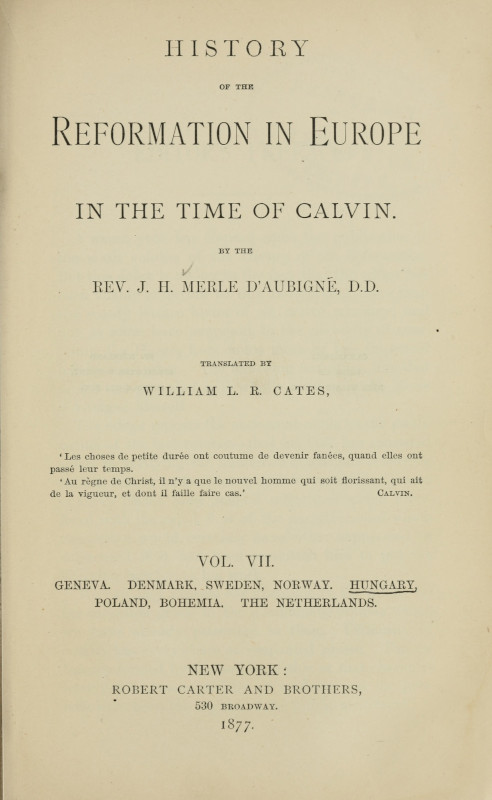
History of the Reformation in Europe in the Time of Calvib, Vol. 7 (of 8), by J. H. Merle D'Aubigné, D.D
Whole book · 7 sections
History of the Reformation in Europe in the Time of Calvin, Vol. 7 of 8
on
i
DR. MERLE D’AUBIGNÉ’S HISTORY.
ii
1.—The History of the Reformation in the SIXTEENTH
CENTURY. 5 Vols. $6.00
2.—The History of the Reformation in the TIME OF
CALVIN. 7 Vols. $14.00
[From a Review by Prof. F. Godet of Neuchâtel.]
What a difference there is between the perusal of a work of this
kind and that of one of the religious novels with which our public
is now satiated. In these latter, notwithstanding all the good-will
of the authors, there is always, or nearly always, something unwholesome.
Imagination, that admirable gift of God, is employed
to transport us into the chiaro-oscuro of fictitious scenes, which
communicate a kind of fascination from which it is difficult to
emerge, to return to the humdrum of every-day life, and to confine
ourselves to the narrow limits of our every-day duties. Here
on the contrary we find the full light of historic truth, imagination
restored to its true object—that of giving life to real facts. The
faith of this martyr, it really struggled, really triumphed—this
blood, it really flowed—this pile, its flames lighted up the surrounding
country, but in doing so they really consumed their victim.
When we read these true histories our hearts do not swell
with vain ambition or aspire to an inaccessible ideal. We do not
say: “If I were this one, or that one.” We are obliged to commune
with ourselves, to examine our consciences, to humble ourselves
with the question: What would become of me if I were
called to profess my faith through similar sufferings? Each one
of us is thus called to less self-complacency, to greater humility,
but at the same time to greater contentment with his lot, to greater
anxiety to serve his God with greater faithfulness and greater
activity.
We warmly recommend this work to those who are glad to find
wholesome nutriment for the strengthening of their faith, to those
who by contact with a vivifying stream wish to give renewed vigor
to their spiritual life. They will find in its narrations all the
energy and brightness which a living faith communicated to the
author, whose mind retained all its youthful freshness, and at the
same time that wisdom which Christian experience had brought to
full maturity.
ROBERT CARTER & BROTHERS.
iiiHISTORY OF THE REFORMATION IN EUROPE IN THE TIME OF CALVIN.
BY THE
REV. J. H. MERLE D’AUBIGNÉ, D.D.,
TRANSLATED BY
WILLIAM L. R. CATES,
‘Les choses de petite durée ont coutume de devenir fanées, quand elles ont passé
leur temps.
‘Au règne de Christ, il n’y a que le nouvel homme qui soit florissant, qui ait de
la vigueur, et dont il faille faire cas.’
Calvin.
VOL. VII.
ENGLAND, GENEVA, FRANCE, GERMANY, AND ITALY.
NEW YORK:
ROBERT CARTER & BROTHERS,
No. 530 BROADWAY.
1877
EDITOR’S PREFACE.
v
A whole year has elapsed since the publication of
the sixth volume of the History of the Reformation.
But this delay is owing to the fact that the editor has
been unable to devote to this undertaking more than
the scanty leisure hours of an active ministry; and
not, as some have supposed, to the necessity of compiling
the History from notes more or less imperfect
left by the author. The following narrative, like that
which has preceded it, is wholly written by M. Merle
d’Aubigné himself.
The editor repeats the statement made on the publication
of the last volume—that his task has consisted
solely in verifying the numerous quotations occurring
in the text or as foot-notes, and in curtailing, in two
or three places, some general reflections which interfered
with the rapid flow of the narrative, and which
the author would certainly have either suppressed or
condensed if it had been permitted him to put the
finishing touches to his work.
We can only express our gratitude to the public for
the reception given to the posthumous volume which
we have already presented to them. Criticism, of
course, has everywhere accompanied praise. The estimates
formed by the author of this or that character
have not been accepted by all readers; and the journals
have been the organs of the public sentiment.
viOne important English review[1] has censured the
author for placing himself too much at the evangelical
point of view. It is unquestionable that this is indeed
the point of view at which M. Merle d’Aubigné stood.
This was not optional with him; he could not do
otherwise. By conviction, by feeling, by nature, by
his whole being, he was evangelical. But was this
the point of view best adapted to afford him a real
comprehension of the epoch, the history of which he
intended to relate? This is the true question, and the
answer seems obvious. If we consider the fact that
the theologians of the revival at Geneva have been
especially accused of having been too much in bondage
to the theology of the sixteenth century, we shall
acknowledge that this evangelical point of view was
the most favorable to an accurate understanding of
the movement of the Reformation, and to a just expression
of its ideas and tendencies. No one could better
render to us the aspect of the sixteenth century than
one of those men who, if we may so speak, have
restored it in the nineteenth.
viiThe criticism most commonly applied to M. Merle
d’Aubigné is that he has displayed a bias in favor of
the men of the Reformation, and especially in favor
of Calvin. That the author of the History of the Reformation
feels for Calvin a certain tenderness, and
that he is inclined to excuse, to a certain extent, his
errors and even his faults, may be admitted. But it
is no less indisputable that this tendency has never
led him to palliate or to conceal those errors or faults.
He pronounces a judgment: and this is sometimes a
justification or an excuse. But he has in the first
place narrated; and this narration has been perfectly
accurate. The kindly feeling, or, as some say, the
partiality of the writer, may have deprived his estimate
of the severity which others would have thought
needful; but it has not falsified his view. His glance
has remained keen and clear, and historical truth
comes forth from the author’s narratives with complete
impartiality. These narratives themselves furnish
the reader with the means of arriving at a different
conclusion from that which the author has himself
drawn.
May we not add that M. Merle d’Aubigné’s love for
his hero, admitting the indisputable sincerity of the
historian, far from being a ground of suspicion, imparts
a special value to his judgments? For nearly sixty
years M. Merle lived in close intimacy with Calvin.
He carefully investigated his least writings, seized
upon and assimilated all his thoughts, and entered,
as it were, into personal intercourse with the great
reformer. Calvin committed some faults. Who disputes
this? But he did not commit these faults with
deliberate intention. He must have yielded to motives
which he thought good, and, were it only in the
blindness of passion, must have justified his actions to
viiihis own conscience. In the main, it is this self-justification
on Calvin’s part which M. Merle d’Aubigné
has succeeded better than any one else in making
known to us. He has depicted for us a living Calvin;
he has revealed to us his inmost thought; and
when, in the work which I am editing, I meet with
an approving judgment in which I can not join without
some reservation, I imagine nevertheless that if
Calvin, rising from the tomb, could himself give me
his reasons, he would give me no others than those
which I find set forth in these pages. If this view
is correct, and it seems to me difficult to doubt it, has
not the author solved one of the hardest problems of
history—to present the true physiognomy of characters,
and to show them as they were; under the outward
aspect of facts to discover and depict the minds
of men?
Moreover, the greater number of these general criticisms
are matters of taste, of tendency, of views and
of temperament. There are others which would be
important if they were well-founded. Such are those
which bear upon the accuracy of the work, almost
upon the veracity of the author. Fortunately it is
easy to overthrow them by a rapid examination.
‘M. Merle,’ it has been said,[2] ‘makes use of his vast
knowledge of the works of the reformers to borrow
from them passages which he arbitrarily introduces
out of their place and apart from the circumstances to
which they relate. Thus sentences taken from works
of Calvin written during the last periods of his life are
transformed into sentences pronounced by him twenty
or twenty-five years earlier. That which on one occasion
was written with his pen is, in regard to another
occasion, put into his lips. We may, without
ixpedantry, refuse to consider this process in strict conformity
with that branch of truth which is called
accuracy.’
It is true that, in Vol. VI., M. Merle d’Aubigné applies
to the year 1538 words uttered by Calvin about
twenty-five years later, at the time of his death in
1564:—‘I have lived here engaged in strange contests.
I have been saluted in mockery of an evening before
my own door with fifty or sixty shots of arquebuses.
You may imagine how that must astound a poor
scholar, timid as I am, and as I confess I always
was.’ But these words, spoken by Calvin many years
after the event, referred precisely to that year, 1538.
The historian has quoted them at the very date to
which they belong; nor could he have omitted them
without a failure in accuracy.
The following is, however, the only proof given of
this alleged want of accuracy:—
‘At the time when Calvin had just succeeded in
establishing in Geneva what he considered to be the
essential conditions of a Christian church, he had published,
in the name of his colleagues, some statement
of the success which they had just achieved, and had
given expression to the sentiments of satisfaction and
hope which they felt. Of this statement, to which
events almost immediately gave a cruel contradiction,
M. Merle has made use to depict the personal feelings
and disposition of Calvin after the check which his
work had sustained. The conditions are altogether
changed. Instead of triumphing, the reformer is banished;
and, nevertheless, the language which he used
in the days of triumph is employed to characterize his
steadfastness and constancy in the days of exile.’
The document here spoken of is a preface by Calvin
to the Latin edition of his Catechism. In the original
xedition it bears date March, 1538. It is now before
us; we have read and re-read it, and we can not
imagine by what strange illusion there could be seen
in it a statement of the success which Calvin and his colleagues
had just achieved. It does not contain one vestige
of satisfaction or of hope, not a trace of triumph.
It is an unaccountable mistake to suppose that it was
written in days of triumph. It was written in March
1538, in the very stress of the storm which, a few
days later, April 23, was to result in the banishment
of the reformer and the momentary destruction of his
work at Geneva. This storm had begun to take shape
on November 25, 1537, at a general council (assembly
of the people), in which the most violent attacks had
been directed against Calvin and against the government
of the republic. From this time, says M. Merle,
‘the days of the party in power were numbered.’[3]
In fact, the government favorable to Calvin was overthrown
February 3, 1538. On that day the most implacable
enemies of the reformer came into power.
Thus, in March, Calvin, far from thinking of a triumph,
was thinking of defending himself. The preface which
stands at the head of his catechism is not the statement
of success already seriously impaired, but an
apologia for his proceedings and his faith, a reply to
‘the calumnies aimed against his innocence and his
integrity,’[4] to ‘the false accusations of which he is a
victim.’[5] The following is the analysis of the preface,
given by Professor Reuss, of Strasburg, in the Prolegomena
to Vol. V. of the Opera Calvini, p. 43:—
‘The occasion for publishing, in Latin, this book
was furnished by Peter Caroli, doctor and prior of the
xiSorbonne. This doctor, after having spread abroad
iniquitous rumors against Farel, Viret, and Calvin,
broke out passionately in open accusations against
these men, his colleagues, who were equally distinguished
by their faith and their moral character, imputing
to them the Arian and Sabellian heresies and
other similar corruptions. At this time there existed
no other public monument of the faith of the Genevese
church but the Confession of Farel and the Catechism
of Calvin; and these, as they were written in French,
were almost unknown to the rest of the Swiss churches.
For this reason Calvin translated into Latin his own
Catechism and the Confession of Farel, in order to make
known through this version to all his brethren in
Switzerland the doctrine which he had hitherto professed
at Geneva, and to show that the charge of heresy
brought against it was without foundation.’[6]
It must be added that Calvin, in this preface, does
not confine himself to the refutation of the charges of
heresy drawn up against him by Caroli; but he vindicates
his own course at Geneva, particularly in that
vexatious affair of the oath which gave rise to the
debate of November 25, 1537, the overthrow of the
government on February 3, 1538, and the expulsion
xiiof Calvin and his friends on April 23 following. This
document is, with the letters written by Calvin at this
period, the most precious source of information as to
the reformer’s feelings during this cruel struggle; and
in quoting it at this place the author has made a judicious
use of it.
Let us quote further some words from an article in
the Athenæum, of which we have already spoken. In
the course of criticisms, sometimes severe, the writer
acknowledges that ‘there are to be found in this volume,
in unimpaired vigor, the qualities we admired
in its predecessors. Few narratives are more moving
than the simple tale of the death of Hamilton, the
first of the Scotch martyrs; and the same may be said
of the chapter devoted to Wishart.’ In regard to Calvin
the same writer tells us—‘M. Merle possessed, as
we have already remarked, a knowledge truly marvellous
of the writings of Calvin; and there are few
books which enable us to understand so well as M.
Merle’s the mind of the reformer—not perhaps as he
was on every occasion, but such as he would have
wished to be.’
Professor F. Godet, of Neuchâtel, expresses the same
opinions and insists on them.[7] After having spoken
of ‘that stroke of a masterly pencil which was one
of the most remarkable gifts of M. Merle d’Aubigné,’
he adds—‘It is always that simple and dignified style,
calm and yet full of earnestness, majestic as the course
of a great river, we might say—like the whole aspect
of the author himself. But what appears to us above
all to distinguish the manner of M. Merle is his tender
and reverential love for his subject. The work which
he describes possesses his full sympathy. He loves it
as the work of his Saviour and his God. Jesus would
xiiino longer be what he is for the faith of the writer if
he had not delivered, aided, corrected, chastened, governed
and conquered as he does in this history. St.
John, in the Apocalypse, shows us the Lamb opening
the seals of the book containing the designs of God
with respect to his church. M. Merle, in writing history,
appears to see in the events which he relates so
many seals which are broken under the hand of the
King of Kings. In each fact he discerns one of the
steps of his coming as spouse of the church or as judge
of the world. And just as the leaves of the divine
roll were written not only without but within, M.
Merle is not satisfied with portraying the outside of
events, but endeavors to penetrate to the divine idea
which constitutes their essence, and to unveil it before
the eyes of his reader. Do not therefore require him
to be what is called an objective historian, and to hold
himself coldly aloof from the facts which he recalls to
mind. Is not this faith of the sixteenth century, of
which he traces the awakening, the struggles, defeats
and victories, his own faith and the life of his own soul?
Are not these men whom he describes, Calvin, Farel,
Viret, bone of his bone, flesh of his flesh? Are not
these churches, whose birth and first steps in life he
relates, his own spiritual family? The reader himself,
to whom his narrative is addressed, is for him an immortal
soul, which he would fain make captive to the
faith of the Reformation. He does not for an instant
lay aside, as narrator, his dignity as a minister of
Christ. The office of historian is in his case a priesthood.
Not that he falls into the error of determining
at all cost to glorify his heroes, to palliate their weaknesses,
to excuse their errors, or to present facts in a
light different from that objective truth to which he
has been led by the conscientious study of the documents.
xivThe welfare of the church of to-day for which
he desires to labor, may as surely result from the
frank avowal and the severe judgment of faults committed,
as from admiration of every thing which has
been done according to the will of God.’
The same judgment was lately pronounced by the
author of a great work on French literature, recently
published,[8] Lieutenant-Colonel Staaf. It is in the following
terms that the author introduces M. Merle
d’Aubigné to the French public:—‘M. de Remusat
has said of this work—“It may have had a success
among Protestants (un succès de secte), but it deserves
a much wider one, for it is one of the most remarkable
books in our language.” We might add one of
the most austere, for it is at once the work of a historian
and of a minister of the Gospel. It would be a
mistake to suppose that the author has sacrificed the
narrative portion of his history to the exposition and
defence of the doctrines of the Reformation. Without
seeking after effects of coloring, without concerning
himself with form apart from thought, he has succeeded
in reproducing the true physiognomy of the
age whose great and fruitful movements he has narrated.
All the Christian communities over which the
resistless breath of the Reformation passed live again
in spirit and in act in this grand drama, the principal
episodes of which are furnished by Germany, France,
Switzerland, and England. In order to penetrate so
deeply as he has done into the moral life of the reformers,
M. Merle was not satisfied with merely searching
the histories of the sixteenth century; he has drawn
from sources the existence of which was scarcely suspected
xvbefore they had been opened to him.’...
‘Now, at whatever point of view we may take our
stand, it is no subject for regret that for writing the
story of the conflicts and too often of the execution of
so many men actuated by the most generous and unalterable
convictions, the pen has been held by a believer
rather than by a sceptic. It was only a descendant
and a spiritual heir of the apostles of the Reformation
who could catch and communicate the fire of their
pure enthusiasm, in a book in which their passions
have left no echoes. M. Merle d’Aubigné—and this
is one of the peculiar characteristics of his work—has
satisfied with an antique simplicity the requirements
of his twofold mission. It is only when the conscience
of the historian has given all the guarantees of fairness
and impartiality that one had a right to expect
from it that the pastor has indulged in the outpourings
of his faith.’
We close with the words of Professor F. Bonifas, of
Montauban:[9] ‘In this volume are to be found the eminent
qualities which have earned for M. Merle d’Aubigné
the first place among the French historians of
the Reformation: wealth and authenticity of information,
a picturesque vivacity of narration, breadth and
loftiness of view, a judicious estimate of men and
things, and in addition to all these a deeply religious
and Christian inspiration animating every page of the
book. The writer’s faculties remained young in spite
of years; and this fruit of his ripe old age recalls the
finest productions of his youth and manhood.’
A last volume will appear (D.V.) before the end of
the present year.
Ad. Duchemin.
Lyons, May, 1876.
CONTENTS OF THE SEVENTH VOLUME.
xvii
BOOK XI.—(continuation.)
CALVIN AND THE PRINCIPLES OF HIS REFORM.
CHAPTER XIX.
CALVIN’S RECALL TO GENEVA.
(August 1540 to March 1541.)
The Ministers of Geneva—Departure of Morand and Marcourt
from the Town—Great Famine—Advice of Calvin—His Recall
determined on—The Message taken by Louis Dufour—Calvin’s
First Answer—Journey to Worms—Letter from the
Syndics and Council of Geneva—Calvin’s Anxieties—Consultation
of his Friends—His Answer—Its Conditions—Viret
called to Geneva—Viret at Geneva—The Minister Bernard—His
Letter to Calvin—Calvin at Worms—Calvin and Melanchthon—Their
Intimacy—Their Reciprocal Confidence—Colloquy
of Worms—Song of Victory—Triumph of Christ—Calvin’s
Confidence in Viret—Calvin’s Letter to Bernard—Calvin
restored to Geneva by Farel—Trials—Humility and
Faith 1
CHAPTER XX.
CALVIN AT RATISBON.
(1541.)
Calvin’s Uneasiness—Concessions of the Lutherans—Calvin’s
Steadfastness—Discourse of Cardinal Farnese—Calvin’s
xviiiAnswer—Papal Tyranny—The True Concord—Unity and
Diversity—The Roman See not the Apostolic See—Incontinence—Profanation
of Religion—A great Monster—True
Ministers—Church Property—The Pope’s Crosier—Protestants
and Turks—Calvin’s part at Ratisbon—Theology of
Rome—Evils to be remedied—Calvin’s Moderation—Reference
to the General Council—Calvin’s Departure from
Ratisbon 24
CHAPTER XXI.
CALVIN’S RETURN TO GENEVA.
(July to September, 1541.)
Repeal of the Sentence of Banishment by the General Council—Letter
from the Syndics and Council of Geneva to the Pastors
and Councils of Zurich and Basel—Severity of their
Language—Its Expression of the common Feeling—All Difficulties
removed by Letters from Geneva—Calvin’s Motto—His
departure from Strasburg—His Stay at Neuchâtel—At
Berne—Arrival at Geneva—Ostentation avoided—Calvin’s
House—What he had acquired at Strasburg—His Appearance
before the Council—Going forward—Commission of the
Ordinances—Beginning of Calvin’s work—Assistance of Farel
and Viret requested—The Grace of God and the Work of
Man—A Day of Humiliation—The Truth with Charity 42
CHAPTER XXII.
THE ECCLESIASTICAL ORDINANCES.
(September, 1541.)
Project of the Ordinances—Its Presentation to the Councils—Passed
in the General Council—Spirit and Purpose of the
Ordinances—Calvin’s Model the Primitive Church—Geneva
an Evangelical Stronghold—The Christian Life—Remonstrances—The
Ministry—Instruction of the Young—The
Poor and the Sick—Prisoners—Election of Pastors—The
Ministers’ Oath—The Doctors—The Elders—The Consistory—Worship—Common
Prayer—Discipline—Manner of judging
of this Discipline—Government of the Church of Geneva—Theocracy
and Democracy—State Omnipotence—Government
of the Church assumed by the State—Calvin not responsible—The
Danger unseen by him 60
xixCHAPTER XXIII.
CALVIN’S PREACHING.
Preaching Calvin’s Principal Office—Two to Three Thousand
Sermons—His Exposition of Holy Scripture—Quotations—How
a young Man shall cleanse his Way—The Love of Money—A
Stranger on the Earth—Transitory Devotion—Self-love—The
lost Lamb—God’s Will that all should be Saved—His
Grace unbounded—How to come to God—The Blood of
Christ—Predestination—Ignorance of it is Learning—No
political Part played by Calvin—His clear Conception of the
Evangelical Ministry 81
CHAPTER XXIV.
CALVIN’S ACTIVITY.
(February, 1542.)
State of Feeling at Geneva—Calvin the Soul of the Consistory—His
Attention to small Matters—Catholicism at Geneva—Believing
what the Church believes—The Virgin and the Church—Politics
no Concern of the Consistory—The Regulation of
Morals its Business—Impartiality—Moderation—Calvin a
Peacemaker—Meekness and Strength—Latent Hostility of
the former Ministers—New Ministers—Ami Porral—His Triumphant
Faith—His Christian Death—Living Christianity—The
Work prospering—Development of Religious Life—Disciplinary
Action—Reconciliation—Accomplishment of the
Reformation—Luther’s Part—Calvin’s Part—Luther the
Founder of the Reformation—Calvin its Lawgiver—Calvin a
Mediator—Epochs of Light—Means of National Elevation 96
xxBOOK XII.
THE REFORMATION AMONG THE SCANDINAVIAN NATIONS—DENMARK, SWEDEN, NORWAY.
CHAPTER I.
AWAKENING OF DENMARK.
(1515 to 1525.)
John Tausen—His Youth—His Entrance into the Monastery—His
Departure for Germany—His Studies at Louvain and Cologne—At
Wittenberg—Christian II.—His Marriage—Indulgences—Revolt
of Sweden—Royal Vengeance—Martin Reinhard—His
foreign Tongue—Encountered by Ridicule—His
Departure from Denmark—Liberal Laws Promulgated by
Christian—Religious Reforms—Carlstadt in Denmark—His
Dismissal—Fresh revolt in Sweden—Flight of the King—Assistance
of his Allies asked for in vain—The Sister of
Charles the Fifth—Her Death in Heresy120
CHAPTER II.
A REFORMATION ESTABLISHED UNDER THE REIGN OF LIBERTY.
(1524 to 1527.)
Frederick, Duke of Holstein—His Call to the Throne—His Leaning
to Evangelical doctrine—His Impartiality towards Rome
and the Reformation—Promulgation of religious Liberty—The
New Testament in Danish—The Translator’s Preface—Uneasiness
of the Clergy—The King’s Son in Germany—His
Adhesion to the Reformation—Growing Decision of the King—A
Sermon of Tausen—Tausen at Viborg—Continuance in
his Work—The Reformation at Copenhagen—Determination
of the Bishops to Persecute—Imprisonment of Tausen—His
preaching through the Air Hole—His Liberation by the King—Reformation
at Malmoe—The Eloquent Tondebinder—The
Gospel embraced by the whole Town of Malmoe—Translation
of Luther’s Hymns into Danish—Increasing
xxiProgress in all Parts of the Country—The Bishops’ Invitation
to Eck and Cochlæus—Their Refusal to go to Denmark—The
King’s Discourse to the Bishops—Complete religious
Liberty—Vain Efforts of the Bishops—Royal Ordinance—Apparent
Submission of the Clergy 140
CHAPTER III.
TRIUMPH OF THE REFORMATION UNDER THE REIGN OF FREDERICK I. THE PEACEFUL.
(1527 to 1533.)
Struggles and Controversies—Tausen’s Writings—A New Bishop—Various
Reforms—Tausen’s Zeal—Diet of Copenhagen—The
Bishops and the Ministers—Increased Number of Sermons
by the Ministers—Silence of the Bishops—Tausen and
his Colleagues—Their Confession of Faith—The Articles—Surprise
of the Prelates—Accusations of the Bishops—Reply
of the Evangelicals—Their Demand of a public Discussion—Refusal
of the Bishops—Presentation of a Memorial to the
King by the Ministers—No Answer to it—Triumph of the
Evangelical Cause—Disorders—Frederick’s political Position
strengthened—Intrigues of the ex-King—Invasion of Norway
by Christian II.—A short Struggle—Christian taken Prisoner—His
Demand for a Safe-conduct—His Letter to Frederick—Treated
as a Prisoner of State—Sentenced to Imprisonment
for Life—Confined in a walled-up Keep—Forsaken—Luther’s
Intercession for him—Death of Frederick—His Four Sons 166
CHAPTER IV.
INTERREGNUM. CIVIL AND FOREIGN WAR.
(1533.)
Reviving Hope of the Bishops—Their Efforts—Their Intrigues—Restriction
of religious Freedom—Their Purpose to elect
the King’s fourth Son—Adjournment of the Election—Tausen
sentenced to Death—Rising of the Townsmen—Rescue of
Tausen—The Bishops threatened—Banishment of Tausen—Brigitta
Gjoë—Persecution of Evangelicals—Polemics—Popular
Writings—Attack of Lübeck on Denmark—Rapid Progress
of the Invaders—A Diet in Jutland—Long Debates—Election
of Christian III. in spite of the Bishops 194
xxiiCHAPTER V.
CHRISTIAN III. PROCLAIMED KING—TRIUMPH OF THE REFORMATION
IN DENMARK, NORWAY, AND ICELAND.
(1533 to 1550.)
Vigorous Prosecution of the War by the new King—The Enemy
driven from the Provinces—Siege of Copenhagen—Extreme
Sufferings of the besieged Town—Entry of Christian into his
Capital—His Determination to crush the temporal Power of
the Bishops—Arrest of the Bishops—General Council of the
Nation—Bill of Indictment against the Bishops—Their Deprivation—Their
Liberation—The King’s Invitation to Pomeranus—Reorganization
of the Church by Pomeranus—New
Constitution of the Church—The Reformation in Norway—In
the main a Work of the Government—The Reformation in
Iceland—The two Bishops of Iceland—Oddur’s Translation
of the New Testament—An Evangelical Bishop—His Death—Popish
Reaction—Triumph of the Gospel 211
CHAPTER VI.
THE EARLIEST REFORMERS OF SWEDEN.
(1516 to 1523.)
Various Influences—The Brothers Olaf and Lawrence—Their
early Studies—Their Application to Theology—Olaf at Wittenberg—His
Intimacy with Luther—His Return to Sweden—The
two Brothers and Bishop Mathias—Present at the
Massacre of Stockholm—Mathias one of the Victims—Lawrence
Anderson Successor of Mathias—He is favorable to the
Reformation—Olaf and Lawrence at their Father’s Funeral—Their
Refusal of the Services of the Monks—Violent Opposition—Their
Death demanded by Bishop Brask 231
CHAPTER VII.
THE REFORMERS SUPPORTED BY THE LIBERATOR OF SWEDEN.
(1519 to 1524.)
Gustavus Vasa Prisoner in Denmark—His Escape from Confinement—His
Struggle for the Independence of Sweden—His
Flight from Place to Place—News of the Massacre of Stockholm—Concealment
xxiiiin the Mountains—Farm Labor—Recognition
of Him—Betrayal—Pursued like a wild Beast—His Attempt
to rouse the People—Unsuccessful Efforts—A Rising
at last—Speedy Triumph—Gustavus nominated King—His
Leaning to Reform—His Welcome to the Reformers—Anderson
Chancellor of the Kingdom—Olaf Preacher at Stockholm—Partisans
and Adversaries—Conspiracies of the Bishops—Bishop
Brask—Citation of Olaf and Lawrence before the
Chapter—Their Attitude—Anathema 244
CHAPTER VIII.
STRUGGLES.
(1524 to 1527.)
The ‘Illuminated’ at Stockholm—Their Expulsion—Olaf’s Marriage—His
Excommunication by Bishop Brask—His Defence
undertaken by the King—Revenues of the Clergy diminished
by the King—Ostentation of Archbishop Magnus—Feast
of St. Erick—The Clergy humbled by the King—Fears
of the Bishops—Public Disputation proposed by Magnus—Accepted
by the King—Olaf and Galle—Regrets of the Catholics—Tempers
heated on both sides—A Pretender—The
Bishops’ Support of Him—Declaration of the King—His Resolution
to complete his Task—Convocation of the States of
the Kingdom—A royal Banquet—Humiliation of the Bishops 265
CHAPTER IX.
VICTORY.
(1527.)
An Episcopal Conspiracy—The Diet of 1527—Complaints of the
King—Exactions of the Clergy—Audacity of Bishop Brask—The
King’s Abdication—Triumph of the Bishops—Excitement
of the People—A Disputation before the Diet ordered—The
King entreated to resume the Sceptre—His long Resistance—His
final Consent—Political Reforms—Religious Reforms—Compact
of Westeraas—Disarming of the Romish
Hierarchy—Suppression of the armed Revolt—Coronation of
Gustavus I. 283
xxivCHAPTER X.
‘CESAROPAPIE.’
(1528 to 1546.)
Assembly of Orebro—Authority of the Scriptures—Education of
Pastors—Ecclesiastical Rites—Concessions—Obstacles—Discontent—Progress—Lawrence
Petersen—His Nomination as
Archbishop of Upsala—Marriage of the King—Marriage of
the Archbishop—Hostility of the Monks—Olaf’s Desire for a
complete Reformation—The King’s Desire to put it off—Coolness
between the King and the Reformer—Complaints of
Olaf—Irritation of the King—The Mock Suns of 1539—A
Storm raging against Olaf—Brought to Trial with Anderson—Both
condemned to Death—A Ransom accepted by the
King—Resignation and Reinstatement of Olaf—The King
Head of the Church—Luther’s Counsels—Church Order half
Episcopalian and half Presbyterian—Severity of Gustavus—Excuses—Refusal
of Gustavus to join the League of Smalcalde 298
CHAPTER XI.
THE SONS OF GUSTAVUS VASA.
(1560 to 1593.)
The King’s Farewell to the People—His Illness—His Death—Erick
the new King of Sweden—Debates on the Lord’s Supper—Controversies—Madness
of King Erick—Massacres—Death
of Burrey—Deposition of Erick—His harsh Captivity—Catholicism
favored by King John—Catholicism in the ascendent—Arrival
of Jesuits—Their Profession of Evangelical
Doctrines—Their Attempt to convert the King—Fratricide—Death
of the ex-King Erick—Conversion of John III. to
Popery—Sudden Change of the King—His Death—The Assembly
of Upsala in 1593—Adoption of the Confession of
Augsburg 322
xxvBOOK XIII.
HUNGARY, POLAND, BOHEMIA, THE NETHERLANDS.
CHAPTER I.
THE FIRST REFORMERS AND THE FIRST PERSECUTORS IN
HUNGARY.
(1518 to 1526.)
First Gleams—Louis II.—Mary of Hungary—Beginning of the
Reformation—The first Preachers—Their Wish to see Luther—Threatenings
of Persecution—Intolerance of the Catholic
Clergy—Louis II. and Frederick the Wise—The Gospel at
Hermannstadt—Noteworthy Progress—Severe Ordinance
against the Reform—First Act the burning of the Books—Flight
of Grynæus—New Efforts—An Execution at Buda—Another
Storm 342
CHAPTER II.
SOLYMAN’S GREAT VICTORY.
(1526.)
Solyman’s Army—Hungary entirely unprepared—Vain Attempts
to raise an Army—The small Troop of King Louis—Battle of
Mohacz—Death of Louis II.—Sorrow of the Queen—Consolation
offered by Luther—A Hymn of Resignation—Two
Kings of Hungary—Martyrs at Liebethen—Edict of Persecution 356
CHAPTER III.
DEVAY AND HIS FELLOW-WORKERS.
(1527 to 1538.)
Mathias Biro Devay—Student at Wittenberg—Various Lords
Protectors of Reform—Slackening of Persecution—Reform
xxviat Hermannstadt—Solyman’s Refusal to oppress the Protestants—Confession
of Augsburg welcomed by Hungarians—Devay’s
Return to Hungary—His Pastorate at Buda—His
Fellow-workers—Devay cast into Prison—His Appearance
before the Bishop of Vienna—His Defence and Acquittal—Imprisoned
again—Asylum offered Him by Count Nadasdy—Controversies
with Szegedy—Devay at Wittenberg—Melanchthon’s
Letter to Nadasdy—Devay at Basel—The Printing-press
and Schools—Stephen Szantai—His Enemies the Bishops—Conference
appointed by Ferdinand—Embarrassment
of the Arbitrators—Embarrassment of Ferdinand—Efforts of
the Bishops—Banishment of Szantai 366
CHAPTER IV.
PROGRESS OF EVANGELIZATION AND OF THE SWISS REFORMATION
IN HUNGARY.
(1538 to 1545.)
The Doctrines of Zwinglius in Hungary—Occasion of Trouble
to some Minds—Political Divisions—Fresh Invasion of the
Turks—Dispersion of Evangelical Divines—Abatement of
Moslem Violence—Renewed Courage of the Christians—Progress
of the Reformation—Devay in Switzerland—His Adoption
of Calvin’s Doctrines—Luther’s Grief—Martin de Kalmance—Hostility
excited against him—Persecution instigated
by the Priests—Ordinances of Ferdinand—Courage of the
Christians of Leutschau—Stephen Szegedin—His Knowledge
and Eloquence—His Writings—His Acceptance of Calvin’s
Doctrines—Hated by the Papists—His Banishment 388
CHAPTER V.
THE GOSPEL IN HUNGARY UNDER TURKISH RULE.
(1545 to 1548.)
Rome the Persecutor—Islamism tolerant—Council of Trent—The
Union of Christians in Hungary—Confessions of Faith—Szegedin
in the South of Hungary—His second Banishment—Emeric
Eszeky—The Gospel at Tolna—Refusal of the Turks
to persecute—Spread of the Gospel—Rule of the Turks favorable
to the Gospel—The Faith embraced in the whole of
Transylvania 406
xxviiCHAPTER VI.
BOHEMIA, MORAVIA, AND POLAND.
(1518 to 1521.)
The United Brethren—Relations with Luther—Luther’s Goodwill—Discussions
on the Lord’s Supper—The Calixtines—Poland
evangelized by the Bohemians—First Successes—Luther’s
Reformation in Poland—Jacob Knade at Dantzic—The
Gospel well received—Religious Liberty—A Revolution at
Dantzic—Reorganization of the Church—Appeal of the Catholics
to the King—Harshness of Sigismund—Final Triumph
of the Gospel—The Gospel at Cracow—Embraced by many
eminent Persons—Words of Luther—Attempted Reformation
in Russia 417
CHAPTER VII.
THE POLISH REFORMER.
(1524 to 1527.)
John Alasco—At Zurich—His Intercourse with Zwinglius—His
Stay at Basel—His Intimacy with Erasmus—Study of Holy
Scripture—His Diligence and Progress—Spiritual Enjoyments
of his Life at Basel—Praised by Erasmus—Alasco
compelled to leave Basel—His Travels—Return to Poland—His
Life at Court—His Weakness—Suspected of Heresy—An
Investigation—Alasco’s Renunciation of Reform—His Fall—Honors—Awakening
of Conscience—His better Knowledge
of the Truth—Liberty—New Honors—Alasco’s Refusal of
Them—His Departure from Poland—On his Way to the
Netherlands 433
CHAPTER VIII.
THE POLISH REFORMER IN THE NETHERLANDS AND IN
FRIESLAND.
(1537 to 1546.)
Alasco’s Marriage—Trials and Consolations—Religious Condition
of Friesland—Alasco in Poland—His Return to Friesland—His
Relations with Hardenberg—Seeking after Separation
from Rome—Alasco Superintendent of Friesland—Prudence
and Zeal—Accusations—Threats—Hatred of the
Monks—A Letter of Alasco—God or the World—The Reformer’s
Victory—Patience and Success—Various Sects—A false
xxviiiChrist Unmasked—Government of the Church—Doctrine—Oppositions—New
Strength—Tribulations—A hidden Protector—Viglius
of Zuychem—His elevated Position—Secret
Report on his Tendencies—His real Sentiments—Contrast 455
CHAPTER IX.
BEGINNING OF REFORMATION IN THE NETHERLANDS.
(1518 to 1524.)
Freedom and Wealth—Ambition of Charles V.—Precursors of
the Reformation—The Reformation at Antwerp—At Louvain—Erasmus
attacked—Violent Proceedings of the Monks—Persecuting
Edict—Arrest of Jacob Spreng—His Recantation—His
Grief and Repentance—The Inquisition—Cornelius
Grapheus, an Erasmian—His Imprisonment—Useless Abjuration—Henry
of Zutphen, Evangelist—His Stay at Wittenberg—His
Preaching at Antwerp—-His Arrest—His Rescue by
the People—His Fate in Holstein—Demolition of the Convent
of the Augustines—Numerous Adhesions to Reform—The
Heavenly Spouse—Faith and Courage—Conventicles—A
Martyr—Tolerance of some of the Bishops—One of the
‘Illuminated’—Luther’s Counsels 480
CHAPTER X.
OUTWORKS.
(1525 to 1528.)
Charles V.—His Policy in the Netherlands—Charles of Egmont’s
Letter to the Pope—The Pope’s Answer—Jan van Bakker—His
Faith—His Breach with Rome—His Imprisonment—His
Trial—Refusal to recant—Condemnation—Martyrdom—A
Legend—Fruitless Attempt at Outward Reformation—New
Edict of Persecution—The Humanist Gnapheus—The Widow
Wendelmutha—Attempt to make her give Way—Her Condemnation—Execution—The
Renewed Gospel 506
CHAPTER XI.
THE VICTIMS OF CHARLES V.
(1529 to 1535.)
Compassion of Charles V.—Rage of Charles of Egmont—Executions
Multiplied—Martyrdom of William of Zwoll—Victims
xxixof Charles V.—Death of Margaret of Austria—Mary of Hungary,
Governess of the Netherlands—Her false Position—Cornelius
Crocus—John Sartorius—Controversies—Some
Books of Sartorius—New Edict of Persecution—A courageous
Town—A Family of Martyrs—Crimes and Horrors—Sorrow
and Distress—The Enthusiasts—Cruel Fanaticism—Unhealthy
Fermentation—‘Illuminated’ Prophets—The Tailor
Bockhold—Excesses and Follies—Illuminism the Offspring
of Persecution—The Netherlands breaking off from
Lutheranism to embrace Calvinism 524
CHAPTER XII.
LOUVAIN.
(1537 to 1544.)
Peter Bruly at Ghent—The Evangelists—Antoinette and Gudule—Pastor
Jan van Ousberghen—The Faithful—An innocent
Walk—Conventicles—Boldness of the Sculptor Beyaerts—Epidemic
at Louvain—Arrests—Arrests by Night—Twenty-three
Prisoners—The Examinations—The Wise confounded
by simple Women—Paul de Roovere—Insulted—Terrified—His
Recantation—New Victims—Great Display of Force—Executions—Antoinette
van Roesmals—Buried alive—Giles
Tielmans—His simple Faith—His unbounded Charity—His
evangelical Zeal—Trouble and Terror among the Faithful—Imprisonment
of Giles Tielmans—The Evangelist Ousberghen—His
Arrest—Trial—Fears—Condemnation—A
great Light—Execution of Ousberghen—Execution of Giles
Tielmans 546
BOOK XI.—( continuation. ) CALVIN AND THE PRINCIPLES OF HIS REFORM. — CHAPTER XIX. RECALL OF CALVIN TO GENEVA. ( August 1540 to March 1541. ) — CHAPTER XX. CALVIN AT RATISBON. (1541.) — CHAPTER XXI. CALVIN’S RETURN TO GENEVA. ( July to Sept. 1541. ) — CHAPTER XXII. THE ECCLESIASTICAL ORDINANCES. ( September 1541. ) — CHAPTER XXIII. CALVIN’S PREACHING. — CHAPTER XXIV. CALVIN’S ACTIVITY. ( February 1542. )
1
The friends of the Reformers were once more in the
majority at Geneva. The very mistakes of their enemies
had restored their moral authority and enlarged their
influence. It would have been difficult in so short a
time to have committed a greater number of mistakes,
or mistakes of a graver character. Beza undoubtedly
gives utterance to the general feeling when he declares
that ‘the city began to claim again its Calvin and its
Farel.’
The ministers who were filling their places were not
men likely to make their predecessors forgotten. They
were not up to their task. In their preaching there was
little unity, little understanding of the Scriptures; and
people were not wanting at Geneva to make them sensible
of their inferiority. It was for them a period of
trouble, humiliation, strife, and unhappiness. The wind
was changed. These poor pastors in their turn were
objects of ill-will; and they complained bitterly of the
censures and the insults which they had to undergo.
2The council did nothing more than send out of the town
a poor blind man who had given offence to them, and
ordered them to go on peaceably with the duties of their
ministry. But the ministers were by this time aware of
the mistake which they had made when they consented
to take the place of such men as Farel and Calvin. Morand,
who was of a susceptible nature, was shocked to
find himself exposed to what he called ‘intolerable calumnies
and execrable blasphemies.’ He was at the same
time indignant that justice was not done on the ‘lies.’
He gave in his resignation to the council, expressing his
desire ‘that his good brethren might have better reason
to stay with them; otherwise,’ said he, ‘look for nothing
but ruin and famine.’ He then went away without further
leave. This was on the 10th of August.[10]
When Marcourt heard of the departure of his colleague
he was upset and indignant. What! leave him alone on
the field of battle! and that without giving any warning
(the other two pastors went for nothing)! He relieved
himself by giving vent to his feeling. ‘Bad man!’ he
exclaimed, ‘traitor!’ And he loudly condemned before
all the people the pastor who had deserted. They were
going on together tolerably well, and they could at least
complain to one another. Before the council Marcourt
took a high tone. ‘Put a stop to these insults,’ said he,
‘or I too will go away.’ The council merely charged him
to invite Viret to come and take the Place of Morand.
To have such a colleague would have been an honor to
Marcourt; but Viret had no mind to go to Geneva while
Calvin was in exile. Marcourt took his resolution and,
like Morand, departed abruptly, without leave. It was
the 20th of September.
Flight Of Morand And Marcourt.
After the departure of these two ministers, the only
ones who had any talent, the council, in their turn, had
to say, What is to become of us? Their best pastors
3having abandoned them, there remained only two incapable
men, De la Mare and Bernard. The gentlemen of
the council felt themselves greatly straitened. The destitution
was extreme, the danger pressing, and the distress
great. Then a cry was uttered: a cry not of anguish
but of hope. Calvin! they said, Calvin! Calvin alone
could now save Geneva. The day after the departure of
Marcourt, the friends of the Reformer in the council made
bold to name him; and it was decreed ‘that Master A.
Marcourt having gone away, commission was given to
Seigneur A. Perrin to find means of getting Master Calvin,
and to spare no pains for that purpose.’ The Reformer
was therefore apprised of the desire which had
arisen for his return. When a people have banished
their most powerful protector, the most pressing duty is
to get him back again. The Genevese had their mournful
but profitable reflections.
By the departure of Morand and Marcourt Geneva was
left in a state of great dearth, and the friends of Calvin
did not shrink from saying so. Porral reproached De la
Mare with overthrowing Holy Scripture. The preacher
hastened to complain to the council. ‘Gentlemen,’ said
he (September 29), ‘Porral alleges that what I preach is
poison; but I am ready to maintain on my life that my
doctrine is of God.’ Porral, over-zealous, then began to
open the catalogue of what he called the heresies of the
preacher. ‘He has said that the magistrate ought not
always to punish the wicked. He has said that Jesus
Christ went to his death more joyfully than ever a man
to his nuptials,’ &c. &c. ‘I maintain that these assertions
are false,’ added Porral. De la Mare was angry
and demanded justice. ‘But other business was pressing
and nothing was done in this matter.’[11]
Calvin disapproved of these attacks directed against
the pastors in office.
‘Beloved brethren,’ he wrote to his friends at Geneva,
4‘nothing has grieved me more, next to the troubles which
have well-nigh overthrown your church, than to hear of
your strifes and debates with the ministers who succeeded
us. Not only is your church torn by these dissensions,
but more—and this is a matter of the gravest importance—the
ministry is exposed to disgrace. Where strife and
discord exist, there can hardly be the faintest hope of
progress in the best things. Not that I desire to deprive
you of the right, which God has given to you as to all
his people, of subjecting all pastors to examination for
the purpose of distinguishing between the good and the
bad,[12] and of putting down those who under the mask
of pastors display the rapacity of wolves. My wish is
only that, when there are men who in a fair degree discharge
the duties of the pastor, you should think rather
of what you owe to others than of what others owe to
you. Do not forget that the call of your ministers was
not given without the will of God; for although our banishment
must be attributed to the craft of the devil, still
it was not the will of God that you should be altogether
destitute of a ministry, or that you should fall again under
the yoke of Antichrist. Moreover, do not forget another
matter, namely your own sins, which assuredly deserve
no light punishment.
‘This subject calls for a great deal of discrimination.
Assuredly I would not be the man to introduce tyranny
into the church.[13] I would not consent that good men
should be obliged to submit to pastors who do not fulfil
their calling. If the respect and deference which the
Lord awards to the ministers of his word and to them
alone be paid to certain persons who do not deserve them,
it is an intolerable indignity. Whosoever does not teach
5the word of our Lord Jesus Christ, whatever titles and
prerogatives he may boast, is unworthy to be regarded as
a pastor. But our brethren, your present ministers, do
teach you the Gospel; and I do not see why you should
be allowed to slight them or to reject them. If you say
that there are features in their teaching and their character
which do not please you, remember that it is not
possible to find a man in whom there is not much room
for improvement. If you are incessantly disputing with
your ministers, you are trampling underfoot their ministry,
in which the glory of our Lord Jesus Christ ought
to shine forth.’
Embassy Of Dufour.
If the council did not come to a decision on the question
which Calvin had decided, it was because, as it declared,
it had other business in hand; and the most important
of all was the recall of that great teacher who
had displayed so much fairness and moderation. The
council felt more and more that the powerful mind and
the high authority of Calvin were indispensable in Geneva;
and therefore again and again they pressed for his
return. On September 20 the Little Council gave Perrin
the commission of which we have spoken. On October 13
the Two Hundred decreed that a letter should be written
to the Reformer, ‘begging him to consent to assist us.’
Michel Dubois was to be the bearer of the letter, and
‘was to make earnest appeals to the friends of the Reformer
to persuade him to come.’ On the 19th the same
council decided ‘that, for the promotion of the honor and
glory of God, every thing possible must be done to get
Master Calvin back.’ The next day the people assembled
in General Council decreed that, ‘for the advancement
and extension of the word of God, a deputation should
be sent to Strasburg to fetch Master Calvin, who is very
learned, to be evangelical minister in this town.’ On
October 22 Louis Dufour, a member of the Two Hundred,
was instructed to take the message of the councils
to Strasburg; and on the 27th, twenty golden écus au
6soleil were voted to him for the purpose of fetching Master
Calvin. They insisted upon it; they reiterated their
determination; they decided the matter, and then decided
it over again; they did not hesitate to repeat it again and
again. The matter was of such importance that entreaties
must be urgent. Dufour set out. Would he succeed?
That was the question, and it was very doubtful.[14] When
Calvin received the first message, previous to that of Dufour,
he was so much excited and thrown into so great a
perplexity that for two days he was hardly master of himself.[15]
Remembering the distress of mind which he had
suffered at Geneva, his whole soul shrank with horror
from the thought of returning thither. Had not his conscience
been put to the torture? Had not anxieties consumed
him? ‘I dread that town,’ he exclaimed, ‘as a
place fatal to me.[16] Who will blame me if I am unwilling
to plunge again into that deadly gulf? Besides, can I
believe that my ministry will be profitable there? The
spirit which actuates most of the inhabitants is such as
will be intolerable to me, and I shall be equally so to
them.’ Then turning his thoughts in another direction
he exclaimed—‘Nevertheless I desire so earnestly the
good of the church of Geneva, that I would sooner risk
my life a hundred times than betray it by desertion.[17] I
am ready therefore to follow the advice of those whom
I regard as sure and faithful guides.’ It was to Farel
that Calvin thus poured out his heart. It was his advice
that he sought, and there was no doubt what this advice
would be.
Calvin At Worms.
The Reformer also consulted his Strasburg friends, and
agreed with them that he could not abruptly quit the
7church of which he was then pastor; and, above all, that
he must be present at the assembly of Worms, as he had
already been present in the spring at that of Hagenau.
He therefore wrote to the lords of Geneva: ‘It has been
arranged by the gentlemen of the council of this town
that I should go with some of my brethren to the assembly
of Worms, in order to serve not one church alone,
but all churches, among which yours is included. I do
not, indeed, think myself so wise, so great, or so experienced
that I can be of any great use there; but, since a
matter of such high concern is at stake, and as it has
been arranged not only by the council of this town, but
also by others, that I should go there, I am obliged to
obey. But I can call God to witness that I hold your
church in such esteem that I would never be wanting to
it in the time of its need in any thing which I could possibly
undertake.’[18]
Calvin’s letter was written on the 23d of October; and
Dufour brought him a letter from the council dated the
day before. When the delegate reached Strasburg Calvin
was already at Worms, where an important conference
was about to be held between the Protestant and
the Catholic theologians, for the purpose of endeavoring
to come to an understanding with each other, in pursuance
of the plan agreed upon at Hagenau. The Genevese
messenger appeared before the senate of Strasburg, and
made known to them the purpose of his journey. The
senate replied that Calvin was absent, and that without
his consent they could make no promise. Dufour then
determined to follow the Reformer to the town which
Luther, by his Christian heroism, had made illustrious.
‘I will ascertain exactly,’ he said, ‘what he thinks of our
call.’ A courier carried to Worms the news of the arrival
of the Genevese deputation, and the Strasburg magistrate
entrusted him with a letter for his deputies, Jacob
Sturm and Mathias Pfarrer, in which he enjoined them
8to do all they could to prevent Calvin making any engagement
with the Genevese. The high estimate formed
of Calvin in Germany, the fact that an imperial city sent
this Frenchman as a deputy to assemblies convoked by
the Emperor to take into consideration the deepest interests
of the Empire, might well contribute to work a
change in the opinion of some of the citizens of the little
republic with respect to Calvin, of whom it had hitherto
been possible to say: ‘A prophet is not without honor
save in his own country.’ The Genevese deputy arrived
two days after the courier, and delivered to Calvin the
letter of the Council of Geneva. He read it, and it is
easy to imagine the impression which it must make on
him. It ran as follows:
‘To the Doctor Calvin, Evangelical Minister.
‘Our excellent brother and special friend, we commend
ourselves to you very affectionately, because we are fully
assured that you have no other desire but for the increase
and advancement of the glory and honor of God, and of
his holy Word. On behalf of our Little, Great, and General
Councils (all of which have strongly urged us to take
this step), we pray you very affectionately that you will
be pleased to come over to us, and to return to your
former post and ministry; and we hope that by God’s
help this course will be a great advantage for the furtherance
of the holy Gospel, seeing that our people very
much desire you, and we will so deal with you that you
shall have reason to be satisfied.
This letter was fastened with a seal bearing the motto—Post
tenebras spero lucem.
Calvin’s Perplexity.
The invitation to Geneva was clear, affectionate, and
9pressing. But the courier, who had reached Worms
two days before, had brought to the Strasburg deputies a
letter from their senate the purport of which was entirely
the reverse. All those who had heard the letter read, and
Calvin most of all, had been astonished at the eagerness
to keep the Reformer which the magistrates of this free
city expressed. ‘I had never imagined,’ he said, ‘that
they set such value upon me.’[20] He thus found himself
pressed on two sides, Geneva and Strasburg: and if the
fancy were not too high-flown, we might say that the
Latin and the German races were at this moment contending
for the man who but a little while before was
driven away from the town in which he lived. The decision
which Calvin had to form was a solemn and difficult
one. His whole career in this world was at stake.
He called together such of his friends as were then at
Worms for the purpose of consulting with them. To
return to Geneva was, in his view, to sacrifice his life,
but he was resolved to take this course if his friends
counselled it. ‘The faithful,’ thought he, ‘must heartily
abandon their life when it is a hindrance to their drawing
nigh to Christ. They must in such case act like one who
throws off his shoulders a heavy and tiresome burden
when he wants to go quickly elsewhere. Let us take
our life in our hands, and offer it to God as a sacrifice.’[21]
Calvin’s counsellors not being of one mind, it was
agreed to wait until the deputation from Geneva should
arrive.[22] But having received letters from Farel and from
Viret, Calvin called his friends together again, and laying
before them all the reasons which he could find, said,
‘I conjure you, in giving your advice, to leave my person
altogether out of the question.’[23] In this very town of
10Worms, where Luther, in the presence of Charles V.,
had not shrunk from offering the sacrifice of his life,
Calvin declared himself ready to do the same. His language
was deeply pathetic. ‘Tears flowed from his eyes
more abundantly than words from his lips.’[24] His friends
were moved at the sight of the sincerity and depth of his
feelings. His discourse was more than once interrupted
by emotion. His soul was deeply stirred. He perceived
that upon this moment hung a decision which must affect
his whole life. They were no terrors of imagination
which disturbed him. The struggles and the distress
which he passed through at Geneva probably exceeded
his anticipations. He was quite overpowered and wishing
to conceal from his friends the passion of his grief,
and to pour out his heart freely before God alone, he
twice left the room and sought retirement.[25] The opinion
of his friends was that for the time he should not
make an engagement, but that he might hold out a hope
to the Genevese. Calvin, however, went further. In
the midst of the conflict through which his soul had just
passed he had resolved on the course which terrified
him. He would go to Geneva, and he said to the friends
of the Reformation, ‘I beg of you to promise that when
this diet is over, you will not throw any obstacle in the
way of my going to Geneva.’ The thought that it was
God’s will that he should be there was constantly presenting
itself to his conscience afresh, and this even in
spite of himself. The Strasburg deputies reluctantly assented.
Capito wished to keep him. Bucer desired that
he should be free to accept the call, ‘unless, indeed,’ he
added, ‘any contrary wind should blow from your own
side.’[26]
His Reply To Geneva.
Calvin wrote to Geneva on November 12, 1540, as follows:—‘Magnificent,
mighty, and honorable Lords, were
11it only for the courtesy with which you treat me, it would
be my duty to endeavor to meet your wishes. But there
is, besides, the singular love which I bear to your church,
which God once committed to my care, so that I am forever
bound to promote its good and its salvation. Nevertheless,
be so good as to remember that I am here at
Worms for the purpose of serving, with what small ability
God has given me, all Christian churches. For this reason
I am, for the present, unable to come and serve you.’[27]
There was one point which Calvin put forward in all his
letters to the council. He would not go to Geneva merely
as a teacher and preacher, but also as a guide (conducteur),
and with power to act in such a way that the
members of the church might conform to the commandments
of God. On October 23, 1540, he wrote: ‘I doubt
not that your church is in great distress and in danger of
being still further wasted unless help comes. For this
reason I will strive, with all the grace which God has
given me, to bring it back into a better state.’ On November
12, in the letter which we quote, he wrote, ‘The
anxiety I feel that your church should be well governed,
will lead me to try every means of succoring its need.’
On February 19, 1541, he says to them, ‘I beg you to
bethink yourselves of all the means of wisely constituting
your church, that it may be ruled according to the command
of our Lord.’[28] Calvin was therefore anxious to make
the rulers at Geneva understand that one condition of
his return was that the church should be well governed
and morals well regulated. He did not wish to take
any one by surprise. If he is to be pastor at Geneva, he
will reprove the disobedient, as the word of God commands.
He foresaw, nevertheless, that this would be difficult,
and his distress was not relieved. The reasons for and
against contended with each other in his mind. He was
wrapt in confusion and darkness. He was weighed down
12with a burden. His agitation made it impossible for him
to judge calmly, according to right and reason. ‘With
respect to this call from Geneva,’ he wrote to his friend
Nicolas Parent, ‘my soul is so full of perplexity and darkness,
that I dare not even think of what I am to do.
When I do enter upon the subject I see no way of escape.
Plunged in this distress, I distrust myself and
give myself up to others to guide me.’ He was in the
condition depicted by a poet, in which
Erreurs et vérités, ténèbres et lumière
Flottent confusément devant notre paupière,
Où l’on dit: C’est le jour! et bientôt: C’est la nuit!
He added, ‘Let us pray God to show us the right path.’[29]
We are reminded that Luther had likewise had a similar
period of distress in this very town of Worms in 1521.[30]
Viret At Geneva.
While these things were passing at Strasburg and at
Worms, the revival of the Gospel at Geneva was becoming
more and more manifest. In December, 1540, the
council, anxious to provide for the good of the church,
had besought the lords of Berne with earnest entreaties
to send them Viret, then pastor at Lausanne. A letter
had also been written to Viret himself. Calvin having
expressed a desire to see this friend at work in Geneva,
the Vaudois evangelist had replied that he was ready to
do all that he could; even adding that ‘he would willingly
shed his blood for Geneva:’ and he had arrived there at the
beginning of 1541. He had immediately applied himself
to preaching the word of God, a task for which he was
very well fitted, say the registers, and his preaching bore
much fruit. Viret was certainly the man that was wanted
in this town, the scene of so many conflicts and storms.
‘He handled Scripture well,’ says Roset, who had doubtless
heard him, ‘and he was gifted with eloquence which
charmed the people.’[31]He taught with meekness those who
13were of the contrary opinion, and thought, as Calvin says,
that kindliness ought to be shown even to those who are
not worthy of it. His gentle accents penetrated men’s
hearts, and his actions added force to his words. For
the children of Jean Philippe, who perished on the scaffold,
he obtained permission to return. These children,
by the unrighteous laws of the time, had been the victims
of the offences of their father. He set himself to the re-establishing
of order in the church, and to restoring the
Gospel to honor in Geneva. The civil magistrate was
among the first to profit by his exhortations; and in the
middle of January it was decreed that ‘since the Lord
God had done so much good to Geneva, his holy name
should be called upon at the opening of the sittings of
the council, and wise ordinances should be passed, that
every one might know how he ought to act.’ The people
in general desired the return of Calvin, and were more
and more friendly to the new order of things.
It was thus with Jacques Bernard, the most influential
of the two ministers still remaining at Geneva. Observing
the change which was taking place in public opinion,
he too faced about. We can even imagine that he was
moved to do so by grave reasons. On the first Sunday
in February he set out with a heavy heart to the Auditoire
at Rive, where he was going to preach. The distress of
the church, the departure of Morand and Marcourt, the
reduction of the ministry to two pastors, De la Mare and
himself, the sense of their inadequacy to a task so large
and for a people so numerous, weighed upon his heart.[32]
He appeared in the pulpit before an audience sad and
dispirited, who, overpowered by grief on account of their
terrible forlornness, burst into tears.[33] The poor old
Genevese and ex-Cordelier, a lover of his native place,
was greatly affected. He felt impelled to urge upon his
14hearers that they should turn to the Lord their God; and
he began to utter a humble and earnest prayer, supplicating
Christ, the sovereign bishop of souls, to take pity on
Geneva, and to send to the city such a pastor as the
church stood in need of. The people followed his prayer
very devoutly.
On February 6 Bernard wrote to Calvin, and after relating
to him the above circumstances, he added: ‘To
speak the truth, I was not thinking of you, I had no expectation
that you would be the man that we were asking
of God. But the next day, when the Council of the Two
Hundred had assembled every one wished for Calvin. On
the following day, the General Council met, and all cried
out: We want Calvin, who is an honest man and a learned
minister of Christ.[34] When I heard this, I praised God
and understood that this was the Lord’s doing and was
marvellous in our eyes, that the stone which the builders
refused had become the head-stone of the corner. Come
then, my revered father in Jesus Christ; it is to us that
you belong; the Lord God has given you to us. All are
longing for you; and you will see how welcome your arrival
will be to all. You will discover that I am not such
a man as the reports of some may have led you to suppose,
but that I am a sincere friend to you and a faithful
brother. What do I say? You will find that I am
entirely devoted to you and full of deference to your
wishes. Delay not to come. You will see Geneva a nation
renewed, assuredly by the work of God, but also by
the ministrations of Viret. The Lord Jesus grant that
your return may be speedy! Consent to come to the
help of our church. If you do not come, the Lord God
will require our blood at your hands, for he has set you
for a watchman over the house of Israel within our walls.’
Marcourt had written to Calvin a similar letter.[35]
Calvin And Melanchthon.
Calvin had been named deputy to Worms by the council
15of Strasburg, on account of the abilities which he had
displayed at Frankfort and at Hagenau. These two conferences
he had attended merely in his private capacity.
But the council perceived, says Sturm, ‘that his presence
might do much honor to Strasburg in that assembly of
distinguished men.’ The Dukes of Luneburg, important
members of the empire, had likewise elected him their
representative, so that he was invested with a twofold
office.[36] Calvin, notwithstanding his youth and his timidity,
his foreign nationality and language, felt that he
could not resist the importunities, one might almost say
the violence, which were employed to get him to accept
this important calling. ‘However much,’ said he afterwards,
‘I continued to be myself, in reluctance to attend
great assemblies, I was nevertheless taken as if by force to
the imperial diets, at which, whether I liked it or not, I
could not avoid being thrown into the company of many
men.’[37] He had, moreover, the happiness of meeting
there two men in whose society he took much delight,
two colleagues and friends of Luther whom he had previously
seen, one of them at Frankfort, the other at
Hagenau, but with whom he now associated more intimately.
They were Melanchthon and Cruciger. The
former had acknowledged his agreement with him on
the doctrine of the Lord’s supper. Cruciger requested
of him a private conversation on the same subject; and,
after Calvin had explained his view, he stated that he
approved it as Melanchthon had done. Thus two Wittenberg
theologians and one of Geneva easily came to
an agreement. Sincere and prudent men therefore do
not find concord so difficult a thing as is supposed.
At Worms was formed that intimate friendship between
Melanchthon and Calvin which might be so serviceable to
each of them as well as to the Church. But troublesome
16spirits were not wanting in this town. Among others
there was the dean of Passau, Robert of Mosham, who
at Strasburg had already had a discussion with Calvin,
in which the advantage did not remain with the Roman
Catholic champion. He considered it a point of honor
to seek his revenge, and he was once more thoroughly
beaten by the learned and powerful doctor. The superiority
of Calvin, and the remembrance of his former
defeat, inspired terror in the heart of the dean, and he
got out of his depth.[38] Melanchthon, who was present
at their conference, followed Calvin with as warm an interest
as he had manifested twenty-one years before at
the disputation of Luther with Dr. Eck at Leipsic. He
admired the clearness, the accuracy, the depth and force
of the theological propositions and proofs of the young
French doctor; and charmed at once by an intellect
so clear and a knowledge so profound, he proclaimed
him THE THEOLOGIANpar excellence. This designation was
worth all the more as originating with Melanchthon; but
all the evangelical doctors who heard him were struck
not only with his language, but with the wealth and
weight of his thoughts and his arguments.
Their Mutual Confidence.
From the time of this intercourse at Worms, there always
existed between Melanchthon and Calvin that warm
affection and that peculiar esteem which are felt by the
dearest friends. Esteem was perhaps uppermost in Melanchthon,
and affection in Calvin. On the one side the
friendship was founded more on reflection (réfléchi), on
the other it was more spontaneous. But on both sides
it was the product of their noble and beautiful qualities.
They esteemed each other and loved each other because
they both had the same zeal for all that is true, good, and
lovely, and because, with a noble emulation, they were
striving to attain these blessings and to diffuse them in
17the world. When the best among men draw together,
and especially when Christianity purifies and consecrates
their union, then their characters and their hearts are exalted,
and their mutual love cannot fail to exert a beneficial
influence. This friendship between two such men
at first surprises us. They are usually set in contrast
with one another; the Frenchman being looked upon as
an example of extreme severity, and the German of extreme
gentleness. How then, it may be said, could the
soft, sweet tones of the soul of Melanchthon set in vibration
the iron soul of Calvin? The reason is that his was
not an iron soul. So far, indeed, as the great truths of
salvation were concerned, Calvin was no more to be bent
than an iron bar; for these he was ready to die. But in
his relations as a husband, a father, and a friend, he had
a most tender heart. Even if, in the controversies of the
age, the discussion turned on matters of doctrine not
affecting salvation, he could bear with and even love his
opponents as few Christians have done.
The friendship of Melanchthon and Calvin was not one
of those earthly ties which pass away with the years; this
affection was deep-seated and its bonds were firm. The
two friends had long interviews with each other at Worms.
Melanchthon never forgot them. ‘Would that I could
talk fully and freely with thee,’ he wrote to Calvin at a
later period, ‘as we used to do when we were together!‘[39]
Having received a work of Calvin’s in which he was mentioned,
Melanchthon said to him—‘I am delighted with
thy love for me; and I thank thee for thinking of inscribing
a memorial of it in so famous a book, as in a place of
honor.’ ‘Yes, dear brother,’ wrote he on another occasion,
‘I long to speak with thee of the weightiest matters,
because I have a high opinion of thy judgment, and because
I know the uprightness of thy soul, thy perfect candor.
I am now living here like an ass in a wasp’s nest.’[40]
18Calvin, although he loved Melanchthon, did not fail
at the same time to tell him freely his opinion whenever
he appeared too yielding. He had been told that, on
one occasion of this kind, Melanchthon tore his letter
to pieces; but he found that this was a mistake. ‘Our
union,’ he said to him, ‘must remain holy and inviolable; and
since God has consecrated it we must keep it faithfully
to the end, for the prosperity or the ruin of the
Church is in this case at stake. Oh! that I could talk
with thee! I know thy candor, the elevation of thy sentiments,
thy modesty and thy piety, manifest to angels
and to men.’[41] Oftentimes Melanchthon, when worn out
with the toil imposed on him by his attendance at the
assemblies in company with Calvin, worried by the Catholic
theologians, and not always agreeing with the Lutherans,
overwhelmed with weariness, would betake himself
to his friend, throw himself into his arms and exclaim,
‘Oh, would God, would God, I might die on thy bosom!‘[42]
Calvin wished a thousand times that Melanchthon and he
might have the happiness of living together. He did not
hesitate to say to Melanchthon, ‘that he felt himself to
be far inferior to him:’ and nevertheless he believed that,
if they had been oftener together, his friend would have
been more courageous in the conflict.
The friendship which united Melanchthon and Calvin at
Worms, and afterwards at Ratisbon, did not remain without
fruit. If Melanchthon, who was head of the Protestant
deputation, displayed on that occasion more energy
than usual, if the Romish theologians were almost brought
over to the Evangelical doctrines, it must be attributed
to the influence of Calvin. The metal, till then too malleable,
acquired by tempering a greater degree of firmness.
Calvin, however, was saddened by what he saw. It
19might be possible to come to some arrangement with
the papacy, which would in appearance make some concessions;
but he had no doubt that if Protestantism were
once caught in Rome’s net, it was lost. It was this which
appears to have taken up his attention in the last days
of the year, when mournful thoughts are wont to cast a
gloom over the mind. But he did not stop there. He
knew that Christ did conquer and will conquer the world.
‘When we are well-nigh overwhelmed in ourselves,’ he
said, ‘if we but look at that glory to which Christ our
head has been raised, we shall be bold to look with contempt
on all the evils which impend over us.’[43] One circumstance
might contribute also to remind him of the
victories which Christ gives. On the first day of the year
1541 he was at Worms. Here it was that, twenty years
before, Luther had appeared before the emperor and the
diet, and by his faith had won a glorious victory. Calvin
doubtless remembered this. ‘Moreover,’ says Conrad
Badius, an eye-witness, who was admitted to the lodgings
of the Protestant doctors, ‘the pope’s adherents were so
astounded and distracted by the mere presence of the
servants of Jesus Christ, that they did not dare to lift
up their heads to utter a word.’[44]
Calvin’s ‘Song Of Victory.’
Deeply affected by the formidable struggle which had
been going on for nearly a quarter of a century, and persuaded
that Christ would put all his enemies under his
feet, Calvin gave utterance to this thought in a Song of
Victory (Epinicion). It is the only poem of his that we
possess, and it contains some fine lines. ‘Yes,’ sang Calvin,
‘the victory will be Christ’s, and the year which announces
to us the day of triumph is now beginning. Let
pious tongues break the thankless silence and cause their
joy to burst forth. His enemies will say, What madness
is this? Are they triumphing over a nation which is not
yet subdued, are they seizing the crown before they have
20routed the army? True, impiety sits haughtily on a lofty
throne. There still exists one who by a nod bends to his
will the most powerful monarchs, his mouth vomiting
deadly poison and his hands stained with innocent blood.
But for Christ death is life and the cross a victory. The
breath of his mouth is the weapon with which he fights,
and already for five lustra he has brandished his sword
with a vigorous hand, not without smiting. The pope,
leader of the sacrilegious army, wounded at last, groans
under the unlooked-for plagues which have just fallen
upon him, and the profane multitude is trembling for
terror. If it be a great thing to conquer one’s enemies
by force, what must it be to overthrow them by a mere
sign? Christ casts them down without breaking his own
repose: he scatters them while he keeps silence. We are
a pitiful band, few in number, without apparel, without
arms, sheep in the presence of ravening wolves. But the
victory of Christ our king is for that very reason all the
more marvellous. Let his head then be crowned with
the laurel of victory, let him be seated on the chariot
drawn by four coursers abreast, that his glory may shine
forth before all.
Que tous ses ennemis qui lui ont fait la guerre
Aillent après, captifs, baissant le front en terre:
Eck still flushed with his Bacchic orgies, the incompetent
Cochlæus, Nausea with his wordy productions, Pelargus
with his mouth teeming with insolence—these are not
chief men, but the shameless multitude have set them for
standard-bearers in the fight. Let them learn then to
bow their necks under an unaccustomed yoke. And you,
O sacred poets, celebrate in magnificent song the glorious
victory of Jesus Christ, and let all the multitude
around him shout Io Pæan!‘[45]
Calvin And Viret.
21At the end of February Calvin set out for Ratisbon,
to which place the conference of Worms had been transferred
by the emperor. He had informed the council of
Geneva of this absence on February 1, 1541. ‘I am appointed
deputy,’ he said, ‘to the diet of Ratisbon, and
since I am God’s servant and not my own, I am ready to
serve wheresoever it may seem good to him to call me.’
Touching the arrival of Viret at Geneva he added, ‘He is
a man of such faithfulness and discretion, that having him
you are not destitute.’[46] This sojourn of Viret at Geneva
was in Calvin’s eyes a matter of great moment. He had
grave fears for the city. ‘I greatly fear,’ said he, ‘that if
this church had remained much longer in its state of destitution,
every thing would have turned out contrary to
our wishes; but now I hope; the danger is past.’[47]
The preparations for his journey had not allowed Calvin
to reply immediately to Bernard. The letter of this
Genevese pastor was not altogether agreeable to him.
Bernard’s application to him of a prophecy referring to
Jesus Christ (the head-stone of the corner), was in his eyes
a piece of flattery which could only disgust him (usque ad
nauseam, he wrote to Farel). However, he knew his man,
and so the more willingly took his letter in good part.
He wrote to Bernard from Ulm, March 1, that the arguments
which he advanced for his return had always had
great weight with him; that he was most of all terrified
at the thought of fighting against God, and that it was
this feeling which never allowed him entirely to reject the
call; that he thanked him for his entreaties, and that, seeing
his kind intentions, he hoped that the feeling of his
heart corresponded to his words, and he promised on his
own part all that could be expected of a friend of peace,
22oppose to all strife. ‘But, at the same time,’ he added,
‘I beseech you, in God’s name, and by his awful judgment,
to remember what he is with whom you have to do,
the Lord, who will call you to give to him an exact account
at the judgment day, who will submit you to a most
rigorous trial, and who cannot be satisfied with mere
words and empty excuses. I ask of you only one thing—that
you consecrate yourself sincerely and faithfully to
the Lord.’[48] Thus is it always; his own great motive
the will of God; and as to Bernard, he must be a true
servant of God. The truth before every thing.
Calvin, meanwhile, was gradually becoming familiar
with the thought of returning to Geneva. The same
day (March 1) he wrote, it is true, from Ulm to Viret,
and said to him, ‘There is no place under heaven that
I more dread;‘[49] but he added, ‘The care required by
this church affects me deeply; and I do not know how
it happens that my mind begins to lean more to the
thought of taking the helm.’ The decisive blow had been
struck by Farel. It was he who, in 1541, restored to Geneva
this Calvin whom he had first given to the city in
1536.
About the end of February the Reformer received from
his friend a letter so pressing and so forcible, ‘that the
thunders of Pericles seemed to be heard in it,’ according
to the expression of Calvin’s friend, the refugee Claude
Feray, who at the Reformer’s request wrote to Farel and
thanked him ‘for this vehemence so useful to the whole
Christian republic.’[50] No one knew better than Farel
that Calvin alone could save Geneva. The Reformer
23now, therefore, began to change his attitude. Hitherto
he had turned his back on the town that called him; from
this time he set his face towards the city of the Leman.
Almost at the same time Bullinger and other servants of
God from Berne, from Basel, and from Zurich, prayed
the council and the pastors of Strasburg not to oppose
the return of the Reformer.
Victims Of The Plague.
Meanwhile, however powerful the thunder-peals of Farel
might be, there were other circumstances which undoubtedly
had an influence on Calvin’s decision. Other
thunders were heard, besides those of which Claude Feray
speaks, which deeply affected the Reformer, and which
must have made it easier to exchange Strasburg for Geneva.
The plague was raging in the former town, and
was causing great mortality. Claude Feray was one of
its first victims. Another friend of the Reformer, M.
de Richebourg, had two sons at Strasburg, Charles and
Louis; Louis was carried off by the epidemic three days
after Feray. Antoine, Calvin’s brother, immediately took
the other son, Charles, to a neighboring village. Desolation
was in the house of the Reformer. His wife and his
sister Maria quitted it likewise and went to join their
brother Antoine. Calvin was in consternation as he received
at Ratisbon, in rapid succession, these mournful
tidings. ‘Day and night,’ said he, ‘my wife is incessantly
in my thoughts; she is without counsel, for she is without
her husband.’ The death of Louis, the sorrow of
Charles, thus deprived within three days of his brother,
and of his tutor Feray, whom he respected as a father,
powerfully affected Calvin. But it was the sudden death
of the latter, who had been his most trustworthy and
most faithful friend at Strasburg, which above all filled
him with grief. He thought sorrowfully of himself. ‘The
more I feel the need,’ said he, ‘of such an adviser, the
more I am persuaded that the Lord is chastising me for
my offences.’ Prayer, however, and the Word of God
refreshed his soul. He wrote to M. de Richebourg a
24touching letter, which he closed by entreating the Lord
to keep him until he should arrive at that place to which
Louis and Feray had gone before.[51]
Calvin had at this time anxieties of another kind, which
may well have contributed to make the republic of Geneva
preferable to the Germanic empire as a residence.
When the conference was broken off at Worms in 1541,
he had been elected deputy to the assembly of Ratisbon.
It was with reluctance that he went there, either because
he felt that he was no diplomatist, and did not consider
himself at all fit for business of that kind,[52] or because he
anticipated that his stay at Ratisbon would occasion him
much annoyance. He was doubtless hoping always for
the final victory of Jesus Christ, the theme of his song of
triumph; but the conferences which he had already attended,
the prolixities, the questions of mere form which
arose, the direction which the Reformation seemed to be
taking, all this disquieted and offended him. He had not
gone to these Germanic assemblies with any large expectations
or ready-made plans. He had no doubt that the
Protestant divines would seek to extend the kingdom of
Christ, but he saw more clearly than they did the obstacles
which they would encounter. Many things afflicted
and irritated him; and, perhaps, he could not at all times
control his temper. The Catholics, it is true, made some
25|Concessions of the Lutherans.|
concessions on important points; but even this failed to
tranquillize Calvin, nay, it excited his suspicions, as it did
those of Luther and the Elector of Saxony. Dr. Eck, who
was one of the commissioners, was not a man to inspire
much confidence in Calvin. The latter would sometimes
speak rather hard words about him. This theologian had
had an apoplectic fit, the consequence, it was rumored, of
his intemperance, but he was gradually recovering. ‘The
world,’ wrote Calvin to Farel, ‘does not yet deserve to be
delivered from this brute.’[53] He acknowledged the pacific
sentiments of Cardinal Contarini, the papal legate, who
at the same time that he was a thorough-going Catholic
so far as the Church was concerned, leaned towards reconciliation
with the Protestants with respect to matters
of faith. But Calvin, who assuredly saw more clearly
than others, did not doubt that the Roman dignitary
really wished to bring back Protestants into the pale of
the Church. The only difference which he perceived between
him and the nuncio Morone was this—Contarini
wishes to subdue us, but without shedding our blood; he
tries to gain his end by all means except by fighting, while
Morone is altogether sanguinary, and has always war on
his lips.[54] Calvin instituted a contrast between Morone
and Contarini. The former is a man of blood, the latter
a man of peace. Is it just to say that he hated Contarini?[55]
We think not.
He was much displeased with most of the princes. If
any occasion of pleasure presented itself, they would always
say, ‘Business to-morrow.’ If Calvin anywhere
went into the Lutheran churches, he was saddened by the
sight of images and crosses, and by certain parts of the
26service. The relations of the theologians with princes
and with courts appeared to him to be bonds of servility
and worldliness.
He could not approve even the methods of procedure
adopted by his best friends, Melanchthon and Bucer. To
Farel he wrote thus: ‘They have drawn up ambiguous
and colored formulæ on transubstantiation,[56] to see if
they could not satisfy their opponents without making
any real concession to them. I do not like this. I can,
nevertheless, assure you and all good men, that they are
acting with the best intentions, and are aiming only at
the advancement of the kingdom of Christ. They fancy
that our antagonists will presently have their eyes opened
on the subject of doctrine, and that it is therefore best
to leave this point undecided. But they are too accommodating
to the temper of the times.’
On February 23 the emperor had arrived at Ratisbon.
Electors, princes, archbishops, bishops, and lords of all
degrees had gathered around the chief of the empire, and
all contributed by their presence to give special importance
to the assembly. They wished by subtle negotiations
to make an end of the Reformation. Never had
there been so great danger for the Protestant opposition
of being weakened and dissolved into the Romish hierarchical
system. The pope had sent to Germany the
amiable and pious Contarini as a capital bait for the Protestants;
and these, when once caught, he would have
thrown into his own fish-pond, and carefully secured
them there. Melanchthon himself had desired that Calvin
should attend the assembly, because he felt sure that
the young doctor would do there what he himself would
not have resolution enough to do. Calvin’s part at Ratisbon
was not only to see what others did not see, but
also to cry out to his too confiding friends—Beware!
The time which he spent at this Germanic diet forms
27one of the most important epochs of his life; one in
which he was called to act on the loftiest stage. The
firmness with which he unveiled the designs of the papacy
and strengthened the feeble Protestants had much
to do with the breaking off of the insidious negotiations
which Contarini himself at last felt bound to abandon.
The Reformation of the sixteenth century was at this
time menaced in Germany. It was necessary to save it.
The sayings of Calvin hit hard. Some have said they
were exaggerated; and yet ecclesiastical occurrences of
succeeding years justified them. Learned and pious Catholics
have uttered against Rome many of the same reproaches
as the Reformer did. If Calvin did not recognize
in the Roman Catholic Church some worthy and truly
pious men, he was mistaken. But there is no evidence
of such a mistake on his part. When he replies to a discourse
of a nephew and legate of the pope—of the pope
himself—it is only the Romish hierarchy that he attacks;
and the more he finds the Germans disposed to give way,
the more he feels it to be his duty to speak clearly, decisively,
and courageously. ‘If the trumpet give an uncertain
sound, who will prepare himself to the battle?’
Speech Of Cardinal Farnese.
Pope Paul III. had sent to the emperor his nephew,
Cardinal Farnese, ‘who was only just past boyhood.’
This young prelate had faithfully addressed to Charles
V. the discourse which he had received from his uncle;
and this was a bill of indictment against the Protestants.
To this manifesto of the papacy Calvin felt it to be his
duty to reply,[57] and thus to re-establish the truth which
was trampled under foot. Never, perhaps, had the Reformation
and the Papacy come into more direct collision,
and this in the persons of their most considerable combatants,
and, as it were, in the presence of the emperor
and the diet. The epoch at which this dialogue appeared,
the distinguished character of the interlocutors,
28the importance of the subjects discussed, the necessity
that a history of the Reformation should not be limited
to external movements but should penetrate to principles,
and the circumstance that this work of Calvin’s has
remained so long unknown—all these considerations compel
us to fix our attention upon it. We cannot forget
what Luther called ‘the kernel of the nut, the flour of
the wheat, and the marrow of the bones.’ The Reformation
is above all an idea: it has a soul, a life. It is the
depth of this soul that Calvin here lays open. Let the
pope and the reformer speak. The latter speaks with
all the energy imparted to him by his character, his
youth, and his indignation. Pope Paul III. addresses
the mighty Emperor of Germany, and we may properly
say that Calvin, although indirectly, does the same. This
strange colloquy is well worth the trouble of listening to it.
The Pope. ‘We are desirous of the peace and the
unity of Germany; but of a peace and a unity which do
not constitute a perpetual war against God.’
Calvin. ‘That is to say, against the earthly god, the
Roman god. For if he (the pope) wished for peace with
the true God, he would live in a different manner; he
would teach otherwise and reign otherwise than he does.
For his whole existence, his institutions, and his decrees
make war on God.’
The Pope. ‘The Protestants are like slippery snakes;
they aim at no certain object, and thus show plainly
enough that they are altogether enemies of concord, and
want, not the suppression of vice, but the overthrow of
the apostolic see! We ought not to have any further
negotiations with them.’
Calvin. ‘Certainly, there is a snake in the grass here.
The pope, who holds in abomination all discussion, cannot
hear it spoken of without immediately crying “Fire!”
in order to prevent it. Only let any one call to mind all
the little assemblies held by the pontiffs these twenty
years and more, for the purpose of smothering the Gospel,
29and then he will see clearly what kind of a reformation
they would be willing to accept.[58] All men of sound
mind see clearly that the question is not only of maintaining
the status of the pope as a sovereign and limited
episcopacy, but rather of completely setting aside the
episcopal office and of establishing in its stead and under
its name an antichristian tyranny.[59] And not only so,
but the adherents of the papacy put men out of their
minds by wicked and impious lies, and corrupt the world
by numberless examples of debauchery. Not contented
with these misdeeds, they exterminate those who strive
to restore to the Church a purer doctrine and a more lawful
order, or who merely venture to ask for these things.’
The Pope. ‘It is impossible to tell in what way to
proceed in order to come to any agreement with such
people as these, for they are not in agreement even with
one another. The Lutherans want one thing, the Zwinglians
want another, to say nothing of other sects.’
Calvin. ‘This is a malicious fiction. Let the institutions
of Jesus Christ and the worship of the early church
be re-established; let every thing be cast away that is opposed
to these, and which can proceed only from Antichrists,
and concord will thus be immediately restored
among all who are of Christ, whether they be called by
their enemies Lutherans or Zwinglians. If there be any
who demand other things than those which I have just
spoken of, the Protestants do not count them of their
number.’[60]
30The Pope. ‘Even if it were possible to bring about a
union, if the Protestants could be brought to obey the
holy see, this could not be effected without making many
concessions to them.’
Calvin. ‘It is needful only to concede what the Lord
concedes and commands. Why does man refuse this?’
The Pope. ‘If these things were allowed, the consequence
would be a breach in the unity of the Church;
for such changes would never be accepted in France,
nor in Spain, nor in Italy, nor in the other provinces of
Christendom.’
Unity And Diversity.
Calvin. ‘Let the free and sincere preaching of the
Gospel be everywhere restored, and there will be no
more diversity among the faithful in Christ Jesus; for
we ask only for the truth which the Lord has proclaimed
for the salvation of his people. With respect to diversities
of practice the churches must be left at liberty.[61]
The unity of the Church does not consist in sameness
of rites but in sameness of faith. In the ages of the
apostles and of the martyrs a sincere unity was maintained
among the Christians, notwithstanding differences
of ritual observances. But since the several churches of
different countries received under the Roman pontiff the
same rites, the sole foundations of salvation have been
miserably shifted. The just lives by faith, not by ceremonies.
No church may insist on any thing which is
not of faith as indispensable to Christian communion.
There is therefore nothing on the part of the Protestants
which makes it difficult, much less impossible, to
establish a pious and solid agreement amongst all the
churches.’[62]
The Pope. ‘And if the general council should not approve
31these changes, and should possibly establish the
contrary, what hope would there be of then bringing
back unity to Germany, which would have had time to
grow strong in its new opinions?’
Calvin. ‘What! a council would not only not approve
what has been established by the word of Christ himself,
but would publicly abrogate it! Good God! what a monster
of a council! Such are the fine hopes held out to us
by the Roman see. Why should we still wait for this
assembly, since if it were held, we should have to repudiate
it?’
The Pope. ‘There would be danger, moreover, lest the
Protestants, while making some concessions, should attain
in return their chief desire, the separation of Catholics
from the apostolic see!’
Calvin. ‘From the Roman see, if you please, but not
from the apostolic see. The Catholic Protestants[63] have
no other wish but to get the see of Satan overthrown, and
the true see of Christ set up in its place—that see on
which rest the apostles and not the Antichrists. Now
the point supremely insisted on by the papists is their
will to reign in the Church, to be masters of every thing
in it, and to leave nothing to Jesus Christ.’
The Pope. ‘We can easily conceive what sort of peace
we may have with those Protestants who, sometimes by
letters, sometimes by threatening speeches, and sometimes
by artful practices, daily lead astray men of all
ranks.’
Calvin. ‘These illicit methods are as unusual among
us as they are familiar to the Roman bishops. It is not
merely a few individuals in Germany that the Protestants
wish to enlighten, but the whole world, if the Lord
32permit, in order that all may enjoy together the true and
sole religion of Jesus Christ.[64]
The Pope. ‘Since piety, alas, has grown cold, men are
naturally prompted to pass over from a faith too severe
to one more lax, from a more continent religion to one
more voluptuous, and from submission to independence.’
Calvin. ‘Who could endure such a piece of impudence?
Whence, then, has come the ruin of religion which all
pious men mourn? Whence comes the contempt of God
and of sacred things? Whence, but from the apathy,
the ignorance, and the malice with which Rome has
buried Christ’s truth, or rather has banished it from
the world! Every one knows what these pontiffs have
been for four or five hundred years past. It is easy, says
the pope, to get men to pass from a continent life to a voluptuous
one. Who can hear such things without laughing?
Every one knows in what sort of continence and
austerity the Roman court lives, and all who are trained
in it. Men who have corrupted the whole world by their
waywardness, and defiled the earth with every kind of
debauchery, have the impudence to reproach others with
effeminacy and self-indulgence. Is it not known that the
dissoluteness of Rome has been shameless, that luxury,
incontinence, and a fabulous licentiousness which has
burst all bonds, prevail in the midst of its creatures?
And such men dare to exhibit themselves as guardians
of obedience, of continence, and of severity!‘[65]
Who Profanes Religion?
The Pope. ‘Not only do they lead men astray, but
33they pillage the churches, drive away the bishops, profane
religion, and all this with impunity.’
Calvin. ‘Those do not lead men astray who bring them
back from deadly errors to Jesus Christ. Those do not
pillage churches who snatch them from the hands of plunderers
in order to put true pastors in them. Those do
not drive away bishops who establish the religion of the
Gospel. Those are not guilty of profanation whose work
is to restore. What is the doctrine of these men, but
that we should trust in the Lord Jesus Christ and live
for him; while those of the pope’s party would have us
trust in the saints, their bones and their images, in ceremonies
and in human works? Where is the parish, where
is the abbey, the bishopric, or the rich benefice, which is
not held by men whose only accomplishments are hunting,
seduction, and other follies and iniquities? Men
who, when they become bishops, to be consistent with
their profession as now understood, show themselves to
be hunters, epicures, haunters of wine-shops, libertines,
soldiers, and gladiators? This, verily, is sacrilege and
pillage of churches! Has it been possible for Protestants
to drive away a bishop, seeing it is so rare a thing to find
a man that can fairly pass for one?’
The Pope. ‘It is not the business of particular assemblies
but of a general council to deal with religion; and
if, without consulting France, Spain, Italy, and the other
nations, any new doctrines should be established in Germany,
unity no longer existing, we should have in the
body of Christ a great monster.’[66]
Calvin. ‘What! if doctrine and preaching be regulated
according to the apostolic institution so that the
people may be edified, it is a monster! But if in the
whole of Christendom there be nothing but ceremonies
without intelligence, prostituted to purposes of impious
gain; if there be no reading of Scripture, no exhortations
34from which the people can gather any fruit; if foolish
monks or extravagant theological quibblers (théologastres)
do nothing but plunge men in darkness—this is
no monster!
‘If Christians are taught to offer to God legitimate
worship, to cast off all confidence in their own virtues,
and to seek in Christ alone full salvation and all hope of
blessings to come, this is a monster! But if the worship
of God be turned upside down by innumerable superstitions;
if men be taught to place their confidence in the
vainest of all vanities, to call upon dead men instead of
upon God; if new sacrifices without end are invented,
new expiations and new mediators; if Jesus Christ be
hidden and almost buried under a mass of impious imaginations;
this is no monster, and we may walk in this
way without fear!
‘If the sacraments are brought back to their primitive
purpose, which is that faithful souls may enter more completely
into communion with Jesus Christ and devote
themselves to a holy life, this is a monster! But if petty
priests abuse these mysteries; if they substitute for the
holy supper a profane ceremony, which annuls the benefit
of Christ’s death, and buries the sacred feast under a
confused medley of rites, some of them without meaning,
others puerile and ridiculous, there is nothing monstrous
in all this!
True Ministers.
‘If ministers are given to the churches who nourish the
people with sound doctrine, who walk before them as examples,
who watch diligently over the safety of the church,
remembering that they are fathers and shepherds and
must not cherish any other ambition than that of bringing
the people into obedience to one master alone, that is
Christ; if they govern their families with prudence, bring
up their children in the fear of God, and honor the married
state by virtuous and chaste living—then this is not
only a monster, it is more monstrous than a monster!
But if the pope, that Romish idol, as God sitteth in the
35temple of God, showing himself that he is God; if he
claim to hold the whole world in the most miserable bondage;
if his satellites have no care to publish the Word of
God, but persecute it as much as they can with fire and
sword; if, while they pour contempt on marriage, they
not only seek to invade the nuptial bed, but also defile
the land with their obscenities; this is perfectly endurable
and has nothing monstrous in it!
‘If one venture to open one’s mouth in favor of a proper
application of the wealth of the church; if one attempt
to repress the pillage of these thieves, and to get that
property expended for the uses to which it was destined;
this is a frightful monster. But of these vast resources
of the church let there be no portion for the maintenance
of faithful ministers, nothing for the schools, nothing for
the poor, to whom they ought to belong; let insatiable
gulfs absorb and waste them in luxury, licentiousness,
play, poisonings and murders; all this is very far from
being a monster! What shall I say? At this day there
is nothing monstrous in a world in which every thing is
notoriously out of order, crazy, profligate, perverted, deformed,
twisted, confused, in ruins, dissipated and mutilated.
Nothing monstrous, except the moving of a little
finger to apply a remedy to such vast evils. Monsters!
That must be transported to the end of the earth!‘
The Pope. ‘It is necessary to oppose all these particular
assemblies in which matters in controversy are discussed,
and to convoke a council. Then the Protestants
will either submit to its decrees or will persist in their
own views. In the latter case, the Emperor and the
King of France, between whom negotiations are now
going on, will take advantage of their alliance to correct
and to recall them to better thoughts.’
Calvin. ‘So then, in case the Protestants are not willing
to place themselves and every thing belonging to them
in the hands of the Roman pontiff, they are to be subdued
by arms; so long as a single man remains who shall dare
36to open his lips against the abominable supremacy of the
Roman see, there shall be no end and no limit to the shedding
of blood. Such is the shepherd’s crook of which he
will make use to drive the sheep into the fold. But the
prophet says, Take counsel together and it shall come to
nought; associate yourselves, O ye people, and ye shall be
broken in pieces.[67] There are men, grievous to tell! traitors,
enemies of their country, who are everywhere scattering
the seeds of intestine war; who, as soon as they
think that men’s minds are quite prepared, brandish their
torches and kindle a fire; who, the moment they see a
spark, make haste to throw dry wood on it and raise a
flame with their poisonous breath, until at last the whole
of Germany shall be nothing but one vast conflagration.’[68]
If Calvin is rather sharp in his reply, the pope, it must
be owned, had not infused into his attack much mildness
or fairness. ‘It is not easy to decide, to speak in a Christian
manner,’ he had said, ‘which are the worst enemies
of Jesus Christ, the Protestants or the Turks. For the
latter kill only the body, but the former destroy the soul.’
This saying shocked even the judicious and impartial Sleidan.
‘Have not the Turks,’ said he, ‘spread their religion
everywhere by arms? And who among us have shown
more zeal to exalt the grace and the virtue of Jesus Christ
than the Protestants, who have in this respect surpassed
the Catholics themselves?’ The pope even did not shrink
from having recourse to the same methods as the Turks.
He had sent to the emperor his own nephew to scheme
the destruction of the Reformation and to extinguish it,
if need be, in the blood of the Evangelicals; while no one
more earnestly than Calvin stigmatized beforehand that
fratricidal war, to which the desire to crush the Reformation
afterwards gave rise. The blow having been violent,
the return blow was energetic. Calvin was wrong, however,
37in one respect—in that he did not fully and publicly
acknowledge that there were honorable exceptions
to the licentiousness of priests and to the other evils of
the papacy. But he has elsewhere exhibited this fairness;
for he distinguishes among the Catholics two classes—those
in whom malice predominates, and those who are
deluded by a false appearance of truth.[69]
Calvin At Ratisbon.
This work bears the date of March, 1541. Calvin arrived
at Ratisbon at the beginning of March, and remained
there about four months. The emperor was there longer
still. It may be supposed that a work so remarkable,
written as a reply to the discourse addressed by the pope
to Charles V., was read at the time by the emperor’s ministers,
perhaps even by the emperor himself. Calvin did
not put his name to it, probably in order that attention
might be paid to the considerations which are put forward
in it, without regard to their authorship; perhaps
also in order not to implicate the town of Strasburg which
showed him such noble hospitality and of which he was
the deputy. But his name is read, so to speak, in every
line of this eloquent memoir. Sleidan positively names
Calvin as its author.[70]
Calvin’s part at Ratisbon it is not difficult to recognize.
It was such as Luther’s would have been, had he been
present. He firmly believed that the Protestants, and
even his dear Melanchthon, under the influence of their
desire to reconcile the two parties, were inclined to make
too many concessions. This tendency must be resisted.
Seeing how the waters were rushing along and threatening
to carry every thing before them, he felt it his duty
to stand in their way like a rock to arrest the disaster.
‘Believe me,’ he wrote from Ratisbon to Farel, May 11,
38‘in actions of this kind brave souls are wanted who may
strengthen others.[71] Pray then all of you with earnestness
to the Lord that he may fortify us with his spirit of
boldness.’ The next day he wrote to him, ‘So far as I
can understand, if we are willing to be satisfied with a
half-Christ, we shall easily be able to come to an agreement.’[72]
Did Calvin, allured by the position which he
felt bound to take, go too far? The footing was slippery.
He did perhaps go too far in words, but not in deeds.
The legate Contarini had declared to the emperor that,
as the Protestants deviate in various articles from the
common consent of the Catholic Church, it would be better,
all things considered, to refer the whole matter to the
pope and to the next council. ‘What can be hoped for
from such a gathering?’ said Calvin. ‘There will not be
one in a hundred willing and able to understand what is
for the glory of God and for the good of the Church. It
is notorious what sort of theology is held at Rome, principally
in the consistory. Its first principle is that there
is no God; its second, that Christianity is nothing but
foolishness.’[73] Calvin does not mean that this is the doctrine
which Rome professes, but only that the papacy behaves
as if it were so. Having neither the true God nor
true Christianity, it is in the Reformer’s sight without
God and without faith. He continues—‘Suppose, then,
that we have a council, the pope will be its president, the
bishops and prelates will be judges in it.... They
will come to it in the most deliberate manner to gainsay
and to resist every thing which would infringe on their
39avarice and ambition, and on that tyrannical supremacy
in the exercise of which they have no greater enemy than
Jesus Christ. When the council is held, it will contribute
rather to destroy than to put things again into a
right state.’
Contarini had recommended to the bishops various
reforms; such as to be watchful over their dioceses lest
the religion of the Protestants should propagate itself
in them; and to establish schools in order that people
might not send their children to those of the Evangelicals.
‘He had indeed many other evils to deal with,’
said Calvin, ‘if he had a wish to give good medicine.
The world is full of the worship of idols, in the shape of
relics and images, to such an extent that there could
hardly be more of it among the pagans. Every one makes
gods for himself after his fancy (à sa poste), out of saints,
male and female. The virtue of Christ is as good as
buried, and his honor virtually annihilated. The light of
truth is almost extinct; hardly any sparks of it remain.’[74]
Calvin’s Moderation.
However decided Calvin was with respect to the errors
of Rome, he was, nevertheless, far from being a narrow-minded
and passionate man; and he did not hesitate to
acknowledge whatever good there was in his opponents.
We have already seen that he looked upon the archbishops
of Cologne, of Mentz, and of Treves as friends of
liberty, of peace, and even of a reform. At Ratisbon he
also bore favorable testimony to Charles V. ‘It is no
fault of the emperor,’ said he, ‘that some good beginning
of agreement was not arrived at, without waiting
for the pope, or the cardinals, or any of their following.’[75]
His estimate of the electors was still more favorable.
‘The electors,’ says he, ‘at least most of them,
were of opinion that in order to bring about a union of
the churches, the articles which had been passed should
be received; and this would have been a very good beginning
of provision for the Church. The world would
40have learnt that it ought not to trust in its strength and
its free-will; and that it is through the free grace of our
Lord that we are enabled to act well. The righteousness
which we receive as a free gift from Christ would have
been set forth, in order to overthrow our pernicious confidence
in our own works. It would have been better
known that the Church cannot be separated from the
word of God. The shameful and dishonest traffic in
masses would have been suppressed; the tyranny of the
ministers of the Church would have been restrained, and
superstitions would have been corrected.’[76] These were,
in fact, the great points conceded by the legate of Rome,
Contarini; and Calvin, undoubtedly, was no stranger to
that conquest.
He complained most of all of the princes of the second
order, ‘who had for their captains,’ he adds, ‘two dukes
of Bavaria, who were reported to be pensioners of the
pope to maintain the relics of holy Mother Church in
Germany, and thus to bring about the ruin of the country.
For to leave things as they are, what is it but to
abandon Germany as in desperate case? They want the
pope to be the physician, to put things in order; and thus
they thrust the lamb into the wolf’s jaws that he may take
care of it.’ Every thing was, in fact, referred to a general
council. ‘It seems like a dream,’ says Calvin, ‘that
the emperor and so many princes, ambassadors, and
counsellors should have spent five whole months in consulting,
considering, parleying, giving opinions, debating
and resolving to do at last just nothing at all.’
Calvin, however, did not lose courage. ‘At present,’
he adds, ‘seeing that this diet of Ratisbon has all ended
in smoke, many persons are disconcerted, fret themselves
and despair of the Gospel ever being received by public
authority. But more good has resulted from this assembly
than appears. The servants of God have borne faithful
41testimony to the truth, and there are always a few
who are open to conviction. It is no slight matter that
all the princes, nay, even some of the bishops, are convinced
in their hearts that the doctrine preached under
the Pope must be amended.
‘But our chief consolation is that this is the cause of
God and that he will take it in hand to bring it to a
happy issue. Even though all the princes of the earth
were to unite for the maintenance of our Gospel, still we
must not make that the foundation of our hope. So,
likewise, whatever resistance we see to-day offered by
almost all the world to the progress of the truth, we
must not doubt that our Lord will come at last to break
through all the undertakings of men and make a passage
for his word. Let us hope boldly, then, more than we
can understand; he will still surpass our opinion and
our hope.’[77]
Such was the faith that animated Luther and Calvin,
and this was the cause of their triumph.
Calvin’s Departure From Ratisbon.
As soon as Calvin saw that there was nothing more
for him to do at Ratisbon, he ardently desired to leave
the town, and with much earnestness begged permission
to depart. Bucer and Melanchthon stoutly opposed it;
but they yielded at last. He extorted his discharge, he
says, rather than obtained it. On the arrival of deputies from
Austria and Hungary, to demand aid against the
Turks, the emperor commanded the adjournment of the
religious debates, for the purpose of considering the
means of resisting Solyman, who had already entered
Hungary. ‘I would not let slip the opportunity,’ says
Calvin, ‘and so I got off.’[78]
42
Having turned his back on the diet, Calvin thought of
nothing but Geneva. ‘The diet ended as I had predicted,’
he had written; ‘the whole scheme of pacification
went out in smoke. As soon as Bucer returns we
shall betake ourselves with all speed to Geneva, or, indeed,
I shall set out alone without further delay.’ Bucer,
in fact, was to accompany Calvin and to assist him with
his counsel to see whether it would be right for him to
remain in that town. But when he returned to Strasburg
he was detained there and also detained his friend.
‘I have regretted a thousand times,’ says the latter, ‘that
I did not set out for Basel immediately after my return
from Ratisbon.’[79] In that Swiss town he was to obtain
more particular information about the state of affairs on
the shores of the Leman, and especially about the suit
between Berne and Geneva, concerning the ‘Articulants’;
a suit in which Basel had been appointed arbitrator. At
Strasburg it was thought that Calvin ought not to settle
in that disturbed town so long as this cause of trouble
continued to exist.
If Calvin was evidently more decided than he had hitherto
been, the cause was not only what was taking place
in Germany, but also what was passing at Geneva. To
put the matter into legal shape, to set in broad daylight
the feelings of respect for the reformer which now animated
the people, and thus to deprive Calvin of every
pretext for declining the call which was sent to him, the
43general Council had been assembled on May 1, and ‘had
revoked the edict of expulsion of the ministers passed in
1538, and declared that they esteemed them servants of
God, so that for the future Farel and Calvin, Saunier
and the others might go in and out at Geneva at their
pleasure.’[80]
Calvin’s Return To Geneva.
This measure of the people of Geneva was a large one,
but the Council did not stop there. Fearing, with good
reason, that Strasburg would wish to keep to herself the
great man whom Geneva had banished, they addressed
two distinct letters to the ministers and the magistrates
of Zurich and Basel, begging them to support their request
at Strasburg. They wrote also to the Council and
the ministers of the latter town. As these letters are
important and very little known, it may be proper to
give some passages from them.
‘You are not ignorant,’ said the Genevese syndics and
senate in their letter to the pastors, ‘that our ministers
have been unjustly driven from our town, not in the regular
course of justice, but rather as the result of much
injustice, tumult, and conspiracy; and you know the
troubles and horrible scandals in which we have been
thereby plunged.[81] For an evil so dangerous there is no
remedy but the presence of able, prudent, and God-fearing
pastors, qualified to repair this disaster. We, therefore,
have recourse to you who have given us abundant
evidence of your tender solicitude for our Church, endeavoring
to persuade our magistrate to reinstate in the
ministry our faithful ministers Farel, Calvin, and Courault.
This could not be effected at the time because of
the harshness and obstinacy of the perpetrators of the
44disturbances; and thus a great multitude of just and
pious men were plunged in distress and tears.[82] But
now our most merciful Father having visited us in his
goodness, we beg you to use your endeavors to restore
to us our faithful pastors, who were rejected by men that
were seeking the gratification of their own evil desires
rather than the will of God.’[83] In such terms did the
syndics and the Council of Geneva request the ministers
of the towns to which they applied to aid them in recovering
their pastors.
The letter of the syndics and the Council of Geneva to
the Councils of Zurich and Basel was no less emphatic.
They said to them ‘that although for twenty years their
town had been kept in agitation by violent storms, it has
known no tumults, no seditions, no dangers, to compare
with those with which the anger of God has visited us,
since by the craft and contrivances of factious and seditious
men,[84] the faithful pastors, by whom their church
had been founded and maintained, to the great edification
and consolation of all, have been unjustly driven away by
the blackest ingratitude—the benefits, assuredly no ordinary
ones, which the Lord had conferred by their ministry,
being entirely forgotten.’ The Genevese added ‘that
from the hour of that exile Geneva had known nothing
but troubles, enmities, strifes, contentions, breaking up of
social bonds, seditions, factions and homicides.[85] The city
would, consequently, have been almost wholly destroyed,
if the Lord in his great compassion had not looked upon
it with love and sent Viret to gather together the wretched
flock, which was at that time reduced to such a pitch of
45confusion that it was scarcely, if at all, possible to recognize
in it any of the features of a church: and that there
was nothing which the Genevese desired more ardently
or with more unanimity than to see their ministers restored
to the former position in which God had placed
them. And, therefore,’ they continued, ‘we pray you in
the name of Christ, most honorable lords, to entreat the
illustrious senators of Strasburg not only to give back to
us our brother Calvin, of whom we have the most urgent
need, and who is so eagerly looked for by our people, but
further persuade him to come to Geneva as soon as possible.
Learned and pious pastors, such as he is, are most
necessary for us, because Geneva is, as it were, the gate
of France and Italy;[86] because day by day many people
resort to it from these lands and from other neighboring
countries; and because it will be a great consolation and
edification to them to find in our town pastors competent
to meet their wants.’
A letter of like character was sent to Strasburg. All
the letters were subscribed, ‘The Syndics and the Senate
of the city of Geneva’ (Syndici et Senatus Genevensis
civitatis).
Rudeness Of Phrase.
Men’s minds were at that time in a state of great agitation.
Hostile opinions were not expressed in mawkish
phraseology; and the Council, as it was bent on having
Calvin at any cost, conveyed its meaning unmistakably.
There might be, perhaps, some rudeness of expression;
the writing was forcible rather than refined; but we certainly
possess in these letters the views of the Genevese
magistrates and people, especially of the best among them,
respecting Calvin, the authors of his banishment, and the
condition of Geneva after his departure. The latitudinarian
and often unbelieving spirit of our days would fain
reconstruct this history after the fashion of the nineteenth
century; but in these documents we have assuredly the
46impress of the olden time. The chief magistrates of the
republic could not possibly have expressed themselves as
they did if their statement of facts could have been contradicted
by the people, their contemporaries, as they
have been several centuries afterwards. The syndics
who signed these letters were not upstarts raised to
office by a party. They had long been in the Council,
and all of them had previously been syndics, one in 1540,
two of the others in 1537, and one of these two as early
as 1534, and the fourth in 1535.[87] It is not to be doubted
that the view taken at this epoch by the chiefs of the Genevese
nation will be likewise the view of impartial and
enlightened men of every age. It has been said that the
faction which expelled Calvin does not deserve the grave
reproaches which have been cast upon it by modern historians.
The syndics and councils of 1541 can hardly be
placed in the ranks of modern historians.
These letters were everywhere well received. The pastors
of Zurich wrote word to the Council of Geneva that
their Council, eager to give them pleasure, had written to
the Council and the ministers of Strasburg, and likewise
to Calvin at Ratisbon, begging the former to press Calvin,
and requesting the latter to comply with the call from
Geneva.[88]
This testimony, borne by the leading men in the State
and in the Church at Zurich, Basel, and Strasburg, after
they had received the letters of which we have just given
some account, is a confirmation of their contents, and
shows that the view set forth in them was the opinion of
European Protestantism, ever ready to do homage to the
greatest theologian, who was, at the same time, one of the
greatest men and greatest writers of the age.
Calvin And Farel.
Calvin had already said more than once that he would
47return to Geneva, but he had not yet fulfilled his intention.
Even the powerful voice of Farel had not succeeded
in getting him to set out, but it had called forth a touching
expression of his humility. ‘Certainly,’ said he to Farel,
‘the thunders and lightnings which thou didst hurl
so wonderfully at me have disturbed and terrified me.
Thou knowest that I extremely dread this call, but I do
not fly from it. Why then fall upon me with so much
violence as almost to abjure thy friendship? Thou tellest
me that my last letter deprived thee of all hope. If it be
so, forgive, I pray thee, my imprudence. My purpose
was simply to apologize for not going immediately. I
hope that thou wilt forgive me.’[89] It is beautiful to see
this great man, this strong character, humbling himself
with so much simplicity before Farel, as a child would do
before a father. Doubtless, like Paul on the road to Damascus,
he had at first kicked against the pricks. But,
‘oxen,’ says he, ‘gain nothing by so doing, except the
increase of their own suffering; and just in the same
way when men fight and kick against Christ, they must—whether
they will or not—submit to his commandment.’[90]
When speaking to Farel of his struggles, Calvin had
from the first also indicated the source of his strength
and his victory. ‘I should be at no loss for pretexts,’ he
said, ‘which I might adroitly put forward, and which
would easily serve for excuses before men. But I know
that it is God with whom I have to do, and that artifices
of that sort are not right in his sight. Wouldst thou
know my very thought, it is this—Were I free to choose,
I would do any thing in the world rather than what thou
requirest of me. But, when I remember that I am not
in this matter my own master, I present my heart as a
48sacrifice and offer it up to the Lord.[91]Having bound
and chained my soul, I bring it under the obedience of God.‘[92]
This is Calvin. The words which we have underlined
are essential as the explanation not only of the resolution
which he took at this time, but also of his whole life.
They may be considered as his motto.[93]
Departure From Strasburg.
Calvin set out from Strasburg at the end of August or
beginning of September. He went on his way to Geneva,
he says, ‘with sadness, tears, great anxiety and distress
of mind. My timidity offered me many reasons to excuse
me from taking upon my shoulders so heavy a burden;
and many excellent persons would have been pleased to
see me quit of this trouble. But the sense of duty prevailed
and led me to comply and return to the flock from
which I had been snatched away, but in whose salvation
I felt so deep a concern that I should have had no hesitation
in laying down my life for it.’[94] Bucer had been
unable to accompany him; but the Strasburgers understood
well what they were losing. They had declared
‘that they would always consider him as one of their citizens,’
says one of his biographers. ‘They also wished
him to retain the income of a prebend, which they had
assigned him as the salary of his professorship of theology;
but as he was a man utterly free from the greed of
worldly good, he would not so much as keep the value of
a denier.’ Further, the magistrates of this town gave
him a letter for the Council of Geneva, in which they
said that it was with regret they let him go, ‘seeing that
at Strasburg he could better promote the interests of
the church universal, by his writings, his counsel, and
other proceedings, according to the surpassing graces
49with which the Lord has endowed him; and that they
prayed the citizens of Geneva to be united and to give
ear to him as a man earnestly devoted to the enlargement
of the kingdom of Christ.’ They added that ‘if
they set the general need of the churches above their
own advantage and profit, they would send him back forthwith,
in order that in Germany he might more effectively
serve the church universal.’ The Strasburg pastors, who
had previously written to the Council, speaking of Calvin,
said—‘Christ himself is despised and insulted when such
ministers are rejected and unworthily treated. But to
this hour all is well with you, since you recognize Jesus
Christ in this man, his illustrious instrument, who has
never had any other thought than to devote himself to
your salvation, even at the cost of his own blood.’ They
added, on the present occasion—‘He is at last coming to
you, this instrument of God, this incomparable man, the
like of whom this age can hardly name.’[95]
Calvin halted at Basel, visited his friends, and appeared
before the Council, who commended him affectionately to
Geneva (September 4). Thence he passed on to Soleure;
and in this town he heard tidings which greatly grieved
him. He was told that troubles had arisen in the church
of Neuchâtel. Farel had privately remonstrated, in terms
earnest but charitable, with a person of rank who was causing
scandal in the church, and his remonstrance producing
no effect, he censured him publicly in his sermon, in
conformity with the apostolic precept, i. Tim. v. 20 (July
31). The kinsfolk of this person were much annoyed,
and stirring up the townsmen against the reformer got
him deprived and banished. When Calvin, who had such
a warm affection for Farel, heard these things, he could
not pursue his journey. Instead of going on to Berne,
he hastened to Neuchâtel to his friend. He was able to
console him, but he could not get his condemnation withdrawn.[96]50Only at a later period, Calvin, acting in concert
with other pastors, wrote from Geneva a letter which was
carried by Viret. The latter having represented to the
seignory of Neuchâtel that when a minister is to be deposed,
it is necessary to proceed by form of trial, likewise
spiritual, and not by way of sedition or tumult; and his
representation being supported by Zurich, Strasburg, Basel,
and Berne, the Council of Neuchâtel resolved to keep
its reformer. While at Neuchâtel with Farel, on the
evening of September 7, Calvin wrote to the Council of
Geneva stating the cause of his delay. He also reminded
them in this note of the duty of governing their town
well and holily. The next day he went to Berne, delivered
to the Council the letters which he had brought
from Strasburg and from Basel, and then set out for
Geneva.
For many days past preparations had been making in
the town for his reception. ‘On Monday, August 26,
thirty-six écus were voted by the Council to Eustace
Vincent, equestrian herald, to go for Master Calvin, the
preacher, at Strasburg.’ It was announced in the Council,
August 29, that Master Calvin was to arrive one of
these days. They talked of the lodgings which must be
assigned to him, and propositions rapidly succeeded each
another. At first they thought of the house which was
occupied by the pastor Bernard, whom they would remove
to the house of la Chantrerie. Then, September 4,
there was further discussion. ‘La Chantrerie, being opposite
to St. Peter’s church, is most suitable,’ they said,
‘for the abode of Master Calvin, and some garden (curtil)
will be provided for him.’ On the 9th it was announced
in the Council that he was to arrive the same evening.
The houses in question being, doubtless, in an unfit state,
orders were given to Messieurs Jacques des Arts and Jean
51Chautemps to make ready for him the house of the Sieur
de Fréneville, situated in the Rue des Chanoines, between
the house of Bonivard, on the west, and that of the Abbé
de Bonmont, on the east. But after all it was in another
house, the fourth proposed, that he was to be received.[97]
Arrival Of Calvin At Geneva.
It does not appear that Calvin had himself announced
to the Council the day of his arrival; nor are we acquainted
with any document which in a clear and positive
manner indicates this date, worthy of remark though
it be. All that we know is that on the 13th he was there,
and appeared before the Council. Instead of the 9th he
may have arrived on the 10th, the 11th, or even the 12th.
We may suppose that Calvin wished the Genevese not to
know the day of his arrival, fearing lest they should give
him a rather noisy reception. I have no intention of showing
myself and making a noise in the world, he said on another
occasion.[98] However this might be, if the arrival
of the reformer were unostentatious like himself, it filled
many hearts with great joy. This is attested by the contemporary
biographies. Congratulations were uttered,
and this among the whole body of the people, but above
all in the Council, on this singular favor of God towards
Geneva, a favor so great and so tardily acknowledged.[99]
‘He was received,’ says the French biography, ‘with such
singular affection, by this poor people, who acknowledged
their fault, and were famishing to hear their faithful pastor,
that they were not satisfied till he was settled there
for good.’[100] Such is the testimony of contemporaries,
friends of Calvin. Will history add any thing to it?
Did Calvin traverse in triumph the districts over which
52three years before he had wandered as a miserable fugitive?
Did he make his solemn entry into Geneva, in the midst
of the uproarious joy of the population? Did he address
the assembled masses?[101] So far as we know, there is no
document that speaks of such things. Nothing would be
more contrary to Calvin’s disposition. If he could have
foreseen that a ceremonious reception was preparing for
him, he would rather have crossed the lake, and made
his entry into Geneva by way of Savoy.
It appears that the house of the Sieur de Fréneville,
who had quitted Geneva, could not be made ready the
same day. The reformer was, therefore, received in the
house of Aimé de Gingins, abbot of Bonmont, who, although
he had been elected bishop by the chapter, in
1522, had not been accepted by the Pope, but in the absence
of the bishop, was discharging almost all his functions.
This house had been the scene of one of the most
striking passages of the Reformation; the appearance of
Farel before Messeigneurs the abbot and the Genevese
clergy, in 1532. Of smaller size than that which now occupies
its site, it had a garden, from which, as well as
from the house itself, were seen stretching far away to
the north-east the lake, its shores, the Jura, and rich
tracts of country. Calvin was alive to the enjoyment of
this smiling landscape, these beautiful waters, these stern
mountains. That straight line of the Jura, pure and severe,
is it not a type of his work? When, a little while
after, he was looking for a house for Jacques de Bourgogne,
Seigneur of Falais, who desired to settle near him,
he mentioned to him a dwelling situated doubtless near
his own, from which he would have, he said, ‘as fine a
53view as you could wish for in the summer.’ In winter
the north wind made this exposed situation less pleasant,
but the view was still very fine, and the storms which
raged on the lake would doubtless sometimes appear in
Calvin’s eyes to be in harmony with those which agitated
the city. Subsequently, perhaps in 1543 or 1547, certainly
before 1549, Calvin quitted this house for the adjoining
one, that of M. de Fréneville, which the State had
just bought; and in this he continued to reside, so far as
appears, to the end of his life.[102] One of the chief pleasures
of Calvin on his arrival was that of meeting Viret
again.
What He Had Acquired At Strasburg.
The reformer came back to Geneva an altered man.
Three years, four months, and twenty days had elapsed
since his departure; and his sojourn in Germany had exercised
a marked influence on him. Strasburg had given
him what Geneva could not offer. He had in him by
nature the stuff of which great men are made. But during
these three years his ideas had been widened, and his
character had been completed. He had entered into a
wider sphere. Intellectual life at Geneva was almost exclusively
Genevese; at Strasburg it was Germanic, and,
at least in the case of a few, European. It was important
that the reformer of the Latin race should be thoroughly
acquainted with the reformers of the Germanic
race, and that there should be between them some spiritual
fellowship. Even if there must be independence
with respect to their work, there ought at the same time
to be unity. There was no town in Europe better fitted
than Strasburg to furnish a thorough knowledge of the
reformation of Luther and of that of Zwinglius. The
doctors of this city, it is well known, held constant intercourse
54with Wittenberg and Zurich, and endeavored to
bring about a union between them. Calvin, in this town,
ran no risk of getting Germanized. His was one of those
powerful natures which do not lose their native impress.
Moreover, French refugees were numerous there, and
amongst these he found his first sphere of labor. All
the faculties of the Genevese reformer had gained something
by this contact with Germany. His general information
had been enlarged, his knowledge had become
deeper and richer, his soul had attained more serenity,
his heart was more kindly and tender, his will at once
more regulated, stronger, and more steadfast. He knew
that the future had battles in store for him; they would
find him more gentle, more apt for endurance, but at the
same time resolved to remain immovable on the rock of
the Word, and to conquer by the truth. Strong by nature,
he was now more completely invested with that
divine panoply of which St. Paul speaks.[103] He was fitted
not only to feed a little flock, but to form a new society,
to organize and to govern a great church. He was returning
to Geneva simple and humble as before, and
nevertheless a superior man.
Calvin having arrived from Strasburg on September
13, went to the Town Hall, and was received by the
syndics and Council. Some hearts had, no doubt, been
beating high in anticipation of this interview; and the
reformer himself did not set out to it without emotion.
When he came to Geneva, in 1534, he was twenty-seven
years of age, rather young for a reformer. He was now
thirty-two, the age of our Saviour at the time of his ministry.
He could already speak with authority; nevertheless,
it might be said of him as of St. Paul—his bodily
presence is weak. He was of middle stature, pale, with a
dark complexion, a keen and piercing eye, betokening,
says Beza, a penetrating mind. His dress was very simple,
and at the same time perfectly neat. There was
55something noble in his whole appearance. His cultivated
and elevated spirit was at once recognizable; and
although his health was already feeble, he was about to
devote himself to labors which a man of great strength
might have shrunk from undertaking. Amiable in social
intercourse, he had won all hearts in Germany; he was
now to win many at Geneva.[104]
On presenting himself before the Council, Calvin delivered
to the syndics the letters from the senators and
pastors of Strasburg and Basel. He then modestly apologized
for the long delay which he had made. He had
intended to vindicate his own conduct and that of his
colleagues who were banished with him three years and
a half before; but the very warm reception given him
in the town, and by the magistrates, showed him that
Geneva had quite got over the prejudices of that period.
A vindication would have involved recalling to mind painful
facts and ungracious sentiments; and this was not the
business which he had to do at this moment. His Christian
heart, his intelligent mind, joined to counsel him
otherwise—to forget. He therefore did not vindicate himself
either before the Senate or before the people.
Going Forward.
He felt the need of going forward and not backward.
‘We must not take our eyes from the brow and fix them
in the back,’ he said one day. ‘I go straight to the
mark.’ ‘As for myself,’ said he at this memorable sitting
of September 13, ‘I offer myself to be a servant of
Geneva forever.’ He meant really and truly to serve, but
in the truest and most beautiful sense of the word. To
Farel he wrote (September 16)—‘Immediately after offering
my services to the Senate, I declared that no church
could subsist except by establishing a well-constituted
government, such as the Word of God prescribes, and
such as was adopted in the early church.’[105] He next
56touched delicately on some points in order to make it
clear to the Council what he desired. ‘However,’ he
continued, ‘this question is too extensive for discussion
on this occasion. I request you to nominate some of
your body to confer with us upon this subject.’ The
Council named for that purpose four members of the
Little Council, the former syndic, Claude Pertemps; the
former secretary, Claude Roset; Ami Perrin, and Jean
Lambert; and two members of the Great Council, Jean
Goulaz and Ami Porral, both ex-syndics.[106] These six
laymen, in co-operation with Calvin and Viret, were to
draw up articles of a constitution for the church. The
other three pastors appeared willing to go with their two
colleagues. We do not see, however, that the Council
offered to its conqueror its homage with almost grovelling
submissiveness.[107] There was agreement, there was respect
on the part of the Council, but there was no humiliation;
and we cannot admit that Calvin considered his right of
lordship over Geneva as an article of faith which God himself
had proclaimed.[108] At this sitting he called himself
servant, and not lord; and the only reservation which
has to be made is that he would always consider himself
before all a servant of God. The Council afterwards resolved
to return thanks to Strasburg for having sent Calvin,
and at the same time to request that he might be
allowed to settle permanently at Geneva. Calvin himself
no longer hesitated; and this appeared in the courage
with which he set about the organization of the church.
Geneva and Calvin were henceforth inseparable, as much
so as the city and the river which flows by and waters it.
The council likewise adopted certain resolutions respecting
57the person and the family of the reformer. It
gave orders (September 16) to send for his wife and his
household, and for this purpose bought three horses and
a car. Next, his salary was fixed, and ‘considering,’ said
the Council (October 4), ‘that Calvin is a man of great
learning, a friend to the restoration of Christian churches,
and is at great expense in entertaining visitors, it is resolved
that he shall receive an annual salary of five
hundred florins, twelve measures of wheat, and two bossots
of wine.’[109] On the same day it was ordered that
some cloth should be bought, with furs, to make him a
gown.[110]
Calvin’s Colleagues.
And now the work must be begun. Calvin saw the
difficulties of the task. He did not put his trust in himself;
he hoped above all for the help of God; but he desired
also the co-operation of his brethren. Three days
after his appearance before the Council he wrote to Farel:
‘I am settled here as you wished. The Lord grant that
it may turn out well! For the present I must keep Viret.
I will not on any account permit him to be taken from me.’
He wished also to have Farel with him. He thought that
the presence of these two as his colleagues was essential
to success, and he spared no effort to secure them.[111] ‘Aid
me here,’ he said to Farel, ‘you and all the brethren with
all your might, unless you mean to have me tortured for
nothing.’ But, whatever distrust he felt of himself, he
had no doubt of the victory. ‘When we have to contend
against Satan,’ he continues, ‘and when we join battle
under the banner of Christ, he who has invested us with
58our armor and impelled us to the fight will give us the
victory.’[112]
But although he attributed the victory to God he knew
that he himself must fight. This observation applies to
his whole life. Of all men in the world Calvin is the one
who most worked, wrote, acted, and prayed for the cause
which he had embraced. The co-existence of the sovereignty
of God and the freedom of man is assuredly a
mystery; but Calvin never supposed that because God
did all he personally had nothing to do. He points out
clearly the twofold action, that of God and that of man.
‘God,’ said he, ‘after freely bestowing his grace on us,
forthwith demands of us a reciprocal acknowledgment.
When he said to Abraham, “I am thy God,” it was an
offer of his free goodness; but he adds at the same time
what he required of him: “Walk before me, and be thou
perfect.” This condition is tacitly annexed to all the
promises: they are to be to us as spurs, inciting us to
promote the glory of God.’ And elsewhere he says: ‘This
doctrine ought to create new vigor in all your members, so
that you may be fit and alert, with might and main, to
follow the call of God.’[113] Never, perhaps, did Calvin exhibit
his great capacity for action more remarkably than
at the epoch of which we are treating. It is certainly a
mistake to assert that ‘Calvin regarded himself, by virtue
of the Divine decree, as little more than an instrument in
the hand of God, without any personal co-operation.’[114]
What! could Calvin, who far more than Pascal was the
conqueror of the Jesuits, have said as they did: Sicut
baculus in manu! This Calvin is the man of Roman or
infidel tradition, but not the man as he appears in history.
A Day Of Humiliation.
59After requiring that evangelical order should be established
in the church, Calvin’s first act was to call the
people to humiliation and prayer. The evils which then
desolated Christendom were afflicting to him. The pestilence,
after striking the reformer in his affections at
Strasburg, was raging cruelly in many countries, and
was threatening Geneva. In addition to this, Solyman
was overrunning Hungary. But in this act of humiliation
Calvin had another object in view. A new life must
begin for Geneva, and how was it to be prepared except
by repentance and prayer? There was need of a change
of inclination, and this could only be effected by the voice
of conscience making itself heard, and opposing with its
authority the moral evil existing in each individual. Then
a real sense of the need of redemption would awaken in
men’s hearts, and they would lay hold of the Gospel which
the Reformation brought them. Calvin, therefore, set
forth in the council: ‘That the Christian churches are
grievously troubled, both by the plague and by the persecution
of the Turks; that we are bound to pray for each
other; that it would be well to return to God with humble
supplications for the increase and the honor of his
holy Gospel.’ Consequently, ‘in the same month of October,
one day in the week was appointed for solemn prayer
in the church for all the necessities of men, and for turning
away the wrath of God.’[115] Wednesday was the day
definitely fixed. When the day came, therefore, all shops
were closed, the great bell called the people together, the
churches were crowded, the ministers implored the mercy
of the Lord, and Calvin’s discourse was grave, and full
not only of force but of charity. ‘With the truth,’ he
said, ‘we must join love, to the end that all may be benefited,
and be at peace with one another.’[116]
60
As soon as Calvin arrived at Geneva his active exertions
were called for in several directions. But his great business
was the composition of the Ordinances, and taking
part in the deliberations of the commission appointed for
the purpose by the Council. ‘Calvin,’ says one of his
biographers, ‘drew up a scheme of church order and discipline.’
Although he was in reality its author, it is
nevertheless probable that others, and particularly Viret,
had a hand in it. Many difficulties, many different opinions
must have appeared in the course of the discussions;
but Calvin was determined to show much forbearance and
consideration for his colleagues. ‘I will endeavor,’ he
said, ‘to maintain a good understanding and harmony
with all with whom I have to act, and brotherly kindness,
too, if they will allow me, combining with it as much
fidelity and diligence as I possibly can. So far as it depends
on me, I will give no ground of offence to any
one.’[117] Such was the spirit in which Calvin entered on
the work. In the same strain he wrote to Bucer; ‘If in
any way I do not answer to your expectation, you know
that I am in your power and subject to your authority.
Admonish me, chastise me, exercise towards me all the
authority of a father over his son.’[118] It appears, however,
that Calvin encountered no opposition on the part
of the members of the commission. The six laymen who
had been associated with him were more or less in the
number of his adherents. Objections were to come from
61other quarters. After about fourteen days, says Calvin,
our task was finished, and the plan was presented by the
commissioners to the Little Council.[119] It had been determined
(September 16) that the articles should be submitted
to examination by the Little Council, the Council
of the Two Hundred, and the General Council. On September
28 the Council began to apply itself to the document
laid before it. If the commission began its work
the day after it had been instituted, the fourteen days of
which Calvin speaks extend to September 28. It appears
that the syndics, informed beforehand of the presentation
of the project, had caused the members of the Council to
be called together for that day, in order to consult about
the ‘Ordinances concerning religion.’ But the Council
was not complete. ‘Many of the lords councillors had
not obeyed the summons to appear.’ Are we to suppose
that they would have preferred not to meddle with this
business? This was, probably, the reason in some cases,
but there may have been other reasons. Whatever the
fact may be, it was resolved that the absentees ‘should
be again summoned for the next day,’ and that remonstrances
should be addressed to those who had not appeared.’[120]
On the 29th of September, then, the Council began to
read the articles of the ‘Ordinances on Church Government,’
and they continued their work on the following
days. Many of them were accepted, others were rejected.
This task of examination in the Council was rather a long
one. ‘We have not yet received any answer,’ wrote Calvin
to Bucer, on October 15, seventeen days after the
document had been presented. Some people were much
astonished at these prolix discussions; but Calvin said,
62‘I am not greatly disquieted by the delay.’ He thought
it natural that some of the councillors should object to
his propositions. ‘Meanwhile,’ said he, ‘we are confident
that what we ask will be granted.’ Nevertheless, anxious
that the members of the Council should obtain information
from others rather than from himself on the points
which seemed to make them hesitate, the reformer suggested
a plan which appeared to him advisable, namely,
that the Council should previously enter into communication
on this subject with the churches of German Switzerland,
and should not come to any decision without ascertaining
their opinion. He was sure of their support.
‘We earnestly desire that this should be done,’ he added.[121]
At length the Council communicated its remarks. The
commission, and in this Calvin was predominant, did not
yield on any essential article. It did make, however, some
concessions, for example, as to the frequency of the Lord’s
Supper. Calvin had asked that it should be celebrated
once a month. It is known that he personally would
have liked a still more frequent celebration. The Council
insisted on its continuing to be observed only four
times a year; and Calvin yielded. He altered and softened
some expressions. He thought this course legitimate
by reason of the weakness of the time. On the 25th
of October, the preachers, probably Calvin and Viret,
brought to the Council the amended Articles, and at the
same time addressed to them ‘becoming admonitions
praying them to settle and pass them.’ The matter was
adjourned to the next day; and the ordinary Council was
convoked for that day under the penalty stated in the
oath of a councillor (sous la peine du serment). On October
27, they were still busied with the Ordinances; and
this ecclesiastical constitution was finally established ‘as
it was contained in writing in the articles.’ On November
9, the scheme was presented by the ordinary Council
to the Council of the Two Hundred; and the latter
63adopted it after making one or two unimportant amendments.
On November 20, it was read to the General
Council, in which it passed ‘by a very large majority.’
Consent, however, was not so unanimous as to show that
there were no longer any opponents of these ordinances.
According to Theodore Beza, there were some among the
people and also among the leading citizens, who, while
they had indeed renounced the Pope, had only in outward
appearance attached themselves to Jesus Christ.
There were, likewise, some ministers who did not venture
openly to reject the ordinances, but who were secretly
opposed to them. Calvin, by perseverance and
moderation, overcame these difficulties. He showed that
not only the doctrine but also the administration of the
church ought to be in conformity with the holy Scriptures.
He supported his view by the opinion of the most
learned men of the age—of Œcolampadius, Zwinglius,
Zwickius, Melanchthon, Bucer, Capito, and Myconius,
whose writings he quoted; but, in a conciliatory spirit,
he added that churches which were not so advanced must
not be condemned as if they were not Christian. The
articles, after the insertion of some trifling amendments
and additions, were definitively accepted (January 2,
1542) by the Three Councils.[122]
Aim Of The Ordinances.
What, then, were the spirit, the aim, and the constitution
of the church demanded by Calvin?
The Kingdom of God is the essence of the church. Jesus
Christ came to establish it by communicating to fallen
men a divine life. The Reformers had this in mind when,
in January, 1537, they had presented to the Council the
first articles concerning the organization of the church,
‘because it had pleased the Lord the better to establish
his kingdom here.’ But this kingdom can be established
64only by means of the church or the assembly of believers.
It is, therefore, important that this church should be
organized in conformity with holy Scripture; and this is
Calvin’s practical point of view in the new Ordinances.
They begin with the following words:
‘In the name of God Almighty:
‘We, Syndics, Little and Great Councils, with our people
assembled at the sound of the trumpet and of the
great bell, according to our ancient customs,
‘Having considered that it is a matter worthy above
all others of recommendation that the doctrine of the
holy Gospel of our Lord should be indeed preserved in
its purity, that the Christian church should be duly maintained,
that the young should for the future be faithfully
instructed, and that the hospital should be kept in good
condition for the support of the poor, it has seemed good
to us that the spiritual government, as our Lord institutes
it by his Word, should be reduced into proper form to be
kept among us; and thus we have ordained and established
for observance in our own town and territory the
ecclesiastical policy set forth below, seeing that it is taken
from the Gospel of Jesus Christ.’[123]
Thus Calvin wished to establish the church of Geneva
after the model of the primitive church. More than that,
it was in the word itself, in the Gospel of Jesus Christ, that
he would seek its nature, its rules, and its character.
Here is no question of tradition, not even of the most
ancient. This is the characteristic feature of the church
as Calvin wished to establish it.
Geneva An Evangelical Fortress.
In pagan antiquity legislators had made it their foremost
aim to train their peoples for war by exercises
adapted to develop their strength and their dexterity.
Moses, at the same time that he set forth a living God,
65the Creator, and his holy will, had been obliged, in order
to keep the people from evil, and to represent in figures
things to come, to bind them up in a network of numerous
ceremonies. The Popes of modern Rome, putting at
the head of their system their own infallible and absolute
sovereignty, checked the development of the peoples;
while by their indulgences and their absolutions, they
loosened the bonds of duty, and struck a blow at morals.
Calvin, who knew that sin is the ruin of nations, desired
for Geneva the conditions which are essential to the real
prosperity of a people, namely, that it should be good,
pure, and sound in body and in mind. His purpose was
larger still. He wished to make of the city which received
him that which it in fact became—a fortress, capable
not only of offering resistance to Rome, but, in
addition, of winning the victory over her, and of substituting
for her superstitions and her despotism truth and
freedom. Nothing less than the salvation of modern
Christendom was to be the result of his efforts. In
order to make of Geneva a Villafranca, as at a later
period it was sometimes named, it was not enough that
he should deliver discourses, as had frequently been demanded
of him; it was necessary to watch over this seed
of the Word when cast into men’s hearts to the end that
it might flourish there. The ruin of Rome had been her
separation of morals from faith. Had not the world seen
a Pope, John XXIII., when charged ‘with all the mortal
sins, infinite in number, and likewise abominable,’[124] make
answer ‘that he had indeed, as a man, committed some
of these sins, but that it was not possible to condemn a
Pope except for heresy’? Immorality had found its way
not only into the abodes of the laity, but into convents,
presbyteries, bishoprics, and the palace of the Pope. And
thenceforward the Papacy was ruined. Calvin longed for
Christianity in its integrity, for its faith and its works. It
66is not enough that a stream of water be near a meadow.
It may pass beside it, and leave it dry. There must be
conduits and canals by which the water may pass, spread
over, and fertilize the lands. Calvin thought that he was
bound to do something of this sort for the establishment
of the church which he had at heart.
The earnestness with which he insisted on the necessity
of a truly Christian life is, perhaps, the distinguishing
characteristic of Calvin among all the Reformers.
‘There ought to be perceptible in our life,’ said he, a
‘melody and harmony between the justice of God and our
own condition, and the image of Christ ought to appear in
our obedience. If God adopt us for his children, it is to
this life.’[125] In the Ordinances he did not stop to demonstrate
this doctrine; it was not the place to do so. He
kept to the practical side. ‘With regard to what belongs
to the Christian life,’ said he, ‘the faults which are
in it must be corrected.’ And, contrary to the common
opinion, he adds with regard to the remonstrances to be
made, ‘Nevertheless, let all this be carried out with such
moderation, that there may be no severity to burden any one;
and also let correction be only mild (médiocre), to bring
back sinners to our Lord.’
The Ministry.
Calvin especially sets himself to establish what the ministry
in the church ought to be; and in doing this he
shows not only what the ministers, but also what the
members of the Church ought to be: for St. Paul says
to the faithful, Be ye imitators of me, as I also am of Christ.
‘There are,’ says Calvin, ‘four orders of offices which our
Lord has instituted for the government of his Church:
Firstly, pastors; next, teachers; after them, elders; and,
fourthly, deacons.’[126] He names pastors before teachers;
faith first, according to the Scriptures, and afterwards
knowledge.
Speaking first of pastors, Calvin insists on the importance
67of doctrine, or of faith in Christ, since so long as
we have not this, ‘we are,’ said he, ‘only dry and useless
wood; but all those who have a living root in Christ are,
on the contrary, fruitful vines.’ ‘The first thing,’ say the
Ordinances, ‘is touching doctrine. It will be right for the
ministers to declare that they hold the doctrine approved
in the church; and it will be necessary to hear them treat
particularly the doctrine of the Lord.’[127] But he takes great
pains to show that he means a living doctrine, and not a
dry, scholastic dogma. ‘It must be such as the minister
may communicate to the people to edification.’[128] And,
as he elsewhere says, ‘since there is no truth if it is not
shown by its fruits,’ he desires that the minister should
teach by his life, ‘being a man of good moral character,
and always conducting himself blamelessly.’[129] On this
point he insists. He knows that morals are the science
of man; and, nevertheless, as was said at a later period,
that ‘in the times we live in, the corruption of morals is
in the convents, and in the devotional books of monks
and nuns....’[130] He enlarges, therefore, on this topic,
and gives a long catalogue of vices which are altogether
intolerable in a minister, the model of the flock. ‘Manifest
blasphemy,’ he said, ‘and all kinds of bribery, falsehood,
perjury, immodesty, thefts, drunkenness, fighting,
usury, scandalous games, any crime entailing civil disgrace,
and many other sins besides.’ Any minister who
commits these crimes ought to be deposed from his office,
so that a lesson may thus be given to all Christians. He
admits, however, that there are vices the correction of
which ought to be attempted by brotherly admonition,
such as ‘a manner of dealing with Scripture which is unusual,
and gives rise to scandal; curiosity, which prompts
idle questioning; negligence in studying the holy books.
Buffoonery (scurrilité), lying, evil-speaking (détraction),
licentious words, injurious words, rashness, cunning tricks
68(mauvaises cautèles), avarice and excessive niggardliness,
unbridled anger, quarrelling, &c.’[131] Calvin has been frequently
censured for his severe morality; but a celebrated
French moralist, a member of the Academy, La Bruyère—said,
‘An easy and slack morality falls to the ground
with him who preaches it.’ Calvin thought the same.
But he knew that rules and prohibitions would not suffice.
He was acquainted with that saying of the wise man
of Israel, ‘Train up a child in the way he should go, and
when he is old he will not depart from it.’[132] Thus say
the Ordinances—‘At noon on Sundays let there be a catechizing,
that is to say, instruction of young children in
all the three churches. Let all citizens and inhabitants
be under obligation to bring or send their children to it.
Let a certain formulary be provided as a basis of this instruction;
that while doctrine is imparted to them, they
may be questioned about what has been said, to see if
they have really understood and retained it. When a
child is sufficiently instructed to dispense with the catechism,
let him solemnly repeat the substance of its contents,
and thus make a sort of profession of Christianity
in the presence of the church.’[133] Calvin knew and taught
that ‘when little children are presented to the Lord, he
receives them humanely and with great gentleness,’ and
he added ‘that it would be a too cruel thing to exclude
(forclorre) from the grace of God those who are of this
age.’ He wishes ‘the elders to have an eye to them, that
they may watch over them.’[134] He thus says in his Ordinances,
what a great poet has repeated in his verses:
O vous, sur ces enfants, si chers, si précieux,
Ministres du Seigneur, ayez toujours les yeux.[135]
Schools And Charities.
It is not with children alone that he concerns himself, it
is with all the weak. He thinks of the sick. He fear
that many neglect to find consolation in God by His word,
69and die without the doctrine which would then be to them
more salutary than ever; and he requires that no one
should be sick more than three days without sending for
a minister. He takes thought for the poor, and will have
the deacons receive and dispense ‘as well the daily alms
as possessions, annuities, and pensions.’[136] He does not
forget the sick poor, and will have ‘them cared for and
their wounds dressed.’ He demands for the town hospital
a paid physician and surgeon, who shall also visit the
other poor. He thinks also of foreigners. Many came
to Geneva to escape persecution. He therefore founds a
hospital for wayfarers.[137] He demands a separate hospital
for the plague. But with regard to beggary, he declares
it contrary to good police, and wishes that ‘officers should
be appointed to remove from the place the beggars who
would offer resistance (belistrer); and if they were rude
and insolent (qu’ils se rebecquassent)’ he demands that
they should be brought before one of the syndics.[138] With
respect to the last class of the unfortunate, prisoners, he
wishes that every Saturday afternoon they should be assembled
for admonition and exhortation, and that if any
of them should be in chains (aux ceps) and it is not
thought advisable to remove them, admission should be
granted to some minister to console them; for if it is put
off till they are to be led out to die, they are often so
overcome by terror that they can neither receive nor understand
any thing.[139]
For these functions and for others, great care must be
taken in the choice of men for the ‘four orders of offices
which the Lord has instituted for the government of his
church.’
‘No one is to intrude into the office of a minister without
a call.’ We have seen that the examination turns on
doctrine and on morals. There is no room for hesitation
70in regard to this: but there was in Calvin’s mind some
doubt as to the mode of their election. He had always
acknowledged that two orders ought to have a share in
it: the pastors and the people. But in the Institution
chrétienne, in which he speaks in general terms, he insists
that the common freedom and right of the church (du troupeau)
shall be in no respect infringed or diminished. He
desires that ‘the pastor should preside at the elections,
in order to lead the people by good counsel and not for the
purpose of cutting out their work for them according to
their own views, without regard to others.’ ‘The pastors,’
he adds, ‘ought to preside at the election in order that
the multitude may not proceed in a frivolous, fractious,
or tumultuous manner.’[140] Now Calvin in the Ordinances
went beyond this rule. He established ‘that the ministers
should in the first instance elect the man who was to
be appointed to the office; that afterwards he should
be presented to the Council; and that if the Council accepted
him, he should be finally introduced to the people
by preaching, to the end that he might be received by the
common consent of the faithful.’[141] Assuredly the right of
the church was hereby curtailed. Calvin might be mistaken
in his estimate, and might suppose that the bold
Genevese would dare to reject the elect of two authorities,
the spiritual and the temporal. It did not turn out
so; the consent of the people was an empty ceremony
and was ultimately dispensed with. The source of the
evil was the circumstance that church and nation were
the same body; and that the nation supplied the church
with a great number of members who had neither the
intelligence nor the piety necessary to the choice of competent
and pious ministers. When the church is composed
of men who openly profess the great truths of the
Gospel and conform their lives thereto, it is possible to
trust to the flock, which does not exclude the natural influence
71of pastors. But when the church is a vast medley,
when perhaps even the incompetent elements predominate
in it, it is necessary to assign a larger share in
the election to the ministers. Calvin, however, made it
too large, for it annulled that of the members of the
church. But election in a church by numbers is always
a difficult matter. The Ordinances added ‘that for the
purpose of introducing the elected minister, it would be
proper to adopt the practice of laying on of hands, as in
the time of the apostles; but that considering the superstitions
which have prevailed in past ages, the practice
shall be disused from regard to the infirmity of the
times.’[142] The laying on of hands was at a later period
re-established.
The elected minister was to take, at the hands of the
syndics and council, an oath, prepared subsequently, by
which he pledged himself ‘to serve God faithfully, setting
forth his word purely, with a good conscience making use
of his doctrine for the promotion of his glory and for the
benefit of the people, without giving way either to hatred
or to favor or to any other carnal desire, taking pains that
the people may dwell together in peace and unity, and
setting an example of obedience to all others.’[143]
The Teachers.
After the order of ministers, Calvin places ‘that of
teachers,’ which he calls also ‘the order of schools.’ The
reader in theology is to make it his aim ‘that the purity
of the Gospel be not corrupted by ignorance or erroneous
opinions.’[144] ‘Sound doctrine,’ said he elsewhere,
‘must be carefully entrusted to the hands of faithful ministers
who are competent to teach it;’ and in this way
he established, after St. Paul (I Tim. ii. 2), the necessity
for schools of theology.
He did not stop here; he pleaded the cause of letters
and the sciences. ‘These lessons’ (theological) said he,
72‘cannot profit unless there be in the first place instruction
in languages and natural science.’ Then, anxious
‘to raise up seed for the time to come,’ he applies himself
to the case of childhood. ‘It will be needful,’ he says,
‘to erect a college for the instruction of children, in order
to prepare them as well for the ministry as for the civil
government. Consequently, he demands for young people
‘a learned man who shall have under his charge
readers (professors) as well in languages as in dialectics,
and, in addition, masters to teach young children.’[145]
Calvin, endowed with great clearness of understanding,
would have none of ‘those subtilties by means of which
men who are greedy of reputation push themselves into
notice, and which are puffed out to such a size that they
hide the true doctrines of the Gospel, which is simple
and makes little show, while this ostentatious pomp is
received with applause by the world.’ But while aware
of the uselessness and the danger of half knowledge and
of ‘those flighty speculations which make the simplicity
of the true doctrine contemptible in the eyes of a world
almost always attracted by outward display,’ he attached
importance to the acquisition of information, and to variety
of knowledge on many subjects. Hence, in all lands
into which his influence has penetrated, it is found that
the people are well taught, and true science held in honor.
After the teachers come the elders, of whom there were
to be twelve, that is to say, nearly two elders to each
minister. They were to be ‘people of good life and
honesty, without reproach and beyond suspicion, above
all fearing God and having much spiritual discretion.’
Lastly come the deacons, whose functions we have already
pointed out.[146]
The Consistory.
The assembly of the ministers and the elders formed
the consistory. The twelve elders were elected, not by
the church, but by the Council of State or Little Council.
73They were not taken indiscriminately from among the
members of the church. Two were to belong to the Little
Council, four to the Council of Sixty, and six to the
Council of the Two Hundred. Before proceeding, however,
to the election, the Council summoned the ministers
to state their views on the subject; and when election
had been made, it was presented to the Council of
the Two Hundred, for its approval.[147] These elders appointed
or delegated by the Councils were substantially
magistrates; but the fact that the ministers were consulted,
the influence which the pastors must have over
their lay colleagues, and the very nature of their functions
made them rather beings of two species, belonging
partly to the church and partly to the state. This fact
indeed gives peculiar importance to this body. It has
frequently been called a tribunal; but it was not such in
reality. Exhortation and conciliation played the principal
part in its proceedings. It has also been said that matters
of doctrine belonged to the ministers, and matters
of morality to the elders. This is not the exact truth.
The two classes of men who formed the consistory had
to do with errors of both kinds. Lastly, this body had
been likened to the Inquisition. We cast aside with indignation
this assimilation of Genevese presbyterianism
to the terrible, secret, and cruel institution which depopulated
provinces, which cost Spain alone the loss of five
millions of her subjects, which filled her with superstitions
and ignorance and lowered her in the scale of nations,
while Geneva, under the influence of her pastors,
and her elders, increased in intelligence, in morality, in
prosperity, in population, in influence, and in greatness.
The pastors took charge of the public worship. The
preaching of the Word was to be the essential feature of
it. ‘The duty of the pastors,’ say the Ordinances, ‘who
are sometimes also named in the Scriptures overseers
(episcopos), elders, and ministers, is to announce the Word
74of God for instruction, admonition, exhortation, and reproof.’[148]
The Reformation deprived the priest of his
magic, his power to transform by a word a bit of bread
and make of it the body and blood of Christ—Jesus Christ
in his entire being as God and man. This glory, with
which the head of the priest had till this time been encompassed,
was now taken from him; the minister was
servant of the Word, and this was his glory. The service
of the Word became the centre of all the functions of a
minister. ‘Every time the Gospel is preached,’ said Calvin,
‘it is as if God himself came in person solemnly to
summon us, to the end that we may no longer be like
people groping in darkness, and not knowing whither to
go.’[149] The times for preaching were multiplied by Calvin.
On Sunday there were sermons at daybreak, again
at nine o’clock, and at three o’clock; and six in the course
of the week.[150]
Frequent Communion.
While, however, Calvin most energetically rejected the
superstition of the mass, he knew that Christ would have
in his church not only the teaching of the truth by the
word, but besides this, union with him. To know him
was insufficient; it was needful to have him. He insisted
on the fact that Christ verily imparted to his disciples not
only his doctrine, but in addition to that his life. This
is recalled to mind by the sacrament of the Supper, which
becomes in truth a means of communion with the Saviour,
by quickening faith in his body which is broken for us,
in his blood which is shed for remission of sins. We find
him also again and again expressing his desire for a frequent
communion. He did not obtain this, and doubtless
understood that as he had to do with a multitude
75often caring little about this union, it would not do to
have the Supper too frequently repeated. But it remained
ever true that the Lord, having promised his presence to
every assembly gathered in his name,[151] could not be absent
from the feast to which he invited his people, and there
gave heavenly food to those who had faith to receive it.
Lastly, Calvin assigned an important place to the public
prayers. Those which he composed himself, which
appear in his liturgy, are rich not only in doctrine but
in spiritual power. He wished also that all the people
should take an active part in the worship by the singing
of psalms. The whole service was simple but serious,
full of dignity and calling the people to worship in spirit
and in truth.[152]
The elders had the function of overseers, which is expressed
by the Greek word ἐπίσκοπος. One of these was
elected in each quarter of the town, in order to have an
eye everywhere.[153] ‘They used to be accompanied,’ says
Bonivard in his Police Ecclésiastique, ‘by the tithing-men
(dizeniers) from house to house, asking of all the members
of the household a reason for their faith. After that,
if they think that there is any evil in the house, general
or particular, they admonish to repentance.’ The consistory
‘met once a week, on Thursday morning, to see
if there were any disorder in the church and to discuss
remedies, when needful.’ Those who taught contrary to
the received doctrine and those who showed themselves
to be despisers of ecclesiastical order were to be called
before it, for the purpose of conference and to be admonished.
If they became obedient they were to be dismissed
with kindliness; but if they persisted in going from bad
to worse, after being thrice admonished, they were to be
separated from the church.[154]
76Private vices were to be privately rebuked; and no
one was to bring his neighbor before the church for any
offence which was not notorious or scandalous, except
after being proved rebellious. With respect to notorious
and open vices, the duty of the elders would be to call
before them those who are tainted with them, for the
purpose of addressing friendly representations to them
and, if amendment should appear, to trouble them no
further. If they persisted in doing wrong, they were to
be admonished a second time. If, after all, this should
have no effect, they were to be denounced as despisers of
God, and to be kept away from the Lord’s Supper until
a change of life was seen in them.[155]
We cannot deny, however, that the Ordinances were
severe, and that men and women were summoned before
the consistory on grounds which now appear very trivial.
Consequently, this discipline has been spoken against in
the modern world. But minds more enlightened do justice
to Calvin. ‘Without the transformation of morals,’
says a magistrate of our own times, distinguished for his
moderation and the fairness of his views, ‘the reformation
at Geneva would have been nothing more than a
change in the forms of worship. The new foundation
which was needed for a perpetual struggle would have
been wanting. Nothing less than the genius of Calvin,
admitted even by his opponents, would have sufficed to
inspire with enthusiasm and to transform a people, and
to breathe into it a new life. In order to effect a religious
revolution, as he understood it, the submission of
all the outward actions of life to a severe discipline was
necessary; but the burden of this discipline in the sixteenth
century must not be estimated by the conceptions
of the nineteenth.[156] In that age it would everywhere meet
77with the principle of obedience in full force; and it was
lightened for all by the knowledge that no social position
was exempted from its operation.’
Supremacy Of The State.
Calvin knew that a hand mightier than his must establish
religious and moral order in Geneva. ‘If God do
not work by his spirit,’ said he, ‘all the doctrine that may
be set forth will be like a trifle thrown to the winds.’
There was at this time a sort of public manifestation of
this thought. In the month of December, 1542, the Council
ordered that the monogram of the name of Jesus should
be engraved on the gates of the town (Jésus gravés en
pierre).[157] The chronicles of Roset say that the Council
‘ordered to be engraved on the gates of the new walls
which were being built, the name of Jesus above the armorial
bearings.’[158] It is very commonly stated that this resolution
was adopted at the request of Calvin; but neither
the registers of the Council, nor those of the consistory,
nor Roset, mention it. This does not indeed imply that
he had nothing to do with it; and this inscription was at
all events placed by order of the Council, which was
friendly to Calvin. But it was nothing new. Roset states
that ‘this name was engraved on the old gates of the city,
time out of mind.’ It had been placed there on the demand
of the syndics, in 1471, and the custom appears to
be still more ancient.
Opinions differ as to the nature of the government of the
church of Geneva in the sixteenth century. Some have
called it a theocracy, and have seen in it the predominance
of the church over the state. This view is the most widely
spread, and is current among both friends and opponents
78of the reformer. In our days the contrary view has been
maintained. It has been asserted that at the time of the
reformation of Geneva, the authority of the state was completely
substituted for that of the ecclesiastical power;
that the Council from that time intruded on ground which
was altogether within the province of the church. In
fact, it went to such a length as to regulate the hour and
the number of sermons; and a minister could neither
publish a book, nor absent himself for a few days, without
the permission of the Council.[159]
State Control Of The Church.
This last point of view is the true one; but there were
sometimes circumstances which modified this state of
things. Much depended on the relations of Calvin with
the governing body. If he were not on good terms with
them, the Council rigorously imposed its authority. Thus
it was that in the affair of Servetus, Calvin, in spite of
reiterated demands, could not induce the magistrate to
soften the punishment of the unhappy Spaniard. But
when their relations were agreeable, Calvin’s influence
was undoubtedly powerful. There is no need to suppose
that the state of things was always the same and absolutely
self-consistent. But if the legislation be considered
by itself, apart from the circumstances, which we have just
pointed out, and without regard to the conviction which
possessed Calvin’s mind that when essential matters of
faith are at stake we must obey God, and not man, then
it is not untrue to say that ‘Calvin impressed on his organization
a lay, not to say a democratic, stamp; that he
did not invest the clergy either with exclusive authority
or even with the presidency of the church; and that assigning
carefully the part of the magistrate and that of
the ministry he set at the summit of his scheme a secular
episcopate, which he placed in the hands of the state.’[160]
It is true that this episcopate was placed in the hands
79of the state; but it is not certain that it was Calvin who
placed it there. It was the state that assumed it. Before
Calvin’s arrival, and while Farel and his friends were
evangelizing Geneva, the Council had constantly exercised
this overseership; and it was unwilling to throw it up by
resigning it afterwards to the ministers. The Ordinances
were not accepted exactly in the form in which Calvin
had conceived them. The commission, of which the majority
were laymen, and the Council itself, introduced corrections
and additions, as we have previously remarked.
But we insist on this point in order that the part of Calvin
and that of the Council in this business may be clearly
distinguished from each other. If the draft names the
elders, the official copy adds, ‘Otherwise named appointees
of the seignory (commis par la seigneurie);’ and elsewhere,
‘deputies of the seignory to the consistory.’[161] This is important.
If the subject be the examination of a minister,
and his introduction to the people, the official copy adds,
‘being first of all, after examination had, presented to the
seignory.’ If the draft says, ‘To obviate any scandals of
life it will be necessary that there should be some form
of correction;’ the official copy adds, ‘which shall pertain
to the seignory.’ If the draft says of the schoolmaster,
‘that no one is to be received unless he is approved by
the ministers;’ the official copy adds, ‘having first of all
presented him to the seignory, and that the examination
must be made in the presence of two lords of the Little
Council.’ If the draft set out how the elders and the
ministers are to proceed in their admonitions, the Council
adds, ‘We have ordered that the said ministers are
not to assume to themselves any jurisdiction; but that
they are merely to hear the parties, and make the above-mentioned
representations; and upon their statement of
the case we shall be able to consult, and to deliver judgment,
according to the exigencies of the case.’
Finally, the following additional article, proposed by
80the commission, was inserted in the official text, at the
end of the Ordinances. ‘And let all this be done in such
a manner that the ministers may have no civil jurisdiction,
and make use only of the spiritual sword of the
Word of God, as St. Paul enjoins upon them. And that
this consistory shall in no respect trench upon either the
authority of the seignory or ordinary courts of justice;
but that the civil power may continue in its integrity.
And if there should be need of inflicting any penalty
and of attaching the parties, that the ministers with the
consistory, after hearing the parties and making such
representations as shall be proper, are to report the
whole to the Council, which, on their statement, will consider
of their decree, and give judgment according to the
facts.’[162]
The Council displayed its zeal even in mere trifles. Not
once only, but every time the word elder occurs, it added
to it or substituted for it the words appointed or deputed
by the seignory. And whenever the report, to designate
the Council, employs the word Messieurs, the official copy
does not fail to insert in its place the seignory.
If Calvin had a large share in the Ordinances, assuredly
the Council had its share too. The corrections which
Calvin’s work received at their hands are all the more
remarkable because at no other time did they hold him
in greater esteem. The members of the seignory were
friends of his, and the reformer having yielded to their
entreaties so frequently repeated, it would have been natural
that they should exhibit some deference to him; but,
on the contrary, their manner of proceeding had a little
stiffness in it. Calvin having, it seems, some fears about
the alterations which the Council might have introduced
into his scheme, requested, in concert with his colleagues,
to see them; but the Council decided that it was not for
the preachers to revise them,[163] and that the whole should
81be delivered the same day to the Council of the Two
Hundred.
Limits Of Calvin’s Responsibility.
According to all these data, the responsibility of Calvin
in the ecclesiastical government of Geneva does not seem
so great as is supposed; and the circumstance that the
deputies or nominees of the Council formed the majority
in the consistory is certainly significant. Many of the
alterations or additions were just. This was especially
the case with the article which assigned to the ministers
the spiritual sword alone. Calvin must have acceded to
it with joy. But others were real encroachments of the
civil power. It is probable that the reformer was pained
to see them, for he wished the church to have for its
supreme law the word of its divine head. He would
never have made a compromise on doctrine; but considering
the great work which had to be done in Geneva, he
believed—as otherwise he must have renounced the hope
of accomplishing it—that he ought to make concessions
on some points of government. He always condemned
‘the hypocrites who, while omitting judgment, mercy, and
faith, and even reviling the law, are all the more rigorous
in matters which are not of great importance.’ He did
not strain at a gnat while he swallowed a camel. The dangers
involved in the intrusion of the state into the affairs
of the church were not recognized in his time; and the
sacrifices which he made were more important than he
imagined.
A great work had thus been accomplished; it remained
to make practical application of its principles. The machine
must work, must bring into act on the spiritual
forces, and produce a movement in the pathway of light.
82As soon as Calvin had settled at Geneva he had resumed
the duties of his ministry. On Sundays he conducted
divine service, and had daily service every other week.[164]
He devoted three hours in each week to theological teaching;
he visited the sick, and administered private reproof.
He received strangers; attended the consistory on Thursday,
and directed its deliberations; on Friday was present
at the conference on Scripture, called the congregation;
and, after the minister in office for the day had
presented his views on some passage of Scripture, and
the other pastors had made their remarks, Calvin added
some observations, which were a kind of lecture. He
wished, as he afterwards said, that every minister should
be diligent in studying, and that no one should become
indolent. The week in which he did not preach was filled
up with other duties; and he had duties of every kind.
In particular, he devoted much attention to the refugees
who flocked to Geneva, driven by persecution out of
France and Italy;[165] he taught and exhorted them. He
consoled, by his letters, ‘those who were still in the jaws
of the lion;’ he interceded for them. In his study he
threw light on the sacred writings by admirable commentaries,
and confuted the writings of the enemies of the
Gospel.
Calvin’s Principal Office.
Calvin’s principal office, however, was that which, in
the Ordinances, he had assigned to the minister; namely,
to proclaim the Word of God for instruction, admonition,
exhortation, and reproof.[166] It is important to observe that
he gives to preaching a practical character. He felt the
need of this so strongly that he established it in the fundamental
law of the church. For all this, it has been
83said that we find in his discourses chiefly ‘political eloquence,
the eloquence of the forum, of the agora.’[167] Unfortunately,
the finest minds have believed this on mere
hearsay. Reproaches of another kind have been made
against him. It has been supposed that his sermons
were full of nothing but obscure and barren doctrines.
Calvin is certainly quite able to stand up for himself, and
needs not the help of others. His works are sufficient,
and if they were read as they deserve to be, although he
might not be found eloquent after the present fashion, he
would be found invariably Christian; a man possessing
great knowledge of the world, with a strong popular
element.
It is indispensable, however, to give in this place some
account of Calvin’s preaching. He was, with Luther, the
most important actor at the epoch of the Reformation;
and there is no character in history more misunderstood
than he is. It is a duty to come to the aid of one who is
assailed—were it even the weakest that offers his aid to
the strongest. Besides, it is no task of special pleading
that we undertake. We shall confine ourselves to laying
before the reader the documentary evidence in the trial.
Two or three thousand of Calvin’s sermons are extant.
He could not spend weeks on the composition of a homily.
During great part of the year he preached every day,
sometimes twice a day. He did not write his sermons,
but delivered them extempore. A short-hand writer took
down his discourses during their delivery.[168] These sermons
opened the treasures of the Scriptures, and spread
them abroad amongst men; and they were full of useful
applications.
Calvin’s Sermons.
Calvin usually selected some book of the Bible, and
preached a series of sermons on the divine words contained
84in it. These were published in large infolios. One
volume appeared which contained a hundred and fifty-nine
sermons on Job; another which consisted of two
hundred sermons on Deuteronomy; in a third were given
a hundred on the Epistles to Timothy and Titus. There
are volumes of sermons on the Epistles to the Ephesians,
the Corinthians, the Galatians, &c. How can it be
thought that on these sacred books Calvin would deliver
harangues of the forum? We have seen, from the Ordinances,
that he esteemed it a great fault in a preacher to
adopt an unusual manner of treating the Scriptures, which
gives occasion for scandal; a curious propensity to indulge
in idle questionings, &c. While so many prejudices with
regard to Calvin exist among Protestants, there are Catholics
who have done justice to him. One of these, a writer
not generally friendly to him, has acknowledged that, according
to this reformer, ‘the first and principal duty of
the preacher is to be always in agreement with Holy
Scripture. It is only on condition of his faithfully and
conscientiously setting forth the divine word, that he has
any right to the obedience and confidence of the church.
From the moment that he ceases to preach the pure Gospel,
his right to speak is extinct.’[169] It is a pleasure to
record this just and true judgment. It is entirely in
agreement with what Calvin said of himself from the
pulpit. ‘We must all,’ he said, ‘be pupils of the Holy
Scriptures, even to the end; even those, I mean, who are
appointed to proclaim the Word. If we enter the pulpit,
it is on this condition, that we learn while teaching others.
I am not speaking here merely that others may hear me;
but I too, for my part, must be a pupil of God, and the
word which goes forth from my lips must profit myself;
otherwise woe is me! The most accomplished in the
Scripture are fools, unless they acknowledge that they
have need of God for their schoolmaster all the days of
85their life.’[170] In Calvin’s view, every thing that had not for
its foundation the Word of God was a futile and ephemeral
boast; and the man who did not lean on Scripture
ought to be deprived of his title of honor, spoliandus est
honoris sui titulo. This was not the rule laid down for
the orators of the agora.
Calvin used to preach in the cathedral church of St.
Peter, which was more particularly adapted for preaching.
A great multitude thronged the place to hear him.
Among his hearers he had the old Genevese, but also a
continually increasing number of evangelical Christians,
who took refuge at Geneva on account of persecution,
and who belonged, for the most part, to the most highly
cultivated of their nation. Among them were also some
Catholic priests and laymen, who had come to Geneva
with the intention of professing there the reformed doctrines,
and to these men it was very necessary to teach
the doctrine of salvation. But if, in the sixteenth century,
people came from a great distance to hear Calvin,
will they be ready at this day, without stirring from their
homes, to make acquaintance with some of those discourses
which at that period contributed to the transformation
of society, and which were, as usually stated on
the title-page, ‘taken down verbatim from his lips as he
publicly preached them’? They are considered by many
persons the weakest of his productions, and it is hardly
thought worth while even to glance at them. It is generally
asserted that what was printed in the sixteenth century
is unreadable in the nineteenth. Times are indeed
changed; but there are still readers who, when studying
an epoch, desire to see at first-hand the words of its most
distinguished men. It is our duty to satisfy such readers.
Calvin ascended the pulpit. The words which he uttered,
instead of resembling those which were heard in
the political gatherings of Greece and Rome, bore rather
86the impress of the sermon on the mount, addressed by
Jesus Christ to his disciples assembled around him. We
may enter the church of St. Peter’s any day that we like,
and our judgment will soon be formed on these questions.
Calvin has a word about the young, which is still a
word in season for our day.
‘Wherewithal,’ said he one day, ‘shall a young man cleanse
his way? By taking heed thereto according to thy word. If
we desire that our life should be pure and simple, we must
not each one devise and build up what seems good to himself;
but God must rule over us and we must obey him,
by walking in the way which he appoints for us. And if
in this passage it is the young man that is spoken of, we
are not to suppose that it does not also concern the old.
But we know what the ebullitions of youth are, and how
great is the difficulty of holding in check these violent
affections. It is as if David said—The young go astray
like the beasts which cannot be tamed; and they have
such fiery passions that they break away just at the moment
when they seem to be well in hand. But if they
followed this counsel to take heed to themselves according
to the word of God, it is certain that though their
passions naturally break through restraint, we should see
in them modesty and a quiet and gentle demeanor. Let
us not put off remembering God till we are come to the
crazy years of old age, and till we are broken and worn
out in body.’[171]
The same day Calvin addressed those who loved money,
and pointed out the way to find true happiness. ‘I have
rejoiced, says David, in the way of Thy testimonies as much
as in all riches. What must we do to taste this joy? It
is impossible,’ says Calvin, ‘that we should know the
sweetness of the word of God, or that the doctrine of salvation
should be pleasant to us, unless we have first cut
off all those lusts and sinful affections which too much
prevail in our hearts. It is just as if we expected to get
87wheat to grow in a field full of briars, thorns, and weeds,
or to make a vine flourish on stones and rocks where
there is no moisture. For what is the nature of man?
It is a soil so barren that there is nothing more so; and
all his affections are briars, thorns, and weeds, which can
only choke and destroy all the good seed of God.’[172]
Sermon To Worldlings.
On another occasion Calvin addressed the friends of
the world; and quoting these words of David—‘I am a
stranger on the earth, hide not thy commandments from me,’
he added, ‘There are some who in imagination make their
permanent nest in this world, who expect to have their
Paradise here, and feel no want of the commandments of
God for their salvation. They are satisfied if they have
their meat and drink, if they are able to gratify their
appetites, have pleasures and delights, be honored and
held in respect. This is all they ask for, and they rise
no higher than this perishable and decaying life. Suppose
a man given up to avarice, to uncleanness, to drunkenness,
or to ambition, and although he should never
hear a word of preaching, although he should never be
spoken to about Christianity or the life eternal, for all
that he would be quite content. To such men indeed it
is irksome, it is to talk of gloomy things, to speak to them
of God. They would like never to hear his name mentioned
nor receive any tidings of him. But as for David,
it is as if he said—If I had regard only to the present life,
it would be better that I had not been born, or that I had
been a hundred times destroyed. And wherefore? Because
we are merely passing through this world and are
on our way to an immortal life.’[173]
Subsequently he deals with another class of characters;
he directs his attention to those who have only sudden
and transitory fits of devotion, and who only turn to God
by fits and starts. ‘We ought not to have fits (bouffées),
as many persons have, for glorifying God; and with
88whom, lift but a finger, it is all reversed. There may be
some to-day who will feign that they are very devout.
What a fine sermon! they will say. What admirable
doctrine? And to-morrow how will it be with them?
They will for all this go on mocking God and uttering
taunts against his Word; or if God should send them
adversity, then they will be fretted with him. True, the
present life is subject to many vicissitudes; to-day we
may have some sorrow; to-morrow we may be at ease;
afterwards some sudden trouble may fall upon us; and
then once more we come right. But notwithstanding
this succession of changes, men must not bend to every
wind; but while passing over the waves of the sea must
be strong in that righteousness and uprightness which is
the word of God.’[174] ...
Calvin was struck with that exclusive self-love which
exists in man. He believed, as was said by Pascal, a
man whose intellect in many respects resembled his own,
that ‘since sin occurred man has lost the first of his loves,
the love for God; and the love for himself being left alone
in this great soul, capable of an infinite love, this self-love
has extended itself and overflowed into the void left by
the love for God; and thus he has loved himself alone and
all things for himself, that is to say, infinitely.’ Calvin
energetically demands of man love to God. ‘If a man,’
says he, ‘is so sensitive that he is moved to avenge himself
the moment he is wounded, and yet does not trouble
himself at all when God is insulted and his law thrown
to the ground, does it not show clearly that he is altogether
fleshly, yea, more, that he is brutal (tenant de la
brute)? It is a common characteristic of men, that if
any wrong is done to them, they will be disturbed about
it to the end. Let the honor of a man be touched, he
flies immediately into a rage, and cares for nothing but
to proceed against the offender. Let a man be robbed,
his anger will be unappeasable. He is concerned about
89his purse, his meadows, his possessions, his houses, whichever
it may be, and he will feel that he is wronged. But
the man who has well regulated affections will not have
so much concern for his own honor or for his own property
as for the justice of God when this is violated. We
ought to be affected by offences committed against God
rather than by what merely concerns ourselves. There
are very few who care at all about those offences. And
if there be some who will say, “It grieves me that people
thus sin against God,” and who nevertheless allow themselves
to do as much evil or more than others, they show
plainly that they are mere hypocrites. They persecute
men rather than hate vice, and they prove that what they
say is only feigning.’[175]
Calvin in treating of other subjects appears full of
grace and simplicity. Surrounded as he was by violent
enemies, he felt a lively sympathy with David when in
his Psalms he gives utterance to that cry of anguish,—‘O
Lord, how are mine enemies multiplied!’ Calvin
likewise knew what it was to be hated by furious enemies.
The Wandering Sheep.
He draws a touching picture of terror. It is a graceful
parable. ‘I have gone astray like a lost sheep; save thy servant!
David,’ he says, ‘was so terrified at his enemies
because he suffered such great and cruel persecutions.
He was in the midst of them like a poor hunted lamb,
which when it catches sight of a wolf, flees to the mountains
to hide itself. Here was a poor lamb escaped from
the jaws of the wolf, and so terrified that if it come to a
well, it will plunge in headlong rather than pursue its
way, for it knows not what to do nor what is to become
of it. And thus David, being terrified, cried out—Lord,
redeem thy servant! thus indicating that he leaned entirely
on God’s protection and this is what we must do.’[176]
These fragments are taken from sermons on the Old
Testament; it is worth while to hear Calvin also on the
90New. People suppose that he put forward gloomy doctrines,
which shut man out from salvation instead of
leading him to it, and that he concerned himself with
predestination alone. This opinion is at once so widely
diffused and so untrue that it is the indispensable duty
of the historian in this place to establish the truth. Let
us hear him on I Timothy, ii., 3, 4, 5. Calvin declares
that it is the will of God that all men should be saved.
‘The Gospel,’ he says, ‘is offered to all, and this is the
means of drawing us to salvation. Nevertheless, are all
benefited by it? Certainly not, as we see at a glance.
When once God’s truth has fallen upon our ears, if we
are rebels to it, it is for our greater condemnation. God,
therefore, must go further, in order to bring us to salvation,
and must not only appoint and send men to teach
us faithfully, but must himself be master in our hearts,
must touch us to the quick and draw us to himself. Then,
adapting himself to our weakness, he lisps to us in his
Word, just as a nurse does to little children. If God
spoke according to his majesty, his language would be too
high and too difficult; we should be confounded, and all
our senses would be blinded. For if our eyes cannot
bear the brightness of the sun, is it possible, I ask you,
for our minds to comprehend the divine majesty? We
say what every one sees: It is God’s will that we should all
be saved, when he commands that his Gospel shall be
preached. The gate of Paradise is opened for us; when
we are thus invited, and when he exhorts us to repentance,
he is ready to receive us as soon as we come to
him.’
Calvin goes further and rebukes those who by their
neglect set limits to the extent of God’s dominion.
‘It is not in Judea alone and in a corner of the country
that the grace of God is shed abroad,’ he says, ‘but up
and down through all the earth. It is God’s will that
this grace should be known to all the world. We ought,
therefore, as far as lies in our power, to seek the salvation
91of those who are to-day strangers to the faith, and
endeavor to bring them to the goodness of God. Why
so? Because Jesus Christ is not the Saviour of three or
four, but offers himself to all. At the time when he drew
us to himself were we not enemies? Why are we now
his children? It is because he has gathered us to himself.
Now, is he not as truly the Saviour of all the world?
Jesus Christ did not come to be mediator between two or
three men, but between God and men; not to reconcile a
small number of people to God, but to extend his grace
to the whole world. Since Jesus invites us all to himself,
since he is ready to give us loving access to his
Father, is it not our duty to stretch out our hand to
those who do not know what this union is in order that
we may induce them to draw nigh? God, in the person
of Jesus Christ, has his arms as it were stretched out to
welcome to himself those who seemed to be separated
from him. We must take care that it be not our fault
that they do not return to the flock. Those who make
no endeavor to bring back their neighbor into the way of
salvation diminish the power of God’s empire, as far as
in them lies, and are willing to set limits to it, so that he
may not be Lord over all the world. They obscure the
virtue of the passion and death of Jesus Christ, and they
lessen the dignity which was conferred on him by God
his Father; to wit, that to-day for his sake the gate of heaven
is opened, and that God will be favorable to us when we
come to seek him.’
But Calvin asks how are we to bring a soul to God, and
how are we to come to him ourselves?
‘We are but worms of the earth, and yet we must go
out of the world and pass beyond the heavens. This, then,
is impossible unless Jesus Christ appear, unless he stretch
out his hand and promise to give us access to the throne
of God, who in himself cannot but be to us awful and
terrible, but now is gracious to us in the person of our
Lord. If when we come before God, we contemplate only
92his high and incomprehensible majesty, every one of us
must shrink back and even wish that the mountains may
cover and overwhelm us. But when our Lord Jesus comes
forward and makes himself our mediator, then there is
nothing to terrify us, we can come with our heads no
longer cast down, we can call upon God as our Father,
in such wise that we may come to him in secret and pour
out all our griefs in order to be comforted. But such a
glory must be given to Jesus Christ that angels and other
dignities may be assigned to their own rank, and that Jesus
Christ may appear above all and in all things have the
pre-eminence. This dignity must always be preserved for
him, in that he shed his blood for us and reconciled us
with God, discharging all our debts.
‘In every age the world has deceived itself with trifles
and trash as means of appeasing God, just as we might
try to pacify the anger of a little child with toys. Christ
must needs devote himself, at the cost of his passion and
death, in order to reconcile us (nous appointer) with God
his Father, so that our sins may no longer be reckoned
against us. We cannot gain favor in the sight of God
by ceremonies or parade; but Christ has given himself a
ransom for us. We have the blood of Jesus Christ and
the sacrifice which he offered for us of his own body and
his own life. In this lies our confidence, and by this
means we are forgiven.’[177]
Predestination.
This, then, is what Calvin says—‘The gate of paradise
is open to us; the Lord is willing to receive us.’ What!
some will say, does he give up the doctrine of the election
of God, and of the necessity of the operation of the Holy
Spirit for the regeneration of man? Certainly not. Calvin
believed, in its full import, this saying of the Saviour—‘You
have not chosen me, I have chosen you.’ It has
been acknowledged by men endowed with a fine intellect,
who at the same time did not hold the Christian faith,
93that there is an election of God, not only in the sphere
of grace, but in that of creation. One of them has said—‘The
life of children, who differ so much from each other,
although they spring from the same stock, and pass through
a similar course of education, is well adapted to confirm
the followers of Augustine in their doctrine. Minds are
not wanting that take offence every time they hear the
doctrine of grace set forth without disguise. Have these
same minds ever reflected on that strange fatality which
stamps us with a mark distinct and deep from our birth
and our infancy? If these minds are religious, to what
doctrine will they have recourse (to explain this) which
does not resolve itself into the doctrine of grace?‘[178]
Calvinism A Kind Of Madness.
Calvin said to Christians, in conformity with the Scriptures,
that it is God who seeks them and saves them; and
that this goodwill of God ought to make them rejoice,
deliver them from fears in the midst of so many perils, and
render them invincible in the midst of so many snares and
deadly assaults. But he makes a distinction. There are
the hidden things of God, which are a mystery, and of
these he says—‘Those who enter into the eternal council
of God thrust themselves into a deadly abyss.’ Then there
are the things which are known, which are seen in man,
and are plain. ‘Let us contemplate the cause of the condemnation
of man in his depraved nature, in which it is
manifest, rather than search for it in the predestination
of God, in which it is hidden and altogether incomprehensible.’[179]
He is even angry with those who want to know
‘things which it is neither lawful nor possible to know
(predestination). Ignorance,’ says he, ‘of these things is
learning, but craving to know them is a kind of madness.’[180]
It is a singular fact that what Calvin indignantly calls a
madness should afterwards be named Calvinism. The
reformer sets himself against this craving as a raging
94madness, and yet it is of this very madness that he is
accused.
In Calvin there is the theologian, sometimes indeed
the philosopher, although before all there is the Christian.
He desires that every thing which may do men
good should be offered to them. ‘But with regard to
this dispute about predestination,’ he says, ‘by the inquisitiveness
of men it is made perplexing and even
perilous. They enter into the sanctuary of divine wisdom,
into which if any one thrusts himself with too much
audacity, he will get into a labyrinth from which he will
find no exit, and in which nothing is possible to him but
to rush headlong to destruction.’[181] We are not sure that
Calvin did not allow himself to be drawn a step too far
into the labyrinth. But we have seen the deep conviction
with which he declares that the gate of heaven is
opened, that the will of God is that his grace should be
known to all the world. This is enough.
Calvin did not, however, hide from himself the fact that
a minister of God’s Word must look forward to many contradictions
and struggles. Thus, in his sermon on the
duty of a preacher, it is said to the minister—‘It is
thy duty to prepare thy hand betimes, so that no assault
should overcome thee. Thou must not retreat nor
fly before the foe (que tu placques làtout), but take warning
that henceforth thou must needs fight.’[182]
Such was Calvin as a preacher. He points out the
evils which are in man’s heart, but he proclaims still
more loudly the love and the power of Him who heals
him. He makes man feel that he is powerless, but he
breathes into his soul the power of God. He casts down,
but he also lifts up; and if he humbles, he is still more in
earnest in getting men to run straight to the mark, in
entreating them not to go astray in cross-ways, but
95to ‘get rid of all distractions.’ Forwards! forwards! he
cries to the loiterers, and he shows them the means of
advancing.
Calvin Not A Politician.
Calvin certainly was not narrow-minded; and while he
was before all a member of the kingdom of God, he
did not think it his duty to take no interest in the concerns
of nations and of kings. He never forgot his persecuted
fellow-religionists; and if for their deliverance
it was needful to appeal to the powerful, to the princes,
of the earth he did so. Is he to be accused of having
therein played the part of a politician? Would it not
have been a sad blemish on so fair a life to have forgotten
his countrymen who were cast into prisons or
bound on the galleys? But Calvin, having gained the
rock on which the tempest could not harm him, did not
cease to direct his attention to such of his brethren as
were still pelted by the storm and well-nigh swallowed
up in the abyss. He prayed; he cried aloud; he called
upon those in power to stay the sword which was unsheathed
against the righteous; he was able likewise, in
grave emergencies, from the pulpit to invite to prayer
and humiliation, to recall to mind the martyrs of old
time, to declare that persecutors will have to render an
account, to show that faith in the living God is an impregnable
fortress; to urge those who, having come from
a distance, had taken refuge at Geneva, to behave themselves
holily, and to entreat all Christians, especially the
weak, to make no blameworthy concessions, but to continue
steadfast in the purity of the faith. What is there
in all this incompatible with the evangelical ministry?
What is there in all this that is not even obligatory and
that could not fail to be approved of God? No, Calvin
was neither a Dracon nor a Lycurgus; neither a political
orator nor a statesman. His pulpit was no tribune for
harangues; his work was not that of a secret chief of
Protestantism. He was before all things an evangelist,
a minister of the living God. Far from addressing himself
96to the people in general, he laid hold of the individual,
and on him he made a deeper and more lasting impression
than modern preachers have done with their
vague discourses.
State Of Mind At Geneva.
With Calvin words and deeds went hand in hand. If
he took part in external affairs, we understand that he did
so in the midst of his flock. He was preacher and pastor,
although he is chiefly known as teacher and reformer.
Apart from Calvin, without the institutions of which he
was the promoter, the evangelical reformation, religious
and moral, would not have been accomplished in Geneva.
We may also add that national independence and political
liberties would not have been maintained in this town.
The old Genevese population would have been unable to
do this. Undoubtedly there had been men among this
small people who had displayed great energy in repulsing
the ambitious attempts of the Dukes of Savoy, in taking
from the bishops the temporal privileges which they had
usurped, in restoring civil liberties and in uniting Geneva
to the Swiss cantons. All these measures were essential
to the Reformation, for which a free people was indispensable.
We have already narrated their achievements;
and we have been reproached, unjustly, we think, for having
done this at too great length. But at the time when
Calvin appeared in the city of the first Huguenots, morality
was far from being irreproachable; religion, scarcely
disengaged from the forms and errors of Rome, was with
the majority neither personal nor evangelical, deep-seated,
pure, vital, or active; and civilization itself was hardly at
a higher level there than it had reached in other countries.
97The heroes of independence had need themselves
of being enlightened by the light of the Gospel, and of
being transformed by its fire. Their first education was
defective, and it was necessary to begin it again. Their
intercourse with all that surrounded them exerted an influence
over them which needed to be counterbalanced.
The great advantage of the Reformation having been,
in their view, their deliverance from the pretensions of
priests and of princes, it was needful that they should
learn to recognize in the Gospel the tidings of a higher
order, of a spiritual enfranchisement, which would deliver
them from sin and would give them the liberty of the
children of God. They had availed themselves of the reformation
as a political instrument; they must now learn
to have recourse to it as a religious, moral, and divine
instrument, capable of making them citizens of another
and more glorious city. Many did this. Calvin’s return
was not exclusively the work of a party. A profound
conviction existed, both in the most influential men and
in the minds of the people in general, that Calvin was
the man they wanted. The Genevese population was
therefore disposed to accept the institutions which he
offered them. But there were nevertheless some secret
discontents, which were to break out some day, and would
become for Calvin and for the consistory the occasion of
frequent and obstinate conflicts.
The presidency of the consistory was not vested in Calvin,
but in one of the syndics. The reformer knew how
to keep his own place, and gave due honor to the lay
magistrate. While, however, he was not president of
this body, it may be truly said that he was its soul.[183]
The consistory met immediately after its establishment.
The report of its sittings did not begin till Thursday,
February 16, 1542; but nine meetings had previously
been held.
Calvin was not a theocrat, as he has been called, unless
98the term be taken in the most spiritual sense. A breath
of eternal life inspired him; he was full of love for souls;
a practical man in the best sense of the word. Many of
the characteristics of St. Paul reappeared in Calvin.
While, like Paul, he strenuously maintained the great
doctrine of grace, he took an interest in the comforts of
life of those to whom his preaching was addressed, and
sometimes applied himself to the humblest details. He
was well informed even on matters which do not seem to
be in his province. For instance, he made inquiries
after a house for his friend De Falais, and offered him
one with ‘a garden, a large yard, and a fine view.’[184] But
it was especially in the consistory that he displayed the
same interest in small things as in great. Conversation,
dress, food, all were interesting to him. He protected
women against the bad treatment of their husbands; he
taught parents and children, masters and servants, their
mutual duties; and saw that the sick were treated with
all needful attention. At the first sitting of the consistory
(February 16, 1542), De Pernot, from the district
of Gex, who had somewhat the air of those loungers
(flâneurs), who are found in all parties, related to the
venerable body that he had been to Mount Salève with
Claudine de Bouloz and some companions. The Genevese
had before this time begun to enjoy pleasure excursions
on this mountain. This excursion was perhaps
for De Pernot one of those parties of pleasure to which
some mystery is attached. He walked with the Genevese
maiden; they chatted and laughed as they came down the
mountain, and, as Racine says:
Ils suivaient du plaisir la pente trop aisée.
Now, in the midst of this gaiety and these pretty trifling
speeches, there was, said Pernot to the consistory,
some talk about marriage. Moreover, he added, when
they arrived at Collonges-sous-Salève, Claudine had drunk
99with him ‘to their marriage, in the presence of credible
witnesses.’ But Claudine denied it altogether. She
drank, she owned, but agreed to nothing else, because
she had not the permission of her parents. Thus, then,
a dispute about a promise made on the mountain and at
the inn was one of the subjects to which the grave Calvin
had to give his attention. There were other questions of
more importance. Domestic disagreements, altercations,
duels, games of chance, above all licentious conduct, were
frequently brought before the consistory; but such cases
gradually diminished in number.[185]
Subjects Before The Consistory.
The consistory had besides much to do with Roman
Catholicism, which was of too long standing in the episcopal
city to be expelled from it at a single stroke. Now,
hostility to Rome was at this time general. It prevailed
in the ministers and their friends by reason of their attachment
to the Holy Scriptures, which condemned the
system of the papacy. It prevailed in the other citizens
by reason of the conviction which possessed them that
Protestantism alone could maintain their independence.
It influenced the French refugees who, having escaped
from prison, and from the death to which their brethren
were still exposed, felt their hearts stirred with indignation
at the sight of Roman Catholicism, the source of
these hateful persecutions. Further, many persons were
cited before the consistory on suspicion of being Romanists.
These people were not very courageous; in their
own church they were placed under a régime of fear;
and a soul that is led by fear is always the weaker.
|Examination Of Jeanne Peterman.|
On March 30, 1542, Dame Jeanne Peterman appeared before
the consistory. She was unwilling to abjure her faith,
but she endeavored to confess it as faintly as possible,
and even had recourse to strategem to avoid making an
avowal of what she believed. She made a well-tangled
skein, and endeavored thereby to entangle the members
of the consistory. They wanted to clear up the matter,
100and she tried to darken it. ‘You have not received the
holy supper,’ they said to her, ‘and you go to mass; what
is your faith?’ ‘I believe in God,’ she said, ‘and wish
to live in God and holy church. I say my Pater Noster in
the Roman tongue, and I believe just as the church believes.’
‘What do you mean by that?’ ‘That I do not
believe except just as the church believes.’ ‘Is there no
church in this town?’ ‘I do not know.’ ‘Are not the
sacraments of our Lord administered here?’ ‘I believe
in the holy supper, as God said, This is my body.’ ‘Why
are you not content with the supper administered in this
town, but go elsewhere?’ ‘I go where I please; our
Lord will not come here in full array, but where his word
is there is his body. He said that there would come ravening
wolves.’ After Calvin had given her an admonition
according to the Word of God, she said that on the
previous Sunday a German, a very respectable man, asked
her how she prayed, and that she had replied, ‘You do
not find people here saying to the Virgin Mary, Pray
for us.’ She did not on this occasion add that she herself
invoked her. As she often said, ‘I believe in God,’
which deists themselves might have said, she was asked,
‘What then is your faith toward God?’ She replied,
‘The preachers ought to know better than I do about
God. I am not a learned person like you. There is no
other God for me but God.’ She was pressed more
closely. ‘In what way will you take the holy supper?’
‘I do not mean to be either an idolater or an hypocrite.
The Virgin Mary is my advocate. The Virgin Mary is a
friend of God, daughter and mother of Jesus Christ. I
do not know about the church.’ By this she doubtless
meant that she would not enter into controversy on this
subject. ‘I do not know,’ she added, ‘whether the faith
of others is right. Our lady is a good woman, and I wish
to live in the faith of holy church.’ Thus the poor woman
hardly got any further than the Virgin and the church.
This was a long way. It appears that it was the president-syndic
101and not Calvin who had pressed her, for she
ended by saying, ‘The lord syndic is a heretic, and I do
not wish to be one.’ The pastors said to her, ‘There is
only one mediator, Jesus Christ; as for the saints, male
or female, let people do as they will.’ The consistory
required that the poor woman should be corrected in
an evangelical manner, in order that she might not go to
other places to worship idols; ‘that remonstrance should
be made, and that she should go daily to sermon.’ Again,
appearing before them on the following Thursday, she
spoke with more decision. ‘I cannot receive the supper,’
she said; ‘I have taken it and will take it elsewhere,
until the Lord touch my heart.’ Thereupon she was
declared to be out of the church. ‘In my time,’ she said;
‘the Jews have been driven out of this town, and a time
will come when the Jews will be all over the town.’ If
the prediction has not been fulfilled with respect to the
Jews, those who adhere to the faith of this woman are
now very numerous there; and, perhaps, this is what at
bottom she meant to predict.[186]
Matters of the same kind as that which we have just
indicated, and others, such as extravagance in dress, licentious
or irreligious songs, improprieties during divine service,
usury, frequenting of taverns and gaming houses,[187]
drunkenness, debauchery, and other like offences were
frequently brought before the consistory. It had nothing
to do, or only indirectly, with political events, or even
with measures for the suppression of the libertine party,
for this was effected by judicial methods, and the consistory
was not called upon to take cognizance of such matters.
There is not a word about the trial of Servetus in
1543; the consistory had nothing to do with that proceeding.
102The only allusion that we find to it does not
occur till a month after that odious act, November 23,
1543. On that day a woman, accused of frequenting a
certain house, replied that she had only been there twice,
the day after the supper ‘and the day the heretic was
burnt.’ The name of Servetus is not even mentioned.
In this circumstance there is, perhaps, a hint for those
who look upon Calvin as the principal offender in the
death of the unfortunate Servetus. Assuredly he was
blameworthy, and his whole age with him.[188]
Impartiality.
If the consistory proceeded with severity against immorality
and licentiousness, its activity was no less conspicuous
in a charitable direction, and one favorable to
the public liberties.[189] It did not forget that it was bound
to protect the little ones who were oppressed, and all
those who were in any misfortune. Calvin recalled the
saying of Jesus Christ about those of his people who are
brought low, and said, ‘If their insignificance give occasion
to the world to fall upon them, they ought to know
that God does not despise them. It would be a thing
too absurd for a mortal to make no account of those who
are so precious in the sight of God.’[190] The consistory
used its influence with the council on behalf of reforms
which were for the advantage of the people. It demanded
a reduction in the price of wheat, improvement of prison
discipline, and restriction of imprisonment for debt.
It censured fathers who were too severe with their children,
and creditors who were too exacting with their debtors.
It was severe against those who held a monopoly,
and against forestallers of food. It urged moderation in
the citations made before the consistory, and desired that
they should be confined to scandalous cases. Men have
been heard at various periods, even men of the humblest
class, lifting up their voices against Calvin and his consistory
without any suspicion that they were insulting their
103own friends and benefactors. Was not the suppression
of drunkenness, of immorality, of gaming-houses, of quarrelling,
and other evils of the like kind a benefit, and a
very great benefit to the people? One who has set forth
in the most accurate and impartial manner the proceedings
of the consistory has said, ‘We must not, indeed,
expect absolute impartiality nor abundance of good nature
in the face of the resistance which was offered to
the consistory; nevertheless, the facts speak, and are all
in favor of the reformers.’[191]
The realization of the plan formed by Calvin, the moral
and religious restoration of Geneva, called for great efforts
on his part, and exposed him to much opposition,
many affronts and contemptuous speeches which were
flung in his teeth. He bore it all without cherishing resentment.
This man, whose name was familiar throughout
Christendom, the leader who could cope with Rome,
the great teacher whose letters kings received with reverence,
when called by a fish-wife, in the presence of his
colleagues, ‘a tavern haunter,’ took it with admirable patience.
Wrongs done against the persons of the pastors
were treated by the consistory with greater lenity than
opposition to evangelical doctrine, invocation of the devil,
or invocation of the Virgin and the saints. Calvin, admitting
that outward appearance has its value in the
policy of the world, but holding that it ought not to be
considered in the spiritual kingdom of Christ, held the
balance true between a working man and a member of the
most honorable families. Sons of the latter were more
than once reprimanded and punished, even though the
father was friendly to the reformation. Hence troubles
frequently arose, although the fathers continued faithful
to the established order. In the midst of these agitations
Calvin remained calm. He wrote to Myconius, ‘It
was in my power, when I came here, to triumph over my
enemies, and to attack at full sail the party which had
104done me wrong; but I have abstained. I have also most
carefully avoided all kinds of reproach, lest in uttering a
word, however innocent, I should seem to intend to persecute
the one or the other.’[192]
The knowledge which he gained during his first residence
at Geneva, and the reflections which had occupied
his mind during the three years of his exile, had been
profitable to the reformer; his wisdom and his meekness
had been ripened by experience.
Calvin and Viret had resolved to use their utmost efforts
to procure peace; ‘for,’ said the former, ‘it is necessary
not only that we abstain from debate, but that we
take great pains to put an end to dissension among others,
removing every occasion of hatred and rancor.’ He
was well acquainted with the state of men’s minds in
Geneva, and likewise with the sentiments of his colleagues.[193]
‘There are some of them,’ he wrote to Myconius,
‘who are no friends of mine, and others who are
openly hostile; but I take all the pains I can to prevent
the spirit of discord from creeping in amongst us. We
have in the town a seed of intestine discord, but we strive
by our patience and gentleness[194] to prevent the church
suffering from it. Every one knows, by experience, the
humane and amiable disposition of Viret.[195] I am not
more severe than he is, at least in this respect. Perhaps
you will hardly believe this, but for all that it is true. I
value so highly general peace and a cordial union that I
do violence to myself; so that even those who are opposed
to us are obliged to give me this praise. This is so well
known that day after day men who were previously my
avowed enemies are becoming my friends. I conciliate
105others by my courtesy, and in some measure succeed,
although not on all occasions.’
The opponents of Calvin in his own time were not the
only ones to do justice to him; those likewise whom he
has had in later times have done the same. ‘This kindly
and conciliatory conduct of Calvin after his return,’ one
of these has said, ‘is one of the most beautiful pages of
his history.’ It is impossible not to value this testimony;
but is it fair to add that it would have been more meritorious
if Calvin had had less consciousness of it, and
that what he wrote to his friends on the subject often
leaves on the mind of the reader an unpleasant impression?[196]
We must, in the first place, remark that, in attributing
patience and gentleness to himself, Calvin is
not speaking exclusively of himself. He says we, which
includes, at least, Viret.[197] Next, we must note that he
was bound to give an accurate account of the state of
things to the friends who had done every thing to promote
his return to Geneva. And, lastly, that if Calvin is
to be condemned for this communication, we shall have
to condemn likewise (which no one will do) Christians
more perfect than he was; St. Paul, for instance, who
said, ‘Be ye followers of me, even as I also am of Christ.’
Gentleness And Strength.
In Calvin gentleness was combined with strength. He
understood the difficulties of his task, and devoted himself
to it with great seriousness and indefatigable zeal.
He had now to set in motion the chariot which he had
taken so much pains to construct. He had to teach each
man his duty, to restore the public worship, to attend to
the young, the poor and the sick, to do the work of peace-maker,
106of consoler, and of reformer. It was to him that
recourse was had about every thing, sometimes even about
affairs of the state. He had not two consecutive hours,
he says, free from interruption. ‘You cannot believe,’ he
wrote to Bucer, ‘in what a whirlwind and confusion I am
writing to you. In this place I am entangled in such a
multitude of affairs that I am almost beside myself.’ And
to Myconius he said, ‘During the first month of my ministry
I was so overwhelmed with painful and distressing
labors that I was well-nigh exhausted. How difficult and
wearisome is the task of reconstructing a fallen building!‘[198]
New Ministers.
Calvin consequently felt the need of assistants who
would earnestly co-operate with him. He endeavored to
retain Viret at Geneva. ‘With Viret,’ he said, ‘I can bear
the burden tolerably well; but if he is taken from me I
shall be in a more deplorable position than I can say.’[199]
Viret was, however, obliged to resume his duties at Lausanne
in July, 1542. The Ordinances had provided that
there should be at Geneva five ministers and three coadjutors,
the latter also to be ministers. Now, on his arrival
Calvin had found, in addition to Viret and Bernard,
Henri de le Mare and Aimé Champereau, the last elected
in 1540. But these ministers were ‘rather an obstacle
than an aid.’ He found them too rough, full of themselves,
having no zeal and still less knowledge, and, further,
ill-disposed towards himself. ‘I endure them,’ he
adds; ‘I behave myself towards them with kindliness. I
might have dismissed them on my arrival, but I preferred
to act with moderation.’ Here again, we find Calvin
steadily adhering to a line of conduct which does him
honor. This same year, 1542, four new pastors were appointed
for the church of Geneva: Pierre Blanchet, who
showed himself apt to teach; Matthias de Geneston, who
successfully delivered his first sermon. ‘The fourth sermon,’
107wrote Calvin to Viret, ‘surpassed all my expectations.’
The other two pastors were Louis Treppereau
and Philippe Ozias, surnamed de Ecclesia. Of one of
these Calvin said ‘that he had given a specimen of his
ability, such as he had expected from him;’ whether
good or bad he does not inform us. In 1544 Geneva
had twelve pastors, but six of them were serving in the
country churches. The best known of these new ministers
was Nicolas des Gallars, seigneur de Saules, near
Paris, whom Calvin highly esteemed, and who afterwards
filled an important position in the French reformation, at
Poissy, at Paris, and at La Rochelle. Some unfrocked
monks arrived at Geneva, expecting to find there, in addition
to the liberty of not being Romanists, that of not
being Christians; but Calvin distrusted people of this
sort. There were some pastors whom it was necessary to
dismiss, either because they were indolent in their work,
or because they were extravagant in their preaching, or
because they did not conduct themselves becomingly.[200]
In addition to the labors and the anxieties of his public
office Calvin had some personal sorrows to bear.
Ami Porral.
A heavy trial which fell upon him in the month of June,
1542, was at the same time a precious seal sent on his
ministry by God. The first magistrate of the republic
was Ami Porral, one of those citizens who had labored
with the utmost earnestness to secure the independence
of Geneva and its union with Switzerland. He had a cultivated
mind, and had written a book on the history of
Geneva, for which the Council expressed to him its acknowledgments.[201]
Among the old Huguenots no one had
more joyfully received the reformation and the reformer.
In the spring time he fell ill. No sooner had Calvin
heard of it than he hastened to his house, in company
108with Viret. ‘I am in danger,’ said the first syndic; ‘the
malady from which I suffer has been fatal in my family.’
These three excellent men then had a long conversation
together on various subjects, Porral speaking with as
much facility as if his health had been sound. His sufferings
increased during the two days which followed;
but his understanding seemed more lively than formerly,
and his speech more fluent. A great number of the citizens
of Geneva came to see him; and to each of these he
gave a serious exhortation, which was no idle babbling,
but was discreetly adapted to the special circumstances
of each individual. For three days he appeared to be
recovering, but on the fourth day his illness increased,
and danger was imminent. Nevertheless, the more he
suffered in body the more full was his mind of animation
and life. It was he who had censured De la Mare for
the strange expressions which we have already noticed.
Bernard had taken the part of his colleague, and the result
was a coolness between the syndic and the two ministers.
Porral now sent for them, and a reconciliation
was made after he had seriously admonished them. On
the day which proved to be his last, Calvin and Viret arrived
at his house at nine o’clock in the morning. The
pious reformer, fearing lest he should fatigue his friend if
he made a long address, simply set before the dying man
the cross of Jesus Christ, his grace and the hope of everlasting
life.[202] ‘I receive the messenger whom God sends to
me,’ said Porral, ‘and I know the power of Christ to
strengthen the conscience of true believers.’ Then he
bore witness to the work of the ministry as a means of
grace, and to the benefits which flow from it, ‘in so luminous
a manner,’ says Calvin, ‘that we were both of us
astonished, and, I might almost say, in a state of stupor.’
Porral had experienced it. He said, in drawing to a close,
‘I declare that I receive the remission of sins which you
announce in the name of Jesus Christ, as though an angel
109from heaven appeared to proclaim it to me.’ Then he
commended, ‘in a marvellous manner, the unity which
makes one single body of all the true members of the
church.’ He was pained at the recollection of former
differences, and, turning to several friends who were at
this moment standing by him, he implored them to be of
one mind with Calvin and Viret. ‘I have myself,’ said
he, ‘been too obstinate in certain matters; but my eyes
have been opened, and I see now what mischief may come
of disagreement.’ He afterwards made a confession of his
faith, short but sincere, serious and clear. Then, turning
to Calvin and Viret, Porral exhorted them to perseverance
and steadfastness in the work of the ministry.
He set forth the difficulties which they would encounter.
One might have called him a prophet unveiling the future.
He spoke with admirable wisdom of things which concerned
the public good. ‘You must continue to put forth
your utmost efforts,’ he said to those who surrounded
him, ‘for the purpose of reconciling Geneva with her
allies.’ The contest with Berne was especially dwelt
upon. ‘Although some blustering fellows may cry out
very loudly,’ said he, ‘fear not, and be not discouraged.’
After a few more words Calvin prayed, and then departed
with Viret.
Idelette, informed of Porral’s danger, came in the afternoon.
‘Whatever may befall,’ the Christian syndic said
to her, ‘be of good courage; remember that you did not
come here by chance, but that you were conducted hither
by the wonderful council of God, in order that you might
be of service in the work of the church.’ A little while
after he made a sign that his voice failed him. However,
he made known that he perfectly recollected the confession
which he had made, and added that in this faith he
died.
Having recovered a little strength, he pronounced with
faith, but with a feeble voice, the song of Simeon. ‘Lord,’
said he, ‘now lettest thou thy servant depart in peace,
110according to thy word; for mine eyes have seen thy salvation,
which thou hast prepared before the face of all
people; a light to lighten the Gentiles, and the glory
of thy people Israel.’ He added, ‘I have seen, I have
touched with my hand that merciful Redeemer who saves
me.’[203] He then lay down to rest, as if to wait for the
Lord; and after that he spake no more, only showing
from time to time, by some sign, that his spirit was
present.
At four o’clock, Calvin came with the other three syndics,
Porral’s colleagues. The dying man made an effort
to speak to them, but could not. Calvin, affected, began
to speak himself, ‘and spoke,’ says he, ‘as well as he could,
his friend listening to him in perfect peace. Hardly had
we left him, before he gave up his pious soul to Jesus
Christ. He had been entirely renewed in his mind.’[204]
This death clearly shows that Calvin’s work was not
merely to establish order in the church and to prescribe
for all a moral life. He was the instrument of still greater
good. Porral had found Jesus Christ, perhaps in his latter
days; he had become a new creature; he called upon
God as his Father; he was in possession of that peace
which passeth all understanding, and had the hope of
eternal life. Calvin was not the teacher of a scholastic
theology; he was the minister of a living Christianity, and
none are his true disciples but those in whom the Christian
life exists.
No sooner had Porral passed away than Calvin was
threatened with a greater affliction still. Idelette, who
regarded the first syndic as her husband’s protector,
seems to have been deeply affected by his death. At the
beginning of July she was ill and prematurely gave birth
to a child. Her life was in danger, and Calvin feared
that the loss of his friend might be followed by that of
the faithful companion of his life. To Viret, then at
111Lausanne, he wrote, ‘I am in very great anxiety.’[205] But
God preserved to him this precious helper for some years
more.
Development Of Religious Life.
In the midst of his griefs, Calvin had great consolations.
The Christian work was prospering. He was not
easy to satisfy; and yet, as early as November, 1541, he
wrote to Farel—‘The people are quite disposed to conform
to our wishes. The preaching is well attended, the
hearers behave well. Many things, it is true, have to be
set right, both with respect to the understanding and with
respect to the affections, but the cure can only be effected
by degrees.’ In March, 1542, he wrote to Myconius—‘What
consoles and refreshes me is the fact that we are
not laboring in vain or without fruit. Fruit, indeed, is
not so abundant as we might desire; nevertheless, it is
not so very rare, and there are tokens of a change for the
better. A fairer future shines before us, if only Viret be
left us.’[206]
Pierre Tissot And His Mother.
Thus the action of the reformer, of his friends and of
the institutions which he had established, under the blessing
of God, gradually wrought a change in this Genevese
population, so passionate, so full of excitement, and so
much addicted to pleasure. A real religious life developed
itself in many individuals, and its influence was
general. Luxury diminished; simplicity, morality, and
the other virtues, which are the fruit of faith, increased.
There still remained, indeed, some evil; enmity and discord
frequently sprung up, sometimes among the people
in general, sometimes in families; but there was also
much that was good. Calvin believed ‘that we ought to
adopt a way of living so regulated that it should make
us beloved of all, while at the same time we should be
prepared to incur hatred for the love of Christ;’ and
further ‘that we are bound to take pains to settle the
112differences which exist among others.’ Occupation of this
sort did not fail him, and he was frequently successful.
Calvin’s manner of proceeding has been so much misrepresented
that it is necessary to give some examples of it
in order to re-establish the truth. We shall have brought
before us at the same time a scene characteristic of the
period. Françoise, mother of the noble Pierre Tissot,
treasurer of the republic, was a woman of irritable and
intractable temper. Her bad disposition was the occasion
of trouble in the family, and made herself unhappy.
The fact was the more to be regretted because it concerned
a family of high standing, so that any dissension
prevailing in it was the worse example. It was resolved
that an attempt should be made to effect a reconciliation
between the mother, her son, and her daughter-in-law,
Louise.
The task was entrusted to Calvin and the syndic Chiccand.
They summoned the treasurer before them. ‘Your
mother,’ they said, ‘is annoyed with you and your wife.’
‘I give honor and reverence to my mother,’ replied the
treasurer, ‘as God commands.’ The mother having made
her appearance in the hall of the consistory, Tissot, who
desired to maintain a decorous and honorable deportment,
approached and saluted her, and wished her ‘Good-day’;
but she replied passionately—‘Keep your “good-days”
to yourself, and the devil fill your belly with them!’
Thereupon Tissot said to the consistory—‘I make my
mother a larger allowance than my father fixed for her,
and it is regularly paid her. If my mother does not like
the wheat which I send her I give her money to buy
other. I furnish her with wine, the best that is to be
had. She has but lately asked me for eight écus for her
servant. I paid the apothecary and the physicians the
expenses of her recent illness. My wife during that time
visited her, but my mother refused to eat the soups which
she prepared for her. With regard to my brother Jean,’
continued the treasurer, ‘I have used all the means which
113appeared to me likely to bring him back to an honorable
life, but without effect; he is a profligate.’
Françoise was not slow to reply. ‘My allowance has
not been paid the last year, as the treasurer alleges. His
wife never brought me broth in my illness, nor did he
ever give me any of his wine, except two bossots, which I
cannot drink.’ ‘I gave her good wine,’ said the treasurer,
‘but she put it into a vessel not fit to keep it in.
Mother,’ said he, turning to her. ‘I am not thy mother,’
bluntly replied Françoise.
The consistory, then, through the medium of Calvin,
who had been charged with the duty, addressed to them
remonstrances and warnings (commonitions). ‘Lay aside,’
said the reformer, ‘all hatred and rancor for all bygone
time to the present day. Live together in true peace
and love, as son and mother ought, and let any thing that
is due to the said Françoise be paid to her.’ ‘I am ready,’
said the treasurer, ‘to pay her what shall be quite sufficient
for her, the utmost that I can, and more than before.’
Then, speaking to Françoise, ‘Mercy, mother, for God’s
love, and let bygones be bygones.’ ‘But,’ says the Register,
‘Françoise would do nothing of the sort.’ This
woman seemed to have a heart of flint. Her look, her
manner, and her words showed this. The consistory,
vexed at her obstinacy, requested her to appear again the
following week, asked her to reflect on the business and
to attend the sermons, and directed that fitting remonstrance
should be made with her. At this moment,
whether Calvin’s words made some impression on her,
or whether she became conscious of her fault and a better
spirit was given her from on high, or probably from all
these causes combined, Françoise was softened and affected.
‘The mountains melted like wax at the presence
of the Lord.’ ‘Ah, well,’ she said, ‘I am going to forgive
them for the love of God and the seignory. I forgive
my son all the faults he has committed against me, and I
forgive also my daughter-in-law.’ The latter, who was
114perfectly innocent, and had done all that she could for
her mother-in-law, then said, ‘I am not the cause of the
quarrel. When my mother was ill I went to be of service
to her, as the neighbors know. When I knew that
she was in want of any thing I used to give it her. It is
no fault of mine that we are not all friends with one
another.’ So the matter ended. The poor Françoise
was particularly sharp, exacting, and irritable, but at
the same time open to conciliation. The restoration of
goodwill between parties who were at variance was, it is
evident, one of Calvin’s duties. ‘While we preserve peace,’
said he, ‘the God of peace counts us as his children.’[207]
The institution of the consistory and the beginning of
its activity mark the epoch at which the reformation of
Geneva may be considered to be accomplished. At the
same time it is the work which is characteristic of Calvin.
To form a people it is not enough to collect a vast assembly
of men; they must be governed by the same spirit,
the same constitution, and the same laws. A multitude
of soldiers levied in a whole country is not yet an army;
they must form a single body, must be subjected to the
same discipline, and must obey the same general. Here
are two distinct operations: in the first place, the creation
of the elements; next, their organization. We can hardly
fail to acknowledge that God had given to Luther the
qualifications needed for beginning the work, and to Calvin
those which were required for completing it. Each of
these undertakings was not only suited to their individual
characters, but was likewise in accordance with the spirit
of the two races of men to which they belonged. One of
these races takes an enterprise in hand with energy, and
the other carries it out to perfection. These are the flags
of the two leaders.
Originators Of Reformation.
Luther had not been the only man of action, although
he was such in the broadest and loftiest acceptation.
What he had been in Germany, Zwinglius had at the
115same time been in German Switzerland, and Farel somewhat
later in the French districts. Later still, Knox and
others were the same in their respective countries. Energetic
men, fearless and blameless knights of the spiritual
realm, they assailed courageously the stronghold of
the enemy, and made noble conquests. At the sight of
the deplorable condition to which Rome had reduced
Christendom, of the licentiousness and the dissensions
of popes, bishops, monks, and council, they had cried
aloud. This cry had been heard by a great multitude
of men, who were sleeping at the time, and it had created
immense excitement in all Christian lands. Starting out
of a sleep of several centuries, they had rushed to arms
from all quarters. The wise and the good had laid hold
of the Bible; but sometimes fanatical peasants had laid
hold of the scythe. Philosophers had devised erroneous
systems; and libertines had given themselves up to immoral
imaginations. There was a great tumult in Christendom
and immense confusion.
Then it was that Calvin appeared. Calm in the midst
of violent excitement, strong in the midst of fatal weakness,
he did not confine his attention to the little city in
which he had been twice settled. He went bravely forward
over a burning soil, the shot hissing right and left
of him; he stretched out his hand to Christendom. Raising
his eyes to his Chief, who was in heaven, he besought
his aid; and for the purpose of influencing men he took
into his hands the sovereign Word of God. Commander
of the armies of the Lord, if we may so speak, nothing
disturbed the serenity, the security, or the majesty of his
aspect. Called to introduce order in the midst of great
confusion, his penetrating glance was turned to the conflict
in which the combatants were engaged hand to hand.
He distinguished in the crowd who were friends and who
were foes. He saw who ought to be repulsed and who
ought to be encouraged. He understood that he had to
contend not only with Rome, which was making open
116war on the Gospel, but also with those perfidious adversaries
who insinuated themselves into the ranks of the
evangelicals, and under shelter of their colors promulgated
deadly errors, and even overthrew the counsel of
God from its foundation. He did more. Those who
were fighting for the same cause as himself gave him
hardly less trouble. It was necessary to prevent their
firing madly at one another, to make peace between their
divided chiefs, to establish order and to promote unity.
Above all it was necessary to baffle and repulse with a
face of brass the crafty and powerful enemy, Jesuitism,
which was mustering against him all the forces of the
papacy. After the great Luther, the bold Zwinglius,
and the indefatigable Farel, there was need of a man
who should temper and restrain the minds of men, who
should demand and get, not the factitious unity of Rome,
but the spiritual and true unity of the people of God,
and whose forehead, ‘as an adamant, harder than flint,‘[208]
should repulse and disperse Rome and her army. The
first three champions whom we have just named carried
the sword. Calvin, humble, poor and of mean appearance,
held in one hand a balance, and in the other a
sceptre; and if the first three were the heroes of the reformation,
if Luther was, under God, its great founder,
Calvin seems to have been its lawgiver and its king.
Calvin, The Pilot.
The vessel of reform, indeed, had been energetically
launched by Luther; but there soon appeared on her
decks, from Italy, Spain, France, Germany, the Netherlands,
and Poland, men of acute and cavilling spirit, of
restless disposition, who, by their agitations and their
disputations, might cause the ship to capsize; while at
the same time a well-armed and well-appointed galley,
under Roman colors, running at full speed with oars and
sails, struck the vessel with its beak-head, intending to
sink her in the deep. What errors and what dangers
were threatening! But God delivered the reformation
117from them, and no man contributed more to this deliverance
than Calvin did. A skilful and trustworthy pilot,
he saved the ship. He had, doubtless, some formidable
conflicts with those proud spirits; but the truth won the
day. He provoked in the Roman camp spite and hate
against himself which have never been quelled. But
evangelical truth has held its ground, and is at this day
making the conquest of the world. When a healthful
wind blows over a sickly land, and drives away the poisonous
exhalations, there will sometimes be seen, it is true,
after the passage of the wind, some shattered branches
strown here and there upon the ground; but the air has
been purified and life restored to the people.
It is generally imagined that the doctrines of Calvin
were of an extreme and intolerant character; but, in fact,
they were moderate, mediating, and conciliatory. He
took a position between two extremes, and established
the truth. Of all the teachers of the reformation, Zwinglius
is the one who pushed furthest the doctrine of election;
for, in his view, election is the cause of salvation,
while faith is nothing more than its sign.[209] Calvin, in
opposition to Zwinglius, places the cause of salvation in
the faith of the heart. He teaches that ‘the will of man
must be aroused to seek after the good and to surrender
itself to it;’ and, as we have already seen, he declares
that those who ‘to be assured of their election enter into
the eternal counsel of God plunge into a deadly abyss.’
But if Zwinglius was at one extreme, the semi-Pelagians,
some of whom were outside the pale of Rome, were at
the other, and attributed to the natural will an importance
in the work of salvation which enfeebled the grace
of God. Calvin opposes their error, and says ‘that man
is not impelled of his own good pleasure to seek Jesus
Christ until he has been sought by him.’[210] And he
teaches, as Augustine did, that God begins his work in
118us, places it in the will of man, and, like a good rider,
guides it at a proper pace, urges it on when it is too
backward, holds it back when it is too eager, and checks
it if too much given to skirmishing. Nowhere does the
mediating character of Calvin appear more distinctly than
in his view of the Lord’s Supper. We have seen this,
and it is needless to repeat it. We refrain likewise from
giving other instances which forcibly exhibit the mediating,
moderating, conciliatory character of Calvin.[211]
If Calvin was everywhere to be found, at least by his
influence, at the head of the armies which contended
with Rome, he was also to be found everywhere preaching
the brotherhood and the unity of all evangelical Christians.
He was united in the closest friendship with Farel,
minister at Neuchâtel, and with Viret, minister at Lausanne;
and he wrote to them, ‘By our union the children
of God are gathered into one flock of Jesus Christ, and
are even united in his body.’[212] He soon endeavored
to draw into this union, into this body, not only the
churches of Reformed France, but also those of German
Switzerland, of Germany, the Netherlands, England, and
other countries. The aim of his life and his chief desire
was to see all of them included in one great network of
unity. ‘For this end,’ said he with heroic energy, ‘I
should not shrink from crossing ten seas, if that were
needful.’[213] He succeeded, at least in the most important
part of his aim; for if it was not possible to establish an
external unity between the various churches, which was
not his object, there is at this time an internal, spiritual
unity between all those who love Jesus Christ and keep
his word.
Calvin As Mediator.
119In the procession of the ages there is one epoch which
reminds us of the moment when the sun rises and pours
out his rays over the earth to guide men in their goings.
It is that epoch at which the day-star from on high, Jesus
Christ, the light of the world, appeared, and left behind
him in his Word a luminary intended to shed light and
life into the minds of men; but the natural darkness of
man’s heart easily rises around and obscures it, even if it
cannot wholly extinguish it. Since that time there have
been other epochs of secondary importance, in which God
has rekindled the waning light of heavenly doctrine, and
has restored its pristine brightness for the salvation of
the world. Of these secondary epochs the Reformation
is that which has exerted the most powerful and most
lasting influence in enlightening and in converting men,
and in giving to man and the world a new life and new
activity. No man had a greater share in this than Calvin;
not, indeed, in the first impulse; that was Luther’s
alone; but in the happy influence which it has had on
human society in the two great spheres of spiritual and
temporal things. To convince ourselves of this, nothing
more is necessary than to glance at those countries in
which this influence of the great reformer prevails, and
which generally present a contrast to those in which the
pope has prevailed. We know how many enemies Calvin
had, and we confess that there were shadows in his life,
as there are in the life of every human being; but we
have an immovable conviction that the truths which he
announced with incomparable purity and force are the
mightiest remedy for the decay of the individual and the
nation, and that they alone can communicate to a people
the light and the life adapted to raise them from their
weakness and to strengthen their steps in the paths of
justice, liberty, and moral greatness.
BOOK XII. THE REFORMATION AMONG THE SCANDINAVIAN NATIONS: DENMARK, SWEDEN, AND NORWAY. — CHAPTER I. THE AWAKING OF DENMARK. (1515-1525.) — CHAPTER II. A REFORMATION ESTABLISHED UNDER THE REIGN OF LIBERTY. (1524-1527.) — CHAPTER III. TRIUMPH OF THE REFORMATION UNDER THE REIGN OF FREDERICK I., THE PEACEFUL. (1527-1533.) — CHAPTER IV. INTERREGNUM—CIVIL AND FOREIGN WAR. (1533.) — CHAPTER V. CHRISTIAN III. PROCLAIMED KING. TRIUMPH OF THE REFORMATION IN DENMARK, NORWAY, AND ICELAND. (1533-1550.) — CHAPTER VI. THE EARLIEST REFORMERS OF SWEDEN. (1516-1523.) — CHAPTER VII. THE REFORMERS SUPPORTED BY THE LIBERATOR OF SWEDEN. (1519-1524.) — CHAPTER VIII. STRUGGLES. (1524-1527.) — CHAPTER IX. VICTORY. (1527.) — CHAPTER X. ‘CESAROPAPIE.’ (1528-1546.) — CHAPTER XI. THE SONS OF GUSTAVUS VASA. (1560-1593.)
120
The Scandinavians, men of the North or Northmen,
who inhabited the three countries, Denmark, Sweden,
and Norway, embraced the Reformation at the same time.
In each of these lands it had its own roots, but it came
to them essentially from Germany, the only European
nation with which their inhabitants had frequent intercourse.
A chief named Odin, whose history is confused with
fables, appeared in Europe about the time of the Christian
era. Mounted on an eight-footed horse, carrying a
lance in his hand, and having on his shoulders two ravens
who served him as messengers, he advanced at the head
of a people whom he led out of the interior of Asia. His
descendants were kings of the Goths and the Cimbri.
For himself, he became the god of these nations, the
father of gods, and the object of a senseless and sanguinary
worship.
A Christian man named Anschar, as much given to
kindness as Odin had been to carnage, as capable of inspiring
love as the father of Thor had been of exciting
terror, was, in the ninth century, the apostle of Scandinavia.
121Towards the close of the fourteenth century the
three kingdoms were united by the treaty known as the
Union of Calmar.
The Scandinavians endowed, like the Germans, with
deep affections have an intellect perhaps not so rich as
theirs, but they possess greater energy. There seemed
to be little probability that these countries would receive
the Reformation. The clergy were powerful, and the nobility
most commonly followed the leading of the priests;
but the people, without any violent action, without any
abrupt movements or passionate speeches, were to pronounce
finally and decisively for the truth and for freedom.
It was in the hearts of the sons of the soil and
the dwellers on the sea coasts, that the love of the Gospel
began to spring up in the sixteenth century.
John Tausen.
The island of Fionia, situated in the centre of the Danish
States, between the continent of Jutland and the
island of Zealand, is a green and wooded country, full of
freshness, radiant with beauty, generally bordered with
picturesque rocks cut out by the sea, the fiords of which
run up far into the land. On one of these inlets, to the
north-east of the Great Belt, stands the village of Kiertminde.
At the end of the fifteenth century there was
living in this village a poor farmer named Tausen, and
to him was born, in 1494, a son who was named John.
The child used to play on the shores of the Great Belt,
where the first objects that attracted his notice were the
sea and its vast expanse, the waves running in to break
upon the shore, the boats of the fishermen, the distant
ships, the abysses and the storms. His father was poor,
and John, from an early age, assisted him in his labors;
he accompanied him to the hop plantations, or leaped
with him into the fishing-boat, braving the waves. As
it was customary for every one to make his own garments,
his furniture and his tools, the boy learnt a little
of every thing. But there was an intelligence in him which
seemed to mark him out for a higher calling than that of
122laborer or fisherman. His father and mother often talked
of this; but they were grieved to think that they were
unable, on account of their poverty, to give their son a
liberal education.[214]
However, the spirit which God gives a child often overcomes
the greatest obstacles. The men who are self-made
without assistance from others are usually those who exert
the most powerful influence on their contemporaries.
In John Tausen there was a strong bent for study;[215] and
God never wills the end without providing the means.
At the distance of five or six miles from the village was
Odensee, an ancient town of which Odin was the reputed
founder, and which at least bore his name; and in this
town was a school attached to the cathedral. John was
placed here by his parents; and being poor, like Luther,
he gained his living like him, by singing with other boys
from door to door before the houses of the rich folk of
the town. He soon became distinguished among the
scholars; and some years later, one Knud Rud, a holder
of a fief of the crown, being in want of a tutor, took him
into his family.[216]
The office of a teacher did not satisfy the lofty aspirations
of Tausen. Theology, which concerns itself with
God and with the destination of man, appeared to him
to be above all the other sciences. He had also another
reason for paying attention to it. The love for heavenly
good was not yet kindled in his soul, but he was already
anxious to hold a good position in the world. The clergy
and the nobility were the only influential classes in Denmark;
and, as Tausen was not of the noble class, he would
fain be at least a priest. There was, in his neighborhood,
123at Antwerskov, a monastery of the Johannites, one of the
richest in the kingdom. The prior Eskill, was not only
a powerful prelate, but also perpetual counsellor of the
crown. Tausen, impelled by ambition, begged for admission
into this monastery, and he took his vows there in
1515. He was at this time twenty-one years of age, the
same age as Luther when he entered the cloister. The
Johannites and the Augustines followed the same rule.
Tausen at once displayed intense eagerness to increase
his knowledge, and especially to fit himself for preaching.
He was a born preacher; he felt himself destined for public
discourse. Aware of its importance in the church, he
often exercised himself in preaching. There was pith in
his discourses, and the prior, who was delighted to hear
him, liked to think that this young orator would one day
make his monastery illustrious. But a future of an altogether
different character was in store for Tausen. He
had a gift, but this gift was to be of service in raising up
the church outside the pale of Roman Catholicism.
Tidings From Germany.
The studies to which the young man applied himself
with a good conscience and without hypocrisy led him
involuntarily to the recognition of various errors in the
Romish doctrine; and his moral sense was at the same
time offended by the empty babble and the corruption of
the monks. In a little while other lights in addition to
those of reading and reflection began to shine upon him.
A new world, and one which diffused a brightness far and
wide, was at this time created in Germany. Ships were
frequently arriving from Lübeck in the ports of Fionia
and Zealand, bringing strange tidings. The merchants
who brought in these vessels told of a monk belonging
to the same rule as Tausen, a man of rare moral purity,
who was proclaiming with power a living and regenerative
faith. A quickening breath proceeding from Saxony
in this way touched the islands of Scandinavia. It imparted
a new impulse to the susceptible, generous, and
ambitious soul of Tausen. Conscious that he was surrounded
124by darkness he began to long after those regions
of Germany which appeared to him to be illuminated
with a living and divine light. He made known his wish
to the prior; and the latter, believing that a residence in
a foreign land would make his young friend more capable
of adding reputation to his order; gave him the permission
which he asked for, and added that he would himself
pay the expenses of the journey out of the revenues of the
monastery. ‘You may,’ said he, ‘attend a university, one
only being excepted, that of Wittenberg.’[217] Louvain was
recommended to him, a university distinguished for its
attachment to the Roman doctrine.
Tausen At Wittenberg.
Tausen set out in 1517, a year memorable for the beginning
of the Reformation, and betook himself to Louvain,
cherishing the hope that some sparks from Wittenberg
might have fallen there: but he found nothing but
darkness. He pined for air, he could not breathe, and,
anxious to be nearer to the town from which the light
proceeded, he went to Cologne. But there too, as at Louvain,
he found nothing but idle questionings of a barren
scholasticism. Sick of these trifles, these inanities,[218] he
felt a need more and more pressing of a pure doctrine
and of solid studies. The works of Luther which found
their way to Cologne were read there with as much eagerness
as are the bulletins from a great army during a war.
Tausen devoured them with the utmost eagerness. One
day it was the ‘Asterisks,’ another it was the ‘Resolutions,’
a third, the discourse on ‘Excommunication,’ and
then others besides. When he had done reading he would
close the book with reverence, and think within himself,
‘Oh, what would it be to hear him myself!’ He was
drawn by two opposing forces. The strict prohibition
of his prior held him back; the living word of Luther
was calling him. Should he go or not? His soul was
125agitated by a violent struggle. Should he choose night
or day? Is it not written in the Scriptures that a man
must be ready to sell all that he has that he may buy the
truth? He no longer hesitated; and, disregarding the
rash promise which he had made, he left the banks of the
Rhine, in 1519, and betook himself to Wittenberg. He
heard Luther, he heard Melanchthon; he was at Wittenberg
at the time of the appearance of the ‘Appeal to the
German Nobility;’ he was there when Luther burnt the
pope’s bulls, and when the reformer set out for Worms
to make his appearance before Charles V. The young
Scandinavian, finding in the Gospel the truth and the
peace which he had been so earnestly seeking, embraced
with all his heart the cause of the Reformation. In October,
1521, he quitted Saxony and returned to his monastery,
determined to diffuse in his native land the light
which he had found at Wittenberg.[219]
Four years had elapsed since his departure, and there
was a new state of things in Denmark. Luther’s writings
had reached Copenhagen, and had been read there
with avidity. Above all, Tausen found in his own country
two men who seemed to be called to prepare the
work of the Reformation. One of these men was Paul
Eliæ, a native of Holland,[220] prior of a Carmelite monastery
recently founded, the members of which were in general
enlightened men who had some degree of sympathy
with Luther. The other was a young nobleman, not intended
for theology, named Peter Petit of Rosefontaine.
He had already seen and heard Luther and Melanchthon
before Tausen; and on his return to Copenhagen in 1519
he had determined to avail himself of all his family and
social relations to influence other minds and gain them
to the side of reform. The most important of the persons
126whom he persuaded to favor the Gospel was the
King of Denmark himself.[221]
Christian II.
This prince, Christian II., who succeeded to the throne
in 1513, at the age of thirty-two, as sovereign of the three
Scandinavian kingdoms, was a man of extraordinary character.
Endowed with a penetrating glance, he distinctly
recognized the defects of the constitution of his realm,
and the errors of his age; and he was capable of applying
a remedy to them with a firm and bold hand. To
lessen the oppressive power of the nobility and the
clergy, to raise the condition of the townsmen and the
peasantry, were the objects of his reign. But it must
be confessed that self-interest was the mainspring of
this enterprise. A friend to knowledge, to the sciences,
to agriculture, commerce, and industry, he nevertheless
took after his barbarian ancestors. He was cruel, and
would go headlong to extremities. While still a youth,
the extraordinary bodily exercises to which he devoted
himself alarmed his masters; and his nightly practices,
his excesses of every kind, were the talk among all classes.
At a later time his swiftness of procedure and his faculty
of command in war were admirable; and no less so in
peace his power to secure obedience. When the health
of his father began to fail, he gave proof of a power of
attention to affairs of government of which no one had
thought him capable. But this man of the North always
retained the fierce temper of a savage, nor did he ever
learn to subdue the evil dispositions which actuated him.
In his fits of violence he had no regard for age, for virtue,
or for greatness; and at the very time that he was
contending against the despotism of castes, he was himself
the greatest despot of all.[222]
127Christian II., perceiving that in order to increase the
power of the Scandinavian kingdom it was necessary to
form great alliances, sought and obtained the hand of
Isabella, sister of the Emperor Charles V. The princess,
then fifteen years of age, arrived at Copenhagen in August,
1518, bringing with her a dower of 300,000 florins.
The honors which she received on her entry into the
capital were too much for her strength. While a bishop
was delivering before her an interminable discourse, she
turned pale, tottered, and fainted away, the first of her
ladies in waiting catching her in her arms. The king
showed great respect for her; but in the midst of royal
fêtes and pomp, a sharp thorn of sorrow pierced the soul
of the daughter of the Cæsars.
During a residence at Bergen, in Norway, of which
kingdom he had been viceroy, Christian had made the
acquaintance of a young and beautiful Dutchwoman,
named Dyveke, whose mother Sigbrit kept a hostelry.
The prince conceived a violent passion for the girl, and
thenceforth lived with her. She died in 1517; but her
mother, a proud, tyrannical, and angry woman, who had
a great mastery over other minds and who was competent
even to give prudent counsel in affairs of state, retained
the favor of the prince after her daughter’s death.
He had more consideration for her than for any one else;
and when the king was at her house the greatest lords
and most esteemed ministers were compelled to wait before
her door, exposed to rain or snow, till the time came
for them to be admitted. The cold policy of which she
made avowal, led this fierce prince into grave errors and
terrible deeds.[223]
A commissioner of the pope, named Arcimbold, having,
in 1517, obtained from the king by dint of much flattery
a license for the sale of indulgences to the peoples of the
North, had set out his wares in front of the principal
128churches. ‘By the authority of our Lord Jesus Christ,’
said he, ‘and of our holy father the pope, I absolve you
from all the sins which you have committed, however
enormous they may be; and I restore you to the purity
and the innocence which you possessed at the time of
your baptism, in order that at your death the gates of
heaven may be opened to you.’[224] The papal commissioner,
not satisfied with laying hold of the money of the
king’s subjects, was anxious also to gain the favor of the
king. He managed the matter so craftily that he succeeded.
Christian disclosed to him his projects and the
most hidden secrets of his government, in the hope that
either the legate or the pope himself would favor his
designs.
The king, indeed, soon found himself in grave difficulties.
Sweden violated the union of Calmar and declared
itself independent of Denmark; and Troll, the archbishop
of Upsala, for endeavoring to uphold the Danish suzerainty,
was imprisoned by the Swedes. The pope was
angry and came to the help of Christian by laying the
country under an interdict. At the same time the king
defeated the Swedes. It is not our business to enter into
the details of this struggle; we must limit ourselves to
the narration of the frightful crime by which this prince
sealed his triumph.
In November, 1520, Christian II., the conqueror of his
subjects, was to be crowned at Stockholm. The insurrection
in Sweden had greatly irritated him; his pride
had been exasperated by it, and the violent excitement
of his temper had not been allayed. He was bent on a
signal and cruel act of vengeance, but he dissembled his
wrath and let no one know his scheme. The prelates,
nobles, councillors, and other notables of Sweden, on
being invited to the ceremony, perceived that the coronation
would be performed with very remarkable solemnity.
The creatures of the king said that it was to be terrible.
Murder Of The Swedish Nobles.
129Christian had for his adviser and confessor a kinsman
of Sigbrit, a fellow who had been a barber; and this man,
knowing his master well, was always suggesting to him
that if he meant to be really king of Sweden he must get
rid of all the Swedish leading men. The prince, leaning
on the pope’s bull which had thundered the interdict over
the whole kingdom and all its inhabitants, undertook to
be the arm of the Roman pontiff, and resolved to indulge
without restraint his barbarous passions. He invited to
the castle about a hundred nobles, prelates, and councillors,
received them with gracious smiles, embraced
them, deluded them with vain promises and false hopes,
and desired that three days should be dedicated to all
kinds of amusement. Brooding all the time on frightful
schemes, he chatted, laughed, and jested with his guests;
and these were charmed with the amiability of a prince
whose malice they had been taught to dread. Suddenly,
on November 7, all was changed. The fêtes ceased, the
musicians and the buffoons disappeared, and their places
were taken by archers. A tribunal was set up. Archbishop
Troll, as had been arranged with the king, came
forward boldly as accuser of the lords and other Swedes
who had driven him from his archiepiscopal see. The
king immediately constituted a court of justice, of which
he took care that none should be members but enemies
of the accused. The judges, who hardly knew what crime
they had to punish, got over the business by declaring
heretics the sacrilegious men who had dared to imprison
a bishop. Now heresy was a capital crime. The next
day, November 8, in the morning, the gates of the town
and the doors of all the houses were closed. The streets
were filled with soldiers and cannon; and, at noon, the
prisoners, surrounded with guards, slowly and sadly descended
from the castle. The report rapidly ran through
the whole town that the bishops, the nobles, and the
councillors who had been guests of the king and had
been so magnificently entertained, were being taken to
130the great square and were going to be put to death there.
In a little while the square was strewn with the dead
bodies of the most distinguished nobles and prelates of
Sweden.[225]
There seemed to be little chance of such a king ever
being a favorer of the Reformation. Nevertheless, the enterprise
undertaken by Luther, and the changes in states
which resulted from it, struck him and excited his interest.
He thought that a religious reform would restrict the
power of the bishops, that the senate would be weakened
by their exclusion from it, and that the crown demesnes
would be the richer. At the same time his powerful understanding
was impressed with the errors of Rome and
the imposing truth of the Gospel.
Nephew by the mother’s side of the elector Frederick
of Saxony, the king took an interest in a religious movement
which had the sanction of that illustrious prince.
This strange man imagined that without separating from
Rome he could introduce into his own country the evangelical
doctrines. He determined to trust to the pope to
rid him of the most powerful of his subjects, and to Luther
to instruct the rest. He therefore wrote to his uncle
and begged him to send some teacher competent to purify
religion, which was corrupted by the gross indolence
of the priests.[226] The elector forwarded this request to
the theologians of Wittenberg, who nominated Martin
Reinhard, a master of arts, from the diocese of Wurzburg,
on the recommendation, as it appears, of Carlstadt.
Burlesque Of Reinhard.
Reinhard, who seems to have somewhat resembled Carlstadt
in his unsteady and restless temper, arrived at Copenhagen
in December, 1520.[227] The king assigned him the
131church of St. Nicholas to preach in. The inhabitants of
Copenhagen, eager to become acquainted with the new
doctrine, flocked in crowds to the church. But the orator
spoke German, and his hearers knew nothing but
Danish. He appealed therefore to Professor Eliæ, who
agreed to translate his discourses. Master Martin, vexed
at finding that he was not understood, tried to make up
for what was wanting by loudness of voice and frequent
and violent gestures.[228] The astonished hearers understood
nothing, but wonderingly followed with their eyes
those hurried movements of the arms, the hands, the
head, and the whole body. The priests who were casting
about for some means of damaging the foreigner,
caught at this circumstance, began to mock this ridiculous
gesticulation, and stirred up the people against
the German orator. Consequently, when he entered the
church, he was received with sarcasm, with grimaces, and
almost with hootings.[229] The clergy resolved to do even
more. There was at Copenhagen a fellow notorious for
his cleverness in mimicking in an amusing way any body’s
air and actions and speech. The canons of St. Mary prevailed
on him by a large reward, and engaged him regularly
to attend the preaching of Martin Reinhard, to study
his gestures, the expression of his features, and the intonations
of his voice. In a short time this fellow succeeded
in imitating the accent, the voice, the gestures of Reinhard.
Henceforth the burlesque mimic became an indispensable
guest at all banquets. He used to appear on
these occasions in a costume like that of the doctor; grave
salutations were made to him, and he was called Master
Martin. He delivered the most high-flown speeches on
the most profane topics, and accompanied them with gestures
so successful that, on seeing and hearing the caricature,
you seemed to see and hear the master of arts
132himself.[230] He threw out his arms right and left, upward
and downward, and filled the air with the piercing or
prolonged tones of the orator. At table, they gorged
him with meats and wine, in order to make him more
extravagant still. He was taken from quarter to quarter,
and from street to street, and repeated everywhere
his comic representations. It was the time of the Carnival,
when nothing was cared for but buffoonery, and
the people responded to the declamations of the mimic
by great bursts of laughter. ‘This was done,’ adds the
chronicle, ‘for the purpose of extinguishing the light of
the Gospel which God himself had kindled.’
This was not enough for the priests; they must get a
stop put to sermons which, in spite of their strange delivery,
contained much truth. A beginning was made
by depriving Reinhard of his interpreter. The bishops
of Roschild and Aarhuus offered to Eliæ a canonry at
Odensee. The latter, wishing for nothing better than to
make his escape from a business which was becoming
ridiculous, accepted it. The people called him the weathercock
priest. Reinhard, thus compelled to relinquish
preaching, maintained in Latin some theses on the doctrines
of the Reformation. Eliæ, at the instigation of
the bishop of Aarhuus, completely changed sides and attacked
the messenger of Melanchthon and Luther.[231] At
the same time, the University required that the writings
of the reformers should be proscribed. The king had
certainly not been happy at his game. When the awakening
of a people is in question, it is not for royal chanceries
to undertake it. There is a head of the church,
Jesus Christ, to whom this work belongs, and he had
133chosen for it the son of a peasant of Kiertminde and
other men like him.
The king, however, was in no humor to tolerate the
opposition of bishops whose influence he had set himself
to destroy. He profited by the lesson he had received.
Finding that Reinhard was not the man that
he wanted, the king sent him back to Saxony, requiring
him to take an invitation from himself to the great reformer,
whose position in Germany, Christian thought,
the edict of the diet of Worms must have made untenable.
If Luther could not come, said the king, he must
send Carlstadt.
The first of these calls was unacceptable, and the second
was unfortunate.
Reinhard, who reached Wittenberg at the beginning
of March, did not fail to push himself into notice. He
related to Luther what had taken place at Copenhagen,
or at least such portions of the story as were favorable
to himself and to his cause. It gave great joy to the
reformer. ‘The king of Denmark,’ he wrote to Spalatin
(March 7), ‘has forbidden the university to condemn my
writings and is sharply pressing the papists.’[232] Luther
did not accept the king’s offer. His place was at Wittenberg.
Would not removing him from Germany be
taking him from Europe and from the work for which he
had been chosen? At the most, he thought that if in
some dark hour the danger resulting from the edict of
Worms became too urgent, Denmark might be an asylum
for him. As for the turbulent Carlstadt, he was
quite ready, and the adventure pleased him. He took
his passports and set out.
Code Of Christian II.
While awaiting the arrival of the Wittenberg doctors,
Christian, a prince at once civilized and savage, a murderer
and a lover of literature, a despot, a tyrant, and
134nevertheless the author of laws really liberal, published
a code which did him great credit. He felt the necessity
of reforming the clergy; he wished to imbue the ecclesiastics
with patriarchal morality, and to suppress the feudal
and often corrupt morality which characterized them. A
third part of the land belonged to them, and they were
incessantly trying to add to their possessions. All the
bishops had strong castles and a body of guards in attendance
on their persons. The archbishop of Lund was
usually accompanied by a hundred and thirty knights,
and the other prelates had almost as many. The king
forbade that more than twenty mounted guards should
escort the archbishop, and that the bishops should not
have more than twelve or fourteen domestics.[233] Then,
coming to moral order, Christian said—‘No prelate or
priest may acquire any lands unless he follow the doctrine
of St. Paul (1 Tim. iii.), unless he take a wife and live
like his ancestors in the holy state of marriage.’ By suppressing
celibacy, the king not only put an end to great
licentiousness, but he gave the death-blow to the Romish
hierarchy.
This law is the more remarkable because it preceded
by four years the declaration of Luther against celibacy.
Another ordinance displayed the wisdom, and
we might almost say the humanity of the king. The
bishops had appropriated the right of wreck, so that
whenever a ship foundered, their men took possession
of all articles which the sea cast up on the shore, and
sometimes put the shipwrecked men to death, lest they
should reclaim their property. The king withdrew this
right from them. The bishops complained. ‘I will allow
nothing,’ said the king, ‘which is contrary to the law of
God as it is written in the Holy Scriptures.’ ‘They
contain no law about waifs and wrecks,’ said a bishop
sharply. ‘What then,’ replied Christian, ‘is the meaning
135of the sixth and eighth commandments—“Thou shalt
not kill,” “Thou shalt not steal”?‘[234]
Carlstadt In Denmark.
At this crisis, Carlstadt arrived in Denmark. He was
not the man that was wanted. A lover of innovation,
and rash in his proceedings, he had by no means the
moderation essential for reformers. He was honorably
received, and a grand banquet was given him. At table,
he was thrown off his guard, he talked a good deal and
got excited, and when heated with the feast he violently
attacked the doctrine of transubstantiation.[235] This outburst
against the fundamental doctrine of Roman Catholicism
gave offence even to some of the friends of reform.
The bishops took advantage of it. ‘The master,’ they
said, ‘is no better than the disciple (Reinhard).’ The
imprudent colleague of Luther was politely sent back to
Wittenberg.
The king, who was at this time absent from Copenhagen,
was however no stranger to the disgrace of this
imprudent and noisy Wittenberg doctor. Christian had
gone into the Netherlands, to meet his brother-in-law
Charles the Fifth, for the purpose of treating with him
of important matters. He easily changed his mind, as
passionate men generally do; and amidst the splendor
of the imperial court, he yielded to the influence of the
new atmosphere which surrounded him. He wished the
emperor to concede to him, as king of Denmark, the right
of conferring the duchy of Holstein as a fief. The court
bishops, on their side, implored Charles to make the
expulsion of the Lutheran doctors the price of this favor.
Christian, aware of all that he had to fear from the
Pope, from Sweden, and even from a great number of
the Danes, was anxious to conciliate the emperor that he
might be able to face all his enemies. He therefore complied
with the requirements of Charles. Carlstadt, as we
136have seen, was sent away from Denmark, and Reinhard
never returned.
For the reformation of Denmark Danes were required.
Soon after the departure of Carlstadt, Tausen requested
permission to teach at the university of Copenhagen, and
he did actually lecture there on theology.[236] But no man
could then carry a bright lamp without attempts being
made to extinguish it. The teaching of the son of the
peasant of Fionia aroused opposition; the professor was
recalled by his prior, and remained for two years in his
convent. Time was thus given him in his retirement to
meditate; and while he was strengthening himself in the
faith, great events were about to prepare the way for the
Reformation.
Renewed Revolt Of The Swedes.
The concessions which Christian made to the enemies
of the evangelical doctrines did not bring him any advantage.
A violent storm at once broke out on all sides
against the prince and threatened to overthrow him.
Sweden revolted against him. Duke Frederick, his uncle,
angry that his nephew wanted to make Holstein a
fief of Denmark, entered into an alliance with the powerful
city of Lübeck to fight against him. The prelates,
also, and the nobles of Denmark, seeing that Christian
was bent upon ruining them, formed a resolution to get
rid of him. The blind docility with which Christian followed
the counsels of Sigbrit provoked the grandees of
the kingdom. Nothing was done except by the advice
of this woman of very low origin. The king conferred
benefits only on her favorites; and even political negotiations
were discussed in her presence and left in her
hands.
The pride, the tyranny, and the passions of this old
sorceress—for such was she called—excited the indignation
of all classes of society. The people themselves
137were hostile to her, and many among the middle classes
were on her account hostile to the king.
The prelates and the barons resolved to have recourse
to extreme measures. They addressed to Christian (January
20, 1523) a letter by which they revoked the powers
with which he had been invested on the day of his coronation.
At the same time, they offered the crown of Denmark
to the duke of Holstein.[237] By these measures the
monarch was thrown into a state of unparalleled perplexity.
All, however, was not lost. He might recall the
troops which he had in Sweden; he might then appeal to
the Danish people, among whom he still had many partisans,
and might maintain himself in Copenhagen until
his allies, either the king of England or his brother-in-law
the emperor, should come to his aid. But the blow which
had fallen upon him was altogether unexpected. He lost
his presence of mind; his courage, his pride and his energies
were crushed. This terrible despot gave way and
humbled himself. Instead of offering resistance to the
States of the kingdom, he threw himself at their feet and
pledged himself thenceforth to govern according to their
advice. He was willing to do any thing to give them satisfaction.
He promised to have masses said for the souls
of those whom he had unjustly put to death; he undertook
even to make a pilgrimage to Rome. But the nobility
and the priests were inexorable; and the pope to whom
he appealed for help turned a deaf ear to him. Then
Christian lost his head; one might have thought that a
waterspout had fallen and thrown him to the ground.
He caused a score of ships to be fitted out; hastily collected
the crown jewels, his gold, his archives, and every
thing which he most highly valued, and prepared for
flight with the queen, his children, the archbishop of
Lund, and a few faithful attendants. His greatest anxiety
was to find means of taking Sigbrit along with him.
At all cost he was determined not to part with his adviser;
138and the hatred which the people bore to this woman
was so great that if she had been seen she would have
been torn to pieces. Christian therefore had one of his
chests made ready, and in this the old woman was laid.
The chest was carefully closed, and the unhappy creature
was thus carried on board like a piece of luggage. On
the 14th April, 1523, the king weighed anchor; but no
sooner had he put to sea than his fleet was scattered by
a storm.[238]
Christian nevertheless succeeded in reaching the Netherlands,
and he hastened immediately to the emperor to
implore his aid. Nor did he confine himself to soliciting
this prince, but applied to all the powers and conjured
them to come forward to assist him. Charles the Fifth
agreed to write to Duke Frederick; but his letters remained
without effect. At the same time he refused to
furnish the king with the troops which he asked for. The
unfortunate monarch now appealed to Henry VIII., who
made him magnificent promises, but kept none of them.
Christian in his distress betook himself to his brother-in-law,
the elector of Brandenburg, and next to his uncle,
the elector of Saxony. As their efforts of mediation all
came to nothing, Christian assembled a small army and
with it advanced into Holstein. But he had no money
to pay his men, and consequently the greater part of
them deserted him; and the rest demanded their pay
with threats. Under cover of night the unhappy prince
took flight.[239]
Christian, deserted by men, appeared now to turn to
the Gospel. He became one of the hearers of Luther,[240]
and told every one that he had never heard the truth
preached in such a fashion; and that thenceforth, with
139God’s help, he would bear his trial more patiently.[241]
Must we believe that these declarations were mere hypocrisy?
May we not rather suppose that in the soul of
Christian there were two natures; the one full of rudeness
and violence, the other susceptible of pious feeling;
and that he passed easily from one to another?
His heart, opened by adversity, appears at this time to
have received with joy the truths of the Gospel. When
the elector of Brandenburg endeavored to persuade him
to return to the Roman doctrine, he replied—‘Rather
lose forever my three kingdoms than abandon the faith
and the cause of Luther.’ But in speaking thus Christian
was deceiving himself. Selfishness was the basis of
his character, and he was always ready to do honor to
the pope when he saw any hope of the pontiff’s aid in
reinstating him on the throne.[242]
Death Of Queen Isabella.
There were in his own family more faithful witnesses
to the truth. His sister, the wife of the elector of Brandenburg,
was devoted to the Gospel, and being persecuted
by her husband was compelled to take refuge in
Saxony. Christian’s wife, Queen Isabella, herself a sister
of Charles the Fifth, having gone to Nürnberg for the
purpose of asking in behalf of her husband the assistance
of her brother Ferdinand, received in that town the communion
at the hands of the evangelical Osiander. When
the archduke heard of it, he said to her very angrily that
he no longer owned her as his sister. ‘Even if you disown
me,’ bravely replied the sister of Charles the Fifth,
‘I will not on that account disown the Word of God.’
This princess died in the following year (1526), in the
Netherlands, professing to the last a purely evangelical
faith.[243] She partook of the body and the blood of Christ,
according to the institution of the Saviour, although the
140grandees who were about her put forth all their efforts
to get her to accept the rites of the papacy. This Christian
decision of character in a sister of the emperor, in a
country in which the papal system in its strictest shape
prevailed, greatly troubled her connections and appeared
to them a monstrous thing. The imperial family could
not possibly allow it to be thought that one of its members
had died a heretic. When the queen had lost all consciousness,
a priest by order of his superiors approached
her and administered to her extreme unction, just as he
might have done to a corpse. Every body understood
that this proceeding, so grave in appearance, was a mere
piece of mimicry. The faith of the dying queen was everywhere
known and gladdened the friends of the Gospel.
‘Christ,’ said Luther, ‘wished for once to have a queen
in heaven.’[244] Isabella was not the last.
Nevertheless, the triumph of the prelatical and aristocratic
party in Denmark seemed to ensure the final ruin
of the evangelical cause. No one doubted that the abuses
of the papacy and of feudalism would be confirmed for
the future. But there is a power which watches over the
destinies of the Christian religion, and which when this
appears to be buried in the depth of the abysses brings
it forth again with glory. God lifts up what men cast
down.
Frederick, Duke Of Holstein.
Christian I. of Denmark, the first king of the house of
Oldenburg, grandfather of Christian II., had left two
sons, John and Frederick. John succeeded him in the
sovereignty of the three kingdoms. Frederick, for whom
141the queen Dorothea, wife of Christian I., felt a warm predilection,
had not the genius of his nephew Christian II.
He was destitute of the intelligence which embraced at
once so many objects, the swift and accurate glance, and
the indefatigable activity which distinguished that strange
monarch. Frederick had a tranquil soul, a prudent and
moderate temper, a serenity and liveliness which charmed
his mother and his connections, but which were not qualifications
sufficient for a king. Now, if he did not possess
the good qualities of his nephew, he was at the same
time without his cruelty or his violence; or at least he
showed these only towards that unfortunate prince. The
queen Dorothea had a passionate longing to give a throne
to her favorite son, and urged her husband to assign to
him Holstein and Schleswig. Christian yielded to her
wishes and gave the sovereignty of these duchies to her
second son, then of the age of eleven. He did this only
by word of mouth, having left no will.[245] The inhabitants
of these provinces were satisfied, preferring a sovereign
of their own to dependence on the king of the three northern
realms.
It was otherwise with King John. As he was unwilling
to renounce these provinces, he resolved to get his
brother to enter the Church. He therefore sent him to
study at Cologne and procured him a canonry in that
town. But Frederick was not inclined for this. The
barrenness of the scholastic theology disgusted him and
the Reformation attracted him. Instigated by the queen,
his mother, he quitted Cologne, renouncing his canonry,
his office, his prebend, his breviary, and his easy life. He
preferred a crown, even with its toils and weariness, and
demanded of his brother, the king, his portion of the
duchies, which, said he, ought at least to be divided between
them. The king consented. Frederick settled in
Holstein and ruled his subjects in peace. He held intercourse
with some disciples of Luther, took an interest in
142their evangelical labors, and gave them permission to diffuse
the doctrine of the Reformation among the Cimbri.[246]
His brother being dead, and his nephew Christian having
succeeded to the three Scandinavian kingdoms, the
peaceful Frederick found himself called to higher destinies.
His gentleness was as widely known as his nephew’s
violence. Could the Danes find a better king?
At the time of Christian’s misfortunes, the bishops of
Jutland, as we have stated, actually offered the crown to
Frederick. The Council of the Kingdom did the same
and declared that if he rejected it they would invite a
foreign prince. The duke, at this time fifty-two years of
age, foresaw the anxieties and the struggles to which he
was about to expose himself. Nevertheless, the kingdoms
of his father were offered to him, and he could not bear
the thought of seeing them pass to another dynasty.
He therefore accepted the crown. Some portions of the
kingdom, and particularly Copenhagen, remained in the
power of the former king.
No sooner had Frederick received the crown than he
tasted the bitterness of the golden cup which had just
been offered him. The priests and the nobles required
of him the maintenance and even the enlargement of the
privileges of which Christian had intended to deprive
them. Frederick had to promise ‘that he would never
permit a heretic, whether a disciple of Luther or not, to
preach or teach secretly or publicly doctrines contrary to
the God of heaven or to the Roman Church,’ and to add
‘that if any were found in his kingdom he would deprive
them of life and goods.’[247] This was hard. Frederick
inclined to the evangelical doctrines, and he knew that
many of his subjects did the same. Should he forbid
them? But the crown was only to be had at this price.
143Henry IV. paid dearer for Paris; he abandoned his
creed and professed himself a Roman Catholic. Frederick
meant to keep his faith; it is even possible that, full
of confidence in the power of truth, he hoped to see
it, in spite of the bishops, win the victory. However this
might be, he confined himself, when writing to the Pope,
to a brief announcement of his accession, without making
any promise. Clement VII., offended at this silence, reminded
him of the promise which he had made at the
time of his election, adding a grain of flattery to his exhortations.
‘I am well acquainted,’ he said, ‘with that
royal virtue of which you gave proof by avowing your
resolution to persecute with fire and sword the heresy of
Luther.’[248] This was a thoroughly papal speech.
Frederick’s Liberal Leanings.
Frederick felt the difficulty of his position; and after
a thorough investigation he came to a decision in favor
of religious liberty. Must we suppose that he repented
of the engagement which he had made? Did he believe
that if a man has taken an oath to commit a crime (persecution
assuredly would have been one), it is a sin to
fulfil it? We cannot tell. Naturally circumspect and reflective,
Frederick would require time to pass from the
first doubts excited in him by the Romish doctrines to a
firm belief in evangelical truth.
He could not all at once throw off convictions which
were dear to him and accept contrary opinions. Believing,
however, that it was no business of his to regulate
matters of faith, he determined to hold the balance even,
and in his capacity of king to lean neither to one side nor
to the other. There were some points of resemblance between
this prince and Frederick the Wise, Elector of Saxony,
who, though he did not immediately declare for the
Reformation, allowed full liberty to Luther’s teaching.
Christian’s uncle felt himself free to keep the promises
144which he had made to the nobles, and he thereby won
their liking. He did not deprive the clergy of their pomp
or their wealth; and with respect to the reformers and
their disciples, instead of persecuting them with fire and
sword as the Pope required him to do, he let them alone,
and did them neither good nor harm. If the Reformation
was to be established in Denmark, it would be so
not by the power of the king, but by the power of God
and of the people. The state would not interfere. Frederick
as king, moreover, thus continued what he had begun
as duke.
Before Frederick was seated on the throne of Denmark,
the Reformation had begun in the duchies.[249] Husum, a
town situated on the coast of the North Sea, at a distance
of six or seven leagues from Schleswig, had seen
this light arise which was afterwards to make glad so
many souls in these lands. The chapter of Husum was
dependent on the cathedral church of Schleswig, in which
twenty-four vicars discharged the functions of the idle
or absent prebendaries. One of them, Herrmann Tast,
awakened by the earliest sound of the Reformation, had
seized the Bible and read the works of Luther; and about
1520 he publicly professed the truth which he had discovered.
He gained over one of his colleagues. One of
the principal men of the town, a learned man and the
son of a natural daughter of Duke Frederick, took Tast
under his protection, and assigned him a room in his
own house in which he might set forth the riches which
he had discovered. The number of his hearers increased
to such an extent that, in 1522, he was obliged to hold
his meetings in the open air, in the cemetery. He used
to take his stand under a lime-tree, and begin by singing
Luther’s psalm Eine feste Burg; and there, on that field
of the dead, he proclaimed the words of the Son of God.
Many of those who had heard them had received the new
life. Tast did not long confine himself to preaching the
145Gospel at Husum, but began to visit the country districts,
the towns and villages, diffusing the knowledge
|Edict Of Toleration.|
of the Saviour in all the country round. Many of the
townsmen and the nobles believed. The old bishop of
Schleswig, a tolerant man, and acquainted with the views
of Frederick, winked at the progress of evangelical doctrine.
Frederick, as soon as he became king, promulgated
an edict by which religious liberty was formally
established for the two opposing parties. Offering due
homage to the sovereignty of God in matters of the soul,
he suppressed in its presence his own kingly authority.
‘Let no one,’ said he, ‘do any injury to his neighbor in
his estate, his honor, or his body, on account either of
papist or Lutheran doctrine; but let every one act with
respect to religion as his own conscience dictates and in
such a manner that he may be able to give a good account
to Almighty God.’[250]
One work there was, however, essential to the progress
of the Gospel, which the Danish clergy would not have
allowed to be done. This was the translation and printing
of the Holy Scriptures in the vulgar tongue. If
Frederick had sanctioned it, he would have violated his
neutrality. How to overcome this difficulty? It was got
over in a surprising way. It was Frederick’s opponent,
his terrible and unfortunate nephew, formerly the ally of
the Pope, who accomplished this work, or at least who
caused it to be done by those about him. Michelsen,
the burgomaster of Malmoe, had followed the king in
his disgrace, leaving behind him his wife, his daughter,
and his property. The latter was confiscated. Christian
II., who, since he heard Luther, was full of zeal for evangelical
doctrine, and perhaps also saw that it was the
most powerful weapon for the humiliation of his enemy,
the Roman hierarchy, urged the ex-burgomaster, who
had become his private secretary, to complete and to
publish the Danish translation of the New Testament
146which was already began. The translators had made
use of the Vulgate and of the translations of Erasmus
and Luther. Luther’s, especially, had been followed by
Michelsen in the translation of the apostolical epistles,
with which he was entrusted. This Danish translation
was printed at Leipzig in small quarto, in 1524, under
the sanction and with the assistance of Christian; and it
was sent into Denmark from one of the ports of the Netherlands,
probably from Antwerp, whence likewise Tyndale’s
English translation had gone forth. There were
three prefaces; two of them were translated from Luther,
and the third was written by Michelsen.
In this preface the ex-burgomaster did not spare the
priests. The famous placards published in France, in
1534, were not more severe. Michelsen believed that in
order to make known the Gospel of Christ it was necessary
to destroy the power of the clergy. ‘These blasphemers,’
he said, ‘by publishing their anti-christian
bulls and their ecclesiastical laws, have obscured the
Holy Scriptures, and blinded the simple flock of Christ.
With lying lips and hearts callous to the miseries of
others, they have so preached to the people their useless
verbiage that we have been unable to learn any thing
except what their pretended sanctity deigned to tell us.
But now God, in his unsearchable grace, has taken pity
on our wretchedness, and has begun to reveal to his people
his holy word, so that, as he had foretold by one of
his prophets, their errors, their perfidy, and their tyranny
shall be known to all the world.’[251] At the same
time Michelsen exhorted the Danes to make use of their
rights and liberty in drawing at the very fountain-head
of the truth.
It was a strange thing to see the two rival kings both
147favoring the Reformation, the bad man by his activity,
the good by his neutrality.
The Danish clergy perceived the blow which was struck
at them, and they endeavored to evade and to return it.
They could no longer resort to force, for the liberal principles
of Frederick were opposed to it. A man was therefore
sought who could maintain the contest by speech and
by writing. Such a man they thought they had found in
Paul Eliæ. No one in Denmark was better acquainted
with the Reformation than he was; he had for some time
gone with it, and afterwards had abandoned it and been
rewarded by the favor of the bishops. He was summoned
from Jutland, where he then was, to Zealand; and he
began at once to act and to preach against the Wittenberg
doctrine. But people remembered his antecedents
and they had no confidence in him. Instead, therefore,
of attacking the friends of the Holy Scriptures, he was
obliged to defend himself.[252]
The King’s Son In Germany.
If it was a happy circumstance for the Reformation
that the king remained neutral between the two religious
parties, it was still much to be wished that he should
attain to more decision in his faith and in his personal
profession of the Gospel. A domestic event occurred to
set him free from all fear and all embarrassment. His
eldest son, named Christian like the last king, was a
young man full of ardor, intelligence, activity and energy.
Two or three years before, his father wishing him
to see Germany, to reside at a foreign court, and to become
better acquainted with the men and the movements
of Europe, sent him (in 1520) to his uncle the elector of
Brandenburg, appointing for his governor John Rantzau,
a man distinguished for his knowledge and his extensive
travels. Unfortunately the elector was one of the most
violent adversaries of Luther. It might well be feared
that the young prince would catch the air, the temper,
and the tone of this court, filled as it was with prejudice
148against the Reformation. The very reverse happened.
The severity of the elector and the blind hatred which
the prince and his courtiers bore to the Reformation
galled the young duke. In the following year his uncle
took him with him to Worms, fancying that the condemnation
of the heretic by the emperor and the diet would
make a powerful impression on the young man. But
when Luther spoke and courageously declared that he
was ready to die rather than renounce his faith, Christian’s
heart beat high and his enthusiastic soul was won
to the cause which had such noble champions. This cause
became still dearer to him when his uncle the elector
joined with the bishops in demanding the violation of the
safe-conduct given to Luther. His astonishment and indignation
were at their height. Rantzau himself, who
had seen the court of Rome, and who in the course of
his travels had continual opportunities of making himself
intimately acquainted with the corruption of the
Church, was completely won over to the cause which was
vanquished at Worms. In this town Christian formed
an acquaintance with a young man, Peter Svave, who
was studying at Wittenberg, and who by his own desire
had accompanied Luther to the Diet, and was full of love
for the Gospel. Christian obtained leave from his father
to attach him to his person, and gave him his entire confidence.
As soon as he returned to Holstein Christian declared
himself openly for the Reformation. The warmth
of his convictions, the eloquence of his faith, his decision
of character, and the simplicity and affability of his manners,
which won him all hearts, exerted a wholesome influence
on the king. At the same time, the prudence,
experience, and varied knowledge of Rantzau gave the
monarch confidence in the work of which his son’s governor
showed himself a zealous partisan.[253]
The King’s Declaration Of Faith.
Copenhagen was still in the hands of Christian II.; and
Henry Gjoë was in command there, awaiting the succor
149necessary to enable him to hold his ground. Frederick
sent his son to Zealand to press the surrender of the
place; and he himself went to Nyborg, in the island of
Fionia. Gjoë, finding that further resistance was useless,
offered to capitulate. It was agreed that Copenhagen
should be given up to King Frederick on the 6th
February (1524), and that the garrison should withdraw
to any place which it might choose. The young duke
Christian signed these articles in the name of the king
his father, and had the good news immediately communicated
to him. Ten days after the surrender of the capital,
on the 16th February, the king made his entry, to
the great joy of the inhabitants, who were wearied with
an eight months’ siege. Frederick, without making any
attack on the dominant Church, at once avowed frankly
and fearlessly the evangelical faith. One man of high
standing, the councillor of the kingdom, Magnus Gjoë,
had embraced the Reformation, and even had a minister
in his own house. The king went to the modest meeting
which was held there and received the Lord’s Supper in
both kinds. He dispensed with all the trivial practices
imposed by Rome; and the nobles of Holstein who formed
part of his suite and many Danish lords followed his example.
The clergy day by day lost the respect which
they had enjoyed; and a large number of persons deserted
the confessional, sought pardon of God alone, and
ceased from their evil ways.[254]
The Danes had been as much offended as the Germans
by the quackery of indulgences. They had opened their
eyes and condemned this traffic and the religion which
carried it on; but they had remained silent. This silence,
however, was not that of indifference. There was perhaps
in these northern nations more slowness than in
those of the south; but they made up for this defect by
greater reflectiveness, deeper convictions and stronger
150characters. Indignant that the court of Rome should
look on them as a crowd of people born blind, doomed
by their very nature to perpetual darkness, they were ere
long to awake and proclaim their liberation.
It was Tausen who gave the signal for this awakening.
He was all this time in the monastery of Antwerskow.
His piety and his virtues diffused light there in the midst
of the darkness of the age; but most of the monks, carried
away by their vices and their hatred of the Gospel,
endeavored to extinguish it. In vain he sought to lead
them to the truth by kindly speech and by patient setting
forth of the Gospel. He tried to catch them separately,
to open to them the errors of the Romish religion
and to show them how far they were removed from the
way of salvation.[255] These representations were very unwelcome
to the monks. Tausen resolved to avail himself
of the approaching festival of Easter solemnly to call his
hearers to the faith, even at the risk of an explosion. He
obtained leave of the prince to preach on Good Friday,
March 25, 1524. The young Johannite entered the pulpit
determined to utter on this occasion all his thought
without any reserve prompted by worldly prudence. He
pointed out to his hearers that man is powerless; that
his good works and pretended satisfactions are poverty
itself.[256] He set forth the merits of Christ and all the
greatness of this mystery; he urged them to condemn
the depraved and profane life which they had hitherto
lived, and to come to Christ who would cover them with
his righteousness. The blow was struck.
This preaching gave rise to great excitement, and the
audience were scandalized by a doctrine which appeared
to them entirely new. All the monks, his superiors,
blinded by papal superstition, thought only of how to
151get rid of such a heretic.[257] The prior had hardly patience
to wait for the end. He was indignant that a
young man to whom he had shown so much kindness
had the audacity publicly to profess the doctrines of the
reformer; and he saw with alarm his convent falling under
suspicion of Lutheranism. He determined therefore
to get rid of such a dangerous guest. He summoned
Tausen into his presence, and after censuring him for
his fault told him that he was very desirous of not inflicting
on him a penalty too severe, and would therefore
confine himself to sending him to the second house of
the order, at Viborg, which he could enter under the
surveillance of the provost Peter Jansen, until he had
retrieved his errors. Tausen set out for his place of
exile.
Tausen At Viborg.
Viborg, a very old town, is situated in the north of Jutland.
The climate of the district is more inclement, the
winds colder and more violent, the people more coarse
and ignorant. The fiords with which the son of the peasant
of Kiertminde had been familiar were there of larger
extent, sometimes separated from the sea merely by a
low line of sand, which in a storm seemed as if it must be
swept away by the rush of the waters. But the young
man had to encounter something ruder than the severe
climate. According to the rules he was to be confined
as a heretic in a prison the gates of which would never
be opened. The prior of the monastery, however, when
his prisoner arrived, was touched at seeing, instead of the
terrible heretic that he looked for, a young man, gentle,
intelligent, and amiable. His heart was won and he allowed
him a good deal of liberty, particularly that of associating
with the other monks. Could Tausen be silent?
He knew well that if he spoke he would bring on himself
fresh persecution. But how could he give up the hope of
doing good to those about him? He remembered what
152Luther used to say; ‘When the apples are ripe they must
be gathered; if we delay they spoil. The great point is
to seize the opportunity.’ In tempore veni quod est omnium
primum. It seemed to Tausen as if he were still
reading those words which the good Wittenberg doctor
had written in chalk over his fireplace—‘Who lets slip
an hour lets slip a day.’[258]
Tausen therefore resolved not to lose a moment, and
he resumed in the cloisters of Viborg the work which
he had been doing in the cloisters of Antwerskow. He
openly avowed there the doctrine of free salvation, of
justification by grace. The astonished friars at first vigorously
opposed the new-comer. Frequent discussions
took place; and that monastery of the North, in which
for so long a time a dead calm had prevailed, was agitated
with great waves white with foam, like the sea on whose
shores it stands. The prior at first shut his eyes. He
hoped that Tausen would be brought back by himself
and his monks to the doctrine of the church; but he was
mistaken. Many of the monks were unsettled, and agitation
was beginning in the town. One of the friars, whose
name was Tœger, had his heart touched by the doctrine
of Christ; and opening his mind privately to Tausen
begged him to instruct him in the whole truth. The
two friends, taking great precautions and carefully concealing
themselves from their superiors, spent together
many blessed hours in meditation on the Scriptures of
God. But no long time elapsed before persecution broke
out.[259]
Reform At Copenhagen.
Nor was it only in these remote and solitary regions
that it was in preparation. The higher clergy began to
discover that the neutrality of Frederick was as dangerous
as the violence of Christian. The new king was to
be crowned in his capital in the mouth of August, 1524,
and the council of the kingdom was to assemble beforehand.
153This was the moment chosen by the prelates for
settling that Denmark should remain faithful to the pope.
Not one of the ecclesiastical members was missing at the
convocation. Not only all the bishops, but many other
dignitaries besides, mitred abbots, provosts and others,
arrived at Copenhagen. The bishop of this town, Lago
Urne, who was grieved to see around him the altars of
Rome more and more forsaken, and masses for the dead
and the money which the priests got by them daily falling
off, pointed out to his colleagues that the opinions
of Luther were fast gaining ground, that not only did
the revenue of churchmen suffer thereby, but that their
respect and authority even among the common people
were undermined, and that these novel doctrines would
ere long spread from the capital all over the kingdom.
Thirty-six lords, members of the Council, were present
on the occasion. They assembled on the 28th June, the
eve of the festival of the Apostles Peter and Paul. ‘The
bishops,’ said the terrified partisans of the papacy, ‘must
oppose the Lutheran heresy with greater earnestness than
they have done; whosoever teaches it must be punished
by imprisonment or other inflictions (they had even proposed
death); the dangerous writings which come in every
day from Antwerp and other places must be proscribed:
and there must be no kind of innovation until the council
convoked by the pope decide on the matter.’ These
resolutions were adopted by the members of the council,
both lay and ecclesiastical; and the consequence was that
the prohibited books were sought after and read with
more eagerness than before.
What will the king do? Will he oppose or confirm
these resolutions? He left the council free. But on the
day fixed for his coronation, he arrived at Copenhagen
accompanied by an evangelical minister who was appointed
to discharge in his household the duties of chaplain.
The spectacle of this humble pastor making his appearance
in the midst of the royal pomp shocked the worldlings
154and sorely offended the bishops. When they saw
the prince thus publicly reserving to himself, simply but
decidedly, the free practice of evangelical religion, they
were afraid that it would be no easy matter to deprive
the people of the same freedom. They did not dare however
to resist the king. The archbishop elect of Lund
not having yet received consecration, Gustavus Troll,
archbishop of Upsala, presided at the ceremony of consecration.
The proceedings having been gone through
without any disturbance, the bishops, discontented and
restless, returned to their dioceses, resolved to do all
they could to check what they called the progress of
the mischief; and persecution on the part of the clergy
was set down in the order of the day throughout the
kingdom.[260]
Tausen In Prison.
It was impossible that Tausen should escape. The
bishop of Viborg, George Friis, was determined to extirpate
the Reformation. The young reformer was apprehended,
tried, and sentenced to imprisonment. He
was confined in the underground part of a tower in the
town, a doleful abode to which a little air and daylight
found access only through an opening contrived in the
lower part of the building. Of this air-hole, which sustained
the life of the poor prisoner, he was to avail himself
to give life to others, and thus alleviate the misery of
his captivity. Those persons, at least, who were beginning
to love the Gospel, filled with compassion for his
misfortune, furtively approached the aperture, which
seems to have looked on an isolated piece of waste
ground. They called to him in low tones; he answered
these friendly voices, and the conversations of the cloisters
began again at the foot of the isolated tower. Some
of the burgesses of the town, who had taken a liking to
the Gospel, having heard of these secluded conferences,
crept likewise noiselessly and secretly to the foot of the
155tower. The pious Johannite approached the aperture and
joyfully proclaimed the Gospel to this modest audience.
A prisoner, in distress, deprived of every thing, liable to
the penalty imposed by the royal capitulation on all the
disciples of Luther, Tausen declared from the depths of
his dungeon that it was nevertheless true that a living
faith in the Saviour alone justifies the sinner. His hearers
increased in number from day to day; and this dungeon,
in which it was intended to bury Tausen’s discourse
as in a tomb, was transformed into a pulpit, a strange
pulpit indeed, but one which became more precious to
him than that of Antwerskow, from which he was banished.
He was no longer alone in propagating the divine
word. Tœger and the Minorite Erasmus, to whom the
young man had made it known, were zealously diffusing
it. They went about from house to house, and repeated
to the families to which they had access, the instructions
which the humble prisoner imparted to them through the
vent-hole.[261] The magistrates shut their eyes to what was
going on; and many nobles who were on terms of friendship
with the evangelical lords of Schleswig declared for
the Reformation. They encouraged one another by saying
that the king would not allow the reformers to be
put down. The prince was about, ere long, to go further
still.
When Frederick went in the autumn into Jutland he
heard of the imprisonment and the preaching of Tausen.
He had made up his mind not to put the Roman Catholics
in prison, but at the same time he did not intend
that the Catholics should imprison the reformed Christians.
He therefore addressed a rescript on the subject
to the council and to the townsmen of Viborg; in consequence
of which the bolts were drawn and the gates
opened to the pious reformer. Frederick went further.
After drawing the poor prisoner from the tower, from
his low abode he lifted him up beside the throne and
156named him his chaplain. God raiseth up the poor from
the dunghill and maketh him to sit among princes. Desirous
still further of marking the decision of his faith, he
conferred the same honor on Tast of Husum. Frederick
did not however intend, for the present at least, to deprive
Viborg of the lights which shone there. Tausen,
Tœger, and Erasmus had preached there the kingdom of
God. It was the king’s intention that the Gospel, which
was here and there springing forth as from living fountains
in Jutland, should have in this town a fortress. He,
therefore, allowed its inhabitants to retain Tausen as their
pastor; but he set him free from all monastic subordination.[262]
Although the reformer continued for a year or
two longer to wear the dress and to reside in the house
of the Johannites, he enjoyed full liberty; and of this he
availed himself to diffuse everywhere the doctrine which
the heads of his order hated. Others came to his aid.
|Sadolin.|
A young man of Viborg, named Sadolin, sometimes called
after his native place Viburgius, had studied, in 1522, under
Luther; and after his return to his own country he had
professed the principles of sound doctrine. The bishop
having immediately checked his endeavors, Sadolin had
appealed to the king, and had asked permission to establish
in the town an evangelical school. The prince, perceiving
that such an institution would furnish a solid basis
for the religious movement, readily consented and founded
at Viborg a great free school, in which Sadolin was the
first professor. The youth and the adults of the town
and of other parts of the country were there instructed
in the principles of the Gospel. In Jutland, which thus
received the light at the same time from Viborg on the
one hand and from Schleswig on the other (Schleswig
had embraced the Reformation as early as 1526), the
number of those who desired no other Saviour than Jesus
Christ was daily increasing.[263]
Progress Of Reform At Malmoe.
157While the Reformation had thus one basis of action
at Viborg in Jutland, it found a second in quite a different
quarter, at Malmoe, opposite to Copenhagen, on the
other shore of the Sound. At Viborg the reformation
was of a more inward and more spiritual character; at
Malmoe it was more polemical. The ex-burgomaster,
Michelsen, who published at this time in Saxony the Danish
New Testament, had already labored in this town to
dispel the abuses of the Roman hierarchy. A priest endowed
with a handsome person, a powerful voice, great
eloquence and decision of character, and whom his enemies
accused of a certain overbearing spirit, was boldly
preaching there the doctrines of the Reformation. His
audience steadily increased in numbers, and included
some influential men; among others Jacob Nielsen and
George Kok, the latter of whom had succeeded Michelsen,
as burgomaster. Alarmed at the progress which the
Reformation was making, its adversaries denounced the
heretical preacher, who was usually called by his Christian
name, Claus.[264] The burgomaster remained firm. In
front of the town was a piece of pasture ground which
belonged to the magistrate. ‘You will preach there,’ said
he to the eloquent Tondebinder; ‘but be cautious; preach
evangelical truth, but do not baptize it with the name of
Luther.’ It was now the month of June. It soon became
known all over the town that there would be preaching
in the open air. Sincere Christians impelled by the
desire to hear the Gospel, adversaries of the priests by
reason of the very prohibition by the archbishop, and
neutrals attracted by the novelty of the circumstances,
flocked in a crowd to the place. They remained standing,
pressed close together and piled up in a heap, for
they did not dare to pass beyond the free soil. One step
beyond, and the rash intruder might be delivered into
the hands of the archbishop and his court. The townsmen
158demanded a church; and they gave them, not undesignedly,
the chapel of the Holy Cross, which was the
smallest in Malmoe. It was instantly crowded, and many
people who had to remain at the door began complaining
again. The king then interposed and assigned to the
eloquent preacher the church of St. Simon and St. Jude.
But even this was not large enough. The audience
wished for the largest church, that of St. Peter; and
the rector granted this for Sunday afternoons.[265]
Instead of one orator, there were now two. Spandemayer,
a priest of the order of the Holy Ghost, a learned
man, encouraged by the favorable reception of the Gospel,
began to lift up his voice; and these two men, strengthening
one another, said boldly—‘The true Christian doctrine
has not been preached since the days of the Apostles.
All those whom the church has decried as heretics
were true Christians. All the popes of Rome have been
antichrists; and those who trust in their own works are
hypocrites, who thereby close to themselves the way of
salvation.’ The two ministers rejected fasts, distinction
of meats, monastic vows, and the mass. The churches
were cleared of the vain ornaments which had till this
time been exhibited in them; a plain table took the place
of the high altar; and the Lord’s Supper was observed
there in a simple manner. All the inhabitants of this
important town soon professed the evangelical faith.
The monks, however, had still their own churches, from
which, as from fortresses, they stoutly contended against
Reform. The Franciscans especially were unwearied in
the contest. Claus determined to attack them in their
own entrenchments. He went one day into their church
at the time of vespers; entered the pulpit, and there proclaimed
the truth, and fought against monachism. Is
not this system the sink in which the most crying abuses
come together? Are not the compulsory vows, idleness,
sensuality and, above all, scandalous licentiousness, the
159impure waters which run into this reservoir? A Franciscan
who heard him entered the pulpit immediately
afterwards and endeavored to refute him. Hardly had
he concluded when Claus began again. This singular
contest lasted through the rest of the day, nor was the
mouth of either of the champions closed by the blows
which they struck at each other.[266]
The two ministers preached, with ever-increasing earnestness,
that it is neither masses, nor vows, nor fast-days,
nor the administration of the Romish sacrament,
nor meritorious works, that save the sinner; but faith
alone in the Saviour who takes away our sins and changes
our hearts. The archbishop of Lund, Aage Sparre, being
much incensed, summoned the two preachers before him
to give account of their proceedings. He awaited them
day after day, but in vain. At length, his patience was
exhausted, and he betook himself to Malmoe, determined
to reduce to silence these insolent priests who did not
submit to his orders. ‘These heretics,’ he said to the
magistrates, ‘allege that man is saved by faith alone;
that there is a universal priesthood which belongs to all
Christians, women included. They celebrate the mass in
both kinds, and cannot fail to draw down on themselves
the vengeance of the Almighty.’[267]
The complaints and the menaces of the archbishop were
ineffectual. The two ministers, on the other hand, received
further assistance. A Carmelite monk, named
Francis Wormorsen, a native of Amsterdam, inflamed
with love for the truth, joined them, and became afterwards
the first evangelical bishop of Lund.[268]
The evangelicals took a further step. They adopted,
both at the Lord’s Supper and in the general service,
Danish hymns instead of the Latin, which the people
160could not understand. For this purpose they translated
some German hymns, especially those of Luther; and in
1528 they published the first evangelical hymns in Danish.[269]
Editions rapidly succeeded each other. Every
one wished to sing the hymns, not only at church but
in their homes. In a short time the whole town was
gathered around the Word of God. Some of the monks
who behaved ill were expelled by the townsmen. Convents
given by the king were transformed into hospitals.
The people now heard nothing in the churches but
the preaching of Jesus Christ. A school of theology was
founded in 1529; and the priests, indignant, exclaimed—‘Malmoe
is become a den of thieves, a refuge for apostates
and desperadoes.’[270] On the contrary, it was a city
set on a hill whose light could not be hid.
It was not only at Malmoe and at Viborg that the Reformation
was making progress. Everywhere the pillars
of the papacy were giving way, and the temple was threatening
to fall to the ground. The Word of God and the
writings of Luther and other reformers were sought after
and read. Many Christians who had hitherto contented
themselves with paying the priests for taking care of
their souls, began to be concerned about them themselves.
They perceived that what is essential in Christianity
is not the pope, nor the bishops, nor the priests,
as they had hitherto been accustomed to believe; but the
Father who is in heaven, the Son who died and rose again
to save his people, and the Holy Spirit who changes the
heart and leads into all truth. When the begging friars
presented themselves at the people’s houses, with their
wallets on their backs, they heard in educated families,
instead of the idle tittle-tattle of other days, discussions
carried on which greatly perplexed them. From
the common people too they got, instead of eggs and butter,
161only rude attacks. When they attempted to meddle
as formerly in family affairs, people shut their doors
against them; and when agents of the wealthy bishops
of Jutland made their appearance for the purpose of receiving
their tithes, the peasants turned their backs on
them. From all these matters the king held himself
aloof and did not interfere. In some cases, it is true,
he confirmed the privileges of the clergy; but the people
had taken the business in hand, and it was the people
and not the king who reformed Denmark.[271]
Invitation To Eck And Cochlaeus.
The bishops were growing alarmed; they saw Roman
Catholicism ready to perish, and there was not a man,
either of their own number or among the priests, who was
competent to defend it. Addressing themselves, therefore,
to one of their devoted adherents named Henry
Gerkens, they said to him—‘Go into Germany to Doctor
Eck or to Cochlaeus, those illustrious champions of the
papacy, and by the most urgent entreaties and the most
liberal promises induce them to come, one or other of
them, or if possible both, to Denmark, for two or three
years, in order to confute, to perplex, and to plague the
heretical teachers by sermons, disputations, and writings.
We do not know where these valiant combatants are to
be found; but go to Cologne, and there you will learn.
To facilitate the accomplishment of your mission, here is
a letter of recommendation addressed to every ecclesiastic
and every lay member of the Roman church; together
with special letters to each of those great doctors.’[272]
Gerkins set out in May, 1527, and began his search for
the two men who were to save Roman Catholicism in
Denmark. Eck was first found. There was something
tempting in the occasion to a man so vain as he was; for
the letter written to him contained flattery of the most
exaggerated kind. The salvation of the Scandinavian
162church, said the bishops, depended solely on him; but the
famous doctor thought that he was too much wanted in
Germany to be able to leave it. The Danish delegate
next went to Cochlaeus. He felt flattered by the part
which was offered him; but he thought it prudent to
consult Erasmus. The latter replied that Denmark was
a very long way off; that the nation, as he had been informed,
was very barbarous; and that all he could say
was that this was a matter which concerned not men, but
Jesus Christ.[273] Cochlaeus, like Eck, refused to go.
In the absence of theological debates, there were disputes
of another kind. The evangelicals, who had become
more and more numerous in the towns, used to meet together
for their worship; but the bishops opposed them,
and collisions more or less frequent were the consequence.
It was to be feared that the agitation would
extend. Without being barbarous (as Erasmus called
them) the Danes had that energetic nature, sometimes
terrible, of which Christian II. was the type. A prudent
government was bound to attempt the prevention of violent
conflicts; and for this purpose to establish some modus
vivendi. This is what the king undertook to do; and
with this end in view he convoked a diet at Odensee, for
the 1st of August, 1527. The clergy heard the news with
delight, and resolved to take advantage of the occasion
to extirpate the Reformation. They had some ground
for hoping to succeed. The nobles were to take the side
of the bishops; and these two classes united were to win
the victory. Two courses were open: to secure religious
liberty to all the Danes, or to suppress one of the two
parties. The evangelicals desired the former, the bishops
|The King’s Speech To The Bishops.|
aimed at the latter. Frederick I. did not hesitate; he
opened the assembly with a Latin speech full of frankness,
and especially addressed to the clergy. ‘You, bishops,’
said he, ‘who have been raised to a dignity so high,
163to the end that you may feed the Church of Christ by
distributing to it the wholesome word of God, I exhort
you to see to it with all your energy that this be done,
in order that the pure and incorruptible voice of the
Gospel may resound in your dioceses, and may nourish
souls and keep them from evil. You know what a multitude
of papal superstitions have been abolished in Germany
by the intervention of Luther; you know that in
other countries also the tricks and impositions of the
priests have been exposed before the people, and that
even among ourselves a general outcry has arisen. Complaint
is made that the servants of the Church, instead
of drawing the pure word of the Lord at the clear fountains
of Israel, go away to the turbid and stagnant ponds
of human tradition and pretended miracles, to ditches so
foul that the people are beginning to turn aside from
their pestilential exhalations. I have, I know, given you
my promise on oath to maintain the Roman Catholic religion
in this kingdom; but do not suppose that I mean
to shield under my authority the worthless fables which
have crept into it; neither I, as king of Denmark and of
Norway, nor yourselves are bound to maintain decrees
of the Roman Church which are not based on the immovable
rock of the word of God. I have pledged myself
to preserve your episcopal dignity so long as you
devote all your energies to the fulfilment of your duties.
And, seeing that the Christian doctrine as set forth in
conformity with the Reformation of Luther has struck
its roots so deep in this realm that it would be impossible
to extirpate it without bloodshed, my royal will is
that the two religions, the Lutheran and the papal, should
enjoy equal liberty until the meeting of the general council
which is announced.’[274] This northern monarch thus
realized the saying of Tertullian—Certe non est religionis
164cogere religionem.[275] Unhappily the Reformation was not
always faithful to its own principles.
When they heard these words, the bishops were in
consternation. They were too well acquainted with the
people not to be certain that under the régime of liberty
the Reformation would gain the ascendency. It was all
over with them and their episcopate. They believed that
the only hope for the clergy lay in a close union with
the nobility. They said to the lords, ‘Pray defend the
Church;’ and they began to labor with might and main[276]
to prevent the will of the king from being carried into
execution. They depicted in the most glaring colors the
dangers to which the Reformation exposed the state.
They complained of the ill-treatment to which some of
the begging friars had been subjected; and they made a
deep impression on the minds of many lords and dignitaries
of the state.
To liberty they immediately set themselves to oppose
persecution. The royal council demanded that the letters
which authorized the new doctrines should be revoked,
that the preachers should be expelled the kingdom,
that the monks should be restored to their convents,
and that the bishops should establish in their dioceses
learned clerks competent to confute the reformers. ‘I
am not able to compel consciences,’ said the king, ‘but if
any one ill treats the monks he shall be punished.’[277]
The people were excited, for they were for reform.
Even among the nobles and the influential rich men
there was a party, at the head of which was Magnus
Gjoë, which was determined to maintain evangelical liberty.
These enlightened men made their voice heard. The
king, finding that his throne was strengthened, and that
public opinion became more and more decided in favor
of the Reformation, took one more step. Strengthened
165by the support of Gjoë, his friends, and the people, he
caused a constitution to be drawn up respecting matters
of religion, and this was presented to the diet at Odensee
in 1527. It alarmed the bishops and astonished the
nobles.
Royal Ordinances.
This assembly, which included the most zealous partisans
of the papacy, being constituted, the delegate of the
king read aloud the following articles:
1st. Every one shall be free to attach himself to either
religion; no inquiry shall be made concerning conscience.
2d. The king will protect equally the papists and the
Lutherans, and will give to the latter the security which
they have not hitherto enjoyed.
3d. Marriage, which has been for centuries prohibited
to canons, monks, and other ministers of the church, is
henceforth permitted to them.
4th. Bishops instead of going to Rome for the pallium,
shall be bound to ask for confirmation by the king.[278]
A great religious revolution was hereby brought about
in the kingdom. By the abolition of celibacy the hierarchy
was destroyed; by the abolition of the pallium relations
with the papacy were suppressed; and the first two
articles allowed the evangelical church to be built up on
the ruins of Rome.
The first impulse of the clergy was to reject the whole
of the articles; but the dread in which the bishops stood
of Christian, the fear lest some foreign power should reinstate
him on the throne, made them tremble. If the
king did place himself on the side of the Gospel, he was
at least moderate, while Christian was violent and cruel.
The prelates held their peace. In accepting the liberty
which was left them, they had indeed somewhat of the
air of men who were being put in chains; but far from
crying out very loudly, they showed some eagerness to
submit. They had, it is true, one consolation; their
tithes, their property were secured to them, so long as
166they should not be called in question by lawful trial. Nevertheless,
beneath this apparent submission lay hidden an
immovable resolution. All the prelates were determined
to defend energetically the doctrine and the constitution
of the papacy, and to seize the first favorable opportunity
to fall on the Reformation and to drive it out of
Denmark.[279]
Tausen, the son of the peasant of Kiertminde, was still
in the convent of Viborg, and wore the dress of the
Johannites; but he was fearlessly propagating the doctrines
of the Reformation. A singular monk, that! said
the friends of the prior, Peter Jansen. Fearing that he
had a wolf in his sheepfold, the prior drove Tausen out
of his monastery. The townsmen received him with enthusiasm.
They took him to the cemetery of the Dominicans;
and the reformer, taking his stand on a tombstone,
preached to a crowd of living men as they stood or sat
upon the sepulchres of the dead. Ere long the church
of the Franciscans was opened to him. In the morning
the monks said mass in the church, and in the afternoon
Tausen and his friends preached there the Word of God.
Sometimes on going out from the service controversy was
kindled, and laymen and monks came to high words, and
even to blows. Then the bishop prohibited the preaching;
and this largely increased the number of laymen
who were impatient to hear the man of whom the monks
were so much afraid. The bishop took other measures.
Foot-soldiers and horsemen had orders to prevent the
167townsmen from going to the church in which Tausen
preached. But the laymen, still more resolute than the
priests, barricaded with chains the streets by which the
troops were to arrive; and then, leaving a certain number
of their own party to defend the barricades, went to the
service armed from head to foot. At this news the bishop
in alarm ordered the gates of his palace to be closed; and,
fancying that he already saw the townsmen marching to
the assault, put himself in a state of defence. Thus was
the message of peace accompanied by very warlike circumstances.
|Churches Assigned To Evangelicals.|
The king interposed. He deemed it just
that the evangelicals as well as the Catholics should have
freedom to worship God, and therefore assigned to the
townsmen the churches of the Franciscans and Dominicans.
The monks, enraged, closed the doors of the
churches; the townsmen opened them by force. The
monks, terrified, then flew for refuge to their cells. In
a little while the music of hymns composed by Tausen,
and sung by his flock, reached their ears, and somewhat
calmed their fluttering hearts. The reformers wished to
be fair. They left to the monks for their worship the
vaulted galleries which surrounded the church. But
the soldiery did not show so much toleration. One day
four horsemen, another day fifteen, says a historian,[280]
came and took up their quarters in these galleries. It
amounted almost to a dragonnade. The singing of the
monks and the tramping of the horses must have made
very inharmonious music. The king had certainly nothing
to do with this annoyance. More strife was inevitable.
The two mendicant orders, who depended for
their livelihood on the charity of the people, no longer
receiving any gifts, found themselves soon reduced to the
greatest straits. The Franciscans sold a silver chalice;
but this went only a little way. They then adopted the
plan of going away; and in this prudent scheme the
townsmen were eager to give them assistance. In fact
168the latter set themselves to the business so zealously that
some thought they were driving the monks away. Liberty
was indeed the general law of the kingdom, but it
was not always respected in details.[281]
The monks went away; but printers, booksellers, and
books came to the town. The contrast is characteristic.
In all towns in which the Reformation obtained a footing,
a printing press was at the same time established. Out
of the struggles of the Reformation sprang up everywhere
a taste for reading. One day the arrival of a bookseller,
named Johann Weingarten, caused great joy at Viborg.
Tausen immediately took advantage of the circumstance,
and began to compose a work which he entitled—Pastoral
and Episcopal Letter of Jesus Christ. In it Christ himself
addresses the people of Denmark. They had forsaken
him to seek rest in the idol Baal which was at Rome.
But Christ returns to those who desert him, and offers
them the grace of the love of God. ‘Hear you not the
sound of these trumpets which my prophets have been
blowing these ten years past? They make the holy word
of the Gospel to resound in the whole world. Go whither
it calls you. Do not fear because you are but few in
number. It is no hard task for me to give a little flock
the victory over a great multitude.’ Many writings of a
similar kind followed. Tausen thus with all his might
urged his people along in the path of the truth.[282]
Several circumstances favorable to the Reformation successively
occurred. The bishop of Roeskilde, the greatest
adversary of the Reformation, having died, the king chose
for his successor Joachim Roennov,[283] a gentleman of his
court, who had resided a long time at Paris and in other
universities. He was of noble rank and a native of Holstein,
169a country particularly dear to the king. Unfortunately,
Frederick had made choice of him rather because
he was a friend of his house and capable of defending his
sons after his death, than as a friend of the Gospel. It
is not certain that Roennov was a churchman. He was
probably at this time ordained successively deacon, priest,
and bishop. He was obliged to pledge himself not to oppose
the preaching of the Word of God, and this he did
willingly. But it happened to him as it did to Aeneas
Sylvius, who, when he once became pope, adopted with
the tiara its principles and its prejudices.
Another measure of the king was more successful. He
founded or authorized the foundation at Malmoe of a
school of theology in conformity with the Holy Scriptures;
and among its first professors were Wormorsen,
Tondebinder, and Peter Laurent. The king further required
that the canonries vacant at Copenhagen should
be given to men capable of training priests and students
in the true science of theology. Some of the doctors of
Viborg and Malmoe gave soon afterwards the imposition
of hands to young Christian men who were prepared to
proclaim the Gospel. But while doing so, they declared
that they did not communicate to them any sacerdotal
unction, which pertained to God alone, but that they established
them in the ministry as men worthy of it.[284]
Tausen Called To Copenhagen.
At length, this same year, an important event occurred
to crown these various measures in favor of Protestantism.
The king, calmly pursuing his course, resolved to
call Tausen to discharge his ministry in a more important
sphere, namely, at Copenhagen itself, and he appointed
him pastor of the church of St. Nicholas. It
cost Tausen some pain to leave Viborg. He foresaw
what opposition and enmities he would have to encounter
in the capital; he did not, however, shrink from it,
but set out. In the course of his journey he let no opportunity
slip of proclaiming the truth. Like St. Paul
170he preached in season and out of season. Having met
a senator of the kingdom, Count Gyldenstern, a man
held in very high esteem, he announced to him the Gospel.
The senator could not resist the truth. ‘One thing
alone perplexes me,’ said he; ‘I cannot persuade myself
that the Church, which has for centuries shone with so
much splendor, can be false, and all this new religion
which Luther preaches, true. The true religion must
needs be the most ancient.’[285] Tausen was able easily to
answer that the faith preached by the reformers is found
in the ancient writings of the Apostles. He then went
on his way.
The evangelical Christians of Copenhagen gave lively
demonstrations of their joy at his arrival; and the zealous
doctor saw in a little while an immense crowd gathered
to his preaching. His hearers did not rest satisfied
with merely giving signs of approval of the doctrine which
he preached, but they gained over those who were still
halting between the Gospel and the papacy, so that ere
long the majority of the people took the side of the Word
of God. The great truths of salvation till that time hidden,
they said, are now disclosed and presented to us
eloquently and soundly, so that they are impressed on
our souls.[286] An impulse still more powerful was about
to be given to the Reformation.
In the month of May, 1530, the Imperial Diet assembled
in the free city of Augsburg. No one doubted that
the emperor, who had just been crowned by the pope in
Italy, would be desirous of discharging his obligation to
the latter by compelling the Protestants to prostrate
themselves anew before the triple crown. The Danish
prelates, especially, were persuaded of this. They took
a higher tone, and said that if they could but meet the
171Lutherans, they would speedily reduce them to silence.
They assumed to give at Copenhagen a rehearsal of the
drama which was about to be acted at Augsburg. The
Danish evangelicals, on their part, ardently desired a conference;
and the king himself acknowledged the necessity
for it. He therefore caused proclamation to be made
throughout Denmark. ‘The bishops, the prelates on the
one side, and the Lutheran preachers, Master John Tausen
and his adherents, on the other side, were invited to
appear at the Diet, before the king and the royal council,
for the purpose of presenting their confession of faith
and of defending it, to the end that one sole Christian
religion might be established in the kingdom.’[287]
Diet Of Copenhagen.
The opening of the Diet was fixed for the 20th of July,
1530.
The royal proclamation produced various effects. The
prelates affected to be heartily pleased, and would fain
have convinced every body of their sincerity. But it is
not safe to triumph before victory.[288]
The members of the roman party when by themselves
were not the same men as they were in public. ‘Alas!’
they would say to one another, ‘if Odensee gave freedom
to the Protestants, will not Copenhagen deprive the prelates
of their dignities?’
The prelates took council among themselves, and came
to the conclusion that they could not trust to their own
strength. Paul Eliæ was the only man at all fit to cope
with Tausen; but the prelates had not entire confidence
in him. Eck and Cochlaeus had refused to venture so
far as Scandinavia. The precentor of the cathedral of
Aarhuus, Master George Samsing, one of the best Danish
theologians, was despatched to the holy city of Cologne
to seek after doctors well versed in Aristotle,[289] masters
172of arts and bold and subtile mocks, skilled in the art of
hitting hard blows, and of opportunely misleading their
antagonists and their hearers in the labyrinth of distinctions
and syllogisms. The precentor was not very fortunate
in his researches; he succeeded, however, in persuading
an unknown doctor named Stagefyr, and another
whose name even is not known.
At length the 20th of July arrived. The assembly of
the States was opened, and the whole nation was attentive
to what was about to take place. On the issue of
this conference hung the religious future of Denmark.
On the side of Rome appeared the bishops, not to defend
their doctrine, but to sit as councillors of the kingdom,
and, as they pretended, as judges. The two doctors whom
we have mentioned, and besides them, Eliæ, Muus, Samsing,
Wulff the apostolical prothonotary, and several others
came forward after them to defend the papacy. On
the evangelical side, Tausen, Wormorsen, Chrysostom
(guldenmund), Sadolin, and Erasmus presented themselves;
twenty-two ministers altogether.[290] During the
first eight days the latter continued silent, and did not
take a single step in self-defence; their adversaries the
while proceeding with all the more violence against those
whom they called the heretics. Eight days after the
opening, Tausen presented himself at the head of his
party and delivered to the king the evangelical confession
which they had drawn up. The king communicated it
to the prelates, and they took the necessary time for its
examination.
How would things turn out? Already on the 12th of
July, Charles V. had received from the pope a request
that he would destroy by force the Reformation in Germany,
and he was ready to do this. Would it not be the
same at Copenhagen? The young man from Kiertminde,
Tausen, as he stood on the shore of the Great Belt, had
seen the waters of the sea scatter the boats of the fishermen,
173and advancing furiously on the coast beat down
the trees, overthrow the houses and lay waste the fields.
Was not the Reform threatened with like ruin? Tausen
thought so. His friends therefore and himself, full
of boldness, determined to appeal to the people. They
wished at the least that the triumph of their cause should
proceed not so much from a decree of the states as from
the free conviction of their fellow-citizens. They therefore
distributed among themselves the forty-three articles
of their confession, and every day the twenty-two ministers
delivered in turn two sermons on the doctrines which
they professed in it. The prelates, who had fancied that
they should see their adversaries in alarm, hiding their
convictions like cowards, were amazed at this unexpected
boldness; and the crowds of hearers which streamed into
the churches threw them into a great rage. They hastened
to the king. They entreated him, they obliged him
to prohibit these Lutheran sermons which, they said, infringed
on the rights of the Diet. But Frederick, although
overcome for a moment by the bishops, listened
to the representations of the pastors and withdrew his
|Sermons Multiplied.|
prohibition. Then the Protestants, anxious to redeem
lost time, preached four sermons every week-day and
twelve every Sunday.[291] If the prelates abounded in the
attack, the reformers superabounded in the defence. The
case is, perhaps, unique in the history of the Reformation.
But what a difference between these men! The activity
of the ministers consisted in proclaiming their faith; the
activity of the bishops consisted in imposing on their adversaries
silence, imprisonment, and exile. The prelates
took as much pains to hide their doctrine under a bushel
as the evangelicals took to publish theirs on the house-tops.
The former would not on any consideration set
doctrine over against doctrine, lest they should draw laymen
into the struggle. While the ministers were night
and day proclaiming the Gospel, the priests were active
174only in persecution. According to a Scripture saying,
they fell asleep and lay down like dumb dogs; and this, we
are bound to confess, was not the case with the Roman
Catholics in other countries. When two causes in the
presence of each other adopt measures so different, victory
is decided.
Sermons alone did not suffice the evangelicals. It was
their great business to make a solemn confession of their
faith before the Diet. One day, which it is not easy to
determine, but probably about the end of July, 1530,
Tausen and his friends appeared before the king, the
grandees of the realm, the bishops, and the deputies,
and presented, respectfully but boldly, the statement of
their faith. Their declaration did not possess the perfect
form of Melanchthon’s confession, with which they were
at present unacquainted; but it had more clearness and
force. While Luther’s friend, from a wish to spare and
even to gain over the powerful princes who listened to
him, had passed over in silence certain articles which
might have given rise to sharp contradiction, Tausen and
his brethren did not think it their duty, in the presence
of haughty and persecuting bishops, either to soften the
statement of their doctrines, or to spare the Romish party.
The Confession Of Faith.
‘The Holy Scriptures,’ they said, ‘alone and uncorrupted
by the interpretations, additions, and fables of
men,[292] teach all men how they may obtain salvation from
God. (Art. 1 and 2.)
‘He who, in order to obtain eternal life, takes any
other way than that which Scripture teaches, is foolish,
blind, and incredulous, however wise and however holy
he may seem to the world.[293] (Art. 3.)
175‘The persecutions, the passion, the death, the resurrection,
and the ascension of our Lord have been most certainly
accomplished, and have been given to us to be our
righteousness, the discharge of our debt, the expiation of
all our sins.[294] (Art. 7.)
‘The Holy Spirit, the third person of the Godhead,
who is the comforter of all Christians, renews by diverse
gifts of God our spirits and our hearts, establishes and
unites the true Church in the faith and in the doctrine of
Christ. (Art. 11.)
‘The holy Church is the communion of all those who
by one and the same faith have been made righteous and
well-beloved sons of God. And we make no account of
any other Church, however distinguished in outward appearance,
which curses those whom God blesses, rejects
those whom God receives, and pronounces heretics those
who teach according to the truth.[295] (Art. 12, 13.)
‘We believe that marriage, the pious union of man and
woman, as it was instituted in paradise, is holy and honorable
in all; that to live honestly in this state is to lead
a chaste life in the sight of God, and that to forbid it to
man and woman is a false semblance of chastity and a
doctrine of the devil.[296] (Art. 20, 21.)
‘We believe that the true Christian mass is nothing
else than the commemoration of the passion and the
death of Jesus Christ, the celebration of the love of God
the Father, in which the body of Christ is eaten and his
blood is drunk as a sure pledge that for Christ’s sake we
have obtained the remission of sins.[297] (Art. 26.)
‘We believe that we all, as Christians, are priests in
Christ Jesus, our only and eternal High-priest; and that
176as such we are to offer ourselves to God as living and
acceptable sacrifices, to preach and to pray. But among
these priests some must be chosen, with the consent of
the church, who may preach to the Church, may administer
the sacraments, and serve it. These are the true
bishops or presbyters, words which are completely synonymous.[298]
(Art. 36 and 40.)
‘Lastly, we believe that the head and ruler of the true
Christian Church is Jesus Christ alone, he who is our salvation;
and we do not acknowledge as head any creature
in heaven or on earth.’ (Art. 43.)
Other articles prohibited ceremonies not in accordance
with the Word of God; excommunication pronounced
against those whom God does not excommunicate; sacraments
which are not instituted in the Scriptures; distinctions
of meats and of days; the monastic life; the
service which consists merely of chants; vigils for the
dead, ornaments, cowls, the tonsure, anointings, or other
outward signs of holiness; the withholding of the cup;
the mass; the use of a language which the people do not
understand; the invocation of saints; faith in any other
mediator than Jesus Christ; pretended good works, indulgences,
brotherhoods, and other novelties invented by
priests and monks; purgatory; masses for the dead; the
meddling of bishops or presbyters in business matters, in
the pomps and shows of the world, in war, in the command
of armies, in judicial functions, or in any thing not
belonging to their office; refusal to obey princes and
magistrates in any thing not contrary to the will of God;
images in the churches, which do no harm indeed to the
wise, but which may lead to idolatry simple men without
understanding, and which ought to be everywhere removed,
but only with the consent of the pastors, the magistrates,
and the Church.[299] (Art. 35 to 42.)
177Such was the faith of the evangelical Christians of
Scandinavia. This confession is a mirror which reflects
their likeness feature for feature. We are better acquainted
with them after reading it, and we see in them
true disciples of the Gospel.
Not so thought the prelates. This confession which
the king had placed in their hands astonished them.
They had expected that the Protestants would be intimidated,
and would not venture to publish their faith; and
now they found them putting it forward with great decision.
They determined to present a bill of indictment
against these innovators.[300] ‘We remember,’ they said to
the prince, ‘the engagements which you made on your
accession to the throne. Now, John Tausen and other
disciples of Luther allege that the Church, for thirteen
or fourteen centuries, has been tainted with error; that
works are useless; that Christians of both sexes are
priests; that all the convents must be demolished; that
man has no free-will, and that every thing comes to pass
by virtue of absolute necessity.’[301]
The prelates, however, shrank from a vivâ voce discussion,
which would have resounded through the whole
kingdom. They therefore required the Protestants to
prove their assertions in writing, anxious that every thing
should be confined to writings of which they alone should
take cognizance.
Reply Of The Evangelicals.
The evangelicals energetically disproved these charges,[302]
and particularly that of denying freedom and maintaining
fatalism. With regard to the imputation brought against
them of recognizing only a universal priesthood, they said—‘Will
you reject a Turk or a Russian who has received
178Christian instruction from a layman, if he die before having
been instructed by a priest?[303] There is then a priesthood
for Christians; but no one may hold any office in
holy Church without being appointed to it by the Church,
for St. Paul will have all things done decently and in order.’
The evangelicals, who on this point were completely opposed
to the prelates, did not content themselves with
written apologies, but wished for a public disputation, at
which they might defend their faith by word of mouth.
This was conceded, and it was to be held in the royal palace.
The halls for the meetings were ready. But the debates,
according to the Protestants, ought to take place in
the vulgar tongue, in order to be understood by the laity.
The prelates, on the other hand, absolutely refused this,
and would only agree to Latin, a language unknown to
the people, the townsmen, and even to most of the nobles.
The evangelicals further declared that they would recognize
no other standard of authority than Holy Scripture;
and they added that the king, the members of his council,
and the whole people would be able themselves to
discern which of the two parties were in agreement with
it. ‘We acknowledge no other interpreters,’ said the
bishops, ‘than the Fathers and the councils, nor any
other judge than the pope and the next council.’—‘This
is a mere subterfuge,’ said the doctors of the Reformation;
‘you want to prevent the discussion, and thus escape
from an embarrassing position. You will not enter
into the sheepfold by the true door, and you have no
care for the sheep of the Saviour.’—‘Alas!’ exclaimed
the members and the creatures of the clergy, ‘if the Lutherans
have so much boldness, it is because a sacrilegious
king shuts his eyes to their insolence, nay even
instigates them, and because the infatuated nobles and
blameworthy citizens encourage them.’[304] But it was indeed
179out of the abundance of their hearts that the reformers
spoke.
The Two Parties.
Two parties very unlike each other were now brought
face to face. The theocratic element had long prevailed
in Denmark, and still characterized the party of the bishops.
Another principle had appeared in the midst of this
people, which characterized the reformers and their adherents.
This was the religious element. It is a happiness
for a nation when the reign of a theocracy comes to
an end; it is on the other hand a misfortune when the
religious element is weakened. There are not wanting in
a nation minds, and these some of the most distinguished,
whose interest is concentrated on secular knowledge and
inventions; and we are very far from wishing to exclude
this tendency. Experience shows that it may exist in the
most Christian souls. But if a people is given up entirely
to this industrial propensity, which is so powerful in our
day, if they sacrifice to it the interest which they had previously
felt in religious life, it is just as if the bones which
sustain the whole body were removed from any living animal.
This process has been very much recommended in
this age by some philosophers. We do not desire, however,
to see it carried out in the case either of an individual
or a nation.
The evangelical Christians of Denmark soon gave a
new proof of the zeal which inspired them in their endeavor
to substitute religion for the theocracy. Feeling
the importance of holding a religious discussion, they
gave way on the question of language. ‘We are ready,’
they wrote to the king, ‘to hold discussion with the prelates
either in Latin or in Danish;’ and for a whole month
they repeated their demand. The Catholic party had recourse
to a subterfuge, and wrote to the king that they
likewise were ready to confer with the preachers either
in Latin or in Danish; but that they ought first to justify
180themselves in writing before judges with whom all the
world must be satisfied.[305] These judges were the Danish
bishops and Roman cardinals, that is to say, essentially
the pope, who would thus be judge in his own cause.
Further, they raised objections to the disputation itself.
‘The sittings,’ they said, ‘are to be held in the royal palace,
and it would be dangerous to speak in a place occupied
by the body-guards of a prince so devoted to the
heretics.’ It was thought that this fanciful fear of the
body-guards did little credit to the courage of the champions
of Rome.[306]
Thus the scheme of the conference broke down. Tausen,
Wormorsen, Sadolin, Gjoë, Erasmus, Jansen, and
their brethren were greatly grieved about it. Ought this
refusal of the bishops to check them in their efforts
to establish in Denmark the kingdom of Jesus Christ?
They were not men of a kind to become sluggish and
idle after doing ever so little, or, as another reformer
says, ‘to take their eyes from their brows and place them
in their backs.’[307] They thought that in the service of
Christ they must be able to burst the fetters, to triumph
over obstacles, and to run with outstretched arms to the
goal. They appeared before the king and said to him—‘We
acknowledge that these lords are men of birth and
honor, competent to give good counsel in the affairs of
the world; but our chief complaint against them is that
they confine themselves to bearing the title of bishops,
and do not in any manner discharge their duty. Not
only do they not preach themselves, but instead of placing
in their dioceses well-informed pastors and preachers,
they appoint stupid, ignorant, and profane men, who supply
the Christian people with nothing but ridiculous fables,
dreams of monks, old wives’ tales, and fooleries of
players, after the usual manner of papists.[308] They persecute
181those who preach the Gospel freely, and who condemn
falsehood and hypocrisy. They give leave to bands
of sellers of indulgences to run to and fro to smother the
Word of God, and to prevent simple folk from receiving
it. They shamefully drain the resources of the poor people,
while the real poor are languishing in distressing necessities.
They get a multitude of superstitious masses
said in their cathedrals, for the sake of great revenues,
instead of having preaching there and of offering to
God true worship. They try to prevent Christians, in
the exercise of their liberty, from following the counsels
of learned and pious men, and choosing for themselves
really evangelical ministers; and they assign parishes to
idle canons and nobles, who do nothing for the people,
allowing any one of them to hold six or seven benefices.
They forbid priests to marry, and thus make adulterers
of most of them. As for what some of these prelates
personally are, we will not speak just now.’[309]
Appeal To The King.
The king and the Reichstag thought that the ministers
gave a good account of their cause, and declared that
since the Catholics rejected the disputation, the evangelicals
should continue to preach the Word of God until
the meeting of the general council; and the king promised
at the same time his protection to both parties. The
majority of the ministers remained for eight days at Copenhagen,
and wished to see whether any Catholic would
present himself for the purpose of discussion. Eliæ, on
whom so many hopes had been built, kept profound
silence; but one Master Mathias, who had not yet spoken,
a prey as it seems to painful doubts, set forth some
difficulties, to which Tausen made victorious reply. Mathias
himself, it is said, passed over to the Protestant
182party.[310] The objections of Master Mathias were the only
oblation offered to Rome by the priesthood. The appearance
of this solitary unknown champion of the Romish
Church, after so many and such solemn appeals, recalls
to mind the story of Julian when he wished to re-establish
with ceremony the feast of Apollo at Antioch: and
only one priest made his appearance, bringing as the
whole of the offerings one goose.[311]
From this time the evangelical cause was in the ascendency
in the kingdom. The bishops left Copenhagen
with broken hearts. They trembled not only for the
papacy, but also for their property and their persons.
The bishop of Roeskilde, alarmed with or without reason,
sought the protection of the king, who gave him a safe-conduct.
The prince, who was determined himself to
promote the cause of the Gospel in proportion as God
should make it prosper, summoned Chrysostom, Sadolin,
and other ministers besides; and from this time six
preachers proclaimed the Gospel daily in the churches
of St. Nicholas, Our Lady, and the Holy Ghost, and held
discussion in the cathedral itself.[312] The king maintained
the privileges of the bishops. But the Reformation was
strong enough in itself to dispense with the aid of the
prince. In vain did Roman Catholicism, at this last moment,
lift its dying voice; in vain did Eliæ publish an
apology for the mass; Tausen replied to him; Eliæ promised
a refutation, but gave none. The bishop of Roeskilde
then resorted to other means: he instigated the
partisans of the clergy to hoot at the evangelical ministers,
to pursue them with jeering and to drive them away.
The other prelates did the same. Instead of endeavoring
to bring back the people by their kindliness and their
pious discourses, they stirred them up against the Gospel,
and thus lost what little respect they had enjoyed.
Progress Of The Gospel.
Nothing could stay the progress of reform. The Danes
183read the Scriptures in their own tongue. Day by day new
heralds of the Gospel proclaimed to them the way of salvation.
The pure light of the Word of God was shining
in these lands of the north. Their inhabitants were learning
to regulate their actions by that word, and they were
astonished to see in what deep darkness they had lived
up to this time.[313] The Reformation rose like the tide,
and covered the country with its waters. Monks quitted
their monasteries, and these buildings were converted into
hospitals or were dedicated to other useful purposes. Unfortunately
the townsmen, provoked by the conduct of
the bishops, indulged in rude displays of their hostility
to monachism. The convent of Friars Minor, at Nestved,
was demolished, and a pillory set up on its ruins in token
of reprobation. The hateful yoke under which the clergy
and the monks had kept the people misled men into unbecoming
acts of vengeance. The passions which in the
case of the learned broke forth at times in writings full
of bitterness, displayed themselves on the part of the people
in acts of violence.[314] The sixteenth century could not
calmly discuss religious questions; this was one of its
weak points; and perhaps other centuries, proud of their
tolerance, were too much like it. A large body of working-men
assembled at Copenhagen on the third day of the
Christmas festival, 1531, and entering the church of Our
Lady during the celebration of the Roman service seized
the ornaments and the figures which were found in it, and
broke them to pieces. The church was closed for some
time, but by order of the magistrate the Catholics reoccupied
it. They continued to say mass in it for three
years longer. Ten convents were secularized between
1530 and 1533;[315] but Frederick, whose constant aim as
184king was not to lean to either side, protected the others.
The most wealthy monasteries, however, were compelled
to contribute to the necessities of the state. This moderation
on the part of the king, far from raising any obstacle
to the progress of the Reformation, only served to
ensure it.
The prince at the same time strengthened his position
politically. In 1532, at the request of the Landgrave of
Hesse, he entered into the alliance of Protestant princes
of Germany.[316] This was an important step. Moreover,
the prelates and many nobles foresaw, after the diet of
1530, the approaching fall of Catholicism. Aware that
the king’s son, Prince Christian, was a zealous Protestant,
they looked round on all sides for some means of
escape from the lot which threatened them. They finally
fixed their hopes on Prince John, son of King Christian
II., who was consequently nephew of Charles V., and was
brought up at his court. They flattered themselves that
if this young prince received the crown at their hands he
would re-establish the Romish religion and crush the Reformation.
They therefore agreed amongst themselves to
direct all their efforts to placing John on the throne after
the death of the king. At the same time, some negotiations
in which Frederick had been engaged with the emperor
failed. His enemies appeared to be gaining the
upper hand; and every thing announced that a storm
was ready to burst forth.
Intrigues Of Christian II.
The fallen king, Christian, had not ceased to fill the
courts of Germany, the Netherlands, and England with
his complaints and his solicitations. He perceived that,
as Frederick favored Protestantism, he could not reckon
on the Protestants of Denmark. It was only in the character
of head of the Roman Catholic party that he would
be able to recover his crown. Discovering the wind that
would carry his vessel to the point which he wished to
reach, he set all sail for it. Some of the catholic princes
185advised him to make his peace with the pope; an infallible
means, they said, of inducing all the prelates and
adherents of the Roman faith to declare in his favor.
This unhappy prince, so violent and at the same time so
weak, whose sole thought now was to become king again
at whatever cost, did not scruple to sacrifice the opinions,
more or less sincere, which he had openly professed,
and entered into correspondence with the pope with a
view to being received once more into the bosom of the
Church.[317] It does not appear that the negotiations had
any result, but they show the weakness of the religious
opinions of the pretender. Christian had more success
in another quarter. Some bold Dutchmen, in hope of
gaining something for their navy and their trade if they
reinstated him on the Danish throne, obtained for him
an army and a fleet. The malcontents of Denmark, Norway,
and Sweden hastened to join him. Troll, the ex-archbishop
of Upsala, Thure Janssen, grand-master of
the court of Sweden, who was desirous of a reunion of
the three kingdoms, and other influential persons, actively
served him in the countries of the north. He embarked
in the month of October, with ten thousand men,
resolved to appear as the defender of the Catholic faith
and the saviour of his country. A violent tempest came
on and shattered many of his ships: a fatal omen in the
judgment of many.[318] When Christian arrived in Norway
he had only a few ships. Nevertheless, the archbishop
of Drontheim, primate of Norway, looked on Christian
as the champion of Rome; and with him the other bishops,
all of them zealous Catholics, princes, abbots, priests,
gentlemen, magistrates, and even some of the townsmen
and the common people hastened to join him. Janssen
declared that the kingdom would not support Frederick.
186‘I will,’ said the king, ‘persecute the adherents of Luther,
and protect the faith of the Church against the damnable
work of that doctor.’ Norway, opposed to the Reformation,
received him with acclamations; and ere long,
in the whole kingdom, only three fortresses remained
to Frederick. Christian was acknowledged king of Norway.
Some of the bishops pledged the church vessels for
the purpose of paying the troops. The senate wrote
to the Danish senate to take steps for Christian’s restoration
in Denmark. The terrible man who at Stockholm
had bathed in the blood of his enemies, seemed to be
on the point of triumphing over new rebels. Christian
imagined himself already seated on the triple throne of
the north, and indulged himself in the frivolous pleasure
of investiture with all the insignia of royalty. On great
occasions he bore the crown on his head, held the sceptre
in his hand, and played well the great part of monarch
in the midst of the small band of his adherents.
If he should succeed, will he be Catholic or Protestant?
All that it is possible to tell is that he will be that which
will best suit the interests of his ambition.
His Invasion Repulsed.
Frederick, on his part, perceiving the danger which
threatened him, lost no time in assembling his forces
by land and by sea. Knud Gyldenstern, bishop-elect of
Odensee, was placed at their head; and as soon as the
spring had made it possible to attack Norway, a fleet of
twenty-five vessels sailed, at the beginning of May, from
Copenhagen roads. Frederick had received important
aid from Sweden. Christian, in his irritation, saw only
a traitor in the great Master Janssen who had declared
for him; and in a fit of anger he put the old man to
death.[319] This passionate and credulous prince, looking
on himself as already king of the whole of Scandinavia,
entered Sweden with inadequate forces. Weakened by
this imprudent attack, he was compelled to retire to
187Opzlo[320] with the remains of his army. Ere long the
Danes themselves arrived, and during the night set fire
to all Christian’s ships; so that the unhappy prince, driven
into a corner of the country whence he could not escape
either by sea or by land, had no choice but to perish arms
in hand or to surrender. He requested an interview with
Gyldenstern and his principal officers; and now as much
disheartened as he had before been presumptuous, he
begged them in the most humble tone to tell him what
he was to do. The bishop in command replied, ‘That
he must go to the court of King Frederick, his uncle,
who would doubtless grant him favorable terms’ (July,
1532).
He requested a safe-conduct, and the Danish leaders
granted him one which stipulated for the king, and for
two hundred persons of his suite, friendly entertainment
and the honors due to his rank. It was even stated in it
that Christian, after the death of Frederick, might possibly
be elected king by the states. Gyldenstern on his
departure from Copenhagen had been invested with full
powers for treating with Christian, and he made use of
them. But the convention, nevertheless, was not yet
sealed when two Danish officers, Skram and Wilkenstede,
arrived in the camp, charged on the part of Frederick
with an order by virtue of which Christian was only
to be received at discretion, and on unconditional surrender
to the will of the king. Did these delegates, finding
matters so far advanced, communicate the verbal
order which they had received from the king? Supposing
that this order was communicated, did Christian,
reduced to extremities, choose to make an attempt to
influence his uncle? These points do not appear to us
to be by any means cleared up.[321]
However this may be, Christian did all that he could
188to procure for himself a kind reception with the prince
whom he had undertaken to dethrone. Finding that the
wind was changed, he trimmed his sails anew. This man,
who was as inconsistent in his actions as in his words,
and who had assumed the character of the avenger of insulted
Catholicism, wrote to his uncle an evangelical letter
in which he confessed his error and declared himself
penitent. Was he sincere? Or was he a hypocrite? The
latter seems the most probable view. ‘Sire,’ he wrote,
‘I am the prodigal son who returns to his father, but returns
a regenerate son. I promise you that I will cherish
for you, all the rest of my days, the feelings of a son.
Believe me, flesh and blood no longer govern me, but the
spirit of grace which God has miraculously bestowed on
me, and which fills me with an ardent charity for all mankind,
and especially for your Majesty, for the queen, for
your sons, for the states of Denmark, and for their allies
the Hanse Towns.’
He forgot no one. ‘I hope that your Majesty will
rejoice with all the holy angels at the change which is
wrought in me, and that our friendship will become all
the more solid and more lively for the conspicuous display
of our former enmity. I beg you, Sire, to communicate
this letter to the senate, in order that it may place
confidence in my pious and pacific sentiments.’[322]
Christian A Prisoner Of State.
It would be pleasant to believe that Christian, in whom
a passionate ambition had silenced all Christian feeling,
was returning in his misfortune to those sentiments of
piety which he had experienced at Wittenberg. But how
could any one trust a capricious man who, according to
the requirements of self-interest, would assume by turns
the most opposite semblances? Shortly after writing this
letter, Christian embarked on the Danish fleet and entered,
about the end of July, the port of Copenhagen.
He did not arrive there as a conqueror, as he had expected
189to do, but as the conquered. The man who had
declared that he would cast into prison the adherents
of Luther was now a prisoner himself. The dark cloud
which seemed on the point of bursting over the Reformation
was dispersed.
The Senate was called together to deliberate on what
was to be done. Frederick was undecided. Gyldenstern,
instead of taking the part of the unhappy man who had,
perhaps, been deceived by his fault, accused him of having
violated the agreement by hostile proceedings. The Senate
declared that the convention must be considered as
null and void, on the ground that it was contrary to
the orders given by the king to his envoys, Skram and
Wilkenstede. The nobility of Denmark and of Holstein,
the Hanse Towns, jealous of those of Holland which had
assisted Christian, and even Sweden, supported this view.
‘How,’ said they to Frederick, ‘how can you choose but
punish an attempt which might possibly have overthrown
order in the kingdom and have snatched the crown from
your head? Could you let slip the opportunity of putting
an end to continual alarms? Master of your enemy’s
person, will you leave him at liberty, and thus enable
him to stir up fatal revolts in Denmark? If you
allow him to go whithersoever he will, he will not fail to
engage in fresh intrigues.’
It was, therefore, resolved to secure the person of
Christian.[323]
Pending these deliberations, Christian, who was detained
in the port on board the vessel which had brought
him, did not understand why he was left there. He grew
weary, wondered at these intolerable delays, and began
to be somewhat disquieted. All the men who were on
board were at liberty to go ashore and to return; he
alone was not allowed to leave the ship. The officers of
the ship attributed the delay which surprised him to the
190circumstances of Frederick’s being then at Flensborg, in
Schleswig; and this was, indeed, partly the cause. At
length it was announced to the ex-king that the interview
with his uncle would take place in that town, and
that they were going to take him there. A superior officer
of the fleet, furnished with secret instructions, took
command of the ship and gave orders to set sail. The
vessel sailed, escorted by a small squadron; and this, it
was said, was a mark of honor. But the real intent was
to prevent any attack being made with a view to the rescue
of the prince.
After having sailed within sight of the island of Zealand,
they passed before those of Moen, Falster, Laaland,
Langeland, and Aero. Christian was not free from distress
of mind. He had been treated at Copenhagen as a
prisoner; and this terrible man, who in a single day had
caused the élite of Sweden to be massacred in nearly analogous
circumstances, questioned with himself what they
meant to do with him. A dark cloud arose in his soul.
He strove to cast off the fears which he would fain believe
to be puerile. He dared not disclose to any one
the distress which agitated him, but remained dumb with
shame, spite, and grief. The fleet approached the coast
of Schleswig, and he rejoiced that the moment was not
far off when he was to have the interview with his uncle.
He was standing on the deck in deep silence. Suddenly
he perceived that the ship, instead of entering the Gulf
of Flensborg, was standing off the cape to the north
|His Fate.|
towards the island of Alsen. At this moment the veil
was rent; the unhappy prince discovered the fate which
awaited him. He uttered a cry and burst into tears. He
would fain have arrested the pilot; but he knew that
any attempt was useless. He broke out into bitter complaints,
but his voice was soon stifled by sobs. The fleet
continues its course northwards, and entering the strait
of Sonderburg, stops before the town of that name. The
gates of the old impregnable castle open before the fallen
191king and then close. The guards set over him conduct
him to a gloomy donjon; and they shut up with him a
dwarf who, as if in derision, was to be the sole companion
of the colossus of the North. No sooner has he entered
than the door is walled up behind him. There is
no more hope. A single window feebly lighted up the
gloom of this place; and it was through bars of iron that
he, thenceforth, received his food.[324] The monarch who
was so long formidable was treated like the vilest of his
people. The king who sat on three thrones has nothing
now to lean on but damp walls. The prince, nephew
of the king, brother-in-law of the emperor Charles the
Fifth, of King Ferdinand, and of Queen Mary; this ally
of Henry VIII., of the princes of Germany and other
powerful houses, has no longer any companion but a
wretched dwarf. His food is of the meanest kind, and
his jailers treat him with the utmost rigor. What monarch
ever displayed greater barbarity than he did in the
public place at Stockholm, in October, 1520? An eye for
an eye and a tooth for a tooth. At the recollection of
that massacre all the people shuddered. The name of
Christian was the terror of the North. Frederick had
been obliged to promise the nobles and the councillors
of the crown by a formal instrument never to restore him
to liberty. In vain were some hearts affected by this
vast calamity; in vain were some voices raised in behalf
of the wretched monarch. Public peace requires it, was
the reply; and there was nothing more to be said. Punishment,
though delayed, had at last overtaken him. This
strange champion of Roman Catholicism was ruined, and
his disappearance from the stage of the world ensured
the triumph of the Reformation in the whole of Scandinavia.[325]
No sooner was Christian a captive than his kinsmen
192and his allies deserted him. The emperor, his brother-in-law,
turned his back on him, and even offered an apology
to Frederick for having taken any part in the last
enterprise of his rival. The regency of the Netherlands
informed the victor-king that it was without their knowledge
that the late campaign had been undertaken by any
of their subjects.
One man in all Europe, however, had compassion on
him, one only, so far as is known, and endeavored to alleviate
his misfortune. This was Luther. The reformer
of course knew well that Christian had said he would
crush the Reformation, and had called it in his proclamation
a damnable work; but the great doctor had the
heart of a Christian. King Frederick received a letter
from him in which were these words—‘We know that
God, the just Judge, has given your Majesty the victory
over your nephew, and we do not doubt that you will use
this triumph in a humble and Christian way. Nevertheless,
the misfortune of my gracious lord, King Christian,
and the fear lest any should stir up your Majesty against
him, encourage me humbly to entreat you to have pity
on your captive kinsman; to follow the example of Christ
who died for us, his enemies, to the end that we also
might be full of compassion towards our enemies. You
will do so the more readily, Sire, because your nephew,
as I am told, was not taken in arms against you, but surrendered
himself into your hands like an erring son into
the hands of a father. Your Majesty will offer a noble
sacrifice and render the highest honor to God, by giving
to the poor prisoner a pledge of his grace and of his fatherly
faithfulness. And this good work will be for yourself,
on your death-bed a great consolation, in heaven a
great joy, and at the present time on earth a great
honor.’[326]
This letter was written by Luther on the 28th September,
1532. Frederick, who was not hard-hearted, could
193not but be touched by it. But reasons of state were in
this case opposed to Christian motives; and there are
considerations which may be put forward in excuse for
the imprisonment of his nephew. It was not within the
power of the king to do what he liked with regard to
Christian. The king was in ill health; he felt greatly
the need of rest, and he knew that he should never have
a tranquil moment so long as his antagonist was at large.
But these circumstances were no palliation of the rigorous
treatment adopted towards the prisoner. Reasons
of state were in this case opposed to Christian reason;
and the former generally win the day in this world. Frederick
was to be blamed for permitting treatment so severe
to be dealt out to his brother’s son. He did not, however,
take vengeance on the allies of Christian, the Dutch,
although he had at first intended to close the Sound to
their ships.
An event had occurred which still further secured
the crown to the younger branch of the family. Prince
John, the only son of Christian, who had been a pupil
of the famous Cornelius Agrippa, and of whom the highest
hopes were entertained, died at Ratisbon at the age
of fourteen. In him the elder line became extinct.
Death Of Frederick.
Frederick, long threatened with a decline, had taken
up his abode for the sake of quietness in the castle of
Gottorp, near Schleswig, his favorite seat. At the moment
of Christian’s entrance into his prison, the time
was not far off when Frederick must quit his throne. In
the spring of 1533, on the 10th of April, Thursday in
Passion Week, he died, at the age of sixty-two. All
good men deplored his death.[327] They proclaimed him
a ‘wise, merciful, and virtuous prince.’ They recalled to
mind the moderation which he had displayed in the religious
discussions, and the freedom which he had allowed
194to conscience; and if the usual kindness of his character
had been wanting in the treatment of Christian, they
attributed it only to the force of circumstances, to the
illness which rendered it impossible for him to direct details,
and to the influence of the leading men. He left
four sons: Prince Christian, of whom we have spoken;
Adolphus, who took the title of duke of Holstein-Gottorp
from the castle in which his father died, and who
became the founder of a younger line from which sprang
the imperial family now reigning in Russia;[328] Frederick
who became bishop of Schleswig and afterwards of Hildesheim;
and John, the youngest. It is of the eldest and
the youngest sons of this house that we have now to take
notice.
Prince Christian.
As soon as the wise Frederick had been taken from his
people, the conflict between the two great religious parties
again began. The bishops no sooner heard of his
death than they lifted up their heads, and held frequent
conferences together. Under the late king Roman Catholicism
was moving at a slow pace to its fall; now they
must save it, they thought; and for this purpose, taking
advantage of the election which must be held after the
death of the king for the appointment of a successor, they
wished at all cost to exclude from the throne his eldest
195son Christian, whose attachment to the Reformation was
well known; to lengthen out the interregnum as much
as possible; and meanwhile to put forth all their efforts
to place on the throne Prince John, a child ten years
old,[329] of whom they would make a good Roman Catholic.
During his minority it would not be difficult for the
bishops to suppress the Reformation. The scheme was
clever and bold, but not so easy of execution as some
thought. A large number of the towns and the greater
part of the nobility professed the evangelical faith. But
the bishops were still in the enjoyment of all their privileges;
and they flattered themselves that they should
rise to power and get the laws repealed which under the
late king had given religious liberty to the Protestants.
Prince Christian, in conformity with the rules of succession,
had assumed the government of the duchies of
Holstein and Schleswig for himself and his brothers under
age. He had not been able to do the same in Denmark.
But foreseeing the intrigues of the clerical party, he had
sent to Copenhagen the Vice-Chancellor, Johan Friis, and
two councillors, empowered to demand the assembling of
an electoral Diet to name a successor to Frederick, and
to support his own interests. It seemed as if he was to
be disappointed in his hopes. His deputies were coldly
received: there was no hurry to give an answer, and it
was agreed that he should not be invited to the Diet.
Indeed, the Vice-Chancellor heard that young Duke John,
the bishops’ candidate, had a very good chance. He wrote
immediately to his master. ‘If God and the Diet,’ was
the noble reply of the eldest son, ‘will confer the crown
on my young brother, I do not oppose it. All that I ask
196is that this important matter may be settled without delay.’
Christian saw the clergy leagued against him; but
he believed from the bottom of his heart that evangelical
truth would triumph over the bishops.
The Electoral Diet.
On St. John’s Day, 1533, the Diet opened. The prelates
went to it, determined to do their utmost to crush
evangelical religion, and to re-establish everywhere the
old pontifical system.[330] Hardly had the assembly constituted
itself when the bishops began the work. Ove Bilde,
the most learned and most highly esteemed of their number,
was apparently the first speaker. The clergy demanded
that the election of the king should be deferred
to another time. In their name the speaker claimed the
entire restitution of churches, convents, and estates, in
one word, of every thing that Catholicism had lost; and
he violently inveighed against those whom he called the
ministers of the new religion and against those who supported
them.[331] At the same time he exalted the mass as
being the very essence of the Christian religion; depicted
in strong colors the deplorable state to which, he said,
the priests and the monks were reduced; pointed to the
heretics establishing themselves in the monasteries which
the holy men and the consecrated virgins had been compelled
to abandon; and described the excesses of the people
in casting down the images of the saints and breaking
the sacramental vessels. ‘The authority of the bishops
is vilified,’[332] said he; ‘there are but few of the faithful
who care for the services and still fewer who dread the
censure of the Church; while the number of those who
join the Lutherans is increasing day by day. Permit not,
the bishops implore you, this holy religion, which has
formed part of your very life from infancy, to be covered
with opprobrium. Let the thunderbolts of excommunication
197strike those who have fallen into heresy, that they
may feel the necessity of returning to their mother’s bosom,
and let more terrible penalties fall on those who
are obstinately impenitent.’[333]
The evangelical members of the Diet listened with
amazement to this speech; and the gravity of the crisis
caused them the greatest perplexity.[334] It was not for
the Gospel that they feared; but they knew that if they
yielded to the bishops, there would be an energetic opposition.
The people would rise and the nobles themselves
would take up arms if need were. Magnus Gjoë,
the leading champion of Reform in the Diet, rose and
said—‘Conscript fathers and venerable bishops, let us
not draw down fresh calamities on the realm, which is
already too sick. Religion is a holy thing, and neither
its origin nor its end lies within the power of any man.
If we unjustly seize its rights, God himself will be its
avenger. Liberty has been given to religion by the will
of the king, and this liberty cannot be taken away without
the king’s consent.’[335]
The bishops, who fully understood the importance of
the moment, remained deaf to all appeals. United with
the laymen who had continued faithful to them, they
would be able to carry the vote. Their clamor increased.
The friends of the Reformation, therefore, judged it expedient
to grant part of their demands in order to save
the vote. They allowed them to draw up the compact.
This seems an enormous concession, but constitutional
forms were not as yet very fully developed; and the Diet
reserved to itself the power either of amending the document
or even of rejecting it, if it did not suit it. The
bishops made large use of the power accorded to them.
198They stipulated, amongst other things, that they should
fulfil their functions without having to give account to
any but God alone; that every priest who should resist
them should be prosecuted; that the tithes should be
restored to ecclesiastics, and that whosoever refused to
pay them should be summoned before the courts; that
the cathedrals, convents, churches, and hospitals should
be given up to the Roman clergy; and that in the next
Diet a decision should be formed respecting the restitution
of such of these houses as had been taken away
from them. Nothing was stipulated about the rights
of the evangelical Church. This might be deprived of
every thing, and indeed they were already taking much
from it.
The bishops brought this fatal project before the Diet
and required the members to set their seals to it. The
evangelicals heard it with astonishment, and the faithful
Magnus Gjoë with the deepest emotion. He spoke thus:
‘The bishops have inserted in this compact some provisions
which are in their favor and contrary to the decisions
of the Reichstag; and they have suppressed others
which were favorable to the evangelicals.’ Indignant at
this fraud, the energetic Gjoë declared that he would
not set his seal to the instrument. Eric Baner did the
same. But the other Protestant members signed it,
some of them from excessive prudence which degenerated
into weakness, others under the impression that
by granting to the Catholics what the latter regarded
as necessary to their Church, they were only pursuing
the plan of freedom and balance between the two confessions
which the late king had designed. The instrument,
which was immediately published, had the force of
law in the kingdom.[336]
Adjournment Of The Election.
The bishops, proud of this first victory, believed that
199a second would be easily won, and they unmasked their
batteries. ‘Prince Christian,’ they said, ‘was born long
before his father was king; he was educated abroad; he
is not a Dane. Duke John is the true heir, for he was
born in Denmark, and at a time when his father, the king,
was already on the throne.’ The lay senators, perceiving
the injustice of this proposal, and seeing to what it must
come, took courage. They had made ample concession
on matters of religion; they were determined to make
none on matters of state. ‘The kingdom,’ said they, ‘is
in a critical situation; the partisans of Christian II. are
threatening another invasion for the purpose of liberating
and reinstating on the throne this prince, whose vindictive,
violent, and cruel character we have so much
reason to dread. It is not wise at this critical moment
to take a child for our king. When a storm is gathering
the helm is not placed in weak hands. The wisdom, the
valor, the experience of the eldest son of the deceased
king, and his travels to foreign courts, all mark him out
for the choice of the senate.’ The struggle between the
two parties was very sharp. The leaders assembled at
Copenhagen as many of their respective adherents as
they could induce to leave their country homes. The
citizens of the capital began to murmur very loudly at
the bishops. The latter were intimidated and resorted
to stratagem. Knowing that Norway was devoted to
Catholicism, they alleged that it was impossible to proceed
with the election without the deputies of that kingdom.
Now as these deputies could not be ready before
the winter, the election was put off for a year. The
clergy vowed to make good use of this interval. Gjoë
and Baner contended against a resolution which appeared
to them to be fraught with danger. But the majority gave
their decision in favor of the delay, and a council of regency
was appointed. The two energetic champions of
the Reformation still refused to affix their seals to the
compact, and quitted Copenhagen. Many lay deputies
200followed them; three only of their number signed the
instrument.[337]
The bishops, proud of their victory, were eager to profit
by it. Tausen was in their view the mainstay of reform;
if they could but succeed in getting rid of him, the
evangelical work, they thought, would come to nothing.[338]
The reformer was cited to appear in the assembly hall of
the magistrature of Copenhagen. The bishops were present
as his accusers; the marshal of the kingdom, and
some of the nobles and magistrates who were devoted to
them, were to be his judges. Condemnation appeared to
be inevitable. Was the blood of the reformers about to
be shed in Denmark as it had been in France, in the
Netherlands, in England and elsewhere? Tausen made
his appearance before his judges with calmness. ‘You
are accused,’ they said to him, ‘of having called the bishops
tyrants and the priests idle bellies, and this in a book
published by you; of having taken possession of most of
the churches of Copenhagen; and of having attacked the
sacrament of the altar, both by word of mouth and in
writing.’ ‘I have done nothing,’ said Tausen, ‘except for
the honor of God and the salvation of souls.’ Then he
cleared himself of the charges brought against him; but
all was useless. Tausen was condemned to death, in
conformity with the canon law, and orders were given
that the mass should be re-established in all the churches.
The thought of Tausen being put to death, and that
in the midst of the population of Copenhagen, terrified
the senators, the laity, and the magistrates of the town.
They conjured the bishops not to set before the people
the spectacle of an execution which must inevitably excite
indignation and, perhaps, occasion a revolt.[339] They
201succeeded ultimately in getting the capital sentence commuted
into banishment, with a prohibition to preach, to
write books, or to publish them.
Popular Rising At Copenhagen.
Meanwhile, the report had got into circulation among
the townsmen that their beloved preacher had been taken
to the town-hall, had there been accused, put upon his
trial, and condemned. Excitement was universal. Every
one left his business, the tradesman his shop, the merchant
his counting-house, and the artisan his workshop.
They all hastened to the square, asking questions of one
another, and giving replies—‘Yes, the enemies of evangelical
doctrine have dragged our minister before the
court.’ They were filled with indignation, they murmured,
they filled the air with their outcries.[340] A party
of them entered the court where Tausen was. They exclaimed—‘Give
him back to us!‘[341] and they declared that
if the priests made any attempt on the free preaching of
the Gospel, they should not do so with impunity. The
tumult was increasing in the square. The judges could
hear the cries of the people in arms demanding again
and again their faithful pastor. The court in alarm implored
the lay members of the Diet to go and pacify the
crowd. They went, and as soon as they made their appearance
the multitude was silent. ‘Fear not,’ said the
deputies, ‘Tausen is in no danger; we have interceded
in his behalf, and the churchmen have yielded. There is
no intention to prohibit evangelical worship. Go back,
therefore, quietly to your houses and attend to your business.[342]
The Diet will take care that nothing be done
against religion.’ But these words did not satisfy the
townsmen; they could not trust the priests; they wanted
their pious pastor restored to them, and they charged the
202deputies who spoke to them with connivance with the
enemies of the faith.
They were in reality deceiving the people, for if Tausen
was not going to be taken from them by death he was to
be so by banishment.
This persistent demand on the part of the people and
their accusations provoked the deputies of the bishops;
the latter raised their voices and threatened with severe
punishment those who charged them with weakness.
There was so much noise that the multitude could
not catch their words; but their features, their gestures,
and the sound of their voices all showed that the delegates
were angry. The people got excited in their turn;
they did not mean to be trifled with. Those who bore
arms brandished them; on all sides threats and outcries
resounded. ‘Give us back our pastor,’ said they, ‘or
we will burst open the doors.’[343] The delegates went in
again and delivered to the court the message from the
crowd. Fear then did what justice had failed to do; and
the persecutors turning to Tausen, who had remained
calm, in complete self-surrender to the Divine will, announced
to him that he was discharged. The reformer
passed out of the court, and the people, at the sight of
the shepherd whom they loved, shouted for joy.
Bishop Roennov Threatened.
As soon as the popular excitement had apparently subsided,
the bishops and their adherents determined to quit
the place in which they were assembled. Pale and trembling,
says a historian, they regained their homes, compelled
on their way thither to pass through the groups
of people who still thronged the neighboring streets.
Each of them extricated himself more or less successfully,
and pursued his path with more or less peace of mind
according to the degree of opposition which he had shown
to the Reformation. Roennov, bishop of Roeskilde, was
especially an object of hatred to the townsmen of Copenhagen,
203who were better acquainted with him than with
the others, because he was their own bishop. When he
made his appearance fierce glances were turned on him.
Violent, hot-headed men followed him, demanding his life
as an expiation for the crime of the priests. Their hands
were already raised threateningly against the bishop.
Tausen, who was not far off, perceived this, and instantly
hastening up placed his own person between
Roennov and these misled men, whom he entreated not
to give themselves up to disgraceful acts of violence. His
singular gentleness succeeded at length in pacifying this
excited crowd, which was like a sea driven about by the
wind.[344] He was not content with this. He would not
leave the prelate, but desirous of protecting him from
other attacks, accompanied him as far as his palace gate.
Roennov, whose life he had saved, gave him his hand
and thanked him for the signal service he had just done
him. This Christian act touched the heart of the bishop.
The violence of the people had provoked him; but the
charity of Tausen softened him, and even changed for a
time the course of his thoughts and of his life.
Although the bishops, in the presence of danger, had
yielded for the moment, they nevertheless intended that
the sentence against Tausen should be carried out. He
must leave Copenhagen. Roennov had an estate called
Bistrup, near Roeskilde, and to this place Tausen withdrew.
He was thus within reach of Copenhagen and was
able to guide his flock. The bishop consented to this
choice of abode, perhaps even suggested it to his deliverer.
In order that the progress of the Reformation
might not be arrested in Copenhagen, and that the people
might not rise in revolt again, it was essential not
only that friendly relations should be established between
Roennov and Tausen, the two bishops of the town, but
further that the prelate should place no obstacle in the
204way of the preaching of the Gospel in the capital of the
kingdom. Gjoë, Baner, the bishop of Odensee, Gyldenstern,
all devoted to the Gospel, earnestly desired it; but
the bishop entertained prejudices against them which
could not but prevent him from making any concession
to them. It is well known how useful the influence of
Christian women has often been in the church, and particularly
how much they contributed to the establishment
of Christianity among the northern nations. A fresh instance
of this beneficial influence occurred at this time.
Gjoë had a daughter named Brigitta, of lively piety, of
noble character, and of great beauty, who afterwards became
the wife of the naval hero, the celebrated Admiral
Herluf Troll. She had had some intercourse with the
bishop, perhaps for charitable objects. It was alleged,
but erroneously as it seems, that Roennov, before he had
taken holy orders and while he was living at the court, had
met Brigitta at the sumptuous entertainments of which
she was the fairest ornament, and had wished to marry
her. However this may be, the beautiful and Christian
Scandinavian undertook to get the bishop’s sanction to
the free preaching of the Gospel in the capital of the
kingdom, as it had been under the late king. Brigitta
succeeded in this important negotiation. Tausen pledged
himself not to allow himself in his preaching any insult
against the Catholic priests, to oppose any conspiracy
that might be formed against the bishop and his clergy,
to defend Roennov against those who censured him for
his tolerance, and in all things to seek after the real good
of the Church. The bishop on his part gave Tausen permission
to return to Copenhagen and to resume his functions.
It is clear that the admirable conduct of Tausen
towards him, and likewise a secret sense of the value of
the truth, were the real motives which prompted the
bishop to this step. But the friends of the priests, affecting
to see something else in the case, were indignant
with the prelate, and declared sarcastically that the power
205of beauty had led him to betray the cause of the faith.
This arrangement had important consequences. Brigitta
was the worthy peer of her namesake, of whose marvellous
prophecy the monk Peter wrote, and whom Rome
placed among the saints.[345]
Persecution Of Evangelicals.
The other bishops were far from following the example
of their colleague. Filled with fear by the threats of the
excited people, they made haste to quit the capital in
order to take their revenge in the provinces and to stifle
heresy. In the name of the Diet they promulgated an
edict enjoining that, on a day fixed, all the Lutheran
preachers should be removed from their churches, thrown
into prison or banished, and that Catholic priests should
be everywhere settled in their places. In addition to this,
confiscation and death were pronounced against all Danes
who should continue to profess the Lutheran doctrine.[346]
A general persecution immediately began. The archbishop
of Lund and the bishops imprisoned or expelled
all the evangelicals who fell into their hands. A great
number of the faithful succeeded in concealing themselves.
At Viborg, however, so numerous were the evangelicals
that the archbishop was obliged to give up the
thought of reducing them to submission, even by force of
arms. At Copenhagen, the feeble and vacillating bishop
Roennov, overwhelmed with reproaches by his colleagues,
again turned about at the mercy of the wind, and undertook
likewise to expel the ministers and oppress the faithful.
But a brave burgess, Peter Smid, infused courage
into his fellow-citizens and energetically resisted the persecution;
and the bishop recollecting the disturbance of
which, but for Tausen, he would have been the victim,
abandoned his attempt.
206It was to the honor of Scandinavia that these religious
struggles were not disgraced by bloodshed, as was the
case in the rest of Europe. Wormorsen likewise made
an attempt at reconciliation and peace by publishing an
evangelical apology addressed to the Diet and the bishops.
In this tract he spoke respectfully of the archbishop
of Lund, complaining at the same time of the canons who
made a boast of confining themselves to expelling the
pastors instead of burning them alive. The evangelical
minister declared that his colleagues and himself would
render obedience to the Diet and to the bishops in every
thing which was not contrary to the Word of God. But
this appeal remained without effect.[347]
The bishops, thinking their victory secure, at length
undertook to justify their silence in the Diet of 1530, and
to refute the apology which the evangelical ministers had
then presented. Eliæ was entrusted with the drawing
up of the plea. ‘These new preachers,’ said the prelates,
‘transform the Christian Church and give it a new shape.
The predecessors of Luther are Eunomius, Manichæus,
Jovinianus, Vigilantius, the Waldenses, Wycliffe, Hus, and
others of the same species, all damnable heretics. Consider
how many princes, nobles, kingdoms, countries
and towns have loyally adhered to the true Christian
faith. You are called to make your choice between these
Catholic nobles and excommunicated heretics. Decide for
yourselves; make use in this case of the same understanding
which you apply to the things of this world.’[348]
The Protestants on their part were not backward.
They discharged, volley after volley, their polemical pamphlets,
sometimes theological, sometimes popular, after
the manner of Ulrich von Hutten or Hans Sachs. Imaginations
were stimulated, tempers were heated, and the
country swarmed with treatises, parables, and sarcastic
207sayings. While Peter Larssen, professor at Malmoe,
made a serious attack on ‘the sentence of banishment
against the ministers of the Word of God,’ a Dialogue
on the Mass represented it as a sick man abandoned by
his physicians and breathing his last. A satirical piece
on superstitious vigils exposed the notorious impositions
of the priests. One Hundred and Seventy Questions, with
answers, elucidated various points of Christian doctrine.
A Conversation between Peter Smid and Adzer Bauer, which
was not wanting in wit, stigmatized purgatory, confession,
feast-days, holy water, tapers and other abuses of
the papal church. Finally, a Dance of Death, one of the
favorite themes of the sixteenth century, brought on the
stage terrified popes, bishops, and canons, all trembling
at the sight of Death, while the evangelical ministers joyfully
went forward to meet him.[349]
Certain grave occurrences fraught with danger could
not but have a greater influence than these satires in putting
an end to the strife and in giving Denmark a new
impulse.
Invasion Of The Lubeckers.
Lübeck, one of the Hanse Towns, at this time a rich
and powerful place, was discontented with the Danish
government because it did not grant to its ships sufficiently
exclusive privileges. Desirous of profiting by the
weakness which was the consequence of the interregnum,
the Lübeckers resolved, in 1534, to invade the kingdom,
under the pretext of reinstating Christian II. on the
throne. A leader must be found, and Lübeck applied
to the Count of Oldenburg, a kinsman of the unfortunate
prisoner, an able man, ready in action, ambitious, and a
zealous Protestant, though little worthy of the name.
Christian had still numerous partisans, and his restoration
to the throne appeared to the Danes to be a way of
escape from a long and troublous interregnum. The emperor,
208Christian’s brother-in-law, and the king of England
favored the enterprise. The Count of Oldenburg raised
troops in Germany, invaded Holstein, and then returning
to Lübeck, embarked on board a fleet of twenty-one
vessels, well supplied by the Lübeckers with men and
munitions of war, and set sail for Denmark, which at
this time had no king, no army, and hardly a council.
He made a descent on Zealand, took possession of Roeskilde,
deposed Bishop Roennov, the friend of King Frederick
and of his son, and appointed in his stead Archbishop
Troll, the faithful servant of Christian II. After
making himself master of the Sound, he marched on Copenhagen
which opened its gates to him; subjugated the
whole of Zealand, and convoked at Ringsted a Diet the
members of which took the oath of allegiance to Christian
II. Oldenburg’s profession of Protestantism drew
the townsmen to his side. It was otherwise with the
nobility, who had caused Christian to be put in prison
and now trembled at the thought of his liberation. The
Lords of the kingdom, therefore, in alarm, shut themselves
up in their castles. Oldenburg dispatched troops
against them, an excited mob followed, and on reaching
any of these aristocratic abodes, gave themselves up to
brutal rage. Many of the nobles found themselves compelled
by violence to join the invader, and they stammered
out with trembling an oath of fidelity to Christian,
their cruel and formidable foe. Roennov, who played the
weathercock in politics as well as in religion, was among
the first to take the oath; and his bishopric was restored
to him. The Count gave Troll, by way of compensation,
the bishopric of Fionia. The people of Malmoe, persuaded
by the Lübeckers, had already placed the government
under arrest, and had demolished the citadel
built by Frederick. Oldenburg crossed the Sound, entered
Scandinavia, and went with a numerous escort of
troops and of people to Liber hill, near the primatial
town of Lund, where the kings of Denmark were accustomed
209to receive the homage of their States. He called
upon the crowd around him to acknowledge Christian II.
They responded with joyous acclamations. Ere long, the
islands of Moen, Falster, Laaland and Langeland were
conquered, and Oldenburg was master of the greater part
of Denmark.[350]
Escape Of The King’s Friends.
Meanwhile, the friends of the late king and of the
Reformation, and particularly the Grand Master of the
kingdom, the noble Magnus Gjoë, had betaken themselves
to Jutland, where they would be nearer to Frederick’s
eldest son. They were followed by the nobles,
the bishops, and all the enemies of Christian II., who in
a state of despair made their escape furtively into Jutland,
a district remote from the storm which was ravaging
the island of Zealand and terrified them. The young
duke John, no longer feeling himself safe in Fionia, assumed
the guise of a peasant, his whole suite doing the
same, and thus rapidly crossed the Little Belt. The
feeble Roennov, once more facing about as he so often
did, likewise reached Jutland in the suite of the bishops
his friends. Such members of the Diet as were present
in Jutland, being determined to provide for the safety
of the realm by energetic measures, assembled first at
Skanderborg, on the lake of Mos, a little below Aarhuus;
and afterwards at Rye, several leagues distant, on the
edge of a forest near the lake of Juul. A multitude of
the gentry, of the townsmen, and of peasants had quitted
their castles, their shops, and their rye fields, that they
might sooner learn what this assembly would resolve on.
The bishops, concerned only about their own power, had
obstinately insisted on having a child for king; and a
factious spirit had clouded the judgment of the nobles.
But now the danger was displayed in all its vastness, the
veil was rent, the revolt would inevitably spread in Jutland,
and then it would be all up with the ancient kingdom,
210which would fall a prey to greedy tradesmen and
to a furious populace, and would be given over to the
sanguinary revenges of an implacable king. What might
not the terrible author of the massacre at Stockholm be
expected to do, if the Lübeckers should rescue him from
the dungeon which shut him in, and should place him
on the throne?[351]
In crises of this kind there is one man predestined to
save his countrymen. In this case it was the noble Magnus
Gjoë. He rose and argued before the Diet that if
the crown had been unhesitatingly given to the eldest
son of the deceased king, the great calamities which now
overwhelmed the kingdom would have been averted. He
added that the only means of saving it at this hour was a
speedy recourse to that prince. ‘Most honorable lords,’
said he, ‘the salvation of our country now depends upon
the resolution which you are about to adopt.’ All the
lay members applauded this speech and proposed that
without delay they should call the duke to the throne
of his father. But the prelates were indifferent to any
calamities but their own. ‘The safety of the Church,’
they said, ‘forbids our making choice of a heretical
prince.’ Violent debates now began. It was to no purpose
that representations were made to the priests that
they were risking the sacrifice of the country to their
idle chimeras; their obstinacy only grew stronger.
While there was one assembly within the hall, there
was a far more numerous one outside. An immense
crowd surrounded the Diet and waited impatiently to
see whether the country was to be saved or lost. They
pressed about the doors to learn the result of the deliberations
and wondered that they did not come to an
end. Ere long, suspecting what happened, these impatient
men made their way into the hall and exclaimed
that it would not do to wait till the enemy fell upon
211those who were still able to defend their country before
appointing the only leader who could save them. They
asserted that the caprice of the bishops had already cost
the loss of half the kingdom, and declared that if the
duke was not that instant elected, those who opposed it
should pay dear for their resistance. The prelates began
to tremble. They sat silent, gloomy, and irresolute.
Dread, however, of the tyrant’s return brought them to a
decision. They stammered out some excuses, they spoke
of their zeal for religion, and they added that if the nobles
were determined to elect the duke, they had only to
do so on their own responsibility; that as for themselves
they would be content with the receipt of their tithes
and the maintenance of their own privileges and those
of their Church. No sooner had they spoken than the
young Christian was proclaimed king by the Diet; and
the multitudes within and without the hall responded to
the announcement of this election with acclamations of
joy. It was on the 4th July, 1534, that this important
step was taken.
While these things were in progress, Christian, who
had no intention of imposing himself on the Danes by
force of arms, but wished, on the contrary, to be freely
called to the throne, and by the people themselves,[352] had
marched against the enemies of Denmark, and was besieging
that powerful town of Lübeck which had brought
confusion on his country. The Grand Master, Magnus
212Gjoë, Ove Lunge, another member of the Diet, and two
bishops set out to announce to him his election. Informed
of their mission he went to meet them, and received
them at the cloister of Preetz, in Holstein, situated
above Eutin and the charming lake of Ploen. Christian
accepted with gratitude, dignity, and modesty the crown
which was offered to him as the only man who had power
to save the kingdom. Soon afterwards he went to Horsens,
in Jutland, situated at the head of a gulf formed by
the sea to the north of the Little Belt. At this place the
States of Jutland and Fionia met in a great assembly on
a plain near the town. Christian was here proclaimed
king; and, on his knees, with hands raised towards
heaven, he took the oath in use at the election of a
monarch; saving, however, the necessary changes which
might be made, with the assent of the Diet, particularly
with respect to the property and the privileges of the
bishops. From the very beginnings of the Reformation,
the prelates had incessantly resisted its progress. They
had imprisoned or banished the reformers, had deposed
a king, and as soon as the throne was vacant had endeavored
to place on it a boy whom they assumed to keep
under their own guardianship. Everywhere and at all
times they had taken the position of masters of the country.
And now their star was paling, a dark veil hung
over their destinies, and the sun ‘that ariseth with healing
in his wings’ was about to radiate freely his light and
heat.[353]
There was still, however, much to do. Oldenburg’s
soldiers, under the command of a pirate, had invaded
the north of Jutland, and had spread there, as they did
everywhere, ruin and desolation.
Rantzau who was in command of the royal troops expelled
them. Oldenburg went to Copenhagen, and being
determined to push on the war vigorously, demanded of
the gentry their silver plate and the jewels, necklaces,
213and bracelets of their wives and daughters. But at the
call of the new king, Sweden, having no desire to see its
butcher, the terrible Christian II., reascend the throne of
Scandinavia, despatched an army into Scania which pursued
the Lübeckers as far as Malmoe. Christian III., for
want of a fleet, passed the Little Belt in ordinary boats.
The German army was defeated in two engagements.
More than two hundred German lords perished in these
fights; and the famous Archbishop Troll, the friend of
Christian the Cruel, who, in conjunction with Hoya, was
in command of the army of the invaders, was severely
wounded and died. At length the spring of 1535 permitted
the vessels of Sweden and Prussia to join those of
Denmark. This fleet touched at the island of Zealand,
and the king and the army encamped at a distance of four
leagues from Copenhagen, and soon invested the city.
The siege lasted a year; and during this time Christian
III. overran the other provinces for the purpose of driving
away the enemy.
In the midst of these struggles and conflicts the Reformation
was making its way without the co-operation of
the king. Its adherents were gradually regaining possession
of the churches and offices of which they had
been deprived by the bishops in the fatal year 1533.
Christian undertook a journey into Sweden; and the
order, peace, and prosperity which prevailed in that
country, since the Reformation achieved the victory over
the Romish hierarchy, attracted his attention, and convinced
him more than ever that in this victory was to be
found the source of the welfare of the individual and the
community.
The Lubeckers Repulsed.
At the same time the Lübeckers were beginning to be
weary of an unrighteous, burdensome, and unsuccessful
war. The elector of Saxony, with other princes and some
of the free towns of Germany, looking on the young Christian
as one of their own body, offered to mediate between
Lübeck and him. A congress was accordingly opened at
214Hamburg. It was arranged that all hostilities should
cease between the king and the state of Lübeck, and that
Copenhagen and the other towns still in rebellion should
be pardoned if they made their submission. But these
towns refused to surrender, in the confidence that Queen
Mary of Hungary, governess of the Netherlands, the sister-in-law
of Christian II., would send them aid. Necessity
at last brought about what inclination refused. Copenhagen,
in which the Count of Oldenburg had shut
himself up, could no longer hold out. There was no
more bread in the town. Those who had a little barley
or oats ate them uncooked, lest the smoke should reveal
the fact, and the famishing should come and carry off
what remained. In a little while this emaciated population
had nothing to live on but horses, dogs, and
cats; and for this kind of food a very high price was
charged.
The soldiers who had nothing at all entered houses to
snatch, from those who still had any thing left, any poor
food, and carried it off, harassing them at the same time
with shameful treatment. These unfortunates sought
with eagerness after every thing that seemed capable of
sustaining life. Men and women who were mere shadows
wandered about hither and thither, scaring those who met
them; and they were seen dragging themselves upon the
ramparts exposed to the fire of the enemy and stooping
to pluck from the soil any wild herbs. Some, when they
felt that death was approaching, left their beds and
dragged themselves along to the cemetery, as their relatives
would certainly have no strength to carry them
thither, and they lay down to die on the earth which
was to cover them. Others, impatient for the end of the
long agony, exposed themselves to the shots of the besiegers.
Pity was nowhere to be found; and when some
of these wretched victims abandoned themselves to cries
and lamentations—‘Off with you!’ said the chiefs, ‘you
are not so badly off as they were at the siege of Jerusalem,
215where parents ate their own children.’[354] There was
more charity in the prince who was besieging them.
Duke Albert of Mecklenburg, who had married a niece
of the elder Christian, and was hoping to inherit his
crown, was one of the leaders shut up in Copenhagen.
His wife being confined, the young king sent her victuals
in great abundance for the sustenance of herself and of
all her connections.
The King’s Entry Into Copenhagen.
At last came the catastrophe of this tragedy. The
townsmen and the soldiers, subdued by hunger, offered
to capitulate. Christian’s first intention was that they
should surrender at discretion; but his generous disposition
soon prevailed, and he promised pardon to all his
enemies. The Duke of Mecklenburg and the Count of
Oldenburg proceeded on foot to the royal camp, their
heads uncovered and white bâtons in their hands.[355] They
made a public confession of their offences, and falling on
their knees they asked pardon of the king. Christian
gave a stern reception to the Count of Oldenburg, whose
ambition had plunged Denmark into a most cruel war.
He reminded him of the pillage, the conflagrations, and
the murders which he had ordered in the states of a prince
of his own blood, and urged him to repent. Then he
raised him up, saying at the same time that he was willing
still to acknowledge him as his kinsman, although he
had shown himself his most cruel enemy.[356] As for the
Duke of Mecklenburg, the king attributed his offence to
weakness, and treated him with forbearance. The deputies
of the town afterwards presented themselves and were
216received with a kindliness that won their hearts. The
king made his entry into the capital on the 8th of August,
accompanied by the queen, the members of the
Diet, and the principal officers of his army. The inhabitants,
wasted, pale and tottering, crawled out to see
him pass, and had scarcely strength to utter a shout of
joy. Many houses had been destroyed by cannon shot;
and almost all the churches were thrown down. The
emotion and pity which the king felt at this spectacle
were depicted on his countenance. His presence was
now to put an end to these calamities. He re-entered
the town as a king, but also as a father. A similar entry
was to take place, at the close of the century, into a capital
of higher importance, and on the part of a prince
more illustrious. But there was a great difference between
Christian III. and Henry IV. The prince of the
North did not ascend the throne as the king of France
did, ‘to have on his head the feet of the pope.’[357]
And now, what had he to do? To bind up the wounds
of the kingdom and to give it a new life. Christian felt
it necessary to consult the principal members of the Diet.
Six days after his entry into Copenhagen he called together,
under the seal of secrecy, the Grand Master Magnus
Gjoë, the Grand Marshal Krabbe, Rosenkranz, Brahe,
Guldenstiern, Friis, Bilde, and some other enlightened
members of the senate, and laid his thoughts before them.
They came to a unanimous conclusion that the bishops
were the chief cause of the troubles in the realm, and
that while they were in power its prosperity was impossible.
Were they not the authors of this interregnum
which had plunged Denmark into an abyss of misfortunes?
Had they not rejected the only king who was
capable of saving the country? Had they not exercised
in his stead tyrannical authority? Was not their temporal
217power contrary to the Scriptures, a tissue of usurpations
and a fatal institution? The people declared for
the Reformation. It was, therefore, the duty of the king
and of the Diet to take the necessary steps for its complete
establishment; and the first thing to do was to deprive
the bishops of a power condemned by God and by
man. But if they should find that this matter is to be
brought before the Diet would they not attempt to raise
their partisans? To prevent this their persons must be
secured. Sharp remedies for sharp maladies. ‘He leadeth
princes away spoiled and overcometh the mighty.’[358]
Arrest Of The Bishops.
This resolution had hardly been adopted before two
of the most influential prelates of the kingdom, Torbern
Bilde, archbishop of Lund and primate of the realm, and
Roennov, bishop of Zealand, arrived at Copenhagen for
the purpose of offering their congratulations to the king.
They were both at the episcopal palace of the city, and
it appears that they received some hint of the measure
that was in preparation. On the 20th August, Rantzau,
entrusted with the mission by the king, appeared at the
palace. He found the door closed, and his soldiers burst
it open. The archbishop immediately surrendered without
offering resistance. But Roennov took advantage of
his familiarity with all the nooks and corners of his palace
to rush within, and climbing up to the roof squatted
in a foul and disgusting hole, or according to another
account, behind one of the beams which supported the
roof.[359] They searched for him for a long time without
looking there; but the next morning they discovered
him. He came down and tried to conceal his shame
under an air of irritation and by violent words. All the
bishops were taken prisoners; and every one of these arrests
forms a history by itself. Many of them defended
218themselves in their strong castles and repulsed force by
force. Rantzau was obliged to form regular sieges and
to attack vigorously these formidable pastors who had
armed men and brave officers under their orders.[360] The
Danish bishops, contrary to the Bible command, had
turned their crooks into swords, their crosses into halberds,
and their flocks into troops of lancers. The bishops
were confined in various fortresses, and their treatment
with more or less mildness depended on whether
they conducted themselves submissively or insulted the
king’s officers. The question of course arises were these
seizures legal? We reply that the bishops had been guilty
of offences against the state and against the people, and
that these offences justified their imprisonment. It is a
legitimate course for a king and his counsellors to defend
themselves against conspirators.
Charges Against The Bishops.
The Diet of the kingdom had now to pronounce a decision.
Christian resolved on taking an important step
in a constitutional direction by introducing into the Diet,
in conjunction with the nobility, and in the place of the
prelates, representatives chosen by the burgesses of the
towns and by the peasantry of the country districts.[361]
This was the first Diet in which the people were represented.
It was opened on the 30th of October, 1536. A
decree was passed for the holding of an assembly to regulate
the new order of things. A spacious platform having
been erected in the open air, the king and the States
took their places on it, surrounded by a vast gathering
of the people, who formed as it were, the general council
of the nation. The prince expressed the sorrow that he
felt at the thought of the calamities with which the country
219had just been visited, and dwelt on the fact that the
bishops had shown themselves unworthy of their office.
Then followed the reading of a report on the condition
of the kingdom, which occupied three hours. It set forth
the offences common to all the bishops, the usurpation
of the supreme power and the attempt to ruin the evangelicals.
Next, the reporter dealt with each of them separately.
‘Bishop Roennov of Roeskilde,’ said he, ‘has
ruled in Copenhagen during the interregnum as though
he were the sovereign.’ ‘Yes, yes,’ exclaimed voices from
the crowd. ‘He has sent his likeness,’ said some one,
‘to Queen Mary of Hungary, governess of the Netherlands,
offering her at the same time his hand and the
crown of Denmark!’ This was doubtless a mere piece
of fun; but the notion of becoming king some day would
be not at all unlikely to occur to a vain man like Roennov,
who was turning over high matters in his weak
brain. To each bishop was attributed some particular
saying and deed. One of the strangest sayings was that
of the Bishop of Ribe, who, according to the reporter,
said—‘I should like to be changed into a devil, that I
might have the pleasure of tormenting the soul of King
Frederick, tainted with heresy.’[362]
The reporter continued—‘In consequence of these facts
it is proposed that all the Roman Catholic bishops should
be deposed from their offices; that the religion and the
rites of the Romish Church should be abolished in the
kingdom; that the doctrine should be reformed and the
evangelical religion established; that none of those who
are unwilling to renounce the Roman priesthood should
on that account be subject to any ill-treatment, that no
infringement of their liberty of conscience should be attempted,
but that they should be instructed in conformity
with the Word of God, and if they refused this they
220should be left to give account of their faith to God alone.’[363]
Considering that the spiritual power had resorted to the
use of halberds and cannon, the temporal power might
very reasonably have done the same; but the sovereign,
having made himself master of their fortresses, imposed
on them no penalty but freedom.
When the reading of the report was concluded, the
question was put in the king’s name to the nobles and to
the people whether they assented to the proposals therein
made, and particularly whether they wished to retain their
former bishops. As with one voice they all replied—‘We
do not wish for them; we will have the Gospel.’ A compact
was accordingly drawn up. A complete amnesty for
what was past, and entire and mutual confidence for the
future were proclaimed. In the place of the prelates, the
authors of all the troubles of the kingdom, an equal number
of evangelical theologians were to be established under
the designation of ‘superintendents’ (that of ‘bishops’
subsequently came into use). Permission was given
to monks to quit their convents, or to remain in them on
condition of leading there an edifying life and of listening
to the Word of God. If any one thought that he had
ground of complaint against the king, he was to institute
proceedings against him before the Diet. The crown was
declared to be henceforth hereditary. This compact was
signed by four hundred nobles and by the deputies of the
towns and the country districts. From this time the
bishops ceased to be members of the Diet of which they
had formed a part for six centuries; and the evangelical
religion was publicly professed. The Reformation was
thus established in this northern kingdom in the same
year and in the same manner as it had just been established
in a petty republic in the centre of Europe.[364]
Liberation Of The Bishops.
It was the king’s intention to set at liberty immediately
221such of the bishops as were still in confinement, and he
caused the offer to be made to them, requiring only in
return that they should not meddle with affairs of state,
that they should not resist the Reformation, and that
they should lead a peaceable life. The majority agreed
to these terms; and the king not only restored to them
their hereditary estates, but, in addition, made liberal
presents to many of them. The best treated was Ove
Bilde, who had defended his castle with cannon, and
who, respected by every one, received as a fief the estate
of Skovkloster, near Nestved. Towards the close of his
life he embraced the evangelical doctrine. One bishop
only, Roennov, absolutely refused submission. He had
changed with every wind, but he remained steadfast now.
Of a character at once feeble and fiery, he protested
against the course adopted towards him, and his indignation
vented itself in sharp sayings and violent gestures.
This restless and versatile man was removed successively
to four or five castles, and at last died, in 1544, in this
same town of Copenhagen, where the people continued
to believe that he had aimed at establishing himself as
king. Christian III. reunited the castles of the bishops
to the domains of the crown; but the rest of the properties
of the bishops he assigned, by Luther’s advice, to the
hospitals, the schools, the university and the churches.
It had been his intention to give an important position
to the ‘third estate’; but in this he did not succeed.
This class, consisting of workmen without moral weight,
and peasants without intelligence, had to wait till their
time was come.[365]
The organization of the Evangelical Church was no
light task. The king felt the want of some Protestant
theologian who was competent to undertake it. At Flensborg,
in 1529, he had made the acquaintance of Pomeranus,
the friend of Luther, who had organized the churches of
222Pomerania, his native country, of Brunswick, Hamburg,
and Lübeck. Pomeranus, whose original name was Bugenhagen,
was superintendent at Wittenberg, and was a
man of a conciliatory and disinterested nature. He could
distinguish between things essential and things indifferent;
he attached himself to the spirit still more than to
the letter; and on these grounds seemed to be peculiarly
fitted to give a constitution to the Danish Church. The
elector of Saxony consented to give him up, first for a
year, and afterwards for two years. In 1537, therefore,
Luther’s friend arrived at Copenhagen with his family
and several students from Wittenberg. He reorganized
the university of Copenhagen, and delivered their courses
of lectures, and diffused instruction and the knowledge
of the Scriptures among the clergy. At the same time,
in co-operation with the reformers of Denmark, Tausen,
Wormorsen, Chrysostom, Sadolin, Peter Larssen and
others, he gave a constitution to the renovated Church
of Denmark. On the 12th of May, 1537, the birthday
of Christian III., the king and queen were crowned by
the reformer. ‘Pomeranus is in Denmark,’ wrote Luther
to Bucer, ‘and all that God does by his hands prospers.
He has crowned the king and the queen as if he were a
real bishop.’[366] On September 2, he consecrated the new
evangelical bishops. Wormorsen was made bishop of the
former primatial see of Lund, but its metropolitan privileges
were abolished. Palladius, a disciple of Luther and
Melanchthon, who had spent at Wittenberg almost all the
time during which the Reformation was in progress in
Denmark, was appointed, doubtless on the recommendation
of Pomeranus, bishop of Zealand, and he exercised
also a kind of general supervision. Tausen was not at
this time made a bishop. Are we to suppose that he
declined the office? Or were some afraid to raise to a
bishopric this bold pioneer who had made himself enemies
223by the freedom of his ministry? He was, however,
invested with the office, four years later, as bishop of
Ribe.[367]
Constitution Of The Church.
The very day on which the bishops were consecrated
the constitution of the Church was promulgated. It
treated, in the first place, of pure evangelical doctrine
and of the sacraments; next of the education of the
young and of schools; of ecclesiastical customs and of
their uniformity; of the duties of the superintendents
and of provosts; of the revenues of the Church for the
maintenance of ministers and the poor; and of the books
which might be used by the pastors to enlarge their
knowledge. The writings of Luther and Melanchthon
were especially recommended.[368]
The Danish Church was thus transformed; and from a
church of the pope had become a church of the Word of
God. Unfortunately it was unable to stand fast in the
liberty into which it was born. The state claimed too
much authority over its affairs.
The Reformation was likewise established in other
countries bordering on Denmark, and these demand at
least a moment’s attention. We must take a hasty survey
of Norway and Iceland.
The Reformation in Denmark involved in it that of
Norway. The commercial relations of this country with
England and its proximity to Sweden had contributed
to increase the number of Protestants within its borders.
But there was no region of the north in which Roman
Catholicism had more resolute adherents. We have seen
that Christian II. had been favorably received there when
he appeared as champion of the papacy. Archbishop Olaf
Engelbrechtsen was one of his partisans, and kept up
intercourse with the protectors of the prince, with his
224brother-in-law, Charles the Fifth, and his son-in-law the
elector-palatine. As soon as this prelate heard of the
imprisonment of the Danish bishops he fancied himself
likewise a ruined man, and, struck with terror, had his
vessels equipped and all his property and the most costly
treasures of the Church put on board, and then fled to
the Netherlands. Christian III. was acknowledged in
Norway; but the country lost its independence and was
united with the kingdom as one of its provinces. The
Norwegian Church was for some time in a lamentable
condition.
‘Our brethren in Norway,’ said Palladius, bishop of
Zealand, ‘are like sheep that have no shepherd.’[369] Nevertheless,
one or two influential men of the country took
part in the work of reform. Johan Reff, bishop of Opzloe,
went to Copenhagen, and there resigned his temporal
power and accepted the new constitution of the Church.
Geble Petersen, bishop of Bergen, also declared publicly
for the Reformation. He refused to marry, he said, in
order that he might be able to devote himself entirely to
the public service. He gave up his whole fortune towards
the foundation of a school, the repair of his cathedral,
and the erection of a parsonage-house. He gave instruction
daily in the school which he had founded, and urgently
requested Palladius, bishop of Zealand, who held
him in high esteem, to send him masters and ministers;
but he did not succeed in getting them. The fervent
Catholicism of certain Norwegians was alarming to the
Danes. It was rumored at Copenhagen that in Norway
people were killing the pastors. The constitution of the
Danish Church was, however, introduced into the country.
Christian III. commanded that the Word of God
should be purely and plainly taught there. But there
was an active party which offered a vigorous opposition
to Protestantism. A gale was blowing in the country
districts which threw to the ground whatever the Government
225attempted to set up. The monks were stirring
up the peasantry to revolt. The people when urged to
build parsonage-houses for their pastors refused to do so.
Nevertheless the Reformation gradually got the ascendency;
but it appears to have been mainly the work of
the Government.[370]
We have already spoken of the Reformation in the
duchies of Schleswig and Holstein.[371] The townsmen of
Flensborg, in 1526, discharged twelve priests and set
evangelical ministers in their places. In the same and
the following years the Reformation was established at
Hadersleben, Schleswig, Itzehoe, Rendsburg, Kiel, Oldenburg,
and other towns. All the measures of the Government
were marked by mildness and patience; and the
kingdom of Christ made progress by its own inward
power.
The Bishops Of Iceland.
Iceland, that island of frozen mountains and subterranean
fires which heave up and shake the land, and then
burst forth in eruptions, so that the region is a wonderful
combination of burning lava and eternal ice—Iceland
also was to become acquainted with the Reformation.
Icebergs floating down from the polar regions sometimes
environ it and destroy the crops; but knowledge, Divine
words, and evangelical teachers were one day to arrive
there from the East; and this remote island of the North
was thus to be exposed to the beneficent shining of a sun
which brings life and prosperity into the most desolate
regions.
For more than a century before this time the Icelanders
had made bitter complaint of the harshness of their
bishops. Real despots they were—whose punishments
were so cruel that the unhappy persons on whom they
were inflicted declared that they should prefer death. At
the epoch of the Reformation the two prelates of the
island were—Oegmund Paulsen, bishop of Skalholt, and
226Johan Aresen, bishop of Holum, both priests worthy of
their predecessors. The latter, an ignorant, domineering,
obstinate, and vindictive man gave himself out for a descendant
of the kings of Denmark and Norway, and even
of Priam, king of Troy, and he was very proud of it. The
character of Bishop Oegmund was less violent; but both
he and his colleague were far more like feudal barons of
the Middle Ages than shepherds of the Lord’s flock. At
the time of the election of the bishop of Holum, Oegmund
had supported a different candidate; consequently
Aresen had sworn mortal hatred to him. This hostility
of the two prelates occasioned division among the inhabitants
of the island to such an extent that, in 1527, civil
war was on the point of breaking out. They were, however,
at last induced to settle the quarrel by a trial by
single combat, a method not very agreeable to the spirit
of the Gospel. Each of the two prelates selected his
champion; and the two knights, representatives of the
bishops, appeared armed cap à pied, and struck terrible
blows at each other. Oegmund’s champion was the victor.[372]
How would these strange characters, who were
two or three centuries behind the rest of the world, receive
the Reformation, which, all unknown to them, had
begun to stir all Europe? The answer was not doubtful.
Oddur’s New Testament.
A son of the former bishop of Holum, Oddur Gottschalksen,
had been educated in Norway, and had also
studied under Luther at Wittenberg. On his return to
Iceland, Bishop Oegmund, who had for some time been
his father’s colleague, and had known the boy from his
birth, took him for his secretary. The prelate hated the
Holy Scriptures; and finding one day a copy of the Vulgate
in the possession of one of his priests, he snatched
the book out of his hands, and flung it away in a rage.
Another day, when he was severely rebuking an ecclesiastic
who had been so audacious as to censure abuses,
numerous enough in Iceland, and particularly the worship
227of images, the poor priest appealed to St. Paul.
‘Paul!’ gruffly exclaimed the bishop, ‘Paul was the
teacher of the heathen, and not ours.’ This is a specimen
of the bishops of Iceland.[373] Oddur had gained at
Wittenberg the knowledge of the truth. Naturally fond
of study he had determined to devote his energies to this
rather than to the active ministry; and he had brought
with him for this purpose many German and Latin books.
As he was aware how the tyrannical bishops of Iceland
demeaned themselves towards their inferiors, he was
timid and prudent, and did not venture to speak of the
Gospel before them or their creatures. Privately, however,
he taught the way of salvation to many of his fellow-countrymen;
and secretly worked at an Icelandic
version of the New Testament. He had witnessed the
marvellous effect produced by the translation of his master
Luther, and he was in hopes that his own might be
the instrument of like good to Iceland. In order that
he might be secure against surprise by any indiscreet and
fanatical visitor, he had taken up his quarters for this
work in a cow shed; and the bishop, supposing that his
secretary was copying old documents, supplied him liberally
with paper, pens, and ink. Oddur, in his solitary
shed, did not confine himself to writing, but he fervently
prayed there for Iceland, beseeching that a fertile season,
a long summer, might be granted to this region of long
winters. The good seed which he scattered began to
spring up in men’s hearts. The bishop became aware
that something was going on; and it appeared to him
that a new doctrine had overleaped the vast interval that
separates Iceland from the European continent. He was
uneasy, but he expected that he should be able to smother
the first germs, by threatening with excommunication all
who should teach and profess any other articles of faith
than those which he himself accepted.
Oegmund was advanced in years, and was thinking of
228retirement. He had a young Icelander, Gisser Einarsen
by name, brought up to succeed him. In opposition to
the bishop’s wish, the young man had left Hamburg,
where the bishop had placed him, and gone to Wittenburg.
It does not appear, however, that the prelate was
much vexed with his intended successor; the latter, on
the contrary, appears to have exerted a good influence on
his patron. Oegmund was somewhat softened by the
knowledge of the course of events in Denmark. He
sent Einarsen to Copenhagen, with instructions to announce
to King Christian III. that he was not an enemy
of the Reformation, and that the clergy intended to appoint
him—Einarsen—to the office of superintendent of
the church of Skalholt. Oddur accompanied the episcopal
delegate, anxious to avail himself of the opportunity
of getting his Icelandic New Testament printed. Christian
III. ordered an examination to be made of this translation,
and then commanded that it should be printed,
probably at his own expense. Einarsen himself was examined
by the professors of Copenhagen, and was then ordained
bishop by Palladius, although he was only twenty-five
years of age. On his return to Iceland, Oegmund
resigned to him the episcopal office.[374]
Bishop Aresen.
But the king did not confine himself to sending a new
bishop to the Church of Iceland; he required at the same
time that it should receive the new ecclesiastical constitution
which he had given to Denmark. This was not an
easy matter. The more remote communities lie from the
great currents of civilization, whether in mountain regions
or in islands, the more tenaciously they cling to the opinions
of their forefathers. These rugged islanders therefore
declared that, while they were ready to abolish
abuses, they would not receive a new faith. In the
heart of the aged Oegmund himself was rekindled zeal
for the doctrines of his youth, and he seemed desirous of
resuming his episcopal duties. But being accused of
229having taken part in a murder, committed in his dwelling,
of a person in the service of the king, he was compelled
to go to Copenhagen to answer the charge, and
there he died. From this time the pious Einarsen entered
upon the full exercise of his episcopal functions.
He founded schools, compelled many convents to instruct
the young, and spared himself no pains in training
good ministers. Death arrested him in the midst of
his work.
And now Johan Aresen, bishop of Holum, took courage.
This violent, ambitious, restless, and yet undoubtedly
sincere man had been indignant to see the beginning
of the Reformation in Iceland. He wrote to Copenhagen—‘I
have never learnt that a king has authority to
make changes in matters of religion unless they are enjoined
by the court of Rome.’ No sooner had he been
informed of the death of his young colleague than he
raised a body of troops, about two hundred men, and
entered by force of arms into the diocese which had become
vacant, firmly resolved to clear it of all traces of
reform, and to settle in it his son Bjoern Jonsen as his
vicar. Aresen intended to become himself sole bishop
of the whole of Iceland. He gave orders to two of his
other sons to seize and carry off the new bishop, Morten
Einarsen, who had been in due form elected to succeed
the late bishop, and who was peaceably making a visitation
of his new diocese. Aresen, not satisfied with
subjecting him to harsh treatment, composed ballads in
which he mercilessly ridiculed and quizzed him. Next,
thrusting himself into the place of the lawful bishop, he
undertook a visitation of the diocese of Skalholt, taking
along with him the captive Bishop Morten. He exhibited
him by way of triumph, and compelled him to enjoin
on all priests and laymen submission to the bishop of
Holum. He re-established everywhere the Roman services,
consecrated priests, and did not spare even the
last resting-places of the dead. He caused the body of
230Bishop Einarsen to be disinterred, and had it cast into a
pit outside the cemetery. This usurping priest went to
greater lengths still; he openly threw scorn on the royal
power, seized the property of the Church, prosecuted
those who offered resistance, and laid the whole country
waste. As it was impossible for the royal governor to
allow these proceedings he arrested Aresen; and this
haughty, passionate priest, who cared for neither faith
nor law, heard his adversaries loudly demanding that the
land should be rid of this scourge of the Divine anger.
He was sentenced to death, and was executed with his
sons. Thus perished this fiery champion of the Middle
Ages and of the papacy; a death undoubtedly unjust, if
he had been struck as a Roman Catholic bishop. But,
according to the most authentic documents, the Reformation
appears to have had no share in this tragical end
of Aresen. He fell a victim to his crimes and to the
indignation of his countrymen, who were determined
to take vengeance for all the calamities which he had
brought down on their country. His partisans, likewise,
took their revenge. They put to death several of his
judges, indulging in the practices of the most barbarous
ages. They seized the executioner of the decree of justice
who had given the bishop the fatal stroke, bound
him, and, forcing open his mouth, poured melted lead
down his throat. After these horrible proceedings the
wild energy of the people appeared to be broken, and
Christian civilization began to make progress. Schools
were multiplied by the Protestant bishops; and the whole
of the Bible was translated, printed, and circulated in the
vernacular tongue. The Roman services gradually became
extinct.[375] To avoid the necessity of a return to the
affairs of this remote island, we have been compelled to
anticipate events. It was not till 1550 that the terrible
Bishop Aresen was put to death.
231
We have just considered the Reformation in Denmark;
we must now cross the Sound, and enter upon the study
of that of Sweden.
At the period of the Reformation, the three Scandinavian
states, Denmark, Sweden, and Norway, were, as
we have stated, united and subject to the same monarch,
Christian II. The peoples of these three countries had
and still have some features in common; but each of them
has also features peculiar to itself. Christian himself appeared
under very different aspects in Denmark and in
Sweden. Many different elements which we must not
forget co-operate in fashioning the history of a people.
The nature of a country, its geographical situation, the
effect of climate, the various characteristics of its population,
their historical traditions, the genius and the aptitudes
of races, the intellectual and spiritual cravings
of individuals—all these combined with influences from
above affect the destiny of nations and have their share
in determining a religious revolution. The diversity of
these causes is very conspicuous in Sweden. The Scandinavian
Alps, peopled with a race of men possessing
great liveliness of spirit, who are animated by a strong
love of freedom and distinguished by remarkable industrial
skill, were the hearth of noble aspirations and the
place where those mighty arms were fabricated which
gave to their country independence and the Reformation.
The personages of history can not be considered apart
from the medium in which they lived. The events of the
past, the conditions which environed them at the moment
of their activity, contributed to the formation of
232their conceptions and to the origination of their actions.
The modern theory which would make of political and
religious actors mere organs of social necessity, can not
be too energetically rejected. Conscience, will, and freedom
are the highest principles; but while we insist on
and exalt these first causes, we must not disregard secondary
causes. Two of these lower elements, nature and
race, exerted an influence upon the Swedish Reformation.[376]
Olaf And Lawrence Peterson.
Towards the close of the fifteenth century, an ironmaster
named Peter Olafson was living at Orebro, a town
situated in Nericia, on lake Helmar. The chief industry
of this district was the extraction, smelting, and sale of
iron. In this pursuit Olafson had acquired by his labor
a certain competence. In 1497 he had a son who was
named Olaf, and in 1499 another son who was called
Lars or Lawrence. These boys grew up among the
iron-works as Luther had done. Olaf was intelligent,
lively, and active, but also somewhat violent. The character
of Lawrence was of a gentler kind. In the elder
boy appeared the features and the character of the inhabitants
of Nericia—lofty stature, brown hair, a fine
forehead, a serious cast of countenance, a look which
spoke of loyalty and of pride, but also indicated obstinacy.
Lawrence, on the other hand, bore greater resemblance
to the inhabitants of the borders of Gothland, having
light hair, blue eyes, a slender figure of the middle
height, a physiognomy full of sweetness, and a certain elevation
of feeling. It is possible that his mother, Karin,
may have been a native of Gothland.[377]
The two boys grew up amidst the lovely scenery in the
neighborhood of the Gothic castle of Orebro, which is
flanked by four towers, and is situated on the shores of
the lake on which the cargoes of iron are shipped for
233Stockholm. The coming of spring, which is sudden in
these regions, filled them with delight. When the snow
disappeared, the fields were at once clothed with verdure,
the trees were all covered with foliage, and the flowers
opened to the sun. The snow-clad peaks which rise up
between these provinces and Norway, were colored in
the morning with a thousand reflections of purple and
gold. The masses of everlasting ice, dazzling in their
whiteness, were like flashing crowns which rose majestically
above the lakes with which the country is intersected,
above the silvery foam of the torrents, the gloomy
pine-forests, the delicate foliage of the birch-trees, and the
lovely green of the meadows enamelled with the brightest
colors. The children in these rural districts used to
sport among the bounding flocks, their voices mingled
with those of the wild birds; and when they heard the
bells ring out from the lofty old towers they seemed to
become meditative, and would accompany the peal with
their own monotonous chants.[378]
Some Carmelite monks, residing in a convent at Orebro,
were esteemed the greatest scholars in the country,
and they kept a school to which the iron-master sent his
two sons. Olaf, who was endowed with a keen intellect,
took a liking to study, and expressed to his father a wish
to devote himself to theology. Lawrence did the same.
Peter Olafson was grieved that his sons should relinquish
his iron-works, and he considered in what way he could
meet the necessary expenses. Nevertheless he, as well
as his wife, felt proud to think that his sons were to become
scholars; and he consented to their wish.[379]
Most of the young Swedish students used to resort to
234a foreign university, especially to Paris, where a seminary
was established for their benefit. But in these remote
cities they often remembered with regret the indefinable
charms of their beautiful native land, the cascades on
the swift Goeta, the romantic valleys of Wermeland, and
the great Wener lake often covered with waves by a fresh
north wind. To the beauties of nature were added the
pleasures of society. The nobles, the priests, the owners
of mines, and the townsmen used to keep open house,
and to meet together in friendly parties. In winter the
inhabitants of these regions muffled themselves up in
furred hats, and overcoats trimmed with otter, and this
gave them some resemblance to the bears of their forests.
In summer, at the feast of St. John, Orebro resounded
with joyous shouts. A tall, greased pole was set up
in an open space, and the young people of both sexes,
crowned with garlands of leaves and flowers, gave themselves
up to racing, dancing, and other exercises. In the
night it was customary to go out and gather the usual
bouquets, and to hang them on the houses to keep off
misfortunes. The young girls in the evening plaited garlands
of flowers, which they placed at their bed’s-head,
that their fate, of course with regard to marriage, might
be revealed to them in dreams.
Olaf Peterson (or Petri), having reached his nineteenth
year, was to go abroad in pursuit of knowledge. His
masters and his parents, proud of his abilities, cherished
high hopes of his future. It would have seemed natural
that he should go to the Swedish seminary at Paris, which
was founded by a prior of Upsala.[380] But his mother, the
pious and godly Karin, entertained a higher ambition for
him. It was her wish to send her beloved son to Rome,
the city of the apostles, from which Christendom received
its oracles. St. Bridget, a princess of Nericia, celebrated
for her marvellous prophecies,[381] had gone to Rome, and
235before her death had founded an institution to which
Olaf might be admitted. He therefore set out for Rome
in 1515 or 1516. It is the opinion of some writers that
both the brothers left Sweden together; but others suppose
that the elder alone quitted his native land at this
time. This seems the more probable view, for Lawrence
had not yet finished his preliminary studies. But he undoubtedly
joined Olaf at a later time.
Olaf At Wittenberg.
As soon as Olaf set foot on German soil he heard of
Luther. He was told that at Wittenberg there was an
Augustinian monk, a doctor of theology, whose preaching
was attracting crowds; and that when he expounded
the Scriptures it seemed as if new light was rising and
shining on Christian doctrine. Olaf listened, and felt
drawn by some indefinable attraction towards Wittenberg.
But what would his father say? It seemed to
him that he could hardly refuse his sanction if he went
where the light was shining. He therefore halted on his
way to Rome, and boldly took the road to Wittenberg.
As soon as he arrived there, he presented himself at the
university, passed an examination with credit, and was
admitted student. The reformer expounded the Scriptures,
and thus led the hearts of men to the Son of God.
Olaf was deeply impressed by the power of evangelical
doctrine. The words of the reformer were meat and
drink to him. Luther soon distinguished him among
his hearers, and responded to the admiration of the
young Swede with much kindliness. He even indulged
the hope that he should one day see him a mighty instrument
in God’s hand for the spread of evangelical
truth in Scandinavia. Henceforth Olaf lived in intimate
relations with the Christian hero. He was an eye-witness
of the courage with which Luther affixed his ninety-five
theses to the door of All Saints’ Church; and he accompanied
the reformer when, at the invitation of the vicar-general
of the Augustines, he visited the convents of the
order in Misnia and Thuringia.
236Olaf was by nature an enthusiast. A hidden fire burnt
within him. He longed for truth and for righteousness,
and throughout his life displayed indomitable courage in
promoting their triumph. His zeal even carried him too
far, and in a riper age he still showed the rashness of
youth. Although Luther also would sometimes push resolution
to the height of passion, he had too enlightened a
mind not to keep his disciple within just bounds; and
when the gentle and prudent Melanchthon arrived at
Wittenberg, Olaf attended also on his teaching, and enjoyed
his intimate friendship. He learnt much in Germany.
His masters admired the clearness of his understanding
and the eloquence of his speech; and the
university, desirous of testifying its esteem for him conferred
on him the degree of master of arts. In 1519, the
state of affairs in Sweden becoming more critical, Olaf
resolved to return home. In taking this step he was
supported by Luther’s counsel; and he embarked at
Lübeck, on board a vessel sailing for Stockholm.[382]
No sooner had the ship left the Pomeranian shores
and got fairly out into the Baltic than it was assailed by
a violent storm, and ran aground on an islet near Gothland.
The passengers, however, were saved. The island
of Gothland was at this time in a state of unusual commotion.
Arcimbold, the papal legate, had sent his brother
Antonelli to sell indulgences there, and the latter was
exhibiting and retailing with much parade his worthless
wares. The disciple of Luther, as indignant as his master
had recently been, went to the governor of the island,
the famous Admiral Norby: and he, being naturally somewhat
despotic, did even more than Olaf requested. He
expelled the trader from the island, after confiscating the
money which he had already received. The governor did
|Olaf’s Return To Sweden.|
all that he could to retain Olaf, but in vain. The young
man, earnestly longing to go to Sweden, that he might
proclaim the Gospel there, re-embarked and returned to
237Stockholm. The German merchants, who for business
purposes resorted to the coast towns of Sweden, had
brought thither tidings of the Reformation.[383] The young
Goth, however, the Wittenberg student, was to be the
principal instrument in the transformation of Sweden.
After sojourning for a time, first at Stockholm, and
then with his family at Orebro, Olaf settled at Strengnaes,
on Lake Maelar, about half-way between those two places.
His brother Lawrence, it seems, had studied in this town
and was now there. The bishop of Strengnaes, Matthias
Gregorius, a pious man who was not greatly opposed to
the precepts of the Reformation, soon discovered the
worth of Olaf, consecrated him deacon, and then appointed
him his chancellor and entrusted to his care the
school connected with the cathedral. The career for
which he had so earnestly longed was now opening before
Olaf; and he entered upon it with all the ardor of
his soul. The young prebendaries were very ignorant,
and therefore Olaf, following the example of Luther, explained
the Scriptures to them, taught them the holy
doctrines of the Gospel, and placed in their hands the
reformer’s books. This was the beginning of the Reformation
in Sweden.
It encountered, however, a formal and powerful opposition.
In vain had Olaf brought the torch of the faith;
the clergy cared only to put out the light. Some egotistic
and senseless old men would rather have perpetuated
in Sweden the reign of barbarism than be themselves deprived
of the flattering homage which had hitherto been
lavished on them as the sole teachers of doctrine.[384] The
setting forth in the schools of the words of Christ, of
Peter, and of Paul, was enough to make the priests immediately
cry out ‘heresy!’ Thus spoke Eliæ, a Catholic
238ecclesiastic. Happily, the people were more open to
conviction than the doctors were. In Olaf’s teaching
there was something luminous, penetrating, living and
holy, which arrested the attention of his hearers. He
taught them to open and to search the Scriptures; and
in them they found unknown truth, and saw there the
condemnation of errors which had hitherto misled them.
The labors of Olaf, which formed a striking contrast to
the idleness of other ecclesiastics, won for him the esteem
of all sensible men. In a short time his name became
so renowned that students were attracted to Strengnaes
from remote towns and country districts, from the picturesque
scenes of Wermeland, from the iron and silver
mines of Westmannia, from the elevated plateau of Upland,
from the wooded hills and smiling meadows of Dalecarlia,
from Orebro, Stockholm, and Westeraas. Matthias,
rejoicing to see around him a revival of religious
life, conferred on the two brothers Petri a mark of his
favor by taking them with him when he went to Stockholm.[385]
The good bishop was invited to the capital to
be present at the coronation of Christian II., and at the
magnificent feasts which were to accompany it. Of these
we have already spoken. Our readers will remember that
this violent and vindictive monarch had invited thither
the nobles, prelates, and councillors of the kingdom whom
he suspected of having been adverse to him during the
|The Massacre Of Stockholm.|
troubles of the country; that after entertaining them for
three days with all kinds of merrymakings, he had suddenly
ordered them to be seized (November 8, 1520) and
conducted from the castle in which they were assembled
to the great square of the town, and there had them
slain. The father of Gustavus Vasa was one of the
number. The report of this frightful massacre rapidly
spread through the whole town. Fathers, wives, sons,
daughters, and friends were inquiring in distress whether
those whom they loved had survived the terrible butchery.
239Olaf and his brother trembled to think that their
benefactor Matthias might be in the number of the victims.
They hastened to the spot; but what was their
horror when they saw the place covered with corpses!
They approached, and searching about discovered the
body of the pious bishop, bathed in his blood, and with
his venerated head lying at his feet. Overpowered with
grief at the sight, Olaf burst into tears; and then with
the boldness natural to him exclaimed—‘What a tyrannical
and monstrous deed! To have treated thus so worthy
a bishop!’ He had scarcely uttered these words when
his brother and himself were seized by the hair of their
heads and dragged by the Danish soldiers to the place
where the executioner was at his work. The sword was
already drawn, and their heads were just on the point
of being struck off, when from the midst of the royal
retinue a voice cried—‘Spare those two young men!
They are Germans, not Swedes.’ The headsman paused,
and the lives of Olaf and Lawrence were saved. Their
deliverer was a young man who, while studying at Wittenberg,
had lived in close intimacy with them. The
two brothers quitted the capital without delay, and returned
to Strengnaes, terrified at the frightful slaughter
of which they had been eye-witnesses. Their protector
had just been assassinated; what was to become of them?
Would the work be interrupted? God took care for that.[386]
Towards the close of the fifteenth century, a child born
of poor parents in this very town had at an early age displayed
great intelligence; and his father had applied his
small savings to the cost of having the lad educated by
the monks. He frequently embarrassed his masters by
the unexpected questions which he put to them. Lawrence
Anderson (this was his name) devoted himself to
the Church; spent, it seems, some time at Rome in his
youth, visited other European countries, and, after his
240return to his native land, became one of the priests of
the cathedral of Strengnaes. Olaf, on his arrival at this
town, made the acquaintance of Lawrence, talked with
him of the faith which inspired him, and had no difficulty
in inducing him to receive the evangelical doctrine.
Anderson, who had some time before been appointed
archdeacon, felt the inadequacy of the Roman system.
To have won him over to the side of the Reformation in
Sweden was a fact of great importance, for he was distinguished
not only for his intelligence, his attainments, and
his eloquence, but his prudence and enterprising spirit.
After the bishop’s death, the administration of the diocese
devolved on Lawrence as archdeacon until the election
of a new prelate. Under his protection Olaf preached
in several churches of the town. He proclaimed energetically
that ‘no one ought to trust in mortal beings,
such as the Virgin and the saints, but in God alone; that
the preaching of God’s Word was of far greater importance
than the celebration of mass; that evangelical truth
had not been preached in Sweden for centuries; and that
confession of our sins ought to be made from the heart
to God alone, and not at all to the priest.’ These doctrines,
which were joyfully welcomed by many, were by
others stoutly rejected. Among those who heard them,
no one felt more indignation than Doctor Nils, one of
the leading members of the chapter, and an enthusiastic
partisan of Rome. He resolutely asserted that Olaf was
preaching heresies, and he endeavored to confute the
Christian doctrines which the reformer proclaimed, but
without success. ‘What,’ said he, ‘reject dogmas and
abolish practices which have been for so many ages universally
adopted in Christendom!’ But Olaf, under Anderson’s
protection, continued to proclaim the truth from
the pulpit, and maintained it likewise in disputations
which were frequently very stormy.[387]
241The bonds which united the two Petri and Anderson
were day by day drawn closer. The three friends studied
the Scriptures together; they conversed about all the
reforms which were needed in the Church; and Olaf, in
order to encourage Anderson, communicated to him the
letters which he received from Wittenberg, whether from
Luther or from other champions of the Reformation. In
this manner they were spending happy and useful days,
when a domestic event occurred to disturb their pious
intercourse.
Funeral Of Olaf’s Father.
Olaf had not made any long stay at Orebro since his
return from Wittenberg. His parents, and particularly
his mother, were strongly attached to the Roman Church;
and when in her company, while he would talk to her of
the Saviour, he had not courage to attack the superstitions
of the Church. On a sudden, a message from
their mother informed the two brothers of the death of
their father, and summoned them to attend the funeral.
They set out immediately without hesitation; but at the
same time they foresaw the embarrassment which would
arise to increase their filial sorrow. Their mother had
requested the Carmelite monks to celebrate the funeral
ceremony in conformity with the ordinances of the Roman
ritual; and the deceased himself had set apart for
this purpose a portion of his landed estate. Olaf and
Lawrence journeyed to Orebro, and as they went on
their way by the shore of Lake Heilmar they were in
perplexity and distress of mind. They rejected the doctrine
of purgatory and masses offered for the dead; and
Olaf, who was no waverer between truth and error, had
determined that his father should be buried in a manner
accordant with the spirit of evangelical Christianity.[388]
When they reached their father’s house, the brothers
endeavored to console their mother; but at the same
time they explained to her in a tenderly affectionate
manner that the only purgatory which cleanses from all
242sin is the blood of Jesus Christ; and that the man who
believes in the efficacy of the expiatory death of the
Saviour enters immediately into the fellowship of the
blessed. The pious woman shed bitter tears. Vague
rumors had, indeed, reached her respecting the doctrines
adopted by her sons; but now she was convinced
of the fact by indubitable proofs, as if she had seen and
touched them. The eternal repose of her husband was
at stake; and Olaf alleged that the ceremonies enjoined
by the Church were superfluous; that no mass ought to
be said for the salvation of his soul. She wept more and
more. ‘Ah, my sons,’ she said, ‘when God gave you to
me, and when I made great sacrifices for the sake of having
you instructed in the sciences, I did not think that
you would become propagators of dangerous innovations
in your native land.’ ‘Dear mother,’ replied the sons,
deeply affected, ‘when you hear one of the Latin masses,
of what use is it to you? Can you even understand it?’
‘True,’ answered the devout Karin, ‘I do not understand
it; but while listening to it, I beseech God with so much
earnestness to accept it, that I can not doubt that He
answers my prayer.’ Olaf thought that the best thing
he could do was to set forth the living faith which inspired
him; and he proclaimed Jesus Christ to his mother,
as the only way that leads to heaven. He spoke with
so much love that at length she yielded and bade them
do as they intended. Olaf and Lawrence at once dismissed
the monks, and they themselves paid the last
honors to their father, with the noble simplicity and the
living faith which are inspired by the Gospel. The monks
were angry, and declared that the soul of the deceased
was doomed to eternal condemnation. ‘Have no fear of
that,’ said the sons to their mother, ‘these are mere arrogant
and impious words. God is the only judge of the
living and the dead.’[389]
Bishop Brask.
About this time appeared a man who became in Sweden
243the most formidable champion of the Romish faith.
Bishop Brask of Linkoping was a priest endowed with
immense energy. The outcries of the monks at Orebro
were heard as far as Upsala; and in July, 1523, Brask
received from the chapter of this metropolitan town a
letter in which he was informed that the Lutheran heresy
was boldly preached in the cathedral of Strengnaes
by one Olaf Petri. It appears that this information was
absolutely new to the vehement bishop. Completely devoted
to the Roman Church, not even imagining that
there could be any other, he was greatly agitated. He
heard shortly after that emissaries of the Lutheran propaganda
had made their appearance in his own diocese.
He looked on this as the beginning of a great conflagration
which would consume the whole Church. Of
haughty temper and of indefatigable activity, he put
himself at the head of the champions of the papacy and
swore that he would extinguish the horrible fire. When
he learnt that Lawrence Anderson, himself an archdeacon,
had embraced these opinions, he could refrain no
longer. He wrote to the pope and implored him to
name, as speedily as possible, bishops to take the places
of those who had perished at Stockholm; ‘but especially,’
said he, ‘in the dioceses bordering on Russia, for the
new doctrine which they want to introduce is that of the
Russians.’ He then wrote a dissertation on the Russian
Church, supposing that he could thus contend against
the Reformation and destroy it. But he was greatly
mistaken in fancying a likeness in the Evangelical to
the Greek Church. The Reformation went further than
the Eastern Church. It was not content with going back
to the teaching of the councils of the first six centuries,
but it returned to Jesus Christ, and to His apostles, and
laid its foundations in the Word of God alone. Meanwhile,
the Carmelites of Orebro denounced Olaf and his
brother before the dean of the cathedral of Strengnaes,
charging them with having spoken contemptuously of the
244pope and respectfully of Luther. The reformer made so
forcible a reply that the dean was silenced, and thought
it more prudent to leave the matter to Bishop Brask.
This man, indeed, did not stop short at any half measures,
but sent to Rome an entreaty that Olaf should be
sentenced to death.[390] Thus were dangers thickening day
by day around the two brothers, and it appeared as if
the evangelical seed in Sweden must soon be smothered.
Political events of great importance were on the point of
changing the face of things and of giving an entirely unforeseen
direction to the destinies of the people.
Gustavus Vasa.
In the house of an ancient Swedish family, settled at
Lindholm, in Upland, was born, in 1496, a child who
was named Gustavus and who was afterwards known
under the name of Gustavus Vasa. For two centuries
members of this family had sat in the Council of the
kingdom. It is said that the boy, when only five years
old, in his play with other children, usually assumed the
part of king. John II., the father of Christian II., who
at this period visited his kingdom of Sweden, admired
the high spirit of the lad, and giving him a gentle tap
with his hand, said, ‘If thou live, thou wilt one day be
a remarkable man.’ The prince would have liked even
to take him with him to Denmark; but Sten Sture, the
administrator of the kingdom, objected. His parents
sent him to the school of Upsala; and people have long
pointed out, in the neighborhood of the town, the places
245where Gustavus used to play with his schoolfellows. The
story is still told how bravely the boy bore himself when
he went to a wolf hunt. At the age of eighteen he laid
aside his studies to follow the career of arms, and became
one of the ornaments of the court of Sten Sture the
younger. People used to say—‘What a handsome, alert,
intelligent and noble young man!’ Others would add—‘God
has raised him up to save his country.’ He served
his first campaign with credit in the struggle of the
Swedes against the partisans of Denmark; and in 1518
he bore the Swedish standard at the battle of Brannkijrka,
at which the Danes were defeated and compelled
to retreat. His valor, his eloquence, and his unfailing
good humor were universally admired. When Christian
II. announced his intention of opening negotiations with
Sten Sture, but on condition that hostages should be
given him, six men who were held in high honor by their
countrymen, and among them Gustavus, entered a boat
which was to convey them to the prince. As soon as
they had put to sea, a Danish vessel of war fell on their
bark, took them on board, and, the wind being favorable,
carried them off prisoners into Denmark.[391]
Gustavus, a victim of this sudden capture, was sent
into the north of Jutland, as Tausen had been, and was
confined in the castle of Kalloe, under the care of one of
his kinsmen, Eric Baner. He used to dine at the table
of his host in company with some young Danish officers.
‘King Christian,’ said the latter, fond of playing
the braggart, ‘is making preparations for a great expedition
against Sweden; we shall soon have a fine St. Peter’s
day with the Swedes’—(a papal bull was the cause of the
war)—‘and we shall share among us the rich livings and
the young girls of Sweden.’ Gustavus, worried by such
talk, could no longer eat nor drink nor sleep, and employed
himself night and day in devising some means of
making his escape from confinement. As he was liked
246by every body, he had no difficulty in getting the clothes
of a coarse drover; and dressed in these, one day in
September, 1519, early in the morning, he escaped. He
walked so fast that he accomplished that day a distance
of twelve German miles. On the 30th of the month he
arrived safely at Lübeck.[392]
Eric Baner started in pursuit of him, and reaching the
same town a little later reclaimed him. But Gustavus
having declared that he was a hostage and not a prisoner,
the council refused to give him up. He then sojourned
for three months in this Hanse town; and although
it was not yet reformed he had an opportunity of
becoming acquainted with the doctrine of the Reformation.
At the same time he was filled with abhorrence at
the conduct of the pope to his fellow-countrymen. Sweden,
now vanquished, lay groaning under the yoke of
Christian; and his only thought was how to go to the
help of his country. The magistrates of Lübeck, into
whose hands he had delivered himself, gave their consent;
and he embarked on board a merchant ship which
was bound for Stockholm.
His Wanderings.
There were now only two towns which continued to hold
out against the Danes, Stockholm and Calmar. The former
was blockaded by sea and land, and Gustavus could
not enter it; but Calmar being blockaded only by sea, he
succeeded in making his way to a tongue of land near the
walls, and entered the town on the last day of May, 1520.
He found the whole town sunk into a state of despondency,
and the only reply given to his generous words
was a threat of taking his life. The Danish admiral,
Norby, having summoned the place to surrender, Gustavus
was desirous at all hazards of preserving his independence
for the service of his country, and he therefore
threw himself into the mountainous district of Smaland.
Here he found an asylum among his father’s peasants;
but here also the people were losing their courage and
247were ready to bow their heads under the yoke. It was
in vain that Gustavus appeared among them at their
gatherings. ‘Consider,’ he said to them, ‘what a feast
Christian is preparing for you!’ ‘Pooh!’ they replied,
‘the king will not let us want either herrings or salt.’
This was enough for them. Others, angry with the young
hero who wanted to disturb them in their peaceful solitudes,
even snatched up their arrows and darts and cast
them at him. His spiritless countrymen went further
than this, and set a price on his head. This people, for
want of energy, seemed prepared to submit to any disgrace,
and carried despondency and the love of bondage
to the pitch of fanaticism. The alarm caused by the
Danes was universal; a panic terror had taken possession
of all minds. Gustavus alone, inspired with intrepid
courage, and with a manly and invincible patriotism, did
not despair of raising the dead to life and of winning the
victory. He quitted in disguise the district in which his
liberty and even his life were continually in danger, and
following the byways in order to elude his pursuers, he
withdrew to the upper mountain solitudes, and in these
he wandered about all the summer. He lived on roots
and wild fruit; the meanest food sufficed him. But even
this soon failed him; he hungered, and could not tell how
to provide for his wants. Driven to extremities, and in
total destitution, he betook himself without money, almost
without clothes, to the estate of Tarna, in Sudermania, to
the house of his brother-in-law, Joachim Brahe. For
some months no one had known where he was; and his
sister especially had been in a state of cruel anxiety.
One fine day she saw him coming; she immediately welcomed
and treated him affectionately and with all attention,
and thus restored his exhausted powers. His
brother-in-law was setting out to attend the coronation
of Christian, to which he had been invited; Gustavus
entreated him not to go, and declared that for his own
part, instead of going to pay court to the Danes, his only
248thought was to drive them out of Sweden. ‘If I do not
go in response to the king’s invitation,’ replied Joachim,
‘what fatal consequences will not my refusal involve for
my wife and children? Would not your father, and even
your mother too, have to pay perhaps with their lives
for the affront which I should offer to this revengeful
prince? As for yourself, you are free, do what you think
right.’ The sister of Gustavus, who was not so cool as
her husband, trembled for her brother and implored him
with tears to abandon an enterprise which appeared to
her to be a rebellion, and which could have no issue but
his death.[393]
Gustavus was inexorable to all her prayers. Determined
to raise up Sweden again, he took leave of his
brother-in-law and his sister, and for some time concealed
himself on an estate of his father’s, at Raefsnaes.
The ex-archbishop Ulfsson was at this time in a neighboring
convent. Gustavus went there, made himself
known to the prelate, and learnt from him accurately the
condition of the land. The archbishop saw no chance of
independence for their common country, and therefore
advised him to submit to the new order of things. ‘Even
your father,’ said he, ‘has acknowledged Christian, and
you are included in the amnesty.’ He offered him at the
same time his mediation with the king. The aged prelate
and the young noble were one day together in a cell of
the convent, talking over the circumstances of the time,
and the old archbishop put forth all his eloquence to induce
Gustavus to acknowledge the king. Suddenly a
noise was heard. A man rushed in in hot haste; he was
agitated, looked wild, and remained for some seconds in
the presence of these two persons without being able to
utter a word: his voice was stifled by the deepest emotion.
He sobbed, he burst into tears; he made them
understand by signs that some terrible calamity had just
fallen upon their country. He was an old servant of
249Joachim Brahe. At last the unhappy man, coming to
himself, told them that all the most eminent men of
Sweden had just been massacred in the public place of
Stockholm by command of Christian, who was authorized
by a papal bull; and that the father and brother-in-law
of Gustavus were among the victims. ‘Your father,’ said
he, ‘might have saved his life by making a full and unconditional
submission to Christian. The offer was made to
him by the king; but he replied that he would sooner die,
in God’s name, with his brothers, than be the only one
spared.’[394] The messenger added that fresh arrests and
fresh executions were continually being made. At the
tale of this frightful butchery, the archbishop was dumb
with horror; Gustavus trembled; but the terrible tidings
did not make him despair for his country. On the contrary,
they gave fresh strength to the resolution and the
courage of his noble heart. He rose, left the prelate immediately,
and set out on horseback to Raefsnaes, accompanied
by a single attendant.
Gustavus In The Mountains.
The sorrowful feelings which at this cruel time weighed
upon the heart of the young hero may be imagined. One
thought alone stood out clear in his mind—Sweden must
be delivered from the most barbarous tyranny. He took
the road to Dalecarlia, leaving Stockholm and Upsala on
the right; and, keeping clear of Hedemora and Falum,
the principal towns of the province, he plunged into this
Scandinavin Switzerland, a region bristling with mountains
and forming in every age an asylum for refugees.
He was determined to conceal himself for some time behind
its torrents, its waterfalls, its lakes, its forests, and
precipitous rocks. To secure his incognito, he put on the
dress of a peasant of the country. The handsome young
noble wore a coat of coarse woollen cloth; underneath it
a long jacket and leather breeches; a sort of leather petticoat
which reached to the knee, stockings as large in
250the lower part as in the upper, and shoes with very high
heels and square toes. About the end of November he
went to the Kupferberg; offered himself for a workman,
and lived there wielding the axe and the spade, and supporting
himself on his pitiful wages. He did not shut
his eyes to the dangers which threatened him. He knew
that in consequence of his escape from the prison in which
Christian had immured him, he was more obnoxious to
the king than the other nobles. True, an amnesty had
been granted to him; but the sole object of this was
doubtless to entice him to Stockholm, that he might be
sacrificed there like his kinsmen and his peers. The
massacre begun in the capital was continued in the provinces.
One might have said that the proscriptions of
Sylla were renewed. The abbot and five monks of the
convent of Nidala had been drowned, by command of
Christian, without any form of trial. At Jonköping Lindorm
Ribbing had been executed. He had two sons, one
nine years old, the other six. The elder boy was hung
by his long and beautiful hair, and his head was then
severed from the body by a sabre-stroke, and his clothes
were covered with his blood. It was then the turn of the
younger. The little boy of six said to the executioner, in
his childish voice—‘Please do not soil my dress as you
have done my brother’s, for mamma would be very much
vexed.’ At the sound of these innocent words, the executioner
flung his sword away, exclaiming—‘I will never
cut off his head.’ But another headsman was ordered to
the spot, who decapitated the poor child, and, by command
of his superiors, laid his head at the feet of the
man who had refused to put him to death. These
barbarities which fell on innocent creatures show plainly
the dangers which beset the energetic and dreaded
Gustavus.[395]
The man who was to give independence and the Gospel
to his native land, was at this time laboring at a
251humble occupation, like a peasant’s son, in a barn at
Rankytta.[396] But it was in vain he disguised himself;
his noble bearing and especially his pure speech betrayed
him, and he was obliged frequently to change his
abode.
Gustavus At Ornaes.
He directed his steps towards Ornaes, a seat of mining
operations, and applied for work to a wealthy miner, who
consented to employ him. Gustavus associated with the
servants of the house as one of their own rank; but a
female servant, who very much admired the handsome
workman and had a keen, observant eye, detected beneath
his woollen garment a shirt collar of silk embroidered
with gold. In great astonishment she hastened to
inform her master. The latter, who had been at the
University of Upsala at the same time as Gustavus, now
recognized him; and fearing lest he should get into a
scrape with the Danes, required him to leave his house.
At Ornaes, not far off, lived another old fellow-student
of Gustavus, Arendt Perssons. The young fugitive resolved
to go to him. He reached his dwelling, a house
of singular construction, which was situated near a lake,
and with its surroundings formed a charming place of
residence.[397] The master of the house gave Gustavus a
most friendly reception, and assured him that he would
be safe with him. He introduced him to his wife, and
then conducted him to a large room on the second-floor
forming an almost perfect square, which was to be his
own. But no sooner had Gustavus retired to it than
the perfidious Arendt betook himself to the bailiff Bengt
Brunsson and denounced his guest. The bailiff, with
twenty men on foot, set out to seize the fugitive. But
if Arendt was a traitor, his wife had a generous heart.
After the departure of her husband she was in great distress,
252for she had guessed, from the expression of his
countenance, the purpose for which he had left the house.
Pained by the thought of the death which was impending
over her guest, she rose, gave orders to make ready
a horse and a sledge, and directed two of her men to take
Gustavus away without a moment’s delay. The fugitive
heard a knocking at his door; he opened it and saw before
him two Dalecarlians armed from head to foot, with
sugar-loaf hats, according to the fashion of the day. ‘Let
us start instantly,’ they said. Tradition has placed on
the table of that room, beside the armor and the gloves
of Gustavus, a Bible—the book which liberates and makes
free indeed.
The hero hastily mounted the sledge and departed.
Shortly after, Arendt arrived with the bailiff and his
band. The traitor, it is said, never forgave his wife for
having saved an innocent man.
Gustavus, still a wanderer, arrived at Swardsjoe, at the
house of the pastor Jon; and a notary named Sven Elfson,
who lived near, received him into his house. But
the gentlemanly bearing of the young man always betrayed
him. Suspicious looks were fastened on him, and
his pursuers were approaching. The wife of Sven Elfson,
alarmed at the imminent danger in which the young
noble was placed, and wishing to mystify her household,
seized the shovel used for placing bread in the oven and
struck Gustavus with it, crying out and calling him a
wicked rascal and a lazy boy, and so drove him away.
Sven, no less loyal than his wife, immediately undertook
to conduct him to some friends with whom he believed
he would be safe. But they already heard the footsteps
of the bailiff’s horses, who was in pursuit with his twenty
troopers. A wagon loaded with straw was standing near,
and Gustavus hid himself in it. The horsemen came; as
they passed they made thrusts with their halberts into
the straw and continued their journey. Gustavus was
wounded, but he uttered no cry. Sven Elfson came to
253him; the young fugitive crept out of the wagon stained
with blood, but with unfailing intrepidity he mounted a
horse and set out. The blood which trickled drop by
drop on the snow must inevitably betray him. In order
to save him, Sven wounded his horse in the foot, and
when any one observed the spots on the road and inquired
the cause of them, the Swede boldly pointed to
the foot of his beast. At last they reached Marnaes.
Two peasants, Ner and Mats Olafsen, friends of Sven,
concealed Gustavus under a large fir-tree recently felled
in the forest, which covered the ground with its broad,
green boughs. In this place he lay for three days and
three nights; and in the evenings, when all was quiet, one
of the two brothers used to bring him food by stealth.[398]
Pursuit Of Gustavus.
During these sorrowful days, in which he was pursued
like a wild beast, Gustavus did not forget the task which
he had proposed to himself. His eye was on fire when
he thought of the tyranny of Christian; but alas! his resolution
and his courage were useless. The people were
indisposed to follow him. ‘The king,’ they said, ‘strikes
only at the nobility and the clergy.’ The dwellers in
these wild valleys were accustomed to go in crowds to
church during the Christmas festival. Gustavus joined
in the devotions of the people in the churches of Raettwiks
and Mora. Then, gathering the peasants together
as they came out of church,[399] he endeavored to rekindle
in them the love of their country. ‘My good friends,’
said he, ‘you know what you have yourselves suffered
under the government of the foreigner. He has shed
the blood of our noblest men; my father has fallen under
his blows; and the country is now crushed under
the feet of our enemies. Let us put an end to this slavery.
With God’s help, I will be your captain, and we
will die to save the kingdom.’ But the inhabitants of
254these remote valleys knew nothing of the state of things
nor of the man who spoke to them. Some of them testified
compassion for him, but the greater number begged
him to go away. Gustavus, disappointed in his hopes,
traversed about the close of 1520 the desert places which
separate Eastern from Western Dalecarlia, frequently
walking over the ice which cracked under his feet, and
exposing himself more than once to the risk of drowning
in the course of this mournful and solitary flight. He
wandered about in these wild regions dejected and distressed;
and his bitterest grief was to see his countrymen
wanting to themselves and enduring without regret
the most intolerable yoke.[400]
Soon after he had left Mora, two Swedish gentlemen,
Lars Olafsson and Jon Michelsson, arrived there, and
they gave to the inhabitants, then assembled for the new
year, a thrilling account of the massacre at Stockholm,
which set the poor people sobbing. ‘Christian,’ continued
Olafsson, ‘is going to impose on the people ruinous
taxes, he marches with a gibbet on his right hand and the
wheel on his left, and all Swedish peasants are obliged to
deliver up their arms to him. He leaves them nothing
but a staff.’ At these words the people murmured aloud.
They now appreciated the worth of the young man whom
they had so ungraciously received, and men were sent
out with instructions to search for Gustavus in the villages,
the woods, and the lofty rocks. They found him
at Saeln, in the parish of Lima, at the foot of the mountains
which separate Sweden and Norway, just preparing
to cross them.
Gustavus Captain Of The Communes.
Without delay Gustavus returned to Mora. The most
respectable peasants of these valleys assembled there;
and they proclaimed the young noble captain of all the
communes of the kingdom of Sweden. Sixteen stout-hearted
men offered their services to him as guides, and
some hundreds of young men placed themselves under
255his command. When the Danes heard of it they shrugged
their shoulders, and spoke of him and his followers as a
mere band of brigands prowling about in the woods.
But in this movement history discerns the beginning of
a most glorious reign. On a Sunday Gustavus arrived
at the Kupferberg with several hundred men; and when
the people came out from divine service he spoke to them
with warm feeling, and gained over to the cause of independence
these simple and energetic men, who tried in
their turn to gain others. ‘God keep Gustavus, as one
drop of the chivalrous blood of our ancient heroes,’ said
the men of these valleys to those of Helsingenland. ‘Let
us all muster around him.’[401]
The movement was now becoming important. The
bishop of Skara, Dietrich Slaghoelk, whom Christian
had named governor of Stockholm, and who had instigated
the king to the massacre of November 8, 1520,
took the alarm and had a consultation with the magistrates.
The town was immediately fortified and a body
of six thousand horse and foot soldiers was sent against
Gustavus, in the direction of Dalecarlia. His lieutenant,
Peter Svensson, a wealthy miner, crossed the Dale with a
troop of men whose only weapons were hatchets, pikes,
bows and slings, but whose dash was like a thunderbolt.
These high-spirited sons of Sweden fell upon the Danish
camp and broke it up.[402]
Gustavus, who was at this time in Helsingenland, immediately
set out on his march into Westmannia. Everywhere
as he advanced, the peasants joined him; and by
the 15th of April he had under him twenty thousand
men. He marched on Westeraas, the chief town of the
province, and took possession of it on St. John’s Day,
1521. He next formed the siege of Stockholm. As the
town was open to the Danes by sea, the siege lasted for
256two years. On April 20, 1523, Christian took flight, leaving
the place open to his enemies. A Diet of the kingdom
of Sweden was immediately convoked at Strengnaes,
for the 7th of June of the same year.
Gustavus, who during his sojourn in Germany had admired
Luther, and had appreciated the principles which
he proclaimed, was friendly to the Reformation, not, as
the Jesuit Maimbourg has said, in the hope of acquiring
the Church property, but because some rays of the truth
had entered his own soul.[403] He was soon to have an
opportunity of enlarging his acquaintance with it.
Two men who were equally necessary to Sweden, Gustavus
the liberator of the nation and Olaf the reformer
of the Church, were now present together at Strengnaes.
During the sittings of the Diet, Olaf with much energy
proclaimed evangelical truth. The members of the Assembly
came to hear him, and his discourses produced a
deep impression on his hearers. He saw clearly that the
bishops and the priests were the chief obstacle to the
Reformation. While therefore he lovingly announced
the Son of God, he directed his most vigorous attacks
against the domineering spirit of the clergy, their love of
money, and their idleness and uselessness. He reminded
his hearers that the Apostles and the first Christians were
simple, sober, and filled with brotherly love, and that by
their goodness they won all hearts, while now the priests
exasperated the laity by devising a thousand indirect
methods of getting their money from them. He inveighed
especially against the Roman Church and its
unjust decrees.[404] The bishops, consequently, exclaimed
in alarm—‘He wants to bring us back to mendicity and
the state of the primitive Church.’[405]
Gustavus Proclaimed King.
257The Swedish throne was now vacant, and the assembly
offered it to Gustavus. At first he hesitated to accept it,
and this not without reason. Most of the fortresses were
still in the hands of the Danes, the army and the fleet
were in a lamentable condition, and the treasury was
almost empty. But as the Swedes were determined to
break completely with Denmark, Gustavus came to a decision,
and on the 7th of June, 1523, he was solemnly
proclaimed king at Strengnaes. Thus was dissolved the
union of the three kingdoms, which had lasted one hundred
and twenty-six years.
The legate of the pope, Magnus, a native of Linkoping,
at this time only thirty-five years of age, had been the
representative of the Government of Sweden at the court
of Rome. Pope Adrian had sent him back to Sweden as
his minister, to oppose the progress of Lutheranism.
Magnus, seeing that Gustavus was evidently the man
chosen of God to be set at the head of affairs in Sweden,
thought that the best way to accomplish his mission was
to flatter him and induce him to accept the crown. But
it was no easy matter to check the progress of reform.
‘Verily,’ said Olaf’s hearers, ‘there is more truth in the
discourses of the evangelical preacher than in all the fables
of the monks.’ A goodly number of souls were won.
Young people ardently embraced the Christian truth;
professors and students became its apostles. It made
its way into families, and women sat at the Saviour’s
feet. While some still defended Catholicism as the religion
of their forefathers, others assailed it on account of
the abuses of the clergy. ‘Heresy,’ said Bishop Brask,
‘is beginning to multiply.’[406] The bishops, ever more and
more alarmed, betook themselves to the king and launched
forth in complaints against Olaf and his friends.
This was very annoying to Gustavus, who, although he
leaned to the side of reform, felt it his duty for the sake
258of his country to steer his course for a time between wind
and water. He called before him the three evangelical
preachers, Anderson and the two Petri. It was not without
emotion that they appeared in the presence of the
prince. ‘You are accused,’ he said to them, ‘of preaching
doctrines which have never been heard of before.’
They answered frankly, and set before him with warm
feeling the substance of the Gospel. Anderson did more;
he boldly declared to the king—‘The ruin of the clergy is
their wealth. For them to be rich is contrary to the nature
of the ministry, for Christ said that his kingdom is
not of this world.’
Gustavus was struck with the loyalty of the reformers
and with the force of their speeches, and he conceived for
them still higher esteem. But he was a prince. ‘I promise
you my support,’ he said, ‘so far as circumstances
shall allow. I cannot at present avow myself your friend.
I must beg of you not even to let it be known that I am
on your side, for I might thereby lose the confidence of
the nation, confidence which is essential to me in my endeavor
to secure its welfare. Nevertheless you may rest
assured that I shall express myself distinctly on this important
subject as soon as the fit time is come.’ We have
evidence of the sincerity of these words. ‘From the beginning
of our reign,’ wrote Gustavus to Luther, ‘we
have been steadily attached to the true and pure Word
of God, so far as God has given us grace.’[407]
The effect of his conversations with Anderson and likewise
with Olaf and Lawrence was to make the prince more
and more a friend to the Reformation; but for some time
yet he was a secret friend.[408]
Anderson Made Chancellor.
It was not long, however, before Gustavus gave a mark
of his respect for one of the three evangelists, by appointing
Anderson chancellor of the kingdom, attaching him
259to his court and making him his most confidential friend.
By this choice Gustavus gave evidence of great discernment.
Beneath the Christian he discerned the statesman,
and the voice of history has confirmed his judgment.
‘Anderson,’ this voice has said, ‘was one of the
greatest men of his age. His was a genius which nature
had made profound, and reflection had expanded. Although
he was ambitious of great place, he was still
more ambitious of great things. The independence of
his character was accompanied by a sagacity which
grasped every thing from first principles to remotest
consequences, and by an intelligence which was fertile
at once in lofty projects and in expedients adapted to
their successful execution. His eloquence encountered
the less opposition from the fact of its starting-point
being solid reason. His contemporaries did not perceive
all the loftiness of his character nor the influence which
he exerted on the Swedish revolution.’ Such is the view
of one of the most celebrated French writers of the last
century, who cannot be suspected of any religious partiality.[409]
Day by day the king conversed with his chancellor
on the concerns of the kingdom. They talked
together of the bishops and of other members of the
clerical order, and of what must needs be done to bring
the ministry into greater conformity with Holy Scripture
and to make it more useful to the people. Gustavus saw
well what great reforms it was necessary to introduce;
but he felt conscious that he was too young and not at
present sufficiently established on the throne to venture
to undertake them. Anderson showed him the necessity
of strengthening in Sweden the evangelical element, and
pointed out the two brothers Petri as men well qualified
for the work. Gustavus then wrote to Luther to ask
what he thought of them. Luther bore noble testimony
to their moral character, their devotedness, and their
doctrine. ‘I entreat you, Sire,’ he added, ‘put your
260trust in God, and accomplish the Reformation. For this
purpose I wish you the blessing of the Lord. You will
not be able to find for this good work men more competent
or more worthy than the two brothers of whom you
speak.’ The king no longer hesitated. He sent Lawrence
to Upsala as professor of theology; and, wishing
to have Olaf near him, he named him preacher in the
Church of St. Nicholas, at Stockholm. Then, in pursuance
of his inclination to avail himself, in affairs of state,
of the abilities of Christian men, he also nominated Olaf
secretary of the town, a secular office which in those
times was frequently given to intelligent and well-informed
churchmen. In Olaf’s view, however, his first
calling was that of minister of the Word, and from the
pulpit of the great church the eloquent preacher had the
opportunity of daily proclaiming the Gospel.[410]
The two reformers had thus risen to important but
difficult positions in Sweden. A career of conflict, of
alternate successes and reverses, was now opening before
Olaf. His faith was sincere and living. In personal appearance
he was dignified and grave, full of graciousness
and of frankness. His glance was penetrating, his speech
firm and energetic. His keen and clear understanding
enabled him readily to unravel the most intricate affairs.
He was incessantly at work, and labor was very easy to
him. But his temper was quick, and he could not always
subdue the passion which impelled him. He had a rather
too high opinion of himself, and did not easily forget
offences. Suspicious and sensitive, he lent a too willing
ear to false reports, especially when they touched the
king. Nevertheless, Olaf was an eminent character and
a man adapted, in spite of his faults, to make a powerful
impression on his countrymen. Crowds attended his sermons.
The boldness of his preaching and of his character
captivated many souls, and conversions were numerous.
He was not long left to work alone. Michael
261Langerben, a Swede, having returned from Wittenberg,
was appointed by the king to be Olaf’s colleague.
Schemes Of The Romanists.
The powerful preaching of these men, the favor shown
to them by the king, and the eagerness with which the
people flocked to hear them, stirred up the Roman clergy.
Violent speeches were everywhere spreading agitation.
The priests, the monks, and their creatures invaded the
church while Olaf was preaching, threw stones at him,
and held up their staves threateningly, and even made
attempts on his life. One day, bent on putting an end
to the evangelical preaching, these furious men made a
dash at the pulpit and smashed it to pieces.
The legate, Magnus, an able and prudent man, who
was by no means a fanatic, knew very well that the reform
could not be checked by throwing stones. He drew
up a plan for a campaign less noisy, but in his opinion
more effective, and undertook to persuade the king by
specious reasonings to continue faithful to the papacy.
The prince was obliged to go to Malmoe for the purpose
of arranging, in conjunction with Frederick, king of Denmark,
the great business of the separation of the two
kingdoms. The primate and his friends thought that if
they obtained some concessions before the departure of
Gustavus, they would be able to act during his absence
with greater freedom and to strengthen in Sweden the
authority of Rome. ‘Sire,’ said Magnus to the king, ‘the
preaching of Olaf is diffusing in the kingdom a heresy
full of peril. Withdraw your protection from this disciple
of the Wittenberg heresiarch; prohibit Luther’s books,
and thus win for yourself the glory of a Christian prince.’
But Gustavus was too resolute a man to turn back. ‘I
have never heard,’ he replied, ‘that any one has convicted
Luther of heresy. Since the books which are against him
are admitted into the kingdom, those which he has written
are entitled to the same privilege; and with respect
to his disciples, I shall take good care not to withdraw
from them my protection. It is my duty to protect every
262one of my subjects against violence, from any quarter
whatsoever.’[411]
Gustavus did more than this. Aware of the ambition
of the legate, he considered whether he could not make
use of him as a bridle to hold in check the rage of the
clergy. The archiepiscopal see of Upsala was vacant.
The Roman Church had sometimes converted its most
bitter enemies into its most determined champions by
awarding them the tiara. Profiting by this example,
Gustavus named the legate of the pope primate of the
kingdom; and from this time Magnus displayed great
deference to the king and to his wishes.
Bishop Brask.
But the post of defender of Rome was not to remain
vacant. In action a resolute spirit is of more importance
than official position. Bishop Brask became the powerful
champion of the papacy in Sweden. An inflexible,
violent, and intolerant man, more of a papist than the
legate himself, he was beside himself with rage at seeing
the success of the Reformation, and he hurled excommunication
against any one who read or sold evangelical
books. ‘The reformers,’ he said, ‘by trampling under
foot ecclesiastical order, commit the greatest of crimes.’
Making use without scruple of the coarse expressions so
common in that age, Brask said that the Lutherans pretended
to re-establish the liberty of Christ, but that they
ought rather to say the liberty of Lucifer. Another dignitary
of the Romish Church frequently wrote Luterosi
(the filthy) instead of Lutherani. One day some deacons
of Upland, of whom Brask inquired on what they based
their belief, having replied—‘On the doctrine of Paul,’
the bishop started from his seat, exclaiming—‘Better
that Paul had been burnt than that he should thus be
known and quoted by every body!’
The bishop of Linkoping, when he discovered that
Magnus in becoming primate of the kingdom had also
become tolerant, seriously expostulated with him. ‘If
263you do not vigorously oppose the ravages of heresy,’ he
said, ‘you are unworthy to be the successor of so many
illustrious prelates, and as legate of the pope you are
dishonoring your chief.’ Magnus was in a most embarrassing
position. He had two masters who were opposed
to each other, and he found it impossible to serve at once
both the pope and the king. Bound by the requests of
Gustavus, and closely watched by the able chancellor, he
thought that the easiest plan would be for him to disappear
and leave Brask to carry on the conflict in his stead.
To the bishop he therefore said—‘I am going to leave
the kingdom for a year; I shall beg of the pope to entrust
you with the suppression of these disputes; but let
both parties abstain from insults.’
Brask had no mind to let the prelate escape and throw
upon his shoulders the burden which he could not bear
himself. He did not actually refuse to act, but he wished
that each should do his own duty. ‘The more indulgence
that is shown to heretics,’ said he, ‘the greater
will the mischief become. Summon Olaf and his brother
before your chapter of Upsala, that they may either clear
themselves of the imputation of heresy or, as heretics, be
condemned.’ This fanatical prelate thought that, in the
absence of the king, it would be easy to get the two
brothers burnt.[412]
Here was fresh trouble for the archbishop. If he refused
to comply with the demand of Brask, the latter
would accuse him to the pope of keeping up a secret
understanding with the heretics. He resolved therefore
to assemble the members of his chapter at Upsala, at the
beginning of October, 1524, and cited Olaf and Lawrence
to appear before them. When the two reformers entered,
the threatening looks of these proud priests were
fastened on them, and they vied with each other in making
the most hateful imputations, and in assailing them
with the grossest insults. Olaf and Lawrence answered
264quietly, and showed by clear proofs the truth of the
evangelical doctrine. Their opponents, unable to reply,
contented themselves with calling upon them, in the name
of the Roman pontiff, to renounce the doctrines of Luther.
‘Otherwise,’ they added, ‘we shall fulminate the anathema
against you. Bethink you, therefore, of the terrible
consequences of excommunication, even in the case of
the most powerful sovereigns. Reflect on the dangers
into which you are hurrying your country; for the pope
will urge all the princes of Europe to unite together for
the re-establishment of the order which you are endeavoring
to break up.’ ‘There is no power in the world,’ replied
the two brothers, ‘not even anathemas nor martyrdom,
which can compel us to hide the truth. The highest gain
which we covet is the loss of all, even of our lives, for the
establishment of the Gospel and for the glory of God.’
The chapter, then, had recourse to other weapons, cunningly
insinuating that if Olaf and Lawrence re-entered
the Church they would fill its highest offices. ‘No honors
are high enough,’ replied Olaf, ‘to induce us to conceal
the Gospel.’ This was too much for the members of the
tribunal; and they demanded the severest measures. The
primate declared the two reformers to be cast out of the
Catholic Church, as Luther was, and anathematized by
Rome. Brask now thought that the time was come for
extirpating the Reformation; and he sought from the
German prelates all the information they could give, of
a kind adapted to render it odious. They forwarded to
him a mass of shameful calumnies.
This prelate, in a passion of hatred, now established a
printing-press near his own house, and put into general
circulation books tending to the prejudice of the reformers,
prohibiting at the same time the reading of any of the
writings of Luther or of his disciples. It seemed that the
evangelical cause must sink under the blows of a powerful
hierarchy which conspired together for its destruction.[413]
265
Gustavus Vasa, as we have seen, had gone to Malmoe
for the purpose of arranging with Frederick, king of
Denmark, such measures as were required by the grave
circumstances in which they were both placed. Christian
II. had been set aside, and these two princes were
to divide his dominions between them. The compact
between Denmark and Sweden was signed at the same
time that Olaf and Lawrence appeared before the chapter
of Upsala (October, 1524). Shortly after this formality,
Gustavus returned to his capital.
Iconoclasts At Stockholm.
No sooner had the king passed within the gates of
Stockholm than he heard of the disorder and disturbances
which filled the town. He gave orders to be taken
straight to the castle; but a very strange sight met his
eyes in the streets through which he had to pass. He
saw them thronged with priests, tradesmen, women and
children, who were running about in all directions, many
of them uttering wild cries. On reaching the square he
found there heaps of broken images and fragments of
statues, with monks standing beside the débris, weeping
and touching with trembling hands those heads and arms
and mutilated bodies, crying out in piteous tones—‘Behold,
our saints, the blessed patrons of the kingdom, how
shamefully they have been treated!’ There were also
some of the townsmen standing by, who looked on the
destruction of these idols as a pious deed. Some giddy
ones among them even bragged of their exploits. One
young man beginning to laugh and to mock at the pope,[414]266the populace had fallen on him and treated him in a horrible
manner.
Gustavus could hardly suppress his astonishment and
indignation. As soon as he arrived at the castle he sent
for Olaf and his colleague Langerben, and asked them
in angry tones what all this meant. They answered that
they had nothing to do with these violent proceedings,
but that they were instigated by certain merchants of the
Netherlands who had lately arrived; that two of them
especially, Knipperdolling and Melchior Rinck, declaring
that the Holy Ghost spake by their lips, had secretly
made partisans; and that then, feeling sure of their case,
they had taken possession first of St. John’s Church, and
afterwards of other churches, had preached in them on
the Apocalypse, and had cast down the images and broken
the organs to pieces.[415] ‘And how is it,’ said the
king, ‘that you have tolerated such disorders?’ Olaf
replied that the only effect of opposition on their part
would have been to excite these enthusiasts still more;
that the best course was to wait till the people came to
their right mind, which they were sure to do ere long.
Gustavus testified his displeasure at the toleration of
disturbances calculated to undo all that he had done.
He summoned the two iconoclasts to his presence, commanded
them to depart the kingdom, and declared at
the same time that if they ever entered it again, it would
be under pain of death.
While the fanaticism of the ‘Illuminated’ was turning
Stockholm upside down, the Roman clergy took advantage
of it to bring back to their side those who had appeared
friendly to the Reformation.
Gustavus, who possessed in a high degree those gifts
of great men which make a look or a word enough to
persuade men, saw that his first duty was to pacify the people.
According to the custom of newly elected kings, he
267took what was called Eric’s road, and, making a progress
through all the provinces of his kingdom, he appeared
everywhere like a father full of love, even for the least of
his subjects. He counselled the ecclesiastics to preach
the Gospel with meekness, and the flocks to put it in
practice. A storm had passed over Sweden, but the
presence of Gustavus was like the beneficent sun which
lifts up the drooping grass and restores vigor to the
blasted trees.
Olaf’s Marriage.
The ministers, on their part, sought to enlighten men’s
minds; and while Olaf preached the Gospel with power
and boldness, his colleague proclaimed it with prudence
and meekness. Discourses and dogmas were not enough.
Olaf aimed at morality, at a Christian life; and thought
that it was his duty to begin with the heads of the
churches, who rejected marriage, and had formed for the
most part illicit connections. In his view it was a necessity
to substitute for an impure celibacy the holy institution
divinely established from the beginning of the world.
He knew that such a course would give rise to interminable
complaints; but nothing could hinder him when
the question was one of obedience to a command of God.
He determined to do as Luther did. He made sure of
the king’s approval; and on Septuagesima Sunday, in
January, 1525, he married a virtuous lady belonging to a
Christian family of Stockholm. The ceremony, at which
the king was present, was conducted, contrary to the
usual practice, in the Swedish language. This marriage
afforded the priests an opportunity of raising a great
storm.[416] Because a reformer had obeyed a command of
God, they cried out at his impiety: ‘All rule is abolished,’
they said, ‘public order is at an end, and the most
holy things are trodden under foot.’
The bishop of Linkoping, as usual, headed the opposition,
or rather constituted it in himself alone, and
268lamented the timidity of his colleagues. Brask was an
eminent character, the best informed and most discreet
man among the Swedes. To him Sweden was indebted
for the introduction of useful industries. He it was who
first conceived the project of uniting the Baltic with the
North Sea by means of a canal, a plan which has been
carried out in our own days. He procured from abroad
not only breviaries, but Italian law-books and poets,
some of them even profane. When one of his friends
went to Rome he begged him to bring back for him the
‘Orlando Inamorato’ and other books of the same kind.[417]
He stood forward as the champion of the liberty of the
Church, of the kingdom, and of the nobility; and looking
upon the marriage of priests as a tremendous attack on
the Romish system, he rushed to the breach to defend it.
He had welcomed the young king with a certain air of
paternal condescension, and called him ‘dear Gustavus.’
He now wrote to him a violent letter. ‘This antichristian
measure,’ he said, ‘is causing a great scandal in the
kingdom. Never since the age of the Apostles has a priest
dared to perpetrate so shocking an offence. What confusion,
what bitter dissensions I foresee in the future!
And it is on you Sire, that the blame will be laid; on
you, who by your presence have sanctioned this marriage
which is contrary to the laws of the Church and the State.’
He concluded by pronouncing a sentence of excommunication
against Olaf. Gustavus too comprehended, although
in a different sense from Brask’s, the importance
of the step taken by the Stockholm pastor, and nobly
came forward in his defence. He replied to the prelate
that Olaf was prepared to prove by the Word of God the
lawfulness of his union; and that for his own part he
considered it strange that a man who acted in conformity
with the law of God should for so doing be laid under an
interdict, while every one was aware to what scandalous
licentiousness the priests were addicted, and without
269being rebuked for it.[418] ‘I should very much like to
know,’ added the king, ‘whether such monstrosities are
more in accordance with the divine law than marriage
which is ordained of God for all. There is not a single
passage in the Bible which prohibits the marriage of
priests; and as for papal ordinances, they are everywhere
falling into discredit. The antiquity of a custom can not
make it justifiable.’ The only effect of this reply was to
exasperate Brask. He addressed Archbishop Magnus,
who took no notice of his very bitter reproaches. He
travelled all over his diocese, and prohibited priests and
laymen from touching, were it only with the tips of their
fingers, the foolish teachings of Luther, lest the contagion
should infect and be the death of them. Brask was
at least successful in stirring up the people against Olaf
and Lawrence. In every direction were heard the exclamations—‘Cursed
heretics! disfrocked monks!’ Olaf
published, according to the announcement of Gustavus,
a work in which he maintained the doctrine that marriage
is honorable in all.[419]
Translations Of The Scriptures.
This servant of God was now especially engaged on
another task. While men were loading him with insults,
he was employing the time which his ministry left at his
disposal in translating the Scriptures into Swedish. The
Chancellor Anderson, on his part, had done the same.
These versions were printed, and ere long the bishops
loudly murmured because the books of the New Testament
were being read in every house.[420] ‘Well, then,’
said the king, ‘translate it yourselves, as has been done
in other nations.’ The bishops, finding that their authority
was every day diminishing, applied themselves,[421]270though sorely against their will, to the task which the
king proposed to them; and they distributed the books
of the New Testament among the various chapters of
canons, and the two monastic orders, the Dominican and
the Carthusian. The bishops, the canons, and the monks
were about to suffer still greater annoyance than the obligation
to read the Bible.
The Diet which met at Wadstena, at the beginning of
1526, persuaded the king to have himself crowned, adding
that the crown should be hereditary. But Gustavus
said that before being crowned king he was bound to
provide for the maintenance of the kingdom. On investigating
the resources of the State and of the Church, he
found that the annual expenditure of the former was more
than double its income, while the revenues of the Church
were much larger than those of the country. The bloated
priesthood were swallowing up the people. The king demanded
that the Diet should grant to the State two-thirds
of the church tithes, which would enable it to
provide for the wants of the nation, and to reduce the
taxation which pressed heavily on the third estate. The
clergy were terrified;[422] bishops and abbots inquired what
was to become of them. Brask, indignant at the want
of courage of which his colleagues had given so many
proofs, told them that they were mere dastards, and got
just what they deserved. They had also to endure his
sarcasms; they had lost every thing, money and honor too.
Ostentation Of Magnus.
All these distressed clerks turned now to the primate.
Magnus, who had hitherto habitually tried to please Gustavus,
changed his course entirely when he saw that the
purses of the priests were threatened! He resolved to
have done with reserve, to burn his ships, and haughtily
to oppose clerical to civil authority. ‘Have no fear,’ he
said to the bishops assembled about him, ‘I will let the
king see my power, and I will compel him to bend before
us.’ Without any delay the primate established his court
271on a very grand scale, and received such of the gentry as
were dissatisfied with the king. He clothed himself in
purple and gold. He undertook a visitation of his diocese
with a following of two hundred persons, partly gentlemen
and partly guards. Whenever he entered a church
rich carpets were spread under his feet, and when he
took his meals he ordered the door to be thrown open to
the public as a prince does. Every one was struck with
the pomp, the solemnity, and the state with which he
was surrounded, with the number of the dishes and the
magnificence of his table, for in all these things he surpassed
the king himself.[423]
But neither the opposition offered to the ministers of
the Gospel, nor the pride and ostentation of the prelate,
could stop the advance of the Reformation. Gustavus
was convinced that God made man for progress, and that
if there is progress for the body, there is the same likewise
for the heart and the understanding. In his view
the Reformation constituted a great advance in the sphere
of religion; and he saw already many nations of Europe,
awakened by the Gospel, marching ahead of others. Why
should Sweden be left behind? In order to advance, courage
and resolution were undoubtedly necessary; but Gustavus
was not deficient in either of these qualities.
The Primate And The King.
The feast of St. Erick, celebrated on the 18th of May,
was a great day in Sweden. It was the day on which
honors were paid to the memory of King Erick IX.
(1155), who had attempted to introduce Christianity in
Finland, and had founded for his subjects wise institutions.
An annual fair was held at this time at Upsala,
to which large numbers of people were attracted. The
king visited the fair in May, 1526, attended by his Chancellor,
Lawrence Anderson, and two thousand horsemen.
He desired to conciliate the affections of the people,
which the priests and the monks were stirring up against
272him, and to put the haughty archbishop back into his
own place. He left his armed men in their quarters,
and rode on horseback among the crowd, smiling on the
people with a gracious air, which won all hearts. Having
reached the top of one of the hills in the neighborhood
of Upsala he halted, and assuming for the moment
in addition to his royal functions those of a reformer,
made a speech, sitting on his steed, to the multitude
around him.[424] ‘What is the use of the service in Latin?’
he said; ‘what is the use of the monastic life?’ Many
expressed their agreement with these sentiments; but
some peasants, who came perhaps from Linkoping, cried
out, ‘We mean to keep the monks. They are not to be
driven away; we will sooner feed them ourselves.’ The
king, waiting for an opportunity which was soon to offer
itself, of bringing down the pride of the priests, rode
down the hill, returned to the town, and went to the
palace of the archbishop, who had prepared a splendid
banquet for him, and purposed to display before him all
his magnificence. Towards the close of the feast the
primate rose, determined to place himself on a level with
the king, and holding his glass in his hand turned to
Gustavus and said, ‘Our Grace drinks to the health of
Your Grace.’ ‘Thy Grace and Our Grace,’ replied Gustavus,
coolly, ‘cannot find room under one roof.’[425]
The king then called together the chapter of the cathedral
and said, ‘By what right does the Church possess
temporal power?’ The archbishop, disconcerted by the
answer which the prince had made to him at table, remained
silent. Iveran, provost of the cathedral, spoke
in his stead, and named the Decretals as the foundation
of their rights. The king, not satisfied with this authority,
273resumed: ‘Is there in Holy Scripture a single passage
which supports your privileges?’ Every one was
silent. At length Doctor Galle, who was reputed the
foremost theologian of Sweden, said, ‘Sire, the kings
your predecessors conferred these privileges on us and
maintained them.’ ‘Certainly then,’ replied Gustavus,
‘if kings conferred them, kings may withdraw them.
For this purpose it is only necessary for them to recognize
the fact that it was for want of knowledge these institutions
were founded aforetime to humor superstitious
requirements and to promote personal interests.’
The archbishop and the bishops, seeing so clearly the
signs of the storm which was threatening to overthrow
them, resolved, in order to control it, to take the initiative,
and attack their adversaries.[426] They therefore went
in a body to the king, and the archbishop, in the name
of them all, required of Gustavus that he should show
himself the protector of religion. ‘The version of the
New Testament made by Olaf,’ said he, ‘is simply Luther’s
version. This is already condemned by the pope
as heretical. Let Olaf and his followers, therefore, be
brought to trial, as guilty of heresy.’ Gustavus, believing
that he could turn this demand of the clergy to account
in advancing reform another step, replied—‘I consent
to a sentence of capital punishment against Olaf
and his followers, on condition that they are justly convicted
of the crime of heresy of which you accuse them.
But I have observed so many beautiful traits in the life
and the habits of this minister, that I question whether
it is not out of hatred that you accuse him of
heresy. Theologians are accustomed,’ he added sternly,
‘to blacken in this way those who do not think as
they do.’[427]
274The archbishop was much moved by this reply.[428] The
imprudent prelate exclaimed—‘I take upon myself to
convict Olaf of heresy, on the most important points of
the faith, and this in the presence of your Majesty and
all your ministers.’ Magnus, mistaking his strength, had
gone too far. Gustavus hastened to take advantage of
it. He commanded a conference to be held such as was
asked for, entertaining no doubt that it would turn to
the triumph of the truth. He invited to it learned men,
the members of the Diet, and all the nobles who desired
to have the means of judging for themselves of the foundations
on which the doctrines rested which were professed
either by the adherents of the pope or by those
of the Reformation. Olaf declared himself ready. The
bishops, on the contrary, shuffled, either because they
considered it beneath their dignity to hold a discussion
with Olaf, or, as has been said, ‘because they were afraid
of exposing themselves in a conflict with a learned and
eloquent man.’[429] At last they chose, as defender of
their dogmas, a distinguished divine, Peter Galle, the
man who had previously replied to the king at Upsala.[430]
Olaf And Galle.
The meeting was held in the chapter-house, and the
king and the most influential men of his suite were present.
Secretaries took their seats at a table for the purpose
of taking down the discussion in writing. The champions
of Rome and of the Gospel came forward, and the
colloquy began. The first question contained within itself
all the others. It was, whether the traditions established
by the Fathers and the ancient doctors of the Church
must be abolished. Galle admitted that the Christian religion
was certainly contained, as Olaf asserted, in the
Holy Scriptures. ‘But,’ he said, ‘these Scriptures are
275difficult to understand, and we must therefore receive the
explanation given of them by the ancient Fathers.’ ‘Let
us admit the interpretation of the Fathers,’ replied Olaf,
‘when it does not disagree with the written Word; but
when the teachings of the Fathers are at variance with
those of Scripture, let us reject them.[431] If we do not reject
them, we should make no difference between the
word of God and the decrees of men.’
The discussion turned afterwards upon the great doctrine
of the Reformation, Is a man saved by his own merits
or by the grace of God alone?[432] Olaf maintained that eternal
life is ‘the gift of God’ (Rom. vi. 23), and that Christians
are saved by grace (Ephes. ii. 8). Man obtains a
reward solely by the grace of God and because Christ has
merited it for him. This fundamental doctrine was met
with among all nations at the epoch of the Reformation.
Galle expected to triumph by maintaining the ecclesiastical
princedom of the bishop of Rome, which had existed,
he added, for twelve hundred years. ‘The office of a
bishop,’ answered Olaf, ‘is not a lordship but a labor.
The papacy has not existed for so long a time as you
assign to it. Moreover, we have to consider, not the
antiquity of an office but its goodness. Satan the tempter
of man is very ancient, but it does not follow from this
that he is good.’ The discussion continued on other matters
in controversy, such as conversion, the Lord’s Supper,
and particularly miraculous apparitions which Galle
asserted still took place. He instanced those seen by St.
Martin, St. Anthony, and Cyrillus, bishop of Jerusalem.
‘Every day new ones are witnessed,’[433] he added, ‘and so
far from despising them, we ought to feel great reverence
276for them.’ ‘The Church of God,’ replied Olaf, ‘built
up on the doctrine of prophets and apostles, has no need
of apparitions. The Word of God is sufficient to impart
the knowledge of salvation. But man who is a liar delights
himself in these fallacious novelties because he has
no relish for the Word of God.[434] Holy Scripture forbids
us to seek after the truth at the hands of the dead.’ In
support of his proposition he quoted Deut. xix. 9; Lev.
xx. 6; Isa. viii. 19; and Luke xvi. 27.
The two combatants had displayed at first great moderation;
but they gradually got excited and, forgetting
the respect due to an assembly so august as that which
was listening to them, they began to use, according to
the practice of the age, rather strong expressions. The
king declared the discussion to be ended, pronounced
victory to remain with the evangelical doctor, and gave
command that the proceedings of the disputation should
be drawn up and published, in order that religious men
might be able to judge on which side the truth lay.[435]
Irritation Of Parties.
This colloquy of 1526, notwithstanding its great importance,
was far from re-establishing unity. The partisans
of the Roman Church regretted that they had allowed
themselves to be drawn into it. Bishop Brask accused
the archbishop of weakness, and severely blamed him for
having authorized the disputation. ‘The Catholic faith,’
he wrote to him, ‘is beyond objection altogether, nor
is it permissible to subject it to examination. You will
never be able to justify yourself before the pope.’ This
fierce champion of the papacy was constantly repeating
to those about him that ‘it was to the bishops and the
doctors of the Church that Christ entrusted the interpretation
of Holy Scripture;[436] and that Olaf must be taken
to Rome, not for the purpose of convincing him and
277those like him, but to have them put to death by fire or
by sword.’[437]
These sayings provoked the friends of the Reformation.
What! the laity must receive blindly the teaching of the
priests! Did not St. Paul write to all the Christians of
Thessalonica—Prove all things; and to those of Corinth—I
speak as to wise men, judge ye what I say? But the
reformed did not always proceed in a prudent manner.
As pastors were sought for in all quarters, many young
men left Upsala before they had gained the knowledge
and the discretion which were needed. They preached
justification by grace; but some of them did not sufficiently
insist on the point that faith which does not produce
works is dead; and when they spoke of the priests
and the pope they made use of unguarded expressions.
Gustavus frequently rebuked them, and Olaf published a
work for their guidance. Occasionally without being expected
he went to the churches, and after sermon affectionately
pointed out to these young ministers the faults
which had struck him,[438] and counselled them to avoid
provoking their opponents causelessly.
But nothing could soothe the ruffled temper of the
enemies of Reform. The archbishop, who had once more
become a real Roman Catholic (un vrai Romain), was
continually stirring up his subordinates against the king.
Brask did the same, and other prelates went greater
lengths. The bishop and the provost of Westeraas, Sunnanwaeder,
and Knut, instigated the peasants of Dalecarlia
to revolt; and the latter, with threats, demanded
of the king the banishment of the Lutheran faith from
the kingdom. Gustavus reminded them of the calamities
which the Roman clergy had brought on Sweden, adding
that it was the duty of a king to shake off a yoke so
burdensome. But the Dalecarlians, who were easily excited,
278were rude mountaineers who feared neither heat
nor cold, were skilled in handling arms, and were equally
content with sword and plough, peace and war, life and
death.[439] In 1526 they refused to pay the taxes, and in a
short time they did more.
A Pretender.
At the beginning of 1527, there appeared in the remotest
parishes of their country a young man calling
himself Nils Sture, who stated that he was the eldest
son of the deceased administrator, and that he had left
Stockholm in order to escape from a heretical prince,
who could not endure at his court the presence of the
legitimate heir of the kingdom. ‘As soon as Gustavus
perceived me,’ he added, ‘he cast a fierce glance at me,
drew his sword, and attempted to take away my life. Is
this the recompense due to the merits of my father, who
lost his life to save Sweden?’ Saying these words he
burst into tears, fell on his knees, and begged the good
peasants who stood round him to say with him a paternoster
to deliver the soul of the prince his father out of
purgatory. The young man was handsome in person,
and could speak well, so that the Dalecarlians as they
listened to him mingled their tears with his. To his
pathetic appeals he added terrible accusations. ‘Gustavus,’
said he, ‘has not only laid aside the national dress,
but he intends also to compel the Swedes to dress in
the new fashion.’ This the Dalecarlians would have esteemed
a disgrace. The pretended Nils Sture had soon
a large following, for the Romish system was greatly
reverenced, and the name of Sture was held in high
honor among the Dalecarlians. The archbishop of Drontheim
declared in his favor, and the partisans of Rome
hailed the young man as a Maccabæus who was going to
raise up again the altars of the true God. The pretender
surrounded himself with a body guard, formed a
279court, elected a chancellor, and coined money. This person,
the hope of the sinking papacy, was in reality a farm
servant from Bjoerksta in Westmanland, an illegitimate
son of a female servant. He had served in several families
of the gentry, and had thus acquired a certain skilfulness.
He was trained for the part he had to play by
Peder Grym, a man who was formerly in the service of
Sten Sture, and who had become the confidential attendant
of Bishop Sunnanwaeder.[440] In spite of his cleverness
he was soon detected. The Dalecarlians received
one day a letter from the princess, the widow of the
administrator, in which she put them on their guard
against this impostor, and informed them that she had
lost her eldest son. The unlucky fellow made his escape
into Norway, and was there received as a prince by the
archbishop of Drontheim.
Anxious to dispel the calumnies circulated against him
by the bishops, of which other impostors might make use,
the king published a declaration, in which he laid down
the end which he had set before himself. ‘We mean to
have,’ he said, ‘the true religion, agreeable to the Word
of God. Now there is no other but that which Christ
and the apostles taught. On this point all are agreed.
Controversy is maintained only about certain practices
invented by men, and particularly respecting the immunity
of prelates. We demand the abolition of useless
rites, and we strive, as all Christians ought to do, to lay
hold on eternal life. But the prelates who observe this,
and who care only for their own bellies, accuse us of
introducing a new religion. We earnestly exhort you to
give no credit to this calumny.’[441]
Gustavus, aware that the archbishop was one of those
who were circulating the reports in question, summoned
him to Stockholm. Magnus went, in serious apprehension
of what might happen. As soon, indeed, as he perceived
280the stern look of Gustavus, he was confused, his
countenance changed, and he remained silent. The king
told him some plain truths, and reminded him of proceedings
which filled him with shame. ‘Your calling,’
continued the prince, ‘is to teach the Gospel, and not to
talk big and play the grandee.’ The archbishop promised
to do what the king wished. It appears that Gustavus
ordered him to be confined for some days in a
convent at Stockholm, in order to ascertain whether, as
some asserted, Magnus had joined in the conspiracy of
Sunnanwaeder and Knut. But he soon set him at liberty;
and the king, intending to marry a Polish princess,
entrusted him with a mission to Poland. The archbishop
set out; but instead of going to Poland, he betook himself
to Rome, and never returned to Sweden.
Resolution Of Gustavus.
Gustavus believed that the time was now come to complete
his work. He wished to deliver the kingdom out
of the state of strife in which it was plunged. Many
members of the Diet and officers of the army urged him
to get himself crowned, but he did not care for a name
and a crown without the reality which they symbolize.
The substance of kingly power was really in the hands
of the clergy. The bishops had made themselves masters
of the principal fortresses, had usurped a part of the
rights of the monarch, and were in possession of wealth
surpassing that of the State. Gustavus now opened his
mind to his clever, eloquent, and bold chancellor, Lawrence
Anderson. The latter had discerned the numerous
evils brought upon the Church and the State by the temporal
power and possessions of the clergy. He reminded
the prince of the statement that in the primitive Church
the faithful distributed their property to one another
according as each had need, and that the apostles declared
by the mouths of St. Peter and St. John that
they had neither silver nor gold. Anderson, holding the
same faith as Luther, frequently conversed with Gustavus
about the principles advanced in Germany by that admirable
281doctor, and urged that this wholesome doctrine
should be substituted for the horrible maxims of the
priests.
Gustavus understood him, and formed the purpose of
withdrawing resolutely from the foreign domination of
Rome, which had cost Scandinavia so much generous
blood. He loved the evangelical doctrine; but we are
obliged to confess that policy had a good deal to do with
his resolution. The priest had invaded the rights of the
crown, and he undertook to reconquer them. This conquest
was juster and more legitimate than that of the
Alexanders and the Cæsars. For the accomplishment of
the great work of religious renovation he relied upon
Olaf and Lawrence Petri and Anderson. The Romish
party immediately began to spread abroad the most abusive
reports respecting these three persons. The chancellor,
they said, intends to destroy the churches and
the convents, and to introduce a new faith; and the two
Petri to whom he entrusts the work are heretics and
scoundrels.[442]
The king, seeing what a commotion the priests were
exciting in the kingdom, determined to call together the
assemblies. He convoked the States of the kingdom at
Westeraas, for St. John’s Day, June 24, 1527. The clergy
on hearing of this measure were filled with fear, and
Brask, at an interview which he had with his friend
Thure Joensson, marshal of the kingdom, exclaimed,
‘How glad I am that I have but a little while to live!’
The ecclesiastical members of the Diet at first hesitated
to go to Westeraas; but many of them, and among others
Brask, determined to go in the hope that by their presence
they might to some extent prevent the great evils
which they foresaw. The king himself arrived, accompanied
by a numerous and imposing court. It was a
long time since there had been any Diet of so important
a character. Besides the ecclesiastics, there were one
282hundred and twenty-nine nobles; every town sent its
burgomaster and a councillor, and every district sent six
peasants.
Gustavus had resolved in his own mind that this Diet
should emancipate Sweden from the yoke of the priests,
which had weighed on the people for centuries, and restore
the laity to their own place. For effecting so salutary
a revolution a resolute heart and a strong will were
needed. Now, he possessed both. It was his intention
to open the Diet with a grand banquet on the 23d of
June, and to this the members of the States had been
invited. They all vied with each other in praising the
courtesy of the king, who at the outset thus received
them at his table. Gustavus entered the banquet-hall,
and went toward the place where his cover was laid.
Then the bishops came forward according to custom; for
they used to take the highest places after the king, and
in his absence they even took precedence of his representative.
But now Gustavus, turning to his ministers of
state, his councillors, and the grandees of the kingdom,
invited them to sit near him, and next to them the bishops,
afterwards the nobles, then the canons and other
ecclesiastics who usually preceded the nobility, and last
the burgesses and the peasants. This precedence assigned
to the laity caused a lively sensation in the whole
assembly. The bishops thus held back, overpowered with
surprise, turned pale, and revealed in the expression of
their countenances the bitterness of their souls.[443] Nevertheless,
they were speechless; and through fear of Gustavus
they drank this cup. Many of them would fain
have withdrawn, but the imposing presence of the king
detained them, and they silently took their seats in those
lower places which they looked upon as the greatest disgrace
they had ever suffered. The king, observing the expression
283of their faces, addressed them. Hitherto their
lips had remained closed, but by the king’s words they
were opened; they showed that their usual place was on
each side of him, and claimed to take it. Gustavus
explained the reasons which had induced him to give
the highest rank to his ministers. Up to this time the
Church had lorded it over the State; now the State was
freed. Henceforth Sweden rendered unto Cæsar the
things which are Cæsar’s and unto God the things which
are God’s. Order had been deranged, but now every one
was restored to his own place.
Secret Meeting Of The Bishops.
The bishops and the rest of the ecclesiastics went out
of the castle disquieted, fretful, indignant, and determined
to resist the designs of the king with all their
might. Consequently they arranged to meet secretly
early in the morning of the following day, in the church
of St. Egidius. They got there by stealth without being
perceived, and concealed themselves in the remotest corner
of the church, and there, beneath its vaults, began
the conventicle of the priests. ‘What can be the motive,’
they asked each other, ‘of the scandalous affront to
which the king subjected us in the presence of all the
states of the kingdom?’ Bishop Brask, as suffragan of
the primate, absent at the time, spoke: ‘The unworthy
proceeding of which we have been the victims is assuredly
the cover of detestable schemes. But the king cleverly
dissembles his intentions. He is surrounded by men
tainted with Lutheranism, and they flatter and mislead
him. He means to take away from the clergy their privileges,
284their liberties, and their possessions, and to add
strength to heresy. Under the specious title of defender
of the country, he usurps absolute authority; and unless
we oppose his projects, we shall find ourselves despoiled
of our castles and fortresses, and of the share which we
have in the government of the kingdom. How can I tell
that we shall not be deprived likewise of our religion?‘[444]
The bishop of Strengnaes in vain represented to his colleagues
that they ought not to provoke so great a prince,
who had won by his own merit the love of all Sweden:
in vain did he declare that for his own part he was quite
ready to surrender his strong castle. Brask, inflamed
with wrath, exclaimed, ‘Do you assume to dispose of the
possessions of the Church as if they were your own patrimony?
Will you deliver them up to a heretical prince?
You talk like a courtier rather than like a bishop.’ Then
cursing the king, he declared that resistance must be offered,
and even by force, if the law should be powerless.
‘We must bethink ourselves,’ he said, ‘of the oath which
we took at our consecration. Let us act with a vigor
truly episcopal. It is better that we should lose court
favor by our courage than gain it by our feebleness!’
Those present then exclaimed, ‘We swear to defend the
privileges of the clergy, and to extirpate heresy.’ This
oath was not sufficient. The energetic bishop of Linkoping
demanded that an engagement should be made
in writing; and he drew up a declaration, which they all
signed. They swore to keep the secret; and lest the document
should fall into the hands of the king, they concealed
it under a tombstone in the church, and there it
was found fifteen years later. This proceeding ended,
the conspirators went clandestinely out of the church as
they had gone in, and made preparation for the Reichstag.
But Brask had something else to do beforehand. He
wished to come to an understanding with his friend Thure
285Joensson, marshal of the kingdom, the highest dignitary
in the land after the king, and a devoted partisan of Rome.
This person had little to boast of except his honors. Full
of vanity, proud of his birth and of his rank, he was weak
and without resources. The bishop of Linkoping related
to him what had just occurred. The marshal, full of vainglory,
felt highly flattered at finding himself head of a
party opposed to the king, and agreed to all the proposals
which Brask made to him for saving the Roman
priesthood. The head of the clergy and the head of the
nobility, finding themselves thus in agreement, thought
it possible to carry the States with them and to destroy
Reform. While the marshal, delighted with his own importance,
assumed an air of haughtiness, the bishop put
forth all his energy in endeavoring to gain over to his
cause the nobles and the peasants.
The Diet Of 1527.
The Diet met in the great hall of the Dominican monastery.
Every one was in suspense as to what was about
to take place; the Assembly appeared uneasy; a heavy
weight pressed on all hearts; the air was dull and thick.
The chancellor, Lawrence Anderson, addressed the meeting
for the purpose of making a report on the state of the
kingdom. ‘Our fortresses,’ said he, ‘are dismantled, our
ports vacant, our arsenals destitute of stores. The government
of Christian II. has been fatal to Sweden. The
members of the Diet have been massacred, our towns
have been pillaged, and the land is reduced to a state of
the most frightful misery. For seven years the king, and
he alone, has been endeavoring to restore to our country
its prosperity and its glory. But instead of recognition
and co-operation he finds nothing but discontent and ingratitude;
the people have even broken out in open revolt.
How is it possible to govern a people who, as soon
as the king speaks of suppressing any abuses, arm themselves
with axes? a nation in which the bishops are instigators
of revolt, and openly say that they have received
from their pope a sharp sword, and that they will know
286how to handle in battle other arms than their wax candles?[445]
People complain of the taxes; but are not these
entirely applied to the service of the nation? They complain
of the dearness of provisions; but has the king control
over the weather and the seasons? They say that
the prince is a heretic; but is not this what priests assert
of all kings who do not blindly submit to their desire?
If a government is to exist at all, the means of maintaining
it must be provided. The revenue of the State is now
24,000 marks per annum, and its expenditure is 60,000
marks. The crown and the nobility possess hardly a
third of the wealth of the clergy. You are aware that
the wealth of the church has been taken from the royal
treasury, and that almost all the nobles have been reduced
to poverty by the greed of the ecclesiastics. You
are aware that the townsmen are incessantly plagued by
excessive demands on behalf of pretended religious foundations,
which have nothing religious about them and
tend only to ruin the State. Some remedy must be applied
to the evils brought upon us by greedy men who
take possession of the fruits of our toil that they may
give themselves up to their own pleasures.[446] The fortresses
of the prelates, which form places of refuge for
seditious men must be restored to the State; and the
wealth with which ecclesiastics are glutted, instead of
being devoted to their pleasures, must be applied to the
promotion of the general weal.’
Suppression Of Abuses.
The reform of religion thus led to the reform of morals,
and in the suppression of error was involved the suppression
of abuses. If the work had at this time been accomplished
throughout Europe, Christendom would have
gained three centuries, and its transformation, instead
of being wrought in an age of laxity and decay, would
287have been accomplished under the inspiring breath of
faith and morality. The chancellor, conscious of the importance
of the crisis, and perceiving the dangers to which
Sweden would be exposed if the Diet should reject his
claims, had spoken with some agitation of mind.[447] He
was silent; and the king then turned to the marshal of
the kingdom, as if to ask his opinion. The feeble Thure
Joensson was very reluctant to speak, and would much
rather leave the energetic Brask to break the ice. He
therefore turned to this prelate and made a sign to him
to address the meeting. The latter did not take much
pressing to speak. ‘We will defend the Catholic religion,’
he said, ‘to our last breath; we will maintain the
rights, the privileges, and the possessions of the Church,
and we will make no concessions without a peremptory
decree of the pope of Rome, whose authority alone we
recognize in matters of this kind.’
Abdication Of Gustavus.
The king had not looked for such haughty words.
‘Gentlemen,’ said he, addressing the members of the
Diet, ‘what think you of this answer?’ The marshal of
the kingdom, well pleased that he had to say nothing
except that he thought as his friend did, replied that the
answer was just; and a great number of bishops and of
deputies did the same. Gustavus then, overpowered with
feeling, said, ‘We expected a different answer; how can
we wonder at a revolt of the people when the leading
men of the kingdom set them the example? I did not
shrink from hazarding my life at the time when the indolent
priests were spending their useless lives in idleness.
I know your ingratitude. You never knew how to do
without kings, nor how to honor them when you had
them. If rain fall, it is our fault; if the sun is hidden,
we are the cause of it; if there be famine or pestilence,
it is we who are blamed. You give more honor to priests
and monks and all the creatures of the pope than to us.
Every one sets himself up as our master and our judge.
288It would be a pleasure to you even to see the axe at our
neck, even though no one should be bold enough to touch
the handle.[448] Is there a man in all the world who, under
such conditions, would consent to be your king? The
very devil in hell would not care to be so. You deceive
yourselves if you fancy that I have ascended the throne
as a mere stage, and that to play the part of king is
enough for me. There is therefore an end of our connection.
I lay down the sceptre, and my resolution is
immovable. Choose you whom you will to govern you.
I renounce the throne, and that is not all; I leave likewise
my native land. Farewell, I shall never come back.’
At these words, Gustavus, deeply affected, burst into tears
and hurried out of the hall.[449]
The assembly, smitten with consternation, remained
for some time silent and motionless. At last the chancellor
spoke: ‘Right honorable lords, this moment must
determine the existence or the destruction of Sweden.
There are only two courses open to you; you must either
obey the king or choose another.’ But the members
were so much agitated by the speech of Gustavus, and
many of them exulted so much at his departure, that
without troubling themselves about the vote proposed to
them, they all rose, left their places in great haste, and
went out. Thure Joensson, who in the presence of the
king had kept in the background and had put forward
his friend Brask, lifted up his head now that he had no
longer to face the glance of the king. The bishops, the
canons, and many of the lords who regarded the retirement
of the king as a victory, pressed round the marshal
and reconducted him to his house in triumph. Drums
were beaten and trumpets blown; and the head of the
nobility, full of the vainglory which feeds on the thinnest
vapor, enraptured with the pompous display which
289concealed from his own eyes his real deficiencies, exclaimed
with a childish vanity, ‘I defy any one to make
me a pagan, a Lutheran, or a heretic.’ This man and his
friends already looked upon Gustavus as having come to
the end of his career, and believed themselves to be masters
of the country. Imagination could hardly find adequate
expression for so great a triumph!
The king had returned to the castle attended by his
court and accompanied by his best officers. The latter
stationed themselves before the gates of the castle and
prevented any one from entering. The king was as calm
as in the most peaceful moments of his life; he was even
merry and in good humor. He knew that time is a great
teacher and gives lessons to the most passionate men.
He delayed, he waited; he wished that minds which had
been misled should come to themselves again. He admitted
his trusty friend to his table, showed himself an
agreeable companion, and did to perfection the honors of
the table.[450] Thus he spent three days, days of pleasantness
for the prince and his adherents—a fact certainly
strange in the midst of a crisis so grave. Those who
were about him were delighted to find themselves living
in familiar intimacy with the prince. The latter even
devised certain pastimes,
Du loisir d’un héros nobles amusements.
One would have said that, without any strange or grave
occurrence, the king was simply at leisure; that a period
of recreation had succeeded a period of work. The Diet
met again on the following day; but it was undecided
and uneasy, and did not adopt any resolution. Peasants
thronged the public places and were beginning to show
signs of impatience. They said to one another as they
formed groups in the streets, ‘The king has done us no
harm. The gentlemen of the Diet must make it up with
290him, and if they do not we shall see to it.’ The merchants
spoke to the same effect; and the townsmen of Stockholm,
believing that the king was about to take his departure,
declared that the gates of the capital would be always
open to him. Brask and his party were gradually losing
their influence. Magnus Sommer, bishop of Strengnaes,
inquired ‘whether the kingdom must be exposed to destruction
for the sake of saving the privileges of the
clergy.’[451] Many of the nobles and townsmen thanked
him for the word. They said, ‘Let the Roman ecclesiastics
set forth their doctrine and defend it against their
adversaries.’ Brask stood out with all his might against
this proposal; but to his great annoyance it was carried.
The Diet resolved that in its presence should be held
a discussion adapted to enlighten the laity and to enable
them to pronounce judgment on the doctrines in
dispute.
The next day Olaf and Peter Galle appeared in the
lists; but they could not agree either as to their weapons
or as to the manner of using them. ‘We shall speak
Swedish,’ said Olaf, while Galle insisted on Latin, which
would be the way to avoid being understood by the great
majority of the assembly. Galle being obstinate, the contest
began; the one making use of the learned language,
the other of the vulgar tongue. At length the assembly,
getting tired of this balderdash which it could not comprehend,
demanded with loud outcries that Swedish only
should be spoken. The Roman champion was obliged
to yield, and the discussion continued till the evening.
Evangelical principles were joyfully received by the greater
part of the assembly. ‘A kingdom,’ said the chancellor
to the most influential members of the Reichstag,
‘ought not to be governed by the maxims of priests and
monks, whose interests are opposed to those of the State.
Is it not a strange thing to hear the bishops proclaim a
foreign prince, the pope, as the sovereign to whom we
291owe obedience?’ Many of the members of the Diet were
convinced.
The weak and ridiculously vain Thure Joensson did
not perceive this, but believed that the triumph of his
own party was secured. He required that every Lutheran
should be declared incapable of ascending the throne,
and that all the heretics should be burnt. But the
townsmen and the peasants, impatient of so many delays,
very loudly declared that the nobles were bound, in
fulfilment of their oath, to protect the king against his
enemies, and that if they did not do this speedily they
would go for him themselves, and would come back in
company with him and give the lords a sharp lesson.
The adversaries of Gustavus began to feel alarmed. A
remarkable change was likewise taking place among the
bishops and the influential priests. Did they feel the
inward power of evangelical truth, or did policy alone
dictate to them a return to duty? The probability is
that some of them were impelled by the former and
others by the latter of these motives. The wind was
changed. Brask and his friend, Thure Joensson, had
now to listen to very bitter reproaches; and on all sides
the demand was insisted on that apologies should be
offered to the king, and that evidence of the devotion of
his people should be given to him.[452]
Deputations To The King.
For this mission were selected the Chancellor Anderson
and Olaf, as the men who would be able most powerfully
to influence Gustavus. None could be more anxious
for a reconciliation, for they felt that if the king should
sink under the intrigues and the blows of the prelates,
the triumphant papacy would trample the Reformation
in the dust. They presented themselves at the gates of
the castle, were admitted into the presence of the prince,
and entreated him, in the name of the States, to return
into the midst of them, to resume the government of the
kingdom, and to rely on their hearty obedience. Gustavus,
292who had listened to them with an air of marked
indifference, replied with some scorn, ‘I am sick of being
your king,’ and sent them away. He was determined to
leave the kingdom unless he were satisfied that he should
find in the States and in the people the support which
was essential to his laboring for the good of all. Other
deputations went on three occasions to present to him
the same request. But they received the same answer;
he appeared to be inexorable.
It was an imposing scene which now presented itself
at Stockholm. A nation was calling to the throne a
prince who had saved it, and the prince was refusing
the dignity. Townsmen, peasants, and nobles alike were
in great agitation, and they were at this moment terrified
both at the thoughtlessness with which they had rejected
him, and at the abyss which they had opened beneath
their own feet. If Gustavus should depart, what would
become of Sweden? The land being given over to the
prelates, would these churchmen, who had learnt nothing,
smother in the darkness of the Middle Ages the
dawning lights of the Gospel and of civilization, and
bow down the people under the iron sceptre of ultramontane
power? Or would the ex-king, Christian II.,
perhaps reappear to shed, as formerly, rivers of blood in
the streets of the capital? Men’s minds were at length
impressed by the greatness and nobleness of the character
of Gustavus; and they understood that if they should
lose him they were lost. They would make a last attempt,
and for the fourth time they sent an embassy to him. The
deputies, when introduced to the king’s presence, found
in him the same coldness. They were conscious that the
royal dignity was wounded. They threw themselves at
his feet and shed tears abundantly.
The king was no less affected, and a struggle took place
in his breast. Should he withdraw from this people which
he had taken so much pains to deliver from tyranny and
anarchy? Should he abandon this glorious Reformation,
293which, if he were to leave Sweden, would undoubtedly be
expelled with him? Should he bid farewell to this land
which he loved, and go to make his abode under the roof
of the foreigner? He might certainly have a smoother
path elsewhere; but is not a prince bound to self-renunciation
for the benefit of all? Gustavus yielded.
Return Of Gustavus.
On the fourth day he went to the Diet. Joy burst
forth at his approach, all eyes were bright, and the people
in their rapture would fain have kissed his feet.[453] He
reappeared in the midst of the States, and the mere sight
of him filled the assembly with reverence and an ardent
longing for reconciliation. Gustavus was determined to
be merciful, but at the same time just, resolute, and
strong. There were standing in Sweden some old trees
which no longer bore fruit, and whose deadly shade spread
sickness, barrenness, and death through the land: the axe
must be applied to their roots in order that the soil might
once more be opened to sunshine and to life.
The chancellor spoke. ‘The king requires,’ he said,
‘that the three estates should pledge themselves to suppress
any seditious movement; that the bishops should
relinquish the government of the state and deliver up to
him their fortresses; that they should furnish a statement
of their revenues for the purpose of deciding what part
of them is to be left to the ecclesiastics and what part is
to be payable to the state, with a view to provide for the
wants of the nation; and that the estates which, under
King Charles Knutson (1454), were taken from the nobles
and assigned to churches and convents, should be
judicially restored to their lawful owners.’
The chancellor next came to the concerns of religion.
‘The king demands that the pure Word of God should
be preached, and that every one should prize it, and that
no one should say that the king wished to introduce a
false religion.’ This did not satisfy some of the nobles,
294who, decided in their own faith, desired to stigmatize
the Roman system. ‘Yes,’ they said, ‘we want the pure
Word of God, and not pretended miracles, human inventions,
and silly fables, such as have hitherto been dealt
out to us.’ But the townsmen were of a different opinion,
and thought that the king required too much. ‘The
new faith must be examined,’ they said, ‘but for our
part it goes beyond our understanding.’ ‘Certainly,’
added some of the peasants, ‘it is difficult to judge
of these things; they are too deep for our minds to
fathom.’ The chancellor, unchecked by these contradictory
remarks, proceeded, ‘The king requires that the bishops
should appoint competent pastors in the churches,
and if they fail to do so, he will be authorized to do it
himself. He insists that pastors should not abuse their
office, nor excommunicate their parishioners for trivial
causes; that those persons who do necessary work on
festival days should not be liable to a penalty; that
churchmen should not have power to claim for baptisms,
marriages, or burials any larger payments than are fixed
by the regulations; that in all schools the Gospel, with
other lessons taken from the Bible, should be read; and
that in all secular matters the priests should be amenable
to the secular courts.’[454]
All these points were agreed to. The majority of the
Diet felt the necessity of these reforms, and moreover
were afraid of losing Gustavus a second time. The king
then turning to the prelates, said, ‘Bishop of Strengnaes,
I demand of you the castle of Tijnnelsoe.’ The bishop
declared himself ready to please him. Others did the
same; but when turning to Brask, Gustavus said, ‘Bishop
of Linkoping, I demand of you the castle of Munkeboda,’
the only answer was silence broken by deep-drawn
breaths. Thure Joensson begged Gustavus to allow his
old friend to retain the castle, at least for his life. The
king replied laconically, ‘No.’ Eight members of the
295Diet offered themselves as bail for the submission of the
bishop, and forty of his body-guards were incorporated
in the royal army.
The Compact Of Westeraas.
A document comprising all the above articles (the Compact
of Westeraas) was then drawn up, and was signed
by the nobles and by the delegates of the towns and
country districts. The bishops who were present signed
on their part a declaration in which it was stated that
‘some of their predecessors having introduced foreign
kings into Sweden,[455] resolutions had been adopted for
the prevention of such disorder in future, and that in
testimony of their assent they affixed their seals thereto.’
It was well understood that this submission of the prelates
was reluctantly made. One of them, however, exclaimed,
‘Well, whether his Grace will have us rich or
poor, we are contented.’ From this time they ceased to
be members of the States. Brask returned sorrowful to
his bishopric. He saw his former guards take possession,
in the name of the king, of the castle in which he had
nevertheless received permission to reside. He made no
resistance, as he was very anxious to be released from
the bail which he had been obliged to give. Having
obtained this, he left Sweden immediately under the
pretext of an inspection to be made in the island of
Gothland, and betook himself to Archbishop Magnus,
who was now at Dantzic. The two prelates wrote to
Gustavus requiring him to restore to them their privileges,
but assuredly without any hope of his doing so.
As soon as they received his refusal, Magnus set out for
Rome, and Brask took refuge in a Polish convent, in
which he died.
The monastic orders had been leniently treated; the
compact expressing only that monks who held prebends
should not beg, and that the begging monks should make
their collections only at stated times. But the monks
296and the nuns did more than comply with these rules;
large numbers of them deserted the cloisters and engaged
in the occupations and duties of social life.
Gustavus was victor, and we must add that the victory
was even too complete. The organization and direction
of the new ecclesiastical order were entrusted to
the king, as was indeed the case in all the countries in
which the State was not opposed to the Reformation.
We must, however, further remark that he mitigated the
evil by acting only according to the advice of Anderson,
Olaf, and other reformers. Having thus struck the heavy
blow which disarmed the Romish hierarchy, the king left
Westeraas, and henceforth openly professed the evangelical
faith.[456]
Thus fell Roman Catholicism in Sweden. The principal
cause of its fall was the profession and preaching
of the truth by Olaf and his brother and their friends.
Having fought well they received the recompense of their
labors. We will not, however, withhold our respect from
the moral resolution with which Brask and others contended
for what they believed to be the truth. Personal
interests and the interest of caste had undoubtedly a
good deal to do with it; but we must not forget that an
order of things which had the sanction of so many ages
was, according to their convictions, the true order. In
the minds of men there exist opposing tendencies. In
the view of one class the institutions of the past are legitimate
and sacred, and they cling to them with all the
passion and pertinacity of which their natures are capable;
while in the view of another class the future, and
the future alone, presents itself under a beneficent aspect.
Into the future they project their ideal; they invest it with
all the loveliness created by their own imagination, and
they hurry enthusiastically towards that future. This is
right. Nevertheless, prudent men endeavor to develop
297in the present time the true and wholesome principles of
the past, and to form by the influence of the life which
proceeds from the Gospel a new world, in which those
precious germs shall spring up which are to be the wealth
of the future.[457]
Suppression Of The Rebellion.
After setting the affairs of the church in order, Gustavus
did the same for the affairs of the State. He had
quietly sent troops in the direction of Dalecarlia, and at
the same time agents who were commissioned to bring
back the rebels to obedience by gentle means. The grand
marshal, Thure Joensson, and the bishop of Skara, not
feeling secure, deserted the rebels and made their escape
into Norway. The Dalecarlians, abandoned by their principal
leaders, determined to treat with the king; but seeing
the moderation of his agents they thought they might
speak haughtily. They therefore demanded that Lutheranism
in the kingdom should be punished with death and,
what appeared to them to be of no less importance, that
the king and his courtiers should resume the old Swedish
dress. Gustavus might probably have prevailed upon
them to retract these two demands, especially if he had
shown them that he had but to say a word and they
would be crushed. But while he was affectionate to those
who were faithful to him, he firmly maintained his rights
and was determined to punish any one who attacked them.
He did not hold an offender guiltless. ‘The man that
touches me I strike,’ he said. His character had in it the
severity of law, which reigns even over the judge. He
marched at the head of his army, surrounded the rebels,
and seized and beheaded their leaders. The pretended
Sture, being compelled to leave Norway, took refuge at
Rostock. The magistrates of this town, in consequence
of a demand made by the king for the surrender of the
impostor, had him executed. These severe measures put
an end to the rebellion.
298Olaf, Anderson, and the other friends of Gustavus entreated
him to put a finishing touch to the restoration of
order by having himself crowned. Seeing that the priests
were now completely dethroned, Gustavus took their request
into consideration; and when the States renewed
their entreaties, he gave orders for his coronation. On
the 12th of January, 1528, in the presence of the whole
Diet, and of a great assembly in the cathedral of Upsala,
the prince was crowned with much pomp and solemnity
by the new bishops of Strengnaes, Skara, and Abo. The
discourse was delivered by the bishop of Strengnaes; and
Olaf proclaimed Gustavus I. king of Sweden.[458]
In pursuance of the resolutions of Westeraas, the Reformation
had been introduced in every part of the kingdom.
But there was a large number of Swedes who still
closed their eyes to the light which had arisen upon their
native land. Many of the priests who retained their posts
retained with them the Romish dogmas; and, taking their
stand between their parishioners and the Gospel, persuaded
them that any change in the services of the
church was an apostasy from Christianity. The kingdom
thus presented the spectacle of a grotesque medley
of evangelical doctrines and Romish rites. Exorcism was
practised in connection with baptism, and when the dead
were buried, prayers were made for their deliverance out
of purgatory. The king, therefore, determined to convoke
a synod, which should be authorized to complete
the work of reformation, to abolish the superstitious services
299of Rome, to set aside the Pope, and to establish
the Holy Scriptures as the sole authority in matters of
religion.[459]
The Synod At Orebro.
The assembly met at the beginning of January, 1529,
at Orebro, the birthplace of Olaf and his brother, near
the street in which their father used to work at the forge.
The bishops of Strengnaes, Westeraas, and Skara, and
ecclesiastics from every diocese of Sweden came to the
meeting. The archdeacon and chancellor, Lawrence Anderson,
was the king’s delegate, and presided on the occasion.
Olaf sat beside him as his counsellor. Gustavus
had consulted his two representatives as to the manner
in which the assembly ought to be conducted. Olaf’s
keen intellect, his presence of mind, and the ease with
which he could fathom deep subjects and give a luminous
exposition of them, qualified him well for such an
office. But the very liveliness with which he had grasped
the truth, the importance which he attached to a sincere
reform, and his frequent intercourse with Luther, did not
render him tolerant towards error. He could not endure
contradiction. The king had good reason to fear that
Olaf did not altogether share his views. In fact, Gustavus
looked upon matters of religion from a political point
of view. He was afraid of every thing which might possibly
occasion disputes and schism; and if he was severe
towards the guilty, he was merciful to the simple and
the weak, and he did not wish to have these estranged
or possibly driven to revolt by an abrupt alteration of
the old ecclesiastical rites. He had therefore come to
an understanding with his two delegates; and Olaf, remembering
the Scripture saying, We then that are strong
ought to bear the infirmities of the weak,[460] had entered,
partly at least, into the views of the prince. The chancellor,
who was a politician as well as a religious man,
had done so much more fully.
300These two reformers were, however, determined to do
a really evangelical work, and they resolved, therefore, to
lay a solid foundation. At the moment of their rejection
of the Chair of St. Peter, from which strange dogmas
were promulgated by a man, they set up another, the
throne of God, from which a heavenly word proceeded.
Luther had said that we must look upon the Scriptures
as God Himself speaking.[461] While recognizing the secondary
author who imprints on each book the characteristics
of his own individuality, Olaf also recognized above
all the primary author, the Holy Spirit, who stamps on
the whole of the Scriptures the impress of His own infallibility.
The main point in his view was that the divine
element, the constitutive principle of the Bible, should
be acknowledged by all Christians, so that they might be
truly taught of God. He attained his object. All the
members of the assembly made the following solemn declaration:
‘We acknowledge that it is our duty to preach
the pure Word of God, and to strive with all our powers
that the will of God revealed in His Word may be made plain
to our hearers.[462] We promise to see to it that in future
this object is attained by means of preaching established
in the churches both in towns and in country places.’ It
was resolved that Holy Scripture should be daily read
and explained in the churches, at which not only the
students, but also the young country pastors should be
present. Readings of a similar kind were to be given in
the schools. Every student was to be provided with a
Bible, or at least with a New Testament. Well-informed
ministers were to be settled in the towns, and the pastors
of the rural districts should be bound to attend their
discourses, to the end that they might increase in the
understanding of the Divine Word. The pastors of the
301towns were also required to go into the villages, and
there faithfully preach the Word of God. It was stipulated
that, if the more learned ministers should find any
thing to censure in the sermons of those less enlightened,
to avoid scandals they should not point out the faults
in their public discourses, but should modestly and privately
represent them to their colleagues.[463] The assembly
agreed in acknowledging that the numerous saints’ days
were a cause of disorder and prevented necessary labor.
The festivals were therefore reduced to a smaller number.
It was added, ‘that simple folk must be distinctly
taught that even the keeping of Christ’s passion and resurrection
has no other object but to impress on the memory
the work of Christ who died for us and rose again.’[464]
It has been said that ‘the doctors who composed this
council acknowledged as their rule of faith the Confession
of Augsburg.’[465] This is not correct; for that Confession
did not appear till ten months later (June, 1530).
We may imagine that Olaf of his own accord would have
presented a similar confession, or one even more decided.
This was not done, either because the doctrines established
by Olaf at Upsala, in 1526, were looked upon as
accepted, or because Gustavus was afraid that such a
confession would give rise to dissension, which he so
much dreaded. Little was gained by this course; for
the struggles which they hoped to avoid began afterwards
and disturbed Sweden for five-and-twenty years.
Ecclesiastical Rites.
At length they came to the subject of ecclesiastical
rites. Anderson and Olaf would have preferred to suppress
those to which superstitious notions were attached.
But most of the members of the synod thought that to
abolish them would be to suppress the religion of their
302forefathers. Anderson and Olaf got over the difficulty.
They determined to maintain such of the ceremonies as
had not a meaning contrary to the Word of God, at the
same time giving an explanation of them. ‘We consent
to your keeping holy water (eau lustrale),’ they said, ‘but
it must be plainly understood that it does not wash away
our sins, which the blood of Christ alone does,[466] and that
it simply reminds of baptism. You wish to keep the
images, and we will not oppose this; but you must state
distinctly that they are not there to be worshipped, but
to remind of Christ or of the holy men who have obeyed
Him, and of the necessity of imitating their piety and
their life. The outward unction of the chrism denotes
that the inward unction of the Holy Ghost is necessary
for the faithful. Fasting is kept up that the faithful soul
may renounce that which gratifies the flesh, and render
to God a living worship in the spirit. Festivals likewise
are not a kind of special service. They only instruct us
that we ought to set apart the time necessary for hearing
and reading the Word of God, and for enabling workmen
wearied with their toil to taste some repose.’
These concessions were made from a good motive; but
were they prudent? The Romish mind, especially when
uncultivated, easily lets go the spiritual signification and
keeps only the superstitious notions which are attached
to the sign. It would have been better to abolish every
thing that was of Romish invention and without foundation
in Scripture. This was seen at a later period.
Obstacles To Reformation.
On Quinquagesima Sunday, February 7, 1529, the ecclesiastics
present signed this ‘Form of Reformation.’
The articles received the royal sanction, and henceforth
the Reformation was virtually established in the kingdom;
but it was not universal. In some districts opposition
was strong. Two evangelical ministers having been sent
to preach and teach in the cathedral church of Skara, no
sooner had one of them entered the pulpit than the people
303rose up and drove them away. The second having
established himself in the school, while preparing to expound
the Gospel according to St. Matthew, was assailed
with stones and obliged to abandon the place. These
weapons, although not very spiritual, produced some effect.
Similar occurrences were taking place in the provinces
of Smäland and West Gothland. Even in those
places where evangelical ministers were received or reforms
effected, murmuring and grief were frequently
found amongst the women. Mothers were in a state of
sharp distress about the salvation of their children. As
the ministers had not exorcised them, the mothers believed
that they had not been properly baptized and really
regenerated; and they wept as they gazed upon the little
creatures in their cradles. Other women could not be
comforted because prayer for the dead had been abolished.
If they lost any beloved one they suffered cruel
anxiety and sighed to think of him day and night as still
in the fires of purgatory. So easy it is to plant in the
human heart a superstition which is not easily to be
eradicated.[467]
But if there was discontent on one side, there was just
as much on the other. Olaf, in spite of his peremptory
disposition, had made large concessions, either in pursuance
of the king’s orders, or because, knowing the character
of his people, he considered (as every one, moreover,
asserted) that if the Reformation suddenly appeared in
its purity and brightness it would terrify the timid, while
if its progress were comparatively slow, men would become
accustomed to it and scandals would be avoided.
On returning to Stockholm, he found that serious discontent
prevailed, not at the court, but in the town. The
most decided of the evangelicals, especially the Germans,
gave him a very unfriendly reception. They reminded
him angrily of his concessions. ‘You have been unfaithful
to the Gospel. You have behaved like a coward.’
304‘Take care,’ replied Olaf, ‘lest by your sayings you stir
up the people to revolt. Here in our country we must
deal gently with people and our advance must be slow.’[468]
He did not, however, remain inactive, but strove to dispel
the darkness which he had felt bound to tolerate. He
composed for the use of ministers a manual of worship,[469]
from which he excluded such of the Romish rites as appeared
to him useless or injurious. He published afterwards
other works, particularly on the Lord’s Supper
and on justification by faith. ‘It is altogether the grace
of God which justifies us,’ he said. ‘The Son of God,
manifested in the flesh, has taken away from us, who
were undone by sin, infinite wrath which hung over us,
and has procured by His merits infinite grace for all those
who believe. The elect in Christ are children of God by
reason of the redemption of Him who was willing to become
our brother.‘[470]
But the king himself intervened in the dispute. He
wrote to his servants not to display overmuch zeal. ‘Little
improvement is to be hoped for,’ he said, ‘so long as
the people are no better informed.’ Acting in harmony
with his convictions, he undertook the restoration of the
schools, which were in a very bad condition. To Olaf he
gave the superintendence of those at Stockholm, and as
the rector was dead he entrusted the seals to him. He
urged him to attend above all to the training of good
masters. Olaf applied himself to this work with heart
and soul, and drew up a plan of studies which was approved
by the king. He taught personally, and succeeded
in engaging the interest of his young hearers in so pleasant
a manner that they heartily loved him. He presented
the most conscientious and diligent pupils to the king,
who provided for the continuation of their studies. He
305did not allow them to leave the gymnasium for the university
until they were well grounded in all branches of
knowledge, and especially in the knowledge of religion.[471]
Progress.
The principles of the Reformation were thus gaining
ground, and the transformation of the Church became
more visible. There were conversions, some gradual,
and others more sudden. The prior, Nicholas Anderson,
having become acquainted with evangelical truth, at
once left the monastery of Westeraas,[472] and became dean
of the church of the same place. The monks of Arboga
also went out of their convent and became pastors in the
country. They changed not only their dress, but their
morals and way of living.[473] Some shadows gray and
dark were undoubtedly still to be seen; but we must
acknowledge the life where it really exists. The inhabitants
turned the convent into a Gospel church. In many
places were seen ex-priests or monks devoting themselves
joyfully to the ministry of the Word of God, ‘purified,’
they said, ‘from papistical pollutions,’ a sordibus papisticis
repurgatum. The reading of the New Testament,
biblical expositions, and the prayers of the reformer, overcame
obstacles which had appeared to be insurmountable.
The Finlanders themselves, perceiving that ‘the truth was
so vigorously springing up,’ opened their hearts to it.
Lawrence Petersen, Olaf’s brother, professor of theology
at Upsala, was a man of grave and gentle character.
Conscience ruled in both the brothers. To Olaf she gave
courage to prefer her behests to the opinion of those
whom he most highly esteemed; while Lawrence obeyed
her secret voice, especially in the discharge of his daily
duties. He fulfilled his functions with great punctuality.
The charity which breathed in all his actions and all his
306words won the hearts of men. He made his students
acquainted with the Bible; he taught them to preach in
conformity with Scripture, and not after the traditions
of men. But notwithstanding the rare nobleness and
candor of his character, the enemies of the Gospel hated
him. Gustavus who, in 1527, had given him a proof of
his satisfaction by naming him perpetual rector of the
university, was now about to confer on him a still higher
dignity.
Lawrence Petersen.
Archbishop Magnus had vacated his archiepiscopal see;
it was therefore necessary to fill it up. The king consequently
called together at Stockholm, on St. John’s Day,
1531, a large number of ecclesiastics. The chancellor
Anderson requested the assembly to take into its consideration
the choice of a new archbishop, imposing at the
same time the condition that he should be a man thoroughly
established in evangelical doctrine. The assembly
pointed out three candidates—Sommer, bishop of
Strengnaes; Doctor Johan, dean of Upsala; and Lawrence
Petersen. It then proceeded with the definitive
election, and on the suggestion, as it seems, of Gustavus,
Lawrence obtained one hundred and fifty votes, and was
therefore elected. The king testified his complete satisfaction
with the result. The question might be asked,
how was it that their choice did not fall on Olaf, who
was the principal reformer? The assembly, doubtless,
was unwilling to remove him from the capital. Lawrence’s
long residence at Upsala qualified him for this
high dignity; and perhaps the Scripture saying, ‘A bishop
must be temperate,’ caused the preference to be given to
his brother. The king handed to Lawrence a costly episcopal
crosier, saying to him, ‘Be a faithful shepherd of
your flock.’ The old proverb, ‘Wooden crosier, golden
bishop; golden crosier, wooden bishop,’ was not to be
applicable in this case.
The new archbishop was about to exercise, ere long,
important functions. The king, desirous of founding a
307dynasty, had sought the hand of Catherine, daughter
of the duke of Saxe-Lauenburg. Lawrence married the
royal couple, and placed on the head of the wife the
crown of Sweden. He did this with a dignity and a
grace befitting the solemnity. At table the archbishop
was called to take the place of honor which belonged to
him. While at court, he was respectfully treated by the
king; but the canons of Upsala, who were also present
at the feast, and who, as passionate adherents of the
pope, had been bitterly grieved to see an evangelical
archbishop elected, were provoked at the honors which
were paid him. They called their new head a heretic,
treated him as an enemy, and seized every opportunity
of showing their contempt for him. The son of an iron-master
of Orebro to hold the highest place next to the
king in Sweden! They ought to have remembered that
many of the popes had been of still lower origin. The
king was going to do a deed which would make their annoyance
sharper still. In the household of Gustavus was
a noble damsel, whose grandmother was a Vasa. When
the marriage feast was over, the king and the queen rose,
all the company did the same, and Gustavus then, in the
presence of his whole court, betrothed the archbishop to
his kinswoman. Never could a greater honor be conferred
on the primate of Sweden.[474]
The canons of Upsala, far from being pacified, were
still more inflamed with anger and hatred. They saw
that the power of the pope in Sweden was at an end; and
fancying that if they ruined the archbishop they should
ruin the Reformation, they assailed him with their blows.
They accused him of horrible crimes; they stirred up the
people against him; and they formed the most frightful
conspiracies. Fears were entertained for his life; a fanatic’s
dagger might any day make an end of him. The
king therefore assigned him a guard of fifty men to protect
308him from assassins. He did more than this; he removed
the canons who had never been any thing but idle
clerks, and had displayed a temper so intractable; and
he put in their place learned and laborious men who
were devoted to the Gospel.[475]
The evangelical archbishop was not the only man in
Sweden whose life was threatened; the king was threatened
also. The Hanse towns, with Lübeck at their head,
desirous of regaining the influence which they had so
long held in the North, allied themselves for this purpose
with Denmark, and opened a correspondence with
the Germans who were very numerous at Stockholm.
The powerful Hanseatic fleet was thus to find in the
very capital of its enemies trusty agents who pledged
themselves to deliver up to it the town. But the scheme
was detected; and Gustavus, who never hesitated when
the business was to strike those who intended to strike
himself, ordered the Germans and the Swedes who had
taken part in the treacherous designs of the Hanseatics
to be put to death. These events created great excitement
throughout Sweden, especially at Stockholm. It
was given out that the Germans had intended to bring
gunpowder into the church and place it under the king’s
seat, and then explode it during divine service. It was
a Gunpowder Plot; but in this case the king was to be
attacked, not while discharging his political functions,
but at the moment when he was offering to God the
worship in spirit and in truth which the Gospel requires.
This story, however, might be nothing more than one of
those reports which circulate among the public, without
any other foundation than the general blind excitement
which gives birth to the wildest rumors. These events
occurred in the year 1536.[476]
Infringement Of Religious Freedom.
Gustavus, having escaped the dangers with which his
309enemies threatened him, went forward in his work with
a firmer step. Endowed with a peremptory and energetic
character, he even took some steps of too bold a
kind, and seemed to aim at commanding the Church as
he would an army. Olaf and the other reformers began
to perceive that the king was assuming an authority in
matters of religion which infringed on Christian freedom.
After the Diet of Westeraas, he had not only taken their
castles from the prelates, which was a quite legitimate
measure, but he had further taken the Church with the
castles, and had confiscated the ecclesiastical foundations
for the benefit of the crown; while the reformers had
hoped to see their revenues applied to the establishment
of schools and other useful institutions. Evangelical
Christians were asking one another whether they had
cast off the yoke of the pope in order to take up that of
the king. It seemed to be the intention of Gustavus to
defer indefinitely the complete reformation of Sweden.
After the council of Orebro, Olaf had entered upon the
prudential course which the king insisted on; but it appeared
to him that he must now courageously advance in
the paths of truth and freedom. In his judgment, the
work of the Reformation would be undone if it were
allowed to crystallize in the midst of branches, images,
holy water, and tapers. The young preachers supported
him, and earnestly called for the suppression of those
rites, the plainest effect of which was to keep up superstition
among the people. Some of them even uttered
complaints from the pulpit that the royal authority
obliged them to do or to tolerate acts contrary to
their consciences.
This gave rise to extreme coolness between Olaf and
the king; and ere long the confidential and affectionate
intercourse which had united them was succeeded by a
certain uneasiness, and even actual hostility. Gustavus
having been informed of the discourses delivered by young
ministers who had only just left the schools, was offended.
310He saw in the fact a spirit of rebellion, and he sharply
rebuked Olaf, who, to his knowledge, sympathized with
these desires for a complete reformation. He said to
Olaf—‘The young ministers scandalize simple folk by
the impudence which leads them to aim at the abolition
of the ancient usages of the Church; and I think
further that they have cherished the purpose of giving
a lesson to me and my government.’[477] The prince, far
from taking a lesson from another, gave one, and that
sharply, to the first preacher of the capital.
These two men were both of a noble nature. In each
were greatness, devotedness, activity, and a strong love
of good. But each had also a fault which laid them open
to the risk of a rude collision with each other; and one
shock of this kind might overthrow the weaker. Gustavus
would dictate as law whatever seemed to him good
and wise, and he did not intend to allow any resistance.
He placed great confidence in any man who showed himself
worthy of it; and of this he had given striking proofs
to the two brothers Petri. He did not easily withdraw
his favor; but once withdrawn, it was impossible to regain
it.
Olaf’s Grievances.
Olaf, on his side, endowed with a spirit of integrity and
with a sincere and living faith, had a vivacity of temperament
which prevented him from pondering the path of his
feet. He could not endure contradiction, he could hardly
forget an offence, and he was too prone to attribute
malevolent motives to his adversaries. He not only believed
that the king intended to destroy the liberty of
the Church (which was the fact), but also that his obstinate
maintenance of Romish customs among the people
would throw them back again into the Romish apostasy.
He began loudly to complain of Gustavus. He said to
all about him that the king was completely changed, and
certainly for the worse. He did not refrain from speaking
311in this manner even in the presence of flatterers of
Gustavus. The enemies of the reformer hastened to take
advantage of this. They reported to the king what they
had heard Olaf say, adding to it exaggerations of their
own invention.[478] Their one object was to stir up hatred,
and that implacable, between the king and the reformer.
They did not gain their end at the first stroke; but a
change was gradually wrought in the relations between
these two men, both so necessary to Sweden. The king
manifested to Olaf his unconcern by his manner and his
words. He saw him much less frequently; and when he
did send for him, there was a reserve in his reception
which struck the reformer. Frequently when Olaf requested
to see the king, the latter refused to admit him;
or if he did receive him, business was despatched as
speedily as possible, as if his only care was to get rid
of him. This coolness, while it greatly grieved the sincere
friends of the Gospel, rejoiced its adversaries; and
on both sides the people were wondering, some with a
sense of alarm, others with secret but deep joy, whether
Gustavus in thus gradually estranging himself from the
reformer was not at the same time making friends with
the pope, and whether a few steps more would not precipitate
him into the abyss.
Olaf himself, who while complaining of Gustavus had
nevertheless up to this time entertained no doubt of his
good intentions, now took offence, and resolved to avail
himself of his rights as a minister of the Word of God.
Ought he to conceal the truth because it was to a prince
that it must be spoken? Did not Elijah rebuke Ahab,
and John the Baptist Herod? The feeling which blinded
him did not allow him to apprehend the important difference
existing between a Gustavus and an Ahab. An obvious
312fault of the king had often struck him. The habit
of swearing in a fit of anger was very common at the
court and in the town, and Gustavus set the example.
Olaf, pained to hear the name of God thus taken in vain,
preached against the sin. He did not hesitate, at the
close of his sermon, to designate the king as setting the
example of swearing. He even had his discourse printed;
and letting loose his displeasure, he complained loudly of
the obstacles which the king placed in the way of a thorough
reformation. The young pastors, encouraged by the
example of their chief, went further than he did. They
complained of the commands which the king had given
them, and gave free vent to their indignation against a
despotism which was, in their view, an attempt to violate
the rights of the Word of God and of Christian freedom.
It was a serious matter, and Gustavus was much moved
by it. He resolved to appeal to the archbishop. The
primate, more temperate than his brother, confined himself
to the duties of his calling. He was never seen either
in places of amusement or at the court, which his predecessors
used frequently to visit; but he was always at
work in his diocese. In consequence of the death of the
queen, he had gone at the king’s call to Stockholm, to
marry him to his second wife, and had immediately returned
to Upsala to devote himself to his work. Gustavus
esteemed Lawrence; but he was, nevertheless, somewhat
out of temper with him, because he knew that at
bottom he shared his brother’s sentiments. To him, in
his capacity of archbishop, the king addressed his mandate,
in September, 1539. ‘We had expected of you and
of your brother,’ said Gustavus, ‘more moderation and
more assistance in matters of religion. True, I do not
know how a sermon ought to be composed, but still I
will tell you that preachers ought to confine themselves
to setting forth the essence of religion without setting
themselves up against ancient customs. You wrote me
word that sermons were being preached at Upsala on
313brotherly love, on the life acceptable to God, on patience
in affliction, and on other Christian virtues. Very good:
see to it that similar sermons are preached throughout
the kingdom. Christ and Paul taught obedience to the
higher powers; but from the pulpits of Sweden are too
often heard declamations against tyranny, and insulting
language against the authorities. I am accused, abuses
which are complained of are imputed to me, and these insults
are published by the press. Holy Scripture teaches
us that a minister ought to exhort his hearers to seek
after sanctification. If people had any real grounds of
complaint against my government, why not make them
known to me privately instead of publishing them before
the whole congregation?‘[479]
The Mock Suns.
This letter, addressed to the archbishop of Upsala, instead
of soothing the Stockholm minister, irritated him
and inflamed still more his ardent zeal. A circumstance
which had little connection with the religious interests of
Sweden, convinced him that the time was come to denounce
the judgments of God. Olaf, in common with
some of the most enlightened men of his time, among
others Melanchthon, believed in astrological predictions.
Seven or eight mock suns, reflecting in the clouds the
image of the sun, appeared over Stockholm at this time.
The sun was of course Gustavus, and the mock suns were
so many pretenders who were on the point of appearing
around the king, one or other of whom would take his
place. ‘It is a token of God’s anger and of the chastisement
which is at hand,’ exclaimed Olaf in his pulpit.
‘Punishment must come, for the powers that be have
fallen into error.’ The unfortunate Olaf did more. Exasperated
by the part which the king was taking in the
government of the Church, he caused these mock suns
to be painted on a canvas, and this he hung up in the
church, in order that all might satisfy themselves that
God condemned the government and that His judgments
314were near.[480] This proceeding was even more ridiculous
than blameworthy, but it was both. It took place, undoubtedly,
after the king in his capacity of Summus Episcopus
had addressed the letter to the archbishop; for
although he spoke in it of the sermons on swearing,
there is no reference to that on the mock suns, which
was, moreover, by far the most serious affair.
The anger of Gustavus against Olaf was now at its
height. His enemies gladly seized the weapon with which
by his mistakes he furnished them against himself; and
already they insulted him with their looks. A storm was
gathering against the reformer; and Anderson, whose
elevation and influence had made many jealous, was to
fall with his friend. These two personages being manifestly
in disgrace, the number of those who contributed
to their ruin was daily increasing; and it seemed as
though nothing short of the death of the objects of
their hatred could satisfy them.
All this would have been without effect if Gustavus
had continued to protect the liberty of the reformers.
But he thought (this is at least our opinion) that he
might take advantage of the animosity existing between
the two parties for maintaining his own universal and
absolute authority. Olaf was blinded by excess of zeal,
and Anderson did not sufficiently subordinate the interests
of religion to those of politics. A sharp lesson must
be given to each of them. Olaf was accused of having
delivered seditious sermons, and of having censured in a
historical work the ancestors of the king. This was not
enough.
Charges Against Olaf And Anderson.
Some still more serious charge must be made. For
this they went back four years (1536), and it was given
out that the project, formed by the German inhabitants
of Stockholm, of favoring the attack by the Hanse Towns,
had been confided to Olaf under the seal of confession—this
institution was still in existence—and that he had
315not made it known. Even if this supposition had any
foundation, was it not truer still that the hostility of the
Germans was universally known, and especially by the
vigilant Gustavus? But, in fact, there was little more in
the case than rumors, no attempt whatever at execution
of the plan having ever been made. To suppose that
Olaf had intended to injure the king, his own benefactor
and the saviour of Sweden, is a senseless hypothesis.
Many other persons in Stockholm had learnt as much of
the matter and more than he had. But the enemies of
the Reformation wanted to get rid of the reformer; they
must have some pretext, and this appeared to be sufficient.
People asked, indeed, why Olaf had not been prosecuted
for this offence four years before, and why since
that time no inquiry had been set on foot about it. But
all improbabilities were passed over. All the passions of
men combined against Olaf. Men of lower degree felt
the hatred of envy caused by the elevation of the son of
the ironmaster of Orebro. The great felt the hatred of
pride, a hatred which is seldom appeased. Worldly and
bad men, such as were not wanting at the court, felt that
irreconcilable hatred which is cherished against those
who declare war on vice and worldliness. The king commanded
that Olaf as well as Anderson should be brought
to trial. The writer who recounts, in a not very authentic
manner, the alleged offence of the reformers, was a
zealous Roman Catholic, and besides this a very credulous
man.[481] The archives of Lübeck, the town which
played the leading part in the attack of which it was
alleged that Olaf was an accomplice, are very complete
for the history of this period; but they do not contain
the slightest trace of any proceeding of the kind.[482] Men
316of peremptory character resemble each other; and, although
Gustavus Vasa was infinitely superior to Henry
VIII., the proceedings against Olaf and Anderson remind
us of those instituted by the king of England against his
wives, his most devoted ministers, and his best friends.
The same court influences, and the same pliability on the
part of the judges were found in both cases; and, by a
stroke which recalled the Tudor sovereign, the king insisted
that the archbishop should sit as a judge at the
trial of his brother. Olaf and Anderson were condemned
to death in the spring of 1540. This was paying rather
dear for the folly of the mock suns. ‘Simplicity,’ it is
said, ‘is better than jesting’; and a simple and credulous
proceeding often disarms the man who has a right to
complain of it. Olaf had been simple and credulous, but
his foolishness did not disarm the king.
The sentence which filled the ultramontanes with joy
threw consternation among the evangelical Christians,
and especially among the parishioners of Olaf. The man
who had so often consoled and exhorted them was to be
smitten like a criminal. They could not bear to think of
it. They remembered all the services which he had rendered
them, and, what does not often happen in this
world, they were grateful. They therefore bestirred themselves,
interceded in behalf of their pastor, and offered to
pay a ransom for his life. The king did not push matters
to extremities, but granted a pardon. Perhaps his only
intention had been to inspire fear in those who assumed
to set limits to his power. The townsmen of Stockholm
paid for their pastor fifty Hungarian florins. Anderson
also saved his life, but by a payment out of his own purse.
These pecuniary penalties contributed to keep people in
mind that the king was not to be contradicted.
The exaction of these sums for the ransom from the
scaffold of the two men who had done the most good to
Sweden did no honor to Gustavus. But he appears to
have thought that strong measures were necessary for the
317purpose of maintaining himself on the throne to which he
had been elevated. It was part of his system to strike
and to strike hard.
Olaf’s Sermon.
Olaf subsequently resumed his functions as preacher
at the cathedral. Was not the permission to reappear
in the pulpit an acknowledgment of his innocence? On
this occasion he delivered an affecting discourse by which
the whole congregation was moved. He understood the
lesson which Gustavus had given him, and acknowledged
that henceforth resistance to the king’s authority
in the church was useless. This resistance might sometimes
have been not very intelligent, but it was always
sincere and well meant. He could not begin again either
to preach the Gospel or to reform Sweden unless he submitted.
This, therefore, he did. Before every thing the
Gospel must advance. The king did not conceal his intention
of governing the Church as well as the State. He
said to his subjects, ‘Take care of your houses, your fields,
your pastures, your wives and your children, but set no
bounds to our authority either in the government or in
religion.[483] It belongs to us on the part of God, according
to the principles of justice and all the laws of nature, as a
Christian king to give you rules and commandments; so
that if you do not wish to suffer our chastisement and
our wrath, you must obey our royal commands in things
spiritual as well as in things temporal.’ Olaf had learnt
by experience that the wrath of a king is as the roaring of a
lion. He had paid his debt to the liberty of the church.
Henceforth he bowed his head; he gave himself wholly
up to his ministry; to instruct, to console, to confirm, to
guide, these tasks were his life, and in the discharge of
his duty he won high esteem. As for Anderson, he never
recovered from the blow which had fallen upon him. This
fine genius was extinguished. He who had done so much
towards giving a durable life to the church and to the
318State went slowly down to the grave, overwhelmed with
sorrow. A strange drama, in which the actors, all in the
main honest, all friends of justice, were carried away by
diverse passions, the passion for power and the passion
for liberty, and inflicted on each other terrible blows,
instead of advancing together in peace towards the goal
which both alike had in view.
Gustavus had won the victory. Olaf was not the only
one who gave way. The blow which had fallen upon
Olaf alarmed the other evangelical ministers so much
that they abandoned the thought of taking any part in
the control of the church, and left it all to the king. This
pope was satisfied. The mock suns had disappeared one
after another, and the sun left alone shone out in all his
glory.
George Normann.
Gustavus, having thus broken down what threatened
to be an obstacle in his way, took up his position as
absolute monarch in the Church and in the State. In
1540 he obtained at Orebro a declaration that the throne
should be hereditary; and taking in hand the ecclesiastical
government he named a council of religion under the
presidency of his superintendent-general, who was strictly
speaking minister of worship. The king had engaged,
as governor to his sons, George Normann, a Pomeranian
gentleman, who had studied successfully at Wittenberg,
and had come into Sweden with testimonials from Luther
and Melanchthon. ‘He is a man of holy life,’ Luther
had written to Gustavus Vasa, ‘modest, sincere, and
learned, thoroughly competent to be tutor to a king’s
son.[484] I recommend him cordially to your majesty.’ Luther,
however, aimed at more than the education of the
prince royal. Having had an opportunity of conversing
with an envoy of the king, Nicholas, a master of arts, he
wrote to Gustavus—‘May Christ, who has begun his
work by your royal majesty, deign greatly to extend it,
319so that throughout your kingdom,[485] and especially in the
cathedral churches, schools may be established for training
young men for the evangelical ministry. Herein consists
the highest duty of kings who, while engaged in
political government, are friendly to Christian piety. In
this respect your majesty has the reputation of surpassing
all others, illustrious king! and we pray the Lord to
govern by his spirit the heart of your majesty.’ Along
with George Normann, Luther sent a young scholar,
named Michael Agricola, whose learning, genius, and
moral character he extols. In conclusion he says—‘I
pray that Christ himself may bring forth much fruit by
means of these two men; for it is he who through your
majesty calls them and assigns them their duties. May
the Father of mercies abundantly bless, by his Holy Spirit,
all the designs and all the works of your royal majesty.’[486]
It seems as if Luther had some fear that Gustavus might
monopolize too much the government of the Church. In
his view it is Christ who governs it, who calls and appoints
his laborers.
Gustavus appreciated the abilities and the character
of Normann, and saw in him an honorable but yielding
man, at whose hands he would not encounter the resistance
which Olaf had offered. The bishops gave him
some uneasiness, and as he did not venture to suppress
them, he resolved to neutralize their influence by placing
the protégé of the Wittenberg reformer above all the
clergy, including the bishops and even the archbishop.
While allowing the episcopal order to subsist for form’s
sake, he at the same time introduced a semblance of the
presbyterian order. In 1540 he appointed in all the provinces
320conservators, counsellors of religion, and seniors or
elders who under the presidency of the superintendent
were to administer ecclesiastical affairs and make regular
visitations in the dioceses. No change might be made
or even proposed in the Church without the express permission
of the king. The opposition of Olaf and other
ministers to certain remains of popery was not, however,
without effect. Gustavus abolished them. But this semi-episcopal
and semi-presbyterian constitution could never
be got to work perfectly; and at a later time fortunate
circumstances restored to the Swedish Church a more
independent standing. Gustavus continued to have at
heart the serious fulfilment of the functions of supreme
bishop. He made laws for the frequenting of the religious
assemblies, for the observance of the rules prescribing
a decorous behavior in the church, for the suppression
of immorality both among the laity and among the ecclesiastics,
for the improvement of teaching and for the spread
of civilization and culture among the people. Desirous of
seeing the extension of the kingdom of God, he sent missionaries
into Lapland. In Sweden likewise he set the
inspired Word above every thing. ‘Thou doest well,’ he
wrote to one of his sons, ‘to read the writings of the ancients
and to see how the world was then governed; but
do not give these the preference over the Word of God.
In this is found true instruction and reasonable morals;
and from it we learn the best mode of governing.’
Excuses For Severity.
This zeal for good did not prevent him from hitting
hard when he thought he saw any thing amiss. He could
be calm, gentle, and tolerant, but also earnest, terrible,
and swift as a thunderbolt. If he perceived any opposition
he struck energetically. ‘It is not right,’ he said
one day, ‘that the bishop of Strengnaes should dwell in
a stone house. It appears to me that a wooden house
might suffice for a servant of him who made himself poor.’
The bishop boldly answered—‘It is doubtless in the same
chapter of Holy Scripture that it is said that to the king
321tithe ought to be paid.’ The bishop’s reply having offended
the king, he was not slow to show his displeasure.
The marriage of the bishop was at this time being celebrated.
It was his wedding-day, and there was a large
company and a grand feast in the stone house. Gustavus
unhesitatingly sent his sergeants in the very midst
of the rejoicings, with orders to carry off the bishop
from the marriage table, paying no regard to the general
alarm, and he cast him into prison. His benefice
was given to another. The contemporaries of Gustavus
might reproach him, and with good reason, for his severity;
and yet this seems moderation in comparison with
the ways of Henry VIII., Mary Tudor, Francis I., Henry
II., Charles IX., and with those of his predecessor Christian
II. ‘I am called,’ he said, ‘a harsh monarch; but
the days will come when I shall be regretted.’[487] He had
indeed other qualities which made people forget his severity.
The beauty of his person predisposed men in his
favor, and the eloquence of his speech carried away all
with whom he had to do.
But there are other considerations which although they
do not justify his rigorous measures, explain them.
The kingdom of Christ not being of this world ought
not to be governed by kings and by their secretaries of
state. This principle once admitted, there are three remarks
to make: The development of Christian civilization
was not sufficiently advanced in the sixteenth century for
a recognition of the independence of the two powers.
Catholicism was still so powerful in Sweden that nothing
short of the authority of such a king as Gustavus could
secure to the Gospel and to its disciples the liberty which
they needed. Lastly, if Gustavus was wrong in assuming,
as so many other princes did, the episcopal office in
the Church, he did at least discharge its duties conscientiously.
In 1537 the king had received deputies from the elector
322of Saxony, the landgrave of Hesse, and the Protestant
towns, who entreated him to unite with the evangelical
churches of Germany.[488] Gustavus had promised to do
all that might be in his power for the good of their confederation.
In 1546 he was formally asked to enter into
the league of Smalcalde; but this he declined to do. The
Confession of Augsburg was not accepted in his lifetime.
It was only after many vicissitudes that Sweden was induced
to place itself under this flag.
The transformation effected by the Gospel in Sweden
during the reign of Gustavus Vasa was incomplete. The
whole lump was not leavened. Many of those who received
the Reformation did not understand it; and a
very large number of Swedes had no wish for it. This
state of things, and the vexations which the king’s sons
caused him, saddened his old age. At the beginning of
the year 1560, the king, feeling ill, convoked the Diet. It
met on the 16th of June, and he appeared and took his
seat in it on the 25th, having beside him his sons Erick,
John, and Magnus, and on his knee his youngest son
Charles. He spoke, calling to mind the deliverance which
had been granted to Sweden forty years before; and this
he attributed to the help of God. ‘What was I that I
should rise up against a powerful ruler, king of three
realms, and the ally of the mighty emperor Charles the
Fifth, and of the greatest princes of Germany? Assuredly
it was God’s doing. And now, when the toils and
pains of a troubled reign of forty years are bringing down
323my gray hairs to the grave, I can say, with King David,
that God took me from the sheepcote and from following
the sheep to be ruler over his people.’ Tears stifled his
voice. After a pause he resumed—‘I had certainly no
anticipation of so high an honor when I was wandering
about in the woods and on the mountains to escape from
the sword of my enemies who thirsted for my blood.
But blessing and mercy have been richly bestowed on
me by the manifestation of the true Word of God. May
we never abandon it! I do not shrink, however, from
confessing my faults. I entreat my faithful subjects to
pardon the weakness and the failures which have been
observed in my reign. I know that many persons think
that I have been a harsh ruler; but the days are coming
in which the sons of Sweden would gladly raise me out
of the dust if they could.[489]
Retirement Of Gustavus.
‘I feel that I have now but a short time to live; and
for this reason I am about to have my will read to you;
for I have good reasons for desiring that you should approve
it.’ The will was then read, the Diet approved it,
and swore that it should be carried out. Then Gustavus
rose and thanked the States for making him the founder
of the royal house. He resigned the government to his
son Erick, exhorted his sons to concord, and stretching
out his hand towards the assembly, gave it his blessing,
and thus took leave of his people.
On the 14th of August Gustavus took to his bed, which
he was no more to leave till his death. He said—‘I have
been too much occupied with the cares of this world.
With all my wealth I could not now buy a remedy which
would save my life.’ One of those about him, anxious to
know what pain he felt, said to him; using a German
mode of speech—‘What do you want?’ He replied—‘The
kingdom of heaven, which thou canst not give me.’
324His chaplain, in whom he had no great confidence, suggested
to him that he should confess his sins. Gustavus,
who had confessed them to God as well as to his
people, but who had a horror of confession to a priest, replied
unceremoniously and indignantly—‘Thinkest thou
that I shall confess my sins to thee?’ A little while after,
he said to those about him—‘I forgive my enemies, and
if I have wronged any man, I pray him to forgive me. I
ask this of all.’ He then added—‘Live all of you in concord
and in peace.’ During the first three weeks he spoke
in a remarkable manner about things temporal and things
spiritual. During the last three he kept silence, and was
frequently seen raising his hands as if in prayer. After
making a profession of his faith, he received the communion
of the body and the blood of the Saviour. His son
John, who was present, and was the cause of his anxious
forebodings, which were too soon realized, having heard
the confession of his father, exclaimed—‘I swear to abide
by it faithfully.’ The king made a sign for paper to be
given him, and he wrote—‘Once professed never to be
retracted, or a hundred times repeated to....’ His
trembling hand could not finish the sentence. After this
he remained motionless. The chaplain having begun
again his exhortations, one of those in attendance said—‘You
speak in vain; His Majesty hears no longer.’
Then the chaplain leaned towards the dying man, and
asked him whether his trust was in Jesus Christ, and
entreated him, if he heard, to make some sign. To the
astonishment of all, the king with a clear voice answered,
‘Yes.’ He then breathed his last. It was eight o’clock
in the morning of September 29, 1560.[490]
The Two Sons Of Gustavus.
Erick, his eldest son, who was heir to the crown, had
hitherto appeared little worthy to wear it. In his character
were united the eccentric disposition of his mother,[491]325the princess of Saxe-Lauenberg, and his father’s passion.
He was rash and presumptuous; and when Gustavus
spoke to him by way of exhortation or rebuke he
was angry. Gustavus, deeply mourning over him, wrote
one day to him—‘For the sake of the sufferings of the
Son of God, put an end to this martyrdom which thy
aged father endures on thy account.’[492] In his sports he
was singular and even cruel. Erick and John, the latter
the eldest son of the second wife, were constantly at variance,
at first about their games, then about their fiefs,
and at last about the crown. Every body knew that the
younger of the two brothers was ambitious of the birthright
of the elder, and thought that he was entitled to
the realm. The father was weighed down with grief on
account of these two sons.
Erick had not been left without good counsel. A
French Protestant, named Denis Burrey (Beurreus), a
zealous Calvinist, had succeeded Normann as his governor.
In addition to Burrey, another Frenchman, Charles
de Mornay, baron of Varennes, was well received at his
court. The two Calvinists persuaded Erick to ask for the
hand of the Princess Elizabeth, even before she became
Queen of England.[493] Duke John exerted all his influence
to promote this plan, which, in case it succeeded, might
leave to him the crown of Sweden. Magnificent embassies
were sent; John and Erick himself went to England,
but the princess never gave him any hope.
At the time of the prince’s accession to the throne, the
people had some hope of him. The germ at least of great
qualities was in him; and his understanding, which was
above the average, had been developed by the care of
his teachers. He was well acquainted with literature,
with mathematics, philosophy, and foreign languages.[494]326His figure was well formed; he was a good rider, a good
swimmer, a good dancer, and a good soldier. He spoke
pleasantly and was agreeable in his intercourse with
others. But in the depth of his nature was a temper
strange, distrustful, suspicious, and fierce, which might
on a sudden display itself in outward acts calculated to
excite at once both pity and horror.
Burrey, who had been appointed to instruct the prince
in letters and in science, was not entrusted with the department
of religion. This belonged to the archbishop,
Lawrence Petersen, and to the Lutheran ministers
named by him. Erick was to be a good Lutheran; but
the French Protestant, convinced of the truth of Calvin’s
principles, made them known to his pupil. Calvin himself,
doubtless through the medium of Burrey, was in
correspondence with Gustavus in 1560, towards the close
of the king’s life.
Disputes About The Supper.
In Sweden the Calvinists gave especial prominence to
the doctrine of the Lord’s Supper. Burrey, who appears
to have apprehended the doctrine in the way of logic
rather than of spiritual insight, maintained it by syllogisms.
He said—‘All who eat the flesh of Christ and
drink his blood have eternal life. Now the ungodly have
not eternal life. Therefore the ungodly do not eat the
flesh of Christ.’[495] The Apostle John says nothing about
the corporeal mastication, it but speaks only of the spiritual.
Therefore, he recognizes no other mastication but
that which is by faith. Christ gives his body and his
blood only to those who show forth his death. But the
ungodly do not show forth. Therefore he does not give
it to them. The Frenchman maintained these doctrines
in a Latin work. He had of course a right to do so;
but he had no right to attack as he did the archbishop,
brother of Olaf, a zealous defender of the Lutherans, or
327to allege either in conversation or in his writings that
the prelate was a papist. The true Protestants, and foremost
among them Zwinglius and Calvin, generally expressed
great respect for Luther and for all his disciples,
acknowledging them as brethren in the faith. But the
sectarian spirit, unfortunately, was beginning now to take
the place of the Christian spirit.
The influence of the French Protestants, however,
made itself felt in other respects and in a wholesome
way. Erick, shortly after his accession to the throne,
abolished the festival days which were connected with a
superstitious system, and the Catholic rites which had
been retained in the divine service. He went farther,
and made it everywhere known that his kingdom was
a free state, open to all persecuted Protestants. Many
Protestants, therefore, especially French, came to Stockholm
and were kindly received by the king, becoming
even particular objects of his favor. This gave rise
to jealousies and suspicions. The question was raised
whether the king was not a Calvinist in disguise. Wine
having become scarce in Sweden, in consequence of the
obstacles thrown in the way of the trade by Denmark,
it was asked whether it would not be permissible to make
use of some other fluid at the Lord’s supper. The Frenchman,
Burrey, held the opinion that it would, and this increased
the grief of good Lutherans. The archbishop
especially declared himself strongly and with good reason
against this fantastic proposal, and published a Latin
work on the subject.[496]
These controversies gave rise to much agitation in Sweden;
but they were superseded by troubles of a graver
kind. Duke John, Erick’s younger brother, having put
forward claims which Erick would not satisfy, and having
even caused the king’s envoys to be arrested, and invited
the inhabitants of Finland to take an oath of fealty to
328him and to defend him, was made prisoner on the 12th
of August, 1563.[497] A rumor was afterwards current of a
conspiracy of the Sture family, who had exercised, before
the reign of Gustavus, the royal power as administrators
of the kingdom. Their intention, it was said, was to
overthrow the house of Vasa and restore the hereditary
kingdom to their own family. Erick having met in the
street a servant of Svante Sture carrying a gun, this unfortunate
man was sentenced to death at the beginning
of January, 1567, and several of the Stures and of their
friends were thrown into prison. With this incident began
the great misfortunes of the prince. Infelicissimus
annus Erici regis, he said, speaking of this year in his
journal.
Madness Of Erick.
On May 24 Svante Sture and another of the prisoners
had asked pardon of the king and had received a promise
of early liberation. In the evening, as the king was walking
with Caroli, ordinary (or bishop) of Calmar, some one
ran up and told him that his brother, Duke John, had
made his escape and had raised the standard of rebellion.
In a state of great excitement, he returned to his castle.
His mind wandered; he fancied that every one was a conspirator;
he saw himself already hurled from the throne;
and, beside himself, he went, dagger in hand, into the
room in which Nils Sture was confined.[498] He rushed upon
the unhappy man and pierced him in the arm; one of his
guards gave the fatal stroke. At this moment the prison
of the father of Nils Sture opened, and the king, overpowered
at the sight, fell at his feet and cried—‘For God’s
sake pardon me the wrong that I have done you!’ The
old man, who did not know what he meant, answered—‘If
any thing should happen to my son, you are responsible
to me before God.’ ‘Ah,’ said the king, whose
thoughts were wandering more and more, ‘you will never
329pardon me, and for this reason you must share the same
fate.’ He then fled precipitately, as if the castle were
full of assassins and every prisoner loaded with chains
were pointing a dagger at him. He took the road to
Floetsund, attended by some guards; and in a little while
one of these returned with an order to put to death all
the prisoners in the castle ‘except Sten.’ Two of them
bore this name, and considering the uncertainty, both of
them escaped, but the rest perished. Ere long the unhappy
Erick was seized with horror at the thought of his
crime. He believed himself pursued by the ghost of Nils
Sture, whom he had slain. Filled with distress and remorse
he plunged into the forest. Burrey, who had left
the castle at the moment when the order to execute the
prisoners arrived, immediately set out in the track of the
prince, whom he desired to recall to his senses, and from
whom he intended to obtain, if possible, the revocation
of the cruel order. He at length came up with him in
the middle of the wood; but the raving man fancied that
his old teacher had shared in the conspiracy of those
whose lives he wished to save. A prey to the most
violent madness, he gave an order to one of his guards,
and the Frenchman whom he had loved so well, to
whom he owed so much, fell at his feet, pierced through
and through.[499] The unhappy man then got away from
his guards, who were still accompanying him, and fled
alone. He threw away his kingly apparel, and wandered
about in the woods, in the fields, and in the loneliest
places, with a gloomy air, wild eyes, and fierce aspect.
No one knew where he was. Like the king of Babylon,
he went up and down in the land afar from the haunts of
men; his dwelling was with the beasts of the field, and
his body was wet with the dew of heaven. At length, on
the third day after the murder, he made his appearance
in the garb of a peasant in a village of the parish of Odensala;
330and presently several of his men who were in search
of him ran up to him. ‘No, no,’ said he on receiving the
acknowledgments of those who respectfully saluted him,
‘I am not king.’[500] ‘It is Nils Sture,’ he added, ‘who is
administrator of the kingdom.’ This was the man that
he had assassinated. They endeavored in vain to pacify
him. ‘Like Nero,’ he exclaimed, ‘I have slain my preceptor.’
He would neither eat nor sleep; all entreaties
were fruitless. At last Catherine Maenstochter, to whom
he had been strongly attached and who soon became his
consort, succeeded in persuading him. He now became
more calm and allowed them to take him to Upsala. On
June 3 he was taken back to Stockholm. He was in a
state of great agitation when he entered the town; his
heart rent with remorse, his eyes and his hands raised to
heaven. It was a long time before he entirely recovered
his reason.
Negotiations were set on foot between Duke John and
the unhappy king. The former requested an interview
with his brother, and this took place on October 9 at
Wantholm, or, according to some authorities, at Knappforssen,
in Wermeland.[501] The brothers met under an oak
tree, which is still called the King’s Oak. They had a
second interview shortly after at Swarhjo. Erick, who
was perpetually haunted by the thought that the murders
which he had ordered had deprived him of the
crown, fell at his brother’s feet and hailed him king.
From this time he considered himself a dependent on
his brother and spoke sometimes as if he were king and
sometimes as if he were a captive. He appeared, at the
beginning of 1569, before the States assembled as a high
court of justice, and there energetically defended himself,
sparing no one, and least of all, the nobility. When John
interrupted him by telling him that he was out of his
331mind, he replied, ‘I have only once been out of my mind,
and that was when I released thee from prison.’ He was
deprived of the crown on the ground that he had lost his
reason, and was sentenced to perpetual confinement, but
with royal treatment.
His Treatment In Prison.
Duke John had now reached the summit of his ambition.
He set himself to win over adherents, so that no one
might be tempted to call to mind the fact that his throne
was usurped. He was amiable and obliging alike to the
nobles, the ecclesiastics, and the people; and the popularity
which he enjoyed seemed daily to increase. ‘Certainly,’
people said, ‘he means loyally to carry out the
will of his father.’[502] But the joy and the popularity did
not last long. It was soon perceived that he was giving
full play to his hatred of Erick, whom he called his most
deadly enemy. He spared his life, indeed, at the entreaty
of the queen, widow of the late king, but he made him
suffer all the horrors of the most rigorous imprisonment.
The unhappy prince had to endure in his own body
shameful treatment at the hands of his keepers and of
those whom he had displeased in the course of his reign.
One day a man more mad and more cruel than himself,
Olaf Gustavsson, had a violent altercation with him in
the prison, and left him lying in his blood. ‘God knows,’
wrote Erick to his brother John (March 1, 1569), ‘what
inhuman tortures I am forced to endure—hunger and
cold, infection and darkness, blows and wounds. Deliver
me from this misery by banishment. The world is surely
large enough to allow of the hatred between brothers
being mitigated by the distance of places and of countries.’[503]
But nothing could appease his enemy, his brother.
At first he had allowed him to see his wife and his
children, which was a great pleasure to the unhappy man;
332but this consolation was afterwards refused him. They
gave him neither paper nor ink, and in the long hours of
his captivity he used to write with water blackened with
charcoal on the margins of the books which he was permitted
to read. On these he left, in particular, an eloquent
defence of his cause.
Other motives also came into action to destroy the
premature popularity of John III. With the life of Burrey
and the prison of Erick the Calvinistic period in Sweden
was over; with the accession of the new king the
popish period began. Sweden presented at this time an
example of the manner in which Rome proceeds to bring
back to her feet a people that had departed from her.
John took delight in the pomp of the Romish worship,
and his wife, a Polish princess, was a decided and zealous
Roman Catholic. Although she did not belong to that
fanatical, barren, and superstitious ultramontanism which
is not even a religion, she firmly believed that outside the
pale of her own Church there was no salvation. But her
faith was sincere. She had no wish that conversions
should be effected by force; nevertheless she was convinced
that the best of all good works was to extend as
widely as possible the domain of the pope. She had for
her confessor a Jesuit, named John Herbest; and the
work of darkness, of which this man was one of the principal
agents, was carried on in a Jesuitical manner. The
king began by listening without objection to the assertions
of his courtiers that a moderate Catholicism, a middle
stand-point between Popery and Lutheranism, would
be the best religion. John thought so. He consequently
published in 1571 an ordinance purporting that as Anschar
had in the ninth century introduced true Christianity,
they must abide by it, and must preach good works,
as giving salvation equally with faith. At the same time
exorcism at baptism, tapers on the altar, the sign of the
cross, the elevation of the host, and the multiplicity of
altars were re-established. The archbishop, Lawrence
333Petersen, offered no opposition to this ordinance, either
from weakness of age or of character, from dread of Calvinism,
or from fear of the king. His brother Olaf would
have been more vigilant and more steadfast. Further
steps were soon taken. The queen, at the suggestion of
Cardinal Hosius, implored the king to re-establish the
dignity of the priest and the sacrifice of the mass.[504] On
the death of the archbishop, in 1573, John III. named
as his successor Lawrence Gothus, a man who being
always willing to yield could not fail to be an excellent
instrument for the accomplishment of the purposes of
Rome. The king caused to be drawn up seventeen articles,
which sanctioned the intercession of the saints,
prayers for the dead, the re-establishment of convents
and of all the ancient ceremonies. The archbishop signed
them; and as soon as this pledge was obtained, the ceremony
of the consecration was performed with much pomp.
On this occasion reappeared the mitre, the episcopal staff,
the great cope called pluvial, and the holy oil for the
|Romanism In The Ascendent.|
anointing of the prelate. Henceforth, Catholicism was
in the ascendent. John had his son Sigismund brought
up in the strictest Romanism, in the hope of thus opening
the way for him to the throne of Poland, which Cardinal
Hosius had promised him. Two Jesuits, Florentius
Feyt and Lawrence Nicolaï, sent by the famous society
with which the king was in correspondence, arrived at
Stockholm in 1576, and gave themselves out for Lutheran
ministers. They ingratiated themselves amiably and
adroitly, says one of them, with the Germans, and this
at first more easily than with the Swedes.[505] They paid
visits to the pastors and conversed with them on all manner
of subjects for the purpose of gaining them over.
They spoke Latin with ease and elegance, so that the
good Swedish pastors, who were unlettered men, were
334filled with admiration, and promised them their co-operation.[506]
Feyt, in a college at Stockholm, newly founded
by the king, and Nicolaï, at the university of Upsala,
spread out their nets, and by lectures, sermons, disputations,
and conversation, they succeeded in bringing back
to the abandoned faith now one and now another, thus
drawing after them a goodly number of souls.[507]
The cardinal lavished his instructions upon them. ‘Let
them avoid creating any scandal,’ he wrote to the Jesuit
confessor of the queen; ‘let them extol faith to the skies;
let them declare that works without faith are profitless; let
them preach Christ as the only mediator and His sacrifice
on the cross as the only sacrifice that saves.’[508] The
main point was to get the Swedes to re-enter the Roman
pale by giving them to understand that nothing
was preached there but the doctrines of the Gospel. This
once accomplished, some means would certainly be found
of again setting meritorious works by the side of faith,
the Virgin Mary by the side of Christ as intercessor, and
the sacrifice of the mass by the side of the sacrifice of
|Proceedings Of The Jesuits.|
Calvary. The king commanded all the pastors to attend
the lectures of these Jesuits, passing themselves off as
Lutherans. These men quoted the writings of the reformers,
but at the same time confuted them, and endeavored
to show that they contradicted one another.
The king was sometimes present at these disputations,
and even took part in them. He spoke against the pope,
and thus gave the foreign theologians a pretext for making
a clever apology for the Roman court. The reverend
fathers, moreover, were not particular. They gained over
a secretary of the king, named Johan Henrikson, who
was living with a woman whose husband he had killed.
335Father Lawrence, in the first instance, gave absolution
to these two wretched people; and afterwards a dispensation
to marry. This convert, after having again been
an accomplice in crimes, died from drunkenness. In a
short time, other Romish priests arrived in Sweden, and
were placed in various churches. At the instigation of
these missionaries of the pope, many young Swedes were
sent abroad, to Rome, to Fulda, and to Olmutz, to be
educated there in Jesuit colleges at the expense of the
state. Many Roman Catholic books were translated, especially
the catechism of the Jesuit Canisius; and these were
distributed in large numbers among the people.[509] Cardinal
Hosius did not fail to write to the queen that she
should by no means be disheartened nor slacken in her
efforts to bring about the conversion of the king.[510] At
the same time he wrote to the king entreating him to
become a true Catholic. ‘If there be any scruple in your
majesty’s mind,’ said he, ‘there is nothing upon earth I
desire more than with God’s help to remove it.’[511]
The queen and her connections at length prevailed
upon the king to take one step towards the pope. Count
Pontus de la Gardie set out for Rome, with instructions
to request the pontiff, on the part of John III., to appoint
prayers to be made throughout the world for the
re-establishment of the Catholic religion in the North;
to propose his own return and that of his people into
the Roman Church, upon condition nevertheless that the
ecclesiastical estates which were in the hands of the king
and of the nobles should remain there, that the king
should be acknowledged head of the Swedish Church,
that mass should be allowed to be said partly in Swedish,
336that the cup should be received by the laity, and that
marriage should be permitted to the priests, although
they ought to be exhorted to celibacy. The court of
Rome, without accepting these conditions, left the negotiations
open, in hope of getting more another time.[512]
The king, desirous of giving the pontiff a mark of his
zeal, caused to be composed and printed, in 1576, under
the direction of the Jesuits, a new liturgy almost entirely
Roman in character; and in the following year he began
to persecute those who refused to accept it. Cardinal
Hosius now gave thanks to God for the conversion of
this prince (October, 1577.)
Fratricide.
This same prince, who now bowed down his head under
the yoke of the pope, signalized this year (1577) by the
perpetration of one of those crimes which reveal an unnatural
heart, a man devoid of feeling. His unhappy
brother, although now rendered completely powerless
and reduced to a state of the deepest wretchedness,
gave him some uneasiness. Among the people there
had been movements in his favor. Mornay had been
accused of aiming at the restoration of Erick, and on
this charge had been put to death on August 21, 1574.
It had been openly said that it would be better for one
man alone to suffer than for so many to perish in his
cause. In January, 1577, the king wrote to Andersen of
Bjurum, commander at Oerbyhus, to which place the ex-king
had been recently removed. Here is the order given
by a brother for the death of a brother; a document such
as is not to be found elsewhere in history. It appears
that John recollected his brother’s cleverness and energy,
which qualities, however, must surely have been diminished
by his imprisonment. ‘In case there should be
any danger whatsoever, you are to give King Erick a
draught of opium or of mercury strong enough to ensure
his death within a few hours. If he should positively
refuse to take it, you are to have him bound to his seat
337and open veins in his hands and feet till he die. If he
should resist and render it impossible to bind him, you
are to place him by force upon his bed, and then smother
him with the mattress or with large cushions.’[513] John
III., however, did an act of mercy at the same time. He
ordered that, before putting his brother to death, a priest
should be sent to the Calvinist Erick, at whose hands he
should receive the sacrament. What tender concern for
his salvation!
The secretary Henrikson, the man who had killed the
husband of the woman with whom he lived, consequently
arrived at the castle of Oerbyhus accompanied by a chamberlain
and the surgeon-major Philip Kern. The latter
had prepared the poison, and the three men brought it
with them. On Sunday, February 22, the priest presented
himself to do his duty. After an interval of two
days, the poison was served up to the unfortunate prince
in a soup. He took it quite unsuspiciously and died in
the night (two o’clock A.M.), February 26, at the age of
forty-four.[514] The deposed king had certainly committed
a crime when he wounded with a dagger Nils Sture, whose
intention he believed was to snatch from him his crown.
But at the spectacle of this cold-blooded poisoning, directed
in an ordinance with such minute details, and
effected in so cowardly a manner, we feel the shudder
of horror aroused by great crimes. John then wrote to
Duke Charles that their brother had died after a short
illness, of which he, the king, had been informed too late.
Charles understood what this meant, and he expressed
his grief at the unworthy manner in which King Erick
had been buried. ‘He was nevertheless,’ wrote Charles,
338‘king of Sweden, crowned and anointed; and whatever
the evil into which he may have fallen, which may God
forgive him! in the course of his reign he did many
good deeds worthy of a brave man.’[515] Swedish refugees
in various places lamented his tragic end, and even called
upon France to avenge it by placing his heir upon the
throne.[516]
After Erick’s death, the fratricide king continued his
progress towards popery. The clever Jesuit, Antoine
Possevin, who made his appearance as envoy from the
emperor, but who was in fact a legate of the pope, arrived
in Sweden, for the purpose of getting the king and
the kingdom to decide on making a frank submission to
Rome.[517] The king had an interview with him in the convent
of Wadstena, and was formally but secretly received
by this reverend father into the communion of the Roman
Church. While pardoning his sins, the Jesuit imposed
on him the penance of fasting every Wednesday, because
it was on this day that he had caused his brother to be
poisoned.[518] The influence of this Jesuit was at the same
time felt throughout the Church. Orders were given to
withdraw from the psalms all the passages against the
pope, to exclude Luther’s catechism from the schools, and
to submit to the canonical laws of Rome, an extract from
which was published. Martin Olaï, bishop of Linkoping,
having called the pope Antichrist, appeared publicly in
the cathedral, and before the altar was stripped of his
pontifical decorations. His diocese was given to Caroli,
ordinary of Calmar, a former courtling of Erick’s, a treacherous
man, who had driven the king to the murder of
Sture. At the same time Jesuits were entering the kingdom
339under various names and various dress; and believing
that the time for cautious proceedings was past, they
preached vigorously against evangelical doctrine, which
they called heretical, so that it began to be said among
the common people that these men could do nothing but
curse and bark. The district entrusted to the government
of Duke Charles was the only one that was protected
from this Romish invasion.[519]
Suddenly the tide ceased flowing and seemed to turn
back towards the fountain-head. John III. had cast his
eyes upon the duchies of Bari and Rossano, in the kingdom
of Naples, believing that his wife, as the daughter of
Bona Sforzei, had some title to them. But the pope had
taken a course opposed to his interests; and he had likewise
sacrificed Sweden in a treaty, which had been concluded
through his mediation, between Russia and Poland.
At the same time the principles of freedom which
Protestantism had made current, especially in opposition
to the lordship of the priestly class, had so deeply entered
into men’s minds that the practices, the artifices, and the
impudence of the Jesuits appeared revolting to the townsmen,
and were stirring up in the whole nation a spirit
of resistance to the encroachments of the papacy. At
|Death Of Queen Catherine.|
length, in 1583, Queen Catherine, who had been the soul
of the popish reaction, died; and the king having married
again, his second wife, Gunila, declared herself heartily
against Rome.
At this time the tide, which ever rising had borne
along with it into Sweden the rites and the doctrines of
Rome, was succeeded by the ebb, which as it retired
swept away successively every thing which the rising
waters had deposited on these northern shores. The
pastor of Stockholm, who had become a Catholic, was
deprived; the Jesuits were driven out of the kingdom,
and the posts which they held in the college of Stockholm
were given to their adversaries. Public opinion
340energetically declared itself against the adherents of the
pope; and the king, turning from one wrong course to
another, began to persecute them, although he still retained
his liturgy. He died in 1592, and his son Sigismund,
a zealous papist, who, since 1587, had been king
of Poland, now returning to Sweden, began to oppress
Protestantism. His uncle, Duke Charles of Sudermania,
an intelligent and enterprising prince, who was not only
opposed to popery, but had a leaning towards the Protestant
side, put himself at the head of this party. Sigismund
was obliged to leave Sweden, and Charles became
first administrator of the kingdom and ultimately king.[520]
Assembly Of Upsala.
Charles convoked at Upsala a general assembly for the
purpose of regulating the state of the Church. On the
25th of February, 1593, he was there present himself with
his council, four bishops, more than three hundred pastors,
deputies from all parts of the kingdom, many nobles,
townsmen, and peasants. There was a young professor
of theology from Upsala, Nicolaus Bothniensis, who had
distinguished himself by his resistance to Romish institutions,
and had even been thrown into prison. The
assembly, desirous of doing honor to his fidelity, now
named him its president. With one accord the assembly
declared that Holy Scripture interpreted by itself was
the only basis and the only source of evangelical doctrine.
After this all the articles of the Confession of Augsburg
were read; and Peter Jona, who had just been named
bishop of Strengnaes, rose and said, ‘Let us all hold fast
this doctrine; and will you remain faithful to it even if
it should please God that you must suffer for so doing?’
All answered, ‘We are prepared to sacrifice for its sake all
that we possess in the world, our property and our lives.’
Peter Jona then resuming his speech said, ‘Sweden is now
become one man, and we all have one and the same God.’[521]
341All the changes in doctrine and in ritual which had
been introduced in the reign of John III. were abolished.
The teaching of evangelical doctrine was universally established.
The assembly of Upsala was an event the results
of which were felt far and wide, beyond the limits
of Sweden. This was manifest when, at a later period,
by the services of Gustavus Adolphus, the Reformation
was consolidated in Europe.
BOOK XIII. HUNGARY, POLAND, BOHEMIA, THE NETHERLANDS. — CHAPTER I. THE FIRST REFORMERS AND THE FIRST PERSECUTORS IN HUNGARY. (1518-1526.) — CHAPTER II. SOLYMAN’S GREAT VICTORY. (1526). — CHAPTER III. DEVAY AND HIS FELLOW-WORKERS. (1527-1538.) — CHAPTER IV. PROGRESS OF EVANGELIZATION AND OF THE SWISS REFORMATION IN HUNGARY. (1538-1545.) — CHAPTER V. THE GOSPEL IN HUNGARY UNDER TURKISH RULE. (1545-1548.) — CHAPTER VI. BOHEMIA, MORAVIA, AND POLAND. (1518-1521.) — CHAPTER VII. THE POLISH REFORMER. (1524-1527.) — CHAPTER VIII. THE POLISH REFORMER IN THE NETHERLANDS AND IN FRIESLAND. (1537-1546). — CHAPTER IX. BEGINNING OF REFORMATION IN THE NETHERLANDS. (1518-1524). — CHAPTER X. ‘TOOTHING-STONES.’ (1525-1528.) — CHAPTER XI. THE VICTIMS OF CHARLES THE FIFTH. (1529-1535.) — CHAPTER XII. LOUVAIN. (1537-1544.)
342
Few countries had so much need of the Reformation
as Hungary. When, in the year 1000, she abandoned
paganism under King Stephen, she attached herself to
Rome, and Rome brought on her two evils. She sent
into the country large numbers of monks, priests, prelates,
primates, and legates; and these men led her—this
was the first evil—to a mere outward profession of Christianity,
and oppressed the various tribes who peopled the
land—this was the second evil. Further, the people,
rather more than half a century later, assembled at
Alba-Royal, rose in revolt against the clergy. The former
were defeated, many were put to death, and the
pope, boasting of the victory, wrote to the king, bidding
him remember that henceforth the pope of Rome was his
suzerain. Shortly before the Reformation, in 1512, the
Hungarian passion for independence led them to revolt
again. But at this time they were destitute of true
Christian principles, and the only result of the movement
was to cover their country with devastation, and
deluge it with the blood of sixty thousand of its sons.
This heroic nation was once more thrown into bondage.
343The light and the power of the Gospel were needed to
effect its regeneration, and to infuse strength into it for
resisting its two enemies, the Grand Turk and the pope.
The Magyars.
If the tribes of Hungary were without a true and living
faith, they were nevertheless, the Magyars especially,
among the races best fitted to embrace the Reformation.
They were characterized by a noble independence of spirit
and a nature endowed with higher cravings. When some
Christian men proclaimed among them the grace of Jesus
Christ, they joyfully embraced the spiritual truths
which Geneva was then diffusing in Europe; and the
liveliness of their faith, the morality of their conduct,
their love of freedom, and the prudence of their character,
soon rendered a glorious testimony to the Reformation.
But the cleverness and the violent persecuting
spirit of the Hungarian prelates and of the courts of
Rome and Vienna contended vigorously against the religious
renovation of this people, drew them back in part
to the bosom of the Church, and prevented the spread of
evangelical doctrine into other districts of the country.
The mighty forces of the flesh engaged in a conflict with
the mighty forces of the spirit. The dominion of prejudice
gained the ascendency over that of truth. Faith,
wisdom, virtue, originative energy, freedom—all were
crushed. God, however, by his power, kept for himself
a people in these lands; and a considerable part of the
Hungarian nation remained Protestant, but were constantly
subject to the inspection of priests and to oppression
by the powerful.
Hungary, in common with the other countries of eastern
Europe, had received, before the Reformation of the
sixteenth century and while it was still in subjection to
Rome, some rays of light which here and there illumined
it. Some of the Vaudois had sought refuge there; the
doctrine of John Hus had been spread in the land; some
of the brethren banished from Bohemia had built churches
there, and had acquired great influence.
344In 1521 two young people, children almost, the hope
of Hungary, were united before the altar. The husband
was Louis II., a son of King Ladislaus, who had ascended
the throne in 1510, at the age of ten. The young prince,
who was amiable, but easy tempered, weak, and addicted
to pleasure, was not capable of preventing the prevalence
of disorder in the kingdom at the time the Turks were
threatening it with their terrible invasions. He had little
courage, a quality which was common enough among his
fellow-countrymen; he was obstinate, and yet allowed his
courtiers and his bishops to rule over him:
Et les prêtres en paix guidaient ses faibles ans.
The wife, named Mary, aged eighteen years, was of
quite a different character. A sister of Charles the Fifth,
a daughter of the unfortunate Joanna, queen of Castile
and Aragon, who was kept in prison till her death, partly
perhaps because she preferred the Gospel to the pope,
Mary like her mother and still more than her mother
had tasted the doctrine of the Gospel. Of lofty character,
with a kindly heart, a sound understanding, and high
intellectual abilities, well informed and able to speak five
languages, it was said of her that she was as competent
to rule over minds in peace as to command armies in
war. She did not actually march at their head, but she
once caused a severe defeat to be given to Henry II., the
son of Francis I.
While still very young and residing at the court of her
grandfather Maximilian, she had read with delight the
first works of Luther. ‘Her chamber was her oratory,’
said Erasmus. She loved the chase, but she did not start
for this sport without taking with her her New Testament.
She was equally fond of pursuing on horseback the hart
and the hare, and of sitting under a tree to read the word
of the Saviour. We have elsewhere mentioned the fact
that while she was at Augsburg in 1530, in company with
her brother Charles the Fifth and the archbishops, bishops,
345and legates of the papacy, she courageously had the
evangelical services celebrated in her apartments. Melanchthon
called her a woman of heroic genius. She would
fain have given her protection to the Reformation in Hungary,
but the influence of the priests over the king was
stronger than her own. Subsequently also she entreated
the emperor not to submit to the domination of the
clergy.[522]
Beginning Of Reformation.
It was by a kind of thunder-clap that the Reformation
began in Hungary. In 1518 there appeared a work entitled,
De Horrendo Idololatriæ Crimine. In 1520 and
1521 the earliest writings of Luther, on Christian Liberty,
on the Epistle to the Galatians, and others besides, were
brought into the kingdom by traders who came from
Germany. The Captivity of Babylon delighted the Hungarians,
and led many of them to separate themselves
from the ultramontane Roman Church. Other evangelical
books explaining the doctrine of salvation were read
with eagerness. Nobles and townsmen declared for the
Reformation; and this they did with all the energy of
their national character. The like events were taking
place in Transylvania.
Progress so rapid could not but provoke persecution.
It was to begin with anathemas, but it would soon go
on to rigorous deeds, and would rage almost without
intermission.
Szakmary, archbishop of Gran, hoping to annihilate
Reform at one blow, assembled his scribes, and had a
public document drawn up. In 1521 condemnation of
Luther and of his writings resounded from the pulpits of
the principal Hungarian churches.[523]
Most of the Hungarians who heard this were very much
astonished; and the publication of the anathemas produced
a contrary effect to that which the prelate had
aimed at. It awakened in the hearers a consciousness
346of the important nature of the Reformation; so that its
friends were encouraged, and many were led to seek after
the truth who had not previously concerned themselves
about it. Many ecclesiastics, especially, who had been
oppressed by the higher clergy, and had long sighed for
the time of justice and freedom, now lifted up their heads,
read the sacred books, and declared that Luther’s doctrine,
founded on the Word of God, alone was true. They
did not remain inactive; but by their living and powerful
words they enlightened the minds of men. Parishes, villages,
and towns joyfully greeted the Reformation.
One of the first to proclaim the Gospel in Hungary
appears to have been Thomas Preussner. Others followed
him. Cordatus at Bartfeld, in 1522, Siklosy at
Neustadt, Kopacsy at Sarospatak, Radan and Husser at
Debreczin, and George at Hermanstadt, proclaimed the
tidings of a salvation freely given to those who laid hold
on Christ by faith. Learned men at the same time were
bearing witness to the truth at the university of Buda.
Simon Grynaeus, son of a simple Suabian peasant, and
afterwards a friend of Calvin, having from childhood
shown a remarkable disposition for study, had been sent
at the age of fourteen to the famous school of Pforzheim.
Thence he had passed to the university of Vienna, where
he distinguished himself and took the degree of master
of arts. The king then called him to Buda. Grynaeus
did not confine himself to teaching letters there, but
openly and boldly announced to the people the great
doctrines of the Gospel which he had embraced with all
his heart. Another doctor, Winsheim, also professed
openly the same faith; and, what was an unlooked-for
event, people were talking at Pesth, in the old capital of
the kings, on the banks of the Danube, and near the borders
of Turkey, of that same Word of God which was
giving joy to so many Germans on the banks of the Elbe.
The Reformation, like a broad river, brought life and prosperity
into these vast regions which extend between the
347Alps, the Carpathian Mountains, and the Balkan. But,
alas! the river, dried up here and there by the parching
heat of persecution, was one day to shrink and be turned
into a stagnant and sleepy body of water like that which
runs to lose itself in the dry sands of the desert.[524]
Hungarians At Wittenberg.
These times, however, were as yet remote. The reformation
of the Magyars was still in its period of growth
and life. The tidings of the struggle which had begun in
Germany excited in men’s minds a burning desire to see
Luther, to hear him, and to receive from his very lips the
heavenly doctrine.[525] This is a characteristic feature of the
Hungarian Reformation. The wish to go and drink the
living water at its very source became intense, and all
who were able to do so hastened to Wittenberg. Martin
Cyriaci from Leutschau arrived there in 1522. He was
followed in 1524 by Dionysius Link, Balthazar Gleba from
Buda, and a great number of their countrymen.[526] Joyfully
they greeted the modest city from which light was
shed over the world. They fixed their gaze with timid
respect on Luther and on Melanchthon; took their places
on the benches of their auditories; received into their
minds and hearts the words of these illustrious masters,
and engraved them there more indelibly than on the
leaves of their note-books.
In Hungary it began gradually to be noticed that one
student and another was missing. The cause of their
absence became known; they were gone to Wittenberg.
The bishops, provoked at these heretical pilgrimages, denounced
them to the king. These priests had no difficulty
in getting their views adopted by this young man,
who, but a little while before, had given proof of his character.
Louis, who was king of Bohemia as well as of Hungary,
348had gone to Prague for the coronation of the queen,
Mary; and as he passed through Moravia he had a parley
with the townsmen of Iglau, and had declared to them
that unless they abandoned the Saxon heresy he would
have them put to death. At the same time he had ordered
their pastor, John Speratus, to be thrown into prison.
This was the wedding bouquet which Louis II. presented
to his young, lovely, and Christian spouse, on the occasion
of her coronation.[527]
Intolerance Of The Priesthood.
The archbishops and the priests, in possession of all
their privileges, put themselves at the head of the opposition.
Many of them, of course, were actuated by a
higher motive, the glory of the Roman Church; but in
general they had no mind to let what they had usurped
be taken from them. King Louis and other princes,
pressed by the clergy, lent them their own power and authority;
but the ecclesiastics were the authors of the persecution.
A religious philosopher of the eighteenth century[528]
has said, ‘The clergy are the indirect cause of the
crimes of kings. While they talk incessantly of God, they
only aim at establishing their own dominion.’ This is a
strong saying, and the author forgets that in the Catholic
Church there are, and always have been, some good priests
and good laymen. Let us not exaggerate. Still, the empire
of the clergy, the despotism with which it crushed
consciences, is a great historical fact. It concealed the
Holy Scriptures, but it brought out its tariffs of indulgences,
its exactions, its punishments with fire and sword.
At a later time the progress of Christian civilization no
longer allowed resort to such barbarous practices. But
if evangelical Christianity is exposed henceforth only to
senseless accusations, and frequently to insults on the part
of the adherents of Rome, another adversary has appeared
at the opposite pole; and each is a menace to freedom,
to truth, and to the life of society. ‘If the European
349world is not to perish like the Roman empire,’ a philosopher
of our own day has said,[529] ‘some religious symbol
must be found which is adequate to the rescue of souls
from both the evils which at this day are contending for
them—a criminal atheism and a retrograde theology.’
This symbol is the Word of God.
The Hungarian priests dealt a hard blow. They wanted
to exclude the Reformation not from their own country
alone, but from the whole world. They said that it was
necessary to dry up the fountain from which these poisoned
waters flowed. Hungary then could no longer
have to fear a Lutheran deluge. At their request the
young king then wrote to the old elector of Saxony:
‘How can you patronize Luther, who attacks the Christian
faith and the authority of the Church, who derides
princes and praises the Turks? Leave off countenancing
this monk, and punish him severely.’[530] Frederick the
Wise was not of a nature to give himself up to the leading
of a young man without understanding. ‘To allege
that Luther teaches things contrary to the faith,’ he replied,
‘that he insults the Christian princes, that he
extols the Turks, and that in all these misdeeds he is
countenanced by me, is to heap calumny upon calumny.
I beg that you will let me know who are putting such
fables into circulation.’ Louis had not to go far to find
them. It was the priests of his court; but in his astonishment
at the reply of the illustrious elector, he took
care not to say so.
This young, light-headed king no longer knew what to
think. His bishops spoke to him in one way; the wisest
prince in Europe said just the reverse. He had threatened
with death the reformers of a small Moravian town;
and now, not only were Moravia and Bohemia full of the
faith of John Hus, but the Reformation appeared to triumph
350in Hungary, and Transylvania likewise was beginning
to receive it. Two ministers of the Gospel, who
came from Silesia and who had heard Luther at Wittenberg,
arrived one day at Hermanstadt. They distributed
there the works of the reformer, expounded the
Scriptures plainly to the people, showed them all the
consolation that is in the Gospel, and vigorously attacked
the Roman Church. They were both of them ex-Dominicans;
and their names were Ambrose and George. Mark
Pempflinger, a count and chief judge, an eminent and very
influential man, who was a reader of Luther’s writings,
gave his protection to the two evangelists. A third
soon arrived, whose name was John Surdaster. Animated
with burning zeal, he began by preaching in the
open air; afterwards, owing to the intervention of Pempflinger,
he removed into St. Elizabeth’s church. The
crowd which came to hear him was immense, and in it
were seen members of the council. While giving their
attention to men and women, the reformers did not overlook
children. They felt a warm affection for them, and
delighted to explain the Gospel to them in a simple
manner adapted to their understandings. They instilled
into them the fear of God and an abhorrence of sin, and
sought to lead them to Jesus, and thus to give them a
simple but efficient piety. They knew that man having
fallen must be restored. They began to instruct children
out of doors, in the public place. This boldness gave
the greatest offence to the priests, who complained, in
high quarters, that these foreigners were not only instructing
the young, but were teaching them false doctrines.
The two Silesian monks being summoned to
Gran by the archbishop, were not able to return to
Transylvania.[531]
The Procession On Corpus Christi Day.
But the Gospel remained there. A fire had been kindled
in the heart of the people, and nothing could extinguish
it. The Catholic rites were deserted by a large
351number, the priests were removed from several pulpits,
which were then filled by ministers of the divine word,
who taught in their stead. ‘The power of the truth,’
says a historian, ‘brought souls to freedom.’ But while
thoughtful minds were gaining strength from the reading
of the sacred books, there were triflers who merely laughed
at the superstitions which they had abandoned, and sang
verses about the pope. The Catholics, however, were not
disheartened; the procession on Corpus Christi Day took
place as usual, with much pomp and with large lighted
tapers. ‘Do our priests believe then,’ said some, ‘that
God has become blind, that they carry so many lights in
full day?‘[532] A serious and charitable reformation alone
is a true one; nevertheless the prophet Elijah overwhelmed
with his irony the prophets of the groves.[533]
The outcries increased. Never had so deadly a heresy
been seen. The most pious declarations of the reformers
were taxed with hypocrisy; their most sincere professions
with subtility and falsehood; their most Christian dogmas
were atrocious. Never had the devil woven a more
dangerous doctrine. The archbishop was no longer equal
to the occasion; the thunders of the Vatican must roll.
The denunciations increased in seriousness. The archbishop
of Gran betook himself to Rome. The papacy
was agitated at the report of the deeds which were denounced
before it, and Clement VII. sent into Hungary
the celebrated Cardinal Cajetan, furnishing him on his
departure with every thing calculated to win over the
king. He delivered to the cardinal for the king a present
of sixty thousand ducats, ostensibly intended for the
defence of the kingdom against the Turks, but also designed
to rekindle the zeal of Louis II. against the reformers.
The pope also entrusted him with a letter in
which he urged the king to destroy the heresy. How
resist a request which was accompanied by sixty thousand
352pieces of gold and earnestly supported by the bishops?
In 1523 a Diet was convoked, which was skilfully
managed by the clergy. The delegates of the latter said
to the king—‘Will your royal majesty deign as a Catholic
prince to take severe measures against all Lutherans,
their patrons, and their adherents? They are manifest
heretics and enemies of the Holy Virgin Mary. Punish
them by decapitation and by confiscation of all their
property.’[534]
Lutheranism Proscribed.
Louis II. acceded to this demand, and on the 15th of
October, 1524, he issued a severe ordinance against the
Reformation. ‘This thing displeases me greatly,’ he said.
‘We desire that our subjects should keep pure from all
stain and all errors the faith which we have received from
our ancestors; and we some time ago decreed that no one
in our kingdom should embrace or approve this sect.’[535]
Next, he commanded those whom he addressed, on pain
of forfeiting life and goods, to do every thing possible to
stay the Lutheran heresy.
The archbishop of Gran, who was returning from Rome,
and Cardinal Szalkai caused commissaries to be appointed
for the suppression of heresy; and, as Hermanstadt was
causing the greatest uneasiness, they directed them first
to this town. A good many people were astonished to
see these agents of the pope intent at such a time on
persecution. The Turks were threatening an invasion
of Hungary; and was this the moment to breed division
among the citizens? Was there not a necessity for establishing
a good understanding among them all, and of uniting
them in heart and in will? Ought Hungary to be
exposed, by a division of its forces, to a frightful catastrophe?
353All these considerations were ineffectual. The
Roman clergy shrank from nothing. Dreading the Gospel
more than the Turk, they rashly flung their brands
of discord into the midst of a generous people.
The fire, however, did not burn so well as had been
hoped. When the commissaries arrived in Transylvania,
they found opinions so decided in favor of the Gospel,
that they renounced their intention of burning men and
confined themselves to burning the books. The writings
of the apostles and the reformers were taken by force from
the townsmen; a huge fire was kindled in the market-place,
and the best of the books were thrown into it. The
archiepiscopal commissaries could not deny themselves
the pleasure of being present at this execution, for want
of others, and they watched the flames with a joy which
they could hardly suppress. Meanwhile, a psalter on fire,
caught up by the wind, fell upon the bald head of one of
them, and the poor man was so dangerously injured that
he died within three days. The death intended for the
persecuted overtook the persecutors. Executions of a
like kind took place in other Hungarian towns. The
warden of the Franciscan convent at Oedenburg displayed
extraordinary zeal and ordered the works of the great
Luther to be burnt by the hangman. In the archives of
the town may still be read the following entry—‘Anno
1525, Monday after New Year’s Day, paid to the hangman
for burning the Lutheran books, 1 d. d.’[536]
This was not enough. What would it avail to have
destroyed so many printed sheets, if there were still left
in the kingdom many living voices to proclaim the salvation
of Jesus Christ? There was one voice especially
which they longed at any cost to silence. The evangelical
light was shining brighter and brighter in the university
of Pesth; and this was mainly owing to Grynaeus,
who zealously taught the truth there. These Dominicans
obtained a decree against him. This excellent man was
354seized and cast into prison. But some of the nobles took
his part, and the prison doors were opened. ‘Depart,’
they said to him; ‘leave the kingdom.’ Hungary’s loss
became Switzerland’s gain. Grynaeus became professor
of philosophy at Basel; and twelve years later he welcomed
Calvin there after his expulsion from Geneva.
Winsheim, a man more prudent and more timid than
Grynaeus, kept his post for two years longer, but was at
length banished in 1525, and became professor of Greek
at Wittenberg. It was mainly on the ground of their
opposition to the worship of the Virgin that these two
disciples of Christ were driven from Hungary. But neither
prison nor exile could banish the Reformation. The
fire within was increasing and no one was capable of extinguishing
it.
Fresh students set out for Wittenberg. Martin Cyriaci
of Leutschau returned thence, impressed and strengthened
by Luther’s teaching, and applied himself immediately
to the work. Some influential nobles and some of
the cities also declared for the Reformation. In 1525,
the five free towns of Upper Hungary pronounced themselves
in its favor, namely, Leutschau, Seben, Bartfeld,
Eperies and Kaschau. In Transylvania a Lutheran school
had been founded; and while the priests were every Sunday
excommunicating those whom they called heretics,
laymen protected them against persecution. If any of
the clergy wanted to erect scaffolds, merchants and artisans
rose and prevented it.[537]
The archbishop of Gran and the legate of the pope, who
had counted on destroying the Reformation by means of
the royal edicts, were filled with grief when they saw that
these documents availed them nothing; and they made
more strenuous efforts still to use and to abuse the youth
and weakness of the king.[538]
The archbishop had assumed in Hungary the part of
355persecutor of the Reformation; and he resolved, seeing
that it was so hard to kill, to give it a fresh blow. He
wished the persecution to be at once more general and
more cruel. As a Diet was to meet in 1525, he determined,
with the cardinal’s assent, to promote a new edict.
Having been formerly governor to the king, the archbishop
had great influence at court, and knew perfectly
well how to proceed in order to gain over his old pupil.
He manœuvred so cleverly that he got what he aimed
at.[539] All that the pious queen could say to the young
king was powerless before the influence of the two prelates
and the sixty thousand ducats. The priests gained
over also the Catholic members of the Diet. They were
led to believe that if they once got rid of Luther it
would be easier to effect their deliverance from Mohammed.
They were not to be long, however, before
they found out their mistake. Louis commanded Duke
Charles of Munsterberg, governor of Bohemia, to banish
thence all the Lutherans and the Picards; and an edict
which became a law of the kingdom of Hungary ordered
the general extirpation, by burning, of the evangelicals.
Burning Of Heretics.
They now set to work. At Buda lived a bookseller
named George, a marked man with the pope’s party, as
a seller of suspected books. George was apprehended,
his Christian books were carried off, and the pious bookseller
was burnt, together with his volumes, which served
as his funeral pile.[540] Louis ordered that the same course
should be pursued in all his dominions. He wrote to several
magistrates at Oedenburg, Hermanstadt, and other
places; and particularly addressed Count Pempflinger in
Transylvania, enjoining him to extirpate heresy, threatening
him with the severest punishments if he failed to
do so, and promising him his royal favor if he executed
his cruel edicts. Hungary was to be covered with scaffolds.
356But a storm, gathering in the East, was rapidly
coming on, bringing Divine punishments. The sword of
the persecutor was to be broken, the disciples of Christ
saved, and the young and unfortunate prince, a victim
of clerical intrigues, was to pay dear for all his cruelties.
Invasion Of Solyman.
Solyman the Great, the conqueror, the magnificent,
the most famous of the Sultans, was marching at the
head of a numerous army. His life was to be for nearly
half a century a series of battles and of victories. Five
years before this time the Turks had taken Belgrade and
bathed their feet in the Danube. The illustrious follower
of Mohammed intended to do more. He purposed to invade
Hungary, Austria, Italy, and Spain. The cross
should be trodden under foot, and the crescent should
wave triumphantly above it. Europe was to become
Mussulman. On the 23d of April, 1526, Solyman, who
was preparing to leave Constantinople, visited the tombs
of his ancestors and of the martyrs of Islam. Then,
glorious in his youth and strength—he was now thirty-two
years of age—endowed with the energy of his creed,
inflamed with that passion for conquest which had distinguished
his forefathers, the prince set out from Constantinople
at the head of an army which was continually
receiving reinforcements. Ibrahim Pacha, who set out
before him, was already besieging Peterwaradin. He
took this town; and at the moment of the Sultan’s entering
upon the soil of Hungary, at the head of three
hundred thousand soldiers, Ibrahim laid at his feet, as
a token of welcome, fifty Hungarian heads. ‘Forward!
357To Pesth!’ was the cry raised in the camp of the son of
Selim. This great army set out on its march along the
Danube.
In Hungary nothing was ready. All the land was seized
with alarm. The most enlightened men did not deceive
themselves. In the assembly at Tolna it had been asserted
that ‘every kingdom is in need of two things for
its defence, armies and laws; now our Hungary has neither
of these.’[541] Division among the grandees and the
pretensions of the clergy had weakened the country.
Places were bestowed only as matter of personal favor;
soldiers were parading and showing themselves off in the
streets of the capital, while the frontiers were left without
defenders. The young queen strove in vain to establish
order in the state, for the grandees opposed it. At
their head was the powerful Zapolya, who proudly relied
on his seventy-two castles. This high and sovereign lord,
of whom a prediction had been uttered that the crown
would one day be placed on his head, asked for nothing
better than to see the discomfiture of his native land, for
he hoped that it would thus become easier for him to get
himself proclaimed king.[542] Louis was entreated to exercise
his authority and to reform abuses; but things remained
in that mournful state of confusion which precedes
the ruin of a nation.
Solyman had called upon the king, by a message of the
20th February, to pay him tribute, threatening at the same
time that if he refused to do so he would annihilate the
Christian faith, and bring both his princes and his people
into subjection to himself. The king, young and thoughtless,
had paid little attention to the summons. But when
he learnt that the Sultan had left Constantinople, he was
excited and perplexed; and he understood that it was
necessary to put Hungary in a state of defence. But it
358was now too late. He wished to levy taxes, but money
did not come in. He endeavored to form an army, but
recruits did not make their appearance; he appealed to
the rich, but these chose rather to employ their wealth
in decorating churches. He issued the most stringent orders;
all Hungary was to rise, even the students, priests,
and monks; in the country one priest only was to remain
for the service of two parishes. But hardly a man moved.
At last, when the enemy was drawing near, when it was
known that he was marching on Pesth, the necessity was
felt of occupying the passes on which it might be possible
to check his advance. But the prince had only an army
of three thousand men, and only fifty thousand florins to
cover the expenses of the war. This sum had been lent
him by the banker Fugger on solid securities. Young,
inexperienced, and unenergetic, he was not at all inclined
to go to meet Solyman. But the magnates refused to
march without the king. Louis then formed a bold resolution.
‘I see well,’ he said sorrowfully, ‘that my head
must answer for theirs, and I am going to take it to the
enemy.’ He took leave of his young wife in the island of
Csepel, near Buda. Although they were not much in
agreement, they loved each other. Their hearts were
torn;
Digne épouse, reçois mes éternels adieux.
On the 24th of July the king set out with his small force.
The Christians numbered but one against a hundred of
their enemies.[543]
Meanwhile, though marching against the successor of
Mohammed, Louis had not withdrawn his decrees against
the disciples of Jesus Christ. Were the reformers who
did not set out to the war, the women, the old men, the
children, and those who were already prisoners for the
Gospel’s sake, to be cruelly put to death? The noble
359Pempflinger was greatly distressed. He had from the
first looked on the persecuting edicts as unjust, and he
now felt the necessity of declaring to the king that to
send the disciples of the Lord to the stake would be to call
down the judgment of God on Hungary. Nor could he
endure the thought that every other parish should be left
without a pastor. He resolved therefore to go to Louis.
If every minister of religion remained in his parish to
take care of the afflicted, if the sentence of death which
had gone forth against the evangelicals were revoked,
and if they were allowed to go out to defend their country
on the field of battle, the divine wrath might perhaps
be appeased and Hungary and the Gospel might be saved.
The monks already, taking advantage of the edict of persecution
and of the general excitement, were striving to
stir up the people and to obtain by violent means the
death of the evangelicals. In their view these were the
sacrifices likely to avert calamities which were ready to
fall upon the land. The count set out with all speed; but
ere long his progress was arrested by terrible tidings.[544]
The Hungarian Army.
The young king, while marching at the head of his
three thousand men, had been joined by the Hungarian
magnates and the Polish companies. By the time he
reached Tolna, he had from ten to twelve thousand men.
The troops from Bohemia, Moravia, Croatia, and Transylvania
were not yet under his banner. He received,
however, some additional forces, and reached Mohacz on
the Danube, a point about half-way between his capital
and the Turkish frontier, at the head of about twenty-seven
thousand men. Hardly any of these had ever been
under fire. In the middle ages the command of armies
had frequently been given to ecclesiastics. Louis followed
this strange custom, and entrusted his troops to
Jomory, archbishop of Cologne, an ex-Franciscan, who
had previously served one or two campaigns, and had
won distinction. The king thought that an energetic
360monk would be better, in spite of his frock, than a cowardly
general. But this nomination showed plainly into
what hands the king had fallen.
Solyman had, unopposed, thrown a convenient bridge
across the river, and his immense army had for the last
five days been defiling over it. He was acquainted with
the art of war and with the scientific manœuvres which
had already been practised by Gonzalo of Cordova and
other great captains. He had a powerful artillery, and
his Janissaries were excellent marksmen. Louis, who
was aware of the superiority of his enemy, might have
retired on Buda and Pesth, and have taken up a strong
position there while occupied in collecting additional
bodies of troops. But he was, like his subjects, blind
to the feebleness of his resources, and filled with hopes
of the most delusive kind. The two armies were separated
by intervening hills. On August 29th the Turks
began to appear upon the heights, and to descend into
the plain. Louis, pale as death, had himself invested
with his armor.[545] The monk commanding in chief and
the most intelligent of the leaders foresaw the disaster.
Many nobles and ecclesiastics shared their opinion.
‘Twenty-six thousand Hungarians,’ said Bishop Perenyi,
‘are on their way, led by the Franciscan Jomory, to die
martyrs of the faith and to enter into the kingdom of
heaven.’ The prelate added by way of consolation, ‘Let
us hope that the chancellor will be spared in order to
obtain their canonization of the pope.’ The Hungarians,
seeing the Mussulmans come down the hill and approach,
throw themselves on them. The Turks disperse and retire,
and the Hungarians, joyful at a flight so unexpected,
reach the top of the hill. There they discover the countless
host of the Osmanlis, but, deceived by the retreat of
the vanguard, they believe that victory is already theirs,
and rush upon the enemy. Solyman had had recourse
361to a common artifice in war. His soldiers had made a
feigned flight only for the purpose of drawing the enemy
after them. At the back of the hill he had planted three
hundred guns, and the moment Louis and his men came
in sight a terrible fire received them. At the same time
the cavalry of the Spahis fell on the two wings of the
small Christian army, disorder began, the bravest fell,
the weakest fled.
Rout Of Mohacz.
The young king, who saw his army destroyed, made
his escape like the rest. A Silesian ran before him to
guide him in his flight. When he reached the plain he
came to a piece of black, stagnant water, which he was
obliged to cross. He pushed on his horse to reach the
opposite bank, which was very high; but in climbing the
animal slipped and fell with the prince, who was buried
in the marshy waters. Melancholy burial-place! Louis
had not even the honor of dying arms in hand. All was
lost! The crescent triumphed. The king, twenty-eight
magnates, five hundred nobles, seven bishops, and twenty
thousand armed men left their corpses on the field of
battle.[546] Terror spread far and wide. The keys of the
capital were brought to the Sultan. He pillaged Buda,
set fire to the town, reduced the library to ashes, ravaged
Hungary as far as the Theiss, and caused two hundred
thousand Hungarians to perish by the hands of his
Mussulmans.
This victory, which appeared to ensure the predominance
of Islamism, filled Germany and all Europe with
sorrow and alarm. There were some small compensations.
Pempflinger, having no longer to fear either the
priests or the king, saved the evangelical Christians who
were threatened by the fury of the monks. But this deliverance
of a few did not lessen the horror of the public
disaster. At the sight of their smoking towns, their
devastated fields, their slaughtered countrymen, and the
crescent taking the place of the cross, the Hungarians
362wept over the ruin of their country. The unfortunate
Mary, a widow still so young, lost at the same time her
husband and her crown, and saw with distress of heart
the Hungary which she loved ravaged by the Turks.
This terrible blow was felt at Wittenberg, where the
Hungarian students had excited a warm interest in their
native land. Luther on hearing of the affliction of the
queen was moved with lively pity, and wrote to her a letter
full of consolation: ‘Most gracious queen, knowing the affection
of your Majesty, and learning that the Turk has
smitten the noble young prince, your husband, I desire
in this great and sudden calamity to comfort you so far
as God may enable me, and I send you for this purpose
four psalms (with reflections), which will teach your Majesty
to trust solely in the true Father who is in heaven,
and to seek all your consolation in Jesus Christ, the true
spouse, who is also our brother, having become our flesh
and our blood. These psalms will reveal to you in all
its riches the love of the Father and the Son.’ ‘Dear
daughter,’ said Luther further to the queen, ‘let the
wicked oppress thee and thy cause; let them, wrapped in
clouds, cause the rain and the hail to fall upon thy head
and bury thee in darkness. Commend thy cause to God
alone. Wait upon Him. Then shall He bring forth thy
righteousness as the light, and thy judgment as the noonday.
God permits indeed the righteous to fall into the
hands of the wicked, but He does not leave them there.
‘The pope and his agents condemned John Hus, but
that was of no avail. Condemnation, outcries, hypocritical
tears, rage, tempest, bulls, lead, seal, excommunication,
all was useless. Hus has still lived on gloriously,
and neither bishops, nor universities, nor princes, nor
kings, have been able to do any thing against him. This
man alone, this dead man, this innocent Abel has struck
a Cain full of life, the pope and all his party; and in consequence
of his powerful words they have been acknowledged
as heretics, apostates, murderers, and blasphemers,
363they could not but burst with rage at it.’[547] It is difficult
for Luther to utter a word of consolation without adding
a word of energy and of reprobation. He sometimes
adds a violent word. He could be a lamb, but he was
also a lion.
The Queen’s Hymn.
The trial and these consolations helped the young queen
onward in the path of piety. It was with pain that Charles
the Fifth observed her evangelical sentiments; and he and
his ministers frequently made her sensible of it. They
would fain have taken from her her Gospel. But the
emperor loved her, and always finished by bearing with
her. She gave expression in a beautiful hymn to the
consolations which she found in communion with God.
‘If I can not escape misfortune,’ she says in her hymn, ‘I
must endure dishonor for my faith; I know at least, and
this is my strength, that the world can not take away
from me the favor and the grace of God. God is not far
off; if He hide His face, it is for a little while, and ere
long He will destroy those who take from me His word.
‘All trials last but for a moment. Lord Jesus Christ!
Thou wilt be with me, and when they fight against me,
Thou wilt look upon my grief as if it were Thine own.[548]
‘Must I enter upon this path ... to which they
urge me ... well, world, as thou wilt! God is my
shield, and He will assuredly be with me everywhere.’
This path, this vocation of which she speaks, could not
364but alarm her. Charles the Fifth, knowing the great abilities
of his sister, named her, in 1531, Governess of the
Netherlands. She re-entered the palace of Brussels in
which she was born. She had an evangelical chaplain;
but while endeavoring to soften the persecuting orders
of the emperor, she was often compelled to submit to
their execution and to attend the Catholic ceremonies in
the court chapel. She was doubtless afraid that if she
offered any resistance to the inflexible will of her dreaded
brother she would be cast into prison for life, like her
mother Joanna, called the Mad.
If Mary was consoled by the words of Luther, the
friends of the Gospel in Hungary saw danger increasing
around them. The king being dead, the ambitious Zapolya
at length attained the object of his desire. He was
crowned king on the 26th of November, 1526, in the ancient
palace of Alba-Royal, which had been for five centuries
the abode of the kings. He was not the only claimant
of the sceptre of Hungary. The archduke Ferdinand
of Austria, relying upon the arrangement entered into with
King Ladislaus and supported by the partisans of his sister,
the Queen Mary, had himself crowned at Presburg.
These two kings, each aspiring to the support of Rome
and of her clergy, had only one point in common—their
opposition to the Reformation—and in cruelty they were
to be rivals of the terrible Turk.
Zapolya published, January 25, 1527, an edict against
the Lutherans, and the priests immediately made use of
it. The Gospel had gained adherents in all parts of the
country, and particularly on the mountains and in the
pleasant valleys of the Karpathians, rich in mines of silver
and gold. Libethen, a town of miners, had a flourishing
church, all the members of which lived in the most
charming brotherhood. A rising of the laborers in the
mines was the pretext of which the priests availed themselves
to stir up persecution. They accused these men
of peace of having instigated the revolt. The pastor succeeded
365in hiding himself in a deep hollow in the mines;
but the rector of the school and six councillors were seized
and taken to the town of Neusol. ‘Abjure your heresies,’
said the judge, ‘and disclose to us the hiding-place of your
pastor, or you will be burnt alive.’ The councillors, alternately
threatened and flattered, gave way. Constables
(sbirri) descended into the mines and seized the minister.
The rector was burnt at Altsol, August 22; but the
pastor was taken to a greater distance, near the Castle
of Dobrony. His keepers having halted near this building,
in the midst of grand and solemn scenery, the priests
called upon their prisoner to forswear his faith. Nicolaï—this
was the name of the Hungarian martyr—remaining
unmoved, was killed with a sabre-stroke and his body
was thrown into the flames.[549]
Edict Of Ferdinand.
While these things were taking place under the sceptre
of Zapolya, his rival Ferdinand issued at Buda, August
20, 1527, an edict for persecution.[550] Imprisonment, banishment,
confiscation, death by drowning, sword, or fire,
were decreed against heretics, and any town which did
not execute this royal ordinance was to be deprived of
all its privileges.[551]
A sky loaded with clouds foreboded to Hungary days
of suffering, of blood, and of mourning.
366
The triumph of the Reformation in Hungary was to be
slow and difficult, or rather it was never to be complete.
The two kings, who after the death of Louis II. shared
the kingdom between them, fancied as we have seen, that
they should ensure victory to themselves by giving up the
Reformation to the Roman clergy. But the only result
of persecution was to advance reform. Many of the evangelical
Christians at this time quitted Hungary to go to
Wittenberg. ‘A great number of Hungarians,’ said Luther
on May 7, 1528, ‘are arriving here from all quarters,
expelled from Ferdinand’s dominions; and as Christ was
poor, they imitate Him in His humble poverty.’[552] The
reformer welcomed, consoled, instructed, and strengthened
them. ‘If Satan employs cruelty,’ he said to one
of them, ‘he acts his own part; Scripture everywhere
teaches us that this is what we are to expect from him.
But for thee, be a brave man, pray and fight in the spirit
and the word, against him.[553] He who reigns in us is
mighty.’ Luther even called to him the Christians of
Hungary. He wrote to Leonard Beier, who was in the
states of Ferdinand—‘If thou art expelled come hither.
We offer thee hospitality and all that Christ gives us.’
The reformer’s charity won hearts to the Reformation.
These men, on their return to their own land, became so
many missionaries.
Mathias Biro Devay.
367Not long after this there appeared at Wittenberg a
man who was to be one of the greatest Hungarian reformers.
One day, in 1529, Luther was visited by a
young man who so completely won his heart that he
admitted him into his house and to his table; and, during
his stay at Wittenberg, the young Magyar had the
privilege of listening to the pious discourses and the
witty talk of the great doctor. This student was born
at Deva in Transylvania, near the banks of the river
Maros, in the waters of which gold is found. The town
stands on the road to Temeswar, which passes by the
defiles of the mountains and the Iron Gates, at a short
distance from the ruins of Sarmizegethusa, the capital
of the ancient Dacians, on the site of which the Romans
afterwards erected Ulpia Trajana. Here Mathias Biro
Devay was born, at the beginning of the sixteenth century,
of a noble family. It is supposed that he was one
of the disciples of Grynaeus at Buda. In 1523 he went
to the university of Cracow, where he matriculated at the
same time as his friend Martin of Kalmance. He remained
there about two years, and was known as a sincere
Roman Catholic.
Devay returned from Cracow towards the close of 1525,
and having become priest and monk he showed himself a
zealous friend of the pope. He who was to beat down
the idol was at this time on his knees before it. It appears
to have been in the second half of the year 1527
and the first half of the year 1528 that his mind was
enlightened by the Gospel. He embraced the faith in
Christ the Saviour with all the frankness and energy of
his nature. The catholics, who had known his devotion
to the doctrine of Rome, were in consternation. ‘He has
been a Roman priest!’ they said, ‘and a man most devoted
to our Catholic faith!’ Devay felt the need of getting
established in the evangelical doctrine and of qualifying
himself to defend it. He therefore went to Wittenburg,
and on December 3, 1529, matriculated there.
368While Devay was in Saxony, the Reformation was making
great progress in Hungary. The two kings had expected
to destroy it, but an invisible power, greater than
that of courts, was widely extending it; and that old saying
in the Gospel was fulfilled—My strength is made perfect
in weakness. A powerful magnate, Peter Perenyi,
who had embraced the Gospel a year before, had declared
with his sons Francis, George, and Gabriel for
the doctrine of Luther. The son of Emerick, the former
palatine of Hungary, he had just been made vayvode of
Transylvania, and he possessed numerous castles in the
northern part of the kingdom. It was at the court of
Queen Mary, in the time of King Louis, that he had
been enlightened, by means of the frequent conversations
which he had held with the ministers Kopaczy and
Szeray. Not content with allowing the evangelical doctrine
to spread in his demesnes, he exerted himself personally
to provide pious pastors for the people. Other
magnates also, particularly Laelany, Massaly, and Caspar
Dragfi, had been converted to Protestantism by the teachings
of the ministers Osztoraï and Derezki. Dragfi’s father
was in his day vayvode of Transylvania; and King
Ladislaus had honored his nuptials with his presence.
The son, now a young man of two-and-twenty, sent for
evangelical divines to his estates; and Ovar, Isengen,
Erdoeil and numerous villages were reformed by their
preaching. It was to no purpose that the bishops threatened
this young and decided Christian; he cared nothing
about it, but gave his protection to all those who were
persecuted for the faith. Some women likewise promoted
the extension of the Reformation. The widow
of Peter Jarit, a venerated woman who had the most
ardent love for the Gospel, maintained preachers on her
vast estates, so that all the country which lay between
the rivers Maros and Koeroes was brought through her
influence to the profession of the faith. The palatine
Thomas Nadasdy, Francis Revay, Bebek, the Podmanitzkys,
369Zobor, Balassa, Batory, Pongratz, Illeshazy, Eszterhazy,
Zriny, Nyary, Batthyani, the counts of Salm and
Hommona, with many other nobles and magnates, heard
the Word of God as the sovereign voice of the Church.
The townsmen did the same, and the greater number of
the towns embraced the Reformation.[554]
Slackening Of Persecution.
The report of all these conversions reached the courts
of the two princes who were at this time disputing the
crown. They thought they had better spare men of
whose support they were ambitious. Persecution therefore
slackened, and the transformation of the Church
profited thereby. Liberty and truth made conspicuous
progress. At Bartfeld, Doctor Esaias preached against
Romish traditions, called his hearers to Jesus Christ,
and stirred the whole town. At Leutschau, two evangelists,
Cyriaci and Bogner, returning from Wittenberg,
proclaimed the word of salvation; and the ultramontane
churches, in spite of their incense, their images, and their
pompous ceremonial, were day by day being deserted. At
Hermanstadt the inhabitants, regardless of the outcries
against them raised by the priests and their adherents,
quickly adopted measures for positively abolishing the
Roman services.
The court of Rome, more and more perplexed, was
intriguing at Vienna with a view to winning over Ferdinand.
The pope wrote to the celebrated general Francisco
Frangipani, who had been enrolled as a member of
the order of St. Francis of Assisi, and was on this account
under especial obligation to obey the pontiff. He
entreated him to support with all his might the Catholic
religion now so gravely threatened. The monks of Hermanstadt,
provoked at seeing that the cruel decree of
Ferdinand remained unexecuted, strove to stir up the
people against their adversaries; and there were frequent
disturbances. The magistrate would have consented
370that every one should be free to serve God according
to his conscience; but persecution on the part
of the monks appeared to be a rooted and incorrigible
necessity. The council, despairing of enlightening them,
ordered them (February 8, 1529) upon pain of death to
leave the town within the space of eight days, unless they
chose to live in conformity with the Gospel. This order
was variously received by the monks. Some of them put
off their cowls, dressed themselves like honest citizens,
and began to earn their bread. Others left the town.
Three days later there was not to be found in Hermanstadt
a single Roman Catholic.[555] Some people cried out
that freedom was trampled under foot by the council of
Hermanstadt; others remarked that by the course it had
taken it suppressed culpable intrigues.
Liberty is a power which occasionally passes through
very strange phases, and of which history presents some
singular features. This was the case at this period in
Hungary. The two rival kings, Ferdinand and Zapolya,
were supported by two powerful emperors, the one eastern,
the other western, Solyman and Charles the Fifth.
This twofold movement at once endangered and favored
religious liberty in Hungary. In 1529 Ferdinand went
to Spire, where the emperor Charles the Fifth had convoked
the Diet; and, submissive to the dictation of his
august brother, annulled there the edict which he had
published in 1526 in favor of religious liberty.[556]
But while the Austrian king was thus confirmed in intolerance
by the influence of Catholic Europe, the Hungarian
king took a lesson of liberty from the Mussulman
emperor. Solyman was once more marching into Hungary
at the head of a hundred and fifty thousand men;
371and halting on the famous battle-field of Mohacz, he
there received Zapolya, who had come to offer him homage.
He took Buda on August 14, delivered the evangelical
commander-in-chief, Nadasdy, whom his troops
with infamous treachery had cast into a cave, and then
marched on Gran, whose bishop, escorted by eight hundred
nobles on horseback and as many on foot, came to
meet him, and kissed his hand. Next, after presenting
himself before Vienna, the Grand Sultan returned to
Buda, and there confirmed Zapolya as king of Hungary.
Although he was not a great admirer of freedom of
conscience, he pronounced against the oppression of the
Protestants, either because the Romish religion was that
of the emperor his enemy, or because the worship of images,
which was one of the most conspicuous parts of the
Catholic religion, was impious in his eyes. The Gospel
of Christ enjoyed greater freedom at Constantinople than
at Rome.
Confession Of Augsburg.
In the great year 1530, the Hungarian reformation received
a fresh impulse. The faithfulness and joy with
which the Protestant princes confessed the truth at Augsburg
(June 25), in the presence of the emperor, of King
Ferdinand, and of several Hungarian lords—Nicholas
Duranz, Wolfgang Frangepertpan, Francis Ujlaky, and
others—dispelled in any prejudices. These noblemen on
their return gave favorable accounts of what they had
seen and heard; and all who understood Latin or German—and
these were very numerous in Hungary—could
read the admirable Confession, which made many hearts
beat high. From this time the disciples of Christ who
were desirous of diffusing His light increased in number.
The glorious instrument of Augsburg was like a bell, the
tones of which, far resounding, brought to Wittenburg,
and thus to the Gospel, a great number of students and
even of learned men, who desired to become acquainted,
in the very seat of the movements, with the great transformation
which was taking place in Christendom, and
372to draw with their own hands at the fountain of living
waters.
Devay’s Completeness.
In the year which followed the Confession, in the spring
of 1531, Devay returned to Hungary. He felt himself impelled
to publish in his native land the great facts and
the great doctrines of redemption, proclaimed at Augsburg
by the princes and the free towns of Germany. He
had attentively followed all the scenes of this great Christian
drama; he attached himself at the same time with
sympathy to the teaching of Melanchthon, whose mildness,
prudence, and knowledge, and whose anxieties even,
filled him with affection and admiration. It was not till
later that the illustrious friend of Luther showed his leaning
to a spiritual interpretation to the Lord’s Supper; but
the germ was already there. Devay and other Hungarians
followed this tendency with hearty interest. Some
reformers have perhaps been inconsistent; their doctrine
has not been in all points in harmony with the principles
which they professed. Devay and others went the whole
length; they walked straight along the road. Devay was
a complete divine. He made progress. He did not stop
at a few beautiful figures in the picture, at a few grand
portions of the building; he saw the whole and embraced
it. He recognized with Melanchthon the spirituality of
the Supper, and with Luther the sovereignty of grace.
Or, it would perhaps be more historical and more logical
to say that with Calvin he believed both; a complete man
par excellence, at least as far as man can be so. Further,
he was not a mere recluse, complete only on his own account;
he was a teacher. With a strong desire to know
the truth, he combined a steadfast, determined character.
He feared nothing, he hoped nothing from men; his hope
and his fear were in God. He thought, as Pascal afterwards
did, that the fear of men was bad policy. There
was no faltering in him, he did not waver as some did,
but went on with an intrepid heart and a confident step.
There are some divines who venture only to present the
373truth by degrees, and this the human understanding frequently
requires. The very light of the sun goes on increasing
from dawn to midday. But the Hungarian reformer
proclaimed at the outset the whole evangelical
truth, with a frank heart, completely and boldly. He
demanded an entire transformation of the life, a complete
reformation of the church; and he extolled the greatness
and the certainty of the salvation of which he was the
herald. Distinguished for his theological attainments,
he was equally so for his decision of character and his
courage.
Devay, highly appreciated and recommended, was settled
in the capital of Hungary. As pastor at Buda, which
is united by a bridge to Pesth, so that the two cities are
virtually but one, he put forth all his energy in diffusing
there the principles of the Reformation by his discourses,
his writings, and his deeds. As the saints played an important
part in the religion of the country, he showed in
one of his works the nothingness of their invocation.[557]
He composed fifty-two theses in which, after confuting
his opponents, he set forth clearly the essence of a real
Christian reformation, or, as he used to say, the rudiments
of salvation.[558] Unfortunately he had not at this time a
printing-press at his service, Hungary being much behindhand
in this respect. He therefore made numerous
copies of his writings, as used to be done before Gutenberg’s
invention. At the same time he preached with
power. He appeared wherever he saw that any conquest
was to be made. At his word many turned to the Gospel,
and among them some eminent men.
Devay was not alone in his endeavors to spread Christian
life in the Hungarian Church. Anthony Transylvanus
was preaching the Gospel at Kaschau and in the
374surrounding districts, Basil Radan at Debreczin, Andrew
Fischer and Bartholomew Bogner at Zipsen, Michael
Siklosy and Stephen Kopacsy in the comitat of Zemplin.
Leonard Stoeckel and Lawrence Quendel, who
had studied at Wittenberg at the same time as Devay,
soon propagated the evangelical faith in other places.
The Reformation was thus quite peacefully, without great
struggles or great show, making the conquest of Hungary.
The Gospel was not spreading there with the
roar of torrents, as it did in the places where Luther,
Farel, and Knox spoke; but its waters flowed smoothly.
They did not fall rushing and foaming from the mountains,
but they came forth imperceptibly from the ground.
It was a conquest without clash of cymbals and trumpets,
made by brave scouts. Reform often began with men
of the lower ranks. Some humble evangelist would proclaim
in a small town the words of eternal life, and many
hearts joyfully received them.
There were exceptions, however, to the calm of which
we speak, and the life of the greatest reformer of these
lands presents to us tragical situations such as abound
in the history of the Reformation.
Devay did not remain long at Buda. He was called
to Cassovia (Kaschau) in Upper Hungary, then under
the rule of Ferdinand, from which place he was able to
bear the heavenly doctrine to the banks of the Hernath
and the Tchenerl, into the whole comitat of Abaujvar, to
Eperies on the north, and to Ujhely on the east. Everywhere
he labored zealously. Ere long the inhabitants
attached themselves with all their heart not only to him,
but to the Word of God. The nobles of one of the market
towns of the comitat of Zemplin, impressed by his
powerful discourses, left the Romish Church and received
with faith the divine promises. The inhabitants of several
villages of the neighborhood were gained over by
this example. These numerous conversions excited the
wrath of the Roman clergy, and on all sides the priests
375called for the removal of a man so dangerous as Devay.
Thomas Szalahazy, bishop of Eger (Erlau), denounced
him to King Ferdinand. Agents of this prince made
their way secretly to the places where the simple but
powerful reformer might be found, and they seized and
carried him off. A deed so daring could not be concealed.
The report of it spread among the inhabitants
of the town of Cassovia, and the people, who were warmly
attached to the reformer, rose in revolt. But all was
useless. The tools of the bishop dragged Devay into the
mountains of the comitat of Liptau; but even there they
did not think him safe enough. They feared the mountains,
the forests, the defiles; they could not dispense
with prisons, keepers, and thick walls. They conducted
Devay, therefore, to Presburg, and thence to Vienna;
and here he was very rigorously treated. Put in chains,
supplied with scanty nourishment, subjected to all kinds
of privations, he suffered cruelly in body, and his soul was
often overwhelmed with sorrow. He wondered whether
he was ever to escape from those gloomy walls. He
sought after God from the depth of his soul, knowing
that He is the only deliverer. At a later time he frequently
used to speak of all the bodily and mental sufferings
which he had undergone in the prison of Vienna.
John Faber, bishop of the diocese, a learned man and
of superior abilities, had at first taken much interest in
Luther’s writings; but he found the diet a little too
strong for the weak stomachs of the people. In 1521,
being over head and ears in debt, and having nothing to
pay, he betook himself to Rome to escape from his creditors
and to claim help of the pope; and in order to
make himself agreeable he composed a work against the
great reformer. Rome transformed Faber, and, on his
return to Germany, he began to contend against the Reformation,
without, however, being entirely proof against
the Christian words of Luther. In 1528 he tried to gain
over Melanchthon, offering him as the price of apostasy
376a situation under King Ferdinand.[559] The same year he
contributed to the erection of the stake at which Hubmeyer
was burnt. Faber had been provost of Buda, and
in 1530 he was named bishop of Vienna. He cited Devay
to appear before him. The bishop was surrounded by
many ecclesiastics, and a secretary or notary seated before
a table took down every thing in writing. The Hungarian
reformer did not allow himself to be intimidated
by his judges, nor weakened by a wish to put an end to
his sufferings. He spoke not only as a cultivated and
learned man, but still more as a Christian full of decision
and courage. He set forth unreservedly evangelical
truth. ‘You are accused,’ said Faber, ‘of asserting that
after the words have been uttered—This is my body, this
is my blood—the substance of the bread and the wine still
exists.’ ‘I have explained in the clearest way,’ replied
Devay, ‘the real nature of the sacraments, their character
and their use. They are signs of grace and of the
good-will of God towards us; thus they console us in our
trials; they confirm, establish, and make certain our faith
in God’s promise. The office of the Word of God and of
the sacraments is one and the same. The latter are not
mere empty and barren signs; they truly and really procure
the grace which they signify, but, nevertheless, are
beneficial only to those who receive them in faith, spiritually
and sacramentally.’[560] It is clear that the spiritual element
predominated in the theology of Devay, and that he
was already almost of the same opinion as the theologians
of reformed Switzerland. He set forth his whole belief
with piety so manifest that the court did not feel authorized
to condemn him. He was therefore set at liberty.[561]
Devay At Buda.
377Devay now went to Buda, where he had first exercised
his ministry, and which was now subject to John Zapolya,
the rival of Ferdinand of Austria. Zapolya, a capricious
and despotic prince, was at this time in a very ill humor.[562]
He had a favorite horse, which the smith from unskilfulness
had pricked to the quick while shoeing it. The king,
in a fit of rage, had ordered the smith to be cast into
prison, and had sworn that if the animal died of the injury,
the man who had pricked it should die too. Hearing
that the preacher who was branded by the priests as
a great heretic had arrived in his capital, his splenetic
humor immediately vented itself on him. Theologian or
shoeing-smith, it was all one to him, when once he was
displeased. Devay was seized and confined in the same
prison with the artisan. Thus the reformer escaped from
a gulf only to be dashed against a rock; he fell from
Charybdis upon Scylla. He was in expectation of death,
but he had a good conscience; and, his zeal increasing in
the prospect of eternity, he ardently desired to win some
souls to God before appearing in His presence. He therefore
entered into conversation with his unfortunate companion
in captivity; and finding him melancholy and
alarmed, he did what Paul had done in the prison at
Philippi for the jailer trembling at the earthquake—he
besought him to receive Jesus Christ as his Saviour, assuring
him that this alone sufficed to give him eternal
life. The smith believed, and great peace took the place
of the distress which overwhelmed him. This was a great
joy for the faithful evangelist. The horse got well, and
the king, appeased, gave orders for the release of his
smith from prison. When the jailer came to bring this
news to the man, the latter, to the great surprise of his
keeper, refused the favor which was offered him. ‘I am
a partaker,’ said he, ‘in the faith for which my companion
is to die. I will die with him.’ This noble speech was
reported to Zapolya, who, although capricious, was still
378a feeling man: and he was so much affected that he commanded
both the prisoners to be set at liberty. This
second imprisonment of Devay lasted till 1534.
Devay went out of the prison weakened and broken
down, but ever pious and anxious to consecrate his days
to the service of Him who is the truth and the life. A
Hungarian magnate, the Count Nadasdy, a rich and
learned man, who openly and actively protected the Reformation,
and who had at great expense founded a school
with a view to promote the cultivation of literature,[563] one
of the Maecenases of the sixteenth century, thought that
the reformer, after his trials and his two harsh imprisonments,
stood in need of repose and quiet occupation
rather than a hand-to-hand fight with his adversaries.
In his castle of Sarvar, Nadasdy had a very fine library.
He invited Devay to take up his abode there, and to turn
to account the studies in which he might engage for the
propagation of evangelical knowledge. The reformer accepted
this noble hospitality; and Sarvar became for him
what the house of Du Tillet at Angoulême had been
to Calvin, after his escape from the criminal lieutenant
of Paris, and what the Wartburg had been to Luther.
There was, however, this difference, that Devay had already
endured several years of rigorous confinement,
which was not the case with either Luther or Calvin.
He set to work immediately, and studied and composed
several polemical pieces. He had escaped from soldiers
and jailers only to contend with adversaries of another
kind.
The whole life of an evangelist is one continual struggle;
and what more glorious conflict is there than that of
truth with error? A champion worthy of Rome appeared
to reply to Devay. Gregory Szegedy, doctor of the Sorbonne,
and provincial of the Franciscan order in Hungary,
379having become acquainted with the first manuscript works
of Devay, had declared that he undertook to refute them.
He kept his word, and published at Vienna a treatise
in which he controverted the theses on the rudiments of
salvation.[564] This was the first work published by a Hungarian
against the Reformation. Devay applied himself
to the task of answering it, and his work was finished in
the course of 1536.
During this period, towns, boroughs, entire parishes,
and even some members of the higher clergy embraced
the evangelical doctrine. But at the same time Szalahazy,
bishop of Eger, caused Anthony, pastor of Eperies, and
Bartholomew, chaplain to the chapter, to be thrown into
prison; and King Ferdinand commanded the evangelical
church of Bartfeld to abolish all innovations, upon pain
of confiscation and of death.[565]
Devay At Wittenberg.
Meanwhile Devay’s writings remained in manuscript,
and he was considering where he should get them printed.
Szegedy had published his at Vienna, but Devay had no
inclination to return thither. He determined to go in
search of a publisher into Saxony, and set out at the end
of 1536. At Nürnberg he fell ill, and was there attended
by Dietrich Veit, a former friend of his at Wittenberg,
whom Melanchthon used to call suus summus amicus.
After his recovery he arrived at Wittenberg, and there
sojourned, as far as appears, in the house of Melanchthon,[566]
from the month of April to the month of October,
1537. These two men became intimate friends; they were
like brothers. ‘How pleasant his society is to me,’ said
Luther’s friend when speaking of Devay; ‘how excellent
is his faith, and how much prudence, knowledge, and
piety he has!’ He was not the only Hungarian who
380was attached to Master Philip. As the majority of the
Hungarians who came to Wittenburg were unacquainted
with German, Melanchthon preached for them in Latin,[567]
which made them more familiar with the mode of thought
of this divine. Moreover, even before the first return of
Devay to Hungary, the doctrine of Zwinglius was known
and embraced there. As early as 1530, Luther complained
that this was the case with one of the pastors of
Hermanstadt. Nevertheless, Devay was also on brotherly
terms not only with Luther but with all evangelical
men. He related to them the progress of the Reformation
in Hungary; he sought after every thing that might
make him more competent to promote it; and he found
by experience how much fellowship with those who believe
strengthens the heart and enables a man to fight
valiantly.
Devay did not print his manuscript at Wittenberg nor
in any other town in Germany. Did he find any difficulty
in doing so? We do not know.
When the time was come for him to depart, he begged
his host to write to his patron Count Nadasdy. A letter
from the teacher of Germany could not fail to be greatly
valued by the Hungarian magnate. Melanchthon wrote
a letter, and entreated the count to do all in his power
that the churches might be taught with more purity;
and, anxious to see teaching and literature protected
by influential men, he said, ‘In former times the Greeks
associated Hercules with the Muses and called him their
chief.[568] Every one knows that you Pannonians (Hungarians)
are the descendants of Hercules. On this ground
the protection of such studies ought to be in the eyes
of Your Highness a domestic and national virtue.’ The
letter is of the 7th October, and is dated from Leipsic,
381to which place Melanchthon possibly accompanied his
friend.
Devay At Basel.
Devay did not go from Wittenberg direct into Hungary,
although he was eagerly called for there. He went
to Basel. He was attracted to this town of Switzerland
partly by the desire to become acquainted with the theologians
of the country, partly by the celebrated printers
of the town, who published so many evangelical books,
and partly also by the presence there of Grynaeus, with
whom he had probably corresponded. The manuscripts
which he took with him comprised three different works.
The first treated ‘of the principal articles of Christian
doctrine’; the second, ‘of the state of the souls of the
blessed after this life before the day of the last judgment’;
and the third, ‘of the examination to which he had been
subjected by Faber in the prison.’ The volume appeared
in the autumn of 1537, with this inscription—‘Master,
at thy word I will let down the net.’[569] After this publication
Devay left Basel.
On arriving in Hungary, he betook himself immediately
to the count, to whom he was to deliver the letter of the
reformer. John Sylvestre, whom Melanchthon called a
real scholar, was at the head of the school of Uj-Sziget,
near Sarvar, founded by Nadasdy. This nobleman was
a treasure for Hungary. A wealthy man, a pious Christian,
he took pleasure in encouraging literature and the
arts, and gave rewards and tokens of his esteem to those
who cultivated them; but above all he had at heart the
advancement of the kingdom of God. He perceived that
Devay and Sylvestre were men of the choicest kind, and
associated them with himself. They were all three convinced
that schools and good books were necessary for
the education of the people, for the establishment of the
Reformation in Hungary, and for refining the manners
and ensuring the prosperity of the country. Devay asked
the count for a printing-house, and this request was immediately
382granted. The building was set up by the side
of the school, and was the first in Hungary. Devay at
once began to compose an elementary book for the study
of the Hungarian language (Orthographia ungarica). He
took pains to make it useful, not only as a grammar, but
also as a means of Christian instruction. He taught in
it at the same time the rudiments of the language and
those of the Gospel, remembering the word of the Master—Suffer
the little children to come unto me. These three
Christian men thought that it was essential to begin the
work of man’s restoration in his childhood, not merely
to assist nature but to transform it and to bring it into
that new state of righteousness which is a conflict with
the original nature, to the end that Christ may be formed
in him. They believed, as M. de Saint-Marthe has said,
that children have in them a natural gravity which draws
them violently towards evil; that we must therefore be
always on the watch lest the enemy enter into their heart
as into a deserted place, and do just what he will there.
It is also necessary that a faithful guardian should be
careful to remove from before their eyes and their feet
whatsoever may become to them an occasion of falling.
Devay had added to his book some prayers in Hungarian
intended for children, for which he had laid under contribution
Luther’s smaller catechism. This volume was
the first printed in the language of the country. It passed
through many editions.
But Devay did not neglect active evangelization. The
scene of his labors was especially the demesnes of Nadasdy,
and the comitats of Eisenburg, Westprim and
Raab, near the frontiers of Austria, between the right
bank of the Danube and Lake Balaton (the Plattensee).
This apostle used to be met in his journeys along the
roads on the shores of Lake Balaton and on the banks
of the nine rivers which flow into it. He preached the
Gospel in rural dwellings, in castles, and in the open air.
He called all those who heard him to come to Christ,
383and declared that the Saviour did not cast away any one
who so came. If he met with any who while they believed
were still uneasy and disturbed, he did not hesitate
to reassure them by announcing to them the election
of grace. He told them that if they had come to God it
was because he had chosen them, and that the Good
Shepherd keeps in his fold to the end the sheep which
he has brought there.
Conspiracy Of The Prelates.
While Devay was laboring to the south of the Danube,
Upper Hungary was not neglected. Stephen Szantai, an
eminent man and an earnest Christian, was at this time
preaching there energetically. He was full of faith and
a good dialectician, filled with devotion and enthusiasm
in the cause of the Lord. The prelates who had formerly
imprisoned Devay took in hand to do the same
with Szantai. A clerical conspiracy was formed. The
bishops George Frater, Statilius and Frangipani, supported
by the heads of some of the monastic orders, besought
Ferdinand to have the evangelist seized and put
to death. Statilius, bishop of Stuhlweissenburg, near
the vast forest of Bakonye, enjoyed the reputation of a
master in the art of persecution. A little while before,
he had ordered the arrest of an evangelical minister, had
caused him to be beaten with rods, and, when the men
charged with this service had presented the victim half-dead,
the infamous prelate had thrown him to the dogs
to despatch him. Frangipani, formerly a military man,
had indeed laid down the sword and put on the frock;
but he had retained a soldier’s manners, and held it a
maxim that business and men must be disposed of swiftly,
and without delicate considerations. He governed his servants
with pride and harshness, and, as it is said, gave his
commands with a rod. This was the man who took upon
himself to obtain from the king the death of Szantai. He
had no doubt that the king would let himself be guided
like his servants. But certain very remarkable changes
had been wrought in Ferdinand’s mind. The Confession
384of Augsburg had given him a less unfavorable impression
of Luther’s doctrine. His confessor, who was a Spaniard,
when on his death-bed, had acknowledged to him that he
had not led him in the right way, and that Luther had
hitherto taught nothing but the truth. It appears that
the children of Joanna of Castile all resembled their
mother in having some regard for the truth, while they
resembled their grandmother, the illustrious Isabella, in
submission to priests. King Ferdinand was therefore
now less hostile to the reformers. Nevertheless, he was
far from decided, and Rome had not lost in his case the
influence which she knew how to exercise over princes.
He had nothing more than passing gleams of light, which
the clergy called caprices; he sometimes wavered, but always
returned to the pope’s side. He was looked upon
sometimes as a friend to the Protestants, and sometimes
as their enemy.
However this might be, Ferdinand did not yield this
time to the demand of the priests; but he appointed
(1538) a religious conference to be held at Schässburg
between the priests and Szantai. The perplexity of the
bishops equalled their astonishment. Not only did the
king refuse to condemn Stephen without a hearing, but
he commanded them to enter into discussion with him.
Sensible of their incompetence, they were not at all concerned
about it, and began to look for a good Roman
Catholic who should be able to cope with the man they
called the heretic.
There was among the Franciscans a monk celebrated
for his exploits in theological strife, one Father Gregory.
He was now summoned to Schässburg, and went thither
accompanied by other monks. For umpires Ferdinand
selected Dr. Adrian, episcopal vicar of Stuhlweissenburg,
and Martin de Kalmance, rector of the school of the
same place. These men, in the king’s opinion, could
not but be, considering their personal character, impartial
judges; and he said to them, ‘I exhort you to conduct
385the whole affair in such a way that the truth may
in no respect suffer.’[570]
Conference Of Schassburg.
The disputation began. Roman Catholics and Protestants
had come together from all quarters. Stephen
Szantai set forth the evangelical doctrine, and supported
it with solid proofs. The clever Franciscan was unable
to confute them; and the monks seeing this supplied by
outcries and a great disturbance the place of the arguments
which were lacking on the part of their colleague.
A layman, John Rehenz, a learned doctor of medicine,
indignant at this strange method of argument, sharply
rebuked the monks and censured them for the uproar as
a stratagem unbecoming a discussion so grave; and taking
up the replies which Gregory had made, he showed
their worthlessness. Szantai spoke again in his turn, and
left on his hearers a deep impression that the cause which
he was defending was that of the truth. The disputation
lasted several days longer, during which the doctrine of
the Reformation instead of losing gained ground.
The discussion being finished, Adrian and de Kalmance
had to pronounce judgment. For this purpose they went
to the king. They were seriously embarrassed, and without
being undecided were in a great difficulty. ‘Sire,’
they said, ‘all that Szantai has maintained is founded on
the Holy Scripture, and he has demonstrated the truth
of it; but the monks have uttered only words without
meaning. Nevertheless, if we publicly assert this, we
shall be everywhere decried as enemies of religion, and
then we are ruined. If on the other hand we should
condemn Szantai, we should be acting against our own
consciences, and we could not escape the judgment of
God. For this reason we entreat Your Majesty to devise
some plan which will furnish us a way of escape from
386this twofold danger.’ The king understood the difficulty
of their position and promised to do all that he could for
them.
This was in the morning. Ferdinand was almost as
much embarrassed as the two judges. In vain he reflected
on this difficult case; he found no solution. He
acknowledged that the Protestants had a right to be protected
in their religious liberty; and he felt that it was
dangerous to exasperate so considerable a number of his
subjects. But what would Rome and the clergy say if
he granted an amnesty to Szantai?
About three o’clock in the afternoon, word was brought
to him that several bishops, prelates, and monks desired
to speak to him. Disquieted by their defeat, they wished
to put pressure upon the mind of the prince. ‘Sire,’
said the bishop of Grosswardin, ‘we are the shepherds of
the Church, and we are bound to take care of our flock.
For this reason we have demanded that this heretic should
be seized and condemned, in order that those who are
like him, alarmed by his example, may cease to speak
and to write against the Roman doctrine. But Your Majesty
has done the very reverse of that which we asked;
you have granted a religious conference to this wretched
man, who has thus had an opportunity of inducing many
to take his poison. Assuredly the Holy Father will not
be pleased with this. There is no need of a discussion.
The Church has long since condemned these brigands of
heretics, and their sentence is written on their foreheads.’
Ferdinand replied—‘Not one man shall perish, unless
he be convicted of a crime worthy of death.’ ‘What!’
said Bishop Statilius, ‘is it not enough that he gives the
cup to laymen, while Christ instituted it only for priests,
and that he calls the holy mass an invention of the devil?
Assertions such as these deserve death.’ ‘Do you think,
bishop,’ said the king, ‘that the Greek Church is a true
Church?’ ‘I do, sire.’ ‘Well, then,’ replied Ferdinand,
‘the Greeks receive the supper in both kinds, as they were
387taught by the holy bishops Chrysostom, Cyril, and others.
Why should we not do the same? They have not the
mass, we therefore can dispense with it.’ The bishops
held their peace. ‘I do not take the part of Szantai,’
added the prince, ‘but I wish the cause to be examined;
a king must not punish an innocent man.’ ‘If Your Majesty
does not support us,’ said the bishop of Grosswardin,
‘we will seek for some other means of getting
rid of this vulture.’
Embarrassment Of Ferdinand.
The bishops withdrew, but Ferdinand had about him
men as passionate as they were, who were bent on the
destruction of the reformer. At nine o’clock in the evening
of the same day, the king, in a state of distress and
suspense, was conversing on these matters with two of
his magnates, Francis Banfy and John Kassai, when the
burgomaster of Kaschau requested an audience of him,
and entered his presence followed by Szantai. The king
immediately addressing the reformer said—‘What then
do you preach?’ ‘Most gracious prince,’ replied the minister,
‘it is no new doctrine. It is that of the prophets,
of the apostles, and of our Lord Jesus Christ; and whosoever
desires the salvation of his soul ought to embrace
it with joy.’ The king was silent for some seconds; and
then, no longer able to refrain, he exclaimed—‘O, my
dear Stephen, if we follow this doctrine, I am very much
afraid that some great evil will befall both thee and me.
Let us refer the cause to God; He will make it turn to
good. But tarry not, my friend, in my states. The magnates
would deliver thee to death, and if I attempted to
defend thee, I should be myself exposed to many dangers.
Go, sell what thou hast, and depart into Transylvania,
where thou canst freely profess thy doctrine.’
The weak Ferdinand half yielded to the fanaticism of the
priests. He saw what was good and durst not do it. He
made a present to Szantai, towards the expenses of his
journey; and then he said to the burgomaster of Kaschau
and another evangelical Christian, Christopher Deswœs,
388who accompanied him—‘Take him away secretly by night,
conduct him to his own people, and protect him from all
danger.’ The three friends departed, and Ferdinand was
left alone, disturbed and unstable in all his ways.
The conference of Schässburg and the deliverance of
Szantai, which put an end to persecution in the countries
subject to Ferdinand, had results still more marked
in the states of Zapolya. The impression produced by
these events was so powerful that many parishes and
towns declared for reform. The manner of its accomplishment
in Hungary was characteristic. It advanced,
as we have said, by an almost imperceptible progress.
The pastors gradually came to preach in a manner more
conformed to the Gospel. Without attracting notice they
changed the rites and usages, and their parishes followed
them. In some instances indeed, the flocks took the first
steps forward; but usually they waited patiently for the
death of their old Catholic priest, and then chose in his
stead an evangelical minister. There were no violent
revolutions, no angry schisms. Parishes embraced en
masse the evangelical confession, and kept their churches,
their schools, their parsonages, and their property. The
love of order and of peace was carried perhaps a little
too far. The Lutheran pastors maintained their accustomed
relations with the Catholic bishops. They paid
them the dues as before, and were protected by them in
their rights and liberties, provided only that they did
not pass into the ranks of the Zwinglians or the Calvinists.
389It was an age of gold, says a Hungarian historian.
It seems to us that it was rather an age in which, as
in Daniel’s statue, a strange mixture was seen of gold,
silver, iron, brass, and clay.[571]
Zwinglian Views In Hungary.
This mention of the Zwinglians is remarkable. It reveals
to us, if we may use the phrase, the reverse of
the medal, the dark side of the picture. If evangelical
truth was advancing in Hungary, there were nevertheless
troubles and divisions of various kinds. The doctrines
of Zwinglius had early penetrated into the country.
Ferdinand had mentioned them at the same time
as the Lutheran doctrines, in his edict of persecution of
1527. They were therefore at that time spread abroad,
and numbered amongst their adherents some persons of
the higher classes. In 1532, Peter Perenyi, first count
(supremus comes) of the comitat of Abaujvar, had the
first church for the disciples of Zwinglius built at Patak,
between Tokay and Ujhely. This state of things, in accordance
with the principles of religious liberty, and consequently
just, had nevertheless injurious effects. The
conflicting views of Luther and Zwinglius on the Lord’s
Supper disquieted some persons, and most of all those
who most ardently sought after the truth. One of these
was Francis Reva, count of Thurotz, a Hungarian noble
of highly cultivated mind, who attentively studied the
theology of the Scriptures, and had accepted the Lutheran
way of regarding the Lord’s Supper. The writings
of Zwinglius unsettled him. Being no longer at
peace but suffering much anxiety as to what he ought
to believe, Reva determined to write to Luther. He laid
open to him his doubts in a long letter and implored him
to dispel them. Luther, very much engaged at the time,
replied briefly. He exhorted him to continue steadfast
in the faith as he had received it, urged him to remember
the omnipotence of God in order to put an end to his
doubts about the mystery of the Supper, and added—‘Not
390a single article of faith would be left to us, if we
were to submit every thing to the judgment of our own
reason.’[572]
Political Divisions.
Divisions of another kind, which were to have far
graver consequences for the public peace, afflicted Hungary.
Members of the same community, sons of the same
soil, the Hungarians found themselves divided into two
hostile parties, by the ambition of the two kings who had
shared the kingdom between them. Colloquies had been
frequently held with a view to put an end to this state of
things, but the rival princes had looked on them with no
friendly eyes. At length an assembly which was held at
Kenesche on Lake Balaton agreed to a plan intended to
bind up the wounds of the common country. Men’s feelings
were soothed, and the two kings concluded an agreement
at Grosswardin, in pursuance of which each of them
was to retain his titles and possessions; but after the
death of Zapolya the whole of Hungary was to be reunited
under the sceptre of Ferdinand, even if his rival
left an heir. This took place in 1538, and at that time
Zapolya had neither wife nor children. Was this a subject
of regret with him? Had he a desire to perpetuate
in his own family the sceptre of a portion of Hungary?
However this might be, he married in 1539 Isabella,
daughter of the king of Poland; and in 1541, as he lay
seriously ill and on his death-bed, word was brought
to him that he had a son. Delighted at the news, he
sent for the bishop of Grosswardin, George Martinuzzi,
a Dalmatian who was at once warrior, monk, diplomatist,
and prelate, Peter Petrovich, and Joeroek de Enged.
The bishop, perceiving the secret wishes of the prince,
encouraged him to violate the agreement made with Ferdinand.
Zapolya named these three persons guardians
391of his son, and added—‘Take care not to give up my
states to Ferdinand,’ a formidable legacy for the new-born
child. The Queen Isabella seized upon some pretext for
breaking the compact, had her son John Sigismund proclaimed
king of Hungary, and feeling herself incapable
of resisting the power of Ferdinand placed herself with
the young prince under the protection of the Sultan.
Thus was fidelity, the faith of treaties and of oaths, trampled
under foot by the ambition of this new dynasty. Its
dishonesty was plain.[573]
This step, as must have been expected, was the signal
for great disasters. The Turkish army which was to secure
the crown to the son of Zapolya advanced into Hungary
in such force that Ferdinand could not resist it.
The land was now plunged in distress; evangelical religion
had to suffer much; it saw its most useful institutions
and its most venerated supports taken away. The
school and the printing-house established by Count Nadasdy
at Uj-Sziget were destroyed. Devay and his friends
were compelled to fly precipitately, and many of them
took refuge at Wittenberg. Devay was in great affliction.
He had continually present to his mind the barbarity
of the Mussulmans, carrying fire everywhere and
shedding the blood of his fellow-citizens and his friends.
The destruction of the modest institutions which he had
founded and from which he anticipated so much good
for his country broke his heart. Even the imprisonment
which he had undergone at Vienna and in Hungary had
caused him less grief, for the Mussulman plague was not
then ravaging his native land. An exile, distressed and
in deep destitution, he could see no way opening before
him by which he might be permitted to re-enter the
sphere of activity which was so dear to him. He poured
out his sorrow into the bosom of his friend Melanchthon,
who felt himself the most lively interest in the great
misfortunes of the Magyars. A thought occurred to
392these two friends. The margrave George of Brandenburg
had been one of the guardians and governors of
the young king of Hungary, Louis II., who fell at Mohacz.
He had remained a friend to the Hungarians; he
possessed estates in the country, and favored there the
extension of the Reformation. Devay and Melanchthon
considered whether he would not be the man to reopen
for Devay the door of his native land. Melanchthon
consequently wrote (December 28, 1541) to Sebastian
Heller, chancellor to the margrave. ‘There are now
with us some Hungarians,’ he said, ‘whom the cruelty
of their enemies has driven from their country. Mathias
Devay, an honest, grave, and learned man is one of the
number. I believe that he is known to your most illustrious
prince. On this ground he implores, in these trying
times, the assistance and aid of the margrave. I
pray you to support the holy cause of the pious and
learned exile. He has already been exposed to a great
many dangers from his own countrymen on account of
his pious preaching.’ It does not appear that the margrave
had it in his power to bring about the return of
Devay to Hungary; but perhaps he gave him some assistance.
Devay, finding that the doors of his country were
closed to him set out for Switzerland, which had a special
attraction for him, not indeed so much for the beauties
of nature which are found there, as for its pious and
learned men, and for the simple, scriptural, and spiritual
religion which he knew he should meet with at the foot
of the Alps.[574]
Meanwhile, Hungary was in the most lamentable state.
Not only was the country full of distress and disorder,
but in addition to this a foreign king, who hoisted the
crescent on the ancient soil on which the cross had been
planted, was master of this heroic people. But we can
not help seeing that here was once more realized the
truth that God often carries on his work of light and
393peace in the midst of the confusion of states and the dissensions
of nations. Gradually the first rage of the followers
of Islam abated; and as they really cared very
little about the controversies of the Christians, they were
inclined to leave them full liberty to maintain their conflicting
doctrines. What most of all shocked them in the
land which they were treading under foot was the images
and the worship offered to them by the adherents of
Rome.
Progress Of Reform.
Owing to the impartiality of the Mussulmans, the Gospel
was propagated from the banks of the Theiss as far
as Transylvania and Wallachia, a fact testified by a letter
addressed to Melanchthon.[575] Shortly before the Mussulman
invasion, Sylvestre had published at Uj-Sziget
his translation of the New Testament, intended for all
the people of Hungary. When the first storm was past,
this precious book began to circulate amongst the people.
Ere long pious Christians endeavored to evangelize the
country. Many Hungarians, partly on account of the
persecution, partly for the sake of repose from their rude
labors, and to console themselves for their sufferings, went
to refresh and strengthen themselves at Wittenberg and
afterwards returned to fresh conflicts. Wittenberg with
Luther and so many other Christians full of lively faith
was for these visitors an oasis in the desert. Amongst
those who went to take shelter under these cool shades
and beside these clear fountains were Stephen Kopaczy,
Caspar Heltus, Emeric Ozoraes, Gregory Wisalmann,
Benedict Abadius, and Martin de Kalmance (the last four
afterwards adhered to the doctrines of Calvin). These
were followed by many others. There was a continual
going and coming. In proportion as the Mussulman ravages
abated and fell off, the Christians took heart again
and increased their efforts to rebuild the house of God.
Hungary was like an ant-hill, where every one was astir
and at work. God had there created sons for Himself,
394who actuated by His Spirit set themselves with unflagging
earnestness to do the work of the Lord.[576]
Even in those districts which, from their nearness to
Austria, were more subject to clerical authority, the Gospel
was also making progress. For some time the struggle
between the two doctrines was very sharp at Raab.
The evangelicals in this town were without pastors, and
a military prefect well-disposed towards the Reformation
gave them one. At Stuhlweissenburg the Roman Catholics
beset the justice of the town with their entreaties.
‘Prohibit,’ they said, ‘the preaching of the Gospel and
the distribution of the Supper in both kinds, and put in
prison the ministers and the communicants.’ The justice,
a righteous and God-fearing man, firmly replied—‘In
this matter I will obey God rather than men; in all
things else I will fulfil my function.’ This man was a
soldier who knew the commander whom he must before
all obey.[577]
It was, however, chiefly in Upper Hungary and Transylvania
that ruin was impending over the Roman Church.
The influence of the conference of Schässburg was still
very powerful there. Many of the inhabitants of these
countries, hitherto heedless of the work of reformation,
and even full of prejudices respecting it, began seriously
to reflect on this great spiritual movement which was
shaking the nations, and applied themselves to the reading
of the ancient Scriptures of God, in which they recognized
the active principles of the transformation of
which they were witnesses. Whole parishes, carried
away by the power of the truth and by the noble example
of brave men who sacrificed every thing for the
cause of God, declared openly for the Reformation. At
Bartfeld, Michael Radaschin had preached the Gospel
with so much power that all the force of Rome seemed
395to be destroyed there. In Transylvania many towns followed
the example of Hermanstadt. The greater number
of the inhabitants of Mediasch and Kronstadt, at the
eastern extremity of the country, and of many other cities,
declared that they were determined to believe nothing but
|John Honter.|
what is taught in the Word of God. The principal instrument
of God in these districts was John Honter. After
studying at Cracow and at Basel, he had returned into
his native land, rich in knowledge, strengthened by faith,
and inflamed with zeal. He had established there a printing-house,
which was the first in Transylvania, as that of
Uj-Sziget was the first in Hungary, and had published a
multitude of school-books and evangelical books. It was
not long before the whole of southern Transylvania, the
country of the Saxons, was gained over to the Reformation.
Honter himself at a later time published a narrative
of these conquests.[578] The work, however, appears
to have been less solidly done in these districts than in
others. Transylvania was one of the few countries of
the Reformation into which Socinianism penetrated as
early as the sixteenth century.
Conquests more solid and more complete were in preparation.
Devay, as we said, had gone into Switzerland.
He had seen there the best men of the Helvetic Reformation,
and had attached himself to the principles which
they professed, towards which he had previously been attracted
by his intercourse with Melanchthon, by his own
study of Holy Scripture, and by his meditations in the
prisons of Vienna. It was no longer the rather superficial
theory of Zwinglius, but the more spiritual and
profound doctrine of Calvin, that he had chiefly been in
contact with. When he learnt that the disorders of the
Mussulman invasion had come to an end and that it was
once more possible to labor in Hungary to win souls to
the Gospel, he returned home. He did not make his appearance
396there in any sectarian spirit. Christ crucified,
the wisdom of God and the power of God, and a new
birth by the operation of the Holy Spirit, always formed
the basis of his teaching. But aiming at a close union
with Christ he said—Except ye eat the flesh of the Son of
Man and drink His blood, ye have no life in you; adding
however as the Saviour did—It is the Spirit that quickeneth,
the flesh profiteth nothing. At Eperies and other towns
in the mountains, there were some Hungarian ministers,
disciples of Luther, who were astonished to hear that
the man, who like them had for his master the Wittenberg
reformer, spoke like Calvin. To these men it gave
great pain to see that their fellow-countryman disagreed
with the great doctor whom they had so long held in
honor. They might, however, have rejoiced at the fact
that Devay declared that the flesh of Christ is meat indeed
and His blood is drink indeed. The real doctrine of Luther
and the real doctrine of Calvin respecting the Lord’s
Supper approximate to each other sufficiently for Lutherans
to respect that of the Reformed Church, and for the
Reformed Church to respect the Confession of Augsburg.
Both sides ought to have done this, even had their difference
on this point been greater than it really was, since
both said—Christ is all in all. But it was the misfortune
of that age that many fastened upon a few differences of
detail rather than upon the great truths on which they
were agreed.
These Hungarian pastors wrote to Luther in the spring
of 1544; expressing their surprise that Devay, who had
lately been at Wittenberg, professed a doctrine on the
Supper different from that which was taught there. Luther’s
astonishment on receiving this letter exceeded that
of the Hungarians; and his grief was still greater than
his surprise. He could not believe what they wrote to
him. ‘What!‘[579] said he, ‘the man who had such a good
397name amongst us!... No, it is too hard to believe
what they have written to me. One thing is certain, and
that is that he did not receive from us the doctrine of
the sacramentarians.[580]... We have constantly opposed
it both in public and in private. There is not with us
the slightest appearance of such an abomination....
I have not the faintest suspicion of Master Philip nor
of any of the others.’ Henceforth the great and pious
Luther, unfortunately somewhat irritable, frequently inveighed
against the Devay whom he had so much loved,
and loudly complained that he was teaching and practising
rites very different from his own.[581] Luther then
forgot the beautiful concord of Wittenberg to which he
had been a party.
Devay At Debrecsin.
Devay, on his return from Switzerland, went to Debreczin,
not far from the frontier of Transylvania, probably
in consequence of a suggestion of Count Nadasdy.
This town was a fief of Count Valentine Toeroek de
Enying, one of the heroes of Hungary and a great protector
of the Reformation. He was a near relation of
Count Nadasdy. This magnate settled Devay at Debreczin
not only as pastor but also as dean. The noble
herald of the Gospel endeavored without delay to fertilize
spiritually the waste and barren lands in the midst of
which the town was situated. He gave instruction by
his preaching, by his writings, many of which however
were not printed, and also by his hymns. One of these
began with the line—
and it set forth in succession the great and vital doctrines
of the Gospel. This hymn was long sung in all parts of
398Hungary. A powerful minister of the Word who had
been a fellow-student with him at Cracow was at first his
colleague and afterwards his successor. This was Martin
de Kalmance. He was distinguished by two characteristics.
One of these was that doctrine of grace which is
especially set forth by Paul and by Calvin, and which
had taken possession of his heart, joined with that spiritual
communion with Christ of which the outward communion
is the sign, the pledge, and the seal. The other
was an animated and captivating eloquence which deeply
stirred and carried away the souls of men. While his
burning words extolled the eternal compassion of God
who saves the sinner by Jesus Christ, it seemed as if all
who heard him must fall at the Saviour’s feet to receive
from Him the gift of life. Probably not one of the Hungarian
reformers had warmer partisans or more implacable
enemies. These last were so completely mastered
by their hatred that they left traces of it everywhere.
Like a hero of the mob, who sticks even upon the walls
insulting names, a papist, who happened to be at Cracow,
wrote in the matriculation-book of the university, beneath
the name of Devay’s colleague, the following words—‘This
Kalmance, infected with the spirit of error, has
infected with the heresy of the sacramentarians a great
part of Hungary.’[583] He was perpetually pursued by
fanaticism. One day, when he was preaching at Beregszasz,
a Roman priest, impelled by deadly hate, crept
into the church, concealing under his dress a weapon
with which he had provided himself, and shot him dead.[584]
This humble minister was thus to meet the tragical end
of the illustrious William of Nassau and other great supporters
of evangelical doctrine. But this did not take
place till some years later, in 1557. This faithful servant
399of God and his companions in arms had first to suffer
many other assaults.
Persecution Instigated.
The Roman clergy, alarmed to see that the evangelical
doctrine was invading Hungary, were determined to unite
all the forces at their disposal, and give decisive battle to
this enemy. It was on the slopes of the mountains, and
particularly in the comitat of Zips, that the most fanatical
and enraged priests were found. There also the doctrines
of the Word of God had made the most real conquests.
Bartfeld, Eperies, and Leutschau, the capital of
the comitat of Zips, were towns filled with adherents of
the Reformation. In the spring of 1543, all the priests
of the comitat met together, and perceiving that all their
efforts had been useless, and aware also that they had not
strength to conquer by spiritual weapons, they resolved
to have recourse to the power of the state. King Ferdinand
was at this time at Nürnberg; and they drew up
a petition and sent it to him there. They stated that
notwithstanding all the pains which they took to maintain
religion, his subjects were drawn away after what
was worse. ‘For this reason,’ they said, ‘we request
of you that no preacher should be settled in any place
whatsoever without authorization of the Church. Do
not allow any one to bring to your subjects this new
gospel, which wherever it goes brings in its train divisions,
sects, anger, debate, envy, ignorance, murders, and
all the works of the flesh.’ It was just at this time that
Charles the Fifth was attempting to conclude peace both
with Francis I. and with Solyman, in order to give his
undivided attention to the suppression of the Reformation.
Ferdinand, whose intentions although more enlightened
were not very decided, and who did not think
that it was proper for him to act in a different way from
his brother, issued (April 12) an ordinance by which
he placed at the service of the clergy ‘all secular authority
necessary for the upholding of the old and holy
Catholic religion, the confession of the Roman faith, and
400the praiseworthy rites and customs which it enjoins.’[585]
But this ordinance remained a dead letter. The king’s
moderation was well known in Hungary; and people believed
that if he had yielded to the clergy it was, in fact,
only an apparent yielding, and that his threats were not
to be followed by action. The depositaries of the temporal
power, moreover, had no mind to use it in persecuting
men who were examples to all. The pro-palatine
Francis Reva therefore turned a deaf ear to it. The
clergy, astonished and provoked at seeing their petitions
and even the orders of the prince without effect, addressed
to the king a second petition more pressing than
the first. Ferdinand, who was then at Prague, signed
(July 1) an order more severe addressed to the pro-palatine—‘I
am astonished,’ said he, ‘that you did not
strictly discharge your duty towards the heretics and
their doctrine. I command you, upon pain of losing my
royal favor, to punish every one who separates from the
true and ancient Church of God, whatever may be his
condition or his rank, and to make use for this purpose
of all the penalties adapted to bring back into the sheepfold
those who go astray.’[586] This order of Ferdinand, so
far from terrifying the champions of the Gospel, increased
their courage and their zeal. In the midst of tribulation
they said—‘In all these things, we are more than conquerors
through Christ who loved us.’ Even at Leutschau the
evangelicals, far from drawing back, determined to go
forward. They were still without pastors at the time
their adversaries wished to put them to death; and they
heroically resolved to appoint one. Ladislaus Poleiner,
justice of the town, and founder of the Reformation there,
began to seek in all directions after such a man as they
wanted. Amongst the young Transylvanians who had
401been converted by the ministry of Honter was one named
Bartholomew Bogner, distinguished for his faith, his
knowledge, and his zeal. The courageous justice called
him to Leutschau, and Bogner immediately applied himself
to the work. He did this with the activity of a man
whose natural powers are sanctified by the Divine Spirit.
His ministry bore rich fruit. Not only did the word of
God which he preached give to many a new birth unto
eternal life, but after a few years all the ceremonies of
the Romish worship were abolished in the very town in
which the weapons had been fashioned which were to
destroy the Reformation.[587]
Stephen Szegedin.
A similar work of regeneration was being accomplished
in the south of Hungary, introducing there the Gospel and
the spiritual faith of the Swiss divines. A young man,
named Stephen Kiss, remarkable from childhood for his
discretion and abilities, was born at Szegedin on the
Theiss, north of Belgrade, in 1505. He studied at various
schools in his own country, and afterwards at Cracow.
Having been enlightened by the Gospel, he had
come to Wittenberg in 1540, being then thirty-five years
of age. Ere long he became not only the disciple and
the guest, but also the assistant of Luther and Melanchthon.
These two great doctors perceived in him the qualifications
of a reformer; a lively piety which led him to
seek in every thing the glory of God, a modest seriousness
in his manners, his conversation, and his deportment;
an accurate acquaintance with the Holy Scriptures,
close application to work, remarkable skill in the administration
of the Church, and a lively and powerful style
in preaching the Gospel.[588] The Wittenberg reformers,
struck with these gifts, were glad to employ him in the
important and numerous affairs which they had on their
402hands.[589] He was usually called Szegedin, after his native
town, according to a very common practice of the
age.
On his return to his native land, Stephen settled at
Jasnyad. Full of remembrances of Wittenberg, and a
friend to theological studies, as he saw that the harvest
was great but that the laborers were few, he founded in
that town, in co-operation with a few friends of the Gospel,
a school of theology of which he was the principal
professor. He was at the same time both preacher and
doctor. In his sermons he showed himself as a man of
mind. He did not compose feeble homilies, nor confine
himself to diluting his text and uttering pious sentiments.
In all that he said there was a solid foundation of truth;
in all his teaching there was admirable method, and he
set forth the leading thought of his discourses with great
clearness.[590] But at the same time his phrases were vigorous,
he struck heavy blows, he roused conscience, he
convinced sinners of their faults and their danger, and
he so forcibly exhibited the love of God in Jesus Christ,
that suffering souls threw themselves by faith into the
merciful arms of the Saviour.[591] It was given to him to
present the truth with such persuasive power that it left
a deep impression on men’s minds. His contemporaries
said that his memory and his discourses would survive
for ages.[592]
His Writings.
Szegedin was not only a great orator, he was also a
learned theologian. An indefatigable worker, it was not
easy to turn him aside from his studies. Work was to
403him not only a duty but a delight, the very joy of his
life. He shut himself up in his study with the Holy
Scriptures, read them, sounded their depths, and thoroughly
fixed them in his mind. He brought no self-love
to the study of them; nor did he even publish his own
writings in his lifetime. They were published after his
death by two of the most distinguished divines of the sixteenth
century, Theodore Beza at Geneva and Grynaeus
at Basel; and this fact is undoubtedly a proof of their
excellence. He produced analytical works on the prophets
David, Isaiah, Daniel, Ezekiel, and Jeremiah; and
also on the Gospels of Matthew and John, the Acts, the
epistles of Paul, and the Apocalypse. In addition to
these expository works, Szegedin wrote some on doctrine,
and particularly one entitled ‘Commonplaces of
Sacred Theology, concerning God and concerning man.’
This was in imitation of his master Melanchthon. Deeply
grieved to see the errors which afflicted his native land,
he undertook to contend against them. He pursued
them, armed with the sword of the Spirit, which is the
word of God; and evangelical Hungary had no braver or
more intrepid champion. He chiefly tried his strength
with the Unitarians and the Papists. He composed a
‘Treatise on the Holy Trinity against the extravagances
(deliramenta) appearing in some districts,’ directing his
attacks equally against Arianism and Socinianism. The
papal traditions he fought against in his ‘Mirror of the
Roman Pontiffs, in which are concisely delineated their
decrees opposed to the word of God, their lives and their
monstrous excesses.’ There is also another work of his
entitled—‘Entertaining Inquiries (Quæstiones jucundæ)
concerning the papal traditions.’ His devotion to the
truth and the force of his understanding shone out in all
these works, and his contemporaries were proud of them.
‘This man,’ they used to say, ‘is indeed a theologian, and
what is more, a true witness for Christ; a serious, steadfast,
and most energetic defender of orthodox truth in
404countries infested, alas, with Arianism, Mohammedanism,
and other sects, to say nothing of the papacy.’[593]
Szegedin’s intercourse with Melanchthon had prepared
him to understand in respect to the Lord’s Supper, that
it is the Spirit that quickeneth. He adhered to Calvin’s
view. His writings, as we have mentioned, were published
by the Swiss theologians; and we find his name
inscribed as a member of the Reformed synod of Wardein.
He brought over some of his fellow-countrymen
to the same conviction. One of these, then very young,
bore testimony to it about thirty or forty years later.
‘Szegedin,’ said Michael Paxi in 1575, ‘was the second
of those teachers who, when I was still a youth, successfully
corrected and completely suppressed in our land
erroneous doctrines respecting the Supper.’[594] The first
was undoubtedly Devay. Paxi was mistaken as to the
victory of the doctrine taught by Calvin. It was not so
complete as he states. A great many divines and faithful
men held Luther’s view. It was justifiable indeed for
Szegedin and his friends on the one side, and for the Lutherans
on the other, to declare themselves decidedly for
the doctrine which they esteemed true; but it was not
so for them to deny that both deserved the reverence of
Christians. The war which was carried on between these
two churches was, perhaps, the greatest calamity which
befell the Reformation.
Banishment Of Szegedin.
The activity of Stephen Szegedin, the decision of his
faith, and the vigor with which he attacked the Romish
errors drew upon him the hatred of papists and the insults
of fanatics. In particular, the bishop, who was
guardian of the young son of King Zapolya, was beside
himself when the tidings were brought to him of the
405energetic efforts of this great champion of the Gospel.
One day, the evangelical doctor having delivered a very
powerful discourse, the prelate no longer restrained himself;
and in the first burst of his wrath he sent for the
captain of his body-guards—the bishop had his guards—and
said to the man, whose name was Caspar Peruzitti—‘Go,
give him a lesson that he may remember.’ The
captain, a rough, impetuous fellow, went to the venerable
doctor and, addressing him in a saucy tone, gave him
several slaps on the face with the palm of his hand.
Szegedin did not lose his self-command, but desired to
clear himself of the wrongs which were alleged against
him. The coarse soldier then knocked him down, and
trampling on him in anger and rage gave him repeated
sharp blows with his heavy boots armed with spurs. This
was the method of confutation adopted by a Romish prelate
in Hungary in the sixteenth century. There were
confutations, we must say, of a more intellectual kind.
The bishop did not stop here; he confiscated the doctor’s
precious library, which was his chief earthly treasure and
the quiver from which he drew his arrows. He then drove
him from Jasnyad. God did not abandon him. Szegedin
renounced himself, took up his cross, cried to God and
besought Him to shed abroad His light. In the following
year he was enabled to devote his talents and his faith
to the cause of knowledge and the Gospel in the celebrated
school of Jynla; and not long after he was called
to be professor and preacher at Czegled, in the comitat
of Pesth.[595]
406
One characteristic feature of this epoch is the fact that
two religions, two powers, were then dominant in Hungary;
Rome and Constantinople, the Pope and Mohammed.
The former persecuted the Gospel, and the latter
granted to it reasonable liberty. Roman Catholicism
recognized in evangelical Christianity its own principal
doctrines, the divinity of Jesus Christ, the expiation of
the cross and others besides; while Islamism was shocked
at the idea of the Trinity, of the Godhead of the Saviour,
and of salvation by His expiation, and said haughtily—‘God
is God, and Mohammed is his prophet.’ In the
nature of things Roman Catholicism would surely respect
and protect evangelical Christians who were living under
the dominion of the Crescent; and the successor of Mohammed
would as naturally persecute those who, in his
opinion, professed detestable doctrines, as his master had
done before him, sword in hand. The very reverse took
place.
Rome A Persecutor.
This, however, is easily explained. Rome, by her church
system, had established herself apart from the Gospel.
Of course something of the Christian religion remained
in her doctrine; and this Christianity was and had always
been dear to the seven thousand who, in the midst of the
Catholics, had not bowed the knee to Baal. But this residuum
was generally concealed, and what was apparent
was something entirely different. It was the pope, his
cardinals, his agents, worship paid to the Virgin, to the
saints, to created beings, numberless rites, images, pilgrimages,
indulgences, and every one knows what besides.
The Catholicism of the pontiffs, not finding these superfluities
407and superstitions in evangelical Christianity, was
stoutly opposed to it. It was all the more so because it
saw instead the great principles of a living faith, of regeneration,
and of the new birth, of which it knew not
what to make. It therefore waged on its opponents ‘a
strange and long war in which violence attempted to suppress
the truth. It committed frightful excesses against
the word of Jesus Christ.’[596] Ultramontanism in the sixteenth
century, as well as in later times, awoke every
morning with sword drawn, in a kind of rage, like Saul,
and wanted to overturn every thing, as has been said of
the writer who was in our own time its most energetic
champion.[597] It did as he boasted of doing, fired in the
teeth of the enemy.
The position of Islamism was different. In view of
the two forms of Christianity, it despised both and was
not at all inclined to place its sword, as the Catholic
princes did, at the service of the pope. In the Roman
churches the Mohammedan was chiefly struck by the images;
and remembering better than the pope the commandment
of God—Thou shalt not make any graven image
nor the likeness of any thing—he felt a higher esteem
for Protestants who kept it. The judges appointed by
the Sublime Porte often displayed a sense of justice; and
they did not think it their duty to sacrifice good men to
their enemies on the ground of their not acknowledging
the high-priest of Rome. While therefore we meet in
these years with instances of the respect shown by the
Turks for the free worship of the Gospel,[598] we constantly
find examples and very numerous ones of Romish
intolerance.
Ferdinand formed an exception. He perceived that
408the Reformation was making great progress in his kingdom;
and, more enlightened than his brother had been,
far from declaring open war on Protestantism, he was
anxious of the two opposing parties to mould one single
Church, and thought that in order to succeed in this he
must make important concessions. He believed, in common
with the Hungarian Diet, that a general council
alone, which should take as the basis of its labors the
Holy Scriptures, could bring about this important reconciliation.
This council, which assembled at Trent in December,
1545, Ferdinand called upon to unite the two
parties by effecting a reform of faith and morals, particularly
as regarded the pope and his court; by abolishing
dispensations and simony, sources of so much disorder;
by transforming the clergy, who ought for the future to
give themselves to an honorable and chaste behavior,
and to primitive simplicity and purity in their dress,
their way of life, and their doctrine; by administration
of the Supper in both kinds; by urging the pope to
take as his model the humility of Jesus; by abolishing
the celibacy of priests, occasion of so much scandal; and
by suppressing apocryphal traditions.[599] These demands
for reform showed plainly enough what strength the
Gospel had gained in Hungary, and the immense benefit
which the Reformation would have conferred on the
Church universal if Rome, instead of withstanding it,
had submitted to its wholesome influence. Instead of
all this the council pronounced the anathema against the
holiest doctrines of the Gospel and of the Reformation.
Council Of Trent.
If Hungary did not succeed in exerting an influence
upon the Council of Trent, the council nevertheless produced
some effect on Hungary. Evangelical Christians
felt the necessity of drawing together, of concentration,
of union. There were in the country, in the fifteenth
century, some Hussite congregations, the organization of
which was Presbyterian in form; and God had just raised
409up a great number of Christians who, by means of Devay
and others, had been brought into contact with the Swiss,
and had attached themselves to the synodal system which
was flourishing among the confederates. They desired
to act in concert and to help each other under the direction
of Christ, the King of the Church, at a time when
the adherents of the pope were united under his law.
The powerful and pious magnate Caspar Dragfy encouraged
them with a promise of his protection. An assembly
was held in the town of Erdoed, comitat of Szathmar,
in the north of Transylvania. Twenty-nine pastors attached
to the Helvetic confession met there; and anxious
to set forth the faith which formed their bond of union,
they conversed together of God, of the Redeemer, of the
justification of the sinner, of faith, good works, the sacraments,
the confession of sins, Christian liberty, the head
of the Church, the Church, the order which must be established
in it, and the lawful separation from Rome.
They were all agreed; and having embodied in a formula
their belief on these twelve points, they were desirous at
the same time of expressing their close union with all
Christians and particularly with the disciples of Luther.
They therefore added in conclusion the following statement:
‘In the other articles of the faith we agree with
the true Church, as it is set forth in the confession presented
at Augsburg to the emperor Charles the Fifth.’
This conclusion shows that on some points these churches
did not agree with the Confession of Augsburg, and
proves the adhesion of the Erdoed pastors to the Helvetic
confession; an adhesion which is denied by some writers.[600]
It was not long before the Lutherans on their side followed
this example. They were found chiefly in those
parts of Hungary and Transylvania in which German was
spoken; while the Helvetic confession had its most numerous
adherents among the Magyars of Finnish origin.
410In 1546, five towns of Upper Hungary held an assembly
at Eperies, in which sixteen articles of faith were settled.
‘We will continue faithful,’ said the delegates, ‘to the
faith professed in the Confession of Augsburg and in
Melanchthon’s book.’[601] This assembly laid down very
rigorous regulations. A minister who should teach any
other doctrine, after being warned, was to be deprived of
his office; and the magistrate was to be exhorted not to
allow serious offences, in order that the ministers might
not be compelled to re-establish excommunication. No
one was to be admitted to the Lord’s Supper until he
had been properly examined.
Notwithstanding the severity of these principles and
the determined temper of the Hungarians, there were not
seen among them at this time those passionate conflicts
which sometimes took place between opposing confessions.
This may have been owing to the difference of
nationalities. For the two races inhabiting the country
were separated by language and by customs. It may also
have been the case that there was a clearer apprehension
in this noble country than elsewhere of the truth that
when there exists a unity in the great doctrines of the
faith contention ought not to be allowed on secondary
points.[602]
The evangelical doctors did not confine themselves
to holding their regular meetings; but everywhere they
preached the Gospel to great multitudes.[603]
Szegedin At Temeswar.
About this time Szegedin was called from Czegled to
Temeswar, an important town situated a little farther
south than Szegedin, his native place, the name of which
411he bore. This call was sent to him by Count Peter
Petrovich, one of the guardians of the young son of
Zapolya, but a very different man from his colleague,
the bishop. Petrovich was the avowed friend and the
powerful protector of evangelical reform. Szegedin, in
his new position, immediately put forth all his energies.
He not only expounded and defended sound doctrine as a
theologian, but he scattered abroad in men’s hearts the
seeds of truth and of life. The count loved and admired
him, and countenanced his labors. He protected him
against his enemies, and took an interest in the smallest
affairs of his life. For example, he gave him for winter
wear a coat lined with fox-fur.[604] The glad tidings of the
love of God, which save him who believes, were spreading
farther and wider in these lands, when after three years
Szegedin had the pain of seeing the place of his protector,
Count Petrovich, taken by a superior officer of the
army, Stephen Losonczy. If the former concerned himself
lovingly about the Gospel of peace, the latter made
no account of any thing but war, cared for nothing but
the soldiery, and was devoted to the Romish party.
Losonczy troubled himself very little about the army of
Jesus Christ. He wanted to hear only of that army
which he trained, and which at his command executed
skilful manœuvres; and he was annoyed with those evangelists
who troubled conscience and urged men to think
of things above. In this he could see nothing but a dangerous
enthusiasm. He thought it was far more useful
to mind things below. In his view the military art was
not only the most beautiful and the most ingenious, but
also the most essential. Men of truly Christian character
have been sometimes found serving in armies, and even
in the higher ranks. But those who, like Losonczy, look
upon religion as a troublesome superstition which must
be suppressed have never been rare, even in religious
412epochs. The successor of Count Petrovich, therefore,
did not hesitate to expel from the country those whom
his predecessor had called thither; not Szegedin alone,
but also the other ministers, his colleagues. No sooner
had he done this than the Turks appeared, seized the
fortress, and massacred all the Christians they met with,
including the unhappy Losonczy himself. None escaped
but the pastors whom the terrible general had placed in
safety by banishing them, with the intent to ruin them.
The merciless Losonczy had imagined that he should defend
Temeswar all the more effectually by getting rid of
these tiresome ministers, whom he looked upon as mere
impedimenta, quite useless, and, moreover, very embarrassing.
Yet these faithful heralds of the Gospel, by interceding
with God and by strengthening the hearts of
men, might perhaps have saved the town and its inhabitants.
They would at least have consoled them in their
affliction.[605]
The Gospel At Tolna.
If the Turks were making their conquests, the Christians
likewise were making theirs, even in the districts of
Hungary, then subject to Mussulman authority. Emeric
Eszeky (Czigerius), a disciple of Luther and Melanchthon,
having at this period returned to Hungary—Wittenberg
was a fountain from which living water did not cease to
flow—made a stay at Tolna on the Danube, south of
Buda. His heart was grieved to see the population of
the town wholly given up to superstition and impiety.
Nevertheless, he was not disheartened; and he began to
make known the Gospel in private houses and everywhere.
After fifteen days, three or four persons had received the
knowledge of the Gospel. This was little, and yet it was
a great deal. But desirous of a more abundant harvest,
he left the town and travelled about the surrounding
country. Finding the common people absorbed in the
concerns of mere material existence, he resolved to address
413chiefly the school-masters and the priests, expecting
to find in them a good soil for the sowing of the
word. He was not altogether mistaken; for if many
bigoted priests dismissed him, some of the ecclesiastics
and masters of schools nevertheless gave him welcome.
Arriving one day at the parish of Cascov, comitat of
Baranya, he knocked at the door of the parson, Michael
Szataray. He was kindly received, and they had a long
conversation. The priest, a serious and sincere man, relished
the good words of Eszeky, and with all his heart
believed the good news of the Gospel, which hitherto he
had but vaguely understood. He felt immediately impelled
to communicate it to others, and courageously
joined Eszeky. The two travelling ministers, filled with
earnestness, succeeded in spreading abroad evangelical
light in the whole of Lower Hungary. They led a life
of hardship, and had frequently to meet with hatred and
persecution. But their patience was perfect, and God
kept them safe from all danger.[606]
While Eszeky, accompanied by his fellow-laborer, was
thus visiting the towns and country districts, the seed
which he had scattered at Tolna, and which at first
seemed to have sprung up only in two or three places,
had germinated a little everywhere. The field which had
seemed barren, had at length given proof of fertility.
Those of the inhabitants who had embraced the Reformation
had built a church at the extremity of the town;
and, two years and nine months after the departure of
the reformer, he received a call to preach the Gospel
there again. He returned to Tolna, proclaimed Christ,
and the church was filled with hearers. But great dangers
awaited him there. There were two distinct parties
in the place; and while some of the people attached
themselves to the Saviour, others continued to be thoroughly
devoted to the pope. At the head of the latter
party was the burgomaster, who, in the frequent interviews
414which he held with the priests, was pressed to rid
the town of the heretics. Unfortunately for the clergy,
the magistrate could do nothing of the sort without the
consent of the Turks who occupied the country. The
Ultramontanes thought that they could smooth away the
difficulty by untying their purse-strings. They therefore
collected a considerable sum of money, and handed it to
the burgomaster, who then set out for Buda, the place of
residence of the pasha. Having obtained an audience of
the Mussulman, he stated to him the occasion of his
coming, the disturbance which was created in the town
by Protestantism, and presented his rich offering. Confident
that this officer was what is called a true Turk,
inexorable and pitiless, and knowing how offenders, even
viziers themselves, are despatched at Constantinople, he
in plain terms requested the pasha to have Eszeky put
to death, or at the least to banish him. The Mohammedan
governor did not think it his duty to proceed without
observing judicial forms. He consulted his Cadis,
who informed their chief that the man against whom the
complaint was laid was an opponent of images and other
Romish superstitions. The pasha consequently gave orders
that ‘the preacher of the doctrine discovered by Luther
(this was how they described the Gospel) should
freely proclaim it to all who were willing to hear it.’
Eszeky and his companions were delighted to hear
that the Turks gave them the liberty of which the Romanists
wished to deprive them. The evangelical Christians
could now without hinderance diffuse the knowledge
of Christ either in the church or elsewhere. A
school was established; and on August 3, 1549, Eszeky
applied to his friend Matthias Flacius Illyricus for books
and assistants.[607]
Progress Of The Gospel.
The provinces which submitted to Ferdinand were no
more forgotten than those which were under the rule of
415the Turks. The Reformation was now making great
progress there. The priest Michael Szataray, who was
converted by the ministry of Eszeky, went to Komorn.
Anthony Plattner joined him; and both of them laboring
zealously in this island formed by the confluence of
the Danube and the Waag, they laid the foundation of a
great community of the Helvetic confession. At Tyrnau
also, to the north of Presburg, the former teaching of
Grynaeus and Devay, and the evangelical writings which
were eagerly read there, led the greater part of the population
to embrace the evangelical doctrines. The five
towns of the mountain region, which were held as allodial
estates by Queen Mary, peacefully enjoyed under her
government the blessings of the Gospel. But the princess
having made a lease of them to her brother Ferdinand,
the priests wanted immediately to take advantage
of this for the oppression of these pious people. These
attempts rekindled their zeal; and the churches forwarded
to the king’s delegates, at Eperies, an evangelical
confession full of faithfulness and of charity (Pentapolitana
Confessio). Ferdinand commanded that they
should be let alone.[608]
The characteristic feature of this epoch, however, was—we
say once more—the progress which the Gospel was
making under the rule of the Turks. Fresh instances of
this were constantly appearing. Faithful ministers proclaimed
the consolation and the peace of Jesus Christ
to the distressed and impoverished Hungarians who had
remained in Buda under the Mussulman yoke. The servants
of Rome endeavored to gainsay them. ‘A coarse,
papistical Satan,’ wrote some one from Hungary to a
Breslau pastor, ‘opposed with all his might this Christian
ministry,’[609] He brought the subject before the pasha.
The latter, after hearing both sides, decided in favor of
416evangelical preaching, ‘Because,’ he said, ‘it teaches that
one God alone is to be worshipped, and because it condemns
the abuse of images which we abominate.’[610] The
pasha, addressing the accuser, added—‘I am not placed
here by my emperor to busy myself about these controversies,
but in order to keep his empire as much at peace
as possible.’ At Szegedin also he protected the Gospel
and its ministers against the violence of the papists.
‘See,’ said the friends of the Gospel, ‘how wonderful
and how consoling is the counsel of God! We thought
that the Turks would be cruel oppressors of the faith and
of those who profess it; but God would have it otherwise.
Is it not astonishing to see how the good news of the
glory of God is spreading in the midst of all these wars
and disturbances?[611] The whole of Transylvania has received
the evangelical faith, in spite of the prohibition of
the monk and bishop George (Martinuzzi). Wallachia,
which is also subject to the Turks, professes the faith.
The Gospel is spreading from place to place throughout
Hungary. Assuredly, if these agitations of war had
not broken out, the false bishops would have stirred up
against us far graver ones.’
417
The reformation of Denmark and Sweden proceeded,
humanly speaking, from Luther, at whose feet the Scandinavian
reformers had received the Protestant doctrine.
Consequently it was of later date than the reformation
of Germany. But there was one country in which the
piercing tones of the evangelical trumpet had been heard
a century before Luther; and we must not forget this
country in the general history of the Reformation. The
discourses of John Hus had resounded in Bohemia and
Moravia. A great number of believers were to be found
there at the beginning of the sixteenth century; but Luther’s
reformation gave them a new life.
The Disciples Of Hus.
The disciples of Hus were divided into two distinct
parties. One of these had kept up certain relations with
the Government of the country, and had been weakened
by the influence of the court. The members of this party
did not reject the authority of the Roman Catholic bishops
of Bohemia; and their principal concern was to reclaim
the cup for the laity, which procured them the
designation of Calixtines. But the majority of the Hussites,
who were chiefly to be found among the country
people and the provincial nobility, having entered into
relations with the Wycliffites and the Vaudois, went farther
than Hus himself. They professed justification by
faith in the Saviour, and looked upon the institution of
the papacy as anti-christian. This party, distinguished
by the name of Taborites, was not at the time of its origin
what it afterwards became. The waters, far from
being tranquil, had then been in a state of fermentation,
ebullition, and violent agitation. These ardent religionists
418had uttered war-cries and fought battles. But gradually,
being purified by means of the struggle and by
adversity, they had become more calm, more spiritual;
and from 1457 to 1467 they had formed a respectable
Christian community under the name of the United
Brethren.
Two different views as to the Lord’s Supper prevailed
among them, without however disturbing their brotherly
unity. The majority believed, with Wycliffe that the
body of Christ is truly given with the bread; not however
corporeally but spiritually, sacramentally—to the
soul, not to the mouth. This was afterwards very nearly
Calvin’s thought. The most decided of the Hussites on
this side was Lucas, an elder of the church. The others,
fewer in number, bore some resemblance in their views
to the Vaudois, and looked upon the bread as simply
representing the body of Christ. This was afterwards
the view of Zwinglius. The two parties were tolerant of
each other and loved each other; and both were strongly
opposed to the notion of a corporeal presence of Christ
in the eucharist.
Hussites And Luther.
Suddenly the report of Luther’s reformation reached
Bohemia, and there was great joy among the disciples
of Hus. They saw at last arising that eagle which their
master had announced, and a power shaping itself which
would bring them important aid in their struggle with
the papacy. The Calixtines had addressed Luther both
by letter and by messengers. He received these with
kindness; but he was not so friendly to the United Brethren.
He would not enter into relation with a sect some
of whose opinions he did not share. One day, in 1520,
when preaching on the sacrament of Christ’s body, he
said—‘The Brethren or Picards are heretics, for, as I
have seen in one of their books, they do not believe that
the flesh and the blood of Christ are truly in the sacrament.’[612]
This deeply affected the Bohemian evangelicals.
419Oppressed as they were, these brethren were anxious to
find support in the Saxon reformation; and now it repulsed
them! It seemed as if the little relish which they
had for dogmatic formulæ, and the altogether practical
tendency of their Christianity, must make it easy for
them to come to an understanding with the Wittenberg
reformers. They therefore sent two members of their
body to Luther, John Horn and Michael Weiss, whose
appointed task was, while not in any particular disowning
their own doctrine, to bring the famous doctor to
a better opinion of those whom he called heretics. It
was not without some timidity that the two Hussites
approached Wittenberg. As members of a despised and
persecuted community, how would they be received by
the illustrious doctor, a man who enjoyed the protection
of princes, whose voice was beginning to stir all Europe,
and whose audacious utterances terrified his adversaries?
The interview took place at the beginning of July, 1522.
The two humble delegates set forth accurately their belief
respecting the Lord’s Supper. ‘Christ,’ they said, ‘is
not corporeally in the bread, as those believe who assert
that they have seen his blood flow. He is there spiritually,
sacramentally.’[613] It might seem to Luther a critical
moment. He encountered habitually so much opposition
in the world, that he might well ask whether he
should go on to compromise himself still farther by giving
his hand to these old dissidents, who had been so
many times excommunicated, mocked, and crushed. Was
it his duty, in addition to all the opprobrium under which
he already labored, to take upon him also that which attached
to this sect? A small mind would have yielded to
the temptation; but Luther’s was a great soul. He had
respect only to the truth. ‘If these divines teach,’ said
Luther, ‘that a Christian who receives the bread visibly
receives also, doubtless invisibly, but nevertheless in a
natural manner, the blood of Him who sits at the right
420hand of the Father, I cannot condemn them. In speaking
of the communion, they make use of obscure and
barbarous expressions, instead of employing Scriptural
phrases; but I have found their belief almost entirely
sound.’ Then, addressing the delegates at the time of
their leave-taking, he gave them this advice—‘Be good
enough to express yourselves more clearly in a fresh
statement.’
The United Brethren sent him this fresh statement in
1523. It was the production of their elder, Lucas, who,
as a zealous Wycliffite, came near to Luther, but at the
same time felt bound to make no concessions. He had
consequently set forth very clearly that there was in the
Supper only spiritual nourishment for spiritual use. He
had likewise added that Christ was not in the sacrament,
but only in heaven. Luther was at first offended by these
words. One might have said that these Bohemians took
pleasure in defying him. But Christian feeling gained
the ascendency in the great doctor. The discourses of
Lucas gave him more satisfaction than his treatises. He
therefore relented, and addressed to the Brethren his
work on the Worship of the Sacrament,[614] in which while
setting forth his own doctrinal views he testified for
them much love and esteem. Both sides seem to have
vied with each other in noble bearing. The party which
most nearly agreed with Luther became the strongest;
and after the death of Lucas, feeling more at liberty, it
came to an agreement with the Saxon reformer, while
those who looked upon the bread as representing Christ’s
body, at the head of whom was Michael Weiss, entered
into relations with Zwinglius.[615] All that we have just
said relates to the Taborites.
Taborites And Calixtines.
The Calixtines, on their part, also felt the influence of
the movement which was shaking the Christian world.
421One tie still bound them to the Roman hierarchy. ‘Who
is it that appoints pastors?’ they wrote to Luther; ‘is it
not the bishops who have received authority from the
Church to do so?’ The reformer’s answer was at once
modest and decided. ‘What you ask of me,’ he replied,
‘is beyond my power. However, what I have I give to
you; but I intend that your own judgment and that of
your brethren should be exercised in the most complete
freedom. I offer you nothing more than counsel and exhortation.’[616]
The reformer’s opinion was contained in a
treatise annexed to his letter; and therein he showed
that each congregation had a right itself to choose and
to consecrate its own ministers. The modesty with which
Luther expressed himself is something far removed from
the arrogance which his enemies delight to attribute to
him. The Calixtines, captivated by the reformer’s charity
and faith, determined in an assembly held in 1524, to
continue in the way marked out by Luther the reformation
begun by John Hus. This decision called forth keen
opposition on the part of some of the body, and its unity
was broken. The number, however, of the Lutheran
Calixtines continually increased. They received in general
such of the evangelical doctrines as were still wanting
to them; and henceforth they differed from the United
Brethren only by their want of discipline and more
intercourse with the world.
It was not in Bohemia alone that John Hus had become
the forerunner of the Reformation; he had been so
in other lands of Eastern Europe. One country, Poland,
seemed as if it must precede other nations in the path of
reformation. But after some rough conflicts with Jesuitism
it passed from the van to the rear. Having lost
the Gospel, it lost independence, and now remains in the
midst of Europe a ruined monument, showing to the nations
what they become when they allow the truth to be
422taken away from them. Already, in 1431, some of the
disciples of Hus had come into Poland, and had publicly
defended at Cracow evangelical doctrines against the doctors
of the university, and this in the presence of the
king and the senate. In 1432, other Bohemians arrived
in Poland, and announced that the general council of
Basel had received their deputies. The bishop of Cracow,
a steadfast adherent of the Romish party, fulminated
an interdict against them.[617] But the king and
even several of the bishops were not at all disturbed
thereby, and they gave a favorable reception to these
disciples of John Hus, so that their doctrines were diffused
in various parts of Poland. Wycliffe was also
known there; and, about the middle of the fifteenth
century, Dobszynski, a Polish poet, composed a poem
in his honor.
Thus Hus and Wycliffe, Bohemia and England, countries
so wonderfully unlike each other, were at the same
time, as early as the fifteenth century, laboring to disseminate
the light in the land of the Jagellons. It was
not in vain. In 1459, Ostrorog, palatine of Posen, presented
to the Diet a project of reform which, without
touching upon dogmas, distinctly pointed out abuses,
and established the fact that the pope had no authority
whatever over kings, because the kingdom of Christ is
not of this world. In 1500, celibacy and the worship of
relics were attacked in some works published at Cracow.
In 1515 Bernard of Lublin established the express principle
of the Reformation—that we must believe only the
Word of God, and that we ought to reject the tradition
of men.[618] This was the state of things when the Reformation
appeared. How would it be received?
The common people both in the country and in the
towns were in general dull of understanding and destitute
of culture. But the citizens of the great towns, who
423by commerce were brought into intercourse with other
populations, and particularly with those of Germany, had
developed themselves and began to be acquainted with
their rights. A wealthy and powerful aristocracy were
predominant in the country. The clergy had no power
at all. The Church had no influence whatever on the
State, nor did the State ever assist the Church. The
priests themselves, by reason of their worldliness and
their immorality, were in many places objects of contempt.
Sigismund I., the reigning sovereign, was a
prince of noble character and of enlightened mind; and
he endeavored to promote a taste for the sciences and the
arts. Such a country appeared to be placed in circumstances
very favorable for the reception of the Gospel.
Lutheranism In Poland.
The Reformation had no sooner begun, than Luther’s
writings arrived in Poland, and laymen began to read
them with eager interest. Some young Germans, who
had been students at Wittenberg, made known the Reformation
in the families in which they were engaged as
tutors; and afterwards they endeavored to propagate it
among the flocks of which they became pastors. Some
young Poles flocked around Luther; and afterwards they
scattered abroad in their native land the seed which they
had collected at Wittenberg.
The Reformation naturally began in that part of Poland
which lay nearest to Germany, of which Posen is the
capital. In 1524 Samuel, a Dominican monk, attacked
there the errors of the Roman Church. In 1525, John
Seclucyan preached the Gospel in the same district; and
a powerful family, the Gorkas, received him into their
mansion, in which they had already established evangelical
worship, and gave him protection against his persecutors.[619]
This pious man availed himself of the leisure
afforded him by this Christian hospitality to translate
the New Testament into Polish. Alone, in the chamber
in which he had been obliged to take refuge, he accomplished,
424like Luther in the Wartburg, a work which was
to be the enlightening of many souls.
The Gospel did not stop here. Just as in a dark night
one flash which shines in the west is succeeded by another
on the farthest borders of the east, so the doctrine of salvation,
after appearing in the west of Poland, suddenly
showed itself in the north, in the east, even as far as
Königsberg. From the still chamber in which John
Seclucyan carried on his valuable labors the Polish reveille
transports us into a great, flourishing, and populous
town, to which foreigners in great numbers resorted
from all quarters. Dantzic, which then belonged to Poland,
became the principal focus of the Reformation in
these lands. From 1518, German merchants, attracted
thither by the commerce and industry of the city, took
pleasure in recounting there the great discoveries which
Luther was making in the Bible. A pious, enlightened,
decided man, named Jacob Knade, a native of Dantzic,
gave ear to the good news which the Germans proclaimed
and received them joyfully. He opened his house immediately
to all who wished to hear the same. His frank
and open disposition and his amiable address made it
easy for any one to cross the threshold of his abode. He
did not confine himself to Christian conversation. As
he was an ecclesiastic, he began to preach in public his
faith in the church of St. Peter. He loved the Saviour
and knew how to make others love Him. To flowers he
added fruit, and to good words good works. Convinced
that marriage is a divine institution, the object of which
is to preserve the holiness of life, he married. This act
raised a terrible storm. The enemies of the Reformation,
persuaded that if this example were followed the Church
of Rome could not subsist, had him thrown into prison.[620]
Released after six months, he was compelled to leave the
town; and he would have wandered to and fro if a noble
in the neighborhood of Thorn had not offered him an
425asylum, as the Gorka family had done to the evangelist
of Posen. The nobles of Poland showed themselves noble
indeed; and in practising hospitality they entertained
angels unawares.[621]
The bishop of the diocese, of which Dantzic with its
priests was a dependency, awakened from their slumbers,
tried all means of beating back what they called heresy;
and for this purpose they founded the fraternity of the
Annunciation of Mary, the members of which were diligently
to visit all persons who were spoken of as brought
to the Gospel. ‘Come now,’ they said to them, ‘return
to the Catholic and Apostolic Church, beyond whose
pale there is no salvation.’ But the evangelical work,
instead of falling off, continued to increase. Various
divines had filled the post of Knade at Dantzic—the Hebraist
Böschenstein, a Carmelite, Binewald, and others.
Doctor Alexander.
The citizens would have no more of the Roman Church,
on account of its errors; and the common people scoffed
at it, on account of its petty practices. In the convent
of the Franciscans there was a pious monk, Doctor Alexander,
who had gradually become convinced not only of
evangelical truth, but also of the necessity of preaching
it. However, he was no Luther. He was one of those
placid, moderate, and somewhat timid men who abstain
from any thing which may provoke contradiction, and
are a little too much masters of themselves. He remained,
therefore, in his convent, continued attached to
the Church, and preached the truth seriously, but with
great cautiousness. The more cultivated of the inhabitants
attended his preaching. There was a crowd of
hearers, and many were enlightened by his discourses.
But some could not understand why he did not separate
from Rome. Some pious Christians, occasionally a little
enthusiastic, demanded that every thing should be
changed, without as well as within, and that an entirely
new order should be established in the Church. They
426were certainly not wrong to desire it, but they did not
understand that this new order must be established by
the faith of the heart, and not by the strength of the arm.
One of these, named Hegge,[622] preached in the open air
outside the town. ‘To bow down before images,’ he
exclaimed, ‘is stupidity; nay more, it is idolatry;’ and
he induced his hearers to break the idols. Fortunately,
by the side of these iconoclasts there were some prudent
evangelical Christians who, perceiving like Luther
that it was by the Word that all needful change must be
wrought, requested of the council that it might be publicly
preached. The council, which included the aristocracy
of the town, most of them Roman Catholics, and
which was controlled by the bishop, at first rejected this
request. But, at length, finding that a very large number
of the inhabitants had embraced the Reformation, it
granted five churches for their use. From this time the
two doctrines, that of the Gospel and that of Rome, were
both preached in the town. Religious liberty existed, and
the evangelicals were satisfied therewith.
But the enthusiasts of whom we have spoken, who had
not yet renounced the intolerant theories which were and
always will be held by Rome,[623] wanted something else.
‘What,’ they said, ‘Christian churches filled with images
of men! A people bowing down to them! All the
churches must be cleared of images, and the Word of
God must be established.’ The council gave a decisive
refusal. It appeared to these Christians that the magistrates
were thus placing themselves in opposition to the
will of God. It was, therefore, essential to have others.
Although the town was under the sovereignty of the king
of Poland, it enjoyed a complete independence in the
management of its home affairs. Four thousand Lutherans
took advantage of this fact. They assembled, surrounded
the town-hall, and appointed other magistrates
427from among their own friends. These officers required
the priests to preach the Gospel, and to cast things defiled
out of the sanctuary. As the priests refused to
do so, the new council set evangelical ministers in their
place, abolished the Romish worship, converted the convents
into schools and hospitals, and declared that as
the wealth of the church was public property, it should
remain untouched.[624]
Church Organization.
The subject of the organization of the Church in conformity
with the Holy Scriptures was now under discussion.
These men of action found that they knew very
little about it, and they determined to invite Doctor
Pomeranus to go and perform this task. Pomeranus
(Bugenhagen) was the organizer and administrator of
the Reformation. One of the Dantzic pastors, Doctor
John, set out for Wittenberg. On his arrival he betook
himself to Luther, delivered to him the letter with which
he was entrusted, and gave him an account of the reformation
at Dantzic, of course omitting its unpleasant features,
and depicting it in the fairest colors. ‘Oh,’ said the
great man, ‘what wonderful things Christ has wrought
in that town!‘[625] The reformer, without delay, despatched
the news to Spalatin, adding, ‘I should rather that Pomeranus
remained with us; but as a matter of so much
importance is at stake, for the love of God we must
yield.’ All were not of the same opinion. Pomeranus
was so valuable at Wittenberg. ‘Ah,’ replied the ardent
reformer, ‘if I were called, I would go immediately.’[626]
The council of the university then interfered. ‘Many
foreign students,’ said the council, ‘come to Wittenberg;
we must therefore keep the men who are competent
to train useful ministers for other towns of Germany.’
428Michael Hanstein was chosen instead of Pomeranus. ‘If
there be any changes to introduce,’ wrote the reformer
when dismissing him, ‘images or other things to put
away, let it be done not by the people but by the regular
action of the council. We must not despise the powers
that be.’[627]
This prudent counsel came too late. The reforms
effected at Dantzic had thrown the Roman Catholics
into a state of distress; and amongst them were to be
found the most eminent men. What! no more images,
no more altars, no more masses, no more churches!
Some of the members of the old council were dispatched
to ask aid of King Sigismund. They arrived
at the palace in carriages hung with black; they made
their appearance before the prince in mourning apparel,
their heads encircled with crape, as if the sovereign himself
were dead; and on their countenances was the expression
of deep grief. They laid their grievances before
the king, and entreated him to save the town from the
complete ruin with which it seemed to be threatened and
to re-establish the old order of things abolished by the
townsmen.
Severity Of Sigismund.
The king was struck by the appearance of these men
wearing mourning for the Church. Notwithstanding his
remarkable capacities he did not see that there could be
any other religion than that in which he was born; and
he followed in this matter the advice of his prelates. He
therefore summoned the leaders of the reformed party.
These men, however, while professing their loyalty to the
prince, did not appear at his call, and were consequently
outlawed. In April, 1526, Sigismund himself went to
Dantzic. Although a Roman Catholic, he was an opponent
of persecution on account of religion. Being urged
on one occasion by John Eck to follow the example of
the king of England, who had just declared against the
Reformation, the king replied—‘Let Henry VIII. publish,
429if he like, books against Luther; but I for my part
will be the same to the goats and to the sheep.’ But
the present case was very different. The reformers had
laid hands on the State; a political body had been overthrown.
Sigismund was pitiless. The heads of the movement
were punished with confiscation of their property
and banishment from Dantzic or death. Every citizen
who did not return to the Roman Church had to leave
the town in fifteen days; the married priests, monks and
nuns, in twenty-four hours. Every inhabitant was to deliver
up Luther’s books. The Roman worship was everywhere
restored, and the church of St. Mary, in particular,
was given back to the Virgin by a solemn mass. The
Dantzic reformers thus paid dear for the mistake which
they had made, forgetting the great apostolical principle,
‘The weapons of our warfare are not carnal, but mighty
through God.’[628]
This persecution, however, did not extinguish faith in
men’s hearts; it purified them. Three years later, while
a terrible epidemic was raging at Dantzic, a pious minister,
named Pancrace Klemme, proclaimed the Gospel
there, with love, power, and sobriety. The king broke
out in threatenings. Klemme declared that he would
accept no other rule of conduct or of teaching but the
Word of God; and carrying on his work vigorously he
earned the title of the Dantzic Reformer. Sigismund,
struck with his wise procedure, and fearing lest this and
other towns in his dominions should ally themselves with
evangelical Prussia, took no notice. In the succeeding
reign, the Gospel again triumphed in this city, but without
confusion, and without infringing on the liberty of
the Roman Catholics.
Thorn, a town situated like Dantzic on the Vistula, but
further south, and which afterwards played a somewhat
important part in the history of the Reformation, was
430also among the first to display its enthusiasm for it. At
a Diet held in this town in 1520, the king issued an ordinance
against Luther. In the following year, the pope
and the bishop of Kamienez having determined to get an
effigy of the reformer publicly burnt, some partisans of
the illustrious doctor, rather hasty no doubt, finding that
his enemies resorted to fire for the purpose of convincing
them, took up stones and threw them at the prelates and
their adherents. These disturbances were renewed in
other shapes, but ultimately every thing settled down;
and a few years later the Gospel was regularly preached
in the churches.
It might have been said that the Vistula bore the Reformation
on its waters; for we have found it at Thorn
and at Dantzic, and we find it also at the old capital of
the kingdom, Cracow. A secretary of the king, named
Louis Dietz, afterwards burgomaster of this town, having
visited Wittenberg in 1522, came back full of what he had
seen and heard, and distributed his new treasure freely
on his return. Many of the inhabitants then embraced
the doctrine of the Reformation. The university appears
to have been the centre from which the light radiated.
Luther’s works were publicly offered for sale, and every
body wanted to know what was in them. Theologians,
students and townsmen bought and read them eagerly,
and the professors did not disapprove them. Modrzewski,
a writer of that time, has narrated what occurred in
his own case. Impelled simply by curiosity, he began to
read the books unconcernedly; but as he went on, the
seriousness, the truth, and the life which he found in
them interested him more and more. When he had come
to the end, the opinions of the Roman tradition had given
place in his mind to the truths of the Gospel.
A Secret Society.
There was in Poland a party which held a middle
ground between enthusiasm on the one side and opposition
to it on the other. The educated classes were
very generally at this time in a state of doubt, hesitating
431between the two doctrines. A secret society was formed,
composed of well-informed men, both laymen and churchmen,
whose object was to read and to discuss the evangelical
publications. The queen herself, Bona Sforza, was
one of these investigators. She had for her confessor a
learned Italian monk, one Lismanini, who received all
the antipapistical books published in the various countries
of Europe, and transmitted them to the society of
examiners. The queen was sometimes present at the
conferences. It was not till a later day, however, that
this association rose into far greater importance.[629]
The number of people decided in favor of reform was
continually increasing. The university, the library, the
cathedral, and even the bishop’s palace resounded with
theological discussions between the partisans of tradition
and those of Holy Scripture. The students especially
were enthusiastic for Luther. The bishop, alarmed and
bent on applying some remedy, summoned a professor
whose ultramontane orthodoxy was unimpeachable, and
explained his fears to him. The professor, all afire with
zeal, ascended the pulpit and delivered before the students
several very animated sermons against Luther and
his Reformation.[630] But it was to no purpose that he did
so. The doctrine thus attacked was constantly propagated
farther and wider. Fabian de Lusignan, bishop of
Ermeland in the palatinate of Marienburg, was friendly
to it; and other bishops besides were believed to have
leanings to Wittenberg.
A fresh circumstance occurred to give this doctrine
powerful support. Albert, duke of Prussia Proper, whose
seat was at Königsberg, had been enlightened, as we have
noticed, by the preaching of Osiander at Nürnberg; and
he had become the protector of evangelical doctrine in
the towns of Poland in his neighborhood. Luther rejoicing
at the news wrote to the bishop of Samland—‘In
432Albert, that illustrious hero, you have a prince full of
zeal for the Gospel; and now the people of Prussia, who
perhaps had never known the Gospel, or at least had
only heard a falsified version of it, are in possession of it
in all its brightness.’[631]
Ere long the Reformation reached Livonia, and Luther
was filled with joy to hear that ‘God was there also beginning
his marvellous works.’ Luther was, so to speak, the
bishop of the new churches, and his powerful words came
to them to guide and strengthen. In August, 1523, he
wrote to the Christians of Riga, Revel, and other places
in that country—‘Be sure there will come wolves who
will want to lead you back into Egypt, to the devilish
and false worship. From this Christ has delivered you.
Take heed therefore that ye be not carried away. Be assured
that Christ alone is eternally our Lord, our priest,
our teacher, our bishop, our Saviour, and our comforter,
against sin, against sorrow, against death, and against
every thing that is hurtful to us.’[632]
Directing our attention further to the east and the
north, we see Russia, of which we shall have something
to say in connection with Poland, and which did not see
till a later day any disciples of the Reformation, and
these almost all foreigners. Nevertheless, at the time
of Luther’s rising against the captivity of the Church,
there was also in these lands a movement in the direction
of the Bible. The sacred writings, transcribed by
ignorant copyists, had been gradually altered, and the
sense had been corrupted. In 1520, the Czar Vassili
Ivanovich applied to the monks of Mount Athos to
send him a doctor competent to restore the true text.
Maximus, a Greek monk, well acquainted with the Greek
and the Slavonic languages, arrived at Moscow. He was
received with much respect, and he spent ten years in
correcting the Slave version by the original text. But
433the Russian priests, ignorant and superstitious, were jealous
of his superiority. They accused him of altering the
sacred books with a view to introduce a new doctrine; and
the doctor was consigned to a convent.[633] The Greek or
Russian Church unhappily remained outside the circle of
the Reformation.
In Poland, hitherto, it is only secondary workers, if we
may so speak, that we have met with. The country was,
however, to possess in one of her own sons a man worthy
to rank with the reformers, and whose ambition it would
be to see his native land enlightened by the Gospel. Unhappily,
during his best years, the storm of persecution
drove him to a distance from her.
John Alasco.
At the beginning of the sixteenth century, there was in
Poland a noble and wealthy family, whose rare privilege
it was to count among its members several distinguished
men. The foremost of these, John, baron Alasco, was
archbishop of Gnesen (Gniezno), capital of Great Poland,
and at the same time primate of the kingdom. He was
a man endowed with a noble character, a friend of the
sciences, devoted to his country, the legislation of which
he had striven to improve, in favor at court, and an
avowed enemy to the Reformation. He had three nephews,
brothers, who were very distinguished men in their
day. The eldest, Stanislaus, was minister plenipotentiary
of Poland in France under Francis I.; and he discharged
the same functions at the court of Austria. Yaroslav
(or Jerome), a learned and eminent writer, was active
434also in political affairs, and played an important part in
the disputes between Austria and Turkey. The third
brother was named John, like his uncle, and was born at
Warsaw in 1499. He dedicated himself to the priesthood,
studied with distinction, under the superintendence of
the primate, and according to some authorities was intended
to succeed him.[634]
At twenty-five John was still attached to the Roman
Catholic faith; but he was one of those spirits which are
sensitive to the noble voice of truth and freedom, when
once it is heard. The principles maintained by the Vaudois,
by Wycliffe and the Hussites, had prepared Poland,
as already related, for the reception of ideas more Christian
and more liberal than those of the papacy. The
young John Alasco had felt this influence; and although
he still held to Roman unity, and was prejudiced against
the work of Luther, he believed, nevertheless, that there
was something good in the movement for reformation
which was then stirring all Europe. He wished to be a
nearer spectator of the movement. Erasmus was at this
time his ideal. This great scholar, while remaining in
the Catholic Church, boldly contended against its abuses,
and strove to diffuse everywhere more light. About 1524
Alasco quitted Poland for the purpose of visiting the
courts and the most famous universities of Europe, and
above all Erasmus.
The young Polish noble did not swim with the stream
which was at this time carrying so many young men to
Wittenberg and to Luther. He was at present too much
attached to the Roman Church, and his uncle, the primate,
was even more so. He therefore shaped his course
at first, as it seems, for Louvain, which the archbishop
must have recommended to him in preference to Wittenberg.
435But if he were really at Louvain at this epoch,
the scholastic and fanatical Catholicism of the university
led him immediately to seek more enlightened teaching
elsewhere. It is indeed stated that at Louvain he formed
a friendship with Albert Hardenberg.[635] He might at a
later time have learned much from this theologian, so
distinguished for his knowledge, his penetrating intellect,
and his amiable manners. But in 1523 Hardenberg was
only thirteen, and he remained till 1530 in the convent
of Aduwert, in the province of Groningen. It was, therefore,
at a subsequent period that these two men became
close friends.
Alasco And Zwinglius.
The first reformer with whom we find Alasco brought
into connection is Zwinglius. On his arrival at Zurich
in 1525, it was natural that Alasco should wish to see
the Swiss reformer, who was himself the disciple and
friend of Erasmus. It was the time when Zwinglius was
resisting Manz Grebel and other enthusiastic sectaries.
This might encourage Alasco, who was at present a Catholic,
to seek acquaintance with him. Zwinglius, when this
young nobleman of the North was introduced to him, lost
no time in pointing out the source at which he must seek
for the truth. ‘Apply yourself,’ said he, ‘to the study
of the sacred writings.’[636] Alasco was struck with these
words. He had already held intercourse with many doctors
at Louvain and elsewhere, ‘but,’ said he ‘this man
was the first who bade me search the Scriptures.’[637] The
more he reflected and the more he practised this precept,
so much the more he began to discover the new way that
leadeth unto life. He felt the power of that word, and
acknowledged that it came from God.[638] Zwinglius went
436a step farther. He called upon Alasco to forsake the papal
superstition and to be converted to the Gospel.[639]
But the nephew of the primate of Poland was not
inclined, at this time, to follow the advice of Zwinglius.
He was desirous of devoting his powers to the service of
his country, in which he was sure to hold an influential
position. It was not the episcopal mitre and its accompanying
honors which attracted him. It was the hope of
diffusing in the Church knowledge and piety. To attain
this end he was persuaded that he ought to remain within
the pale of the Church.
However this might be, Zwinglius had given him the
first impulse. He had received at Zurich the touch which
comes from above, and which impels men to seek for the
truth in the Bible. He appears to have spent some time
at Zurich. He often remembered Zwinglius with gratitude;
and when he saw the reformer attacked, calumniated,
and after his death represented as the worst of all
enthusiasts, Alasco, who had been a witness of his conflicts
with lawless men, bravely undertook his defence.
‘Doctrines are attributed to him,’ he said, ‘of which he
never had a thought, and which are even contrary to
those contained in his own writings.’[640]
Alasco passed through Zurich, he tells us, on his way
437to France.[641] It was natural, however, that on going to
Basel he should see Erasmus, whose acquaintance he had
so greatly desired to make. His visit to the king of the
schools, therefore, must have followed immediately his
visit to the reformer.[642]
Alasco’s Visit To Erasmus.
Erasmus was highly esteemed in Poland. Several
grandees of the kingdom had shown him marks of
their good-will, and had also made him kind presents.
Alasco brought him letters from his friends; and there
was in himself a grace and a modesty which might well
have sufficed without any other recommendation. The
scholar received him with much kindness and even with
warm feeling. The young man pleased him, and he invited
him to stay in his house. For the Polish student
this was a most tempting offer, and he accepted it. The
illustrious Dutchman might have entertained some scruples
about offering to a young lord from the north his
modest abode, and his manner of life, so plain and devoid
of luxuries. But Erasmus did not think of this; and
Alasco saw in the visit an opportunity of procuring for
this eminent man some comfort and enjoyments. He
had been, according to the custom of the church, richly
provided from his earliest years with titles and benefices;
and he was travelling, like the young nobles of the time,
with a well-filled purse. He therefore took upon himself,
with true Polish liberality, the household expenses during
the stay which he was to make there; and he did
every thing on a grand scale. He set himself also to
provide for the literary tastes of Erasmus with as much
generosity as delicacy.[643]
438Alasco thus spent several months in familiar intercourse
with this great man; and, aware of the ties which still
bound Erasmus to the papal system, he gave himself up
the more confidingly to the impressions produced on him
by his fine genius in their daily intercourse. He broke
off more and more from that dark Catholicism, that intolerant
monachism, which Erasmus had long before
lashed with his biting irony. The influence of Erasmus
was of even higher importance. The Bible, and particularly
the New Testament had been the special objects of
his labors. Observing the serious disposition of John
Alasco, he advised him to study the Holy Scriptures, thus
urging him along the same path which Zwinglius had
pointed out.
It is not enough, said Erasmus, in their frequent conversations,
to aim at holding an important place in the
church. It is necessary to acquire fitness for it, to study
sound theology, and to seek for true religion in the Gospel.
Alasco gave his complete assent to a truth so just,
and he felt ashamed of himself. He was aspiring to the
office of a priest, of a bishop, probably even of primate;
and he had taken little thought about either the faith or
|His Study Of The Scriptures.|
the knowledge which such a position demands. He set
to work, and at a later day he said to a reformer—‘It
was Erasmus who led me to devote myself to holy things;
it was he who first began to instruct me in true religion,’[644]
He does not appear, however, to have found at this time
in Holy Scripture the deepest truth of the Christian faith.
Erasmus himself had not completely sounded this depth.
He preferred the Gospel to scholasticism; but he was filled
at the same time with excessive admiration for the Greeks
and Romans, and could hardly help, he says himself, often
crying out—‘Holy Socrates, pray for us!’ It was exactly
at this time that this great man was engaged in a conflict
439with Luther, and published his Diatribe on the freedom
of the will, in which he greatly reduced the power of
divine grace. However, no man in his day had acquired
so universal a culture. Being near Erasmus was for
Alasco the best stimulus to progress in his studies. The
young man resolved to begin with Hebrew and the Old
Testament; and at Basel he found the necessary assistance.
Conrad Pellican, a native of Elsass, who had entered
at an early age into the Franciscan order, had all
alone in his cell made himself master of the Hebrew language;
and in 1502, while he was still only twenty-four
years of age, he had been named professor of theology,
and afterwards warden of his monastery. Light gradually
arose in his mind; and as early as 1512 Pellican
and his friend Capito had arrived at the perception of
the simplicity and spirituality of the Lord’s Supper. In
1523, at the request of some eminent citizens of Basel,
he had substituted, for masses read and sung without
end in the chapel, the daily exposition of the Holy
Scriptures; and he had persevered in this course, in spite
of the complaints of the most bigoted monks, who continually
cried out that exposition of Scripture on weekdays
savored strongly of Lutheranism! By this man
Alasco was initiated in the knowledge of Hebrew and
of the Old Testament. He profited at the same time by
intercourse with other eminent men who were then at
Basel; among whom were Glareanus,[645] a great master of
the Greek and Latin languages, and Oecolampadius, who
devoted himself especially to establishing the essential
foundations of the faith, without wasting time over subordinate
differences. Alasco, on his part, endeavored to
be of service to these scholars. He was their young
Mæcenas, and he particularly encouraged Glareanus by
generous subsidies. To him Glareanus afterwards dedicated
one of his books.[646] He found unspeakable happiness
440in his intercourse with men at once so pious and so
accomplished; and this communion of mind, of ideas
and sentiments often recurred to his remembrance. ‘It
is always with great joy of heart that I recall to mind
our life at Basel,’ he wrote twenty years later to one of
those whom he had known there.[647] Erasmus was hardly
less pleased with the young Pole. This prince of letters
used to speak of him when writing to his friends. In a
letter of October 7, 1525, addressed to Egnatius, we read—‘We
have here John Alasco, a Pole. He is a man of
illustrious family, and will soon occupy the highest rank.
His morals are pure as the snow. He has all the brilliancy
of gems and gold.’[648]
Charmed with the society of Alasco, Erasmus wrote
almost at the same time to Casimbrotus—‘This worthy
Pole is a young man, learned but free from pride, full of
talent but without arrogance, of a disposition so frank,
loving, and agreeable, that his charming company has
almost made me young again at a time when sickness,
hard work, and the annoyance occasioned by my detractors
well-nigh made me pine away.’[649] To Lupsetus likewise
he wrote—‘The Polish count, who will soon obtain
in his own land the highest position, has manners so easy,
so open, and so cordial, that his company day by day
makes me young again.’
Erasmus evidently had no doubt that Alasco would
one day, and that very soon, be primate of Poland.[650] ‘A
glorious ancestry,’ said he further, ‘high rank, prospects
441the most brilliant, a mind of wonderful richness, uncommon
extent of knowledge ... and with all this there is
about him not the faintest taint of pride. The sweetness
of his disposition puts him in harmony with every one.
He has at the same time the steadfastness of a grown
man and the solid judgment of an old man.’ We could
not pass over in silence this impression produced by
Alasco on the greatest critic of the age.
Alasco’s Return To Poland.
This delightful intercourse was suddenly broken up.
The news reached Poland that Alasco was living at Basel,
not only in the house of Erasmus, but in the society
of the reformers. His friends were alarmed. It was their
wish that he should mix with the fashionable world and
attend king’s courts, rather than the meetings of those
who were looked upon as heretics. He received letters
from Poland, enjoining him to leave Basel, as the king
called him to important affairs.[651] Alasco was deeply
grieved. ‘I shall never be able sufficiently to deplore,’
said he afterwards, ‘that the happy connections which I
had formed at Basel were at that time broken off by the
authority of my superiors.’[652] While the young Pole was
preparing to mount his horse,[653] Erasmus wrote to one of
his friends, a bishop—‘His departure is the death-blow
to Erasmus and to many others, so many regrets he
leaves behind him.’ Erasmus did not venture to detain
him, since the order was from the king. Alasco at his
departure entreated Erasmus to enter into correspondence
with the king of Poland, in the hope that much good to
his country might result therefrom. The great writer
could not be comforted under his loss. To Reginald
Pole he wrote—‘The Polish baron, John Alasco, who
made me so happy by his society, at this moment afflicts
442me cruelly by his departure.’[654] In March, 1526, Erasmus
wrote to Alasco himself, to whom he gives, in a half-serious,
half-jocose tone, the title of Highness: ‘I have been
compelled to make great efforts for some months,’ says
he, ‘to bring back my house, corrupted by your magnificence,
to its old frugality.[655] Through all the autumn and
all the winter I have done nothing but struggle with
accounts and calculations. This is but a small matter.
Other difficulties have beset me in which I could easily
perceive that my good genius had left me.’ It does not
appear from this letter of Erasmus that the great affairs
spoken of in the letter to Alasco from Poland had been
entrusted to him. The message was perhaps a mere
decoy.
It is supposed that Alasco went next to the court of
Francis I., where his brother Stanislaus was residing, as
ambassador of Poland. His own name, the letter of
which he was the bearer, and the amiability of his character
sufficed to ensure him at this brilliant court the most
kindly reception. At a later period he corresponded
with Margaret of Navarre, the king’s sister. Perhaps
their acquaintance may date from this period.
We feel some doubt, however, as to the course Alasco
took on leaving Basel. Possibly he made a short stay at
Paris, or he may have gone to Italy. A letter of Erasmus
written four months after his departure is addressed
to Venice. The great author tells him that till that time
he had not known where to write to him. ‘Nobody, not
even a fly,’[656] said he, ‘went hence to Venice. We were
in complete uncertainty as to what part of the world
contained you, whether Spain, France, or Poland.’ His
family appear indeed to have wished that he should visit
France and Spain; but Alasco himself seems to have
443been chiefly bent on visiting Italy. Among his admirers
was a distinguished scholar, Beatus Rhenanus, who, having
dedicated one of his works to him, sent the dedication
to him, in February, 1526, to Padua, where he believed
him to be immersed in scientific pursuits. But the young
Mæcenas was by this time on his way back to Poland.
His Struggles.
After returning to his native land, Alasco had severe
struggles to pass through. His family were anxious at
any cost to turn him away from his new notions and his
new friends. What a scandal, what a sorrow, to see the
nephew of the primate, his destined successor too, uniting
with the sectaries of Zurich, Basel, and other places beside!
His kinsfolk thought that if they could induce him
to enter upon the diplomatic career, this would be the
surest way to turn him away from the evangelical path.
It appears, indeed, that he was designated to undertake
more than one mission of this kind; but his fondness for
study, his feeble health, and doubtless the new faith which
was springing up in his heart, prevented him from accepting
them. If he escaped from these temptations he
was ere long exposed to others. His uncle, as we said,
was a courtier. Before he was primate he had been
arch-chancellor of the kingdom, and had lived in close
intimacy with the kings Casimir IV., John Albert, and
Alexander. People fancied that the high sphere in which
he moved would rescue Alasco from his strange tastes.
The rank of the young Pole, his family connections,
his travels, the charm of his character and his handsome
person not only procured him admission to the court circle,
but made him much sought after. His forehead expressed
decision; his eye was clear and keenly observant; his lips,
curved and slightly parted, expressed a candid and affectionate
nature; a full and elegant beard flowed over his
chest. At first the court had some attractions for him.
He mixed there with the first society, cultivated men and
amiable women; but he soon found that this gay and
worldly manner of life was a dissipation to his mind,
444turned him aside from higher things, took up his time,
and kept him away from study. The interests, the talk,
and the prepossessions of this worldly company stood in
marked opposition to the quiet and studious tastes by
which he had hitherto been influenced. Sometimes nothing
was talked of but Turkish invasions, the dangers impending
over Hungary and Austria, the wars, and the
deep-seated uneasiness and agitations of Europe. At
other times it was pleasure, worldliness, and frivolous
conversation, the theatre and the dance, which appeared
to take up the whole interest of this brilliant society.
Alasco shrank from the risk of being drawn away into
vanities by these dangerous attractions. He questioned
within himself how it was that these great lords, who
were pressing into the palace of the last but one of the
Jagellons, who sought after the good graces of princes,
and took care not to miss a single feast at court or in
the town, took no thought for their eternal warfare. He
was not only struck with the passionate eagerness with
which they sought after grandeur and pleasure, the pomp
of an age which passeth away; but, penetrating more
deeply into their minds, he perceived their dissembled
hatred, concealed interests, burning jealousies, treacherous
intrigues, and divisions ready to break out. He took
no pleasure in the air, the tone, or the manner of life
which he saw around him. Every one was outwardly as
polished as marble, and inwardly as hard. He had some
difficulty, nevertheless, in tearing himself away from the
claims and the allurements which encircled him. He
deeply regretted afterwards having lost in the life of
the court time which, if it had been spent in study,
would have yielded him so much good.[657]
A decay of Christian faith was thus experienced by
Alasco. When he returned to his native land, he had
445brought there in his heart the precious germ of a new
life, still weak indeed, but which would have borne fruit
if it had been tenderly fostered. Contact with the world
stifled it, as thorns choke the wheat when it begins to
form. Alasco wavered while he was at court. He had
all kinds of excuses. He said to himself that the illustrious
Erasmus did not break with old things, although
they did not completely satisfy him; and he wished to
imitate him. The evangelical Church appeared to him
weak and contemptible, compared with the grandeur of
Rome.
His Falling Away.
One of the causes of his falling away was the reception
given him on his arrival in Poland. In some cases it
was cold, in others sarcastic, and in several instances
angry. All sorts of rumors were in circulation about him
at the court, in the town, in the vestry, and the convents.
The most bigoted Catholics took advantage of these reports,
and went to communicate them to the archbishop.
It was asserted that he brought back a wife with him,
and of course a heretical wife. His uncle the primate
received him with frowns. ‘I am assured, sir,’ said he,
‘that you have married in Germany, and have there given
your adhesion to the Lutheran doctrine.’ Alasco was in
consternation, and he protested that he had not even had
any thought of marrying.[658] Accustomed to reverence the
archbishop both as a father and as primate, he was intimidated,
and he strove to vindicate himself by going as
far as his conscience permitted him. There was an awakening
in his soul, but he had not joined any definite sect;
and, with respect to his marriage, it was nothing but a
ridiculous fable invented by the priests to ruin him. Of
this he so thoroughly convinced his uncle that nothing
more was said of it. It was not so, however, with regard
to doctrine. The primate was sincerely devoted to the
court of Rome. He had attended, in 1513, the fifth General
446Council of the Lateran, had spoken there in the
presence of Leo X., and had received for himself and
his successors the dignity of legate of the Apostolic See.
He had always displayed much zeal as archbishop and
prince, and had convoked not less than six provincial
synods. Various decrees, canons, and writings bore testimony
to his opposition to the Reformation.[659] Hence,
the young Alasco, although Erasmus had characterized
him as head of piety, patron of knowledge, model of
morality, and bishop of peace, must expect on his part
a rigorous surveillance.
The alleged misdeeds of Alasco had made much noise in
Poland. The primate could not reconcile himself to the
thought of finding a heretic in his nephew. He resolved
to subject him to an examination. For this purpose he
judged it proper to associate with himself another bishop,
so that he might not lay himself open to a charge of too
much indulgence. He therefore requested the bishop of
Cracow to take part with him in the investigation.[660]
To Alasco this was the most painful moment of his life.
On the one hand, he knew that the evangelical doctors
of Basel would have wished to see him openly confess
evangelical truth. But, on the other hand, he asked
himself whether it was right to go further than his convictions,
and whether he could call for a reformation the
absolute necessity for which he did not yet acknowledge.
By these considerations, which partly originated in respect
for men, he was restrained. He did something
more than hesitate; he yielded to the influence of his
uncle, the light was darkened within him, and the world
resumed its sway. Surrounded by zealous partisans of
Rome, these men succeeded by their sophistry in persuading
him of the necessity of continuance in the unity
of the Church.
447Alasco made his appearance before the archbishop and
the bishop; and, full of respect for these persons of high
dignity, he delivered to them the declaration, in his own
handwriting, which his uncle had required of him, introducing
into it, however, some reservations.
Renunciation Of Reform.
‘I, John Alasco,’ runs the document, ‘hearing that I
have been falsely represented by my enemies as accepting
certain suspected dogmas, foreign to the holy Catholic,
apostolic, and Roman Church, I think it necessary to declare
that, although I have read, with the apostolic permission,
many writings of many authors, particularly
some writings of those who have separated from the
unity of the Church, I have never attached myself to any
of their opinions, and I have never embraced knowingly
or willingly[661] any of their doctrines, especially if I knew
that the Roman Catholic Church rejected them. And if
through imprudence (we are all men) I have fallen into
any error,[662] which has often happened in the case of the
most learned and the most pious persons, I now fully
and explicitly renounce it. I sincerely profess that I
have no intention of following any sect or doctrine foreign
to the unity and the doctrines of the Catholic, Apostolic,
and Roman Church, that I embrace only what is
approved by her, and am willing as long as I live to
obey, in all lawful and honest things,[663] the Holy See
and our ordinary prelates and bishops appointed by it.[664]
This I swear, so help me God and His holy Gospel.’
This declaration Alasco signed. It bears date in 1526.
It has been generally omitted in the narratives of his
life, perhaps because it was considered injurious to him.
There was, indeed, a falling back in the spiritual life of
the young man. It must not, however, be forgotten
448that he stood at this time not on the pure and steadfast
rock of the Gospel, but at the wavering point of
view of Erasmus. However this may be, historical fidelity
compels us to recall this act of Alasco. As soon as
with the heart he believed unto righteousness, he made
confession of the Lord with the mouth unto salvation.
But what religion Alasco possessed at this period was
the fruit of knowledge, not of faith. Now, ‘the seat of
faith,’ says Calvin, ‘is not in the brain but in the heart.
It is absurd to look for heat and flame where there is no
fire.’
This oath taken by Alasco was, like his worldliness, a
real fall.
Alasco, although he spoke of remaining in the Catholic
Church, had not become a superstitious papist. He kept
up the most intimate association with Erasmus. Even
after his oath, and although the Rotterdam scholar was
an object of hatred to many in Poland, Alasco boldly
avowed himself his disciple.[665] He even cherished the
hope that his illustrious friend would deliver him from
the servitude which he was enduring. One notion haunted
him. He believed that, if Erasmus wrote to the King
of Poland,[666] the prince, who was of a noble character and
had an enlightened understanding, could not fail to deliver
his country from Romish superstition. Alasco therefore
urged him to write to Sigismund. ‘He shows so much
earnestness about this matter,’ thought Erasmus, ‘that
there must be some reasons for doing it.’ He therefore
wrote to the king, June 1, 1527, but so far as appears
without any great result.[667]
Honors.
The primate, satisfied with his nephew’s declaration,
made him provost or head of the chapter of his cathedral
449church, præpositus Gnesnensis. This was a first step
towards the primacy;[668] and it was not long before he was
invested with other dignities. But these very dignities,
which placed him in habitual contact with the Roman
clergy and Roman superstitions, made him all the more
sensible of the need of reformation, and he was grieved
to see that no one thought of such a thing. The more
he saw of the indifference and even hostility of his uncle
and of the king himself to the pure Gospel, the more he
felt the worth of it. The pomps and excitements of the
court, the honor and the burden of dignities, appeared
to have stifled the new life within him. But no plant
which the heavenly Father has planted can be rooted up.
On the contrary, the divine plant, under the vivifying influence
of the Sun of righteousness, was now growing up
in Alasco’s heart. He read the writings of Melanchthon,
and particularly his beautiful Apology for the Confession
of Augsburg. He entered afterwards into correspondence
with that amiable and learned doctor. He also sent some
young Poles to study under him at Wittenberg. The
discussion on freewill between Erasmus and Luther, the
beginning of which he had seen at Basel, interested him
deeply. He wrote to Breslau asking that every work on
the subject, written either by Luther or by Erasmus,
should be sent him.[669] One fact marks a secret advance
in Alasco,—that, whereas he had at first been on the side
of Erasmus, he now leaned to Luther’s side. The more
progress he made in the knowledge of his own heart and
of the Holy Scriptures, the more clearly he saw the abyss
which lies between a man’s own righteousness, even in
the case of the most moral man, and the perfect holiness
of God. He felt that he was incapable of obtaining by
450his own strength the joy of salvation, or even of going to
meet the grace which is given by Jesus Christ. God who
had called did not abandon him. In the midst of all the
seductions which surrounded him, he was brought to place
all his hopes and to seek all his strength in the mercy of
the Saviour. ‘The grace of God alone has kept me,’ he
said; ‘but for that, I should have fallen into all kinds of
evil, and no human wisdom would have saved me from
it. I should have been the most wretched of men if the
divine mercy had not saved me!‘[670]
In proportion as Alasco attached himself by the strongest
ties to the Gospel, the artificial ties which had drawn
him back to the Church, and those which had united him
to Erasmus, were loosened. He was shocked by this saying
of the illustrious writer, ‘that the Gospel in Germany
and in Switzerland rested on bad foundations.’
Even in 1527 Erasmus wrote to an Englishman, Cox,
that the daily experience which he had had of the character
of John Alasco was sufficient to make him happy
even though he should have no other friend.[671] Nevertheless,
the continually increasing decision of Alasco
chilled the heart of the scholar. The recurrence of the
name of the young Pole gradually becomes less frequent
in the letters of Erasmus. This coolness must have been
painful but useful to Alasco.
Another circumstance contributed to make him stronger
and freer in his progress and in the development of
his faith. His uncle died in 1531. The primate had
exercised over him the authority not only of an official
superior but of a father; and the prolongation of his life
might have delayed the definitive enfranchisement of his
nephew. Nothing was said about making Alasco primate
in his stead. He was too young for such an office, and
there were too many prejudices against him.
Growth Of Spiritual Insight.
451Alasco does not stand in the first rank of the men of
the Reformation. But in one respect he surpassed them
all, and this by reason of the state of life in which it
pleased God that he should be born. He knew better
than any one what it was to sacrifice for Jesus Christ
the world with its dignities and its favors; and he did
this with a noble courage. No sooner was the bandage,
which for some time had been placed over his eyes, removed,
than he felt abhorrence of bondage. Nothing in
the world could make him bow his head under the yoke;
and he became one of the most beautiful examples of
moral freedom presented in the sixteenth century. It
was evident to him that he must give up the thought of
reforming Poland. He saw obstacles increasing, and
henceforth acknowledged ‘that wherever the kingdom of
Christ begins to appear, it is impossible for Satan to
slumber or fail to display immediately his craft and his
rage.’[672] He would fain have conquered his native land
for Jesus Christ; but he saw the way barred by fortresses
and armies. His position became intolerable. To be surrounded
by abuses which dishonor the moral teachings
of Jesus Christ and to tolerate them was in his view blasphemy.
He would have liked to assail them straightway
one after the other, ‘to seize a powerful hammer and crush
those stones.’[673] The office of the true teacher, he thought,
was to admonish each one of the duty which he was
bound to discharge. But, said he, if the man whom you
wish to admonish will not allow you to do so; if he enjoins
deference to his own will, is this fulfilling one’s ministry
with freedom?[674] In Poland, he who gave such commands
was the king. Now, the motto of Alasco was ‘Liberty.’
452But the greatest temptations were still to come. John
Alasco, we have said, had a brother, Yaroslav, who played
an important part in the affairs of Hungary. Aware
of the obstacles which his brother had to encounter in
Poland, and desirous no doubt of keeping him in the
church, Yaroslav conceived the project of settling him
on the freer soil of Hungary, and he got him appointed,
in 1536, bishop of Wesprim.[675] But Sigismund, on hearing
this news, stood upon the point of honor. He had
a mind too lofty not to appreciate the fine qualities of
Alasco, and he was not willing that such a man should
be lost to his kingdom. As he had no doubt that episcopal
honors would be a bond to attach him to Rome,
he named him bishop of Cujavia. Dignities were showered
upon the head of the young disciple of Jesus Christ.
Will he yield, like Roussel accepting the bishopric of
Oléron? Will he bend the knee before the idol of honor
and of power?
The position was a dangerous one. This collation
to two bishoprics was a way opened for arriving at the
highest dignities. Called by two kings, he might easily
rise higher. The influence of kings was powerful in the
church. John Alasco was at this time enlightened, and
it appears that some extraordinary grace had been given
him from on high. The work formerly begun in him
had been resumed and even accomplished. ‘God in His
goodness,’ said he, ‘has again brought me to myself; and
from the midst of the pharisaism in which I was lost, He
has recalled me in a marvellous way to His true knowledge.
To Him be the glory!‘[676] He did not hesitate.
‘Brought to my right mind by the goodness of God,’ he
says, ‘I will now serve, with what little strength I possess,
453that church of Christ which I hated in the time of
my ignorance and my pharisaism.’ He was convinced
that he could not serve God while remaining in union
with Rome, and was determined to follow the voice of
his conscience alone. In the same year, 1536, in which
Calvin, at Ferrara, wrote to his old friend Roussel his
beautiful letter[677] pointing out to him the duty of a Christian
man and calling upon him to refuse the favors of
the pope, Alasco, at Cracow, was about to take practically
the step which the reformer extolled in theory,
and not only to refuse the episcopal mitres which were
offered him, but also to resign the advantageous and
honorable ecclesiastical functions with which he was already
invested.
Departure From Poland.
He went to the king, stated to him his convictions,
and told him that they prevented his accepting the episcopal
charge of Cujavia and that he was going to leave
Poland. Sigismund, although regretting his loss, does
not appear to have disapproved his plan. The king saw
clearly what kind of doctrine it was for which the young
man wished to live, and he would rather that he should
not profess it within his dominions. He even gave him
letters of introduction which were probably never delivered.
It was not Alasco’s intention to renounce Poland
forever. He hoped that a time would come when he
might return and freely proclaim the Gospel there. He
tenderly loved his native land, and never settled in any
place without imposing the condition that he should be
at liberty to return to his own country if he might preach
Christ there. As he could not labor for the reformation
of Poland by preaching in Poland itself, he labored for it
in foreign lands by prayer.
Having returned from the palace, Alasco made preparation
for his departure. His heart was stirred by the
deepest emotion. He saw what he was going to lose;
but he saw also what he had gained in finding Jesus
454Christ. A country in which he was about to serve him
appeared more to be desired than all the grandeur and
the attractions of his beloved Poland. The splendor
of the Gospel had shone in his soul, and the worldly
splendors which had formerly dazzled him had now vanished.
He felt that even the reputation for nobleness
and virtue which Erasmus and others had given him,
hindered him from coming to Christ. He acknowledged
that there were on earth things of great value; but the
knowledge of Christ surpassed in his eyes all that was
fairest and greatest in the world. He therefore did as
those do who, sailing over the great waters and seeing
that their vessel is in danger, cast their goods into
the sea, in order that they may come happily into the
haven.[678]
Riches, palaces, honors, ancient and illustrious family,
a great future—all these he cast away. He had gained
Christ. He wished to be rich only with his grace, and
great only with his greatness.
Alasco left Poland in 1537, and undertook a long pilgrimage
in foreign lands, consoling himself with the
thought that the servants of God have no country on
earth, but are seeking a heavenly one. He went first to
Mentz, at this time the home of his friend Hardenberg,
who took there the degree of doctor in theology. From
Mentz he went to Louvain in the Netherlands.
455
The Reformation had many friends in the Netherlands,
and we shall have an opportunity afterwards of seeing
this; but they were found, especially at the beginning,
among the lowly. The Lollards, the Vaudois, and the
Brethren of the Common Life had circulated the Bible
and its doctrines there. They gained adherents principally
among the weavers and clothiers. True, they had
also won over, in the great commercial towns, some very
influential merchants; but at Louvain, where Alasco settled
for some time, it was chiefly among the little ones
that the worshippers of Christ were to be found.
Alasco At Louvain.
The sojourn of Alasco in this town, in the midst of
these Christian people, clearly shows the humility of the
Polish noble. He might have received in the Netherlands
the honors which he had renounced in Poland. His
brother, Ladislaus, ambassador in Austria, his brother
Yaroslav, then in high favor with King Ferdinand, could
have procured for him a favorable reception at the court
of Brussels. He was indeed sought after by eminent
men. The chancellor of Ferdinand and the Margrave
of Brandenburg made him brilliant offers, if he would
enter the service either of the emperor or of the king his
brother. But the more the world seemed desirous of
seizing upon Alasco, the more he withdrew into a life
modest, obscure, and consecrated to God. He now definitively
separated from Rome, by placing between them
an insurmountable barrier. Determined upon entering
the married state, which God established from the beginning
of the world, and which the Roman Church itself
456makes a sacrament, he married, at Louvain, a simple
young woman, pious and full of sociable qualities.
Ere long Alasco resolved to leave this Ultramontane
town. A wish to remove from the court of Brussels, the
need of a life humble and hidden with God, which since
his fall he deeply felt, was doubtless the principal motive
which induced him to leave Louvain. Perhaps he was
also desirous of strengthening himself further in the faith
before facing persecution. In search of a peaceful retreat,
he went into a secluded district on the shores of
the North Sea, in East Friesland, and took up his abode
in the dull little town of Embden, as if he were determined
to bury himself in this gloomy and lonely place.
The first stay he made there, of about two years, was a
rough time for him. The life he led offered a strange
contrast to the luxury of the court of Sigismund. His
life was not only outwardly wretched, without any of
the comforts and conveniences in the midst of which he
had been brought up, but it was drooping and mournful.
In those regions bordering on the North Sea, intermittent
fevers prevailed, and these reduced him to a state
of great weakness. If he read a little it brought on
giddiness, if he attempted to write his sight became confused.
In the middle of 1540 he said to Hardenberg—‘I
am fatigued with writing to you. I have had much
difficulty in tracing these few words, although I have devoted
myself to it at intervals through the whole day.’[679]
His resources were at this time at a very low ebb, for he
was deprived of every thing. He had to avoid even trifling
expenses, and offered to sell his library. But these
adverse circumstances, far from casting him down, produced
in him the excellent fruit of patience. He acknowledged
that God transformed for him calamities
into ‘aids to salvation,’ and gave him the courage indispensable
for enduring the trial with constancy. ‘Glory
457be to God!’ he said to Hardenberg. ‘By these vicissitudes
of good and bad health, of life and death, He puts
me in mind that He is the master of our whole life, and
at the same time a most merciful Father, who does not
permit any thing to befall us which is not good.’[680]
Alasco At Embden.
The religious condition of Friesland at this period was
very sad. The Reformation had penetrated into the
country as early as 1520. Count Edzard having read
some of the writings of Luther, had favored it; and
Aportanus, preceptor to the young count, had publicly
preached the Gospel. But afterwards the work had been
thrown back by the disputations on the sacrament and
by the pressure by force of arms of the Duke of Guelderland,
who was a very earnest Catholic. The adherents
of the pope, the zeal of the sects, and the indolence of
the pastors, had all contributed to ruin the Evangelical
Church in Friesland. The little country had become a
battlefield on which the Roman Catholics, the reformed
Zwinglians of Holland, the Mennonites of Friesland, and
the Lutherans of Germany waged war. It seemed to be
a place where all the religious denominations of the age
encountered each other, tried their strength and struggled
against one another. Many pious souls sighed for
peace, and wondered who could restore it to this distressed
land. A way was at length revealed to them as
by a sudden flash of light. Some of the nobles and
magistrates, who bewailed the religious disorders, having
heard that Alasco was in the country, and being
acquainted with his piety, his attainments in knowledge,
and his noble character, requested Count Enno
to call him to Embden as preacher and superintendent
of the Church in their country. Alasco had promised his
brother Yaroslav not to lose sight of Poland, and never
to settle in a foreign land so long as Yaroslav was living.
Moreover, the language, which he only imperfectly understood,
and his uncertain health were serious obstacles
458in the way. His main point, however, was not to
engage himself in any work which might detain him at
a time when he should receive a call to evangelize his
native land. He therefore declined to go, and proposed
his friend Hardenberg. But the latter also raised objections;
and the count gave up the attempt.
Story Of Yaroslav.
Mournful events were to be the occasion of Alasco’s
entrance upon the active duties of the ministry. He received
one day a letter from Poland, announcing that his
brother Yaroslav was dying, and wished him to go to
him immediately. Alasco set out at the end of winter,
1542, and reached the bedside of his dying brother.
Yaroslav had been a clever, active man, but withal ambitious,
and one that would hesitate at nothing that was
necessary for success in his projects, or for avenging
himself of his enemies. Here Alasco learnt things which
were before partly unknown to him. Zapolya, king of
Hungary, after the first successes of his antagonist, King
Ferdinand, had fled into Poland. There he had been received
at court and had formed a friendship with Yaroslav.
‘Conclude an alliance with the Turks,’ said the
latter to Zapolya, ‘and they will restore you your crown.
I undertake the negotiation.’ ‘If you recover me Hungary,’
said Zapolya, ‘I will give you Transylvania.’
Solyman did, in fact, arrive at the gates of Vienna, and
restored the Hungarian crown to Zapolya. But Yaroslav
had dealt with an unthankful man. The king felt
uneasy in the presence of one to whom he owed his
crown; and instead of giving him Transylvania he threw
him into prison. Yaroslav, having soon after obtained
his release by legal intervention, swore that he would
hurl Zapolya from the throne on which he had re-established
him. He then passed over to Ferdinand’s side,
fought under his flag in several battles, and next went
to Constantinople for the purpose of inducing the sultan
to declare against Zapolya. But the party of this prince
was still influential in that city. The vindictive Yaroslav
459was imprisoned, and was only liberated after a long
confinement. Disgusted with Hungary and Austria, he
returned to his native land; but ere long he fell sick
there. It is asserted that the partisans of Zapolya, bent
on putting an end to a life so restless and so dangerous
for their master, had poisoned him at Constantinople.
His brother now closed his eyes; and, thus witnessing
the sad end of one who had aimed at wearing a crown,
he was anew impressed with the lesson that we ought to
avoid, as a deadly poison, every thing which we cannot
get without sinning against God; and that even in the
case of such advantages of the earthly life as may be enjoyed
with a good conscience, we must before all things
learn, like Moses, to esteem ‘the reproach of Christ greater
riches than the treasures of Egypt.’[681]
Alasco And Hardenberg.
During his sojourn in Poland, Alasco was on good
terms with his fellow-countrymen, and stood also in intimate
relations with the bishop. He appears to have had
some thought of getting his friend Hardenberg called
into Poland. ‘You would smile,’ he wrote to him on
May 12, 1542, ‘if you knew what I have been doing with
our bishops while in my native country.’[682] As for himself,
he went modestly back to Friesland; and soon after
his return his health improved. The journey seemed to
have done him good. He was animated with fresh zeal.
Hardenberg was at this time in the cloisters of the Bernardines
at Aduwert, in the province of Groningen, where
he seemed to wish to shut himself up. Alasco, cherishing
the highest esteem for his friend, did every thing
that was in his power to draw him out of the monastery;
convinced that this Christian man, endowed with a most
amiable disposition, a most excellent understanding, and
the most profound knowledge—a kinsman, according to
common report, of Pope Adrian—was called to play an
important part in the religious renovation of the age.
460This was in fact the case at a later day. But the Cistercian
monk, although awakened by the quickening spirit
which then breathed in the Church, remained still tied
to his institution and to the rites of which he acknowledged
the abuse. He was one of those timid souls who
can not make up their minds to break their chains.
He had, however, received some emphatic lessons which
ought to have made him understand the impossibility of
living with Rome. When in 1530 he made a stay at
Louvain, the theologians of the university denounced
him at the court of Brussels as infected with heresy.
He was even on the point of being seized and taken to
the capital, when the students and the townsmen rescued
him from the hands of the inquisitors, and he escaped.
They confined themselves to rigorous treatment of his
writings. Hardenberg, instead of retiring to Wittenberg
or some other Protestant city, took refuge in his convent
of Aduwert, where the tolerant abbot placed him in the
rank of a professor in the school. His conscience admonished
him that he ought to quit the monastic life;
but he was enveloped in the powerful bonds with which
Rome holds souls in captivity. He tried very hard to
convince himself that he need not go forth from the
Roman community. He believed that it was possible for
him to cease to be a superstitious papist and yet remain
a pious Catholic. But sharp pangs of distress tortured
him, and he had to sustain terrible conflicts. ‘I am
overwhelmed with shame,’ he wrote to Alasco, ‘with
grief and sadness; and the wretchedness which I experience
keeps me in a state of perpetual torture.’[683] Afterwards
he recovered himself and wrote to Alasco: ‘But I
can, I am sure, justify before Christ the motives of my
conduct.’ ‘What!’ replied his friend, ‘thou art at peace
with Christ, and yet with me thou art full of shame and
461distress.... Am I then greater than He? No, he
who has his rest sanctified in Jesus Christ will not find
it disturbed by men.[684] Since thou art tossed to and fro
by so many conflicting thoughts, I am very much afraid,
my dear Albert, that thou art farther off from the peace
of God than thou seemest to be. What! thou art in
doubt whether the life which thou art leading in the
cloister is a blasphemy; but as for those absurd errors
which thou perceivest in the worship in which thou takest
part and which are dishonoring to the merits of Christ,
are they not blasphemies?... Thou sayest that one
Babylon is as good as another, and that thou mayest as
well stay in thy convent as come to us. This comparison
is unjust. We have among us no idols; but as for
you, you venerate, by offering public worship to it as if
it were God, that abomination whose minister you are.[685] ...
If there be still any idols with us, they are laid
aside in contempt and neglect. Thou art waiting, sayest
thou, for a leading of the Spirit. But what kind of leading?
I do not know. Is it not the Spirit of God who
says—“Come out from among them and be ye separate.”
My dear Albert, I love thee, but I do not like thy
indecision.’
It was in vain that Alasco thus earnestly appealed to
Hardenberg. The monk clung to the bars of his cloister,
and seemed, by the aid of his monks, to defy every effort.
But Christ at length set him free. His advance in the
knowledge of the Gospel did what the persuasions of his
friend had failed to do. In 1543 he quitted the monastery,
and betook himself to Wittenberg, where the reformers
gave him the most brotherly welcome.
Count Enno was now dead. His wife, Countess Anna
of Oldenburg, became regent of Friesland. She was a
woman of noble character, pious but rather feeble. She
462called Alasco to undertake the direction of the churches
of the country. The Pole had by this time got accustomed
to the climate and had learned the language; and,
as his brother was dead, he was set free from the promise
which he had made to him. In reply to the countess he
therefore said, ‘I accept your proposal, but on this condition—that
if ever I am called into Poland for the cause
of the Gospel, I shall be at liberty to go there.’[686] The
countess agreed to this condition; and all those who had
at heart the prosperity of religion and of the country
were filled with joy. Alasco lost no time in writing to
his friends of the whole affair. ‘Explain to the king,’
said he, ‘that although I have accepted a ministerial office
here, I am free at any time, if he should recall me, to return
to my native land.’ In Poland people fancied that
he was inclined to come back whatever might be the nature
of the work to which he was called. He therefore
received royal letters inviting him to return, and holding
out to him the hope of some great bishopric.[687] These letters
deeply grieved him. His heart was greatly pained.
It was not the king alone who thus misunderstood him;
his relations and friends did the same. ‘What,’ said he,
‘they would fain have me again enter upon my old way of
life, the pharisaic way. It is asking me to return to my
vomit.’ He immediately replied: ‘I will have no apostleship
invested with the bishop’s tiara or the monk’s
cowl.[688] My return is not to be thought of, except it
be for some legitimate vocation.’ Language so decided
cooled his friends; nor did they write to him again for
some time.
Accusations.
Alasco now applied himself to the work which was
allotted to him in Friesland. The Reformation, it was
463said, was in need of the file.[689] Exorcism and other superstitious
rites were not yet abrogated. Various questions
about the sacraments were disturbing men’s minds. A
great number of sectaries had taken refuge in the country;
and many of the courtiers led a dissolute life, caring
least of all about religion. Alasco displayed admirable
prudence, zeal, moderation, and steadfastness, and thereby
excited the more violent discontent. Those whom he
aimed at putting right began to calumniate him. Some
said—‘He is an anabaptist;’ others—‘he is a sacramentarian.’
The countess herself having vindicated him, they
adopted another course for ruining him. They stirred up
the monks against him, which was not a difficult matter.
These men appealed to higher powers than Countess
Anna. They carried their accusations against the new
superintendent to the court of the Netherlands, and this
was in fact denouncing him to the emperor. ‘He is a
perjurer and a disturber,’ they said. Ere long the countess
received an order from Brussels to take severe measures
against the firebrand. The order fell upon Friesland
like a hurricane. ‘Dost thou hear the growl of the
thunder?’ said Alasco.[690] His friends were alarmed. The
scenes which he had witnessed at Louvain, the burning
of men, the burying alive of women, by order of the same
government, were, perhaps, now going to be repeated.
Alasco, however, remained calm, and the Divine goodness
protected him.[691] He appeared before the princes
and the higher orders of the state, and, having asserted
his innocence, was informed that there was no intention
of depriving him of his ministry.
He was nevertheless still threatened with great dangers.
The government of the Netherlands was not inclined
to relinquish its proceedings. It was incensed
against a man who had rejected the flattering offers
464made to him at Brussels, to undertake in Friesland a
work so offensive to the fanaticism of that court. If
Protestantism were to be established in this country, the
Protestants of the Netherlands might find there support
and a place of refuge. This was not all. John of Falkenberg,
brother of the late Count Enno, at first thoroughly
devoted to the Reformation, married, at Brussels, Dorothea
of Austria, a natural daughter of Maximilian and
aunt of Charles the Fifth. Thenceforth, this Frisian
prince became an ardent adherent of Rome, and labored
with all his might to exclude Alasco and the Gospel from
Friesland.[692] Alasco saw the clouds getting heavy and
the waves swelling, but he remained calm. ‘I know not
yet to what conflicts I shall be called,’ he wrote to Bullinger,
‘but I am sure they will not stop till they have
driven me away. This is not all. The sectaries on one
side, and false brethren on the other, are causing trouble
everywhere; but I look upon all these tribulations as
convincing evidence that I am a minister of Christ—of
Christ, against whom the world and the devil point all
their warlike engines. I thank God, our Father, through
Jesus Christ, my deliverer, that my faith is exercised by
these trials; and I beseech Him to give me with the trials
the courage I have need of, that I may show forth his
glory whether by my life or by my death. I may expect
fresh thunders from the court of Brabant, but God is
mightier than they. It is in Him that I have believed,
and it is also to Him that I entirely commit myself at
this time.’[693]
Hatred Of The Monks.
Without delay he put his hand boldly to the work, and
endeavored to clear the country of the last vestiges of the
domination of the Pope. The tide as it ebbed had left
there images and monks. Some minds placed between
old things and new wavered between Rome and the Gospel.
465Others, more attached to the traditions, said, ‘Do
what you will, so long as we have the monks and the
images, the Roman Church subsists among us.’ The
Franciscans of Embden, it is true, no longer said mass;
but they displayed great activity in the endeavor to regain
the ground which they had lost. They preached,
baptized, administered extreme unction, paid visits, and
drew up wills by the bedside of sick persons. A decree
of the government, which groped along the border-line of
freedom and intolerance, enjoined them to appear before
the superintendent who would examine into their knowledge
and their faith, and would give or refuse them authority
to preach and to administer the sacraments. The
monks were indignant. ‘We have nothing to do,’ they
said, ‘with any superintendent, and least of all with this
foreigner and his long beard.’ Alasco offered them a
conference for the discussion of the principal points in
controversy between them. ‘Any thing but that,’ they
answered. And they bestirred themselves to raise up
discontent and murmurings against the reformer. ‘If
we keep him in this country,’ they said, ‘great dangers
impend over us. The wrath of Count John and of the
emperor will burst forth against us. Who can withstand
them?’
The countess and her advisers took alarm at this argument.
What were they in comparison with the formidable
Charles the Fifth? Their zeal was cooled. They
began to wish that some event might rid them of a man
who compromised them in such high quarters. Alasco
perceived that the countess after having set her hand to
the plough was looking back. He saw that the moment
was critical, and that if the Reformation was not to be
suppressed in Friesland, he must be quick to ward off
the stroke of the enemy. It is not to be expected that a
man of the sixteenth century would act on the principles
of the nineteenth. Alasco, a man of resolute spirit, appealed
to the princess herself, and wrote to her the following
466beautiful letter—‘I know, Madam, that you are
desirous of promoting among your subjects the glory of
Jesus Christ. But you err in two respects. You too
readily comply with either party in matters of religion.
This is one fault. You act in conformity with the wishes
of those about you rather than with the will of God.
This is the second. It is not your own salvation alone
which is at stake, but that of many churches confided to
the care of you and me, of which you will have to give
account to the eternal Judge. It is a magnificent destiny
to be a prince; but on this condition, that you seek the
glory of God.... The monks are guilty of idolatry,
and they are its ministers. They lead astray many of
your subjects who offer to idols a forbidden worship.
We cannot endure this. It is commanded us to flee from
idolatry. Put away therefore the idols, and remove their
ministers from the midst of us. How long shall we go
on trying to please at once both God and the world? If
God is our master, why not follow Him resolutely? If
He is not, what need have you of me as his minister? I
am ready not only to spend my property in the service
of the Church, but to give my life for the glory of Christ,
if only you will consent to be governed by the Word. If
you will not do this, I cannot promise you my services
as a minister. Be sure, I understand how useful the esteem
of men is, and especially of those whose favor is of
so much importance. I am only a foreigner, burdened
with a family and having no home. I wish therefore to
be friends with all, but ... as far as to the altar.
This barrier I cannot pass, even if I had to reduce my
family to beggary.[694] He who sustains all flesh will also
sustain my dear ones, even though I should leave them
467no resources. Never, Madam, would I have said these
things to you, did I not know your piety and your goodness.
But I should betray the cause of truth, if I did
not say them to you. It is better to be unpolite than
unfaithful. May God give his Holy Spirit to guide your
counsels.
‘(August 8, 1543.)’
Such was the noble letter written by Alasco to the
Princess Anna of Friesland. She appreciated the piety
and the freedom of his words, and replied to him with
much kindliness. She told him that she would give orders
for the removal of the images, but that it must be done
gradually, without noise, and by persons duly authorized,
keeping the ignorant populace from interfering in
the proceeding. The work was begun, but went on very
slowly, so that the measure adopted in August had made
little progress in November.
Progress Of The Reformation.
At this crisis, arrived Count John, the husband of
Dorothea of Austria. This noble man, earnestly devoted
to the Romish system, was immediately beset by
the monks. Greatly provoked by the reforms which he
saw in process of accomplishment in Friesland, he laid
before the countess all the grievances of the monks and
said to her, ‘It is absolutely essential that you should
banish this man.’ But the reformer vindicated himself
with so much force and truth that the count was shaken;
and when the countess said positively, ‘I can not do
without Alasco,’ John gave way. This victory hastened
on the Reformation. All public worship was forbidden
to the monks; nor were they allowed to maintain any
intercourse with members of the Church calculated to
turn them aside from the obedience due to the Word of
God. They were allowed to live at peace in their convent;
but public services of the Roman Church were even
there forbidden. Gradually they took their departure.
In the same way images disappeared. Alasco, a moderate
man, did not think it his duty to precipitate reform.
468He labored for it persistently and prudently; and notwithstanding
this slowness it made progress. He believed—and
this feature distinguished him from some
reformers—that a Christian is likely to succeed as well,
and even better, by gentleness than by rashness.
Patience et longueur de temps
Font plus que force ni que rage.
The Protestant Sects.
This patience was not idleness. Various sects, banished
from the Netherlands and other districts of Germany,
had taken refuge in Friesland, where they found
freedom. The Brussels government called upon the
countess to expel them. The princess and her advisers
were quite inclined to do so without further inquiry, but
Alasco opposed this. He conceived an excellent plan of
action, but one very difficult to execute. He would have
liked to unite the different Protestant parties in a single
body, comprehending therein even the smallest sects.
‘You have permitted,’ said he, ‘these strangers to settle
among your people, and we can not now, just to please
those who pursue them, drive them away without any
form of trial. Let us examine first what they are. An
error of the understanding does not render a man liable
to punishment; but guilty intentions alone.’ The countess
requested him to make such an examination as he
suggested. Alasco then, actuated by a generous longing
for unity and freedom, applied himself to the task; but
he soon found himself involved in a conflict with a great
number of differing opinions, often irreconcilable, and
had to maintain a sad struggle with grave errors. One
man among them all appeared to him to be sincerely
pious, and to set before himself a really praiseworthy
object. This was Menno. Alasco invited him to a religious
conference which turned upon the subjects of the
ministry, the baptism of children, and the incarnation of
the Son of God. It was chiefly this last point with which
he concerned himself. Menno taught a fantastical doctrine.
469He believed that the birth of Jesus had been only
in appearance, that He had not received from the Virgin
Mary his flesh and blood, but had brought them from
heaven. Alasco did not confine himself to a vivâ voce
opposition to this Gnostic dogma; but wrote a treatise[695]
on the subject. Menno having put forward several other
opinions which were peculiar to himself, Alasco admitted
that it was impossible to attach him to the great evangelical
body; but at the same time he did not ask for his
expulsion.[696]
Another divine, a far less estimable man than Menno,
not only holding fantastic notions, but also leading an
immoral life, next appeared before him. His name was
David Joris (or George); and he was a native of Delft
in Holland. His father was a conjuror who, as well as
his wife, used to play off juggling tricks at fairs and markets.
The young David, endowed with an original and
even profound intellect, remarkably clever and of lively
imagination, was at the same time filled with ambition
and vanity. He learnt the business of painting on glass;
but on Sundays and festival days he used to join his parents
and amuse the spectators with his legerdemain.
This doubtless had a bad effect on him. He afterwards
heard the evangelical doctrine preached, and fastened
upon it, but not without admixture. He saw in it, not a
means of salvation in heaven, but a means of being great
here below; and discontented with his modest calling
he aspired to become head of a sect. Joris composed
treatises and hymns, preached, gained adherents and
baptized them. He was prosecuted in several towns of
Holland, wandered to and fro under various disguises,
and at last arrived in East Friesland. Here his ardor
obtained him some disciples. ‘The doctrine announced
by the prophets,’ said he, ‘and even by Jesus Christ, is
470not perfection. The Pentecostal spirit led man forward
indeed, but only brought him to the age of youth. Another
spirit was needed for the development of a grown
man, and this spirit is in the Christ David (Joris). I
am the first-born of the regenerate, the new man of God,
the Christ according to the Spirit. It is necessary to believe
unreservedly in me. This faith will bring the man
who possesses it to perfect freedom, and he will find himself
above all law, all sin, and all compulsion.’ Alasco,
when he heard these strange pretensions, said to him,
‘Prove to us by the testimony of the Word of God that
this vocation belongs to you. Many churches have been
troubled by men who, like you, arrogated for themselves
a divine mission; and it is to pretensions of this sort that
we owe the tyranny of the pope and of Mohammed.’[697]
David replied in the style of an infallible doctor. He
told Alasco that he would communicate to him his Book
of Miracle,[698] that this book would show him how he, David,
surpassed him in the knowledge of the truth, and
that he would give himself up to be led by it to the highest
knowledge of God. Alasco replied that it was impossible
for him to admit his infallibility.[699] ‘In spiritual
things,’ he added, ‘the Word of God alone has any worth
for me. I shut my eyes to all besides. May the Lord
govern me and keep me for his glory by the true sceptre
of his royalty.’
Joris quitted Friesland and betook himself to Basel.
There he assumed fictitious names, continued to direct
his partisans in the north, who sent him a good deal of
money, and fared well and lived licentiously. It was
discovered after his death that this wretched man had
several illegitimate children. The men of Basel, alarmed
471at having had such a man among them, testified their
abhorrence of his memory in the most energetic manner.[700]
Church Government.
Alasco, in the midst of these struggles, was diligent in
the work of the ministry. He explained the Holy Scriptures
from the pulpit; but, while he usually conformed to
received customs, he allowed much freedom in the outward
arrangements of the service, because he feared that
uniformity would lull men’s minds to sleep, and that from
too rigorous adherence to this mode, or that rite, or such
a vestment, there would soon arise a new papacy. He
therefore considered it desirable that from time to time
there should be some variety and change. The main
point, in his view, was the preaching of the Word of God.
‘Let us beware,’ he said, ‘of letting our attention be distracted
by a multitude of ceremonies.’ There was, however,
one matter to which he attached higher importance.
He desired that the life of Christians should be conformed
to their profession. ‘What,’ said he, ‘are we to
contend against errors without, and at the same time
allow license to be established in our own houses, and
while we are severe towards others are we to be indulgent
to our own irregularities?‘[701] He therefore appointed
in the church at Embden four elders, grave and
pious men, who in the name of the whole church were to
watch over good morals. Finally, not wishing the government
of the Church to be in the hands of a prince or
a magistrate, or even of national consistories established
in various places, he entrusted this office to what he
called the Cœtus, the assembly of the pastors. His error
was the non-admission to it of the elders. This institution,
however, contributed to promote unity in sound
doctrine, harmony of life and faith, and a good theological
culture. Brotherly conferences were held in which
472were made mutual exhortations to sanctification. The
necessities of the flock were investigated and the means
of providing for them. The life of candidates, both inward
and outward, engaged their attention; and many
of the members of the Cœtus said that they had learnt
more in it than at the university.[702]
Alasco, who with regard to literature was a follower of
Erasmus, with regard to worship a follower of Zwinglius,
and with regard to discipline, the constitution of the
Church, and the sacraments, a follower of Calvin, was,
with regard to the doctrine of grace, rather a follower of
Melanchthon. In 1544 he wrote an Epitome of the doctrine
of the churches of East Friesland. He sent this to
Hardenberg, requesting him to communicate it to Bucer
at Strasburg and to Bullinger at Zurich.[703] He firmly
believed that an eternal counsel of God controls all history;
that Christ is the central point of Christianity, and
that apart from him there is no salvation. ‘But God,’
he said, ‘so far as it rests with him, shuts out no one
from his mercy. Christ, by his holy death, has expiated
the sins of the whole world. If a man be lost, it is not
because God created him for the purpose of suffering
everlasting punishment, but because he has voluntarily
despised the grace of God in Jesus Christ.... God is
the Saviour of us all, the most loving Father of all, most
merciful to all, most pitiful for all. Let us then implore
his mercy through Him to whom nothing can be refused,
to wit, Jesus Christ.’[704] Some persons, bound to system,
having accused Alasco to Calvin on account of this doctrine,
the latter would not listen to these denunciations;
473and the brotherly affection of the two reformers was not
in the least interrupted.
It was not so in Friesland. Alasco encountered a
sharp opposition on the part of some of his colleagues
and some of the magistrates. At the same time, disorders
prevailed and fatal opinions were spreading in the
country. Once more Alasco appealed to the princess.
‘The monks and their idolatry still hold their ground,
ecclesiastical discipline is destroyed, and so much indulgence
is shown for licentiousness, that if any man lead a
sober life, he might on this ground be called a sectary.
Nor is this all. The country is again the receptacle of
the strangest doctrines, and, after having waged war on
the gnats, we are now giving food to wasps and hornets,
and are allowing ravens to croak at their leisure.’[705]
Alasco’s Resignation.
Alasco, perhaps, aspired to a perfection which is not
attainable in this world. Struck with the divine element,
he did not sufficiently apprehend the influence of
the human element in the things of this life. Finding
that his endeavors to purify the Church were useless, he
could not endure the responsibility imposed on him by
his episcopal office. He thought it burden enough to be
responsible for his own errors, without being also responsible
for the faults of others. He therefore resigned his
office of superintendent, while retaining that of preacher.
This failure to achieve complete success did not, however,
at all abate the energy of his zeal. Faith had created
within him a moral force which could not decay. The
princess having entreated him to resume his office, he
laid down certain conditions. He would be amenable
only to God and his Word. He could not endure that
men of the world should come and intrude themselves
474in his path. He required to be guaranteed against interference
of the magistrates in the internal affairs of the
Church, and against disturbance by pastors who would
interrupt its unity.[706]
This was conceded; and he now resumed his work courageously.
But the old trials were followed by fresh ones.
Count John and most of the courtiers could not endure
the seriousness of his character and his desire to see
the prevalence of order in the Church. His enemies reproached
him for protecting dangerous sectaries, perhaps
because he contended against them only by the
word, and had no wish to proceed against them by imprisonment
or banishment. Other trials fell upon him.
He was again afflicted with fever and even threatened
with loss of sight. One of his children, little Paul, was
taken from him. His heart was broken by this loss.
‘Every thing makes me feel,’ he said, ‘that this earthly
dwelling is about to be destroyed, and that soon (so I
hope) we shall be in the Father’s house, with Christ.
Our dear little one has gone before us, and we shall soon
follow him.’[707]
His Country Home.
These mournful events made him feel a longing for a
more quiet life. He sighed for some retreat in which he
might pray at peace, while applying himself diligently to
the work of his ministry. He bought a house in the country,
with land adjoining, and in it he invested almost all
his property. In this situation he had some rural occupations.
He was busied about his house, and also a
little about his fields; and it was a joy to him to be in
the midst of the works of God. He was a good father
and, according to the injunction addressed to bishops by
St. Paul, he endeavored to bring up his children in all
purity and modesty. His wife managed the house affairs,
milked the cows, and made the butter. But Alasco did
not forget the main point. In his view the most indispensable
475condition for the prosperity of his own personal
piety and for the success in his pastoral functions was
the diligent study of the Holy Scriptures. He carried
on correspondence with Melanchthon, Bucer, Bullinger,
and others. He studied the works of Calvin, whom he
highly esteemed, although there was some difference in
their opinions. He was a large-hearted man. We do
not find, however, that he wrote to Calvin before the
year 1548.[708]
His residence in the country by no means lessened his
active exertions; it appears, on the contrary, to have extended
them. We find his influence operative in West
Friesland, where it was diffused both by the ministry of
the pastors of those districts who had taken refuge at
Embden, and by himself personally. He appears to have
visited Franeker and other towns. Far from narrowing
his sphere of action, he enlarged it. He devoted attention
to every thing steadfastly and prudently. In his
case was demonstrated the truth that he who has an acquaintance
with the common life of men and practice in
conducting worldly business is so much the more qualified
for guiding the Church of God.
Viglius Of Zuychem.
It is possible that Alasco may have found in West
Friesland some unexpectedly favorable conditions. If
credit is to be given to authentic documents, a man who
has always passed for a persecutor, and who held an important
position in the government of the Netherlands,
476at this time secretly favored the Reformation of Friesland.
This was the celebrated Viglius of Zuychem, a man
endowed with great talents and a distinguished jurisconsult,
who had studied first at Franeker, and afterwards
in the universities of the Netherlands, France, and Italy.
Viglius is so famous, so well known for the ability which
he displayed in opposition to the Reformation that we
can not refrain from lifting the veil for the purpose of
disclosing one side of his history which is very little
known. He is a striking example of a class of men too
numerous in the sixteenth century. His mind was not
devoid of liberal tendencies, and in his heart was some
leaning to the religion of the Gospel. But he saw that
under Charles the Fifth he could secure his position and
retain the high honors with which he was loaded only by
siding with those who opposed the light and the Gospel.
This, therefore, he did. Like Alasco, he was indebted to
Erasmus for his first impressions. While still a young
boy, he was an enthusiastic admirer of the learned Dutchman,
his fellow-countryman. ‘From my childhood,’ he
wrote to Erasmus in March, 1529, ‘my feelings toward
you have been of such a nature that in my studies I had
never felt a more powerful stimulus than the thought of
making such progress as would warrant the hope of my
winning your kindly regard.’[709] Afterwards, even before
he made the personal acquaintance of Erasmus, he took
his part against those who assailed him. ‘I am desirous,’
he wrote, ‘that you should know the great love
I cherish for you, and that I am ready vigorously to repel
the rage of shameless and perverse men who assailed
you, and thus to protect a peaceful leisure which you
employ in the most useful studies.’ Erasmus, on his
part, was charmed with what he called the easy and
amiable disposition of Viglius; and he added that he had
477found in his letters powerful enchantments which had
completely won his heart. With respect to the attacks
of which the young man had spoken, he said, ‘Alas! it
is my destiny to be engaged in a perpetual conflict with
the whole phalanx of sham monks and sham theologians,
monsters so frightful and so dangerous that it was certainly
easier for Hercules to contend with Cacus, Cerberus,
the Nemean lion, and the hydra of Lernæ. As for
you, my dear young friend,’ he added, ‘consider by what
means it may be possible for you to obtain praise without
hatred.’[710] Unfortunately Viglius followed his advice
too well, or at least allowed himself in following it to be
led into acts of culpable cowardice.
While still imbued with elevated sentiments, the young
Frisian at first avoided making any engagement with
Charles the Fifth, with whose cruel policy he was too
well acquainted. He refused several offers of this prince,
and particularly an invitation to take charge of the education
of his son Philip; but ambition ultimately gained
the ascendency. As an eminent jurisconsult, Viglius entered
in 1542 into the great council of Mechlin, of which
in the following year he was named president. The emperor
next made him president of the privy council at
Brussels and head of the order of the Golden Fleece.
From the time that he accepted these offices, the enthusiastic
disciple of Erasmus saw the beginning of a conflict
in his inner life which seems to have ended only
with his death. On the one side, he declared boldly
against freedom of conscience and against heresy, things
which he regarded as the ruin of nations. He even went
so far as to call those atheists who desired to be free in
their faith. But if he thus satisfied Charles the Fifth
and his ministers, he was unable entirely to stifle the
best aspirations of his youth; and he secretly showed
for the Protestants a tolerance which was quite contrary
478to his principles. He was accused; and the government
of the Netherlands, having received orders to get precise
information about him, requested, with the utmost secrecy
and under the seal of an oath, a churchman and a
man of letters, whose names have not been divulged, to
state what they knew respecting him.[711] The report made
by these priests presents a strange contrast to the judgment
of history on this man. ‘Viglius is accused,’ said
these two anonymous reporters, ‘of having been from his
youth greatly suspected of heresy, and chiefly of the heresy
of Luther; of having been and of still being reputed
a heretic, not only in the Netherlands, but in France,
Italy, and Germany; of having associated only with heretics,
as, for example, those of Augsburg, Basel, and
Würtemberg; of having given promotion, since his elevation
to the post which he fills, only to men of the same
character; of having caused the nomination, as councillor
to the Imperial chamber, of Albada, who had resigned his
office of councillor in Friesland because he would not
consent to the punishment of Anabaptists, Calvinists,
and other sectaries; of having introduced into the university
of Douai, for the purpose of exercising jurisdiction
over churchmen, lay and married rectors; of having lavishly
conferred offices upon his brothers, kinsmen, and
friends in Friesland, all of them tainted and infected with
heresy; and of many other things of the like kind.’[712]
In quoting this passage, we do not profess to reform
the judgment of history; but only to show what sometimes
lay hidden under the rude and menacing manners
of the councillors of Charles the Fifth.
The testimony of the two priests astonished the duchess
of Parma. ‘With me,’ she said, ‘the president has
479always appeared to be a good Catholic.’ Was Viglius
then secretly a follower of Luther? By no means. But
he cherished some of the liberal notions of his illustrious
fellow-countryman, Erasmus, and even felt some regard
for the Reformation. When he was censured for having
taken part in drawing up the persecuting edicts of 1530,
he denied the charge, and asserted that he had done all
he could to induce the emperor to mitigate their severity.
A priest, who is not suspected of partiality for Protestants,
has said of Viglius—‘This great man used his
influence to moderate the harshness of the duke of Alva
by milder counsels.’[713] Viglius, while a thorough Roman
Catholic in his speeches, was less so in his deeds, when
he could be so without risking the loss of the favor of
princes. He was not a hypocrite in virtue, as so many
are; he was a hypocrite in fanaticism. But fanaticism
then passed for a virtue, and secured him wonderful advantages.
Alasco And Viglius.
What a contrast between the two men whose names
were at this time so widely known in the two Frieslands!
The influence of Alasco was not confined to these countries.
On the banks of the Rhine he took part, in conjunction
with his friend Hardenberg, in the attempts at
reform in the diocese of Cologne. The time was, however,
soon to arrive when he would find himself compelled
to leave Friesland, and would be removed to a
larger sphere, to labor there, in the midst of distinguished
men, at the work of the Reformation.
480
The Reformation was Catholic or universal in the sense
that it appeared in all the nations of Christendom. It
gained, undoubtedly, the most powerful hold on the sympathy
of the northern nations. But the peoples of central
Europe would all have welcomed it but for the persecutions
by princes and priests. In the south it achieved
the most beautiful conquests, and had its martyrs even
in Rome. Our task is to follow up its traces in every
direction.
It was in the Netherlands that the first echo of Luther’s
voice was heard. There dwelt a people who had been
free since the eleventh century. Each of the provinces
had its States, without whose consent no law was made,
no tax imposed. The love of freedom and the love of
the Gospel together actuated these interesting communities
in the first half of the sixteenth century, and both
contributed to their glorious revolution.
Other elements, however, had their share in the great
movements of this people. Agriculture, which had been
called ‘the foundation of human life,’ was thriving there
in the midst of numerous canals. The mechanical arts
were held in honor. Everywhere throughout these provinces
hands and bodies were in motion. They were animated
by an inventive spirit; and Brussels was already
renowned for its carpets. The Netherlands had risen
into importance by bold ventures upon the seas, and
their innumerable seamen exchanged their productions
with all the known world. Commerce and industry had
481given to these regions great prosperity, and had created
rich and powerful towns. In the sixteenth century, they
contained above three hundred and fifty great cities.[714]
At the head of these stood Antwerp, a vast market of the
world, thronged by merchants of all nations, and having
a population of 100,000—only 50,000 less than that of
London.
Charles The Fifth.
The suzerainty of the Netherlands had passed in 1477
from the house of Burgundy to that of Austria. Under
Maximilian the people had retained the full enjoyment
of their liberties. Charles the Fifth, who was by birth a
Fleming, loved his native country and enjoyed from time
to time making some stay in it. The joyous festivals of
the Belgian cities lightened his cares. He appointed
Flemings to high offices; opened for their commerce numerous
channels in his vast empire; and everywhere protected
transactions which were so profitable to himself.
Those generous merchants, indeed, did not hesitate to
testify their gratitude to the emperor by rich tribute.
But the ambition of the monarch ere long began to disturb
these agreeable relations. Fond of power, Charles
the Fifth did not intend to be satisfied with the modest
functions of a stadtholder. He aimed at making of all
these republics a single kingdom, of which he would be
absolute sovereign. The citizens of these free provinces
were no less determined to maintain their rights. The
Reformation came in to double their energies; and the
land became the scene of long-continued and cruel conflicts.
The Church in the sixteenth century was indeed
to the Belgians and the Dutch the Church under
the cross. Other reformed countries—France, Hungary,
Spain, and Italy—had their share in the martyrs’ crown.
But the Netherlands, groaning under the treacherous
blows of a Philip II. and a duke of Alva, have a title to
the brightest jewels of that crown.
482The Catholicism of the Netherlands was not at this
time a fanatical system of religion. The cheerful-hearted
people were especially fond of indulgences, pictures, and
festivals; but the majority had not even this amount of
piety. ‘Preaching was rare,’ says an old author, ‘the
churches were poorly attended, the feast-days and holidays
ill observed; the people ignorant of religion, not
instructed in the articles of faith. There were many
comic actors, corrupt in morals and religion, in whose
performances the people delighted; and some poor monks
and young nuns always took part in the plays. It seemed
as if people could not take their pleasure without indulging
in mockery of God and the Church.’[715]
Nevertheless, the civil liberty enjoyed in the Netherlands
had for a long time been favorable to reforming
tendencies. If there was not much religion within the
Church, there was a good deal outside its pale. The
Lollards and the Vaudois, who were numerous among
the weavers and clothiers, had sown in these regions the
good seed of the Word. In the Church likewise, the
Brethren of the common life, founded by Gerard Groot
in the fourteenth century, had diffused instruction, so
that every one could read and write. In no quarter had
forerunners of the Reformation been more numerous.
Jan van Goch had called for a reform according to the
Bible. Thomas à Kempis, sick of the devotional practices
which then made up religion, had sought after an
inward light which might bring with it life. Erasmus of
Rotterdam, king of the schools, had diffused knowledge
which was not in itself the Reformation, but was a preparation
for it. Johan Wessel, born at Groningen in 1419,
had preached Christ as alone the way, the truth, and the
life. At length, among the wealthy merchants and other
laymen, men were to be met with who had a certain
knowledge of the Gospel. This people, more enlightened,
483more civilized, and more free than most of the European
nations, could not fail to be one of the first to accept
this precious reformation of the Church, so congenial to
its own character, and so well adapted to increase its
greatness.[716]
Reform At Antwerp.
It was at Antwerp that the fire first blazed forth. In
the convent of the Augustine order there was a simple,
sensitive, and affectionate man, who, although not a
German, was one of the first to be impressed by the
preaching of Luther. He had been a student at Wittenberg,
had heard the great doctor, and had been attracted
at the same time both by the sweetness of the Gospel
and by the pleasing character of the man who proclaimed
it. It was the prior, Jacob Spreng, commonly called
Probst (provost), after the name of his office. He had
not the heroic courage of his master, nor would he have
made at Worms such an energetic declaration. But he
was filled with admiration for Luther; and when any
daring deed of the reformer was made known and the
monks talked of it with one another, he used to say, lifting
up his head, ‘I have been a disciple of his.’ He
gloried in it, as if he, a feeble and timid man, had a
share in the heroism of his master. Then unable to
repress the affectionate feeling that filled his heart, he
added, ‘I love him ardently; I love him above every
thing.’[717]
At the outset of his career, the reformer was looked
upon, not as a heretic, but as a monk of genius. Consequently
the monks, filled with admiration, regarded their
chief with respect. The Word of God which the professor
Ad Biblia expounded at Wittenberg had entered
into the heart of Spreng; and while the Antwerp priests
484were preaching nothing but fables, he proclaimed Christ.[718]
Some of the monks and several inhabitants of the town
were converted to God by the reformer’s disciple.
It was likewise through Luther’s influence that the
light reached the university town of Louvain. Some of
the shorter writings of this reformer, printed at Basel
in 1518, were read at Louvain in 1519. A storm immediately
burst forth. The theologians of the university
put forth all their efforts against the book, prohibited
booksellers from selling it and the faithful from reading
it; but the latter courageously defended the writings and
their author.[719] ‘’Tis heresy!’ exclaimed the theologians.
‘Not so,’ replied the townsmen, ‘it is a doctrine really
Christian.’[720] Increasing in number day by day, they determined
to judge for themselves, read the books, and
were convinced. The theologians were more angry than
ever. Disparagement, falsehood, imposture, craft, and
every available means were resorted to by them. They
ascended the pulpit, and exclaimed in tones of thunder
‘These people are heretics; they are antichrists; the
Christian faith is in danger.’ They occasioned in houses
and in families astonishing tragedies.[721]
It was not Luther’s writings and influence alone which
began the work of the Reformation in the Netherlands.
Brought into contact by their commerce with all the
countries of Europe, they received from them, not only
things salable for money, but in addition and without
money that which Christianity calls the pearl of great
price. Foreigners of every class, both residents and travellers,
merchants, German and Swiss soldiers, students
from various universities, everywhere scattered on a well-prepared
soil the living seed. It was to the conscience
485that the Gospel appealed; and thus it struck its roots
deeper than if it had only spoken to the reasoning faculty,
or to an imagination fantastic and prone to superstition.
One man especially contributed, not to the establishment,
but to the preparation of the Reformation.
Erasmus Assailed.
Erasmus was at this time at Louvain. Some of the
monks went to him and accused him of being an accomplice
of Luther. ‘I,’ he replied—‘I do not know him,
any more than the most unknown of men. I have hardly
read more than a page or two of his books.[722] If he has
written well, it is no credit to me; and if ill no disgrace.
All I know is that the purity of his life is such that his
enemies themselves find nothing in it to reproach.’ In
vain Erasmus spoke thus. Day by day the Dominicans
in their discourses[723] threw stones at him and at Luther;
but they did this so stupidly that even the most ignorant
people said that it was the monks who were wrong and not
Luther. The theologians, perceiving the state of things,
published on the 7th of November, 1519, a bull of condemnation,
hoping thus to have the last word.[724]
The light appeared also in the provinces of the North.
Dort, a town of South Holland, was one of the first to
receive it. A Dominican named Vincent, one of those
violent men who passionately disparage their opponent
and are desperate in conflict,[725] delivered a foolish and aggravating
discourse against the Reformation. The hearers
went away greatly excited, and there was immense agitation
around the church. The excitement soon passed
from honest and religious men to that ignorant and passionate
class which is always ready to make a riot. When
the monk came out, they uttered loud cries and were
486almost ready to stone him. Vincent, in alarm, threw
himself into a cart, and fled to Louvain, where he presented
himself as a martyr. ‘I have all but lost my life
for the sake of the faith,’ he said.[726] ‘Erasmus is the cause
of it, and the letters which he has written.’ To burn
Erasmus would in his opinion have been a truly Roman
exploit.
The Dominicans availed themselves of this incident,
and appealed to the Count of Nassau, governor of Flanders,
Brabant, and Holland. The States-general were to
be assembled at the Hague. The Dominicans vehemently
complained to the count of the progress which the
principles of reform were everywhere making, and demanded
that the States should without delay put a stop
to it. ‘Go, then,’ said Nassau to them, ‘preach the Gospel
of Christ in sincerity, as Luther does, without attacking
any body, and you will have no enemies to contend
against.’[727] Henry of Nassau thus sounded the prelude
to the noble aspirations of his family.
Disheartened by such an answer, the enemies of the
Reformation fancied that they would meet with a better
reception at the hands of Margaret of Austria, the governess
of the Netherlands. The Nassau family were essentially
Germans; but this princess, said the priests, is a
good Catholic. She professed, indeed, to be so; but she
was a clever diplomatist and very zealous in her administration.
She was anxious to see great progress made
in literature and the arts. The doctors of Louvain said
to her, ‘Luther, by his writings, is overthrowing Christianity.’
The princess feigned ignorance, and replied,
‘Who is this Luther?’ ‘An ignorant monk,’ replied
the priests. ‘Well, then,’[728] rejoined the aunt of Charles
487the Fifth, ‘there are many of you; write against this ignorant
fellow, and the whole world will place more faith
in many learned men than in one unlearned.’
Tirades Of The Monks.
A wind was now blowing that was favorable to the
Gospel, and voices were raised in behalf of Luther, even
at the court festivals. One day, when a great imperial
banquet was held, the conversation turned upon the reformer.
Some assailed him, but others boldly undertook
his defence. De Ravestein exclaimed, ‘A single Christian
man has arisen in the course of four centuries, and
the Pope wants to kill him.’[729] The monks, restless and
alarmed, asked one another whether the world had gone
mad. Rejected by the learned, they endeavored to stir
up the common people. A Minorite preaching at Bruges
in the church of St. Donatianus, and speaking of Luther
and Erasmus, exclaimed—‘They are simpletons, they are
asses, beasts, blockheads, antichrists.’[730] In this style he
ran on for an hour. His hearers, amazed at his stupid
vociferations, in their turn wondered whether he had not
himself lost his head. A magistrate sent for him, and requested
him to inform him what errors there were in the
writings of Erasmus. ‘I have not read them,’ said he;
‘I did indeed once open his Paraphrases, but I closed
the book again immediately; from their excellent Latinity
I was afraid that heresy lay beneath.’ Another
Minorite friar, weary of continually hearing the people
about him demanding to have the Gospel preached to
them, said aloud, ‘If you want the Gospel, you must
listen to it from the mouths of your priests;’ and he
ventured to add, ‘even though you know that they are
given up to licentiousness.’[731] The debauchery and the
despotism of a great many of the priests brought discredit
488on the clergy. ‘I value the order of the Dominicans,’
said Erasmus, ‘and I do not hate the Carmelites;
but I have known some of them who were of such a
stamp that I would sooner obey the Turk than endure
their tyranny.’[732]
The fanatical priests now set in motion more powerful
engines of war. Aleander, the papal nuncio, obtained
on the 8th of May, 1531, a special decree of persecution
for the Netherlands;[733] and, misusing the name of the emperor,
exerted all his influence to induce Margaret rigorously
to execute the cruel edict. The princess, if left
to herself, would have been more tolerant; but she felt
bound to comply with the requirements of her powerful
nephew. Placards were posted up in all the towns,
which spread alarm everywhere. The middle classes in
the Netherlands, sympathizing with progress of every
kind, had looked upon Luther as a glorious champion of
Gospel truth; and now they read at every street corner,
that it was forbidden under pain of death to read his
writings, and that his books would be burnt. This was
the beginning of the persecution which was to devastate
the Netherlands during the sixteenth century. During
the single reign of Charles the Fifth more than fifty
thousand persons, accused of having read the prohibited
books, of having on a certain day eaten meat, or of having
entered into the bonds of marriage in defiance of the
canonical prohibition, were beheaded, drowned, hung,
buried alive or burnt, or suffered death in other ways.[734]
Erasmus therefore exclaimed, ‘What then is Aleander?
A maniac, a fool, a bad man.’[735]
Jacob Spreng.
489Fanaticism had not waited for the edict of Worms.
The provost of Antwerp had been one of its first victims.
Jacob Spreng, we have seen, as early as 1517 proclaimed
with earnestness the salvation which Luther had found
in Jesus Christ, and which he had also found himself.
Luther’s courage increased his own, which was not great.
He repeated that he had seen him and heard him, and
that he was his disciple. He did not cease to preach,
like his master, that man is saved by grace, through faith.
One day, it was in 1519, the provost was arrested in his
own convent, and, in spite of the commotion among his
friars, was carried off prisoner to Brussels. There he
appeared before the judge and was examined, was exceedingly
worried, and appears even to have been put
to the torture and condemned to death by burning.[736]
Spreng, we have said, was not strong. They worried,
threatened, and terrified him. He had not yet the steadfastness
of a rock. The prospect of being burnt alive
made him shudder. He was not what his master would
have been; he yielded and, with bowed head and dim
eye and a heart cast down and broken, he agreed to
every thing that was required of him. What a triumph
for his enemies! They determined to make a great display
of it. In February, 1520, Aleander, Jerome van der
Nood, chancellor of Brabant, Herbaut, suffragan of Cambray,
Glapio, chaplain to the emperor, and several other
dignitaries of the Church, met together in the presence
of a large assembly; for the business in hand was to
invest the recantation of the unhappy man with all possible
solemnity. The president announced to him that
thirty of Luther’s articles were going to be read, and
that he must condemn them under pain of death.[737] These
articles had been skilfully selected. The secretary read—‘Every
490work of the free will (of the natural will of
man), however good it may be, is a sin, and is in need
of the pardon and the mercy of God.’ ‘I condemn this
doctrine,’ said Spreng, terrified at the thought of death.
He did the same with respect to other points. ‘Ah!’
said Erasmus, who was acquainted with the unbelief of
a great number of Roman priests, ‘many make a great
hubbub against Luther on account of some assertions
of little importance, while themselves do not even believe
that the soul continues to exist after death.’[738]
Aleander and his colleagues were not satisfied with
having forced Spreng, with the dagger at his throat, to
retract the doctrines of the reformer. They also compelled
him to assert the contrary doctrines.
The session had been a frightful one. The unhappy
Spreng withdrew broken-hearted and filled with bitter
sorrow. He had denied his faith; he had not, however,
sinned with any desperate evil intent. He confessed
his fault to God, gradually recovered himself from his
fall, and became afterwards one of the heralds of the
Gospel.
He went out of prison indignant with those who had
compelled him to renounce his faith, but especially with
himself. He now went to Bruges, and there began to
speak boldly against his own unfaithfulness, and to spread
abroad the knowledge of the Saviour. He was once more
arrested and was taken to Brussels. As a relapsed heretic
he had nothing to look for but death. A rumor was
even current that he had been burnt alive.[739] But there
were many who cried to God to obtain his deliverance.
A Franciscan monk, affected by his fate, succeeded in
procuring his escape. Without remaining longer in the
Netherlands, he betook himself in 1522 to Wittenberg,
491his Alma Mater,[740] and from thence to Bremen. He became
one of the pastors of this place, happy in being able
to lead souls in peace in the sweet smiling pastures of
the Gospel.
The Inquisition.
It was not without good reason that he fled from
the Netherlands. Charles the Fifth could not remain
a stranger to what was going on there. He was doubtless
first of all a politician; and when his temporal interests
required it, he could display a little tolerance, either
in Germany or elsewhere. But in secular affairs he was
a despot, and in religious affairs a bigot. He had no
doubt that the Reformation, if it were introduced in the
Netherlands, would cross his autocratic projects. He
therefore indemnified himself in these provinces for the
cautious proceedings to which he was obliged to resign
himself in other regions. He had recourse to the Inquisition.
It was not, however, that terrible institution as
it was known in Castile, where it found a people enthusiastic
for its cruelties. The free people of the Netherlands
rejected with abhorrence that criminal institution.
Nevertheless, the two inquisitors of the faith nominated
at this time by the Emperor, one a layman, Franz van
der Hulst, a ‘great enemy of letters,’ said Erasmus; the
other a monk, Nicholas van Egmont, ‘a very madman
armed with a sword,’ did not do their work badly. They
first committed people to prison, and afterwards inquired
into their faults.[741] All those who had any leaning to the
doctrine of Luther were ordered to appear within the
space of thirty days before these judges, who were invested
with the power of excommunication.
Cornelius Grapheus.
The departure of Spreng was a loss to Antwerp and
the Netherlands. There were not many men whose faith
was so simple and so genuine. Some eminent laymen, indeed,
declared early for the Reformation; but the relation
of these to the Gospel was rather that of amateurs than of
492believers. Cornelius Grapheus (in Flemish, Schryver),
secretary of the town of Antwerp, and a friend of Erasmus,
was a superior man. He had travelled a good deal
and learnt a good deal; and although he was invested
with one of the first offices of the imperial town in
which he lived, he spent much time in reading. Jan van
Goch’s work on the freedom of the Christian religion
charmed him; and desirous of imparting to others the
enjoyment which he had himself experienced, he translated
it into Flemish. He also wrote a preface to it, in
which he censured, but not ill-naturedly, those who imposed
on Christians a useless yoke. Every well-informed
man said as much. Grapheus, finding that these words
were received with approbation, did not suppose that in
saying them he had done a deed of courage. But the
two inquisitors, who felt the need of making some splendid
arrest, exclaimed that it was a crime to dare to speak
of a yoke, leaped upon their prey, and seized Grapheus
in his own house, in the presence of his terrified wife and
children. The whole city was astounded. What! one
of the first magistrates of the town, a distinguished man,
who had travelled in Italy, who cultivated painting, music,
and poetry, such a man as this a heretic! The victim
once in prison, the inquisitors read the criminated treatise,
picked out line after line, and drew up a terrible
indictment. Grapheus, a humanist, a magistrate, an artist,
and man of letters, was the most astonished of all.
He had fancied that he was doing nothing more than a
literary exercise, and was distressed at being taken for a
theologian. This was in his eyes an honor of which he
was not worthy, and by no means dreamed of. He said,
like Erasmus—no martyrdom. To be restored to a beloved
family, of which he was the sole support, this was
the object of his desire. He sought honorably to apologize.
‘If I have spoken of a yoke,’ said he, ‘it is in no
controversial spirit; I entreat pardon for my rashness,
and am willing to retract my errors.’ But the Popish
493party were implacable, and they cast him into a black
dungeon.[742]
The two inquisitors, not venturing to touch Erasmus,
were bent on striking his friend, and on terrifying by
this example the partisans of literature. They had a platform
erected in the principal square of Brussels; a crowd
of people stood round it, and the secretary of Antwerp
appeared upon it. His only thought was to recover his
peaceful life, to be once more in his study, to sit again
at his family table. For this end he was prepared to do
any thing. At the command of the inquisitors he hastened
to retract publicly the articles of his preface; and
he threw it into the fire, so much harm had it done him.
Grapheus was not a Lutheran; he was only an Erasmian;
and he would have done much more to regain his liberty.
He supposed that he had gained it; but the judges to
whose clemency he had appealed condemned him to the
confiscation of his property, to deprivation of office, and
to imprisonment for life. This is what a man gets by
venturing to speak of a yoke in a country where there
are inquisitors.
The unfortunate man, solitary in his dungeon, lamented
his essay in literature, and thought only of his wife and
his children. He determined to appeal to the chancellor
of Brabant. ‘I wrote that preface,’ said he, ‘as a literary
task for the exercise of my understanding. Alas! how
much better it would have been for me had I been a
blockhead, a buffoon, a comedian, or any other despicable
creature, instead of obtaining by my limited abilities
important offices. While so many people are allowed to
publish their tales, their comedies, their farces, their satires,
no matter how rude and improper they may be, a
citizen is oppressed because he has had a share in human
frailty.’ Sinking beneath the cruel yoke of Rome,
Grapheus was quite ready to assert that this very yoke
494had no existence. He requested, as a great favor, that
the town of Antwerp might be assigned as his prison, in
order that he might be able to earn a livelihood for his
family. All his entreaties were fruitless. For a mere
literary peccadillo one of the first magistrates of the
Netherlands groaned for years in the prisons of the town
the government of which he had administered. It appears,
however, that he was afterwards liberated, but he
was not reinstated in his office. Instances of this kind
show that Rome had a grudge not only against the Gospel,
but against civilization, intelligence, and freedom.
In this same town of Antwerp, a more cruel fate was
to overtake a true evangelist, a man of great intelligence,
and also endowed with deep feeling and a living and
steadfast faith.
Henry Of Zutphen.
Henry Mollerus, of the town of Zutphen, the name of
which he usually bore, had entered the Augustinian order.
He had distinguished himself in it, and after having
several times changed his convent had settled in that
of Antwerp. Here he had soon risen to an important
position. Eager to advance, he strove continually to attain
to a loftier knowledge and to a more powerful faith.[743]
He was not one of those Christians who lie down and
slumber, but of those who awake, go on, press forward,
and run to the goal which they have set before them.
In consequence of hearing the prior, Jacob Spreng, speak
much about Martin Luther, he betook himself in 1521 to
Wittenberg, was admitted to the convent of the Augustines,
was joyfully welcomed by Luther, and began immediately
to study in earnest. The reformer, who often
conversed with him, was struck with his capacity and his
faith, and considered him worthy to be a recipient of the
honors of the University. Henry applied himself especially
to the study of man; he descended into the depths
of his nature, and made discoveries there which alarmed
495him. He was struck with the holiness of the Divine law;
he perceived that he could not fulfil its commandments;
and falling to the ground, with closed lips, he confessed
himself guilty. But ere long Christ having been revealed
to his soul, he had lifted up his head and contemplated
the Saviour in all his beauty. From that time he had
lived with Christ, and had been eager to walk in his
steps.
Henry of Zutphen requested permission of the University
to maintain publicly some theses, with a view to his
taking the degree of bachelor in theology. The friars of
the convent of the Augustines, professors and students,
and other inhabitants of Wittenberg, assembled to hear
him. Zutphen began:—‘Man, having turned aside from
the Divine word, wherein is his life, died immediately,
that is to say he was deprived of the spirit of God.[744]
‘Oh, the impiety of the philosophy which aims at persuading
us that this death of the soul with which we are
affected is a life! Oh, vanity of the human heart, which,
in not esteeming the knowledge of God as the supreme
good, and in choosing rather to follow a blind philosophy,
goes astray and rushes into the paths of perdition!
‘As there is nothing good in the root, there is consequently
nothing in the fruit that is not tainted with the
poison.
‘The maxims of morality which men stitch together
are nothing but fig-leaves intended to hide their shame.[745]
‘Man is therefore twice dead; once because this is his
nature, and yet again because, instructed by philosophy,
he dares to assert—I live.
‘The law does not create sin, but it makes it plainly
appear, as the sun draws out the foul smell of a corpse.[746]
496‘The law is a sword which drives us violently out of
paradise and kills us.
‘Faith is a steadfast witnessing of the Spirit of Christ
with our spirit that we are children of God.’
The hearers had, for the most part, attained in their
own experience to a certain knowledge of the truths
which the Dutchman avowed; but all of them appreciated
the power with which he set them forth, and the
picturesque style in which his thought was dressed. He
continued:—
‘Christ is the servant and the master of the law. He
it is who, while sinking under the burden of sin, takes it
away and casts it far from us and destroys it. He is at
once the victim of death, and the medium by which death
is destroyed. He is the captive of hell, and yet it is he
who bursts open its gates.[747]
‘Perish the faith which lies slumbering and torpid,
and does not vigorously press and drive on to charity.
If thou hast faith indeed, fear not, thou hast also charity!’
After having thus delivered a good testimony of his
faith, Henry of Zutphen left Wittenberg, came to Dort,
and passed thence to Antwerp, where he labored zealously.
In the cells of his brethren, the Augustines, in
the refectory, as they went to the chapel and returned
from it, he did not cease to urge the monks to draw
from the Scriptures the treasures which had enriched
himself.[748] He preached with so much fervor that the
church of the Augustines would not hold the multitude
that flocked to it. The learned, the ignorant, the magistrates,
all classes wanted to hear him. He was the great
preacher of the age; Antwerp hung upon his lips.[749] It
appears that he was at this time nominated prior of the
Augustines, as successor to Spreng.
497But the more enthusiasm one party displayed, the
more wrath was displayed by the other. Certain monks
of other convents, certain priests, with the inquisitor Van
der Hulst at their head, enraged at this concourse of people,
applied to the governess of the Netherlands. They
put forward false witnesses, who declared that they had
heard from the lips of the preacher heretical statements.
At the same time they sought to stir up the people. But
God, says Zutphen, prevented any tumult, however sharp
the provocation might be. Van der Hulst had already
prepared at Brussels the prison in which he reckoned on
confining him. Zutphen expected it.
His Arrest.
On Michaelmas Day (September 29) he was arrested.
The agents of the inquisitors laid before him certain articles
of faith, extracted from his discourses, and required
him to retract them. But he replied with intrepid courage,
and well knew from that moment that he had nothing
to look for but death. It was in the morning; and
the inquisitors, fearing the people, determined to wait till
night to remove him to Brussels.[750] The prisoner therefore
remained all day in peace within the convent walls,
engaged in meditation and in preparation for giving up
his life. Suddenly the noise of a great disturbance was
heard. In the evening, after sunset,[751] men were seen,
and women too, usually timid but now made valiant by
their love for the Word of God, hurrying together from
all quarters and surrounding the monastery.[752] The most
determined among them burst open the doors; the crowd
rushed into the convent; some men and some women penetrated
into Henry’s prison, took him by the hand, and
conducting him to the house of one of his friends, concealed
498him there. Three days elapsed, and no one had
any suspicion of his place of refuge. His enemies moved
heaven and earth to discover him, and ransacked all
nooks, and corners. They summoned his friends, and
with threats demanded of them whether they knew his
place of concealment. Flight alone could save him from
death. ‘I will go to Wittenberg,’ he said. The difficulty
was to get out of the town. He effected his escape,
however, and succeeded in reaching Enkhuysen, a town
of Holland, and there took up his abode in the monastery
of the Augustines. An order arrived to arrest
Henry, to bind him and to take him before Margaret at
Antwerp. He had just before left Enkhuysen, and was
arriving at Amsterdam. He set out with all speed from
the town and betook himself to his native place, Zutphen.
But here he was presently recognized and seized.
He appeared before the ecclesiastical tribunals. ‘Who
art thou? Whence comest thou? Whither goest thou?’
they said to him. ‘Art thou not come hither to preach?’
‘If that is agreeable to you,’ said he, ‘I shall do so with
much pleasure.’ ‘Get you gone!’ exclaimed his enraged
judges.
His Murder In Holstein.
He then set out for Bremen. Here he remained some
time without any one suspecting who he was. Some
good townsmen, however, having made his acquaintance,
requested him to preach. He did so, on St. Martin’s
Day (Sunday), 1522, and was immediately cited by the
magistrate of the town. ‘Why have you preached?’ said
the canons to him. ‘Because the word of God must not
be bound.’ ‘Expel him from the town,’ said the canons
to the magistrates. The latter replied that they could
not do this; and Henry continued to preach. The nobles
and the prelates of two dioceses then demanded that
he should be delivered to the bishop; and they invited
the notables of the town and the heads of the trades to
unite with them for this purpose. But they all replied,
‘We have never heard any thing from his lips but the
499pure Gospel.’ Henry’s preaching became more and more
powerful, and danger was incessantly increasing. ‘I will
not leave Bremen unless I am driven away by force,’ said
Zutphen. He therefore remained at Bremen, preaching
the Gospel fervently and successfully. ‘Christ lives,’
he said; ‘Christ is conqueror, Christ commands.’ His
prosperous career was suddenly interrupted. Called into
Holstein, he went there, and preached energetically. But,
on the day after the Feast of the Conception, the Ave
Maria was sounded at midnight. Five hundred peasants,
instigated by the monks, assailed him, pulled him
from his bed, bound his hands behind his back, dragged
him almost naked over the ice and the snow through the
bitter cold air, struck him a blow with a club, and burnt
him. His tragical end we have narrated in our account
of the German Reformation.[753] Luther described and deplored
his martyrdom.
A convent which sent forth such men as Spreng and
Zutphen could not be allowed to subsist. Its suppression
was obtained by the inquisitors. All the friars were
turned out of the monastery.[754] The governess of the
Netherlands herself attended this sinister expedition of
the inquisitors of the faith. Those monks who were
from Antwerp were confined in the house of the Beghards,
others in other places; and a small number who
had renounced the Gospel were set at liberty. The host
was solemnly removed from this heretical place and carried
in great pomp into the church of the Holy Virgin,
at which the governess of the Netherlands, the aunt of
Charles the Fifth, was present for the purpose of receiving
it with high honors. All the vessels of the monastery
were sold; the church and the cloisters were closed,
and the passages stopped up. At length, in the month
of October, 1522, the convent was demolished and razed
500to the ground.[755] These ruins were to teach every one,
and especially the monks, not to read, and above all not
to preach, the Word of God.
Three of the Augustine monks, Esch, Voes, and Lambert,
were eminent for their faith. We have elsewhere
narrated their noble and affecting martyrdom, and have
mentioned the beautiful hymn composed in honor of them
by Luther.[756]
But it was vain to burn those who had awakened to a
new life; there were still many who were no longer willing
to sleep.
Holland and other states of the North were beginning
to assume the position which they were afterwards to
hold as the United Provinces.
At Delft, Frederick Canirmius, by some discourses delivered
in the Gymnasium, had damaged the cause of the
monks. The enemy strove to stifle his voice by orders,
epistles, and deputations. But the brave Christian man
had said with proud confidence, ‘The Lord will cause this
mountain in labor to bring forth nothing but a mouse.[757]
Oh!’ he exclaimed, ‘if only it were permitted us to preach
publicly, the cause of the monks would be ruined.’ But
obstacles were every day increasing, and the ruin of monachism
seemed more and more remote. Canirmius did not
lose courage. ‘The Lord withdraws his arm,’ said he,
‘because we attribute every thing to our own efforts.
But if he see that we cling to him with all our soul as
to the sole salvation of Israel, then he will suddenly present
himself in the midst of his Church.’[758]
A Christian Triumvirate.
A Christian triumvirate had been formed in these provinces.
At the Hague, William Gnapheus, director of the
501Gynasium, was diffusing the Gospel in the midst of his
pupils and his connections, substituting for false worship
a living faith in Christ. A learned jurisconsult, Cornelius
Hoen, an excellent man, says Erasmus, and John
Rhodius, rector of the college of Utrecht, assisted him.
They carried on their labors in common; and to them is
attributed the translation of the New Testament into the
vulgar tongue, which was published in 1523.[759] The necessity
of an intimate union with Christ was a distinctive
feature of the teaching of these three Dutchmen. ‘Our
Lord Jesus Christ,’ said Hoen in 1521, ‘when announcing
to his people the pardon of their sins, added a pledge to
his promise, lest their faith should waver. Just as a
bridegroom desirous of ratifying an engagement gives a
ring to his bride and says to her, Take this, I give myself
to thee; just as the bride receiving this ring believes that
her husband is hers, turns her heart away from all other
men, and desires only to please her husband; so also
must he who receives the Supper, the precious pledge by
which the Heavenly Bridegroom desires to testify that
he gives himself to him, firmly believe that Christ[760] gave
himself for him, and must consequently turn his heart
from all that he has hitherto loved, and seek after Christ
alone, must be anxious only about what pleases him and
cast all his cares upon him. This is what is meant by eating
the flesh of Christ and drinking his blood.’ These words
did not completely satisfy Luther, but Zwinglius heartily
approved them. The reformed symbol was early adopted
in Holland. These three Dutchmen were peaceably disseminating
the Gospel in their respective spheres, when a
storm suddenly burst over them. Hoen and Gnapheus[761]502were arrested and thrown into prison, without any trial
of their cause.
These two men, no friends to noise or display, never
speaking of themselves, intent on the duties of their calling,
believing that the truth ought to be sown in peace,
had never supposed that any danger could overtake them;
and now, in the twinkling of an eye, they found themselves
in a dungeon. They were astounded. ‘Every
one knows,’ said Gnapheus,[762] ‘with what diligence I have
always devoted myself to the instruction of the young,
but without representing to them ceremonies as the
essence of religion. This is my crime!’ After three
months, the Count of Holland, who highly esteemed
these excellent men, became bail for them. They were
then removed to the Hague, and this town was assigned
as their prison. Some time afterwards, Hoen fell asleep
in peace; and Gnapheus, at the end of the second year,
was set at liberty.
There were in the Netherlands men of more decided
faith than the three humanists. At Groningen, where
that pastor Frederick lived whom Erasmus proclaimed
to be a second Augustine, the doctor of law, Abring, and
the masters of arts, Timmermann, Pistoris, and Lesdrop,
sharply attacked the papal monarchy. ‘We refuse,’ they
said, ‘to the Roman pontiff that sword which is commonly
assigned to him. Christ, when speaking of heretics,
said, Beware of them;[763] but He did not say, Massacre
and destroy them.[764] Christ gave to his Church teachers
and not satraps.’ Thus spake, despising danger, these
energetic doctors. Boldness was discretion and won the
victory. But such cases were rare, especially in the
southern portion of the Netherlands.
A Martyr.
503The enemies of the Reformation seemed to be more
thoroughly awake in the south than in the north. At
Antwerp and in the surrounding districts there were
(1524) a great number of people of every rank who began
to relish that divine word which had been proclaimed by
Spreng, Henry of Zutphen, and others. The preaching
of a pious Augustine monk having been prohibited, those
who longed for the light arranged to meet on Sundays
near the Scheldt, at the place where ships were built,
thinking that if men should hold their peace the very
stones would cry out. The congregation was assembled,
and there was no preacher; but, after some seconds, a
young man, perhaps a seamen, rose. His name was
Nicholas; and the word of God which he had received
was warmly stirring in his heart. When he saw all these
poor people gathered together in this lonely spot, ardently
desiring good for their souls, and finding none,
Nicholas remembered the five thousand who were without
victuals in the desert.[765] He went to the margin of
the river, stepped into a boat that he might be better
heard by the multitude, and read that part of the Gospel
which relates how Jesus fed the hungry ones. This word
told him that the power of God was not tied to outward
means; and that it is all one to him whether there be
few or many to edify his people. In short, God so blessed
his word that all those who heard it were satisfied.[766] The
multitude standing on the bank, who had listened with
sympathy, then dispersed. The report of this preaching
having spread through the whole town, the enemies of
the Reformation were very much enraged, and they resolved
to get rid of Nicholas, but to do it clandestinely
because they feared the people. The next day the plot
was executed. A band of their accomplices came noiselessly
504upon the young man; two or three seized him,
while others held a great sack. They forced Nicholas
into it, bound the sack with a cord, then carried it to the
river and threw it into the water.[767] Since he was fond of
preaching on the Scheldt, let him do it now at his leisure!
When the execution was accomplished, these wretches
made a boast of it. This crime filled the hearts of honest
men with terror; and the friends of the Gospel perceived
the dangers which surrounded them.
More freedom was sometimes allowed to priests than
to laymen. At Meltza, a place distant two German miles
from Antwerp, an eloquent preacher made a spirited attack
on Romish superstitions, without perhaps thoroughly
comprehending evangelical doctrine. Hearers flocked
to him in such multitudes that he had to preach in the
fields. ‘We priests,’ said he, speaking one day of the
mass, ‘we are worse than the traitor Judas. For Judas
sold the Lord Jesus and delivered him up; while we, for
our part, sell him indeed, but we do not deliver him over
to you.’[768] People had for a long time been accustomed
to these epigrams, and they were less dreaded than a
serious and living word.
There were, moreover, in the ranks of the higher clergy
of the Netherlands enlightened men who, without being
on the side of the reformers, were preparing the way for
the Reformation. Philip, bishop of Utrecht, was one of
their number. He devoted the beginning of the day to
prayer, and he liked especially in prayer to make use of
the words of the Bible. He had read the sacred writings
several times, and Erasmus boasted of his wisdom and
the purity of his morals.[769] He was above all struck with
the licentiousness occasioned by the celibacy of priests
505and monks, and expressed the hope that, within his lifetime,
all compulsory celibacy would be abolished by the
unanimous consent of bishops and priests.[770]
This did not fail to produce some impression. In
Holland, Brabant, and Flanders, many monks and nuns
quitted the convents. A large number of the inhabitants
of these provinces embraced the reformed doctrine.
Great meetings were held outside the town of Antwerp, in
spite of the placards of Charles the Fifth. But it would
have been an easier task to stop the sun’s rays than to
prevent the light of the Gospel from penetrating into the
hearts of men.
Unfortunately the evangelical work encountered adversaries
of another kind. One day a man who came from
the Netherlands presented himself to Luther, and said
to him, in a tone at once emphatic and coarse—‘God,
who created the heavens and the earth, sends me to
thee.’ ‘One more!’ thought Luther; ‘all these famous
men are pressed by the desire to break a lance with me!
What do you want with me?’ he said to the Netherlander.
‘I request you,’ he replied, ‘to read to me the
books of Moses.’ ‘And what sign have you,’ said the
reformer, ‘that God sends you to me?’ ‘This sign is to
be found in the Gospel according to St. John,’ said the
Netherlander. Luther had enough of this. ‘Good,’ said
he, ‘come again another time. The books of Moses are too
long for me to find time just now to read them to you.’
Illuminism.
The prophet indeed came back. His religion was a
kind of rationalism embellished with illuminism. ‘Every
man,’ he said, ‘has the Holy Spirit; for this is nothing
but his own reason. There is no hell; our flesh alone is
condemned, and every soul will have eternal life.’
Luther, alarmed, wrote immediately to the Antwerp
Christians.[771] ‘I see,’ said he, ‘that there are spirits of
506error stirring among you; and I will not by my silence
allow an evil to spread which I may have power to prevent.
Under the papacy Satan held his court in peace.
But one who is mightier (Christ) having now come and
conquered him, Satan is furious and creates an uproar.
If therefore one of these men wishes to talk with you
about high and difficult questions worked out by them,
say to him—What God reveals to us suffices us....
Art thou mocking us that thou wouldst induce us to
search into things which thyself knowest not? The devil
attempts to bring forward profitless and incomprehensible
questions to the end that he may draw giddy minds
out of the right path. We have enough to do for our
whole life if we endeavor to become well acquainted with
Jesus Christ. Let useless prattlers alone.’
The Christians of the Netherlands profited by these
counsels. A great number of men enlightened by the
Gospel enlightened others by means of it. These unknown
men were Gerard Wormer, William of Utrecht,
Peter Nannius, Lawrence, Hermann Coq, Nicholas Quicquius,
the learned Walter Delenus, and at the imperial
court, Philip de Lens, secretary of Brabant.[772] In spite
of all the efforts of the censura sacra, the truth was
spreading in all directions; and a people of believers was
forming who were to become a people of martyrs.
Charles The Fifth.
If Rome was for some centuries to crush the new people,
the offspring of the Gospel in the east of Europe, in
Hungary, there was at the western extremity of the European
507continent another people which she was to strive,
with still greater violence, to annihilate. The Netherlands
were to become the theatre selected by the adherents
of the papacy for the accomplishment on the grandest
scale of their greatest crimes. Charles the Fifth, a
prince who on some occasions displayed a tolerant spirit,
was the man from whom were to proceed the cruel edicts;
and his successor was to go beyond him in the art of
destruction.
Charles the Fifth had some remarkable qualities. He
was active, intelligent, a keen politician, brave, energetic,
and calm. But a lofty soul was wanting to him. He
was destitute of faith, of compassion and of justice, addicted
to intemperance of every kind, especially to that
of the table. He did not eat, he devoured; and his excesses
hastened his end. But if he made no scruple of
transgressing the greatest commandments of God, he was
all the more eager to observe cold and trivial ceremonies.
He used holy water and had mass sung to him every day.
He invoked the saints; and, in drawing up his will, in
order to make more sure of the pardon of his sins, he
commended his soul not only to God, but also to the
blessed Virgin Mary, the blessed St. Peter, St. Paul, St.
George, St. Anne, and generally to all the saints, male
and female, of Paradise, and to the converted thief (au
bon larron).[773] He appeared zealous for the ordinances of
God, affected like certain Jews to ‘write them on his
door-posts,’ but he did not put them in his heart; and
he sought to make up for great offences ‘by some paltry
trash of satisfaction.’ His son Philip, and others who
after him occupied the throne of Spain, likewise adopted
and carried out, in a manner yet more striking, this hypocritical
and shameful system. Charles was not a bigot
from fanaticism; he was not afraid to imprison the Holy
Father himself. He did not in reality put much difference
between evangelical and Romish creeds. But, endowed
508with considerable judgment, he understood that
the doctrine which offered resistance to the despotism
of the popes would assuredly in certain cases offer resistance
to the despotism of princes; and he feared that, if
liberty were once established in the Church, people would
end with wanting to introduce it in the State. Now, this
was in his eyes the crime of crimes. Thus, although the
schemes of his policy often led him to spare the Protestants,
Charles was really a decided enemy of the Reformation.
He found it a difficult matter at this epoch to
destroy it in Germany, where he was not sovereign master,
and by doing so he would have damaged his influence.
But it was otherwise in the Netherlands. If he had received
the empire by free election of his peers, he held
these provinces by right of succession, and was determined
to treat them according to his own good pleasure.
He assumed therefore to hold carte blanche with regard
to them.
The generous inhabitants of these provinces had liberties
of ancient date, and they freely lavished their treasures
on the emperor. But the prince was not in the
humor to be stayed in his course either by their rights
or their gifts. He would massacre, burn, and crush them.
Thirty thousand men, some say fifty thousand, were sacrificed
in the Netherlands as heretics during the reign of
Charles the Fifth. In this matter he did not stand much
upon ceremony. His secretaries fabricated frightful placards,
which, being silently posted up in the streets of
the towns, proclaimed cruel penalties, filled peaceful citizens
with terror, and soon made numerous victims. The
most excellent of his subjects were burnt, drowned, buried
alive or strangled for having read the Word of God and
maintained the doctrines which it teaches. The most
cruel methods were the best. This great prince, therefore,
who has been and is still extolled by so many voices,
instead of being crowned with glory, ought to be branded
by posterity with the mark of its reprobation.
Charles Of Egmont.
509Charles found co-operators both in the pope, Clement
VII., and in some of the leading men of the country. One
of these was Charles of Egmont, Duke of Guelderland,
an ambitious and violent man, who had spent his life
(he was nearly sixty) in perpetual agitation and wars; a
sour and gloomy man, who died of grief when, in 1538,
his duchy was given to the Duke of Cleves. Egmont
was one of those who feared, not without reason, that the
religious change would draw after it a political change.
Alarmed at the progress which the Reformation was making
around him, actuated by a blind and impetuous zeal,
he wrote from Arnheim to the pope to enlist him in the
war which he intended to undertake. ‘In all humility,’
he said to him, ‘we kiss your feet, most holy Father, and
we inform you that as the pernicious heresy of Luther
does nothing, alas, but propagate and strengthen itself
from day to day, we are striving to extirpate it. We are
extremely distressed at finding that some princes, our
neighbors, permit many things which they ought to repress.
This is the reason for our entreating your Holiness
to command them to use more vigilance lest the
many-headed beast should swallow up the church of Jesus
Christ. And as the ecclesiastics are themselves infected,
and as we dare not lay our hands on the Lord’s
anointed, we pray you to authorize us to compel them
to return to the good path, and if they do not repent to
inflict on them the punishment of death.’[774]
The pope did not keep him long waiting for an answer.
A pontifical brief of Clement VII., addressed to Erhard
de la Marck, cardinal bishop of Liége, said to him—‘We
are convinced that for the extirpation of this pestilence
a higher authority is needed than that of the inquisitors
established by Campeggio; we therefore require you to
put forth all your ability and anxious endeavors to support
the labors of the holy inquisition, and we give you
510full authority over it. Apply yourself with all your heart
to root out the tares which Lutheran treachery has sown
in the Lord’s field. Never will you find a more splendid
opportunity of obeying God and of making yourself
agreeable to us.’[775]
This brief was not to remain long without effect. Indeed,
there were already in the Netherlands many, both
men and women, who were suffering tortures or death
that they might bear witness to the Gospel. We shall
describe some cases.
John Van Bakker.
At Woerden, a town situated between Leyden and
Utrecht, lived a simple man, warden of the collegiate
church, an office which gave him a certain position. He
was well-informed, was of a religious spirit, liked his office,
and discharged its duties zealously. But his warmest
affection was fixed on the person of his son John.
John van Bakker, called in Latin Pistorius, studied under
Rhodius at the college of Utrecht. He made great progress
there in literature, but he also learnt something else.
It was at the period of the revival of the Christian religion.
The young man was struck by the glorious brightness
of the truth, and a living light was shed abroad in
his heart.[776] Rhodius was attached to his young disciple;
and they were often seen conversing together, like father
and son. The canons of Utrecht took offence. The two
evangelicals were watched, attacked, threatened, and denounced
as Lutherans; and word had been hastily sent
to the father that his son was fallen into heresy. The
old churchwarden, thunderstruck by the news, trembling
at the thought of the danger impending over his beloved
son, at once recalled him to Woerden. But the very
evil which he wished to avoid was by this means only
increased. John, filled with ardent desire for the propagation
of the truth, let slip no opportunity of proclaiming
the Gospel to his fellow-citizens. Attacks were renewed;
511the alarm of the father grew greater. He now
sent his son to Louvain to improve himself in literature,
and also because this town passed for the stronghold of
popery. But old ties of hospitality united the father
with Erasmus; and John was therefore placed under the
influential patronage of this scholar. Out of deference
to the wishes of his father, but sorely against his own
will, he became a priest. He immediately availed himself,
however, of this office to contend more effectively
against the anti-christian traditions and to spread abroad
more extensively the knowledge of Christ. The canons
of Utrecht, who had not lost sight of him, summoned
him to appear before them. He refused to do this; and
upon this refusal, the prefect of Woerden put him in
prison. But Philip, bishop of Utrecht, was favorably
disposed towards the Gospel; and John regained his liberty
and without delay betook himself to Wittenberg.
Here he lived in intimate intercourse with Luther and
Melanchthon, and with many pious young men from all
the countries of Europe. He thus became established in
the faith. On his return to Holland, he taught evangelical
truth with still more energy than before. The chapter
of Utrecht, whose inquisitorial glance followed him
everywhere, now sentenced him to banishment for three
years, and ordered him to go to Rome, that he might
give himself up to the penances required for the expiation
of his errors. But instead of setting out for Italy,
he began to travel all over Holland, instructing, confirming,
and building up the Christians scattered abroad
and the churches. He visited Hoen and Gnapheus, who
were at the time prisoners for the Gospel’s sake, and
consoled them. His father followed him with both joy
and anxiety in his Christian wanderings. Although he
feared that John’s faith would bring down persecution
upon him, he nevertheless felt attracted towards it. If
the sky looked threatening, the old man in alarm would
fain have recalled his son; but if no cloud seemed likely
512to disturb the serenity of the evangelical day, the father
rejoiced in the piety of his son and triumphed in his
triumphs.[777]
His Trial.
We have now reached the year 1523. Hitherto Bakker
had outwardly belonged to the Church of Rome. He
now began to consider whether he ought not to bring
his outward actions into harmony with his inward convictions.
This harmony is not always attained at the first
step. Bakker discontinued officiating in the church, and
renounced all profit and advantage proceeding from Rome.
When he understood that sacerdotal life is opposed to the
Gospel, he married; and, calling to mind the example of
Paul, who was a tentmaker, the lettered disciple of Rhodius
set himself to earn his livelihood by baking bread,
digging the ground, and other manual labor. But at
the same time he preached in private houses, and welcomed
all who came to seek at his hands consolation and
instruction. A step at this time taken by Rome tended
to increase his zeal. The pope, anxious to consolidate
his tottering see, invented a new species of indulgences,
which were not to be offered for sale like those of Tetzel,
but were to be given gratuitously by the priests to all
persons who, at certain times and in certain places, should
come to hear a mass. These indulgences having been
preached in Woerden, Bakker rose in opposition to them.
He unveiled the craft of those who distributed them,
boldly proclaimed the grace of Christ, strengthened the
feeble, and pacified troubled consciences. The inhabitants
of Woerden, affected by such zeal, resorted in
crowds to the lowly dwelling in which they found the
peace of God, a Christian woman who sympathized with
all their sorrows and endeavored to relieve their necessities,
and a pious minister who earned his living by the
labor of his own hands. The ordinary priest of the place,
513provoked by the neglect into which he had fallen, denounced
Bakker, at first to the magistrate, and next to
the governess of the Netherlands. He made such desperate
efforts[778] that one day, in 1525, the officers of justice,
by order of Margaret, arrested Bakker and committed
him to prison at the Hague. The poor father on
hearing the news was struck as by a thunderbolt. Bakker,
doomed to harsh and solitary confinement, perceived
the danger which hung over him. He looked all round
and saw no defender except the Holy Scriptures. His
enemies, who were afraid of his superior knowledge, sent
for theologians and inquisitors from Louvain; and an imperial
commission was instructed to watch the proceedings
and see that the heretic was not spared. The doctors
came to an understanding about the trial, and every
one’s part was fixed. The inquisitorial court was formed,
and the young Christian—he was now twenty-seven years
of age—appeared before it. Cross-pleadings were set up.
The following are some of the affirmations and negations
which were then heard at the Hague:—
The Court.—‘It is ordered that every one should submit
to all the decrees and traditions of the Roman church.’
Bakker.—‘There is no authority except the Holy Scriptures;
and it is from them only that I can receive the doctrine
that saves.’[779]
The Court.—‘Do you not know that it is the church itself
which, by its testimony, gives to the Holy Scriptures
their authority?’
Bakker.—‘I want no other testimony in favor of the
Scriptures than that of the Scriptures themselves, and
that of the Holy Spirit which inwardly convinces us of
the truths which Scripture teaches.’
The Court.—‘Did not Christ say to the apostles—He
who heareth you heareth me?’
514Bakker.—‘We would assuredly listen to you if you
could prove to us that you are sent by Christ.’
The Court.—‘The priests are the successors of the
apostles.’
Bakker.—‘All Christians born of water and of the Spirit
are priests; and, although all do not publicly preach, all
offer to God through Christ spiritual sacrifices.’
The Court.—‘Take care! heretics are to be exterminated
with the sword.’
Bakker.—‘The church of Christ is to make use only of
meekness and the power of the word of God.’
It was not for one day only, but during many days,
and in long sessions, that the inquisitors plagued Bakker.
They charged him especially with three crimes—despising
indulgences, discontinuing to say mass, and
marrying.[780]
His Condemnation.
As Bakker’s steadfastness frustrated all the efforts of
the inquisitors, they bethought themselves of making
him go to confession, hoping thus to obtain some criminating
admission. So they had him into a niche in the
wainscoting, where the confessor received penitents; and
a priest questioned him minutely on all kinds of subjects.
They could only get one answer from him—‘I confess
freely before God that I am a most miserable sinner,
worthy of the curse and of eternal death; but at the same
time I hope, and have even a strong confidence that,
for the sake of Jesus Christ my Lord and my only Saviour,
I shall certainly obtain everlasting blessedness.’
The confessor then pronounced him altogether unworthy
of absolution, and he was thrown into a dark dungeon.
So long as Philip, bishop of Utrecht, lived, the canons,
although they had indeed persecuted Bakker, had not
ventured to put him to death. This moderate bishop,
so friendly to good men, having died on the 7th of April,
1525, the chapter felt more at liberty, and Bakker’s death
515was resolved on. The tidings of his approaching execution
spread alarm through the little city;[781] and people
of all classes immediately hastened to him and implored
him to make the required recantation. But he
refused. Calm and resolved, one care alone occupied his
thoughts, the state of his father. The old man had followed
all the phases of the trial. He had seen the steadfastness
of his son’s faith and the supreme love which he
had for Jesus Christ, so that nothing in the world could
separate him from the Saviour. This sight had filled
him with joy and had strengthened his own faith. The
inquisitors, who were very anxious to induce Bakker to
recant, thought that one course was still open to them.
They betook themselves therefore to the old man, and
entreated him to urge John to submit to the pope. ‘My
son,’ he replied, ‘is very dear indeed to me; he has never
caused me any sorrow; but I am ready to offer him up a
sacrifice to God, as in old time Abraham offered up Isaac.’[782]
His Martyrdom.
It was then announced to Bakker that the hour of his
death was at hand. This news, says a chronicler, filled
him with unusual and astonishing joy.[783] During the
night he read and meditated on the divine word. Then
he had a tranquil sleep. In the morning (September 15)
they led him upon an elevated stage, stripped him of the
priestly vestments which he had been obliged to wear,
put on him a yellow coat, and on his head a hat of the
same color. This done, he was led to execution. As he
passed by one part of the prison, where several Christians
were confined for the sake of the faith, he was affected
and cried aloud—‘Brothers! I am going to suffer
martyrdom. Be of good courage like faithful soldiers of
Jesus Christ, and defend the truths of the Gospel against
516all unrighteousness.’ The prisoners started when they
heard these words, clapped their hands, uttered cries of
joy, and then with one voice struck up the Te Deum.
They determined not to cease singing until the Christian
hero should have ceased to live. Bakker, indeed, could
not hear them, but these songs, associated with the
thoughts of the martyr, ascended to the throne of God.
First they sang the Magnum Certamen; then the hymn
beginning with the words, ‘O beata beatorum martyrum
solemnia.’ This holy concert was the prelude to the festival
which was to be celebrated in heaven. The martyr
went up to the stake, took from the hands of the executioner
the rope with which he was to be strangled before
being given up to the flames, and passing it round his
neck with his own hands, he said with joy—‘O death!
where is thy sting?’ A moment afterwards he said—‘Lord
Jesus, forgive them, and remember me, O Son of
God.’ The executioner pulled the rope and strangled
him. Then the fire consumed him. The great conflict
was finished, the solemnity of the martyrdom was over.
Such was the death of John van Bakker. His father survived
to mourn his loss.[784]
John van Bakker was not the only one visited with
these extreme penalties which the duke of Guelderland
had demanded of the pope. There was in the convent
of his order at Britz, a Carmelite, named Bernard, about
fifty years of age. As a fearless preacher of the Gospel
the monks detested him, and they succeeded in getting
him sentenced to death. His execution was attended
by some singular circumstances, which gave rise
to one of those legends so numerous in the Romish
church, and from which all the evangelicals had not yet
freed themselves. Rome still left her mark occasionally
on the Reformation. When Bernard was cast into the
flames the fire went out. This was thrice repeated. The
executioner then seized a hammer and struck the victim.
517Thus far the story is credible; but at this point it is
changed, and passes from history to fable. The body
being cast for the fourth time upon the pile, the fire
again went out, and the body, it was said, was no longer
visible to the bystanders; so that a report was circulated
that this man of God had been translated to heaven.[785]
The death of these pious men did not extirpate evangelical
Christianity. The seed scattered abroad in the
Netherlands had everywhere sprung up and had borne
fruit at Antwerp, and especially at Bois-le-Duc, both
wealthy and powerful towns. ‘At Antwerp,’ said Erasmus,
‘we see, in spite of the edicts of the emperor, the
people flocking in crowds wherever the word is to be
heard. It is found necessary for the guards to be under
arms night and day. Bois-le-Duc,’ added the Rotterdam
scholar, ‘has banished from its walls all the Franciscans
and Dominicans.’[786] By the vast commerce of the Netherlands
men were attracted to the country from all quarters,
and many of these immigrants were lovers of the
Gospel. These provinces, it was said, resembled a valley
which receives in its bosom the waters of many different
regions, so that the plants which are to be found there
thrive and bear the finest fruits. The year 1525 produced
the most excellent of all. The New Testament in
the Dutch language had been published at Amsterdam
as early as 1523. The Old Testament appeared at Antwerp
in 1525; and the same year, in the same town,
Liesveld published the whole Bible. The Roman doctors,
indeed, ridiculed the missionaries ‘whose office it is
to sow in remote lands the leaves of a book which the
winds carry one knows not whither.’[787] But these leaves,
518in conjunction with the preaching of the reformers, took
from the pope, in the sixteenth century, the centre and
the north of Europe.
Nevertheless, the best minds at the court, and especially
the Governess Margaret herself, an enlightened
princess, and one who was sincerely anxious for the prosperity
of the Netherlands, were asking themselves what
was the source of the evil, and whether the death of such
men as Bakker and Bernard could check it. Erasmus
and others replied that a reform of the priests and monks
would render useless that which Luther called for. This
was a mistake. More than once, in different ages, such a
reform had been tried; some outward improvements had
been effected, but the change had been only of short duration,
because inwardly the deep principles of Christian
faith and life had not been re-established. The government,
however, attempted this superficial reform. About
the close of September, 1523, Margaret addressed the
magistrates of the Netherlands. ‘Be on your guard,’
she said to them, ‘lest the teaching of the priests, which
abounds in fables, and their impure manner of life, give
a blow to the prosperity of the church.’[788] She did more.
Appealing to the priests themselves, she said—‘It is our
intention that those men only should be allowed to preach
who are prudent, intelligent, and moral.[789] Let the preachers
avoid every thing which might scandalize the people;
and let them not speak so much against Luther, and
against his doctrines and those of the ancient heretics.’[790]
Such were the sentiments of enlightened Catholics;
but neither Margaret nor Charles the Fifth had power
to transform the Church. Their letters even called forth
murmurs and objections. ‘Why, they are laying the
blame on the priests for the wrongs caused by the reformers.
519Luther did the mischief, and now the monks
must bear the burden and the penalty!’ It was a penalty
for those who thus complained to have to begin to
do well.
A New Edict.
After a gleam of good sense, the authorities went
astray once more and resumed their rigorous proceedings.
In the judgment of many this was the easier
and more logical course. The papist party regained the
ascendency, and declared with all their might that there
was only one thing to do—to extirpate evangelical doctrine.
A new edict was published in the provinces. Religious
meetings, whether public or private, were prohibited.
The reading of the Gospels, of the epistles of St.
Paul, and of other pious works, was forbidden. Any
person who asserted, either in his own house or elsewhere,
any thing respecting faith, the sacraments, the
pope and the councils, incurred the heaviest penalties.
No work could be printed before being approved, and
every heretical book was to be burnt.[791] This ordinance
was carried into execution without delay, and its provisions
were extended even to writings inspired by the most
praiseworthy benevolence. A noble lady of Holland having
lost her husband, her trial excited warm sympathy in
the heart of Gnapheus. He wrote a book in which he
set forth all the consolations to be found in evangelical
doctrine, pointing out at the same time that the doctrine
of the priests was destitute of them. He was immediately
arrested and confined in a monastery, was fed on bread
alone, and was condemned to three months’ penance.
The humanist felt keenly the distress of the days in
which he lived; and, desirous of alleviating his own bitter
sufferings and those of his contemporaries, he began
in his cell a work to which he gave the title of Tobias and
Lazarus. Therein he offers to all Christians the most
precious consolations, and shows how much those are mistaken
who see in the first evangelical Christians of the
520Netherlands only more or less violent adversaries of the
pope. ‘Receive afflictions with resignation and a joyful
spirit,’ said he, ‘thou wilt straightway discern in them a
source of true and permanent consolation. Give to God
in faith the name of Father, and every thing which thou
shalt receive from His fatherly hand will seem good to
thee. Lay hold on Christ by faith, and then nothing will
strengthen you like trials. Fatherly love is never better
seen than in its chastisements; and it is in the midst of
tribulations that the glory of the kingdom of God shines
forth.’ This book bore wholesome fruit, and many by
reading it were led to the knowledge of the truth.[792] Gnapheus
in his day fulfilled the office of a comforter.
This was not the part which Charles the Fifth had
chosen. On concluding (January 15, 1526) with Francis
I. the peace of Madrid, he declared in the preamble that
the object of this peace was ‘to be able to turn the common
arms of all Christian kings, princes, and potentates
to the expulsion and destruction of miscreants, and the
extirpation of the Lutheran sect and of all the said heretics
alienated from the bosom of Holy Church.’[793] It was
very soon seen that this resolution was sincere.
Wendelmutha Klaessen.
In the town of Monnikendam, on the shores of the
Zuyder Zee, there was living at this time a widow named
Wendelmutha Klaessen, who had sorrowed greatly for
the death of the partner of her life, but had also shed
other and still more bitter tears over the sad state of
her own soul. She had found the peace which Christ
gives, and had clung to the Saviour with a constancy
and a courage which some of her friends called obstinacy.
The purity of her life created a sanctifying influence
around her; and as she openly avowed her full
trust in Christ, she was arrested, taken to the fortress
521of Woerden, and soon after to the Hague to be tried
there.
The more steadfast her faith was, the more the priests
set their hearts on getting her to renounce it. Monks
were incessantly going to see her, and omitted no means
of shaking her resolution. They assailed her especially
on the subject of transubstantiation, and required her to
worship as if they were God the little round consecrated
wafers of which they made use in the mass.[794] But Wendelmutha,
certain that what they presented to her as
God was nothing more than thin bread, replied—‘I do
not adore them, I abhor them.’ The priests, provoked
at seeing her cling so tenaciously to her ideas, urged her
kinsfolk and her friends to try all means of getting her
to retract her speeches. This they did.
Among these friends was a noble lady who tenderly
loved Wendelmutha.[795] These two Christian women, although
they were as one soul, had nevertheless different
characters. The Dutch lady was full of anxiety and distress
at the prospect of what awaited her friend, and said
to her in the trouble of her soul—‘Why not be silent,
my dear Wendelmutha,[796] and keep what thou believest in
thine own heart, so that the schemes of those who want
to take away thy life may be baffled?’ Wendelmutha
replied, with simple and affecting firmness—‘Dost thou
not know, my sister, the meaning of these words—With
the heart man believeth unto righteousness, and with the
mouth confession is made unto salvation?’
Another day, one of her kinsfolk, after having endeavored
in vain to shake her resolution, said to her—‘You
look as if you had no fear of death. But wait a
little, you have not yet tasted it.’ She replied immediately
with firm hope—‘I confess that I have not yet
tasted it; but I also know that I never shall taste it; for
522Christ has endured it for me and has positively said—If
a man keep my saying he shall never see death.’
Shortly afterwards, Wendelmutha appeared before the
Dutch Supreme Court of Justice, and answered that
nothing should separate her from her Lord and her
God. When taken back into prison, the priest urged
her to confess. ‘Do this,’ he said, ‘while you are still
in life.’ She replied—‘I am already dead, and God is
my life. Jesus Christ has forgiven me all my sins, and
if I have offended any one of my neighbors, I humbly
beg him to pardon me.’
On the 20th of November, 1527, the officers of justice
conducted her to execution. They had placed near her
a certain monk who held in his hand a crucifix, and asked
her to kiss the image in token of veneration. She replied—‘I
know not this wooden Saviour; he whom I know is
in heaven at the right hand of God, the Almighty Saviour.’[797]
She went modestly to the stake: and when the
flames gathered round her she peacefully closed her eyes,
bowed down her head, as if she were falling asleep, and
gave up her soul to God, while the fire reduced her body
to ashes.
Other victims besides were sacrificed. Among their
number was an Augustinian monk of Tournay, whose
name was Henry. Having been brought to a knowledge
of the Gospel, and finding the inactivity of cloister life
insupportable, he betook himself to Courtrai, a neighboring
town, scattered there the seed of faith, married, and
to preaching added the example of the domestic virtues.
Arrested at Courtrai,[798] he was committed to prison at
Tournay. He was tried, deprived of the symbols of the
priesthood, and condemned to the flames. At this moment,
the sense of the blessedness which he was about to
enjoy in the presence of the Saviour so powerfully possessed
523his soul that, unmindful of the priests and the
judges who were around him, he began singing aloud
that fine old hymn attributed to Ambrose and to Augustine—Te
Deum Laudamus. The spectators went away
from the stake touched by the courage of his soul and
the greatness of his faith.[799]
The ‘Revived Gospel.’
The Reformation therefore showed itself to be in truth
the revived Gospel, as it has been called.[800] It was this
Gospel, not only on account of its conformity with the
writings of the apostles, but for yet other reasons. In
the presence of the splendid palaces of a proud hierarchy,
it restored apostolical poverty and humility to a declining
Christendom. In the midst of death it created life.
Light sprang up in the midst of darkness; devotion and
self-sacrifice stood face to face with monkish and sacerdotal
egotism. It was a holy religion, holy to the pitch
of heroism, and formed Christians whose life, full of good
works, was crowned by the triumphant death of martyrdom.
This faith, this courage, and these deaths were the
preparation for and the introduction to the formidable
and immortal conflict which was afterwards to make the
Church of the Netherlands illustrious. They were only
the outworks of the fortress which this people would one
day erect against the oppression of the papacy. They
formed the junction between the lowly walls which the
faith of the little ones was at this time constructing in
these lands and the glorious building which was afterwards
erected. They served as the beginning of a great
future. Moreover, these lives and these deaths were not
isolated events. They were continually recurring in all
countries during the epoch of the Reformation, and they
filled it with glory. Nothing like them has been produced
either by Rome or by systems of philosophy.
524
‘Tender Mercies’ Of Charles.
Charles the Fifth continued to prosecute his schemes.
Each of the numerous countries which he united under
his sceptre had its destination in accordance with the
private views of its master. The Netherlands were to be
the field for the display of his arbitrary authority and his
cruel despotism. The emperor had already given proof
of his fierce disposition in the treaty of Madrid; but he
now gave further evidence of the same. On the 29th of
January, 1529, he concluded, at Barcelona, an alliance
with the pope which was worthy of both of them. It
was therein declared that ‘many persons having completely
deviated from Christian doctrine, the emperor and
his brother would make use of their power against those
who should obstinately persist in their errors.’ All the
princes were invited to join this ‘holy alliance.’[801] On the
5th of August of the same year the emperor confirmed,
by the treaty of Cambray, his determination to extirpate
evangelical doctrine; and the same year a new placard,
dated from Brussels, October 14, was everywhere posted
up, which ordered that all those who dwelt in the country
should, before November 25, deliver into the hands
of the prefect of the place all books and manuscripts conformed
to the opinions of Luther. Whosoever failed to
do so, and whosoever should receive heretics into his
house, should be punished both with confiscation and
with death. ‘Nevertheless,’ it was added, ‘that we may
manifest to all with what compassion we are moved,
those who before the said date shall confess and abjure
525their errors shall be reconciled to the Church.’ Relapsed
persons and prisoners were, however, excepted. The relapsed
were condemned to the flames; and with respect
to other heretics, the men were to be beheaded, and the
women condemned to the pit, i.e., to be buried alive. Half
of the goods of accused persons was promised to the
informers.[802] Such was the compassion with which, according
to the assurance which he gave, the heart of
Charles the Fifth was moved. Was the atrocious penalty
pronounced against women consequent on the fact
that they usually showed more piety and gave greater
provocation by their zeal to the satellites of Charles?
This is possible; and at all events the fact is greatly to
their honor.
The emperor was not the only oppressor of the evangelicals
of the Netherlands. Charles of Egmont, duke of
Guelderland, who was at this time residing in the ancient
palace of his town of Arnheim, on the right bank of the
Rhine, indulged without restraint his wrath against the
Reformation. Two men were the objects of his especial
detestation. One of these was Gerhard Goldenhauer of
Nimeguen, a correspondent of Erasmus, who had brought
many of the inhabitants of Guelderland to the knowledge
of Christ. The other was Adolph Clarenbach, a learned
and eloquent man, who had courageously proclaimed
evangelical truth. Shortly after the conclusion of the
alliance between the emperor and the pope, the duke
determined to do every thing in his power for the purpose
of crushing the enemies of the pope. ‘I will have,’ said
he, ‘all those who are tainted with the Lutheran heresy,
young and old, natives and foreigners, men and women,[803]
all who, either within the privacy of their own houses, or
in hostelries, or in conventicles, shall have said or done
any thing which savors of heresy, deprived without mercy
526and without respect of persons, of their property and their
lives. One third of their fortune shall be mine, another
third shall go to the towns or other places where the
offence has been committed, and the remaining third shall
go to the informer.’ The ducal fanatic had signed with
his own hand an edict embodying these barbarous stipulations.
He did not confine himself to threats. At Arnheim,
Nimeguen, and elsewhere, he caused men, women,
and even monks, to be arrested; and after having examined
them, had some of them drowned, others beheaded,
and many banished. With respect to evangelical books,
he ordered them all to be burnt. In the palace where
these orders were signed and discussed there was a young
man not very friendly to popery, whose heart these cruel
proceedings filled with sorrow. This was Charles, a son
of the duke by a noble lady, and a much better man
than his father, leading a virtuous life, and dear to all
good men. But nothing could stay the violence of the
wretched Egmont. Perpetually restless, gloomy, and
fierce, he could not lay hands on Clarenbach and Goldenhauer;
but the former, immovable in his avowal of the
truth, was burnt alive on the 20th of September, of this
same year, 1529, at Cologne. Goldenhauer withdrew to
Strasburg, and was afterwards called to Marburg as professor
of theology.[804]
Nothing could check the course of the government of
Charles the Fifth. On the contrary, it hastened on. Six
days after the publication of the last placard, William, a
Christian man of Zwoll, was struck. He had been one
of the ministers of Christian of Denmark, and had come
into Belgium with this prince. Ere long, certain theologians
of Louvain, irritated by his profession of evangelical
doctrine, had him arrested. They then went to him
and said—‘Here are certain articles on which we require
your opinion. We give you twelve days to reply to us;
527and if you refuse to do so,’ they added in a threatening
tone, ‘we shall proceed against you as we think proper.’
Executions.
William read the articles, eight in number, and feeling
that there was no need to take twelve days to answer
them, he immediately made a confession of his faith.[805]
‘Reverend doctors,’ he said to the theologians, ‘I believe,
with respect to the pope, that if he be minded to wield
the temporal sword, to refuse obedience to the lawful
magistrate, rather than confine himself to the spiritual
sword which is the word of God,[806] he has no power either
to bind or to loose consciences. With respect to purgatory,
every Christian knows perfectly well that after death
he will be blessed. With respect to the invocation of
saints, we have in heaven Christ alone as mediator, and
it is to Him that I cling. With respect to the mass, it is
certainly not a sacrifice; for the blood of Christ shed
upon the cross suffices for the salvation of the faithful.
With respect to Luther’s books, I admit that I have read
them, not however out of contempt for His Imperial
Majesty, but in order that by learning and knowing the
truth I may reject every untruth.’
The doctors of Louvain, noted for their hatred of the
Gospel, listened with abhorrence to this candid confession,
in which piety so singular shone forth.[807] For such
a confession, they said, the man who makes it assuredly
deserves to be condemned to death. A stake was therefore
prepared at Mechlin, and William was burnt alive
amidst the lamentations of pious men, who all mourned
the death of this Christian martyr.[808]
A young man of Naarden, on the Zuyder Zee, not far
from Amsterdam, studied at the university of Louvain.
528Endowed with a certain good nature, lively but not diligent,
he voluntarily forsook his studies, disregarded rules,
laughed, drank, and spent his money. He returned to
Holland and to his father’s house. The influences of
home appear to have been salutary, and he began to reflect
on his conduct. One day as he was walking near
the sea-shore, he suddenly fell down as if he had been
struck by lightning, and lay stretched upon the ground.
Was this collapse purely physical, or were moral causes
in operation? The remembrance of his misdeeds had
doubtless something to do with it. The young Dutchman
had so completely lost consciousness that the people
who ran to his assistance and lifted him up thought that
he was dead, and carried the body home. He was laid
on a bed, and gradually he came to himself; but he was
changed. He felt that the severe blow which the hand
of God had struck him was necessary to subdue him to
obedience. He was in distress; but the mercy of Christ
consoled him, and henceforth he walked uprightly. When
he had been cast down, like Paul on the road to Damascus,
he had, like him, heard the voice of the Saviour. He
diffused light around him, going from place to place
preaching the Gospel. These events occurred in 1530.
The imperial governor sent him orders to appear at the
Hague. He went voluntarily; but he was so simple and
so true that he was dismissed. The same thing happened
a second time. But on a third occasion he was sent to
prison. He excited, however, so much interest in those
about him, that they offered him the means of escape.
He refused the offer, and was condemned to death. He
went quite joyfully to execution, with a heart full of love
for God and for men. He was heard singing a hymn to
the praise of the Lord who called him to himself by a
death which was made sweet to him. He had nothing
about him, not even the smallest coin; but, seeing near
the scaffold some poor people entirely destitute, he took
off with great simplicity his shoes and stockings, and
529gave these to them.[809] The victims of Charles were men
of this sort.
Mary Of Hungary.
A change which took place in the government of this
prince seemed likely to effect a change with respect to
evangelical Christians, and the friends of the Reformation
indulged lively hope from it. Margaret, aunt of the emperor,
who for ten years had governed the Netherlands
with wisdom but with severity, died in 1531, and was succeeded
by Mary, queen of Hungary, the sister of Charles.
This princess was a great lover and student of literature.
‘Verily,’ said Erasmus, speaking of her, ‘the world is
turned upside down; monks are ignorant and women
are educated.’ She was a clever woman, of heroic spirit,
and a great huntress. But when she went to the hunt
she carried the Gospels in her pocket. We have already
met with her in Hungary, and have not forgotten the
words of consolation which Luther gave her after the
death of the king her husband.
At the Diet of Augsburg she had had the Gospel
preached in her own house, and had won the hearts of
the Protestants, who admired her moderation and her
piety. She loves the evangelicals, they used to say, and
has often allayed the wrath of the emperor. She pleads
their cause with him, although with moderation and
timidity.[810] She was thus an object of suspicion to the
pope and his adherents, and they accused her of heresy.
The pope, when he had learnt her conduct, instructed
his legate to complain of her to the emperor. ‘She secretly
favors,’ said the nuncio to Charles, ‘the Lutheran
faction; she lowers the Catholic cause, and opposes the
measures of your ministers.’[811] She was charged even
with having dissuaded the elector of Trèves from joining
the Catholic alliance, and with having prevented the
530bishop of Lavaur, envoy of Francis I., from going into
Germany for the purpose of taking counsel with the Romish
party.
Mary of Hungary arrived at Brussels, and took up her
abode in the palace of the court. Little reflection was
needed to discover how difficult was the position assigned
her. Although she was not a fully enlightened Christian
and disciple of the Reformation, she nevertheless
loved the Gospel and felt pity for the persecuted evangelicals.
On the other hand, she was sent by her brother
to execute his laws against the Protestants, laws which
the emperor did not fail to sanction and often to aggravate
by new ones. What should Mary do? How escape
from this cruel dilemma? She ought to have refused
the government with which her brother had invested
her; but this office gave to the widowed queen a rank
among the princes of Europe, and Charles was not one
of those whose favors it was easy to refuse. He had set
her in a false position, and unhappily she remained there.
She proposed to steer her course between two contrary
currents; and, while carrying out the orders of her lord
and brother, while endeavoring also to retain his favor
and to dissipate his suspicions by severe letters against
the Protestants, she strove as much as she could to alleviate
their sufferings. Some have believed that as governess
of the Netherlands, she had renounced the religious
sentiments which she had held as queen. This, we
think, is a mistake. Her life was a tissue of inconsistencies
and contradictions; but she held to the last sentiments
which were suspected at Rome. This was shown
by the determination of Philip II., who, when he resolved
to execute in these provinces his sanguinary designs, recalled
his aunt to Spain. Poor woman, poor princess!
What inward struggles she had to undergo! Nevertheless,
it must be acknowledged that the torments which
she suffered in her own heart were the penalty of her
ambition and her cowardice. By the course which she
531took she did harm even to the cause which she had
wished to promote. Her leaning to the Gospel, accompanied
by the sanction which she gave to the death of
those whom in her own conscience she honored, frequently
added to the distress of pious men, and increased
the weakness and humiliation of the Reformation. Hope
deceived weighs down and disheartens.
Cornelius Crocus.
Meanwhile the evangelical meetings multiplied under
Mary’s government. They were held sometimes in the
open air, and sometimes in concealed retreats; and their
attendants were counted by thousands. Among all the
towns of Holland, Amsterdam was distinguished by the
number of its inhabitants, its commercial activity, and
the abundance of its wealth. Evangelical doctrine had
early been proclaimed there, either by some of its inhabitants
who cultivated literature and read the Greek Testament
of Erasmus, or by such of its burgesses as went
to Germany on matters of business and brought the Gospel
back with them, or by pious foreigners who came
amongst them for the sake of their trade. There was a
priest, by name Cornelius Crocus, a learned man who
taught the belles-lettres, but at the same time, being full
of zeal for the papacy, addicted himself to all the Romish
practices, and despised the Reformation. It was, however,
silently making progress around him, and he suddenly
found himself encompassed with evangelicals. His
kinsfolk, his acquaintances, and his former disciples[812] had
embraced the doctrine of Luther and Œcolampadius, and
were aiming, he thought, to corrupt those who were still
pure in faith. He was alarmed. The peril which was
hemming him round took up his thoughts and tormented
him night and day. Nevertheless, full of confidence in
himself, he fancied that if only he could write a book the
532danger would be dispelled. But he saw one obstacle in
his way, and only one. As a member of the Minorite
order, he had every day so many prayers to read that not
a single moment was left him for composition. Only a
month, he thought, one month of leisure, would accomplish
the task. The book would be written, and Lutheranism
destroyed. He resolved to apply to episcopal authority;
and on the eve of the Epiphany, 1531, he wrote
to the official of Utrecht, delegate of the bishop, to exercise
his jurisdiction in this matter—‘I most earnestly
entreat you to permit me to break off my prayers for
one month only, in order that I may compose a work
adapted to turn away men’s minds from Luther and
Œcolampadius, and to prevent the corruption of those
who are as yet unaffected. I am obliged to make all
the more haste because some of those whom I have in
view are to set sail next month on a voyage to the East,
according to the custom at Amsterdam.’[813] Amsterdam,
already famous for its maritime expeditions, was even
then privileged to bear afar in its vessels the doctrine of
the Gospel.
Controversies.
There was especially one evangelical at Amsterdam
whom Crocus in his alarm did not lose sight of. This
was John Sartorius, who was, as it appears, his colleague
in teaching the belles-lettres. Born in this town in 1500,
endowed with remarkable ability and a strong character,
he had much distinguished himself as a student. On a
visit to Delft, he had made the acquaintance of Walter, a
Dominican of Utrecht, who, being proscribed by his own
party, had taken refuge in this town. This monk was
the first to impart to Sartorius a taste for the truth.
Afterwards, Sartorius having become intimate with Angelo
Merula, pastor of Heenvliet, he gained by intercourse
with this pious man, a solid knowledge of the
533truths of the faith.[814] Sartorius was master of Hebrew,
Greek, and Latin; and being charged with the teaching
of the learned languages, he obtained permission of the
magistrates to give his pupils a course of Hebrew lessons
which, as we know, was at this time almost a heresy.
Ere long he gave yet more convincing proofs of his
religious sentiments. While engaged on philology, he
endeavored to implant in the minds of his pupils the
fundamental principles of the Gospel; and the doctrine
on which he most dwelt was that of faith alone,[815] because
he was certain, like all the reformers, that it was the
surest means of filling a Christian’s life with good works.
Crocus, while mechanically reading his long prayers was
thinking of something else; and, being carried away
by the violence of his passion, uttered loud cries. He
resolved to attack Sartorius, confident that he should
crush him at the first blow. He therefore composed and
printed at Antwerp a work entitled Concerning Faith
and Works, against John Sartorius. Crocus was joined
by Alard, another divine of Amsterdam. ‘This man,’
said he, ‘has a cultivated mind, but he has unfortunately
chosen the worst of all preceptors, presumption.’ Sartorius,
though sharply assailed, did not waver. Immovable
in his faith, he courageously defended it, and without
flinching contended against the enemy. He was not
afraid of the superstitious, and was determined to resist
them. He wrote successively—On justifying faith against
Crocus, and On the holy Eucharist; and in these works,
aiming to call things by their true names, he fearlessly
made use of expressions rather too strong. He published
also Assertions of the Faith, addressed to the satellites of
Satan.[816] But while he remained immovable in his convictions,
534he was obliged frequently to change his place
of residence. We find him at Norwic, at Haarlem, and
at Basel. Other evangelical Christians were compelled
like him to quit their native land. John Timann, having
tasted the truth and finding that he could not freely teach
it to his fellow-citizens, took refuge at Bremen, where he
labored as a faithful minister for thirty years, and there
died. It was no unimportant matter that the civil power
should thus deprive the Christian people of their guides,
and this it was to learn one day to its own cost. Sartorius
could not endure exile, and he afterwards returned
to his native land, where
Longtemps tourmenté par un destin cruel,
Rend son corps à la terre et son esprit au ciel.
These are the last two lines of his epitaph, written by
himself.[817] Sartorius was one of the noblest combatants
of the Reformation.
Persecution At Amsterdam.
Although the doctors had to take their flight, the
Holy Scriptures and the Christian books remained. It
is even possible that Mary of Hungary secretly promoted
the printing of the Bible. This sacred book was eagerly
read in the Netherlands. ‘Ah,’ people used to say, ‘it
is because many of the dogmas taught by the clergy are
not to be found in the oracles of God, that the reading
of them is so rigorously prohibited.’ Thus the wrath of
Charles and of his councillors was kindled against the authors,
the printers, and the readers of these books which
contradicted Rome; and a new placard made its appearance
(1531), drawn up with a refinement of cruelty. It
was posted up in all the provinces, and ran thus—‘It is
forbidden to write, to print, or to cause to be printed or
written any book whatsoever without permission of the
bishops. If any one do so, he shall be put in the pillory;
535the executioner shall take a cross of iron, he shall heat it
red-hot, and applying it to his person shall brand him;
or he shall pluck out one of his eyes, or cut off one of his
hands,[818] at the discretion of the judge.’ The papacy in
the sixteenth century was not in favor of freedom of the
press.
At the same time, orders were given for the promulgation,
every six months, without delay, of the edict
of 1529. There were some things the remembrance of
which Charles V. was not willing that his faithful ones, as
he called them,[819] should for one moment lose. Men were
bound always to keep in mind the sword, women the pit,
and the relapsed the fire. Three good thoughts these
were, fit to keep alive the fidelity of the faithful. The
government did not restrict itself to words. A little
while after, the agents of the imperial authority at Amsterdam,
entering by night into certain houses, which
they had marked during the day, crept noiselessly to the
bedsides of those whom they sought, seized nine men,
ordered them to put on their hose immediately and
without murmuring, and then carried them off to the
Hague. There, by the command of the emperor, they
were beheaded.
They were suspected of preferring the baptism of adults
to that of infants.[820]
These executions produced profound irritation among
the free population of the Netherlands, and in some
places they offered resistance to the caprices of the autocrat.
Deventer contained many evangelicals. Consequently,
some envoys of the emperor received instructions,
in 1532, to make an inquiry concerning those
suspected of Lutheranism. It was intended to place the
unhappy town under the régime of the fire, the sword,
536and the pit. When the envoys of Charles arrived at the
gates of the city their entrance was prohibited.[821] They
were amazed to see the townsmen sending away the deputies
of their sovereign. ‘We demand admission of you
in the name of the emperor,’ repeated the imperial officers.
The senate and the tribunes of the people assembled.
The question was hardly discussed. The ancient Dutch
immunities still lived in the hearts of these citizens, and
they intended to put in practice the right of free manifestation
of conscience. The deputies of the senate therefore
went to the gates of the city and said to the envoys
of Charles—‘We can not by any means consent that foreign
commissioners should usurp the rights which you
claim. If you have any complaint to make, carry it before
the burgomaster or before the delegates of the senate.’
Noble and courageous town, whose generous example is
to be held in honor!
A Family Of Martyrs.
All magistrates were not so bold. At Limburg, a
small town in the province of Liège, many of the townsmen
had been converted to the Gospel without being exposed
to any interference on the part of the magistrates.
Among these converts was one family, all of whose members
were consecrated to God. There were six of them:
the father and mother, two daughters and their husbands.
Called one after another to the knowledge of the Saviour,
they had taken their lamps in their hands in order to
show to others the path of life; and truly their upright
and holy life enlightened those who were witnesses of it.
Some emissaries of the emperor arrived (1532), and no
one stopped them at the gates. The home of this family
was immediately pointed out to them. They entered the
house, and seized father and mother, sons and daughters.
Sobs and groans were now heard in this abode, which
used before to resound with the singing of psalms. In
the midst of their great trial, however, these six Christians
537had one consolation—they were not separated from
each other, but were condemned to be all burnt at the
same fire. The pile was constructed outside the town,
near the heights of Rotfeld.[822] While they were being led
to execution, the father and mother, the two daughters,
and the sons-in-law felt, it is said, a kind of holy transport,
and uttered cries of joy.[823] It appears, however, that
some among them showed signs of momentary weakness.
Therefore, desirous of strengthening each other, they began
to sing together their beautiful psalms—‘God is our
God forever and ever; He will be our guide even unto
death.’ Thus they reached the place of execution; and
each of them breathed his last calling upon the Lord Jesus.[824]
This blessed family had been removed to heaven
all together, and without any painful separation.
Persecution did not slacken. In 1533, four men accused
of holding evangelical doctrines were put to death
at Bois-le-Duc. Five men and one woman, terrified at
the prospect of death, abjured their faith and were condemned
to walk in procession before the host, carrying
lighted tapers, to cast their Lutheran books into the fire,
and to wear constantly on their garments a yellow cross.
One man, named Sikke Snyder, was beheaded at Leeuwarden
for having received baptism as an adult;[825] and
not long before, a woman, for the same crime, had been
thrown into the lake of Haarlem. This was the most
expeditious way to get rid of her; but they did her husband
the honor of burning him alive, with two of his
friends, at the Hague.
The like crimes marked the year 1534. A potter of
Bois-le-Duc lost his head for the crime of being an evangelical.
William Wiggertson suffered the same fate, but
secretly, in the fortress of Schagen; and Schol, a priest
538of Amsterdam, distinguished for his eloquence and his
virtues, was condemned to the flames at Brussels.[826]
These horrors—and there were many besides those we
have described—could not but produce a fatal reaction.
The persecutions which befell the adherents of the reformed
faith in those lands in which the change was most
thorough, in the Netherlands, in France, in England, and
in Scotland, were to exert a lasting influence. It is felt
even to the present day. It may be said that the martyr-fires
are hardly yet extinguished, that the bell of Saint
Bartholomew’s Day is still resounding, and that there are
yet visible the last of those numerous bands of prisoners
and of refugees, defiling some of them to the galleys,
others into exile. In the Lutheran countries, and especially
in Germany, where the blood of the martyrs was
not spilt at all, or to a very small extent, there is a certain
moderation, and even some kindliness in the intercourse
between Roman Catholics and Protestants. The
conflict there is scientific only. But it is otherwise in
the countries of the reformed or Calvinistic faith. There
people do not forget the fire and the sword, and the two
parties appear to be irreconcilable. If this is the present
result of cruelties perpetrated more than three centuries
ago, we may imagine what the effect must have
been on contemporaries. They filled the hearts of pious
men with sorrow and distress.
The Enthusiasts.
As early as 1531, it was generally acknowledged that
the whole body of the people would embrace the Reformation
if persecution ceased. Those who were not guided
by the fear of God were exasperated and enraged with the
persecutors. Nor was this the worst; the want of spiritual
leaders left the field open to enthusiasts who believed
themselves inspired, and to impostors who pretended to
be so. If the pastors are set aside, fools or knaves set
themselves up as prophets, and, instead of instructing the
people, lead them astray. It appears that some of the
539disciples of the enthusiastic divines whom Luther and
Zwinglius had strenuously opposed, when driven out of
Germany and Switzerland, brought their visions into the
Netherlands. They knew that these lands had long been
in the enjoyment of liberty, and hoped that they should
be able to propagate their system there without disturbance.
The persecutions of the Romish clergy threw many
evangelicals into their arms. The system of these enthusiasts
was altogether opposed to that of the reformers.
They differed, in particular, as to the doctrine of the
powerlessness of the soul for good. They consequently
separated into two parties. Man, said some of their
doctors, is able by his own power to obtain salvation.
For these, Christ was a schoolmaster rather than a Saviour;
and some of them, Kaetzer, for example, positively
denied his divinity. ‘He redeems us,’ they said, ‘by
pointing out the path that we ought to pursue.’[827] Others
asserted that the flesh alone was subject to sin, that
the spirit was not affected, and that it had no share in
the fall. All of them looked upon the evangelical church
and its institutions as a new papacy. Both alike, they
affirmed, the new and the old, were about to be destroyed,
and a great transformation of the world was about to be
effected. It would begin by depriving kings and magistrates,
and by putting pastors and priests to death.
These so-called prophets frequently made their appearance
without any one’s knowing whence they came or
whither they went. They began by saluting in the name
of the Lord. Then they spoke of the corruption of the
world. They announced the end of all things, naming
even the day and the hour, and they styled themselves
the messengers of God to seal the elect with the seal of
the covenant. All those who were sealed were about to
be gathered together from the four quarters of the world,
and all the ungodly would be destroyed. They especially
addressed themselves to artisans, and in them they found
540men more intelligent than the peasants of the rural districts,
men wearied with their laborious occupations, bitter
about their low wages, and full of eager desire for a
better position. The principal leaders were tailors, shoemakers,
and bakers. The majority of these respectable
classes stood aloof from the dreams of the fanatics, and
continued to earn their livelihood by honest means. But
the enthusiasts among them in Switzerland, in Alsace, in
Germany, in the Netherlands, and elsewhere, proposed
to form a great international league, by means of which
they would live in pleasure and have nothing to do.
Professing themselves inspired of God for the accomplishment
of His purposes, they gave themselves up ere
long to the most shameful passions and the most cruel
actions. It has been remarked that the most signal example
of fanaticism recorded in the pages of history was
inspired by an exaggerated devotion to the papal system;
and those citizens of Paris have become famous, who on
the night of Saint Bartholomew, assassinated, butchered,
and tore to pieces those of their fellow-citizens who did
not go to mass. History, however, does present to us a
fanaticism yet more disgusting, if it be not more cruel.
It was that of a sect which was neither Romanist nor
Protestant—the enthusiasts of whom we speak. And if
we consider their relations, whether with Rome or with
Protestantism, it seems to us that it is no deviation from
a wise impartiality to say that the cruelties of the imperial
government, frequently supported by the priests,
essentially contributed to plunge these unfortunate men
into their extravagances and cruelties; while the Protestant
divines earnestly contended against them with the
pen, and the princes with the sword.
If the fire of fanaticism was sometimes brought from
Germany into the Netherlands, it was most frequently
kindled there without foreign aid. The fermentation
which took place in certain rude and coarse natures,
and the persecutions of Rome, developed there an unwholesome
541heat which irritated men’s tempers and inflamed
their imaginations. There was no need here of
Stork, of Munzer, or of Manz.
Prophets.
In 1533, agents of the Government discovered arms in
the possession of some of the enthusiasts.[828] ‘Assuredly,’
said Queen Mary, ‘this is not far from sedition.’ Melchior
Hoffmann, a Suabian fur-trader, a clever, eloquent,
and audacious man, had before this time spent some
years at Embden, in East Friesland, and had given himself
out as one called of God to contend against the doctrines
of the pope, of Luther, and of Zwinglius, and to
manifest the truth to the world.[829] John Matthison, a
Haarlem baker, an acute, daring, and immoral man, now
at Amsterdam, had enthusiastic raptures, and asserted
himself to be Enoch.[830] He pretended that as such he
was charged to announce the coming of the kingdom of
God; he predicted sufferings so horrible against those
who refused to believe him, that the poor people in their
terror fancied they already saw hell opened before them;
and subdued by alarm they blindly believed every thing
that Enoch told them. Among his disciples was one
John Bockhold, a Leyden tailor, whom he ordained, and
whom he sent out with eleven others (twelve apostles!)
to preach the new Gospel. The restitution of all things
is at hand, said these new prophets. A spiritual and
temporal reign of Christ is approaching. None will be
admitted but the righteous; the ungodly must be destroyed
beforehand. Even ministers must take the sword
and establish the new kingdom by force. Then, desirous
of assigning to each his part, they declared that ‘Luther
and the pope were, indeed, both of them false prophets,
542but that Luther was the worst.’[831] ‘The times of persecution
are ended,’ cried they, in the midst of the populations
terrified by the cruelties of Charles the Fifth; ‘you have
nothing more to fear. The moment is come in which
the faithful will triumph over the whole earth, and will
render unto tyrants double for the evil which they have
done them.’ If any one hesitated to believe the prophets,
they charged him with resisting the Spirit of God; called
him Korah, Abiram, or Jambres; and the poor people,
afraid of opposing a divine mission, accepted with trembling
the promises which were to put an end to their sufferings.
The tailor Bockhold preached thus at Amsterdam,
Enkhuysen, Alkmaar, Rotterdam and elsewhere, establishing
in all these places small communities of the faithful,
numbering from ten to twenty persons. The thought that
the cruel tyranny of Charles was about to be brought to
judgment, and that it was necessary to hasten the end,
took possession of men’s minds. They became restless,
and had no thought but of taking vengeance on those
whose instruments were the pit, the fire, and the sword.
Delusions.
One night, in a solitary spot in the province of Groningen,
a man rose in the midst of a great multitude which
had come together from all quarters. He was naked to
the waist, his soul was troubled, his intellect disordered,
his thoughts incoherent; and, in a state of the strangest
hallucination, he cried out with an unsteady and inharmonious
voice, ‘I am God the Father.... Kill, kill
the priests and the monks; kill the magistrates of the
whole world, but especially those who govern us. Repent
ye, repent ye! Behold, your deliverance is at hand.’
This maniac, whose name was Hermann, gave utterance
to terrible groans and vociferations,[832] and heated and
543inflamed as he was, he drank great draughts of wine to
allay his thirst.
The rumor was continually gaining ground that the
hour of judgment was approaching, that all the faithful
would be saved, but that unbelievers would perish
under severe chastisements. More than three hundred
men hurried together in a single night, filled with alarm,
and demanded with loud cries the baptism which was to
shelter them from the judgments of heaven, and they received
it, convinced that all those who had not received
it were going to perish.
A spirit of darkness was more and more diffusing itself
among the poor and ignorant men who were terrified by
the executions. It seized even upon the most vulgar
classes, worked them up to a state of fatal fear, and subjected
them to the force of extravagant imaginations.
One night, a young gardener[833] got up and went to the
bedside of Hermann, who gave himself out as the Father
eternal, and said to him, ‘I am the Son of God.’ Then,
filled with pity for the wretched ones who were persecuted
by the agents of the emperor and of the priests,
and who did not believe in the deliverance proclaimed,
he cried out, ‘O Father, have pity on the people: have
pity! and pardon.’ A great crowd had assembled; he
took a cupful of strong drink and drank it, intending to
honor the Holy Spirit; then mounting on a chair, he
uttered piercing cries, proclaiming himself the Son of
God. Seeing his mother in the crowd, he turned to
her: ‘Dost thou not believe,’ he said before them all,
‘and dost thou not confess that thou hast brought forth
the Son of God?’ The poor woman, astonished and
alarmed, not knowing what had happened to her son,
replied quite simply that she did not. The deluded man
then flew into a rage and so terrified his poor mother
that she stammered out, tremblingly, that she did believe
it. But one of the men who were present, having
544declared that he for his part did not believe it at all, the
demoniac seized him and hurled him violently into the
filth of a dunghill that lay near a cow-shed. ‘Behold,’
he said, ‘thou art lying in the abyss of hell.’ A robust
man, who had good sense and was indignant at these
fooleries, now seized him and threw him down. Others,
not very tolerant, threw themselves upon the raving
maniac and overwhelmed him with blows; so that the
unfortunate man had much difficulty in making his escape
by flight from the hands of those who so roughly
chastised him. As to Hermann, he was arrested by order
of the magistrate, conducted to Groningen, and cast into
prison. The atrocious cruelties of Louis XIV. also gave
rise to similar acts on the part of enthusiasts. But there
is no room for comparison between the sincere and often
pious Camisards and the coarse and impure fanatics of
the Netherlands. These facts of different kinds agree
only in showing the fatal consequences of the criminal
persecutions of the papacy. The sect of the enthusiasts,
however, became purer in course of time.
Adoption Of Calvinism.
At the same time an important change was gradually
effected among the evangelicals who remained faithful to
the Word of God. A profound acquaintance with the
history of the Netherlands in the sixteenth century has not
in all cases excluded a mistake—not, however, very widely
spread—as to the origin of the Reformation in these provinces.
It has been asserted that it had found its way
thither, not through Germany, but through France, by
means of the Huguenots.[834] We have seen that it came
direct from Wittenberg, and that at the very beginning
of the movement. From what took place at Antwerp
545and in other towns, there is no room for doubt on the
subject. But after those mad, fierce displays of fanaticism,
that portion of the evangelicals which had continued
sane (and this formed the great majority), sided by
preference with the French and Swiss Reformation; and
step by step the Netherlands, which had apparently embraced
the Reformation of Luther, attached themselves
to that of Calvin. Geneva took the place of Wittenberg.
Viglius, who was appointed by Charles the Fifth president
of the great council at Mechlin, said—‘There are
but few who adhere to the confession of Augsburg; Calvinism
has taken possession of almost all hearts.’[835] To
assert that the sole cause of this movement was the fanaticism
which passed from the banks of the Rhine into
the Netherlands would be an exaggeration. There were
other causes at work in this transformation; but the enthusiasm,
the disgust, and the alarm which it aroused
went for much. This fact is no disparagement to Lutheranism,
for Luther and his adherents were ‘at this
time the most vigorous censurers of these disorderly
proceedings.’ One other cause besides might be assigned
for the change, so remarkable and almost unique,
which was brought about in the Netherlands. It was in
this country that the most furious persecution raged.
Now, it has been remarked that those reformed parties
which were the objects of violent persecution were those
which rejected images, crucifixes, and every thing which
tradition has bequeathed to some Protestant churches,
and resolved to maintain the conflict according to the
teaching of the Scriptures, only by the word of their
testimony and by the blood of the Lamb. This remark
is worthy of some attention; but it must not be forgotten
that no one drew more strength than Luther did from
the arsenal of the Word of God.
546
At this point the history of the Netherlands presents
to us a noble spectacle: we see on the one hand the little
ones, those unknown to the world, serving God with fervor
and indomitable resolution, and on the other hand,
persecutors thirsting for their blood, and conflicts and
martyrdoms awaiting them. The heroism of the lowly
appears infinitely small in the eyes of the world. In our
eyes it is one of the glories of the Reformation, that in
its history the little ones are especially brought before
us. This is one of the features which distinguish it from
secular history, which takes delight chiefly in palaces and
in the splendid achievements of conquerors.
Evangelists At Ghent.
At Brussels, Antwerp, Louvain, Ghent, and other towns,
there were many friends of the Gospel. Evangelical Christianity
was continually gaining strength, but at the same
time Romish fanaticism was also on the increase. Ghent,
a town of such extent that it was called a country rather
than a town, contained at this period numerous adherents
of the Reformation. So much did they hunger and thirst
after sound doctrine that, in 1537, when a preacher who
spoke French only preached the Gospel in this town,
where nothing but Flemish was understood, numberless
hearers thronged around him and hung upon his lips.
Pierre Bruly (Brulius)—this was his name—spoke with
such fervor of spirit, and with eloquence so forcible, that
the Flemings, although they could not understand what
he said, were edified by the earnest and affectionate feeling
with which he spoke. When the sermon was over,
some of his hearers who could afford it, anxious to know
547exactly what was said by a preacher who pleased them so
much, betook themselves to persons who were acquainted
with both languages, and, taking out of their pockets the
small bag in which they carried their money, said to them—‘Translate
to us, if you please, the discourse which the
preacher has delivered; we will give you so much for
it.’[836] More than three hundred of the Ghentese, men
and women, appear to have been converted by the preaching
of Bruly. As he was anxious, however, to address
people who could understand him, he left Flanders three
or four years later, and went to Strasburg, where he succeeded
Calvin as pastor of the French Church. People
said of him—‘He has, like the young Picard (Calvin) a
pure doctrine and a spotless life.’ We shall meet with
him again hereafter in Belgium.
Happily, other friends of the Gospel still remained in
Ghent. There was Clava, an old man in years, said Erasmus,
but who always renews his youth like the spring-tide
and bears the most beautiful fruit; Jean Cousard also,
who had been a correspondent of Zwinglius; and especially
the four Utenhovs. Nicholas Utenhov, a distinguished
jurisconsult, an elegant littérateur, a wise, modest,
and upright man, long held at Ghent, with high
honor, the presidency of the Supreme Council of Flanders.
Every moment of leisure that he could snatch
amidst the noises of the palace, the numerous causes
brought before him, the exclamations of the suitors and
the advocates who were about him, Utenhov employed
in reading the Holy Scriptures; and he frequently devoted
to the study of them part of the night.[837]
Martin van Cleyne, a physician, a commentator on
Hippocrates and Galen, tasted the Word of God, rejoicing
to see how faith and the Gospel healed sick souls
548and gave them a new life. In the practice of his art he
had never seen such marvellous cures; and he said to
himself that, in spite of all the efforts which physicians
make to heal them, men nevertheless die at last; while
Jesus Christ heals forever and makes immortal. He therefore
began to communicate to his friends and neighbors
the sovereign remedy which he had discovered. But,
being persecuted by the Inquisition, he went to London
under the assumed name of Micron, and became pastor
of the Belgian church there.[838]
When Alasco arrived at Louvain he found there zealous
partisans both of the papacy and the Gospel; on the one
side theologians and fanatical monks, and on the other a
little flock among the citizens who received gladly the
light of the Gospel. A lady, belonging to one of the
principal families of the town, Antoinette Haveloos (born
van Roesmals) many of whose ancestors had in old times
occupied the foremost place in the state, was animated
with a lively piety, and, by her virtues, was an example
to all the town.[839] She possessed at this time a competency,
which she afterwards lost, and she joyfully practised
hospitality. It was in her house that Alasco took
up his abode when he came to Louvain.[840] Antoinette
was then about fifty-two years of age, and she resided at
a place called Bollebore, from a fountain situated near
the river La Vuerre. ‘Above all things she was given to
reading and meditating on the Holy Scriptures; and by
this means she became acquainted with the will of God,
which she also put in practice, discharging towards her
549neighbors the offices of charity.’[841] She was, moreover,
regarded as the soul of the Reformation in Louvain. She
had a daughter named Gudule, elegant in figure, perfectly
beautiful and refined, at this time in the flower of
her age.[842] Gudule was reserved and modest, and did not
make much display of her religious sentiments; but she
had deep feeling and especially great love for her mother.
Antoinette’s family circle was large, and her nephews and
nieces had almost all become believers in the Gospel.
Jan Van Ousberghen.
The Reformation also counted numerous friends beyond
the limits of this family. The most faithful evangelist
of Louvain was Jan van Ousberghen. His was not
a spirit restless with rash zeal. The bookseller Jerome
Cloet, who was well acquainted with him, called him ‘the
quietest man in Louvain.’[843] He appears to have been
well educated, and to have read the Latin works on the
faith which were published in Germany and elsewhere.
He let no opportunity slip of making the Gospel known,
and souls were enlightened by his private conversation.
‘To the instructions of Jan van Ousberghen,’ said a pious
woman, Catherine, the wife of the sculptor Beyaerts, ‘I
am indebted for the sentiments which I profess.[844] Still
more frequently Ousberghen spoke at meetings held in
private houses, in the farms of the neighborhood, and in
the open air. There were also at Louvain a small number
of priests who, although they acted with less freedom
than Ousberghen, nevertheless exercised a powerful influence.
Among them was one man of sixty, feeble in body,
his head hoary with age, modest, but very learned. His
name was Paul van Roovere. He possessed many hymns,
psalms, and other writings in the vulgar tongue (Flemish),
besides the Holy Scriptures, in the study of which
550he spent his time.[845] He was a poet and was very skilful
in versification; he was likewise a musician and player
on the flute. The evangelicals of Louvain frequently accosted
him when they saw him in the street, at church,
or in the cathedral of Louvain, where he appears to have
discharged some ecclesiastical functions. The sculptor
Jan Beyaerts, one day in Lent, entered into conversation
with him in St. Peter’s church, opposite to the altar
of St. Ann. They spoke of the communion, and Master
Paul, setting transubstantiation aside, said that the
holy supper was simply a pledge which Christ had left
to us of his passion by which we are saved. Master
Paul had established a charitable fund for the poor
reformed Christians; and when he went to the house
of Catherine Sclercx, the wife of Rogiers, he used frequently
to give her money to distribute to the poor, ‘because
he knew that she liked to visit the houses of the
needy.’[846] This pious priest was at the same time an
agreeable man, and his conversation ‘turned upon entertaining
subjects.’ He was a handsome old man, always
kindly and good-humored. ‘Sincere convictions,’ it has
been observed, ‘do not exclude the love of the fine arts
or the graces of wit.’[847]
Master Paul had a friend, Matthew van Rillaert, with
whom ‘he often talked about the word of God and the
sacrament of the Eucharist, and discussed the questions
whether communion should be in both kinds and
whether priests ought to marry.’ ‘Ah,’ said Matthew,
‘better take a wife than commit the sin of fornication.’
He often went to the shop of the bookseller Jerome Cloet,
and ‘there religious subjects were talked of, the councils
of the Church and justification by faith.’[848] But among
551the believers, of Louvain the most eminent was Master
Peter Rythove, school-master of St. Gertrude, who, in
this capacity, was entrusted with the education of young
men intended for the ministry. He was a well-informed
man, and the most learned of the theologians. He was
a frequent visitor at the bookseller Cloet’s, and used even
to buy books on botany, medicine, and other sciences.[849]
An Innocent Walk.
One of the most noteworthy personages of the evangelical
band at Louvain was Jacques Gosseau, bachelor of
the Civil and Canon Laws, and formerly dean of the
Drapers’ Guild. He lived on his fortune. He had married
Mary, the niece of Antoinette van Roesmals. One
day, at vintage-time, when Antoinette, her daughter Gudule,
and other friends were at his house, Mary said that
she had a great longing to eat some grapes, and proposed
to go to Rosselberg to the vineyard of her sister Martha.
The Rosselberg is a line of hills which takes its name
from the ferruginous color of the soil. Extensive vineyards
existed there till the seventeenth century. ‘With
all my heart,’ said Antoinette. The company rose to depart.
It was in the afternoon. When they came to the
ramparts, near the gates of the city, they met the evangelist
Van Ousberghen, Jan Beyaerts and his wife Catherine.
They walked on together towards the Rosselberg;
and on the way Jan van Ousberghen, began to read in
the New Testament. They arrived at the vineyard. The
porter, said one of the accused, was ‘a believer.’ They
ate some grapes; and then on their way back the party
took the road to Boschstrathen, and sat down for a while
in the fields. Jan van Ousberghen again took his precious
volume and read in the New Testament. Many
persons were afterwards prosecuted for this innocent
walk.[850]
But the conferences on matters of faith, as they used
552to call them, were chiefly held at the house of Antoinette,
either at Bollebore or at the black Lys, where she afterwards
took up her abode.
There were present both men and women of various
ranks, who freely conversed with one another. It is
probable that Alasco attended these meetings, especially
those held at Antoinette’s house, in which he often resided.
His name, however, does not appear in the interrogatories.
Jan Schats often read the Bible there.
There is no purgatory, said he; the soul, when it escapes
from the body, rests until the day of judgment in a place
which God knows.[851] Jan Vicart, the haberdasher of the
Golden Gate, said—‘There are two churches, the Christian
church and the church of Rome. It is enough for
us to make confession to God, because from Him cometh
all salvation. I receive the sacrament in remembrance
of Christ, and I bring up my daughters in these
sentiments.’[852]
Boldness Of Beyaerts.
The faith of some of these disciples was not steadfast
and pure. The sculptor Beyaerts was one of the frequenters
of these meetings; but he held some views
which were more ardent than profound, and had more
enthusiasm than steadfastness in his faith. In each of
the churches of St. Peter and St. James there was a
picture intended to impress the parishioners and induce
them to come forward to the help of souls detained in
purgatory. Beyaerts devoted himself to the task of putting
an end to the scandal which these pictures occasioned
among his friends. One evening he went by
stealth into St. Peter’s church, near the tower, under the
bells, by the side of a crucifix. He was alone in the
church; he took down the picture, concealed it under
his gown, and went quickly away. Meeting Catherine
Sclercx, she saw the picture and said to him, ‘Well
done.’ Beyaerts did the same with the picture in St.
553James’s church, and all his friends were pleased, and
said that these pictures were ‘wicked cheats.’ But this
same man, now so bold, displayed lamentable weakness
when brought before the judges.
But there was something more than weakness. The
Spirit of God was carrying on His work at Louvain and
in the Netherlands, but the evil one was not idle. A
black sheep had crept into the fold. George Stocx, a
member of a chamber of rhetoric, and author of various
songs and poems, appears to have belonged to the party
of the libertines. While he was a devout speaker at the
meetings he denied his doctrine by his manner of life.
He sought after opportunities of luxurious living, sang
verses which excited laughter, danced and drank. One
evening after attending a feast at Gempe, he was so drunk
when the time came for returning to Louvain that they
had to throw him into a wagon.[853]
It was otherwise with Jan van Ousberghen. With
respect to him there was but one testimony. He was
a holy man, people said, who had suffered much for the
glory of God.[854] He had strong faith in Christ, great
piety, singular modesty, and marvellous steadfastness.
He was the soul of the meetings held in the house of
Antoinette. But two calamities successively occurred to
waste the little Christian flock. An epidemic broke out
in Louvain, apparently in 1539. It attacked especially
the household of Antoinette, and carried off her husband
and several of her children. The disconsolate widow took
refuge, with Gudule, who was spared to her, in one of the
towers of the town. These towers looked over the country,
and the plague-stricken were compelled to resort to
them, to prevent contagion spreading in the town. This
epidemic, which took from Antoinette the objects of her
tenderest affections, made a change also in her condition
of life. She was henceforth ‘a poor old woman, laden
with poverty and sufferings, having lost all that she possessed,
554even her very means of subsistence.’[855] But the
Gospel remained to her.
Arrests By Night.
The persecution of 1540 had been only partial. The
inquisitors were provoked to see that it had not put an
end to what they called heresy. Evangelical books and
lectures were multiplied. The theologians and the monks—the
band of Pharisees, as they were called by a minister
of the day—multiplied their complaints and outcries.
The Council of Brabant resolved, at the beginning of
1543, to make a general arrest of suspected persons at
Brussels, Antwerp, Oudenarde, and especially at Louvain,
where the reformed Christians were taking greater
and greater liberties. In the course of March the attorney-general,
Peter du Fief, a man notorious for his
violent and unjust proceedings, arrived at Louvain. He
determined, in order that none of those who had been
denounced to him might escape, to apprehend them in
a body during their first sleep. One night, in the middle
of March, when it was already dark, Peter du Fief
assembled his men and informed them that the business
in hand was the seizure and imprisonment of all the heretics,
without any noise, and without words, in the darkness.
Between ten and eleven o’clock at night the officers
set out on their way. The poor people, mostly of
the class of artisans, wearied with their day-labor, had
lain down to rest in their beds without a thought of any
thing happening.[856] The officers knocked at the door. If
perchance the father of the family, on account of his hard
work, had fallen into a sound sleep and did not immediately
come to open to them, the door was broken down,
and these brigands hastened violently to the very bedside
of the father. There they took by surprise the husband
and the wife, who, starting out of sleep, stared about,
wondering what was the matter. The sergeants immediately
555laid hands on the husband, sometimes on both
husband and wife, according to orders, and took them
away.[857] Thus were seen leaving their homes the sculptor
Beyaerts and his wife Catherine, Dietrich Gheylaert
and his wife Mary, van der Donckt and his wife Elizabeth.
The children, who were beside their parents, sometimes
even in the same bed, were the last to wake, and they
all trembled. The whole house was filled with armed
men, torches were flaring here and there, soldiers were
ferreting about in every corner in search of books or men—a
suspected book was sufficient ground for a sentence
of death—drawn swords, halberts and cuirasses gleamed
in the pale light of the torches. The little ones, who
saw their father and mother ill-used, dragged one this
way, the other that way, and carried off with their hands
bound, wept and cried aloud. They called after them—‘Where
are you going, father? Where are you going,
mother? Who is going to stay here? Who will give
us our food to-morrow?’ The sergeants, fearing that
the neighbors would hear these cries and come to help
them, seized the little ones. ‘The poor children were
flogged,’ says the chronicler. As they only cried the
more, their mouths were closed by force.
Nevertheless, the constables did this to no purpose,
for the uproar was too loud not to be heard. Many
evangelicals, ‘when they perceived these boors were coming,’
threw themselves out of bed, leaped over the walls
in their shirts, and made their escape. Sometimes ‘some
good people’ came with all speed to warn their friends,
who then escaped; and this greatly increased the fury of
the tyrants. The attorney-general, inflamed with rage
and hatred against the truth, kept up the hunt all night
with his men; and nothing could pacify his wrath but
committing to prison twenty-three of the townsmen, fathers
and children, husbands and wives, brothers and
556sisters, of various classes. He had them confined in
different places, giving orders that they should not be
allowed to read, to write, or to speak to any one, whether
it were father, mother, or wife. Besides those whom
we have named, there were also seized Antoinette van
Roesmals, the chaplain Paul de Roovere, the parson van
Rillaert, the Sclercx, Schats, Vicart, Jerome Cloet, and
others, who, when thus torn away from their homes,
were persuaded that nothing short of their death would
allay the rage of their enemies.
The honest townsmen of Louvain could not restrain
their indignation. ‘What!’ said they, addressing the
cruel du Fief, ‘thou art sending to prison people who by
their virtue gave a good example to the whole town!
Have they stirred up any sedition? Hast thou seen a
single one of their number with a bloody sword in his
hand? How durst thou lay on innocent men those unclean
and sacrilegious hands with which thou hast pillaged
the holy places, and robbed the poor of their earnings?
Will not these houses into which thou dost make
bold to enter for the purpose of persecution fall on
thee?‘[858]
The Examinations.
The examinations forthwith began. Latomus, a doctor
of the university of Louvain, famous for his controversy
with Luther, the dean, Ruard Tapper, of Enkhuysen,
whom the pope six years before had nominated
inquisitor-general of the Netherlands, and others besides,
betook themselves every day to the prisons; and
they went ‘as if they were going to a combat, equipped
and tricked out at all points against a body of poor weak
women. The younger prisoners modestly kept silence;
but the more experienced turned the arguments of the
theologians against themselves, so that the latter retreated
in confusion.’
557It was on the 20th of March, 1543, that the inquiry
began. Catherine Sclercx, wife of Jacques Rogiers, an
apothecary, was brought up pede ligato on that day, on
March 31, and on June 13. ‘What do you hold about
the invocation of saints?’ they said to her. ‘I am little
practised in discussion,’ replied Catherine, ‘but I will not
hold any thing except what Holy Scripture teaches. It
is there said we must worship God only and there is only
one Mediator. I have therefore purposed in my own mind
to worship and to invoke none but Him.’ ‘What impudence!’
said the theologians; ‘thou art venturing, with
hands full of uncleanness, to present thyself before God.
If the emperor came into this town, wouldst thou not,
before approaching him, appeal to Monsieur de Granvella,
in order that he might recommend thee to him?’
‘But see,’ simply answered Catherine, ‘suppose the emperor
were at a window and called me with his own
tongue, saying—“Woman, thou hast to do with me;
come up hither, I will grant thee what thou shalt ask
for,” would you still counsel me to wait until I had
gained friends at court?’ This noble woman then said,
with a holy boldness—‘I have a heavenly emperor, Jesus
Christ, the redeemer of the world. He says aloud to all
men, Come unto me! It is not to one or two of you,
gentlemen, our masters, that he speaks this word. It is
to all; and whosoever, feeling the burden of his sins
pressing upon his soul, hastens in tears to respond to
the call of God’s mercy, needs no other advocate, neither
St. Peter nor St. Paul, to procure him access to his prince.’
The judges in astonishment rose without coming to any
decision, contenting themselves with exclaiming, as they
went away, ‘A Lutheran.’ This was an argument which
they found unanswerable.[859]
‘Even the women mock at us,’ said the theologians;
‘let us put an end to this trial as soon as possible, and
558let us begin with those of our own order.’ They then
gave orders to bring up the priest, Peter Rythove, schoolmaster
of Sainte-Gertrude. They were more afraid of
him than of any one, conscious that he knew them well
and had the power of divulging their frauds.[860] Word
was brought to them that he had escaped. This was an
addition to their trouble. ‘Quick,’ they said; ‘let placards
be posted up that he may be arrested.’ He took
good care not to make his appearance, and they declared
him to be an obstinate heretic. Then flying to his house,
like insatiable harpies,[861] they plundered him of every thing
that belonged to him. ‘O players!’ said honest men,
‘how well you agree to perform your farces before the
simple-minded people! and especially never to return
empty-handed to your homes!’
Paul De Roovere.
They now fell upon the poor priest, Paul de Roovere,
and they were determined to have him put to death with
pomp and solemnity, and to exhibit him as a public spectacle.
Artisans set to work and erected a platform in
the great hall of the Augustines. On the day of the exhibition
a great crowd of townsmen and of students filled
both the hall and the adjacent streets. The procession
advanced. At its head there walked a small wan old man,
thin, with a long white beard, and almost wasted away
with grief and exhaustion.[862] Truly, said the spectators,
this is the shadow of a man, a corpse already in a state of
decomposition. It was poor Paul surrounded by armed
men. Behind them came the dignitaries of the university,
the heads of the convent, and others of the clergy.
These doctors, at once accusers and judges, ascended the
platform and took their seats in a circle, with Paul de
Roovere standing in the midst of them. There sat the
559chancellor, Latomus, a great enemy to literary culture,
who, when preaching one day before Charles V., narrowly
escaped being hissed by some lords of the court.[863] By
his side sat the dean and inquisitor, Ruard of Enkhuysen,
‘a man whose oratory was of the poorest kind, but whose
cruelty was extreme.’ Next to him was Del Campo a
Zon, also an inquisitor, canon of St. Peter’s, and rector
for the occasion, who was called by some ‘the devil incarnate,’
and there were several others. ‘Sergeants, armed
at all points, surrounded the platform, prepared to defend
these brave pillars of the Church.’ The rector, who was
afterwards bishop of Bois-le-Duc, rose, enjoined silence,
and said with a loud voice—‘Desirous of faithfully discharging
our duty, which is to defend the sheep against
the furious assaults of wolves, to kill the latter and to
strangle them,[864] we present to you, as a rotten member
of our mystical body, which ought to be lopped and cut
off, this man, in whose house we have found a great number
of Lutheran books, and who dares even to say that to
be saved it is enough to embrace the mercy of God offered
in the Gospel.’
Then, turning to the people, the rector, canon, and
inquisitor exclaimed—‘Beware, therefore, you who are
here present, and let the danger which threatens you,
and the fear of losing your souls, restrain you from despising
the power of the Roman pontiffs. This wretch
is condemned to be degraded from the priesthood and
delivered over to the secular arm to undergo the punishment
which he deserves.’
The rector was followed by Father Stryroy, prior of the
Dominicans, a vehement man, whose voice was a thunder-peal
of audacity and impudence. But some laughed
at his storm of words, and others abhorred a course so
disgraceful. Many even talked of driving the orator and
the judges from their seats and of rescuing the priest
560Paul.[865] But no one was willing to be captain and bell
the cat. One glance from Paul would have sufficed; but
the poor priest, weakened in body as well as in mind,
remained motionless and silent, and thus disheartened
his partisans. The priests also had noticed the dejection
of the old man. They determined to take advantage
of it; and, retiring into an adjoining hall, they employed
for the purpose of inducing him to recant vehement entreaties,
supplications, flattery, promises, and allurements.
‘The old man resisted all.’ The inquisitors then, provoked,
calling to remembrance the tyrant of Agrigentum,
who had his enemies burnt at a slow fire and his friends
in a copper bull, said to him—‘We will make you suffer
more grievous torture than any Phalaris ever inflicted.’
Paul trembled at these words. He was led back to prison,
and monks and theologians came every day and talked
to him about the cruel sufferings which were in preparation
for him.
His End.
Meanwhile the attorney-general was preparing for the
trial of the laymen. This lasted from March 21 to the
end of April; but no sufficient evidence was obtained.
The judges now had the prisoners taken into the great
prison, where the rack was, and there they began that
frightful and marvellous process of which it has been
said that it is perfectly certain to ruin an innocent man
who has a feeble constitution, and to save a guilty man
if he were born robust. This lasted fifteen days. The
torturers knew no pity for age, or sex, or infirmity. The
poor women were victimized (géhennées) and tormented
as well as the men. The piteous cries of these cruelly-tortured
wretched ones were heard in the streets of Louvain.
Their voices, raised by grief to a higher pitch,
were borne to a distance. Inarticulate sounds, piercing
words, repeated exclamations, lamentations, weeping,
mournful noises, broken sobs, and dying voices spread
561terror everywhere. Throughout the town there was nothing
but sighs, tears, and lamentations from people of
every class, whose hearts were filled with grief.[866] Almost
all were steadfast, but one sad victim consoled the tyrants,
as the chronicler calls them. They had so terrified
poor Paul that the wretched old man was seen ascending
the platform with trembling steps, and there he
read a statement which the theologians had prepared.
He declared, with a voice scarcely audible, ‘that he detested
that religion which at the instigation of Satan
he had hitherto followed.’ Deep sighs and broken sobs
every moment interrupted him. Good men who heard
him were touched with compassion at the sight of this
unfortunate victim. At the command of his masters,
the poor man took his books and cast them into the fire;
while the doctors and the judges, with an air of pride
and triumph, insulted the Gospel of God. The wretched
man was placed in close confinement in the castle of
Vilvorde, was fed on bread and water only, and was not
allowed to read or to write, or to see any body. He was
‘like a dead body in a grave, until at length he died there
of exhaustion.’
It was now the turn of the other prisoners. Jan Vicart
and Jan Schats were taken to the town-hall, and there
the attorney-general turned towards them a cruel countenance
and said—‘My friends, I am grieved at your fate;
but the devil has deceived you, and consequently you
are condemned to be burnt and reduced to ashes as men
relapsed into Lutheranism. If I were to act otherwise, I
should not be Cæsar’s friend.[867]
The whole city of Louvain was in a state of great excitement.
562Although executions usually took place outside
the town, the inquisitors had determined that in this
case the victims should suffer in the open space before
St. Peter’s Church, for the sake of terrifying the people.
The young Spaniard who relates these facts, and who was
at this time on a visit to Louvain, went to the spot at
five o’clock in the morning. Many workmen were already
very busily engaged in enclosing a part of the space, that
no one might pass the barrier. They next set up in the
middle two crosses about the height of a man, and piled
round them ‘a great quantity of faggots and other wood.’
Afterwards, the attorney-general and his attendants entered
a house opposite to the church, the windows of
which looked out on the two crosses. All the town companies
had been ordered up ‘for daybreak,’ that the people
might not rescue the prisoners. The militiamen, who
had escorted the magistrates, encompassed the place, and
showed by the expression of their faces that they were
there ‘by compulsion and with great reluctance.’ The
two prisoners at length appeared. There was first Jan
Schats, now about forty-three years old, whose principal
crime was having had in his house a German Bible, and
read it, as well as the Life of our Lord, the Sinner’s Consolation,
the Little Garden of the Soul, Emmaus, and other
works bound together ‘in a leather cover.’ In addition
to this, he was accused of having visited those of his own
creed who fell sick and of having assisted them with his
alms. By the side of Schats was Jan Vicart, haberdasher,
who was charged with the like offences.[868] These two men,
coming from rigorous confinement, and having suffered
cruel torture, were weak and almost half dead. Nevertheless,
the bystanders heard them lamenting their sins
before God, and asserting that they welcomed death, having
confidence in the divine mercy.[869]
Martyrdom.
563When their prayer was finished, the deathsman bound
them to the two stakes, placed a rope with a slip-knot
round their necks, and then piled faggots round them
with straw and powder. At a signal from the attorney-general,
he tightened the rope to strangle them. The
magistrate then ‘displaying as much light-heartedness
as if he had been named emperor of the Romans,’ says
an eye-witness, handed to the deathsman a lighted torch,
and in doing this he leaned forward so eagerly that he
narrowly missed falling from the window. The eyes of
the multitude were fastened on him, and they contemplated
with astonishment, says the chronicler, ‘his hideous
face afire with rage, his fierce eyes, his mouth which
breathed out flames more terrible than those of the torch
in his hand. Many there were who uttered horrible imprecations
against this sanguinary monster.’[870] ‘Ere long
the fire was so large that one might have said the flames
touched the clouds and would set them on fire. Some
jets of flame rose to such a height and made so much
noise that it might have been imagined loud voices were
crying from heaven for vengeance.’
The next day it was the turn of the women. Two of
them, both quite elderly, who above all had steadfastly
maintained the truth of the Gospel, were condemned to
the most cruel punishment, namely, to be buried alive.[871]
One of these women was Antoinette van Roesmals, the
friend of John Alasco, of Hardenberg, and of Don Francisco
de Enzinas, whose ancestors had governed the state.
She was now about sixty years of age, and was full of
faith and of good works. It was said in the town that
her kinsfolk, her friends, and even the bailiff, had offered
a large sum of money that she might be set at liberty,
but in vain. She drew near to the spot where she was
to be laid alive in the ground. Gudule, her beautiful
564daughter, in the flower of her age, who cherished the
deepest affection for her mother, would not be separated
from her. ‘I will,’ she said, ‘be a spectator of the sacrifice
of my mother.’[872] It was however agreed that she
should not stand by the brink of the grave in which she
who had brought her into the world was to be buried
alive, and she consented to remain at a distance, if only
she could see her mother. Thus concealed in a place
apart,[873] she saw the pious Antoinette led to execution;
she saw the grave prepared, and that her mother still
remained calm. Gudule was overwhelmed, silent and
motionless. She shed no tears; her whole life was in
her gaze.[874] With fixed eye she watched the progress of
the dismal execution. But when she saw her mother
going down alive to the place of the dead, when the servants
of the executioners threw upon her some shovelfuls
of earth and she began to be covered with it, Gudule
uttered a cry. From this moment she could not refrain;
her outcries were terrible. ‘O God!’ says an eye-witness,
‘with what lamentations, with what wailings she
filled the air!‘[875] Her tongue was at length loosed, she
was no longer motionless. Reduced to despair, she began
to run about the streets of the town as if she had
lost her reason. Tears ran down from her eyes as from
a fountain. She plucked out her hair, she tore her face.[876]
‘The poor girl is still living,’ says the witness who has
left us the narrative of these events, ‘and I have good
hope that she will never be forsaken of the everlasting
565God, the Father of our deliverer, Jesus Christ, who is
also the Father of the orphan.’
We have been speaking of some humble Christians of
Louvain; we must now turn to their brethren at Brussels.
Giles Tielmans.
There had been signs of an awakening in this capital;
and there were to be found in it men who were truly
imitators of Jesus Christ, a class unhappily too small.
One of the citizens, Giles Tielmans, a native of Brussels,
was not ‘of a rich family nor of great renown,’ but he
had acquired by his virtues a higher esteem, even on the
part of the enemies of pure doctrine. Giles had never
wronged a single creature, and he had always made it
his aim to give pleasure to every body. He was now
thirty-three years of age, and no one had ever had a
complaint against him. If he encountered opposition he
would give way. He would rather relinquish his rights
than quarrel about them, in order that he might in this
life maintain peace and charity.[877] This Christian man
fulfilled, both in the letter and in the spirit, the commandment
of his master—‘If any man will take thy coat,
let him have thy cloak also.’ He had been endowed by
God with a good disposition, but ‘having begun to taste
in his youth the heavenly wisdom drawn from the sacred
writings, this natural goodness had improved to an incredible
degree.’ His look was sweet and modest, his
deportment amiable, and every thing about him revealed
a soul holy and born for heaven, dwelling in a pure and
chaste tabernacle. He spent the greater part of his time
in visiting the sick, in relieving the poor, and in making
peace between any of his neighbors who might be at
variance with each other. Tielmans used to say that it
was a disgraceful thing to pass one’s life in idleness. In
order to avoid this, to earn his living by his own labor,
and to have something to give to the poor, he had followed
the trade of a cutler. He lived in a very humble
way, spending hardly any thing on himself, but distributing
566among the needy the fruits of his toil, which God
greatly blessed. ‘He had thus won the love of the people.’
‘All good men were fond of talking with him; all
listened to him, and all gave up their property at his
bidding.’[878] But if any one made him a present, ‘he accepted
it only for the purpose of relieving some poor
person known to him.’ He had at Brussels his baker,
his shoemaker, his tailor, and his apothecary. Of the
first he took bread for the hungry; of the second shoes
for the barefooted; of the third garments to cover the
naked in winter; and of the fourth medicines to cure the
sick. The physician he paid out of his own purse.
His principal aim was to become well acquainted with
the doctrines of the Gospel. He therefore read the Scriptures
diligently, and meditated on them deeply. With so
much fervor did he put forth all the energies of his soul
in prayer, that ‘oftentimes his friends found him on his
knees, praying and in a kind of rapture.’ He was a hard
worker. He read all the best books which were written
on the doctrine of salvation, but especially the Holy
Scriptures; and when he explained the Christian faith,
it was with so much eloquence that people exclaimed—‘O
pearl of great price! why art thou still buried in
darkness, whilst thou oughtest to be kept in the sight
and knowledge of all the world, esteemed and prized by
every one!‘[879]
His Evangelical Zeal.
In 1541, the epidemic raged again. Famine accompanied
it. ‘The republic was in great distress, and
many poor people were in very great trouble.’ Tielmans
sold his goods by auction, and they fetched a large
sum. From this time not a day passed but he went into
the public institutions in which the plague-stricken were
treated. He gave them what they were in want of; and
served them with his own hands. He went to the inns
567where strangers were entertained, and he removed the
sick into his own house, nursed and fed them. When
they had recovered their health, he gave them the means
of pursuing their journey. One day he visited a poor
woman who was near her confinement. She had already
five children who slept with her every night. He immediately
returned to his house, sent her his own bed, the
only one which remained in his possession, and slept
himself on straw.[880]
He was physician not only to the bodies of men, but
also to their souls. He came to the bedside of sick persons
and taught them to know the Saviour. With great
power he said to them—‘Trust not in your own works.
The mercy of God alone can save you, and this is to be
laid hold of by faith in Christ.[881] So vast was the extent
of sin that divine justice could be appeased only by the
sacrifice of the Son of God. At the same time, the love
of God towards man was so unspeakable that He sent his
Son into the world, from the hidden place of his abode,[882]
to cleanse men from sin by his own blood and to make
us inheritors of his heavenly kingdom.’ So energetic
were the words of Tielmans that many of those ‘who lay
upon their death beds attacked by the pestilence, in distress
and consternation and a prey to all the horrors
which follow in its train, seemed to recover life; and,
casting away all pharisaical opinions and all trust in
their own deservings, embraced the doctrine of the Saviour,
and passed joyfully to their heavenly home.’ Those
who escaped the contagion, having been brought by the
Word to the knowledge of the truth, were scattered
about in the neighboring towns, and sowed there what
568they had learnt of it; go that by these means ‘religion
had been restored in its purity in the whole of Brabant.’
Such was the life of Giles Tielmans. In him faith and
works were admirably united. This case is one of the
fruits of the Reformation which it is worth while to
know.
Persecution had not been slow in causing agitation and
terror among the faithful of Louvain. Unfortunately, not
all of those who ‘said that they had tasted of the Gospel
and had laid hold of the true religion’ were able to persevere.
There were several such at Louvain, and especially
among those who belonged to the higher classes,
who no longer showed any sign of true Christianity, and
who, though they did not believe in Romish doctrines,
yet gave out that they did, and became thorough hypocrites.
They broke off intercourse with those who in their
opinion might compromise them. If they had in their
households any pious men, they expelled them, bidding
them provide for themselves elsewhere. ‘Ah!’ said one
of those who were thus turned into the street, ‘I marvel
at the thoughtlessness of men. Is there any greater virtue,
any ornament of life more excellent than to maintain
true religion, with high courage and unconquerable spirit,
even to one’s last breath? It gives me great pain to see
people, who were not among the worst, lose heart at the
first breathing of the storm, and like cowards put off the
profession of piety.’
The same blow fell upon Brussels. The parish of La
Chapelle had for its parson a fanatical priest named William
Guéné, ‘a wicked rake,’ says the chronicler. The incumbent
of this benefice was William de Hoowere, bishop
in partibus of Phœnicia, suffragan vicar of the bishop of
Tournay. But as other offices prevented his giving his
personal services in the parish, he had entrusted the administration
to Guéné, with the title of vice-pastor. This
Guéné, ‘who ought rather to be called a wolf, considering
his wicked tricks and his abominable actions,’ was
569continually making outcries in public, and particularly
against the pious Giles Tielmans, a man so rich in good
works. He put questions to him in his sermons, ‘swore
and called upon heaven and earth to witness that, if this
man were not taken out of the way and put to death, the
whole country would in a little while be of his opinion.’
Guéné did not confine himself to saying these things in
his church; but went to the attorney-general and formally
accused ‘this innocent and excellent man.’ Peter
du Fief did not wait to be told a second time. He seized
Tielmans and put him in prison. Matters did not stop
here.[883] More than three hundred suspected persons, inhabitants
of the towns of Brabant and Flanders, had
been pointed out. Their names had been enrolled and
their persons were to be seized. Many of them resided
at Brussels. There were Henry van Hasselt, Jacob
Vrilleman, Jan Droeshout, Gabriel the sculptor, Christian
Broyaerts and his wife, a niece of Antoinette van
Roesmals, and others, besides ‘a great number of the
most respectable people of the city.’ But the tragical
scene at Louvain had raised the alarm. Many took flight
and remained in concealment in secret places. Some were,
however, arrested.
Justus Van Ousberghen.
There was one man more of note, and this was Justus
van Ousberghen, next to Tielmans the most devoted evangelist.
No one had more zeal, no one more courage, as a
preacher of the Gospel. There was, however, one thing
of which he was afraid, and this was the stake. Heretics
were condemned to the flames; and the thought of being
burnt, perhaps burnt over a slow fire, caused him unheard
of uneasiness and pain. And assuredly, many might be
uneasy at less. Nevertheless, he lost no opportunity of
proclaiming the Gospel. He was not at Louvain at the
time of the persecutions of March; but was then in an
abbey about two leagues from the town, where he was
at work. The poor man had sore trials to bear. His
570wife was a scold. Some time before the scenes of March
1543, Justus had been absent from Louvain three or four
months, no doubt for the purpose of making known the
Gospel at the same time that he was working for his
livelihood.
When he returned home, his wife, ‘instead of bidding
him welcome, received him in a shameful manner.’ ‘People
have been to arrest you,’ she said to him; and she refused
to admit him into their dwelling. Justus, notwithstanding
his zeal, was a man of feeble character, and
his wife ruled over him. He did not enter his house.
Turned into the street, and exhausted with fatigue, he
questioned with himself whither he should go. The
heavens were black and the rain was falling in torrents.
He betook himself to the bachelor of arts, Gosseau, and
requested him to give him a bed for a single night. ‘I
promise you I will go away to-morrow morning,’ he said.
The Gosseaus with pleasure complied with his request.
‘You are quite chilly from the rain,’ they said; ‘first
warm yourself by the fire.’ The poor man dried himself,
and then took a little food. ‘God be praised,’ said he,
‘for all my miseries, and for giving me strength to rise
above them!’
Shortly after the terrible night of March, Justus, as
we have mentioned, was at an abbey two leagues from
Louvain, where he was employed ‘in trimming with fur
the frocks of the monks,’ for he was a furrier by trade.
He had established himself at the entrance to the monastery,
and was doing his work without a thought of impending
danger. Suddenly the drossard of Brabant
made his appearance, with a great number of archers.
The drossard was an officer of justice whose business was
to punish the excesses committed by vagrants. As the
pious Van Ousberghen used to travel from place to place
to get work, the magistrate had affected to consider him
not as a heretic—this would have been honoring him too
much—but as a vagrant. ‘At once, all the archers,’ he
571related, ‘fell upon me as a troop of ravenous wolves fall
upon a sheep; and they instantly seized my skins and
trade implements.’ The wolves, however, did not content
themselves with the skins, they seized the man and
carefully searched him. Ousberghen made no resistance.
They found on him a New Testament and some sermons
of Luther ‘which he always carried in his bosom.’ The
archers were delighted with these discoveries. ‘Here,’
they said, pointing to the books, ‘here is enough to
convict him.’ They hastily bound him and took him
to Brussels; and there he was confined in the house
of the drossard. The monks who had assembled were
amazed at the scene of violence which was presented at
their own gates. They had had no suspicion that a man
who decorated their garments kept such heretical books
in his pocket.[884]
His Trial.
The next day two councillors of the chancery of Brabant
appeared to conduct his examination. ‘We shall
have you put to the torture,’ they said, ‘if you do not
speak the truth.’ ‘I will speak it till death,’ he answered,
‘and I shall need no torture to compel me.’ They asked
him what he thought of the pope, of purgatory, of the
mass, of indulgences. ‘I believe,’ said he, ‘that salvation
is given of God of his perfectly free goodness;’ and he
confirmed his faith by the words of Holy Scripture.
‘Why,’ resumed the commissioners, ‘have you these
books about you, since it is not your calling to read?’
‘It is my calling to read what is necessary for my salvation,’
he replied. ‘The redemption announced in the
New Testament belongs to me no less than to the great
doctors or even the great princes of the world.’ ‘But
these books are heretical.’ ‘I hold them to be Christian
and salutary.’ The Reformation was and always
will be the most powerful means of diffusing instruction.
Rome said to the people—‘It is not your business
to read.’ And the people, instructed by the Reformation,
572answered, ‘It is our business to read that
which saves us.’
The examination continued: ‘Discover to us your accomplices,
heretical like yourself,’ said the councillors. ‘I
know no other heretics,’ replied Justus, ‘but the persecutors
of the heavenly doctrine.’ This word ‘persecutors’
suddenly enraged the commissioners. ‘You blaspheme,’
they exclaimed. ‘If you do not acknowledge that you
lie, we will make you undergo such torments as man has
never yet suffered; we will tear you limb from limb with
a hot iron.’[885] ‘The drossard saw with his own eyes the
monks of the convent where I was seized and which I
attended,’replied he; ‘if you wish to have them taken,
do so at your own good pleasure.’
His Fears.
Thereupon Justus was conducted to the prison of la
Vrunte, into a lofty chamber, railed in and barred, in
which he was left for nine weeks without seeing any one.
Terrible were the assaults which he suffered in his own
soul. Left without any human support, and no longer
feeling in himself the same energy, the snares of the enemy,
the remembrance of his sins, the image of a cruel
death by burning, astounded and made him tremble.
‘Pray with me,’ he said to another prisoner; ‘entreat
that the mercy of God may keep me in the article of
death, and that I may happily reach the end of this
Christian warfare.’ New strength was indeed given him.
On the day of the departure of Charles the Fifth, who
had stayed some time at Brussels, Justus was brought
before the court (January 3, 1544). The commissioners
read to him the confession made before them. ‘Do you
acknowledge it?’ they said. He answered that he did.
‘But,’ he added, ‘you have suppressed the testimonies of
the Holy Scriptures by which I confirmed it.’ ‘Since you
acknowledge this confession,’ said the councillors, ‘we
summon you to retract it; otherwise you will be tormented
with unheard of pains, and burnt alive.’ ‘You
573may make use of force,’ he answered, ‘but you can not
compel me to this iniquity.’ ‘We give you till to-morrow
to consider it.’ As he was re-entering his prison,
tied and bound, Giles Tielmans approached him and said
affectionately, ‘What is the matter?’ ‘The Lord calls
me,’ he answered. Giles was going to speak further with
him, but the archers roughly thrust him back, saying—‘Off
with thee; thou hast deserved to die as much as he!
Thy turn will come.’ ‘Think also of your own,’ said
Giles.
On the following day, Justus was again brought before
the judges. ‘Hast thou changed thy opinion?’ they
said to him. ‘If thou dost not retract every thing thou
wilt perish.’ ‘Never will I deny, on earth and before
men, the eternal truth of God, because I desire that it
should bear witness for me before the Father in heaven.’
Thereupon they condemned him to be burnt alive. ‘Thy
body shall be consumed,’ they said, ‘and entirely reduced
to ashes.’ This was enough to strike terror into the
heart of the poor man who had such a dread of fire; but
falling upon his knees he thanked God, and then his
judges, for putting an end to the miseries of his life.
Terrified, however, at the thought of the flames, he
turned to his judges and said—‘Give permission for me
to be beheaded.’ ‘The sentence is passed,’ they said,
‘and can be revoked only by the queen.’[886]
Giles Tielmans did not leave Ousberghen; consolations
flowed from his lips in accents so divine, with such
energy, sweetness, and piety, that every word went to
the heart of the sufferer, and drew tears from his eyes.’
Unfortunately, a great number of monks and priests kept
coming, and continually interrupted these delightful conversations.
‘Do not trouble yourselves so much,’ said
Justus to the monks; ‘but if you have power to do any
thing for me, only entreat of the judges that I may be
574beheaded.’ His horror of burning did not abate. ‘We
will see,’ they said craftily, ‘whether it can be done.’
They then urged him to receive at their hands the sacrament
of the body and blood of the Saviour. ‘I long ago
received it for the first time spiritually,’ he said; ‘it is
engraved in living letters on the tables of my heart.
Nevertheless, I do not despise the symbols, and if you
are willing to give me them under the two kinds of
bread and wine, according to the institution of the Saviour,
I will receive them.’ The monks consented. It
was a large concession on their part. The relator, however,
who was in the prison, is unable to assert that the
Supper was thus given to him.[887]
On the eve of the execution, almost all the household
went up to him. He was very feeble, and suffered much
from thirst. He turned, however, to his friends and said—‘My
death is at hand; and since all our sins were
nailed to the cross of our Saviour, I am ready to seal
with my blood his heavenly doctrine.’ They all wept,
and falling on their knees, by the mouth of Giles they
commended Justus to the Lord. When the prayer was
finished, Ousberghen rose and said—‘I perceive within
me a great light, which makes me rejoice with joy unspeakable.
I have now no other desire than to die and
be with Christ.’
Martyrdom Of Tielmans.
Two of the councillors had gone to the governess of
the Netherlands, and had requested her to substitute
beheading for the stake. Queen Mary instantly replied—‘I
will do so; it is a very small favor where death is
not remitted.’ Was there any connection between this
favor and the consent of Justus to receive the Supper, at
the hands of the priests, provided it were administered
under both kinds? We sometimes see even strong minds
shaken by some innate aversion, such as that which Justus
experienced at the thought of fire.
On January 7, early in the morning, the archers arrived.
575Justus van Ousberghen was conducted from the
prison to the market-place, and there forthwith his head
was cut off. While this was going on the whole prison
was in tears.[888]
The death of Justus was not enough. The priest of
La Chapelle, William Guéné and his band, were determined
to have also that of Giles.
On January 22, the sergeants, who were to take him
into a prison where torture was applied, came for him.
It was before daylight, at five o’clock in the morning, because
they feared the people. When Giles heard that
they were asking for him, he came; and seeing them all
shivering (it was very cold weather), he made them go
into the kitchen and lighted a fire for them. While they
were warming themselves, he ran to his friend, the Spaniard,
who was in bed. ‘The sergeants are come,’ he said
‘to take me away to death or to some crueller fate.’
Tielmans was put to the torture; and on January 25th
he was condemned to be burnt. On the 27th, six hundred
men were put under arms and escorted him to the
place. A vast pile was erected there. ‘There is no need
of so much wood,’ said he, ‘for burning this poor body.
You would have done better to show pity for the poor
people who are dying of cold in this town, and to distribute
to them what there is to spare.’ They intended
to strangle him first, to mitigate the punishment. ‘No,’
said he, to those who wished to grant him this kindness,
‘do not take the trouble. I am not afraid of the fire, I
will willingly endure it for the glory of the Lord.’ He
was prepared to face the sufferings which Justus had so
much dreaded. He prayed, and entered a little hut of
wood and straw constructed on the pile. Then, taking
off his shoes, he said—‘There is no need for these to be
burnt; give them to some poor man.’ He knelt down,
and, the executioners having set fire to the pile, the kind-hearted
576man was consumed and his ashes were flung into
the river.
The people openly murmured against the monks, and
from this time began to hate them. When they came to
the houses of the townsmen to ask alms, the people used
to answer—‘Giles was burnt for having distributed all
his property among the poor; as for us, we will give you
nothing, for fear of being likewise put to death.’[889]
END OF THE SEVENTH VOLUME.
577530 BROADWAY, NEW YORK,
November, 1875.
ROBERT CARTER & BROTHERS’
NEW BOOKS.
Forty Years in the Turkish Empire.
Memoirs of Rev. William Goodell, DD., late Missionary at Constantinople.
By E. D. G. Prime, D.D. 2.50
Dr. Goodell was the first American Missionary at Constantinople, his wife the first
American lady that ever visited the Turkish Capital, and they both remained at this
post in labors of usefulness, until in their old age they returned to this country to die
among their kindred. This volume is largely autobiographical, being compiled from Dr.
Goodell’s Letters and Journal, containing also his personal Reminiscences written during
the last year of his life. He was inimitable as a letter writer, and everything that
came from his pen was marked by spirituality, a peculiarly apt use of Scripture language,
and a spice of wit that enlivened his conversation and his writings to the day of his death.
Autobiography and Memoir of Dr. Guthrie.
2 vols., 12mo. 4.00
“His stories which give sparkle and zest to the narrative, and greet us on almost
every page, are woven together in a picture of Scottish life that is wonderfully graphic.”—Harper’s
Magazine.
The Works of Thomas Guthrie, D.D.
9 vols. In a box. (The works are sold separately) 13.50
D’Aubigne’s History of the Reformation
In the TIME OF CALVIN. Vol. 6. 2.00
D’Aubigne’s History of the Reformation
In the TIME OF CALVIN. 6 vols. 12.00
D’Aubigne’s History of the Reformation.
5 vols in 1. 8vo., 3.00; in 5 vols., 12mo. 6.00
Without doing violence to historical truth, he seems to invest history with all the
charms of romance, and with the enthusiasm and skill of a poet he sketches on the historic
page his fascinating and life-like pictures.
578Hugh Miller’s Works.
New edition, very neat. 10 vols., 12mo.
15.00
FOOTPRINTS OF THE CREATOR
1.50
OLD RED SANDSTONE
1.50
SCHOOLS AND SCHOOLMASTERS
1.50
TESTIMONY OF THE ROCKS
1.50
CRUISE OF THE BETSEY
1.50
FIRST IMPRESSIONS OF ENGLAND
1.50
POPULAR GEOLOGY
1.50
TALES AND SKETCHES
1.50
ESSAYS. HISTORICAL AND BIOGRAPHICAL
1.50
HEADSHIP OF CHRIST
1.50
From the late Professor Agassiz:
“There is in Hugh Miller’s geological works a freshness of conception, a depth of
thought, and a purity of feeling rarely met with in works of that character.”
Hugh Miller’s Life and Letters.
By Peter Bayne. 2 vols. 3.00
Mr. Bayne carries the absorbed reader with him through the whole period, unfolding
leaf after leaf of the history of a life, certainly one of the most interesting and
striking as well as useful of this century.
By the Author of “The Wide, Wide World.”
THE LITTLE CAMP ON EAGLE HILL
1.25
WILLOW BROOK
1.25
SCEPTRES AND CROWNS
1.25
THE FLAG OF TRUCE
1.25
BREAD AND ORANGES
1.25
THE RAPIDS OF NIAGARA
1.25
The Say and Do Series.
Comprising the above 6 vols. on the Lord’s Prayer. In a neat box 7.50
“Every new work of fiction by this gifted author we receive with a cordial welcome,
for we know that it will be an addition to that pure, elevating, and delightful class of
books which we may love as the fireside literature of our country. She writes for the
home circle.”—N. Y. Observer.
By the same author:
The Story of Small Beginnings. 4 vols. In a box
5.00
Walks from Eden
1.50
House of Israel
1.50
The Old Helmet
2.25
Melbourne House
2.00
579Elsie’s Santa Claus.
By Miss Joanna H. Mathews, author of the “Bessie Books.” 1.25
Miss Ashton’s Girls.
By Miss Joanna H. Mathews. Comprising “Fanny’s Birthday
Gift,” “The New Scholars,” “Rosalie’s Pet,” “Eleanor’s Visit,”
“Mabel Walton’s Experiment,” and “Elsie’s Santa Claus.” 6 vols.
In a box 7.50
By the same author:
The Bessie Books. 6 vols.
7.50
The Flowerets. 6 vols.
3.60
Little Sunbeams. 6 vols.
6.00
Kitty and Lulu Books. 6 vols.
6.00
“The children in Miss Mathews’ stories are perfectly natural. They get into trouble
and get out of it. They say sweet things, and sharp things, and funny things, yet all the
time childish things. They illustrate the right and the wrong, but in either case in a
manner to attract to the former.”—Albany Express.
Dare to Do Right Series.
By Miss Julia A. Mathews. 5 vols. 5.50
“Miss Julia A. Mathews’ boys are as live and wide-awake as any one could wish,
into mischief, now and then, like the majority of boys, yet frank and manly withal, and
not ashamed to ‘own up’ when they find themselves in fault.”—Hearth and Home.
Coulyng Castle; or, a Knight of the Olden Days.
By Agnes Giberne. 16mo. 1.50
By the same author:
Aimee; a Tale of James II.
1.50
Day Star; or, Gospel Stories
1.25
The Curate’s Home
1.25
Floss Silverthorn
1.25
The Odd One.
By Mrs. A. M. Mitchell Payne. 16mo. 1.25
By the same author:
Cash Boy’s Trust
1.00
Rhoda’s Corner
1.25
Fred and Jeanie: How they learned about God.
By Jennie M. Drinkwater. 16mo. 1.25
By the same author:
Only Ned 1.25
Not Bread Alone 1.25
580Brentford Parsonage.
By the author of “Win and Wear.” 16mo. 1.25
By the same author:
WHO WON?
1.25
MABEL HAZARD’S THOROUGHFARE
1.25
DOORS OUTWARD
1.25
Win and Wear Series. 6 vols.
7.50
Green Mountain Stories. 5 vols.
6.00
Ledgeside Series. 6 vols.
7.50
Butterfly’s Flights. 3 vols.
2.25
Imogen; a Tale.
By Emily Sarah Holt. 1.50
By the same author:
Isoult Barry. 16mo.
1.50
Robin Tremayne. 12mo.
1.50
The Well in the Desert. 16mo.
1.25
Ashcliffe Hall. 16mo.
1.25
Verena. 12mo.
1.50
White Rose of Langley. 12mo.
1.50
Mind and Words of Jesus, Faithful Promiser,
and Morning and Night Watches.
By J. R. Macduff, D.D. All in one vol. Red Line Edition.
Handsomely bound in cloth, gilt 1.50
By the same author:
Footsteps of St. Paul
1.50
Family Prayers
1.25
Memories of Gennesaret
1.50
Memories of Bethany
1.00
Bow in the Cloud
0.50
Grapes of Eschol
1.00
Sunsets on Hebrew Mountains
1.50
Thoughts of God
0.50
Prophet of Fire
1.50
Altar Incense
1.00
Shepherd and his Flock
1.50
Hart and Water Brooks
1.00
Memories of Olivet
2.00
Noontide at Sychar
1.50
Memories of Patmos
2.00
St. Paul in Rome
1.25
Tales of Warrior Judges
1.00
Comfort Ye, Comfort Ye
1.50
The Healing Waters of Israel
1.25
The Gates of Prayer
1.00
A Golden Sunset
0.35
Clefts of the Rock
1.50
The Pilgrim’s Progress.
Twenty full-page pictures. Handsomely bound in cloth. Gilt
and black. 4to. 2.00
“The Carters have done a good service to the cause of juvenile literature in publishing
the ‘Pilgrim’s Progress’ in a style more attractive for boys and girls than any
other edition before the public.”—Christian Observer.
Footnotes
1. The Athenæum of September 25, 1875. In this article we find a
curious anecdote which we admit, not without some reserve. It
serves as a support to the considerations which follow. The writer
of the article relates that he once heard a discussion between M.
Merle and Professor Ranke respecting certain features in the lives
of his favorite heroes. The former defended them at all points;
while the German historian, with his sceptical temperament, seemed
to take a malicious pleasure in bringing forward their weaknesses.
At the close of the discussion M. Merle exclaimed with some impatience—‘But
I know them better than any one, those men of the
sixteenth century. I have lived with them. I am a man of their
time.’ ‘That explains every thing,’ replied Professor Ranke, ‘I
could not believe when reading your books that you were a man
of the nineteenth century.’ As our own age differs so greatly in
every respect from the age of the Reformation, it must be counted
a very fortunate circumstance that a man of the sixteenth century
has arisen to depict for us that great epoch.
4. ‘Purgationem objecimus.’—Calv. Opp. tom. x. p. 107.
5. ‘Nos iniquissime in suspicionem adductos.’—Ibid.
6. ‘Cujus libelli latinitate donandi occasionem præbuit Petrus
Caroli, Sorbonæ Parisiensis doctor atque prior.... Is igitur
iniquis contra Farellum Viretum et Calvinum sparsis rumoribus,
tandem eo prorupit ut palam illos viros, collegas et doctrina et moribus
præstantissimos hæreseos accusaret, arianismi scilicet et sabellianismi,
aliarumque talium pravitatum. Nulla alia tunc publica
exstabant fidei ecclesiæ Genevensis monumenta præter illam (Farelli)
quam diximus confessionem et Calvini catechismum quæ
tamen utpote Gallici conscripta, ceteris Helveticis ecclesiis fere
incognita erant. Calvinus itaque suum catechismum et Farelli
confessionem latine loquentes fecit ut omnibus istis fratribus fidei
doctrinam a se huc usque Genevæ traditam et falso hæreseos accusatam
hac versione declararet.’
7. Le Christianisme au dix-neuvième Siècle, of February 18, 1876.
8. La Littérature française, depuis la formation de la langue jusqu’
à nos jours, by Lieutenant-Colonel Staaf. The first edition bears
the date of 1870. The fifth (1873) is now before us.
12. ‘Nec tamen id eo spectat, ut auferatur jus illud vobis a Deo
collatum (ut et suis omnibus), ut examini subjiciantur pastores
omnes.’ Calv. Opp. x. p. 352.
13. ‘Neque auctor velim esse tyrannidis ullius in Ecclesiam invehendæ.’—Calv.
Opp. x. p. 353.
14. See Reg. for the days mentioned. Roset. Roget, i. p. 191.
Gaberel, Pièces justificatives.
15. ‘Biduo tanta animi perplexitate æstuasse ut vix dimidia exparte
apud me essem.’ Calvin to Farel, Oct. 21, 1540. Opp. xi. p. 90.
16. ‘Locum illum velut mihi fatalem reformido.’—Ibid. p. 91.
17. ‘Malim vitam centies exponere, quam eam deserendo prodere.’—Ibid.
p. 92.
—Epinicion. Calv. Opp. v. p. 425. This song of victory consists of
124 lines. Only a few fragments have been published. The poem
was translated into French metre by Conrad Badius of Paris, and of
this version we have cited two lines.
47. Calvin’s letter to Farel, Strasburg, Feb. 19, 1541.—Calv. Opp.
xi. p. 156.
48. Calvin’s letter to Bernard. Ulm, March 1, 1541.—Calv. Opp.
xi. p. 166. Letter to Farel.—Ibid. p. 170.
49. ‘Nullum esse locum sub cœlo quem magis reformidem... Jam
nescio qui factum sit ut animo incipiam esse inclinatione ad capessenda
ejus gubernacula.’—Calv. Opp. xi. p. 167.
50. ‘In illis (literis) enim Periclis tonitrua mihi audire videbar.’—Cl.
Feræus to Farel. Calv. Opp. xi. p. 171.
51. See Calvin’s letter to Farel, March 29.—Calv. Opp. xi. p. 175,
and his letter to Richebourg, ibid. p. 188.
52. ‘Minime idoneus mihi ad tales actiones videor, quidquid alii
judicent.’—To Farel, Strasburg, Feb. 19, 1541. Calv. Opp. xi. p. 156.
53. ‘Nondum meretur mundus ista bestia liberari.’—Calv. Opp. xi.
p. 217.
54. ‘Contarinus sine sanguine subigere nos cupit, Mutinensis totus
est sanguinarius et bellum subinde in ore habet.’—To Farel, March
29. Ibid. p. 176.
55. ‘Er hasste ihn.’—Kampschulte, J. Calvin, i. p. 334.
56. ‘Philippus et Bucerus formulas de transsubstantiatione composuerunt
ambiguas et fucosas.’—Calv. Opp. xi. 217.
57. Calv. Opp. v. p. 52. In his annotations Calvin veils himself
under the name of Eusebius Pamphilus.
58. ‘Quæ pontificii conventicula his viginti annis aut amplius ad
opprimendum evangelium habuerunt,’ etc.—Calv. Opp. v. p. 472.
March 1541. A summary of the cardinal’s discourse is given in
Sleidan’s Hist. of the Reform. ii. book xiii. p. 207. Edit. of the
Hague, 1767. Calvin’s reply is in the Opp. v. p. 461. It is omitted
in the previous collections of his works.
59. ‘Everso sublatoque episcopali munere, sub ejus nomine tyrannidem
prorsus antichristianam stabilire.’—Calv. Opp. v. p. 472.
60. ‘Si qui autem alia requirant, hos nec protestantes inter suos
deputabunt.’—Ibid. p. 475.
61. ‘Cæterarum observationum ecclesiis sua relinquenda est libertas.’—Calv.
Opp. v. p. 477.
62. ‘Nihil itaque a protestantibus exsistit, cur difficile nedum impossibile
sit solidam et piam ecclesiarum concordiam restituere.’—Calv.
Opp. v. p. 478.
63. ‘Catholici protestantes.’ Calvin evidently denotes by this phrase
the Protestants who, like himself, wish for one universal church, one
in faith, in charity, and in hope, although it may have diversities in
church government and in forms of worship. The conception of
such a church is a grand one.
64. ‘Totum etiam orbem ad consortium veræ et unicæ religionis
Christi permoveri.’—Calv. Opp. v. p. 481.
65. There is a whole body of Catholic literature devoted to the description
of the immorality of Romish ecclesiastics; works of a grave
character, satirical and humoristic works, &c. See the De ruina
ecclesiæ of Nic. de Clémengis, rector of the university of Paris, who
calls the ecclesiastics Porci Epicurei. Bebel, Triumphus Veneris.
Théobald, Conquestus in Concil. Const., says—‘Sacerdotes non solum
tabernas sed etiam lupanaria intrare: puellas, maritatas atque noviciales,
corrumpere; episcopos eodem vitio laborare.’
66. ‘Esset magnum monstrum in corpore Christi.’—Calv. Opp. v.
p. 489.
70. This was noticed by the editors of Calvin’s works. See vol. v.
Prolegomena, p. liii, 1866. ‘Hoc Farnesii consilium. . . ubi mensibus
aliquot post emanasset, Johannes Calvinus excusum typis commentario
vestivit’ (p. lv).
71. ‘Crede mihi, in ejusmodi actionibus opus est fortibus animis
qui alios confirment.’—Calv. Opp. xi. p. 216.
72. ‘Si essemus dimidio Christo contenti, facile transigeremus.’—Ibid.
p. 217.
73. Calv. Opp. v. p. 654. Acts of Ratisbon. It is thought that the
notes in which these remarks and others occur are Calvin’s because
they are found in his French edition of the Acts, and not in the Latin
and German editions. Internal evidence confirms this supposition,
for his style and his mind are in them.
78. ‘Occasionem præterire nolui; sic elapsus sum.’—Calvin to Farel,
July, 1541.—Opp. xi. p. 252.
79. Calvin to Viret, Strasburg, 25th July and 13th August, 1541.
Opp. xi. pp. 259, 262.
80. Chron. MS. de Roset, book iv. ch. 18. Registers of the Council.
Gautier. Roget, Peuple de Genève, i. p. 304.
81. ‘Non ignoratis in quos tumultus et horrida scandala ab eo quo pii
ministri nostri, magna quidem injuria, tumultu et conspiratione potius
quam judicii ordine, ab urbe nostra injuste profligati fuerunt.’—Archives
of Geneva. Gautier, Hist. MS., p. 474. Calv. Opp. xi. p. 227.
82. ‘Unde ingentem piorum et proborum virorum turbam ad gemitum
et lacrimas adegerunt.’—Calv. Opp. xi. p. 227.
83. ‘Per eos rejecti qui propriam sectabantur concupiscentiam,
potius quam Dei voluntatem.’—Ibid.
84. ‘Posteaquam factiosorum seditiosorumque hominum arte et
machinationibus.’—Calv. Opp. xi. p. 222.
85. ‘Nihil præter molestias, inimicitias, lites, contentiones, dissolutiones,
seditiones, factiones et homicidia.’—Calv. Opp. xi. p. 222.
86. ‘Cum hic velut ostium Galliæ, Italiæque simus.’—Calv. Opp. xi.
p. 122.
87. The syndics were—J. A. Curtet, A. Baudière, Pernet-Desfosses,
and Domaine d’Arlod.—Calv. Opp. xi. p. 152. Roget, Peuple de
Genève, i. p. 320.
89. Calvin to Farel, March 1, 1541. ‘Sane me vehementer conturbarunt
ac consternarunt tua fulgura. . . Ignosce quæso imprudentiæ
meæ. . . . Spero te veniam daturum.’—Opp. xi. p. 170.
90. Calvin, Henry, i. p. 395. Calvin on Acts, iv. 5.
91. ‘Cor meum velut mactatum Domino in sacrificium offero.’—Calvin
to Farel, Oct. or Nov. 1540. Opp. xi. p. 100.
92. ‘Animum vinctum et constrictum subigo in obedientiam Dei.’—Ibid.
93. A seal of Calvin’s bears this motto, and the emblem is a hand
presenting a heart to heaven.
95. Bèze-Colladon, Vie de Calvin, p. 47. Calv. Opp. xi. pp. 97, 267,
271, 273. Roget, Peuple de Genève, p. 309.
96. Ruchat, v. pp. 164-167. Calvin to the lords of Geneva, Lettres
françaises, i. p. 38. To the lords of Neuchâtel, ibid. pp. 39-43.
Calv. Opp. xi. pp. 275-293. Registers of the Council for the day.
97. Registers of the Council, August 29 and September 9. De la
Maison de Calvin, by Th. Heyer. Mémoires d’Archéologie, ix. pp.
394, 403.
101. ‘So durchzog er jetzt im Triumph . . Er hielt unter dem Jubel der
Bevölkerung seinen feierlichen Einzug in Genf . . richtete an die versammelte
Menge Worte,’ &c.—Kampschulte, J. Calvin, i. p. 381. These
flights of imagination are astonishing in a writer like Kampschulte.
M. Roget, with reference to a passage of Henry, rejects as we do the
idea of outward demonstrations.—Peuple de Genève, i. p. 312.
102. Heyer, Mem d’Archéologie, ix. pp. 396-398, 405, 406. The house
of the abbé de Bonmont, in which Calvin first lived, is that in the
Rue des Chanoines, which, as rebuilt in 1708 by the syndic Buisson,
now bears the number 13, and belongs to M. Adrien Naville, president
several times of the Société Evangélique and the Evangelical Alliance.
105. ‘Non posse consistere ecclesiam, nisi certum regimen constitueretur,’
&c. Calvin to Farel, September 16, 1541. Opp. xi. p. 281.
106. Goulaz was succeeded by Balard.—Calvin to Farel, Sep. 16, 1541.
Opp. xi. p. 281.
107. ‘Mit fast kriechender Unterwürfigkeit . . sich so tief vor ihm
erniedrigte.’—Kampschulte, J. Calvin, i. p. 385.
108. ‘Sein Herrscherrecht über Genf . . ein von Gott selbst erklärter
Glaubenssatz.’—Ibid.
109. The Genevese florin was rather more than half a franc in value.
The salary of the reformer was therefore about 250 francs. But taking
into account the higher value of money at that period, it may be reckoned
that this sum would be equivalent at the present time to about
4,000 francs (160l.). This is the estimate of M. Franklin, of the
Mazarin Library, and we think it is accurate.
110. Registers of the day. Gautier, Hist. MS., 481.
111. ‘Totus in eo erat ut et Viretum . . et Farellum collegas perpetuos
haberet.’—Beza, Vita Calvini, p. 9.
112. Calvin to Farel, Geneva, September 16, 1541. Opp. xi. p. 281.
Calvin speaks thus with reference to Farel’s despondency.
117. Calvin to Bucer, October 15, 1541. Opp. xi. p. 299.
118. Calvin to Bucer, Oct. 15, 1541.—Opp. xi. p. 299.
119. In a letter to some anonymous correspondent Calvin speaks of
about twenty days. ‘Intra viginti dies formulam composuimus.’
This passage cannot invalidate the other account, and is not far
from agreeing with it.
121. Calvin to Bucer, October 15, 1541. Registers of September 29.
122. Registers, October 25 and 27; November 9 and 20, 1541; and
January 2, 1542. Roset, Chron. MS. book iv. ch. 50. Beza, Vita
Calvini, p. 8. Gautier, book vi. p. 485. Calv. Opp. x. p. 15; xi. p.
379.
123. Calv. Opp. x. 15-30. Scheme of ecclesiastical ordinances. This
introduction (p. 16) is found at the head of the ordinances in the
Registers of the Venerable Company of Pastors, to which they were
officially communicated.
124. Memoir sent to the Council of Constance. See also Pici Mirandulæ
ad Leonem P. M. de Reformandis Moribus.
125. Institution de la Religion Chrétienne, book iii. ch. 6.
150. Ordonnances, Calv. x. pp. 20, 21. (The article of the Ordinances
appears to say five, not six.) ‘On work-days, in addition to
the two customary preachings, there shall be preaching at St. Peter’s
three times a week, to wit, on Monday, Tuesday, and Friday, before
it begins at the other places.’—Editor.
151. ‘Where two or three are gathered together in my name, there
am I in the midst of them.’—Matt. xviii. 20.
156. Introduction aux extraits des registres du consistoire de Genève, 1541-1814,
by M. the Syndic Auguste Cramer. These autograph notes
have not been printed.
157. Registers of the Council of December 27, 1542.
158. Roset, Chron. MS. de Genève, book iv. chap. 61. In the middle
ages the name of Jesus took an h (Jhesus or Jehesus). It was represented
by the letters J H S, with a mark of abbreviation above them.
These three letters were subsequently considered to be the initials of
the formula Jesus Hominum Salvator.—Blavignac, Armorial Genevois.
Mémoires d’Archéologie, vol. vi. p. 176.
159. Roget, L’Eglise et l’Etat, Geneva, 1867, p. 7.
160. Cramer, Introduction aux extraits des registres du consistoire.
Geneva, 1853, p. 5.
164. ‘Alternis hebdomadibus totis concionabator.’—Beza, Vita Calvini,
p. 8. Calvin’s letter to Myconius, Geneva, March 14, 1542.
Calv. Opp. xi. p. 337. Ordonnances, edit. of 1561. Bèze-Colladon,
Vie française de Calvin, pp. 55, 56.
165. ‘Multos ex Gallia et Italia.’—Beza, Vita Calvini, p. 9.
185. Cramer, Extraits (autograph) des régistres du Consistoire.
186. Cramer, Extraits des régistres du Consistoire.
187. Bonivard had to appear before the consistory for having one
evening, at the lodging of Jean Hugonier, while waiting for supper,
played at dice for a quart of wine with Clement Marot.—Roget,
Peuple de Genève, ii. p. 29.
188. Cramer, Extraits des régistres du Consistoire.
191. Cramer, Extraits des régistres du Consistoire.
192. Calvin to Myconius, March 14, 1542.—‘Poteram quum veni
magno plausu exagitare hostes nostros, et plenis velis invehi in
totam illam nationem quæ nos læserat.’—Opp. xi. p. 378.
193. Jac. Bernard, H. de la Mare, Aimé Champereau.—Opp. xi. p. 364.
194. ‘Nostra mansuetudine et patientia efficimus.’—Opp. xi. p. 378.
195. ‘Quam placido humanoque ingenio sit Viretus.’—Ibid.
196. ‘Machen dadurch auf den Leser einen oft geradezu unangenehmen
Eindruck.’—Kampschulte, J. Calvin, i. p. 390. It is this same
historian who does justice to Calvin as above mentioned; and it may
be said that the passage in which the sentence occurs makes the most
agreeable impression of any in his book.
197. ‘Meine Milde und Geduld,’ Kampschulte makes Calvin say, as if
he were referring to himself alone. It is no doubt an oversight on
the part of the historian.
198. To Bucer, Letter of October 15, 1541. To Myconius, Letter of
March 14, 1542.—Opp. xi. pp. 299, 377.
199. Letter to Myconius of April 17, 1542.—Calv. Opp. xi. p. 384.
200. Genève ecclésiastique, ou Livre des spectables pasteurs et professeurs,
p. 6. Calvin to Viret, July 1542.—Opp. xi. p. 420. Vie française de
Calvin, p. 54. Roget, Peuple de Genève, ii. pp. 40, 46.
211. We set forth several of these examples in a discourse delivered
September 6, 1861, in the church of St. Peter, Geneva, at the general
conferences of the Evangelical Alliance.
212. Dedication of the Commentary on the Epistle of Titus.
213. ‘Ne decem quidem maria ad eam rem trajicere pigeat.’—Calv.
Epp. to Cranmer; edit. 1575, p. 100.
214. ‘Quanquam nee parentum rusticorum quippe conditio, nec rei
familiaris inopia permitterent ut ad literarum studia applicaret
animum.’—Gerdesius, Annales Reformationis, iii. p. 355.
215. ‘In studia propensionem ab infantia vehementem.’—Ibid.
216. Bröndlund, Memoria J. Tausani. Munter, Kirchengeschichte von
Dänemark, i. p. 73.
217. ‘Adiret universitatem excepta sola atque unica Witebergensi.’—Gerdesius,
Annal. Reform, iii. p. 356. Munter, iii. p. 74.
219. Gerdesius, Annales Reformationis, iii. p. 356. Munter, iii. p.
74.
220. Olivarus, Hist. de Vita P. Eliæ carmel.—Gerdesius, Ann., iii. p.
329.
221. Gamst, De Petro Parvo Rosæfontano. He was called in Danish,
instead of Parvus, Litle, which was converted into Lille, the name
by which he is best known.—Gerdesius, Ann., iii. p. 341.
222. See the documents collected by Gram, Om Kong Christiern den
Anderns forehafte Reformation. Mallet, Hist. du Danemark, tom. iii.
223. Suaningius, Christianus II. Mallet, Hist. du Danemark, vol. iii.
Raumer, Geschichte Europas, ii. p. 100.
224. Pontoppidan, Kirchenhist. book vi. ch 3. Munter, iii. p. 12.
225. [On the author’s manuscript appears this note: ‘Add some details
from the documents.’ This intention was not carried out. The details
are wanting.—Editor.]
226. Suaningius, Vita Christierni II. Gerdesius, Ann., iii. p. 342.
227. ‘Ex jussu principis vocatus huc venit.’—Matriculation-Book of
the Faculty of Theology of Copenhagen.
229. ‘Ut ludibrio sannisque exceptus fuerit.‘—Gerdesius, Ann., iii.
p. 343.
230. ‘Omnibus conviviis et symposiis adhibitus, de rebus levissimis
ridiculisque conciones habuit. . . ita ut Martinum ipsum adesse vulgo
esset persuasum.’—Huitfeld, Chron. Dan. ii. p. 1152. Suaningius,
Vita Christierni II.
231. Documents of Gram, p. 2. Resen, Lutherus triumphans, ad an.
1521.
232. ‘Rex Daniæ etiam persequitur Papistas, mandato dato universitati
suæ ne mea damnarent.’—Luther, Epp. i. p. 570. (De
Wette.)
233. ‘Archiepiscopum vero equitantem viginti juvenes cum equis
prosequantur.’—Gerdesius, Ann. iii. p. 347.
234. Schlegel, Geschichte der oldemb. Könige in Dänemark, i. p. 107.
Munter, Kirchengeschichte, iii. p. 48.
236. ‘Mense Octobri inscriptus est in matriculam academiæ ad theologicæ
facultatis professionem.’—Resen, Lutherus triumphans, ad an.
521. Gerdesius, Ann., iii. p. 356.
237. Munter, Kirchengeschichte, p. 79. Mallet, iii. p. 420.
238. Munter, Kirchengeschichte, iii. p. 82. Raumer, ii. p. 116. Mallet,
iii. p. 595.
242. Spalatin, Leben Friedrichs des Weisen, p. 137.
243. ‘Magna fide excessit accepta cœna Domini.’—Luther, Opp. ii. p.
93. (De Wette.)
244. Seckendorf, Hist. des Lutherthums, pp. 600, 722.
245. Schlegel, Geschichte des Oldenburgischen Stammes, i. p. 53.
246. ‘Ut doctrina evangelica per Lutheri quosdam discipulos Cimbrorum
animis instillaretur indulserat.’—Gerdesius, Ann. iii. p. 353.
247. Munter, Kirchengeschichte von Dänemark und Norwegen, iii. pp.
101, 145.
248. ‘Propriæ virtutis vestræ memores qua Lutheranam hæresin ferro
et gladio persequendam semper duxistis.’—Raynaldi, Ann. 1525, No.
29. Munter, Kirchengeschichte, iii. p. 115.
251. Michelsen’s Preface. See Henderson’s ‘Dissertation on Mikkelsen’s
Translation.’ Dänische Bibliothek, i. p. 120. Munter, Kirchengeschichte,
iii. pp. 128-144. Gerdesius, Annales Reformationis, iii.
pp. 356-362.
252. Olivarii Vita Pauli Eliæ, p. 169. Munter, iii. p. 142.
292. ‘Nullis interpretationibus, additamentis et commentis humanis
corrupta.’ The confession of faith was drawn up in Danish, but we
quote from the Latin translation made in the seventeenth century by
Pontanus. This document appears to us too important to be entirely
omitted.—Gerdesius, iii. Monum. p. 247. Munter, iii. p. 308.
293. The fourth article relates to the Trinity; the fifth to the incarnation
and birth of the Son of God.
294. ‘Debiti solutionem, expiationem et satisfactionem pro peccatis
nostris omnibus.’
295. ‘Maledicit iis quibus Deus benedicit, rejicit eos quos Deus recipit.’
300. Muhlius, De Reformatione in Cimbria, p. 140. Gerdesius, iii.
Monumenta, p. 232.
301. ‘Hominem liberum arbitrium non habere, et ea quæ in mundo
fiunt ita fieri ut aliter fieri non possint.’—Gerdesius, iii. Monum. p.
232.
302. Apologia concionatorum Evangelicorum.—Ibid. p. 234.
303. The reference is doubtless to pagan Russians, Mongols, &c.—Munter,
iii. p. 325.
304. ‘Sacrilego principe non solum connivente, verum etiam instigante . . . . . debacchati
sunt concionatores Lutherani.’—Chron.
Schibbyens. Munter, iii. p. 330.
308. ‘Stupidis, indoctis et profanis. . . qui fabulas hominum inventiones,
monachorum somnia et hypocriticas anilesque nugas et gerras
populo Christiano pro more papistarum proponunt.’—Gerdesius,
Ann. iii. p. 383.
309. ‘Aber von dem was einige von ihnen selbst sind, davon sprechen
wir jetzt nicht.’—Munter, Kirchengeschichte, iii. p. 334.
327. ‘Lugentibus omnibus bonis qui gravissimam in morte regis
optimi jacturam faciebant.’—Gerdesius, Ann. iii. p. 391. Huitfeld,
Dän.-Chronik, p. 1393.
328. Charles Frederick, duke of Holstein-Gottorp, married Anna
Petrowna, daughter of Peter the Great, and her son, Charles Peter
Ulric, was chosen by the empress Elizabeth, his aunt, to succeed her.
He ascended the throne in 1762, under the name of Peter III., and had
for his wife the famous Catherine II. The emperors descended from
this prince are Paul I., Alexander I., Nicholas I., and Alexander II.
329. The author appears to have written deux ans, but owing to the
rather hieroglyphic character of his handwriting, we can almost as
well read dix as deux. Raumer (ii. p. 148) says:—‘Johann erst zwölf
jahre alt,’ child of twelve years: but this must be a mistake, because
Frederick reigned from 1523 to 1533, and John was born after the
accession of his father. See also p. 199 infra. (Editor.)
330. ‘Ut religio evangelica . . opprimeretur et vetus illa restitueretur
sacrorum pontificiorum ratio.’—Gerdesius, Ann. iii. p. 391.
331. ‘Invecti graviter in ministros novæ religionis.’—Ibid. p. 392.
332. ‘Ita enim eviluisse antistitum auctoritatem.’—Ibid. p. 393.
333. ‘Aliisque pœnis atrocioribus in pervicaces animadvertendum.’—Gerdesius,
Ann. iii. p. 393.
334. ‘Magnitudine periculi vehementer sunt turbati.’—Ibid.
335. ‘Partam ei libertatem rege volente, non nisi rege in contrarium
sciscente puto eripi posse.’—Ibid. p. 394.
336. ‘Multa antistitum astu erant interpolata.’—Gerdesius, Ann. iii.
p. 394. Munter, Kirchengeschichte, iv. p. 394. Pontoppidan, p.
263.
337. Danske Magazin, iii. p. 106. Munter, Kirchengeschichte, iv. p.
399. Gerdesius, Ann. iii. p. 395.
338. ‘Cum Taussanus in pontificiorum oculis sudes esset,’ &c.—Ibid.
339. ‘At senatores et reliqui magistratus plebeii Taussani apud antistites
supplicium deprecantur.’—Gerdesius, Ann. ii. p. 397.
340. ‘Plebs forum tumultu ac clamoribus implet; indignari enim et
fremere.’—Gerdesius, Ann. iii. p. 397.
342. ‘Irent igitur pacati domum, et res suas agerent.’—Ibid., p.
398.
343. ‘Inclamant exhibendum Taussanum aut se fores molituros.’—Gerdesius,
Ann. iii. p. 398.
344. ‘Taussani mansuetudo turbidos compescuit.’—Gerdesius, Ann.
iii. p. 398.
345. Huitfield, Dän. Chronik, ii. p. 1402 et seq. Munter, Kirchengeschichte,
iii. p. 406 et seq. Gerdesius, Ann. iii. p. 398.
346. ‘Edita amissionem vitæ et bonorum profitentibus Lutheri doctrinam
denunciantia.’ (Chytræi Saxonia, lib. xiv. p. 362; Munter,
Kirchengeschicte, iii. p. 408.)
355. The white bâton distinguished those who were pardoned from
those who surrendered at discretion. In the Histoire Universelle of
Théodore Agrippa d’Aubigné, iii. p. 35, we read, on occasion of a
victory of Lesdiguières:—‘Les soldats de Gascogne rendus au baston
blanc, ceux de pays à discretion.’
356. This war is called in Denmark ‘die Grafenfehde,’ war of the
Count; and this name has become a proverbial expression to designate
a great calamity.
357. Rerum Danicarum Scriptores, pp. 65-75. Hamelman, Oldenburgische
Chronik, pp. 327-340. Mallet, iv. pp. 242, 323. Histoire
Universelle of Théodore Agrippa d’Aubigné.
359. ‘Super laquearia in fœdum latibulum conscenderat.’—Gerdesius,
Ann. iii. p. 405. ‘Auf einem Balken unter seinem Dache.’—Munter,
Kirchengeschichte, iii. p. 449.
360. ‘Antistes Arusiensis (Ove Bilde, the bishop of Aarhuus) castellum
Silkeburgicum dedi non patiebatur, quantum vis acriter Rantzovius id
oppugnaret, sed per Johannem Stugium contra vim defendebat.’—Gerdesius,
Ann. iii. pp. 404-406, where these several arrests are
narrated.
361. ‘Cum nobilitate cives ex plebe urbana æque atque ru tica delecti
convocabantur.’—Gerdesius, Ann. iii. p. 406.
362. ‘Ipse exoptasset se in diabolum transformari,’ &c.—Gerdesius,
Ann. iii. p. 407. Munter, Kirchengeschichte, iii. p. 456.
363. ‘Dissentientes nedum ut vi contra conscientiam adigantur . . .
reddituros ipsos Deo fidei rationem.’—Gerdesius, Ann. iii. p. 407.
364. See vol. v. p. 413. The assembly of May 21, at Geneva.
365. Nye, Danske Magazin, i. 240; in Munter, Kirchengeschichte, iii.
p. 458.
366. ‘Regem coronavit et reginam quasi verus episcopus.’—Luther,
Epp. v. p. 87. De Wette.
367. ‘Taussanus constitutus est episcopus Ripensis, præsente Rege
et sex reliquis episcopis.’—Gerdesius, Ann. iii. p. 412.
368. ‘Ordinatio ecclesiastica,’ &c.—Hafniæ, 1537. Chytræi, Saxonia,
xv. p. 379. Grammius, Additam. ad historiam Cragii, ii. p. 29.
379. Schinmeier, Lebensbeschreibungen der dreien Schwedischen Reformatoren,
pp. 26, 32. Reuterdahl, History of the Church of Sweden (in
Swedish), 1866. Anjou, Histoire de la Réformation de Suède, 1850.
We regret that we could only partially avail ourselves, in the progress
of our labors, of the information contained in the last two works,
both of them of considerable importance.
380. Scheffer, De Memorabilibus Suecicæ gentis, p. 159.
381. Prophéties merveilleuses de sainte Brigitte, Lyon, 1536.
418. ‘Thierischen Ausschweifungen.‘—Schinmeier, p. 56. ‘Scortis
multifariis.’—Gerdesius, Ann. iii. p. 291.
419. Een liten Underwisning om Ecktenskapet.—Stockholm, 1528.
420. ‘Quippe quum Novi Testamenti Scripta omnium manibus tererentur.’—Gerdesius,
Ann. iii. p. 291.
421. ‘Inviti aggrediebantur.’—Gerdesius, Ann. iii. p. 292.
422. ‘Die Klerisey erschrak.’—Schinmeier, Lebensbeschreibung, p. 57.
423. ‘Weit prächtiger und überflüssiger als der König selbst.’—Schinmeier,
Lebensbeschreibung, p. 58.
424. ‘Gustav sprach, zu Pferde sitzend, auf einer der Upsala Hügel.’—Geijer,
Geschichte Schwedens, ii. p. 55.
425. ‘Unsere Gnaden trinken Eurer Gnaden zu.’ ‘Deine Gnaden
und Unsere Gnaden haben nicht Raum unter einem Dache.’—Geijer,
iii. p. 55. Schinmeier, p. 60.
426. ‘Ut tempestatem in se intentam si pote amolirentur.’—Gerdesius,
Ann. iii. p. 292.
427. ‘Cum theologi consuessent eos omnes qui non in omnibus secum
conspirarent statim hæreseos accusare.’—Ibid. p. 293.
428. ‘Eo responso commotior factus archiepiscopus.’—Ibid.
430. This disputation is handed down to us in the Acta Colloquii
Upsaliensis habiti an. 1526. These Acts are to be found in the Monumenta
or Appendix of vol. iii. of the Ann. of Gerdesius, pp. 153-181.
431. ‘In constitutionibus Patrum a S. Scriptura dissentientibus etiam
nos discedimus ab illis.’—Gerdesius, Ann. iii. Appendix, p. 155.
432. ‘Utrum homo salvetur meritis suis an sola gratia Dei?‘—Ibid.
p. 167.
433. ‘Apparitiones indies novæ visuntur,’ &c.—Gerdesius, Ann. iii.
Appendix, p. 173.
434. ‘Gaudens fallacibus novitatibus, tædio verbi Dei.’—Ibid. p. 174.
435. ‘Ut religiosi lectores possent cognoscere utra pars veritatem
detenderet.’—Gerdesius, Ann. iii. p. 295. Raumer, ii. p. 125.
436. ‘Non laicis aut plebi.’—Gerdesius, Ann. iii. p. 299.
437. ‘Romam mittere . . non convincendos, sed ferro et igne comburendos.’—Ibid.
439. ‘Qui gladium et aratrum, bellum et pacem, mortem et vitam in
æquo ponunt.’—Joh. Magnus, Præfatio ad Historiam Gothicam, p. 11,
in Gerdesius, Ann. iii. p. 304.
443. ‘Sie entfärbten sich, zeigten ihre Bitterkeit im Gesichte,’ &c.—Schinmeier,
Lebensbeschreibungen, p. 69. Gerdesius, Ann. iii. p. 305.
Geijer, ii. p. 60.
444. ‘Omnibus suis exutos videri castellis et arcibus.’—Gerdesius,
Ann. iii. p. 306.
445. ‘Sich im Streite andrer Waffen als einer Wachkerze bedienen.’—Geijer,
ii. p. 62.
446. ‘Iisque qui alieni laboris fructu ad suas voluptates abutebantur.’
Gerdesius, Ann. iii. p. 307.
447. ‘Non sine quadam animi commotione.’—Ibid. p. 308.
448. ‘Es möchte die Axt uns in Genick sitzen.’—Geijer, ii. p. 64.
449. ‘In solche Bewegung sprach, dass ihm die Thränen aus den
Augen stürzten.’—Geijer, and Raumer, Geschichte Europas, ii. p. 131.
450. ‘Cum suis per integrum triduum convivari.’—Gerdesius, Ann.
iii. p. 309.
462. ‘Ut voluntas Dei in verbo ejus revelata patefiat auditoribus
nostris.’—Forma Reformationis in consilio Orebrogensi definita. This
document is given in the Appendix to Gerdesius iii. p. 193.
463. ‘Id modeste et primo privatim agant.’—Gerdesius, Ann. iii. p.
197.
464. ‘Ut inculcent in memoriam facta Christi qui pro nobis passus est
et resurrexit.’—Ibid. p. 197.
477. ‘Gar zu geneigt seine Person und Regierung zu meistern.’—Geijer,
ii. p. 89.
478. ‘Daher nahmen seine Feinde, deren Anzahl am Hofe immer
stärker ward, täglich Gelegenheit zu manchen Erdichtungen und
Vergrösserungen, um ihn vollends verhasst zu machen.’—Schinmeier,
Lebensbeschreibungen der drei Reformatoren, p. 82.
481. Messenias. He wrote in verses of very bad taste:—‘Es war ein
eifriger Katholik, und überdies noch sehr leichtgläubig.’—Schinmeier,
p. 20.
482. ‘In allen Acten dieser Zeit findet sich auch nicht ein Schatten
davon.’—Ibid. p. 81. Geijer, ii. p. 88.
483. ‘Uns aber setzet kein Ziel im Regiment und in der Religion.’—Geijer,
Geschichte Schwedens, ii. p. 91.
484. ‘Dignus omnino pedagogus regii filii.’—Luther, Epp. v. p. 179.
De Wette.
485. ‘Per totum regnum, in ecclesiis præsertim cathedralibus, scholæ
instituantur.’—Luther, Epp. v. p. 179.
486. ‘Precor Christum ut per hos multum fructum faciat Christus ipse,
qui eos per majestatem tuam vocat et ordinat. Benedicat Pater . .
omnibus consiliis et operibus regiæ tuæ majestatis.’—Luther, Epp.
v. p. 179.
487. Raumer, Geschichte Europas, ii. pp. 137-141. Geijer. Gerdesius.
489. ‘Doch ständen Zeiten bevor, wo Schwedens Kinder gern ihn aus
der Erde scharren würden, wenn sie könnten.’—Geijer, Geschichte
Schwedens, ii. p. 144.
494. ‘Præter insignem artium liberalium et præsertim matheseos ac
linguarum exoticarum cognitionem.’—Messenius, Scondia, vi. Geijer,
ii. p. 149.
495. ‘Omnes ii qui manducant Christi carnem et bibunt ejus sanguinem
vivent in æternum.’—Baazius, Inventarium ecclesiæ Sueo-Gothorum,
lib. iii. cap. 3, p. 295.
496. Baazius, Inventarium, lib. iii. cap. iv. p. 302. O. Celsius, History
of Erick, ii. p. 29.
516. Representations made by exiles from the kingdom of Sweden to
Henry III. to obtain justice for the assassination committed in the
person of Erick, king of Sweden.—Bibl. Roy. M.S.
517. His life, written by Dorigni, was published at Paris in 1712.—Vie
du père A. Possevin, &c.
518. Messenius, Scondia, vii. p. 41; xv. p. 157; iii. p. 60.
534. ‘Pœna capitis et ablatione omnium bonorum suorum punire dignetur.’—Hist.
Diplomatica, p. 3.
535. ‘Jam pridem ediximus ne quis in hoc regno nostro sectam illam
auderet amplecti aut approbare.’ This ordinance, hitherto unpublished,
may be found in the Hungarian journal Magyar, p. 524—Figyelmezo,
Debreczin, 1871.
536. Geschichte der Evangelischen Kirche in Ungarn, p. 44.
537. Haner, Hist. eccles. Transylvaniæ, pp. 147-178.
538. ‘Juvenis bonitate abutebatur.’—Scultetus, Annales, p. 62.
542. ‘Sarei contento che quel regno si perdesse,’ &c.—Relazione del
Signor d’Orio, Dec. 1523. Ranke, Deutsch. Geschichte, ii. p. 407.
543. Geschichte der Evangelischen Kirche in Ungarn, p. 45. Broderichus,
Clades Mohacziana, apud Schardium, p. 558. Ranke, ii.
p. 409.
544. Geschichte der Evangelischen Kirche in Ungarn, p. 47.
545. ‘Wobei Tödtenblässe sein Angesicht überzog,’ &c.—Geschichte
der Evangelischen Kirche in Ungarn, p. 47.
546. Geschichte der Evangelischen Kirche in Ungarn, p. 48.
547. These sentences are taken from Luther’s Commentary on Psalms
xxxvii., lxii., xciv., and cix. See the Letter and the Commentary,
Luther, Opp. Leipsic, vol. v. pp. 609-640.
Bunsen, Evang. Gesang- und Gebet-Buch, p. 290. Rambach, Anthologie,
ii. p. 78. (Rambach supposes the hymn to have been composed
for the queen by Luther at the same time as the exposition of the
four psalms.—Editor.)
549. Matricula Plebanorum, xxiv. p. 463. Geschichte der Evangelischen
Kirche in Ungarn, p. 51.
550. See First Series, vol. iv. book xiii. chap. ix.
551. Ferdinand’s Mandat. Luther, Opp. xix. p. 596. Geschichte der
Evangelischen Kirche in Ungarn, pp. 51-53.
552. ‘Pulsi de regnis Ferdinandi, pauperem Christum in paupertate
imitantur.’—Luther, Epp. iii. p. 289.
553. ‘Tu vero vir esto fortis, ora et pugna in spiritu et verbo adversum
ipsum.’—Ibid.
554. Geschichte der Evangelischen Kirche in Ungarn, pp. 55, 56. Herzog,
Ency. xvi. p. 641.
555. Hanner, Hist. Eccles. p. 199. Geschichte der Evangelischen Kirche
in Ungarn, p. 59. Timon, Epit Chronol. p. 118.
556. It had been voted on the 27th August, 1526, that while awaiting
a national council, each state should act in religious matters so as to
be responsible to God and to the emperor.
558. ‘Propositiones erroneæ Matthiæ Devay, seu ut ille vocat rudimenta
salutis continentes,’ said his adversary, Dr. Szegedy (Vienna,
1535).
559. ‘Faber hortatur ut deficiam a causa habiturum me defectionis
præmium.’—Corp. Ref. i. p. 798.
560. ‘Iis solis sunt salutaria qui in fide spiritualiter et sacramentaliter
hæc mysteria percipiunt.’—Devay, Expositio examinis quomodo a
Fabro in carcere sit examinatus. Basel, 1537.
561. Revesz, in Herzog’s Encyclopædia, xix. p. 407.
562. Geschichte der Evangelischen Kirche in Ungarn, p. 62.
563. ‘Intelligo te magno sumptu scholam constituere et optimarum
artium studia excitare.’—Melanchthon to Count Nadasdy, Corp. Ref.
iii. p. 417.
564. Censuræ fratris Gregorii Zegedini, &c. Vien, bey Syngren, 1535.
565. Ribini, Memorabilia Aug. Conf. p. 38. Geschichte der evangelischen
Kirche in Ungarn, p. 64.
566. ‘Talis hospes, ut Homerus jubet, ἀντι κασιγνήτου esse debet.’—Melanchthon
Vito Theodoro. Corp. Ref. iii. p. 416.
567. Em. Revesz., M. B. Devay und die ungarische reformirte Kirche.
Herzog’s Ency. xix. p. 410.
568. ‘Olim Græci Herculem addiderunt Musis, earumque ducem
vocabant.’—Corp. Ref. iii. p. 418.
570. Hispaniai vadaszag. This rare and remarkable book narrates
the disputation in detail, perhaps giving it an emphasis in favor of
the Reformation. See also Geschichte der evangelischen Kirche in
Ungarn, p. 66.
571. Dr. Burgovzky, Ungarn. Herzog, Ency. xvi p. 641.
572. ‘Sic nullum tandem haberemus articulum fidei, si judicio rationis
nostræ æstimandum fuerit.’—Ribini, Memorabilia, p. 44. Luther,
Epp. Wittenberg, 4 Aug. 1539.—Geschichte der evangelischen Kirche
in Ungarn, p. 69.
573. Geschichte der evangelischen Kirche in Ungarn, p. 70.
576. Geschichte der evangelischen Kirche in Ungarn, p. 71.
577. Johannes Manilius in Collect. i.; De calamitate afflict. p. 139.
Geschichte der evangelischen Kirche in Ungarn, p. 72.
578. His book was entitled, Reform der Sächsischen Gemeinde in Siebenbürgen,
1547. Herzog, Ency. xiv. p. 344.
579. ‘Cum apud nos sit ipse adeo boni odoris.’—Luther’s letter of
31st April, 1544.
580. ‘Certe non a nobis habet sacramentariorum doctrinam.’—Ibid.
581. ‘Maxime autem invehitur in Devayum, quod ritus quosdam a
suis valde diversos doceret exerceretque.’—Timon, Epitome chronologica
rerum Hungaricarum.
582. ‘Minden embernek illik ezt megtudni.’—Herzog, Ency. xix.
p. 410.
583. ‘Hic Calmanchehi spiritu erroris infectus, hæresi postea sacramentariorum
magnam partem Ungariæ infecit.’—Revesz, Devay und
die Ungar. reform. Kirche. Herzog, Ency. xix. p. 411.
585. Analecta Scepus. part ii. p. 234. Geschichte der evangelischen
Kirche in Ungarn, p. 73.
586. Analecta Scepus. part ii. p. 234. Geschichte der evangelischen
Kirche in Ungarn, p. 73.
587. Geschichte der evangelischen Kirche in Ungarn, p. 74.
588. ‘Tanta in homine fuerat pietas, gravitas et prudentia administrandæ
rei ecclesiasticæ.’—Ep. Michaelis Paxi, April 5, 1573, ad
Simlerum.
589. ‘Ut magno illi Luthero ac sancto Melanchthoni in magnis rebus
gerendis profuerit.’—Ep. Michaelis Paxi, April 5, 1573.
590. ‘Ordinis in discendo et docendo ita amans, ut qui maxime.’—Skarica,
Vita Szegedini.
591. ‘Seine an den Volk. . . mit grosser Begeisterung gerichtete
Predigten.’—Geschichte der evangelischen Kirche in Ungarn, p. 75.
592. ‘Id quod conciones ejus, et imprimis quæ in publicum evulgatæ
sunt, sacra hypomnemata, luculentur testantur; quæque, ut ille de
alio, canescent sæclis innumerabilibus.’—Skarica, Vita Szegedini.
593. ‘Orthodoxæ veritatis in illis arianismo, mahometanismo, aliisque
(ut de pontificiis nihil dicamus) sectis infestis regionibus propugnator
acerrimus.’—Skarica, Vita Szegedini.
594. ‘Secundus erat inter cos qui, me puero, corruptelam de Cœna
emendarunt ac sustulerunt penitus.’—Ep. Paxi ad Simler.
595. Geschichte der evangelischen Kirche in Ungarn, p. 75.
596. Pascal. These words immediately refer to the struggle of Roman
Catholicism against the Port-Royalists; but they are far more true
with respect to the Reformation.
599. Geschichte der evangelischen Kirche in Ungarn, p. 77.
600. Ribini, Memorabilia, p. 67. Geschichte der evangelischen Kirche
in Ungarn, pp. 75, 76. Guericke, Kirchengeschichte, iii. p. 239.
601. This is doubtless the Apology for the Confession. Schroeckh,
Reform., ii. p. 734.
602. Ribini, Memorabilia, p. 66. Gebhardi, Geschichte des Reichs
Ungarn.
603. In this place the author wrote on his manuscript as a direction
to his amanuensis, ‘Leave one page blank.’ This lacuna was not
filled up.—Editor.
604. ‘Vestem vulpina pelle subductam.’—Skarica, Vita Szegedini.
Geschichte der evangelischen Kirche in Ungarn, p. 79.
605. Skarica, Vita Szegedini. Geschichte der evangelischen Kirche in
Ungarn, p. 80.
606. Geschichte der evangelischen Kirche in Ungarn, p. 80.
607. Epist. Czigerii ad M. Flacium Illyricum, in Ribini, Memorabilia,
i. p. 501.
608. Geschichte der evangelischen Kirche in Ungarn, pp. 81, 83. Ribini,
Memorabilia, i. p. 78.
609. ‘Crassum quendam Satanam papisticum vehementer obstitisse.’—Adalb.
Wurmloch in Bistriz ad Joh. Hess in Breslau. (MS. cited
in Gieseler, iii. p. 465.)
610. ‘Approbare evangelium, quod doceat unum colendum Deum
reprobetque abusum imaginum quas Turcæ abominantur.’—(MS.
cited in Gieseler, iii. p. 465.)
611. ‘Mirum namque in modum evangelium gloriæ Dei sub istis
bellicis tumultibus quam latissime vagatur.’—Joh. Creslingus ad
Ambrosium Moibanum.—(MS. in Gieseler, iii. p. 465.)
631. Luther to the Bishop of Samland, April, 1525.—Epp. ii. p. 449.
632. Luther to the Christians of Livonia, April, 1523.—Epp. ii. p. 374.
633. Krasinski, Hist. relig. des peuples Slaves, chap. xiv. p. 261.
634. The principal authorities for the life of Alasco are—J. a Lasco,
Opera, Amsterdam, 1866, passim; Erasmus, Epistolæ; Bertram, Hist.
Crit. Joh. a Lasco. Gerdesius, Annales. Krasinski, Hist. relig. des
peuples Slaves, ch. vii. Bartels, Joh. a Lasko, &c.
635. ‘Lovanii, anno 1523, versatus est, atque cum Alberto Hardenbergio
contraxit amicitiam,’—Gerdesius, Ann. iii. p. 146.
636. ‘Me per virum illum (Zwinglium) ad sacrarum literarum studia
inductum esse.’—Alasco, Opera, i. p. 338.
639. ‘Ut missa superstitione pontificia ad Evangelium se converteret.’—Gerdesius,
Ann. iii. p. 146. It is difficult to fix accurately the times
at which Alasco was in the various towns he visited. Gerdesius says
that he was at Louvain in 1523. Bartels supposes that he passed to
Zurich in the autumn of 1524. Alasco himself states, in his reply to
Westphal, Opera, i. p. 338, that he was at Zurich ante annos quatuor
et viginta. This work, printed at Basel by Oporin, bears date—Anno
salutis 1560, mense Martio. This would fix the removal of Alasco to
Zurich in the year 1526. A letter of Erasmus which we shall quote
assigns Alasco’s stay at Basel, after Zurich, to 1525. This date seems
most worthy to be relied on. Alasco may have been mistaken by a
few months.
640. ‘Scio viro illi adscribi, de quibus nunquam videtur cogitasse,
imo quorum contraria in ejus monumentis passim habentur,’—Alasco,
Opp. i. p. 338.
641. ‘Cum per Tiguram in Galliam iter facerem.’—Ibid.
642. Gerdesius, after relating the visit to Zwinglius, says, ‘Deinceps
vero Basileæ moratus.’—Ann. iii. p. 146.
643. Krasinski, Hist. relig. des peuples Slaves, p. 132. English edition,
p. 140. The French translation is by M. Gabriel Naville, who was
too early taken from his friends. It is preceded by an introduction,
written, at the request of the author and the translator, by the author
of the History of the Reformation.
644. ‘Erasmus mihi auctor fuit ut animum ad sacra adjicerem; imo
vero ille primus me in vera religione instituere cœpit’—To Bullinger.
Alasco, Opp. ii. p. 569.
645. ‘Glareanus,’ i.e. of Glaris. His personal name was Loriti.
647. ‘Nunquam possum sine magna animi voluptate meminisse consuetudinis
nostræ Basiliensis.’—Alasco to C. Pellican. App. ii. p. 583.
648. ‘Moribus est plane niveis: nihil magis aureum aut gemmeum
esse potest.’—Erasmi Epp. xviii. 10.
649. ‘Joanne a Lasco, juvene citra arrogantiam erudito, citra supercilium,
magno ac felici, sed moribus adeo candidis, amicis, jucundis,
ut per ejus amabilem consuetudinem pæne repubuerim, alioqui jam
morborum, laborum et obtrectatorum tædio marcescens.’—Ibid. 13.
650. ‘Brevique summus futurus.’ (To Egnatius.) ‘Brevique ad res
maximas evehendus.’ (To Lupsetus.)—Erasmi Epp. xvii. 11.
651. ‘Cum jussu regis ad magna negotia vocareris.’—Erasmi Epp.
xviii. 26.
653. ‘Dum illustris a Lasco parat equos conscendere.’—Erasmi Epp.
xviii. 16.
654. ‘Tam nunc abitu discrucior.’—Erasmi Epp. xviii. 15.
655. ‘Sudandum erat ut domum hanc tua magnificentia corruptam
ad pristinam frugalitatem revocarem.’—Ibid. 26.
656. ‘Hic ne musca quidem quæ peteret Venetiam.’—Ibid. p. 26.
657. ‘Tempus illud misere mihi totum periit, in cursitationibus,
bellicis tumultibus et fastu aulico, quod studiis alioquin meis impende
e multo felicius potuissem.’—Alasco, Opp. ii. p. 583.
658. ‘Affirmaret se nec duxisse uxorem nec doctrinæ Evangelii
adhæsisse.’—Alasco, Opp. ii. p. 548.
669. ‘Curares ut quicquid novi post Hyperaspistem prodiit ab Erasmo
vel Luthero, is consilio tuo mea pecunia emat.’ This letter of Alasco,
dated November 17, 1526, is the earliest which has come down to us.—Opp.
ii. p. 547.
671. ‘Ut vel hoc uno amico mihi videar sat beatus.’—Erasmi, Epp.
xix. 5.
672. ‘Fieri non potest ut Christi regno exoriente alicubi Sathanas
dormiat, cujus artes et furias,’ &c.—Alasco, Opp. ii. p. 555.
673. ‘Sed peculiari quodam malleo petras contundente præstandum
sane esset.’—Alasco, Opp. ii. p. 557.
674. ‘Si te multa simulare ac dissimulare cogat et tu illi obsequaris,
estne hoc libere reprehendisse?‘—Ibid.
675. ‘Cum is, anno 1536, nominatus jam esset in Hungaria Episcopus
Vesprimensis.’—Gerdesius, Ann. iii. p. 147.
676. ‘Sed bonus Deus me mihi rursum restituit atque ad veram sui
cognitionem, e medio Pharisaismo demum mirabiliter evocavit, Illi
gloria!‘—Alasco, Opp. ii. p. 583. To Pellicanus.
693. ‘Expectanda nova fulmina ab Aula Brabantia; sed potentior est
Deus.’ (Embden, August 31, 1544).—Ibid.
694. ‘. . Sed usque ad aras; hæc septa transilire non posse, etiam
si deserenda sit omnium amicitia, atque adeo familia in summa inopia
et mendicitate relinquenda.’—Opp. ii. p. 560. According to the
statement of Kuyper, he has reconstructed the letter from citations
made oratione obliqua by Emmius, Hist. Fris. p. 919.
695. ‘Defensio veræ doctrinæ de Christi incarnatione adversus Mennonem
Simonis.’—Opp. i. pp. 5-60.
699. ‘In quo videlicet nec falli possis nec fallere.’—Alasco, Opp. ii.
p. 571.
700. Alasco, Opp. passim. Trechsel, Antitrinitarier, in Herzog i. pp.
30-35. Bartels, Joh. a Lasco, pp. 18-20. Gerdesius, Ann. iii. p. 116.
701. ‘Si dum in alios severi sumus, in vitiis interim ipsi nobis indulgeamus.’—To
Hardenberg, July 28, 1544.—Opp. ii. p. 574.
702. Alasco, Opp. ii. p. 575. Gutachten über die Stellung des Cœtus,
Embden, 1857. Bartels, Joh. a Lasco, p. 22.
703. Alasco, Opp. ii. p. 586. To Bullinger, August 31, 1544.
704. ‘Ad eum, ut ad servatorem nostrum omnium ac patrem omnium
longe optimum, omnium beneficentissimum longeque omnium indulgentissimum,
decurramus.’—Epitome Doctrinæ Ecclesiarum
Phrisiæ Orientalis.—Opp. i. p. 493.
705. ‘Ut qui paulo frugalius velit vivere, mox pro sectario habeatur...
In his culices, si Deo placet, persecuti sumus, et vespas interim
et crabrones ipsos alimus: danda est corvis venia.’ The letter
is written to Hermann Lenthius, councillor of the Countess Ann.—Alasco,
Opp. ii. p. 597. September 6, 1545.
708. The first letter of Alasco to Calvin is dated from Windsor, December
14, 1548. Among the works of Alasco there are extant only
four letters from the Polish reformer to the Genevese. These are
of the years 1548, 1551, 1555 and 1557. But Alasco sent some books
to Calvin. In the public library of Geneva are preserved two folio
volumes, printed at Louvain in 1555, bearing this title:—
‘Explicatio articulorum venerandæ facultatis sacræ theologiæ
Generalis Studii Lovaniensis.’—The author of these volumes is
Ruard Tapper of Enkhuizen. Below the title of the first volume
are the following words, in an elegant handwriting:—‘Viro sanctissimo,
D. Jo. Calvin, Jo. a Lasco mittit.’
709. ‘Quo tuæ me insinuari benevolentiæ posse sperarem. A puero
non alius mihi vehementior ad studia stimulus fuerit quam ut sic
proficerem,’ &c. Erasmi Epp. lib. xx. Ep. 80.
710. ‘Meditare quibus rationibus laudem absque invidia tibi pares.’—Ibid.Ep. 81.
711. Letter of the Duchess of Parma, written from Brussels, in the
Correspondance de Philippe II., from the archives of Simancas, published
by M. Gachard, archivist-general of the kingdom, vol. i. p. 318.
712. The informations laid against Viglius are to be found in the
Correspondance de Philippe II., vol i. p. 319.
726. ‘Pro fide capitis subire periculum.’—Erasmus, Epp. 562.
727. ‘Ite et prædicate sincere evangelium Christi sicut Lutherus.’—Gerdesius,
Ann. iii. p. 22. Seckendorf, lib. i. s. 81.
728. ‘Totus mundus plus credet multis doctis quam uni indocto.’—Gerdesius,
Ann. iii. p. 22. Seckendorf, lib. i. s. 81, p. 23.
729. ‘Unus homo Christianus surrexit in quadringentis annis, quem
Papa vult occidere.’—Ibid.
730. ‘Vocavit nos grues, asinos, bestias, stipites, anti-christos.’—Erasmus,
Epp. 314.
731. ‘Etiam si noctis concubuerint cum aliquo scorto.’—Ibid.
732. ‘Ut malim parere Turcæ quam horum ferre tyrannidem.’—Erasmus,
Epp. App. p. 307.
733. ‘Ordonnantie en Statuten van Vlaenderen.’—Deel, i. p. 88.
734. ‘Capite truncata, submersa, suspensa, defossa, exusta, aliisque
mortis generibus extincta, ultra quinquaginta hominum millia.’—Scultetus,
Ann. p. 87.
735. ‘Aleander plane maniacus est, vir malus et stultus.’—Erasmus,
Epp. 317.
736. ‘Captivus ducitur Bruxellas, ubi mire divexatus, atque ignis
supplicio gravissimo perterrefactus.’—Gerdesius, Ann. iii. p. 23.
737. ‘Articulos ad abjurandos miserum Jacobum metu mortis cogere
veriti non fuerunt.’—Ibid. p. 24.
738. ‘Cum ipsi non credant . . animum superesse a morte corporis.’—Erasmus,
Epp. p. 587; in Gerdesius, Ann. iii. p. 24.
739. ‘Præsumitur jam exustus esse.’ . . Luther, Epp. ii. pp. 76,
80. Ad Langium et ad Hausmannum.—Gerdesius, Ann. iii. p. 25.
766. ‘Juvenis quidam Nicolaus in navem littori proximam ascendit
et Evangelium. . . pie explicavit.’—Scultetus, Ann. sec. i. p. 192
in Gerdesius, Ann. iii. p. 37.
767. ‘Postero autem die sacco indutus. . . subito in profluentem
projectus est.’—Gerdesius, Ann. iii. p. 37.
768. ‘Nos vero eum vobis vendimus et non tradimus.’—Scultetus,
Ann. p. 210.
769. Erasmus, Epp. 266. Gerdesius, Ann. iii. p. 40.
770. ‘Ut omnis compulsæ castitatis necessitas tolleretur.’—Mathæi,
Analecta, vol. i. pp. 192-203.
771. Luther, Epp. Gerdesius, Ann. iii. p. 42 and App. p. 63.
782. ‘Paratum se quidem Abrahami exemplo filium oppido carum ...
Deo offerre.’—Gerdesius, Ann. iii. p. 51.
783. ‘Stupendo quodam et inusitato animi gaudio.’—Gnapheus, Hist.
Pistorii, p. 163.
784. Revius, Schroeckh, Brandt, Scultetus, ad annum.
785. ‘Cadaver ex oculis adstantium disparuisse, secuta constanti
fama virum Dei ad cœlum translatum esse.’—Schelhorn, Amœnit.
litterar. iv. p. 418, &c.
786. Erasmus, Epp. 757. Gerdesius, Ann. iii. p. 43.
787. Phrase used by the Rev. Father Félix, in his discourses at
Notre Dame, Paris.
788. ‘Per eorum doctrinam fabulis refertam vel mores impurissimos.’—Gerdesius,
Ann. iii. p. 54.
789. Document dated from the Hague, September 27, 1525.—Ibid.
812. ‘Sunt quidam partim cognati mei partim noti partim etiam qui
fuerunt discipuli mei.’—Letter from Crocus to the official of Utrecht,
1531. Foppens, Bibliotheca Belgica, i. p. 197. Gerdesius, Ann. iii.
p. 76.
813. ‘Mense proximo quidam illorum navibus profecturi sunt in
partes orientales, ut hic Amsterdami mos est.’—Gerdesius, Ann.
iii. p. 76.
814. Pauli Merulæ, Descriptio rerum adv. Ang. Merulam gestarum,
p. 108.
815. ‘Quum. . . imprimis de justificatione ex sola fide doctrinam
evangelicam urgeret.’—Gerdesius, Ann. iii. p. 77.
816. ‘Assertiones fidei ad Satanæ satellitium.’—Ibid. p. 78.
834. See Mr. Motley’s great work on the Foundation of the United
Provinces, part ii. ch. i. It contains an account of the early days
of the Reformation in the Netherlands. The Christianity which
was propagated in the times of which we are speaking became the
principal cause of the great and tragic revolution described by this
historian.
835. ‘Confessioni Augustanæ paucissimi adherent, sed Calvinismus
omnium pæne corda occupavit’—Viglius van Zuichem to Hopper.
836. ‘Sibi pretio oblato ea explicari curarint quæ dicta erant.’—Gerdesius,
Ann. iii. p. 126. Schoock, De Canon. Ultraj. p. 461.
837. ‘Frequenter noctis aliquam partem huic curæ decidens.’—Erasmus,
Epist. lib. xxviii. 23.
839. Memoirs of Enzinas, i. p. 10. The Latin text of the memoirs
of this Spanish Christian, and the French translation of the 16th
century, were published by M. Campan, of the Belgian Historical
Society, at Brussels in 1862. ‘Pietatis ardore flagrabat ... quæ
virtutis ac pietatis velut exemplar semper fuisset habita.’—Ibid. i.
pp. 104, 106.
840. ‘Antonia de præcipua pene familia urbis, cujus hospitio aliquando
usus est D. Johannes a Lasco.’—Ibid. p. 102.
841. Memoirs of Enzinas, translation of 1558, p. 105.
842. ‘Filiam perelegantem, forma liberali atque ætate integra.’—Ibid.
p. 112.
843. Memoirs of Enzinas, translation of 1558, p. 611.
845. This passage and others are taken from the pièces justificatives
of the trial of the townsmen of Louvain. See Memoirs of Enzinas,
i. pp. 466, 467, &c.
856. Memoirs of Enzinas, i. p. 14. The author of these Memoirs
arrived at Louvain the day after this occurrence.
857. Crespin, Actes des Martyrs, iii. p. 125. Memoirs of Enzinas, i.
p. 15.
858. Memoirs of Enzinas, iii. pp. 17, 18, 26. A general inquiry into
the administration of Peter du Fief was afterwards instituted, and
in the year following the inquiry he was no longer in office.
859. Crespin, Actes des Martyrs, book iii. p. 125. Gerdesius, Ann.
iii. p. 144. Memoirs of Enzinas, i. pp. 23-33.
860. ‘Eorum fraudes et scelerata consilia præ ceteris propalare
poterat.’—Memoirs of Enzinas, i. p. 38.
862. ‘Homo perpusillus, barba prominenti, exsanguis, macilentus,
dolore atque inedia pæne consumptus.’—Memoirs of Enzinas, i. p. 40.
863. ‘Riderent ac tantum non exsibilarent.’—Ibid. i. p. 46.
864. ‘Lupos occidere ac trucidare debemus.’—Ibid. i. p. 58.
865. ‘Vidi et audivi multos in eo loco. . . qui deposuissent.’—Memoirs
of Enzinas, i. p. 68.
866. ‘Clamores tristissimi eorum qui in carcere cruciabantur, universam
urbem personabant, ut nemo quantumvis barbarum aut
efferatum natura finxisset, sine ingenti animi dolore, miserandos
illos gemitus et clamores audire potuisset.’—Memoirs of Enzinas,
i. p. 74.
867. ‘Et si vos dimitterem, non essem amicus Cæsaris.’—Ibid. i. p. 82.
868. Memoirs of Enzinas, pièces justificatives. Interrogatoires, i.
pp. 337-383.
870. ‘Plures fuerant qui horrendis imprecationibus sanguinariam
belluam diabolis devoverunt.’—Ibid. p. 94.
871. Crespin, Actes des Martyrs, book iii. p. 126.
872. ‘Spectatrix materni sacrificii.’—Ibid. p. 112.
873. The old French translation is not accurate in the whole of this
passage. The Latin Memoirs say, ‘In aliquo fortassis angulo, aut
certe in domo proxima.’—Ibid.
874. ‘Ita maternam fortunam in anima filiæ fixam insedisse.’—Ibid.
875. ‘Deum immortalem! quibus lamentationibus, quibus ejulatibus
aera complebat.’—Actes des Martyrs, book iii. p. 126.
876. ‘Ferebatur velut insana per urbem; magna vis lacrymarum ex
oculis tanquam ex fonte promanabat; capillos ac faciem dilaniabat.’—Ibid.
880. ‘Unum lectum quem sibi tantum domi reliquum fecerat, ad
fœminam parturientem misit, et ipse deinceps in stramine jacuit.’—Memoirs
of Enzinas, ii p. 32.
881. ‘Una misericordia Dei (quæ fide in Christum apprehenditur)
servari nos oportere.’—Ibid.