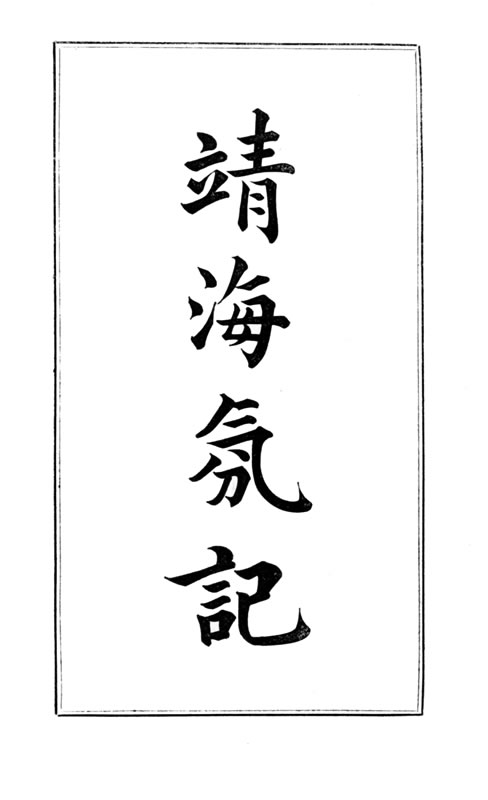
The Translator supposing that the readers of the History of the Chinese Pirates might perhaps find it interesting
to compare the account of the followers of The
wife of Ching yĭh, drawn up by an European, with the
statements of the non-official Chinese historian; he has
therefore thought fit to subjoin a Narrative of the captivity
and treatment amongst the Ladrones, written by
Mr. Richard Glasspoole, of the Hon. Company's ship Marquis of Ely, and published in Wilkinson's Travels to
China. The Translator in vain endeavoured to obtain
another Narrative, regarding the Chinese pirates, which
is said to be printed in an English periodical.
A brief Narrative of my captivity and treatment amongst
the Ladrones.
On the 17th of September 1809, the Honourable
Company's ship Marquis of Ely anchored under the
Island of Sam Chow, in China, about twelve English
miles from Macao, where I was ordered to proceed in one of our cutters to procure a pilot, and also to land
the purser with the packet. I left the ship at 5 P.M. with seven men under my command, well armed. It
blew a fresh gale from the N. E. We arrived at Macao
at 9 P.M., where I delivered the packet to Mr. Roberts,
and sent the men with the boat's-sails to sleep under
the Company's Factory, and left the boat in charge of
one of the Compradore's men; during the night the
gale increased.—At half-past three in the morning I
went to the beach, and found the boat on shore half-filled
with water, in consequence of the man having left
her. I called the people, and baled her out; found
she was considerably damaged, and very leaky. At
half-past 5 A.M., the ebb-tide making, we left Macao
with vegetables for the ship.
One of the Compradore's men who spoke English
went with us for the purpose of piloting the ship to Lintin, as the Mandarines, in consequence of a late
disturbance at Macao, would not grant chops for the
regular pilots. I had every reason to expect the ship
in the roads, as she was preparing to get under weigh
when we left her; but on our rounding Cabaretta-Point,
we saw her five or six miles to leeward, under
weigh, standing on the starboard-tack: it was then
blowing fresh at N. E. Bore up, and stood towards
her; when about a cable's-length to windward of her,
she tacked; we hauled our wind and stood after her. A hard squall then coming on, with a strong tide and
heavy swell against us, we drifted fast to leeward, and
the weather being hazy, we soon lost sight of the ship.
Struck our masts, and endeavoured to pull; finding
our efforts useless, set a reefed foresail and mizen, and
stood towards a country-ship at anchor under the land
to leeward of Cabaretta-Point. When within a quarter
of a mile of her she weighed and made sail, leaving
us in a very critical situation, having no anchor, and
drifting bodily on the rocks to leeward. Struck the
masts: after four or five hours hard pulling, succeeded
in clearing them.
At this time not a ship in sight; the weather clearing
up, we saw a ship to leeward, hull down, shipped our
masts, and made sail towards her; she proved to be
the Honourable Company's ship Glatton. We made
signals to her with our handkerchiefs at the mast-head,
she unfortunately took no notice of them, but tacked
and stood from us. Our situation was now truly distressing,
night closing fast, with a threatening appearance,
blowing fresh, with hard rain and a heavy sea;
our boat very leaky, without a compass, anchor or provisions,
and drifting fast on a lee-shore, surrounded
with dangerous rocks, and inhabited by the most barbarous
pirates. I close-reefed my sails, and kept tack
and tack 'till day-light, when we were happy to find
we had drifted very little to leeward of our situation in the evening. The night was very dark, with constant
hard squalls and heavy rain.
Tuesday the 19th no ships in sight. About ten
o'clock in the morning it fell calm, with very hard rain
and a heavy swell;—struck our masts and pulled, not
being able to see the land, steered by the swell. When
the weather broke up, found we had drifted several
miles to leeward. During the calm a fresh breeze
springing up, made sail, and endeavoured to reach the
weather-shore, and anchor with six muskets we had
lashed together for that purpose. Finding the boat
made no way against the swell and tide, bore up for a
bay to leeward, and anchored about one A.M. close
under the land in five or six fathoms water, blowing
fresh, with hard rain.
Wednesday the 20th at day-light, supposing the
flood-tide making, weighed and stood over to the weather-land,
but found we were drifting fast to leeward.
About ten o'clock perceived two Chinese boats steering
for us. Bore up, and stood towards them, and made
signals to induce them to come within hail; on nearing
them, they bore up, and passed to leeward of the
islands. The Chinese we had in the boat advised me
to follow them, and he would take us to Macao by the
leeward passage. I expressed my fears of being taken
by the Ladrones. Our ammunition being wet, and the
muskets rendered useless, we had nothing to defend ourselves with but cutlasses, and in too distressed a
situation to make much resistance with them, having
been constantly wet, and eat nothing but a few green
oranges for three days.
As our present situation was a hopeless one, and the
man assured me there was no fear of encountering any
Ladrones, I complied with his request, and stood in to
leeward of the islands, where we found the water much
smoother, and apparently a direct passage to Macao.
We continued pulling and sailing all day. At six
o'clock in the evening I discovered three large boats at
anchor in a bay to leeward. On seeing us they weighed
and made sail towards us. The Chinese said they were
Ladrones, and that if they captured us they would most
certainly put us all to death! Finding they gained
fast on us, struck the masts, and pulled head to wind
for five or six hours. The tide turning against us,
anchored close under the land to avoid being seen.
Soon after we saw the boats pass us to leeward.
Thursday the 21st, at day-light, the flood making,
weighed and pulled along shore in great spirits, expecting
to be at Macao in two or three hours, as by the
Chinese account it was not above six or seven miles
distant. After pulling a mile or two perceived several
people on shore, standing close to the beach; they were
armed with pikes and lances. I ordered the interpreter
to hail them, and ask the most direct passage to Macao. They said if we came on shore they would inform us;
not liking their hostile appearance I did not think
proper to comply with the request. Saw a large fleet
of boats at anchor close under the opposite shore. Our
interpreter said they were fishing-boats, and that by
going there we should not only get provisions, but a
pilot also to take us to Macao.
I bore up, and on nearing them perceived there
were some large vessels, very full of men, and mounted
with several guns. I hesitated to approach nearer;
but the Chinese assuring me they were Mandarine
junks[107] and salt-boats, we stood close to one of them,
and asked the way to Macao? They gave no answer,
but made some signs to us to go in shore. We passed
on, and a large row-boat pulled after us; she soon came
along-side, when about twenty savage-looking villains,
who were stowed at the bottom of the boat, leaped on
board us. They were armed with a short sword in
each hand, one of which they laid on our necks, and
the other pointed to our breasts, keeping their eyes
fixed on their officer, waiting his signal to cut or desist.
Seeing we were incapable of making any resistance, he
sheathed his sword, and the others immediately followed
his example. They then dragged us into their boat,
and carried us on board one of their junks, with the
most savage demonstrations of joy, and as we supposed, to torture and put us to a cruel death. When on board
the junk, they searched all our pockets, took the handkerchiefs
from our necks, and brought heavy chains to
chain us to the guns.
At this time a boat came, and took me, with one of
my men and the interpreter, on board the chief's vessel.
I was then taken before the chief. He was seated on
deck, in a large chair, dressed in purple silk, with a
black turban on. He appeared to be about thirty
years of age, a stout commanding-looking man. He
took me by the coat, and drew me close to him; then
questioned the interpreter very strictly, asking who we
were, and what was our business in that part of the
country. I told him to say we were Englishmen in
distress, having been four days at sea without provisions.
This he would not credit, but said we were bad
men, and that he would put us all to death; and then
ordered some men to put the interpreter to the torture
until he confessed the truth.
Upon this occasion, a Ladrone, who had been once
to England and spoke a few words of English, came to
the chief, and told him we were really Englishmen, and
that we had plenty of money, adding, that the buttons
on my coat were gold. The chief then ordered us some
coarse brown rice, of which we made a tolerable meal,
having eat nothing for nearly four days, except a few
green oranges. During our repast, a number of Ladrones crowded round us, examining our clothes and
hair, and giving us every possible annoyance. Several
of them brought swords, and laid them on our necks,
making signs that they would soon take us on shore,
and cut us in pieces, which I am sorry to say was the
fate of some hundreds during my captivity.
I was now summoned before the chief, who had been
conversing with the interpreter; he said I must write
to my captain, and tell him, if he did not send an hundred
thousand dollars for our ransom, in ten days he
would put us all to death. In vain did I assure him it
was useless writing unless he would agree to take a
much smaller sum; saying we were all poor men, and
the most we could possibly raise would not exceed two
thousand dollars. Finding that he was much exasperated
at my expostulations, I embraced the offer of
writing to inform my commander of our unfortunate
situation, though there appeared not the least probability
of relieving us. They said the letter should be
conveyed to Macao in a fishing-boat, which would
bring an answer in the morning. A small boat accordingly
came alongside, and took the letter.
About six o'clock in the evening they gave us some
rice and a little salt fish, which we eat, and they made
signs for us to lay down on the deck to sleep; but such
numbers of Ladrones were constantly coming from different
vessels to see us, and examine our clothes and hair, they would not allow us a moment's quiet. They
were particularly anxious for the buttons of my coat,
which were new, and as they supposed gold. I took it
off, and laid it on the deck to avoid being disturbed by
them; it was taken away in the night, and I saw it on
the next day stripped of its buttons.
About nine o'clock a boat came and hailed the chief's
vessel; he immediately hoisted his mainsail, and the
fleet weighed apparently in great confusion. They
worked to windward all night and part of the next
day, and anchored about one o'clock in a bay under
the island of Lantow, where the head admiral of Ladrones
was lying at anchor, with about two hundred vessels
and a Portuguese brig they had captured a few days
before, and murdered the captain and part of the crew.
Saturday the 23d, early in the morning, a fishing-boat
came to the fleet to inquire if they had captured
an European boat; being answered in the affirmative,
they came to the vessel I was in. One of them spoke a
few words of English, and told me he had a Ladrone-pass,
and was sent by Captain Kay in search of us; I
was rather surprised to find he had no letter. He appeared
to be well acquainted with the chief, and remained
in his cabin smoking opium, and playing cards
all the day.[108]
In the evening I was summoned with the interpreter
before the chief. He questioned us in a much milder
tone, saying, he now believed we were Englishmen, a
people he wished to be friendly with; and that if our
captain would lend him seventy thousand dollars 'till
he returned from his cruize up the river, he would repay
him, and send us all to Macao. I assured him it was
useless writing on those terms, and unless our ransom
was speedily settled, the English fleet would sail, and
render our enlargement altogether ineffectual. He remained
determined, and said if it were not sent, he
would keep us, and make us fight, or put us to death.
I accordingly wrote, and gave my letter to the man belonging
to the boat before-mentioned. He said he
could not return with an answer in less than five days.
The chief now gave me the letter I wrote when first
taken. I have never been able to ascertain his reasons
for detaining it, but suppose he dare not negotiate for
our ransom without orders from the head admiral, who
I understood was sorry at our being captured. He
said the English ships would join the mandarines and
attack them.[109] He told the chief that captured us, to
dispose of us as he pleased.
Monday the 24th, it blew a strong gale, with constant
hard rain; we suffered much from the cold and
wet, being obliged to remain on deck with no covering
but an old mat, which was frequently taken from us in
the night, by the Ladrones who were on watch. During
the night the Portuguese who were left in the brig
murdered the Ladrones that were on board of her, cut
the cables, and fortunately escaped through the darkness
of the night. I have since been informed they run
her on shore near Macao.
Tuesday the 25th, at day-light in the morning, the
fleet, amounting to about five hundred sail of different
sizes, weighed, to proceed on their intended cruize up
the rivers, to levy contributions on the towns and villages.
It is impossible to describe what were my feelings at this critical time, having received no answers to my
letters, and the fleet under-way to sail,—hundreds of
miles up a country never visited by Europeans, there
to remain probably for many months, which would
render all opportunities of negotiating for our enlargement
totally ineffectual; as the only method of communication
is by boats, that have a pass from the Ladrones,
and they dare not venture above twenty miles
from Macao, being obliged to come and go in the night,
to avoid the Mandarines; and if these boats should be
detected in having any intercourse with the Ladrones,
they are immediately put to death, and all their relations,
though they had not joined in the crime,[110] share
in the punishment, in order that not a single person of
their families should be left to imitate their crimes or
revenge their death. This severity renders communication
both dangerous and expensive; no boat
would venture out for less than a hundred Spanish
dollars.
Wednesday the 26th, at day-light, we passed in sight
of our ships at anchor under the island of Chun Po.
The chief then called me, pointed to the ships, and told
the interpreter to tell us to look at them, for we should
never see them again. About noon we entered a river to the westward of the Bogue,[111] three or four miles from
the entrance. We passed a large town situated on the
side of a beautiful hill, which is tributary to the Ladrones;
the inhabitants saluted them with songs as they
passed.
The fleet now divided into two squadrons (the red
and the black)[112] and sailed up different branches of the
river. At midnight the division we were in anchored
close to an immense hill, on the top of which a number
of fires were burning, which at day-light I perceived
proceeded from a Chinese camp. At the back of the
hill was a most beautiful town, surrounded by water,
and embellished with groves of orange-trees. The
chop-house (custom-house)[113] and a few cottages were
immediately plundered, and burnt down; most of the
inhabitants, however, escaped to the camp.
The Ladrones now prepared to attack the town with
a formidable force, collected in row boats from the different vessels. They sent a messenger to the town,
demanding a tribute of ten thousand dollars annually,
saying, if these terms were not complied with, they
would land, destroy the town, and murder all the inhabitants;
which they would certainly have done, had
the town laid in a more advantageous situation for their
purpose; but being placed out of the reach of their
shot, they allowed them to come to terms. The inhabitants
agreed to pay six thousand dollars, which they
were to collect by the time of our return down the
river. This finesse had the desired effect, for during
our absence they mounted a few guns on a hill, which
commanded the passage, and gave us in lieu of the
dollars a warm salute on our return.
October the 1st, the fleet weighed in the night,
dropped by the tide up the river, and anchored very
quietly before a town surrounded by a thick wood.
Early in the morning the Ladrones assembled in row-boats,
and landed; then gave a shout, and rushed into
the town, sword in hand. The inhabitants fled to the
adjacent hills, in numbers apparently superior to the
Ladrones. We may easily imagine to ourselves the
horror with which these miserable people must be
seized, on being obliged to leave their homes, and every
thing dear to them. It was a most melancholy sight to
see women in tears, clasping their infants in their arms,
and imploring mercy for them from those brutal robbers! The old and the sick, who were unable to
fly, or to make resistance, were either made prisoners
or most inhumanly butchered! The boats continued
passing and repassing from the junks to the shore, in
quick succession, laden with booty, and the men besmeared
with blood! Two hundred and fifty women,
and several children, were made prisoners, and sent on
board different vessels. They were unable to escape
with the men, owing to that abominable practice of
cramping their feet: several of them were not able to
move without assistance, in fact, they might all be said
to totter, rather than walk. Twenty of these poor
women were sent on board the vessel I was in; they
were hauled on board by the hair, and treated in a most
savage manner.
When the chief came on board, he questioned them
respecting the circumstances of their friends, and demanded
ransoms accordingly, from six thousand to six
hundred dollars each. He ordered them a berth on
deck, at the after-part of the vessel, where they had nothing
to shelter them from the weather, which at this
time was very variable,—the days excessively hot, and
the nights cold, with heavy rains. The town being
plundered of every thing valuable, it was set on fire,
and reduced to ashes by the morning. The fleet remained
here three days, negotiating for the ransom
of the prisoners, and plundering the fish-tanks and gardens. During all this time, the Chinese never ventured
from the hills, though there were frequently not
more than a hundred Ladrones on shore at a time,
and I am sure the people on the hills exceeded ten
times that number.[114]
October the 5th, the fleet proceeded up another
branch of the river, stopping at several small villages to
receive tribute, which was generally paid in dollars,
sugar and rice, with a few large pigs roasted whole, as
presents for their joss (the idol they worship).[115] Every
person on being ransomed, is obliged to present him
with a pig, or some fowls, which the priest offers him
with prayers; it remains before him a few hours, and is
then divided amongst the crew. Nothing particular
occurred 'till the 10th, except frequent skirmishes on
shore between small parties of Ladrones and Chinese
soldiers. They frequently obliged my men to go on
shore, and fight with the muskets we had when taken,
which did great execution, the Chinese principally
using bows and arrows. They have match-locks, but
use them very unskilfully.
On the 10th, we formed a junction with the Black-squadron,
and proceeded many miles up a wide and beautiful
river, passing several ruins of villages that had been
destroyed by the Black-squadron. On the 17th, the fleet
anchored abreast four mud batteries, which defended a
town, so entirely surrounded with wood that it was impossible
to form any idea of its size. The weather was
very hazy, with hard squalls of rain. The Ladrones
remained perfectly quiet for two days. On the
third day the forts commenced a brisk fire for several
hours: the Ladrones did not return a single shot,
but weighed in the night and dropped down the
river.
The reasons they gave for not attacking the town, or
returning the fire, were, that Joss had not promised
them success. They are very superstitious, and
consult their idol on all occasions. If his omens
are good, they will undertake the most daring enterprizes.
The fleet now anchored opposite the ruins of the
town where the women had been made prisoners.
Here we remained five or six days, during which time
about an hundred of the women were ransomed; the
remainder were offered for sale amongst the Ladrones,
for forty dollars each. The woman is considered the
lawful wife of the purchaser, who would be put to death
if he discarded her. Several of them leaped over-board and drowned themselves, rather than submit to such
infamous degradation.[116]
The fleet then weighed and made sail down the river,
to receive the ransom from the town before-mentioned.
As we passed the hill, they fired several shot at us, but
without effect. The Ladrones were much exasperated,
and determined to revenge themselves; they dropped
out of reach of their shot, and anchored. Every junk
sent about a hundred men each on shore, to cut paddy,
and destroy their orange-groves, which was most effectually
performed for several miles down the river.
During our stay here, they received information of nine
boats lying up a creek, laden with paddy; boats were
immediately dispatched after them.
Next morning these boats were brought to the fleet;
ten or twelve men were taken in them. As these had
made no resistance, the chief said he would allow them
to become Ladrones, if they agreed to take the usual
oaths before Joss. Three or four of them refused to
comply, for which they were punished in the following
cruel manner: their hands were tied behind their back,
a rope from the mast-head rove through their arms,
and hoisted three or four feet from the deck, and five
or six men flogged them with three rattans twisted together
'till they were apparently dead; then hoisted them up to the mast-head, and left them hanging nearly
an hour, then lowered them down, and repeated the
punishment, 'till they died or complied with the oath.
October the 20th, in the night, an express-boat came
with the information that a large mandarine fleet was
proceeding up the river to attack us. The chief immediately
weighed, with fifty of the largest vessels, and
sailed down the river to meet them. About one in the
morning they commenced a heavy fire till day-light,
when an express was sent for the remainder of the fleet
to join them: about an hour after a counter-order to
anchor came, the mandarine-fleet having run. Two
or three hours afterwards the chief returned with three
captured vessels in tow, having sunk two, and eighty-three
sail made their escape. The admiral of the mandarines
blew his vessel up, by throwing a lighted match
into the magazine as the Ladrones were boarding her;
she ran on shore, and they succeeded in getting twenty
of her guns.
In this action very few prisoners were taken: the men
belonging to the captured vessels drowned themselves,
as they were sure of suffering a lingering and cruel
death if taken after making resistance. The admiral
left the fleet in charge of his brother, the second in
command, and proceeded with his own vessel towards
Lantow. The fleet remained in this river, cutting
paddy, and getting the necessary supplies.
On the 28th of October, I received a letter from
Captain Kay, brought by a fisherman, who had told
him he would get us all back for three thousand dollars.
He advised me to offer three thousand, and if not accepted,
extend it to four; but not farther, as it was bad
policy to offer much at first: at the same time assuring
me we should be liberated, let the ransom be what it
would. I offered the chief the three thousand, which
he disdainfully refused, saying he was not to be played
with; and unless they sent ten thousand dollars, and
two large guns, with several casks of gunpowder, he
would soon put us all to death. I wrote to Captain
Kay, and informed him of the chief's determination,
requesting if an opportunity offered, to send us a shift
of clothes, for which it may be easily imagined we were
much distressed, having been seven weeks without a
shift; although constantly exposed to the weather, and
of course frequently wet.
On the first of November, the fleet sailed up a narrow
river, and anchored at night within two miles of a town
called Little Whampoa. In front of it was a small
fort, and several mandarine vessels lying in the harbour.
The chief sent the interpreter to me, saying, I must
order my men to make cartridges and clean their
muskets, ready to go on shore in the morning. I assured
the interpreter I should give the men no such
orders, that they must please themselves. Soon after the chief came on board, threatening to put us all to a
cruel death if we refused to obey his orders. For my
own part I remained determined, and advised the men
not to comply, as I thought by making ourselves useful
we should be accounted too valuable.
A few hours afterwards he sent to me again, saying,
that if myself and the quarter-master would assist them
at the great guns, that if also the rest of the men went
on shore and succeeded in taking the place, he would
then take the money offered for our ransom, and give
them twenty dollars for every Chinaman's head they
cut off. To these proposals we cheerfully acceded, in
hopes of facilitating our deliverance.
Early in the morning the forces intended for landing
were assembled in row-boats, amounting in the whole
to three or four thousand men. The largest vessels
weighed, and hauled in shore, to cover the landing of
the forces, and attack the fort and mandarine-vessels.
About nine o'clock the action commenced, and continued
with great spirit for nearly an hour, when the
walls of the fort gave way, and the men retreated in the
greatest confusion.
The mandarine vessels still continued firing, having
blocked up the entrance of the harbour to prevent the
Ladrone boats entering. At this the Ladrones were
much exasperated, and about three hundred of them
swam on shore, with a short sword lashed close under each arm; they then ran along the banks of the river
'till they came a-breast of the vessels, and then swam
off again and boarded them. The Chinese thus attacked,
leaped over-board, and endeavoured to reach
the opposite shore; the Ladrones followed, and cut the
greater number of them to pieces in the water. They
next towed the vessels out of the harbour, and attacked
the town with increased fury. The inhabitants fought
about a quarter of an hour, and then retreated to an
adjacent hill, from which they were soon driven with
great slaughter.
After this the Ladrones returned, and plundered the
town, every boat leaving it when laden. The Chinese
on the hills perceiving most of the boats were off, rallied,
and retook the town, after killing near two hundred
Ladrones. One of my men was unfortunately lost in
this dreadful massacre! The Ladrones landed a second
time, drove the Chinese out of the town, then reduced
it to ashes, and put all their prisoners to death, without
regarding either age or sex!
I must not omit to mention a most horrid (though
ludicrous) circumstance which happened at this place.
The Ladrones were paid by their chief ten dollars for
every Chinaman's head they produced. One of my
men turning the corner of a street was met by a Ladrone
running furiously after a Chinese; he had a
drawn sword in his hand, and two Chinaman's heads which he had cut off, tied by their tails, and slung
round his neck. I was witness myself to some of them
producing five or six to obtain payment!!!
On the 4th of November an order arrived from the
admiral for the fleet to proceed immediately to Lantow,
where he was lying with only two vessels, and three
Portuguese ships and a brig constantly annoying him;
several sail of mandarine vessels were daily expected.
The fleet weighed and proceeded towards Lantow. On
passing the island of Lintin, three ships and a brig gave
chase to us. The Ladrones prepared to board; but
night closing we lost sight of them: I am convinced
they altered their course and stood from us. These
vessels were in the pay of the Chinese government,
and style themselves the Invincible Squadron, cruizing
in the river Tigris to annihilate the Ladrones!
On the fifth, in the morning, the red squadron anchored
in a bay under Lantow; the black squadron
stood to the eastward. In this bay they hauled several
of their vessels on shore to bream their bottoms and
repair them.
In the afternoon of the 8th of November, four
ships, a brig and a schooner came off the mouth of the
bay. At first the pirates were much alarmed, supposing
them to be English vessels come to rescue us. Some
of them threatened to hang us to the mast-head for
them to fire at; and with much difficulty we persuaded them that they were Portuguese. The Ladrones had
only seven junks in a fit state for action; these they
hauled outside, and moored them head and stern across
the bay; and manned all the boats belonging to the
repairing vessels ready for boarding.
The Portuguese observing these man[oe]uvres hove to,
and communicated by boats. Soon afterwards they
made sail, each ship firing her broadside as she passed,
but without effect, the shot falling far short: The
Ladrones did not return a single shot, but waved their
colours, and threw up rockets, to induce them to come
further in, which they might easily have done, the
outside junks lying in four fathoms water which I
sounded myself: though the Portuguese in their letters
to Macao, lamented there was not sufficient water for
them to engage closer, but that they would certainly prevent
their escaping before the mandarine fleet arrived!
On the 20th of November, early in the morning,
discovered an immense fleet of mandarine vessels standing
for the bay. On nearing us, they formed a line,
and stood close in; each vessel as she discharged her
guns tacked to join the rear and reload. They kept
up a constant fire for about two hours, when one of
their largest vessels was blown up by a firebrand thrown
from a Ladrone junk; after which they kept at a more
respectful distance, but continued firing without intermission
'till the 21st at night, when it fell calm.
The Ladrones towed out seven large vessels, with
about two hundred row-boats to board them; but a
breeze springing up, they made sail and escaped. The
Ladrones returned into the bay, and anchored. The
Portuguese and mandarines followed, and continued a
heavy cannonading during that night and the next day.
The vessel I was in had her foremast shot away, which
they supplied very expeditiously by taking a mainmast
from a smaller vessel.
On the 23d, in the evening, it again fell calm; the
Ladrones towed out fifteen junks in two divisions, with
the intention of surrounding them, which was nearly
effected, having come up with and boarded one, when
a breeze suddenly sprung up. The captured vessel
mounted twenty-two guns. Most of her crew leaped
overboard; sixty or seventy were taken immediately, cut
to pieces and thrown into the river. Early in the morning
the Ladrones returned into the bay, and anchored
in the same situation as before. The Portuguese and
mandarines followed, keeping up a constant fire. The
Ladrones never returned a single shot, but always kept
in readiness to board, and the Portuguese were careful
never to allow them an opportunity.
On the 28th, at night, they sent in eight fire-vessels,
which if properly constructed must have done great
execution, having every advantage they could wish for
to effect their purpose; a strong breeze and tide directly into the bay, and the vessels lying so close together
that it was impossible to miss them. On their first
appearance the Ladrones gave a general shout, supposing
them to be mandarine vessels[117] on fire, but were
very soon convinced of their mistake. They came very
regularly into the centre of the fleet, two and two,
burning furiously; one of them came alongside of the
vessel I was in, but they succeeded in booming her off.
She appeared to be a vessel of about thirty tons; her
hold was filled with straw and wood, and there were a
few small boxes of combustibles on her deck, which
exploded alongside of us without doing any damage.
The Ladrones, however, towed them all on shore, extinguished
the fire, and broke them up for fire-wood.
The Portuguese claim the credit of constructing these
destructive machines, and actually sent a dispatch to
the Governor of Macao, saying they had destroyed at
least one-third of the Ladrones' fleet, and hoped soon
to effect their purpose by totally annihilating them.
On the 29th of November, the Ladrones being all
ready for sea, they weighed and stood boldly out,
bidding defiance to the invincible squadron and imperial
fleet, consisting of ninety-three war-junks, six Portuguese
ships, a brig, and a schooner. Immediately the
Ladrones weighed, they made all sail. The Ladrones
chased them two or three hours, keeping up a constant fire; finding they did not come up with them, they
hauled their wind and stood to the eastward.
Thus terminated the boasted blockade, which lasted
nine days, during which time the Ladrones completed
all their repairs. In this action not a single Ladrone
vessel was destroyed, and their loss about thirty or forty
men. An American was also killed, one of three that
remained out of eight taken in a schooner. I had two
very narrow escapes: the first, a twelve-pounder shot
fell within three or four feet of me; another took a
piece out of a small brass-swivel on which I was standing.
The chief's wife[118] frequently sprinkled me with
garlic-water, which they consider an effectual charm
against shot. The fleet continued under sail all night,
steering towards the eastward. In the morning they
anchored in a large bay surrounded by lofty and barren
mountains.
On the 2nd of December I received a letter from
Lieutenant Maughn, commander of the Honourable
Company's cruizer Antelope, saying that he had the
ransom on board, and had been three days cruizing
after us, and wished me to settle with the chief on the
securest method of delivering it. The chief agreed to
send us in a small gun-boat, 'till we came within sight of the Antelope; then the Compradore's boat was to
bring the ransom and receive us.
I was so agitated at receiving this joyful news, that
it was with considerable difficulty I could scrawl about
two or three lines to inform Lieutenant Maughn of the
arrangements I had made. We were all so deeply
affected by the gratifying tidings, that we seldom closed
our eyes, but continued watching day and night for the
boat. On the 6th she returned with Lieutenant
Maughn's answer, saying, he would respect any single
boat; but would not allow the fleet to approach him.
The chief then, according to his first proposal, ordered
a gun-boat to take us, and with no small degree of pleasure
we left the Ladrone fleet about four o'clock in the
morning.
At one P.M. saw the Antelope under all sail, standing
toward us. The Ladrone boat immediately anchored,
and dispatched the Compradore's boat for the ransom,
saying, that if she approached nearer, they would return
to the fleet; and they were just weighing when
she shortened sail, and anchored about two miles from
us. The boat did not reach her 'till late in the afternoon,
owing to the tide's being strong against her. She
received the ransom and left the Antelope just before
dark. A mandarine boat that had been lying concealed
under the land, and watching their man[oe]uvres,
gave chace to her, and was within a few fathoms of taking her, when she saw a light, which the Ladrones
answered, and the Mandarine hauled off.
Our situation was now a most critical one; the ransom
was in the hands of the Ladrones, and the Compradore
dare not return with us for fear of a second
attack from the mandarine boat. The Ladrones would
not remain 'till morning, so we were obliged to return
with them to the fleet.
In the morning the chief inspected the ransom,
which consisted of the following articles: two bales of
superfine scarlet cloth; two chests of opium; two casks
of gunpowder; and a telescope; the rest in dollars.
He objected to the telescope not being new; and said
he should detain one of us 'till another was sent, or a
hundred dollars in lieu of it. The Compradore however
agreed with him for the hundred dollars.
Every thing being at length settled, the chief ordered
two gun-boats to convey us near the Antelope; we saw
her just before dusk, when the Ladrone boats left us.
We had the inexpressible pleasure of arriving on board
the Antelope at 7 P.M., where we were most cordially
received, and heartily congratulated on our safe and
happy deliverance from a miserable captivity, which we
had endured for eleven weeks and three days.
(Signed) RICHARD GLASSPOOLE.
China, December 8th, 1809.
The Ladrones are a disaffected race of Chinese, that
revolted against the oppressions of the mandarines.—They
first commenced their depredations on the
Western coast (Cochin-China), by attacking small trading
vessels in row-boats, carrying from thirty to forty men
each. They continued this system of piracy several
years; at length their successes, and the oppressive state
of the Chinese, had the effect of rapidly increasing their
numbers. Hundreds of fishermen and others flocked to
their standard; and as their number increased they consequently
became more desperate. They blockaded all
the principal rivers, and attacked several large junks,
mounting from ten to fifteen guns each.
With these junks they formed a very formidable
fleet, and no small vessels could trade on the coast
with safety. They plundered several small villages,
and exercised such wanton barbarity as struck horror
into the breasts of the Chinese. To check these enormities
the government equipped a fleet of forty imperial
war-junks, mounting from eighteen to twenty guns
each. On the very first rencontre, twenty-eight of the
imperial junks struck to the pirates; the rest saved
themselves by a precipitate retreat.
These junks, fully equipped for war, were a great
acquisition to them. Their numbers augmented so
rapidly, that at the period of my captivity they were
supposed to amount to near seventy thousand men,
eight hundred large vessels, and nearly a thousand
small ones, including row-boats. They were divided
into five squadrons, distinguished by different coloured
flags: each squadron commanded by an admiral, or
chief; but all under the orders of A-juo-chay (Ching
yĭh saou), their premier chief, a most daring and enterprising
man, who went so far as to declare his intention
of displacing the present Tartar family from the throne
of China, and to restore the ancient Chinese dynasty.
This extraordinary character would have certainly
shaken the foundation of the government, had he not
been thwarted by the jealousy of the second in command,
who declared his independence, and soon after
surrendered to the mandarines with five hundred
vessels, on promise of a pardon. Most of the inferior
chiefs followed his example. A-juo-Chay (Ching yĭh
saou) held out a few months longer, and at length surrendered
with sixteen thousand men, on condition of a
general pardon, and himself to be made a mandarine
of distinction.
The Ladrones have no settled residence on shore,
but live constantly in their vessels. The after-part is
appropriated to the captain and his wives; he generally has five or six. With respect to conjugal rights they
are religiously strict; no person is allowed to have a
woman on board, unless married to her according to
their laws. Every man is allowed a small berth, about
four feet square, where he stows with his wife and
family.
From the number of souls crowded in so small a
space, it must naturally be supposed they are horridly
dirty, which is evidently the case, and their vessels
swarm with all kinds of vermin. Rats in particular,
which they encourage to breed, and eat them as great
delicacies;[119] in fact, there are very few creatures they
will not eat. During our captivity we lived three weeks
on caterpillars boiled with rice. They are much addicted
to gambling, and spend all their leisure hours
at cards and smoking opium.
LONDON:
Printed by J. L. Cox, Great Queen Street,
Lincoln's Inn Fields.
Transcriber's note:
The transcriber added a Table of Contents to assist with navigation.