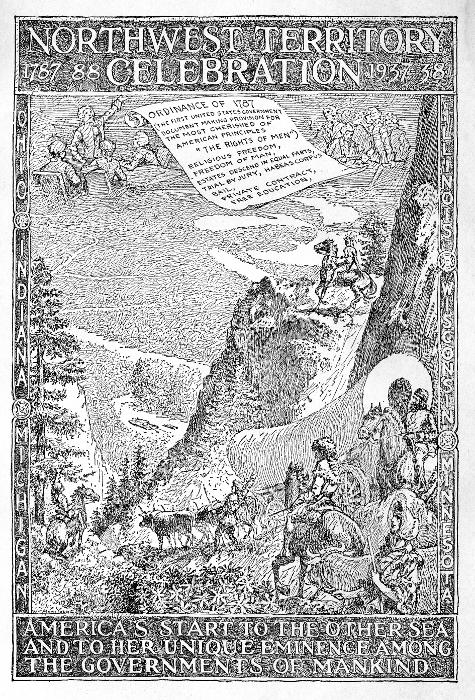
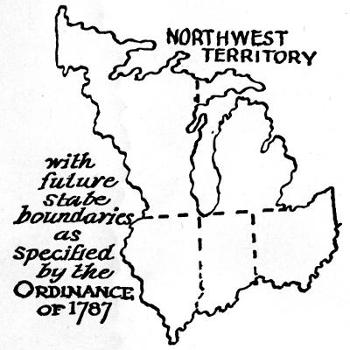
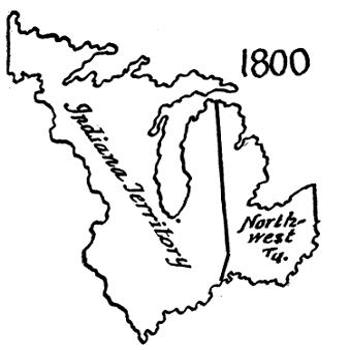
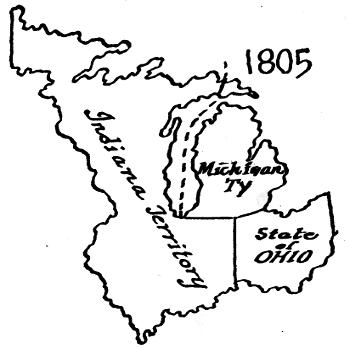
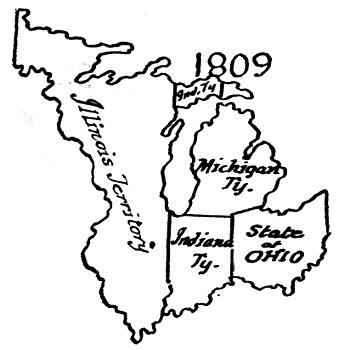
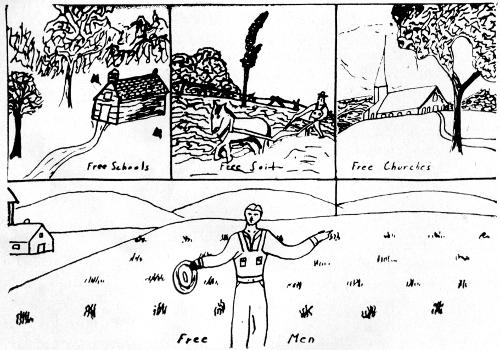
A century and a half ago, on the thirteenth day of July, 1787, the
Congress of the United States, in session at New York, among its
last acts under the Articles of Confederation, enacted an ordinance for the
government of the territory of the United States northwest of the Ohio
River. We know of no legislative enactment, proposed and accomplished
in any country, in any age, by monarch, by representatives, or by the
peoples themselves, that has received praise so exalted, and at the same
time so richly deserved, as has this same Ordinance of 1787.
It has been lauded by our great statesmen, great jurists, great orators,
and great educators.
In his notable speech in reply to Robert Young Hayne, delivered in the
United States Senate in January, 1830, Daniel Webster said of it:
“We are accustomed to praise the law-givers of antiquity; we help
to perpetuate the fame of Solon and Lycurgus; but I doubt whether one
single law of any law-giver, ancient or modern, has produced effects of
more distinct, marked, and lasting character than the Ordinance of 1787.
We see its consequences at this moment, and we shall never cease to see
them, perhaps, while the Ohio shall flow.”
Judge Timothy Walker, in an address delivered in 1837 at Cincinnati,
spoke upon this subject in the following words:
“Upon the surpassing excellence of this ordinance no language of panegyric
would be extravagant. It approaches as nearly to absolute perfection
as anything to be found in the legislation of mankind; for after the experience
of fifty years, it would perhaps be impossible to alter without marring
it. In short, it is one of those matchless specimens of sagacious forecast
which even the reckless spirit of innovation would not venture to assail.
The emigrant knew beforehand that this was a land of the highest political,
as well as national, promise, and, under the auspices of another Moses,
he journeyed with confidence to his new Canaan.”
Chief Justice Salmon P. Chase said of it:
“Never, probably, in the history of the world, did a measure of legislation
so accurately fulfill, and yet so mightily exceed, the anticipations
of the legislators. The Ordinance has well been described as having been a
pillar of cloud by day and of fire by night in the settlement and government
of the Northwestern States.”
Peter Force, in 1847, in tracing its history, declared:
“It has been distinguished as one of the greatest monuments of civil
jurisprudence.”
George V. N. Lothrop, LL.D., in an address delivered at the annual commencement
of the University of Michigan, June 27, 1878, said substantially:
“In advance of the coming millions, it had, as it were, shaped the earth
and the heavens of the sleeping empire. The Great Charter of the Northwest
had consecrated it irrevocably to human freedom, to religion, learning,
and free thought. This one act is the most dominant one in our whole
history, since the landing of the Pilgrims. It is the act that became decisive
in the Great Rebellion. Without it, so far as human judgment can discover,
the victory of free labor would have been impossible.”
Notwithstanding the high praises that have been bestowed upon the
ordinance, and the many and great benefits that have flowed from it, its
authorship was, for nearly a century, a matter of dispute. No less than four
different persons have had claims to authorship advanced for them by
their friends.
Who, if any one man, was primarily the author of the ordinance, is
uncertain, and now of little moment. The long contention which was waged
as to its authorship serves its greatest purpose in emphasizing the importance
which was then and has since been attributed to the document.
Because of the geographic implications later involved it is worth while,
however, to consider briefly the various assertions of authorship.
Webster, in his famous two-day speech in reply to Hayne, gives to
Nathan Dane, of Massachusetts, the entire credit for devising the ordinance,
and such was the confidence in Webster’s statement, that many writers
since have accepted it as a demonstrated fact.
Thomas H. Benton, in the debate following Webster’s speech, replied:
“He [Webster] has brought before us a certain Nathan Dane, of Beverly,
Mass., and loaded him with such an exuberance of blushing honors as no
modern name has been known to merit or claim. So much glory was caused
by a single act, and that act the supposed authorship of the Ordinance of
1787, and especially the clause in it which prohibits slavery and involuntary
servitude. So much encomium and such greatful consequences it seems
a pity to spoil, but spoilt it must be; for Mr. Dane was no more the author
of that Ordinance, sir, than you or I.... That Ordinance, and especially
the non-slavery clause, was not the work of Nathan Dane of Massachusetts,
but of Thomas Jefferson of Virginia.”
Charles King, president of Columbia College, in 1855 published a paper
on the Northwest Territory in which he claimed for his father, Rufus
King, the authorship of the non-slavery clause.
Ex-Governor Edward Coles, in a paper on the “History of the Ordinance
of 1787,” prepared for the Pennsylvania Historical Society in 1850,
disputed Webster’s claim for Dane, and asserted the claim of Thomas
Jefferson.
Force undertook to gather from the archives of Congress materials
for a complete history of this document, but he found nothing that settled
the question of authorship; and although he probably knew more of the
original documents pertaining to the Northwest Territory than any other
man since its adoption, he died in ignorance of the real author.
Hon. R. W. Thompson, in an eloquent address on “Education,” ascribed
the ordinance to the wise statesmanship and the unselfish and far-reaching
patriotism of Jefferson.
Lothrop, in his Ann Arbor address in 1878, on “Education as a Public
Duty,” said:
“It was a graduate of Harvard, who, in 1787, when framing the Great
Charter for the Northwest, had consecrated it irrevocably to Human
Freedom, to Religion, Learning, and Free Thought. It was the proud boast
of Themistocles, that he knew how to make of a small city a great state.
Greater than his was the wisdom and prescience of Nathan Dane, who
knew how to take pledges of the future, and to snatch from the wilderness
an inviolable Republic of Free Labor and Free Thought.”
In 1876, a year in which many buried historical facts were unearthed,
William Frederick Poole, in an admirable article published in the North
American Review, presented the history of the Ordinance in a most scholarly
manner. But discarding the absoluteness of the claims heretofore set forth,
he presents, as the chief actor in this mysterious drama, Dr. Manasseh
Cutler, of Massachusetts.
Following, in a general way, the line of argument laid down by Poole,
it is interesting to examine the foregoing claims in the light of the known
facts. In January, 1781, Thomas Jefferson, then Governor of Virginia,
acting under instructions from his state, ceded to the general government
Virginia’s claims to that magnificent tract of country known as the Northwest
Territory, which had been acquired by Virginia by king’s charter and
also as a result of its conquest by George Rogers Clark in 1778-79. The Virginia
cession, regarded as the most crucial of the necessary relinquishments
of state claims, was not completed in form satisfactory to the United States
until 1784. On the first of March of the same year Jefferson, then a member
of Congress and chairman of a committee appointed for the purpose,
presented an ordinance for the government of all the territory lying westward
of the 13 original states to the Mississippi River. There were two
notable features in this paper; first, it provided for the exclusion of slavery
and involuntary servitude after the year 1800; second, it provided for
Articles of Compact, the non-slavery clause being one of them. By this
provision there were five articles that could never be set aside without
the consent of both Congress and the people of the territory. The non-slavery
article was rejected by Congress, and the rest was adopted with
some unimportant modifications, on the twenty-third of April, 1784.
Whether even this ordinance was actually drafted by Jefferson is disputed,
because it was an almost identical copy of the plan submitted by David
Howell of Rhode Island in the
previous year. However, on the
tenth of May, 17 days after the
Ordinance of 1784 was adopted,
Jefferson resigned his seat in
Congress to assume the duties
of United States Minister to
France. As the Ordinance of
1787 was not adopted until
three years after Jefferson had
gone to France, and since he
did not return until December,
1789, more than two years after
its passage, there is serious
question as to his possible influence
upon it.
Moreover, careful comparison
of the Ordinance of 1784
with that of 1787, shows no
similarity, except in the two
points referred to above: the
anti-slavery provision, and the
articles of compact. The Ordinance
of 1784 contains none of
those broad provisions found in the later document concerning religious
freedom, fostering of education, equal distribution of estates of intestates,
the privilege of the writ of habeas corpus, trial by jury, moderation in fines
and punishments, the taking of private property for public use, and interference
by law with the obligation of private contracts. No provision was
made for distribution or sale of lands, and under this Ordinance of 1784 no
settlements were ever made in the territory.
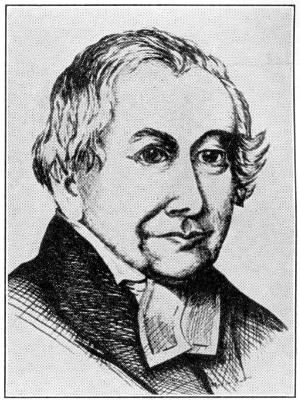
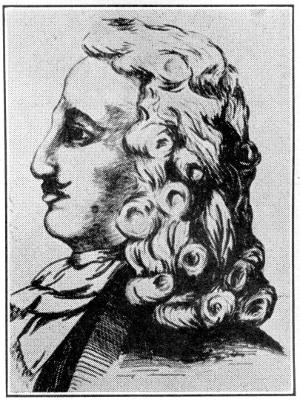
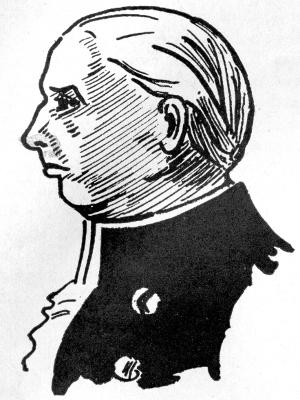
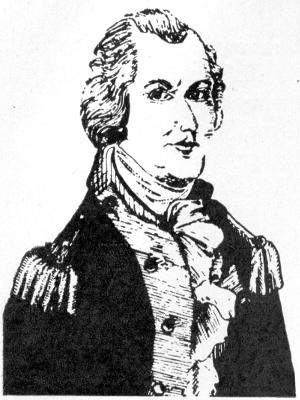
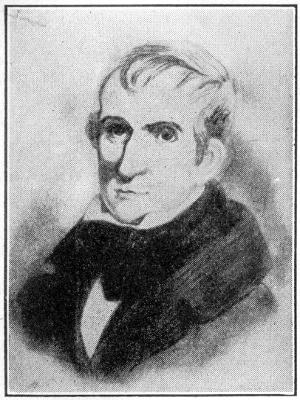
MANASSEH CUTLER
Drawn by Marie Kellogg, Superior, Wisconsin
In 1785, on motion of Rufus King, an attempt was made to re-insert
some sort of anti-slavery provision, but it was not carried. This, so far
as we can learn, is the extent of the grounds for King’s claims to authorship.
In March, 1786, a report on the western territory was made by the grand
committee of the House, which, proving unsatisfactory, resulted in the
appointment of a new committee. It reported an ordinance that was recommitted
and discussed at intervals until September of the same year,
when another committee was appointed. Of this, Dane was a member. A
report was made which was under discussion for several months. In April,
1787, this same committee reported another ordinance which passed its
first and second readings, and the tenth of May was set for its third reading,
but for some reason final action was postponed. This paper came down to
the ninth of July without further change. Poole has given us the full text
as it appeared only four days before the final passage of the great ordinance.
This bears less likeness to the finally adopted version than does the Ordinance
of 1784.
Force, in gathering up the old papers, found this July 9 version in its
crude and unstatesmanlike condition, and wondered how such radical
changes could have been so suddenly effected; for in the brief space of
four days the new ordinance was drafted, passed its three readings, was
put upon its final passage, and was adopted by the unanimous vote of
all the states present.
This rapid and fundamental change in the ordinance tends to discredit
all of the foregoing claims.
Authorship of public documents which attain greatness is usually a
matter for later dispute.
Such documents have probably never been the work of any one author,
but are rather the coordinated expressions of thought which have developed
over long periods of time and in many men’s minds. Least of all entitled
to credit is the “Scribe” who merely recorded the thought propounded by
others, but whose name often becomes associated with the document.
At the close of the Revolutionary War, Congress, in adjusting the claims
of officers and soldiers, gave them interest-bearing continental certificates.
The United States Treasury was in a state of such depletion and uncertainty,
that these certificates were actually worth only about one-sixth of
their face value. At the close of the war many of these officers were destitute,
notwithstanding the fact that they held thousands of dollars in these
depreciated “promissory notes” of the government.
On the eve of the disbandment of the army in 1783, 288 officers petitioned
Congress for a grant of land in the western territory. Their petition went
beyond a request for lands, however, and set forth certain provisions of
government as essential to their petition. In this humble and little-known
document known variously as the “Pickering” or “Army” Plan, were
contained many of the proposals which later found their way into the
Ordinance of 1787. Included for instance was the then radical prohibition
of slavery clause. This document bears a closer resemblance in principles
and in wording, to the Ordinance of 1787 when it was adopted than does
any other contemporary document. Among the petitioners was General
Rufus Putnam. It was his plan, if Congress should comply with the petition,
to form a colony and remove to the Ohio Valley. On the sixteenth of
June, 1783, Putnam addressed a letter to General George Washington
elaborating the soldiers’ plan and setting forth the advantages that would
arise if Congress should grant the petition, and urged him to use his influence
to secure favorable action upon it. This letter is of great interest in the
development of the history of the Northwest. It is printed in full in Charles
M. Walker’s History of Athens County, Ohio, pp. 30-36.
The chief advantages of this project, as set forth by Putnam were, the
friendship of the Indians, secured through traffic with them; the protection
of the frontier; the promotion of land sales to other than soldiers, thus aiding
the treasury; and the prevention of the return of said territory to any
European power. There were, in the letter, other suggestions of far-reaching
interest; (1) That the territory should be surveyed into six-mile townships,
one of the first suggestions for our present admirable system of government
surveys; (2) that in the proposed grant, a portion of land should be
set apart for the support of the ministry; and (3) that another portion
should be reserved for the maintenance of free schools.
One year later Washington wrote to Putnam that, although he had urged
upon Congress the necessity and the duty of complying with the petition,
no action had been taken. The failure of this plan led to the development
of another and better one. It is interesting to note, however, that the men
under whose sponsorship and virtual insistence the Ordinance of 1787
was finally evolved had been subscribers to the Pickering Plan of 1783.
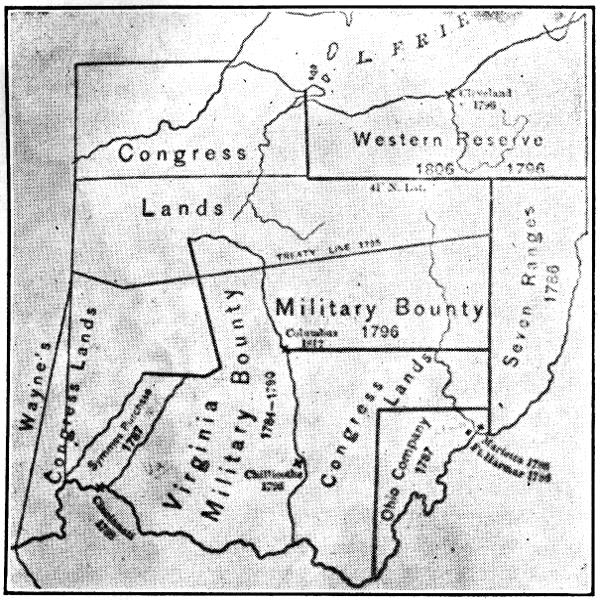
In 1785, Congress adopted the system of surveys suggested by Putnam,
and tendered him the office of Government Surveyor. He declined, but
through his influence, his friend and fellow-soldier, General Benjamin
Tupper, was appointed. In the fall of 1785, and again in 1786, Tupper
visited the territory and in the latter year he completed the survey of the
“seven ranges” in eastern Ohio. In the winter of 1785-86 he held a conference
with Putnam at the home of the latter, in Rutland, Massachusetts. Here
they talked over the beauty and value of “the Ohio country” and devised
a new plan for “filling it with inhabitants.” They issued a call to all officers,
soldiers, and others, “who desire to become adventurers in that delightful
region” to meet in convention for the purpose of organizing “an association
by the name of The Ohio Company of Associates.” The term “Ohio” as used
here related to the “Ohio country” or the “Territory north and west of the
River Ohio,” as the present state of Ohio was then of course non-existent.
Also the name, “Ohio Company of Associates,” is not to be confused
with the earlier “Ohio Company” of the 1750’s which had been one of the
earlier land schemes, operating south of the Ohio River. No man in the
“Ohio Company of Associates” had been a part of the former Ohio Company,
and there was no relation between the two companies.
Delegates from various New England counties met at Boston, March
1, 1786. A committee, consisting of Putnam, Cutler, Colonel John Brooks,
Major Winthrop Sargent, and Captain Thomas H. Cushing was appointed
to draft a plan of association. Two days later they made a report, some of
the most important points of which were: (1) That a stock company should
be formed with a capital of one million dollars of the Continental Certificates
already mentioned; (2) that this fund should be devoted to the
purchase of lands northwest of the River Ohio; (3) that each share should
consist of one thousand dollars of certificates, and ten dollars of gold or
silver to be used in defraying expenses; (4) that directors and agents be
appointed to carry out the purposes of the company.
Subscription books were opened at different places, and at the end of the
year, a sufficient number of shares had been subscribed to justify further
proceedings. On the eighth of March, 1787, another meeting was held in
Boston, and General Samuel Holden Parsons, Putnam, Cutler and General
James M. Varnum were appointed directors, and were ordered to make
proposals to Congress for the purchase of lands in accordance with the plans
of the company. Later, the directors employed Cutler to act as their agent
and make a contract with Congress for a body of land in the “Great
Western Territory of the Union.”
To those who have studied this transaction of the Ohio Company of
Associates in its various bearings, there can be no doubt that through it
the Ordinance of 1787 came to be. The two were intimately related parts
of one whole. Either studied alone presents inexplicable difficulties; studied
together each explains the other. Through the agency of Cutler the purchase
of land was effected and those radical changes in the ordinance were made
between the ninth and thirteenth of July, 1787.
Cutler was born at Killingly, Connecticut, May 3, 1742. At the age of
twenty-three he graduated from Yale. The two years following were
devoted to the whaling business and to storekeeping at Edgartown, on
Martha’s Vineyard. He did not enjoy this occupation, however, and studied
law in his spare time. In 1767 he was admitted to the Massachusetts bar.
This profession proved little more congenial, and he determined to study
theology. In 1771 he was ordained at Ipswich, where he continued preaching
until the outbreak of the Revolution, when he entered the army as a
chaplain. In one engagement he took such an active and gallant part that
the colonel of his regiment presented him with a fine horse captured from
the enemy. Cutler returned to his parish before the war closed and decided
to study medicine. He received his M.D. degree, and for several years
served in the double capacity of minister and doctor. He was now a graduate
in all the so-called learned professions—law, divinity, and medicine. In
scientific pursuits he was probably the equal of any man in America, excepting
Benjamin Franklin, and perhaps Benjamin Rush. He was a member of
the American Academy of Arts and Sciences, and several other learned
bodies. Two years before his journey to New York, he had published four
articles in the memoirs of the American Academy, dealing with astronomy,
meteorology and botany. The last mentioned was the first attempt made
by any one to describe scientifically the plants of New England. Employing
the Linnaean system, he classified 350 species of plants found in his
neighborhood. His articles brought him prominence among learned groups
throughout the country, and secured for him a cordial welcome into the
literary and scientific circles of New York and Philadelphia. Cutler was
well fitted, therefore, to become, as has already been related, a leading spirit
in the enterprise of the Ohio Company. In 1795 Washington offered him
the judgeship of the Supreme Court of the Northwest Territory, which he
declined. He became a member of the Massachusetts Legislature, and from
1800 to 1804 served his district as its Representative in Congress. He
declined re-election and returned to his pastorate. At the time of his death
in 1820 he had served there for nearly 50 years.
He was a man of commanding presence, “stately and elegant in form,
courtly in manners, and at the same time easy, affable, and communicative.
He was given to relating anecdotes and making himself agreeable.” His
character, attainments, manners and knowledge of men fitted him admirably
for the task of uniting the diverse elements of Congress to promote
the scheme he was sent there to represent. How he accomplished this is an
interesting story.
Cutler’s diary reveals that he left his home in Ipswich, 25 miles northwest
of Boston, on Sunday, June 24, 1787. He preached that day in Lynn,
and spent the night at Cambridge. He also stopped at Middletown to
confer with Parsons. Here the plan of operations was perfected, and he
pursued his journey, arriving at New York on the afternoon of July 5,
1787. He had armed himself with about 50 letters of introduction. One of
these he delivered immediately to a well-to-do merchant of the city, who
received him very cordially and insisted that Cutler stay with him as
long as he remained in the city.
The next morning Cutler was on the floor of Congress early, presenting
letters of introduction to the members. He was particularly anxious to
become acquainted with southern men, and they received him with much
warmth and politeness. He was so genteel in his manners, and so much
more like a southerner than a New England clergyman, that they took a
fancy to him at once.
During the morning he prepared his applications to Congress for the
proposed purchase of western land for the Ohio Company. He was introduced
to the House by Colonel Edward Carrington, after which he delivered
his petition, and proposed terms of the purchase. A committee was appointed
to discuss terms of negotiation.
It must be remembered that Cutler was employed not only to make a
purchase of land, but to see that the frame of government for the territory
was acceptable to his constituents. Thus he had a motive in making
himself agreeable to the southern men. Among the New England members
there existed some antagonism toward the Ohio Company’s scheme, since
its success would cause many enterprising citizens to leave that section.
Massachusetts had a large tract of land in Maine, and she desired to turn
the tide of emigration in that direction; for this reason Massachusetts members
stood in the way of the western movement. Cutler felt, however, that
their support of the company’s scheme might be relied upon when brought
to a test.
Cutler was invited to dinners and teas, where his engaging manner made
him the center of attraction. He used every occasion as a means of setting
before the members the great advantages that would follow consummation
of the proposed plan.
In the first place, Congress could thus pay a large amount of the national
debt to its most worthy creditors without money. Again, it would open up
the Northwest to settlement, thus insuring large sales of land to civilians.
Further, it would establish a barrier between older settlements and the
western Indians, thus furnishing protection without expense to the government.
In three or four days he had so fully succeeded in enlisting the favor of
Congress that by July 9 a new committee was appointed to prepare a frame
of government for the territory. It was at this point that the ordinance
under consideration bore so little resemblance to the final document which
was adopted four days later. This committee was composed of Carrington,
Nathan Dane of Massachusetts, Richard Henry Lee and two others. It is
quite probable that the members of this committee were selected in accordance
with Cutler’s wishes.
The next morning after the committee was appointed, it called Cutler
into its councils, having previously sent him a copy of the ordinance,
which had already passed two readings. He was asked to make suggestions
and propose amendments, which he did, returning the paper to the committee
with his suggestions.
On July 10, he left for Philadelphia to visit his scientific correspondents,
Franklin and Rush, and also to look in upon the Constitutional Convention,
which was then in session.
The day following his departure, the committee presented to Congress
a new ordinance prepared in accordance with Cutler’s suggestions. If
Force could have had access to Cutler’s diary in writing up the history
of the Ordinance of 1787, the mystery of the radical changes that he found
between the ninth and the eleventh of July would have been solved.
On the eighteenth Cutler was again in New York. On the nineteenth he
made this entry in his diary:
“Called on members of Congress very early in the morning, and was
furnished with the ordinance establishing a government in the western
Federal territory. It is, in a degree, new modeled. The amendments I
proposed have all been made except one, and that is better qualified.”
The frame of government having been satisfactorily settled, Congress
proceeded to state the conditions on which the sale of lands should be
based. On the twentieth these terms were shown to Cutler, who rejected
them. He said:
“I informed the committee that I should not contract on the terms proposed;
that I should greatly prefer purchasing lands from some of the
states, who would give incomparably better terms; and therefore proposed
to leave the city immediately.”
Thus it appears quite certain that the distinctive flavor of the ordinance
and the provisions which have given it greatness among all the credos of
mankind were injected into it after July 9, and after Cutler had been
requested to make suggestions and amendments.
But that these vital changes were not original with Cutler is evidenced
by his later statement, “I only represented my principals, who would
accept nothing less.”
And so the real responsibility for authorship of the ordinance may be
traced to the men at the Bunch of Grapes Tavern, to the signers of the
Pickering Plan, to the sober-minded and unsung men who had fought and
thought a new nation into potential greatness.
At this time a number of other leading persons who held government
certificates proposed to make Cutler their agent for the purchase of lands
for themselves. This would give him control of some four millions more of
the debt with which to influence Congress. He agreed to act for them, on
the condition that the affair be conducted secretly. The next day several
members called on him. They found him unwilling to accept their conditions,
and proposing to leave immediately. They assured him that
Congress was disposed to give him better terms. He appeared very indifferent,
and they became more and more anxious. His ruse was working
admirably. He finally told them that if Congress would accede to his terms,
he would extend his proposed purchase. In this way, Congress could pay
more than four millions of the public debt. He explained that the intention
of his company was an immediate settlement by the most robust and industrious
people in America, which would instantly enhance the value of
federal lands. He proposed to renew the negotiations on his own terms, if
Congress was so disposed.
On the twenty-fourth he wrote out his terms and sent them to the Board
of Treasury, which had been empowered to complete the contract. These
terms specified that the general government should survey the tract at
its expense, stated the method of payment, number of payments, and the
time at which the deed should be given. The most striking provisions of
the contract set apart the sixteenth section of each township for the
support of free schools, the twenty-ninth section of each township for the
ministry; and two entire townships for the establishment and maintenance
of a university.
These terms called forth much opposition, and taxed Cutler’s lobbying
powers to their utmost. He said:
“Every machine in the city that it was possible to set to work, we now
set in motion. My friends made every exertion in private conversation to
bring over my opponents. In order to get at some of them so as to work
powerfully on their minds, we were obliged to engage three or four persons
before we could get at them. In some instances we engaged one person,
who engaged a second, and he a third, and soon to the fourth before we
could effect our purpose. In these maneuvers I am much beholden to
Col. Duer and Maj. Sargent.”
It had been the purpose of the company to secure the governorship of
the new territory for Parsons, but it became known that General Arthur
St. Clair, the president of the Continental Congress, wanted the position.
St. Clair was withholding his influence. Cutler sought an interview with
him. “After that,” said Cutler, “our matters went on much better.” It
will be remembered that St. Clair became the first Governor of the Northwest
Territory.
On the twenty-seventh, Congress directed the Board of Treasury “to
take order and close the contract.” That evening Cutler left New York
for his home, authorizing Sargent to act in his stead. On the twenty-ninth
of August he made a report to the directors and agents at a meeting in
Boston. A great number of proprietors attended, and all fully approved
of the proposed contract and it was finally executed October 27, 1787.
The Ordinance of 1787 undoubtedly represented the most advanced
thought of that time on the subject of free government.
This ordinance irrevocably fixed the character of the immigration, and
determined the social, political, industrial, educational, and religious institutions
of the territory.
As soon as it was adopted by Congress, it was sent to the Constitutional
Convention at Philadelphia, and some of its most important provisions
were embodied in the new Constitution. Notable among these was one in
the second Article of Compact, in the ordinance, stating that, “for the
just preservation of rights and property, no law ought ever to be made, or
have force in said Territory, that shall, in any manner whatever, interfere
with, or affect private contracts or engagements, bona fide, and without
fraud, previously formed.” This appears in Paragraph 1, Section 10,
Article 1 of the Constitution, prohibiting a state from passing any “law
impairing the obligation of contracts.” This is said to be the first enactment
of the kind in the history of constitutional law.
The fact that the Constitutional Convention included this one proviso
in the draft of the Constitution, indicates that consideration was given the
provisions of the ordinance, and thereby suggests their deliberate omission
from the Constitution, for reasons unknown, inasmuch as the debates of
that convention were, by agreement, not recorded.
However, after the Constitution was submitted to the states for ratification
it quickly became apparent that the people were determined upon
specific provision for the rights of men in their fundamental law, and while
ratification of the Constitution by nine states was accomplished in 1789,
it was only possible by assurance that such provisions would be immediately
added as amendments.
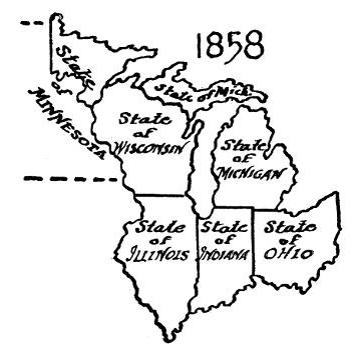
In some form, every one of the states admitted from the Northwest
Territory later embodied similar provisions in their fundamental law. The
adoption or rejection of these principles was not left to the discretion of
the states; being “Articles of Compact,” they could not be discarded without
the consent of Congress.
The sixth article of this compact prohibited slavery forever, within the
bounds of the Northwest Territory. But for this form of compact in the
ordinance, it is perhaps possible that Indiana and Illinois would have entered
the Union as slave states. In 1802 General William Henry Harrison, then
Governor of Indiana Territory, called a convention of delegates to consider
the means by which slavery could be introduced into the territory, and
he himself presided over its deliberations. In the language of Poole,
“The Convention voted to give its consent to the suspension of the sixth
article of the compact, and to memorialize Congress for its consent to the
same. The memorial laid before Congress stated that the suspension of the
sixth article would be highly ‘advantageous to the Territory’ and ‘would
meet with the approbation of at least nine-tenths of the good citizens of
the same.’ The subject was referred to a committee of which John Randolph
of Virginia was chairman, who reported adversely as follows: ‘That
the rapidly increasing population of the State of Ohio evinces in the opinion
of your committee, that the labor of slaves is not necessary to promote
the growth and settlement of colonies in that region. That this labor,
demonstrably the dearest of any, can only be employed to advantage in
the cultivation of products more valuable than any known in that quarter
of the United States; that the committee deem it highly dangerous and
inexpedient to impair a provision wisely calculated to promote the happiness
and prosperity of the northwestern country, and to give strength and
security to that extensive frontier. In the salutary operation of this sagacious
and salutary restraint, it is believed that the inhabitants of the
Territory will, at no very distant day, find ample remuneration for a temporary
privation of labor and of emigration.’”
When Ohio was admitted to the Union, the advocates of slavery made
strenuous efforts to secure its introduction, but were defeated. Indiana
and Illinois territories later asked that the anti-slavery provision be set
aside. More than one committee reported in favor of repealing it, but
Congress firmly maintained the compact.
The enlightened provisions of the ordinance attracted the thrifty Yankee
from New England, the enterprising Dutchman from Pennsylvania, the
conscientious Quaker from Carolina and Virginia, and some of the sturdiest
pioneer stock from the frontier of Kentucky. Even the light-hearted
French contributed to this great melting pot.
Some historians refer to the spirit of the Northwest Territory as the
“first American civilization,” brought about by welding into a national
entity the diverse and imported civilizations of the earlier colonies.

Northwest Territory
The First Colony of the United States
It is at least an interesting speculation as to whether the newly born
United States would have prevailed as one nation, except for the opportunity
given by the Northwest Territory with its new lands, common
problems, and forward looking government for this merging of the older
states’ discordant traditional concepts of government and social relations.
Comparison of the social, industrial, and educational conditions in the
states of the Old Northwest with those in neighboring states not born under
the influence of the ordinance creates further evidence of the value of the
principles enunciated by the ordinance.
If, in 1861, the principles and institutions of Kentucky and Missouri,
instead of those of the Ordinance of 1787, had prevailed in the five states
formed from the Northwest Territory, it would have required no seer to
predict another end for the great struggle between the states. As Lothrop
says, “It [the Ordinance of 1787] is the act that became decisive in the
Great Rebellion. Without it so far as human judgment can discover, the
victory of Free Labor would have been impossible.”
While it is not claimed that the ordinance was the source of all the
blessings that have crowned these states, still it is certain that it was the
germ from which many of them have been developed. Neither is it claimed
that all the ills of the Southern States arose from the absence of similar
provisions; however, their presence and influence on the one hand, and
their absence on the other, tended to widen the gulf between North and
South and, when the final struggle came, had a determining influence on
the result.