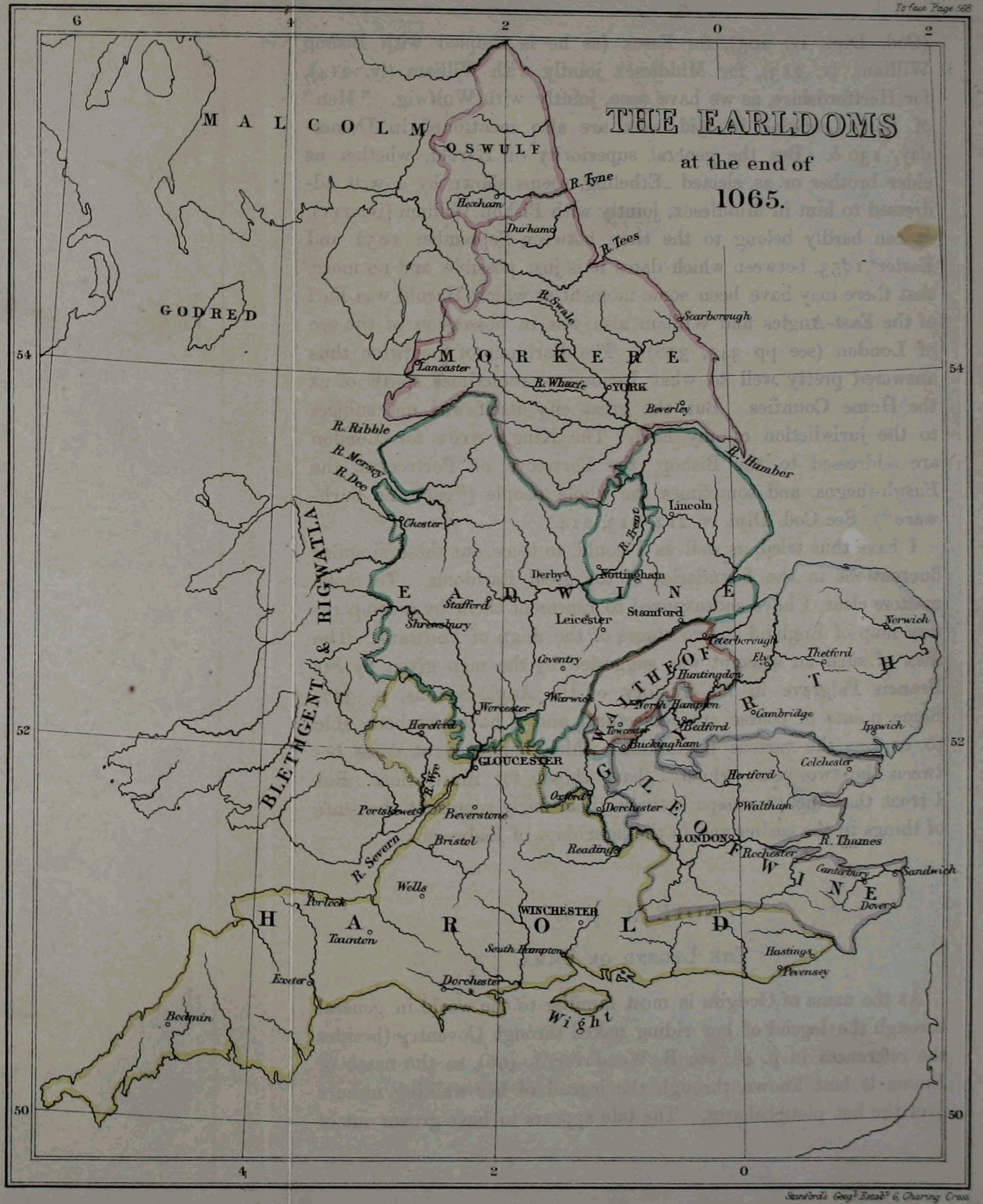
My first volume was preliminary. I am now able
to announce the exact extent and scheme of my
book. My plan now extends to five volumes. The
present volume takes in the first stage of the actual
struggle between Normans and Englishmen, that is,
the Reign of Eadward the Confessor. I begin with
Eadward’s election, and I continue the narrative to
his death. I take in also the early years of William
in Normandy. In this period the struggle is not
as yet a struggle of open warfare: it is a political
struggle within the Kingdom of England. Harold
and William gradually come to be the leaders and
representatives of their several nations; but they are
not, during the time embraced in the present volume,
brought into any actually hostile relation to one
another.
The third volume will, as far as England is concerned,
be devoted to the single year 1066. But,
along with the history of that great year, I shall
have to trace the later years of William’s Norman
reign. The year itself is the time of actual warfare
vibetween England and Normandy under their respective
sovereigns. It embraces the reign of Harold
and the interregnum which followed his death. I
shall, in this volume, describe the election of Harold,
the campaigns of Stamfordbridge and Hastings,
and the formal completion of the Conquest by the
acceptance and coronation of William as King of
the English. Of this volume a considerable part is
already written.
The fourth volume I shall devote to the reign of
William in England. The Conquest, formally completed
by his coronation, has now to be practically
carried out throughout the land. The authority of
William, already formally acknowledged, is gradually
established over England; local resistance is overcome;
the highest offices and the greatest landed
estates throughout England are gradually transferred
from natives to foreigners. Before William’s death
the work was thoroughly done, and the great Domesday
Survey may be looked on as its record. The
Conquest, in its immediate results, is now fully
accomplished.
The second, third, and fourth volumes will therefore
embrace the main narrative, the third being the
centre of all. The fifth volume will answer to the
first. It will be supplementary, as the first was preliminary.
It will be devoted to the results of the
Conquest, as the first was devoted to its causes. It
will not be necessary to prolong the detailed history
beyond the death of William the Conqueror, but it
will be necessary to give a sketch of the history down
viito Edward the First, in order to point out the stages
by which the Norman settlers were gradually fused
into the mass of the English nation. I shall also
have to examine the permanent results of the
Conquest on government, language, and the general
condition of England.
I have again to give my best thanks for help of
various kinds to several of the friends whom I spoke
of in my first volume. To them I must now add
Mr. Duffus Hardy and Mr. Edward Edwards. But,
above all, I must again express my deep thanks to
Professor Stubbs, not only for the benefit derived
from his writings, but for his personal readiness to
correct and to suggest on all points. Without his
help I may truly say that this volume could not be
what I trust it is.
Somerleaze, Wells,
April 21st, 1868.
CONTENTS.
ix
CHAPTER VII.
FROM THE ELECTION OF EADWARD TO THE BANISHMENT OF GODWINE. 1042–1051.
A. D.
PAGE
The struggle between Normans and Englishmen begins with the accession of Eadward
Eustace accuses the men of Dover to Eadward; Eadward commands Godwine to inflict military chastisement on them; Godwine refuses, and demands a legal trial
Negotiations between Godwine and the King; Godwine’s offers refused through the influence of the Frenchmen; he demands the surrender of Eustace and the other criminals
Relations between Normandy and France; general good understanding since the Commendation to Hugh the Great; return of ill-feeling on the accession of William; ingratitude of King Henry
Castle of Tillières demanded by Henry; Gilbert Crispin refuses to surrender, and is besieged; the castle surrendered, burned, and restored by Henry contrary to his engagements
p. 52, l. 7. There is another writ which, though neither Northumberland
nor any Northumbrian Earl is distinctly mentioned, is clearly meant to run in
Northumberland more than anywhere else. This is the writ in Cod. Dipl. iv.
230, addressed, according to a form found elsewhere, to the Bishops, Earls,
and Thegns of all those shires in which Archbishop Ealdred had any lands
“Eadward cyngc grét míne biscopas and míne eorlas and ealle mýne þegenas
on ðam scýran ðær Ealdred ærcebisceop hæfeð land inne freóndlíce”). Among
these shires Gloucestershire is doubtless included, but Yorkshire must have
stood foremost.
p. 82, l. 5. There is an odd notice of Lyfing’s plurality of Bishopricks in
a deed in Cod. Dipl. vi. 195. It is a conveyance of lands to Sherborne made
in a Scirgemót of Devonshire held at Exeter under the presidency of Earl
Godwine. Lyfing is one of the witnesses, and he is described as “Lyfing
bisceop be norðan,” as if a Devonshire man’s notions of Worcester were not
very clear. Worcester was clearly the see which Lyfing loved best.
p. 89, note 3. I ought here to have added another entry in the same folio
of Domesday, which I knew perfectly well, but which did not catch my eye
when I wrote this note. In the second column of fol. 180 are the words
“Abbatissa tenet Fencote, et ipsa tenuit T. R. E.” This, and the entry about
“victus monialium,” are the whole account of the monastery. This entry
however may well agree with my view of the case. Fencote is but a small
dependency of Leominster, and it was probably a portion set aside for
Eadgifu’s personal maintenance. If so, she survived her error forty years.
p. 108, l. 14. Perhaps more accurately, in the Earldom of Ralph, under
the superior authority of Leofric. See p. 563.
p. 115, note 5. On seeming anachronisms of this kind see p. 634. Cf.
p. 111, note 1.
p. 134, note 2. On the bare possibility that Tostig may have held some
subordinate government as early as this time, see p. 567.
p. 165, l. 3. To prevent misconception, it may be needful to explain to
some readers that there was a Napoleon Buonaparte, who was crowned at
Paris (see vol. i. p. 268) and who died at Saint Helena, and who slew more
men in unjust wars than probably any one man in Europe since Caius
Julius Cæsar.
xxxp. 180, l. 11, for “so perilous an enterprise” read “the same perilous
enterprise.”
p. 248, l. 15, after “half dressed” read “himself.”
p. 249, note 3, for “of the Monasticon” read “in the Monasticon.”
p. 278, note 1, for “contigerât” read “contigerat.”
p. 284, note 2. I have to thank my friend Mr. Dimock for the explanation
that “accipiter” is the goshawk, while the sparrow-hawk is “nisus.” From
the point of view of the small birds the difference is perhaps not very
important.
p. 287, note 2, for “than that at Alençon” read “than he was at Alençon.”
p. 322, l. 24, after “from Kent” read “from Surrey.”
p. 347, note 3. Of Ralph the Staller I shall have to speak more at large
in my next volume. I suspect him to be the Ralph mentioned in the
Chronicles under the year 1075.
p. 349, note 2. On Leofric’s plurality of abbeys see also the Peterborough
Chronicle, 1066.
p. 359, note 1. “Bundinus,” that is Bondig, was an Englishman. I shall
have to speak of him again.
p. 433, l. 15, for “fell vacant in the course of the year” read “were now
vacant.” It seems uncertain whether Heaca died in 1057 or in 1058 (see
p. 414): if the former year is right, the see of Selsey must have remained
vacant a year. As this is not likely, the expression in the text is probably
true, but it is better to leave the matter uncertain.
Ib. note 1, for “disposition” read “disposal.”
p. 436, l. 10. The three Wulfstans—Wulfstan, Bishop of Worcester,
Archbishop of York, and founder of Gloucester Abbey—Wulfstan, monk of
Worcester and Abbot of Gloucester—and Saint Wulfstan, Prior and Bishop
of Worcester,—must be carefully distinguished from each other. All were
alive at once, and the last two were strictly contemporary, and all had more
or less to do with Worcester and Gloucester.
p. 441, l. 8. I shall discuss in my third volume the possibility of this Esegar
being the “Ansgardus” of Guy of Amiens. The idea had not occurred to me
when I wrote this part of the text.
p. 467, note 3. This charge against Ealdred is confirmed by the entries in
Domesday, 164 b. “Eldred archiepiscopus tenuit Stanedis. De dominio
Sancti Petri de Glouuecestre fuit.” “Sanctus Petrus de Glouuecestre tenuit
xxxiLecce, et Eldred archiepiscopus tenuit cum abbatiâ.” Both these are lordships
in Gloucestershire, which were still held by the see of York at the time
of the Survey. It is not so clear when we read of a third lordship in the same
list; “Eldredus archiepiscopus tenuit Otintune.... Thomas archiepiscopus
tenet. Sanctus Petrus de Glouuecestre habuit in dominio donec Rex
Willelmus in Angliam venit.” Does this mean that Ealdred, who was, for
some time at least, in William’s favour, continued his spoliations of the monks
of Gloucester after his accession?
p. 479, l. 12, for “seem well” read “well seem.” See p. 651.
p. 511, l. 16. The Bishop meant would doubtless be Stigand as Bishop of
the diocese; by the same showing the Abbot would most likely be Harold’s
uncle Ælfwig, the Abbot of the neighbouring house of New Minster.
p. 553, l. 14. The list in the Knytlirga Saga, c. 11, is no less strange;
Harold, Tostig, “Maurakaare,” Waltheof, and Swend.
p. 598, l. 9 from bottom, for “late” read “later,” and in last line but one
dele “than.”
p. 607, l. 11 from bottom, for “præsente” read “præsentem.”
p. 611, l. 13 from bottom, for “minded” read “reminded.”
THE HISTORY
OF THE
NORMAN CONQUEST OF ENGLAND.
CHAPTER VII. FROM THE ELECTION OF EADWARD TO THE BANISHMENT OF GODWINE. [1] 1042–1051. — § 1. The Election and Coronation of Eadward. 1042–1043. — § 2. Condition of England during the early years of Eadward. — § 3. From the Coronation of Eadward to the Remission of the War-Tax. 1043–1051. — § 4. The Banishment of Earl Godwine. 1051.
3
We have thus far gone through the course of those
events which acted as the more distant causes of
the Norman Conquest; with the accession of Eadward we
4|The struggle between Normans and Englishmen begins with the accession of Eadward.|
stand on the threshold of the Conquest itself. The actual
subjugation of England by force of arms is still twenty-four
years distant; but the struggle between Norman
and Englishman for dominion in England has already
begun. That such would be the result of Eadward’s
accession was certainly not looked for by those who
raised him to the throne. Never was any prince called
to assume a crown by a more distinct expression of the
national will. “All folk chose Eadward to King.” The
|Import of Eadward’s election; resolve of the English people to have none but an English King.|
choice expressed the full purpose of the English nation
to endure no King but one who was their bone and their
flesh. No attachment to the memory of the great Cnut
could survive the utter misgovernment of his sons. The
thought of another Danish King was now hateful. Yet
the royal house of Denmark contained at least one prince
who was in every way worthy to reign. Could the
5|Other possible candidates; Swend Estrithson;|
national feeling have endured another Danish ruler, Swend
Estrithson might have governed England as prudently
and as prosperously as he afterwards governed Denmark.
But the great qualities of Swend had as yet hardly shown
themselves. He could have been known at this time only
as a young adventurer, who had signally failed in the
only great exploit which he had attempted.[2] And, above
all things, the feeling of the moment called for an Englishman,
for an Ætheling of the blood of Cerdic. One
|Eadward the son of Eadmund.|
such Ætheling only was at hand. One son of Eadmund
Ironside was now grown up to manhood, but he had been
from his infancy an exile in a distant land. Most likely
no one thought of him as a possible candidate for the
Crown; it may well be that his very existence was
|Position of Eadward.|
generally forgotten. In the eyes of Englishmen there
was now only one representative of the ancient royal
house. Eadward, the son of Æthelred and Emma, the
brother of the murdered and half-canonized Ælfred, had
long been familiar to English imaginations, and, since the
accession of his half-brother Harthacnut, the English
Court had been his usual dwelling-place. Eadward, and
Eadward alone, stood forth as the heir of English royalty,
the representative of English nationality. In his behalf
the popular voice spoke out at once and unmistakeably.
“Before the King buried were, all folk chose Eadward
to King at London.”
Popular election of Eadward. June, 1042.
The general course of events at this time is perfectly
plain, but there is a good deal of difficulty as to some
of the details.[3] The popular election of Eadward took
place in June, immediately on the death of Harthacnut,
6and even before his burial; but it is very remarkable that
|His coronation delayed till the next year.|
the coronation of the new King did not take place till
Easter in the next year.[4] This delay is singular, and needs
explanation. The consecration of a King was then not
|Importance of the coronation-rite.|
a mere pageant, but a rite of the utmost moment, partaking
almost of a sacramental character. Without it the
King was not King at all, or King only in a very imperfect
sense. We have seen how impossible it was for the
uncrowned Harthacnut to retain his hold upon Wessex.[5]
The election of the Witan gave to the person chosen the
sole right to the Crown, but he was put into actual possession
of the royal office only by the ecclesiastical consecration.
Eadward then, for nearly ten months after his first
election, could not be looked on as “full King,”[6] but as
at most King-elect. What could be the cause of such
a delay? The notion of a general war with the Danes in
England, which might otherwise account for it, I have
elsewhere shown to be without foundation.[7] The circumstances
of the time would seem to have been singularly
unsuited for any delay. We should have expected that the
same burst of popular feeling which carried Eadward’s immediate
and unanimous election would also have demanded
the exclusion of any possible competitor by an immediate
|Probable causes of the delay; Eadward most likely absent from England, and unwilling to accept the Crown.|
coronation. But the fact was otherwise. The explanation
of so singular a state of things is most likely to be found
in certain hints which imply that it was caused, partly by
Eadward’s absence from England, partly by an unwillingness
on his part to accept the Crown. There is strong
reason to believe that Eadward was not in England at the
moment of his half-brother’s death. Harthacnut had
indeed recalled him to England, and his court had become
the English Ætheling’s ordinary dwelling-place. But this
fact in no way shuts out the possibility that Eadward
7may have been absent on the Continent at any particular
moment, on a visit to some of his French or Norman
friends, or on a pilgrimage to some French or Norman
sanctuary. Meanwhile the sudden death of Harthacnut
left the throne vacant. As in other cases before and
after,[8] the citizens of London, whose importance grows
at every step, together with such of the other Witan as
were at hand, met at once and chose Eadward King. As
he was absent, and his consent was doubtful, an embassy
|Embassy to Eadward.|
had to be sent to him, as embassies had been sent to his
father Æthelred[9] and to his brother Harthacnut,[10] inviting
him to return and receive the Crown. That embassy, we
are told, consisted of Bishops and Earls; we can hardly
doubt that at the head of their several orders stood two
men whom all accounts set before us as the leaders in the
promotion of Eadward. These were Lyfing, Bishop of
|Negotiations between Eadward and Godwine.|
Worcester, and Godwine, Earl of the West-Saxons.[11] A remarkable
negotiation now took place between the Earl and
the King-elect. Details of private conversations are always
suspicious, but the dialogue attributed to the Earl and the
Ætheling contains nothing but what is thoroughly suited
to the circumstances of the case. We can fully understand
that Eadward, either from timidity or from his monastic
turn, might shrink from the labour and responsibility of
reigning at all, and that, with his Norman tastes, he
might look forward with very little satisfaction to the
prospect of reigning over Englishmen. Such scruples
8|Speech of Godwine.|
were driven away by the arguments and eloquence of the
great Earl. The actual speech put into his mouth may
be the composition of the historian, but it contains the
arguments which cannot fail to have been used in such
a case. It was better to live gloriously as a King than
to die ingloriously in exile. Eadward was the son of
Æthelred, the grandson of Eadgar; the Crown was therefore
his natural inheritance. His personal position and
character would form a favourable contrast to those of the
two worthless youths who had misgoverned England since
the death of Cnut.[12] His years and experience fitted him
to rule; he was of an age to act vigorously when severity
was needed; he had known the ups and downs of life;
he had been purified by poverty and exile, and would
therefore know how to show mercy when mercy was
called for.[13] If he had any doubts, he, Godwine, was
ready to maintain his cause; his power was great enough
both to procure the election of a candidate, and to secure
|Eadward accepts the Crown.|
his throne when elected.[14] Eadward was persuaded; he
consented to accept the Crown; he plighted his friendship
to the Earl, and it may be that he promised to confer
honours on his sons and to take his daughter in marriage.
But stories of private stipulations of this kind are
always doubtful. It is enough that Godwine had, as
all accounts agree, the chief hand in raising Eadward
to the throne.
He returns to England.
Eadward now seems to have returned to England,
probably in company with Godwine and the other am|Witenagemót
9of Gillingham. 1042–3.|
*bassadors. The Witan presently met at Gillingham
in Wiltshire; and it would seem that the acceptance of
Eadward’s claims was now somewhat less unanimous than
it had been during the first burst of enthusiasm which
followed the death of Harthacnut. Godwine brought
forward Eadward as a candidate, he urged his claims with
all his powers of speech, and himself set the example of
|Opposition to Eadward’s election;|
becoming his man on the spot. Still an opposition arose
in the Assembly, which it needed all the eloquence of
Godwine and Lyfing to overcome. They had even, as
it would seem, to stoop to a judicious employment of the
less noble arts of statesmanship. The majority indeed
were won over by the authority of the man whom all
England looked on as a father.[15] But the votes of some
had to be gained by presents, or, in plain words, by
bribes.[16] Others, it would seem, stood out against Eadward’s
|apparently in the interest of Swend.|
election to the last. This opposition, we cannot
doubt, came from a Danish party which supported the
claims of Swend Estrithson. That prince, on return
from his first unsuccessful war with Magnus, had found
his cousin Harthacnut dead, and Eadward already King
as far as his first election could make him so.[17] But the
delay of the coronation, the uncertainty of Eadward’s
acceptance of the Crown, might well make the hopes of
|Alleged negotiations between Eadward and Swend.|
Swend and his partisans revive. We can hardly believe
the tale, though it rests apparently on the assertion of
Swend himself, that he demanded the Crown, and that
Eadward made peace with him, making the usual compromise
that Swend should succeed him on his death,
even though he should leave sons.[18] Such an agreement
would of course be of no force without the consent of
10the Witan. That consent may have been given in the
Assembly at Gillingham; but such an arrangement seems
hardly credible. The English nation no doubt fully intended
that the Crown should remain in the House of
Cerdic, and Godwine probably already hoped that in the
next generation the blood of Cerdic would be united
with the blood of Wulfnoth. But it is certain that Swend
was in some way or other reconciled to Eadward and
Godwine, for we shall presently find Swend acting as the
friend of England, and Godwine acting as the special
champion of the interests of Swend.[19] The son of Ulf
was, it will be remembered, the nephew of Gytha, and
this family connexion no doubt pleaded for him as far as
was consistent with Godwine’s higher and nearer objects.
One of Swend’s brothers, Beorn, remained in England,
where he was soon raised to a great Earldom, and seems to
have been counted in all respects as a member of the house
of Godwine. But the friends of Swend in general were set
down for future punishment.[20] In the end confiscation or
banishment fell on the most eminent of them. Among
them was Osbeorn, another brother of the Danish King,
whom we shall hear of in later times as betraying the
claims of his brother, and therewith the hopes of England,
into the hand of the Norman Conqueror.
Eadward the only possible choice.
Eadward was thus raised to the throne mainly through
the exertions of the two patriotic leaders, Godwine and
Lyfing. It is vain to argue whether Godwine did wisely
in pressing his election. There was in truth no other
choice. The only other possible candidates were Swend,
and Magnus of Norway, of whose claims we shall hear
again presently. But English feeling called for an English
King, and there was no English King but Eadward
11to be had. That Godwine could have procured his own
election to the Crown, that the thought of such an election
could have occurred to himself or to any one else,
is an utterly wild surmise.[21] If Godwine met with some
opposition when pressing the claims of Eadward, that
opposition would have increased tenfold had he ventured
to dream of the Crown for himself. The nomination of
the West-Saxon Earl would have been withstood to the
death, not only by a handful of Danes, but by Leofric
and Siward, probably, in Siward’s case at least, at the
head of the whole force of their Earldoms. The time
was not yet come for the election of a King not of the
royal house. There was no manifest objection to the
election of Eadward, and, though Godwine was undoubtedly
the most powerful man in England, he had
not reached that marked and undisputed preeminence
which was enjoyed by his son twenty-four years later.
No English candidate but Eadward was possible. And
men had not yet learned, Godwine himself probably had
not fully learned, how little worthy Eadward was to be
called an English candidate.[22] And when in after years
they learned the unhappy truth, still there does not seem
to have been at any time the least thought of displacing
Eadward in favour of either of his Scandinavian competitors,
or even of calling in Swend to succeed him. In
raising Eadward to the throne, Godwine acted simply as
the mouthpiece of the English people. The opposition, as
far as we can see, came wholly from the Danes of what
we may call the second importation, those who had come
12into England with Cnut and Harthacnut. There is nothing
to show that the old-settled Danish population of
Northumberland acted apart from the rest of the country.
Claims of Eadward to the Crown; different statements of his right according to the political views of the writers.
Eadward then was King. He reigned, as every English
King before him had reigned, by that union of popular
election and royal descent which formed the essence of
all ancient Teutonic kingship.[23] But it would seem that,
even in those days, the two elements in his title, the two
principles to whose union he and all other Kings owed
their kingly rank, spoke with different degrees of force
to different minds. Already, in the eleventh century, we
may say that there were Whigs and Tories in England.
At any rate there were men in whose eyes the choice of
the people was the primary and legitimate source of kingship.
There were also men who were inclined to rest the
King’s claim to his Crown mainly on his descent from
those who had been Kings before him. The difference
is plainly shown in the different versions of the Chronicles.
One contemporary winter, a devoted partisan of
Godwine, grounds the King’s right solely on the popular
choice—“All folk chose Eadward to King.” That the
entry was made at the time is plain from the prayer which
follows, “May he hold it while God grants it to him.”[24]
Another version, the only one in any degree hostile to the
great Earl, seems purposely to avoid the use of any word
recognizing a distinct right of choice in the people. “All
folk received Eadward to King, as was his right by birth.”[25]13A third writer, distinctly, though less strongly, Godwinist,
seems pointedly to combine both statements; “All folk
chose Eadward, and received him to King, as was his right
by birth.”[26] There can be no doubt that this last is the
truest setting forth both of the law and of the facts of the
case. The people chose Eadward, and without the choice of
|Union of elective and hereditary right.|
the people he would have had no right to reign. But they
chose him because he was the one available descendant of
the old kingly stock, because he was the one man at hand
who enjoyed that preference by right of birth, which
required that, in all ordinary cases, the choice of the
electors should be confined to the descendants of former
Kings. It might therefore be said with perfect truth that
Eadward was chosen because the Kingdom was his by right
|Eadward not next in succession according to modern notions.|
of birth. But it must not be forgotten, what is absolutely
necessary for the true understanding of the case,
that this right by birth does not imply that Eadward
would have been, according to modern ideas, the next in
succession to the Crown. Eadward’s right by birth would
have been no right by birth at all in the eyes of a modern
lawyer. The younger son of Æthelred could, according
to our present ideas, have no right to succeed while any
representative of his elder brother survived. The heir, in
our sense of the word, was not the Eadward who was
close at hand in England or Normandy, but the Eadward
14who was far away in exile in Hungary or Russia. Modern
writers constantly speak of this last Eadward and of his
son Eadgar as the lawful heirs of the Confessor. On the
contrary, according to modern notions, the Confessor was
their lawful heir, and, according to modern notions, the
Confessor must be pronounced to have usurped a throne
|The right of the elder branch not thought of.|
which of right belonged to his nephew. In his own time
such subtleties were unknown. Any son of Æthelred, any
descendant of the old stock, satisfied the sentiment of
royal birth, which was all that was needed.[27] To search
over the world for the son of an elder brother, while the
younger brother was close at hand, was an idea which
would never have entered the mind of any Englishman
of the eleventh century.
Eadward crowned at Winchester, April 3, 1043.
The coronation ceremony probably followed soon after
the meeting at Gillingham. It was performed on Easter
Day at Winchester,[28] the usual place for an Easter Gemót,
by Archbishop Eadsige, assisted by Ælfric of York and
most of the other Prelates of England.[29] We are expressly
|Exhortation of Eadsige; condition of the Kingdom.|
told that the Metropolitan gave much good exhortation
both to the newly made King and to his people.[30] The
peculiar circumstances of the time might well suggest
such a special admonition. There was a King, well nigh
the last of his race, a King chosen by the distinct expression
of the will of the people, as the representative of
15English nationality in opposition to foreign rule. But
the King so chosen as the embodiment of English feeling
was himself an Englishman in little more than in the
accident of being born on English ground[31] as the son
of a father who was a disgrace to the English name.
There was a Kingdom to be guarded against foreign
claimants, and there were the wounds inflicted by two
unfortunate, though happily short, reigns to be healed
at home. The duties which were laid upon the shoulders
|Relations between Eadward and Godwine.|
of the new King were neither few nor easy. He had
indeed at hand the mightiest and wisest of guardians
to help him in his task. But we can well understand
that the feelings of Eadward towards the man to whom
he owed his Crown were feelings of awe rather than of
love. There could be little real sympathy between the
stout Englishman and the nursling of the Norman court,
between the chieftain great alike in battle and in council
and the timid devotee who shrank from the toils and
responsibilities of an earthly Kingdom. And we can well
believe that, notwithstanding Godwine’s solemn acquittal,
there still lingered in the mind of Eadward some prejudice
against the man who had once been charged with his
|Relations of the three great Earls.|
brother’s death. And again, though it was to Godwine
and his West-Saxons that Eadward mainly owed his
Crown, yet Godwine and his West-Saxons did not make
up the whole of England. Their counsels and interests
had to be reconciled with the possibly opposing counsels
and interests of the other Earldoms and of their rulers.
Eadward could not afford to despise the strong arm of
the mighty Dane who ruled his countrymen north of
the Humber. He could not afford to despise the possible
prejudices of the great Earl of central England, who,
descendant of ancient Ealdormen, perhaps of ancient Kings,
16may well have looked with some degree of ill-will on the
upstarts North and South of him. Eadward, called to the
throne by the unanimous voice of the whole nation, was
bound to be King of the English and not merely King of
the West-Saxons. He was bound yet more strongly to be
King of the English in a still higher sense, to cast off
the trammels of his Norman education, and to reign as
became the heir of Ælfred and Æthelstan. We have now
to see how far the good exhortations of Eadsige were
effectual; how far the King chosen to the Crown which
was his right by birth discharged the duties which were
laid upon him alike by his birth and by his election.
Foreign Ambassadors at Eadward’s coronation.
It was perhaps ominous of the character of Eadward’s
future reign that his coronation was attended by an apparently
unusual assemblage of the Ambassadors of foreign
princes.[32] It was natural that Eadward should be better
known, and that his election should awaken a greater
interest, in other lands than could usually be the case with
an English King. He was connected by birth or marriage
with several continental sovereigns, and his long residence
in Normandy must have brought him more nearly within
|Eadward’s foreign connexions.|
the circle of ordinary continental princeship than could
commonly be the case with the Lord of the island Empire,
the Cæsar as it were of another world. The revolutions of
England also, and the great career of Cnut, had evidently
fixed the attention of Europe on English affairs to an
unusual degree. Add to this that, when a King was
chosen and crowned immediately on the death of his
predecessor, the presence of congratulatory embassies from
other princes was hardly possible. But the delay in
Eadward’s consecration allowed that great Easter-feast
at Winchester to be adorned with the presence of the
representatives of all the chief sovereigns of Western
17Christendom. Some there were whom England was, then
as ever, bound to welcome as friends and brethren, and
some whose presence, however friendly was the guise of
the moment, might to an eye which could scan the future
|Ambassadors from King Henry.|
have seemed a foreboding of the evil to come. First came
the ambassadors of the prince who at once held the highest
place on earth and adorned it with the noblest display of
every kingly virtue. King Henry of Germany, soon to
appear before the world as the illustrious Emperor,[33] the
great reformer of a corrupted Church, sent an embassy
to congratulate his brother-in-law[34] on the happy change
in his fortunes, to exchange promises of peace and friendship,
and to present gifts such as Imperial splendour and
liberality might deem worthy of the one prince whom
|from the King of the French;|
a future Emperor could look on as his peer.[35] The King
of the French too, a prince bearing the same name as the
mighty Frank,[36] but far indeed from being a partaker in
his glory, sent his representatives to congratulate one
whom he too claimed as a kinsman,[37] and to exchange
pledges of mutual good-will between the two realms.
|from other German and French princes;|
And, along with the representatives of Imperial and royal
majesty, came the humbler envoys of the chief Dukes
and princes of their two kingdoms, charged with the like
18professions of friendship—our flattering historian would
fain have us believe, of homage.[38] Among these we can
hardly doubt that a mission from the Court of Rouen held
a distinguished place. It may be that, even then, the keen
eye of the youthful Norman was beginning to look with
more than a neighbour’s interest upon the land to which
he had in some sort given her newly-chosen King. We
|from Magnus of Denmark.|
are even told that an embassy of a still humbler kind was
received from a potentate who soon after appeared on the
stage in a widely different character. Magnus of Norway
had received the submission of Denmark on the death of
Harthacnut, by virtue of the treaty by which each of those
princes was to succeed to the other’s dominions.[39] He now,
we are told, sent an embassy to Eadward, chose him as
his father,[40] promised to him the obedience of a son, and
strengthened the promise with oaths and hostages. Now
in the language used with regard both to Magnus and to
the German and French princes, there is doubtless much
of the exaggeration of a panegyrist, anxious to raise his
19hero’s reputation to the highest point. But it is possible
that Magnus might just now take some pains to conciliate
Eadward, in order to hinder English help from being continued
to his competitor Swend. In the reception of the
Imperial and the Danish envoys there is nothing which
has any special meaning; but it is specially characteristic
of this reign that the congratulations of the French princes
|Eadward’s gifts to the French princes.|
were acknowledged by gifts from the King personally,
and that some of them were continued in the form of
annual pensions.[41] These were undoubtedly, even if the
Norman Duke himself was among the pensioners, the gifts
of a superior to inferiors; the point is that the connexion
between England and the different French states, Normandy
above them all, was constantly increasing in amount,
and receiving new shapes at every turn.
Gifts of the English nobles.
Besides the gifts of foreign princes, the new King also
received many splendid presents from his own nobles.
First among them all shone forth the magnificent offering
|Godwine presents a ship to the King.|
of the Earl of the West-Saxons.[42] Godwine had given
a ship to Harthacnut as the price of his acquittal on his
memorable trial;[43] he now made the like offering to
Eadward as a token of the friendship which was to reign
between the newly-chosen King and his greatest subject.
Two hundred rowers impelled the floating castle. A golden
lion adorned the stern; at the prow the national ensign,
20the West-Saxon Dragon, shone also in gold, spreading his
wings, the poet tells us, over the awe-struck waves.[44] A
rich piece of tapestry, wrought on a purple ground with
the naval exploits of former English Kings,[45] the sea-fights,
no doubt, of Ælfred, the peaceful triumphs of Eadgar,
|[992.]|
perhaps that noblest fight of all when the fleets of Denmark
gave way before the sea-faring men of the merchant-city,[46]
formed an appropriate adornment of the offering of
the English Earl to the first—men did not then deem that
he was to be the last—prince of the newly-restored English
dynasty.
Character of Eadward.
Before we go on to the events of the reign of Eadward,
it will be well to endeavour to gain a distinct idea of the
King himself and of the men who were to be the chief
actors in English affairs during his reign. In estimating
the character of Eadward, we must never forget that we
|His position as a Saint.|
are dealing with a canonized saint. In such cases it is
more needful than ever to look closely to a man’s recorded
acts, and to his character as described by those
who wrote before his formal canonization. Otherwise we
shall be in danger of mistaking hagiology for history.
21When a man is once canonized, his acts and character
immediately pass out of the reach of ordinary criticism.
Religious edification, and not historical truth, becomes the
aim of all who speak or write of one who has been
formally enrolled as an object of religious reverence.[47] We
must also be on our guard even in dealing with authors
who wrote before his formal canonization, but after that
popular canonization which was so often the first step
towards it. It was of course the general reverence in
which a man was held, the general belief in his holiness
and miraculous powers, which formed the grounds
of the demand for his formal canonization. But, while
we must be specially on our guard in weighing the
character of particular acts and the value of particular
panegyrics, we must remember that the popular esteem
which thus led to canonization proves a great deal as to
|Nature of his claims to sanctity.|
a man’s general character. It proves still more when,
as in the case of Eadward, there was no one special act,
no one marked deed of Christian heroism or Christian
endurance, which formed the holy man’s claim to popular
reverence. Eadward was not like one of those who died
for their faith or for their country, and who, on the
strength of such death, were at once revered as martyrs,
without much inquiry into their actions and characters
in other respects. He was not even like one of those,
his sainted uncle and namesake for instance,[48] who gained
the honours of martyrdom on still easier terms, by simply
dying an unjust death, even though no religious or political
principle was at stake. The popular reverence in
which Eadward was held could rest on no ground except
the genuine popular estimate of his general character.
There were indeed strong political reasons which attached
men to his memory. He was the one prominent man of
22|Eadward’s memory acceptable both to Englishmen and to Normans on political grounds.|
the days immediately before the Conquest whom Normans
and Englishmen could agree to reverence. The English
naturally cherished the memory of the last prince of the
ancient stock. They dwelt on his real or supposed virtues
as a bright contrast to the crimes and vices of his Norman
successors. Under the yoke of foreign masters they looked
back to the peace and happiness of the days of their native
King. The King who reigned on the English throne without
a spark of English feeling became the popular embodiment
of English nationality, and men called for the Laws
of King Eadward as in earlier times they had called for
the Laws of Cnut or of Eadgar.[49] On the other hand, it
suited the policy of the Normans to show all respect to
the kinsman of their own Duke, the King by whose pretended
bequest their Duke claimed the English Crown,
and whose lawful successor he professed himself to be.
In English eyes Eadward stood out in contrast to the
invader William; in Norman eyes he stood out in contrast
to the usurper Harold. A King whom two hostile
races thus agreed in respecting could not fail to obtain
both popular and formal canonization on somewhat easy
|Popular reverence for him grounded also on personal qualities.|
terms. Still he could hardly have obtained either the
one or the other only on grounds like these. He must
have displayed some personal qualities which really won
him popular affection during life and maintained him in
popular reverence after death. It is worth while to study
a little more at length the character of a man who obtained
in his own age a degree of respect which in our
eyes seems justified neither by several of his particular
actions nor by the general tenour of his government.
That Eadward was in any sense a great man, that he
displayed any of the higher qualities of a ruler of those
days, no one probably will assert. He was doubtless in
23some respects a better man than Cnut, than Harold, or
than William; as a King of the eleventh century no one
will venture to compare him with those three mighty ones.
His wars were waged by deputy, and his civil government
|Eadward’s personal character.|
was carried on largely by deputy also. Of his many personal
virtues, his earnest piety, his good intentions in
every way, his sincere desire for the welfare of his people,
there can be no doubt. Vice of every kind, injustice,
wanton cruelty, were hateful to him. But in all kingly
qualities he was utterly lacking. In fact, so far as a really
good man can reproduce the character of a thoroughly
bad one, Eadward reproduced the character of his father
Æthelred. Writers who lived before his canonization,
or who did not come within the magic halo of his
sanctity, do not scruple to charge him, as his father is
|Points of likeness to his father.|
charged, with utter sloth and incapacity.[50] Like his
father, he was quite incapable of any steady attention
to the duties of royalty;[51] but, like his father, he had
occasional fits of energy, which, like those of his father,
often came at the wrong time.[52] His contemporary panegyrist
allows that he gave way to occasional fits of wrath,
but he pleads that his anger never hurried him into unbecoming
language.[53] It hurried him however, more than
once, into very unbecoming intentions. We shall find
24that, on two memorable occasions, it needed the intervention
of his better genius, in the form first of Godwine
and then of Harold, to keep back the saintly King from
massacre and civil war.[54] Here we see the exact parallels
to Æthelred’s mad expeditions against Normandy, Cumberland,
and Saint David’s.[55] But Eadward was not only
free from the personal vices and cruelties of his father;
there can be no doubt that, except when carried away
by ebullitions of this kind, he sincerely endeavoured, according
to the measure of his ability, to establish a good
administration of justice throughout his dominions. But
the duties of secular government, although doubtless discharged
conscientiously and to the best of his ability, were
with Eadward always something which went against the
|His virtues wholly monastic.|
grain. His natural place was, not on the throne of England,
but at the head of a Norman Abbey. Nothing, one
would think, could have hindered him from entering on
the religious life in the days of his exile, unless it were
a vague kind of feeling that other duties were thrown
upon him by his birth. For all his virtues were those of a
monk; all the real man came out in his zeal for collecting
relics, in his visions, in his religious exercises, in his
gifts to churches and monasteries, in his desire to mark
his reign, as its chief result, by the foundation of his
great Abbey of Saint Peter at Westminster. In a prince
of the manly piety of Ælfred things of this sort form only
a part, a pleasing and harmonious part, of the general
character. In Eadward they formed the whole man.
His time was oddly divided between his prayers and the
pastime which seems least suited to the character of
25|His love of hunting.|
a saint. The devotion to the pleasures of the chase was
so universal among the princes and nobles of that age
that it is needless to speak of it as a feature in any man’s
character, unless when some special circumstance forces it
into special notice. We remark it in the two Williams,
because it was their love of hunting which led them into
their worst acts of oppression; we remark it in Eadward,
because it seems so utterly incongruous with the other
features of his character.[56] There were men even in those
times who could feel pity for animal suffering and who
|Contrast with the humanity of Anselm.|
found no pleasure in the wanton infliction of pain. Tenderness
for animals is no unusual feature in either the
real or the legendary portraits of holy men. Anselm,
the true saint, like Ceadda in earlier times, saved the life
of the hunted beast which sought his protection, and made
the incident the text of a religious exhortation to his companions.
He saw a worthy object for prayer in the sufferings
of a bird tortured by a thoughtless child, and his
gentle heart found matter for pious rejoicing in the escape
of the feathered captive.[57] Humanity like this met with
very little response in the breast of the saintly monarch.
The piercing cry, the look of mute agony, of the frightened,
26wearied, tortured beast awakened no more pity in the heart
of the saintly King than in that of the rudest Danish
Thegn who shared his savage pastime. The sufferings
of the hart panting for the water-brooks, the pangs of
the timid hare falling helpless into the jaws of her pursuers,
the struggles of the helpless bird grasped in the
talons of the resistless hawk, afforded as keen a delight
to the prince who had never seen steel flash in earnest,
as ever they did to men whom a life of constant warfare
in a rude age had taught to look lightly on the sufferings
and death even of their own kind.[58] Once, we are told,
a churl, resisting, it well may be, some trespass of the
King and his foreign courtiers on an Englishman’s freehold,
put some hindrance in the way of the royal sport.
An unsaintly oath and an unkingly threat at once rose
to the lips of Eadward; “By God and his Mother, I will
hurt you some day if I can.”[59] Had Anselm, in the might
of his true holiness, thus crossed the path of his brother
saint, he too, as the defender of the oppressed, might have
become the object of a like outburst of impotent wrath.
A delight in amusements of this kind is hardly a fair
subject of blame in men of any age to whom the rights
of the lower animals have perhaps never been presented
as matter for serious thought. But in a man laying
claim to special holiness, to special meekness and gentleness
27of character, we naturally look for a higher standard,
a standard which a contemporary example shows not to
have been unattainable even in that age.
Personal appearance and habits of Eadward.
In person Eadward is described as being handsome, of
moderate height, his face full and rosy, his hair and beard
white as snow.[60] His beard he wore long, according to what
seems to have been the older fashion both of England
and of Normandy.[61] Among his younger contemporaries
this fashion went out of use in both countries, and the
Normans shaved the whole face, while the English left
the hair on the upper lip only. He was remarkable for
the length and whiteness of his hands. When not excited
by passion, he was gentle and affable to all men; he was
liberal both to the poor and to his friends; but he had
also the special art of giving a graceful refusal, so that
the rejection of a suit by him was almost as pleasing as
its acceptance by another.[62] In public he preserved his
kingly dignity intact; but he took little pleasure in the
pomp of royalty or in wearing the gorgeous robes which
were wrought for him by the industry and affection of
his Lady.[63] In private company, though he never forgot
his rank, he could unbend, and treat his familiar friends
as an equal.[64] He avoided however one bad habit of his
28age, that of choosing the time of divine service as the
time for private conversation. It is mentioned as a special
mark of his devotion that he scarcely ever spoke during
mass, except when he was interrupted by others.[65] The
|His favourites at different periods of his reign.|
mention of his friends and familiar companions leads
us directly to his best and worst aspects as an English
King. Like his father, he was constantly under the
dominion of favourites. It was to the evil choice of his
favourites during the early part of his reign that most of
the misfortunes of his time were owing, and that a still
more direct path was opened for the ambition of his
Norman kinsman. In the latter part of his reign either
happy accident, or returning good sense, or perhaps the
sheer necessity of the case, led him to a better choice.
Without a guide he could not reign, but the good fortune
of his later years gave him the wisest and noblest of all
guides. The most honourable feature in the whole life
of Eadward is that the last thirteen years of his reign
were virtually the reign of Harold.
Eadward’s fondness for foreigners.
But in the days before that great national reaction, in
the period embraced in the present Chapter, it is the
peculiar character of the favourites to whose influence
Eadward was given up which sets its special mark on
the time. The reign of Eadward in many respects forestalls
29the reign of Henry the Third. The part played by
Earl Godwine in many respects forestalls the part played
|His connexion with Normandy.|
by Earl Simon of Montfort. Eadward was by birth an
Englishman; but he was the son of a Norman mother;
he had been carried to Normandy in his childhood; he
had there spent the days of his youth and early manhood;
England might be the land of his duty, but Normandy
was ever the land of his affection. With the habits, the
feelings, the language, of the people over whom he was
called to rule he had absolutely no sympathy. His heart
was French. His delight was to surround himself with
companions who came from the beloved land and who
spoke the beloved tongue, to enrich them with English
estates, to invest them with the highest offices of the
English Kingdom. Policy might make him the political
ally of his Imperial brother-in-law, but a personal sentiment
made him the personal friend of his Norman cousin.
The needs of his royal position made him accept Godwine
as his counsellor and the daughter of Godwine as his
|Promotion of Normans to high office.|
wife. But his real affections were lavished on the Norman
priests[66] and gentlemen who flocked to his Court as to the
land of promise. These strangers were placed in important
offices about the royal person,[67] and before long
they were set to rule as Earls and Bishops over the already
half-conquered soil of England. Even when he came over
as a private man in the days of Harthacnut, Eadward
30had brought with him his French nephew,[68] and Ralph
the Timid Earl was but the precursor of the gang of
foreigners who were soon to be quartered upon the country,
as these were again only the first instalment of the larger
gang who were to win for themselves a more lasting
|The Norman Conquest begins under Eadward.|
settlement four and twenty years later. In all this the
seeds of the Conquest were sowing, or rather, as I once
before put it,[69] it is now that the Conquest actually begins.
The reign of Eadward is a period of struggle between
natives and foreigners for dominion in England. The
foreigners gradually win the upper hand, and for a time
they are actually dominant. Then a national reaction
overthrows their influence, and the noblest of living
Englishmen becomes the virtual ruler. But this happy
change did not take place till the strangers had become
accustomed to look on English estates and honours as
their right, a right which they soon learned to think
they might one day assert by force of arms. The foreign
favourites of Eadward were in truth the advanced guard
of William. The conquests of England by Swend and
Cnut, the wonderful exploits of his own countrymen in
the South of Europe, no doubt helped to suggest to the
Norman Duke that it was not impossible to win England
for himself with his sword. But it must have been the
feeling, on the part both of himself and of his subjects, that
England was a land already half won over to Norman
rule, which made the succession to the English Crown the
cherished aim of the life of the mighty ruler who was now
growing up to manhood and to greatness on the other side
of the sea.
Relations between Eadward and Godwine.
The elevation of Eadward to the throne of course involved
the establishment in still greater honour and
31authority of the man to whom his elevation was mainly
owing, the great Earl of the West-Saxons. I have already
thrown out some hints as to what the real relations between
|Norman calumnies against Godwine and his sons.|
Eadward and Godwine probably were.[70] There is not
a shadow of evidence for the calumnies of the Norman
writers which represent Godwine and his sons as holding
the King in a sort of bondage, as abusing his simplicity
and confidence, sometimes as behaving to him with great
personal insolence, sometimes, they even venture to add,
practising all kinds of injustice and oppression throughout
the Kingdom. The English writers tell a widely different
tale. The contrast between the two accounts is well set
forth by a writer whose sympathies lie wholly on the
Norman side, but who makes at least an effort to deal
fairly between the two. In the English version Godwine
and his sons appear as high-minded and faithful counsellors
of the King, who stood forward as the leaders of the
national feeling against his foreign favourites, but who
were never guilty of any undutiful word or deed towards
the prince whom they had themselves raised to power.[71]
Eadward probably both feared and suspected Godwine.
But there is nothing to show that, up to the final outbreak
between Godwine and the foreigners, the great Earl had
ever deviated from even formal loyalty to his sovereign.
There is distinct evidence that more than one of his sons
had gained Eadward’s warmest personal affection. From
|Character of Godwine.|
all that we can see, Godwine was not a man likely to win
the same sort of personal affection from Eadward, perhaps
not even from the nation at large, which was afterwards
won by Harold. That Godwine was the representative of
all English feeling, that he was the leader of every national
movement, that he was the object of the deepest admiration
on the part of the men at least of his own Earldom,
32is proved by the clearest of evidence. But it is equally
clear that Godwine was essentially a wary statesman, and
in no sense a chivalrous hero. We have seen that, mighty
as was the power of his eloquence, he did not trust to his
eloquence only.[72] He knew how to practise the baser as
well as the nobler arts of statesmanship. He knew how
to win over political adversaries by bribes, threats, and
promises, and how to find means of chastisement for those
who remained to the last immoveable by the voice of the
charmer. When we think of the vast extent of his possessions,[73]
most or all of which must have been acquired
by royal grant, it is almost impossible to acquit him of
|His relation to ecclesiastical bodies.|
a grasping disposition. It is also laid to his charge that,
in the acquisition of wealth, he did not always regard the
rights of ecclesiastical bodies.[74] This last charge, it must
be remembered, is one which he shares with almost every
powerful man of his time, even with those who, if they
took with one hand, gave lavishly with the other. And
accusations of this sort must always be taken with certain
deductions. Monastic and other ecclesiastical writers were
apt to make little or no distinction between acts of real
sacrilege, committed by fraud or violence, and the most
legal transactions by which the Church happened to be
|Godwine’s lack of bounty to the Church.|
a loser. Still it should be noticed that Godwine stands
perhaps alone among the great men of his own age in
having no ecclesiastical foundation connected with his
33name. As far as I am aware, he is nowhere enrolled
among the founders or benefactors of any church, religious
or secular.[75] Such a peculiarity is most remarkable. How
far it may have arisen from enlightenment beyond his age,
how far it was the result of mere illiberality or want of
religious feeling, it is utterly impossible to say. But it is
clear that Godwine is, in this respect, distinguished in
a marked way from his son, whose liberality, guided as
it was by a wise discretion, was conspicuous among his
other great qualities. Again, it is hardly impossible to
acquit Godwine of being, like most fathers who have the
|Godwine’s over care for his own household.|
opportunity, too anxious for the advancement of his own
family. He promoted his sons, both worthy and unworthy,
to the greatest offices in the Kingdom, at an age when
they could have had but little personal claim to such
high distinctions. In so doing, he seems to have overstepped
the bounds of policy as well as those of fairness
and good feeling. Such an accumulation of power in
one family could not but raise envy, and higher feelings
than envy, in the breasts of rivals, some of whom may
have had as good or better claims to promotion. That
Godwine sacrificed his daughter to a political object is
a charge common to him with princes and statesmen in
all ages. Few men in any time or place would have
thrown away the opportunity of having a King for a son-in-law,
and, as Godwine doubtless hoped, of becoming, at
least in the female line, the ancestor of a line of princes.
Godwine’s government of his Earldom.
The faults of the great Earl then are manifest. But
his virtues are equally manifest. In the eyes of contemporary
Englishmen such faults as I have mentioned
must have seemed little more than a few specks on a
burnished mirror. His good government of his Earldom
34is witnessed, not only by the rhetoric of his panegyrist,
which however may at least be set against the rhetoric of
his accusers, but by the plain facts of the welcome which
greeted him on his return from banishment, and the zeal
|His strict administration of justice.|
in his behalf displayed by all classes.[76] As a ruler, Godwine
is especially praised for what in those days was looked on
as the first virtue of a ruler, merciless severity towards
all disturbers of the public peace. In our settled times
we hardly understand how rigour, often barbarous rigour,
against thieves and murderers, should have been looked
on as the first merit of a governor, one which was always
enough to cover a multitude of sins. Public feeling went
along with the prince or magistrate who thus preserved
the peace of his dominions, however great might be his
own offences in other ways, and however cruel in our eyes
might be the means by which he compassed this first end
of government. To have discharged this great duty stands
foremost in the panegyrics of Godwine and of Harold.[77] It
was accepted at the hands of the Norman Conqueror as
almost an equivalent for the horrors of the Conquest.[78] It
won for his son Henry a splendid burst of admiration at
the hands of a native writer who certainly was not blind
to the oppression of which that prince himself was guilty.[79]
A certain amount of tyranny was willingly endured at the
hands of a man who so effectually rid the world of smaller
tyrants. And, in opposition to the praise thus bestowed
on Godwine, Harold, William, and Henry, we find the
neglect of this paramount duty standing foremost in the
dark indictments against the ruffian Rufus[80] and the heedless
Robert.[81] Godwine is set forth to us, in set phrases,
35it may be, but in phrases which do not the less express
the conviction of the country, as a ruler mild and
affable to the good, but stern and merciless to the evil
|Godwine never reached the same power as Harold afterwards.|
and unruly.[82] But with all his vigour, all his eloquence,
it is clear that Godwine never reached to the same complete
dominion over King and Kingdom which, in later
years, fell to the lot of his nobler son. He always remained
an object of jealousy, not only to the French favourites
of Eadward, but to the Earls of the other parts of England.
We shall find that his eloquent tongue could not
always command a majority in the Meeting of the Wise.[83]|Importance of eloquence.|
But the importance attributed to his oratory, the fluctuations
of success and defeat which he underwent in the
great deliberative Assembly, show clearly how advanced
our constitution already was in an age when free debate
was so well understood, and when free speech was so
powerful.[84] In this respect the Norman Conquest undoubtedly
threw things back. We shall have to pass
over several centuries before we come to another chief
whose influence clearly rested to so great a degree on
his power of swaying great assemblies of men, on the
personal affection or personal awe with which he had
learned to inspire the Legislature of his country.
Godwine’s family.
The marriage of Godwine with his Danish wife Gytha
had given him a numerous and flourishing offspring. Six
sons and three daughters surrounded the table of the Earl
of the West-Saxons. In the names which several of them
bore we may discern the influence of their Danish mother.[85]36The sons of Godwin were Swegen,[86] Harold, Tostig, Gyrth,
Leofwine, and Wulfnoth. His daughters were Eadgyth,
Gunhild, and perhaps a third, Ælfgifu.[87] As twenty-three
years had now passed since Godwine’s marriage, we may
assume that all of them were already born, though some
of the younger ones may still have been children. The
elder sons had reached manhood, and we shall find two
at least of them filling the rank of Earl during the period
|Swegen Earl, 1043.|
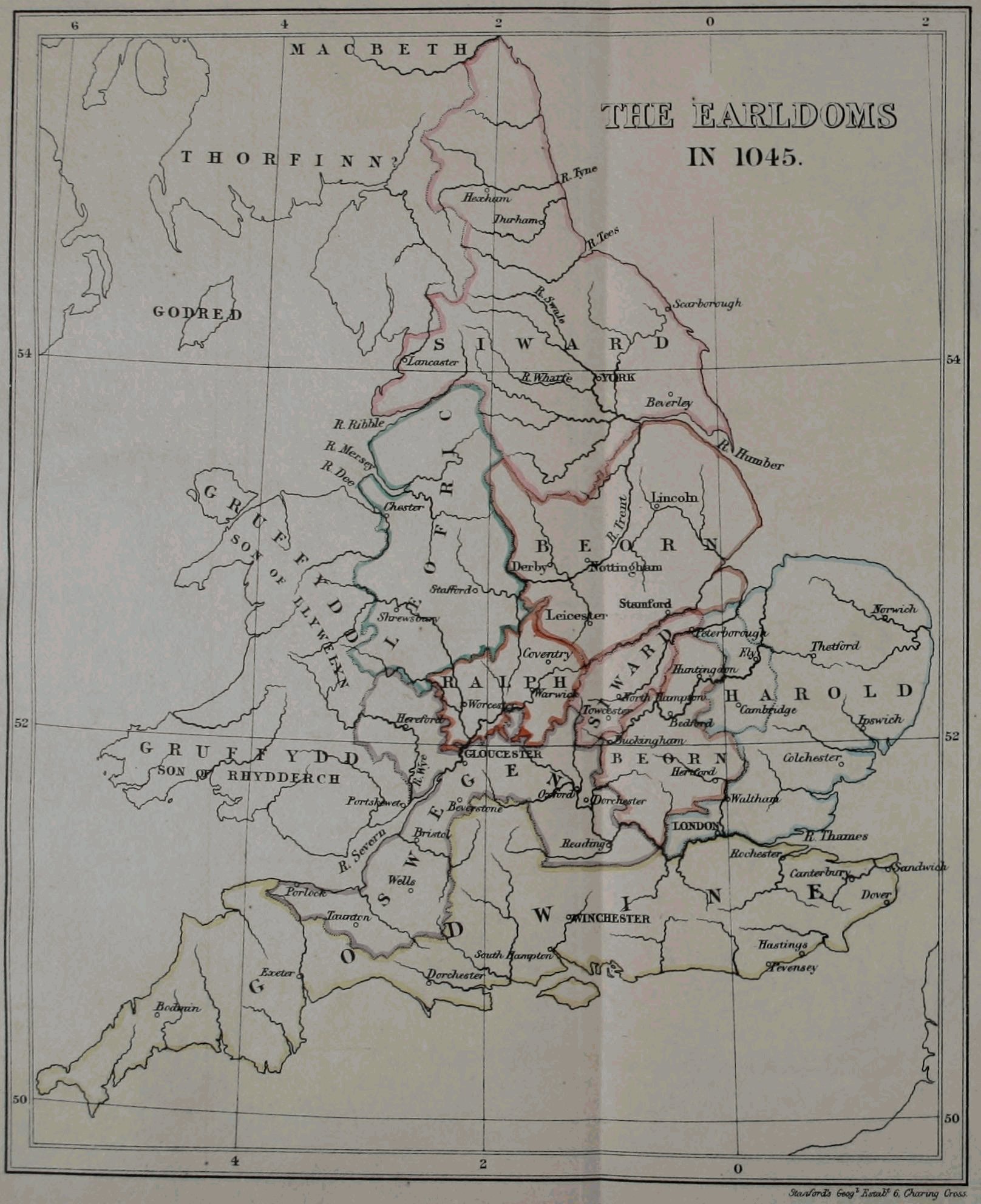
with which we are now dealing. Swegen, the eldest son,
seems to have been invested with an Earldom from the
very beginning of Eadward’s reign, as he signs a charter
with that rank in the King’s second year.[88] Gytha’s
|Beorn Earl, 1045?|
nephew, Beorn, also remained in England, while his
brother Osbeorn was banished, and while his other brother
Swend was putting forth his claims to the Crown of
Denmark. He had doubtless attached himself firmly
to the interests of his uncle. He was also, probably at
a somewhat later time, raised to an Earldom, apparently
the Earldom of the Middle-Angles, lately held by Thored.[89]
The Earldom held by Swegen was geographically most
anomalous. It took in the Mercian shires of Hereford,
Gloucester, and Oxford, and the West-Saxon shires of
Berkshire and Somerset.[90]
First appearance of HAROLD the son of Godwine. [Earl of the East-Angles, 1045?]
37But, along with the comparatively obscure names of
Swegen and Beorn, a greater actor now steps upon the
field. We have now reached the first appearance of the
illustrious man round whom the main interest of this
history will henceforth centre. The second son of Godwine
lived to be the last of our native Kings, the hero
and the martyr of our native freedom. We have indeed
as yet to deal with him only in a subordinate capacity,
and in some sort in a less honourable character. The
few recorded actions of Harold, Earl of the East-Angles,
could hardly have enabled men to look forward to the
glorious career of Harold, Earl of the West-Saxons, and
of Harold, King of the English. To his first great
government, a trying elevation indeed for one in the
full vigour of youth and passion, he was apparently
raised about three years after the election of Eadward,
when he himself could not have passed his twenty-fourth
year. While still young, he experienced somewhat of the
fluctuations of human affairs, and he seems to have learned
wisdom by experience. Still there must have been in him
from the beginning the germs of those great qualities
which shone forth so conspicuously in his later career.
|His character.|
It is not hard to paint his portraiture, alike from his
recorded actions, and from the elaborate descriptions of
|Contemporary testimonies.|
him which we possess from contemporary hands. The
praises of the great Earl sound forth in the latest specimen
of the native minstrelsy of Teutonic England. And
they sound forth with a truer ring than the half conventional
praises of the saintly monarch, whose greatest
glory, after all, was that he had called Harold to the
|Evidence of the Biographer.|
government of his realm.[91] The biographer of Eadward,
the panegyrist of Godwine, is indeed the common laureate
of Godwine’s whole family; but it is not in the special
interest of Harold that he writes. He sets forth the
38merits of Harold with no sparing hand; he approves
of him as a ruler and he admires him as a man; but
his own personal affection plainly clings more closely to
the rival brother Tostig. His description of Harold
is therefore the more trustworthy, and it fully agrees
with the evidence of his recorded actions. Harold then,
the second son of Godwine, is set before us as a man
uniting every gift of mind and body which could attract
to him the admiration and affection of the age in which
he lived.[92] Tall in stature, beautiful in countenance, of
a bodily strength whose memory still lives in the rude
pictorial art of his time,[93] he was foremost alike in the
active courage and in the passive endurance of the warrior.
|His military genius.|
In hunger and watchfulness, in the wearing labours of
a campaign no less than in the passing excitement of
the day of battle, he stood forth as the leader and the
model of the English people.[94] Alike ready and vigorous
in action, he knew when to strike and how to strike;
he knew how to measure himself against enemies of
every kind, and to adapt his tactics to every position in
which the accidents of warfare might place him. He
knew how to chase the light-armed Briton from fastness
to fastness, how to charge, axe in hand, on the
bristling lines of his Norwegian namesake, and how to
bear up, hour after hour, against the repeated onslaughts
of the Norman horsemen and the more terrible thundershower
of the Norman arrows. It is plain that in him,
no less than in his more successful, and therefore more
39famous, rival, we have to admire, not only the mere
animal courage of the soldier, but that true skill of the
leader of armies which would have placed both Harold
and William high among the captains of any age.
Harold’s civil virtues.
But the son of Godwine, the heir of his greatness, was
not merely a soldier, not merely a general. If he inherited
from his father those military qualities which first drew
on Godwine the notice alike of the English Ætheling[95]
and of the Danish King, he inherited also that eloquence
of speech, that wisdom in council, that knowledge of the
laws of the land,[96] which made him the true leader and
father of the English people. Great as Harold was in
war, his character as a civil ruler is still more remarkable,
still more worthy of admiration. One or two actions of
his earlier life show indeed that the spirit of those days
|His singular forbearance.|
of violence had laid its hand even on him. But, from the
time when he appears in his full maturity as the acknowledged
chief of the English nation, the most prominent
feature in his character is his singular gentleness and
mercy. Never, either in warfare or in civil strife, do we
find Harold bearing hardly upon an enemy. From the
time of his advancement to the practical government of
the Kingdom, there is not a single harsh or cruel action
with which he can be charged. His policy was ever
a policy of conciliation. His panegyrist indeed confines
his readiness to forgive, his unwillingness to avenge, to his
dealings with his own countrymen only.[97] But the same
40magnanimous spirit is shown in cases where his conduct
was less capable of being guided by mere policy than in
his dealings with Mercian rivals and with Northumbrian
revolters. We see the same generous temper in his treatment
of the conquered Princes of Wales and of the defeated
invaders of Stamfordbridge. As a ruler, he is described as
walking in the steps of his father, as the terror of evildoers
|His championship of England against strangers.|
and the rewarder of those who did well. Devoted,
heart and soul, to the service of his country, he was no
less loyal in personal attention and service to her wayward
and half-foreign King.[98] Throughout his career he was
the champion of the independence of England against the
dominion of strangers. To keep the court of England free
from the shoals of foreigners who came to fatten on English
estates and honours, and to meet the same enemies
in open arms upon the heights of Senlac, were only two
different ways of discharging the great duty to which his
whole energies were devoted. And yet no man was ever
more free from narrow insular prejudices, from any unworthy
|His foreign travels.|
jealousy of foreigners as such. His own mind was
enlarged and enriched by foreign travel, by the study of
the politics and institutions of other nations on their own
soil. He not only made the pilgrimage to Rome, a practice
which the example of Cnut seems to have made
fashionable among English nobles and prelates, but he
went on a journey through various parts of Gaul, carefully
examining into the condition of the country and the policy
of its rulers, among whom we may be sure that the
renowned Duke of Rouen was not forgotten.[99] And Harold
41was ever ready to welcome and to reward real merit in
men of foreign birth. He did not scruple to confer high
offices on strangers, and to call men of worth from foreign
lands to help him in his most cherished undertakings.
|Harold’s patronage of Germans as opposed to Frenchmen.|
But, while the bounty of Eadward was squandered on
Normans and Frenchmen, men utterly alien in language
and feeling, it was the policy of Harold to strengthen the
connexion of England with the continental nations nearest
to us in blood and speech.[100] All the foreigners promoted
by Harold, or in the days of his influence, were natives of
those kindred Teutonic lands whose sons might still almost
be looked upon as fellow-countrymen.
His personal character.
Such was Harold as a leader of Englishmen in war and
in peace. As for his personal character, we can discern
that in the received piety of the age he surpassed his
|His alleged spoliation of monasteries.|
father. The charge of invasion of the rights of ecclesiastical
bodies is brought against him no less than against
Godwine; but the instance which has brought most discredit
upon his name can be easily shown to be a mere
tissue of misconceptions and exaggerations.[101] But it is far
|His friendship with Saint Wulfstan.|
more certain that Harold was the intimate friend of the
best and holiest man of his time. Wulfstan, the sainted
Bishop of Worcester, was the object of his deepest affection
and reverence; he would at any time go far out of
his way for the benefit of his exhortations and prayers;
and the Saint repaid his devotion by loyal and vigorous
|His foundation of the College at Waltham. [1060–2.]|
service in the day of need.[102] Of his liberality his great
foundation at Waltham is an everlasting monument, and
it is a monument not more of his liberality than of his
wisdom. To the monastic orders Harold seems not to
42have been specially liberal;[103] his bounty took another and a
better chosen direction. The foundation of a great secular
College, in days when all the world seemed mad after
monks, when King Eadward and Earl Leofric vied with
each other in lavish gifts to religious houses at home and
abroad, was in itself an act displaying no small vigour
and independence of mind. The details too of the foundation
were such as showed that the creation of Waltham
was not the act of a moment of superstitious dread or of
reckless bounty, but the deliberate deed of a man who felt
the responsibilities of lofty rank and boundless wealth, and
who earnestly sought the welfare of his Church and nation
|His personal demeanour frank and open.|
in all things. As to his personal demeanour, he was frank
and open in his general bearing, to a degree which was
sometimes thought to be prejudicial to his interests.[104] Yet
he could on occasion dissemble and conceal his purpose, a
gift which seems sometimes to have been misconstrued,[105]
and which apparently led him to the one great error of
his life. He appears not to have been wholly free from
43|Charges of rashness.|
the common fault of noble and generous dispositions. The
charge of occasional rashness was brought against him by
others, and it is denied by his panegyrist in terms which
seem to imply that the charge was not wholly groundless.[106]
And we must add that, in his private life, he did not, at
least in his early days, imitate either the monastic asceticism
of the King or the stern domestic purity of his rival
|His connexion with Eadgyth Swanneshals.|
the Conqueror. The most pathetic incident connected
with his name, tells us of a love of his early days, the
days apparently of his East-Anglian government, unrecognized
by the laws of the Church, but perhaps not
wholly condemned by the standard of his own age, which
shows, perhaps above every other tale in English history
or legend, how much the love of woman can do and
suffer.[107]
Harold Earl of the East-Angles, 1045; Earl of the West-Saxons, 1053; King, 1066.
Such was the man who, seemingly in the fourth year
of Eadward, in the twenty-third or twenty-fourth of his
own age, was invested with the rule of one of the great
divisions of England; who, seven years later, became the
virtual ruler of the Kingdom; who, at last, twenty-one
years from his first elevation, received, alone among English
Kings, the Crown of England as the free gift of her
people, and, alone among English Kings, died, axe in
hand, on her own soil, in the defence of England against
foreign invaders. One prince alone in the later history
of Europe rivals the peculiar glory which attaches to the
name of Harold. For him we must seek in a distant
44age and in a distant land, but in a land connected with
our own by a strangely abiding tie. English warriors,
soldiers of Harold, chafing under the yoke of the Norman
Conqueror, sought service at the court of the Eastern
Cæsar, and there retained for ages their national tongue,
their national weapon,[108] and the proud inheritance of their
|Comparison of Harold with Constantine Palaiologos.|
stainless loyalty. The memory of England and of Harold
becomes thus strangely interwoven with the memory of
the one prince of later times who died in a still nobler
cause than that of the freedom of England. The King
who died upon the hill of Senlac finds his only worthy
peer in the Emperor who died before the Gate of Saint
Rômanos. The champion of England against the Southern
invader must own a nobler martyr still in the champion
of the faith and liberty of Christendom against the misbelieving
horde who have ever since defiled the fairest and
most historic regions of the world. The blood of Harold
and his faithful followers has indeed proved the most fertile
seed of English freedom, and the warning signs of
the times seem to tell us that the day is fast coming when
the blood of Constantine shall no longer send up its cry
for vengeance unheeded from the earth.
Character of Swegen.
The second son of Godwine was no doubt raised to
greatness in the first instance mainly because he was a son
of Godwine; but his great qualities gradually showed
that the rank to which he was raised by his father’s
favour was one which he was fully entitled to retain by
his own merits. The earlier elevation of the great Earl’s
eldest born was less fortunate. Swegen lived to show
that he had a soul of real nobleness within him; but
his crimes were great, he was cut off just as he was
beginning to amend his ways, and he has left a dark
and sad memory behind him. A youth, evidently of no
45common powers, but wayward, violent, and incapable of
self-control, he was hurried first into a flagrant violation
of the sentiment of the age, and next into a still fouler
breach of the eternal laws of right. His end may well
arouse our pity, but his life, as a whole, is a dark blot
on the otherwise chequered escutcheon of the house of
Godwine. It was clearly felt to be so; the panegyrist
of the family never once brings himself to utter the
|Of the Lady Eadgyth. 1045.|
name of Swegen. Only one other child of Godwine
calls for personal notice at this stage of our history.
Eadgyth, his eldest daughter, became, nearly two years
after Eadward’s coronation,[109] the willing or unwilling
bride of the saintly monarch. She is described as being
no less highly gifted among women than her brothers
were among men; as lovely in person and adorned with
every female accomplishment, as endowed with a learning
and refinement unusual in her age, as in point of piety
and liberality a fitting help-meet for Eadward himself.[110]
But there are some strange inconsistencies in the facts
which are recorded of her. Her zeal and piety did not
hinder her from receiving rewards, perhaps, in plain words,
from taking bribes. Undoubtedly this is a subject on
which the feelings of past times differed widely from those
46of our own; but we are a little staggered when we find
the saintly King and his pious Lady receiving money
from religious houses to support claims which, if just,
should have been supported for nothing, and, if unjust,
should not have been supported at all.[111] But Eadgyth
has been charged with far heavier offences than this. She
|Suspicions of her loyalty to England.|
seems to have become in some degree infected with her
husband’s love of foreigners, perhaps even in some sort
to have withdrawn her sympathies from the national cause.
She has won the doubtful honour of having her name
extolled by Norman flatterers as one whose heart was
|Her alleged share in the murder of Gospatric.|
rather Norman than English.[112] And all her reputation for
gentleness and piety has not kept her from being branded
in the pages of one of our best chroniclers as an accomplice
in a base and treacherous murder.[113] Her character thus
|Her relation to her husband.|
becomes in some sort an ænigma, and her relation to her
husband is not the least ænigmatical part of her position.
One of Eadward’s claims to be looked on as a saint was
the general belief, at least of the next generation, that
the husband of the beautiful Eadgyth lived with her only
|Eadward’s alleged chastity.|
as a brother with a sister.[114] If this story be true, a more
enlightened standard of morality can see no virtue, but
rather a crime, in his conduct. We can see nothing to
47admire in a King who, in such a crisis of his country, himself
well nigh the last of his race, and without any available
member of the royal family to succeed him, shrank, from
whatever motive, from the obvious duty of raising up
|Evidence of the earliest writers.|
direct heirs to his Crown. But it seems probable that
this report is merely part of the legend of the saint and
not part of the history of the King. His contemporary
panegyrists undoubtedly praise Eadward’s chastity. But
it is not necessary to construe their words as meaning
more than might be asserted of Ælfred, of William, of
Saint Lewis, or of Edward the First. The conjugal faith
of all those great monarchs remained, as far as we know,
unbroken; but not one of them thought it any part of
his duty to observe continence towards his own wife. Still,
from whatever cause, the marriage of Eadward and Eadgyth
was undoubtedly childless; and the relations of the
royal pair to each other in other respects are hardly more
intelligible. Eadgyth is described as the partaker of all her
husband’s good works, and as nursing him with the most
affectionate care during his last illness.[115] Yet, at the moment
of his reign when he could most freely exercise a will of
his own, if he did not absolutely of his own accord banish
her from his court, he consented, seemingly without any
reluctance, to her removal from him by the enemies of her
family and her country.[116] The anxiety of Eadward’s Norman
favourites to separate Eadgyth from her husband is,
after all, the most honourable record of her to be found
among the singularly contradictory descriptions of her
character and actions.
Greatness of Godwine and his house.
We thus find, within a few years after the accession of
Eadward, the whole of the ancient Kingdoms of Wessex,
Sussex, Kent, Essex, East-Anglia, and part of Mercia, under
the government of Godwine, his two elder sons, and his
48nephew. His daughter meanwhile shared the throne of
England with a King whom he had himself placed upon
it. Such greatness could hardly be lasting. It rested
wholly on Godwine’s own personal character and influence,
for the fame of Harold was yet to be won. The
|The other Earldoms;|
part of Mercia which was not otherwise occupied remained,
|Mercia under Leofric;|
as before, in the hands of Leofric the son of Leofwine.
This Earl and his famous wife Godgifu, the Lady Godiva
of legend,[117] were chiefly celebrated for their boundless liberality
to ecclesiastical foundations.[118] Worcester, Leominster,
Evesham, Chester, Wenlock, Stow in Lindesey, and, above
all, Coventry, were special objects of their bounty. They
seem not to have been satisfied with mere grants of lands
and privileges, but to have taken a special interest in
the buildings and ornaments of the houses which they
favoured. The minster of Coventry, rebuilt and raised
to cathedral rank after their time, has utterly vanished
from the earth, and recent changes have abolished even
the titular position of the city as a see of a Bishop.
But at Stow, the ancient Sidnacester, a place even then
of infinitely less consideration than Coventry, portions
of the church enriched by Leofric still remain.[119] Leofric,
49his son Ælfgar, his grandsons and his granddaughter,
play an important part in the history of this period down
to the complete establishment of the Norman power in
|Relations between Leofric and Godwine.|
England. It is clear that Leofric must have been more
personally annoyed by the rise of Godwine and his house
than any other of the great men of England. A race
whom he could not fail to look down upon as upstarts
hemmed him in on every side except towards the North.
Later in the reign of Eadward, we shall find the rivalries
and the reconciliations of the two houses of Godwine and
Leofric forming a considerable portion of the history.
But, while Leofric himself lived, he continued to play
the part which we have already seen him playing,[120] that
part of a mediator between two extreme parties, which
was dictated to him by the geographical position of his
Earldom.
Northumberland under Siward.
North of the Humber, the great Dane, Siward the
Strong, still ruled over the Earldom which he had won
by the murder of his wife’s uncle.[121] The manners of the
Northumbrians were so savage, murders and hereditary
deadly feuds were so rife among them, that it is quite
possible that the slaughter of Eadwulf may, by a party at
least, have been looked on as a praiseworthy act of vigour.
Perhaps however, as we go on, we may discern signs that
Siward and his house were not specially popular in Northumberland,
and that men looked back with regret to the
more regular line of their native Earls. At any rate, Siward
remained for the rest of his days in undisturbed possession
of both the Northumbrian governments, and along with
these he seems to have held the Earldoms of Northampton
50and Huntingdon within the proper limits of Mercia.[122]
He ruled, we are told, with great firmness and severity,
labouring hard to bring his troublesome province into
something like order.[123] Nor was he lacking in that bounty
to the Church, which might seem specially needful as an
atonement for the crime by which he rose to power.[124]
England not tending to separation but to union.
The mention of these great Earls suggests several considerations
as to the constitutional and administrative
systems of the time. It is quite a mistake to think, as
often has been thought, that the position of these powerful
viceroys at all proves that England was at this time tending
to separation. It was in truth tending to closer union,
and the position of the great Earls is really one of the
|Comparison with Frankish history.|
signs of that tendency. A mistaken parallel has sometimes
been drawn between the condition of England under
Eadward and the condition of France under the later
Karlings. The transfer of the English sceptre to the
house of Godwine is of course likened to the transfer of
the French sceptre to the house of Hugh of Paris. But, if
we are to look for a parallel in the history of Gaul, we shall
find one, by no means exact but certainly the closer of the
two, in the state of things under the later Merwings, and
in the transfer of the Frankish sceptre to the Carolingian
dynasty. The position of Godwine and Harold is, of the
two, more akin to the position of Charles Martel and Pippin
than it is to that of Hugh the Great and Hugh Capet.
|Nature of the Earldom as affected by the Danish Conquest.|
The Earls of Eadward’s reign were, as I have already
explained,[125] not territorial princes, gradually withdrawing
themselves from the authority of their nominal overlord,
but great magistrates, wielding indeed a power well nigh
royal within their several governments, but wielding it only
by delegation from the common sovereign. The Danish
51Conquest, and the fearful slaughter of the ancient nobility
in the wars of Swend and Cnut, had done much to break
up the force of ancient local associations and the influence
of the ancient local families. Many of these families, the
East-Anglian Earls for instance, doubtless became extinct.
From the accession of Cnut we find a new state of things.
The rule of the old half-kingly families, holding an almost
hereditary sway over whole kingdoms, and apparently
with subordinate Ealdormen in each shire, gradually dies
out. Cnut divided the Kingdom as he pleased, appointing
Danes or Englishmen, and Englishmen of old or of
new families, as he thought good. England was now
divided among a few Earls, who were distinctly representatives
of the King. In Northumberland and Mercia the
claims of ancient princely families were to some extent
regarded; in Wessex and East-Anglia not at all. The
rank of Earl is now held by a very few persons, connected
either with the royal family or with the men whose personal
influence was great at the time.[126] The Earls of
Eadward’s reign are always either his own kinsmen or else
|Position of Northumberland.|
kinsmen of Godwine or Leofric. Siward alone keeps his
Earldom for life; but, while he lives, his influence hardly
extends beyond his own province, and, after his death,
Northumberland falls under the same law as the rest of
the Kingdom. No doubt Northumberland still retained
more of the character of a distinct state than any other
part of England; still the forces of Northumberland
march at the command of the King,[127] and the Northumbrian
Earldom is at the disposal of the King and his
Witan.[128] We do not however find the same signs of the
constant immediate exercise of the royal power in Northumberland
which we find in Wessex, Mercia, and East-Anglia.
We have throughout this reign a series of writs
52|Evidence of the King’s writs.|
addressed to the Bishops and Earls of those districts,
which show that an Earl of one of those great Earldoms
commonly acted as the local Earl of each shire in his province,
with no subordinate Earl or Ealdorman under him.
While such writs are exceedingly common in Wessex and
East-Anglia, one such writ only exists addressed to a
Northumbrian Earl, and that is in the days of Tostig.[129]
In Siward’s days possibly the King’s writ hardly ran in
Northumberland. Those addressed to the Earls of the
house of Leofric are also rare. It is clear that the King’s
power was more fully established under the Earls of Godwine’s
family than elsewhere. No doubt the royal authority
was formally the same in every part of the Kingdom,
but the memories and traces of ancient independence in
Northumberland and Northern Mercia made its practical
exercise more difficult in those districts.
Further evidence of the writs as to a change in the condition of the Folkland.
The class of writs of which I have just spoken throw
some light on constitutional questions in another way. They
come in under Cnut,[130] and they become very common under
Eadward, being found alongside of documents of the more
ancient form. They are announcements which the King
makes to the Bishop, Earl, Sheriff, Thegns, and others of
some one shire, or sometimes to the Bishops, Earls, and
Thegns of the whole Kingdom, which do not, like documents
of the ancient form, bear the signatures of any Witan. They
are the manifest prototypes of the royal writs of later times.
They are, like the other documents, mostly grants of one
kind or another; only they seem to proceed from the
King’s personal authority, without any confirmation from
a national Gemót. Now it is hardly possible that the mass
of grants of this sort which are preserved can all of them
have been grants out of the King’s private estate. And, if
53they are grants of folkland to be turned into bookland on
whatever tenure, allodial or feudal, a very important question
arises. If the King could make such grants by his
own authority, a change must have taken place in the
ideas entertained as to folkland. In short, the change
which was completed after the Conquest[131] must have
already been in progress. The Folkland must have been
beginning to be looked on as Terra Regis. In short, strictly
feudal ideas were gradually coming in on this as on other
matters. And doubtless, in this respect, as in others, the
Danish Conquest did much to prepare the way for the
|General powers of the Witan not lessened.|
Norman. But, if the Witenagemót insensibly lost its
authority in a matter in which we may well believe that
its voice had long been nearly formal, it retained its general
powers undiminished. It still, as of old, elected Kings,
outlawed Earls, discussed and determined the foreign relations
of the Kingdom. The fame of Eadward as a lawgiver
is mythical; but the fame of government carried on in strict
conformity to the laws and constitution of the country, is
one which fairly belongs to him, or rather to the illustrious
men by whom his power was practically wielded.
Scotland under Macbeth.
I have now to end this sketch by a brief view of the
condition of the subordinate Kingdoms and of the relations
of England to foreign countries. Scotland was now ruled
by the famous Macbeth. He had, as Maarmor or under-King
of Moray, done homage to Cnut[132] along with his
|Reign and death of Duncan. 1040.|
superior Malcolm. Duncan, the youthful grandson of
Malcolm, unsuccessful, as we have seen, in his invasion
of England,[133] was equally so in his warfare with the Northmen
of Orkney.[134] Soon after this last failure, he was
murdered by his own subjects, Macbeth being at least the
54prime mover in the deed.[135] The murdered prince had
married a kinswoman of the Earl of the Northumbrians,[136]
by whom he left two infant sons, Malcolm, afterwards
famous as Malcolm Canmore, and Donald Bane. But the
|Reign of Macbeth. 1040–1058.|
Crown was assumed by Macbeth, on some claim, it would
seem, of hereditary right, either in himself or in his wife
Gruach.[137] Macbeth, and still more Gruach, have been so
immortalized in legend that it is not easy to recall them
to their true historical personality. But, from what little
can be recovered about them, they certainly seem not to
have been so black as they are painted. The crime of
Macbeth against Duncan is undoubted; but it was, to
say the least, no baser than the crime of Siward against
Eadwulf; and Macbeth, like Siward, ruled well and
vigorously the dominion which he had won by crime. All
genuine Scottish tradition points to the reign of Macbeth
as a period of unusual peace and prosperity in that disturbed
|Macbeth distributes money at Rome. 1050.|
land.[138] Macbeth and Gruach were also bountiful
to churches in their own land, and Macbeth’s munificence
to certain unknown persons at Rome was thought worthy
of record by chroniclers beyond the bounds of Scotland.[139]
One hardly knows whether this was merely by way of
alms, like the gifts of Cnut, and it seems uncertain whether
Macbeth, like Cnut and Harold, personally made the
55Roman pilgrimage.[140] The words however in which the
gifts of Macbeth are spoken of might almost imply that
his bounty had a political object. It is possible that, even
at this early time, the Scottish King may have thought
it desirable to get the Roman Court on his side, and he
may have found, like later princes and prelates, that
a liberal distribution of money was the best way of winning
the favour of the Apostolic See. The high character of
the reigning Pontiff, Leo the Ninth, puts him personally
above all suspicion of unlawful gain; but then, as afterwards,
subordinates were probably less scrupulous. The
few notices which we find of Scottish affairs during the
early years of Eadward might suggest that Macbeth felt
his position precarious with regard to his English overlord.
He had done homage to Cnut, but there is no
record of his having renewed it to Eadward. There is
however no sign of open enmity for many years.
Gruffydd of North Wales. 1039–1063.
In Wales a remarkable power was growing up, which
will often call for notice throughout the whole of the
reign of Eadward. The year before the death of Harold,
Gruffydd the son of Llywelyn became King of Gwynedd
or North Wales, a description which now begins to be
used in its modern sense. He ruled with great vigour
and ability. He gradually extended his dominion over
the whole of Wales, not scrupling to avail himself of
Saxon help against enemies of his own race. On the
other hand, he more than once, sometimes alone, sometimes
in concert with English traitors, proved himself a
really formidable enemy to England. He was the last
prince under whom any portion of the Welsh nation
played a really important part in the history of Britain.
He was, for Wales in the narrower sense, pretty well what
Cadwalla had been, ages before, for Strathclyde.[141] In the
|633.|56very first year of his reign, he made an inroad into Mercia,
|His victory at Rhyd-y-Groes. 1039.|
which has been already spoken of.[142] He penetrated as far
as Rhyd-y-Groes, near Upton-on-Severn, a spot still retaining
its British name,[143] and there he fought the battle
in which Eadwine, the brother of Earl Leofric, was killed.
|His wars in South Wales.|
At the time of Eadward’s accession he was busily engaged
in various conflicts with the princes of South
Wales, who did not scruple to call in the help of the
heathen Danes of Ireland against him.[144] In the year of
|1042.|
Eadward’s election, he had just won a great victory over
a combined host of this kind at Aberteifi or Cardigan.[145]
Eadward’s friendly relations with foreign powers.
The relations of King Eadward to foreign powers were,
for the most part, friendly. With Normandy and other
French states they were, as we have seen and shall
see, only too friendly. But this was a time of growing
intercourse, not with France only, but with Continental
nations generally. Pilgrimages to Rome, and other
foreign journeys and embassies, were becoming far more
usual than before among eminent Englishmen, both clergy
and laity. Earl Harold’s travels, undertaken in order to
study the condition and resources of foreign countries on
|Connexion with Germany.|
the spot, form a memorable example.[146] The connexion
between England and Germany was now very close; the
great Emperor Henry the Third sedulously sought the
friendship of his English brother-in-law; and there is,
as we have seen, little doubt that the German connexion
was cultivated by the patriotic party as a counterpoise to
the French tendencies of the King.[147] The promotion of
German churchmen began early in Eadward’s reign, when
it could hardly have taken place except with the sanction
of Godwine. The only danger that seemed to threaten
57|Relations with the North; claims of Magnus.|
lay in the North. Magnus of Norway conceived himself
to have acquired, by virtue of his agreement with Harthacnut,
a claim on the Crown of England;[148] but his wars
with Swend hindered him from putting it forward for
some years to come.
The reign of Eadward comparatively peaceful.
The reign of Eadward was, on the whole, a reign of peace.
His admirers use somewhat exaggerated language on the
subject,[149] as his reign was certainly more disturbed than
those of either Eadgar or Cnut. Still, compared with most
periods of the same length in those troubled times, the
twenty-four years of Eadward form a period of unusual
tranquillity. Foreign war, strictly so called, there was none.
England was threatened by Norway, and she herself interfered
in the affairs of Flanders; but no actual fighting seems
to have taken place on either occasion. Within the island
matters were somewhat less quiet. Scotland was successfully
invaded, and the old royal line restored. A few incursions
of Scandinavian pirates are recorded, and Gruffydd of
Wales remained for many years a thorn in the side of his
English neighbours. But the main interest of this reign
gathers round domestic affairs, round the revolts, the
banishments, and the reconciliations of the great Earls, and,
still more, round that great national movement against
French influence in Church and State, of which Godwine
and his family were the representatives and leaders.
58
Character of the years 1043–1051.
This first period of the reign of Eadward is not marked
by any very striking events till we draw near to its close.
At home we have to mark the gradual expulsion, already
spoken of, of those who had been conspicuous in opposing
Eadward’s election, and, what is of far more importance,
the gradually increasing influence of the foreign favourites.
This is most easily traced in the disposition of ecclesiastical
preferments. The foreign relations of England at
this time lay mainly with the kingdoms of the North,
where the contending princes had not yet wholly bidden
farewell to the hope of uniting all the crowns of the
Great Cnut on a single brow. But the relations between
England and the Empire were also of importance, and the
affairs of Flanders under its celebrated Count Baldwin
the Fifth form a connecting link between those of England,
Germany, and Scandinavia. The usual border warfare
with Wales continues; with the renowned usurper
of Scotland there was most likely a sort of armed truce.
These various streams of events seem for some years to
flow, as it were, side by side, without commingling in any
marked way. But towards the end of our period they
all in a manner unite in the tale of crime and misfortune
which led to the disgrace and downfall of the eldest son
of Godwine, but which thereby paved the way for the
elevation of the second.
Relations between Eadward and his mother.
The first act of the new King was one which was perhaps
neither unjust nor impolitic, but which, at first
sight, seems strangely incongruous with his character
for sanctity and gentleness. With all his fondness for
59Normans, there was one person of Norman birth for whom
he felt little love, and to whom indeed he seems to have
owed but little gratitude. This was no other than his own
mother. It is not very easy to understand the exact
relations between Emma and her son. We are told that
she had been very hard upon him, and that she had done
less for him than he would—contributed too little, it
would seem, from her accumulated hoards—both before
he became King and since.[150] Now it is not clear what opportunities
Emma had had of being hard upon her son
since the days of his childhood. During the greater part
of their joint lives, Eadward had been an exile in Normandy,
while Emma had shared the throne of England as
the wife of Cnut. Her fault must rather have been neglect
to do anything for his interests, refusal, it may be, to give
anything of her wealth for the relief of his comparative
poverty, rather than any actual hardships which she could
have inflicted on him. She had, as we have seen, altogether
thrown in her lot with her second husband, and
had seemingly wished her first marriage to be wholly
forgotten.[151] But there seems not to be the slightest ground
for the scandal which represented her as having acted in
any way a hostile part to her sons after the death of Cnut.[152]
All the more probable versions of the death of Ælfred
represent her as distinctly favourable to his enterprise.[153]60She had herself suffered spoliation and exile in the days of
Harold;[154] she had returned with Harthacnut, and, in his
days, she seems almost to have been looked on as a sharer
in the royal authority.[155] That authority she had at least
not used to keep back her favourite son from the recall
of his banished half-brother. It is not wonderful if,
under these circumstances, there was little love between
mother and son. Still there does not, up to the death of
Harthacnut, seem to have been any unpardonable offence
|Probable offence of Emma.|
committed on the part of Emma. But the charge that
she had done less for Eadward than he would, since he
came to the Crown, seems to have a more definite meaning.
It doubtless means that she had refused to contribute
of her treasures to the lawful needs of the State. It may
also mean that she had been, to say the least, not specially
zealous in supporting Eadward’s claims to the Crown.
She is described as dwelling at Winchester in the possession,
not only of great landed possessions, the morning-gifts
of her two marriages, but of immense hoarded wealth
of every kind.[156] Harthacnut had doubtless restored, and
probably increased, all that had been taken from her by
Harold. Of her mode of employing her wealth we
find different accounts; putting the two statements together,
we may perhaps infer that she was bountiful to
churches and monasteries, but niggardly to the poor.[157]61But neither this bounty nor this niggardliness was a legal
crime, and it is clear that some more definite offence must
have lurked behind. Her treasures, or part of them, may
have been gained by illegal grants from Harthacnut; it is
almost certain, from the language of our authorities, that
they had been illegally refused to the public service. But
what happened seems to imply some still deeper offence.
|Witenagemót of Gloucester. November, 1043.|
The conduct of Emma became the subject of debate in
a meeting of the Witan; her punishment was the result
of a decree of that body, and all that was done to her was
done with the active approval of the three great Earls,
Godwine, Leofric, and Siward.[158] In the month of November
after Eadward’s coronation, a Gemót—perhaps a
forestalling of the usual Midwinter Gemót—was held at
Gloucester. That town seems now to take the place which
was held by Oxford a little earlier[159] as the scene of courts
and councils.[160] It became during this reign, what it remained
during the reign of the Conqueror, the place where
the King wore his Crown at the Christmas festival, as he
wore it at Winchester at Easter. It was convenient for
such purposes as lying near at once to the borders of two
of the great Earldoms. It lay also near to the borders
of the dangerous Welsh, whose motions, under princes
like the two Gruffydds, it was doubtless often expedient
to watch with the whole wisdom and the whole force of
the realm. The result of the deliberations of the Wise
Men was that the King in person, accompanied by the
62|Eadward and the Earls despoil Emma of her treasures. November 16, 1043.|
three great Earls,[161] rode from Gloucester to Winchester,
came unawares[162] upon the Lady, occupied her lands,[163] and
seized all that she had in gold, silver, jewels, and precious
stones. They left her, however, we are told, enough for
her maintenance, and bade her live quietly at Winchester.[164]
She now sinks into utter insignificance for the remainder
of her days.[165]
Now the last order, to live quietly at Winchester, seems
to imply some scheme or intrigue on the part of Emma
more serious than even an illegal refusal to contribute of
her wealth to the exigencies of the State. Is it possible that
she had been one of the opponents of her son’s election?
A woman who had so completely transferred her affection
to her second husband and his children, even though she
had no hand in actual conspiracies against the offspring
of her first marriage, may conceivably have preferred the
nephew of Cnut to her own son by Æthelred. If so, her
punishment was only the first act of a sort of persecution
63which during the next three or four years seems to have
fallen upon all who had supported the claims of Swend to
the Crown. The whole party became marked men, and
were gradually sent out of the Kingdom as occasion
served.[166] A few of their names may probably be recovered.
We have records of several cases of banishment and confiscation
during the early years of Eadward, which are
doubtless those of the partisans of Eadward’s Danish opponent.
First and foremost was a brother of Swend
himself, Osbeorn, who, like his brother Beorn, seems to have
|Banishments of Swend’s partisans. 1043–1046.|
held the rank of Earl in England. The brothers must have
taken different sides in the politics of the time, as Osbeorn
was banished, while Beorn retained his Earldom.[167] The
banishment of Osbeorn did not stand alone. The great
|1046.|
Danish Thegn Osgod Clapa was banished a few years
later,[168] and it was probably on the same account that
Æthelstan the son of Tofig lost his estate at Waltham,[169]|1044.|
and that Gunhild, the niece of Cnut and daughter of
Wyrtgeorn, was banished together with her two sons
Heming and Thurkill.[170] She was then a widow for the
second time through the death of her husband Earl
Harold.[171] He had gone on a pilgrimage to Rome, and was
on his way back to Denmark, when he was treacherously
64murdered by Ordulf, the brother-in-law of Magnus of
Norway.[172] That Harold was bound for Denmark, and
not for England, where his wife and children or stepchildren
were, may perhaps tend to show that he was
already an exile from England. It is not impossible that
Godescalc the Wend ought to be added to the list.[173]
Whether the fall of Emma was or was not connected
with the penalties which thus fell on the relics of the
Danish party, it certainly carried with it the momentary
|Stigand, appointed Bishop of Elmham, and deposed. April-November, 1043.|
fall of one eminent Englishman. The disgrace of the Lady
was accompanied by the disgrace of the remarkable—we
might almost say the great—churchman by whose counsels
she was said to be governed. We have already seen
Stigand, once the Priest of Assandun,[174] appointed to
a Bishoprick and almost immediately deprived of it.[175] The
like fate now happened to him a second time. He was,
it would seem, still unconsecrated;[176] but, seemingly about
the time of Eadward’s coronation, he was named and
65consecrated to the East-Anglian Bishoprick of Elmham.[177]
But the spoliation of Emma was accompanied by the deposition
of Stigand from the dignity to which he had just
been raised. He was deprived of his Bishoprick, and his
goods were seized into the King’s hands, evidently by
a sentence of the same Gemót which decreed the proceedings
against the Lady. Whatever Emma’s fault was,
Stigand was held to be a sharer in it. The ground assigned
for his deposition was that he had been partaker of the
counsels of the Lady, and that she had acted in all things
by his advice.[178] That Stigand should have supported the
claims of Swend is in itself not improbable. He had risen
wholly by the favour of Cnut, his wife, and his sons. The
strange thing is that so wary a statesman should not have
seen how irresistibly the tide was setting in favour of
Eadward. One thing is certain, that, if Stigand mistook
his interest this time, he knew how in the long run to
recover his lost place and to rise to places far higher.
Importance of ecclesiastical appointments at this time.
During the whole of this period ecclesiastical appointments
claim special notice. They are at all times important
witnesses to the state of things at any particular
moment, and in a period of this kind they are the best
indications of the direction in which popular and royal
favour is setting. The patrons or electors of an ecclesiastical
office can choose far more freely, they can set
themselves much more free from the control of local and
family influences, than those who are called on to appoint
to temporal offices. For King Eadward to appoint a
French Earl would prove much more than his appointment
of a French Bishop. It would prove much more as to his
own inclinations; it would prove much more again as to
66the temper of the people by whom such an appointment
was endured. To appoint a French or German Earl as
the successor of Godwine or Leofric would doubtless have
been impossible. But Eadward found means to fill the
sees of Canterbury, London, and Dorchester with French
Prelates. In those matters he had a freer choice, because,
in the case of an ecclesiastical office, no hereditary claim
or preference could possibly be put forward. The same
freedom of choice still remains to the dispensers of church
patronage in our own times. The Lord Lieutenant, the
Sheriff, the ordinary magistrates, of any county are necessarily
chosen from among men belonging to that county.
But the Bishop, the Dean, the ordinary clergy, may never
have set foot in the diocese till they are called on to
exercise their functions within it. Then, as now, various
influences limited the choice of temporal functionaries
which did not limit the choice of spiritual functionaries.
It is therefore of special moment to mark the course of
ecclesiastical appointments at this time, as supplying our
best means of tracing the growth of the foreign influence
and the course of the resistance made to it.
Mode of appointing Bishops.
It is not very clear what the exact process of appointing
a Bishop at this time was. It is clear that the royal will
was the chief power in the appointment. It is clear that
the official document which gave the Bishop-elect a claim
to consecration was a royal writ, to which now, under the
French influences of Eadward’s court, a royal seal, in
imitation of continental practice, was beginning to be
attached.[179] It is also clear that the appointment was
regularly made in full Witenagemót.[180] This of course
implies that the Witan had at least the formal right of
saying Yea or Nay to the King’s nomination. But we
hear at the same time of capitular elections,[181] which clearly
67were not a mere form, though it rested with the King
to accept or reject the selected candidate. No doubt some
process was in use, in which the Chapter, the Witan, and
the King all took their parts,[182] but in ordinary speech the
appointment is always said to rest with the King, who is
constantly described as giving a Bishoprick to such and
such a man. The King too at this time exercised the
right, which afterwards became the subject of so much
controversy, of investing the Bishop-elect with the ring
and staff.[183] It is clear also, from the case of Stigand just
recorded, that the King and his Witan had full power of
|Increased connexion with Rome.|
deposing a Bishop. On the other hand, probably owing to
the number of foreign ecclesiastics now in the Kingdom,
references to the Court of Rome become from this time far
more frequent. For an Archbishop to go to Rome for
his pallium was nothing new; but now we hear of Bishops
going to Rome for consecration or confirmation, and of the
Roman Court claiming at least a veto on the nomination
of the English King.[184]
Prevalence of simony.
It is perhaps more startling to find that the court of
Saint Eadward was no more free from the suspicion of
simony than the courts of ruffians like Harold and Harthacnut.[185]
It is clear however that it was neither on the King
68personally nor on the Earl of the West-Saxons that this
disgraceful imputation rested. One can hardly help suspecting
that it was the itching palms of the King’s
foreign favourites which proved the most frequent resting-place
for the gold of those who sought for ecclesiastical
dignities by corrupt means. In the year after Eadward’s
coronation we meet with a story which brings out all
|Siward appointed coadjutor to Archbishop Eadsige. 1044.|
these points very strongly. Archbishop Eadsige found
himself incapacitated by illness from discharging his functions,
and wished either to resign his see or, as it would
rather seem, to appoint a coadjutor. But he feared lest,
if his intentions were made publicly known, some man
whom he did not approve of might beg or buy the office.[186]
He therefore took into his counsels none but the two first
men in the realm, Earl Godwine and King Eadward himself.
Godwine would naturally be glad of the opportunity
to put some check on the growing foreign influences, and
Eadward, easily as he was led astray, would doubtless be
anxious, when the case was fairly placed before him, to
follow any course which tended to preserve the purity
of ecclesiastical rule. By the authority then of Eadward
and Godwine, but with the knowledge of very few other
persons,[187] Siward, Abbot of Abingdon, was consecrated as
Coadjutor-Archbishop.[188] He acted on behalf of the Primate
69|He returns to Abingdon and dies. 1048–50.|
for about six years, till illness caused him in his turn to
resign his office and return to Abingdon, where he died.[189]
On this Eadsige again assumed the administration of the
Archbishoprick,[190] for a short time before his own death.
Death of Bishop Ælfweard of London. July 25, 1044.
But a more memorable appointment was made in the
course of the same year. Ælfweard, Bishop of London
and Abbot of Evesham, a Prelate whose name has already
occurred in our history,[191] fell sick of leprosy. He returned
to his Abbey, but the brotherhood with one consent refused
him admission. They met, we are told, with the
just reward of their churlishness. Ælfweard turned away
to the distant Abbey of Ramsey, where he had spent his
early years, and where he was gladly received. He soon
after died, leaving great gifts to the hospitable monks of
Ramsey.[192] Rumour however added that they largely consisted
of his own former gifts to Evesham, and that he
even did not scruple to remove from that undutiful house
some precious things which had been the gifts of other
benefactors.[193] Two great spiritual preferments were thus
vacated, one of them, the see of London, one of the most
important in the Kingdom. The lesser office at Evesham
70was conferred on an Englishman, Wulfmær or Mannig,
a monk of the house;[194] but in the nomination to the great
East-Saxon Bishoprick, the foreigners obtained one of their
|He is succeeded by Robert of Jumièges. August 10?|
most memorable triumphs. In a full Witenagemót, holden
in London in the month of August, the Bishoprick of the
city in which the Assembly was held was bestowed on
one Robert, a Norman monk, who had first been Prior of
Saint Ouen’s at Rouen, and afterwards Abbot of the great
house of Jumièges.[195] He has there left behind him a noble
memorial in the stately minster which still survives in ruins,
|Baneful influence of Robert.|
but in England it is not too much to say, that he became,
in this high post and in the still higher post which he
afterwards reached, the pest of the Kingdom. His influence
over the mind of the feeble King was unbounded.[196]
We are ludicrously told that, if Robert said that a black
crow was white, King Eadward would at once believe
him.[197] He is described at all hands as being the chief
stirrer up of strife between Eadward and his native subjects.
He it was who separated the husband from the wife, and
|His calumnies against Godwine.|
the King from his most faithful counsellors. He it was
whose slanderous tongue again brought up against the great
71Earl[198] that charge of complicity in the death of Ælfred
of which he had been solemnly pronounced guiltless by the
|His connexion with the Norman invasion.|
highest Court in the realm.[199] And the career of Robert is
one of great historical importance. It is closely connected
with the immediate causes—it may even be reckoned among
the immediate causes—of the Norman invasion.[200] Robert’s
appointment to the see of London may be fairly set down
as marking a distinct stage in the progress of Norman
influence in England. He was the first man of utterly
alien speech who had held an English Bishoprick since
the days of Roman, Scottish, or Cilician missionaries.
|[1052.]|
His overthrow at a later time was one of the first-fruits
of the great national reaction against the strangers,
and its supposed uncanonical character was one of the
many pretences put forth by William to justify his
invasion of England.
This appointment of Robert shows the great advance
of the Norman influence. But it had not as yet reached
its height. Godwine and the popular party seem to have
been able to make a kind of compromise with the King.
It was necessary to yield to the King’s strong personal
inclination in the case of Robert; but the other vacant
preferments were secured for Englishmen. We have seen
that Ælfweard’s Abbey was not allowed to be held in
plurality by his successor in the Bishoprick, but was bestowed
|Stigand Bishop of Elmham.|
on an Englishman of high character. Stigand
too had by this time made his peace with Eadward and
Godwine, and now began to climb the ladder of preferment
afresh. He now again received the Bishoprick of
72|Banishment of Gunhild and her sons.|
Elmham or of the East-Angles.[201] And it was in the same
year, and seemingly at the same Gemót, that Gunhild,
“the noble wife,” the widow of the Earls Hakon and
Harold, the mother of Heming and Thurkill, was banished
together with her sons.[202]
This last event was one of that series of banishments
which have been already spoken of as gradually falling on
all who had made themselves in any way prominent in
opposition to the election of Eadward. But it was most
likely not unconnected with the present threatening state
|Condition of Northern Europe.|
of affairs in Northern Europe. The early years of Eadward
in England were contemporary with the great struggle
between Swend and Magnus for the Crown of Denmark.
|War of Swend and Magnus. 1044–1047.|
The details of that warfare are told in our Scandinavian
authorities with the usual amount of confusion and contradiction,
and it seems hopeless to think of altogether
reconciling their conflicting statements. Our own Chronicles,
as usual, supply the most promising means of
harmonizing them in some small degree. We have seen
that Magnus was in actual possession of both Norway
and Denmark at the time of Eadward’s coronation.[203]
Swend, after several battles, had found himself forsaken
|Connexion of Godescalc with Swend and Magnus.|
by every one, and had taken refuge in Sweden.[204] Godescalc
the Wend, who had accompanied him from England,
had forsaken him with the rest,[205] and had entered on that
mingled career as missionary and warrior among his
heathen countrymen of which I have already spoken.[206]
In this warfare he most likely acted as an ally of Magnus,
who was also renowned for victories over the same enemy.[207]73|Triumphant position of Magnus.|
Magnus, now at the height of his power, King of Denmark
and Norway, conqueror of his heathen neighbours,
enjoying, as it would seem, the respect and attachment
of the people of both his Kingdoms, regretted and retracted
the engagements of fidelity, perhaps even of submission,
which he had made to Eadward when his own
|He claims the English Crown. 1045.|
position seemed less secure. He now fell back on the
claim by virtue of which he had possessed himself of
Denmark, and which, in his eyes, gave him an equal right
to the possession of England. Magnus sent an embassy
to England, claiming the Crown, and setting forth his
right.[208] He and Harthacnut had agreed that whichever
of them outlived the other should succeed to his dominions.
Harthacnut was dead; Magnus had, by virtue
of that agreement, succeeded to the Crown of Denmark;
he now demanded Harthacnut’s other Kingdom of England.
|Eadward’s answer.|
Eadward, we are told, answered in a magnanimous
strain, in which he directly rested his right to the English
Crown on the choice of the English people.[209] While
his brother lived, he had served him faithfully as a
private man, and had put forward no claim by virtue of
his birth. On his brother’s death, he had been chosen
King by the whole nation and solemnly consecrated to
the kingly office. Lawful King of the English, he would
never lay aside the Crown which his fathers had worn
before him. Let Magnus come; he would raise no army
against him, but Magnus should never mount the throne
of England till he had taken the life of Eadward.[210] Magnus,
so the Norwegian Saga tells us, was so struck with
this answer, that he gave up all thoughts of attacking
74England, and acknowledged Eadward’s right to the
English Crown. This account, as perhaps Eadward’s
answer also, savours somewhat of romance. But that
Magnus did contemplate an invasion of England is
certain, and, as England had given him no cause for
war, an invasion of England would seem to imply a
|Preparations against Magnus. 1044–5.|
claim on the English Crown. The Norwegian King was
looked on as dangerous in the year after Eadward’s coronation,
and in the next year he was kept back from an
invasion of England only by a renewal of the war in the
North. In both these years Eadward found it necessary
to gather a fleet together at Sandwich.[211] In the first year
the fleet amounted to thirty-five ships only; in the second
year we are told that it was a fleet such as no man had
ever seen before.[212] In this last case we are distinctly told
that its object was to repel an expected invasion on the
part of Magnus.
The war renewed by Swend in partnership with Harold Hardrada.
The war was now renewed by Swend, seemingly in
partnership with an actor of greater, though perhaps less
|Early life and exploits of Harold. 1030–1044.|
merited, renown than himself.[213] Harold the son of Sigurd,
the half-brother of Saint Olaf, had escaped as a stripling
from the field of Stikkelstad, where his brother, according
to one view, received the crown of martyrdom, while,
according to another, he received only the just reward
of hasty and violent, however well-meant, interference
with the ancient institutions of his country. Harold,
surnamed Hardrada—the stern in council—lived to become
the most renowned warrior of the North, the last Scandinavian
King who ever set foot as an enemy on purely
75English ground, the last invader who was to feel the
might of Englishmen fighting on their own soil for their
own freedom, and who was, in his fall, to pave the way for
the victory of an invader yet mightier than himself. The
fight of Stamfordbridge, the fight of the two Harolds,
will form one of the most striking scenes in a later stage
of our history. As yet, Harold was known only as the
hero of a series of adventures as wild and wonderful as
any that have ever been recounted in poetry or romance.
|Escape of Harold from Stikkelstad.|
Wounded at Stikkelstad, the young prince was saved
by a faithful companion, and was cherished during the
following winter by a yeoman ignorant of his rank. He
passed through Sweden into Russia, where he formed a
|He goes to Constantinople.|
friendship with King Jaroslaf of Novgorod. Thence,
after a few years, he betook himself, with a small train
|State of the Empire.|
of companions, to the Byzantine Court. He found the
Eastern Empire in one of those periods of decay which
so strangely alternate in its history with periods of regeneration
at home and victory abroad. The great Macedonian
dynasty was still on the throne; but the mighty
Basil was in his grave, and the steel-clad lancers of the
New Rome were no longer the terror of Saracen, Bulgarian,
|Reign of Zôê. 1028–1050.|
and Russian. The Empire which he had saved,
and which he had raised to the highest pitch of glory,
had now become the plaything of a worthless woman,
and the diadem of the Cæsars was passed on at every
caprice of her fancy from one husband or lover to another.
The Norwegian prince reached the Great City, the Mickelgard
of Northern story, in the period of Byzantine history
known as the Reigns of the Husbands of Zôê.[214] The
Eastern Cæsars had already begun to gather the Northern
adventurers who appeared at their doors as friends or as
|The Warangians.|
enemies into that famous Warangian body-guard, the
counterpart of the Housecarls of Cnut, which as yet
76seems to have been recruited wholly from Scandinavia,
but which was afterwards to be reinforced by so large a
body of exiles from our own land.[215] Harold apparently
received the command of this force, and at their head he
is said to have performed a series of amazing exploits.[216]
It would almost seem as if the arrival of these Northern
auxiliaries had inspired the Empire with a new life. Certain
|Their services under Harold in Sicily. 1038–1040.|
it is that, just about this time, we find the Byzantine
armies, after an interval of torpor, once more in vigorous
action, and that in the very region in which the Norwegian
Saga places the most memorable exploits of
Harold. He waged war, we are told, against the Saracens
both in Sicily and in Africa; he fought eight pitched
battles, and took castle after castle from the misbelievers.
That is, there can be little doubt, Harold and his followers
served in the Sicilian expedition of Maniakês, who was at
this time waging a vigorous war against the Saracens of
Sicily, and who recovered many of their towns to the
Empire.[217] It does not appear that Maniakês actually
ventured on an African campaign, but, as the Saracens of
Africa undoubtedly aided their Sicilian brethren,[218] a landing
of Imperial troops on their coast is quite possible. At all
events, warfare with African Saracens anywhere might
easily, in the half-legendary language of the Sagas, grow
|His Crusade or Pilgrimage.|
into a tale of an actual invasion of Africa. Harold is
next represented as entering on another series of adventures
for which it is more difficult to find a place in
authentic history. He set out, we are told, on a premature
Crusade; he marched with his followers to Jerusalem,
clearing the way of robbers, and winning back
countless towns and castles to the allegiance of Christ
77and Cæsar. Here we have of course the mere reflexion
of the age of the writer, who could not conceive so famous
a warrior as entering the Holy City in any character
but that of a conqueror. But that Harold, as a peaceful
pilgrim, the brother of a canonized Saint, visited Jerusalem,
prayed and gave gifts at the Holy Sepulchre, and
bathed in the hallowed stream of Jordan, is quite in the
spirit of the age and of the man.[219] He shared in the penitential
devotion of Robert the father of Norman William
and of Swegen the brother of English Harold; and, more
fortunate than either, he returned in safety and glory to
his own land. He came back to Constantinople to find
himself maligned at the Imperial Court, and to be refused
the hand of a niece of the Empress.[220] Scandal went so
far as to say that the cause of this refusal was that Zôê,
a woman whose passions survived to an unusually late
period of life, herself cast an eye of love on the valiant
|Harold escapes from Constantinople.|
Northman. Harold now made his escape from Constantinople,
after—so his Northern admirers ventured to say—putting
out the eyes of the Emperor Constantine Monomachos.
This of course is pure fiction. The historical
truth of Harold’s warlike exploits is in no way impugned
by the silence of the Byzantine writers; but so striking
an event as the blinding of an Emperor could hardly fail
to have found a native chronicler. But we may believe,
if we please, that Harold carried off the princess by force,
that the Scandinavian galleys burst the chain which guarded
78the Bosporos, that Harold then left his fair prize on shore,
bidding her tell her Imperial kinswoman how little her
power availed against either the might or the craft of the
|He returns to Russia,|
Northman. Harold now returned to Russia. He had carried
off the Byzantine princess only as a bravado; his heart
was fixed on Elizabeth, the daughter of his former host
Jaroslaf of Novgorod. He now hastened to her father’s
court, obtained her in marriage, and passed over with
|and finds Swend in Sweden.|
her into Sweden. He there found Swend, defeated and
in banishment. With him he concerted measures for
a joint expedition against Magnus, now in possession of
|Swend and Harold attack Magnus, and save England from invasion. 1045.|
Denmark.[221] There can be little doubt that it was this
joint expedition of Swend and Harold which saved England
from a Norwegian invasion. King Eadward watched
at Sandwich with his great fleet during the whole summer,
expecting the approach of the enemy. But Magnus came
not. Harold and Swend together, by their invasion of
Denmark, gave him full occupation throughout the year.[222]
Eadward marries Eadgyth. January 23, 1045.
It was apparently early in this year of expected invasion
that Eadward at last married Eadgyth the daughter of
Godwine.[223] It is not easy to see why the marriage had been
79so long delayed; but, if the Norman influence was advancing,
the wary Earl might well deem that no time was to
be lost in bringing about the full completion of a promise
which the King was probably not very eager to fulfil.
Godwine’s power however was not as yet seriously shaken.
|Earldoms given to Harold and Beorn.|
It was also probably in this year, as we have seen, that
his son Harold and his wife’s nephew Beorn received their
Earldoms.[224] The ecclesiastical appointments of the year
seem also to point to the predominance of the patriotic
|Death of Bishop Brihtwold.|
party. In this year died Brihtwold, Bishop of Wilton
or Ramsbury, a Prelate who had in past times been
honoured with a vision portending Eadward’s accession to
the Crown, and who had had the good luck of living to
|Hermann of Lotharingia succeeds. 1045.|
see his prophecy fulfilled.[225] The appointment of his successor
should be carefully noticed. He was Hermann of
Lotharingia, a chaplain of the King’s, the first of the
series of German or other Imperialist Prelates of whom
|Promotion of German Prelates.|
I have already spoken.[226] The promotion of Germans in
England was not wholly new. It seems to have begun
under Cnut, and it was probably a fruit of his friendship
|Duduc Bishop of Wells. 1033–1060.|
with the Emperor Conrad. In his time the Saxon Duduc
had obtained the see of Wells,[227] and another German,
|Wythmann Abbot of Ramsey.|
Wythmann by name, had held the great abbey of
Ramsey.[228] Had the appointment of Hermann stood alone,
80we might have simply looked on it as the result of
Eadward’s connexion with King Henry. Or we might
even have looked on it in a worse light, as a sign that
Eadward preferred foreigners of any sort to his own
countrymen. But several considerations may lead us to
|The German appointments probably favoured by Godwine.|
look on the matter in another way. These German
appointments are clearly part of a system; the system
is continued after the death of Henry the Third, when
the close connexion between Germany and England ceases;
Harold himself, in the height of his power, appears as
a special promoter of German churchmen. We can
therefore hardly fail to see in these appointments, as
I have already hinted, an attempt of Godwine and the
patriotic party to counterbalance the merely French
|Policy of Lotharingian appointments.|
tendencies of Eadward himself. We must observe that
most of these Prelates were natives of Lotharingia, a
term which, in the geography of that age, includes—and
indeed most commonly means—the Southern Netherlands.
That is to say, they came from the border land of
Germany and France, where the languages of both kingdoms
were already familiar to every educated man.[229] We
can well understand that, in those cases in which the
patriots found it impossible to procure the King’s consent
to the appointment of an Englishman, they might well
be content to accept the appointment of a German of
Lotharingia as a compromise. One whose blood, speech,
and manners had not wholly lost the traces of ancient
brotherhood would be more acceptable to Godwine and
to England than a mere Frenchman. And one to whom
the beloved speech of Gaul was as familiar as his mother-tongue
would be more acceptable to the denationalized
Eadward than one of his own subjects. This policy was
probably as sound as any that could be hit upon in such
81a wretched state of things. But its results were not
wholly satisfactory. I know of no reason to believe that
any of these Lotharingian Prelates actually proved traitors
to England; but they certainly did not, as a class, offer the
same steady resistance to French influences as the men who
had been born in the land. And, if they were not Normannizers,
they were at least Romanizers. They brought
with them habits of constant reference to the Papal See,
and a variety of scruples on points of small canonical
regularity, to which Englishmen had hitherto been
strangers. Still something was gained, if Godwine, on
the death of Brihtwold, could procure the appointment of
a Lotharingian, instead of a French, successor.[230] A slight
counterpoise was thus gained to the influence of the Norman
Bishop of London. But, at the next great ecclesiastical
|Death of Bishop Lyfing. March 23 1046.|
vacancy, the patriotic party were more successful. In
the course of the next year England lost one of her
truest worthies; the great Earl lost one who had been
his right hand man in so many crises of his life, in so
|His career and character.|
many labours for the welfare of his country. Lyfing,
the patriot Bishop of Worcester, died in March in the
following year. Originally a monk of Winchester, he was
first raised to the Abbacy of Tavistock. While still holding
|1027.|
that office, he had been the companion of Cnut in his
Roman pilgrimage, and had been the bearer of the great
King’s famous letter to his English subjects.[231] The consummate
prudence which he had displayed in that and in
other commissions,[232] had procured his appointment to the
82Bishoprick of Crediton or Devonshire. With that see
the Bishoprick of Cornwall had been finally united during
his episcopate.[233] With that double see he had held, according
|1038.|
to a vicious use not uncommon at the time, the
Bishoprick of Worcester in plurality.[234] In that office, he
had steadily adhered to the cause of the great Earl through
all the storms of the days of Harold and Harthacnut, and
he had had a share second only to that of Godwine himself
in the work of placing Eadward upon the throne.[235]
Either his plurality of benefices had given, as it reasonably
might, offence to strict assertors of ecclesiastical rule,[236] or,
what is at least as likely, the patriotic career of Lyfing
had made him, like Godwine himself, a mark for Norman
slander, whether alive or dead. His death, we are told,
was accompanied by strange portents, which were however
quite as capable of a favourable as of an unfavourable
interpretation.[237] But his memory was loved and cherished
in the places where he was best known. Long after the
Norman Conquest, the name of the Prelate whose body
rested in their minster still lived in the hearts and on
the mouths of the monks of Tavistock.[238] And the simple
entry of a Chronicler who had doubtless heard him with
his own ears bears witness to that power of speech in the
exercise of which he had so often stood side by side with
his illustrious friend. The other Chronicles merely record
his death; the Worcester writer adds the speaking title,
“Lyfing the eloquent.”[239]
Leofric, Bishop of Crediton or Exeter. 1046–1072.
83The great mass of preferment held by Lyfing did not
pass undivided to a single successor. The Bishopricks of
Devonshire and Cornwall remained united, as they have
done ever since. They were conferred on the King’s
Chancellor, Leofric, who is described as a Briton, that is,
doubtless, a native of the Cornish portion of his diocese.[240]
His name however shows that he was of English, or at
least of Anglicized, descent. But in feeling he was neither
British nor English; as Hermann was a Lotharingian
by birth, Leofric was equally a Lotharingian by education.[241]
Four years after his appointment, he followed
|He removes the see to Exeter. 1050.|
the example of Ealdhun of Durham in removing his
episcopal see to a new site.[242] He did not however, like
Ealdhun, create at once a church and a city;[243] he rather
forestalled the practice of Prelates later in the century
by transferring his throne to the greatest town of his
diocese. The humbler Crediton had to yield its episcopal
rank to the great city of the West, the city which Æthelstan
had fortified as a cherished bulwark of his realm,[244] the
city whose valiant burghers had beaten back the Dane
in his full might, and which had fallen into his hands only
when the Norman traitor was set to guard its walls.[245] She
84whose fatal presence had caused that great misfortune still
|1003–1050.|
lived. The first years of Emma in England beheld the
capture and desolation of her noble morning-gift. Her
last years saw the restored city become the spiritual capital
of the great western peninsula. And, within the lifetime
|1067.|
of many who saw that day, Exeter was again to stand
a siege at the hands of a foreign King, and again to show
forth the contrast between citizens as valiant as those who
drove Swend from before their walls and captains as incompetent
or as treacherous as Hugh the Churl. The
church of Saint Peter in Exeter now became the cathedral
church of the western diocese, and there Leofric was
solemnly enthroned in his episcopal chair by the saintly
King and his virgin wife.[246] Hitherto the church had been
occupied by nuns. They were now removed, and the
chapter of the Bishop was formed of secular Canons.
Leofric however required them to conform to the stricter
|He subjects his Canons to the rule of Chrodegang.|
discipline which he had learned in Lotharingia. The rule
of Chrodegang of Metz, the model rule of secular Canons,
though it did not impose monastic vows, yet imposed on
those who conformed to it much of the strictness of monastic
discipline.[247] The clerks who submitted to it were severed,
hardly less than actual monks, from all the ordinary habits
of domestic life. They were condemned to the common
table and the common dormitory; every detail of their
life was regulated by a series of minute ordinances; they
were cut off from lay, and especially from female, society,
and bound to a strict obedience to their Bishop or other
85ecclesiastical superior. Still they were not monks; they
were even strictly forbidden to wear the monastic garb,[248]
and the pastoral duties of baptism, preaching, and hearing
confession were strictly enforced upon them. In accordance
with the precepts of Chrodegang, the Canons of Exeter
were required to eat in a common hall and to sleep
in a common dormitory. Their temporal concerns were
managed by an officer, who provided them with daily
food, and with a yearly change of raiment. This sort
of discipline never found favour in England. All who
were not actual monks clave earnestly to the usage of
separate houses, in which they were often solaced by the
company of wives and children. Every earlier and later
attempt to introduce the Lotharingian rule in England
utterly failed.[249] Leofric’s discipline seems to have lasted
somewhat longer than commonly happened in the like
cases. Vestiges of the severer rule still remained at Exeter
in the next century, but even then the purity of ancient
discipline had greatly fallen off.[250]
Ealdred, Abbot of Tavistock, Bishop of Worcester, 1046; Archbishop of York, 1061–1069.
One of the sees vacated by the death of Lyfing thus
fell to the lot of a zealous ecclesiastical reformer, but a man
who plays no important part in the general history of the
time. The fate of Lyfing’s other Bishoprick was widely
different. It was bestowed on a Prelate who, without ever
displaying any very great qualities, played a prominent,
and on the whole not a dishonourable, part for many years
to come. The early career of the famous Ealdred, who
now succeeded Lyfing in the see of Worcester, had led him
86through nearly the same stages as that of his predecessor.
Like him, he had been a monk at Winchester; like him,
he had been thence called to the government of one of the
great monasteries of the West. The Abbey of Tavistock,
|997.|
destroyed by Danish invaders in the reign of Æthelred,[251]
had risen from its ashes, and it now proved a nursery of
|Character of Ealdred.|
Prelates like Lyfing and Ealdred.[252] The new Bishop was
a man of ability and energy. He exhibits, like Harold,
the better form of the increasing connexion between England
and the continent. As an ambassador at the Imperial
court, as a pilgrim at Rome and Jerusalem, he probably
saw more of the world than any contemporary Englishman.
He was renowned as a peacemaker, one who could reconcile
the bitterest enemies.[253] But he was also somewhat of
a time-server, and, in common with so many other Prelates
of his time, he did not escape the charge of simony. This
charge is one which it is easy to bring and often hard to
answer, but the frequency with which it is brought shows
that the crime itself was a familiar one. Like many other
churchmen of his time, Ealdred did not scruple to bear arms
both in domestic and in foreign warfare, but his campaigns
were, to say the least, not specially glorious. His most
enduring title to remembrance is that it fell to his lot to
place, within a single year, the Crown of England on
the brow, first of Harold and then of William, and to
die of sorrow at the sight of his church and city brought
to ruin by the mutual contentions of Normans, Englishmen,
and Danes.
Gruffydd ap Llywelyn reconciled with the King. 1046.
87We shall find the new Bishop of Worcester appearing a
few years later in arms against the Welsh, to whose incursions
the southern part of his diocese lay open. But as
yet it was only his powers of persuasion and peacemaking
which he was called upon to exercise in that quarter. It
was probably by Ealdred’s intervention that a reconciliation
was now brought about between the famous King of North
Wales, Gruffydd ap Llywelyn,[254] and his English overlord.
Expedition of Swegen and Gruffydd against Gruffydd ap Rhydderch. 1046.
Gruffydd’s immediate neighbour to the east was Swegen,
whose anomalous Earldom took in the border shires of
Gloucester and Hereford. Gruffydd accordingly gave
hostages, and accompanied Swegen in an expedition against
the other Gruffydd, the son of Rhydderch, the King of
South Wales.[255] On his triumphant return Swegen was
guilty of an act which embittered the remainder of his
days, a breach of the laws of morality which the ecclesiastical
feelings of the time clothed with tenfold guilt.
He sent for Eadgifu, Abbess of Leominster, kept her
88|Swegen seduces Eadgifu, Abbess of Leominster.|
awhile with him, and then sent her home.[256] Like the
Hamor of patriarchal story, he next sought, with a
generosity as characteristic of his wayward temper as any
|He seeks in vain to marry her.|
of his worst deeds, to make reparation by marriage.[257] But
the law of the Church stood in his way. Richard of
Normandy, as we have seen, found it easy to raise his
mistress to all the honours due to a matron and the wife
of a sovereign. The Lady Emma herself, wife and mother
of so many Kings, was the offspring of an union which
the Church had thus hallowed only after the fact.[258] But
no such means of reparation were open to the seducer
of a consecrated virgin. The marriage was of course forbidden,
|He throws up his Earldom, and goes to Denmark.|
and Swegen, in his disappointment, threw up his
Earldom, left his country, and betook himself, first to
Flanders, the usual place of refuge for English exiles,
and thence to the seat of war in the North.[259] A formal
sentence of outlawry seems to have followed, as the lordships
89of Swegen were confiscated, and divided between his
brother Harold and his cousin Beorn.[260] On Eadgifu and
her monastery the hand of ecclesiastical discipline seems
|Fate of Leominster monastery.|
to have fallen heavily. The nunnery of Leominster, one
of the objects of the bounty of Earl Leofric,[261] now vanishes
from history. The natural inference is that the misconduct
of Eadgifu led, not only to her own disgrace, but to
the dissolution of the sisterhood over which she had so
unworthily presided.[262] We hear of no later marriage on the
part of Swegen, but in after years we shall meet with
|Hakon son of Swegen.|
a son of his, probably a child of the frail Abbess of
Leominster. Born under other circumstances, he might
have been head of the house of Godwine. As it was,
the son of Swegen and Eadgifu was the child of shame
and sacrilege, and the career to which he was doomed was
short and gloomy.
Banishment of Osgod Clapa. 1046.
The banishment of the Staller Osgod Clapa, at the
bridal of whose daughter King Harthacnut had come to
his untimely end, took place this year.[263] Like the banishment
of Gunhild, this measure was evidently connected
90with the movements in the North of Europe. Osgod was
doubtless one of those who had been marked men ever
since the election of Eadward,[264] and who, in the present
state of Scandinavian affairs, were felt to be dangerous.
The immediate peril came from Magnus; but there could
be little doubt that, of the three princes who were disputing
the superiority of Scandinavia, the successful one,
whether Magnus, Harold, or Swend, would assert some
sort of claim to the possession of England. Magnus had
|1066.|
done so already. Harold lived to invade England and to
perish in the attempt. It was only the singular prudence
of Swend which kept him back from any such enterprise
till he was able to interfere in English affairs in the guise
|1069.|
of a deliverer. Partisans of any one of the contending
princes were clearly dangerous in England. Osgod was
driven out, seemingly by a decree of the Christmas
Gemót,[265] and he presently, after the usual sojourn in
Flanders, betook himself to the seat of war in Denmark.[266]
Affairs of Scandinavia.
Osgod and Swegen most probably took service with
Swend Estrithson. The presence of Swegen would doubtless
be welcome indeed to that prince’s partisans. The
nephew of Ulf, the cousin of their own leader, the son
of the great English Earl, renowned in the North as the
conqueror of the Wends,[267] was a recruit richly to be prized.
And the cause of Swend Estrithson just then greatly
needed recruits. His hopes, lately so flourishing, had been
|Harold Hardrada joins Magnus and receives a
share of the Kingdom of Norway. 1047.|
again dashed to the ground. Magnus had contrived to
gain over his uncle Harold to his side, by the costly bribe
of a share in the Kingdom of Norway. The gift indeed
91was not quite gratuitous. Besides cooperating in the war
with Swend, Harold was to share with Magnus the treasures
which he had gathered in his Southern warfare.[268]
The two Kings now joined their forces, and drove Swend
out of Jütland and the Danish Isles. He retained only
Scania, that part of the old Danish realm which lies on
the Swedish side of the Sound, and which is now politically
part of Sweden.[269] In the next year Swend was
|Swend asks for English help.|
again aiming at the recovery of his Kingdom. It was
probably the presence of English exiles in his camp,
which suggested to him the idea of obtaining regular
help from England as an ally of the English King. He
|His request is discussed by the Witan;|
sent and asked for the help of an English fleet. In those
days questions of peace and war were not decided either
by the Sovereign only, or by the Sovereign and a few
secret counsellors; they were debated openly by the Witan
of the whole land. The demand of Swend was discussed
in full Gemót. Swend had certainly acted, whether of
set purpose or not, as a friend of England; the diversion
caused by him had saved England from a Norwegian
invasion. But, setting aside any feelings of gratitude on
this account, any feelings of attachment to the kinsman of
Cnut and of Godwine, it does not appear that England
had any direct interest in embracing the cause of Swend.
A party which sought only the immediate interest of
England might argue that the sound policy was to stand
aloof, and to leave the contending Kings of the North to
wear out each other’s power and their own. Such however
|Godwine supports the claim of Swend;|
was not the view taken by Godwine. In the Gemót
in which the question was debated, the Earl of the West-Saxons
supported the petition of his nephew, and proposed
that fifty ships should be sent to his help. It is clear that
such a course might be supported by plausible arguments.
92It is clear that equally plausible arguments might be
brought forward on the other side. And if, as is possible,
this question was discussed in the same Gemót in which
sentence of outlawry was pronounced against Swegen the
son of Godwine, it is clear that the father of the culprit
would stand at a great disadvantage in supporting the
request of the prince with whom that culprit had taken
service. It marks the still abiding influence of Godwine
that he was able to preserve the confiscated lordships of
Swegen for Harold and Beorn. But in his recommendation
of giving armed support to Swend Estrithson all his
|but his demand is opposed by Leofric, and rejected. 1047.|
eloquence utterly failed. The cause of non-intervention
was pleaded by Earl Leofric, and his arguments prevailed.
All the people, we are told—the popular character of the
Assembly still impresses itself on the language of history—agreed
with Leofric and determined the proposal of
Godwine to be unwise. The naval force of Magnus, it
was said, was too great to be withstood.[270] Swend Estrithson
had therefore to carry on the struggle with his own
unaided forces. Against the combined powers of Magnus
|Magnus defeats Swend and occupies Denmark.|
and Harold those forces were utterly unavailing. Swend
was defeated in a great sea-fight; Magnus took possession
of all Denmark, and laid a heavy contribution upon the
realm.[271] Swend again took refuge in Sweden, and now
began to meditate a complete surrender of his claims upon
Denmark. Just at this moment, we are told, a messenger
appeared, bringing the news of the sudden death of
93|Sudden death of Magnus. 1047.|
Magnus.[272] The victorious King had perished by an accident
not unlike that which had caused the death of Lewis of
France.[273] His horse, suddenly startled by a hare, dashed
his rider against the trunk of a tree.[274] On his death-bed
he bequeathed the crown of Norway to his uncle Harold
|Harold succeeds in Norway, Swend in Denmark.|
and that of Denmark to his adversary Swend. Such a
bequest is quite in harmony with the spirit of the correspondence
between Magnus and Eadward.[275] Swend returned
|Their long warfare. 1048–1061.|
and took possession of his Kingdom, and though he was
for years engaged in constant warfare with Harold, he
|Their embassies to England.|
never wholly lost his hold upon the country. The first
act of both the new Kings was to send embassies to England.
Harold offered peace and friendship; Swend again
asked for armed help against Harold.[276] The debate of the
|Help again refused to Swend, and peace concluded with Harold. 1048.|
year before was again reopened. Godwine again supported
the request of his nephew, and again proposed that fifty
ships should be sent to his help. Leofric again opposed
the motion, and the people again with one voice supported
Leofric. Help was refused to Swend and peace was concluded
with Harold.[277] Swend, despairing of English aid,
seems to have sought for protection in another quarter, and
to have acknowledged himself a vassal of the Empire.[278]
Physical phænomena. 1046–7.
These two years seem to have been marked by several
physical phænomena. In the former we hear of the
94|May 1, 1048.|
unusual severity of the winter, accompanied by an extraordinary
fall of snow.[279] In the latter several of the
midland shires were visited by an earthquake.[280] We read
also of epidemics both among men and beasts, and of
the appearance called wild fire.[281] A few ecclesiastical appointments
are also recorded; but one only calls for notice.
|Death of Ælfwine of Winchester, Aug. 29, 1047. Stigand succeeds.|
Ælfwine, Bishop of Winchester, died, and his Bishoprick
fell neither to Frenchmen nor to Lotharingian. Stigand
rose another step in the ladder of promotion by his translation
from the humbler see of Elmham to the Bishoprick
of the Imperial city.[282]
Ravages of Lothen and Yrling. 1048.
As far as we can make out through the confused
chronology of these years, it was in the year of the peace
with Norway that England underwent, what we have not
now heard of for many years, an incursion of Scandinavian
pirates.[283] Two chiefs, named Lothen and Yrling, came
with twenty-five ships, and harried various parts of the
coast. This event must have been in some way connected
with the course of the war between Harold and Swend.
Probably some enterprising Wikings in the service of one
or other of those princes found a moment of idleness just
as the two Kings were taking possession of their crowns,
95and thought the opportunity a good one for an attack on
England. Such an attack was doubtless unexpected,
especially as such good care had been taken to keep on
good terms with both the contending Kings. But possibly
the more daring policy of Godwine would really have
been the safer.[284] Had fifty English ships, whatever their
errand, been afloat in the Northern seas, Lothen and
Yrling could hardly have come to plunder the shores of
England. Anyhow the story shows us the sort of spirit
which still reigned in the North. There were still plenty
of men ready to seek their fortunes in any part of the
world as soon as a moment of unwelcome quiet appeared
at home. Harold and Swend at least did the world some
service by finding employment for such men in warfare with
one another. The Wikings harried far and wide. From
Sandwich they carried off a vast booty in men, gold, and
silver.[285] In the Isle of Wight they must have met with more
resistance, as many of the best men of the island are said
to have been slain.[286] In Thanet too the landfolk withstood
them manfully, refused them landing and water, and drove
them altogether away.[287] Thence they sailed to Essex, where
they plundered at their pleasure.[288] By this time the King
|Eadward and the Earls pursue the pirates, but
they escape to Flanders.|
and the Earls had got together some ships. The Earls
were doubtless Godwine and Harold, on whose governments
the attack had been made, and the words of our
96authorities seem to imply that Eadward was really present
in person.[289] They sailed after the pirates, but they were
too late. The enemy had already made his way to the
common refuge of banished Englishmen and of foes of
England. The Wikings were now safe in the havens of
Flanders—of Baldwines land; there they found a ready
market for the spoils of England, and thence they sailed
back to their own country.[290]
Analogy with the relations with Normandy in 991 and 1000.
We here seem to be reading over again the history of
the events which led to the first hostile relations between
England and Normandy.[291] The Northmen are again plundering
England, and a continental power again gives them
so much of help and comfort as is implied in letting them
sell their plunder in his havens. This time the offending
power was not Normandy but Flanders, and Eadward,
unlike his father, had no lack of powerful friends on the
|Alliance with the Emperor Henry.|
continent. The great prince who had, a year before,[292] been
raised to the throne of the world was, as we have seen,[293]
on the most intimate terms with his English brother,
and it is plain that close alliance with the Empire formed
part of the policy of the patriotic party. The illustrious
Cæsar had filled the Papal chair with a Pontiff like-minded
|The German Popes.|
with himself. A series of German Popes of
Imperial nomination had followed one another in a quick
succession of short reigns, but they had had time to
show forth in their virtues a marked contrast to the
utter degradation of the Italian Pontiffs who had gone
|Leo the Ninth. 1048–1054.|
immediately before them. The throne of Peter was now
filled, at the Imperial bidding, by Bruno, Bishop of Toul,
a native of Elsass and kinsman of the Emperor, who had
97taken the name of Leo the Ninth.[294] He was now in his
second year of office, having· been appointed in the year
of the peace between England and Norway. It was
perhaps only a later legend which told how, on his way
to Rome, he fell in with the famous Hildebrand, then in
exile, how he listened to his rebukes for the crime of
accepting a spiritual office from an earthly lord, how he
entered Rome as a pilgrim, and did not venture to ascend
the Pontifical throne till he was again more regularly
chosen thereto by the voice of the Roman clergy and
people.[295] But, in any case, this concession to ecclesiastical
rule or prejudice had abated nothing of Leo’s loyalty to
his Teutonic sovereign, nothing of his zeal for the welfare,
both spiritual and temporal, of lands which the Italian
Pontiffs so seldom visited. The Pope was now at Aachen,
|Rebellion of Godfrey and Baldwin against the Emperor. 1047.|
ready with his spiritual weapons to help the Emperor
against a league of his rebellious vassals. They had
waged war against their suzerain; they had burned the
city and church of Verdun; they had destroyed the noble
palace of the Emperor at Nimwegen. Foremost among
the offenders were Theodoric of Holland, Baldwin of
Flanders, and Godfrey of Lotharingia. Godfrey was
specially guilty. After a former rebellion he had been
imprisoned and released, and now he was foremost in
the new insurrection, especially in the deed of sacrilege
at Verdun.[296] The Pope therefore did not hesitate to issue
98|Leo excommunicates Godfrey. 1049.|
his excommunication against him. Godfrey yielded; the
ban of the father of Christendom bent his soul; he submitted
to scourging, he redeemed his hair at a great sum,
he contributed largely to the rebuilding of the cathedral
which he had burned, and himself laboured at the work
|Continued ravages of Baldwin.|
like a common mason. But Baldwin of Flanders, possibly
trusting to his ambiguous position as a vassal both of the
Empire and of the French Crown, was more obstinate,
and still continued his ravages. The Emperor accordingly
called on his vassals and allies for help against a prince
whose power might well seem dangerous even to Kings
|Swend and Eadward join the Emperor against Baldwin.|
and Cæsars. King Swend of Denmark—so low had Denmark
fallen since the days of Cnut—obeyed the summons
as a vassal.[297] King Eadward of England contributed his
99help as an ally, and as one who was himself an injured
party. The reception of English exiles at Baldwin’s court,
the licence allowed to Scandinavian pirates of selling the
spoils of England in Baldwin’s havens, caused every Englishman
to look on the Count of Flanders as an enemy.
The help which had been refused to Swend was therefore
readily granted to Henry. The King of the English was
not indeed asked to take any share in continental warfare
by land. The share of the enterprise assigned to him was
to keep the coast with his ships, in case the rebellious
prince should attempt to escape by sea.[298] Again, as in
the days of Æthelstan and Eadmund, an English fleet
appeared in the Channel, ready, if need be, to take a part
in continental warfare. But now, as in the days of
|Baldwin defeated without actual English help.|
Æthelstan and Eadmund,[299] nothing happened which called
for its active service. Eadward and his fleet watched at
Sandwich, while the Emperor marched against Baldwin
by land. But the Count of Flanders, instead of betaking
himself to the sea, submitted in all things to the will of
the mighty overlord whom he had provoked.[300]
The submission of Baldwin lets loose the English exiles.
The immediate object for the assembling of the fleet
had been attained; but the events which immediately
followed showed that the fleet was just as likely to be
100needed for protection at home, as for a share in even
just and necessary warfare abroad. The submission of
Baldwin to the Emperor seems to have let loose the
English exiles who had been flitting backwards and
forwards between Flanders and Denmark,[301] and who
had possibly taken a part on Baldwin’s side in the last
campaign. Both Osgod Clapa and Swegen the son of
|Swegen and Osgod return.|
Godwine now appeared at sea. Swegen had only eight
ships; but Osgod had—we are not told how—gathered
a force of thirty-nine. While the King was still at
Sandwich, Swegen returned to England. He sailed first
to Bosham, a favourite lordship of his father’s, and one
whose name we shall again meet with in connexion with
events of still greater moment to the house of Godwine.
He there left his ships, and went to the King at Sandwich,
|Swegen’s reconciliation with Eadward. 1049.|
and offered to become his man.[302] His natural allegiance
as an English subject was perhaps held to be cancelled
by his outlawry or by his having become the man of
Swend of Denmark or of some other foreign prince. A
new personal commendation was seemingly needed for his
reconciliation with his natural sovereign. He seems to
have asked for his Earldom again; at any rate, he was
tired of the life of a sea-rover, and asked that his lands
which had been confiscated might be given back to him
for his maintenance. He seems to have found favour,
either with the King personally or with some of those
who were about him, for it was proposed, if not actually
resolved, that Swegen should be restored to all his former
possessions.[303] But the strongest opponents of such a course
101|Harold and Beorn oppose his reconciliation.|
were found in the kinsmen to whom his confiscated lands
had been granted, his cousin Beorn and his brother Harold.
They both refused to give up any part of what the King
had given them.[304] Swegen’s petition was accordingly refused;
|Swegen’s outlawry is renewed.|
his outlawry was confirmed; only, as seems to have
been usual in such cases, he was allowed four days to get
him out of the country. How far Harold and Beorn were
actuated in this matter by mere regard to their own interests,
how far by a regard to the public good, how far
by that mixture of motives which commonly determines
men’s actions, we have no means of judging. This is not
the only act of Harold’s early life which may be taken to
show that he had not yet acquired those wonderful gifts of
conciliation and self-restraint which mark his more mature
career. Of the character of Beorn we know nothing
except from this story; what we hear of him directly
afterwards certainly sets him before us in a generous and
amiable light. The tale is told us in a perfectly colourless
way, without any hint how the conduct of the two cousins
was judged of in the eyes of contemporaries in general or in
those of Earl Godwine. At all events, Swegen went away
from Sandwich disappointed. He thence went to Bosham,
where his ships were lying in the land-locked haven of
that place. This was just at the moment when the fleet,
no longer needed for service against Baldwin, was beginning
to disperse. We see that this fleet also had been
gathered in the ancient way by the contingents or contributions
of the shires,[305] and that only a small number
of the ships were in the King’s permanent service. Those
of the crews who had come from distant, especially inland,
102districts were naturally weary of tarrying when there was
no prospect of active service, and the contingent of Mercia
was accordingly allowed to return home.[306] The King remained
at Sandwich with a few ships only. Meanwhile
a rumour came that hostile ships had been seen ravaging
|Godwine at Pevensey.|
to the west. The Earl of the West-Saxons accordingly
sailed forth to the rescue, with forty-two ships belonging
to the men of his Earldom.[307] He took also two ships of
the King’s, commanded respectively by Harold and by
his third son Tostig, of whom we now hear for the first
time.[308] Stress of weather however hindered them from
getting further west than Pevensey. While they lay
there, a change, of the motive of which we are not told,
was made in the command of the two royal ships which
had accompanied Godwine. Harold gave up the ship
which he had commanded to his cousin Beorn.[309] This
accidental change possibly saved Harold’s life.[310] For
Swegen now came from Bosham to Pevensey, and there
found his father and cousin. He there spoke with both
of them. The result of their discourse was that Beorn
103|Beorn entrapped and slain by Swegen.|
was persuaded to undertake the office of intercessor with
the King on Swegen’s behalf. What arrangement was
to be proposed—whether Beorn brought himself to consent
to the sacrifice which he had before refused—whether
Swegen was to be again invested with his Earldom or
only with his private lordships—whether Harold, Beorn, or
Swegen was to be compensated in any other way for the surrenders
which one or more of them would have to make—of
all this nothing is explained to us. We hear however
that Beorn, trusting to his kindred with Swegen,[311] did
not hesitate to set out to ride with him to the King at
Sandwich. He even agreed to a proposal of Swegen’s,
according to which they left the road from Pevensey to
Sandwich, and went westward to Bosham. For this
deviation from his original scheme Swegen made an excuse,
which was doubtless more intelligible then than it
is now, namely a fear lest the crews of his ships should
forsake him, if they were not confirmed in their faith to
him by the presence of Beorn. The young Earl fell into
the snare, and accompanied his cousin to the haven of
Bosham. But when Swegen pressed him to go on board
one of his ships, Beorn’s suspicions were at last aroused,
and he vehemently refused. At last Swegen’s sailors
bound him, put him in a boat, rowed him to the ships,
and there kept him a prisoner. They then hoisted their
sails and steered for Dartmouth.[312] There Beorn was killed
by Swegen’s orders, but his body was taken on shore and
buried in a church. As soon as the murder became known,
Earl Harold,[313] with others of Beorn’s friends, and the sailors
104from London—a clear mark of Beorn’s popularity—came
and took up the body, carried it to Winchester, and there
buried it in the Old Minster by the side of Beorn’s uncle
King Cnut.
Swegen declared Nithing by the armed Gemót.
The general indignation at the crime of Swegen was
intense. The King and the army publicly declared the
murderer to be Nithing.[314] This was the vilest epithet in the
English language, implying utter worthlessness. It was
evidently used as a formal term of dishonour. We shall find
|1087.|
it at a later time resorted to by a Norman King as a means
of appeal to his English subjects. William Rufus, when he
needed English support, proclaimed in the like sort that
all who failed to come to his standard should be declared to
be Nithing. But this proclamation has a deeper importance
than the mere use of this curious expression of public
|Functions of the Witan discharged by the army.|
contempt. It is to be noted that the proclamation is
described as the act of the King and his army. Here is
clearly a case of a military Gemót.[315] The army, as representing
the nation, assumes to itself in time of war the
functions which belonged to the regular Gemót in time of
peace. The army declares Swend to be Nithing, and it was
doubtless the army, in the same sense, which had just
before hearkened to, and finally rejected, his petition for
restoration to his estates. So it was the army, Cnut’s
|1014.|
Danish army, which assumed to itself the functions of the
English Witan by disposing of the English Crown on the
105death of King Swend.[316] In the ancient Teutonic constitution
the army was the nation and the nation was the
army. In the primitive Gemóts described by Tacitus,[317]
to which all men came armed, no distinction could be
|Nature of the military Gemót.|
drawn between the two. But it should be noticed that
the word used is not that which denotes the armed levy
of the Kingdom, but that which expresses the army in its
special relation to the King.[318] This fact exactly falls in
with the practical, though not formal, change which had
taken place in the constitution of the ordinary Gemóts.[319]
The military Gemót which passed this sentence on Swegen
was not the whole force of England, for we were just
before told that the contingents both of Mercia and Wessex
had left Sandwich. This assembly must have consisted
of the King’s Comitatus of both kinds, of the
Thegns bound to him by the older and more honourable
tie, and also of the standing force of the Housecarls, or
at any rate of their officers.[320] Setting churchmen aside—though
we have seen that even churchmen often bore
arms both by land and by sea—such a body would probably
contain a large proportion of the men who were
likely to attend an ordinary Witenagemót. By an assembly
of this kind, acting, whether constitutionally or
not, in the character of a National Assembly, the outlawry
and disgrace of Swegen were decreed.
Swegen, deserted by most of his ships, escapes to Flanders.
It would seem that this decree preceded the translation
of Beorn’s body to Winchester, a ceremony which may
not improbably have been ordered by the Assembly. For
it was before that translation[321] that the men of Hastings,
106most probably by some commission from the King or
his military council, sailed forth to take vengeance on the
murderer. Swegen was already forsaken by the greater
part of his following. Of his eight ships six had left him.
Their crews were probably rough Wikings from the North,
men familiar with all the horrors of ordinary pirate warfare,
not troubled with scruples about harrying a land
whose people had never wronged them, but who nevertheless
shrank from the fouler wickedness of slaying a kinsman
by guile. Two ships only remained with Swegen,
those doubtless whose crews had been the actual perpetrators
of the deed. The men of Hastings chased and
overtook these ships, slew their crews, and brought the
ships to the King.[322] How Swegen himself escaped it is
not easy to see; possibly the men of Hastings still
scrupled personally to lay hands upon a son of Godwine.
At any rate the murderer baffled pursuit, and again took
shelter in his old quarters. Baldwin, so lately restored to his
dominions, again began his old practice of receiving English
exiles, and Swegen spent the whole winter at the court of
Flanders under the full protection of its sovereign.[323]
Character of the act of Swegen.
107The story of the murder of Beorn is told in so minute
and graphic a way that it seems impossible to throw doubt
on any part of the tale. And every account represents the
deed as a deed of deliberate treachery.[324] An act of mere
violence would not have greatly offended the morality of
that age. Had Swegen killed even a kinsman in a moment
of provocation or in a fair fight to decide a quarrel, his
guilt would not have seemed very black. Had he even
used craft in carrying out an ancestral deadly feud, he
might have quoted many precedents in Northumbrian
history, and, among them, an act in the life of the reigning
Earl of the North hardly inferior in guilt to the worst
|Universal indignation against Swegen.|
aspect of his own.[325] But to kill a kinsman, a confiding kinsman,
one who had just granted a somewhat unreasonable
prayer, was something which offended the natural instincts
not only of contemporary Englishmen but of Scandinavian
pirates. At the moment Swegen seems to have found no
friends; the voice of all England was against him; there
is no sign that any of his family stood by him; the sympathies
of Harold clearly lay with his murdered cousin.
It is hardly possible to conceive a blacker or more unpardonable
crime. One would have thought that Swegen
would have failed to find patrons or protectors in any
|His reception by Baldwin.|
corner of Christendom. Yet, strange to say, the murderer,
forsaken by all, was at once received with favour by
Baldwin, even though Baldwin must have known that by
receiving him he was running the risk of again offending
the King of the English and even the Emperor himself.
|His outlawry is reversed
and he returns to England. Midlent, 1050.|
And what followed is stranger still. In the next year,
in a Witenagemót held in London in Midlent, Swegen’s
108outlawry was reversed, and he was restored to his Earldom.[326]
And, strangest of all, his restoration is attributed, not to
the influence of Godwine or his family, not to any revulsion
of feeling on the part of the King or the nation, but
|Swegen reconciled to Eadward by Bishop Ealdred.|
to the personal agency of Bishop Ealdred the Peacemaker.
He it was who, it would seem, crossed over to Flanders,
brought Swegen to England, and procured his restoration
at the hands of the King and his Witan.[327] There is nothing
to show that Ealdred was specially under the influence of
Godwine. We shall before long find him acting in a
manner which, to say the least, shows that he was not one
of Godwine’s special followers. His episcopal city and the
greater part of his diocese lay within the Earldom of
Leofric; no part of it lay within the Earldom of Godwine.[328]
And, if part of his diocese lay within the Earldom of the
man whom he sought to restore, that only makes him the
more responsible for the act which was so directly to affect
a portion of his own flock. In the restoration of Swegen,
Ealdred seems to have acted purely in his capacity of peacemaker.[329]
At first sight it might seem that Ealdred strove
to win the blessing promised to his class by labouring on
behalf of a sinner whom the most enlarged charity could
hardly excuse. The very strangeness of the act suggests
that there must have been some explaining cause, intelligible
at the time, but which our authorities have not
109recorded. The later history of Swegen shows that, if he
was a great sinner, he was also a great penitent. We can
only guess that Ealdred already marked in him some signs
of remorse and amendment, that he had received from him
some confession of his crime, to which we possibly owe
the full and graphic accounts of the murder of Beorn which
have been handed down to us.[330] If so, it was doubtless
wise and charitable not to break a bruised reed; still again
to entrust the government of five English shires to the
seducer of Eadgifu and murderer of Beorn was, to say the
least, a perilous experiment.
We must now go back to the time when King Eadward
had just dismissed the Mercian contingent after the reconciliation
|Various military operations of the year 1049.|
between Baldwin and the Emperor. While the
unhappy events which I have just narrated were going on,
Englishmen had cause to be alert in more than one quarter
of the island against assaults of various kinds. In the
comparatively peaceful reign of Eadward this year stands
forth as marked by warlike operations of every sort.
England had to resist the assaults of foreign enemies, of
faithless vassals, and of banished men seeking their restoration.
|Movements of Osgod Clapa.|
Besides the small force of Swegen, Osgod Clapa
was, as has been already said,[331] at sea with a much larger
number of ships. He first appeared at Wulpe near Sluys
on the coast of Flanders, and the news of his arrival there
was brought to Eadward at the moment when the King
was left at Sandwich at the head of a very small force.
The Mercian contingent had just been dismissed, and
Godwine, with the force of Wessex, had sailed westward.
110Eadward was therefore nearly defenceless. He therefore
countermanded the orders for the dismissal of the Mercian
vessels, and as many of them as was possible were brought
|He returns to Denmark.|
back. Osgod however did not act personally as the
enemy of England. He merely took his wife from Bruges,
where she had been left, and sailed back to Denmark with
|Piracy and destruction of his fleet.|
six ships. The remainder of his fleet took to piracy off
Eadulfsness in Essex, and there did much harm. But a
violent storm arose and destroyed all the vessels except
four.[332] These were chased and captured, and the crews
slain, whether by Eadward’s own fleet in pursuit or by
some of the foreign allies of England is not very clear.[333]
Ships from Ireland in the Bristol Channel; joined by Gruffydd of South Wales. July, 1049.
The rumour which had called Godwine westward from
Sandwich was not wholly a false one. The ships which
were then said to be ravaging the south coast, were
doubtless Danish pirate vessels from Ireland, the same
which, in the course of July, sailed up the Bristol Channel
as far as the mouth of the Usk.[334] There they were welcomed
by the South-Welsh King Gruffydd,[335] who was doubtless
rejoiced at the prospect of such allies, alike against the
English and against his Northern namesake, the momentary
confederate of England. After a certain amount of
harrying along the coast of the Channel, the combined forces
of Gruffydd and the pirates crossed the Wye, and slew and
|They invade Gloucestershire, and defeat Bishop Ealdred.|
plundered within the diocese of Worcester. It is not clear
who was the Earl responsible for the safety of the country
since the banishment of Swegen. It was probably the
111King’s nephew, Ralph the Timid, whose name begins about
this time to appear in the Charters with the title of Earl.[336]
If this be so, this was the first appointment of a foreigner
to a great temporal office, a further step in the downward
course, still more marked than that of appointing foreign
Prelates. Under such a chief as Ralph no vigorous resistance
was to be looked for, and the person who really took
upon himself the defence of the country was Bishop Ealdred.
He gathered a force from among the inhabitants of
Gloucestershire and Herefordshire; but part of his army
consisted of Welshmen, whether mere mercenaries hired
for the occasion, or Welshmen living as immediate subjects
of England. But whoever these Welshmen were,
their sympathies lay wholly with Gruffydd and not with
Ealdred. They sent a secret message to the Welsh King,
suggesting an immediate attack on the English army.
Gruffydd willingly answered to the call. With his twofold
|July 29, 1049.|
force, Welsh and Danish, he fell on the English camp
early in the morning, slew many good men, and put the
rest, together with the Bishop, to flight.[337] Of the further
results of this singular and perplexing campaign, especially
when and how the retreat of the invaders was
brought about, we hear nothing.
Increasing connexion with the continent.
Everything which happened about this time sets before
us the great and increasing intercourse which now prevailed
between England and the continent. Our fathers
|English attendance at Synods.|
were now brought into a nearer connexion with both the
112spiritual and the temporal chiefs of Christendom than they
had ever known before. We have already seen England
in close alliance with the Empire; we have now to contemplate
her relations with the Papacy. The active and
saintly Pontiff who now presided over the Church held
at this time a series of Councils in various places, at most
of which English Prelates attended. Leo, after receiving
the submission of Godfrey at Aachen, entered France, at
the request of Heremar, Abbot of Saint Remigius at
Rheims, to hallow the newly built church of his monastery.[338]|Synod of Rheims.|
He then held a synod, which sat for six days,
and passed several canons of the usual sort, against the
marriage of priests and against their bearing arms.[339] The
days of Otto the Great seemed to have returned, when
the Pope and the Emperor,[340] seemingly without reference
to the Parisian King, held a Council on French ground,
attended by a vast multitude of Prelates, clergy, and laity
from the Imperial Kingdoms and from other parts of
Europe. There, besides the Metropolitan of the city in
which the synod was held, was the Archbishop of Burgundy,
as our Chronicles call him,[341] that is, the Archbishop
of the great see of Lyons, Primate of all the Gauls, but
no subject or vassal of the upstart dynasty of Paris.
There were the Archbishops of Trier and Besançon; and
from England came Duduc, the Saxon Bishop of Wells,
113and the Abbots Wulfric of Saint Augustine’s and Ælfwine
of Ramsey, whom King Eadward had sent to bring him
word of all that should be done for the good of Christendom.[342]|Synod of Mainz.|
It does not appear that any English Prelates were
present at the synod which Leo held soon after at Mainz;[343]
but the two Italian synods which were held soon after
were, as we shall see, connected in a singular manner
with English affairs. There seems to have been about
|Deaths of Bishops and Abbots.|
this time a kind of mortality among the English Prelates.
Among those who died was the Abbot of Westminster or
Thorney, the humbler foundation which was soon to give
way to the great creation of the reigning King. He
bore the name of Wulfnoth, a name which suggests the
likelihood of kindred with the house of Godwine. Another
was Oswiu, the Abbot of the other Thorney in the fen
land, the neighbour of Peterborough and Crowland. This
|Siward dies, and Eadsige resumes the Primacy. 1049.|
year too died Siward the Coadjutor-Archbishop, and Eadsige
again resumed his functions for the short remainder
|Eadnoth of Dorchester dies; Ulf succeeds. 1049.|
of his life.[344] Eadnoth too, the good Bishop of Dorchester,[345]
the builder of Stow in Lindesey, died this year,
and his death offered a magnificent bait to Norman ambition
and greediness. The great Bishoprick stretching
from the Thames to the Humber, was conferred by the
King on one of his Norman chaplains, who however bore
the Scandinavian name of Ulf. As to the utter unfitness
of this man for such an office there is an universal consent
among our authorities. The King, even the holy
Eadward, did evil in appointing him; the new Prelate
114did nought bishoplike; it were shame to tell more of his
deeds.[346]
The year which followed was one of great note in ecclesiastical
history. In England the first event recorded is
|Witenagemót of London. Midlent, 1050.|
the usual meeting of the Witan in London at Midlent.
The proceedings of this Gemót, like those of many others
about this time, give us a glimpse of that real, though
very imperfect, parliamentary life which was then growing
up in England, and which the Norman Conquest threw
back for many generations. Then, as now, there were
economists pressing for the reduction of the public expenditure,
and what we should now call the Navy Estimates
were chosen as being no doubt a popular subject for attack.
The narrative of the naval events of the last year shows
that, on special occasions, naval contingents were called
for, according to the old law,[347] from various parts of the
Kingdom, but that the King still kept a small naval force
|Reduction of the Fleet.|
in constant pay. This force had, under Cnut and Harold,
consisted of sixteen ships;[348] it seems now to have consisted
only of fourteen. The experience of the last year showed
that England was still open to attack from the West; but
the great fear, fear of invasion from the North, had now
quite passed away. It seemed therefore to be a favourable
moment for further reductions. By the authority of this
Gemót nine ships were accordingly paid off, the crews
receiving a year’s pay, and the standing force was cut
down to six.[349] It was in this same assembly that Swegen
115|Swegen inlawed.|
was inlawed,[350] that is, his outlawry was reversed, by the
intercession of Bishop Ealdred. That Prelate, as we have
seen, seems to have gone over to Flanders, and to have
brought Swegen back with him.[351]
Mission of Ealdred and Hermann to Rome.
But Ealdred had soon to set forth on a longer
journey. He and the Lotharingian Bishop Hermann
were now sent to Rome on the King’s errand.[352] What
that errand was we learn only from legendary writers
and doubtful charters, but, as their accounts completely
fit in with the authentic history, we need not scruple to
|The King’s vow of pilgrimage to Rome.|
accept their general outline.[353] The King had in his youth
vowed a pilgrimage to Rome, and the non-fulfilment
of this vow lay heavy on his conscience. It probably
lay heavier still when he saw so many of his subjects
of all ranks, led by the fashionable enthusiasm of the
time, making both the pilgrimage to Rome and also the
more distant pilgrimage to Jerusalem.[354] A broken vow
was a crime; still Eadward had enough of political sense
and right feeling left to see that his absence from his
Kingdom at such a time as the present would be a criminal
forsaking of his kingly duty. The Great Cnut might
116venture on such a journey; his eye could see and his hand
could act from Rome or Norway or any other part of the
world. But the personal presence of Eadward was the
only check by which peace could be for a moment preserved
between the true sons of the soil, and the strangers
|Eadward sends the Bishops to obtain a dispensation. 1050.|
who were eating into its vitals. The King laid his case
before his Witan; the unanimous voice of the Assembly
forbade him to forsake his post; the legend adds that the
Witan farther counselled him to satisfy his conscience by
obtaining a Papal dispensation from his vow. This was
the King’s errand on which Ealdred and Hermann were
sent to attend the great synod[355] held this year at Rome.
They made good speed with their journey; starting at
|The Synod of Rome.|
Midlent, they reached the Holy City on Easter Eve.[356] In
that synod they stood face to face with a man then known
|Lanfranc.|
only as a profound scholar and theologian, the bulwark of
orthodoxy and the pattern of every monastic virtue, but
who was, in years to come, to hold a higher place in the
English hierarchy, and to leave behind him a far greater
name in English history, than either of the English
Prelates whose blessing he may now have humbly craved.
In that synod of Rome the doctrines of Berengar of
Tours were debated by the assembled Fathers, and the
foremost champion of the faith to which Rome still cleaves
was Lanfranc of Pavia. Suspected of complicity with the
heretic, he produced the famous letter in which Berengar
had maintained the Eucharist to be a mere figure of the
Body of Christ.[357] How far Ealdred or Hermann took part
in these theological debates we know not; but they are
said to have successfully accomplished their own errand.
117The King’s vow of pilgrimage was dispensed with, on
condition of the rebuilding and endowment on a grander
scale of that renowned West Minster whose name was
to be inseparably bound together with that of the sainted
King.[358] Before the year was out the unwearied Leo held
|Synod of Vercelli.|
another synod at Vercelli. Here the theological controversy
was again raised, and Lanfranc again shone forth as
the irresistible smiter of heresy. Berengar was finally
condemned, notwithstanding his appeals to the elder teaching
of John Scotus, and his protests that those who rejected
John Scotus rejected Augustine, Jerome, Ambrose, and
all the Fathers of the Church.[359] These disputes, renowned
in the Church at large, are wholly passed over by our
insular Chroniclers. To them the famous Synod of Vercelli
seems to have been memorable only as showing the Roman
Court in what was apparently a new relation towards the
Prelacy of England. Before the assembled Fathers came
|Confirmation of Ulf of Dorchester.|
the newly appointed Bishop of Dorchester, Ulf the Norman,
seeking, it would seem, for consecration or confirmation.
His unfitness for his post was manifest; he was
found incapable of going through the ordinary service of
the Church. The Synod was on the point of deposing him,
of breaking the staff which, according to the ceremonial of
those times, he had already received from the King. But
the influence which was already all-powerful at Rome
saved him. He retained his Bishoprick; but only at the
cost of a lavish expenditure of treasure, of which we may
be sure that no portion found its way into the private
118|Possible pilgrimage of Macbeth.|
coffers of Leo.[360] It was in this same year that Macbeth
made that mysterious bestowal of alms or bribes at Rome
from which some have inferred a personal pilgrimage on
the part of the Scottish usurper.[361] It is not beyond the
bounds of possibility that one who seems to us hardly
more real than the creations of Grecian tragedy may have
personally appeared at Rome or at Vercelli, that he may have
shown his pious indignation at the heresies of the Canon
of Tours, or have felt his soul moved within him at the
incapacity of the Bishop of Dorchester. A personal meeting
between Leo, Lanfranc, Ealdred, and Macbeth would
form no unimpressive scene in the hands of those who
may venture on liberties with the men of far-gone times
which to the historian are forbidden.
Ealdred and Hermann thus came back from Rome with
the wished for dispensation from the King, and Ulf came
back from Vercelli to hold the great see of Mid-England,
and to rule it in his unbishoplike fashion for a little time.
|Death of Archbishop Eadsige. October 9, 1050.|
But before long a still greater ecclesiastical preferment
became vacant. Eadsige, who had so lately resumed his
archiepiscopal functions, died before the end of the year.[362]
The day of complete triumph for the Norman monks and
chaplains who surrounded Eadward now seemed to have
come. A Frenchman might now sit on the throne of
Augustine. Patriotic Englishmen were of course proportionably
alarmed, and among them none more so
than those who were most immediately concerned, the
Chapter of the metropolitan church. The monks of
119Christ Church met, and made what is called a canonical
election.[363] In the eye of English law such a process was
little more than a petition to the King and his Witan
for the appointment of the man of their choice. That
choice fell on a member of their own body, their selection
of whom showed that seclusion from the world had
not made them incapable of a happy union of the dove
|The monks of Christ Church elect Ælfric.|
and the serpent. There was in their house a monk,
Ælfric by name, who had been brought up in the monastery
from his childhood, and who enjoyed the love of
the whole society. Notwithstanding his monastic education,
he was held to be specially skilled in the affairs of
the world. And he had a further merit as likely as any
of the others to weigh either with an English Chapter
or with an English Witenagemót; he was a near kinsman
of Earl Godwine.[364] The monks petitioned the Earl,
the natural patron of a corporation within his government,
to use his influence to obtain the King’s confirmation
of their choice.[365] Godwine was doubtless nothing
loth to avail himself of so honourable an opportunity to
promote an Englishman and a kinsman. But his influence
was crumbling away. Four years before he had
been able to obtain the confirmation of Siward as Eadsige’s
coadjutor; he was now unable to obtain the confirmation
of Ælfric, or of any other man of native birth,
|Ælfric rejected by the King,
and Robert Bishop of London appointed to the see of Canterbury. Midlent, 1051.|120as Eadsige’s successor. The saintly King paid no regard
to the canonical election of the Convent, and in the
Midlent Witenagemót of the next year, the Archbishoprick
of Canterbury was bestowed on the King’s French
favourite, Robert, Bishop of London.[366] The national party
however prevailed so far as to secure an English successor
|Spearhafoc appointed to London, and Rudolf to the Abbey of Abingdon.|
to the see which Robert vacated. Spearhafoc, Abbot of
Abingdon, a man famous for his skill in the goldsmith’s
craft,[367] was named to the see of London by the King’s
writ under his seal.[368] The Abbacy of Abingdon was
given to a man whose description raises our curiosity;
he was one Rudolf, described as a kinsman of King
Eadward and as a Bishop in Norway.[369] For a native
Northman to have been a kinsman of the son of Æthelred
and Emma is hardly possible, unless the common ancestor
was to be looked for so far back as the days before the
settlement of Rolf. A Norman is hardly likely to have
desired or obtained preferment in so unpromising a land;
but it is highly probable that Cnut, who appointed several
121Englishmen to Bishopricks in Denmark, may have made
use of a see in Norway either to reward or to remove some
remote and unrecorded member of the English royal family.
It is therefore very probable that Rudolf may have been
an Englishman.[370] He was an aged man and weary of
his office. The hand of Harold Hardrada pressed heavily
on the Church. Pilgrim of the Holy Sepulchre as he
was, he is charged with destroying ecclesiastical buildings,
and even with sending Christian men to martyrdom.[371]
Rudolf sought and found a place of more quiet,
if of somewhat less honour, in the dominions of his
kinsman. The monks of Abingdon received him, not
very willingly, it would seem, but they were won over
by the prospect that the old man would not live very
long, and by the King’s promise that at the next vacancy
free election should be allowed.[372] Presently the new Archbishop
|Robert returns from Rome. July 27, 1051.|
Robert came back from Rome with his pallium;
he was enthroned in the metropolitan church, and soon
hastened to the royal presence.[373] Spearhafoc, the Bishop-elect
of London, came with the royal writ, and demanded
122|He refuses to consecrate Spearhafoc.|
consecration of his Metropolitan. Robert refused, saying
that the Pope had forbidden him to consecrate Spearhafoc.[374]
Things had come to such a pass, that an Englishman,
appointed to an English office by the King and his Witan,
was to be kept out of its full possession by one foreigner
acting at the alleged bidding of another. There were
times when the Roman see showed itself a real refuge
for the oppressed, and, as far as good intentions went,
so it doubtless was in the days of good Pope Leo. But
Englishmen now needed protection against no one except
against the foreign favourites of their own King, and
it was on behalf of those foreign favourites, and against
Englishmen, that these stretches of Papal authority were
now made. The unworthy Ulf was allowed, by the power
of bribes, to retain his see—for he was a stranger. Spearhafoc,
on what ground we know not—except so far as his
English birth was doubtless a crime in the eyes of Robert—was
refused the rite which alone could put him into full
possession of his office. A second demand was again made
by the Bishop-elect, and consecration was again refused
|Spearhafoc occupies the Bishoprick without consecration.|
by the Norman Archbishop.[375] Spearhafoc, rejected, unconsecrated,
nevertheless went to Saint Paul’s, and took
possession of the see which he held by the King’s full
and regular grant.[376] No doubt he did not pretend to
123discharge any purely episcopal functions, but he kept
possession of the see and its revenues, and probably exercised
at least its temporal authority. This he did, the
Chronicler significantly adds, all that summer and autumn.[377]
Before the year was out, the crisis had come, and had
brought with it the momentary triumph of the strangers.
One act more must be recorded before we come to the
end of this portion of Eadward’s reign. In a meeting
of the Witan, seemingly that in which Robert, Spearhafoc,
|The remaining ships paid off and the Heregyld remitted.|
and Rudolf received their several appointments, the remaining
five ships of the standing or mercenary naval
force were paid off.[378] The war-contribution or Heregyld
was therefore no longer exacted. This tax had now been
|1012.|
paid for thirty-eight years, ever since Thurkill and his
fleet entered the service of Æthelred.[379] This impost had all
along been felt to be a great burthen; we are told that
it was paid before all other taxes, the other taxes themselves,
it would seem, being looked upon as heavy.[380] The
glimpse which is thus given us of the financial system
of the time is just enough to make us wish for fuller
knowledge. We must remember that in a rude state of
society any kind of taxation is apt to be looked on as
124a grievance. It requires a very considerable political developement
for a nation to feel that the power of the
purse is the surest safeguard of freedom. But there must
have been something specially hateful about this tax to
account for the way in which it is spoken of by the contemporary
chroniclers, and for the hold which, as the
legends show,[381] it kept on the popular imagination. The
holy King, we are told, in company with Earl Leofric,
one day entered the treasury in which the money raised
by the tax was collected; he there saw the Devil sitting
and playing with the coin; warned by the sight, he at once
|Distinction between Danegeld and Heregyld.|
remitted the tax. In this story the tax is called Danegeld,
and as many of the sailors in the English service were
likely to be Danes, the Heregyld seems to have been confounded
with the Danegeld, and to have been popularly
called by that name.[382] The Danegeld was in strictness a
payment made to buy off the ravages of Danish invaders,
a practice of which we have seen instances enough and to
spare in the days of Æthelred. But the tax now taken off
was simply a war-tax for the maintenance of a fleet, a
fleet whose crews may have been to a great extent Danes,
but Danes who were not the enemies of England, but
engaged in her service. The two ideas however easily
ran into one another; it might be difficult to say under
which head we ought to place some of the payments
made both under Cnut and under Harthacnut. But
the Heregyld, in its more innocent shape, would, according
to modern ideas, be an impost absolutely necessary
for the defence of the country. If the tax were remitted,
no naval force would be retained, except the contingents
of the shires, which could not in any case be very readily
forthcoming. But, besides the general dislike to taxation
125|Import of the remission.|
of any kind, this particular tax was a painful and hateful
badge of national disgrace. It was a memory of times
when England could find no defence against strangers
except by taking other strangers into her pay. Its remission
was doubtless looked on as a declaration that
England no longer needed the services of strangers, or
of hired troops of any kind, but that she could trust to
the ready patriotism and valour of her own sons. The
Law required every Englishman to join the royal standard
at the royal summons.[383] The effectual execution of that
law was doubtless held to be a truer safeguard than the
employment of men, whether natives or strangers, who
served only for their pay. Such reasonings had their weak
side even in those days, but they were eminently in the
spirit of the time. The measure was undoubtedly a
popular one, and we are hardly in a position to say that,
under the circumstances of the time, it may not have
been a wise one.
The foreign influence at its height.
The influence of the strangers had now reached its
height. As yet it has appeared on the face of the narrative
mainly in the direction given to ecclesiastical preferments.
During the first nine years of Eadward’s reign,
we find no signs of any open warfare between the national
and the Normannizing parties. The course of events
shows that Godwine’s power was being practically undermined,
but he was still outwardly in the enjoyment of
royal favour, and his vast possessions were still being
added to by royal grants.[384] It is remarkable how seldom,
at this stage of Eadward’s reign, the acts of the Witan bear
126the signatures of any foreigners except churchmen.[385] We
meet also with slight indications showing that the King’s
foreign kinsmen and the national leaders were not yet on
|Its seemingly stealthy character.|
terms of open enmity.[386] It was probably the policy of the
strangers to confine their action in public matters to
influencing the King’s mind through his ecclesiastical
favourites, while the mass of them were gradually providing
in other ways for their own firm establishment in
the land. But the tale which I now have to tell clearly
reveals the fact that the number of French landowners
in England was already considerable, and that they had
made themselves deeply hateful to the English people.
Stealthily but surely, the foreign favourites of Eadward
had eaten into the vitals of England, and they soon had
the means of showing how bitter was the hatred which
they bore towards the champions of English freedom.
|Comparison between Danish and Norman influences.|
England now, under a native King of her own choice, felt,
far more keenly than she had ever felt under her Danish
conqueror, how great the evil is when a King and those
who immediately surround him are estranged in feeling
from the mass of his people. The great Dane had gradually
learned to feel and to reign as an Englishman, to
trust himself to the love of his English subjects, and to
surround the throne of the conqueror with the men whom
his own axe and spear had overcome. Even during the
troubled reigns of his two sons, the degeneracy was for
the most part merely personal. Harthacnut indeed laid
127on heavy and unpopular taxes for the payment of his
Danish fleet;[387] but it does not appear that, even under
him, Englishmen as Englishmen were subjected to systematic
oppression and insult on the part of strangers.
And, after all, the Danish followers of Cnut and his sons
were men of kindred blood and speech. They could hardly
be looked on in any part of England as aliens in the
strictest sense, while to the inhabitants of a large part of
the Kingdom they appeared as actual countrymen. But
now, as a foretaste of what was to come fifteen years later,
men utterly strange in speech and feeling stood around
the throne, engrossed the personal favour of the King,
perverted the course of justice, shared among themselves
the highest places in the Church, and were already beginning
to stretch out their hands to English lands and
lordships as well as to English Bishopricks. The Dane,
once brought to the knowledge of a purer faith and a
higher civilization, soon learned to identify himself with
the land in which he had settled, and to live as an Englishman
|Incapacity of the French to appreciate English institutions.|
under the Law of England. But to the French
favourites of Eadward the name, the speech, the laws of
England were things on which their ignorant pride looked
down with utter contempt. They had no sympathy with
that great fabric of English liberty, which gave to every
freeman his place in the commonwealth, and even to the
slave held out the prospect of freedom. Gentlemen of the
school of Richard the Good,[388] taught to despise all beneath
them as beings of an inferior nature, could not understand
the spirit of a land where the Churl had his rights before
the Law, where he could still raise his applauding voice in
the Assemblies of the nation, and where men already felt
as keenly as we feel now that an Englishman’s house is
his castle. Everything in short which had already made
England free and glorious, everything which it is now our
128pride and happiness to have preserved down to our own
times, was looked on by the foreign counsellors of Eadward
as a mark of manifest inferiority and barbarism.
|Diversity in speech;|
The Dane spoke a tongue which hardly differed more
widely from our own than the dialects of different parts
of the Kingdom differed from one another. But the
ancient mother-speech, once common to Dane and Frank
and Angle and Saxon, the speech of which some faint
traces may still have lingered at Laôn and at Bayeux, had
now become only one of many objects of contempt in
the eyes of men whose standards were drawn from the
|in military tactics.|
Romanized courts of Rouen and Paris. The Dane met
the Englishman in battle, face to face and hand to hand,
with the same tactics and the same weapons. Shield-wall
to shield-wall, sword to sword or axe to axe, had men
waged the long warfare which had ranged from the fight
|871–1016.|
of Reading to the fight of Assandun. To the Frenchman
the traditions of Teutonic warfare appeared contemptible.[389]
His trust was placed, not in the stout heart and the
strong arm of the warrior, but in the horse which is as
useful in the flight as in the charge, and in the arrow
which places the coward and the hero upon a level.[390] Men
brought up in such feelings as these, full too no doubt of
the insolent and biting wit of their nation, now stood
round the throne of the King of the English. They were
not as yet, to any great extent, temporal rulers of the
land, but they had already begun to be owners of its soil;
they were already the Fathers of the Church; they were
the personal friends of the King; they were the channels
of royal favour; their influence could obtain the highest
ecclesiastical office, when it was refused alike to the
129demand of the Earl of the West-Saxons and to the prayer
of the canonical electors. In the company of these men
the King was at home; among his own people he was a
|Evils of a denationalized Court, especially in early times.|
stranger. The sight of a denationalized Court, a Court
where the national tongue is despised and where the
sounds of a foreign speech are alone thought worthy of
royal lips, a Court in which the heart of the sovereign
beats more warmly for foreign favourites or foreign kinsmen
than for the children of the soil, is a sight which in
any age is enough to stir up a nation’s blood. But far
heavier is the wrong in an age when Kings govern as
well as reign, when it is not the mere hangers-on of a
Court, but the nation itself, which is made personally to
feel that strangers fill the posts of honour and influence, on
its own soil and at its own cost. Often indeed since the
days of Eadward has the Court of England been the least
English thing within the realm of England. But, for ages
past, no sovereign, however foreign in blood or feeling,
could have ventured to place a stranger, ignorant of the
English tongue, on the patriarchal throne of Dunstan and
|Revolt of England against the foreign influence.|
Ælfheah. Against such a state of things as this the
heart of England rose. And the soul of the patriotic
movement, the leader of the patriotic struggle, was the
man whom Norman calumny has ever since picked out as
its special victim, but with whom every true English
heart was prepared to live and die. The man who strove
for England, the man who for a while suffered for England,
but who soon returned in triumph to rescue England,
was once more Godwine, Earl of the West-Saxons.
Indignation at the appointment of Robert to Canterbury.
The refusal of the King to confer the Archbishoprick of
Canterbury on a kinsman of the great Earl regularly
chosen by the Convent of the metropolitan church, its
bestowal instead on an intriguing monk from Jumièges,
had no doubt deeply embittered the feelings of Godwine
130and of all true Englishmen. All the sons of the Church,
we are told, lamented the wrong;[391] and we may be sure
that the feeling was in no way confined to those who are
no doubt chiefly intended by that description. It now
became the main object of the foreign Archbishop to bring
about the ruin of the English Earl. Robert employed his
|Robert’s cabals against Godwine. 1051.|
influence with the King to set him still more strongly
against his father-in-law, to fill his ears with calumnies
against him, above all, to bring up again the old charge,
of which Godwine had been so solemnly acquitted, which
made him an accomplice in the death of Ælfred.[392] A dispute
about the right to some lands which adjoined the
estates both of the Earl and of the Primate further embittered
the dissension between them.[393] Godwine’s influence
was manifestly fast giving way, and an open struggle
was becoming imminent. Just at this moment, an act of
foreign insolence and brutality which surpassed anything
which had hitherto happened brought the whole matter to
a crisis.
Marriages of Godgifu daughter of Æthelred with Drogo of Mantes and Eustace of Boulogne.
We have seen that Eadward’s sister Godgifu—the Goda
of Norman writers—the daughter of Æthelred and Emma,
had been married to Drogo, Count of Mantes or of the
French Vexin. Their son, Ralph the Timid, was now
high in favour at the court of his uncle.[394] Drogo had
accompanied Duke Robert on his pilgrimage, and, like
him, had died on his journey.[395] His widow, who must
now have been a good deal past her prime,[396] had nevertheless
131found a second French husband in Eustace, Count
of Boulogne. This prince, whom English history sets
before us only in the darkest colours, was fated by a
strange destiny to be the father of one of the noblest
heroes of Christendom, of Godfrey, Duke of Lotharingia
and King of Jerusalem. We cannot however claim the
great Crusader as one who had English blood in his veins
through either parent. The second marriage of Godgifu
was childless, and the renowned sons of Eustace, Godfrey
and his brother Baldwin, were the children of his second
|Visit of Eustace to Eadward. September, 1051.|
wife Ida. The Count of Boulogne, now brother-in-law
of the King of the English, presently came, like the
rest of the world, to the English Court. The exact
object of his coming is not recorded, but we are told
that whatever he came for he got.[397] Some new favours
were doubtless won for foreign followers, and some share
of the wealth of England for himself. It was now September,
and the King, as seems to have been his custom,
was spending the autumn at Gloucester.[398] Thither then
came Count Eustace, and, after his satisfactory interview
|Return of Eustace.|
with the King, he turned his face homewards. We have
no account of his journey till he reached Canterbury;[399]
there he halted, refreshed himself and his men, and rode
on towards Dover. Perhaps, in a land so specially devoted
to Godwine, he felt himself to be still more thoroughly
in an enemy’s country than in other parts of England.
At all events, when they were still a few miles from
Dover, the Count and all his company took the precaution
of putting on their coats of mail.[400] They entered
132|Outrages of Eustace and his party at Dover.|
the town; accustomed to the unbridled licence of their
own land, puffed up no doubt by the favourable reception
which they had met with at the King’s Court, they
deemed that the goods and lives of Englishmen were at
their mercy. Who was the villain or the burgher who
could dare to refuse ought to a sovereign prince, the
friend and brother-in-law of the Emperor of Britain?
Men born on English soil, accustomed to the protection
|1020–1051.|
of English Law, men who for one and thirty years[401]
had lived under the rule of Godwine, looked on matters
in quite another light. The Frenchmen expected to find
free quarters in the town of Dover, and they attempted
to lodge themselves at their pleasure in the houses of
the burghers. There was one Englishman especially—his
name unluckily is not preserved—into whose house
a Frenchman was bent on forcing himself against the
|The burghers resist,|
owner’s will. The master of the house resisted; the
stranger drew his weapon and wounded him; the Englishman
struck the intruder dead on the spot.[402] Count
Eustace mounted his horse as if for battle;[403] his followers
133mounted theirs, the stout-hearted Englishman was slain
within his own house. The Count’s party then rode
through the town, cutting about them and slaying at
pleasure. But the neighbours of the murdered man had
now come together; the burghers resisted valiantly; a
|and drive the French out of the town.|
skirmish began; twenty Englishmen were slain, and nineteen
Frenchmen, besides many who were wounded. Count
Eustace and the remnant of his party made their way out
of the town, and hastened back to King Eadward at Gloucester.
|Eustace accuses the men of Dover to the King.|
They there told the story after their own fashion,
throwing of course all the blame upon the insolent burghers
of Dover.[404] It is not hard to throw oneself into the position
of the accusers. To chivalrous Frenchmen the act of the
English burgher in defending his house against a forcible
entry would seem something quite beyond their understandings.
To their notions the appeal to right and law
to which Englishmen were familiar, would seem, on the
part of men of inferior rank, something almost out of
the course of nature. We often see the same sort of
feeling now-a-days in men whom a long course of military
habits, a life spent in the alternation of blind obedience
and arbitrary command, has made incapable of understanding
those notions of right and justice which seem
perfectly plain to men who are accustomed to acknowledge
no master but the Law.[405] The crime of Eustace was a dark
one; but we may be inclined to pass a heavier judgement
still on the crime of the English King, who, on the mere
accusation of the stranger, condemned his own subjects
without a hearing. When Eustace had told his tale, the
134King became very wroth with the burghers of Dover,[406]
and this time he thought that he had not only the will
|Eadward commands Godwine to inflict military chastisement on the town.|
but the power to hurt.[407] He sent for Godwine, as Earl
of the district in which the offending town lay. The
English champion was then in the midst of a domestic
rejoicing. He had, like the King, been strengthening
himself by a foreign alliance, and had just connected his
house with that of a sovereign prince. Tostig, the third
son of Godwine, had just married Judith, the daughter or
near kinswoman of Baldwin of Flanders.[408] Such a marriage
could hardly have been contracted without a political
object. An alliance with a prince reigning in the debateable
land between France and Germany, a land which,
though its princes were rapidly becoming French, had by
no means wholly lost its Teutonic character, was quite in
harmony with the Lotharingian connexion so steadily
maintained by Godwine and Harold. At the same time,
an alliance with a prince who had been so lately in arms
against England may not have tended to increase Godwine’s
favour with the King. The Earl left the marriage-feast
of his son, and hastened to the King at Gloucester.
Eadward then told him what insults had been offered
within his Earldom to a sovereign allied to himself by
friendship and marriage. Let Godwine go, and subject
the offending town to all the severity of military chastisement.[409]
Godwine had once before been sent on the like
135|Comparison between the cases of Worcester under Harthacnut and Dover under Eadward.|
errand in the days of Harthacnut.[410] He had then not
dared to refuse, though he had done what he could to
lighten the infliction of a harsh and unjust sentence. And,
after all, the two cases were not alike. In the case of
Worcester, Godwine was required to act as a military
commander against a town which was not within his
government, and whose citizens stood in no special relation
to him. The citizens of Worcester too had been guilty
of a real crime. Their crime was indeed one which might
readily have been pardoned, and the punishment decreed
was out of all proportion to the offence. Still the death
of the two Housecarls fairly called for some atonement,
though certainly not for an atonement of the kind commanded
by Harthacnut. At that time too it was probably
sound policy in Godwine to undertake the commission
in which he was joined with the other great Earls
of England, and merely to do his best to lighten its
severity in act. But in the present case all the circumstances
were different. Dover was a town in Godwine’s
own Earldom; it would almost seem that it was a town connected
with him by a special tie, a town whose burghers
formed a part of his personal following.[411] At all events it
136was a town over which he exercised the powers of the
highest civil magistracy, where, if it was his duty to
punish the guilty, it was equally his duty to defend and
shelter the innocent. Such a town he was now bidden,
without the least legal proof of any offence, to visit with
all the horrors of fire and sword. Godwine was not long
|Godwine refuses to obey the King’s orders.|
in choosing his course. Official duty and public policy,
no less than abstract justice and humanity, dictated a distinct
refusal. Now or never a stand was to be made
against the strangers. Now that Englishmen had been
insulted and murdered by the King’s foreign favourites,
the time was indeed come to put an end to a system under
which those favourites were beginning to deal with England
as with a conquered country. The eloquent voice of
|He demands a legal trial for the burghers.|
the great Earl was raised, in the presence of the King, probably
in the presence of Eustace and the other strangers, in
the cause of truth and justice.[412] In England, he told them,
there was a Law supreme over all, and courts in which
justice could be denied to no man. Count Eustace had
brought a charge against the men of Dover. They had, as he
alleged, broken the King’s peace, and done personal wrong
to himself and his companions. Let then the magistrates
of the town be summoned before the King and his Witan,
137and there be heard in their own defence and in that of
their fellow-burghers. If they could make a good excuse
for their conduct, let them depart unhurt; if they could
be proved to have sinned against the King or against the
Count, let them pay for their fault with their purses or
with their persons. He, as Earl of the West-Saxons, was
the natural protector of the men of Dover; he would never
agree to any sentence pronounced against them without
a fair trial, nor would he consent to the infliction of
any sort of illegal hardship upon those whom he was
bound to defend. The Earl then went his way; he had
done his own duty; he was accustomed to these momentary
ebullitions of wrath on the part of his royal
son-in-law, and he expected that the affair would soon be
forgotten.[413]
But there were influences about Eadward which cut off
all hope of any such peaceful settlement of the matter.
Eustace probably still lingered about the King, to repeat
his own story, to enlarge on the insolence of the men of
Dover, and on the disobedience—he would call it the
|Archbishop Robert excites the King against Godwine.|
treason—of the West-Saxon Earl himself. And there
was another voice ever at the royal ear, ever ready to
poison the royal mind against the English people and
their leader. The foreign monk who sat on the throne
of so many English saints again seized the opportunity to
revive the calumnies of past times. He once more impressed
upon the King that the man who refused to obey
his orders, the man who had protected, perhaps excited,
rebellious burghers against his dearest friends, was also
the man who had, years before, betrayed his brother to a
death of torment.[414] The old and the new charges worked
138|The Witan summoned to Gloucester to hear charges against Godwine.|
together on the King’s mind, and he summoned a Meeting
of the Witan at Gloucester, to sit in judgement, no longer
on the men of Dover, who seem by this time to have been
forgotten, but on Godwine himself.[415] The Earl now saw
that he must be prepared for all risks. And, just at this
moment, another instance of the insolence and violence
of the foreigners in another part of the Kingdom served
|Building of Richard’s Castle in Herefordshire.|
to stir up men’s minds to the highest pitch. Among the
Frenchmen who flocked to the land of promise was one
named Richard the son of Scrob, who had received a
grant of lands in Herefordshire. He and his son Osbern
had there built a castle on a spot which, by a singularly
lasting tradition, preserves to this day the memory of
himself and his building.[416] The fortress itself has vanished,
but its site is still to be marked, and the name of
Richard’s Castle, still borne by the parish in which it
stood, is an abiding witness of the deep impression which
its erection made on the minds of the men of those times.
|Import of the building of castles.|
The building of castles is something of which the English
writers of this age frequently speak, and speak always
with a special kind of horror.[417] Both the name and the
139thing were new. To fortify a town, to build a citadel to
protect a town, were processes with which England had
long been familiar.[418] To contribute to such necessary public
works was one of the three immemorial obligations
from which no Englishman could free himself.[419] But for
a private landowner to raise a private fortress to be the
terror of his neighbours was something to which Englishmen
had hitherto been unaccustomed, and for such a
structure the English language had hitherto contained no
name. But now the tall, square, massive donjon of the
Normans, a building whose grandest type is to be seen in
the Conqueror’s own Tower of London and in the more
enriched keep of Rochester, began, doubtless on a far
humbler scale, to rear itself over the dwellings of Englishmen.
Normandy had, during the minority of William,
been covered with such buildings, and his wise policy had
levelled many of them with the ground.[420] Such buildings,
140strange to English eyes, bore no English name, but retained
their French designation of castles.[421] Such a castle
at once became a centre of all kinds of oppression. Men
were harboured in it, and deeds were done within its
impregnable walls, such as could find no place in the open
hall of the ancient English Thegn. So it was with the
castle which was now raised within the government of the
eldest son of Godwine. The Welshmen, as they are called—that
is, not Britons, but Frenchmen, Gal-Welsh, not
Bret-Welsh—built their castle, and “wrought all the harm
and besmear”—an expressive word which has dropped out
of the language—“to the King’s men thereabouts that
they might.”[422] Here then was another wrong, a wrong
perhaps hardly second to the wrong which had been done
at Dover. Alike in Kent and in Herefordshire men had
felt the sort of treatment which they were to expect if the
King’s foreign favourites were to be any longer tolerated.
The time was now come for Englishmen to make a stand.
Godwine and his sons meet at Beverstone with the force of their Earldoms.
141The Earl of the West-Saxons was not a man to be
wanting to his country at such a moment. He, with his
sons Swegen and Harold, gathered together the force of
their three Earldoms at Beverstone in Gloucestershire.
This is a point on the Cotswolds, not far from the Abbey
of Malmesbury, still marked by a castle of far later date,
the remaining fragments of which form one of the most
remarkable antiquities of the district. At this time it
seems to have been a royal possession, and it may not
unlikely have contained a royal house, which would probably
be at the disposal of Swegen as Earl of the shire.[423]
At Beverstone then assembled the men of Wessex, of East-Anglia,
and of that part of Mercia which was under the
jurisdiction of Swegen. They came, it would seem, ready
either for debate or for battle, as might happen. We must
here again remember what the ancient constitution of our
National Assemblies really was. If all actually came who
had a strict right to come, the Gemót was a ready-made
army. On the other hand we have seen that an army,
gathered together as an army, sometimes took on itself
|The forces of Siward, Leofric, and Ralph assemble at Gloucester.|
the functions of a Gemót.[424] Meanwhile, while Godwine
assembled his men at Beverstone, the forces of the Earldoms
of Siward, Leofric, and Ralph were assembling
round the King at Gloucester. Each of the two gatherings
might pass for the local Witenagemót of one half of England.
At the head of the men of three Earldoms Godwine
was still bolder than when he had stood alone in the
royal presence. He had then only refused to punish the
142innocent; he now demanded the punishment of the guilty.
His first steps however were conciliatory. He first demanded
an audience for himself and his sons, as Earls of
the three Earldoms; they were ready and anxious to take
counsel with the King and his Witan on all matters
touching the honour of the King and his people.[425] He
even offered to renew his compurgation on the old charge
|Godwine’s offers to the King refused through the influence of Frenchmen.|
of the death of Ælfred.[426] But the Frenchmen swarmed
around the King; they filled his ears with the usual
charges against Godwine and his sons; they assured him
that the only object of the Earls was to betray him.[427]
Eadward therefore refused the audience, and declined to
receive the compurgation.[428] Godwine then took a higher
|Godwine demands the surrender of Eustace and the
other criminals. September 8, 1051.|
tone; messages were sent in his name and in the name of
the men of the three Earldoms, demanding the surrender
of Eustace and his men and of the Frenchmen at Richard’s
Castle.[429] The demand was a bold one; Godwine asked for
143the surrender of the person of a foreign prince, the King’s
own favourite and brother-in-law. But the demand, if
bold, was perfectly justifiable. The two parties of Frenchmen
had been guilty of outrageous crimes within the
jurisdictions of Godwine and Swegen respectively. The
King, instead of bringing them to justice, was sheltering
them, and even listening to their charges against innocent
men. Their lawful judges, the Earls of the two districts,
were ready, at the head of the Witan of their Earldoms, to
do that justice which the King had refused. The demand
was seemingly backed by threats of an appeal to that last
argument by which unrighteous rulers must be brought
to reason. Godwine and his followers threatened war
against Eadward, as the later Barons of England threatened
war against John.[430] The King was frightened and perplexed.
|The Northern Earls bring their full forces.|
He sent to hasten the coming of Siward, Leofric,
and Ralph, and bade them bring a force strong enough
to keep Godwine and his party in check. Seemingly they
had at first brought or sent only a small body of men;
when they heard the full state of the case, they hastened
to the King with the whole force of their Earldoms, and
restored confidence to his timid mind.[431] This was the sort
of occasion which was sure to awaken those provincial
jealousies which in that age were often lulled to sleep, but
which were never completely got rid of. The northern
and southern parts of England were again arrayed against
144|1035.|
each other, just as they had been in the great Gemót of
Oxford sixteen years before.[432] The French followers of Ralph
and the French friends of Eadward were doubtless glad of
any excuse to shed the blood or to seize the lands of Englishmen.
Siward and his Danes were seemingly not displeased
with a state of things in which jealousy of the West-Saxon
Earl could be so honourably cloaked under the guise
of loyalty to the West-Saxon King. They were therefore
quite ready to play into the hands of the strangers. They
|The King finally refuses to surrender the Frenchmen.|
were still on their march, but seemingly close to the town,
when Eadward gave his final answer to the messengers
of Godwine; Eustace and the other accused persons should
not be given up. The messengers had hardly left Gloucester,
|The Northumbrians ready for battle.|
when the Northern host entered the city, eager to
be led to battle against the men of Wessex and East-Anglia.[433]
Godwine and his followers saw by this time that
there was little hope of bringing the King to reason by
peaceful means. Every offer tending to reconciliation had
been spurned; every demand of the Earls and their people
had been refused. The punishment of the innocent had
been commanded; the punishment of the guilty had been
denied; the old charges, of which Godwine had been so
|1040.|
solemnly acquitted eleven years before, were again raked
up against him by the slanderous tongue of a foreign
|March of the West-Saxons and East-Angles on Gloucester.|
priest. Loath as the Earl and his followers were to fight
against their Lord the King,[434] they saw no hope but in an
appeal to arms, and the men of the three Earldoms made
themselves ready for battle. From the heights of the
Cotswolds on which they had been gathered, they marched
145down the hill-side which overlooks the fairest and most
fertile of English valleys.[435] The broad Severn wound
through the plain beneath them; beyond its sandy flood
rose, range beyond range, the hills which guarded the
land of the still unconquered Briton. Far away, like a
glimpse of another world, opened the deep vale of the
Welsh Axe,[436] the mountain land of Brecheiniog, where, in
the furthest distance, the giant Beacons soar, vast and
dim, the mightiest natural fortress of the southern Cymry.
Even then some glimpses of days to come may have
kindled the soul of Harold, as he looked forth on the land
which was, before many years, to ring with his renown,
and to see his name engraved as conqueror on the trophies
of so many battle-fields. They passed by relics of unrecorded
antiquity, by fortresses and tombs reared by the
hands of men who had been forgotten before the days of
Ceawlin, some perhaps even before the days of Cæsar. They
passed by the vast hill-fort of Uleybury, where the Briton
had bid defiance to the Roman invader. They passed by
the huge mound, the Giants’-Chamber of the dead, covering
the remains of men whose name and race had passed away,
perhaps before even the Briton had fixed himself in the
islands of the West.[437] Straight in their path rose the
towers, in that day no doubt tall and slender, of the great
minster of the city which was their goal, where their King
sat a willing captive in the hands of the enemies of his
146people. And, still far beyond, rose other hills, the heights
of Herefordshire and Shropshire, the blue range of Malvern
and the far distant Titterstone, bringing the host as it
were into the actual presence of the evil deeds with which
the stranger was defiling that lovely region. Godwine
had kept his watch on the heights of Beverstone, as
Thrasyboulos had kept his on the heights of Phylê,[438] and
he now came down, with the truest sons of England at his
bidding, ready, as need might be, to strive for her
freedom either in the debates of the Witan or in the actual
|War hindered by the intervention of Leofric.|
storm of battle. But there were now men in the King’s
train at Gloucester who were not prepared to shed the
blood of their countrymen in the cause of strangers.
Eadward had now counsellors at his side who had no
mind to push personal or provincial jealousy to the extent
of treason to their common country. Earl Leofric had
obeyed the command of the King, and had brought the
force of Mercia to the royal muster at Gloucester. Some
jealousies of Godwine may well have rankled in his breast,
but love of his country was a stronger feeling still. He
was not ready to sacrifice the champion of England to
men who had trampled on every rule of English law and
of natural right, men who seemed to deem it a crime if
Englishmen refused to lie still and be butchered on their
|He effects a compromise, and procures the adjournment of the Gemót.|
hearth-stones. The good old Earl of the Mercians now,
as ever,[439] stood forth as the representative of peace and
compromise between extreme parties. The best men of
England were arrayed in one host or the other. It were
madness indeed for Englishmen to destroy one another,
simply to hand over the land to its enemies without
defence.[440] But, while two armed hosts stood ready for
147battle, there was no room for peaceful debate. Let both
sides depart; let hostages be given on both sides, and let
the Meeting of the Witan stand adjourned, to assemble
again, after a few weeks, in another place. Meanwhile
all enmities on either side should cease, and both sides
should be held to be in full possession of the King’s peace
and friendship.[441] The proposal of Leofric was accepted by
both parties, and the Gemót was accordingly adjourned,
to meet in London at Michaelmas.
Gemót of London. September 29, 1051.
The objects of Leofric in this momentary compromise
were undoubtedly honourable and patriotic. But King
Eadward and his foreign advisers seem to have been determined
to make the most of the breathing-space thus
given them for the damage of the national cause. The
|Eadward appears at the head of an army.|
King employed the time in collecting an army still more
powerful than that which had surrounded him at Gloucester.
He seems to have got together the whole force
of Northumberland and Mercia, and to have summoned
the immediate following of the King, the royal Housecarls,
and perhaps the King’s immediate Thegns, even
within Godwine’s own Earldom.[442] The King’s quarters
were probably at his favourite palace of Westminster.
Godwine came, accompanied by a large force of the men
|The King’s demands of Godwine.|
of his Earldom, to his own house in Southwark.[443] Several
messages passed to and fro between him and the King.
But it soon became clear that, though the King’s full
peace and friendship had been assured to Godwine, there
was no intention in the royal councils of showing him
any favour, or even of treating him with common justice.
The two parties had separated at Gloucester on equal
148terms. Each had been declared to be alike the King’s
friends; each alike had given hostages to the other; the
matters at issue between them were to be fairly discussed
in the adjourned Gemót. Instead of this agreement being
carried out, Godwine and his sons found themselves dealt
|The outlawry of Swegen renewed. Injustice of its renewal.|
with as criminals. The first act of the Assembly, seemingly
before Godwine and his sons had appeared at all,
was to renew the outlawry of Swegen.[444] No act could
be more unjust. His old crimes could no longer be brought
up against him with any fairness. The time when they
might have been rightly urged was on the motion for
the repeal of his former outlawry.[445] But, whether wisely
or unwisely, that outlawry had been legally reversed;
Swegen had been restored to his Earldom, a restoration
which of course implied the absolute pardon of all his
former offences. Since that time, we hear of no fresh
crime on his part, unless it were a crime to have been
a fellow-worker with his father, his brother, and the men
of his Earldom, in resistance to the wrongs inflicted by the
strangers. To condemn Swegen afresh for his old offences
was a flagrant breach of all justice; to condemn him for
his late conduct was a breach of justice equally flagrant
in another way. Besides this, his condemnation on this
last ground would carry with it an equal condemnation of
Godwine and Harold. Swegen then was outlawed, and that,
|Godwine and Harold summoned before the King.|
as far as we can see, without a hearing; and Godwine
and Harold were summoned to appear before the King,
seemingly as criminals to receive judgement. Bishop
Stigand, in whose diocese Godwine was then living,
procured some delay;[446] but Archbishop Robert took advantage
149of that very delay, still further to poison the
King’s mind against the Earl.[447] Godwine, after the treatment
which his eldest son had just received, declined to
appear, unless he received an assurance of the King’s
favour, guaranteed by the placing of special hostages
in his hands, as pledges for his personal safety during
the interview. The King’s answer was apparently a
demand that the Earls should allow, or perhaps compel,
all the King’s Thegns who had joined them, to go over
to the King’s side.[448] The demand was at once obeyed.
By this time the tide was clearly turning against Godwine,
and the force which he had brought with him to Southwark
|Final summons of the Earls.|
was getting smaller and smaller.[449] The King again
summoned the Earls to appear, with twelve companions
only. We can hardly believe that Stigand was compelled,
however against his will, to announce as a serious message
to Godwine that the King’s final resolution was that
Godwine could hope for his peace only when he restored
to him his brother Ælfred and his companions safe and
sound.[450] It is inconceivable that such words can have
formed part of a formal summons, but it is quite possible
that they may have been uttered in mockery, either by
|Their demand for a safe-conduct is refused.|
the King or by his Norman Archbishop. But whatever
was the form of the summons, Godwine and Harold refused
to appear, unless they received hostages and a safe-conduct
for their coming and going.[451] Without such security
150they could not appear in an Assembly which had sunk
into a mere gathering of their enemies.[452] They had obeyed,
and would obey, the King in all things consistent with
their safety and their honour. But both their safety and
their honour would be at stake, if they appeared before
such a tribunal without any sort of safeguard, and without
their usual retinue as Earls of two great Earldoms.[453] The
demand was perfectly reasonable.[454] Godwine and his son
could not be expected to appear, without safeguards of any
kind, in such an assembly as that which now surrounded the
King. The adjourned Gemót had been summoned for
the free and fair discussion of all disputes between two
parties, each of which was declared to be in the full enjoyment
of the King’s peace and friendship. It was now
turned into a Court, in which one son of Godwine had
been outlawed without a crime or a hearing, in which
Godwine himself was summoned to receive judgement
on charges on one of which he had been years before
solemnly acquitted. The hostages and the safe-conduct
were refused. The refusal was announced by Stigand to
the Earl as he sat at his evening meal. The Bishop wept;
the Earl sprang to his feet, overthrew the table,[455] sprang
on his horse, and, with his sons, rode for his life all that
night.[456] In the morning the King held his Witenagemót,
151|Godwine and his family outlawed.|
and by a vote of the King and his whole army,[457] Godwine
and his sons were declared outlaws, but five days
were allowed them to get them out of the land.[458] By this
|Godwine, Swegen, &c., take refuge in Flanders.|
time Godwine, Swegen, Tostig, and Gyrth, together with
Gytha and Judith, the newly-married wife of Tostig, had
reached either Bosham or the South-Saxon Thorney.[459] There
could be little doubt as to the course which they were to
take. Flanders, Baldwines land, was the common refuge
of English exiles, and Godwine and the Flemish Count
are said to have been bound to one another by the tie
of many mutual benefits.[460] It was at the court of Baldwin
that Swegen had taken refuge in his exile, and the Count
was the near kinsman, perhaps the father, of Tostig’s bride,
whose wedding-festivities had been so cruelly interrupted
by these sudden gatherings of Gemóts and armies.[461] For
Bruges then they set sail in a ship laded with as much
treasure as it would hold.[462] They reached the court of
Flanders in safety; they were honourably received by
the Count,[463] and passed the whole winter with him.[464]
152Godwine then, with the greater part of his family,[465] had
found shelter in the quarter where English exiles of that
age commonly did find shelter. But two of his sons
sought quite another refuge. To seek shelter in Flanders,
a land forming the natural point of intercommunication
between England, France, and Germany, was the obvious
course for one whose first object, as we shall presently
see, was to obtain his restoration by peaceful diplomacy.
Such were the designs of Godwine, the veteran statesman,
the man who never resorted to force till all other means
|Harold determines on resistance.|
had been tried in vain. But Harold, still young, and at
all times more vehement in temper than his father, had
not yet learned this lesson. His high spirit chafed under
his wrongs, and he determined from the first on a forcible
return to his country, even, if need be, by the help of
a foreign force. This determination is the least honourable
fact recorded in Harold’s life. It was indeed no
|Estimate of his conduct.|
more than was usual with banished men in his age. It
is what we have already seen done by Osgod Clapa;[466] it
is what we shall presently see done by Ælfgar the son
of Leofric; it was in fact the natural resource of every
man of those times who found himself outlawed by any
sentence, just or unjust. If we judge Harold harshly in
this matter, we are in fact doing him the highest honour.
So to judge him is in fact instinctively to recognize that
he has a right to be tried by a higher standard than the
mass of his contemporaries. Judged by such a standard,
his conduct must be distinctly condemned; but it should
be noticed that, among the various charges, true and false,
153which were brought against Harold, we never find any
reference to this, which, according to our ideas, seems
|He determines to seek help from the Irish Danes.|
the worst action of his life. In company with his young
brother Leofwine,[467] he despised the peaceful shelter of
Bruges, and preferred to betake himself to a land where,
above all others, it would be easy to engage warlike
adventurers in his cause. The eastern coast of Ireland,
with the numerous towns peopled by Danish settlers,
lay admirably suited for their purpose. Thither then
|Harold and Leofwine go to Bristol; growing importance of that port.|
the two brothers determined to make their way, with
the fixed purpose of raising forces to effect their own
return and to avenge their father’s wrongs.[468] For the
port of their departure they chose Bristol, a town in
Swegen’s Earldom, unknown to fame in the earlier days
of our history, but which was now rising into great,
though not very honourable, importance. The port on the
Avon, the frontier stream of Wessex and Western Mercia,
was the natural mart for a large portion of both those
countries. Commanding, as it did, the whole navigation
of the Channel to which it gives its name, Bristol was
then, as now, the chief seat of communication between
England and the South of Ireland. That is to say, it
was in those days the chief seat of the Irish slave-trade.[469]
In the haven of Bristol Earl Swegen had, for what
cause we are not told, a ship made ready for himself.[470]154The two brothers made the best of their way towards
Bristol, in order to seize this ship for the purpose of their
voyage to Ireland. Perhaps they had, wittingly or unwittingly,
allowed their purpose of appealing to arms to
|Ealdred sent to overtake them.|
become known. This would be the only excuse for an act
on the King’s part, which, in any other case, would be
one of the most monstrous and unprovoked breaches of
faith on record. It is not likely that the five days, which
had been allowed the outlaws to leave the country, were
yet passed. Harold and Leofwine would be sure to make
better speed than that. Yet Bishop Ealdred, whose
diocese of Worcester then took in the town of Bristol, was
sent after them from London with a party to overtake
them, if possible, before they got on ship-board. But the
Bishop and his company were not zealous on an errand
which had at least the appearance of shameless perfidy.
They failed to overtake the fugitives; “they could not
or they would not,” says the Chronicler.[471] Harold and
|They escape, reach Ireland, and are well received by King Diarmid.|
Leofwine reached Bristol in safety. They went on board
Swegen’s ship; stress of weather kept them for a while at
the mouth of the Avon, but a favourable wind presently
carried them to Ireland.[472] They were there favourably
received by Dermot or Diarmid Mac Mael-na-mbo, King
of Dublin and Leinster.[473] He was a prince of native Irish
155descent, who had lately obtained possession of the Danish
|1050.|
district round Dublin, and whose authority seems to have
been recognized by the Danes as well as by the Irish.[474] In
such a state of things it would not be difficult to find bold
spirits ready for any adventure, and a King whose position
must have been somewhat precarious would doubtless
welcome any chance of getting rid of some of them.
Diarmid gave Harold and Leofwine as kind a reception
at Dublin as the rest of the family had found from
Baldwin at Bruges, and they stayed at his court through
the whole winter, plotting schemes of vengeance.
The Lady Eadgyth sent to the Abbey of Wherwell.
One member only of the family of Godwine still remained
to be disposed of. What had been the position or the
feelings of Eadgyth during the scenes which have been
just described we have no means of knowing; but she too
was doomed to have her share in the misfortunes of her
father’s house. The English Lady, the daughter of Godwine,
could not be allowed to share the honours of royalty,
now that all her kinsfolk were driven from the land,[475] now
that the reign of the Normans was about to set in. The
language of one contemporary authority seems almost to
156imply an actual divorce, of which Archbishop Robert was
of course the main instigator.[476] The lawfulness or possibility
of divorce in such a case might form a curious
subject of speculation for those who are learned in the
Canon Law. Eadward consented, perhaps willingly, to
the separation; he allowed the Lady to be deprived of all
her goods, real and personal;[477] but he interfered at least
to save her from personal ignominy. Eadgyth was sent,
with no lack of respect or royal attendance,[478] to the royal
monastery of Wherwell,[479] and was there entrusted to the
safe keeping of the Abbess. This Abbess was a sister of the
King,[480] no doubt one of the daughters of Æthelred by his
first wife. One of the widows of the slain and banished
Earls, the relict of the traitor Eadric or of the hero Ulfcytel,[481]
had taken the veil in the holy house of Eadgar and
Ælfthryth,[482] and she could there confer with her guest on
the uncertainty of human happiness and the emptiness of
human greatness.
General character of the story; its difficulties.
157The whole of this history of the fall of Godwine is most
remarkable; and it is singular that, though it is told
in great detail in three distinct accounts, so much still
remains which is far from intelligible. The first point
which at once strikes us is the strength of Godwine in
the Gemót of Gloucester and his weakness in the Gemót
of London. Next year indeed we shall see the tide turn
yet again; we shall behold Godwine return in triumph
with the good will of all England. This is of course
no difficulty; it would be no difficulty, even if popular
feeling had been thoroughly against Godwine during
the former year. Englishmen welcomed Godwine back
again, because they had learned what it was to be without
him. But the change of Godwine’s position during that
eventful September of which we have just gone through
the history is certainly perplexing. At Beverstone and
at Gloucester he appears at the head of the whole force
of Wessex, East-Anglia, and part of Mercia. All are
zealous in his cause, ready, if need be, to fight in his
quarrel against the King himself. He is clearly not
without well-wishers even in the ranks of the Northern
|Sudden collapse of the power of Godwine.|
Earldoms. A compromise is brought about in which
his honour is carefully guarded, and in which his party
and the King’s are studiously put on equal terms. In
the London Gemót, a few weeks later, all is changed.
His followers gradually drop away from him; he does
not venture to take his place in the Assembly which he
had so often swayed at his pleasure; he is dealt with as
an accused, almost as a convicted, criminal; he is subjected
with impunity to every sort of unjust and irritating
treatment; and he is at last driven to flee from the
land, without a blow being struck, almost without a voice
being raised, in his behalf. Such a falling away is difficult
to understand; it is hard to see how Godwine could
have given fresh offence to any one in the time between
158the conference at Gloucester and his appearance at Southwark.
Norman flatterers and talebearers may have fanned
the King’s prejudice against him into a still hotter flame;
but there is at first sight nothing to account for the desertion
|Position of the Northern Earls.|
of his own followers. As for the Northern Earls and
their followers, they had no ground of jealousy against Godwine
in London which they had not equally at Gloucester;
and at Gloucester they clearly were not disposed to push
matters to extremities. Still it was clearly the number and
strength of the following of Siward and Leofric in the
London Gemót which decided the day against Godwine.
The Earl of the West-Saxons was entrapped. He and his
party came as to a peaceful assembly, and they found the
King and his foreign followers bent on their destruction,
and a powerful military force assembled to crush them. But
why did even Siward lend himself to a scheme like this?
Why, still more, did Leofric forsake the part, which he had
so often and so worthily played, of mediator between extreme
parties? Unless we are to suppose, which one would
not willingly do, that Leofric was won by the bait of
Harold’s Earldom for his son, we can only suppose that a
mistaken feeling of loyalty hindered him from opposing
a project on which he saw that the King was fully bent.
It is in his position and that of Siward that the main difficulty
lies. When Godwine found himself face to face with
all the strength of Northern England, the rest of the story
|Explanation of Godwine’s position and conduct.|
becomes more intelligible. He had come expecting a fair
discussion of all the questions at issue. But fair discussion
was not to be had amid the clash of the axes of Siward’s
Danes and of the lances of Ralph’s Frenchmen. Godwine
had really no choice but to fight or to yield. Had
he chosen to fight, the whole force of Wessex and East-Anglia
would no doubt soon have been again at his
command. But he shrank from a civil war; he saw that
it was better policy to bide his time, to yield, even to
159flee, certain that a revulsion of national feeling would
soon demand his recall. Such a course was doubtless
wise and patriotic; but it was not one which would be
at the time either acceptable or intelligible to the mass
of his followers. If he meant to resist, he should doubtless
have resisted at once; the hopes of an insurrection always
lie in promptness and energy; every hour of delay only
adds to the strength of the other side. We can thus
understand how men began to fall off from a chief who,
it might be said, dared not meet his sovereign either
in arms or in council. Still, after all, there is something
|His complete and sudden fall.|
strange in the details of the story. There is something
amazing in so sudden and so utter a fall, not only from
the general exaltation of himself and his family, but from
the proud and threatening position which he had so lately
|Impression on his contemporaries.|
held at Beverstone and Gloucester. It is not wonderful
that Godwine’s fall from such an unparalleled height
of greatness made a deep impression on the minds of
the men of his own age. The Biographer of Eadward,
who had before likened the children of Godwine to the
rivers of Paradise,[483] now deems it a fitting occasion to
call upon his Muse to set forth the sufferings of the
innocent, and to compare the outlawed Earl to Susanna,
Joseph, and other ancient victims of slander.[484] The plain
English of the Chronicler who is less strongly committed to
Godwine’s cause speaks more directly to the heart; “That
would have seemed wonderful to ilk man that in England
was, if any man ere that had said that so it should be.
For that ere that he was so upheaven, so that he wielded
the King and all England, and his sons were Earls and
the King’s darlings, and his daughter to the King wedded
and married.”[485] He fell from his high estate; but in
160his fall he doubtless foresaw that the day of his restoration
was not far distant. Another Gemót of London was soon
to repeal the unrighteous vote of its predecessor; the
champion of England was to return for a moment to his
old honours and his old power, and then to hand them on
to a son even more worthy of them than himself.
Complete temporary triumph of the Norman party. October 1051—September 1052.
But for the moment the overthrow of the patriotic
leaders was complete. The dominion of the strangers over
the mind of the feeble King was fully assured. The Norman
Conquest, in short, might now seem to have more than
begun. Honours and offices were of course divided among
the foreigners and among those Englishmen who had stood
on the King’s side. Through the banishment of Godwine
and his sons three great Earldoms were vacant. No one
Earl of the West-Saxons seems to have been appointed.
Probably, as in the early days of Cnut,[486] the Imperial
Kingdom, or at least its greater portion, was again put
|Partition of honours among the King’s friends.|
under the immediate government of the Crown. The
anomalous Earldom of Swegen was dismembered. The
|Ralph;|
King’s nephew Ralph seems to have been again invested
with the government of its Mercian portions.[487] Of the two
West-Saxon shires held by Swegen, Berkshire is not
|Odda;|
mentioned, but Somersetshire was joined with the other
western parts of Wessex to form a new government under
Odda, a kinsman of the King’s.[488] His Earldom took in the
whole of the ancient Wealhcyn, but it is now Cornwall
only which is distinguished as Welsh. The policy of
Æthelstan[489] had been effectual, and no part of the land
161east of the Tamar is now recognized as a foreign land.
Odda was a special favourite of the monks, and is spoken
of as a man of good and clean life, who in the end became
a monk himself.[490] The third Earldom, that of East-Anglia,
|Ælfgar.|
hitherto held by Harold, was bestowed on Ælfgar, the son
of Leofric,[491] of whom we hear for the first time during
these commotions. He had himself, it would seem, played
a prominent part in them,[492] and one would wish to believe
that his promotion was the reward of acts of his own,
rather than of his father’s seeming desertion of the patriotic
|Spearhafoc deposed,|
cause. Among churchmen, Spearhafoc, who had throughout
the summer and autumn held the see of London without
consecration,[493] had now to give up his doubtful possession.
|and William made Bishop of London. 1051.|
The Bishoprick was then given to a Norman
named William, a chaplain of the King’s.[494] A man might
now go from the Straits of Dover to the Humber, over
Kentish, East-Saxon, and Danish ground, without once, in
the course of his journey, going out of the spiritual jurisdiction
of Norman Prelates. It is due however to Bishop
William to say that he bears a very different character in
our history from either his Metropolitan Robert or his fellow-suffragan
Ulf. Banished for a while, he was restored
when the patriotic party was in the height of its power—a
distinct witness in his favour, perhaps a witness against
his English competitor.[495] William kept his Bishoprick for
162many years, and lived to welcome his namesake and native
prince to the throne of England. But he had not to wait
for so distant an opportunity of displaying his new honours
|Visit of Duke William to England. 1051.|
in the eyes of his natural sovereign. While Godwine dwelt
as an exile at Bruges, while Harold was planning schemes
of vengeance in the friendly court of Dublin, William the
Bastard first set foot on the shores of England.[496]
We are thus at last brought face to face with the two
great actors in our history. Harold has already appeared
before us. We have seen him raised at an early age to the
highest rank open to a subject; we have seen him, in the
cause of his country, deprived of his honours and driven
to take refuge in a foreign land. His great rival we have
as yet heard of only at a distance; he now comes directly
on the field. There can be no doubt that William’s visit
to England forms a stage, and a most important one, among
the immediate causes of the Norman Conquest. I pause
then, at this point, to take up the thread of Norman
history, and to give a sketch of the birth, the childhood,
the early reign, of the man who, in the year of Godwine’s
banishment, saw, for the first time, the land which, fifteen
years later, he was to claim as his own.
CHAPTER VIII. THE EARLY YEARS OF WILLIAM THE CONQUEROR. [497] A.D. 1028–1051. — § 1. Birth, Character, and Accession of William. A.D. 1028–1035. — § 2. From the Accession of William to the Battle of Val-ès-dunes. 1035–1047. — § 3. From the Battle of Val-ès-dunes to William’s Visit to England. 1047–1051.
163
Character and greatness of WILLIAM.
William, King of the English and Duke of the
Normans, bears a name which must for ever stand
forth among the foremost of mankind. No man that ever
164trod this earth was ever endowed with greater natural
gifts; to no man was it ever granted to accomplish greater
things. If we look only to the scale of a man’s acts, without
regard to their moral character, we must hail in the
victor of Val-ès-dunes, of Varaville, and of Senlac, the
restorer of Normandy, the Conqueror of England, one who
may fairly claim his place in the first rank of the world’s
|Lasting results of his career.|
greatest men. No man ever did his work more effectually
at the moment; no man ever left his work behind him as
|A good side to his character.|
more truly an abiding possession for all time. And, when
we consider all the circumstances of his life, when we judge
him by the standard of his own age, above all, when we
compare him with those who came after him in his own
house, we shall perhaps be inclined to dwell on his great
qualities, on his many undoubted virtues, rather than to
put his no less undoubted crimes in their darkest light.
As we cannot refuse to place him among the greatest of
men, neither will a candid judgement incline us to place
him among the worst of men. If we cannot give him
a niche among pure patriots and heroes, he is quite as little
entitled to a place among mere tyrants and destroyers.
William of Normandy has no claim to a share in the pure
glory of Timoleôn, Ælfred, and Washington; he cannot
even claim the more mingled fame of Alexander, Charles,
165and Cnut; but he has even less in common with the
mere enemies of their species, with the Nabuchodonosors,
the Swends, and the Buonapartes, whom God has from
time to time sent as simple scourges of a guilty world.
Happily there are few men in history of whom we have
|English and Norman portraits of him.|
better materials for drawing the portrait. We see him
as he appeared to admiring followers of his own race; we
see him also as he appeared to men of the conquered nation
who had looked on him and had lived in his household.[498]
We have to make allowance for flattery on the one side;
we have not to make allowance for calumny on the other.
The feeling with which the Normans looked on their conquering
leader was undoubtedly one of awe rather than
of love; and the feeling with which the vanquished English
looked on their Conqueror was undoubtedly one of awe rather
than of simple hatred. Assuredly William’s English subjects
did not love him; but they felt a sort of sullen reverence
for the King who was richer and mightier than all the
Kings that were before him. In speaking of him, the
Chronicler writes as it were with downcast eyes and bated
breath, as if he were hardly dealing with a man of like
passions with himself, but was rather drawing the portrait
|Justice done to him by the English Chronicler.|
of a being of another nature. Yet he holds the balance
fairly between the dark and the bright qualities of one so
far raised above the common lot of man. He does not conceal
his crimes and his oppressions; but he sets before us
the merits of his government and the good peace that
he made in this land; he judicially sums up what was good
and what was evil in him; he warns men to follow the
good and to avoid the evil, and he sends him out of the
world with a charitable prayer for the repose of his soul.
And, at the moment when he wrote, it was no marvel if
166the Chronicler was inclined to dwell on the good rather
than on the evil. The Crown of William passed to one
who shared largely in his mere intellectual gifts, but who
had no fellowship with the greater and nobler elements of
his character. To appreciate William the Conqueror we
have but to cast our glance onwards to William the Red.
We shall then well understand how men writhing under the
scorpions of the son might look back with regret to the
whips of the father. We can understand how, under his
godless rule, men might feel kindly towards the memory
of one who never wholly cast away the thoughts of justice
and mercy, and who, in his darkest hours, had still somewhat
of the fear of God before his eyes.
Strength of will in William.
In estimating the character of William, one feature
stands out preeminently above all others. Throughout his
career, we admire in him the embodiment, in the highest
degree that human nature will allow, of the fixed purpose
and the unbending will. From time to time there have
been men who seem to have come into the world to sway
the course of events at their good pleasure, men who have
made destiny itself their vassal, and whose decrees it seems
in vain for lesser men to seek to withstand. Such was
the man who, with the blood of thousands reeking on
his hands, could lay down despotic power, could walk
unattended to his house, and calmly offer to give an account
for any of his actions;[499] and such in might, though
assuredly not such in crime, was our first Norman King.
Whatever the will of William decreed, he found a means to
bring it about. Whatever his hand found to do, he did
|His military genius.|
it with all his might. As a warrior, as a general, it is
needless to sound his praises. His warlike exploits set
him among the foremost captains of history, but his
warlike exploits are but the smallest part of his fame.
167Others beside him could have led the charge at Val-ès-dunes;
others beside him could have chosen the happy
moment for the ambush at Varaville; others beside him
could have endured the weariness of the long blockade
beneath the donjon of Brionne. Others, it may even be,
beside him could have cut their way through palisade and
shield-wall and battle-axe to the royal Standard of England.
|His statesmanship.|
But none in his own age, and few in any age, have shown
themselves like him masters of every branch of the consummate
craft of the statesman. Calm and clear-sighted,
he saw his object before him; he knew when to tarry and
when to hasten; he knew when to strike and how to
strike, and how to use alike the noblest and the vilest of
|His unscrupulousness as to means.|
men as his instruments. Utterly unscrupulous, though
far from unprincipled, taking no pleasure in wrong or
oppression for its own sake, always keeping back his
hands from needless bloodshed, he yet never shrank from
force or fraud, from wrong or bloodshed or oppression,
when they seemed to him the straightest paths to accomplish
his purpose. His crimes admit of no denial; but,
with one single exception, they never were wanton crimes.
And when we come to see the school in which he was
brought up, when we see the men whom he had to
deal with from his childhood, our wonder really ought to
|His personal virtues.|
be that his crimes were not infinitely blacker. His personal
virtues were throughout life many and great. We
hear much of his piety, and we see reason to believe that
his piety was something more than the mere conventional
|His religious zeal.|
piety of lavish gifts to monasteries. Punctual in every
exercise of devotion, paying respect and honour of every
kind to religion and its ministers, William showed, in two
ways most unusual among the princes of that age, that
his zeal for holy things was neither hypocrisy, nor fanaticism,
nor superstition. Like his illustrious contemporary
on the Imperial throne, he appeared as a real ecclesiastical
168reformer, and he allowed the precepts of his
religion to have a distinct influence on his private life.
He was one of the few princes of that age whose hands
|General excellence of his ecclesiastical appointments.|
were perfectly clean from the guilt of simony. His ecclesiastical
appointments for the most part do him honour;
the patron of Lanfranc and Anselm can never be spoken
of without respect. In his personal conduct he practised
at least one most unusual virtue; in a profligate age he was
a model of conjugal fidelity. He was a good and faithful
friend, an affectionate brother—we must perhaps add, too
indulgent a father. And strong as was his sense of religion,
deep as was his reverence for the Church, open-handed
as was his bounty to her ministers, no prince that
ever reigned was less disposed to yield to ecclesiastical
usurpations. No prince ever knew better how to control
the priesthood within his own dominions; none knew better
both how to win the voice of Rome to abet his purposes,
and how to bid defiance to her demands when they infringed
on the rights of his Crown and the laws of his Kingdom.
While all Europe rang with the great strife of Pope and
Cæsar, England and Normandy remained at peace under
the rule of one who knew how, firmly and calmly, to hold
his own against Hildebrand himself.
Effects of his reign in Normandy, France, and England.
But to know what William was, no way is so clear as
to see what William did in both the countries over which
he was so strangely called to rule. We are too apt to
look on him simply as the Conqueror of England. But
so to do is to look at him only in his most splendid, but
at the same time his least honourable, aspect. William
learned to become the Conqueror of England only by first
becoming the Conqueror of Normandy and the Conqueror
of France. He found means to conquer Normandy by
the help of France and to conquer France by the help
of Normandy. He turned a jealous overlord into an
effective ally against his rebellious subjects, and he turned
169those rebellious subjects into faithful supporters against
|His early struggles.|
that jealous overlord. He came to his Duchy under every
disadvantage. At once bastard and minor, with competitors
for his coronet arising at every moment, with
turbulent barons to hold in check and envious neighbours
to guard against, he was, throughout the whole of his
early life, beset by troubles, none of which were of his
own making, and he came honourably out of all. The
|Excellence of his rule in Normandy.|
change which William wrought in Normandy was nothing
less than a change from anarchy to good order. Instead
of a state, torn by internal feuds and open to the attacks
of every enemy, his Duchy became, under his youthful
rule, a loyal and well-governed land, respected by all its
neighbours, and putting most of them to shame by its
prosperity. In the face of every obstacle, the mighty
genius of the once despised Bastard raised himself and
his principality to a place in the eyes of Europe such as
Normandy and its prince had never held before. And
these great successes were gained with far less of cruelty
or harshness than might have been looked for in so
|His general forbearance and occasional cruelty.|
ruthless an age. He shared indeed in the fierce passions
of his race, and in one or two cases his wrath hurried
him, or his policy beguiled him, into acts at which
humanity shudders. At all stages of his life, if he was
debonair to those who would do his will, he was beyond
measure stern to all who withstood it.[500] Yet, when we
think of all that he went through, of the treachery and
ingratitude which he met with on every side, how his
most faithful friends were murdered beside him, how he
himself had to flee for his life or to lurk in mean disguises,
170we shall see that it is not without reason that his panegyrist
praises his general forbearance and clemency. In
short, the reign of William as Duke of the Normans was
alike prosperous and honourable in the highest degree.
Had he never stretched forth his hand to grasp the diadem
which was another’s, his fame would not have filled the
world as now it does, but he would have gone down to
his grave as one of the best, as well as one of the greatest,
rulers of his time.
His reign in England.
If we turn from William Duke of the Normans to
William King of the English, we may indeed mourn
that, in a moral sense, the fine gold has become dim, but
our admiration for mere greatness, for the highest craft
of the statesman and the soldier, will rise higher than
ever. No doubt he was highly favoured by fortune;
nothing but an extraordinary combination of events could
have made the Conquest of England possible. But then
|Difficulties of his undertaking.|
it is the true art of statesmanship, the art by which men
like William carry the world before them, to know how
to grasp every fortunate moment and to take advantage
of every auspicious turn of events. Doubtless William
could never have conquered England except under peculiarly
favourable circumstances; but then none but such
a man as William could have conquered England under
any circumstances at all. He conquered and retained a
land far greater than his paternal Duchy, and a land in
|Skill displayed in his claim on the English Crown;|
which he had not a single native partisan. Yet he contrived
to put himself forward in the eyes of the world as
a legal claimant, and not as an unprovoked invader. We
must condemn the fraud, but we cannot help admiring the
skill, by which he made men believe that he was the true
heir of England, shut out from his inheritance by a perjured
usurper. Never was a more subtle web of fallacy
woven by the craft of man; never did diplomatic ingenuity
more triumphantly obtain its end. He contrived
171to make an utterly unjust aggression bear the aspect, not
only of righteous, but almost of holy, warfare. The wholesale
spoiler of a Christian people contrived to win for
himself something very like the position of a Crusader.
And, landed on English ground, with no rights but those
of his own sword, with no supporters but his own foreign
|in his acquisition of it;|
army, he yet contrived to win the English Crown with
every circumstance of formal legality. He was elected,
crowned, and anointed like his native predecessors, and
he swore at the hands of an English Primate to observe
the ancient laws of England. By force and by craft, but
with the outward pretext of law always put prominently
forward, he gradually obtained full possession of the whole
land; he deprived the nation one by one of its native
|and in his subsequent government.|
leaders, and put in their places men of foreign birth and
wholly dependent on himself. No prince ever more richly
rewarded those to whom he owed his Crown, but no prince
ever took more jealous care that they should never be able
to bring his Crown into jeopardy. None but a man like
him could have held down both conquerors and conquered,
and have made his will the only law for Norman and Englishman
alike. His consummate policy guarded against
the dangers which he saw rife in every other country; he
put the finishing stroke to the work of Ecgberht, and
made England the most united Kingdom in Western
Christendom. Normans and Englishmen conspired against
him, and called the fleets and hosts of Denmark to their
help. But William held his own alike against revolters
at home and against invaders from abroad. Norman and
English rebels were alike crushed; sometimes the Dane
was bought off, sometimes he shrank from the firm array
with which the land was guarded. All opposition was
|Severity of his police.|
quelled by fire and sword; but when it was quelled, whenever
and wherever William’s rule was quietly accepted,
his hand was heavy upon all smaller disturbers of the
172peace of the world. Life, property, female honour, stood
indeed but a small chance while the process of Conquest
was going on, but, when William’s work was fully accomplished,
they were safer under him than they had ever been
under England’s native Kings. As the stern avenger of
crime, even the conquered learned to bless him, and to
crown his good deeds with a tribute of praise hardly inferior
to that which waits on the name of his illustrious rival.[501]
The worst features of his character brought out in England.
Here then was a career through which none but one
of the greatest of mankind could have passed successfully.
But it was a career which brought out into full play
all those darker features of his character which found
but little room for their developement during his earlier
reign in his native Duchy. There is no reason to believe
that William came into England with any fixed determination
to rule otherwise in England than he had already
ruled in Normandy. Cnut can hardly fail to have been his
model, and William’s earliest days in England were far more
promising than the earliest days of Cnut. At no time of
his life does William appear as one of those tyrants who
actually delight in oppression, to whom the infliction of
human suffering is really a source of morbid pleasure.
|His false position gradually developed itself, and led him to oppression.|
But, if he took no pleasure in the infliction of suffering,
it was at least a matter about which he was utterly reckless;
he stuck at no injustice which was needed to carry
out his purpose. His will was fixed, to win and to keep
the Crown of England at all hazards. We may well
believe that he would have been well pleased could he have
173won that Crown without bloodshed. But, rather than not
win it, he did not shrink from the guilt of carrying on
a desolating war against a people who had never wronged
him. We may well believe that, when he swore to govern
his new subjects as well as they had been governed by
their own Kings, it was his full purpose to keep his oath.
That he acted on any settled scheme of uprooting the
nationality, the laws, or the language of England is an exploded
fable.[502] But he could not govern England as he had
governed Normandy; he could not govern England as
Cnut had governed England; he could not himself be as
Cnut, neither could his Normans be as Cnut’s Danes. He
gradually found that there was no way for him to govern
England save by oppressions, exactions, and confiscations,
by the bondage or the death of the noblest of the land.
He made the discovery, and he shrank not from its practical
consequences. A reign which had begun with as good
hopes as the reign of a foreign conqueror could begin with
gradually changed into one of the most tremendous
tyrannies on record. Northumberland was hard to be
kept in order, and Northumberland was made a desert.
|General change for the worse in his character.|
This was the dictate of a relentless policy; but when
William had once set forth on the downward course of
evil, he soon showed that he could do wrong when no
policy commanded it, merely to supply means for his
|Formation of the New Forest.|
personal gratification. To lay waste Hampshire merely
to make a hunting-ground was a blacker crime than to
lay waste Northumberland to rid himself of a political
danger. He could still be merciful when mercy was
not dangerous, but he had now learned to shed innocent
blood without remorse, if its shedding seemed to add safety
to his throne. The repeated revolts of Eadgar were forgiven
174as often as they occurred; but Waltheof, caressed,
|Death of Waltheof.|
flattered, promoted, was sent to the scaffold on the first
convenient pretext. It is hardly superstitious to point
out, alike with ancient and with modern authorities,[503] that
the New Forest became a spot fatal to William’s house,
and that, after the death of Waltheof, his old prosperity
|Crimes and misfortunes of his last years.|
forsook him. Nothing indeed occurred to loosen his hold
on England; but his last years were spent in bickerings
with his unworthy son, and in a petty border warfare,
in which the Conqueror had, for the first time, to undergo
defeat. At last he found his death-wound in an inglorious
quarrel, in the personal commission of cruelties which
aroused the indignation of his own age; and the mighty
King and Conqueror, forsaken by his servants and children,
had to owe his funeral rites to the voluntary charity
of a loyal vassal, and within the walls of his own minster
he could not find an undisputed grave.
William’s surnames: the Great, the Conqueror, the Bastard.
Such was William the Great, a title which, in the
mouths of his contemporaries, he shared with Alexander
and with Charles, but which in later times has been
displaced by the misunderstood description of Conqueror.[504]
But, before he had won any right to either of those lofty
titles, William was already known by another surname
|Laxity of the Norman Dukes as to marriage and legitimacy.|
drawn from the circumstances of his birth. Of all princely
lines the ducal house of Normandy was that which paid
least regard to the canonical laws of marriage or to the
special claims of legitimate birth.[505] The Duchy had been
175ruled by a whole succession of princes who either were
sprung from that irregular kind of union which was known
as the Danish marriage,[506] or else were the sons of concubines
raised to the rank of wives after the birth of their
children. But, among all this brood of spurious or
irregular heirs, the greatest of the whole line was the
one to whom the reproach, if reproach it was deemed,
|Special illegitimacy of William.|
of illegitimate birth clave the most abidingly. William
the son of Robert was emphatically William the Bastard,
and the name clave to him through life, on the Imperial
throne of Britain no less than on the ducal chair
of Normandy. For, of all the whole line, William
was the one whose bastardy was the most undoubted,
the least capable of being veiled under ambiguous and
euphemistic phrases. The position of Popa and Sprota
was a doubtful one;[507] it may, according to Danish ideas,
have been perfectly honourable. The children of Richard
and Gunnor were, according to the law recognized everywhere
but in our own country, legitimated by the subsequent
marriage of their parents. But we may doubt
whether the notion of the Danish marriage survived as
late as the days of Robert, and it is certain that no
ecclesiastical sacrament ever gave William a right, according
to the law of the Church, to rank as the lawful
son of his father. The mother of William is never spoken
of in the respectful terms which we find applied to the
mother of Richard the Fearless. Throughout the whole of
Duke Robert’s life, she remained in the position of an
acknowledged mistress, and her illustrious son came forth
before the world with no other description than the
Bastard.
Story of William’s birth.
The irregular birth of one so renowned naturally became
the subject of romance and legend. And the spot on
which William first saw the light is one which seems to
176call for the tribute of the legend-maker as its natural due.
|Position of Falaise.|
The town of Falaise, in the Diocese of Seez, is one of the
most famous spots both in the earlier and in the later
history of Normandy, and none assuredly surpasses it in
the striking character of its natural position. Lying on
the edge of the great forest of Gouffer, the spot had its
natural attractions for a line of princes renowned, even
above others of their time, for their devotion to the sports
of the field. The town itself lies in a sort of valley between
two eminences. The great Abbey, a foundation of a later
date than the times which we are concerned with, has
utterly vanished; but two stately parish churches, one of
them dating from the days of Norman independence, bear
witness to the ecclesiastical splendour of the place. Passing
|Historical associations of the Castle.|
by them, the traveller gradually ascends to the gate of
the Castle, renowned alike in the wars of the twelfth, the
fifteenth, and the sixteenth centuries. A tall round tower
still bears the name of the great Talbot, the guardian of
|1417–1450.|
the castle in the great English war, and who afterwards
won a still higher fame as the last champion of the ancient
|1453.|
freedom of Aquitaine against the encroachments of the
Kings of Paris.[508] But this witness of comparatively recent
strife is but an excrescence on the original structure. It
is the addition made by an English King to one of the
noblest works of his Norman forefathers. The Castle where
legend fixes the birth of William of Normandy, and where
|1175.|
history fixes the famous homage of William of Scotland,
is a vast donjon of the eleventh or twelfth century.[509] One of
177the grandest of those massive square keeps which I have
already spoken of as distinguishing the earliest military
architecture of Normandy, crowns the summit of a precipitous
rock, fronted by another mass of rock wilder still,
on which the cannon of England were planted during
|The rocks give its name to the town.|
Henry’s siege. To these rocks, these felsen, the spot owes
its name of Falaise,[510] one of the many spots in Normandy
where the good old Teutonic speech still lingers in local
nomenclature, though in this case the Teutonic name has
also preserved its permanent being in the general vocabulary
of the Romance speech. Between these two rugged
heights lies a narrow dell, through which runs a small
beck, a tributary of the neighbouring river Ante. The
dell is crowded with mills and tanneries, but the mills and
tanneries of Falaise have their share in the historic interest
of the place. The mills play no inconsiderable part in the
|The Tanneries of Falaise.|
records of the Norman Exchequer,[511] and the tanneries at
once suggest the name of the greatest son of Normandy.
In every form which the story has taken in history or
legend, the mother of the Conqueror appears as the
|William the son of a Tanner’s daughter.|
daughter of a tanner of Falaise, plying his unsavoury craft
on the spot where it has continued to be plied through
so many ages. The conquered English indeed strove to
claim the Norman Duke as their own, by representing
his mother as a descendant of their own royal house.[512]
But, even in this version, the traditional trade of her father
178|English legend of the birth of William.|
is not forgotten. The daughter of the hero Eadmund disgraced
herself by a marriage or an intrigue with her father’s
tanner, to whom in process of time she bore three daughters.
The pair were banished from England, and took
refuge on the opposite coast. In the course of their
wanderings they came to beg alms at the gate of Duke
Richard the Good. The Prince discovered the lofty birth
of the mother, and took the whole family into his favour.
The youngest daughter became the mistress of his son
Robert, and of them sprang the mighty William, great-grandson
of Eadmund Ironside no less than of Richard the
Fearless.
Such a tale is of course valuable only as illustrating the
universal tendency of conquered nations to try to alleviate
the shame and grief of conquest by striving to believe that
their tyrants are at least their countrymen. The story of
William’s English origin clearly comes from the same mint
as the story in which Egyptian vanity gave out that
Kambysês was Egyptian by his maternal origin,[513] as
the story which saw in Alexander himself a scion of the
royal house of Persia.[514] It seems however to preserve one
grain of truth in the midst of so much that is mythical.
It represents the connexion between Robert and his mistress
as having begun before he ascended the ducal throne.
There can be little doubt that this was the case, though the
story is generally told as if Robert had been already Duke
|Story of Herleva.|
of the Normans. But it is more likely that Robert was
as yet only Count of the Hiesmois, and, as such, Lord of
Falaise, when his eye was first caught by the beauty of
Arlette, or rather Herleva, the daughter of Fulbert the
Tanner. Some say he first saw her engaged in the dance,[515]
others when she was busied in the more homely work
179of washing linen in the beck which flows by her father’s
tannery at the foot of the castle.[516] The prince himself,
a mere stripling, saw and loved her. He sought her
of her father, who, after some reluctance, gave up his
child to his lord, by the advice, according to one account,
of a holy hermit his brother.[517] She was led the same
evening to the castle; the poetical chroniclers are rich
in details of her behaviour.[518] She became the cherished mistress
of Robert, and her empire over his heart was, we are
told, not disturbed by another connexion, lawful or unlawful.[519]|Advancement of her family.|
After the example of former princes, Robert in after
times raised the kinsfolk of his mistress to high honours.
Half the nobility of Normandy had sprung from the
brothers and sisters of Gunnor, so now Fulbert the Tanner,
the father of Herleva, was raised to the post of ducal
chamberlain,[520] and her brother Walter was placed in some
office which, in after times, gave him close access to the
person of his princely nephew.[521] After Robert’s death,
|Her marriage with Herlwin of Conteville.|
Herleva obtained an honourable marriage, and became, by
her husband Herlwin of Conteville,[522] the mother of two
sons who will fill no small space in our history. But her
union with the Duke produced but one son, perhaps but
|Legends of omens.|
one child.[523] That child however was one whose future
greatness was, so we are told, prefigured by omens and
prodigies from the moment of his birth, and even from the
moment of his conception. On the night of her first visit
to the castle, Herleva dreamed that a tree arose from her
180body which overshadowed all Normandy and all England.[524]
At the moment of his birth, the babe seized the straw on
the chamber floor with so vigorous a grasp that all who saw
the sight knew that he would become a mighty conqueror,
who would never let go anything that he had once laid
|Birth of William. 1027–1028.|
his hand upon.[525] Leaving tales like these apart, it is
certain that William, the bastard son of Robert and
Herleva, was born at Falaise, perhaps in the year in
which the great Cnut made his famous pilgrimage to the
threshold of the Apostles.[526]
Question of the succession: state of the Ducal family.
Before Robert undertook so perilous an enterprise, it
was clearly needful for him to regulate the succession to
the Duchy. The reigning prince had neither brother nor
legitimate child. The heir, according to modern notions
of heirship, was a churchman, Robert, Archbishop of
|Robert Archbishop of Rouen. 989–1037.|
Rouen. This Prelate we have already seen in rebellion
against his namesake the Duke,[527] probably on account of
this very claim to the succession. He was one of the
children of Richard the Fearless, legitimated and made
capable of ecclesiastical honours by the late marriage of
his parents. Indeed, according to one account, the marriage
of Richard and Gunnor was contracted expressly to
take away the canonical objections which were raised
against the appointment of a bastard to the metropolitan
see.[528] Archbishop Robert was thus an uncle of Duke
Robert and a great-uncle of the child William. Besides
his Archbishoprick, he held the County of Evreux as a
lay fee. Like the more famous Odo of Bayeux, he drew a
marked distinction between his ecclesiastical and his temporal
character. As Count of Evreux, he had a wife, Herleva
181by name,[529] and was the father of children of whom we
shall hear again in our history. In his latter days, his
spiritual character became more prominent; he repented
of his misdeeds, gave great alms to the poor, and began
the rebuilding of the metropolitan church.[530] There were
also two princes whose connexion with the ducal house
was by legitimate, though only female, descent. One was
|Guy of Burgundy;|
Guy of Burgundy, a nephew of Duke Robert, being
grandson of Richard the Good through his daughter
|Alan of Britanny;|
Adeliza.[531] The other was Robert’s cousin, Count Alan of
Britanny, the son of Hadwisa daughter of Richard the
Fearless.[532] Nearer in blood, but of more doubtful legitimacy,
were Robert’s own half-brothers, the sons of Richard
|Malger;|
the Good by Papia. These were the churchman Malger,
who afterwards succeeded Archbishop Robert in the
|William of Arques;|
see of Rouen,[533] and William, who held the County and
|Nicholas.|
castle of Arques near Dieppe.[534] There was also the monk
Nicholas, the young, and no doubt illegitimate, son of
|No candidate free from objection.|
Richard the Third.[535] None of these were promising candidates
for the ducal crown. Robert, the lineal heir, might
182be looked on as disqualified by his profession; Alan and
Guy were strangers, and could claim only through females;
the nearer kinsmen were of spurious or doubtful birth,
and some of them were liable also to the same objection as
Robert. Had any strong opposition existed, William of
Arques would probably have been found the best card to
play; but there was no candidate whose claims were absolutely
without cavil; there was none round whom national
feeling could instinctively centre; there was none who
was clearly marked out, either by birth or by merit, as
the natural leader of the Norman people. This state of
things must be borne in mind, in order to understand the
fact, otherwise so extraordinary, that Robert was able to
secure the succession to a son who was at once bastard and
minor. There were strong objections against young William;
but there were objections equally strong against
|Unpopularity of William’s succession.|
every other possible candidate. Under these circumstances
it was possible for William to succeed; but it followed,
almost as a matter of course, that the early years of his
reign were disturbed by constant rebellions. William’s
succession was deeply offensive to many of his subjects,
especially to that large portion of the Norman nobility who
had any kind of connexion with the ducal house. From
the time of the child’s birth, there can be little doubt that
his father’s intentions in his favour were at least suspected,
and the suspicion may well have given rise to some of the
rebellions by which Robert’s reign was disturbed.[536]
The great Norman houses; their connexion with English history.
At this stage of our narrative it becomes necessary
to form some clear conception of the personality and
the ancestry of some of the great Norman nobles. Most
of them belonged to houses whose fame has not been confined
to Normandy. We are now dealing with the fathers
of the men, in some cases with the men themselves, who
fought round William at Senlac, and among whom he
183divided the honours and the lands of England. These
men became the ancestors of the new nobility of England,
and, as their forefathers had changed in Gaul from Northmen
into Normans, so now, by a happier application of the
same law, they gradually changed from Normans into
Englishmen. Many a name famous in English history,
many a name whose sound is as familiar to us as any
word of our own Teutonic speech, many a name which
has long ceased to suggest any thought of foreign origin,
is but the name of some Norman village, whose lord, or
perhaps some lowlier inhabitant, followed his Duke to the
Conquest of England and shared in the plunder of the
conquered. But the names which are most familiar to us
as names of English lords and gentlemen of Norman
descent belong, for the most part, to a sort of second
crop, which first grew up to importance on English
soil. The great Norman houses whose acts—for the most
part whose crimes—become of paramount importance at
the time with which we are now dealing, were mostly
worn out in a few generations, and they have left but few
direct representatives on either side of the sea.
Greatness of the House of Belesme.
High among these great houses, the third in rank
among the original Norman nobility,[537] stood the house
of Belesme, whose present head was William, surnamed
Talvas.[538] The domains held by his family, partly of the
Crown of France, partly of the Duchy of Normandy,
might almost put him on a level with princes rather than
with ordinary nobles. The possession from which the
family took its name lay within the French territory, and
was a fief of the French Crown. But, within the Norman
Duchy, the Lords of Belesme were masters of the valley
bounded by the hills from which the Orne flows in one
184direction and the Sarthe in another. Close on the French
frontier, they held the strong fortress of Alençon, the key
of Normandy on that side. They are called Lords of the
city of Seez,[539] and, at the time of which we are speaking,
a member of their house filled its episcopal throne.[540] Their
domains stretched to Vinoz, a few miles south-east of
Falaise, and separated from the town by the forest of
Gouffer. Ivo, the first founder of this mighty house, had
been one of the faithful guardians of the childhood of
Richard the Fearless, and had been enriched by him as
the reward of his true service in evil days.[541] But with Ivo
the virtue of his race seems to have died out, and his
descendants appear in Norman and English history as
|Their supposed hereditary wickedness.|
monsters of cruelty and perfidy, whose deeds aroused the
horror even of that not over scrupulous age. Open robbery
and treacherous assassination seem to have been their
daily occupations. The second of the line, William of
Belesme, had rebelled against Duke Robert, and had defended
his fortress of Alençon against him.[542] His eldest
son Warren murdered a harmless and unsuspecting friend,
and was for this crime, so the men of his age said, openly
seized and strangled by the fiend. Of his other sons,
Fulk, presuming to ravage the ducal territory, was killed
in battle, Robert was taken prisoner by the men of Le
185Mans and beheaded by way of reprisals for a murder
committed by his followers. The surviving heir of the
possessions and of the wickedness of his race was his one
remaining son William Talvas.[543] This man, we are told,
|William Talvas; his crimes.|
being displeased by the piety and good manners of his
first wife Hildeburgis, hired ruffians to murder her on her
way to church.[544] At his second wedding-feast he put out
the eyes, and cut off the nose and ears, of an unsuspecting
guest.[545] This was William the son of Geroy, one of a
house whose name we shall often meet again in connexion
with the famous Abbeys of Bec and Saint Evroul. A
local war ensued, in which William Talvas suffered an
inadequate punishment for his crimes in the constant
devastation of his lands. At last a more appropriate
avenger arose from his own house. The hereditary wickedness
of his line passed on to his daughter Mabel and his
son Arnulf. Mabel, the wife of Roger of Montgomery,
will be a prominent character in our story for many years.
Arnulf rebelled against his father, and left him to die
wretchedly in exile. An act of wanton rapacity was presently
punished by a supernatural avenger; Arnulf, like
his uncle Warren, was strangled by a dæmon in his bed.[546]186Such was the character of the family whose chief, first in
power and in crime among the nobility of Normandy, stood
forth, as the story goes, as the mouthpiece of that nobility,
to express the feelings with which the descendants of the
comrades of Rolf, the descendants of Richard the Fearless,
even the descendants of the brothers and sisters of Gunnor,
looked on the possible promotion of the Tanner’s grandson
to be their lord.
William Talvas curses young William.
William Talvas, says the tale, in the days of his prosperity,
was one day in the streets of Falaise, a town where
the close neighbourhood of his possessions doubtless made
him well known. The babe William, the son of the Duke
and Herleva, was being nursed in the house of his maternal
grandfather. A burgher, meeting the baron, bade him
step in and see the son of his lord. William Talvas entered
the house and looked on the babe. He then cursed him,
saying that, by that child and his descendants, himself
and his descendants would be brought to shame.[547] A curse
from the mouth of William Talvas might almost be looked
on as a blessing, and the form of the prediction was such
as to come very near to the nature of a panegyric. It is
indeed the highest praise of the babe who then lay in
his cradle, that he did something to bring to shame,
something to bring under the restraints of law and justice,
men like the hoary sinner who instinctively saw in him
187the destined enemy of his kind. But the words, when
uttered, would be meant and understood simply as a
protest against the insult which was preparing for the
aristocratic pride of the great Norman houses. Possibly
indeed the tale, like other tales of the kind, may have been
devised after the event; still it would mark none the
less truly the feelings with which a man like William
Talvas, boasting of a descent from the original conquerors
of the land, looked on the unworthy sovereign whom
destiny seemed to be providing for them.
Robert announces his intention of pilgrimage. 1034–5.
Duke Robert however was bent on his purpose. He
gathered an assembly of the great men of his Duchy,
among whom the presence of Archbishop Robert, perhaps
as being a possible competitor for the succession, is specially
mentioned.[548] The Duke set forth his intention of visiting
the Holy Sepulchre, and told his hearers, that, aware of
the dangers of such a journey, he wished to settle the
succession to the Duchy before he set out. The voice
of the Assembly bade him stay at home and continue
to discharge the duties of government in person, especially
at a time when there was no one successor or representative
to whom they could be entrusted with any chance of
the general good will. It was of course desirable to stave
off the question. Robert might yet have legitimate heirs;
or, in the failure of that hope, the Norman chiefs might
gradually come to an agreement in favour of some other
candidate. Let the Duke stay at home and guard
his Duchy against the pretensions of the Breton and
the Burgundian.[549] But Robert would brook no delay in
the accomplishment of his pious purpose; he would go at
188|He proposes William as his successor.|
once to the Holy Land; he would settle the succession
before he went. He brought forward the young William,
and acknowledged him as his son. He was little, he told
them, but he would grow; he was one of their own stock,
brought up among them.[550] His overlord the King of the
French had engaged to acknowledge and protect him.[551]
He called on them to accept, to choose—the never-ceasing
mixture of elective and hereditary claims appears here as
everywhere—the child as their future Lord, as his successor
in the Duchy, should he never return from the distant
land to which he was bound.[552] The Normans were in
a manner entrapped. There can be no doubt that nothing
could be further from the wishes of the majority of the
Assembly than to agree to the Duke’s proposal; but there
was nothing else to be done. If Robert could not be
prevailed on to stay at home, some settlement must be
made; and, little as any of them liked the prospect of
the rule of the young Bastard, there was no other candidate
in whose favour all parties could come to an agreement
|William’s succession accepted.|
on the spot. Unwillingly then the Norman nobility
consented; they accepted the only proposal which was
before them; they swore the usual oaths, and did homage
to the son of Herleva as their future sovereign.[553] The
189kinsmen of Gunnor, the descendants of the comrades of
Rolf, became the men of the Tanner’s grandson, and he
himself was received as the man of King Henry at Paris.[554]
As far as forms went, no form was wanting which could
make William’s succession indisputably lawful. Duke
Robert then set forth on the pilgrimage from which he
never returned. Within a few months, his short life and
|William succeeds his father in the Duchy. 1035.|
reign came to an end at Nikaia.[555] Thus, in the same year
which beheld the great Empire of Cnut parted among
his sons, did William, the seven years old grandson of
the Tanner Fulbert, find himself on the seat of Rolf and
Richard the Fearless, charged with the mission to keep
down, as his infant hands best might, the turbulent spirits
who had been unwillingly beguiled into acknowledging him
as their sovereign.
Necessary evils of a minority.
Anarchy at once broke forth; all the evils which attend
a minority in a rude age were at once poured forth upon
the unhappy Duchy. We see the wisdom with which the
custom of our own and of most contemporary lands provided
that the government of men should be entrusted to those
190only who had themselves at least reached man’s estate. In
England the exceptional minorities of the sons of Eadmund
and of Eadgar had been calamitous, but they were nothing
to compare to the minority of William of Normandy. In
England the custom of regular national assemblies, the
habit of submitting all matters to a fair vote, the recognition
of the Law as supreme over every man, hindered
the state from falling into utter dissolution, even in those
perilous times. The personal reign of Æthelred proved
far weaker than the administration which Dunstan carried
on in his name in his early years. But in Normandy,
where constitutional ideas had found so imperfect a
developement as compared with England, there was
nothing of this kind to fall back upon. Nothing
but the personal genius of a determined and vigorous
Prince could keep that fierce nobility in any measure
of order. With the accession of an infant there at once
ceased to be any power to protect or to punish. “Woe
|Childhood of William.|
to the land whose King is a child” is the apt quotation
of an historian of the next age.[556] The developement of
the young Duke both in mind and body was undoubtedly
precocious; but his early maturity was mainly owing to
the stern discipline of that terrible childhood. It was
in those years that he learned the arts which made Normandy,
France, and England bow before him; but, at
the age of seven years, William himself was no more
capable than Æthelred of personally wielding the rod
of rule. The child had good and faithful guardians,
guardians perhaps no less well disposed to fulfil their trust
towards him than Dunstan had been towards the children
of Eadgar. But there was no one man in Normandy
to whom every Norman could look up as every Englishman
191had looked up to the mighty Primate, and the bowl
and the dagger soon deprived the young Prince of the
support of his wisest and truest counsellors. The minority
of William was truly a time when every man did that
which was right in his own eyes. And what seemed
right in the eyes of the nobles of Normandy was commonly
|Utter anarchy of the time.|
rebellion against their sovereign, ruthless oppression
of those beneath them, and endless deadly feuds with
one another. We have already seen some specimens of
their crimes in the doings of the house of Belesme. That
house is indeed always spoken of as exceptionally wicked;
but a state of things in which such deeds could be
done, and could go unpunished, must have come very nearly
to a complete break-up of society. The general pictures
which we find given us of the time are fearful beyond
expression. Through the withdrawal of all controlling power,
every landowner became a petty sovereign, and began
to exercise all the sovereign rights of slaughter and devastation.
|Building of castles.|
The land soon bristled with castles. The
mound crowned with the square donjon rose as the defence
or the terror of every lordship.[557] This castle-building
192|Building of castles.|
is now spoken of in Normandy with a condemnation nearly
as strong as that with which it was spoken of in England,
when, a few years after this time, the practice was introduced
into England by the Norman favourites of Eadward.[558]
But there is a characteristic difference in the tone of
the two complaints. The English complaint always is that
the Frenchmen built castles and oppressed the poor folk,[559]
or that they did all possible evil and shame to their English
neighbours.[560] The Norman complaint, though not wholly
silent as to the oppression of the humbler ranks,[561] yet
dwells mainly on the castle-building as a sign of rebellion
against the authority of the Prince, and as an occasion
of warfare between baron and baron. And it would have
been well for the reputation of the Norman nobles of that
age if they had confined themselves to open warfare with
one another and open rebellion against their sovereign.
|Frequency of assassinations.|
But they sank below the common morality of their own
age; private murder was as familiar to them as open war.
The house of Belesme had a bad preeminence in this as in
other crimes; but, if they had a preeminence, they were far
from having a monopoly. Probably no period of the same
length in the history of Christendom contains the record
of so many foul deeds of slaughter and mutilation as the
early years of the reign of William. And they were constantly
practised, not only against avowed and armed
enemies, but against unarmed and unsuspecting guests.
Some of the tales may be inventions or exaggerations; but
the days in which such tales could even be invented must
193have been full of deeds of horror. Isolated cases of similar
crimes may doubtless be found in any age; but this period
is remarkable alike for the abundance of crimes, for the rank
of the criminals, and for the impunity which they enjoyed.
To control these men was the duty laid upon the almost
infant years of William, a duty with which nothing short
of his own full and matured powers might seem fit to
grapple. Yet over all these difficulties the genius of the
|Effects of William’s government in Normandy.|
great Duke was at last triumphant. His hand brought
order out of the chaos, and changed a land wasted by
rebellion and intestine warfare into one of the most prosperous
regions of Europe, a land flourishing as no Norman
ruler had seen it flourish before. When we think of the
days in which William spent his youth, of the men against
whom his early years were destined to be one continued
struggle, we shall be less inclined to lift up our hands
in horror at his later crimes than to dwell with admiration
on the large share of higher and better qualities
which, among all his evil deeds, clave to him to his
dying day.
Guardians of William.
We have seen among what kind of men the young Duke
of the Normans had to pass the first years of his life and
sovereignty. But his father, in leaving his one lamb among
so many wolves, had at least provided him with trustworthy
|Alan of Britanny.|
guardians. Alan of Britanny, a possible competitor
for the Duchy, a neighbouring prince with whom Duke
Robert had so lately been at war,[562] was disarmed when
his overlord committed his son to his faith as kinsman
and vassal, and even invested him with some measure of
194authority in Normandy itself.[563] The immediate care of the
young Duke’s person was given to one Thurcytel or
Thorold, names which point to a genuine Scandinavian
descent in their bearer, and which would make us look
to the Bessin as the probable place of his birth.[564] Other
|Osbern.|
guardians of high rank were the Seneschal Osbern, and
Count Gilbert, both of them connected in the usual way
with the ducal family. Osbern was the son of Herfast,
a brother of the Duchess Gunnor; he was also
married to a daughter of Rudolf of Ivry, the son of
Asperleng and Sprota, the savage suppressor of the great
|Gilbert.|
peasant revolt.[565] Gilbert’s connexion was still closer.
He was illustrious alike in his forefathers and in his
descendants. He sprang of the ducal blood of Normandy,
and of his blood sprang the great houses of Clare and
Pembroke in England. His father Godfrey was one of
those natural children of Richard the Fearless who did not
share the promotion of the offspring of Gunnor.[566] He was
lord of the border fortress of Eu, renowned in Norman
history as early as the days of Rolf;[567] he was lord too
of the pleasant valley of the Risle, separated only by one
wooded hill from the more memorable valley which is
hallowed by the names of Herlwin, Lanfranc, and Anselm.
195|Alan poisoned. 1039–1040.|
All these worthy men paid the penalty of their fidelity.
Count Alan died of poison, while he was besieging the
castle of Montgomery, the stronghold of a house which
we shall often have again to mention. He died at Vinmoutier,
and was buried in the abbey of Fécamp. Breton
slander afterwards threw the guilt of this crime upon the
Duke himself,[568] the person who had least to gain by it.
Norman slander threw it on Alan’s own subjects;[569] but
one can hardly doubt that, if the poisoned bowl was
administered at all, it was administered by some one or
|Murder of Gilbert.|
other of the rebellious Norman nobles.[570] Count Gilbert
was murdered by assassins employed by Ralph of Wacey,
son of Archbishop Robert.[571] The sons of the murdered man
fled to Flanders, and took refuge with the common protector
of banished men, Count Baldwin. The lands of
Gilbert were divided among various claimants; the County
of Eu seems to have passed into the hands of his uncle
William;[572] but his famous castle of Brionne fell to the lot
of Guy of Burgundy, of whom, and of whose possession of
the fortress, we shall hear much as we go on.[573]
Castle and house of Montgomery.
Another still more criminal attempt directly introduces
us for the first time to another of the great Norman
houses, and one whose name has been more abiding than
196any other. I have just before mentioned Count Alan’s
siege of the castle of Montgomery. The name of that
castle, a hill fortress in the diocese of Lisieux, enjoys
a peculiar privilege above all others in Norman geography.
Other spots in Normandy have given their names to
Norman houses, and those Norman houses have transferred
those names to English castles and English towns
and villages. But there is only one shire in Great Britain
which has had the name of a Norman house impressed
|Roger of Montgomery and his five sons.|
upon it for ever. Roger, the present Lord of Montgomery,
was, at the time of Duke Robert’s death, in banishment
at Paris.[574] His five sons remained in Normandy, and were
among the foremost disturbers of the peace of the country.[575]
But one of the five, Hugh, had a son, named, like his
|The younger Roger.|
grandfather, Roger, who bore a better character and was
destined to a higher fate. He had, through his mother, a
connexion of the usual kind with the ducal house. Weva, a
sister of Gunnor, was the wife of Thorulf of Pont-Audemer,
the son of Torf,[576] and her daughter Joscelina was the wife of
Hugh of Montgomery, and the mother of the younger
Roger.[577] On this Roger, William Talvas, in his old age,
|His wife Mabel, daughter of William Talvas.|
bestowed the hand of his daughter Mabel, who transferred
the name, the honours, and the hereditary wickedness of the
house of Belesme to her sons of the house of Montgomery.[578]
Mabel, small in stature, talkative, and cruel, guilty of
fearful crimes and destined to a fearful doom,[579] fills a place
197in history fully equal to that filled by her husband. Of him
we shall hear again as literally the foremost among the conquerors
of England; we shall see him enriched with English
estates and honours, bearing the lofty titles of Earl of
Arundel and Shrewsbury, and, once at least, adorned with
the loftier title which had been borne by Æthelred and
|1087.|
Leofric. Once, and that while engaged in rebellion against
his prince, he flits before us for a moment as Roger Earl of
the Mercians.[580] A munificent friend of monks both in England
and in Normandy, he has left behind him a different
reputation from that of either his father, his wife, or his
sons. In one of those sons we shall see the name of his
maternal ancestors revive, and, with their name, a double
portion of their wickedness.
But we have as yet to deal with the house of Montgomery
|Attempt of William of Montgomery on Duke William at Vaudreuil.|
only in its least honourable aspect. William, son
of the elder, and uncle of the younger, Roger, stands
charged with an attempt, aimed no longer at guardians
or tutors, but at the person of the young Duke himself.
William was staying with his guardian Osbern at Vaudreuil,
a castle on an island in the Eure, said to have been
the place of captivity of the famous Fredegunda in Merowingian
times.[581] Thorold, it would seem, had been already
murdered, but his assassins are spoken of only in general
terms.[582] But Osbern still watched over his young lord day
|Murder of Osbern; escape of the Duke.|
and night. While at Vaudreuil he was butchered by
William of Montgomery in the very bedchamber of the
Duke, and the young prince owed his own safety on this,
and on many other occasions, to the zealous care of his
maternal uncle Walter. Many a time did this faithful
198kinsman carry him from palace and castle to find a lurking-place
from those who sought his life in the cottages of the
poor.[583] The blood of Osbern was soon avenged; a faithful
servant of the murdered Seneschal presently did to William
of Montgomery as William of Montgomery had done to
Osbern.[584] In the state of things in Normandy at that
moment crime could be punished only by crime. The
remembrance of the faithful Osbern lived also in the
memory of the Prince whose childhood he had so well
|Friendship of the Duke with William Fitz-Osbern.|
guarded. His son William grew up from his youth as the
familiar friend and counsellor of his namesake the Duke.
This is that famous William Fitz-Osbern who lived to be,
next to the Duke himself, the prime agent in the Conquest
of England, who won, far more than the Duke himself,
the hatred of the conquered people, and who at last
perished in a mad enterprise after a crown and a wife
in Flanders.
The next enemy was Roger of Toesny, whom we have
199already heard of as a premature Crusader, the savage foe
|Rebellion and death of Roger of Toesny.|
of the Infidels of Spain.[585] Disappointed in his dream of a
Kingdom in the Iberian peninsula, he returned to his
native land to find it under the sway of the son of the
Tanner’s daughter. The proud soul of the descendant
of Malahulc scorned submission to such a lord; “A bastard
is not fit to rule over me and the other Normans.”[586] He
refused all allegiance, and began to ravage the lands of his
neighbours. The one who suffered most was Humfrey
de Vetulis, a son of Thorulf of Pont-Audemer, and of
Weva the sister of Gunnor. He sent his son Roger of
Beaumont against the aggressor. A battle followed, in
which Roger of Toesny and his two sons were killed, and
Robert of Grantmesnil received a mortal wound.[587] This
fight was fought rather in defence of private property
than in the assertion of any public principle. But the
country gained by the destruction of so inveterate an
enemy of peace as Roger of Toesny. And here, as at every
step of this stage of our narrative, we become acquainted
with men whose names are to figure in the later portion of
|Houses of Grantmesnil and Beaumont.|
our history. Robert of Grantmesnil was the father of
Hugh of Grantmesnil, who had no small share in the
conquest of England and the division of its spoil. Roger
of Beaumont became the patriarch of the first house of
the Earls of Leicester. One of his descendants played an
honourable part in the great struggle between King and
Primate in the latter half of the twelfth century;[588] and his
200honours passed by female succession to that great deliverer
who made the title of Earl of Leicester the most glorious
in the whole peerage of England.[589]
Ralph of Wacey chosen as the Duke’s guardian.
By this time William was getting beyond the years of
childhood, and he was beginning to display those extraordinary
powers of mind and body with which nature had endowed
him. He could now in some measure exercise a will
of his own. He still needed a guardian, but, according to
the principles of Roman Law, he had a right to a voice in
determining who that guardian should be. He summoned
the chief men of his Duchy, and, by their advice, he chose
as his own tutor and as Captain-General of the armies
of Normandy,[590] Ralph the son of Archbishop Robert. The
choice seems a strange one, as Ralph was no other than
the murderer of William’s former guardian Count Gilbert.[591]
But it may have been thought politic for the young Duke
to strengthen his hands by an alliance with a former
enemy, and to make, as in the case of Count Alan of
Britanny, a practical appeal to the honour of a possible
rival. The appointment of Ralph seems in fact to have
had that effect. A time of comparative internal quiet
now followed. But there still were traitors in the land.
Many, we are told, of the Norman nobles, even of those
who professed the firmest fidelity to the Duke, and were
loaded by him with the highest honours, still continued
to plot against him in secret.[592] For a while they no longer
201revolted openly on their own account; but there was a
potentate hard by whose ear was ever open to their suggestions,
and who was ever ready to help them in any
plots against their sovereign and their country.
Relations between Normandy and France hitherto friendly.
From this point a new chapter opens in the relations
between Normandy and France. We have seen that, ever
since the Commendation made by Richard the Fearless to
Hugh the Great,[593] the relations between the Norman Princes
and the Dukes and Kings of Paris had been invariably
|945.||987.|
friendly.[594] It was to Norman help that the Parisian
dynasty in a great measure owed its rise to royalty;[595] it
|1031.|
was to Norman help that the reigning King of the French
owed his restoration to his throne.[596] Henry of Paris, made
King by the help of Robert, had received Robert’s son as
his vassal,[597] and had promised to afford him the protection
due from a righteous overlord to a faithful vassal. But we
|Return to ill-feeling from the accession of William.|
now, from the accession of William, begin to see signs of
something like a return on the French side to the old state
of feeling in the days when the Normans were still looked
on as heathen intruders, and their Duke was held to be
Duke only of the Pirates.[598] We find the French applying
contemptuous epithets to the Norman people,[599] and we find
the King of the French ready to seize every opportunity
202for enriching himself at the expense of the Norman
Duke.
Causes of this change of feeling.
It is not easy at first sight to explain this return to
a state of things which seemed to have passed away for
more than a generation. Still we must not forget that
any prince reigning at Paris could hardly fail to look with
a grudging eye on the practically independent power
which cut him off from the mouth of his own river. The
great feudatory at Rouen seemed, in a way in which
no other feudatory seemed, to shut up his overlord in a
kind of prison. The wealth and greatness and prosperity
of Normandy might seem, both historically and geographically,
to be something actually taken away from the
possessions of France. This feeling would apply to Normandy
in a way in which it did not apply to the other
great fiefs of Flanders and Aquitaine. And the feeling
would on every ground be stronger in the mind of a King
reigning at Paris than in that of a King reigning at Laôn.
To a French King at Paris the Normans were the nearest
and the most powerful of all neighbours, those whose
presence must have made itself far more constantly felt
than that of any other power in Gaul. Hitherto this
inherent feeling of jealousy had been kept in check by the
close hereditary connexion between the two states. The
league established between Richard and Hugh had hitherto
been kept unbroken by their descendants. But the main
original object of that league, mutual support against the
Carolingian King at Laôn, had ceased to exist when the
Parisian Duke assumed the royal dignity. Since that
time, the league could have rested on little more than
an hereditary sentiment between the Norman and French
princes, which probably was never very deeply shared by
their subjects on either side. And now that sentiment
was giving way to the earlier and more instinctive feeling
which pointed out the Rouen Duchy as the natural enemy
203of the Parisian Kingdom. It had once been convenient to
forget, it was now equally convenient to remember, that
the original grant to Rolf had been made at the immediate
expense, not of the King of Laôn but of the Duke of
Paris.[600] Under these changed circumstances, the old feeling,
dormant for a time, seems to have again awakened in all
its strength. And now that Normandy held out temptations
to every aggressor, now that Norman nobles did
not scruple to invite aid from any quarter against a prince
|Ingratitude of King Henry.|
whose years were the best witness of his innocence, every
feeling of justice and generosity seems to have vanished
from the mind of King Henry. The King who owed his
Crown to the unbought fidelity of Duke Robert did not
scruple to despoil the helpless boy whom his benefactor had
|Dispute about Tillières.|
entrusted to his protection. The border fortress of Tillières
formed the first pretext. That famous creation of
Richard the Good had been raised as a bulwark, not against
the King, but against the troublesome Count of Chartres.[601]
But Odo had found it convenient to surrender the disputed
territory of Dreux to the Crown;[602] the Arve therefore
now became the boundary between Normandy and the
royal domain. Tillières was accordingly declared to be a
standing menace to Paris, whose retention was inconsistent
with any friendly relations between King and Duke.[603]
The loyal party in Normandy thought it better to yield
204than to expose their young Duke to fresh jeopardy.[604] But
the actual commander of the fortress was of another mind.
|Gilbert Crispin besieged in Tillières.|
Tillières had been entrusted by Duke Robert to Gilbert
Crispin, the ancestor of a race by whom, after its restoration
to Normandy, the border fortress was held for several
generations.[605] He scorned to agree to a surrender which
he looked on as dangerous and disgraceful;[606] he shut himself
up in the castle with a strong force, and there endured
a siege at the hands of the King. Besides his own subjects,
Henry had a large body of Normans in the besieging host.[607]
It is not clear whether these were Normans of the disaffected
party, or whether the Duke’s own adherents, when
they had once pledged themselves to surrender the castle,
deemed it expedient to display this excess of zeal against a
comrade who had carried his loyalty to the extreme of
|Tillières surrendered and burned.|
disobedience. It is certain that it was only in deference
to orders given in the Duke’s name, and which seem
to imply the Duke’s personal presence,[608] that the gallant
Gilbert at last surrendered his trust. The fortress of which
Normandy had been so proud was handed over to the
French King, and was at once given to the flames, to the
sorrow of every true Norman heart.[609] The King pledged
205himself, as one of the conditions of the surrender, not
to restore the fortress for four years.[610] But, if the Norman
writers may be trusted, he grossly belied his faith.
His somewhat unreasonable demand had been granted,
and no further provocation seems to have been given on
the Norman side. But, now that the protecting fortress
|Henry invades Normandy and restores Tillières.|
was dismantled, Henry ventured on an actual invasion.
He retired for a while; but he soon returned and crossed
the border. He passed through the County of Hiesmes,
the old appanage of Duke Robert; from the valley of the
Dive he passed into the valley of the Orne, and burned the
Duke’s own town of Argentan. He then returned laden with
booty, and, on his way back, in defiance of his engagements,
he restored and garrisoned the dismantled fortress
of Tillières.[611] The border fortress, so long the cherished
defence of Normandy, now became the sharpest thorn in
her side.
It is impossible to doubt that this devastation of the
County of Hiesmes was made by special agreement with
the man who was most bound to defend it. The commander
of the district was Thurstan surnamed Goz, the son
of Ansfrid the Dane.[612] In this description, so long after the
first occupation of the country, we must recognize a son
of a follower of Harold Blaatand,[613] not a son of an original
companion of Rolf. And a son of a follower of Harold
Blaatand must have been by this time a man advanced in
life. But neither his age and office, nor his Scandinavian
206|Treason of Thurstan Goz.|
descent and name, hindered Thurstan from playing into
the hands of the French invaders. Seeing that the Duke
had been thus compelled to yield to the King, Thurstan
|He garrisons Falaise Castle against the Duke.|
looked upon the moment as one propitious for revolt. He
took some of the King’s soldiers into his pay, and with
their help he garrisoned the castle of Falaise against the
Duke.[614] Young William’s indignation was naturally great.
To select that particular spot as a centre of rebellion was
not only a flagrant act of disloyalty, but the grossest of
personal insults. Acting under the guidance of his
guardian Ralph of Wacey, he summoned all loyal Normans
to his standard, and advanced to the siege of his
|The castle besieged and taken by the Duke and Ralph of Wacey.|
birthplace. The castle was attacked by storm, a fact
which shows that the town was loyal, proud as it well
might be of numbering among its sons not only a sovereign,
but a sovereign who was beginning to be renowned
even in his boyhood. It was only on the side of the town
that the castle could be assaulted in this way. William
himself could hardly have swarmed up the steep cliffs
which looked down upon the dwelling of his grandfather,
nor could he, like the English invader four centuries
later, command the fortress by artillery planted on the
opposite heights. By dint of sheer personal strength and
courage, the gallant Normans assaulted the massive walls
of the Norman fortress, in the heart of the Norman land,
which French hirelings, in the pay of a Norman traitor,
were defending against the prince to whom that fortress
owes a renown which can never pass away. Their attacks
207made a breach, perhaps not in the donjon itself, but at any
rate in its external defences; night alone, we are told,
put an end to the combat, and saved Thurstan and his
party from all the horrors of a storm. But the rebel
chief now saw that his hopes were vain; he sought a
parley with the Duke, and was allowed to go away unhurt
on condition of perpetual banishment from Normandy.
|Thurstan’s descendants, the Earls of Chester.|
Thurstan’s son, Richard, Viscount of Avranches, proved a
loyal servant to William, and in the end procured the
pardon of his father.[615] The son of the loyal Richard, the
grandson of the rebel Thurstan, finds a place in English
history by the name of Hugh the Wolf, the first of the
mighty but short-lived line of the Counts Palatine of
Chester.[616]
Developement of Williams’s character.
The young Duke’s great qualities were now fast displaying
themselves. At the earliest age which the rules
of chivalry allowed, he received the ensigns of knighthood
from King Henry, and his subjects now began, not without
reason, to look forward to a season of peace and order
under his rule.[617] We hardly need the exaggerated talk of
his extravagant panegyrist to feel sure that William, at an
unusually early age, taught men to see in him the born
ruler. We hear, not only of his grace and skill in every
warlike exercise, not only of his wisdom in the choice of
his counsellors, but of his personally practising every virtue
that becomes a man and a prince. William, we are told,
was fervent in his devotions, righteous in his judgements,
and he dealt out a justice as strict as that of Godwine or
208Harold upon all disturbers of the public peace.[618] All this
we can well believe. Of all these virtues he retained
many traces to the last. A long career of ambition,
craft, and despotic rule, never utterly seared his conscience,
never brought him down to the level of those tyrants who
neither fear God nor regard man. And in the fresh and
generous days of youth, we can well believe that one so
highly gifted, and who as yet had so little temptation to
abuse his gifts, must have shone forth before all men as
the very model of every princely virtue. In one important
point however, the public acts of William, or of those who
acted in his name, hardly bear out the language of his
|Ecclesiastical appointments abused by the Norman Dukes.|
panegyrists. His first ecclesiastical appointments were
quite unworthy of the prince who was, somewhat later in
life, to learn to appreciate and to reward the virtues of
Lanfranc and Anselm. The two greatest preferments of
the Norman Church fell vacant during this period, and the
way in which they were filled illustrates a not uncommon
practice of the Norman princes which had few or no
parallels in England. There have been few instances in
England in any age of great spiritual preferments being
perverted into means of maintenance for cadets or bastards
of the royal house. In Normandy, at least since the days
of Richard the Fearless, the practice had been shamefully
common, and in the early days of William the scandal
still continued.
It must be remembered that the Prelates of Normandy,
209|Position of the Norman Prelates.|
like the Prelates of the other great fiefs of the French
Crown, were, in every sense, the subjects of the Princes
within whose immediate dominions they found themselves.
Here was one great point of difference between the condition
of France and the condition of Germany. In Germany
all the great churchmen, in every part of the
country, held immediately of the Emperor. Every Bishop
was therefore reckoned as a Prince. The episcopal city
also commonly became a Free City of the Empire, and, as
such, a commonwealth enjoying practical independence.
|Their subjection to the Ducal authority.|
No such oases of ecclesiastical or municipal privilege interrupted
the continuous dominion of a Norman or Aquitanian
Duke. The Metropolitan of Rouen or of Bourdeaux
might be either the loyal subject or the refractory vassal of
his immediate Prince; but in no case was he a coordinate
sovereign, owning no superior except in the common overlord.
It is only among the Bishops within the Crown
lands, those who, in the extemporized jurisprudence of a
later age, sat as Peers of France, alongside of the great
Dukes and Counts, that the slightest signs of any such
hierarchical independence can be discerned. At an earlier
age we have indeed seen the metropolitan see of Rheims
holding a position which faintly approached that of Mainz
or Köln;[619] but even Rheims had now considerably fallen
from its ancient greatness, and no such claims to princely
authority were at any time put forward by the proudest
Prelate of Rouen or Bayeux. It was as Count of Evreux,
rather than as Primate of Normandy, that Archbishop
Robert had been able to make himself so troublesome to
|Death of Archbishop Robert. 1037.|
his nephew and sovereign. That turbulent Prelate, after
an episcopate of forty-eight years, had amended his ways,
and had at last vacated both County and Archbishoprick
by death.[620] In his temporal capacity he was succeeded by
210a son and a grandson, after whom the County of Evreux
passed by an heiress to the house of Montfort, giving the
Count-Primate the honour of being, through female descendants,
a forefather of the great Simon.[621] The vacancy
of the Archbishoprick placed the greatest spiritual preferment
in the Duchy at the disposal of the young Duke.
The choice of the new Primate was as little directed by
considerations of ecclesiastical merit as that of his predecessor,
and it proved in every way unfortunate. At the
|Malger, Archbishop of Rouen. 1037–1055.|
head of the Norman Church William’s counsellors placed
his uncle Malger, one of the sons of Richard the Good by
Papia.[622] We shall presently find him displaying no very
priestly qualities, and the only act of his life which could
be attributed to Christian or ecclesiastical zeal was one
which wounded the Duke himself in the tenderest point.
|Odo, Bishop of Bayeux. 1048–1098.|
So too, when, some years later, the great see of Bayeux
fell vacant, William bestowed it on his half-brother Odo,
the son of Herleva by her husband Herlwin of Conteville.[623]
Odo, like Hugh of Rheims in earlier times,[624] must have
been a mere boy at the time of his appointment;[625] but he
211held the see of Bayeux for fifty years,[626] and, during most
part of that time, his name was famous and terrible on
both sides of the Channel. The character which he left
|His character in England,|
behind him was a singularly contradictory one.[627] In England
he was remembered only as the foremost among the
conquerors and oppressors of the land, the man who gained
for himself a larger share of English hatred than William
|1086|.
himself, the man whose career of wrong was at last cut
short by his royal brother, who, stern and unscrupulous as
he was, at least took no pleasure in deeds of wanton oppression.
Of Odo’s boundless ambition and love of enterprise
there is no doubt. The one quality led him to
aspire to the Papal throne;[628] the other led him first to
forsake his diocese to rule as an Earl in England, and then
to forsake it again to follow his nephew Duke Robert to
the first Crusade. That he was no strict observer of ecclesiastical
rules in his own person is shown by the fact that
he left behind him a son, on whom however he at least
bestowed the ecclesiastical name of John.[629] Still Norman
|and in Normandy.|
ecclesiastical history sets Odo before us in a somewhat
fairer light than that in which we see him in English
secular history. He at least possessed the episcopal virtue
of munificence, and, whatever were the defects of his own
conduct, he seems to have been an encourager of learning
and good conversation in others. He was bountiful to all,
212specially to those of his own spiritual household. He
|His works at Bayeux. Cathedral consecrated, 1077.|
rebuilt his own church at Bayeux, where parts of his work
still remain. The lower part of the lofty towers of the
western front, the dim and solemn crypt beneath the
choir, of that stately and varied cathedral, are relics of
the church reared by its most famous Bishop. These
precious fragments, severe but far from rude in style, form
a striking contrast to the gorgeous arcades which in the
next century supplanted Odo’s nave, and to the soaring
choir and apse raised by a still later age. Besides renewing
the fabric, he increased the number of the clergy of
his church, and founded or enriched a monastery in the
outskirts of the city, in honour of Saint Vigor, a canonized
predecessor in the see of Bayeux.[630] The name of Odo is
one which will be constantly recurring in this history,
from the day when his Bishop’s staff and warrior’s mace
were so successfully wielded against the defenders of England,
till the day when he went forth to wield the same
weapons against the misbelievers of the East, and found
on his road a tomb, far from the heavy pillars and massive
arches of his own Bayeux, among the light and gorgeous
enrichments with which the art of the conquered Saracen
knew how to adorn the palaces and churches of the Norman
lords of Palermo.[631]
But, though the appointments of Malger and Odo might
bode but little good for the cause of ecclesiastical reformation,
213it is certain that a great movement was at this time
|Ecclesiastical movement in Normandy; foundation of monasteries.|
going on in the interior of the Norman Church. The
middle of the eleventh century was, in Normandy, the
most fruitful æra of the foundation of monasteries. The
movement in that direction, which had begun under
Richard the Fearless, had continued under Richard the
Good, and it seems to have reached its height under
Robert and William. A Norman noble of that age thought
that his estate lacked its chief ornament, if he failed to
plant a colony of monks in some corner of his possessions.[632]
No doubt the fashion of founding monasteries became, in
this case, as in other cases earlier and later, little more than
a mere fashion. Many a man must have founded a religious
house, not from any special devotion or any special
liberality, but simply because it was the regular thing for
a man in his position to do.[633] And, as an age of founding
monasteries must also be an age in which men are unusually
eager to enter the monastic profession, we may
infer that many men took that profession on them out
of mere imitation or prevalent impulse, without any real
|Character of the monastic reformations in various ages.|
personal call to the monastic life. Still, though movements
of this sort may end in becoming a mere fashion,
they never are a mere fashion at their beginning. The
Norman Benedictine movement in the eleventh century,
the English Cistercian movement in the twelfth century,
214the still greater movement of the Friars in the thirteenth
century—we may add the revulsion in favour of the Seculars
in the fourteenth century, and the great Jesuit movement
in the sixteenth—all alike point to times when all
classes of men were dissatisfied with the existing state of
the Church, and were filled with a general desire for its
reformation. The evil in every case was that the monastic
reformations were never more than temporary. Some new
foundations were created, perhaps even some old ones were
reformed; the newly kindled fire burned with great fervour
for a generation or two; a crop of saints arose, with
their due supply of legends and miracles. But presently
love again waxed cold; the new foundations fell away
like the elder ones, and the next age saw its new order
arise, to run the same course of primitive poverty and primitive
holiness, degenerating into wealth, indolence, and
corruption. Still there is a peculiar charm in contemplating
the early years, the infant struggles, the simple and
fervent devotion, of one of these religious brotherhoods
|Two monasteries claiming special notice, Bec and Saint Evroul.|
in the days of its first purity. And, among the countless
monasteries which arose in Normandy at this time, there
are two which claim some special notice at the hands of
an historian whose chief aim is to connect the history
of Normandy with that of England. The famous Abbey
|Three Archbishops of Canterbury from Bec;|
of Bec became the most renowned school of the learning
of the time, and, among the other famous men whom it
sent forth, it gave three Primates to the throne of Augustine.
Thence came Lanfranc, the right hand man of the
|Lanfranc, 1070–1089.|
Conqueror—the scholar whose learning drew hearers from
all Christendom, and before whose logic the heretic stood
abashed—the courtier who could win the favour of Kings
without stooping to any base compliance with their will—the
ruler whose crozier completed the conquest which the
ducal sword only began, and who knew how to win the
love of the conquered, even while rivetting their fetters.
215|Anselm, 1093–1109.|
Thence too came also the man of simple faith and holiness,
the man who, a stranger in a strange land, could feel his
heart beat for the poor and the oppressed, the man who
braved the wrath of the most terrible of Kings in the
cause at once of ecclesiastical discipline and of moral
righteousness. Such are the truest claims of Anselm to
the reverence of later ages, but it must not be forgotten
that, if Bec sent forth in Lanfranc the great reformer
of ecclesiastical discipline, it sent forth also in his successor
the father of the whole dogmatic theology of later times.
|Theobald, 1139–1161.|
The third Metropolitan who found his way from Bec to
Canterbury cannot compete with the fame of either of his
great predecessors; yet Theobald lives in history as the
first to discern the native powers of one whose renown
presently came to outshine the renown of Lanfranc and
Anselm. The early patron of Thomas the burgher’s son
of London may fairly claim some reflected share of the
glory which surrounds the name of Thomas the Chancellor
of England, the Primate and the Martyr of Canterbury.
|Ouche or Saint Evroul.|
By the side of the house which sent forth men like these
the name of the other Norman monastery of which I speak
may seem comparatively obscure. Yet the Abbey of Ouche
or Saint Evroul has its own claim on our respect. It was
the spot which beheld the composition of the record from
which we draw our main knowledge of the times following
|The home of Orderic Vital.|
those with which we have immediately to deal; it was
the home of the man in whom, perhaps more than in any
other, the characters of Norman and Englishman were inseparably
mingled. There the historian wrote, who, though
the son of a French father, the denizen of a Norman
monastery, still clave to England as his country and
gloried in his English birth[634]—the historian who could at
216once admire the greatness of the Conqueror and sympathize
with the wrongs of his victims, who, amid all the conventional
reviling which Norman loyalty prescribed, could
still see and acknowledge with genuine admiration the
virtues and the greatness even of the perjured Harold.[635]
To have merely produced a chronicler may seem faint
praise beside the fame of producing men whose career has
had a lasting influence on the human mind; yet, even
beside the long bead-roll of the worthies of Bec, some
thought may well be extended to the house where Orderic
recorded the minutest details of the lives alike of the saints
and of the warriors of his time.
Early history of Bec.
The tale of the early days of Bec is one of the most
captivating in the whole range of monastic history or
monastic legend. It has a character of its own. The
origin of Bec differs from that of those earlier monasteries
which gradually grew up around the dwelling-place or the
burial-place of some revered Bishop or saintly hermit. It
differs again from the origin of those monasteries of its
own age which were the creation of some one external
founder. Or rather it united the two characters in one.
It gradually rose to greatness from very small beginnings;
but, gradual as the process was, it took place within the
lifetime of one man. And that man was at once its
founder and its first ruler. The part of Cuthberht at
Lindisfarne, the parts of William and of Lanfranc at Caen,
|Herlwin, founder of Bec, born 994.|
were all united in Herlwin, Knight, Founder, and Abbot.
This famous man passed thirty-seven years of his life as
a man of the world, a Norman gentleman and soldier.
His father Ansgod boasted of a descent from the first
217|His descent|
Danes who occupied Neustria,[636] that is to say, from the
original companions of Rolf as distinguished from the
later settlers under Harold Blaatand.[637] And this descent
agrees with the geographical position of his estates, which
lay, though on the left bank of the Seine, yet on the right
bank of the Dive, within the limits of the original grant of
Charles the Simple.[638] On the spindle side he boasted of
a still higher ancestry; his mother Heloise is said, on
what authority it is not very clear, to have been a near
|and early life.|
kinswoman of the reigning house of Flanders.[639] He was
a vassal of Count Gilbert of Brionne, the faithful guardian
of William, in the neighbourhood of whose castle his own
estates lay. He had proved his faithfulness to his immediate
lord by many services of various kinds, and he had
won the favour, not only of Count Gilbert but of their
common sovereign Duke Robert. On one occasion, an
injury received from the Count had caused him to forsake
|His virtues.|
his service. But presently the Count was engaged
in a more dangerous warfare with Ingelram, Count of
Ponthieu. Herlwin with his followers came at a critical
moment to Gilbert’s help, and the Count restored all,
and more than all, that he had taken away from one who
so well knew how to return good for evil.[640] At another time
218Gilbert sent Herlwin to the ducal court on an errand of
which his conscience disapproved;[641] he failed to execute
the unjust commission; in revenge the Count ravaged the
lands of Herlwin and did great damage to their poor occupiers.[642]
Herlwin went to the Count, and made light of
his own injury, but prayed that in any case the losses
of the poor might be made good to them. Such a man
was already a saint in practice, if not in profession; and
we have no right to assume that, in this carrying out
of Christian principles into daily life, Herlwin stood alone
among the gallant gentlemen of Normandy. But the
misfortune always was that men like Herlwin, who were
designed to leaven the world by their virtues, were in that
age open to so many temptations to forsake the world
|He contemplates monastic retirement.|
altogether. Herlwin began to feel himself out of place
in the secular world of Normandy, full, as it was in those
days, of strife and bloodshed, where every man sought to
win justice for himself by his own sword. But he was
hardly more out of place in the Norman ecclesiastical
world, where priests not only married freely, but bore
arms and lived the life of heathen Danes,[643] and where even
monks used their fists in a way which would hardly have
been becoming in laymen.[644] The faith of Herlwin nearly
219failed him when he saw the disorder of one famous monastery;
but he was comforted by accidentally beholding the
devotions of one godly brother, who spent the whole night
in secret prayer. He was thus convinced that the salt of
the earth had not as yet wholly lost its savour.[645]
Herlwin begins his foundation at Burneville. 1034.
Herlwin now, at the age of forty, retired from the world,
and received the habit of religion from Herbert, Bishop of
Lisieux.[646] Count Gilbert released him from his service, and
seemingly released his lands from all feudal dependence on
himself.[647] Herlwin then began the foundation of a monastery
on his own estate of Burneville near Brionne.[648] A few
devotees soon gathered round him. They lived a hard
life, Herlwin himself joining them in tilling the ground,
and in raising with his own hands the church and the
other buildings needed by the infant brotherhood.[649] The
|He becomes Priest and Abbot. 1037.|
church, when finished, was consecrated by Bishop Herbert,
who at the same time ordained Herlwin a priest, and gave
him the usual benediction as Abbot of the new society.[650]220About the same time he for the first time learned to read,
and that to such good purpose that he gradually became
mighty in the Scriptures, and that without ever neglecting
the daily toil which his austere discipline imposed upon
himself.[651] His mother Heloise also, struck by the example
of her son, gave up her dower-lands, and became a sort of
serving sister to the brotherhood, washing their clothes,
and doing for them other menial services.[652] But after a
while it was found that the site of Burneville was unsuited
for a religious establishment; it seems not to have been well
supplied with the two great monastic necessities of wood
|He removes the monastery to Bec.|
and water.[653] Herlwin therefore determined to remove his
infant colony to a spot better suited to his purpose, a spot
to which his own name has ever since been inseparably
attached. A wooded hill divides the valley of the Risle,
with the town and castle of Brionne, from another valley
watered by a small stream, or, in the old Teutonic speech
of the Normans, a beck.[654] That stream gave its name to
the most famous of Norman religious houses, and to this
day the name of Bec is never uttered to denote that spot
without the distinguishing addition of the name of Herlwin.
|Present condition of the spot.|
The hills are still thickly wooded; the beck still
flows, through rich meadows and under trees planted by
221the water-side, by the walls of what once was the renowned
monastery to which it gave its name. But of the days of
Herlwin no trace remains besides these imperishable works
of nature. A tall tower, of rich and fanciful design, one of
the latest works of mediæval skill, still attracts the traveller
from a distance; but of the mighty minster itself all traces,
save a few small fragments, have perished.[655] The monastic
buildings, like those of so many other monasteries in Normandy
and elsewhere in Gaul, had been rebuilt in the
worst days of art, and they are now applied to the degrading
purposes of a receptacle of French cavalry. The
gateway also remains, but it is, like the rest of the buildings,
of a date far later than the days of Herlwin. The truest
memorial of that illustrious Abbey is now to be found in
the parish church of the neighbouring village. In that
lowly shelter is still preserved the effigy with which after
times had marked the resting-place of the Founder. Such
are all the traces which now remain of the house which
once owned Lanfranc and Anselm as its inmates.
Herlwin’s government as Abbot.
In this valley it was that Herlwin finally fixed his infant
settlement, devoting to it his own small possessions in the
valley itself, and obtaining from Count Gilbert a grant of the
adjoining wood, one of the most precious possessions of the
lordship of Brionne.[656] There Herlwin built his first church,
and added a wooden cloister, which he afterwards exchanged
for one of stone.[657] There he ruled his house in peace and
wisdom, his knowledge of the outer world, and especially
222his familiarity with the laws of Normandy, standing him,
we are told, in good stead.[658] Bec seemed destined to the
ordinary lot of a monastic house—to a short succession of
men of primitive zeal and primitive virtue, followed by a
period of worldly prosperity, leading to its usual results of
coldness and laxity. And such doubtless would have been
its fate, the glory of Bec would have been as transitory as
that of other monastic houses, but for the appearance of
|Effects of the admission of Lanfranc.|
one illustrious man, who came to be enrolled as a private
member of the brotherhood, and who gave Bec for a while
a special and honourable character with which hardly any
other monastery in Christendom could compare. Abbot
|Herlwin’s death. 1078.|
Herlwin survived his first conversion forty-four years;[659]
his first humble church was pulled down and rebuilt, and
|The church consecrated by Lanfranc. 1077.|
the new fabric was hallowed in his presence by one whom
he had himself received to the monastic order, one who had
made Bec the light of the world, and who then returned
to his old home in all the greatness of the Patriarch of
the nations beyond the sea.[660] If the first origin of the
house was owing to the simple devotion of its founder and
Abbot Herlwin, its lasting fame and splendour were no less
owing to the varied learning and soaring genius of its
renowned Prior Lanfranc.
Origin and character of Lanfranc.
The future Primate of England was one of the most
illustrious witnesses to that feature in the Norman character
which made the men of that race welcome strangers
from every quarter, and which led to the settlement of
so many eminent men of various nations, both in Normandy
itself and in the conquered lands of Britain and
223Sicily.[661] In the days of Richard the Good, monks and priests
had flocked into Normandy, even from such distant lands
as Greece and Armenia, and the Norman Duke had kept up
a close intercourse even with the monks of Mount Sinai.[662]
The first great teacher of Bec came from a nearer, though
|His birth at Pavia. 1005.|
still a distant, region. Lanfranc, Prior of Bec, Abbot of
Saint Stephen’s, Archbishop of Canterbury, was a native of
the Lombard city of Pavia, and was born of a family which,
though perhaps not technically noble, was at any rate
|His learning;|
eminent and honourable.[663] He was full of all the secular
learning of the time, and his range of study seems to have
taken in the unusual accomplishment of a knowledge of
Greek.[664] A knowledge of that tongue was then probably
less rare than it became somewhat later, and it is an
accomplishment which might be looked for in Italy, even
in the northern part of the peninsula, more naturally than
224|his knowledge of Greek,|
in any country north of the Alps. At the time of Lanfranc’s
birth and youth, a large part of Southern Italy
was still subject to the Eastern Emperors, and the use
of the Greek language survived, both in Sicily and on the
main land, long after the establishment of the Norman
dynasty. A knowledge of that tongue must therefore have
been highly expedient for those who were likely to have
any intercourse, diplomatic or commercial, with the parts of
Italy where it was spoken; still we cannot suppose that its
acquirement formed any part of the ordinary course of study
|and of Civil Law.|
of a Lombard scholar. But the great object of Lanfranc’s
study was one specially adapted to the Imperialist city
where he was born, the study of the Civil Law. It was an
hereditary calling in his family; his father Hanbald had
been a lawyer of distinction,[665] and his son more than maintained
the credit of his house. As a pleader, he was eminently
successful; the veterans of the courts could not resist
the eloquence and the learning with which he spoke, and his
legal opinions were accepted as decisive by the magistrates
of his native city.[666] His father died while Lanfranc was
still young, and his honours and offices were offered to
his son.[667] Why a man who had such fair prospects at
home should have forsaken that home for the distant and
barbarous Normandy, it is not easy to guess.[668] We are
told only that he heard that Normandy was a land which
225|He opens a school at Avranches. 1039.|
lacked learning, and that its young Duke was disposed to
give encouragement to learned men.[669] At all events, early
in the period of anarchy which formed the early years of
the reign of William, Lanfranc came into Normandy with
a following of scholars, and opened a school in the
episcopal city of Avranches.[670] The cathedral church of that
|1172.|
city beheld in after times the penance by which the greatest
successor of William atoned for his share in the death of the
most renowned among the successors of Lanfranc. But
the glory of Avranches has passed away. From it, alone
among the seven episcopal towns of Normandy, minster
and Bishoprick have wholly vanished.[671] But, for those few
years of the life of Lanfranc, Avranches must have been an
intellectual centre without a rival on this side of the Alps.
The fame of the great teacher was spread abroad, and
scholars flocked to him from all quarters. But as yet
his learning was wholly secular; his pursuits were peaceful,
but he thought perhaps less of divine things than
Herlwin had thought when he rode after Count Gilbert
to battle. At last divine grace touched his heart; a sudden
conversion made him resolve to embrace the monastic
|He becomes a monk at Bec. 1042.|
profession. He left Avranches suddenly, without
giving any notice to his friends and scholars, and set forth
to seek for the poorest and most lowly monastery that
could be found, for one which his own fame had never
reached.[672] A happy accident led him to Bec, which then
226fully answered his ideal.[673] Received as a monk by Abbot
Herlwin, he strove to hide himself from the world; he
even at one time thought of leaving the monastery, and
leading a life of utter solitude in the wilderness.[674] But the
|He becomes Prior. 1045.|
Abbot required him on his obedience to remain, and he
was advanced to the dignity of Prior.[675] He had already
proved his fitness to command by his readiness to obey.
His predecessor in the Priorship, an unlearned man, had
bidden him, when reading in the refectory, to shorten the
second syllable of docere. The great scholar did as he was
bid, deeming holy obedience to be something higher than
the rules of Donatus.[676] But such necessity was not long laid
upon him; such a light as his could not long be hid under
a bushel; his fame was again spread abroad, and, with
it, the fame of the house in which he sojourned. Clerks
and scholars, men of noble birth, even sons of princes,
flocked to profit by the instruction of the learned Prior,
and enriched the Abbey with costly gifts for his sake.[677]227The society increased so fast that the buildings were found
to be too small, and the site not healthy enough for so
great a multitude.[678] By the persuasion of Lanfranc, Herlwin
was induced to change his abode once more, and
to raise a third house, larger and more stately than either
of its predecessors,[679] but still within the same valley and
|His favour with William.|
upon the banks of the same beck. At last the name of
the Prior of Bec reached the ears of Duke William himself.
Lanfranc became his trusted counsellor,[680] and we shall
presently find him acting zealously and successfully on
his sovereign’s behalf, in pursuit of the object which, next
to the Crown of England, was nearest to William’s heart.
|He appears at the Synods of Rome and Vercelli. 1049, 1050.|
The fame of Lanfranc soon spread beyond the bounds
of Normandy; he appeared, as we have already seen,
at a succession of synods, as the champion of the received
doctrine of the Church.[681] The theological position of
Lanfranc I leave to be discussed by others;[682] it is enough
to say that, summoned before Pope and Council as a suspected
heretic, he came away from Rome and Vercelli with
the reputation of the most profound and most orthodox
doctor of his time.[683]
The monastery of Ouche or Saint Evroul.
228The monastery of Ouche or Saint Evroul had, as far as
the eleventh century was concerned, an origin of a
different kind from that of Bec; but its story is really
little more than that of Bec carried back into an earlier
age. That is to say, while Bec was altogether a new
foundation, Saint Evroul was, like many other religious
houses both in England and Normandy, a restoration of
an earlier one. In both countries the Scandinavian invaders
had destroyed or pillaged countless churches and
monasteries. Many of these last, sometimes after complete
destruction, sometimes after dragging on a feeble
existence during the intermediate time, rose again, like
Crowland and Jumièges, in more than their former greatness.
But the case of Saint Evroul was a peculiar one.
Its temporary fall was owing, not to the devastations of
heathen Northmen, but to the wars between Christian
|Story of Ebrulf or Evroul. 575.|
Normandy and Christian France. The history of its
founder, Ebrulf or Evroul, a saint of the sixth century,
is, in many respects, a forestalling of the history of Herlwin
of Bec.[684] Of noble birth in the city of Bayeux,—perhaps
therefore of Saxon, rather than of either Frankish
or Gaulish, blood,—high in favour at the court of Hlothar
the son of Hlodwig, he lived, even as a layman, the life of
a saint.[685] At last he forsook the world; his wife and himself
both took monastic vows; but Ebrulf, as Lanfranc had
wished to do, presently forsook his monastery for a deeper
seclusion. With three companions only, he sought out a
lonely spot by the river Charenton, close by the forest of
Ouche, on the borders of the dioceses of Lisieux, Evreux,
229and Seez. There he lived a hermit’s life, adorned, as we
are told, by many miracles,[686] and his cell, like the cell of
Guthlac at Crowland, became the small beginning of a
|Monastery of Saint Evroul; it escapes the Danish ravages;|
famous monastery. The secluded site of the house saved
it from the ravages of the Northmen, and the votaries of
Saint Evroul, with almost unique good luck, remained
undisturbed, while Hasting and Rolf were overthrowing
so many holy places of their brethren elsewhere.[687] But,
during the troubled minority of Richard the Fearless,
when King Lewis of Laôn and Duke Hugh of Paris were
invading the defenceless Duchy,[688] the monks of Saint
Evroul received two seemingly honourable, but, as it
|but is pillaged by Hugh the Great. 943.|
turned out, highly dangerous, guests. These were Herlwin,
Abbot of Saint Peter’s at Orleans, the Chancellor of Hugh
the Great, and Ralph of Drangy his Chamberlain.[689] Both,
we are told, were men of great piety, but they showed
their piety in a strange fashion. Soon after their visit,
Duke Hugh gave orders for the ravage of that part of
Normandy. His devout officers either despised or scrupled
at plunder of a more vulgar kind;[690] they remembered the
230hospitality of the monks of Saint Evroul, and requited
it by carrying off all the ornaments of their church, including,
what they most valued, the relics of their founder
and other saints. The holy spoil was duly shared among
various churches of the Duchy of France,[691] and a large
|The monastery forsaken.|
body of the monks of Saint Evroul followed the objects of
their veneration. A few however remained behind, and
the brotherhood still dragged on a feeble existence for
some time. At last the house of Saint Evroul was utterly
forsaken and forgotten, and miracles were needed to point
|The church restored by Restold.|
out the spot where it had stood. A pious priest[692] from
Beauvais, Restold by name, moved by a divine vision,
came and dwelt on the spot, and found benefactors willing
to repair the ruined church.[693] At last one special benefactor
|Geroy and his family.|
arose. Geroy, a man of great valour and piety, was lord
of Escalfoy by the forest of Ouche, and of Montreuil
near the Dive.[694] Of mingled French and Breton extraction,
he had been attached to the fortunes of the elder
William of Belesme, probably as a vassal of some of the
estates held by him under the Crown of France. In a
|c. 1015.|
fight against Count Herbert of Maine, when William and
all the rest of his followers had fled, Geroy regained the day
by his single valour.[695] In return for this exploit, William
introduced him at the court of Richard the Good, by
whom he was allowed to succeed to the lordships already
231spoken of.[696] They had been the property of Helgo, a
Norman noble, to whose daughter Geroy had been betrothed,
but the marriage was hindered by the premature
death of the bride.[697] By another wife he had a numerous
family, many of whom were distinguished in Norman
|William son of Geroy.|
history.[698] He was himself succeeded by his second son
William who, like his father, was attached to the house of
Belesme, and also distinguished himself in the war with
Maine.[699] He had however to contend for the possession
of his estates against the violence of Count Gilbert of
Brionne, a man who, on this as on some other occasions,[700]
seems to have failed to carry into his private relations
those principles of honourable conduct which in so marked
a way distinguished his administration of public affairs.
William was a brave soldier and a faithful vassal, ready
to undergo any personal loss on behalf of his lord or of
232his friend.[701] He was also bountiful to the Church, though
he strictly maintained the ecclesiastical privileges of his own
lordships.[702] Twice he made the pilgrimage to Jerusalem,
once during the height of his prosperity, and once after
the great misfortune which clouded his later days. For
|Blinded by William Talvas.|
he it was whom the fierce Talvas, in defiance of every tie
of gratitude, of hospitality, and of feudal honour, blinded
and mutilated when he came as a guest to his bridal.[703] The
daughter of Talvas too, the cruel Mabel, pursued the
house of Geroy throughout life with unrelenting hatred.[704]|He grants Saint Evroul to Bec.|
In his old age he became a monk at Bec, a house to which
he had already been a benefactor.[705] He had given to Herlwin
and his monks the lands of Saint Evroul and the
church lately restored by Restold. It now became a cell
to the Abbey, inhabited by a small body of monks
with Lanfranc at their head.[706] But presently William’s
nephews, Hugh and Robert of Grantmesnil,[707] were designing
the foundation of a monastery near the lordship
on the Oudon from which they took their name.
233Of these two brothers, Robert became a monk of Saint
Evroul; of Hugh we shall hear again in the history both
|Restoration of Saint Evroul. 1050.|
of Normandy and of England. Their pious uncle approved
of the design, but pointed out that the site which
they had chosen was lacking in the two great monastic
necessaries of wood and water.[708] Let them rather join
with him in restoring to its ancient splendour the fallen
house of Saint Evroul, placed on a spot suited for every
monastic want.[709] Uncle and nephews joined their energies
and their purses; the rights of Bec over the church and
lands were exchanged for another estate, and the new Saint
Evroul arose with the full licence of Duke William, of
Archbishop Malger, and of the other Prelates of Normandy.
Monks were brought from Jumièges, and a brother of
|1050.|
that house, Theodoric by name, became the first Abbot of
the new foundation.[710] But the house seems to have been
|1058.|
far less fortunate than Bec in its rulers. Theodoric after a
while laid aside his office, driven to resignation, it is said,
by the cabals of the co-founder Robert of Grantmesnil,
who, having made his profession in the house, had obtained
|1059.|
the rank of Prior.[711] Robert was chosen to the
|1063.|
Abbotship, but, a few years after, he was himself deposed,
234or driven to resignation, by Duke William,[712] and long
controversies followed between him and his successor
Osbern.[713]
I have given a sketch of the origin of these two famous
monasteries, partly because their stories bring before us so
many members of the leading Norman families, but mainly
|Connexion of the religious movement in Normandy with the Conquest of England.|
as illustrating the great religious movement which was
then at work in Normandy, and which was not without
its share in bringing about the Conquest of England.
When we come to a later stage in our history, we shall
see with what art William, and his trusty counsellor
Lanfranc, contrived to appeal to the religious feelings
of the Normans, to represent the English King as a sinner
against the local saints of Normandy, and to represent the
Conquest of England as a holy war undertaken to chastise
the ungodly. Such a vein of sentiment could hardly have
been safely appealed to except at a time when there was
a great religious stir in the national mind. One side of
this movement is shown in the foundation of so many
monasteries, in the zeal with which men gave of their
substance for their erection, in the eagerness with which
men, often the same men, pressed to become members of
the holy brotherhoods. But a still more honourable fruit
of the religious mind of Normandy, one however which
Normandy only shared with many other parts of Europe,
is to be found in the acceptance during this period of the
famous Truce of God.
The Truce of God.
This extraordinary institution is the most speaking
witness, at once to the ferocity of the times, and also to
235the deep counter feeling which underlaid men’s minds.
Clergy and laity alike felt that the state of things which
they saw daily before their eyes was a standing sin against
God and man, repugnant alike to natural humanity and
to the precepts of the Christian religion. States were
everywhere so subdivided, governments were everywhere
so weak, that, in most parts of Europe, every man who
had the needful force at his command simply did that
which was right in his own eyes. We cannot doubt
that in those parts of Britain where the authority of the
English Kings was really established, the evil was smaller
than it was in any part of Gaul.[714] Neither can we doubt
that in Normandy, during the minority of William, the
evil was even greater than it was in other parts of Gaul.
But the extreme disorder of that minority was simply an
exaggerated form of what might be called the normal
state of things throughout the greater part of Western
|Private war.|
Europe. Every man claimed the right of private war
against every other man who was not bound to him by
any special tie as his lord or his vassal. And the distinction
between private war and mere robbery and murder
was not always very sharply drawn. It is clear that, in
such a state of things, an utterly unscrupulous man, to
whom warfare, however unjust, was a mere trifle, had
a decided advantage over his more peaceable neighbours.
A few such men as William Talvas might throw a whole
province into disorder; and men who were in no way
naturally disposed to wrong or violence were necessarily
driven to constant warfare in sheer self-defence. The poor
and the weak were of course the chief victims; when one
gentleman harried the lands of another, the immediate
tillers of the earth must have suffered far more severely
236than their master. It was the tenants of Herlwin, rather
than Herlwin himself, who had most bitterly to complain
|Undercurrent against the violence of the time.|
of the ravages of Count Gilbert.[715] The lower classes then
had especial reason to curse the lawlessness of the times;
yet we can well believe that there were many men of
higher rank, who were dragged into these wretched contests
against their own will, and who would have been
well pleased to keep their swords sheathed, save when the
lawful command of their sovereign required them to be
drawn. These two contending feelings can always be
traced side by side. Every attempt to put any kind of
check on the violence of the times was always received
with general good will; and yet the practical result of
so many praiseworthy attempts was, after all, something
extremely small. The men who were ready to keep the
peace, and to observe the rules made to preserve it, were
left in a manner at the mercy of those who refused to obey
any rule whatsoever. Whatever laws were made to preserve
the peace, the peaceable man was still, as before,
driven to fight in his own defence. Still the movement
in favour of law and order was a very remarkable and
a very general one. The call to observe peace towards
Christians at home was a call, quite as general, though
much more gradual, than the call to wage war against the
|Comparison between the Truce of God and the Crusades.|
Infidels in other lands. But the call to the Crusade fell
in with every side of the temper of the times; the proclamation
of the Truce of God fell in with only one, and
that its least powerful, side. Good and bad men alike
were led by widely different motives to rush to the Holy
War. The men who endeavoured to obey the Truce of
God must often have found themselves the helpless victims
of those who despised it.
A movement on behalf of peace and good will towards
237|The form taken by the movement necessarily ecclesiastical.|
men could not fail in those days to assume an ecclesiastical
form. As of old the Amphiktyonic Council, the great
religious synod of Greece, strove to put some bounds to
the horrors of war as waged between Greek and Greek,[716]
so now, in the same spirit, a series of Christian synods
strove, by means of ecclesiastical decrees and ecclesiastical
censures, to put some bounds to the horrors of war as
|Moderation of the reform attempted.|
waged between Christian and Christian. And at both
times the spiritual power showed its wisdom in not attempting
too much. War was not wholly forbidden in
either case, for such a precept would have been hopelessly
impossible to carry out. But certain extreme measures
were to be avoided, certain classes of persons were to be
respected, certain holy seasons were to be kept altogether
free from warfare. Such at least was the form
in which the Truce of God was preached in Normandy.
But Normandy was one of the last countries to receive
the Truce, and it seems not to have appeared there in
its earliest shape. It would rather seem as if the first
attempts at its establishment had tried to compass too
much, and as if later preachers of peace had been driven
to content themselves with a much less close approach to
|The Truce first preached in Aquitaine. 1034.|
universal brotherhood. The movement began in Aquitaine,
and the vague and rhetorical language of our authority
would seem to imply that all war, at any rate all
private war, was forbidden under pain of ecclesiastical
censures.[717] It must not be forgotten that, in that age, it
238|Difficulty of defining public and private war.|
must have been exceedingly difficult to draw the distinction
between public and private war. In England indeed,
where an efficient constitutional system existed, the distinction
was plain. Except when sudden invasion required
the immediate action of the local power, no war
could be lawful which was not decreed by the King and
his Witan. There might be rebellions and civil wars, but
there was no recognized private warfare in the continental
sense. But in Gaul it would have been impossible to
deny the right of war and peace to the great vassals of the
Crown, to the sovereigns of Normandy and Aquitaine.
And, if the vassals of the Crown might make war on each
other, on what principle could the same right be refused
to their vassals, to the Lords of Alençon and Brionne?
Among the endless links of the feudal chain, it was hard
to find the exact point where sovereignty ended and where
simple property began. A preacher therefore who denounced
private war must have had some difficulty in
|Enthusiastic reception of the Truce.|
so doing without denouncing war altogether. But the
doctrine, hard as it might be to carry out in practice,
was rapturously received at its first announcement. As
the first preaching of the Crusade was met with one
universal cry of “God wills it,” so the Bishops, Abbots,
and other preachers of the Truce were met with a like
universal cry of Peace, Peace, Peace.[718] Men bound themselves
to God and to one another to abstain from all wrong
and violence, and they engaged solemnly to renew the
239obligation every five years.[719] From Aquitaine the movement
spread through Burgundy, royal and ducal.[720] But
it seems to have been gradually found that the establishment
|Relaxation about 1041.|
of perfect peace on earth was hopeless. After seven
years from the first preaching of peace, we find the requirements
of its apostles greatly relaxed. It was found vain
to forbid all war, even all private war. All that was now
attempted was to forbid violence of every kind from the
evening of Wednesday till the morning of Monday.[721] It
|Reception of the Truce in Burgundy and Lotharingia.|
was in this shape that the Truce was first preached in
northern and eastern Gaul. The days of Christ’s supper,
of His passion, of His rest in the grave and His resurrection,
were all to be kept free from strife and bloodshed.
The Burgundian Bishops were zealous in the cause; so
especially was Richard, Bishop of Verdun in Lotharingia.[722]
But Bishop Gerard of Cambray maintained, on the other
240|Opposition of Gerard of Cambray.|
hand, that the whole affair was no concern of the ecclesiastical
power. It was, he argued, the business of temporal
rulers to fight, and the business of spiritual men to
pray; the pious scheme of his brethren could never be carried
out, and the attempt to enforce it could lead only to an
increase of false-swearing.[723] This Prelate, in his worldly
wisdom, seems to have looked deeper into the hearts of
the men of his time than his more hopeful and enthusiastic
brethren. At last the new teaching reached Normandy.
The luxury of mutual destruction was dear to the Norman
mind; for a long time any restraint upon it was strongly
resisted, and even the preaching of Bishop Richard himself
had for a long time no effect.[724] Miracles were needed to
convince so stiff-necked a generation, but at last the
apostolic labours of Hagano, the successor of Richard,
|The Truce received at the Councils of Caen [1042],|
brought even Normandy to a better mind.[725] The young
Duke and his counsellors were urgent in behalf of the
Truce, and it was at last received by the Clergy and
Laity of Normandy in the famous Council held for that
purpose at Caen.[726] We are told that it was most carefully
241observed;[727] but, nearly forty years after, when the long
reign of William was drawing towards its end, it had to be
|and Lillebonne [1080].|
again ordained in another Council at Lillebonne, and all the
powers of the State, ecclesiastical and temporal, were called
on to help in enforcing its observance.[728]
The men who laboured to put even this small check on
the violence of the times are worthy of eternal honour, and
it is probable that the institution of the Truce of God
really did something for a while to lessen the frightful
anarchy into which Normandy had fallen. But we can
hardly doubt that a far more effectual check was supplied
by the increasing strength of William’s government, as
he drew nearer to manhood, and more and more fully
displayed the stern and vigorous determination of his
character. But neither the one nor the other could avail
wholly to preserve Normandy for some years to come
|Wide spread conspiracy against William. 1047.|
either from civil war or from foreign invasion. A far
more deeply spread conspiracy than any that we have as
yet heard of was now formed against the Duke. We have
now reached one of the great epochs in the life of the
Conqueror; we shall soon have to tell of his first battle
242and his first victory. Within a few years after the proclamation
of the Truce of God, not this or that isolated
Baron, but the whole of the most Norman part of Normandy
|Intrigues of Guy of Burgundy.|
rose in open revolt against its sovereign. The
prime mover in the rebellion was Guy of Burgundy.[729] He
|His friendship with the Duke, and his large possessions.|
had been brought up with the Duke as his friend and
kinsman,[730] and he had received large possessions from his
bounty. Among other broad lands, he held Vernon, the
border fortress on the Seine, so often taken and retaken in
the wars between France and Normandy. He held also
Brionne, the castle on the Risle, lately the home of
William’s faithful guardian Count Gilbert.[731] But the old
jealousy was never lulled to sleep; the sway of the Bastard
was insupportable, and, the greater the qualities that
William displayed, the more insupportable was it doubtless
felt to be. William had now reached manhood. After
such a discipline as he had gone through, his nineteen
years of life had given him all the caution and experience
of a far more advanced age. He was as ready and as
able to show himself a born leader of men as Cnut had
been at the same time of life.[732] The turbulent spirits of
Normandy began to feel that they had found a master;
unless a blow were struck in time, the days of anarchy and
licence, the days of castle-building and oppression, would
|He plots with the lords of the Bessin and Côtentin.|
soon be over. Guy of Brionne therefore found many
ready listeners, especially among the great lords of the
true Norman land west of the Dive. He, the lawful heir
of their Dukes, no bastard, no tanner’s grandson, but
sprung of a lawful marriage between the princely houses
243of Burgundy and Normandy, claimed the Duchy as his
right by birth.[733] But, if the lords of the Bessin and the
|Scheme for a division of the Duchy.|
Côtentin would aid him in dispossessing the Bastard, he
would willingly share the land with them.[734] This most
probably means that he would content himself with the
more purely French parts of the Duchy, the original grant
to Rolf, and would leave the Barons of the later settlements
in the enjoyment of independence. We can thus
understand, what at first sight seems puzzling, why the
cause of Guy was taken up with such zeal. Otherwise it
is hard to see why the chiefs of any part of Normandy,
and, above all, the chiefs of this more strictly Scandinavian
part, should cast aside a prince who was at any rate a native
Norman, in favour of one whose connexion with Normandy
was only by the spindle side, and who must have seemed
|Geographical division of Parties;|
in their eyes little better than a Frenchman. We can thus
also understand the geographical division of parties during
the war which followed. William is faithfully supported
by the French districts to the East; by Rouen and the
244|Rouen and the French lands loyal to William.|
whole land to the right of the Dive. These are the districts
which the division between Guy and the confederate
Lords would have given to the Burgundian prince, and
which no doubt armed zealously against any such arrangement.
To them the overthrow of William’s authority
meant their own handing over to a foreign ruler. But to
|Bayeux and the Danish lands join the rebellion.|
the inhabitants, at any rate to the great lords, of the
Lower Normandy, the Scandinavian land, it would seem
that the struggle against the ducal power was simply a
struggle for renewed independence. We are told that the
sympathies of the mass of the people, even in the Bessin
and the Côtentin, lay with William.[735] This is quite possible.
The peasant revolt may well have left behind it
some root of abiding bitterness, bitterness which would
show itself far more strongly against the immediate lords
of the soil than against the distant sovereign, who is,
in such cases, always looked to as a possible protector.
But the great lords of the western districts joined eagerly
in the rebellion; and the smaller gentry, willingly or unwillingly,
followed their banners. The descendants of the
second colony of Rolf,[736] of the colonies of William Longsword
and Harold Blaatand, drew the sword against the
domination of the districts which, even a hundred years
before, had become French.[737] Saxon Bayeux and Danish
Coutances rose against Romanized Rouen and Evreux. We
know not whether the old speech and the old worship may
not still have lingered in some out-of-the-way corners; it
is certain that the difference in feeling between the two
districts was still living and working, just as the outward
difference is still to this day stamped on their inhabitants.
|Rebel leaders;|
The foremost men of western Normandy at once attached
themselves to Guy, and joined zealously in his plans.
First in the revolt was Nigel or Neal of Saint Saviour,
245Viscount[738] of Coutances, the son of the chief who had, forty-six
|Neal of Saint Saviour.|
years before, beaten back the host of Æthelred.[739] The elder
Neal had died, full of years, during the days of anarchy,[740]
and his son was destined to an equally long possession of
his honours. In the very heart of his peninsula stood his
castle by the Ouve, already consecrated by a small college
of Canons, the foundation of his grandfather Roger, soon
to give way to his own famous Abbey of Saint Saviour.[741]
This point formed the natural centre of the whole conspiracy.
From that castle, Neal, the ruler of the Côtentin,
commanded the whole of that varied region, its rich meads,
its hills and valleys, its rocks and marshes, the dreary
landes by the great minster of Lessay, the cliffs which look
down on the fortress of Cæsar, and which had stood as
beacons to guide the sails of Harold Blaatand to the
rescue.[742] The Viscount of Saint Saviour now became the
chief leader of the rebellion, won over by the promises and
gifts of Guy, who did not scruple to rob his mother of her
possessions, and to bestow them on his ally.[743] With Neal
246|Randolf, Viscount of Bayeux.|
stood Randolf, Viscount of Bayeux, who, from his castle of
Brichessart, held the same sway over the Saxons of the
Bessin which Neal held over the Danes of the Côtentin.[744]|Hamon Dentatus.|
In the same company was Hamon, lord of Thorigny, lord
too of the steep of Creuilly, where a vast fabric of later
times has displaced his ancient donjon, and where the
adjoining church bears witness to the splendour and bounty
of the generation immediately following his own.[745] Some
personal peculiarity entitled him to bear, in the language
of our Latin chroniclers, one of the most glorious
cognomina of old Rome, and Hamon Dentatus became the
forefather of men famous in British as well as in Norman
history.[746] One loyal chronicler, in his zeal, speaks of the
rebel by the strange name of Antichrist;[747] but, as in the
case of Thurstan of Falaise, the stain was wiped out in
the next generation. His son, Robert Fitz-Hamon, was
destined to set the seal to the work of Offa and of Harold,
to press down the yoke for ever upon the necks of the
southern Cymry, and to surround his princely fortress of
247Cardiff with the lowlier castles of his twelve homagers of
|Grimbald of Plessis.|
the land of Morganwg. Hardly less famous was a third
Baron from the Saxon land, Grimbald of Plessis, whose
ancestors and whose descendants have won no renown, but
whose own name still remains impressed upon his fortress,
and whose sister’s son became the forefather of a mighty
house in England. Of her stock came William of Albini,
who, like the Tudor of later days, won the love of a
widowed Queen, and whose name still lives among his
works in the fortresses of Arundel and Castle Rising.[748]
By the help of these men the claims of the Burgundian
became widely acknowledged. They swore to support his
rights, and to deprive the Bastard of the Duchy which he
had invaded, whether by force of arms or by the baser acts
|Preparations for the revolt.|
of treachery. They put their castles into a state of
thorough defence; they stored them for a campaign or
a siege,[749] and made ready for the most extensive and
thoroughly organized revolt which the troubled reign of
the young Duke had yet beheld.
The revolt began, as an earlier revolt had begun,[750] with
a treacherous attempt to seize or murder the Duke, in
which Grimbald seems to have been the immediate agent.[751]|Attempt to seize William at Valonges.|
The opportunity was tempting, as William was now at
a point in Neal’s own Viscounty, at no great distance from
his own castle. He was at Valognes, the old town so rich
in Roman remains, and the rich and fanciful outline of
whose Gothic cupola is one of the most striking objects in
248the architecture of the district. Perhaps some scent of the
coming danger had reached him, and he had ventured into
the enemy’s country in order to search out matters for
himself. But, in any case, he did not neglect the chosen
amusement to which he and his race were given up, even
beyond other men of their time. Several days had been
spent in the employment of William’s favourite weapon
the bow[752] against either savage or harmless victims. At
|William warned by his fool.|
last, one night, when all his party, except his immediate
household, had left him, while he was yet in his first sleep,
Gallet his fool, like his uncle Walter at an earlier stage of
his life,[753] burst into his room, staff in hand, and aroused
him. If he did not arise and flee for his life, he would
never leave the Côtentin a living man. The Duke arose,
|His escape.|
half dressed in haste, leaped on his horse, seemingly alone,
and rode for his life all that night. A bright moon
guided him, and he pressed on till he reached the estuary
formed by the rivers Ouve and Vire. There the ebbing
tide supplied a ford, which was afterwards known as the
Duke’s Way. William crossed in safety, and landed in
the district of Bayeux, near the church of Saint Clement.
He entered the building, and prayed for God’s help on his
way. His natural course would now have been to strike
for Bayeux; but the city was in the hands of his enemies;
he determined therefore to keep the line between Bayeux
and the sea, and thus to take his chance of reaching the
loyal districts. As the sun rose, he drew near to the
church and castle of Rye,[754] the dwelling-place of a faithful
vassal named Hubert. The Lord of Rye was standing at
249his own gate, between the church and the mound on
which his castle was raised.[755] William was still urging on
|His reception by Hubert of Rye.|
his foaming horse past the gate; but Hubert knew and
stopped his sovereign, and asked the cause of this headlong
ride. He heard that the Duke was flying for his life
before his enemies. He welcomed his prince to his house,
he set him on a fresh horse, he bade his three sons ride
by his side, and never leave him till he was safely lodged
|He reaches Falaise.|
in his own castle of Falaise.[756] The command of their
father was faithfully executed by his loyal sons. We are
not surprised to hear that the house of Rye rose high in
William’s favour; and we can hardly grudge them their
share in the lands of England, when we find that Eudes
the son of Hubert, the King’s Dapifer and Sheriff of
Essex, was not only the founder of the great house of
Saint John at Colchester, but won a purer fame as one of
the very few Normans in high authority who knew how
to win the love and confidence of the conquered English.[757]
Progress of the rebellion.
250The Bessin and the Côtentin were now in open rebellion.
We are told that men cursed the rebels, and wished well
to the Duke in their hearts. But the revolted Barons had
for the time the upper hand. They seized on the ducal
revenues within their districts, and robbed and slew many
who still clave to their allegiance. The dominion of the
male line of Rolf, the very existence of Normandy as an
united state, seemed in jeopardy. William did not venture
to meet his enemies with the forces of the districts which
|He seeks help of the King of the French.|
still remained faithful. He was driven to seek for foreign
aid, and he sought it in a quarter where one would think
that nothing short of despair could have led him to think
of seeking for it. He craved help of one who was indeed
bound to grant it by every official and by every personal tie,
but who had hitherto acted towards William only as a faithless
enemy, ready to grasp at any advantage, however mean
and treacherous. The Duke of the Normans, driven to
such humiliation by the intrigues of an ungrateful kinsman,
crossed the French border, and made his suit to his
|Henry comes to his help in person.|
Lord King Henry at Poissy.[758] He met with favour in the
eyes of his suzerain; a French army, with the King at its
head, was soon ready to march to the support of Duke
William against his rebels. It is hard to see why Henry,
251whose whole earlier and later conduct is of so opposite a
kind, stood forth for this once faithfully to discharge
the duties of an honourable overlord towards an injured
|His probable motives.|
vassal. One would have thought that a revolt which,
above all others, tended to the dismemberment of Normandy
would have been hailed by Henry as exactly falling
in with the interests of the suzerain power. Instead of the
one strong and united state which had hitherto cut him off
from the whole coast from Britanny to Ponthieu, there
was now a chance of the establishment of two or three
small principalities, each insignificant in itself, and all probably
hostile to one another. Such states would run a fair
risk of being recovered one by one by their overlord.
Henry had himself in past years encroached on the Norman
territory, and he had not scrupled to give encouragement
to Norman traitors against their own sovereign.
Yet the common interest of princes may have led him to
see that it was bad policy to abet open rebellion, and he
may have doubted whether the aggrandizement of the
mutinous Barons of the Bessin and the Côtentin would
be any real gain to France. Such neighbours might prove
far more turbulent as vassals, and might not be much more
easy to subdue as enemies, than the comparatively firm and
orderly government of the Dukes of Rouen. At all
events French aid was freely granted to the princely
suppliant.[759] The King set forth at the head of his army
252to join the troops which William had gathered from the
loyal districts, and to share with them in a decisive encounter
with the rebel forces.
Battle of Val-ès-dunes, 1047;
The French and the loyal Normans joined their forces
some miles to the east of Caen, in the neighbourhood of
the memorable field of Val-ès-dunes. The spot is not one
specially attractive in itself; it is not one of those spots
which seem marked out by the hand of nature as specially
designed to become the scene of great historical events.
But we shall see that, for the purposes of the particular
battle which was fought there, no ground could have been
better suited. Nor, at first sight, does the fight of Val-ès-dunes,
an engagement of cavalry between two Norman
factions, seem to have any claim to a place among the
|its importance in the life of William.|
great battles of history. But Val-ès-dunes was the first
pitched battle of the Conqueror; it was the field on which
he first won a right to that lofty title, and the lessons which
he learned there stood him in good stead on a far more
awful day. And, more than this, it was there that William
conquered his own land and his own people, and by
that earlier conquest both schooled and strengthened himself
for his mightier conquest beyond the sea. Normandy
had first to be firmly grasped, and her fierce Barons to be
brought under the yoke, before the hand of William could
be stretched forth to fix its grasp on England, and to press
the yoke upon the necks of her people. In a word, the
strife with Randolf and Neal and their revolted provinces
was the needful forerunner of the strife with
Harold and his Kingdom. The tourney of Norman horsemen
upon the open slope of Val-ès-dunes was William’s
school of fence for the sterner clashing of axe and spear
upon the palisaded heights of Senlac.
Val-ès-dunes a battle between Romanized and Teutonic Normandy.
253And there is another aspect in which the two battles
have a common feature. Val-ès-dunes, no less than Senlac,
was a struggle between the Roman and the Teuton.
The fact was not indeed forced in the same way upon
men’s minds by the outward contrast of language, of
tactics, of every badge of national difference. Still it is
none the less true that, at Val-ès-dunes, the old Scandinavian
blood of Normandy found its match, and more
than its match, in the power of France and of the French
portions of the Norman Duchy. Danish Coutances and
Saxon Bayeux were brought face to face with Romanized
|District which supported William.|
Rouen and Evreux and with royal Paris itself. From all the
lands east of the Dive men flocked to the Ducal standard.
The episcopal cities of Lisieux and Evreux, along with
primatial Rouen, sent forth their loyal burghers, and the
men of the surrounding districts pressed no less eagerly
to the muster. They came, according to the old division,
which the suppression of the peasant revolt had not
wholly broken up, arranged in companies which still retained
the name of communes, suggesting the freedom which
they had perhaps not wholly lost.[760] From beyond the
Seine came the troops of Caux, and from the south of the
Duchy came the men of Auge, and of Duke Robert’s
County of Hiesmes. And who can doubt that foremost
among them all were the burghers of William’s own
Falaise, zealous on behalf of a Prince who was also their
own immediate countryman? But the whole west of
Normandy, the land where the old Norman speech and
spirit had longest lingered, was arrayed on the side of the
rebels. Except the contingent of his own birthplace and
its neighbourhood, no part of the Duke’s force seems to
have come from the lands west of the Dive; all else came
254from the old domain of Rolf, the oldest, but, then as now,
not the most Norman Normandy.[761]
Description of the field of battle.
The field of battle lies just within the hostile country.[762]
South-east of Caen, in continuation of the high ground
of Allemagne[763] immediately south of the town, stretches
a long, broad, and slightly elevated plain, sloping gently
towards the east.[764] It hardly deserves to be called a hill,
and the indentations with which its sides are broken hardly
deserve to be called valleys.[765] Several villages and churches,
Secqueville, Bellengreville, Billy, Chicheboville, form the
boundaries of the field, but the plain itself is open and
without any remarkable feature. A ridge somewhat
higher than the rest of the ground, known as Mount
Saint Lawrence, is the only conspicuous point of the plain
itself, and this marks the western boundary of the actual
battle-ground. The little stream of the Muance, a tributary
of the Orne, bounds the plain to the south-east.[766] To
255the north lies the high ground of Argences, over which
William advanced with the troops of the loyal districts.
The French auxiliaries, approaching from the south by
way of Mezidon, first reached the little village of Valmeray,
where a ruined tower of later date marks the site of
the church of Saint Brice in which King Henry heard mass
|Junction of the Ducal and French forces.|
before the battle.[767] Meanwhile the Duke’s forces crossed
the Muance at the ford of Berengier,[768] and at once joined the
French. King and Duke now ranged their troops in the
order in which it was most natural to meet an enemy advancing
from the west. The Normans, who had come from
the north, formed the right wing, while the French, coming
from the south, naturally formed the left.[769] There was
pitched the royal standard, on which we are told that the
presumption of the upstart house of Paris had dared to
emblazon the eagle of Julius and Charles.[770] King Henry
and Duke William, each baton in hand,[771] were now marshalling
their troops, and the battle seemed about to
begin, when, if we may trust our only detailed narrative
of that day’s fight, one side was cheered and the other
dispirited by an unlooked for incident.
Ralph of Tesson was lord of the forest of Cingueleiz,
256|Ralph of Tesson joins the Duke.|
the forest some way to the south of Caen, between the
rivers Orne and Lise, and his chief seat was at Harcourt
Thury. He was a lord of great power, and his contingent
is said to have mustered no less than a hundred and twenty
knights with their banners and tokens.[772] He had no
ground of offence against the Duke; yet he had joined
in the conspiracy, and had sworn on the saints at Bayeux
to smite William wherever he found him.[773] But his heart
smote him when he found himself standing face to face
against his lord in open battle. His knights too pressed
around him, and reminded him of his homage and plighted
faith, and how he who fought against his natural lord
had no right to fief or honour.[774] On the other hand the
Viscounts Neal and Randolf pressed him to stand firmly
by them, and promised great rewards as the price of his
adherence. For a while he stood doubtful, keeping his
257troop apart from either army. We are told that the King
and the Duke marked them as they stood, and that
William told Henry that he knew them for the men of
Ralph of Tesson, that their leader had no grudge against
him, and that he believed that they would all soon be
on his side. Presently the arguments of his own knights
prevailed with Ralph; he bade them halt, and he himself
spurred across the field, shouting as his war-cry the name
of his lordship of Thury.[775] He rode up to the Duke, he
struck him with his glove, and so performed his oath to
smite William wherever he found him.[776] The Duke welcomed
the returning penitent, and Ralph rode back to his
men. His detachment stood aside for a space till the two
hosts were engaged in the thick of the battle. He then
watched his opportunity, and made a vigorous charge on
the side of the Duke.
Character of the battle; a mere combat of cavalry.
Such an auspicious reinforcement might well stir up the
spirits of the young Duke and his followers. Every man
was eager for battle. A fierce combat of cavalry began.
We have heard of the infantry of the communes as appearing
at the ducal muster, but we hear nothing of them in
the battle. We hear nothing of the Norman archers, who
were to win so terrible a renown upon a later field. All
is one vast tourney, mounted knights charging one another
with shield, sword, and lance. The first great battle of
William, like the first great battle of Alexander,[777] was truly
258a battle of chivalry in every sense of the word, a hand to
hand personal fight between mounted nobles on either
side. On pressed the Duke, sword in hand, seeking out
the perjured Viscounts,[778] and shouting the war-cry of Normandy,
“Dex aie.”[779] On the same side rose the shout
of “Montjoye-Saint-Denys,” the national war-cry of the
French Kingdom. From the rebel host arose the names
of various local saints, patrons of the castles and churches
of the revolted leaders, Saint Sever, Saint Amand, and
others of less renown.[780] On the rebel left rode the men
of the Bessin, on the right those of the Côtentin. The
men of the peninsula thus came face to face with the
|Personal exertions of King Henry.|
royal troops; the King of the French, as in the old days
of Lewis and Harold,[781] had to meet in close fight with the
fiercest and most unconquerable warriors of the Norman
name. And well and bravely did King Henry do his duty
on that one day of his life. Even in the Norman picture, it
is around the King, rather than around the Duke, that the
main storm of battle is made to centre. The knights now
met on each side, lance to lance, and, when their lances were
shivered, sword to sword. There was no difference of tactics,
259no contrast between one weapon and another; the fight of
Val-ès-dunes was the sheer physical encounter of horse
and man, the mere trial of personal strength and personal
skill in knightly exercises. The King, as in such a fight
any man of common courage must do, exposed himself
freely to danger; but, as far as his personal adventures
went, the royal share in the battle was somewhat unlucky.
Once, if not twice, the King of the French, the overlord
of Normandy, was hurled from his horse by the thrust of
a Norman lance. A knight of the Côtentin first overthrew
him by a sudden charge. The exploit was long
remembered in the rhymes of his warlike province,[782] but
the hero of it purchased his renown with his life. The King
was unhurt, but the report of such an accident might
easily spread confusion among his army. Like more
renowned warriors before and after, like Eadmund at
Sherstone,[783] like William at Senlac, it was needful that
he should show himself to his followers, and wipe out the
misfortune by fresh exploits. Henry was therefore soon
again in the thickest of the fight; but, less fortunate than
either Eadmund or William, the like mishap befell him
a second time.[784] The King presently encountered one of
260the three great chiefs of the rebellion; another thrust, dealt
by the lance of Hamon, again laid Henry on the ground;
but a well timed stroke from a French knight more than
avenged this second overthrow; the Lord of Thorigny
was carried off dead on his shield like an old Spartan.[785]
The King honoured his valiant adversary, and, by his
express order, Hamon was buried with all fitting splendour
before the Church of Our Lady at Esquai on the
Orne.[786]
The King is thus made decidedly the most prominent
figure in the picture, and, somewhat inglorious as were
Henry’s personal experiences that day, it is to him and his
Frenchmen that the Norman poet does not scruple to
attribute the victory.[787] The fight appears throughout as
|Exploits and good fortune of William.|
a fight between Normans and Frenchmen.[788] But the Duke
of the Normans himself was not idle. If his royal ally
261was personally unlucky, it was on this day that William
began that career of personal success, of good fortune in
the mere tug of battle, which, till the clouded evening
of his life, was as conspicuous as the higher triumphs of
his military genius and his political craft. Men loved
to tell how the young Duke slew with his own hand the
beloved vassal of Randolf, Hardrez, the choicest warrior of
Bayeux;[789] how the veteran champion, in the pride of his
might, rode defiant in the front rank; how the Duke rode
straight at him, not justing with his lance as in a mimic
tourney, but smiting hand to hand with the sword. The
poet rises to an almost Homeric flight, when he tells us
how William smote the rebel below the chin, how he drove
the sharp steel between the throat and the chest, how the
body fell beneath his stroke and the soul passed away.[790]
Randolf loses heart and flees.
The fortune of the day was now distinctly turning
against the rebels; but, had all of them displayed equal
courage, the issue of the struggle might still have been
unfavourable to King and Duke. Neal of Saint Saviour
still fought among the foremost of the men of his peninsula,
but the heart of his accomplice from Bayeux began
to fail him. Randolf had seen his most cherished vassal
fall by the hand of his young sovereign; his heart quailed
lest the like fate should be his own; he feared lest Neal
262had fled; he feared that he was betrayed to the enemy;
he repented that he had ever put on his helmet; it was
sad to be taken captive, it was a still worse doom to be
slain. The battle ceased to give him any pleasure;[791] he
gave way before every charge; he wandered in front and
in rear; at last he lost heart altogether; he dropped his
lance and his shield, he stretched forth his neck,[792] and rode
|Neal continues the fight to the last.|
for his life. The cowards, we are told, followed him; but
Neal still continued the fight, giving and taking blows till
his strength failed him. The French pressed upon him; their
numbers increased, the numbers of the Normans lessened;
some of his followers had fled, others lay dead and dying
around him. At last the mighty lord of the Côtentin saw
that all hope was lost. On the rising ground of Saint
Lawrence the last blow seems to have been struck. The
spot was afterwards marked by a commemorative chapel,
which was destroyed by the Huguenots in the religious
wars. On its site it doubtless was that the valiant Neal
at last turned and left the field, seemingly the last man of
the whole rebel army.
Rout of the Rebels.
The rout now became general. The example of Randolf
drew after it far more followers than the example of Neal.
The rebels rode for their lives in small parties, the troops
of the King and the Duke following hard upon them, and
smiting them from the rear. From the ridge of Saint
Lawrence they rode westward, to reach the friendly land
of Bayeux;[793] they rode by the Abbey of Fontenay and the
263quarries of Allemagne; but the flood of the Orne checked
their course; men and horses were swept away by the
stream, or were slaughtered by the pursuers in the attempt
to cross; the mills of Borbillon, we are told, were stopped
by the dead bodies.[794]
Completeness of the victory.
The victory was a decisive one, and it was one which
proved no less decisive in its lasting results than it had been
|The French auxiliaries return.|
as a mere success on the field of battle. King Henry, who
had done his work well and faithfully, now went back
to his own land, and left William to complete the reduction
of his revolted subjects. One of them, the original
author of the plot, still offered him a long and vigorous
resistance. Of the conduct of Guy of Burgundy in the
field we hear nothing, except an incidental mention of
a wound which he received there.[795] Indeed, since the
appearance of his three great Norman adherents, the
|Escape of Guy.|
Burgundian prince has nearly dropped out of sight.[796] He
now reappears, to receive from the Norman writers a vast
out-pouring of scorn on account of his flight from the
field,[797] though it does not appear to have been in any way
more ignominious than the flight of the mass of his Norman
allies. At any rate he was not borne away in the
indiscriminate rush of his comrades towards the Orne. He
264escaped, with a large body of companions,[798] in quite the
opposite direction, to his own castle of Brionne on the
|He defends himself at Brionne.|
Risle. There he took up a position of defence, and was
speedily followed and besieged by Duke William. The
castle of Brionne of those days was not the hill fortress,
the shell of a donjon of that or of the next age, which now
looks down upon the town and valley beneath. The
stronghold of Count Guy had natural defences, but they
were defences of another kind. The town itself seems to
have been strongly fortified; but the point of defence
which was most relied on at Brionne was the fortified hall
of stone which stood on an island in the river.[799] William
had, before now, by one vigorous assault, brought his own
native Falaise to surrender;[800] but, though we are expressly
told that the stream was everywhere fordable, the island
fortress seems to have been deemed proof against any attacks
|Siege of Brionne 1047–1050?|
of this kind. A regular siege alone could reduce it, and
William was driven to practise all the devices of the military
art of his day against his rebellious cousin. He built
a castle, this time very possibly of wood, on each side of
the river, and thus cut off the besieged from their supplies
of provisions.[801] Constant assaults on the beleaguered castle
265are spoken of, but their aim seems to have been mainly
to frighten the besieged rather than to produce any more
practical effect;[802] hunger was the sure and slow means
on which William relied to bring Guy to reason. The
siege was clearly a long one, though it is hardly possible
to believe, on the incidental statement of a single authority,
that it was spread over a space of three years.[803]|Surrender of Brionne.|
At last the endurance of Guy and his companions gave
way, and he sent messengers praying for mercy. The
Duke required the surrender of the castle; but touched,
we are told, by the tie of kindred blood, he bade Guy
|William’s clemency to the vanquished.|
remain in his court.[804] Nor was the Duke’s hand, on the
whole, heavy on the other offenders. No man was put
to death, though William’s panegyrist holds that death
|Rarity of political executions.|
was the fitting punishment for their offences.[805] But in
those days, both in Normandy and elsewhere, the legal
execution of a state criminal was an event which seldom
happened. Men’s lives were recklessly wasted in the endless
266warfare of the times, and there were men, as we have
seen, who did not shrink from private murder, even in its
basest form.[806] But the formal hanging or beheading of
a noble prisoner, so common in later times, was, in the
eleventh century, distinctly an unusual sight.[807] And,
strange as it may sound, there was a sense in which
|William’s ordinary treatment of enemies.|
William the Conqueror was not a man of blood. He
would sacrifice any number of lives to his boundless ambition;
he did not scruple to condemn his enemies to cruel
personal mutilations; he would keep men for years, as
a mere measure of security, in the horrible prison-houses
of those days; but the extinction of human life in cold
blood was something from which he shrank. His biographer
exultingly points out this feature in his character,
and his recorded acts do not belie his praise.[808] Once only did
he swerve from this rule, when he sent the noble Waltheof
to the scaffold. And, as that act stands out conspicuously
from its contrast to his ordinary conduct, so it is the act
from which it is impossible not to date the decline of his
high fortune. And, at the time of his first great victory,
William was of an age which is commonly disposed to be
generous, and none of the worse features of his character
had hitherto come to the surface. With one exception only,
267no very hard punishments were inflicted on the conquered
|Destruction of the castles.|
rebels. The mass of the rebellious Barons paid fines, gave
hostages, and had to submit to the destruction of the castles
which they had raised without the ducal licence.[809] To this,
and to other measures of the same kind, it is owing that
such small traces of the Norman castles of the eleventh century
now remain. Neal of Saint Saviour had to retire for
a time to Britanny, but his exile must have been short, as
we find him, seemingly in the very next year, again in
office and in the ducal favour. He survived his restoration
forty-four years;[810] he lived to repay at Senlac the old
wrong done by Englishmen to his father’s province; but,
almost alone among the great Norman chiefs, he received
|Guy returns to Burgundy.|
no share in the spoils of England. As for Guy,
he presently left the country of his own free will. His
sojourn at William’s court must have been little else than
an honourable imprisonment, and it would seem that he
now found little respect or sympathy in Normandy.[811] He
268returned to his native land, the Burgundian Palatinate,
and there, we are told, spent the rest of his days in plotting
against his brother, the reigning Count William.[812]|Fate of Grimbald.|
One criminal only was reserved for a harsher fate. Grimbald
was taken to Rouen, and there kept in prison—such
as prisons were in those days—and in fetters. He was
looked on as the foulest traitor of all; he it was whom the
Duke charged with the personal attempt on his life at
Valognes.[813] Grimbald confessed the crime, and named as
his accomplice a knight named Salle the son of Hugh.
The accused denied the charge, and challenged Grimbald to
the judicial combat. Before the appointed day of battle
came, Grimbald was found dead in his prison. He was
buried with his fetters on his legs, his lands were confiscated,
and part of them was given to the church of
Bayeux. Plessis became a domain of the see, and other
portions of the estates of Grimbald became the corpses of
various prebends in the cathedral church.[814]
Establishment of William’s power in Normandy.
269The power of William was now on the whole firmly
established. He had still to repel many attacks from
hostile neighbours, and we shall have yet to record one
more considerable revolt within the Norman territory.
But the Norman Barons now knew that they had a
master.[815] For some years to come, internal discord, strictly
so called, underwent a sort of lull to a degree most remarkable
in such an age. Under the firm and equal
government of her great Duke, Normandy began to
recover from her years of anarchy, and to rise to a higher
degree of prosperity than she had ever yet attained to.[816]|Effect of the struggle.|
The Duchy became, more completely than it had ever
been before, a member of the European and of the Capetian
|The supremacy of the French element confirmed.|
commonwealth. The Capetian King indeed soon learned
again to look with a grudging eye on his northern
neighbour; but the general result of the struggle must
have been to make Normandy still more French than
before. The French and the Scandinavian elements had
met face to face, and the French element had had the
upper hand. Frenchmen and French Normans had overthrown
the stout Saxons of the Bessin and the fierce
Danes of the Côtentin. The distinction between the two
parts of Normandy is still one which even the passing
traveller may remark; but, from the day of Val-ès-dunes,
it ceased to manifest itself in the great outward expressions
of language and political feeling. The struggle which
began during the minority of Richard the Fearless was
now finally decided at the close of the minority of William
270the Bastard. The Count of Rouen had overcome Saxons
and Danes within his own dominions, and he was about to
weld them into his most trustworthy weapons wherewith
to overcome Saxons and Danes beyond the sea. The omen
of the fight against Neal and Hamon might well have
recurred to the mind of William, when Neal himself and
the son of Hamon marched forth at his side from the
camp at Hastings, and went on to complete the conquest
of England at Exeter and York.
William was thus at peace at home; his next war was
indeed one of his own seeking, but it was one from which
he could not have shrunk without breaking through every
|The Counts of Anjou; their connexion with Norman and English history.|
tie alike of gratitude and of feudal duty. This is the
first time that I have had directly to mention a power,
which had been, for more than a hundred years, steadily
growing up to the south of Normandy, and which was to
exercise a most important influence on the future history
of Normandy and, through Normandy, on that of England.
I mean the dynasty of the Counts of Anjou. That
|1154.|
house, the house which mounted the throne of England in
the person of a great-grandson of William, produced a
succession of princes to whose personal qualities it must
mainly have been owing that their dominions fill the place
which they do fill in French and in European history.
|Characteristics of Angevin history.|
Anjou holds a peculiar position among the great fiefs of
France. It was a singular destiny which gave so marked
a character, and so conspicuous a history, to a country which
seems in no way marked out for separate existence by any
geographical or national distinction. Normandy, Britanny,
Flanders, Aquitaine, Ducal Burgundy, all had a being of
271their own; they were fiefs of the Crown of France, but
they were in no sense French provinces. But Anjou was
at most an outpost on the Loire, a border district of
France and Aquitaine; beyond this position it had nothing
specially to distinguish it from any other part of the great
|Saxon occupation. 464.|
Parisian Duchy.[817] A momentary Saxon occupation in the
fifth century[818] cannot be supposed to have left behind it
any such abiding traces as were certainly left by the settlement
of the same people at Bayeux, perhaps even by their
less famous settlement at Seez.[819] It was wholly to the
energy and the marked character of its individual rulers
that Anjou owes its distinct and prominent place among
the principalities of Gaul. The restless spirit of the race
showed itself sometimes for good and sometimes for evil,
but there was no Count of Anjou who could be called a
fool, a coward, or a fainéant. The history or legends of
the family which was to rise to such greatness laid claim
|Ingelgar, first Count. 870?|
to no very remote or illustrious pedigree.[820] The first Count
of Anjou, who held a part only of the later County,[821] was
272invested with that dignity either by Charles the Bald or
by his son Lewis the Stammerer.[822] He bore the name of
Ingelgar, and he seems to be the first member of the family
who can be unhesitatingly set down as historical. His grandfather,
|Peasant origin of the family.|
Torquatius or Tortulfus, was, according to the legend,
a peasant, and seems to have sprung from that Breton
race of which his descendants became the most persevering
enemies. It must have been a later version of the tale
which invented for him a Roman name and a Roman descent.[823]|Torquatius and Tertullus.|
The son of Torquatius, Tertullus, rose, we are told,
to importance at the court of Charles, and founded the
|Historical value of these tales.|
greatness of his house.[824] Whatever may be the amount of
strictly historical truth preserved in these stories, they
are, in one point of view, of no small historical value.
Like the similar story of the origin of Godwine, they
point to a belief, which can hardly have been ill-founded,
that, in Gaul in the ninth century and in England in the
eleventh, ignoble birth did not disqualify a man from
273rising to the highest dignities, or from founding a dynasty
of Princes or even of Kings.[825] But, when we reach Ingelgar,
we seem to stand on more distinctly historical
ground. He held Amboise in Touraine as an allodial
possession,[826] and he was, as we have seen, invested with the
Countship of Anjou on the hither side of the Mayenne.
But it is plain that no detailed account of his actions, or
of those of his immediate successors, was preserved.[827]|Fulk the Red. 888.|
His son Fulk the Red received from Charles the Simple
the remaining portion of the County of Anjou, that beyond
the Mayenne, and he vigorously defended his enlarged
dominions against the attacks of Northmen and Bretons.[828]|Fulk the Good. 938.|
This Romulus was appropriately succeeded by a Numa,
Fulk the Good, renowned for his piety, his almsdeeds,
274his just and peaceful government, and for being the traditional
author of the proverb that an unlettered King is but
|Geoffrey Grisegonelle. 958.|
a crowned ass.[829] His son, Geoffrey Grisegonelle,[830] renewed
the warlike fame of his house; he fought with his neighbours
of Britanny and Aquitaine; and he is said to
|978.|
have borne an important share in the wars between
King Lothar and the Emperor Otto the Second.[831] After
|Fulk Nerra. 987.|
him came his son Fulk,[832] surnamed Nerra or the Black,
renowned as a warrior and still more renowned as a pilgrim,
and who is the first prince of his house whose name
has found its way into the general history of France. He
overthrew his brother-in-law Conan of Britanny in one or
|992.|
more pitched battles, which French, as well as Breton and
|His war with Odo of Chartres.|
Angevin, writers thought worthy of record. He was also
engaged in a war with his neighbour Odo the Second,
Count of Blois and Chartres, the grandson of the famous
Theobald, a war which passed on as an inheritance
to the next generation, and which proved the origin of the
first entanglements between Normandy and Anjou.[833] It
sounds like an incursion from another hemisphere, when
we read how Aldebert, Count of Perigueux, Perigueux
with its cupolas and its Roman tower, far away in the
heart of Aquitaine, appeared as an ally of the Angevin
|Fulk gains and loses Tours. 990.|
Count. He took Tours and gave it to Fulk, but the
citizens were ill disposed to their new master, and Odo
|Battle of Pontlevois. 1016.|
recovered it after a short time. Later in his reign, Fulk
defeated Odo in a great battle at Pontlevois in the territory
275|1031.|
of Touraine, and afterwards gained or recovered Saumur.
We have already met with him in the character of a
mediator between contending candidates for the Crown of
France,[834] and he appears also in the less honourable light of
an assassin, who removed a courtier of King Robert who
stood in the way of the plans of his own termagant niece
Queen Constance.[835] We hear also heavy complaints of him
as a violator of ecclesiastical rule, by setting up the
usurped authority of the See of Rome against the rights
|His pilgrimages. 1028, 1035.|
of the independent metropolitans of Gaul.[836] But he is
perhaps best known for his two pilgrimages to the Holy
Sepulchre, for the ready ingenuity which he displayed
on his first journey, and for the extreme of penitential
humiliation by which he edified all men on the second.[837]
Less happy in his private than in his public career, he was
troubled in his last years by a rebellion of his son;[838] he was
charged, truly or falsely, with the murder of one wife, and
276with driving another from him by ill-treatment.[839] A reign
of unusual length made him, during a few years, a contemporary
of the Great William, and at last he left his
dominions to a son under whom Normans and Angevins
met for the first time in open warfare.
Geoffrey Martel. 1040.
This son, Geoffrey by name, rejoiced in the surname of
Martel, which he bestowed upon himself to express the
heavy blows which, like the victor of Tours, he dealt
around upon all his enemies.[840] He began his career in his
father’s lifetime. A dispute for the possession of the
County of Saintonge led to a war between him and
William the Sixth or the Fat, Duke of Aquitaine and
|He imprisons William of Aquitaine. April 22, 1033.|
Count of Poitou.[841] Geoffrey was successful; he took the
Aquitanian prince prisoner, and kept him in close bondage,
till his wife Eustacia ransomed him at a heavy price.
According to one version, the ransom consisted only of
gold and silver, the spoil or contribution of the monasteries
of his Duchy. Others however assert that it was nothing
short of the cession of Bourdeaux and other cities, and an
engagement to pay tribute for the rest of his dominions.
Three days after this hard bought deliverance, William
died. Immediately afterwards, or, according to some
accounts, in the course of the year before, Geoffrey
married Agnes, the step-mother of his victim, the widow
of William’s father, William the Fifth or the Great. The
marriage was, on some ground or other, branded as
incestuous, and it was this imprisonment of William and
277|Geoffrey rebels against his father. 1033.|
this marriage with Agnes which, we are told, gave rise in
some way to Geoffrey’s rebellion against his father and to
the discord between Fulk and his second wife Hildegardis
the mother of Geoffrey.
The imprisonment of William of Aquitaine evidently
made a deep impression upon men’s minds at the time;
but it was the standing war with the house of Chartres
which brought Anjou into direct collision with Normandy,
and thereby, at a somewhat later time, into connexion
|Last days of Odo of Chartres.|
with England. The last energies of Odo were mainly
directed to objects remote from Anjou, and even from
Chartres and Blois. He was one of the party which
opposed the succession of King Henry, and in so doing he
must have crossed the policy of Henry’s great champion
|His war with King Henry. 1034.|
Duke Robert. In a war which followed with the King
Odo was unsuccessful,[842] but his mind was now set upon
greater things. Already Count of Champagne, he aimed
|His attempt on the Kingdom of Burgundy. 1033.|
at restoring the great frontier state between the Eastern
and the Western Franks, at reigning as King of Burgundy,
of Lotharingia, perhaps of Italy. After meeting
|His defeat and death at Bar. 1037.|
for a while with some measure of success, he was at
last defeated and slain by Duke Gozelo, the father of
Godfrey of whom we have already heard,[843] in a battle near
Bar in the Upper Lotharingia.[844] His great schemes died
with him. His sons were only Counts and not Kings, and
their father’s dominions were divided between them. The
|His sons Stephen and Theobald.|
sons of both of them obtained settlements in England,
and a grandson of one figures largely in English history.
Stephen reigned in Champagne; his son Odo married
a sister of the Conqueror, and was one of the objects of
his brother-in-law’s bounty in England.[845] Theobald inherited
Blois and Chartres. His son Stephen married
278|Their wars with King Henry and with Geoffrey.|
William’s daughter Adela, and thereby became father of
a King of the English. But at present we have to deal
with Count Theobald as a vassal of France at variance
with his overlord, as a neighbour of Anjou inheriting the
hereditary enmity of his forefathers. Touraine, part of
which was already possessed by Geoffrey,[846] and, above all, the
metropolitan city of Tours, were ever the great objects of
Angevin ambition. It was a stroke of policy on the part
of Henry, when he formally deprived the rebel Theobald of
|Geoffrey receives Tours as a grant from Henry, and imprisons Theobald. 1044.|
that famous city, and bestowed it by a royal grant on the
Count of Anjou.[847] Geoffrey was not slow to press a claim
at once fresh and most plausible. He advanced on the city
to assert his rights by force. Saint Martin, we are specially
told, favoured the enterprise.[848] The brothers resisted in
vain. Stephen was put to flight; Theobald was taken
prisoner, and was compelled, like William of Aquitaine, to
obtain his freedom by the surrender of the city.[849]
Both French and Angevin writers agree in describing
Geoffrey as taking possession of Tours with the full consent
of King Henry. Yet, in the first glimpse of Angevin
affairs given us by our Norman authorities, the relations
between the King of the French and the Count of Anjou
279are set forth in an exactly opposite light. Geoffrey is
|William helps King Henry against Geoffrey. 1048.|
engaged in a rebellious war against Henry, and the Duke
of the Normans appears simply to discharge his feudal
duty to his lord, and to return the obligation incurred by
the King’s prompt and effectual help at Val-ès-dunes.[850]
These two accounts are in no way inconsistent; in the
space of four years the relations between the King and so
dangerous a vassal as Geoffrey may very well have changed.
Henry may well have found that it was not sound policy
to foster the growth of one whose blows might easily be
extended from Counts to Kings. The campaign which
followed is dwelt on at great length by our Norman
authorities and is cut significantly short by the Angevins.
|Personal exploits of William.|
In its course, we are told, William gained the highest
reputation. The troops of Normandy surpassed in number
the united contingents of the King and of all his other
vassals.[851] The Duke’s courage and conduct were preeminent,
and they won him the first place in the King’s
counsels.[852] But on one point Henry had to remonstrate
with his valiant ally. He was forced, says the panegyrist,
to warn both William himself and the chief Norman
leaders against the needless exposure of so precious a life.[853]280William at no time of his life ever shrank from danger,
and we may be sure that, at this time of his life especially,
he thoroughly enjoyed the practice of war in all its
forms. But William’s impulses were already under the
control of his reason. He knew, no doubt, as well as any
man, that to plunge himself into needless dangers, and to
run the risk of hairbreadth scapes, was no part of the real
duty of a prince or a general. But he also knew that it
was mainly by exploits of this kind that he must dazzle
the minds of his own generation, and so obtain that
influence over men which was needful for the great schemes
of his life.[854] In any other point of view, one would say that
it was unworthy of William’s policy to win the reputation
of a knight-errant at the expense of making for himself
a lasting and dangerous enemy in the Count of Anjou.
Position of Maine under Geoffrey.
The undisputed dominions of the two princes nowhere
touched each other. But between them lay a country
closely connected both with Normandy and with Anjou,
and over which both William and Geoffrey asserted rights.
This was the County of Maine, a district which was always
said to have formed part of the later acquisitions of Rolf,[855]
but of which the Norman Dukes had never taken practical
possession. The history of the Cenomannian city and province
will be more fittingly sketched at another stage of William’s
|Count Herbert. 1015.|
career; it is enough to say here that Geoffrey was now
practical sovereign of Maine, in the character of protector,
|Hugh. 1036.|
guardian, or conqueror of the young Count Hugh, the son
of the famous Herbert, surnamed Wake-the-dog.[856] William
281and Geoffrey thus became immediate neighbours, and Geoffrey,
with the craft of his house, knew how to strike a blow
|The fortresses of Domfront and Alençon.|
where William was weakest. Two chief fortresses guarded
the frontier between Maine and Normandy. Each commanded
its own valley, its own approach into the heart of
the Norman territory; each watched over a stream flowing
from Norman into Cenomannian ground. These were
Domfront towards the western, and Alençon towards the
eastern, portion of the frontier. Domfront commanded the
region watered by the Mayenne and its tributaries, while
Alençon was the key of the valley of the Sarthe, the keeper
of the path which led straight to the minster of Seez and
to the donjon of Falaise. Of these two strongholds, Alençon
stood on Norman, Domfront on Cenomannian soil.[857] But
Norman writers maintained that Domfront, no less than
Alençon, was of right a Norman possession, both fortresses
alike having been reared by the licence of Richard the
|Disloyalty of Alençon.|
Good.[858] But even Alençon, whatever may have been its
origin, was at this time far from being a sound member
of the Norman body-politic. As a lordship of William
Talvas, it shared in the ambiguous character, half Norman,
half French, which attached to all the border possessions of
the house of Belesme. And, as events presently showed, its
inhabitants shared most fully in the spirit in which the
282Lord of Alençon had cursed the Bastard in his cradle.[859]
We are told also that the citizens both of Alençon and
of Domfront disliked the rule of William, on account of the
strict justice which he administered and the checks which he
put on their marauding practices.[860] This complaint sounds
rather as if it came from turbulent barons than from
burghers; yet it is quite possible that the burghers of a
frontier town, especially on a frontier which was very doubtful
and ill defined, may have indulged in those breaches
of the peace which it was William’s greatest praise, both
in Normandy and in England, to chastise without mercy.
|Alençon garrisoned by Geoffrey.|
At any rate, the people of Alençon were thoroughly disloyal
to Normandy, and they willingly received the Angevin
Count and his garrison.[861] William returned the blow of
|William marches ta Domfront;|
Geoffrey’s hammer in kind. Leaving Alençon for a while
to itself, he crossed the frontier, Angevin or Cenomannian
as we may choose to call it, and laid siege to Domfront.
|his exploits on the way.|
On his march he found that treason was not wholly extinguished,
even among his own troops. He had gone
on a foraging or plundering party with fifty horse;[862]
a traitor, a Norman noble, sent word of his whereabout
to the defenders of the town, who sent forth, we are told,
three hundred horse and seven hundred foot to attack the
Duke unexpectedly. It sounds like romance when we read
283that William at once charged and overthrew the horseman
nearest to him, that the rest were seized with a sudden
panic and took to flight, that the Duke and his little band
chased them to the gates of Domfront, and that William
carried off one prisoner with his own hands.[863] Such stories
are no doubt greatly exaggerated; the details may often be
pure invention; but, as contemporary exaggerations and
inventions, they show the kind of merit which Normans
then looked for in their rulers, and they show the kind of
exploit of which William himself was thought capable.
|Traitors in the Norman camp.|
And the perfectly casual mention of the traitor in the
Norman camp is instructive in another way. We have
here no doubt merely an example of what often happened,
and the way in which treason is spoken of as
an everyday matter sets vividly before us the difficulties
with which William, even now after the victory of Val-ès-dunes,
had still to contend at every step.[864]
Siege of Domfront.
William now laid siege to Domfront. The town was
strong both by its fortifications and by its natural position.
The spirit of the citizens was high, and they were further
strengthened by the presence of a chosen body of Angevin
troops sent by Count Geoffrey. An assault was hopeless
where two steep and narrow paths were the only ways by
which the fortress could be approached even on foot.[865]
William surrounded it with four towers,[866] and the Norman
army sat down before it. The Duke was foremost in every
attack, in every ambush, in every night march to cut off
284the approach of those who sought to bring either messages
or provisions to the besieged town.[867] Yet we are told that
he found himself so safe in the enemy’s country that he
often enjoyed the sports of hunting and hawking, for
which the neighbouring woods afforded special opportunities.[868]|1048–1049.|
The siege had continued for some time in this
way, and it was now seemingly winter,[869] when news was
brought that Count Geoffrey was advancing with a large
|Geoffrey comes to relieve Domfront.|
force to the relief of the town. A tale of knight-errantry
follows, the main substance of which, coming as it does from
a contemporary writer, we have no ground for disbelieving,
even though some details may have been heightened to
enhance the glory of William. The story is worthy of
attention as showing that, amid all the apparent rudeness
of the times, some germs of the later follies of chivalry had
already begun to show themselves. As the Angevin army
|Messages between William and Geoffrey. Early example of knight-errantry.|
approached, William sent a message to Geoffrey by the
hands of two of his chosen friends, two youths who had
grown up along with him, and who were destined to share
with him in all his greatest dangers and greatest successes.
Both were men who lived to be famous in English
history, Roger of Montgomery, the son-in-law of the
terrible Talvas,[870] and William, the son of that Osbern who
had lost his life through his faithfulness to his master.[871]
These two trusty companions were sent to see Count Geoffrey,
and to get from him an explanation of his purpose.
Geoffrey told them that, at daybreak the next morning,
285he would come and beat up William’s quarters before
Domfront. There should be no mistake about his person;
he would be known by such a dress, such a shield,[872] such
a coloured horse. The Norman messengers answered that
he need not trouble himself to come so far as the Norman
quarters; he whom he sought would come and visit him
nearer home. Duke William would be ready for battle,
with such a horse, such a dress, such manner of weapons.[873]
The Normans appeared the next morning, eager for fight,
|Geoffrey decamps.|
and their Duke the most eager among them.[874] But no
enemy was there to await them; before the Normans came
in sight, the Count of Anjou and his host had decamped.
Geoffrey doubtless, like some later generals, retired only for
strategical reasons; but the Norman writers can see no
nobler motive for his conduct than his being seized with
a sudden panic.[875] Here, and throughout the war, the lions
286stand in need of a painter, or rather their painters suddenly
refuse to do their duty. We have no Angevin
account of the siege of Domfront to set against our evidently
highly coloured Norman picture.
William marches suddenly to Alençon, and besieges the town.
The whole country now lay open for William to harry;
but he knew better than to waste time and energy on
mere useless ravages.[876] He determined rather to strike
another sudden blow. Leaving a force before Domfront,
he marched all night, through the enemy’s country, along
the course of the Mayenne, passing by Mehendin, Pointel,
and Saint-Samson.[877] He thus suddenly appeared before
Alençon with the morning light.[878] A bridge over the
Sarthe, strongly fortified with a ditch and a palisade,
divided the Norman from the Cenomannian territory.[879]
This bridge now served as a barrier against a Duke of
the Normans attacking his own town from the Cenomannian
|Insults offered to William at Alençon.|
side. The defenders of the bridge, whether
Angevins or disaffected Normans, received the Duke
with the grossest personal insult. They spread out skins
and leather jerkins, and beat them, shouting, “Hides,
287hides for the Tanner.”[880] The Duke of the Normans had
acted a merciful and generous part towards the rebels of
Val-ès-dunes and Brionne; but the grandson of Fulbert
of Falaise could not endure the jeers thus thrown on his
descent by the spindle side. Anything like a personal
insult is commonly far more unpardonable in princely
eyes than a real injury. The one act of cruelty which
|1296.|
stains the reign of our great Edward is the slaughter of
the inhabitants of Berwick in revenge for a jesting and
not very intelligible ballad sung against him from the
walls.[881] So now William swore, according to his fashion,
by the Splendour of God,[882] that the men who thus mocked
him should be dealt with like a tree whose branches are
cut off by the pollarding-knife.[883] He kept his word.
288A vigorous assault was made upon the bridge. Houses were
unroofed, and the timbers were thrown into the fosse.[884]
Fire was set to the mass; the wood was dry, the flame
spread, the palisades and gates were burned down, and
|He takes the town, and mutilates his prisoners.|
William was master of the bridge, and with it of the
town of Alençon. The castle still held out. The Conqueror,
faithful to his fearful oath, now gave the first of
that long list of instances of indifference to human suffering
which have won for him a worse name than many
parts of his character really deserve. Thirty-two of the
offenders were brought before him; their hands and feet
were cut off,[885] and the dismembered limbs were thrown
over the walls of the castle, as a speaking menace to its
defenders.[886] The threat did its work; the garrison surrendered,
bargaining only for safety for life and limb.[887]
Alençon, tower and town, was thus taken so speedily
that William’s panegyrist says that he might renew the
boast of Cæsar, “I came; I saw; I conquered.”[888] Leaving
289|Domfront surrenders.|
a garrison in Alençon, the Duke hastened back to
Domfront, the fame of his conquest and of his cruelty
going before him. The man before whom Alençon had
fallen, before whom the Hammer of Anjou had fled without
striking a blow, had become an enemy too fearful
for the men of Domfront to face.[889] They surrendered on
terms somewhat more favourable than those which had
been granted to the defenders of the castle of Alençon;
they were allowed to retain their arms as well as their
lives and limbs.[890] William entered Domfront, and displayed
the banner of Normandy over the donjon.[891] The
town henceforth became a standing menace on the side
of Normandy against Maine, and it formed, together
with Alençon, the main defence of the southern frontier of
the Duchy. If William undertook the war to discharge
his feudal duty towards King Henry, he certainly did
not lose the opportunity for permanently strengthening
his own dominions. In fact, in our Norman accounts,
the King of the French has long ago slipped away from
the scene, and the Count of Chartres has vanished along
with him. William and Geoffrey remain the only figures
|William fortifies Ambières.|
in the foreground. The Duke, having secured his frontier,
marched, seemingly without resistance, into the undoubted
territory of Maine; he there fortified a castle at Ambières,
and returned in triumph to Rouen.[892]
The men of Alençon had jeered at the grandson of the
Tanner; but the sovereign who so sternly chastised their
290jests was determined to show that the baseness of his
mother’s origin in no way hindered him from promoting
his kinsmen on the mother’s side. If one grandson of
Fulbert wore the ducal crown of Normandy, another
already wore the mitre of Bayeux; and another great
promotion, almost equivalent to adoption into the ducal
|William the Warling;|
house, was now to be bestowed upon a third. The county
of Mortain—Moritolium in the Diocese of Avranches[893]—was
now held by William, surnamed Warling, son
of Malger, a son of Richard the Fearless and Gunnor.[894]|his connexion with the ducal family.|
He was therefore a first cousin of William’s father, a
descendant of the ducal stock as legitimate as any
other branch of it. We have not heard his name in
the accounts of any of the former disturbances; but it
is clear that he might, like so many others, have felt himself
aggrieved by the accession of the Bastard. Among
|Robert the Bigod.|
the knights in Count William’s service was one, so the
story runs, who bore a name hitherto unknown to history,
though not unknown to legend and fanciful etymology,
but a name which was to become more glorious on English
ground than the names of Fitz-Osbern and Montgomery.
The sons of Robert the Bigod[895] were to rule
where Harold now held his Earldom, and his remote
descendant was to win a place in English history worthy
of Harold himself, as the man who wrested the freedom
291of England from the greatest of England’s later Kings.[896]
The patriarch of that great house was now a knight so
poor that he craved leave of his lord to leave his service,
and to seek his fortune among his countrymen who were
carving out for themselves lordships and principalities in
Apulia. The Count bade him stay where he was; within
eighty days he, Robert the Bigod, would be able, there
in Normandy, to lay his hands on whatever good things
|He charges William with treason.|
it pleased him. In such a speech treason plainly lurked;
and Robert, whether out of duty to his sovereign or
in the hope of winning favour with a more powerful
master, determined that the matter should come to the
ears of the Duke. The Bigod was a kinsman of Richard
of Avranches, the son of Thurstan the rebel of Falaise,[897]
and Richard was now high in favour at the court of
William. By his means Robert obtained an introduction
to the Duke,[898] and told him of the treasonable words
of the Count of Mortain. William accordingly sent for
his cousin, and charged him with plotting against the
state. He had, the Duke told him, determined again to
disturb the peace of the country, and again to bring
about the reign of licence. But, while he, Duke William,
lived, the peace which Normandy so much needed
should, by God’s help, never be disturbed again.[899] Count
292|William the Warling goes to Apulia.|
William must at once leave the country, and not return
to it during the lifetime of his namesake the Duke. The
proud Lord of Mortain was thus driven to do what his
poor knight had thought of doing. He went to the
wars in Apulia in humble guise enough, attended by a
|Robert, Count of Mortain.|
single esquire. The Duke at once bestowed the vacant
County of Mortain on his half-brother Robert, the
son of Herlwin and Herleva. Of him we shall hear
again in the tale of the Conquest of England. Thus,
says our informant, did William pluck down the proud
kindred of his father and lift up the lowly kindred of
his mother.[900]
Estimate of William’s conduct.
This affair of William of Mortain is one of which we
may well wish for further explanation. We are hardly
in a position to judge of the truth or falsehood of the
charge brought by Robert the Bigod against his lord.[901]
We have no statement from the other side; we have no
defence from the Count of Mortain; all that we are told is
that, when arraigned before the Duke, he neither confessed
nor denied the charge.[902] We need not doubt that
William was honestly anxious to preserve his Duchy from
internal disturbances. But in this case his justice, if justice
it was, fell so sharply and speedily as to have very
much the look of interested oppression. It was impossible
to avoid the suspicion that William the Warling was sacrificed
to the Duke’s wish to make a provision for his half-brother.
We are not surprised to find that the charge of
having despoiled and banished his cousin on frivolous pretences
was brought up against William by his enemies in
293later times, and was not forgotten by historians in the
next generation.[903]
The energy of William had thus, for the time,
|Prosperous condition of Normandy. 1049–1054.|
thoroughly quelled all his foes, and his Duchy seems
for some years to have enjoyed as large a share of
peace and prosperity as any state could enjoy in those
troubled times. The young Duke was at last firmly
settled in the ducal seat, and he now began to think of
strengthening himself by a marriage into the family of
some neighbouring prince. And he seems to have already
made up his mind in favour of the woman who retained
|William seeks Matilda of Flanders in marriage.|
his love during the remainder of their joint lives, Matilda,[904]
the daughter of Baldwin, Count of Flanders. He must
have been in treaty for her hand very soon after the
Angevin war, as the marriage was forbidden by a decree
|1049.|
of the Council of Rheims.[905] But the marriage itself did
|1053.|
not take place till several years later, and the negotiation
opened so many questions, and was connected with so
many later events, that I reserve the whole subject of
|William’s objects, Duchy, Wife, and Kingdom, all pursued in the like spirit.|
William’s marriage for a later chapter. William had to
struggle through as many difficulties to obtain undisputed
possession of his wife as he had to obtain undisputed possession
of either his Duchy or his Kingdom. And he
294struggled after all three with the same deliberate energy,
ever waiting his time, taking advantage of every opportunity,
never baffled by any momentary repulse. His struggle
for Normandy was now, for the time, over; he had fairly
conquered his own Duchy, and he had now only to defend
it. His struggle for Matilda had already begun; a struggle
almost as hard as the other, though one which was to
be fought, not with bow and spear, but with the weapons
of legal and canonical disputation. Whether he had already
begun to lift up his eyes to the succession of his childless
cousin, whether he had already formed the hope that the
grandson of the despised Tanner might fill, not only the
ducal chair of Normandy, but the Imperial throne of
Britain, is a question to which we can give no certain
answer. But there can be little doubt that, soon after this
time, the idea was forcibly brought before his mind. And,
with characteristic pertinacity, when he had once dreamed
of the prize, he never slackened in its pursuit till he could
at last call it his own.
Condition of England. 1051–1052.
Normandy was now at rest, enjoying the rest of hard-won
peace and prosperity. England was also at rest,
if we may call it rest to lie prostrate in a state of feverish
stillness. She rested, as a nation rests whose hopes are
crushed, whose leaders are torn from her, which sees for
the moment no chance of any doom but hopeless submission
|William’s visit to England. 1051.|
to the stranger. It was at this crisis in the history
of the two lands that the Duke of the Normans appeared
as a guest at the court of England.[906] Visits of mere
friendship and courtesy among sovereign princes were
rare in those days. The rulers of the earth seldom
295met, save when a superior lord required the homage of
a princely vassal, or when Princes came together, at the summons
of the temporal or the spiritual chief of Christendom,
to discuss the common affairs of nations and churches. Such
visits as those which William and Eustace of Boulogne paid
at this time to Eadward were, in England at least, altogether
novelties. And they were novelties which were not likely
|Estimate of William in English eyes.|
to be acceptable to the national English mind. We may
be sure that every patriotic Englishman looked with an
evil eye on any French-speaking prince who made his way
to the English court. Men would hardly be inclined to draw
the distinction which justice required to be drawn between
Eustace of Boulogne and William of Rouen. And yet,
under any other circumstances, England, or any other
land, might have been proud to welcome such a guest
as the already illustrious Duke. Under unparalleled difficulties
he had displayed unrivalled powers; he had shone
alike in camp and in council; he had triumphed over every
enemy; he had used victory with moderation; he was fast
raising his Duchy to a high place among European states,
and he was fast winning for himself the highest personal place
among European Princes. Already, at the age of twenty-three,
the Duke of the Normans might have disputed the
palm of personal merit even with the great prince who
then filled the throne of the world. He had, on a narrower
field, displayed qualities which fairly put him on a level
with Henry himself. But, in English eyes, William was
simply the most powerful, and therefore the most dangerous,
of the greedy Frenchmen who every day flocked in greater
numbers to the court of the English King. William came
with a great following; he tarried awhile in his cousin’s
company; he went away loaded with gifts and honours.[907]296|Eadward’s alleged promise of the Crown to William probably made at this time.|
And we can hardly doubt that he also went away encouraged
by some kind of promise, or at any rate by some
kind of implied hope, of succeeding to the Kingdom which
|General appearance of things favourable to William.|
he now visited as a stranger. There was indeed everything
to raise the hope in his breast. He landed in England; he
journeyed to the court of England; his course lay through
what were in truth the most purely English parts of England;
but the sons of the soil lay crushed without a chief.
On the throne sat a King of his own kin, English in nothing
but in the long succession of glorious ancestors of whom
he showed himself so unworthy. His heart was Norman;
his speech was French; men of foreign birth were alone
welcome at his court; men of foreign birth were predominant
|Norman predominance in England.|
in his councils. The highest places of the
Church were already filled by Norman Prelates. The
Norman Primate of all England, the choicest favourite
of the King, the man at whose bidding he was ready to
believe that black was white, would doubtless be the first
to welcome his native sovereign to his province and diocese.
The great city which was fast becoming the capital of
England, the city beneath whose walls Eadward had fixed
his chosen dwelling, had been made to own the spiritual
rule of another Norman priest. A short journey, a hunting-party
or a pilgrimage, would bring King and Duke
within the ecclesiastical jurisdiction of a third Norman, the
unworthy stranger who disgraced the episcopal throne of
Dorchester. Among the temporal chiefs of the Kingdom
there was already one French Earl, kinsman alike of William
and of Eadward, who would not fail in showing honour to
the most renowned of his speech and kindred. Norman
297Stallers, Treasurers, personal officers of every kind, swarmed
around the person of the King. Norman Thegns were
already scattered through the land, and were already filling
the land with those threatening castles, of which the wise
policy of William had destroyed so many within his own
dominions. Robert the son of Wymarc, Richard the son of
Scrob, and the whole herd of strangers who were fattening
on English soil, would flock to pay their duty to a more
exalted countryman who came on the same errand as
themselves. They would tell him with delight.and pride
how the insolence of the natives had been crushed, how
the wrongs of Count Eustace had been avenged, and how
the rebel leaders had been driven to flee from justice.
They would speak of England as a land which Norman
influences had already conquered, and which needed only
one exertion of the strong will and the strong hand to enable
the Norman to take formal possession. The land was
fast becoming their own. Some wild tribes, in parts of the
island to which William’s journey was not likely to extend,
might still remain under aged chieftains of English
or Danish birth. But even these rude men had been found,
whether through fear or policy, ready to fall in with the
plans of the Norman faction, and to range themselves
against the champions of the national cause. And the
richest and most civilized parts of the land, the very parts
which had been so lately held by the sturdiest champions
of Norman innovations, had now become one great field
for Normans of every class to settle in. From Kent to
Hereford they might enrich themselves with the lands and
largesses which a gracious King was never weary of
showering upon them. That King was childless; he had
no heir apparent or presumptive near to him;[908] he had had
298a brother, but that brother had been done to death by
English traitors, with the fallen captain of traitors at their
|Lack of direct heirs in the royal house.|
head. Not a single near kinsman of the royal house could
be found in England. The only surviving male descendant
of Æthelred was the banished son of Eadmund, who, far
away in his Hungarian refuge, perhaps hardly occurred to
the minds of Norman courtiers. William was Eadward’s
kinsman; it was convenient to forget that, though he was
Eadward’s kinsman, yet not a single drop of royal or
English blood flowed in his veins. It was convenient to
forget that, even among men of foreign birth, there were
those who were sprung, by female descent at least, from
the kingly stock of England. Ralph of Hereford was the
undoubted grandson of Æthelred, but the claims of the
timid Earl of the Magesætas could hardly be pressed
against those of the renowned Duke of the Normans. It
|Constitutional aspect of the promise.|
was convenient to forget that, by English Law, mere
descent gave no right, and that, if it had given any right,
William had no claim by descent to plead. It was easy
to dwell simply on the nearness by blood, on the nearness
by mutual good offices, which existed between the English
King and the Norman Duke. There was everything to
suggest the thought of the succession to William’s own
mind; there was everything to suggest it to the foreign
counsellors who stood around the throne of Eadward.
Probably William, Eadward, and Eadward’s counsellors
were alike ignorant or careless of the English Constitution.
They did not, or they would not, remember that the Kingdom
was not a private estate, to be passed from man to man
299either according to the caprice of a testator or according to
the laws of strict descent. They did not remember that no
man could hold the English Crown in any way but as the
free gift of the English people. The English people would
seem to them to be a conquered race, whose formal consent,
if it needed to be asked at all, could be as easily extorted as
it had been by Swend and Cnut. If they dared to refuse,
they might surely be overcome by the Norman no less
easily than they had been overcome by the Dane. It
would probably seem to them that the chances were all
in favour of William’s being able to succeed quietly
as the heir or legatee of Eadward. If those chances
failed, it would still be open to him to make his entry
by arms as the avenger of the blood of Ælfred and his
companions.
No direct evidence on the point.
The moment was thus in every way favourable for
suggesting to William on the one hand, to Eadward on
the other, the idea of an arrangement by which William
should succeed to the English Crown on Eadward’s death.
We have no direct evidence that any such arrangement
took place at this time, but all the probabilities of the
story lead irresistibly to the belief that such was the
case. The purely English writers are silent, but then
they are silent as to any bequest or arrangement in
William’s favour at any time. They tell us nothing as
to the nature of his claim to the Crown; they record
his invasion, but they record nothing as to its motives.[909]
The Norman writers, on the other hand, so full of Eadward’s
promise to William, nowhere connect it with William’s
visit to England, which one only among them speaks
of at all.[910] But Norman writers, Norman records, the
300general consent of the age, confirmed rather than confuted
|Negative evidence of the English writers.|
by the significant silence of the English writers,
all lead us to believe that, at some time or other, some
kind of promise of the succession was made by Eadward
to William. The case of Eadward’s promise is like the
case of Harold’s oath. No English writer mentions either;
but the silence of the English writers confirms rather than
disproves the fact of both. All those Norman calumnies
which they could deny, the English writers do most emphatically
deny.[911] The fact then that they never formally
deny the reports, which they must have heard, that Harold
swore an oath to William, that Eadward made a promise
in favour of William, may be accepted as the strongest
proof that some kind of oath was sworn, that some kind
|Some promise of Eadward, and some oath of Harold, historical, but the Norman details untrustworhy.|
of promise was made. Had either Eadward’s promise or
Harold’s oath been a pure Norman invention, William
could never have paraded both in the way that he did
in the eyes of Europe; he could never have turned
them to the behoof of his cause in the way that he so
successfully did. I admit then some promise of Eadward,
some oath of Harold. But that is all. The details,
Eadward and some oath of Harold, historical, but the Norman details untrustworthy.
as they are given by the various Norman writers,
are so different, so utterly contradictory, that we can
say nothing, on their showing, as to the time, place,
or circumstances of either event. We are left with
the bare fact, and for anything beyond it we must
look to the probabilities of the case. The oath of
Harold I shall discuss at the proper time; at present
301we are concerned with the bequest of the English
Crown said to have been made by Eadward in favour
of William.
Every one who has grasped the true nature of the
English Constitution, as it stood in the eleventh century,
|No power of bequest in the King, only of recommendation.|
will fully understand that, strictly speaking, any bequest of
the kind was altogether beyond the power of an English
King. The Law of England gave the King no power
to dispose of a Crown which he held solely by the free
choice of the Witan of the land. All that Eadward
could constitutionally do was to pledge himself to make
in William’s favour that recommendation to the Witan
which the Witan were bound to consider, though not
|Eadward’s change of purpose; his final recommendation of Harold.|
necessarily to consent to.[912] That, when the time came,
Eadward did make such a recommendation, and did not
make it in favour of William, we know for certain. The
last will of Eadward, so far as such an expression can be
allowed, was undoubtedly in favour of Harold. We shall
see, as we go on, that there is the strongest reason to
believe that Eadward at one time designed his namesake
the Ætheling as his successor. It is even possible that
his thoughts were at one time directed towards his nephew
Ralph of Hereford. In a weak prince like Eadward changes
of purpose of this kind are in no way wonderful. And in
truth the changes in the condition of the country were
such that a wiser King than Eadward might well have
changed his purpose more than once between the visit of
William and his own death. Now there is not the slightest
sign of any intention on behalf of William during the later
years of Eadward; first the Ætheling, and then the great
Earl, are the persons marked out in turn for the succession.
And yet, as we have seen, it is impossible not to believe
that some promise was, at some time or other, made in
302William’s favour. The details of the Norman stories are
|Impossibility of the Norman accounts.|
indeed utterly incredible.[913] The version which is least
grotesquely absurd represents Eadward as promising the
Crown to his dear cousin and companion William, when
they were both boys or youths living together in Normandy.
It is enough to upset this tale, taken literally,
if we remember that Eadward, who is here represented
as the familiar and equal companion of the boy William,
was, when he left Normandy, nearly forty years old, some
five and twenty years older than his cousin. He is moreover
made to dispose of a Crown which was not yet his, and
which he afterwards assumed with a good deal of unwillingness.
Yet this story is distinctly less absurd than
the other versions. It is even possible that William or
his advisers may have begun to look on the succession
to the English Crown as a matter within the scope of
their policy, from the time when the English embassy
came to bring the King-elect Eadward from Normandy
to his own Kingdom.[914] It is a far wilder story which
describes Archbishop Robert as going over to announce
to William the decree of the English Witan in his favour,
a decree confirmed by the oaths of the Earls Leofric,
Siward, and—Godwine! But even this story is less marvellous
than that which represents Harold himself, at
a time when he was the first man in England, and when
his own designs on the Crown must have been perfectly
well known, as sent by Eadward into Normandy to announce
to the Duke the bequest which the King had
made in his favour. All these stories are simply incredible;
they are simply instances of that same daring
power of invention by virtue of which Dudo of Saint
Quintin describes William Longsword and Richard the
303Fearless as reigning over half the world,[915] by virtue
of which Guy of Amiens describes Robert the Devil
|William’s visit the only opportunity for the promise.|
as the actual conqueror of England.[916] Yet some promise
must be accepted, and some time and some place must
be found for it. What time and place are so obvious
William’s visit the only opportunity for the promise.
as the time and place when Eadward and William,
once and once only during their joint reigns, met
together face to face? Every earlier and every later
time seems utterly impossible; this time alone seems possible
and probable. At the moment everything would
tend to suggest the idea both to the King and to the
Duke. The predominance of the Norman faction, the
actual presence of the Norman Duke, the renown of his
exploits sounding through all Europe, the lack of any
acknowledged English heir, the absence of any acknowledged
English leader, all suggested the scheme, all seemed
|Later circumstances unfavourable to William.|
to make it possible. Everything at that moment tended
in favour of William’s succession; every later event, every
later change of circumstances, tended in favour of the
succession of any one rather than of William. At that
moment the Norman party were in the full swing of
power. Before another year had passed, the cause of
England had once more triumphed; Eadward had Englishmen
around him; he gradually learned to attach himself
to men of his own race, and to give to the sons of
Godwine that confidence and affection which he never
gave to Godwine himself. He either forgot his promise
to William, or else he allowed himself to be convinced
that such a promise was unlawful to make and impossible
to fulfil. But William never forgot it. We may
be sure that, from that time, the Crown of England was
the great object of all his hopes, all his thoughts, all
his policy. Even in his marriage it may not have been
304left quite out of sight. The marriage of William and
Matilda was undoubtedly a marriage of the truest affection.
But it was no less undoubtedly a marriage which
was prompted by many considerations of policy. And,
among other inducements, William may well have remembered
that his intended bride sprang by direct, if
|Matilda’s descent from Ælfred.|
only by female, descent from the stock of the great
Ælfred.[917] His children therefore would have the blood
of ancient English royalty in their veins. Such a descent
would of course give neither William, nor Matilda,
nor their children, any real claim; but it was a pretension
one degree less absurd than a pretension grounded on the
fact that Eadward’s mother was William’s great-aunt.
|Nature of William’s claims.|
And William knew as well as any man that, in politics,
a chain is not always of the strength only of its weakest
link. He knew that a skilful combination of fallacious
arguments often has more practical effect on men’s mind
than a single conclusive argument. He contrived, in the
end, by skilfully weaving together a mass of assertions
not one of which really proved his point, to persuade
a large part of Europe that he was the true heir of Eadward,
kept out of his inheritance by a perjured usurper.
That all these schemes and pretensions date from the
time of William’s visit to Eadward, that the Norman
Duke left the English court invested, in his own eyes
and in those of his followers, with the lawful heirship
of the English Crown, is a fact which seems to admit
of as little doubt as any fact which cannot be proved by
direct evidence.[918]
William’s visit an important stage in the history.
305In short, it marks one of the most important stages of
our history, when “William Earl came from beyond sea with
mickle company of Frenchmen, and the King him received,
and as many of his comrades as to him seemed good, and
let him go again.”[919] From that day onwards, we feel that
we have been brought nearer, by one of the longest stages
of our journey, to the fight of Senlac and the coronation
of Westminster.
Lack of details.
William then visited England at the moment while Godwine
was sheltered at the court of Bruges, while Harold
was planning vengeance at the court of Dublin, while
Eadgyth was musing on the vanity of earthly things in
her cell at Wherwell. He therefore met none of the
family who were most steadily hostile to all his projects.
But we ask in vain, Did he meet the stout warrior
Siward? Did he meet the mediator Leofric? Did he
meet the Primate who was, fifteen years later, to place
the Crown on his own brow, or that more stout-hearted
Primate who either refused or was deemed unworthy to
bear any part in that great ceremony? And we cannot
but ask, Did he meet the now aged Lady, through whom
came all his connexion with England or English royalty,
the wife and mother of so many kings, the victim of so
many spoliations? With what grace could Eadward
306bring his kinsman into the presence of the parent through
whom alone William could call him kinsman, but between
whom and himself there had been so little love? At all
events, if Eadward was now for a season set free from the
presence of his wife, he was soon set free for ever from the
|Death of Emma. March 6, 1052.|
presence of his mother. Early in the next year died
Ælfgifu-Emma, the Old Lady, the mother of Eadward
King and of Harthacnut, and her body lay in the Old
Minster by Cnut King.[920]
The course of our story has thus brought us once more
to the shores of our own island. In our next Chapter we
shall have to begin the picture of the bright, if brief,
regeneration of England. We shall have to listen to the
spirit-stirring tale, how the champions of England came
back from banishment, how the heart of England rose to
welcome her friends and to take vengeance on her enemies,
how for fourteen years England was England once again
under the rule of the noblest of her own sons.
CHAPTER IX. THE REIGN OF EADWARD FROM THE RETURN OF GODWINE TO THE DEATH OF EADWARD THE ÆTHELING. [921] 1052–1057. — § 1. The Return and Death of Godwine. 1052–1053. — § 2. From the Accession of Harold to the Earldom of the West-Saxons to his first War with Gruffydd. 1053–1056. — § 3. From Harold’s first Campaign against Gruffydd to the Deaths of Leofric and Ralph. 1055–1057.
307
Character of the Period.
The two streams of English and Norman history were
joined together for a moment in the year when the
sovereigns of England and Normandy met face to face for
the only time in the course of their joint reigns. Those
streams will now again diverge. England shook off the
Norman influence, and became once more, to all outward
appearance, the England of Æthelstan and Eadgar. For
|Little direct connexion between English and Norman affairs.|
several years the history of each country seems to have no
direct influence upon the history of the other. But this
mutual independence is more apparent than real. England
once more became free from Norman influence as
regarded her general policy; but the effects of Eadward’s
Norman tendencies were by no means wholly wiped away.
308Normans still remained in the land, and the circumstances
of the deliverance of England were not without their effect
as secondary causes of the expedition of William. Through
the whole period we may be sure that the wise statesmen
of both countries were diligently watching each other’s
actions. Harold and William, though not as yet open
enemies or avowed rivals, must have found out during
these years that each was called on by his own policy to
do all that he could to thwart the policy of the other.
But though there was this sort of undercurrent closely
connecting the interests of the two countries, yet, in all
the outward events of history, it was a period of remarkable
separation between them. The events recorded by
English historians within this period belong almost exclusively
to the affairs of our own island. It is a period
in which the relations between the vassal Kingdoms of
Britain and the Imperial power again assume special
importance. But it is still more emphatically marked by
the death of the greatest of living Englishmen, and the
transmission of his power, and more than his power, to a
|Growth of the power of Harold.|
worthy successor. We left Godwine and Harold banished
men. We have now to record their triumphant return to
a rejoicing nation. We have then to record the death of
Godwine, the accession of Harold to his father’s formal
rank, and the steps by which he gradually rose to be the
virtual ruler of the Kingdom, perhaps the designated
successor to the Crown.
General regret at the absence of Godwine.
If the minds of Englishmen had been at all divided in
their estimate of Godwine during his long tenure of power,
it only needed his exile to bring every patriotic heart to
one opinion with regard to him. Godwine doubtless had his
309enemies; no man ever stood for thirty years and more at
the head of affairs without making many enemies; and
there were points in his character which may have given
reasonable offence to many. Even if the whole of his
enormous wealth was fairly and legally acquired, its mere
accumulation in the hands of one man[922] must have excited
envy in many breasts. His eagerness to advance his
family may well have offended others, and the crimes and
the restoration of Swegen, even under the guaranty of
Bishop Ealdred, cannot fail to have given general scandal.
It is possible then that there were Englishmen, not devoid
of love and loyalty to England, who were short-sighted
enough to rejoice over the fall of the great Earl. But, when
Godwine was gone, men soon learned that, whatever had
been his faults, they were far outweighed by his merits.
Men now knew that the Earl of the West-Saxons had been
the one man who stood between them and the dominion of
strangers. During that gloomy winter England felt as
a conquered land, as a land too conquered by foes who had
not overcome her in open battle, but who had, by craft
and surprise, deprived her of her champions and guardians.
The common voice of England soon began to call for
the return of Godwine. The banished Earl was looked
to by all men as the Father of his Country; England now
knew that in his fall a fatal blow had been dealt to her
own welfare and freedom.[923] Men began openly to declare
that it was better to share the banishment of Godwine than
310to live in the land from which Godwine was banished.[924]|Godwine invited to return.|
Messages were sent to the court of Flanders, praying
the Earl to return. If he chose to make his way back
into the land by force, he would find many Englishmen
ready to take up arms in his cause. Others crossed the
sea in person, and pledged themselves to fight for him,
and, if need were, to die in his behalf.[925] These invitations,
we are told, were no secret intrigue of a few men. The
common voice of England, openly expressed and all but
unanimous, demanded the return of the great confessor of
English freedom.[926]
The King’s preparations against Godwine.
These open manifestations on behalf of the exiles could
not escape the knowledge of the King and his counsellors.
It was thought necessary to put the south-eastern coast
into a state of defence against any possible attack from
the side of Flanders. The King and his Witan[927]—one
would like to have fuller details of a Gemót held under
such influences—decreed that ships should be sent forth to
|The fleet at Sandwich.|
watch at the old watching-place of Sandwich.[928] Forty
ships were accordingly made ready, and they took their
place at the appointed station under the command of the
King’s nephew Earl Ralph, of Odda, the newly appointed
Earl of the Western shires.[929]
311Precautions of this kind against the return of one for
whose return the mass of the nation was longing must
have been unpopular in the highest degree. And, if anything
could still further heighten the general discontent
|Ravages of Gruffydd of North Wales. 1052.|
with the existing state of things, it would be the events
which were, just at this time, going on along the Welsh
border. The Norman lords whom Eadward had settled in
Herefordshire proved but poor defenders of their adopted
country. The last continental improvements in the art of
fortification proved vain to secure the land in the absence of
chiefs of her own people. Gruffydd of North Wales marked
his opportunity; he broke through his short-lived alliance
with England, and the year of the absence of Godwine and
his sons was marked by an extensive and successful invasion
of the land of the Magesætas.[930] Gruffydd doubtless
took also into his reckoning the absence of the local chief
at Sandwich. He crossed the border, he harried far and
wide, and he seems not to have met with any resistance till
|His victory near Leominster.|
he had reached the neighbourhood of Leominster.[931] There
he was at last met by the levies of the country, together
with the Norman garrison of Richard’s Castle.[932] Perhaps,
as in a later conflict with the same enemy in the same
neighbourhood, English and foreign troops failed to act
312well together; at all events the Welsh King had the victory,
and, after slaying many men of both nations, he went
away with a large booty.[933] Men remarked that this heavy
blow took place exactly thirteen years after Gruffydd’s
|1039.|
first great victory at Rhyd-y-Groes.[934] Though the coincidence
is thus marked, we are not told, what day of what
month was thus auspicious to the Welsh prince; but the
dates of the events which follow show that it must have
been early in the summer.
Godwine petitions for his return.
Godwine must by this time have seen that the path for
his return was now open, and it was seemingly this last
misfortune which determined him to delay no longer.[935] It
was not till all peaceful means had been tried and failed,
that the banished Earl made up his mind to attempt a
restoration by force. He sent many messages to the King,
praying for a reconciliation. He offered now to Eadward,
as he had before offered both to Harthacnut and to Eadward
himself, to come into the royal presence and make a compurgation
in legal form in answer to all the charges which
had been brought against him.[936] But all such petitions
were in vain. It marks the increasing intercourse between
England and the continent, that Godwine, when his own
messages were not listened to, sought, as a last resource,
to obtain his object through the intercession of foreign
princes.[937] Embassies on his behalf were sent by his host
313|Embassies from foreign princes on his behalf.|
Count Baldwin and by the King of the French. Baldwin,
who had so lately been at war with England, might seem
an ill-chosen intercessor; but his choice for that purpose
may have been influenced by his close connexion with the
Court of Normandy. William was just now earnestly
pressing his suit for Matilda. The ally of the great Duke
might be expected to have some influence, if not with
Eadward, at least with Eadward’s Norman favourites.
King Henry, it will be remembered, claimed some sort
of kindred with Eadward, though it is not easy to trace
the two princes to a common ancestor.[938] But King and
Marquess alike pleaded in vain. Eadward was surrounded
by his foreign priests and courtiers, and no intercessions
on behalf of the champion of England were allowed to
have any weight with the royal mind, even if they were
ever allowed to reach the royal ear.[939]
Godwine determines on a return by force.
The Earl was now satisfied that nothing more was to
be hoped from any attempts at a peaceful reconciliation.
He was also satisfied that, if he attempted to return by
force, the great majority of Englishmen would be less
likely to resist him than to join his banners. He therefore,
towards the middle of the summer,[940] finally determined
to attempt his restoration by force of arms, and
|Estimate of his conduct.|
he began to make preparations for that purpose. His conduct
in so doing hardly needs any formal justification. It
is simply the old question of resistance or non-resistance.
If any man ever was justified in resistance to established
authority, or in irregular enterprises of any kind, undoubtedly
Godwine was justified in his design of making
314his way back into England in arms. So to do was indeed
simply to follow the usual course of every banished man
of those times who could gather together the needful
force. The enterprises of Osgod Clapa[941] at an earlier time,
and of Ælfgar at a later time, are not spoken of with any
special condemnation by the historians of the time. And
the enterprise of Godwine was of a very different kind from
the enterprises of Ælfgar and of Osgod Clapa. Ælfgar
and Osgod may have been banished unjustly, and they
may, according to the morality of those times, have been
guilty of no very great crime by seeking restoration with
weapons in their hands. Still the question of their banishment
or restoration was almost wholly a personal question.
The existence or the welfare of England in no way depended
on their presence or absence. But the rebellion
or invasion of Godwine was a rebellion or an invasion in
form only. His personal restoration meant nothing short
of the deliverance of England from misgovernment and
foreign influence. He had been driven out by a faction;
|Comparison of Godwine with Henry of Bolingbroke (1399) and William of Orange (1688).|
he was invited to return by the nation. The enterprise of
Godwine in short should be classed, not with the ordinary
forcible return of an exile, but with enterprises like those
of Henry of Bolingbroke in the fourteenth century and of
William of Orange in the seventeenth. In all three cases
the deliverer undoubtedly sought the deliverance of the
country; in all three he also undoubtedly sought his own
restoration or advancement. But Godwine had one great
advantage over both his successors. They had to deal with
wicked Kings; he had only to deal with a weak King. They
had to deal with evil counsellors, who, however evil, were
still Englishmen. Godwine had simply to deliver King
and people from the influence and thraldom of foreigners.
He was thus able, while they were not able, to deliver
315England without resorting to the death, deposition, or
exile of the reigning King, and, as far as he himself was
personally concerned, without shedding a drop of English
blood.
The narrative of this great deliverance forms one of the
most glorious and spirit-stirring tales to be found in any
age of our history. It is a tale which may be read with
unmixed delight, save for one event, which, whether we
count it for a crime or for a misfortune, throws a shadow
on the renown, not of Godwine himself, but of his nobler
son. Harold and Leofwine, we have seen, had made up their
minds from the beginning to resort to force, whenever the
opportunity should come. They had spent the winter in
Ireland in making preparations for an expedition.[942] They
were by this time ready for action, and, now that their
father had found all attempts at a peaceful reconciliation to
be vain, the time for action seemed clearly to have come.
|Harold and Leofwine sail from Dublin.|
It was doubtless in concert with Godwine that Harold and
Leofwine[943] now set sail from Dublin with nine ships.
Their crews probably consisted mainly of adventurers from
the Danish havens of Ireland, ready for any enterprise
which promised excitement and plunder. But it is quite
possible that Englishmen, whether vehement partisans or
simply desperate men, may have also taken service under
the returning exiles. The part of England which they
chose for their enterprise would have been well chosen, if
|They enter the Bristol Channel.|
they had been attacking a hostile country. They made for
the debateable land forming the southern shore of the
Bristol Channel, where no doubt large traces of the
ancient British blood and language still remained.[944] The
316country was left, through the absence of its Earl Odda
with the fleet, without any single responsible chief.
|The people of Somersetshire and Devonshire ill disposed towards them.|
But it soon appeared that, from whatever cause, the
wishes of the people of this part of the kingdom were
not favourable to the enterprise of Harold and Leofwine.
Possibly the prevalence of Celtic blood in the district
may have made its inhabitants less zealous in the cause
|Possible grounds for their hostility.|
of the English deliverer than the inhabitants of the purely
English shires. Possibly the evil deeds of Swegen,
whose government had included Somersetshire, may have
made men who had lived under his rule less attached
to the whole House of Godwine than those who had
lived under the rule of Harold or of Godwine himself.
And we must remember that, up to this time, Harold had
done nothing to win for himself any special renown or
affection beyond the bounds of his own East-Anglian
Earldom. As yet he shone simply with a glory reflected
from that of his father. And his enterprise bore in some
points an ill look. He had not shared the place of exile of
his father, nor had he taken any part in his father’s
attempts to bring about a peaceful restoration. He had
gone, determined from the first on an armed return, to a
land which might almost be looked on as an enemy’s
country. He now came back at the head of a force whose
character could not fail to strike Englishmen with suspicion
and dread. We are therefore not surprised to hear
that the men of Somerset and Devon met him in arms.
|Harold’s landing at Porlock;|
He landed on the borders of those two shires, in a wild
and hilly region, which to this day remains thinly peopled,
cut off from the chief centres even of local life, the last
317|description of the country.|
place within the borders of South Britain where the wild
stag still finds a shelter. The high ground of Exmoor, and
the whole neighbouring hilly region, reaches its highest
point in the Beacon of Dunkery, a height whose Celtic
name has an appropriate sound among the remains of
primæval times with which it is crowned. It is the
highest point in its own shire, and it is overtopped by no
point in Southern England, except by some of the Tors of
Dartmoor in the still further west. A descent, remarkably
gradual for so great a height, leads down to the small
haven of Porlock, placed on a bay of no great depth, but
well defined by two bold headlands guarding it to the east
and west. The coast has been subject to many changes.
A submarine forest,[945] reaching along the whole shore, shows
that the sea must have made advances in earlier times.
And there is as little doubt that it has again retreated,
and that what is now an alluvial flat was, eight hundred
years back, a shallow and muddy inlet, accessible to the
light craft of those days. Harold therefore landed at a
spot nearer than the present small harbour to the small
|Object of the enterprise.|
town, or rather village, of Porlock.[946] A landing in this
remote region could contribute but little to the advancement
of the general scheme of Godwine; the object of
Harold must have been merely to obtain provisions for his
crews. He came doubtless, as we shall find his father did
also, ready for peaceable supplies if a friendly country
afforded them, but ready also to provide for his followers
318|Harold’s victory at Porlock; he plunders the country, and sails to join his father.|
by force, if force was needed for his purpose.[947] But the
whole neighbourhood was hostile; a large force was
gathered together from both the border shires, and
Harold, whether by his fault or by his misfortune, had
to begin his enterprise of restoration and deliverance by
fighting a battle with the countrymen whom he came to
deliver. The exiles had the victory, but it is clear that
they had to contend with a stout resistance on the part
of a considerable body of men. More than thirty good
Thegns and much other folk were slain.[948] So large a
number of Thegns collected at such a point shows that the
force which they headed must have been gathered together,
not merely from the immediate neighbourhood of Porlock,
but from a considerable portion of the two shires.[949] We
may conceive that the system of beacons, which has been
traced out over a long range of the hill-tops in the West
of England, had done good service over the whole country
long before the fleet of Harold had actually entered the
haven of Porlock. But the crews of Harold’s ships were
doubtless picked men, and their success, over even a much
larger force of irregular levies, would have been in no
way wonderful. Harold now plundered without opposition,
and carried off what he would in the way of goods,
cattle, and men.[950] He then sailed to the south-west, he
doubled the Land’s End,[951] and sailed along the English
Channel to meet his father.
Estimate of Harold’s conduct.
319This event is the chief stain which mars the renown of
Harold, and which dims the otherwise glorious picture of
the return of Godwine and his house. Harold’s own age
perhaps easily forgave the deed. No contemporary writer
speaks of it with any marked condemnation; one contemporary
writer even seems distinctly to look upon it
as a worthy exploit.[952] It was in truth nothing more than
the ordinary course of a banished man. Harold acted
hardly worse than Osgod Clapa; he did not act by any
means so badly as Ælfgar. But a man who towers above
his own generation must pay, in more than one way, the
penalty of his greatness. We instinctively judge Harold
by a stricter standard than that by which we judge
Ælfgar and Osgod Clapa. On such a character as his
it is distinctly a stain to have resorted for one moment
to needless violence, or to have shed one drop of English
blood without good cause. The ravage and slaughter at
Porlock distinctly throws a shade over the return of Godwine
and over the fair fame of his son. It is a stain
rather to be regretted than harshly to be condemned;
but it is a stain nevertheless. It is a stain which was
fully wiped out by later labours and triumphs in the
cause of England. Still we may well believe that the
blood of those thirty good Thegns and of those other
folk was paid for in after years by prayers and watchings
and fastings before the Holy Rood of Waltham;
we may well believe that it still lay heavy on the hero’s
soul as he marched forth to victory at Stamfordbridge
and to more glorious overthrow at Senlac.
Godwin sets sail. June 22, 1052.
Harold and Leofwine were thus on their way to meet
their father. Meanwhile the revolution was going on
rapidly on the other side of England.[953] Godwine had
320gathered together a fleet in the Yser,[954] the river of Flanders
which flows by Dixmuyden and Nieuport, and falls into
the sea some way south-west of Bruges. He thence set
|His first appearance off the English coast.|
sail, one day before Midsummer eve, and sailed straight
to Dungeness, south of Romney.[955] At Sandwich the Earls
Ralph and Odda were waiting for him, and a land force
had also been called out for the defence of the coast.[956] Some
friendly messenger warned the Earl of his danger, and
he sailed westward to Pevensey. In Sussex he was in
his own country, among his immediate possessions and
his immediate followers, and he seems to have designed
a landing on the very spot where a landing so fatal to
his house was made fourteen years later. The King’s
ships followed after him, but a violent storm hindered
either party from carrying out its designs. Neither side
knew the whereabouts of the other;[957] the King’s fleet
|He returns to Bruges.|
put back to Sandwich, while Godwine retired to his old
quarters in Flanders.[958] Great discontent seems to have
321followed this mishap on the King’s side. The blame
was clearly laid on the Earls and on the force which
they commanded. Eadward may not have learned the
lesson of Cnut, and he perhaps thought that the elements
were bound to submit to his will. The fleet was ordered to
return to London, where the King would put at its head
other Earls, and would supply them with other rowers.[959]
To London accordingly the fleet returned, but it was
found easier to get rid of the old force than to provide
a new one; everything lagged behind; probably nobody
was zealous in the cause; even if any were zealous, their
zeal would, as ever happened in that age, give way
beneath the irksomeness of being kept under arms without
any hope of immediate action. At last the whole
naval force, which was to guard the coast and keep out
the returning traitor, gradually dispersed, and each man
went to his own home.[960]
Godwine sails the second time to Wight.
The coast was now clear for Godwine’s return, and
his friends in England were doubtless not slow to apprize
him that his path was now open. He might now,
it would seem, have sailed, without fear of any hindrance,
from the mouth of the Yser to London Bridge. But, with
characteristic wariness, he preferred not to make his great
venture till he had strengthened his force by the addition
of the ships of Harold and Leofwine, and till he had tried
and made himself sure of the friendly feeling of a large
part of England. In the first district however where he
landed, he found the mass of the people either unfriendly
322to him or kept in check by fear of the ruling powers.
From Flanders he sailed straight for the Isle of Wight,
as a convenient central spot in which to await the coming
of his sons from Ireland. He seems to have cruised along
the coast between Wight and Portland, and to have harried
the country without scruple wherever supplies were
refused to him.[961] But of armed resistance, such as Harold
had met with at Porlock, we hear nothing, and there is
nothing which implies that a single life was lost on either
|Meeting of Godwine and Harold: they sail eastward.|
side. At last the nine ships of Harold, rich with the
plunder of Devon and Somerset, joined the fleet of his
father at Portland. We need hardly stop to dwell on the
mutual joy of father, sons, and brothers, meeting again
after so many toils and dangers, and with so fair a hope
of restoration for themselves and of deliverance for their
country.[962] It is more important to note that, from this
time, we are expressly told that all systematic ravaging
ceased; provisions however were freely taken wherever
need demanded. But as the united fleet steered its
course eastward towards Sandwich, the true feeling of
the nation showed itself more and more plainly. As
the deliverer sailed along the South-Saxon coast, the
|Zeal in their cause shown by the men of Sussex, Kent, and Essex.|
sea-faring men of every haven hastened to join his banners.
From Kent, from Hastings,[963] even from comparatively
distant Essex,[964] from those purely Saxon lands,
whence the Briton had vanished, and where the Dane had
never settled, came up the voice of England to welcome
the men who had come to set her free. At every step
men pressed to the shore, eager to swell the force of
the patriots, with one voice pledging themselves to the
323national cause, and raising the spirit-stirring cry, “We
will live and die with Earl Godwine.”[965] At Pevensey,
at Hythe, at Folkestone, at Dover, at Sandwich, provisions
were freely supplied, hostages were freely given,[966]
every ship in their havens was freely placed at the bidding
of their lawful Earl. The great body of the fleet
|They enter the Thames and sail towards London.|
sailed round the Forelands, entered the mouth of the
Thames, and advanced right upon London. A detachment,
|Unexplained ravages in Sheppey.|
we are told, lagged behind, and did great damage
in the Isle of Sheppey, burning the town of King’s
Middleton. They then sailed after the Earls towards
London.[967] The language of our story seems to imply
that neither Godwine nor Harold had any hand in this
seemingly quite wanton outrage. Needlessly to harm the
house or estate of any Englishman at such a moment
was quite contrary to Godwine’s policy, quite contrary
to the course which both he and Harold had followed
since they met at Portland. The deed was probably
done by some unruly portion of the fleet, by some Englishman
who seized the opportunity to gratify some local
jealousy, by some Dane who, consciously or unconsciously,
looked with a pirate’s eye on the corner of Britain where
his race had first found a winter’s shelter.[968]
Godwine reaches Southwark. September 14, 1052.
The fleet was now in the Thames. Strengthened by
the whole naval force of south-eastern England, the Earl
had now a following which was formidable indeed. The
river was covered with ships; their decks were thick
324with warriors harnessed for the battle.[969] In such guise
the Earl advanced to Southwark, and paused there, in
sight doubtless of his own house, of the house whence he
and his sons had fled for their lives a year before.[970] He
had to wait for the tide, and he employed the interval
in sending messages to the citizens of London.[971] The townsfolk
of the great city were not a whit behind their
brethren of Kent and Sussex in zeal for the national cause.
|London declares for Godwine.|
The spirit which had beaten back Swend and Cnut, the
spirit which was in after times to make London ever the
stronghold of English freedom, the spirit which made its
citizens foremost in the patriot armies alike of the thirteenth
and of the seventeenth centuries, was now as warm
in the hearts of those gallant burghers as in any earlier
or later age. With a voice all but unanimous, the citizens
declared in favour of the great Earl; a few votes only, the
votes, it may be, of strangers or of courtiers, were given
against the emphatic resolution that what the Earl would
the city would.[972]
The King hastens to London with an army.
But meanwhile where was King Eadward? At a later
crisis of hardly inferior moment we shall find him taking
his pleasure among the forests of Wiltshire, and needing
no little persuasion to make him leave his sport and give
a moment’s thought to the affairs of his Kingdom. He
must have been engaged at this time in some such absorbing
pursuit, as he appears to have heard nothing of
325Godwine’s triumphant progress along the southern coast
till the Earl had actually reached Sandwich. The news
awakened him to a fit of unusual energy. The interests
at stake were indeed not small; the return of Godwine
might cut him off from every face that reminded him
of his beloved Normandy; he might be forced again to
surround himself with Englishmen, and to recall his wife
from her cloister to his palace. In such a cause King
Eadward did not delay. He came with speed to London,
accompanied by the Earls Ralph and Odda, and surrounded
by a train of Norman knights and priests, and sent out
orders for the immediate gathering in arms of such of his
subjects as still remained loyal to him.[973] But men had no
heart in the cause; the summons was slowly and imperfectly
obeyed. The King contrived however, before the
fleet of Godwine actually reached the city, to get together
fifty ships,[974] those no doubt whose crews had forsaken
them a few weeks earlier. And he contrived, out of his
own housecarls, strengthened, it would seem, by the levies
of some of the northern shires, to gather a force strong
enough to line the northern shore of the Thames with
armed men.[975]
Godwine before London.
The day on which Godwine and his fleet reached Southwark
was an auspicious one. It was the Feast of the
326|Monday, September 14, 1052.|
Exaltation of the Holy Cross.[976] It was the day kept in
memory of the triumphant return and the devout humility
of that renowned Emperor who restored the glory of the
Roman arms, who rivalled the great Macedonian in a
second overthrow of the Persian power, and who brought
with him, as the choicest trophy of his victories, that holiest
|628.|
of Christian relics which his sword had won back from
heathen bondage. Harold, like Heraclius, was returning
to his own, perhaps already the sworn votary of that
revered relic whose name he chose as his war-cry, and in
whose honour he was perhaps already planning that
great foundation which was of itself enough to make
his name immortal. The day of the Holy Cross must indeed
have been a day of the brightest omen to the future
founder of Waltham. And a memorable and a happy
day it was. Events were thickly crowded into its short
hours, events which, even after so many ages, may well
make every English heart swell with pride. It is something
indeed to feel ourselves of the blood and speech of
the actors of that day and of its morrow. The tide for
which the fleet had waited came soon after the Earls had
received the promise of support from the burghers of
London. The anchors were weighed; the fleet sailed on
with all confidence. The bridge was passed without
hindrance, and the Earls found themselves, as they had
found themselves a year before, face to face with the
armies of their sovereign. But men’s minds had indeed
changed since the Witan of England had passed a decree
of outlawry against Godwine and his house. Besides
his fleet, Godwine now found himself at the head of a
|Zeal of Godwine’s followers.|
land force which might seem to have sprung out of the
earth at his bidding. The King’s troops lined the north
bank of the Thames, but its southern bank was lined, at
327least as thickly, with men who had come together, like
their brethren of the southern coasts, ready to live and
die with the great Earl. The whole force of the neighbourhood,
instead of obeying the King’s summons, had
come unsummoned to the support of Godwine, and stood
ready in battle array awaiting his orders.[977] And different
indeed was the spirit of the two hosts. The Earl’s men
were eager for action; it needed all his eloquence, all
his authority, to keep them back from jeoparding or disgracing
his cause by too hasty an attack on their sovereign
|Lukewarmness of the King’s troops.|
or on their countrymen.[978] But the Englishmen who had
obeyed Eadward’s call were thoroughly disheartened and
lukewarm in his cause. The King’s own housecarls shrank
from the horrors of a civil war, a war in which Englishmen
would be called on to slaughter one another, for no
object but to rivet the yoke of outlandish men about their
necks.[979] With the two armies in this temper, the success
of Godwine was certain; all that was needed was for the
328Earl to insure that it should be a bloodless success. The
|Godwine demands his restoration;|
object of Godwine was to secure his own restoration and
the deliverance of his country without striking a blow.
He sent a message to the King, praying that he and his
might be restored to all that had been unjustly taken from
|Eadward hesitates; increased indignation of Godwine’s men;|
them.[980] The King, with his Norman favourites around him,
hesitated for a while. The indignation of the Earl’s men
grew deeper and louder; fierce cries were heard against
the King and against all who took part with him; no
power less than that of Godwine could have checked the
demand for instant battle.[981] The result of a battle could
hardly have been doubtful. Ralph the Timid and Richard
the son of Scrob, even the pious Earl Odda himself, would
hardly, even at the head of more willing soldiers, have
found themselves a match for the warrior who had fleshed
his sword at Sherstone and Assandun, and who had made the
name of Englishman a name of terror among the stoutest
|Godwine restrains their eagerness.|
warriors of the shores of the Baltic.[982] But it was not with
axe and javelin that that day’s victory was to be won.
The mighty voice, the speaking look and gesture, of that
old man eloquent could again sway assemblies of Englishmen
at his will.[983] His irresistible tongue now pleaded
329with all earnestness against any hasty act of violence or
disloyalty. His own conscience was clear from any lack
of faithfulness; he would willingly die rather than do, or
allow to be done on his behalf, any act of wrong or irreverence
towards his Lord the King.[984] The appeal was
successful in every way. The eagerness of his own men
was checked, and time was given for wiser counsels to
|Embassy of Stigand; hostages exchanged and matters referred to a Gemót.|
resume their sway on the other side. Bishop Stigand and
other wise men, both from within and from without the
city, appeared on board the Earl’s ship in the character of
mediators. It was soon agreed to give hostages on both
sides, and to defer the decision of all matters to a solemn
Gemót to be holden the next morning.[985] Godwine, Harold,
and such of their followers as thought good, now left their
|Godwine and Harold land.|
ships, and once more set foot in peace on the soil of their
native island.[986] The Earl and his sons no doubt betook
themselves to his own house in Southwark, and there
waited for the gathering of the next day with widely
different feelings from those with which they had last
waited in that house for the decisions of an Assembly of
the Wise.
But there were those about Eadward who could not
with the like calmness await the sentence of the great
tribunal which was to give judgement on the morrow.
|Fears of the King’s Norman favourites.|
There were those high in Church and State who knew
too well what would be the inevitable vote of a free
assembly of Englishmen. There were Thegns and Prelates
in Eadward’s court who saw in the promised meeting of
330the Witan of the land only a gathering of men eager to
inflict on them the righteous punishment of their evil
deeds. First and foremost among them was the Norman
monk whom the blind partiality of Eadward had thrust
into the highest place in the English Church. Robert of
Jumièges, the man who, more than any other one man, had
stirred up strife between the King and his people, the man
who, more than any other one man, had driven the noblest
sons of England into banishment, now felt that his hour
was come. He dared not face the assembled nation which
he had outraged; he dared not take his place in that great
Council of which his office made him the highest member.
The like fear fell on Ulf of Dorchester, the Bishop who
had done nought bishoplike, on William of London, and
on all the Frenchmen, priests and knights alike, who had
sunned themselves in the smiles of the court, but who
shrank from meeting the assembly of the people. Flight
|General flight of the foreigners.|
was their only hope. As soon as the news came that peace
was made, and that all matters were referred to a lawful
Gemót, the whole company of the strangers who had been
the curse of England mounted their horses and rode for their
lives. Eastward, westward, northward, Norman knights and
priests were seen hurrying. Godwine and Harold, in the
like case, had been treacherously pursued;[987] but these men,
criminals as they were fleeing from the vengeance of an
offended nation, were allowed to go whither they would
unmolested. Whatever violence was done was wholly the
act of the strangers. Some rode west to the castle in
Herefordshire, Pentecost’s castle, the original cause of so
much mischief; some rode towards a castle in the north,
belonging to the Norman Staller, Robert the son of Wymarc.[988]
The Bishops, perhaps the objects of a still fiercer
331popular indignation than even the lay favourites, undertook
a still more perilous journey by themselves. What became
of William of London is not quite plain,[989] but we have
|Flight of Archbishop Robert and Bishop Ulf.|
a graphic description of the escape of the Prelates of
Canterbury and Dorchester. Robert and Ulf, mounted
and sword in hand, cut their way through the streets,
wounding and slaying as they went;[990] they burst through
the east gate of London; they rode straight for the haven
of Eadwulfsness;[991] there they found an old crazy ship;[992]
they went on board of her and so gat them over sea.
Never again did those evil Prelates trouble England with
their personal presence; but the tongue of Robert was still
busy in other lands to do hurt to England and her people.
The patriotic chronicler raises an emphatic note of triumph
over the ignominious flight of the stranger Primate. “He
left behind his pall and all Christendom here in the land,
even as God it willed; for that he had before taken upon
him that worship, as God willed it not.”[993]
Meeting of the Mycel Gemót. Tuesday, September 15th.
332In the morning the great Assembly met.[994] The great
city and its coasts were now clear of strangers, save such
as had come in the train of the deliverers.[995] The people of
England—for such a gathering may well deserve that name—came
together to welcome its friends and to pronounce
sentence upon its enemies. The two armies and the citizens
of London formed a multitude which no building could
|It meets in the open air.|
contain. That Mickle Gemót, whose memory long lived in
the minds of Englishmen, came together, in old Teutonic
fashion, in the open air without the walls of London.[996]
The scene was pictured ages before by the pencil of
Tacitus and sung in yet earlier days by the voice of
Homer. It may still be seen, year by year, among the
|Its popular character.|
mountains of Uri and in the open market-place of Trogen.
Other Assemblies of those times may have shrunk up into
Councils of a small body of Thegns and Prelates; but on
that great day the English people appeared, in all the
fulness of its ancient rights, as a coordinate authority
with the English King.[997] Men came armed to the place of
meeting;[998] our fathers did so in their old homes beyond the
333sea, and our distant kinsmen still preserve the same immemorial
use in the free assemblies of Appenzell.[999] But
the enemy was no longer at hand; in that great gathering
of liberated and rejoicing Englishmen sword and axe were
needed only as parts of a solemn pageant, or to give
further effect to the harangue of a practised orator. There,
girt with warlike weapons, but shorn of the help and
countenance of Norman knights and Norman churchmen,[1000]
sat the King of the English, driven at last to meet face to
face with a free assembly of his people. There were all the
Earls and all the best men that were in this land;[1001] there
was the mighty multitude of English freemen, gathered to
hail the return of the worthiest of their own blood. And
|Godwine at the Gemót.|
there, surrounded by his four valiant sons, stood the great
deliverer, the man who had set the King upon his throne,
the man who had refused to obey his unlawful orders, who
had cleared the land of his unworthy favourites, but who
had never swerved in his true loyalty to the King and his
Kingdom. The man at whose mere approach the foreign
knights and Prelates had fled for their lives,[1002] could now
|He supplicates the King;|
afford to assume the guise of humble supplication towards
the sovereign who had received his Crown at his hands.
334Godwine stood forth; he laid his axe at the foot of the
throne, and knelt, as in the act of homage, before his
Lord the King.[1003] By the Crown upon his brow, whose
highest and brightest ornament was the cross of Christ,
he conjured his sovereign to allow him to clear himself
|he speaks to the people.|
before the King and his people of all the crimes which
had been laid against him and his house.[1004] The demand
could not be refused, and the voice which had so often
swayed assemblies of Englishmen, was heard once more, in
all the fulness of its eloquence, setting forth the innocence
of Godwine himself and of Harold and all his sons.[1005] Few[1006]
and weighty were the words which the great Earl spoke
that day before the King and all the people of the land.[1007]
But they were words which at once carried the whole Assembly
with them. Those who have heard the most spirit-stirring
of earthly sounds, when a sovereign people binds
itself to observe the laws which it has itself decreed, when
thousands of voices join as one man in the repetition of one
335solemn formula,[1008] can conceive the shout of assent with
which the assembled multitude agreed to the proposal that
Godwine should be deemed to have cleared himself of
|The Assembly decrees his acquittal and restoration.|
every charge. The voice of that great Assembly, the voice
of the English nation, at once declared him guiltless,
at once decreed the restoration of himself, his sons, and
all his followers, to all the lands, offices, and honours which
they had held in the days before his outlawry. The old
charges were thus again solemnly set aside, and an amnesty
was proclaimed for all the irregular acts of the last three
months of revolution. The last year was as it were wiped
out; Godwine was once more Earl of the West-Saxons,
Harold was once more Earl of the East-Angles, as if
Eustace and Robert had never led astray the simplicity
|It decrees the outlawry and deprivation of Archbishop Robert and many other Normans.|
of the royal saint. And yet more; it was not enough
merely to put England again into the state in which she
stood at the moment of the banishment of Godwine. It
was needful to punish the authors of all the evils that
had happened, and to guard against the possible recurrence
of such evils in days to come. The deepest in guilt
of all the royal favourites was felt to be the Norman
Archbishop. He had taken himself beyond the reach of
justice; but, had he been present, the mildness of English
political warfare would have hindered any severer sentence
than that which was actually pronounced. “He had done
most to cause the strife between Earl Godwine and the
King”[1009]—the words of the formal resolution peep out,
336as they so often do, in the words of the Chronicler—and,
on this charge, Robert was deprived of his see, and was
solemnly declared an outlaw. The like sentence was pronounced
against “all the Frenchmen”—we are again
reading the words of the sentence—“who had reared up
bad law, and judged unjust judgements, and counselled evil
|Normans excepted from the sentence.|
counsel in this land.”[1010] But the sentence did not extend to
all the men of Norman birth or of French speech who were
settled in the country. It was intended only to strike
actual offenders. By an exception capable of indefinite
and dangerous extension, those were excepted “whom the
King liked, and who were true to him and all his folk.”[1011]
Lastly, in the old formula which we have so often already
|“Good law” decreed.|
come across—“Good law was decreed for all folk.”[1012] As
in other cases, the expression refers far more to administration
than to legislation, to the observance of old laws
rather than to the enactment of new. The Frenchmen
had reared up bad law; that is, they had been guilty
of corrupt and unjust administration; the good law, that
is, the good government of former times, was now to be
restored. There was no need to renew the Law of Eadgar
or of Cnut or of any other King of past times. The “good
state,” as an Italian patriot might have called it, was not,
in the eyes of that Assembly, a vision of past times, a
tradition of the days of their fathers or of the old time
before them. It was simply what every man could remember
for himself, in the days before Robert, and men
337like Robert, had obtained exclusive possession of the royal
ear. There was no need to go back to any more distant
standard than the earliest years of the reigning King.
Good Law was decreed for all folk. Things were to be
once more as they had been in the days when Earl Godwine
had been the chief adviser of the King on whom he had
himself bestowed the Crown.
Personal reconciliation of Godwine and the King.
The work of the Assembly was done; the innocent
had been restored, the guilty had been punished; the
nation had bound itself to the maintenance of law and
right. Godwine was again the foremost man in the
realm. But though the political restoration was perfect,
the personal reconciliation seems still to have cost the
King a struggle.[1013] It required the counsel of wise men,
and a full conviction that all resistance was hopeless,
before Eadward again received his injured father-in-law
to his personal friendship. At last he yielded; King and
Earl walked unarmed to the Palace of Westminster, and
there, on his own hearth, Eadward again admitted Godwine
to the kiss of peace. To receive again to his friendship
the wife and sons of Godwine, Gytha, Harold, Tostig,
Gyrth, and Leofwine, probably cost him no special
struggle. They had never personally offended him, and
they seem, even before their outlawry, to have won his
personal affection. But the complete restoration of the
family to its former honours required another step which
|Restoration of the Lady Eadgyth.|
may perhaps have caused Eadward a pang. When Godwine,
his wife and his sons, were restored to their old
honours, it was impossible to refuse the like restitution to
his daughter. The Lady Eadgyth was brought back with
all royal pomp from her cloister at Wherwell; she received
again all the lands and goods of which she had been
deprived, and was restored to the place, whatever that
338place may have been, which she had before held in the
court and household of Eadward.[1014]
Absence of Swegen;
The restoration of the house of Godwine to its rank and
honours was thus complete, so far as the members of that
house had appeared in person to claim again that which
they had lost. But in the glories of that day the eldest
born of Godwine and Gytha had no part. Swegen had
shared his father’s banishment; he had not shared his
father’s return. His guilty, but not hardened, soul had
been stricken to the earth by the memory of his crimes.
|his pilgrimage to Jerusalem,|
The blood of Beorn, the wrongs of Eadgifu, lay heavy
upon his spirit. At the bidding of his own remorse, he
had left his father and brothers behind in Flanders, and had
gone, barefooted, on a pilgrimage to the Holy Tomb. He
fulfilled his vow, but he lived not to return to his Earldom
or to his native land. While his father and brothers were
making their triumphant defence before their assembled
countrymen, Swegen was toiling back, slowly and wearily,
through the dwelling-places of men of other tongues and
of other creeds. The toil was too great for a frame no
doubt already bowed down by remorse and penance. Cold,
|and death in Lykia. September 29, 1052.|
exposure, and weariness were too much for him, and fourteen
days after Godwine’s solemn restoration in London,
the eldest son of Godwine breathed his last in some unknown
spot of the distant land of Lykia.[1015]
339There is no doubt that the three great decrees, for
the restoration of Godwine and his family, for the outlawry
of the Archbishop and the other Normans, and for the
renewal of the good laws, were all passed in the great
Gemót of this memorable Tuesday.[1016] Other measures
which were their natural complement may well have been
dealt with in later, perhaps in less crowded and excited,
|Disposition of Earldoms; Ælfgar gives way to Harold.|
assemblies. Some of the greatest offices in Church and State
had to be disposed of. Godwine and Harold received their
old Earldoms back again. The restoration of Harold implied
the deposition of Ælfgar. It is singular that we
find no distinct mention either of him or of his father, or
yet of Siward, through the whole history of the revolution.
The only hint which we have on the subject seems to imply
that they at least acquiesced in the changes which were
made, and even that Ælfgar cheerfully submitted to the loss
|Ralph.|
of his Earldom.[1017] As Swegen did not return, there was no
need to disturb Ralph in his Earldom of the Magesætas.
|Odda.|
Odda must have given up that portion of Godwine’s Earldom
which had been entrusted to him,[1018] but he seems to
have been indemnified by the Earldom of the Hwiccas, held
most probably with the reservation of a superiority on the
part of Leofric.[1019]
The vacant Bishopricks.
The disposal of the Bishopricks which had become vacant
by the flight of their foreign occupants was a more
important matter, at least it led to more important consequences
in the long run. At the moment of Godwine’s
restoration, it probably did not occur to any Englishman
to doubt that they were vacant both in fact and in law.
Robert and Ulf had fled from their sees; they had been
declared outlaws by the highest authority of the nation,
340or rather by the nation itself. Our forefathers most likely
thought very little about canonical subtleties. They would
hardly argue the point whether the Bishops had resigned
or had been deprived, nor would they doubt that the nation
had full power to deprive them. In whatever way the vacancies
had occurred, the sees were in fact vacant; there was
no Archbishop at Canterbury and no Bishop at Dorchester.
That the King and his Witan would be stepping beyond
their powers in filling those sees was not likely to come into
|Relation of Church and State at the time. Identity of the two bodies.|
any man’s head. We must remember how thoroughly the
English nation and the English Church were then identified.
No broad line was drawn between ecclesiastical and temporal
causes, between ecclesiastical and temporal offices.
The immediate personal duties of an Earl and of a Bishop
were undoubtedly different; but the two dignitaries acted
within their shire with a joint authority in many matters
which, a hundred years later, would have been divided
between a distinct civil and a distinct ecclesiastical tribunal.
In appointing a Bishop, though we have seen that canonical
election was not shut out, we have also seen that
the Witan of the land had their share in the matter,
and that it was by the King’s writ that the Bishoprick
was formally bestowed.[1020] What the King and his Witan
gave, the King and his Witan could doubtless take away,
and they accordingly proceeded to deal with the sees of
the outlawed Bishops exactly as they would have dealt
|Vacancy of Canterbury filled by Stigand. 1052.|
with the Earldoms of outlawed Earls. It might almost
seem that the see of the chief offender, the Norman
Primate, was at once bestowed by the voice of the great
Assembly which restored Godwine.[1021] It was at all events
341bestowed within the year, while the Bishopricks of London
and Dorchester were allowed to remain vacant some time
longer. It may perhaps be thought that the appointment
which was actually made to the see of Canterbury bears
signs of being an act of the joyous fervour with which
the nation welcomed its deliverance. It might have been
expected that the claims of Ælfric to the Primacy would
have revived on the expulsion of Robert. Ælfric had
been canonically elected by the monks of Christ Church;
no one seems to have objected to him except the King and
his Frenchmen; he possessed all possible virtues, and he
was moreover a kinsman of Earl Godwine. But, in the
enthusiasm of the moment, there was one name which
would attract more suffrages than that of any other Prelate
or Priest in England. On that great Holy Cross Day
the services of Stigand to the national cause had been
second only to those of Godwine himself. As Robert
had been the first to make strife, so Stigand had been the
first to make peace, between the King and the great Earl.
For such a service the highest place in the national Church
would not, at the moment, seem too splendid a reward.
Ælfric was accordingly forgotten, and Stigand was, either
in the great Gemót of September or in the regular Gemót
of the following Christmas, appointed to the Archbishoprick
of Canterbury. With the Primacy, according
to a practice vicious enough in itself, but which might
have been defended by abundance of precedents, he continued
to hold the see of Winchester in plurality.
Importance of this appointment.
This appointment of Stigand was one of great moment
in many ways. Amongst other things, it gave an
|Handle given to the Normans by Robert’s expulsion.|
excellent handle to the wily Duke of the Normans, and
thus became one of the collateral causes of the Norman
Conquest. The outlawed Robert retired in the end to his
own monastery of Jumièges, and there died and was
buried. But he did not die till he had made Europe resound
342with the tale of his wrongs. The world soon heard how a
Norman Primate had been expelled from his see, how an
Englishman had been enthroned in his place, by sheer secular
violence, without the slightest pretence of canonical form.
Robert told his tale at Rome;[1022] we may be sure that he
also told it at Rouen. William treasured it up, and knew
how to use it when the time came. In his bill of indictment
against England, the expulsion of Archbishop Robert
appears as a prominent count.[1023] It is bracketted with the
massacre of Saint Brice, with the murder of Ælfred, and
with all the other stories which, though they could not
make William’s claim to the Crown one whit stronger, yet
served admirably to discredit the cause of England in
men’s minds. No one knew better than William how to
make everything of this sort tell. The restoration of Godwine
was an immediate check to all his plans; it rendered
his hopes of a peaceful succession far less probable. But
the expulsion of Robert and the other Normans was a
little sweet in the cup of bitterness. The English, and
Earl Godwine himself, in their insular recklessness of
canonical niceties, had unwittingly put another weapon into
the hands of the foe who was carefully biding his time.
Doubtful ecclesiastical position of Stigand.
Even in England the position of Stigand was a very
doubtful one.[1024] He was de facto Archbishop, he acted as
such in all political matters, and was addressed as such in
royal writs. We hear of no opposition to him, of no
attempt at his removal, till William himself was King.
343He was undoubtedly an able and patriotic statesman,
and his merits in this way doubtless prevented any direct
move against him. And yet even Englishmen, and patriotic
Englishmen, seem to have been uneasy as to his
ecclesiastical position. For six years he was an Archbishop
without a pallium; it was one of the charges against him
|He receives the pallium from the Antipope Benedict. 1058.|
that he used the pallium of his predecessor Robert. At
last he obtained the coveted ornament from Rome, but it
was from the hands of a Pontiff whose occupation of the
Holy See was short, and who, as his cause was unsuccessful,
was not looked on by the Church as a canonical Pope.
In fact, in strict ecclesiastical eyes, Stigand’s reception of
the pallium from Benedict the Tenth seems only to have
|His ministrations commonly avoided.|
made matters worse than they were before. At any rate,
both before and after this irregular investiture, men seem
to have avoided recourse to his hands for any great ecclesiastical
rite. Most of the Bishops of his province were,
during his incumbency, consecrated by other hands.[1025] Even
Harold himself, politically his firm friend, preferred the
ministry of other Prelates in the two great ecclesiastical
ceremonies of his life, the consecration of Waltham and
his own coronation. One of our Chroniclers, not indeed the
most patriotic of their number, distinctly and significantly
denies Stigand’s right to be called Archbishop.[1026] One cannot
help thinking that all this canonical precision must have
arisen among the foreign ecclesiastics who held English
preferment, among the Lotharingians favoured by Godwine
and Harold, no less than among the King’s own Normans.
But at all events the scruple soon became prevalent
among Englishmen of all classes. An ecclesiastical punctilio
which led Harold himself, on the occasion of two of the
most solemn events of his life, to offer a distinct slight to
344a political friend of the highest rank, must have obtained
a very firm possession of the national mind.
Ulf succeeded by Wulfwig. 1053–1067.
The case of Stigand is the more remarkable, because
no such difficulties are spoken of as arising with regard
to the position of another Prelate whose case seems at first
sight to have been just the same as his own. If Robert
was irregularly deprived, Ulf was equally so. Yet no
objection seems to have been made to the canonical character
of Wulfwig, who, in the course of the next year,
succeeded Ulf in the see of Dorchester.[1027] It is possible
that the key to the difference may be found in the fact
of the long vacancy of Dorchester. This suggests the
idea of some application to Rome, which was successful
in the case of Wulfwig and unsuccessful in the case of
Stigand. We can well conceive that the deprivation of
Ulf may have been confirmed, and that of Robert, as far
as the Papal power could annul it, annulled. It must
be remembered that Ulf, on account of his utter lack
of learning, had found great difficulty in obtaining the
Papal approval of his first nomination. The sins of Robert,
on the other hand, seem to have been only sins against
England, which would pass for very venial errors at Rome.
This difference may perhaps account for the different treatment
of their two successors. At any rate, Wulfwig seems
to have found no opposition in any quarter to his occupancy
of the great Mid-English Bishoprick. And he seems to
have himself set the example of the scruple which has
been just mentioned against recognizing Stigand in any
|Leofwine Bishop of Lichfield. 1053–1067.|
purely spiritual matter. Along with Leofwine, who in
the same year became Bishop of Lichfield, he went beyond
sea to receive consecration, and the way in which this
journey is mentioned seems to imply that their motive
345was a dislike to be consecrated by the hands of the new
Metropolitan.[1028]
William of London retains his Bishoprick.
The see of London was treated in a different way from
those of Canterbury and Dorchester, and a way certainly
most honourable to its Norman occupant. We have seen
that it is not certain whether Bishop William accompanied
Robert and Ulf in their escape from England.[1029] It is
certain that, if he left England, he was before long
invited to return and to reoccupy his see. This may have
been the act of Harold after the death of his father. It is
an obvious conjecture that Harold would be somewhat less
strict in such matters than his wary and experienced
parent, and that he would listen with somewhat more
favour to the King’s requests for the retention or restoration
of some of his favourites.[1030] But it is certain that a
Norman whom either Godwine or Harold allowed either to
retain, or to return to, the great see of London must have
been a man of a very different kind from Robert and
Ulf. We are expressly told that William’s Bishoprick
was restored to him on account of his good character.[1031]
Indeed the character which could obtain such forbearance
for a Norman at such a moment must have been unusually
good, when we remember that he actually had an English
competitor for the see. Spearhafoc, it will not be forgotten,
had been regularly nominated to the Bishoprick,
and though refused consecration, had held its temporalities
346till the outlawry of Godwine allowed a Norman to be put
in his place.[1032] But the claims of Spearhafoc on the see of
London seem to have been as wholly forgotten as the claims
of Ælfric on the see of Canterbury. William retained the
Bishoprick throughout the reigns of Eadward and Harold,
and he died, deeply honoured by the city over which he
|1070.|
ruled, four years after the accession of his namesake.
Normans allowed to remain or return.
William was the only Norman who retained a Bishoprick,
as Ralph was the only stranger of any nation—for we can
hardly count Siward as a stranger—who retained an
Earldom, after the restoration of Godwine. But, under
the terms of the exception to the general outlawry of
Normans, a good many men of that nation retained or
recovered inferior, though still considerable, offices. We
have a list of those who were thus excepted, which contains
some names which we are surprised to find there.
The exception was to apply to those only who had been
true to the King and his people. Yet among the
Normans who remained we find Richard the son of Scrob,[1033]|Osbern of Richard’s castle.|
and among those who returned we find his son Osbern.
These two men were among the chief authors of all evil.
Osbern was so conscious of guilt, or so fearful of popular
vengeance, that, in company with a comrade named Hugh,
he threw himself on the mercy of Earl Leofric. Osbern
and Hugh surrendered their castles, and passed with the
Earl’s safe-conduct into Scotland, where, along with other
exiles, they were favourably received by the reigning
King Macbeth.[1034] Yet it is certain that Osbern afterwards
returned, and held both lands and offices in Herefordshire.[1035]347Others mentioned are Robert the Deacon, described as the
father-in-law of Richard, and who must therefore have
been an old man,[1036] Humphrey Cocksfoot, whom I cannot
further identify, and Ælfred the King’s stirrup-holder.[1037]
The list might be largely extended on the evidence of
Domesday and the Charters. Some of the most remarkable
names are those of the Stallers, Robert the son of
Wymarc and Ralph,[1038] and the King’s Chamberlain, Hugh
or Hugolin, a person who has found his way from the dry
entries in the Survey and the Charters into the legend of
his sainted master.[1039] Altogether the number of Normans
who remained in England during the later days of
|Some of them probably restored after Godwine’s death.|
Eadward was clearly not small. And, as some at least
were evidently restored after flight or banishment, the
suggestion again presents itself that their restoration was
owing to special entreaties of the King after the death of
Godwine. Harold, in the first days of his administration,
may hardly have been in a position to refuse such entreaties.
And, in any case, though we may call it a weakness to allow
348men, some of whom at least were dangerous, to remain in, or
return to, the country, yet for a subject newly exalted to
give too willing an ear to the prayers of his sovereign, is a
weakness which may easily be forgiven.
The revolution was thus accomplished, a revolution of
|Estimate of Godwine’s conduct.|
which England may well be proud. In the words of a
contemporary writer, the wisdom of Godwine had redressed
all the evils of the country without shedding a drop of
blood.[1040] The moderation of the Earl, the way in which he
kept back his ardent followers, the way in which he
preserved his personal loyalty to the King,[1041] are beyond
all praise. He had delivered his country, he and his had
been restored to the favour of their prince, and he now
again entered on his old duties as Earl of the West-Saxons
and virtual ruler of the Kingdom of England. We may
be sure that his popularity had never been so high, or his
general authority so boundless, as it was during the short
remainder of his life. For Godwine was not destined
to any long enjoyment of his renewed honour and
prosperity; England was not destined to look much longer
|Godwine’s illness.|
upon the champion who had saved her. Soon after his
restoration the Earl began to sicken;[1042] but he still continued
his attention to public affairs, and we can see the
working of his vigorous hand in the energetic way in
|Christmas Gemót at Gloucester. 1052–1053.|
which a Welsh marauder was dealt with at the Christmas
Gemót of this year, held as usual at Gloucester. Rhys,
349the brother of Gruffydd King of the South-Welsh, had
been guilty of many plundering expeditions at a place
called Bulendún, the position of which seems to be unknown.
Early in the year the Northern Gruffydd had ravaged the
border at pleasure; now we read, as if it were the most
ordinary thing in the world, that a decree of the Witan—a
bill of attainder we may call it—was passed for the
|Rhys beheaded and his head brought to Eadward. January 5, 1053.|
execution of the Welsh prince.[1043] The decree was duly
carried out, and the Christmas festivities were not over,
when the head of Rhys was brought to King Eadward, on
the vigil of the Epiphany, exactly thirteen years before his
|Arnwig resigns the Abbey of Peterborough. Leofric succeeds.|
own death.[1044] It was seemingly in the same Gemót that
Arnwig, Abbot of Peterborough, resigned his abbey, “and
gave it to Leofric the monk by the King’s leave and that
of the monks.”[1045] This expression is remarkable, as illustrating
that union of royal, capitular, and we may add
parliamentary, action, which we have already noticed as
prevailing in the appointment of English Prelates in those
days.[1046] The process was no doubt the same as that by
350which it had been attempted to raise Ælfric to the see of
Canterbury. The monks, at the suggestion of Arnwig,
elected Leofric as his successor. They petitioned the King
and his Witan to confirm the election. In this case the
|Leofric Abbot of Peterborough. 1053–1066.|
confirmation was granted, whereas in the case of Ælfric it
had been refused. Abbot Leofric, a nephew of his namesake
the Earl, was a man of high birth and of high spirit.[1047]
He ruled the great house of Saint Peter with all honour
for thirteen years; he enriched the monastery with lands
and ornaments of all kinds, and won for it the favour of
the King and all the great men of the land. Peterborough,
under his rule, became so rich in the precious
metals that men called the house Gildenborough.[1048] But, in
the eyes of English patriots, Abbot Leofric has won a still
higher fame by an act less clearly coming within the range
of his ecclesiastical duties. He was one of those great
Lords of the Church who did not feel that they were
hindered by their monastic vows from marching by the
side of Harold to the great battle.[1049]
Easter Gemót at Winchester. 1053.
The next great festival of the Church, the next great
assembly of the English Witan, beheld the death of the
most renowned Englishman of that generation. The King
kept the Easter festival at Winchester, and on the Monday
of that week of rejoicing, the Earl of the West-Saxons,
with his sons Harold, Tostig, and Gyrth, were admitted
|Godwine’s illness, April 12,|
to the royal table. During the meal Godwine fell from his
seat speechless and powerless. His sons lifted him from
the ground, and carried him to the King’s own bower, in
hopes of his recovery. Their hopes were in vain; the Earl
|and death, April 15.|
never spoke again, and, after lying insensible for three
days, he died on the following Thursday. Such is the
351simple, yet detailed, account which a contemporary writer
gives us of an event which has, perhaps even more than
any other event of these times, been seized upon as
a subject for Norman romance and calumny. There
was undoubtedly something striking and awful in the
sight of the first man in England, in all the full
glory of his recovered power, thus suddenly smitten with
his death-blow. He had been, as we have seen, ailing
for some months, but the actual stroke, when it came,
seems to have been quite unlooked for. It is not wonderful
that, in such a death at such a moment, men saw a
|Norman fictions about the death of Godwine.|
special work of divine judgement. It is not wonderful
that Norman enemies brought the old scandals up again,
and decked out the tale of the death of the murderer of
Ælfred with the most appalling details of God’s vengeance
upon the hardened and presumptuous sinner. I shall
elsewhere discuss their romantic inventions, which in truth
belong less to the province of the historian than to that of
the comparative mythologist.[1050] It is more important to
note here that one English writer seems to see in Godwine’s
death the punishment of his real or supposed
|Bounty of Gytha.|
aggressions on the property of the Church.[1051] On this last
score however the bounty of his widow did all that she
could to make atonement for any wrongdoings on the part
of the deceased. The pious munificence of Gytha is acknowledged
even by those who are most bitter against her
husband, and it now showed itself in lavish offerings for
the repose of the soul of Godwine.[1052] His place of burial
352|Godwine buried in the Old Minster.|
need hardly be mentioned. The man who was greater
than a King, the maker and the father of Kings, found
his last resting-place among Kings. His corpse was laid
by that of the King under whom he had risen to greatness,
by that of the Lady whose rights he had so stoutly defended,
by that of the first King whom he had placed on
the West-Saxon throne, by that of the murdered nephew
whose death had cast the first shade of gloom upon his
house. The Earl of the West-Saxons, dying in the West-Saxon
capital, was buried with all pomp in the greatest of
West-Saxon sanctuaries, in the Old Minster of Winchester.[1053]
That renowned church was enriched with lands
|General grief of the nation.|
and ornaments in memory of the dead. But the noblest
offering of all was the grief of the nation which he had
saved. His real faults, his imaginary crimes, were all
forgotten. Men remembered only that the greatest man
of their blood and speech was taken from them. They
thought of the long years of peace and righteous
government which they had enjoyed under his rule; they
thought of the last and greatest of his great deeds, how
he had chased the stranger from the land, and had made
England England once again. Around the bier of Godwine
men wept as for a father; they wept for the man
353whose hand had guided England and her people through
all the storms of so many years of doubt and danger.[1054]
They little deemed that, ages after his death, calumnies
would still be heaped upon his name. They deemed not
that the lies of the stranger would take such root that the
deliverer for whom they mourned would live in the pages
of pretended history as Godwine the traitor. The time is
now come to redress the wrong, and to do tardy justice to
the fair fame of one of the greatest of England’s worthies.
|True estimate of Godwine’s character.|
To know what Godwine was, we have but to cast away the
fables of later days, to turn to the records of his own time,
to see how he looked in the eyes of men who had seen and
heard him, of men who had felt the blessings of his rule
and whose hearts had been stirred by the voice of his mighty
eloquence. No man ever deserved a higher or a more lasting
place in national gratitude than the first man who, being
neither King nor Priest, stands forth in English history as
endowed with all the highest attributes of the statesman.
In him, in those distant times, we can revere the great
minister, the unrivalled parliamentary leader, the man who
could sway councils and assemblies at his will, and whose
voice, during five and thirty years of political life, was never
raised in any cause but that of the welfare of England.
Side by side with all that is worthiest in our later history—side
by side with his own counterpart two ages afterwards,
the second deliverer from the yoke of the stranger,
the victor of Lewes, the martyr of Evesham—side by side
with all who, from his day to ours, have, in the field or in
the senate, struggled or suffered in the cause of English
freedom—side by side with the worthies of the thirteenth
and the worthies of the seventeenth century—will the
voice of truthful history, rising above the calumnies of
ages, place the name of the great deliverer of the eleventh,
354the Earl of happy memory,[1055] whose greatness was ever the
greatness of England, whose life was one long offering to
her welfare, and whose death came fittingly as the crown
of that glorious life, when he had once more given peace
and freedom to the land which he loved so well.
The great Earl was dead, and the office which he had
held, an office which no man had ever held before him,[1056] was
again at the disposal of the King and his Witan. As Godwine’s
death had happened at the Easter festival, the
Great Council of the nation was doubtless still in session.
We may therefore assume, with perfect safety, that the
appointments which the Earl’s death rendered needful
|Nature of the succession to Earldoms.|
were made at once, before the Assembly dispersed. The
nature of the succession to these great governments must
by this time be perfectly well understood. The King
and his Witan might nominate whom they would to
a vacant Earldom; but there was a strong feeling, whenever
there was no special reason to the contrary, in favour
of appointing the son of a deceased Earl. In Earldoms,
like those of Mercia and Northumberland, where an
ancient house had been in possession for several generations,
this sort of preference had grown into the same kind
of imperfect hereditary right which existed in the case of
the Crown itself. It would have required a very strong
case indeed for King and Witan to feel themselves justified
in appointing any one but a son of Leofric to succeed
Leofric in the government of Mercia. But in the case of
355|Special position of East-Anglia.|
Wessex and East-Anglia no such inchoate right could be
put forward by any man. The old East-Anglian house had
probably become extinct, either through the slaughter of
Assandun, or through the executions in the early days of
Cnut.[1057] If not extinct, it had, at all events, sunk into insignificance,
and had become lost to history. The Danish Thurkill
had founded no dynasty in his Earldom. We cannot even
make out with certainty the succession of Earls between
|and Wessex.|
him and Harold. The Earldom of the West-Saxons was a
mere creation of Cnut himself. It would have broken
in upon no feeling of ancient tradition, if the office had
been abolished, and if the King had taken into his own
hands the immediate government of the old cradle of his
|Reasons for retaining the West-Saxon Earldom.|
house. But such a step would have been distinctly a
backward step. The King of the English was now King
in every part of his realm alike. Certain parts of his
realm might enjoy more of his personal presence than
others; certain parts might even be practically more
amenable to his authority than others; each great division
of the Kingdom might still retain its local laws and
customs; but there was still only one English Kingdom;
no part of that Kingdom was a dependency of any other
part; the King was King of the West-Saxons in no other
sense than that in which he was King of the Northumbrians.
But, if the local West-Saxon Earldom had been
abolished, instead of a King of the English, reigning over
one united Kingdom, there would again have been a King
of the West-Saxons, holding East-Anglia, Mercia, and
Northumberland as dependent provinces. Here then were
good political reasons for retaining the institution of the
Great Cnut, and for again appointing an Earl of the West-Saxons.
Reverence also for the memory of the great man
who was gone pleaded equally for the same course. An
356Earl of the West-Saxons had done more for England than
any other subject had ever done. With Godwine and his
great deeds still living in the minds and on the tongues of
men, there could be little doubt as to giving him a successor;
there could be hardly more of doubt as to who
that successor should be.
Harold Earl of the West-Saxons. Easter, 1053.
The choice of the King and his Witan fell upon the
eldest surviving son of the late Earl.[1058] Harold was removed
from the government of the East-Angles to the greater
government of the West-Saxons. This was, under such a
King as Eadward, equivalent to investing him with the practical
management of the King and his Kingdom. Harold
then, when he could not have passed the age of thirty-two,[1059]
became the first man in England. His career up to
this time had been stained by what in our eyes seems to be
more than one great fault, but it is clear that, in the eyes
of his contemporaries, his merits far outweighed his errors.
He had perhaps been guilty of selfishness in the matter
of his brother Swegen;[1060] he had certainly been guilty of
|Joy of the nation.|
needless violence in the affair at Porlock. But the universal
joy of the nation at his new promotion[1061] shows that
the general character of his East-Anglian government
must have given the brightest hopes for the future. Grief
for the loss of Godwine was tempered by rejoicing at the
elevation of one who at once began to walk in his father’s
|Character of his government.|
steps. From henceforth, as Earl and as King, the career
of Harold is one of vigorous and just government, of skill
and valour in the field, of unvarying moderation towards
political foes. He won and he kept the devoted love of
357the English people. And, what was a harder task, he won
and kept, though in a less degree than another of his
house, the personal confidence and affection of the weak
and wayward prince with whom he had to deal.
Ælfgar Earl of the East-Angles.
The translation of Harold to the greater government of
Wessex made a vacancy in his former Earldom of the
East-Angles. It would probably have been difficult to
refuse the post to the man who had already held it for a
short space, Ælfgar, the son of Leofric of Mercia. His
appointment left only one of the great Earldoms in the
House of Godwine, while the House of Leofric now
again ruled from the North-Welsh border to the German
Ocean.[1062] But it quite fell in with Harold’s conciliatory
policy to raise no objection to an arrangement which
seemed to reverse the positions of the two families. The
possession of Wessex was an object paramount to all
others, and all the chances of the future were in favour of
the rising House. Ælfgar accordingly became Earl of the
|Character of Ælfgar and his sons.|
East-Angles.[1063] His career was turbulent and unhappy.
The virtues of Leofric and Godgifu seem not to have
been inherited by their descendants.[1064] We hear of Ælfgar
and of his sons mainly as rebels in whom no confidence
could be placed, as traitors to every King and to every cause,
as men who never scrupled to call in the aid of any foreign
enemy in order to promote their personal objects. Rivalry
towards Harold and his house was doubtless one great
mainspring of their actions, but the Norman Conqueror
and the last male descendant of Cerdic found it as vain as
ever Harold had found it to put trust in the grandsons of
Leofric.
Probable restoration of Bishop William and other Normans.
358I have already suggested that it was probably in consequence
of the death of Godwine and the succession of
Harold that the restoration of some of the King’s Norman
favourites, especially of William Bishop of London,
was allowed.[1065] This may have taken place at this same
Easter festival; but it is more natural to refer it to some
later Gemót of the same year. It is certain that, during
this second portion of the reign of Eadward, a considerable
number of Normans, or others bearing Norman or French
|Position of the Normans in the later days of Eadward.|
names, were established in England.[1066] It is equally certain
that their position differed somewhat from what it had
been before the outlawry of Godwine. The attempts to
put them in possession of the great offices of the Kingdom
were not renewed. Ralph retained his Earldom, William
was allowed to return to his Bishoprick. The royal blood
of the one, the excellent character of the other, procured for
them this favourable exception, which, in the case of Ralph
the Timid, proved eminently unlucky. But we hear of
no other Norman or French Earls, Bishops, or Abbots.
|Political office forbidden,|
Excepting a few of the favoured natives of Lotharingia,
none but Englishmen are now preferred to the great posts
of Church and State. No local office higher than that of
Sheriff, and that only in one or two exceptional cases,[1067]|but Court office allowed.|
was now allowed to be held by a stranger. But mere
Court preferment, offices about the King’s person, seem
to have been freely held by foreigners to whom there
was no manifest personal objection. The King was
allowed to have about him his Norman stallers, his
359Norman chaplains, and, an officer now first beginning·
to creep into a little importance, his Norman chancellor.
And those Normans who were tolerated at all seem
to have been looked on with less suspicion than they
had been during the former period. They are now
freely allowed to witness the royal charters, which implies
their acting as members of the national assemblies.[1068] Their
position is now clearly one of personal favour, not of
political influence. They are hardly mentioned in our
history; we have to trace them out by the light of entries
|English character of Eadward’s later policy.|
in Domesday and of signatures to Charters. Once only
shall we have any reason to suspect that the course of
events was influenced by them. And in that one case
their influence is a mere surmise, and if it was exercised at
all, it must have been exercised in a purely underhand
way. The policy of Eadward’s reign is from henceforth
distinctly an English policy. In other words, it is the
policy of Harold.
Difference between the position of Godwine and that of Harold.
It is easy to understand that the feelings of Harold with
regard to the foreigners differed somewhat from those of
his father. They belonged to different generations. Godwine’s
whole education, his whole way of looking at
things, must have been purely English. It is hardly needful
to make any exception on behalf of influences from
Denmark. The rule of Cnut was one under which Danes
became Englishmen, not one under which Englishmen became
Danes. We can hardly conceive that Godwine understood
the French language. Such an accomplishment
360would in his early days have been quite useless. We can
well believe that, along with his really enlightened and
patriotic policy, there was in the old Earl a good deal
of mere sturdy English prejudice against strangers as
strangers. But every act of Harold’s life shows that this
last was a feeling altogether alien to his nature. His
travels of inquiry abroad, his encouragement of deserving
foreigners at home, all show him to have been a statesman
who, while he maintained a strictly national policy, rose
altogether above any narrow insular prejudices. That he
understood French well it is impossible to doubt.[1069] If he
erred at all, he was far more likely to err in granting too
much indulgence to the foreign fancies of his wayward
master. His policy of conciliation would forbid him to be
needlessly harsh even to a Norman, and he had every
motive for dealing as tenderly as possible with all the
wishes and prejudices of the King. Harold stood towards
Eadward in a position wholly different from that in which
Godwine had stood. Godwine might claim to dictate as
a father to the man to whom he had given a crown and a
wife. Harold could at most claim the position of a younger
brother. That Harold ruled Eadward there is no doubt,
but he very distinctly ruled by obeying.[1070] Habit, temper,
policy, would all lead him not to thwart the King one jot
more than the interests of the Kingdom called for. The
|Compromise between Harold and the King.|
position of the strangers during the remaining years of
Eadward’s reign is a manifest compromise between Eadward’s
foreign weaknesses and Harold’s English policy.
361They were to be allowed to bask in the sunshine of the
court; they were to be carefully shut out from political
power. If Harold erred, his error, I repeat, lay in too
great a toleration of the dangerous intruders.
The remaining events of the year of Godwine’s death are
some ecclesiastical appointments, which must have been
made at the Christmas Gemót, and a Welsh inroad, which
seems to have happened about the same time. In the one
month of October three Prelates died,[1071] Wulfsige, Bishop of
Lichfield, and the Abbots Godwine of Winchcombe and
|Leofwine of Lichfield. 1053.|
Æthelweard of Glastonbury. The see of Lichfield was bestowed
on Leofwine, Abbot of Earl Leofric’s favourite monastery
of Coventry.[1072] In this appointment we plainly see the
hand of the Mercian Earl, of whom, considering his name,
the new Bishop is not unlikely to have been a kinsman.[1073]|Wulfwig of Dorchester. 1053.|
At the same time, it would seem, the see of Dorchester
was at last filled by the appointment of Wulfwig, and the
two Bishops, as we have seen, got them beyond sea for consecration.[1074]|Æthelnoth of Glastonbury. 1053–1082.|
The new Abbot of Glastonbury was Æthelnoth,
a monk of the house, who bears an ill character for dilapidation
of the revenues of the monastery, but who continued
to weather all storms, and to die in possession of
|Bishop Ealdred holds Winchcombe.|
his Abbey sixteen years after the Norman invasion.[1075] The
disposition of Winchcombe is more remarkable. Ealdred,
the Bishop of the diocese, who seems never to have shrunk
362from any fresh duties, spiritual or temporal, which came in
his way, undertook the rule of that great monastery in addition
to his episcopal office.[1076] This may have been mere personal
love of power or pelf; but it may also have been a
deliberate attempt, such as we shall see made in other cases
also, to get rid of a powerful, and no doubt often troublesome,
neighbour, by annexing an abbey to the Bishoprick.
If such was the design of Ealdred, it did not prove successful.
|He resigns it to Godric. July 17, 1054.|
After holding Winchcombe for some time, he next year,
willingly or unwillingly, resigned it to one Godric, who is
described as the son of Godman, the King’s Chaplain.[1077]
Of the Welsh inroad, recorded by one Chronicler only,
all that is said is that many of the “wardmen” at Westbury
were slain.[1078] This is doubtless Westbury in Gloucestershire,
on the Welsh side of the Severn. The expression
seems to imply the maintenance of a permanent force to
guard that exposed frontier.
Position of Macbeth in Scotland.
The next year was marked by a military and a diplomatic
event, both of which were of high importance.
The former is no other than the famous Scottish expedition
of Earl Siward, an event which has almost passed from
the domain of history into that of poetry. Macbeth, it
will be remembered, was now reigning in Scotland.[1079] Like
363Siward himself,[1080] he had risen to power by a great crime,
the murder of his predecessor, the young King Duncan.
And, like Siward, he had made what atonement he could
by ruling his usurped dominion vigorously and well. We
have seen that there is no reason to believe that Macbeth
had, since he assumed the Scottish Crown, renewed the
fealty which he had paid to Cnut when he was under-King,[1081]
or, in more accurate Scottish phrase, Maarmor
of Moray. We have also seen that he had been striving,
in a remarkable way, to make himself friends of the
mammon of unrighteousness in the quarter where that
mammon was believed to have the greatest influence,
|Siward’s designs against Macbeth.|
namely at the threshold of the Apostles.[1082] We may be
sure that Earl Siward, the kinsman, probably the guardian,
of the young prince whom Macbeth shut out from the
Scottish Crown,[1083] had all along looked on his formidable
northern neighbour with no friendly eye. It is not easy to
see why the attack on Macbeth, if it was to be made at
all, was so long delayed. It may be that the internal
troubles of England had hitherto forbidden any movement
of the kind, and that Siward took advantage of the first
season of domestic quiet to execute a plan which he had
long cherished. It may be that the scheme fell in better
with the policy of Harold than with the policy of Godwine.
Between Godwine and Siward, between the West-Saxon
and the Dane, there was doubtless a standing rivalry,
partly national, partly personal. But it would fall in with
the conciliatory policy of Harold to help, rather than to
thwart, any designs of the great Northern Earl which
were not manifestly opposed to the public welfare. At
all events, in this year the consent of Eadward[1084] was given,
a consent which certainly implies the decree of a Witenagemót,
364and which almost certainly implies the good will of
|Siward’s expedition against Macbeth. 1054.|
Earl Harold. An expedition on a great scale was undertaken
against the Scottish usurper.[1085] That it was undertaken
on behalf of Malcolm, the son of the slain Duncan, can
admit of no reasonable doubt. To restore the lawful heir
of the Scottish Crown was an honourable pretext for interference
in Scottish affairs on which any English statesman
would gladly seize. And to Siward it was more than an
honourable pretext; it was asserting the rights and avenging
the wrongs of a near kinsman. The Earl of the
Northumbrians accordingly attacked Scotland at the head
of a great force both by land and by sea. The army was
largely composed of the Housecarls of the King and of
the Earl, picked and tried soldiers, Danish and English.
|Macbeth’s alliance with Thorfinn.|
Macbeth was supported[1086] by a Prince who had now become
a neighbour of England, and one probably quite as
dangerous as himself. This was Thorfinn, the famous Earl
of the Orkneys, who had established his power over the
whole of the Western Islands, and even over the coast of
Scotland and Strathclyde as far south as Galloway. With
his help, the Scottish King ventured to meet the host of
|Defeat of Macbeth. July 27, 1054.|
Siward in a pitched battle. He was encouraged by the
presence of a body of the Normans who had been driven
out of England at the return of Godwine. They are spoken
of as if their number was large enough to form a considerable
contingent of the Scottish army. The fight was
an obstinate one. The Earl’s son Osbeorn and his sister’s
son Siward were slain, and with them a large number of
the Housecarls, both those of the Earl himself and of the
King. The slaughter on the Scottish side was more
fearful still. Dolfinn, seemingly a kinsman of the Earl of
Orkney, was killed,[1087] and the Norman division, fighting no
365doubt with all the gallantry of their race, enhanced by all
the desperation of exiles, were slaughtered to a man. We
thus see that the battle was a most stoutly contested one,
and that, as usual, the slaughter fell mainly on the best
troops on both sides, the Normans on the Scottish side and
the Housecarls on the English. But the fortune of England
prevailed; the Scots, deprived of their valiant allies, were
utterly routed, and King Macbeth escaped with difficulty
from the field. The plunder was of an amount which struck
the minds of contemporary writers with wonder.[1088]
Legends of Siward.
Siward was a hero whose history has had a mythical
element about it from the beginning;[1089] it would have been
wonderful indeed if this, the last and greatest exploit of so
renowned a warrior, had not supplied the materials for
song and legend. The tale is told how Siward, hearing of
the death of his son, asked whether his wounds were in
front or behind. Being told that all were in front, the old
warrior rejoiced; he wished no other end for either his son
or himself. The story is eminently characteristic; but, as
it is told us, it is difficult to find a place for it in the
authentic narrative of the campaign. But fiction has
taken liberties with the facts of Siward’s Scottish campaign
in far more important points. As we have seen,
the English victory was complete, but Macbeth himself
|Malcolm King of Scots. 1054.|
escaped. Malcolm was, as King Eadward had commanded,
proclaimed King of Scots, and a King of Scots who was
put into possession of his Crown by an invading English
force most undoubtedly held that Crown as the sworn
|The war continued by Macbeth.|
man of the English Basileus. It took however four years
before Malcolm obtained full possession of his Kingdom.
Macbeth and his followers maintained their cause in the
North, being, it would seem, still supported by help from
366Thorfinn. Malcolm, on the other hand, was still supported
by help from England, and we shall find that he deemed
it expedient to enter into a very close relation with
Siward’s successor in the Northumbrian Earldom. At last
|Macbeth finally defeated and slain. 1058.|
Macbeth was finally defeated and slain at Lumfanan in
Aberdeenshire. An attempt was made to perpetuate the
Moray dynasty in the person of Lulach, a kinsman, or
perhaps a stepson, of Macbeth, a son of his wife Gruach
|Ephemeral reign of Lulach, and final establishment of Malcolm. 1058.|
by a former marriage. But this prince, who bears the
surname of the Fool, could not long resist the power of
Malcolm; in a few months’ time he was hunted down and
slain. The rival dynasty was now crushed; all Scotland
came into the hands of Malcolm, who was solemnly crowned
at Scone. The power of Thorfinn was broken no less
than the power of Macbeth, and Malcolm apparently recovered
the full possession of Cumberland, possibly on the
death of Thorfinn, when Malcolm married his widow Ingebiorg,
a marriage of whose results we shall hear again.
Erroneous belief that Macbeth was killed in Siward’s campaign.
These Scottish affairs had but little interest for our
English writers, who were satisfied with recording the
brilliant victory of Siward and the rich booty which he
won, without going on to dwell on events which were
almost purely Scottish. As their narrative ends with the
defeat of Macbeth and Malcolm’s first proclamation as
King, it naturally passed out of mind that that proclamation
did not at once give him full possession of all
Scotland. The two defeats of Macbeth were confounded
together, and it was believed that the usurper met his
death in the battle which he fought against Siward.
The error began very early, and it obtained prevalence
enough to become enshrined in the poetry which, far more
than any historical record, has made the name of Macbeth
immortal.
In the course of this year, seemingly at a Gemót held
367at Midsummer, possibly that in which the expedition
|State of the succession. 1054.|
against Macbeth was decreed,[1090] a most important step was
taken with regard to the succession to the Crown. It was
a step which proved altogether fruitless, but it is most
important as showing what men’s feelings and wishes were
at the time. It proves incontestably that now, two years
after the return of Godwine, the idea of the succession of
William had quite passed away, and that the idea of the
succession of Harold had not yet occurred to men’s minds.
The state of the royal house was such as to cause the
deepest anxiety. The English people, though they cared
little for any strict law of succession, still reverenced the
blood of their ancient princes, and had ever been wont,
save under the irresistible pressure of foreign conquest, to
choose their Kings only from among the descendants of
former Kings. But now the line of their former Kings
seemed to be altogether dying out. Eadward was without
children or hopes of children. There was no man in the
land sprung from the male line of Æthelred and Eadgar.
It is quite possible that there may have been men descended
from earlier Kings; but, if so, they could only have been
distant kinsmen, whose royal descent was well nigh forgotten,
and who were no longer allowed to count as
Æthelings. There was indeed a grandson of Æthelred
dwelling in the Kingdom in the person of Ralph of Hereford.
|Position of Ralph.|
Ralph would very likely have been the successor
to whom Eadward’s personal inclinations would have led
him. He shared with William of Normandy the merit
of being a stranger speaking the French tongue, and he
had the advantage over William of being really a descendant
of English royalty. And the tie which bound
368Ralph to Eadward was a very close one. Old Teutonic
feelings held the son of a sister to be hardly less near
and dear than a son of one’s own loins,[1091] and we have
seen some indications that this feeling was not wholly forgotten
in England in the eleventh century. The sister’s
son of Brihtnoth and the sister’s son of Siward[1092] are mentioned
in a special way among the chosen companions of
their uncles, around whose banners they fought and died.
Eadward, in his heart of hearts, would naturally fall back
upon Ralph, his own nephew, the son of the daughter of
Æthelred and Emma, as a candidate whom the English
people might perhaps be persuaded to accept, when the cause
of the Norman became hopeless after Godwine’s revolution.
|No preference given by female descent.|
But however sacred was the relation between a man and his
sister’s son, it was not one which by the Law of England
conferred any right to the royal succession. The preference
attaching to kingly blood was confined to those who were
of kingly blood by direct male descent; it does not appear
that the son of a King’s daughter had any sort of claim
in a royal election beyond any other man in the realm.
And, as for Ralph himself, his foreign origin and his personal
conduct were, either of them, quite enough to make
him thoroughly distasteful to the English people. Men
had had quite enough of him as Earl, and they certainly
had no wish to have any further experience of him as
King. In the present lack of heirs, men’s thoughts
turned to a branch of the royal family whose very existence
|The sons of Eadmund Ironside.|
was perhaps well nigh forgotten. Seven and thirty years
before, the infant sons of Eadmund Ironside, Eadmund and
|1017.|
Eadward, had found a shelter from the fears of Cnut under
369the protection of the sainted Hungarian King Stephen.[1093]|Eadward the Ætheling; his marriage and children.|
Eadmund died, seemingly while still young. Eadward
was still living. He had, seemingly through the influence
of Stephen’s Queen Gisela, sister of the Emperor Henry
the Second, obtained in marriage a lady of royal descent
named Agatha, who seems most probably to have been a
niece of the Hungarian Queen and of the sainted Emperor.[1094]
This marriage would seem to show that, in those distant
lands, Eadward was acknowledged as a prince, perhaps
looked to as one who might some day reign in his native
island. And the fact that the son of Eadward and Agatha
bore the renowned English name of Eadgar, shows that
the Ætheling himself cannot have wholly forgotten his
native land. Yet, banished, as he was, in his cradle, he
could have retained hardly anything of the feelings of an
Englishman, and it is hardly possible that he could have
spoken the English tongue. Eadward must have been even
less of an Englishman than his royal namesake and
uncle. Eadward the King had left England when he was
many years older than Eadward the Ætheling, and he had
lived in a land which had a much closer connexion with
England. Still Normandy was dangerous, and Hungary
was not. Whatever the Ætheling was, at least he was not
a Frenchman; his connexions, though foreign, were in
every way honourable and in no way formidable. Hungary
was too distant a land to do England either good or
harm, but the fame of the youngest Christian Kingdom,
and of its renowned and sainted King, was doubtless great
throughout Europe. And the connexion with the Imperial
House, the distant kindred of the Ætheling’s children
with the illustrious Cæsar, the friend and brother-in-law
of King Eadward, was, of all foreign ties, that which it
most became Englishmen to strengthen. In default therefore
370of any member of the royal house brought up and
dwelling in the land, it was determined to recall the
banished Ætheling with his wife and family.[1095] Besides his
son Eadgar, he had two daughters, who bore the foreign
names of Margaret and Christina. We shall hear of all
|Eadgar.|
three again. Eadgar lived to be in an especial manner
the sport of fortune; a King twice chosen, but never
crowned, the last male descendant of Cerdic dragged on
a sluggish and contented life as the friend and pensioner
|Margaret.|
of Norman patrons. One of his sisters won a worthier
fame. Margaret obtained the honours alike of royalty and
of saintship; she became one of the brightest patterns of
every virtue in her own time, and she became the source
through which the blood and the rights of the Imperial
House of Wessex have passed to the Angevin, the Scottish,
and the German sovereigns of England.[1096]
It is impossible to doubt that the resolution to invite
the Ætheling was regularly passed by the authority of the
King and his Witan. No lighter authority could have
justified such a step, or could have carried any weight with
|The Ætheling invited to England: the invitation equivalent to succession to the Crown.|
foreign courts. Such an invitation was equivalent to
declaring the Ætheling to be successor to the Crown, so
far as English Law allowed any man to be successor before
the Crown was actually vacant. It is possible that, as
in some other cases, an election before the vacancy may
have been attempted;[1097] but it is perhaps more likely that
all that was done was to guarantee to Eadward that same
strong preference which naturally belonged only to a son of
a reigning King. Such a preference, in favour of one
who was the last remaining member of the royal family,
would in practice hardly differ from an exclusive right.
371The resolution in short placed the Ætheling in the same
position as if his father and not his uncle had been on the
throne. His position would thus be the same as that of
Eadwig and Eadgar during the reign of Eadred.[1098] But,
when we consider what followed, it is important to remember
that the preference which undoubtedly belonged
to Eadward would not belong to his son. Eadward,
though so long an exile, was an Englishman born, the son
of a crowned King and his Lady.[1099] The young Eadgar
was a native of a foreign land, and was not the son of
|Import of the selection of Eadward.|
royal parents. This quasi designation of Eadward to the
Crown involves, as I before said, two things. It implies
that the King had learned that the succession of William
was a thing which he never could bring about.[1100] It implies
also that neither Harold himself nor the English people
had as yet formed any serious idea of the possible succession
of one not of royal descent. Indeed one can hardly
doubt that the resolution to send for the Ætheling, if it
was not made at Harold’s own motion, must at any rate
have had his full approval. No proposal could be more
contrary to the wishes and interests of the Norman
courtiers, who must either have unsuccessfully opposed
it or else have found it their best wisdom to hold their
peace. It was therefore, seemingly at the Whitsun Gemót,
372resolved to send an embassy to obtain the return of the
Ætheling. And about the time that Earl Siward was
warring in Scotland, the English ambassadors set forth on
their errand.
Embassy to the Emperor Henry. July, 1054.
A direct communication with the court of Hungary
seems to have been an achievement beyond the diplomatic
powers of Englishmen in that age. The immediate commission
of the embassy was addressed to the Emperor
Henry, with a request that he would himself send a further
|Ealdred and Ælfwine ambassadors.|
embassy into Hungary. At the head of the English legation
was the indefatigable Bishop Ealdred, and with him seems
to have been coupled Abbot Ælfwine of Ramsey.[1101] Both these
Prelates had already had some experience of foreign courts.
Ealdred had gone on the King’s errand to the Apostolic
throne,[1102] and Ælfwine had been one of the representatives
of the English Church at the famous Council of Rheims.[1103]
The Bishop of Worcester clearly reckoned on a long absence,
and we get some details of the arrangements which he
made for the discharge of his ecclesiastical duties during
his absence. The Abbey of Winchcombe, which he had
annexed to his Bishoprick the year before, he now resigned,[1104]
and the general government of the see of Worcester
he entrusted to a monk of Evesham named Æthelwig.[1105]
The church of that famous monastery, raised by the skill
of its Abbot Mannig,[1106] was now awaiting consecration.
For that ceremony he deputed his neighbour Bishop Leofwine
373of Lichfield.[1107] He then set forth for the court of
Augustus. The Emperor was then at Köln, on his return
from the consecration of his young son Henry as West-Frankish
or Roman King in the Great Charles’s minster at
Aachen.[1108] The immediate tie between Eadward and Henry
had been broken by the death of Queen Gunhild; the King
who was now to be crowned was the child of Henry’s second
wife, the Empress Agnes of Poitiers.[1109] But the interchange
of gifts and honours between the Roman and the insular
|Splendid reception given to Ealdred.|
Basileus was none the less cordial and magnificent. English
writers dwell with evident pleasure on the splendid
reception which the English Bishop met with both from
the Emperor and from Hermann, the Archbishop of the
|His long stay at Köln. 1054–1055.|
city where Ealdred had been presented to Henry.[1110] But
the immediate business of his embassy advanced but
slowly. The time was ill chosen for an Imperial intervention
with the Hungarian court. Andrew, the reigning
King of Hungary, was about this time abetting the rebellious
Duke Conrad of Bavaria against the Emperor.[1111]
We have no details of the further course of the negotiation.
Ealdred abode a whole year at Köln, probably
waiting for a favourable opportunity. His embassy was
in the end successful; for the Ætheling did in the end
return to England. But we have no further details, and
374Eadward did not return to England till long after Ealdred
had gone back, and till at least a year after the death of
the Emperor.
Death of Osgod Clapa. 1054.
The year of Ealdred’s mission was marked also by the
sudden death of a somewhat remarkable person, namely
Osgod Clapa, whose movements by sea had been watched
with such care five years before.[1112] The Chronicler remarks,
seemingly with some little astonishment, that he died in
|Death of Earl Siward. 1055.|
his bed.[1113] Early in the next year death carried off a far
more famous man, no other than the great Earl of the
Northumbrians.[1114] The victory of the last year, glorious as
it was, had been bought by the bitterest domestic losses,
which may not have been without their effect even on the
iron spirit and frame of the old Earl. His nephew and
his elder son had fallen in the war with Macbeth, and
|His son Waltheof.|
his only surviving son, afterwards the famous Waltheof,
was still a child.[1115] Siward’s first wife Æthelflæd was dead,
and he had in his old age married, and survived, a widow
named Godgifu.[1116] We might have fancied that Waltheof
was her son, but we know for certain that he was the son
of the daughter of the old Northumbrian Earls, and that he
unhappily inherited all the deadly feuds of his mother’s
house.[1117] Siward died at York, the capital of his Earldom.
375|Story of Siward’s death.|
A tale, characteristic at least, whether historically true or
not, told how the stern Danish warrior, when he felt death
approaching, deemed it a disgrace that he should die, not
on the field of battle, but of disease, “like a cow.” If he
could not actually die amid the clash of arms, he would at
least die in warrior’s garb. He called for his armour, and,
harnessed as if again to march against Macbeth, the stout
|His foundation and burial at Galmanho.|
Earl Siward breathed his last.[1118] But this fierce spirit was
not inconsistent with the piety of the time. Saint Olaf,
the martyred King of the Northmen, had by this time
become a favourite object of reverence, especially among
men of Scandinavian descent. In his honour Earl Siward
had reared a church in a suburb of his capital called
Galmanho,[1119] a church which, after the Norman Conquest,
developed into that great Abbey of Saint Mary, whose
ruins form the most truly beautiful ornament of the
Northern metropolis. In his own church of Galmanho
Siward the Strong, the true relic of old Scandinavian
times, was buried with all honour.
The death of Siward led to most important political
consequences. The direct authority of the House of Godwine
was now, for the first time, extended to the land beyond
the Humber. This fact marks very forcibly how fully the
376royal authority was now acknowledged throughout the
whole realm. The King and his Witan could now venture
to appoint as the successor of Siward an Earl who had
absolutely no connexion with any of the great families
of Northumberland. Cnut, in the moment of victory,
had given the Northumbrians the Dane Eric as their Earl.[1120]
But this was the act of a conqueror, and such was the
strength of the Danish element in Northumberland that the
appointment of a Dane from Denmark probably seemed less
irksome than the appointment of an Englishman from any
|Tostig appointed Earl of the Northumbrians. 1055.|
other part of the Kingdom. This last was the act, one
wholly without a parallel, on which Eadward now ventured.
The vacant Earldom of Northumberland, including also the
detached shires of Northampton and Huntingdon,[1121] was
|Influences on behalf of Tostig.|
conferred on Tostig the son of Godwine. The novelty of
the step is perhaps marked by the elaborate description of
the influences which were brought to bear on the mind of
Eadward to induce him to make the appointment. We
hear, not only of Tostig’s own merits, but of the influence
employed by his many friends, especially by his sister the
Lady Eadgyth and by his brother Earl Harold, whom
Norman calumny has represented as depriving Tostig of his
hereditary rights.[1122] We may suspect that we have here an
account of influences which it was more necessary to bring
to bear on the minds of the Witan than on that of the
King.[1123] For there is no appointment of Eadward’s reign
which is more likely to have been the King’s personal act.
Tostig, rather than Harold, was Eadward’s personal
377|Eadward’s personal affection for Tostig.|
favourite. He was the Hêphaistiôn, the friend of Eadward,
while Harold was rather the Krateros, the friend of the
King.[1124] He also stood higher in the good will of their
common sister the Lady Eadgyth. Cut off in a great
measure from his Norman favourites, the affections of
Eadward had settled themselves on the third son of
Godwine. He would therefore naturally desire to raise Tostig
to the highest dignities in his gift, or, if he felt hesitation
in doing so, it could only be from the wish to keep his
favourite always about his own person. In fact we shall find
that Eadward could not bring himself to give up the society
of Tostig to the degree which the interests of his distant
Earldom called for. And this frequent absence of the
Earl from his government seems to have been among
the causes of the misfortunes which afterwards followed.[1125]
Novelty of a West-Saxon Earl in Northumberland.
This appointment of a West-Saxon to the great Northern
Earldom was, as I have already implied, a distinct novelty.
Ever since Northumberland had ceased to be ruled by
Kings of her own, she had been ruled by Earls chosen
from among her own people. The ancient Kingdom had
sometimes been placed under one, sometimes under two,
chiefs; but they had always been native chiefs. The rule
of the stranger Eric had been short, and he seems to have
allowed the line of the ancient princes to retain at least
a subordinate authority.[1126] Siward, a stranger by birth,
was connected with the ancient family by marriage.[1127] And
378both Eric and Siward were Danes; Tostig came of a line
which most probably sprang from the most purely Saxon
part of England. The experiment was a hazardous one,
yet it was one which was not only dictated by sound policy,
but which circumstances made almost unavoidable. The
|Mode of appointment to the great Earldoms.|
great Earldoms, I may again repeat, were neither strictly
hereditary nor strictly elective. They were in the gift
of the King and his Witan, but there was always a strong
tendency, just as in the case of the Kingdom itself, to
choose out of the family of the deceased Earl, whenever
|Impossibility of appointing a native Earl on the death of Siward.|
there was no obvious reason to do otherwise. But on the
death of Siward there was such an obvious reason to do
otherwise, just as there was in the case of the Kingdom
when it became vacant by the death of Eadward. The
eldest son of Siward had fallen in the Scottish war, and
the one survivor of his house was still a child.[1128] Oswulf,
seemingly the only male representative of the ancient
Earls,[1129] was probably still a mere boy.[1130] There was therefore
no available candidate of the old princely line. And,
when we think of the state of the country, of the deadly
feuds and jealousies which prevailed even between the
reigning Earls and other powerful men,[1131] we shall see that
the nomination of any private Northumbrian would have
been a still more hazardous experiment than the nomination
of a stranger. The Northumbrians themselves seem
to have felt this, when, ten years later, the choice of their
Earl was thrown into their own hands. They then chose,
|Doubtful policy of the appointment of Tostig.|
not a Northumbrian, but a Mercian. But it may well be
doubted whether it was good policy to appoint a West-Saxon,
and especially a member of the House of Godwine.
379This was perhaps going too far in the way of reminding
the proud Danes of the North of their subjection to the
Southern King. It could not fail to suggest the idea of an
intention to monopolize all honours and all authority in
a single family. And, as events showed, the personal
character of Tostig proved unfitted successfully to grapple
with the difficult task which was now thrown upon him.
Character of Tostig.
In weighing the character of the third son of Godwine,
we must be on our guard against several distinct sources
of error. We are at first tempted to condemn without
mercy one who became the antagonist of his nobler brother,
who waged open war with his country, and whose invasion
of England, by acting as a diversion in William’s favour,
was one main cause of the success of William’s expedition.
We read the account of his crimes as set forth by his
Northumbrian enemies, and we think that no punishment
could be too heavy for the man who wrought them. On
the other hand, though Tostig, as an adversary of Harold,
comes in for a certain slight amount of Norman favour,
there was also a temptation, which for the most part was
found irresistibly strong, to blacken both sons of the
|Legends of Harold and Tostig.|
Traitor equally. The opposition between Harold and
Tostig during the last two years of their joint lives has
thus supplied the materials for a heap of legends of revolting
absurdity. The two brothers, who clearly acted
together up to those two last years, are described as being
full of the most bitter mutual rivalry and hatred, even
from their childhood.[1132] The effect of these two different
pictures is that both admirers and depreciators of Harold
are alike led to look on the acts of Tostig in the most
unfavourable light. The crimes of his later years cannot
be denied. He died a traitor, in arms against his country,
engaged in an act of treason compared to which Harold’s
380ravages at Porlock, and even Ælfgar’s alliance with
Gruffydd, sink into insignificance. His Northumbrian
government too was evidently stained with great errors,
seemingly with great crimes. But it is remarkable that it
is not till the last two years of his life that we hear of
anything which puts him in an unfavourable light. And
there is nothing in his few recorded earlier actions which
is at all inconsistent with the generally high character
|Witness of the Biographer of Eadward.|
given of him by the biographer of Eadward. That writer
compares him with Harold in an elaborate picture of the
two which I have already made large use of in describing
Harold. And it is clear that, whether from his own
actual convictions or from a wish to please his patroness
the Lady Eadgyth, it is Tostig rather than Harold whose
partizan he is to be reckoned, and it is Tostig whose
actions he is most anxious to put in a favourable light.
But the two are the two noblest of mortals; no land, no
age, ever brought forth two such men at the same time.
He makes a comparison of virtues between the two, but he
hardly ventures to make the balance decidedly weigh in
|His description of Tostig.|
favour of either. In person Tostig was of smaller stature
than his elder brother, but in strength and daring he was his
equal.[1133] But he seems to have lacked all Harold’s winning
and popular qualities. He is set before us as a man of
strong will, of stern and inflexible purpose, faithful to his
promise, grave, reserved, admitting few or none to share
his counsels, so that he often surprised men by the suddenness
|His stern and unyielding character.|
of his actions.[1134] His zeal against wrong-doers, the
virtue of the ruler for which his father and brother are so
loudly extolled, amounted in him to a passion which
carried him beyond the bounds of justice and honour.[1135]381The whole picture describes him as a man of honest and
upright intentions, but of an unbending sternness which
must have formed a marked contrast to the frank and conciliatory
disposition of his brother. Such a man, placed as
a ruler over a turbulent and refractory people, might,
almost unconsciously, degenerate into a cruel tyrant.
|Disturbed state of Northumberland.|
Northumberland, we are told, was, at the time when he
undertook its government, in a state to which it is
impossible to believe that either Normandy or southern
England afforded any likeness. Siward’s strong arm had
done something to bring its turbulent inhabitants into
order; yet thieves and murderers still had so completely
the upper hand that travellers had to go in parties of
|Tostig’s effort to restore order.|
twenty and thirty, and even then were hardly safe.[1136] Tostig
set himself vigorously, evidently too vigorously, to work
to put an end to this state of things. His severity was
merciless and impartial; death and mutilation were freely
dispensed among all disturbers of public order. His efforts,
we are told, were effectual; it is said, in a proverbial form
of speech, that under his administration, any man could
safely travel through the whole land with all his goods.[1137]382Even powerful Thegns were not spared, and here comes
the point in which Tostig most deeply erred. Putting
our various accounts together, we shall find that, when
offenders were too powerful to be reached by the arm of
the law, Tostig did not scruple to rid the land of them
|Explanation of his later crimes.|
by treacherous assassination. We can well understand
that a man of Tostig’s disposition, bent on bringing
his province into order at any price, may have persuaded
himself that the public good was superior to all other considerations,
and may have blinded himself to the infamy of
the means by which the public good was to be compassed.
Very similar conduct in public men of our own day has
been condoned by large bodies of men, and by some has
even been warmly applauded. The unswerving dictate of
justice is that he who, in any age, sheds blood without
sentence of law, deserves the heaviest condemnation and
the heaviest punishment. Still such conduct does not
necessarily imply any original corruption of heart in the
offender. Tostig richly deserved all that afterwards fell
upon him. Like most sinners, he went on from bad to
worse; but there is no reason to believe that he undertook
the government of Northumberland with any less sincere
intention of doing his duty there than Harold had when
he undertook the government of Wessex. Tostig in the
end became a great criminal; but he clearly was not
a monster or a villain from the beginning of his career.
His personal favour with Eadward.
The strange thing is that a man of this disposition,
whose virtues were all of the sterner sort, should have
become a personal favourite with a feeble King like
Eadward. One may perhaps explain it by the principle
which often makes men, both in love and in friendship,
prefer those who are most unlike themselves. A man
383like Eadward would cling to a man like Tostig as his
natural protector, and, after all, weak as Eadward was,
there were elements in his character to which the extreme
severity of Tostig would not be unacceptable or even
unlike. The King who had commanded Godwine to
march against the untried citizens of Dover would not be
likely to condemn the harshness of Tostig’s rule in
|Tostig’s personal virtues.|
Northumberland. And there were other points in Tostig’s
character which would naturally and rightly commend
him to the favour of the saintly King. Tostig, like
William, practised some virtues which Harold neglected.
While Harold’s affections seem to have dwelt wholly
on an English mistress, Tostig set an example of strict
fidelity to his foreign wife.[1138] The husband of Judith
would thus on every ground be more acceptable to
Eadward than the lover of Eadgyth. Tostig too was of
a bountiful disposition, and Judith, who was a devout
woman, directed a large share of his bounty to pious
objects.[1139] Through all these causes Tostig easily won the
highest place in the affection of his royal brother-in-law.
With his sister the Lady he stood only too well. There
is too much reason to fear that Eadgyth did not scruple to
become something more than the accomplice of one of his
worst deeds.[1140]
384Such was the man to whom, probably at about the age
of thirty-two,[1141] was entrusted the rule of the ancient realm
beyond the Humber. The general picture of his government
I have already given; but for nine years no domestic
details are supplied. We shall find him, like his brother,
making the fashionable pilgrimage to Rome, and aiding
his brother in his wars with the Welsh. Notwithstanding
Norman legends, there is, at this stage of their history,
not the slightest sign of any dissension between them.
Tostig becomes the sworn brother of Malcolm. 1055–1061.
One fact however we learn quite incidentally which
touches, not indeed the internal administration of his
Earldom, but the measures taken at once for its external
defence, and for the maintenance of the supremacy of the
Imperial Crown over the great Northern dependency of
England. At some time during the first six years of
his government, Earl Tostig became the sworn brother
of Malcolm, the restored King of Scots.[1142] This was a
tie by which reconciled enemies often sought to bind
one another to special friendship. It was the tie by
which Cnut had been bound to Eadmund,[1143] and by which
Tostig’s predecessor Ealdred had been bound to the faithless
Carl.[1144] But there is nothing to show that the
establishment of this tie between Tostig and Malcolm
|Probable reference of the engagement to the war with Macbeth.|
had been preceded by any hostilities between them. It
is far more probable, considering the date of Tostig’s
appointment to his Earldom, that the engagement took
place early in Tostig’s government, and that it was
made with a view to the joint prosecution of hostilities
385against a common enemy. When Tostig succeeded Siward,
Malcolm was still struggling for his crown against
Macbeth, and we cannot doubt that Tostig continued to
support the man of King Eadward against the usurper.[1145]
Then doubtless it was that the King of Scots and the
Earl of the Northumbrians entered into this close mutual
relation. But the tie of sworn brotherhood was one which
was seldom found strong enough to bind the turbulent
spirits of those times. It sat almost as lightly on the
conscience of Malcolm as it had sat on the conscience of
Carl. The engagement was observed as long as it happened
to be convenient, and no longer. While Tostig was
the guardian of the English border, Malcolm’s brotherhood
with Tostig did not hinder him from violating the
frontiers of Tostig’s Earldom. When Tostig was an exile
in arms against his country, the tie was remembered, and
it procured him a warm welcome at the Scottish Court.
Ælfgar banished. March 20, 1055.
The appointment of Tostig to the Earldom must have
been made in the Gemót which was held in London in the
Lent of this year.[1146] In the same Assembly, Ælfgar, Earl
of the East-Angles, was banished. The accounts which
we have of this transaction are not very intelligible. The
fullest narrative that we have, that of the Chronicler who
is most distinctly a partizan of Harold’s, tells us that he
was charged with treason towards the King and all his
people, and that he publicly confessed his guilt, though
the confession escaped him unawares.[1147] The other accounts
are satisfied with saying that he was guiltless or nearly
386guiltless.[1148] With such evidence as this, we are not in a
position to determine on the guilt or innocence of Ælfgar.
We do not even know what the treason was with which he
was charged. But a charge to which the accused party,
even in a moment of confusion, pleaded guilty, could hardly
have been wholly frivolous on the part of the accuser. This
point is important; for, though we have no direct statement
who the accuser was, the probability is that a charge
against one who stood so high in the rival family could
have been brought only by Harold or by some one acting
in his interest. At any rate, if Ælfgar was not a traitor
before his condemnation, he became one speedily after it.
In seeking a forcible restoration, he did but follow the
least justifiable act in the career of his rival. But, if
Harold had set a bad example, Ælfgar improved upon it.
Harold had endeavoured to force his way into the country
at the head of mercenaries hired in a foreign land. But he
had not allied himself with the enemies of his country; he
had not carried on a war against England in the interest
of an ever restless foe of England. To this depth of infamy
|Ælfgar hires ships in Ireland,|
Ælfgar did not scruple to sink. He went over, as Harold
had done, to Ireland, and gathered a force of eighteen
ships, besides the one in which he had made his own
387voyage. These ships were doubtless manned by the
Scandinavian settlers in that country.[1149] With this fleet he
sailed to some haven in Wales, probably of North Wales,
|and makes an alliance with Gruffydd.|
where he met Gruffydd and made an alliance with him.[1150]
The Welsh Prince was now at the height of his power.
He had this very year overthrown and slain his South-Welsh
rival, Gruffydd the son of Rhydderch.[1151] He seems
now to have been master of the whole Cymrian territory,
and, at the head of such a power, he was more dangerous,
and probably more hostile, to England than ever. Nothing
then could be more opportune for his purposes than the
appearance of a banished English Earl at the head of
a powerful force of Irish Danes. Ælfgar at once asked for
Gruffydd’s help in a war to be waged against King
Eadward.[1152] The plan of a campaign was speedily settled.
Gruffydd summoned the whole force of the Cymry[1153] for
a great expedition against the Saxons. Ælfgar, with
his Irish or Danish following, was to meet the Welsh
King at some point which is not mentioned, and the
combined host was to march on a devastating inroad into
Herefordshire. The plan was successfully carried out, and
the forces of Gruffydd and Ælfgar entered the southern
part of the shire, the district known as Archenfeld, and
388|Gruffydd and Ælfgar ravage Herefordshire,|
there harried the country. The border land which they
entered was one bound to special service against British
enemies. The Priests of the district had the duty of
carrying the King’s messages into Wales; its militia
claimed the right, in any expedition against the same
enemy, to form the van in the march and the rear in
the retreat.[1154] To ravage this warlike district was no doubt
a special object with the Welsh King, one which would be
carried out with special delight. He did his work
effectually. The effects of the harrying under Gruffydd
were still to be seen at the time of the Norman survey.[1155]
The work of destruction thus begun seems to have been
carried on by Gruffydd and his allies without opposition,
till they came within two miles of the city of Hereford.[1156]|and meet Earl Ralph near Hereford. October 24, 1055.|
There they were at last met by a large force under Ralph,
the Earl of the country, consisting partly of the levies of
the district, and partly of his own French and Norman
following. Richard the son of Scrob, it will be remembered,
was among the Normans who had been allowed to
remain in England,[1157] and no doubt the forces of Richard’s
Castle swelled the army of Ralph. The timid Earl[1158]
thought himself called upon to be a military reformer.
The English, light-armed and heavy-armed alike, were
389|Ralph requires the English to fight on horseback.|
always accustomed to fight on foot. The Housecarl,
the professional soldier, with his coat of mail and his
battle-axe, and the churl who hastened to defend his field
with nothing but his javelin and his leathern jerkin, alike
looked on the horse only as a means to convey the warrior
to and from the field of battle. The introduction of
cavalry into the English armies might perhaps have been
an improvement, but it was an improvement which could
not be carried into effect with a sudden levy within sight
of the enemy. But Ralph despised the English tactics,
and would have his army arrayed according to the best
and newest continental models. A French prince could
not condescend to command a host who walked into action
on their own feet, according to the barbarous English
fashion. The men of Herefordshire were therefore required
to meet the harassing attacks of the nimble Welsh, and
the more fearful onslaught of Ælfgar’s Danes, while still
|The battle is therefore lost.|
mounted on their horses. The natural consequences followed;
before a spear was hurled, the English took to
flight.[1159] Nothing else could have been reasonably looked
for; however strong may have been the hearts of their
riders, horses which had not gone through the necessary
training would naturally turn tail at the unaccustomed
sights and sounds of an army in battle array.[1160] But in one
account we find a statement which is far stranger and more
disgraceful. If Ralph required his men to practise an
unusual and foreign tactic, he and his immediate companions
should at least have shown them in their own
persons an example of its skilful and valiant carrying out.
But we are told that Ralph, with his French and Normans,
were the first to fly, and that the English in their flight
390did but follow the example of their leader.[1161] I suspect some
exaggeration here. Whatever may have been the case
with the timid Earl himself, mere cowardice was certainly
not a common Norman, or even French, failing. For a
party of French knights to take to flight on the field of
battle without exchanging a single spear-thrust, is something
almost unheard of. It is far more likely that we
have here a little perversion arising from national dislike.
It is far more likely that, whatever Ralph himself may
have done, the Normans in his company were simply
carried away by the inevitable, and therefore in no way
disgraceful, flight of the English. Anyhow, the battle,
before it had begun, was changed into a rout. The
enemy pursued. The light-armed and nimble Welsh were
probably well able to overtake the clumsily mounted
English. Four or five hundred were killed, and many
more wounded. On the side of Ælfgar and Gruffydd
we are told that not a man was lost.[1162]
Ælfgar and Gruffydd sack and burn Hereford.
The Welsh King and the English Earl entered Hereford
the same day[1163] without resistance. The chief object of
their wrath seems to have been the cathedral church of the
|Story of Æthelberht of East-Anglia. 792.|
diocese, the minster of Saint Æthelberht. The holy King
of the East-Angles, betrothed to the daughter of the
famous Offa, had come to seek his bride at her father’s
court. He was there murdered by the intrigues of Cynethryth,
391the wife of the Mercian King.[1164] He became the
local saint of Hereford, and the minster of the city boasted
|Æthelstan, Bishop of Hereford. 1012–1056.|
of his relics as its choicest treasure. That church was now
ruled by Æthelstan, an aged Prelate, who had already
sat for forty-three years.[1165] But, for the last twelve years,
blindness had caused him to retire from the active government
of his diocese, which was administered by a Welsh
Bishop named Tremerin.[1166] Æthelstan is spoken of as a
man of eminent holiness, and he had, doubtless in his
more active days, rebuilt the minster of Saint Æthelberht,
and enriched it with many ornaments. The invaders
attacked the church with the fury of heathens; indeed
among the followers of Ælfgar there may still have been
votaries of Thor and Odin. Seven of the Canons attempted
to defend the great door of the church, but they
were cut down without mercy.[1167] The church was burned,
and all its relics and ornaments were lost. Of the
citizens many were slain, and others were led into captivity.[1168]
The whole town was sacked and set fire to, and
the Welsh account specially adds that Gruffydd destroyed
the fort or citadel.[1169] The history which follows seems to
imply that the town itself was not fortified, but merely
protected by this fortress. At its date or character we can
only guess. Hereford is not spoken of among the fortresses
raised by Eadward the Elder and his sister Æthelflæd. It
392is an obvious conjecture that the fortress destroyed by
Gruffydd was a Norman castle raised by Ralph. A chief
who was so anxious to make his people conform to Norman
ways of fighting would hardly linger behind his neighbour
at Richard’s Castle, in at once providing himself with
a dwelling-place, and his capital with a defence, according
to the latest continental patterns. If so, we may easily
form a picture of the Hereford of those days. By the banks
of the Wye rose the minster, low and massive, but crowned
by one or more of those tall slender towers, in which the rude
art of English masons strove to reproduce the campaniles
of Northern Italy. Around the church were gathered the
houses of the Bishop, the Canons, the citizens, the last at
least mainly of wood. Over all rose the square mass of
the Norman donjon, an ominous presage of the days which
were soon to come. All, church, castle, houses, fell before
the wasting arms of Ælfgar and Gruffydd. They went
away rejoicing in their victory and in the rich booty which
|Deaths of Tremerin, 1055, and Æthelstan, February 10, 1056.|
they carried. The blow seems to have broken the hearts
of the two Prelates whose flock suffered so terribly. Tremerin
died before the end of the year, and Æthelstan early
in the year following.[1170]
King Eadward was now in his usual winter-quarters at
Gloucester. Either the time of the Christmas Gemót was
hastened, or the King, in such an emergency, acted on his
own responsibility. The defence of the country and the
chastisement of the rebels could no longer be left in the
hands of his incapable nephew. The occasion called for the
wisest head and the strongest arm in the whole realm.
|Harold sent against the Welsh.|
Though his own government had not been touched, the
Earl of the West-Saxons was bidden to gather a force
from all England, and to attack the Welsh in their own
land. It is not unlikely that his brother was, as in a later
war with the same enemy, summoned from Northumberland
393to his help.[1171] Late as was the season of the year,
|Comparison of his earlier and later Welsh campaigns.|
Harold did not shrink from the task.[1172] This seems to have
been his first experience of Welsh warfare, and we do not
know whether he now adopted those special means of
adapting his operations to the peculiar nature of the country,
|1063.|
which he tried so successfully in his later and more famous
campaign. He then, as we shall see, caused his soldiers to
adopt the light arms and loose array of the Welsh, and so
proved more than a match for them at their own weapons.
The story seems rather to imply that he did not do so on
this occasion, and that the later stroke of his genius was
the result of the lessons which he now learned. In neither
case did a Welsh enemy dare to meet Harold in a pitched
battle, but there is a marked difference between the two
campaigns; in the earlier one, the Welsh successfully escaped
Harold’s pursuit, while, in the later one, they were unable to
do so. Harold gathered his army at Gloucester; he passed
the Welsh border, and pitched his camp beyond the border
district of Straddele.[1173] But the main point is that Gruffydd
and Ælfgar, who had marched so boldly to the conflict
with Ralph, altogether shrank from giving battle to
Harold. They escaped into South Wales. Harold, finding
it vain to pursue such an enemy, desisted from the attempt.
394He dismissed the greater part of his army, that is probably
the militia of the shires, merely bidding them keep
themselves in readiness to withstand the enemy in case of
|Harold fortifies Hereford.|
any sudden inroad.[1174] With the rest of his troops, that
is probably with his own following, he proceeded to
take measures for securing the important post of Hereford
against future attacks. The castle had been levelled
with the ground, the church was a ruin, the houses of
the townsmen were burned. Harold set himself to repair
the mischief, but his notions of defending a city
were different from those of the Frenchman Ralph. The
first object of the English Earl was to secure the town
itself, not to provide a stronghold for its governor. It
does not appear that he rebuilt the castle, but he at once
supplied the city itself with the requisite defences. So
important a border town was no longer to be left open to
the incursions of every enemy or rebel. As a military
measure, to meet a temporary emergency, he surrounded
the town with a ditch and a strong wall. This wall, in
its first estate, though strengthened by gates and bars,
seems to have been itself merely a dyke of earth and
rough stones. But, before the reign of Eadward was ended,
Harold, then Earl of the shire, followed the example of
Eadward at Towcester and Æthelstan at Exeter, and surrounded
the town with a wall of masonry.[1175] The wooden
395houses of the citizens could soon be rebuilt. Hereford was
soon again peopled with burghers, both within and without
the wall, some of them the men of the King and others
the men of Earl Harold.[1176] The minster had been burned,
but we must remember how laxly that word is often
taken. All its woodwork, all its fittings and ornaments,
were of course destroyed, the walls would be blackened
and damaged, but it was capable of at least temporary
repair, as Bishop Æthelstan was buried in it next year.[1177]
Under the care of Earl Harold, Hereford was again a city.
Peace of Billingsley. 1055.
Meanwhile Ælfgar and Gruffydd sued for peace. Messages
went to and fro, and at last a conference was held
between them and Harold at Billingsley in Shropshire, a
little west of the Severn. Harold was never disposed to
press hardly on an enemy, and he may possibly have felt
that he was himself in some sort the cause of all that had
happened, if he had promoted any ill-considered charges
|General mildness of English political warfare.|
against his rival. In fact, rude and ferocious as those
times were in many ways, the struggles of English political
life were then carried on with much greater mildness
than they were in many later generations. Blood was often
lightly shed, but it was hardly ever shed by way of judicial
sentence. A victorious party never sent the vanquished
leaders either to a scaffold or to a dungeon. Banishment
was the invariable sentence, and banishment in those days
396commonly supplied the means of return. Thus when Gruffydd
and Ælfgar sought for peace, it was easily granted to
them; Ælfgar was even restored to the Earldom which he
had forfeited. It was probably thought that he was less
dangerous as Earl of the East-Angles, than as a banished
man who could at any time cause an invasion of the country
from Wales or Ireland. His fleet sailed to Chester, and
there awaited the pay which he had promised the crews.[1178]
Whether the payment was defrayed out of the spoils of
|Ælfgar restored to his Earldom. Christmas, 1055–1056.|
Herefordshire we are not told. Ælfgar now came to the
King, and was formally restored to his dignity.[1179] This was
done in the Christmas Gemót, in which we may suppose
that the terms of the peace of Billingsley were formally
confirmed.
Invasion of England by Gruffydd and Magnus. 1056.
Peace with Gruffydd was easily decreed in words, but
it was not so easily carried out in act. The restless Briton
eagerly caught at any opportunity of carrying his ravages
beyond the Saxon border. The Welsh Annals here fill up a
gap in our own, and make the story more intelligible. With
the help of a Scandinavian chief whom it is not easy to
identify, but who is described as Magnus the son of
Harold,[1180] Gruffydd make a new incursion into Herefordshire.
We may well believe that the restoration and fortification
of Hereford was felt as a thorn in his side. This
time the defence of the city and shire was not left in the
397hands of any Earl, fearful or daring, but fell to one of the
|Death of Bishop Æthelstan. February 10, 1056.|
warlike Prelates in whom that age was so fertile. Bishop
Æthelstan, as I have already said, died early in the year
at Bosbury, an episcopal lordship lying under the western
slope of the Malvern Hills.[1181] His burial in Saint Æthelberht’s
minster must have been the first great public ceremony
in the restored city. In the choice of a successor,
Eadward, or rather Harold, was actuated at least as much
|Leofgar, Bishop of Hereford. March 27, 1056.|
by military as by ecclesiastical considerations. The see of
the venerable and pious Æthelstan was filled by a Prelate of
whom, during a very short career, we hear only in the
character of a warrior. This was Leofgar, a chaplain of
the Earl’s, whose warlike doings seem to have been commemorated
in popular ballads. He laid aside his chrism
and his rood, his ghostly weapons, and took to his spear
and his sword and went forth to the war against Gruffydd
the Welsh King.[1182] But the warfare of this valiant churchman
|His death in battle. June 16, 1056.|
was unfortunate. He had not been three months
a Bishop before he was killed, and with him his priests, as
also Ælfnoth the Sheriff[1183] and many other good men. The
Chronicler goes on to complain bitterly of the heavy
398grievances attending on a Welsh war. It is clear that
the way had not yet been found out how really to quell
the active sons of the mountains, when their spirits
were thoroughly aroused by an able and enterprising
prince like Gruffydd. The complaint does not dwell on
losses in actual fight, which were probably comparatively
|Character of the war with Gruffydd.|
small. The Welsh would seldom venture on an actual
battle with the English, even when commanded by captains
very inferior to Harold. They would not run such a risk,
except when they were either supported by Scandinavian
allies, or else when they were able to take the Saxons at some
disadvantage. What the Chronicler paints is the wearing,
cheerless, bootless kind of warfare which is carried on with
a restless enemy who can never be brought to a regular
battle. It is not ill success in fighting that he speaks
of, but the wretchedness of endless marching and encamping,
and the loss of men and horses, evidently by
weariness rather than by the sword.[1184] The wisest heads
in the nation agreed that a stop must, at any cost, be put
|Ealdred holds the see of Hereford with that of Worcester.|
to this state of things. On the death of Leofgar, the see
of Hereford was committed to Bishop Ealdred, whose
energy seems to have shrunk from no amount of burthens,
ecclesiastical, military, or civil.[1185] By the counsel of this
Prelate, and of the Earls Leofric and Harold, the Welsh
|Gruffydd reconciled to Eadward. 1056.|
King was reconciled to his English overlord.[1186] This expression
may be only a decorous way of attributing to the
King personally a measure which was really the act of the
399three able statesmen who are represented as intervening
between him and his dangerous vassal. But Eadward did
sometimes exert a will of his own, and when he did so, his
will was often in favour of more violent courses than seemed
wise or just in the eyes of his counsellors. It is quite possible
then that Eadward was, as he well might be, strongly
incensed against Gruffydd, and that it needed all the arguments
of Leofric and Harold, and of Ealdred so renowned
as a peacemaker,[1187] to persuade the King to come to any
terms with one so stained with treason and sacrilege. And
undoubtedly, at this distance of time, there does seem
somewhat of national humiliation in the notion of making
peace with Gruffydd, after so many invasions and so many
breaches of faith, on any terms but those of his complete
|His oath of homage.|
submission. We must take the names of Harold, Leofric,
and Ealdred as a guaranty that such a course was necessary.
Gruffydd did indeed so far humble himself as to
swear to be for the future a faithful under-King to Eadward.[1188]
It would also seem that the rebellious vassal was
|He loses his lands in Cheshire.|
mulcted of a small portion of his territories. Eadward
had, at some earlier time, granted to Gruffydd certain
lands, seemingly that portion of the present shire of
Chester which lies west of the Dee. These lands were
now forfeited, and restored to the see of Lichfield and
other English possessors from whom they had been
originally taken.[1189] We know not whether the grant was
an original act of Eadward, or whether it was a convenient
legal confirmation of some irregular seizure made by the
Welsh King. Gruffydd was perhaps bought off in this
400way after some of his former incursions, most likely at
|1046.|
the moment of his temporary cooperation with Swegen.[1190]
If so, the restoration of the alienated lands was now required
as a condition of peace. This homage of Gruffydd,
and this surrender of lands, remind us of the homage
|1277.|
and surrender made, under the like circumstances, by
the last successor of Gruffydd to a greater Edward.[1191] As
for the Welsh King’s oath, it was kept after the usual
fashion, that is, till another favourable opportunity
occurred for breaking it.
Cooperation of Harold, Leofric, and Ealdred.
One other point may be noted in connexion with this last
transaction. That is the way in which Harold, Leofric,
and Ealdred are described as acting together. If this
implies no further cooperation, it at least implies that
these three took the same side in a debate in the Witenagemót.
Yet Leofric was the father of Harold’s rival
Ælfgar, and the last time that the names of Harold and
Ealdred were coupled was when Ealdred was sent to
|1051.|
follow after Harold on his journey to Bristol. But now
all these old grudges seem to have been forgotten. In
fact not one of the three men was likely to prolong a
grudge needlessly. Harold’s policy was always a policy of
conciliation; if—what we can by no means affirm—his
conduct with regard to the outlawry of Ælfgar was at all of
another character, it was the last example in his history.
Ealdred was emphatically the peacemaker. He had no
doubt long ago made his own peace with Harold, and he
had probably used his influence to reconcile him with any
401with whom reconciliation was still needful. Leofric had
often been opposed to Godwine, and must have looked
with uncomfortable feelings on his wonderful rise. But
he had never been a bitter or violent enemy; we have
always found him playing the part of a mediator between
extreme parties. There is no trace of any personal quarrel
between him and Harold. He may have thought himself
wronged in the outlawry of his son; but he could not
fail to condemn Ælfgar’s later conduct and to approve that
of Harold. He must have admired Harold’s energetic
carriage in the Welsh campaign and in the restoration of
Hereford. And Leofric doubtless felt, whether Ælfgar
felt or not, some gratitude to Harold for his conciliatory
behaviour at Billingsley, and for the restoration of Ælfgar
to his Earldom. All that we know of the good old Earl
of the Mercians leads us to look on him as a man who was
quite capable of sacrificing the interests and passions of
himself or his family to the general welfare of his country.
Hermann, Bishop of Ramsbury, seeks to obtain the Abbey of Malmesbury. 1055.
A few detached ecclesiastical events must be mentioned
as happening in the course of these two years of war with
Gruffydd. The see of Wiltshire or Ramsbury[1192] was, it
will be remembered, now held by Hermann, one of the
Lotharingian Prelates who were favoured by Godwine and
Harold as a sort of middle term between Englishmen
and Frenchmen.[1193] This preferment was not, at least in
402Hermann’s eyes, a very desirable one. The church of
Ramsbury, unlike other cathedral churches, seems not to
have been furnished with any company of either monks or
canons,[1194] and the Bishop therefore found himself somewhat
solitary. The revenues also of the see were small, an evil
which seems to have pressed more heavily on a stranger
than it would have done on a native. Other Bishops of
Ramsbury, Hermann said, had been natives of the country,
and the poverty of their ecclesiastical income had been
eked out by the bounty of English friends and kinsfolk.
He, a stranger, had no means of support to look to except
the insufficient revenues of his Bishoprick.[1195] He had, it
appears, been long looking forward to annexing, after the
manner of the time, a second Bishoprick to his own. As
Leofric had united Crediton and Saint German’s, Hermann
hoped to unite Ramsbury and Sherborne, whenever a
vacancy should occur in the latter see. Hermann, as the
mission with which he had been entrusted shows,[1196] stood
high in royal favour, and the Lady Eadgyth had long before
promised to use her influence on his behalf, whenever
the wished for opportunity should occur.[1197] But another
means of increasing the episcopal wealth of Ramsbury now
presented itself. The Abbot of Malmesbury was dead.
Though the monasteries had not yet reached their full measure
of exemption from episcopal control, we may be sure
that the Bishops had already begun to look with jealousy
on those heads of great monastic houses who had gradually
403grown up into rival Prelates within their own dioceses.
Hermann at Ramsbury felt towards the Abbey of Malmesbury,
as in after days his countryman Savaric at Wells felt
towards the Abbey of Glastonbury.[1198] Here was a good
opportunity at once for raising his Bishoprick to a proper
standard of temporal income and for getting rid of a rival
who was doubtless a thorn in his side. He would forsake
Ramsbury, with its poor income and lack of clerks, and fix
his episcopal throne in the rich and famous minster which
boasted of the burying-place of Æthelstan.[1199] He laid his
scheme before the King, who approved of it; he went
away from the royal presence already in expectation Bishop
of Malmesbury. But two parties interested in the matter
had not been consulted, the monks of Malmesbury and the
Earl of the West-Saxons. The monks were certain to feel
|Relation of Bishops and Monks.|
the utmost repugnance to any such union. They might
reasonably fear that the Lotharingian Prelate might seek
to reconstruct the foundation of his newly made cathedral
church according to the canonical pattern of his own
country. The rule of Chrodegang, which, to the Canons
of Wells and Exeter,[1200] seemed to be an insufferable approach
to monastic austerity, would seem to the monks of Malmesbury
to be a no less insufferable approach to secular laxity.
Or, even if the Bishop allowed the church to retain its
ancient monastic constitution, the monks would have no
desire for any such close connexion with the Bishoprick.
404They doubtless, as the monks of Glastonbury did afterwards,
greatly preferred a separate Abbot of their own.
The monks of Malmesbury therefore betook themselves to
the common helper of the oppressed, and laid their grievances
at the feet of Earl Harold.[1201] As the natural protector
of all men, monks and otherwise, within his Earldom,
Harold pleaded their cause before the King. Within three
days after the original concession to Hermann,[1202] before any
formal step had been taken to put him in possession of
the Abbey,[1203] the grant was revoked, and the church of
Malmesbury was allowed to retain its ancient constitution.[1204]
Manifest action of the Witan.
The speed with which this business was dispatched
shows that it must have been transacted at a meeting
of the Witan held at no great distance from Malmesbury.
Such a change as the transfer of a Bishop’s see from one
church to another could certainly not have been made or
contemplated without the consent of the Witan. And for
the monks to hear the news, to debate, to obtain Harold’s
help, and for Harold to plead for them, within three days,
shows that the whole took place while the Witan were
actually in session. Of the places where Gemóts were
usually held the nearest to Malmesbury is Gloucester,
the usual scene of the Christmas Assembly. The monks,
or enough of them to act in the name of the house, may
405perhaps themselves have been present there, and may
have determined on their course without going home to
Malmesbury. But the distance between Malmesbury and
Gloucester is not too great to have allowed the business,
in a moment of such emergency, to have been discussed
within the three days, both in the Gemót at Gloucester
and in the chapter-house at Malmesbury. One can hardly
|Christmas, 1055.|
doubt that this affair took place in the Christmas Gemót in
which the Peace of Billingsley was confirmed and Ælfgar
reinstated in his Earldom.
Harold’s action in the matter.
The part played by Harold in this matter should also
be noticed. Harold was no special lover of monks; the
chief objects of his own more discerning bounty were the
secular clergy. But he was no enemy to the monastic
orders; he had, as we have seen in more than one
case, approved and suggested the favours shown to them
by others; he had even, once at least, appeared as a
monastic benefactor himself.[1205] And, at any rate, monks
or no monks, the brethren of Malmesbury were a society
of Englishmen, who were threatened with the violation
of an ancient right through what clearly was a piece of
somewhat hasty legislation. To step in on their behalf
was an act in no way unworthy of the great Earl, and it
was quite in harmony with his usual moderate and conciliatory
policy.
Hermann becomes a monk at Saint Omer.
The remainder of the story is curious. Hermann, displeased
at being thus balked when he thought himself
so near success, gave up, or at least forsook, his Bishoprick,
crossed the sea, and assumed the monastic habit in the Abbey
of Saint Bertin at Saint Omer.[1206] But the fire so suddenly
406kindled soon burned out; Hermann chafed under the fetters
of monastic discipline, and wished to be again in the world.[1207]
After three years, his earlier scheme once more presented
itself to his mind, when the see of Sherborne became
vacant by the death of Bishop Ælfwold. He returned to
England, he pleaded his cause with the King, and found
|Hermann returns and unites Ramsbury and Sherborne. 1058.|
no opposition from the Earl.[1208] No appointment to Ramsbury
had been made during Hermann’s absence; the administration
of the diocese was entrusted to the indefatigable
Bishop Ealdred, who thus had the care of three dioceses,
Worcester, Hereford, and Ramsbury.[1209] Perhaps Hermann
was looked on as still being Bishop, and the promise of
the Lady with regard to the union of the sees of Ramsbury
and Sherborne was held to be still binding. At all events,
on Hermann’s return, Ealdred gave up Ramsbury, and
Hermann became Bishop of the united Sees. He held
|Died 1078.|
them for twenty years longer; he survived the Conquest
twelve years,[1210] and he lived to merge the old diocesan
names of Ramsbuiy and Sherborne in one drawn from
an altogether new seat of episcopal authority, the waterless
hill of the elder Salisbury.[1211]
Death of Earl Odda. August 31, 1056.
407The year of Bishop Leofgar’s unlucky attempt to win
fame as a warrior was marked by the death of Earl Odda,
the King’s kinsman. He had been set over the western
parts of Godwine’s Earldom during the year of his banishment,[1212]
and since his return he had probably held, under
the superiority of Leofric, the Earldom of the whole or
part of the old land of the Hwiccas.[1213] His unpatriotic
conduct in those times seems, even in the eyes of our
most patriotic chroniclers, to have been fully atoned for by
his personal virtues and by the favour which he showed to
monasteries. He is accordingly sent out of the world with
a splendid panegyric.[1214] Before his death he was admitted
a monk by his diocesan Ealdred,[1215] who might thus, by
bringing so goodly a sheep into the monastic fold, atone
for having himself forsaken the cloister for the cares of
government and warfare. He died at Deerhurst, under the
shadow of the minster of his own building, but his own
burial-place was at Pershore,[1216] another of the many Abbeys
of a land which, next to the eastern fens, was the richest
|Æthelric, Bishop of Durham 1042–1056, resigns his see.|
district of England in monasteries of early date. In the
course of the same year, Æthelric, Bishop of Durham,
the successor of the simoniacal Eadred,[1217] resigned his see
and became again a monk at Peterborough, in which
408|[Dies Oct. 15, 1072.]|
monastery he had spent his youth.[1218] He was, through the
influence of Tostig,[1219] succeeded in his Bishoprick by
his brother alike in the flesh and in monastic profession,
|Æthelwine succeeds. 1056–1071.|
Æthelwine, another monk of the Golden Borough.[1220]
Both brothers survived the Norman Conquest, and we
shall see each of them, alike on the throne of Durham
and in the cloister of Peterborough, become victims of
the watchful jealousy of the Norman Conqueror.
Eadward Ætheling arrives from Hungary. 1057.
The next year is conspicuously a year of deaths, and
a year of deaths which affected the state of England far
more sensibly than the deaths of Earl Odda and Bishop
Æthelric. The first recorded event of the year is the
arrival of the Ætheling Eadward from Hungary.[1221] The
409mission of Ealdred had not failed through the death of
|[Death of the Emperor Henry. 1056.]|
the great prince to whom he was sent,[1222] and, three years
after the reception of the English Bishop at Köln, the
English Ætheling, if English we may call him, set foot
on the shores from which he had been sent into banishment
as a helpless babe.[1223] He now, at the age of forty-one,
came for the first time to his native country, and he came
in a character as nearly approaching to that of heir
presumptive to the English Crown as the laws of our
|Prospects of his succession to the Crown.|
elective monarchy allowed. He came with his foreign wife
and his children of foreign birth. And it can hardly fail
but that he was himself, in speech and habits, as foreign as
the Norman favourites of Eadward, more foreign than the
men of kindred tongue whom Godwine and Harold were
glad to encourage in opposition to them.[1224] The succession
of such a prince, even less of an Englishman than
the reigning King, promised but little good to the Kingdom.
Still the succession of the Ætheling would have
had one great advantage. It was hardly possible that the
claims of William could be successfully pressed against
him. A supposed promise of King Eadward in William’s
favour could hardly be maintained in the teeth of a
bequest and an election in favour of an Englishman of
royal birth and mature years, against whom William could
have no personal complaint whatever. Incomparably inferior
as Eadward doubtless was to Harold in every personal
qualification, his succession could never have given William
410the opportunities which were afterwards given him by the
accession of Harold. Eadward could not have been held
up as an usurper, a perjurer, a man faithless to his lord,
nor, had he been the opponent, could the superstitions of
the time have been appealed to to avenge the fancied insult
offered to the relics of the Norman saints. We can thus
fully understand why an English poet, clearly writing by
the light of later experience, laments the death of the
Ætheling as the cause of all the woes which came upon this
poor nation.[1225] Even at the time, when men’s eyes were not
yet so fully opened, we may be sure that England rejoiced
in his coming, and bitterly lamented his speedy removal.
The son of the hero Ironside, the last adult male of the
royal line, must, whatever were his personal qualities, have
attracted to himself an interest which was not purely
sentimental.
Death of the Ætheling Eadward. 1057.
The Ætheling then came to England; but he never saw
his namesake the King. He died almost immediately
afterwards in London,[1226] and was buried with his grandfather
Æthelred in Saint Paul’s minster. Why he was shut out
from the royal presence was unknown then as well as now.[1227]|His exclusion from the royal presence,|
The fact that his exclusion was commented on at the time
might seem to forbid, and yet perhaps it does not wholly
forbid, the simplest explanation of all, that he was ill at
the time of his landing, and that the illness which caused
411his death also hindered his presentation to his uncle. If
the exclusion had a political object, to what party ought
|not likely to be due to Harold,|
we to attribute it? A distinguished modern writer attributes
it, though not very confidently, to the partizans
of Harold.[1228] But it is not at all clear that Harold as yet
aspired to the throne; it is far more probable that it
was the death of the last adult Ætheling which first
suggested to Harold and his friends the possibility of the
succession of a King not of the royal house. Because
Harold did in the end succeed Eadward, we must beware
of supposing that his succession had been looked forward
to during the whole reign of Eadward. There must have
been some moment when the daring thought—for a daring
thought it was—of aspiring to a royal crown first presented
itself to the mind of Harold or of those to whom
Harold hearkened. And no moment seems so clearly
marked out for that purpose by all the circumstances of
the case as the moment of the death of the Ætheling. If
Harold had wished to thwart a design of King Eadward’s
in favour of his nephew, he would hardly have waited for
his landing in England to practise his devices. He would
rather have laboured to hinder Ealdred’s mission in the
first instance, or to render it abortive, in some way or
other, during the long period over which the negotiation
|but rather to the Norman courtiers,|
was spread. If the exclusion of the Ætheling from
his uncle’s presence was really owing to the machinations
of any political party, there is another party on
which the charge may fall with far greater probability.
There was another possible successor who had far more to
fear from the good will of the King towards the Ætheling
412than Harold had. Whether Harold had begun to aspire
to the Crown or not, there can be little doubt that
William had, and William was still by no means without
influence at the English Court. There were still
Normans about Eadward, Bishop William of London,
Robert the son of Wymarc, Hugolin the Treasurer, and
others whom Godwine or Harold had, perhaps unwisely,
exempted from the general proscription. To exclude—by
some underhand means, if at all—a prince of the blood
from the presence of his uncle and sovereign, sounds much
more like the act of a party of this kind, than the act of a
man whom both office and character made the first man in
the realm. The thing, if done at all, was clearly some
wretched court intrigue, the fitting work of a foreign
faction. The Earl of the West-Saxons, had his interests
been concerned in the matter, would have set about hindering
|but, more probably than either, the result of illness.|
the Ætheling’s succession in quite another way. But
after all, it is far more likely that the fact that the two
Eadwards never met was not owing either to the partizans
of Harold or to the partizans of William, but that it was
simply the natural result of the illness of which the
Ætheling presently died.
Surmise of Sir F. Palgrave that Harold caused the death of the Ætheling.
Another, and a far worse, insinuation against the great
Earl hardly needs to be refuted. Among all the calumnies
with which, for eight hundred years, the name of Harold
has been loaded, there is one whose suggestion has been
reserved for our own times. Norman enemies have distorted
every action of his life; they have misrepresented
every circumstance of his position; they have charged him
with crimes which he never committed; they have looked
at all his acts through such a mist of prejudice that the
victory of Stamfordbridge is changed under their hands
into a wicked fratricide.[1229] But no writer of his own time, or
413of any time before our own, has ever ventured to insinuate
that Earl Harold had a hand in the death of the Ætheling
Eadward. That uncharitable surmise was reserved for an
illustrious writer of our own time, in whom depreciation of
the whole House of Godwine had become a sort of passion.[1230]
It is enough to say that, has there been the faintest
ground for such an accusation, had the idea ever entered
into the mind of any man of Harold’s own age,[1231] some
Norman slanderer or other would have been delighted to
seize upon it.[1232] Nothing is more easy than to charge any
man with having secretly made away with another man by
whose death he profits, and the charge is one which, as it
is easy to bring, is sometimes very hard to disprove. For
that very reason, it is a charge on which the historian
always looks with great suspicion, even when it is known
to have been brought at the time and to have been currently
believed at the time. The general infamy of Eadric
is fully established, but we need not believe in every one
of the secret murders which rumour charged him with
having committed or instigated. Still less need we believe
the tales which charge the Great William with having
more than once stooped to the trade of a secret poisoner.[1233]414When we think how easy the charge is to bring, and how
recklessly it has been brought at all times, the mere fact
that no such charge was ever brought against Harold does
in truth redound greatly to his honour. Calumny itself
instinctively shrank from laying such a crime to the
charge of such a man. William was, as I believe, as
guiltless of any such baseness as Harold himself. But
the charge did not seem wholly inconsistent with the
crafty and tortuous policy of the Norman Duke. The
West-Saxon Earl, ambitious no doubt and impetuous, but
ever frank, generous, and conciliatory, was at once felt to
be incapable of such a deed.
Heaca, Bishop of Selsey, dies.
Three other deaths followed among the great men of the
land, two of which were of no small political importance.
|Æthelric succeeds. 1057.|
It was not of any special moment, as far as we know, when
Heaca, Bishop of Selsey or of the South-Saxons, died, and
was succeeded by Æthelric, a monk of Christ Church.[1234] It
|Death of Earl Leofric. August 31, 1057.|
was quite another matter when the great Earl of the Mercians,
so long the honoured mediator between opposing
races and opposing interests, died in a good old age in his
own house at Bromley in Staffordshire.[1235] Of all the churches
and monasteries which had been enriched and adorned by
the bounty of Leofric and Godgifu, none was dearer to them
than the great minster of Coventry, the city with which
their names are inseparably connected in one of those silly
legends which have helped to displace our early history.[1236]
There Leofric was buried in the church which he and his
415wife had raised from the foundations,[1237] and had enriched with
gifts which made it wealthier and more magnificent than
all the minsters of England.[1238] Godgifu survived her husband
many years; she saw her son and grandsons rise and fall;
she saw her granddaughter share first a vassal and then an
Imperial Crown, and then vanish out of sight as a homeless
widow. At last she herself died, still in the possession
of some part at least of her vast estates, a subject of the
Norman invader.[1239]
Death of Earl Ralph. December 21, 1057.
A few months after the death of Leofric came the death
of the stranger who had seemingly held a subordinate
Earldom under his authority. Ralph, Earl of the Magesætas,
the French nephew of King Eadward, died near
the end of the year, and was buried in the distant minster
of Peterborough,[1240] to which he had been a benefactor.[1241]|His possible pretensions to the Crown.|
I have already started the question whether the thoughts
of Eadward had ever turned towards him as a possible
successor.[1242] After the death of the Ætheling, the hopes of
Ralph and his brother Walter, if they had any, might
again revive. But if so, death soon cut short any such
schemes. Walter, the reigning prince of a foreign state,
would have no chance. If any such prince were to be chosen,
it would be better at once to take the renowned Duke of
the Normans than the insignificant Count of Mantes.
But Ralph, whether he was ever actually thought of or
416not, was clearly a possible candidate; his death therefore,
following so soon after the death of the Ætheling, removed
another obstacle from the path of Harold.
Redistribution of Earldoms. Christmas, 1057–1058?
The deaths of the two Earls involved a redistribution of
the chief governments of England, which would naturally
be carried out in the following Christmas Gemót. The
Earldom of the Mercians, such parts of it at least as had
been under the immediate authority of Leofric, was conferred
|Ælfgar Earl of the Mercians.|
on his son Ælfgar.[1243] It shows how vast must have
been the hereditary influence of his house, when such a
trust could not be refused to a man who had so lately
trampled under foot every principle of loyalty and patriotism.
But care was taken to make him as little dangerous
as possible. Ælfgar may have hoped that, on the death
of Ralph, the Earldom of the Magesætas would again
be merged in Mercia, and that, excepting the shires
attached to Northumberland, he might rule over the
whole realm of Offa and Æthelflæd. But policy altogether
forbade that the Herefordshire border should be again
placed in the hands of one who had so lately acted as the
|Marriage of Gruffydd and Ealdgyth.|
ally of Gruffydd. We know not whether the Welsh King
had already entered into a still closer relation with the
English Earl by his marriage with Ælfgar’s beautiful
daughter Ealdgyth. The date of that marriage is not
recorded; it may have already taken place, or it may
have happened on the next occasion, one distant only
by a few months, when we shall find the names of
Gruffydd and Ælfgar coupled together. But if the
Welsh King was already the son-in-law of the Mercian
Earl, there was a still further reason for placing some
special safeguard on that border of the realm. In short,
the government of Herefordshire was so important that it
could not be safely placed in any hands but those of the
foremost man in England. There is distinct evidence to
417show that, within two or three years after the death of
|Herefordshire added to Harold’s Earldom.|
Leofric, the Earldom of Herefordshire was in the hands of
Harold.[1244] We can therefore hardly doubt that, on the resettlement
which must have followed the deaths of Leofric
and Ralph, the Earldom of the Magesætas was attached
to the Earldom of the West-Saxons, and that Harold now
became the immediate ruler of the district of which he
had been the deliverer, and of the city of which he might
|Harold the son of Ralph.|
claim to be the second founder. Earl Ralph had left a son,
a namesake, probably a godson, of the great Earl, and
Harold the son of Ralph appears in Domesday as a landowner
both before and after the Conquest. His name still survives
within his father’s Earldom, where it cleaves to an existing
parish and to a castle which has wholly vanished. But
Earldoms were not hereditary, and the son of Ralph was
so young that, eight years later, he was still under wardship.[1245]
On this ground, if on no other, Harold, the great-nephew
of Eadward, the great-grandson of Æthelred, was
so far from appearing as a competitor for the Crown of his
ancestors that he was not even thought of as a possible
successor for his father’s Earldom. His name is altogether
unknown to history, and but for his place in Domesday
and in local tradition, his very existence might have been
forgotten. His renowned namesake was now entrusted
|Question as to Gloucestershire.|
with the great border government. But it is by no means
clear whether Harold held Herefordshire as a detached
possession, as Northamptonshire and Huntingdonshire were
held by Siward and Tostig, or whether it was connected
with his West-Saxon Earldom by the possession of Gloucestershire.
If so, the rule of the Earl of the West-Saxons
must now have been extended over nearly all that was
West-Saxon land in the days of Ceawlin.[1246]
418While the power of Harold was thus increased, the time
seemed to have come for raising the younger sons of
Godwine to a share in the honours of his house. The
|Gyrth Earl of the East-Angles, [1057–1058],|
East-Anglian Earldom, vacated by the translation of
Ælfgar to Mercia, was now conferred on Gyrth. But
the boundaries of the government were changed. Essex
was detached from East-Anglia. The new Earl probably
received only the two strictly East-Anglian shires, with the
|and of Oxfordshire.|
addition of Cambridgeshire, to which was afterwards added
the detached shire of Oxford.[1247] The policy of attaching
|Policy of these detached shires.|
these detached shires to distant Earldoms is not very clear.
It could not be the same policy which afterwards led the
Conqueror to scatter the fiefs of his great vassals over
distant portions of the Kingdom. There was certainly
no intention of weakening any of the Earls whose governments
were thus divided. The object was far more probably
to bring the influence of the House of Godwine
to bear upon all parts of the country. Some old connexion
had attached Northamptonshire to Northumberland
at an earlier time, and the example thus given was
seized on as a means for planting the authority of the
rising house in every convenient quarter. Oxfordshire,
it will be remembered, had formed part of the Earldom of
Swegen; it was now placed in the hands of Gyrth. For
it was highly important that the great frontier town of
Mercia and Wessex, the seat of so many important national
meetings, should be in thoroughly trustworthy hands.
Ælfgar’s loyalty was most doubtful; it was impossible
altogether to oust him from command, but it was expedient
to confine his powers of mischief within the smallest
possible compass, and to hem him in, whenever it could
be, by men who could be relied on. Unfortunately at
Chester, the most dangerous point of all, the family interest
of the House of Leofric was too strong to allow of that
419important shire being put into any hands but those of
Ælfgar. We shall presently see the result.
Leofwine Earl of Kent, Essex, &c.
Leofwine also was apparently provided for at the same
time.[1248] His government, like that of Swegen at an earlier
time, was carved out of several ancient Kingdoms and
Earldoms, but it lay much more compactly on the map
than the anomalous province which took in Oxford,
Taunton, and Hereford. It consisted in fact of south-eastern
England—of Kent, Essex, Hertford, Surrey, probably
Buckinghamshire—that is of the shires round the
|London exempt.|
mouth of the Thames. London, as was natural, remained
exempt from any jurisdiction but that of its Bishop and
the chief officers of the city. The whole East of England
was thus placed under the rule of the two younger sons of
Godwine. But the evidence of the writs seems to show
that Harold retained a general superintendence over their
governments, whether simply as their elder brother or in
any more exalted character.
The House of Godwine at its greatest point of greatness. 1058–1065.
The House of Godwine had thus reached the greatest
height of power and dignity which a subject house could
reach. Whatever was the origin of the family, they had
won for themselves a position such as no English family
ever won before or after. Four brothers, sons of a father
who, whether Earl or churl by birth, had risen to greatness
by his own valour and counsel, divided by far the greater
part of England among them. The whole Kingdom, save
a few shires in the centre, was in their hands. And three
at least out of the four showed that they well deserved
their greatness. To the eldest among the four there
evidently belonged a more marked preeminence still. Two
of his brothers, those most recently appointed to Earldoms,
were clearly little more than Harold’s lieutenants. And
420a prospect of still higher greatness now lay open to him
|State of the royal line.|
and his house. The royal line was dying out. No adult
male descendant of Æthelred remained; no adult descendant
of any kind remained within the Kingdom. The
only survivors of the true kingly stock were the son and
daughters of the Ætheling, children born in a foreign
land. If any hopes of royalty had ever flitted before the
eyes of Ralph, such hopes could not extend to his son the
young Harold or to his brother the Count of Mantes.
|Harold’s prospect of the Crown.|
The time was clearly coming when Englishmen might
choose for themselves a King from among their brethren,
unfettered by any traditional reverence for the blood of
Ælfred, Cerdic, and Woden. And when that day should
come, on whom should the choice of England fall save
on the worthiest man of the worthiest house within the
realm? We cannot doubt that, from the year when the
three deaths of Eadward, Leofric, and Ralph seemed to
sweep away all hindrances from his path, Harold looked
forward to a day when he and his might rise to a rank
yet loftier than that of Earl. It was no longer wholly
beyond hope that he might himself ascend the Imperial
throne of Britain, and that the Earldoms of England
might be held by his brothers as Æthelings of the House
of Godwine. The event proves that such were the hopes of
Harold, that such, we may add, were the hopes of England.
Such hopes may, even at an earlier time, have flashed across
the mind of Harold himself or across the minds of zealous
friends of his house or zealous admirers of his exploits.
But this was the first moment when such hopes could
have assumed anything like form and substance; it was
the first moment when the chances seemed distinctly to be
rather for than against their fulfilment. That Harold from
this time doubtless aspired to the Crown, that he directed
all his conduct by a hope of securing the Crown, cannot
be doubted. And the unanimity with which he was raised
421to the throne when the great day came seems to show that
men’s minds had long been prepared to look to him as
their future sovereign. We cannot doubt that, after the
death of the Ætheling Eadward, Wessex and East-Anglia
at least were ready to transfer the English Crown from
the line of Æthelred to the line of Godwine.
Questions as to Harold’s position.
Two questions still remain. Did Harold, in thus looking
forward to the Crown, know, as he came to know at last,
how formidable a rival was making ready for him beyond
the sea? And was the succession of Harold merely a probability,
a moral certainty it may be, to which men learned
to look forward as a matter of course, or were the hopes
of the great Earl confirmed by any act of the Witan or
any promise of the King? Both questions are hard to
answer. Both are inseparably mixed up with the most
difficult questions in our whole history, the alleged promise
made to William by Eadward and the alleged oath
made to him by Harold. I have already expressed my
belief that Eadward’s alleged promise to the Norman Duke,
which formed the main ground of William’s pretensions to
the English Crown, though exaggerated and perverted
in the Norman accounts, was not a mere Norman invention.
I believe that some promise really was made, and
that the time when it was made was when William visited
Eadward during the banishment of Godwine.[1249] Of the
nature and form of that promise it is difficult to say anything.
We may indeed unhesitatingly dismiss the notion
that a settlement was made in William’s favour by a decree
|Effects of Eadward’s promise to William.|
of the Witan. Still any promise of any kind could hardly
have been kept so complete a secret but that it must have
got blazed abroad, and have reached the ears of the Earl and
his countrymen. The Norman party, during their short
moment of complete triumph, would have no motive to
422keep the matter a secret. They would deem themselves
to have reached the great accomplishment of all that they
had been scheming for, when there seemed a prospect of
the English Crown passing, without slash or blow, to the
brow of the Norman. The fact of the promise would
doubtless be known, and by statesmen it would be remembered.
But it does not follow that it would make any
deep impression on the mass of the nation. Men would
hear of the promise in a vague sort of way, and would at
the time be divided between wonder and indignation. But
the idea of the succession of the Norman would be looked
on as something which had passed away with other Norman
ideas, when the English Earls came back to claim
their own. Even after Harold’s election as King, the
prospect of the Norman invasion is spoken of in a way
which seems to show that, to the mass of Englishmen, the
claim of William was even then something new and surprising.[1250]|Policy of the patriotic party;|
But by a statesman like Harold, if the matter
was once known, it would never be forgotten. It would
hardly be a thing to talk much of openly; but to counteract
any possible schemes of William must have been the
main object of Harold’s policy from the day when he was
first called to the head of affairs. We can understand how
Eadward was led to deem his promise null, and to send for
|candidature first of Eadward the Ætheling,|
the Ætheling as his destined successor. This was, under
the circumstances, a great triumph of the national policy.
A competitor, accepted by the voice of the nation, was
placed in William’s path, a competitor whom William
himself would hardly dare to attack. The death of the
Ætheling made matters more difficult. There was now
no such unexceptionable rival to oppose to the Norman.
|then of Harold.|
Harold indeed, before his oath, was a far more formidable
rival to William than Harold after his oath. He had not
423yet given his enemy that fatal advantage which the wily
Duke knew so well how to employ. But Harold’s succession
would have all the disadvantages of a novelty. If he
could not yet be branded as a perjurer, yet he might be,
in a way that the Ætheling never could be, branded as an
usurper. Either of the Eadwards, in short, with Harold
for his guide and counsellor, would be really stronger than
Harold himself as King. But the risk had now to be run.
The nation at large had most likely but vague notions as
to the danger. But Harold, Stigand, and all the leaders
of the nation must have known that any step that they
took would bring on their country the enmity of a most
active and dangerous foe. Harold’s main object during
his whole administration clearly was to strengthen England
at home and abroad, to make her powerful and united
when the inevitable day should come.
Question as to any formal act in Harold’s favour.
It is a more difficult question whether Harold’s succession
was at all guaranteed, at this or at any time before
Eadward’s death, by any formal act either of the King or
of the Witan. We know that Eadward did exercise in
Harold’s favour whatever influence or authority an English
King had in the nomination of his successor. That
nomination appears to have been finally and formally made
on Eadward’s death-bed.[1251] But such a death-bed nomination
is in no way inconsistent with a promise to the same
effect at an earlier time. Any one indeed to whom such a
promise had been made would undoubtedly seek to have it
confirmed with all the solemnity which attaches to the
last act of a dying man. And there are several circumstances,
none perhaps of any great weight singly, but
having together a sort of cumulative force, which seem to
|Quasi-royal position of Harold.|
point to Harold from this time as being something more than
an ordinary Earl, however powerful and popular, as being
424in some sort a sharer in the powers and honours of royalty.[1252]
We find his name coupled in public documents with that
of the King in a way which certainly is not usual with
the name of any subject. We find vassal princes plighting
their faith to the King and to the Earl, as if they were
senior and junior colleagues in a common office. We find
Harold appearing in the eyes of foreigners under the lofty
guise of a Duke of the English. That sounding title cannot
have been really borne by him at home, but it seems to show
that, even among strangers, he was felt to hold the position
of a prince rather than that of the most exalted private
noble. Lastly, in our best Latin chronicler we find him
distinctly called by a title which is nowhere else, to
my knowledge, conferred on a subject, but which is the
familiar designation of vassal princes.[1253] All these touches,
coming from such different quarters, seem naturally to
suggest the view that Earl Harold was, seemingly from
the death of the Ætheling, publicly recognized as holding
a quasi-royal position, as being, in fact, the designated
successor to the Crown.
Difficulties in the supposition of any formal vote.
On the other hand, there are difficulties about the
belief that this position was conferred on Harold by any
formal vote of the Witan. It is plain that a perfectly free
choice of the King during the actual vacancy was a right
which the English people, or their leaders, prized very
dearly. All attempts to limit the choice of the electors
beforehand had always signally failed.[1254] Since the abortive
scheme of Æthelwulf, nothing at all answering to a King of
the Romans had been seen in England.[1255] And if there were
425some reasons which, under present circumstances, might
make such an unusual course specially desirable, there were
other reasons which told against it with nearly equal force.
With the royal house on the verge of extinction, with such
a competitor as William carefully watching the course of
events, it was most desirable to settle the succession with
as much certainty as the laws of an elective monarchy
allowed. It was most desirable that the successor to the
throne should be the man most fitted for the highest of
offices, the wisest head and the stoutest arm in the land.
It was, in a word, the wish of every clear-sighted patriot
that the successor of Eadward should be no other than
Earl Harold. But, on the other hand, the choice of Earl
Harold, or of any other man not of kingly blood, was
something strange and unprecedented, something which
might well shock the feelings and prejudices of men. The
choice of a new King would in fact be the choice of a new
dynasty; it would be to wipe out a sentiment as old
as the days when the first West-Saxon set foot on British
ground; it would be to transfer the Crown of Wessex, of
England, of Britain, from the house of Cerdic, of Ecgberht,
and of Æthelstan to the house of Godwine the son of
Wulfnoth. Men might not as yet be so ready for so
momentous a change as they certainly were nine years
|Possible claims of young Eadgar.|
later. And an irrevocable decision in favour of Harold
might well be looked on as a wrong done to a third possible
competitor. The royal house, though on the verge of
extinction, was not yet extinct. The Ætheling had left
a son, the young Eadgar. The son was undoubtedly not
entitled to the same constitutional preference as his father.
But in some respects he was a more promising candidate
than his father. Like the renowned Bastard himself, he
was little, but he would grow.[1256] If a vacancy happened at
426once, his claims could hardly be pressed. But the King
might live many years, and Eadgar might succeed his
great-uncle in all the vigour of early manhood. He was
not indeed, like his father, an Englishman born, the son of
an English King by an English mother. But then he
might be, as his father had not been, brought up with the
feelings of an Englishman, of a destined ruler of England.
Nine years before the death of Eadward, men might well
deem that it was not expedient, by any premature declaration
in favour of the great Earl, to cut off the chances
of a succession in many ways so desirable as that of the
young Ætheling. If King Eadward lived long enough to
make Eadgar’s succession possible and expedient, that succession
might, like that of his father, form a better check
to the ambition of William than the succession of Harold.
Probably no formal act, but a general understanding in favour of Harold.
On the whole then it is perhaps safer not to suppose
any formal act of the Witan on behalf of Harold. The
circumstances of the case may be explained by supposing
that Eadward promised Harold his recommendation in
case of his own death during Eadgar’s childhood. It
would be a sort of understood thing that, in case of such
an event, the Earl of the West-Saxons would be a candidate
for the Crown with every chance of success. As Harold’s
renown increased, as the chances of Eadward’s life grew
weaker, as Eadgar’s incapacity became more and more
manifest, men would look with more and more certainty
to the great Earl as their future King.[1257] Without any
formal decree, he would, by common consent, step into
the position, or more than the position, of a born
Ætheling, and he would find himself insensibly sharing
427the powers, and even the titles, of royalty. And we cannot
doubt that the great rival beyond sea was carefully watching
every step of this process. If we realize that Harold—the
Duke of the English—was virtually, if not formally, the
designated successor to the Crown, we can still better
understand the eagerness of William to obtain by any
means the Earl’s recognition of his claims. It was not
merely to bind the most powerful man in the land to his
cause; it was to obtain what was virtually an abdication
from one who was virtually the destined heir.
Harold now chief ruler of England. 1057–1066.
The famous oath of Harold is so uncertain as to its date
and all its circumstances that it might be treated without
impropriety at almost any stage of my narrative. But,
as it is so uncertain, as it is recorded by no contemporary
English writer, I prefer to put off its consideration till it is
convenient to take up again the thread of Norman affairs,
to examine fully into William’s claims, and to describe his
preparations to assert those claims. Meanwhile we have
to see how Harold ruled over England, now that he was
without an equal competitor within the land. Save the
shires ruled by the turbulent Ælfgar, the government of
all England was now divided between himself and his
brothers; and there was now nothing but the life of the
reigning King between him and the English Crown.
CHAPTER X. THE REIGN OF EADWARD FROM THE DEATH OF THE ÆTHELING TO THE DEATH OF THE KING. [1258] 1057–1066. — § 1. The Ecclesiastical Administration of Earl Harold. 1058–1062. — § 2. The Welsh War and its Consequences. 1062–1065. — § 3. The Revolt of Northumberland. 1065. — §4. The Last Days of Eadward. 1065–1066. [1487]
428
Dominant position of Harold.
We thus see Harold at the greatest height of real
power which he ever attained while still a subject.
He was Earl of the West-Saxons and principal counsellor of
429the King, and he was, in all probability, already looked on
as the practical heir presumptive to the Crown. Three other
great Earldoms were in the hands of his three brothers.
The greatness of the House of Godwine seemed now to be
fully established. Save for a single moment, and that probably
during Harold’s absence from England, the authority
of Harold and his family remained untouched till quite the
|Predominance of ecclesiastical affairs.|
end of Eadward’s reign. The first few years of this
period form a time of unusual quiet, a time in which, as is
usual in times of quiet, our attention is almost wholly
|Harold in relation to the Church.|
occupied with ecclesiastical affairs. The great Earl now
appears as something like an ecclesiastical reformer, as
a founder, a pilgrim, the fast friend of one holy Bishop,
a rightful or wrongful disputant against another Prelate
of less renown. But we have evidence that care for the
430Church did not occupy the whole of the attention of
Earl Harold. The Earldom of Wessex and the Kingdom
of England had still to be watched over; and the candidate
for a Crown which was likely to be disputed by the
Duke of the Normans kept a diligent eye on all that was
going on in the lands beyond the sea.
Harold’s pilgrimage to Rome. 1058?
Harold, like Cnut and like a crowd of other persons
great and small, fell in with the popular devotion of the
day with regard to pilgrimages. The Earl of the West-Saxons
went to pray at the tombs of the Apostles, and,
though the date of his pilgrimage is not absolutely certain,
there are strong reasons for believing that it happened in
the year following the deaths of the Ætheling and the
Earls Leofric and Ralph.[1259] But Harold, like Cnut, did
not, even while engaged in this holy work, wholly forget
his own interests or the interests of his friends and his
|He studies the politics of the French Princes.|
country. He had, we are told, long been watching the
condition, the policy, and the military force of the princes
of France, among whom we cannot doubt that the Duke of
the Normans came in for the largest share of his attention.
He therefore took the opportunity of his pilgrimage to
go through France, and by personal examination to make
himself thoroughly master of the politics of the land.[1260]
His name was well known in the country; he was doubtless
received everywhere with honour; he did not go on
till he had gained such a thorough insight into all
that he needed to know that no deception could for the
future be practised upon him. This description is vague
and dark, no doubt purposely vague and dark; but
it doubtless veils a good deal. One longs to know
whether Harold was at this time personally received at
the Court of Rouen, and what was the general result of
his inquiries into the policy of his great rival. And the
431question at once forces itself upon the mind, Was this the
time of Harold’s famous oath or homage to William? Did
anything happen on this journey which formed the germ
out of which grew the great accusation brought against
him by his rival? I reserve the full discussion of all these
questions for another occasion; but on the whole it seems
more likely that the event, whatever it was, on which the
charge of perjury against Harold was founded, took place
at some time nearer to the death of Eadward.
Harold at Rome.
When Harold had finished his political inquiries in
France, he continued his religious journey to Rome. If I
am right in the date which I assign to his pilgrimage, he
found the Holy See in the possession of a Pontiff whom the
Church has since agreed to brand as an usurper. Early in
|Stephen the Ninth Pope. 1057–1058.|
this year died Pope Stephen the Ninth, otherwise Frederick
of Lotharingia, Abbot of Monte Casino, after a reign of
|Benedict the Tenth Pope. 1058–1059.|
only one year.[1261] On his death, Mincius, Bishop of Velletri
and Cardinal, was placed in an irregular manner on the
pontifical throne by the influence of the Counts of
Tusculum.[1262] He took the name of Benedict the Tenth.
The Cardinals seem not to have acknowledged him;
Hildebrand—the first time that great name occurs in our
history—obtained the consent of the Empress Agnes to a
|Nicolas the Second Pope. 1059–1061.|
new and more canonical election. In the next April
Benedict was driven out, and the new Pope, Gerard of
Burgundy, Bishop of Florence, was enthroned by the
432name of Nicolas the Second.[1263] But, for the space of a year,
Benedict had actual possession of the Papal throne, and
was seemingly generally recognized in Rome. A Roman,
of the house of the famous Consul Crescentius, he was
probably more acceptable than a more regularly appointed
Pontiff from Lotharingia or Burgundy. Benedict was
in all probability the Pope whom Earl Harold found in
|Benedict grants the pallium to Stigand, 1058; probably through the influence of Harold.|
possession at the time of his pilgrimage. It is certain
that Benedict sent to Archbishop Stigand the long
delayed ornament of the pallium, the cherished badge of
the archiepiscopal dignity.[1264] One can hardly avoid the
surmise that Harold pleaded for his friend, and that the
concession to the English Primate was the result of the
personal presence of the first of living Englishmen.
Stigand was not personally present at Rome; the pallium
was sent to him, and most likely Earl Harold himself was
its bearer. In this act Harold no doubt thought, and
naturally thought, that he was healing a breach, and
doing a great service to his Church and country. The
evils arising from the doubtful position of Stigand were
manifest. That a man should be, in the eye of the Law,
Archbishop of Canterbury, and yet that his purely spiritual
ministrations should be very generally declined, was an
anomaly to which it was desirable to put a stop as soon
as might be. Harold would naturally deem that he had
done all that could be needed by procuring the solemn
recognition of Stigand from the Pope whom he found in
433actual possession of the Holy See. That Pope Benedict
was himself an usurper, that his ministrations were as
irregular as those of Stigand himself, that he could not
confer a commission which he did not himself possess,
was a canonical subtlety which was not likely to occur
to the mind of the English Earl. He could not foresee
that an ecclesiastical revolution would so soon hurl Benedict
from his throne, and that he and all who clave to
|Effects of Benedict’s recognition.|
him would be branded as schismatics. In fact the recognition
of Stigand by Benedict did harm instead of
good. After Benedict’s fall, it became a further charge
against Stigand that he had received the pallium from the
usurper. For the moment indeed the Archbishop seemed
|Bishops consecrated by Stigand.|
to have regained his proper position. Two Bishopricks
fell vacant in the course of the year, Selsey by the death
of Heaca, and Rochester, it is not quite clear how.[1265] The
newly appointed Bishops, Æthelric of Selsey and Siward
of Rochester, received consecration from a Primate who
was now at last held to be in canonical possession.[1266] The fact
is most significant that these were the first and last Bishops
whom Stigand consecrated during the reign of Eadward.
Return of Harold.
Harold returned to England, having by some means, the
exact nature of which is lost in the rhetoric of his panegyrist,
escaped the dangers which seem to have specially
beset pilgrims on their journey homeward.[1267] If I am right
434in my conjecture as to the date of his pilgrimage, an event
had taken place in his absence which showed the weakness
of the government when his strong hand was not nigh
|Second outlawry and return of Ælfgar. 1058.|
to guide it. We are told by a single Chronicler that this
year Earl Ælfgar was again outlawed, but that he soon
recovered his Earldom by the help of Gruffydd and of a
Norwegian fleet which came unexpectedly to his help.[1268]
We hear not a word as to the causes or circumstances.
|Difficulties as to the story.|
One is inclined to guess that the story may be merely
an accidental repetition, under a wrong year, of Ælfgar’s
former outlawry three years before.[1269] It is certainly not
likely that Harold would have tamely submitted to so
outrageous a breach both of the royal authority and of
the national dignity. But to suppose that these events
happened during the time of his absence from the country
is an explanation of this difficulty quite as easy as to
suppose the story to be a mere misconception. One thing
at least should be noted. A feud with the House of
Leofric, which, in the case of Harold, is a mere matter
of surmise, is, in the case of Tostig, distinctly asserted
435by a contemporary writer.[1270] It is quite possible that Tostig
may, in his brother’s absence, have acted a part towards
the rival house which his brother’s conciliatory policy
would not have approved of. He may also have found
himself, in his brother’s absence, unable to quell the storm
which he had raised. But all speculations of this kind
must be quite uncertain. The statement stands before us;
we may put our own value on its authority, and we may
make our own explanation of the facts, but we cannot
get beyond conjecture.
The pilgrimage of Earl Harold may perhaps have suggested
to the active Bishop Ealdred a longer pilgrimage
still. That diligent Prelate was at this time busy about
|Ecclesiastical history of Gloucester.|
many matters. Gloucester, the frontier city on the
Severn, the usual mid-winter seat of the national Councils,
had just received a special ornament from his munificence.
|Abbey of Nuns, 681–767.|
The city had been in early times the seat of an Abbey of
nuns, which came to an end during the confusions which
fell on the Mercian Kingdom towards the end of the eighth
|Secular College, 767?-1022.|
century.[1271] The house then became a College of secular
priests,[1272] which lasted till the days of Cnut. In the
same spirit in which Cnut himself substituted monks for
|Benedictine Abbey, 1022–1539.|
secular canons in the Church of Saint Eadmund at Bury,[1273]
Wulfstan, Archbishop of York and Bishop of Worcester,
|Cathedral Church, 1541–1868.|
made the same change in the Church of Saint Peter at
Gloucester.[1274] The rule of Saint Benedict was now rigidly
436|Abbot Eadric. 1022–1058.|
carried out, and one Eadric became the first Abbot. His
government lasted for more than thirty-six years, but his
local reputation is not good, as he is charged with wasting
|Ealdred rebuilds and consecrates the church, and appoints Wulfstan Abbot. 1058.|
the property of the monastery.[1275] Meanwhile the bounty of
Ealdred rebuilt the church of Saint Peter from its foundations,
and it now stood ready for consecration. Abbot
Eadric most opportunely died at this time, so that Ealdred
was able at once to furnish his new minster with a new
chief ruler. He consecrated the church, and bestowed the
abbatial benediction on Wulfstan, a monk of his own
church of Worcester, on whom, by the King’s licence, he
conferred the vacant office.[1276] It was just at this time that
|Ealdred restores the see of Ramsbury to Hermann and makes the pilgrimage to Jerusalem.|
Bishop Hermann came back from Saint Omer. Ealdred,
charged with the care of three dioceses, restored Ramsbury,
the poorest and least distinguished, to its former owner.[1277]
Worcester was no doubt entrusted to the care of Æthelwig;[1278]
of any arrangements for the benefit of Hereford we hear
nothing. Ealdred then undertook a journey which no
437English Bishop had ever before undertaken,[1279] which indeed
we have not heard of as undertaken by any eminent
Englishman of that generation, except by the repentant
Swegen. Duke Robert of Normandy and Count Fulk of
Anjou had visited the tomb of Christ, but Cnut and
Harold had not gone further than the threshold of the
Apostles. But Ealdred now undertook the longer journey;
he passed through Hungary,[1280] a country which the negotiations
for the return of the Ætheling had doubtless opened
to English imaginations, and at last reached the holy goal
of his pilgrimage. He went, we are told, with such
worship as none ever went before him; his devotion was
edifying and his gifts were splendid. A chalice of gold,
of five marks weight, and of wondrous workmanship, was
the offering of the renowned English Prelate at the most
sacred spot on earth.[1281]
Barrenness of events in the year 1059.
The next year is one singularly barren of English
events. The Chronicles literally record nothing of greater
importance than the fact that the steeple of Peterborough
minster was hallowed.[1282] The zeal and bounty of Abbot
Leofric[1283] was busily at work. And from other sources all
that is to be learned is the appointment of a new Abbot
of Evesham. That appointment however was in some
438|Resignation of Abbot Mannig of Evesham. 1059. [His death. Jan. 5, 1066.]|
respects a remarkable one. Abbot Mannig, the architect,
painter, and general proficient in the arts, had been
smitten by paralysis, and had resigned his office. He
lived however in honour for seven years longer, and died,
so it was said, on the same day and hour as King Eadward.[1284]
His successor was Æthelwig, the monk who acted for
Ealdred when absent from his diocese, and who was now
Provost of the monastery of Evesham.[1285] As in the case of
Wulfstan at Gloucester, we hear nothing distinctly of any
capitular election. The retiring Abbot seems to nominate
his successor. Pleading his illness as an excuse for not
coming personally, he sends certain monks and laymen to
|Æthelwig Abbot. April 23, 1059.|
the King, recommending Æthelwig for the Abbacy. The
King approves, and, by his order, Ealdred gives the
abbatial benediction to Æthelwig at Gloucester in the
Easter Gemót holden in that city.[1286] Of the new Prelate
we shall hear again more than once.
Deposition of Pope Benedict; its effect on the position of Stigand. 1059.
439This year however was by no means an unimportant one
in English history. It was now that, as all our Chronicles
so carefully note, the intruding Benedict was deposed, and
Nicolas succeeded to the Papacy. The recognition of Stigand
lasted no longer than the temporary recognition of Benedict.
When the Pontiff from whom he had received his pallium
sank to the position of an Antipope and schismatic, the
English Primate sank again to the anomalous position in
which he had been before. His ministrations were again
avoided, even in the quarter which one would have least
expected to find affected by such scruples. Earl Harold
himself, when he needed the performance of a great
ecclesiastical ceremony, now shrank from having it performed
by the hands of the Primate who, in all political
matters, was his friend and fellow-worker.
Harold’s minster at Waltham consecrated. May 3, 1060.
For we have now reached the date of an event which
closely binds together the ecclesiastical and the secular
history of the time. It was in the year following the expulsion
of Benedict that Earl Harold brought to perfection
the minster which he had doubtless for some time been
engaged in rearing on his East-Saxon lordship of Waltham.
Whether any portion of the fabric still existing is the
work of its great founder is a matter of antiquarian controversy
on which I will not here enlarge. But whether
the existing nave, or any part of it, be Harold’s work or
not, the historic interest of that memorable spot remains
in either case the same. As we go on we shall see
Waltham win for itself an abiding fame as the last resting-place
of its great founder; at present we have to look to
the foundation itself as a most remarkable witness to that
|Nature and importance of the foundation|
founder’s wisdom as well as his bounty.[1287] The importance
of the foundation of Waltham in forming an estimate, both
of Harold’s personal character and of the ecclesiastical
440|generally misunderstood.|
position of England at the time, has been altogether
slurred over through inattention to the real character of
the foundation. Every writer of English history, as far as
I know, has wholly misrepresented its nature. It is constantly
spoken of as an Abbey, and its inhabitants as
monks.[1288] Waltham and its founder thus get mixed up
with the vulgar crowd of monastic foundations, the creations
in many cases of a real and enlightened piety, but in
many cases also of mere superstition or mere fashion. The
great ecclesiastical foundation of Earl Harold was something
|Change of foundation by Henry the Second. 1177.|
widely different. Harold did not found an Abbey;
Waltham did not become a religious house till Henry the
Second, liberal of another man’s purse, destroyed Harold’s
foundation by way of doing honour to the new Martyr of
Canterbury. Harold founded a Dean and secular Canons;
these King Henry drove out, and put in an Abbot and
Austin Canons in their place.[1289] Harold’s foundation, in
short, was an enlargement of the original small foundation
of Tofig the Proud.[1290] Tofig had built a church for the
reception of the miraculous crucifix which had been found at
Lutegarsbury, and had made an endowment for two priests
only. The Holy Rood of Waltham became an object of
popular worship and pilgrimage, and probably the small
settlement originally founded by Tofig in the middle of
the forest was already growing into a considerable town.
441|Æthelstan son of Tofig and his son Esegar.|
The estate of Tofig at Waltham had been lost by his son
Æthelstan,[1291] and was confiscated to the Crown. I have
already suggested that Æthelstan, the son of a Danish father,
may not improbably have been one of the party which opposed
the election of Eadward, and most of whose members
suffered more or less on that account.[1292] But the royal disfavour
which fell on Æthelstan did not extend to his son
Esegar, who held the office of Staller from a very early period
|Acquisition of Waltham by Harold.|
of Eadward’s reign till the Norman invasion.[1293] But the lordship
of Waltham was granted by the King to his brother-in-law
Earl Harold,[1294] with whom it evidently became a
|He rebuilds the Church.|
favourite dwelling-place. The Earl now rebuilt the small
church of Tofig on a larger and more splendid scale, no
doubt calling to his aid all the resources which were supplied
by the great contemporary developement of architecture
in Normandy.[1295] One who so diligently noted all
that was going on in contemporary Gaul would doubtless
keep his eye on such matters also. When the church was
built, he enriched it with precious gifts and relics of all
442|He founds the College.|
sorts, some of which he had himself brought personally
from Rome on his pilgrimage.[1296] Lastly, he increased the
number of clergy attached to the church from two to a
much larger number, a Dean and twelve Canons, besides
several inferior officers.[1297] He richly endowed them with
lands, and contemplated larger endowments still.
Nature of his foundation.
This is something very different from the foundation of
a monastery. Harold finds a church on his estate the seat
of a popular worship; he rebuilds the fabric and increases
the number of its ministers. The order of his proceedings
is very clearly traced out in the royal charter by which the
foundation was confirmed two years later. The founder
of a monastery first got together his monks, and gave
them some temporary habitation; the church and the
other buildings then grew up gradually. The church of
a monastery exists for the sake of the monks, but in a
secular foundation the canons or other clergy may be said
to exist for the sake of the church. So at Waltham,
Harold first rebuilt the church; he then secured to it the
elder endowment of Tofig; he had it consecrated, and
enriched it with relics and other gifts; he, last of all, after
the consecration, set about his plan for increasing the
number of clergy attached to it.[1298] Tofig’s two priests of
course were still there to discharge the duties of the place
in the meanwhile. And the clergy whom Harold placed
in his newly founded minster were not monks, but secular
443priests, each man living on his own prebend, and some of
|Harold’s zeal for education.|
them, it would seem, married. Education also occupied a
prominent place in the magnificent and enlightened scheme
of the great Earl.[1299] The Chancellor or Lecturer—for the
word Schoolmaster conveys too humble an idea—filled a
|Adelard of Lüttich.|
dignified place in the College, and the office was bestowed
by the founder on a distinguished man from a foreign
land. We have seen throughout that, stout English
patriot as Harold was, he was never hindered by any
narrow insular prejudice from seeking merit wherever he
could find it. Harold had seen something of the world;
he had visited both France and Italy; but it was not
however from any land of altogether foreign speech that
he sought for coadjutors in his great work. As in the
case of so many appointments of Bishops, so now, in
appointing an important officer in his own College, Harold,
when he looked beyond our own island, looked in the
first place to the lands of kindred Teutonic speech.[1300] As
Ælfred had brought over Grimbald and John the Old-Saxon,
so now Harold brought over Adelard of Lüttich to
be the head of the educational department of his foundation,
and to be his general adviser in the whole work.[1301]444Adelard had been already employed under the Emperor
Henry the Third, one of the truest and most enlightened
of ecclesiastical reformers, in bringing several of the
churches of his dominions into better discipline. He now
came over to England, became a Canon and Lecturer at
Waltham, and, using his genuine Teutonic liberty, handed
on his office to his son.[1302]
Harold a friend of the secular clergy.
The truth is, as we have already seen several indications,
that Harold, so far from being an ordinary founder of a
monastery, was a deliberate and enlightened patron of the
secular clergy. He is described in the foundation charter
|Long continuance of the struggle between regulars and seculars.|
of his College as their special and active friend.[1303] The old
struggle which had been going on from the days of
Dunstan was going on still, and it went on long after.
Harold, like the elder Eadward in his foundation at
Winchester, like Æthelstan in his foundation at Milton,
preferred the seculars, the more practically useful class, the
class less removed from ordinary human and national
feelings. In his eyes even a married priest was not a
monster of vice. To make such a choice in the monastic
reign of Eadward, when the King on his throne was well
nigh himself a monk, was worthy of Harold’s lofty and
independent spirit; it was another proof of his steady and
clear-sighted patriotism. In truth, of the two great
foundations of this reign, Earl Harold’s College at Waltham
stands in distinct opposition, almost in distinct
rivalry, to King Eadward’s Abbey at Westminster. And
it is not unlikely that Harold’s preference for the secular
clergy may have had some share in bringing upon him the
obloquy which he undergoes at the hands of so many
ecclesiastical writers. It was not only the perjurer, the
445usurper, but the man whose hand was closed against the
monk and open to the married priest, who won the
hatred of Norman and monastic writers. With the coming
of the Normans the monks finally triumphed. Monasticism,
in one form or another, was triumphant for some ages.
Harold’s own foundation was perverted from his original
design; his secular priests were expelled to make room for
those whom the fashion of the age looked on as holier than
they. At last the tide turned; men of piety and munificence
learned that the monks had got enough, and from
the fourteenth century onwards, the bounty of founders
took the same direction which it had taken under Æthelstan
and Harold. Colleges, educational and otherwise, in
the Universities and out of them, now again arose alongside
of the monastic institutions which had now thoroughly
|Witness of Waltham to Harold’s character.|
fallen from their first love. In short, the foundation of
Waltham, instead of being simply slurred over as a
monastic foundation of the ordinary kind, well deserves
to be dwelt upon, both as marking an æra in our ecclesiastical
history, and also as bearing the most speaking
witness to the real character of its illustrious founder. The
care and thoughtfulness, as well as the munificence, displayed
in every detail of the institution, the zeal for the
advancement of learning as well as for mere ecclesiastical
splendour, the liberal patronage of even foreign merit, all
unite to throw a deep interest round Earl Harold’s minster,
and they would of themselves be enough to win him a
high place among the worthies of England. No wonder
then that this noble foundation became in a peculiar
manner identified with its founder; no wonder that it was
to Waltham that he went for prayer and meditation in
the great crisis of his life, that it was at Waltham that
his body found its last resting-place, that at Waltham his
memory still lived, fresh and cherished, while elsewhere
calumny had fixed itself upon his glorious name. No
446wonder too that the local relic became a centre of national
reverence; that the object of Harold’s devotion became
the badge and rallying-point of English national life; that
the “Holy Rood”—the Holy Rood of Waltham—became
the battle-cry of England, the shout which urged her
sons to victory at Stamfordbridge, and which still rose to
heaven, as long as an English arm had life, in that last
battle where England and her King were overthrown.
The church consecrated May 3, 1060,
At what time the foundation of Waltham was begun is
not recorded, but the church was finished and consecrated
in the year 1060, the ceremony being performed on the
appropriate day of the Invention of the Cross.[1304] The
minster was hallowed in the presence of King Eadward
and the Lady Eadgyth, and of most of the chief men of
the land, clerical and lay.[1305] But the chief actor in that
day’s rite was neither the Bishop of the diocese nor the
|by Cynesige, Archbishop of York.|
Metropolitan of the province. As Wulfstan had been
brought from York to consecrate Cnut’s minster on Assandun,[1306]
so this time also a Northern Primate came to consecrate
Harold’s minster at Waltham. The position of
Stigand, bettered for the moment through the pallium sent
by Benedict, had fallen with the position of the Pontiff
who had recognized him. In orthodox eyes he was again
an usurper and a schismatic.[1307] Either this feeling had
extended itself to the mind of Harold himself, or else he
447found it prudent to yield to the prejudices of others.
Stigand was not called upon to officiate. It is not likely
that William, the Bishop of the diocese, was excluded on
account of his Norman birth, as we find no traces of any
such jealousy of him at other times. The occasion was
doubtless looked on as one of such dignity as to call for the
ministrations of a Prelate of the highest rank. The new
minster of Waltham, with its pillars fresh from the mason’s
hand, and its altars blazing with the gorgeous gifts of its
founder, was hallowed in all due form by Cynesige, Archbishop
of York.
The Confirmation Charter. 1062.
The church was thus completed and consecrated; but it
seemingly took Harold two years longer fully to arrange
the details of his foundation, and to settle the exact extent
of the lands which were to form its endowment. At the
end of that time the royal charter which has been already
quoted confirmed all the gifts and arrangements of the
founder.
Death of Archbishop Cynesige. Dec. 22, 1060.
The Prelate who had played the most important part
in the great ceremony at Waltham did not long survive
that event. Shortly before the close of the year Archbishop
Cynesige died at York, and was buried at Peterborough.[1308]
Communication between distant places must
have been easier in those times than we are at first
sight inclined to think, for it appears that the news
of the event which took place at York was known and
acted upon at Gloucester only three days afterwards. We
read that his successor was appointed on Christmas-Day.[1309]448Now the appointment would regularly be made in the
Witenagemót, and the Witenagemót would, according to
the custom of this reign, be holding its Christmas sitting
at Gloucester. Such speed would have been impossible if
the Witan had not been actually in session when the
vacancy occurred. The absence of Cynesige is of course
explained by his mortal illness. But his successor was on
the spot, and he was no doubt on the alert to take care of
|Ealdred succeeds him. Dec. 25, 1060.|
his own interests. Ealdred, the Bishop of the diocese in
which the Assembly was held, was raised to the metropolitan
see which had been so often held in conjunction
with that of Worcester. Indeed, Ealdred himself, who had
not scrupled to hold three Bishopricks at once, for a while
followed the vicious example of his predecessors and retained
the two sees in plurality. His successor in the see
of Worcester was not appointed till two years later. But the
church of Hereford, which Ealdred had administered for the
last two years, now received a pastor of its own. That
|Walter, Bishop of Hereford. 1060–1079.|
Bishoprick was given to Walter, a Lotharingian by birth,
and a Chaplain of the Lady Eadgyth.[1310] Either in this year
or very early in the next[1311] died Duduc, the Saxon Bishop of
Somersetshire, who had sat at Wells ever since the days of
Cnut. His see was given to another Lotharingian, Gisa, a
449|Gisa Bishop of Wells 1060–1088.|
Chaplain of the King.[1312] These appointments, taken in connexion
with Harold’s own appointment of Adelard in his
College at Waltham, must be carefully noticed. The influence
of Harold, and with it the close connexion between
England and Northern Germany, is now at its height.
From one however of the Prelates now appointed the
great Earl hardly met with the gratitude which he deserved.
The story is one of the best illustrations of the
|Dispute between Harold and Gisa. 1061–1066.|
way in which stories grow.[1313] Duduc, the late Bishop of
Wells, had received from King Cnut certain estates as his
private property, among which, strangely enough, we find
reckoned the Abbey of Gloucester. Duduc, with King Eadward’s
assent, is said to have made over these estates to his
own church, besides various moveable treasures which he
bequeathed on his death-bed. But on the death of Duduc,
Earl Harold took possession of all. The new Bishop, looking
on this as an injury done to his see, rebuked the Earl
both privately and openly, and even meditated a sentence
of excommunication against him. He never however ventured
on this final step, and Harold, on his election to the
Crown, promised both to restore the lands in question and
to give others as well. The fulfilment of this promise was
hindered by Harold’s death, which of course the Bishop represents
|Gisa’s own story of the case.|
as a divine judgement. This is Gisa’s story, and
we do not possess Harold’s defence. But it is to be remarked
that there is nothing in Gisa’s version which at all touches
450any ancient possessions of the see of Wells. He speaks only
of some private estates which Duduc gave, or wished to give,
to his church. Gisa does not even charge Harold with
seizing anything which had belonged to the see before
Duduc’s time; he simply hinders Duduc’s gifts and bequests
from taking effect. Gisa says nothing of any appeal to
the King, but simply of an appeal made by himself to the
private conscience of Harold. The natural inference is
that Harold, as Earl of the country, asserted a legal claim
to the lands and other property, that he disputed Duduc’s
right to dispose of them, and maintained that they fell to
the King, or to the Earl as his representative. As Duduc
was a foreigner, dying doubtless without heirs, it is highly
probable that such would really be the law of the case. At
all events, as we have no statement from the defendant and
a very moderate one from the plaintiff, it is only fair to stop
and think whether it is not possible that there may have
been something to say on the side of the Earl as well as
|Exaggerations of later writers.|
on that of the Bishop. In any case, the simple statement
of Gisa differs widely from the exaggerations of later
writers. In their stories we hear how Harold, instead of
simply hindering a new acquisition by the Church of
Wells, plundered it of its old established possessions.
While Earl, he drives the Canons away and reduces them
to beggary. As King, he seizes all the estates of the see
and drives the Bishop into banishment. All this, I need
not say, is utterly inconsistent with Gisa’s own narrative
and with our other corroborative evidence. The story is an
instructive one. By the colouring given to it by Gisa himself,
and by the exaggerations which it received in later
times, we may learn to look with a good deal of suspicion
on all stories of the kind. The principle is that the Church
is in all cases to gain and never to lose; a regular and legal
opposition to ecclesiastical claims is looked on as no less
criminal than one which is altogether fraudulent or violent.
Later career of Walter and Gisa.
451Both our Lotharingian Bishops survived the Conquest;
Gisa survived the Conqueror himself. There is nothing to
convict either of them of treason to England; but Gisa at
least does not seem very warm in his patriotism for his
adopted country. He is quite ready to forgive William
for the Conquest of England in consideration of the help
which he gave him in his reformation of the Church of
Wells.[1314] Walter, on the other hand, is represented, in
some accounts, as taking a prominent part in resistance to
the Conqueror.[1315] The tale rests on no good authority, but
it could hardly have been told of one whose conduct was
known to have been of a directly opposite kind. On the
other hand, as both Walter and Gisa kept their sees till
death, they must at least have shown a discreet amount of
submission to the new state of things. Walter came, so
we are told, to a sad and shameful end,[1316] but one in which
questions of Norman, English, and Lotharingian nationality
|Gisa’s changes at Wells.|
were in no way concerned. Gisa lived in honour, and died
in the odour of sanctity, and he fills a prominent place in
the history of the Church of Wells. He found his church,
small, poor, served only by four or five Canons, who lived
in houses in the town, and who, we are told, doubtless by
a figure of speech, had sometimes to beg their bread.[1317]
Gisa obtained various gifts from King Eadward and the
Lady Eadgyth, and afterwards from William,[1318] and he was
also enabled to buy several valuable possessions for his
church.[1319] But he is most memorable for his attempt to
452introduce at Wells, as Leofric had done at Exeter,[1320] the rule
|1059.|
of his countryman Chrodegang. Two synods held at Rome
a few years earlier, one of them the second Lateran
Council, had made various ordinances with the object of
enforcing this rule, or one of the same character, on all
cathedral and collegiate clergy. In obedience to their orders,
Gisa began to reform his Church according to the Lotharingian
pattern.[1321] The number of the Canons of Wells was
increased, their revenues were increased also, but they were
obliged to forsake their separate houses, and to use the
common refectory and dormitory which Gisa built for them.[1322]
This change was still more short-lived at Wells than it was
at Exeter. Whatever Gisa did was undone by his immediate
successor.
Comparison between the foundations of Harold and Gisa.
It is to be noticed that the innovations of Leofric at
Exeter and of Gisa at Wells were conceived in quite
another spirit from Harold’s foundation at Waltham.
The changes made by the Lotharingian Bishops—for
Leofric, though English by birth, was Lotharingian in
feeling—were changes in a monastic direction. Leofric
and Gisa did not indeed expel their secular Canons and
substitute monks; neither did they, like Wulfstan at
Gloucester, require their Canons to take monastic vows
or subject them to the fulness of monastic discipline. A
453Canon of Wells or Exeter could doubtless, unlike a monk,
resign his office, and thereby free himself from the special
obligations which it involved. But, while he retained his
office, he was obliged to live in what, as compared with the
free life of the English secular priest, must have seemed a
monastic fashion. One may suspect that the rule of Chrodegang
was but the small end of the wedge, and that, if the
system had taken root and flourished, the next step would
have been to impose monastic vows and full monastic
discipline upon the capitular clergy. All this was utterly
alien to the feelings of Englishmen. Our countrymen
were, only too often, ready to found monasteries and to
become monks. But they required that the process should
be open and above-board. The monk should be a monk
and the secular should be a secular. The secular had no
mind to be entrapped into becoming a sort of half monk,
while still nominally retaining the secular character. Earl
Harold better understood his countrymen. When he
determined on founding, not a monastery but a secular
college, he determined that it should be really secular.
The Canons of Waltham therefore lived like Englishmen,
each man in his own house on his own prebend, while the
Canons of Wells and Exeter had to submit for a while to
the foreign discipline of the common refectory and the
common dormer.
Walter and Gisa consecrated at Rome. April 15, 1061.
The Lotharingian Prelates seem to have been among the
great disseminators of that feeling about the uncanonical
appointment of Stigand, which, as we have seen, had
perhaps touched the mind even of Harold himself.[1323] It is
therefore not wonderful that the scruple had touched the
mind of Eadward, and that it was by his authority that
the two new Bishops went to Rome to receive consecration
at the hands of the lawful Pope Nicolas.[1324] They refused
454to receive the rite from a Primate whose pallium had been
received from an usurper, and, as Ealdred had as yet
received no pallium at all, there was no other Metropolitan
in the land to fall back upon. The scruple
however was not universal. Another great ecclesiastical
preferment fell vacant during the absence of Walter and
|Death of Abbot Wulfric. April 18, 1061.|
Gisa. Wulfric, Abbot of Saint Augustine’s at Canterbury,
one of the Prelates who had appeared as the representatives
of England at the Synod of Rheims,[1325] and who had been
a splendid benefactor to his own monastery,[1326] died during
the Easter festival.[1327] The news was brought to the King,
seemingly while the Witan were, as usual, in session at
|Æthelsige receives the abbatial benediction from Stigand. May 26, 1061.|
Winchester. The royal choice fell on Æthelsige, a monk
of the New Minster. He, we are told, followed Archbishop
Stigand, and was by him hallowed as Abbot on the
day of the patron of his house. The ceremony was performed
at Windsor, a royal seat of which this is one of our
earliest notices.[1328] It would perhaps have been a strong
measure for Æthelsige altogether to refuse the ministrations
455of one who was doubly his diocesan, alike as a monk of
New Minster and as Abbot of Saint Augustine’s. Moreover,
the benediction of an Abbot was not a matter of the
same spiritual importance as the consecration of a Bishop.
It was an edifying ceremony, but it was not a sacramental
rite. Still, when we remember that Earl Harold
himself had chosen another Prelate for his ceremony at
Waltham, it shows some independence on the part of
Æthelsige thus openly to communicate with the schismatical
Primate. His conduct at all events did not lose
him the royal favour. At some date between this time
and the death of Eadward, Abbot Ælfwine of Ramsey, he
who had been ambassador to the Pope and the Cæsar,[1329]
resigned his office, and Abbot Æthelsige, without resigning
his office at Canterbury, was entrusted with the
administration of the great Huntingdonshire monastery.[1330]
Journey to Rome of Ealdred, Tostig, and Gyrth. 1061.
It is not quite clear whether Gisa and Walter made
their journey to Rome in company with some still more
exalted personages who went on the same road in the
course of the same year. The new Metropolitan of the
North went to Rome after his pallium,[1331] and with him
the Earl of the Northumbrians went as a pilgrim,
accompanied by his wife, by his younger brother Gyrth,
Earl of the East-Angles, by several noble Thegns from
Northumberland, and by Burchard, son of Earl Ælfgar, a
companion, it would seem, of Ealdred rather than of Tostig.[1332]
Harold, on his pilgrimage, had chosen the route through
Gaul, in order to ascertain the strength of the enemy.
Tostig, probably starting from the court of his fatherin-law
456at Bruges, chose to make his journey wholly
through those kindred lands with which England was now
so closely connected. The Archbishop and the two Earls
passed through Saxony and along the upper course of the
Rhine, so that, till they reached the Alps, the whole of
their course lay over Teutonic soil.[1333] They seem to have
found Gisa and Walter already at Rome;[1334] but the three
Prelates, besides the personal business which each had with
the Pope, are said to have been charged in common with
one errand from the King. This was to obtain the Papal
confirmation for the privileges of his restored monastery
|Papal confirmation of the privileges of Westminster.|
at Westminster.[1335] A synod of some kind was sitting, in
which the Earl of the Northumbrians was received by
Pope Nicolas with marked honours.[1336] The illustrious
visitors obtained the Pope’s confirmation for the privileges
of the rising minster of Saint Peter, and they returned
laden with letters from Nicolas to that effect.[1337] Walter and
Gisa obtained without difficulty the consecration which
they sought;[1338] but Ealdred was at first not only refused
457|Ealdred refused the pallium, and deprived of his see.|
the pallium which he asked for, but was deprived, so far
as a Pope could deprive an English Prelate, of all his
preferments.[1339] The ground for this severity was, according
to one account, the charge of simony; according to
another, it would seem to have been an objection to an uncanonical
translation or to the holding of two Bishopricks
at once.[1340] At any rate, Ealdred retired in confusion. The
whole party now prepared to return to England, but not
in one body. Judith and the greater part of the company
were sent first, and they reached England without any
special adventure. But the Earl, and seemingly all the
three Bishops, stayed behind to prosecute the cause of
Ealdred.[1341] At last, thinking the matter hopeless, they
|Tostig and the Bishops robbed on their way home.|
also set out to return home. On their way they were
attacked by robbers, seemingly the robber nobles of the
country.[1342] The brigands seem to have been specially
anxious to seize the person of the Earl of the Northumbrians.
A noble youth named Gospatric[1343] said that
458he was the Earl, and was carried off accordingly. But,
after a while, the robbers, admiring his courage and appearance,
not only set him free without ransom, but
restored to him all that they had taken from him.[1344] The
rest returned to the presence of the Pope, with nothing
but the clothes on their backs.[1345] Tostig now seems to
have mingled threats and entreaties. One account describes
the Pope as touched with the desolate condition of
the whole party, and as therefore yielding the more readily
to Tostig’s petition in favour of Ealdred.[1346] Another version
|The Pope yields to the threats of Tostig, and Ealdred receives the pallium.|
makes the Earl take a higher tone. If the Pope and his
authority were so little cared for in his own neighbourhood,
who could be expected to care for his excommunications
in distant countries? He was fierce enough towards
suppliants, but he seemed able to do nothing against his
own rebels. Let him at once cause the property to be
restored, which had most likely been seized with his own
connivance. If Englishmen underwent such treatment
almost under the walls of Rome, the King of the English
would certainly withdraw all tribute and payment of every
kind from the Roman See. He, Earl Tostig, would take
care that the King and his people should know the truth
in all its fulness.[1347] This account carries more of the stamp
459of truth with it than the other more courtly version. At
any rate, whether the voice of Tostig was the voice of
entreaty or the voice of threatening, to his voice the Pope
at last yielded. Ealdred was restored to his Archbishoprick
and invested with the pallium, on the single condition
of his resigning the see of Worcester.[1348] The losses which
the Earl and the Bishops had undergone at the hands of
the robbers were made good to them out of the Papal
treasury,[1349] and they set forth again on their journey homeward.
They must have come back through France, as
Burchard died on the way at Rheims. He was there buried
in the churchyard of the Abbey of Saint Remigius, a
house which his father Ælfgar enriched for his sake.[1350]
Ealdred, Tostig, and the rest came back, honoured and
rejoicing, to England.
Ill effects of the practice of pilgrimage.
But in this, as in so many other cases, we see the
evil effects which followed on this passion for pilgrimages,
at least among Kings and Earls and other rulers of men.
It was with a true wisdom that the Witan of England had
|Malcolm invades Northumberland during the absence of Tostig. 1061.|
hindered the proposed pilgrimage of Eadward.[1351] None but
the great Cnut could leave his realm with impunity and
could keep distant nations in subjection by the mere terror
of his name. We have seen what evils were undoubtedly
brought upon Normandy by the pilgrimage of Robert; we
have seen what lesser evils were probably brought upon
England by the pilgrimage of Harold. So now the absence
of her Earl, even on so pious a work, brought no good to
460Northumberland. No doubt the times must have seemed
specially secure both at home and abroad, when two of
the great Earls of England could venture to leave the
Kingdom at the same time, and when Northumberland
could be deprived of the care at once of her temporal
and of her spiritual chief. Her only dangerous neighbour
was bound to Tostig by the closest of artificial
ties. But so tempting an opportunity for a raid overcame
any scruples which either gratitude or the tie of sworn
brotherhood might have suggested to the mind of Malcolm.
The King of Scots entered Northumberland; he cruelly
ravaged the country, and did not even show reverence to
Saint Cuthberht by sparing his holy isle of Lindisfarn.[1352]
We have no further details. Neither do we hear whether
Tostig took any sort of vengeance for this seemingly
quite unprovoked injury. We hear nothing more of
Scottish affairs during the remaining years of the reign of
Eadward.
It always marks a season of comparative quiet when
our attention is chiefly occupied by ecclesiastical affairs.
During four whole years Malcolm’s raid into Northumberland
is the only political or military event which
|1062.|
we have to record. We now enter on the last year of
|Vacancy of the See of Worcester.|
this time of quiet. In the year following the pilgrimage
of Tostig, Ealdred having at last resigned the see of
Worcester, a successor had to be chosen. England was at
that moment blessed or cursed with visitors of a kind who,
to say the least, did not in those days often reach her
|Papal Legates in England. Lent, 1062.|
shores, namely Legates from the Roman See. Pope
Nicolas died soon after the visit of Ealdred and Tostig,
and was succeeded by Alexander the Second, a name afterwards
461to become only too well known in English history.
By commission from this Pontiff, Ermenfrid, Bishop of
Sitten, and a nameless colleague, came to England early in
the year. It is clear that their errand was in some way
connected with the appointment to the see of Worcester,
besides any other matters with which they may have been
charged for the enlightenment of the King’s private conscience
or for the forwarding of his foundation at Westminster.[1353]
Possibly their personal presence was thought
necessary in order to ensure the surrender by Ealdred of a
Bishoprick to which he clave with special affection.[1354] At
any rate it was Ealdred who received the Legates, who
conducted them on their journey through a great part of
England, and who at last quartered them at Worcester,
under the care of Wulfstan, the holy Prior of that
church.[1355] There they were to remain through Lent, waiting
for the Easter Gemót, in which the King and his
Witan were to decide on all the matters which had brought
Ealdred doubtful between Æthelwig and Wulfstan.
|Ealdred doubtful between Æthelwig and Wulfstan.|
them to England.[1356] With regard to the succession to this
see of Worcester, Ealdred was for a while doubtful between
two candidates. One was Æthelwig, now Abbot of Evesham,
who had so long acted as his deputy in the administration
of the Hwiccian diocese.[1357] This Prelate is described
462as a man of noble birth and of consummate prudence in
all matters human, some add in matters divine also.[1358]
One paossession of a see which he had so long administered,
and wrt at least of his character was not belied by his
actions. We shall find that he lived in high favour
equally under Eadward, Harold, and William, and died in
full possession of his Abbey eleven years after the Conquest.[1359]
He was not unnaturally anxious to succeed to the
full possession of a see which he had so long administered,
and with whose affairs he must have been thoroughly conversant.[1360]
Ealdred himself doubted for a while whether the
see would be more safely entrusted to the worldly wisdom
of Æthelwig or to the simple piety of Wulfstan the Prior.[1361]|Wulfstan [Prior and] Bishop of Worcester. Sept. 8, 1062–Jan. 18, 1095. Born about 1012. His life and character.|
Wulfstan, the friend of Harold, was a man now of about
fifty years of age.[1362] He was the son of Æthelstan,[1363] a Thegn
of Warwickshire, and his wife Wulfgifu, and he must have
been born among the horrors of the later years of Æthelred.
Brought up, not as a monk, but as a secular student, in
the Abbey of Peterborough, he made great proficiency in
the learning of the time under a master whose name
Ervenius seems to imply a foreign origin.[1364] His parents,
463as they grew old, took monastic vows by mutual consent,
but Wulfstan for some while lived as a layman, distinguished
for his success in bodily exercises as well as for
his virtuous and pious demeanour. His chastity especially
was preserved unsullied under unusually severe trials.[1365] At
last, when he still could not have been above twenty-six
years old,[1366] he received ordination as a Presbyter at the
|1033–1038.|
hands of Brihtheah, Bishop of Worcester. This was somewhat
against his own will, as he shrank from the responsibilities
of the priesthood. The friendly Prelate vainly
pressed on him a good secular living in the neighbourhood
of the city.[1367] But the determination of Wulfstan was fixed,
and Brihtheah had soon to admit him as a monk of the
cathedral monastery, where, after a while, he was promoted
by Ealdred to the rank of Prior.[1368] Here he distinguished
himself by every monastic perfection; he was eminent as a
preacher, and it is still more interesting to read of his habit
of going through the country to baptize the children of the
poor, to whom—so our monastic informants tell us—the
greedy secular clergy refused the first sacrament except on
payment of a fee.[1369] The virtues of Wulfstan attracted the
464notice of many of the great men of the realm. The famous
Godgifu, the wife of Leofric, was his devoted admirer.[1370]
But the same virtues gained him a still nobler and more
powerful votary; he became, as we have seen, the special
friend of Earl Harold.[1371] Ealdred now hesitated between
Wulfstan and Æthelwig as his successor at Worcester. The
King, we are told, was determined that the see should be
filled by a canonical election, which however of course did
not exclude the right of the Witan to confirm or to reject
the choice of the ecclesiastical electors. The Papal Legates
soon discerned the virtues of Wulfstan, and became eager
on his behalf. They spent their Lent in efforts to secure
his election, especially in exhortations to the clergy and
people of Worcester, an expression which may perhaps
show that something of the ancient popular character of
|Wulfstan elected Bishop.|
episcopal elections still lingered on.[1372] But whoever were
the electors, Wulfstan was elected, and the choice of
the local body came before the Witan of the realm
for confirmation. The Legates appeared before the
Gemót; the diplomacy of the time doubtless required
465that their business with the King should not be decided
without the national approval. The succession to the
see of Worcester came on among the other business
of the Assembly, and the Legates themselves took on
|His election approved by the Witan, Easter, 1062.|
them to speak on behalf of the holy Prior.[1373] Not a
voice was raised in opposition; every speaker bore his
testimony to the incomparable merits of Wulfstan.
Both Archbishops, Stigand and Ealdred, spoke in his
favour; so did Ælfgar, the Earl of the province, and
Wulfstan’s personal friend Earl Harold.[1374] The approval
of the Gemót was unanimous. The only difficulty was to
be found in the unwillingness of Wulfstan himself to take
upon him the cares and responsibilities of the episcopal
office. As soon as the vote was given, messengers were
sent to ride at full speed to Worcester, and to bring the
Prior in person before the Assembly. Wulfstan obeyed
the summons, but, amid general shouts of dissent, he
pleaded his unfitness for the vacant office.[1375] He declared,
even with an oath, that he had rather lose his head than
become a Bishop.[1376] His scruples were at last shaken by the
Legates and the Archbishops, who pleaded the duty of
obedience to the Holy See, and finally by the exhortations
466and reproofs of a holy anchorite named Wulfsige, who had
been for forty years removed from the society of men.[1377]
But the process of persuasion in the mind of Wulfstan was
evidently a long one. The formalities of his ecclesiastical
confirmation and of the final rite of consecration were not
completed till the month of September. One is half disappointed
to read that he refused the ministrations of
Stigand, and sought for consecration at the hands of
Ealdred. The distinct Roman influence, embodied in the
persons of Roman Legates, doubtless taught Wulfstan that
Stigand was a schismatic. Ermenfrid and his colleague
seem even to have been the bearers of a distinct Papal
|Wulfstan makes canonical profession to Stigand, but is consecrated by Ealdred.|
decree of suspension against the Archbishop. Wulfstan
however drew a distinction, which the facts of the case
amply bore out. Stigand, whether canonically appointed
or not, was, in law and in fact, Archbishop of Canterbury.
The Bishop-elect therefore did not scruple to make his
profession of canonical obedience to him.[1378] He did not
scruple thus far to recognize the legal primacy of an Archbishop
appointed by the King and Witan of England. It
was only the sacramental rite of consecration which he
sought at the hands of a Primate whose canonical position
|Wulfstan is consecrated by Ealdred. Sept. 8, 1062.|
was open to no cavil. For this he went to the newly appointed
Metropolitan of Northumberland, and was consecrated
by him at York. Ealdred had however to declare,
467perhaps before the assembled Witan,[1379] that he claimed no
authority, ecclesiastical or temporal, over the Bishop of
Worcester, either on the ground of his having been consecrated
by him or on that of his having formerly been a
monk under his obedience.[1380] Scandal however added that
Ealdred contrived to attach a large portion of the estates
of the see of Worcester to his own Archbishoprick.[1381]
The King’s Charter to Waltham. Easter? 1062.
The other ecclesiastical event of this purely ecclesiastical
year has been mentioned already. Earl Harold’s minster
at Waltham had been consecrated two years earlier. By
this time he had settled the details of his foundation and
of its endowments. His gifts and regulations were now
confirmed in due form by a royal charter.[1382] As the signature
of Wulfstan is not attached to the document, we may
suppose that the charter was granted in the same Easter
|Ælfwig, Abbot of New Minster. 1063.|
Gemót in which Wulfstan’s election was approved. And
one more ecclesiastical appointment must, at some slight
sacrifice of chronological order, be recorded in this section.
In the following year it seems that Harold procured the
appointment of a near kinsman, seemingly a brother of his
renowned father, to the office of Abbot of the New Minster
468at Winchester, the great house raised by Eadward the
Unconquered in memory of his father Ælfred. It seems
strange that a brother of Godwine, if he desired preferment
at all, should have had to wait for it so long. But such
seems to have been the case, and the name of the new
Prelate, Abbot Ælfwig, the uncle of King Harold, will
be met with again in the very crisis of our history.[1383]
Renewed ravages of Gruffydd. 1062.
But the year of this last appointment, or rather the last
days of the year of the consecration of Wulfstan, carries us
at once among scenes of a widely different kind from ecclesiastical
ceremonies at Rome, York, Waltham, or Winchester.
The peace of the land is again threatened, and the great
Earl of the West-Saxons again stands forth as the one
champion in whose hands England could trust her destinies.
In the course of the year of Wulfstan’s consecration
the ravages of Gruffydd of Wales seem to have begun
again with increased fury. He entered the diocese of the
new Prelate, and seems to have carried his arms even beyond
the Severn,[1384] renewing his earlier exploit of Rhyd-y-Groes.
|Witenagemót of Gloucester. Christmas, 1062–1063.|
The damage which he had done to the English
territory, and the insults which he had thus offered to his
lord King Eadward, formed the main subject of discussion
at the Christmas Gemót, which was held as usual
at Gloucester.[1385] It is to be noticed that we now hear
469|Death of Ælfgar of Mercia; his son Eadwine succeeds. 1062?|
nothing of Gruffydd’s old ally and father-in-law, Earl
Ælfgar. His last recorded acts are the peaceful ones of
recommending Wulfstan for the Bishoprick of Worcester
and of signing the Waltham charter. Two years later we
find his son Eadwine in possession of his Earldom. It is
therefore not improbable that he died about this time, and
the appointment of Eadwine is not unlikely to have taken
place in this very Christmas Gemót. But it is certain
that Ælfgar, if living, was not deemed trustworthy enough
to be commissioned to act against his old ally; nor was his
young successor, if he were dead, deemed fit to grapple
with so dangerous an enemy, one against whom it was
now determined to strike a decisive blow. The ravages of
Gruffydd had probably again fallen heavy upon Herefordshire,
and Herefordshire was now under the government
of Harold. But it was doubtless not as Earl of this or
that Earldom, but as the first man of the Kingdom, as
something like an elected Ætheling, that Harold now
undertook to rid England once for all of this ever recurring
|Harold’s march to Rhuddlan. Christmas, 1062–1063.|
plague. Notwithstanding, perhaps because of, the time
of the year, it was determined to strike a sudden blow, in
the hope of seizing or putting to death the turbulent
under-King. Harold set forth with a small force, all
mounted, therefore probably all of them Housecarls,[1386] and
hastened with all possible speed to Rhuddlan on the
470|1283.|
north-east frontier of Wales. The spot is famous in our
history as the seat of a Parliament of the great Edward,
and its military position is important, as standing at no
great distance from the sea, and commanding the vale of
Clwyd, the southern Strathclyde. There Gruffydd had a
palace, the rude precursor no doubt of the stately castle
whose remains now form the chief attraction of Rhuddlan.
The Welsh King heard of the approach of the English; he
had just time to reach the shore and to escape by sea.
Earl Harold was close in pursuit, and the escape of Gruffydd
was a narrow one; but he did escape, and the main object
of this sudden expedition was thwarted. Harold’s force
was not strong enough to endure a long winter campaign
in so wild a country; so he contented himself with burning
the palace and the ships which were in the haven.
The same day on which this destruction was done, he set
out on his return march to Gloucester.[1387]
Harold’s great campaign of 1063.
Harold’s attempt at a sudden blow had thus, through an
unavoidable accident, been unsuccessful. It was therefore
determined to open a campaign on a great scale, which
should crush the power of Gruffydd for ever. It was in this
campaign that the world first fully learned how great
a captain England possessed in her future King. Never
was a campaign more ably planned or more vigorously
|Its permanent effect on men’s minds.|
executed. The deep impression which it made on men’s
minds is shown by the way in which it is spoken of by
writers who lived a hundred years later, when men had
long been taught to look on Harold and his house as
|Testimony of John of Salisbury and Giraldus Cambrensis.|
a brood of traitors and perjurers. John of Salisbury,
writing under the Angevin Henry, chooses this campaign
of Harold’s as the most speaking example of the all-important
difference between a good general and a bad
one. The name of Harold could of course not be uttered
without some of the usual disparaging epithets, but he
471allows that the faithless usurper was a model of every
princely and soldier-like excellence.[1388] He compares the
days of Harold with his own, and wishes that England had
captains like him to drive back the marauders who, in his
own time, harried her borders with impunity.[1389] Another
writer of the same age, the famous Giraldus, attributes to
this campaign of Harold the security which England
enjoyed on the side of the Welsh during the reigns of the
three Norman Kings.[1390] These two writers, evidently
speaking quite independently of each other, give us several
details of the campaign. These are fully confirmed by the
witness of Eadward’s Biographer, and all their accounts
fit without difficulty into the more general narrative given
by the Chroniclers.
Harold and Tostig invade Wales. May 26, 1063.
The campaign opened in the last days of May. Its
general plan was a combined attack on the Welsh territory
from both sides. Harold sailed with a fleet from Bristol,
the haven from which he had set sail on so different
an errand twelve years before; Tostig set forth with
472a mounted land force from Northumberland.[1391] The
brothers met, probably at some point of central Wales,
and began a systematic ravaging of the country. The
military genius of Harold was now conspicuously
shown in the way in which he adapted himself to the
kind of warfare which he had to wage. Nothing could
be better suited than the ancient English tactics for
a pitched battle with an equal enemy. But here there was
no hope or fear of pitched battles, and the enemy to be
dealt with was one whose warfare was of a very different
kind. The English Housecarls, with their heavy coats of
mail and huge battle-axes, were eminently unfitted to
pursue a light-armed and active foe through the hills and
valleys of Wales. Ralph the Timid had brought himself
and his army to discomfiture by compelling his Englishmen
suddenly to adopt the tactics of France;[1392] the valiant
|Harold adopts the Welsh tactics.|
Earl of the West-Saxons proved his true generalship by
teaching his army to accustom themselves to the tactics
and the fare[1393] of Welshmen. The irregular English troops,
the fyrd, the levies of the shires, did not differ very widely
from the Welsh mode of fighting. But it is not likely
that Harold would enter on such a campaign as this without
the help of at least a strong body of tried and regular
soldiers. We must therefore conclude that Harold actually
473required his Housecarls to follow the tactics suitable to the
country. They gave up the close array of the shield-wall;
they laid aside their axes and coats of mail; clothed in
leathern jerkins, they retained their swords, but they were
to trust mainly to the nimble and skilful use of the
|Harold ravages and subdues all Wales.|
javelin for attack and of the shield for defence.[1394] Thus
attired, the English, under their great leader, proved more
than a match for the Welsh at their own weapons. Unhappily
we have no geographical details of the campaign,
but we have a vivid picture of its general nature, and we can
see that it must have extended over a large portion of the
country. There were no pitched battles; but the English,
in their new array, everywhere contended with success
against the enemy. Every defensible spot of ground was
stoutly contested by the Britons; but even the most inaccessible
mountain fastnesses proved no safeguard against
the energy of Harold.[1395] He won skirmish after skirmish,
and each scene of conflict was marked, we are told, by a
474trophy of stone, bearing the proud legend, “Here Harold
conquered.”[1396] Such a warfare was necessarily merciless.
The object was to reduce the Welsh to complete submission,
to disable them from ever again renewing their
old ravages. Harold was fighting too with an enemy
who knew not what mercy was, who gave no quarter,
who, if they ever took a prisoner, instead of putting him to
ransom, cut off his head.[1397] We are not therefore surprised
to hear that every male who resisted was put to the sword.[1398]
One of our informants is even driven to the rhetoric of the
East to express the greatness of the slaughter.[1399] Such
|The Welsh submit.|
terrible execution soon[1400] broke the spirit of the Welsh.
They submitted and gave hostages, they bound themselves
to tribute, and pronounced sentence of deposition and
outlawry upon Gruffydd.[1401] The King who had reigned
over all the Welsh kin,[1402] the warrior who had been hitherto
475|Gruffydd murdered by his own people. Aug. 5, 1063.|
invincible, the head and shield and defender of Britons,[1403]
was now thoroughly hated by his own people. The war
and its results were laid upon him as a crime,[1404] though we
cannot doubt that, in the days of success, the Welsh people
had been as eager as their King to carry spoil and
slaughter along the Saxon border. But now outlawry
was not a doom hard enough for the fallen prince; death
alone was the fitting punishment for his crimes. In the
month of August in this year, Gruffydd the son of
Llywelyn, the last victorious hero of the old Cymrian
stock, the last British chief whose name was really terrible
in Saxon ears, was put to death by men of his own race,
and his head was sent to the conqueror.[1405]
The Welsh kingdom granted to Bleddyn and Rhiwallon.
In this crime Harold had no share. He had been
merciless as long as resistance lasted, but as soon as the
foe submitted, he displayed the same politic and generous
lenity which he always displayed towards both foreign
and domestic enemies. The head of Gruffydd and the beak
of his ship[1406] were brought as trophies to King Eadward.
His kingdom was granted to his two brothers or kinsmen,
476Bleddyn and Rhiwallon,[1407] who received the land as under-Kings
of the English Emperor. They swore oaths and
gave hostages to King Eadward, and to Earl Harold,
seemingly as his destined successor.[1408] They engaged also
to pay the tribute which had been accustomed in past
times, but which, we may be sure, had been very
irregularly paid in the days of Gruffydd.[1409]
Legislation about Wales.
Two pieces of legislation are said to have followed the
conquest of Wales. Harold is said to have ordained that
any Welshman found in arms on the English side of
Offa’s Dyke should lose his right hand.[1410] If this was anything
more than a temporary military regulation, Harold’s
ordaining it can only mean that it was he who proposed
the enactment to the Witan. The other decree is attributed
to the special indulgence of Eadward himself.
The slaughter of the male population of Wales had been
so great that there was no chance of the widows and
daughters of the slain finding husbands among their own
people. Lest the whole race should die out, the King
allowed them to marry Englishmen, which we must infer
had hitherto been unlawful.[1411] Stories like these must be
477taken at what they are worth. Though coming from the
same source, they do not bear about them the same stamp
of truth as the military details of the campaign.
Harold marries Ealdgyth. 1064?
If any law was now passed authorizing the marriage of
Englishmen and Welshwomen, the greatest of living
Englishmen was not slow to take advantage of it, so far as
it could be considered as extending to an Englishwoman
who had become Welsh by adoption. We have now
reached a year which stands bare of events in the Chronicles.
It may have been the year of Harold’s fatal visit to Normandy;
it can hardly fail to have been the year of his
marriage. There is nothing to imply that the great Earl
had ever been married before. Putting together such
indications as we have, it seems that Harold’s connexion
with his East-Anglian mistress Eadgyth Swanneshals,
if it still existed, now came to an end.[1412] The bride
of Harold was in some sense the prize of his own sword
and spear. The fallen Gruffydd had once, like eastern
Kings, taken the wife of a conquered enemy to be his
wife.[1413] Her successor, now in her present widowhood,
met, willingly or unwillingly, with the like fate. The fair
Ealdgyth, the daughter of Ælfgar, the sister of Eadwine,
the widow of Gruffydd, became the wife of the rival of
her father, the conqueror of her husband. Harold’s
enemies are of course scandalized at a marriage between
Harold and the widow of a man of whom they choose
to call him the murderer.[1414] But it is hard to see any
objection to the union, except the possible wrong done to
478the forsaken Eadgyth. Of the circumstances we know
nothing. Ealdgyth may, like an earlier namesake in a
somewhat similar case,[1415] have inspired her conqueror with
|The marriage probably a political one.|
a sudden passion. But it is far more likely that Harold’s
marriage was a sacrifice of love to policy, and that his
main object was to win to his side the interest of the
great Mercian house which had stood so long in rivalry
against himself and his father. Harold in short, with
a Crown in prospect, acted after the manner of crowned
heads. Eadgyth was perhaps forsaken, Ealdgyth was
almost certainly married, in order to secure Mercian
votes in the Gemót which should finally dispose of the
Kingdom. Harold doubtless flattered himself that by
this marriage he had extended his influence over the
whole Kingdom. He himself ruled in Wessex; one
brother ruled in Northumberland, another in East-Anglia,
another in the South-Eastern shires. And now the one
remaining Earldom was in the hands of the brother of his
wife. But, as events turned out, Harold would have done
better to cleave to his earlier and humbler love, whose love
for him survived desertion and death. He gained little by
seeking political support in an union with the widow of a
foe and the sister of a traitor. Of Ealdgyth personally we
know hardly anything;[1416] but we know what her brothers
were, and, when the day of trial came, she seems to have
sided with her brothers rather than with her husband.
Wales was thus, to all appearance, thoroughly conquered.
North Wales, the original Kingdom of Gruffydd,
seems to have remained fairly quiet; but elements of
479disturbance still lingered in the South. King Eadward
was growing old, but he still retained his love of hunting,
and a new field seemed to be opened for the royal sport in
the wild lands which had been lately brought into fuller
|Harold builds a hunting-seat at Portskewet. August 1, 1065.|
subjection to the royal authority. In the low lands of
Gwent, near one of the usual places of crossing the mouth
of the Severn from England into Wales, the Earl chose
out a place called Porth-iscoed or Portskewet as well
suited for his sovereign’s diversions.[1417] One of the great
Gemóts of each year was now so regularly held at Gloucester
that a place at no very great distance from that city
might seem well convenient for the purpose. But besides
this, it was an obvious policy thus to take seizin, as it
were, of the conquered lands, and to show to their inhabitants
that the English Emperor was to be for the
future a really present master. At Portskewet then Earl
Harold began to build a house, and he had gathered
together a large number of workmen and an abundant
store of provisions and other good things. We see how
thoroughly subdued the whole country was held to be,
even this corner which did not belong to the immediate
realm of the conquered Gruffydd, and which is not likely
to have been the actual seat of warfare. It shows also the
half-kingly position of Harold that he is described as
acting in this way in a district not belonging to his own
Earldom, but included in the dominions of a vassal prince.
We do not read that Eadward ordered the building of the
house; it seems rather like a voluntary act of Harold’s
own, rising out of his personal consideration for his royal
brother-in-law’s pleasure. Nor do we hear anything of discontent
on the part of the newly appointed princes of the
country. But there was one to whom a Saxon settlement
480on the soil of Gwent was far more irksome than it
|Caradoc son of Gruffydd of South Wales kills the workmen. August 24, 1065.|
could be to any prince of Powys or Gwynedd. A disinherited
and dispossessed chieftain still looked on the land
as his own, and probably deemed Harold and Bleddyn
to be equally intruders. This was Caradoc ap Gruffydd,
the son of that Gruffydd of South Wales who had been
slain, and his Kingdom seized, by the more famous
Gruffydd whose career had so lately come to an end.[1418]
According to one account, he had been himself outlawed
by order of Harold.[1419] At any rate, the sight of the palace
of the English overlord, rising in a district which had
once been his father’s, rankled in his soul. He gathered
as large a band as he could, he came suddenly on the unfinished
building, he slew nearly all the workmen, and carried
off all the good things which had been provided for
them and for the King.[1420] Such a raid was doubtless common
in the desolating border warfare which was ever going on
between the English and Welsh, but it is clear that a
special political importance attached to this act of Caradoc.
One of the Chroniclers adds significantly, “We know not
who this ill counsel first devised.”[1421] These words, taken
with a fact which we shall have presently to speak of,
may perhaps suggest the idea that this lesser disturbance
in South Wales was not without connexion with the more
important events in England which presently followed it.
481
If Eadward or Harold made any preparations to avenge
the insult offered by Caradoc to the Imperial authority,
their attention was soon called off from that corner of
the Empire to a far greater movement in the Earldom of
|Oppression of Tostig in Northumberland.|
Northumberland. However righteous may have been the
intentions with which Tostig set out, however needful
a wholesome severity may have been in the then state
of his province, it is clear that his government had by this
time degenerated into an insupportable tyranny. This is
not uncommonly the case with men of his disposition,
a disposition evidently harsh, obstinate, and impatient
of opposition. Rigid justice, untempered by mercy, easily
|Revolt of the Northhumbrians against him. October 3, 1065.|
changes into oppression. The whole province rose against
him. His apologist tries to represent the leaders of the
movement as wrong-doers whom the Earl’s strict justice
had chastised or offended.[1422] Such may well have been
the case, but the long list of grievances put forth by
the Northumbrians, though it may easily have been exaggerated,
|Charges against Tostig.|
cannot have been wholly invented. He had
robbed God;[1423] elsewhere Tostig bears a high reputation for
piety, and, in any case, the charge must be taken with the
same allowance as the like charges against his brother.
But he had also robbed many men of land and of life,[1424] he
had raised up unjust law,[1425] and had laid on the Earldom
a tax wholly beyond its means to bear.[1426] A list of particular
482|Murder of Gamel and Ulf. 1064.|
crimes is added. Two Thegns, Gamel the son of Orm and
Ulf the son of Dolfin, had, in the course of the last year,
been received in the Earl’s chamber under pretence of
peace, and had been there treacherously slain by his order.[1427]
That is to say, Tostig had repeated one of the worst deeds
of Harthacnut,[1428] and of Cnut himself before his reformation.[1429]
These men may have been criminals; Tostig may have persuaded
himself that he was simply doing an act of irregular
justice in thus destroying men who were perhaps too
powerful to be reached by the ordinary course of law.
But, whatever were the crimes of Ulf and Gamel, Tostig,
by this act, degraded himself to their level. If even the
most guilty were to be cut off in such a way as this, even
the most innocent could not feel themselves safe. Another
charge aimed yet higher than the Earl himself. An
accomplice of his misdeeds is spoken of, whom we should
certainly never have been expected to find charged with
|Murder of Gospatric. December 28, 1064.|
bloodshed. A Thegn named Gospatric had been, at the
last Christmas Gemót, treacherously murdered in the
King’s court. The deed was said to have been done by
order of the Lady at the instigation of her brother.[1430] As
there were other bearers of the name, we may at least
hope that this Gospatric was not the one who had so nobly
jeoparded his life to save the life of Tostig on his return
483from his Roman pilgrimage.[1431] To avenge these crimes, the
chief men of both divisions of Northumberland, at the
head of the whole force of Bernicia and Deira,[1432] rose in arms.[1433]|Rebel Gemót at York. October 3, 1065.|
Soon after Michaelmas, two hundred Thegns[1434] came to
York, and there held what they evidently intended to be
a Gemót of the ancient Kingdom of Northumberland.
They were headed by several of the greatest men of
Northern England, by Gamel-bearn, doubtless a kinsman
of the slain son of Orm, by Dunstan the son of Æthelnoth,
and Glonieorn the son of Heardulf.[1435] The names seem to
show that both English and Danish blood was represented
in the Assembly. Tostig was now absent from his Earldom;
he was engaged with the King in his constant diversion of
hunting, in some of the forests of Wiltshire or Hampshire.[1436]
But the rebels needed not his presence, and they began at
once to pass decrees in utter defiance of the royal authority.
|Constitutional position of Northumberland.|
Earls had hitherto always been appointed and removed by
the King and his Witan, and any complaints of the
Northumbrians against Tostig ought legally to have been
brought before a Gemót of the whole realm. But nowhere
was the feeling of provincial independence so strong as in
the lands north of the Humber. The Northumbrians
484remembered that there had been a time when they had
chosen and deposed Kings for themselves, without any
reference to a West-Saxon overlord. The West-Saxon
King was now no longer an overlord, but an immediate
sovereign; Northumberland was no longer a dependency,
but an integral part of the Kingdom; the men of Deira
and Bernicia shared every right which was enjoyed by the
men of Wessex and East-Anglia. But the old feelings still
lingered on, and they were probably heightened by the
constant absence of the King and even of his lieutenant.
Eadward had never shown himself further north than
Gloucester, or possibly Shrewsbury;[1437] there is no record
of any Gemót of his reign being held at York or Lincoln.
|Frequent absence of Tostig.|
And the frequent absences of Tostig, whom Eadward loved to
have about him, are clearly implied to have been reckoned
among the grievances of his province.[1438] While he was
busied in the frivolities of Eadward’s court, the care of
|Copsige, deputy Earl.|
Northumberland was entrusted to a Thegn of the country,
Copsige by name. He is described as a prudent man and
a benefactor to the Church of Durham. It does not appear
how far he now shared the unpopularity of his master, but
it is certain that, at a later time, he incurred equal unpopularity
by his own acts. He seems afterwards to
have borne the title of Earl,[1439] and it is possible that he may
485even have borne it now as Tostig’s deputy. This systematic
government by proxy was no doubt highly offensive
to Northumbrian local patriotism. It was, in a marked
way, dealing with the land as a mere dependency. The
Danes of the North were indignant that their ancient
realm should be deemed unworthy of the presence, not
only of the King but of its own Earl. They had no mind
to be governed by orders sent forth from some West-Saxon
town or hunting-seat. The Northumbrians therefore,
without presence or licence of King or Earl, took upon
them to hold a Gemót, doubtless an armed Gemót, of the
revolted lands.
Acts of the Gemót at York. October 3, 1065.
The Assembly thus irregularly got together did not
indeed venture on the extreme step of renouncing all
allegiance to the King of the English. But everything
short of this extreme step was quickly done. The Merciless
Parliament of later days could not surpass this Northhumbrian
Gemót in violent or in blood-thirsty decrees.
|Vote of deposition and outlawry against Tostig. Morkere elected Earl.|
The rebels passed a vote of deposition against their Earl
Tostig; they declared him an outlaw,[1440] and elected in his
place Morkere, the younger son of Ælfgar of Mercia.[1441]
Waltheof, the son of Siward, was passed by, and they
may have felt the danger of the rivalries which were
sure to arise if they chose one of the ordinary Thegns
486of the country.[1442] Still the election of Morkere, and the
whole circumstances of the story, seem to show that, along
with the real grievances of Northumberland, the intrigues
of the Mercian brothers had a good deal to do with the
stirring up of this revolt. The old rivalry between the
houses of Godwine and Leofric had now taken the form of
a special enmity between Tostig and the sons of Ælfgar.[1443]
The marriage of Ealdgyth with Harold doubtless protected
her husband from any open hostility on the part of her
brothers, though it certainly did not save him from their
|Treasons of Eadwine.|
secret cabals. Eadwine, in short, was now entering on that
series of treasons which he had, within a very few years, the
opportunity of practising against four sovereigns in succession.
Eadward, Harold, Eadgar, and William all found in
turn that no trust was to be put in the allegiance or the
oaths of the Earl of the Mercians. The treasons of Eadwine
were often passive rather than active; they never reached
the height of personal betrayal; otherwise the last Mercian
Earl was no unworthy representative of his predecessors
|His policy; the division of the Kingdom.|
Ælfric and Eadric. Still the policy of the sons of Ælfgar
was at any rate more intelligible than the policy of the
arch-traitor. Their object evidently was to revive the old
division of the Kingdom, as it had been divided between
Cnut and Eadmund, or between Harold and Harthacnut.
When the death of Eadward should leave the throne
vacant, they were ready to leave Wessex, and probably
East-Anglia, to any one who could get them, but Mercia
and Northumberland were to form a separate realm under
the house of Leofric. This view of their policy explains
all their later actions. They dreamed of dividing the
Kingdom with Harold; they dreamed of dividing it with
Eadgar; they even dreamed, one can hardly doubt, of
dividing it with William himself. They were ready enough
487to accept West-Saxon help in their own hour of need, but
they would not strike a blow on behalf of Wessex in her
greatest extremity. The present movement in Northumberland,
above all the election of Morkere to the
Earldom, exactly suited their purposes. It was more than
the mere exaltation of one of the brothers; it was more
than the transfer of one of the great divisions of the
Kingdom from the house of Godwine to the house of
Leofric. The whole land from the Thames to the Tweed
was now united under the rule of the two brothers. There
was now a much fairer hope of changing the northern and
central Earldoms into a separate Kingdom, as soon as a
vacancy of the throne should occur. When therefore the
Northumbrians sent for Morkere, offering him their Earldom,
he gladly accepted the offer. He took into his own
hands the government of Deira, or, as it is now beginning
|Oswulf in Bernicia.|
to be called, Yorkshire. But he entrusted the government
of the Northern province, the old Bernicia, now beginning
to be distinctively called Northumberland,[1444] to the young
Oswulf, the son of Siward’s victim Eadwulf.[1445] We have
no account of the motives of this appointment. It may
have been a condition of Morkere’s election; it may have
been a popular act done of his own accord. But in either
case this appointment seems to show that the Northumbrians
bore no special love to Siward or his house,
but that they rather looked with affection on the more
direct representative of their ancient Earls. Oswulf is
spoken of as a youth at this time, but as it was now
|1041.|
twenty-four years since the murder of his father, he must
have been a grown man. Waltheof, the son of Siward, so
488|1067.|
eminent only two years later, could not have been much
younger. If Siward’s memory had been at all popular in
Northumberland, Waltheof, rather than Oswulf, would
surely have been chosen for this important subordinate
government, even if it was not thought proper to entrust
him with the command of the whole of the ancient
Kingdom.
Thus far the Northumbrian Assembly, however irregularly
called together, had acted in something like the
character of a lawful Gemót. To depose and elect an Earl
was a stretch of power beyond the constitutional authority
of a local Gemót; still the unconstitutional character of
the act consisted solely in the Gemót of a single Earldom
taking upon itself functions which lawfully belonged only
to a Gemót of the whole Kingdom. But the Thegns who
were assembled at York went on to acts which showed
that, however guilty Tostig may have been, they at least
had small right to throw stones at him. Slaughter and
plunder were soon shown to be quite as much their objects
as the redress of grievances or the punishment of offenders.
|The Northumbrians slay Amund and Ravenswart. October 3.|
On Monday, the first day of the Assembly, two of Tostig’s
Danish Housecarls, Amund and Reavenswart, who had fled
from York, were overtaken, and were put to death without
the walls of the city.[1446] How far these men deserved their
doom, how far their doom was the sentence of anything
489which even pretended to be a lawful tribunal, we have no
|General massacre of Tostig’s followers, and plunder of his treasury. October 4.|
means of knowing. But it is hardly possible that there
can have been even the shadow of lawful authority for
the acts of the next day. As many of Tostig’s personal
followers, English and Danish, as could be found, two
hundred in number, were massacred.[1447] The Earl’s treasury
was next broken open, and all its contents, weapons, gold,
silver, and other precious things, were carried off. This
may have been a rough and ready way of repaying themselves
for the unjust tax of which they complained; otherwise
any notion of policy would rather have bidden them
to hand over the treasures of their enemy untouched to
the chief whom they had themselves chosen.[1448]
Morkere’s march southwards.
The real character of the revolt, as far at least as the
sons of Ælfgar were concerned, soon showed itself. Morkere
did not sit down quietly to reign in Northumberland;
he does not seem to have even demanded the consent of
the King and of the national Witan to his usurpation. He
at once marched southwards. On his march he was joined
by the men of the shires of Lincoln, Nottingham, and
Derby.[1449] These were districts in which the Danish element
was strong, especially in their three chief towns, which
|Morkere at Northampton.|
were reckoned among the famous Five Boroughs.[1450] At the
head of this force he reached Northampton. This town
was probably chosen as the head-quarters of the rebels,
as being, like Northumberland itself, under the government
of Tostig. Whatever were their designs as to the
Earldoms of Northampton and Huntingdon, it was in any
case important to win over their inhabitants to the cause
490of the revolt. At Northampton Morkere was met
by his brother Eadwine, at the head of the men of his
|Presence of Welshmen in Eadwine’s army.|
Earldom, together with a large body of Welsh.[1451] Were
these last simply drawn thither by the chance of plunder?
Were they followers of the last Gruffydd, faithful to the
old connexion between Ælfgar and their slain King? Or
are we to see something deeper in the matter? It may
well be that the movement in Gwent and the movement
in Northumberland were both of them parts of one scheme
devised in the restless brain of the Mercian Earl. The
way in which one event followed on the other, the significant
remark made by the Chronicler on the deed of
Caradoc,[1452] the suspicious appearance of Welshmen in the
train of Eadwine, all look the same way. Caradoc and
Gamel-bearn are not likely to have had any direct communication
with one another; but it is quite possible that
both of them may have been little more than puppets
moved by a single hand. At all events, a great force,
Northumbrian, Mercian, and Welsh, was now gathered
|Ravages of the Northumbrians about Northampton.|
together at Northampton. The Northumbrians were in
what they doubtless expected to be a friendly country,
but it would seem that they found the men of Northamptonshire
and Huntingdonshire less zealous in the cause
than they had hoped. At least we find that Morkere’s
Northern followers dealt with the country about Northampton
as if it had been the country of an enemy. They
slew men, burned corn and houses, carried off cattle, and
at last led captive several hundred prisoners, seemingly as
slaves.[1453] The blow was so severe that it was remembered
491even when one would have thought that that and all
other lesser wrongs would have been forgotten in the
general overthrow of England. Northamptonshire and
the shires near to it were for many winters the worse.[1454]
Harold carries messages from the King to the insurgents.
It seems to have been at Northampton that the first
attempts at negotiation began between the King and the
insurgents.[1455] Eadward and Tostig were still in their woodland
retreats, enjoying the slaughter of unresisting animals,
while half England was in confusion, and while whole
shires were being laid waste. The Earl of the West-Saxons
was most likely as keen a hunter as either of them,
but he at least did not let his sport interfere with his duty
to his country. While his brother and brother-in-law still
remained in the woods, Earl Harold hastened to Northampton
with a message from the King. Eadward, who
had once been so wrathful at Godwine’s appeal to Law on
behalf of the men of Dover,[1456] had now, under Harold’s
guidance, better learned the duties of a constitutional
|Demands of Eadward.|
King. Through the mouth of the great Earl, he called on
the men of Northumberland to lay down their arms, to
cease from their ravages, and, if they had any matter
against their own Earl, to bring it forward for discussion
in a lawful Assembly. We may conceive the feeling of
triumph with which Harold put into the King’s mouth
the very words which, in the mouth of Godwine, had led
to the temporary overthrow of himself and his house. But
|Answer of the Northumbrians.|
the Northumbrians would not yield to any proposal which
implied even the possibility of Tostig’s return to power.
They were freemen born and bred, they would not bow
492to the pride of any Earl;[1457] they had learned from their
fathers to bear no third choice besides freedom or death.
If the King wished to retain Northumberland in his allegiance,
he must confirm the banishment of Tostig from
Northumberland and from all England, he must confirm
the election of Morkere to the Northern Earldom. If he
persisted in forcing Tostig upon them, they would deal
with him as an enemy; if he yielded to their demands, he
would see what loyal subjects Northumbrians could be,
when they were gently ruled by a ruler of their own
choice.[1458] Brave words truly, if they really came from the
heart of the Northumbrian people, and were not simply
put into their mouths by two ambitious Earls. More
than one message passed to and fro; messengers from the
rebel camp accompanied Harold to the royal presence;[1459]
but there was no sign of yielding on the part of the host
encamped at Northampton. At last the matter became so
serious that Eadward left his hunting to apply himself
|Eadward holds a Gemót at Bretford.|
personally to the affairs of his Kingdom. At a royal
abode called Bretford, near Salisbury, a place whose name
suggests memories of the warfare of five hundred years
before, Eadward called an Assembly together. It probably
professed to be a Witenagemót of the whole realm, but it
must rather have been a meeting of the King’s immediate
counsellors, or at most, of the local Witan of Wessex.
|Debate in the Council; accusations against Tostig.|
This Assembly at once proceeded to discuss the state of
the nation;[1460] and the record of their debates at least shows
what full freedom of speech was allowed in our ancient
national Councils. Some speakers boldly accused Tostig
493of cruelty and avarice; his severities had been caused, not
by any love of justice, but by a wish to seize on the wealth
|Tostig charges Harold with stirring up the revolt.|
of the rich men of Northumberland.[1461] It was affirmed, on
the other hand, that the revolt against Tostig had been
simply got up by the secret machinations of Harold. No
charge could be more unjust, and we may suspect that it
was brought forward by no mouth but that of Tostig himself.[1462]
Harold throughout tried in vain to reconcile the
|Improbability of the charge.|
revolters to his brother.[1463] Up to this time there is not the
slightest sign in any trustworthy account of any quarrel
between the two brothers.[1464] Now that the revolt had
broken out, it was undoubtedly Harold’s interest to settle
matters without bloodshed, even at the expense of his
brother; but he had no interest, but quite the contrary, in
stirring up the revolt in the first instance. It was prudent,
under the circumstances, to yield to the demands of the
Northumbrians, and to allow the aggrandizement of the
rival house; but Harold could have no motive for seeking,
of his own accord, to transfer Northumberland from a son
of Godwine to a son of Ælfgar. But Tostig doubtless expected
his brother to support him, right or wrong, at all
hazards and against all foes, and he could not understand
any cause for Harold’s hesitating so to do except his being
art and part with his enemies. Before the King and all
his Court, Tostig so vehemently charged Harold with
having kindled the Northumbrian revolt, that Harold
494|Harold denies it on oath.|
thought it necessary to deny the charge, in the usual
solemn form, upon oath.[1465] It appears that the Earl’s own
oath was thought enough, and that compurgators were
not called for. But the question how to quell the revolt
was still more urgent than the question how the revolt
|Eadward’s eagerness for war.|
arose. The King was as vehement against the real rebels
of Northumberland as he had been, fourteen years before,
against the fancied rebels of Dover. He was as eager to
avenge the wrongs of his English favourite Tostig as he
had then been to avenge the wrongs of his foreign
favourite Eustace. He would, doubtless by deputy, chastise
their insolence with the edge of the sword; it would
almost seem that the royal summons went out, calling the
whole force of England to the royal standard.[1466] But Eadward
had counsellors about him who were wiser than himself.
They, Harold doubtless at their head, shrank as soldiers
from a winter campaign and as patriots from a civil war.
They pleaded that, with these two great difficulties in the
way of immediate action, it would be impossible to collect
an army able to cope with the insurgents.[1467] The Housecarls
of the King and of the Earl were doubtless ready to march
at their command; but, of all courses in the world, none
could be so unpopular as to employ this force to put down
a popular insurrection. It would be a renewal of the days
|1041.|
of Harthacnut and of the march against Worcester.[1468] The
495King was so eager for battle that his advisers could not,
|He is prevented by Harold and others.|
after all, persuade him formally to revoke his orders for
war; but they took means to prevent the expedition from
actually taking place.[1469] So to do would be no very difficult
task, when the feeling of the chiefs and of the people was
doubtless exactly the same. So great was Eadward’s
wrath and excitement of mind that he fell into the illness
of which he never recovered. He complained bitterly
before God that he was hindered from chastising the unrighteous,
and called for divine vengeance seemingly alike
upon the original offenders, and on those who stood in the
way of their punishment.[1470] But the wrath of the Saint, if
violent for the time, was not always lasting,[1471] and however
vigorous he may have been in curses and prophecies, he
seems to have practically allowed Harold to act in his
name, and to settle matters as he chose.[1472]
Position of Harold. His public duty in the controversy.
The course for Harold to take was obvious, whether looked
at from the point of view of his own interest or from that
of the interest of his country. The dictates of the two were
exactly the same; both alike prompted him to secure a real
and great advantage at the cost of a certain sacrifice of pride
and passion. The revolt of the Northumbrians could not
be justified on any showing. They had undoubtedly
496suffered great wrongs, but they had not taken the right
means to redress them. Their proper course would undoubtedly
have been that which Harold himself suggested,
to bring their charges against their Earl for public inquiry
in a Witenagemót of the whole realm. The Gemót
at York had usurped functions which did not belong to it;
the deposition and outlawry of Tostig, and the election of
Morkere, were utterly illegal proceedings. The massacre
and plunder at York, above all the ravages in Northamptonshire,
were still more thoroughly unjustifiable. All these
were doings which, in one man or in a few men, would
have called for exemplary punishment. But in a case like
this, where the guilty parties were the great bulk of the
people of all Northumberland and of several shires of
Mercia, it was absurd to talk of punishment. The question
was not a question of punishment, but one of peace or
war. Was it either right or expedient, in the general
interest of the Kingdom of England, for Wessex and East-Anglia
to make war upon Northumberland and Mercia?
The object of such a war would have been simply to force on
Northumberland an Earl whom the Northumbrian people
had rejected, and who had shown himself utterly unfit for
his post. The royal authority would undoubtedly suffer
some humiliation by yielding to demands which had been
supported by armed force; still such humiliation would be
a less evil than a civil war, the issue of which would be
very doubtful, and whose results, in any case, would prove
most baneful, if not ruinous, to the country. As a brother,
Harold had done all for his brother that could be asked of
him, in his proposal made in the first conference at Northampton.
It could not be his duty—I quote the judgement
of a writer of the next age not specially favourable
to Harold[1473]—to bring such untold evils on his country
497merely for the chance of restoring his brother to the
authority which he had so deeply abused. Harold therefore,
as a statesman and a patriot, rightly determined to
yield to the demands of the insurgents.
His private interest. Complete agreement of the two.
It is equally plain that exactly the same course was
dictated to him by his own interests as a candidate for the
Crown. He had lost in every way by the revolt. Hitherto
all England, except Mercia, had been under the government
of himself and his brothers. The House of Godwine
held four out of the five great Earldoms; the House of
Leofric held only one. Now things were turned about.
The House of Godwine still held three Earldoms, while the
House of Leofric held but two; but the two which were
held by the House of Leofric formed a larger, and a far more
compact and united, territory than the three which were held
by the House of Godwine. The opposition of a candidate
from the rival family, or a proposal for the division of the
Kingdom, was incomparably more likely, now that the vast
region between the Thames and the Tweed was practically
under the control of a single will, and that a will which
Harold had small means of influencing. But, deeply as
Harold had lost by the Northumbrian revolution, he would
have lost still more by an attempt to bring about a counter-revolution
by force. Whether such an attempt succeeded or
failed, the result would be much the same. In either case
his wife’s brothers, and the vast districts over which they
ruled, would become, not merely indifferent or unfriendly
to his claims, but avowedly and bitterly hostile. In the
face of their open enmity, his succession to the whole Kingdom
would be hopeless; he might possibly become King of
the West-Saxons; he could never become King of the English.
The tie of affinity was weak, the tie of gratitude was
likely to be still weaker. Still it was the wisest course to
make the best even of those weak ties. It was wise to do
his brothers-in-law a good turn, and so to take his chance of
498winning their good will, rather than at once to turn them
into deadly foes. It was true that every step by which he
conciliated his brothers-in-law would make a bitterer enemy
of his own brother. But his mere hesitation and moderation
were already in the eyes of Tostig an unpardonable
offence; his brother’s enmity he had won already, and he
could hardly foresee that that enmity would one day be
still more dangerous to him than any opposition that was
to be dreaded from Mercia or Northumberland.
Gemót of Oxford. October 28, 1065.
On these grounds then, public and private, Harold,
armed, it would now seem, with the full royal authority,
determined to yield to the insurgents. While their answer
was under discussion in the King’s court,[1474] they had been
ravaging Northamptonshire, and they had since advanced
as far as Oxford. There, in the frontier town of Mercia
and Wessex, the town where the common affairs of the
two great divisions of the Kingdom had been so often discussed,
the Earl of the West-Saxons summoned a general
Witenagemót of the whole realm.[1475] The Assembly met on
the Feast of Saint Simon and Saint Jude. After another
attempt at bringing about a reconciliation between Tostig
|The Acts of the York Gemót confirmed.|
and the Northumbrians,[1476] Harold yielded every point. The
irregular acts of the Northumbrian Gemót were confirmed
by lawful authority. The deposition and outlawry of
Tostig, the election of Morkere to the Northern Earldom,
were legalized. But the outlying parts of the government
of Siward and Tostig, the shires of Northampton and
Huntingdon, were now detached from Northumberland,
499|Waltheof made Earl of Northamptonshire and Huntingdonshire.|
and bestowed on Siward’s young son Waltheof.[1477] He thus
received an ample provision, while he was cut off from the
exercise of any influence which he might possess in Morkere’s
Earldom, whether as the son of Siward or as a
descendant of the elder line of Earls. And another solemn
|Renewal of Cnut’s Law.|
decree was passed, which shows that this Gemót was meant
to be a wiping out of old scores and the beginning of a
new epoch. Northern and Southern England were again
to be solemnly reconciled, as they had been reconciled
forty-seven years before in another Assembly held on the
same spot.[1478] Then, under the presidency of a Danish conqueror,
Englishmen and Danes agreed to decree the renewal
of the Laws of Eadgar. The sway of law and
justice was then held to be impersonated in the peaceful
Basileus, the hero of the triumph of Chester. In the space
of those forty-seven years, the foreign conqueror who
had presided in that earlier Gemót of Oxford had supplanted
Eadgar himself as the hero of the national affections.
In the North above all, where in life he had been
perhaps less valued, the rule of the great Dane was looked
back to as the golden age, the happy time before the
tyranny of Tostig and the stern government of Siward.
The South too, which, under the rule of Godwine and Harold,
had no such complaints to make, might still look back
with regret to the days of the King under whom Wessex
had been, what she never was before or after, the Imperial
state of all Northern Europe. Cnut now, as Eadgar then,
was the one Prince whose name North and South, Dane
and Englishman, united in reverencing. He was the one
Prince whom all could agree in holding up to future Kings
and Earls as the faultless model of a ruler. In this case,
as in the earlier one, the reconciliation of the two parts of
the realm took the form of a decree for the restoration of
500an earlier and better state of things. The Witenagemót
of Oxford, with Earl Harold at its head, decreed with all
solemnity the renewal of the Laws of Cnut.[1479]
Banishment of Tostig. November 1, 1065.
One step more remained to be taken. The deposed Earl
had to leave the Kingdom. According to one account, it
would seem that a violent expulsion was still needed, in
which Earl Eadwine appears as the chief actor.[1480] But this
account seems to be a misconception. It would rather
seem that, while all these messages and debates were
going on, Tostig had never quitted the King. After this
last decree, Eadward saw that he had no longer any power
to protect him, and he therefore, though with deep sorrow,
required his favourite’s departure.[1481] The Earl bade farewell
to his mother and his friends, and with his wife and his
children,[1482] and some partizans who shared his exile,[1483] he set
forth for the same friendly refuge which had sheltered him
|He takes refuge in Flanders.|
when a guiltless exile fourteen years before. He left
England on the Feast of All Saints.[1484] The means of communication
in those days must, as we have already seen
more than once,[1485] have been much speedier than we are
generally inclined to think. This whole revolution, with its
gatherings, its meetings, its marches, its messages to and
fro between distant places, took up less than one Kalendar
501month, from the first assemblage of the Thegns at York to
the departure of Tostig from England. The banished
Earl crossed over to Baldwines land, the land of his wife’s
father. Under his protection he passed the whole of the
winter at Saint Omer.[1486]
Eadward’s last sickness.
The life of Eadward was now drawing near to its end;
we are approaching the close of the first act of our great
drama. From the illness into which Eadward was thrown
by the excitement of the Northumbrian revolt, he never
thoroughly recovered.[1488] He barely lived to complete the
|His foundation at Westminster.|
great work of his life. The royal saint deemed himself set
upon the throne, not to secure the welfare or the independence
of his Kingdom, but to build a church and
endow a monastery in honour of the Prince of the Apostles.
If we were reading the life, not of a King, but of a Bishop
or Abbot, we might well look on this as an object worthy
of the devotion of a life. It was no small work to rear
that stately minster which has ever since been the crowning-place
of our Kings, and which for so many ages
remained their place of burial. It was no small work to
call into being that mighty Abbey, whose chapter-house
502plays so great a part in the growth of the restored freedom
of England, and which has well nigh supplanted the
Kentish mother-church itself as the ecclesiastical home of
the English nation. The church of Saint Peter at Westminster,
the great work of Eadward’s life, has proved a more
than equal rival of the older sanctuaries of Canterbury
and York and Winchester and Glastonbury. But, as the
work of a King in such an age, we look on it with very
different feelings from those with which we look on the
ecclesiastical works of Ælfred or Æthelstan or Harold.
In the eyes of those great rulers, a care for ecclesiastical
administration and ecclesiastical reform, the establishment
of foundations likely to spread piety and enlightenment
among their people, naturally and rightly seemed an
important part of the duty of a Prince. But in Eadward
we can discern no sign of the higher aspirations of a ruler;
a monk rather than a King, he seems never to have risen
beyond a monk’s selfish anxiety for the welfare of his own
|Eadward’s devotion for Saint Peter.|
soul. The special object of Eadward’s reverence was the
Apostle Peter,[1489] and his reverence for that Saint did no good
to the Kingdom of England. His devotion to the Apostle
led to a devotion to his supposed successor, and to that
increased frequency of intercourse with the Roman See
which is a marked characteristic of his reign. There seems
no reason to doubt, though his Biographer is silent on the
subject,[1490] that, as I have told the tale in earlier chapters,
503Eadward vowed a pilgrimage to Rome, that his Witan
dissuaded him from leaving his Kingdom, that Pope Leo
dispensed with his vow, and imposed on him, instead of
a personal visit to the tomb of the Apostle, the duty of
founding or enlarging a monastery in his honour within
his own Kingdom. We have seen that the two missions
of Ealdred and other Prelates to Rome were probably connected
with this design. The earlier one was sent to obtain
the remission of the vow, the later one to obtain the
|His foundation in honour of the Apostle. 1051–1065.|
Papal confirmation of the privileges of the house.[1491] We
thus get a clear notion of the chronology of the foundation
which occupied Eadward during the last fourteen years of
his reign. It must again be remembered that the foundation
of a monastery followed a course exactly opposite to
|Reverse order of proceeding at Westminster and at Waltham.|
the foundation of a secular college. In a secular college
the Canons or other clergy are ministers appointed, for the
common advantage of the Church and realm, to maintain
divine worship in a particular building. In a monastery,
the monks are men who go out of the world to save their
own souls, and who need a church of their own to pray in.
In a college then the minster itself comes first; the clergy
exist only for its sake, and for the sake of those who worship
in it. In a monastery the society of monks comes first,
and the minster exists only for their sake. Harold therefore,
in his great work at Waltham, first built his church;
he then settled the exact details of his foundation, the
number, the duties, the endowments, of the clergy whom
he placed in it.[1492] Eadward no doubt began to build his
church as soon as he had formed the scheme of his foundation;
but the church was not the same primary object
which it was at Waltham, nor did its building need to be
pressed forward with the same special speed. At Waltham
the charter of foundation dates two years later than the
504|Completion of the foundation, 1061.|
consecration of the minster.[1493] At Westminster the foundation
itself, the establishment and endowment of the
monastic society, no doubt the building of the refectory,
|Consecration of the church, 1065.|
dormitory, and other buildings needed for their personal
use, had all been brought to perfection at least four years
before the minster itself was ready for consecration.[1494]
The rescript of Pope Leo required Eadward either to
found a new, or to enlarge an old, monastery in honour of
|The Monastery of Thorney or Westminster.|
Saint Peter. He preferred the latter course. And we are
told that the visions of a holy recluse named Wulfsige,
probably the same who had finally determined Saint Wulfstan
to accept his Bishoprick, guided him to the predestined
site.[1495] At a little distance from the western gate of
London lay what was then an island of the Thames, which,
from the dense bushes and thickets with which it was
covered, received the name of Thorney.[1496] There stood a
|Its foundation. 653–660.|
monastery whose origin was carried up to the earliest days
of English Christianity. There Sigeberht, the first Christian
505King of the East-Saxons, had begun a foundation in honour
of Saint Peter, to balance, as it were, the great minster of
Saint Paul within the city.[1497] Legends gathered round the
spot; the Bishop Mellitus, when about to hallow the church,
was warned not to repeat the ceremony; the church had
been already hallowed by the Apostle himself in his own
honour.[1498] The church of Saint Peter, from its position
with regard to the church of the brother Apostle, obtained
the name, so familiar and so historical in the ears of every
|Its state in Eadward’s time.|
Englishman, of the West Minster. Its reputation however
remained for several centuries altogether inferior to that of
its eastern rival. We are told that in Eadward’s time the
foundation was poor, the monks few, the buildings mean.[1499]|Burial of Harold the son of Cnut. 1040.|
Yet against this description we must set the fact that
Westminster was chosen as the burial-place of at least one
King, and that a King who had not died in the immediate
neighbourhood.[1500] We have also found the death of at least
one Abbot of the house thought worthy of record in the
national Chronicles.[1501] The temporary burial-place of the
first Harold was now chosen by Eadward as the place for
his own sepulchre,[1502] as the place for the redemption of his
vow, as the place which should become the sacred hearth
of the English nation, the crowning-place of its future
Kings.[1503] The site, so near to the great city, and yet
removed from its immediate throng and turmoil,[1504] was
506chosen as the site of a foundation in which royalty and
monasticism were to dwell side by side, where living Kings
were to dwell and hold their court under the shadow
of the pile which covered the bones of the Kings who
had gone before them. Like Fécamp, which may well
have been his model,[1505] like Holyrood and the Escorial in
later times, Eadward designed to place palace and monastery
in each other’s close neighbourhood, to make Westminster
the centre of all the strongest national feelings of religion
and loyalty. And he has had his reward. His scheme
prospered in his own time, and it has survived to ours.
|Permanance of Eadward’s minster and palace.|
His minster still stands, rebuilt, partly by a more illustrious
bearer of his own name, in such a guise as to make it the
noblest of the noble churches of England. But, in its
subordinate buildings, large traces still remain of the work
of its sainted founder. Within, it has supplanted Sherborne
and Glastonbury and Winchester as the resting-place
of the Kings and worthies of our land. And as the
centre of them all, displacing God’s altar from its worthiest
site, still stands the shrine of Eadward himself, his name
and his dust still abiding in somewhat of their ancient
honour, while the nobler dust of Ælfred and Eadgar and
Harold is scattered to the winds. And by the minster
still stands the palace; no longer indeed the dwelling-place
of Kings, but more than ever the true home of the
nation; where the Witan of all England still meet for
judgement and for legislation, as they did in the days
when Eadward wore his Crown at that last Midwinter
Feast, as they did when the first national act done beneath
507the roof of the newly hallowed minster, was to place that
Crown, as the gift of the English people, on the brow of
the foremost man of English blood and speech.
Eadward’s church destroyed, and rebuilt in his own honour.
The church of Westminster, as built by Eadward, has
wholly given way to the conceptions of later architects,
who, in the true spirit of mediæval times, sought to do
fresh honour to the saint by making his own work give
way to theirs. With our feelings on such matters, we should
look on the pile itself as the best monument of its founder,
and, if the original West Minster had descended to our
time, our first object would be to preserve its genuine
features precisely as they came from the hands of its first
builders. In the ideas of the thirteenth century the
memories of the past, the associations of a spot or of a building,
were feebly felt compared with the devotion which was
felt towards the precious possession of all, the saint himself
still present in his wonder-working relics. For them no
receptacle could be too gorgeous or too costly; reverence
for the saint would of itself prompt the destruction of his
own building, if it could be replaced by one which the taste
of the age deemed more worthy of sheltering the shrine
which contained his bones. The church of Eadward was
therefore destroyed by his own worshippers in his own
honour. His special devotee, one might almost think his
special imitator, Henry the Third, began that magnificent
temple which, after so many ages, still remains unfinished.
|Existing remains of Eadward’s buildings.|
Of the domestic buildings of the abbey as raised by
Eadward large portions were spared. The solid passages
and substructures, built in the massive style of
the time, remain almost perfect, and even of the more
important buildings, as the refectory and dormitory, considerable
traces still exist.[1506] But the church itself, the
508central building of all, gradually gave way to the superb
structure with which we are all familiar; nothing is left
of Eadward’s minster save a few bases of pillars, and other
fragments brought to light in various excavations and
alterations of the present fabric. But we are not left
without minute accounts of a structure which made
a deep impression on men’s minds, and whose erection
|His church the first great example of Norman architecture in England.|
formed an æra in our national architecture. Among other
importations from Normandy which we could well have
spared, Eadward brought one with him which even our
insular pride might be glad to welcome. The building art
was now receiving daily improvements at the hands of the
founders of those great Norman churches which were rising
in such abundance on the other side of the sea. All those
improvements Eadward carefully introduced into his new
minster. He built his church in the newest style of the
day, and it remained the great object of English imitation
deep into the twelfth century.[1507] Of the church thus built
we have a description and a pictorial representation made
while the charm of novelty was still fresh upon it.[1508] It was
a Norman minster of vast size, the increase of size in
churches being one main distinction between the new
Norman style and the older English manner of building.
Its dimensions no doubt far surpassed those of any existing
church in England, as they certainly far surpassed those of
the contemporary church of Waltham. A short eastern
limb, ending in an apse, contained the high altar. Over
the choir rose, in Norman fashion, the central tower,
509seemingly surrounded at its angles by smaller turrets, and
crowned by a cupola of wood and lead. The transepts
projected north and south; to the west stretched the long
nave, with its two ranges of arches, resting seemingly on
tall columnar piers, like those of Jumièges, Gloucester, and
Tewkesbury. Two smaller towers, for the reception of the
bells, were designed as the finish of the building to the
west.[1509] On the erection of this vast and stately fabric,
and on the other objects of his foundation, Eadward
had for many years spent the tenth part of his royal
revenues.[1510] The monastic buildings had been finished for
some years; the monks with their Abbot Eadwine[1511] were
already in possession of their house and its endowments.
|The church finished. 1065.|
The minster was meanwhile rising, and it was Eadward’s
wish to interfere as little as possible with the worship
which had still to be celebrated in the old building.
The new church was therefore begun at some distance to
the east of its doomed predecessor, which was doubtless not
wholly demolished till the new one was completed.[1512] In
the foundation and endowment of the monastery the
510King found helpers among his subjects, the fallen Earl
of the Northumbrians being among their number.[1513] But
the building of the church seems to have been wholly
Eadward’s own personal work. At last the work of so
many years was brought to perfection. The time employed
on the building was indeed shorter than that bestowed
on many other of our great churches, which their
own Prelates had to rear out of their own resources. But
here a King was pressing on the work with all his might,
a King who, when he had once completed the great object
of his life, was ready to depart in peace. After fourteen
years from the receipt of the Papal dispensation the building
was finished from the apse to the western front. By
the time of the Midwinter festival of the year one thousand
and sixty-five the new minster of Saint Peter stood ready
for the great ceremony of its consecration.
Legends.
So great a work, raised under such circumstances, could
hardly fail to become surrounded by an atmosphere of
legend. It was not every church that was founded either
by a King or by a canonized saint. Fewer still among
churches were founded by a King who was at once a
canonized saint, the last of an ancient dynasty, and one
whose memory was embalmed in the national recollection
as the representative of the times before the evil days of
foreign domination. In his lifetime, or at most within
a few years after his death, Eadward was already deemed
to be a worker of miracles.[1514] For his dreams, visions, and
prophecies he was renowned to his last moment. One
511story tells us how the holy King, with his pious friends
Leofric and Godgifu, was hearing mass in the elder minster
of Saint Peter; how the King was deep in devotion; how
he and the Earl—Godgifu is no longer spoken of—saw the
form of the divine Child in the hands of the ministering
priest; how Eadward bade his friend keep his secret till
after his death; how Leofric confided it only to a holy
monk at Worcester, who revealed it to no man till Leofric
and Eadward were both no more.[1515] Another tale sets
the King before us in all the Imperial pomp of the Easter
festival; he goes with crown and sceptre from the church—in
this case doubtless the Old Minster of Winchester—to
the royal banquetting-hall. Heedless of the feast,
absorbed in his own meditations, the King is seen to
smile. Afterwards, in his private chamber, Earl Harold,
a Bishop, and an Abbot, venture to ask him the reason
of his serene and pious mirth. His thoughts had been
far away from the royal hall of Winchester; he had seen
the Seven Sleepers of Ephesos; they had turned from the
right side to the left, an omen which presaged that some
evil was coming upon the earth. The matter was deemed
worthy of a special embassy to the Imperial Court of Constantinople,
but the ambassadors took their commission,
not from the King but from the three dignified subjects
who had shared his confidence. Earl Harold sent a Thegn,
the Bishop a clerk, the Abbot a monk. The three made
their way to the New Rome and told the tale to the
reigning Emperor. By his orders the tomb of the holy
Sleepers at Ephesos was opened; the vision of the English
King was proved to be true; and his prophetic powers
were soon exalted by the general misfortunes of mankind,
by the failure of the royal line of England and by the
conquests of the Infidel Turks at the expense of Eastern
512|Legend of the ring.|
Christendom.[1516] One more tale will bring us back directly
to the current of our story.[1517] The King was present at the
dedication of the church of Saint John at Clavering.[1518] A
beggar asks alms of his sovereign in the name of the
patron of the newly hallowed temple, the Apostle whom
Eadward reverenced next after his special patron Saint
Peter. The King has neither silver nor gold about him;
he cannot find his almoner for the press, he gives the
poor man the only gift that he can give at the moment,
the costly ring on his finger. The beggar returns thanks
and vanishes. That very day,[1519] two English pilgrims are
benighted in a wilderness of the Holy Land. A band of
bright youths appears, attending an old man before whom
two tapers are borne as in the service of the Church. He
asks the pilgrims from what land they come, and of what
King they are subjects. They are Englishmen, subjects of
the good King Eadward. For the love of good King
Eadward he guides them to a city and an hostelry, where
they find abundant entertainment. In the morning he
reveals himself to them as John the Apostle and Evangelist;
he gives them the ring to bear to the King of the
English, with the message that, as the reward of his good
513and chaste life, he should within six months be with himself
in Paradise. The message is delivered; the King’s
alms and prayers and fastings are redoubled; but one
thing specially occupies his mind, the longing to see the
new minster of Saint Peter hallowed before he dies.
Consecration of Eadgyth’s church at Wilton. 1065.
The time was at last come. The great ceremony had
been preceded by a lesser one of the same kind. The Lady
Eadgyth—was it as an atonement for the blood of Gospatric?—had
rebuilt the church of nuns at Wilton, the
church of her sainted namesake the daughter of Eadgar.[1520]
The fabric had hitherto been of wood,[1521] but the Lady now
reared a stone minster, pressing on the work with unusual
haste, in pious rivalry with her husband.[1522] The new building
was hallowed by Hermann, the Bishop of the diocese,
just before the Northumbrian revolt.[1523] That revolt was now
over, and the land was once more quiet; the work of the
King’s life was finished; the time of the Christmas Festival
|Midwinter Gemót at Westminster. 1065–1066.|
drew nigh. This year the Midwinter Gemót was not
gathered, as in former years, at Gloucester, but the Witan
of all England were specially called to the King’s Court
at Westminster, to be present at the hallowing of the new
church of Saint Peter.[1524] The Assembly met; the King’s
514strength was failing, but he assayed to appear in the
usual kingly state. On the Festival of the Nativity and
on the two following days, one of them the day of his
patron Evangelist, he wore his Crown in public.[1525] But the
|Consecration of Westminster. December 28, 1065.|
exertion was too much for him. The fourth day, the Feast
of the Holy Innocents, had been appointed for the great
ceremony; but Eadward was no longer able to take any
personal part in the rite which he had so long looked forward
to as the crowning act of his life. The minster was
hallowed with all the rites of the Church, but the Founder’s
share in the ceremony was discharged by deputy; Eadward,
King, saint, and founder, was represented in that day’s
solemnity by his wife the Lady Eadgyth.[1526] Eadward’s
work on earth was now over; his church was finished and
hallowed, and it was soon to be the scene of rites still more
solemn, still more memorable. Saint Peter’s minster had
been built to be the crowning-place and the burying-place
of future Kings of the English. Its special functions
soon fell thick upon the newly hallowed temple. Before
another year had passed, the West Minster was to be the
scene of one royal burial, of two royal consecrations, and
those consecrations the two most memorable that England
ever saw. But it had not to wait for months, or even for
weeks, before its special history began. The sound of the
workman’s hammer had hardly ceased, the voice of the
515consecrating Prelate was hardly hushed into silence, before
the church of the Apostle was put to the lofty purposes for
which it was designed. Before the Christmas Festival was
over, it beheld the funeral rites of its founder, the coronation
|Death of Eadward. January 5, 1066.|
rites of his successor. The days of the holy season
were not yet accomplished, the Witan of England had not
yet departed to their homes, when the last royal son of
Woden was borne to his grave, and his Imperial Crown
|Burial of Eadward and coronation of Harold. January 6, 1066.|
was placed on the brow of one whose claim was not drawn
only from the winding-sheet of his fathers. The most
eventful year of our history had begun, but its first week
had not yet fully passed away, when Eadward, the son of
Æthelred and Emma, was gathered to his fathers, and
Harold, the son of Godwine and of Gytha, was King of the
English and Lord of the Isle of Britain.[1527]
Summary.
We have thus, through the three and twenty years of
Eadward’s reign, traced what we may fairly look upon as
the first stage of the Norman Conquest. Under a King,
English by birth but Norman in feelings and habits, England
has been brought under a direct Norman influence,
which seemed at one moment likely to bring with it the
peaceful establishment of Norman dominion. We have seen
the Court of England swarming with Norman favourites;
we have seen the Church of England handed over to the
government of Norman Prelates; we have seen Norman
adventurers enriched with English estates, and covering the
land with those frowning castles on which our fathers looked
as the special badges of wrong and slavery. Above all, we
have seen the Duke of the Normans, not only received with
516special honours at the English Court, but encouraged to
look upon himself as the destined successor to the English
Crown. A national reaction, almost rising to the rank of
a revolution, has broken the yoke of the strangers, has
driven the most guilty from the land, and has placed England
and her King once more under the rule of the
noblest of her own sons. Still the effect of those days of
Norman influence was not wiped out; the land had not
been wholly cleared of the strangers, and, what is of far
more moment, the wary and wily chief of the strangers
had been armed with a pretext plausible enough to win
him general support wherever the laws of England were
unknown. The moment of struggle was now come; the
English throne had become vacant, and the Norman Duke
knew how to represent himself as its lawful heir, and to
brand the King of the nation’s choice as an usurper. We
thus enter on the second, the decisive, stage of the great
struggle. It is no longer a half concealed strife for influence,
for office, for a peaceful succession to the Crown.
It is an open warfare of nation against nation, of man
against man. England and Normandy, Harold and William,
are now brought face to face. The days of debate
and compromise are past; the sword alone can now
judge between England and her enemy. The details of
that memorable conflict, the events of that wonderful
year which forms the turning-point of all English history,
will form the third portion of my tale, the culminating
point of the History of the Norman Conquest.
APPENDIX. — NOTE A. p. 5 . The Election and Coronation of Eadward. — NOTE B. p. 21 . The Legendary History of Eadward. — NOTE C. p. 29 . Eadward’s Fondness for Foreign Churchmen. — NOTE D. p. 31 . English and Norman Estimates of Godwine and Harold. — NOTE E. p. 32 . The Alleged Spoliations of the Church by Godwine and Harold. — NOTE F. p. 36 . The Children of Godwine. — NOTE G. p. 36 . The Great Earldoms during the Reign of Eadward. — NOTE H. p. 62 . The Legend of Emma. — NOTE I. p. 110 . The Welsh Campaign of 1049. — NOTE K. p. 124 . Danegeld and Heregeld. — NOTE L. p. 131 . The Banishment of Godwine. — NOTE M. p. 174 . The Surnames of William. — NOTE N. p. 177 . The Birth of William. — NOTE O. p. 254 . The Battle of Val-ès-dunes. — NOTE P. p. 274 . The Counts of Anjou and of Chartres. — NOTE Q. p. 276 . The Imprisonment of William of Aquitaine. — NOTE R. p. 319 . The Ravages attributed to Harold and Godwine. — NOTE S. p. 319 . The Narratives of the Return of Godwine. — NOTE T. p. 338 . The Pilgrimage of Swegen. — NOTE U. p. 342 . The Ecclesiastical Position of Stigand. — NOTE W. p. 351 . The Death of Earl Godwine. — NOTE X. p. 362 . The War with Macbeth. — NOTE Y. p. 370 . The Mission of Ealdred and the Return of the Ætheling Eadward. — NOTE Z. p. 379 . The Supposed Enmity between Harold and Tostig. — NOTE AA. p. 391 . Æthelstan, Bishop of Hereford. — NOTE BB. p. 416 . The Family of Leofric. — NOTE CC. p. 417 . Harold the Son of Ralph. — NOTE DD. p. 424 . The Quasi-Royal Position of Earl Harold. — NOTE EE. p. 430 . Harold’s Foreign Travels and Pilgrimage. — NOTE FF. p. 449 . The Quarrel between Earl Harold and Bishop Gisa. — NOTE GG. p. 467 . Ælfwig Abbot of New Minster. — NOTE HH. p. 482 . The Revolt of Northumberland.
517
In reading the account of Eadward’s accession to the Crown, as
told in the Chronicles and by Florence, we are at once struck by
the great and unusual delay between his first election and his consecration
as King. He is chosen in London in June by a popular
movement which could not even wait for the burial of the deceased
King; but he is not crowned till the Easter of the next year. No
explanation is given of the delay, no account of the way in which the
intervening months were occupied, no statement where Eadward
was at the time of Harthacnut’s death. We must therefore look to
other writers for the means of filling up this singular gap. I need
hardly again refute the wild romance of Thierry, of which I spoke
in vol. i. p. 592. I will only say that Eadward’s Westminster
Charter (Cod. Dipl. iv. 173), which, doubtful as it is, is at least as
good authority as Brompton or Knighton, makes him speak of
himself as “eo [regno] potitus sine ullo bellorum labore.” It will
be more profitable to examine the witness of those writers who
wrote at all near the time, or who were at all likely to preserve
contemporary traditions.
According to Eadward’s Biographer (p. 394), as soon as England
was free from her Danish rulers (see vol. i. p. 592), Godwine at
once proposed the election of Eadward as the natural heir (“ut
Regem suum recipiant in nativi juris sui throno”). Godwine being
looked on as a common father, everybody agreed to his proposal
(“quoniam pro patre ab omnibus habebatur, in paterno consultu
libenter audiebatur”). Earls and Bishops are sent to fetch Eadward
518(“mittuntur post eum”); they bring him with them; he is joyfully
received, and crowned at Canterbury.
William of Poitiers (p. 85 Giles), as might be supposed, knows
nothing about Godwine, or about any free election by the English
people. Eadward, according to him, was chosen under a most
powerful congè d’élire and letter missive from his cousin the Duke
of the Normans. The English are disputing about the succession,
when a Norman embassy comes, threatening a Norman invasion if
Eadward is not received. The nation chooses the wiser part, and
Eadward comes home, protected by a small array of Norman knights
(“Disceptantes Angli deliberatione suis rationibus utilissima consenserunt,
legationibus justa petentibus acquiescere, quam Normannorum
vim experiri. Reducem cum non maximo præsidio militis
Normannici cupidè sibi eum præstituerunt, ne manu validiore, si
Comes Normannicus adveniret, subigerentur”). The same version
is given in a shorter form in the Chronicle of Saint Wandrille
(D’Achery, ii. 286). Eadward, already chosen and crowned King,
but hitherto kept out of his Kingdom by Swend, Cnut, and others,
is now restored by Norman help (“In regnum paternum adnitentibus
Normannis rediit”).
Henry of Huntingdon (M. H. B. 759 A) mixes up the accession
of Eadward with his version of the death of Ælfred (see vol. i.
p. 543), which, it will be remembered, he places after the death
of Harthacnut. Ælfred had been slain by the English, because he
had brought too many Normans with him; the English then send
to Normandy, offering the Crown to Eadward, on condition that
he brings only a small body of Normans with him (“Miserunt ergo
pro Edwardo juniore in Normanniam nuntios et obsides, mandantes
ei quod paucissimos Normannorum secum adduceret, et
eum in Regem fidelissimè stabilirent”). Eadward comes over with
a small company (“cum paucis venit in Angliam”); he is chosen
King by all folk (“electus est in Regem ab omni populo”), and is
consecrated at Easter by Eadsige at Winchester.
The Winchester Annals (Luard, pp. 18–20) swell out the story
into a long romance; but some points are worthy of notice. On
the death of Harthacnut, Godwine is, by a decree of the Witan and
with the consent of the Lady Emma (“Reginæ assensu et magnatum
consilio”), appointed Regent of the Kingdom till a King can be
chosen (“regni cura Comiti Godwino committitur, donec qui dignus
519esset eligeretur in Regem”). Eadward is in Normandy, where, since
the death of Duke Robert, he has no friends; he has no hope from
his mother; he determines to trust himself to the mercy of his
enemy Godwine (“inter desperandum tutius credebat manifesto supplicare
inimico, quam fictum amicum sine caussâ sollicitare”). He
comes over to England, he lands at Southampton, he avoids his
mother at Winchester, but goes to Godwine in London, and throws
himself at the Earl’s feet. A long dialogue follows, the upshot
of which is that Godwine swears fidelity to Eadward and promises
him the Crown. Eadward is sent to Winchester in disguise, and is
bidden to reveal himself to no one. Godwine meanwhile summons
the Witan to Winchester for the election of a King. They meet
in the Old Minster. The Lady Emma seemingly presides; the
Archbishops are at her right hand, the Earl of the West-Saxons
at her left. Eadward, veiled, sits at the feet of Godwine. At the
proper moment Godwine unveils him; “Here,” he says, “is your
King; here is Eadward, son of this Lady Emma and of Æthelred
King of the English. I choose him King, and am the first to become
his man” (“Huic ego omnium primus homagium facio”). A
debate follows; some object to the choice, but no man dares
seriously to oppose Godwine. Eadward is elected and crowned.
The Hyde writer (pp. 287, 288), like Henry of Huntingdon, connects
the accession of Eadward with the death of Ælfred, and, like
William of Poitiers, brings in Duke William as a prominent actor.
After Ælfred’s death William meditates revenge, but an English
embassy comes, praying for another son of Æthelred to be sent to
them as their King (“rogant sibi alium dominum”—domini?—“sui
transmitti filium”), and promising him all loyal service. William
will not allow his cousin to adventure himself, unless some of
the noblest of the English, and especially one of the sons of Godwine,
are given him as hostages. This is done, and Eadward is
brought over to England by a Norman fleet.
Lastly, charters exist which imply that Eadward was for a while
in Normandy after he had acquired a right to the title of King. At
an earlier time he and his brother had subscribed a charter of
Duke Robert, with the form “Signum Hetwardi. Signum Helwredi.”
(Delisle, Preuves, p. 11.) But the cartulary of Saint
Michael’s Mount contains two Charters in which Eadward is called
“Rex.” I do not rely so much on the Charter in Eadward’s own
520name, which is printed in Cod. Dipl. iv. 251, and Delisle, Preuves,
20. It is signed by Robert Archbishop of Rouen, who died in
1037. Now it is really inconceivable that Eadward should call
himself King before 1042, unless possibly in some moment of exultation
when Duke Robert’s fleet was setting forth to restore him.
(See vol. i. p. 525.) The matter of the charter also is strange, and
the English spelling “Eadwardus” is unusual in a document which
must have been drawn up in Normandy. I have more faith in a
Charter of Duke William (Delisle, Preuves, p. 19), which, among
other signatures, has that of “Hatuardus Rex.” This looks to me
far more likely to be genuine. It is quite conceivable that, if Eadward
was asked to witness a charter of his cousin’s, just as he was
leaving Normandy in 1042, he might assume the title, though not
yet strictly entitled to it by English Law.
The accounts of all these different writers seem to be independent
of one another, unless the Hyde version is made up by compounding
the story of William of Poitiers with that which we find in
Henry of Huntingdon. The mention of the hostages is one form
of a story which I shall have elsewhere to discuss at length. All
these accounts agree in placing Eadward in Normandy at the
moment of Harthacnut’s death. William of Malmesbury (ii. 196)
however supposes him to have been in England. With this difference,
his story is much the same as that of the Winchester Annals
stripped of its romantic details. It is probably the groundwork
round which that legend has grown. Eadward, not knowing
whither to turn after the death of Harthacnut, throws himself at
the feet of Godwine, and craves leave to return to Normandy.
The Earl raises him, and addresses him in a speech whose substance
may well be historical, and to which I have not hesitated to
give a place in the text. Eadward promises everything; he will
be Godwine’s firm friend; he will promote his sons and marry
his daughter. The Witan meet at Gillingham; Godwine speaks
on behalf of Eadward, and becomes his man (“rationibus suis explicitis,
Regem efficit, hominio palam omnibus dato”); the election,
the coronation, the punishment of the opponents of Eadward, follow
as I have told them in the text.
Now it strikes me that, in these accounts, when carefully compared
together, we may find the means of filling up the gap, and of
explaining the delay, between the first election and the coronation.
521In all the versions the time is filled up by negotiation, not by war.
In most of them the negotiation is carried on between Eadward
and Godwine; in all those which mention Godwine at all, he stands
forth as the leading man in the business, in fact as the man who
makes Eadward King. We see glimpses of two Assemblies, the
former being that hasty Gemót in London which chose Eadward
before the burial of Harthacnut, and a later one at Gillingham or
elsewhere shortly before the coronation. Again, all the accounts,
except that of William of Malmesbury, conceive Eadward as being
in Normandy. The inferior writers assert it; the contemporary
Biographer clearly implies it. Putting these hints together, I have
ventured to construct the narrative in the text. Eadward is
chosen in London immediately on the death of Harthacnut; as
he is absent, an embassy, doubtless headed by Godwine, is sent to
offer him the Crown. The case is thus far almost identical with
the story of the first election of Eadward’s half-brother Harthacnut.
Delay is in both cases caused by the election of a King who is
absent. Eadward does not indeed tarry so long as Harthacnut did;
but his indecision, his unwillingness to accept the Crown, the negotiations
which were needed to overcome that unwillingness, caused
delay, and gave time for an adverse party to form itself. A second
Assembly, that recorded by William of Malmesbury, was therefore
needed to overcome all objections, and to elect Eadward, now
present in person, in a more formal manner. We thus get, from
one quarter or another, a credible narrative, which fills up the gap
in the Chronicles without contradicting their statements. A few
special points must be noticed.
1. We see that most of our statements assert or imply that
Eadward was in Normandy. Now it is most certain that Eadward
had been recalled to England by Harthacnut (vol. i. p. 584), and
that the English court was now his recognized dwelling-place. But
this is quite consistent with the notion, which I have ventured to
throw out in the text, that Eadward was at this moment in Normandy
on some temporary visit or pilgrimage. This view explains
all the statements. The fact that Eadward was in Normandy at
the moment—a fact which we may surely accept on the credit of the
Biographer, to say nothing of the Norman Charters quoted above—led
careless writers to forget his recall by Harthacnut, and to speak
as if he had never left Normandy since the accession of Cnut. On
522the other hand, the fact of his recall led William of Malmesbury to
forget or to disbelieve that he was in Normandy at the time of
Harthacnut’s death. Then the Winchester Annalist, aware of Eadward’s
absence, tried to patch it in to William’s account, which was
not an easy matter. That an embassy should be sent to Eadward in
Normandy was credible enough. It was also credible that Eadward,
if in England, might throw himself into the arms of Godwine.
But no story can be more unlikely than that which represents
Eadward, when safe in Normandy, as coming of his own accord to
England to put himself into the hands of the man whom the same
account represents as the murderer of his brother.
2. I accept the second Assembly as the only means of reconciling
the different accounts and of meeting the probabilities of the case.
And I accept Gillingham as its place, on the authority of William of
Malmesbury. It is true that one of William’s manuscripts places
it in London, while the Winchester Annalist transfers it to his own
city and his own church. The universal law of criticism comes in
here. If a thing happened either in London or at Winchester, no
transcriber or copyist would be likely to remove it to Gillingham.
But nothing was more natural than for a transcriber to alter Gillingham
into London, if he thought he could thereby bring his
text into conformity with the Chronicles. The Winchester writer
would have every motive to confound the Gemót at Gillingham
with the consecration which shortly followed at Winchester. The
very strangeness of the choice of Gillingham for such an Assembly
is the best proof that it is the right place. By Gillingham, I may
add, William of Malmesbury can only have meant the West-Saxon
Gillingham, already mentioned in his history (ii. 180). The
Kentish Gillingham would connect itself more naturally with the
Biographer’s statement of a coronation at Canterbury, but the other
is the more obvious place for a Meeting which was followed by a
coronation at Winchester.
3. The reader must judge for himself as to the amount of value
to be attached to the statements of William of Poitiers and the
Hyde writer as to the influence of the Duke of the Normans in
the matter. It must not be forgotten that in 1042 William was
only fourteen years old, and in the midst of the troubles of
his minority. It is quite possible that William or his advisers may,
perhaps even then with some vague designs on the English Crown,
523have pressed the acceptance of that Crown on Eadward. And, in
any case, the story could hardly have arisen, unless embassies of
some sort had passed between England and Normandy in the course
of the business. It so far falls in with my view of Eadward’s
position.
4. The statement of the Biographer that Eadward was crowned
at Canterbury seems, at first sight, very strange. There can be no
doubt that the final ceremony took place at Winchester. That the
Biographer’s account is rhetorical and somewhat confused is no more
than his usual fashion. But it would be strange if a contemporary
made a mistake on a point of this kind. Is it possible that the
ceremony was performed twice? Coronations were sometimes
repeated in those days. If we read the Biographer’s account
narrowly, it is plain that he distinguishes between the ceremony
at Canterbury, which he evidently looks on as happening immediately
on Eadward’s landing, and the reception of the foreign
ambassadors, which takes place when the news had reached foreign
courts (“exhilaratus quod eum in paternâ sede inthronizatum dedicerat”).
But their reception must surely be placed at the final
and solemn consecration at Winchester. A twofold coronation,
as well as a twofold Gemót, will perhaps solve all difficulties.
There is one more point to be discussed. According to William
of Malmesbury, there was an opposition, seemingly a rather strong
one, made to Eadward’s election. He does not say on whose behalf
the objection was brought. But it is hardly possible that it
could have been made on behalf of any one except Swend Estrithson.
The English writers indeed make no mention of Swend in the
matter, but in Adam of Bremen we find what may pass as Swend’s
own version. Adam knew the Danish King personally (ii. 73), and
he probably put on record what Swend told him. It will be remembered
that, just at the moment of Harthacnut’s death, Swend was
in Denmark, carrying on the war with Magnus (see vol. i. p. 583).
Adam then goes on thus;
“Suein, victus à Magno, quum in Angliam remearet, Hardechnut
mortuum repperit. In cujus locum Angli priùs elegerunt fratrem
ejus Eduardum, quem de priori marito Imma genuit; vir sanctus
et timens Deum. Isque suspectum habens Suein, quod sceptrum
sibi Anglorum reposceret, cum tyranno pacem fecit, constituens eum
524proximum se mortuo regni Anglorum hæredem, vel si filios susceperit.
Tali pacto mitigatus Suein in Daniam remeavit.” (ii. 74.)
I may here note that the word “priùs” in this passage distinctly
refers to the first election in London. And, whether we believe
Swend’s story of the bargain between himself and Eadward or not,
we have here quite enough to make an opposition on Swend’s
behalf highly probable. “Tyrannus” is of course to be taken in
the sense of “pretender.”
Another passage of Adam (iii. 13) must here be mentioned;
“Simul eo tempore separabant se Angli a regno Danorum, filiis
Gudwini rebellionis auctoribus, quos amitæ Regis Danorum filios
esse diximus, et quorum sororem Eduardus Rex duxit uxorem.
Hi namque, factâ conspiratione, fratres Suein Regis, qui in Angliâ
Duces erant, alterum Bern statim obtruncant, alterum Osbern cum
suis omnibus ejecerunt à patriâ.”
This at first sight appears to be an account of the separation
between Denmark and England on the death of Harthacnut. It is
not however really so. It must be taken in connexion with a passage
two chapters back (iii. 11), in which Adam gives a most
strange version of the events which followed the death of Magnus
in 1048. In the true account, Swend then asked for English help,
which was refused, and a peace was concluded between England
and Harold Hardrada (see above, p. 93). But Adam makes Swend
possess both Denmark and Norway, and then prepare to invade
England (“Suein duo regna possedit, classemque parâsse dicitur, ut
Angliam suo juri subjiceret”). Eadward agrees to pay tribute, and
renews the promise of the succession (“Verum sanctissimus Rex
Edwardus, quum justitiâ regnum gubernaret, tunc quoque pacem
eligens, victori obtulit tributum, statuens eum, ut supra dictum
est, post se regni hæredem”). This must be another version of the
intended expedition of Magnus (see above, p. 73). On the strength
of this tribute, Adam seems to look upon Swend as at least overlord
of England (“Quum Rex juvenis Suein tria pro libitu suo
regna tenuerit”). He seems to look on Beorn and Osbeorn as
Swend’s representatives in England, and the murder of Beorn by
Swegen is made into the groundwork of a story of “rebellio,” “conspiratio,”
and what not, about the sons of Godwine in general.
The only historical value of this very confused account is that it
helps us to the very probable fact of the banishment of Osbeorn, of
525whom we do not hear in the English writers till 1069. But the
story is very curious, as it is the evident groundwork of the wonderful
tale in Saxo (p. 202). Saxo looks on Swend as the natural
sovereign of England after the death of Harthacnut. Going to
Denmark to assert his rights there, he left his interests in England
in the hands of his cousins the sons of Godwine. From Eadward
himself he feared nothing, unlike Harthacnut, who (see vol. i. p. 583,
n. 4) had dreaded his ambition, and who therefore made him his
colleague in the Kingdom, lest he should attempt to gain the whole
(“Retinendæ insulæ spem non solùm in Godovini filiis, quibus
sanguine admodùm conjunctus fuerat, reponens, sed etiam ex ipsâ
consortis sui”—Eadwardi sc.—“stoliditate desidiâque præsumens”).
But Harold the son of Godwine betrays Swend’s trust, makes
Eadward King, and massacres the Danes, according to the story in
vol. i. p. 592.
I do not profess to harmonize every detail of the conflicting
stories about Eadward, Magnus, and Swend. But I think that
there is enough evidence to lead us to believe that Eadward’s election
was opposed by a Danish party in Swend’s interest, and that
these were the persons who were marked at the time and gradually
punished afterwards. See pp. 9, 63, 72, 90.
There is something very remarkable in that gradual developement
of popular reverence for King Eadward, which at last issued
in his being acknowledged as the Patron Saint of England. I have
endeavoured in the text to point out the chief causes from which
this feeling arose; how Eadward was, in different ways, the one
person whom Normans and Englishmen could unite in honouring.
I will now attempt to trace out the growth of the feeling itself, and
to point out some of the ways in which Eadward’s true character
and history have been clouded over by legendary and miraculous
tales.
Every English writer, as I shall presently show, speaks of Eadward
with marked respect, with a degree of respect, in most cases,
526which their own narratives of his actions hardly account for. Yet,
alongside of this, we find indications of a counter feeling, as if
there were all along some who thought of him pretty much as the
modern historian is driven to think of him. The Scandinavian
writers, placed beyond the influences which had effect upon both
English and Norman writers, seem to have all along estimated him
nearly at his true value. Saxo, though writing long after Eadward
had become a recognized saint, treats him with great irreverence,
and speaks openly of his “stoliditas et desidia.” The biographer of
Olaf Tryggwesson, according to whom Eadward was a special admirer
of his own hero, gives him only the rather faint praise of being
“princeps optimus in multis” (“oc var agetur Kongr i mórgum
lutum.” p. 262). In Snorro’s time he had advanced somewhat;
“Hann var kalladr Játvardr inn Gódi, hann var sva” (Ant. Celt.
Scand. 189. Laing, iii. 75). But his sanctity still seems only
local; Snorro says emphatically that “Englishmen call him a saint”
(“oc kalla Enskir menn hann Helgan.” Ant. Celt. Scand. 191. Laing,
iii. 77). Adam of Bremen, who, as regards English matters, may
almost pass for a Scandinavian writer, is Eadward’s warmest
admirer in that part of the world. He gives him perhaps the only
unreserved praise which he gets in Northern Europe. With Adam
he is not only “vir bonus et timens Deum” (ii. 74), but he rises to
the dignity of “sanctissimus Rex Edwardus” (iii. 11). William
of Malmesbury, in his accustomed way of letting us see both sides
of a question, shows us that in his day there were still people in
England by whom the royal saint was lightly esteemed, and he
himself seems now and then to halt between two opinions. He
gives him (iii. 259) no higher surname than “Edwardus Simplex,”
and over and over again, as if of set purpose, he speaks of his “simplicitas”
as his chief characteristic. The utmost that he can say
for him is that his simplicity won for him favour and protection
both with God and man. He was (ii. 196) “vir propter morum
simplicitatem parum imperio idoneus, sed Deo devotus, ideoque ab
eo directus.” “Fovebat profecto ejus simplicitatem Deus.” (Ib.)
“Quamvis vel deses vel simplex putaretur, habebat Comites qui
eum ex humili in altum conantem erigerent.” William believes in
his holiness, and even in his miraculous powers, but he has not
wholly given up the right of criticism upon his character and
actions.
527The English Chroniclers, and their harmonizer Florence, record
Eadward’s actions with perfect impartiality. Nowhere in their
narratives do they display towards him any of that affection which
they do display towards Harold and other actors in the story. Nor
do they ever speak of him with bated breath, as of an acknowledged
saint. But the Abingdon and Worcester Chroniclers, and Florence
also, all send him out of the world with a panegyric. The unbending
Godwinist at Peterborough alone makes no sign. But
Florence’s panegyric is of the most general kind. He is (A. 1066)
“Anglorum decus, pacificus Rex Eadwardus.” And the elaborate
poem in the two Chronicles attributes to the “baleless King” only
the mildest and most monastic virtues. One can hardly keep from
a smile, till we reach the genuine tribute of admiration with which
the poet winds up. He speaks at last from the heart when he
makes it Eadward’s highest praise to have “made fast his realm”
to “Harold the noble Earl.”
The Chroniclers and Florence imply nothing as to any extraordinary
powers possessed by Eadward. Of these powers we get the
first glimpses in the contemporary Biographer. Already, within
eight years after his death, Eadward was held, at least by those who
sought to win favour with his widow, to have wrought miracles, to
have seen visions, to have been the subject of the visions of others.
When Eadward was taken over as a boy to Normandy, Brihtwold,
Bishop of Ramsbury, had a vision in which he saw Saint Peter consecrating
Eadward as King (Vita Eadw. 394). The Biographer
also (pp. 430, 1) records the unintelligible talk of Eadward on his
death-bed, in which he already discerns a prophecy, and he severely
rebukes Archbishop Stigand, whose practical mind set small store
by the babble of the sick man. Eadward also appears in his pages
as the first of the long line of English Kings who undertook to
cure the evil by the royal touch. By washing and touching he
healed (428) a scrofulous woman, and, what one would hardly have
expected, whereas she had hitherto been barren, the touch of Eadward
changed her into a joyful mother of children. But here
William of Malmesbury again helps us. He is a full believer in
Eadward’s miraculous power, but he again (ii. 222) lets us see
that there were two opinions on the subject. Some people affirmed
that Eadward cured the evil, not by virtue of his holiness, but
by virtue of his royal descent (“Nostro tempore quidam falsam
528insumunt operam, qui asseverant istius morbi curationem non ex
sanctitate, sed ex regalis prosapiæ hæreditate fluxisse”). So others
at a later time, as Peter of Blois (ep. 150, vol. ii. p. 82 Giles), held
that the Kings of England possessed the gift by virtue of their
royal unction. William argues against such views, but by so doing
he proves that Eadward’s claims to holiness and miraculous power
were still a moot point in his time.
Besides this official kind of miracle, Eadward, according to his
Biographer, wrought other wonderful works. A blind man was
cured by the water in which the King had washed (429), and
several cures were wrought at his tomb (435). One is almost
tempted to suspect that these stories are interpolations, but there is
no need for the supposition. An interpolator would surely have
taken care to insert the more famous stories of the ring and of the
Seven Sleepers, of which the Biographer tells us nothing. We must
remember how men then, and for ages afterwards, instead of being
surprised at miracles, looked for them. We must not forget that
Queen Anne touched for the evil as well as King Eadward; we
must remember that alleged miracles were wrought by the blood,
not only of Thomas of London and Simon of Montfort, but also
of Charles the First.
William of Malmesbury, clearly with the Biographer before him,
enlarges greatly on Eadward’s miraculous and prophetic powers
(ii. 220–227), adding to the stories in the Life the vision of the
Seven Sleepers (see above, p. 511). But the main disseminator of
legendary lore about Eadward was Osbern or Osbert of Clare, Prior
of Westminster, who had a hand in procuring his formal canonization,
and who wrote a book on his life and miracles (Introduction
to M. H. B. 16. Luard, Preface xxv. Hardy’s Catalogue of British
History, i. 637, 642). His work has never been printed, but it is
the groundwork of the well known Life by Æthelred of Rievaux,
printed in the Decem Scriptores. On this again is founded the
French Life printed by Mr. Luard, which however adds many particulars
which are not to be found in Æthelred. Both of these
are truly wonderful productions. Of the French writer I have
already given a specimen in vol. i. p. 592. Perhaps his grandest
achievement is to make Godwine kill Eadmund Ironside (p. 47.
V. 775). Both he and the Abbot of Rievaux agree in describing
King Æthelred as a mighty warrior, fighting manfully against the
529Danes. He is “Rex strenuissimus,” “gloriosus Rex” (X Scriptt.
372. Cf. the Abbot’s Genealogia Regum, 362, 363), and in the
French Life (v. 131) we read—
“Li rois Aedgard avoit un fiz
K’ert de force e sens garniz,
Ædelred k’out non, bon justisers,
K’en pees peisible en guerre ert fers.”
In short, for historical purposes, the French Life is absolutely
worthless, and Æthelred himself, though often preserving little
authentic touches, must be used with the greatest caution. But he,
or rather Osbert whom he follows, evidently drew largely from the
Biographer. In some cases rhetorical expressions in the authentic
Life seem, in the hands of the professed hagiographers, to have
grown into legendary facts. Thus the Biographer tells us (393,
394) that, when Emma was with child of Eadward, popular expectation
looked forward to the birth of a future King, and that,
when the child was born, he was at once seen to be worthy to
reign (“Antiqui Regis Æthelredi regiâ conjuge utero gravidâ,
in ejus partûs sobole si masculus prodiret, omnis conjurat patria,
in eo se dominum exspectare et Regem.... Natus ergo puer
dignus præmonstratur patriæ sacramento, qui quandoque paterni
sullimaretur solio”). This, in another and more rhetorical passage
(428), swells into “Felicissimæ mentionis Rex Ædwardus ante
natalis sui diem Deo est electus, unde ad regnum non tam ab
hominibus quam, ut supra diximus, divinitùs est consecratus.” All
this is quite possible in a sense. That is to say, men may have
speculated on the possibility of a son of Emma supplanting the
children of the first Ælfgifu, just as Æthelred himself had supplanted
his brother Eadward. In Æthelred of Rievaux (X Scriptt.
372) the rhetoric of the Biographer grows into a regular election of
the unborn babe. He is, after much deliberation, chosen by all the
people (“magnus episcoporum procerumque conventus, magnus
plebisque vulgique concursus”), in preference alike to his half-brother
Eadmund Ironside and to his own brother Ælfred, who
is erroneously supposed to be the elder of the two. A Norman
Chronicler goes a step further. The historian of Saint Wandrille
(Chron. Fontanellense, ap. D’Achery, ii. 286) describes Eadward
as being not only elected but crowned in his childhood (“Eguvardus,
530qui prior natu erat, tener admodum et in puerilibus adhuc annis
constitutus Rex, jubente patre et favente populo terræ unctus est
et consecratus”). Here the command of Æthelred comes first;
the will of the people is something quite secondary. In the time
of the French biographer, popular election of Kings was a thing
which had altogether gone out of date, and which was not likely
to be acceptable at the Court of Henry the Third. The story is
left out accordingly.
No feature in the legendary history of Eadward fills a more
prominent position in hagiography, none has won him more admiration
from hagiographers, than the terms on which he is said to
have lived with his wife. It is certain that, at a time when it was
especially needful to provide direct heirs to the Crown, the marriage
of Eadward and Eadgyth was childless. Eadward’s monastic
admirers attribute this fact to the resolution of Eadward, shared,
according to some writers, by Eadgyth also, to devote himself to a
life of perpetual virginity. When we come to examine the evidence,
we shall find that this is one of those cases in which each
later writer knows more than the writers before him. The earliest
statements which have any bearing on the subject, though consistent
with the monastic theory, do not necessarily imply it, and
there are indications which look the other way. The tale grows as
it is handed down from one panegyrist to another, in a way which
naturally awakens suspicion. And when we consider the portrait
of Eadward which is given us, his personal appearance, his personal
temperament, and most of his tastes, we shall perhaps
be led to guess that the unfruitfulness of Eadward’s marriage
was owing neither to any religious impediment nor yet to
barrenness on the part of a daughter of Godwine. The story is
probably due to a very natural process. The fact of Eadgyth’s
childlessness was explained by her husband’s admirers
in the way which, to their monastic imaginations, seemed
most honourable to him, and details of course grew in the usual
fashion.
Let us now look through the evidence.
Florence and the prose text of the Chronicles are silent on the
subject. The poem in the Abingdon and Worcester Chronicles
says that Eadward was
531“Kyningc cystum gód,
Clæne and milde,
Eadward se æðela.”
But surely this is no more than might be said of any man who
was chaste before marriage and faithful to his wife afterwards. The
Biographer has several passages which may be thought to bear on
the subject. He says (428) that Eadward “consecrationis dignitatem
sanctam conservans castimoniâ, omnem vitam agebat Deo
dicatam in verâ innocentiâ.” This again need not mean anything
more than the words of the poem. In the account of Bishop
Brihtwold’s vision (394), Saint Peter is seen to crown Eadward
and “cœlibem ei vitam designare.” One might say that this is vision
and not history, but the vision would of course be devised so as to
fit in with what was held to be the history. But, strange as it may
seem, the word cœlebs, as used by the Biographer, does not imply
either virginity or single life. He uses it (409. See above,
P. 383) to express the conjugal fidelity of Tostig, who was undoubtedly
the father of children. Elsewhere (p. 429) Eadward is
called “columbinæ puritatis Rex,” a phrase which may mean anything,
but in the passage in which it occurs there is no special
mention of chastity. Lastly, Eadward (433) on his death-bed is
made to say of Eadgyth, “Obsequuta est mihi devotè, et lateri meo
semper propiùs adstitit in loco carissimæ filiæ.” But this is surely
no more than might be said by any maundering old man of a wife
much younger than himself. In none of these passages is there
any direct assertion of any vow or of any practice of virginity
on the part of Eadward. His chastity is undoubtedly praised.
But the language in which it is praised does not necessarily imply
anything more than might be said with equal truth of any
faithful husband. If the Biographer had any idea of the religious
virginity of his hero and heroine, he would surely have
expressed himself more distinctly. He would hardly have called
Eadgyth “tori ejus consocia” (418), without some sort of qualification.
If any one should say that the Biographer’s work is dedicated
to Eadgyth herself, and that he would not enlarge to her on
such a subject, he is looking at the matter with the feelings of
our own age. The age of Eadward felt quite differently on such
points. The panegyrists of Queens like Pulcheria and Æthelthryth
took care that the light of those saintly ladies should in no case be
bidden under a bushel. On the whole, I am inclined to think that
532the expressions of the Biographer, looked at critically, rather tell
against the monastic theory. But such ambiguous expressions may
well contain the germ of the legend.
One or two other points may be mentioned. Eadward is said
(see above, p. 524) to have made an agreement with Swend Estrithson,
by which the Danish prince was to succeed to the English
Crown, “vel si filios susceperit.” Such an agreement, or even any
general belief in the existence of such an agreement, is inconsistent
with such a vow on Eadward’s part as the monastic writers
pretend. William of Malmesbury again (ii. 228), in an unguarded
moment, when he is discussing the policy of the King and not the
merits of the saint, says that Eadward sent for the Ætheling from
Hungary, “quod ipse non susceperat liberos.” And Eadward himself,
if it be Eadward who speaks in the Westminster charters, gives
as his reason for not going in person to Rome, that the royal race
would be jeoparded in his person, “maxime quod nullum habebam
filium” (Cod. Dipl. iv. 174). Such language would hardly be used
if the possibility of children had been cut off by any religious vow,
formally made and generally known. Again, if Eadward had
been known to be under such a vow, it is much less clear why Godwine
should be anxious for the marriage of Eadward and Eadgyth.
The sacrifice of his daughter would be much less intelligible, if there
was no chance of its being rewarded by the succession of a grandson
of Godwine to the Crown.
We will now look to the accounts which tell the other way. As
might be expected, the earlier statements are very much less full
and positive than the later. As long as Eadward, however deeply
reverenced, was still not a canonized saint, the subject was one
which might be discussed, and different opinions might be put forth
about it. After the canonization, the slightest doubt would of
course have passed for blasphemy.
Thus William of Jumièges (vii. 9) asserts the fact, but somewhat
doubtfully; “Ut inter eos [Eadward and Godwine] firmus amor jugiter
maneret, Editham filiam ejus uxorem nomine tenus duxit. Nam
reverà, ut dicunt, ambo perpetuam virginitatem conservaverunt.”
William of Malmesbury, who, as we have seen, elsewhere forgets
the story altogether, also asserts the fact, but he is in doubt as to
the motive, and he seems certainly to know of no vow on the part
of Eadgyth. He most likely had the words of the Biographer, “tori
533ejus consocia,” before him when he wrote (ii. 197); “Nuptam sibi
Rex hâc arte tractabat, ut nec toro amoveret nec virili more cognosceret;
quod an familiæ illius odio, quod prudenter dissimulabat
pro tempore, an amore castitatis fecerit, compertum non habeo.
Illud celeberrimè fertur, numquam illum cujusquam mulieris contubernio
pudicitiam læsisse.” His account of Eadgyth is singular.
She was suspected of unchastity, both during Eadward’s lifetime
and after his death; but on her death-bed she cleared herself by a
solemn and voluntary oath, seemingly without calling in the help
of compurgators. Wace again, in the Roman de Rou (9883), gives
the report, but does not seem very certain or emphatic about it;
“Feme prist la fille Gwine,
Edif out nom, bele meschine,
Maiz entrels n’orent nul enfant;
E ço alouent la gent disant,
Ke charnelment od li ne jut,
Ne charnelment ne la conut:
Mais unkes hom ne l’aparçut,
Ne mal talent entrels ne fut.”
Wace, as Prevost remarks in his note, seems hardly to have known
of Eadgyth’s disgrace, if not divorce, in 1051. The Hyde writer
again, who, whoever he was and whenever he wrote, often preserved
independent traditions, and who clearly exercised a sort of judgement
of his own, knows the tale only as a report (288); “Fertur
tamen Regem Edwardum numquam cum eâdem carnis habuisse
consortium, sed mundissimæ vitæ semper dilexisse cœlibatum.”
Here we get the story in its second stage. Eadward’s reputation
for sanctity is advancing: the fact of Eadgyth’s childlessness, and
the ambiguous expressions of the contemporary writers, are now
commonly interpreted in a particular way. Still this interpretation
has not yet become an article of faith. For the fully developed
legend, setting forth the saint in all his glory, we must go to Æthelred
of Rievaux and his followers. They of course know everything, down
to the minutest details of everybody’s thoughts and prayers. The
story will be found in Æthelred (X Scriptt. 377, 378), and it is
versified at great length in the French Life (p. 55 et seqq.). As
soon as Eadward is established on the throne, his Witan, anxious
about the succession, urge him to marry. The vow seems to be
assumed. On the mention of marriage, Eadward is in a great
strait; he is afraid to refuse; at the same time he is anxious not
534to violate his chastity. His prayers and meditations are given at
great length, including much talk about the not exactly apposite
examples of Joseph and Susanna. At last the difficulty is escaped
by his marrying the daughter of Godwine, of whose piety as well as
beauty a wonderful description is given. There is of course not a
word about the suspicions spoken of by William of Malmesbury,
any more than there is about the murder of Gospatric. Eadgyth
happily chances to be of the same peculiar turn as Eadward himself;
so they exactly suit one another. They marry; but they
agree to live, and do live, in great mutual affection, but only as
brother and sister. A new scriptural allusion happily presents
itself, and Eadgyth is promoted to the rank of a “nova Abisac.”
The unlucky expression of the Biographer about “locus carissimæ
filiæ” is of course seized up and amplified. Eadward, on his
death-bed, addresses Eadgyth as “filia mea” (X Scriptt. 402).
The Biographer (433) had made Eadward commend Eadgyth to
the care of her brother Harold, “ut pro dominâ [hlæfdige] et
sorore, ut est, fideli serves et honores obsequio.” Æthelred either
misunderstood the passage, or else flew off at the word “soror.”
He tells us (402), “Reginam deinde fratri proceribusque commendans,
ejus plurimùm laudabat obsequium, et pudicitiam prædicabat,
quæ se quidem uxorem gerebat in publico, sed sororem
vel filiam in occulto.”
It will be remembered that William of Jumièges, Wace, and the
Hyde writer, mention the story only as a report; William of
Malmesbury seems to accept the fact as undoubted, and is uncertain
only as to the motive. According to Æthelred (378), the public
mind in Eadward’s own time was in the same state as the mind of
William of Malmesbury a generation or two later. No one doubted
the fact; “Ne aliquis huic Regis virtuti fidem deroget, sciat hoc
tempore illius per totam Angliam sic divulgatum et creditum, ut
de facto certi plerique de intentione certarent.” People who—like
William of Malmesbury—failed to rise to the full appreciation of
Eadward’s saintship, thought it might be because Eadward was
unwilling to raise up grandsons to the traitor Godwine. Such
rationalizing doubts are indignantly dismissed; “Quidam nihil
nisi carnem et sanguinem sapientes, simplicitati regiæ [a clear hit
at William] hoc imponebat, quod compulsus generi se miscuerit
proditorum, et ne proditores procrearet, operi supersederet conjugali.
535Sed si consideretur amor quo se complectebantur, facilè contemnitur
talis opinio. Hoc idcirco inserendum putavi, ut sciatur
neminem tunc de Regis continentiâ dubitâsse, quum de caussâ
taliter disputaverint.” So it is that men get better informed, the
further removed they are from personal knowledge of the events.
Having reached the perfect story in Æthelred, it is needless to
carry on the examination any further. I will only add that some
specially eloquent talk on the subject will be found in the Ramsey
History, cap. cxx. (p. 461), and that in Æthelred (377) we first find
the line which has become more famous through the false Ingulf,
“Sicut spina rosam genuit Godwinus Edivam.”
I may here quote a curious story about the relations between
Eadward and Eadgyth and a foreign Abbot, which I cannot do
better than give in the original Latin. The hero of the tale was
Abbot of the famous monastery of Saint Riquier in Picardy. The
church is a splendid one, but of late date; not far off is the municipal
beffroi, to which the inhabitants still point with pride as the
memorial of struggles waged with, and victories gained over, their
ecclesiastical lords.
“Regi Anglorum Hetguardo Gervinus semper carus et venerabilis
fuit, et ab illo, si ejus fines intrâsset, mirâ honorificentia attollebatur.
Quique Rex, si eum in aliquâ vel pro aliquâ loci nostri
necessitate angustiari comperisset, munificus valdè in succurrendo,
remotâ omni excusatione, exsistebat. Regina etiam conjux ejusdem,
nomine Edith, satis superque Gervinum pro suæ merito sanctitatis
diligebat et venerabatur, et juxta mariti exemplum admodùm liberalis,
si aliqua petiisset, libens conferebat. Quâdam vero vice
accidit ut Abbati nuperrimè terram illam ingresso osculum salutationis
et pacis Regina porrigeret, quod ille gratiâ conservandæ sinceritatis
abhorrens excipere noluit. At illa ferox, videns se Reginam
spretam à monacho, nimis molestè tulit, et quædam quæ, ut pro se
orâsset, illi donare statuerat, irata retraxit. Verûm, marito id
ipsum increpante, quod Abbatem tam religiosum pro non infracto
536rigore odio insequi voluisset, et aliis honestis viris suggerentibus non
esse odiendum hominem qui sic Deo se mancipâsset, ut ne Reginæ
quidem osculo se pateretur contra ordinem mulceri, placata est
Regina, et hujusmodi factum non solum in illo non vituperavit, sed
magnæ laudis attollens præconio, in sui regni Episcopis vel Abbatibus
talem manere consuetudinem deinceps conquesta est. Multis
ergo honoribus et donis eum fulciens remittebat onustum, hoc
solum ab eo reposcens ut tempore orationis inter benefactores computari
mereretur. Uxor etiam ipsius Regis donavit ei amictum
valdè pretiosum, auro et lapide pretioso mirificè decoratum, quem
Abbas detulit in nostræ ecclesiæ thesaurum.” Chron. Centulense,
iv. 22. ap. D’Achery, ii. 345.
This story is referred to, but inaccurately, in Mr. Thorpe’s Lappenberg,
ii. 244. There is no mention of it in the original, p. 504.
Saint Riquier however does not appear to have held lands in
England in Eadward’s time, but this was not the last begging
expedition of Gervinus to our shores. On the gifts of Eadward
and Eadgyth to Saint Denis, Fécamp, and other monasteries, see
Ellis, i. 304, 307, 324. Cod. Dipl. iv. 229. cf. 251.
Another reference to Eadward’s lavishness in this way is found
in the Chronicle of Saint Wandrille in the same volume of
D’Achery (ii. 286); “Uxorem quoque filiam Hotuvini [sic] magni
illius terræ principis, qui fratrem suum Alureth jampridem cum
multis crudeliter atque dolo peremerat, accepit, eosque quos secum
de Nortmannis duxerat utriusque ordinis amplis honoribus extulit,
auro et argento ditavit.”
There is a remarkable passage of William of Malmesbury, in
which, as his manner often is, he sets before his readers two different
accounts or opinions of the same thing. He there contrasts
the Norman and English accounts of Godwine and his sons, in
words which seem, like several other passages, to show that he had
the contemporary Biographer before him. His words (ii. 197) are;
“Hunc [Archbishop Robert] cum reliquis Angli moderni vituperant
delatorem Godwini et filiorum ejus, hunc discordiæ seminatorem,
537hunc archiepiscopii emptorem; Godwinum et natos magnanimos
viros, et industrios auctores et tutores regni Edwardi; non
mirum si succensuerint quod novos homines et advenas sibi præferri
viderent; numquam tamen contra Regem, quem semel fastigaverint,
asperum etiam verbum loquutos. Contra, Normanni sic se
defensitant, ut dicant et cum et filios magnâ arrogantiâ et infidelitate
in Regem et in familiares ejus egisse, æquas sibi partes in imperio
vindicantes; sæpe de ejus simplicitate solitos nugari, sæpe insignes
facetias in illum jaculari: id Normannos perpeti nequivisse, quin
illorum potentiam quantùm possent enervarent.”
In this passage William very fairly carries out his promise of
letting each side tell its own story. Which of the two pictures is
borne out by particular facts, we shall see at the proper stages of
the history; it may not be amiss to collect here a few of the more
general pictures of Godwine and Harold drawn according to the
two models. In the case of Harold, I confine myself to those passages,
whether panegyrics or invectives, which concern his general
character and his administration as Earl. Those which concern
either his relations to William or his character as King I reserve
for notice at a later stage.
Of Godwine personally none of the Chronicles give any formal
character, but the Worcester Chronicler (1052) gives a picture of
the power of himself and house, setting forth their influence as
strongly as any of the Norman writers, but with an exactly opposite
colouring. “Forðam þe he [Godwine] wæs ær to þam swyðe up
ahafen, swyce he weolde þæs Cynges and ealles Englalandes, and his
sunan wæron Eorlas and þæs Cynges dyrlingas, and his dohtor þæm
Cynge bewedden and beæwnod.” Of Harold both the Abingdon and
the Worcester Chroniclers give a panegyric in the poem on Eadward
which they insert in the year 1065. He is there, as if in direct
answer to the Norman account, warmly praised for his strict
loyalty to the King.
“And se froda swa þeah
Befæste þæt rice
Heahþungenum menn
Harolde sylfum
Æþelum Eorle;
Se in ealle tid
Hyrde holdlice
Hærran sinum,
Wordum and dædum,
Wihte ne agælde
Þæs þe þearf wæs
Þæs þeodkyninges.”
Florence gives no character of Godwine; of Harold—“strenuus
538Dux Haroldus”—he always speaks with evident affection, but his
formal panegyric, and a magnificent one it is, he keeps back till
Harold’s election to the Crown.
The Biographer’s description of Godwine I have had occasion to
refer to at vol. i. 450. Of Harold he gives a most elaborate portrait,
of which I have made great use in the text. I spare the
reader this writer’s poetical panegyrics, except when they illustrate
some special point: but I will quote one or two passages which
compare the father and the son in a general sort of way. Godwine,
he tells us, on his appointment as Earl of the West-Saxons (see
vol. i. p. 469),
“Adeptus tanti honoris primatum non se extulit, sed omnibus
bonis se pro posse patrem præbuit: quia quam à puero addidicerat
mentis mansuetudinem non exuit; verùm hanc, ut naturaliter sibi
indita, erga subditos et inter pares æternâ assiduitate excoluit.
Undecumque emergerent injuriæ, in hoc jus et lex imprompta
recuperabatur. Unde non pro domino habebatur, sed à cunctis
patriæ filiis pro patre colebatur. Nati sunt ergo filii et filiæ tanto
patri non degeneres, sed paternâ et maternâ probitate insignes, in
quibus nutriendis studiosiùs his artibus agitur, quibus futuro regno
munimen pariter et juvamen in his paratur.” (392, 393.)
So, in p. 408, on describing the death of Godwine and the accession
of Harold to his Earldom, he says;
“Haroldus ... amicus gentis suæ et patriæ vices celebrat patris
intentiùs, et ejusdem gressibus incedit, patientiâ scilicet et misericordiâ,
et affabilitate cum benè volentibus. Porrò inquietatis,
furibus, sive prædonibus, leonino terrore et vultu minabatur gladiator
justus.”
The Waltham winters are of course Harold’s sworn panegyrists;
their testimony must therefore be taken with caution, though certainly
not with more caution than the testimony of Harold’s calumniators,
the sworn panegyrists of William. I forbear to enlarge on
the “Vita Haroldi,” where the hero of the piece figures as “vir
venerabilis,” “vir Dei,” and so forth. These epithets of course refer
far more to Harold’s imaginary penance and seclusion as a hermit
than they do to his real merits as Earl and as King. I will
quote this romantic writer only for one passage, in which he is
plunged into difficulties by the calumnious accounts of Godwine and
his family, which in his time were generally received. Godwine,
539according to him, began to practise deceit only as far as was
needful for his own safety in troublous times; corrupted by this
dangerous familiarity with crime, he gradually grew into actual
treason. But admiration of Harold, combined with at least partial
censure of Godwine, is not peculiar to this romancer. It is the position
of the Abingdon Chronicler.
The account of Godwine given by Harold’s biographer runs thus;
“Constat ipsius [Haroldi] genitorem vel cæterorum quosdam de
illius genere, tantum proditionis, tantum et aliorum notâ facinorum
infamatos gravitèr fuisse. His vero malis, necessitate cavendi
imminentis exitii, Godwinus se primò immiscuit, deinde ulteriùs
evagatur. Tuendæ siquidem salutis obtentu dolum tentare compulsus,
dum semel cedit ad votum, fraudibus in posterum minuendæ
felicitatis intuitu licentiùs nitebatur.” (Chroniques Anglo-Normandes,
ii. 152.)
He then tells the story, which I have mentioned in vol. i. p. 467,
about the way in which Godwine obtained Gytha in marriage. He
then goes on;
“Quo tamen eventu Godwinus in Dacorum plusquam satis
favorem effusus, gentis suæ quampluribus fiebat infestus; nonnullos
quoque de semine regio, quorum unus frater sancti Edwardi fuit,
dolo perdidit; sicque non modò in concives, immo et in dominos
naturales [cyne-hlafordas] non pauca deliquit” (154).
He then winds up by rebuking those who turned the crimes of
Godwine to the discredit of Harold. Harold here, not Eadgyth,
is the rose sprung from the thorn; “Sic rutilos producit, sic niveos
quasi nutrit rosarum liliorumque spina flores” (155).
This writer’s notion of Godwine favouring the Danes against the
English is found also in the Roman de Rou (9809). He is telling
the story of Ælfred (see vol. i. p. 544);
“Cuntre li vint Quens Gwine,
Ki mult esteit de pute orine;
Feme out de Danemarche née,
De Daneiz bien emparentée,
Filz out Héraut, Guert, è Tosti.
Pur li enfez ke jo vus di,
Ki de Daneiz esteient né,
E de Daneiz erent amé,
Ama Gwine li Daneiz
Mult mielx k’il ne fist li Engleiz.
Oez cum fu fete déablie,
Grant traïsun, grant félunie:
Traistre fu, traïsun fist,
Ki en la lei Judas se mist.”
To return to the Waltham writers, the witness of the writer
“De Inventione” is worth infinitely more than that of Harold’s
540biographer. The affectionate tribute which he pays to Harold is
clearly something more than mere conventional panegyric on a
founder. Harold was chosen King, “quia non erat eo prudentior
in terrâ, armis strenuus magis, legum terræ sagacior, in omni genere
probitatis cultior” (p. 25 Stubbs). At his death (27) the lament is,
“Cadit Rex ab hoste fero, gloria regni, decus cleri, fortitudo militiæ,
inermium clipeus, certantium firmitas, tutamen debilium, consolatio
desolatorum, indigentium reparator, procerum gemma.”
Such were the great father and son as they seemed in the eyes
of Englishmen of their own times and in the eyes of those who in
after times cherished purely English traditions. Let us see how they
appeared to the Norman writers of their own day, and to those
who follow that Norman tradition which permanently triumphed. It
would be easy to prolong the list indefinitely, but I think it needless
to refer to any but writers of the eleventh and twelfth centuries. On
the whole, they are more fierce against Godwine than against Harold.
They allow Godwine hardly any excellence beyond mere power of
speech, while several of them are quite ready to do justice to
Harold’s great qualities in other respects, even while they condemn
his supposed perjury and usurpation. The first however, and, in
some respects, the most important, William of Poitiers, the immediate
follower and laureate of the Conqueror, has not the slightest
mercy for either father or son. He stops twice in the course of
his history to apostrophize, first Godwine (p. 79 Giles) and then
Harold (p. 111), in terms of virulent abuse, the declamation in the
latter case being brought in with the formula, “Paucis igitur de
affabimur, Heralde.” But these addresses contain nothing but the
old stories about the death of Ælfred and the oath to William. Elsewhere
(126) the Lexovian Archdeacon gives his general character of
Harold, describing him as “luxuriâ fœdum, truculentum homicidam,
divite rapinâ superbum, adversarium æqui et boni.” “Truculentus
homicida,” as appears from the context, means “victor at Stamfordbridge;”
“luxuriâ fœdus” may possibly mean “lover of Eadgyth
Swanneshals.”
William of Jumièges writes of Godwine in the same strain as
William of Poitiers. Harold is of course usurper, perjurer, and so
forth, but there is no such set abuse of him as we find in the Gesta
Guillelmi. Of Godwine he writes (vii. 9);
541“Ferox dolique commentor Godvinus eo tempore Comes in
Angliâ potentissimus erat, et magnam regni Anglorum partem fortiter
tenebat, quam ex parentum nobilitate [a contrast to the description
in Wace] seu vi vel fraudulentiâ vendicaverat. Edwardus
itaque metuens tanti viri potentiâ lædi dolove solito, Normannorum
consultu, quorum fido vigebat solatio, indignam Aluredi fratris sui
perniciem ei benignitèr indulsit.”
Other writers on the same side are more generous, at any rate
towards Harold. Orderic, as usual, fluctuates between his two
characters of born Englishman and Norman monk. In his Norman
monastery he had been taught that Harold was a wicked
usurper, and he speaks of him accordingly. But natural admiration
for an illustrious countryman makes him, once at least, burst his
trammels, and he ventures to say (492 B); “Erat idem Anglus
magnitudine et elegantiâ, viribusque corporis animique audaciâ, et
linguæ facundiâ, multisque facetiisque et probitatibus admirabilis.”
One can almost forgive him when he adds, “Sed quid ei tanta dona
sine fide, quæ bonorum omnium fundamentum est, contulerunt?”
In the like spirit Benoît de Sainte-More, though denouncing
Harold (Chroniques Anglo-Normandes, i. 174) as “Parjur, faus,
pleins de coveitise,” yet elsewhere (i. 193) gives him this generous
tribute;
“Proz ert Heraut e vertuos,
E empernanz e corajos.
N’estoveit pas en nule terre
Sos ciel meillor chevaler querre.
Beaus estait trop e bons parlers,
Donierre e larges viandiers.”
The series of English writers under Norman influence may be
said to begin with Henry of Huntingdon. It is strange that one
who has preserved so much of old English tradition should be so
absolutely without English feeling in the great controversy of all.
We have already (vol. i. p. 543) seen some specimens of his way of
dealing with Godwine. As for Harold, he tells the legend of his
quarrel with Tostig, of which I shall speak elsewhere, and goes on
(M. H. B. 761 B); “Tantæ namque sævitiæ fratres illi erant, quod
quum alicujus nitidam villam conspicerent, dominatorem de nocte
interfici juberent totamque progeniem illius, possessionemque defuncti
obtinerent; et isti quidem justitiarii erant regni.” This is somewhat
expanded by Roger of Wendover—to quote an author rather
later than the limit which I had laid down. All the sons of
542Godwine, Wulfnoth perhaps included, were partakers in these evil
deeds (“Tantæ namque iniquitatis omnes filii Godwini proditoris
erant.” i. 508), and Henry’s last clause is expanded into, “qui
tamen, super tot flagitia, Regis simplicitatem ita circumvenerunt,
quod ipsos regni justitiarios constituerit et rectores.” What was
the exact notion of “justitiarii” in the minds of Henry and Roger?
Eadward’s own special panegyrist, Æthelred of Rievaux, is
hardly so bitter against Harold as might have been looked for. Of
course he speaks of his accession in the usual fashion, and he tells
the legend of his enmity with Tostig. Of Godwine he gives (X
Scriptt. 377) the following picture, which is at least valuable as
witnessing to the still abiding memory of Godwine’s power of
speech;
“Erat inter potentes Angliæ omnium potentissimus Comes Godwinus,
vir magnarum opum sed astutiæ singularis, Regum regnique
proditor, qui, doctus fallere et quælibet dissimulare consuetus,
facilè populum ad cujuslibet factionis inclinabat assensum.”
I will now turn to two or three writers who are neither English
nor Norman. The biographer of Olaf Tryggwesson seems to stand
alone in wishing to make a saint of Harold (“Haraldur Gudina son,
er sumir kalla helgan vera.” p. 263). This is remarkable, for,
though he mentions, as we shall hereafter see, the tale that Harold
was not killed on the field at Senlac, he seems to know nothing of
his penitence and hermit life. But other Scandinavian and German
writers seem quite to take the Norman view of things. Thus
Adam of Bremen (iii. 13) says of the sons of Godwine, “Tenuerunt
Angliam in ditione suâ, Eduardo tantùm vitâ et inani Regis nomine
contento.” So also his Scholiast, “Harold ... ipsum cognatum
et dominum suum, Regem Eduardum pro nihilo habuit.” Elsewhere
(iii. 51) he calls Harold “vir maleficus.” Saxo, of whose
ideas I have already given some specimens (see vol. i. p. 592), is
more violent against Harold than any one else. Having told his
wonderful tale about the slaughter of the Danes after the death of
Harthacnut, he goes on (p. 203);
“Igitur Haraldus, Danicæ oppressionis simulque domesticæ libertatis
auctor, Edvardo summam, factâ non animi ejus sed sanguinis
æstimatione, permittit, quatenus ille nominis, ipse rerum usurpatione
regnaret, et quo nobilitate pervenire non posset, potentiâ
543vallatus assurgeret. Edvardus vero, solâ generis auctoritate non
prudentiæ ratione munitus, vano majestatis obtentu pravorum
ingenia majorumque petulantiam nutriebat, titulo Rex patriæ, conditione
miserabilis procerum verna, contentus quod alii fructum,
ipse umbram tantùm ac speciem occupâsset. Ità Anglorum inter
se summam nomen atque potentiam diviserunt, titulique jus ac
rerum dominium veluti diversis ab invicem gradibus differebant.”
He then goes on with his wild tale, which I have had occasion to
mention already (see p. 413), about Harold killing Eadward. Elsewhere
(p. 207) he uses the words “Haraldus, cui scelera Mali cognomen
adjecerant,” in which it is not very clear whether he means
our Harold or Harold Hardrada.
Snorro gives no portrait of Harold, and his genealogy, as we
shall see, is utterly confused. But he gives a picture of Harold’s
relations to Eadward which is at least widely different from that of
Saxo. He makes him the King’s favourite and foster son (“Hann
fæddiz upp í hird, Játvardar Konungs, oc var hans fóstr son, oc
unni Konungr honöm geysi mikit, oc hafdi hann fyrir son ser;
þvíat Konúngrinn átti eigi barn.” Johnstone, 189. Laing, iii. 75).
I leave it to the reader to judge which description, either of
father or son, is better borne out by the facts of the history. I
will only add that, in this case also, calumny, as usual, preserves a
certain propriety. Godwine was a crafty, and not always scrupulous,
statesman; Harold was a hero. The calumnies levelled at
each are such as would naturally be levelled at a crafty statesman
and a hero respectively.
The charge of sacrilege, of spoliation of churches and monasteries,
is one which Godwine and Harold share with almost every
powerful man of those times. William of Malmesbury speaks of it
as a characteristic of the reign of Eadward; only he adds that the
King’s panegyrists attributed this, along with the other evils of the
544time, to Godwine and his sons. According to them, it was for
these crimes of one sort or another that Eadward banished the
whole family. The whole passage (ii. 196) is curious;
“Fuerunt tamen nonnulla quæ gloriam temporum deturpârunt;
monasteria tunc monachis viduata; prava judicia à perversis
hominibus commissa.... Sed harum rerum invidiam amatores
ipsius ità extenuare conantur; monasteriorum destructio, perversitas
judiciorum, non ejus scientiâ, sed per Godwini filiorumque
ejus sunt commissa violentiam, qui Regis ridebant indulgentiam;
postea tamen ad eum delata, acritèr illorum exsilio vindicata.”
This is of course Norman talk, and we know very well what to
think of the “perversitas judiciorum.” But for the charge of destruction
of monasteries there is undoubtedly a groundwork of fact,
and it will be worth while to go through the evidence on which
Godwine and his sons are charged with this and other acts of
sacrilege. On this evidence I have two general comments to make.
First, In estimating charges of this sort we must remember that
we commonly hear one side only. The works of Ealdorman
Æthelweard and Count Fulk form so small a portion of our authorities
that we may say that the whole history of these times was
written exclusively by churchmen. And those churchmen were far
more commonly monks than seculars. The monks of course tell
the story their own way, and we do not often get the layman’s
answer. A legal claim against a monastery or other ecclesiastical
body runs a very fair chance of being represented as a fraudulent
or violent occupation. And Domesday is hardly an impartial
witness for a charge against Harold. If he acquired lands by as
good a title as he acquired the Crown, the Norman writers would,
if they had the least excuse, speak of their acquisition in the same
way in which they speak of his acquisition of the Crown.
Secondly, It was a very common thing for the reeves or other
officers of powerful men to deal very freely with both monastic and
other lands that came in their way. This they sometimes did
without the knowledge of their masters. Thus Heming, in the
Worcester Cartulary (p. 391), reckons three classes of “maligni
homines” who unjustly deprived the Church of Worcester of its
possessions. First come the “Dani hanc patriam invadentes;”
secondly, after them (“postea”), are the “injusti præpositi et regii
exactores;” lastly, in his own day (“istis temporibus”) come the
545“violenti Normanni.” Sir Henry Ellis (ii. 142) has collected a
number of instances of spoliation by underlings, of one of which,
the story about Christ Church and Harold Harefoot, I have
already spoken (see vol. i. p. 562). Some of these I shall have to
mention again.
Now we shall come across distinct evidence that some of the
charges against Godwine and Harold come under one or other of
these heads. And in estimating other charges of the kind against
Godwine, Harold, or anybody else, we should always bear in mind
that we are hearing one side only, and that it is quite probable that
an equally good defence might be forthcoming. The charge of
sacrilege is brought against Godwine in the one English Chronicle
which may be called in some degree hostile to him. The Abingdon
Chronicle (1052) recording his death, adds, “Ac he dyde ealles
to lytle dædbote of þære Godes are þe he hæfde of manegum
halgum stowum.” But even this must be read with the same
qualification.
The general picture of destruction of monasteries mentioned by
William of Malmesbury sounds strange at a time when so many
monasteries were being founded and endowed and their churches
being rebuilt. I conceive that it rests mainly on two remarkable
cases, those of the Abbeys of Berkeley and Leominster, which seem
to have got confounded together in legendary history. I trust
that I have shown elsewhere that Leominster Abbey was dissolved
after the affair of Swegen and Eadgifu in 1046 (see
above, p. 89). I conceive it to be a legendary version of this
story when Walter Map (De Nugis Curialium, p. 201, ed. Wright)
tells a tale of the destruction of Berkeley nunnery, how Godwine
sets a handsome nephew to seduce the nuns, how he then
complains to the King of their misconduct, how he procures the
dissolution of the house and the grant of its possessions to
himself. It is certain that there was a real suppression of a
monastery at Berkeley, and that Godwine profited by it in some
way or other. As in Domesday we find Leominster in the hands
of the Lady Eadgyth, with only a most incidental mention of
the nuns, so we find Berkeley (163) in the hands of the King,
without any mention of monks or nuns, or of Godwine either. But
that there had been a monastery at Berkeley appears from a variety
546of evidence. See Cod. Dipl. i. 276. ii. 111. Flor. Wig. 805, 915,
in the former of which years we find an Abbess, Ceolburh by name,
presiding over the house, while in the latter it was governed by an
Abbot, Æthelhun. But, as Professor Stubbs has shown in the
Archæological Journal, vol. xix. (1862), p. 248, the existence of an
Abbess does not necessarily imply the presence of nuns, as many
monasteries seem to have had either Abbots or Abbesses, as suited
family convenience. There is also mention of nuns at Berkeley at
a time later than Godwine, in a charter of Adeliza, Queen of Henry
the First (Monasticon, iv. 42, and vi. 1618), and in the Pipe Roll
of 31 Hen. I. (ed. Hunter, p. 133; “investitura iii. monialium,
lx.s.” For this last reference I have to thank Professor
Stubbs). By the Charter of Adeliza the Church of Berkeley, with
the “Prebends of two nuns,” was granted to the new Abbey of
Reading, by which the church was afterwards transferred to Saint
Augustine’s at Bristol (Smyth’s Lives of the Berkeleys, p. 49). But
the whole account of these later nuns of Berkeley is very obscure,
and whatever they were, they must have been a revival of the old
foundation later than the time of Godwine. For the destruction
of the monastery at Berkeley, and Godwine’s share in it, are undoubted
facts, though we are left without any explanation as to
their causes. A most remarkable entry in Domesday (164) tells us
that, when Godwine was at Berkeley, his wife Gytha refused to eat
anything which came out of that lordship, because of a pious
scruple arising out of the destruction of the Abbey. Godwine
therefore bought of Azor, a man of whom we often hear, the lordship
of Woodchester (a place near Stroud, noted for its Roman
remains), for her maintenance when in Gloucestershire (“Gueda
mater Heraldi Comitis tenuit Udecestre. Godwinus Comes emit
ab Azor, et dedit suæ uxori, ut inde viveret, donec ad Berchelai
maneret. Nolebat enim de ipso manerio aliquid comedere, propter
destructionem Abbatiæ.” We have no further account, except
the evidently mythical tale told by Walter Map. It is by no
means clear whether there were or were not any nuns at Berkeley
in Godwine’s time, and probably no one would accept Walter Map’s
tale as it stands. But that tale may very likely be a romantic
improvement of the story of Swegen and Eadgifu, transferred from
Leominster to Berkeley. Both Leominster and Berkeley were
monasteries suppressed in the reign of Eadward. Godwine or his
547family were concerned in, or profited by, the suppression of both.
Both were restored, in one shape or another, in later ways; both
became connected with the Abbey of Reading. To substitute one
name for the other was one of the most obvious of confusions. The
details of the story of course grew, like the details of other stories.
Berkeley Abbey, at all events, was suppressed, and Godwine had
a power of disposing of its revenues. Here then we have one clear
case in which Godwine was concerned in the destruction of a monastery.
We do not know whether he had any justification to offer for
his conduct, but we know that it was not approved by his own wife.
It appears also that Godwine was charged by the Norman Archbishop
Robert with converting some lands belonging to the see of
Canterbury to his own use. Here however we for once get the
Godwinist version. The lands of the Earl and the Archbishop
joined, and there was a dispute about boundaries. We cannot, at
this distance of time, say in whose favour a jury would have decided;
but it is plain that Robert claimed lands of which Godwine
was in actual possession, and that Godwine’s friends looked upon
the Archbishop and not the Earl as the intruder. This is a very
important case, from our having the tale told from the side of the
layman. It is a case which by itself would be enough to make us
always weigh the possibility that there may have been another side
to many other cases in which we get only the churchman’s statement.
It is impossible for us now to tell on whose side the legal
right lay in the dispute between Godwine and Robert; but there
is every appearance that it was simply a question for a legal tribunal,
one in which each side may well have urged its claims in
good faith. The story, as told by the Biographer of Eadward
(p. 400), runs as follows;
“Accedebat autem ad exercendos odiorum motus pro Episcopo in
caussam justam quod terræ quædam Ducis contiguæ erant quibusdam
terris quæ ad Christi attinebant Ecclesiam [that is, Christ
Church, Canterbury]. Crebræ quoque erant inter eos controversiæ,
quod eum dicebat terras archiepiscopatûs sui invasisse, et in injuriâ
suâ usibus suis eas tenere. Ferebat autem idem industrius Dux
incautiùs furentem Episcopum pacificè.... Coquebat tamen
vehementiùs quosdam suorum illa Ducis injuria, et nisi ejus obstiterit
prohibitio, gravi Episcopum persæpe multâssent contumeliâ.”
In this last clause we seem to see the over-zealous officers, of
548whom we hear in other stories, and whom Godwine so characteristically
keeps in order.
These are, as far as I know, the only particular cases in which it
is possible to test the value of the general remark made by the
Abingdon Chronicler as to Godwine’s occupations of Church property.
In the case of Berkeley we can say absolutely nothing either
way, except so far as Gytha’s scruple may be held to tell against
her husband. In the Kentish case Godwine may well have had
a perfectly good defence. The charges against Harold are more
numerous. They rest mainly on certain entries in Domesday,
which have been carefully collected by Sir Henry Ellis (i. 313).
Harold is there said to have taken, or to have held unjustly,
various pieces of ecclesiastical property, and in most cases it is
carefully noted that William caused them to be restored by some
legal process. Thus, in Sussex (21 b) we find a virgate of land at
Apedroc which Harold “habuit et abstulit à Sancto Johanne.” This
seems not to have been restored; it had become a chief dwelling-place
of William’s half-brother Earl Robert (“ubi Comes habet aulam
suam”), and Robert was to be as much preferred to Saint John, as
Saint John was to be preferred to Harold. In Wiltshire (69), at
Allington, were four hides “quas injustè abstraxit Heraldus ab
ecclesiâ Ambresberie testimonio tainorum sciræ.” Three lordships
in Dorset (75 b, 78 b) are said to have been taken by Harold
(“abstulerat Heraldus Comes”) from Shaftesbury Abbey, and to
have been restored by William on the evidence of a charter of
Eadward (“Willelmus Rex eam fecit resaisiri, quia in ipsâ ecclesiâ
inventus est brevis cum sigillo Regis Eadwardi præcipiens ut
ecclesiæ restituerentur”). So in Cornwall (121) an estate is in like
manner restored to Saint Petroc’s. One in Hertfordshire (132)
helps us to a date; “Heraldus Comes abstulit inde, ut tota syra
testatur, et apposuit in Hiz manerio suo, tribus annis ante mortem
Regis Eadwardi (1063).” Another entry, in nearly the same
words, but without a date, follows in fol. 133. There are two
others in which we see the agency of the reeves or other officers.
In Dorset (80) we find that “Elnod tenuit T. R. E. per Comitem
Heraldum, qui eam abstulit cuidam clerico.” So in Kent (2),
“Alnod cild per violentiam Heraldi abstulit Sancto Martino Merclesham
et Hauochesten, pro quibus dedit Canonicis iniquam commutationem.”
549This last entry is important. The act, though called
“violentia,” was really an exchange, and the spirit of these entries
in Domesday is so clear that we can hardly venture to say that it
may not have been a fair and legal exchange.
There is also a whole string of entries in Herefordshire (181 b,
182), where it is said, “Hoc manerium tenuit Heraldus Comes
injustè. Rex Willelmus reddidit Walterio Episcopo.” These must
be taken in connexion with two writs addressed by Eadward to
Harold in Herefordshire. One (Cod. Dipl. iv. 218) is addressed
to him jointly with Bishop Ealdred, and therefore belongs to the
time (1058–1060) when Ealdred administered the see after the death
of Leofgar (see above, p. 398). This writ confirms to the Priests
of Saint Æthelberht’s minster all their ancient rights, it speaks of
them as suffering poverty “for God’s love and mine,” and calls on
all men to help them. The other (iv. 194), addressed to Harold
together with Osbern (see above, p. 346), announces the appointment
of Walter to the Bishoprick (in 1060), and requires the
restoration of all property alienated from the see. The earlier
description of the poverty of the Canons can hardly fail to refer
to losses sustained through the ravages of Ælfgar and Gruffydd in
1055 (see above, pp. 388, 391).
There is also a will of Leofric, Bishop of Exeter (Cod. Dipl. iv.
274), in which that Prelate leaves to his Church the land which
Harold had lawlessly taken at Topsham (“ðæt land æt Toppeshamme,
ðe áh ðe Harold hit mid unlage útnam”). The Bishop
died in 1072, but the land had not then been recovered. Topsham
appears in the Exon Domesday (p. 87) as a possession of the Crown
formerly held by Harold, without any mention of the rights of
the Church of Exeter.
The reader must judge how far any of the qualifications with
which I set out can be made to bear on any of these cases. What if
the land at Topsham, afterwards the port of Exeter, was needed for
the defence of the coast? The Bishop would very likely look on
its appropriation for such a purpose, even if it were paid for, as
a thing done “mid unlage.”
There remains the great story of the alleged quarrel between
Harold and Gisa, Bishop of Wells. Of this we know the details,
we can trace the growth of misrepresentation, and it may perhaps
550serve as a key to some of the other stories. Even here we have no
statement on Harold’s side, but the original charge against him,
as contrasted with its later shapes, pretty well explains itself.
The story however is a somewhat long one, and it may moreover
fairly count as a part of the general history. I shall therefore keep
back its consideration till its proper chronological place in the
narrative, when I shall make it the subject of a distinct note. I
will now add a few instances which illustrate the general subject
by showing that Godwine and Harold by no means stand alone in
bearing accusations of this sort. In the case of nearly every
powerful man, including the most munificent benefactors to ecclesiastical
bodies, we find the same story of the detention of Church
property in some shape or other, or of transactions in which it is
easy to see the possible groundwork of such a charge.
I mentioned in a former Chapter (i. 289) that the very model of
monastic benefactors, Æthelwine the Friend of God, laid claim to,
and made good his claim to, certain lands possessed by the Abbey
of Ely. As the Ely historian (Hist. El. i. 5) himself tells the story,
it is plain that the claim made by the Ealdorman was certainly
legal and probably just. Yet the monastic writer clearly thinks
that he ought to have given way even to an unjust claim on the
part of the Church, and he uses just the same language which
Domesday applies to Harold; “postpositâ Sanctæ Ecclesiæ reverentiâ,
eamdem terram invadentes sibi vindicârunt.” Soon after
(c. 8) we come to a story of the same kind about Æthelwine’s son
Ælfwold. Godwine of Lindesey, one of the heroes of Assandun, is
spoken of as a pertinacious enemy of the Church of Evesham (see
vol. i. p. 568). The story about Harold Harefoot I have mentioned
more than once. The passage which I quoted from William of
Malmesbury at the beginning of this note also shows that Saint
Eadward himself was by some people personally blamed for the
destruction of monasteries in his reign. And it is, at any rate, clear
that the estates of the dissolved houses of Leominster and Berkeley
had become royal property—more legally folkland—just as they
would have done in the time of Henry the Eighth. Eadgyth, the
rose sprung from the thorn, enjoyed the revenues of Leominster,
seemingly without any of the scruples which her mother felt in the
case of Berkeley. We find her also (see above, p. 46) engaged in some
other transactions about ecclesiastical property, which look at least
551as doubtful as anything attributed to her father and brother. Nay,
one writer goes so far as to charge her sainted husband himself
with complicity in her doings of this kind. Twice does the Peterborough
historian (Hugo Candidus, Sparke, p. 42) say of possessions
held or claimed by that monastery, “Rex et Regina Edgita illam
villam vi auferre conati sunt.” So one of the charges brought against
Tostig, the benefactor of the Church of Durham (see p. 383), was
that he had “robbed God” (see p. 481). Siward also, the founder
of Galmanho, and his son Waltheof, who, as a monastic hero, ranks
by the side of Æthelwine, both stand charged with detaining lands
belonging to the Abbey of Peterborough (see above, p. 374).
Eadwine, the brother of Leofric, possessed lands claimed by the
Church of Worcester, and the local writer Heming (p. 278) evidently
looked on his death at Rhyd-y-Groes as the punishment; “Sed
ipse diu hâc rapinâ gavisus non est. Nam ipse non multo post
a Grifino Rege Brittonum ignominiosâ morte peremptus est.” Nay,
Leofric and Godgifu themselves, the models of all perfection, do
not seem to have been quite clear on this score. Her reverence
for Saint Wulfstan led Godgifu to suggest to her husband the
restoration of certain lordships in his possession which had belonged
to the Church of Worcester (“Terras quas antea Dani cæterique
Dei adversarii vi abstulerant, et ab ipsâ Wigornensi ecclesiâ
penitùs alienaverant.” Heming in Ang. Sacr. i. 541). Her son
Ælfgar followed her example. There is also in Domesday (283 b)
a most curious entry about certain lands at Alveston in Warwickshire.
They are inserted among the estates of the Church of
Worcester; but it is said of the sons of the former tenant Bricstuinus
(Brihtstán?); “Hoc testantur filii ejus Lewinus [Leofwine],
Edmar [Eadmer] et alii quatuor, sed nesciunt de quo, an de
Ecclesiâ an de Comite Leuric [Leofric], cui serviebat, hanc terram
tenuit. Dicunt tamen quod ipsi tenuerunt eam de L. Comite, et
quò volebant cum terrâ poterant se vertere.” Here we may discern
a case of free commendation, whether to the Church or to the
Earl, but here are also ample materials for a charge against Leofric
of detaining the lands of the Church of Worcester. Lastly, I may
mention cases in which Prelates like Bishop Ælfweard (p. 69) and
Archbishop Ealdred (p. 467) stand charged with wrongfully transferring
property from one church to another. These last cases, if
they can be made out, seem to an impartial eye just as bad as the
552occupation of Church lands by laymen. The breach of law is equal,
and when a Prelate, as Ealdred is said to have done, robbed the
church which he was leaving in favour of the church of which he
was taking possession, the personal greediness is equal. In fact, in
all these cases, the real crime lies in the breach of law which is
implied in the violent or fraudulent occupation of anything, whether
the party wronged be clerk or layman, individual or corporation.
We must be on our guard alike against the exaggerated notions
about the crime of sacrilege put forth by ecclesiastical writers, and
also against the opposite prejudices of some moderns, who sometimes
talk as if the robbing of a monastery were actually a
praiseworthy deed.
On the whole, considering all the instances, we shall perhaps see
reason to think that all charges of this kind, charges in which we can
very seldom hear both sides, must be taken with great doubt and
qualification. On the other hand it is plain that the tenure of Church
property, perhaps of all property, was in those rough days very
uncertain. Men, we may well believe, often gave with one hand
and took with the other. No one did this more systematically
than the Great William himself. I will end this long note with the
comments of his namesake of Malmesbury on William’s doings in
this respect, comments which seem to have been equally applicable
to many others among the great men of his age;
“Ita ejus tempore ultro citroque cœnobialis grex excrevit, monasteria
surgebant, religione vetera, ædificiis recentia. Sed hìc
animadverto mussitationem dicentium, melius fuisse ut antiqua in
suo statu conservarentur, quam, illis semimutilatis, de rapinâ nova
construerentur” (iii. 278).
The question of Godwine’s marriage or marriages I examined in
my first volume (p. 467), and I there came to the conclusion that
there is no ground for attributing to him more than one wife,
namely Gytha, the daughter of Thurgils Sprakaleg and sister of
Ulf. There is no doubt that Gytha was the mother of all those
553sons and daughters of Godwine who play such a memorable part
in our history.
The fullest lists of Godwine’s sons are those given by William of
Malmesbury (ii. 200) and Orderic (502 B). William’s list runs
thus, Harold, Swegen, Tostig, Wulfnoth, Gyrth, Leofwine. That
of Orderic is, Swegen, Tostig, Harold, Gyrth, Ælfgar, Leofwine,
Wulfnoth. Saxo (196) speaks of Harold, Beorn, and Tostig as
sons of Godwine; that is, he mistook Beorn the nephew of Gytha
for her son. Snorro (Laing, iii. 75. Ant. Celt. Scand. 189) has
a far more amazing genealogy. He seems to assume that Godwine
must have been the father of every famous Englishman of his time,
and he reckons up his sons thus—Tostig the eldest, Maurokari
(Morkere), Waltheof, Swegen, and Harold. He pointedly adds that
Harold was the youngest. It must be on the same principle that
Bromton (943) seems to make Godwine the father of Gruffydd of
Wales. At least his list runs thus, Swegen, Wulfnoth, Leofwine,
Harold, Tostig, and Griffin. So Walter of Hemingburgh (i. 4) gives
Godwine a son Griffus, which may be a confusion between Gruffydd
and Gyrth. Knighton (2334) gives the sons as Swegen, Harold,
Tostig, Wulfnoth, Gyrth, and Leofric. But elsewhere, as Bromton
had given Godwine a Gruffydd, Knighton in the same spirit helps
him to a Llywelyn. At least he talks (2238) of the “malitia et
superbia Haraldi et Lewlini filiorum Godwini.”
The Biographer mentions four sons, Harold, Tostig, Gyrth, and
Leofric. This last mistake is odd, as from the combined authority
of the Chronicles, Florence, Domesday, and the Tapestry, there can
be no doubt that the true name is Leofwine. But the two names
are much alike, and both were current in the great Mercian house,
whence they probably came into the house of Godwine. If Earl
Leofric was the godfather of Godwine’s son, and gave him, not his
own name, but that of his father Leofwine, the confusion would be
easily accounted for.
Of these sons, there is no doubt about six, namely Swegen,
Harold, Tostig, Gyrth, Leofwine, Wulfnoth, who all figure in the history
at different points. The only question is whether we ought, on
the sole authority of Orderic, to add a seventh son named Ælfgar.
According to him, Ælfgar lived and died a monk at Rheims,
and Wulfnoth did the like at Salisbury. This is undoubtedly false
as regards Wulfnoth; and the tale of a son of Godwine, otherwise
554unknown, spending his whole life in a French monastery has a
somewhat apocryphal sound. At any rate we may dismiss Ælfgar,
as a person of whose actions, if he ever existed, we have no knowledge,
while of the other six brethren we know a good deal.
Of the daughters of Godwine, there is no need to prove the
existence of Eadgyth the Lady. Another daughter, Gunhild, rests
on the sure evidence of the Exon Domesday (pp. 96, 99, “Gunnilla
filia Comitis Godwini”). She also has a history. A third daughter,
Ælfgifu, is more doubtful. Kelham (Domesday, 153) and Sir
Henry Ellis (i. 309) speak of “Ælveva soror Heraldi” as occurring
in Domesday, but they give no reference, and I have not as yet
been able to find her name in the great record. But it seems
likely that Godwine had a third daughter, and it is not unlikely
that her name was Ælfgifu. It is part of the story of Harold’s
oath (Sim. Dun. 1066 and elsewhere) that he promised to marry
his sister to one of William’s nobles. Obviously this cannot apply
to Eadgyth, nor yet to Gunhild, who was devoted to a religious
life. I shall, in my next volume, discuss the question whether this
sister may not be the puzzling Ælfgyva of the Tapestry.
Of the order of the sons there is no doubt. Swegen (“filius
primogenitus Swanus,” Fl. Wig. 1051) was the eldest. Harold
came next. That Harold was older than Tostig is plain from the
Biographer (“major natu Haroldus,” 409), and indeed from the
whole history. So even Saxo (207) speaks of “minores Godovini
filii [which at least includes Tostig] majorem perosi.” Orderic’s
notion (492 D) that Harold was younger that Tostig is simply a bit
of the Norman legend, devised to represent Harold as depriving his
elder brother, sometimes of the Earldom, sometimes of the Kingdom.
Snorro’s idea that Harold was the youngest of all is wilder still.
The order of the several brothers is marked very plainly in the
dates of their promotion to Earldoms; this is Swegen, Harold,
Tostig, Gyrth, Leofwine. Wulfnoth, who never held an Earldom,
was doubtless the youngest.
The order in which the brothers sign charters is worth notice.
Setting aside one impossible charter (Cod. Dipl. iv. 80–84), Swegen
always signs before Harold, Harold always before Tostig, Tostig
always before Gyrth and Leofwine. But Harold, Gyrth, and
Leofwine do not observe so strict an order among themselves.
May we not infer from the recorded disposition and actions of
555Swegen and Tostig that a certain attention to ceremony was needed
in their cases, while the other three brothers, who lived and died
firm friends, could afford to dispense with it?
The order of the daughters among themselves must have been
Eadgyth, Gunhild, Ælfgifu, if there was an Ælfgifu. For a daughter
of Godwine and Gytha to have been talked of as an intended wife
for any one in 1066, she must have been the very youngest of the
family.
The order of the sisters with regard to their brothers is more
difficult to fix. It is hopeless to try to fix the place of Gunhild.
But, as Ælfgifu must have been the youngest, there is some reason to
believe that Eadgyth was the eldest of the family. The Biographer
(p. 397) compares four children of Godwine, seemingly Eadgyth,
Harold, Tostig, and Gyrth—he never mentions Swegen—to the
four rivers of Paradise;
“Felix prole piâ Dux, stirpe beatus avitâ,
His quatuor natis dans Anglia pignora pacis.
Prodit gemma prior, variæ probitatis amatrix,
In medio Regni, tanto Duce filia patre
Ædgit digna suo, Regi condigna marito.”
This looks as if Eadgyth was the eldest of all. Godwine and Gytha
were married in 1019 (see vol. i. p. 467). Harold therefore, the
second son, could not, even if Eadgyth was younger than himself,
have been born before 1021, perhaps not till 1022 or later. He
therefore could not have been above twenty-four when he became
Earl, nor above forty-five at his death—he may of course have been
younger. But none of Godwine’s sons who held Earldoms could
have been so young as William of Malmesbury fancied Gyrth to be
in 1066, when he calls him (iii. 239) “plus puero adultus et magnæ
ultra ætatem virtutis et scientiæ.” He had then been Earl of the
East-Angles for nine years.
It is not always easy to trace the succession of the men who
ruled the different Earldoms of England during the reign of Eadward.
In several cases the Chronicles give us notices of the death,
556deposition, or translation of one Earl and of the appointment
of his successor. But these entries taken alone would not enable
us to put together a perfect series of the Earls. For instance,
Eadwine (1065), Gyrth (1066), Leofwine (1066), Waltheof
(1066), are all spoken of as Earls without any account of their
appointment, and, in the last three cases, without any hint as to
the districts over which they ruled. To make out anything like a
perfect list, we must go to various incidental notices in the royal
writs and elsewhere. By their help we shall be able to recover,
not indeed an absolutely complete account, but one much fuller
than appears on the face of the history, and one which reveals to us
a great number of anomalies which we should not have expected.
The way in which several Earls held isolated shires detached from
the main body of their Earldoms, and the way in which shires
were transferred from the jurisdiction of one Earl to that of
another, are both of them very remarkable.
For a complete view of these changes, and indeed of the general
succession of the Earls, we must go back to the fourfold division of
England by Cnut in 1017 (see vol. i. p. 448). Cnut then kept
Wessex in his own hands, and appointed Eadric over Mercia,
Thurkill over East-Anglia, Eric over Northumberland. In 1020
(see vol. i. p. 469), Wessex also became an Earldom under Godwine.
Now in these four great governments we can trace the succession
of Earls without difficulty, with the single exception of East-Anglia.
We have no account of that Earldom from the banishment
of Thurkill in 1021 (see vol. i. p. 473) to the appointment of
Harold, seemingly in 1045 (see above, p. 37). As for Northumberland,
I have already traced out the succession of its Earls (see
vol. i. p. 585 et seqq.). There is no doubt that, at the accession
of Eadward, Siward was in possession of both parts of the old
Northern realm, and that he remained in possession of them till
his death. The succession in Wessex is plainer still; Godwine was
appointed in 1020, Harold succeeded him in 1053; there is no
room for any question, except as to the disposal of the Earldom
during the year of Godwine’s banishment. And the mere succession
in Mercia is equally plain. Leofwine succeeded Eadric in
1017; Leofric succeeded Leofwine some time between 1024 and
1032 (see vol. i. p. 461); Ælfgar succeeded Leofric in 1057;
Eadwine, there can be no reasonable doubt, succeeded Ælfgar on
557his death, at some time between 1062 and 1065. Our difficulties
are of other kinds. There is, first, the great uncertainty as to the
meaning of the name Mercia. There is the fact that various shires,
especially in Mercia, are found in the hands of other Earls than
those to whom the fourfold division would seem to have committed
them. There is the fact that we find mention of Earls holding
Earldoms other than the four great ones, and seemingly formed by
dismemberments of the four. Lastly, we find, especially under
Cnut, the names of several Earls whom it is not easy to supply
with Earldoms.
This last difficulty need not greatly trouble us. It does not
follow that every Danish chief who signs a charter of Cnut with
the title of Earl was actually established in an English Earldom.
On the other hand, some one must have ruled in East-Anglia
between 1021 and 1045, and it is a fair guess, though nothing
more, that the successive husbands of Gunhild, Hakon and Harold
(see vol. i. p. 475 et seqq.), who are spoken of as if they had some
permanent connexion with England, were Earls of the East-Angles
during some parts of that interval. The main difficulty springs
from what seem to have been the constantly fluctuating arrangements
of the Mercian shires. The old chaotic state of central England
seems to revive. First, it is not always clear what we are
to understand by the name Mercia. The name at this stage sometimes
includes, sometimes excludes, those parts of old Mercia which
were ceded by Ælfred to Guthrum. Secondly, we find various
shires, Mercian in one or the other sense, which are not under the
government of the person spoken of as the Earl of the Mercians.
Now when, as in the fourfold division made by Cnut, Wessex,
Northumberland, East-Anglia, and Mercia are spoken of as an exhaustive
division of England, there can be no doubt that Mercia is
taken in the widest sense, meaning the whole land from Bristol on
the Avon to Barton on the Humber. With this great government
Eadric was invested. But it is equally plain (see vol. i. p. 580)
that, at a somewhat later time, either Mercia in this sense was dismembered
in favour of independent Earls, or else subordinate Earls
were appointed under a superior Earl of the Mercians. I will now
put together the evidence which we find on these heads.
The first hint which we come across of a dismemberment of
this kind is in 1041, when we find Thuri or Thored, “Comes
558Mediterraneorum” and Rani or Hranig, “Comes Magesetensium,”
distinguished from Leofric, “Comes Merciorum.” Of Thored we
also know that his Earldom took in Huntingdonshire. See vol. i.
p. 580, where a writ of Harthacnut addressed to him is quoted.
And one may suspect that we ought to substitute the same name
for “Toli comes” who in a Huntingdon writ of Eadward (Cod.
Dipl. iv. 243) is addressed along with Bishop Eadnoth, fixing the
date of the writ to the years 1042–1050. (This Toli can hardly
be Tolig who is elsewhere addressed in Suffolk, seemingly as
Sheriff under the Earldom of Gyrth. Cod. Dipl. iv. 222, 223.) Of
Ranig we know that he held the rank of Earl as early as 1023
(see vol. i. p. 580). We may therefore be inclined to suspect that
Mercia was dismembered on the death of Eadric, and that, besides
the Mercian Earldom held by Leofwine and Leofric, two fresh Earldoms,
whether subordinate or independent, were formed within the
limits of the old Mercian Kingdom. On the whole I am inclined
to think that a certain superiority was always retained by Leofric,
as chief Earl of the Mercians. He always fills a special place,
alongside of Godwine and Siward, and we shall come across evidence
to show that some of the dismembered shires did, in the
end, revert to him or to his house.
As to this Earldom of the “Mediterranei” or Middle-Angles,
held by Thored, we have no distinct account of its extent. But it
is a probable guess that it took in the whole eastern part of
Mercia, the part in which the Danish element was strongest. I am
inclined to think that in this Earldom Thored was succeeded by
Beorn. Our indications are certainly slight, but they look that
way. We hear nothing distinctly of Thored in Eadward’s time,
while it is plain (see p. 36) that Beorn held some Earldom from
about the year 1045 till his murder. We know also that his Earldom
took in Hertfordshire (Cod. Dipl. iv. 19c). I infer then that
Beorn was Earl of the Middle-Angles, of Eastern or Danish Mercia.
I also infer that in that Earldom he had no one successor. No
Earl is spoken of in the later days of Eadward who can show any
claim to such a description, and several of the shires contained
within the country which I conceive to have been held by Thored
and Beorn seem to have remained in a sort of fluctuating state,
ready to be attached to any of the great governments, as might be
convenient.
559Thus Huntingdonshire was within the Earldom of Thored. But
in 1051 (Flor. Wig. in anno) we find it, together with Cambridgeshire,
a shire still so closely connected with it as to have a
common Sheriff, detached altogether from Mercia, and forming
part of the East-Anglian Earldom of Harold. “Men” of Harold’s
in Huntingdonshire accordingly occur in Domesday (p. 208).
But Huntingdonshire was afterwards separated from East-Anglia,
perhaps on Harold’s translation to Wessex in 1053. It then became,
strange to say, an outlying portion of the Earldom of Northumberland.
It does not however appear that Cambridgeshire followed it
in this last migration. That Huntingdonshire was held by Siward
is shown by a writ (Cod. Dipl. iv. 239) coming between 1053 and
1055. It is certain that it was afterwards held by Waltheof.
Domesday also (208) implies the succession of Siward, Tostig, and
Waltheof, by speaking of “men” and rights belonging first to Tostig
and afterwards to Waltheof. It might be worth considering whether
some confused tradition of these transfers of the shire formed
an element in the legend of Tostig, Earl of Huntingdon, slain by
Siward. See vol. i. pp. 461, 587.
Northamptonshire, like Huntingdonshire, was separated from
Mercia and attached to Northumberland. This is distinctly shown
by a royal writ addressed to Tostig as its Earl (Cod. Dipl. iv. 240).
The only other Northamptonshire writ that I know (iv. 216)
is addressed to Bishop Wulfwig without any Earl’s name. But,
as to Northamptonshire, another question might arise. The
singular description of the daughter of the Northumbrian Earl
Ælfhelm as Ælfgifu of Northampton (see vol. i. p. 453) may possibly
point to an earlier connexion between the two districts. This
last is a mere guess, but the connexion between Northumberland
and Northamptonshire during part of the reign of Eadward is
quite certain. But Northamptonshire and Huntingdonshire were
afterwards again detached from Northumberland, and held as
a separate Earldom by Waltheof. On this point the evidence
seems quite plain; the only question is as to the exact date.
Waltheof held some Earldom at the end of the year 1066, when
he is spoken of as an Earl with Eadwine and Morkere (Chron.
Wig. 1066). Under William, besides his great Northumbrian
government, he was certainly Earl of Northamptonshire (Ord.
Vit. 522 C) and of Huntingdonshire (Will. Gem. viii. 37). We
560may therefore infer that these fragments of his father’s government
formed the Earldom which he had held under Harold.
The false Ingulf (Gale, i. 66) makes him receive both these shires
on his father’s death in 1057, Tostig receiving Northumberland.
The Chronicle of John of Peterborough, which, though not contemporary,
has some authority as being a local record, distinctly
makes Waltheof succeed to Northamptonshire on his father’s death
in 1055; “Siwardus Dux Northanhumbrorum obiit; ... cujus
filius Waldevus, postea martyr sanctus, factus est Comes Northhamptoniæ;
comitatus autem Northanhumbrorum datus est Tostio
fratri Haroldi” (Giles, p. 50). But this is shown to be incorrect
by the charter just quoted, which shows that Tostig was Earl in
Northamptonshire. And the course taken by the Northumbrian
rebels in 1065 (see p. 489) seems to point to a still abiding connexion
between that shire and Northumberland. We can therefore
hardly doubt that both Northamptonshire and Huntingdonshire
were obtained by Waltheof as a result of the Northumbrian revolt
in 1065.
About Nottinghamshire I do not feel quite certain. It appears
from Domesday (280) that Tostig had certain rights in the town of
Nottingham; but he is not distinctly spoken of as Earl of the shire.
But the connexion between this shire and the Northumbrian
Primate makes a connexion with the Northumbrian Earl far from
unlikely.
Hertfordshire formed part of the Earldom of Beorn. We have
no further account of it till after the redistribution in 1057 (see
above, pp. 418, 419), when it appears in the hands of Leofwine.
Two writs (Cod. Dipl. iv. 217, 218) are addressed to him as Earl,
conjointly with Wulfwig, Bishop of Dorchester—the Prelate of the
Middle-Angles—whose episcopacy ranges from 1053 to 1067. In
Domesday also (132) eighteen burghers in the town of Hertford are
described as being “homines Heraldi Comitis et Lewini Comitis,”
perhaps a sign of the superiority exercised by Harold over the Earldoms
of Gyrth and Leofwine. Men of Leofwine occur also in the
town of Buckingham (143) and in other parts of that shire (144,
145), suggesting that Buckinghamshire also made part of his
Earldom. Of Bedfordshire we seem to have no distinct account.
Waltheof (Domesday, 210 b) held lands there, but it need not
have been in his Earldom.
561Oxfordshire appears in 1015 (Flor. Wig. in anno) as part of the
Earldom of Swegen. (See above, p. 36.) After 1057 it appears
as an outlying appendage of the East-Anglian Earldom of Gyrth.
Two writs for Oxfordshire are addressed to him conjointly with
Bishop Wulfwig (Cod. Dipl. iv. 215, 217). The former is the well
known grant of Islip to the church of Westminster.
Of the other East-Mercian shires we have no account. But I am
inclined to believe that they must have reverted to Leofric, perhaps
on the death of Beorn. I am led to this belief by the almost
certain fact that Lincolnshire did. All history and tradition connects
Leofric and his house with that shire; one of the great objects of
his bounty, the minster of Stow, is within its borders, and it is
plain that, in 1066 (Flor. Wig. in anno), Lindsey formed part of
the Earldom of his grandson Eadwine.
The shiftings of the East-Mercian shires are thus frequent and
perplexing, but those of West-Mercia are equally so. That the
north-western shires remained constantly under Leofric and his
house there can be no reasonable doubt. Our one writ in those
parts (Cod. Dipl. iv. 201) is addressed to Eadwine in Staffordshire,
and the entries of property held in that shire and in Cheshire by
him and his father are endless. The same may be said of Shropshire,
but as soon as we get south of that limit, we are at once
in the region of fluctuations. We have seen that Ranig was
Earl of the Magesætas or of Herefordshire in 1041. It is impossible
to say whether his government extended beyond that
limit. One can hardly doubt that Ranig was succeeded by
Swegen, whose Mercian possessions (Flor. Wig. 1051) consisted of
the shires of Hereford, Gloucester, and Oxford. It is therefore
not unlikely that Ranig’s government was of the same extent, but
we cannot be certain. But it is quite certain that Herefordshire
was detached from the government of Leofric and his successors
during the whole reign of Eadward. It is not clear what became
of the shire during Swegen’s first banishment. Something belonging
to Swegen, either his Earldom or his private estate, was (see
pp. 89, 101) divided during his absence between Harold and
Beorn. It is therefore quite possible that one or other of them
may have governed Herefordshire from 1046 to 1050. But it is
equally possible that the shire was, during that interval, held by
Ralph of Mantes, Ralph the Timid, the son of Walter and Godgifu,
562Indeed this last view becomes the more likely of the two, when
we remember the firm root which the Normans had taken in
Herefordshire before 1051 (see p. 138), which looks very much
as if they had been specially favoured in these parts. That Ralph
succeeded Swegen on his final banishment in 1051 I have no doubt
at all. Sir Francis Palgrave (English Commonwealth, ii. ccxc.) calls
this fact in question on the grounds that, at the time when William
of Malmesbury (ii. 199) calls him “Comes Herefordensis,” Herefordshire
was under the government of Swegen, and that, when Florence
(1055) speaks of his doings in the Herefordshire campaign, he does
not formally describe him as Earl of the shire. But surely, when
a certain shire is invaded, and a certain Earl goes forth to defend
it, the presumption, in the absence of some distinct evidence the
other way, is that the Earl who so acts is the Earl in charge of the
shire. The passage of William of Malmesbury is simply one of his
usual confusions of chronology. Speaking of Eustace of Boulogne
and his visit to England in 1051, he mentions his marriage with
Godgifu, and goes on thus, “quæ ex altero viro, Waltero Medantino,
filium tulerat Radulfum, qui eo tempore erat Comes Herefordensis,
ignavus et timidus, qui Walensibus pugnâ cesserit, comitatumque
suum, et urbem cum episcopo, ignibus eorum consumendum
reliquerit; cujus rei infamiam maturè veniens Haroldus
virtutibus suis abstersit. Eustachius ergo ... Regem adiit.” Undoubtedly,
according to strict grammatical construction, “eo tempore”
ought to mean in 1051, but William so jumbles together the
events of 1051 and of 1055 that it is hardly safe to argue from this
expression that he meant distinctly to assert that Ralph was Earl
of Herefordshire in 1051. He may just as well have meant that he
was so when he waged his unfortunate campaign with the Welsh,
and certainly no one who got up his facts from William of Malmesbury
only would ever find out that that campaign happened four
years after the visit of Eustace.
Ralph then, I hold, was certainly Earl of Herefordshire in 1055,
and the natural inference is that he succeeded Swegen in 1051, and
that, as Swegen never came back, he was allowed to retain his
Earldom in 1052. That Ralph was succeeded by Harold in 1057
there can be no doubt. But Harold’s Herefordshire Earldom
is so important as a piece of national policy, and it is connected
with so many points in Harold’s character, that I have spoken
563of it somewhat largely in the text. See pp. 395, 417, and, for
writs addressed to Harold in Herefordshire, see p. 547.
But we have also the fact that Ralph certainly held the rank of
Earl in the year 1051, while Swegen was still acting as Earl of the
Magesætas (see p. 141). We have also his signatures as Earl as
early as 1050 (see p. 111). Sir Francis Palgrave is therefore
very possibly right in quartering him in Worcestershire.
That shire, he is inclined to think, was in Cnut’s time held by
Hakon the doughty Earl, the first husband of Gunhild. This view
he rests on a writ of Cnut’s (Cod. Dipl. iv. 56) addressed to him as
Earl in Worcestershire. The writ is clearly spurious, but it is
perhaps one of those cases in which a spurious document proves
something. Would a forger insert a name so little known as that
of Hakon in a spurious writ, unless he had seen it in a genuine
writ? Again, it is rather remarkable that in two Worcestershire
documents (see a deed of Bishop Ealdred, Cod. Dipl. iv. 137, evidently
passed in a Worcestershire Scirgemót, and another, iv. 262)
there is mention of Danish Thegns (“ealla ða yldestan þegnas
on Wigeraceastrescíre, Denisce and Englisce”) as a distinct class
in Worcestershire. This is what we should hardly have looked for
so far west, and it may possibly be taken in connexion with the
complaints about Danish spoilers of the Church of Worcester, which
we have seen in pp. 544, 560. This prevalence of Danes in the
shire looks of itself like the effect of the administration of a Danish
Earl, and we find also what seems to be a distinct mention of
a Hakon as holding a prominent position in the shire. In a document
of Bishop Æthelstan of Hereford in Cod. Dipl. iv. 234 we
find, joined together in a transaction of the time of Cnut, “Leofwine
Ealdorman and Hacc ... and Leofric, and eal seo scír.” In
Mr. Thorpe’s Diplomatarium, p. 376, the name is supplied in full,
“Hacun,” which one might almost have ventured to do without
manuscript authority. Hakon is thus placed between Ealdorman
Leofwine and his son and successor Leofric. This looks very
much as if Hakon were a subordinate Earl of Worcestershire under
Leofwine as superior Earl of the Mercians. If so, he may, or may
not, have been removed from Worcestershire to the greater
government of the East-Angles. But, if we admit Hakon, we
still have no means of bridging over the interval between his
death in 1030 and Ralph’s appearance in 1041. Ralph, I suspect,
564when he received Herefordshire, gave up Worcestershire to Odda.
Of this Earl I must say a little more, and he forms a natural means
of transition from Mercia to Wessex.
The West-Saxon Earldom, during the administration of Godwine
and Harold, seems, except during the year of banishment, to have
suffered no dismemberment beyond the surrender of certain shires
to be held by the sons or brothers of its two Earls, doubtless under
the superiority of the head of the family. Thus Swegen, during
his father’s lifetime, held, besides his three Mercian shires, the
government of Somersetshire and Berkshire (Flor. Wig. 1051).
On the fall of Godwine, Wessex was for a moment dismembered
(see p. 160). As we hear of no Earl of the West-Saxons being
appointed, the eastern shires, Berkshire included, probably reverted
to the Crown. But Somersetshire was joined with the other
western shires to form a new government under the King’s kinsman
Odda (“Odo et Radulfus Comites et Regis cognati,” says
William of Malmesbury, ii. 199). He had already some connexion
with that part of England, as he signs (Cod. Dipl. vi. 196)
a charter of Bishop Ælfwold of Sherborne relating to matters in
Dorsetshire and Devonshire, which, from the mention of Bishop
Lyfing, must be older than 1046. He was now set as Earl over the
whole of the ancient Wealhcyn, or as the Peterborough Chronicler
(1048) puts it, “ofer Defenascire and ofer Sumersæton and ofer
Dorseton and ofer Wealas.” The Welsh are of course the Welsh of
Cornwall. (There is something singular in the territorial form being
applied to Devonshire and the tribe form to the Sumorsætas, but
the same distinction is made by the Worcester Chronicler in the
next year.) Dr. Lappenberg (510) suspects this Odda to have been
a Frenchman. I see no reason for this surmise. An “Odo
Comes” is certainly mentioned in the list of Normans established
in England in Eadward’s time given in Duchèsne, p. 1023, a list
clearly made up of bits from Florence and elsewhere. But he is
said to have been “ante Edwardi tempora in exsilium ejectus.”
Henry of Huntingdon too (M. H. B. 761 E) speaks of an “Odo
Consul” as banished along with Archbishop Robert. But these are
no great authorities. A banishment of Odda seems quite out of the
question, and there is not a word in the Chronicles to imply that
he was a foreigner. Foreigners are commonly spoken of as such,
and a foreign descent is certainly not implied in Odda’s kindred
565with the King. He may have sprung from some of the more
distant branches of the royal family, or he may have been connected
with the King through his grandmother Ælfthryth. His name, in
its various forms, Odda, Oda, Odo, Oddo, Otto, Eudes, and the like,
is one of the few names which are common to England, Germany,
and France. But, in the shape of Odda, it is thoroughly English, and
it appears in English local nomenclature in such names as Oddington.
Odda had also a brother and sister, who bore the distinctively
English names of Ælfric (Cod. Dipl. iv. 137, 262. Chron. Wig.
1053) and Eadgyth (“Eddied soror Odonis Comitis,” in Domesday
186). He himself also, after his monastic profession, bore the no
less truly English name of Æthelwine (Flor. Wig. 1056. A signature
of “Odda monachus” in Cod. Dipl. iv. 132 cannot be his,
by the date). His signatures as Earl are rare; there is one in Cod.
Dipl. iv. 139. But both Odda and Ælfric often sign charters as
“minister” and “nobilis,” sometimes, as in one of 1048 (Cod. Dipl,
iv. 116, so also vi. 196), in company with one Dodda, whom one
suspects to be a kinsman. Odda of course resigned his West-Saxon
government on the return of Godwine, and both Somersetshire and
Berkshire henceforth remained in the immediate possession of the
Earl of the West-Saxons. (See writs to Harold in Somersetshire,
Cod. Dipl. iv. 195 et seqq., in Berkshire, iv. 200, in Dorsetshire,
iv. 200.) But Odda continues to be spoken of as Earl (Chronn. Ab.
and Wig. 1056); and his connexion with the Hwiccian land and its
monasteries points to Worcestershire, or possibly Worcestershire and
Gloucestershire, as the district under his charge. Three of the documents
just quoted as bearing his signatures are the deeds of Bishop
Ealdred concerning lands in Worcestershire of which I have already
spoken (Cod. Dipl. iv. 137, 138, 262, see above, p. 562), The signatures
to be noted are “Leofric Eorl and Odda Eorl and Ælfric
his broðor,” “Leofricus Dux, Ælfgarus Dux, Odda Dux,” “Leofric
Eorl and Odda and Ælfric his broðor.” There is also a signature
of Azor or Atsor, a well known Hwiccian Thegn (see above, p. 545).
The special mention of Danish Thegns in Worcestershire I have
already spoken of (p. 561). It is therefore most probable that
Odda held the Earldom of the Hwiccas from the return of Godwine
till the time when he forsook the world. It must then have
reverted to the House of Leofric, as in Domesday (172) we find
the city of Worcester making payments to Eadwine as Earl.
566In the East of England the ancient boundaries both of Wessex
and of East-Anglia were freely tampered with when the younger
sons of Godwine had to be provided with Earldoms. There can be
no doubt that the Earldom of East-Anglia was conferred on Gyrth,
when Ælfgar was translated to Mercia in 1057. The only question
is whether he had not received some smaller government at an
earlier time. Gyrth appears as “Eorl” in the Chronicles and as
“Comes” in Domesday (Suffolk, 283 et al). In one Suffolk entry
(290) it is distinctly said that “Comes Guert tertiam partem
habebat.” That his Earldom took in Oxfordshire as an outlying
possession we have already seen; his possession of the two strictly
East-Anglian shires is shown by a variety of writs. In Cod. Dipl.
iv. 208 he is addressed for Norfolk and Suffolk, in iv. 222 for Suffolk
only, in iv. 223 and 225 for East-Anglia generally, in iv. 221 for Suffolk
only, conjointly with Harold. In all these writs he is joined with
Æthelmær, Bishop of the East-Angles from 1047 to 1070. The
date of his appointment seems certain, as no earlier date is possible,
and there is no reason to suspect one at all later. But the words
in which the Biographer of Eadward describes Gyrth’s elevation are
not very clear. After speaking of the appointments of Harold and
Tostig, he adds (Vita Eadw. p. 410), “Juniorem quoque Gyrth,
quem supra diximus, immunem non passus est idem Rex à suis honoribus,
sed comitatum ei dedit in ipso vertice Orientalis Angliæ, et
hunc ipsum amplificandum promisit, ubi maturior annos adolescentiæ
exuerit.” This may mean that Gyrth was first invested with the
government of some part of East-Anglia, perhaps under the superiority
of Ælfgar, and was encouraged to look forward to the possession
of the whole. Or it may mean that, when invested with
the government of all East-Anglia, he was encouraged to look
forward to something beyond its bounds, a promise of which the
addition of Oxfordshire may have been the fulfilment. This last view
is incidentally confirmed in a singular manner by the way in which
the town of Oxford is spoken of in Domesday (154). The duties
payable to the Earl are described as paid to Ælfgar. Here of
course, as in several other cases, the record describes a state of
things existing “in the time of King Eadward,” but not “on the
day when King Eadward was quick and dead.” A mention of
Eadwine would have excluded Gyrth; a mention of Ælfgar does
not exclude him. But it shows that Oxfordshire was at one time
567held by Ælfgar; it shows therefore that Gyrth did not receive
Oxfordshire at the same time as Norfolk and Suffolk. The shire
may have been taken from Ælfgar at his second outlawry, or it may
have been conferred on Gyrth after Ælfgar’s death. But at all
events, Gyrth became Earl of the East-Angles in 1057, only with
a narrower jurisdiction than had been attached to that title when
it was held by Harold, probably narrower than when it was held
by Ælfgar. Harold had, together with the two strictly East-Anglian
shires, held Huntingdonshire, Cambridgeshire, and Essex,
probably including Middlesex. None of these, except perhaps
Cambridgeshire, fell to the lot of Gyrth. He seemingly took the
remote Oxfordshire in their stead. Of Huntingdonshire I have
already spoken. The shires of Essex and Middlesex, together with
that of Hertford, and probably Buckinghamshire (see above, p. 560),
fell to the lot of Leofwine. Of Bedfordshire I cannot speak with
any certainty.
We have no record of Leofwine’s appointment as Earl, but one
can hardly doubt that his investment with the large and important
government which the writs set him before us as holding took
place at the general distribution in 1057. But, as in the case of
Gyrth, a question arises whether he had held a smaller government
at an earlier time. There is a writ in Cod. Dipl. (iv. 191) addressed
to Leofwine in Kent conjointly with Archbishop Eadsige, who died
in 1050, and with Godwine, Bishop of Rochester, who died in 1046.
If this document be genuine, it reveals the very curious fact that
the young son of Godwine, while still hardly beyond boyhood, held,
under his father’s immediate eye, the government of the shire which
had been his father’s first possession. If this be so, it may decide
us as to the interpretation of the doubtful passage of the Biographer
about Gyrth, and we shall have to look for some similar earlier
endowment for Tostig. But, on the other hand, the Chroniclers, in
recording the events of the years 1049–1052, while they carefully
give the title of Earl to Godwine, Swegen, Harold, and Beorn, never
give it to Tostig, Gyrth, or Leofwine. “Harold Eorl and Tostig
his broðor,” says the Peterborough Chronicler (1046). Leofwine’s
early promotion is therefore very doubtful; but of the extent of his
later government there is no doubt. It took in the shires of Essex,
Middlesex, Hertford, Surrey, Kent, and probably Buckinghamshire.
Writs are addressed to him for Surrey, jointly with Stigand
568(Cod. Dipl. iv. 205), for Essex (as he is coupled with Bishop
William, iv. 213), for Middlesex jointly with William (iv. 214),
for Hertfordshire, as we have seen, jointly with Wulfwig. “Men”
of Earl Leofwine in Middlesex are also mentioned in Domesday,
130 b. But the general superiority of Harold, whether as
elder brother or as elected Ætheling, seems shown by a writ addressed
to him in Middlesex, jointly with Bishop William (iv. 211).
It can hardly belong to the time between September 1052 and
Easter 1053, between which dates it is just possible, and no more,
that there may have been some moment at which Harold was Earl
of the East-Angles and William also was in possession of the see
of London (see pp 345, 358). The Earldom of Leofwine thus
answered pretty well to what Londoners sometimes speak of as
the Home Counties. But the great city itself was not subject
to the jurisdiction of any Earl. The King’s writs for London
are addressed to the Bishop, the Portreeve or Portreeves, the
Burgh-thegns, and sometimes the whole people (“ealle ðe burhware”).
See Cod. Dipl. iv. 212, 213, 214.
I have thus tried, as well as I could, to trace out these singular
fluctuations in the boundaries of the great Earldoms. To make
matters clear, I have endeavoured to represent them by a comparative
map of England at two stages of the reign of Eadward. The
idea of such an attempt was suggested by the map given by Sir
Francis Palgrave in his History of the Anglo-Saxons, p. 327.
Some points of course are conjectural, and I have not been able
to express the various fluctuations which happened at dates between
the two years which I have chosen for illustration. But
I trust that the two maps between them fairly represent the state
of things in the earlier and in the later days of Eadward.
As the name of Godgifu is most familiar to the world in general
through the legend of her riding naked through Coventry (besides
the references in p. 48, see R. Wendover, i. 496), so the name of
Emma is best known through the legend of her walking unhurt
over the hot ploughshares. The tale appears to have grown out of
the real history of her disgrace at this time, mixed up with other
particulars from various quarters. And when a prince stands in
such singular relations both to his mother and to his wife as those
in which Eadward stood to Emma and Eadgyth, it is not wonderful
that, in the process of legend-making, the two injured Ladies
got confounded.
569The tale may be seen in Bromton, X Scriptt. 941. He seems to
place the event in 1050, when Robert was already Archbishop of
Canterbury. He calls it indeed the fourth year of Eadward, but
he places it immediately before the events of 1051. The Norman
Primate persuades the King that Emma—forty-eight years after
her first marriage, fifteen years after the death of her second
husband—had been guilty of too close an intimacy (“nimia familiaritas”)
with Ælfwine, Bishop of Winchester. The choice of
an episcopal lover was unlucky, as Ælfwine had already been
dead three years (see p. 94); a more ingenious romancer would
have named Stigand. The Bishop is imprisoned; the Lady is
spoiled of her goods and sent to Wherwell, a manifest confusion
with Eadgyth’s banishment thither in 1051. From her prison,
where she was not very strictly kept (“laxiùs custodita”), Emma
writes to those Bishops in whom she trusted, saying that she is
far more shocked at the scandal against Ælfwine than at that
against herself. She is even ready to submit to the ordeal of
burning iron in order to prove the Bishop’s innocence. The other
Bishops advise the King to allow the trial, but the Norman
Archbishop uses very strong language indeed. Emma is “fera
illa, non fœmina;” her daring went so far that “amasium suum
lubricum Christum Domini nominavit,” and so forth. She may
make compurgation for the Bishop (“vult purgare pontificem”), but
who will make compurgation for herself? She is still charged with
complicity in the death of Ælfred, and with having made ready
a poisoned bowl for Eadward himself. Yet, if she will make
a double purgation, if she will walk over four burning shares for
herself and five for the Bishop, her innocence shall be allowed.
By dint of prayer to Saint Swithhun, the ordeal is gone through
successfully. The penitent King implores pardon, and receives
stripes (“disciplinas recepit”) both from his mother and from the
Bishop; he restores their confiscated goods; and Robert, if not
actually banished, finds it convenient to leave England. In honour
570of the deliverance, of the Lady and the Bishop, each gives nine
manors, one for each ploughshare, to the Church of Winchester.
The account in the Winchester Annals (p. 21 et seqq. Luard)
is substantially the same, and it sometimes agrees in words with
that in Bromton. Unless Bromton has simply abridged the
Winchester story, both are borrowed from the same source. But
the Winchester annalist is very much fuller, and, after his manner,
he puts long speeches into the mouths of his actors, that made
by the Norman Archbishop displaying a remarkable acquaintance
with the less decent parts of the satires of Juvenal. The most
important difference is the introduction of Godwine. The event
is placed in 1043. Archbishop Robert—he is already Archbishop—persuades
the King to banish Godwine and his sons, to send
his mother to Wherwell, and to forbid Ælfwine to come out of
the city of Winchester. The tale then follows much as before,
only, together with the restoration of Emma and flight of Robert,
Godwine and his sons are restored at the petition of Emma. Also,
it was after these doings that Eadward seems to have first taken to
working miracles (“Rex Edwardus magnis post hæc cœpit coruscare
miraculis etiam in vitâ suâ”).
I suspect that this is the older version. This is the Winchester
writer’s only mention of the banishment and return of Godwine.
Bromton, or whoever is represented by that name, knew that
Godwine’s banishment happened at quite another time and from
quite other causes; he knew also that Robert was not Archbishop
in 1043. He therefore left out all about Godwine, and moved the
tale to the year 1050, when Robert was Archbishop. But he failed
to mark that he thus brought in a chronological error as to the
death of Ælfwine. On this last point the local Winchester writer
is of course accurate.
I cannot help adding good Bishop Godwin’s inimitable account
of the charges brought by Robert against Emma. “He
began therefore to beate into the king’s head (that was a milde and
soft natured gentleman) how hard a hand his mother had held
upon him when he lived in Normandy; how likely it was that his
brother came to his death by the practise of her and Earle Godwyn;
and lastly that she used the company of Alwyn Bishop of
Winchester, somewhat more familiarly then an honest woman
needed.”
571I may add that M. de Bonnechose (“ut erat miræ simplicitatis et
innocentiæ,” as the Winchester writer says of Eadward) believes
everything. All about Godgifu, all about Emma, the “cruelle
épreuve” and the “tragique scène,” will be found in his Quatre
Conquêtes, ii. 81–88. In short, his history gives us, as Sir Roger
de Coverley says, “fine reading in the casualties of this reign.”
Mr. St. John exercises a sound judgement, and Thierry seems to
hold his peace.
The whole account of this campaign is full of difficulties. It is
mentioned by the Worcester Chronicler only, whose narrative is
somewhat expanded by Florence. There are also some entries in
the Welsh Chronicles which seem to refer to the same event, but
the readings of the manuscripts are so different that it is hard to tell
their exact meaning. The Worcester writer mentions the coming of
thirty-six ships from Ireland to the Usk; there, with Gruffydd’s
help, they do much harm; then Bishop Ealdred gathers a force
against them, but he is defeated, and many of his men slain, by a
sudden attack in the early morning. Florence is more detailed.
First, he explains that the Gruffydd spoken of is Gruffydd of South
Wales, Gruffydd the son of Rhydderch (“adjutorio Griffini Regis
Australium Brytonum”). This is very likely; the last time we had
to do with Welsh affairs, the Northern Gruffydd was leagued with
England against his Southern namesake (see p. 87). But a difficulty
immediately follows. The pirates, with Gruffydd’s good will,
begin plundering by sea, seemingly on the coast of Gwent. The
words are “circa loca illa”—this immediately follows the mention
of the Welsh Axe or Usk—“prædam agentes.” This may mean
the Somersetshire coast just opposite, but it would more naturally
mean the coast by the mouth of the Usk. But Gruffydd ap Rhydderch
would hardly consent to the harrying of his own dominions;
so we are led to suspect that Gwent must have passed into the
hands of Gruffydd ap Llywelyn, perhaps as a result of the campaign
waged by him in concert with Swegen. Or is it possible that Gwent
had already, for a time at least, passed into English hands? We
572should certainly infer as much from the language of the Chronicler,
who seems to make Ealdred gather his force to defend the country
at the mouth of the Usk. But it is more likely that this is only
a confused way of telling the story, for Florence tells us very clearly
that the invaders crossed the Wye and harried some district, which
must therefore have been part of Gloucestershire. “Dein, conjunctis
viribus, Rex [Griffinus] et ipsi [Hibernienses piratæ] flumen quod
Weage nominatur transeuntes Dymedham incenderunt, et omnes
quos ibi reperiebant peremerunt.” But what is Dymedham? One
would expect to find it the name of a town in Gloucestershire,
but I know of no such place. It almost looks as if Florence
had got hold of some Welsh account, and had been led astray by
some such word as Dyfed or Deheubarth. Anyhow one may accept
the fact that they crossed the Wye, and so entered the Hwiccian
diocese. It is then that Ealdred brings his force against them. In
the Chronicle that force is simply called “folc,” without further
description; it is Florence who tells us that it consisted of small
bodies from Gloucestershire and Herefordshire (“pauci de provincialibus
Glawornensibus et Herefordensibus”), together with that
body of Welshmen to whose treachery he attributes the defeat of
the English.
The mention of these Welshmen in the English army raises some
further questions. Were they mere mercenaries hired for the occasion,
subjects possibly of the Northern Gruffydd, or were they men
of Welsh blood and speech living under the immediate sovereignty
of the King of the English? It can hardly be doubted that much
Welsh blood must have lingered among the inhabitants of Herefordshire
and Western Gloucestershire, just as it lingered among
the inhabitants of Somersetshire and Devonshire. A small part
of modern Gloucestershire, and a larger part of modern Herefordshire,
consists of the districts added to those shires at the dissolution
of the Welsh Marches. This part of Herefordshire was, till
quite recent ecclesiastical changes, included in the Diocese of Saint
David’s. But it would seem that, as late as the seventeenth
century, Welsh must have been spoken in Herefordshire beyond
these limits, as the Act of Uniformity joins the Bishop of Hereford
with the Welsh Bishops in the duty of providing a Welsh translation
of the Prayer-Book. We can therefore well believe that, in
the days of Eadward, considerable remains both of Welsh blood
573and of the Welsh language must have remained in large districts of
the Magesætas and even of the Hwiccas. Still the picture given
us in Domesday of the Herefordshire borderers (see above, p. 388),
though in no way decisive of their ethnology, sets them before us
as a race eminently loyal to the English Crown. It is therefore
more likely that these traitorous Welshmen were mere hirelings,
and an expression of Florence seems to look the same way. He
calls them “Walenses quos secum habuerant [provinciales Glawornenses
et Herefordenses], eisque fidelitatem promiserant.” This
certainly looks as if they were not immediate English subjects, but
strangers who would serve only on receiving some sort of pledge of
good faith from their English comrades. Such at least is the only
meaning which I can get out of the text, and there seems to be no
question as to the reading. Otherwise I should be strongly tempted
to read, “quique eis fidelitatem promiserant,” so as to make the
“fidelitas” a pledge given by the Welshmen. In any case the
“fidelitas” seems to be given or received by the army as a body,
not by the Bishop or any other commander. We seem here to have
a military Scirgemót, just as we elsewhere have military Gemóts of
the whole Kingdom.
One can hardly doubt that this fleet from Ireland is the same as
that of which the Welsh Chroniclers speak under the year 1050.
But they say nothing of the alliance between Gruffydd and the
pirates, and they seem rather to speak of the fleet as one which came
to attack Wales. The variations in the manuscripts are remarkable.
The text of the Brut y Tywysogion calls it a fleet which “failed
coming from Ireland to South Wales” (“ballaỽd llyges o Iwerdon
yn dyfot y Deheubarth.” I quote the original, though ignorant of
the Welsh language, as Welsh scholars may be able to judge of the
translation). But another reading is “a fleet from Ireland endangered
South Wales” (“y periglawd llynghes o Iwerdon Dehavbarth”).
The text of the Annales Cambriæ has “Classis Hiberniæ
in dextrali parte periit,” but another manuscript reads “Classis
Hiberniæ in dextrali parte Cambriæ prædavit.” It is quite possible
that the Danes may have begun with plundering, and may have afterwards
been won over by Gruffydd to join him against the English.
The most perplexing thing, after all, about this campaign, is its
ending, or rather its lack of an ending. What happened after the
escape of Ealdred?
574
It can hardly be doubted that the original meaning of the word
Denagyld must have been money paid to the Danes to buy them
off, a practice of which I need not multiply instances during the
reign of Æthelred. But it so happens that the word itself does not
occur till much later times. As far as I know, the single appearance
of the word in Domesday (336 b) is the earliest instance.
It occurs also in the so-called Laws of Eadward, c. 11 (Schmid, 496),
in the Laws of Henry the First, first in the Charter of London
(Schmid, 434) and afterwards in c. 15 (Schmid, 446). There are
also well known passages in Bromton (942, 957) and the Dialogus
de Scaccario, (ap. Madox, Exchequer, p. 27). In all these passages,
(except perhaps in that of Bromton, who calls it “tallagium datum
Danis,”) the Danegeld is described as a tax levied, not to buy off
Danes, but to hire mercenaries, whether Danes or others, to resist
them. Thus in the “Laws of Eadward” the description given is as
follows;
“Denegeldi redditio propter piratas primitùs statuta est. Patriam
enim infestantes, vastationi ejus pro posse suo insistebant;
sed ad eorum insolentiam reprimendam statutum est Denegeldum
annuatim reddendum; i. e. duodecim denarios de unâque hidâ
totius patriæ, ad conducendos eos, qui piratarum irruptioni resistendo
obviarent.”
The description in the Laws of Henry (Schmid, 446) is more
remarkable, as it distinctly connects the Danegeld with the famous
force established by Cnut. “Denagildum, quod aliquando þingemannis
dabatur.”
But it is plain, from the passage with which we are concerned
in the text, and from the other passage in the Peterborough
Chronicle (1040) describing the payment to Harthacnut’s fleet in
1041, that the formal name for a tax levied for the payment of
soldiers or sailors was Heregyld, Heregeold, Heregeld. I conceive
that Denagyld was a popular name of dislike, which was originally
applied to the payments made to buy off the Danes, and which
was thence transferred to these other payments made to Danish and
other mercenary troops, from the time of Thurkill onwards. This
575would account for the name not occurring in any early Chronicle
or document.
It is commonly assumed, with great probability but without
direct proof, that the Danegeld of Domesday is the same as the
“mycel gyld” recorded in the Peterborough Chronicle to have been
laid on by William in the winter Gemót of 1083–1084. This
is looked on as the revival of the tax now taken off by Eadward.
Yet it would be strange if no taxes at all for the support of warlike
forces of any kind were levied between 1051 and 1083. The
Housecarls certainly continued; we hear of them by name, besides
Florence’s mention of “stipendiarii et mercenarii” in 1066.
Are we to infer that the Housecarls were henceforth maintained
out of the ordinary royal revenues, or, what seems more likely, that
the tax now remitted related wholly to the fleet?
While on the subject of Danegeld, I may mention that the Liber
de Hydâ contains a document purporting to be the Will of King
Eadred, which, if genuine, shows that the possibility of a payment
to the Danes was contemplated even in his time. The document
is given in Old-English, with a later English and a Latin translation;
but it is curious enough that, in the two latter versions, the
passage is left out. In the Old-English text it stands thus (p. 153);
“Þænne an he his sayla to anliesnesse, and his deodscipe to þearfe,
sixtyne hund punda, to þan ðæt hi mege magan hu[n]gor, and
hæþenne here him fram aceapian gif hie beþurfen.”
The language seems to be corrupt, but the meaning can hardly
be doubted.
See also on Danegeld, Pegge’s Short Account of Danegeld (London
1756) and Ellis, i. 350, 351.
Of the events which led to the banishment of Godwine and his
sons we have three original narratives. The Worcester and Peterborough
Chronicles give accounts which at first sight seem to be
widely different, and the Life of Eadward contains another account
which seems to be still more widely different from either of the
576others. The narrative in Florence is mainly founded on that in the
Worcester Chronicle, while William of Malmesbury, as in many
other cases, plainly had the Peterborough Chronicle before him.
These Latin writers serve in some cases to explain and illustrate
their English originals, while in other places they have curiously
mistaken their meaning. When, fifteen years back, I wrote my
papers on the Life and Death of Godwine in the Archæological
Journal (vol. xii. p. 48), I thought that there was a wide difference
between the accounts of the two Chroniclers, and that
a choice had to be made between them. I now think that there
is little or no discrepancy as to the facts. The main difference
is that in the Worcester narrative there are many omissions,
which are supplied by the Peterborough writer. There is
also, as usual, a marked difference in tone. The Peterborough
writer is here, as ever, a devoted partizan of Godwine, and he
carefully brings into prominence every circumstance which can
tell in his favour. The Worcester writer, without showing
the least feeling against the Earl, is not so strongly committed
to his side. The curious result is that the Normannizing
William of Malmesbury, following the Peterborough version,
gives a more strongly Godwinist account than our English Florence.
Also, since my former papers were written, the contemporary Life
of Eadward has come to light. The Biographer’s account is very
singular. As usual, his rhetorical way of dealing with everything,
and the necessity under which he felt himself of justifying both
Eadward and Godwine, hamper him a good deal in his story. He
also gives an account of the origin of the dispute, which is quite
different from that mentioned in the Chronicles, and which yet is
in no way inconsistent with it. He agrees with the Chroniclers
in the main facts as to places and persons, and he adds, especially
towards the end, some of those minute touches which increase one’s
confidence in the writer, as they seem to come from personal knowledge.
The chief difference between him and the Chroniclers is the
difference inevitably involved in their several positions. The
Chroniclers were monks, writing in their monasteries for the
edification of their brethren. They might err through ignorance,
they might exaggerate through party spirit; but they had no
temptation to win anybody’s favour by wilful omissions or perversions.
The Biographer, with far better means of knowing the
577exact truth, laboured under all the difficulties of a courtier. He
had to please one who was at once the daughter of Godwine, the
widow of Eadward, the sister of Harold, and the favoured subject
of William.
The two Chroniclers agree in making the outrages of Eustace at
Dover the main cause of the dispute. The Peterborough writer
adds, as a collateral cause, the misconduct of the Frenchmen in
Herefordshire. There is here no inconsistency, but simply an
omission on the part of the Worcester writer. And, after all, the
Worcester writer, though he does not directly tell the Herefordshire
story, yet incidentally shows his knowledge of it, both in his present
narrative (see p. 142, note 5, where I have mentioned the singular
mistake of Florence) and in his entry of the next year (see p. 311).
The Biographer says nothing about either Eustace or Herefordshire;
he speaks only of a revival of the old calumnies by Archbishop
Robert. Of this last cause the Chroniclers say nothing.
But there is no real inconsistency between these accounts. Nothing
is more likely than that Robert would seize such an opportunity
again to poison the King’s mind against Godwine. But these
private dealings in the royal closet would be much more likely to
be known, and to seem of great importance, to a courtier and royal
chaplain than to men who were watching the course of public
affairs from a distance. And we must not forget that, when the
Biographer wrote, Robert was dead and had no one to speak for
him, while Eustace and Osbern of Herefordshire were high in
William’s, therefore probably in Eadgyth’s, favour. It might therefore
be inconvenient to enlarge too fully on their misdeeds. The
Biographer in short reports the intrigues of the court, while the
Chroniclers record the history of the nation. I accept his account,
not as an alternative, but as a supplement, to the account in the
Chronicles, and I have accordingly worked in his details into my
own narrative. As to the broad facts of the story, the meeting at
Gloucester, the presence of the great Earls, and the adjournment
to London, all our witnesses agree.
One great apparent discrepancy between the two Chroniclers at
the very outset of the story, is, I am now convinced, merely apparent.
As we read the tale in Florence (1051), the violent conduct of
Eustace took place immediately upon his landing at Dover (“Eustatius ...
paucis Doruverniam applicuit navibus; in quâ milites ejus ...
578unum è civibus peremerunt," &c.). Now it is impossible to
reject the clear and detailed story of the Peterborough writer,
according to which the affair took place, not on Eustace’s landing,
but on his return from the court at Gloucester. It now seems to
me that there is here simply an omission on the part of the Worcester
writer, and that Florence was misled by his expression, “on
þam ylcan geare com Eustatius up æt Doferan,” &c. Taken alone,
this would certainly give one the idea which it seems to have given
Florence, but, with the fuller light of the Peterborough narrative,
we may fairly take it the other way. If this explanation be not
accepted, there can be no doubt that the Peterborough story is the
one to be followed. But it must be remembered that, if any one
chooses to accept Florence’s story, the case of Godwine and his
clients is thereby made still stronger. As Florence tells the tale,
the men of Dover were not simply resisting an act of violence done
within the Kingdom; they were resisting what would seem to them
to be an actual foreign invasion.
In the narrative of the events in Gloucestershire each of the
Chronicles fills up gaps in the other. The Worcester writer
leaves out Eadward’s command, and Godwine’s refusal, to subject
Dover to military chastisement. On this point the Peterborough
writer is naturally emphatic, and this part of the story seems to
have awakened a deep sympathy in his copyist William of Malmesbury.
Worcester also leaves out the King’s summons to the Witan,
so that Godwine seems to levy his forces at once, as soon as he
hears of the behaviour of Eustace. A quite different colour is
thus given to the story, but it is merely by omission, not by contradiction.
On the other hand Peterborough leaves out, what we
cannot doubt to be authentic, Godwine’s demand for the surrender
of Eustace and the other Frenchmen, and his threat of war in case
of refusal. In fact the Worcester writer seems to dwell as much as
he can on the warlike, and the Peterborough writer on the peaceful,
side of the story. But the particular facts on which each insists
are in no way contradictory, and I accept both. The Biographer
confirms the Peterborough statement of a summons to the Witan,
only he leaves out all the warlike part, and tells us of Godwine’s
offer to renew his compurgation. This last fact is not mentioned
by either Chronicler, but it does not contradict either of them. The
mediation on both sides is mentioned in both Chronicles; the
579personal intervention of Leofric comes from Florence, but it is
eminently in character. I was puzzled fourteen years back at finding
what appeared in one account as an Assembly of the Witan, described
in the other as a gathering of armies. I did not then realize so
well as I do now that in those days an army and a Witenagemót
were very nearly the same thing.
In the account of the adjourned Gemót in London, or perhaps
rather under its walls, there are a good many difficulties, but no
distinct contradictions. The Peterborough narrative is still the
fuller of the two, and that which seemingly pays more regard to
the strict order of events. The Biographer tells the story from
his own special point of view, and helps us to several valuable
personal notices of Stigand, Robert, and Godwine himself. His
great object is to represent Godwine, no doubt with a good deal
of exaggeration, as a model of submissive loyalty towards Eadward.
It is too much when he tells us (p. 402), how the Earl “legationes
mittens petiit ne præjudicium innocentiæ suæ inferretur à Rege,
agebatque se in omnibus modis paratum ad satisfaciendum Regi,
et cum jure et ultra jus, ad nutum voluntatis suæ.” On one small
point we find a good instance of the way in which one authority
fills up gaps in another. The Worcester Chronicle tells us that,
when the Gemót was summoned to London, Godwine went to
Southwark. Why to Southwark? It is easy to answer that it
was a convenient spot, as being at once in his own Earldom and
yet close to the place appointed for holding the Gemót (on Southwark
and its relation to Godwine as Earl, see Domesday, 32). But
the Biographer helps us to a still closer connexion between Godwine
and Southwark (p. 402); “Dux quoque insons et fidens de propriâ
conscientiâ semper immuni à tanto scelere, è diverso adveniens cum
suis, assederat extra civitatis ejusdem flumen Temesin, loco mansionis
propriæ.” So it is from the Peterborough and Worcester Chronicles
put together that we see that Eadward summoned forces of two kinds,
both fyrd and here (see p. 147), to his help at the London Gemót.
The Worcester Chronicler says, “And man bead þa folce þider ut ofer
ealne þisne norð ende, on Siwardes eorldome and on Leofrices and eac
elles gehwær.” Here is the fyrd of the Northern Earldoms and something
else. The last words, not being very clear, are slurred over
in the version of Florence; “Rex vero de totâ Merciâ et Northhymbriâ
copiosiorem exercitum congregavit et secum Lundoniam duxit.”
580But Peterborough tells us more; “And het se cyning bannan út here,
ægðer ge be suðan Temese ge be norðan eall þa æfre betst wæs.”
The fyrd of the North came, and the King’s comitatus, the “best
men,” were also summoned, in virtue of their personal obligations,
even within Godwine’s Earldom. But the fyrd of Wessex was, at
first at least, on the side of its own Earl; for the Worcester writer
says that Godwine came to Southwark “and micel mænegeo mid
heom of Westsæxum.” He also directly after calls the King’s force
here; Godwine and his force come to meet the King “and þone
here þe him mid wæs.”
The main difficulty in this part of the story arises from an expression
of each Chronicler about the surrender to the King of
certain Thegns who were in the hands of Godwine or Harold.
The first stage of the discussion in the Worcester Chronicle stands
thus, “And man borh fæste þam kyninge ealle þa þegnas þe wæron
Haroldes Eorles his [Godwine’s] suna.” In the Peterborough
account, Godwine first demands hostages and a safe-conduct; then
follows, “Ða gyrnde se cyng ealra þæra þegna þe þa eorlas ær
hæfdon, and hi letan hi ealle him to hande.” Then the King again
summons Godwine to come with twelve companions only, and Godwine
again demands hostages and a safe-conduct. One would think
that the transactions spoken of in two Chronicles must be the same;
but, if so, the Worcester writer must have placed the demand for
these Thegns out of its proper order, as he makes it come before
the renewed outlawry of Swegen, which it clearly followed. And
who were these Thegns? I once thought, with Mr. Kemble
(Saxons in England, ii. 231), that they were the hostages who had
been given to Godwine at the Gloucester Gemót. This would give
an excellent meaning. Godwine has already received hostages, as
leader of one of the two great parties who are recognized as equally
in the King’s favour. He now demands further hostages for his own
personal safety. The King, instead of granting them, demands the
restoration of the former hostages. But, had this been the meaning,
they could hardly fail to have been spoken of by the regular name
gislas. Who then were the Thegns spoken of? I can hardly
fancy that Godwine and Harold surrendered all their own personal
Thegns, the members of their own comitatus. This seems to have
been the notion of William of Malmesbury, though his account is
very confused. The Earls are bidden “ut duodecim solùm homines
581adducerent; servitium militum, quos per Angliam habebant, Regi
contraderent.” (So Lappenberg, p. 509 of the German original,
Thorpe, ii. 249.) But surely such a surrender is improbable in
itself, and it is hardly consistent with the licence to bring twelve
companions, which implies that, after the surrender, they had still
some comitatus left. I am therefore driven to suppose that some
of the King’s Thegns within the Earldoms of Godwine and Harold
had, notwithstanding the King’s summons, followed the Earls, that
these Thegns were now called on to join the King, and that the
Earls put no hindrance in their way.
It is curious, after reading William of Malmesbury’s account of
all these matters, grounded on the patriotic Peterborough Chronicle,
to turn to the passage quoted in a former note (p. 543) where he
speaks of Godwine and his sons as banished on account of their
sacrilege and other wickedness.
It has been pointed out by more writers than one that a certain
amount of confusion is involved in the familiar description of the
great King-Duke as William the Conqueror. He is not often called
“Conquæstor” by writers of or near his own time. Moreover,
“Conquæstor” hardly means “Conqueror” in the common use of
that word, but rather “Acquirer,” or “Purchaser,” in the wider
legal sense of the word “purchase.” A former colleague of mine
in the Oxford Schools always made a point of describing him as
“William the Purchaser.” But the title of William the Conqueror,
even as commonly understood, is so familiar, so true, and so convenient,
that I have not the least wish to interfere with its use.
As far as I can see, he was known to his contemporaries as
William the Bastard, and was, after his death, distinguished from
his successor by the name of William the Great. The title of
Bastard indeed stuck so close to him that some writers, who could
hardly have known what it meant, seem almost to have taken it
for his real name. Even Adam of Bremen, who certainly knew its
meaning, uses it almost as a proper name. He introduces William
582(iii. 51) as “Willehelmus, cui pro obliquo sanguine cognomen est
Bastardus,” and goes on to speak of “Bastardus victor,” and (c. 53)
to say how “inter Suein et Bastardum perpetua contentio de Angliâ
fuit.” So Marianus Scotus, a. 1089 (Pertz, v. 559), talks of “Willihelmus,
qui et Bastart;” Lambert of Saint Omer (Pertz, v. 65)
says, “Terra Anglorum expugnata est a Willelmo Notho Bastart;”
and most curiously of all, Lambert of Herzfeld, a. 1074 (Pertz, v.
216), calls him “Willehelmus, cognomento Bostar, Rex Anglorum.”
In our own Worcester Chronicle, a. 1066, he appears as “Wyllelm
Bastard,” and in Olaf Tryggwasson’s Saga (p. 263), as “Vilialmur
Bastardur Rudu Jarl.” So in Orderic (663 C), “Guillelmus
Nothus.” So in the Annales Formoselenses (Pertz, v. 36), “Willelmus
Bastardus invasit regnum Anglorum.” One writer (Chron.
Gaufredi Vosiensis, Labbe, iii. 284) for “Bastard” uses the equivalent
word “Mamzer”—“Normannorum Ducis filius Mamzer
Guillelmus.”
It has been often said that William himself used the description
in formal documents. This assertion rests on very slight authority.
There is a charter in Gale’s Registrum Honoris de Richmond,
p. 225 (a reference for which I have to thank Professor Stubbs),
beginning “Ego Willielmus, cognomento Bastardus, Rex Angliæ.”
But it seems to me to be palpably spurious, and those who accept
it allow it to be unique.
The other title may be seen growing from the vaguer form of
“the great William” to the more distinct “William the Great.”
We read in a charter of William Rufus (Rymer, i. 5), “Ego Willelmus,
Dei gratiâ, Rex Anglorum, filius magni Regis Willelmi.”
So Eadmer (lib. iii. 57. Selden), “quando ille magnus Willielmus
hanc terram primò devicit:” so William of Jumièges (vii. 16; cf.
his description of Robert, vii. 1; see vol. i. p. 529), “Willelmus
Dux magnus:” so the Ely History (ii. 41), “deditio Wilhelmi Regis
magni.” But we find more distinctly in Orderic (706 C), “Henricus
Guillelmi Magni Regis Anglorum filius,” and still more distinctly
in William of Malmesbury (Prol. in lib. iv.), “Willelmus
filius Willelmi Magni,” and in Æthelred of Rievaux (X Scriptt.
393), “Vixit autem ad Willielmi Magni tempora.”
The earliest instance, as far as I know, of “Conquæstor” is in
Orderic (603 A), who joins it with “Magnus”—“Guillelmus
Magnus, id est Conquæstor, Rex Anglorum.” One of the foreign
583writers quoted above (Chron. Gaufredi Vosiensis, Labbe, iii. 293)
comes still nearer to the modern idea. William Rufus is “Guillelmus
filius magni Triumphatoris Guillelmi;” and elsewhere (284)
he speaks of “Triumphator ille Guillelmus Mamzer.”
Several questions arise out of the narratives, historical and
legendary, of the birth of the great William. No one doubts
that he was the natural son of Duke Robert, or that he was born
at Falaise; but there are several points open to doubt,—
1st, As to the origin of his mother;
2nd, As to the exact date of his birth;
3rd, As to the exact place of his birth;
4th, As to the number of his mother’s other children.
I will discuss these questions in order.
I. I have mentioned in the text, as a curious illustration of
English feeling, the story which made William’s mother a descendant
of the royal house of England. It will be found at length,
with some curious details, in the Winchester Annals of Thomas
Rudborne, Anglia Sacra, i. 247. Rudborne professes to get the
story from a book called “Chronica Danorum in Angliâ regnantium.”
As a piece of chronology and genealogy, the tale is strange
enough. The tanner is called Richard, which looks rather as if
he were a Frenchman, and he bears the surname of “Saburpyr,”
the meaning of which is far from clear. His wife is distinctly
said to be a daughter of Eadmund and Ealdgyth. Now Eadmund
married Ealdgyth in 1015 (see vol. i. p. 412), and he died before
the end of 1016. There is therefore hardly room for the birth of
a daughter besides the apparently twin (see vol. i. p. 455) Æthelings,
Eadmund and Eadward. Such a daughter must have eloped
with the tanner at about the same time of life as Hermês when he
stole the cows, and, as the mother of the mother of William, who
was born at the latest in 1028, she must have been a grandmother
at the age of twelve. William must also, besides being a distant
cousin of Eadward, have been also a distant nephew, a fact nowhere
584else alluded to. In this tale William’s mother is called Helen, perhaps
through some similarity of letters with Herleva.
The trade of Herleva’s father seems to be agreed on at all hands.
He was a burgess of Falaise and a tanner. So the Chronicle of Saint
Maxentius (Labbe, ii. 202); “Robertus Willelmum genuit ex eâ
quæ fuit filia pelletarii burgensis.” In the narrative of William of
Jumièges, the bastardy of the Conqueror and the calling of his
maternal grandfather dawn upon the reader by degrees. He first,
when describing Robert’s nomination of William as his successor,
simply calls him “Willelmum filium suum, quem unicum apud
Falesiam genuerat” (vi. 12). When he speaks of the indignation
of the Norman nobles at William’s accession, he is driven to
mention his bastardy; “Willelmus enim, ex concubinâ Roberti
Ducis, nomine Herlevâ, Fulberti cubicularii Ducis filiâ, natus,
nobilibus indigenis, et maximè ex Richardorum prosapiâ natis,
despectui erat utpote nothus” (vii. 3). The later dignity of
the grandfather is here put forward as a sort of forlorn hope;
but when it is necessary to explain the point of the insults
offered to William at Alençon, the unsavoury trade of Fulbert at
last unavoidably peeps out; “Parentes matris ejus pelliciarii
exstiterant” (vii. 18).
It is possible that the word “indigenis” in the second of the
extracts just made may be taken to confirm the story according to
which Fulbert was not only of a low occupation, but of foreign birth.
Besides the English legend, which may possibly contain this small
grain of truth, there is a tale in the Chronicle of Alberic “Trium
Fontium” (a. 1035, Leibnitz, Accessiones, ii. 66), which is told
with great glee by Sir Francis Palgrave (iii. 144). According to
this version, Herbert, as he is called, was not a native of Falaise,
but came with his wife Doda or Duixa from some place, either
Chaumont or Huy (Hoium), in the Bishoprick of Lüttich. This
tale however does not represent the tanner’s daughter as the original
object of the fancy of Robert. The Count sees the daughter of his
provost or bailiff (præpositus) at Falaise dancing, and asks for her;
but the lover is made the subject of a trick, and the daughter of
the tanner takes the place of the daughter of the bailiff. Here
is food for the Comparative Mythologists, as this tale is the same
as the tale of Richard and Gunnor, and as one of the legends of our
own Eadgar. See vol. i. p. 279.
585II. The date of William’s birth has been discussed by M. Deville
in the Memoires de la Société des Antiquaires de Normandie, 1837,
vol. xi. p. 179, and, after him, by M. Florent Richomme, in a pamphlet
published at Falaise under the title of La Naissance de Guillaume-le-Conquérant
à Falaise. There is no doubt that William
was born in 1027 or 1028; M. Deville endeavours to fix the exact
date to June or July, 1027. William was seemingly between seven
and eight when Robert set out on his pilgrimage. “Habebat tunc,”
says William of Malmesbury (iii. 229), “filium septennem.” So
Wace (14360);
“N’aveit encor que sol set anz,
Petit esteit, n’ert mie granz,
Quant li Dus Robert se croisa
Et en Jerusalem alla.”
The date of Robert’s departure seems to be fixed to January,
1035, by a charter quoted by M. Deville from the Departmental
Archives at Rouen. It is granted by Robert on the Ides of January,
“quo et Hierusalem petiturus ibi licentiam eundi à Deo et sanctis
ejus petii.” But it is argued that William was full eight years old
when the news of his father’s death reached Normandy, and when
he was accordingly invested with the Duchy. William of Jumièges
(vii. 44) calls him “fere sexagenarius, anno ducatûs in Normanniâ
LII,” at his death in September, 1087. This puts his birth in 1027,
and his accession in 1035. Orderic (459 D) says that, at his accession,
“tunc octo annorum erat,” and again (656 C) William is made
to call himself at that time, “tenellus puer, utpote octo annorum.”
It is therefore inferred that William attained the full age of eight
years at some time after his father’s departure, but before his death,
or at least before his death was known in Normandy. For this
purpose six months or thereabouts is allowed, and it is thus ruled
that William was eight years old in June or July, 1035, and was
therefore born in June or July, 1027.
I am not fully convinced by these arguments. The expression of
William of Jumièges, “ferè sexagenarius,” would seem to imply
that William was not fully sixty in September, 1087, and, if he
succeeded in July, 1035, he would then be in the fifty-third and
not in the fifty-second year of his reign. Orderic indeed (459 D)
says that he reigned fifty-three years, but, succeeding in 1035 and
dying in 1087, he certainly did not reign fifty-three years full.
And Orderic’s chronology is very confused on the matter; in the
586passage (656 C) where William calls himself eight years old at his
accession, he calls himself sixty-four years old at his death (“mala
quæ feci per LX quatuor annos”). This would put his birth in
1023, quite contradicting Orderic’s other statement. Moreover the
Chronicle of Saint Michael’s Mount (Labbe, i. 348) calls him
“septennis” at the time of his accession. It seems to me therefore
that it is not safe to attempt to fix the date of William’s birth
so minutely as M. Deville does, but that it certainly happened in
1027 or 1028, and more probably in 1027.
M. Deville connects the birth of William with that siege of Falaise
which made Robert submit to his brother Richard (see vol. i. p. 517).
This, and the death of Richard, he places in August, 1027. But
William of Jumièges (vi. 2) distinctly says that Richard died in
1028, after a reign of two years (see vol. i. p. 517). Orderic (459 D),
by making Richard reign a year and a half, might agree with
M. Deville. Most of the Chronicles however make Richard die in
1026, the year of his accession. See the Chronicles of Fécamp
(Labbe, i. 326), of Rouen (i. 366; cf. Duchèsne, 1017 B), of Saint
Michael’s Mount (i. 348). The authority of William of Jumièges
is no doubt much the highest, but his chronology is inconsistent
with M. Deville’s view.
M. Deville has however done good service in bringing prominently
forward the fact, which is commonly forgotten, that
Robert, at the time of his first amour with Herleva, was not yet
Duke of the Normans, but only Count of the Hiesmois, in which
character Falaise was his capital. He has also well pointed out his
extreme youth. Robert was the second son of Richard and Judith.
The marriage contract of Judith, dated in 1008, is given in Martène
and Durand’s Thesaurus Novus, i. 123. Robert could therefore
hardly have been born before 1010; he could have been only
eighteen at the most at the time of the birth of William, and only
twenty-five at the time of his pilgrimage and death. His brother
Richard, the father of the monk Nicholas, must have been equally
precocious. Edward the Third too was only eighteen years older
than the Black Prince; but at any rate he was married.
III. That William was born at Falaise all accounts agree;
but there is not the faintest authority for placing his birth in the
present donjon. M. Deville says that the tradition is a very modern
one. A room is shown as that where William “fut engendré et nâquit,”
587and a sufficiently absurd inscription commemorates the supposed fact.
But we have seen (see above, p. 176) that the existing keep is, in all
probability, of a later date than William’s birth; and, if it did exist
in Robert’s time, and if William were born in the castle at all, it is
far more likely that Herleva would be lodged at such a time in
some other part of the building, and not in the keep. The keep
was not the common dwelling-place of the lord of a castle, but
only his occasional place of defence. See Mr. G. T. Clark, Old
London, pp. 14, 39, 43.
But there is another statement which, if it be trustworthy, as it
seems to be, puts it beyond all doubt that William was not born in
the castle at all, but elsewhere in the town of Falaise. The local
historian of Falaise, M. Langevin (Recherches Historiques sur
Falaise, 1814. p. 134), says, on the authority of “les anciens
manuscrits extraits du chartier” of Trinity Church, Falaise, that
William was born in 1027, in that parish, in a house belonging
to him—that is, seemingly to his mother or her father—in the old
market-place, and that he was baptized in Trinity Church. See
Richomme, p. 12, who follows Langevin. One would like to have
the exact extracts from the manuscripts, and to know something of
their date; but in any case they are better authority than a
romantic modern story, which seems not even to be a genuine
tradition.
IV. Most writers state, or rather assume, that William was the
only child of Robert and Herleva. The lioness was bound to bring
forth only a single cub. But Mr. Stapleton, who pried into every
corner in Norman matters, has, in a paper in the Archæologia (xxvi.
349 et seqq.), brought some strong arguments to show that William
had a sister by the whole blood, Adelaide or Adeliza, wife of
Enguerrand, Count of Ponthieu. This Adelaide was the mother of
two daughters, one bearing her own name, who married Odo of
Champagne, the other Judith, the too famous wife of our Earl
Waltheof. The elder Countess Adelaide has been commonly taken
to be only a half-sister of William, a daughter of Herleva by her
husband Herlwin. She appears to have been so considered by the
continuator of William of Jumièges (viii. 37), who calls the mother
of Judith “soror uterina Willelmi Regis Anglorum senioris,” words
which he would hardly use of a daughter of Robert. Still Mr.
Stapleton’s case is very strong. It rests mainly on a charter, which
588Mr. Stapleton prints, granted to the College (afterwards Monastery)
of Saint Martin of Auche (Alcis) near Aumale. Adelaide is
there distinctly called the wife of Enguerrand and sister of William,
and her daughters, Adelaide and Judith, are spoken of. After the
death of her husband, she enriched the church of Saint Martin, and,
while still young (“quum esset adhuc in juvenili ætate”), she had
it hallowed by Archbishop Maurilius. Now Count Enguerrand
died in 1053, and Maurilius was Archbishop of Rouen from 1055
to 1069. Mr. Stapleton thinks that these dates better suit
a daughter of Robert and Herleva, who must have been born
between 1028 and 1035, than a daughter of Herlwin and Herleva,
who could not have been born before 1036. There are also
two statements which, though erroneous as they stand, point
to the parentage argued for by Mr. Stapleton as their groundwork.
Thus Orderic (522 C) makes Odo of Champagne marry a sister of
William and daughter of Duke Robert. The two Adelaides, mother
and daughter, are here confounded, but the fact that Duke Robert
had a daughter is preserved. So Robert de Monte, under the year
1026 (Pertz, vi. 478), preserves the name of Aeliz or Adelaide,
daughter of Duke Robert, though he makes her the child of another
mistress and not of Herleva. This is doubtless an attempt to reconcile
the existence of Adelaide with the belief that William was
an only child.
The Norman writers, it must be remembered, know nothing, or
choose to say nothing, of the marriage of Robert with Cnut’s sister
Estrith. See vol. i. p. 521. They look upon Herleva as Robert’s
only consort, lawful or unlawful. So William of Malmesbury, iii.
229; “Unicè dilexit et aliquamdiù justæ uxoris loco habuit.”
But no writer asserts any actual marriage, except the Tours
Chronicler in Bouquet, x. 284. He marries Herleva to Robert soon
after William’s birth (“Dux Robertus, nato dicto Guillelmo, in isto
eodem anno matrem pueri, quam defloraverat, duxit in uxorem”).
He also transfers the story of Herleva from Falaise to Rouen.
Possibly also some notion of a marriage may have floated across
the brain of our own Knighton, when he said (2339) that William
was called “Bastardus,” “quod ante celebrationem matrimonii
natus est.”
The story of the Tours Chronicler cannot be true, as such a marriage
would have legitimated William, and he then could not have
589been known as William the Bastard. But Herleva might seem from
William of Malmesbury’s words to have been looked on as something
more than an ordinary concubine. It is strange that he should
be the only writer who makes Herleva marry Herlwin during
Robert’s lifetime. His words (iii. 277) are, “Matrem, quantùm vixit,
insigni indulgentiâ dignatus est, quæ, ante patris obitum, cuidam Herlewino
de Comitisvillâ, mediocrium opum viro, nupserat.” But William
of Jumièges (vii. 3) distinctly puts the marriage after Robert’s
death; “Postquam Hierosolymitanus Dux obiit, Herluinus quidam
probus miles Herlevam uxorem duxit, ex quâ duos filios, Odonem et
Robertum, qui postmodùm præclaræ sublimitatis fuerunt, procreavit.”
According to Orderic (660 B), Herleva was the second wife of Herlwin,
whose son Ralph by a former marriage was also promoted by
William. The honours shown by William to his mother seem to
have struck writers at a distance. Besides William of Malmesbury
just quoted, the Tours Chronicle in the French Duchèsne (iii. 361)
says, “Matrem dum vixit honorificè habuit,” and the Limousin
writer William Godell (Bouquet, xi. 235) says, “Guillelmus Rex
matrem suam, quamvis esset inferiori genere orta, multùm honoravit.”
He goes on to mention the promotion of her sons.
Of the sons of Herleva, Odo and Robert, I need not speak here;
but I may mention that she had also a daughter by Herlwin, named
Muriel, who has naturally been confounded with William’s other
sister Adelaide. Wace says (Roman de Rou, 11145),
One would have thought that the story of Robert and Herleva
was one which could never have been forgotten. Yet later writers
did not scruple to provide the Conqueror with new and strange
mothers. Thomas Wikes, the royalist chronicler of the thirteenth
century (Gale, ii. 22), gives William the following wonderful
pedigree. He was “natus ex nobilissimâ muliere Matilde, quæ fuit
filia strenuissimi militis Richardi dicti Sanz-peur, filii Willielmus
[sic, at least in the printed text] Lungespeye, filii Rolandi, qui fuit
primus Dux Normannorum.” And in an unpublished manuscript
of the famous Sir John Fortescue of the fifteenth century (for a
knowledge of which I have to thank the Right Hon. Chichester
590Fortescue), William is said to be Eadward’s “consanguineus germanus
ex Gunhildâ amitâ suâ, sorore patris sui.” The confusion is
delightful, but it preserves the fact that the kindred between
William and Eadward had something to do with an aunt of one or
other of them.
Since my account of the battle was written, I have received a
small work by the Abbé Le Cointe, Curé of Cintheaux, called
“Conspiration des Barons Normands contre Guillaume-le-Bâtard,
Duc de Normandie, et Bataille du Val-des-dunes, 1047” (Caen,
1868). M. Le Cointe has examined the ground very carefully,
both before and since my visit of last year, and the result of his
researches is a most minute topographical account, full, accurate,
and rich in local interest. I am glad to say that I do not find
anything which calls upon me to alter my own shorter description.
Since I was there, the foundations of the Chapel of Saint Lawrence
have been brought to light, and many skeletons have been found
there and in other parts of the field.
With regard to more strictly historical matters, M. Le Cointe,
following in the main the same authorities as I do, gives essentially
the same account. But he also makes use of a manuscript Chronicle
of Normandy, which however seems not to be earlier than the
fifteenth century, and whose mistakes he often stops to point out.
Late writings of this kind are of course valuable only when there
is reason to believe either that their authors had access to earlier
written authorities now lost, or else that they embody trustworthy
local traditions. The Chronicle in question contains two statements
which, if true, are highly important, and the truth of which
it would be most desirable to test. One is that the rebels were
strengthened by a party of Angevins and Cenomannians, commanded
by Enguerrand, nephew of Count Geoffrey Martel (Le
Cointe, pp. 19, 35). The other is that the men of Caen—faithful
among the faithless—took the side of the Duke (p. 18). It is
quite possible that the influence of the local chieftains would be
591smaller in so considerable a city than it was at Coutances and
Bayeux.
I would call particular attention to M. Le Cointe’s excellent
remarks on the position of the rebel forces, in p. 25.
With Geoffrey Grisegonelle, and still more with Fulk Nerra, we
begin to get on firmer historical ground than we can find in the days
of the earlier Counts. Fulk occupies an important place in the
history of Rudolf Glaber, having two whole chapters (ii. 3, 4)
pretty well to himself. And the exploits of Geoffrey derive more
or less of corroborative testimony from several independent sources.
The panegyrist of the family (Gest. Cons. 246) tells us that
Geoffrey took an active part in resisting Otto’s invasion of France
in 978 (see vol. i. p. 265). We learn from a distinct and contemporary
authority that Geoffrey had before that taken a part in that
wild raid against Aachen (see vol. i. p. 264) by which Lothar had
provoked the German inroad. “Lotarius ... Lotharingiam calumniatus
est. Cujus expeditionibus Gosfridus Comes Andegavorum,
pater Fulconis ultimi, interfuit, nostræque ætatis multi viri”
(Chron. S. Maxentii, Labbe, ii. 203). The words “Fulconis ultimi”
could hardly have been used during the life of Fulk Nerra; it
looks therefore as if the Chronicler wrote, in extreme old age, after
Fulk’s death in 1040. These entries about Geoffrey’s attendance
on Lothar fit in curiously with a Breton account (Chron. Brioc.,
Morice, p. 32), how Geoffrey seized on Guerech, the Breton Bishop
and Count, on his return from the King’s Court, and forced him—setting
a precedent for two more famous acts of his grandson—to
surrender Nantes.
Rudolf Glaber is very full on the war between Geoffrey and
Conan, and the battle of Conquereux (Concretus in Rudolf, Conquerentium
in the Angevin, Concruz in the Breton, Chronicles)
in the County of Nantes. The Bretons mention two battles on the
same spot, one in 982, the other in 992 (v Kal Julii), when Conan
was killed (Chron. Bret. ap. Morice, i. et seqq.); the Angevin writer
(Labbe, i. 275) speaks of the latter only. In the battle recorded by
592Rudolf, Conan seems not to be killed, but only “truncatus dexterâ”
(ii. 3). Conan, according to Rudolf, had taken the title of King,
like several of his predecessors. This assumption may not have
been unconnected with the great revolution of 987. Rudolf’s
account of the Bretons (ii. 3) is amusing. Their land, “finitimum ac
perinde vilissimum, Cornu Galliæ nuncupatur.” This vile country
“habitatur diutiùs à gente Brittonum, quorum solæ divitiæ primitùs
fuere libertas fisci publici et lactis copia, qui omni prorsùs
urbanitate vacui, suntque illis mores inculti ac levis ira et stulta
garrulitas.” Rudolf indeed is just now so full on Angevin matters
that the local panegyrist is often content to copy him.
As for the Counts of Chartres, I was in vol. i. pp. 508, 509,
misled by a passage of William of Jumièges (v. 10) into confounding
the first and the second Odo. Odo the First died in 995, and was
succeeded by his son Theobald, who was followed in 1004 by Odo
the Second. It was this second Odo who waged the war about
Tillières. In D’Achery, iii. 386, there is a charter of Richard the
Good, restoring to the Church of Chartres lands which had been
alienated from it, doubtless in the war of Tillières.
Rudolf Glaber (iii. 2) calls the younger Odo, “secundus Odo,
filius scilicet prioris Odonis, qui quantò potentior, tantò fraudulentior
ceteris.” He goes on to say, “Fuit etiam juge litigium et
bella frequentia inter ipsum Odonem et Fulconem Andegavorum
Comitem, quoniam uterque tumidus superbiâ, idcirco et pacis
refuga.” The Angevin Chronicles, on the other hand, charge King
Robert with leaving Fulk to fight their common battles all by
himself. This first war, especially the battle of Pontlevois, will
be found narrated in most of the Chronicles of the time. See Gest.
Cons. 253. Chronn. Andeg. (Labbe, i. 275, 286, 287) 1016, 1025,
1026, 1027. Chron. S. Maxent. (Labbe, ii. 206) 1016, 1026. Chron.
S. Florentii, ap. Morice, 122. The most striking piece of detail, the
intervention of Aldebert of Perigeux in 990, comes from Ademar
(iii. 34, ap. Pertz, iv. 131); “Urbem quoque Turonis obsidione
affectam in deditionem accepit et Fulchoni Comiti Andegavensi
donavit. Sed ille ingenio doloso civium amisit post paullulum, et
iterum Odo Campanensis eam recuperavit.” Odo is prematurely
called “Campanensis,” as he did not become Count of Champagne
till 1019.
593Odo’s last war (see p. 277) is described, among French writers, by
Rudolf Glaber, iii. 9; in Gest. Cons. 254; and Chron. S. Petri Senonensis
(D’Achery, ii. 475), where the date is given as 1046. It is
described also by all the German writers, whom the matter more
immediately concerned. See the authorities collected by Struvius,
Hist. Germ. i. 342, to which may be added the very brief notices
of Lambert under the years 1033 and 1037. The Kingdom of
Burgundy, which came to an end in 1032 by the death of King
Rudolf (see vol. i. p. 479), was claimed by Odo as well as by the
Emperor Conrad, both being sisters’ sons to Rudolf. Odo obtained
some advantages in Burgundy, and he is said to have received an offer
of the Crown of Italy. He then contemplated a restoration of the
Lotharingian Kingdom and a coronation at Aachen. In Germany
he was clearly looked upon as the representative of French aggression.
While one manuscript of Hermann calls him “Princeps Gallicæ
Campaniæ,” another calls him “Princeps Carlingorum” (see
Pertz, v. 121, and the old edition of Pistorius, p. 137). On this
very remarkable expression, see vol. i. p. 172.
But still more remarkable is the sort of echo of these distant
events which reached Ireland. In the Annals of Ulster, a. 1038
(O’Conor, Rer. Hib. Scriptt. iv. 324), we read of “Prœlium inter
Cuana Regem ferorum Saxonum et Othonem Regem Francorum,
in quo cæsi sunt millia plurima.” So in Tigernach, under the same
year (O’Conor, i. 287), “Prœlium inter Cuanum Regem Saxonum
et Otam Regem Francorum, in quo occisi sunt mille cum Otâ.”
“Cuana” reminds us of “Cona” in our own Chronicles (1056),
where however Henry is meant. It is also to be noticed that
Conrad the Frank is called King of the Saxons. Not only is the
Imperial dignity forgotten, but the memory of the great Saxon
dynasty seems to extend itself over all succeeding Kings and
Emperors. Then Odo, a French Count, striving after the Kingdom
of Burgundy, or in truth after any Kingdom that he could
get, is magnified into a King of the French. Lastly, “feri” seems
to be a standing epithet for all Saxons, whether continental or insular.
The Ulster Annals (O’Conor, iv. 326) in the very next year
record the death of “Haraldus Rex Saxonum ferorum,” that is,
Harold the son of Cnut.
594
This imprisonment of William of Aquitaine is described at greater
or less length by a whole crowd of writers. See the Gesta Consulum
(257, 258), where the war is very fully narrated; the Angevin
Chronicles under 1033; Chron. S. Mich. ap. Labbe, i. 350. Will.
Pict. 86. Will. Malms. iii. 231. Chron. S. Maxent. 1032, 1035.
According to the Gesta the war began out of the quarrel about
Saintonge, and it is probably with reference to that County that
both William of Poitiers and William of Malmesbury speak of the
Duke of Aquitaine as the “lord” (dominus) of Geoffrey. The
Chronicle of Saint Maxentius also speaks of the battle “juxta
monasterium Sancti Jovini ad Montem Cærium” (Labbe, ii. 207).
It is of course dwelt on at much greater length in the Gesta.
The cession of Bourdeaux, asserted by William of Malmesbury,
seems hardly credible. The author of the Gesta, generally not indisposed
to underrate the successes of the Angevin house, speaks
only of the cession of the disputed territory of Saintonge. William
of Poitiers (86) says only “argenti et auri pondus gravissimum, atque
prædia ditissima extorsit.” And the Chronicles of Saint Maxentius
(a. 1036) speak of no territorial cession at all, but only of a ransom;
“Isembertus Episcopus Pictavis fecit synodum, ubi magnam
pacem [doubtless the Truce of God] firmavit. Qui, cum Eustachiâ
uxore Guillelmi Comitis, aliquantulùm exspoliavit monasteria
auro et argento, unde redimerent eum.” He then mentions the
deaths of William and Eustachia. It was perhaps the flourish
of William of Poitiers (86) about Poitiers, Bourdeaux, and other
cities obeying Geoffrey (“Andegavi, Turoni, Pictones, Burdegala,
multæ regiones, civitates plurimæ”) which suggested a formal
cession of Bourdeaux to the mind of William of Malmesbury.
There can be no doubt that Eustachia was the real wife of
William the Fat, the prisoner of Geoffrey, and that Agnes, whom
Geoffrey married, was only his father’s widow. William of Poitiers
says distinctly that, after the death of William, Geoffrey “novercam
præcipuè nobilitatis [she was daughter of Otto-William, Count of
595Burgundy] toro suo sociavit” (p. 86). He is followed by William
of Malmesbury (iii. 231), who says, “Martellus, ne quid deesset impudentiæ,
novercam defuncti matrimonio sibi copulavit.” So the
Chronicle of Saint Maxentius, which places the death of William in
1036, places the marriage in 1037. This last Chronicle is the only
one which gives us an intelligible reason for Geoffrey’s conduct in
contracting this marriage. Agnes could not have been very young,
fifteen or sixteen years after her first marriage in 1018 (Art de
vérifier les Dates, ii. 354. The date, according to the Chronicle
of Saint Maxentius, is 1023, but then the second marriage is put
later also); but Geoffrey had a political motive. “Willermo Comite
mortuo, Pictavenses in magno angore et anxietate positi de morte
principis sui, sicut oves sine pastore relicti, Odonem Comitem,
germanum ejus ex patre supradicto, ex Gasconiâ convocaverunt.
Per hæc tempora Gaufredus Martellus duxerat uxorem supradictam
Agnetem, caussâ Pictavensium, ut haberet sibi subditos adhuc duobus
filiis suis, scilicet Petro et Gaufredo parvulis” (Labbe, ii. 207). The
two boys were in the end (1044) established by Geoffrey as Counts
of Poitiers and Gascony respectively.
Some of the Angevin and Norman Chroniclers seem to have
confounded the two Williams, William the Great, the husband of
Agnes, and William the Fat, her stepson, who was imprisoned by
Geoffrey. They therefore make a strange hash of the story, making
Geoffrey marry the wife of the prince whom he imprisoned, and
that even during her husband’s lifetime. The Angevin Chronicler
in Labbe, i. 276, puts the marriage of Agnes a year before the imprisonment
of William (1032 and 1033). “Gaufridus Martellus,”
he says, “Agnetem duxit incesto conjugio.” It is not clear whether
there was any kindred between Geoffrey and Agnes, or whether the
Chronicler called the marriage “incestum” because he fancied that
Agnes had a husband alive. The Chronicle of Saint Michael’s
Mount (Labbe, i. 350) is still more express. The marriage is
recorded under 1032, and under 1033 we read that Geoffrey took
prisoner William “cujus uxorem Agnetem ante duxerat.” There
can be no doubt that both the chronology and the facts are altogether
confused, and we are thus led to look with some little suspicion
on the other events which the Angevin Chronicler connects both
with the imprisonment and with the marriage. Under 1032, after
recording the marriage, he adds, “Inde bellum illud exsecrabile
596quod contra patrem suum per annos ferè septem subsequentes impiè
gessit.” On the imprisonment in 1033 he adds, “Quare orta est
discordia inter patrem et matrem.” What could these things have
to do with one another?
The only writer who puts on anything like a tone of censure with
regard either to Harold’s conduct at Porlock or to Godwine’s plundering
along the south coast, is William of Malmesbury, and he
does not draw the proper distinction between the doings of father
and son. His words (ii. 199) are, “Exsulum quisque, de loco suo
egressi, Britanicum mare circumvagari, littora piraticis latrociniis
infestare, de cognati populi opibus prædas eximias conjectare.”
There is however a marked difference of tone in the way in
which the story of Harold’s landing at Porlock is told by the different
Chroniclers. The Abingdon writer, as I have often noticed,
may be looked on as to some extent hostile to Godwine, and the
Worcester writer, though on the whole favourable to the Earl, yet
constantly follows the Abingdon narrative. The Peterborough version,
I need hardly say, is quite independent, and is always strongly
for Godwine. According to Abingdon and Worcester (1052),
Harold landed and plundered, and then the people of the country
came together to withstand him. He landed, they say, and “þær
mycel gehergode, and þæt landfolc him ongean gaderodan.” But
the Peterborough writer makes the local force to have been already
brought together, and speaks of no ravaging till after Harold had
found the country hostile. Harold came to Porlock—“and wes
þær mycel folc gegaderod ongean. Ac he ne wandode na him
metes to tylienne; eode úp, and ofsloh þær mycelne ende þes
folces.” That is to say, the partizan of Godwine tells the tale
in the way least unfavourable to Harold, while the hostile or indifferent
writer tells it in the way most unfavourable. But the
pains taken in both directions show that both writers agreed in
thinking that the harrying and slaying, unless done in strict self-defence,
was discreditable.
597The Biographer of Eadward seems to have thought differently.
He greatly exaggerates the ravaging, and tells the tale (405) in a tone
of distinct triumph; “Ab ipsis Occidentalium Britonum sive Anglorum
finibus usque quò Dux consederat, ferro, igne, et abductâ prædâ
omne regnum sunt devastati.” It has been ingeniously suggested
to me from this passage that the Biographer was a foreigner. His
way of looking at this particular matter certainly stands out in
distinct contrast to that of all the native writers. The supposition
that he was a foreigner would account for many of the characteristics
of his work. It would quite explain his evidently minute
personal knowledge of many things, combined with his frequent
inaccuracy about others. It would account for his invariable tendency
to dwell on all personal details about the King, the Lady,
and the Earls, and rather to slur over the political affairs of the
Kingdom. But, if he was a foreigner, the spirit in which he writes
forbids the notion that he was a Frenchman. Probably he was
a member of the other importation from Lotharingia.
But it is very singular that, in the account of the plundering of
Godwine in Wight and Portland, it is the Peterborough writer who puts
matters in the strongest light; “And eodon þær úp, and hergodon
swa lange þær þæt þæt folc geald heom swa mycel swa hi heom on
legden; and gewendon heom þa westweard, oð þet hi comon to
Portlande, and eodon þær úp, and dydon to hearme swa hwet swa hi
dón mihton.” Abingdon, on the other hand, mentions the plundering
only incidentally, when saying that it ceased after the
meeting of Godwine and Harold; “And hi na mycelne hearm ne
dydon syððan hig togædere comon, buton þæt heo metsunge
namon.” And the juxtaposition of the words which follow is
remarkable; “Ac speonnon heom eall þæt landfolc to be ðam sǽ
riman, and eac up on lande.” The people joined Godwine, notwithstanding
his plunderings.
The mention of the plundering in Sheppey (see p. 323) comes
also from the Peterborough Chronicle only. These differences show
that the several writers, though one often wrote in a different
spirit from another, all wrote honestly, and that they did not wilfully
either invent or conceal things for party purposes.
In the name of common fairness, as wishing to give to our common
hero his due praise and no more, I must protest against the way in
which the Porlock story is slurred over by Thierry and Mr. St. John.
598This part of Harold’s conduct cannot be defended, and it ought not
to be concealed. It is enough that he wiped out the stain by his
refusal on a later day to ravage one inch of the Kingdom which
had been given him to guard.
Of the return of Godwine, as of his banishment, we have three
original narratives, those of the Abingdon and Worcester
Chroniclers, which may be reckoned as one, that of the Peterborough
Chronicler, and that of Eadward’s Biographer. Each
again show’s its respective character; each has its characteristic
tone; each brings some particular facts into greater notice than
the others; but there are no really important contradictions among
them. The Peterborough writer retains his old character as the
stoutest of all adherents of Godwine. The Abingdon Chronicler
may be looked on as in some sort an enemy; it is at the end of
this year that he breaks out into that complaint about Godwine’s
appropriation of ecclesiastical property of which I have spoken elsewhere
(see above, pp. 32, 351, 546). But he is not an uncandid
enemy; some of the points which tell most strongly in Godwine’s
favour come out with great force in his narrative; it is from him
that we get the fullest picture of the zeal with which Godwine was
received by the maritime shires. He also, as we have seen (see
Note R.), though he makes the most of Harold’s ravages, makes the
least of those of Godwine. This last feature is not what one would
have expected. His dislike to Godwine follows him to his death, but
in his late narrative it certainly is not extended to Harold. On the
whole we may say that, as a monk, he has a certain personal feeling
against Godwine, but that, as an Englishman, he is true to Godwine’s
cause.
The Biographer takes his usual line. He is a courtier, comparatively
careless of the march of public events, but full of personal
incidents which are not to be found elsewhere. His narrative
is nowhere richer than in those little indirect and unconscious touches
which are often worth more than direct statements. I need hardly
599say that he is the most careless as to chronology of all three. The
Peterborough writer, on the other hand, is the most attentive.
I therefore make him my main guide throughout the story, but
I draw touches and incidents from both the other sources without
hesitation.
Thus, at the very beginning, the Abingdon writer makes the great
accession which the men of Kent and Sussex made to Godwine’s
force (p. 322) happen immediately on his first coming from Flanders,
before he was pursued by the King’s ships. This is hardly possible,
and we accordingly find from the Peterborough narrative that it
really happened later, after the storm and the return to Flanders,
incidents which the Abingdon writer leaves out. But it is from the
Abingdon writer that we get that most emphatic expression of the
popular attachment to Godwine, how the men of Kent, Surrey (a
shire which I should have mentioned more distinctly in p. 322),
and the other south-eastern districts, pledged themselves to “live
and die” with the Earl. William of Malmesbury, as he so often
does, follows Peterborough, though he is not without touches of
his own.
Somewhat later in the story (p. 324), we find a good illustration
of the peculiar value of the Biographer. The Abingdon and Worcester
Chronicles clearly imply that Eadward knew nothing of
the second attempt of Godwine till the Earl had reached Sandwich;
“Þa Eadwerd cyng þæt geaxode,” &c. The question in
the text as to the whereabouts of the King naturally occurs.
Florence (1052) made a very obvious inference from his authorities,
when he wrote, “Regi Eadwardo, tunc temporis Lundoniæ
demoranti, illorum adventus nunciatur.” But these words are
simply an inference; they do not translate any statement in
the Chronicles, and we find from the Biographer, the best
authority for the King’s personal movements, that it is a wrong
inference; “Audito itaque Rex ejus [Godwini] violento et absque
ejus nutu in regnum suum ingressu, quamquam fidem referentibus
non accommodaret, tamen cum militari copiâ quâ poterat, Lundoniam
venit” (Vita Eadw. 405). He therefore was elsewhere
when he heard the news. The writer goes on to say, “Utque acri
erat animo et promptissimæ strenuitatis, ingressum civitatis, quà
tendebat, prohibere tentabat.” The words in Italics must apply to
Eadward, and the Biographer would hardly venture upon satire.
600Æthelred himself, as we have seen, had his fits of energy, and
Eadward also had his fits, if not of energy, at least of passion.
When we get to the negotiations on the evening of Monday, it
is to the Peterborough Chronicler only that we owe our knowledge
of the personal agency of Stigand (p. 329). A year before, the Biographer
was the only writer who spoke of him. This is just the
way in which, in a story of this kind, our several accounts fill up
gaps in each other, and strengthen each other’s authority. The conduct
attributed to Stigand at one time by one account exactly agrees
with the conduct attributed to him at another time by another and
quite independent account. The Abingdon Chronicle simply says,
“Geræddon þa þæt man sende wise men betweonan, and setton grið
on ægðre healfe.” So Florence, “Sapientiores quique [Roger of
Wendover, or his copyist, or his editor, turns this into “sapientes
quinque,” i. 491] ex utrâque parte, inter Regem et Ducem pacem
redintegrantes, exercitum ab armis discedere jusserunt.” The Canterbury
writer follows Peterborough in mentioning Stigand, but adds,
rather unluckily, “þe was þes cinges rædgifa and his handprest.”
The adjournment till the morning of Tuesday appears from the
words of Florence, “Mane autem facto, concilium Rex habuit.”
These words answer to nothing in the actual narrative of any of
the Chroniclers; but they are implied in what the Abingdon writer
says afterwards; “Ðæt wæs on þone Monandæg æfter Sc̃a Marian
mæsse þæt Godwine mid his scipum to Suðgeweorce becom, and
þæs on merigen, on þone Tiwesdæg hi gewurdon sehte, swa hit her
beforan stent.” We thus see that, in the flow of narration, especially
in the rhetorical language of the Biographer, the events of
two days have been run into one. This is especially shown in one
expression of the Biographer. He makes one of the reasons which
made Eadward finally yield at the Gemót to be because he saw that
Godwine’s military force was the stronger (“Ducem, quem utique
videbat, sibi satis, si uti vellet, superiorem armis”); this consideration
would rather belong to the former day. It is clear that the
“mycel Gemót,” as the Peterborough Chronicler triumphantly calls it,
was held on Tuesday morning. Its details must be gathered from all
sources. Bits of the official decrees peep out both in Abingdon and
Peterborough, but it is the Peterborough writer, the stoutest Englishman
that ever took pen in hand, who loves emphatically to
dwell on the democratic character of this great gathering. It is from
601his expression “wiðutan Lundene,” combined with the description
which the Biographer gives of Godwine and Eadward afterwards
going together to the Palace (see p. 337), that we learn that the
assembly was held in the open air. The Biographer cares little for
the political character of the meeting, but there is no part of his
whole narrative in which he is richer in those little personal
touches which give him his chief value. His account is most
graphic and animated, and the reader will easily see that I have
largely drawn upon him.
The flight of Robert, Ulf, and the other Normans (see p. 300)
certainly happened before the meeting of the Gemót, therefore
doubtless on Monday evening. From the account in the Abingdon
Chronicle and in Florence it might seem that it was on Tuesday,
after sentence had been pronounced against them in the Gemót.
But, in the more careful order of the Peterborough writer, it
becomes plain that it happened immediately after the mission of
Stigand, that is, on Monday; “Ða geaxode Rotberd arcebiscop and
þa Frencisce menn þæt [the agreement made by Stigand] genamon
heora hors and gewendon.” Then, after the details of their ride,
comes the account of the Gemót. So William of Malmesbury,
ii. 199. Before the Gemót, “Ille [Robert], non exspectatâ violentiâ,
sponte profugerat, quum sermo pacis componeretur.” And this is
confirmed by one of the incidental references in the Biographer.
He does not directly describe the flight of Robert and his companions,
but he speaks of the King at the Gemót as “destitutus
imprimis fugâ Archipræsulis et suorum multorum, verentium adspectum
Ducis, qui scilicet auctores fuerant illius concitati turbinis.”
The personal reconciliation between the King and Godwine,
distinct from, and following after, the public votes of the Gemót
(see p. 337), rests on the direct authority of the Biographer only.
The Chroniclers naturally think mainly of the proceedings in the
Assembly, and merge the private reconciliation in the public one.
The chaplain of the Lady, as naturally, looks at things in an opposite
way. It is possible however that, in one passage of his story,
the Peterborough writer had the private reconciliation in his mind.
Once, and once only, is his way of speaking less popular than that
of his Abingdon brother. Where Abingdon says, “And man sealde
Godwine clæne his eorldom swa full and swa forð swa he fyrmest
ahte,” Peterborough has “and se cyng forgeaf þam eorle and his
602bearnum his fulne freondscype and fulne eorldom,” &c. This
sounds very much as if the Peterborough writer was combining in
his mind the public restoration by the Gemót and the personal
reconciliation with the King. But in any case we cannot mistake
the minute and local description given by the Biographer; “Rex
itaque coactus tum misericordiâ et satisfactione Ducis ... devictus
quoque precibus supplicantium, redditis armis suis, cum Duce in
palatium processit, ibique, paullatim defervente animi motu sedatus,
sapientium consilio usus, Duci osculum præbuit,” &c. (p. 406).
One or two points maybe here noticed. In the text (p. 337)
I have said that the King and the Earl went “unarmed to the
Palace.” But “redditis armis suis” would rather mean that Eadward
returned to Godwine the arms which Godwine had laid at his
feet (p. 334). The restoration of the official axe was not unlikely
to be the outward sign of the restoration of the office itself. Again,
it may be asked whether “sapientium consilio usus” means merely
“following the advice of wise men,” or whether it is a technical
expression, “in accordance with the decree of the Witan.” In
a simpler writer I should be inclined to take it in the latter sense;
but the Biographer, if he had chosen to talk directly about the
Witan at all, would probably have used some more rhetorical phrase.
Besides we have already, in the course of the story, read in the
Chronicles of “wise men,” where the reference is clearly not to
official but to personal wisdom.
There is certainly something very striking in the way in which
our account of this great event has to be put together from several
independent accounts, and in the amount of precision, even in very
minute points, which we are able to reach by carefully comparing
one with another. It is hardly necessary to collect together the
shapes which the story takes in later writers, but I cannot pass by
the way in which the Winchester annalist (p. 25) weaves the return
of Godwine into the legend of Emma, which he places in 1043 (see
above, p. 570). Eadward recalls Godwine at the prayer of his
mother; “Precibus matris suæ revocavit Godwinum Comitem et
filios ejus ab exsilio, et conceptum in eos rancorem remisit ad
plenum, et singulis honores suos reddidit.” Selden also (Titles of
Honour, pp. 525, 526) seems to have confounded this reconciliation
between Eadward and Godwine with that imaginary reconciliation
603soon after Eadward’s election of which Bromton is so full. See
vol. i. p. 574.
The story adopted by some writers, ancient and modern, about
Godwine giving his son Wulfnoth and his grandson Hakon as
hostages to the King, by whom they were immediately handed over
to the keeping of Duke William, I mention here only lest I should
seem to have forgotten it. It is part of the story of Harold’s oath,
which I shall discuss at large in my next volume.
I cannot help noticing the strange perversion of the story of
Swegen which has been adopted by a writer generally so accurate
as Dr. Lingard. “But to Sweyn,” he tells us (i. 341), “Eadward
was inexorable. He had been guilty of a most inhuman and perfidious
murder; and seeing himself abandoned by his family, he
submitted to the discipline of the ecclesiastical canons.” This seems
to come from Roger of Wendover (i. 491); “Rex ... pristinum
honorem restituit Godwino et filiis ejus omnibus, præter Suanum,
qui Beornum peremerat Regis [sic] consobrinum, unde, pœnitentiam
agens, de Flandriâ nudis pedibus Hierosolymam petens, in reditu
suo per viam defunctus est.” This would most naturally mean
that Swegen set out on his pilgrimage after the restoration of his
family, and it might also seem to imply that the pilgrimage was
an imposed penance. But there is no doubt that Swegen had
already set out for Jerusalem before his father left Flanders, and
the expressions of the best writers seem to show that the penance
was altogether self-imposed. On the former point the words of
the Abingdon Chronicle (1052) are decisive; “Swegen for æror
to Hierusalem of Bricge.” So Florence (1052), who also gives a
hint on the other point; “Ille enim ductus pœnitentiâ, eo quod, ut
prælibavimus, consobrinum suum Beorn occiderat, de Flandriâ nudis
pedibus Jerusalem jam adierat.” William of Malmesbury (ii. 200;
see above, p. 102) does not mention the time, but says that he went
“pro conscientiâ Brunonis cognati interempti.” About the chronology
then there is no doubt, and there is no reason to suppose
604that the pilgrimage was other than a self-imposed one. Swegen,
in short, if a great criminal, was also a great penitent, and it is
rather hard to deprive him of that character in order to exalt Saint
Eadward and the ecclesiastical canons. Eadward had no opportunity
of being inexorable; Swegen’s family had no opportunity of
abandoning him; he probably did not need the discipline of the
ecclesiastical canons; his own conscience had already pronounced
sentence upon him. It was probably Florence’s expression “pœnitentiâ
ductus” which suggested Roger’s “pœnitentiam agens,” and
from the latter Dr. Lingard clearly got his idea of the ecclesiastical
canons.
Thierry (i. 201) seems, contrary to the best accounts, but in conformity
with a possible interpretation of Roger, to bring Swegen to
the Gemót, and to make him banish himself there; “Tous les
membres de cette famille populaire rentrèrent dans leurs honneurs,
à l’exception d’un seul, de Sweyn, qui y renonça volontairement.”
Out of this view Lord Lytton (Harold, i. 196 et seqq.) has made a
fine scene.
The Abingdon Chronicle makes Swegen die at Constantinople;
Florence places his death in Lykia. He adds that he died of the
cold—“invalitudine ex nimio frigore contractâ.” Florence, writing
with the Abingdon Chronicle before him, could have no motive to
change the well known Constantinople into the less known Lykia,
unless he had good information that Lykia really was the place.
But the Chronicler might very easily put Constantinople, a
thoroughly familiar name, instead of Lykia, of which he had
perhaps never heard. William of Malmesbury (ii. 200) has quite
another story; “A Saracenis circumventus et ad mortem cæsus est.”
A close parallel to the pilgrimage of Swegen is found in that of
Lagman (on the name see vol. i. p. 510) King of Man, 1075–1093
(Munch, p. 4); “Rebellavit autem contra eum Haraldus
frater ejus multo tempore. Sed tandem captus a Lagmanno, genitalibus
et oculis privatus est. Post hæc Lagmannus, pœnitens quod
fratris sui oculos eruisset, sponte regnum suum dimisit, et signo
crucis dominicæ insignitus, iter Jerosolimitanum arripuit, quo et
mortuus est.”
605
Stigand, as might have been expected, is as favourite an object
of Norman abuse as Godwine himself. And abuse of Stigand is
one degree more reasonable than abuse of Godwine. For, though
Stigand’s conduct seems to have in no way infringed the laws of
England, and though it might easily have been justified by abundance
of English precedents, there can be no doubt that it offended
against the strict laws of the Church as understood by continental
canonists. Of the mingled state of English feeling with regard to
him I have spoken in several passages of the text (see above,
pp. 343, 432, 446); I will here bring together some of the chief
authorities on the subject.
The offences of Stigand, as seen in the eye of the Canon Law, are
thus stated by Florence, when recording his degradation in 1070;
“Stigandus Doruberniæ archiepiscopus degradatur tribus ex
caussis, scilicet, quia episcopatum Wintoniæ cum archiepiscopatu
injustè possidebat; et quia, vivente archiepiscopo Roberto, non
solum archiepiscopatum sumpsit, sed etiam ejus pallium, quod
Cantwariæ remansit, dum vi injustè ab Angliâ pulsus est, in missarum
celebratione aliquamdiu usus est; et post à Benedicto,
quem sancta Romana ecclesia excommunicavit, eo quod pecuniis
sedem apostolicam invasit, pallium accepit.”
On Stigand’s plurality of Bishopricks, an offence in which he
was far from standing alone, William of Malmesbury, as might be
expected, gets more rhetorical, and yet, after all, he seems to see
that, as things went, there was nothing so very monstrous in it.
He mentions the matter in the Gesta Regum, ii. 199;
“Invasit continuò, illo [Roberto] vivente, Stigandus, qui erat
episcopus Wintoniæ, archiepiscopatum Cantuariensem; infamis ambitûs
pontifex, et honorum ultra debitum appetitor, qui, spe throni
excelsioris, episcopatum Saxonum Australium deserens, Wintoniam
insederit, illam quoque cum archiepiscopatu tenuerit.”
But in the Gesta Pontificum (116 b), after a good deal of abuse,
he gets somewhat mollified;
606“Nonne illud belluinæ rapacitatis dices, quod Wintoniæ episcopatum
et Cantuariæ archiepiscopatum, præterea multas abbatias
[see Hist. Eliens. ii. 41] solus ipse possidebat, quæ singula satis
superque sufficerent alicui probo viro? Sed ego conjicio illum non
judicio sed errore peccâsse, quod homo illiteratus (sicuti plerique
et penè omnes tunc temporis Angliæ Episcopi) nesciret quantùm
delinqueret, rem ecclesiasticorum negotiorum sicut publicorum actitari
existimans.”
The feeling on the subject among strict churchmen comes out
very forcibly in the words of the Abingdon Chronicler in 1053,
when he records the foreign consecration of Wulfwig and Leofwine;
“On ðisson geare næs ná arcebisceop on ðissan lande, butan
Stigand bisceop heold þæt bisceoprice on Cantwarabyrig on Christes
cyrcean, and Kynsige on Eoforwic; and Leofwine and Wulfwi foran
ofer sæ and leton hig hadian hær to bisceopum.” I suppose all
that is meant about Cynesige is that he had not yet received the
pallium, as I do not know of any objection having been made to
his appointment. The Waltham writer (De Inventione, c. 16) has
an expression which in a contemporary writer would be still more
forcible. He tells us that Harold had his minster consecrated by
Cynesige, “quia tunc vacabat sedes Cantuariæ.” But, a hundred
years later, the words may simply imply an imperfect understanding
of the facts.
I have mentioned in their proper places the various Bishops who
declined consecration at the hands of Stigand, and sought it elsewhere
(see pp. 343, 453). The most important instance is that of
Saint Wulfstan (see p. 466), on account of the distinct, though at
first sight apparently contradictory, evidence which we have on the
subject. I think that the distinct statement of Florence (1062)
cannot be got over. It runs thus;
“Consecratus est igitur Episcopus à venerando Aldredo Eboracensium
Archiepiscopo, eò quòd Stigando Doruberniæ Archiepiscopo
officium episcopale tunc à Domino Apostolico interdictum erat,
quia, Rodberto Archiepiscopo vivente, archiepiscopatum suscipere
præsumpsit; canonicâ tamen professione præfato Dorubernensi
Archiepiscopo Stigando, non suo ordinatori Aldredo, factâ.”
This seems to show that, in Florence’s belief, the Legates brought
with them a distinct and fresh decree against Stigand (“officium ... tunc interdictum est.” Cf. Vita Wlstani, Ang. Sacr. ii. 251;
607“Quod Cantuariensi Stigando Romanus Papa interdixisset officio”);
that Wulfstan, in obedience to the Papal orders, refused consecration
at the hands of Stigand, but that he nevertheless made canonical
profession to him as the de facto Archbishop. Now this account is
not a mere obitèr dictum of Florence; it is one of those statements
of his which have a controversial force. It is evidently meant as
an answer to some other statement; it is akin to his memorable
description of Harold’s election and coronation, in which every word
disposes of some Norman calumny. It expresses, in short, the deliberate
conviction of a man of local knowledge and sound judgement.
On the other hand, the words of the later profession of
Wulfstan to Lanfranc (a document which is not printed, but for a
copy of which I have to thank Professor Stubbs) seem to deny that
he had ever made any earlier profession at all. His words are;
“Quo tempore ego Wulstanus ad Wigorniensem Wicciorum urbem
sum ordinatus episcopus, sanctam Dorobernensem ecclesiam, cui
omnes antecessores meos constat fuisse subjectos, Stigandus jampridem
invaserat, metropolitanum ejusdem sedis vi et dolo expulerat,
usumque pallii quod ei abstulit contemptâ apostolicæ sedis
auctoritate temerare præsumpserat. Unde à Romanis Pontificibus,
Leone, Victore, Stephano, Nicolao, Alexandro, vocatus, excommunicatus,
damnatus est. Ipse tamen, ut cœpit, in sui cordis obstinatione
permansit. Per idem tempus jussa eorum Pontificum in Anglicam
terram delata sunt prohibentium nequis ei episcopalem reverentiam
exhiberet, aut ad eum ordinandus accederet. Quo tempore Anglorum
præsules, alii Romam, nonnulli Franciam sacrandi petebant;
quidam vero, ad vicinos coepiscopos accedebant. Ego autem Alredum
Eboracensis ecclesiæ antistitem adii; professionem tamen de canonicâ
obedientiâ usque ad præsente diem facere distuli.”
I suspect that Wulfstan meant to say that he had made no profession
to Ealdred, and that Lanfranc, or some cunning foreign
clerk, wrapped the matter up in the folds of a subtilty which the
English Bishop most likely did not above half understand. A document
which ventures to say that Stigand—and not the English
people—drove Robert into exile could hardly be the genuine composition
of the chosen friend of Harold. The simplicity of the
saint was doubtless imposed upon, and his hand was set to a paper
which gave a false view of the case. Florence seemingly thought
it his duty to put a counter-statement on record.
608
The Biographer gives no details of the death of Godwine. He
merely says (408) that he died in the year after his return (“reconciliatis
ergo Duce et ejus filiis cum Rege, et omni patriâ in pacis
tranquillitate conquiescente, secundo post hæc anno, obiit idem Dux
felicis memoriæ”). He then mentions the grief of the nation, the
Earl’s solemn burial in the Old Minster (“tumulatur condigno
honore in monasterio, quod nuncupant, veteri Wintoniæ”), and the
offerings made for the repose of his soul.
All the Chronicles mention the Earl’s death. The Winchester
Chronicle, in one of its rare entries at this time, says simply,
“1053. Her Godwine Eorl forðferde.” The late Canterbury
Chronicle adds the exact date; “1053. Her was Godwine Eorl
dead on xvii. Kal. Mai.” Peterborough adds the place of burial;
“1053. Her on þisum geare forðferde Godwine Eorl on xvii. Kal.
Mai, and he is bebyrged on Winceastre on ealda mynstre.” But
it is from the Worcester, and still more from the Abingdon Chronicler,
that we learn the details which I have followed in the text,
and on a perversion of which the Norman romance is evidently
founded. The Worcester writer’s account (1053) is put out of
place, after events which happened later in the year. He tells us
that the Earl was taken ill while he sat with the King at Winchester
“him geyfelode þær he mid þam cynge sæt on Wincestre”).
The Abingdon Chronicler is much fuller. He mentions the death of
Godwine twice. First, in 1052, he gives us the very important fact
that the Earl began to sicken soon after his return (see above, p. 348),
and it is here that he makes his complaint of Godwine’s spoliations
of holy places (see above, p. 545). Under 1053 he gives the story
of his death. The King is at Winchester at Easter, and Godwine,
Harold, and Tostig (“Godwine Eorl, and Harold Eorl his sunu, and
Tostig.” See p. 567 on the way of describing the two brothers)
are with him. He then goes on,
“Ða on oðran Easter dæge sæt he mid þam Cynincge æt gereorde;
þa færinga sah he niðer wið þæs fotsetles spræce benumen, and ealre
609his mihte; and hine man ða brǽd into ðæs Kinges bure, and
ðohtan þæt hit ofergán sceolde; ac hit næs na swa, ac þurhwunode
swa unspecende and mihteleas forð oð þone Ðunresdæg, and ða his
lif alét, and he lið þær binnan ealdan mynstre.”
Florence (1053) translates this account, with the addition of one
or two touches;
“Eodem anno, dum secunda paschalis festivitatis celebraretur
feria Wintoniæ, Godwino Comiti, more solito Regi ad mensam
assidenti, suprema evenit calamitas, gravi etenim morbo ex improviso
percussus, mutus in ipsâ sede declinavit. Quod filii ejus,
Comes Haroldus, Tosti, et Gyrth videntes, illum in Regis cameram
portabant, sperantes eum post modicum de infirmitate convalescere;
sed ille expers virium, quintâ post hæc feriâ, miserabili
cruciatu vitâ decessit, et in veteri monasterio sepultus est.”
I am not sure that we do not here, in our own Florence, find the
first touches of romance, or rather the first influence of the romantic
tales which were doubtless already afloat in his time. He leaves
out the mention of Godwine’s previous illness, he enlarges on the
suddenness of the stroke, and he adds the “miserabilis cruciatus,”
of which we hear nothing in the Chronicles, and which seems to
come from the death of Harthacnut (see vol. i. p. 591).
We are now fairly landed in the region of romance. The sudden
death of Godwine at the royal table probably suggested the thought
of that form of ordeal in which the guilt or innocence of the accused
person was tested by his power of swallowing a morsel, blessed
or cursed for the purpose. It is possible that the tale of
Ælfred the conspirator against Æthelstan was not forgotten.
Ælfred, according to the story (Will. Malms. ii. 137), was in the
like manner struck before the altar after his false oath before Pope
John, and died on the third day. The legend of Godwine appears
in shapes in which both these sources can be recognized. According
to William of Malmesbury (ii. 197), Eadward and Godwine
were sitting at table discoursing about the King’s late brother
Ælfred (“orto sermone de Elfredo regis fratre”); Godwine says
that he believes that the King still suspects him of having had
a hand in his death (“Tu, Rex, ad omnem memoriam germani,
rugato me vultu video quod aspicias”); but he prays God that the
morsel which he has in his hand may choke him (“non patiatur
610Deus, ut istam offam transglutiam”) if he had ever done anything
tending to Ælfred’s danger or to the King’s damage (“ad ejus periculum,
vel tuum incommodum”). Of course the morsel does
choke him, and he dies then and there; he is dragged from under
the table by his son Harold, who is in attendance on the King
(“qui Regi adstabat”), and is buried in the cathedral of Winchester
(“in episcopatu Wintoniæ”). The moral of course is not wanting—“Deum
monstrâsse quam sancto animo Godwinus servierit;”
but it is only fair to William to say that his infinitive mood shows
that he is telling the tale only as part of the Norman version of
Godwine’s history (see above, p. 536).
The Hyde writer (p. 289) tells the story in a shape which is still
more distinctly borrowed from the story of Ælfred. The scene is
changed to London. Godwine sees that the King’s mind is still
kept back from a thorough reconciliation by the remembrance of
the death of his brother (“animadvertens animum Regis Edwardi
pro injustâ fratris sui interfectione erga se non esse sincerum”). He
therefore constantly tries to regain his favour by frequent assertions
of his innocence. He and the King are present in a church at the
time of mass; Godwine, of his own free will (“nullo cogente sed
ipso Rege cum Principibus vehementer admirante”), steps forward
to the altar, takes the chalice in his hand, and pledges himself by
a solemn oath (“cunctis audientibus inaudito se juramento constrinxit”)
that he had had no share in the death of Ælfred. The
King and the Earl then go to dinner, and the rest of the story is
told in nearly the same way as by William of Malmesbury, only in
a rather more impressive style. The morsel sticks in Godwine’s throat
(“buccellam ori impositam, urgente eum divino judicio, nec glutere
potuit, nec revertere, sed in amentiam versus terribiliter cœpit
exspirare”). Harold, who, as in the other version, is in attendance
on the King (“qui servitoris officio Regi adstabat”), carries him
out while still breathing (“jam extremum spiritum trahentem, foras
asportavit”).
In Henry of Huntingdon (M. H. B. 760 B) the chief difference
from the version of William of Malmesbury is that the death of
Ælfred is not mentioned. The scene is removed to Windsor
(“apud Windleshores, ubi plurimùm manere solebat”); the conversation
at dinner between the King and the Earl turns upon
Godwine’s supposed treasons against the King himself, a subject
611quite as strange as the death of Ælfred; Godwine (“gener suus et
proditor, recumbens juxta eum”) seemingly volunteers the remark
that he has been often falsely accused of plotting against the King,
but that he trusts that, if there be a true and just God in heaven,
he will make the piece of bread choke him, if he ever did so plot.
The true and just God, we are told, heard the voice of the traitor,
who, as the chronicler charitably adds, “eodem pane strangulatus
mortem prægustavit æternam.”
But there was something very lame in both these shapes of the
story. Why should Eadward and Godwine choose as the subject
of their discourse the topics which of all others one would
have thought that both of them would have wished to avoid?
Why should either Eadward or Godwine, in the familiar intercourse
of the dinner-table, fall talking either about the murder of Ælfred
or about any other treasonable doings of the Earl? William and
Henry give us no clue. The Hyde writer solves the difficulty, but
in rather a desperate way. In the next stage of the legend the
explanation is much more ingeniously supplied. Some teller of
the story lighted on an ancient legend which William of Malmesbury
had recorded in its proper place (ii. 139), but which he had
not thought of transferring to this. There was an old scandal
against King Æthelstan, to the effect that he exposed his brother
Eadwine at sea, on a false charge of conspiracy brought by his cup-bearer.
Seven years after, the cup-bearer, handing wine to the
King, slips with one foot, recovers himself with the other, and
adds the witty remark, “So brother helps brother.” But King
Æthelstan is thereby minded how this same man had made him
deprive himself of the help of his brother, and he takes care that,
however strong he may be on his feet, he shall presently be shorter
by the head, which had no brother to help it. This story (of which
I have spoken in an article in the Fortnightly Review, May 1, 1866)
is worked into the legend of Godwine by Æthelred of Rievaux
(X Scriptt. 395), in the French Life of Eadward (3253 et seqq.
p. 117), in Roger of Wendover (i. 492), the Winchester Annals
(p. 25), Thomas Rudborne’s Winchester History (Ang. Sacr. i. 239),
Bromton (X Scriptt. 944), and Knighton (X Scriptt. 2333). In all
these accounts we read, with no difference of any importance, how,
as Eadward and Godwine are at table, the cup-bearer slips and
recovers himself, how Godwine says, “So brother helps brother,”
612how Eadward answers, “So might my brother Ælfred have helped
me, but for the treason of Godwine.” The Earl’s protestations of
innocence, and the fearful test which he offers, have now a certain
propriety, and the rest of the story follows much as in William
of Malmesbury. The ball however has grown somewhat in its
rollings, and some characteristically strong language is put into the
mouth of the Saint. “Drag out the dog” (“extrahite canem,” or
“canem istum”) is the King’s terse command, as it appears in
Æthelred and Bromton. In the French Life this is, by a slight
improvement, developed into “this stinking dog” (“treiez hors
ceu chen punois”); while in most of the versions Eadward goes
on to order his father-in-law to be buried in the highway, as
unworthy of Christian burial (“extrahite canem hunc et proditorum
et illum in quadrivio sepelite, indignus est ut Christianam habeat
sepulturam”). The burial in the Old Minster was, we are assured
by Roger of Wendover, done wholly without the King’s knowledge
(“Rege id penitus ignorante”). One or two other smaller points
may be noticed. Bromton and Knighton, like Henry of Huntingdon,
transfer the story to Windsor, and the Winchester Annals
more strangely transfer it to Odiham. Roger of Wendover and
Thomas Rudborne make the King bless the morsel, before Godwine
takes it; and the latter mentions another version, according to
which it was blessed by Saint Wulfstan. The presence of the
Prior of Worcester at the royal banquet is not accounted for. The
Winchester Annals, with an obvious scriptural allusion, tell us that
with the morsel Satan entered into Godwine (“introivit in illum
Sathanas”). Lastly, Bromton turns the cup-bearer whose foot
slips into no less a person than the Earl of the East-Angles. One
wonders that the legend of the quarrel between Harold and Tostig
was not dragged in here also.
After all this, it is with some relief that one turns to honest
Wace (10595), who at least had the manliness to confess that there
were things which he did not know;
“Gwine poiz remist issi,
Li Reiz en paiz le cunsenti.
Jo ne sai cumbien i dura,
Maiz jo sai bien k’il s’estrangla
D’un morsel ke li Roiz chigna
Al’ aünie ù il mainga.”
Such is the rise and progress of this famous legend. I venture
to think that a better instance of the gradual growth of invention
is hardly to be found in the whole range of mythology.
613
Several points of dispute are opened by Siward’s expedition
against Macbeth. In the popular story Macbeth is killed, and
Malcolm is put in full possession of the Kingdom of Scotland,
as the immediate result of the battle fought by Siward. On the
other hand, authentic history makes Malcolm wage a much longer
struggle, as I have mentioned in the text. The point which is left
obscure is what share the English allies of Malcolm took in the
war after the defeat of Macbeth by Siward.
On the other hand, a question has been raised by Mr. E. W.
Robertson, whether the expedition of Siward had anything at all to
do with the restoration of Malcolm. I cannot look on this question
as much more than a cavil; still it may be as well to state the
objection and the answer to it, as coming first in chronological
order, before examining the other points.
1. The objection brought by Mr. Robertson (Scotland under her
Early Kings, i. 122, 123) against the commonly received view as to
the objects of Siward’s expedition seems to rest on no ground except
that, as he says, “neither the contemporary Irish annalist, nor
the two MSS. of the Chronicle which describe the expedition of
Siward, allude to any cause for it, or note any result beyond the immense
booty acquired.” “They never,” he adds, “mention the name
of Malcolm or of the Confessor.” Elsewhere (ii. 400) Mr. Robertson
calls it an “expedition which appears to have been directed
against Macbeth on account of the protection he has afforded to the
Norman favourites of the Confessor.” Now this last explanation is
a mere conjecture of Mr. Robertson’s own. There is not a scrap
of evidence in support of it, while on the other side we have the
distinct statement of Florence. Florence tells us directly that one
object at least of Siward’s expedition was the restoration of Malcolm
(“Malcolmum, Regis Cumbrorum filium, ut Rex jusserat,
Regem constituit”). He is followed, in nearly the same words, by
the Manx Chronicler (1035, Munch, p. 3). Mr. Robertson’s conjecture
seems to me to be not only unsupported, but utterly improbable.
There is nothing to show that Macbeth had given any further
614offence by receiving the Norman exiles. They had been allowed
to go peaceably into Scotland (see above, p. 346), and some of
them had actually been recalled to England. That, being in Scotland,
they fought on the Scottish side, does not prove that the war was
in any way waged against them. To fight on behalf of the side on
which they found themselves for the moment was only the natural
conduct of Normans anywhere. And, besides all this, the whole
story of these Norman exiles rests on the authority of Florence.
It is from him alone that we learn that they took any part in the
battle, or indeed that there were any Norman exiles in Scotland at
all. If the authority of Florence is good to prove these points, it is
surely equally good to prove the objects of the expedition. And
it is not merely the authority of Florence; it is Florence confirmed
by Simeon of Durham, our best authority for all Northern matters
(see X Scriptt. 187). That the Chronicles are silent on some
points, that the Peterborough Chronicle is silent altogether, will
amaze no one who remembers how capriciously Scottish and
Northumbrian affairs are entered or not entered in our national
annals. The Abingdon and Worcester Chroniclers were struck
with the general greatness of Siward’s exploit, but the cause of
Malcolm had no interest for them. The Peterborough Chronicler,
the sworn partizan of the house of Godwine, did not trouble himself
to take any notice of an event which neither enhanced the
glory of Harold nor touched the interests of his own abbey. But
the fact that Simeon held Florence’s narrative to be worth copying
without addition or alteration at once stamps its authenticity.
Simeon’s approval at once sets aside all negative arguments, all talk
about the “misrepresentations of Anglo-Norman writers,” whoever
may be meant by that name.
Mr. Burton (i. 373) seems to have no doubt about the matter.
2. The nature of Siward’s troops is well marked in the language
of the different accounts. The here and the fyrd are clearly distinguished.
The Worcester Chronicle (1054) says, “Her ferde Siward
Eorl mid miclum here on Scotland, ægðer ge mid sciphere and
mid landfyrde.” This Florence translates, “Strenuus Dux Northhymbrorum
Siwardus, jussu Regis, cum equestri exercitu et classe
validâ Scottiam adiit.” Then, in describing the slaughter of the
English, Abingdon says, “Eac feol mycel on his [Siwardes] healfe
ægðer ge Densce ge Englisce.” So Florence, “Multi Anglorum et
615Danorum ceciderunt.” The Worcester Chronicle says, “And of his
[Siwardes] huscarla and of þæs cynges wurdon þær ofslægene.” I
take the here, the housecarls, and the equestris exercitus, all to be
the same thing, and I take the “Danish and English” of one account
to answer to the “Housecarls of the Earl and of the King” in the
other. The Housecarls were doubtless an “equestris exercitus”
in the sense of which I spoke in vol. i. p. 566. They did not
fight on horseback, but they, or many of them, rode to battle (see
also vol. i. p. 298), while the levies of the shires, no doubt, for
the most part walked. The King’s Housecarls, we see, were
wholly or mainly Englishmen, chiefly no doubt West-Saxons;
those of the Earl would doubtless be Danes in the sense of
being inhabitants of the Denalagu, some perhaps in the sense of
being actually adventurers from Denmark. The Housecarls now
clearly take the place of the old comitatus; the stress of the
battle now falls mainly on them, just as of old it fell on the noble
youths who fought around Brihtnoth (see vol. i. pp. 91, 298, 490).
So, on the Scottish side, we read in the Worcester Chronicle that
Siward “feaht wið Scottas ... and ofsloh eall þæt þer betst wæs
on þam lande.” The special mention of the Normans comes from
Florence; “Multis millibus Scottorum, et Nortmannis omnibus,
quorum suprà fecimus mentionem, occisis.” The Ulster Annals
(Johnston, 69; O’Conor, Rer. Hib. Scriptt. iv. 334) speak of this
battle as “prœlium inter viros Albaniæ et Saxones.” They undertake
to give us the numbers of the slain, three thousand on the
Scottish side, and fifteen hundred “Saxons.”
3. That Siward lost a son in the battle is asserted by the
Abingdon Chronicler and by Florence; but they do not give his
name. The Worcester writer is more express. Among the slain
were “his sunu Osbarn and his sweoster sunu Sihward.” The story
of Siward asking about his son’s wounds is told, and well told, by
Henry of Huntingdon (M. H. B. 760 A) and Bromton (X Scriptt.
946). But Henry carries back the story to the year 1052, and
both he and Bromton conceive Osbeorn Bulax, as Bromton calls
him, to have died in an earlier expedition in which his father
had no share. Siward, hearing a satisfactory report of the manner
of his son’s death, goes in person and avenges him (“Siwardus
igitur in Scotiam proficiscens, Regem bello vicit, regnum totum
destruxit, destructum sibi subjugavit”). If there is any meaning
616in this wild exaggeration, the subjection of Scotland to Siward
must mean the establishment of Siward’s kinsman Malcolm as
King. But it is hard to make the story of Osbeorn’s death and
Siward’s inquiries fit in with the fact that Osbeorn died in a battle
in which Siward himself was present. According to the analogies
of Maldon and Senlac, the Earl, his son, and his nephew would
stand near together in the fight, and there would be no need of
messengers to announce the manner of Osbeorn’s death.
Bromton has also preserved another tradition about the death
of Osbeorn, which is palpably mythical as it stands, but which
seems, in common with several other hints, to point to a strong
feeling of disaffection towards Siward as rife in Northumberland.
Siward goes into Scotland, leaving Osbeorn as his representative
in his Earldom. After his victory he hears that the Northumbrians
have revolted and killed his son. He then, in his wrath,
performs an exploit like that of Roland in the Pyrenees (“Siwardus
inde iratus in scopulo adhuc patente cum securi percussit”); he
gives Scotland to Donald (inaccurately for Malcolm), and returns
to Northumberland to take a stern vengeance on his enemies
(“patriam rediit et inimicos suos in ore gladii percussit”).
4. As to the result of the battle, there can be no doubt. Macbeth
was defeated, but not killed. But the false account followed
by Shakespere (who also confounds Osbeorn with his cousin the
younger Siward) is as old as William of Malmesbury. He speaks
(ii. 196) of “Siwardus Northimbrensium [Comes], qui jussu ejus
[Edwardi] cum Scotorum Rege Macbethâ congressus, vitâ regnoque
spoliavit, ibidemque Malcolmum, filium Regis Cumbrorum, Regem
instituit.” It is singular that William should have fallen into an
error which not only contradicts the earlier authorities, but which
has been avoided by many writers much later and more careless
than himself. The agreement on this head is complete. The
escape of Macbeth is implied in the words of the Worcester
Chronicle (“Siward ... feaht wið Scottas and aflymde þone kyng
Macbeoðen”) and of Florence (“illum fugavit”); and it is still
plainer in the Abingdon version (“Siward ... mycel wæl of
Scottum gesloh, and hig aflymde, and se cing ætbærst”) and in the
Biographer (“Rex Scottorum nomine barbarus ... à Siwardo
Duce usque ad internecionem penè suorum devictus et in obscœnam
fugam est versus.” p. 416). The story in Henry of Huntingdon
617and Bromton, as we have seen, speaks only of a victory over Macbeth,
not of his death. Fordun (v. 7) is equally clear. He quotes
and rejects William of Malmesbury’s account, and tells us that
Macbeth “partibus subitò relictis australibus boreales petiit, ubi
terrarum angustis anfractibus et silvarum abditis tutiùs sperabat
se tueri.” He adds that the Scots, unwilling to fight against
Malcolm, fled at the first sound of the trumpet, quite a different
picture from the hard fought fight spoken of by the English and
Irish writers.
5. The distinct statement of Florence that Siward made Malcolm
King (“Regem constituit”) does not seem to me to be at all
contradicted by the facts that the war lingered on several years,
and that Malcolm was not solemnly crowned at Scone till after the
death of the competitor who succeeded Macbeth. The result of the
battle doubtless was that Malcolm was acknowledged King of Scots
by the English King, by at least his own English subjects in
Lothian, and probably by the southern parts of Scotland proper
(“partes australes” in Fordun just above). But the war still went
on in the North. It is worth notice that Florence is satisfied with
the practical expression of Eadward’s supremacy—“ut Rex jusserat,
Regem constituit.” But Roger of Wendover (i. 493), in whose
time the homage of Scotland was becoming a matter of debate, is
more special and more feudal in his language. He improves the
statement of Florence into “Rex regnum Scotiæ dedit Malcolmo,
Cumbrorum Regis filio, de se tenendum.”
6. The remaining events of the war I have described in the text.
Our accounts are very meagre, but there can, I think, be little
doubt that Malcolm continued to be powerfully supported by English
help under Tostig, the successor of Siward. That such was the
case is distinctly affirmed by Eadward’s Biographer (416), though,
as usual, he wraps his story in such a cloud of words that we
cannot make out much as to time, place, or circumstance. Macbeth,
the King whose barbarous name he cannot write or remember,
was first (“primùm”) defeated by Siward, then by Tostig.
“Secundò, ducatum agente Duce Tostino, quum eum Scotti intentatum
haberet, et ob hoc in minori pretio habitum, latrocinio potiùs
quam bello sæpiùs lacesserent; incertum genus hominum, silvisque
potiùs quam campo, fugæ quoque magis fidens quam audaciæ virili
in prælio, tam prudenti astutiâ quam virtute bellicâ et hostili
618expeditione, cum salute suorum prædictus Dux attrivit, ut cum
Rege eorum delegerint ei Regique Ædwardo magis servire quam
rebellare, id quoque per datos obsides ratum facere.” He then
formally declines to go further into the matter. The meaning of
the passage is by no means clear. Indeed I do not feel certain
whether the Biographer has not confounded Macbeth and Malcolm.
It is hard to conceive any time when Macbeth can have
given hostages; Malcolm may have done so on his first appointment,
or it is possible, though we have no other account
of it, that Malcolm’s raid in 1061 (see p. 459) may have been
avenged by a Scottish expedition on the part of Tostig. The
Biographer’s authority on these matters, which he seems purposely
to slight, is far from being so great as it is when he is dealing with
those affairs of the Court which went on under his own eye. Still
his account shows that a Scottish war of some sort or other,
whether against Macbeth or against Malcolm, went on under Tostig
as well as under Siward.
The sworn brotherhood again between Tostig and Malcolm (see
p. 384) can hardly have any other reference than to a joint war
against Macbeth. There is also a statement in Fordun (v. 8), which,
though utterly confused as it stands, may probably help us to an
important fact. Fordun clearly conceived Siward as continuing to
wage war in Scotland after the battle of 1054, for he describes
him as being summoned back by Eadward to help in the war
against Gruffydd, after the destruction of Hereford in 1055 (“Hoc
statim Siwardus, postquam à suo Rege per certum audierat nuncium,
confestim jussus domi rediit, nequaquam ulteriùs Malcolmo
ferre præsidium rediturus”). Now Siward died in 1055, before
the war in Herefordshire began; but, if we read Tostig for Siward,
a summons to the Welsh war is in every way probable.
Fordun, though he preserves the fact of Macbeth’s escape from
the battle of 1054, confounds that battle with the battle of Lumfanan
in 1058, and places them together in 1056, on December 5th
(v. 7). Nevertheless he makes (v. 8) the battle to have happened
at the same time as Gruffydd’s destruction of Hereford in
1055. But Siward’s battle is fixed by the English Chronicles to
1054, and the battle in which Macbeth died is equally fixed by the
Irish Chronicles to 1058. So the Ulster Annals; “Macbeath filius
Finnliachi, supremus Rex Albaniæ, occisus est à Malcolmo filio
619Donnchadi in prœlio.” (See also Robertson, i. 123; Burton, i.
373.) The successor of Macbeth is called by Fordun (v. 8) “suus
[Machabei] consobrinus, nomine Lulach, cognomine Fatuus.” Tigernach
calls him “Lulacus Rex Albaniæ,” and fixes his death, which
was “per dolum,” to 1058. The Ulster Annals call him “Mac
Gil Comgen” (see Robertson, i. 120). Mr. Burton (i. 374) calls
him a son of Gruach. The coronation of Malcolm comes from
Fordun (v. 9). Cf. O’Conor’s note on the Ulster Annals, Rer.
Hib. Scriptt. iv. 338.
The sources of our information with regard to Bishop Ealdred’s
mission to the Imperial Court curiously illustrate the occasionally
deficient nature of our authorities, and the way in which one
writer fills up gaps in another. The mission of Ealdred in 1054
and the return of the Ætheling in 1057 are both of them distinctly
recorded in our national Chronicles. They are indeed much more
than recorded; each event finds at least one Chronicler to dwell
upon it with special interest. But from the Chronicles alone we
should never find out that there was any connexion between the
two events. The coming of the Ætheling is recorded by the
Peterborough writer, and it attracts the special attention of his
Worcester brother, who bursts into song on the occasion. But
there is not a word in either to connect his coming with the
German mission of Ealdred. About that mission the Peterborough
writer is silent, just as he is silent about the Scottish war of
Siward. Abingdon (1054) records Ealdred’s journey, but says
only, “On þam ylcan geare ferde Ealdred biscop suð ofer sǽ into
Sexlande, and wearð þær mid mycelre arwarðnesse underfangen.”
From this account we might guess, but we could do no more than
guess, that Ealdred went in some public character. The Worcester
writer is naturally fuller on the doings of his own Bishop; still
what chiefly occupies his attention is the “mickle worship” with
which Ealdred was received by the Emperor, the long time that he
620was away, and the arrangements which he made for the discharge
of his duties during his absence (see p. 372). He does indeed tell
us that Ealdred went on the King’s errand; but he does not tell us
what the King’s errand was, any more than he did in recording
Ealdred’s earlier mission to Rome in 1049. His words are; “Ðæs
ilcan geres for Aldred biscop to Colne ofer sæ, þæs kynges ærende,
and wearð þær underfangen mid mycclan weorðscipe fram þam
Casere, and þær he wunode wel neh an gér; and him geaf ægðer
þeneste, ge se biscop on Colone and se Casere.” So William of
Malmesbury (Vit. S. Wlst. Ang. Sacr. ii. 249) looks on the objects
of the embassy as best summed up in the Herodotean formula
εἰδὼς οὐ λέγω. Ealdred goes to the Emperor, “quædam negotia,
quorum cognitionem caussa non flagitat, compositurus.” But he
has much to tell us about Ealdred’s reception by the Emperor
(“quum in Imperatoriæ Augustæ dignationis oculis invenisset
gratiam, aliquot ibi dierum continuatione laborum suorum accepit
pausam”), and still more about the presents which he received.
As the biographer of Wulfstan, he could not fail to tell us about two
service-books in which Wulfstan was deeply interested (see p. 462),
and which Ealdred now received as a present from the Emperor.
In his history he does speak of an embassy to bring about the
return of the Ætheling, but he altogether misconceives the circumstances
(see p. 371), he makes no mention of Ealdred, and he
fancies that the embassy went direct to Hungary (“Rex Edwardus ... misit ad Regem Hunorum.” ii. 228). It is from Florence,
and from Florence only, that we get a complete and accurate filling
up of all our gaps. He tells us, under 1054, “Aldredus Wigorniensis
Episcopus ... magnis cum xeniis Regis fungitur legatione
ad Imperatorem, à quo simul et ab Herimanno Coloniensi archipræsule
magno susceptus honore, ibidem per integrum annum
mansit, et Regis ex parte Imperatori suggessit ut, legatis Ungariam
missis, inde fratruelem suum Eadwardum, Regis videlicet Eadmundi
Ferrei Lateris filium, reduceret, Angliamque venire faceret.” We
now know what the King’s errand was on which Ealdred was sent,
and, knowing that it was to bring back the Ætheling, we might
guess for ourselves why the Ætheling was to be brought back.
But Florence afterwards expressly tells us this also, under the
year 1057; “Decreverat enim Rex illum post se regni hæredem
constituere.”
621That Ealdred had Abbot Ælfwine for his companion in this
embassy (see p. 372), I infer from a remarkable entry in Domesday
(208) which can have no other meaning. Land in Huntingdonshire
is said to have been granted by Eadward “Sancto Benedicto
de Ramesy, propter unum servitium quod Abbas Alwinus fecit ei
in Saxoniâ.” I can conceive no other service in Saxony which
Ælfwine could have rendered to the King, save this share in
Ealdred’s mission to “Sexland.” Ælfwine’s former mission to
Rheims is not to the purpose, as no geography can put Rheims
in Saxony. Nor do I understand the remark of Sir Henry Ellis
(i. 306), that we have here “an allusion to the Confessor’s residence
abroad before he came to the throne.” What dealings had Eadward
with Saxony in those days? The only difficulty is that the
local historian of Ramsey, who is very full on the doings of Ælfwine,
and who speaks of his going to Rheims, says nothing of his embassy
to Köln. But the silence of this writer has equally to be
explained on any other view of the “servitium in Saxoniâ.”
One would like to know a little more than we do about the
residence of the Æthelings in Hungary, and the position which
they held there. We do not know what became of their mother
Ealdgyth, whether they were accompanied by any English attendants,
or whether they kept up any kind of intercourse with England.
Eadmund must have died young; at least this seems to
be implied by William of Malmesbury (ii. 180), who says that the
children reached Hungary “ubi, dum benignè aliquo tempore
habiti sunt, major diem obiit.” (“Processu temporis ibidem vitam
finivit,” says Florence, 1017.) But William’s ideas must have been
a little confused, as he makes the Æthelings themselves go to
Hungary (“Hunorum Regem petierunt”), as if they were capable
of personal action, whereas it is plain that they were still mere
babes.
William of Malmesbury also makes Eadward marry a sister of
the Queen of the Hungarians. That is, I suppose, the meaning of
his words, “Minor Agatham Reginæ sororem in matrimonium
accepit.” I have not found, in such German and Hungarian writers
as I have been able to refer to, any mention of Eadward’s marriage,
or indeed of his sojourn in Hungary at all. But there is
no doubt that the wife of Saint Stephen, who was reigning in
Hungary when the Æthelings came there, and who died in 1038,
622was Gisla, called by the Hungarians Keisla, a sister of the Emperor
Henry the Second. See Ekkehard, ap. Pertz, vi. 192. Sigebert,
Chron. 1010 (ap. Pertz, vi. 354); Annalista Saxo, 1002, 1038
(Pertz, vi. 650, 682). Thwrocz, Chron. Hung. ii. 30 (Scriptt.
Rer. Hung. 96). Her sister would therefore be a sister of the
sainted Emperor himself, whose Imperial reign lasted from 1014 to
1024. A sister of Henry and Gisla could hardly fail to be many
years older than Eadward, and we might have expected to find some
record of the marriage, whereas we do not even find any sister of
the Emperor Henry available for the purpose. There can be no
doubt that Agatha was not a sister, but a more distant kinswoman
of the Emperor, most probably a niece. The poem in the Worcester
Chronicle (1057) says more vaguely, “He begeat þæs Caseres
mága to wife ... seo wæs Agathes gehaten:” and so again in the
later entry in 1067, “Hire [Margaret’s] modor cynn gæð to Heinrice
Casere, þe hæfde anwald ofer Rome.” Florence (1017) says
more distinctly, “Eadwardus Agatham, filiam germani Imperatoris
Heinrici in matrimonium accepit.” Mr. Thorpe, in his note on the
passage in Florence, following Suhm, makes her the daughter of the
Emperor’s brother Bruno, who was Bishop of Augsburg from 1007
to 1029 (Ann. Aug. ap. Pertz, iii. 124, 125). The local Annals
speak of him as “beatæ memoriæ;” but he seems to have been a
turbulent Prelate, and a great thorn in the side of his Imperial
brother. See Ekkehard, u. s. Arnold de Sancto Emmerammo, ii. 57
(ap. Pertz, iv. 571), Adalbold, Vit. Henr. II. c. 24 (ap. Pertz, iv. 689),
Adalbert, Vit. Henr. II. 20 (ap. Pertz, iv. 805, 811). If this
genealogy be correct, later English royalty is connected with the
Old-Saxon stock in an unlooked for way.
Orderic has a more amazing version than all. He makes (701 D)
the Ætheling marry the daughter of Solomon, and receive the
Kingdom of Hungary as her dower. He distinctly calls Eadward
King of the Huns; “Hæc [Margarita] nimirùm filia fuit Eduardi
Regis Hunorum, qui fuit filius Edmundi cognomento Irnesidæ,
fratris Eduardi Regis Anglorum, et exsul conjugem accepit cum
regno filiam Salomonis Regis Hunorum.”
The delay in the arrival of the Ætheling (see pp. 373, 409) was
very probably caused by the wars between the Empire and the Hungarian
Kings who succeeded Stephen. Before the war with Andrew
mentioned in the text, Henry the Third had an earlier Hungarian
623war, waged against the usurper Ouban on behalf of Peter the predecessor
of Andrew, by whom Peter was blinded. See Lambert, 1041–1046.
On the relations between Henry, Andrew, and Conrad of
Bavaria, see Hermann Contr. 1053 (ap. Pertz, v. 133), whose
account, as usual, it is not easy to reconcile with the Hungarian
traditions preserved by Thwrocz. But there must be something
wrong when Lappenberg (517) says, “Wahrscheinlich verzögerte
die zwischen dem Kaiser und dem König Andreas von Ungarn damals
ausgebrochene Fehde, sowie der Tod des Letztern, und bald darauf
der des Kaisers, die Ausführung dieses Planes.” The Emperor
died in 1056; but Andrew, who began to reign in 1047, did not
die till 1060 or 1061, when he fell in battle against his brother
Bela, three or four years after the return and death of Eadward in
1057. See Thwrocz, Rer. Hung. Scriptt. 108–112. Lambert, 1061.
There is absolutely nothing in any trustworthy writer to lead
us to believe that there was any sort of quarrel between Harold
and his brother Tostig before the Northumbrian revolt in 1065.
We have seen (p. 376) that Tostig’s appointment to his Earldom
had, to say the least, Harold’s active concurrence, and we shall find
the two brothers acting as zealous fellow-workers in the great
Welsh war. Even at the time of the revolt, we shall find Harold
doing all that he could to reconcile Tostig with his enemies. But
the fact that the result of that revolt made Tostig an enemy of his
brother seems to have taken possession of the minds of legendary
writers, and a myth has grown up on this subject akin to the myths
which have attached themselves to so many other parts of the
history of Godwine and his house.
The earliest form of the legend seems to be that which it takes
in Æthelred (X Scriptt. 394). The King and Godwine are sitting
at dinner—everything seems to happen when the King and Godwine
are sitting at dinner—the two boys (“pueri adhuc”) Harold and
Tostig are playing before them, when suddenly the game becomes
624rather too rough (“amariùs quam expetebat ludi suavitas”), and
the play is changed into a fight. Harold then, the stronger of the
two, seizes his brother by the hair, throws him on the ground, and
is well nigh throttling him, when Tostig is luckily carried off. The
King turns to his father-in-law, and asks him whether he sees
nothing more in all this than the sports or quarrels of two naughty
boys. The unenlightened mind of the Earl can see nothing more.
But the Saint takes the occasion to prophesy, and he foretells the
war which would happen between the two brothers, and how the
death of the one would be avenged by the death of the other.
This story is at all events well put together, and it makes a very
fair piece of hagiology. It is however some objection to it that
neither Harold nor Tostig could have been a mere boy at any time
after Eadward’s accession. It might be too much to think that the
author of the French Life saw this difficulty, but at any rate he
changes the “pueri adhuc” of Æthelred into “juvenceus pruz
e hardiz” (3140). Otherwise he tells the story in exactly the same
way, only enlarging with a little more of Homeric precision on the
details of the violence done by Harold to his brother. But the story,
like other stories, soon grew, and there is another version of it,
much fuller and much more impossible, which first appears in
Henry of Huntingdon (M. H. B. 761 A), and afterwards in Roger
of Wendover (i. 507) and Bromton (948). The tale is now transferred
to the year 1064, when Harold and Tostig were the two
greatest men in the Kingdom, when Harold was probably the
understood successor to the Crown, when he was at any rate in
all the glory of his victories over Gruffydd. The two brothers are
described as being at enmity, because, though Tostig was the elder
brother, Harold was the greater personal favourite of the King
“invidiæ namque et odii fomitem ministraverat, quod, quum Tosti
ipse primogenitus esset, arctiùs a rege frater suus diligeretur”). I
need hardly say how utterly the real position of the two brothers
is here reversed. The King is dining at Windsor, where Harold acts
as cup-bearer. Tostig, seeing the favour enjoyed by his brother, cannot
keep himself back from pulling his hair (“non potuit cohibere
manus a cæsarie fratris”). In Henry’s account Harold seems to bear
the insult quite patiently, but in the version of Roger of Wendover
he not unnaturally lifts Tostig up in his arms and throws him
violently on the floor (“in pavimentum truculenter projecit”). On
625this the King’s Thegns (“milites”) rush together from all quarters,
and put an end to the strife between the renowned warriors (“bellatores
inclitos ab invicem diviserunt”). The King now foretells the
destruction of the two brothers, but in this version he of course foretells
it as something which is to happen speedily (“Rex perniciem
eorum jam appropinquare prædixit, et iram Dei jam non differendam”).
It is here that both Henry and Roger, and Bromton also,
bring in that general complaint of the wickedness of the sons of
Godwine which I have quoted elsewhere (see p. 541). Tostig now
hastens to Hereford, where Harold was preparing a great feast for
the King; he there kills all his brother’s servants, cuts them in
pieces, mixes their blood and flesh with the wine, ale, and mead
which was made ready for the feast, and sends a message to the
King that he need not bring any salted meat with him, as he will
find plenty of flesh ready at Hereford. On this Eadward orders
Tostig into banishment.
The one faint glimmering of truth in all this seems to be that
the authors of the legend were clearly aware that in 1064 the
Earldom of Herefordshire was in the hands of Harold. R. Higden
(Polychronicon, lib. vi. Gale, ii. 281) tells the story in nearly the
same words as the earlier form, but he places it in 1056. Knighton
(2333) seemingly does the same, though he copies the words of his
story from the version which makes the disputants only naughty
boys. M. de Bonnechose (ii. 116, 118) seems to believe the whole
story, and he makes it a subject of grave political reflexions. Mr.
Woodward (History of Wales, p. 214) thinks that the cannibal
doings of Tostig arise from some confusion with the doings of
Caradoc at Portskewet (see above, p. 480). This is possible, but
the details of the story belong to the province of Comparative
Mythology. They appear again in the well known Scottish legend
of the Douglas Larder.
It has sometimes struck me that a good deal of this talk is due
to an exaggerated misunderstanding of one or two passages in the
Biographer, where his classical vein has led him into rather wild
flights. The war between brother and brother—the war, of course,
of Stamfordbridge—reminds him of all the ancient tales of wars
and quarrels between brothers. He twice (pp. 414, 424) breaks
out into verse upon the subject, and, in both cases, the Theban
legend, the war of Eteoklês and Polyneikês, not unnaturally
626presents itself. But he also (v. 834) talks about Cain and Abel,
and, by a still more unlucky allusion, about Atreus and Thyestês.
Having once got hold of these names, he goes on to tell their whole
story. He personifies discord between brothers, and thus apostrophizes
the evil genius;
“Priscis nota satis tua sic contagia ludis.
Invidus hic prolis fraternæ fœda Thyestes
Prandia dat fratri depasto corpore nati.”
Here, it strikes me, is quite raw material enough for a legend-maker.
The word “ludis” may have suggested the “pueri ludentes”
in Æthelred, and I have very little doubt that the mention
of Thyestês (who, by the by, is made to change parts with Atreus)
suggested the cannibal preparations of Tostig at Hereford.
In several of these stories we see the pervading mistake of
thinking that Tostig was the elder brother. In some of them we
also see the notion, which turns up in several other quarters, that
Harold was the King’s personal favourite and attendant, his
“dapifer,” “pincerna,” “major domûs,” or something of the kind.
It is possible that Harold in his youth, during the first year or two
of Eadward’s reign, may have held some function of the kind,
which may account for the tradition. (Cf. p. 78, note 3.) But the
notion that Tostig was the elder brother (see above, p. 554) has led
to far graver misrepresentations. The enmity of Tostig towards
Harold, which really arose out of the revolt of Northumberland, gets
mixed up with perverted accounts of Harold’s election to the
Kingdom. Orderic (492 D) seems to have fancied that Tostig was
not only the eldest son of Godwine, but that Tostig, and not Harold,
succeeded his father in the West-Saxon Earldom, and that by hereditary
right (“patris consulatus, quem Tosticus, quia major natu
erat, longo tempore sub Eduardo rege jam tenuerat”). On Harold’s
election as King, Tostig begins to reprove his brother for his usurpation
and oppressions (“advertens Heraldi fratris sui prævalere
facinus et regnum Angliæ variis gravari oppressionibus ægrè tulit”);
Harold accordingly deprives him of his Earldom and banishes him.
The strangest thing of all is that William of Malmesbury, who, in
the proper place (ii. 200), gives a very fair account of the Northumbrian
revolt, and one highly favourable to Harold, should
afterwards (iii. 252) represent Harold as banishing Tostig after his
627accession. After Eadward’s death, he says “perstitit in incœpto
Haroldus ut fratrem exlegaret.” Snorro (Johnstone, 192, 193.
Laing, iii. 77, 78) makes Tostig the elder brother, the head Earl
of the Kingdom, and the commander of the King’s armies. Harold,
the youngest brother, is Eadward’s personal favourite, he is always
about him, and—having seemingly supplanted Hugolin the Frenchman—has
the care of all his treasures. Here again the real position
of the two brothers is amusingly transposed. On Harold’s
election as King, Tostig, who had himself aspired to the Crown,
is much displeased, and has sharp words with his brother. Harold
of course refuses to surrender the Crown, and, fearing the ability
and popularity of Tostig, he deprives him of his command of the
army and of his precedence over other Earls. Tostig, unwilling
to be the subject of his brother, leaves the country of his own free
will and goes to Flanders. Saxo (207) is one degree less wild, in
so far as he realizes that Harold was the elder brother. In his
version, after Harold’s election, his younger brothers generally
(“minores Godovini filii majorem perosi”)—Gyrth and Leofwine
no doubt as well as Tostig—envious of their brother’s election and
unwilling to submit to his authority, leave the country and seek for
help abroad.
It is needless to point out how, in all these versions, the chronology
is altered, as well as the whole circumstances of the story,
in order to represent Harold as the oppressor of his brother. But
it should be remarked that these calumnies are of a wholly different
kind from the calumnies which speak of an early quarrel, and that
the two in effect exclude one another. In the versions of Orderic,
Saxo, and Snorro, the enmity between the brothers does not begin
till after Harold’s election to the Kingdom.
It may be some refreshment to wind up with the amusing
version of Peter Langtoft, who, by the way, seems to have thought
that Godwine was still alive in 1065. He at least has no spite
against Harold; he even (p. 64 Hearne) tells the story of the murder
of Gospatric, the blame of which he ventures to lay on the Lady
Eadgyth (“My boke ... sais þe quene Egyn, þe blame suld scho
bere”); he then goes on;
“Tostus of Cumbirland retted Godwyn þer tille.
Tostus of Cumbirland he was chefe Justise,
Ageyn þe erle Godwyn he gert sette assise.
628Gospatrike’s dede on Godwyn wild he venge,
Harald souht Tostus, to leue þat ilk challenge.
He praied him for luf, in pes lat him be stille,
And kisse and be gode frende in luf and in a wille.
Tostus wild not leue, bot held on his manace,
And Harald tened withalle, of lond he did him chace.”
Professor Stubbs places the consecration of Æthelstan in 1012.
This seems to be the right year, because in that year we find his
first signature (“Æðelstanus episcopus,” Cod. Dipl. vi. 165), as
well as the last signature (Cod. Dipl. iii. 357) of his predecessor
Athulf—he seems always to use this contracted form. At first
sight this date seems inconsistent with a document in Cod. Dipl.
iv. 234, one to which I have already referred for another purpose
(p. 563), in which “Eþelstan Bisceop” is said to have bought lands
in Worcestershire of Leofric—perhaps the famous Earl while still
a private man in his father’s lifetime—the purchase of which was
witnessed by the two Archbishops Ælfheah and Wulfstan. Now
Ælfheah, taken captive in September 1011 (see vol. i. p. 385),
can neither have consecrated Æthelstan in 1012 nor yet have
witnessed a purchase made by him in that year. The transaction
spoken of in the document must belong to an earlier
time. But the document itself was not written till long after.
Many years after the purchase (“æfter þysan manegum gearum”)—at
some time between the accession of Cnut and the death
of Ealdorman Leofwine—Wulfstan and his son Wulfric tried
to disturb Æthelstan in its possession, but a compromise was come
to in the Scirgemót of Worcestershire, in which Leofwine, Hakon
(see p. 563), and Leofric were present.
The explanation doubtless is that, in a deed drawn up so long
after, Æthelstan is spoken of by a title which belonged to him then,
but which did not belong to him at the time of the purchase. As
for his consecration in 1012, there seems to be no evidence as to
the consecrator, but it could not have been Ælfheah.
629
I know of no authority for any children of Leofric and Godgifu
except Earl Ælfgar. It is hardly needful to refute the notion,
entertained even by Sir Henry Ellis (ii. 146), that Hereward was
a son of the Mercian Earl. On this score even the false Ingulf is
guiltless. The mistake arose solely from a late and blundering
genealogical roll, printed in the Chroniques Anglo-Normandes, ii. xii.
The same roll gives Leofric a third nameless son, who was a child
“tertium parvulum cujus nomen non habetur”) at the coming
in of William, and was beheaded for the sake of his inheritance.
Leofric died an old man in 1057; a son of his could hardly be
“parvulus” in 1066. This family seems to have been picked out
(see above, vol. i. p. 457) as the special sport of pedigree-makers.
Mr. C. H. Pearson (i. 367) attributes the mistake about Hereward
to Sir Francis Palgrave, who is quite guiltless of it. See his
History, iii. 467.
Ælfgar’s wife bore the name of Ælfgifu. She appears in Domesday
in a form which clearly shows that she survived the Conquest,
that she retained her lands, or parts of them, but that she was dead
at the time of the Survey. In Leicestershire (231 b) there is a
special heading, “Terra Alvevæ Comitissæ,” and in Suffolk (ii. 286 b)
one of “Terra Matris Morchari Comitis.” But the word used is not
“tenet” but “tenuit.” Cf. also Nottinghamshire, 280 b. I know
not on what authority pedigree-makers affirm her to have been
a Frenchwoman, sister of William Malet. If so, she must, like
the Lady Emma, have changed her name at her marriage. Possibly
it was a standing rule that all wives from beyond sea should
take the name of Ælfgifu, as if they had come from Elfland.
Of the children of Ælfgar and Ælfgifu, their two famous or infamous
sons, Eadwine and Morkere, need no mention here. The
existence of a third son, Burchard (see pp. 455, 459), depends on the
amount of trust which we may give to a charter preserved in the
local history of Rheims, quoted by Sir Henry Ellis (i. 325);
“Notum sit Algarum quemdam, Anglorum Comitem, consentiente
630Edwardo Anglorum Rege, Sancto Remigio villam de Lapeleiâ dedisse
pro animâ filii sui Burchardi, cujus corpus in polyandrio
ecclesiæ quiescit.” Lapley in Northamptonshire and other property
belonged at the time of the Survey, not to “the Church of Rheims,”
as Sir Henry Ellis says, but to “Saint Remigius of Rheims” (Domesday,
222 b), that is, to the Abbey. The English estate, we are told,
grew into a Priory. (I do not know Lapley Priory in Northamptonshire,
but there was a Priory of that name in Staffordshire,
much more in Ælfgar’s own country, whose church survives.) Now
the name Burchard (Burhhard?), though borne by several men
T. R. E., can hardly be called a common English name. This
name, and the apparent devotion of Ælfgar and his son to the
Abbey of Rheims, are by no means enough to prove the foreign
origin of Ælfgifu, but they certainly fall in with the tradition.
About the personality of Ealdgyth, daughter of Ælfgar, and
wife successively of Gruffydd and Harold, there is no doubt.
Florence mentions her incidentally under 1066, as the widow of
Harold, and the sister of Eadwine and Morkere. She appears also
in Domesday (238 b), where it is said of lands in Warwickshire
belonging to Coventry Abbey, “Hanc terram tenuit Aldgid uxor
Grifin.” At the time of the Survey it had passed from her to
Osbern of Herefordshire, who had sold it to the Abbot. William
of Jumièges also says (vii. 31) that Harold “Grithfridi quoque
Regis Wallorum, postquam hostilis eum gladius peremit, pulcram
conjugem Aldith, præclari Comitis Algari filiam, sibi uxorem junxit.”
So Orderic, 492 D; “Ipse [Heraldus] Edgivam sororem eorum
[Edwini et Morcari] uxorem habebat, quæ priùs Gritfridi fortissimi
Regis Guallorum conjunx fuerat.” He goes on to say that
she had borne two children to Gruffydd, “Blidenum regni successorem”—a
confusion with Gruffydd’s brother or kinsman Blethgent—and
a daughter named Nest. Benoît de Ste. More has a very
curious account of Ealdgyth (Chron. Ang. Norm. i. 178);
“Après que Heraut se fu fait Reis,
Se combati od les Galeis.
N’en truis ne l’achaison ne l’ire;
Mais Reis Griffins, qui d’eus ert sire,
Remist eu champ. Heraut l’occist,
Sa femme Aldit saisi e prist,
Qui fille ert del bon conte Algar.
Celi pesa c’unc à sa char
Jut n’adesa ne nuit ne jor,
Kar dame esteit de grant valor.
De grant ire ert sis cors espris
Dunc si estert sis sire occis.
En teu manière et en teu guise
R’aveit Heraut femme conquise.”
631I need not point out the mistakes here, especially the glaring one
of putting Harold’s Welsh war after his election to the Kingdom.
But the supposed attachment of Ealdgyth to Gruffydd rather than
to Harold may be a genuine tradition, as it falls in with other
indications.
Two questions here arise about Ealdgyth. Was she the “Eddeva
pulcra” of Domesday? and, Was she the only daughter of Ælfgar?
Sir Henry Ellis (ii. 79) argues at length that she is “Eddeva pulcra,”
in opposition to Mr. Sharon Turner, who identifies that Eddeva
with Eadgyth Swanneshals. There is no very distinct evidence, but
I rather incline to the latter belief, which I shall have to speak of
again. As for the other question, Orderic (511 B) distinctly calls
Ealdgyth the only daughter of Ælfgar. But his account is very
confused; he not only leaves out Burchard, but he confounds
Ælfgar with his father Leofric, and makes Godgifu Ælfgar’s wife
instead of his mother. His words are, “Devoti Deo dignique relligionis
laude parentes elegantem et multâ laude dignam ediderunt
sobolem, Eduinum, Morcarum, et unam filiam nomine Aldit, quæ
primò nupsit Guitfrido Regi Guallorum, post cujus mortem sociata
est Heraldo Regi Anglorum.” But the genealogy of Leofric’s
family which I have already spoken of (vol. i. p. 456. See also
Ellis, i. 490) gives Ælfgar a daughter Lucy, who, though unknown
to Domesday, inherited the lands of the family (“obtinuit Lucia
soror eorum terras paternas”), and who was married, first, in the
Conqueror’s time, to Ivo Taillebois, then, in the time of Henry the
First, to Roger Fitzgerald, lastly, in the time of Stephen, to
Ranulf, Earl of Chester. She had a son by each of the last two
husbands. The chronology is as amazing as the whole chronology
of this pedigree. A woman whose father died before 1065 is made
to bear a son at some time between 1135 and 1154. There was
undoubtedly a Lucy, who did marry in succession Roger Fitzgerald
and Earl Randolf (Ord. Vit. 871 B), and who was the mother of
the Earl’s son William Randolf (an early case of a double name),
and who was alive in 1141 (ib. 921 B); but I know of nothing to
connect her either with Ivo Taillebois or with the house of Leofric.
Lucy, as the name of an Englishwoman in the eleventh century, is
as impossible as Rowena or Ulrica, unless indeed the French origin
of her mother is again called in. The false Ingulf is, I need
not say, great on the subject of Ivo and Lucy, and the legend is
632still swallowed by novelists and local antiquaries. But it is truly
amazing to find Sir Francis Palgrave, who was the first to scotch
the Crowland snake, in the same company (iii. 472).
Godgifu herself, the grandmother of so many of our characters, is
shown to have survived the Conquest, but to have died before the
Survey, by the same evidence which proves the like in the case of
her daughter-in-law Ælfgifu. Her lands in Leicestershire (231 b)
and Warwickshire (239 b) are entered in exactly the same form
as those of the wife of Ælfgar. See also Nottinghamshire (280 b),
where she appears in company, among others, with Ælfgifu and
with “Goda Comitissa,” that is, her own namesake the sister of
Eadward, and mother of Ralph of Hereford. But I cannot but
think that some of the entries in Staffordshire (248 b, 249) refer
to some other Godgifu. In the entries of which I have spoken,
including one immediately following (249 b), she is called reverentially
“Godeva Comitissa;” here we simply read “Godeva tenuit
et libera fuit;” “Hanc tenuit Godeva etiam post adventum Regis
W. in Angliam, sed recedere non potuit cum terrâ.” Surely this
cannot be the widow, mother, and grandmother of successive Earls
of the Mercians.
I may notice that Godgifu, Ælfgifu, and other wives of Earls,
are in Domesday, as in Norman writings generally, freely called
“Comitissa.” But I have not found any English equivalent for
that title. “Lady” is reserved for the King’s wife; an Earl’s wife
seems to be simply called the Earl’s wife and nothing else.
Harold the son of Ralph occurs in Domesday, 129 b, 169, 177,
244. His lands lay in the shires of Gloucester, Worcester, Warwick,
and Middlesex, not, oddly enough, where we should have
most naturally looked for them, in Herefordshire. In the list of
Normans in Duchèsne, p. 1023, he is called Lord of Sudeley. There
can however be no doubt that Ewias Harold is called after him.
There is nothing to connect that place with Harold the son of
Godwine. At the Survey (Domesday, 186) the castle of Ewias was
held of the King by Ælfred of Marlborough. It seems to have
633been granted to him by William Fitz-Osbern, who had restored
(“refirmaverat”) it. Its later history, and that of the descendants
of Harold, I leave to local inquirers, but it is worth asking whether
he was the father of the person described in the Gesta Stephani
(931 B) as “Robertus, filius Heraldi, vir stemmatis ingenuissimi.”
As Robert was a fighter against the Welsh, it seems not unlikely.
I assume that Harold the son of Ralph must have been a different
person from Harold the Staller, who is mentioned in Domesday
for Lincolnshire (337; cf. 340 b and 350 b). Ralph had
possessions in that part of England (337), but, if Harold had
been Ralph’s son, the connexion could hardly fail to have been
mentioned there, as it is elsewhere. A mere lad also would hardly
have been invested with a Stallership. There are several other
Harolds distinct alike from Harold the King, Harold the Staller, and
Harold the son of Ralph. Such is “Harold ... homo Eluui hiles,
qui poterat ire quo volebat,” in the Domesday for Gloucestershire
(170). Cf. 288 for a Harold at Warwick who kept his property
under William. There are other small entries in the same name.
That Harold must have been very young when his father died is
shown by the entry attached to his Middlesex property (129 b),
which shows that, in 1066, he was under the wardship of the Lady
Eadgyth; “Hoc manerium tenuit Heraldus filius Radulfi Comitis,
quem custodiebat Regina Eddid cum manerio eâ die quâ Rex
Edwardus fuit vivus et mortuus.” What follows might seem to
imply that the Lady did not prove a very faithful guardian; at any
rate young Harold lost the lordship; “Postea Willelmus camerarius
tenuit de Reginâ in feudo pro tribus libris per annum de firmâ,
et post mortem Reginæ [1074] eodem modo tenuit de Rege.”
We may perhaps infer that Harold’s mother Gytha was dead. She
appears (“Gethe uxor Radulfi Comitis,” “Gueth Comitissa,” 148)
as a landowner in Buckinghamshire in Eadward’s time, but she had
nothing at the time of the Survey. The names Gytha and Harold
probably point to a connexion by affinity, spiritual or otherwise,
with the House of Godwine. Or is it conceivable that this Gytha
is the same as Gytha, daughter of Osgod Clapa, and, no doubt long
before this time, widow of Tofig the Proud (see vol. i. p. 591)?
In any case, the names show that Ralph, with all his contempt for
English tactics, had so far identified himself with England as to
take a wife of English or Danish birth.
634
The indications referred to in the text are all slight when taken
separately; still I cannot help thinking that their cumulative force
is considerable.
1. There is a charter of Ealdred in Cod. Dipl. iv. 172, in which,
after the signatures, among which are those of the King and Earl
Harold, we find the formula, “Cum licentiâ Eadwardi Regis et
Haroldi Ducis.” In earlier charters, as those of Bishop Oswald, it
is common to find the consent of the King and of the Ealdorman
expressed in the body of the deed; but this is a different case, as
the charter relates to matters in Worcestershire, which was not in
Harold’s Earldom. Another charter of 1065 (Cod. Dipl. iv. 162),
which Mr. Kemble marks as doubtful, gives Harold the title of
“Dei gratiâ Dux.” The King is also “Dei gratiâ,” and the Lady
is “Dei pietate;” but no such titles are given to any one else.
I ought to mention that this charter, though not marked as
doubtful by Mr. Kemble, has something wrong about it which
needs explanation. It is signed by Ealdred as Archbishop, which
he became in 1060, and by Walter as Bishop, which he became in
1061; but it is also signed by Earl Leofric, who died in 1057.
There is however no need to believe that the charter is spurious.
Transcribers often added a description to a simple signature, so
that a charter, as we have it, often has its witnesses described,
not by the titles which they bore at the time, but by higher
titles which they bore afterwards. But, even if both documents
are spurious, I still think that they prove something. A
forger, unless he lived very near the time, would have no temptation
to invent anything in favour of Harold. He must have
imitated some genuine formula.
2. Nothing can be stronger than the way in which Florence
couples together the King and the Earl in describing the homage
of the Welsh Princes in 1064 or 1065; “Rex ... cui et Haroldo
Comiti fidelitatem illi juraverunt, et ad imperium illorum mari
terrâque se fore paratos.” This reminds one of Hugh Capet and
his son Robert (see vol. i. p. 269), or of any other case of joint
635sovereignty. This language of so discreet a writer as Florence is
different from the Biographer’s rhetorical coupling of Eadward and
Tostig quoted in p. 618.
3. The description of Harold as “Dux Anglorum” in the
Bayeux Tapestry is well known. See vol. i. pp. 179, 289. We have
indeed elsewhere come across “Algarus quidam, Comes Anglorum”
(see p. 629), but the “quidam” makes a great difference.
4. Far stronger however than all is the title given to Harold by
Florence when describing his election to the Crown. He is then
“Subregulus Haroldus, Godwini Ducis filius.” The “Subregulus”
is surely meant to be something more than the “Dux.” In fact
“Subregulus,” “Undercyning,” is a title which is most familiarly
given to vassal Princes, as to those who attended Eadgar at Chester
(Flor. Wig. 973), and to Gruffydd himself (Chron. Ab. 1056). But
I know of no instance of such a title being ever given to any mere
subject except Harold, unless a parallel is sought in the strange
East-Anglian titles quoted in vol. i. p. 289. But I cannot think
that the description of “Half-King” was meant as a serious title.
The pilgrimage of Harold to Rome, and, still more, his investigations
into the political state of Gaul, are among the additions
to our knowledge which we owe to the Biographer of Eadward.
The latter most remarkable piece of information is wholly new;
with regard to the pilgrimage, the Biographer only confirms a
statement which we might otherwise have set down as doubtful.
The words of the writer of the De Inventione may be taken as
implying, though not directly asserting, extensive foreign travels
on the part of Harold. When speaking of the relics given by the
Earl to his church at Waltham, he calls him (c. 14), “In diversis
terrarum partibus non segnis conquisitor”—namely of relics and
such like treasures. The romantic biographer of Harold, speaking of
the same relics, distinctly asserts (p. 182) that some of them were
obtained by the Earl on a pilgrimage to Rome; “Adierat quidem
antea, nondum videlicet Anglorum consequutus regnum, limina
636Christi Apostolorum,” &c. This is the sort of point on which
even so romantic a writer as Harold’s biographer was likely to
preserve a bit of trustworthy tradition; still one would hardly
have ventured to assert the fact on his sole authority. The Life of
Eadward has now put the fact of the pilgrimage beyond doubt, and
it has also shown that Harold’s journeys in other parts of the
world were not wholly owing to a desire of collecting relics. This
is a good illustration of the way in which truth sometimes lurks in
very suspicious quarters.
The fact of the pilgrimage then is certain; at its date we can
only guess. All the Chronicles, oddly enough, are silent about the
pilgrimage of Harold, though that of Tostig is carefully recorded.
But there are several indications which may lead us to a probable
conjecture. If the Biographer of Eadward pays the least regard to
chronology, Harold’s journey took place after Gyrth’s appointment
to his Earldom, which we have seen reason to fix in 1057, and
before Tostig’s pilgrimage, which the Worcester Chronicle fixes to
1061. If we may at all trust Harold’s biographer, which, for the
nonce, it seems that we may, the journey took place before the
consecration at Waltham in 1060. We have thus two years to
choose from, 1058 and 1059, and two considerations will, I think,
lead us to fix on the former of the two. That was the year in
which Ælfgar (see p. 434) was outlawed for the second time, and
almost immediately returned to his Earldom by force. Such
violent doings seem to point to a time when the powers of government
were relaxed, as they doubtless would be, by the absence of
Harold. Again, the grant of the pallium to Stigand, who, it should
be remembered, did not go for it in person, seems to point to a
time when some unusually strong influence, such as the personal
presence of the great Earl, could be brought to bear on the Papal
mind. There is then no direct proof, but there is, I think, a strong
probability, that this remarkable journey on the part of Harold
took place in the year 1058.
The question of the oath I shall examine in the next volume.
I will here only quote in full, without professing to understand
every word of it, the passage from the Biographer (p. 410) which
describes Harold’s political studies in Gaul; “At ille superior
[Haroldus] mores, consilia, et vires Gallicorum principum, non
tam per suos quam per se, scrutatus, astutiâ et callido animi ingenio
637et diuturniori cum procrastinatione intentissimè notaverat, ut in eis
habitaturus esset, si eis opus haberet in alicujus negotii administratione.
Adeò quoque consilio suo exhaustos pernoverat, ut nullâ ab
eis relatione falli posset. Attentiùs ergo consideratâ Francorum consuetudine,
quum ipse quoque apud eos non obscuri esset nominis et
famæ, Romam ad confessionem Apostolorum processit.” I conceive
that the general sense is what I said in the text, but the passage is
most obscure, no doubt purposely obscure. To have set forth
Harold’s negotiations in France in a clear light would not have
suited either the position or the plan of the Biographer. Writing
under William, to Eadgyth, he never mentions William’s name, or
even alludes to him in any intelligible way. The words which I
have put in Italics are the hardest to understand of all. Do they
imply that Harold formed, or contemplated, alliances with any
French Princes, say with the Count of Anjou or with the King
himself, in case mutual support against William should ever be
needed?
The original account of the matters in dispute between Harold
and Gisa will be found, in Gisa’s own words, in the Historiola de
Primordiis Episcopatûs Somersetensis, printed in Hunter’s Ecclesiastical
Documents, p. 15. Gisa’s narrative grows into a far more
violent account in the local history of Wells, by a Canon of that
Church in the fifteeenth century, printed in Anglia Sacra, i. 559.
Lastly, we get the story with further improvements in Godwin’s
Lives of the Bishops and other later works. The whole matter is
well discussed, and gone into most thoroughly, by Mr. J. R. Green
in the Transactions of the Somersetshire Archæological and Natural
History Society, 1863–4, p. 148, a paper which has suggested several
points in the present note.
That the King who made the original grant to Duduc was Cnut
is plain from the words of Gisa, who speaks of them as Duduc’s
private property obtained before he became Bishop (“possessiones
quas hæreditario jure a rege ante episcopatum promeruerat”).
Duduc became Bishop in 1033. It is difficult to understand how
638the Abbey of Gloucester could have formed part of the grant, or
how this statement is to be reconciled with the local history of
Gloucester referred to in p. 435. Gisa goes on to say that, when
Harold took the other property, Gloucester was granted to Stigand
(“præfatum monasterium injustâ ambitione a Rege sibi dari petiit
[Stigandus] et impetratum ad horam obtinuit.” On Abbeys held by
Stigand see Hist. Eliens. ii. 41, Gale 514). Gloucester therefore
has no further connexion with the story, which turns wholly on the
possessions in Somersetshire. These were the two lordships of Banwell
and Congresbury. There were also relics, church-plate, and
books. These moveable goods, we may perhaps guess, found their
way to Waltham.
The grant of Duduc to the Church of Wells is described in these
words; “[possessiones] roboratas cyrographis Regiæ auctoritatis ac
donationis Deo Sanctoque Andreæ tempore Edwardi piissimi Regi
obtulit”). Gisa then records what seems to be an oral bequest of
the moveable property made by Duduc on his death-bed (“jam imminente
die vocationis suæ adhibuit”). Duduc dies and is buried,
and the story goes on;—“Haroldus verò, tunc temporis Dux
Occidentalium Saxonum, non solùm terras invadere, verùm etiam
episcopalem sedem omnibus his spoliare non timuit.” There is
nothing in Gisa’s narrative to imply that Harold seized any part
of the ancient possessions of the See, but only the new gifts of
Duduc. Gisa then goes on to mention the poor estate in which
he found his Church, the small number of the Canons, and their
wide departure from the strictness of Lotharingian discipline. To
help him in his schemes of reform, he begged certain lands of the
King and the Lady, namely Wedmore, the scene of the famous
peace between Ælfred and Guthrum (see vol. i. p. 48), and the
lordships of Mark and Mudgeley in the same neighbourhood. Much
about these gifts, and about other possessions and acquisitions of
Gisa, will be found in the charters in Cod. Dipl. iv. 163, 195, 196,
197, 198, 199, 257, charters addressed to Harold, and in which
the restoration of anything taken from the See is commanded. (See
Mr. Green, p. 154.) But there is no mention of either Banwell or
Congresbury, except in the manifestly spurious document in iv.
163, on which see especially Mr. Green’s note, p. 153. Gisa then
goes on to say that he excommunicated one Alsie (Ælfsige?) who
detained from the See the lordship of Winesham (see Domesday,
63989 b), even after it was adjudged to the See by the Scirgemót
(“judicium provincialium”). He then mentions his intention, never
earned into effect, of excommunicating Harold himself (“Haroldum
etiam Ducem, qui Ecclesiam mihi comissam spoliaverat, nunc secretò
nunc palam correctum, pari sententiâ cogitabam ferire”). Then
Harold, after his election to the Crown, promises to restore the
disputed lordships and to grant others as well (“non solùm ea quæ
tulerat se redditurum verum etiam ampliora spopondit daturum”).
With this statement must be compared Harold’s writ in favour of
Gisa in Cod. Dipl. iv. 305, where all the Bishop’s rights and possessions
are confirmed to him in the strongest language, but without
the mention of any particular places. Gisa then tells us how, after
William’s accession, he made his complaint to the new King and
obtained the restoration of Winesham. He goes on to mention his
acquisition of Combe (p. 18) and other places, but he says
nothing about Congresbury and Banwell, the lordships originally
in dispute. But we learn their disposal from Domesday. Both
are entered there as being held by Harold T. R. E. At the time
of the Survey, Congresbury (Domesday, 87) was held by the
King, except some portions which had been alienated to different
persons, Gisa himself, possibly in his personal character, being
among them. Banwell (89 b) was held by the Bishop. It is plain
then that the whole controversy with Harold, as far as real property
was concerned, related to these two lordships. There is
nothing about any other property of the See, nothing to imply that
the poverty of the Canons of which Gisa so feelingly complains was
in any way caused by the Earl’s occupation of Banwell and Congresbury.
The story is plainly one of disputed right to those two
lordships and to the moveable goods of Duduc.
Gisa of course tells his own story in his own way. But he tells it
without any special reviling of Harold. Mr. Green goes very
minutely into the credibility of his story, but I do not think that
he convicts the Bishop of any gross misrepresentation. We must take
Gisa’s statement as we find it; we must judge as we can of his honesty
and of his means of information. There is no direct confirmation
and no direct contradiction of his tale. Duduc’s deed of gift does
not exist; in none of the many charters of Eadward relating to
Gisa’s affairs is there any mention of any quarrel between him and
Harold; in fact there is no mention of the disputed lordships at all.
640There is no record of any appeal made by Gisa to the King, nor
does he himself distinctly state that he made any. On the other
hand, Gisa’s story draws some slight confirmation from the fact that
Banwell does seem to have been granted to the See by William.
Harold’s own charter in Cod. Dipl. iv. 305 may be taken in two
ways. Its tone, as Mr. Green says, is quite friendly. It may be
a mere guaranty of Gisa against Ælfsige or any other possible
enemies. But I think it is more likely that Harold, at a time
when it was his interest to conciliate everybody, tried to conciliate
Gisa by a grant of the disputed lands, that his intention was
hindered by his death, and afterwards partially carried out by
William. But anyhow Gisa’s own story does not imply any fraud
or violence on the part of Harold. It is simply a story of a disputed
claim to certain lands and goods. The tale takes a very
different shape in later writers.
Thus, in the story given by the Canon of Wells (Ang. Sacr. i. 559)
we find quite another state of things. First of all, the poor estate of
the Church of Wells, and the small number of its Canons, are attributed
to the spoliations of Harold, an idea which Gisa’s story does
not even suggest; “Hic [Giso] invenit tantùm decem [later writers
seem to have read “quinque”—either of the numbers complained of
as being small might startle modern legislators and modern residentiaries]
canonicos in Ecclesiâ Wellensi, tam bonis mobilibus et ornamentis
ecclesiasticis quam possessionibus ad ecclesiam suam spectantibus
per Haroldum Comitem Cantiæ et Westsexiæ spoliatos et
publicæ mendicitati subjectos”). He then records the gifts of
Eadward and Eadgyth, as also Harold’s accession to the Crown,
which is told in true Norman fashion. The first act of the new
King is to confiscate all the possessions of Gisa and the Church of
Wells (“Is statim omnes possessiones dicti Gisonis et Canonicorum
Wellensis Ecclesiæ perpetim confiscavit”). His death and the
Conquest of England are of course the punishment. William then
restores all that Harold took, “exceptis Congresburye, Banewell et
Kilmington et plurimis aliis.”
Even in this account we have wandered a good way from Gisa’s
own tale. There is something amusing in the exception to William’s
restoration—Congresbury and Banwell, the only places in dispute,
and Kilmington and other places of which Gisa tells us nothing.
William is made to restore precisely those lands of which the See
641had always kept undisputed possession. But there are greater things
in store. In the sixteenth century it was found out that Gisa’s autobiography
and Harold’s writ were both of them mistaken, and that
Harold not only robbed the church of Wells, but drove its Bishop
into banishment. Here is the story as told by Bishop Godwin,
Catalogue of Bishops, p. 291. Gisa is consecrated at Rome—then
“At his returne, he found the estate of his Church very miserable;
Harald the Queene’s brother that afterwards became for a
while king of England, being yet a private man,
(Quid Domini facient, audent qui talia servi?)
upon what occasion I know not, had spoyled the Church of all
ornaments, chased away the Canons, and invading all the possessions
of the same, had converted them to his owne use: so that the
Canons remaining which fled not for feare of this tyrant (they were
onely five) they (I say) were faine to beg their bread. The Bishop
complaining unto the King of this outragious havocke, found cold
comfort at his hands: For, whether it were for feare of Harald’s
power or his wives displeasure, he caused no restitution at all to
be made. Onely the Queene was content to give of her owne, Mark
and Modesly unto the Church. After the death of King Edward, Gisa
was faine to fly the land, till such time as Harald the sacrilegious
usurper being vanquished and slaine, William the Conqueror was
a meane to restore, not only him to his place and countrey, but his
Church also to all that the other had violently taken from it, except
some small parcels that (I know not by what meanes) had been conveighed
unto the Monastery of Glocester.”
Here we have simple romance; a later writer has attempted
something like philosophy. The local historian of Somersetshire,
Collinson (iii. 378), boldly connects the story of Gisa with the
banishment of Godwine and the descent of Harold at Porlock. At
the same time, though Harold’s conduct is pronounced to be “outrageous,”
it is made out to be simply taking possession of his own
goods. But the worthy antiquary shall set forth his special revelation
in his own words;
“On his entry into his diocese, he found the estates of the
church in a sad condition; for Harold earl of Wessex, having with
his father, Godwin earl of Kent, been banished the kingdom, and
deprived of all his estates in this county by King Edward, who
642bestowed them on the church of Wells, had in a piratical manner
made a descent in these parts, raised contributions among his former
tenants, spoiled the church of all its ornaments, driven away the
canons, invaded their possessions, and converted them to his own
use. Bishop Giso in vain expostulated with the King on this outrageous
usage; but received from the Queen, who was Harold’s
sister, the manors of Mark and Mudgley, as a trifling compensation
for the injuries which his bishoprick had sustained. Shortly after
[after 1060] Harold was restored to King Edward’s favour, and
made his captain-General; upon which he in his turn procured the
banishment of Giso, and when he came to the crown, resumed most
of those estates of which he had been deprived. Bishop Giso continued
in banishment till the death of Harold, and the advancement
of the Conqueror to the throne, who in the second year of his reign
restored all Harold’s estates to the church of Wells, except some
small parcels which had been conveyed to the monastery of Gloucester;
in lieu of which he gave the manor and advowson of Yatton,
and the manor of Winsham.”
One is inclined to ask with Henry the Second (Gir. Camb. Exp.
Hib. i. 40. p. 290 ed. Dimock), “Quære a rustico illo utrùm
hoc somniaverit?” But these things have their use. Every
instance of the growth of a legend affords practice in the art
of distinguishing legend from history. And, in this special case,
the difference between the popular version and the real contemporary
statement may lead us to weigh somewhat carefully all charges
of outrageous sacrilege, whether it is Harold, William, or any one
else against whom they are brought. The lay lion constantly wants
a painter, and I know not that he ever finds one, save when we
have the quarrel between Godwine and Robert (see above, p. 547)
described by the friendly Biographer.
On this story of Gisa’s I may make two further incidental
remarks. Combe, one of the lordships added by Gisa to his see,
was bought by him of Azor—“a quodam meo parochiano Arsere”—which
no doubt should be Atsere—“dicto.” Its former possession
by Azor is witnessed also by Domesday 89. We have seen
(p. 510) that there was at least two bearers of this singular name,
a name equally singular whether its owner were an Englishman
or a foreigner. Others, or the same, occur in Lincolnshire (337),
643distinguished as “Azer f. Sualevæ,” and “Azer f. Burg.,” and in
Buckinghamshire (147 b) as “Azor filius Toti.” One among these
Azors certainly left three sons, who bore the foreign names of
Goscelin, William, and Henry (Domesday 53 and 216 b). The
last of these names, unknown in England, was equally so in Normandy,
till William bestowed it on his youngest son. An “Adzurus”
signs the Waltham Charter (Cod. Dipl. iv. 159) with the
title of “Regis dapifer.” But the curious thing is the number
of times in which we find the name of Azor connected with the
buying and selling of land, both under Eadward and under William.
Here Gisa buys Combe of Azor; we have already (p. 546) seen
Godwine buy Woodchester of Azor. On the other hand we read
in Domesday (35 b) of Azor buying lands in Surrey, “quam unus
liber homo tenuit sub Rege E., sed pro quâdam necessitate suâ
vendidit Azori T. R. Willelmi.” We have already seen two Azors
benefactors to Westminster, and in Domesday (34) we find one of
them a benefactor to the Abbey of Chertsey; “Ipsa Abbatia tenet
Henlei. Azor tenuit donec obiit, et dedit Ecclesiæ pro animâ suâ,
tempore Regis W., ut dicunt monachi, et inde habent brevem
Regis.” In the words in Italics we see the germs of a possible
controversy.
This Azor, or these Azors, though of no direct importance in
history, awaken a certain interest through their incidental connexion
with greater men, and it would be quite worth the while of
local inquirers in the counties where their lands lay to search out
any further details about them.
The other point is this. I suggested in the text (p. 450) that
the estates of a foreigner dying without heirs would probably go to
the King. This, if not an universal, was certainly a local custom.
Among the customs of the town of Oxford (Domesday 154 b) we
read, “Si quis extraneus in Oxeneford manere deligens et domum
habens sine parentibus ibi vitam finierit, Rex habebat quidquid
reliquerit.” “Extraneus” may possibly mean simply a “foreigner”
in the sense of a non-burgess, but, if he were a non-Englishman,
the case would be stronger still.
644
There is certainly something startling in the notion of a brother
of Godwine and uncle of Harold, if he wished for ecclesiastical preferment
at all, having to wait for it till the year 1063. But the
evidence, though piecemeal, looks, at first sight, like it. That
an Abbot of New Minster died at Senlac, and that his house
therefore lay for a while under William’s heavy displeasure, are
facts which have long been known, and which I shall have to
speak of in their proper places. But one of the authorities for
the statement, the Manuscript called “Destructio Monasterii de
Hidâ,” printed in the Monasticon of 1682, i. 210, and in the New
Monasticon, ii. 437, makes this Abbot an uncle of Harold; “Rex
Haroldus habuit avunculum nomine Godwynum, Abbatem de
Hydâ.” The writer then goes on to speak of the Abbot joining his
nephew’s muster at the battle. It would not do to press the word
“avunculus” in its classical sense, and to make the Abbot a brother
of Gytha. The purely English name Godwine was most unlikely to
be borne by a son of Thorgils Sprakaleg. “Avunculus” must
be taken in the sense of “patruus,” and the difficulty of Godwine
having a brother bearing his own name is taken away when, from
another local manuscript, referred to, though not fully printed in
the Monasticon, ii. 428, we find that the Abbot’s real name was
not Godwine, but Ælfwig. I have to thank Mr. Edwards, the
Editor of the Liber de Hydâ, for the following extract from the
manuscript Annales de Hydâ. The list of Abbots of New Minster,
during the time with which I am concerned, stands thus;
“1021. Alnothus.
1035. Alwyus.
1057. Alfnotus.
1063. Alwyus, frater Godwyni Comitis.
1066. Alwyus occiditur, et vacavit hæc ecclesia ii. annis.”
Cf. Edwards, Liber de Hydâ, p. xxxvii.
Here we plainly have Ælfwig, brother of Earl Godwine, appointed
Abbot in 1063. The writer of the “Destructio” probably
645meant to write something like “avunculum, nomine Alwynum,
fratrem Comitis Godwyni,” and the two similar endings got jumbled
together. There is another case in which the name Godwine has
been written instead of another name in Domesday (146), where a
Thegn is described as “homo Goduini cilt Abbatis Westmonasteriensis,”
meaning of course Abbot Eadwine (see p. 509). But
here another question arises. The alternation of the names
Ælfnoth and Ælfwig in the list of Abbots suggests the conjecture
that we have here a case of a man—or rather two men—resigning
his office and taking it again. We have seen other
examples in the case of Archbishop Eadsige (pp. 68, 113) and of
Bishop Hermann (pp. 405, 406). If so, Ælfwig was first appointed
in 1035, a much more likely time for the first promotion of a
brother of Godwine than 1063. But, on the other hand, the fact
that only the second entry of the name “Alwyus” has the addition
“frater Godwyni Comitis,” may be taken as distinguishing the
Ælfwig of 1063 from the Ælfwig of 1035. Taken alone it certainly
looks that way, but it is hardly conclusive. This point I
do not undertake to decide; but I think we have quite evidence
enough for the existence of an Ælfwig, Abbot of New Minster,
uncle of King Harold and dying by his side.
If the “Annales” did not distinctly call him “frater Godwyni
Comitis,” I should have been tempted to identify this Abbot Ælfwig,
uncle of Harold, with the Ælfric, kinsman of Godwine, who
was elected to the see of Canterbury in 1050 (see p. 119). The
word “avunculus” is sometimes used rather laxly, and it might perhaps
mean what is sometimes called a “Welsh uncle,” that is the
first cousin of a parent. Moreover the Biographer now and then
stumbles in his English names, as when he calls Leofwine, Leofric.
But the description of Ælfwig as Godwine’s brother seems to exclude
this. And if the two Ælfwigs are the same, it is impossible,
as, in 1050, Ælfwig would be Abbot of New Minster, when Ælfric
was a monk of Christ Church. Still one would like, if one could,
to find a career for a man of whom all that we know is that he
once came so near to eminence as the Ælfric of 1050.
646
With regard to the events which led to the banishment of Tostig,
we have to make the same sort of comparison of authorities which
we made in describing the banishment and the return of Godwine.
Our fullest accounts are found in the Worcester Chronicle, in Florence,
and in the Life of Eadward. Some further details are supplied
by the Abingdon and Peterborough Chronicles and by William
of Malmesbury. As usual, the Chroniclers look on the matter from
the point of view of the nation, the Biographer looks on it from the
point of view of the Court. Each therefore, as in other cases, fills
up gaps in the other. We must also remember that the Biographer
lies under the necessity of making out as fair a case as he can for
Eadward, Harold, and Tostig all at once. But, writing as he did
to Eadgyth, his chief object was to say all that could be said on
behalf of Tostig. It is in the Life then that we must look for
the fullest account of the doings and feelings of Eadward and
Tostig, while the Chroniclers give us the fullest account of the
doings of the Northumbrian people. Florence seems to have given
special attention to the early part of the story, and he has, as in
some other cases, preserved the names of individual actors who are
not mentioned elsewhere. William of Malmesbury, as he has often
done before, helps us to reports of speeches, either traditionally
remembered or which he himself thought were in character. Even
in this latter aspect, these speeches are worthy of attention, as they
never take those rhetorical and other impossible shapes which are
often taken by the harangues in Orderic and elsewhere.
The first point where the different narratives show their peculiar
characters in such a shape as to amount to a contradiction, is found
with regard to the whereabouts of Tostig at the time of the revolt.
The Worcester and Peterborough Chronicles do not say where he
was; William of Malmesbury (ii. 200), probably writing with
the Peterborough Chronicle before him, fancied that Tostig was
at York, or at least somewhere in Northumberland, and he seemingly
mistook the force of the word “utlagodon,” as he expands
647it into “solitarium repertum ex regione fugârunt, pro contuitu
ducatûs occidendum non arbitrati.” But the Abingdon Chronicler,
writing within the bounds of Wessex, mentions the name of a
place which was more likely to be known to him than to his
Mercian brethren; “Tostig wæs þa æt Brytfordan mid þam kinge.”
The Biographer, still more accurately, quarters them (422) in some
of the forests of the neighbourhood, whence they afterwards go to
Bretford to hold the Gemót.
With regard to the doings of the rebel Gemót of York, Florence
distinguishes the acts of the two days more accurately than any of
the Chroniclers. He alone distinguishes the executions, unjust or
otherwise, of Amund and Reavenswart on the Monday, from the
mere massacre of Tuesday. The Chroniclers run the events of both
days together. In the words of Peterborough and Worcester, the
Northumbrians “utlagodon heora eorl Tostig and ofslogon his
hiredmenn [“huskarlas” in Abingdon] ealle þa hi mihton to
cuman, ægðer ge Englisce ge Dænisce.” Florence, after describing
the death of the two officers, goes on, “die sequenti plus
quam cc. viros ex curialibus [hiredmenn] illius in boreali parte
Humbræ fluminis [“Humbra” must mean the Ouse] peremerunt.”
Then follows the plundering of the treasury, which is much the
same in all accounts. But the Biographer naturally waxes more
indignant and rhetorical in his description of the massacre. Men,
he tells us (421), took the opportunity to slay their private enemies
“nullus ergo modus fit in occasione; rapitur hic et ille ad necem
etiam pro familiari odio cujusque”). That the movement extended
beyond Northumberland is not implied either by the Abingdon
Chronicler or by Florence, whose story at this point becomes rather
meagre, but it comes out in the Worcester and Peterborough
Chroniclers, as also in the Biographer, though in two very different
shapes. From the two Chroniclers we learn the adhesion of the
shires of Nottingham, Derby, and Lincoln to the rebel cause, but it
is only the Biographer who asserts a massacre anywhere but at
York. “Fit cædes,” he says, “multorum in Eboracâ, vel Lincolniâ
civitate, in plateis, in aquis, in silvis, et in viis.” Every one who had
been at anytime in Tostig’s service (“quicumque poterat notari
quod de ejus aliquando fuerit curiâ”) was everywhere put to death
without mercy. This all may be or may not be, but though we
can quite understand that the men of the Danish shires of Mercia
648might sympathize with their Northumbrian brethren, one can
hardly fancy that many of Tostig’s Housecarls would be found at
Lincoln.
But the most important difference between our several accounts
is to be found in the different statements as to the place where the
negotiations took place between the King and the rebels. The
Chroniclers of course give the fullest accounts of the doings of the
insurgents, while the Biographer enlarges most fully on the counsels
of the King. To judge from him only (422), we should think that
all the negotiations took place at Oxford (“Axonevorde oppidum”),
while from the Worcester and Peterborough Chroniclers, it would
seem that all took place at Northampton. But the Abingdon
Chronicler, followed by Florence, distinguishes between two assemblies,
one at each place (“and þa wel raðe þaræfter wæs mycel
gemot æt Norðhamtune, and swa æt Oxenaforda”). The Biographer
sets forth the various messages which were sent by the King, and
he naturally thinks chiefly of the place where the matter was
finally settled, namely at Oxford. The minds of the two Mercian
Chroniclers were no less naturally fixed on Northampton and the
ravages which happened in its neighbourhood. Nothing is more
likely than that, while messages were passing to and fro, the Northumbrian
host should advance, and take up their head-quarters
at Oxford instead of at Northampton. I therefore accept the
Abingdon account, and hold that the final Gemót on the feast of
Saint Simon and Saint Jude was held at Oxford.
The repeated messages which passed between the King and the
rebels seem implied in the words of the Abingdon Chronicler,
who recognizes the gathering at Northampton as well as that at
Oxford as a “mycel gemót.” The Biographer is still more express;
“Rex Eadwardus, vir Deo dignus, putans indomitum vulgus
solitâ sedare sapientiâ, pia per legatos illis mittit mandamina, ut
scilicet quiescerent ab inceptâ dementiâ et jus legemque reciperent
de omni quam in eum demonstrare possent injuriâ” (see pp. 491,
136). Then comes the answer of the rebels, then come further
messages from the King (“Quum benignissimus rex item et tertiò
missis legationibus eos ab insanâ intentione diverso conciliorum
conatu amovere tentaret, nec perficeret”); the King then goes from
the woods to Bretford (“a silvestribus locis ubi more suo caussâ
assiduæ venationis morabatur, secessit ad Brethevorde regium vicum
649oppidoque regio Wiltuni proximum”), and there holds the council
at which the royal answer to the rebels is finally determined on.
The Biographer does not mention Harold personally, but all the
Chroniclers and Florence describe him as being at the head of the
embassy. The answer of the rebels is given “Haroldo West-Saxonum
Duci et aliis quos Rex Tostii rogatu pro pace redintegrandâ ad eos
miserat.” William of Malmesbury alone makes Harold go with an
army “ut propulsaret injuriam.” This is probably a confusion
with Eadward’s later anxiety to send a military force against the
rebels. Harold would doubtless take some Housecarls with him for
safety’s sake; but what he headed was clearly an embassy and not
a military expedition.
In the answer sent by the insurgents to the King, I have
followed William of Malmesbury, as the sentiments which he puts
into their mouths so exactly suit the circumstances of the case.
When he begins “Northanhimbri, licet non inferiores numero essent,
tamen quieti consulentes,” he is to some extent led away by his
notion of Harold having come with an army, but the matter of the
answer is thoroughly in character; “Factum apud eum excusant; se
homines liberè natos, liberè educatos, nullius Ducis ferociam pati
posse, a majoribus didicisse aut libertatem aut mortem.” The
Biographer evidently colours in the opposite direction; at the
same time the conditional threat of war made by the rebels
sounds authentic; “Deo itaque Regique suo rebelles, spretâ
pietatis legatione, remandant Regi, aut eumdem Ducem suum
citiùs à se et à toto Angliæ Regno amitteret, aut eos in commune
hostes hostis ipse haberet.” The Worcester and Peterborough
Chronicles give the matter of the message in the simplest
and most neutral form; but it is from them that we learn that the
answer was carried by messengers from the rebel camp who came
to the King’s Court in company with Harold; “Hi lægdon ærende
on hine [Harold] to þam cynge Eadwarde, and eac ærendracan mid
him sendon, and bædon þat hi moston habban Morkere heom to
Eorle.” The description of the Council in which this answer was
discussed comes wholly from the Biographer, and, as it is just the
sort of point on which he is always well informed, I have simply
followed his narrative in my text. The Chroniclers give the result
only; “and se cynge þæs geuðe, and sende eft Harold heom to
Hamtune.” The efforts of Harold to reconcile all parties come
650out strongly in the Abingdon Chronicle; “Harold Eorl wolde
heora seht wyrcan, gif he mihte; ac he na mihte.” Florence gives
him several companions in this attempt; “Dum Haroldus et alii
quamplures Comitem Tostium cum iis pacificare vellent, omnes
unanimi consensu contradixerunt.” Harold’s conduct in finally
yielding to the demands of the rebels is pointedly approved
by William of Malmesbury; “Hæc Haroldus audiens, qui magis
quietem patriæ quam fratris commodum attenderet, revocavit
exercitum.” Here we again have William’s former mistake about
Harold’s coming with an army. The description of Eadward’s
state of mind, his anxiety to make war, his complaints and the
cause of his final illness, all come from the Biographer only; but
William of Malmesbury in another part of his work (iii. 252) gives
a remarkable picture nearly to the same effect, which I have
quoted in p. 495, note 4.
That the outlawry of Tostig and his accomplices was the act of
a formal Gemót comes out most strongly in the Abingdon Chronicle,
where, as in some former cases, the words of the formal
decree seem to peep out; “And eall his Eorldom hyne anrædlice
forsóc and geutlagode and ealle þa mid hym þe unlage
rærdon, forþam þe he rypte God ærost, and ealle þa bestrypte þe he
ofer mihte, æt life and æt hande. And hig namon heom þa Morkere
to Eorle.” The same formal character of the meeting is implied in
the renewal of Cnut’s Law on which I have enlarged in the text.
In the rhetoric of the Biographer all this is lost.
With regard to the actual departure of Tostig from England,
Florence alone seems to depart from his usual guide at Abingdon,
and to assert an expulsion by force. I have already, in p. 500,
quoted the passages which bear upon the matter.
One word more as to the answer of the Northumbrians. M.
Emile de Bonnechose (ii. 118), following what edition of William
of Malmesbury I know not, for “nullius Ducis ferociam,” reads
“nullius Daci,” and on that reading thus comments; “La dénomination
de danois [Dacus], donnée ici à Tosti, fils de Godwin et de
Githa, sœur du roi de Danemark, est digne d’attention. Cette citation
du moine de Malmesbury, suffirait pour ébranler le système
selon lequel Godwin et sa famille auraient été toujours considérés
comme les représentants d’un parti national, également hostile aux
651Danois et aux Normands.” It is a strong measure to reverse the
whole history of a period simply because M. de Bonnechose has
somehow read “Daci” instead of “Ducis,” but the real expression of
William of Malmesbury is a very remarkable one. The protestation
of the Northumbrians, “se nullius Ducis ferociam pati posse,”
sounds very like a wish for a King of the Northumbrians instead
of an Earl.
The expression in the text (p. 497) “between the Thames and
the Tweed” must be corrected by the minuter inquiries into the
extent of the Earldoms in p. 566 and elsewhere. It is most likely
that, after the death of Ælfgar, the Mercian Earldom nowhere
reached so far south as the Thames.
1. Among our authorities for this period the English Chronicles of course
still retain their preeminent place, and the differences, especially the marked
differences in political feeling, between the various versions become of
constantly increasing importance. Florence also, always valuable, now
increases in value. His narrative is still grounded on that of the
Chronicles, but he gradually ceases to be a mere copyist. It is always
of moment to see which of the several versions he follows; and, as he
draws nearer his own time, he gradually acquires the character of a
distinct authority. He can however hardly be looked on as such during
the period embraced in this Chapter. The contemporary Biographer of
Eadward now becomes of the greatest value in his own special department.
For all matters which are strictly personal to the King, the Lady,
and the whole family of Godwine, his authority is primary. He is however
very distinctly not an historian, but a biographer, sometimes a laureate.
In his narrative there are many omissions and some inaccuracies; his
value lies mainly in his vivid personal portraits of the great men of the
time, with all of whom he seems to have been personally acquainted. It
must be borne in mind that his book, dedicated to the Lady Eadgyth, is to
a great extent a panegyric on her family. Still it is highly important to
have this description of them from the English side to set against the
dominant Norman calumnies. It is to the Chronicles as harmonized by
Florence that we must go for our main facts; the Biographer gives us
their personal aspect, their personal colouring, and many personal details.
Just as the Encomiast of Eadgyth becomes of so much value, we lose
the Encomiast of Emma, who ends his narrative with the accession of
Harthacnut. The purely Norman writers now gain in importance. But,
as regards purely English affairs, their importance is of this peculiar kind,
that, after reading the English account of any fact, it is needful to turn
and see what is the Norman perversion of it. At the head of the class
stands William of Poitiers, Archdeacon of Lisieux, the chaplain and
biographer of William the Conqueror. His work, unluckily imperfect, is
our primary authority for all that concerns his hero; but allowance must
be made throughout for his constant flattery of his own master and his
frantic hatred towards Godwine and Harold. The later Norman writers,
William of Jumièges and his continuator, and the poetical chroniclers,
Robert Wace and Benoît de Sainte-More, are of use as witnessing to Norman
tradition, but they do not yet assume that special value which belongs
to William of Jumièges and Wace at a somewhat later time. The subsidiary
English writers, and the occasional notices to be found in the works
of foreign historians, retain the same secondary value as before. Indeed, as
Scandinavian affairs are of great importance during several years of this
period, the Sagas of Magnus and Harold Hardrada may be looked upon as
of something more than secondary value. Among the secondary English
writers, Henry of Huntingdon diminishes in importance, as he gets more
out of the reach of those ancient ballads and traditions which it is his great
merit to have preserved. On the other hand, the value of William of
Malmesbury increases, as he draws nearer to his own time. He often sets
before us two versions of a story, and makes an attempt at a critical comparison
of them. But his prejudices are distinctly Norman, and his utter
lack of arrangement, his habit of dragging in the most irrelevant tales at the
most important points of his narrative, makes him one of the most
perplexing of writers to consult.
8. As at the election of Eadmund Ironside, vol. i. p. 419. So, after the
fall of Harold the son of Godwine, the citizens of London were foremost
in choosing the young Eadgar King. Fl. Wig. 1066. The expression of
“all folk,” and the extreme haste at a time when the Witan seem not to
have been sitting, point to an election of this kind, forestalling the next
ordinary Gemót.
11. Lyfing’s share in the business comes from Florence; “Eadwardus,
annitentibus maxime Comite Godwino et Wigornensi Præsule Livingo,
Lundoniæ levatur in Regem.”
12. This contrast is not directly stated, but it seems implied in the reference
to the age and experience of Eadward.
13. Will. Malms. ii. 196. “Jure ei competere regnum, ævi maturo,
laboribus defæcato, scienti administrare principatum per ætatem severè,
miserias provincialium [Harthacnut’s Danegeld?] pro pristinâ egestate
temperare.”
14. Ib. “Quo se pronior inclinaverit, eo fortunam vergere; si auxilietur,
neminem ausurum obstrepere, et è converso.”
15. Vita Eadw. 394. “Quoniam pro patre ab omnibus habebatur, in
paterno consultu libenter audiebatur.” Will. Malms. ii. 197. “Quidam
auctoritatem ejus secuti.”
22. Henry of Huntingdon indeed (M. H. B. 759 A) hints at a suspicion of
Eadward’s Normannizing tendencies, when he makes the English embassy
stipulate that he shall bring the smallest possible number of Normans with
him (“quod paucissimos Normannorum secum adduceret”). But Henry’s
narrative just here is so very wild that it is not safe to rely on his
authority.
24. Chron. Petrib. 1041. “Eall folc geceas Eadward to cynge on Lundene;
healde þa hwile þe him God unne.” (Cf. Hen. Hunt. M. H. B. 759 A.
“Electus est in Regem ab omni populo.”) This prayer is the opposite to
that of Antinoos, Od. i. 386:—
μή σέ γ’ ἐν ἀμφιάλῳ Ἰθάκῃ βασιλῆα Κρονίων
ποιήσείεv, ὅ τoι γενεῇ πατρώϊόν ἐστι.
See Gladstone, Homer, iii. 51.
25. Chron. Ab. 1042. “Eall folc underfeng ða Eadward to cinge, swa
him gecynde wæs.” “Right of birth” does not very well express
“gecynde,” but I do not see how better to translate it. The word occurs
again in Chron. Wig. 1066, as applied to young Eadgar. It will be
remembered that the Abingdon Chronicle is the only one which charges
Godwine with a share in the death of Ælfred. See vol. i. pp. 545, 546.
The Biographer (p. 396) speaks of Eadward as reigning “ex Dei gratiâ et
hæreditario jure.” This is of course a courtier’s view. “Hæreditario
jure” must here mean a right derived from ancestors, not a right to be
handed on to descendants, as must be the meaning of the words in the
Waltham Charter, Cod. Dipl. iv. 154.
26. Chron. Wig. 1042. “Eall folc geceas þa Eadward, and underfengon
hine to kyninge, eallswa him wel gecynde wæs.” This expression is the
exact counterpart of that of Rudolf Glaber describing the election of Lewis
in 946. See vol. i. p. 224.
27. With the expressions used about the succession of Eadward compare the
still stronger expressions used by Florence about the succession of Eadred
in 946; “Proximus hæres Edredus, fratri succedens, regnum naturale
[gecynde] suscepit.” Yet Eadmund left two sons, both of whom afterwards
reigned.
30. Chron. Ab. and Petrib. “Eadsige arcebisceop hine halgade, and
toforan eallum þam folce wel lærde, and to his agenre neode and ealles
folces wel manude.” So Will. Malms. ii. 197; “Ab Edsio archiepiscopo
sacra regnandi præcepta edoctus, quæ ille tunc memoriâ libenter recondidit,
et postea sanctè factis propalavit.”
31. At Githslep, now Islip, in Oxfordshire. Cod. Dipl. iv. 215.
33. Vita Eadw. 395. “Primus ipse Romanorum Imperator Heinricus,” &c.
But Henry was not crowned Emperor till 1047. Hermannus Contractus
in anno.
34. On the marriage of Henry and Gunhild, see vol. i. pp. 505, 559.
35. Vita Eadw. 395. “Munera imperiali liberalitate exhibenda mittit, et
quæ tantos decebat terrarum dominos.” Æthelred of Rievaux (X Scriptt.
375), who seems here to copy the Biographer, says the same.
36. Vita Eadw. 395. “Rex quoque Francorum item Heinricus nomine.”
37. Ib. “Ejusdem Anglorum Regis vicinâ carnis propinquitate consanguineus.”
The Biographer throughout makes the most of his hero, but
there is a marked difference in his tone towards the German King and
towards any other prince. The expression “terrarum domini,” reserved for
the lords of the continental and the insular Empires, is most remarkable.
I am at a loss to see what kindred there was between Eadward and
Henry of Paris.
38. Vita Eadw. 395. “Ceteri quoque eorumdem Regum tyranni [a very
singular expression] et quique potentissimi duces et principes, legatis suis
eum adeunt, amicum et dominum sibi suisque constituunt, eique fidelitatem et
servitium suum in manus ponunt.” Is this merely the flourish of an English
Dudo (cf. the talk about Cnut, vol. i. p. 504), or did any foreign princes
really plight a formal homage to Eadward in exchange for his gifts and
favours? In the later feudalism such a relation would not be impossible.
39. See vol. i. p. 566. For the submission of Denmark to Magnus, see
Adam of Bremen, ii. 74, 75. Snorro, Saga of Magnus, c. 19 (Laing, ii.
377). Adam however represents Magnus’ first occupation of Denmark as
the result of several battles with Swend, while Snorro makes Magnus be
peacefully elected in a Thing at Viborg, after which he makes Swend an Earl
and leaves him as his representative in Denmark.
40. Vita Eadw. 395. “Patrem eum sibi eligit, seque ut filium illi in omnibus
subjicit.” Compare the famous form of the Commendation of Wales and
Scotland to a greater Eadward, vol. i. pp. 60, 129. The monastic biographer
of Eadward gives quite another picture, by way of preparation for his
legendary account of the death of Magnus; “Sola tamen Dacia, adhuc
spirans et anhelans cædes, Anglorum interitum minabatur, verum quis fuerit
tanti conatûs finis sequentia declarabunt.” Æthel. Riev. X Scriptt. 375.
41. Vita Eadw. 395. “Mittuntur singulis pro celsitudine suâ ab ipso
Rege regalia munera, quæ ut nullius quamlibet multiplex Regis vel principis
umquam æquaret munificentia, Regum pulcherrimus et nobilissimus
Anglorum Rex Ædwardus facit eisdem Francorum principibus vel annua
vel continua.” The money seems all to go to France, none to Germany or
Denmark.
51. His monastic biographer (Æth. Riev. X Scriptt. 388) says by way of
praise, “Cuncta regni negotia Ducibus proceribusque [to Earl Harold and
the Witan] committens, totum se divinis mancipat obsequiis. Quantò
autem se corporalibus subtrahebat, tantò luminosius se spiritalibus indidit
theoriis.”
53. Vita Eadw. 396. “Si ratio aliquem suscitaret animi motum, leonini
videbatur terroris, iram tamen non prodebat jurgiis.” We shall presently
come across a ludicrous example of his “nobilis ira,” venting itself in an
oath. Possibly the reference may partly be to his abstinence, like that of
Saint Lewis, from the French, and generally southern, vice of reviling
God and the Saints. See Joinville, p. 120 ed. Du Cange, 1668; p. 217
ed. Michel, 1858.
54. I allude to his wish, frustrated by Godwine, to subject Dover to
military chastisement (Chron. Petrib. 1048. Cf. the dealings of the Emperor
Theodosius with Thessalonica and Antioch), and his wish, frustrated
by Harold, to wage war with the Northumbrians on behalf of
Tostig in 1065. Vita Eadw. 423.
56. Vita Eadw. 414. “Benignissimus Rex Ædwardus ... plurimum
temporis exigebat circa saltus et silvas in venationum jocunditate. Divinis
enim expeditus officiis, quibus libenter quotidianâ intendebat devotione,
jocundabatur plurimum coram se allatis accipitribus vel hujus generis
avibus, vel certè delectabatur applausibus multorum motuum canibus. His
et talibus interdum deducebat diem, et in his tantummodo ex naturâ
videbatur aliquam mundi captare delectationem.” So William of Malmesbury
(ii. 220), in a passage which, like several others, makes one think that
he had this Life of Eadward before him. “Unum erat quo in sæculo
animum oblectaret suum, cursus canum velocium, quorum circa saltus
latratibus solebat lætus applaudere; volatus volucrum quorum natura est
de cognatis avibus prædas agere. Ad hæc exercitia continuis diebus, post
audita manè divina officia, intendebat.” He retained these tastes to the
last. In 1065 Harold built a house at Portskewet as a hunting-seat for
the King. Chronn. Ab. and Wig., and Flor. Wig. in anno.
57. For these two beautiful stories of Saint Anselm, see his Life by John
of Salisbury, Anglia Sacra, ii. 165.
58. It is not clear whether Eadward did not take the same delight as
Queen Elizabeth in another form of animal torture. There is something
suspicious in part of the royal dues paid by the city of Norwich, “ursum
et sex canes ad ursum [a very business-like phrase].” Domesday, ii. 117.
Cf. Will. Fitz-Stephen, Giles, i. 180.
59. Will. Malms. ii. 196. “Dum quâdam vice venatum isset, et agrestis
quidam stabulata illa quibus in casses cervi urgentur confudisset, ille suâ
nobili percitus irâ, ‘Per Deum’ inquit ‘et Matrem ejus, tantumdem tibi
nocebo si potero.’” William’s whole comment is very curious. This story
has been made good use of by Lord Lytton, in his romance of “Harold,”
which, if the sentimental and supernatural parts be struck out, forms a
narrative more accurate than most so-called histories of the time. For a
somewhat similar tale see Motley, United Netherlands, iii. 172.
60. Vita Eadw. 396. “Hominis persona erat decentissima, discretæ proceritatis,
capillis et barbâ canitie insignis lacteâ, facie plenâ et cute roseâ,
manibus macris et niveis, longis quoque interlucentibus digitis, reliquo
corpore toto integer et regius homo.” William of Malmesbury (ii. 220)
seems again to copy the Biographer; “Erat discretæ proceritatis, barbâ et
capillis cygneus, facie roseus, toto corpore lacteus, membrorum habitudine
commodâ peridoneus.” Eadward was seemingly an albino.
61. In the Bayeux Tapestry Eadward and one or two others are represented
with long beards. William and Harold, and the mass of their
respective countrymen, are represented according to the later fashions described
in the text.
62. Vita Eadw. 396. “Cunctis poscentibus aut benignè daret aut benignè
negaret, ita et ut benigna negatio plurima videretur largitio.”
64. Ib. 396. “In frequentiâ verè se Regem et dominum, in privato, salvâ
quidem regiâ majestate, agebat se suis ut consocium.”
65. Vita Eadw. 415. “Inter ipsa divinorum mysteriorum et missarum
sacrosancta officia agninâ mansuetudine stabat, et mente tranquillâ cunctis
fidelibus spectabilis Christicola, inter quæ, nisi interpellaretur, rarissimè
cui loquebatur.” Compare the opposite description given of Henry the
Second, who always talked of public affairs during mass (Gir. Camb. Exp.
Hib. i. 46. p. 305 Dimock), and the curious story of his holding a discourse
at such a moment with Saint Thomas of Canterbury himself, as told by
Roger of Pontigny (Giles, i. 132). It is however somewhat differently told
by William Fitz-Stephen (ib. i. 218). See Gentleman’s Magazine, April,
1860, p. 386.
The Ayenbite of Inwyt (p. 20 ed. Morris) reproves this practice as a
common fault. “And huanne þe ssoldest yhere his messe oþer his sermon
at cherche, þou iangledest and bourdedest to-vor God.”
66. Vita Eadw. 414. “Abbates religiosos et monachos, potissimum autem
transmarinos ... quam benignè susceperit.” So Will. Malms. 220; “Pauperibus
hospitibusque, maximè transmarinis et religiosis, benignus appellando,
munificus dando.” See Appendix C.
67. Vit. Eadw. 399. “Quum prædictus sanctæ memoriæ Ædwardus Rex
repatriaret à Franciâ, ex eâdem gente comitati sunt quamplures non
ignobiles viri, quos plurimis honoribus ditatos secum retinuit idem Rex,
utpote compos totius regni, ordinariosque constituit secretorum consilii
sui, et rectores rerum regalis palatii.” It is remarkable how seldom,
especially in the early part of Eadward’s reign, the foreigners appear
to sign charters. They were doubtless jealously watched.
75. A Godwine appears (W. Thorn. X Scriptt. 2224) as a benefactor of
Christ Church, Canterbury. This may be the great Earl, or it may be the
Godwine whose marriage settlement we have in Cod. Dipl. iv. 10.
76. This comes out nowhere more emphatically than in the comparatively
hostile Abingdon Chronicle, 1052.
84. “When the chronicler praises the gift of speech, he unconsciously
proves the existence of constitutional freedom.” Lytton, Harold, i. 165.
85. I attribute the Danish names in Godwine’s family to the influence of
Gytha rather than to any Danish tastes prevalent at the Court of Cnut,
because the Danes settled in England seem to have so often adopted English
names for their children. See vol. i. pp. 580, 591.
86. I should perhaps have done better had I used the English form of this
name throughout, as Swegen is clearly more correct etymologically than
Svein, Sven, or Swend. It may however be convenient to distinguish the
English and Danish bearers of the name.
87. On the sons and daughters of Godwine, see Appendix F.
88. Cod. Dipl. iv. 74. This charter must be early in the year 1043,
earlier at least than the Gemót which we shall presently see was held in
November. Swegen was therefore probably appointed in the Gemót at
which Eadward was finally established as King. Another charter, of
1044 (Cod. Dipl. iv. 80), signed by Harold, Leofwine, Swegen, Tostig, and
Gyrth, all with the rank of “Dux,” is deservedly marked as doubtful by
Mr. Kemble.
89. See vol. i. p. 580, and Appendix G, on the Great Earldoms. His first
signature is in 1045. Cod. Dipl. iv. 97.
92. Vita Eadw. 408. “Virtute corporis et animi in populo præstabat ut
alter Judas Machabæus.”
93. In the Bayeux Tapestry Harold is represented as lifting the Norman
soldiers from the quicksands with the greatest ease.
94. Vita Eadw. 409. “Uterque [the writer is comparing Harold and
Tostig] satis pulcro et venusto corpore et, ut conjicimus, non inæquali
robore, non disparis audaciæ. Sed major natu Haroldus procerior staturâ,
patris satis [these words are clearly corrupt] infinitis laboribus, vigiliis et
inediâ, multâ animi lenitate et promptiori sapientiâ.”
96. De Inv. c. 14. “Tum ... astutiâ et legum terræ peritiâ, tum quia se
talem gerebat quod non solum Angli, verum etiam Normanni et Gallici
imprimis invidebant pulcritudini et prudentiæ, militiæ et sagacitati.”
97. Vita Eadw. 409. “Multum obloquia perferre, nam non facile prodere,
non facile quoque, et in civem sive compatriotum, ut reor, nusquam,
ulcisci.” Compare the character of Edward the First,
98. See the poem in the Chronicles. So Snorro (Ant. Celt. Scand. 189.
Laing, iii. 75), while strangely making Harold the youngest of the family
and hardly realizing his position in the Kingdom, bears ample testimony
to the kindly relations existing between him and the King. He is there
called Eadward’s “foster son.” The Biographer (p. 433) calls him “nutricius
suus frater.”
99. Vita Eadw. 410; a passage which I shall have to refer to again.
100. I refer both to Harold’s own proceedings at Waltham and to the general
promotion of Germans under this reign. See Stubbs, De Inv. ix.
102. See William of Malmesbury’s Life of Wulfstan, Angl. Sacr. ii. 248,
253.
103. He was however a benefactor to the Abbey of Peterborough. The
local historian Hugo Candidus says (p. 44. ap. Sparke), “Comes Haroldus
dedit Cliftune et terram in Londone juxta monasterium Sancti Pauli, juxta
portum qui vocatur Etheredishythe.” Harold’s connexion with London
should be noticed. It was also at his advice that King Eadward made
a grant to Abingdon (Hist. Mon. Ab. i. 469), and that a Thegn named
Thurkill, of whom we shall hear again, commended himself to the same
church (Ib. i. 484).
104. Vita Eadw. 409. “Cum quovis, quem fidelem putaret, interdum
communicare consilium operis sui, et hoc interdum adeò differre, si
debet duci, ut minùs conducibile à quibusdam videretur fore suæ
commoditati.”
105. Ib. 410. “Uterque [Harold and Tostig] interdum quædam simulare
adeò egregiè, ut qui eos non noverit incertius nil æstimare poterit.” In
connexion with this curious passage I may quote a singular exaggeration
from an unknown author; it is found in a marginal note on one of the
manuscripts of the Winchester Annals (Luard, 27); “Haroldus Rex, si
sapientèr ageret quidquid agebat furore, nullus hominum illum [sic] resisteret.
Sed adeò erat animi inconstantis, quod nullus suorum se credidit
illi.” Yet “sapientèr” is the adverb which the Biographer specially applies
to Harold, in distinction to the “fortitèr” of Tostig.
106. The charge of rashness as brought against Harold during the last scene
of his life I shall discuss elsewhere. I here add the Biographer’s disclaimer
(Vita Eadw. 409); “Porro de vitio præcipitationis sive levitatis, quis hunc
vel illum sive quemvis de Godwino patre genitum, sive ejus disciplinâ et
studio educatum arguerit?” There is a very remarkable passage further
on (p. 422), in which the Biographer says that Harold was “ad sacramenta
nimis (proh dolor) prodigus.” The allusion clearly is to Harold’s oath to
William, which the Biographer never distinctly mentions.
107. I refer of course to the tale of Eadgyth Swanneshals, of which I shall
have to speak again more than once.
109. Chron. Ab. Cant. 1044. Petrib. 1043. I shall discuss the exact date
afterwards.
110. Vita Eadw. 415. She sat at his feet, unless he lifted her up to sit
at his side. This must be compared with the account of the legislation
about West-Saxon Kings’ wives after the crime of Eadburh (Asser,
M. H. B. 471 B). She had shown personal kindness to the Biographer
(427);
“Scribes Reginam primo tibi subvenientem,
Et quicquid scribes, laus et honor sit ei.”
This perhaps gave occasion for the more elaborate and better known description
in the false Ingulf.
William of Malmesbury’s account of her (ii. 197) is singular; “Femina
in cujus pectore omnium liberalium artium esset gymnasium, sed parvum
in mundanis rebus ingenium; quam quum videres, si literas stuperes,
modestiam certè animi et speciem corporis desiderares.”
111. Hist. Rams. cxiv. (p. 457). Abbot Ælfwine, wishing to obtain certain
lands bequeathed to the monastery by one Æthelwine the Black, but which
were withheld from it by one Ælfric the son of Wihtgar, “apposuit quoque
de divitis crumenæ dispendio viginti marcas auri, quibus gratiam Regis
mercaretur, Ædthithæ [sic] quippe Reginæ sedulitatem quinque marcarum
auri pretio exegit interponi, ut pias ejus preces regiis auribus fideliter importaret.”
So again, in a charter of 1060 in Cod. Dipl. iv. 142, Eadgyth
lays claim to certain lands claimed by the Abbey of Peterborough, but on
the intercession of her husband and her brothers Harold and Tostig (none
of whom seem to have taken anything), and on the gift of twenty marks and
certain church ornaments, she is induced to confirm the grant. That she
looked carefully after her rents in money, kine, and honey, and after the
men who stole her horse, is no blame to her (Cod. Dipl. iv. 257).
117. Godgifu was the sister of Thorold the Sheriff, founder of the Priory of
Spalding. See John of Peterborough, a. 1052. p. 49. Giles. The legend
of her riding naked through Coventry is found in Bromton (949), and
Knighton (2334). They do not mention peeping Tom, who, it is some comfort
to think, must at any rate have been one of King Eadward’s Frenchmen.
118. See Will. Malms. ii. 196. Cf. Æthel. Riev. 389. Chron. Evesham. 84.
This last writer extends Leofric’s authority to the borders of Scotland.
Did Cumberland reach to the Ribble in those days?
119. “Stow sub promontorio Lincolniæ.” Bromton, 949. See the charters of
Bishop Wulfwig, Cod. Dipl. iv. 290. The church was not built by Leofric,
but by Eadnoth the Second, Bishop of Dorchester (1034–1050); Leofric’s
benefaction took the form of ornaments. See Flor. Wig. 1057, where he
calls Stow “locus famosus qui Sanctæ Mariæ Stou Anglicè, Latinè verò
Sanctæ Mariæ Locus appellatur.” The antiquity of part of the church
is indisputable, but a more wretched village cannot be found.
A document, professing to be a petition from Godgifu to Pope Victor,
praying for the confirmation of her gifts to Stow, is marked doubtful by
Mr. Kemble (Cod. Dipl. iv. 168), doubtless on good grounds. But I do
not understand his date, 1060–1066, as the Popedom of Victor the Second
was from 1055 to 1057. Siward, who died early in 1055, could hardly
have signed an address to Pope Victor.
134. Orkneyinga Saga, Ant. Celt. Scand. 172 et seqq. Robertson, i. 114.
Burton, i. 369.
135. Fordun, iv. 44. Robertson, i. 116. Marianus Scotus (Pertz, v. 557)
says expressly, “Donnchad Rex Scotiæ in autumno occiditur a duce suo
Macbethad mac Finnloech, cui successit in regnum annis xvii.”
136. Fordun, u. s. “Consanguinea Siwardi Comitis.”
139. Marianus (Pertz, v. 558). “Rex Scottiæ Macbethad Romæ argentum
pauperibus seminando distribuit.” Florence (1050) leaves out the word
“pauperibus,” and changes “seminando” into “spargendo.” The change
can hardly be undesigned, and of the influence of money at Rome we shall
hear presently in the case of Bishop Ulf. Chron. Petrib. 1047. John of
Peterborough (48) combines the two readings, saying, “Machetus Rex
Scotorum Romæ argentum spargendo pauperibus distribuit.”
144. Brut. 1040, 1042. Ann. Camb. 1039–1047. In one battle in 1040
Gruffydd seems to have been taken prisoner by the Danes of Dublin. But
the whole narrative is very confused. See the entries under 1041 and 1042.
149. Æthel. R. 375. “Tunc elevatus est sol et luna stetit in ordine suo,
quando, Edwardo gloriâ et honore coronato, sacerdotes sapientiâ et sanctitate
fulgebant, monasteria omni relligione pollebant, clerus in officio suo,
populus stabat in gradu suo; videbatur etiam terra fecundior, aer salubrior,
sol serenior, maris unda pacatior. Quoniam diu Rege pacifico regnante in
uno vinculo pacis omnia convenirent, ut nihil pestilentiosum esset in aere,
nihil in mari tempestuosum, in terrâ nihil infecundum, nihil inordinatum in
clero, nihil in plebe tumultuosum.” It would be endless to contrast all these
details with those found in the Chronicles and the Biographer. Even
William of Malmesbury, comparatively sober as he is, goes too far when he
says (ii. 196), “Denique eo regnante, nullus tumultus domesticus qui non
citò comprimeretur, nullum bellum forinsecùs, omnia domi forisque quieta,
omnia tranquilla.”
150. “Forðam heo hit heold ǽr to fæste wið hine,” say the Abingdon,
Peterborough, and Canterbury Chronicles. Worcester is more explicit;
“Forþan þe heo wæs æror þam cynge hire suna swiðe heard, þæt heo him
læsse dyde þonne he wolde, ær þam þe he cyng wære, and eac syððan.”
This is translated by Florence; “Vel quia priusquam Rex esset effectus,
vel post, minus quam volebat illi dederat, et ei valdè dura exstiterat;” and
by Roger of Wendover, “eo quod priusquam Rex fuerat, nihil illi contulerat
quod petebat” (i. 482). William of Malmesbury says (ii. 196), “Mater
‘Angustos filii jamdudum riserat annos,’ nihil umquam de suo largita.”
He then gives the reason, namely her preference for Cnut over Æthelred.
155. See the writ quoted at vol. i. p. 580, which cannot belong to the first
reign of Harthacnut in Wessex only.
156. Besides land, the Abingdon Chronicle speaks of her wealth “on
golde and on seolfre and on unasecgendlicum þingum.” So that of Worcester
says of her treasures, “þa wæron unatellendlice.” So Florence;
“quicquid in auro, argento, gemmis, lapidibus, aliisve rebus pretiosum
habuerat.”
157. Will. Malms. ii. 196. “Congestis undecumque talentis crumenas infecerat,
pauperum oblita; quibus non patiebatur dari nummum ne diminueret
numerum. Itaque quod injustè coacervârat non inhonestè ablatum, ut
egenorum proficeret compendio et fisco sufficeret regio.” Though accepting
this account (hæc referentibus etsi plurimum fides haberi debeat), he goes
on, as he does elsewhere (ii. 181. see vol. i. p. 487), to speak of her bounty
to monasteries, especially at Winchester.
158. A meeting of the Witan is implied in the language of the Worcester
Chronicle, “Man gerædde þan cynge þæt he rád of Gleawcestre,” and in
the presence and consent of the three Earls—“ut illi [Leofricus, Godwinus,
et Siwardus] consilium ei dederant,” as Florence says.
161. So says the Worcester Chronicle, followed by Florence; “He rád of
Gleawcestre, and Leofric eorl and Godwine eorl and Sigwarð eorl mid
heora genge, to Wincestre;” “Festinato Rex cum comitibus Leofrico, Godwino,
et Siwardo de civitate Glawornâ Wintoniam venit.” The other
Chronicles do not imply the King’s personal presence; “se cyng let
geridan,” &c.
163. Chronn. Ab., Petrib., Cant. “Se cyng let geridan ealle þa land þe his
modor ahte him to handa.” The Worcester Chronicler says nothing of
the land.
164. Flor. Wig. “Verumtamen sufficienter ei ministrari necessaria præcepit
et illam ibidem quietam manere jussit.”
165. Emma signs a charter of her son’s during this year 1043 (Cod. Dipl.
iv. 74), which therefore belongs to an earlier Gemót than this of November,
probably to one held at Winchester at the time of the coronation. From
this time we find her signing only a few private documents (Cod. Dipl.
iv. 86, 116) and documents connected with the Church of Winchester
(iv. 90, 93). After her son’s marriage she seems not to sign her son’s
charters at all. The documents at iv. 80, 99 are doubtful or spurious.
On the Legend of Emma see Appendix H.
168. Chronn. and Flor. Wig. 1044, 1045, 1046, 1047. All dates are
given.
169. De Inv. 14. “Adelstanus ... degenerans à patris astutiâ et sapientiâ ... multa ex his perdidit, et inter cetera Waltham.” This may however
only mean that he squandered his estate. His son Esegar was Staller two
years later. See Professor Stubbs’ note, and vol. i. p. 591.
170. Chron. Wig. 1045. Flor. Wig. 1044. If Gunhild’s sons were old enough
to be dangerous, they must have been the children of Hakon who died in
1030. The names Heming and Thurkill have already appeared as those
of a pair of brothers. Vol. i. p. 376. Cf. Knytlinga Saga, ap. Johnston,
Ant. Celt. Scand. 105.
171. On this Harold see vol. i. p. 476. The signature to a charter of
Bishop Lyfing’s, 1042 (Cod. Dipl. iv. 69), must be his.
172. Adam Brem. ii. 75. “Caussa mortis ea fuit quod de regali stirpe
Danorum genitus, propior sceptro videbatur quam Magnus.”
173. The Chronica Sclavica, c. 13, makes Godescalc leave England after
the death of Cnut (vol. i. 649, 494), but Adam (u. s.) puts his departure
after the death of Cnut and his sons. If this last account be correct, it
looks very much as if Godescalc was banished. According to Saxo (p. 204),
he served for some time under Swend in his war with Magnus. Saxo
also (p. 208) marries him to Siritha (Sigrid?) a natural daughter of Swend,
but the national Chronicle distinctly makes his wife Demmyn, Cnut’s sister
or daughter, alive at the time of his death.
These banishments probably helped, along with the displaced massacre
of Saint Brice, to form the groundwork for the legend of the general
expulsion or massacre of Danes in England. See vol. i. p. 592.
176. A private document in Cod. Dipl. iv. 116 is signed by “Stigand p̃.”
It is assigned to the year 1049, but this date must be wrong, as it is signed
by Ælfweard Bishop of London, who died in 1044. As it is signed by
Eadward and Emma, it must belong to the early Gemót of 1043, that
at which Stigand received his appointment as Bishop and Swegen as
Earl.
177. Chron. Ab. 1043. Chronn. Petrib. and Cant. 1042.
178. Chron. Ab. “And raðe þǽs man sette Stigant of his bisceoprice, and
nam eal þæt he ahte þam cinge to handa; forðam he wæs nehst his modor
rǽde, and heo for swá swá he hire rædde; þæs ðe men wendon.”
182. In very much later times, in the fifteenth century, we find Parliament,
King, and Chapter all combining in the appointment of Bishops, in a way
which would rather surprise us now. The House of Commons petitions
the King to recommend a particular person to the Chapter. Two such
applications were made in favour of Archbishop Bourchier, at different
stages of his advancement. See Hook, Lives of Archbishops, v. 276, 282.
The order in Eadward’s time was different, as the Chapter seems, sometimes
at least, to have first elected and then to have asked the confirmation
of King and Witan. But the principle is much the same. At all events,
in the eleventh century, though the papal veto was just beginning to be
heard of, a papal provision was quite unknown.
183. See Lingard, Anglo-Saxon Church, i. 94, where the whole matter is
very fairly stated. Investiture by the staff is implied in the famous legend
of Saint Wulfstan at the tomb of Eadward.
186. Chron. Ab. 1044. Petrib. 1043. “Forðam se arcebiscop wende þæt hit
sum oðer man abiddan wolde, oþþe gebicgan, þe he wyrs truwode and uðe,
gif hit ma manna wiste.”
187. Ib. “Be þæs cynges leafe, and ræde, and Godwines eorles. Hit wæs
elles feawum mannum cuð ær hit gedón wæs.” So William of Malmesbury,
ii. 197. “Ante cum Rege tantùm et Comite communicato consilio, ne quis
ad tantum fastigium aspiraret indignus, vel prece vel pretio.”
188. He was consecrated to the see of Upsala, according to Professor Stubbs
(Ep. Succ. p. 20) and Dean Hook (i. 491); to Rochester, according to the
Abingdon History (i. 452). But Florence (1049) calls him “Siwardus, Edsii
Dorubernensis archiepiscopi chorepiscopus.” William of Malmesbury (De
Gest. Pont. 116) has a strange story, how Siward was to succeed Eadsige,
but treating him harshly, and not even allowing him enough to eat, was
deprived of the succession to the Archbishoprick, and had to content
himself with Rochester—“quo leviaret verecundiam, quo detrimentum
consolaretur.” Siward signs charters with the title of Archbishop, Cod.
Dipl. iv. 96, 103, 105; as Bishop only in iv. 99; as Abbot only in a very
doubtful charter, iv. 102. See also Hen. Hunt. M. H. B. 759 B. Angl.
Sacr. i. 106. Bromton, 938.
189. Chron. Ab. 1048. Chron. Wig. 1050. Fl. Wig. 1049. See Hist. Ab.
i. 461. Siward was a benefactor to his abbey, and fills a considerable place
in its history.
192. Chron. Wig. 1045. Fl. Wig. 1044. Hist. Eves. p. 85. Hist. Ram. c. 104.
193. Fl. Wig. u. s. “Ablatis ex maximâ parte libris et ornamentis, quæ
ipse eidem contulerat loco, et quædam, ut fertur, quæ alii contulerant.”
Cf. Hist. Rams. u. s. But the Evesham historian, who uses very strong
language against the monks of his own house, does not charge Ælfweard
with more than transferring his intended gifts from Evesham to Ramsey;
“quæ huic loco offerre cogitabat, versâ vice præfatæ ecclesiæ Ramesiæ
omnia condonabat.” Hist. Eves. p. 85.
194. Chron. Wig. 1045. Fl. Wig. 1044. Hist. Eves. p. 86. Mannig rebuilt
the church (Chronn. Ab. and Wig. 1054), and continued Abbot till
1066, when he died, having been for some time disabled by palsy.
195. Will. Malm. Gest. Pont. 134 b. He is there spoken of simply as
a monk of Jumièges, but from the Biographer (399) and from the Nova
Chronica Normanniæ, A. 1037, it appears that he had been Abbot. (See
Neustria Pia, p. 309.) He became Abbot in 1037, and began the church
in 1040. William himself, in his History (ii. 199), speaks of his building
as “Ecclesia Sanctæ Mariæ, quam ipse præcipuo et sumptuoso opere
construxerat.” He begins to sign as Bishop in 1046. Cod. Dipl. iv. 110.
196. William of Malmesbury (Gest. Pont. 116) makes Robert’s influence
with Eadward the recompense of some services done to him in Normandy.
He goes on, “Is ergo et amore antiquo et recenti honore primas partes in
consiliis regalibus vendicabat, quos vellet deponeret, quos liberet, sublimaret.”
197. Ann. Wint. 21, Luard. “Tanti fuit homo ille in oculis Regis ut si
diceret nigram cornicem esse candidam Rex citiùs ori illius quam oculis
suis crederet.”
198. Vita Eadw. 400. So William of Malmesbury (u. s.); “Ille contra pertinaciùs
insistere, donec præcipuos optimates, Godwinum dico et filios ejus,
proditionis apud Regem accusatos Angliâ expelleret. Expulsionis aliæ quoque
fuere caussæ, et alii auctores, sicut aliàs non tacuimus. Sed ille clariùs
classicum cecinit, instantiùs accusavit.”
200. Bishop Godwin (Cat. of Bishops, p. 25) says truly, but without fully
understanding the force of his own words; “This man is said to have laid
the first foundation of the Normans conquest in England.”
207. Saxo, 203. Swend. Agg. c. 5 (Lang. i. 56). So Adam Brem. ii. 75;
“Magnus autem Rex pro justitiâ et fortitudine carus fuit Danis, verùm
Sclavis terribilis, qui post mortem Chnut Daniam infestabant.”
212. Chron. Ab. 1045. “And þar wæs swa mycel here gegæderod swa nan
man ne geseh, sciphere nænne maran on þysan lande.”
213. For the life of Harold Hardrada our chief authority is his Saga in
Snorro, which will be found in the third volume of Laing’s Translation.
It fits in better than might have been expected with authentic history.
There are also notices in Adam of Bremen and the Danish writers.
216. Adam Brem. iii. 16. “Erat vir potens et clarus victoriis, qui prius in
Græciâ et in Scythiæ regionibus multa contra barbaros prœlia confecit.”
For some legends, see Saxo, 205.
219. It is worth noticing that the reigning Emperor Constantine Monomachos
had a hand in restoring the Church of the Holy Sepulchre. It
would be singular indeed if Harold Hardrada were in any way the
instrument of his bounty. See Finlay, i. 503.
220. So says the Saga, but it is hard to say who is meant by this niece of
Zôê. It is possible that, if there be any truth in the story, some niece or
other kinswoman of Constantine is intended. William of Malmesbury
(iii. 260) gives another turn to the story. He was “pro stupro illustris
fœminæ leoni objectus.” Of course he kills the beast. In Saxo (205) the
crime becomes murder, and the lion is exchanged for a dragon.
222. Chron. Wig. 1046. “On þam geare gegaderade Eadward cyng mycele
scypferde on Sandwic, þurh Magnus þreatunge on Norwegon; ac his gewinn
and Swegenes on Denmarcon geletton þæt he her ne com.” So Fl. Wig.
1045. Rog. Wend. i. 483.
223. Chron. Ab. 1044. Petrib. 1043. Cant. 1045. But 1043 in Peterborough
really means 1045, and the 1044 of Abingdon takes in the whole Christmas
season running into the next year. The Hyde writer (288), amusingly
enough, places the marriage after Godwine’s return in 1052. Eadward
“adveniens multâ probitate multâque animi industriâ cœpit florere, et
Normannos quos adduxerat principes per Angliam constituere; contra hunc
quoque Comes Godwinus, pacis inimicus, tentans rebellare, irâ commotus,
Angliâ discessit, moxque repatrians usque in ipsam metropolim Londoniam
classem suam advexit. Denique se non posse prævalere animadvertens,
pacem cum Edwardo statuit componere, et ut nullius rebellionis suspicio
remaneret, filiam suam Editham nomine ei matrimonio copulavit, filiumque
suum Haroldum ejus dapiferum constituit.”
227. See Gisa’s narrative in Hunter’s Ecclesiastical Documents, pp. 15, 16.
Compare the promotion of Savaric to the same see by the less kindly influence
of a later Emperor. Canon. Well. ap. Angl. Sacr. i. 563.
228. Hist. Rams. c. 75. (p. 434). “Quum esset bonæ vitæ et prudentiæ
laudabilis, genuinâ tum animi feritate, utpote Teutonicus natione, damnum
aliquod suæ attulit laudi.” His appointment is more remarkable, as he succeeded
Wulfsige who died at Assandun (vol. i. p. 432), so that he must
have been promoted very early in Cnut’s reign, before his connexion with
Conrad began. Wythmann got into all kinds of trouble with his monks,
and at last, after a pilgrimage to Jerusalem, died a solitary. His story in
the Ramsey History is worth reading.
230. Chron. Ab. 1045. “Eadward cyng geaf Heramanne his preoste þæt
bisceoprice.” Chron. Wig. 1046. “Man sette Hereman on his setle,” an
expression implying the consent of the Witan. Florence says, “Regis
capellanus Herimannus, de Lotharingiâ oriundus.”
231. Fl. Wig. 1031. Will. Malms. Gest. Pont. 145 b.
232. “Vir prudentissimus Livingus,” says Florence (1031); “Omnibus quæ
injuncta fuerant, sapientèr et mirificè ante adventum Regis consummatis,”
says William.
233. Will. Malms. Gest. Pont. 145 b. Cf. Gest. Regg. iii. 300.
236. Will. Malms. u. s. “Ambitiosus et protervus ecclesiasticarum legum
tyrannus, ut fertur, invictus, qui nihil pensi haberet, quominùs omni
voluntati suæ assisteret.”
237. Will. Malms. u. s. “A majoribus accepimus, quum ille spiritum
efflaret, tum horrisonum crepitum per totam Angliam auditum, ut ruina
et finis totius putaretur orbis.” The loss of men like Lyfing is indeed the
ruin of nations.
238. Will. Malms. (u. s.), who speaks of his gifts to the monastery, and of the
services still said for him, “ut hodieque xv. graduum psalmos continuatâ
per successores consuetudine pro ejus decantent quiete.”
239. “Lyfing se wordsnotera biscop.” He adds, “he hæfde iii. biscoprice
an on Defenascire, and on Cornwalon, and on Wigracestre.” So Florence
calls him “Hwicciorum, Domnaniæ, et Cornubiæ præsul.” In the Peterborough
Chronicle he is “biscop on Defenascire,” which the Canterbury
Chronicler, using the language of his own age, turns into “biscop of
Exceastre.”
240. Flor. Wig. 1046. “Regis cancellario Leofrico Brytonico mox Cridiatunensis
et Cornubiensis datus est præsulatus.”
241. Will. Malms. Gest. Pont. 145 b. “Lefricus apud Lotharingos altus
et doctus.”
246. Such a personal installation seems to be the meaning of the description
in the foundation charter of the new see of Exeter, in Cod. Dipl. iv. 118.
The Charter is doubtful, but it may probably be trusted for a fact of this
kind. Cf. Will. Malms. iii. 300.
247. See the whole subject fully illustrated by Professor Stubbs in the
Preface to the De Inventione, p. ix. et seqq.
The rule of Chrodegang will be found at length in D’Achery’s Spicilegium,
i. 565 et seqq.
248. Cap. 53. “Ut Canonici cucullos monachorum non induant.”
250. Will. Malms. Gest. Pont. 145 b. “Canonicos statuit qui, contra morem
Anglorum, ad formam Lotharingorum uno triclinio comederent, uno cubiculo
cubitarent. Transmissa est hujuscemodi regula ad posteros, quamvis pro
luxu temporum nonnullâ jam ex parte deciderit, habentque clerici œconomum
ab episcopo constitutum, qui eis diatim necessaria victui, annuatim
amictui commoda suggerat.”
252. The name of Ealdred will be constantly recurring in our history for
the next twenty-three years. His general life and character are described
by William of Malmesbury, De Gest Pont. 154, and Thomas Stubbs, Gest.
Pont. Eb. X Scriptt. 1700 et seqq.
253. T. Stubbs, u. s. “Iste apud Regem Edwardum tantæ erat auctoritatis,
ut cum eo mortales inimicos reconciliaret et de inimicissimis amicissimos
faceret.”
254. The reconciliation of Gruffydd appears from his acting immediately
afterwards in concert with Earl Swegen. That Ealdred brought about
this present reconciliation is not distinctly stated, but it quite falls in with
his general character, and with the fact that he played a prominent part
in a later reconciliation between Eadward and Gruffydd. The success of
Ealdred in reconciling both Swegen and Gruffydd to the King is specially
commented on by Thomas Stubbs, the biographer of the Archbishops of
York (X Scriptt. 1701). Now Stubbs wrote more than three hundred
years after the time; still he is not a romancer like Bromton or Knighton,
but a really honest and careful writer, and he doubtless had access to
materials which are now lost or unprinted. He may indeed refer to the
later reconciliation in 1056, but the combination of the names of Swegen
and Gruffydd might lead us to think that he was speaking of some event
at this time.
255. Chron. Ab. 1046. “Her on þysum geare for Swegn eorl into Wealan,
and Griffin se Norþerna cyng forð mid him, and him man gislode.” In
Ann. Camb. 1046 we read, “Seditio magna orta fuit inter Grifud filium
Lewelin et Grifud filium Riderch.” Or possibly the expedition may be
that recorded under the next year, when Gruffydd ap Llywelyn ravaged
all South Wales in revenge for the treacherous slaughter of one hundred
and forty of his nobles. In any case the two independent accounts exactly
fit in to one another.
256. Chron. Ab. 1046. “þa he hamwerdes wæs þa het he feccan him to þa
abbedessan on Leomynstre, and hæfde hi þa while þe him geliste, and let hi
syððan faran ham.”
257. Florence does not mention the affair of Swegen and Eadgifu in its
chronological order, but refers to it when he describes the return of Swegen
in 1049. “Suanus ... qui, relictâ prius Angliâ, eo quod Edgivam Leonensis
monasterii abbatissam, quam corruperat, in matrimonium, habere
non licuerit, Danemarciam adierat.” So the Worcester Chronicle, which
does not mention Eadgifu, says, under 1050, “Swegen Eorl, þe fór ær of
þisan lande to Denmarcon, and þær forworhte hine wið Denum.” Abingdon,
the only Chronicle which mentions Eadgifu, does not speak directly of
Swegen’s departure, but implies it under 1049. Mr. St. John (ii. 148 et
seqq.) works up the story into an elaborate romance, with a glowing
description of the beauty, accomplishments, and wickedness of Eadgifu
and of nuns in general. M. de Bonnechose (ii. 85) tells us, “Sweyn
cinquième fils de Godwin, fit violence (?) à Elgive, abbesse de Leominster;
banni par le roi pour ce crime,” &c.
259. Chronn. Petrib. 1045. Cant. 1046. “On ðam ilcan geare ferde Swegen
eorl ut to Baldewines lande to Brycge, and wunode þær ealne winter, and
wende þa to sumere út.” “Út” means, of course, to Denmark. William
of Malmesbury says (ii. 200), “Swanus, perversi ingenii et infidi in Regem,
multotiens à patre et fratre Haroldo descivit, et pirata factus, prædis marinis
virtutes majorum polluit.” Whom did William look on as the forefathers
of Swegen?
260. Chron. Petrib. 1046. Swegen on his return asks for their restoration.
261. Will. Malms. ii. 196. “Leofricus ... monasteria multa constituit ...
Leonense, et nonnulla alia.” So Flor. Wig. 1057. On Leominster see
Monasticon, iv. 51.
262. Leominster Monastery had no existence in the time of Henry the First,
when it was a “dirutum monasterium” which that King granted to his
new Abbey of Reading (Will. Malms. Gest. Pont. Scriptt. p. Bed. 144).
I infer also from Domesday (180) that the house had no corporate being at
the time of the Survey. Leominster was then held by the King; in King
Eadward’s time it had been held by Queen Eadgyth. The monastery is
only casually mentioned; it holds no land, but a rent seems to be reserved
for the “victus monialium.” These facts together seem to me to show
that the society was dissolved, a certain rent being set aside for the surviving
members, like the pensions granted at the general Dissolution under
Henry the Eighth. See Appendix E.
263. Chronn. Ab. 1046. Wig. 1047. “Man utlagode Osgod stallere.”
Chron. Petrib. 1044. “On þis ilcan geare wearð aflemed ut Osgot Clapa.”
Chron. Cant. 1045. “And Osgod Clapa wærð ut adriven.” The difference
of expression in the different Chronicles is remarkable. On “ut adriven,”
see vol. i. p. 561. Florence, 1046, says, “Osgodus Clapa expellitur Angliâ.”
270. The application of Swend and the refusal by the Witan come from the
Worcester Chronicle, 1048. “And Swegen eac sende hider, bead him
fylstes ongeon Magnus Norwega cyng; þæt man sceolde sendan L. scypa
him to fultume; ac hit þuhte unræd eallum folce; and hit wearð þa gelet,
þurh þæt þe Magnus hæfde mycel scypecræft.” The personal share of
Godwine and Leofric in the debate comes from Florence, 1047. “Tunc
comes Godwinus consilium Regi dedit ut saltem L. naves militibus instructas
ei mitteret; sed quia Leofrico comiti et omni populo id non videbatur
consilium, nullam ei mittere voluit.”
276. Flor. Wig. 1048. I insert this story with a certain amount of fear
and trembling, as it reads so like a mere repetition of what happened
the year before. Still the authority of Florence is high, and it is not
unlikely that Swend, in his new circumstances, might make a second
application.
277. Fl. Wig. 1048. “Haroldus ... nuntios ad Regem Eadwardum misit
et pacem amicitiamque illi obtulit, et recepit.”
281. Chron. Wig. 1049. “Þæt wilde fyr on Deorbyscire micel yfel dide.”
Florence (1048) calls it “ignis aërius, vulgo dictus silvaticus.”
282. Chronn. Ab. 1047. Wig. 1048. Petrib. 1045. Cant. 1046. Fl. Wig.
1047. By some extraordinary confusion Florence places here the death of
Eadmund, Bishop of Durham, and the succession of Eadred, which happened
in 1041. See vol. i. pp. 588–9.
283. Chron. Ab. 1048. Chron. Petrib. 1046. These clearly refer to the
same event. I hardly understand Mr. Thorpe’s note to his Translation of
the Chronicles, p. 137. “This predatory expedition, assigned here to the
year 1046, is of a much earlier date”—one seemingly before the year 1000.
This is because a Lothen and an Yrling occur in the story of Olaf Tryggwesson.
But the Chronicler could hardly be mistaken on such a point.
Lappenberg (499. Thorpe, ii. 239) seems to have no doubt on the matter.
284. “Godwines Rath wurde bald als der richtige erkannt.” Lappenberg, 499.
285. I make up the details by joining the narratives of the two Chronicles.
Both mention Sandwich; but the Peterborough Chronicle alone speaks of
the vast booty.
286. Chron. Ab. 1048. “Man gehergode Sandwic and Wiht, and ofslohan
þa betsta men þe þa wæron.”
287. Chron. Petrib. 1046. “And wendon þa onbuton Tenet, and woldon
þær þet ilce don; ac þet landfolc hardlice wiðstodon, and forwerndon
heom ægðer ge upganges ge wæteres, and aflymdon hi þanon mid ealle.”
The refusal of water is remarkable. Probably in other cases the landfolk
had to provide provisions out of sheer fear.
289. Chron. Ab. 1048. “And Eadward cining and þa eorlas foran æfter þam út
mid heore scypun.” Eadward had been on board the fleet once before
(see p. 74), but that time he saw no service.
294. See the Life of Leo by the contemporary Archdeacon Wibert, in
Muratori, iii. 282.
295. The intervention of Hildebrand, as told by Otto of Freisingen in his
Annals, lib. vi. c. 33, seems apocryphal, as Muratori remarks in his note,
iii. 292. But the germ of the story is to be found in Wibert; Leo entered
Rome barefoot, and though he announced his appointment by the Emperor,
he demanded the assent of the clergy and people before he entered on his
office.
296. On this war see Hermannus Contractus, 1044–1050. Lambert, 1044–1050.
Sigebert, 1044–1049 (ap. Pertz, vi. 358–9). Ann. Leodienses (ap.
Pertz, iv. 19, 20). Otto Fris. Chron. vi. 33. Conrad Ursp. 1045–9 (p. 229,
ed. 1537). Annalista Saxo (ap. Pertz, vol. vi. p. 689). Struvius, i. 352.
The destruction of the palace is mentioned in our own Abingdon and Worcester
Chronicles, 1049, 1050; “Se casere gaderode unarimedlice fyrde
ongean Baldewine of Brycge þurh þæt þæt he bræc þæne pallant æt
Neomagan, and eac fela oðra unþanca þe he him dyde.” So Florence, 1049;
“Quod apud Neomagum suum palatium combussisset atque fregisset pulcherrimum.”
The year of its destruction was 1046, according to Lambert
(“Inter alias quas rei publicæ intulit clades, Neumago domum regiam
miri et incomparabilis operis incendit”), 1047 according to Sigebert,
(“Godefridus palatium Neomagi incendit et irreparabiliter destruit”). Both
writers speak of the destruction of the church of Verdun; Lambert adds
the singular penance of Godfrey, which must have followed his submission
in 1049. “Post modicum facti in tantum pœnituit, ut publicè se verberari
faceret, et capillos suos ne tonderentur [one is reminded of the Merwings]
multâ pecuniâ redimeret, sumptus ad reædificandam ecclesiam daret, et in
opere cæmentario per seipsum plerumque vilis mancipii ministerio functus
deserviret.” Abbot Hugh in the Verdun Chronicle (Labbe, i. 190) makes the
destruction at Verdun still more extensive; “Templum Sanctæ Mariæ
à Duce Godefrido et Balduino succensum est, vasa sacra ablata, civitasque
destructa, viii. Kal. Nov.” So in another Verdun Chronicle (ib. 401);
“1048 Civitas Virdunensis a Duce Godefrido et Balduino Comite deprædatur
et unà cum Monasterio Sanctæ Mariæ incenditur.”
297. Florence (1049) seems pointedly to distinguish the relations in which
Swend and Eadward stood to the Emperor. “Suanus ... ut Imperator
illi mandârat, cum suâ classe ibi affuit, et eâ vice fidelitatem Imperatori
juravit. Misit quoque ad Regem Anglorum Eadwardum et rogavit illum
ne Baldwinum permitteret effugere, si vellet ad mare fugere.”
298. Flor. Wig. 1049. Chronn. Ab. and Wig. ib. “þæt he ne geþafode þæt
he him on wætere ne ætburste.”
300. Chronn. Ab. and Wig. “þæt se casere hæfde of Baldwine eall þæt he
wolde.” The reconciliation was at Aachen. Sigebert, 1049. Hermann,
1050. Lambert seems to confound this reconciliation with the later synod
at Mainz. William of Poitiers boldly turns the tables; the father-in-law
of Duke William could not have made submission even to an Emperor;
“Nomine siquidem Romani Imperii miles fuit, re decus et gloria summa
consiliorum in summâ necessitudine ... Est enim et nationibus procul remotis
notissimum quam frequentibus, quamque gravibus bellis Imperatorum
immanitatem fatigaverit, pace demum ad conditiones ipsius arbitratu
dictatas compositâ, quum Regum dominos terræ ipsorum nonnullâ parte
mulctaverit violenter extortâ, sua quæque vel inexpugnatâ vel indefessâ
potiùs manu tutam.” Giles, 90. Duchesne, 183 D.
302. Chron. Ab. 1049. “He com hider mid hiwunge, cwæð þæt he wolde
his man beon.”
303. Chron. Petrib. 1046. “And com Swegn eorl in mid vii. scypum to
Bosenham, et griðode wið þone cyng, and behet man him þæt he moste
wurðe [beon] ælc þæra þinga þe he ǽr ahte.
304. Chron. Petrib. 1046. “Da wiðlæg Harold eorl his broðor and Beorn
eorl þæt he ne moste beon nan þære þinga wurðe þe se cyng him geunnen
hæfde.” So Chron. Ab. 1049. The Worcester Chronicle and Florence do
not mention this opposition of Harold and Beorn.
306. “Fóron fela scypa hám,” says the Worcester Chronicle; but Abingdon
puts it more distinctly; “And þa se cing lyfde eallon Myrceon ham; and
hig swa dydon.”
307. Abingdon and Worcester mention Godwine’s going with forty-two
ships, but Peterborough has more distinctly, “Ða ge[wende] Godwine
eorl west onbuton mid þæs cynges ii. scipum þan anan steorde Harold eorl
and þan oðran Tostig his broðor, and landesmanna sciþa xlii.”
308. The first certainly authentic signature of Tostig seems to be in this
year. Cod. Dipl. iv. 115. The charter, after the signatures of Godwine,
Leofric and Siward, has those of “Harold Dux,” “Beorn Dux,” “Tosti
nobilis,” “Leowine nobilis.” Leofwine must have been very young.
309. Chron. Petrib. “Ða scyfte man Harold eorl úp þæs cynges scipe þe
Harold eorl ǽr steorde.” Mr. Earle’s conjecture that for “Harold eorl”
we should read “Beorn eorl” is absolutely necessary to make sense of the
passage. Parallel Chronicles, 343.
310. Was it some feeling that a brother’s life had been at least in jeopardy
that led William of Malmesbury, or those whom he followed, into the strange
statement (ii. 200), “Pro conscientiâ Brunonis cognati interempti, et, ut
quidam dicunt, fratris”?
311. Chron. Ab. “Þa wende Beorn for þære sibbe þæt he him swican nolde.”
So Wig.
312. “To Dertamuðan,” Chronn. Ab. and Wig. “to Axamuðan,” Chron.
Petrib.
313. The personal share of Harold in the burial comes from the Abingdon
Chronicle, the one least favourable to Godwine. Peterborough, so strongly
Godwinist, is silent.
314. Chron. Ab. “And se cing þa and eall here cwæðon Swegen for niðing.”
Cf. Chron. Petrib. 1088. “Ða se cyng ... sende ofer eall Englalande,
and bead þæt ælc man þe wære unniðing sceolde cúman to hé.” Will.
Malms. iv. 306. “Jubet ut compatriotas advocent ad obsidionem venire,
nisi si qui velint sub nomine Niðing, quod nequam sonat, remanere.” Matt.
Paris. p. 15 (Wats); “Absque morâ ut ad obsidionem veniant jubet; nisi
velint sub nomine Nithing, quod Latinè nequam sonat, recenseri. Angli, qui
nihil contumeliosius et vilius æstimant quam hujusmodi ignominioso vocabulo
notari, catervatim ad Regem confluentes,” &c.
315. On military Assemblies, Macedonian, Ætolian, and even Achaian, see
Hist. Fed. Gov. i. pp. 413, 511, 549.
320. On the Housecarls, as a later and inferior form of the Comitatus, see
vol. i. p. 490.
321. “Lytel ær þan” (namely the second burial of Beorn), the men of
Hastings set forth, according to the Worcester Chronicle, the only one
which mentions their exploit.
322. So I understand the words of the Worcester Chronicle. The men of
Hastings go after Swegen and take “his twa scypa”—the only ships
he then had. To explain his having only two ships the writer adds,
“ehta scypa he hæfde ær he Beorn beswice; syððan hine forleton ealle
buton twam.” The only meaning of these words seems to be that which
I have given, though it involves the difficulty as to the personal escape of
Swegen. But it is clear that Florence took them differently; “Dimiserunt
illum sex naves, quarum duas paullò post cœperunt Hastingenses ...
Swanus verò ad Flandriam duabus fugiens navibus ibi mansit.” This accounts
for his escape, but I cannot see how “his twa scypa” can mean two of
the ships which had left him. The Abingdon Chronicle also mentions the
desertion of the six ships, but not the exploit of the Hastings men.
For other examples of the vigorous action of the men of the “Cinque
Ports” in 1293 and 1297, see Walter of Hemingburgh, vol. ii. pp. 41,
158 (Hist. Soc. Ed.).
323. Chron. Ab. “And þar wunode mid Baldwine.” Chron. Petrib.
“And Swegen gewende þa east to Baldewines lande, and sæt þær ealne
winter on Brycge mid his fullan griðe.”
324. Chron. Wig. 1050. “Swein eorl bæd Beorn eorl mid facne,” “ær he
Beorn beswice.” Chron. Ab. 1049. “ær he Beorn amyrðrode.”
326. I think that by comparing the Abingdon Chronicle under 1050 with the
Peterborough Chronicle under 1047, it will appear that Swegen was reinstated
in this Gemót of Midlent 1050, one which I shall have to mention again.
327. Flor. Wig. “Swanus ... ibi mansit, quoad Wigornensis episcopus
Aldredus illum reduceret, et cum Rege pacificaret.” This seems to
imply that Ealdred brought him over in person.
328. The old diocese of Worcester took in the shires of Worcester and
Gloucester and part of Warwick. Of these Gloucestershire was in Swegen’s
Earldom, the rest in Leofric’s.
329. The reconciliation of Swegen with Eadward is mentioned by Thomas
Stubbs (see above, p. 87) as an instance of the peacemaking powers of
Ealdred, along with that of Gruffydd.
330. It is clear that the details of the murder could come only from Swegen
himself, as his accomplices were killed by the Hastings men. Ealdred
would be the obvious person for Swegen to confess them to. I do not
suspect the Bishop of betraying the secrets of the confessional. A public
crime like that of Swegen was doubtless followed by a public confession.
332. Four, according to the Worcester Chronicle, two, according to Florence.
The Abingdon Chronicle does not mention this last incident, and
that of Peterborough passes by the whole story of Osgod.
333. Chron. Wig. “þa man ofsloh begeondan sæ.” Flor. Wig. “Quæ in
transmarinis partibus captæ sunt, occisis omnibus qui in illis erant.”
334. Chron. Wig. “On Wylisce Axa.” Flor. Wig. “Ostium intrantes
Sabrinæ, in loco qui dicitur Wylesc Eaxan appulerunt.” The “Welsh Axe”
is of course the Usk. The rivers of the same name in Somersetshire and
Devonshire had ceased to be looked on as Welsh.
335. On the details of this perplexing campaign, see Appendix I.
336. Ralph’s signatures seem to begin in 1050. See Cod. Dipl. iv. 123,
125. That in 121 is more doubtful. That in 113 Mr. Kemble marks as
doubtful, but refers it to 1044–1047. But it must be spurious. It makes
Eadsige Archbishop and Ælfgar Earl at the same time, as also Tostig,
who was not an Earl till long after. See Appendix G.
337. Chron. Wig. 1050. “And hi comon unwær on heom, on ealne ærne
morgen, and fela godra manna þær ofslagon; and þa oþre ætburston forð
mid þam biscope.”
338. “Þæt micele mynster æt Rémys,” says the Worcester Chronicle, which
might seem to mean the Metropolitan church; but Florence makes it
plain that the Abbey is meant; “Rogatu eximiæ religionis Abbatis
Herimari.... sancti Remigii Francorum apostoli monasterium, Remis
constitutum, maximo cum honore dedicavit.” Cf. Will. Gem. vii. 15.
340. The presence of the Emperor is asserted by the Worcester Chronicle;
“Þær wæs se Papa Leo and se Casere.” Florence does not speak of the
Emperor, but says that Leo took with him “præfectum et digniores
quosdam Romuleæ urbis.”
341. Chron. Petrib. 1046. “Þær wæs on Leo se Papa and se arcebiscop of
Burgundia and se arcebiscop of Bysincun and se arcebiscop of Treviris,
and se arcebiscop of Remis, and manig mann þærto ge hadode ge læwede.”
342. Chron. Petrib. 1046. “Eadward cyng sende þider Dudoce [the Abbots
only and not Dudoc are mentioned by the Worcester Chronicle, 1050] ...
þæt hi sceolden þam cynge cyðan hwæt þær to Christendome gecoren
wære.”
343. Lambert, 1050 (see above, p. 99). Herm. Contr. 1050.
345. Chron. Ab. 1049. “Forðferde Eadnoð se goda biscop on Oxnafordscire.”
The same words seem to have dropped out of the Worcester Chronicle.
346. Chron. Ab. 1049. “Eadwerd cing geaf Ulfe his preoste þæt biscoprice,
and hit yfele beteah.” Chron. Wig. 1050. “Ac he wæs syððan of adryfon,
forþan þe he ne gefremede naht biscoplices þæron, swa þæt us sceamað hit
nu mare to tellanne.” Flor. Wig. “Regis capellanus Ulfus genere Nortmannus.”
349. Chron. Petrib. 1047. “Her on þisum geare wæs mycel gemót on
Lundene to midfestene, and man sette ut ix. litsmanna scipa, and fif
belifan wið æftan.” The Abingdon Chronicle, 1049, to much the same
account as that just quoted, adds the words, “and se cyng heom behet
xii. monað gyld.”
350. Chron. Ab. 1050 (the chronology of this Chronicle is utterly confused);
“and man geinlagode Swegen Eorl.”
353. See the charter in Cod. Dipl. iv. 173, and the accounts in Æthelred
of Rievaux, 379. Estorie de S. Ædward, 65 et seqq.
354. Besides the many exalted persons who followed the example of Cnut,
some of whose pilgrimages are of historical importance, the prevalence of
the fashion is shown by its incidental mention in more than one charter.
Thus in Cod. Dipl. iv. 140 we find the mention of the Roman pilgrimage
of a Lincolnshire Thegn whose name of Anskill or Anscytel witnesses to
his Danish origin. (The charter may be quoted for such a point as this,
though there is clearly something wrong in the signature of “Wulfwinus
Lincolniensis episcopus.”) And at p. 141 we find “Leofgyva femina
Lundonica” (a holder of property in Lincolnshire) dying on her way to
Jerusalem.
355. Chron. Petrib. 1047. “On þysum ilcan geare wæs se myccla sinoð on
Rome”—like our own “mycel gemót” just before.
357. Vita Lanfr. c. 10. ap. Giles, i. 288. Will. Malms. iii. 284. Sig. Gemb.
1051. See Milman, Latin Christianity, iii. 24.
358. Æthel. Riev. ap. X Scriptt. 381. If the letter there given be genuine,
the dispensation was granted by the authority of the synod as well as of the
Pope. Eadward was either to build a new or restore an old monastery of
Saint Peter; “aut novum construas aut vetustum augeas et emendes.”
Cf. the French Life, 1601 et seqq., where the Bishops are both quartered
on wrong sees, Ealdred prematurely at York, Hermann at Winchester.
The story does not occur in the contemporary Life, p. 417.
359. See the first letter in Dr. Giles’ collection, p. 17.
360. Our ancient tongue appears to advantage in the pithy narrative of this
affair given in the Peterborough Chronicle (1047); “And eft se Papa hæfde
sinoð on Uercel, and Ulf biscop com þærto; and forneah man sceolde
tobrecan his stef, gif he ne sealde þe mare gersuman; forðan he ne cuðe
don his gerihte swa wel swa he sceolde.” Florence passes by the story;
his Latin would be feeble after such vigorous English.
363. Vita Eadw. 400. Ælfric was “secundum canonica instituta electus,”
by a “petitio et electio ecclesiastici conventûs.”
364. Ibid. 399. “Ex supradicti ducis Godwini stirpe.”
365. Ib. 399–400. “Quem tam totius ecclesiæ universales filii quam ipsius
monasterii monachi in archipræsulem sibi exposcunt dari, huncque et affectu
communi et petitione eligunt præesse regulari. Mittunt etiam ad supradictum
Godwinum, qui regio favore in eâ dominabatur parte regni, commonent
eum generis sui, precantur ut ex affectu propinquitatis Regem
adeat, et hunc, utpote in eâdem ecclesiâ nutritum et secundum canonica
instituta electum, sibi pontificem annuat. Promittit fideliter pro viribus
suis Dux inclitus, Regemque adiens innotescit petitionem et electionem
ecclesiastici conventûs.”
366. Chron. Ab. 1050. “þa hæfde Eadward cing witenagemot on Lunden
to Midlencten, and sette Hrodberd to arcebiscop to Cantwarebyrig, and
Sperhafoc abbud to Lunden, and geaf Roðulfe biscop his mæge þæt
abbudrice on Abbandune.”
367. See the Abingdon History, i. 463. He was a monk of Saint Eadmund’s,
and was charged with alienating some of the lordships of the house
to Stigand. The account of his promotion to London I do not fully understand;
“Spearhavoc autem a Rege civitati Lundonensi [civitatis Lundonensis?]
eodem prædictæ pactionis anno, in episcopatum promotus, dum
auri gemmarumque electarum pro coronâ imperiali cudendâ, Regis ejusdem
assignatione receptam haberet copiam.” Was Saint Eadward’s favour
purchased by the materials of an earthly crown?
368. Chron. Petrib. 1048. “Mid þæs cinges gewrite and insegle.” See
above, p. 67.
369. Rudolf’s kindred to the King is asserted more positively in the local
Chronicle just quoted than in the local History (463); “Inde Rodulfum
quemdam longævum abbatis loco ponendum Rex transmisit, qui episcopatum
apud Norweiam gentem diu moderans, et tandem ab hujusmodi
fasce privatum se agere malens, ad Regem ipsum suum, ut ferebatur,
cognatum venit; a quo et susceptus est.”
370. Rudolf, in any of its forms, is not an usual English name, but it might
occur, like the rare names of Carl and Lothar (Hloðhære). See vol.
i. p. 334.
371. Adam Brem. iii. 16. “Rex Haraldus crudelitate suâ omnes tyrannorum
excessit furores. Multæ ecclesiæ per illum virum dirutæ, multi
Christiani ab illo per supplicia sunt necati.... Itaque multis imperans
nationibus, propter avaritiam et crudelitatem suam omnibus erat invisus.”
He goes on to give a full account of Harold’s dealings with the Archbishop
of Trondhjem.
372. Hist. Mon. Ab. 463. “Ut vero tam Dei quam sui respectu eum
monachi reciperent honorificèque tractarent, utpote summâ canitie jam
maturum, eo discedente, licere eis dedit quem de suis vellent, potiùs successorem
eligere. Paretur Regi. Reverentiæ subjectio debitæ a fratribus
viro competenter impenditur. At ipsos regia nequaquam fefellit in posterum
promissio.” Rudolf survived only two years.
373. Chron. Petrib. 1048. “Þæs sylfan Lentenes he for to Rome æfter his
pallium.... Ða com se arcebiscop fram Rome ane dæge ǽr Sc̃s Petrus
mæsse æfene, and gesæt his arcebiscopstol at Xp̃es cyrcean on Sc̃s Petrus
mæssedæg, and sona þæs to þam cyng gewænde.”
374. The Peterborough Chronicle (1048) is here again very graphic; “Ða
com Sparhafoc abbod to him mid þæs cynges gewrite and insegle (see above,
p. 120); to þan þet he hine hadian sceolde to biscop into Lundene. Þa
wiðcweð se arcebiscop, and cwæð þet se papa hit him forboden hæfde.”
375. Chron. Petrib. The pithy narrative of this writer is cut much shorter
in the Worcester Chronicler (1051), followed by Florence; “Spearhafoc ...
feng to þan biscoprice on Lundene, and hit wæs eft of him genumen ær he
gehadod wære.” Florence turns this into, “Antequam esset consecratus,
a Rege Eadwardo est ejectus.” Now the Chronicles do not at all imply
that the refusal of Robert was at all the King’s personal act. Florence is
perhaps confounding this business with the final expulsion of Spearhafoc
later in the year, which he however places under another year.
376. Chron. Petrib. 1048. “Ða gewende se abbod to Lundene, and sæt on
þam biscoprice, þe se cyng him ær geunnan hæfde be his fulre leafe.” This
is one of those little touches which show the sympathies of the writer.
377. Chron. Petrib. 1048. “Ealne þone sumor and þone hærfest.”
378. Chron. Ab. 1050. “And þæs ylcan geare he settle ealle þa litsmen of
male.”
379. Chron. Wig. 1052. “On þan ylcan geare aléde Eadward cyng þæt
heregyld þæt Æþelred cyng ær astealde; þæt was on þam nigon and þrittigoðan
geare þæs þe he hit ongunnon hæfde.” Flor. Wig. 1051. “Rex
Eadwardus absolvit Anglos a gravi vectigali tricesimo octavo anno ex quo
pater suus Rex Ægelredus primitus id Danicis solidariis solvi mandârat.”
See vol. i. p. 391. The Heregyld is a tax for the maintenance of the here
or standing army as distinguished from the fyrd or militia.
380. Chron. Wig. 1052. “Þæt gyld gedrehte ealle Engla þeode on swa
langum fyrste swa hit bufan her awriten is; ðæt was æfre ætforan oðrum
gyldum þe man myslice geald, and men mid menigfealdlice drehte.”
381. See Bromton, 942. Estoire de S. Ædward, 919 et seqq. Leofric
is also Eadward’s partner in another vision. Æthel. Riev. X Scriptt. 389.
Bromton, 949.
384. There is a grant of lands to Godwine (uni meo fideli Duci nuncupato
nomine Godwino) as late as 1050. Cod. Dipl. iv. 123. The description of
the grantee as “Dux” of course identifies him with the Earl.
385. The only absolutely certain instances that I can find at this time are
the signatures of Earl Ralph in 1050. See above, p. 111. His name is
added to doubtful charters at pp. 113, 121, and another doubtful one
is signed by Robert the son of Wimarc, of whom more anon. The signatures
of ecclesiastics, Rægnbold the Chancellor and others, are more common.
386. Ralph’s wife bore the name of Gytha, and their son was named
Harold. Robert the son of Wimarc had also a son named Swegen, afterwards
famous in Domesday. See Ellis, i. 433, 489. ii. 117. These names
certainly point to a certain identification with England, and suggest the idea
that the sons of Ralph and Robert were godsons of the two sons of Godwine.
389. “Nescia gens belli solamina spernit equorum,” says Guy of Amiens of
the English (Giles, p. 38), but his following lines are, however unwittingly,
a noble panegyric.
396. A daughter of Æthelred and Emma must have been thirty-five years
old at this time, and she may have been forty-seven. Considering the
position held by her son, Godgifu is likely to have been approaching the
more advanced age of the two.
397. Will. Malms. ii. 199. “Collocutus cum eo, et re impetratâ quam
petierat.” This perhaps comes from Chron. Petrib. 1048; “And spæc wið
hine þæt þæt he þa wolde.”
398. Chronn. Wig. 1052, Petrib. 1048. See vol. i. p. 588.
399. I reserve an examination of the authorities for this narrative for
the Appendix. See Note L. I here refer to the Chronicles only for details.
400. Chron. Petrib. 1048. “Ða he wæs sume mila oððe mare beheonan
Dofran, þa dyde he on his byrnan, and his geferan ealle, and foran to
Dofran.”
401. Thirty-one, reckoning from Godwine’s appointment as Earl of the
West-Saxons in 1020. See vol. i. p. 469. If Godwine really became Earl
of Kent in 1017 or 1018 (see vol. i. p. 451) two or three years more must
be added.
402. Chron. Petrib. “Þa com an his manna, and wolde wician æt anes
bundan huse, his unðances, and gewundode þone husbundon, and se husbunda
ofsloh þone oðerne.” So Will. Malms. ii. 199; “Unus antecursorum
ejus ferociùs cum cive agens, et vulnere magis quam prece hospitium
exigens, illum in sui excidium invitavit.” I do not know why Mr. Hardy
says that William implies that all this happened at Canterbury. Surely
“per Doroberniam” means Dover.
403. Chron. Petrib. “Ða wearð Eustatius uppon his horse, and his gefeoran
uppon heora, and ferdon to þam husbundon, and ofslogon hine binnan his
agenan heorðæ.” It shows how impossible it seemed to a French noble of
that age to strike a blow except on horseback, that Eustace and his companions
mounted their horses at such a moment as this, when one would
have thought that horses were distinctly in the way.
404. Chron. Petrib. 1048. “Forþan Eustatius hæfde gecydd þam cynge
þet hit sceolde beon mare gylt þære burhwaru þonne his. Ac hit
næs na swa.” So Will. Malms. “Inde ad curiam pedem referens,
nactusque secretum, suæ partis patronus assistens, iram Regis in Anglos
exacuit.”
408. “Baldwines mage” says the Worcester Chronicler; Florence (1051)
alters this into “filia.” The Biographer of Eadward, p. 404, says “soror,”
making her Eadward’s niece, which is hard to understand. It is from this
passage that we learn that all this happened just at the very time of Tostig’s
marriage; “Acciderant hæc in ipsis nuptiis filii sui ducis Tostini.” The
title of “Dux” is premature.
409. Chron. Petrib. “And ofsænde se cyng Godwine eorl, and bæd hine
faran into Cent mid unfriða to Dofran.” The full force of the word
“unfriða” may be understood by its being so constantly applied to the
Danish armies and fleets. See vol. i. p. 327. So William of Malmesbury
(ii. 199); “Quamvis Rex jussisset illum continuò cum exercitu in Cantiam
proficisci, in Dorobernenses graviter ulturum.”
411. Chron. Petrib. “And se eorl nolde na geðwærian þære infare; forþan
him wæs lað to amyrrene his agene folgað.” One might be tempted
to believe that this last word implied some special connexion between
Godwine and Dover, were it not that we directly after read, “on Swegenes
eorles folgoðe,” where it can hardly mean more than that the place was
within his jurisdiction as Earl. The very first entry in Domesday represents
Godwine as receiving a third of the royal revenues in Dover, but this
was of course simply his regular revenue as Earl. The relations of the townsmen
to the Crown are rather minutely described. They held their privileges
by providing twenty ships yearly for fifteen days; each had a crew
of twenty-one men. There is not a word to show that the demands of
Eustace and his followers were other than utterly illegal.
412. I get my speech from William of Malmesbury (ii. 119), whose account
is very clear and full, and thoroughly favourable to Godwine. “Intellexit
vir acrioris ingenii, unius tantùm partis auditis allegationibus, non debere
proferri sententiam. Itaque ... restitit, et quòd omnes alienigenas apud
Regis gratiam invalescere invideret, et quòd compatriotis amicitiam præstare
vellet. Præterea videbatur ejus responsio in rectitudinem propensior,
ut magnates illius castelli blandè in curiâ Regis de seditione convenirentur;
si se possent explacitare, illæsi abirent; si nequirent, pecuniâ vel corporum
suorum dispendio, Regi cujus pacem infregerant, et Comiti quem læserant,
satisfacerent: iniquum videri ut quos tutari debeas, eos ipse potissimum
inauditos adjudices.” Here are the words which either tradition put into
the mouth of Godwine, or else which a hostile historian deliberately conceived
as most in keeping with his character. Who would recognize in
this assertor of the purest principles of right the object of the savage
invectives of William of Poitiers?
413. Will. Malms. ii. 199. “Ita tunc discessum, Godwino parvi pendente
Regis furorem quasi momentaneum.” On these occasional fits of wrath on
the part of Eadward, see above, p. 23.
414. The revival of the story about Ælfred and the special part played by
Archbishop Robert comes from the Biographer of Eadward. I shall
discuss this point in Appendix L.
415. The summoning of the Witan is distinctly set forth in the Peterborough
Chronicle; “Ða sende se cyng æftre eallon his witan, and bead heom
cuman to Gleaweceastre neh þære æfter Sc̃a Maria mæssan.” The charge
against Godwine comes from the Life of Eadward, p. 401; “Ergò perturbato
Rege de talibus plus justo, convenerunt de totâ Britanniâ [did any
Scottish or Welsh princes appear?] quique potentes et duces Glaucestræ
regio palatio, ubique in eo querimoniam talium habente, perlata est in
insontem Ducem tanti criminis accusatio.”
416. Richard, the son of Scrob or Scrupe, and son-in-law of Robert the
Deacon (Flor. Wig. 1052), appears in Domesday, 186 b. His son Osbern,
of whom we shall hear again, appears repeatedly in Domesday as a
great landowner in Herefordshire and elsewhere. See 176 b, 180,
186 b, 260.
417. See the entries in the Chronicles, Wig. 1066, Petrib. 1087, 1137. In
all these passages the building of castles is reckoned among the chief
grievances of the reign of the Conqueror and of the anarchy of the time
of Stephen. Compare Giraldus’ description of Ireland, after the invasions
in the time of Henry the Second. (Exp. Hib. ii. 34. vol. v. p. 865 Dimock);
“Insula Hibernica, de mari usque ad mare, ex toto subacta et incastellata.”
Cf. ii. 38, 39.
418. On the different developements of fortification in England, see vol.
i. pp. 64, 338. The Norman castle makes the fifth stage.
420. I shall have to speak of this destruction of castles in Normandy when
I come to deal with the reign of William in that country. This is the real
cause why Normandy contains so few castles earlier than the twelfth
century. I can see no reason whatever to believe that the castles of
the eleventh century, either in Normandy or in England, were commonly
of wood. The temporary wooden towers which were often used in the
military art of the time, and which sometimes are called castles, are also
sometimes pointedly distinguished from the permanent stone fortresses.
Thus in the Angevin Chronicle in Labbé, i. 286, 287, we read how in 1025
Count Odo of Chartres (see vol. i. p. 509, and in the next chapter) besieged
the castle which Fulk of Anjou had built as an ἐπιτειχισμός against Tours
(contra civitatem Turonicam firmaverat), and “turrem ligneam miræ altitudinis
super domgionem ipsius castri erexit.” The donjon itself was surely
of stone. We shall find other evidence of the same kind in the next
Chapter. Stone was also fast coming into use for domestic as well as for
military and ecclesiastical buildings. Avesgaud, Bishop of Le Mans,
rebuilt in stone both the episcopal palace and also a hospital; before him
they had been of wood—“quæ antea ligneæ fuerat, petrinas ... constituit.”
Gest. Ep. Cenom. ap. Mabillon, Vetera Analecta, iii. 300*.
421. The word “castel” evidently appears at this stage to denote some new
thing, quite distinct from the familiar “burh” of earlier times. So Orderic
(511 C), in speaking of the rarity of castles in England before the Norman
Conquest, speaks of the name as something specially French; “Munitiones
(quas castella Galli nuncupant) Anglicis provinciis paucissimæ fuerant.”
He adds, “ob hoc Angli, licet bellicosi fuerint et audaces, ad resistendum
tamen inimicis exstiterant debiliores.”
422. Chron. Petrib. 1048. “þa hæfdon þa Welisce menn gewroht ænne
castel on Herefordscire on Swegenes eorles folgoðe, and wrohton ælc
þæra harme and bismere þæs cynges mannan þær abutan þe hi mihton.”
These Welshmen are undoubtedly Frenchmen (see Earle, p. 345. Lingard, i.
337. Lappenberg, 508); Britons did not build castles, nor were they on
such terms of friendly intercourse with King Eadward. William of
Malmesbury’s misconception of the whole passage (ii. 199) is amusing; “ut
Walenses compescerent qui, tyrannidem in Regem meditantes, oppidum in
pago Herefordensi obfirmaverant, ubi tunc Swanus, unus ex filiis Godwini,
militiæ prætendebat excubias.” This last is simply a misunderstanding of
the words “on Swegenes eorles folgoðe,” which seems merely to mean
“within Swegen’s government.”
423. Beverstone appears in Domesday (163) only as an appendage to the
royal lordship of Berkeley, and is not mentioned as a possession of Godwine.
Otherwise one would have expected to find one of the Earl’s many houses
chosen as the place of meeting. But perhaps the suggestion in the text
may explain matters.
On the other hand the mysterious connexion between Godwine and
Berkeley (see Appendix E) must not be forgotten.
425. Chron. Petrib. 1048. “Ða com Godwine eorl and Swegen eorl and
Harold eorl togædere æt Byferesstane and manig mann mid heom, to ðon
þæt hi woldon faran to heora cyne-hlaforde, and to þam witan eallon þe
mid him gegaderode wæron, þæt hi þæs cynges ræd hæfdon, and his fultum,
and ealra witena, hu hi mihton þæs cynges bismer awrecan and ealles
þeodscipes.”
426. Vita Eadw. 401. “Quod ubi per quosdam fideles comperit [Godwinus],
missis legatis, pacem Regis petivit, legem purgandi se de objecto crimine
frustrà prætulit.”
427. Chron. Petrib. “Ða wæron þa Wælisce menn ætforan mid þam
cynge, and forwregdon þa eorlas þæt hi ne moston cuman on his eagon
gesihðe, forðan hi sædon þæt hi woldon cuman þider for þes cynges
swicdome.”
428. Vita Eadw. p. 401. “Nam adeo super hujus sceleris fide animum
Rex induxerat ut nec verbum aliquod oblatæ purgationis audire posset.”
429. Chron. Wig. 1052. “Ealle gearwe to wige ongean þone cyng, buton
man ageafe Eustatsius and his men heom to handsceofe, and eac þa Frencyscan
þe on þan castelle wæron.” “The castle” undoubtedly means
Richard’s Castle, as it must mean in the entry of the next year in the same
Chronicle. The Frenchmen in the castle are distinguished from Eustace
and his men. So Lappenberg, 508. Florence (1051) clearly misunderstood
the passage when he translated it “insuper et Nortmannos et Bononienses
qui castellum in Doruverniæ clivo tenuerant.” It shows the impression which
Richard’s Castle had made on men’s mind that it was known generally as
“the castle,” and this reference by the Worcester Chronicler to a part of
the story which he has not himself given at length is a strong confirmation
of the truth of the Peterborough narrative.
430. Rog. Wend. iii. 294. “Juraverunt super majus altare, quod, si Rex
leges et libertates jam dictas concedere diffugeret, ipsi ei guerram tamdiu
moverent et ab ejus fidelitate se subtraherent.”
431. Flor. Wig. 1051. “Ob id autem ad tempus Rex perterritus, et in
angore magno constitutus, quid ageret ignorabat penitus. Sed ubi exercitum
Comitum Leofrici, Siwardi, et Radulfi adventare comperit, se nullatenus
Eustatium aliosque requisitos traditurum constanter respondit.”
434. Chron. Petrib. 1048. “And wæs þam eorle Godwine and his sunan
gecydd, þæt se cyng and þa menn þe mid him wæron woldon rædon on hi.
And hi trymedon gefæstlice ongean, þæh him lað wære þæt hi ongean heora
cyne-hlaford standan sceoldon.”
435. See the splendid panegyric of William of Malmesbury on this region
in the Gesta Pontificum (Scriptt. p. Bedam, 161). He especially speaks
of the abundance of the vineyards and the excellence of the wine, which was
not sour, as seemingly other English wine was, but as good as that of
France. No wine is now grown in the vale of Severn, but there is excellent
cider and perry.
On the prospect here spoken of see Sydney Smith’s Sketches of Moral
Philosophy, p. 218.
437. For descriptions of these two remarkable monuments of primæval times,
by Dr. Thurnam and Professor C. C. Babington, see the Archæological
Journal, vol. xi. (1854), pp. 315, 328.
440. Chron. Wig. 1052. “Þæt mycel unræd wære þæt hy togedere comon
[see vol. i. p. 435], forþam þær wæs mæst þæt rotoste þæt was on Ænglalande
on þam twam gefylcum; and leton þæt hi urum feondum rymdon to
lande, and betwyx us sylfum to mycclum forwyrde.”
441. Chron. Petrib. 1048. “Ða gerædden þa witan on ægðer halfe, þæt
man ða ælces yfeles geswác, and geaf se cyng godes grið and his fulne
freondscipe on ægðre healfe.”
444. So I infer from the Peterborough Chronicle, 1048; “Ða cwæð man
Swegen eorl útlah, and stefnode man Godwine eorle and Harolde eorle to
þon gemote.” The Worcester Chronicle puts it a little later, along with
the demand for the hostages.
448. Such on the whole I take to be the meaning of the very difficult
expressions of the two Chroniclers, which I have discussed at length in
Appendix L.
450. Vita Eadw. 402. “Eo [Rodberto] agente tandem a Rege prolata est
in Ducem hæc indissolubilis caussæ quæ agebatur diffinitio; Illum scilicet
à Rege tunc primùm posse sperare pacem, ubi ei reddidit vivum suum
fratrem cum suis omnibus et quæ eis viventibus vel interfectis ablata sunt
cum integritate eorum.”
451. Chron. Petrib. “Ða geornde se eorl eft griðes and gisla, þæt he moste
hine betellan æt ælc þæra þinga þe him man onlede.”
452. William of Malmesbury (ii. 199), from whom I get the materials of Godwine’s
answer, makes them call the Assembly “conventiculum factiosorum.”
453. Will. Malms. u. s. “Si veniant inermes, vitæ timeri dispendium; si
paucos stipatores habeant, gloriæ fore opprobrium.”
454. Kemble, ii. 231. “They very properly declined, under such circumstances,
to appear.”
455. Vita Eadw. p. 402. “Flente nimium episcopo Stigando, qui hujus
legationis mœrens bajulus erat, reppulit à se mensam quæ adstabat, equis
ascensis, viam ad Bosanham maritimam celeriùs tetendit.” This little touch,
coming from a contemporary and friendly writer, increases our confidence
in the story of the Biographer, difficult, as it is, at first sight to reconcile
with the Chronicles.
456. Chron. Wig. 1052. “For ða on niht awæg; and se cyng hæfde þæs
on morgen witenagemot.”
457. Chron. Wig. 1052. “Se cyng ... cwæd hine utlage, and eall here.”
See above, p. 104.
458. Chron. Petrib. 1048. “And sceawede him mann v. nihta grið út of
lande to farenne.” See vol. i. p. 561.
459. To “Bosenham,” according to the Peterborough Chronicler and the
Biographer; to “Thornege,” according to the Worcester Chronicler and
Florence. As it is of course the South-Saxon Thorney near Chichester
(see Lappenberg, 509) which is meant, the two accounts no doubt merely
refer to different stages of the same journey.
460. Vita Eadw. 404. “Tum pro antiquæ fœderationis jure, tum pro multorum
ipsius Ducis beneficiorum vicissitudine.” One would like to know
more of this connexion between Godwine and Baldwin. It is odd, when
we think of the war of 1049, that the Biographer (p. 403) calls Baldwin
“antiquum Anglicæ gentis amicum.”
462. Chron. Wig. “Mid swa miclum gærsuman swa hi mihton þær
on mæst gelogian to ælcum mannum.” Cf. Florence and the Biographer,
402. “Cum conjuge et liberis et omnibus quæ illius erant ad
manum.”
464. Chron. Petrib. “And gesohton Baldewines grið, and wunodon þær
ealne þone winter.” Vita Eadw. 404. “Hiemati sunt à Comite Baldwino
in Flandriam.”
465. The younger members of the family, Wulfnoth, Ælfgifu, Gunhild, and
Hakon the son of Swegen, are not mentioned. They doubtless accompanied
Godwine and are included among the “liberi” of the Biographer.
467. “Harold eorl and Leofwine,” says the Worcester Chronicle; the Biographer
has “Haroldus et Leofricus.” See Appendix F. The Peterborough
Chronicle mentions Harold only.
468. Vita Eadw. 404. “Transfretaverant in Hiberniam, ut, inde adductâ
militari copiâ, patris ulciscerentur injuriam.”
469. See vol. i. p. 365. Compare also the passage about Bristol with which
William of Malmesbury winds up his panegyric on Gloucestershire (Gest.
Pont, in Scriptt. p. Bed. 161). “In eâdem valle est vicus celeberrimus
Bristow nomine, in quo est navium portus ab Hiberniâ et Noregiâ et
cæteris transmarinis terris venientium receptaculum, ne scilicet genitalibus
divitiis tam fortunata regio peregrinarum opum fraudaretur commercio.”
470. Chron. Wig. 1052. “Harold eorl and Leofwine foran to Brycgstowe,
on þæt scip þe Swegen eorl hæfde him silfum ær gegearcod and gemetsod.”
471. Chron. Wig. 1052. “And se cining sende Ealdred biscop of Lundene
mid genge, and sceoldon hine ofridan ær he to scipe come. Ac hi ne
mihton oððe hi noldon.” Compare the unwillingness of the Earls under
Harthacnut to act against Worcester, vol. i. p. 581. According to the
Biographer (403), Godwine was also pursued, through the devices of Archbishop
Robert.
473. Vita Eadw. 404. “Hiemati sunt à Rege Dermodo in Hiberniam.”
These words at once explain the whole matter, and give us the true
explanation of the otherwise difficult expression in the Peterborough
Chronicle, “Harold eorl gewende west to Yrlande, and wæs þær ealne
þone winter, on þes cynges griðe.” Sir Francis Palgrave (Hist. Ang. Sax.
342) takes this King to be Eadward, and says, “Harold crossed to Ireland,
and he was so far favoured as to be allowed to remain in that country
under the king’s protection. This fact should be noticed, because it seems
to show that he was not considered as being out of the king’s dominions;
or, in other words, that the opposité coast of Ireland was part of Eadward’s
realm.” This is rather slight evidence, even with the further support of
a spurious charter (see vol. i. p. 66), to prove that Ireland, or its eastern
coast, was part of the English Empire. Lappenberg (510; Mr. Thorpe’s
version, ii. 250, again does not represent the original) saw that, odd as the expression
is, an Irish King must be meant, and now the Life of Eadward puts
the matter beyond doubt. The “grið” of Diarmid answers to the “grið”
of Baldwin.
474. Diarmid conquered the Fine-gall or Danish district in 1052, according
to the Four Masters (ii. 860) and Dr. Todd (Wars of Gaedhil and
Gaill, 291); in 1050, according to the Chronica Scotorum, 280. The
incidental evidence of the Biographer shows the earlier date to be the
right one.
475. Will. Malms. ii. 199. “Ne scilicet omnibus suis parentibus patriam
suspirantibus sola sterteret in plumâ.” This odd phrase sounds like a real
sneer of some contemporary Frenchman.
476. Vita Eadw. 403. See above, p. 47. Florence says “repudiavit.”
477. The Worcester Chronicle, Florence, and the Biographer do not mention
the seizure of the Lady’s property. The Peterborough Chronicle says,
“þa forlet se cyng þa hlæfdian, seo wæs gehalgod him to cwene, and let
niman of hire eall þæt heo ahte on lande and on golde and on seolfre.”
So William of Malmesbury; “Omnis reginæ substantia ad unum nummum
emuncta.”
478. Both the Chronicles are quite colourless on this head; it is simply
“man gebrohte,” “betæhte.” So William of Malmesbury. But Florence
says “cum unâ pedissequâ ad Hwereweallam eam sine honore misit.” In
the Life of Eadward (403), on the other hand, we read, “Cum regio honore
et imperiali comitatu, mœrens tamen perducitur.” The narrative, addressed
to Eadgyth herself, is here the better authority.
479. Wherwell, according to all our authorities, except the Biographer.
He says Wilton. As he could hardly be mistaken on such a point, and as
the evidence for Wherwell seems conclusive, we must set down Wilton as
a clerical error.
480. The Worcester Chronicle, Florence, and the Biographer do not mention
the kindred of the Abbess with the King; it is assumed by the Peterborough
Chronicle and by William of Malmesbury.
481. On the daughters of Æthelred see vol. i. pp. 358, 363, 378, 458.
484. Vita Eadw. 403. Twenty hexameters are devoted to the comparison.
485. Chron. Wig. 1052. “Þæt wolde ðyncan wundorlic ælcum men þe on
Englalande wæs, gif ænig man ær þam sæde þæt hit swa gewurþan sceolde.
Forðam þe he wæs ær to þam swyce up ahafen, swyðe he weolde þæs cynges
and ealles Englalandes, and his sunan wæron eorlas and þæs cynges dyrlingas,
and his dohtor þæm cynge bewedded and beawnod.”
490. Chron. Wig. 1056. “Se wæs to munece gehadod ær his ende. god
man and clæne and swiðe æðele.” Cf. Chron. Ab. and Fl. Wig. in anno.
Florence seems to translate “clæne” by “virginitatis custos.” He built
the present church of Deerhurst (see vol. i. p. 387), as an offering for the
soul of his brother Ælfric. See Earle, p. 345.
491. Chron. Petrib. 1048. Will. Malms. ii. 199. “Comitatus ejus [Haroldi]
attributus Elgaro, Leofrici filio, viro industrio; quem ille suscipiens tunc
rexit nobiliter, reverso restituit libenter.”
492. The Biographer (401, 2) mentions his coming to Gloucester along with
his father and Siward.
497. In this Chapter I have had of course mainly to depend on the Norman
writers as my authorities. The Latin writers are to be found in the great
collection of Duchèsne. The first place is of course due to William of
Poitiers. His Gesta Guillelmi has every advantage which can belong to
the writings of a well-informed contemporary. But the work is disfigured
by his constant spirit of violent partizanship (see above, p. 4). He must
therefore be always followed with great caution, and in all purely English
matters he is utterly untrustworthy. The beginning of his work is lost, so
that we have no account from him of his hero’s birth and childhood. William
Calculus, a monk of Jumièges, according to Orderic (Prol. ad Lib. iii. p.
458), abridged Dudo, and continued the History of Normandy, through
the reigns of Richard the Good, Richard the Third, Robert, and of
William himself down to the Battle of Senlac (Ord. Vit. 618 D), presenting
his work to William himself. This portion of the existing work
ends at lib. vii. c. 42. He seems afterwards to have added the account of
William’s death (vii. 44), in which William of Poitiers and Guy of Amiens
are spoken of. An eighth book, together with many interpolations in the
earlier books, were added by a later hand, apparently by Robert of Torigny,
Abbot of Saint Michael’s Mount, commonly called Robert de Monte (see
Pertz, vi. 475). William of Jumièges begins to be a contemporary writer
in William’s reign; with perhaps smaller opportunities of information than
William of Poitiers, he is less violently prejudiced, and his work is of great
value. His narrative forms the groundwork of the poetical history in the
Roman de Rou. Its author, Robert Wace, Canon of Bayeux in the time
of Henry the Second, seems to have been a really honest and painstaking
inquirer, and I do not look on his work as being any the less trustworthy
on account of its poetical shape. But of course, whenever he departs from
contemporary authority, and merely sets down floating traditions nearly
a hundred years after the latest events which he records, his statements
need to be very carefully weighed. I have used M. Pluquet’s edition
(Rouen, 1827) and the English Translation of part of the work by Mr.
Edgar Taylor, whose genealogical and topographical notes are of great
value. The other rhyming chronicler, Benoît de Sainte-More, is of a far
more romantic turn than Robert Wace, and is therefore of much smaller
historical authority. Still he also preserves many curious traditions. Orderic
Vital, whose work becomes afterwards of such preeminent importance, is
just now beginning to be of use, but as yet his main value is for information
about Norman families and Norman monasteries. But his constant
repetitions and utter lack of arrangement make him still more difficult to
read or consult than William of Malmesbury himself.
498. Chron. Petrib. 1087. “Gif hwa gewilnigeð to gewitane hu gedon
mann he wæs, oððe hwilcne wurðscipe he hæfde, oððe hu fela lande he
wære hlaford, þonne wille we be him awritan swa swa we hine ageaton,
þe him on locodan and oðre hwile on his hirede wunedon.”
499. See the article “Lucius Cornelius Sulla” in the National Review,
January, 1862.
500. Chron. Petrib. 1087. “He wæs milde þam godum mannum þe God
lufedon, and ofer eall gemett stearc þam mannum þe wiðcwædon his
willan.” The former clause is rather oddly altered in the version of Robert
of Gloucester (p. 374);
“To hem þat wolde his wylle do, debonere he was and mylde,
And to hem þat hym wyþ seyde strong tyrant and wylde.”
501. Chron. Petrib. 1087. “Betwyx oðrum þingum nis na to forgytane
þæt gode frið þe he macode on þisan lande, swa þæt án man þe himsylf
aht wære mihte faran ofer his rice mid his bosum full goldes ungederad.”
This last is of course the same traditional formula which is used to set forth
the good government of Eadwine, Ælfred, and others. The writer carries
out the panegyric on William’s strict police at some length. All this is of
course praise of exactly the same kind as that bestowed on Godwine and
Harold. See above, pp. 34, 40, and the passages there referred to.
502. I conceive that this idea owes its prevalence mainly to the false Ingulf;
still we have to account for the notion presenting itself to the mind of the
forger.
505. Rod. Glab. iv. 6. “Fuit enim usui a primo adventu ipsius gentis in
Gallias, ut superiùs pernotavimus, ex hujusmodi concubinarum commixtione
illorum Principes exstitisse.” He goes on, if not to justify, at least to
palliate, the practice, by the examples of the patriarch Jacob and the
Emperor Constantius. British patriotism would perhaps not have endured
that the mother of Constantine should be dragged down to the level of the
mother of William.
508. For the sieges of Falaise in 1417 and 1450, see Monstrelet, i. 263 and
iii. 30 b (ed. Paris 1595). Talbot was not actually present during the
defence against the French King.
509. More probably, I think, of the twelfth than of the eleventh. Not that
I at all think the building of such a castle to have been impossible in the
eleventh century, but because it seems likely that Falaise was one of the
castles which were destroyed and rebuilt in the wars of William and his
successors. This point is well put by M. Ruprich-Robert, the architect
employed by the powers which at present bear rule over Falaise and all
Normandy in the “restoration”—that is, of course, the destruction—of
this venerable keep. See his “Rapport,” 1864, p. 27.
510. Will. Brit. Philipp. lib. viii. Duchèsne, Hist. Franc. Scriptt. v. 183;
“Vicus erat scabrâ circumdatus undique rupe,
Ipsius asperitate loci Falesa vocatus,
Normannæ in medio regionis, cujus in altâ
Turres rupe sedent et mœnia, sic ut ad illam
Jactus nemo putet aliquos contingere posse.”
511. Stapleton, Roll of the Norman Exchequer, i. xcvi.; ii. cix.
515. Will. Malms. iii. 229. R. Wend. i. 469. Cf. Chron. Alberici, 1035
(ap. Leibnitz, Accessiones, ii. 66), and Appendix N.
516. Benoît de Ste. More, 31216 et seqq. (vol. ii. p. 555), who becomes rapturous
in his description of her beauty. He makes Robert see her on his
return from hunting. Local tradition, endowing Robert with a singular
power of discerning beauty at a distance, makes him see her from a window
of the castle.
529. Ord. Vit. 566 B. “Conjugem nomine Herlevam ut Comes habuit, ex
quâ tres filios Ricardum, Radulfum, et Guillelmum genuit, quibus Ebroicensem
comitatum et alios honores amplissimos secundum jus sæculi
distribuit.”
530. Ord. Vit. 566 C. This church was finished by Maurilius in 1063. Ib.
568 B. See Pommeraye, Concilia Ecclesiæ Rotomagensis, p. 73. Bessin,
Concilia, p. 49. No part of the building remains. The account of the
Archbishops of Rouen in Mabillon (Vet. Anal. ii. 438), written while
Robert’s church was standing (“Ecclesiam præsentem miro opere et
magnitudine ædificare cœpit”), gives him much the same character. “Ante
obitum suum, gratiâ Dei præveniente, vitam suam correxit. Feminam
enim reliquit, et de hoc ceterisque pravis actibus suis pœnitentiam egit,
et sic bono fine, in quantum humana fragilitas capere potest, quievit.”
534. Will. Gem. u. s. Will. Malms. iii. 232. William of Malmesbury says
“patruus ejus, sed nothus,” but William of Jumièges distinctly calls Papia
the wife of Richard; “aliam uxorem nomine Papiam duxit.” So Chron.
Fontanellense, ap. D’Achery, iii. 289; “Papia matrimonio Richardi potita.”
538. “Willame Talevaz,” according to the Roman de Rou, 8061. “Willelmus
Talvacius,” Will. Gem. vi. 7.
539. Roman de Rou, 8062. “Ki tint Sez, Belesme, è Vinaz.”
540. Ivo, son of the elder William, a Prelate of whom Orderic draws a very
favourable picture (469 D), did not scruple to attack and burn his own
church, when it had been turned into a fortress by certain turbulent nobles.
He tried to repair it, and reconsecrated it; but the walls, being damaged by
the fire, fell down. He was then charged with sacrilege at the Council of
Rheims, and defended himself by the necessity of the case. He was bidden
by Pope Leo, as a penance, to rebuild the church. He went as far as
Apulia, and even as Constantinople, collecting contributions and relics, and
he began the work on such a scale that, forty years later, the efforts of his
three successors had not enabled them to finish it. Will. Gem. vii. 13–15.
No part of his building now remains.
541. Will. Gem. viii. 35. See Palgrave, ii. 313, 536.
543. Will. Gem. vi. 7. “Ipse cunctis fratribus suis in omnibus flagitiis
deterior fuit, et in ejus seminis hæredibus immoderata nequitia usque
hodie viguit.” So vii. 10. “Hic à parentum suorum perfidiâ nequaquam
sua retorsit vestigia.”
545. Ib. Orderic (460 D) adds, “amputatis genitalibus.” These stories
of the extreme wickedness of the house of Belesme are doubtless not
without foundation, but one cannot help suspecting exaggeration, especially
when we remember that Orderic writes in the interest of the hostile
house of Geroy. This particular outrage of William Talvas can hardly be
an invention; but it must surely have had some motive which does not
appear in our authorities.
546. Ib. 12. The tale is that he one day went out with his followers
(clientes) to rob, and seized on the pig of a certain nun (“inter reliqua
porcum cujusdam sanctimonialis rapuit”). The holy woman pleaded earnestly
for the restoration of her favourite (“gemens eum insecuta est, ac, ut
porcellus quem nutrierat, sibi pro Deo redderetur, obnixè deprecata est”),
but all was in vain; the oppressor killed the pig and ate him for supper.
The same night he was strangled in his bed. In those times no alternative
was thought of except a supernatural intervention, and an assassination by
Arnulf’s brother Oliver. But our historian altogether rejects this last
view, as inconsistent with the high character of Oliver, who passed many
years as a brave and honourable knight, and at last died in the odour of
sanctity as a monk of Bec.
This story contains nothing absolutely incredible; yet one is tempted to
see in it a slightly ludicrous version of Nathan’s parable, assuming a form
impossible under the elder dispensation. Arnulf too does not seem to have
had even the poor excuse of the presence of a wayfaring man.
547. Roman de Rou, 8059 et seqq. Palgrave, iii. 149.
548. Will. Gem. vi. 12. “Robertum ergo archiepiscopum cum optimatibus
sui Ducatûs accersivit.” This looks as if Robert were the only churchman
present. See vol. i. p. 197. Wace (8081) gathers together Bishops,
Abbots, and Barons, but perhaps only in conformity with the custom of
his own time.
552. Will. Gem. vi. 12. “Exponens autem eis Willelmum filium suum,
quem unicum apud Falesiam genuerat, ab eis attentissime exigebat, ut
hunc sibi loco sui dominum eligerent, et militiæ suæ principem præficerent.”
A good precedent for the congé d’élire and letter missive.
553. Will. Gem. u. s. “Juxta decretum Ducis protinùs eum promptâ
vivacitate suum collaudavere principem ac dominum, pangentes illi fidelitatem
non violandis sacramentis.” Cf. Roman de Rou, 8117 et seqq. The
events which followed make one doubt as to the genuineness of the
“prompta vivacitas.”
There is nothing however to imply that William stayed longer at Paris than
was needed for the ceremony. It is an exaggeration when we read in the
Winchester Annals (p. 19 Luard), “Willelmo filio Roberti Ducis juvenculo
morante cum Rege Francorum in Galliis.” Rudolf Glaber (iv. 6) describes
the accession of William in much the same way as the national writers;
“Cui [Willelmo] antequam proficisceretur, universos sui ducaminis principes
militaribus adstrinxit sacramentis, qualiter illum in Principem pro se,
si non rediret, eligerent. Quod etiam statim ex consensu Regis Francorum
Henrici unanimiter postmodùm firmaverunt.” Does the phrase “militaribus
sacramentis” mean “on their knightly honour,” or is it merely a
pedantic reference to the Roman military oath?
556. Will. Malms. iii. 230. “Clarissima olim patria, intestinis dissensionibus
exulcerata, pro latronum libito dividebatur, ut merito posset querimoniam
facere, ‘Væ terræ cujus Rex puer est.’” See Ecclesiastes x. 16. The same
text is used by R. Glaber, iv. 5, with a more general application.
557. William of Jumièges (vii. 1) distinctly makes the building of these
castles one of the main signs and causes of the general disorder of the
country. “Sub ejus ineunte ætate, Normannorum plurimi aberrantes ab
ejus fidelitate, plura per loca aggeres erexerunt, et tutissimas sibi munitiones
construxerunt. Quarum dum auderent fisi munimine, protinùs inter
eos diversi motus exoriuntur, seditiones concitantur, ac sæva patriæ incendia
ubique perpetrantur,” &c. So William of Malmesbury (iii. 230);
“Mox quisque sua munire oppida, turres agere, frumenta comportare,
caussas aucupari quibus quamprimùm à puero dissidia meditarentur.” The
“agger” is the “mote” or mound on which the Norman castles were so
often built. The word came almost to be used for the castle itself. In
the Roman de Rou, 8847, a knight is described as standing at his gate
“Entre li mostier è sa mote,” that is, between the church and his own
castle. According to Mr. Clark, the “agger” or “mote” was commonly
an earlier earthwork made use of by the builders of the eleventh and
twelfth centuries (Old London, p. 16). Yet the rebellious nobles are here
clearly described as throwing up “aggeres” for the express purpose of
building their castles, and we can hardly believe that the “tutissimæ
munitiones” were of wood.
559. Chron. Wig. 1066. “And Oda biscop and Wyllelm eorl belifen her
æfter, and worhton castelas wide geond þas þeode, and earm folc swencte,
and á syððan hit yflade swiðe.” Chron. Petrib. 1087. “Castelas he lét
wyrcean, and earme men swiðe swencean.” The famous description of the
castle-building in the year 1137 is familiar to readers even of the commonest
English histories.
566. Will. Gem. viii. 37. “Gislebertus fuerat filius Godefridi Comitis
Aucensis, naturalis videlicet filii primi Richardi Ducis Normannorum.”
See vol. i. p. 279.
567. See vol. i. p. 198. Gilbert is called “Comes Ocensis” by William of
Jumièges (vii. 2), and the same writer (iv. 18) also says, “Licet Comes
Gislebertus filius Godefridi Comitis ipsum comitatum parumper tenuerit,
antequam occideretur.” But see Stapleton, i. lvi.
568. Will. Gem. vii. 33. “Alanum patrem meum apud Winmusterium in
Normanniâ veneno peremisti.” But the Breton Chronicle in Morice (Memoires
pour servir de Preuves à l’histoire de Bretagne) says only, “1039.
Obiit Alanus Dux Britanniæ filius Gauffredi. 3 Kal. Oct.” Cf. Roman de
Rou, 8139;
578. Ib. vii. 16. See above, p. 185. William gives the daughters of Roger
and Mabel a good character. Of the sons he says, “Illi ferales et cupidi, et
inopum rabidi oppressores exstiterunt. Quam callidi, vel militares, seu perfidi
fuerint, aut quantùm super vicinos paresque suos excreverint, iterumque
sub eis pro facinoribus suis decederint, non est nostrum in hoc loco enarrare.”
579. Ib. “Præfata mulier erat corpore parva, multùmque loquax, ad
malum satis prompta, et sagax atque faceta, nimiùmque crudelis et audax,”
Above, vii. 10, she is “Mabilia, crudelissimæ sobolis mater.” So Ord. Vit.
470 A; “Præfata Mabilia multùm erat potens et sæcularis, callida et
loquax, nimiumque crudelis.”
581. Will. Gem. vii. 2. See Palgrave, iii. 198. Stapleton, i. cxxvi.
582. Will. Gem. ib. “Deinde [after the death of Gilbert] Turoldus teneri
Ducis pædagogus perimitur à perfidis patriæ desertoribus.”
583. This is the way in which I read the story in William of Jumièges
(vii. 2), compared with that put into Duke William’s own mouth by
Orderic (656 C). Sir Francis Palgrave seems to make Thorold and Osbern
be murdered at once (199). But William of Jumièges seems to make these
murders two distinct events. After the passage just quoted he goes on,
“Osbernus quoque ... quâdam nocte, dum in cubiculo Ducis cum ipso in
Valle Rodoili securus soporatur, repente in stratu suo à Willelmo Rogerii
de Monte-gumeri filio jugulatus.” Orderic puts the murders of Gilbert,
Thorold (or Thurcytel), and Osbern together in general terms; “Turchetillum
nutricium meum et Osbernum Herfasti filium, Normanniæ dapiferum,
Comitemque Gislebertum patrem patriæ, cum multis aliis reipublicæ necessariis
fraudulenter interfecerunt.” The murder of Osbern can hardly fail
to have been one of the occasions so pathetically referred to in Orderic;
“Noctibus multotiens cognatorum timore meorum à Gualterio avunculo
meo de camerâ principali furtim exportatus sum, ac ad domicilia latebrasque
pauperum, ne à perfidis, qui ad mortem me quærebant, invenirer, translatus
sum.”
584. Will. Gem. vii. 2. “Barno quippe de Glotis, præpositus Osberni, injustam
necem domini sui cupiens ulcisci, nocte quadam expeditos pugiles
congregavit, et domum, ubi Willelmus et complices sui dormiebant, adiit,
ac omnes simul, sicut meruerant, statim trucidavit.”
586. Will. Gem. vii. 3. “Comperiens autem quod Willelmus puer in Ducatu
patri successerit, vehementer indignatus est, et tumidè despexit
illi servire, dicens quod nothus non deberet sibi aliisque Normannis
imperare.”
587. See Will. Gem. vii. 3; viii. 37. Ord. Vit. 460 C.
588. Garnier, Vie de S. Thomas, 1830 (p. 66 ed. Hippeau); “E cil [quens]
de Leicestre, ke mut par est senez.” So William Fitz-Stephen (i. 235
Giles); “Comes Legecestriæ Robertus, qui maturitate ætatis et morum
aliis prominebat;” and Herbert of Bosham (i. 147 Giles); “Nobilis vir
Robertus, tunc Leicestræ Comes, inter honoratos honoratior.”
589. Amicia, daughter of Robert, third Earl of Leicester, married Simon
the Third, Lord of Montfort. She was the mother of Simon the leader of
the Crusade against the Albigenses, and the grandmother of our own Simon
the Righteous. See Pauli, Simon von Montfort, 19, 20.
590. Will. Gem. vii. 4. “Rodulphum de Wacceio ex consultu majorum sibi
tutorem eligit, et principem militiæ Normannorum constituit.”
592. The expressions of William of Jumièges (vii. 4) are remarkable;
“Henricum igitur Regem Francorum adeunt, et titiones ejus per Normannicos
limites hac illacque spargunt. Quos nominatim litteris exprimerem,
si inexorabilia eorum odia declinare nollem. Attamen non alii exstiterunt,
vobis in aure loquor circumstantibus, quam hi qui fideliores se profitentur
et quos nunc majoribus Dux cumulavit honoribus.”
599. Roman de Rou, 9907 et seqq. The great offence was calling the
Normans “bigoz è draschiers.” The first name has given cause to much
controversy; the second is said to mean drinkers of ale, a wholesome
witness of their Teutonic descent. But cf. Æsch. Suppl. 930;
ἀλλ’ ἄρσενάς τοι τῆσδε γῆς οἰκήτορας
εὑρήσετ’, οὐ πίνοντας ἐκ κριθῶν μέθυ.
600. See vol. i. p. 189. The whole feeling between France and Normandy
is best summed up in the passage from Wace referred to in p. 201, especially
the lines,
“Sovent les unt medlé al Rei,
Sovent dient: Sire, por kei
Ne tollez la terre as bigoz?
A vos ancessors e as nos
La tolirent lor ancessor,
Ki par mer vindrent robéor.”
The feeling is thus represented as mainly a popular one.
603. Will. Gem. vii. 5. “Duxit se placabilem ei nullo modo fore, quamdiu
Tegulense castrum videret in pristino statu persistere.”
604. Will. Gem. vii. 5. “Cujus fraudes animi ob salutem pueri vitare cupientes,
in fide stantes Normanni decreverunt fieri quod egisse postmodum
pœnituit.”
605. On the family of Crispin or of Tillières see Stapleton, i. cxx.; ii. xliv.
There is a special treatise, “De nobili Crispinorum Genere,” which will be
found in Giles’ Lanfranc, i. 340. This Gilbert must not be confounded with
Count Gilbert of Brionne, who seems also to be called Crispin. See
Prevost, note on Roman de Rou, ii. 5.
606. Will. Gem. vii. 5. “Mox ut molestissimum agnovit decretum.”
607. Ib. “Exercitibus tam Francorum quam Normannorum contractis.”
608. Ib. “Gislebertus tandem, precibus Ducis victus, mœrens castrum
reddidit.”
609. Ib. “Quod [castrum] sub oculis omnium sub maximo dolore cordis
confestim igne concremari perspexit.” The speedy restoration of the
fortress, of which we shall hear directly, shows what is really meant by
this burning. That the castle was wholly of wood is inconceivable. But all
the wooden appendages, all the roofs, floors, and fittings of the main
building, were burned. The principal tower would thus remain dismantled,
blackened, perhaps a little damaged in its masonry, but quite fit to be made
available again in a short time.
610. Will. Gem. vii. 5. “Sacramenta quæ Duci juraverat ne à quoquam
suo in quatuor annis reficerentur, irrita fecit.”
612. Ib. vii. 6. “Turstenus cognomento Goz, Ansfridi Dani filius, qui tunc
præses Oximensis erat.”
613. See vol. i. pp. 211, 216, 243, 262. Without trusting all Dudo’s details,
there can be no doubt as to the general fact of these later settlements.
614. Will. Gem. vii. 6. “Zelo succensus infidelitatis, regales milites stippendiis
conduxit, quos complices ad muniendum Falesiæ castellum, ne inde
Duci serviret, sibi adscivit.” The presence of the French soldiers is thus
plain enough, and their presence seems to imply the complicity of the
French King; but there seems to be no sufficient authority for bringing
in a second devastating invasion of the County of Hiesmes by Henry in
person, as we find described in the Roman de Rou, 8526, where I do not
understand Prevost’s note.
615. Will. Gem. vii. 6. He founded St. Gabriel’s Priory near Bayeux, the
small remains of which are among the finest Romanesque work in Normandy.
See De Caumont, Statistique Monumental du Calvados, i. 306.
616. See Will. Gem. viii. 38. Ord. Vit. 488 B, 522 A, B.
617. Will. Malms. iii. 240. “At ille, ubi primùm per ætatem potuit,
militiæ insignia à Rege Francorum accipiens, provinciales in spem quietis
erexit.”
618. See above, p. 172. William of Poitiers (Giles, Scriptt. Will. Conq.
80; Duchèsne, 179 B) gives him, as might be expected, a splendid panegyric.
Among other virtues we read, “Summo studio cœpit ecclesiis Dei
patrocinari, caussas impotentium tutari, jura imponere quæ non gravarent,
judicia facere quæ nequaquam ab æquitate vel temperantiâ deviarent.
Imprimis prohibere cædes, incendia, rapinas. Rebus enim illicitis nimia
ubique, ut suprà docuimus, licentia fuit.” See also the later panegyrics on
his administration of justice, p. 88, and on his piety in 113, to which
I shall have again to refer.
621. Robert was succeeded at Evreux by his son Richard and his grandson
William. On the death of William his inheritance passed to his sister
Agnes, wife of Simon the Second of Montfort, ancestor of the great Simon.
See the pedigrees in Duchèsne, pp. 1084, 1092, and Pauli, 19.
622. Will. Gem. vii. 7. Ord. Vit. 566 D. The verses on him in the series
of Archbishops are,
“Malgerius juvenis sedem suscepit honoris,
Natali clarus, sed nullo nobilis actu.”
See, for a fearful description of his misdeeds, Will. Pict. 116 ed. Giles.
Amongst other things, he never received the pallium. The list of Archbishops
in Mabillon (Vet. An. ii. 439) says, “Non electione meriti, sed carnali
parentum [parents in the French sense] amore et adulatorum suffragio in
pueritiâ sedem adeptus est pontificalem; omni destitutus tutelâ, potiùs adquievit
carni et sanguini quam divinis mandatis.”
623. Will. Pict. 118 Giles. Will. Gem. vii. 3, 17. Ord. Vit. 660 B. See
Appendix N.
625. A son of Herlwin and Herleva could not be born before 1036; Odo
therefore, at the time of his appointment, could not have been above twelve
years old.
627. See especially the portrait of him in Orderic, u. s. William of Poitiers
(118 Giles) ventures to say, “Odonem ab annis puerilibus optimorum
numero consona præconia optimorum inseruerunt. Fertur hic in longinquas
regiones celeberrima fama; sed ipsius liberalissimi atque humillimi
multa et industria et bonitas amplius meretur.”
628. Ord. Vit. 646 D. Here Odo is “præsumptor episcopus, cui principatus
Albionis et Neustriæ non sufficiebat.”
629. Ib. 665 A. Up to this time scriptural names seem to have been
hardly more usual in Normandy than in England. The sons of Archbishop
Robert bore names of the usual Teutonic cast, but his successor Malger
called his son Michael. Ib. 566 D.
630. On these works of Odo see Will. Gem. vii. 17. Ord. Vit. 665 A.
Orderic’s words might seem to assert a more complete rebuilding of the
cathedral than those of William. Orderic says, “Ecclesiam sanctæ Dei
genitricis Mariæ à fundamentis cœpit, eleganter consummavit.” William
has only, “Pontificalem ecclesiam in honorem sanctæ Dei genitricis Mariæ
novam auxit.” Perhaps this means that he rebuilt it on a larger
scale. It was consecrated, like many other Norman Churches, in 1077.
Ord. Vit. 548 D. Compare the many dedications of English churches in
1258. See Matt. Paris, 449, 481, Wats.
632. Ord. Vit. 460 A. “Quisque potentum se derisione dignum judicabat,
si clericos aut monachos in suâ possessione ad Dei militiam rebus necessariis
non sustentabat.” So also Will. Gem. vii. 22. “Unusquisque optimatum
certabat in prædio suo ecclesias fabricare, et monachos qui pro se
Deum rogarent rebus suis locupletare.” Each adds a long list of the
foundations of the time. The expressions “clerici” and “ecclesias fabricare”
would seem to apply to parish churches also. But few parish churches of
so early a date exist in Normandy. The great mass seem to have been
built or rebuilt in the next century.
633. This seems recognized by William of Jumièges (vii. 22). Roger of
Montgomery founded monasteries, “indignans videri in aliquo inferior suis
comparibus.”
634. Ord. Vit. 547 C. “Ego de extremis Merciorum finibus decennis Angligena
huc advectus, barbarusque et ignotus advena callentibus indigenis
admixtus, inspirante Deo Normannorum gesta et eventus Normannis
promere scripto sum conatus.” So 548 A; “De Angliâ in Normanniam
tenellus exsul, ut æterno Regi militarem, destinatus sum.” See also pp.
579–581. His father Odelerius was a priest of Orleans. Of the importance
of these passages I shall have to speak again.
636. Will. Gem. vi. 9. “A Danis igitur qui Normanniam primi obtinuere
pater ejus originem duxit.” So Milo Crispin, Vitæ Abb. Becc. (Giles, Lanfranc,
i. 261), who copies William. Both give the name Ansgotus. I know
not why pedigree-makers (see one quoted by Taylor, Wace 209, and
another in Sir A. Malet’s Wace 269) identify this Ansgod with “Crispinus
of Bec.”
639. Will. Gem. vi. 9. “Mater proximam Ducum Morinorum, quos moderni
Flandros cognominant, consanguinitatem attigit.” Milo is satisfied with
the description of “Ducum Flandriæ,” without the flourish about the Morini.
Herlwin may thus have been, in the female line, a descendant of our
Ælfred.
640. Milo, ap. Giles, i. 262. Orderic, 460 B. Herlwin, hard pressed in the
battle, vows that, if he survives, he will serve God only—“nulli ulteriùs
nisi soli Deo militaret.”
641. Milo, i. 264. The Count was seeking the destruction of some neighbour;
“de cujusdam compatriotæ sui damno agens, quod in illius vergebat
perniciem.”
642. Ib. “Continuò abripiuntur omnia sua, nec curat, vastantur quoque
pauperes sui, unde non parvâ sollicitatur curâ.”
643. See the description in Orderic, 574 D et seqq. His words are remarkable.
After describing the marriage or concubinage of the clergy and
even of the Bishops, he goes on (575 A); “Hujusmodi mos inolevit tempore
neophytorum, qui cum Rollone baptizati sunt, et desolatam regionem
non litteris sed armis instructi violenter invaserunt. Deinde presbyteri de
stirpe Dacorum litteris tenuiter edocti parochias tenebant, et arma ferentes
laicalem feudum militari famulatu defendebant.”
644. Milo, i. 266. “Quidam monachus monachum pugno repercussum
avertit, ac impulsum supinis dentibus demisit ad solum; adhuc enim, ut
dictum est, omnes omnium per Normanniam mores barbari erant.”
646. Will. Gem. vi. 9. Ord. Vit. 549 A. Herbert was Bishop of Lisieux
from 1026 to 1050. He began to rebuild the Cathedral, which was finished
by his successor Hugh. No part of their work remains.
647. Milo, i. 264, 265. The release of the lands seems implied in the foundation
of the monastery.
649. Will. Gem. u. s. “Ipse non solum operi præsidebat, sed opus ipsum efficiebat,
terram fodiens, fossam efferens, lapides, sabulum, calcemque humeris
comportans, ac ea in parietem ipsemet componens.” The church of Burneville
then, like Cnut’s church on Assandun (see vol. i. p. 472), was clearly
a minster of stone and lime. For a like example of humility, take Saint
Hugh of Lincoln, who worked at the building of his own cathedral church.
(Metrical Life of St. Hugh, ed. Dimock, p. 32.) Compare the penance
imposed on Duke Godfrey for his sacrilege at Verdun; see above, p. 98.
In somewhat the same spirit Edward the First worked personally in making
the ditch at Berwick in 1296. Rishanger, ed. Riley, p. 375.
650. Will. Gem. u. s. “Ab eodem præsule sacerdos ordinatus atque Abbas
constitutus est.” Cf. Milo, i. 267. The last writer seems to make Herlwin
delay his monastic profession till the consecration of the church, but
it seems from William of Jumièges and Orderic (549 A) that an interval of
three years passed between his first profession and his ordination and
benediction as Abbot. Milo himself, though in a confused way, recognizes
an interval of three years.
652. Milo, i. 268. “Simili se inibi propter Deum servituti nobilis mater ejus
addixit, et concessis Deo prædiis, quæ habebat, ancillæ fungebatur officio.”
653. Chron. Becc. ap. Giles, i. 194. “Quia campestris et inaquosus est
locus.” On the necessity of wood and water for monks, we have the
witness of Orderic (461 A) in the case of his own house. “Locus iste,”
says William the son of Geroy, “ubi cœpistis ædificare, habitationi monachorum
aptus non est, quia ibi aqua deest et nemus longè est. Certum est
quod absque his duobus elementis monachi esse non possunt.” The
description of Bec in William of Jumièges enlarges on the advantages of
the spot. It is “omni opportunitate humano usui commodus. Propter
densitatem ac rivi recreationem, ferarum illic multus erat accursus.”
654. Will. Gem. u. s. “Locus, qui à rivo illic mananti Beccus appellatur.”
So Chron. Becc. ap. Giles, i. 194; “Locus qui dicitur Beccus, et ita vocitatus
à rivulo ibi decurrente, qui adhuc hodiernis temporibus decurrit juxta
muros prati.”
655. It must be remembered that Herlwin’s first church at Bec was on a
different site from the existing remains, which represent his second building.
656. Milo, i. 268. “Comes Gilbertus nil usquam eo saltu pretiosius possidebat.”
The only human habitations in the valley were three mills, in two of
which Herlwin had the right of a third part. Partly by gift, partly by
purchase, he obtained possession of the whole valley. For his own gifts at
Burneville and elsewhere, see his Charter in Neustria Pia, 437.
657. Will. Gem. vi. 9. Milo, i. 269. “Consecratâ, paucis exstructâ annis,
non parvâ ecclesiâ, columnis ex ligneis claustrum construxit.” The church
then was of stone.
658. Milo, i. 270. “Abbas peritus erat in dirimendis caussarum sæcularium
controversiis, prudens in iis quæ ad exteriora pertinent, ... legum
patriæ scientissimus.”
660. Will. Gem. u. s. “Gentium transmarinarum summus Pontifex.” Milo,
i. 275. “Gentium transmarinarum Apostolicus.” Ib. 272. “Summus antistes
et in ecclesiis transmarinis vices apostolicas gerens.” See vol. i.
pp. 146, 627.
662. Chron. Fontanellense (Saint Wandrille), ap. D’Achery, iii. 286.
663. Orderic’s description of him (519 A) begins, “Hic ex nobili parentelâ ortus,
Papiæ urbis Italiæ civibus, ab annis infantiæ in scholis liberalium artium
studuit, et secularium legum peritiam ad patriæ suæ morem intentione
laicâ fervidus edidicit.” Gervase (X Scriptt. 1652), from whom we get the
names of his parents, says, “natus in urbe Papiensi civibus egregiis et
honestâ conditione; pater ipsius Hanbaldus, mater Roza vocabatur.”
William of Malmesbury (Gest. Pont. 116 b) says only, “non adeò abjectâ
et obscurâ progenie oriundus erat.” Milo’s description (i. 281) points to
a sort of nobility of the robe; “Parentes illius, ejusdem urbis cives, magni
et honorabiles habebantur inter suos concives. Nam, ut fertur, pater ejus
de ordine illorum qui jura et leges civitatis asservabant fuit.” Dr. Hook
(Archbishops, ii. 74) refers to his letter to Queen Margaret of Scotland
(Giles, i. 59), in which he calls himself “hominem extraneum, vilem, ignobilem.”
A sort of civic nobility seems to reconcile the different descriptions.
664. I suppose that a knowledge of Greek is implied in the description given
by William of Jumièges (vi. 9); “Ortus Italiâ quidam vir erat, quem Latinitas,
in antiquum ab eo restituta scientiæ statum, tota supremum debito cum
amore et honore agnoscit, nomine Lanfrancus. Ipsa quoque in liberalibus
studiis gentium magistra Græcia discipulos illius libenter audiebat, et admirabatur.”
The odd expression of “Latinitas” occurs also in the passage in
the Saint Wandrille Chronicle just referred to. “Potestas secundi Richardi,
velut amore diluculi, in toto Latinitatis orbe serena refulsit.” I suppose it
takes in all nations of Romance speech.
665. See the quotation from Orderic just above, and Dr. Hook’s (ii. 75) discussion
as to his exact position.
666. Ord. Vit. 519 A. “Adolescentulus orator veteranos adversantes in actionibus
caussarum frequenter præcipitavit, torrente facundiâ appositè dicendo
senes superavit. In ipsâ ætate sententias promere statuit quas gratanter
juris periti aut judices aut prætores civitatis acceptabant.”
667. Milo, i. 282. “In primævâ ætate patre orbatus, quum ei in honorem
et dignitatem succedere deberet.” Was Hanbald’s post, whatever it was,
hereditary?
668. Dr. Hook (ii. 76, 80) discusses the question at length. I cannot infer
from the use of the word “exsilium” by Orderic (519 A), that Lanfranc
was driven from Pavia by any political revolution, any more than Orderic
himself, when “tenellus exsul” in Normandy. See above, p. 216.
670. The sojourn at Avranches comes from Milo, i. 282. The other accounts
seem to bring him to Bec at once.
671. The Bishoprick of Avranches is now merged in that of Coutances, and
the cathedral is destroyed; Lisieux is also merged in Bayeux, but the
cathedral remains.
672. Will. Gem. vi. 9. “Beccum itaque adiit, quo nullum usquam pauperius
æstimabatur vel abjectius cœnobium.” Ord. Vit. 519 B. “Cœnobiolum
Beccense loci situ et paupertate elegit.” Milo, i. 282, 283. “Locum
adire nolebat, ubi litterati qui eum honori ac reverentiæ haberent....
Rogavit sanè ut vilius et pauperius cœnobium quod in regione nossent
sibi demonstrarent.” Will. Malm. Gest. Pont. 116 b. “Multis diu locis
circumspectis, ex omni abbatiarum copiâ Beccum apud Normanniam potissimùm
elegit, paupertate loci et monachorum religione captus.”
673. The legend is found in a simpler form in Milo, i. 282, 283, and in
a fuller shape in the Chronicon Beccense, i. 195, 196, followed by Hook, i. 81,
82. I do not see the chronological difference spoken of by the Dean, except
that the Chronicler, like most of the other writers, leaves out the sojourn
at Avranches. The two versions are worth comparing, as illustrating the
growth of a legend, which is not the less plainly a legend because it contains
nothing miraculous. The earlier form is the more consistent with
the general story, as it represents Lanfranc as ignorant of Scripture and
divine things. The meeting between Lanfranc and Herlwin is well conceived
and well told.
675. Milo, i. 286. “Lanfrancum Priorem constituit, et quidquid ditioni
monasterii subjacebat, interiùs et exteriùs ipsius curæ commisit.”
676. Ib. 284. “Vir sapiens sciens magis obedientiam Christo debere quam
Donato, dimisit quod bene pronunciaverat, et dixit quod non rectè dicere
jubebatur. Nam producere brevem vel longam corripere syllabam non
capitale noverat crimen; verùm jubenti ex parte Dei non parere culpam
non levem esse sciebat.”
677. Will. Gem. vi. 9. “Accurrunt clerici, Ducum filii [one would like to
know their names], nominatissimi scholarum Latinitatis magistri, laici
potentes, altâ nobilitate viri. Multi pro ipsius amore multas eidem
ecclesiæ terras contulere.”
678. Will. Gem. vi. 9. “Adunatam etenim illic fratrum multitudinem
quia domorum spaciositas jam capere non valebat, et quia situs loci degentium
incolumitati contrarius exsistebat.”
679. William of Jumièges (u. s.) describes the work, and says that “post
triennii completionem, solâ necdum completâ basilicâ,” Lanfranc became
Abbot of Saint Stephen’s. This last appointment did not happen till 1066
(Ord. Vit. 494 B). Did the rebuilding not begin till 1063?
680. I reserve the account of Lanfranc’s connexion with William till I come
to the history of the Duke’s marriage.
683. Orderic (519 D) describes the work of Lanfranc against Berengar as
“dilucido venustoque stilo libellum, sacris auctoritatibus ponderosum, et
indissolubiliter constantem consequentiis rationum, veræ intelligentiæ
adstructione de Eucharistiâ copiosum, facundo sermone luculentum, nec
prolixitate tædiosum.” One could wish that the excellent Orderic had, in
this last respect, imitated the work which he so much admired.
684. The whole early history of his house is given by Orderic at great length,
609 et seqq. So also Will. Gem. vii. 23.
685. Ord. 609 C. “Degens adhuc sub laicali habitu vitam instituerat
ut nihil ab his discrepare videretur, quos imperium regulare coercebat.”
His piety however was not wholly after the type of Eadward the
Confessor, for we read (609 D), “conjugem, ut patris nomen haberet,
acceperat.”
686. One legend of Saint Ebrulf (611 C) is the same as the well known story
of Ælfred and his last loaf.
687. Ord. Vit. 623 C. “Olim dum Daci, qui adhuc pagani erant, cum
Hastingo Neustriam vastaverunt, et rursus Rollone cum suis sæviente,
plures ecclesiæ cum urbibus et oppidis desolatæ sunt; nos, suffragante
Deo, in silvestri sterilique rure latuimus, et debacchantium gladios, licèt
in timore nimio et egestate, sospites evasimus.” This must have been
forgotten when it is said in Neustria Pia, p. 90, that Saint Evroul was
ravaged by the Danes.
688. See vol. i. pp. 237, 238. Orderic gives his version of these events in
p. 619. He calls Hugh “Hugo Magnus Aurelianorum Dux,” and Lewis
receives his surname of “Ultramarinus,” which we do not find in contemporary
writers. Most names of the kind were doubtless used in
common discourse during the lifetime of the princes designated by them,
but they did not find their way into written history till later.
690. Ib. 621 B. “Rusticorum pecudes sive supellectilem non curaverunt;
sed Uticensis hospitii memores, illuc reversi sunt, et ex insperato cum suis
in cœnobium irruerunt.” Then follow the details of the plunder.
692. Ib. 624 C. This holy man, like Orderic’s own father, was married.
“Uticum perrexit, ibique cum conjuge et Ilberto filio suo primus habitavit.”
(625 A.) He afterwards had a companion named Ingram.
(461 A.)
694. He is described as “Ernaldi Grossi de Corte Sedaldi Abonii Britonis
filii filius.” (Ord. Vit. 463 A.) He goes on to say that he “ex magnâ
nobilitate Francorum et Britonum processit, mirâque probitate et audaciâ
temporibus Hugonis Magni [clearly a mistake for Hugh Capet] et Roberti
Regum Francorum nobiliter viguit.”
696. Orderic (464 A, B) tells a curious story about these lordships. When
they were granted to Geroy, they were, by what accident does not appear,
not included in the diocese of any Bishop. Geroy’s conscience was troubled
at a state of things so contrary to all ecclesiastical rule. He accordingly
inquired which of the neighbouring Bishops was the most worthy, and,
hearing much of the virtues of Roger, Bishop of Lisieux (990–1024), he
annexed his lands to that diocese. He procured however certain privileges
for the clergy of his lordships, especially an exemption from the oppressive
jurisdiction of the Archdeacons; “Ut clerici terræ suæ non irent ad
placitandum extra potestatem eorum, nec opprimerentur injustis circumventionibus
Archidiaconorum.” He might well make this stipulation, if
the Archdeacons of his time were like those described by John of Salisbury
some generations later (Ep. clxvi. ap. Giles, i. 260).
In Mr. Stapleton’s map Escalfoy is marked in the diocese of Lisieux, but
Montreuil in that of Seez.
697. William of Jumièges (vii. 11.) makes him receive these lordships from
Duke Richard, “Richardi Ducis, cujus dono in Normanniâ duo municipia
obtinuit,” but it seems from Orderic (463 B) that the ducal grant was only
a confirmation of the will of Helgo; “Liberalis Dux agnitâ virtute ejus
honoravit, eique totam terram Helgonis hæreditario jure concessit.”
698. Will. Gem. u. s. “Ex his filiorum et nepotum militaris turma propagata
est, quæ barbaris in Angliâ vel Apuliâ seu Trachiâ vel Syriâ
nimio terrori visa est.”
700. Compare his dealings with Herlwin, above, pp. 217, 218.
701. He held lands of Count Geoffrey of Mantes, who was taken prisoner
by William Talvas, who required the destruction of the castle of Montacute
as his ransom. This castle belonged to William the son of Geroy, who at
once destroyed it to bring about the liberation of his lord. Ord. Vit.
702. Ord. Vit. 464 A. “Episcopales consuetudines Monasterioli et Escalfoii
fundo habebat, nec ullus Archidiaconorum ibidem presbyteros ejusdem
honoris circumvenire audebat.”
705. According to William of Jumièges (vii. 23), he died at Gaeta on his
return from a mission of some sort (pro quibusdam rationalibus caussis)
to Apulia.
706. Ord. Vit. 461 A. Chron. Becc. i. 195. This is doubtless the grange
which Lanfranc found greatly troubled by rats. His biographer (i. 284,
285) cites it as a proof of his humility that he personally carried a cat to
make war upon them.
707. They were the sons of Robert of Grantmesnil (see above, p. 199) and
Hadwisa, daughter of Geroy (Orderic, 465 B). After Robert’s death Hadwisa
married William, son of Archbishop Robert. Their daughter Judith, having
taken the veil, afterwards married Roger, Count of Sicily (484 B), but, as
a punishment for her sacrilege, remained childless.
709. William of Jumièges (vii. 23) puts into his mouth a long historical
discourse, in which, I am sorry to say, he speaks of Charles the Simple as
“filius Ludovici cognomine Nihil-fecit.”
710. Ord. Vit. 461 C et seqq., 625 D. Will. Gem. vii. 23. He was
the only monk for whom the cruel Mabel had any reverence. Ord. Vit.
470 A.
711. See his character, Ord. Vit. 467 D; his intrigues, 474 C et seqq.; his
election, 477 A. He began a new church, but did not finish it, 480 C.
He also gave to the house (468 B) an illuminated psalter—doubtless of
English work—which the Lady Emma had given to her brother Archbishop
Robert. His son William seemingly stole it from his father, and gave
it to his wife Hadwisa, mother of Robert of Grantmesnil; “de camerâ
patris sui familiariter sustulerat, dilectæque suæ conjugi Hadwisæ omnimodis
placere volens detulerat.” On Abbot Robert see also Will. Gem.
vii. 26.
713. The whole story is given at some length in Neustria Pia, pp. 104–110.
But remark the expression of William of Jumièges (vii. 23), “multos labores
postea in procuratione servorum Dei perpessus est.” There were probably
two sides to his story, as to most others.
714. Was the Truce of God ever preached, or ever needed, in England?
I am not aware of any mention of it, unless the so-called Laws of Eadward,
c. 2 (Schmid, 492), at all refer to it. See below, p. 238.
717. The account is in R. Glaber, iv. 5. “Tunc ergo primitùs cœpere in
Aquitaniæ partibus ab Episcopis et Abbatibus, ceterisque viris sacræ
religionis devotis ex universâ plebe, coadunati conciliorum conventus.”
He goes on to give a summary of their legislation; “In quibus potissimum
erat de inviolabili pace conservandâ, ut scilicet viri utriusque conditionis,
cujuscumque antea fuissent rei obnoxii, absque formidine procederent armis
vacui. Prædo namque aut invasor alterius facultatis, legum districtione
arctatus, vel donis facultatum seu pœnis corporis acerrimè mulctaretur.
Locis nihilominùs sacris omnium ecclesiarum honor et reverentia talis
exhiberetur, ut si quis ad ea cujuscumque culpæ obnoxius confugium
faceret, illæsus evaderet, nisi solummodò ille qui pactum prædictæ pacis
violâsset, hic tamen captus ab altare præstitutam vindictam lueret. Clericis
similiter omnibus, monachis, et sanctimonialibus, ut si quis cum eis per
regionem pergeret nullam vim ab aliquo pateretur.” He adds some
more purely religious provisions about fasting and the like.
718. R. Glaber, iv. 5. “Quibus universi, tanto ardore accensi ut per manus
Episcoporum baculum ad cœlum elevarent, ipsique palmis extensis ad
Deum, Pax, pax, pax, unanimiter clamarent. Ut esset videlicet signum
perpetui pacti de hoc, quod spoponderant inter se et Deum.”
719. R. Glaber, iv. 5. “In hâc tamen ratione ut evoluto quinquennio confirmandæ
pacis gratiâ id ipsum ab universis in orbe fieret mirum in modum.”
720. Ib. “Dehinc per Arelatensem provinciam atque Lugdunensem, sicque
per universam Burgundiam usque in ultimas Franciæ partes, per universos
episcopatus indictum est qualiter certis in locis à præsulibus magnatisque
totius patriæ de reformandâ pace et sacræ fidei institutione celebrarentur
concilia.” In Martène and Durand’s Thesaurus, i. 159, is a circular letter on
the subject from Ragenbald, Archbishop of Arles, and other Burgundian
Prelates.
721. Rudolf, under the year 1041 (v. 1, Duchèsne, Rer. Franc. Scriptt. iv.
55 A), recurs to the subject; “Contigit verò ipso in tempore, inspirante
divinâ gratiâ, primitùs in partibus Aquitanicis, deinde paullatim per universum
Galliarum territorium firmari pactum propter timorem Dei pariter
et amorem. Taliter ut nemo mortalium, à feriæ quartæ vespere usque ad
secundam feriam incipiente luce, ausu temerario præsumeret quippiam alicui
hominum per vim auferre, neque ultionis vindictam à quocumque inimico
exigere, nec etiam à fideijussore vadimonium sumere. Quod si ab aliquo
fieri contigisset contra hoc decretum publicum, aut de vitâ componeret aut
à Christianorum consortio expulsus patriâ pelleretur. Hoc insuper placuit
universis, veluti vulgò dicitur, ut Treuga Domini vocaretur.” I conceive
this relaxation to mark a change from the Pax Dei to the Treuga Dei.
See Ducange in Treuga, and Palgrave, iii. 201. Something must be allowed
to the inherent confusion of Rudolf’s way of expressing himself.
723. Gest. Epp. Cam. ap. Pertz, vii. 474, 485. Gerard’s objections are
given at great length, and are well worth studying, as a setting forth of the
Regale and Pontificale. Some of the French Bishops seemed to have
ventured on a pious fraud; “Unus eorum cœlitùs sibi delatas dixit esse
literas, quæ pacem monerent renovandam in terra.” The chronicler of
Cambray quite approves the opposition of the local Prelate; “Alia quoque
importabilia quamplurima dederunt mandata, quæ oneri visa sunt replicare.
Hâc novitate pulsatus mandati præsul noster, infirmitatique peccantium
condescendens, secundùm decreta sanctorum patrum ad singula suum formavit
eloquium.”
724. Hugo Flav. ap. Pertz, viii. 403. “Quam quum noluisset recipere gens
Neustriæ, viro Dei Richardo prædicante, et ut eam susciperent, quia
voluntas Domini erat, et à Deo non ab homine decretum, hoc processerat,
admonente divino judicio cœpit in eos desævire ignis qui eos torquebat;
eo anno ferè totus orbis [was the whole world plagued for the sins of Normandy?]
penuriam passus est pro raritate vini et tritici. Sequuta est
è vestigio mortalitas hominibus præmaxima ab inc. Dom. 1042.” This
passage is made up out of R. Glaber (u. s.), where however Richard is not
mentioned.
726. The decree of the synod of Caen is given at length in the Concilia
Rotomagensis Provinciæ, p. 39. The Fathers are stringent against “caballicationes
et hostilitates.” The main decree runs, “In pace quæ vulgò
dicitur Trevia Dei, et quæ die Mercurii sole occidente incipit, et die Lunæ
sole nascente finit, hæc quæ dicam vobis promptissimâ mente dehinc inantea
debetis observare. Nullus homo nec femina hominem aut feminam usquam
assaliat, nec vulneret, nec occidat, nec castellum, nec burgum, nec villam in
hoc spatio quatuor dierum et quinque noctium assaliat nec deprædetur
nec capiat, nec ardeat ullo ingenio aut violentiâ aut aliquâ fraude.” See
Roman de Rou, 10485 et seqq. The church of Sainte Paix at Caen was
built to commemorate the event, but Prevost (note to Roman de Rou, ii.
99) places its building in 1061.
727. Will. Pict. 113 (Giles). “Sanctissimè in Normanniâ observabatur
sacramentum pacis quam Treviam vocant, quod effrænis regionum aliarum
iniquitas frequenter temerat.”
728. Ord. Vit. 552 A. It was confirmed again for Christendom generally
at the Council of Clermont in 1095. Will. Malms. iii. 345.
729. Will. Pict. 80 (Giles). “Hujus vesaniæ signifer prosiluit Guido.”
Will. Malms. iii. 230. “Sator discordiarum erat Guido quidam.”
730. Will. Pict. u. s. “A puerilibus annis cum ipso familiariter nutritus.”
Will. Gem. vii. 17. “Crudelem convivam ... qui cum eo à puerilibus annis
educatus fuerat.” Will. Malms. u. s. “Convictus familiaritatem, familiaritas
amicitias, paraverat.” So Roman de Rou, 8758 et seqq.
733. William, in his autobiography in Orderic (657 A), is made to say,
“Ille [Guido] verò verbis et actibus mihi derogavit, me nothum degeneremque
et principatu indignum detestatus judicavit et hostiliter diffamavit.”
Roman de Rou, 8770;
738. Both Neals bear the title of Viscount of the Côtentin, but others also
bore it in their lifetime. See Delisle, Histoire du Château et des Sires de
Saint-Sauveur-le-Vicomte (Valognes, 1867), p. 23. The collection of Charters
in this work is most valuable.
739. See vol. i. p. 330. The three chief conspirators, Neal, Randolf, and
Hamon, are mentioned in various accounts. Will. Pict. 80. Will. Malms.
iii. 230. Roman de Rou, 8748, 8778. William of Jumièges (vii. 17) speaks
of Guy and Neal (“Nigellus Constantiensis præses”) only.
741. The Abbey was founded by Neal himself in the next year, 1048,
according to Neustria Pia, 540. Cotman, Antiquities of Normandy, i. 9.
But what seems to be Neal’s foundation charter in Delisle (Preuves, p. 42;
cf. 55, 59) is placed by him in 1080.
742. See vol. i. p. 243, for Harold Blaatand’s occupation of Cherbourg. I
cannot however believe that Cherbourg is really “Cæsaris burgus.” Is it
not rather the same word as Scarborough?
743. This very curious fact comes out in a Charter of the Abbey of the Holy
Trinity at Caen, printed by Mr. Stapleton in the Archæologia, xxvi. 355.
“Adeliza, Ricardi Comitis filia, Ricardi Comitis soror, contra eumdem prædictum
fratrem suum, scilicet Robertum Comitem, castrum quid dicitur
Hulme in Constantino situm cum omnibus ibidem pertinentibus mercata est.
Quod postea Guido filius suus, injustè sibi auferens, dedit illud Nigello Vice-comiti.”
See also Stapleton, Roll of Exchequer, ii. xxix. The charter
bears date in 1075, when Adeliza was still living.
On Creuilly church and castle, see Cotman, ii. 91. De Caumont, i. 320.
746. William of Malmesbury introduces him (ii. 230) as “Haimo Dentatus
[Dan As Dens], avus Roberti quo nostro tempore in Angliâ multarum possessionum
incubator exstitit.” Robert died of a wound received at Tinchebrai,
1106 (Will. Malms. v. 398), and his daughter Mabel married the
famous Robert Earl of Gloucester (Hist. Nov. i. 3).
The expression is very strange, but it is so taken by M. Le Cointe (see
Appendix O), and I see not what else it can mean.
748. Taylor’s Wace, 11. Castle Rising is eminently the castle of dowager
Queens, the earlier parts having been built for Adeliza, and the later for
Isabella, mother of Edward the Third.
751. See Roman de Rou, 9347 et seqq. For the present story see vv. 8800–8895,
and Palgrave, iii. 212.
752. Roman de Rou, 8803. “Par li boiz chacié et bersé.” “Berser”
is explained (Roquefort, Glossaire de la Langue Romaine) by “tirer de
l’arc.” On William’s skill with the bow, see Will. Malms. iii. 279.
Hubert seems to have been an early riser and a good church-goer. The
“mote” is the mound or “agger” (see above, p. 191), whence the name
is sometimes transferred to the castle itself. Thus we find in the Gesta
Com. Andeg. (D’Achery, iii. 257), “Domum munitissimam quæ usque
hodie ‘Mota Fulcoii’ a vulgo vocatur.”
756. Ib. 8860 et seqq. I see no reason to doubt the general truth of
the story, but there is a passage in the sequel which sounds mythical.
William’s pursuers presently ask Hubert which way the Bastard is gone,
and he puts them on a wrong scent (vv. 8874). This story is as old as the
babyhood of Hermês.
757. On Eudes see Ellis, Introduction to Domesday, i. 415. Orderic (489 C)
calls him “Normannici Ducis dapiferum, qui in pago Constantino divitiis
et potestate inter Normanniæ proceres eminebat.” The good character of
Eudes comes from the Colchester History of the Monasticon, iv. 607,
which I shall have to refer to again. He married Roberia, daughter of
Richard son of Count Gilbert (Ib. 608).
758. We learn the place of meeting from Orderic (372 A); “Unde coactus
juvenis Dux Pexeium convolavit, ibique pronus ad pedes Henrici Regis
corruit, et ab eo contra malefidos proceres et cognatos auxilium petivit.”
So Roman de Rou, 8942;
“Par pleintes ke Willame fist,
E par paroles ke il dist,
Fist li Reis asembler son ost.”
Other writers are less eager to set forth William’s humiliation. William
of Jumièges (vii. 17) says, “Necessitate coactus Henricum Francorum
Regem expetiit pro subveniendi obtentu.” The Brevis Relatio (ap.
Giles, Scriptt. 3) says simply, “Contulit se ad Regem Franciæ.” William
of Poitiers (81) slurs over William’s application to the King, and
takes no further notice of Henry’s share in the campaign, beyond adding,
after his account of the battle, “Interfuit huic prœlio Franciæ Rex
Henricus, victrici caussæ auxilians.”
759. The original writers of course do not greatly trouble themselves about
the seeming inconsistency of Henry’s conduct. There is perhaps a slight
touch of sarcasm in the words of William of Jumièges (vii. 17), “Tunc
tandem Rex memor beneficii quod a patre ejus sibi quondam impensum fuerat,
vires Francorum simul coëgit.” So William of Malmesbury knows no
motive but pure gratitude (iii. 230); “Necessitas Regem tutorem excivit
ut desperatis partibus pupilli succurreret. Itaque paternæ benevolentiæ recordatus,
quod eum favore suo in regnum sublimaverat, apud Walesdunas
in defectores irruit.” We then find ourselves in the thick of the battle.
Orderic (372 A) seems to make it an act of simple magnanimity on the
King’s part; “At ille [Henricus], ut erat clemens, desolato adolescenti
compatiens, robur exercitûs Francorum excivit, et in Neustriam Duci
auxiliaturus perrexit.” William, or Orderic, in the death-bed summary
(657 E), leaves out the French aid altogether; “Tunc auxiliante Deo, qui
justus judex est, inter Cadomum et Argentias hostes vici.”
760. Roman de Rou, 8997. “La s’asemblerent li cumunes.” For the list
of the districts which helped William see vv. 8946 et seqq.
762. My account of the field and battle of Val-ès-dunes is drawn from
an examination made on the spot in May, 1867. In company with
Mr. J. R. Green, I went over the whole ground, Wace in hand. No modern
description can do more than amplify Wace’s few topographical touches
(Roman de Rou, 8978 et seqq.), and his minute and spirited account of
the battle. Every detail shows in how thoroughly honest and careful a
spirit he set to work. On the topography, see De Caumont, Statistique
Monumental du Calvados, ii. 84 et seqq., and Appendix O.
763. I should greatly like to come across some explanation of this puzzling
name (see De Caumont, i. 53). Nothing is more likely than a Teutonic
colony anywhere in these parts, but such a colony would hardly be called
Allemannia. The name is ancient, as it occurs in William’s foundation
charter of Saint Stephen’s. See Neustria Pia, 626. The copy there is not
very accurate, as I can witness from having (for once) examined an original
manuscript.
The feudal scruple is stronger in the minds of the inferior tenants, a
point worth noticing, whether the tale be trustworthy in detail or not.
This agrees with Wace’s former statement that, even in the revolted provinces,
the popular feeling was on William’s side. The poor gentleman
might need the protection of the common sovereign no less than the
peasant.
775. I wish I could believe, with Thierry (i. 150) and Pluquet (Wace, ii. 32,
528), that this war-cry was an invocation of Thor, “Thor aie,” as opposed to
the “Dex aie” of the French Normans. But I fear we must see in it nothing
more profound or venerable than the lordship of Thury. See Prevost,
Wace, p. 528, and Taylor, 21. Palgrave, iii. 216.
776. Examples of entrapping men to destruction by the literal fulfilment of
an oath are common enough. This opposite case may be compared with
Aurelian’s way of discharging his oath when besieging Thyana; “Canem in
hoc oppido non relinquam.” The city was taken, and the Emperor slew
all the dogs. Vopiscus, Aurelian, 22, 23 (Hist. Aug. ii. 472).
777. Arrian, vi. 11. 9. Ἀλλὰ πρὸς Γρανίκῳ μὲν ξυνέβη μαχὴ ἱππική. iv. 8. 11.
ἡ ἱππομαχία ἡ ἐπὶ Γρανίκῳ.
I have found the rhyme remembered in a Norman cottage, close by the
field of Val-ès-dunes.
783. See vol. i. p. 425. But William’s overthrow was real, though his
death was imaginary; in the case of Eadmund all was an invention of
Eadric. But the effect on the army would be the same in all three cases.
784. The narrative in the Roman de Rou (9134–9207) clearly implies that
Henry was overthrown twice, first by a nameless knight of the Côtentin,
secondly by Hamon himself. At the same time there certainly is, as
Mr. Taylor (p. 25) says, a certain confusion in the way of telling the story,
and one might be tempted to believe that the one overthrow was a mere
repetition of the other. But each story seems to receive a certain amount
of corroborative evidence. The first overthrow is supported by the Côtentin
rhyme, the second by the independent testimony of William of
Malmesbury (iii. 230); “Haimo in acie cæsus, cujus insignis violentia
laudatur, quod ipsum Regem equo dejecerit; quare a concurrentibus
stipatoribus interemtus.”
785. Roman de Rou, 9199. “Mez sor l’escu fu mort levé.”
786. Will. Malms. u. s. “Pro fortitudinis miraculo Regis jussu tumulatus
est egregiè.” Wace (9200) mentions the place. He is buried “devant
l’iglise,” seemingly not in the church.
We must remember that all the local feelings of Wace, a native of Jersey
and Canon of Bayeux, would be on the side of the rebels, however much
they might be balanced by loyalty to the memory of the great William.
790. The anatomical precision of Wace (9222) is quite in the style of the
Iliad;
“Willame verz li s’eslessa,
Un glaive tint, bien l’avisa;
Parmi li cors lez le menton,
Entre la gorge et le gotron,
Li fist passer le fer trenchant;
Ne li pout rien aveir garant,
Willame empoint è cil chaï,
Li cors envers, l’alme en issi.”
These are spirited lines; so is the whole description of the battle; yet
how feebly does the Romance of Gaul, even in this its earliest and most
vigorous shape, sound beside the native ring of the Ludwigslied and the
Song of Maldon.
791. Roman de Rou, 9249. “La bataille mult li desplait.”
I suppose this means something more than mere sorrow at ill success;
it seems to imply the loss of the “certaminis gaudia,” which he had doubtless
enjoyed in the opening charge of the battle. Through the whole of
this paragraph I do little more than translate the life-like description of
Wace.
794. Roman de Rou, 9295–8. The Orne plays an important part in the destruction
of the rebels in most of the accounts. Will. Pict. 81. “Absorbuit
non paucos fluvius Olna equites cum equis.” Will. Gem. vii. 17. “Rex cum
Duce ... tantâ eos illicò strage delevit, ut quos gladius non extinxit, Deo
formidinem inferente, fugientes fluvius Olnæ absorberet.” Will. Malms.
iii. 230. “Multi fluminis Olnæ rapacitate intercepti, quod, in arcto locati,
equos ad transvadandos vortices instimularent.”
795. Ord. Vit. 657 B. “Guidonem vulneratum et de bello fugâ elapsum.”
796. The only writer, I think, who introduces Guy personally in his account
of the war is William of Malmesbury (u. s.); “Cum his per totam Normanniam
grassabatur prædo improbissimus, inani spe ad comitatum illectus.”
797. “E prœlio lapsus,” says William of Jumièges; “vix elapsus,” according
to William of Malmesbury; while, in William of Poitiers, it rises
to “turpissimè elapsus.”
798. “Cum magno equitatu,” says William of Poitiers (81).
799. The description given by William of Poitiers (u. s.) is remarkable; “Brionium ... contendit. Oppidum hoc, quum loci naturâ, tum opere inexpugnabile
videbatur. Nam, præter alia firmamenta, quæ moliri consuevit belli
necessitudo, aulam habet lapideam arcis usum pugnantibus præbentem, quam
fluvius Risela nullo quidem tractu vadi impatiens circumfluit.” This seems
to show that the town had fortifications of its own; and this again suggests
the question, what was the state of the point overhanging the town where
the present castle stands? The “aula lapidea” is a singular expression,
seeming, together with the words which follow, to imply something different
from the ordinary donjon, though capable of being put to purposes of
defence,—a crenellated house, as it might have been called in later days.
“Lapidea,” because an “aula” would doubtless be often of wood, while
“arces” were of stone.
801. Will. Pict. u. s. “Castella utrimque ad ripas fluminis bipartiti opponens.”
So Will. Gem. “Stabilitis munitionibus in utrâque parte fluminis
vocabulo Risle.”
803. William of Poitiers merely says “postremò.” Orderic (687 B), in describing
the speedy capture of Brionne by Duke Robert in 1090, says, “Sic
Robertus Dux ab horâ nonâ Brionnam ante solis occasum obtinuit, quam
Guillelmus pater ejus, cum auxilio Henrici Francorum Regis, sibi vix in
tribus annis subigere potuit, dum Guido filius Rainaldi Burgundionis post
prœlium Vallisdunensis illic præsidium sibi statuit.” But there is nothing
in any other writer to imply that Guy held out for any such length of
time, and it seems quite inconsistent with the account of William of
Jumièges. Moreover it is clear that Henry took no part in the siege;
“Quem [Guidonem] Dux, Rege Franciam repetente, propere insequutus,”
&c. (Will. Gem. vii. 17.)
804. Will. Pict. u. s. “Motus Dux consanguinitate, supplicitate, miseriâ
victi, non acerbiùs vindicavit. Recepto castro, in curiâ suâ commanere
eum concessit.” So Will. Gem. u. s.; “Dux, suorum consultu, miseriæ
misertus, clementer illi pepercit, et, recepto castello Brioci, cum suis
domesticis eum manere in domo suâ jussit.”
805. Will. Pict. u. s. “Supplicia item consociis, quæ capitalia ex æquo
irrogarentur, condonare maluit ob rationabiles caussas.” This distinct
statement cannot be shaken by the vastly inferior authority of Henry of
Huntingdon (M. H. B. p. 759 C), who says, “Quosdam exsulavit, quosdam
corpore minuit.”
806. See above, pp. 192–197, and compare the whole career of Eadric.
808. William of Poitiers, speaking of a somewhat later stage of his life, has
the words (p. 93), “More suo illo optimo, rem optans absque cruore confectum
iri;” and he continues at length (94); “Monet equidem digna ratio
et hoc memoriæ prodere, quàm piâ continentiâ cædem semper vitaverit, nisi
bellicâ vi aut aliâ gravi necessitudine urgente. Exsilio, carcere, item aliâ
animadversione quæ vitam non adimeret, ulcisci malebat: quos juxta ritum
sive legum instituta cæteri principes gladio absumunt, bello captos vel domi
criminum capitalium manifestos.” The words in Italics are clearly an
euphemism for mutilation, as we shall see by his conduct at Alençon. So
the Abingdon Chronicler (1076), speaking of his worst doings, tells us;
“Sume hi wurdon geblende, and sume wrecen of lande, and sume getawod
to scande. Þus wurdon þæs kyninges swican genyðerade.” Here is no
mention of capital punishment, save in the case of Waltheof only.
809. Will. Pict. 82. “Dein ad jussum ejus festinanter ac funditùs destruxere
munitiones novarum rerum studio constructas.” Will. Gem. vii. 17. “Conspicientes
itaque cuncti optimates qui deviârant à Ducis fidelitate illum
omne præsidium fugæ partìm destruxisse, partìm interclusisse, datis obsidibus,
rigida colla ei ut domino suo subdidere. Sic castellis ubique eversis,
nullus ultra ausus est contra eum rebellem animum detegere.”
810. Will. Pict. u. s. “Nigellum alio tempore [I do not understand this],
quoniam improbè offensabat, exsilio punitum fuisse comperio.” Wace
(9311) gives the place of his exile;
“Néel ne se pout acorder,
Ne el païz n’osa cunverser,
En Bretaigne fu lungement,
Ainz ke il fist acordement.”
Notwithstanding Wace’s “lungement,” he must have been restored in the
next year, when we find him consenting to certain grants to the Abbey of
Marmoutier which the Duke had made out of his estates in Guernsey
(insula quæ appellatur Grenesodium) during his banishment. See the
Charters in Delisle, Preuves, 21–25. By some evident slip of dictation or
copying, Neel is made in Palgrave, iii. 217, to defend himself at Brionne
instead of Guy. He died in 1092. Delisle, p. 24.
811. Will. Pict. u. s. “Guido in Burgundiam sponte rediit propter molestiam
probri. Ferre apud Normannos pigebat vilem se cunctis, odiosum esse multis.”
812. Will. Pict. 82. Will. Malms. iii. 230. Mr. Thomas Roscoe, on the
other hand (History of William the Conqueror, p. 61), tells us that “at a
subsequent period he highly distinguished himself in the service of the
duke, and headed a large body of veteran troops at the famous battle
of Hastings.”
See Pluquet and Taylor’s notes. The “abéie” must mean the cathedral
church, but it was a great sacrifice to the rhyme for one of its canons to
speak of it as an abbey. The grant of Plessis and other possessions
“Grimoldi perfidi” to Odo and his successors in the see of Bayeux will be
found in Gallia Christiana, xi. 64.
816. Ib. 113. “Ejus animadversione et legibus è Normanniâ sunt exterminati
latrones, homicidæ, malefici.... Caussam viduæ, inopis, pupilli,
ipse humiliter audiebat, misericorditer agebat, rectissimè definiebat. Ejus
æquitate reprimente iniquam cupiditatem vicini minùs valentis aut limitem
agri movere aut rem ullam usurpare, nec potens audebat quisquam nec
familiaris. Villæ, castra, urbes, jura per eum habebant stabilia et bona.”
817. The dependence of Anjou on the Duchy of France is acknowledged in
a charter of Geoffrey Grisegonelle quoted in the Art de Verifier les Dates, ii.
833. He calls himself “Gratiâ Dei, et Senioris Hugonis largitione, Andegavensis
Comes.”
818. On the Saxon occupation of Anjou, see Greg. Tur. ii. 18. Hist.
Franc. Epit. 1, 2.
819. On the Saxons of Seez, the Saxones Diablintes, see Stapleton, i.
xliii.
820. The history of the Counts of Anjou is given at length, but mixed up
with much legendary matter in the early parts, in the “Gesta Consulum
Andegavensium,” by an author of the time of Henry the Second, printed
in D’Achery’s Spicilegium, iii. 234. It is introduced by a most curious
fragment, namely a short Angevin history written or dictated by Count
Fulk, nephew and successor of Geoffrey Martel. A lay historian is a
phænomenon which we have not come across since the time of our own
Æthelweard, and it is not to be denied that the Count shows much sounder
sense, and a much nearer approach to historical criticism, than the monk of
Marmoutier. He had at least one advantage in his princely rank, that he
had nothing to gain by flattering his own forefathers.
821. Gest. Cons. 235. “Datus est ei et dimidius comitatus Andegavis
civitatis ad defendendam regionem et urbem, sævisque prædonibus oppositus
est, et Comes ibi factus.” So in the fuller account in p. 239, which
adds, “quia ultrà Meduanam in Andegavo alter Comes habebatur.” The
“sævi prædones” are explained to be Northmen and Bretons.
822. The authors of the Art de Verifier les Dates (ii. 828), as also Sir F.
Palgrave (i. 502), place the enfeoffment of Ingelgar under Charles the Bald
in the year 870. But the story in the Gesta Consulum (238 et seqq.) seems
to make the reigning King to be Lewis the Stammerer. Count Fulk
himself (233) describes the benefactor of his ancestor as “Rex Franciæ,
non à genere impii Philippi, sed à prole Caroli Calvi.” Fulk had excellent
reasons for the epithet bestowed on Philip. See Will. Malms.
iii. 257.
823. Gest. Cons. 237. “Fuit vir quidam de Armoricâ Galliâ, nomine Torquatius,
genus cujus olim ab Armoricâ jussu Maximi Imperatoris à Britonibus
expulsum est. Iste à Britonibus, proprietatem vetusti ac Romani
nominis ignorantibus, corrupto vocabulo Tortulfus dictus fuit.” We may
be pretty sure that Tortulf, or something like it, of which his son’s name
Tertullus seems another and happier Latinization, was the true name.
Charles made Torquatius a forester, “illius forestæ quæ Nidus-meruli
nuncupatur.” The writer goes on to talk about Senators and Emperors
taken from the plough.
825. See vol. i. pp. 277, 278. The author of the Gesta Consulum becomes
eloquent on this head (p. 237); “Tempore enim Caroli Calvi complures novi
atque ignobiles, bono et honesto nobilibus potiores, clari et magni effecti
sunt. Quos enim appetentes gloriæ militaris conspiciebat, periculis objectare
et per eos fortunam temperare non dubitabat. Erant enim illis diebus
homines veteris prosapiæ multarumque imaginum, qui acta majorum
suorum, non sua, ostentabant; qui quum ad aliquod grave officium mittebantur,
aliquem è populo monitorem sui officii sumebant, quibus quum Rex
aliis imperare jussisset, ipsi sibi alium imperatorem poscebant. Ideo
ex illo globo paucos secum Rex Carolus habebat; novis militaria dona et
hæreditates pluribus laboribus et periculis acquisitas benignè præbebat.
Ex quo genere fuit iste Tertullus, à quo Andegavorum Consulum progenies
sumpsit exordium.” See Palgrave, i. 404, 500–502; cf. ii. 11.
826. Gest. Cons. 239. “Alodium enim cognationis eorum erat Ambazium
villa.”
827. Count Fulk (p. 233) says, with much good sense, “Quorum quatuor
Consulum virtutes et acta, quia nobis in tantum de longinquo sunt, ut
etiam loca ubi corpora eorum jacent nobis incognita sunt, dignè memorare
non possumus.” Ingelgar, in the legend (p. 239), slays the accuser of
a slandered lady—in this case his own godmother and benefactress—much
in the style of the ballad of Sir Aldingar or of the story of Queen
Gunhild.
828. Gest. Cons. 235 (so 244). “Integrum comitatum, qui priùs bipertitus
erat, recepit.” The Breton story (Chron. Briocense, ap. Morice, Memoires
pour servir de Preuves à l’Histoire de Bretagne, pp. 29, 30) makes him—“vir
maledictus et diabolicus”—marry the widow of the Breton prince
Alan, and procure the death of her son Drogo.
829. See the story of Fulk and King Lewis From-beyond-Sea in the Gesta,
p. 245. The proverb was a favourite with our Henry the First, and was
at least approved by the Great William. See Will. Malms. v. 390.
832. Count Maurice, who, in the Gesta (249), comes between Geoffrey
Grisegonelle and Fulk Nerra, finds no place in the list given by Fulk Rechin,
and is rejected by the authors of the Art de Verifier les Dates.
835. According to R. Glaber (iii. 2), he sent assassins, who murdered Hugh,
the courtier in question, before the King’s eyes. The murder is done,
according to good English precedent, at a hunting-party, which perhaps
makes the story a little suspicious. See vol. i. p. 366.
836. Fulk founded a monastery near Loches, in honour of the Cherubim
and Seraphim, and applied to Hugh, Archbishop of Tours, to consecrate
the church. The Primate refused, unless Fulk restored some alienated
possessions of his see. Fulk then went to Rome with well stored moneybags,
by the help of which he persuaded Pope John—which of all the
Johns contemporary with Fulk we are not told—to send a Cardinal to
consecrate it. The Bishops of Gaul were horrified at this invasion of their
rights, and divine vengeance showed itself by the church being blown down
on the night following its consecration. R. Glaber, ii. 4, copied in the
Gesta Consulum, 251. Rudolf takes this opportunity to set forth his
theory of the Papal authority, which is well worth studying, and which
breathes in its fulness the spirit of the later Gallican liberties. The
Bishop of Rome is the first of Bishops, but he may not interfere with the
diocesan jurisdiction of any of his brethren.
837. On Fulk’s pilgrimage, see Fulc. Rech. p. 233. Gest. Consul. 252.
Will. Malms. iii. 235. The Chronicler of Saint Maxentius makes him
die, “ut dicitur,” on pilgrimage in 1032.
840. Fulk, p. 233. “Propter quæ omnia bella, et propter magnanimitatem
quam ibi exercebat, merito Martellus nominatus est, quasi suos conterens
hostes.” William of Malmesbury (iii. 231) calls him “Gaufredus cognomento
Martellus, quod ipse sibi usurpaverat, quia videbatur sibi felicitate
quâdam omnes obsistentes contundere.” Another account makes the name
derived from the trade of Geoffrey’s foster-father, a blacksmith, something
like Donald of the Hammer in Scottish story.
846. Fulk (p. 233) describes the cession made by Theobald to Geoffrey, and
adds, “Pars autem alia Turonici pagi sibi contigerât possessione paternâ.”
We have seen that the Counts of Anjou held Amboise and Loches.
847. This grant is distinctly asserted, not only by Fulk (u. s.), “Ex voluntate
Regis Henrici accepit donum Turonicæ civitatis ab ipso Rege,” but
also by R. Glaber (v. 2), followed by Gesta Cons. 256, “Contigit ut ... Rex,
ablato ab iisdem dominio Turonicæ urbis, daret illud Gozfredo cognomento
Tuditi, filio scilicet Fulconis jam dicti Andegavorum comitis.” The Norman
writers of course know nothing of all this, and make Geoffrey an unprovoked
aggressor.
848. R. Glaber (v. 2) describes Geoffrey’s victory and the captivity of
Theobald, and adds, “Nulli dubium est, beato Martino auxiliante, qui
illum piè invocaverat, suorum inimicorum victorem exstitisse.”
849. On the captivity of Theobald, see Fulk, p. 233. Gesta Cons. (largely
after R. Glaber), 256. Chronn. Andd. a. 1044, ap. Labbe, i. 276, 287. Will.
Pict. 86. Will. Gem. vii. 18. Will. Malms. iii. 231. R. Glaber is also
followed by Hugo Flav. (Labbe, i. 186. Pertz, viii. 403).
850. Will. Pict. 82. “Vicissitudinem post hæc ipse Regi fide studiosissimâ
reddidit, rogatus ab eo auxilium contra quosdam inimicissimos ei atque
potentissimos ad officiendum.” This writer is very confused in his chronology
of the war, placing the details about Domfront and Alençon at a
long distance from this passage which seems to record the beginning of
hostilities.
851. Ib. “Cernebant Francigenæ, quod invidia non cerni vellet, exercitum
deductum è Normanniâ solâ regio majorem, omnique collegio, quantum
adduxerant vel miserant Comites plurimi.”
852. Ib. 83. “Rex ei quam libenter proponebat consultanda, et maxima
quæque ad ejus gerebat sententiam, anteponens in perspicientiâ consulti
melioris eum omnibus.”
853. Ib. “Unicum id redarguebat, quod nimiùm periculis objectabat se,
ac plerumque pugnam quæritabat, decurrens palam cum denis aut paucioribus.
Normannos etiam primates obsecrabat, ne committi prœlium
vel levissimum ante municipium aliquod paterentur; metuens videlicet
occasurum virtutem ostentando, in quo regni sui præsidium firmissimum et
ornamentum splendidissimum reponebat.”
854. William of Poitiers’ theory of William’s rashness (83) is not very clear;
“Cæterum quæ velut immoderatam fortitudinis ostentationem multoperè
dissuadebat Rex atque castigabat, ea nos fervidæ atque animosæ ætati aut
officio adscribimus.”
856. Gesta Dom. Ambasiens. ap. D’Achery, iii. 273. “Quidam Comes
pernimium juvenis Herbertus, cognomento Evigilans Canem.” See Palgrave,
iii. 240.
857. One might fancy from the words of William of Jumièges (vii. 18),
“Cœpit Normanniam rapinis vehementer demoliri, intra Danfrontis castrum
seditiosis custodibus immissis,” that Domfront was now Norman. But it is
clear from William of Poitiers (86) that it was, as a town of Maine, in
Geoffrey’s possession at the beginning of the war; “Willelmus ... adibat
cum exercitu terram Andegavensem, ut reddens talionem primo abalienaret
Gaufredo Damfrontum, post reciperit Alentium.” So William of
Malmesbury (iii. 231), “Damfruntum, quod erat tunc comitis Andegavorum,
obsidione coronavit.” So also Roman de Rou, 9382;
“Alençon ert de Normendie
E Danfronz del Maine partie.”
858. Will. Pict. 89. “Perhibent homines antiquioris memoriæ, castra hæc
ambo Comitis Ricardi concessu esse fundata, unum intra alterum, proximè
fines Normanniæ.”
859. See above, p. 186. So William of Malmesbury (iii. 231), “Pronis in
perfidiam habitatoribus.”
860. Will. Pict. 87. “Deferre haudquaquam volebant dominum sub quo
licenter quæstum latrociniis contraherint: quali caussâ fuerant seducti inhabitantes
Alentium.” He then goes on with one of his panegyrics on
William’s stern justice.
861. Ib. 86. “Inhabitatores ad se pronos reppererat.”
862. Ib. 87. “Ubi approximabatur Danfronto, cum equitibus divertit quinquaginta,
acceptum quæ stippendium augerent.” But this curious euphemism
for what one would have thought in those days hardly needed apology is
explained in the next sentence, “Prædæ autem index castellanis prodidit
ipsum quidam ex Normannis majoribus, intimans quò aut cur ierit, et
quàm paucis comitatus, atque hunc esse qui mortem fugæ præferret.”
863. Will. Pict. 87. “Captum suis unum manibus retinuit.”
864. Compare, on the chances of treason near William’s person, those remarkable
expressions of William of Jumièges (vii. 4) which have been
already quoted in p. 200.
865. Will. Pict. 87. “Celerem irruptionem situs oppidi denegabat omni
robori sive peritiæ; quum scopulorum asperitas pedites etiam deturbaret,
præter qui angustis itineribus duobus atque arduis accederent.” There is
here something of the Norman trust in cavalry; there is a feeling as if
a place where horsemen were of no use had some unfairness about it.
867. Will. Pict. 87. “Aliquando perdius et pernox equitans, vel in abditis
occultus explorat, si qui offendantur aut commeatum advectantes, aut in
legatione directi, aut pabulatoribus suis insidiantes.”
868. Ib. “Est regio illa silvis abundans ferarum feracissimis. Sæpe falconum,
sæpissimè accipitrum volatu oblectatur.” The distinction between the use
of falcons and that of hawks—did William stoop to the sparrow-hawk?—is
worth the notice of those who are versed in the minuter technicalities of
animal torture.
869. Ib. “Non loci difficultas, aut sævitia hiemis,” &c.
872. Will. Pict. 88. “Præsignat qualem in prœlio equum sit habiturus,
quale scutum, qualem vestitum.” The device on the shield was therefore
still left to the fancy of the wearer. Had the Counts of Anjou already
possessed hereditary armorial bearings, the Normans could hardly have
needed to be told what kind of shield Geoffrey would carry.
873. Ib. “Illi contra opus non esse respondent instituto eum itinere
longiùs fatigari. Nam continuò propter quem vadit adfore. Equum
vicissim domini sui præsignant, vestitum, et arma.” Here, it may be
remarked, is no special mention of the shield; it comes under the general
head of “arma.”
It is almost profanation to compare warfare of this sort with the patriot
struggle at Maldon, yet there is in all this something analogous to Brihtnoth’s
over-chivalry in allowing the Northmen to cross the river. See vol.
i. p. 300. But Brihtnoth may after all have had a reason for his conduct.
Cf. Herod. v. 118.
874. The reason given by William of Poitiers (u. s.) for the Duke’s special
zeal is one of the most amazing things that I ever came across. “Omnium
acerrimus ipse Dux inurget accelerantes. Tyrannum fortasse absumi
desiderabat adolescens piissimus; quod ex omnibus præclaris factis pulcerrimum
judicavit Senatus Latinus et Atheniensis.” The instances of
Tyrannicide collected by Jean Petit (see Hist. Fed. Gov. i. 383) are
strange enough, but the idea of William gaining the honours of a Timoleôn
by slaying Geoffrey in battle beats them all.
875. Will. Pict. u. s. “Subitaneo tenore consternatus Gaufredus, adversâ acie
necdum conspectâ, profugio salutem suam cum agmine toto committit.”
Wace (9601) makes him make a little show of preparation for battle, but
he presently yields to the wiser advice of a knight who counsels flight.
Wace (9527–9628) puts this whole story later, after the taking of Alençon.
He adds a third to the two messengers in William of Poitiers, namely
William Fitz-Thierry (9539).
876. Will. Pict. 88. “Novit esse prudentium victoriæ temperare, atque
non satis potentem esse qui semet in potestate ulsciscendi continere non
possit.” William of Jumièges (vii. 18) adds another reason; “Ecce
adsunt exploratores, Alencium castrum absque suorum detrimento eum
capere posse nuntiantes.” This is his first mention of Alençon.
878. Will. Gem. u. s. “Totâ nocte equitans diluculo Alencium venit.”
879. William of Jumièges (u. s.) merely says, “In quodam municipio trans
flumen posito.” Wace is much fuller (9440 et seqq.);
“Alençon est sor Sartre asiz,
Iloec devize le païz;
Normanz sunt devers li chastel,
Et ultre l’ewe sunt Mansel.”
He then goes on to describe the bridge and its defences.
880. Will. Gem. vii. 18. “Pelles enim et renones ad injuriam Ducis verberaverant,
ipsumque pelliciarium despectivè vocitaverant, eò quod parentes
matris ejus pelliciarii exstiterant.” So Wace, 9458;
“Willeame unt asez convicié;
Plusurs feiz li unt hucié;
La pel, la pel al parmentier,
Pur ceo ke à Faleize fu nez,
U peletiers aveit asez;
Li unt cel mestier reprocé,
E par cuntraire è par vilté.”
Wace seems to wish to evade the Duke’s actual kindred with the professors
of the unsavoury craft.
881. Annales Angliæ et Scotiæ, ap. Riley, Rishanger, p. 373. The words
were,
“Kyng Edward, wanne þu havest Berwic, pike þe,
Wanne þu havest geten, dike þe.”
Cf. Peter Langtoft, ii. 272. Hearne. Compare William’s indignation at
the insults offered to him at Exeter (Will. Malms. iii. 248), though
he seems to have been in a much less savage mood there than that at
Alençon. Compare also the indignation of James the Second, at the
indignities offered to him by the fishermen (Macaulay, i. 569), and that
of William the Third at Sir John Fenwick’s impertinence to the Queen
(Ib. iv. 34).
885. Will. Gem. vii. 18. “Illusores verò, coram omnibus infra Alencium
consistentibus, manibus privari jussit et pedibus. Nec mora, sicut jusserat,
triginta duo debilitati sunt.” So Roman de Rou, 9489 et seqq. William of
Poitiers is silent altogether both as to the vengeance and as to the insult.
Neither subject was perhaps altogether agreeable to a professed panegyrist.
But William cuts the whole story of Alençon very short.
887. Will. Gem. vii. 18. “Custodes autem castelli tam severam austeritatem
Ducis cognoscentes timuerunt, et ne similia paterentur, ilicò portas
aperuerunt, Ducique castellum reddiderunt, malentes illud reddere quàm
cum suorum periculo membrorum tam gravia tormenta tolerare.” Wace
(9500) makes the terms
“Quitement aler s’en porreient;
Salvs lur membres è salvs lur cors.”
So William of Malmesbury (iii. 231); “Alentini se dedidere, pacti membrorum
salutem.” But he had not mentioned the mutilation.
888. Will. Pict. 89. “Oppidum enim naturâ, opere, atque armaturâ munitissimum
adeò currente proventu in ejus manum venit ut gloriari his
verbis liceret, Veni, Vidi, Vici.”
889. Will. Pict. 89. “Percutit citissimè hic rumor Danfrontinos. Diffidentes
itaque alius clipeo se liberandos post fugam famosissimi bellatoris
Gaufredi Martelli,” &c.
893. This Moretolium or Moretonium must be carefully distinguished from
Mauritania, Moretonia, or Mortagne-en-Perche, in the Diocese of Seez.
894. William of Jumièges (vii. 19) merely calls him “Willelmus cognomento
Werlencus, de stirpe Richardi Magni.” Orderic (660 B) calls him
“Guillelmum cognomento Werlengum, Moritolii Comitem, filium Malgerii
Comitis,” and Malger appears as an uncle of Duke Robert in Will. Gem.
vi. 7.
895. Will. Gem. u. s. “Quidam tiro de familiâ suâ nomine Robertus Bigot.”
The name Bigod or Bigot, which we have already seen (see above, p. 201)
applied as a term of contempt for the Normans, has been connected with
Rolf’s “English” (see vol. i. p. 191) oath, “Ne se bigoth.” Chron. Tur.
ap. Duchèsne, iii. 360.
896. For the famous dialogue between Edward the First and the Earl
Marshal Roger Bigod, see Walter of Hemingburgh, ii. 121 (ed. Hamilton).
Could we suppose that either King or Earl spoke English (doubtless both
understood it), one might see in the King’s oath (“Per Deum, Comes, aut
ibis aut pendebis”) and the Earl’s retort (“Per idem juramentum, O Rex,
nec ibo nec pendebo”) an allusion to the punning derivation of the name
Bigod just mentioned.
898. Will. Gem. vii. 19. “Per Richardum Abrincatensem cognatum suum
familiaritatem Ducis consequutus est.”
899. Ib. “Seditiosis tumultibus Normanniam perturbare decrevisti, et contra
me rebellans me nequiter exhæredare disposuisti, ideoque rapacitatis
tempus egeno militi promisisti. Sed nobiscum, cum dono Creatoris, ut
indigemus, maneat pax perennis.”
900. Will. Gem. vii. 19. “Sic tumidos sui patris parentes asperè prostravit,
humilesque matris suæ propinquos honorabiliter exaltavit.”
901. The whole story is highly coloured by Sir F. Palgrave, iii. 224. William
of Mortain may very likely have been guilty, but the evidence was
very weak.
902. Will. Gem. u. s. “Nec negare potuit, neque intentionem dicti
declarare præsumpsit.”
903. Ord. Vit. 534 B. “Ipse Guillelmum Guarlengum Moritolii Comitem
pro uno verbo exhæredavit et de Neustriâ penitus effugavit.” This comes in
the speech at the famous bride-ale of 1076, but the historian afterwards says
in his own person (660 B), “Guillelmum cognomento Werlengum ...
pro minimis occasionibus de Neustriâ propulsaverat.”
904. The grand old Teutonic name of Machthild had by this time become in
Latin Mathildis, and in French mouths and in the mouths of Englishmen
pronouncing French names, it became Mahtild, Mahault, Molde, Maud, and
so forth. The name is familiar to students of Saxon history, and to the
students, if there be any, of our own Æthelweard.
905. Concilia, ed. Labbe and Coss. ix. 1092. Stapleton, Arch. Journal, iii.
20. “Interdixit etiam Balduino Comiti Flandrensi ne filiam suam Wilielmo
Nortmanno nuptui daret, et illi ne eam acciperet.” On this Council, see
above, p. 112.
906. Chron. Wig. 1052. “Ða sone com Willelm Eorl fram geondan sǽ,
mid mycclum werode Frenciscra manna; and se cyning hine underfeng, and
swa feola his geferan swa him to onhagode, and let hine eft ongean.” See
also Roman de Rou, 10539 et seqq., where however the journey is put
much too late.
907. Flor. Wig. 1051. “His gestis Nortmannicus Comes Willelmus cum
multitudine Nortmannorum Angliam venit, quem Rex Eadwardus et
socios ejus honorificè suscepit, et magnis multisque donatum muneribus ad
Nortmanniam remisit.” Roman de Rou, 10548;
“Et Ewart forment l’énora;
Mult li dona chiens è oisels
El altres aveir boens è bels.
E kanke il trover poeit
Ki à haut hom cunveneit.”
908. According to modern laws of succession, the heir of Eadward was
undoubtedly Walter of Mantes, the son of his sister Godgifu, and elder
brother of Ralph of Hereford. The Ætheling Eadward, it must always be
remembered, was not, according to our notions, the heir of the King, but
the King was the heir of the Ætheling. But, as female descent had
never been recognized, one can hardly suppose that the children of Godgifu
were looked on as Æthelings, or as at all entitled to any preference
in disposing of the Crown. I am therefore justified in saying that Eadward
had neither apparent nor presumptive heir. This is a principle to
which I shall have to refer again.
909. See the Abingdon and Worcester Chronicles, and Florence of Worcester,
under 1066.
910. Namely Wace, quoted above, p. 295. He must have got his account
from an English source.
911. When we come to Florence’s account of Harold’s election and coronation,
we shall see how carefully every word is weighed, with the obvious
intention of excluding some Norman misrepresentation or other. The
fables about Harold seizing the crown, about his crowning himself, his being
crowned by Stigand, and so forth, are all implicitly denied; so is Eadward’s
alleged last bequest to William; but there is not a word to exclude either
an earlier promise on the part of Eadward or an oath on the part of Harold,
Both these subjects are avoided.
917. I am indebted for the suggestion of Matilda’s descent from Ælfred as
a possible element in William’s calculations to Lord Lytton’s romance of
Harold. It is highly probable in itself, though I do not remember to have
seen it put forward by any ancient writer. Matilda was lineally descended
from Ælfthryth, daughter of Ælfred, wife of Count Baldwin the Second,
and mother, I am sorry to say, of the wicked Arnulf.
918. I suppose that this would have occurred to every one as the obvious
explanation of the difficulty, had not a passage of the false Ingulf been
held to settle the question another way; “De successione autem regni
spes adhuc aut mentio nulla facta inter eos fuit.” (Gale, i. 65.) Now certainly
this strong negative assertion is one of those passages which
for a moment suggest the idea that the forger had some materials before
him which we have not. But so vague a possibility can hardly be set
against the whole probability of the case. It is curious to see Lappenberg
(ii. 251 Thorpe, 511 of the German) swaying to and fro between the obvious
probability and the supposed authority of Ingulf. Before him, Prevost
(Roman de Rou, ii. 100) had ventured, in the teeth of Ingulf, to connect
William’s visit with Eadward’s alleged bequest.
919. See the Worcester Chronicle as quoted above, p. 294.
920. Chronn. Ab. Cant. 1051. Wig. Petrib. 1052. I need hardly remind
any reader that the Old Minster is Winchester Cathedral. The bones of
Cnut and Emma were among those which were so strangely exalted by
Bishop Fox in the chests which surround the presbytery. Between
him, Henry of Blois, and the Puritans, it is now impossible to distinguish
the bones of Cnut from those of William Rufus.
921. There is nothing specially to remark on the authorities for this period,
which are substantially the same as those for the seventh Chapter. We
have still to look, just in the same way as before, to the Chronicles, the
Biographer, and Florence, to William of Malmesbury and the other subsidiary
writers. Just as before, when Norman affairs are at all touched
on, the Norman writers should be compared with the English. During
these years we have little to do with Scandinavian affairs, so that the
Sagas are of little moment. Welsh affairs, on the other hand, are of
unusual importance, and the two Welsh Chronicles, the Annales Cambriæ
and the Brut y Tywysogion, or Chronicle of the Princes, must be carefully
compared with our own records.
922. At the same time, it is worth considering whether the whole of the
estates set down in Domesday as belonging to Godwine and his sons were
always their private property, and whether some parts may not have been
official estates attached to their Earldoms. Still, after any possible deductions,
their wealth was enormous.
923. Vita Eadw. 404. “Et quoniam suprà diximus eum ab omnibus Anglis
pro patre coli, subitò auditus discessus ejus exterruit cor populi. Ejus
absentiam sive fugam habuere perniciem suam, interitum gentis Anglicæ,
excidium insuper totius patriæ.”
924. Vita Eadw. 404. “Felicem se putabat qui post eum exsulari poterat.”
925. Ib. “Quidam post eum vadunt, quidam legationes mittunt, paratos
se, si velit reverti, eum cum violentiâ in patriâ suscipere, pro eo pugnare,
pro eo, si necesse sit, velle se pariter occumbere.”
926. Ib. “Et hoc accitabatur non clam vel privatim, sed in manifesto et
publicè, et non modo à quibusdam, sed penè ab omnibus indigenis patriæ.”
927. Chron. Petrib. 1052. “Gerædde se cyng and his witan.” Abingdon
and Worcester do not mention the Witan.
929. Chronn. Ab. Wig. Petrib. The number of the ships, “xl. snacca,”
comes from Worcester; the names of the commanders from Peterborough,
“and setton Raulf Eorl and Oddan Eorl to heafodmannum þærto.”
Florence seems to put these preparations later, after Harold’s landing at
Porlock. But surely the choice made both by Gruffydd and by Harold of
their points for attack, shows that the Earls of those districts were already
absent with the fleet.
930. Chron. Wig. and Flor. Wig. 1052. This incursion seems not to be
mentioned in the Welsh Chronicles. Its perpetrator is described only as
“Griffin se Wylisca cing;” “Walensium Rex Griffinus;” but the King
intended must be the Northern Gruffydd.
931. The Worcester Chronicle says, “þæt he com swyþe neah to Leomynstre.”
Florence speaks of the harrying, but does not mention the
place.
932. Chron. Wig. “And men gadorodon ongean, ægðer ge landes men ge
Frencisce men of ðam castele.” So Florence, “Contra quem provinciales
illi et de castello quamplures Nortmanni ascenderunt.” “The castle”
is doubtless Richard’s Castle. Florence, who had mistaken the meaning
of the Chronicler in the entry of the former year (see above, p. 142), now
that he had got among Herefordshire matters, understood the description.
Here again the expressions witness to the deep feeling awakened by the
building of this castle.
933. Chron. Wig. 1052. “And man þær ofsloh swyþe feola Engliscra godra
manna, and eac of þam Frenciscum.” (The French get no honourable
epithet.) All this evaporates in Florence’s “multis ex illis occisis.”
935. I infer this from the way in which Harold’s expedition is spoken of as
happening almost immediately (“sona,” “parvo post hoc tempore”) after
Gruffydd’s victory, as if the two things had some connexion with each other.
936. Vita Eadw. 405. “Mittit tamen adhuc pacem et misericordiam petere
a Rege domino suo [cynehlaford], ut sibi liceat cum ejus gratiâ ad se purgandum
legibus venire coram eo.” See above, p. 142, and vol. i. p. 573.
937. Ib. “Hoc quoque pro ejus dilectione et suo officio missis legatis suis,
Rex petit Francorum, et ipsum cum quo hiemabat idem persuadebat Marchio
Flandrensium.”
938. See above, p. 17. Eadward and Baldwin had a common ancestor,
though certainly a very remote one, in the great Ælfred. See above, p. 304.
939. Vita Eadw. 405. “Sed et illi hoc suggerebant satis frustra; obstruxerat
enim pias Regis aures pravorum malitia.”
943. Leofwine is not mentioned in the Chronicles, but his name is given by
Florence, and the Biographer (405) speaks of “duo prædicti filii.”
944. The language of the Biographer is here remarkable. He had just
before spoken of the people of the East and South of England as “Orientales
sive Australes Angli.” He now calls the point where Harold landed
“Occidentalium Britonum sive Anglorum fines.” So marked a change of
expression cannot be accidental; it must point to the still debateable
character of large parts of Somerset and Devon, neither purely Welsh nor
purely English. Compare the significant use of the word “Britanni” by
Thietmar, commented on in vol. i. p. 422.
945. I do not remember any mention in any ancient writer of this submarine
forest on the Somersetshire coast; but a forest of the same kind on the
other side of the British Channel is spoken of by Giraldus, Exp. Hib. i. 36
(vol. V. p. 284 Dimock). In the year 1171 a violent storm laid it bare.
946. The Abingdon and Worcester Chronicles (1052) have simply “neh
Sumersǽtan gemæran and Dafenascíre” (see the same forms in the entries
for the last year, and Appendix G); so Florence, “in confinio Sumersetaniæ
et Dorsetaniæ” this last word being a mistake for Domnaniæ, as
appears from the next sentence. The Peterborough Chronicle gives the
name of the spot, “and com þa úp æt Portlocan.”
948. The Worcester and Abingdon Chronicles (1052) give the numbers;
“And þær ofsloh má þonne xxx. godera þegena (“nobilibus ministris,”
Flor.) butan oðrum folce.”
949. Chronn. Ab. and Wig. “Ægðer ge of Sumersǽton ge of Defenescíre.”
950. Chron. Petrib. “And nam him on orfe and on mannum and on
æhtum, swa him gewearð.” Were these captives dealt with as conscripts
or galley-slaves, or, considering whence the fleet came, were they intended
for the Irish slave-trade?
951. Chronn. Ab. and Wig. “And sona æfter þan for abutan Penwiðsteort.”
Chron. Petrib. “And gewende him þa eastweard to his feder.”
953. On the narratives of Godwine’s return, see Appendix S.
954. Chron. Petrib. 1052. “Ða gewende Godwine eorl út fram Brycge mid
his scipum to Yseran;” so the Biographer (405), “paratâ multiplici classe
in fluvio Hysarâ.” It is clearly not Gesoriacum or Boulogne, as Mr. Earle
makes it in his Glossary.
955. Chron. Petrib. “And let út ane dæge ær midsumeres mæsse æfene
[“mediante æstate,” Vit. Eadw.] þæt he com to Næsse, þe is be suðan
Rumenea.”
956. William of Malmesbury (ii. 199) makes Eadward himself present;
“Nec segnem sensit Regem illa necessitas quin ipse in navi pernoctaret,
et latronum exitus specularetur, sedulo explens consilio quod manu nequibat
præ senio.” Eadward was now fifty at the most, and his presence is
hardly possible, according to the authentic narratives. Eadward’s presence
with the fleet is distinctly marked in 1049 (see above, p. 99), but not now.
957. Chron. Petrib. “And wearð þæt wæder swiðe strang þæt þa eorlas
ne mihton gewitan hwet Godwine eorl gefaren hæfde.” The ignorance
could hardly fail to be mutual. So William of Malmesbury (u. s.); “Quum
cominùs ventum esset, et jam penè manus consererentur, nebula densissima
repente coorta furentum obtutus confudit, miseramque mortalium audaciam
compescuit.” William had just got one of his fits of fine writing upon him.
958. Chron. Ab. “He [Godwine] heom ætbærst, and him sylfan gebearh
þær þær he þa mihte.” So Florence; “Quo in loco potuit se occultavit.”
But Peterborough says expressly, “And gewende þa Godwine eorl út
agean þæt he com eft to Brycge;” and so William of Malmesbury;
“Denique Godwinus ejusque comites eo unde venerant vento cogente
reducti.” Mark the cadence of an hexameter.
959. Chron. Petrib. “And sceolde man setton oðre eorlas and oðre hasæton
to þam scipum.” Mr. Thorpe translates “hasæton” by “chief officers,”
Mr. Earle by “rowers.” I commonly bow to Mr. Earle’s authority on
such matters; but the other version seems to make better sense.
963. On Hastings, as distinct from Sussex, see vol. i. p. 382.
964. “Eallne þæne east ende,” says the Abingdon Chronicle (cf. the words
“ofer ealne þisne norð ende” in the Worcester Chronicle, 1052 or 1051),
which Florence translates by “East-Saxones.”
965. Chron. Ab. “Þa cwædon ealle þæt hi mid him woldon licgan and
lybban.” I transfer these emphatic words hither from the earlier place
which they have in the Abingdon and Worcester Chronicles, and in
Florence. See Appendix S.
966. That hostages should have been taken from such a friendly population
is a speaking comment on the inveterate custom of taking hostages on
all occasions.
967. Chron. Petrib., where see Mr. Earle’s note (p. 346), and Appendix R.
969. Vita Eadw. 405. “Pelagus operiebatur carinis, cœlum densissimis resplendebat
armis.” If this was so when they were in the open sea, it must
à fortiori have been so when they were in the river.
971. Chronn. Ab. and Wig. “He gefadode wiþ ða burhwaru.”
972. “Þæt hi woldon mæst ealle þæt þæt he wolde,” say the Abingdon and
Worcester Chronicles. This answer to a message sounds to me like the vote of
an assembly of some kind, in which we may also discern the opposition of a
small minority. The Biographer (406) also witnesses to the good disposition
of the Londoners; “Sed omnis civitas Duci obviam et auxilio processit et
præsidio, acclamantque illi omnes unâ voce prosperè in adventu suo.”
973. “Þa sende he up æfter maran fultume,” says the Abingdon Chronicle,
which Florence rather pathetically expands into “Nuntiis properè missis,
omnibus qui à se non defecerant mandavit ut in adjutorium sui venire
maturarent.”
974. The Peterborough Chronicle, which, just at this point, is less full than
Abingdon and Worcester, gives the number; “Ða hi to Lundene comon;
þa læg se cyng and þa eorlas ealle þær ongean mid L. scipum.”
975. The King’s ships were on the north bank of the river, “wið þæs norðlandes”
(Chron. Ab.); his land force (“se cyng hæfde eac mycele landfyrde
on his healfe, to eacan his scypmannum”) was doubtless drawn up on the
same side, as the Southwark side was clearly in the hands of Godwine.
From the words in Italics, compared with the expressions quoted just
before, it would seem that some at least of the northern levies came, perhaps
under the command of their own Earls.
976. The Abingdon Chronicle describes the day; “Ðæt wæs on þone
Monandæg æfter Sc̃a Marian mæsse.” Florence and Roger of Wendover
(i. 491) mark it as “dies exaltationis Sanctæ Crucis.”
977. Chron. Ab. “And seo landfyrd com ufenon, and trymedon hig be
þam strande.” Flor. Wig. “Venit et pedestris exercitus, ac se per oram
fluvii ordinatim disponens, spissam terribilemque fecit testudinem.” “Pedestris
exercitus” is only accidentally an accurate rendering of “landfyrd.”
Doubtless they were on foot, but the force of the word is that the popular
levies, the militia of the shires round London, came unbidden to support
Godwine. The King had only his housecarls and any troops that may have
come from the north.
978. Chron. Ab. “And hi hwemdon þa mid þam scypon wið þæs norðlandes,
swylce hig woldon þæs cynges scipa abutan betrymman.” Vita Eadw. 406.
“Et quoniam facultas undique superiores vires administrabat, hortabantur
quàm plures, ut etiam in ipsum Regem irruerent.” This feeling was still
stronger a little later in the day. We must remember that, in this story,
we are dealing, not with days but with hours.
979. Chron. Ab. “Ac hit wæs heom mæst eallon lað þæt hig sceoldon
fohtan wið heora agenes cynnes mannum.... Eac hig noldon þæt
utlendiscum þeodum wære þes eard þurh þæt þe swiðor gerymed þe hí heom
sylfe ælc oðerne forfore.” The words doubtless simply mean men of their
own nation. Roger of Wendover (i. 491) must have had this Chronicle
before him, and must have taken the words to mean kinsmen in the later
and narrower sense; “Angli, quorum filii, nepotes, et consanguinei cum
Godwino erant, noluerunt contra eos dimicare.” Florence has the intermediate
expression “propinquos ac compatriotas.”
980. Chron. Petrib. “Þa sendon þa eorlas to þam cynge, and gerndon to
him þæt hi moston beon wurðe ælc þæra þinga þe heom mid unrihte ofgenumen
wæs.”
981. Ib. “Ða wiðlæg se cyng sume hwile, þeah swa lange, oð þet folc þe
mid þam eorle wes wearð swiðe astyred ongean þone cyng and ongean
his folc.”
982. See vol. i. p. 466. The Worcester and Abingdon Chronicles, a little
way before, have a singular remark that the only good troops on both sides
were English; “Forðan þar wæs lyt elles þe aht mycel myhton buton
Englisce men on ægþer healfe.” This sounds like a slur on the military
prowess alike of the King’s Frenchmen, of Harold’s Irish Danes, and of
any Flemings who may have come with Godwine.
983. Chron. Petrib. “Swa þæt se eorl sylf earfoðlice gestylde þæt folc.” So
the Biographer, in his more rhetorical way; “Verùm fidelis et Deo devotus
Dux verbis et nutu admodum abhorruit.” William of Malmesbury, a little
later, pays a fine tribute to Godwine’s eloquence, which is rather a favourite
subject of his; “Senex ille et linguâ potens [some read “et famâ clarus et
linguâ potens”] ad flectendos animos audientium.”
984. Vita Eadw. 406. “Dum,” inquit, “fidelitatis suæ in corde meo habeam
hodie testem, me scilicet malle mortem, quàm aliquid indecens et iniquum
egerim, vel agam, vel me vivo agi permittam in dominum meum Regem
[cynehlaforde].” William of Malmesbury is certainly justified in saying of
Godwine personally, if not of all Godwine’s followers, “pacifico animo
repatriantes.”
986. Chron. Ab. “And Godwine for upp, and Harold his sunu, and heora
lið swa mycel swa heom þa geþuhte.”
987. Harold certainly, perhaps Godwine also. See above, p. 154.
988. Chron. Petrib. “Sume west to Pentecostes castele, some norð to
Rodbertes castele.” Pentecost, as we gather from Florence, who speaks
of “Osbernus cognomento Pentecost”—what can be the meaning of so
strange a surname?—is the same as Osbern, the son of Richard of Richard’s
Castle, of whom we have already heard so much. Robert’s castle must be
some castle belonging to Robert the son of Wymarc, as distinctly the most
notable man of his name in the country after Robert the Archbishop. Most
of his lands lay in the East of England; but he had also property in the
shires of Hertford, Huntingdon, and Cambridge, though I do not find any
mention of a castle on any of his estates there.
989. The Abingdon Chronicle, followed by Florence, makes William accompany
Robert and Ulf on their desperate ride; “Rodbeard bisceop and
Willem bisceop and Ulf bisceop uneaðe ætburstan mid þam Frenciscum
mannum þe heom mid wæron, and swa ofer sæ becomon.” But the Peterborough
writer speaks only of Robert and Ulf, and William’s restoration to
his see, a matter of which there is no kind of doubt, could hardly have
followed if he had any share in the murderous adventure of his brethren.
990. Chron. Petrib. “And Rodbert arcebisceop and Ulf bisceop gewendon
út æt æst geate, and heora geferan, and ofslogon and elles amyrdon manige
iunge men.” One might almost fancy London apprentices, as in after
times, zealous for the popular cause.
991. Walton-on-the-Naze in Essex; see above, p. 110.
992. Chron. Petrib. “And wearð him þær on anon unwræste scipe, and
ferde him on án ofer sæ.” See Mr. Earle’s note on “unwræste,” p. 346.
993. Chron. Petrib. “And forlet his pallium and Christendom ealne her
on lande, swa swa hit God wolde; þæ he ǽr begeat þone wurðscipe swa
swa hit God nolde.” English has not gained by dropping the negative verb,
which survives only in the saying “will he, nill he.”
994. Chron. Petrib. “Ða cwæð mann mycel gemót wiðutan Lundene;”
“Statutum est magnum placitum” is the translation in the Waverley
Annals, p. 186 Luard. Flor. Wig. “Mane autem facto, concilium Rex
habuit.” Chron. Ab. “And wæs þa Witenagemót.” But it is the Peterborough
writer only who dwells with evident delight on the popular
character of the Assembly.
995. Compare the position of the Dutch Guards and other foreign troops
who accompanied William of Orange.
996. “Wiðutan Lundene,” says the Peterborough Chronicler. See
Appendix S.
997. Chron. Petrib. “Þær þær Godwine Eorl úp his mal, and betealde
hine þær wið Eadward cyng his hlaford and wið ealle landleodan.”
998. We shall presently see that Godwine and Eadward were both armed;
it is not at all likely that they were singular in being so. We have already
heard enough of votes passed by the army and the like to make an armed
Gemót nothing wonderful.
999. I saw the armed Landesgemeinde of Appenzell-ausser-rhoden in 1864.
The Law requires each landman to bring his sword; it also forbids the sword
to be drawn. In Uri the custom of bearing arms has been given up. Cf.
Thuc. i. 5, 6.
1000. Vita Eadw. 406. “Destitutus inprimis fugâ Archipræsulis et suorum
multorum verentium adspectum Ducis.”
1001. Chron. Petrib. “And ealle þa eorlas and þa betstan menn þe wæron
on þison lande wæron on þam gemote.” Does this merely mean the Earls
who had been already spoken of, Godwine and Harold on the one side,
Ralph and Odda on the other? Or does it imply the presence of Leofric,
Ælfgar, and Siward? Their presence is perfectly possible; but, if they
had had any share either in this Gemót or in the earlier military proceedings,
it is odd that they are not spoken of.
“Verentes adspectum Ducis,” says the Biographer just above.
1003. Vita Eadw. 406. “Viso Rege protinùs abjectis armis ejus advolvitur
pedibus.” I conceive the weapon borne to have been the axe, as a sort of official
weapon. It appears in the Bayeux Tapestry in the hands of the attendants
upon Eadward; so also in the scene where the Crown is offered to Harold,
both Harold himself and one of those who make the offer to him bear axes.
1004. Ib. “Orans suppliciter ut in Christi nomine, cujus signiferam regni
coronam gestabat in capite, annueret ut sibi liceret purgare se de objecto
crimine, et purgato pacem concederet gratiæ suæ.” This surviving fragment
of Godwine’s eloquence shows how well he could adapt himself to
every class of hearers. But what was the Crown like? The allusion seems
to point to something like the Imperial Crown with a cross on the top, but
the crowns in the Tapestry are quite different.
1005. Chron. Petrib. “Þet he wæs unscyldig þæs þe him geled wæs, and on
Harold his sunu and ealle his bearn.” This is the “purgatio” of the
Biographer. So Will. Malms. ii. 199. “Probè se de omnibus quæ objectabantur
expurgavit.” Compurgators seem not to have been called for.
1006. Will. Malms. u. s. “Tantum brevi valuit ut sibi liberisque suis honores
integros restitueret.”
1007. “Ealle landleodan.” We have lost this, and so many other expressive
words. “Landleute” is the old official name of the people of the democratic
cantons of Switzerland; but Land is there used in its ordinary opposition
to Stadt.
1008. I refer to the oath of the people of Appenzell-ausser-rhoden in their
Landesgemeinde. The newly elected Landammann first himself swears
to obey the laws; he then administers the oath to the vast multitude
before him. The effect of their answer is something overwhelming in its
grandeur.
1009. Chron. Petrib. “And cweð mann útlaga Rotberd arcebisceop fullice, and
ealle þa Frencisce menn, forðan þe hi macodon mæst þet unseht betweonan
Godwine Eorle and þam Cynge.” So William of Malmesbury; “Prolatâ
sententiâ in Robertum archiepiscopum ejusque complices quòd statum regni
conturbarent, animum regium in provinciales agitantes.”
1010. Chron. Ab. “And geutlageden þa ealle Frencisce men, þe ǽr unlage
rærdon, and undom demdon, and únræd ræddon into ðissum earde.”
Modern English utterly fails to express the power of the negative words,
which modern High German only partially preserves. So Florence; “Omnes
Nortmannos qui leges iniquas adinvenerant [a poor substitute for
“unlage rærdon”] et injusta judicia judicaverant, multaque Regi insilia
[an attempt at transferring the Teutonic negative to the Latin] adversus
Anglos [a touch from Peterborough] dederant, exlegaverunt.”
1011. Chron. Ab. and Fl. Wig. I shall have to speak of this exception again.
1014. Chron. Petrib. 1052. “And se Cyng geaf þære Hlæfdian eall þæt
heo ær ahte.” Chron. Ab. “And Godwine Eorl and Harold and seo
Cwen [This title is unusual, but not unique] sæton on heora áre.” She
had just before come in incidentally in the list of Godwine’s family;
“his sunum ... and his wife and his dehter.” Flor. Wig. “Filiam quoque
Ducis, Eadgitham Reginam, digniter Rex recepit et pristinæ dignitati
restituit.” The Biographer (406) of course waxes eloquent; “Modico
exinde interfluente tempore mittitur æquè regio, ut par erat, apparatu
ad monasterium Wiltunense [on this confusion see p. 156] et [I omit
metaphors about the sun, &c.] reducitur Regina, ejusdem Ducis filia, ad
thalamum Regis.” This last expression should be noticed, and compared
with the account in R. Wendover.
1015. On the pilgrimage of Swegen, see Appendix T.
1016. “On þone Tiwesdæg hí gewurdon sehte, swa hit her beforan stent,”
says the Abingdon Chronicle.
1017. See the passage of William of Malmesbury quoted above, p. 161.
1021. The Peterborough Chronicle seems to record his appointment in the
same breath with the other acts of September 15th. Immediately after the
outlawry of Richard and the French follow the words, “And Stigand
Bisceop feng to þam arcebisceoprice on Cantwarabyrig.” The Chronicler
then turns to other matters.
1022. Will. Malms. Gest. Reg. ii. 199. “Romam profectus et de caussâ suâ
sedem apostolicam appellans.” In Gest. Pont. 116, he adds that he returned
“cum epistolis innocentiæ et restitutionis suæ allegatricibus.”
1023. Hen. Hunt. M. H. B. 761 D. Of William’s three causes for his invasion
two are, “Primò, quia Alfredum cognatum suum Godwinus et filii sui dehonestaverant
et peremerant; secundò, quia Robertum episcopum et Odonem
consulem [see Appendix G.] et omnes Francos Godwinus et filii sui arte
suâ ab Angliâ exsulaverant.” The third count is of course the perjury
of Harold. So, in nearly the same words, Bromton, X Scriptt. 958.
1024. On the ecclesiastical position of Stigand see Appendix U.
1025. We shall find many examples as we go on, and the general fact is
asserted in the Profession of Saint Wulfstan to Lanfranc. See Appendix U.
1027. Unless indeed some such feeling lurks in the words of the Abingdon
Chronicler, 1053; “Se Wulfwi feng to ðam biscoprice þe Ulf hæfde be
him libbendum and of adræfdum.”
1030. Thierry (i. 202) makes Godwine resist the retention of any Normans,
especially of Bishop William and of the Lotharingian Hermann, Bishop of
Ramsbury! For his authority he quotes “Godwinus Comes obstiterat
(Ranulphus Higden, p. 281).” To say nothing of going to R. Higden on
such a point, any one who makes the reference will find that the words
have nothing to do with the matter. They refer to a supposed opposition
on the part of Godwine to the union of the sees of Ramsbury and Sherborne,
of which more anon.
1031. Flor. Wig. in anno. “Willelmus, propter suam bonitatem, parvo post
tempore revocatus, in suum episcopatum recipitur.”
1034. Flor. Wig. 1052. “Osbernus verò, cognomento Pentecost, et socius
ejus Hugo sua reddiderunt castella, et Comitis Leofrici licentiâ, per suum
comitatum Scottiam adeuntes a Rege Scottorum Macbeothâ suscepti sunt.”
1035. In the writ of 1060 (Cod. Dipl. iv. 194), announcing the nomination of
Walter to the see of Hereford, the King greets “Haroldum Comitem et
Osebarnum et omnes meos ministros in Herefordensi comitatu amicabiliter.”
See Ellis, i. 460. He was apparently Sheriff; he is not indeed directly called
so, but the position in the writ in which his name occurs is one which
generally belongs to the Sheriff. The appearance of a French Sheriff in this
particular shire may be accounted for by the presence of a French Earl.
It is more remarkable if Robert the son of Wymarc was Sheriff of Essex,
as might be inferred from the similar position of his name in a writ in Cod.
Dipl. iv. 214.
1036. Flor. Wig. 1052. “Robertum diaconem et generum ejus Ricardum
filium Scrob.”
1037. Several Ælfreds occur in Domesday, as the great landowners, Ælfred
of Marlborough and Ælfred of Spain, but it is not easy to identify their
possessions with any holder of the name in Eadward’s time. The names
Ælfred and Eadward, and the female name Eadgyth, seem to have been the
only English names adopted by the Normans. The two former would
naturally be given to godsons or dependants of the two Æthelings while in
Normandy, and Eadgyth would gain currency as the name of the wife of
the sainted King.
1038. The possessions of Ralph the Staller were very large. He signs an
English document of Abbot Ælfwig of Bath in Cod. Dipl. iv. 172, as
“Roulf steallere.”
1039. He signs as “Huhgelin minister.” Cod. Dipl. iv. 173. Cf. Domesday,
Hunt. 208, where his title is “Camerarius.” Æth. Riev. X Scriptt. 376.
1040. Vita Eadw. 406. “Unde post tam grande malum absque sanguine
sedatum Ducis sapientiâ, sollennis celebratur lætitia tam à palatinis quam
ab omni patriâ.”
1041. On this point the Biographer becomes enthusiastic, and bursts forth,
after his manner, into no less than forty hexameters. Godwine suffering
under false accusations had been likened to Joseph and Susanna; now that
he spares and honours a King whom he has in his power, he is likened to
David doing the like towards Saul. Altogether the comparison is not a very
lucky one for either Godwine or Eadward.
1042. Chron. Ab. 1052. “Godwine þa gesiclode hraðe þæs þe he upcom.”
1043. Chron. Wig. 1053. “And man rædde þæt man sloh Rís þæs Wyliscean
cynges broþer, forðy he hearmas dyde.” Florence more fully;
“Griffini Regis Australium Wallensium frater, Res nomine, propter frequentes
prædas quas egit in loco qui Bulendun dicitur, jussu Regis
Eadwardi, occiditur.” There are Bullingdons both in Oxfordshire and in
Hampshire, but Welsh ravages could hardly reach to either of them.
1044. Chron. Wig. “And man brohte his heafod to Glewcestre [“Glawornam
ad Regem” Fl. Wig.] on Twelftan ǽfen.” William of Malmesbury (ii. 196)
makes Harold the agent, which is quite possible, but he mixes the matter
up in a strange way with the fate of Gruffydd of North Wales, ten years
later. “Haroldum West-Saxonum [Comitem], filium Godwini, qui duos
fratres Reges Walensium Ris et Grifinum sollertiâ suâ in mortem egerit.”
William, perhaps pardonably, confounds the two Gruffydds.
1045. Chron. Petrib. 1052. “And on þis ilcan tyme forlet Arnwi abbot of
Burh abbotrice be his halre life, and geaf hit Leofric munec be þes cynges
leafe and be þære munece.” The local writer, Hugo Candidus, seems
(Sparke, 41) to place Leofric’s appointment in 1057. So John of Peterborough,
a. 1057, who calls him “egregius pater Leofricus.” Hugo is loud
in his praises; among his other merits he was so high in the favour of the
King and the Lady that he held five abbeys at once, Burton, Coventry,
Crowland, and Thorney, besides Peterborough.
1048. Chron. Petrib. 1052. “And se abbot Leofric gildede þa þæt mynstre
swa þæt man hit cleopede þa gildene Burh; þa wæx hit swiðe on land and
on gold and on seolfer.” Cf. 1066.
1052. Liber de Hydâ, 289. “Porro uxor ejus [she is “Geta, genus, ut
aiunt, ex insulâ Norwegiâ ducens”], magnæ sanctitatis multæque religionis
tramitem incedens, omni die duas ad minus missas studiosè [see above,
p. 28] audiebat, omnique fere sabbato per duo aut amplius miliaria nudis
pedibus vicina ambiebat monasteria, largis muneribus cumulans altaria,
largisque donis pauperes recreans.” Of her gifts for her husband’s soul
we read in the Winchester Annals, p. 26; “Githa, uxor Godwini, fœmina
multas habens facultates, pro animâ ejus multis ecclesiis in eleemosynâ
multa contulit, et Wintoniæ ecclesiæ dedit duo maneria, scilicet, Bleodonam
et Crawecumbam et ornamenta diversi generis.” Of these lordships, Bleadon
and Crowcombe in Somersetshire, Bleadon still remained to the Church at
the time of the survey (Domesday, 87 b), but Crowcombe had been alienated
to Count Robert of Mortain (91 b). Another gift for her husband’s soul
made by Gytha to the church of Saint Olaf at Exeter is found in Cod. Dipl.
iv. 264. This charter, signed by her sons Tostig and Gyrth as Earls, must
be of a later date (1057–1065), and shows that her pious anxiety still continued.
Of Gytha’s religious scruples a specimen will be found in Appendix
E. She is said (Tanner, Notitia Monastica, Devon, xxv. New
Monasticon, vi. 435) to have founded a College at Hartland in Devon.
A secular establishment founded by Harold’s mother should be noted.
1053. Chron. Ab. 1053. “And he lið þær binnan ealdan mynstre.” Vita Eadw.
408. “Tumulatur ergo condigno honore in monasterio quod nuncupant
veteri Wintoniæ, additis in eâdem ecclesiâ multis ornamentorum muneribus
et terrarum reditibus pro redemptione ipsius animæ.”
1054. Vita Eadw. 408. “Exsequiis suis in luctum decidit populus, hunc patrem,
hunc nutricium suum regnique, memorabant suspiriis et assiduis fletibus.”
1061. Vita Eadw. 408. “Subrogatur autem regio favore in ejus [Godwini]
ducatu filius ejus major natu et sapientiâ Haroldus, unde in consolationem
respirat universus Anglorum exercitus.” Then follows the panegyric quoted
in Appendix D.
1064. We have one panegyric on Ælfgar in Orderic (511 A), but it is
a panegyric by misadventure. Orderic clearly confounded Ælfgar with
his father. William of Malmesbury however (see above, p. 161) speaks
well of his government of East-Anglia during Harold’s banishment.
1066. That the number of Frenchmen who remained in England was considerable
is shown, as Lappenberg says (p. 514. ii. 255 Thorpe), by a passage in
the so-called Laws of William (Thorpe, i. 491. Schmid, 354), by which it
appears that many of them had become naturalized English subjects;
“Omnis Francigena, qui tempore Eadwardi propinqui nostri fuit in Angliâ
particeps consuetudinum Anglorum, quod ipsi dicunt an hlote et an scote,
persolvat secundum legem Anglorum.”
1068. I quote, as one example of many, the signatures to the foundation
charter of Harold’s own church at Waltham (Cod. Dipl. iv. 158). The
seemingly Norman names, besides Bishop William, are “Rodbertus Regis
consanguineus, Radulphus Regis aulicus [the two Stallers], Bundinus Regis
palatinus (?), Hesbernus Regis consanguineus, Regenbaldus Regis cancellarius,
Petrus Regis capellanus, Baldewinus Regis capellanus.” But the
deed is also signed by many English courtiers, as well as Earls, Prelates,
and Thegns.
1069. I do not ground this belief on the well-known saying of the false
Ingulf (Gale, i. 62), how in Eadward’s days “Gallicum idioma omnes
magnates in suis curiis tamquam magnum gentilitium [linguam gentilitiam?]
loqui [cœperunt].” Harold’s foreign travels, and his sojourn at the
Norman court, seem to imply a knowledge of French, and I can well
believe that at home King Eadward looked more favourably on a counsellor
who could frame his lips to the beloved speech.
1070. This seems implied in the famous poetical panegyric on Eadward and
Harold in the Chronicles for 1065.
1071. Chron. Wig. 1053. “And þæs ylcan geres, foran to alra halgena
mæssan, forðferde Wulsyg bisceop æt Licetfelda, and Godwine abbod on
Wincelcumbe, and Ægelward abbod on Glestingabyrig, ealle binnan anum
monþe.”
1075. On Abbot Æthelnoth see William of Malmesbury, Glastonbury History,
ap. Gale, ii. 324. Æthelweard spoiled the lands, Æthelnoth the ornaments,
of the house. “Ex illo res Glastoniæ retro relabi et in pejus fluere.”
He has much to tell about the miracles wrought by King Eadgar about
this time—Eadgar, it must be remembered, passed at Glastonbury, in
defiance of all legends, for a saint—specially in healing a mad German,
“furiosus Teutonicus genus.” Was he one of the suite of the Ætheling?
1076. I infer that Ealdred’s holding of Winchcombe was something more than
a mere temporary holding till a successor could be found. The Worcester
Chronicle (1053) speaks of it in the same form of words as the appointments
of Leofwine and Æthelnoth; “And Leofwine feng to þam bisceoprice
æt Licedfelde, and Aldret bisceop feng to þam abbodrice on Wincelcumbe,”
&c. Florence however says, after mentioning the appointments
of Leofwine and Æthelnoth, “Aldredus vero Wigorniensis episcopus abbatiam
Wincelcumbensem tamdiu in manu suâ tenuit, donec Godricum, Regis
capellani Godmanni filium abbatem constitueret.”
1090. Now that the Housecarls are an established institution, wars are carried
on with much greater speed than they were in Æthelred’s time. If the
expedition was voted at the end of June, Siward could easily have met
Macbeth in the field before the end of July.
1091. Tac. Mor. Germ. c. 20. “Sororum filiis idem apud avunculum, qui
apud patrem honor. Quidam sanctiorem arctioremque hunc nexum sanguinis
arbitrantur, et in accipiendis obsidibus magis exigunt.”
1092. See above, p. 364, for Siward nephew of Siward, and vol. i. p. 300 for
Wulfmær nephew of Brihtnoth.
1096. It is only through Margaret that our Kings from Henry the Second
onward were descended from Eadward the Elder, Eadmund, or Eadgar.
But it must not be forgotten that every descendant of Matilda of Flanders
was a descendant of Ælfred.
1100. I rely far more on the probability of the case than on the account
given by William of Malmesbury under the influence of those Norman
prejudices against which he sometimes struggles, but to which he sometimes
yields. He tells us (ii. 228), “Rex Edwardus, pronus in senium [fifty, or a
year or two older], quod ipse non susceperat liberos, et Godwini videret
invalescere filios, misit ad Regem Hunorum ut filium fratris Edmundi,
Edwardum, cum omni familiâ suâ mitteret; futurum ut aut ille aut filii sui
succedant regno hæreditario Angliæ; orbitatem suam cognatorum suffragio
sustentari debere.” He then goes on to describe the Ætheling (“vir neque
promptus manu neque probus ingenio”), his family, his return, and his
death. He then adds, “Rex itaque, defuncto cognato, quia spes prioris
erat soluta suffragii, Willelmo Comiti Normanniæ successionem Angliæ
dedit.” I believe exactly the reverse to be the truth.
1105. So I understand the passage in the Evesham History, p. 87, about
Æthelwig’s appointment to the Abbey of Evesham in 1059. He is there
spoken of as one “qui multo antea tempore episcopatum Wigornensis ecclesiæ
sub Aldredo archiepiscopo laudabiliter rexerat.” See Mr. Macray’s note.
That Ealdred is called Archbishop need be no difficulty. It is the old
question about the days of Abiathar the Priest.
1106. On Mannig, see above, p. 70. The Evesham History, p. 86, describes
him as skilful in all arts, and as practising them for the adornment of the
churches of Canterbury and Coventry as well as of his own Evesham.
1107. Chron. Wig. 1054. “And he lofode Leofwine bisceop to halgianne
þæt mynster æt Eofeshamme, on vi. Id. Oct.”
1108. Young Henry was crowned at the age of five at Aachen, July 17th,
1054, by Hermann, Archbishop of Köln. Lambert in anno.
1109. Agnes, daughter of William the Great, Duke of Aquitaine, married
King Henry in 1043 (Lambert and Chron. And. ap. Labbe, i. 276) or 1045
(Hugo Flav. ap. Labbe, i. 187) or 1049 (Chron. S. Maxent. in anno).
Her father being dead, she is described as “filia Agnetis,” the Agnes so
famous in the history of Geoffrey Martel (see above, p. 276). Abbot Hugh,
in recording the marriage, cannot refrain from the strange comment,
“Quum enim esset [Heinricus] aliàs bonus, et omnes ejus sitirent dominium,
carnis tamen incontinentiam frænare non potuit.” Was Henry the Third
bound to imitate Henry the Second?
1115. Hen. Hunt, M. H. B. 760 C. “Adhuc parvulus.” So Bromton, 946.
But he could hardly be “in cunis jacens” (R. Higden, lib. vi. Gale, ii. 281),
when we consider his importance twelve years later.
1116. We know her through a document in Cod. Dipl. iv. 265. “Godgiva
vidua” gives lands to Peterborough “pro redemptione animæ suæ per
consensum Regis Eaduuardi.” She then married Siward; “Postea accepit
eam Siuuardus Comes in conjugio; post tempus non multum mortua est.”
The singular story about these lands will be best told when discussing the
character of Waltheof.
1117. See vol. i. p. 587. Sim. Dun. X Scriptt. 81. “Nepos Aldredi Comitis
Comes Waltheof, erat enim filius filiæ illius.” Simeon (ib. 82) seems to
imply that Waltheof held Bernicia under his father (“filio suo Waltheofo
comitatum Northymbrorum dedit”); but he clearly was not in possession in
1065. See Simeon’s own account, X Scriptt. 204. On the question whether
he received Northamptonshire on his father’s death or ten years later, see
Appendix G.
1118. Hen. Hunt. M. H. B. 760 C. Bromton, 946. Ann. Wint. 26.
1119. Chronn. Ab. and Wig. 1055. “And he ligeð æt Galmanhó, on þam
mynstre þe he sylf let timbrian and halgian on Godes and Olafes naman
[Gode to lofe and eallum his halgum”]. Bromton, 946, using the language
of later times, says, “Sepultus est in monasterio sanctæ Mariæ apud Eboracum
in claustro.” There is still a parish church of Saint Olaf in that
part of the city.
1122. Vita Eadw. 408. “Agentibusque amicis potissimùm autem et pro
merito hoc ejus fratre Haroldo Duce et ejus sorore Reginâ, et non resistente
Rege ob innumera ipsius fideliter acta servitia, ducatum ejus suscepit
Tostinus, vir scilicet fortis et magnâ præditus animi sagacitate et sollertiâ.”
1123. The Biographer, essentially a courtier, always likes to attribute as
much as possible to the personal action of the King, and to keep that of
the Witan, as far as may be, in the back ground.
1124. Plutarch. Apophth. Alex. 29. Τιμᾷν μὲν ἐδόκει Κρατερὸν μάλιστα
πάντων, φιλεῖν δὲ Ἡφαιστίωνα· Κρατερὸς μὲν γὰρ, ἔφη, φιλοβασιλεύς ἐστιν,
Ἡφαιστίων δὲ φιλαλέξανδρος. Eadward’s affection for Tostig is also marked
by William of Malmesbury, iii. 252; “Quia Tostinum diligeret, ... ut
dilecto auxiliari non posset.”
1125. This seems implied in the Biographer’s description of the state of things
when the Northumbrian revolt broke out in 1065 (421); “Erat ... Tostinus
in curiâ Regis, diutiùsque commoratus est cum eo, ejus detentus
amore et jussis in disponendis regalis palatii negotiis.”
1130. He is called “adolescens” by Simeon of Durham (X Scriptt. 204) ten
years later. His father had now been dead fourteen years; Oswulf was
therefore probably a mere babe at the time of his death.
1135. Vita Eadw. 409. “At Dux Tostinus et ipse gravi quidem et sapienti
continentiâ, sed acrior paullisper in persequendâ malitiâ, virili præditus
et indissolubili mentis constantiâ.” In a writer who is striving hard to
make out a case for Tostig, the words in Italics mean a great deal. We
shall see, as we go on, reason to justify infinitely stronger expressions; but
the point is that Tostig was not a mere wanton oppressor, but a ruler who
carried a severe justice to such a degree as to become injustice. This is
the impression conveyed by the no doubt flattering, but still very carefully
drawn, portrait given by the Biographer.
1136. Vita Eadw. 421. “Licet antecessor ejus Dux Siwardus ex feritate
judicii valdè timeretur, tamen tanta gentis illius crudelitas et Dei incultus
habebatur ut vix triginta vel viginti in uno comitatu possent ire, quin
aut interficerentur aut deprædarentur ab insidiantium latronum multitudine.”
1137. Ib. 422. “Quos pacis deificæ filius et amator eximius Dux adeò illo
adtenuaverat tempore, patriam scilicet purgando talium cruciatu vel nece,
et nulli quantumlibet nobili parcendo qui in hoc deprehensus esset
crimine, ut quivis solus etiam cum quâvis possessione ad votum possent
commeare, absque alicujus hostilitatis formidine.” This last is the proverbial
saying which is applied to the strict police of William (Chron. Petrib.
1087); “Swa þæt án man þe himsylf aht wære mihte faran ofer his rice
mid his bosum full goldes ungederad.” It is essentially the same as the
story told of the vigilant administration of the Bretwalda Eadwine; Bæda,
Hist. Eccl. ii. 16.
1138. Vita Eadw. 409. “Propter eamdem regiæ stirpis uxorem suam omnium
abdicans voluptatem, cœlebs moderatiùs corporis et oris sui prudenter regere
consuetudinem.” On this singular use of the word cœlebs, see Appendix B.
1139. Vita Eadw. 409. “Quum largiretur, liberali effundebat munificentiâ,
et frequentiùs hoc hortatu religiosæ conjugis suæ in Christi fiebat honore
quam pro aliquo hominum labili favore.” Tostig and Judith had much
reverence for Saint Cuthberht, and were bountiful in their gifts to his church
at Durham. But Judith chafed under the discipline which forbade women
to pay their personal devotions at his shrine. She accordingly, before
venturing herself, sent a handmaid to try her luck. The poor girl was
sadly buffeted by the indignant saint, on which Tostig and his wife offered
a splendid crucifix with the usual accompanying figures. Sim. Dun.
Hist. Eccl. Dun. iii. 11.
1140. See above, p. 46. We shall come to the details in the next Chapter.
1141. I have no means of reckoning save the vague one which I have had to
follow throughout. As Godwine and Gytha were married in 1019, their
third or fourth child would probably be born about 1023 or 1024.
1142. Simeon of Durham (Gest. Regg. in anno) speaks of Malcolm being
Tostig’s “conjuratus frater” in 1061. The engagement must therefore have
been entered into before that year and after 1055. Tostig would not
become Malcolm’s sworn brother till he found himself his neighbour.
1146. Chron. Petrib. 1055. “Þa bead man ealre witena gemót vii. nihton ǽr
midlenctene.” Flor. Wig. “Habito Lundoniæ consilio.”
1147. Ib. “Utlagode mann Ælfgar eorl, forðon him man wearp ón þæt he
was þes cynges swica and ealra landleoda. And he þæs geanwyrde wæs
ætforan eallum þam mannum þe þær gegaderode wæron, þeah him þæt
word ofscute his unnþances.” So Chron. Cant.
1148. “Butan ælcan gylte,” Chron. Ab. “Forneh butan gylte,” Chron. Wig.
“Sine culpâ,” Florence. Just as in the case of the ballad charging Godwine
with the murder of Ælfred (vol. i. p. 546), these differences look very much
as if the Worcester writer had seen the Abingdon text, and had altered
a passage which might be construed into a representation of Harold
as a false accuser. One can hardly conceive any other motive for the
change. And care on such a point seems to show that Harold had some
hand in the accusation, whether true or false. It is singular however that
Henry of Huntingdon, who is generally most bitter against Harold, should
be the writer who expresses the most distinct conviction of the guilt of
Ælfgar (M. H. B. 760 D); “Eodem anno Algarus consul Cestriæ [a confusion
of his present and later offices] exsulatus est, quia de proditione Regis
in consilio convictus fuerat.” On the other hand, a later writer, John of
Peterborough (1055), commits himself to the banishment being done both
“sine caussâ” and “per Haroldi consilium.”
1149. Chron. Ab. 1055. “He gewende ða to Irlande, and begeat him ðær lið;
þæt wæs xviii. scipa butan his agenan.” So “xviii. piraticis navibus acquisitis”
in Florence. The part of Ireland whence they came is not mentioned,
but Diarmid, the protector of Harold, was still reigning at Dublin,
and he would doubtless be equally ready to protect Ælfgar. I can find
no mention of the matter in the Irish Chronicles.
1150. The language of the three Chronicles and of Florence is singularly
varied, but they all assert the same fact.
1151. Ann. Camb. 1055. “Grifinus filius Lewelin, Grifud filium Riderch
occidit et Herefordiam vastavit.” So Brut y Tywysogion, 1054.
1152. Fl. Wig. “Petivit [Algarus] ut contra Regem Eadwardum sibi esset
in auxilium.”
1153. Fl. Wig. “De toto regno suo copiosum exercitum congregans.” The
Welsh Chronicler says that “Gruffydd raised an army against the Saxons,”
but he takes care to say nothing of his English, Irish, or Danish allies.
1154. Domesday, 179. “In Arcenefelde habet Rex tres ecclesias; presbyteri
harum ecclesiarum ferunt legationes Regis in Wales.... Quum exercitus
in hostem pergit, ipsi per consuetudinem faciunt Avantwarde et in reversione
Redrewarde. Hæ consuetudines erant Walensium T. R. E. in Arcenefelde.”
These customs are described at length, and they give a curious picture of
a border district, largely inhabited by Welshmen living under English
allegiance and bound to service against their independent brethren.
1155. Domesday, 181. “Rex Grifin et Blein vastaverunt hanc terram
T. R. E. et ideo nescitur qualis eo tempore fuerit.” Blein is doubtless
Blethgent the brother of Gruffydd, to whom his kingdom was given by
Harold in 1063.
1156. Fl. Wig. 1055. “Duobus miliariis a civitate Herefordâ.”
1158. It is now that Florence introduces him as “timidus Dux Radulfus,
Regis Eadwardi sororis filius.”
1159. Chron. Ab. 1055. “Ac ǽr þær wære ænig spere gescoten, ær fleah ðæt
Englisce folc, forðan þe hig wæran on horsan.” Florence is more explicit;
“Radulfus ... Anglos contra morem in equis pugnare jussit.”
1160. See Macaulay’s remarks on Monmouth’s raw cavalry at Sedgemoor.
Hist. Eng. i. 588, 604.
1161. Fl. Wig. 1055. “Comes cum suis Francis et Nortmannis fugam primitùs
capessit. Quod videntes Angli ducem suum fugiendo sequuntur.” But
the Chronicles do not necessarily imply this.
1162. Chron. Ab. “And man sloh ðær mycel wæl, abutan feower hund
manna oððe fife, and hig nænne agean.” The Annales Cambriæ (1055)
have simply, “Grifinus ... Herfordiam vastavit,” without mention of the
battle. The Brut (1054) much fuller. It makes no mention of Ælfgar
and his contingent, but it speaks of Reinolf or Randwlf as the commander
of the English. It says nothing of the special reason for the flight of the
English, which it says happened “after a severely hard battle.”
1163. The battle, according to the Abingdon Chronicle and Florence, the
“harrying” according to the Worcester Chronicle, was on the 24th of
October, ix. Kal. Nov.
1167. Flor. Wig. 1055. “Septem canonicis qui valvas principalis basilicæ
defenderant occisis.” Chron. Wig., without mentioning the number,
“Forbærude [Ælfgar] þæt mære mynster þe Æthelstan bisceop getimbrode,
and ofsloh þa preostas innan þan mynstre.”
1168. “Nonnullis è civibus necatis, multisque captivatis,” says Florence, but
the Worcester Chronicle, after mentioning the slaughter of the clergy,
adds, “and manege þærto eacan;” while Abingdon says, “and þæt folc
slogan, and sume onweg læddan.”
1169. The Brut y Tywysogion plainly distinguishes the “gaer,” or castle,
which was demolished, from the town, which was burned. The castle was
doubtless of stone, while the houses of the town would be chiefly of wood.
1170. Chronn. Ab. and Wig. and Fl. Wig. 1055, 1056.
1172. Florence, at this point, seems quite to boil over with admiration for
Harold. “Quod ubi Regi innotuit, de totâ mox Angliâ exercitum congregari
jussit, cui Glawornæ congregato strenuum Ducem Haroldum præfecit,
qui, devotè jussis obtemperans, Griffinum et Algarum impigrè insequitur,
ac fines Walanorum audacter ingressus, ultra Straddele castrametatus
est; sed illi, quia virum fortem et bellicosum ipsum sciebant, cum
eo committere bellum non audentes, in Suth-Waliam fugerunt.”
1173. See Flor. Wig. u. s. “Straddele” or “Stratelei” (see Domesday, 187)
is a border district reckoned along with Herefordshire in Domesday.
Roger of Wendover (i. 494), in a fine fit of exaggeration, carries Harold as
far as Snowdon; “Castra usque ad Snaudunam perduxit.” Mr. Woodward
(History of Wales, 210) makes Straddele to be Ystrad-clwyd, the southern
Strathclyde of Denbighshire, but the witness of Florence and Domesday
seems decisive.
1174. Fl. Wig. 1055. “Majorem exercitûs partem ibi dimisit, mandans eis
ut suis adversariis, si res exposceret, viriliter resisterent.”
1175. I infer this from a comparison of the Chronicles, Florence, and Domesday.
The Abingdon Chronicle says, “And Harald Eorl let dician ða dic
abutan þæt port þa hwile.” Florence says more distinctly, “Herefordam
rediens, vallo lato et alto illam cinxit, portis et seris munivit.” These
accounts, as well as the probability of the case, point to a mere “vallum.”
But in Domesday, 179, we read of there being a “murus” at Hereford in
the time of King Eadward, which seems to imply a stone wall. Nothing
is more likely than that Harold should throw up a hasty mound now, and
afterwards make a more elaborate fortification, when, as I shall presently
show, Hereford came under his immediate government. On the walls of
Exeter and Towcester see vol. i. pp. 338, 346.
1176. One hundred and three burghers held of the King, twenty-seven of
Earl Harold, whose customs were the same as those of the King’s men.
The customs are detailed at great length. The burghers were liable to
military service against the Welsh, and paid a fine of forty shillings to the
King in case of disobedience to the Sheriff’s summons for that purpose.
Some served with horses. The Reeve paid twelve pounds to the King
and six to Earl Harold, that is the Earl’s third penny. The King had a
mint, and also the Bishop. The whole details are exceedingly curious, and
I shall probably have to refer to them again.
1177. Chronn. Ab. and Wig. Flor. Wig. 1056. “Cujus corpus Herefordam
delatum, in ecclesiâ quam ipse a fundamentis construxerat, est tumulatum.”
Yet he had the year before said, “monasterio quod ... Æthelstanus construxerat ... combusto.”
1178. Chron. Ab. 1055. “And þæt sciplið gewende to Legeceastre, and þær
abiden heora males þe Ælfgar heom behét.” So Florence.
1179. The Worcester Chronicle, which, as well as (still more strangely) that
of Peterborough, wholly leaves out Harold’s exploits, seems to record
Ælfgar’s restoration with some degree of sarcasm; “And þa þa hi hæfdon
mæst to yfele gedón, man gerædde þone ræd, þæt man Ælfgar Eorl geinnlagode,
and ageaf him his eorldom, and eall þæt him ofgenumen wæs.”
1180. The Annales Cambriæ has “Magnus filius Haraldi vastavit regionem
Anglorum, auxiliante Grifino Rege Britonum.” The Brut gives him the
strange description, “Magnus uab Heralt, brenhin Germania” which I do
not understand. Was he Ælfgar’s Irish ally, defrauded of his pay? The
entry the year before, about waiting at Chester, looks like it.
1181. Fl. Wig. 1056. “In episcopali villâ quæ vocatur Bosanbyrig decessit.”
A fine thirteenth century church and some remains of the episcopal manor
still exist.
1182. The Abingdon and Worcester Chronicles here get poetical; Peterborough
is, just here, strangely meagre; “And man sette Leofgar to biscupe;
se wæs Haroldes Eorles mæsse-preost; se werede his kenepas on his
preosthade, oððæt he wæs biscop. Se forlet his crisman and his hrode, his
gastlican wæpna, and feng to his spere and to his sweorde æfter his biscuphade,
and swa fór to fyrde ongean Griffin þone Wyliscan Cing.” Yet a
fighting Bishop was not so wonderful a thing in those times. See vol. i.
p. 432. William of Malmesbury, Gest. Pont. 163, makes some confusion,
when he says, “Leovegar. Hunc tempore Regis Edwardi Grifin Rex
Walensium urbe crematâ expulit sede et vitâ.” And Roger of Wendover
makes some further confusion or other when he writes (i. 495), “Ethelstanus
Herefordensis præsul obiit, et Levegarus, Ducis Haroldi capellanus,
successit; hunc præsulem, in omni religione perfectum, Griffinus Rex
Walensium, Herefordensi civitate crematâ, peremit.”
1183. Was Ælfnoth succeeded by Osbern? See p. 346.
1184. Chron. Ab. 1056. “Eaforðlic is to atellanne seo gedrecednes, and seo
fare eall, and seo fyrdung, and þæt geswinc and manna fyll and eac horsa,
þe eall Englahere dreah.”
1185. See above, pp. 153, 362, 372. The Chronicles distinctly say, “Ealdred
bisceop feng to þam bisceoprice þe Leofgar hæfde.” Florence rather softens
this into, “Aldredo Wigornensi præsuli, donec antistes constitueretur, commissus
est episcopatus Herefordensis.” He kept it for four years, holding
also the see of Ramsbury during part of the time.
1186. Fl. Wig. “Idem episcopus et Comites Leofricus et Haroldus cum
Rege Eadwardo Walanorum Regem Griffinum pacificaverunt.”
1188. Chron. Ab. 1056. “Swa þæt Griffin swor aðas þæt he weolde beon
Eadwarde Kinge hold Underkingc and unswicigende.”
1189. Domesday, 263. “Rex Eadwardus dedit Regi Grifino totam terram
quæ jacebat trans aquam quæ De vocatur. Sed postquam ipse Grifin
forisfecit ei, abstulit ab eo hanc terram, et reddidit episcopo de Cestre
[the see had been moved thither before the Survey. See Will. Malms. Gest.
Pont. 164 b] et omnibus suis hominibus qui antea ipsam tenebant.” A
“forisfactio” on the part of Gruffydd can hardly refer to his loss of his
whole kingdom in 1063, and this moment of reconciliation and homage
is obviously the most natural time for a partial surrender. We have
here also another example of church lands being dealt with for political
purposes in a way which would naturally give rise to those charges of
sacrilege against Harold and others of which I have spoken elsewhere.
See Appendix E.
1191. See the whole account in W. Rishanger, 90, ed. Riley.
1192. The see was at Ramsbury, but the Bishop is often called “Episcopus
Wiltoniensium,” that is “of the men of Wiltunscír.” In Mercia and
Northumberland the Bishopricks (much like the shires, see vol. i. p. 51)
seem commonly to be spoken of by the names of the episcopal towns; in
Wessex and East-Anglia it is as usual, or more so, to use the name of the
tribe or district. See below, p. 406.
1194. Will. Malm. Gest. Pont. ap. Scriptt. p. Bed. 142. “Ejus animi magnitudini,
vel potius cupiditati, quum non sufficeret rerum angustia, quoniam
apud Ramesberiam nec clericorum conventus, nec quo sustentaretur
erat.”
1195. Ib. “Antecessores suos indigenas fuisse; se alienigenam nullo parentum
compendio vitam quo sustentet habere.”
1197. Will. Malms. u. s. “Episcopum Schireburnensem ... cujus episcopatum
suo uniendum antiquis Edgithæ Reginæ promissis operiebatur.”
1198. On the history of Savaric and his designs on Glastonbury, see the
History of Adam of Domersham in Anglia Sacra, i. 578, and Mr. J. R.
Green and Professor Stubbs in the Somersetshire Archæological Proceedings
for 1863, pp. 39–42.
1199. Fl. Wig. 1055. “Offensus quia ei sedem episcopalem transferre de villâ
quæ Reamnesbyrig dicitur ad abbatiam Malmesbyriensem Rex nollet concedere.”
There is nothing in this short notice inconsistent with the fuller
account given by William of Malmesbury.
1200. I have spoken above (p. 84) of the changes made by Leofric at Exeter,
and I shall have to speak in my next Chapter of the like changes made by
Gisa at Wells.
1201. Will. Malms. Scriptt. p. Bed. 142. “Excellentis prudentiæ monachi,
audito quid in curiâ actum, quid justitiæ surreptum esset, ad Comitem
Godwinum ejusque filium summâ celeritate contendunt.” William is here
mistaken in mentioning Godwine, who of course was dead. The story
cannot be removed to a time before Godwine’s death, as it is fixed to
1055 by the witness of Florence.
1202. Ib. “Id Rex pro simplicitate, cui pronior quam prudentiæ semper
erat, legitimè concedendum ratus, tertio abhinc die dissoluit.”
1203. Ib. “Antequam Hermannus in re vel saisitione inviscaretur.”
1204. Ib. “Illi [Godwine and Harold, or, more truly, Harold only], rei indignâ
novitate permoti, Regem adeunt, et à sententiâ deducunt; facile id fuit
viris summis amplissimâ auctoritate præditis, quibus et caussæ rectitudo,
et Regis facilitas suffragaretur. Ita Hermannus, necdum planè initiatus,
expulsus est.”
1206. Fl. Wig. 1055. “Episcopatum dimisit, marique transfretato, apud
Sanctum Bertinum monachicum habitum suscepit, ibique in ipso monasterio
tribus annis mansit.” Saint Omer, it must be remembered, was at
this time Flemish, and Flanders, and lands south of Flanders, were still
largely Teutonic.
1207. William of Malmesbury (Scriptt. p. Bed. 142) makes himself merry
over the grievances of a Bishop who had turned monk in a momentary fit of
pique; “Sed ut ferè fit talibus, repentino illo impetu relligionis frigescente,
indies in Angliam reditum meditabatur. Figebat [Pigebat?] hominem
assuetum obsequiis, innutritum deliciis, carere delinimentis quæ ab ineunte
fuerat expertus ætate.”
1208. William, strangely confounding his dates, fancies that Godwine died
during Hermann’s absence at Saint Omer, and that Hermann was more
likely to gain his point after Godwine’s death. He is followed by R.
Higden, XV Scriptt. ii. 281, the passage so oddly perverted by Thierry.
See above, p. 345.
1210. William of Malmesbury continues to jeer at him to the last; “Accepit
ergo Hermannus Schireburnensem episcopatum integrum cum tribus pagis,
Edwardo Rege dante, vivacitateque suâ datoris annos transcendens ad
Willielmi tempora duravit.” The three “pagi” are the three shires of
which the united diocese was formed, Berkshire, Wiltshire, and Dorsetshire.
So the Abingdon Chronicler recording his death in 1078; “Se wæs Biscop
on Bearrucscire and on Wiltunscire and on Dorsætan.” Cf. note on
p. 401.
1214. Flor. Wig. 1056. “Ecclesiarum amator, pauperum recreator, viduarum
et pupillorum defensor, oppressorum subventor, virginitatis custos, comes
Agelwinus, id est Odda.” Cf. above, p. 161.
1215. Ib. “Ab Aldredo Wigornensi episcopo, ante suum obitum, monachizatus.”
So Chronn. Ab. and Wig. 1056. “He wæs to munece gehadod ær his ende.”
1216. Flor. Wig. u. s. “Apud Deorhyrste decessit, sed in monasterio Persorensi
honorificè sepultus quiescit.” So Chronn. Ab. and Wig. “His lic lið
on Perscoran.” His brother Ælfric, for whose soul Deerhurst church was
built (see above, p. 161), who died in 1053 (Fl. Wig. in anno), also died at
Deerhurst and was buried at Pershore.
1217. See vol. i. p. 588. According to the Worcester Chronicle under the
years 1041 and 1073, and the Peterborough Chronicle under 1072,
Æthelric was consecrated to York, and was unjustly deprived of the metropolitan
see (hit wæs mid unrihte him ofgenumon), on which he took
Durham. Hugo Candidus, the Peterborough writer (ap. Sparke, 46),
attributes his loss of the see of York to the natural dislike of the seculars
to a monk; “facientibus quibusdam ex canonicis vel ex clericis, quia penè
naturale est eis semper invidere monachis, quia monachus erat, noluerunt
pati eum archiepiscopum esse.” But what vacancy was there at York in
1041 or 1042? Hugh is loud in his praise, but Simeon of Durham (Hist.
Dun. Eccl. iii. 9, X Scriptt. 34) has much to say against him, charging him
with robbing his church. In the third year of his episcopate he was driven
out, but was restored by Earl Siward, on the receipt of a bribe (munere
oblato). Digging at Chester-le-street to build a stone church on the site
of the old wooden one, he found a treasure, which he spent in building
churches and repairing roads near Peterborough.
1218. Flor. Wig. and Chronn. Wig. 1072. Petrib. 1073. Sim. Dun. u. s.
1220. These two brother monks and Bishops remind one of the opening of the
Ormulum;
“Nu, broþerr Wallterr, broþerr min
Affterr þe flæshess kinde;
And broþerr min i Crisstenndom
Þurrh fulluhht and þurrh trowwþe;
And broþerr min i Godess hus
Ȝet o þe þride wise.”
Æthelwine, according to Simeon, had administered the Bishoprick of
Durham under his brother.
1221. Chronn. Wig. and Petrib. 1059. The former breaks out into song,
and gives us good authority for the surname of Ironside;
“Se wæs Eadwerdes
Broðor sunu kynges
Eadmund cing·
Irensíd wæs geclypod
For his snellscipe.”
Florence says, “Ut ei mandârat suus patruus Rex Eadwardus, de
Ungariâ ... Angliam venit. Decreverat enim Rex illum post se regni
hæredem constituere.”
1222. The death of the Emperor Henry the third is recorded in the Abingdon
Chronicle under 1056, under the name of Cona, that is, of course, Conrad.
The mistake in the name is odd, but there is no need to have recourse to
Mr. Thorpe’s strange conjecture, A. S. Chronicles, ii. p. 159. The Peterborough
Chronicle has a Latin entry with the true name “Henricus.”
1226. Chron. Petrib. 1057. “Her ... com Ædward æðeling, Eadmundes
sunu cynges, hider to lande, and sona þæs gefor.” So Florence; “Ex quo
venit parvo post tempore vitâ decessit Lundoniæ.”
1228. Lappenberg, p. 517 (ii. 259 Thorpe); “Doch ehe er noch seinen königlichen
Oheim erblickte, von dessen Augen eine ihm ungünstige Partei,
vermuthlich Earl Harolds, des nachherigen Königs, Freunde, ihn fern zu
halten wusste, starb er plötzlich zu London.” He goes on however distinctly
to absolve Harold from all share in his death.
1229. See Will. Gem. vii. 36. Ord. Vit. 500 C. Still more strongly, Guy of
Amiens (129 et seqq.) and Liber de Hydâ, p. 293.
1230. Palgrave, Hist. Ang. Sax. 352. “He was buried in St. Paul’s Cathedral;
and sad and ruthful [rueful?] were the forebodings of the English, when
they saw him borne to his grave.—Harold gained exceedingly by this
event. Did the Atheling die a natural death?—The lamentations of the
chroniclers seem to imply more than meets the ear.” Mr. C. H. Pearson
(Hist. of Eng. in the Early and Middle Ages, i. 244) does not scruple to
repeat the insinuation.
1231. Unless indeed some tradition of the sort had found its way into the
confused mind of Saxo (p. 203), when he made Harold murder King
Eadward? He may have been thinking of Eadward the Ætheling, or he
may have been writing purely at random.
1232. This is well put by Lappenberg in the passage quoted above, p. 411.
1233. William was charged with poisoning Conan of Britanny (Will. Gem.
vii. 33), and also Walter of Mantes (Eadward’s nephew), and his wife
Biota (Ord. Vit. 534 B). I shall have to speak of these matters in their
proper place.
1235. Fl. Wig. 1057. “Laudabilis Comes Leofricus, Dusci Leofwini filius
[Earl Leofric, son of Ealdorman Leofwine, see vol. i. pp. 456, 461],
in propriâ villâ quæ dicitur Bromleage, in bonâ decessit senectute
ii. Kal. Sept.” He had been Earl at least twenty-five years, perhaps
thirty-three.
1236. Besides Bromton and Knighton quoted above (p. 48), Godgifu’s ride
through Coventry appears in Roger of Wendover, i. 497.
1237. Florence (u. s.) distinctly says that Leofric and Godgifu built the
church; “de suo patrimonio à fundamentis construxerunt.” But Orderic
(511 A) says, “Elfgarus Comes Coventrense cœnobium construxit,” and goes
on to speak of Godgifu’s gifts of ornaments; he is clearly confounding
father and son.
1238. Fl. Wig. 1057. “Adeo ditaverunt ut in Angliâ tanta copia auri,
argenti, gemmarum, lapidumque pretiosorum in nullo inveniretur monasterio,
quanta tunc temporis habebatur in illo.” The charter about Coventry
in Cod. Dipl. iv. 253 can hardly be genuine as it stands. Pope Alexander
was not reigning in 1043.
1255. Compare on the other hand the joint Kingship of Hugh and Robert in
France (see vol. i. p. 269). So in England in after times we find Henry
the son of Henry the Second crowned in his father’s lifetime. In the
Empire the cases are endless. See above, p. 373, for that of the reigning
King Henry the Fourth.
1257. De Inv. c. 14. “Quem [Haroldum] indigenæ præ cæteris postulabant
et ardenter sitiebant post sanctum Regem Edwardum, ipsius morum et
vitæ hæredem. Quod quidem divinâ miseratione processu temporis videre
meruerunt qui tunc præsentes fuerunt.” When the Waltham writer wrote,
“Eadwardus Simplex” had become a canonized saint.
1258. The authorities for this chapter are essentially the same as those for the
last. With regard to the Chronicles, it may be noticed that the Abingdon
Chronicle, which must be looked on as in some degree hostile to Godwine,
is in no sort hostile to Harold. The Peterborough Chronicler, who seems
rather to keep himself for great occasions, is rather meagre during this period.
As Welsh matters are still prominent, the Welsh Chronicles have still to be
consulted, and, towards the end of the period, the Northern Sagas again
become of some little importance. But the characteristic of the period is
the prominence of ecclesiastical affairs, which brings several local and
legendary writers into a position of some consequence. Thus, for the
history of Westminster, the tales of Æthelred of Rievaux and his followers
have to be compared with the authentic narratives of contemporary chroniclers,
and, as Harold’s great foundation comes within these years, we
now begin to make use of the local Waltham writers. The main facts and
fictions belonging to the local Waltham history are found in the two tracts,
De Inventione Sanctæ Crucis and Vita Haroldi, which were first published
by M. Francisque Michel in his Chroniques Anglo-Normandes (Rouen,
1840). From these I endeavoured in 1857 to put together the early history
of Waltham, and of Harold in relation to Waltham, in a paper in the
Transactions of the Essex Archæological Society, vol. ii. p. 34. But
M. Michel’s editions are by no means accurate, and of the De Inventione
he left out many chapters altogether. I was therefore led into some errors
of detail. Since that time, a perfect edition of the De Inventione has been
published, with a Preface, by Professor Stubbs (Oxford, 1861). The Vita
Haroldi was written after 1205. In its essence, as regards the main facts
of English history, it is a mere romance, but, like other local romances, it
has its value for points of local description, and even for purely local facts.
The De Inventione is a work of higher character. It was written by an
anonymous Canon of Waltham, who was born in 1119, who entered the
College in 1124, who was made a Canon before 1144, and who wrote after
1177, when he lost his prebend at the change in the foundation of Waltham
under Henry the Second. This tract contains a good deal of legend, but no
romance. The author writes in evident good faith, and with a manifest
desire to be fair and accurate. He repeats the legends of his house as he
heard them from his childhood; he was inclined, like the rest of his contemporaries,
to see, and even to expect, miracles where we see only natural
causes. But, making the necessary deductions on these scores, he is
distinctly more trustworthy than the average of local historians. On his
general character as an historian, and especially on the miraculous element
in his narrative, see the remarks in Professor Stubbs’ Preface, p. xxvii.
As we have to deal with Westminster and Waltham, we have also to
deal in a less degree with Wells and Worcester, two churches which figure
prominently in the ecclesiastical history of these years. For Wells we
have Gisa’s own narrative of his controversy with Harold, in the “Ecclesiastical
Documents” published by the Camden Society. For Worcester
we have the Life of its great Bishop Saint Wulfstan, by William of
Malmesbury, in the second volume of Anglia Sacra, and the shorter Life
by the contemporary Heming. This last is given in Old-English in Hearne’s
edition of Heming’s Worcester Cartulary (a book which ought to be
reprinted), p. 403, and in Latin in the first volume of Anglia Sacra.
1261. All our Chronicles save Abingdon, which is just now silent for a few
years, mention the death of Stephen and the accession of Benedict. None
of them imply any doubt as to Benedict’s legitimacy, but they use three
different words to express his appointment. He is “to Papan geset” in
Worcester, “gehalgod to Papan” in Peterborough, “gebletsod þarto” in
Canterbury—in the last entry of that chronicle.
1262. See the Cardinal of Aragon’s Life of Nicolas, Muratori, iii. 301.
He does not allow Benedict a place in his list. Yet the next Pope
who assumed the name, in 1303, was called Benedict the Eleventh.
Muratori, iii. 672. On these Popes, see Milman, Latin Christianity,
iii. 47.
1263. Our Chronicles (Worcester and Peterborough) record the fact in nearly
the same words under the year 1059; “Her on þisum geare wæs Nicolaus
to Papan gecoren; se wæs biscop æt Florentie þære burh; and wæs
Benedictus ut adrifen, se wæs ær Papa.” These last words may seem
to imply a certain cleaving to Benedict. It is a pity that the strict and
orthodox Abingdon writer (see above, p. 343) is silent, as he might have
employed some other formula.
1264. Chronn. Wig. Petrib. Cant. 1058. See above, pp. 343, 344. Benedict
was “corruptus pecuniâ,” according to John of Peterborough, 1058.
1265. The long-lived Godwine, or the latter of the two Godwines, vanishes in
1046. We hear nothing, as far as I know, of the disposition of the see in the
meanwhile. The Godwine who (Chronn. Wig. Petrib.) died in 1061 seems to
be a different person, a Suffragan Bishop of Saint Martin’s near Canterbury.
1266. The Chronicles significantly connect the consecration of Æthelric
and Siward with the receipt of the pallium by Stigand. The Peterborough
writer (1058) seems specially to mark it; “Her on þisum geare
forðferde Stephanus Papa, and wæs Benedictus gehalgod to Papan. Se
ylca sænde Stigande Arcebiscope pallium hider to lande. And on þisum
geare forðferde Heaca biscop on Suðseaxan, and Stigand Arcebiscop
hadode Ægelric monuc æt Christes cyrcean to biscop to Suðseaxum, and
Siward abbot to biscop to Hrofeceastre.”
1267. Of these dangers we shall hear more distinctly in the case of the
pilgrimage of Tostig in 1061. The Biographer now (410) tells us that Harold,
“potenti munificentiâ veneratus sanctorum limina, per medios insidiantes
cautus derisor more suo Dei gratiâ pervenit ad propria.” These words
might have a deeper meaning; the visit to Normandy and the oath might
be on his return; but the chances are the other way.
1268. Chron. Wig. 1058. “Her man ytte ut Ælfgar Eorl, ac he cóm sona inn
ongean mid strece þurh Gryffines fultum; and her com scyphere of Norwegan.
Hit is langsum to attellane eall hu hit gefaren wæs.” So Florence;
“Algarus Merciorum Comes a Rege Eadwardo secundò exlegatus est; sed
Regis Walanorum Griffini juvamine et Norreganicæ classis adminiculo,
quæ ad illum venerat ex improviso, citò per vim suum comitatum recuperavit.”
Is this the fleet mysteriously referred to by Tigernach (O’Conor,
i. 301) under the same year? “Classis cum filio Regis Danorum [he probably
means Norwegians] cum alienigenis Insularum Orcnensium et Ebudensium
et Dubliniensium, ut subigeret sibi regnum Saxonum. Sed Deus
contrarius fuit ei in re istâ.”
1269. This would apply to the entry in the Chronicle; but, if so, Florence,
who marks the repetition of the word by the word “secundò,” was misled
by it.
1270. When Morkere heads the Northumbrian revolt in 1065, the Biographer
(p. 421) says of the sons of Ælfgar, “inter eos regiæ stirpis pueros et
eumdem Ducem Tostinum ex veteri simultate odio [odia?] erant.” The
“regia stirps” can refer only to some possible descent of the House of
Leofric from ancient Mercian Kings. (Cf. vol. i. p. 456.) There is no
sign of any connexion between them and the West-Saxon royal family.
1271. Hist. Mon. S. Petri Glouc. (ed. Hart), i. 1. et seqq. Cf. vol. i. p. 39.
1272. Ib. i. 7. “Sub potestate sæculari, usque ad tempus Wolstani episcopi
Wygorniensis ... mirificè tradebatur.”
1274. Hist. Mon. Glouc. i. 8. “Anno Domini millesimo vicesimo secundo
Wolstanus Episcopus Wygorniensis, qui postea factus est Archiepiscopus
Eboracensis, concedente Rege Cnuto, Duce Danorum, qui Ecclesiam
Sanctam exaltavit, et libertates suas antiquas renovavit et promovit,
ut dicit Petrus Pictavensis, hic Wolstanus clericos qui ecclesiam Sancti
Petri antea rexerant et custodierant, sub protectione Dei et Apostolorum
Petri et Pauli et regulâ beati Benedicti in eâdem ecclesiâ regulariter collocavit.”
In this case the canons seem not to have been driven out, but to
have taken the monastic vows on themselves. This was partly the case at
Bury. See vol. i. p. 486.
1275. Hist. Glouc. i. 8. “Multa bona dissipavit.” Two lordships had to
be sold to make good the losses caused by him.
1276. Chron. Wig. 1058. “On þam ilcan gere Ealdred bisceop halgode þæt
mynster on Gleawcestre þe he sylf geforðode, Gode to lofe and Sc̃e Petre.”
Florence mentions that the church was built by Ealdred “a fundamentis,”
and adds, “postea Regis licentiâ, Wlstanum Wigornensem monachum à se
ordinatum, Abbatem constituit ibidem.” The local history (p. 9), which
calls him Wilstanus, gives the same account. The prominence here given
to the Bishop of the Diocese is remarkable; we hear nothing of any election
by the monks, but only of an Abbot chosen by the Bishop and confirmed
by the King. One might fancy that Wulfstan, as founder, had retained
some special rights of patronage over the monastery of Gloucester.
1279. After the consecration at Gloucester, says the Worcester Chronicler
(1058), “swa ferde to Hierusalem, mid swilcan weorðscipe swa nan oðer
ne dyde ætforan him;” “quod nullus,” adds Florence, “archiepiscoporum
vel episcoporum Angliæ eatenus dinoscitur fecisse.”
1281. Chron. Wig. “And hine sylfne þær Gode betæhte, and wurðlic lac eac
geoffrode to ures Drihtenes byrgene, þæt was an gylden calic, on fíf marcon
swiðe wundorlices geworces.” The chronicler, just as at the time of the
mission to Köln, clearly rejoices in the splendour and bounty of his own
Bishop.
1282. Oddly enough, it is the Worcester and not the Peterborough Chronicler
who records this purely local fact; “on þisan gere wæs se stypel gehalgad
æt Burh on xvi. kal. Novemb.”
1284. Chron. Mon. Evesham, p. 88. “Transiit quoque vir ille Mannius
eâdem nocte et horâ quâ Rex gloriosus Æduuardus, festivitate scilicet
sanctæ Epiphaniæ Domini.” But Eadward died on the eve of the Epiphany
not on the Epiphany itself.
1285. Ib. 87. “Nunc sub eo jure præpositi totius abbatiæ hujus curam
agebat.”
1286. There is here a chronological difficulty. The Evesham Chronicle fixes
the date to April 23, 1059. Mannig died on the same day as Eadward, that
is January 5, 1066; seven years, so the historian says, after his resignation.
This makes the year of Æthelwig’s appointment 1059. For day and
place we are told (88), “Rex ... fecit eum apud Glocestre, ubi tunc curiam
suam tenebat, coram multis principibus hujus patriæ ab Aldredo Archiepiscopo
honorabiliter in paschali sollemnitate die festivitatis sancti Georgii
martyris consecrari.” Now it is hardly likely that Ealdred, who had left
for Jerusalem seemingly not very early in the year before, could have been
again in England so soon as Saint George’s Day, 1059. Also it was not
the Easter but the Christmas festival which was commonly held at Gloucester.
That Ealdred is called Archbishop before his time is a common slip.
Perhaps (see Mr. Macray’s note on p. 87) the reckoning of seven
years is wrong, and the date was really 1058, before Ealdred left England;
or the wrong season may be given (though this seems hardly likely,
and the usual places of the Gemóts were sometimes departed from); or
the ceremony may have been really performed by some other Bishop, and
Ealdred’s name may have been carelessly inserted because he was known
to be Bishop of the Diocese at the time.
1288. When I say that this mistake is found in Sharon Turner (Hist. of
England, i. 79, 81, 84), in Sir Francis Palgrave (Hist. of Anglo-Sax. 378,
388), and in Lappenberg (p. 556 of the original, ii. 302 of Mr. Thorpe’s
translation), it is not wonderful that it is found also in Thierry (lib. iii.)
as well as in Dr. Vaughan (Revolutions in English History, i. 298), in
M. Emile de Bonnechose (ii. 283), and in Mr. St. John (ii. 275). Yet,
without looking to the local historians, or to the writers who record the
change of foundation under Henry the Second, they need only have turned
to William of Malmesbury, iii. 247; “Ecclesiam ... canonicis impleverat.”
1289. See R. Hoveden. Scriptt. p. Bed. 320. Rad. de Dic. X Scriptt. c. 598.
R. Wend. ii. 387. Gervase (X Scriptt. 1434). Cf. Vita Haroldi (Chron. A. N.
ii. 164).
1291. De Inv. c. 14. There is something strange in the statement of the
Waltham writer that Æthelstan did not succeed to all his father’s estates,
but only to those attached to the stallership.
1293. De Inv. c. 14. “Adelstanus, pater Esegari qui stalre inventus est
in Angliæ conquisitione à Normannis.” He was staller as early as 1044,
as appears from a writ in Cod. Dipl. iv. 221, where he is addressed along
with Bishop Ælfwold, who died in that year. He signs many charters,
among others the Waltham charter of 1062 (Cod. Dipl. iv. 159), with the
title of “regiæ procurator aulæ,” equivalent, according to Professor Stubbs,
to “dapifer.” See his note to De Inv. c. 14.
1294. De Inv. c. 14. So in the Waltham Charter (iv. 155), “Cuidam meorum
Comitum, onomate Haroldo, quamdam terram quæ antiquitùs ab incolis
illius loci nuncupatur Waltham, hæreditario jure concessi.”
1295. The building of the church is affirmed in the Charter (iv. 155); “In
præscripto loco monasterium ad laudem Domini nostri Jesu Christi et
sanctæ Crucis construxit ... fundatum ... monasterium ... dedicari fecit.”
So De Inv. 16; “Venusto enim admodum opere a fundamentis constructam
[ecclesiam].” The romantic Biographer (p. 161) is much fuller in his
description. On the application of the word “monasterium” to a secular
church, see vol. i. p. 472.
1297. The nature of the foundation, the offices of its several members, and
the discipline to be observed, are set forth at large in the 15th chapter of
the De Inventione, and are fully commented on by Professor Stubbs in his
Preface, pp. xiii. xiv.
1298. The charter first mentions the building of the church, then adds,
“Primum concedens ei terram quæ vocatur Norðlande, unde ecclesiam
villæ antiquitùs dotatam invenit;” then comes the consecration, then the
ornaments and the relics; then “Quid plura? suæ denique conditionis
non immemor, ibidem quorumdam catervulam fratrum secundum auctoritatem
sanctorum patrum canonicæ regulæ [canonical, as opposed to monastic]
subjectam constituit.” Cod. Dipl. iv. 155.
1299. The legendary Biographer very well describes the object of the foundation
(pp. 160–161); “At vir magnificus, locum et loci cultum omnimodis
cupiens cum suis cultoribus sublimare, novam ibi basilicam fabricare,
ministrorum augere numerum, redditusque eorum proponit ampliare; utque
celebriorem famâ, illustriorem clericorum frequentiâ, cœlestibus nobilitatam
muneribus, locum terrigenis exhibet, scholas ibidem instituere ... dispositione
satagebat prudenti.”
1301. On Adelard see De Inv. c. 15, and Stubbs, Preface, p. ix. In c. 25 the
author calls Adelard, “institutor et ordinator præsentis ecclesiæ.” The
Biographer (pp. 155–9) has a legend, which makes him a physician, sent
over by the Emperor to cure Harold of a paralysis, which baffled the skill
of English doctors. It baffled the skill of Adelard also, but, being a devout
man, he recommends the Holy Rood of Waltham as the best resource,
and by its virtue Harold is cured. Harold then founds the College, and
puts Adelard at the head of the school. All this is made to follow Harold’s
great Welsh campaign of 1063. The writer may have confounded it with
the campaign of 1055. Harold, as we shall see, did suffer from the gout.
1302. De Inv. 25. His son Peter was Master when the author was a boy.
He was a “fons uberrimus disciplinis doctrinam scaturiens.”
1303. Cod. Dipl. iv. 155. “Ut non solùm Dei cultor efficiatur, verùm etiam
canonicæ regulæ strenuus institutor fieri credatur.”
1304. In 1857 I showed that the year must have been either 1059 or 1060.
Professor Stubbs has now incontestably fixed it to the latter year.
1305. Professor Stubbs shows that the list of persons present at the consecration,
as given in the De Inventione, c. 16, is taken from the list of signatures
to the Charter. The author evidently thought that it was drawn up and
signed at Waltham at the time. But he has thus fallen into some mistakes,
as he introduces Walter and Gisa as Bishops, which they were
in 1062, and therefore sign the charter as such, but which they were not in
1060. He also calls Gisa Bishop of Chichester instead of Wells.
1307. The Waltham writer (De Inv. c. 16) goes so far as to say that Cynesige
officiated “quia tunc vacabat sedes Cantuariæ.” See Appendix U.
1308. Chronn. Wig. and Petrib. 1060. Flor. Wig. 1060. Hugo Candidus
(Sparke, 45). This last writer is loud in Cynesige’s praise, and records
his gifts to Peterborough, which the Lady Eadgyth took away.
1309. Fl. Wig. 1060. “Wigornensis episcopus Aldredus ad archiepiscopatum
in Nativitate Domini eligitur.” It may perhaps be thought that such speed
is impossible, and that “eligitur” must be taken of a capitular election at
York on Christmas-Day, which would be confirmed by the King and his
Witan at some later Gemót. We have certainly heard of capitular elections
thus confirmed or rejected, in one case at Durham (vol. i. p. 565) and in
one case at Canterbury (see above, p. 119); but the grant of the Bishoprick
of Hereford to Walter is so clearly connected with the promotion of Ealdred
to York that we must suppose the two to have taken place in the same
Assembly. I do not know why “eligere” may not be said of the Witan
as well as of the Chapter; or, if any one pleases, it is quite possible that
enough members of the Church of York may have been present in the
Gemót to go through a canonical election at Gloucester, which the King
and his Witan would at once confirm.
1310. Flor. Wig. 1060. “Herefordensis præsulatus ... capellano Edgithæ
Reginæ Waltero Lotharingo est datus.” His writ of appointment is given
in Cod. Dipl. iv. 194.
1311. In 1060, according to the Worcester Chronicle and Florence; in 1061
according to the Peterborough Chronicle.
1312. Flor. Wig. 1060. His writ is given in Cod. Dipl. iv. 195. The local
historian of Wells (Ang. Sac. i. 559), with the notions of the fifteenth
century, makes Gisa receive his appointment, as well as his consecration,
from the Pope; “Hic quum in quâdam ambassiatâ cum aliis à dicto Rege
ad Apostolicam Sedem missus fuisset pro quibusdam negotiis conscientiam
dicti Regis moventibus, Apostolicus sibi contulit sedem Wellensem.” Gisa
was born (see his own account, Ecclesiastical Documents, p. 16) at Saint
Trudo, a town of the district of Hasbain in the Bishoprick of Lüttich.
Florence says of Duduc and Gisa that they were “ambo de Lotharingiâ
oriundi,” but Duduc was certainly a Saxon.
1313. On the dispute between Harold and Gisa, see Appendix FF.
1314. See his language in pp. 18, 19 of his narrative.
1316. Will. Malms. Gest. Pont. Scriptt. p. Bed. 163.
1317. Hist. Ep. Som. 16–19. “Tunc ecclesiam sedis meæ perspiciens esse
mediocrem, clericos quoque quatuor vel quinque absque claustro et refectorio
esse ibidem ... Quos publicè vivere et inhonestè mendicare necessariorum
inopia antea coegerat.”
1319. Among other things, he bought Combe from “Arsere” (p. 18), who on
reference to Domesday (89) appears as Azor, seemingly the same Thegn
of whom Earl Godwine bought Woodchester in Gloucestershire. See
Appendix E. Azor signs many charters, and in the Waltham document
(Cod. Dipl. iv. 159) he appears as “Regis dapifer.”
1321. On these synods, held April 13th and May 1st, 1059, see Stubbs,
Mosheim, ii. 47.
1322. We have seen that he found his Canons “absque claustro et refectorio,”
things with which they could perfectly well dispense. Then he goes on
(p. 19), “Quos publice vivere ... canonicali, ditatos, instruxi obedientiâ.
Claustrum verò et refectorium et dormitorium illis præparavi, et omnia quæ
ad hæc necessaria et competentia fore cognovi, ad modum patriæ meæ
laudabiliter advocavi.” On the Provostship of Wells, part of this institution,
see Professor Stubbs in Gentleman’s Magazine, November 1864,
p. 624.
1324. Fl. Wig. 1061. Vita Eadw. 411. Æthelred Riev. X Scriptt. 387.
The reason for these Bishops going to Rome for consecration is most
clearly expressed in an incidental entry in Florence under the year 1070;
“Ambo Romæ à Nicolao Papâ ordinati sunt, quando Aldredus Eboracensium
archiepiscopus pallium suscepit: vitabant enim a Stigando, qui tunc
archiepiscopatui Doruberniæ præsidebat, ordinari, quia illum noverant non
canonicè pallium suscepisse.” See Appendix U. The King’s orders seem
implied in the words of Gisa himself (Hist. Ep. Som. 16); “Ego quem
Rex Edwardus, licet vitæ meritis indignum, Romæ direxit et à Nicolao
Papâ ordinatum ... honorificè recepit.”
1327. Chron. Petrib. 1061. “And on þam sylfan geare forðferde Wulfric
abbod æt Sc̃e Augustine innon þære Easter wucan on xiv. Kal. Mai.” It
is remarkable how many eminent persons—Earl Godwine, Archbishop
Cynesige, and King Eadward himself are the most remarkable—died while
the Witan were actually sitting, to the great convenience of those who had
to elect their successors.
1328. The story continues, “Ða com þam cynge word þæt se abbot Wulfric
forðgefaren wæs, þa geceas he [no mention of capitular election] Æðelsige
munuc þærto.” On Windsor see Cod. Dipl. iv. 178, 209, 227.
1330. Hist. Rams. c. 119. We shall hear of Æthelsige again.
1331. Chron. Wig. 1061. “Her for Ealdred biscop to Rome æfter his pallium.”
1332. The Worcester Chronicle merely says, “And se Eorl Tostig and his
wif eac foron to Rome.” The Biographer (410, 411) adds Gyrth, Gospatric,
and others, as their companions. On Burchard, son of Ælfgar, see Appendix
BB.
1333. Vita Eadw. 410. “Transfretavit, et per Saxoniam et superiores
Rheni fines Romam tetendit.”
1334. Ib. 411. “Venerant quoque ex præcepto Regis ... Gyso et Walterius.”
1335. Æthel. Riev. 386. Est. de Seint Ædward, 2324 et seqq. But the
fact rests on better authority. The Biographer (411) speaks of Ealdred as
going to Rome—“ut ibi scilicet et regiæ legationis caussam peroraret, et
usum pallii obtineret.” So Gisa himself (Hist. Ep. Som. 16) says that he
came back “privilegium apostolicæ auctoritatis mecum deferens.”
1336. Vita Eadw. 410. “Romæ ab Apostolico Nicolao, honore quo decebat
susceptus, à latere ejus in ipsâ Romanâ synodo ab eo coactus sedit
secundus.” So Gisa (u. s.) says “post peractam ibi synodum.” William
of Malmesbury (Gest. Pont. 154) calls it “synodus quam contra simoniacos
coegerat [Nicolaus].” He also mentions the honours shown to Tostig.
But this synod cannot have been, as Æthelred (387) makes it, the Second
Lateran Council. That assembly, according to the Chronicle of Bernold of
Constanz (Pertz, v. 427), was held in 1060, but the real date was April
13, 1059. See its Acts in Pertz, Legg. ii. Ap. 177. Milman, iii. 49. And
cf. above, p. 452.
1337. See what profess to be the letters in Cod. Dipl. iv. 183.
1338. Gisa himself (u. s.) fixes the day to April 15th.
1339. Vita Eadw. 411. “Apostolicis et pontificalibus decretis examinantibus
et omni synodo censente, à petitione suâ repulsus, non solùm usum
pallii non obtinuit, verùm ab episcopatûs gradu dejectus in hâc confusione
recedere habuit.”
1340. Will. Malms. Gest. Pont. 154. “Gisonem et Walterum voti compotes
reddidit, qui essent non usquequaque contemnendæ scientiæ et nullius notati
ignominiâ simoniæ. Aldredum suâpte responsione culpabilem utrobique
repertum omni honore severus exspoliavit.” But, in his Life of Wulfstan
(Ang. Sac. ii. 250), he says, “Nam nec ille Wigornensi præsulatui renunciare,
nec Papa nisi cederet Eboracensi eum pallio insignire volebat.” The Biographer
(411) is not very clear, but he seems rather to make the translation
the objection; “Perscrutatus ergo qualiter ad sacros accessisset ordines,
eo gratuitu confitente inventus est à primo ordinationis suæ Episcopo
[episcopatu?] ad alium [aliud MS.] commigrâsse contra canones.”
1341. Vita Eadw. 412. “Quum caussâ Aldredi Episcopi Dux in Româ prehendinaret
diutiùs, uxorem suam et omnem regiæ dignitatis suæ comitatum
præmiserat cum suis majoris numeri hominibus, et hi processerant prosperè.”
1342. The Biographer, who first (411) calls them “latrones,” afterwards
(412) promotes them into “militares.”
1343. “Adolescens Gaius Patricius nomine” (411). The same strange perversion
of the name is made by Orderic (512 C). This may be the Gospatric mentioned
there as taking a part in the resistance to William in Northumberland.
It is to be hoped for Tostig’s sake that it was.
1344. “Suis propriis rebus donatus,” says the Biographer, 412.
1345. Will. Malms. Gest. Pont. 154. “Ita differenti effectu quum regrederentur
[he conceives Gisa and Walter to have been of the party], una
pariter ærumna omnes involvit; nam prædonibus irruentibus, præter simplices
vestes exspoliatis omnibus, ad nummum valens corporibus tamen
illæsis Romam refugere.”
1346. Vita Eadw. 412. “Confusè ergo et miserabiliter reversis Romana
pietas indoluit, veritusque Dominus Papa maximè clarissimi Ducis petitionem,”
&c.
1347. Will. Malms. Gest. Pont. 154. “Futurum ut hæc Rex Anglorum
audiens tributum Sancti Petri meritò Nicolao subtraheret, se non defuturum
rerum veritati exaggerendæ. Hoc minarum fulmine Romani territi Papam
flexerunt.” This follows a good hearty English denunciation, of which I
have given the substance in the text. To the same effect in the Life of
Wulfstan, ii. 250.
1348. Such is William of Malmesbury’s account. The Biographer, in his
rhetoric, leaves out the condition.
1349. Vita Eadw. 412. “Ducem consolatus est caritativâ allocutione, allatis
insuper magis xeniis ex beati Petri largitate.”
1352. Sim. Dun. Gest. Regg. 1061. “Interim Rex Scottorum Malcolmus sui
conjuncti fratris, scilicet Comitis Tostii, comitatum ferociter depopulatus est,
violatâ pace sancti Cuthberti in Lindisfarnensi insulâ.”
1353. Vita Wlst. 250. Ealdred is to resign Worcester, and a good successor is
to be chosen; “Hujus igitur conditionis arbitros, et quædam alia ecclesiastica
negotia in Angliâ expedituros, Cardinales adductos Archiepiscopus Regi
exhibuit.” Florence (1062) calls them “legatos sedis apostolicæ ... Armenfredum
scilicet, Sedunensem Episcopum, et alium, qui a Domino Papâ
Alexandro pro responsis ecclesiasticis ad Regem Anglorum Eadwardum
missi ... Wigorniæ ... degebant.” I quote the fuller Life by William
of Malmesbury as “Vita Wlstani,” and the shorter one by Heming by
name.
1354. Vita Wlst. 250. “Adeò illum amor Wigorniæ devinxerat.”
1355. Florence mentions their sojourn at Worcester, and their admiration of
Wulfstan; the Life makes them actually his guests.
1356. Fl. Wig. “Exspectantes responsum suæ legationis usque ad curiam
regalem proximi Paschæ.” So the Life, but less clearly.
1358. Vita Wlst. 251. “Maximæ quantùm ad sæculum prudentiæ, quantùm
ad religionem non minimæ.” But the Evesham historian (p. 87) calls him
“honestis moribus valde probatum, tam generis nobilitate quàm divinâ
lege ac sæculari prudentiâ plurimum valentem.”
1361. Ib. “Aldredus, pro pacto quod fecerat Apostolico, nonnullo tempore
fluctaverat animo; utrum ad episcopatum eligeret Ethelwii perspicacem
industriam in sæculo, an Wlstani simplicem religionem in Deo. Erant
enim illi viri Wigornensis diœcesis diverso respectu præstantissimi.”
1362. Flor. Wig. 1062. “Anno ætatis suæ plus quinquagesimo.”
1363. Æthelstan in the Life, Eatstan according to Florence.
1364. Vita Wlst. 244. Ervenius was a skilful illuminator, and wrote a Sacramentary
for King Cnut and a Psalter for the Lady Emma. Cnut (249)
gave both the books to the Emperor Conrad; his son Henry the Third gave
them to Ealdred, who brought them back from Köln and gave them to
Wulfstan. Emma had another Psalter whose adventures in Normandy we
have already come across. See above, p. 233.
1365. The story is given at length in the Life, p. 245.
1366. Brihtheah was Bishop from 1033 to 1038 (Chron. Wig. 1033. Ab.
1038). This fixes the date of Wulfstan’s ordination and profession.
Brihtheah was one of the embassy which took Gunhild to Germany (Heming,
Cart. 267). He had a brother Æthelwig, who enlarged the presbytery
of Saint Peter’s Church in Worcester (Ib. 342).
1367. Vita Wlst. 246. “Obtulit ei plusquam semel Antistes ecclesiam suburbanam,
cujus opulenti reditus ad quotidianam stipem satis superque
sufficerent.”
1368. Ib. 247. “Præpositus, ut tunc, Prior, ut nunc dicitur, monachorum constitutus.”
“Prior et pater congregationis,” says Florence, adding “ab
Aldredo episcopo ponitur.” It will be remembered that, in a cathedral
monastery, the Bishop was Abbot, so the Prior was the immediate head of
the society.
1369. Ib. 248. “Jam enim venalitas ex infernalibus umbris emerserat, ut
nec illud gratis presbyteri præberent infantibus sacramentum, si non
infarcirent parentes marsupium.” Adam of Bremen (iv. 30) brings the
same charge against the Norwegian and Danish clergy; but he allows it
to be their only fault, and attributes it to the unwillingness of the “barbarians”
to pay tithe.
1370. Heming, Vita Wlst. Angl. Sacr. i. 541. “Venerabilis interea Comitissa
Godgiva, famâ bonitatis ejus auditâ, totis illum cœpit diligere visceribus, et
diversis hujus sæculi subvenire necessitatibus.” See Appendix E.
1371. Will. Malms. Vit. Wlst. 248. See above, p. 41.
1372. Fl. Wig. 1062. “Fit unanimis consensus tam cleri quam etiam totius
plebis in ejus electione, Rege videlicet annuente ut quem sibi vellent præsulem
eligerent.” He goes on to mention the coming of the Legates and
their visit to Worcester, and adds; “Hi videntes, dum ibi morabantur, ejus
laudabilem conversationem, in ejus electione non tantùm consentiebant,
immo etiam tam clerum quam plebem maximè ad hoc instigabant,
suâque auctoritate ejus electionem firmabant.” This seems, especially considering
the passage about the King, certainly to imply a preliminary
election by the clergy and people of Worcester, which the Witan had
to confirm or reject. It is hardly possible that by “clerus et plebs”
he can mean the Gemót itself. He speaks of the Legates waiting
for the Gemót, but it is from the Life that we get the details of the
debate.
1373. Vita Wlst. 251. “Ad Curiam reversi, dum Wigornensis Episcopi
ventilaretur electio, nomen ejus tulerunt in medium.” It must have been
a wholesome thing for Roman Cardinals to come face to face with an
Assembly in whose proceedings order and freedom had already learned
to kiss one another.
1374. Ib. “Adstipulabantur votis Cardinalium Archiepiscopi Cantuariensis
et Eboracensis, ille favore, iste testimonio [I suppose this means that
Ealdred spoke from his own knowledge, and Stigand from the report
of others], ambo judicio. Accedebant laudibus etiam Comites Haraldus
et Elgarus, par insigne fortitudinis, non ita religionis.”
1375. Ib. “Sanctus ergo ad Curiam exhibitus jubetur suscipere donum
Episcopatûs [the King’s writ?]. Contra ille niti, et se honori tanto imparem
cunctis reclamantibus clamitare.”
1376. Fl. Wig. 1262. “Illo obstinatissimè renuente, seque indignum acclamante
et cum sacramento etiam affirmante se multò libentiùs decollationi
quàm tam altæ ordinationi succumbere velle.”
1377. “Frustra Cardinales cum Archiepiscopis trivissent operam, nisi refugienti
prætendissent Papæ obedientiam.” So says the Life, p. 251,
and the argument is one which would doubtless be used, though one
may doubt whether Stigand was specially eloquent on behalf of the
Papal claims. But the matter was clearly not settled at once in the
Easter Gemót. Florence witnesses to the final persuasion wrought
by the “inclusus” Wulfsige, who, after his long solitude, was not
likely to be among the assembled Witan. (We shall hear of Wulfsige
again.) The dates also prove the delay. Florence tells us that the
canonical confirmation was on August 29th, the consecration on September
8th.
1379. Fl. Wig. 1062. “Coram Rege et regni optimatibus.” Or, as Florence,
when he speaks of the Witan, is rather fond of using popular language,
this may mean some smaller Council.
1380. Ib. “Se nullum jus ecclesiasticæ seu sæcularis subjectionis super eum
deinceps velle clamare, nec propter quod ab eo consecratus est, nec quia
ante consecrationem ejus monachus factus est.”
1381. Vita Wlst. 251. “Rex ergo Edwardus Wlstanum Wigornensi episcopatu
ex solido investivit; licet illum Aldredus potentiâ quâ vigebat multis
et penè omnibus ... prædiis vellicaverit.” The Gloucester historian
(i. 9) charges him with having dealt in the same way with that Monastery
on his appointing the other Wulfstan to be its Abbot.
1382. This is the charter in Cod. Dipl. iv. 154, already so often quoted. The
signatures are very numerous. Stigand, though excluded from the consecration
of the minster, signs the charter; so does the Norman Bishop William,
also Bishop Gisa, various French courtiers, Esegar the Staller, and Earl
Ælfgar. Harold’s own signature takes a very practical shape; “Ego
Haroldus Dux operando consolido.”
1384. This seems implied in the verses of the Biographer, p. 425;
“Quis canit occiduos modulator in orbe Britannos,
Gentem Caucasiis rupibus ingenitam,
Indomitam fortemque nimis regnante Griphino,
Nec jam contentam finibus occiduis?
Ultra sed sceleris cursum tulit arma Syvernæ,
Vimque ejus regnum pertulit Angligenûm.”
1385. This is implied in the Worcester Chronicle, 1063. “On þissum geare
for Harold Eorl æfter Middanwintre of Gleaweceastre to Rudelan.” Florence
is fuller. Harold goes “jussu Regis Eadwardi,” and the reason assigned is
“ut Regem Walanorum Griffinum, propter frequentes depopulationes
quas in Anglorum finibus agebat, ac verecundias quas domino suo Regi
Eadwardo sæpe faciebat, occideret.” A bill of attainder was seemingly
passed against Gruffydd, just like that which, at another Gloucester Gemót,
nine years before, had been passed against Rhys, the brother of the other
Gruffydd. See above, p. 349.
1386. Fl. Wig. 1063. “Equitatu non multo secum assumpto.” The Housecarls
were clearly the only troops fitted for a sudden enterprise of this
kind. Riding to the field, but fighting on foot, they were dragoons in the
earlier sense of the word.
1388. Joan. Sarisb. Polyc. vi. 6 (iv. 16—18 Giles). His general argument is,
“Videsne quantùm electio ducis et exercitium juventutis militiæ conferant?”
He introduces Harold thus; “Anglorum recens narrat historia, quod,
quum Britones, irruptione factâ, Angliam depopularentur, à piissimo Rege
Edwardo ad eos expugnandos missus est Dux Haraldus, vir quidem in
armis strenuus [his common epithet with Florence], et laudabilium operum
fulgens insignibus, et qui tam suam quam suorum posset apud posteros
gloriam dilatare, nisi meritorum titulos, nequitiam patris imitans, perfidè
præsumpto regno, decoloraret.”
1389. He enlarges at some length on the inadequate preparations made in
his time to resist the invaders; “Nivicollini Britones irruunt, et jam
protendunt terminos suos, et egressi de cavernis suis latebrisque silvarum,
plana occupant, nobilium procerum, videntibus ipsis, impugnant, expugnant,
et diruunt, aut sibi retinent, munitiones.” After some rhetorical complaints
of the luxury of his own age, he goes on, “Depopulantur illi fines nostros;
dum juventus nostra instruitur, et dum nobis miles armatur, hostis
evadit.” Presently comes the account of Harold.
1390. De Illaud. Walliæ, ii. 7, ap. Ang. Sacr. ii. 451. He describes Harold’s
campaign, and adds, “Ob has igitur tam cruentas tamque recentes Anglorum
de hâc gente victorias primi tres Normannorum Reges in tantâ
subjectione tamque pacificam suis diebus Walliam tenuere.”
1391. Fl. Wig. 1063. “Frater suus Comes Tostinus, ut Rex mandârat, cum
equestri occurrit exercitu.” The Worcester Chronicle says, “Tostig fór
mid landferde ongean.” “Landferd” is here opposed to Harold’s fleet.
Tostig had probably troops of both kinds in his army, but the “equestris
exercitus” implies that some were Housecarls.
1393. Giraldus (Angl. Sacr. ii. 452), in his very curious remarks on the
right way to carry on a Welsh war, enlarges on the necessity of being
prepared for poor fare. The Marchers are “Gens ... cibo potuque non
delicata, tam Cerere quam Baccho caussis urgentibus abstinere parata.”
It was now no doubt that Harold showed that power of enduring “infinitos
labores, vigilias, et inediam,” of which the Biographer had spoken,
p. 409. See above, p. 38.
1394. The Biographer makes a distinct allusion to the change of tactics, p. 425;
“Quum volucres Angli sub Haroldo præside juncti
Tostini cuneis agminibusque citis.”
Were this writer less rhetorical, one might think that cunei meant specially
the Housecarls, as distinguished from the “agmina cita” of the light-armed.
Cf. Giraldus (ii. 451); “Haroldus ultimus, qui pedes ipse, cumque pedestri
turmâ et levibus armis victuque patriæ conformi [see on the
Welsh fare just above], tam validè totam Kambriam et circuivit et transpenetravit.”
But the fullest account is given by John of Salisbury (iv. 18);
“Quum ergo gentis cognosceret levitatem, quasi pari certamine militiam
eligens expeditam, cum eis censuit congrediendum, levem exercens armaturam,
perornatus incedens fasciis pectus et præduro tectus corio, missilibus
eorum levia objectans ancilia, et in eos contorquens nunc spicula, nunc
mucronem exercens, sic fugientium vestigiis inhærebat, ut premeretur
‘pede pes et cuspide cuspis,’ et umbo umbone repelleretur.”
So John of Salisbury (iv. 18); “Nivium itaque collem ingressus, vastavit
omnia.”
1396. Giraldus (ii. 451). “In cujus victoriæ signum perpetuamque memoriam
lapides in Walliâ more antiquo in titulum erectos locis, in quibus victor
exstiterat, literas hujuscemodi insculptas habentes plurimos invenies;
Hic fuit victor Haroldus.” I am not aware that any of these monuments
now remain. The stones at Trelech in Monmouthshire, sometimes thought
to be a memorial of one of Harold’s victories, must be far older, and Monmouthshire
is not likely to have been the scene of war.
1397. Ib. (ii. 453). “Ibi capiuntur milites, hic decapitantur; ibi redimuntur,
hic perimuntur.”
1398. Joan. Sarisb. iv. 18. “Usque ad miserationem parvulorum omnem
masculum qui inveniri potuit interficiens, in ore gladii pacavit provinciam.”
So Harold’s biographer, though confounding the chronology (see above, p.
442), says (Vita Haroldi, 155) truly enough, “Viribus autem corporis
quantum præstiterit, quam acer et strenuus [mark the standing epithet]
animis armisque innotuerit, subacta, immo ad internecionem per Haroldum
penè deleta, Wallia est experta.”
1399. Giraldus (ii. 451). “Ut in eâdem fere mingentem ad parietem non
reliquerit.”
1400. John of Salisbury extends the campaign over two years, and Florence
places the death of Gruffydd in 1064. But both the Worcester and the
Peterborough Chronicles distinctly place the whole story between May
and August 1063.
1401. Fl. Wig. 1063. “Regem suum Griffinum exlegantes abjecerunt.”
1403. I quote literally the Brut y Tywysogion. Its wrong date, 1061, is
corrected in the Annales Cambriæ into 1063. “Griffinus filius Lewelini
Rex Britonum nobilissimus dolo suorum occisus est.”
1404. Chron. Wig. He is slain “fram his agenum mannum, þurh þæt gewin
þe he won wiþ Harold Eorl.”
1405. The Peterborough Chronicler is almost startling in his terse brevity;
“And þæt folc heom gislodon and to bugon, and foron syððan to,
and ofslogon heora cyng Griffin and brohton Harolde his heafod.”
By John of Salisbury’s time it was forgotten that Gruffydd was
killed by his own people; with him Harold “Reges cepit et capita
eorum Regi qui eum miserat præsentavit” (iv. 18). The death of Gruffydd
had however been decreed in the Christmas Gemót. See above,
p. 468.
1406. Chron. Wig. “And Harold hit [Gruffydd’s head] þam kynge brohte,
and his scipes heafod and þa bone þermid.” I do not know what the
“bone” means. The Biographer (426) says nothing about the death of
Gruffydd, but is eloquent about the spoil, especially the
“Proram cum puppi, pondus grave scilicet auri,
Artificum studio fusile multiplici.”
1407. The Worcester Chronicle (1063) says expressly that the two princes were
Gruffydd’s brothers; “And se kyng Eadward betæhte þæt land his twam
gebroþran Bleþgente and Rigwatlan.” In the two Welsh Chronicles no notice
is taken of this investiture of Gruffydd’s successors, but in 1068 we find
Bleddyn and Rhiwallon reigning; they are however called sons of Cynfyn,
and are described as waging war with the sons of Gruffydd. Of Bleddyn
we have heard before in the invasion of Herefordshire. See above, p. 388.
1408. See Appendix DD. The Peterborough Chronicle leaves out all mention
of Eadward; “And he [Harold] sette oþerne cyng þærto.”
1409. Chron. Wig. “And hig [Bleddyn and Rhiwallon] aþas sworon and
gislas saldan þæm Cynge and þæm Eorle, þæt heo him on allum þingum
unswicende beon woldon, and eighwar him gearwe, on wætere and on lande,
and swylc of þam lande gelæstan swylc man dyde toforan ær oþrum kynge.”
1410. Joan. Sarisb. iv. 18. “Legem statuit ut quicumque Britonum exinde
citra terminum, quem eis præscripsit, fossam scilicet Offæ, cum telo inveniretur,
ei ab officialibus regni manus dextra præcideretur.”
1411. Ib. “Adeoque virtute Ducis tunc Britones confecti sunt ut fere gens
tota deficere videretur, et ex indulgentiâ jam dicti Regis mulieres eorum
nupserunt Anglis.”
1412. I shall speak more largely of her in my third volume.
1413. Brut y Tywysogion, 1039. “Gruffydd overcame Howel and captured
his wife, and took her to be his own wife.”
1414. It is certainly hard measure when Sir Francis Palgrave (Hist. Ang.
Sax. p. 372) speaks of Harold’s wife as “her whose husband he had murdered.”
Did Alexander murder Darius?
1416. Excepting Dr. R. Vaughan (Revolutions in English History, i. 300),
who, from some undescribed sources not open to other writers, has found
out that “the marriage could hardly have been a happy one. Ea[l]dgyth
was a woman of great ambition, and unscrupulous in her use of means to
gratify her passions.”
1417. Chron. Ab. 1065. “Harold Eorl ... þone Kingc Eadward þar to
habbene for huntnoþes þingon.” So Flor. Wig. “Ut Dominus suus Rex
Eadwardus illic aliquamdiu venationis caussâ degere possit.”
1418. See above, p. 387. Florence expressly distinguishes him as “filius
Regis Suth-Walanorum Griffini, quem ante paucos annos Griffinus Rex
North-Walanorum occiderat, ejusque regnum invaserat.”
1419. R. Wend. i. 507. “Craddoc, Griffini filius, quem anno præterito exsulaverat
Haroldus.” This may however be some confusion with the outlawry
of Gruffydd ap Llywelyn.
1420. Chronn. Ab. and Wig. 1065. “Þa for Cradoc Griffines sunu to, mid eallum
þam þe he begytan mihte, and þæt folc mæst eall ofsloh þe þar timbrode,
and þæt gód genam þe þar gegaderod wæs.”
1422. Vita Eadw. 421. “Interea quorumdam nobilium factione quos ob
nequitias suas gravi presserat dominatûs sui jugo, conjurant in invicem
in ejus præjudicio.”
1423. Chron. Ab. 1065. “Forþam þa he rypte God ærost.”
1424. Ib. “And ealle þa bestrypte þe he ofer mihte, æt life and æt lande.”
1425. Ib. “Ealle þa mid hym þe unlage rærdon.” On the untranslatable
phrase of unlaw, see above, p. 336.
1426. Fl. Wig. 1065. “Pro immensitate tributi quod de totâ Northhymbriâ
injustè acceperat.”
1427. Flor. Wig. 1065. “Pro exsecrandâ nece ... Gamelis filii Orm ac Ulfi
filii Dolfini quos anno præcedenti Eboraci in camerâ suâ, sub pacis fœdere,
per insidias, Comes Tostius occidere præcepit.” Dolfin and Orm both
appear in Domesday, seemingly as holders under William of small parts of
great estates held under Eadward. See 278 b, 330 b, 331 b. Orm married
Æthelthryth, a daughter of Earl Ealdred (Sim. Dun. X Scriptt. 82) and
sister-in-law of Earl Siward (see vol. i. p. 587), but Gamel was not her son.
1430. Fl. Wig. “Pro exsecrandâ nece ... Gospatrici, quem Regina Edgitha,
germani sui Tostii caussâ, in curiâ Regis, quartâ nocte Dominicæ nativitatis,
per insidias occidi jussit.” The deed here attributed to Eadgyth reminds
one of the old crimes of Eadric at Oxford and Shrewsbury. See vol. i.
pp. 356, 411.
1432. Chron. Wig. 1065. “And sona æfter þisan gegaderedon þa þegenas hi
ealle on Eoforwicscire and on Norðhymbralande togædere.” Here we have
perhaps the earliest use of the name Yorkshire, and of the name Northumberland
in its modern sense. See vol. i. p. 585. The Abingdon
Chronicle has only “on Eoforwicscire,” and Peterborough says “foron
Norðhymbra togædere.”
1433. I have, as usual, made a comparison of the narratives in an Appendix
(Note HH), referring here only to details.
1435. The names come from Florence. All three appear in Domesday as
great landowners, Gamel especially, in King Eadward’s time. In 1086
Gamel still holds in capite a small part of his vast estates in Yorkshire
(331), while his small Staffordshire holding seems to be increased (250 b).
Dunstan has sunk to be a tenant of Ilbert of Lacy (317 b), while Glonieorn,
called in Domesday Glunier (298 et al.), has, either by death or by confiscation,
vanished altogether.
1437. The regulations made for the King’s reception at Shrewsbury (Domesday,
252) show that his presence there was not unlikely, and there was
at least one Gemót held there in the time of Æthelred. See vol. i.
p. 356. One of the legends of Harold and Tostig (see Appendix Z)
implies the King’s probable presence at Hereford; but we do not distinctly
hear of him further north than Gloucester.
1439. Sim. Dun. Hist. Eccl. Dun. iii. 14 (X Scriptt. 37). “Quidam vocabulo
Copsi, qui sub Tosti totius comitatûs curam gerebat.” Gest. Regg. Angl.
a. 1072 (X Scriptt. 204). “Rex Willelmus comitatum Osulfi commisit
Copsio, qui erat partis Tostii Comitis viro consiliario et prudenti.” In
Domesday also (298 b et al.) he figures as Copsi, but his estates do not
seem to have been very large. His gifts to the Church of Durham are
mentioned by Simeon (X Scriptt. 37). The Norman writers, as William
of Poitiers (148 ed. Giles), turn his name into Coxo, out of which Thierry,
by way of being specially Teutonic, has made Kox. (Cf. “Alwinus Coc
Bedellus” in Domesday 190, a prudent man who held at the Survey what
he had held T. R. E.) They also call him “Comes,” though Simeon
(X Scriptt. 37) seems, even under William, to give him no higher title
than “Procurator” = Gerefa?
1440. Chronn. Wig. Petrib. 1065. The Abingdon Chronicler omits this
decree, which marks the gathering as intended to assume the character of
a lawful Gemót.
1441. Chronn. Wig. Petrib. “And sendon æfter Morkere Ælfgares sunu
Eorles, and gecuron hine heom to Eorle.” To the same effect afterwards
Chron. Ab. “Hig namon heom þa Morkere to Eorle.” Vita Eadw. 421.
“Utque efferæ temeritatis haberent auctoritatem, caput sibi et dominum
faciunt Ducis Alfgari filium juniorem, ejusque fratrem natu majorem, ad
hanc societatem dementiæ suæ invitant.”
1445. Sim. Dun. Gest. Regg. 1072 (X Scriptt. 204). “Morkarus vero, quoniam
aliàs gravibus negotiis impeditus fuerat, comitatum ultra Tynam tradidit
Osulfo adolescenti, filio præfati Comitis Eadulfi.” We shall hear of him
again.
1446. The names come from Florence, who (see Appendix HH) describes
them as “illius [Tostii] Danicos huscarlas, Amundum et Reavensvartum.”
“Danicus” is an ambiguous word, and does not show whether they were
simply adventurers from Denmark or sons of followers of Cnut. The name
would hardly be applied to descendants of the elder Danish settlers. At
any rate, one of these men was a considerable landowner, and both, from
their special mention, must have been men of some importance, probably
officers in command of the force. Reavenswart is doubtless the man who,
under several spellings, occurs as a landowner T. R. E. in Yorkshire,
Shropshire, and Cheshire (Domesday, 257, 266, 268 b, 301 b). The Amund
of Suffolk, 433, 433 b, and 441 b, is a different person, but may not “Anand
huscarl R. E.” in Hertfordshire, 140 b, be a corrupt form of our Amund?
1448. Chronn. Wig. Petrib. 1065. “And naman ealle his wæpna on Eoforwic
and gold and seolfer and ealle his sceattas, þe hig mihton ahwær
þær geacsian.” Fl. Wig. “Ærarium quoque ipsius fregerunt, et omnibus
quæ illius fuerant ablatis, recesserunt.” Will. Malms. (ii. 200). “Homines
ejus, et Anglos et Danos, obtruncârunt, equos et arma, et supellectilem
omnem corradentes.”
1453. Chron. Wig. “And þa Ryðrenan dydan mycelne hearm abutan
Hamtune, ... ægþær þæt hi ofslogon menn, and bærndon hús and corn,
and namon eall þæt orf þe hig mihton to cuman, þæt wæs feola þusend, and
fela hund manna hi naman, and læddan norð mid heom.” I do not know
that the word “Ryðrenan” occurs elsewhere; but the hope that it might
mean Welshmen is dispelled by the word “norð,” and still more clearly by
the words of the Peterborough Chronicler, who, for “þa Ryðrenan” reads
“þa norðerne menn.” The evil doers were clearly the original Northumbrian
revolters.
1457. Will. Malms. ii. 200. “Se nullius Ducis ferociam pati posse.” See
Appendix HH.
1458. Ib. “Proinde, si subditos velit, Markerium filium Elgari eis præficiat,
re experturum quam dulciter sciant obedire, si dulciter tractati fuerint.”
1459. Chronn. Wig. Petrib. “And eac ærendracan mid him sendon.”
1460. Vita Eadw. 422. “Accitis undique regni primatibus, habebat ibi consilium
quid super tali negotio esset opus.”
1461. Vita Eadw. 422. “Culpabant nonnulli eumdem gloriosum Ducem
nimiæ feritatis, et magis amore justitiæ inquietos punisse arguebatur
cupiditati invadendæ eorum facultatis.” I suppose I have caught the
meaning of this stiff bit of Latin.
1462. Ib. “Dicebatur quoque [mark the difference of the formula], si dignum
esset credere, fratris sui Haroldi invidioso, quod absit, suasu, hanc dementiam
contra Ducem suum aggressos esse.” The Biographer expresses his
own disbelief; “Sed ego huic detestabili nequitiæ a tanto principe in
fratrem suum non audeo nec vellem fidem adhibere.” The Biographer,
the special apologist of Tostig, is here driven to his last shift.
1465. Vita Eadw. 422. “Ipse tamen Dux Tostinus, coram Rege ejusque
frequentibus palatinis publicè testatus, hoc illi imposuit, sed ille citiùs
ad sacramenta nimis (proh dolor) prodigus [on this most remarkable
allusion, see above, p. 43], hoc objectum sacramentis purgavit.”
1466. Ib. 423. “Multotiens ergo à Rege per legatos consulti quum non adquiescerent
sed potiùs inceptâ dementiâ ampliùs furerent, ferro disponit
eorum contumacem proterviam compescere, commotis regali edicto universis
totius reliquiis Angliæ.”
1467. Ib. “Sed quia ex asperiori hieme jam tunc aëris incumbebat inæqualitas,
tum non facile erat ad contrariam expeditionem sufficientes
educere exercituum copias, et quia in eâdem gente horrebat quasi bellum
civile, instabant quidam ferventem Regis animum sedare, et ne expeditio
procederet, suadere.”
1469. This seems implied in the words of the Biographer (423); “Obluctatique
diutiùs Regem proficisci volentem non tam avertunt, quam eo
invito perperàm deficiunt.”
1470. Vita Eadw. 423. “Contestatusque Deum cum gravi mœrore ipsi conquestus
est quod suorum debito destitueretur obauditu ad comprimendam
iniquorum superbiam. Denique super eos imprecatus est vindictam.”
1472. Chronn. Wig. and Petrib. “And se cyng þæs geuðe, and sende eft
Harold heom to Hamtune” [it should be Oxford, see Appendix HH].
William of Malmesbury (iii. 252) does not ill describe the state of
things; “Fiebant ista, ut a consciis accepimus, infenso Rege, quia Tostinum
diligeret; sed morbo invalidus, senio gravis, penè jam despectui
omnibus habere cœperat ut dilecto auxiliari non posset.” When William
wrote, Eadward, however much reverenced, was not yet formally
canonized.
1473. Will. Malms. ii. 200. “Haroldus ... qui magis quietem patriæ quam
fratris commodum attenderet.”
1474. That the ravages took place during this interval, appears from the
words of the Peterborough and Worcester Chronicles, that it was “þa
hwile þe he [Harold] for heora ærende.”
1475. Both this and the Northampton Assembly are called “Mycel Gemót.”
See Appendix HH.
1476. This is, I think, implied in the words of the Abingdon writer and of
Florence (see Appendix HH). Harold tries to reconcile them “ibi”—at
Northampton—“et post apud Oxnefordam.”
1481. Vita Eadw. 423. “At Deo dilectus Rex, quum Ducem suum tutare
non posset, gratiâ suâ multipliciter donatum, mœrens nimium quod in
hanc impotentiam deciderit, à se dimisit.” The Chronicles, by simply saying
“fór ofer sæ,” or something to that effect, distinctly favour the Biographer’s
account.
1482. The Chronicles mention the departure of Tostig and his wife; the
Biographer says, “cum conjuge et lactentibus liberis.” Yet they had been
married fourteen years.
1483. With him went, say the Worcester and Peterborough Chronicles,
“ealle þa þe woldon þæt he wolde.” So the Biographer (u. s.), “plurimâque
nobilium suorum manu.”
1486. Chronn. Ab. Wig. Petrib. and Flor. Wig. The Abingdon Chronicle
and Florence alone mention Saint Omer.
1487. Since this section was written, Dean Stanley has published his Memorials
of Westminster Abbey, in the early part of which he goes over
nearly the same ground. But I find a good deal of difference between
my ideas of historical evidence and those of the Dean.
1488. Flor. Wig. “Post hæc Rex Eadwardus paullatim ægrotare cœpit.”
Vita Eadw. 423. “Quo dolore decidens in morbum, ab eâ die usque in
diem mortis suæ ægrum trahebat animum.” Will. Malms. iii. 252. “Quare
ex animi ægritudine majorem valetudinem corporis contrahens, non multo
post decessit.” The hagiographers do not feel called on to enlarge on the
real cause of the death of their hero—baffled wrath against his own people.
1489. Vita Eadw. 417. “Ob amorem principalis Apostoli, quem affectu
colebat unico et speciali.”
1490. The Biographer assigns no motive for the foundation of Westminster
beyond this special reverence for Saint Peter, and the other usual motives
for the foundation of monasteries. But his statement does not exclude
the account given by the legendary writers about the vow, the
dispensation, and the embassies to Rome. This I accept in the main,
of course without binding myself to any legendary details, because it
fits in so exactly with the statements of the Chroniclers and other
authentic writers, who mention the two embassies without describing
their object.
1494. It is somewhat dangerous to use the two doubtful charters which will
be found in Cod. Dipl. iv. 173, 181. If I could fully trust them, I should
find it easy to add many details. But I venture to refer to them only
when their statements seem either to have great probability in themselves
or to be confirmed by some other evidence. The two embassies to Rome
seem to imply that, in 1050, nothing had been begun, but that in 1061 the
foundation was complete. The words of the second charter (p. 181) imply
this. Eadward says “Quum ergo renovâssem eam,” &c. of the time when he
sent the second embassy, four years before the completion and dedication
of the church.
1495. Cod. Dipl. iv. 175. “Revelavit beatus Petrus cuidam probabilis vitæ
monacho incluso nomine Wlfsino voluntatem suam esse ut restruerem
locum, qui dicitur Westmonasterium.” On Wulfsige, see above, p. 466.
1496. Wace (10653) enlarges on the name, and his phonetic spelling illustrates
his natural difficulty in pronouncing the letter þ.
1502. Vita Eadw. u. s. “Eligit ibi habere sibi locum sepulcri.”
1503. So at least says Pope Nicolas’ letter in Æthelred, 389. Cod. Dipl. iv.
184. “Ut ampliùs imperpetuum regiæ constitutionis et consecrationis locus
sit, atque repositorium regalium insignium.” Here, whether the text be
genuine or not, the immediate application of the church to the use spoken
of proves the truth of the statement.
1504. Vita Eadw. 417. “Intendit Deo devotus Rex locum illum, tam
vicinum famosæ et opulentæ urbi, tum satis apricum ex circumjacentibus
fecundis terris et viridantibus prædiis.” He goes on to speak of the
commerce of London.
1505. See vol. i. p. 280. Eadward was a benefactor to Fécamp (ðán hálgan
mynstre æt Feskamp), giving it land at Steyning in Sussex (Cod. Dipl. iv.
229), where there grew up an alien Priory. A magnificent fragment of
the church remains, of late twelfth century work.
1506. On the remains of Eadward’s work in Westminster Abbey, see
the work by Mr. G. G. Scott and others, Gleanings from Westminster
Abbey.
1507. This is asserted in the famous passage of William of Malmesbury
(ii. 228), “Ecclesia ... quam ipse illo compositionis genere primus in
Angliâ ædificaverat quod nunc penè cuncti sumptuosis æmulantur expensis.”
On the architectural question I trust to say something in the last volume
of this work.
1508. See the description in the Biographer, and representation in the Bayeux
Tapestry, which shows beyond doubt that the building consecrated in 1065
was a perfect church, and not a mere fragment.
1509. So says the French Life (2295), which, on such a subject, may be
trusted;
“En miliu dresce une tur,
E deus en frunt del Occident
E bons seinz e granz i pent.”
But, as the Tapestry does not show these towers, they were probably carried
up at a later time, as often happened.
1510. Vita Eadw. 417. “Præcepit deinde ex decimis omnium redituum
suorum initiari opus nobilis ædificii.” So Cod. Dipl. iv. 176. “Decimari
præcepi omnem substantiam meam, tam in auro et argento, quàm in
pecudibus et omni genere possessionum.”
1511. Cod. Dipl. iv. 179. So the writs in iv. 190, 228. I presume that he
succeeded Wulfnoth in 1049.
1512. The Charter in Cod. Dipl. 176 says, “Destruens veterem, novam
à fundamentis basilicam construxi.” The Biographer explains the gradual
process (418); “Hæc autem multiplicitas tam vasti operis tanto spatio ab
oriente ordita est veteris templi, ne scilicet interim inibi commorantes fratres
vacarent a servitio Christi, ut etiam aliqua pars spatiosè subiret interjaciendi
vestibuli.” The Biographer, always hard to understand, is specially so in
his architectural description.
1513. The charter in Cod. Dipl. iv. 177 mentions Leofcild, Æthelric, Wulfwig,
Guthmund, Ælfric, Atsere (or Azor) the Black (Swerte), Ingulf, Atsere,
Tostig, Ælfwine, Wulfstan, Siward, and Leofsige of London. The gifts
of several of them are mentioned in various writs: Leofcild in iv. 214; Ælfwine,
iv. 217; Atsere Swerte, iv. 220; the other Atsere, iv. 191 (which of
these was the Azor of Gloucestershire and Somersetshire?); and Leofsige,
“Dudde sunu,” iv. 218. There is also Ulf the Portreeve in iv. 221. The
writs about the King’s own gifts are very numerous.
1514. See the Life, pp. 428 et seqq., and Appendix B.
1515. Æthelred, 389. Was this holy man the inclusus Wulfsige?
1516. Æthelred, 396. “Ipso ad regnum cœleste translato, cuncta terrarum
regna commota sunt. Syria paganis subjecta, destructa monasteria, dirutæ
à fundamentis ecclesiæ, plena funeribus omnia, morte principum Græcorum,
Romanorum, Francorum, Anglorum, et regna cætera perturbata.” As
regards the “Princeps Romanorum,” the hagiographer is wide of his mark,
for Henry the Fourth survived the Confessor forty years.
1517. See the story in the De Inventione, p. 22. Æthelred, 397. The
Waltham writer lets us incidentally into the fact that London, York,
Winchester, and Lincoln were then counted the four chief cities of England.
In the great dispute over the quarters of Dafydd in 1283 (Ann.
Waverley, 400 ed. Luard), the order was ruled to be London, Winchester,
York, Bristol (others say Chester), with Northampton as the fifth.
1518. Æthelred, writing in Yorkshire, mentions vaguely a church of Saint John;
the East-Saxon writer fixes it at Clavering. See Professor Stubbs’ note, p. 24.
1519. “Postea” says Æthelred, but “eodem die,” according to Roger of
Howden, Scriptt. p. Bed. 256.
1520. Vita Eadw. 418. “Ejus æquivoca sancta Ædgith, de cujus progenie idem
Rex Ædwardus descenderat.” The Biographer could hardly have thought
that Eadward was a lineal descendant of this virgin saint, his own aunt.
But in his rhetoric “progenies,” or any other word, may mean anything.
On the power of Saint Eadgyth to rebuke blasphemers, see vol. i. p. 484.
1521. Vita Eadw. u. s. “Lignea tamen adhuc illic ecclesia stabat.”
1522. Ib. “Regio opere lapideum monasterium inchoat, ferventiùsque instans
operarios maturat. Contendunt hinc Rex, illinc Reginâ, contentione Deo
gratâ, in invicem quoque non injocundâ.”
1523. Ib. 421. “Actâ ergo hujus ecclesiæ consecratione ... anno Domini
millesimo sexagesimo quinto ad justitium totius patriæ, hæc regni subsequuta
est perturbatio.”
1524. Fl. Wig. 1065. “In nativitate Domini curiam suam, ut potuit, Lundoniæ
tenuit.” Æthel. 398. “Appropinquabat dies ... in quo Anglorum
tota nobilitas ad Regis curiam debuit convenire, et Regi more suo sceptris
simul et coronâ decorando adsistere.” So directly after (399), “Convenientibus
in unum episcopis cunctisque regni proceribus, sacra dedicationis
sollennitas inchoatur.”
1525. Æthel. 398, 399. Will. Malms. ii. 228. “In Natale Domini apud
Lundoniam coronatus est.”
1526. The consecration “on Cyldamæsse dæg” is asserted by all three
Chronicles, by Florence, and by William of Malmesbury. “Lét halgian” is
the phrase of Abingdon and Worcester; so Florence, “cum magnâ gloriâ
dedicari fecit,” and William of Malmesbury, “dedicari præcepit.” The
action of Eadgyth comes from Æthelred, 399; “Rex, quantùm valetudo
permittebat, favebat officio, sed Regina, omnia disponens, omnia procurans,
sollicita de omnibus, intenta omnibus, utriusque vicem implevit.”
1527. I reserve the details of Eadward’s death for my next Chapter. It is
so essentially connected with the accession of Harold that the two events
can hardly be separated in narration, and the different accounts of the
death-bed scene at once lead us to the discussion of the question as to
Eadward’s dying recommendation with regard to his successor.
TRANSCRIBER’S NOTES
Typos fixed; non-standard spelling and dialect retained.
Used numbers for footnotes, placing them all at the end of the last chapter.