This third English edition of these two volumes
has been again thoroughly revised throughout. I
have not however thought it needful to recast
or enlarge the earlier chapters, as I still cling to
the hopes with regard to my first and fifth volumes
which I expressed in the Preface to the fifth volume.
But I have added and corrected in detail, wherever
I have found any fresh matter or any fresh light
on old matters. And I found also, in revising what
I wrote twelve years back, that I could improve
a good deal in point of mere style. I have often put
a good English word where I had at first allowed
a stranger to creep in. In the first volume I have
seen reason to alter my narrative on one point of
some local and personal interest, though not greatly
affecting the general history. I have been convinced
by the arguments of Mr. James Parker that the
murder of Sigeferth and Morkere at Oxford has
been confounded with the massacre of Saint Brice,
and that some details which belong to the earlier
event have been transferred to the later. In the
Norman chapter in the second volume, I have once
or twice worked in, in the form of new or enlarged
vilocal description, the results of later journeys in
Normandy and Maine. And I have also made some
improvements in the maps.
The author of a work on this scale always does
wisely in not reviewing his reviewers, and I shall
certainly not spend any great time reviewing
mine. I, and doubtless others, have been amused
at many pieces of criticism, perhaps not the least
at the amazement with which some people have
seen Old-English names written in Old-English
fashion. As this seems to be commonly looked
on as some special device of my own, we thus
become aware of the singular fact that there
are people who think themselves fit to write about
early English history without having looked at
Kemble or Lappenberg. But, without strictly reviewing
my reviewers, I have had some doubts
whether I ought not to examine in detail an
article headed “Earl Godwin and Earl Harold,”
which appeared in the North British Review for
April 1870, and which bears the signature of Mr.
C. H. Pearson. In earlier revisions I have made
a few references to Mr. Pearson’s views as set forth
in his other works, and I believe that there are
one or two to this article itself. But in my present
revision I thought it was better on the whole not
to go into any long controversy—for a long controversy
it could hardly fail to be—with regard to
my general views either of Godwine or of his son.
When I read Mr. Pearson’s arguments, I find that
his notions of historical evidence, and his general
way of looking at everything, are so different from
mine that it is really better to leave the question
viito the judgement of the few scholars who may
think it worth while to make a minute comparison
between Mr. Pearson’s statements and my own. I
say a minute comparison, because it would not be
safe to accept either my views or the statements
of the original writers on Mr. Pearson’s showing.
I must decline to have my judgement of Godwine
measured by the report which Mr. Pearson has
thought fit to give of it. I do not know where
Mr. Pearson found that “Godwin is the spotless
being of Mr. Freeman’s imagination, the saint and
hero of an impure and unheroic age.” He certainly
did not find that picture any where in the History
of the Norman Conquest, least of all where my notions
of Godwine are most formally put forth, namely in
the seventh chapter, the first in the second volume.
I must further protest against Mr. Pearson’s statement
that I “believe in” a “settlement of the Witan
in 1051” in favour of William. Of this belief no
trace will be found in my writings; indeed it is
expressly denied at p. 430 of my second volume
(p. 421 of the first edition). Nor do I admit that
I have “started from the conception that history
for eight hundred years has been in a conspiracy
against truth.” I simply go back from legend to
history, from the slanders of later times to the witness
of the men who eight hundred years back
wrote real history. Mr. Pearson goes on to say
that “my style throughout is that of a pleader who
tries to demolish the character of witnesses by
detecting them in trivial inconsistencies, and who
delights in accumulating the absurd stories of late
and obscure chroniclers in order to throw doubts
viiion a general verdict.” I can only infer that Mr.
Pearson is not a student of comparative mythology.
I can only infer that he does not see the importance
of tracing how a story grew, and what shapes
it took in different hands, according to times,
places, and changes of feeling. When Mr. Pearson
utterly misunderstands my plainest words, when
I can find no common ground with him from which
to examine historical evidence, I must leave it to
others to judge between him and me on the general
question.
At the same time, in case any one should make
it his business to compare Mr. Pearson and me in
detail, I must ask him to accept nothing on Mr.
Pearson’s showing—as I ask no one to accept anything
on my showing—without minutely testing it
by the authorities. I think that any one who does
so will not fail to see how much of Mr. Pearson’s
genealogical argument is upset by his constant confusion
between Wulfnoth the son of Godwine and
Æthelnoth the thegn of Kent. Even a Domesday
copyist, in his wildest departures from the true forms
of English names, would not write Alnod and Ulnod
indiscriminately. I have gone thoroughly into this
matter in Appendix N., vol. iv, where I see that
I have referred to an earlier work of Mr. Pearson’s.
So again, when Mr. Pearson rakes up the real or
supposed evil deeds (among which he seems to
reckon the marriages) of several English Bishops of
the eleventh century, he makes his list longer by
bringing in a tale, true or false, about Walter of
Hereford, who was not an Englishman. And I
must lastly beg that no one will accept Mr. Pearson’s
ixsummary of any part of the Encomium Emmæ,
without reading every word of the Encomiast’s text
for himself.
As Mr. Pearson is an historical writer of some
reputation, I have thought it right not to let his
distinctly controversial article pass by altogether
unnoticed. I do not know that there is any other
writer of position with whom I need to enter
into any controversy. If I were to examine any
anonymous criticism, it would be an article signed
“H. A.” in the North American Review, in which
I am blamed for maintaining the innocence of
Godwine, though his guilt is asserted in “the
Saxon Chronicle.” It would almost seem as if
“H. A.” had written this without either looking
at the Chronicles themselves or at the examination
of their witness in my Appendix. Indeed
it would seem that, even in such respectable quarters
as the North American Review, the idea still
lingers that there is a single book called “The
Saxon Chronicle.” I need hardly say that strange
havoc would be made of the history, as strange
havoc often has been made, by any one who did
not stop to compare the wide difference in statement
and feeling between Abingdon and Peterborough.
The Index to the whole five volumes, which will
include the index to the present edition of these two,
is in preparation.
Somerleaze, Wells,
April 14th, 1877.
PREFACE TO THE SECOND EDITION.
x
In revising these volumes for the present edition,
I have made many improvements for which I feel
that I must in some sort throw myself on the
indulgence of the buyers and readers of the first
edition. The publication of a large work of this
kind in distinct volumes is, I believe, on the whole,
the most satisfactory way for the reader, as it certainly
is for the author. But it has its disadvantages.
If no part of a work is printed till the last page
of the last volume is written, a final revision may
give the earlier parts the advantage of the author’s
researches up to the last moment. But if volumes
are published separately, the researches which are
needful for the composition of the later volumes
continually bring to light matter which would have
been highly useful during the composition of the
earlier volumes. This is especially the case with
a subject like mine, where information has to be
sought for in so many quarters, and where a great
deal of information is drawn from purely incidental
notices in quarters where it might hardly have been
looked for. Take for instance one of our primary
authorities for a great part of my subject, the Norman
xiSurvey. None but a professed editor or commentator
on Domesday would sit down to read it
through, word for word; but, in searching in it for
facts bearing on one subject, one is sure to light
by the way on facts bearing on half-a-dozen other
subjects as well. In these ways I have, in the
course of writing the later parts of my work, come
across much matter which enables me to correct
and improve what I had already written in the
earlier parts. All these improvements in detail
I have thought it right to make in preparing a
second edition. And I have also in many places
improved the arrangement of the matter, by throwing
some portions of the text and a considerable
portion of the notes into the form of Appendices.
These portions were chiefly passages which consisted
of dissertation rather than narrative, and which
therefore seemed better suited to the form of detached
essays. This change will, I hope, be found
to make the narrative hang better together; but, as
the passages removed to the Appendix have shown
a tendency to grow on the road, it has somewhat
increased the size of the volumes.
I have also done my best to improve the maps.
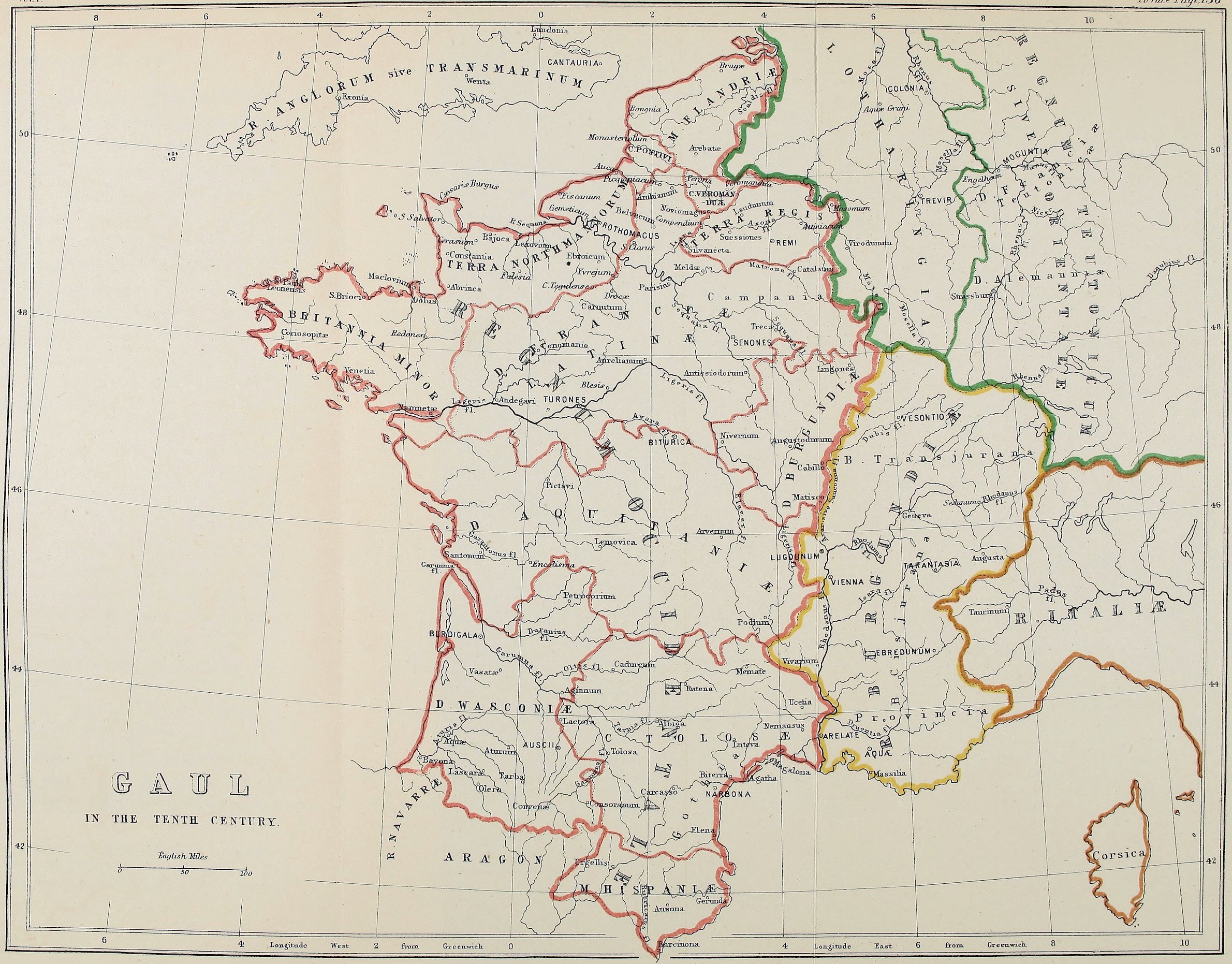
I have added a map of Gaul in the tenth century,
which seemed needful for the better understanding
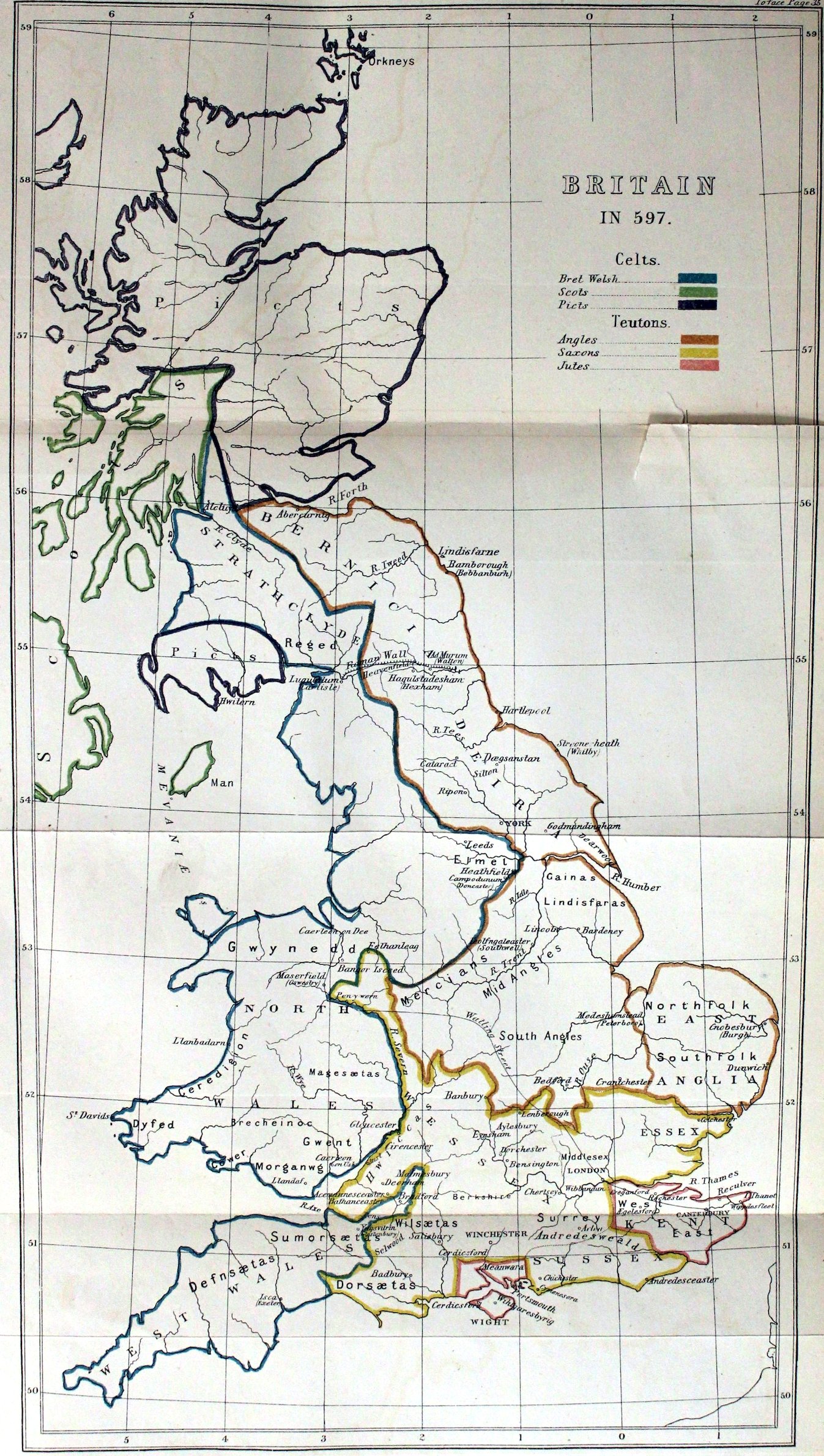
of the fourth Chapter. I have also recast the map
of Britain in 597, which, as it stood in the first
edition, was a failure, owing to the attempt, which
can never be thoroughly successful, to represent the
state of things at two different periods at once. As
it is, it is designed to show, as far as evidence or
probable conjecture makes it possible to show, how
xiithings stood at the exact time of the mission of
Augustine. In this difficult task I have been much
helped by Archdeacon Jones, my former colleague in
writing the History of Saint David’s, by Mr. J. R.
Green, and yet more by Mr. Haddan, whose knowledge
of Celtic matters is really amazing. But,
after all, there are many points on which it is
impossible to get beyond conjecture.
As the changes in the text and notes have disturbed
the order of paging, I have added a special
Index to this edition of these two volumes. When
the whole work is complete, a general Index to the
whole five volumes will be given.
It will be at once seen that these improvements
are in some sort made at the cost of the purchasers
of the first edition, for it is impossible for them to
be thrown into the form of a separate supplement
for their benefit. I can only ask again for their
indulgence towards a course which could not be
helped, if the book was to be brought as near
perfection as might be.
The revision required by these volumes has unavoidably
delayed the composition of the fourth
volume; but I am happy to say that it is begun.
Somerleaze, Wells,
November 26th, 1869.
PREFACE TO THE FIRST EDITION.
xiii
The present volume is the first instalment of a
work which I have contemplated, and for which
I have at various times collected materials, for the
last twenty years. I had hoped to complete the
work, or so much of it as would come down to
the actual accession of William the Conqueror, in
time for it to appear during the year 1866, the
octocentenary year of the Conquest. I found however
that, to make the main subject really intelligible
from my point of view, it was necessary
to treat the preliminary history at much greater
length than I had originally thought of. The present
volume therefore is merely introductory to the
account of the actual Conquest. The second portion
of the narrative, containing the reigns of Eadward,
Harold, and William, is already in progress, and
will follow with all possible speed.
I think it right to add that this work must not
be taken as a sign that I have at all given up the
design of going on with my History of Federal
Government. Of the second volume of that work
a considerable part is already written. One or two
xivcircumstances led me to lay it aside for a time, and
I do not at all regret that such has been the case.
The part on which I was engaged was the history
of the German Confederation, and I find that, of
what I have written, part has already become
antiquated through the events of the past year.
When Germany shall have assumed a shape possessing
some greater chance of permanence than her
present clearly transitional state, I shall be better
able to take a general view of German Federal
history from the beginning. The peculiarity of the
German Confederation is that it is the one recorded
Confederation which arose from the separation of the
component parts of a Kingdom. There now seems
every chance of its changing back again into something
more like its original state. The condition of
the Hanseatic towns also, another part of my subject,
is already greatly modified by the same events.
It is even possible that they may not be without
effect on the European position of Switzerland. On
the whole, I believe that the delay in my work will
only lead to its improvement, and that a volume
on Swiss Federalism, and on German Federalism
generally, will be far more valuable two or three
years hence than it would have been if I had been
able to complete it in the year before last.
With regard to my present work, my main object
is to draw out that view of the Norman Conquest
which I believe to be the one true one. That view,
I may say, is formed by uniting the views of the
two most eminent writers who have dealt with the
subject, Augustine Thierry and Sir Francis Palgrave.
The name of the last-mentioned illustrious scholar
xvcan never be uttered by any student of early English
history without a feeling of deep gratitude. But
his great and unfinished works set forth only half
the truth. His eloquent French rival sets forth the
other half. Each of these great writers must stand
charged with considerable exaggeration on his own
side of the question. Still, in the main, I think we
may say that each is right in what he asserts and
wrong only in what he leaves out of sight. From
one point of view, the Norman Conquest was nearly
all that Thierry says that it was; from another
point of view, it was hardly more than Sir Francis
Palgrave says that it was. Both writers also singularly
resemble each other in a certain lack of critical
power. Nothing in any period of history, above all,
nothing in the period of history with which I am
concerned, is more necessary than to distinguish the
respective value of different authorities. Now in
this respect both Thierry and Sir Francis Palgrave
were deficient. Neither, I believe, ever made a
statement for which he could not give chapter and
verse in some shape or other. But both of them
were too apt to catch at any statement which
seemed at all to support their several theories,
without always stopping to reflect whether such
statements came from contemporary chronicles or
charters or from careless and ill-informed compilers
three or four centuries later.
The prominence which I have given to the preliminary
history contained in this volume is due to
a deep and growing conviction that the history of
the Norman Conquest, and indeed all later English
history also, is constantly misunderstood through
xvia fatal habit of beginning the study of English
history with the Norman Conquest itself. A confused
and unhappy nomenclature hinders many people
from realizing that Englishmen before 1066 were the
same people as Englishmen after 1066. They thus
fail to perceive that the Norman Conquest, instead of
wiping out the race, the laws, or the language which
existed before it, did but communicate to us a certain
foreign infusion in all three branches, which was
speedily absorbed and assimilated into the preexisting
mass. We cannot understand the Norman Conquest
of England without knowing something of the history
both of Englishmen and of Normans before they
met in arms on the hills of Sussex. As regards the
Normans, the conquest of England was but the most
brilliant and the most permanent of a series of
brilliant conquests, from the occupation of Rouen
to the occupation of Naples. As regards England,
the Conquest was the grand and final result of
causes which had been at work at least ever since
the death of Eadgar. The Danish invasions, and the
Norman tendencies of Eadward, each, in different
ways, both suggested the enterprise of William and
made that enterprise easier to be effected. I therefore
look on the earlier history of Normandy, and
still more on the English history from the accession
of Æthelred to the death of Harthacnut, as so closely
connected with my subject as to need a treatment in
considerable detail. With the reign of Eadward the
period of the Conquest itself begins. And I may
add that I have done my best to throw some life
into a period of our history which is full alike of
political instruction and of living personal interest.
xviiThat period is commonly presented to ordinary readers
in the guise either of fantastic legends or else of
summaries of the most repulsive dryness. I have
striven to show what was the real political state of
England in the tenth and eleventh centuries. I
have striven also to clothe with flesh and blood
the dry bones of men like Brihtnoth and Ulfcytel
and Eadmund and our illustrious Danish conqueror
himself.
As in my History of Federal Government I ventured
to restore the Greek spelling of proper names,
so I now follow the example of scholars like Kemble,
Lappenberg, and others, in employing the genuine
spelling of Old-English names. As they are generally
spelled, they are a mere chaos of French and
Latin corruptions, following no principle of any kind.
Æðelstán becomes “Athelstane,” while Æðelred,
exactly the same form, becomes “Ethelred.” I do
not however follow Mr. Kemble in retaining the
obsolete letter ð. It seems to me as much out of
place to write Æðelðryð in the midst of a modern
English sentence, as it would be to write Αθênê
or Θeopompos. At one time I felt inclined to except
those names which are still in familiar use,
like Alfred and Edward, on the same principle on
which I write Philip and not Philippos. Were the
English names, like the Greek, simply cut short at
the end, there would be no difficulty in so doing.
But it would be unpleasantly inconsistent to write
Ælfric and Alfred, Eadwig and Edward. I therefore
make a chronological distinction; by the time of
our post-Norman Edwards, the a had been dropped
in contemporary spelling, and I write accordingly.
xviiiThe names of Normans and other foreigners, William,
John, and the like, I give in their modern
shape. Nothing could be gained by writing Willelm,
Willaume, or Guillaume, all of them mere
corruptions just as much as the modern English
form. Names of places again I write with their usual
modern spelling, because in them we have, what
in the names of men we have not, an universally
received and, allowing for some misconceptions,
fairly consistent system. I except only one or two
places, like Brunanburh, Ethandun, Assandun, of
which the geographical position is more or less uncertain,
and whose fame is wholly confined to the
time of which I am writing.
I have given two maps, chiefly founded on those
in Spruner’s Hand-Atlas. As in the maps which
accompanied my History of Federal Government,
any attempts to mark the boundaries of states whose
boundaries were always fluctuating must always be
more or less conjectural, and my conjectures, or
those of Dr. Spruner, may not be the same as the
conjectures of all my readers. All such attempts
must be taken at what they are worth and no more.
For one such conjecture I am specially responsible.
In the map of Britain in 597 I have attempted, by
means of cross-colouring, to mark the extent of territory
north of the Thames and Avon which was
West-Saxon in 597, but which I believe to have
become Mercian in 628. In so doing I have followed
the indications given by Dr. Guest in his papers and
local maps; but I believe that mine is the first attempt
to show the results of his researches on the
general map of Britain. In this map my object was
xixto mark all ascertained places mentioned in the
Chronicles, with the addition of a few from Bæda,
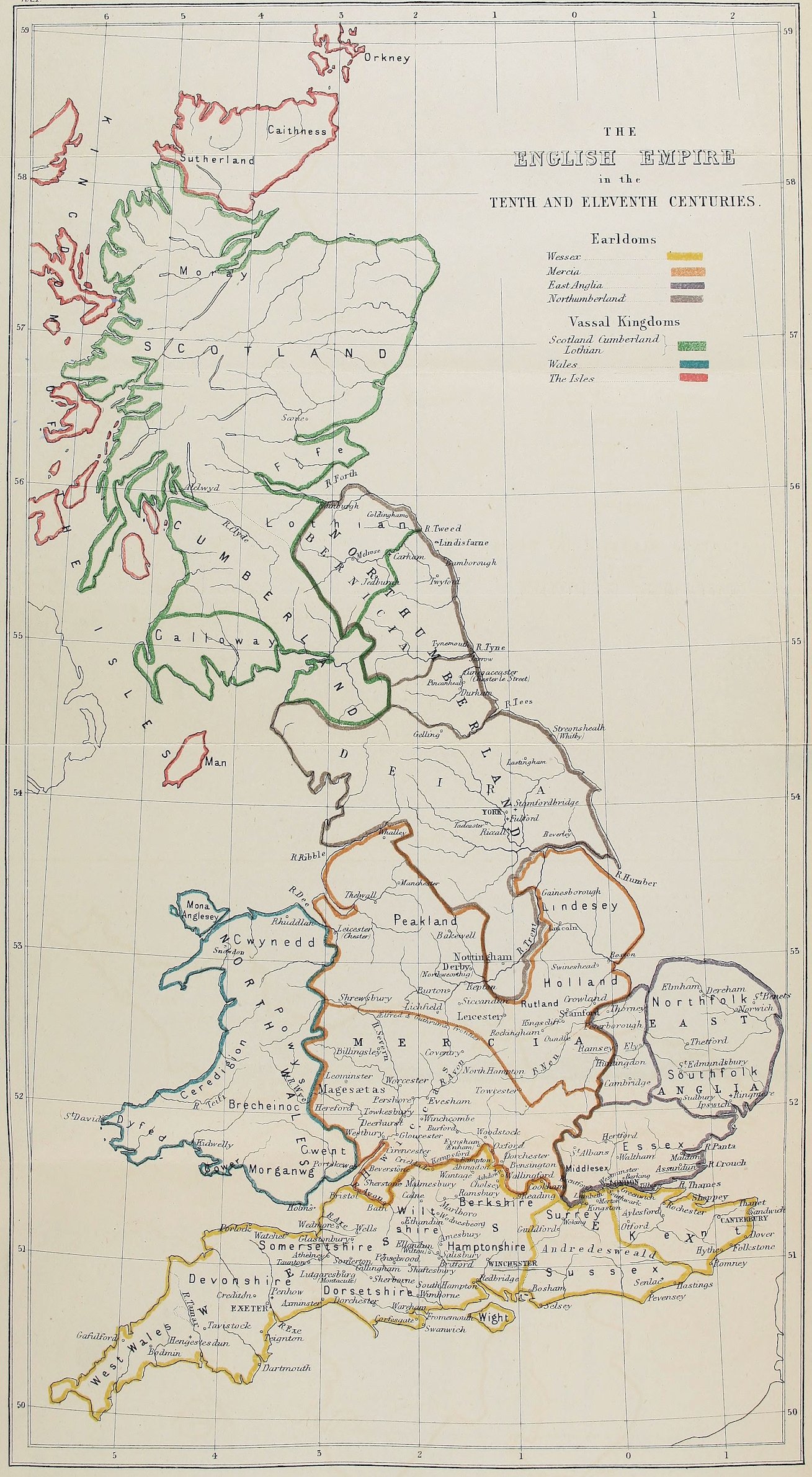
up to the time of Ecgberht. In the later map
of the English Empire my principle was to mark
those places which were mentioned in my own
history from the time of Ecgberht to the Norman
Conquest.
I have now only to return my thanks to those
friends who have helped me in my undertaking in
various ways, by comments and suggestions, by the
loan of books, and in a few cases, though very few,
by verifying references to books which I had not at
hand. At their head I am proud to place the two
men who stand at the head of living students of
English history, Dr. Guest and Professor Stubbs.
I have also to thank Viscount Strangford for several
valuable suggestions as to the early Celtic ethnology
of Britain. My thanks are due also for help of
different kinds to the Rev. S. W. Wayte, now President
of Trinity College, to the Rev. John Earle,
late Professor of Anglo-Saxon, to the Rev. J. E. B.
Mayor, of St. John’s College, Cambridge, to F. H.
Dickinson, Esq., of Trinity College, Cambridge, to the
Rev. J. R. Green, of Jesus College, a rising scholar
to whom I look for the continuation of my own
work, and to W. B. Dawkins, Esq., of Jesus College
and of the Geological Survey. Mr. Dawkins I have
especially to thank for much help in my investigations
of the battle-fields of Maldon and Assandun,
and I look to him for more valuable help still when
I come to the greater battle which forms the centre
of my whole history. And I must add my thanks for
the kindness of every sort which I have uniformly
xxreceived from the Delegates of the University Press,
from one especially whose loss all historical students
are now lamenting, my late learned and deeply
esteemed friend Dr. Shirley.
Somerleaze, Wells,
January 4th, 1867.
CONTENTS.
xxi
CHAPTER I.
INTRODUCTION.
A. D.
PAGE
The Norman Conquest important, not as the beginning of English history, but as its chief turning-point
Importance of the Norman Conquest, not as the beginning of English history, but as its chief turning-point.
The Norman Conquest is the great turning-point in
the history of the English nation. Since the first
settlement of the English in Britain, the introduction
of Christianity is the only event which can compare
with it in importance. And there is this wide difference
between the two. The introduction of Christianity was
an event which could hardly fail to happen sooner or
later; in accepting the Gospel, the English only followed
the same law which, sooner or later, affected all the
Teutonic nations. But the Norman Conquest is something
which stands without a parallel in any other Teutonic
land. If that Conquest be only looked on in its true
light, it is impossible to exaggerate its importance.
And yet there is no event whose true nature has been
more commonly and more utterly mistaken. No event
is less fitted to be taken, as it so often has been taken,
for the beginning of our national history. For its
whole importance is not the importance which belongs
to a beginning, but the importance which belongs to
a turning-point. The Norman Conquest brought with
it a most extensive foreign infusion, an infusion which
affected our blood, our language, our laws, our arts;
still it was only an infusion; the older and stronger
elements still survived, and in the long run they again
made good their supremacy. So far from being the
2beginning of our national history, the Norman Conquest
was the temporary overthrow of our national being. But
it was only a temporary overthrow. To a superficial
observer the English people might seem for a while to
be wiped out of the roll-call of the nations, or to exist
only as the bondmen of foreign rulers in their own
land. But in a few generations we led captive our
conquerors; England was England once again, and the
descendants of the Norman invaders were found to be
among the truest of Englishmen. England may be as
justly proud of rearing such step-children as Simon of
Montfort and Edward the First as of being the natural
mother of Ælfred and of Harold. In no part of history
|Importance of the earlier English history to the right understanding of the Conquest.|
can any event be truly understood without reference to
the events which went before it and which prepared
the way for it. But in no case is such reference more
needful than in dealing with an event like that with
which we are now concerned. The whole importance
of the Norman Conquest consists in the effect which it
had on an existing nation, humbled indeed, but neither
wiped out nor utterly enslaved, in the changes which it
wrought in an existing constitution, which was by
degrees greatly modified, but which was never either
wholly abolished or wholly trampled under foot. William,
King of the English, claimed to reign as the lawful
successor of the Kings of the English who reigned before
him. He claimed to inherit their rights, and he professed
to govern according to their laws. His position
therefore, and the whole nature of the great revolution
which he wrought, are utterly unintelligible without a
full understanding of the state of things which he found
existing. Even when one nation actually displaces
another, some knowledge of the condition of the displaced
nation is necessary to understand the position of
the displacing nation. The English Conquest of Britain
3cannot be thoroughly understood without some knowledge
of the earlier history of the Celt and the Roman. But
when there is no displacement of a nation, when there
is not even the utter overthrow of a constitution, when
there are only changes, however many and important,
wrought in an existing system, a knowledge of the
earlier state of things is an absolutely essential part of
any knowledge of the later. The Norman Conquest of
England is simply an insoluble puzzle without a clear
notion of the condition of England and the English
people at the time when the Conqueror and his followers
first set foot upon our shores.
Character of the Norman Conquest as compared with earlier and later conquests.
The Norman Conquest again is an event which stands
by itself in the history of Europe. It took place at a
transitional period in the world’s developement. Those
elements, Roman and Teutonic, Imperial and ecclesiastical,
which stood, as it were, side by side in the system of
the early middle age, were then being fused together
into the later system of feudal, papal, crusading Europe.
The Conquest itself was one of the most important steps
in the change. A kingdom which had hitherto been
purely Teutonic was brought within the sphere of the
laws, the manners, the speech, of the Romance nations.
At the very moment when Pope and Cæsar held each
other in the death-grasp, a Church which had hitherto
maintained a kind of insular and barbaric independence
was brought into a far more intimate connexion with
the Roman See. And as a conquest, compared with
earlier and with later conquests, the Norman Conquest
of England holds a middle position between the two
classes, and shares somewhat of the nature of both. It
was something less than such conquests as form the
main subject of history during the great Wandering
of the Nations. It was something more than those
political conquests which fill up too large a space in the
4history of modern times. It was much less than a
|The immediate change effected by the Norman Conquest less than the change effected by the Barbarian conquests.|
national migration; it was much more than a mere
change of frontier or of dynasty. It was not such a
change as when the first English conquerors slew, expelled,
or enslaved the whole nation of the vanquished
Britons. It was not even such a change as when Goths
or Burgundians sat down as a ruling people, keeping
their own language and their own law, and leaving the
language and law of Rome to the vanquished Romans.
But it was a far greater change than commonly follows
on the transfer of a province from one sovereign to
another, or even on the forcible acquisition of a crown
by an alien dynasty. The conquest of England by
William wrought less immediate change than the conquest
of Africa by Genseric; it wrought a greater
immediate change than the conquest of Sicily by Charles
of Anjou. |In what the change really consisted.|
It brought with it not only a new dynasty,
but a new nobility; it did not expel or transplant the
English nation or any part of it; but it gradually
deprived the leading men and families of England of
their lands and offices, and thrust them down into a
secondary position under alien intruders. It did not at
once sweep away the old laws and liberties of the land;
but it at once changed the manner and spirit of their
administration, and it opened the way for endless later
changes in the laws themselves. It did not abolish the
English language; but it brought in a new language
by its side, a language which for a while supplanted it
as the language of polite intercourse, and which did not
yield to the reviving elder speech till it had affected
it by the largest infusion that the vocabulary of one
|Formal legislative changes for the most part of a later date.|
European tongue ever received from another. The most
important of the formal changes in legislation, in language,
in the system of government and in the tenure
of land, were no immediate consequences of the Conquest,
5no direct innovations of the reign of William. They
were the gradual developements of later times, of times
when the Norman as well as the Englishman found
himself under the yoke of a foreign master. But the
reign of William paved the way for all the later changes
that were to come, and the immediate changes which
|Immediate results of the Conquest mainly practical.|
he himself wrought were, after all, great and weighty.
They were in truth none the less great and weighty
because they affected the practical condition of the
people far more than they affected its written laws and
institutions. When a nation is driven to receive a
foreigner as its King, when that foreign King divides
the highest offices and the greatest estates of the land
among his foreign followers, though such a change must
be carefully distinguished from changes in the written
law, still the change is, for the time, practically the
greatest which a nation and its leaders can undergo.
Plan and extent of the present History.
I propose then, as a necessary introduction to my
narrative of the actual Conquest, to sketch the condition
of England and of Normandy at the time when the two
nations came into contact with each other. This process
will involve a summary of the earlier history of both
|Narrative of the actual Conquest and its immediate causes. 1042–1087.|
countries. From the beginning of the eleventh century
the history of England and of Normandy becomes more
and more intermixed, and it will be necessary to tell
the story more and more in detail. The period of the
actual Conquest and its immediate causes, the reigns
of Eadward, of Harold, and of William, will form the
centre of the work. The reigns of William’s sons will
show the character of the Norman government in England,
and the amount of immediate change which it really
|Accession of the Angevin dynasty. 1154.|
brought with it. With the accession of the Angevin
dynasty the purely Norman period comes to an end. A
King succeeds who is in one sense both Norman and
English, in another sense neither Norman nor English.
6Presently Norman and Englishman alike have to struggle
for their own against the perpetual intrusion of fresh
shoals of foreigners seeking their fortunes at the expense
of both. The natural effect of this struggle was that
Norman and Englishman forgot their differences, and
|Reign of Henry the Second. 1154–1189.|
united in resistance to the common enemy. Under
Henry the Second the struggle is for a while delayed,
or veils itself under an ecclesiastical form. A prelate
of English birth but of the purest Norman descent,
wins the love of the English people in a struggle in
which nothing but an unerring instinct could have
shown them that their interest was in any way involved.
|Degradation of England under Richard the First. 1189–1199.|
Under Richard, the most thoroughly foreign of all our
Kings, the evil reaches its height, and England might
pass for a dependency of the Count of Poitiers. As is
usual in cases of national discontent, it is not till the
worst day is passed that the counter-revolution openly
|National struggle against foreigners. 1214–1272.|
begins. Under John and his son Henry, the history of
England becomes mainly the history of a struggle between
the natives of the land, of whatever race, and the foreign
favourites of the court. Norman and Englishman are
|1265.|
now reconciled; and by their joint work the Old-English
liberties are won back in another form, and the modern
|End of the work under Edward the First. 1272–1307.|
constitution of England begins. At last England, having
already won over her baronage, at last wins over her King.
The work of reconciliation is completed under the best
and greatest of our later Kings, the first who, since the
Norman entered our land, either bore a purely English
name or followed a purely English policy. Under the
great Edward England finally assumed those constitutional
forms which, with mere changes of detail, she has
preserved uninterrupted ever since. The work of the
Conquest is now over; the two races are united under
a legislation whose outward form and language was in
a great measure French, but whose real life was drawn
7from the truest English sources. Here then our narrative,
even as the merest sketch, comes to its natural close.
But for a long time before this point, a mere sketch,
pointing out the working of earlier events in their
results, will be all that will be needed. The kernel of
my narrative will consist of the history of the five and
forty years from the election of Eadward to the death
of William. The history of these years will fill my
three central volumes, containing the history of the
actual Conquest and its immediate causes. This central
portion will be introduced, as is essential to its understanding,
by a sketch of the events which led to it,
gradually developing in minuteness from the beginning
of the English Conquest to the extinction of the Danish
dynasty in England. And it will be wound up with
what is no less essential, with a sketch of the history
gradually lessening in minuteness down to the reign of
Edward the First, and discussing the permanent results
of the Conquest on the laws, the language, the arts,
and the social condition of England.
CHAPTER II. THE FORMATION OF THE KINGDOM OF ENGLAND. 449–975. — § 1. The Heathen period of English Conquest. 449–597. — § 2. Conversion of the English to Christianity. 597–681. — § 3. Fluctuations of dominion between Northumberland, Mercia, and Wessex. 577–823. — § 4. Permanent Supremacy of Wessex. 823–924. — § 5. The Imperial Sovereignty of the West-Saxon Kings of the English. 924–975.
8
The races and languages of Britain essentially the same at the time of the Norman Conquest as they are now.
The Norman invaders in the eleventh century found in
the Isle of Britain, as any modern invader would
find now, three nations, speaking three languages; and
they found then, as would be found now, one of the three
holding a distinct superiority over the whole land. Then
as now, English, Welsh, and Gaelic were the three distinct
tongues of the three races of the island; then as now, the
dominant Teuton knew himself by no name but that of
Englishman, and was known to his Celtic neighbour by no
name but that of Saxon. The boundaries of the two races
and of their languages were already fixed, nearly as they
remain at present. The English tongue has made some
advances since the eleventh century; but they are small
compared with the advances which it had made between
|Preservation of local names and divisions in England.|
the fifth century and the eleventh. The main divisions of
the country, the local names of the vast mass of its towns
and villages, were fixed when the Norman came, and they
have survived, with but little change, to our own day.
While a map of France or Germany in the eleventh century
is useless for modern purposes, and looks like the picture of
another region, a map of England proper in the reign of
Victoria hardly differs at all from a map of England proper
in the reign of William. The Norman found in the land
substantially the same English nation which still exists,
9occupying substantially the same territory which it occupies
at present. He found it already exhibiting, in its
laws, its language, its national character, the most essential
|The Norman element absorbed in the English nation then and now existing.|
of the features which it still retains. Into the English
nation which he thus found already formed his own dynasty
and his own followers were gradually absorbed. The
conquered did not become Normans; but the conquerors
did become Englishmen. It was by a very different process
that the English themselves had made good their footing
in the land in which the Norman found them, and to
which they had long before given their name.
The English Conquest of Britain. A.D. 449–924.
The details of the English Conquest of Britain, and
the exact amount of historical truth to be found in them,
are questions which hardly concern us here. It will be
enough to point out the essential difference between
the traditional narrative of the English Conquest, as
contained in the English Chronicles,[1] and the romantic
narrative of which Geoffrey of Monmouth is the chief
|General credibility of the traditional narrative.|
spokesman. The narrative in the Chronicles is perfectly
credible in itself, and perfectly consistent with all the
undoubted phænomena of later history. It is also perfectly
consistent with the record of all those living witnesses
whose testimony may be mistaken, but which themselves
cannot lie. Such are the evidence of language and local
nomenclature, the evidence of the surviving antiquities, the
camps, the dykes, the barrows, which chronicle this warfare
as well as the warfare of earlier and of later times. The
only question is whether an accurate narrative of details
10can have been handed on from the date assigned to
Hengest to the ascertained date of Bæda, whether by oral
tradition, by runes, or by written documents which are lost
to us. And this really amounts to little more than a
question whether, in the earliest part of the narrative, the
exact names and the exact dates can always be trusted.
Some of the earlier names may be mythical;[2] some of the
dates may have been reached by ingenious calculation
rather than by genuine tradition. But granting all this,
the main substance of the narrative remains essentially
where it was.
Much learning and ingenuity has been spent, and, I
venture to think, in many cases wasted, in attempts to
show the untrustworthiness of the traditional account, by
|Questions of earlier Teutonic invasions and settlements in Britain.|
bringing forward proofs of Teutonic invasions, and even of
Teutonic settlements, of an earlier date than that assigned
by the Chronicles to the beginning of the English
Conquest.[3] The facts which are brought forward are in
most cases probable and in some cases certain, but I cannot
look on them as having that bearing on later history which
they have sometimes been supposed to have. It is possible
that, among the tribes which Cæsar found in Britain,
some, especially in the eastern districts of the island, may
have been of Teutonic origin, or in some degree mingled
with Teutonic elements. It is certain that in Britain, as
11everywhere else, Teutonic soldiers largely served in the
Roman armies, and that settlements of such soldiers sometimes
grew into permanent colonies.[4] It is certain that,
long before the days of Cerdic or Hengest, Theodosius and
Stilicho repelled Teutonic invasions; and it is probable
that, by repelling such invasions, they hindered the formation
of Teutonic settlements in Britain at that earlier
|The course of the English Conquest not affected by them.|
time.[5] But these facts or probabilities do not affect the
credibility of the recorded course of the English Conquest,
or of the tradition which fixes its real beginning in the
middle of the fifth century. Teutonic settlements before
the Roman invasion, or under the Roman domination,
would be something quite different from the Teutonic
invasions recorded from the fifth century onwards. Teutonic
tribes subdued by the Roman arms, Teutonic soldiers
12planted as colonists by the Roman government, would sink
into the general mass of Roman subjects; they would
retain no strong national feeling; they would most
likely not even retain their national language. The
only way in which they could possibly influence the later
history would be by making the establishment of the later
Teutonic settlers a less difficult matter in those parts of
the country which they occupied than in those where the
population was purely Celtic or Roman.[6] We may admit
the fact that the Teutonic, and even the distinctively
Saxon, invasions began, not in the fifth century, but in
|Light thrown on these events by the analogy of the Danish invasions.|
the fourth. But the true bearing of this fact will be best
understood by comparing the successive Saxon invasions
with the later and better known invasions of the Danes
both in England and in Gaul. In the Danish invasions I
shall presently endeavour to establish three periods, one of
mere plunder, one of settlement, one of political conquest.
For the last of these three there was no opportunity under
the circumstances of the earlier Teutonic invaders, but for
the first two stages we may fairly look in the history of
the English, as well as in that of the Danish, Conquest.
The Saxon pirates against whom the Roman government
found it needful to establish so elaborate a system of
defence, find their parallels in those Danish plundering
expeditions which ravaged various parts of England in the
latter half of the eighth century and the former half of the
ninth, and in the ravages inflicted on Gaul by chieftains
earlier than Hasting. The Anglian, Saxon, and Jutish
settlements of the fifth and sixth centuries answer to the
|878.|
settlements of Guthrum in East-Anglia in the ninth
|912.|
century and of Rolf in Neustria in the tenth. Even if it
be held that the Saxons who were driven back by Theodosius
and Stilicho designed settlement and not merely
13plunder, still, as they did not actually settle, the case
remains much the same. The Teutons were baffled in their
attempts at settlement in the fourth century; they succeeded
in their attempts at settlement in the fifth. The
general history of the Conquest, as handed down to us in
the Chronicles, is therefore in no way affected by the
certain fact of earlier incursions, by the possible fact of
much earlier settlements. The really lasting effect of the
Saxon invasions of the fourth century seems to have been
this; the Saxon name became familiar to the Celtic inhabitants
of Britain earlier than the Anglian name; consequently
Saxon, and not Angle or English, has been the
name by which the Teutonic immigrants in Britain have
been known to their Celtic neighbours from that day to
this.[7]
Course of the English Conquest.
What then the English Chronicles profess to record is,
not these early and transient incursions which led to no
permanent result, but that series of constant, systematic,
successful attempts at settlement on the part of various
Teutonic tribes which constituted the English Conquest of
|418.|
Britain. Early in the fifth century the Roman legions
were withdrawn from the island, and the former provincials
were left to defend their new and precarious independence
|No improbability in the story of Vortigern’s invitation, but the tale not essential.|
how they might. The Southern Britons were now exposed
to the attacks of the Picts and Scots who had never
submitted to the Roman yoke, and there is no absurdity in
the familiar story that a British prince took Teutonic
mercenaries into his pay, and that these dangerous allies
took advantage of the weakness of their hosts to establish
themselves as permanent possessors of part of the island.
14But if this account be rejected, the general narrative of the
Conquest is in no way affected; and, if it be accepted, we
may be sure that Vortigern’s imitation of many Roman
precedents did but hasten the progress of events. The
attempts which had been checked while the Roman power
was flourishing were sure to be renewed when the check
was withdrawn, and if a Welsh King did invite a Jutish
chieftain to defend him, that invitation was only the
occasion, and not the cause, of the Conquest which now
|449–597.|
began. We cannot seriously doubt that, in the course of
the fifth and sixth centuries, a succession of tribes of
kindred origin, all of them of the same Low-Dutch[8] stock,
and speaking essentially the same Low-Dutch language,
landed at various points of the British coast, that they
gradually forced their way inland, and founded permanent
|Extent of the English dominion and of the independent British states at the end of the sixth century.|
Teutonic kingdoms. Before the end of the sixth century
the Teutonic dominion stretched from the German Ocean
to the Severn, and from the English Channel to the Firth
of Forth. The northern part of the island was still held
by Picts and Scots, Celtic tribes whose exact ethnical
relation to each other hardly concerns us.[9] And the whole
15west side of the island, including not only modern Wales,
but the great kingdom of Strathclyde, stretching from
Dumbarton to Chester, and the great peninsula containing
Cornwall, Devon, and part of Somerset, was still in the
hands of independent Britons. The struggle had been
long and hard, and the natives often kept their hold of a
defensible district long after the surrounding country had
been occupied by the invaders. It is therefore probable
that, at the end of the sixth century and even later, there
may have been within the English frontier inaccessible
points where detached bodies of Welshmen still retained a
precarious independence. It is probable also that, within
the same frontier, there still were Roman towns, tributary
to the conquerors rather than occupied by them.[10] But by
the end of the sixth century even these exceptions must
|The English Conquest, as a whole, accomplished by 597.|
have been few. The work of the Conquest, as a whole,
was accomplished. The Teutonic settlers had occupied by
far the greater part of the territory which they ever were,
in the strictest sense, to occupy. The complete supremacy
of the island was yet to be won; but that was to be won,
when it was won, by quite another process.
Points of difference between the English Conquest and other Teutonic conquests.
The English Conquest of Britain differed in several
important respects from every other settlement of a
Teutonic people within the limits of the Roman Empire.
Everywhere else the invaders gradually adopted the
language and the religion of the conquered. If the
16conquerors were heathens at the time of their settlement,
they gradually adopted Christianity. If they had already
adopted Christianity in its Arian form, they gradually
exchanged their heretical creed for that of the Catholic
|Gradual Romanization of the conquerors elsewhere in religion, language, &c.|
Church. Everywhere but in Britain the invaders gradually
learned to speak some form, however corrupt,
of the language of Rome. The Teutonic conquerors of
Italy, Spain, and Gaul have indeed infused into the
Romance languages of these countries a large proportion
of words of Teutonic origin. Still the language of all
those countries remains essentially Latin; the Teutonic
element in them is a mere infusion. Everywhere but
in Britain the invaders respected the laws and the arts
of Rome. The Roman Law was preserved, side by side
with the Barbarian codes, as the rightful heritage of
the conquered people; and, in the process of ages, the
Roman Law gradually recovered its position as the dominant
code of a large portion of continental Europe. Everywhere
but in Britain the local divisions and local nomenclature
survived the Conquest. Nearly every Gaulish tribe
recorded by Cæsar has left its name still to be traced on
the modern map.[11] In Britain everything is different.
|Retention by the English of their Teutonic language and heathen worship.|
The conquering English entered Britain as heathens, and,
after their settlement in Britain, they still retained the
heathen worship of their fathers. They were after a while
converted to Christianity, but they were not converted by
the Christians whom they found in the island, but by a
special mission from the common ecclesiastical centre. Our
bishoprics and ecclesiastical divisions are not, as they are
in Gaul, an heritage of Roman times, representing Roman
17political divisions. Our oldest episcopal sees are foundations
of later date than the English Conquest, and the
limits of their dioceses answer, not to anything Welsh
or Roman, but to the boundaries of ancient English
|History of the English language—|
principalities. And, as the English in Britain retained
their religion, so they also retained their language, and
they retained it far more permanently. A few Celtic,
and a still fewer Latin,[12] words found their way into
English from the first days of the Conquest, and a
somewhat larger stock of Latin ecclesiastical terms[13] was
|a Low-Dutch tongue with a Romance infusion.|
naturally brought in by the Christian missionaries. But,
with these two very small classes of exceptions, the
English language retained its purely Low-Dutch character
down to that great infusion of Romance words into our
vocabulary which was a result, though not an immediate
result, of the Norman Conquest. And to this day,
though the Romance infusion divides the vocabulary of
our dictionaries with our natural Teutonic speech, it still
remains only an infusion, an infusion greater in degree,
but essentially the same in kind, as the Teutonic infusion
into the Romance languages.[14] As we cannot put together
the shortest French sentence without the use of Romance
words, so we cannot put together the shortest English
sentence without the use of Teutonic words. But we can
put together sentence after sentence of French without
a single Teutonic word, and we can equally put together
sentence after sentence of English without a single
Romance word. In Britain too the arts of Rome
perished as utterly as the language and the religion of
Rome; arts, language, and religion were all brought
back again at a later time and in a corrupted form.
18|Slight and late influence of the Roman Law in England.|
The laws of Rome perished utterly; they exercised no
influence upon our insular jurisprudence, until, in times
after the Norman Conquest, the Civil Law was introduced
as something utterly exotic. And even then our insular
jurisprudence proved too strong for it; the Imperial
legislation never gained in England the same supremacy
which it gained in most parts of the Continent, and even
in the Scottish portion of our island. The municipal
institutions of the Roman towns in Britain utterly
perished; no dream of ingenious men is more groundless
than that which seeks to trace the franchises of English
|Local nomenclature of England essentially Teutonic.|
cities to a Roman source. In England again the local
nomenclature is everywhere essentially Teutonic. A few
great cities and a few great natural objects, London on
the Thames and Gloucester on the Severn, still retain
names older than the English Conquest; but the great
mass of the towns and villages of England bear names
which were given them either by the Angles and Saxons
of the fifth and sixth centuries or by the Danes of the
|Probable extirpation of the Celtic inhabitants.|
ninth and tenth. In short, though the literal extirpation
of a nation is an impossibility,[15] there is every reason to
believe that the Celtic inhabitants of those parts of
Britain which had become English at the end of the
sixth century had been as nearly extirpated as a nation
can be. The women would doubtless be often spared;[16]
but as far as the male sex is concerned, we may feel sure
that death, emigration, or personal slavery were the only
alternatives which the vanquished found at the hands
19of our fathers. The nature of the small Celtic element
|Nature of the Celtic element in English confirms this view.|
in our language would of itself prove the fact. Nearly
every Welsh word which has found its way into English
expresses some small household matter, such as women
and slaves would be concerned with; nearly all the
words belonging to the nobler callings, all the terms
of government and war, and nearly all the terms of
agriculture, are thoroughly Teutonic. In short, everywhere
but in Britain an intruding nation sat down by
the side of an elder nation, and gradually lost itself in
its mass. In Britain, so far as such a process is possible,
the intruding nation altogether supplanted the elder
|Difference in the actual process of the Conquest in Britain and elsewhere.|
nation. The process of the Conquest again, its gradual
character, the way in which the land was won, bit by
bit, by hard fighting, was of itself widely different from
the Gothic settlements in Italy or Spain. This peculiar
character of the English Conquest would of itself favour
the complete displacement of the former inhabitants, by
giving the remnant of the vanquished in any district
the means of escape to those districts which were yet
unconquered.
Causes of the difference.
This remarkable contrast between the English Conquest
of Britain and the other Teutonic settlements within
the Empire seems to be due to two main causes. The
position of Britain differed from that of Italy or Gaul
or Spain, and the position of the Angles and Saxons
differed from that of Goths, Burgundians, or even Franks.
|Britain less thoroughly Romanized than Gaul and Spain.|
The event alone might seem to show that the Roman
occupation of Britain had not brought about so complete
a Romanization of the country as had taken place in
Gaul and Spain. The evidence of language looks the
same way. In Spain and in Gaul the ante-Roman
languages survive only in a few out of the way corners;
the speech of the land is Roman. But in no part of
Britain has any Roman language been spoken for ages;
20the speech of the land, wherever it is not English, is
not Roman but Celtic. The surviving Britons kept,
and still keep, their own native language and not the
language of their Roman conquerors. It would therefore
seem that the Roman occupation of Britain was, after
all, very superficial, and that, when the legions were
withdrawn, the natives largely fell back into their ancient
barbarism. The English therefore found in Britain a
more stubborn, because a more truly national, resistance
than any that their Teutonic kinsmen found elsewhere.
But on the other hand, they did not find that perfect
and striking fabric of Roman laws, manners, and arts
which elsewhere impressed the minds of the conquerors,
|Familiarity of the other Teutons with Roman civilization.|
and changed them from destroyers into disciples. Again,
the Goths above all, and the Franks in some degree,
had long been familiar with Rome in peace and in war.
They had resisted Roman attempts at conquest and
they had repaid them in kind. They had served in the
Roman armies, and had received lands and honours and
offices as the reward of their services. They were, in
short, neither wholly ignorant of Roman civilization nor
|The English utterly ignorant of it.|
utterly hostile to it. But our forefathers came from
lands where the Roman eagle had never been seen, or
had been seen only during the momentary incursions of
Drusus and Germanicus. They had never felt the charm
which led Gothic kings to glory in the title of Roman
generals, and which led them to respect and preserve
the forms of Roman civilization and the monuments of
Roman art. Our forefathers appeared in the Isle of
Britain purely as destroyers; nowhere else in Western
Europe were the existing men and the existing institutions
so utterly swept away. The English wiped out everything
Celtic and everything Roman as thoroughly as
everything Roman was wiped out of Africa by the
Saracen conquerors of Carthage. A more fearful blow
21never fell on any nation than the landing of the Angles
|Results of the peculiar character of the English Conquest.|
and Saxons was to the Celt of Britain. But we may
now be thankful for the barbarism and ferocity of our
forefathers. Had we stayed in our earlier land, we should
have remained undistinguished from the mass of our
Low-Dutch kinsfolk. Had we conquered and settled
only as Goths and Burgundians conquered and settled,
we should be simply one more member of the great
family of the Romance nations. Had we been a colony
sent forth after the mother country had attained to any
degree of civilization, we might have been lost like the
Normans in Sicily or the Franks in Palestine. As it
was, we were a colony sent forth while our race was
still in a state of healthy barbarism. We won a country
for ourselves, and we grew up, a new people in a new
land, bringing with us ideas and principles common to
us with the rest of our race, but not bringing with us
any of the theories and prejudices which have been the
bane of later colonization. Severed from the old stock,
and kept aloof from intermixture with any other, we
ceased to be Germans and we did not become Britons
or Romans. In our new country we developed a new
system for ourselves, partly by purely native growth,
partly by independent intercourse with the common centre
of civilization. The Goth is merged in the Romance
population of Italy, Spain, and Aquitaine; the Old-Saxon
has lost his national being through the subtler proselytism
of the High-German; but the Angles, Saxons, and Jutes,
transplanted to the shores of Britain, have won for themselves
a new name and a new national being, and have
handed on to us the distinct and glorious inheritance
of Englishmen.
Condition of Britain at the end of the sixth century.
Thus, before the end of the sixth century, by far the
greater and more fertile portion of Britain had become
22heathen and Teutonic. The land had been occupied by
various tribes; and most probably, as always happens in
such migrations, few bodies of settlers had been perfectly
homogeneous. A certain following of allies or subjects of
other races is almost sure to come in under the shadow of
the main body. But it is clear that that main body was
everywhere so distinctly and predominantly of Low-Dutch
blood and speech as to swallow up any foreign elements
which may have accompanied it during its migration, as
well as any that it may have incorporated during the
|The country occupied by various kindred tribes, Angles, Saxons, Jutes, and Frisians.|
process of the Conquest or after its completion. Three
kindred tribes, Angles, Saxons, and Jutes, are, in the
common national tradition, said to have divided the land
among them in very unequal proportions. For Saxons a
contemporary foreign notice substitutes Frisians.[17] But
Angles, Saxons, Frisians, were all tribes of one common
stock; all spoke mere dialectic varieties of one common
tongue. From the very beginning of the Conquest, all
the Teutonic settlers, without distinction, are spoken of as
belonging to “the English kin.”[18] To trace out, by the
evidence of local nomenclature or otherwise, the exact
extent of the settlements of these various kindred tribes is
highly interesting and important as a matter of antiquarian
and philological research. But the results of such inquiries
are of little moment for the purpose of such a sketch as
the present. |The various Teutonic tribes in Britain fused into one nation before the Norman Conquest.|
Long before the Norman Conquest the
various Low-Dutch tribes in Britain had been fused into
one English nation. The distinction between Angle and
Saxon had become a merely provincial distinction, and the
23jealousies which undoubtedly survived between them had
become merely provincial jealousies. To the united nation
the Angle had given his name, the Saxon had given
his royal dynasty; the Jute, the least considerable in the
extent of his territorial possessions, had been, according to
all tradition, the first to lead the way to a permanent
settlement, and he had undoubtedly been honoured by
supplying the ecclesiastical centre from which Christianity
was spread over the land. If Wessex boasted of the royal
capital of Winchester, Kent boasted no less proudly of the
spiritual metropolis of Canterbury.
The old notion of a regular Heptarchy inaccurate,
The old notion of an Heptarchy, of a regular system of
seven kingdoms, united under the regular supremacy of a
single over-lord, is a dream which has passed away before
the light of historic criticism. The English kingdoms in
Britain were ever fluctuating, alike in their number and in
their relations to one another. The number of perfectly
independent states was sometimes greater and sometimes
less than the mystical seven; and, till the beginning of the
ninth century, the whole nation did not admit the regular
|yet seven kingdoms more conspicuous than others.|
supremacy of any fixed and permanent over-lord. Yet it is
no less certain that, among the mass of smaller and more
obscure principalities, seven kingdoms do stand out in a
marked way, seven kingdoms of which it is possible to put
together something like a continuous history, seven kingdoms
which alone supplied candidates for the dominion of
the whole island. First comes the earliest permanent
|Kent. 449–825.|
Teutonic settlement in Britain, the Jutish kingdom of
Kent. The direct descendants of Hengest reigned over a
land, which, as the corner of Britain nearest to the continent,
has ever been the first to receive every foreign
immigration, but which, notwithstanding, prides itself to
this day on its specially Teutonic character and on the
retention of various old Teutonic usages which have
vanished elsewhere. Besides Kent, the Jutes formed no
24other strictly independent state. Their only other settlement
|[The Jutes of Wight. 530–686.]|
was a small principality, including the Isle of Wight
and part of Hampshire, whose history is closely connected
with that of the great Saxon kingdom in its immediate
|The three Saxon kingdoms.|
neighbourhood, in which it was at last merged. The
remainder of the English territory south of the Thames,
together with some districts to the north of that river,
formed the three kingdoms of the Saxons, the East, the
South, and the West, whose names speak for themselves.
Among these Sussex and Essex fill only a secondary part in
|Sussex. 477–825.|
our history. The greatness of Sussex did not last beyond
the days of its founder Ælle, the first Bretwalda. Whatever
|Essex. 526–825.|
importance Essex, or its offshoot Middlesex, could
claim as containing the great city of London was of no
long duration. We soon find London fluctuating between
the condition of an independent commonwealth and that of
a dependency of the Mercian Kings. Very different was
|Wessex. 519–869.|
the destiny of the third Saxon kingdom. Wessex has
grown into England, England into Great Britain, Great
Britain into the United Kingdom, the United Kingdom
into the British Empire. Every prince who has ruled
England before and since the eleventh century[19] has had
the blood of Cerdic the West-Saxon in his veins. At the
|577–584.|
close of the sixth century Wessex had risen to high
importance among the English kingdoms, though the
days of its permanent supremacy were still far distant.
Step by step, from a small settlement on the Hampshire
coast, the West-Saxons had won their way, fighting battle
after battle against the Welsh, and, after nearly every
battle, extending their borders by a new acquisition of
25territory. At the time of which I speak they held the
modern shires of Hampshire, Berks, Wilts, Dorset, part of
Somerset, with a considerable dominion north of the
Thames and Avon, including the shires of Buckingham,
Oxford, Gloucester, and Worcester, and an undefined territory
stretching northwards along the valley of the Severn.[20]
But this northern dominion was not lasting; the Thames
and the Avon became the permanent boundaries of Wessex
to the north, and the later extension of the West-Saxon
dominion was wholly westward. At this time the Somerset
Axe, and the forests on the borders of Somerset and
Wiltshire, separated the kingdom from the independent
|The three Anglian kingdoms.|
Britons to the West. North of the Thames lay the three
great kingdoms of the Angles. One of these, probably
the most purely Teutonic realm in Britain,[21] occupied the
great peninsula, or rather island,[22] between the fens and
|East-Anglia. 571–870.|
the German Ocean, which received from them the name of
East-Anglia. Far to the north, from the Humber to the
|Northumberland. 547–876.|
Forth, lay the great realm of the Northumbrians, sometimes
united under a single prince, sometimes divided by
the Tyne or the Tees into the two kingdoms of Bernicia
and Deira. Both these kingdoms have a large sea-board,
but they are not, like Wessex, distinctly attributed to a
personal founder from beyond sea. The first recorded King
of the Northumbrians is Ida, who began to reign in 547;[23]26the first recorded King of the East-Angles is Offa, who
began to reign in 571.[24] These dates give the beginnings
of the kingdoms, but they do not give the beginnings of
the English settlements in those countries. What Ida and
Offa did was apparently to unite districts ruled by several
independent, or at most confederated, Ealdormen into a
|Mercia. 584?–877.|
single kingdom. Meanwhile, in the middle of Britain, a
power equal to any of the others was growing up, in which
the same process is still more plainly to be discerned.
The kingdom of the Mercians, the march or border land
against the Welsh, appears at the end of the sixth century
as a powerful state, but it has no distinctly recorded
|Peculiar character of Mercia, as an union of small states of different origins.|
founder, no distinctly recorded date of origin.[25] It seems
to have grown up through the joining together of a great
number of small principalities, probably of much more
varied origin than the different portions of the other
kingdoms. The prevailing blood was Anglian; but it is
certain that the Mercian kingdom was considerably enlarged
by conquest at the expense of the Saxon race.
The West-Saxon conquests north of the Thames and Avon
were gradually cut off from the West-Saxon body, and
27were constrained, along with all the other states of
Mid-England, to admit the Mercian supremacy. Mercia,
throughout its history, appears far more divided than any
other part of England, the result, no doubt, of its peculiar
|Minor principalities in the other kingdoms.|
origin. But it must not be supposed that the other kingdoms
formed compact or centralized monarchies. Wessex
was an union of several kindred principalities, each having
its own Ealdorman or Under-king, though all were united
under one supreme chief. At one time five West-Saxon
Kings appear in a single battle.[26] So in Kent there were
Kings of East and West Kent, a fact which has left its
memory in our ecclesiastical arrangements to the present
day. No other English shire contains two bishoprics;
the two sees of Canterbury and Rochester still bear witness
to the former existence of two distinct kingdoms within
the present shire. So, in East-Anglia, the two divisions of
the race, the North and the South Folk, have left their
almost unaltered names to two modern counties. But in
these cases the principalities seem to have been formed by
separate, though kindred, detachments of colonists, each of
them ruled by a prince of the one royal house. In Wessex
each successive conquest from the Welsh seems to have
formed a new principality; but the national unity of the
West-Saxon people was never lost, and it does not appear
that any but princes of the line of Cerdic ever ruled
within their borders. But in Mercia a crowd of wholly
independent principalities seem to have been gradually
united under one common rule—a type of the fate which
the whole island was destined to undergo, though not
at the hands of Mercia.
Such were the territorial divisions of Teutonic Britain
at the end of the sixth century. Among a crowd of lesser
states seven principal Kingdoms stand out conspicuously.
And I do not hesitate to add that it was by no means
28unusual for the sovereign of one or other of these states
|The supremacy of the Bretwaldas.|
to win, whether by arms or by persuasion, a certain
dominion over the rest, a dominion which presented the
aspect of an acknowledged, though probably not a very
well defined, supremacy. The famous title of Bretwalda[27]
appears to have been borne by the princes in whom such
a supremacy was successively vested. Eight kings, of
five different kingdoms, including all the seven except
Essex and Mercia, are said to have possessed this
supremacy over the rest of their fellows. The list, it
should be remarked, does not form a continuous series,
and it ends, after a considerable gap, with the prince
who established in one kingdom a lasting supremacy
over all the rest. The earlier names probably represent
earlier attempts at establishing a supremacy of the same
kind, a supremacy which was more or less fully acknowledged
at the time, but which the princes who
held it failed to hand on to their successors. The early
Bretwaldas and their dominion present us with the first
foreshadowings of that union of the whole English race
which was at last carried out by the West-Saxon Kings
of the ninth and tenth centuries.
The last years of the sixth century were marked by
a change hardly less important than the first settlement
of the Teutonic tribes in Britain. The Christian faith,
which the English had hitherto despised or passed by
unheeded as the creed of the conquered Welsh, was now
set before them by a special mission from the city
which still commanded the reverence of all Western
Europe. Kent, under its King Æthelberht, who then
29held the rank of Bretwalda, became the first Christian
|597.|
kingdom, and Canterbury became the first Christian city,
the spiritual metropolis of the English nation. To the
vanquished Welsh the conquering Saxons and Angles
|Controversies between the Roman and Scottish parties.|
had never listened; but no sooner had the Roman
missionaries begun their work than another Christian
element was brought in from the North, at the hands
of the already converted Picts and Scots. Sectarian
differences divided the two parties, and led to controversies
which threatened to tear the infant Church
in pieces. Christian Kings and kingdoms apostatized;
heathen Kings overthrew the champions of the new faith
|Christianity makes its way in England without violence.|
in battle; but, amidst all these fluctuations, Christianity
gradually but steadily made its way. And in no part
of the world did Christianity make its way in a more
honourable manner. We nowhere read of any of those
persecutions, those conversions at the point of the sword,
which disgraced the proselytizing zeal of the Frankish
and Scandinavian apostles of the faith. Of the first
Christian prince in England, it is distinctly told us that,
while still a heathen, he hindered none of his subjects
from embracing Christianity, and that, after he was
himself converted, he constrained none to forsake their
ancient faith.[28] In less than a century all the English
kingdoms had fully accepted Christianity, and they had
distinctly preferred its Roman to its Scottish form.
|Conversion of Sussex, the last heathen part of Britain. 681|
Before the end of the seventh century, the spiritual
conquest of Britain was completed by the entrance of
the South-Saxons into the fold of Christ; and, in the
course of the eighth century, the insular Teutons showed
themselves the most zealous of missionaries for the
|English missionaries on the Continent.|
conversion of those of their continental brethren who
still remained in heathen darkness. Bishoprics were
gradually founded, the limits of each diocese commonly
30answering to those of a kingdom or principality. The
|597.|
supremacy of Kent at the beginning of the conversion,
|627.|
the supremacy of Northumberland at the stage when
Christianity was first preached to the northern English,
is still shown to this day in the metropolitan position
of Canterbury, the city of the Bretwalda Æthelberht,
and of York, the city of the Bretwalda Eadwine. The
land was speedily covered with churches and monasteries,
the distinction between regulars and seculars being,
during the missionary period, not very accurately drawn.
Our forefathers soon acquired a fair share of the learning
of the age, and the first two centuries after the conversion
form a brilliant period in our ecclesiastical history, one
which seems the more brilliant from the contrast with
the time of renewed heathenism and darkness, which, in
a large portion of Britain, was to follow it.
Effects of the conversion of the English. Their former isolated position.
The conversion of the English to Christianity at once
altered their whole position in the world. Hitherto our
history had been almost wholly insular; our heathen forefathers
had had but little to do, either in war or in peace,
with any nations beyond their own four seas. We hear
little of any connexion being kept up between the Angles
and Saxons who were settled in Britain, and their kinsfolk
|Instances of connexion with the Franks in Gaul.|
who abode in their older land.[29] The little intercourse
that we read of with the mainland seems to be wholly
with the Franks who now bore rule on the opposite
coast of Gaul. Englishmen seem once, in the sixth
century, to have found their way to the Imperial court,
but it was in company with the ambassadors of a
Frankish prince, who at least tried to represent himself
as the over-lord of Britain.[30] One instance of connexion
31between Britain and Gaul may have had some indirect
effect in promoting the work of conversion. English
Kings then, and long after, commonly intermarried with
English women, the daughters either of other English
princes or of their own nobles. But the Bretwalda Æthelberht,
before the landing of Augustine, was already married
to a Frankish princess, who retained her Christian religion
in his heathen court. Such a fact is chiefly remarkable for
its strangeness; yet it points to a considerable amount of
intercourse between Kent and the Franks of Paris at this
particular moment. Still, up to the end of the sixth
century, Britain, as a whole, was cut off from the rest of
the world. It was a heathen and barbarous island, where
the Christian faith was professed only by an obscure
remnant, which, in some remote corners beyond the reach
of the invaders, still retained a form of Christianity which,
after all, was not the orthodoxy of the Old or of the New
Rome. It was the conversion of our forefathers which
brought England for the first time, not only within the
pale of the Christian Church, but within the pale of the
general political society of Europe. But our insular
position, combined with the events of our earlier history,
was not without its effect on the peculiar character of
|England the first strictly national Church in the West.|
Christianity as established in England. England was the
first great territorial[31] conquest of the spiritual power,
beyond the limits of the Roman Empire, beyond the
influence of Greek and Roman civilization. Italy, Spain,
Gaul, Africa, the Greek East and the remoter Churches
of doubtful loyalty and orthodoxy, were all either actually
under the sway of Cæsar, or retained distinct traces of the
32recent times when they had been so. When Æthelberht
received baptism, the political sway of Rome still reached
from the Ocean to the Euphrates, and the language of
Rome was the one civilized speech from the Ocean to the
Hadriatic. Strictly national Churches existed only in
those lands of the further East, where the religious and
the political loyalty of Syrians and Egyptians was already
equally doubtful, and which were destined to fall away at
the first touch of the victorious Saracen. In England,
|Error of not employing the English language in public worship.|
alone in the West, a purely national Church arose. One
great error indeed was committed; the vernacular tongue
did not become the language of public worship. The
mistake was natural. It had occurred to no man to
translate the Latin services, drawn up at a time when
Latin was the universal language of the West, into those
provincial dialects, the parents of the future Romance
tongues, which were already growing up in Gaul and
Spain. We should as soon think now of translating the
Prayer-Book into the dialects of Somerset or Yorkshire.
Led thus to look on Latin as the one tongue of worship,
as well as of literature and government, Augustine and his
successors failed to see that Teutonic England stood in a
wholly different position from Romanized Gaul and Spain.
They failed to see that the same reasons which required
that men should pray in Latin at Rome required that they
should pray in English at Canterbury. The error was
pardonable, but in its effects it was great. Still, though
England had not vernacular services, she soon began to
form a vernacular literature, sacred and profane, poetical
and historical, to which no other nation of the West can
supply a parallel. The English Church, reverencing
Rome, but not slavishly bowing down to her, grew up
with a distinctly national character, and gradually infused
its influence into all the feelings and habits of the English
people. By the end of the seventh century, the independent,
33insular, Teutonic Church had become one of the
brightest lights of the Christian firmament.
In short, the introduction of Christianity completely
changed the position of the English nation both within its
own island and towards the rest of the world. From this
time the amount of intercourse with other nations steadily
increased, and the change of religion had also a most
|Practical effect of Christianity.|
important effect within the island itself. The morality of
the Gospel had a direct influence upon the politics of the
age. The evangelical precepts of peace and love did not
put an end to war, they did not put an end to aggressive
conquest, but they distinctly humanized the way in which
|The wars with the Welsh no longer wars of extermination.|
war was carried on. From this time forth the never-ending
wars with the Welsh cease to be wars of extermination.
The heathen English had been satisfied with
nothing short of the destruction or expulsion of their
enemies; the Christian English thought it enough to
|Advance of Wessex.|
reduce them to political subjection. This is clearly marked
in the advance of Wessex towards the West. Twenty
|Conquests of Ceawlin. 577–584.|
years before the coming of Augustine, Ceawlin, the West-Saxon
Bretwalda, had won the great battle of Deorham;
he had taken the cities of Bath, Gloucester, and Cirencester;
he had then carried his arms northward, and in his
northern march he had destroyed the Roman city of
Uriconium. These northern conquests, as we have seen,[32]
were in a certain sense temporary; the districts overrun by
Ceawlin beyond the Avon, like the other West-Saxon
possessions north of the Thames, ceased for ever to be
Welsh, but they did not become for ever West-Saxon.
But the land between the Avon and the Axe, the northern
part of modern Somerset, became an abiding part of
the West-Saxon realm. This was the last heathen conquest,
the last exterminating conquest, waged by the
West-Saxons against the Britons. During a space of
34three hundred years, the process of West-Saxon conquest
|Further advances of the West-Saxons. 652–926.|
still went on; step by step the English frontier advanced
from the Axe to the Parret, from the Parret to the Tamar;
Taunton at one stage, Exeter at another, were border
fortresses against the Welsh enemy; step by step the old
Cornish kingdom shrank up before the conquerors; till at
last no portion of land south of the Bristol Channel was
subject to a British sovereign. This was conquest; it was,
no doubt, fearful and desolating conquest; but it was no
longer conquest which offered only the dreadful alternatives
of death, banishment, or personal slavery. The
Christian Welsh could now sit down as subjects of the
|In these later wars the Welsh are allowed to become West-Saxon subjects.|
Christian Saxon. The Welshman was acknowledged as a
man and a citizen; he was put under the protection of the
law; he could hold landed property; his blood had its
price, and his oath had its ascertained value.[33] The value
set on his life and on his oath shows that he was not yet
looked on as the equal of the conquering race; but the
Welshman within the West-Saxon border was no longer a
wild beast, an enemy, or a slave, but a fellow-Christian
living under the King’s peace. There can be no doubt
that the great peninsula stretching from the Axe to the
Land’s End was, and still is, largely inhabited by men
who are only naturalized Englishmen, descendants of the
old Welsh inhabitants, who gradually lost their distinctive
language and were merged in the general mass of their
|Celtic element still remaining in the western shires of Wessex.|
conquerors. In fact, the extinction of the Cornish language
in modern Cornwall within comparatively recent
times was only the last stage of a process which began
with the conquests of Cenwealh in the seventh century.
The Celtic element can be traced from the Axe, the last
heathen frontier, to the extremity of Cornwall, of course
increasing in amount as we reach the lands which were
more recently conquered and therefore less perfectly
Teutonized. Devonshire is less Celtic than Cornwall, and
Somerset is less Celtic than Devonshire, but not one of
those three shires can be called a pure Teutonic land like
Kent or Norfolk. The same rule would doubtless apply to
those less accurately recorded conquests by which the
Mercian Kings extended their dominion from the Severn
to the modern boundaries of Wales. We have now everywhere
passed the age of extermination, and have entered
on the age marked by the comparatively harmless process
of political conquest.
FOR THE DELEGATES OF THE CLARENDON PRESS.
35
History of the seventh and eighth centuries; position of the smaller kingdoms; of Wessex.
During the seventh and eighth centuries there were
many fluctuations in the relative position of the English
kingdoms. Not only Essex, but Sussex and East-Anglia,
each of which had given the nation a single Bretwalda,
sink into insignificance, and even Kent falls into quite a
secondary position. Wessex stood higher; but its Kings,
occupied with extending their western frontier, made as
yet no attempt to win the supremacy of the whole
island, and they often had no small difficulty in maintaining
their own independence against Northumbrians
|Rivalry of Mercia and Northumberland.|
and Mercians. The rivalries of these last two powers fill
for a long while the most important place in our history.
|Greatness of Northumberland at the|
At the end of the sixth century and the beginning of the
seventh, Northumberland was at the height of its power.
Its King Æthelfrith stands forth in the pages of Bæda[34] as
36|beginning of the period.|
the mightiest of conquerors against the Welsh, and as
checking an invasion of Picts and Scots at the great battle
|603.|
of Dægsanstan. It must always be borne in mind that, at
this time and long after, Lothian was politically as well as
ethnologically English, and that Picts and Scots—whatever
was the amount of distinction between them—are to
|Dominion of Eadwine. 617–633.|
be looked for only north of the Forth. Eadwine, the first
Christian King of Northumberland, and who ranks as the
fifth Bretwalda, has left his name to the frontier fortress of
Eadwinesburh or Edinburgh. Eadwine was a true Bretwalda
in every sense of the word, holding a supremacy
alike over Teutons and Britons.[35] Five Kings of the
|626.|
West-Saxons fell in battle against him;[36] but at last
|633.|
he died at Heathfield in battle against Penda, the
|Reign of Penda of Mercia. 627–655.|
heathen King of the Mercians. Along with Penda appeared
a strange ally, Cadwalla, the Christian King of the
Strathclyde Welsh, the last of his race who could boast of
having carried on aggressive war, as distinguished from
mere plundering inroads, within the territory of any,
|641.|
English people. Not long afterwards, Oswald, the restorer
of the Northumbrian kingdom and the sixth Bretwalda,
fell in another battle against the heathen Mercian. The
arms of Penda were no less successful against the West-Saxons.
|628.|
Even before the overthrow of Eadwine, he had
most likely annexed to Mercia part of the West-Saxon
|644.|
lands north of the Thames and Avon;[37] and sixteen years
later, Cenwealh, who afterwards appears as an extender of
the West-Saxon frontier at the expense of the Welsh, was
for a while driven from his kingdom by the same terrible
enemy. Penda, in short, came nearer to achieving the
37|Extent of his dominion.|
union of the whole English nation under one sceptre than
any prince before the West-Saxon Ecgberht. Everything
looked as if the lasting dominion of Britain were destined
for Mercia, and even as if the faith of Christ were about to
be plucked up out of the land before it had well taken
root. But it was impossible that England should now fall
back under the rule of a mere heathen conqueror. The
dominion of Penda appears in our history as a mere
passing tyranny, and, though he must have possessed more
real power than any English prince had ever done before
him, his name finds no place on the list of Bretwaldas.
|Death of Penda. 655.|
At last the seventh prince who bore that title, Oswiu of
Northumberland, checked him in his last invasion, and
slew him in the battle of Wingfield, a name which,
obscure as it now sounds, marks an important turning-point
in the history of our island. The strife between the
creeds of Christ and of Woden was there finally decided;
the Mercians embraced the religion of their neighbours,
and Northumberland again became the leading power of
|Greatness of Northumberland under Oswald, Oswiu, and Ecgfrith. 635–685.|
Britain. Under her two Bretwaldas, Oswald and Oswiu,
the English dominion was, seemingly for the first time,
extended beyond the Forth, and Picts and Scots, as well as
English and Britons, admitted the supremacy of the
Northumbrian King.[38] But the greatness of Northumberland
lasted no longer than the reigns of Oswiu and his son
|685.|
Ecgfrith. Ecgfrith was slain in battle against the Picts;
the northern dominion of Northumberland died with him,
and the kingdom itself, which had been for a while the
most flourishing and advancing state in Britain, was
gradually weakened by internal divisions. It sank into
utter insignificance, and stood ready, as we shall soon see,
|Greatness of Mercia. 716–819.|
for the irruption of a new race of conquerors. After the
decline of Northumberland, the Christian Mercians are
again seen on the road to that supremacy which had once
38been so nearly grasped by their heathen forefathers. The
|655–656.|
fall of Penda carried with it a momentary subjugation of
Mercia to Northumberland, but the land almost immediately
recovered its independence, and in the next century
Mercia again advanced from independence to dominion.
|Æthelbald, 716–757. Offa, 757–795. Cenwulf, 796–819.|
Under three bold and enterprising Kings, Æthelbald, Offa,
and Cenwulf, the armies of Mercia went forth conquering
and to conquer, and the periods of momentary confusion
which divided these three vigorous reigns seem to have
been no serious hindrance to the general advance of the
kingdom. Wessex was still engaged in its long struggle
with the Welsh, and was in no position to aspire to the
dominion of Britain. It was quite as much as the West-Saxon
Kings could do to push their conquests against the
Welsh on the one hand and to maintain their independence
against Mercia on the other. Wessex was more than once
invaded by the Mercians; at one time it became actually
|752.|
tributary; till Cuthred, in the middle of the eighth
century, finally secured its independence in the fight of
Burford. In the latter half of that century, Offa raised
the Mercian kingdom to a greater degree of real power
than it had ever held, even during the momentary
dominion of Penda. He conquered from the Welsh the
lands between the Severn and the Wye, a lasting and
useful acquisition for the English nation, which he is said
to have secured by the great dyke which still bears his
name. On the other side of Britain, all the smaller states,
East-Anglia, Essex, Kent, and Sussex, were brought more
or less completely under his power. Victorious over all
enemies within his own island, Offa, as the mightiest
potentate of the West, corresponded on equal terms with
the Great Charles, the mightiest potentate of the East.[39]|Influence of Charles the Great|
Occasional misunderstandings between the two princes
seem not to have seriously interrupted their friendship. It
39|in English affairs. 808.|
is possible that the Kentish Kings applied for help against
Offa to the mighty Frank; it is more certain that, after
Offa’s death, Charles, now Emperor, procured the restoration
of the banished Northumbrian King Eardwulf, and
there seems reason to believe that both the Northumbrian
and his Scottish neighbours acknowledged themselves the
vassals of the new Augustus.[40]
After the death of Offa the greatness of Mercia continued
for a while undiminished under the reign of his son
Cenwulf. But meanwhile the seeds of a mighty revolution
|Accession of Ecgberht of Wessex. 802.|
were sowing. A prince, taught in the school of adversity,
who had learned the arts of war and statecraft at the feet
of the hero of the age, was, in the eighth year after Offa’s
death, raised to the throne of the West-Saxons.[41] He
was destined to win a dominion for which that narrow
and local description seemed all too mean. Once, but
seemingly once only, in the hour of victory, did the
eighth Bretwalda, the founder of the abiding supremacy
of Wessex, venture to exchange his ancestral title of King
of the West-Saxons for the prouder style of King of the
English.[42]
Analogy between Charles and Ecgberht.
Ecgberht was chosen King of the West-Saxons two
years after Charles the Great was chosen Emperor.
And we can hardly doubt that the example of his
40illustrious friend and host was ever present before his
eyes. He could not indeed aspire, like Charles, to the
diadem of the Cæsars, but he could aspire to an analogous
rank in an island which men sometimes counted
for another world. He could win for his own kingdom
a lasting superiority over all its neighbours, and so pave
the way for the day when all England and all Britain
|Permanent supremacy of Wessex now established.|
should acknowledge only a single King. The eighth
Bretwalda not only established a power over the whole
land such as had been held by no other prince before
him, but he did what no other Bretwalda had ever done,
he handed on his external dominion as a lasting possession
to his successors in his own kingdom. From this time
forward, Wessex remained the undisputed head of the
English nation. The power of the West-Saxon Kings
might be assaulted, and at last overthrown, by foreign
invaders, but it was never again disputed by rival
|Ecgberht the founder of the kingdom of England.|
potentates of English blood. In short, as Charles founded
the Kingdom of Germany, Ecgberht at least laid the
foundations of the Kingdom of England. In his reign
|Gradual submission of the other states. 802–837.|
of thirty-six years he reduced all the English kingdoms
to a greater or less degree of subjection. The smaller
states seem to have willingly submitted to him as a
deliverer from the power of Mercia. East-Anglia became
|Kent, &c. 823. [See Chron. in anno.]|
a dependent ally; Kent and the smaller Saxon kingdoms
were more closely incorporated with the ruling state.
While in East-Anglia Kings of the old line continued
to reign as vassals of the West-Saxon over-lord, Kent,
Essex, and Sussex were united into a still more dependent
realm, which was usually granted out as an apanage to
some prince of the West-Saxon royal house.[43] Northumberland,
torn by civil dissensions, was in no position
41to withstand the power which was growing up in the
|Submission of Northumberland. 829.|
south of Britain. At the approach of a West-Saxon
army the Northumbrians seem to have submitted without
resistance; keeping, like East-Anglia, their own line of
|Final struggle with Mercia. 802–829.|
vassal Kings. But Mercia was won only after a long
struggle. Ecgberht had inherited war with Mercia as
an inheritance from his predecessors. The first year of
his reign, before he had himself come back to assume the
crown to which he had been chosen, was marked by a
successful resistance to a Mercian inroad.[44] And even
|825.|
many years after, one of the greatest victories of his
reign, the fight of Ellandun, was a victory over Mercian
invaders within the West-Saxon realm. That victory
deprived Mercia of all her external dominion; it was
immediately after it that Ecgberht annexed the smaller
|Submission of Mercia. 829.|
kingdoms which had become Mercian dependencies. Four
years later, Mercia herself had to submit to the conqueror;
|830–874.|
she kept her Kings for nearly another half century,
but they now received their crown at the hands of the
West-Saxon over-lord. It is immediately after recording
this greatest of Ecgberht’s triumphs that the Chronicles
give him in a marked way the title of Bretwalda.
It was immediately after the submission of Mercia
that Ecgberht received the far more easily won submission
of Northumberland, which completed his work of welding
all the Teutonic kingdoms of Britain into one whole.
|Successes of Ecgberht over the Welsh. 815–837.|
But, while thus occupied, he had also to carry on the
usual warfare with his Celtic neighbours. The power
of the Cornish Britons was now utterly broken. The
long struggle which had gone on ever since the days
of Cerdic was now over; the English frontier seems to
42have been extended to the Tamar,[45] and the English
|825.|
supremacy was certainly extended to the Land’s End.
The Welsh however within the conquered territory still
|835.|
kept their distinct being, and they sometimes, with the
aid of foreign invaders, strove to cast off the yoke.
Against the North-Welsh,[46] that is the inhabitants of
Wales proper, Ecgberht was equally successful. As Lord
of Mercia he inherited from the Mercian Kings a warfare
against them as constant as that which he had inherited
from his own ancestors against the Welsh of Cornwall.
As soon therefore as he had established his supremacy
|828.|
over Mercia, he went on to require and to receive the
submission of the Celtic neighbours of his new dominion.
|North and West Welsh vassals of Wessex.|
From this time forth all the Celtic inhabitants of Britain
south of the Dee were vassals of the West-Saxon King.
But his power never reached to the Picts, the Scots, or
|Independence of Picts, Scots, and Strathclyde Welsh.|
the Strathclyde Welsh. In fact, the northern Celts,
except so far as they came in for their share of the
Danish invasions, enjoyed about this time a century of
unusual independence. The power of Northumberland
had long been unequal to maintaining its old supremacy
over its Celtic neighbours, and the new over-lord of
Northumberland seems not to have attempted to enforce
it. Ecgberht therefore, even at the height of his power,
was not Lord of the whole isle of Britain. To win that
title was the work of the West-Saxon conquerors of the
next century.
But just as the West-Saxon monarchy was reaching
43this pitch of greatness, it was threatened by an enemy
|Invasions of the Danes. 789–1070.|
far more formidable than any that could be found within
the four seas of Britain. We have now reached the time
of the Danish invasions. The Northern part of Europe,
peopled by a race closely akin to the Low-Dutch and
speaking another dialect of the common Teutonic speech,
now began to send forth swarms of pirates over all the
seas of Europe, who from pirates often grew into conquerors.
They were still heathens, and their incursions,
both in Britain and on the Continent, must have been
|787. [Chron. in anno.]|
a scourge almost as frightful as the settlement of the
English had been to the original Britons. The Scandinavian
incursions began before the accession of Ecgberht,
and even his power did not keep them wholly in check.
It must however have had some considerable effect, as
it is only quite towards the end of his reign that we
hear of them again. In his last years their incursions
|833.|
became frequent and formidable, and in one battle the
Bretwalda himself was defeated by them. But he afterwards
gained, over the united forces of the Danes and
|836.|
the revolted Welsh, the battle of Hengestesdun in
Cornwall, which may rank with Ellandun as the second
great victory of his reign. Soon after this success, which
barely checked the Danish invasions, but which completed
|837.|
the submission of the West Welsh, King Ecgberht died,
like his model Charles, with, his own power undiminished,
but perhaps foreseeing what was to come when his sceptre
should pass into weaker hands.
Three Periods of the Danish invasions.
The Danish invasions of England, as I have already
said,[47] fall naturally into three periods, each of which
finds its parallel in the course of the English Conquest
of Britain. As the Saxons and Angles plundered and
desolated long before they actually settled, so now their
44|First Period, of simple plunder. 789–855.|
Northern kinsmen followed the same course. We first
find a period in which the object of the invaders seems
to be simple plunder. They land, they harry the country,
they fight, if need be, to secure their booty, but whether
defeated or victorious, they equally return to their ships,
and sail away with what they have gathered. This
period includes the time from the first recorded invasion
|Second Period, of settlement. 855–897.|
till the latter half of the ninth century. Next comes
a time in which the object of the Danes is clearly no
longer mere plunder, but settlement. They now, just
as the English had done before them, come in much
stronger bodies, and instead of sailing away every winter
with their plunder, they make lasting settlements in a
large part of the country. This took place in the second
half of the ninth century. During the greater part of
the tenth century we read of few or no fresh invasions
from Scandinavia; the energies of the Northern tribes
were just now mainly devoted to those successive settlements
in Gaul which formed the Duchy of Normandy.
|Struggle of the West-Saxon Kings with the Danes settled in Britain. 902–954.|
But the West-Saxon Lords of Britain were engaged for
more than fifty years in a constant struggle to subdue
and keep in obedience the Danes who had already
settled in the island. And the Danes in Britain were
often helped by the Scandinavian settlers who had
occupied the eastern coast of Ireland and the islands
to the west and north of Scotland. A short interval
of peace, the glorious reign of Eadgar, now follows;
|Third Period of Danish invasion. Period of political conquest. 980–1016.|
towards the end of the tenth century the plundering
invasions of the Danes begin again; but they soon
assume altogether a new character. The North of Europe,
hitherto divided among a crowd of petty princes, had
now, like England, like the Empire, settled down into
a more regular order of things. Three great kingdoms,
Sweden, Norway, and Denmark, had arisen. With
Sweden we had nothing directly to do; the conquests
45of that power were made to the East. With Norway
also England proper had comparatively little to do,
though the Northmen who ravaged and settled in
Scotland and Ireland seem to have come mainly from
that part of Scandinavia. But the history of England
for a long term of years is one record of constant
struggles with the power of Denmark. This forms the
third period. We have passed the time of mere plunder;
we have passed the time of mere local settlement. We
have now reached the time of political conquest, the
|994–1013.|
time analogous to the conquests of the West-Saxon
Kings from Cenwealh to Eadred. We now see a King
of all Denmark bent on achieving the conquest of all
England. We at last see the foreign invader succeeding
|1013–1016.|
in his attempt, and reigning as King of the English,
with the formal, though no doubt the constrained, assent
of the English nation. Of these three periods, the third,
as furnishing some of the immediate causes of the Norman
Conquest, I must deal with in greater detail at a later
stage of this history. The two earlier periods, those of
mere plunder and of mere settlement, come within the
bounds of the present preliminary sketch.
The reigns of the son and the grandsons of Ecgberht
were almost wholly taken up by the struggle with the
|Reign of Æthelwulf and his sons. 837–901.|
Northmen. In the reign of Æthelwulf the son of
Ecgberht it is recorded that the heathen men wintered
for the first time in the Isle of Sheppey. This marks
|855.|
the transition from the first to the second period of
their invasions. Hitherto they had plundered and had
gone away with their plunder; to spend the winter
on English soil was the first step towards a lasting
|866.|
settlement. It was not however till about eleven years
from this time that the settlement actually began.
Meanwhile the sceptre of the West-Saxons passed from
46one hand to another. It is remarkable that no English
king of this or of the following century seems to have
reached old age. After Æthelwulf, whose age is uncertain,
only one or two of his descendants for several
generations reached the age of fifty, and the greater
part of them were cut off while they were quite young.
Four sons of Æthelwulf reigned in succession, and the
|858–871.|
reigns of the first three among them make up together
|Reign of Æthelred. 866–871.|
only thirteen years. In the reign of the third of these
princes, Æthelred the First, the second period of the
invasions fairly begins. Five years were spent by the
Northmen in ravaging and conquering the tributary
|Conquest of Northumberland. 867–869.|
kingdoms. Northumberland, still disputed between rival
kings, fell an easy prey; one or two puppet princes did
not scruple to receive a tributary crown at the hands
|Invasion of Mercia. 868.|
of the heathen invaders.[48] They next entered Mercia,
they seized Nottingham, and the West-Saxon King,
hastening to the relief of his vassals, was unable to
|Conquest of East-Anglia. 866–870.|
dislodge them from that stronghold. East-Anglia was
completely conquered, and its King Eadmund died a
|First invasion of Wessex. 871.|
martyr. At last the full storm of invasion burst upon
Wessex itself. King Æthelred, the first of a long line
of West-Saxon hero kings, supported by his greater
brother Ælfred, met the invaders in battle after battle
|Reign of Ælfred. 871–901.|
with varied success. He died, and Ælfred succeeded, in
the thick of the struggle. In this year, the last of
Æthelred and the first of Ælfred, nine pitched battles,
besides smaller engagements, were fought with the
heathens on West-Saxon ground. At last peace was
|872.|
made; the Danes withdrew to London, within the Mercian
frontier; Wessex was for a moment delivered, but
the supremacy won by Ecgberht was lost. For a few
years Wessex was subjected to nothing more than
temporary incursions, but Deira or Southern Northumberland,
47and north-eastern Mercia were systematically
|876–877.|
occupied by the Danes, and the land was divided among
them. In Bernicia or Northern Northumberland English
princes still reigned under Danish supremacy. The last
native King of the Mercians,[49] Burhred, the brother-in-law
|874.|
of Ælfred, had already been deposed by the Danes,
|Second invasion of Wessex. 878.|
and had gone to Rome, where he ended his days. At
last the Danes, now settled in a large part of the
island, made a second attempt to add Wessex itself to
their possessions. For a moment the land seemed
conquered; Ælfred himself lay hid in the marshes of
Somerset; men might well deem that the Empire of
Ecgberht, and the kingdom of Cerdic itself, had vanished
for ever. But the strong heart of the most renowned
of Englishmen, the saint, the scholar, the hero, and the
lawgiver, carried his people safely through this most
|Peace of Wedmore and evacuation of Wessex. 878–880.|
terrible of dangers. Within a few months the Dragon
of Wessex was again victorious; the Northmen were
driven to conclude a peace which Englishmen, fifty
years sooner, would have deemed the lowest depth of
degradation, but which now might fairly be looked upon
as honourable and even as triumphant. By the terms
of the Peace of Wedmore the Northmen were to leave
Wessex and the part of Mercia south-west of Watling-Street;[50]
they, or at least their chiefs, were to submit
to baptism, and they were to receive the whole land
beyond Watling-Street as vassals of the West-Saxon
48|Reign of Guthrum-Æthelstan in East-Anglia. 880–890.|
King. Guthrum, the Danish King, was accordingly
baptized by the name of Æthelstan; he took possession
of his new dominions, and observed the peace with
decent fidelity down to his death.
Character and extent of the Danish occupation.
A large part of England thus received a colony of
Danish inhabitants. They gave their name to their
conquest, and England is now divided into Wessex,
Mercia, and Denalagu, the region where the Danish law
was in force. This Danish occupation was a real settlement
of a new people in the land. There is no reason
to think that any extirpation or expulsion of the native
inhabitants took place, such as that which accompanied
the English Conquest. But the displacement of landowners
and the general break-up of society must have
been far greater than anything that was afterwards
|Evidence of local nomenclature.|
brought about by the Normans. How extensive the
Danish occupation was is best seen in the local nomenclature
and local divisions.[51] The West-Saxon shires
keep to this day the names and the boundaries of the
principalities founded by the first successors of Cerdic.
|Contrast between the West-Saxon and Mercian shires.|
In some of them there is no one dominant town in a
shire; several shires contain a town bearing a cognate
name, but the shire is seldom called directly and solely
after a town. In short, the local divisions of Wessex
were not made but grew. Mercia, on the other hand,
has every appearance of having been artificially mapped
out. The shires, with at most two exceptions, are called
after towns, and in most cases the shire groups itself
round its capital, as round an acknowledged and convenient
centre. The names of the old principalities
vanish, and their boundaries are often disregarded. One
principality is divided among several shires, and another
shire is made up of several ancient principalities. We
can hardly doubt that the old divisions were wiped out
49in the Danish invasions, and that the country was divided
again by the English Kings after the reconquest.
Names of places in Northumberland and Mercia retaining the names of Danish lords.
Again, the names of the towns and villages throughout
a large part of the ceded territory show the systematic
way in which the land was divided among the Danish
leaders. Through a large region, stretching from Warwickshire
to Cumberland, but most conspicuously in
Yorkshire, Lincolnshire, and Leicestershire, the Danish
termination by marks the settlements of the invaders, and,
in a vast number of cases, the name of the manor still
retains the name of the Danish lord to whom it was
assigned in the occupation of the ninth century. In two
cases at least the Danes gave new names to considerable
towns. Streoneshalh and Northweorthig received the
|Whitby and Derby.|
new names of Whitby and Derby (Deoraby). This last
town is one of considerable importance in the history of
the Danish settlement. It was, together with Lincoln,
|The Five Boroughs.|
Leicester, Nottingham, and Stamford, a member of a confederation
of Danish towns, which, under the name of the
Five Boroughs, often plays a part in the events of the
tenth and eleventh centuries.
Character of Ælfred.
Ælfred, the unwilling author of these great changes, is
the most perfect character in history. He is a singular
instance of a prince who has become a hero of romance,
who, as a hero of romance, has had countless imaginary
exploits and imaginary institutions attributed to him, but
to whose character romance has done no more than justice,
and who appears in exactly the same light in history and
|Singular union of virtues in him.|
in fable. No other man on record has ever so thoroughly
united all the virtues both of the ruler and of the private
man. In no other man on record were so many virtues
disfigured by so little alloy.[52] A saint without superstition,
50a scholar without ostentation, a warrior all whose wars
were fought in the defence of his country, a conqueror
whose laurels were never stained by cruelty,[53] a prince
never cast down by adversity, never lifted up to insolence
in the hour of triumph—there is no other name in history
|Comparison with Saint Lewis;|
to compare with his. Saint Lewis comes nearest to him
in the union of a more than monastic piety with the
highest civil, military, and domestic virtues. Ælfred and
Lewis alike stand forth in honourable contrast to the
abject superstition of some other royal saints, who were
so selfishly engaged in the care of their own souls that
they refused either to raise up heirs to their throne or to
strike a blow on behalf of their people. But even in Saint
Lewis we see a disposition to forsake an immediate sphere
of duty for the sake of distant and unprofitable, however
pious and glorious, undertakings. The true duties of a
King of the French clearly lay in France and not in
Egypt or at Tunis. No such charge lies at the door
of the great King of the West-Saxons. With an
inquiring spirit which took in the whole world, for
purposes alike of scientific inquiry and of Christian
benevolence, Ælfred never forgot that his first duty was
to his own people. He forestalled our own age in exploring
the Northern Ocean, and in sending alms to the
distant Churches of India; but he neither forsook his
crown, like some of his predecessors, nor neglected its
|with Washington;|
duties, like some of his successors. The virtue of Ælfred,
like the virtue of Washington, consisted in no marvellous
displays of superhuman genius, but in the simple, straightforward,
discharge of the duty of the moment. But
51Washington, soldier, statesman, and patriot like Ælfred,
has no claim to Ælfred’s character of scholar and master
|with William the Silent;|
of scholars. William the Silent, like Ælfred the deliverer
of his people, had no call to be also their literary teacher;
and in his career, glorious as it is, there is an element
of intrigue which is quite unlike the noble simplicity
of both Ælfred and Washington. The same union of zeal
for religion and learning with the highest gifts of the
warrior and the statesman is found on a wider field of
|with Charles the Great;|
action, in Charles the Great. But even Charles cannot
aspire to the pure glory of Ælfred. Amidst all the
splendours of conquest and legislation, we cannot be blind
to an alloy of personal ambition and personal vice, to
occasional unjust aggressions and occasional acts of cruelty.
|with Edward the First.|
Among our own later princes, the great Edward alone can
bear for a moment the comparison with his glorious
ancestor. And, when tried by such a standard, even the
great Edward fails. Even in him we do not see the same
wonderful union of gifts and virtues which so seldom meet
together; we cannot acquit Edward of occasional acts of
violence, of occasional recklessness as to means; we cannot
attribute to him the pure, simple, almost childlike disinterestedness
which marks the character of Ælfred. The
times indeed were different; Edward had to tread the path
of righteousness and honour in a time of far more tangled
policy, and amidst temptations, not harder indeed, but far
|Ælfred’s position as a legislator;|
more subtle. The legislative merits of Edward are greater
than those of Ælfred; but this is a difference in the times
rather than in the men. The popular error which makes
Ælfred the personal author of all our institutions hardly
needs a fresh confutation. Popular legends attribute to
him the invention of Trial by Jury and of countless other
portions of our law, the germs of which may be discerned
ages before the time of Ælfred, while their existing shapes
cannot be discerned till ages after him. Ælfred, like so
52many of our early kings, collected and codified the laws
of his predecessors; but we have his own personal witness[54]
that he purposely abstained from any large amount of
strictly new legislation. The legislation of Edward, on the
other hand, in its boldness and originality, forms the most
|as scholar.|
marked of all epochs in the history of our law. It is
perhaps, after all, in his literary aspect that the distinctive
beauty of Ælfred’s character shines forth most clearly.
The mere patronage of learning was common to him with
many princes of his age. Both Charles the Great and
several of his successors had set brilliant examples in this
way. What distinguished Ælfred was his own personal
appearance as an author. Now, as a rule, literary kings
have not been a class deserving of much honour. They
have commonly stepped out of their natural sphere only
to display the least honourable characteristics of another
calling. But it was not so with the Emperor Marcus; it
was not so with our Ælfred. In Ælfred there is no sign of
literary pedantry, ostentation, or jealousy; nothing is done
for his own glory; he writes, just as he fights and legislates,
with a single eye to the good of his people. He
shows no signs of original genius; he is simply an editor
and translator, working honestly for the improvement of the
subjects whom he loved. This is really a purer fame, and
one more in harmony with the other features of Ælfred’s
53character, than the highest achievements of the poet, the
historian, or the philosopher. I repeat then that Ælfred
|Happiness of Ælfred in his successors.|
is the most perfect character in history. And he was
specially happy in handing on a large share of his genius
and his virtue to those who came after him. The West-Saxon
kings, for nearly a century, form one of the most
brilliant royal lines on record. From Æthelred the Saint
to Eadgar the Peaceful, the short and wretched reign of
Eadwig is the only interruption to one continued display
of valour under the guidance of wisdom. The greatness
of the dynasty, obscured under the second Æthelred,
flashes forth for a moment in the short and glorious
career of the second Eadmund. It then becomes more
permanently eclipsed under the rule of Dane, Norman,
and Angevin, till it shines forth once more in the first
of the new race whom we can claim as English at heart,
till, if not Ælfred himself, at least his unconquered son,
seems to rise again to life in one who at once bore his name
and followed in his steps.
The Danish settlement tends to the consolidation of England under the West-Saxon Kings.
There can be little doubt that the Danish settlement in
England, which seemed at first to be the utter destruction
of the West-Saxon monarchy, tended in the end to the
consolidation of England and of all Britain under the
West-Saxon kings. Looking at Ælfred as Bretwalda, a
title which had passed away, or as King of the English, a
title which he hardly ventured to assume, his loss was
beyond expression. But, as local King of the West-Saxons,
he undoubtedly gained. The Danes were nominally his
vassals;[55] but their vassalage was so purely nominal that
54we may look on Ælfred as having lost all authority over
East-Anglia, Northumberland, and the larger half of
|Closer union between Mercia and Wessex.|
Mercia. But the remainder of Mercia was more closely
united to Wessex than it had been since the seventh
century. The new frontier gave to Ælfred nearly the
whole of the old extent of Wessex beyond the Thames and
Avon, while it added a large region in the centre of
England which had never been West-Saxon before.[56] Still
this great acquisition was not absolutely incorporated with
the West-Saxon kingdom. The over-lord no longer entrusted
the dependency to a vassal King, but English
|Before 886.|
Mercia still had an Ealdorman of her own, a man of
princely descent within the land over which he ruled. But
Æthelred, the new ruler of south-western Mercia, was the
son-in-law of the West-Saxon King and ruled by his
|Recovery of London. 886.|
father-in-law’s appointment.[57] And along with the recovered
portion of Mercia, Ælfred also regained London, a
city which we shall henceforth ever find to be one of the
firmest strongholds of English freedom and one of the
truest bulwarks of the realm.
Consolidation of Wessex.
We may therefore look on the immediate West-Saxon
territory as actually increased by the Danish invasion.
The recovered part of Mercia was reduced to the form of
a province; we hear no more of even dependent Kings in
Kent and Sussex, but at most of Ealdormen of the King’s
appointment. All England south-west of Watling-Street
was fast growing into a compact and homogeneous kingdom.
|Progress of the West-Saxon power aided by the Danish|
And the very fact of the foreign occupation of the
rest of England paved the way for its easier incorporation
with the one kingdom which remained independent. The
wars of Wessex with the Danes of Mercia and Northumberland
55were wars of quite another character from the
|settlements.|
old border strife between the English inhabitants of the
several kingdoms. They were in the strictest sense national
wars, wars of religion and patriotism. The West-Saxon
Kings were, in the eyes of all Englishmen in whatever
part of the island, the champions of the national
independence and the national faith. Their conquests
brought with them deliverance from the Danish yoke, and
we therefore find them everywhere welcomed as deliverers
by the subject English population. One or two attempts at
a division of the kingdom[58] show that the old local feelings
had not fully died out; but their ill success shows no less
clearly that such divisions no longer rested on any strong
national basis. The successors of Ælfred were gradually
enabled to win back the supremacy established by Ecgberht,
and to enlarge it into an actual sovereignty over
all England and an acknowledged supremacy over all
Britain. The kingdom so formed was at last overcome
by a Danish conqueror; but it was overcome by a very
different process from the settlement of this or that
wandering pirate. It was the transfer of the crown of
a consolidated English kingdom to the head of the King
of a now no less consolidated kingdom of Denmark.
880–893.
The reign of Ælfred contains two intervals of nearly
|897–901.|
perfect peace. After the great deliverance of Wessex
|Later Danish Wars of Ælfred. 893–897.|
there was no very serious warfare with the Danes till
quite towards the end of Ælfred’s life. Then came five
years of a struggle almost as fearful as that of the early
days of his reign. But in the end Ælfred and England
were again victorious. During the years of peace Ælfred
had seen the need of forming a naval force to meet the
56wikings on their own element. It is wonderful how
wholly the old sea-faring spirit of the Angles and Saxons
|Ælfred the founder of the English navy.|
seems to have died out before his time. But both Ælfred
and his successors diligently fostered the naval power of
England, alike for war, for commerce, and for discovery.
In short, Ælfred laid the foundations of that naval greatness
which is the special pride of Englishmen. His fleet
seems to have preserved Wessex itself from anything
more than a few landings for plunder. But for three
years, Danish invaders, helped by the Danes settled in
the country, marched to and fro through all Britain
|Death of Ælfred. 901.|
north of the Thames. But at last Ælfred succeeded in
reducing them at least within the terms of the Peace of
Wedmore, and he again enjoyed a few years of quiet before
his death.
Reign of Eadward the Elder 901–925.
Ælfred’s successor, Eadward the Elder, completed the
work which Ecgberht had begun, by first extending the
supremacy of Wessex over the whole island of Britain.
|Reigns of his sons. 925–955.|
Under his sons, Æthelstan, Eadmund, and Eadred, that
supremacy was maintained and consolidated at the point
|Reign of Eadgar. 958–975.|
of the sword. His grandson, Eadgar the Peaceful, enjoyed
the fruit of their labours, and further strengthened their
work by a reign of strong and orderly government, by
holding himself in constant readiness for war during a
time, for those days, of most unusual peace. Thus, from
|800–975.|
Ecgberht to Eadgar, it took a hundred and seventy years
to build up the Kingdom of England, a kingdom which,
as coming events showed, could still be conquered, but
which could no longer be permanently divided. The
twenty-five years of Eadward are the turning-point;
what he won his successors had only to keep. It is only
|Importance of the reign of Eadward.|
the unequalled glory of his father which has doomed this
prince, one of the greatest rulers that England ever beheld,
to a smaller degree of popular fame than he deserves. His
57whole reign bears out the panegyric passed on him by
an ancient writer,[59] that he was fully his father’s equal
as a warrior and ruler, and was inferior to him in nothing
except those literary labours which were so peculiarly
Ælfred’s own. The work of Eadward was twofold; he
enlarged the borders of his immediate kingdom, and he
brought the whole island under vassalage. His wars,
and those of his three successors, were, it should be remembered,
waged mainly against the Danes settled in
Britain. These settlers were sometimes helped by their
brethren from Denmark, and more commonly by the Danes
and Northmen settled in Ireland; but, on the whole,
foreign invasions do not form an important feature in the
|Alliance of Æthelwald with the Danes. 901–905.|
events of this half century. The war began when the
Northumbrian Danes took the part of a defeated candidate
for the West-Saxon crown,[60] who did not scruple to accept
their alliance, and to lead them to plunder and attempted
conquest against his own countrymen. But Eadward,
when thus put on the defensive, did something more
than merely defend the kingdom which he had received
|Recovery of Mercia, &c. by Eadward and Æthelflæd. 905–922.|
from his father. With the help of his sister Æthelflæd,
the famous Lady of the Mercians, the widow of their
Ealdorman Æthelred, he recovered from the Danish yoke
the whole of Mercia, East-Anglia, and Essex, and the
brother and sister secured their conquests by building
|Annexation of Mercia. 922.|
fortresses in all directions. By the English population
of all these districts Eadward was welcomed as a deliverer,
and he found no difficulty in annexing the liberated lands
58to his own kingdom. After the death of Æthelflæd, who
was her brother’s close ally rather than his subject, the
separate being of Mercia came to an end. The whole
Mercian land on both sides of the Watling-Street was
|Eadward’s kingdom extended to the Humber.|
incorporated by Eadward with his own kingdom. He
thus became, what no West-Saxon King had been before
him, immediate sovereign of all England south of the
Humber. Having thus extended his immediate dominion
beyond all precedent, he was able to extend his more
general supremacy equally beyond anything possessed by
|All the Princes of Britain submit to him. 922–924.|
his predecessors. The princes of Wales, Northumberland,
Strathclyde, and Scotland, all submitted to him by a
voluntary act; “they chose him to father and to lord.”[61]
The Welsh and Northumbrian princes only renewed a
homage which they had already paid both to Ecgberht
and to Ælfred; but the relation with Strathclyde and
Scotland was new. No warfare with either country is
spoken of; the act of submission seems to have been made
by the free consent of the rulers and people of the two
|Probable causes of their voluntary submission.|
Northern kingdoms. The motive to such an act is doubtless
to be found in a dread of Eadward’s power, combined
with a sense of the necessity of his position as the general
champion of Britain against the Danes. Scotland and
Strathclyde had suffered as much from Scandinavian invasions
as England had. To choose the West-Saxon King
as their over-lord might involve some national humiliation,
but it was better to receive the champion of Christendom
as an over-lord than to be exposed without defence to the
|Novelty and greatness of his position.|
incursions of the heathen. Eadward thus obtained a far
greater extent of dominion than had been held by Ecgberht
himself. Ecgberht’s immediate kingdom stopped
at the Thames, and his over-lordship reached only to the
Forth. Eadward’s immediate kingdom reached to the
Humber, and his over-lordship extended over the whole
59island. The submission of Scotland and Strathclyde to
Eadward is the most distinctive feature in Eadward’s
reign. It was something which surpassed the greatest
exploits of his predecessors. The Scots had recognized
a precarious supremacy in the old Northumbrian Kings.
They had recognized a supremacy yet more precarious
still in the great Frankish Emperor. But their submission
to Wessex was wholly new; the days had long
passed when they had bowed to an over-lord at York,
and they had never before bowed to an over-lord at
|Vassalage of Scotland. 924–1328.|
Winchester. This commendation of Scotland to the West-Saxon
King is an event so important for the history of
the next four hundred years, and it is an event which is
often so completely misunderstood, that I must reserve
some consideration of its exact bearing for my next
Chapter. It is enough to say here that, from this time
to the fourteenth century, the vassalage of Scotland was
an essential part of the public law of the isle of Britain.
No doubt many attempts were made to cast off the dependent
relation which had been voluntarily incurred;
but when a King of the English had once been chosen
“to father and to lord,” his successors never willingly
gave up the position which had thus been bestowed
upon them. Whenever the King of the English is
strong enough, he always appears as the acknowledged
|973.|
superior of the King of Scots. Kenneth acts the part
of a faithful vassal to Eadgar. Eadward the Confessor,
like his nobler namesakes before and after, acts as superior
|1054.|
lord and, as such, transfers the tributary crown from an
|1072.|
usurper to the lawful heir. When the Norman William
had subdued England, he claimed and received the homage
of Scotland as one of the undoubted rights of the crown
|Homage paid for Scotland proper.|
which he had won. And nothing is clearer than that
this homage was paid, not only for Cumberland or Lothian,
but for the true kingdom of the Celtic Picts and Scots.
60In the days of Eadward and Æthelstan, Lothian was still
English or Danish, an integral part of the kingdom of
Northumberland, and the submission of Strathclyde was
the separate act of another independent prince. The facts
are undoubted; they are plain matters of history, which
ought never to be looked at through the medium of provincial
prejudice. The vassalage of Scotland to England
is as certain as the earlier vassalage of Mercia to Wessex;
but, for the last hundred and sixty years, one fact has
been of as little practical importance as the other.
Eadward the Elder then was the first prince who could
really claim to be King of the English and Lord of the
|Reign of Æthelstan. 925–940.|
Isle of Britain. His son Æthelstan added the finishing
stroke to the work of his father, by first making Northumberland
|926.|
an integral portion of the realm. He thus
became immediate King of all the Teutonic races in
Britain, and superior Lord of all the Celtic principalities.
|Renewal of homage by the vassal Kings. 926.|
In his second year, all the vassal princes, Welsh and
Scottish, and the English prince of Northumberland
beyond the Tyne,[62] renewed their homage. It is expressly
mentioned that they renounced all idolatry; many of the
Danes no doubt still clave to their ancient worship. But
Æthelstan had to fight to retain the empire which his
father had won. Neither Danes, Welsh, nor Scots were
very faithful vassals; but the power of the King of the
|933.|
English was too much for them all. Scotland was ravaged
by land and sea; Wales was constrained not only to
61homage but to tribute. At last the rebellious Danes and
their kinsmen from Ireland who came to their help, together
with Constantine of Scotland and Owen of Strathclyde,
who did not scruple to league themselves with the
|Battle of Brunanburh. 937.|
heathen barbarians, were all overthrown by Æthelstan and
his brother Eadmund in the glorious fight of Brunanburh.
That fight, looked on at the time as the hardest victory
that Angles and Saxons had ever won, still lives in the
earliest and noblest of those national lays with which the
Chronicles, especially at this period,[63] relieve the direct
|Foreign connexions of Æthelstan.|
course of their prose narrative. The reign of this great
prince is also remarkable for the brilliant position which
England now held with regard to foreign countries. Contrary
to the usual custom of English Kings, Æthelstan,
himself childless, systematically formed family connexions
with the chief powers of Europe. His numerous sisters
|[Marriage 929. Otto King, 936. Emperor, 962.]|
were married to a crowd of princes, ranging in dignity
from Sihtric, the momentary King of the Northumbrians,
to Otto, who placed his English wife on the throne of the
East-Franks and who lived to be the restorer of the Roman
Empire. With some degree of exaggeration of the real
facts, the court of “glorious Æthelstan” is painted to us
as the common refuge of oppressed princes and as the
school where the scions of royalty learned the lessons
which befitted kings and warriors. But putting aside
glories which are at least partly fabulous, it is certain
that the reign of Æthelstan was a time of vigorous
government and successful warfare at home, and that in
his days England had an unusual amount of connexion
with foreign countries, and enjoyed an unusual amount
62of consideration among them.[64] The reigns of his two
|Reigns of Eadmund and Eadred. 940–955.|
younger brothers, Eadmund the Magnificent and Eadred
the Excellent,[65] form a continuation of the same tale. The
Northumbrian Danes were constantly revolting, constantly
setting up kings of their own, and they were as constantly
brought back to submission by the superior power of the
|Final submission of Northumberland. 954.|
Emperor[66] of Britain. At last, under Eadred, the rebellious
land was finally subdued, the last phantom of Northumbrian
royalty vanished, and the whole land beyond
the Humber was for the future ruled by Earls of the
King’s appointment. Another success, hardly less valuable,
|Final recovery of the Five Boroughs. 941.|
was the final recovery of the Five Boroughs by
Eadmund; a poetical entry in the Chronicles vividly
paints the delight of their English inhabitants at their
|Period of friendly relations with Scotland. 937–1000.|
deliverance from the yoke of their heathen masters.[67] The
relations of Scotland to the Imperial power seem, after the
great defeat of Brunanburh, to have remained friendly for
many years. Several Scottish Kings in succession had
the wisdom to avoid following the suicidal policy of Constantine.
Indeed the Scottish King Malcolm received a
considerable extension of territory at the hands of Eadmund.
The Kingdom of Strathclyde was conquered and
63abolished, and part of it, under the name of Cumberland,
|Grant of Cumberland to Malcolm. 945.|
was granted by Eadmund to Malcolm, on the usual tenure
of faithful service in war.[68] This principality remained
for a long time the apanage of the heirs-apparent of the
Scottish crown, much as Kent had been to Wessex in the
|946.|
days of Ecgberht and Æthelwulf. That the Scots renewed
their oaths on the accession of Eadred is no proof of hostile
feelings on either side; it was merely an usual and necessary
precaution at the beginning of a new reign, doubly
necessary when Northumberland was in rebellion. The
work begun by Ecgberht was now finally accomplished.
The King of the West-Saxons had grown step by step
into the acknowledged King of the English and Emperor
of the Isle of Albion. A time now came when it seemed
for a moment that that work was about to be undone, and
that the blow was struck in the very hearth and home of
the English Empire. For a moment Wessex and Mercia
were again divided. The events of the next reign are
recorded with a singular amount of contradiction,[69] and the
voice to which we should have listened with undoubting
|Succession of Eadwig in Wessex and Eadgar in Mercia. 955.|
confidence is all but silent.[70] But as far as can be made
out, the two young sons of Eadmund succeeded their uncle
Eadred, the elder, Eadwig, reigning in Wessex as superior
lord, while the younger, Eadgar, reigned as Under-king
north of the Thames. From the stirring tale of an Empire
saved, consolidated, and defended by the unwearied efforts
of six wise and valiant monarchs, we turn to find ourselves
involved in the thick of an ecclesiastical controversy.
|Dunstan. 925–988.|
Dunstan, a name known to too many readers only as the
subject of one of the silliest of monastic legends, stands
forth as the leading man in Church and State. As the
64minister of Eadred and of Eadgar, as the Jehoiada or
|Character of his policy.|
Seneca who watched over the still harmless childhood of
the second Æthelred, Dunstan is entitled to lasting and
honourable renown. The ecclesiastical changes which are
commonly connected with his name, but which perhaps
rather belong to contemporary prelates like Oda of Canterbury
and Æthelwald of Winchester, are of a more doubtful
character. To bring back the monks to the observance of
their rule, to raise the character of the secular clergy, often
no doubt ignorant and worthless enough, were thoroughly
praiseworthy undertakings. But the complete prohibition
of clerical marriage, the substitution of regulars for seculars
in many of the cathedral and other chief churches of
England, were certainly the works of a zeal which had
far outrun discretion. And these measures had also the
effect of dividing the nation into two parties, and of producing
an amount of mutual hostility which might well
have led to even greater evils than it did lead to. The
whole of the short reign of Eadwig is shrouded in mystery;
but it is clear that he was the enemy of Dunstan, perhaps
to some extent the enemy of the monks generally, and it
is certain that he was the vigorous opponent of the policy
which strove everywhere to substitute monks for secular
|956.|
canons. The banishment of Dunstan, combined with an
uncanonical marriage, seems to have roused popular feeling
against a prince on whose real merits we are hardly in a
|Eadgar chosen King of the Mercians. 957.|
position to pronounce a judgement. The Mercians chose
their Under-king Eadgar King in his own right, and in
his separate dominions Dunstan was recalled and his policy
vigorously carried out. The death of Eadwig soon followed,
|Eadgar succeeds to the whole kingdom. 958–975.|
and the Kingdom of England and the Empire of all
Britain were again united under the sceptre of Eadgar the
Peaceful. His reign of seventeen years is a period of
almost unbroken peace; we hear, almost unavoidably, of
wars with the Welsh, of moment enough to be recorded
65by Welsh chroniclers, but which the English writers pass
by.[71] Of Danish invasions we hear nothing for certain; but
Westmoreland, a part of the Cumbrian fief of the Scottish
|966.|
King, was once ravaged, seemingly by Eadgar’s orders,[72]|958|
and we hear also more distinctly of a portion of Eadgar’s
own kingdom, the Isle of Thanet, being treated in the like
way at his bidding. These last facts point to some local
|His peaceful and vigorous government.|
revolts or disturbances.[73] With these exceptions, weapons
of war seem to have hung useless throughout the English
dominions for a time which, short as it seems to us, was
in those days a wonderfully long interval of repose. But
if Eadgar’s sword hung useless, it at least did not rust.
Eadgar, like Ælfred, knew how to guard his Empire, and
a fleet which yearly sailed round the whole island, and
which often carried the King in person, was a sufficient
|His effective supremacy over all Britain.|
safeguard of Britain against foreign foes. And no West-Saxon
Basileus ever made his supremacy so fully felt by
all the races of the island as the one West-Saxon Basileus
who never drew his sword against a Scottish or Northumbrian
enemy. After a single inroad early in his
reign,[74] Kenneth of Scotland remained on good terms with
his over-lord, and, according to some statements, Eadgar
even increased his dominions by a most important grant
of territory.[75] To the Danes of Northumberland he was
66anxious to show that he had no mind to deal with them
as with a conquered people, and that he remembered their
services in helping to raise him to the crown.[76] In his
legislation he takes care to assert their perfect equality
with the English and their right to be governed only
by laws of their own choosing.[77] He delighted in pomp
and splendour, and there seems no reason to doubt the
historic truth of the tale of that famous pageant in which
|973.|
the Emperor of Britain was rowed on the Dee by eight
vassal kings.[78] But if the tale were only a symbolical
expression, it would still be a most true and speaking
symbol of the days of the greatest glory and prosperity of
|He encourages intercourse with foreign countries.|
the West-Saxon Empire. Under Eadgar too England
held a high place in the estimation of foreign lands, and
intercourse with them, commercial and otherwise, was
carefully promoted by his enlightened policy.[79] In ecclesiastical
matters the party of the regulars was steadily
favoured. This fact may perhaps have won for Eadgar
more than his due share of praise at the hands of monastic
writers. But exaggeration itself cannot obscure the real
glory of such a reign as his.[80]
Reign of Eadward the Martyr. 975–979.
But with Eadgar the glory of England sank. The
reign of his elder son Eadward was short and troubled,
67and the young prince himself died by violence, most probably
through the intrigues of an ambitious step-mother.
|Reign of Æthelred the Unready. 979–1016.|
He was succeeded by his brother Æthelred, a child, and
one who would have been happy if he had always remained
a child. In his time the Danish invasions began again, in
a new form and with a more terrible effect than ever. In
his time too begins that direct and intimate connexion
between English and Norman history which shows that we
are now approaching the days of the Norman Conquest,
and that we have reached the first links in the chain of its
direct causes. The reign of Æthelred will therefore claim
a somewhat fuller treatment than that of a preliminary
sketch.
Recapitulation.
We have thus traced out the steps by which the West-Saxon
Kings, from Ecgberht onwards, founded that Kingdom
of England which one conquest was to hand over to
the King of the Danes and another conquest to the Duke
of the Normans, but which was never again to be permanently
divided, and which each conquest only served to
unite more firmly. We have seen also how, along with
the consolidation of their Teutonic kingdom, the same
West-Saxon princes obtained a more extended and more
precarious Empire over their Celtic neighbours. The later
fate of the various Celtic portions of Britain has been
widely different. In Cumberland no sign is left, and in
Cornwall not many, that the dominion of the English
King was once that of an external over-lord and not that
|Union of Wales; [1293. 1536. 1830.]|
of an immediate sovereign. On Wales the English dominion
was pressed closer and closer, till all political and
civil distinctions between Wales and England were wiped
out, though the ancient language, and with it a distinct
|of Scotland; [1328. 1707.]|
and strong provincial feeling, still remains. Scotland,
after various fluctuations, at last won complete independence
of the English over-lord, and was finally united
68with England on equal terms as an independent kingdom.
|Man still distinct.|
Strange to say, the little realm of Man is the only part of
the Empire of Eadgar which is not now thoroughly fused
into the general mass of the United Kingdom.[81] But
different as has been the later fate of the various portions
of the dominions of Eadgar, his Teutonic Kingdom and his
Celtic Empire both passed nearly untouched into the
hands of the Norman Conqueror. In another preliminary
Chapter I shall attempt a general picture of the condition
and constitution of the Kingdom and Empire which were
thus transferred. I shall then give some account of the
history of Normandy up to the point which I have now
reached in the history of England. I shall then be ready
to go on with the more detailed history of the Norman
Conquest itself and of the causes which immediately led to
it, beginning with the reign of Æthelred the Second.
CHAPTER III. THE CONSTITUTION OF ENGLAND IN THE TENTH AND ELEVENTH CENTURIES. [82] — § 1. Origin of the Old-English Kingship. — § 2. The Early Teutonic Constitution and its Decay. — § 3. Origin and Powers of the Witenagemót. — § 4. The Imperial power of the King and his relation to the Dependent Kingdoms.
69
I have no intention whatever of entering, in the present
Chapter, into any examination of the minute details of
our early English legal antiquities, still less into the controversies
to which many points relating to them have
70given rise. I wish merely to give such a sketch of the
political condition of England, at the time when England
and Normandy began to influence each other’s affairs, as
may make the narrative of their mutual intercourse intelligible.
|The Old-English constitution survived the Norman Conquest.|
What the constitution was under Eadgar, that it
remained under William. This assertion must be taken
with all the practical drawbacks which are involved in the
forcible transfer of the crown to a foreign dynasty, and in
the division of the greater part of the lands of the kingdom
among the followers of the foreign King. But the
constitution remained the same; the laws, with a few
changes in detail, remained the same; the language of
public documents remained the same. The powers which
were vested in King William and his Witan remained
constitutionally the same as those which had been vested
in King Eadgar and his Witan a hundred years before.
|The changes immediately following on the Conquest practical, not formal.|
The change in the social condition of the country, the
change in the spirit of the national and local administration,
the change in the relation of the kingdom to foreign
lands, were changes as great as words can express. The
practical effect of these changes was a vast increase of the
royal power, and the introduction of wholly new relations
between the King and every class of his subjects. But
formal constitutional change there was none. I cannot
too often repeat, for the saying is the very summing up
of the whole history, that the Norman Conquest was not
the wiping out of the constitution, the laws, the language,
the national life of Englishmen. The changes which distinguish
71the thirteenth and fourteenth centuries from the
|Various causes of the ultimate results of the Conquest.|
tenth and eleventh are not owing to any one cause. Many
of them are merely the natural results of altered circumstances.
Many of them are the work of lawgivers legislating
for a new state of things, and, in not a few cases,
confirming or restoring ancient English institutions under
foreign names. Many of them are due to the ingenuity
of lawyers whose minds were full of theories of law wholly
alien to the principles of ancient English jurisprudence.
All these changes were in some sort the final results of
the Conquest. Some of them were actually caused by the
Conquest; others were hastened by it. But of very few
|Change in the monarchy from the old Teutonic to the later mediæval type.|
indeed was it the direct and immediate cause. The English
kingship gradually changed from a kingship of the
old Teutonic type into a kingship of the later mediæval
type. The change began before the Norman Conquest;
it was hastened by the Norman Conquest; but it was not
completed till long after the Norman Conquest. Such a
change was not, and could not be, the work of one man or
of one generation. But English kingship, like the other
main features of the English polity, may be said to have
fully put on its later form when the absent Edward was
proclaimed in the place of his father, when the King was
for the first time held to reign before he had received the
rite which clothed him with the kingly office.
Question proposed, Origin and nature of the ancient English Kingship.
What then was the nature, and what was the origin, of
that kingship, which the election—the constrained and
unwilling election, but still the election—of the Witan of
all England did, on Midwinter-day, eight hundred years
back,[83] entrust to William, Duke of the Normans—from
that day forward William, King of the English? That
72election transferred to him the same internal power over
his own kingdom, the same external power over the
dependent kingdoms, which had been held by Eadgar and
Æthelred, and which an earlier forced election of a foreign
conqueror had transferred to the hands of Cnut the Dane.
|Summary of the growth of Wessex.|
We have already traced the course of the events by which
those powers, internal and external, grew up. Two Saxon
chiefs, Ealdormen or Heretogan, formed a settlement on the
|495.|
south coast of Britain. After some years of successful
|519.|
warfare, they assumed the kingly title over their own
tribe.[84] One of their successors incorporated some of the
|823–828.|
other Teutonic kingdoms with his own realm, and obtained
an external supremacy over all the other Teutons in the
island and over a portion of the Celts. A series of his
|878–954.|
successors, after long struggles, incorporated all the
Teutonic states into one kingdom, and obtained an external
Empire over all the Celtic states. The Ealdorman of the
Gewissas thus gradually grew into the King of the West-Saxons,
the King of the Saxons,[85] the King of the English,
the Emperor of all Britain. The external aspect of this
process, the dates of its several stages, I have already
marked. I must now dwell a little longer on the real
origin and nature of the various powers implied in those
different descriptions of the ruler. Each stage marks an
advance in the extent of territorial dominion; each stage
marks also an advance in the amount of political authority
enjoyed by the sovereign.
Modern political controversies alien to the question.
In following up these researches into our earliest political
antiquities it is absolutely necessary to cast away
all thoughts of modern political controversies. Time was
when the whole fabric of our liberties was held to depend
73on the exact nature of the entry made by William the
Bastard. Time was when supporters and opponents of
parliamentary reform thought to strengthen their several
positions by opposite theories as to the constitution of the
Witenagemót. To this day a popular orator will sometimes
think that he adds point to a declamation by bringing
in Saxon Ælfred as the author of Trial by Jury,
perhaps of every other privilege which other lands are
held either not to possess or to have borrowed from ourselves.
Every notion of this kind must be wholly cast
away, if we would fairly and impartially learn what the
institutions of our Teutonic forefathers really were. The
lover of freedom certainly need not shrink from the inquiry.
|The present shape of our political institutions not to be looked for in early times,|
He will not indeed find that the finished systems
of the nineteenth or of the seventeenth century were
brought over ready made in the keels of Hengest and
Horsa. He will not even find that they appeared in their
perfect form in the Imperial Witenagemót of Eadgar the
Peaceful. He will not find the legislative authority vested
in a representative assembly to which every shire and
borough sends the men of its choice. He will not find a
King the freedom of whose will is at once hampered and
protected by the tutelage of ministers responsible to that
representative assembly. He will not find tribunals in
which issues of law are determined by Judges independent
alike of King and people, while issues of fact are determined
by the people themselves in the form of jurors taken
at haphazard from among them. Not one of these things
will he find in the finished shape in which he is familiar
|but the germs of later institutions may be traced from the beginning.|
with them. But he will find the first principles from
which all of them were derived; he will find the germs
out of which all of them were developed. He will not find
the relations of King, Lords, and Commons accurately
balanced in the first Teutonic settlement on the shores of
Kent. But he will find the rudiments of all three in days
74which were ancient in the days of Hengest. Let him go
as far back as history or tradition throws any light on the
institutions of our race, and he will find the germs alike
of the monarchic, the aristocratic, and the democratic
|Necessity of comparison with other Teutonic nations.|
branches of our constitution. When positive evidence
within our own land fails us, we must go for illustration
and explanation, not to the facts, the theories, the controversies,
of modern politics, but to the kindred institutions
of the kindred nations of the mainland. Our
Parliament is the true and lawful representative, by true
and lawful succession, of the ancient Meeting of the Wise;
but, if we would search out the origin and constitution of
that Meeting of the Wise, we must go, not to the parliamentary
traditions of the last six hundred years, but
to the Marzfeld of the Frankish Kings, to the Landesgemeinden
of Schwyz and Uri, to those yet earlier assemblies
which still rise before us in full life in the pages of
the first inquirer into the habits and institutions of our
|Records of Teutonic Law from Tacitus onwards.|
race. From the Germania of Tacitus onwards, through the
Barbaric Codes, through the Capitularies of the Frankish
Kings and Emperors, through the records of our own
insular legislation from the Dooms of Æthelberht to the
so-called Laws of Henry the First, we have a series of
witnesses, showing what were the general principles of
Teutonic law, and what were the particular forms which
it took in particular times and places. In truth we may
go beyond the records of our own immediate race. The
early history of the Teuton is constantly illustrated by
|Analogies with the Homeric Achaians.|
the early history of his Aryan kinsmen, and the living
picture of the old Achaians of Homer brings vividly before
us many an institution of our own forefathers and many
an incident of their early history.
Origin of Teutonic kingship.
The sketch which has been given in the last Chapter
has shown that the Imperial lordship of all Britain, as
75held by Æthelstan and his successors, and even the supremacy
of Wessex over the other English kingdoms, as
established by Ecgberht, were institutions of comparatively
late growth. But it must not be thought that even the
full-grown local kingship, such as we find it held by
Æthelberht in Kent and by Eadwine in Northumberland,
was a thing which had been from the beginning. In the
days of Tacitus some of the Teutonic tribes had kings and
|Kingship not universal; government by Ealdormen or Heretogan.|
others had not; in the time of Cæsar it would seem that
kingship was the exception and not the rule.[86] The chieftains
of the first settlers in our own island bore no higher
title than Ealdorman or Heretoga. These two names express
two different sides of the same office. The same
man is Ealdorman as a civil ruler and Heretoga as a
military chieftain. The former name survives in our
|Force and history of the names.|
language, but with sadly diminished dignity; the title
which once expressed a rank which, among worldly dignities,
was inferior to kingship alone, has taken refuge
with a class of municipal magistrates, reaching downwards
to the pettiest boroughs. The other name, always much
more rarely in use, has dropped altogether out of our
tongue, while, among the continental Teutons, the cognate
word Herzog expresses a dignity the distinction between
which and modern kingship must be drawn by the courtier
and not by the politician. The name of Ealdorman is one
of a large class; among a primitive people age implies
command and command implies age; hence, in a somewhat
later stage of language, the elders are simply the rulers,
and the eldest are the highest in rank, without any thought
of the number of years which they may really have lived.
|Import of the change from Ealdormen to Kings.|
It is not perfectly clear in what the authority or dignity
of the King exceeded that of the Ealdorman, but it is clear
that the title of King did carry with it an advance in
both respects. Even the smallest kingdom was probably
76formed by the union of the districts of several Ealdormen.
It is probable too that the King was distinguished by
some religious sanction of heathen times, analogous to
the ecclesiastical consecration which in later times the
Church bestowed on kings, but not on princes of lower
rank. It is certain that kingship required descent from
the Gods; it may be that no such divine origin was
|Instances in Britain and elsewhere.|
needed by the mere Ealdorman. At all events, we find
the change from Ealdorman to Kings taking place in more
than one kingdom of Teutonic Britain, as well as among
many of the kindred tribes on the mainland. We have
already seen that the kingdoms of Northumberland and
East-Anglia were formed by the union of several smaller
|The West-Saxon Ealdormen become Kings. 495–519.|
states whose rulers did not assume the royal title.[87] In
Wessex the account is still more remarkable. Cerdic and
Cynric entered the land with the title of Ealdorman; they
did not assume kingship till after the arrival of fresh
reinforcements, and till a decisive victory over the Welsh
had strengthened their position in the country. During
the whole period commonly called that of the Heptarchy
the whole land was full of petty princes, some of whom undoubtedly
bore the title of King, though others may have
|Alleged return of Wessex to ealdormanship. 673–685.|
reigned simply as Ealdormen. According to one account,
the West-Saxons, as late as the seventh century, were for ten
years without any common sovereign, while the Ealdormen
or Under-kings reigned independently. This falling back
on an older system has its parallels; there is one noted
case in Lombard history; but it would be specially remarkable
in a kingdom which had, from the beginning, greater
|Distinction between King and Ealdorman from Ecgberht onwards.|
unity than most of its fellows. But at least from the time
of Ecgberht onwards there is a marked distinction between
the King and the Ealdorman. The King is a sovereign,
the Ealdorman is only a magistrate. The King may be
hampered in the exercise of his power by the rights of his
77people or by the joint action of the great men of his realm;
he may be chosen by his Witan and he may be liable to be
deposed by them; still he is a sovereign, inasmuch as he
does not rule by delegation from any personal superior.
|Distinction between the Ealdorman and the dependent King.|
He may even be, by original grant or more probably by
commendation, dependent on some more powerful King;
but even such dependence does not degrade him from his
sovereign rank. His relation to his over-lord binds him
to certain external services, but in his internal government
he remains perfectly independent, with his power limited
only by the laws of his own realm. But the Ealdorman
has become distinctly a subject. He may hold the fullest
royal power within his own district; he may be the descendant
of former Ealdormen and even of former Kings;
he may have a reasonable hope that he may hand on his
dignity to his own children; still he is not a sovereign,
but a subject. The King is supreme; the Ealdorman is
simply sent by him. He is a Viceroy appointed by the
King and his Witan; he is liable to be removed by them,
and he is responsible to them for the exercise of his
|Position of Ealdorman Æthelred in Mercia. 880–912.|
authority. When the kingdom of Mercia was broken up,
Ælfred entrusted the government of the part which fell
to his share to his son-in-law Æthelred as Ealdorman.
Æthelred was a man of royal descent; he exercised full
royal power in Mercia; but he exercised it simply as a
Governor General or Lord Lieutenant, the representative
of a sovereign whose higher authority he carefully acknowledges
|Case of Northumberland. 954.|
in his charters.[88] So, when Northumberland was
finally incorporated with England under Eadred, kingship
78was abolished, and the government was entrusted to a
magistrate with the title of Ealdorman or its Danish
|Contrary process in the Empire.|
equivalent Earl.[89] By the exactly contrary process, Princes
of the Empire, Dukes—that is, Ealdormen or Heretogan—and
not only Dukes, but Counts, Margraves, Landgraves,
all of them originally mere magistrates under the Emperor-King,
have gradually grown into sovereign princes, and
have at last, in several cases, ventured to assume the
kingly title.[90]
Title of King (Cyning); its origin.
The mere title of King seems to be comparatively recent
among the Teutonic nations. It is not found in the
earliest Teutonic prose writing, the Gothic Gospels; but
in our own language it seems to be as old as the English
settlements in Britain. Most of the questions which have
arisen as to the etymology of the word only show how
modern a thing scientific etymology is.[91]Cyning, by contraction
King, comes from the same root as the word cyn
or kin. And the connexion is not without an important
meaning. The King is the representative of the race,
|The Teutonic kingship national, not territorial.|
the embodiment of its national being. A King, in the
old Teutonic sense, is not the King of a country, but the
King of a nation. Such titles as King of England or
King of France are comparatively modern, and the idea
which they express is equally so.[92] The Teutonic King
is not the lord of the soil, but the leader of the people.
The idea of the King of a country would have been hardly
intelligible to our forefathers. Every King is King of
a people. He is King of Goths, Franks, Saxons, wherever
Goths, Franks, Saxons, may happen to settle. The Goths
79and their Kings moved from the Danube to the Tiber,
and from the Tiber to the Tagus; but Alaric and Athaulf
were equally Kings of the Goths, in whatever quarter of
the world the Goths might be. So in our own island,
the King is King of the West-Saxons, Mercians, or Northumbrians.
|No names for the English kingdoms as distinguished from the people.|
In truth the countries themselves, as distinguished
from their inhabitants, can hardly be said to
have any names. We talk for convenience’ sake of Wessex,
Mercia, and so forth; but the correct description is the
Kingdom of the West-Saxons, the Kingdom of the Mercians.
|The King is King of the English (not of England), but Emperor of Britain.|
So, when the West-Saxon King had swallowed up
all his brethren, he became, not King of England, but
King of the English. It is only in their Imperial character,
in their character, not as chiefs of a nation, but as
lords over all the dwellers within the isle of Britain, that
our Kings ever assume the territorial description. Indeed
|Name of England hardly known.|
England itself has hardly yet found a geographical name.
Englaland is a late form, scarcely found before the Danish
Conquest. The common name for the land is the name
of the people, Angel-cyn.[93]
Growth of the kingly power by mere extension of territory.
The King’s power and dignity gradually grew. They
grew by the mere extension of his dominions. The larger
a prince’s territory becomes, the greater is the distance
at which he finds himself from the mass of his subjects.
He becomes more and more clothed with a sort of mysterious
dignity; he comes to be more and more looked
upon as something different from ordinary men, even from
ordinary civil magistrates and military leaders. The prince
of a small territory is known to all his people; he is, according
to the character of his government, their personal
80friend or their personal enemy; if worthy himself and the
descendant of worthy ancestors, he may command a
strong feeling of clannish loyalty, but he cannot hedge
himself in with the fence of any special divinity. A King
who reigns over all Wessex is, in the nature of things,
more of a King[94] than one who reigns only over Wight,
and a King who reigns over all England is more of a
King than one who reigns only over Wessex. Through
this cause only, every fresh addition of territory added
fresh power and dignity to the Kings of the House of
Cerdic in their progress from the ealdormanship of a
corner of Hampshire to the Imperial crown of the Isle
of Britain. But this cause was by no means the only one.
The growth of the royal power was greatly helped by
another cause, fully to understand which we must go back
to the very earliest accounts which we have of the political
|Two elements in Teutonic political life, the free Community and the Comitatus.|
institutions of the Teutonic race. From the very beginning
of our history two opposing elements may be seen,
one of which in the end gained the complete mastery over
the other. The one is the original self-governing Teutonic
community; the other is the King or other lord
with his personal following.[95]
The Teutonic Free Community; its monarchic, aristocratic, and democratic elements.
I said above that, in the very earliest glimpses of Teutonic
political life, we find the monarchic, the aristocratic,
and the democratic elements already clearly marked.
There are leaders, with or without the royal title; there
are men of noble birth, whose noble birth, in whatever
81the original nobility may have consisted, entitles them to
pre-eminence in every way; but beyond these there is a
free and armed people, in whom the ultimate sovereignty
resides. Small matters are decided by the chiefs alone,
great matters are submitted by the chiefs to the assembled
nation.[96] Such a system is far more than Teutonic; it
|Analogy of the Homeric Achaians,|
is a common Aryan possession; it is the constitution of
the Homeric Achaians on earth and of the Homeric Gods
on Olympos. Zeus or Agamemnôn is King; he has his
inner Council of great Gods or of great leaders; he has
his general Assembly of all the divine race or of all the
|and the historical Macedonians.|
warriors who fought before Ilios.[97] The constitution of
legendary Hellas remained the constitution of historical
Macedonia; the assembly of the Macedonian nation—in
war-time of the Macedonian army—remained, even under
Philip and Alexander, the constitutional authority to decide
on questions of succession to the throne and the
tribunal in which was vested the power of adjudging a
|The system a natural one in a small state.|
Macedonian to death.[98] In short, the division of powers
between the supreme leader, the Council, and the general
Assembly, is the form into which the government of a
small state or independent tribe almost necessarily throws
itself. The hereditary prince and the aristocratic council
may be exchanged for an elective chief magistrate and an
82elective council; but the division of powers remains the
same, and in either case the ultimate sovereignty remains
in the general Assembly, in the Agorê, the Ekklêsia, the
Comitia, the Marzfeld, the Landesgemeinde. Of the nature
and functions of such an assembly I shall have presently
to speak, when I trace out the origin and nature of the
Old-English Witenagemót. My present point is the distinction
|Distinction of Eorl and Ceorl.|
of orders in the state. Tacitus sets before us a
marked distinction between the noble and the common
freeman, that is, in Old-English phrase, between the Eorl
and the Ceorl. The modern English forms of these words
have altogether lost their ancient meaning. The word
Earl, after several fluctuations, has settled down as the
title of one rank in the peerage; the word Churl has come
to be a word of moral reprobation, irrespective of the rank
of the person who is guilty of the offence. But in the
earlier meaning of the words, Eorl and Ceorl—words
whose happy jingle causes them to be constantly opposed
to each other—form an exhaustive division of the free
members of the state. The distinction in modern language
is most nearly expressed by the words Gentle and
Simple. The ceorl is the simple freeman, the mere unit
in the army or in the assembly, whom no distinction of
birth or office marks out from his fellows. It must not
be forgotten that, among the ancient English, as among
all other Teutonic nations, the system of slavery was in
full force. The ceorl therefore, like the ancient Greek
citizen, though he might be looked down upon by an
aristocratic class, was actually a privileged person as compared
with a large number of human beings in his own
city or district.[99] The origin of the distinction it is in
vain to search after; the difference of the eorl and the
ceorl is a primary fact from which we start; it is as old
as the earliest notices of Teutonic institutions, and the
83only attempt at its explanation is to be found in an ingenious
mythical story in a Northern saga.[100] Nor is it
very easy to see in what the privileges of the eorl consisted,
or how far they were secured by definite laws.
|Analogy of the democratic Cantons of Switzerland.|
Perhaps we may gain some light by looking at those
communities which have preserved the old Teutonic system
of government with the least alteration, the democratic
|Traditional predominance of certain families.|
Cantons of Switzerland.[101] There, amid the purest democracy
in the world, where every adult freeman has a direct
and equal vote in the Assembly, we still find that certain
families, enjoying no legal privileges above their fellows,
were long held in a kind of hereditary reverence, and that
members of those families were preferred above all others
to the highest offices in the state. Such were the houses
of Reding in Schwyz, of Tschudi in Glarus, of the Barons
of Attinghausen in Uri. The office of Landammann, the
chief magistracy of the commonwealth, conferred by the
yearly vote of the Landesgemeinde, commonly fell to the
lot of members of these great houses; the same man was
constantly re-elected year after year, and, when he died,
|Comparison of old county families among ourselves.|
his son was often elected in his place. Or without going
so far from home, we may see what is essentially the same
thing in the position of old county families, holding no
legal advantages above their fellows, but which still enjoy
84an hereditary respect and preference at their hands. The
eorl and the ceorl in fact answer pretty nearly to the
esquire and the yeoman;[102] the modern artificial peerage
is something quite different, and we shall presently perhaps
see its beginnings.
The territory or Mark of the Community.
The primitive Teutonic community is thus set before us
as one consisting of eorls and ceorls, headed by a King,
Ealdorman, or other leader, temporary or permanent,
elective or hereditary. Such a community occupies its
own territory, its Mark,[103] which territory consists of land of
two kinds. There is the common land, either applied to the
general use of the community or else held by individuals on
such terms as the community, in its character of landowner,
may think good to allow. There are also the particular
possessions of individuals, portions assigned to them
by common consent, which are the absolute property of
their owners, held of no superior, but simply subject to
such burthens as the community, in its political character,
may think good to impose on its members. All this again
is in no way distinctively Teutonic; it is the story of the
ancient commonwealths of Greece and Italy over again.
|Folkland or Ager Publicus.|
The folkland[104] of England and the ager publicus of Rome
are the same thing. The English and the Latin names
translate one another; they both describe the land which
85still belongs to the community as a body, and of which
individuals cannot be more than the occupiers.[105] The whole
history of the Roman Agrarian Laws, so long misunderstood,
turns simply on the regulation of this common land
of the state. In the time of Cæsar it would seem that the
whole territory of a Teutonic community was folkland;
individuals could obtain no right in it beyond that of a
yearly tenancy.[106] But the custom of allotting portions of
the common stock in absolute property gradually advanced.
A conquest like that of Britain would be highly favourable
to the growth of the practice. When a band of Teutonic
warriors took possession of a district and slew or dispossessed
its former inhabitants, we cannot doubt that, besides
|Allodial property, eðel or odal.|
the stock reserved as common property, each man who had
borne his share in the labours and dangers of the conquest
would claim his reward in the absolute ownership of some
portion of the conquered territory. The eorls, who would
doubtless act as the leaders of the expedition, may well
have received a larger allotment; but we may be sure that
no freeman bearing arms went altogether without some
share of the spoil. Such an allotment in absolute property,
held of no superior, subject to nothing but the laws of the
state, is called in different Teutonic dialects eðel, odal, or
alod. It is an estate, great or small, which the owner does
not hold either of the King or of any other lord, but in
regard to which he knows no superior but God and the
law.
These communities of freemen, among whom some had
86a pre-eminence in rank, and doubtless in wealth, but among
|The primitive democracy gives way to the institution of|
whom every freeman was a member of the state, form one
of the elements of Teutonic life as we see it in its very
earliest pictures. But those same pictures set no less
strongly before us another element, which grew up alongside
of the primitive democracy, and which was destined
in the long run to supplant it more or less completely in
nearly every Teutonic country. The ancient Teutonic
community can now be seen in its purity only in a few of
the smallest Swiss Cantons, and in several even of these[107]
the ancient freedom had to be reconquered and was not
uninterruptedly retained. Everywhere else it is as much
as we can do to trace out some faint footsteps of the ancient
system, such as we see in common lands, in some forms of
communal institutions, in petty and half obsolete local
|the Comitatus, the personal following of the Chiefs.|
tribunals. The thing itself has given way to the other
institution described by Tacitus, the Comitatus, the personal
following of the chiefs. Every Teutonic King or other
leader was surrounded by a band of chosen warriors, personally
attached to him of their own free choice.[108] The
chief and his followers were bound together by the strongest
ties of mutual trust, and a lack of faithfulness on either
side was reckoned among the most shameful of crimes.
The followers served their chief in peace and in war; they
fought for him to the death, and rescued or avenged his
|Nature of the relation.|
life with their own. In return, they shared whatever gifts
or honours the chief could distribute among them; and in
our tongue at least it was his character of dispenser of
|The Hlaford and his Gesiðas.|
gifts which gave the chief his official title. He was the
Hlaford, the Loaf-giver,[109] a name which, through a series of
87softenings and contractions, and with an utter forgetfulness
of its primitive meaning, has settled down into the
modern form of Lord. His followers were originally his
Gesiðas or Companions, a word which Ælfred uses to express
the Latin Comes, but which must have dropped out of use
|Origin of Þegnas (Thanes).|
very early, as it is not found in the Chronicles. The
Gesið or Companion became the Þegn (Thegn, Thane) or
Servant, a change of name which might seem to imply
a lowering of the nature of the relation, and which perhaps
in a manner did so.[110] As Kings grew in power and
dominion, it was not unnatural that a certain element of
servility should find its way into the relation of the Comitatus,
of which there is no trace in the primitive shape of
that institution. The service of the King or other great
lord conferred dignity even on the freeman. This is a
notion altogether foreign to the ideas of republican Greece
and Rome; but here again the primitive Teuton is but the
|Homeric analogies.|
reproduction of the primitive Achaian. The Homeric
Kings have their comitatus, their Gesiðas or ἑταῖροι, their
Þegnas or θεράποντες, free, noble, the cherished companions
of their lords, but who do for those lords, without any loss
of their own dignity, services which in later Greece none
but slaves would have rendered. Eteôneus, Automedôn,[111]88Mêrionês, the divine Patroklos himself, all appear in this
relation; all are connected by this voluntary personal tie
to a chieftain of higher rank. They are the very counterparts
of Lilla, the faithful Thegn of Eadwine,[112] and of
those true companions who fought to the death for
|Contrast with the republican Greeks and Romans.|
Cynewulf and Cyneheard.[113] The republican Greek knew
no lord but the law.[114] He was a member of a civil community,
and as a good citizen he obeyed the magistrates
whom the choice of the community clothed with a limited
and temporary power. But personal dependence on another
human being seemed to him the distinguishing mark of
the slave as opposed to the citizen. The republican Roman
shared the same feeling; the early Cæsars were served by
slaves or freedmen;[115] it was only as the Empire gradually
grew into an avowed monarchy, and gradually assumed
somewhat of the pomp of eastern kingship, that service
about the person of the Emperor began to be looked upon
as honourable in a man of free Roman birth. In the
Teuton, as in the Homeric Achaian, the feeling of the civil
community, though far from unknown, was less strong,
and the tie of personal dependence was not felt to imply
degradation. Indeed the Teuton carried the principle of
personal service far further than the Roman ever did. It
was held that purely menial services, when rendered to
persons of higher rank, in no way degraded the ordinary
freeman. It was even held that men of any rank short of
the highest were actually honoured by rendering such
services to those who were one degree higher than themselves.
89None of the old Cæsars ever held such lordly state
|Developement of the principle in the later Empire and in modern Kingdoms.|
as those among their successors who, while keeping hardly
a trace of real Imperial power, still saw Kings and sovereign
Dukes doing services about their person and household
which, in the days of Augustus, would have been deemed
a degradation to the meanest Roman citizen. So, among
ourselves, offices about the person and household of the
lord became high and honourable. The King’s dish-thegn,
his bower-thegn, his horse-thegn or staller, all became great
dignitaries of the kingdom, high in rank and influence,[116] as
some of them, among all the changes in our institutions,
still remain. There thus arose a new kind of nobility,
nobility by service, the nobility which gradually attached
|The Thegns supplant the old Eorls.|
to the Thegns or Servants of Kings and Ealdormen; and
this nobility gradually supplanted the elder nobility of
immemorial descent.[117] Men pressed into the service of
powerful leaders, till such service became the necessary
badge of anything like distinguished rank. The Thegn,
whose name might sound at first hearing like the exact
opposite of the ancient Eorl, gradually took his place.
The word Thegn became equivalent to noble or gentle. The
King’s Thegns formed the highest class of gentry; the
Thegns of Ealdormen and Bishops formed a lower class.
Again to use a modern parallel, the ancient Eorl answers
to the gentleman of ancient family, looked at simply as
the descendant of certain forefathers and the owner of
certain property; the Thegn answers to the gentleman,
whether with or without such ancestry, looked at as
holding, by royal commission, his place in the local magistracy
and the local military force.
90The Comitatus—the Thegnhood, as we may call it—thus
|Effects of the growth of the Thegnhood.|
grew and developed, and became the central institution of
the state. With every advance of the kingly power—and
every accession of territory, every free or constrained
union of one district with another, implied an advance
of the kingly power—the dignity of the King’s Thegns
rose along with the dignity of their Hlaford. In one way
|Favourable to individual Ceorls, but depressing to the class.|
the change was a liberalizing one. The Ceorl could not
become an Eorl, simply because a man cannot change his
forefathers; but several ways were open to him of becoming
a Thegn.[118] And now Thegn’s rank had become practically
equivalent to Eorl’s rank. But though individual Ceorls
might thus rise, there can be no doubt that the growth of
the Thegnhood was on the whole depressing to the Ceorls,
the simple freemen, as a class. The idea of the simple
landman—I must borrow a word from our continental
brethren, as the word citizen brings in quite other ideas—the
undistinguished, but still free and, in a sense, equal
member of a free community, gradually died out. The
institution of the Comitatus, which in its origin was essentially
voluntary, was pressed, as it were, upon all men, till
at last it became a principle that no man should be without
his lord. The freeman might choose his lord; he might
91determine to whom, in technical phrase, he should commend[119]|Commendation.|
himself; but a lord he must have, a lord to act at once as
|Every man must have a Lord.|
his protector and as his surety, at once to watch over him
and to give a guaranty for his good behaviour. The
lordless man became a kind of outlaw, while in the older
state of things the whole community would be lordless,
except those who might of their own free will have entered
|Depression of the Ceorls towards the period of the Conquest.|
the Comitatus of some chief.[120] And there is little doubt
that the condition of the Ceorls had greatly changed for
the worse in the later times as we approach the Norman
Conquest. Some classes among them seem to have been
fast approaching to the condition of villainage or even to
that of serfdom. This change is not peculiar to England;
but it is the peculiar glory of England that the bondage
of the mass of its people began later, and that it certainly
ended sooner, than in any other western country where
such bondage existed. The peasantry of Germany gradually
sank into a lower state of serfdom than ours, and they
remained in it much longer. The free peasantry of Russia
did not sink into serfdom till villainage was nearly forgotten
in England, but their deliverance from the yoke
has been reserved for our own times.
Elements of Feudalism in England, but no Feudal System.
This sketch of the growth of the Thegnhood and its
effects at once suggests the question, Did the Feudal
System exist in England before the Norman Conquest?
One might perhaps be allowed to answer this question by
another, Did the Feudal System ever exist anywhere? In
England, before the Norman Conquest, the Feudal System
most certainly did not exist. There was no systematic
feudalism, but the elements of feudalism were there.
|Two elements of Feudalism;|
Feudalism consists of two main elements; the feudal
relation implies the union of two other relations. There is
92|the relation of the Comitatus and the holding of land by military service.|
the personal relation of lord and vassal, lord and man,[121]
bound together by mutual will and mutual fidelity, the one
owing service, the other owing protection; there is in
short the old Teutonic relation of the Comitatus, the relation
of the Hlaford and his Thegn. But alongside of this, the
feudal relation commonly implies the holding of land by
military service. To grant land on such a tenure is in
truth one form, one among several, of that bounty of the
lord to his followers to which his very title of Hlaford is
|Military tenures suggested by the relation of the Comitatus,|
owing. The lord makes his follower a grant of land as
the reward of past services, and he makes the continuation
of those services the condition of his follower’s keeping
the land so granted. But there can be no doubt that the
tendency to this particular form of bounty was greatly
strengthened by the example of the Roman practice of
|and also by the Roman tenures on the frontier.|
granting out frontier lands to be held by military service.[122]
The holders of such lands held them of the Roman Republic,
and to the Roman Republic their service was due. They
stood in no personal relation to the Emperor; they were
not his men, his vassals, his Gesiðas, his Thegns; their
service was due to him only so far as he was the head and
|The two elements united produce Feudalism.|
representative of the commonwealth. But the union in
the same person of the Teutonic tie of the Comitatus and
the Roman tie of land held by military service would
produce a relation coming very near to the strictly feudal
relation. The Roman custom would easily suggest to the
Teutonic conquerors the practice of rewarding their followers
with grants of lands—in short with benefices or
fiefs—as the most convenient and honourable form which
the bounty of the lord could take. In Britain indeed,
93|Growth of Feudalism slower in England than on the Continent.|
where Roman institutions were so utterly swept away, this
influence would hardly exist; at any rate it would be far
weaker than it was on the continent. Hence we find
feudalism growing up far more slowly in England than in
Gaul or even in Germany; in our old constitution we find
the elements of feudalism; but they were not as yet
worked into a systematic shape; they had not as yet
become the materials of an elaborate jurisprudence.
Homage was there; for the relation of every man to his
lord was a relation of homage. Heriots too and other
incidents of a feudal character already existed. But these
feudal elements had not yet been wrought together into
any harmonious feudal system. The Comitatus, the germ
of feudalism, had thriven and developed and was now
dominant; but the old Teutonic constitution had not been
|Feudal elements strengthened by the Norman Conquest.|
utterly wiped out. The Norman Conquest no doubt
strongly tended to promote the further developement of the
feudal element; but, as in every other case, it only opened
and prepared the way for further changes.
Earlier form of military service; the Trinoda Necessitas.
The military service due from land held by a feudal
tenure is strictly due to the lord as the lord. That lord
may be the King; but if so, the service is still in strictness
owing to him, not as head of the state, but as lord of the
fief. But there is another obligation to military service
which is older than this. All land in England was, by
the earliest Common Law, subject to three burthens, to
contributions to the three works most necessary for the
defence of the country. These were the famous Trinoda
Necessitas, the obligation to service in the field (fyrd) and
to a share in the repairs of fortresses and of bridges.[123]94But these are duties owed by the citizen to the commonwealth,
or by the subject to the sovereign, not duties
owed by a personal vassal to a personal lord. Land, in
an age when there was little property except in land, is
simply taken as the measure of the contribution due from
each man to the common defence. From these burthens,
as a rule, no land could be free; even church lands were
regularly subject to them, though in some cases their
owners contrived to obtain exemptions.[124] These ancient
obligations pressed alike on the ancient allodial possession
and on the land held by any more modern tenure. They
were not feudal services, but a tax paid to the state. They
were in fact the price paid to the commonwealth for the
protection which it gave; or rather they were the share
which each member of the commonwealth was bound to
take in the protection of himself and his neighbours.
Folkland and Bookland.
I have already mentioned the folkland, the common land
of the community or of the nation, out of which the
ancient allodial possessions were carved. This process of
turning public property into private went on largely in
later times. The alienation was now commonly made by
a document in writing, under the signatures of the King
and his Witan; land so granted was therefore said to
be booked to the grantee, and was known as bookland.
Portions of the folkland were thus cut off from the public
ownership, and were booked to private individuals or corporations.
The greater number of the existing ancient
charters consists of grants of this kind. |Conversion of Folkland into Bookland in favour of the Church and of the King’s Thegns.|
A vast number
are of course in favour of the Church, but those which
are made to the King’s faithful Thegns are hardly less
common. In either case portions of the folkland are
95alienated, booked, to private use with the consent of the
Witan. The booking might of course be made on any
terms; any sort of tenure might be created; but the great
object of the grantee was to get the land on the same
terms as an ancient eðel, subject only to the three burthens,
which not even the most favoured Thegn, hardly the most
favoured churchman, could hope to escape.[125]
Conversion of Folkland into Bookland required the assent of the Witan.
The folkland, the common property of the state, was of
course at the disposal of the state, and of the state only.
It was granted by the King, but only by the consent and
authority of his Witan. That is to say, in modern language,
the change of folkland into bookland required an
Act of Parliament, but acts to that effect were passed
constantly and without difficulty. The folkland belonged
to the nation and not to the King. The King was only
its chief administrator, enjoying its use, so far as he enjoyed
it, only as the head and representative of the nation.
|The King’s private estate.|
But the King, like any other man, had his private estate.
Like any other man, he might have his ancient allodial
property, or he might, like any other man, have land
booked to him, land which followed the ordinary course
of legal succession or testamentary disposal.[126] It was indeed
needful that the King should have such private possessions;
for, in our ancient elective monarchy, the reigning
King had no certainty that the crown, and the
possessions attached to the crown, would ever pass to
|Folkland passes into Terra Regis,|
his descendants. But after the Norman Conquest, as
the royal power increased, and as the modern notion of
hereditary right was gradually developed, these two
kinds of possession got confounded. On the one hand,
the nation was forgotten or merged in the person of its
chief; the folkland was held to be the King’s land, Terra
96Regis; the King was led to look on the possessions of
the nation as his own, and to grant them away at his
own pleasure without the consent of Parliament. On the
other hand, lawyers brought in the strange doctrine that
the King could hold no private property, but that, on his
accession to the crown, his private estate was merged in
what was now held to be the royal domain. By one
of those curious cycles which so often come round in
human affairs, both these wrongs have been redressed,
one formally, the other practically. Our modern Kings
have recovered the ancient right, common to them with
other men, of inheriting, purchasing, and bequeathing
|and becomes Folkland again.|
private estates. On the other hand, now that the royal
domain is given up to the nation to be controlled by
Parliament, it is practically brought back to its ancient
condition of folkland. That is to say, after so many
centuries of usurpation, the land of which the Kings
had defrauded the nation has come back to its lawful
owners.[127]
The old Teutonic constitution gradually dies out everywhere but in Switzerland.
By these various means the old system of free Teutonic
communities gradually died out in England, as it died
out in all parts of the continent save one. It lingered
in Friesland till the fifteenth century;[128] in the primitive
Switzerland it lingers still. Everywhere else it has utterly
|It yields in England to a real national monarchy, in Germany to the dominion of petty princes.|
vanished, or has left only such faint traces as it has left
among ourselves. But England did not suffer from the
change as Germany did. Our free marks and shires gradually
gave way, but they gave way before the developement
of a real national life, before the establishment of a really
national sovereignty. But in Germany local freedom was
rooted out, not in favour either of the nation or of its
sovereign, but for the advantage of that crowd of princes,
97great and small, which were for ages the curse of the
land. The free communities of Germany vanished; but
the German nation gained nothing, the German King
gained nothing; the liberties and rights alike of the King,
of the nation, and of the local communities, were confiscated
to the profit of a brood of petty despots. The
constitution which Tacitus saw and wondered at, the constitution
for which Arminius fought and conquered, the
constitution whose working may still be seen year by year
in the free air of Uri and Appenzell, gave way in the
great Teutonic realm to the dominion of princes who represented
nothing but themselves, who embodied no
national or provincial being, who were the mere creation
of modern dynastic and diplomatic arrangements,—arrangements
which did their best to wipe out every historic
name and every national memory, and to assign to each
of their princely creatures an arbitrary extent of dominion
traced out at haphazard upon the map.[129] Such was the
fate of the Teutonic mainland; such was not the fate of
the Teutonic island. The uprooting of the old free communities,
the growth of the power of the King and of his
Thegns, no doubt tended in England, as elsewhere, to the
degradation, at least for a while, of the lowest class of
|Ceorldom sinks into Villainage, but the Villains are gradually emancipated.|
freemen. The ceorl was fast sinking into the villain. Still,
even in the worst times, enough of the old spirit remained
in our laws to give the villain those means of obtaining
enfranchisement which gradually did enfranchise the whole
class, without the institution of villainage ever being formally
done away with. And the uprooting of the old
|Change of the old constitution necessary.|
communities was needful, if England was ever to become
a great and united nation. We must remember that the
kingdom, like all our ancient divisions, from the shire,
perhaps from the hundred, upwards, was formed by the
98aggregation of smaller divisions.[130] The unit is the mark,
roughly represented by the modern parish or manor. The
shire must not be looked on as a division of the kingdom,[131]
nor the hundred or the mark as a division of the shire.
|Shires formed out of Marks, and Kingdoms out of Shires.|
The hundred is in truth formed by an aggregation of
marks, the shire by an aggregation of hundreds, the kingdom
by an aggregation of shires. The aggregation of
marks into shires is indeed mainly to be inferred from
local nomenclature and from the analogy of other Teutonic
countries; but the aggregation of shires into kingdoms is
|The Mark-system probably less perfect in England than elsewhere.|
matter of recorded history. It is even possible that the
circumstances of the English Conquest of Britain may
have hindered the mark from ever possessing the same
amount of independence in England which it possessed
in the older Teutonic lands. When every English settlement
had to defend itself, and if possible to extend itself,
in the teeth of a hostile Welsh population, the different
settlements must have kept up a very close union; there
must have been from the beginning, if not centralization,
yet at any rate something like federation. The first followers
of Cerdic no doubt settled themselves in marks,
forming self-governing communities; but all must have
held themselves ready to march at Cerdic’s bidding,
whenever it was needful to repel an inroad of the Welsh,
whenever things promised well for a fresh inroad upon
them. Still such communities, the mark and the shire,
however dependent externally on some central authority,
were doubtless internally self-governed from the beginning.
99We have already seen[132] how shires, ruled each one by its own
Ealdorman, came together into kingdoms under a single
|Formation of the greater Kingdoms.|
King. We have seen also that the nature of the process
differed in different parts of the country, that in Mercia,
for instance, wholly independent states were thus brought
into union, while in Wessex, though there were many Ealdormen
and even many Kings, there was still a certain
unity from the first. There was always a head King of the
West-Saxons, and all the Under-kings were most likely
Æthelings of the blood of Cerdic. Gradually the connexion
became closer, the process no doubt being quicker
in Wessex than in Mercia or Northumberland. The head
King became the only King, the only independent executive;
and the assembly of his Witan became the only
independent legislature. In place of Kings, independent
or dependent, the shires received Ealdormen, named by
the King and his Witan, and liable to be removed by
|Process of amalgamation; royal officers in the Shires.|
them. The folkland of the shire became the folkland of
the whole kingdom. A crowd of royal officers[133] of various
ranks, whose main duty was to look after the royal
interests, were scattered over all parts of the country. The
Ealdorman still remained, the shadow of ancient kingship,
and so far the representative of local independence. But
beside him arose a new officer, the Scírgerefa, Shirereeve, or
Sheriff, the immediate officer of the King, the agent of
the central authority, the representative of the dependence
of each local division on the common King and Assembly
of the nation. Once the shires were the units, out of
100the union of which the kingdom was formed; now the
kingdom forms a new whole, of which the shires have
sunk to be mere administrative divisions. In Mercia we
have seen[134] that, after the Danish conquest, the country
was artificially mapped out again into fresh shires, which
must have been felt to be still more completely mere
administrative divisions than those West-Saxon shires
which had once been separate principalities.
By these means those great kingdoms were formed
which produced Bretwaldas and which strove for the
supremacy of Britain. Each stage of union increased
the kingly power; each stage lessened the independence
of local communities and lessened the importance of their
|Democratic constitution of the old Assemblies.|
individual members. The democratic character of the old
Teutonic system contained the seeds of its own destruction,
whenever it should be applied to districts of any great
extent. We may be sure that every Teutonic freeman had
|The Assembly of the Mark,|
a voice in the assembly—the Gemót, the Gemeinde, the
Ekklêsia—of his own mark. In fact he in some sort
keeps it still, as holding his place in the parish vestry.
He had a voice; it might be too much to say that he had
a vote; for in an early state of things formal divisions are
not likely to be often taken; the temper of the assembly
is found out by easier means. But the man who clashed
his arms to express approval, or who joined in the unmistakeable
sound which expressed dissent,[135] practically
gave as efficient a vote as if he had solemnly walked out
into a lobby. The Homeric Agorê is the type of every
101such assembly, and the likeness of the Homeric Agorê may
|of the Shire.|
be seen in an English county-meeting to this day.[136] The
voice which the simple freeman, the ceorl, had in the
assembly of his mark, he would not lose in the assembly
of his shire, the Scirgemót. The county court is to this
|The right becomes less valuable with each extension of area.|
day an assembly of all the freeholders of the shire.[137] But
the right of attending the assembly of the shire would
become really less valuable than the right of attending
the assembly of the mark. The larger the assembly, the
more distant the place of meeting, the more difficult, and
therefore the more rare, does the attendance of individual
members become, and the smaller is the importance of
each individual member when he gets there. We cannot
doubt that the assemblies of the mark, of the shire, and
of the kingdom all went on side by side: but at each
stage of union the competence of the inferior assembly
|Every freeman had a theoretical right to attend the National Assembly.|
would be narrowed. We cannot doubt that every freeman
kept in theory the right of appearing in the assembly of
the kingdom, no less than in the assemblies of the mark
and of the shire. Expressions are found which are quite
enough to show that the mass of the people were theoretically
looked on as present in the national assembly
and as consenting to its decrees.[138] But such a right of
|The right goes practically out of use.|
attendance necessarily became a mere name. The mass
of the people could not attend; they would not care to
attend, they would find themselves of no account if they
did attend. They would therefore, without any formal
abrogation of their right, gradually cease from attending.
The idea of representation had not yet arisen; those who
did not appear in person had no means of appearing by
deputy; of election or delegation there is not the slightest
102trace, though it might often happen that those who stayed
away might feel that their rich or official neighbour who
went would attend to their wishes and would fairly act in
their interests. By this process an originally democratic
assembly, without any formal exclusion of any class of
its members, gradually shrank up into an aristocratic
assembly. I trust that I have shown in another work[139]
how, under closely analogous circumstances, the Federal
Assembly of Achaia, legally open to every Achaian citizen,
was commonly attended only by those who were both rich
and zealous, and how it often happened that the members
of the inner body, the Senate, themselves alone formed the
|The Assembly practically an Assembly of the King’s Thegns.|
assembly. In the same way, an assembly of all the freemen
of Wessex, when those freemen could not attend
personally and when they had no means of attending by
representatives, gradually changed into an assembly attended
by few or none but the King’s Thegns. The great
officers of Church and State, Ealdormen, Bishops, Abbots,
would attend; the ordinary Thegns would attend more
laxly, but still in considerable numbers; the King would
preside; a few leading men would discuss; the general
mass of the Thegns, whether they formally voted or not,
would make their approval or disapproval practically felt;
|Vestiges of the old popular rights.|
no doubt the form still remained of at least announcing
the resolutions taken to any of the ordinary freemen whom
curiosity had drawn to the spot; most likely the form still
remained of demanding their ceremonial assent, though
103without any fear that the habitual “Yea, yea,” would ever
be exchanged for “Nay, nay.”[140] It is thus that, in the
absence of representation, a democratic franchise, as applied
to a large country, gradually becomes unreal or delusive.
|Primary Assemblies suited only to small commonwealths.|
A primary assembly, an Ekklêsia, a Landesgemeinde, is an
excellent institution in a commonwealth so small as to
allow of its being really worked with effect. But in any
large community it either becomes a tumultuous mob, like
the later Roman Comitia or the Florentine Parliament, or
else it gradually shrinks up into an aristocratic body, as
the old Teutonic assemblies did both in England and
on the continent. When the great statesmen of the
thirteenth century, Earl Simon and King Edward, fully
established the principle of representation, they did but
|The Ancient right restored in another shape in the thirteenth century.|
bring back the old state of things in another shape. The
ordinary freeman had gradually lost his right of personal
attendance in the national assembly; it was inexpedient
and impossible to restore that right to him in its original
shape; he may be looked on as having in the thirteenth
century legally surrendered it, and as having received in
its stead the far more practical right of attending by his
representatives.
Thus was formed that famous assembly of our forefathers,
called by various names, the Mycel Gemót or Great
Meeting, the Witenagemót[141] or Meeting of the Wise, sometimes
104the Mycel Getheaht or Great Thought.[142]|The Witenagemót.|
But the common
title of those who compose it is simply the Witan, the
Sapientes or Wise Men. In every English kingdom we
find the royal power narrowly limited by the necessity
under which the King lay of acting in all matters of
importance by the consent and authority of his Witan, in
other words, of his Parliament. |The Gemót of Wessex becomes the general Legislature, those, of the other kingdoms surviving as local bodies.|
As the other kingdoms
merged in Wessex, the Witan of the other kingdoms
became entitled to seats in the Gemót of Wessex, now
become the common Gemót of the Empire. But just as
in the case of the assemblies of the mark and the shire, so
the Gemóts of the other Kingdoms seem to have gone on
as local bodies, dealing with local affairs, and perhaps
giving a formal assent to the resolutions of the central
body.[143]|Lack of information as to the constitution of the Assembly.|
As to the constitution of these great councils in
any English kingdom our information is of the vaguest
kind. The members are always spoken of in the loosest
way. We find the Witan constantly assembling, constantly
passing laws, but we find no law prescribing or
defining the constitution of the assembly itself. We find
no trace of representation or election; we find no trace of
any property qualification;[144] we find no trace of nomination
by the crown, except in so far as all the great
officers of the court and the kingdom were constantly
present. On the other hand we have seen that all the
leading men, Ealdormen, Bishops, Abbots, and a considerable
105body of other Thegns, did attend; we have seen that
the people as a body had in some way a share in the legislative
acts of their chiefs, that those acts were in some
sort the acts of the people themselves, to which they had
themselves assented, and were not merely the edicts of
superiors which they had to obey. There is no doubt that,
on some particular occasions, some classes at least of the
people did actually take a part in the proceedings of the
national council; thus the citizens of London are more
than once recorded to have taken a share in the election of
Kings.[145] No theory that I know of will explain all these
phænomena except that which I have just tried to draw
out. This is, that every freeman had an abstract right
to be present, but that any actual share in the proceedings
of the assembly had, gradually and imperceptibly,
come to be confined to the leading men, to the King’s
Thegns, strengthened, under peculiarly favourable circumstances,
by the presence of exceptional classes of freemen,
like the London citizens.[146] It is therefore utterly vain for
any political party to try to press the supposed constitution
of our ancient national councils into the service
|The Witenagemót proves nothing in modern political controversies.|
of modern political warfare. The Meeting of the Wise
has not a word to utter for or against any possible Reform
Bill. In one sense it was more democratic than anything
that the most advanced Liberal would dare to dream of;
in another sense it was more oligarchic than anything
that the most unbending Conservative would dare to defend.
Yet it may in practice have fairly represented the
wishes of the nation; and if so, no people ever enjoyed
more complete political freedom, than the English did in
these early times. |Extent of the powers of the Assembly; greater than those of a modern Parliament.|
For the powers of the ancient Witenagemót[147]
surpassed beyond all measure the powers which
106our written law vests in a modern Parliament. In some
respects they surpassed the powers which our conventional
constitution vests in a modern House of Commons. The
King could do absolutely nothing without the consent of his
Wise Men. First of all, it was from them that he derived
his political being, and it was on them that he depended
for its continuance. The Witan chose the King and the
|Power of deposing the King.|
Witan could depose him. The power of deposition is a
power which, from its very nature, can be exercised but
rarely; we therefore do not find many Kings deposed by Act
of Parliament either before or since the Norman Conquest.
But we do find instances, both before and since the Norman
Conquest, which show that, by the ancient constitution of
England, the Witan of the land did possess the right of
deposing the sovereign, and that on great and emergent
occasions they did not shrink from exercising that right.
I will not attempt to grapple with the confused history of
Northumberland, where at one time Kings were set up
|Instances in Northumberland;|
and put down almost daily. Such revolutions were doubtless
as much the result of force as of any legal process;
still we can hardly doubt that the legal forms were
commonly observed, and sometimes we find it distinctly
recorded that they were. Let us keep ourselves to the
more certain history of the line of Cerdic. Five times—we
|in Wessex.|
might more truly say six times—thrice before and
twice since the Norman Conquest, has the King of the
West-Saxons or of the English been deprived of his
|Sigeberht. 755.|
kingly office by the voice of his Parliament.[148] Sigeberht
of Wessex, in the eighth century, was deposed by the vote
of the general assembly of his kingdom, and another King
|Æthelred deposed, 1013; restored, 1014.|
was elected in his stead. Æthelred the Second was deposed
by one act of the Legislature and restored by
another. Harthacnut, in the like sort, was deposed, while
still uncrowned, from his West-Saxon kingdom, though he
107|Harthacnut deposed, 1037; re-elected, 1040.|
was afterwards re-elected to the whole kingdom of England.
|Edward the Second deposed, 1327; Richard the Second, 1377.|
Edward the Second was deposed by Parliament; so
was Richard the Second. At a later time the Parliament
|Case of James the Second.|
of England shrank from the formal deposition of James
the Second, and took refuge in a theory of abdication
which, though logically absurd, practically did all that
was wanted. But the Parliament of Scotland had no such
scruples, and that body, in full conformity with ancient
examples, declared the crown of Scotland to be forfeited.
In a land where everything goes by precedent, a right
resting on a tradition like this, though its actual exercise
may have taken place only five or six times in nine
hundred years, is surely as well established as any other.
Under our modern constitution the right is likely to
remain dormant. The objects which in past times required
the deposition of the King, if not from his office,
at least from his authority, can now be gained by a
parliamentary censure of the Prime Minister, or in the
extremest case by bringing an impeachment against
him.
The King elected by the Witan.
If the Witan could depose the King, still more undoubtedly
did the Witan elect the King.[149] It is strange
how people’s eyes are blinded on this subject. It is not
uncommon to hear people talk about the times before and
shortly after the Norman Conquest as if the Act for the
Settlement of the Royal Succession had already been in
force in those days. It is strange to hear a number of
princes, both before and since the Conquest, popularly
spoken of as “usurpers,” merely because they came to the
crown in a different way from that which modern law and
|Popular misconceptions on this subject.|
custom prescribe. It is strange that people who talk in
this way commonly forget that their own principle, so far
as it proves anything, proves a great deal more than they
intend. If Harold, Stephen, John, were usurpers, Ælfred
108and Eadward the Confessor were usurpers just as much.
Ælfred and Eadward, no less than John, succeeded by
election, to the exclusion of nephews whom the modern
law of England would look upon as the undoubted heirs
of the crown. It is stranger still to hear others talk as if
hereditary succession, according to some particular theory
of it, was a divine and eternal law which could not be
departed from without sin. Those who talk in this way
should at least tell us what the divine and unchangeable law
of succession is; for in a purely historical view of things,
nearly every kingdom seems to have a law of succession
of its own. Our forefathers at any rate knew nothing
of any such superstitions. The ancient English kingship
was elective. It was elective in the same sense in which
all the old Teutonic kingdoms were elective. Among a
people in whose eyes birth was highly valued, it was
deemed fitting that the King should be the descendant of
illustrious and royal forefathers. In the days of heathendom
it was held that the King should come of the supposed
|Kings commonly chosen out of a particular family.|
stock of the Gods. Thus in every kingdom there
was a kingly house, out of which alone, under all ordinary
circumstances, Kings were chosen; but within that kingly
house the Witan of the land had a free choice. The
|The eldest son of the last King has a preference, but no more.|
eldest son of the last King would doubtless always have
a preference; if he was himself at all worthy of the place,
if his father’s memory was at all cherished, he would commonly
be preferred without hesitation, probably chosen
without the appearance of any other candidate. But a
preference was all to which he was entitled, and he seems
not to have been entitled even to a preference unless he
|Minors constantly passed by.|
was actually the son of a crowned King.[150] If he were too
young, or otherwise disqualified, the electors passed him
by and chose some worthier member of the royal family.
109Ælfred and Eadred were chosen in preference to the minor
sons of elder brothers. Eadward the Confessor was chosen
in preference to the absent son of an elder brother. At
the death of Eadgar, when the royal family contained only
minors to choose from, the electors were divided between the
elder and the younger brother. Minors who had been once
passed by might or might not be elected at a later vacancy.
Æthelwold, the son of Æthelred the First, who had been
passed by in favour of his uncle Ælfred, was again passed
by on Ælfred’s death, because no claim could compare
with that of Eadward, the worthy son of the most glorious
of fathers. The children of Eadmund were passed by in
favour of their uncle Eadred, but on Eadred’s death the
|A certain preference acquired by the recommendation of the last King.|
choice fell on the formerly excluded Eadwig. And as a
certain preference was acquired by birth, a certain preference
was acquired by the recommendation of the late
King. So Eadgar recommended his elder son Eadward
to the electors; so Eadward the Confessor recommended
Harold. Æthelwulf had long before attempted, by the
help of a will confirmed by the Witan, to establish a
peculiar law of succession, which soon broke down.[151] But
it is clear that a certain importance was attached to the
wishes of a deceased and respected King, as conveying a
distinct preference. But it conveyed nothing more than
a preference; the person who enjoyed such preference,
whether by birth or by nomination, could still be passed
by without breach of constitutional right. From these
principles it follows that, as any disqualified person in the
kingly house might be passed by, so, if the whole house
were disqualified, the whole house might be passed by.
|Harold the son of Godwine lawfully chosen.|
That is to say, the election of Harold the son of Godwine,
the central point of this history, was perfectly good in
110every point of view. The earlier election of Cnut was
|Cnut’s election good in form, but made under duresse.|
equally good in point of form; only it was an election
under duresse—duresse a little, but not much, stronger
than that under which an English Chapter elects its
Bishop.
An ancient English King then was, not the father of
his people, but their child, their creation. And the assembly
which had elected him, and which could depose
him, claimed to direct him by its advice and authority
|Direct share of the Witan in every branch of government.|
in almost every exercise of the kingly power. Every act
of government of any importance was done, not by the
King alone, but by the King and his Witan. The
Great Council of the nation took an active share even
in those branches of government which modern constitutional
theories mark out as the special domain of the
Executive. That laws were ordained, and taxes imposed,[152]
by the authority of the Witan, that they sat as the
highest court for the trial of exalted and dangerous offenders,
is only what we should look for from the analogy
of modern times. It is more important to find that the
King and his Witan, and not the King alone, concluded
treaties, made grants of folkland, ordained the assemblage
of fleets and armies, appointed and deposed the great officers
of Church and State. Of the exercise of all these powers
111by the assembled Witan we shall find abundant examples
in the course of this history. Now these are the very
powers which a modern House of Commons shrinks from
|Difference between the direct and indirect action of Parliament.|
directly exercising. These are the powers which, under
our present system, Parliament prefers to entrust to ministers
in whom it has confidence, ministers whom it virtually
appoints, and whom it can virtually dismiss without any
formal ceremony of deposition. And, in our present state
of things, little or no harm, and some direct good, comes
from Parliament preferring an indirect course of action
|Direct action necessary in early times.|
on these subjects. But in an earlier state of things, a
more direct agency of the Parliament or other national
assembly is absolutely necessary. The assembly has to
deal, not with a ministry whom it can create and destroy
without any formal action, but with a personal King,
whom it has indeed elected and whom it can depose, but
whose election and deposition are solemn national acts, his
deposition indeed being the rarest and most extreme of all
national acts. In such a state of things the power of the King
may be strictly limited by law; but, within the limits which
the law prescribes to him, he acts according to his own will
and pleasure, or according to the advice of counsellors who
are purely of his own choosing. In such a state of things
the King and the nation are brought face to face, and it is
needful that the national assembly should have a much
more direct control over affairs than is at all needful
when the ingenious device of a responsible ministry is
interposed between King and Parliament. Long after the
days of our ancient Witenagemóts, in the days of Edward
the Third for instance, Parliament was consulted about
wars and negotiations in a much more direct way than it
is now. The control of Parliament over the Executive is
certainly not less effective now than it was then; but
the nature of our present system makes it desirable that
the control of Parliament should be exercised in a less
112direct way than it was then. Our present system avoids,
above all things, all possibility of direct personal collision
between Parliament and the sovereign. But such direct
personal collisions form the staple of English history from
the thirteenth century onwards. In earlier times we
seldom come across any record of the debates of our national
councils, though we often know their determinations. How
far such collisions commonly took place in early times[153]
we have but small means of knowing. They were perhaps
less to be looked for in the tenth or eleventh century
than in the thirteenth or fourteenth. In the later times
the King had to deal with his Parliament as with something
external to himself, something which laid petitions
before him which he could accept or reject at pleasure. A
struggle in those days was a struggle between the King
and an united Parliament. Nowadays, as we all know, the
struggle takes place within the walls of Parliament itself.
But we can well believe that, in this respect as in so many
others, the earliest times were really more like our own
|Joint action of the King and the Witan.|
than the intermediate centuries were. An ancient Witenagemót
did not petition; it decreed; it confirmed the
acts of the King which, without the assent of the Witan,
had no validity; it was not a body external to the King,
but a body of which the King was the head in a much
more direct sense than he could be said to be the head
of a later mediæval Parliament. The King and his Witan
acted together; the King could do nothing without the
Witan, and the Witan could do nothing without the
King; they were no external, half-hostile, body; they
113were his own council, surrounding and advising him.
Direct collisions between the King on the one hand and
an united Gemót on the other were not likely to be
common. And as to the great powers of the Witenagemót,
as to its direct participation in all important acts of
government, there can be no doubt. They are legibly
|Diminution of parliamentary action after the Conquest.|
written in every page of our early history. The vast
increase of the power of the crown after the Norman
Conquest, the gradual growth of a systematic feudal jurisprudence,
did much to lessen the authority and dignity of
the national councils. The idea of a nation and its chief,
of a King and his counsellors, almost died away; the
King became half despot, half mere feudal lord. England
was never without national assemblies of some kind or
other; but from the Conquest in the eleventh century
till the second birth of freedom in the thirteenth, our
national assemblies do not stand out in the same distinct
and living shape in which they stand out both in earlier
|The old freedom won back in the thirteenth century.|
and in later times. Here again we owe our thanks to
those illustrious worthies, from the authors of the Great
Charter onwards, who, in so many ways, won back for us
our ancient constitution in another shape. I have said
that no political party can draw any support for its own
peculiar theories from that obscurest of subjects, the constitution
of the Witenagemót. But no lover of our old
historic freedom can see without delight how venerable
a thing that freedom is, how vast and how ancient
are the rights and powers of an English Parliament.
Our ancient Gemóts enjoyed every power of a modern
Parliament, together with some powers which modern
Parliaments shrink from claiming. Even such a matter
of detail as the special security granted to the persons
of members of the two Houses has been traced, and not
without a show of probability, to an enactment which
stands at the very front of English secular jurisprudence,
114the second among the laws ordained by our first Christian
King and the Witan of his kingdom of Kent.[154]
The King not a puppet in the hands of the Witan.
As the powers of the Witan were thus extensive, as
the King could do no important act of government without
their consent, some may hastily leap to the conclusion
that an ancient English King was a mere puppet in the
hands of the national council. No inference could be more
mistaken. Nothing is clearer in our early history than
the personal agency of the King in everything that is
done, and the unspeakable difference between a good and
|Vast importance of the personal character of the King.|
a bad King. The truth is that in an early state of
society almost everything depends on the personal character
of the King. An able King is practically absolute;
under a weak King the government falls into utter anarchy.
Change the scene, as we shall presently do in our
narrative, from the days of Eadgar to those of Æthelred—change
it again from the long, dreary, hopeless, reign of
Æthelred to the few months of ceaseless energy which
form the reign of the hero Eadmund—compare the nine
months of Harold with the two months which followed his
fall—and we shall see how the whole fate of the nation
turned upon the personal character of its sovereign. With
such witnesses before us, we can the better understand
how our forefathers would have scouted the thought—if the
thought had ever occurred to them—of risking the destiny
of the nation on the accidents of strict hereditary succession,
and how wisely they determined that the King must be,
if not the worthiest of the nation, at any rate the worthiest
of the kingly house. The unhappy reign of Æthelred
showed the bad side of even that limited application of the
hereditary principle which was all that they admitted.
Under her great Kings England had risen from her
115momentary overthrow to an Imperial dominion. At home
she had a strong and united government, and her position
in the face of other nations was one which made her
alliance to be courted by the foremost princes of Europe.
The accession of the minor son of Eadgar, a child who,
except in his crimes and vices, never got beyond childhood,
dragged down the glorious fabric into the dust. So
greatly did national welfare and national misfortune depend
on the personal character of the King. The King,
it is true, could do nothing without his Witan; but as his
Witan could do nothing without him, he was not a
shadow or a puppet, but a most important personal agent.
He was no more a puppet than the Leader of the House
of Commons is a puppet. We may be sure that the King
and his immediate advisers always had a practical initiative,
and that the body of the Witan did little but accept
|Overwhelming personal influence of an able King.|
or reject their proposals. We may be sure that a King
fit for his place, an Ælfred or an Æthelstan, met with
nothing that could be called opposition, but wielded the
assembly at his will. Princes clothed with far smaller
constitutional powers than those of an ancient English
King have become the ruling spirits of commonwealths
which denied them any kind of independent action.
Agêsilaos guided the policy of Sparta, and Francesco
Foscari guided the policy of Venice,[155] with a personal
influence almost as commanding as that which Periklês
exercised in the pure democracy of Athens or Aratos in
the mixed constitution of the Achaian League. So when
a great King sat on the West-Saxon throne, we may be
sure that, while every constitutional form was strictly
observed,[156] the votes of the Witan were guided in everything
by the will of the King. But when the King had
116no will, or a will which the Witan could not consent to,
then the machine gave way, and nothing was to be seen
|Importance of the King as the Executive.|
but confusion and every evil work.[157] Again, the King
was not only the first mover, he was also the main doer of
everything. The Witan decreed, but it was the King
who carried out their decrees. Weighty as was the
influence of his personal character on the nature of the
resolutions to be passed, its influence was weightier still
on the way in which those resolutions were to be carried
out. Under a good King counsel and execution went
hand in hand; under a weak or wicked King there was
no place found for either. Sometimes disgraceful resolutions
were passed; sometimes wise and good resolutions
were never carried into effect. The Witan under Æthelred
sometimes voted money to buy off the Danes, sometimes
they voted armies to fight against them; but, with Æthelred
to carry out their votes, it mattered little what their
|Influence of the King as Hlaford of all the chief men.|
votes were. Add to all this the boundless influence
which attached to the King from his having all the chief
men of the land bound to him by the personal tie of
thegnship. He was the Cyne-hlaford, at once the King
of the nation and the personal lord of each individual.
Though his grants of folkland and his nominations to the
highest offices needed the assent of the Witan, yet in
these matters above all his initiative would be undoubted;
the Witan had only to confirm, and they would seldom be
tempted to reject, the proposals which the King laid
before them. He was not less the fountain of honour
and the fountain of wealth, because in the disposal of
both he had certain decent ceremonies to go through.
|General importance and influence of the King.|
Add to all this that in unsettled times there is a special
chance, both of acts of actual oppression which the law
117is not strong enough to redress, and of acts of energy
beyond the law which the nation easily forgives in the
case of a victorious and beloved prince. Altogether,
narrowly limited as were the legal powers of an ancient
English King, his will, or lack of will, had the main
influence on the destinies of the nation, and his personal
character was of as much moment to the welfare of the
state as the personal character of an absolute ruler.
The King and his Witan then, in their joint action,
formed the supreme legislature and the supreme tribunal
|England strictly one kingdom, but much local independence retained by the incorporated kingdoms.|
of the English kingdom. That kingdom, from the days of
Æthelstan onwards, took in the whole Teutonic portion of
Britain, together with those Celtic lands to the south-west
which had been incorporated and to a great extent Teutonized.
This whole region, at least from the overthrow of
the last Northumbrian King under Eadred, formed in the
strictest sense one kingdom; the revolt of the Mercians
against Eadwig was only a momentary interruption of its
unity. The ancient divisions were indeed by no means
forgotten; above all, the great Danish land beyond the
Humber still retained a lively memory of its former independence.
Both Northumberland and the other incorporated
kingdoms kept much of the form of distinct states;
each state had its local Witenagemót, presided over by its
local Ealdorman or Earl, who exercised, by commission
from the King and his Witan, full royal authority within
his own province. But I have already explained that, vast
as were the powers of an ancient Ealdorman, he was still
only a great magistrate, not a prince, even a dependent
prince. The whole land formed one kingdom under one
King, and the King and his Witan held direct authority
118in every corner of it. But this kingdom of the English
was not the only title and dignity to which the house of
|Superiority or Empire of the West-Saxon Kings over all Britain.|
Cerdic had attained. The King of the English was also
Emperor of the whole isle of Britain. I must now explain
somewhat more at length the nature of this British Empire,
as distinguished from the English kingdom which was
|Statement of the question. First, the fact of the superiority. Secondly, the force of the assumption of strictly Imperial titles.|
only part of it. In this inquiry two special points call for
notice. There is, first, the fact that the English Kings
did exercise a superiority of some kind over the whole of
Britain, a fact which has sometimes been called in question
by local prejudice. There is, secondly, the question as to
the exact nature of that superiority, and as to the motives
which led the Kings of the tenth and eleventh centuries to
assume distinctively Imperial titles. It must not be forgotten
that in those days such titles were not assumed at
random; the idea of the Roman Empire was still thoroughly
understood, and indeed the Roman Empire itself, both in
the East and in the West, was in one of its most flourishing
periods.
The fact that the West-Saxon or English Kings, from
Eadward the Elder onwards, did exercise an external supremacy
over the Celtic princes of the island is a fact too clear
to be misunderstood by any one who looks the evidence on
|Superiority over Scotland dates from Eadward the Elder. 924.|
the matter fairly in the face. I date their supremacy over
Scotland from the reign of Eadward the Elder, because
there is no certain earlier instance of submission on the
part of the Scots to any West-Saxon King. I pass by the
|No earlier supremacy in Wessex.|
instances of Scottish submission to the earlier Northumbrian
Kings, as well as the seeming submission of both Scots and
Northumbrians to the Roman Empire itself in the person
of Charles the Great.[158] These instances do not prove the
existence of any permanent superiority; they are rather
analogous to the temporary and fluctuating superiority of
119this or that Bretwalda over the other English kingdoms.
But from the time of Eadward the Elder onwards the case is
|Submission of Wales to Ecgberht, 830; to Eadward, 922.|
perfectly clear. The submission of Wales dates from the
time of Ecgberht; but it evidently received a more distinct
and formal acknowledgement in the reign of Eadward.
Two years after followed the Commendation of Scotland and
|The Welsh and Scottish people concur with their princes in the Commendation.|
Strathclyde.[159] Now it seems to be implied in the case of
Wales, and it is still more plainly stated in the case of
Scotland and Strathclyde, that the people of both those
countries had a share in those acts of their princes by
which Eadward was chosen to Father and to Lord. I conceive
this to mean that the Scottish and Welsh princes
acted in this matter by the consent and authority of
whatever body in their own states answered to the Witan
in England. In both cases the commendation was a
|Nature of Commendation;|
solemn national act. I use the feudal word commendation,
because that word seems to me better than any other to
express the real state of the case. The transaction between
Eadward and the Celtic princes was simply an application,
on an international scale, of the general principle of the
|the relation unaffected by greatness or smallness of scale.|Comitatus. That relation, like all the feudal relations
which it helped to form, may be entered into either on
the greatest or on the smallest scale. The land which
is originally granted out on a feudal tenure, or which its
allodial owner finds it expedient to convert into a fief held
on feudal tenure, may be a kingdom or it may be a rood of
land maintaining its man. So the lord whom a man
chooses, and the man who chooses the lord, may be of any
possible rank, from the Emperor and the Pope with their
vassal Kings down to the smallest Thegn and his neighbouring
ceorl. It would even seem that the ceorl himself
might be the lord of a poorer ceorl.[160] The relation is
120exactly the same, whatever may be the rank and power of
the parties between whom it is contracted. In every case
alike, great or small, faithful service is owing on the one
side and faithful protection on the other. In every case
alike, great or small, the relation may imply a strictly
feudal tenure of land or it may not. Now the Chroniclers,
in recording these cases of Welsh and Scottish submission,
make use, as if of set purpose, of the familiar legal phrases
which express the relation of commendation on the smaller
|Process of Commendation on a small scale.|
scale. A man “chose his lord;” he sought some one more
powerful than himself, with whom he entered into the
relation of Comitatus; as feudal ideas strengthened, he
commonly surrendered his allodial land to the lord so
chosen, and received it back again from him on a feudal
tenure. This was the process of commendation, a process
of every day occurrence in the case of private men choosing
their lords, whether those lords were simple gentlemen or
|Instances of Commendation among sovereign princes.|
Kings. And the process was equally familiar among
sovereign princes themselves.[161] Almost all the northern
and eastern vassals of the Western Empire, some of them
of kingly rank,[162] became vassals by commendation. The
commendation was doubtless in many cases far from voluntary,
but the legal form was always the same. The lands
of these princes were not original grants from the Emperors;
but their holders found it expedient to come to terms with
their Imperial neighbour, and to place themselves and
their lands in the same position as if their lands had really
121been Imperial grants. We might go on to say that the
|Commendation of the Normans to Leo the Ninth. 1053.|
Norman conquerors of southern Italy commended themselves
to the Pope whom they took prisoner, and that the
Sicilian kingdoms, on the strength of that commendation,
remained for seven hundred years in the position of fiefs
|Commendation of England to the Pope by John [1213]; to the Emperor by Richard. 1193.|
of the Holy See. The kingdom of England itself was
twice commended to a foreign potentate. John, as all the
world knows, commended his kingdom to the Pope; and
his brother Richard had before that commended it to the
Emperor. There was nothing unusual or degrading in
the relation; if Scotland, Wales, Strathclyde, commended
themselves to the West-Saxon King, they only put themselves
in the same relation to their powerful neighbour in
which every continental prince stood in theory, and most
of them in actual fact, to the Emperor, Lord of the World.
|Homage of Odo the West-Frank to Arnulf. 888.|
Not to speak of a crowd of smaller instances, Odo, King
of the West-Franks, commended himself to Arnulf of
Germany, just as Howel and Constantine commended
themselves to Eadward of Wessex. And this commendation
was made before Arnulf became Emperor and Lord
of the World, while he was still the simple King of the
Eastern Franks.[163] The commendation of Scotland and
Strathclyde was, in form at least, a perfectly voluntary act,
done with the full consent of the nations interested. The
kingdom of Strathclyde soon came to an end, and with the
Welsh of Wales proper no lasting relations of any kind
|Relations between England and Scotland as friendly as was usual in such cases.|
could be kept up. But between the English over-lord and
his Scottish vassal the mutual compact was not worse kept
than it commonly was in such cases. It was often broken
and often renewed; but this was no more than happened
always and everywhere in those turbulent times. The
relations between the English Basileus and the King of
122Scots were at least as friendly as the relations which existed
in the tenth century between the King of the West-Franks
|The claims of Edward the First in 1291 rest on the Commendation to Eadward the Elder in 924.|
and his dangerous vassals at Paris and Rouen. The
original commendation to the Eadward of the tenth
century, confirmed by a series of acts of submission spread
over the whole of the intermediate time, is the true justification
for the acts of his glorious namesake in the thirteenth
century.[164] The only difference was that, during that time,
feudal notions had greatly developed on both sides; the
original commendation of the Scottish King and people to
a lord, had changed, in the ideas of both sides, into a
|Change of ideas in the meanwhile.|
feudal tenure of the land of the Scottish kingdom. But
this change was simply the universal change which had
come over all such relations everywhere. That this point,
the only point which could with any justice have been
brought forward against Edward on the Scottish side,
never was brought forward shows how completely the
ancient notion of commendation had gone out of mind.[165]
But the principal point at issue, the right of the over-lord
to decide between two claimants of the vassal kingdom,
rested on excellent precedents in the reigns of Eadward the
Confessor and of William Rufus. Altogether the vassalage—to
use the most convenient word—of Scotland from the
|924–1328.|
commendation to Eadward to the treaty of Northampton
|Threefold relation of the King of Scots to the English Crown.|
is one of the best authenticated facts in history. But it is
here needful to point out two other distinct events which
have often been confounded with the commendation of
Scotland, a confusion through which the real state of the
123case has often been misunderstood. In the eleventh century
at least, if not in the tenth, the King of Scots stood to his
English over-lord in a threefold relation, grounded on
three distinct acts which are popularly confounded. In
this matter, as in so many others, prevalent ignorance is
strengthened by inattention to historical geography. As
it is hard to make people understand that there has not
always been a kingdom of France including Marseilles and
Strassburg, perhaps even including Nizza and Chambery,
so it is hard to make people understand that there were
not always kingdoms of England and Scotland, with the
Tweed and the Cheviot Hills as the boundaries between
them. It must be borne in mind that in the tenth century
no such boundaries were known, and that the very names
of England and Scotland were only just beginning to be
|Geography of Scotland, Strathclyde, and Lothian in the tenth century.|
heard. At the time of the commendation the country
which is now called Scotland was divided among three
quite distinct sovereignties. North of the Forth and
Clyde reigned the King of Scots, an independent Celtic
prince reigning over a Celtic people, the Picts and Scots,
the exact relation between which two tribes is a matter
of perfect indifference to my present purpose. South of
the two great firths the Scottish name and the Scottish
dominion were unknown. The south-western part of modern
Scotland formed part of the kingdom of the Strathclyde
Welsh, which up to 924 was, like the kingdom of the
|Relations of the three to one another and to the English Crown.|
Scots, an independent Celtic principality. The south-eastern
part of modern Scotland, Lothian in the wide sense
of the word, was purely English, as in language it remains
to this day. It was part of the kingdom of Northumberland,
and it had its share in all the revolutions of that
kingdom. In the year 924 Lothian, like the rest of
Northumberland, was subject only to that precarious superiority
on the part of Wessex which had been handed on
from Ecgberht and Ælfred, In the year 924, when the
124three kingdoms, Scotland, Strathclyde, and Northumberland,
all commended themselves to Eadward, the relation
was something new on the part of Scotland and Strathclyde;
but on the part of Lothian, as an integral part of Northumberland,
it was only a renewal of the relation which had
been formerly entered into with Ecgberht and Ælfred. It
is not uncommon to hear the vassalage of Scotland proper,
that is, the land north of the Forth and Clyde, mixed up
with questions about Cumberland and Lothian. But, at
the time of the Commendation of 924, Lothian stood in no
relation at all towards Scotland, except that of simple,
most likely not very friendly, neighbourhood. Strathclyde
|Since 908.|
was already ruled by princes of the Scottish royal house,[166]
but it was still a kingdom quite independent of Scotland.
The transactions which brought Scotland, Strathclyde, and
Lothian into their relations to one another and to the
English crown were quite distinct from each other. They
were as follows:—
First, The Commendation of the King and people of the
Scots to Eadward in 924.
Secondly, The Grant of Cumberland by Eadmund to
Malcolm in 945.
Thirdly, The grant of Lothian to the Scottish Kings,
either under Eadgar or under Cnut.
Popular confusions; true nature of the grant of Cumberland.
These three events are perfectly distinct, and the relations
created by them are perfectly distinct; but, as always happens
when several relations and tenures co-exist, the three
gradually got confounded together, both in idea and in fact.
Both in popular conception and in the hands of partizan
Scottish writers, the second of these three events is made
to obscure the other two. The grant by an English King
to a Scottish King of a country described as Cumberland
is something too clear to be denied; that the Scottish
princes held their Cumbrian dominions as a fief of the
125English crown, that they did homage for them to the
English King, no Scottish writer has ever ventured to call
in doubt.[167] In truth there seems never to have been any
wish to call this fact in doubt, because the Cumbrian
homage, put forth sometimes even in an exaggerated shape,
has formed a convenient means of escape from the fact of the
homage for Scotland proper and from the fact of the purely
English character of Lothian. And the confusion of
geographical terms comes conveniently in. In modern
language Cumberland means a single shire which for ages
has been undoubtedly English. In modern language
Lothian means three shires which for ages have been undoubtedly
Scottish. People are thus led to believe that
Lothian was from all time an integral part of Scotland, and
also that the homage done by the Scottish to the English
King was done only for the county of Cumberland as an
integral part of England. But in the language of the year
945 Lothian was still an integral portion of England; Cumberland
meant a country, part of which is now English
and part Scottish, but which up to that time was neither
English nor Scottish, but the seat of a distinct Welsh
principality. By Cumberland in short is meant, not
merely the modern English county so called, but all
northern Strathclyde; that is, modern Cumberland together
|Circumstances of the grant of Cumberland or Strathclyde.|
with a considerable portion of modern Scotland. In
945 the reigning King Donald revolted against his over-lord
Eadmund; he was overthrown and his kingdom
ravaged;[168] it was then granted on tenure of military
service to Donald’s kinsman Malcolm King of Scots.
Malcolm could hardly have earned this favour except by
sharing in the war against Donald, which indeed his
actual relation to the English crown bound him to do.
For a long time the fief then granted was granted out
again by the Scottish Kings as an apanage for their own
126heirs-apparent. The southern part of this territory was
afterwards, as we shall see at a later stage of our history,
|The part kept by Scotland becomes merged in the Scottish kingdom.|
annexed to England; the northern part was kept by the
Scottish Kings, and was gradually, though very gradually,
incorporated with their own kingdom. The distinction
between the two states seems to have been quite
forgotten in the thirteenth century; neither side in the
controversies of that time drew any distinction between
the tenure of Fife and the tenure of Galloway; the claims
of the English crown were asserted, admitted, or denied,
|Original distinction between the position of Strathclyde or Cumberland, and the position of Scotland proper.|
equally with regard to both. Yet the relations between
England and Scotland proper and the relations between
England and Strathclyde or Cumberland, though much
the same in their nature, were wholly different in their
origin. The relation in which Scotland stood to England
was one of commendation; the relation in which Cumberland
stood to England was one of original grant. This
last fact marks a distinct advance in feudal ideas. Cumberland
was from the beginning a real territorial fief.
Eadward did not grant Scotland to Constantine, because
Scotland had never been his; but Constantine and his
people, by their own act, put themselves in the same
position as if it had been so granted. But Eadmund really
did grant Cumberland to Malcolm; he granted him a
territory which he had himself conquered, and which he
might have kept in his own hands. Cumberland in short—including,
as must not be forgotten, the south-western
shires of modern Scotland—was held by the Scottish
King or his son as a feudal benefice in the strictest
sense.
Grant of Lothian.
Cumberland then was truly a fief of the crown of England,
but it was not a fief held within the kingdom of
England. This last position, popularly thought to be the
position of Cumberland, was really the position of Lothian.
The date of the grant of Lothian is not perfectly
127clear.[169] But whatever was the date of the grant, there can
|Lothian an integral part of England.|
be no doubt at all as to its nature. Lothian, an integral
part of England, could be granted only as any other part
of England could be granted, namely to be held as part
of England, its ruler being in the position of an English
Earl. If the grant was really made by Eadgar, this is
still more likely to be the case, on account of the unusual
friendliness of the relations between Eadgar and Kenneth.
Eadgar might well grant, and Kenneth might well accept,
a purely English government, held by a tenure which
would bind him still more closely to his English over-lord
than either his commendatory relation for Scotland
|Lothian gradually separated from England and merged in Scotland.|
or his feudal relation for Strathclyde. But in such a
grant the seeds of separation were sown. A part of the
kingdom which was governed by a foreign sovereign, on
whatever terms of dependence, could not long remain in
the position of a province governed by an ordinary Earl.
The King of Scots, though holding all his dominions by
various kinds of dependent tenure, could not be dealt
with in any portion of them like a simple Earl of the Northumbrians.
That the possession of Lothian would under
all ordinary circumstances remain hereditary, must have
been looked for from the beginning. This alone would
distinguish Lothian from all other earldoms. Though it
was very common to appoint the son of a deceased Ealdorman
to his father’s dignity, still he had not so much
as a preferential claim; the office was held altogether at
the pleasure of the King and his Witan. But when a
province was once granted to a foreign prince, even though
that prince remained a feudatory of the English crown,
this kind of control was parted with for ever, or could
be won back only at the cost of war. |Distinction between Scotland, Strathclyde, and Lothian gradually forgotten.|
Lothian could not
fail to become an hereditary dominion of the Scottish
Kings; it could not fail gradually to lose its distinct
128character and the remembrance of its distinct tenure, and
to be gradually merged in the mass of the other dominions
of its rulers. By the time of the great controversy of
the thirteenth century the distinction seems to have been
forgotten on both sides, exactly as it was in the case of
Strathclyde. The claims of the English King were the
same over the whole country, over Scotland, Strathclyde,
and Lothian; they were put forward as a whole, and they
were accepted or rejected as a whole. Yet, when we
weigh the claims of Edward the First by the letter of
the compacts of the tenth century, if we pronounce them
to go a little beyond the mark in the case of Scotland
proper, we must equally pronounce them to fall a little
under the mark in the case of Lothian. The fact is that
the progress of feudal ideas had wiped out the distinction,
and had brought all tenures to the same level. The alternative
by that time had come to be whether Scotland, as
a whole, that is, Scotland proper, Scottish Strathclyde,
and Lothian, should be a fief of England or an independent
kingdom. That Scotland, Strathclyde, and Lothian were
originally all dependencies of England, but held in three
different degrees of dependence, had passed out of mind
on both sides.
Later history of Lothian.
It was then to be expected that Lothian, when once
granted to the King of Scots, should gradually be merged in
the kingdom of Scotland. But the peculiar and singular
destiny of this country could hardly have been looked for.
|Lothian becomes the historical Scotland.|
Neither Eadgar nor Kenneth could dream that this purely
English province would become the historical Scotland.
The different tenures of Scotland and Lothian got confounded;
the Kings of Scots, from the end of the eleventh
century, became English in manners and language; they
were not without some claims to the crown of England,
and not without some hopes of winning it. They thus
learned to attach more and more value to the English
129part of their dominions, and they laboured to spread its
language and manners over their original Celtic territory.
They kept their ancient title of Kings of Scots, but they
became in truth Kings of English Lothian and of Anglicized
Fife. A state was thus formed, politically distinct
from England and which political circumstances gradually
made bitterly hostile to England—a state which indeed
kept on a dark and mysterious Celtic background, but
which, as it appears in history, is English in laws, language,
and manners, more truly English indeed, in many
respects, than England itself remained after the Norman
Conquest. As in so many other cases, the people took
the name of their sovereign; the English subjects of the
King of Scots learned to call themselves Scots and their
country Scotland. Meanwhile the true Scots to the north
of them, the original subjects of the Scottish dynasty,
forsaken as it were by their natural princes, became the
standing difficulty of their government. The true Scots
are known in history only as a mass of turbulent tribes,
alien in customs, language, and feeling from those who
had taken their name—tribes which the Kings of Dunfermline
and Edinburgh had much ado to keep in even
nominal subjection—tribes which, by a strange turning
about of relations, were ready to fight for their English
over-lord against the Kings of Dunfermline and Edinburgh.
|Analogy between the history of Scotland and of Switzerland.|
The history of Scotland is in many respects
strikingly analogous to the history of Switzerland. I
pass by the singular likeness in the national character of
the two peoples, a likeness to be traced alike in the virtues
and in the defects of each. I speak only of the outward
facts of their history. In the case of Switzerland, parts
of the German, Burgundian, and Italian nations were,
through a variety of political causes, detached from the
main body of their respective countrymen, and became
united by a close political tie to one another. They thus
130formed an artificial nation,[170] a political and historical
|Their position as artificial nations.|
nation, but not a nation of common blood and speech.
In the case of Scotland, portions of the English, Welsh,
and Irish[171] nations were in like manner detached from
the main body of their own people; they became in like
manner politically connected with one another, and grew
in like manner into an artificial nation. In both cases
it is often amusing to hear men claim as their forefathers
those who were the bitterest enemies of their real forefathers.
But in both cases it is more important to mark,
what the history both of Switzerland and of Scotland
abundantly proves, that an artificial nation of this kind
is capable of as true and honourable national feeling as
any nation of the most unmixed blood and language.
The history both of Switzerland and of Scotland presents
so many materials for honest pride that it is a pity that
exaggerations and perversions of history should have ever
been allowed to step in in either case. And, to cite one
point more of likeness, each people has drawn its national
name from a very small portion of its territory and population.
Switzerland, German, Burgundian, and Italian,
has taken its common name from the single small
canton of Schwyz. Scotland, English, Welsh, and Gaelic,
has taken its common name from the original small
colony of Irish Scots who settled on the coast of Argyllshire.
Case of Wales analogous to that of Scotland.
I have dwelt on the Scottish question at length, both
because of its intrinsic importance, and because the relations
between the crowns of England and Scotland will
call for constant notice in the course of our history. The
case with regard to Wales is the case of Scotland over
131again. The homage of the Welsh Kings was always due,
and was constantly exacted, from the days of Ecgberht
and Eadward onwards. The only difference was in the
|1283.|
final result. Wales was incorporated with the English
|1328.|
kingdom at the close of the thirteenth century; Scotland
obtained perfect independence in the fourteenth. The
life of one man made all the difference. The great
Edward lived thoroughly to secure his Welsh conquest;
before he had thoroughly secured his Scottish conquest,
his mission had passed to a son who could not keep his
crown on his head at home.
Before we leave this subject, it may be well to remember
what the relations between a dependent kingdom and its
superior lord really were. The King of the English did
not, by virtue of the commendation, claim any jurisdiction
within the dominions of his vassals. The individual
inhabitant of Scotland stood in no relation to
|The relation between Scotland and England international only.|
the English King.[172] The relation was a purely international
one. The King and people of the Scots chose
the King of the English as their Father and Lord; it
became his duty to protect them against their enemies,
and it became their duty to serve him against his enemies.
But with the internal management of the Scottish kingdom
he had no concern, nor did this or that individual
|The relation often broken on both sides.|
Scot become his man or his subject. Such was the
The relation often broken on both sides.
relation; as we go on, we shall see its engagements broken
on both sides. We shall find the Scottish vassal more
than once breaking through his duty of fidelity, and
|1000.|
we shall once at least find the English over-lord of
Strathclyde breaking through his duty of protection,
setting up an unjust claim to a tribute which was
not imposed by the original grant, and cruelly harrying
the land in revenge for a perfectly justifiable refusal
132of his demands.[173] But such breaches of duty on both sides
are in no way peculiar to England and Scotland; they
form a very large portion of the history of any two
|Delicate nature of the relation.|
countries between which such relations existed. The truth
is that the feudal or commendatory relation is a very
delicate relation, one which offers constant temptations to
a breach of its duties on both sides, temptations which,
|Analogy with colonial relations.|
in a rude age, must often have been irresistible. The
relation is not identical with the modern relation between
the mother country and its colonies and dependencies,
but there are many points of analogy between the two.
And we all know well how very delicate the relation
always is between the metropolis and its colony. But
the point to be borne in mind is that the English over-lord
of Scotland, Strathclyde, and Wales claimed no
sovereignty within those countries, but only a superiority
over them. He claimed such a superiority as the King
of the French exercised, or claimed to exercise, over the
Duke of the Normans. The relation was less close than
the relation between the Emperor and the German princes,
as no common Diet looked after the common interests of
|Attendance of the Welsh and Scottish princes in the Witenagemót.|
all. That the Scottish and Welsh princes had the right,
which they most likely deemed a burthen, of attending
the meetings of the English Witan is certain; it is equally
certain that the attendance of the Scottish and Cumbrian
princes was exceedingly rare.[174] And at any rate they must
have come only in their personal capacity, to transact
any business which they might have with their over-lord
and his counsellors. We cannot suppose that the English
Gemót was ever attended by any Scottish or Welsh Witan
beyond the immediate suite of the Scottish and Welsh
Kings. The Kings came, because they were the men
133of the English over-lord; but the private Scot or Briton
was not the man of the English over-lord, and had no
need to attend the assembly which he summoned. As
little can we deem that the English Gemót took on itself
to make laws for Wales or Scotland. Neither can we
deem that the Welsh and Scottish princes, though they
sign the acts of the Gemóts at which they were present,
took any active share or interest in purely English affairs.
The King of the English was thus over-lord or external
superior of all the princes of the isle of Britain.
|Statement of the case as to the Imperial titles.|
In that character, our Kings, from the days of Æthelstan
onwards, bore titles beyond those of ordinary royalty,
titles which in strictness belonged only to the successors
of Charles and of Constantine. They appear in their
public acts as Basileus, Cæsar, Imperator, Imperator Augustus.[175]|1st. Are they to be taken as seriously implying Imperial claims?|
Several questions at once arise. Are these titles mere
outpourings of vanity, mere pieces of inflated rhetoric,
mere specimens of the turgid style of the tenth century?
Or do they imply a serious claim on the part of the English
Kings to be looked on as something more than mere
Kings, to be deemed the peers of the lords of Imperial
|2nd. If so, are they to be traced uninterruptedly to the old provincial Emperors?|
Rome, Old and New? And if they do imply such a claim,
from what was that claim understood to be derived? Did
the Emperors of Britain in the tenth century inherit, or
claim to inherit, their Imperial rank from the provincial
Emperors who reigned in Britain in the third, fourth,
and fifth centuries? Are we to trace an uninterrupted
succession of Imperial sovereignty from Carausius onwards,
through Maximus, Constantine,[176] Aurelius Ambrosius, and
the eight Bretwaldas, down to the Imperatores and Basileis
of the days succeeding the commendations of Scotland,
134Wales, and Strathclyde? Or are we to see in these titles
|3rd. Or are they borrowed from the style of the contemporary Emperors, through a feeling that the position of the English King was an Imperial one?|
merely an imitation of the style of the contemporary
Roman Emperors, Eastern and Western—an imitation
not grounded solely on a love of sounding titles, but on
a feeling that the English sovereignty was in some sort
greater than that of ordinary Kings, that it had something
in common with that of the Emperors, that in truth
the King of the English held in his own island a position
answering to that which the Emperor of the Romans held
in the rest of the world? These questions have given rise
|The third alternative the true one.|
to a large amount of controversy. My own belief, briefly
to sum it up, is that vanity and the love of sounding titles
may well have had some secondary share in the matter,
but yet that these titles were seriously meant as a distinct
assertion of the Imperial position of the English crown.
But I do not believe that there was the least thought of
any succession from the ancient provincial Emperors, or
from any phantom of Imperial sovereignty which may
have lingered on among the Welsh at the time of the
English Conquest or afterwards. I believe that these
titles were taken in order to claim for the English crown
an absolute independence of the Roman Empire, and at
the same time to assert its right to a superiority over all
the princes of Britain of the same kind as that which the
Emperor exercised, or claimed to exercise, over all the
princes of the mainland. I believe in short that, as the
Metropolitan of England was sometimes spoken of as Pope
of another world,[177] so the King of the English claimed
to be Emperor of the same island world, a world over
which the Lord of the greater world at Rome or at Constantinople
had no authority. I will now go on to give
the reasons for the conclusions to which I have come.
Turgid style of the Latin
It is undoubtedly true that the Latin charters of our
Kings during the latter half of the tenth century are
135|Charters of the tenth century.|
the most turgid and absurd of all human compositions.
Nothing is said straightforwardly; no idea is expressed
by the word which would most naturally occur to express
it. The Latin language is ransacked for strange and out of the way
terms; and when Latin fails, the writers draw
on whatever store of Greek they enjoyed. They turn the
whole into a piebald or mongrel language, something like
the jargon of English lawyers in the seventeenth century.[178]
When such a taste prevailed, it was no wonder that the
names of King, Ealdorman, and Bishop were thought not
|Prevalent use of Greek and other strange titles.|
grand enough, and that the dignitaries of Church and
State were described by strange, foreign, and often quite
unintelligible titles, Roman, Greek, Persian, anything
that came uppermost. Again, it is no less true that
|This affectation hardly known in the English Charters.|
this sort of affectation is almost wholly confined to the
Latin charters. Those which are drawn up in English
are for the most part simple and business-like, and in
them the use of Imperial titles is much rarer.[179] Still I
|The Imperial titles then conveyed a distinct meaning, and were not likely to be taken up at random.|
cannot look on such titles as Basileus, Imperator, Imperator
Augustus, as mere outbursts of swelling rhetoric. We must
remember that they were all formal titles, titles to which
a very distinct meaning was attached, titles which expressed
a special position and which carried with them a
special reverence, titles which were not then, as they are
now, taken up at random by every upstart who, half in
shame, half in self-conceit, shrinks from calling himself
by the straightforward title of King. Any one who
knows what the mediæval theory of the Empire was will
understand that for a man to call himself Imperator Augustus
was in those days no light matter. It was a
thing which the vainest potentate would hardly do
without some kind of reason for it. For an ordinary
King to call himself Emperor was very nearly as strong a
136measure as it would have been for an ordinary Archbishop
|Force of the word Basileus.|
to call himself Pope. Basileus again, the favourite title
of all, was one specially Imperial; by a caprice of language
it had become the Greek equivalent of Imperator;
it was the special title of the Eastern Emperors, the assumption
of which by any other prince was held by them
to be an infringement of their sole claim to represent the
old Roman sovereignty. It is hard to believe that our
Kings would have assumed a title surrounded by such
associations, one which had been made the subject of
many disputes, merely to make a sentence in a charter
sound more swelling. It is hard to believe that they
would have assumed it without a direct intention to claim
thereby a distinctly Imperial sovereignty. Still, considering
the fondness for Greek titles and Greek words of all
kinds which the charters so constantly display, if the
title of Basileus stood alone, it might not be safe to lay
|Still more distinct import of the other titles.|
too much stress upon it. But when we also meet with
Cæsar, Imperator, and Augustus, it is impossible to believe
that any title of the class was assumed without a meaning.
Whatever we say of the Greek title of Basileus, these Latin
titles at least were not vague descriptions borrowed from a
strange and half unintelligible language. They were titles
in familiar use, titles which every one understood, titles
which the diplomacy of the age studiously applied to one
potentate and to one potentate only. They were titles
whose force and use must have been perfectly well known
to every man who understood the Latin language. It
is utterly inconceivable that such titles should have been
|The titles meant to assert an Imperial position.|
taken up at random. They could have had no object but
to claim for the prince who assumed them a sovereignty
of the same kind as that which belonged to the prince for
whom they were commonly reserved.
Granting then that the assumption of the Imperial
titles had a meaning, and that it was not a mere piece
137of rhetorical vanity, the second question follows;—Was
there any real continuous Imperial tradition handed on
from the days of the provincial Emperors, or were the
Imperial titles simply assumed in imitation or rivalry or
whatever it is to be called, of the contemporary German,
Italian, and Byzantine Emperors? My own conviction is
|No continuous tradition from the provincial Emperors.|
very decidedly on the latter side.[180] I do not see how any
continuous Imperial tradition could have been handed on
from a Roman ruler in Britain to a West-Saxon King.
Every circumstance of the English Conquest shuts out
such a belief. It is likely enough that in Wales and
Cornwall memories might still linger on from the days
when Cæsars and Augusti reigned in Britain. It is likely
enough that Aurelius or Arthur or any other Welsh leader
may have put forward some kind of Imperial pretensions.
But that these princes should have handed on such rights
or claims to their English conquerors and destroyers seems
to me utterly inconceivable. We have seen in the last
Chapter how completely the English Conquest of Britain
differed from all other Teutonic conquests. Elsewhere the
conquerors became more or less Romanized; they rejoiced
to receive from the reigning Emperor the investiture of
some Roman dignity, some empty title of Consul or
Patrician. From the assumption of the Imperial dignity
itself our whole race shrank with a kind of superstitious
awe till the spell was broken by the coronation of the great
Charles. This last motive indeed was one which could
have no effect upon the mind of Ælle or Ceawlin; but its
place would be fully supplied by utter ignorance, carelessness,
and contempt for the titles and institutions of
the vanquished. Consul, Patrician, Augustus, all would be
|Real position of the “Tyrants” or provincial Emperors.|
alike unintelligible and despicable in their eyes. And,
before we rule that an English Bretwalda or an Emperor
of Britain was in any sense a successor of the so-called
138Tyrants[181] or provincial Emperors, let us remember what the
position of these Tyrants or Emperors really was. Carausius,
Maximus, Constantine, and the rest, never called
themselves Emperors of Britain. According to the strict
Imperial theory, an Emperor of Britain is an absurd
impossibility; the titles assumed by Eadgar are in themselves
as ridiculous as the titles assumed by those who in
later times have called themselves “Emperor of Austria,”
“Emperor of Hayti,” “Emperor of Mexico,” “Emperor of
the French.” The Emperor is essentially Lord of Rome
and of the World; and it was only by setting itself up as
being in some sort another world that Britain could lay
any claim to either a Pope or an Emperor of its own.
|Not Emperors of Britain, but pretenders to the whole Roman Empire while possessing only a part.|
But the very last thought of the old Tyrants or provincial
Emperors would have been to claim any independent
existence for Britain, Gaul, or any other part of the
Empire of which they might have gained possession.
Nothing could be further from their wishes than to set
up anything like a separate national kingdom. They
were pretenders to the whole Empire, if they could
get it, and they not uncommonly did get it in the
end. A man who began as tyrant often became a lawful
Emperor, either by deposing the reigning Emperor or by
|Carausius. 286–294.|
being accepted by him as his colleague. Carausius, the
first British Emperor according to this theory, held not
only Britain but part of Gaul. It must not be thought
139that part of Gaul had been annexed to the dominions of a
national sovereign of Britain, as Calais was by Edward
the Third and Boulogne by Henry the Eighth. Britain
and part of Gaul were simply those parts of the Roman
Empire of which Carausius, a candidate for the whole
Empire, had been able actually to possess himself. At last
Carausius was accepted as a colleague by Diocletian and
Maximian, and so became a lawful Cæsar and Augustus.
|Allectus. 294–297.|
Allectus was less fortunate; he never got beyond Britain,
and instead of being acknowledged as a colleague, he was
defeated and slain by Constantius. Constantius himself
reigned in Britain; but no one would call Constantius a
British Emperor, and Carausius was a British Emperor
|Magnentius. 350.|
just as little. Magnentius, Maximus, Constantine, were
simply Emperors whose career began in Britain and not in
|Maximus. 383–388.|
Syria or Africa; they were not content to reign as British
|Constantine. 407.|
Emperors or Emperors of Britain; they speedily asserted
their claim to as large a share of the Roman world as
they had strength to win and to keep. Now it is perfectly
possible, especially if any of the Welsh princes were descendants
of Maximus, that a remembrance of these
Emperors may have survived in Britain, and it is not
unlikely that the conquest of Gaul by an Emperor who
set forth from Britain may be the kernel of truth round
which much of the mythical history of Arthur has
|No analogy between these Emperors and the English Bretwaldas.|
gathered. But it is certainly hard to understand the
analogy between a Roman general, trying to obtain the
whole Roman Empire, but who is unable to obtain more
than Britain or Britain and Gaul, and a Teutonic chief, winning
by his own sword some sort of superiority over the
other princes, Celtic and Teutonic, within the isle of Britain.
The essence of the position of Carausius and his successors
is that they aspired to an universal dominion, and with
such dominion any independent or national existence on
the part of Britain would have been utterly inconsistent.
140The essence of the position of an English Bretwalda or
Basileus is that he is the very embodiment of an independent
national existence, that he aspires to a dominion
purely insular, that he claims supremacy over everything
within the island, but aspires to no conquests beyond it.
He is a “Wielder of Britain,” Emperor so far as he
is independent of either continental Empire, Emperor so
far as he exercises Imperial power over vassal princes
within his own island. I can see no likeness between
him and a Roman general, who aspires to reign on the
seven hills, but who is unluckily shut up against his will
within the four seas of Britain.[182]
I infer then that the Imperial style which was affected
by our Kings from Æthelstan onwards was not derived by
any continuous tradition from any earlier British or Roman
|Explanation to be found in the circumstances of the time.|
Empire. It is in the circumstances of their own kingdom,
and in the general circumstances of Europe during the
ninth and tenth centuries, that we must look for the
causes which led them to challenge Imperial rank. Ecgberht,
|Charles and Ecgberht.|
it should not be forgotten, was the friend, the guest,
and no doubt the pupil, of Charles the Great.[183] Ecgberht
|802.|
was chosen to the West-Saxon throne two years after the
Old Rome re-asserted, in the person of Charles, her right
to choose her own Emperor. We cannot doubt that,
through his whole career, he had Charles before him as
his model, and that his object was to win for himself the
same kind of dominion in his own island which Charles
had won on the continent. But Ecgberht never assumed
any higher style than that of King of the English, and
141even that, as far as we know, but once only.[184] In his
days the unity of the Western Empire still remained unbroken
under his benefactor and his benefactor’s son. It
was enough for the West-Saxon King to feel himself well
nigh the only independent prince in Western Christendom,
|The plans of Ecgberht, checked yet in the end helped by the Danish invasions, were fully carried out by Eadward and Æthelstan.|
without setting himself up as a rival Emperor. The
schemes of Ecgberht, checked under his immediate successors
by the Danish invasions, were in the end really
promoted by those invasions, through the weakening and
destruction of the other English kingdoms. At last his
whole plan was carried out in the latest days of Eadward,
and it was established in a more thoroughly organized
form by Æthelstan. The whole isle of Britain was now,
in different degrees of subjection and dependency, under
the supreme dominion of the West-Saxon Kings. Now,
and not before, begins the use of the Imperial titles.
|Greatness of the position of Æthelstan.|
Æthelstan, in whose reign the connexion between England
and the continent was unusually busy, Æthelstan, Lord of
all Britain, connected by marriage and friendship with all
the greatest princes of Europe, could hardly fail to take
in the greatness of his own position. He might well feel
|His assumption of the Imperial style.|
himself to be the peer of Emperors. He was the one prince
whose dominions had never, since his own nation entered
them, acknowledged any superiority in the lord of either
Rome. Of our island at least might be said, whether in
honour or in reproach,
|Points of analogy between his position and that of the Emperors.|
Whatever vague and transitory homage Cæsar may have
received from Scots or Northumbrians, it is certain that
no King of the West-Saxons ever knew a superior beyond
the limits of his own island. But, from the days of
Ecgberht onwards, every King of the West-Saxons had
142claimed or aspired to a superiority of his own through the
whole extent of his own island; and now Æthelstan had
converted those lofty dreams into a living reality. Gaul,
Spain, Italy, Denmark, the Slavonic and other less known
lands beyond the Elbe, all had bowed to the dominion of
the first Teutonic Cæsar. To England alone he had been
a model and a counsellor, but not a master. As the one
perfectly independent prince in Western Christendom,
Æthelstan was the equal of Emperors, and within his own
island he held the same position which the Emperors held
in the rest of the world. Like an Emperor, he not only
had his own kingdom, governed under him by his own
Dukes or Ealdormen, but his kingdom was surrounded
by a circle of vassal princes who paid to him the homage
which he himself paid to no superior upon earth. As
no other prince in Western Christendom could claim for
his own kingdom the same perfect independence of all
Imperial superiority, so no other prince in Western
Christendom could show, in a crowd of dependent princes,
so perfect a reproduction of the Imperial majesty. And
|No universally acknowledged Emperor at this time.|
it must not be forgotten that during the first half of
the tenth century there was not, as there was before
and after, any one Emperor universally acknowledged by
all the Christian states of the West. The days of the
Carolingian Cæsars were past; the days of the Saxon
Cæsars were not yet come. Guy, Lambert, Berengar,
|888–896.|
were Augusti not less fleeting, and far more feeble, than
any of the tyrants of whom Britain had once been so
fertile. The King of the English and Lord of all Britain
might well feel himself to be a truer representative of
Imperial greatness than Emperors whose rule was at most
confined to a corner of Italy. He was, beyond all doubt,
the second among Western Kings. The Kings of the
Eastern Franks, not yet Emperors in formal rank, but
marked out in the eyes of all men as the predestined heirs
143of Charles, were the only rulers who could be held to
surpass him in power and glory. Without waiting for
any formal coronation, the soldiers of Henry and Otto had
saluted their victorious Kings as Imperatores and Patres
Patriæ, and, with the same feeling, Æthelstan assumed,
or received from his counsellors, the titles which placed
|Revival of the Empire under Otto [962], not likely to make the English Kings withdraw their Imperial claims.|
him on a level with them. The new birth of the Empire
during the reign of Eadgar, the coronation of Otto the
Great, which at once restored to the Imperial crown no
small share of its ancient power and dignity, would by
no means tend to make our princes lay aside any Imperial
claims which they had already asserted. Eadgar was on
the best terms with his Imperial uncle; still it might be
thought needful to assert that England owed him no kind
of homage, and that the other princes of Britain owed
homage to Eadgar and not to Otto.
Here then, as it seems to me, and not in any traditions
of Ambrosius or Carausius, is to be found the true explanation
of the otherwise startling title of Emperor of
|Full import of the Imperial titles.|
Britain. That title was meant at once to assert the independence
of the English crown upon any foreign superior,
and to assert the dependence of all the other powers of
Britain upon the English crown. It was meant to assert
that the King of the English was, not the homager but
the peer, alike of the Imperator of the West and of
the Basileus of the East, and it was meant to assert that
Scots, Welsh, and Cumbrians owed no duty to Rome or
to Byzantium, but only to their Father and Lord at
|They go out of use after the Norman Conquest, because insular dominion is no longer the chief object.|
Winchester. The Imperial titles last in common use down
to the Norman Conquest; after that their employment
is rare, and they gradually die out altogether. And why?
Because the Norman and Angevin Kings, though they
were by no means disposed willingly to abate a tittle of the
rights of their predecessors within the four seas of Britain,
were far from looking on insular dominion as the main
144object of their policy. They were Kings of England, and
they knew the strength and value of England; some of
them had wisdom enough to value England for her own
sake; still in the eyes of all of them, one main value of
England was to serve as a nursery of men and a storehouse
of money to serve their plans of continental ambition.
They were Kings of England, but they were also Counts
of Anjou, Dukes of Normandy and Aquitaine, striving after
an equality with their liege lord at Paris, sometimes perhaps
after a superiority over him. The British Empire in
which Æthelstan gloried, and in which Cnut in the midst
of his Northern triumphs gloried no less, was assuredly not
despised by the wisdom of Henry of Anjou. But if it was
one object of his policy, it was not the only one. In the
eyes of the Poitevin knight-errant who came after him, it
seemed hardly worth keeping; and it was something which
could not be kept in the grasp of John and Henry the
|The old claims take a more strictly feudal shape under Edward the First.|
Third. At last in the great Edward there again arose a
true Bretwalda, one who saw that the dominion of Æthelstan
and Eadgar was a worthier prize than shadowy dreams
of aggrandizement beyond the sea. But by this time the
notion of a British Empire had given way to more purely
feudal ideas, and his claims to supremacy took their shape
|Later traces of the ideas.|
accordingly. But traces of the old ideas still lingered on.
Through the fourteenth, the fifteenth, the sixteenth centuries,
a chain of instances may be put together which show
that the idea of an Empire of Britain was not wholly forgotten.[186]
Even when no Imperial claims were put forward
on behalf of England, it was thought needful carefully to
shut out all claims on the part of any other power to Imperial
supremacy over England. And in the sixteenth century,
along with the revived study of our early history, the
Imperial titles themselves revive in a more definite form.
The Imperial character of the English sovereignty was
145strongly asserted both by Henry the Eighth and by
Elizabeth. In the days of Charles the Fifth a denial of
all dependence on the Roman Cæsar may have been no
less needful than a denial of all dependence on the Roman
Pontiff. Henry may well have deemed it prudent to take
the same precautions against his Imperial nephew which
Eadgar had taken against his Imperial uncle. Protests of
the like sort were again made in the reign of Elizabeth.
We find her more than once formally described as
Empress, an Empress whose Empire reached from “the
Orcade isles to the mountains Pyrenee.” In this last
description we find the key to the style. An Empire
implied subordinate kingdoms. Elizabeth claimed to be
Empress as being independent of the continental Emperor;
she also claimed to be Empress as having a royal vassal
within her own island. The same phrases which assert
the independence of England upon the Austrian Emperor
also assert the dependence of Scotland upon the English
Empress.[187]
This then I believe to be the true account of the Imperial
titles and Imperial pretensions of the English Kings
in the tenth and eleventh centuries. Our Kings meant
to assert at once their own perfect independence and the
dependence of the other princes of Britain upon them.
|Growth of the English system of dependencies. 827–1869.|
It is perhaps worth notice that in all this we may see the
beginnings of a system which has gone on to our own
day. From the days of Ecgberht onwards the House of
Cerdic has never been without its dependencies. Their
sphere has gradually been enlarged; as nearer dependencies
have been incorporated with the central state, another
more distant circle of dependencies has arisen beyond
146them. Wessex held the supremacy over England; England
held it over Great Britain; Great Britain held it
over Ireland and a crowd of smaller islands and colonies;
the United Kingdom holds it over colonies and dependencies
of every kind, from Man to New Zealand. Since
the days of the Roman Commonwealth, no other land has
had so large an experience of the relations between a
central power and half-incorporated states of various kinds.
|Imperial character still retained by England.|
In this sense, England is now a more truly Imperial power
than any other in the world. Putting aside the local
associations of Rome and Constantinople, no modern state
comes so near to the notion of an Empire as understood
either by Æthelstan or by Otto. There is therefore an
historical meaning in the familiar phrases of “the British
Empire” and “the Imperial Parliament,” whether any
remembrance of ancient Bretwaldas and Basileis was or
was not present to the minds of those who devised them.
Summary.
I thus bring to an end my survey of the political condition
of England and its dependent states in the tenth
and eleventh centuries. The dominion won by Eadward
and Æthelstan was handed over unimpaired to William
the Bastard. We have seen what that dominion was.
There was a home monarchy in which the power of the
King was strictly limited by law, but in which his personal
influence was almost unbounded. There was also
an external lordship over a body of vassal princes who
had the right and the duty, though perhaps but seldom
the will, to appear in the Great Council of their Over-lord
along with the Bishops and Ealdormen of his own realm.
|The old Kingdom and Empire transferred to William.|
This dominion was, by the forced election of the English
Witan, transferred to the hands of the Norman Conqueror.
Under his successors the character of the monarchy
|Gradual changes|
gradually altered, but it altered far more through a change
in the spirit of the administration than through actual
147|after the Conquest.|
changes in the laws. The power of the crown was vastly
increased in the hands of William and his sons, and in
other respects the kingdom gradually changed from the
old Teutonic to the later mediæval form. But it was
always the constitutional doctrine that William, a legal
claimant of the crown, received the crown as it had been
held by his predecessors. It follows that a thorough
knowledge of the position of those predecessors, of the
nature of their authority and of the limits on their power,
is absolutely necessary, if only to understand the position
of the Norman Kings, what changes they made and what
changes they did not make. What was the real nature and
amount of those changes, political and social, will be shown
in my last volume. And, along with them, I shall deal
more specially with some points, like language and art, the
earlier forms of which are most fittingly treated of by way
of comparison with their later forms. For the present we
turn for a while from the history and state of England as
they stood under Ælfred and his immediate successors, to
trace out the early history of the land which became closely
connected with England in the course of the tenth century,
and which sent forth the conquerors of England in the
eleventh.
CHAPTER IV. SKETCH OF THE HISTORY OF NORMANDY DURING THE TENTH CENTURY. [188] — § 1. General Effects of the Scandinavian Settlements in Gaul. — § 2. Settlement and Reign of Rolf. 911–927. — § 3. Reign of William Longsword. 927–943. — § 4. Reign of Richard the Fearless. 943–996. — § 5. Comparison between France, England, and Normandy. — § 6. Early years of Richard the Good. 996–997.
148
The two foreign conquests of England which form the
main subject of English history during the eleventh
century were the work of nations which came originally
149of the same stock. First came the Danes themselves;
|Normans and English originally kinsmen.|
then came the Normans, the descendants of Danish or
other Scandinavian settlers in Gaul. In mere blood therefore
the Normans were allied in different degrees to all the
Teutonic inhabitants of Britain, and they were very closely
allied to the descendants of the Danish settlers in the
North and East of England. And there can be little
doubt that this original community of blood really had an
important practical effect, and that the speedy fusion of
Normans and English was greatly promoted by the fact
that conquerors and conquered were in truth kinsmen.
|Practical, but unrecognized, effects of this kindred.|
But this influence was a purely silent one, and it was in
no way acknowledged by those on whom it acted. Neither
side thought at all of any kindred as existing between
them. And to all appearance, no two nations of Western
Europe could have been found which, in speech, feelings,
|The Danes in England become Englishmen.|
and manners, differed more widely from one another. The
Danes who settled in England had been easily turned into
Englishmen. Though the likeness of speech and institutions
between the two nations has often been exaggerated,
it was something not only real but palpable. It needed
no historical research to find it out; it was something
which men of both nations could feel for themselves.
Among the earlier Teutonic settlers in Britain, we can
well believe that there were some whose original kindred
with the Teutons of Scandinavia was quite as close as
their original kindred with some of their fellow Teutons in
150Britain. Anyhow, the languages of the two nations were
closely allied; their institutions were very similar, those
of England being doubtless the more advanced and regularly
organized of the two. Religion formed the main
difference between them; but the Danes in England soon
adopted the Christian faith, and they were followed, after
no very great interval, by their brethren in Denmark.
Thus the Danish settler in England, when once baptized,
readily became an Englishman, differing from the Angle
or the Saxon only as the Angle and the Saxon differed
from one another. This absorption into a kindred nation
is less remarkable than the fact that the same people in
another land adopted, with not much greater difficulty, a
language and culture which was wholly alien to them.
|The Danes in Gaul become Frenchmen.|
For, as the Danes who settled in England became Englishmen,
so the Danes who settled in Gaul equally became
Frenchmen. The Normans of the eleventh century were
men of Scandinavian descent who had cast away every
outward trace of the language, manners, and feelings
which made them kindred to Englishmen, and had adopted
instead the language, manners, and feelings of Latin
France. Before they landed in England, they had become
Frenchmen; though still proud of the Norman name, they
were content, as speakers of the French tongue, to call
themselves Frenchmen in distinction from the Teutonic
English.[189] No doubt the old Scandinavian element was
still at work within them; it made them Frenchmen on
a far nobler and grander scale than other Frenchmen, and
it enabled them, when they had once settled in England,
unconsciously but surely to become Englishmen. Still,
when they followed their Duke to the conquest of England,
they were in every outward respect no longer Scandinavians
but Frenchmen. In a word, they were no
longer Northmen but Normans; the change in the form
151of the name aptly sets forth the change in those who
bore it.[190]
Importance of the Norman settlement in Gaul.
The settlement of the Northmen in Gaul, and their consequent
change into Normans, is the great continental
event of the first half of the tenth century; it challenges
a place alongside of the restoration of the Empire by Otto
|Comparison of the settlements of Rolf and Guthrum.|
in the second half. Its beginnings indeed might seem
small. A band of Scandinavian pirates settled in Northern
Gaul, exactly as another band of Scandinavian pirates had,
thirty years before, settled in Eastern Britain. In both
cases the sovereign of the invaded land found it expedient
to secure the safety of the rest of his dominions, by surrendering
a portion of them to the invader and by requiring
baptism and nominal homage as guaranties for peace and
good neighbourhood. The settlement of Rolf in Neustria
exactly answers to the settlement of Guthrum in East-Anglia.
Charles the Simple and his counsellors may well
have justified their act by quoting the example of Ælfred
himself. But the results of the two events were widely
different. The East-Anglian and Northumbrian Danes
were fused into the general mass of Englishmen, and
they were soon distinguished from other Englishmen by
|Results of the Norman settlement on general history.|
nothing more than mere provincial differences. But the
settlement of Rolf in Neustria had far wider results. It
affected the later history of all Europe. The Scandinavians
in Gaul embraced the creed, the language, and the
manners of their French neighbours, without losing a whit
of their old Scandinavian vigour and love of adventure.
The people thus formed became the foremost apostles alike
of French chivalry and of Latin Christianity. They were
the Saracens of Christendom, spreading themselves over
152every corner of the world and appearing in almost every
|Their prominence in devotion,|
character. They were the foremost in devotion, the
most fervent votaries of their adopted creed, the most
lavish in gifts to holy places at home, the most unwearied
in pilgrimages to holy places abroad. And yet none knew
better how to hold their own against Pope and prelate;
the special children of the Church were as little disposed
to unconditional obedience as the most stiffnecked
|and in war.|
of Ghibelines. And they were no less the foremost in
war; they were mercenaries, crusaders, plunderers, conquerors;
|Change of their tactics.|
but they had changed their element and they
had changed their mode of warfare. No Norman fleets
now went forth on the errand of the old wikings; the
mounted knight and the unerring bowman had taken the
place of the elder tactics which made the fortress of shields
invincible. North, south, east, the Norman lances were
lifted; and they were lifted in the most opposite of causes.
|Their exploits in the Eastern Empire,|
Norman warriors pressed into the remotest East to guard
Eastern Christendom against the first Turkish invader;[191]
other Norman warriors were soon found to be the most
dangerous enemies of Eastern Christendom in its own
|1071.|
home. If the Norman fought by the side of Rômanos at
|1081.|
Manzikert, he threatened the Empire of Alexios with
overthrow at Dyrrhachion. His conquests brought with
|in England,|
them the most opposite results in different lands. To free
|in Sicily.|
England he gave a line of oppressors; to enslaved Sicily he
gave a line of beneficent rulers. But to England he gave
also a conquering nobility, which in a few generations
became as truly English in England as it had become
French in Normandy. If he overthrew our Harolds and
our Waltheofs, he gave us a Fitzwalter and a Bigod to
win back the rights for which Harold and Waltheof had
fallen. In the arts of peace, like his Mahometan prototypes,
153he invented nothing; but he learned, adapted, improved,
|Influence of the Normans on art; their welcome of foreigners.|
and disseminated everything. He ransacked
Europe for scholars, poets, theologians, and artists. At
Rouen, at Palermo, and at Winchester, he welcomed merit
in men of every race and every language. He guided
Lanfranc and Anselm from Lombardy to Bec and from
Bec to Canterbury. Art, under his auspices, produced
alike the stern grandeur of Caen and Ely and the brilliant
gorgeousness of Palermo and Monreale. In a word, the
indomitable vigour of the Scandinavian, joined to the
buoyant vivacity of the Gaul, produced the conquering
|Disappearance of the Norman race,|
and ruling race of Europe. And yet that race, as a race,
has vanished. It has everywhere been absorbed by the
|in Sicily,|
races which it has conquered. From both Sicilies the
Norman has vanished as though he had never been. And
there too have vanished along with him the races which
he used as his instruments, and which he alone taught to
work in harmony. Greek, Saracen, and Norman have
alike disappeared from the realm of good King William.
|in Britain.|
In our own land the fate of the Norman has been different.
He abides in his lineage and in his works, but he is
Norman no longer. He has settled in every corner of the
British islands; into every corner of those islands he has
carried with him the inborn qualities of his own race, but
in every corner of those islands he has assumed the outward
characteristics of the races among which he settled.
The Scottish Bruce or the Irish Geraldine passed from
Scandinavia to Gaul, from Gaul to England, from England
to his own portion of our islands; but at each migration
he ceased to be Scandinavian, French, or English; his
patriotism was in each case transferred to his new country,
and his historic being belongs wholly to the home which he
had last won. In England itself the Norman has vanished
from sight no less than from Apulia and insular Sicily. He
has sunk beneath the silent and passive influence of a race
154less brilliant but more enduring than his own. The Norman
has vanished from the world, but he has indeed left a name
|Famous men of Norman descent.|
behind him. Of him came Richard the Fearless and
William the Bastard; of him came that Robert whose foot
was first placed upon the ransomed battlements of the
|1099.|
Holy City, and that mightier Robert who in one year
|1086.|
beheld the Cæsars of East and West flee before him.[192]|Frederick the Second.|
And of his stock, far more truly than of the stock of
Imperial Swabia, came the Wonder of his own and of all
succeeding ages,[193]—poet, scholar, warrior, legislator—the
terror and the marvel of Christendom and of Islam—the
foe alike of Roman Pontiffs and of Moslem Sultans—who
won alike the golden crown of Rome and the thorny
crown of Salem—dreaded in one world as the foremost
champion of Christ, cursed in another as the apostate
votary of Mahomet—the gay, the brave, the wise, the
relentless, and the godless Frederick.
Effects of the Norman settlement on French history.
But on no country was the effect of the Scandinavian
settlement in Gaul so deep as it was on Gaul
itself. It may sound like a strange paradox, but there
can be little doubt that it was the settlement of the
Northern pirates which finally made Gaul French in the
modern sense. Their settlement was made during the
transitional period of West-Frankish history. The modern
French nation and language were just beginning to appear.
Paris, not yet the capital, had been found to be the most
155important military post in the kingdom, and the lords of
Paris had shown themselves to be its most vigorous defenders.
|Period of struggle in West-France. 887–987.|
The tenth century was a period of struggle
between the Teutonic and the Romance tongues, between
Laon and Paris, between the descendants of Charles the
Great and the descendants of Robert the Strong.[194] The
Norman stepped into the scene of confusion, and he finally
decided the quarrel in favour of the French dynasty of
|Origin of modern France.|
Paris against the Frankish dynasty of Laon. Modern
France, we must ever remember, has no part or lot in
either of the two dynasties whose associations she so persistently
usurps, the Karlings and their predecessors the
Merwings. Till the ninth century there was no geographical
division which at all answered to modern France.[195]
Charles the Great more than once contemplated a division
of his Empire; but not one of his proposed divisions coincided
even in the roughest way with the limits of the
|First glimpse of modern France.|
kingdom of the Valois and the Bourbons. Modern France
makes its first indistinct appearance in the division which
was made on the death of Lewis the Pious. Then, for the
|839.|
first time, Northern and Southern Gaul, Neustria and
Aquitaine, were united to make the kingdom of Charles
the Bald. The kingdom thus formed was the first germ of
modern France. It roughly answers to its geographical
156extent, and, what is still more to the purpose, we see that
a new nation, with a new language, was springing up
|843.|
within it. The final settlement of Verdun confirmed the
existence of the new kingdom. The Empire was then
divided into three kingdoms, the Western, the Eastern,
and the narrow debateable ground between them, known
as Lotharingia. This last kingdom fell to pieces, while
the kingdoms on each side of it grew, flourished, and contended
for its fragments. These are the two kingdoms of
the East and the West-Franks, which we are already sorely
tempted to call by the familiar names of Germany and
France.
FOR THE DELEGATES OF THE CLARENDON PRESS.
157Neustria and Aquitaine were never again formally separated
|1360.|
till the Peace of Bretigny in the fourteenth century.[196]|Union under Charles the Third. 885–887.|
Neustria and Austrasia, the kingdoms of the Western and
the Eastern Franks, were never again united except during
the ephemeral reign of Charles the Third or the Fat.
That Emperor, the last who reigned over both the Eastern
and the Western Franks,[197] was deposed by common consent
|Division of the Empire. 888.|
of his various Kingdoms. Four kingdoms now appeared,
answering to those of Germany, Italy, France, and Burgundy.
And now a more important step still was taken
|Kingdoms of East and West-Franks.|
in the direction of modern France. The Western Franks
took to themselves a new dynasty and a new capital.
Since the death of the great Charles, the city on the
|Growing importance of Paris.|
Seine, the old home of Julian, had been gradually rising
in consequence. It plays an important part during the
reign of his son Lewis the Pious. Characteristically
|830.|
enough, Paris first appears in Carolingian history as the
scene of a conspiracy against her Teutonic master. There
it was that the rebels assembled who seized and imprisoned,
|Paris the chief bulwark against the Northmen.|
and at last deposed, the pious Emperor.[198] Later in the ninth
century Paris won for herself a more honourable renown;
she became the bulwark of Gaul against the inroads of the
Northmen. The pirates soon found out the importance of
the position of the city in any attack or defence of Gaul
on her northern side. The Seine, and Paris upon the
Seine, now became the great objects of Scandinavian
attack. Thrice in the reign of Charles the Bald did the
|Formation of the March of Paris. 861.|
invaders enter the city. At last a new power was formed,
chiefly with the object of defending Gaul from their
attack. A large district was granted in fief by Charles
the Bald to Robert the Strong, as a march or border
territory, to be defended against the invading Northman
and the rebellious Breton. And of this march, under
Robert’s son Odo, Paris became the head. The power
thus formed was destined to a career which seems not
unusual for such frontier districts. Rome herself, then
still the home of Empire, had begun her own career as
a march of the Latin against the Etruscan. So, in later
times, the Mark of Brandenburg, the outlying defence of
Germany against the Slave, and the Eastern Mark, her outlying
defence against the Magyar, have, under the names of
Prussia and Austria, eclipsed the older names of Saxony,
Swabia, Bavaria, and Eastern Francia. So it was with
this outlying march granted to Count Robert by Charles
the Bald. Paris now became a centre, a capital; if not
a royal, at least a ducal, city. The fief of Robert grew
158into the duchy of France, and the duchy of France grew
into the kingdom. Robert himself became the forefather
of the first Capets, of the Valois, and of the Bourbons.
|Paris defended by Odo. 885–886.|
The great siege of Paris by the Northmen, and its gallant
defence by Count Odo, or Eudes, the son of Robert,
greatly raised the position alike of the city and of its lord.
On the deposition of Charles the Third ineffectual attempts
were indeed made on behalf of other candidates, but, in the
|Odo elected King. 888.|
end, Count Odo was elected and consecrated to what now
begins to be called the Kingdom of France, a kingdom over
|1848.|
which his descendants were still reigning thirty years ago.[199]
Odo of Paris then became “Rex Francorum,” in a sense
which, as applied to his family, we cannot better represent
than by the title of “King of the French.” His own
family was of German descent;[200] but, throughout the following
century, his dynasty represents, perhaps quite
unconsciously, the growing French nationality, just as the
dynasty of Laon represents the decaying Teutonic element.
The Dukes and Kings of Paris spoke French long before
the end of the tenth century, while the Karlings of Laon
still spoke their ancestral Frankish.[201] The hundred years’
struggle between the Carolingian house at Laon and the
Capetian[202] house at Paris now begins. This period falls
naturally into two stages. In the first stage, the lords of
Paris directly disputed the crown with the heirs of
Charles; in the second, they preferred the position of kingmakers
to that of Kings. Odo was elected as the hero of
159the siege of Paris, the true champion of Gaul and of
|Charles the Simple and Robert.|
Christendom. But he soon found a rival in Charles the
Simple, whose only claim was the doubtful belief that the
blood of his great namesake flowed in his veins. It was in
the course of his troubled reign that the Scandinavian
invaders made that settlement in Gaul which grew into
the Norman duchy. It was at his hands that the first
Norman Duke received the investiture of his dominions.
But the settlement was made at the immediate cost, not
of the Carolingian King at Laon, but of the Capetian
Duke at Paris. It was from France, in the strictest sense,
that Normandy was cut off. The lord of Rouen now stepped
in as a kind of umpire between the two rival powers, and
throughout the whole struggle of the century no question
was of greater importance than whether the power of
Normandy should be arrayed on the side of Paris or on the
side of Laon. We have now to record the history of the
Norman settlement itself, and the history of the Normans
in Gaul during the period of struggle, and to show
how important an element they were in determining the
controversy in favour of the competitor most foreign to
their own ancient blood and speech.
Comparison of the Danish ravages in England and within the Empire.
The history of the ravages of the Northmen within the
Empire, and of their final settlement in Northern Gaul,
reads like the tale of their ravages and settlements in our
own island told again. Their incursions into the two
countries were often closely connected. The same armies
and the same leaders are often heard of in Britain and
in Gaul, and each country drew a certain advantage from
the sufferings of the other. Each often enjoyed a season
of comparative rest while the other was undergoing some
unusually fearful devastation. The two stories are nearly
160the same, except that the Gaulish part of the tale especially
reads, so to speak, like one long reign of Æthelred from
the very beginning. There is nothing at all answering
to our long succession of great and victorious Kings from
Ælfred onwards. That such was the case was not wholly
the fault of the princes who reigned in any part of the
Empire. The power of the great Charles had kept the
heathen in awe, but it is not granted to every man to
|The progress of the Danes favoured by the divisions in the Empire,|
be a Charles or even an Æthelstan. When the great
Emperor was gone, when the terror of his name was
forgotten, ceaseless internal divisions made his Empire an
easy prey. Those divisions were themselves inevitable,
but they brought with them their inevitable consequences;
the land lay open, almost defenceless, before the enemy.
Indeed the divisions were actually more fatal because they
|and by the partial unity which it retained.|
were not complete; the very amount of unity which the
Empire still kept proved a further source of weakness.
The Empire did not at once split up into national kingdoms,
divided by ascertained boundaries, each of them
actuated by a national feeling and capable of national
resistance to an invader. The state of things was not
unlike the elder state of things in the days of the tyrants
or provincial Emperors. In those days each ambitious
general gave himself out as Cæsar and Augustus; he
aspired to the whole Empire, and he held such portions
of it as he could win and keep. So now every King
was a King of the Franks, ready to hold so much of the
common Frankish realm as he could win and keep.
Between potentates of this kind there could hardly
be either the same formal alliances, or the same sort of
international good understanding, which may exist between
really distinct nations, each of which is assured
of its own position. None of the rival Kings could feel
sure that any other King would help him against the
common enemy. None of them could feel sure that some
161other King might not seize the opportunity of a Danish
inroad to deprive him of his kingdom, or even that he
might not league himself with the heathen invaders
against him. It followed therefore that the invaders
never encountered the whole strength of the Empire, that
they seldom encountered the whole strength even of any
one of its component kingdoms. The Carolingian princes,
as far as mere vigour and ability goes, have been grossly
and unfairly depreciated.[203] The truth is that most of them
were men of by no means contemptible natural gifts, but
that they were, partly by their own fault, partly by force
of circumstances, placed in a position in which they could
not use their real vigour and ability to any good purpose.
Thus the whole second half of the ninth century is taken
up with almost uninterrupted incursions of the Scandinavian
pirates on the whole coast of both the Eastern
|Position of Germany,|
and the Western kingdoms. Germany indeed, owing to
the inland position of the greater part of her territory,
remained comparatively unscathed. She suffered far more
from the Magyars than she suffered from the Northmen.
Still the whole Saxon and Frisian coast was as cruelly
ravaged as any other part of Europe, and the great rivers
afforded the heathens the means of making their way far
|Gaul,|
into the interior of the country. The Western Kingdom,
with its far greater extent of sea-board, suffered far more
|and Italy.|
severely than the Eastern. Even the Mediterranean coasts
of Burgundy and Italy were not wholly spared,[204] though
in those seas the Northman was less to be dreaded than
the Saracen. In all these countries we find the same kind
of devastations which we find in England. In the course
162of the history, we come across many noble examples of
|Instances of resistance to the invaders.|
local resistance to the invaders, and several examples of
considerable victories gained over them. But we nowhere
find any such steady check put to their progress as marks
the first half of the tenth century in England. That is
to say, no Carolingian prince had the means, even if he had
the ability, to carry out the vigorous policy of Eadward
the Elder. Yet it would be unjust to withhold their due
share of honour from several kings and princes who at
|Victory of Arnulf, 891;|
least did what they could. The Emperor Arnulf in the
|of Lewis, 881.|
East,[205] the young King Lewis in the West,[206] gained glorious
and, for the moment, important victories over the invaders,
and the triumph of Lewis is commemorated in one of the
earliest surviving efforts of High-German poetry.[207] The
great siege of Paris and its defence by Odo have already
been spoken of as among the determining causes which led
in the end to the change of dynasty. But such victories
were, after all, mere momentary checks; they delivered one
part of the country at the expense of another, and the evil
went on till it was gradually cured by various indirect
|The ravages cease as the Northmen settle and become French.|
means. As in England, the Northmen gradually changed
from mere plunderers into conquerors and settlers. Instead
of ravaging the whole country, they occupied portions of
it. Thus they gradually changed, not only into members
of the general commonwealth of Christendom but into
Frenchmen, distinguished from other Frenchmen only by
the large share of their inborn Scandinavian vigour which
|No attempt at political conquest, as in England.|
they still kept. As the North became more settled and
Christianized, as it began to form a political system of
its own, the mere piratical incursions gradually ceased, but
the attempt at a complete conquest of the whole country,
which was successfully tried in England, was never
163attempted in Gaul. No King of all Denmark or of all
Norway ever tried to displace a King of the West-Franks
and to reign in his stead over his kingdom. The insular
position of Britain, the original kindred between Danes
and Englishmen, the actual occupation of so large a
portion of the country by earlier Danish settlers, all helped
to make such a design possible in England, while even the
powers of Swegen or Cnut could hardly have succeeded
in carrying out such a scheme in Gaul.
Scattered settlements of the Northmen in Gaul.
The Northmen settled largely in Gaul, but they nowhere
occupied any such large unbroken sweep of territory as
that which became the Denalagu in England. No such
large extent of coast lay so invitingly open to them, and
it does not appear that there was any one Danish invasion
of Gaul on so great a scale as the great Danish invasion of
England under Ingwar and Hubba. The Danish settlements
in Gaul were therefore scattered, while in England
they were continuous. The Danes in England therefore,
though they gradually became Englishmen, still kept on
a distinct local existence and local feelings, and they continued
to form a distinct and important element in the
country. But the Danish settlers in Gaul, holding a
district here and a district there, sank much more completely
into the general mass of the inhabitants. Some of
these settlements were a good way inland, like Hasting’s
settlement at Chartres.[208] Ragnald too occupied, at least
for a while, the country at the mouth of the Loire.[209] But
these settlements led to no permanent results. One alone
among the Scandinavian settlements in Gaul was destined
164to play a real part in history. This was the settlement
of Rolf or Rollo at Rouen.
The Rouen settlement; its exceptional importance.
This settlement, the kernel of the great Norman Duchy,
had, I need hardly say, results of its own and an importance
of its own which distinguish it from every other
Danish colony in Gaul. But it is well to bear in mind
that it was only one colony among several, and that, when
the grant was made, it was probably not expected to be
more lasting or more important than the others. But,
while the others soon lost any distinctive character, the
Rouen settlement lasted; it grew, it became a power in
Europe, and in Gaul it became even a determining power.
It is perhaps the unexpected developement of the Rouen
settlement, together with the peculiar turn which Norman
policy soon took, which accounts for the bitterness of
hatred with which the Northmen of Rouen are spoken
of by the French writers down to at least the end of the
tenth century. By that time they had long been Christian
in faith and French in speech, and yet the most truly
French writer of the age can never bring himself to speak
of them by any other name than that of the Pirates.[210] To
this feeling we see nothing at all analogous in English
history. We see traces of strong local diversities, sometimes
rising into local jealousies, between the Danes in
England and their Anglian and Saxon neighbours; but
there is nothing to compare with the full bitterness of
hatred which breathes alike in the hostile rhetoric of
Richer and in the ominous silence of the discreet Flodoard.
Rolf or Rollo the founder of the settlement.
The lasting character of his work at once proves that
the founder of the Rouen colony was a great man; but he
is a great man who must be content to be judged in the
main by the results of his actions. The authentic history
165of Rolf, Rollo, or Rou,[211] may be summed up in a very short
space. We have no really contemporary narrative of his
actions, unless a few meagre and uncertain entries in some
of the Frankish annals may be thought to deserve that
name. I cannot look on the narrative of our one Norman
writer, put together, from tradition and under courtly
influence, a hundred years after the settlement, as at all
entitled to implicit belief. Even less faith is due to
Northern Sagas put together at a still later time. The
French authors again are themselves not contemporary,[212]
and their notices are exceedingly brief. I therefore do not
feel myself at all called upon to narrate in detail the
exploits which are attributed to Rolf in the time before
his final settlement. He is described as having been
|Earlier exploits of Rolf. 876–911?|
engaged in the calling of a wiking both in Gaul and in
Britain for nearly forty years before his final occupation
of Rouen,[213] and he is said to have entered into friendly
relations with a King Æthelstan in England. This
Æthelstan has been confounded, in the teeth of all
chronology, with our great Æthelstan, but it is clear
that the person intended is Guthrum-Æthelstan of East-Anglia.[214]166In all this there is nothing improbable, but
we can hardly look upon it as certain. And the exploits
attributed to Rolf are spread over so many years,[215] that we
cannot help suspecting that the deeds of other chieftains
have been attributed to him, perhaps that two leaders of
the same name have been confounded. Among countless
expeditions in Gaul, Britain, and Germany, we find Rolf
charged with an earlier visit to Rouen,[216] with a share in
the great siege of Paris,[217] and with an occupation or
destruction of Bayeux.[218] But it is not till we have got
some way into the reign of Charles the Simple, not till we
have gone through several years of the tenth century, that
Rolf begins clearly to stand out as a personal historic
|Rolf in possession of Rouen. 911.|
reality. He now appears in possession of Rouen, or of
whatever remains of that city had outlived his former
harryings. From that starting-point he attacked Chartres.
|Defeat of Rolf at Chartres. 911.|
Beneath the walls of that city he underwent a defeat at
the hands of the Dukes Rudolf of Burgundy and Robert of
Paris, which was attributed to the wonder-working powers
of the great local relic, the under-garment of the Virgin.[219]
But this victory, like most victories over the Northmen,
had no lasting effect. Rolf was not dislodged from Rouen,
nor was his career of havoc and conquest at all seriously
checked. But, just as in the case of Guthrum in England,
his evident disposition to settle in the country suggested
an attempt to change him from a wasting enemy into a
|Peace of Clair-on-Epte. 912.|
peaceable neighbour. The Peace of Clair-on-Epte was the
fellow of the Peace of Wedmore, and King Charles and
Duke Robert of Paris most likely had the Peace of Wedmore
before their eyes. |Comparison with the Peace of Wedmore.|
A definite district was granted
167to Rolf, for which he became the King’s vassal; he was
admitted to baptism, and received the King’s natural
daughter in marriage. And, just as in the English case,
the territory granted was not part of the King’s immediate
dominions. No part of Wessex was granted to Guthrum;
he was merely confirmed in the possession of the lands
which he had already conquered at the expense of the
|Advantage of the cession to the Crown.|
other English kingdoms. Ælfred, as I have already
shown,[220] though he lost as an over-lord, gained as an
immediate sovereign by the closer incorporation of a large
part of Mercia with his own kingdom. Charles also
gained by the settlement of Rolf, though certainly not in
the same direct way. His immediate territories were not
increased, but they were at least not diminished; the
grant to Rolf was made at the cost, not of the Frankish
|The cession made at the expense of the Duchy of Paris.|
King at Laon but of the French Duke at Paris. The
district ceded to Rolf was part of the great Neustrian
march or duchy which had been granted to Odo of Paris,
and which was now held by his brother Duke Robert.
Rouen was thus, from the very beginning, something
taken away from Paris, and which cut off Paris from the
sea. Still the Parisian duchy was not so utterly broken
up as the kingdoms of Northumberland, East-Anglia, and
Mercia had been; the King had therefore no opportunity
of annexing any part of the dominions of Robert, as
Ælfred had of annexing a large part of the dominions
of Burhred. Still Charles was strengthened indirectly.
Duke Robert had to yield to manifest destiny. He
had lost Rouen, and his only way to keep Paris was to
enter into friendly relations with the new lord of Rouen.
|Prominent agency of Duke Robert.|
Robert was therefore the chief mover in the whole
business; he was Rolf’s godfather at his baptism and gave
him his own Christian name. The Duke thus made the
most of his loss; but to the King the transaction was a
168distinct gain. He got two vassals instead of one, two
vassals whose relations to one another were likely to be
dangerous, and between whom it might often be easy to
play off one against the other. Events soon proved that
the King had gained a far more faithful vassal in the new
proselyte to Christianity and French culture than he
already possessed in the turbulent and dangerous lord of
Paris. At a later time we shall find the relations between
Laon, Rouen, and Paris altogether changed; but for a
while the Northmen of the Seine were the firmest support
|The Normans the chief support of Charles the Simple.|
of the Carolingian throne. During all the later warfare
of the reign of Charles the Simple, Rolf clave steadily to
the cause of the lord whose man he had become. The
Duke of Rouen had no object in opposing the King of
Laon, while, by supporting him, he might easily gain
an increase of territory at the expense of his nearer
neighbours.
Tale of Rolf’s homage to Charles.
The legendary details of Rolf’s homage to Charles are
familiar to every one. It is a well-known tale how Rolf
was called on to kiss the feet of his benefactor, how he
refused with an oath, how he bade one of his followers
to perform the degrading ceremony in his stead, how the
rude Northman did indeed kiss the King’s foot, but only
by lifting it to his own mouth to the imminent danger of
the monarch’s seat on his throne.[221] The tale may rest on
a true tradition, or it may be a mere invention of Norman
vanity; in either case alike it sets forth the original spirit
of the men who were to become the noblest representatives
of the system within whose pale they were now entering.
|Rolf the vassal of Charles.|
But whatever was the exact form of the homage, there
can be no reasonable doubt that Rolf became, in the full
|Exaggerated claims of independence made|
sense of the word, the vassal of King Charles.[222] The
interested and extravagant Norman writers constantly
assert an entire independence on the part of the colonists
169|by the Norman writers.|
and their chief. The land was granted, but it was granted
as a pure allodial possession; the Duke of the Normans,
though he did not bear the kingly title, nevertheless held,
as a King, the monarchy of the Norman land.[223] If anything,
it was King Charles who swore fealty to Rolf rather
than Rolf who swore fealty to King Charles. All this we
may safely put aside, partly as the deliberate creation of
Norman vanity, partly as the inflated rhetoric of an author
who was writing as the mere laureate of the Norman
court. The historian’s own tale of the homage, with its
real or mythical incidents, is of itself enough to upset his
constitutional theories. That Rolf did homage is plain
enough, and, on Rolf’s death, his successor in the duchy
|Little practical submission implied in the homage.|
renewed the homage. But I must again repeat the
caution how little of real subjection is implied in such
vassalage at any time, and how purely nominal it became
whenever the lord was weak and the vassal strong. Rolf
became King Charles’s man and King Charles became
Rolf’s lord; but the obligation, after all, amounted to
little more than an obligation of mutual defence; all internal
sovereignty over the ceded land passed to Rolf
without reserve. In the hands of Charles the Great or of
Æthelstan such an over-lordship as this was a reality; in
the hands of Æthelred or of Charles the Simple it was a
mere name. Yet Rolf undoubtedly proved a really faithful
vassal to King Charles. No doubt his interest happily
coincided with his duty. Still we can well believe that in
a new Christian and a new vassal, and a man evidently
disposed honestly to do his duty in his new state of life,
the sense of right and wrong, in this as in other respects,
may well have been far stronger than it was in Dukes
of Paris or Burgundy who had long been used to form
and to break such engagements with equal ease.
It must not be thought that the district now granted to
170|Extent of the territory granted to Rolf.|
Rolf took in the whole of the later duchy of Normandy.
Rouen was the heart of the new state, which took in lands
on both sides of the Seine. From the Epte to the sea was
its undoubted extent from the south-east to the north.
But the western frontier is much less clearly defined. On
the one hand, the Normans always claimed a certain not
very well defined superiority over Britanny as part of the
original grant. On the other hand, it is quite certain that
Rolf did not obtain immediate possession of what was
afterwards the noblest portion of the heritage of his
|The Bessin and the Côtentin later acquisitions.|
descendants. The Bessin, the district of Bayeux, was not
won till several years later, and the Côtentin, the peninsula
of Coutances, was not won till after the death of Rolf.
The district granted to Rolf was doubtless, as in the case
of Guthrum, mainly determined by the extent of his
actual possessions. If, as is most likely, the Dive was the
western boundary, the ceded territory answered to nothing
in earlier geography, civil or ecclesiastical. It was larger
than the diocese of Rouen; it was very much smaller
|No geographical name for the “Terra Northmannorum.”|
than the province. As a new division, it had—sharing
therein the fate of Germany and France—no recognized
geographical name. Its inhabitants were the Northmen,
the Northmen of the Seine, the Northmen of Rouen. The
land itself was, till near the end of the century, simply
the Land of the Northmen,[224] a land capable of indefinite
extension. So in Britain the vague description of the
Denalagu supplanted the ancient names and boundaries of
more than one Old-English kingdom. The title of the
chief was as little fixed as the name of his dominions; he
is Prince, Duke, Count, Marquess, Patrician,[225] according to
the taste of each writer. In the mouths of vigorous and
171plain-spoken enemies his people are only the Pirates, and
himself the leader of the Pirates, down to the end of the
century.[226]
Internal government of Rolf known only from its results.
Of Rolf’s internal government, of the laws and institutions
of the new state, of the details of the settlement
of the country, we know absolutely nothing. Norman
tradition sets Rolf before us as the mirror of princes, as
the type of that class of ruler which that age most valued,
the stern, speedy, impartial, minister of justice.[227] But we
may judge of the reign of Rolf from its results. What
Normandy became shows plainly enough that its first
prince must have been a worthy forerunner of our own
Cnut. Once settled in the land, he seems to have become
as eager for its welfare as he had before been for its
devastation. He must have promoted the general adoption,
not only of the religion, but of the speech and
manners of his neighbours. Otherwise Normandy could
never have played the part which it did play even in
the next reign, nor could his capital have become so
thoroughly French as it was within a short time after his
|No records of early Norman history.|
death. But of the early institutions and early internal
history of Normandy all records have perished, or, more
probably, no records ever existed. We have no chronicles,
no charters, nothing whatever to guide us but the results.
|The settlement probably analogous to the Danish settlement in England.|
From such indications as we have we may perhaps infer
that the settlement was, on the whole, of much the same
kind as the Danish settlement in England.[228] We cannot
conceive any systematic extirpation or expulsion of the
older inhabitants, such as accompanied the English Conquest
of Britain. At the same time we can well believe
that, after so many years of systematic havoc at the
172hands of the wikings, large districts may have stood
almost as empty and untilled as if such systematic
|Evidence from the peasant revolt. 997.|
extirpation or expulsion had taken place. But it is
certain that, a hundred years after the conquest, there
was a peasantry at once oppressed enough and powerful
enough to rise in a well-organized revolt.[229] Though in
Normandy, as in England, the condition of the private
settlers is likely to have gradually sunk, still we cannot
believe that any descendants of the original conquerors
could, in so short a time, have been brought down to such
utter bondage. These peasants must have been mainly
the descendants of the original Gauls, with whatever
intermixture of Roman and Teutonic elements the successive
conquests of the country had brought with them.
|Probable position of the races in the country.|
Probably the landowners, great and small, were almost
universally of Scandinavian descent, while the remnant of
the original population had been brought down to a state
of serfdom. It is certain that there is nothing in English
history at all answering to this insurrection till we come
to the great revolt of the villains of the fourteenth
century. This difference seems to point to a wholly
different condition of the lower orders in the two countries.
|Vestiges of the Danish language.|
As regards the language of Normandy, the Danish
tongue has utterly vanished out of the land; it had
vanished out of the greater part of the land even before
we reach any contemporary records; still considerable
vestiges, strangely disguised as they are, may to this day
be made out in the local nomenclature. In Northern
Gaul, just as in Eastern England, many a place lost its
name, and took a new name from its new Scandinavian
lord. Here and there also we find descriptive names,
meaningless in French, but which are, with a slight effort,
intelligible in English.[230] These may, according to their
173geographical position, be either remnants of the Danish
speech of Rolf and his followers or remnants of the speech
of an earlier Teutonic settlement in part of the country of
which I shall presently have to speak. Of the early
political condition of the duchy we have absolutely no
|Normandy not an absolute monarchy.|
account. On the absence of such information one illustrious
inquirer[231] has grounded a theory that Normandy
had no assembly, no Parliament, no Estates of any kind,
but that the Duke, Marquess, Patrician, or whatever he is
to be called, ruled without any restraint on his personal
will. I confess that I find it impossible to accept a
theory so utterly repugnant to the analogy of every
other Teutonic people. If there be any truth in Norman
tradition, the followers of Rolf, as long as they stayed
on ship-board, acknowledged no lord, and professed principles
of the most extreme democratic equality.[232] However
this may be, it is not likely that, as soon as they were
settled on land, they should at once cast away those free
institutions which were common to them with all the
|Instances of the action of the States.|
other branches of the common stock. And there is
evidence enough to show that an assembly of some kind
was often consulted from the very beginnings of the
Norman state, and especially that the transfer of the ducal
crown from one prince to another was effected with much
the same forms as the same change would have called for
in England.[233] At the same time I fully admit that to
174fix the exact constitution of the Norman assembly at
this early time would be still harder than to fix the
exact constitution of an English Witenagemót. The
little light which we have may perhaps enable us to
infer that it put on an aristocratic character almost
from the beginning. It has also been supposed that,
unlike perhaps every other assembly of the kind, it contained
no ecclesiastical members;[234] but if this was the case
in the earlier days of the duchy, the rule had clearly been
relaxed before the reign of the great William.
Rolf’s attachment to the Carolingian party.
We must remember that we are now in the very thick
of the struggle between the two dynasties of Laon and
Paris. The Norman stepped in as if sent to be the fated
arbiter between the two. When Rolf made his settlement,
Charles the Simple was the acknowledged King of the
West-Franks; from him he received his grant; with him
he entered into the mutual engagements of lord and vassal.
With him and his dynasty Rolf sided, and he probably
saved the Carolingian crown from utter overthrow, just as
a change of policy in his successors finally decided the
|End of the Karlings in Germany. 912.|
same controversy the other way. It must be remembered
that, in the year of Rolf’s settlement, the Carolingian line
came to an end in the Eastern Kingdom. The East-Frankish
Duke Conrad was now raised to the Teutonic
throne, and was presently followed by Henry of Saxony.
But Lotharingia refused to acknowledge either of the
Kings so chosen. The border land appears throughout
our history as ever fluctuating between the Eastern and
Western kingdoms. But Lotharingian policy was dictated
by one intelligible rule, that of unswerving loyalty to the
Carolingian house, wherever its representative might be
175|Lotharingia attaches itself to Charles the Simple.|
found. So now Lotharingia transferred its allegiance to the
single Karling who still kept the royal title, and acknowledged
the King of Laon as its lord. The power of Charles
was thus directly strengthened to the East, while it was
indirectly strengthened by the grant to the Northmen in
the West. This increase of power on the part of Charles
probably led to the conspiracy which soon broke out against
|Robert of Paris chosen King. 922.|
him, and which issued in the election of Robert of Paris as
an opposition King. In the wars which followed, Charles
|Rolf sides with Charles.|
rested to a great extent on the arms of the Northmen,
both Rolf’s settled Northmen of the Seine and the Northmen
of the Loire, the followers of Ragnald, who had not
|Robert killed at Soissons. 923.|
yet won so distinct a local habitation.[235] When Robert
was killed at Soissons, his son Hugh the Great refused the
crown for himself. He was known as Duke of the French,
|Rudolf of Burgundy chosen.|
and, satisfied with that title, he bestowed the kingly name
on his brother-in-law Rudolf, Duke of French Burgundy.[236]|Imprisonment of Charles at Peronne. 923.|
Charles was afterwards treacherously seized and imprisoned
by Rudolf’s fellow-conspirator Herbert Count of Vermandois,
in the same fortress in which in after days a King
|1468.|
of France was imprisoned by a Duke of Burgundy.[237] Rolf’s
176combined policy and loyalty led him to refuse all allegiance
|War between Normandy and France. 923–927.|
to the usurpers. A war of several years followed between
him and the French of Paris under Duke Hugh. The
horrors of warfare were not felt on one side only. The
Norman land was twice invaded, and Rolf’s fortress of Eu,
its chief defence on its north-eastern border, was taken by
storm.[238] But these incursions were more than repaid in
kind; a large Danegeld was more than once paid to Rolf,
and was levied throughout France and Burgundy,[239] and the
|Acquisition of Maine and Bayeux. 924.|
general results of the war left Rolf in possession of a most
important increase of territory. He obtained the district
of Bayeux; he obtained also a more fully recognized superiority
over Britanny, and it is also distinctly asserted that
|Abdication [927?] and death [932?] of Rolf.|
he obtained a grant of the land of Maine.[240] Rolf did not long
survive these successes; the year of his death is uncertain;
but it seems most likely that, by the consent—perhaps
at the demand—of the estates of his principality, he resigned
|William Longsword succeeds, and does homage to Charles. 927.|
the government in favour of his son William, surnamed
Longsword.[241] A change in the policy of Herbert of
Vermandois had restored Charles to freedom and to some
nominal measure of authority. The new prince of the
Northmen therefore paid to the true Carolingian King
177the homage which his father had paid before him, but
which he had steadily refused to the Parisian and Burgundian
pretenders.
Value of Rolf’s last acquisition.
The acquisition of the territory which this last war
added to the dominions of Rolf was inferior in importance
only to the original acquisition of Rouen. And it is only
on the ground of its being the original acquisition, the
beginning and starting-point of the whole settlement, that
the possession of Rouen itself can be looked on as more
important than the possession of the noble region which
|Maine.|
was now added to the Land of the Northmen. Maine
indeed was the most precarious of all possessions. The
struggles for its retention and recovery, the adventures
of its gallant Counts and of its no less gallant citizens,
form no small part of the later history of the Norman
|The Bessin.|
duchy. But the acquisition of Bayeux and its territory
gave Normandy all that created and preserved the genuine
and Norman character; it gave her the cities which are
adorned with the noblest works of the days of her independence;
it gave her the spot which was to be the earliest
home of her mightiest son. Caen, around whose castle
and whose abbeys so much of Norman and French history
was to centre—Bayeux itself, the see of the mighty Odo,
where the tale of the Conquest of England still lives in
the pictured history which forms its most authentic record—Cerisy,
with its stern and solemn minster, the characteristic
work of the Conqueror’s father—Falaise, immortal
as the birthplace of the Conqueror himself—all these
historic spots lie within the region which the last warfare
of the reclaimed wiking had added to the Norman land.
|The Saxon colony at Bayeux;|
Bayeux itself is a city whose history has an especial claim
on the attention of Englishmen. Nowhere, out of the
Old-Saxon and Frisian lands, can we find another district
of continental Europe which is so truly a brother-land of
our own. The district of Bayeux, occupied by a Saxon
178colony in the latest days of the old Roman Empire,[242]
occupied again by a Scandinavian colony as the result of
its conquest by Rolf, has retained to this day a character
which distinguishes it from every other Romance-speaking
|its lasting influence on the district.|
portion of the continent. The Saxons of Bayeux kept
their name and their distinct being under the Frankish
dominion;[243] we can hardly doubt that the Scandinavian
settlers found some parts at least of the district still
Teutonic, and that nearness of blood and speech exercised
over them the same influence which the same causes
exercised over the Scandinavian settlers in England. Danes
and Saxons were welded together into one Teutonic people,
and they kept their Teutonic language and character long
after Rouen had become, in speech at least, no less French
than Paris. With their old Teutonic speech, the second
body of settlers seem to have largely kept their old
Teutonic faith. We shall presently find Bayeux the
centre of a heathen and Danish party in the duchy, in
opposition to Rouen, the centre of the new speech and the
new creed. The blood of the inhabitants of the Bessin
must be composed of nearly the same elements, mingled in
nearly the same proportions, as the blood of the inhabitants
of the Danish districts of England.[244] To this day there is
no Romance-speaking region of the continent in which an
Englishman feels himself so thoroughly at home as in this
179old Saxon and Danish land. In every part of Normandy,
as compared with France or Aquitaine,[245] the Englishman
feels himself at home; but in the district of Bayeux he
seems hardly to have left his own island. The kindred
speech indeed is gone; but everything else remains. The
land is decidedly not French; men, beasts, everything, are
distinctively of a grander and better type than their fellows
in the mere French districts; the general aspect of the
land, its fields, its hedges, all have an English look. And
no contrast can be greater than that which may be often
seen between the tall, vigorous, English-looking, Norman
yeoman, out of whose mouth we instinctively feel that the
common mother-tongue ought to come, and the French
soldier, whose stature, whose colour, whose every feature,
proclaims him to be a man of another race, and whose
presence proclaims no less unmistakeably that the glory of
Normandy has passed away.
Rolf, the converted pirate, died, according to his Norman
|Religion of Rolf.|
admirers, in the odour of sanctity.[246] According to the wild
reports of his enemies, he mingled the two religions, and,
while making gifts to the Christian churches, offered
Christian captives in sacrifice to his Scandinavian idols.
Such a strange confusion is possible at some earlier stage
of his career; but we need much better evidence than we
have to convince us that he was guilty of any such doings
just before his death.[247] But, whatever traces of heathendom
180may have cloven to Rolf himself, it is certain that his son
|Birth and education of William Longsword.|
William Longsword, half a Frenchman by birth, was
almost wholly a Frenchman in feeling. His mother was
French; but he did not spring from the union of the converted
Northman with the royal blood of the West-Franks.
Gisla bore no children to her already aged husband, and
William was the son of a consort who both preceded and
followed her in his affections. She was known as Popa,
whether that designation was really a baptismal name or,
as some hint, a mere name of endearment. She was the
daughter of a certain Count Berengar, and was carried off
as a captive by Rolf when he took Bayeux in his pirate
days.[248] Her brother, Bernard Count of Senlis, plays an
important part in the reigns of his nephew and great-nephew.
Popa and her son seem to have stood in a
doubtful position which they share with more than one
|Norman and Frankish laxity as to marriage.|
other Norman Duke and his mother. Rolf and Popa were
most likely married, as the phrase was, “Danish fashion,”[249]
which, in the eyes of the Church, was the same as not being
married at all. A woman in such a position might, almost
at pleasure, be called either wife or concubine, and might
be treated as either the one or the other. Her children
might, as happened to be convenient, be either branded
as bastards or held entitled to every right of legitimate
birth. Rolf put away Popa when he married King Charles’s
181daughter, and when King Charles’s daughter died, he took
Popa back again.[250] So William, Popa’s son, put away
Sprota, the mother of his son Richard, when he married
Liudgardis of Vermandois.[251] This strange laxity with
regard to marriage, though spoken of as something specially
Danish, was in truth hardly more Danish than Frankish.
The private history of the Frankish Kings, Merwings and
Karlings alike, is one long record of the strangest conjugal
relations. Ordinary concubinage is not amazing anywhere;
what stands out specially conspicuous in the history of
these Kings—nowhere more conspicuous than in the
history of the great Charles—is the liberty which they
assumed of divorcing their Queens at pleasure, and sometimes
of having several acknowledged Queens at once.
|William Longsword French rather than Danish.|
William, born of a doubtful union of this kind, was far
more French than Danish in feeling. His tutor was
Botho, a Danish companion of Rolf, but one who threw
himself thoroughly into the French and Christian interest.
Such an education made William familiar with the language
and feelings of both classes of his subjects; but
his own sympathies lay with the speech, as well as with
the creed, of his mother; he was more at home in Romanized
Rouen than in Teutonic Bayeux. In the existing
state of things, divided as the duchy was between the
Danish or heathen and the French or Christian party, the
personal sympathies of the prince were of the highest
importance, and there can be no doubt that the French
feelings and Christian convictions of William had a most
decisive effect on the history of the Norman state.[252]
182The first great event in the internal history of the duchy
|Breton revolt. 931.|
during the reign of William is a general revolt of its
Breton dependencies. This event was probably not unconnected
with the general course of affairs in Gaul. At
William’s accession, two Kings, Charles the Simple and
Rudolf of Burgundy, disputed the crown of the West-Franks.
William, as we have seen, became the vassal of
|William’s attachment to the cause of Charles. His peace with Hugh and Herbert. 928.|
Charles, and refused all submission to Rudolf. Even in
finally making peace with his great French neighbours,
Hugh of Paris and Herbert of Vermandois, William made
it a condition that Herbert should do homage to Charles
as he himself had done. Herbert, it should be remembered,
was himself of Carolingian descent, and might have further
designs of his own. It was only on these terms that
William restored Herbert’s son, who had been given to his
father Rolf as a hostage.[253] Charles remained for some
while a puppet in the hands of Herbert, brought forth as
a sovereign or confined as a prisoner, as suited the ever-shifting
|Death of Charles the Simple. 929.|
relations of Herbert, Hugh, and Rudolf. At last
the unhappy descendant and namesake of the great Emperor
died in bonds at Peronne, whether actually murdered
by Herbert, or simply worn out by sorrow and captivity,
it matters little.[254] Rudolf was now the only acknowledged
King, and he soon showed himself to be, in one respect
at least, fully worthy of his crown. The independent
and unsettled Northmen of the Loire had committed
|King Rudolf defeats the Northmen of the Loire at Limoges. 930.|
great devastations in Aquitaine. King Rudolf overcame
them in a great battle at Limoges, where he utterly
broke their power, and procured the acknowledgement of
his own supremacy over Aquitaine.[255] It was probably this
183great defeat of one Norman army by a King to whom no
|The Bretons rise.|
Norman had hitherto done homage which encouraged the
Bretons to make an attempt to throw off the Norman yoke
altogether. That yoke was of a twofold kind; there was
the more regular and endurable supremacy of the Norman
Duke at Rouen, and there was also the constant annoyance
of small bands or colonies of independent adventurers within
their frontiers or upon their borders. Under their princes,
|Massacre of the Normans, Michaelmas 931.|
Juhel Berengar and Alan, the Bretons rose; they made
a massacre of the Normans in their own country, which
may have given a precedent for the later massacre of the
Danes in England.[256] The feast of Saint Michael in the one
case was what the feast of Saint Brice was in the other.
|The Bretons attack Bayeux.|
Flushed with success, they entered the Norman duchy,
and attacked Rolf’s latest and most precious acquisition,
Teutonic Bayeux.[257] Alike under Saxon and under Norman
occupation, the Teutonic colony was a thorn in the side of
the Celts, which they were always eager to get rid of.
|The revolt crushed.|
But William completely crushed the revolt, and its only
result was to bring all Britanny more completely under
Norman control, and to extend the immediate boundaries
|Normandy gains the Côtentin peninsula.|
of his duchy. The districts of Avranches and Coutances,
with the noble peninsula to which the latter city gives
its name, were now added to the immediate Norman dominion.[258]
High position of England under Æthelstan.
At this point comes the first of many signs which we
shall meet with in the course of our story, all of which
show the high position which England held at this time,
184and the important influence exercised on foreign politics
by the renowned prince who now filled the West-Saxon
throne. In this, as in every other respect, all depended
on the personal character of the King. It was now
exactly as it was ages later. England under Æthelstan
differed from England under Æthelred, just as England
under Elizabeth or Cromwell differed from England under
the first or the second pair of Stewarts. Through the whole
of this period, the King of the English, the common
friend and kinsman of most of the contending princes,
appears as a dignified mediator among them. Through
the marriages of his sisters, some contracted before, some
after his election to the crown, Æthelstan was the brother-in-law
of most of the chief princes of Western Europe.
|His connexion with most of the Western Princes.|
He stood in this relation to King Otto, to King Charles,
to King Lewis of Arles, to Duke Hugh of Paris, and to
a nameless prince near the Alps.[259] On the imprisonment
|Eadgifu and Lewis take refuge in England.|
of Charles, his Queen Eadgifu,[260] with her young son Lewis,
had taken refuge in England,[261] and the future King of
the West-Franks was now learning lessons of war and
statesmanship at the hands of his glorious uncle. So
|Alan of Britanny does the like.|
now, on the extinction of the Breton insurrection, while
Berenger submitted to the Normans, Alan took shelter
185with Æthelstan,[262] as his father before him is said to have
taken shelter with Eadward. England might in either
case seem a strange place of refuge for a banished Armorican
prince and his following. The descendants of those
who had originally fled before the English conquerors now
sought for safety in the very land from which their forefathers
had been driven. And at this particular moment
such a refuge might seem stranger than ever. The Breton
exiles sought shelter in England at the hands of the very
King by whom the last footsteps of Celtic independence
in Southern Britain were trampled out. Æthelstan and
William of Rouen might well seem to be carrying out
|Relations of England with Normandy less friendly than with the other states.|
the same work on opposite sides of the sea. But a nearer
tie of common hostility might well at that moment unite
the Breton and the Englishman. Each was engaged in a
struggle with Scandinavian intruders in his own land.
Between the Danes in England and the Danes in Normandy
communications never wholly ceased, and, long
after this time, we shall find the connexion between Denmark
and Normandy directly affecting the course of
English events. The Normans and their Duke seem
always to have been on less intimate terms with England
than most of the neighbouring states; William stands
almost alone among princes of equal rank in not being
honoured with the hand of a sister of glorious Æthelstan.
The Norman historian even puts forth a claim on the
part of his Duke to a dominion over England,[263] which is
186among the most ridiculous outpourings of his lying vanity.
Still such a boast speaks something as to the feelings
which existed between the Danes in Gaul and the great
destroyer of the Danish power in Britain. With Æthelstan
then, the common champion of Christian and civilized
Europe, at the court which was the common shelter
of the oppressed, the common school of every princely
virtue, did the Breton prince, fleeing from his conqueror,
|Restoration of Alan. 936.|
seek the safest and the most honourable refuge. At a later
date, when the influence of Æthelstan on the affairs of
Gaul was specially great, Alan and his companions were
allowed to return.[264] He received a large part of Britanny
as a vassal of the Norman Duke; he appears to have
remained steady in his allegiance, and he is henceforth
constantly mentioned among the chief peers of the Norman
|His struggles with the Northmen of the Loire.|
state.[265] But he could win back the actual possession
of his dominions only by hard fighting against the independent
Normans of the Loire. These pirates, even after
Rudolf’s victory at Limoges, held many points of the
country, and they were hardly more inclined to submit
to the Norman Duke at Rouen than to the Breton Count
at Vannes.[266] Alan restored the ruined city of Nantes, and
187did much for his recovered dominions in various ways.
The relations between Normandy and Britanny were now
definitely settled, as far as anything could ever be said to be
settled in that age. The boundary between the dominions of
the vassal and his lord was fixed by the Norman acquisition
|The Côtentin becomes thoroughly Norman.|
of the Côtentin and Avranchin. These lands, the last won
part of Normandy, form one of the districts which became
most thoroughly Norman. They stood open for Norman colonization;
and we shall presently see that colonization was
allowed, perhaps invited, not only from the settled parts of
Normandy, but even directly from the heathen North itself.
Along with the peninsula of Coutances the Norman
Dukes obtained a possession which was afterwards to
form a bond of connexion of a singular kind between
Normandy and England.[267] In comparing the extent of
the West-Frankish kingdom at this age with that of
modern France in our own day,[268] while mentioning many
|Normandy acquires the Channel Islands.|
points in which the French frontier has advanced, I had
to mention three points where it has fallen back. The
extent of the land whose princes acknowledged a nominal
superior in the West-Frankish King took in Flanders,
Barcelona, and the Channel Islands. Those islands, a
natural appendage to the Constantine peninsula, now became
Norman. When continental Normandy was lost by
John, the insular part of the duchy was still retained, and
it has ever since remained a possession of the English
crown. As long as the English Kings kept the title either
188of Duke of Normandy or of King of France, here was a
portion of the duchy or of the kingdom whose actual possession
might be said to make good their claim to the rest.
This insular Normandy remains to this day French in
speech, but deeply attached, and with good reason, to the
|Peculiar relation of the islands to England.|
English connexion. The islands form distinct commonwealths,
dependent on the British crown, but not incorporated
with the United Kingdom. This condition of a
dependency is perhaps that which best suits a community
which has a distinct existence of its own, but which could
not possibly maintain its independence as a distinct and
sovereign state. Keeping their ancient constitutions, and
enjoying the protection of the power of England, the
Norman islands unite the safety of a great kingdom with
the local independence of a small commonwealth. How
much they would lose by becoming a French department
I need not stop to point out. But they would also lose,
not nearly so much, but still not a little, by becoming
an English county. The right of sending one or two
members to the British Parliament, where, among so many
greater interests, their voice could hardly be heard, would
be a poor exchange for their present legislative independence.
Parliament can indeed, on any emergency which
may call for its interference, legislate for the Norman
islands. But it must legislate specially for them, after
special consideration of the circumstances of the case.
The islands cannot find themselves unexpectedly bound
by some piece of general legislation, passed without their
knowledge and possibly contrary to their interests. Thus
the dependent condition of the islands secures a greater
consideration of their interests than they could receive if
they formed an integral portion of the kingdom. We
occasionally hear of internal abuses in the Channel Islands
which are held to need the intervention of Parliament,
but we never hear of external grievances laid to the charge
189of Parliament itself. The Norman islands seem to be far
|Comparison with Orkney.|
more contented as dependencies than those Norwegian
islands which, having been formed into a Scottish county,
have become an integral part of the United Kingdom.
The ancient earldom of Orkney, represented in Parliament
by a single member, has its wrongs, or at least its grievances;
of the wrongs or grievances of Jersey or Guernsey
no one ever heard. And this singular and beneficial relation
in which these interesting little communities stand at this
day to the English crown is connected by a direct chain
of cause and effect with the revolt of the Bretons against
Norman supremacy nine hundred and forty years ago.
William, thus become the conqueror of the Bretons,
ruled for the present as a French prince. As such, his
French speech, French connexions, and French religion,
caused him to be hated and dreaded by a large portion of
his subjects. A strong Danish and heathen party still survived
within the older limits of the duchy, and the newly
won lands probably contained some of those independent
Danish settlements by which Britanny in general was so
|Revolt of the Danish party in Normandy, 932.|
infested. Out of these two elements a Danish and heathen
revolt was organized. Its leader was Riulf, seemingly
an independent Danish chief settled in the Constantine
|Legendary details of the revolt and its suppression.|
peninsula. The story, as we have it,[269] reads like a romance.
The rebels rise in arms; they demand one concession after
another; the panic-stricken Duke is ready to yield everything;
he even proposes to resign his duchy and to flee
to his French uncle at Senlis. But he is recalled to a
better mind by his veteran counsellor, the Danish-born
Bernard. He then wins an almost miraculous victory
over the rebels, and, for the time at least, crushes all signs
of revolt. These details cannot be accepted as historical;
but one or two points in the story are instructive. The
rebels are made to demand the cession of all the country
190west of the river Risle. The land which would have been
left to the Duke after such a cession nearly answers to the
original grant to Rolf, excluding the later acquisitions of
|Geographical character of the two parties.|
Bayeux and Coutances. This demand, like everything else
in the history, shows how thoroughly the Norman parties
were geographical parties. The Christian and French-speaking
Duke might keep Christian and French-speaking
Rouen and Evreux; but the heathen and Danish land
to the west must be independent of a prince who had cast
|Christianity and French manners supported by a party among the native Danes.|
away the creed and speech of his forefathers. On the
other hand, we see that there were men of Danish birth,
old companions of Rolf, men who retained a strong
national feeling, who still distinctly threw in their lot
with the French party. They wished Normandy to remain
an united and independent state; they had not the slightest
wish to merge Normandy in France in any political
sense; but they wished the Norman duchy to be a member
of the general French commonwealth, French in religion,
language, and civilization. Such a man was Botho, the
old tutor of William and afterwards tutor to William’s
son; such were Oslac, bearing a name famous in our own
Northumbrian history, and Bernard the Dane, who plays
an important part in Norman affairs for many years to
|William’s French and Christian government.|
come. Through the overthrow of the rebellion this party
was now dominant, and William reigned as a Christian
prince, as a French prince, aiming at an influence in
French affairs proportioned to the extent of his dominion
on Gaulish soil. Through his whole life he was subject to
strong religious impulses, and, according to a legend which
may well contain some groundwork of truth, he was with
difficulty hindered from becoming a monk in his own
foundation of Jumièges.[270] Yet he was by no means lavish
191in grants to the Church, and the ecclesiastical foundations,
which had suffered so cruelly during the Scandinavian
incursions, still remained weak and impoverished, and, in
many cases, altogether desolate. His general government
is described as just and vigorous, and he seems to have
|He does not wholly break with the Danish element.|
deservedly won the general love of his subjects. And it
is certain that, though he laboured to bring his dominions
within the pale of Christian and French civilization, he
did not wholly cast away the national speech and national
feelings of his fathers. It is not unlikely that his policy
towards the Danish element in the duchy varied at different
periods of his reign. He may have found that
the transformation of a nation must needs be a work of
time, that too much haste might hinder the object
which he had at heart, that a certain measure of toleration,
in language, in manners, and even in religion, might
be needful in order to bring about a final change in
|Towards the end of his reign he makes further advances to the Danes.|
any of those points. In his later days he may even have
gone further than this. After all his efforts to identify
himself with the French, and to act as a French prince
among other French princes, he still found himself scorned
and hated, still looked on as Duke only of the Pirates.
Under the influence of such feelings, he may to some
extent have thrown himself into the hands of the Danish
party. According to a story which cannot be received
as it stands, but which probably contains some germs
of truth, he admitted a fresh Danish colony, direct from
Denmark, into the newly-acquired peninsula of Coutances.[271]192It is certain that he entrusted his son Richard to the care,
not of any French clerk or Bishop, but to his own old
|Danish education of his son Richard.|
tutor, the Danish-born Botho. The boy was purposely
taken to Bayeux, the Teutonic city which Botho himself,
in his pirate days, had helped to harry. He was sent
thither expressly to become familiar with the ancestral
tongue, which was already forgotten at Rouen,[272] but which
was still spoken by the mixed Saxon and Danish population
of the Bessin. The boy was to be brought up in
a Danish city, but by a native Dane who had accepted
Christianity and French manners. We may be sure that
no religious apostasy was dreamed of; but William now
saw that the sovereign of Normandy must be neither pure
Dane nor pure Frenchman, but, as far as might be, Dane
and Frenchman at once.
Part played by William Longsword in general history.
For the purposes of the present sketch, the internal
developement of the Norman duchy, the distinction between
its Danish and its French elements, its relations to its
Celtic neighbours and vassals, are points of more importance
than the part played by its second Duke in the
general politics of Gaul. Yet the history of Normandy
would be hardly intelligible without some understanding
of the general position of the duchy as one of the great
|Utter confusion of this period.|
fiefs of the West-Frankish crown. The reign of William
Longsword forms the most confused part even of the
confused Gaulish history of the tenth century. It is a
period utterly without principles, almost without definite
parties; even the strife between Laon and Paris,
between the Karling and the house of Robert, between
the Frank and the Frenchman, is in a manner lulled as
long as Rudolf of Burgundy fills the Western throne.
Every vassal of the Western crown sought little beyond
his own gain and aggrandizement, and all of them freely
193changed sides as often as it suited their interest so to
do. And William himself added as much to the confusion
as any man, by changing sides perhaps oftener
|Comparison between William and the French Princes.|
than anybody else. And hardly any practical difference
was made by the fact that William seems to have been
several degrees less selfish and unprincipled than his
neighbours. He was evidently a creature of impulse,
and his impulses, if they often led him astray, often led
him to righteous and generous actions. Though we
cannot set him down, with his panegyrist, as a saint and
a martyr, we can at least see in him far nobler qualities
than any that can be seen in the contemporary princes
of Vermandois, of Flanders, or even of ducal France. Still
the practical difference was slight. William was doubtless
morally a better man than his neighbours; but politically
he was as untrustworthy as the worst of them. His
plighted faith went for as little as the plighted faith of
a deliberate perjurer. Impulse led him to one course one
day, and impulse led him to an opposite course the next
day. He probably never was intentionally treacherous,
but he did as many of what were in effect treacherous
actions as the basest traitor among them all.
Condition of Gaul.
Northern Gaul was at this time divided in very unequal
proportions between the King and several vassal
princes more powerful than himself. Of Southern Gaul
|Practical independence of Aquitaine.|
it is hardly needful to speak; of Aquitaine we hear just
enough to show that the lands north and south of the
Loire were aware of each other’s existence, and that a
nominal connexion was held to exist between them. The
Aquitanian princes now and then stooped to pay a nominal
homage to the King of the West-Franks; otherwise the
South moved in a world of its own, a world which was
very slightly touched by the revolutions of Laon, Rouen,
or Paris. It must always be remembered that the royal
city was Laon, a city close upon the Lotharingian frontier,
194in a district where the Teutonic speech still lingered.[273]|The King’s domain.|
The royal domain took in only Laon, Compiègne, and
a small territory about those towns. Through the election
of Rudolf, ducal Burgundy was brought into a
temporary connexion with the crown, but that connexion
lasted no longer than the reign of Rudolf himself. To
|Lotharingia; explanation of its continual revolutions.|
the east and north-east of the royal dominions lay
Lotharingia, the border land, ever fluctuating in its
allegiance between the Eastern and Western kingdoms.
But all its fluctuations follow one unvarying principle,
namely that its inhabitants preferred the rule of a
Karling to that of any one else, but that, when no
Karling was to be had, they preferred the rule of a
|Germany.|
German to that of a Frenchman. Beyond Lotharingia
lay the Eastern Francia, the Teutonic Kingdom, now
rapidly rising into greatness under the vigorous Kings
|The Saxon Kings.|
of the Saxon house. Deeming themselves the true successors
of Charles, speaking his tongue and crowned in
his royal city, the Saxon Kings already aspired to reunite
the scattered fragments of his Empire. Within the Western
|Arnulf of Flanders.|
Kingdom we find three chief princes, Arnulf of Flanders,
Herbert of Vermandois, and Hugh of Paris. The
Flanders of those days, it should be remembered, reached
far to the south of any border which Flanders has had for
some centuries past. Calais, Boulogne, and Arras were
all Flemish, and in those days Flemish still meant Low-Dutch.
Ponthieu was a frontier district, with a Count
of its own, whose homage was disputed between Flanders
and Normandy. Of the present sovereign of Flanders it
is enough to say that his actions show him to have been
|Herbert of Vermandois.|
capable of any crime. To the south of Flanders lay Vermandois,
governed by the faithless, unprincipled Herbert,
himself of Carolingian descent, but the greatest of all
195sinners against Carolingian royalty; the gaoler, most likely
the murderer, of Charles the Simple. His one object was
to extend by any means his comparatively narrow territories.
More powerful than any other Western prince,
far more powerful than his nominal King, was the
lord of the Western Francia, the Duke of the French,
|The Duchy of France.|
Hugh the Great of Paris. His dominions took in the
greater part of central Gaul north of the Loire, but,
since the establishment of the Norman duchy, they nowhere
|Ducal Burgundy.|
reached to the sea. Ducal Burgundy need hardly
be mentioned; on the death of Rudolf, Duke and King,
the duchy was split into several parts, a large share
|Archbishopric of Rheims.|
falling to the lot of Hugh himself. Along with these
temporal principalities we might almost reckon the metropolitan
see of Rheims, whose Primate, alone among
Western bishops, made some faint approach to the position
of the princely prelates of Germany. This great
and wealthy church constantly formed an apple of discord
among the temporal powers which surrounded it. The
rival princes were always striving, sometimes to thrust
their nominees into the archbishopric, sometimes to appropriate
to themselves the estates of the see. A large
share of the history of the times is taken up with disputes
about the succession to the archbishopric, which sometimes
take the form of ecclesiastical synods, sometimes
that of temporal campaigns and sieges. In the end
the temporal importance of the see was greatly lessened
through the loss of several of its most valuable possessions,
|Hugh the Great.|
among them the famous lordship of Coucy. Among all
these princes Hugh of France stands out the foremost,
alike from the extent of his dominions and from the
peculiarity of his personal position. The nephew of King
Odo, the son of King Robert, the father of King Hugh,
the brother-in-law of King Rudolf, King Æthelstan, and
King Otto himself, the Duke of the French never would
196be himself a King. He had no scruple against making
|His Policy.|
war on the King, none against robbing him of his dominions,
none against assuming a complete control over
his actions and even keeping him in personal bondage.
He had no scruple even against transferring his allegiance
from one King to another, against becoming a vassal of
the Eastern instead of the Western crown. But if he
went thus far, he would go no further; he would always
have a King over him, if only to show how much greater
he was than any King; but a King he himself never
would be. Three times at least he might easily have
mounted the throne; but he always declined the glittering
bauble that lay within his grasp. In all this there seems
something like a guiding principle; and even in other
respects, faithless and ambitious as Hugh was, he was distinctly
better than some of his fellows. It is some slight
comfort to find that a man who was honoured with the
hand of a sister of Æthelstan was at least not stained with
any such frightful crimes as those which have handed down
the names of Arnulf and Herbert to everlasting shame.[274]
William’s relation to the Kingdom, (927); his fidelity to Charles.
When William succeeded his father, Normandy was at
war with France; that is, it was at war with Herbert
of Vermandois and Hugh of Paris, and with Rudolf of
Burgundy, their King of the West-Franks. But Rolf,
and after him William, acknowledged no King but the
imprisoned Charles. From him Rolf had received his
lands; to him Rolf had done homage; to him William
repeated that homage on the earliest opportunity, and
he never did homage to Rudolf till the death of Charles
left the Burgundian Duke without a competitor for the
|926–928.|
kingly title. Peace was made and peace was again confirmed,
without any acknowledgement of the usurper’s
197claim. It was not till three years later, when Charles
|After Charles’s death William does homage to Rudolf. 933.|
was dead, and when Rudolf, by his victory at Limoges, had
shown himself worthy to reign, that William, seemingly
of his own act and deed and without any special circumstances
calling for such a course, did homage to Rudolf,[275]
and received from him a grant of the maritime Britanny.
|Rudolf’s grant of Britanny.|
This grant most likely carried with it both a general confirmation
of the superiority of Normandy over Britanny
and a special confirmation of the transfer of Avranches
and Coutances to the immediate dominion of the Norman
Duke. Meanwhile Hugh and Herbert were running their
usual course; it is hardly the duty of an English, or even
of a Norman, historian to reckon up the number of times
that they transferred their allegiance from Charles to
|Herbert does homage to Henry. 931.|
Rudolf and from Rudolf to Charles. It is of more
importance to mark that Herbert, at a moment when
Rudolf and Hugh were both at war with him, did not
scruple to transfer his allegiance to the Eastern King
|Rudolf dies. 936.|
Henry.[276] At last Rudolf died, and now a most important
change took place. It might not be very clear what was
the use of a King, if his vassals, several of them more
powerful than himself, might rebel against him and make
war on him at pleasure. Still, though all the princes
were agreed in allowing to the King the smallest possible
amount of territory and power, none of the princes was
|Diet of election for the new King.|
prepared to do without a King altogether. A Diet of
election was held, of which some most remarkable details
are preserved.[277] The prime mover in the whole matter
was Hugh the Great. He might himself have become a
198candidate; all central and southern Gaul, his own duchy
|Central and Southern Gaul favours Hugh; the Eastern part favours Lewis.|
and the lands beyond the Loire, sought to confer the
crown upon him. But the Eastern part of the kingdom,
where there still lingered some traces of Teutonic blood
and speech, some feelings of reverence for the blood of the
great Emperor, favoured the election of Lewis the son of
Charles, who was now living under the protection of his
|Hugh declines the crown and procures the election of Lewis.|
English uncle. Hugh, according to his invariable policy,
declined the crown for himself. He already enjoyed the
reality of kingship, and he shrank with a superstitious
dread from a title which had brought little gain to his
uncle and his brother-in-law and still less to his own
father. It was on the motion of the Duke of the French
that the assembly agreed to elect Lewis as King of the
|Embassy to Æthelstan. 936.|
West-Franks, and to send an embassy to Æthelstan to ask
for the restoration of his nephew to the throne of his
fathers. The embassy passed over into England, and
found the King at York.[278] It was the year before Brunanburh,
when the presence of Æthelstan was doubtless
specially called for in his northern dominions. The ambassadors
spoke in the name of Duke Hugh and of all the
chief men of the Gauls, and prayed for Lewis to be their
|Negotiations between Æthelstan and Hugh.|
King. Æthelstan, somewhat doubtful of their good faith,[279]
demanded oaths and proposed a further conference. The
King of the English hastened to the coast of Kent, and
the Duke of the French to the coast of Flanders, not far
from Boulogne. Fire signals were exchanged on each
side, the materials being found in the wooden houses which
199lined the shores.[280] Let us hope that, whatever Hugh or
Arnulf may have done, Æthelstan at least made good the
loss to his subjects. Several English Bishops and Thegns
passed over, having at their head Oda, Bishop of the
Wilsætas or of Ramsbury, afterwards the famous Primate.[281]
Before Æthelstan would trust his nephew across the sea, he
demanded satisfactory oaths from the assembled princes;
otherwise he would give Lewis one of his own kingdoms,
where he might reign safely and prosperously.[282] This was
no empty boast; the Emperor of Britain had kingdoms
to bestow, lower indeed in rank, but safer and more powerful,
than the nominal royalty of Laon. The princes of Gaul
swore as they were bidden; but it was agreed that the
Duke of the French should be the chief adviser, or rather
the protector and guardian, of the new King.[283] Lewis
crossed the sea; he landed in the realm which was now his,
he sprang on his horse,[284] and rode on amid the cheers of
|Lewis crowned King. 936.|
his new subjects. He went to his royal city of Laon,
where he was consecrated King by Artald Archbishop of
Rheims; he then went with his guardian on an expedition
into Burgundy, more to his guardian’s profit than to his
own.[285] He then visited his powerful vassal at Paris; but
200in the next year, safe on the rock of Laon, he threw off
|He declares his independence of Hugh. 937.|
the yoke; he declared his independence of Duke Hugh,
and sent for his mother Eadgifu, seemingly to take Hugh’s
place as his chief counsellor.[286]
Character of King Lewis; his vigorous and active reign.
The reign of Lewis—Lewis from beyond Sea—is of itself
enough to confute the common mistake of believing that
the line of Charles the Great ended in a race of imbecile
fainéants, like those whom Pippin had set aside.[287] Lewis
may be called ambitious, turbulent, and perfidious, but no
man was ever less of a fainéant. His life was in truth
one of preternatural activity. Early adversity, combined
with an education at the hands of glorious Æthelstan,
had brought out some very vigorous qualities in his young
nephew. If Lewis was ambitious, turbulent, and perfidious,
he was but paying off Hugh of Paris and William of
Rouen in their own coin. In truth no two positions can
well be more unlike one another than the position of
|Contrast between the late Karlings and the late Merwings.|
the later Karlings and that of the later Merwings. The
Duke of the French might now and then put on something
of the guise of a Mayor of the Palace, but Pippin
and Hugh had very different masters to deal with. The
nominal ruler of a vast realm, led about as an occasional
pageant and leaving the government of his dominions
to an all-powerful minister, is the exact opposite to a
King whose domains have shrunk up to the territory of
a single city, and who has to spend his life in hard
blows to keep that last remnant of his heritage from the
ambition of vassals whose territories are far wider than
his own. Lewis had to strive in turn against France,
201Normandy, and Vermandois, and now and then he was
able to give each of them nearly as good as they brought.
And, small as was the extent of the King’s actual
domains, there was still an abiding reverence for the
royal name, which breathes in every page of the chroniclers,
and which was not without influence even on the
minds of the men who fought against him. Still Lewis
had constantly to fight for the small remnant of dominion
which was left to him. The restless Herbert had to be
|938.|
driven from a fortress built on the very slope of the King’s
|939.|
own rock of Laon.[288] The next year we find both William
and Hugh in arms against the King in a quarrel arising
out of the border disputes of Normandy and Flanders.[289]
William was at war with Arnulf, the quarrel between
these two great potentates being, if not caused in the first
|Affairs of Montreuil. 939.|
instance, at any rate aggravated by their differences as
to the affairs of a smaller neighbour. This was Herlwin,
Count of Montreuil or Ponthieu, whose dominions lay
between Normandy and Flanders. Properly he seems
to have been a vassal of the Duke of the French,[290] but
when his dominions were seized by Arnulf, he got no help
from Hugh, while he got very effective help from William.
|Montreuil taken by Arnulf and recovered by Herlwin.|
By the aid of a Norman force, headed, according to one
account, by the Norman Duke himself, Montreuil was
recovered, and Herlwin reinstated.[291] But greater powers
than any of these were soon to come on the stage. One
of them indeed figures in a rather unlooked-for way in the
story of Herlwin. When Montreuil was taken by Arnulf,
202|Herlwin’s wife and children sent to Æthelstan.|
the wife and children of the dispossessed Count were
sent, of all the people in the world, to King Æthelstan
in England. That they should have taken refuge at his
court would have been only the natural course of things;
but it sounds strange at first that the prisoners should be
sent to the King of the English, if not actually as captives
in bonds, yet at least as persons over whom some degree
of watch was to be kept.[292] The explanation is most likely
to be found in the close alliance between Æthelstan and
Lewis, possibly also in the kindred between Æthelstan
and Arnulf, who was, like Æthelstan, a grandson of
Ælfred. Just now Arnulf was the friend, and William
|William excommunicated. 939.|
the enemy, of Lewis, and William was actually excommunicated
by the Bishops in the King’s interest for his
harryings of the Flemish territory. That a similar fate
fell on Herbert for his aggressions on the lands of the
archbishopric of Rheims is less wonderful.[293] Æthelstan
soon afterwards again appears as the ally of his nephew,
even when ties equally strong might have drawn him towards
|Otto the Great, King of the East-Franks. 936.|
his nephew’s enemies. King Henry of Germany was
now dead, and his son, the great Otto, the brother-in-law
of Æthelstan, had succeeded to the throne of the Eastern
Franks in the same year in which their common nephew
had succeeded to the royalty of the West. After some
opposition at the hands of his own brothers, the future restorer
of the Empire had received the Frankish diadem in
the great Emperor’s minster at Aachen. But the men of
border Lotharingia refused to acknowledge another Saxon;
there was now again a Karling who was a crowned King;
none but that Karling could be their lawful sovereign;
203the Saxon Duke had been chosen King of Saxony only,
because a chief was needed to defend the land against the
Slaves, and because the true Carolingian King was at that
|The Lotharingians transfer their allegiance from Otto to Lewis. 939.|
moment disqualified.[294] The Lotharingians therefore transferred
their allegiance from Otto to Lewis. Their first
application was rejected; a second, made by the temporal
princes of the country—the Bishops clave to Otto—was
accepted.[295] A war naturally followed between Lewis and
Otto, in which Lotharingia was ravaged by the German
King. Lewis was however not without allies. The West-Saxon
King stepped in as the champion of his Frankish
|The English fleet in the Channel.|
nephew against his Old-Saxon brother-in-law; an English
fleet appeared in the channel; but in an inland war this
naval help could be of little avail, and nothing came
of the English intervention beyond the ravage of some
parts of the opposite coast.[296] A series of intrigues and
204backslidings now follow which fairly baffle the chronicler.
While Lewis was gaining new subjects to the East, his
vassals within his own kingdom almost unanimously forsook
|The Western princes do homage to Otto.|
him. Not only his old enemies Hugh and Herbert,
but the fickle Duke of the Normans, and Arnulf, in whose
cause he had himself been so lately warring, all met Otto
and transferred their homage from Lewis to him.[297] The
motive for this course is not very clear. Otto was indeed
a more distant, but he was a far more powerful, over-lord,
one far more likely to exercise effective authority over his
|Activity of Lewis.|
vassals. But the indefatigable Lewis found new friends
in Lotharingia; he went into Elsass to a conference with
|Lotharingia won and lost.|
Hugh of Provence;[298] he drove the partisans of Otto out
of Lotharingia, and returned to Laon to chastise a Bishop
suspected of treason. These successes were only momentary;
Lotharingia was soon recovered by Otto.[299] But the conspiracy
of the Western princes against their King was no
|William does homage and makes special promises to Lewis. 940.|
less transitory. In the year following the general defection
William of Normandy changed sides; he met Lewis in
the neighbourhood of Amiens; he did homage, and received
from the King a fresh grant of his dominions.[300] And he
seems to have made something more than the usual
promises of allegiance. He is said to have pledged himself
either to die in the King’s cause or to restore him to
the full exercise of his royal authority.[301] Yet before the
205year was out William was again in arms, helping Hugh
|The princes, William among them, besiege Rheims, and depose Archbishop Artald. 940.|
and Herbert in a siege of Rheims.[302] The metropolitan
see was disputed between Hugh, a son of Herbert, and
Artald, a vigorous champion of the King, who had performed
the ceremony of his coronation. Artald was now
in possession of the bishopric, and had been endowed
by the King with great temporal privileges and with the
title of Count.[303] War against the Primate was in every
sense war against the King. The city surrendered; Herbert’s
Archbishop was admitted; and the conspirators then
went a step further in rebellion by besieging the King’s
|Hugh and Herbert again do homage to Otto at Attigny. 940.|
own city of Laon. Hugh and Herbert presently took a still
more daring step by inviting Otto to Attigny, within the
acknowledged West-Frankish border, and there renewing
their homage to him.[304] With this last transaction William
|William renews his homage to Lewis.|
had nothing to do; before long we find him again the
faithful homager of King Lewis, receiving him with all
kingly-state at Rouen, and seemingly bringing with him
to their due allegiance, not only his own Breton vassals,
but his brother-in-law William of Aquitaine.[305]
We are now drawing near to the end of the troubled
career of William Longsword. We here find ourselves
involved in such a mass of contradictory statements that
I reserve their special examination for another place.[306]|William Longsword murdered by Arnulf. 943.|
That William was lured by Arnulf of Flanders to a conference
on the island of Picquigny in the Somme, and that
he was there murdered by the contrivance of the Flemish
206prince, there seems no reason to doubt. But as to the
motives and circumstances which led to the act, whether
Arnulf acted alone or in concert with any of the other
Western princes, whether King Otto himself was in any
way the unwitting cause of a crime at which his noble
heart would have revolted, are questions which I shall
|Council of Attigny, held by the two Kings of the Franks as colleagues.|
discuss elsewhere. But I cannot, even here, wholly pass
by the Council of Attigny, a council at which events took
place which one version closely connects with the death
of William. Otto was reconciled to Lewis, who had now
become his brother-in-law by a marriage with his widowed
sister Gerberga, and by Otto’s means the Duke of the
French was reconciled to the King. The two Kings
then, as colleagues in the administration of one Frankish
realm, held a solemn council, at which the great vassals
of the Western Kingdom attended. The kings sat side
by side; but though the Western King was on his own
ground, his Eastern colleague, the truer successor of
Charles, the King crowned at Aachen and already no
doubt looking to be the Emperor crowned at Rome,
took the seat of honour, which, if one tale be true, the
Norman alone was found bold enough to challenge for
his own immediate lord.
Richard the Fearless succeeds. 943.
William Longsword left one son, Richard, surnamed the
Fearless, born of a Breton mother Sprota, who stood, as
we have seen, to Duke William in that doubtful position
in which she might, in different mouths, be called an
honourable matron, a concubine, or a harlot.[307] Her son
had been taught both the languages of his country, and he
was equally at home in Romance Rouen and in Scandinavian
207Bayeux.[308] Whether his birth were strictly legitimate
or not was a matter of very little moment either in
|His doubtful legitimacy little thought of.|
Norman or in Frankish eyes. If a man was of princely
birth and showed a spirit worthy of his forefathers, few
cared to pry over minutely into the legal or canonical condition
of his mother. The young Richard had been already,
without any difficulty, acknowledged by the Norman and
Breton chiefs as his father’s future successor in the duchy,[309]|He is invested with the Duchy by Lewis.|
and he now found as little difficulty in obtaining a formal
investiture of the fief from his lord King Lewis.[310] In
England his minority, for he was only about ten years old,
would have been a far greater hindrance to his succession
than his doubtful birth. But even in England, within
the same century, minors reigned when no better qualified
member of the kingly house was forthcoming, and young
|Reign of Richard. 943–996.|
Richard was the only male descendant of Rolf. The long
reign of Richard, reaching over more than fifty years, is
one of the most important in the history of Normandy and
of France, and it is in his time that we hear of the first
direct collision between Normandy and England. And
the early part of Richard’s reign is perhaps more crowded
with picturesque incidents than any other portion of time
|Romantic interest of his early life.|
of equal length. The early life of the orphan child, his
dangers, his captivity, his escape, his bitter enemies and
his faithful friends, the mighty powers which strove for
the possession of his person or for influence over his
counsels—the tale has all the interest of a complicated
romance. Many of the details are doubtless due to the
invention of Norman legend-makers; but there is enough
in the soberer French and German writers to show that
the main outline of the story is trustworthy. But for the
208purpose of the present sketch, I must set forth the romantic
tale of Richard’s childhood only in a greatly abridged
shape, and content myself with pointing out those parts of
the story which are of political importance.[311]
The year in which William Longsword was murdered
was an important year in many ways for the whole of
Gaul. It marks in some sort the beginning of a new
|Events of the year 943;|
epoch. Besides the death of William and the important
events which followed upon it, this year was marked by
a birth and a death which had no small influence on the
|death of Herbert of Vermandois; birth of Hugh Capet.|
course of affairs. Herbert of Vermandois, the regicide,
the tyrant as he is called, died this year, and died, according
to some accounts, in a mysterious and horrible fashion.[312]
His dominions were divided among his sons, except some
portions which passed into the hands of Hugh of Paris.
The royal power thus lost one of its most formidable
enemies, while another enemy yet more formidable was
still further strengthened. And this year, for the first
time, Hugh had a son to be the heir of his greatness.
His English wife Eadhild had died childless; but her
successor, Hugh’s third wife, Hadwisa, daughter of King
Henry and sister of King Otto and Queen Gerberga, now
bore him a son, Hugh surnamed Capet, the future King.
|Effect of Hugh’s birth on Hugh the Great’s policy.|
One can hardly doubt that the birth of his son had an
effect on Hugh the Great’s policy. He would not be a
King himself, but he would put no hindrance in the way
of his son being a King. From this time onwards the
contrast between the two dynasties, between the old and
the new, between the Frank and the Frenchman, between
209Laon and Paris, becomes even more sharply marked than
before.
Constant influence of Germany in Western affairs.
From this time onwards also we must remark another
tendency which was doubtless closely connected with the
one just mentioned, and of which we have already seen the
beginning. I mean the continued and constantly strengthening
influence of Germany, the Eastern Kingdom, in the
affairs of the West. The Council of Attigny, with the
two Kings of the Franks sitting and acting as colleagues,
was but the first of a long series of assemblies of the like
kind. It is to Otto that all parties in the Western Kingdom
appeal as their natural mediator; the King appeals to him
as his natural protector. If the Eastern King receives no
formal homage as over-lord, still he is clearly looked on
both by Lewis and by Hugh as something more than a
mere neighbour and brother. Towards Lewis Otto appears
as the senior colleague in a common office; in the language
of the elder days of the Empire, the Saxon acts as the
Augustus, while the Frank is only the Cæsar.[313] While Otto
is absent on distant expeditions, his vice-gerent in Lotharingia,
Duke Conrad[314] or Archbishop Bruno, is competent to
|From 942 [Attigny] to 973 [death of Otto].|
act in his name as moderator of the Western realm. This
kind of relation between the two kingdoms lasted during
the whole remainder of the reign of Otto the Great, that is,
during the rest of the reign of Lewis and during the minority
and early reign of his son Lothar. The changed state of
things in the days of the two cousins, Otto the Second and
Lothar, was undoubtedly one determining cause of the fall
of the dynasty of Laon. But there was another determining
cause of its fall with which we have more immediately
to do. Under Rolf Normandy had stuck faithfully to the
210King; under William it had fluctuated backwards and
|Normandy under Richard attached to France.|
forwards between King and Duke. Under Richard, Normandy,
becoming every day more French and more feudal,
became, both in its policy and through actual feudal ties,
permanently attached to the Duke and therefore commonly
hostile to the King.
Events following the death of William. 943.
Great disturbances in Normandy followed on the unlooked-for
death of William Longsword. A new invasion
|New Danish settlement under Sihtric.|
or settlement direct from the North seems to have happened
nearly at the same time as the Duke’s murder;
it may even possibly have happened with the Duke’s
consent.[315] At any rate the heathen King Sihtric now
|The Danes joined by the heathen party in Normandy.|
sailed up the Seine with a fleet, and he was at once
welcomed by the Danish and heathen party in the country.
Large numbers of the Normans, under a chief named
Thurmod, fell away from Christianity, and it appears that
|Apostasy of young Richard.|
the young Duke himself was persuaded or constrained to
join in their heathen worship.[316] In such a state of things
|The Christian party in Normandy seek French help.|
we can neither wonder at nor blame the Christian party
in Normandy if they drew as close as they could to their
Christian neighbours, even at some risk to the independence
of the duchy. To become subjects either of the
King of Laon or of the Duke of Paris was better than to
be eaten up by heathen wikings. Nor are we entitled
to be unduly hard on either King or Duke for trying
to make the most of such an opportunity for recovering
|Position of Lewis and Hugh|
the ground which they had lost. The Land of the
Normans had been given up to Rolf by the joint act of
211|towards Normandy.|
its immediate ruler, the father of the present Duke, and
of its over-lord, the father of the present King. The
grant had been made on the express condition that the
Normans should become members of a Christian and
Frankish commonwealth. If heathen invasions were to
begin again, and to be powerfully helped by men settled
on Gaulish soil, the Norman duchy was serving an object
exactly opposite to that for which it was founded. In
such a case both Duke and King might well feel themselves
justified in getting rid of the nuisance altogether.
Feudal ideas also were fast developing, and King Lewis
may have already begun to entertain some dim notion
that wardship over the fief of a minor vassal was a right
|The Christians commend themselves, some to Hugh, some to Lewis.|
which of necessity belonged to the lord. In any case,
neither Hugh nor Lewis was unwilling to extend his
dominions, and at first a large party in the duchy seemed
ready to welcome either of them. The Christian Normans
were divided between the rival attractions of the King and
the Duke. The Duke, nearer and more powerful, could
give the most effectual aid at the moment; the King, more
distant, would be less dangerous as a permanent protector,
and the kingly title still commanded a feeling of deep,
if vague and unreasoning, veneration. Some of the Norman
chiefs therefore commended themselves to King Lewis and
others to Duke Hugh. This choice of different protectors
seems to mark a difference of feeling among the Normans
themselves;[317] but the relations of King and Duke were just
now unusually friendly, and no immediate dissension seems
to have arisen between them on this account. It was in
this same year, though later than these Norman transactions,
that Hugh not only acted as godfather to a
212daughter of the King, but was confirmed by his new
spiritual brother in the possession of the duchies of France
|Lewis and Hugh both enter Normandy.|
and Burgundy.[318] Hugh entered Normandy; he fought
several battles with the heathens and apostates, and was
willingly received at Evreux, where the citizens were of
|Lewis defeats the heathens and occupies Rouen.|
the Christian party.[319] Meanwhile the King marched to
Rouen, he gathered what forces he could, seemingly both
from among his own subjects and from among the Christian
Normans; he fought a battle, he utterly defeated the
heathens, he killed Thurmod with his own hand, he recovered
the young Duke, and left Herlwin of Montreuil
as his representative at Rouen.[320] On a later visit to Rouen,
he received the cession of Evreux from Hugh.[321] Herlwin
now waged war against Arnulf with some success, for he
slew Balzo, the actual murderer of William, and sent his
hands as a trophy to the Norman capital.[322] But in the
course of the year Hugh contrived to reconcile Arnulf to
the King,[323] and the King reconciled Arnulf and Herlwin.
Such is the account given by the French writers; the
Normans fill up the story with many further details.[324]213|Norman version.|
They leave out—thereby throwing the greatest doubt
upon the trustworthiness of their own story—all about the
homage of Richard and the other Normans, all about
Sihtric and Thurmod and the deliverance of Normandy by
Lewis himself. Lewis, according to them, came of his
own accord to Rouen after the death of William, and was
received with joy, as he was supposed to have come in
order to plan an expedition against the common enemy
Arnulf.[325] Still from this point it is just possible to patch
the two narratives together, though I confess that I receive
every detail which comes clothed in the rhetoric of Dudo
with very great suspicion. Lewis then, according to this
account, remains at Rouen, and a suspicion gets afloat that
he is keeping the young Duke a prisoner, and that he
means to seize on Normandy for himself. A popular
insurrection follows, which is only quelled by the King
producing Richard in public and solemnly investing him
|Richard’s detention at Laon.|
with the duchy.[326] After this, strange to say, the Norman
regents, Bernard the Dane, Oslac, and Rudolf surnamed
Torta, are won over by the craft of Lewis to allow him to
take Richard to Laon and bring him up with his own
children. The King is then persuaded by the bribes of
Arnulf to treat Richard as a prisoner, and even to threaten
|Richard’s escape.|
him with a cruel mutilation.[327] By a clever stratagem of
his faithful guardian Osmund, the same by which Lewis
himself had been rescued in his childhood from Herbert of
214Vermandois,[328] Richard is saved from captivity, and carried
to the safe-keeping of his great-uncle, Bernard of Senlis.
A mass of perfidious and unintelligible diplomacy now
follows in the Norman accounts, of which, if it ever happened
at all, we get only the results in the French version.
The French writers know nothing of the captivity of
|Norman invasion of Britanny. 944.|
young Richard, and they connect the invasion of Normandy
which undoubtedly took place in the next year
with certain transactions in Britanny. The Breton princes,
Berengar and Alan, were at variance between themselves,
a state of things which gave opportunity for a desolating
invasion of the Normans, seemingly the heathen or apostate
|Lewis invades Normandy in concert with Hugh. 944.|
Normans.[329] Lewis now invaded Normandy in concert with
Hugh. The Duke had already made peace with the Normans,[330]
but he was seduced by the offer of all Normandy
beyond the Seine,[331] or at any rate of the district of Bayeux.[332]
Lewis accordingly, with Arnulf and Herlwin, and several
Bishops of France and Burgundy, entered Normandy and
occupied Rouen. We again find a division of parties in
the country, some receiving the King and others withstanding
him.[333] Hugh meanwhile occupied Bayeux, but Lewis
required his confederate to surrender the city to him. The
215Duke obeyed, but he at once began again to plot against
|Dissension between Lewis and Hugh.|
his sovereign.[334] He now stirred up several smaller enemies
against Lewis, such as Bernard of Senlis, Theobald, Count
of Tours, Blois, and Chartres—of whom we shall hear
again—the Vermandois princes, and Hugh, his own Archbishop
|War at Rheims and elsewhere. 945.|
of Rheims. Lewis meanwhile felt himself so safe
in Normandy that he employed Norman troops against
these various enemies;[335] and when he had made a truce
with Hugh and had raised the siege of Rheims, he returned
to Rouen, almost as if he intended to make that city his
capital and his permanent residence.[336]
Lewis at Rouen.
Lewis had first appeared in Normandy as a deliverer.
But according to the Norman writers, he now changed
into a conqueror, and began to dream of exercising
the extremest rights of conquest. The lands and the
|His growing unpopularity and probable designs on Normandy.|
women of Normandy were to be distributed among his
followers; above all, the estates of the aged Bernard and
his beautiful young wife were to be given to an impudent
knight who asked for them.[337] It is worth noticing that,
both in this case and in the former one, the evil deeds
attributed to Lewis are all in intention; in the earlier tale
he was going to make Richard a prisoner, he was going to
mutilate him; so he is now going to give Bernard’s wife
to his follower; but it does not appear that he actually did
any one of these things. Still we can well believe that
the Normans were tired of Lewis’s prolonged sojourn at
Rouen. Foreign dominion in any shape would soon
216become hateful to the Norman nation, and all creeds and
parties would gladly unite in an effort to get rid of it.
That Lewis fully intended to keep Normandy can hardly
be doubted. That great duchy, with its seven bishoprics,
its flourishing capital, its fields and towns and harbours all
springing into new life after their recovery from Scandinavian
havoc, must indeed have been a tempting prize to
the King of Laon and Compiègne. If he could not hold
both Rouen and Laon, he might be well pleased to make
the exchange, and to transfer the seat of his kingship to
the banks of the Seine. How far any part of the Norman
people was really prepared for such a transfer, how far
Lewis was deceived by the false representations of men
who only pretended to wish for it, it is impossible to
determine. But we can well believe that all Normandy
was soon united in hostility to the foreign King. And
either by invitation or by accident, a most powerful and
faithful ally was ready at hand to help the Normans in
|Harold King of the Danes, [935–985.]|
their struggle for independence. Denmark, like Sweden
and Norway, had, in this age, out of an union of small
principalities, become a single powerful kingdom. Gorm
|son of Gorm, [840–935?]|
the Old, the founder of the Danish monarchy, had died
after a reign said to have been of extraordinary length,[338]
and had passed on his dominion to his son Harold, surnamed
Blaatand, Blue-tooth or Black-tooth. Harold was
|974.|
still a heathen; in later times he became a compulsory
convert to Christianity; but when he had once embraced
|985.|
the faith, he clave stedfastly to it, and lost his crown and
life in defence of his new creed.[339] And if we can at all
trust the account of Harold’s conduct in Norman affairs,
217as given by the Norman writers, it is easy to see that, in
his case at least, the seed of the Gospel was sown in the
|Harold’s disinterested conduct in Normandy. 945.|
fruitful field of an honest and good heart.[340] The heathen
wiking, utterly unlike most of his tribe, set an example
of straightforward, honest, and unselfish dealing, which
shines all the brighter from its contrast with the endless
aggressions and backslidings of the selfish and faithless
princes of Gaul. Whatever brought Harold into Normandy,
he acted there as a disinterested friend of the
|He occupies the Côtentin,|
Norman Duke and his subjects. He first appeared in the
Côtentin, which was most probably already occupied by
recent settlers from the North,[341] and he made his head-quarters
|and Bayeux.|
at Cherbourg—the borough of Cæsar.[342] He was
next received at Bayeux,[343] and now all Normandy rose in
the cause of the deliverer. That Harold defeated Lewis in
|Battle by the Dive.|
a battle on the banks of the Dive is allowed on both sides;
that the battle was preceded by a conference is allowed on
both sides. But the French writers represent the battle
as a treacherous attack made by the Danes on a prince
who had come in all confidence to a peaceful meeting.[344]218The Normans, on the other hand, say that the fight was
brought about by the imprudence or insolence of Herlwin
of Montreuil.[345] He who had caused, however innocently,
the death of William, he who had ruled in Rouen as the
deputy of Lewis, now appeared prominently among the
royal troops, and stirred up the wrath of Danes and
Normans by his presence. This certainly seems a very
lame story, and we may well believe that Harold, however
faithful to his allies, might see no crime in practising
a little of the usual Danish treachery towards an enemy.
But the result of the battle is certain; the armies met, on
or near ground to be afterwards made immortal by one of
the chiefest exploits of the great William;[346] and, as a
|Lewis defeated and taken prisoner.|
fitting forerunner of the day of Varaville, the King’s army
was defeated and Lewis taken prisoner.[347] The Normans
add that Harold and Lewis met, man to man and King to
King, and that the Dane led away the Frank as the prize
of his own personal prowess. Lewis however escaped; he
was accompanied, perhaps betrayed, by a Norman in whom
he trusted, and, on reaching Rouen, he was imprisoned by
|Harold settles the affairs of the Duchy and returns to Denmark.|
other Normans in whom he trusted also. The Danish
King, if we can trust a tale of such unparalleled generosity,
had now done his work. He passed through the
land, confirming the authority of the young Duke, and
|The renewal of “Rolf’s law.”|
restoring the laws of Rolf.[348] This last phrase is one which
meets us constantly in our own history. After the Norman
219Conquest, the demand for the laws of King Eadward
is familiar to every one, and in earlier times we read of
demands for the laws of Eadgar or of Cnut, or whoever
was the last King who was looked back to with any love.[349]
What is really meant in all such cases is not so much any
actual enactments as good administration instead of bad,
often native administration instead of foreign. The renewal
of Rolf’s law meant the wiping out of all traces
of the dominion of the King of Laon. Harold then
sailed away to his own islands; twenty years afterwards,
unless the one story is a repetition of the other, he was
equally able and willing to come again on the same
errand.[350]
Lewis kept in prison by Hugh. 945–6.
King Lewis was thus a prisoner, as his father had
been before him. After a certain amount of the usual
treacherous diplomacy,[351] he was transferred from the hands
of the Normans to those of their ally the Duke of the
French. His wrongs called forth the wrath of his
220kinsmen in other lands. Queen Gerberga sought help
alike from her own Old-Saxon brother and from her
husband’s West-Saxon uncle. Æthelstan the Glorious
was no more, but he had handed on his sceptre to a
|Intervention of Eadmund. 946.|
worthy successor in Eadmund the Magnificent. An English
embassy haughtily demanded the release of the King,
and received from Hugh as haughty a refusal. The Duke
of the French would do nothing for fear of the threats of
the English.[352] How Eadmund would have followed up
this beginning it is hard to say; but the next year saw
him cut off by the assassin’s dagger, and his successor
Eadred had enough to do in the renewed and final struggle
|Intervention of Otto. 945.|
with the Northumbrian Danes. The application to Otto
was more effectual. The King of the East-Franks at once
determined to invade the Western Kingdom the next
year.[353] He refused a personal conference with Hugh, and
the conference which he allowed him to have with Conrad
of Lotharingia was fruitless.[354] At last, when the German
army was actually assembling, Hugh found it necessary to
|Lewis obtains his liberty in exchange for the|
come to terms with his royal prisoner.[355] Hugh’s terms
were simple—freedom in exchange for Laon. After a
while, Lewis brought himself to surrender his single
221|cession of Laon. 946|
stronghold, his own royal city, which was still held for
him by his faithful and stout-hearted Queen. The Duke
of the French took possession of the city of the rock, and
the King of the West-Franks was reduced to be little more
than King of Compiègne. Most likely he hoped, through
German and English help, soon to be again King, not
only of Laon, but of Paris and Rouen as well. And as
far as forms and words and outward homage went, his
authority was presently restored over the whole kingdom.
|Lewis’s kingship renewed.|
Duke Hugh did not scruple to deprive his sovereign of
liberty and dominion; but he would never be a King
|Hugh and the other Princes do homage. 946.|
himself, and he would always have a King over him. The
royal dignity—held, it would seem, to have fallen into
abeyance through the King’s imprisonment—was solemnly
renewed, and Hugh the Great once more became the faithful
liegeman and homager of the King whom he had just
before held in bonds.[356] The other princes of the kingdom
followed his example; but, if the Norman writers are to
|The absolute independence of Normandy asserted by the Norman writers.|
be believed, there was one marked exception. On the
banks of the Epte, where the founder of the Norman state
had first done homage, the Duke of the Normans was
formally set free from all superiority on the part of the
Frankish King.[357] Richard still bore no higher title than
that of Duke; but he was a King, as far as complete
authority within his own land, and absolute independence
of all authority beyond its borders, could make him a
King. The prince who was thus acknowledged as perfectly
independent was presently persuaded, like other
|Richard’s Commendation to Hugh.|
allodial owners, to seek a lord, and Richard Duke
of the Normans forthwith commended himself and his
dominions to his neighbour and benefactor Hugh Duke of
222the French.[358] Now the absolute independence of Normandy,
the renunciation of all homage and all superiority
on the part of the crown, is an assertion for which we
need some better authority than the declamation of Dudo.
In his pages indeed Richard appears as a King, holding
the Norman monarchy in fee of no earthly power. But
in those pages he also appears as one who far more
than forestalled the work of his descendant, as one who
held all Gaul and all Britain, with seemingly Germany
and Denmark to boot, as dependencies of his Norman
monarchy.[359] By the accuracy of the one description we
may perhaps judge of the accuracy of the other.
Practical character of the commendation of Richard to Hugh.
But the commendation of Normandy to the Duchy of
France rests on much better authority. Norman vanity
was less inclined to dwell on it than on the alleged
independence of Normandy on the kingdom, but it is
incomparably the better ascertained fact of the two. In
the days of Richard we get our first glimpses of documentary
evidence for Norman history in the form of
charters, and in an extant charter Richard distinctly
speaks of the Duke of the French as his lord.[360] And it
is clear that homage to the Duke carried with it a
much more practical relation than homage to the King.
Throughout this whole period we find Normandy constantly
acting as a subsidiary ally of France. Hugh is
followed in his campaigns by Norman troops, seemingly
as a matter of course.[361]
Double alliance, between Normandy and France and between the Eastern and Western Kings.
223A double alliance was thus formed, between Normandy
and France on the one hand, between the Eastern and
Western Kings on the other. And the alliance of Normandy
and France sealed the fate of the Carolingian
kingship. That kingship lasted forty years longer, but
its doom was sealed when Richard commended himself
to Hugh. It did not fall when its fortunes seemed
lowest. At that moment it had still a powerful protector
in the Eastern King. Nor did its utter extinction suit
the peculiar policy of the powerful vassal, who, as far as
internal politics were concerned, held its destiny in his
hands. But even the German protectorate could hardly
have much longer sustained the German throne of Laon
against the growing power of the new French nationality.
When that protectorate was forfeited, as we shall soon see
it, there was no longer any hope for the last traces of
|The alliance between Normandy and France determines the fall of the Carolingian dynasty. 945–987.|
Teutonic sway in the West. Again, had Normandy remained
isolated and Teutonic, things might have taken
a different course. Had Rouen been hostile or even
doubtful, Paris might not have triumphed over Laon.
Charles the Simple had been able to raise up a powerful
Norman division against the rival King, which staved
off his fate for a while. So, had Richard been other
than Hugh Capet’s faithful vassal and loving brother, a
similar Norman diversion might, for a while at least,
have preserved the crown to the house of Charles. But
Normandy was now the firm ally of France, and that
alliance of Rouen and Paris fixed the extinction, slow, it
might be, but sure, of the royalty of Laon. It was a
question of time. All depended on the policy of the
successive Dukes of the French. And we shall presently
have to study the policy of Hugh Capet, widely different
from that of his father, but quite as remarkable in its
own way.
This double alliance was not slow in bearing fruit. The
224|War of the two Kings against the two Dukes. 946.|
threats of Otto, unlike the threats of Eadmund, were
carried into action. Lewis had indeed been set free; but
he was set free on terms which his royal colleague and
brother must have felt to be dishonouring to himself as
well as to his ally. A war shortly followed, in which the
two Kings appear as the common enemies of the two
Dukes. But it is a war about which it is very difficult
|Comparison of the French, German, and Norman accounts.|
to get at the exact truth. In the part which relates
to Normandy the French writers are, evidently of set
purpose, meagre beyond expression. Our chief German
authority, though he enlarges on one or two trifling
points,[362] is, on the point which most immediately concerns
us, hardly fuller than his Western fellows. The Norman
legend, on the other hand, overwhelms us with details,
half of which we instinctively suspect to be mythical.
There is no doubt that the issue of the campaign in a
military point of view was inglorious, to say the least,
for the two Kings of the Franks. This was quite reason
enough for the French and German writers to slur over
the subject, and for the Normans to pick it out as a
|Objects of Lewis and Otto; supposed intrigues of Arnulf.|
subject for special rhetoric and exaggeration. In their
story Arnulf, as usual, appears as the villain of the piece.
He stirs up the whole strife; his scheme is for Lewis
to yield to Otto all claims on Lotharingia, and to receive
Normandy instead, as soon as the duchy should be conquered
for him by the arms of the German King.[363] But
the French and German writers know nothing of these
machinations of Arnulf, and in their eyes, or at least in
their writings, Normandy never assumes any such primary
importance. The interference of Otto, in connexion with
what went before and what followed, is intelligible enough,
225and it hardly needs the introduction of Arnulf to explain
it. Yet it is likely enough that the scheme said to
have been suggested by the wily Fleming really did
form an element in the reckonings of the two Kings.
It was most important to settle the endless Lotharingian
question, which had formed a subject of discord between
|944.|
them even in the very year of Lewis’s occupation of
|Probable designs of Lewis on Normandy.|
Rouen.[364] And after Lewis’s defeat and imprisonment, we
may be sure that the conquest or humiliation of Normandy
|March of Otto; meeting of the three Kings, Otto, Lewis, and Conrad.|
was an object very dear to his heart. At all events, with
whatever objects, the King of the East-Franks[365] entered
the Western Kingdom, and was joyfully welcomed by its
King, who joined him with all his forces. A third King
joined the muster, Conrad of Burgundy,[366] who followed in
the wake of Otto. Of the four Carolingian kingdoms
three were thus united against the upstart powers of Paris
and Rouen. And among them the German King, not yet
Emperor in formal rank, takes a distinct and recognized
Imperial precedence. Burgundy and the Western Kingdom
do not indeed seem to owe him any formal homage;
but their sovereigns were far more truly his vassals, in
any practical sense of the word, than the Dukes against
whom they were marching were vassals of the King of
|The three Kings fail before Laon, but|
Compiègne. The three Kings began by an attempt to
extend the despoiled monarch’s possessions by the recovery
of his lost fortress of Laon.[367] This attempt failed; but they
226|take Rheims. 946.|
took Rheims, whence they drove out Hugh, the Duke’s
Archbishop, and brought back Artald, the faithful servant
|They ravage France and Normandy, but fail to take either Paris or Rouen.|
of King Lewis.[368] They then entered France; they ravaged
the whole land, but they shrank from or failed in an
attack on Paris.[369] They then harried Normandy, but they
failed in an attempt on Rouen.[370] Thus much is certain;
the confederate Kings were driven back from the Norman
capital. The picturesque, but probably to a great extent
legendary, details form a brilliant picture, for which I
must refer to the Norman writers and their English
interpreter.[371]
Effects of the German intervention.
The discomfiture of three Kings, the repulse of the
great Otto himself, could not fail to become a favourite
227subject of Norman boasting. But it is by no means
clear that the German intervention was altogether fruitless.
We have seen the fortunes of Lewis at their
|Lewis’s fortunes begin to improve. 947.|
lowest ebb. We now see them very distinctly begin
to rise, while those of Hugh the Great suffer a temporary
depression. The Duke failed in several expeditions,
while the King went on gaining both in territorial dominion
|Friendship of Lewis and Otto.|
and in the opinion of men.[372] The close connexion
between the two Frankish Kings continued, and both
Lewis and his Queen shared the hospitality of their
|947, 949.|
brother, and took a part in the paschal splendours of
|Series of Synods.|
Aachen.[373] Not the least striking feature of this period
is the series of synods, synods of bishops from both the
Frankish kingdoms, but to which the Eastern realm
|Meeting by the Cher. 947.|
naturally contributed by far the greater share. The first
of the series, held on the banks of the Cher, was held
along with a secular conference, and with armies at no
|Synods of Verdun, (947); Mouzon, and Engelheim, (948).|
great distance.[374] The later meetings, at Verdun,[375] at Mouzon,[376]
and the last and most solemn, held at Engelheim[377]
under the presidency of a papal legate, seem to have been
essentially ecclesiastical assemblies. But the Kings were
228|Action of the Kings.|
present, acting as royal colleagues, the Eastern King
keeping his distinct superiority.[378] Otto may well have
dreamed of himself as a new Constantine presiding in a new
|Controversy about the see of Rheims; its political importance.|
Nicene Council. The strictly ecclesiastical object of these
assemblies was to decide the controversy between the rival
Archbishops who disputed, and alternately occupied, the
metropolitan see of Rheims. But such a point could not
be dealt with as a mere matter of canon law. The real
question was not whether Hugh or Artald was the more
regularly elected Primate, but whether the great city of
Rheims should be held by a prince devoted to the Duke
or by a prince devoted to the King. The affairs of the
Western Kingdom were fully discussed in an assembly of
prelates, most of whom were subjects of the Eastern King.
Lewis set forth the whole story of his wrongs before his
brother King and the bishops, and prayed both of them
to use their several arms, temporal and spiritual, against
|Final Synod of Trier; Hugh the Great excommunicated. 948.|
his enemy. The result was, not only that Rheims was
restored to the royalist Archbishop, but that, after due
notice, the Duke of the French was solemnly excommunicated
in a final synod at Trier,[379] which, oddly enough,
consisted mainly of Western bishops. Hugh however cared
little for the excommunication; the war continued, and
various places were attacked with varying success on both
sides. The Normans appeared as the allies of Hugh;[380]229Otto, engaged in distant affairs, entrusted the support of
|Laon recovered by Lewis. 949.|
Lewis to Conrad of Lotharingia.[381] By a stratagem of
Rudolf, the father of the historian, Laon was recovered
to the King, except the tower, which still held out for
|Hugh excommunicated by Pope Agapetus. 949.|
Hugh.[382] At last an excommunication pronounced by Pope
Agapetus in person[383] seems to have made some impression
on the stubborn mind of the Duke. Through the mediation
|Hugh does homage again. 950.|
of Otto, peace was made once more; Hugh again did
homage in the fullest terms,[384] and restored to the King
the tower of Laon, which he still held. After this, though
smaller wars and bickerings still went on in Lotharingia,
|His last revolt and submission. 953.|
Vermandois, and elsewhere, there was for four years only
one revolt of Hugh, and that one after which the great
Duke found it expedient to beg for peace through the
intercession of Queen Gerberga.[385] During all this time
|Lewis’s progress in Aquitaine and in Burgundy. 951.|
the power of Lewis was steadily growing. Whether by
force or persuasion, he gained over to his side the princes
of Aquitaine, who no doubt welcomed the King as a convenient
rival to their nearer neighbour the Duke.[386] Lewis
even passed the boundaries of his own kingdom; he visited
Besançon, and received the homage of at least one prince
of the royal Burgundy, Charles-Constantine of Vienne.[387]230All things seemed prospering for the Carolingian King,
|His death. 954.|
when his strange and unexpected death cut short the hopes
of his house.[388] After all his long and chequered career, he
was only thirty-three years of age.
Reign of Lothar. 954–986.
The long reign of Lothar, the son and successor of
Lewis, answers to only a part of the much longer reign of
|The old generation of princes dies off.|
Richard the Fearless. In the course of a few years most
of the principalities of Gaul changed masters. Long before
the reign of Lothar was over, almost before he had
personally entered on his government, Richard, so lately
a child, the youngest of princes, became the eldest ruler
within his own world. King Lewis was dead already;
|Hugh the Great. 956.||Arnulf born 873, died 965.|
Hugh the Great died two years later; Arnulf of Flanders,
at an almost incredible old age, died nine years later still.[389]|Otto the Great. 973.|
Otto, King and Emperor, outlived all these princes, but
|Otto the Second. 983.|
Richard outlived both him and his son. Richard succeeded
to his duchy in the time of Eadmund of England;
he outlived Eadmund, Eadred, Eadwig, and Eadgar, and
lived far on into the reign of Æthelred. In France he beheld
and furthered the extinction of the Carolingian dynasty,
and he died in the same year as the first King of
|996.|
the permanent Parisian line. But this long period is, if
we contrast it with that which went before it, comparatively
barren of events bearing on the history of the
Norman duchy. Richard wrought great changes within
his own dominions, and he had many enemies to contend
against without; still the greater part of his reign was
no longer one incessant struggle, like the reign of his
|954–962.|
father and his own early days. For some years wars and
disputes went on almost as vigorously as before; but for
231|Comparative quiet of the later years of Richard. 962–996.|
many years before his death Richard seems to have enjoyed
a time of comparative peace, which he devoted to the consolidation
of his power within his own states, and in a
great degree to the erection and enrichment of ecclesiastical
foundations.
Young Lothar was chosen King without opposition by
the princes of France, Aquitaine, and ducal Burgundy.
Duke Hugh espoused his cause; so did Archbishop Bruno,
who now ruled Lotharingia in the name of his brother
King Otto.[390] But Hugh soon contrived to employ the
boy whom he recognized as his sovereign as the tool of
|Hugh embroils Lothar with the Aquitanian princes, but is defeated before Poitiers. 955.|
his own crafty policy. As has been already said, the
princes of Southern Gaul were the natural allies of the
King against the Duke who was so dangerous a neighbour
to both. The most powerful, at least the most
prominent, among these princes, William of Poitiers, the
brother-in-law of William of Normandy,[391] seems to have
been on the whole a faithful vassal of Lewis,[392] and he had
certainly given no recent cause of offence. But Hugh
procured from Lothar a grant of the duchy of Aquitaine,
in addition to those of France and Burgundy,[393] and it was
doubtless in order to enforce this claim that he involved the
King in a war with the Aquitanian princes. But Hugh
was utterly baffled before Poitiers,[394] and, soon after this
232defeat, his busy and faithless life, hitherto in general so
|Death of Hugh the Great.|
successful, came to an end.[395] The duchy of France, like
the kingdom and the duchy of Normandy, now passed to
|Hugh Capet succeeds under the guardianship of Richard. 956.|
a minor. Hugh, surnamed Capet, the future King, succeeded
his father at the age of thirteen years. On account
of his youth, he was left by his father’s will under the
guardianship of the Duke of the Normans.[396] Besides the
close political connexion between the two princes, Richard
|Richard marries Hugh’s sister Emma. 960.|
was betrothed to Emma, daughter of the elder and sister
of the younger Hugh, whom some years later he married.[397]
Whether Richard ever did homage to Lothar is not clear;[398]
but Hugh, on his accession to manhood, did homage to
|The sons of Hugh do homage to Lothar, and Richard does homage to Hugh. 960.|
the King, and was invested with the duchy of France and
county of Poitiers, Burgundy being assigned to his younger
brother Otto.[399] The death of Otto however, before many
years had passed, caused Burgundy also to revert to Hugh.[400]
Richard also renewed the commendation which he had
made to the elder Hugh, and became the loyal vassal
of his brother-in-law.[401] Arnulf, the old enemy, was now
in his last days;[402] so the functions of devil or villain are
233now transferred in the Norman tale to Theobald, Count
|Enmity of Theobald of Chartres towards Richard.|
of Tours, Chartres, and Blois. This prince, who, like
Arnulf, reached an unusual age, was the son of an elder
Theobald, who is said to have bought the county of
Chartres of the famous wiking Hasting.[403] The second
Theobald had married Liudgardis, the widow of William
Longsword and step-mother of Richard; he was a vassal
of the Duke of the French,[404] and, in that character, he had
acted for Hugh the Great as the gaoler of King Lewis.[405]
But he seems to have by no means adopted his lord’s
policy towards the Normans; on the contrary he appears
as the instigator of Gerberga and Lothar to every sort of
hostility against Richard.[406] The French accounts, which
commonly speak of Theobald with a certain tone of contempt,[407]
tell us just enough to show that there is some
|Theobald gains Evreux. 962.|
ground of truth in all this. Theobald’s chief object seems
to have been the acquisition of Evreux, which at one time
he actually gained by the help of Lothar.[408] Before this, if
|Supposed plot of Lothar, Bruno, and Theobald against Richard. 960.|
we may trust the Norman tale, Theobald and the King had
formed with Bruno, Archbishop and Duke, a treacherous
plot to beguile Richard to a conference at Amiens, and
there to put him to death or imprison him.[409] I confess that
this sounds to me very like a Norman perversion of a fact
which is much better authenticated. King Lothar had
summoned to Soissons a general assembly of the chief men
of his realm, an event so common in England and Germany
234and so rare in the Western Kingdom. Whether the Duke
|Richard attempts to disperse the Assembly at Soissons. 961.|
of the Normans was summoned or not does not appear; but
he came with an armed force and attempted to disperse
the assembly, but was beaten off by the King’s troops.[410]
In the next year we find Theobald at war with Richard
|Theobald defeated by Richard. 962.|
and defeated by him. Being also on ill terms with his
own lord Duke Hugh, he took shelter with Gerberga and
|Norman version; defeat of Lothar; second intervention of Harold.|
Lothar, and was kindly received by them.[411] In the Norman
version this grows into a long and striking story.[412]
Just as in the tale of Lewis and Harold Blaatand, a conference
between Lothar and Richard developes into a
battle in which Lothar, like his father, is of course utterly
defeated. Yet even while thus victorious, Richard is
neither satisfied nor confident. He sends again to King
Harold in Denmark; Harold at once comes at his call,
but he has no opportunity of renewing his old exploits.
For his enemies are thoroughly afraid of him. Count
Theobald at once makes peace, and restores Evreux. King
Lothar begs for peace also, and craves that the terrible
Danes may be sent away. But it is not so easy to send
them away as to bring them in. However Duke Richard
does his best; he goes in person and preaches an eloquent
sermon to the pagans, exhorting them to embrace Christianity
and to settle quietly in the country. This a portion
of them are induced to do, while the stiffnecked
heathens are persuaded to sail southwards and to ravage
infidel Spain instead of Catholic Gaul. After this a peace
235|Peace between Lothar and Richard.|
is made between Lothar and Richard,[413] which seems not
to have been again broken.
It is impossible to say exactly how much of truth lurks
|Comparison of the French and Norman accounts.|
in all this. The French writers help us to little more than
the fact that there was some measure of hostility between
Lothar and Richard. Richard tries to disperse Lothar’s
solemn parliament; Lothar kindly entertains Richard’s
vanquished enemy. Where there was as much mutual
ill-will as this, it is likely that there was much more.
And while we must always allow for the inventions and
exaggerations of the Norman writers, we must also allow
for the evident unwillingness of the French writers to say
one word more about the Normans than they could help.
But the whole Norman story is strange and unlikely, and
many of the events sound most temptingly like repetitions
of earlier events. We seem to be reading the tale of Lewis
and Harold over again with but slight changes. Yet the
dates come within the life, perhaps within the memory,
of our one original informant on the Norman side.[414] I
leave the more minute examination and final decision of
the matter to those with whom Norman history is a
primary object. It is enough for my purpose that the
few certain facts fall in with the more elaborate picture
in the legend, so far as to bring out the same general view
of Richard’s position as the firm ally of France and as the
enemy of the Carolingian crown.
Later years of Lothar. 962–986.
During the latter part of the reign of Lothar things
took a different turn. Hugh Capet now began personally
to take the lead in affairs, and his peculiar policy impressed
236itself on the period. We have already seen what the
|Policy of Hugh Capet different from that of his father.|
policy of the elder Hugh was; he would reduce the King
to the least possible amount of power and of territory, but
he would himself never be more than Duke. Hugh
Capet followed a different policy. He was ready to be a
King as soon as he could become one quietly and with a
decent pretext; but he would not hazard the prize by
|General peace between the Kingdom and the Duchy of France.|
clutching at it too soon. The relations between King
and Duke during the last twenty years of Lothar were
very unlike the relations which had existed between the
father of Lothar and the father of Hugh. There was very
little of open enmity, and when there was any, the wily
Duke contrived that it should be the King who was outwardly
in the wrong. For a long time Duke Hugh acted
as the vassal and friend of King Lothar, and the friendship
of Duke Hugh of course carried with it the friendship of
Duke Richard. On the whole this was a time of peace,
a thing hitherto so unusual, between Duke and King, so
much so that the duchy actually underwent a German
invasion in the royal cause. For it was now that the
relations between the two kingdoms of the Franks again
became of paramount importance. It was now that the
folly of Lothar forfeited the German protectorate for himself
and his kingdom.
Change in the relations between the two Frankish kingdoms on the death of Otto the Great. 973.
On the death of Otto the Great the relations between
the Eastern and the Western Kingdoms were wholly
changed.[415] Otto the uncle had been a protector; Otto the
cousin was a rival. This breach of the old friendly relations
with the Eastern Kingdom was undoubtedly one
main cause of the fall of the Carolingian house in the
Western Kingdom. The royalty of Laon was an outpost
of the Teutonic interest in the West, which could hardly
maintain itself without the support of the Teutonic powers
to the east of it. Lothar, with a high spirit, had none of
237his father’s prudence. The old disputes about Lotharingia
|War between Otto and Lothar.|
began again;[416] war broke out, a war which, on Lothar’s
side, had the approval of Duke Hugh and the other princes,
an approval so cordially expressed as to suggest the suspicion
|Lothar’s raid on Aachen and Otto’s invasion of France. 978.|
that it was given only as a snare.[417] At any rate
Lothar went on a wild and sudden raid against Aachen,
which could win for him no lasting gain, but which gave
him the opportunity of occupying the city of his great
forefather, and of turning the eagle on his palace the wrong
way.[418] But the insulted Emperor retaliated by a far more
terrible invasion of the Western Kingdom, in which not
only the royal domains, but those of the Duke were occupied
and ravaged, and Paris itself was threatened.[419] This
campaign of Otto the Second, like that of his greater father,
|Peace between Otto and Lothar. 980.|
was not exactly rich in military glory, but it was politically
successful. Lothar, without consulting Hugh, sought for
peace,[420] and gave up his claims on Lotharingia.[421] Hugh,
238who had hitherto stuck so faithfully by the King, was
alarmed at his sudden and secret reconciliation with the
|Alliance between Otto and Hugh; reconciliation of Lothar and Hugh.|
Emperor. He held a council of his own vassals, and, by
their advice, he determined to win over Otto to himself,
which he succeeded in doing, though greatly against the
will of the King.[422] Hugh and Lothar were however at last
|Lewis son of Lothar elected King; his marriage and divorce. 981.|
reconciled again.[423] Lewis the son of Lothar was, with the
consent of Hugh and the other princes, associated in the kingdom
with his father.[424] A ludicrous and unsuccessful attempt
was then made to establish him at once as King in Aquitaine
by marrying him to a princess of that country.[425] The
notion was in itself a return to a rational policy with regard
to Southern Gaul, if it had only been set about in a wiser
|Death of Otto the Second. 983.|
way. On the death of Otto the Second, Lothar, notwithstanding
his former cession of his rights over Lotharingia,
|Lothar’s further attempts on Lotharingia. 986.|
took advantage of the minority of Otto the Third and the
consequent anarchy in Germany again to assert his claims.
He was pressing them with some success by force of arms,
when his career was cut short by an early death.[426]
During all this time the narrative of our French authority
tells us absolutely nothing about Normandy. Yet we may
well believe that Richard took the first place in the assembly
of Hugh’s vassals, and that Norman troops duly accompanied
those of France in every expedition. The policy of
Hugh, we may be sure, was always the policy of Richard.
|Richard’s mediation in Flanders. 965.|
The only thing about him which even his garrulous panegyrist
has to tell us is that, after the death of the old
239Arnulf, when his grandson and successor the younger
Arnulf refused his homage to the King, Richard stepped
in as mediator. Lothar invaded Flanders, but Richard
pacified King and Marquess; Arnulf rendered the homage,
and his dominions were restored to him.[427]
The accession of the Parisian or Capetian dynasty.
And now we have at last reached that great revolution
which extinguished the last remnants of Carolingian
royalty, which decided the long strife between the German
Frank and the half Celtic, half Roman, Frenchman,
which raised Paris to that rank among the cities of
Gaul which it has since never lost, which raised the
lords of Paris to that rank which they lost within our
|Reign of Lewis the Fifth. 986–987.|
own day. Lothar was succeeded by his son Lewis,
already his colleague in the kingdom, but his reign
was short and troubled. His counsellors were divided
whether he should assert his independence or should put
himself under the protection of Duke Hugh.[428] He chose
the safer course, and in the one act of his reign he had
|He besieges Rheims and dies. 987.|
Hugh to his helper. He attacked and besieged Rheims
in a quarrel with the Archbishop Adalbero, whom he
charged with having nine years before aided the Emperor
Otto in his invasion.[429] But an accommodation was hardly
brought about between the King and the Primate, when
|Diet of election at Senlis. 987.|
Lewis died.[430] The princes met at Senlis to elect a successor.
Our French writers take care not to mention the name, but
we can hardly doubt that Richard of Normandy, the most
faithful and the most powerful vassal of Duke Hugh, was
there ready to support the cause of his lord and brother.
The choice lay between the Duke of the French and the
last remaining Karling, Charles, uncle of the late King
and brother of Lothar. This prince was unlucky and unpopular,
and he had given special offence by accepting
240Lotharingia, or a part of it, as a fief of the Empire.[431]|The doctrine of elective monarchy set forth by Archbishop Adalbero.|
A speech from the Primate, setting forth the merits of
Hugh and the lawfulness and necessity of elective monarchy,[432]
settled the minds of the waverers, if any waverers there
were. Hugh was chosen King and was crowned at Noyon.
|Hugh elected and crowned. 987.|
Thus did an assertion of the right of election which would
not have been out of place in an English Witenagemót or
even in a Polish Diet become the foundation of a dynasty
which was to become, more than any other in Europe, the
|Permanence of his dynasty.|
representative of strict hereditary succession. Adalbero
raised to the throne a race in which, by a fate unparalleled
in any other kingly house, the crown passed on for
three hundred and fifty years from father to son, a race
which, down to our own day, has never been without a
|987–1328.|
male heir, and in which the right of the male heir has
|1338–1420.|
never been disputed, save once through the ambition of a
|1589.|
foreign prince and once through the frenzy of religious
partizanship. The crown of England and the crown of
Spain have been repeatedly, by revolution or by female
succession, carried away from the direct male heir to distant
|Position of Rheims as the crowning-place.|
kinsmen or to utter strangers. But every King of the
French crowned at Rheims has been at once a Frenchman
by birth and the undisputed heir of the founder of the
dynasty. Hugh and his son Robert, neither of them born
to royalty, were crowned, the one at Noyon the other at
|1594.|
Orleans. Henry the Fourth, the one King whose right
was disputed, was crowned at Chartres. Rheims alone
kept her proud prerogative as the crowning-place of Kings
whose right was never so much as called in question.
Paris, the seat of temporal dominion, has never become the
ecclesiastical home of the nation, the crowning-place of
241lawful Kings. None but strangers and usurpers have ever
taken the diadem of France in the capital of France.
While Rheims has beheld the crowning of so many generations
|1431.|
of native Frenchmen, Paris has beheld only the
|1804.|
crowning of a single English King and a single Corsican
tyrant.
Struggle between Hugh and Charles. 987–991.
Hugh of Paris was thus chosen King, as his great-uncle
Odo of Paris had been chosen King before him. But
the hundred years’ rivalry between the two dynasties was
not yet over. As Odo had to struggle with Charles the
Simple, so Hugh had to struggle with his grandson
Charles of Lotharingia. Hugh’s election and coronation
did not at once invest him with any territories beyond the
limits of his own duchy. Laon, the royal city, would not
at once consent either to forsake the line of its ancient
princes or calmly to sink into a dependency of Paris.
|Robert crowned. 987.|
Hugh, after some difficulty, procured the election and
coronation of his son Robert as his colleague in the kingdom,[433]
and the two Kings, as they are always called, carried
on a war of several years against Charles and his party.[434]
The last Karling has now sunk to the position of a tyrant—a
name which once was the description of Hugh’s father when
he was a rebel against the father of Charles.[435] The struggle
was at last ended by Charles being betrayed to the Kings
by the treachery of Adalbero Bishop of Laon. The revolution
was now complete, but its immediate results were
|The Parisian dynasty now becomes permanent.|
not very marked. The Duke of the French became the
King of the French, and the same prince reigned at Paris
and at Laon. King Hugh was undoubtedly considerably
more powerful than King Lewis or King Lothar; but in
242the greater part of Gaul the change from the Carolingian
|Import of the change.|
to the Capetian line was hardly felt. To Hugh’s own
subjects it made little practical difference whether their
prince were called Duke or King. Beyond the Loire, men
cared little who might reign either at Paris or at Laon.
But though the immediate change was slight, the election
of Hugh was a real revolution; it was the completion of
the change which had been preparing for a century and
a half; it was the true beginning of a new period. The
Duchy of France had successfully played in Gaul the part
which in Britain had been played by Wessex, which in
Spain has been played by Castile, which in Scandinavia
has been less thoroughly played by Sweden, which Prussia
before our own eyes has played in Germany. The Carolingian,
the Frankish, kingdom now comes to an end; the
French duchy of Paris has taken the great step towards
|Modern France now definitively begins.|
the gradual absorption of all Gaul. The modern kingdom
of France dates its definite existence from the election of
Hugh; the successive partitions showed in what way the
stream of events was running, but the election of Hugh was
the full establishment of the thing itself. There now was,
what till quite lately there has been ever since, a French
King reigning at Paris. The Gallo-Roman land now
finally shook off the last relics of that Teutonic domination
under which it had been more or less completely held ever
|Connexion between France and Germany ceases.|
since the days of Hlodwig. The Western Kingdom now
broke off all traces of its old connexion with the Eastern.
Up to this time the tradition of the former unity of the
whole Frankish dominion had still lingered on.[436] No such
feeling remains after the final establishment of the Parisian
dynasty; the German Cæsar now becomes as alien to
Capetian France as his brother at Byzantium. And another
|Lotharingia, hitherto|
result took place. Lotharingia, the border land, the seat
of loyalty to the Carolingian house, still, after the Capetian
243|fluctuating between Gaul and Germany, now becomes German.|
revolution, kept its love for the old Imperial line. But
its position was now necessarily changed. Lotharingia
kept its Carolingian princes, but it kept them only by
definitively becoming a fief of the Teutonic Kingdom.
|Charles taken and imprisoned. 991.|
Charles died in prison, but his children continued to reign
in Lotharingia as vassals of the Empire. Lotharingia
was thus wholly lost to France; that part of it which was
kept by the descendants of Charles in the female line still
preserves its freedom as part of the independent kingdom
of Belgium. But the revolution was now fully accomplished;
the struggle of a hundred years was over; the
race and the tongue of the great Charles were finally wiped
|Modern France definitively begins.|
out from the Kingdom of the Western Franks. Modern,
Celtic, Romance, Parisian, France was now definitively
called into being. A kingdom and nation was founded,
in the face of which it was for many ages the main work
of every other European state to maintain its freedom,
its language, and its national being, against the never-ceasing
assaults, sometimes of open and high-handed
violence, sometimes of plausible falsehood and gilded
treachery.
Influence of the Normans on the Capetian revolution.
The influence which the Norman Duke exercised on this
great change is carefully kept out of sight by the French
historians; yet we cannot doubt that the Norman writers
are, this time at least, fully justified in attributing to
their sovereign a most important share in the work.[437]244Everything leads us to believe that Richard took a leading
|Personal share of Richard.|
personal share in the revolution, and it is quite certain
that, but for the policy which Richard followed, that revolution
never could have taken place. It was the alliance
between Normandy and France which determined the fate
of the Carolingian dynasty.[438] And thus we are led back
to the proposition with which I started at an earlier stage
|The Norman settlement made Gaul French.|
of this Chapter,[439] that it was the settlement of the Scandinavians
in Gaul which definitively made Gaul French.
They settled just at the point of transition, when the old
German state of things was beginning to give way to the
new French state of things. The influence of the new
comers, notwithstanding their own Teutonic blood and
speech, was thrown altogether into the French scale. The
Normans became French, because a variety of circumstances
brought them more within the range of French
influences than of any other. The connexion between
Rolf and the Carolingian dynasty was something purely
political, or rather personal; Rolf had done homage and
sworn oaths to King Charles, and to King Charles he
stuck against all pretenders. But the main object of his
successors was to bring Normandy within the pale of
Christianity and civilization, in such shapes as Christianity
and civilization bore immediately before their eyes.
This object they naturally sought by establishing a connexion
with their nearest neighbours; their standard of
language and manners was set by the French court of
Paris, not by the German court of Laon or by the more
245distant, the more purely Latin, courts of Poitiers and
Toulouse. The Normans thus became Frenchmen, and,
with the zeal of new proselytes, they became first and
foremost in everything that is characteristically French.
The earliest and best productions of the new-born French
|French ideas take root in Normandy.|
language were the work of Norman poets. All the ideas
which were then growing up in France, ideas which it is
hard to express otherwise than by the vague and misleading
names of feudalism and chivalry, took firm root
in Normandy, and there brought forth their most abundant
fruit. Had Normandy remained Danish, the Scandinavian
settlement would have been a most important diversion on
behalf of the Teutonic element; Romance Paris would have
been in a manner hemmed in between two Teutonic lands.
And if the Scandinavian settlement had never taken place
at all, the French developement would at least have lost
the decisive support which it gained from the enlistment
of such fresh and vigorous disciples. It was the Normans,
I repeat, who made Gaul French; it was the Normans
who made French Paris the capital of Gaul, and who gave
|The position of Normandy established by the Capetian revolution.|
Gaul the French lord of Paris for her King. On the
other hand, it was the Capetian revolution which gave
Normandy her definite position in Gaul and in Europe.
Hitherto, in the minds and mouths of good Frenchmen,
and most likely of good Germans also, the Normans were
still simply the Pirates, and their sovereign the Duke of
the Pirates. Their presence was endured, because they
were too strong to be got rid of; but the half-heathen
Danish intruders were still hateful to the princes and
people of Latin and Christian Gaul. With the election
of Hugh Capet all was changed. The firmest ally and
supporter of the new dynasty could no longer be looked
on as an outcast or as an enemy. The old question as
to the relation between Normandy and the Kings of Laon
was buried for ever. Whatever relations had hitherto
246existed between the Duke of the Normans and the King
of the West-Franks, there was no doubt that the Duke of
the Normans was the vassal, the most powerful and the
most loyal vassal, of the Duke of the French, and the
Duke of the French and the King of the West-Franks
were now one and the same person. Normandy was now
thoroughly naturalized; the doubtful position which it
had held in Carolingian times passed altogether away;
it became the mightiest and noblest among the fiefs of
|Comparatively friendly relations between the duchy and the crown.|
the Capetian crown. And for a long while the relations
between the duchy and the crown remained, on the whole,
friendly. It was not till later days, till Normandy was
under the sway of her greatest Duke, that the old hostility
broke out afresh, and that King Henry of Paris
showed himself as eager as King Lewis of Laon to dispossess
the prince and people who cut off himself and his
city from the mouth of the Seine. Up to the days of
Henry and William the good understanding between
France and Normandy was seldom broken. And, even
counting the wars of Henry and William, we shall find
that, considering the power of the vassal and his close
neighbourhood to his lord, hostilities between Rouen and
Paris were not specially frequent. The rebellions of Hugh
the Great alone against the Kings whom he had set up
and put down would probably be found to be more in
number than the wars between France and Normandy,
from the commendation of Richard to Hugh to the day
when England and Normandy alike were merged in the
vast dominions of the princes of Anjou.
Connexion of French history with the general subject.
The close connexion between Norman and French history,
the way in which we may say that Normandy
created France and that France created Normandy, must
be my excuse for dwelling at an apparently disproportionate
length on some subjects which are only indirectly
connected with English history. In order thoroughly to
247understand the Norman Conquest of England, it is almost
as needful to have a clear view of the condition and earlier
history of Normandy as it is to have a clear view of the
condition and earlier history of England. And such a clear
view of Norman affairs cannot be had without constant references
to French, and occasional references to German,
history. And the notices of French history which are
needed for this end may serve to illustrate English history
|Contrast between the political condition of England and of Gaul.|
in another way. The contrast between the political condition
of England and that of the Western Kingdom is most
striking, even at this early time. Looked at superficially,
there is a certain likeness between the two. In both cases,
a King of narrow limited power stands at the head of a
body of princes, some of whom, in extent of dominion, might
almost—on the mainland not only almost but altogether—rank
as his peers. But when we come to look more
narrowly into the matter, we shall see that the likeness is
only superficial. In truth there is very little real likeness
at all; and if we admitted a stronger likeness than there
is, if we admitted that the two countries had accidentally
met at the same point, still their meeting would have
been wholly accidental, because the two countries were
|England tending to unity, Gaul to division.|
moving in exactly opposite directions. England was
directly tending to unity; Gaul was directly tending to
division. In the long run indeed the division to which
Gaul was tending paved the way for a closer unity than
England has ever reached; but, at the moment, it was
|In England Princes had sunk into Governors;|
to division that Gaul was directly tending. The English
kingdom was formed by the gradual union of many distinct
states; to independent Kings had succeeded dependent
Kings, and to dependent Kings had succeeded
Ealdormen appointed by the King and his Witan. Great
and powerful as was an English Ealdorman, he still was
not a sovereign, not even a dependent or vassal sovereign;
he ruled only with a delegated authority; the King was
248supreme, and the Ealdorman was only a governor sent by
|in Gaul governors had grown into princes.|
him. In Gaul the process was directly opposite. Local
governors who, under the first Carolingian Kings and
Emperors, had been simple lieutenants of the sovereign,
had gradually grown into hereditary princes, who at most
went through the decent ceremony of receiving their dominions
as a grant from a King who could not withhold
them. The Dukes, Counts, and Marquesses of France, of
Flanders, of Aquitaine, of Septimania, of Barcelona, had
in this way grown into sovereigns. Starting from the
position of an English Ealdorman, they had won the
formal position, and more than the practical independence,
of a vassal King of Wales or Scotland. Normandy
was a real fief from the beginning; the grant to Rolf
was the exact parallel of the grant to Guthrum; but
during the second half of the tenth century the dominions
of Rolf were ruled by a native sovereign of his own blood,
while the dominions of Guthrum were administered by
|Difference of the limitations on the power of the King in England and in Gaul.|
Ealdormen appointed by the English King. Again, the
power of the King was narrowly limited in both kingdoms,
but it was limited in altogether different ways.
The power of the King of the English was limited, because
he could do no important act without the consent of his
Witan. The power of the King of the West-Franks
was limited, because he was shorn of all direct authority
beyond the narrow limits of Laon and Compiègne. The
King of the English, in the exercise of such authority as
the law gave him, was obeyed in every corner of his
kingdom. The King of the West-Franks did as he chose
in his own city of Laon; at Paris and Rouen, at Poitiers
and Toulouse, he received only such measures of obedience
as the sovereigns of those capitals chose to yield to him.
|No regular National Assembly in Gaul.|
No regular assembly constantly meeting, like our Witenagemót,
had authority over the whole land, and kept the
whole land bound together. We read of conferences of
249princes; but they are rarely held, except for some great
and extraordinary occasion like the election of a King.
An assembly, meeting yearly or oftener, to sanction the
ordinary acts of the King and to pass laws binding
on the whole kingdom, was something utterly unknown.
Amount of real power retained by the later Karlings.
And yet, when we see how narrow was the immediate
dominion, how small were the available resources, of the
later Karlings, it strikes us with wonder throughout the
whole history to see how much influence, how much real
power, they still kept. The King, however many enemies
may be in arms against him, is always an important
person, and he commonly finds an army to bring against
the rebel army. We wonder where he got his army, and
where he got the resources to set his army in motion.
In days when war maintained itself an army was doubtless
less costly than it is now, and a victorious army might
even enrich its leader. But whence did the armies come?
Surely not wholly from the narrow limits of the King’s
immediate territory. Nor were they likely to be formed
by the spontaneous loyalty of volunteers. The influence
of the royal name, the reverence attaching to the blood
of the great Emperor, might do a good deal to paralyse
the efforts of enemies, but they would hardly of themselves
bring distant followers to the royal standard. But the
King, if he had few subjects, was not wholly without
|The Kings drew support from various quarters.|
friends. We find hints that the lesser vassals often found
it their interest to support the King against the encroachments
of the great Dukes. We find that in a war with
one rebellious potentate he was often supported by the
rivals of that potentate, and that his more distant vassals
helped him against those who were more formidable to
them than he was. We find also that he could especially
rely on the help of those Bishops who, holding
directly of the crown, were clothed with the character of
250ecclesiastical princes.[440] And in the later and more peaceful
|Increase of the royal power under Lothar.|
times of Lothar and Hugh Capet, the King appears far
more clearly than before in the character of an effective
head of the kingdom. We read more commonly of consultations
with the other princes, and we see the King,
by common consent, wielding the forces of all his vassals,
including those of the Duke of the French himself. The
wily Hugh no doubt saw that it was his interest to
strengthen in every way the power and reputation of the
crown which he meant one day to place on his own brow.
Altogether we may doubt whether the practical power of
the later Carolingian Kings was not really quite as great
|Power of the crown not immediately increased by the change of dynasty.|
as that of the early Capetians. The power of the crown
rested mainly on influence and prescription, and influence
and prescription were not on the side of the Parisian
dynasty. The immediate territorial dominion of the Parisian
Kings was no doubt much larger than that of the
later Karlings; Paris and Laon together were far greater
than Laon by itself. But the connexion between the
crown and the great vassals seems to have been distinctly
weakened by the change of dynasty. The descendants of
Robert and Hugh did not command the hereditary respect
which attached to princes sprung from the blood of Charles
and Pippin. Some disputed and outlying fiefs were altogether
lost to the kingdom, and the King’s sphere of
action was far more strictly confined than before to the
lands north of the Loire. Lotharingia and the Spanish
March fell away; the connexion with Flanders gradually
weakened; Aquitaine scarcely acknowledged even a nominal
dependence. Assemblies and conferences of the whole kingdom,
rare before, seem now to go wholly out of use.
Even the vassals north of the Loire, even the former
251vassals of the Parisian duchy, seem to have less connexion
with the crown than heretofore. In fact the French Duke
lost by becoming King, just as the German King lost by
becoming Emperor. As Duke he had been a less dignified,
but he had been a more effectual, over-lord. The Parisian
Dukes themselves had done more than all the rest of the
world to set forth and strengthen the doctrine that the
immediate vassals of a King were entitled to practical
sovereignty. Thus, while England was getting more and
more united, Gaul was getting more and more divided.
Under other circumstances, the Western realm might very
easily have changed, step by step, from a kingdom into
|Isolation in France led to closer union.|
a confederation, just as Germany did.[441] But as it was,
the very isolation into which the several parts of the kingdom
now fell proved in the end the path to an unity
such as England never has seen, such as we trust England
never may see. Utter isolation paved the way for utter
centralization. In England, as the different parts of
the realm became more closely united, all shared in a
common national freedom, without any complete sacrifice
of local and municipal independence. In Gaul the crown
annexed, one by one, all the dominions of its own vassals[442]
and such of the dominions of its neighbours as came
within its reach. Thus the whole kingdom knew no will
but that of the King. Widely as a modern English
Parliament differs from an ancient Witenagemót, the one
has grown out of the other by gradual developement,
without any sudden change. In France and throughout
Gaul the ancient Teutonic assemblies died out altogether,
|1302.|
and the comparatively modern States General came into
being as an original device of Philip the Fair.
252I must now return to the more immediate affairs of
Normandy. There can be no doubt that the various processes
of which I have been speaking, the Christianizing,
the Gallicizing, and the feudalizing process, all went on
vigorously in Normandy during the reign of Richard the
|Growth of the doctrine of nobility.|
Fearless. The doctrine of nobility was fast growing; it
was taking a form quite different from the ancient relations
of eorl and ceorl, quite different from the later relations
of thegn and ceorl, as they have been at any time understood
in England. Hitherto mere lack of illustrious birth
|Humble origin of many princely and noble houses.|
did not keep a man back from the highest offices. The
legend that Hugh Capet himself was the son of a butcher
of Paris,[443] utterly fabulous as it is, marks the popular belief
as to the origin of many of the princely houses of the time.
The legends of Lyderic the Forester[444] and of Torquatius
and Tertullus[445] point to no very lofty origin on the part
|Origin of the Norman baronage.|
of the princely houses of Flanders and Anjou. So it is
in the reign of Richard that we find the beginning of
the Norman baronage, and the origin of many of its
members was certainly not specially illustrious. Some
noble families indeed trace their descent up to old companions
of Rolf, such as the house of Harcourt, which
claims Bernard the Dane as its patriarch. But the larger
part of the Norman nobility derived their origin from the
amours or doubtful marriages of the Norman Dukes. Not
only their own children, but all the kinsfolk of their wives
or mistresses, were carefully promoted by ducal grants or
|Children and kinsfolk of Richard.|
by advantageous marriages. Thus Sprota, the mother of
Richard the Fearless, during the troubles of her son’s
early reign married one Asperleng, a rich miller. From
this marriage sprang Rudolf Count of Ivry, a mighty
253man in the reign of his nephew, and also several daughters,
who were of course well disposed of in marriage.[446] Richard
himself, whose marriage with Emma of Paris was childless,[447]
was the father of a large illegitimate or doubtful
offspring. Besides undoubted bastards,[448] there was a considerable
brood, including Richard, the next Duke, and
Emma, the future Lady of the English, who were legitimated
by Richard’s marriage with their mother. These
were the children of Gunnor, a woman of Danish birth,
to whom different stories attribute a noble and a plebeian
origin.[449] From these children and from the kinsfolk of
Gunnor, all of whom were promoted in one way or another,
|Progress of feudal doctrines.|
sprang a large part of the Norman nobility. Meanwhile
the principles of feudalism were making fast progress
both in Normandy and in France. Hugh the Great’s
doctrine of commendation, practised on so magnificent a
scale between the duchies of Normandy and France, was
being everywhere carried out with regard to smaller
possessions. Such at least is the natural inference from
254the general course of events; for it must be remembered
that Normandy has in this age absolutely nothing to show
in the way of written legislation. The wealth of the clergy
|Richard’s grants to the Church.|
was also largely increasing. Richard, unlike his father,
was munificent in his gifts to the Church, especially to
|His foundation of Fécamp. 990.|
his new, or rather restored, foundation of Fécamp and to
the still more famous house of Saint Michael in Peril
of the Sea.[450] The original foundation of Fécamp was for
secular canons.[451] It was only in the days of the second
Richard that the Benedictine rule was introduced.[452]
Fécamp, alone among the great monasteries of the Norman
mainland, stands in the land north-east of the Seine;
all the rest lie either in the valley of the river or in
the true Norman districts to the west of it. Fécamp,
like Westminster, Holyrood, and the Escurial, contained
minster and palace in close neighbourhood; the spot became
a favourite dwelling-place of Richard in his later
|Dispute with Æthelred. 991.|
days, and it was at last the place of his burial. The last
years of his reign present only one important event, a
dispute, possibly a war, with the English King Æthelred,
a discussion of which I reserve for a place in the next
Chapter in my more detailed narrative of English affairs.
|Death of Richard. 996.|
At last, Richard the Fearless, Duke of the Pirates as he
is called to the last by the French historians, died of
“the lesser apoplexy,” after a reign of fifty-three years.[453]
As with several other princes who play a part in the
world for an unusual number of years,[454] one is surprised
255to find that he was not much older in years than he was.
Unlike his enemies, Arnulf and Theobald, whose lives
were really prolonged beyond the common span of human
existence, Richard the Fearless, or Richard the Old, as
he was called to distinguish him from his successor, after
all that he had done and undergone, after all the changes
that he had wrought and beheld, had lived no longer
than sixty-three years.
Reign of Richard the Good. 996–1026.
Richard the Fearless was succeeded by his son Richard,
surnamed the Good, whose reign carries us beyond the
limits of the present sketch into the essential and central
portion of our history. Richard was a direct actor in the
events which were the immediate causes of the Conquest.
He was the uncle of Eadward the Confessor, the grandfather
of William the Bastard; and he personally played a
certain part in English affairs. I will therefore reserve
his actions for their proper place in my general narrative,
and I will here speak of one event only, which marks the
complete developement of the influences which had been
at work throughout the reign of his father. Richard
succeeded to the government of a state in which the
Danish tongue, Danish manners, perhaps even the old
Danish religion, still lingered in particular spots, but
which was now, in the face of other nations, a French
state, a member, and the principal member, of the Capetian
|Aristocratic feelings of Richard.|
commonwealth. He had imbibed to the full all the
new-born aristocratic feelings of feudal and chivalrous
France. He would have none but gentlemen about him.[455]
This is perhaps the earliest use of a word so familiar both
in French and in English, but which bears such different
256meanings in the two languages. But, whoever was a
gentleman in the language of Richard’s court, it is plain
that the word took in all who could pretend to any kind
of kindred or affinity, legitimate or illegitimate, with the
sovereign. The way in which the exclusively aristocratic
household of Richard is spoken of seems to show that his
conduct in this respect was felt to be something different
from that of his father. Taken in connexion with what
follows, it may well have been the last pound which broke
|Revolt of the peasants. 997.|
the camel’s back. Popular discontent broke out in the great
peasant revolt to which I had occasion to allude earlier in
this chapter.[456] We may suppose that the peasantry were
mainly of Celtic, Roman, or Frankish origin; that is, that
they sprang from that mixture of those three elements
which produced the modern French nation. But we may
well believe that many a man of Scandinavian descent,
many a small allodial holder who was unwilling to commend
himself to a lord, threw in his lot with the insurgents.
|Their regular political organization.|
What is most remarkable in the story of this
revolt is the regular political organization of the revolters.
The systematic way in which they set to work is common
enough in cities, but is exceedingly rare in rural communities.
It is almost enough to place this revolt of the
Norman peasantry side by side with the more famous
and more fortunate revolt of the Forest Cantons against
|They establish a “commune” with a representative assembly.|
the encroachments of Austria. We can hardly believe
what we read when we find that these rebellious villains
established a regular representative parliament.[457] The
peasants of each district deputed two of their number
257to a general assembly, the decisions of which were to be
binding on the whole body.[458] The men who could devise
such a system in such an age had certainly made further
steps in political progress than the masters against whom
they rebelled. The constitution which they established is
expressly called by a name dear to the inhabitants of the
cities of those ages, a name glorious in the eyes of modern
political inquirers, but a name which was, beyond all other
names, a word of fear to feudal barons and prelates, and
to those Kings who were not clear-sighted enough to see
that their own interests and the interests of their people
were the same. The peasantry of Normandy, like the
citizens of Le Mans in after times, “made a commune.”[459]
Such a constitution could hardly have been devised offhand
by mere peasants. We can hardly doubt that it
had a groundwork in local institutions which the newly-grown
aristocracy were trampling under foot, and that
the so-called rebels were simply defending the inheritance
of their fathers. We have the tale only from the mouths
of enemies; but the long list of popular grievances,[460] and
258the testimony of enemies to the regular order with which
the rebellion was carried on, are enough to show that some
very promising germs of freedom were here crushed in the
bud. The freedom which these men sought to establish
would have been in truth more valuable, because more
fairly spread over the whole country, than the liberties
|The revolt crushed by Rudolf of Ivry.|
won by isolated cities. But the revolt was crushed with
horrible cruelty[461] by Rudolf, Count of Ivry, the Duke’s
uncle, himself a churl by birth, the son of the miller who
married the cast off wife or mistress of Duke William.[462]
After this, we hear no more of peasant insurrections in
Normandy, but it may well be that the struggle was not
|Probable results of the struggle.|
wholly fruitless. Villainage in Normandy was lighter, and
died out earlier, than in most parts of France; and the
most genuine pieces of Norman jurisprudence which abide
to this day, the ancient constitutions of the Channel
Islands, strange and antiquated as they seem in our eyes,
breathe a spirit of freedom worthy of the air of England,
of Switzerland, or of Norway.[463]
Such was the country and the people, whose history,
from the beginning of the eleventh century, becomes
259inseparably interwoven with that of England. We will
now go back to our own island, and, taking up the thread
of our narrative, we will go on with a more detailed
account of English affairs from the beginning of those
renewed Danish invasions which paved the way for the
still more eventful invasion of the Norman.
CHAPTER V. THE DANISH CONQUEST OF ENGLAND. [464] 975–1016. — § 1. Reign of Eadward the Martyr. 975–979. — § 2. From the election of Æthelred to the first dispute with Normandy. 979–1000. — § 3. From the first dispute with Normandy to the Massacre of Saint Brice. 991–1002. — § 4. From the Massacre of Saint Brice to Swegen’s Conquest of England. 1002–1013. — § 5. From the Conquest of England by Swegen to the Death of Æthelred. 1013–1016. — § 6. The War of Cnut and Eadmund. 1016.
260
FOR THE DELEGATES OF THE CLARENDON PRESS.
261
Æthelred the Second, the prince in whose reign
England and Normandy first began to have a direct
bearing on each other’s affairs, is the only ruler of the male
line of Ecgberht whom we can unhesitatingly set down
as a bad man and a bad King. With singularly few exceptions,
|Character of Æthelred the Second; his degeneracy.|
the princes of that house form, as we have seen,
one of the greatest lines to be found in the annals of any
kingly house. With regard to one or two members of the
family the evidence is so contradictory, they were cut off
so young or reigned so short a time, that we have no
certain knowledge what they really were. But Æthelred
stands alone in giving us the wretched sight of a long
reign of utter misgovernment, unredeemed, as far as we
can see, by any of those personal virtues which have
sometimes caused public errors and crimes to be forgotten.
Personal beauty and a certain elegance of manners, qualities
consistent with any amount of vice and folly, are the
highest merits attributed to a prince, who, instead of the
Unconquered, the Glorious, the Magnificent, or the Peaceful,
has received no nobler historical surname than that
of the Unready.[465] His actions display a certain amount
of energy, perhaps rather of mere restlessness. It was at
any rate an energy utterly unregulated and misapplied,
an energy which began enterprises and never ended them,
262which wasted itself on needless and distant expeditions while
no effective resistance was made to the enemy at the gates.
Æthelred’s reign of thirty-eight years displays little but the
neglect of every kingly duty, little but weakness, impolicy,
cowardice, blind trust in unworthy favourites and even in
detected traitors. It is full of acts of injustice and cruelty,
some of which are laid to the charge of the King himself,
while others, if he did not himself order them, he at least did
nothing to hinder or to punish. In that age almost everything
in the history of a nation depended on the personal
|Importance of the personal character of rulers.|
character of its ruler. One great King could raise a
kingdom to the highest point of prosperity; one weak or
wicked King could plunge it into the lowest depths of
degradation. So it was with England in the tenth
century. The fabric of glory and dominion which was
built up by the labours of Ælfred, Eadward, Æthelstan,
Eadmund, and Eadred, the fabric which was firmly welded
together by the strong and peaceful rule of Eadgar, now
seems to fall to pieces at the first touch of a vigorous and
determined enemy. And yet it was not wholly so. The
work of so many conquerors and lawgivers from Ecgberht
|The English needed only leaders worthy of the people.|
onwards was not wholly fruitless. England passed into
the hands of a foreign master; but England passed into
his hands as a single kingdom, retaining too her old
dominion over her vassal principalities. And it should not
be forgotten how completely the whole evil was due to
incompetent, cowardly, or traitorous leaders. The heart
of the English people was still sound. Wherever a brave
and honest man was in local command, local resistance
was as vigorous as it could have been under Ælfred
himself. And in the last agony, when valour and wisdom
seemed all too late, Eadmund, the glorious son of the
wretched Æthelred, stood forth like one of the old heroes
of his house, to win back half the land from the invader,
and to lose the rest far more through guile and treason than
263through open warfare. The thing which is utterly inexplicable
throughout the reigns both of Æthelred and of
Eadmund is the strange and incomprehensible treason of
two or three Englishmen in high command. It is equally
strange how their treachery could repeatedly paralyse the
efforts of a whole nation, and how, after their repeated
treasons, the traitors were again taken into favour and
confidence by the princes whom they had betrayed. Our
facts are minute and explicit; but we often need some
explanation of their causes which is not forthcoming. A
few of those private letters of which we have such
abundance two or three centuries later would give us
the key to many difficulties which chronicles, laws, and
charters leave wholly insoluble.
Death of Eadgar. 975.
Eadgar was succeeded by his eldest son Eadward, whose
treacherous murder, though he did not die in any cause
of religion or patriotism, gained him the surname of the
Martyr. But he did not succeed without an interregnum,
without a disputed election, or even without something
approaching to a civil war. It shows how thoroughly
we are now standing on the firm ground of contemporary
history that we can recover a distinct portraiture of many
|Movement against the monks, headed by Ælfhere of Mercia;|
of the actors in these scenes. The moment Eadgar was
dead, a reaction took place against the monastic party,
which was met by as powerful a movement on their behalf.
Ælfhere, the Ealdorman of the Mercians and a kinsman
of Eadgar,[466] headed the movement against the monks, and
drove them out of several churches into which Eadgar’s
favour had introduced them. But the monks found powerful
supporters in the eastern part of the kingdom, where
their cause was strongly supported, it would seem even in
264arms,[467] by two remarkable men who then held the governments
|and resisted by Æthelwine of East-Anglia and Brihtnoth of Essex.|
of East-Anglia and Essex. Æthelwine of East-Anglia,
one of the founders of Ramsey abbey, is chiefly
known for his bounty to monastic foundations, to whose
gratitude he doubtless owed his singular surname of the
Friend of God.[468] Alongside of him stood his maternal
uncle Brihtnoth, Ealdorman of the East-Saxons,[469] whose
lavish gifts to Ely, Ramsey, and other monasteries, won
him well nigh the reputation of a saint, and whom we
shall soon find dying a hero’s death in the defence of his
|Disputed election to the crown.|
country against heathen invaders. More interesting however
in a constitutional point of view than these ecclesiastical
disputes is the controversy as to the succession to
the crown. The election of a minor is in any case a thing
to be noticed, and a dispute between two minors is more
remarkable still. Eadgar had left two sons, Eadward, aged
about thirteen, the child of his first wife Æthelflæd, and
Æthelred, aged seven years, the child of his second wife
Ælfthryth, the daughter of Ordgar and widow of Æthelwold,
who, under the Latinized name of Elfrida, has been
|State of the succession; a minority unavoidable.|
made the subject of so much strange romance.[470] Had
Eadgar left a brother behind him, there can be no doubt
that he would, like Ælfred and Eadred, have been placed
on the throne by universal consent. But there was no
son of Eadmund living; indeed it is not clear that there
was any male descendant of Ælfred living. There were
indeed men, like Æthelweard the historian,[471] who were
265sprung in the male line from Æthelwulf and Ecgberht;
but in such distant kinsmen some unusual personal merit
would probably have been needed to bring their claims on
the crown into any notice. At this moment there was no
grown man among the immediate members of the royal
family, and there was no one, either among strangers or
among more distant kinsmen, who possessed that predominant
merit and predominant influence which marked out
Harold for the crown ninety years later. The evils of a
minority had therefore to be risked. Yet it seems strange
that, if a minor King was to be accepted, there could be
any doubt as to which minor was to be chosen. Eadward
is said to have been distinctly recommended by his father,
and with good reason. He was the elder son, and though
primogeniture gave no positive right, yet it would surely
be enough to turn the scale, even in a doubtful case, and
this case, one would have thought, was not doubtful. The
election of Eadward would have the unspeakable gain of
bringing the minority to an end six years sooner than
the election of his brother. Yet we read on good authority[472]
that there was a distinct division of sentiment among
the electors, and that a strong party supported the child
Æthelred against the boy Eadward. In this we can hardly
fail to see the influence of the widowed Lady[473] Ælfthryth,
|Party of Ælfthryth and the monks.|
in alliance with one of the two parties in the state. And
there is every reason to believe that the party of Ælfthryth
was the party of the monks. She was, by her first
marriage, the sister-in-law of Æthelwine, and we find
several signs that neither Dunstan nor the monks were
so powerful under Eadward as they had been under his
|Patriotic conduct of Dunstan,|
father. It was therefore a distinct sacrifice of their party
to their country, when Dunstan and his fellow Archbishop
266|and election of Eadward.|
Oswald settled the controversy by a vigorous appeal on
behalf of Eadward, urging the will of the late King, and
no doubt enlarging also on the manifest expediency of the
choice. Eadward was accordingly elected, crowned, and
anointed. But that his short reign was not wholly favourable
to the monastic party may be inferred by the continuance
of the controversy, and the holding of several
|Banishment of Earl Oslac.|
synods to discuss the points at issue.[474] We may see a
similar influence at work in the banishment of Earl Oslac,
a special favourite of Eadgar, whose punishment and its
injustice are bitterly lamented by our best authorities.[475] It
will be remembered that, when the last Northumbrian
|954.|
King was overthrown by Eadred, the government of the
country was entrusted to an Earl of the King’s choice.
|966.|
Oswulf, thus appointed by Eadred, ruled over all Northumberland,
till Eadgar again divided the old kingdoms of
Bernicia and Deira, giving the northern province to Oswulf
and the southern to Oslac.[476] On Oslac’s banishment, the
whole seems to have been again united under Waltheof,
who was probably of the family of Oswulf, and of whose
own descendents we shall often hear again.
Murder of Eadward and election of Æthelred. 979.
Eadward, after a four years’ reign, was cruelly murdered.
There is little doubt that this foul deed was done by the
instigation, if not by the personal order, of his step-mother
Ælfthryth,[477] whose son Æthelred was now elected at the age
267of ten years.[478] For thirty-seven years England was governed
|Death of Dunstan. 988.|
by him or in his name, and after Dunstan was gone, the
reign of Æthelred meant only the reign of his unworthy
favourites. The world soon learned how great was the change
when the Imperial sceptre of Britain was no longer grasped
by the hand of Eadgar the Peaceful. Æthelred had not
been two years on the throne when the Danish invasions
began again. The whole interest of the history so completely
gathers round this fearful scourge that we may
pass swiftly by the few, and mostly unlucky, events of
|London burned. 982. (Chron. and Flor. Wig.)|
internal history which are handed down to us. In one
year London was burned, seemingly by one of those accidental
fires which, then and long after, were so common
and so destructive in cities where the buildings were mainly
|Siege of Rochester. 986.|
of wood. In another year, owing to some internal sedition
the cause of which is not explained, Æthelred, then a
youth of seventeen, besieged the town of Rochester, and
being unable to take it, ravaged and alienated some of the
|987.|
lands of the bishopric.[479] In another year we hear of an
epidemic fever, and of a murrain among beasts, seemingly
the forerunner of the modern cattle-plague, which raged
through the whole of England in a way unknown to
former times.[480] Besides these misfortunes of different kinds,
268|Death of Ælfhere. 983.|
Ælfhere of Mercia died, and was succeeded in his ealdormanship
by his son Ælfric, who was banished some years afterwards,
we are not told for what cause. The first marriage
|Banishment of Ælfric. 986.|
of Æthelred to the daughter of one of his nobles, whose
name and parentage are uncertain, and the birth of his
sons Æthelstan and Eadmund, afterwards the renowned
Ironside, must also be placed within this period.[481]
The Danish invasions renewed;
From these obscure domestic events we turn to the
terrible drama of the Danish wars. This new series of
invasions, which led in the end to the submission of all
England to a Danish King, form the third and last period
of Danish warfare. But the third period, after so long an
interval, is as it were ushered in by a kind of repetition
of the two earlier periods. Before the great attack on the
|first, with mere plundering incursions, [980–982];|
kingdom of England by a King of all Denmark, we find
a short period of mere plunder and a short period of attempted
settlement. During the first years of Æthelred
the Danish invasions once more become mere piratical
incursions. Then for a few years they cease altogether.
|then attempts at settlement, [988–993].|
Then they begin a second time, in a shape which seems to
imply intended settlement, and which presently grows into
|Characters of Swegen of Denmark and Olaf of Norway.|
regular political conquests. The leading spirit of all these
invasions was Swegen,[482] the son of Harold Blaatand, the
Danish King who played so important a part in the affairs
of Normandy. And for a while there appears by his side
another rover of the North, whose career was, if possible,
stranger than his own, the famous Olaf Tryggvesson of
Norway. But it is hard indeed to force the entries in
the English Chronicles, which hardly ever touch upon the
269internal affairs of Scandinavia,[483] into agreement with the
half fabulous narratives in the Danish historians and in the
Norwegian sagas. Swegen, baptized in his infancy, and
held at the font by an Imperial godfather, had received
the name of Otto, as Guthrum received the name of Æthelstan.[484]
But he cast away his new name and his new faith,
and waged war against his Christian father on behalf of
Thor and Odin.[485] The life of Olaf, as told in the sagas of
his country,[486] is one of the most amazing either in history
or in romance. The posthumous child of a murdered King
and a fugitive Queen, he is sold as a slave in Esthonia, he
flourishes through court favour in Russia, he wins principalities
by marriage in Wendland and in England, and is
converted to Christianity by an abbot in the Scilly Islands.
The early life of Swegen is likewise connected by tradition
with England; he is said to have been driven from Denmark,
to have sought for shelter in England, and, when repelled
by Æthelred, to have taken refuge for a time at the more
hospitable court of Kenneth of Scotland.[487] It is highly
probable that Swegen took a part as a private wiking in
the first three years of piracy, which chiefly laid waste
the shores of Wessex and Kent. The presence of Olaf
in England may also be inferred from the statement that
Cheshire was ravaged by enemies who are distinctly pointed
out as Norwegians.[488] That Swegen indeed had a hand
270in the earlier incursions is almost proved by an interval
|Cessation of inroads. 982–988.|
of peace succeeding them. This interval doubtless answers
to the time of Swegen’s parricidal war with his father,
which is quite enough to account for the cessation of
|They begin again.|
his attacks upon England. After six years’ intermission,
|Battle at Watchet. 988.|
the invasions began again with an attack on Watchet on
the western coast of Somerset, in which several English
thegns were killed, but the Danes were at last beaten
off.[489] Three years later, a much more serious attack was
made on the east of England, seemingly with the intention
|Norwegian invasion. 991.|
of making a settlement. This seems to have been
a Norwegian expedition; the leaders were Justin and
Guthmund, sons of Steitan, and there seems every reason
to believe that Olaf Tryggvesson himself was present also.[490]|Plunder of Ipswich.|
They plundered Ipswich and thence advanced into Essex,
where the brave Ealdorman Brihtnoth met them in battle
|Battle of Maldon and death of Brihtnoth.|
at Maldon. The hero of the monks was also the hero of
the soldiers, and the exploits and death of the valiant
Ealdorman were sung in strains which rank among the
noblest efforts of Teutonic poetry.[491] It is a relief to turn
271from the wretched picture of misgovernment and treachery
which the reign of Æthelred presents, and to hear the
deeds of one of the few righteous who were left told in
our own ancient tongue in verses which echo the true ring
of the battle-pieces of Homer. The fight of Maldon is the
only battle of the days of Æthelred of which any minute
details are preserved, and every detail throws light on
something in the manners or the military tactics of the
age. The battle took place near the town of Maldon, on
the banks of the tidal river Panta, now called the Blackwater.
The town lies on a hill; immediately at its base
flows one branch of the river, while another, still crossed
by a mediæval bridge, flows at a little distance to the
north. The Danish ships seem to have lain in the branch
nearest to the town, and their crews must have held the
space between the two streams, while Brihtnoth came
to the rescue from the north. He seems to have halted
on the spot now marked by the church of Heybridge,[492]
having both streams between him and the town. He
rode to the spot, but when he had drawn up his army in
order, he alighted from his horse and took his place among
his own household troops.[493] These were men bound to
him by the traditional tie of personal fidelity handed on
from the earliest recorded days of the Teutonic race. Like
Harold at Senlac, Brihtnoth fought on foot; an English
272King or Ealdorman used his horse only to carry him to
and from the field of battle; in the actual combat the first
in rank was bound to share every danger of his lowlier
comrades.[494] The wikings now sent a herald, offering to
withdraw and go back to their ships, on payment of money
to be assessed at their own discretion. Brihtnoth of course
indignantly refused any such demand; steel and not gold
was the only metal that could judge between him and
them. The two hosts now stood on the two sides of the
water, a deep and narrow channel, which, as the tide was
coming in, could not be at once crossed. The bridge, a
still older predecessor doubtless of that which still remains,
was held, at Brihtnoth’s order, by three champions
whose exploit reminds us, like some other incidents of
the battle, of one of the most famous tales in the poetical
history of Rome. The dauntless three who kept the
bridge at Maldon were Wulfstan the son of Ceola, Ælfhere,
and Maccus, the name of which last champion may
suggest some curious inquiries as to his origin.[495] Till the
tide turned, the two armies stood facing each other, eager
273for battle, but unable to do more than exchange a few
flights of arrows. At last the turn of the tide made the
ford passable; the Northmen began to cross, and Brihtnoth,
perhaps with a kind of chivalrous feeling which was
doubtless utterly thrown away upon such enemies, allowed
large numbers of them to pass unhindered.[496] And now the
fight began in earnest. The English stood, as at Senlac, in
the array common to them and their enemies, a strong line,
or rather wedge, of infantry, forming a wall with their
shields. As in the old Roman battles, the fight began
with the hurling of the javelins, and was carried on in
close combat with the broadsword.[497] Brihtnoth was wounded
early in the battle, and his sister’s son Wulfmær was disabled.
But the brave old chief went on fighting, and,
after slaying several wikings with his own hand, he was
cut down, and two gallant followers who fought at his side
were slain with him. One of these was another Wulfmær,
the young son of Wulfstan, who fought by his lord while
his father was guarding the bridge. After the death of
the valiant Ealdorman, the thoroughly Homeric character
of the story comes out more strongly than ever. The fight
274over the body of Brihtnoth sounds like the fight over the
body of Patroklos,[498] or like that later day when
“Fiercer grew the fighting
Around Valerius dead.”
Two caitiffs, the only faithless ones among the body-guard
of the fallen hero, two brothers whose names are handed
down to infamy as Godric and Godwig, the sons of Odda,
forgot their duty to their lord who had shown them such
favours, and fled from the field, leaving his body in the
hands of his enemies. Godric even added the further
treason of mounting the horse on which Brihtnoth had
ridden to the field, so that many thought that it was the
Ealdorman himself who had fled.[499] The English were thus
thrown into confusion; the fortress of shields was broken.[500]
The enemy had thus time to mangle the body of Brihtnoth,
|Faithfulness of the comitatus of Brihtnoth.|
and to carry off his head as a trophy.[501] But the fight
was renewed by Brihtnoth’s special comrades, whose names
and exploits are handed down to us in verses which breathe
the true fire of the warlike minstrelsy common to Greek
and Teuton. There fought Ælfwine the son of Ælfric, of a
lordly house among the Mercians;[502] there fought Æseferth
the son of Ecglaf, a Northumbrian hostage who had
275escaped from the enemy;[503] there fought Brihtwold, old in
years but valiant among the foremost; there fought Eadward
the Long, and Leofsunu, and others whose names live only
in the nameless poet’s verse, but among whom one must
not be forgotten, one whose tale shows that, deep as were
the corruptions of English life under this wretched reign,
there was at least room left for lowly merit to raise itself to
honour. This was Dunnere, a churl by birth, but whose
rank is spoken of without the least shadow of contempt,
and whose words and deeds placed him on a level with the
noblest of his comrades. In short, the whole personal
following of the East-Saxon Ealdorman seems to have
fought and fallen around his body.[504] The heathen had the
victory;[505] but the defeat of the English seems to have been
by no means decisive. We do not read that the Danes
were able to spoil or burn the town, according to their
usual custom, and the body of Brihtnoth was carried off in
|His burial at Ely.|
safety and found a worthy resting-place. On an island
in the great fen land between Mercia and East-Anglia, on
a height which in that part of Britain passes for a considerable
hill, the virgin Queen Æthelthryth (the Etheldreda
of hagiology) had, three centuries before, forsaken
every duty of royal and married life, to rule over a
sisterhood which proved fruitful in saints of royal birth.[506]
Thus arose the great monastery of Ely; but, like many
other religious houses, it was utterly destroyed in the
Danish invasion of the ninth century. When the monks
276were in the height of their power under Eadgar, Bishop
Æthelwold, their great patron, chose the forsaken site for
a new foundation; a church was built, and a body of monks
took possession of the former home of sainted princesses.
Among the benefactors of the new house the Ealdorman
of the East-Saxons was one of the foremost. The
first Abbot, whether from kindred or from accident, bore
the same name as his benefactor the Ealdorman. He,
according to the legend, died a martyr’s death, through
the practice of the Lady Ælfthryth, the unworthy niece of
the pious chieftain.[507] The second Abbot Ælfsige was bound
to Brihtnoth by the tie of mutual benefits. He now
hastened to the place of slaughter, and carried off the body
of so great a benefactor of his house. The remains of
Brihtnoth were buried in the newly hallowed minster, the
humble forerunner of the most stately and varied of England’s
cathedral churches. Under its mighty lantern the brave
and pious Ealdorman slept in peace, till, under pretence of
restoration, his bones were disturbed by the savages of the
|Gifts of his widow Æthelflæd; the Ely Tapestry.|
eighteenth century. His widow Æthelflæd shared his
devotion to the house of Saint Æthelthryth. She added
to his gifts of lands; she offered a bracelet of gold, perhaps
part of the badges of his office; and she adorned the minster
with one gift, which, if it survived, would rank among the
most precious monuments of the history and art of the age.
Ely once could rival Bayeux; among the choicest treasures
of Ely under her first Bishop, a hundred and twenty years
later, was the tapestry on which the devotion of Æthelflæd
had wrought the glorious deeds of the hero of Maldon.[508]
277At Maldon the invaders had gained a victory, but it was
a victory which showed what Englishmen could still do
when they had men of the old stamp to lead them. But the
dastardly flight of the sons of Odda showed that England
also contained men of another temper. And unhappily the
policy of Æthelred was now guided by men of the stamp
of Godric, not by men of the stamp of Brihtnoth. The
shameful payment of money, which the brave old Ealdorman
had so indignantly refused, was the only means of
safety which suggested itself to a King in the first vigour
of youth and to his chief counsellors in Church and State.
|The Danes first bought off. 991.|
The year which beheld the fight of Maldon beheld also,
for the first time, the Lord of all Britain stoop to buy
peace from a few ship-crews of heathen pirates.[509] This
was the beginning of that senseless and fatal system of
looking to gold to do the work of steel, of trusting to
barbarians who never kept their promises, and who of
course, as soon as they had spent one instalment of tribute,
came back again to seek for more. But this plain lesson
was one which Æthelred and his advisers seemed never
able to learn. The spirit of the nation, which under men
like Brihtnoth was ready for vigorous resistance, was thus
|Advisers of the measure;|
quenched, and its energy frittered away. The evil counsellors
who stand charged with the infamy of first suggesting
this unhappy measure were men of the highest rank in
the nation. The great Dunstan was dead; he was taken
away from the evil to come in the very year in which the
278invasions began again. After a momentary occupation of
|Sigeric, Archbishop of Canterbury, [990–994];|
the metropolitan throne by Æthelgar, Bishop of the South-Saxons,
who died the next year, the primacy fell to the lot
of Sigeric, Bishop of Wiltshire or Ramsbury. The first
act of this prelate was to drive out the secular priests from
the metropolitan church, where Dunstan himself had let
them abide.[510] If Sigeric was at all versed in the fitting
lore of his office, the history of the Old Testament might
have supplied him with many precedents to show the fatal
nature of his policy. No Jewish King had ever gained
anything by buying off the Assyrian, and an English King
was not likely to fare any better by buying off the Dane.
But Sigeric joined with the Ealdormen Æthelweard and
Ælfric in gaining the King’s leave to purchase peace for
their own districts at the hands of the invaders by the
|Ealdorman Æthelweard,|
payment of ten thousand pounds.[511] Æthelweard, “Patricius
Consul Fabius Quæstor Æthelwerdus,”[512] was a man of
royal descent, who is memorable as our only lay historian
of this age, but who would have been more worthy of
honour in his literary character, had he, like his kinsman
Ælfred, stooped to write in his native tongue, instead of
|and Ealdorman Ælfric.|
clothing a most meagre record in most inflated Latin. As
for Ælfric, his identity and his actions form one of the
standing difficulties of this time. His doings, as favourite
|Peace purchased of the Northmen. 991.|
and as traitor, are spread over several years of the reign of
Æthelred. Having bought a respite for their own districts,[513]
the Primate and the two Ealdormen next persuaded the
279King and his Witan to buy a general peace for the whole
land.[514] The terms of the treaty show that, if the invaders
were not actually to settle in the land, they were at least
not expected to make a speedy departure. They engage
to help King Æthelred against any fleet which may come
to invade England; neither party is to receive the enemies
of the other; and various provisions are made, which
would be quite out of place if the Northmen had been
expected to sail away at once. And the events of the next
|Fleet assembled at London. 992.|
year clearly show that they did not sail away, and they
seem also to imply that the peace was broken. For in that
year Æthelred and his Witan[515] gathered together a fleet at
London, which was placed under the command of two
Bishops, Æscwig of Dorchester and Ælfric[516] of Wiltshire,
and of two lay chiefs, Thored the Earl, of whom we have
already heard, and who, according to one account, was the
King’s father-in-law,[517] and, unluckily for the enterprise,
Ælfric the Ealdorman. We have now reached the first of
that long series of utterly inexplicable treasons, which were,
in a way no less utterly inexplicable, always forgiven by
those against whom they were wrought. One can understand
the wretched policy which buys off an enemy or the
sheer cowardice which flees from an enemy. Contemptible
as both of them are, neither of them implies any deliberate
treachery or any positive perversion of heart. But what
human motive could induce an English Ealdorman deliberately
to betray his country to the heathen invaders? Yet
so to do now becomes the regular course on the part of the
280royal favourites, a class who form a strange contrast to the
brave men, chiefs and people alike, whose patriotic efforts
|Treason of Ælfric.|
were so often thwarted by them. Ælfric now first sent
word to the Northmen to beware lest they should be surrounded
by the English fleet, and then actually joined them
|Naval victory of the English. 992.|
with his own contingent. The English, among whom the
East-Angles and the citizens of London were the foremost,
pursued and gave battle; the Danes were defeated with
great slaughter; the traitor’s ship was taken with all
|Ælfgar blinded. 993.|
that was in it, but he himself narrowly escaped. Æthelred
took a base and cowardly revenge by blinding Ælfric’s son
Ælfgar, against whom there is nothing whatever to show
that he had any share in his father’s crime. Yet, strange
to say, within a few years Ælfric himself was again in
favour, and again in a position to command and to betray
English armies.
Military and commercial importance of London.
The storm was thus turned away from London. The
importance of that great city was daily growing throughout
these times. We cannot as yet call it the capital of
the kingdom; but its geographical position made it one
of the chief bulwarks of the land, and there was no part
of the realm whose people could outdo the patriotism and
|Comparison with Paris.|
courage of its valiant citizens. London at this time fills
much the same place in England which Paris filled in
Northern Gaul a century earlier. The two cities, in
their several lands, were the two great fortresses, placed
on the two great rivers of the country, the special objects
of attack on the part of the invaders and the special defence
of the country against them. Each was, as it were,
marked out by great public services to become the capital
of the whole kingdom. But Paris became a national
capital only because its local Count grew into a national
King; London, amidst all changes within and without,
has always kept more or less of her ancient character as
a free city. Paris was merely a military bulwark, the
281dwelling-place of a ducal or a royal sovereign; London,
no less important as a military post, had also a greatness
which rested on a surer foundation. London, like a few
other of our great cities, is one of the ties which connect
our Teutonic England with the Celtic and Roman
Britain of earlier times. Her British name still lives
on, unchanged by the Teutonic conquerors. Before we
first hear of London as an English city, she had cast
away her Roman and Imperial title; she was no longer
Augusta;[518] she had again taken her ancient name, and
through all changes she clave to her ancient character.
The commercial fame of London dates from the early days
of Roman dominion.[519] The English Conquest may have
caused an interruption for a while, but it was only for a
while. As early as the days of Æthelberht the commerce
of London was again renowned.[520] Ælfred had rescued
the city from the Dane; he had built a citadel for her
defence,[521] the germ of that Tower which was to be first
the dwelling-place of Kings, and then the scene of the
martyrdom of their victims. Among the Laws of Æthelstan
none are more remarkable than those which deal
with the internal affairs of London and with the regulation
|Commerce of London.|
of her earliest commercial corporations.[522] During the
reign of Æthelred the merchant city again became the
282object of special and favourable legislation.[523] Her Institutes
speak of a commerce spread over all the lands that
bordered on the Western Ocean. Flemings and Frenchmen,
men of Ponthieu, of Brabant, and of Lüttich, filled
her markets with their wares and enriched the civic coffers
with their tolls. Thither too came the men of Rouen,
whose descendants were, at no distant day, to form no
|Privileges enjoyed by the “Men of the Emperor.”|
small element among her own citizens. And, worthy and
favoured above all, came the sea-faring men of the Old-Saxon
brother-land, the pioneers of the mighty Hansa of
the North, which was in days to come to knit together
London and Novgorod in one bond of commerce, and to
dictate laws and distribute crowns among the nations by
whom London was now threatened. The demand for toll
and tribute fell lightly on those whom English legislation
distinguished as the men of the Emperor.[524] The manifest
advantages of their trade, perhaps some feeling or memory
of their common blood and speech, gained privileges for
them to which the Gaul and the Norman had no claim,
privileges which did not extend to the kindred Fleming,
vassal as he was of the Parisian King, or to the Lorrainer,
still a vassal of Cæsar, but already exposed to the contagion
of foreign influence and language. The chief seat
of their enterprise was indeed as yet not open to them,
and the chief seat of their dominion was as yet not in
being. Queenly Lübeck had not yet begun to cover her
peninsula with her stately spires, her soaring gateways,
the rich and varied dwellings of her merchant-princes,
and the proud pile of that council-house which was to
become the centre of the commerce and policy of Northern
283Europe. The Baltic, one day to be an Hanseatic lake,
was still surrounded throughout its coasts by savage or
piratical tribes to whom all Christendom alike was hostile.
But, if the Trave was not yet reached, the Elbe and the
Weser were already occupied. The fame of Hamburg and
of Bremen was as yet ecclesiastical rather than commercial;
still we may well believe that, among the continental
brethren whom London welcomed, there were
some who had ventured forth from their infant havens.
And the Rhine at least was still open; the ancient Colony
of Agrippina was already a chief mart of Teutonic commerce;
as early as the days of Charles and Offa, commerce
between England and the Empire was a matter of special
interest on both sides;[525] and now, in the days of Æthelred,
the men of the Emperor, alone among the natives of
foreign lands, were emphatically spoken of as “worthy of
good laws, even as we ourselves.”[526]
Ravages in the North of England. 993.
The great merchant city was thus saved, mainly, as we
shall often find it in these wars, by the valour of her
own citizens. The Northmen, baffled in their attack on
London, turned their course northward; they stormed
King Ida’s fortress of Bamburgh, the earliest seat of
Northumbrian kingship; they then turned back to the
mouth of the Humber, and ravaged the country on both
sides of that river. The men of Lindesey and Deira were
no less ready to defend their country than the men of
London and East-Anglia; but they had less worthy leaders.
|Treason of Fræna, Frithegist, and Godwine.|
Just as the battle was beginning, the English commanders
set the example of flight. Their names were Fræna, Frithegist,
and Godwine, two of them at least old servants of
Eadgar, and it is distinctly implied that the cause of their
cowardice and treachery was that they were themselves
284of Danish descent, and that they therefore sympathized
with the invaders rather than with those whom it was
their duty to defend.[527]
Affairs of Wales.
Our narrative is thus far, on the whole, straightforward
and intelligible; but two difficult questions now present
themselves. Were these Scandinavian invasions accompanied
by any efforts on the part of the Celtic inhabitants
of Britain to shake off the English supremacy? Was
Æthelred, while thus attacked by foreign invaders, himself
engaged in foreign disputes and wars, perhaps in
|Border warfare with the Welsh.|
actual invasion of a foreign land? As far as the Welsh
are concerned, it would be alike impossible and unprofitable
to try to trace out every detail of the border warfare
which was always going on along the Mercian frontier.
The English Chronicles scarcely ever condescend to speak
of the ups and downs of these endless skirmishes, while
|Scandinavian incursions in Wales.|
the Welsh Chronicles are full of them. They tell us of
a good many incursions of the “Saxons,” but they are
far fuller of the ravages of the “Black Pagans,” who were
probably much oftener Northmen from Ireland and the
Western Islands than actual Danes from Denmark. And
it is small honour to the Emperor of all Britain that his
plan of buying off the heathen ravagers had perhaps been
|988.|
forestalled by a vassal prince of Wales.[528] This prince, Meredydd,
son of Owen, seems to have spread his dominion
over the greater part of the modern principality,[529] and
in the year of the battle of Maldon we distinctly find
285him, not only at war with the English, but in league
with the Northmen. A prince of Gwent and Morganwg,[530]|War with Meredydd. 991.|
in company with an English commander whose name appears
to have been Æthelsige, ravaged the kingdom of
Meredydd as far as Saint David’s. In return for this,
Meredydd, with an army of heathen mercenaries,[531] ravaged
Morganwg, the dominion of the Welsh ally of England.
One would be more anxious to know what was the position
of Scotland at this time. The reception of Swegen
by Kenneth, if it be historical, might seem to point to
an unfriendly feeling towards England; but we have no
notices of Scottish affairs till some years later.
Æthelred’s relations with Normandy.
A more important question still now presents itself.
As far as we can gather from most imperfect and contradictory
accounts, it seems that it was during these
years that the first direct intercourse between England
and Normandy took place, and that that intercourse was
|Disputes arising from the shelter given in Normandy to Danish vessels.|
of an unfriendly, if not a directly hostile, kind.[532] The
quarrel seems to have arisen out of the hospitable reception
which was given in the Norman ports to the piratical
fleets which were engaged in the plunder of England.
The old connexion with Denmark, the good services which
had been rendered by King Harold, were not forgotten
in Normandy. The kind reception thus due to the Danes
in general may have extended itself even to those who
were in fact Harold’s rebellious subjects, warring against
the champion of the faith common to Normandy and
England. The Norman havens lay most conveniently
286open for the sale of the plunder of Wessex; it is even
possible that some of the inhabitants of those parts of
Normandy where the old Danish spirit still lingered may
have joined their heathen kinsmen in incursions on the
opposite coast.[533] Considering the chronology, it seems most
|988.|
likely that the invasion of Somerset which took place in
the year of Dunstan’s death was aided and abetted by
Richard’s subjects in one or other of these ways. A dispute
thus arose between Æthelred and the Duke; whether
it led to open war is uncertain. At any rate it assumed
importance enough to call for the intervention of the
|Reconciliation brought about by Pope John the Fifteenth. 991.|
common father of Christendom. The reigning Pope, John
the Fifteenth, stepped in to reconcile two Christian princes
who were weakening one another in the presence of threatening,
if not triumphant, heathendom. A prelate named
Leo, described as Bishop of Trier, was sent by the Pontiff
to the court of Æthelred on a message of peace. He
thence went to Duke Richard at Rouen, accompanied by
an English embassy, consisting of Æthelsige, Bishop of
Sherborne, and two thegns named Leofstan and Æthelnoth,
who are not otherwise distinguished, but whose names
are attached to many of the charters of the time. Peace
was concluded on the terms that neither party should
receive the enemies of the other, nor even each other’s
subjects, unless they were provided with passports from
their own sovereign.[534]
Increasing connexion between England and Normandy
There can be no doubt that in these transactions we
may see the germs of much that came to pass in later
years. The first recorded intercourse between the courts
of Rouen and Winchester paved the way for that chain
287|from this time.|
of events which was at last to establish a descendant of
Richard in the royal city of Æthelred. Each country
now began to feel the importance of the other, whether
as a friend or as an enemy. As we go on in the reign
of Æthelred, we shall find intercourse of all kinds with
Normandy growing more frequent at every step. And
for the first and the last time in the common history of
the two countries, the Roman Bishop appears in his
fitting character of a common peacemaker and father.
The next Pontiff who mingles in a strife between a King
of the English and a Duke of the Normans shows himself
in quite another light.
Great combined expedition of Olaf and Swegen. 994.
We must now again come back to the consecutive narrative
of the Danish wars. In the year after the sack of
Bamburgh and the ignominious flight of the thegns of
Lindesey, the invasions began again on a more terrible
scale. They were no longer the plundering expeditions
of private wikings, or of the sons of Kings spending their
hot youth in this wild warfare against their neighbours.
They were no longer the expeditions of adventurous chieftains
seeking to better their fortunes by winning themselves
new homes at the point of the sword. The two
mightiest powers of the North were now joined together
in a momentary league to compass the utter subjugation
of England. Instead of the sea-rovers of a few years back,
the invaders are now two powerful Kings with royal fleets
and armies at their disposal. Olaf, King of the Norwegians,
and Swegen, King of the Danes, joined their forces
in a greater expedition than any that Brihtnoth had ever
met with steel or Æthelred with gold. The pretext for
war on the part of Olaf is not clear; Swegen gave out
288that he came to revenge the inhospitable treatment which
he had received from the King of the English in the days
of his adversity.[535] At the head of a fleet of ninety-four
|Attack on London defeated by the citizens. 994.|
ships, the two Kings of the North sailed up the Thames
and laid siege to London—the first, but not the last, siege
which the great city was to undergo in this fearful warfare.
For the first, but not for the last time, the valiant
burghers, who had already learned to grapple with the
Dane on his own element, beat back the invaders from
their walls. The fire of twelve years back had doubtless
been a mere passing blow; it could have done little to
lessen the strength of the Roman rampart and of the
tower of Ælfred. But it was not only to such worldly
bulwarks that the defenders of London trusted; on that
day the Mother of God, of her mild-heartedness, rescued
the Christian city from its foes.[536] An assault on the wall,
coupled with an attempt to burn the town, was defeated
with great slaughter of the besiegers, and the two Kings
sailed away the same day in wrath and sorrow.[537] Here
was another triumph of English valour; but in this reign
valour and counsel were always local; cowardice and utter
incapacity reigned at head-quarters. Under Ælfred or
Æthelstan, such a check as the invaders had met with
before London would have been followed up by some
crushing defeat, and the slain of Maldon would have been
avenged in the glories of another Brunanburh. Under
the wretched Æthelred the very valour of the Londoners
only led to the more fearful desolation of other parts of
|Ravages in the South-East of England.|
the kingdom. The enemy were allowed to ravage the
coast at pleasure; at last, meeting with no resistance,
289they seized on horses, and rode through the eastern and
southern shires, pillaging, burning, murdering, without
regard to age or sex.[538] These horrors were carried on
without interruption throughout the whole range of Essex,
Kent, and Sussex; at last the invaders crossed the West-Saxon
frontier, and by their presence in Hampshire
threatened the royal city and the royal person. London
and Essex might have been forgotten, but it was now
clearly time to do something. But what was to be done?
Æthelred and his Witan could think of nothing but their
|Æthelred again buys peace.|
old wretched expedient. The invaders were again bought
off; they were allowed to winter at Southampton; a
special tax was levied on Wessex to supply the crews with
food and pay, and a general tax was levied on all England
to raise the sum of sixteen thousand pounds as a payment
to the two Kings.[539] For once this policy, favoured
|Embassy of Ælfheah and Æthelward to Olaf.|
by special circumstances, was partly successful. The union
of Denmark and Norway was broken, and one of the invading
Kings was won over to lasting peace and neutrality.
Both the leaders of the heathen fleet were baptized men.
Swegen indeed, the godson of Cæsar, had denied his faith,
and had waged war against his own father on behalf of
heathendom. But the baptism of Olaf was more recent
and more voluntary. His later history sets him before
us as a zealous Christian, who evangelized his kingdom
at the point of the sword, and who, in the name of the
religion of mercy, paid back upon the heathen all that
290Christian confessors and martyrs had suffered at their
hands. A faith which shows itself in such works as these
may indeed be far removed from the true spirit of the
Gospel; but such fiery zeal at least implies the firmest
belief in the dogmas which it is ready to force upon all
men at all hazards. We can then well understand that
Olaf, already a Christian, might easily be led to repent of
the wrongs which he was dealing out on a Christian land,
whose sovereign and people had never wronged him. He
willingly listened to an English embassy which came to
win him over more completely to the side of his brethren
in the faith. One of the ambassadors sent was Ælfheah—the
Alphege of hagiology—then the Bishop of the
diocese in which Olaf was wintering, but who was some
years later to ascend the metropolitan throne and to win
the crown of martyrdom at the hands of the still heathen
Danes. His colleague was the literary Ealdorman, Patricius
Consul Fabius Quæstor Ethelwerdus, again more
vigorous in negotiation than in warfare. The Norwegian
King exchanged hostages with Æthelred; he was led
“with mickle worship” to the court at Andover; he was
received with every honour and enriched with royal gifts.
|Olaf’s confirmation and adoption.|
Already baptized, he received the rite of confirmation[540]
from Bishop Ælfheah, and was adopted by Æthelred as
|He departs for Norway. 995.|
his son. The royal neophyte promised never again to
invade England; and, as soon as summer appeared, he
sailed away to his own country and faithfully kept his
|His later days and death. 1000.|
promise. The later days of this prince, who fills so large
a space both in the history and in the romance of his
291country, were spent in the forcible introduction of Christianity
into his own kingdom, and in a war with his
momentary ally of Denmark, in a sea-fight against whom
he at last perished.
Inaction of Swegen. 994–1003.
One enemy was thus changed, if not into a friend, at
least into a neutral; and the other, perhaps weakened by
the conversion of his ally, seems to have remained comparatively
inactive for several years. Of Swegen himself
we hear nothing in English history for nine years,
and when he did come again, he had a terrible reason
for coming. The Danish fleet however stayed on the
English coast, but for a while we hear of no further
ravages. It would seem that the interval was partly
employed in attacks both on the vassals and on the
continental kinsmen of England. In the year of Olaf’s
departure, Swegen is said to have ravaged the Isle of
Man,[541] and there is no doubt that these years were a time
in which both Danes and Swedes were busily employed in
attacks on the land of the continental Saxons.[542] In England
this short respite was largely devoted to the work of legislation,
and to the carrying on of the ordinary business of
|Meetings of the Witenagemót. 995.|
government. Meetings of the Witan were frequent. More
than one such took place during the year of Olaf’s departure,[543]
a year of some importance in ecclesiastical history.
|Ælfric elected Archbishop by the Witan.|
Archbishop Sigeric died, and the vacant office was given,
by the election of the Witan assembled at Amesbury in
Wiltshire,[544] to the Bishop of the diocese in which they were
292met, Ælfric of Ramsbury, a prelate whose name is still
remembered as the author of various contributions to our
early theological literature. In the same year also one of
|Bishopric of Lindisfarn. 635–883.|
the greatest and most famous of English bishoprics found
its permanent resting-place. The bishopric of Bernicia
or Northern Northumberland, one originally planted by
Scottish missionaries, had its first seat in the Holy Island
of Lindisfarn, where, for a short time during the later
part of the seventh century, the lonely see was made
illustrious by the monastic virtues of its sixth Bishop
|Saint Cuthberht. 685–687.|
Saint Cuthberht.[545] He became the patron of the see, and
his body was looked on as its choicest possession. In the
great Danish invasion of the ninth century, the Bishop
and his clerks fled from their island, and carried the body
of the saint hither and thither, till it found a resting-place
|The See removed to Chester-le-Street; 883;|
at Cunegaceaster or Chester-le-Street.[546] Here the bishopric
remained for more than a century, till, in the year which
we have now reached, Ealdhun, the reigning prelate, removed
|thence to Durham, 995.|
it once more to the site which his successors have
kept ever since. This translation was not exactly a forestalling
of that general removal of bishoprics from smaller
to more considerable towns, which we shall find carried
out systematically soon after the Norman Conquest.
Ealdhun removed his see to a spot which he was the first
to make into a dwelling-place of men. As in after days
the Wiltshire bishopric was translated from the hill of the
elder Salisbury to the plain which has been covered by the
younger, so, by an opposite process, Ealdhun now moved
his chair from Cunegaceaster to a site nobler than that
293occupied by any other minster in England. The body of
Saint Cuthberht and the episcopal throne of his successors
were placed by the happy choice of Ealdhun on that height
whence the abbey and castle of Durham still look down
upon the river winding at their feet. He found the spot
a wilderness;[547] but a town soon grew up around the church;
Cunegaceaster was before long outstripped by Durham, and
we shall in a few years see the new city acting as an important
military post. And as the city grew, its prelates grew
|Greatness and temporal authority of the See of Durham.|
also. In process of time the successors of Ealdhun came
to surpass all their episcopal brethren in wealth and in
temporal authority. The prelate of Durham became one,
and the more important, of the only two English prelates
whose worldly franchises invested them with some faint
shadow of the sovereign powers enjoyed by the princely
churchmen of the Empire. The Bishop of Ely in his
island, the Bishop of Durham in his hill-fortress, held
powers which no other English ecclesiastic was allowed to
share. Aidan and Cuthberht had lived almost a hermit’s
life among their monks on their lonely island; their successors
grew into the lords of a palatinate, in which it was
not the peace of the King but the peace of the Bishop
which the wrong-doer was, in legal language, held to have
broken. The outward look of the city at once suggests its
peculiar character. Durham alone among English cities,
294with its highest point crowned, not only by the minster,
but by the vast castle of the Prince-Bishop, recalls to mind
those cities of the Empire, Lausanne or Chur or Sitten,
where the priest who bore alike the sword and the pastoral
staff looked down from his fortified height on a flock which
he had to guard no less against worldly than against
ghostly foes.[548] Such a change could never have taken
place if the see of Saint Cuthberht had still lingered in its
hermit-island; it could hardly have taken place if his body
had ended its wanderings on a spot less clearly marked out
by nature for dominion. The translation of the see to
Durham by Ealdhun is the turning-point in the history of
that great bishopric. And it is something more; it is
worthy of notice in the general history of England as
laying the foundation of a state of things which in England
remained exceptional, but which, had it gained a wider
field, would have made a lasting change in the condition
of the country. The spiritual Palatine of Durham and the
temporal Palatine of Chester stood alone in the possession
of their extraordinary franchises. The unity of the kingdom
was therefore not seriously endangered by the existence
of these isolated principalities, especially as the temporal
palatinate so early became an apanage of the heir to the
Crown. But had all bishoprics possessed the same rights
as Durham, had all earldoms possessed the same rights as
Chester, England could never have remained an united
monarchy. It must have fallen in pieces in exactly the
same way in which the Empire did, and from essentially
the same cause.
Witenagemót at Cealchyth, [996]; at Calne and Wantage.
Another meeting of the Witan was held the next year
at Cealchyth,[549] and a more important one the year after at
295Calne, which after a few days transferred its sittings to
Wantage.[550] Here, besides the usual business of confirming
the King’s grants of lands or privileges to churches or to
|[997].|
private men, a code of laws was drawn up. At an earlier
Gemót, held at Woodstock in an uncertain year, a code
had been published,[551] designed mainly for the purely
English parts of the kingdom; the labours of the Witan
at Wantage, remarkable as it seems in a spot so purely
Saxon, seem to have had a special reference to the country
which had been occupied by the Danes.[552] These laws, like
so many other of our ancient codes, are chiefly devoted to
the administration of justice and to the preservation of the
peace. Neither in them nor in the earlier laws of Woodstock
can we discern any distinct allusion to the special circumstances
|Renewed ravages of the Danes, 997–998.|
of the times. But in the very year of the Gemót
of Wantage the Danish ravages began again. For two
years they were confined to the coasts of Wessex and its
immediate dependencies. In the first year the invaders
set out, seemingly from their old quarters near Southampton,
they doubled the Land’s End and ravaged Cornwall,
Devonshire, Somerset, and South Wales,[553] plundering,
burning, and slaying everywhere, and, what is specially
296noticed, burning the monastery at Tavistock. The next
year they cruelly ravaged Dorset and Wight, and at last
took up their quarters in that island, whence they wrung
|Witenagemót of London. 998.|
contributions from Hampshire and Sussex. During this
last year a Gemót was held at London.[554] Whether any
measures were taken to resist the Danes does not appear;
but it seems that Wulfsige, Bishop of the Dorsætas, took
measures to substitute monks for canons in his cathedral
church at Sherborne,[555] and the King restored to the church
|Ravages of the Danes in Kent. 999.|
of Rochester the lands of which he had robbed it in his
youth.[556] The gift, however valuable to the bishopric, did
little towards protecting the citizens of Rochester. The
next year the Danes sailed up the Thames and the Medway,
and besieged the town. The men of Kent went forth to
battle, but they were defeated after a hard struggle, and
the Danes horsed themselves and ravaged the whole western
|The Witenagemót collects a fleet and army.|
part of the shire. The Wise Men then met again, this time
to devise means for carrying on the war. They voted, and
actually got together, a fleet and army; but nothing came
of it. Both in this year and in the former year everything
went wrong. Armies were often gathered together; but
time was wasted in all manner of delays, and meanwhile
the soldiers who were assembled did nearly as much damage
as the enemy. If things ever got on so far that they met
the enemy in battle, either ill luck or treachery always
|Their inefficiency, and general misery of the country.|
gave the victory to the heathen. And when the ships
were gathered together, there was only delay from day to
day; the crews were harassed grievously; when things
should have been forward, they were only the more backward;
they let the enemy’s army ever increase; and ever
they went away from the sea, and the enemy followed
297them; and in the end there was nothing for either the
land-force or the sea-force, but grieving of the folk and
spending of money and emboldening of their foes.[557]
Causes of the inefficient resistance to the Danes.
Such is the picture of the times which is given us by our
best authorities. And it is clear that, to bring about such
a state of things, there must have been causes which lay
deeper than the mere incapacity or carelessness of Æthelred
or than the treachery of a few chiefs of Danish descent.[558]
On the other hand, it is perfectly clear that there was no
lack of zeal or courage on the part of the people in any
part of the country where the invaders landed. This is
shown by the valiant resistance which the invaders always
met with whenever local power was in worthy hands. It
is not unlikely that the forms of the English constitution
of that day were partly in fault. The power of resistance
was perhaps weakened by the very amount of freedom,
general and local, which the English already enjoyed; it
was certainly weakened by the still very imperfect nature
of the union which existed between the different parts of
|General question of the action of constitutional states.|
the kingdom. We have in our own times often heard
the complaint that a free government is less able than a
despotism to carry on a war with vigour. This charge is
refuted, if by nothing else, by the result of the great civil
|1861–5.|
war in America. But the experiences of that civil war,
and many experiences of our own, combine to show that
a free country has greater difficulty than a despotism in
the mere setting about of a war. No free state could
expect to rival the readiness, vigour, and daring with
|1866.|
which Prussia opened the wonderful campaign which made
her the head of Germany. The very institutions which
secure national, local, and personal freedom, sometimes form
298a temporary, though most certainly only a temporary, hindrance,
especially in the case of civil war or of sudden
invasion. The old free institutions of England threw difficulties
in the way of national resistance, difficulties which
the genius of Ælfred, his son, or his grandson, would have
overcome, but which were utterly overwhelming to Æthelred
|Imperfect union of the parts of the kingdom.|
and his advisers. Most likely too, while the kingdom
was still so imperfectly united, one part of the country
did not greatly care for the misfortunes of another. The
devastation of Kent and Wessex would not cause any very
deep sorrow or alarm to the Danish people of Northumberland.
Local resistance was always possible. A valiant
Ealdorman might, with comparative ease, get together his
own personal following and the able-bodied men of his
shire. But even this process took time. While the English
were arming, the Danes were plundering; and when a
battle took place, the Danish force, which a general national
movement would have crushed at once, commonly proved
|Difficulties caused by English constitutional forms.|
too strong for the array of any one district. A general
national resistance was of course still more necessarily a
work of time. The King had no standing army; he could
at all times demand the services of his personal following,
but even they could not be assembled in a moment; and
no real national step could be taken, no national army or
fleet could be brought together, no money could be gathered
or expended, without the consent of the Witan. And when
the Witan met, we can well understand that personal
jealousies and still more local jealousies, to say nothing of
the causes which always affect all assemblies, would often
hinder, or at least delay, the adoption of any vigorous
resolution. And when the Witan had passed their vote,
they had to go back to their shires and hundreds to announce
the determinations of the national council,[559] and to
gather together the forces of their several districts. One
299shire would be ready perhaps months before another, while
all the while there was the most pressing need for immediate
action. Such an army would become dispirited
and demoralized before it had really come together. The
difficulty of subsistence too, when it was not likely that
regular pay could be given, would often drive the defenders
of the country to become almost as destructive as its invaders.
|Effect of the personal character of the King.|
Even when there was no actual treason or
cowardice, all these things would be difficulties in the way
of the greatest of princes; under such a prince as Æthelred
they were found to be simply unsurmountable. Ælfred
had carried England through dangers as great as those
which threatened her now; but it needed an Ælfred to do
such a work. Under Æthelred nothing was done; or,
more truly, throughout his whole reign he left undone
those things which he ought to have done, and he did
those things which he ought not to have done.
Character of Æthelred; vigorous always in the wrong place.
For the fault of Æthelred, after all, was not mere
weakness.[560] The Unready King showed occasional glimpses
of vigour which might for a moment remind men that he
came of the same stock as Eadward the Unconquered and
as Æthelstan the Glorious. But it was a vigour which
came only by fits and starts, and which acted only at
unfitting times and for unfitting objects. As far as we can
judge by his actions, the character of Æthelred was not
one of mere abject incapacity like Edward of Caernarvon.
He was rather like Richard of Bourdeaux, idle, careless,
300governed by worthless favourites, but showing ever and
anon, though always in the wrong place, signs of a strong
will and a capacity for vigorous action. So now it was at
this memorable crisis of his kingdom. He had at last
got together a fleet and an army, and, having got them
|The Danes sail to Normandy. 1000.|
together, he would do something with them. But the
Danes were gone; they had got together their plunder,
and had sailed away, as before, to sell it in the Norman
havens.[561] Æthelred took advantage of their absence to
plunge into a needless war with one of his own vassals.
|Æthelred ravages Cumberland in person, and his fleet ravages Man. 1000.|
It does not seem that, up to this time, he had ever once
thought of going forth in person to battle against the
Danes; but the Emperor of Britain could trust no one
but himself to lead an army against the Under-king of
Cumberland. He ravaged nearly the whole of the principality
by land, and he would have ravaged it by sea also,
only the fleet which set out from Chester was hindered
by contrary winds from meeting him at the appointed
spot.[562] It did however reach Man, and harried the island.
The cause of all this untimely activity is not stated by our
best English authorities. Man especially, which had been
harried by Swegen only a few years before,[563] must have
been singularly unlucky if it contrived thus to provoke the
wrath of both the contending Kings. Nor is it at all
clear why Malcolm was attacked in his under-kingdom of
|Malcolm’s refusal to pay Danegeld.|
Cumberland. A Scottish writer tells us that Æthelred
had called on Malcolm to contribute to some of the payments
made to the Danes, probably to the great sum paid
301to Olaf and Swegen six years before. In short he wished
to make the dependent kingdom of Cumberland liable, like
an English shire, to the impost of Danegeld. Malcolm, we
are told, answered with proper spirit. If King Æthelred
went forth to battle, he was ready, as in duty bound, to
follow his over-lord with his own forces; but he had never
covenanted to pay money, and no money would he pay.
The authority for this story is not of the first order; but
it falls in so exactly with the relations between the two
princes that it has strong internal likelihood in its favour.
Malcolm was not an English Ealdorman, ruling an integral
part of the English realm; he was a vassal prince reigning
over a dependent kingdom, a kingdom which formed a
part of the English Empire, but which had never been
under the direct rule of the English crown. That kingdom
Malcolm held on the terms on which it had been
originally granted to his predecessor, those of military
service by land and sea.[564] A money tribute had indeed
been levied on some of the Welsh princes; but military
service was clearly the only contribution which a King
of Cumberland owed to the Emperor of Britain. But
Æthelred was enraged at his refusal, which, he alleged,
could proceed from nothing but good will to the enemy.
He accordingly ravaged the country, but afterwards
concluded peace with Malcolm. If this story be true,
Malcolm was fully justified in his refusal, and the conduct
of Æthelred was a gross breach of the mutual duty
of lord and vassal.
Second quarrel with Normandy, 1000.
It is also likely that this untimely activity on the part
of Æthelred led him also to match himself against an
enemy of a very different kind from the vassal King of
Cumberland. As far as probable conjecture can guide us
through mazes where difficulties and contradictions meet
us at every step, it was during this burst of misapplied
302energy that Æthelred became again involved in a dispute,
most likely in an open war, with the Duke of the Normans.[565]|[996.]|
Richard the Fearless, his former antagonist, was
now dead, and the reigning prince was his son Richard
the Second, surnamed the Good. Of the dealings between
the two countries we have no account from any
English authority, and the version which we find in the
Norman writers, though doubtless containing some germs
|Æthelred’s invasion of Normandy, as described by Norman writers.|
of truth, is evidently exaggerated in detail. According to
them Æthelred sent a fleet into Normandy, with orders
to burn and destroy throughout the land, and to spare
nothing except the Mount of Saint Michael with its
revered sanctuary. As for the reigning Duke, he was to
be taken prisoner, and to be brought into the presence of
his conqueror with his hands tied behind his back. The
English fleet crossed the Channel, and its crews landed in
the peninsula of Coutances and began to carry out the
|Defeat of the English.|
royal orders. But Neal, the valiant Viscount of the
district, gathered the men of the country, and smote
the invaders with such a slaughter that of those who
actually landed one man only escaped to the ships. The
fleet sailed home with the news of its discomfiture.
Æthelred is pictured as waiting for the triumphant return
of his fleet with the news of the conquest of Normandy.
His first inquiry is for the captive Duke. But instead of
seeing Richard with his hands tied behind him, he only
hears that his men have not so much as seen the Duke,
that the men of one county had been enough to destroy
all their host, that the very women had joined in the strife,
striking down the choicest warriors of England with the
staves on which they bore their waterpots. These details
are of course pure romance; but the existence of such a
story seems to show that some hostilities really did take
place. Æthelred’s fleet may have pursued the Danish fleet
303when it sailed to Normandy, and in so doing it may in
|Probable explanation of the story.|
some way have violated the neutrality of the Norman
coast. Or Æthelred, in his present fit of energy, may
have been so indignant at the reception of the Danes in
the Norman havens as to send out an expedition by way
of reprisal. But the grotesque pride and folly implied in
the Norman story is incredible even in Æthelred. The
details are valuable only as showing the kind of tales
which, as we shall see more fully as we go on, the Norman
writers thought good to pass off as the English history
of the time.
Marriage of Æthelred and Emma; its evil results.
Whatever was the exact nature of the mutual wrongs
now done to each other by Normans and Englishmen, the
quarrel did not last long. Æthelred seems now to have
been a widower;[566] the peace between the two countries was
therefore confirmed by a marriage between him and the
Duke’s sister Emma, one of the legitimated children of
Richard the Fearless and Gunnor.[567] Her beauty and
accomplishments are highly extolled, but her long connexion
|1002–1051.|
with England, as the wife of two Kings and the
mother of two others, brought with it nothing but present
evil, and led to the future overthrow of the English kingdom
|The marriage of Emma opened the way for the Norman Conquest.|
and nation. The marriage of Æthelred and Emma
led directly to the Norman Conquest of England.[568] With
that marriage began the settlement of Normans in England,
their admission to English offices and estates, their
general influence in English affairs, everything, in short,
that paved the way for the actual Conquest. Through
304Emma came that fatal kindred and friendship between
her English son and her Norman great-nephew, which
suggested and rendered possible the enterprise which
seated her great-nephew on the throne of England. From
the moment of this marriage, English and Norman history
are inextricably connected, and Norman ingenuity was
ever ready to take any advantage that offered itself for
strengthening the foreign influence in England. The
former dispute between Æthelred and the elder Richard
was a mere prologue; we have now reached the first act
of the drama. If an English fleet really did sail to Normandy
and ravage the Constantine peninsula, those ships
were like the ships which Athens sent across the Ægæan
at the bidding of Aristagoras—they were indeed the
beginning of evils.[569]
Emma comes to England. 1002.
The marriage however did not take place for two years.
According to one story Æthelred went over to Normandy
to bring home his bride in person.[570] The evidence is
distinctly the other way; but to go on such an errand,
when the miseries of war were at their height, was perhaps
in character with a prince so apt to be enterprising
at the wrong moment. A like piece of vigorous courtship
is the one act of energy recorded of one of Æthelred’s descendants,
|1589|
James, Sixth of Scotland and First of England.
If Æthelred really did go over to Normandy, he was the
first English King, since Ælfred in his childhood, who set
foot on the continent, as his son Eadmund was the last
305English King for several centuries who did not.[571] And
|A foreign Lady most unusual in England.|
for an English King to espouse a foreign wife was something
yet more strange to Englishmen than for an English
King to visit foreign lands. The marriage of the daughters
of English Kings with foreign princes had been
common from the days of Ælfred onwards; but a foreign
Lady by the side of an English King had not been seen
|855.|
since Æthelwulf brought home the young daughter of
Charles the Bald.[572] And the marriage of Æthelwulf and
Judith was most likely the first instance since the Frankish
|561–597.|
princess whom Augustine found as the queen of the
Kentish Bretwalda.[573] And the stranger wives alike of
Æthelberht and of Æthelred came as the forerunners of
mighty changes. The foreign marriage of Æthelberht
paved the way for the admission of the Teutonic and
heathen island into the common fold of the Christian
commonwealth. The foreign marriage of Æthelred paved
the way for the more thorough fusion of England into the
general European system, by giving her a foreign King,
a foreign nobility, and, for many purposes, a foreign
|Emma changes her name to Ælfgifu.|
tongue. It shows the strong insular feeling of the nation,
and it curiously illustrates the history of English personal
nomenclature, that the foreign Lady had to take an English
name. The English stock of personal names, though
made out of the same elements as the names used by other
Teutonic nations, contained but few which were common
to England and to the continent.[574] This Old-English
nomenclature, with the exception of a few specially royal
and saintly names, has gone so utterly out of use that it
sounds strange to us to read that the Lady, to make
306herself acceptable to the English people, had to lay aside
the foreign name of Emma, and to make herself into an
Englishwoman as Ælfgifu.[575] So, by the opposite process,
|1100.|
a hundred years later, when an English Eadgyth married
a Norman King, she had to change herself into a Norman
Matilda. And it is well to mark that the royal bride, like
other Teutonic brides, had her morning-gift, a gift which
took the form of cities and governments, and a gift which
brought no good to England.[576] And according to some
accounts, the marriage brought with it as little of domestic
happiness as of public advantage. Emma bore to
|Her children. Ælfred. 1036.|
Æthelred two sons, Ælfred, who perished miserably in an
attempt on the English crown, and Eadward, who lived
to be at once King and saint, and to be, perhaps through
his own grovelling superstition, the last male descendant
of Cerdic and Ecgberht by whom that crown was actually
worn.[577] But we are told that the royal parents did not
agree. We can well believe that Emma showed the imperious
spirit of her race, and scandal adds that Æthelred
forsook her for rivals, no doubt of his own nation.[578] Of the
307truth of these reports nothing can be said, and the public
crimes and misfortunes of Æthelred are so great as to
leave little time or inclination to search into his possible
private vices.
I have spoken of the marriage of Emma slightly out
of place, in order to bring it into its natural connexion
with other Norman affairs. We must now go back two
|1000.|
years. The dealings of Æthelred with Normandy and
Cumberland fell in the last year of the first millennium of
the Christian æra. It was no uncommon belief at the
|Expected end of the world.|
time that the end of that period of a thousand years was
the fated moment for the destruction of the world. And
certainly at no time were the promised signs of wars and
rumours of wars, of distress of nations and perplexity, more
rife throughout the world than when the second millennium
|Condition of Europe and Asia.|
opened. In the East of Europe, Basil the Second,
the mightiest name in the long roll of the Byzantine
Cæsars, was engaged in his fearful struggle for life and
death with the Bulgarian invader. In the further East,
the Turkish dynasty of Ghazni was laying the foundations
of that power which, in the hands of other dynasties of the
same race, was to overwhelm alike Constantinople and
Bulgaria and all other realms from the Indus to the
Hadriatic. In Southern Europe, Otto the Wonder of the
World was running that short and marvellous career
which, for a moment, seemed to promise that Rome should
again become, in deed as well as in name, the seat of universal
Empire. The prospects of England seemed darker
than those of any other corner of Europe. In the East
and in the South, if old systems were falling, new ones
308were rising, but our island seemed given up to simple
desolation and havoc. It would appear that, though the
mass of the Danish fleet had sailed to Normandy, some
of the ships must have stayed in their old quarters in the
|Danes in the English Service; Pallig.|
Solent. Some at least among the Danes had taken service
under the English King. Such was the case with Pallig,
a Danish Earl, evidently of the highest distinction, as he
was married to Gunhild, a sister of King Swegen himself.[579]
His wife, and probably himself, had embraced Christianity,
and he had received large gifts from the King, both in
|Invasion of Sussex and Hampshire. 1001.|
money and in land. The Danes who had stayed in England
now burst into Sussex, and ravaged as far as a
place called Æthelingadene.[580] They then pressed on into
Hampshire, and, as so often happened, they were met by
the men of the shire, and by the men of that shire only.
The details of the battle are unusually minute; eighty-one
of the English were killed and a much greater number
of the Danes; but the Danes kept possession of the place
of slaughter. Among the English dead were several men
of rank,[581] among them two “high-reeves” of the King—probably
the Sheriffs of Hampshire and Sussex—Æthelweard
and Leofwine.[582] The Danes then went westward,
309seemingly in concert with the fleet which was coming back
|Treason of Pallig.|
from Normandy. But they were first met by Pallig, who
had already forsaken the service of Æthelred, and who
now joined them with such ships as he could bring with
him. They sailed up the Teign, and burned King’s Teignton[583]
and other places. After this, peace—no doubt the
usual kind of peace—was made with them. But by this
|Return of the Danes from Normandy.|
time they had fallen in with their comrades. The Danes
who had sailed to Normandy now came back, no doubt
still further embittered at Æthelred’s doings in that
country, whatever may have been their exact nature. Their
fleet seems to have sailed straight from Normandy to
the mouth of the Exe; they were there met by the other
Danes, Pallig and the rest, and their united forces sailed
|Importance of Exeter; early history of the city.|
up the river.[584] About ten miles from its mouth lay a city[585]
which held nearly the same position in the West of England
which York held in the North and London in the
South-east. The Roman city of Isca had not fallen into
the power of the Teutonic invaders till after their conversion
to Christianity; it therefore had not shared the
fate which befell Anderida at the hands of Ælle and
Uriconium at the hands of Ceawlin. Under the slightly
changed name of Exanceaster or Exeter, the capital and
bulwark of the Western shires had long formed one of the
310choicest possessions of the West-Saxon Kings. The city
|877.|
had been warmly striven for between Ælfred and his
Danish enemies, and, among the ups and downs of his
earlier struggle with the invaders, it had been more than
|Exeter, hitherto half Welsh, becomes purely English under Æthelstan, and is strongly fortified. 926.|
once taken and lost again. Up to the time of Æthelstan
Exeter had remained, as many towns in Wales and
Ireland remained for ages afterwards, a joint possession
of Teutonic and Celtic inhabitants.[586] No doubt there
was an English and a Welsh town, an Englishry and a
Welshry,[587] and we may be equally sure that the English
inhabitants formed a dominant class or patriciate among
their fellow-burghers. But Æthelstan, in the course of
his Western wars, thought it good that so important a
post should be left in no hands but such as he could
wholly rely on. The Welsh inhabitants were accordingly
removed; the city became altogether English; a
|Witenagemót and Laws of Exeter.|
solemn assembly of the Witan was held to commemorate
and to confirm the new acquisition, and one series of the
laws of Æthelstan were put forth in the now purely
English city of Exeter.[588] The town was now strongly
fortified; it was surrounded with a wall of squared stones,[589]311a fact worthy of the attention of those who seem to
think that our forefathers before the Norman Conquest
were incapable of using the commonest tools, or of putting
stone and mortar together in any way. The chief
architectural ornament of the city had indeed no existence.
|Exeter not yet a Bishop’s See.|
The cathedral church, so strange in its outline,
so commanding in its position, did not yet crown the
height which, alone among the episcopal seats of Southern
England, makes some pretensions to rival the temples
built on high at Lincoln and at Durham, at Geneva and
at Lausanne. Indeed, like Lincoln and Durham, it had
not even a predecessor. Exeter was not yet a Bishop’s
see; the episcopal care of West-Wales was still divided
between the Bishop of Devonshire at Crediton and the
|Municipal condition of the city.|
Bishop of Cornwall at Bodmin. The history of the
city at a somewhat later time seems to show that
it enjoyed a large share of municipal freedom; still,
as an integral part of the West-Saxon realm, it was a
royal possession, and the royal authority was represented
|Its commercial and military importance.|
by a reeve of the King’s choice. Both the commercial
and the military importance of the city were of the first
rank. In our days the trade of Exeter has long been
of small moment; commerce has long been carried on
in vessels which need a deeper stream; as early as the
thirteenth century the trade of the city itself began to be
interfered with by the foundation of the port of Topsham
nearer the mouth of the river. But the small craft
of the tenth century could sail straight up to the city for
|The Danes attack the city, but are driven off by the citizens.|
purposes either of commerce or of war. The Danes now
attacked Exeter, just as they had attacked London; but
the citizens of the Western capital fought with as good
a will, and with as thorough success, as their brethren
312of the East.[590] King Æthelstan’s wall stood them in good
stead,[591] and the attack of the barbarians was altogether
fruitless. But the result of the resistance of Exeter was
much the same as the result of the resistance of London.
The city was saved, but, for that very reason,[592] the ravages of
the invaders fell with redoubled violence upon the surrounding
country. Æthelred was as unready as ever; the host
which had been prompt to ravage Cumberland and perhaps
|Devonshire ravaged and the Defnsætas and Sumorsætas defeated at Pinhoe.|
Normandy, was not at hand to aid any local efforts. The
Danes spread themselves over the country, harrying, burning,
killing, in their accustomed manner. The men of
Somerset and Devonshire gathered their forces, and met
the enemy at Pinhoe,[593] not far from the rescued city. But
the force of two shires was not enough for the purpose.
The Danes had the advantage of numbers,[594] and put the
irregular English levies to flight. They then, as usual,
took to themselves horses, and ravaged the country still
more thoroughly and unsparingly than before. At last
they went back to their ships with a vast booty, and sailed
to their old quarters in the Isle of Wight. Thence they
carried on their usual harryings, both in the island and on
the coasts of Hampshire and Dorset, no man now daring
to withstand them.
Witenagemót of 1001.
The Witan met in the course of this year in an assembly
which confirmed a grant of the King to the abbey of
Shaftesbury, a grant which is remarkable on two grounds.
It distinctly sets forth the wretchedness of the times in
313a way rather unusual in such documents, and it shows
that the King’s brother Eadward was already looked on as
|First Gemót of 1002.|
a saint.[595] Another meeting was held early the next year,
|Charters granted at it.|
in which the King granted to Archbishop Ælfric the estate
of a lady which she had forfeited to the crown by her unchastity.[596]
Possibly at the same meeting, or at another in
the same year, Æthelingadene, the scene of one of the late
battles, along with some other property, was granted by
Æthelred to the monastery of Wherwell, his mother’s
foundation, for the good of her soul and of that of his
father.[597] It may be that in all this we hear the voice
of his brother’s blood crying from the ground.[598] But
the state of the nation was not altogether neglected;
still the Assembly of the Wise could think of nothing
better than the old wretched remedy which had so often
|Payment again made to the Danes.|
failed them. The Danes were again to be bought off at
their own terms, and Leofsige Ealdorman of the East-Saxons
was sent to find out what those terms were.[599] They
314now, fairly enough, raised their price; twenty-four thousand
pounds was asked and was paid as the condition of
their ceasing from their ravages. But, while the negotiation
was going on, the negotiator, on what ground or in
what quarrel we are not told, killed the King’s high-reeve
Æfic in his own house.[600] The Witan were still in session;
|Leofsige outlawed.|
they took cognizance of the murder, and Leofsige was outlawed
and driven out of the land for his crime.[601] All this
|Emma comes over.|
must have happened early in the year, as it was after these
events, though still in Lent,[602] that the Norman Lady came
|Second or Third Gemót of 1002.|
over. Before the year was out, another Witenagemót was
held,[603] at which Æthelred and his counsellors contrived to
315do what otherwise might have seemed impossible, to
|Massacre of the Danes. November 13, 1002.|
put the heathen invaders in the right. This winter,
on the mass-day of Saint Brice, took place that famous
massacre of the Danes which has given a wide field for
the exaggerated and romantic details of later writers, but
which stands out in bloody colours enough on the page
|Plot of the Danes to kill the King and his Witan.|
of authentic history.[604] According to our best authorities,
tidings were brought to the King that the Danes who
were in England were plotting with one consent to kill
him and his Witan and to seize upon the kingdom. Except
that other means of destruction must have been intended,
this sounds very like a forestalling of the Gunpowder Plot.
The Danes were indeed thoroughly faithless, but an intended
general massacre of the whole Witenagemót when
in full session, which the words seem to imply, is hardly
credible. Another attack on London or Exeter, or a
harrying of some district which was as yet untouched,
would be much more likely. One cannot help suspecting
that we have here a good deal of exaggeration, exaggeration,
I mean, not in the Chroniclers but in the reports
spread abroad at the time by Æthelred and his advisers.
However this may be, the King, no doubt with the consent
of the second (or third) Gemót of the year, ordered a general
massacre of all the Danes in England, an order which
could never have been carried into execution if it had
not been supported by the general hatred of the whole
nation. It is said that letters were secretly sent to all
parts of the kingdom, ordering the bloody work to be done
|Probable extent of the massacre.|
throughout the whole land on one day. The persons slain
were most likely such among those Danes who had served
in the late invasions as had stayed in England on the faith
of the treaty concluded in the spring. A general massacre
of all persons of Danish descent throughout England is not
to be thought of; such a massacre would have amounted
316to the slaughter of a large part of the inhabitants of
Northumberland and East-Anglia. There is nothing
in the earliest account to imply that any but men were
slaughtered, and, among the Danes, every man was a
soldier, or rather a pirate. That such men were not
slaughtered without resistance is not wonderful. One
instance is incidentally recorded, how such Danes as
were at Oxford, flying from their English destroyers,
sought shelter in the minster of Saint Frithswyth, and
how they defended themselves against all the people of the
borough, until their assailants betook themselves to fire
and burned the Danes along with the church and its
records. This one piece of detail seems to be trustworthy;[605]
but the tale began very early to get improved
by all kinds of romantic additions. The slaughter of actual
enemies was not enough. We first hear of a massacre
of Danish women; then, among an infinite variety of
horrors of all sorts, we come to a massacre of English
women who had become wives or mistresses of Danes, and
of the children who were the fruit of such unions. It is
not likely that there were many Danish women to massacre,
and the notion of a general massacre of women most
|Murder of Gunhild.|
likely arose out of one particular case. That Gunhild, the
wife of Pallig and sister of Swegen, was put to death is too
probable, especially if it be true that she had given herself
as a hostage for the good faith of her countrymen. The
prince who blinded the son of Ælfric to avenge his father’s
treason,[606] and who afterwards took the father himself again
into favour, was capable even of so cowardly and foolish a
vengeance as this. The traitor Pallig, if he was caught,
would doubtless be put to death, and that with perfect
justice, unless he was personally included in the last treaty.
And it may be that Gunhild had to behold the slaughter
of her husband and her son, and that with her dying voice
317she foretold the woes which her death would bring upon
England. Such a prediction needed no special prophetic
inspiration.
Results of the massacre.
The vespers of Saint Brice were not only a crime but
a blunder. From this time forth the Danish invasions
become far more constant, far more systematic, and they
|Invasion by Swegen in person. 1003.|
affect a far larger portion of the kingdom. The next year
King Swegen came again in person.[607] He now had a real
injury; the blood of his sister and his countrymen might
have called for vengeance at the hands of a gentler and
more forgiving prince. He did not land in any of those
parts of the island where we should have most naturally
looked for the opening of a campaign; he began his attack
in the region which had been the chief seat of warfare
for years before. Most likely he knew well where the
|Exeter betrayed to Swegen by Hugh the Frenchman.|
weakness of England lay. The Danish King sailed to
Exeter, the city whose burghers had so gallantly repelled
the former attack. But the state of things within the
walls of the western capital was now sadly changed for
the worse. The royal rights over Exeter had been granted
to the Norman Lady as part of her morning-gift. Hugh,
a Frenchman, whether earl or churl[608] matters not, was now
318the royal reeve in Exeter, the first of a long line of
foreigners who, under Emma, her son, and her great-nephew,
were to fatten on English estates and honours. Hugh
was either a coward or a traitor, most likely both. Exeter
was stormed and plundered; the noble walls of King
Æthelstan were broken down from the east gate to the
|Swegen ravages Wiltshire.|
west, and the city was left defenceless.[609] Swegen returned
to his ships with a vast plunder, and then went on to the
|A battle hindered by Ælfric, again in command of the English.|
harrying of Wiltshire. The men of that shire and their
neighbours of Hampshire were gathered together, ready
and eager to meet the enemy in battle. The people were
as sound at heart as they had been three years before,
but they had no longer the same valiant leaders. The
battle of Æthelingadene seems to have fallen with special
severity on the chief men, and we now find the force of
these two shires in the last hands in which we should
have looked to find them. The old traitor Ælfric,[610] who
had done his best, eleven years before,[611] to betray London
to the enemy, who had himself been driven from the land,
and whose innocent son had paid a cruel penalty for his
offence, was now, through some unrecorded and inexplicable
intrigue, again in royal favour, again in command
of an English army, again trusted to oppose the very
enemy with whom he had before traitorously leagued
himself. But, as our Chronicles tell us with a vigorous
simplicity, he was again at his old tricks; as soon as
319the armies were so near that they could look on one
another, the English commander pretended to be taken
suddenly ill;[612] retchings and spittings followed as a proof
of his sickness; in such a case a battle could not possibly
be thought of. One wonders that some brave man, however
unauthorized, did not seize the command by common
consent;[613] but the paltry trick was successful; the spirits
of the English were broken, and they went away in
|Fluctuation of spirits among non-professional soldiers.|
sadness without a battle.[614] In all this history, just as in
old Greek history,[615] we are often surprised at the mere
accidents on which the fate of battles depends, how much
one man’s valour or cowardice or treason can bring about,
how much turns on the mood in which the soldiers find
themselves at the moment of action. In this case the
English are described as having come together with the
utmost good will, and as being thoroughly eager to do
their duty. Yet a transparent artifice at once paralyses
them, and they become wholly incapable of action. We
must remember that here, just as in Greece, we are dealing,
not with professional soldiers, but with citizen soldiers;
we are dealing with times when every man was sometimes
a soldier, and when none but professed pirates
were soldiers always. Such soldiers are not mere machines
in the hand of a master of the game; they do not simply
do their professional duty in blind obedience; they have
a real part and interest in what is going on; they are
therefore liable to be affected by the ordinary feelings of
men in a way in which professional soldiers are much less
320strongly affected. Such men are specially liable to fluctuations
of the spirits; they are easily encouraged and
easily disheartened; men who fight like heroes one day
may be overcome by a sudden panic the next. Hence the
extraordinary importance which, with troops of this kind,
attaches to the personal exhortation and personal example
of the general; a chief who simply stands aloof and gives
orders can never win a victory. The particular speech
put into the mouth of a general before battle is no doubt
commonly the invention of the historian; but that generals
found it needful to make such speeches, and that such
speeches had a most important effect on the spirit and
conduct of their armies, is clear in every history of this
kind of warfare. No doubt even professional soldiers still
remain men, and are liable to be in some degree affected
in the same way; still habit and discipline make a great
change; an army in which each man is really fighting
for his hearth and home is liable to these influences in
a tenfold degree. Before long we shall see England
possessed of an army combining the merits of both
systems, an army uniting discipline and patriotism; but
as yet the country had no standing force, and had to
depend solely on the enthusiasm and the sense of duty
of the general levies of each particular district. In this
case, the spirit of the men of Wiltshire and Hampshire
was all that a leader could wish for; if some brave man
had stepped forward, had cut down the traitor Ælfric,
and had called on the English to follow him against the
enemy, a battle would have been certain and a victory
probable. But no man had the energy to do this; therefore
the base trick thoroughly succeeded, the spirit of the
troops was damped, and the English host went away
without striking a blow. But even in retreat it must
have been formidable, as it seems to have been left quite
unmolested by the enemy. Still the whole shire was left
321defenceless. The town of Wilton was sacked and burned.
|Swegen sacks and burns Wilton and Salisbury.|
Swegen then marched to Salisbury. The Salisbury of
|Old Sarum.|
those days was not the modern city in the plain,
which circles, with but little of beauty or interest in
itself, around the most graceful of West-Saxon minsters.
The object of Swegen’s march was still the old hill-fortress,[616]
where the Briton and the Roman had entrenched
|552.|
themselves, and at whose foot Cynric had won one of those
great battles which mark the western stages of the Teutonic
invasion. After the days of Swegen a Norman
castle and a Norman minster rose and fell on that historic
spot, and the chosen stronghold of so many races lived
to become one of the bye-words of modern political discussion.
Like Exeter, Salisbury was not yet a Bishop’s
see; the prelate of Wiltshire had his lowly cathedral
church in the obscure Ramsbury; but the choice of Salisbury
at the end of the century as the seat of the united
sees of Wiltshire and Dorset shows that it must already
have been a place of importance according to the standard
of the time. Yet one would think that its importance
must always have been mainly that of a military post;
one can hardly conceive Old Sarum being at any time
a place of trade or the home of any considerable population.
Whatever the place consisted of at this time,
Swegen sacked and burned it, and returned to his ships
with great spoil.[617]
Exploits of Ulfcytel of East-Anglia. 1004.
322The events of the next year form the exact converse of
the tale which I have just told. We have seen the spirit
of a gallant army foully damped by the malice of a single
traitor. We shall now see the efforts of a single hero,
boldly struggling against every difficulty, feebly backed by
those who should have supported him, and winning, in a
succession of defeats, a glory as pure as that of the most
triumphant of conquerors. This man was Ulfcytel, who is
said to have been a son-in-law of the King, and who was
at this time Earl, or at least military commander, of the
East-Angles.[618] His name proclaims his Danish origin, but
it was in him that England now found her stoutest champion
in her hour of need. This next summer Swegen took
his course towards a part of England which was largely
peopled by men of his own race, to the old kingdom of
|Swegen surprises and burns Norwich.|
Guthrum. His coming was sudden; he sailed to the
mouth of the Yare; he pushed his way up the stream, and
stormed and burned the town which had arisen near the
point of its junction with the Wensum, and which, at least
in later times, has spread itself on both sides of the smaller
|History of the city.|
river. Norwich was in East-Anglia what Exeter was in
the Western shires. But the city itself could not boast
of the same antiquity as the Damnonian Isca. The
changes of the waters in that region had caused the
British and Roman site to be forsaken; the Icenian Venta
survived only in the vague description of Caistor, a description
common to it with many other Roman towns
whose distinctive names have been forgotten. At some
distance from the Roman site, where the hills slope down
to the right bank of the Wensum, the East-Anglian Kings
had reared one of those vast mounds which form so marked
a feature in the Old-English system of defence, and had
crowned it doubtless with a fortified dwelling. This home
323of native kingship was to be the forerunner of one of the
|Norwich Castle.|
stateliest of Norman castles, one which immediately suggests
a name than which few in our history are more
illustrious. The castle of Norwich became the stronghold
of the earls of the house of Bigod, one of whom lived to
|1297.|
wrest the final confirmation of the liberties of England
from the hands of the great Edward himself. As at Exeter,
as at Salisbury, the Norman castle had already a rude forerunner,
|Norwich not yet a Bishop’s See.|
but the Norman minster had none. The Bishop of
the East-Angles still had his seat at Elmham. A twofold
translation of the see towards the end of the century, first
to Thetford and then to Norwich, points out those two
towns as being at this time the most considerable in the
district, and we accordingly find them the principal objects
|Importance of the town.|
of hostile attack. Norwich was now one of the
greatest seats of commerce in England; the city had
been greatly favoured by several successive Kings, and it
|Norwich burned by Swegen.|
enjoyed the privilege of a mint. A place thus rich and
flourishing was naturally marked as a prey by the invaders,
who harried and burned it, seemingly without resistance.
The blow was so sudden that even a guardian
|Ulfcytel and the Witan of East-Anglia make peace with the Danes.|
like Ulfcytel was unprepared. He now gathered together
the provincial council, the Witan of East-Anglia,[619] whose
mention shows how much of independence the ancient
kingdom still retained. Peace was patched up with the
invaders, who seemingly returned to their ships. But,
|The Danes break the peace and march on Thetford.|
three weeks afterwards, the Danes broke the peace, and
marched secretly to Thetford, the town in the district next
in importance to Norwich. This march seems to have led
them to a greater distance from the coast than any Danish
army had ventured since the old invasions in Ælfred’s
time. Their movement did not escape the watchful eye
324|Plans of Ulfcytel.|
of Ulfcytel,[620] and the plan which he formed, though not
wholly successful, seems to vouch for his generalship. He
at once gathered his forces together as secretly as he could,
and sent a detachment to the coast to destroy the ships
of the invaders. In this latter part of his scheme he
wholly failed; those whom he sent on that errand proved
|Thetford plundered and burned.|
either cowardly or unfaithful. And, even with the force
under his own command, he was unable to save Thetford.
The town was entered by the Danes, who plundered it,
stayed there one night, and in the morning set fire to it
|Drawn battle between Swegen and Ulfcytel.|
and marched away towards their ships. But they were
hardly clear of the burning town when Ulfcytel came upon
them with his army. That army was comparatively small;
had the whole force of East-Anglia been there, so our
authors tell us, never would the heathen men have got
back to their ships. As it was, the Danes themselves said
that they never met in all England with worse handplay
than Ulfcytel brought upon them.[621] It seems to have been
a drawn battle. The Danes so far succeeded that they
were able to accomplish their object of reaching their
ships; but the fighting was hard, and the slaughter
great on both sides, and we do not hear of either side
|Severe loss among the English leaders.|
keeping the field. As at Maldon, as at Æthelingadene,
the slaughter on the English side fell most heavily on
those who were high in rank or command.[622] No doubt,
in all these battles, just as in the battles of Homer, the
325chief stress of the fight fell on the thegns of the King or
Earl in command, especially on the high-born youths who
were personally attached to him and his service. We have
seen that it was so at Maldon, where we know the details;
it is equally clear that it was so at Thetford, where we
|Illustrations supplied by Ulfcytel’s campaign.|
know only the general result. This East-Anglian campaign
is also a good illustration of the general conditions
of warfare at the time. It shows the difficulty with which
the force either of the whole kingdom or of a single
earldom could be got together, and how much was lost
through mere slowness of operations. Even with a vigorous
chief at the head, the two chief towns of the earldom were
surprised and burned. But the story shows no less plainly
how much a single faithful and valiant leader could do to
struggle with these difficulties. A shire under the government
of Ulfcytel was in a very different case from a shire
under the government of Ælfric. Nay, could Ulfcytel,
instead of holding a mere local command, have changed
places with the boastful Emperor of all Britain, we can
well believe that the whole story of the Danish wars would
have had a very different ending.
Year of respite and of famine. 1005.
The resistance of Ulfcytel, though not wholly successful,
seems to have had at least a share in winning for England
a momentary respite. We hear of no further ravages after
the battle of Thetford, and in the next year King Swegen,
instead of attacking any part of England, sailed home
again to Denmark. A famine, the most fearful ever remembered
in England, was most likely the result of his
ravages, but it no doubt also helped to send him away for
a while from the wasted land. The Witan met in the
course of the year, but we have no record of any proceedings
more important than the usual grants to monasteries
|Events of the year 1006.|
and to the King’s thegns.[623] But the next year is crowded
with events of all kinds. We now come to the rise of a
326man who was to be even more completely the evil genius
of the later years of this unhappy reign than Ælfric had
|Rise and character of Eadric.|
been the evil genius of its earlier years. This was Eadric,
the son of Æthelric,[624] surnamed Streona, who is described
as a man of low birth, of a shrewd intellect—which he
used only to devise selfish and baleful schemes—of an eloquent
tongue—which he used only to persuade men to mischief—as
proud, cruel, envious, and faithless. From elaborate
pictures of this sort we instinctively make some deductions;
still the character of Eadric is written plainly enough
in his recorded crimes. That such a man should rise to
power was the greatest of evils for the nation; still his
rise illustrates one good side of English society at the time.
|Illustrations supplied by his advancement.|
In England the poor and ignoble still could rise; on the
continent they had nearly lost all chance. Eadric rose to
rank and wealth by his personal talents, talents which no
writer denies, though they all paint in strong colours the
evil use which he made of them. And he really rose;
he did not merely, like many low-born favourites of other
princes, exercise a secret influence over a weak master. He
was advanced to the highest dignities of the realm; he
stood forth in the great council of the nation among the
foremost of its chiefs; he commanded the armies of his
sovereign; and, what would most of all shock modern prejudices,
he was allowed to mingle his blood with that of
kings. Now, if a bad man could thus rise by evil arts,
it clearly was not impossible that a good man might also
rise in a worthier way. Instances of either kind were
doubtless unusual; the general feeling of the time was
strongly aristocratic; still there was no legal or even social
hindrance to keep a man from rising out of utter obscurity
to the highest places short of kingship. Eadric, like most
favourites, seems to have made his way to power through
the ruin of an earlier favourite. A man named Wulfgeat
327had been for some years the chief adviser of Æthelred. It
|Fall of Wulfgeat.|
is not clear whether he had ever risen above thegn’s rank.
But he clearly exercised some functions which clothed him
with a good deal of power, for, among his other offences,
unjust judgements are spoken of.[625] Wulfgeat was now,
doubtless through the influence of Eadric, deprived of all
his offices, and his property was confiscated, a sentence
which would seem to imply the authority of a Witenagemót.
The sentence may have been a righteous one; but
at all events the degradation of Wulfgeat opened the way
for the elevation of a worse man than himself. Wulfgeat
is at least not described as an open traitor and murderer.
|Eadric the chief favourite.|
Eadric, who had probably been rising in position for some
years, now appears as the reigning favourite and as the
|Earl Ælfhelm murdered at Shrewsbury.|
director of all the crimes and treasons of the court. A
monstrous crime was now committed. Ælfhelm, a nobleman
who had been for some years Earl of a part of
Northumberland, probably of Deira,[626] was present, seemingly
at the court or at some Gemót, at Shrewsbury. There
Eadric received him as a familiar friend, entertained him
for some days, and on the third or fourth day took him out
to a hunting-party. While others were intent on the
sport, the executioner of the town, one Godwine, surnamed
Porthund,[627] whom Eadric had won over by large gifts and
promises, started forth from an ambush at a favourable
moment and put the Earl to death.[628] The sons of Ælfhelm,
328Wulfheah and Ufegeat, were soon after blinded by the
King’s order at Cookham, a royal seat in Buckinghamshire.
|Ælfheah Archbishop of Canterbury. 1006.|
Amidst all these crimes, Archbishop Ælfric died,
and Ælfheah of Winchester, who was before long to take
his place beside Dunstan as a canonized saint, succeeded
to the metropolitan throne.
Scottish inroad. 1006.
These events seem to have taken up the earlier part of
the year. In the summer a new Danish invasion began,
and there seems reason to believe that it took place at the
same time as a Scottish inroad, which was perhaps planned
in concert.[629] It is now a long time since we have heard
|Death of Kenneth. 994.|
of any disturbances on the part of Scotland proper. King
Kenneth, the faithful vassal of Eadgar, had died in
|Accession of Malcolm. 1004.|
the year of the great invasion of Olaf and Swegen. But
his son Malcolm did not obtain quiet possession of the
Scottish crown till ten years later. He was now, it would
329seem, determined to revenge the wrong which he had
|[1000.]|
suffered at the hands of Æthelred in the devastation of
|Malcolm besieges Durham.|
Cumberland. He is said to have invaded Northumberland
and to have laid siege to Durham. The new seat of the
Bernician bishopric[630] was growing into an important city,
and it had already become an important military post.
But the government of the country was in feeble hands.
|Cowardice of Earl Waltheof.|
Waltheof,[631] the reigning Earl, was old and dispirited, and,
instead of meeting the invaders, he shut himself up in
|Victory of his son Uhtred.|
King Ida’s castle at Bamburgh. But he had a son, Uhtred,
whose name we shall often meet in the history of the time,
and whose career is a strangely chequered one. When his
father failed in his duty, he supplied his place, he gathered
an army, rescued Durham, and gained a signal victory over
the Scots.[632] Towards the city which he thus saved Uhtred
stood in a relation which we should have looked for rather
in the eighteenth than in the tenth century. He was
married to a daughter of Ealdhun, the Bishop who had
just removed his see to Durham, and in the character of
episcopal son-in-law he held large grants of episcopal
|He unites both the Northumbrian Earldoms.|
lands. Uhtred’s behaviour gained him the special favour
of Æthelred, who—doubtless by the authority of one of
the Gemóts of this year—deposed Waltheof from his
earldom, bestowed it on his son, and also added the
earldom of Deira, now vacant by the murder of Ælfhelm.[633]|His marriages.|
Uhtred, thus exalted, seems to have had no further need
of episcopal leases; for he sent the Bishop’s daughter back
to her father, honestly returning the estates which he had
received with her. He then married the daughter of a rich
330citizen, whom he held by quite another tenure, that of
killing her father’s bitter enemy Thurbrand. This he,
unluckily for himself, failed to do, and this failure would
seem to have set aside the second marriage also, as we
presently find him receiving the hand of King Æthelred’s
daughter Ælfgifu.[634] If all this is true—and the
genealogical and local detail with which it is given seems
to stamp it as true—the ties of marriage must have sat
quite as lightly on a Northumbrian Earl as ever they did
on a Norman Duke. The tale indeed suggests that even
the daughters of Bishops, a class whom we should hardly
have expected to find so familiarly spoken of after Dunstan’s
reforms, may have been sometimes married Danish
fashion. But the fact that an Earl did not disdain the
daughter of a rich citizen at once shows the importance
which some even of the northern English cities—for either
York or Durham must be meant—had already reached,
and it also shows that no very broad line as yet separated
the different classes of society in such matters. The story
again marks the ferocious habits of the Danish parts of
England. It seems the most natural thing in the world
for a man on his marriage to undertake to kill his father-in-law’s
enemy. We shall find that this engagement of
Uhtred to kill Thurbrand was the beginning of a long
series of crimes, of an hereditary deadly feud, which went
on till after the Norman Conquest.
Such was the Scottish inroad and its results. It is
wrongly placed, and some of the details may be suspected,
but the outline of the story may, I think, be admitted.
|Danish invasion of the year 1006.|
But of the Danish invasion there is no doubt at all. In
the month of July a vast fleet appeared off Sandwich, and
Kent and Sussex were ravaged without mercy. Æthelred
for once seems to have seriously thought of personal action
331against the enemy.[635] He gathered together an army from
|An English army raised, but in vain.|
Mercia and Wessex, which was kept throughout the whole
autumn in readiness for an engagement. But nothing came
of this unusual piece of energy. The old causes were still at
work, and the enemy, perhaps remembering the reception
which they had met with at the hands of Ulfcytel, seem
now to have avoided a battle.[636] They plundered here and
there, and went backwards and forwards to their ships, till,
as winter approached, the English army dispersed, and the
King returned to his old quarters at Shrewsbury. There
is a vein of bitter sarcasm in the way in which the tale
is told in the Chronicles. The writers keenly felt the
incapacity of their rulers, and the degradation of their
|The Danes go back to Wight. November, 1006.|
country. The Danes went back to their “frith-stool”[637]—their
safe asylum, their inviolable sanctuary—in the Isle
of Wight. Presently, at Christmas, when no resistance
was likely, they went forth to their “ready farm,” to the
quarters which stood awaiting them, as it were to gather
in their crops and to enjoy the fat of their own land.[638]|Great plundering expedition in the winter of 1006–7.|
That is to say, they went on a plundering expedition
which carried them further from their own element than
they had ever yet ventured. They marched across Hampshire
to Reading, and thence up the valley of the Thames,
“doing according to their wont and kindling their
beacons”—that is, no doubt, wasting and burning the
whole country. They thus dealt with Reading, with
Wallingford, with Cholsey. They were now in the midst
332of a land where almost every step is ennobled by memories
of Ælfred. Out of mere bravado, it would seem,
they climbed the neighbouring height, the long ridge
of Æscesdún, which looks down on the spot where,
|871.|
in the great King’s first campaign, victory had for
a moment shone on the West-Saxon banners. They
marched along the ridge till they reached the vast barrow
which, under the corrupted form of Cuckamsley,[639] still
preserves the name of Cwichelm, one of the two West-Saxon
|636.|
Kings who first submitted to baptism. This was a
spot where, in times of peace, the people of that inland
shire had held their local assemblies, and some unknown
seer had risked the prediction that, if the Danes ever
got so far from the sea, they would never see their
ships again. The falsehood of the prophecy was now
shown. The Danes crossed the range of hills; they
marched down on the other side, and went on to the
south. At Kennet, now Marlborough, an English force
at last met them, but it was speedily put to flight.
The Danes then turned homewards. They passed close
by the gates of the royal city of Winchester, displaying
in triumph to its inhabitants the spoils of the inland
shires of Wessex, now become the defenceless prey of
the sea-rovers.[640]
This was the most fearful inroad which England had
yet seen, one which showed that the parts furthest from
the sea were now no more safe from Danish ravages than
333the exposed coasts of Kent and Sussex. The King kept
|Witenagemót of Shrewsbury. 1006–7.|
his Christmas at Shrewsbury, and there the Witan met.
All heart and hope seemed to be gone; no one could devise
any means of withstanding the force which had now
harried every shire in Wessex. Nothing could be thought
of but the old device; the broken reed was again to be
leaned upon; ambassadors were sent, once more offering
|Tribute again paid to the Danes. 1007.|
money as the price of the cessation of the ravages. The
offer was accepted; but the price was of course again
raised; thirty-six thousand pounds was to be paid, and the
Danish army was to receive provisions. They were fed
during the whole winter at the general cost of England,
and early in the next year the sum of money demanded
was paid.
Two years’ respite. 1007–8.
We can never speak or think of these wretched attempts
to buy peace without a feeling of shame, and yet, in this
case at least, the payment may not have been such utter
madness as it appears at first sight. Of course nothing
more than a respite was ever gained; when the Danes
had spent the money, they came again for more. And it
would seem, from the example of Ulfcytel, that a respite
could be as easily won by a manful, even if not perfectly
successful, resistance. Still this payment did gain for the
country a breathing-space at a time when a breathing-space
was absolutely needed. We hear nothing of any
more invasions for two years, and there was at least an
attempt made to spend the interval in useful legislation
and in putting the country into a more efficient state of
defence. Æthelred and his favourites, as usual, spoiled
everything; but we need not attribute their cowardice and
incapacity to all the Witan of England. As far as we
can see, the schemes of the legislature were well considered;
a respite was needed in order to devise any
scheme at all, and humiliating as it was to buy that
respite, such a course may have been absolutely necessary.
334But in this reign everything was thwarted by executive
misconduct. Æthelred first laid on his Witan the necessity
of consenting to all this degradation, and he then
frustrated their endeavours to make such degradation
needless for the future.
Eadric made Ealdorman of the Mercians. 1007.
Meanwhile the reigning favourite attained the height of
his greatness. He was made Ealdorman of the Mercians,[641]
dishonouring the post once held by the glorious daughter
of Ælfred. It was most likely at this time that he received
the King’s daughter Eadgyth in marriage. We
have now to repeat the same comments which we made in
the case of Ælfric. That old enemy, after his last treason
|1003.|
four years before, now vanishes from history, and his place
|Inexplicable treasons of Eadric.|
as chief traitor is taken by Eadric. The history of Eadric
from this moment is simply a catalogue of treasons as
unintelligible as those of his predecessor. Why a man
who had just risen to the highest pitch of greatness, son-in-law
of his sovereign and viceroy of an ancient kingdom,
should immediately ally himself with the enemies of his
King and country, is one of those facts which are utterly
incomprehensible. But that it is a fact there is no good
reason to doubt. Our best authorities for this period, the
writers nearest to the time, those least given to exaggeration
or romantic embellishment, distinctly assert that it
was so, and we have nothing but ingenious guesses on the
other side.
Legislation of the years 1008–1009.
The next year is one memorable in the annals of our
early legislation, and the year which followed it is still
more so. The civil functions of the King and his Witan
were in full activity during the two years of respite. The
laws of Æthelred form several distinct statutes or collections
of clauses, most of which are without date; but,
of the few dated ordinances, one belongs to the former of
335these two years, while another may, on internal evidence,
|Laws of 1008.|
be safely set down as belonging to the same period. The
former statute[642] deals mainly with ecclesiastical matters,
but it also contains provisions both of a moral and of a
political kind. On these points however we get much
more of general exhortations than of really specific enactments.
The whole reads like an act of penitence on the
part of a repentant nation awakened by misfortune to a
sense of national sins. Heathenism is to be cast out, an
ordinance which shows what had been the effect of the
Danish invasions. Such a precept would have been needless
in the days of Ine or Offa. But now, not only were
many heathen strangers settled in the land, but we may
even believe that some native Englishmen may have fallen
off to the worship of the gods who seemed to be the
stronger. Some of the clauses are vague enough. All
laws are to be just; every man is to have his rights; all
men are to live in peace and friendship—excellent advice,
no doubt, but hard to carry out in any time and place, and
hardest of all when Æthelred and Eadric were to be the
chief administrators of the law. Punishments are to be
mild; death especially is to be sparingly inflicted; Christian
and innocent men are not to be sold out of the land, least
|Laws against the slave-trade.|
of all to heathen purchasers.[643] This last prohibition is
one which is constantly repeated in the legislation of this
age, showing at once how deeply the evil was felt, and
how little legislation could do to get rid of it. We must
never forget that slavery was fully established throughout
England, though the proportion of slaves varied greatly in
336different parts of the country. The slave class was recruited
from two sources. Englishmen were reduced to slavery
for various crimes by sentence of law, and the children of
such slaves followed the condition of their fathers.[644] Welsh
captives taken in war formed another class, and the proportion
of slaves to freemen was unusually large in the
shires on the Welsh border. Slaves of both classes were
freely sold to the Danes in Ireland, and the words of the
statute seem to imply that the kidnapping of persons of
free condition was not unknown.[645] Both these practices our
present statute endeavours to hinder. The same prohibition
was re-enacted under Cnut,[646] but the practice survived
all the laws aimed against it, and we shall see, as we
go on, it was in full force a few years after the Norman
Conquest. The intention in this enactment is as good as it
could be; but the enactment is vague, no definite penalty
is attached to breaches of the law, and we are not surprised
to hear that it had little practical effect. Some of the
other precepts are even vaguer. We may sum up the
whole by saying that all virtues are to be practised and all
vices avoided; all church-dues are to be regularly paid,
and all festivals are to be regularly kept, especially the
festival of the newest English saint, the martyred King
Eadward.[647] The whole is wound up with a pious and
patriotic resolve of real and impressive solemnity. The
nation pledges itself to fidelity to God and the King. It
will worship one God and be true to one royal lord; it will
337manfully and with one accord defend life and land, and
will pray earnestly to God Almighty for his help.[648]
In all this we see a spirit of real reform and real earnestness
thoroughly suited to the time. And if some of the
ordinances of the Witan are somewhat vague and dreamy,
we find one at least of a more definite and practical kind.
|The formation of a fleet decreed.|
The happy days of Eadgar are to be restored, when yearly
after Easter the royal fleet of England sailed forth, and
when no enemy dared approach the land which it guarded.[649]
Under the wretched advisers of his son this regular order
had doubtless been neglected. Ships had sometimes been
assembled, but certainly not as a matter of regular yearly
course. It is singular how seldom, in dealing with an
enemy so essentially sea-faring, we hear of any attempt at
|992.|
action by sea. The gallant sea-fight of sixteen years earlier[650]
stands almost alone. But now the good old practice was
to be renewed, and the royal fleet was to assemble yearly
|Ordinances against desertion from the land-force.|
after Easter.[651] Nor was the efficiency of the land-force
forgotten. It was secured by heavy penalties against
deserters. A fine of one hundred and twenty shillings was
incurred in ordinary cases; but when the King was present
in person, desertion placed the life and estate of the culprit
at the royal mercy.[652] The contributions for the repair of
forts and bridges were to be strictly discharged,[653] and generally
everything to do with the defence of the land was to
be put on the best footing that might be.
Decrees of Enham,
The decrees of the undated Council of Enham[654] are
marked as belonging to the same period, by the repetition
338of nearly the same enactments, often in nearly the same
words. They contain much the same moral and religious
exhortations, and much the same ordinances for the mustering
of the land and sea-force, for the repair of the forts
and bridges, for the punishment of deserters and of those
|drawn up in the name of the Witan only.|
who damage a ship of war. But the most remarkable thing
about this statute is that it is drawn up in the name of
the Witan only, without any mention of the King.[655] But
there is no need to infer that there was in this case any departure
from the usual legislative process. The Witan only
are mentioned; but the action of the Witan implies the
action of the King, just as in many places in the Chronicles,
where the King only is mentioned, the action of the
King implies the action of the Witan. We may indeed
fairly suppose that both these statutes were more distinctly
the work of the Witan, and less distinctly the work of the
King, than in most other cases. The laws of Ælfred were
the work of the King, which he submitted to the Witan
for their approval.[656] So, we may be sure, was the case with
the laws of the other great Kings who came after him.
But we may well believe that the laws of Æthelred were
the work of Æthelred only in the sense in which the Great
Charter was the work of John. Both statutes breathe the
339same spirit, a spirit widely different from anything likely
to come forth from Æthelred or his immediate counsellors.
They clearly sprang from the best elements of wisdom
that the Great Council of the nation could still supply.
They show a real desire to mend the ways of the nation,
to make satisfaction to God and man for the past, and for
the future to work manfully alike for national reformation
and for the national defence. The whole tone is at once
pious and patriotic; and the piety is of a kind which, while
it strictly enforces every ecclesiastical observance, by no
means forgets the weightier matters of the law, judgement,
mercy, and truth. In all this we can hardly fail to trace
the hand of good Archbishop Ælfheah.
The fleet raised by contributions of districts.
A fleet then was to be raised, a fleet such as guarded the
land in the days of Ælfred and Eadgar. But how was the
fleet to be raised? This question leads us to a most remarkable
statement in our authorities, the details of which
are puzzling in the highest degree, but as to the general
bearing of which there can be no doubt.[657] The cost of
the fleet was to be borne by the nation at large, individuals
or districts being made to contribute according
to their means and extent. In those days land was of
course taken as the only standard of property on which
the assessment could be made. It does not appear that
either individuals or districts were called on to make any
contributions in money to the royal treasury. They were
to contribute in kind, according to a scale laid down by
the Witan, in the shape of ships, or of things needful
for the ships or their crews. There can be no doubt
that, in the reign of Æthelred, this was a much wiser
arrangement; money which had to pass through the
hands either of the King or of his favourite would most
|The system not a new one.|
likely not have appeared again in the form of ships. The
practice was not one which was invented for the nonce.
340There is evidence to show that a contribution of ships in
|995–1005.|
kind was the ancient custom. In the will of Archbishop
Ælfric, which must of course have been drawn up a few
years before this time, that prelate bequeaths a ship to his
flock in Kent and another to his former flock in Wiltshire.[658]
This gift must have been intended to relieve the people of
those shires from some part of their share in this doubtless
heavy impost. It is hardly possible that the bequest can
have any other object; one can think of no other motive
which could lead an Archbishop or any one else to leave
|The contribution made by shires.|
a ship to a shire, especially to an inland shire. This evidence
seems to show that the contribution was made by
shires, that each shire had to furnish a certain number of
ships according to its extent, the assessment on individuals
or on smaller districts being doubtless settled in the Scirgemót.
This was most likely the old and regular way of
raising a fleet, the way in which the great fleets of Ælfred
|This assessment the origin of ship-money.|
and Eadgar had been raised. But this vote of King
Æthelred’s Witenagemót does not only look backward; it
looks forward. There can be no doubt that, in this ancient
way of gathering together a fleet, we have the germ of
the famous ship-money of the seventeenth century.[659] The
writs discovered by Noy calling on maritime, and sometimes
on inland, counties and places to furnish ships, and
|1634–5.|
the writs issued by Charles the First in pursuance of the
precedents thus discovered, undoubtedly take their root in
the statute of the thirtieth year of King Æthelred. They
are the degenerate successors of that great vote of the
Witenagemót of 1008, just as that vote was the more
lawful successor of earlier votes in the days of England’s
greatest Kings. There is of course one all important
difference between the two cases. The contributions levied
341by Charles were levied by an usurping stretch of the royal
prerogative; the contributions levied by Ælfred, Eadgar,
and Æthelred were granted, in due form of law, by the
Great Council of the nation. But the impost was the
same, though the authority by which it was raised was
lawful in the one case and unlawful in the other. The
earlier writs of ship-money under Charles demanded actual
ships, just as in the case before us. And there was a call
for special heed to the fleet in the days of Charles, just
as much as there was in the days of Æthelred. To say
nothing of the general complications of Europe, the Algerine
corsairs, though not quite so formidable as Swegen’s
Danes, did serious damage to English commerce, and they
sometimes actually landed and plundered on the English
and Irish coasts. The objection was to the illegal shape
in which the demand came. And the later writs, which,
under pretence of a composition for the actual ships, levied
a tax by royal authority over the whole country, were a
further abuse. Money came into the King’s clutches, not
only without any lawful right, but without any kind of
guaranty that it would be applied to the purposes for
which it professed to be raised. This was the very evil
against which the ancient mode of contributions in kind
effectually guarded.
Embassy to Normandy. 1009?
Besides these vigorous preparations at home, there seems
some reason to believe that an attempt was made at this
time to strengthen England by foreign help. It was
plainly felt that the peace bought from the Danes had
secured only a breathing-space, that their attacks would
soon begin again, and that it was necessary to employ the
blessed interval in obtaining support from every possible
quarter. It was not unnatural to hope that the marriage
of Emma had gained for England a continental ally, and
we are told, on secondary but not contemptible authority,
that Æthelred now sent to his brother-in-law Duke Richard,
342asking for both help and counsel.[660] There is nothing unlikely
in the statement; but, whatever may have been
given by Richard in the way of counsel, it does not appear
|No Norman help given.|
that a single Norman ship or Norman soldier was sent to
the help of England. Hugh, the betrayer of Exeter, is the
only recorded contribution which either Norman chivalry
or Norman churlhood made to the defence of our shores
against the Dane. Nor indeed was there any strong reason
why Richard should help his brother-in-law, unless he had
taken up the cause as a kind of crusade, and had stepped
in as a Christian champion against the heathen invaders.
But Richard and his subjects were Normans before they
were Christians, and all the traditions of Norman policy
tended to fraternization with their Danish kinsmen. Such
fraternization with the Danes had already caused, certainly
a dispute, perhaps an open war, with England. Richard
the Good in no way departed from this traditional policy.
|Richard’s treaty with Swegen.|
According to a Norman account, told with great confusion
as to time, Richard was, either now or a few years later,
actually bound by a treaty with Swegen, not only to receive
sick and wounded Danes in his dominions, but to
allow the spoils of England to be sold in the Norman
ports.[661] This was the old ground of quarrel, but Æthelred
was just now not likely to retaliate by another invasion of
the Côtentin. And, according to another story, told with
equal confusion as to dates, Richard, like his father, did
not scruple to accept the help of two heathen Kings of
the North in his warfare with his Christian neighbours.[662]
At a later time indeed he could not well refuse shelter in
343his dominions to his sister with her husband and children;
|Richard keeps aloof from English affairs.|
but anything like even an attempt at active interference
in English affairs on the part of Normandy was delayed
till the reign of his son Robert.
The fleet assembles at Sandwich. 1009.
At last the great fleet was gathered together at Sandwich.
So great a fleet had never been seen in the reign
of any King. No man living had seen such an one, nor
was such an one spoken of in any book. There the ships
were, enough and ready to guard the land against any
foe.[663] And, under Ælfred or Æthelstan, we may be sure
that those ships would have kept the seas clear from every
foe, or else they would have met the invaders face to face
on their own element. But in the reign of Æthelred
domestic treason ruined everything. The fleet raised by
such unparalleled efforts was doomed to do no more for
England than any other preparations which had been made
during this miserable reign. The fleet was ready, but there
was discord among the commanders. Eadric, in his own
rise, had raised along with himself several of his brothers,[664]
of one of whom, Brihtric, we read a character quite as bad
|Affair of Wulfnoth and Brihtric.|
as of Eadric himself. This man, at this time or a little
earlier, brought unjust charges to the King, of what
kind we are not told, against a leader named Wulfnoth,
described as “Child Wulfnoth the South-Saxon.”[665] Orders
were given to seize Wulfnoth; he fled, and persuaded the
crews of twenty ships, most likely the contingent of his own
shire, to flee with him. They presently began to plunder
the whole south coast. Brihtric then followed him with
eighty ships, thinking to win great fame,[666] and to bring
back Wulfnoth alive or dead. But a violent storm, such
as had never before been known, beat his ships to pieces,
344and dashed them against the shore, where presently Wulfnoth
|Brihtric’s ships burned by Wulfnoth.|
came and burned them. A hundred ships were thus
lost in one way or another; but these must have been only
a small portion of so great an armament. Yet an unaccountable
|Utter dispersion of the fleet.|
panic seized on all men. In the emphatic words
of the Chronicles, “When this was known to the other
ships where the King was, how the others had fared, it
was as if all were redeless; and the King gat him home,
and the Ealdormen and the High-Witan, and forsook the
ships thus lightly; and the folk then that were in the
ships took the ships eft to London, and let all the nation’s
toil thus lightly perish, and there was no victory the better
that all Angle-kin had hoped for.”[667]
The fleet was lost just when it was most needed.
Æthelred, Wulfnoth, and Brihtric had, among them,
|Renewed Danish invasion. 1009.|
wrought the utter ruin of their country. As might have
been looked for, and as evidently was looked for, the Danes,
when they had spent their money, came again. First
|Thurkill’s fleet.|
came a fleet commanded by an Earl Thurcytel or Thurkill,
who plays a great part in the history for about twelve
years to come.[668] In the month of August this detachment
was followed by a still larger one, under the command of
Heming and Eglaf.[669] The treason of Wulfnoth had left
neither fleet nor army to withstand them. The two fleets
met at Sandwich, whither their crews marched to Canterbury
|Canterbury and East-Kent buy peace.|
and assaulted the city. But the citizens, in partnership
with the men of East-Kent, bought them off with
a payment of three thousand pounds. We may here, as
345before in East-Anglia,[670] see the action of the local Witan,
and in the distinct mention of the East-Kentish men[671] we
may see traces of the time when Kent had two Kings, as
it even now has two Bishops.[672] The Danes then went back
to their ships; they sailed to their old quarters in Wight,
and thence ravaged Sussex, Hampshire, and even Berkshire.
Æthelred seems now to have plucked up a little heart;
the spirit which had been kindled by the vigorous preparations
of the last two years had not quite died away. He
gathered an army from all England, and placed detachments
|Efforts of Æthelred frustrated by Eadric.|
at various points along the coast. At one time,
when the Danes were returning, laden with booty, from
one of their plundering expeditions, the King stopped
their way with a large force, both Æthelred and his people
having, so we are told, made up their minds to conquer or
die.[673] But, by one of those inexplicable treasons of which
we have so many in this reign, Eadric dissuaded the King
from the intended battle,[674] and the Danes were allowed to
|November 11, 1009.|
go back to their ships unmolested. After Martinmas they
took up their winter quarters in the Thames; they ravaged
Essex and other parts on both sides of the river, and again
|Vain attempts of the Danes on London.|
made several assaults on London. But the old spirit of
the city was as strong as ever; every attempt of the Danes
was beaten off, to the great loss of the assailants, by the
citizens themselves, seemingly without any further help.
|January, 1010.|
After Christmas they set out again, and plunged yet
346further into the heart of the country than they had ever
|Oxford burned.|
ventured before. They crossed the Chiltern hills, reached
Oxford, and burned the town. They then turned back, as
if intending another attack on London. They went on
in two divisions, plundering on both sides of the Thames.
But hearing that a force was gathered against them in
London, the northern division crossed the river at Staines.
They then marched through Surrey back to their ships, and
passed Lent in repairing them.[675]
Progress of the Danish ravages.
In each of these campaigns, if plundering expeditions
in which no resistance is met with can be called campaigns,
the ravages of the Danes become wider and more fearful,
spreading every year over some portion of the land which
had hitherto remained untouched. And, in the same proportion,
the spirit of the English and their power of resistance
|Last year of resistance.|
seem to die away. We have now reached a year
even more frightful than any that went before it, a year
which seems to have finally crushed England. It is in
this year that we meet with the last resistance that was
offered to the invaders during this stage of the war. It
was not till four years later, when it was too late, that the
national spirit again awoke after the flight and return of
|April, 1010.|
Æthelred. After Easter the Danish fleet sailed forth, and
this time it attacked East-Anglia. They landed near
|Ulfeytel’s second battle, at Ringmere, May 18.|
Ipswich, at a place called Ringmere. But there a hero
was waiting for them. In this reign however a hero was
commonly accompanied by a traitor to thwart his efforts.
This time Ulfeytel was not taken by surprise; he stood
|The battle lost by the treachery of Thurcytel.|
ready for them with the whole force of East-Anglia. The
battle began, and was for a while doubtful; but before
long a Thegn of Danish descent, Thurcytel, surnamed
Marehead, set the example of flight, which was followed
347by the whole army, save only the men of Cambridgeshire,
who stood their ground and fought valiantly to the last.[676]
The slaughter was great, and, as usual, it fell heavily on
the chief men, that is doubtless mainly on the comitatus of
Ulfcytel. There died Æthelstan, a son-in-law of the King,[677]
the noble Thegn Oswig and his son, and Eadwig or Eadwine
|[1002.]|
the brother of Eafic, whose murder was recorded eight
years before.[678] There too died Wulfric the son of Leofwine
a man of the stamp of Brihtnoth, at once bountiful to
ecclesiastical foundations and true to his country in the
|[1004.]|
day of battle.[679] Through his bounty the great monastery
of Burton had been called into being six years earlier.
But it is more to our purpose to note that, on the field
of Ringmere, Wulfric, in noble contrast to the spirit which
was so rife throughout the land, must have come as a
volunteer, defending a part of the country which was not
his immediate home. According to some accounts, he held
the rank of Ealdorman in one of the shires of north-western
Mercia, and among his vast possessions, scattered
over a large part of Mercia and southern Northumberland,
we find none that could have given him any special
personal interest in East-Anglian warfare. The Danes
kept possession of the battle-field; they harried all East-Anglia
for three weeks; they burned Thetford and Cambridge,
and then, partly on horseback and partly in their
ships, returned to the Thames. This second burning of
|[1004.]|
Thetford, a town which had already been once burned
six years before, shows, like so many other cases in these
wars, the ease with which, when houses were almost wholly
348built of wood, a town was destroyed and again rebuilt.
|Further ravages.|
After a few days they set out again, ravaged Oxfordshire
and Buckinghamshire, where they had been before, and
the districts, hitherto seemingly untouched, of Bedfordshire
and Hertfordshire. The state of things which now
followed cannot be so well described as in the words of
|State of the country as described by the Chroniclers.|
the Chronicles. “And when they were gone to their
ships, then should the force go out eft against them if
they should land; then went the force home, and when
they were east, then man[680] held the force west, and when
they were at the south, then was our force at the north.
Then bade man all the Witan to the King, and man then
should rede how man should guard this land. And
though man somewhat red, that stood not so much as
one month. And next was there no headman[681] that
force would gather, and ilk fled as he most might, and
next would no shire so much as help other.”[682] A state of
things like this, where the utter corruption of the general
government paralyses all national action, gives every encouragement
to local and personal selfishness. Such selfishness
is at all times rife enough in the ordinary mind.
In times of any local pestilence or other misfortune, the
districts which are exempt are often inclined to hug
themselves in their supposed safety, to be unwilling to
take any active exertion for the relief of others, or even
349to take the needful precautions for their own defence.
And, in the times of which we speak, war of all kinds,
a Danish invasion, a border war with the Welsh or the
Scots, was a scourge at least not more out of the common
way than a visitation of cholera or cattle-plague is now.
That the Danes should be somewhere in the land had
begun to be taken for granted. Each district had thus
learned to think only of its own momentary safety, and
to be careless about everything else. And this would be
especially the case in a country, like England at that time,
where the different parts of the kingdom were still very
imperfectly welded together, where the habit of common
action was still new and needed the strong arm of an able
King thoroughly to enforce it. Even in this wretched
year we may mark three stages of degradation. The first
expedition met with real resistance, resistance which, had
not Ulfcytel and Wulfric been betrayed by Thurcytel,
would probably have been successful. In the second
stage, though it does not appear that a blow was struck
after the battle of Ringmere, yet there was at least the
show of calling out troops against the enemy. But before
the year was out we hear of a third Danish expedition,
to which it would seem that not the least shadow of
resistance was offered. At the end of November the
enemy set forth again. They now struck deep into the heart
of the country, going much further from their own element
|Northampton burned. November, 1010.|
than they had ever been before. They marched
to Northampton, burned the town, and ravaged the
neighbourhood. They then struck southwards, ravaged
Wiltshire, and by midwinter they came back to their
|Extent of the ravages up to this time.|
ships, burning everywhere as they went. Sixteen shires—our
authorities stop to reckon them up[683]—had now been
350ravaged with fire and sword. Northumberland and the
western and northern shires of Mercia were still untouched;
and the western part of Wessex, which had
suffered severely in former years, seems to have seen no
|[1003.]|
enemy since Swegen’s march from Exeter to Salisbury.
But the shires of East-Anglia (seemingly reckoned as
one only), Essex, Middlesex, Hertford, Buckingham,
Oxford, Bedford, Cambridge, Huntingdon, Northampton,
Kent, Surrey, Sussex,[684] Hampshire, Wiltshire, and Berkshire,
had all been more or less harried by the terrible
Thurkill. The spirit of the nation was now crushed,
and its means of defence were utterly exhausted.
Peace again purchased. 1011.
The Witan met early in the next year. All notion of
resistance seems to have been given up, but another attempt
was made to buy off the enemy.[685] An embassy was sent to
the Danes, and another peace was patched up. The price
was, of course, again raised, and it now reached forty-eight
thousand pounds. But such a sum was not at once forthcoming,
and it was not actually paid for a full year. This
negotiation seems not to have gained for the country even
that temporary repose which had been gained by earlier
payments; the delay of payment may even have provoked
the enemy to fresh ravages. At all events, we read that
351they went on harrying the land just as before. And the
Chronicles may well say that all these evils came upon the
land through lack of counsel,[686] when we find how Æthelred
and Eadric employed any momentary respite that the nominal
|[1000.]|
peace may have given them. It is the old story of eleven
years before, when Æthelred wasted such time and strength
as he had left in a needless, and probably unjust, attack
|Eadric invades Wales, and ravages Saint David’s. 1011.|
upon his Cumbrian vassal. So now Eadric and his master
picked out this time, of all others, for an expedition into
Wales. We are not told what special offence the Welsh
princes had given just at this moment. Border skirmishes
were no doubt always going on along the Mercian frontier;
but the present expedition was clearly something much
more serious, and it must have had a special cause. It is
a highly probable conjecture[687] that, just as in the case of
Malcolm, the wrath of the English over-lord was aroused
by a refusal on the part of the Welsh princes to contribute
to the Danegeld. The expedition, at all events, made a deep
impression on the Welsh, as it is the only warfare with
England which their national chroniclers think worthy of
record for many years before and afterwards.[688] An English
army entered South Wales, under the command of Eadric,
who, as Ealdorman of the Mercians, would be the natural
commander. With him was joined in command another
Englishman, whose name is too hopelessly disfigured in the
Welsh accounts to be recovered.[689] They marched through
352the whole of South Wales, as far as that remote bishopric
whither Saint David had fled from the face of man. There
they plundered whatever rude forerunners already stood
on the site of the most striking group of buildings in
Britain. A force which was able to accomplish such a
march must have been equally able to do some real service
against the Danes; but against them not a blow seems to
have been struck.
But later in the year, in September, a fearful blow
indeed was struck on the other side. Perhaps it was not
more fearful, there is some reason to believe that it was
in itself less so, than some other events of this dreadful
war; but it is clothed with special importance on account
|Siege and capture of Canterbury. Sept. 8–29, 1011.|
of the rank and character of a single sufferer. The Danes
now again besieged Canterbury,[690] and on the twentieth day
the city was betrayed to them by a traitorous churchman,
one Ælfmær, whose life had been saved by Archbishop
Ælfheah on some unrecorded occasion. The Danes seem
on this occasion to have been in an unusually merciful
mood. This was most likely owing to the influence of
Thurkill, who, if he had not already embraced Christianity,
certainly did so soon afterwards. The most authentic
accounts distinctly exclude any general massacre,
though the later narratives give us a harrowing picture
of slaughter and torture, worked in doubtless from the
stock accounts of Danish barbarities elsewhere. That the
metropolitan church was sacked and burned is a matter
of course for which we hardly need any evidence. The
number of captives was untold; the rich would doubtless
be ransomed, and the rest sold for slaves. Ælfmær, the
Abbot of Saint Augustine’s, was, for some unexplained
reason, allowed to escape. But Ælfweard the King’s reeve,
Leofrune, Abbess of Saint Mildthryth’s monastery in Canterbury,
353and Godwine, Bishop of Rochester,[691] were all carried
|Captivity of Archbishop Ælfheah.|
away. And with them was another captive, whose name
has made the capture of Canterbury to stand out more
conspicuously than most of the events of this age, Ælfheah,
Primate of all England.
Life of Ælfheah. Born, 954.
Ælfheah was a man of noble birth, who, according to
the standard of piety recognized by his age, had early in
life forsaken, not only his paternal estate, but his widowed
mother, in order to become a monk. At Deerhurst, at
Bath, perhaps at Glastonbury, he strove after all monastic
perfection. According to some reports, he was first Prior
of one of the two great monasteries of Somerset, and afterwards
|Bishop of Winchester, 984.|
Abbot of the other.[692] But it is more certain that
he was advanced to the bishopric of Winchester, by the
special favour of Dunstan, at a comparatively early age.
|Archbishop of Canterbury, 1009.|
A few years before the present time he had, as we have
seen, been raised to the metropolitan throne. The Archbishop
was now led away captive by the Danes. According
to the most trustworthy account, he at first promised
them a ransom,[693] in expectation of which they kept him
seven months in their ships. Meanwhile, not only the
ransom of Ælfheah, but the general ransom of all
England remained unpaid. The forty-eight thousand
pounds, the price of the pretended peace, was still
|Witenagemót at London, Easter (April 13), 1012.|
owing. To settle this debt, Ealdorman Eadric—the King
is not named—and the other Witan met in full Gemót.
The Danes meanwhile lay in the Thames near Greenwich.
354On the Saturday after Easter the Danes seem to have held
some kind of festival, at which they got very drunk on
wine lately brought from the south. This was no doubt
one fruit of that commerce between the Danes and the
Norman ports which Duke Richard and his people found
so profitable. The Normans exchanged the wines of
Aquitaine for the tribute-money or the slaves of England.
The Danes in their drunkenness now called on Ælfheah
for the payment of the promised ransom. He refused; he
would pay nothing; he had sinned in promising to pay;
|Murder of Ælfheah. April 19th, 1012.|
no one should give anything for his life; he offered himself
to them to deal with him as they pleased. They then
dragged the Archbishop to their husting or place of assembly.
Thurkill tried to save him, offering gold and
silver, anything save his ship only, to save the holy man’s
life. But the rest would not hearken, and they began to
pelt the Archbishop with stones, logs of wood, and the
bones and skulls of oxen,[694] the remains of their late feast.
At last one Thrim, whom Ælfheah had converted and whom
he had confirmed the day before, moved by a feeling of
pity, clave his head with his battle-axe. The conduct of the
Danes both before and afterwards shows that this attack
on the Archbishop was a mere sudden outbreak, caused
half by drunkenness, half by wrath at the Archbishop’s
failure to make the promised payment. Thurkill had not
been able to save the Archbishop’s life, but it must have
been owing to his influence, and to that of any other converts
whom Ælflheah had made, that the body was allowed
to be taken to London with all reverence. It was there
received by two Bishops, Ælfhun of London and Eadnoth
of Dorchester, and was buried in Saint Paul’s minster.
We shall read later in our story how the claim of Ælfheah
355|Was Ælfheah a Martyr?|
to the title of martyr was afterwards disputed by his foreign
successor Lanfranc. But the honours paid to the English
Archbishop were strongly defended by the more generous
Anselm, on the ground that, though Ælfheah did not die
for any point of Christian belief, yet he died for Christian
justice and charity, as refusing to plunder his people in
order to obtain a ransom for himself.[695] Ælfheah is not the
only one in the list of our ancient martyrs whose technical
claim to the honours of martyrdom may fairly be doubted.
As in the case of the young King Eadward, the name was
freely bestowed on any good man who died by an unrighteous
death. According to the most trustworthy
narrative, Ælfheah, however innocently, brought his death
upon himself, by making a promise and then failing to
perform it. Hagiographers have of course surrounded him
with a halo of sanctity and miracle, and they have clearly
exaggerated the evil deeds of his destroyers. But, putting
all exaggerations aside, it is easy to see in Ælfheah a
thoroughly good and Christian man, one of those men of
simple, straightforward, benevolent, earnestness, of whom
the English Church in that age produced many. He was
undoubtedly a saint, and it seems hard to refuse him the
title of martyr. He had at least as good a right to it as
many martyrs of earlier times, who brought on themselves
a death which they might have avoided by provoking or
challenging their heathen enemies.
The money paid to the Danes.
Soon after the Archbishop’s murder, the forty-eight
thousand pounds, the ransom of England, was paid, oaths
|Thurkill enters the English service. 1012.|
were sworn, and the Danish fleet dispersed. But Thurkill,
whose whole conduct had shown a distinct leaning to
Christianity, now entered the English service.[696] As we
afterwards find him a zealous Christian, he was doubtless
baptized now, if he had not been already baptized by
356Ælfheah. He brought with him forty-five ships, the
crews of which were to receive food and clothing from the
King, and they engaged in return to defend England
against every enemy.
Character of Thurkill.
Thurkill is a character of much interest, as he in
many points resembles, on a smaller scale, his wonderful
countryman Cnut. He came to England on an errand of
destruction, and he was gradually won over to be the
stoutest defender of the land which he came to ravage.
He was not a mere Pallig,[697] to accept English wealth and
honours, and then to go over to the enemy at the first
opportunity. When he swore oaths to Æthelred, he
honestly devoted himself to the master whose bread he
ate. He fought valiantly for England, and his ships for
a while were the only refuge where the native King of
the English could find shelter. If we find him at a later
time once more on the Danish side, it was probably not
till death had set him free from all personal ties to his
first master, certainly not till English Ealdormen had set
him the example of acknowledging the foreign King.
Swegen’s last invasion of England. July, 1013.
It would seem that Thurkill’s change of side hastened the
last act of this stage of the Danish invasions. We have
now not heard anything of Swegen personally for nine
years. He had meanwhile been busily engaged in warfare
nearer home; but as regards England, he clearly was only
biding his time. On the one hand, the country was
thoroughly weakened and disheartened, and seemed to
stand ready for him to take possession. On the other hand,
as far as material help went, England had gained greatly
by the accession of the valiant Thurkill and his followers.
To chastise Thurkill, at least to guard against the possible
consequences of his conduct, seems to have been the
357immediate occasion of Swegen’s last and greatest invasion.[698]
But this motive can have done little more than hasten
a purpose which was already fully determined. Swegen
had no doubt long resolved on the complete conquest of
England; but he may well have seen that Thurkill’s new
position rendered his own presence immediately necessary,
lest his schemes should be supplanted by the establishment
of a rival Danish dynasty in the country. However this
may be, Swegen set forth, accompanied by his son Cnut,
|Magnificence of Swegen’s fleet.|
afterwards so famous, and reached England in July. The
magnificence of his fleet is described in the most glowing
colours.[699] There is no doubt that, savages as they appear
in warfare, the Northern nations of that age had made
no small progress in many of the arts. The fact is
fully proved by the antiquities of that time and of
earlier times which still remain. And the adornment
of the ships which were so dear to the heart of every
Northern warrior[700] was a favourite form of splendour.[701]
There may doubtless be some exaggeration, but there is
also doubtless a certain measure of truth, in the account of
Swegen’s splendid fleet, of the birds and dragons on the
tops of the masts which showed the way of the wind, of
the figures of men and animals in gold, silver, and amber,
which formed the signs of the ships, the lions, the bulls,
the dolphins, and, what we should hardly have looked for,
the centaurs. With this fleet, armed with the whole force
of Denmark, Swegen crossed the sea, and came first to
|Swegen sails up the Humber.|
Sandwich. He then changed his course, and sailed to
the mouth of the Humber, to a country among whose
358population the Danish element was large. The work of
so many valiant Kings, of Eadward, of Æthelstan, of
Eadmund, was undone in a moment. The North of England
was again severed from the West-Saxon monarchy.
The Danish King sailed up the Trent, he pitched his camp
at Gainsborough, and all the country on the Danish side
of Watling-street submitted without resistance. Embassies
|Northumberland, Lindesey, and the Five Boroughs submit. 1013.|
came in from all parts of the North. The Northumbrians
first submitted under their Earl Uhtred, the
King’s son-in-law. We have seen him acting vigorously
before,[702] and we shall see him acting vigorously again; but
just now he did nothing to check the panic, even if he was
not the first to be carried away by it.[703] Next came the
men of Lindesey, and, somewhat later, the men of the
Five Boroughs. The conquest of that famous confederacy
|920–22. 942.|
had been reckoned among the most renowned exploits of
Eadward and of Eadmund;[704] but their mention now shows
that they must still have kept up some measure of independence
and of connexion with each other. Before long, all the
population north-east of Watling-street had acknowledged
Swegen. From all these districts he took hostages, whom
he entrusted to his son Cnut, who was left in command of
the fleet. He also demanded horses and food for his army,
and, more than this, the contingents of the shires which
had submitted had to follow him, willingly or unwillingly,
|Swegen enters Mercia;|
in his onward march.[705] With this force he then crossed
Watling-street, and struck south-west, into the strictly
359English districts of Mercia, into the one part of England
|his horrible ravages.|
which had as yet escaped ravage, some districts of which
could hardly have seen war since the days of Ælfred. The
distinction between the Danish and English districts was
clearly marked in his treatment of the two. Hitherto we
have heard of no ravages; but, when he was once within
the purely English border,[706] his cruelties became fearful,
and they were carried on in the most systematic way.
He “wrought the most evil that any host might do;”
he is even charged with directly ordering, as his rule of
warfare,[707] the ravage of fields, the burning of towns, the
robbery of churches, the slaughter of men, and the rape of
|Submission of Oxford and Winchester.|
women. In this fashion he passed through the country
to Oxford, which had already risen from its ashes. The
town was saved by speedily submitting and giving hostages.
Winchester itself did the like. Swegen then
|Swegen repulsed from London.|
marched upon London; but here his fortune was very
different. He had to encounter not only a valiant resistance,
but also ill luck of a different kind.[708] Many of
his men, unable to find either ford or bridge, were drowned
in the Thames. At last he assaulted the city. But the
|[994.]|
heart of the citizens was as strong as when they beat off
both Swegen and Olaf Tryggvesson nineteen years before.
The presence of King Æthelred within the city was not
likely to add much to the vigour of the defence,[709] but the
360brave Dane Thurkill was there, faithfully discharging the
|992, 994, 1009, 1013.|
duties of his new service. For the fourth time during this
reign, the invaders were beaten back from the walls of
the great merchant city, the only resistance that Swegen
seems to have met with during this fearful march. He
then turned back into Wessex, first to Wallingford, then
to Bath, destroying in his former fashion as he went.
|Swegen marches to Bath; the West-Saxon Thegns submit.|
At Bath the terrible drama was brought to an end.
Æthelmær, Ealdorman of Devonshire, with all the thegns
of the West, came to him, submitted, and gave hostages.
Putting the language of the different accounts together,
there can be little doubt that this was, or professed to be,
a formal act of the Witan of Wessex, deposing Æthelred
and raising Swegen to the throne. Northumberland had
already acknowledged him; and, considering that Swegen
brought the contingents of the North of England with
him, it is possible that there may have even been enough
of the chief men of different parts of the kingdom present
to give the assembly something like the air of a general
Witenagemót. An election of Swegen was of course an
election under duresse in its very harshest shape, and
would in no way express the real wishes of the electors.
|Swegen is acknowledged King. 1013.|
But that some approach to the usual legal formalities were
gone through seems implied in the significant way in
which we are told that Swegen was now looked upon
as “full King” by the whole people.[710] Whether he was
crowned is a much more doubtful matter; the nominal
religion of Swegen at this moment is a great problem,
and we may doubt whether, if the apostate sought the
Christian rite, any prelate would have been found to admit
him to it. But that Swegen was acknowledged as King
is perfectly plain. He now went northward to his fleet,
seemingly for the purpose of attacking by sea the one city
which still held out. But now the spirit even of the
361Londoners at last gave way; out of sheer fear of the
|London submits.|
threatened cruelty of the new King, they submitted and
gave hostages. By a strange turning about of events,[711]
all England was now in the hands of Swegen, while the
cause of Æthelred was still maintained by Thurkill and
|Æthelred takes refuge in Thurkill’s fleet.|
the Danish fleet in the Thames. The monarchy of Cerdic
was now confined to the decks of forty-five Scandinavian
war-ships. The fleet still lay at Greenwich, the scene of
the martyrdom of Ælfheah. Thither, immediately after
the submission of London, Æthelred and Thurkill betook
|Emma and her sons sent to Normandy. August, 1013.|
themselves. The Lady Emma went over to her brother
in Normandy, in company with Ælfsige, Abbot of Peterborough,
and she was presently followed by her two young
sons, the Æthelings Eadward and Ælfred, with their tutor
Ælfhun, Bishop of London.[712] Æthelred himself stayed
some time longer with the fleet, but at midwinter he went
to the Isle of Wight, the old Danish quarters, which the
adhesion of the Danish fleet now made the only part of
his lost realm accessible to the English King.[713] He there
362|Æthelred takes refuge in Normandy. January, 1014.|
kept the feast of Christmas, and in January he joined
his wife and his young children in Normandy, where his
brother-in-law Duke Richard could hardly refuse him an
honourable welcome. We seem to be reading the history
of James the Second before its time. Eadric, according to
some accounts,[714] had already gone over with the Lady.
Of Æthelred’s sons by his first marriage, the gallant
Æthelings Æthelstan and Eadwig and their glorious
brother Eadmund, we hear nothing. As far as we can
see, Swegen was the one acknowledged King over the
whole realm. If the West-Saxon banner was anywhere
displayed, it could have been only on the masts of Thurkill
and his sea-rovers. During the whole winter, Swegen on
his side, and Thurkill on his, levied contributions and
ravaged the land at pleasure.[715]
Importance of Swegen’s Conquest as introductory to William’s Conquest.
This conquest of England by Swegen forms an important
stage in our history. It was, for the moment at
least, the completion of the Danish invasions in their
third and final shape of actual Danish conquest. And it
was more than this. The Danish conquest by Swegen
was, so to speak, the precedent for the Norman Conquest
by William. Swegen’s own possession of England was
indeed but momentary; but he at least held the kingdom
as long as he lived, and he handed on his mission
to his son. The result of Swegen’s invasion showed that
the crown of England, of England so lately united into
363a single kingdom, could be transferred by the event of
war from the brow of a native sovereign to that of a
foreign invader. It was Swegen’s conquest which made
the conquests both of Cnut and of William possible.
Cnut’s conquest was of course only the completion of
Swegen’s. It was Swegen who conceived the idea, and
|Distinction between Swegen’s Conquest and the earlier Danish invasions.|
who actually for the first time carried it out. That idea
was something very different from anything which had
been set before the eyes of any earlier Scandinavian invader.
Hitherto England had been largely ravaged, and
had even been partly occupied. But mere ravages were
in their own nature temporary; and the Danes who had
settled in England had been gradually brought into a
greater or less degree of submission to the English King,
into a greater or less degree of amalgamation with the English
people. The third stage of the Danish wars, that which
had now for a moment accomplished its object, aimed at
something of quite another kind. It sought, as I have
before shown,[716] not merely to ravage or even to occupy,
but to transfer the crown of all England, the rule of all
its inhabitants, English and Danish alike, into the hands
of the King of all Denmark. This object Swegen had
now accomplished. Succeeding events indeed called for
the work to be done over again by his son Cnut. But
the example was set; the establishment of a foreign King
in England, his willing or unwilling acknowledgement by
the English nation, were things which had now become
familiar. What Swegen had done Cnut might do, and
|Circumstances in favour of Swegen,|
what Cnut had done William might do. Swegen now,
like William afterwards, was singularly favoured by fortune.
But the good luck of the two invaders took quite
different shapes. Swegen found an incapable prince on
the throne, under whom no effective resistance was possible.
He was thus able to wear out the strength and spirit of
364the nation by a series of successful, though partial, attacks.
He was thus able, at the end of a long series of years,
to obtain possession of the whole land without ever having
put his forces to the risk of a decisive engagement.
|and of William.|
William found a hero on the throne; he had therefore, at
the very beginning, to stake all his chances on a single
battle. But in that single battle England lost her hero,
and with him she lost her hope. Swegen and William
were thus equally lucky, but William ran a far more
|Character of Swegen.|
terrible hazard. Swegen is apt to be forgotten in a
cursory view of English history, because he is overshadowed
by the fame of his son. But Swegen was no
ordinary man. If greatness consists in mere skill and
stedfastness in carrying out an object, without regard to
the moral character of that object, he may even be called
a great man.[717] His purpose was doubtless fixed from the
beginning; but he knew how to bide his time, how to
mark and to seize his opportunities. Of that species of
glory which is won by steady and skilful destruction
of one’s fellow-creatures, the glory of an Attila or a
Buonaparte, the first Danish conqueror of England is
entitled to a large share. Of the high and generous
purposes which well nigh justify the ambition of Alexander
and of Charles, even of that higher craft of the
ruler which goes some way to redeem the crimes of the
Norman Conqueror, we see no trace in his career. He
was so constantly occupied in aggressive warfare that he
had hardly time to show himself as a beneficent prince,
even in his native kingdom, and in England, if he had
the will, he never had the opportunity, of showing himself
in any light but that of a barbarian destroyer.
Swegen then was King—or, as the national writers
365prefer to call him, Tyrant[718]—over all England. But it
|Death of Swegen. February 3, 1014.|
was only for a very short time that he enjoyed his ill-gotten
dominion. Early in the year after his conquest,
about the feast of Candlemas, he died at Gainsborough.
The Danish writers bear witness to the Christianity of
|His religion.|
his later years. During one of his seasons of adversity,
he was won back again to the faith from which he had
apostatized; he became a zealous believer, a founder of
churches and bishoprics. But the German and English
writers seem to know nothing of his piety or of his reconversion,
unless indeed the denial of the claims of one
particular Christian saint can be held to be evidence of
|Legend of the death of Swegen.|
Christian belief in general. That denial, we are told,
was punished by a strange and horrible death. For such
an enemy as Swegen could hardly be allowed to go out
of the world without some accompaniment of wonder
and miracle. For once the discreetest of our Latin
chroniclers opens his pages for the reception of a legend.
Swegen, he tells us, had a special hatred for the martyred
|870.|
King Saint Eadmund, the famous victim of Danish cruelty
at an earlier time. He denied him all power and holiness;
he demanded a heavy tribute from his renowned minster;
he threatened, if it were not paid, to burn the town and
the townsfolk, to destroy the minster, and to put the
clergy[719] to death by torture. All this is likely enough;
we can well believe that Swegen did thus threaten the
church of Saint Eadmund, and that he died suddenly
while preparing to set out to carry out his threats. The
special reverence which Swegen’s son Cnut showed to Saint
Eadmund almost amounts to a proof that his father was
held to have specially sinned against that martyr. Swegen
had held an assembly of some kind which most likely
366passed for a Witenagemót of his new realm.[720] He was
on his horse, at the head of his army, seemingly on the
point of beginning his march from Gainsborough to the
threatened minster. He then saw, visible to his eyes
only, the holy King of the East-Angles coming against
him in full harness and with a spear in his hand.
“Help,” he cried, “fellow-soldiers, Saint Eadmund is
coming to slay me.” The saint then ran him through
with his spear, and the tyrant fell from his horse, and
died the same night in horrible torments.[721] This is a
legend of the simplest class. If Swegen died just as he
was about to wreak his sacrilegious wrath on Saint Eadmund’s
minster, his sudden death would naturally be
attributed to the vengeance of Saint Eadmund. The
details of the legend are nothing more than a poetical
way of expressing this supposed fact. Swegen thus ended
his days;[722] as to the fate of his soul our authorities differ
|Swegen’s body taken to Denmark.|
widely.[723] But the body of the departed tyrant is said to
have been taken to Denmark, and buried at Roskild, so
long the place of coronation and burial of the Danish
Kings.
By the death of Swegen his two kingdoms of Denmark
and England became vacant. In Denmark he was succeeded
by his son Harold, a prince whose name has passed
altogether out of English, and almost out of Danish,
history. His reign was short; we are told that he was
deposed by his subjects on account of his sloth and
367luxury.[724] But that he, and not Cnut, was in actual possession
|Swegen succeeded in Denmark by Harold. 1014.|
of the Danish crown for some time after their
father’s death there seems no reason to doubt. As for
the English crown, the crews of the Danish fleet assumed
|Double election in England; Cnut chosen by the Danish fleet.|
the right of disposing of it, and elected Swegen’s other
son Cnut, who was present at Gainsborough. This prince,
afterwards so famous, was now a stripling of about nineteen,[725]
and the English, who had bowed to his father, had
no mind to bow to him without a struggle. The Witan,
|The English Witan decree the restoration of Æthelred.|
clerical and lay, assembled in due form, and voted, not
the election of one of the Æthelings, but the restoration
of Æthelred. The words of the formal documents exchanged
between the Witan and the absent King peep
out in the language of the Chronicles. They sent to
say that no lord could be dearer to them than their
cyne-hlaford—their lord by birth—if he would only rule
them more righteously than he did before.[726] Æthelred
then sent over ambassadors, accompanied by young Eadward,
his son by Emma—the nobler offspring of his
|Interchange of messages between Æthelred and the Witan.|
first marriage are again unnoticed. He promised by
their mouths to be good lord to his people, to amend all
that had been wrong in his former reign, to forgive all
that had been said and done against him, if only they
would be faithful and obedient to him. Another version
adds the very important engagement that he would
368submit in all things to the advice of his Witan.[727] Promises
were thus exchanged on both sides; Æthelred was again
|Outlawry of all Danish Kings.|
acknowledged, and a decree was passed proclaiming every
Danish King an outlaw from England.[728] The expression
|Import of the expression.|
is singular, unless we look at it in connexion with the
actual acknowledgement of Swegen as King. We can
hardly conceive a proclamation of outlawry against a
foreign invader, if he were a mere foreign invader and
nothing else. But if we look on Cnut as a son of the
late King and a candidate for the crown, his outlawry
by the opposing party is natural enough. Nor is all
this a mere legal subtlety. Cnut then, like William
afterwards, was fully aware of the advantage of getting,
as far as he could, every legal form on his side.
Æthelred’s return and legislation. Lent, 1014.
In the course of Lent Æthelred came back to England, and
met with a joyful welcome in London. It was most likely
in a Gemót held on his return that the King and his Witan
passed the laws which bear the date of this year.[729] They
relate mainly to ecclesiastical matters, but they contain
the same pious and patriotic resolutions as the codes of
former years, and they also contain some clauses of a
special and remarkable kind. They expressly approve the
conduct of certain earlier assemblies, held under Æthelstan,
|Illustration of the relation of Church and State.|
Eadmund, and Eadgar, which dealt with ecclesiastical and
temporal affairs conjointly, and they seem to deplore a separation
between the two branches of legislation which had
taken place in some later assemblies.[730] It is not very easy to
369understand the grounds of this complaint, as in most of
the earlier statutes of Æthelred’s reign we certainly find
both classes of subjects dealt with. But, whatever was
the immediate ground of censure, the expression is remarkable,
as illustrating a whole class of feelings which were
peculiarly strong in that age, and which afterwards lost
|Identification of the Church and the Nation before the Norman Conquest.|
much of their power. Under our native Kings the Church
and the nation were far more truly one than they were at
any time after the Norman Conquest. The nation was
deeply religious; the Church was deeply national. The
same assemblies and tribunals dealt alike with ecclesiastical
and with temporal affairs, without the least idea that either
power had thrust itself into the proper province of the
other. Bishops and Ealdormen were appointed and deposed
by the same authority; they sat side by side to
judge and to legislate on matters which, after the Norman
Conquest, would have been discussed in distinct assemblies.
The laws of this year again proclaim that one God and one
King is to be loved and obeyed, that heathenism and
treason are alike to be eschewed; that all moral duties are
to be discharged by one countryman to another. Such is
the general summary of the last recorded legislation of
Æthelred, conceived in exactly the same tone as the laws
of earlier assemblies.
The spirit which breathes in the decrees of the assembly
breathes also in a remarkable specimen of the pious oratory
of the age, namely the famous address of Archbishop
Wulfstan to the English nation.[731] Somewhat of exaggeration
is always to be looked for in compositions of this
kind, but, after making all allowances, we find a frightful
370picture both of national wretchedness and of national corruption.
Since the days of Eadgar everything had gone
wrong; sacrilege and unjust judgements, lust and rapine,
the neglect of every natural and artificial tie, had stalked
unpunished through the land. One King had been murdered;
another had been driven into banishment. The
abuses of the slave-trade are specially noticed; men even
went so far as to sell their nearest kinsfolk. The English,
in short, had become worse than the Britons whom they
had conquered, even as the Britons were painted by their
own Gildas. For all this the judgement of God had come
upon the land; the enemy wrought his will upon England
without let or hindrance; ten Englishmen would flee before
one of the invaders; the last excesses of cruelty and
outrage had to be endured without resistance. The speaker
exhorts to repentance and amendment; he speaks indeed
only of repentance and amendment, and says nothing of
the human means of valour and counsel; otherwise one
might conceive that the address was in fact a speech delivered
in the Gemót which passed the laws of this year.
Æthelred marches against Cnut and drives him out of Lindesey.
The nation now seemed to be thoroughly kindled with
the spirit expressed in the discourse of the Primate and in
the resolutions of the Witan. And for one moment the
burst of patriotism reached even to the King. For the
first and the last time during his long reign, we see
Æthelred engaged in righteous and successful warfare.[732]
Cnut was still at Gainsborough, where he had agreed with
the men of Lindesey, a district in which the Danish element
was large, to furnish him with horses and to join
him in a plundering expedition. But before they were
ready, Æthelred came up with his full force, and drove
371Cnut away to his ships. The defeat must have been decisive,
as Cnut sailed away altogether from that part of
England,[733] and steered his course southwards to Sandwich.
|Cnut mutilates his hostages.|
There he put on shore the hostages who had been given
to his father from all parts of England, having first subjected
them to various mutilations, as the loss of hands,
ears, and noses. He then sailed away to Denmark. Æthelred
had thus for once shown real spirit and vigour, and had
done a real service to his country. For a moment England
|Æthelred ravages Lindesey.|
was free from the invaders. But the King disgraced
his victory by ravaging Lindesey—no doubt in revenge
for its submission to Cnut—as cruelly as Swegen or Cnut
could have done. The land was harried with fire and
sword, and the people, as far as might be, were slaughtered.
|Payment to Thurkill’s fleet.|
Lastly, the King levied a tribute of twenty-one thousand
or, as some say, thirty thousand,[734] pounds, for the payment
of Thurkill’s fleet which still lay at Greenwich. This fleet,
which had so lately been Æthelred’s sole refuge, remained
in his service.[735]
Great inroad of the sea.
In the same year, as if to illustrate the law that political
and natural misfortunes generally come together, the
|1014.|
sea—in what part of England we are not told—broke in
upon the land, and swallowed up many towns and a countless
multitude of people.[736]
Great Witenagemót at Oxford. 1015.
In the next year we again come across the name of the
infamous Eadric, of whom we have so often heard before,
and who now begins a new career of treason even viler
and more fatal than anything that has hitherto been recorded
of him. On the other hand we have now reached
372the beginning of the short and glorious career of the hero
|First appearance of the Ætheling Eadmund.|
Eadmund. This prince seems to have been the third son
of Æthelred;[737] one at least of his elder brothers seems to
have died before him; but, if he was not the eldest of the
royal house by birth, he soon won for himself the first
place by merit. A great Witenagemót was held this year
at Oxford, a city whose renown as the seat of a great
University belongs to later times, but which the whole
course of these wars shows to have been already a place of
|History of Oxford.|
considerable importance. Its importance however would
seem to have been comparatively recent. The well-known
legend of Saint Frithswyth[738] cannot be accepted as historical;
but it may be taken as some presumption that
Oxford had already become a habitation for man early
in the eighth century. But there is no certain historical
mention of the place till the early years of the tenth century,
|912.|
when it appears as one of the chief acquisitions of
Eadward the Elder. As it was a frontier town of Mercia
and Wessex, we might have expected to find it playing
a historic part in far earlier days; but in those times the
now utterly insignificant Bensington[739] seems to have been
the chief military post of the frontier. So the now no less
insignificant Dorchester was the ecclesiastical capital of
a vast diocese, of which the diocese of Oxford, as it stood
before recent changes, formed only a small portion. Oxford
however was now a place of note; in the new nomenclature
of Mercia it had given its name to a shire; and it must
have derived some further importance from the presence of
the minster which bore the name of the heroine of the local
legend. That minster, after an unusual number of changes
in its foundation, has at last settled down into the twofold
office of the cathedral church of the modern diocese and
373the chapel of the largest college in the University. The
town is mentioned in several charters of the tenth century,
one of which, as we have seen, records the burning of the
minster in the general massacre of the Danes.[740] It had
|1009–1013.|
been, as the course of our story has told us, taken, retaken,
and burned in the wars of Swegen. In this year the town,
so lately rebuilt after its burning, was the scene of an
assembly which was evidently attended by a more than
usually numerous body of the Wise Men.[741] Eadric was
now guilty of a crime of the same kind as that by which
|1007.|
he destroyed Ealdorman Ælfhelm at Shrewsbury nine
|Murder of Sigeferth and Morkere by Eadric.|
years before. Among the assembled Witan were Sigeferth
and Morkere, the sons of Earngrim, two of the chief
thegns in the Danish Confederacy of the Seven Boroughs.[742]
These chiefs were invited by Eadric to his own quarters,[743]
where he slew them at a banquet. Æthelred, if he had
not ordered this villany, at any rate made himself an
accessory after the fact; he confiscated the property of
the murdered thegns, and ordered Ealdgyth, the widow
of Sigeferth, to be led as a prisoner to Malmesbury. All
this would seem to imply some co-operation on the part
of the Witan; it may even imply some real guilt in
374Eadric’s victims; but it in no way lessens the guilt of
Eadric and Æthelred. When such things were done, we
can understand that men may have thought the rule of
the Dane at least not worse than the rule of such Englishmen.
A gleam of romance now flashes across the
|Marriage of Eadmund and Ealdgyth.|
dreary tale of crime and misfortune.[744] The Ætheling
Eadmund had seen the fair widow of Sigeferth, and was
smitten with a sudden passion for her. There was no
time to be lost; he followed her to her retreat and married
her against the will of his father.[745] The marriage
was not without political consequences. Eadmund seems
to have looked upon himself, and to have been looked
upon by his wife, as the lawful heir of her former husband.
Possibly the wealth and dignities of Sigeferth, or some
part of them, may have come through his marriage. At
any rate Eadmund, at Ealdgyth’s suggestion, demanded
the lordships of Sigeferth from his father,[746] and was refused.
|His establishment in the Five Boroughs. August, 1015.|
He then went to the Five Boroughs, took possession
of the estates of Sigeferth and Morkere, and
received the submission of the men of the confederacy.[747]375He thus secured for himself a kind of principality in the
North of England, a fact which, in the war which was
about again to break out, led to some singular inversions
of the usual military geography.
For Cnut had sailed away to Denmark only to sail
back to England on the first opportunity.[748] He is said
to have proposed to his brother Harold, the reigning
King, to make a division of Denmark and to share in
a joint expedition to England.[749] The former proposal at
least was rejected; whether Harold accompanied his brother
to England is less certain;[750] but in any case he was
utterly overshadowed by the fame of Cnut, and he soon
vanishes from history altogether. According to one account,
the voyage was undertaken at the express suggestion
of Thurkill, who sailed to Denmark and there
made his peace with Cnut.[751] Thurkill was certainly on
Cnut’s side in the war of the next year; he may have
thought himself absolved from his duty to Æthelred by
that prince’s flight; but on the whole it is more likely
|Cnut invades England. Summer, 1015.|
that his change of sides happened later. At any rate,
Cnut set sail with a fleet whose numbers are variously
stated at two hundred ships[752] and at a thousand,[753] and of
376whose stateliness we read as brilliant an account as of
those of his father. Moreover we are told that the whole
of the crews consisted of men of noble birth in the flower
of their age.[754] With this splendid company, Cnut sailed
first to Sandwich, and thence steered along the south
coast to Fromemouth; that is to the harbour of Poole
and Wareham, the common mouth of the Dorsetshire
|He ravages Wessex.|
Frome and the Dorsetshire Trent. He then harried the
shires of Somerset, Dorset, and Wiltshire, while King
Æthelred lay sick at Corsham in the last-named shire.
The Ætheling Eadmund now began to levy an army in
his new principality,[755] and Eadric seemingly did the same
in his old Mercian government. But the traitor was still
|Plans of Eadmund hindered by Eadric.|
at his old tricks. When the two divisions came together,
Eadric made several attempts to destroy his brother-in-law,
the result of which was that the two armies separated,
|Eadric rebels, seduces the Danish fleet, and joins Cnut.|
leaving the field open to the enemy. Eadric now openly
rebelled; he seduced the crews of forty Danish ships in
the royal service, those doubtless which were left from
Thurkill’s fleet, and joined Cnut. This may have been
the time when Thurkill himself took service under his
native prince. Or it may have been after Æthelred’s
death and the election of Cnut by a large body of the
English Witan.[756] In the latter case, at all events, his
allegiance to his old master was no longer binding; the
war between Cnut and Eadmund might seem to him a
struggle between two candidates for the English crown,
in which he, as a Dane, might honourably take the side
of the candidate of his own nation.
This defection of Eadric—perhaps of Thurkill—settled
377|Wessex submits to Cnut.|
the fate of Southern England. All Wessex now submitted
to the invader; hostages were given and horses were
furnished. The kingdom was now practically divided;
but—owing mainly to the romantic marriage and settlement
of Eadmund—it was divided in a manner exactly
opposite from that which might have been naturally looked
for. The Thames is, as usual, the boundary; but the
English Ætheling reigns to the north, the Danish King
to the south, of that river; the Mercians and Northumbrians
are arrayed under the Dragon of Wessex, while
the West-Saxons themselves serve, however unwillingly,
under the Danish Raven. On these strange terms the
war began again early in the next year, the last year of
|Cnut and Eadric invade Mercia. January, 1016.|
this long struggle. Just before the Epiphany, Cnut and
Eadric, with their mixed force of Danes and West-Saxons,
crossed the Thames at Cricklade,[757] and entered Mercia.
They harried Warwickshire in the usual fashion, ravaging,
|Vain attempts of Eadmund to keep an army together.|
burning, slaying, as they went. The Ætheling now
gathered an army in Mercia, but his troops refused to
fight, unless King Æthelred and the Londoners joined
them. The army then dispersed in the wonderful way in
which armies did disperse in those days. Presently the
Ætheling put forth proclamations, summoning every man
to join his standard, and denouncing the full penalties of
the law against all who held back.[758] By these means he
gathered a larger army; he then sent to his father, who
was in London, praying him to join him with whatever
forces he could gather. Æthelred did so, and joined his
378son’s muster with a considerable body of troops. But the
old ill luck was at work; the only thing that can be said
is that Æthelred was most likely dragged to the field from
his death-bed. The two divisions had hardly joined when
the King found out, or professed to find out, treacherous
plots against his person. These he made an excuse for
disbanding the whole army and going back to London.
|Eadmund and Uhtred join forces.|
With such a King what could be done? Eadmund withdrew
to Northumberland, the government of his brother-in-law
Uhtred. That Earl, it will be remembered, had
been, to say the least, somewhat hasty in submitting to
|[1013.]|
Swegen, but he now gladly joined Eadmund. All men
deemed that the Ætheling would raise a third army in
|Ravages of the two armies.|
Northumberland, and would march against Cnut. But he
and Uhtred contented themselves with ravaging three
Mercian shires which had refused to help them against
the Danes,[759] namely Staffordshire, Shropshire, and Cheshire.
Cnut meanwhile went plundering on his side through the
shires of Buckingham, Bedford, Huntingdon, Northampton,
then by Stamford, through Lincolnshire and
Nottinghamshire, on towards York. The ravaging of his
country and the danger of his capital caused Uhtred to
|Northumberland under Uhtred submits to Cnut.|
cease his own ravages and to hasten homewards. He
found further resistance useless;[760] he submitted to Cnut
and gave hostages. The Dane was now again lord of
all England,[761] save only London and whatever extent of
379country could be held in obedience from London. But
now the vengeance of the old feud came upon Uhtred.
Thurbrand, whom he had before engaged and omitted to
|Murder of Uhtred.|
kill, was now allowed to kill him. As Uhtred came to
pay his homage to his new prince at a place called Wiheal,
a curtain was drawn aside, and armed men stepped forward,
who slew the Earl and forty of his companions,
among whom one Thurcytel son of Navena is specially
mentioned.[762] This evil deed also was attributed to Eadric,
|Eric made Earl of the Northumbrians.|
the common author of all evil. The earldom of Northumberland
was given by Cnut to a Dane named Eric,
who had married his sister Gytha, and had held the
government of Norway under Swegen.[763] But it seems that
Eadwulf Cutel, the brother of the murdered Uhtred, either
was allowed to hold Bernicia under the supremacy of Eric,
or else succeeded to the whole when Eric was banished
some years later. The whole North was thus lost; it was
again as thoroughly under Danish rule as it had been
before the conquests of Eadward. And, worse still, Wessex
was under Danish rule too, and it had even outrun Northumberland
in its submission. But London still held out;
Cnut therefore hastened to subdue the last stronghold
of the national life. Events had followed fast upon one
another. Christmas had passed before Cnut crossed the
380|Cnut prepares to attack London.|
Thames, and Easter had not come when he crossed it
again. He hastened with all speed to his fleet in the
Dorset haven, and prepared to sail with his whole force
against the still faithful city. Eadmund, either now or
earlier,[764] hastened to join his father in its defence. Cnut
was on his voyage, but he seems to have gone more
leisurely than might have been expected after the speed
|Death of Æthelred. April 23, 1016.|
of his march from Yorkshire.[765] He had only reached
Southampton, when tidings were brought of the death of
Æthelred. He died on Saint George’s day, probably of
the same sickness of which we read the year before, and
was buried in Saint Paul’s Minster.
The throne was now again vacant; England was at last
set free from the worst and weakest of her native Kings.
Æthelred had misgoverned his kingdom till the rule of
heathen invaders was felt to be at least not worse than his.
He had been deposed and driven out; his kingdom had been
reduced to the decks of a few hired Danish ships. He had
been restored; adversity had wrought no lasting reform;
he had thrown away every advantage, and his kingdom
was again confined within the walls of London. That
true-hearted city was once more the bulwark of England,
the centre of every patriotic hope, the special object of
every hostile attack. Beyond its walls, all was either
actually in the hands of the invader or exposed to his
power. The Witan of England, Bishops, Abbots, Ealdormen,
381|Double election to the crown of Cnut and Eadmund. April, 1016.|
Thegns, all who were without the walls of London,
met in full Gemót, and chose Cnut to the vacant throne.
They may well have deemed that further resistance was
hopeless, and it should not be forgotten that the full glory
of the character of Eadmund had not yet displayed itself.
He had shown a gallant spirit, but he had as yet achieved
no signal success; the harrying of the three Mercian shires
was, to say the least, a very harsh measure; and he may
have shown somewhat of turbulence and self-will in the
affair of his marriage and settlement in the Five Boroughs.
The assembly therefore passed him by; they chose—perhaps
they could hardly help choosing—the Conqueror;
they hastened to Southampton, they abjured the whole
house of Æthelred, they swore oaths to Cnut and received
oaths from him that he would be a good and faithful lord
to them before God and before the world. It was perhaps
at this time that he received baptism or confirmation
at the hands of Æthelnoth the future Archbishop; but he
does not seem to have received the ecclesiastical rite of
coronation.[766] And even his election did not represent the
voice of all England. We now meet with, what is so
common in German, and so rare in English, history, a
double election to the crown. Cnut was chosen at Southampton,
but the citizens of London, with such of the
other Witan as were within the city, held a counter
Gemót—no doubt the earlier of the two in date—and
with one voice[767] elected the Ætheling Eadmund. His
coronation at the hands of Archbishop Lyfing followed.
The town which had been of late the usual place for
the consecration of Kings, Kingston in Surrey, was probably
in possession of the enemy; at all events the rite
was done within the walls of the city, no doubt in the
minster of Saint Paul, where the late King had just been
382buried. Whether Eadmund was the eldest surviving son
of Æthelred is uncertain;[768] there could be no doubt as to
|Short and glorious reign of Eadmund.|
his being the worthiest. Now, after the long and dreary
reign of his father, England had once more at her head
a true King of Men, a hero worthy to wield the sword of
Ælfred and Æthelstan. The change came at once; with
her new King England received a new life; after twenty-eight
|988–1016.|
years of unutterable weakness and degradation, we
now come to seven months of almost superhuman energy.
|Change wrought by a single worthy leader.|
We see that all that had been wanting through that long
and wretched time was a worthy leader; we see that,
without such a leader, the English people were helpless;
we see that, under such a leader, even after all that they
had gone through, they were still capable of exertions
which, twenty or even ten years before, would have driven
back the invaders for ever. Everything that could weaken
and demoralize a people, everything that could thoroughly
weigh down and dishearten them, had fallen on the
English nation during the long misgovernment of Æthelred.
A generation had grown up which had been used
from its childhood to see invaders land and ravage at
pleasure. They had seen the noblest local efforts thwarted
by incompetence and treachery at head-quarters. They
had seen a King and his counsellors incapable of any
better device than that of buying off the heathen invader
for a moment. They had seen the strength of the nation,
while the enemy was preying on its vitals, wasted on
distant, bootless, and unrighteous enterprises. They had
seen the basest of traitors basking in the royal smiles,
while the true and valiant defenders of their country were
left unrewarded and unnoticed. Such had been the unvaried
course of English history for eight and twenty
years. But, even after all this, the heart of the English
people still was sound. The wretched Æthelred had ended
383his days, and under his glorious son hope and courage
woke to life again. In the days of the father, one shire
would no longer help another; in the days of the son, the
most distant parts of the land sent their contingents to
the national armies of England. Those armies, instead of
flying at the first blow, instead of disbanding before a
blow was struck, could now face the enemy in pitched
battle after pitched battle. The standard of England again
waved over fields on which the English arms were often
crowned with victory, and where defeat at least never was
disgrace. Once only in the course of his long reign had
Æthelred dared to meet a Danish King in open fight.
Now six great battles in seven months showed what
Englishmen could still do under a King worthy of his
people. The year of the battles of Eadmund is worthy to
|871.|
be placed alongside of the year of the battles of Ælfred.
But the traitor still lived to thwart the noblest efforts of
the hero; Eadric still remained the evil genius of the reign
of Eadmund no less than of the reign of his father.
Eadmund acknowledged in Wessex.
Eadmund, surnamed Ironside,[769] was now King in London;
but Cnut, by virtue both of his election and of military
possession, was King over at least the whole of Wessex,
Mercia, and Northumberland. The first act of Eadmund
was to go forth from London to try to win back the immediate
realm of his forefathers, the kingdom of the
West-Saxons. He was at once acknowledged, and English
troops flocked to him from all quarters.[770] Meanwhile the
rival King, having received the homage of the Witan at
384Southampton, continued his voyage towards London. He
|Cnut besieges London, May 7, 1016.|
halted at Greenwich,[771] and prepared to form the siege of the
city. The course of the ships up the river was checked by
the bridge—a wooden forerunner, no doubt, of that London
bridge which lasted down to our own times, and which
was no doubt made the most of as part of the defences
of the city. But Cnut dug a deep ditch to the south
of the river, so that the ships evaded the obstacle, and
sailed round to the west side of the bridge.[772] He then
dug another ditch round that part of the city which was
not washed by the Thames, so that London was again
hemmed in on every side. But every attempt on the
walls was again baffled by the valour of the citizens, and
at last Cnut found it more to his interest to check the
progress of his rival in the West than to go on with an
|He raises the siege.|
undertaking which seemed utterly hopeless. He raised
the siege, and marched after Eadmund. The English
King was now collecting troops on the borders of the
three shires of Somerset, Wiltshire, and Dorset. Cnut
had followed so fast that Eadmund had had time to
gather only a small force; still he did not fear to meet
the enemy in battle.[773] The armies met at a point near
385the border of the three shires, but just within the bounds
of Somerset, on the edge of the high ground covered by
the forest of Selwood. The place is spoken of as the
Pens, a Celtic name which describes the lofty position of
the ground, and which is appropriately found in the immediate
neighbourhood of large traces of præ-Teutonic
|First battle, at Pen Selwood; victory of Eadmund.|
antiquity.[774] Here, on a spot which perhaps had been
the scene of West-Saxon victories over an earlier enemy,
did Eadmund, with his small force, formed mainly no
doubt of the levies of the district, venture to give battle
to the tried troops of his rival. He put his trust in
God; he boldly attacked the enemy, and he defeated
|Second battle, at Sherstone (July 1016); victory doubtful.|
him. Eadmund then collected a larger army, and on
Monday in July[775] he again engaged the enemy in another
border district, at Sherstone in Wiltshire, just on
the marches of Wessex and Mercia. Of this battle fuller
details have been preserved. The eastern shires of Wessex
were in the possession of Cnut, so that the men of Hampshire
and part of Wiltshire fought on the Danish side.
With the Danes also were, not only the traitor Eadric,
but at least two other English Ealdormen, Ælfmær, surnamed
Darling,[776] and Ælfgar the son of Meaw. With
386Eadmund were the men of Devonshire, Dorset, and part
of Wiltshire—those of Somerset are not mentioned, but
they can hardly fail to have been on the English side.
At any rate, while the pure Saxons of Hampshire were
arrayed on the side of Cnut, the army of Eadmund must
have largely consisted of men of Welsh descent. The
King placed his best troops[777]—no doubt mainly his own
followers—in front, and the inferior part of his army in
the rear. He exhorted them in a speech setting forth
the motives obvious at such a time, and led them to the
place of action. The trumpets sounded; the battle began;
the javelins were hurled at the onset, and the close combat
was still carried on, as at Maldon, with the sword.[778] King
Eadmund fought in the front rank, doing the duty alike
of a general and of a private soldier.[779] The two hosts
fought for a whole day, without any marked advantage
on either side. The next day the fight began again; the
English had now plainly the better, when a new act of
treachery on the part of Eadric for a while threw their
387ranks into disorder. Smiting off the head of a man whose
features were much like those of the English King, he
held it up, calling on the host of Eadmund to flee. The
English wavered, and some were on the point of flight,
when Eadmund, like William at Senlac, tore off his helmet,
showed himself alive to his army, and hurled a spear at
Eadric. He unluckily missed the traitor, and slew another
soldier who was near him.[780] The English then took heart
again; they attacked the Danes with still greater vigour,
and kept up the battle till twilight, when the two hosts
again separated. Neither side had gained any decided
success; neither host, it would seem, kept possession of
the place of slaughter. But if neither side could claim
the formal honours of victory, the practical advantage was
|Cnut again besieges London.|
clearly on the side of the English. For in the night Cnut
marched stealthily away from his camp, went back to his
ships, and again began the siege of London. Eadmund
|Eadmund reconciled with Eadric.|
then crossed into Wessex to gather fresh troops; and now
his faithless brother-in-law Eadric came to him, as to
his natural lord,[781] made his peace with him, and swore
oaths of future fidelity. Eadmund, unconquered by the
arms of Cnut, was not proof against the kind of warfare
in which Eadric was so skilful. The hero had the weakness
again to admit the traitor to his favour and confidence.
|Eadmund wins the third battle, and delivers London; he|
At the head of his new troops,[782] Eadmund marched
towards London, and in a third battle he drove the
Danes to raise the siege and go back to their ships. Two
388|then wins the fourth battle, at Brentford.|
days afterwards he fought his fourth battle at Brentford,
where the Danes were again defeated, but many of the
English were lost in trying to ford the river without
due heed. Eadmund now returned to Wessex to gather
|Cnut besieges London in vain the third time.|
fresh troops, and meanwhile Cnut sat down, for the third
time within these few months, before London. The city
was again attacked on every side; but again all attacks
by land and by water were in vain. Almighty God, say
the Chroniclers, saved the city.
Great plundering expedition of the Danes.
King Eadmund was now gathering a greater force than
ever from all parts of England.[783] Meanwhile the Danes,
finding all their attempts on London fruitless, set out
on a plundering expedition on a great scale. They sailed
away from London, they coasted along the shores of
Essex; they then entered the Orwell, and thence they
marched across East-Anglia and spread themselves over
Mercia, plundering, burning, slaying, according to their
wont. Then, gorged with plunder, those who were on
foot went back to their ships, and sailed up the Medway,
the fierce and swift-flowing stream which washed the fair
walls of Rochester.[784] Those who had horses seemed to
have reached the same trysting-place by land. But King
Eadmund followed them with his fourth army, which must
have been partly at least levied in Mercia, as he was
|Fifth battle, at Otford; victory of Eadmund.|
now north of the Thames. He crossed the river at Brentford,
the scene of his last success, he followed the Danes
into Kent, met them at Otford, and gained an easy
victory. The Danes fled with their horses into Sheppey—the
|855.|
corner of England in which a Danish host had first
wintered.[785] The King pressed on and slew as many as
389he could; but his evil genius Eadric now again appeared
|Further treasons of Eadric; he saves the Danes from destruction.|
in his old character. By the same incomprehensible means
of which we have so often heard, Eadmund was hindered
from following up his victory. The traitor contrived to
detain the King at Aylesford, and the Danish army was
saved from utter destruction.
The last act of this great drama was now drawing
near. Since the end of April, Eadmund had gathered
four armies; he had fought five pitched battles; he had
been decidedly victorious in four of them, and he had,
to say the least, not been decidedly defeated in any.
Never had the efforts of one man been greater or more
successful; Ælfred himself, in his most hard-fought campaigns,
had not worked for England with a truer heart
|Eadmund collects a fifth army from all England.|
than his valiant descendant. Eadmund again marched
westward, he gathered a fifth army, and made ready for
a sixth battle. The war, which in the beginning might
have almost passed for a local struggle, had now become
thoroughly national. Cnut had now to fight, not against
Wessex, but against England, and there is nothing which
leads us to think that he now had any English followers
under his banners. Eadmund’s new host was gathered
from all parts of England, even from districts whose
inhabitants were largely of Danish origin. We have no
complete list of the shires which sent contingents, but
we incidentally find that men came from districts as
far apart from each other as Herefordshire, East-Anglia,
and Lindesey. The Danes meanwhile sailed along the
coast of Essex, and entered the estuary of the Crouch.
There they left their ships, while the army went on
a plundering expedition into Mercia, which is spoken of
as being more fearful than any that had gone before it.
390After this they returned towards their ships, the latter
part of their course leading them along the high ground
|Sixth and last battle, at Assandun.|
which lies south of the Crouch. Along these heights
Eadmund followed them, and at last overtook and engaged
them in the sixth and last battle of this wonderful
year, the memorable fight of Assandun.[786] At the end of
the range, two hills of slight positive height, but which
seem lofty in the low lands of the East of England,
look down on the swampy plain watered by the tidal
river. Between the hills and this lowest ground lies a
considerable level at an intermediate height, which seems
to have been the actual site of the battle. Of the two
hills one still keeps the name of Ashington, an easy
corruption of the ancient form, while the other, in its
name of Canewdon, perhaps preserves the memory of the
Danish conqueror himself. On Assandun then, a site
marked by entrenchments which are perhaps witnesses of
that day’s fight, perhaps of yet earlier warfare, Eadmund
drew up his forces in three ranks, he made the speech
usual before action, and at first seemed disposed to await
the attack of the enemy.[787] The King took the post which
immemorial usage fixed for a royal general, between
the two ensigns which were displayed over an English
army, the golden Dragon, the national ensign of Wessex,
and the Standard, seemingly the personal device of the
King.[788] But Cnut had no mind to attack; most likely he
391wished to avoid a battle altogether, and merely sought to
get back to his ships with his plunder. At all events he had
no mind to attack the English as long as they were posted
on a spot where the ground gave them the advantage.
Yet the moment was favourable for battle; the Raven
fluttered her wings, and Thurkill, overjoyed at the happy
omen, called for immediate action.[789] But Cnut, young as
he was, was wary, and would fight only after his own
fashion. He gradually led his troops off the hills into the
level ground,[790] that is, the intermediate height between the
hills and the swampy plain. The main object of Eadmund
was to cut off the Danes from their ships; he had therefore
no choice but to leave his strong post and to come
down to the lower ground. This movement differed from
that of those English troops at Senlac, who, in defiance
of Harold’s orders, left the hill to pursue the Normans in
their real or pretended flight. At Senlac, in withstanding
horsemen, the one thing to be done was to keep the strong
post against all assaults; at Assandun, English and Danes,
using much the same tactics and the same weapons, could
meet on equal terms on the level ground. If Eadmund
gave up the advantage of his strong position for defence,
he gained the advantage of the charge down hill for his
|First attack of the English.|
attack. He accordingly began the battle with a furious
assault upon the Danes; he even forsook the royal post,
and, charging sword in hand in the front rank, he burst
like a thunderbolt upon the thickest of the enemy.[791] The
392Danes held their ground manfully, and the fight was kept
up with equal valour, and with frightful slaughter, on both
sides. But on the whole the Danes had the worse, and
they were beginning to give way, when Eadric again betrayed
his lord and King and all the people of English
kin.[792] He was in command of the Magesætas or men of
Herefordshire and of the forces of some other parts of his
|Treacherous flight of Eadric.|
old earldom; at the head of these troops, according to a
previous agreement with Cnut, the English Ealdorman,
the brother-in-law of the King, took to flight. The battle
however was kept up till sunset, and even by the light of
the moon; but, after the flight of Eadric, the English had
to maintain the struggle on very unequal terms. All England
fought against Cnut; but Cnut had the victory.[793]|Slaughter of the English nobility.|
The slaughter of the English nobility,[794] of the chief leaders
and of the King’s own following, was fearful. There died
Godwine, Ealdorman of Lindesey, wiping out, it may be,
by a valiant death the errors of an earlier stage of his life.[795]
There died the hero Ulfcytel, brave and faithful as ever;
393the first English leader who had checked the career of
Swegen, and who now ended his glorious life by dying
sword in hand in fight against the son of his old enemy.[796]
There died one of the many Ælfrics of our story, redeeming
on this hard-fought field the infamy which his more celebrated
namesake had brought upon his very name. There
died one personally unknown to us, but a scion of a house
than which none has been more famous in our history,
the East-Anglian Æthelweard, the son of Æthelwine the
Friend of God.[797] And, in times like these, not only the
temporal chiefs, but Bishops and Abbots also, had not
scrupled to take the field against the invader. Wulfsige
of Ramsey came with the heir of the great house to which
his monastery owed so much. Five and twenty years
before he had played the churl towards the host of Brihtnoth
on its march to Maldon.[798] Like Godwine of Lindesey,
long years of national wretchedness had brought him to
a more patriotic frame of mind, and he now, in his old age,
came to give to his King and country such help as his
years and calling allowed him. Eadnoth of Dorchester,[799]
once Provost of Wulfsige’s minster, came, either through
love of his old companions or in the train of Godwine and
the valiant men of his own diocese. These holy men, we are
told, came only to pray and not to fight,[800] and in the case
of the aged Wulfsige we may well believe that it was so.
But we cannot forget that other English prelates, before
394and after, did not shrink from wearing weapons and commanding
armies. We have seen that, in this age, Archbishop
Ælfric not only bequeathed ships to his dioceses,
but personally commanded fleets,[801] and it may well be that
the arm of Eadnoth, if not that of Wulfsige, was found as
strong as those of Ealhstan in an earlier, and of Ealdred in
a later, generation.[802] At all events, whether they came to
pray or to fight, the prelates met with no more mercy from
|Victory of the Danes.|
the Danish sword than the lay chieftains. At last, under
cover of night, the King and the remnant of his army
escaped; Eadmund Ironside, for the first time in this year
of battles, was a fugitive. The Danes hardly dared to
pursue; but they kept possession of the place of slaughter.
They tarried on the field all night; in the morning they
buried their own dead; they gathered the spoils of the
slain English, and left their bodies to the fowls of the air
and to the beasts of the land.[803] They then went to their
ships and sailed towards London,[804] most likely meaning to
begin the siege a fourth time. When they were gone,
some of the scattered English ventured to return and carry
off the bodies of the slain leaders. Æthelweard and Wulfsige
found an honourable grave in their own church at
Ramsey; the body of Eadnoth lay in the rival minster
of Ely, the resting-place of Brihtnoth.[805]
Results of the battle.
395The real blow to England in this battle was the loss
of so many of the chief men whom it was hard to
replace. This remarkable slaughter of the nobility is emphatically
pointed out in all our narratives,[806] and it is
not unlikely that it had a real political effect, like the
cutting off of the mediæval baronage in the Wars of the
Roses. But as a mere military success, Cnut’s victory
at Assandun does not seem to have been very decisive.
At any rate, instead of being followed up by any vigorous
blow, it led only to a conference and a compromise between
|Eadmund prepares for a seventh battle.|
the contending Kings. Neither the spirit nor
the resources of Eadmund were worn out. Indeed he
seems to have been readier than his rival to try his fate
once more in a seventh battle. As undaunted as ever,
he made his way into Gloucestershire, and there began
gathering recruits for a new campaign.[807] He seems to
have been actually ready with a fresh army, when Cnut,
with his victorious host, came after him. But no battle
took place. Eadric—still, strange to say, in the King’s
confidence—and the other Witan who were with him,
the relics of Assandun, persuaded Eadmund, much against
his will,[808] to consent to a conference and a division of
the kingdom. The two Kings drew near to the Severn
from opposite sides, Eadmund from the west, Cnut from
396|Conference of Olney.|
the east. They met in an island of the river, called
Olney,[809] to which the Kings were, seemingly together
with chosen witnesses,[810] rowed over from their several
banks of the river. The meeting was a friendly one;
we can well believe that two such valiant captains as
Cnut and Eadmund might, in the course of their warfare,
conceive a real respect for each other. But, among the
many great qualities which Cnut, in after times, gradually
developed out of his original barbarism, this particular
virtue of generosity towards personal rivals is one of
which we see few signs. Without imputing to Cnut
any actual treachery, we may feel sure that in this, as in
most other acts of his life, he was guided by policy rather
than by sentiment. Still, from whatever motives, the
two Kings treated one another with the utmost courtesy.
|Division of the kingdom between Eadmund and Cnut.|
A division of the kingdom was the essential principle of
the treaty; the two Kings now agreed on details. They
settled the extent of their respective dominions, and
also the amount of money which, as a necessary consequence
of any treaty with Danes, was to be paid to the
Danish fleet. They moreover swore oaths of friendship
and brotherhood, and, like the heroes of Homer,[811] they
exchanged arms in token of mutual good will.[812] The
397terms of the treaty, indeed the fact of Cnut’s consenting
to any treaty at all, show how formidable the power of
Eadmund must still have seemed. The Imperial dignity
remained to the English King, who, unlike his rival,
was already a King in the fullest sense of the word, a
King crowned and anointed. With this over-lordship
of the whole realm, Eadmund kept the immediate dominion
of all England south of the Thames, together
with East-Anglia, Essex, and London. Cnut took the
remainder, the larger portion of the kingdom. As compared
with the division between Ælfred and Guthrum,
the dominions of Eadmund were larger on one side
and smaller on another. Eadmund gained Essex and
East-Anglia, which, in the earlier division, fell to the
lot of the Danes, while he lost the part of Mercia which
was kept—or, more strictly, won back—by Ælfred. It
would seem that each prince was to succeed to the
dominions of the other, at all events if he died childless.
The brothers of the two Kings seem to have been formally
shut out. The sons of Eadmund were left in the
usual position of minors. No immediate provision or
stipulation was made for them; but their position as
Æthelings, entitled to a preference on any future vacancy,
seems to have been distinctly acknowledged. It is hardly
possible that a lasting separation of the two parts of the
kingdom was seriously meant. Such a division could
not have lasted longer than the joint lives of the two
reconciled competitors, and it would probably have been
annulled at no distant time by the first quarrel between
them.[813]
England had thus once more for a moment, as in the
days of Eadwig and Eadgar, two Kings. But her two
Kings were this time not hostile kinsmen, but reconciled
enemies. After the conference at Olney, the newly made
398brothers parted. Cnut’s army returned to their ships,
which had doubtless stayed in the Thames near London.
The citizens beneath whose walls the power of Cnut and
his father had been so often shattered, now made peace
|The Danes winter in London.|
with the Danish host. As usual, money was paid to
them, and they were allowed to winter as friends within
the unconquered city.
Death of Eadmund Ironside. November 30, 1016.
But meanwhile a sudden event set aside all the late
engagements and made Cnut master of the whole realm.
On Saint Andrew’s day King Eadmund Ironside died
in London. The manner of his death is uncertain.[814]
Perhaps the overwhelming toil of the last seven months
may have worn out the strength even of one whose
vigorous frame had won him his distinctive surname.
The personal exertions of Eadmund must in truth have
been greater than those of any other man in the two
armies. Besides actual marching and fighting, there was
the going to and fro after each battle to gather fresh
troops. This labour must have pressed more severely
on Eadmund than on any one else, far more severely
than on Cnut, who had his army always ready at hand.
It is therefore quite possible in itself that the death of
Eadmund was natural, and such a belief is in no way
|Suspicions against Eadric;|
contradicted by our best authorities. But, according
to a report which obtained a wide belief, he died by
the hand, or at least by the practice, of Eadric. The
traitor, or some kindred wretch in his employ, slew the
King and brother whom he had so often betrayed, and
that by a specially base and treacherous form of assassination.
|against Cnut.|
That Cnut himself had a hand in the deed is
an obvious surmise, and one which his conduct immediately
afterwards certainly does not belie. But no English
authority hints at any such suspicion; the only
399writers who attribute the murder to Cnut, or who even
imply that he was ever accused of the crime, are to be
found among the Danish King’s own countrymen. But
whether the death of Eadmund was natural or violent,
whether Cnut was or was not the instigator of the murder,
if murder there was, he at least reaped all the advantage
of the opportune end of his former rival and now sworn
brother. The unbroken succession of the West-Saxon
Kings, of the English Emperors of Britain, had now
come to an end. The remains of the last, and one of
the noblest, of that great line were carried to the common
sanctuary of Briton and Englishman, and the body of
Eadmund Ironside was laid by that of his grandfather
|Eadmund’s tomb at Glastonbury.|
Eadgar in the great minster of Glastonbury.[815] In later
times, through all the rebuildings of that wonderful
pile, the memory of the hero of Sherstone and Assandun
still lived. Till men arose in whose eyes art, history,
and religion were alike worthless, he held a worthy place
among a galaxy of royal tombs which Winchester or
Westminster could hardly surpass.[816] Behind the high
altar, in his own chapel as a canonized saint, rested the
body of Eadgar the Peaceful. Before the altar lay the
supposed remains of the legendary Arthur and his yet
more legendary Queen. North and south slept two
champions of England, alike in name and in glory. On
the north side lay Eadmund the Magnificent, one of the
brother heroes of Brunanburh, the conqueror of Scot and
Cumbrian and Northman, the deliverer of English cities
from the heathen yoke. To the south lay his namesake
400and descendant, as glorious in defeat as in victory, the
more than equal rival of the mighty Cnut, the man who
raised England from the lowest depth of degradation,
the guardian whose heart and arm never failed her, even
if his ear lent too easy credence to the counsels of the
traitor.[817]
CHAPTER VI. THE DANISH KINGS IN ENGLAND. [818] 1017–1042. — § 1. The Reign of Cnut in England. 1017–1035. — § 2. The foreign Relations of Cnut. 1018–1035. — § 3. The Reign of Harold the Son of Cnut. 1035–1040. — § 4. The Reign of Harthacnut. 1040–2.
401
I have thought it right to narrate the course of events
by which the Danish power was established in England
at nearly as great detail as I purpose to narrate the central
events of my history. The Danish and Norman Conquests
402are so closely connected with one another as cause and
effect that the history of the one is an essential part of the
history of the other. I now come to a period of nineteen
|Character of the reign of Cnut.|
years of a widely different character. The reign of Cnut[819]
was, as regards the isle of Britain, almost a repetition of
the reign of Eadgar. Within the realm of England itself
we do not hear of a single disturbance. And the forces
of England had now but seldom to be employed against
Celtic enemies within her own island. One Scottish invasion
of England, one English invasion of Wales, make
up nearly the whole of the warfare of this reign within our
own seas. There was indeed warfare enough elsewhere, warfare
in which Englishmen had their share. But the details
of Cnut’s wars in the Scandinavian North are often not
a little doubtful, and, even if they were far better ascertained,
they would not call for any minute attention at the
hands of an historian either of England or of Normandy.
After Cnut’s power was once fully established in England,
403we have next to no purely English events to record. Still
there are few periods of our history which call for more
attentive study. We have to contemplate the wonderful
character of the man himself, his almost unparalleled
position, the general nature of his government and policy.
A few particular events which directly connect English
and Norman history will also need a special examination.
Of one event, more important than all in its results, no
man could discern the importance at the moment. While
|1027 or 1028.|
Cnut sat on the throne of England, William the Bastard
first saw the light at Falaise.
Character of the reigns of the sons of Cnut.
The remainder of the period contained in this Chapter,
taking in the reigns of the two sons of Cnut, is of a
different character. The reigns of those two worthless
youths were short and troubled, and the accounts which
we find in our best authorities are singularly contradictory.
But the seven years between the death of Cnut and the
election of Eadward are highly important in many ways.
Several men who were to play the most important part in
the times immediately following, men formed under Cnut,
but who, while he lived, were overshadowed by their
sovereign, now come forth into full prominence. Foremost
among them all is the renowned name of Godwine, Earl of
the West-Saxons. These reigns also prepared the way for
the Norman Conquest in a most remarkable, though an
indirect manner. The great scheme of Cnut, the establishment
of an Anglo-Scandinavian Empire, fell to pieces after
his death through the divisions and misgovernment of his
sons. Harold and Harthacnut disgusted Englishmen with
Danish rule, and led them to fall back on one of their own
countrymen as their King. But the English King thus
chosen proved to be, for all practical purposes, a Frenchman,
and his French tendencies directly paved the way for
the coming of William. Now it is not likely that any
power whatever could have permanently kept all Cnut’s
404crowns upon the same head. But had his sons been at all
worthy of him, a powerful dynasty, perhaps none the less
English in feeling because Danish in blood, might well
have been established in England. Under such a dynasty
it is still possible that England might have been conquered
in the open field. But it is quite impossible that
the path of the Conqueror should have been made ready
for him in the way that it actually was by the weakness
of Eadward and the intrigues of the foreign favourites
with whom he surrounded himself.
Cnut’s position at Eadmund’s death.
The death of Eadmund left Cnut without a rival.[820] He
had already been twice chosen to the English crown; once
by the voice of the Danish host on the death of his father
|February, 1014.|
Swegen,[821] and a second time, more regularly, by the vote
|April, 1016.|
of the majority of the English Witan after the death
of Æthelred.[822] He was also most likely entitled by the
Treaty of Olney to succeed to the dominions of Eadmund.
He was in actual possession of the larger half of the
kingdom. But Cnut, if valiant, was also wary; it might
be too much, especially at this stage of his life, to attribute
to him any actual shrinking from bloodshed; but
he at least fully understood the value of constitutional
forms, and he had no wish to resort to violence when his
405purpose could be better accomplished by peaceful means.
He was determined to be King of all England;[823] he was
equally determined not to parade the right of conquest
offensively before the eyes of his new subjects, but to rest
his claim to the crown on an authority which no man
|Witenagemót of London. Christmas, 1016–1017.|
could gainsay. He accordingly assembled the Witan of
all England in London,[824] no doubt at the usual Midwinter
festival. Before this assembly the King of the Mercians
|Cnut claims the crown by virtue of the Treaty of Olney.|
and Northumbrians[825] set forth his claim to the kingdom of
Wessex and East-Anglia, as the designated successor of
Eadmund according to the Treaty of Olney. The danger
lay from a possible competition, not so much on the part
of the infant children of Eadmund as on that of his
|Testimony of the witnesses to the treaty.|
brothers.[826] The witnesses of the Olney compact were
brought forward and questioned by Cnut. They affirmed
that no portion of the kingdom had ever been assigned to
the brothers of Eadmund; those princes had received no
portion during his life, and they were entitled to no right
or preference at his death. As for his sons, Cnut, the
adopted brother of Eadmund, had been named by him as
|Cnut chosen King of all England. January, 1017.|
their guardian during their minority.[827] Cnut was then
formally acknowledged as King of all England, his recognition,
it would seem, being accompanied by a formal
exclusion of the brothers and sons of Eadmund.[828] How far
the electors acted under constraint, we know not; but it is
certain that no act was ever more regular in point of form,
and in no recorded transaction do the popular principles
406of the ancient English constitution stand forth more
clearly. The usual compact[829] between King and people
was gone through, with a further mutual promise on the
part of Danes and English to forget all old grudges.
Money was, as a matter of course, to be paid to the
Danish army. The new King was crowned, no doubt in
Saint Paul’s minster, by Archbishop Lyfing.[830] Measures
|Outlawry of the two Eadwigs.|
for the security of the new dynasty were taken. With
regard to the Ætheling Eadwig, who is described as a
prince of high character and the object of universal esteem,
the jealousy of Cnut was not satisfied with his exclusion
from the crown. A decree of outlawry was passed against
him, as also against another Eadwig, who is unknown to
us, except that he bears the strange title of King of the
Churls.[831] This last Eadwig is said to have made his peace
|Murder of the Ætheling Eadwig.|
with the King; but Eadwig the Ætheling—so at least the
rumour of the time said—was treacherously murdered by
Cnut’s order before the year was out.
In this important Gemót a division of England was
made which shows how thoroughly at home the new King
|Cnut’s preference for England,|
already felt in his new kingdom. It is clear from the
whole course of Cnut’s reign that of all his dominions
England was that which he most prized. In the midst
of his most brilliant victories England was always his favourite
dwelling-place, better loved than his native Denmark,
better loved than any of the other lands which he brought
under his power. In the roll-call of his titles England
held the first place. England was his home; she was, as
it were, the love of his youth; her crown was the prize
which he had won with his own right hand, when he had
as yet neither inherited the ancestral kingship of Denmark
407nor spread his dominion over Norwegians, Swedes, and
|and for the Saxon part of England.|
Wends. And he not only made himself at home in
England; he made himself specially at home in the
purely Saxon part of England. Already King of the
Northumbrians and Mercians, it would not have been
wonderful if he had fixed the seat of his rule in his
own half-Danish realm, and had dealt with East-Anglia
and the Saxon shires as conquered dependencies. And
we may conceive that the future history of England might
have been different in many ways, if York had been
permanently established by Cnut as the capital of the
kingdom. But Cnut, when once chosen King by the
Witan of all England, was determined to fill in everything
the place of the Kings of the English who had been
before him. Those Kings were primarily Kings of the
West-Saxons; the other English kingdoms were dependencies
of the West-Saxon state. They had gradually
been more or less closely incorporated with the dominant
realm, but they still remained distinct governments, each
with its own Ealdorman and its own Gemót. This form
of administration was continued, and was more definitely
|His fourfold division of the kingdom.|
organized by Cnut. England was divided into four great
governments, answering to the four most powerful and
permanent among the seven ancient kingdoms.[832] For his
|He retains Wessex in his own hands, and appoints Earls over Northumberland, Mercia,|
own immediate share he kept, not Northumberland or
Mercia, but Wessex, the cradle of the royal house which
he had supplanted. Over the others he appointed Earls,
a title which now throughout the kingdom displaces the
more ancient name of Ealdormen.[833] Thurkill obtained or
408|and East-Anglia. January, 1017.|
kept East-Anglia. Eric the King’s brother-in-law was
confirmed in, or restored to, the government of Northumberland,
with which he had been invested a year
before.[834] Eadric, as the reward of his treasons and murders,
was again appointed to his old earldom of Mercia.
But the signatures to the charters show that the title of
Earl was by no means confined to these three great
|Other Earls.|
viceroys. As before with the title of Ealdorman, so
now its equivalent Earl was the title borne alike by the
governor of an ancient kingdom and by the subordinate
governor of one or more shires.[835] We can trace the
names of several such Earls, both English and Danish,
|First appearance of Earl Godwine.|
through the charters of Cnut’s reign. And among them
we see, as filling a marked and special position, the name of
one who was presently to become the first man in the
English Empire—one who rose to power by the favour
of strangers, only to become the champion of our land
against strangers of every race—one who, never himself
a King, was to be the maker, the kinsman, the father of
Kings. From an early stage of the reign of Cnut we
see a high and special place among the great men of the
realm filled by the deathless name of Godwine the son of
Wulfnoth.
We feel that we are at last drawing near to the real
centre of our history when we bring in the name of the
great champion of England against Norman influence, the
father of the King who died as her champion against
Norman invasion. The sudden and mysterious rise of this
409great man is one of the most striking features of our
history, and his origin is perhaps the most obscure and
difficult question of all the obscure and difficult questions
|Sudden promotion of Godwine by Cnut.|
which our history presents. With no certain explanation
of so singular a promotion, we find, from the very beginning
of the reign of Cnut, Godwine, an Englishman,
whose parentage and whose rank by birth are utterly
doubtful, holding high office under the Danish monarch,
honoured with a connexion by marriage with the royal
house, and before long distinctly marked out as the first
|Different statements as to Godwine’s origin.|
subject in the realm. One account makes him a kinsman
of the traitor Eadric; another makes him the son of a
churl, seemingly on the borders of Gloucestershire and
Wiltshire, who won the favour of the Danish Earl Ulf by
incidental services done to him after the battle of Sherstone.[836]
But, whatever was his origin, it is clear that his
advancement was one of the first acts of the reign of Cnut.
|Godwine wins Cnut’s favour, and is raised to the rank of Earl. [Before 1018.]|
Among the foremost men of his newly won kingdom,
Godwine recommended himself to the discerning conqueror
by his valour in war, his prudence in counsel, his diligence
in business, his eloquence in speech, his agreeable discourse
and equable temper.[837] I infer that Godwine had distinguished
himself in the war on the side of Eadmund,
but that he was early in offering his allegiance to the conqueror.[838]
The rank of Earl—with what jurisdiction we
know not—was the reward of these merits. We find him
holding that dignity in the second year of Cnut’s reign,[839]410and it is not unlikely to have been conferred upon him in
the very Gemót of which we have just been speaking.
He became a personal favourite with the King, high in
his confidence, and he soon rose to greater power and
dignity still.
Cnut’s marriage with Ælfgifu-Emma.
Cnut’s power now seemed firmly established; at the
same time he thought it expedient to resort to more
than one means of strengthening it. In the month of
|July, 1017.|
July in this year he contracted a marriage which is one
of the most singular on record. The widow of Æthelred,
Ælfgifu-Emma, was asked to share the English throne
a second time. Nothing loth, she came over from Normandy,
married the new King, and took up her old
position as Lady of the English.[840] Fifteen years before,
she had in her youth crossed the sea on the same errand;
now, a mature widow, she gave herself to a man who
was much younger than herself, who had overturned the
throne of her first husband, and had driven her children
|Motives for the marriage.|
into banishment. Cnut’s motives for this singular marriage
are not very clear, unless, as one historian suggests,
it was part of his system of reconciliation. He wished,
we are told, to win the hearts of the English, and to
make as little change as possible in the appearance of the
English court, by putting again in her old place a Lady
to whom they were accustomed.[841] But this would seem
to imply that Emma enjoyed a popularity among the
English, which the foreign woman, the cause of so many
evils, was not likely to have won. If a connexion with
the ducal house of Normandy was all that Cnut aimed
at, a marriage with one of Duke Richard’s daughters
would have seemed a more natural alliance for the young
411conqueror than a marriage with their dowager aunt.
But it is possible, after all, that personal preference may
really have led to this strange match. There is some
slight reason to think that Cnut and Emma may have
met for the purposes of negotiation during the siege of
London.[842] And Emma, though much older than Cnut,
may still have kept much of the beauty which won her
the title of the Gem of the Normans.[843] The marriage
was, after all, less strange than one which had scandalized
the West-Frankish court two generations earlier. Eadgifu,
the daughter of Eadward, the sister of Æthelstan, the
widow of Charles, the mother of Lewis, had, when already
|951.|
a grandmother of some standing, eloped with the young
and handsome Count Herbert, and had bestowed two
half-brothers on her royal son.[844] At any rate, whatever
may have been Cnut’s motive in his marriage with the
royal widow, it is certain that at the time of his forming
this more exalted connexion he was, like so many of the
Norman Dukes, already hampered by an earlier connexion
of that doubtful kind of which I have often spoken.[845]|Cnut’s relations with Ælfgifu of Northampton.|
Cnut had already taken as his concubine or Danish wife,
Ælfgifu of Northampton, the daughter of Ælfhelm the
murdered Earl of the Northumbrians. By her Cnut
believed himself to be the father of two sons, Harold
and Swegen, who after his death succeeded to two of
his kingdoms. But scandal affirmed that neither of
them was really of kingly birth. The barren Ælfgifu
412successively passed off on her confiding husband or lover
two children whom she affirmed to be their common offspring,
but of whom Swegen was in truth the son of a
priest and Harold the son of a shoemaker. Ælfgifu
was certainly living at the time of Cnut’s marriage
with her namesake; whether either of her supposed sons
was born after that date is not so clear. But it was
doubtless the existence of one or other of these children
which made Emma stipulate, as she is said to have done,
that the throne should pass to Cnut’s children by her,
to the exclusion of those by any other wife. The King
agreed, no doubt only so far as he constitutionally could;
the marriage took place, and was blessed with the births
of Harthacnut and Gunhild. Emma seems to have
utterly forgotten, not only the memory of Æthelred, but
the existence of her children by him; her whole love
was transferred to the young Danish King and to the
children whom she bore to him.
The marriages of Emma would seem to have needed
a bloodbath as their necessary attendant. Her bridal
with Æthelred was almost immediately followed by the
great massacre of the Danes;[846] her second bridal with
Cnut was followed in the like sort, if not by an actual
massacre, yet by a considerable slaughter of Englishmen
who were felt to be dangerous to the Danish monarch.
The whole course of the year was marked by executions
|Fate of the children of Æthelred.|
and banishments. The Ætheling Eadwig, the most dangerous
of Cnut’s possible competitors, was removed as we
have seen.[847] The rumour of his assassination at least
implies that he died during the year in some way or
other. Of the other sons of Æthelred’s first marriage
we can give no account, except of those who seem to
have been already dead. His children by Emma were
safe in Normandy, and they did not come back to England
413with their mother. The romantic marriage of Eadmund
Ironside with Ealdgyth the widow of Sigeferth[848] had
given him two sons, Eadmund and Eadward, who were
of course mere babes, and who, from the date of their
|The sons of Eadmund sent to Sweden, and thence to Hungary.|
mother’s marriage, would seem to have been twins. These
children were now sent out of the kingdom. The scandal
of the time affirmed that Eadric, the common author of
all evil, counselled their death.[849] Cnut shrank from the
shame of slaying them in England; but—according to
one version, by the advice of Emma[850]—he sought means
to have them put out of the way in some distant land.
His half-brother, Olaf or James, the son of his mother
Sigrid,[851] now reigned over Sweden. To him he sent the
babes, begging him to put them to death. The Swede,
a zealous propagator of Christianity in his own dominions,[852]
abhorred the crime, but stood in fear of his brother’s
power. He therefore sent the children to the King of
the Hungarians, the sainted Stephen,[853] to be saved alive
and brought up. Both lived, and one will appear again
414in our history, to become the source through which the
old kingly blood of Wessex found its way into the veins
of the later rulers of England and Scotland.
Executions at the Christmas Gemót of 1017–1018.
The Ætheling Eadwig, whatever was his end, clearly
did not die by any judicial sentence. But the Christmas
Gemót of this year, held in London,[854] was marked by the
deaths of several men of high rank, some of whom at
least, whatever may have been their guilt or innocence,
seem to have died in a more regular way by the hand
of the executioner. These were Æthelweard, the son of
Æthelmær distinguished as the Great;[855] Brihtric, the son
of Ælfheah of Devonshire, and Northman, the son of
the Ealdorman Leofwine. This last name introduces us
to a family which was to play a most important part in
the times immediately before and immediately after the
Norman Conquest.[856] Of Leofwine personally we know
nothing; the fate of his son Northman is in one of our
accounts specially connected with the fate of Eadric.[857]
One thing is plain, that Northman’s offence, whatever
it was, was something wholly personal to himself and in
no way touched the rest of his family.[858] This fact, together
with the advancement of Godwine, should be carefully borne
in mind. Whatever was the justice or injustice of these
executions,[859] they were at least no part of any deliberate
415plan for exterminating the English nobility and substituting
Danes in their place.[860] We shall soon see that the
policy of Cnut led him to an exactly opposite course.
Treatment of the sons-in-law of Æthelred.
The new King however kept a careful eye on all who
were in any way connected with the English royal family.
The sons-in-law of Æthelred seem to have awakened the
suspicions of Cnut almost as strongly as his sons. Of
the daughters of Æthelred three were certainly married,
to Eadric, to Uhtred, and to an unknown Æthelstan.[861]
A fourth is said to have been the wife of Ulfcytel, and
to have passed with his East-Anglian government to the
Dane Thurkill. All these men were gradually got rid of
by death or banishment. Æthelstan and Ulfcytel had
had the good luck to die in open battle. We have already
seen how easily Cnut was led to consent to the death of
|Thurkill banished. 1021.|
Uhtred,[862] and we shall presently see Thurkill himself, to
whom Cnut in a great measure owed his crown, driven
|Eadric put to death. Christmas, 1017.|
into banishment. The remaining son-in-law of Æthelred,
the infamous Eadric, met the reward of all his crimes in
this same Christmas Gemót. So short a time had he
enjoyed the dignity which he had kept or recovered by
so many treasons. That he was put to death at this time
is certain, but that is nearly all that can be said. The
renown, or rather infamy, of his name drew special attention
to his end, and the retributive justice which lighted
on the traitor became a favourite subject of romance.[863]|Motives for his execution.|
The immediate cause or pretext of his death can hardly
be ascertained; but the feelings of Cnut towards him
may easily be guessed. Eadric, notwithstanding all his
416crimes, was an Englishman of the highest rank; in the
absence of available male heirs, his marriage made him in
some sort the nearest representative of the royal house;
the very success of his repeated crimes shows that he
must, somehow or other, have obtained the lead of a
considerable party. In all these characters he was dangerous;
Cnut must have felt that a man who had so
often betrayed his former masters would have as little
scruple about betraying him;[864] he could hardly avoid
confirming him in his earldom in the assembly of the
former winter, but he had doubtless already made up
his mind to seize on the first opportunity to destroy
him. We may believe that Cnut, as we are told in most
versions of the story, gave himself out as the avenger of
his adopted brother; but the removal of the arch-traitor
was a step which prudence, as prudence was understood
by Cnut at that stage of his reign, called for fully as
much as justice.
Character and influence of Eadric.
The character and career of Eadric, like those of Ælfric,
his predecessor in office and in crime,[865] form one of the
standing puzzles of history. It is hard to understand the
motives for such constant and repeated treasons on the
part of one who had, solely by royal favour, risen from
nothing to the highest rank in the state. It is equally
difficult to understand by what sort of fascination he could
have found the means either to work his treasons or to
blind the eyes of those who suffered by them. That both
his crimes and his influence have been much exaggerated
is highly probable. It is likely enough that he has been
made the scape-goat for many of the sins both of other
individuals and of the whole nation. A tendency of this
417kind to lay all blame upon some one man is not uncommon.
Thus in our Norman history we have seen all the
mischief that happened attributed at one time to Arnulf
of Flanders, and at another to Theobald of Chartres.[866]
But exaggeration of this kind must have had some substantial
ground to go upon. Without necessarily believing
that Eadric personally wrought all the countless
and inexplicable treasons which are laid to his charge, it
is impossible to doubt that he knew how to exercise an
extraordinary influence over men’s minds, and that that
|Two classes of treasons ascribed to Eadric.|
influence was always exerted for evil. It may be observed
that the crimes attributed to him fall into two classes.
His treasons on the field of battle, at Sherstone and at
Assandun, were wrought openly in the sight of two armies,
and, asserted as they are by contemporary writers, we
|Difference in the credibility of the two kinds of charges.|
cannot do otherwise than accept them. But there is
another class of charges which do not rest on the same
firm ground. Such are his supposed share in the deaths
of Eadmund and Eadwig, his advice to destroy the children
of Eadmund, and other cases where his counsel is said to
have led to various crimes and mischiefs, or to have
thwarted the accomplishment of wise and manly purposes.
Some of these charges are not found in our best authorities,
and, of those which are, some may well be merely
the surmises of the time, going on the general principle
that, whenever any mischief was done, Eadric must needs
be the doer of it. The annalists could not well be mistaken
as to Eadric’s conduct on the field of Assandun;
they might easily be mistaken as to any particular piece of
advice said to have been given by him to Æthelred, to
Eadmund, or to Cnut. In these last cases their statements
prove little more than the universal belief that Eadric was
capable of every wickedness. But that universal belief,
though it proves little as to this or that particular action,
418proves everything as to Eadric’s general character. After
making every needful deduction, enough is left, not only
to brand the name of Eadric with infamy, but to brand it
with infamy of a peculiar kind, which holds him up as
a remarkable study of human character as well for the
philosopher as for the historian. We have much more
both of crime and of sorrow to go through in the course
of our history; it is at least some comfort that no sinner
of the peculiar type of Eadric will occur again.
Leofwine succeeds Eadric in Mercia. Christmas, 1017.
By the death of Eadric his earldom of Mercia became
vacant. It was most likely conferred on Leofwine, the
father of the slain Northman, who had seemingly hitherto
held the ealdormanship of the Hwiccas under the superior
rule of Eadric.[867] And an earldom held by Northman, perhaps
that of Chester, is said to have been conferred on his
brother Leofric, who some years later succeeded his father
in the government of all Mercia.
The next year we hear that a fleet of thirty pirate ships,
seemingly coming to attack England, was cut off by
Cnut. Thus, as a contemporary writer says, he who had
once been the destroyer of the land had now become its
|Payment of Danegeld. 1018.|
defender.[868] In the same year a heavy Danegeld was paid,
doubtless that which had been agreed upon in the treaty
between Cnut and Eadmund at Olney.[869] London paid ten
thousand five hundred[870] pounds, and the rest of England
419paid seventy-two thousand. This is something like a
measure of the position which the great merchant city
|Cnut dismisses the greater part of his fleet.|
held in the kingdom. Cnut was thus able to satisfy the
claims of his fleet, and he now kept only forty ships in his
pay, sending the rest back to Denmark. The crews of
these ships seem to have been the germ of the famous force
of the Thingmen or Housecarls, of whom, and of the peculiar
legislation which affected them, I shall presently have
|Witenagemót of Oxford. 1018.|
much to say. This same year a Witenagemót was held,
which marks an æra in the reign of Cnut, and which may
be looked upon as the winding up of the severities which
almost necessarily followed upon the conquest. A large
body of the chief men of both nations, Danish and English,
assembled at Oxford, the town where a like assembly,
|1015.|
three years before, had been dishonoured by the murder
|Renewal of “Eadgar’s Law.”|
of Sigeferth and Morkere.[871] Danes and English alike
united in a decree for the observance of the laws of King
Eadgar.[872] This is the first time that we have met with
this formula in England, though we have already come
across it in Norman history, when Cnut’s grandfather
|Import of the phrase.|
Harold is said to have restored the laws of Rolf.[873] It has
here the same meaning which it has in earlier and in
later examples. The renewal of the laws of Eadgar has the
same meaning as the renewal of the laws of Rolf after the
expulsion of the French from Normandy, as the renewal
of the laws of Cnut after the expulsion of Tostig from
Northumberland, as the often promised and often evaded
renewal of the laws of Eadward in the days of the Norman
420Kings of England. It does not always imply that the
princes spoken of were specially looked on as lawgivers.
Eadgar and Cnut had undoubtedly some claim to that
title, but we know not that Rolf had any, and Eadward
certainly had none. But the demand does not refer to
codes of law issued, or believed to be issued, by any of
these princes. The cry is really, as an ancient writer
explains it,[874] not for the laws which such a King enacted,
but for the laws which such a King observed. It is in
fact a demand for good government in a time of past or
expected oppression or maladministration. It is, as in this
case, a demand that a foreign King should take the best
of his native predecessors as his model. The name of the
last King who left behind him a name for just and
mild government is taken as the embodiment of all just
and mild government. The people in effect demand, and
the King in effect promises, that his government shall be
as good as that of the popular hero whose name is put
forward. Now, with a foreign conqueror for their King,
with the ancient kingly house cut down to a few exiled
children, with the flower of the ancient nobility cut off in
the carnage of Assandun, Englishmen looked back with
yearning to the days of their native rulers. The reign of
Æthelred was a time which the national memory would be
|The memory of Eadgar acceptable both to the English and to the Danes.|
glad to deal with as a blank. English imagination leaped
back to the glorious and happy days of the peaceful
Basileus, when Englishmen beat their swords into ploughshares
and their spears into pruning-hooks, when the
mountains brought peace and the little hills righteousness,
when the Lord of Wessex could boast that, within the four
421seas of Britain, all Kings fell down before him and all
nations did him service. And the name of Eadgar was
one which would be hardly less acceptable to the Danes
than to the English themselves. When their King was
more and more throwing off the feelings of a conqueror,
when he was more and more closely making himself at
one with the realm which he had won, when the Earls
and Thegns of the conquered land stood around his throne
on a perfect level with the proudest of their conquerors,
when the mass of the victorious army had just been sent
away to their own homes, the Danish followers of Cnut
might well tremble, not only for their supremacy over the
vanquished English, but almost for their equality with
them. To them the name of Eadgar may well have
represented a prince who was raised to the throne in a
great measure by Danish swords, who, while he defended
his island against Danish invasions, did full justice to the
Dane within his own realm, who guaranteed to his Danish
subjects every right that they could desire, and whose
fondness for them, among other strangers, was the only
fault with which Englishmen could reproach him.[875] Danes
and Englishmen therefore joined in looking back to Eadgar
as the ideal of kingship, and in demanding of their common
sovereign that he should take that incomparable[876]
example as the model of his government. Men of both
nations looked back to the happy days of Eadgar, as in
after days the Northumbrians, groaning under the tyranny
of Tostig, looked back to the happy days of Cnut himself
|Contrast between Cnut and the Norman Kings.|
and demanded the renewal of his law. They looked back
to them, as Englishmen under the Norman yoke looked
back to the happy days of Eadward, and put forth the
422vain demand that their foreign lords should rule them, not
merely according to the same formal enactments, but in
the same spirit of justice and mercy in which the royal
saint was held to have ruled. That prayer was not, and
could not be, granted, till the swords of Robert Fitzwalter
and Simon of Montfort had won back for us more than
the laws of Eadward in another shape. The great Dane
was more happily placed. With him the renewal of the
ancient laws was neither an empty nor an impossible
promise. If by renewing the laws of Eadgar was meant
the establishment of a rule as strong and as just and as
safe against foreign invasion as that of Eadgar, King
Cnut fully kept his word.[877]
Cnut had now been absent from his native country for
five years. He had stayed in England ever since his return
|1014–5.|
thither after he had been driven out by the solitary
military exploit of King Æthelred the Unready.[878] It was
clearly his intention to make England the seat of his
empire,[879] but as he was now, by the death or deposition
of his brother Harold, sovereign of Denmark,[880] and as
|Cnut visits Denmark. 1019.|
England was perfectly quiet and reconciled to his government,
he deemed it expedient to pay a visit to the land of
|He is accompanied by Godwine, who is said to have distinguished|
his birth.[881] He took with him Godwine, whose conduct in
this foreign journey, perhaps in one of Cnut’s northern
wars, procured him a still higher degree of his sovereign’s
esteem.[882] According to one account, it was by a gallant
423|himself in a Wendish war.|
action in an expedition against the Wends that the English
Earl gained Cnut’s special favour. An English contingent
under Godwine’s command served in the Danish
army. The two armies lay near together, and a battle
was expected the next day. Godwine, without the King’s
knowledge, attacked the enemy by night at the head of
his countrymen, routed them utterly, and occupied their
camp. In the morning Cnut missed the English portion
of his army, and hastily inferred that they had deserted, or
even gone over to the enemy. He marched however to
the Wendish camp, and there, to his surprise, found
Godwine and the English in possession, and nothing left
of the Wends but their dead bodies and their spoil. This
exploit, we are told, greatly raised both Godwine and the
English in general in the opinion of Cnut. The tale has a
mythical sound; but, whatever may be the truth or falsehood
of its details, that Godwine rose still higher from
the time of this Danish expedition is beyond doubt. Cnut
|Godwine marries Gytha, sister of Earl Ulf.|
now admitted him to his most secret counsels, and gave
him in marriage Gytha, the sister of the Danish Earl
Ulf, the husband of his own sister Estrith. This Ulf,
the son of Thurgils Sprakaleg, is one of the most
famous characters in the Danish history or romance of the
time. Like some other heroes of the North, his parentage
was not wholly human. The father of Thurgils, Biorn,
was the offspring of a bear, who carried off a human
damsel.[883] Ulf himself is said to have served in Cnut’s
English wars, and according to one version, it was to him
that Godwine owed his earliest introduction to Cnut.[884]
But in English history he plays hardly any part.[885] His
424marriage we shall have to speak of again as one of the
events which connect England and Denmark and Normandy;
but his real or imaginary exploits and treasons,[886] and his
death by order of his brother-in-law, belong wholly to
|Her long and chequered life.|
Scandinavian history. But his sister Gytha, the wife of
the greatest of living Englishmen, became thoroughly
naturalized in England. She shared the momentary
banishment of her husband in the days of Norman intrigue,
and she lived to undergo an eternal banishment
in the days of Norman dominion. No mother was ever
surrounded by a fairer or more hopeful offspring; none
ever underwent a longer series of hopeless bereavements.
She saw a nephew on the throne of Denmark, a daughter
and a son on the throne of England. She saw her
other children and kinsfolk ruling as princes in England
and allying themselves with princes in foreign lands.
But she also saw her brother cut off by the hand of his
kinsman and sovereign; she saw one son stained with the
blood of a cousin, and another son stained with treason
against his house and country. Of her remaining sons
she saw three cut off in one day by the most glorious of
deaths, while the sole survivor dragged on his weary days
in a Norman prison. No tale of Grecian tragedy ever set
forth a sadder and more striking record of human vicissitudes,
of brighter hopes in youth, of more utter desolation
in old age, than the long and chequered life of her whom
our notices are at least enough to set her before us as a wife
worthy of Godwine, a mother worthy of Harold.
Cnut returns to England.
The next year Cnut came back to England as his real
home and abiding-place, the seat of his Anglo-Scandinavian
Empire. At Easter a Witenagemót was held at Cirencester,
425at which took place the last recorded instance of
|Witenagemót at Cirencester. April, 1020.|
severity on Cnut’s part towards any Englishman. An
|Æthelweard banished.|
Ealdorman Æthelweard—which, among all the bearers of
that name, we can only guess—was banished.[887] But it
must have been at this same Gemót that an appointment
was made which showed how thoroughly at home the
stranger King had made himself in his new country. The
last banishment of an Englishman by the Danish conqueror
was accompanied by the exaltation of another
Englishman to a place in the realm second only to kingship.
|Godwine appointed Earl of the West-Saxons. [1020–1052.]|
It was now that Godwine received a title and office
which no man had borne before him, but which, saving
the few months of his banishment, he bore for the thirty-two
remaining years of his life, the title and office of Earl
of the West-Saxons.[888] Cnut, it will be remembered, in
his fourfold division of the kingdom, while he appointed
Earls over Northumberland, Mercia, and East-Anglia,
kept Wessex under his own immediate government. He
was now already King of two kingdoms, and he had no
doubt by this time began to meditate a further extension
|Nature and import of the office.|
of his dominion in the North. He found, it would seem,
that the King of all England and all Denmark needed a
tried helper in the administration of his most cherished
possession, and a representative when his presence was
needed in other parts of his dominions. Wessex then, the
ancient hearth and home of English kingship, now for the
first time received an immediate ruler of a rank inferior
to that of King. Godwine became the first, and his son
Harold was the second and last, of the Earls of the West-Saxons.
To reduce the ancient kingdom to an earldom
was not, as has been sometimes imagined, any badge of
the insolence of a conqueror; the act was in no way
426analogous to the change of Northumberland from a kingdom
to an earldom under Eadred. The case is simply that
the King of all England and all Denmark, King in a
special manner of the old West-Saxon realm, found the
need of a special counsellor, and in absence of a viceroy,
even in this his chosen and immediate dominion. No man
of the kindred or nation of the conqueror, but Godwine,
the native Englishman, was found worthy of this new and
exalted post. Through the whole remainder of the reign
of Cnut, the great Earl of the West-Saxons ruled in uninterrupted
honour and influence. The wealth which he
acquired, mainly, it may be supposed, by royal grant, was
enormous. His possessions extended into nearly every
shire of the south and centre of England. Whether the
son of the churl or the great-nephew of the traitor, he
was now, three years after the completion of the Danish
Conquest, beyond all doubt the first subject in the realm.
Consecration of the church on Assandun. 1020.
The year of Cnut’s return and of Godwine’s great
promotion beheld the King engaged in a remarkable
solemnity on the spot which had witnessed his last battle,
his only distinct victory, in his great struggle with English
Eadmund. On the hill of Assandun, Cnut, in partnership
with Thurkill, at once as Earl of the district
and as his chief comrade in the battle, had reared a church,
which was consecrated, in the presence of the King and
the Earl, by Wulfstan, Archbishop of York, and several
other bishops. That the ceremony was performed
by the Northern Metropolitan was probably owing to a
vacancy in the see of Canterbury. Lyfing, who had
crowned Cnut, died in the course of the year, and was
succeeded by Æthelnoth the Good,[889] who had baptized
or confirmed him.[890] The ceremony at Assandun doubtless
took place between these two events. In Essex, a
427region rich in woods, but poor in good building stone,
timber was largely used both in ecclesiastical and in
domestic buildings for ages after this time. Cnut however
employed the rarer material, and the fact that his
church was built of stone and lime was looked on as
something worthy of distinct record.[891] The stone church
of Assandun was something remarkable in Essex, exactly
as the wooden church of Glastonbury[892] was something
remarkable in Somerset. But the building was small
and mean, at least as compared with the stately pile
which the next conqueror of England reared in memory
of his victory. The foundation of Cnut and Thurkill,
for a single priest,[893] was poor and scanty, compared with
the lordly Abbey of Saint Martin of the Place of Battle.[894]
But the minster of Battle simply spoke of the subjugation
of a land by a foreign conqueror; the minster of Assandun
told a nobler tale. It was reared as the hallowing of
his victory, as the atonement for his earlier crimes, by a
prince who, conqueror as he was, had learned to love the
land which he had conquered, to feel himself one with
428its people, and to reign after the pattern of its noblest
princes. The Abbot of Battle and his monks were
strangers, brought from a foreign land to fatten on the
|First appearance of Stigand, [Priest of Assandun, 1020; Bishop of Elmham, 1044; of Winchester, 1047; Archbishop of Canterbury, 1052].|
spoils of England.[895] The single priest of Assandun lived to
show himself one of the stoutest of Englishmen. Stigand,
the first priest of Cnut’s new minster, now the friend and
chaplain of the Danish conqueror, in after years displaced
a Norman intruder on the throne of Augustine, and was
himself hurled therefrom at the bidding of a Norman
King.[896]
The consecration on Assandun might pass as the formal
act of reconciliation between the Danish King and his
|Later years of Cnut. 1020–1035.|
English subjects. From that day the internal history of
England, for the remaining fifteen years of the reign of
Cnut, becomes a blank. We now hear only of the King’s
wars abroad, of his acts of piety at home, of several
instances in which his hand was heavy upon his own
countrymen; but, after the outlawry of Æthelweard, we
find no record of the death or banishment of a single
|Danes make way for Englishmen.|
Englishman. In fact these years form a time of the
gradual substitution of Englishmen for Danes in the
highest offices, while no doubt Danes of lower degree
were, like their sovereign, fast changing themselves into
Englishmen. Nearly all the Danish holders of earldoms
whom we find at the beginning of Cnut’s reign vanish
|Thurkill banished from England. November, 1021.|
one by one. Of the outlawry of the two greatest of their
number we find distinct accounts. The year after the
ceremony at Assandun, Thurkill, the co-founder with the
King, who, in the account of their joint work, appears
429almost as the King’s peer, was driven into banishment.[897]
With him his English wife Eadgyth had to leave her
country; if she was the daughter of Æthelred, and the
widow of either Ulfcytel or Eadric,[898] we are almost
driven to infer that the marriage was contracted after
the consecration on Assandun, that the connexion with
the ancient royal family awakened Cnut’s jealousy, and
was in fact the cause of Thurkill’s banishment. One
cannot help feeling a certain interest in the fate of one
who had so long played an important and, on the whole,
not a dishonourable, part in English history. The savage
pirate gradually changed into the civilized warrior; if at
one time he was the enemy, he was at another the defender,
of England. The heathen who had striven to
save a Christian martyr from his persecutors had developed
the good seed within him till he grew into a founder
and restorer of Christian churches. With the banishment
which I have just recorded the history of Thurkill, as
far as England is concerned, comes to an end. But his
banishment was merely local; he was held to be dangerous
in England, and he was therefore removed from the
country, but his removal was little more than an honourable
ostracism. He kept, or soon won back, his sovereign’s
favour; there is no evidence that he ever came
back to England; but two years later he was formally
|Thurkill made Viceroy of Denmark. 1023.|
reconciled to Cnut; he was established as his viceroy in
Denmark, seemingly as guardian to one of the King’s
sons who was meant to succeed him in that kingdom.[899]
The only sign of suspicion shown on Cnut’s part was his
bringing back the son of Thurkill with him to England,
|Eric banished. 1023?|
evidently as a hostage. Eric also, the Danish Earl of
the Northumbrians, was banished a few years later than
430Thurkill, on what occasion, and at what exact time, is
|Hakon banished. 1029.|
unknown.[900] Somewhat later again we find the banishment
of Eric’s son Hakon, “the doughty Earl.” Hakon was
doubly the King’s nephew, as the son of his sister and
as the husband of his niece Gunhild, the daughter of
another sister and of Wyrtgeorn King of the Wends.[901]
We have no details, but we are told that Cnut feared to
be deprived by him of his life or kingdom.[902] Hakon seems
however not to have been formally outlawed, but to have
been merely sent away to fill the post which his father
had held as viceroy in Norway.[903] This fact, coupled with
Thurkill’s similar viceroyalty in Denmark, shows that
Cnut could trust men in other countries whom he thought
|His death. 1030.|
dangerous in England. The year after his removal from
England Hakon died at sea, or, according to another
account, was killed in Orkney.[904] His widow seems to
have stayed in England; she married another Danish
|1046.|
Earl, Harold,[905] and was herself, in her second widowhood,
431banished from England when England had again a native
|Ulf put to death. After 1025.|
King.[906] Cnut’s brother-in-law Ulf came to a worse end
still; that he died by the command of Cnut there is no
reason to doubt, but we have no certain information as
to the circumstances. According to our Danish historian
it was a perfectly righteous execution, while the romantic
tale of the Norwegian saga represents it as a singularly
|The banished Danish chiefs succeeded by Englishmen.|
base and cold-blooded assassination.[907] The point of importance
for us is that these eminent Danes had no successors
of their own nation in their English offices. There
remained plenty of Danish Thegns and some Danish Earls;
but in the later years of Cnut the highest places were
all filled by Englishmen. Ranig retained the subordinate
earldom of the Magesætas; Thored was Staller, and, at
least in Harthacnut’s reign, he held the earldom of the
Middle-Angles.[908] But Godwine and Leofric held the first
rank in southern and in central England, and, on the
banishment of Eric, the government of Northumberland
went back to the family of its ancient Earls.[909] It is most
remarkable, in tracing the signatures to the charters, to
trace how the Danish names gradually disappear, and
are succeeded by English names.[910] The Danes who remain
seem to have been all in quite secondary rank. No doubt
Cnut had largely rewarded his followers with grants of
432land, and we can well believe that some of these new
Danish thegns often behaved with great insolence to
their English neighbours.[911] But the general principle of
Cnut’s government is not affected by any local wrongs
of this kind. Cnut, from the very beginning, admitted
Englishmen to high office; still, in the earlier years of
his reign he appears mainly as a foreign conqueror surrounded
by those whose arms had won his crown for
him. He gradually changes into a prince, English in
all but actual birth, who could afford to dispense with
the dangerous support of the chieftains of his own nation,
who could venture to throw himself on the loyalty of
those whom he had subdued, and to surround himself
with the natural leaders of those whom he had learned
to look on as his own people.
Character of Cnut.
This gradual change in the disposition of Cnut makes
him one of the most remarkable, and, to an Englishman,
one of the most interesting, characters in history. There
is no other instance—unless Rolf in Normandy be admitted
as a forerunner on a smaller scale—of a barbarian conqueror,
entering a country simply as a ruthless pirate,
433plundering, burning, mutilating, slaughtering, without
remorse, and then, as soon as he is firmly seated on the
throne of the invaded land, changing into a beneficent
ruler and lawgiver, and winning for himself a place side
by side with the best and greatest of its native sovereigns.
Cnut never became a perfect prince like Ælfred. An
insatiable ambition possessed him throughout life, and
occasional acts of both craft and violence disfigure the
whole of his career. No man could charge him with
that amiable weakness through which Eadmund lent so
ready an ear to protestations of repentance and promises
of amendment even from the lips of Eadric. Cnut, on
the other hand, always found some means, by death, by
banishment, by distant promotion, of getting rid of any
one who had once awakened his suspicions. Reasons of
state were as powerful with him, and led him into as
many unscrupulous actions, as any more civilized despot
of later times. But Englishmen were not disposed to
canvass the justice of wars in which they won fame and
plunder, while no enemy ever set foot on their own shores.
They were as little disposed to canvass the justice of
banishments and executions, when, for many years, it
was invariably a Dane, never an Englishman, who was
|Cnut’s position typical of that of the Danes in England.|
the victim. The law by which the Dane settled in England
presently became an Englishman received its highest
carrying out in the person of the illustrious Danish King.
As far as England and Englishmen were concerned, Cnut
might seem to have acted on the principle of the Greek
poet, that unrighteousness might be fittingly done in
order to win a crown, but that righteousness should be
done in all other times and places.[912] The throne of Cnut,
established by wasting wars, by unrighteous executions,
434perhaps even by treacherous assassinations, was, when
once established, emphatically the throne of righteousness
and peace. As an English King, he fairly ranks beside
|Cnut’s letter from Rome. 1027.|
the noblest of his predecessors. His best epitaph is his
famous letter to his people on his Roman pilgrimage.[913]
Such a pilgrimage was an ordinary devotional observance
according to the creed of those times. But in the eyes
of Cnut it was clearly much more than a mere perfunctory
ceremony. The sight of the holy places stirred him to
good resolves in matters both public and private, and,
as a patriotic King, he employed his meeting with the
Pope, the Emperor, and the Burgundian King, to win
from all of them favours which were profitable to the
people of his various realms. No man could have written
in the style in which Cnut writes to all classes of his
English subjects, unless he were fully convinced that he
possessed and deserved the love of his people. The tone
of the letter is that of an absent father writing to his
children. In all simplicity and confidence, he tells them
the events of his journey; he tells them with what honours
he had been received, and with what presents he had been
loaded, by the two chiefs of Christendom, and what
privileges for his subjects, both English and Danish,
he had obtained at their hands. He confesses the errors
of his youth, and promises reformation of anything which
may still be amiss. All grievances shall be redressed;
no extortions shall be allowed; King Cnut needs no money
raised by injustice. These are surely no mere formal or
hypocritical professions; every word plainly comes from
the heart. England had more than led captive her conqueror;
she had changed him into her King and father.
The Laws of Cnut. 1028–1035.
The same spirit which breathes in Cnut’s letter breathes
also in the opening of his laws.[914] The precept to fear God
435and honour the King here takes a more personal and
affectionate form. First above all things are men one
God ever to love and worship, and one Christendom with
one mind to hold, and Cnut King to love with right
truthfulness.[915] The laws themselves deal with the usual
subjects, the reformation of manners, the administration
of justice, the strict discharge of all ecclesiastical duties
and the strict payment of all ecclesiastical dues. The
feasts of the two new national saints, Eadward the King
and Dunstan the Primate, are again ordered to be kept,
and the observance of the former is again made to rest
in a marked way on the authority of the Witan.[916] The
observance of the Lord’s day is also strongly insisted on;
on that day there is to be no marketing, no hunting;
even the holding of folkmotes is forbidden, except in cases
of absolute necessity.[917] All heathen superstition is to be
forsaken,[918] and the slave-trade is again denounced.[919] The
whole fabric of English society is strictly preserved. The
King legislates only with the consent of his Witan.[920]
The old assemblies, the old tribunals, the old magistrates,
keep all their rights and powers. The Bishop and the
Ealdorman[921] still fill their place as joint presidents of the
Scirgemót, and joint expounders of the laws, ecclesiastical
436and secular.[922] The King, as well as all inferior lords,[923]
is to enjoy all that is due to him; the royal rights,
differing somewhat in the West-Saxon and the Danish
portions of the kingdom, are to be carefully preserved,
and neither extended nor diminished in either country.[924]
No distinction, except the old local one, is made between
Danes and Englishmen. The local rights and
customs of the Danish and English portions of the
kingdom are to be strictly observed.[925] But this is only
what we have already seen in the legislation of Eadgar.[926]
The Danes spoken of in Cnut’s laws, as in Eadgar’s, are
the long-settled Danish inhabitants of Northumberland
and the other countries of the Denalagu; no kind of
preference is made in favour of Cnut’s own Danish followers;
we cannot doubt that a Dane who held lands in
Wessex had to submit to English law, just as a West-Saxon
who held lands in Northumberland must, under
Eadgar no less than under Cnut, have had to submit to
Danish law. On one point the legislation of the great
Dane is distinctly more rational and liberal than the
legislation of our own day. Trespasses on the King’s
forests are strictly forbidden; but the natural right of
every man to hunt on his own land is emphatically asserted.[927]
And as Cnut’s theory was, so was his practice.
No King was more active in what was then held to be
the first duty of kingship, that of constantly going through
every portion of his realm to see with his own eyes
whether the laws which he enacted were duly put in
force.[928] In short, after Cnut’s power was once fully
437established, we hear no complaint against his government
|Personal traditions of Cnut.|
from any trustworthy English source.[929] His hold upon
the popular affection is shown by the number of personal
anecdotes of which he is the hero. The man who is said,
in the traditions of other lands, to have ordered the cold-blooded
murder of his brother-in-law, and that in a church
at the holy season of Christmas,[930] appears in English
tradition as a prince whose main characteristic is devotion
mingled with good humour.[931] In the best known tale
of all, he rebukes the impious flattery of his courtiers,
and hangs his crown on the image of the crucified Saviour.[932]
He bursts into song as he hears the chant of the monks
of Ely,[933] and rejoices to keep the festivals of the Church
among them. He bountifully rewards the sturdy peasant
who proves the thickness of the ice over which the royal
sledge has to pass.[934] One tale alone sets him before us
in a somewhat different light. He mocks at the supposed
sanctity of Eadgyth the daughter of Eadgar; he will not
believe in the holiness of any child of a father so given
up to lust and tyranny. It is needless to add that the
438offended saint brings the blasphemer to a better mind by
summary means.[935] This tale is worth noting, as it illustrates
the twofold conception of the character of Eadgar
which was afloat. Cnut is represented as accepting the
Eadgar of the minstrels, not the Eadgar of the monks,
nor yet the Eadgar of history, who is somewhat different
from either. But even in this tale Cnut is described
as showing something of the spirit which breathes in
his Roman letter. The King who loathed the supposed
tyranny of Eadgar could hardly have been conscious of
any tyranny of his own.
Cnut’s ecclesiastical policy.
In ecclesiastical matters Cnut mainly, though not exclusively,
favoured the monks. His ecclesiastical appointments,
|1020.|
especially that of good Archbishop Æthelnoth;[936]
who had baptized or confirmed him, do him high honour.
|His ecclesiastical foundations.|
He was also, after the custom of the age, a liberal benefactor
to various ecclesiastical foundations. According to
one account, not Assandun only, but all his battle-fields
were marked by commemorative churches.[937] But as Assandun
was Cnut’s only undoubted victory on English
soil, and as men do not usually commemorate their defeats,
we may conclude that, in England at least, Assandun was
his only foundation of that kind. That church, as we have
seen, was a secular foundation, seemingly for one priest
only. A more splendid object of Cnut’s munificence throws
439an interesting light on the workings of his mind. The
special object of his reverence was Eadmund, the sainted
King of the East-Angles, a King martyred by heathen
Danes, a saint who was the marked object of his father’s
hatred, and by whose vengeance his father was held to
have come to his untimely end.[938] The Christian Dane,
King of all England, was eager to wipe away the stain
from his house and nation. He made provision for the
restoration of all the holy places which had in any way
suffered during his own or his father’s wars.[939] But the
first rank among them was given to the great foundation
which boasted of the resting-place of the royal martyr.
|Saint Eadmund’s Bury rebuilt and the foundation changed. 1020–1032.|
The minster of Saint Eadmund was rebuilt, and, in conformity
with the fashionable notions of reformation, its
secular canons had to make way for an Abbot and monks.
Some of the new inmates came from Saint Benet at Holm,[940]
another foundation which was enriched by Cnut’s bounty.[941]
One hardly knows whether Cnut most avoided or incurred
suspicion by his special devotion to the resting-place of
|Cnut’s visit to Glastonbury. 1032.|
another Eadmund. He visited Glastonbury in company
with Archbishop Æthelnoth, once a monk of that house.
There, in the building which tradition points to as the
first Christian temple raised in these islands, the building
which history recognizes as the one famous holy place of
the conquered Briton which lived unhurt through the
storm of English Conquest, in the “wooden basilica”
440hallowed by the memory of so many real and legendary
saints, did the Danish King confirm every gift and privilege
which his English predecessors had granted to the
great Celtic sanctuary.[942] A hundred and fifty years after
the visit of Cnut, the wooden basilica, which had beheld
so many revolutions, gave way to the more powerful
influence of a change of taste and feeling, and on its site
arose one of the most exquisite specimens of the latest
Romanesque art, now in its state of desolation forming
one of the loveliest of monastic ruins.[943] At some distance
to the east of this primæval sanctuary stood the larger
minster of stone reared by Saint Dunstan. In Cnut’s
days it was doubtless still deemed a wonder of art, though
it was doomed before the end of the century to give way
to the vaster conceptions of the Norman architects. The
invention and translation of the legendary Arthur were
as yet distant events, and the new tomb of King Eadmund
Ironside still kept the place of honour before the high
altar.[944] There the conqueror knelt and prayed, and covered
the tomb of his murdered brother with a splendid robe on
which the gorgeous plumage of the peacock was reproduced
|Translation of Saint Ælfheah. June, 1023.|
by the skilful needles of English embroideresses.[945] Equal
honours were paid by Cnut to another victim of the late
wars, in his devotion to whom he was expiating the
crimes of his nation, though not his own or those of his
father’s house. The body of the martyred Ælfheah was
441translated from Saint Paul’s minster in London to his
own metropolitan church, in the presence, and with the
personal help, of the King and of all the chief men of
the realm, lay and clerical. The ceremony was further
adorned with the presence of the Lady Emma and her
|His gifts to Winchester, Ely, and Ramsey.|
“kingly bairn” Harthacnut.[946] That the two monasteries
of the royal city of Winchester came in for their share
of royal bounty it is almost needless to mention. But
towards them the devotion of Emma, who claimed the
city as her morning-gift, seems to have been more fervent
than that of her husband.[947] Cnut’s personal tastes seem
to have led him to the great religious houses of the fen
country, where the dead of Maldon and Assandun reposed
in the choirs of Ely and Ramsey.[948] Nowhere was his
memory more fondly cherished than in the great minster
which boasted of the tomb of Brihtnoth. There he was
not so much a formal benefactor as a personal friend. But
he was held in no less honour at Ramsey, the resting-place
of Æthelweard. There he built a second church,[949] and
designed the foundation of a society of nuns, which he
did not bring to perfection. The local historian of the
house rewards his bounty with a splendid panegyric, which
however is fully borne out by his recorded acts.[950] Nor
442was his bounty confined to England, or even to his own
|Cnut plants English Bishops in Denmark.|
dominions. In his native Denmark he showed himself
a diligent nursing-father to the infant Church, largely
providing it with bishops and other ecclesiastics from
|His gifts to foreign churches, &c.|
England.[951] On his Roman pilgrimage, the poor and the
churches of every land through which he passed shared
his bountiful alms. It is also said that, by the counsel
of Archbishop Æthelnoth, he gave gifts to many foreign
churches. One special object of his favour was the church
of Chartres, then flourishing under its famous Bishop
Fulbert.[952] Emma too, the foreign Lady, was not backward
in her gifts to churches, both English and foreign. She
gave to the metropolitan church of Canterbury an arm of
the Apostle Bartholomew, bought of an Archbishop of
Beneventum whom the fame of the wealth of England
had led hither to dispose of his holy treasure.[953] She had
also a great share in rebuilding the famous minster of
Saint Hilary at Poitiers, where a large portion of her
work still remains.[954]
Such then was Cnut’s internal government of England.
443The conqueror had indeed changed into a home-born King.
At no earlier time had the land ever enjoyed so long a
term of such unmixed prosperity. We have now to behold
the great King in his relations to foreign lands.
And, if a series of ambitious wars and aggressions forms
a less pleasing picture than a tale of peaceful and beneficent
government, we shall at least see England raised
to a higher position in the general system of Christendom
than she held at any earlier, perhaps at any later time.
Cnut had come into England as a conqueror and destroyer;
but his reign, as far as the internal state of England
|Unparalleled internal peace during the reign of Cnut.|
is concerned, was a time of perfect peace.[955] No invasion
from beyond sea, no revolt, no civil war, is recorded
during the eighteen years of his government. A single
Scottish inroad and victory of which we shall presently
hear was wiped out by the more complete submission of
the northern vassal of England. Within England itself
we read of no district being ravaged either by rebels or
by royal command; we read of no city undergoing, or
even being threatened with, military chastisement. This
is more than can be said of the reign either of Eadgar
the Peaceful or of Eadward the Saint. No doubt the
whole nation was weary of warfare; after a struggle of
thirty-six years, England would have been glad of a
season of repose, even under a far worse government than
that of Cnut. But a period of seventeen years in which
we cannot see that a sword was drawn within the borders
444of England was something altogether unparalleled in
those warlike ages, something which speaks volumes in
favour of the King who bestowed such a blessing on our
land. It is true that the old enemies of England were
now the fellow-subjects of Englishmen, and that the first
attempt of her new enemies came to nought without a
blow being struck. Danish invasions ceased when Denmark
and England had the same King, and the first
Norman invasion, as we shall presently see, ignominiously
failed. But a great deal is proved by the absence of
any recorded attempt on the part of any Englishman to
get rid of the foreign King. No one thought of taking
advantage of Cnut’s frequent absences from England in
the way in which men did take advantage of the similar
absences of William the Norman. It is quite impossible
that England and all Cnut’s other kingdoms should have
been kept down against their will by the King’s
|The Housecarls or Thingmen.|
Housecarls. It is now that we first hear of this famous
force, the name of which will be often heard during
the following reigns, even after the Norman Conquest.
Hitherto England had possessed nothing that could be
called a standing army. When a war had to be waged,
the King or Ealdorman called on his personal followers,
attached to him by the ancient tie of the comitatus, and on
the general levy, the fyrd or militia, either of the whole
kingdom or of some particular part of it. But no English
King or Ealdorman had hitherto kept a standing
military force in his pay. But Cnut now organized a
regular paid force, kept constantly under arms, and ready
to march at a moment’s notice.[956] These were the famous
Thingmen, the Housecarls, of whom we hear so much
under Cnut and under his successors. This permanent
body of soldiers in the King’s personal service seems to
have had its origin in the crews of the forty Danish
445ships which were kept by Cnut when he sent back the
greater part of his fleet in the second year of his reign.
In his time the force consisted of three thousand, or at
most of six thousand, men, gathered from all nations.
For the power and fame of Cnut drew volunteers to his
|A revival of the Comitatus.|
banner from all parts of Northern Europe. The force
was in fact a revival of the earliest form of the comitatus,
only more thoroughly and permanently organized. The
immediate followers, the hearth company, of earlier Kings
and Ealdormen had been attached to them by a special
tie, and were bound to bear to them a special fidelity in
the day of battle.[957] The Housecarls or Thingmen of Cnut
were a force of this kind, larger in number, kept more
constantly under arms, and subjected to a more regular
discipline than had hitherto been usual. Receiving regular
pay, and reinforced by volunteers of all kinds and of
all nations, they doubtless gradually departed a good deal
from the higher type of the comitatus, and came nearer
to the level of ordinary mercenaries. So far as the force
consisted of foreigners, they were mercenaries in the
strictest sense; so far as it consisted of Englishmen, they
were mercenaries in no other sense than that in which
all paid soldiers are mercenaries. The housecarls were
in fact a standing army, and a standing army was an
institution which later Kings and great Earls, English as
well as Danish, found it to be their interest to continue.
Under Cnut they formed a kind of military guild with
|The military laws of Cnut.|
the King at their head. A set of most elaborate articles
of war determined the minutest points of their duty.[958]
Fitting punishments were decreed for all offences great
and small, punishments to be awarded by tribunals formed
446among the members of the guild. But all the provisions
of the code relate wholly to the internal discipline of
the force and to the relations of its members to one
another. Of the position in which they stood to the
community at large we hear absolutely nothing. And
it should be remembered that all our details come from
Danish writers and those not contemporary. Our English
authorities tell us nothing directly about the matter.
|The institution continued by later Kings.|
From them we could at most have inferred that some
institution of the sort arose about this time; we never
read of housecarls before the reign of Cnut, while we
often read of them afterwards. That a body of soldiers,
many of them foreigners, were guilty of occasional acts
of wrong and insolence, we may take for granted even
without direct evidence. That under a bad King they
might sometimes be sent on oppressive errands we shall
presently see on the best of evidence. But that under
the great Cnut they were the instruments of any general
system of oppression, that they held the nation in unwilling
submission to a yoke which it was anxious to
throw off, is proved by no evidence whatever. And when
England was again ruled by Kings of her own blood,
the housecarls became simply a national standing army,
and an army of which England might well be proud.
The name of the housecarls of King Harold became a
name of fear in the most warlike regions of the North,[959]
and it was this brave and faithful force which was ever
foremost in fight and nearest to the royal person alike
in the hour of victory and in the hour of overthrow.
Foreign policy of Cnut.
We have still to speak of Cnut’s relations with lands beyond
the bounds of England. This subject starts several
important points in the history of foreign lands; but, as
far as English history is concerned, most of them may
447be passed by in a few words. Within our own island, we
hear little of Wales, and out of it, Cnut’s wars with the
other Scandinavian powers and his relations to the Empire,
though highly important, have hardly any bearing on
English history. The case is different with his dealings
both with Scotland and with Normandy, both of which,
the latter especially, call for a somewhat fuller examination.
Cnut, as King of all England, alike by formal election
and by the power of the sword, of course assumed the
same Imperial claims and Imperial style which had been
borne by the Kings who had gone before him. As King
of all England, he was also Emperor of all Britain, Lord
|Relations with Wales.|
of all Kings and all nations within his own island. Of
his relations with his Welsh vassals we are driven to pick
up what accounts we can from their own scanty annals.
Early in Cnut’s reign, on what provocation we know not,
|Eglaf plunders Saint David’s. 1022?|
the exploit of Eadric Streona[960] was repeated. Wales was
invaded by Eglaf, a Danish Earl in Cnut’s service, probably
the same who had joined in Thurkill’s invasion
of England, and who, according to some accounts, was
brother of that more famous chief.[961] He ravaged the land
of Dyfed and destroyed Saint David’s.[962] This is our sole
|1035?|
fact, except that in one of the last years of Cnut’s reign,
a Welsh prince, Caradoc son of Rhydderch, was slain by
448the English.[963] Our own Chroniclers do not look on these
matters as worthy of any mention. With Scotland the
case is somewhat different, especially as the affairs of that
kingdom are closely mixed up with those of the great
|Affairs of Northumberland and Scotland.|
earldom of Northumberland. We have seen that, on the
fourfold division of England, the great Northern government
was entrusted to the Dane Eric, who seems however
|Earldom of Eric;|
not to have disturbed the actual English possessors.[964] He
most likely kept a superiority over them till his own
banishment,[965] after which it is clear that the family of the
|of Eadwulf Cutel.|
former Earls remained in possession. The reigning Earl,
Eadwulf, the son of the elder Waltheof and brother of
Uhtred, is spoken of as a timid and cowardly man, who,
according to one account, now surrendered Lothian to
King Malcolm for fear that he might avenge the victories
won over him by his brother.[966] But if any cession was
made to the Scots at this time, it was most likely
|Battle of Carham. 1018.|
extorted by Malcolm by force of arms. For the second
year of Cnut was marked by a Scottish invasion and a
Scottish victory of unusual importance.[967] King Malcolm
entered England, accompanied by Eogan or Eugenius,
seemingly an Under-king of Strathclyde. A great battle
took place at Carham on the Tweed, not far from the
scene of the more famous fight of Flodden, in which the
Scots gained a decisive victory over the whole force of the
Bernician earldom. The slaughter, as usual, fell most
heavily upon the English nobility. Bishop Ealdhun is
said to have fallen sick on hearing the news, and to
have died in a few days. His great work was all but
done. The height of Durham was now crowned by a
church, stately doubtless after the standard of those times,
449of which only a single tower lacked completion.[968] It was
doubtless owing to the confusion which followed the Scottish
inroad that three years passed between the death of
Ealdhun and the succession of the next Bishop Eadmund.[969]
According to one theory, which I shall discuss elsewhere,[970]
the annexation of Lothian to the Scottish kingdom was
the result of this battle. It is equally strange that a
prince like Cnut should have consented to the cession of
any part of his dominions, and that he should have allowed
a Scottish victory to pass unrevenged. But we do not, in
our English authorities, find any mention of Scottish
|Affairs of Cumberland.|
affairs till a much later stage of his reign. According to
the Scottish account, Duncan, the grandson of Malcolm
through his daughter Beatrice, who now held the under-kingdom
of Cumberland or Strathclyde, refused, though
often summoned, to do homage to Cnut.[971] His refusal was
cloked under a show of feudal loyalty; his homage was
due only to the lawful King of the English; he would
do no kind of service to a Danish usurper. Cnut, after
his return from his Roman pilgrimage, marched against
his refractory vassal, with the intention of incorporating
|Submission of Duncan.|
his dominions with the English kingdom. Certain Bishops
and other chief men stepped in to preserve peace, and a
compromise was brought about. Duncan withdrew his
claim to independence; Cnut relinquished his design of
complete incorporation; the Under-king of Cumberland
was again to hold his kingdom on the old terms of
vassalage. Such is the Scottish story, which characteristically
puts Cumberland in the foreground, and leaves
out all mention both of Scotland proper and of Lothian.
It may very likely be true in what it asserts; it is
450eminently false in what it conceals. For there is no
doubt that Cnut’s dealings with his northern neighbours
were by no means confined to Cumberland, but touched
Scotland itself quite as nearly. It is just conceivable
that both Duncan and his grandfather Malcolm refused
homage to Cnut on the ground that the Dane was
an usurper of the English kingdom. If so, they were
perhaps brought to reason at an earlier time than would
appear from our own Chronicles only. According to
a French historian, an expedition of Cnut against the
Scots was hindered, and peace was restored, by the intercession
of the Lady Emma and her brother Duke
Richard. According to a Norwegian saga, two Scottish
Kings, probably Malcolm and Duncan, submitted to
|Submission of Scotland. 1031.|
Cnut in the early years of his reign. However all this
may be, it is certain, on the highest of all authorities, that
the whole kingdom of Scotland did in the end submit
to his claims. Cnut, like William after him, was not
minded to give up any right of the crown which he
had won. The more famous ceremony of Abernethy forty
|[1073.]|
years later was now forestalled. As the younger Malcolm
then became the man of the Norman, so now the elder
Malcolm became the man of the Dane.[972] Cnut, after his
return from Rome—in the very year of his return, according
to those who give the later date to that event—marched
into Scotland, meeting, it would seem, with no
|Malcolm, Jehmarc, and Macbeth do homage to Cnut. 1031.|
opposition. Malcolm now, if not before, rendered the
long-delayed homage, and he was joined in his submission
by two other Scottish chiefs, the lords of Argyle and of
Moray, on both of whom our Chronicles bestow the title
of King. With the otherwise obscure Jehmarc is coupled
a name which holds no small place in history, but which
is far more famous in romance. Along with the homage
451of the elder Malcolm King Cnut received also the homage
of Macbeth.
Import of the homage of the Under-kings.
This fact that the Under-kings, or princes of whatever
rank, within the kingdom of Scotland, did homage to
Cnut is worthy of special notice. It seems to be a step
beyond the terms of the original commendation to Eadward
the Elder. It seems to be a step towards the more complete
submission made by William the Lion to Henry the
Second and to the homage done by all Scotland to the
Lord Paramount Edward. The choice of the English
King as Father and Lord over the King and people of the
Scots did not make this or that Scot his “man.”[973] But
now, not only King Malcolm, but Jehmarc and Macbeth
became the “men” of the King of all England. Yet the
fact may perhaps be explained another way. When we
remember the later history, we shall perhaps be inclined to
look for the cause of this change in the slight authority
possessed by Malcolm over the lesser Scottish princes.
His legendary character paints him as a King who
granted away all his domains, and left himself nothing
but the hill of Scone, the holy place of the Scottish
monarchy.[974] And more authentic history shows that
Jehmarc and Macbeth, princes ruling on the western and
eastern shores of the island, were so far independent of the
King of Scots that the homage of Malcolm alone would
have been no sufficient guaranty for the retention of the
Scottish kingdom in its proper submission to the Imperial
crown. Macbeth indeed was the representative of a line
which had claims on the Scottish crown itself. Cnut
therefore prudently exacted the homage of Malcolm’s
dangerous vassals as well as that of Malcolm himself.
|Death of Malcolm. 1034.|
Malcolm, already an old man, survived the ceremony
only three years, and died in the year before the death of
452his far younger over-lord.[975] He was succeeded by his
grandson Duncan, whose son Malcolm, surnamed Canmore,
afterwards so famous, received, as usual, the apanage of
Cumberland.[976]
Cnut’s Northern wars.
Cnut’s wars in the North of Europe have but little connexion
with English history, and there are few events for
|Authorities for their history.|
which our historical materials are more unsatisfactory. Our
own Chronicles help us to the dates of some of the more
prominent events; the Norwegian sagas[977] and the rhetorical
Latin of the Danish historian help us to abundance
of details, if we could only accept them as authentic; the
Danish chronicles are meagre beyond words. Happily,
to unravel the difficulties and contradictions of their
various statements is no part of the business of an English
historian. It may be enough for our purpose to keep
ourselves to those events which the contemporary chroniclers
of England thought worthy of a place in our own
|Revolutions of Norway.|
national annals. The most important among them is the
loss and reconquest of Norway by Cnut, and his wars with
its renowned King Olaf the Saint.[978] Norway had, after
|1000.|
the death of Olaf Tryggvesson,[979] formed part of the
453dominions of Swegen, and it was entrusted to the government
of his son-in-law Eric, who afterwards held the
|1015.|
earldom of Northumberland.[980] When Eric went to England
with Cnut, Hakon the son of Eric remained as Earl
in Norway, but was soon driven out by Olaf Haraldsson.
Of this prince, afterwards canonized as a saint and martyr,
we have heard somewhat already;[981] but the part assigned
to him in English affairs evidently belongs to romance and
not to history. His career in his own country is more
|Reign of Saint Olaf. 1015–1028.|
authentic and more important. The rule of Olaf was at
first acceptable to the country; but both his virtues and
his faults gradually raised up enemies against him. He
was preeminently a reformer. His strictness in the administration
of justice, the first of virtues in a prince of
those times, is highly praised.[982] He was moreover a zealous
Christian; his whole soul was devoted to spreading
throughout his kingdom the blessings of religion and
civilization, and to reforming the manners and morals of
his people in every way. He brought bishops and other
churchmen from England, and, not satisfied with the
evangelization of his own kingdom, he employed them as
missionaries in Sweden, Gothland, and the neighbouring
islands.[983] But, just like the elder Olaf, his choice of means
was often less praiseworthy than the excellence of his
objects. The reformer tried by harshness and violence
to force on a rude people manners and institutions for
which they were not ready, and the Christian missionary
sank into a persecutor of those who clave to the creed of
their fathers. In his lofty ideas of kingly power, Olaf set
little store by the rights either of the ancient chiefs or of
the free peasantry of the land, and, in dealing with these
454enemies, he did not shrink from acts of merciless cruelty.[984]
Meanwhile Cnut was keeping as careful an eye on Norway
as his father had kept on England; but, like his father, he
knew how to bide his time. A summons to Olaf to hold
the crown of Norway as his vassal was rejected;[985] war followed,
|Cnut’s defeat at the Helga. 1025.|
and Cnut’s first expedition was unsuccessful. Olaf
allied himself with the Swedish King Omund, and their
joint forces inflicted a defeat on Cnut’s combined Danish
|Cnut’s intrigues in Norway. 1027.|
and English army at the river Helga in Scania.[986] Two
years later, by dint of bribes and promises and by studiously
taking advantage of Olaf’s growing unpopularity,
Cnut contrived to raise up a powerful party in Norway
which was prepared to accept his own pretensions.[987] In
the next year, when Cnut sailed to Norway with fifty
ships, Olaf was completely forsaken by his people, and
|Cnut expels Olaf, and is chosen King of all Norway. 1028.|
had to take refuge in Russia. Cnut was everywhere
welcomed, and he was chosen King of all Norway by the
Thing at Trondhjem, just as he had been, eleven years
before, chosen King of all England by the Gemót at
London.[988] A later attempt of Olaf to recover his kingdom
|Olaf killed at Stikkelstad. 1030.|
was resisted by the Norwegians themselves; he fell
in the fight of Stikkelstad, and the Church looked on
him as a martyr.[989]
Cnut’s friendly relations with the Empire.
455Cnut, King of five or, as some reckon, six kingdoms,
seems to have looked upon himself as Emperor of the
North, and to have held himself in all respects as the peer
of his Roman brother.[990] Earlier and later Danish Kings
were fain to own themselves the vassals of Cæsar; but
before the power of Cnut the Roman Terminus himself
had to give way. With the Frankish Emperor Conrad the
mighty ruler of Northern Europe was on the best terms.
Cnut, as we have seen, made his acquaintance and friendship
in his Imperial capital, and bore a part in the
splendours of his Imperial consecration. The alliance was
cemented by a treaty of marriage between their children,
and by a cession of territory on the part of the potentate
|Marriage of Gunhild to King Henry of Germany. 1036.|
higher in formal rank. Gunhild, the daughter of Cnut
and Emma, was betrothed to Conrad’s son King Henry,
afterwards the renowned Emperor Henry the Third. The
marriage however did not take place till after the death of
the bride’s father, and Gunhild, like her predecessor
Eadgyth, was destined to be neither the wife nor the
mother of an Emperor. Gunhild, like Eadgyth, died
before her husband succeeded to the Empire, and his successor
was the offspring of his second and better known
marriage with Agnes of Poitiers.[991]
Cnut recovers the frontier of the Eider.
The more strictly political result of the friendship between
Cnut and Conrad was the restoration of the ancient
frontier between Denmark and Germany. After the victorious
expedition of Otto the Second into Denmark, a
German mark had been established beyond the Eider,
extending from that river to the Dannewirk, the great
456bulwark which Gorm and Thyra had reared against the
Southern invader. This was the first step in that process
which has gradually Germanized a part of Southern Jutland,
|1864–6.|
and which has at last handed over an unwilling
Scandinavian population as the victims of Prussian greed
of territorial aggrandizement. Cnut, by treaty with the
Emperor, and seemingly as the price of his daughter, recovered
the ancient frontier with which Charles the Great
had been content, and which remained the boundary of the
two realms till that general removing of ancient landmarks
which belongs only to the more refined diplomacy of
modern times.
Affairs of Normandy.
We have now, last of all, to look to the position of
Cnut with reference to the Duchy of Normandy. I have
already, in speaking of Cnut’s ecclesiastical policy, had
occasion to mention the close connexion which he kept up
with more than one part of Gaul. He was the special
friend of Duke William of Aquitaine, surnamed the Great,
a prince whose tastes were in many respects congenial with
his own. He sent him embassies and gifts, among them
a splendid book of devotions in golden letters.[992] But Cnut’s
most important relations among the states of Gaul were
with the great duchy which lay opposite to his southern
shores, and where his banished stepsons were being
brought up as his possible rivals. The last event in the
internal history of Normandy which I recorded was the
457|[997.]|
great revolt of the Norman peasantry at the beginning of
the reign of Richard the Good. The new Duke was, in
the full sense of the word, a Frenchman. Whatever had
become of the original homage of Rolf, the commendation
of Richard the Fearless to Hugh the Great[993] was still in
|Friendly relations with France. 996–1031.|
full force. Richard was the loyal vassal and faithful ally of
the Parisian King; his friendship with Robert, the second
King of that house, seems to have always remained unbroken,
and the two princes acted together in various expeditions.
The Normans were by this time thoroughly naturalized in
their Gaulish possessions. In the records of the time they
appear as recognized and honoured members of the French
monarchy. The memory of their foreign and heathen descent
is forgotten; their prince is no longer the mere Duke
of Pirates,[994] whom a loyal Frenchman spoke of as seldom as
he could; the cherished ally of the Parisian King is now
spoken of with every respect as the Duke of Rouen.[995] The
chief French historian of the time is as ready to exaggerate
the external power and influence of the second Richard as
ever his own Dudo was to exaggerate those of his father.[996]
Richard, on the other hand, did not hesitate to have his
gifts to his own Fécamp confirmed by his over-lord,[997] and
he dated his public acts by the regnal years of the King.[998]458And no wonder; for it is plain that the Norman Duke
|Strict alliance between King Robert and Duke Richard.|
was the mainstay of the French kingdom. Robert, though
the most pious of men, could not avoid either temporal
warfare, ecclesiastical censures, or domestic oppression.[999]
In the last two classes of afflictions Norman help could
hardly avail him, but in all Robert’s wars Richard proved
a steady and valuable ally. The help of the Norman
|1003.|
Duke enabled his over-lord to maintain his claims over the
ducal Burgundy,[1000] and Norman troops served along with
those both of the French King and of the German Cæsar
in a war against their common vassal of Flanders. The
|1006.|
Imperial and royal saints united their forces against the
city of Valenciennes, and the more purely temporal help of
|Friendly relations with Britanny.|
the Norman Duke was arrayed on the same side.[1001] With
his Breton neighbours or vassals Richard was on good
terms. The friendship between him and the Breton Count
Geoffrey was cemented by an exchange of sisters between
|1008.|
the two princes. Richard married Judith of Britanny,[1002]
and Hadwisa of Normandy became the wife of Geoffrey,
459on whose death her sons, Alan and Odo, were placed
under the guardianship of their uncle and lord.[1003] With
another neighbour and brother-in-law Richard found it
less easy to remain on friendly terms. His sister Matilda
had married Odo the Second, Count of Chartres, the grandson
of the old enemy Theobald. The town and part of the
district of Dreux had been given to Odo as her marriage
|War with Odo of Chartres.|
portion,[1004] and this, on her death, he refused to give back. A
war followed, which was made conspicuous by the foundation
of the famous castle of Tillières,[1005] which long remained a
border fortress of Normandy. Of course every effort of
Odo to take or surprise the Norman outpost was rendered
hopeless by Norman valour, and yet we are told that
Richard found it expedient to resort to help of a very
questionable kind to support him against his enemy. The
Normans were now Frenchmen; Duke Richard and his
court of gentlemen[1006] had doubtless quite forgotten their
Scandinavian mother-tongue; some traces of the old
nationality may still have lingered at Bayeux, but, as a
whole, Normandy was now French in language, feeling,
and religion. But the old connexion with the North
was still cherished. We have already seen how the
friendly reception which the Danish invaders of England
met with in the Norman ports had led to hostile relations
between Normandy and England.[1007] So now we have
the old story of Harold Blaatand over again.[1008] Richard,
like his father, does not scruple to bring heathen invaders
into Gaul to help him against his Christian enemies.
460And, just as in the second appearance of Harold Blaatand,
this shameful help is called in at a time when there
seems to be no need for if, at a time when the Norman
arms are completely victorious. Odo could surely have
been crushed by the combined forces of Normandy and
Britanny,[1009] even if King Robert was not disposed to repay
|Brittany ravaged by two heathen Kings, Lacman and Olaf. 1013?|
in kind the services of his loyal vassal. The tale however,
as we find it, represents the Norman Duke as
entering into a league with two heathen Kings, who were
engaged in inflicting the most cruel ravages on his own
vassals and allies of Britanny, having just taken and
burned the frontier city of Dol.[1010] These Kings are described
as Lacman of Sweden and Olaf of Norway. With
regard to the former there must be a mistake of some
kind, as no King bearing any such name occurs in Swedish
|Identity of this Olaf with Saint Olaf Haraldsson.|
history. But we are given to understand that the Olaf
spoken of was no other than the famous Olaf Haraldsson
the Saint.[1011] One story of the early life of Olaf seems to
461be about as mythical as another; but something is proved
when two independent narratives agree. Of the busy
career in England which the Northern legend assigns to
Olaf not a trace is to be found in any English writer.
But the presence of Olaf in Normandy is asserted alike
|Richard allies himself with them.|
by Norman and by Norwegian tradition. According to
the Norman tale, the ravagers of Britanny left their
prey, sailed to Rouen in answer to the Duke’s summons,
|Mediation of King Robert.|
and were there honourably received by him. But if Duke
Richard did not shrink from such guests at Rouen, King
Robert was naturally afraid of their appearance at Paris.
After the treatment which the Bretons had received, all
Gaul was endangered by their presence.[1012] The King then
held, what is so rare in the history of France, so common
in that of England and Germany, an assembly of the
Princes of his realm.[1013] The royal summons was obeyed
both by the Duke of the Normans and by the Count of
Chartres. Peace was made by the mediation of the King;
Count Odo kept his town of Dreux, and Duke Richard
kept his new fortress of Tillières. The heathen Kings
were to be got rid of as they might. Duke Richard
persuaded them by rich gifts to go away then, and to
promise to come again if they were wanted. One of
them, Olaf, was converted to Christianity with many of
his comrades. He was baptized by Archbishop Robert,
and his career of sanctity begins forthwith.[1014]
Amount of truth to be found in these stories.
462Stories of this kind can hardly be admitted into history
without a certain amount of dread lest the historian may
prove to have opened his text for the reception of a
mere piece of romance. They are stories which we cannot
venture unhesitatingly to accept, but which we are not
at all in a position unhesitatingly to deny. They are
stories of which it is safest to say that the details are
sure to be mythical, but that there is likely to be some
groundwork of truth at the bottom. It is impossible to
read this tale of the alliance of Richard the Good with
Olaf and Lacman, without a lurking feeling that it may
be the tale of Richard the Fearless and Harold Blaatand
moved from its old place and fitted with a new set of
names. If we get thus far, it is hardly possible to avoid
going a step further, and asking whether the mythical
element is not strong in the tale of Harold Blaatand
himself. And it is hardly less difficult to read the story
of the two heathen Kings, of whom one is converted,
while the other seemingly goes away stiffnecked in his
old errors, without asking whether the tale is not merely
a repetition of the history of the dealings of Æthelred
with Swegen and Olaf Tryggvesson twenty years before.[1015]
Still we are hardly justified in altogether rejecting stories
which we cannot disprove, and which rest on authority,
certainly not first-rate, but still such as we are generally
content to accept for statements which have no inherent
|Their witness to the abiding connexion between Normandy and the North.|
unlikelihood about them. And after all, in this particular
case, the mere existence of the stories proves something
of more importance than the particular facts which they
profess to relate. Whether the tales either of Harold
or of Olaf be historically true or not, the fact that such
tales could obtain belief, and could find a place in recognized
Norman history, shows that a strong feeling of
connexion between Normandy and the Scandinavian
463mother-land must have lived on, even after all outward
traces of Scandinavian descent had passed away.
Foreign expeditions and conquests of the Normans.
Another feature in Norman history, which has its beginning
in the reign of Richard the Good, is still more
closely connected with our immediate subject. It was in
the days of this prince that the Normans of the Norman
duchy began to play an independent part beyond their
own borders, and to enter on that series of foreign expeditions
and foreign conquests of which the Norman
Conquest of England was the last and greatest example.[1016]
The earlier Dukes had founded the duchy; they had
enlarged its borders; they had defended it against aggression
from without, and had developed its resources within.
The alliance between Richard the Good and King Robert
had caused the Norman arms to be felt and dreaded
throughout the length and breadth of Gaul. But now
the limits both of the Norman duchy and of the French
kingdom became too narrow for the energies both of the
sovereigns of Normandy and of their subjects. The part
played by the Normans in Europe had hitherto been partly
defensive and partly secondary. They had withstood
French, English, and German invasions, and they had
aided their lords, ducal and royal, at Paris in a variety of
military adventures. But now that no invader was to be
feared, now that the Norman state held a fully established
position in France and in Europe, the old Scandinavian
spirit of distant enterprise and distant conquest awoke
again. The Christian and French-speaking Norman was
now as ready to jeopard his life and fortune in distant
lands as ever his heathen and Scandinavian forefathers
had been. The days of the actual crusades had not yet
come, but already, while warfare of all kinds had charms,
464warfare against misbelievers was beginning to be clothed
with a special charm in the eyes of the Christian chivalry
of Normandy. As yet no distant conquest had been
undertaken by any Norman Duke. Yet even under
Richard the Good we find the power of Normandy employed
beyond the bounds of the French kingdom, and
in a cause which was not that of any immediate interest
|Burgundian War. 1024.|
of the Norman duchy. Besides the campaign in which
Duke Richard vindicated the claim of his over-lord over
the ducal Burgundy, he carried his arms beyond the
frontier of the Western Kingdom into that further Burgundy
which still kept its own line of Kings, and which
was soon to return to its allegiance to Cæsar. Reginald,
Count of the Burgundian Palatinate, had married Richard’s
daughter Adeliza. Towards the end of Richard’s reign,
this prince fell into the hands of his turbulent neighbour,
Hugh, Count of Challon[1017] and Bishop of Auxerre. Hugh
was a vassal of France, while Reginald’s dominions were
held in fief of the last Burgundian King, the feeble
Rudolf, himself little better than a vassal of the Emperor.
But neither King nor Cæsar stepped forward to chastise
the wrong-doer or to set free the captive. It was a
Norman army, under the young Richard, son of the Duke,
which presently taught the Count-prelate that a son-in-law
of the Duke of the Normans could not be wronged
with impunity.[1018]
But far greater and more enduring exploits than these
were wrought during the reign of Richard, not by the
public force of the Norman duchy, but by the restless
energy of private Norman adventurers. An attempt to
establish a Norman settlement in Spain came to nought;
but in this period were laid the foundations of that great
465Norman settlement in Southern Italy which had such an
|Exploits of Roger of Toesny in Spain. 1018.|
important effect on the future history of Europe. Roger
of Toesny was the first to carry the Norman arms into the
Spanish peninsula. Spain had long before attracted the
attention of a Norman sovereign; it was to Spain, as a
heathen land, to which Richard the Fearless had persuaded
the unbelieving portion of his Scandinavian allies
to depart.[1019] It was in Spain, as the battle-ground of
Christian and Saracen, that Roger now sought at once to
wage warfare against the misbeliever and to carve out
a dominion for himself. Roger was of the noblest blood
of Normandy, boasting a descent from Malahulc, uncle of
Rolf,[1020] and he may well have looked down upon the upstart
gentlemen whose nobility had no higher source than the
tardy bridal of their kinswoman Gunnor.[1021] Roger fought
manfully against the infidels, and marvellous tales are told
of his daring, his hard-won victories, his deeds of cannibal
ferocity.[1022] He married the daughter of the widowed
Countess of Barcelona, a princess whose dominions were
practically Spanish, though her formal allegiance was
due to the Parisian King. This marriage was doubtless
designed as the beginning of a Norman principality in
Spain; but the scheme failed to take any lasting root.
Norman Conquest of Apulia and Sicily. 1016–1090.
The exploits of the Normans in Italy, which began in
the reign of Richard, form a theme of the highest interest,
but one on which it is dangerous to enter, lest I should be
drawn too far away both from my central subject and from
466those which directly bear upon it. On English, and even
on Norman, affairs the influence of these great events was
|The Conquest of England perhaps partly suggested by it.|
merely indirect. One can hardly doubt that the wonderful
successes of their countrymen in the South of Europe
did much to suggest to the minds of those Normans who
stayed at home that a still greater conquest nearer home
was not wholly hopeless. The unsuccessful attempt of
Duke Robert, which we shall presently have to mention,
and the successful attempt of his greater son, may well
have been partly suggested by the exploits of the sons of
Tancred in Apulia. When private adventurers thus grew
into sovereigns, what might not be done by the sovereign
of Normandy himself, wielding the whole force of the land
which gave birth to men like them? For it must be remembered
that the Norman conquest of Apulia was no
national enterprise, no conquest made in regular warfare
waged by the Duke of the Normans against any other
potentate. Private Norman adventurers, pilgrims returning
from the Holy Land, Norman subjects under the
displeasure of their own Duke,[1023] gentlemen of small estate
whom the paternal acres could no longer maintain,
gradually deprived the Roman Empire of the East[1024] of
the remnant of its Western possessions, and won back the
greatest of Mediterranean islands from the dominion of
Mahomet to that of Christ. The sons of Tancred of
Hauteville began as wikings who had changed their
element; they gradually grew into Counts, Dukes, Kings,
and Emperors. And, when the first horrors of conquest
were over, no conquerors, not even Cnut himself, ever
467deserved better of the conquered. The noble island of
Sicily, so long the battle-field of Europe and Africa, the
land which Greece, Rome, Byzantium, had so long striven
to guard or to recover from the incursions of the Carthaginian
and the Arab, became, under her Norman Kings,
the one example of really equal and tolerant government
which the world could then show. Under the Norman
sceptre the two most civilized races of the world,[1025] the
Greek and the Saracen, could live together in peace, and
could enrich their common country with the results of skill
|Conquest of Sicily by Henry the Sixth. 1194–5.|
and industry such as no Northern realm could rival. For
once we are driven to blush for our common Teutonic
blood, when we see how this favoured portion of the world,
the one spot where contending creeds and races could
display their best qualities under the sway of a common and
impartial ruler, was enslaved and devastated and trodden
under foot by the selfish ambition of a Teutonic invader.
The relations of Richard with England, his war with
Æthelred,[1026] his dealings with Swegen,[1027] his reception of his
fugitive brother-in-law and his children,[1028] have been already
|Unbroken peace between Richard and Cnut.|
spoken of. With Cnut he seems to have maintained perfect
peace. His nephews, the sons of Æthelred and Emma,
found shelter at his court, but only shelter. Of any
attempt on their behalf, of any interference in the internal
affairs of England, the wary Duke seems never to have
thought. We must hasten on to the reign of another
Norman prince, whose relations to our island were widely
different.
Death of Richard. 1026.
Richard died after a reign of thirty years. Before his
death he assembled the chief men of his duchy, and by
their advice he settled the duchy itself on his eldest son
468Richard, and the county of Hiesmes on his second son
|Reign of Richard the Third.|
Robert as his brother’s vassal.[1029] Disputes arose between
the brothers; Robert was besieged in his castle of Falaise,
and when peace was made by the submission of Robert,
the Duke did not long survive his success. After a reign
of two years he died by poison,[1030] as was generally believed,
|Robert succeeds. 1028.|
and was succeeded by his brother.[1031] Robert, known as the
Magnificent,[1032] is most familiar to us in English history as
the father of the Conqueror. But he has no small claims
on our notice on his own account. What the son carried
469out, the father had already attempted. Robert was in
will, though not in deed, the first Norman conqueror of
England.[1033] In the early part of his reign he had to
struggle against several revolts in his own dominions.
|He suppresses revolts at home.|
We are not directly told what were the grounds of opposition
to his government; but we are at least not surprised
to hear of revolts against a prince who had attained to
his sovereignty under circumstances so suspicious. But
Robert overthrew all his domestic enemies,[1034] and he is at
least not charged with any special cruelty in the reestablishment
|He reduces Britanny to submission.|
of his authority. With Britanny he did
not remain on the same friendly terms as his father. His
cousin Alan refused his homage, but he was brought to
submission.[1035] In this warfare Neal of Saint-Saviour, who
had so valiantly beaten off the English in their invasion of
the Côtentin, appears side by side with a warrior whose
name of Ælfred raises the strongest presumption of his
English birth. The banishments of the earlier days of
Cnut will easily account for so rare an event as that of an
Englishman taking service under a foreign prince.[1036] But
it was as the protector of unfortunate princes that Robert
seems to have been most anxious to appear before the
|He restores Baldwin of Flanders.|
world. Baldwin of Flanders, driven from his dominions
by his rebellious son, was restored by the power of the
Norman Duke.[1037] A still more exalted suppliant presently
470implored his help. His liege lord, Henry, King of the
French, was driven to claim the support of the mightiest
of his vassals against foes who were of his own household.
|King Robert and his sons.|
King Robert had at first designed the royal succession
for his eldest son Hugh, whom, according to a custom
common in France, though unusual in England, he caused
|Hugh is crowned and dies before him.|
to be crowned in his lifetime.[1038] Hugh, a prince whose
merits, we are told, were such that a party in Italy looked
to him as a candidate for the Imperial crown,[1039] was, after
some disputes with his father, reconciled to him, and
died before him. Robert then chose as his successor his
second son Henry, who was already invested with the
|Henry crowned in his father’s lifetime.|
duchy of Burgundy. Henry was accordingly accepted and
crowned at Rheims.[1040] But the arrangement displeased
Queen Constance, who was bent on the promotion of her
|Death of King Robert.|
third son Richard. On King Robert’s death, Constance
and Richard expelled Henry, who took refuge with his
|Henry expelled, and restored|
Norman vassal, and was restored by his help, Richard
being allowed to receive his brother’s duchy of Burgundy.[1041]471|by Duke Robert. 1031.|
The policy of Hugh the Great had indeed won for his
house a mighty protector in the descendant of the
pirates.
The English Æthelings in Normandy.
But there were other banished princes who had a nearer
claim upon Duke Robert than his Flemish neighbour, a
nearer personal claim than even his lord at Paris. The
English Æthelings, his cousins Eadward and Ælfred, were
still at his court, banished from the land of their fathers,
while the Danish invader filled the throne of their fathers.
Their mother had wholly forgotten them; their uncle
had made no effort on their behalf; Robert, their cousin,
was the first kinsman who deemed it any part of his
business to assert their right to a crown which seemed to
|Contradictory evidence as to the relations between Cnut and Robert.|
have hopelessly passed away from their house. That
Robert did make an attempt to restore them, that the
relations between him and Cnut were unfriendly on other
grounds, there seems no reason to doubt. But when we
ask for dates and details, we are at once plunged into every
kind of confusion and contradiction. The English writers
are silent; from the German writers we learn next to
nothing; the Scandinavian history of this age is still at
least half mythical; the Norman writers never held truth
to be of any moment when the relations of Normandy and
England were concerned. That Robert provoked Cnut by
threats or attempts to restore the Æthelings, and also by
ill-treating and repudiating Cnut’s sister, seem to be facts
which we may accept in the bare outline, whatever we say
as to their minuter details. That Cnut retaliated by
an invasion of Normandy, or that the threat of such an
invasion had an effect on the conduct of the sovereigns of
Normandy, are positions which are strongly asserted by
various authorities. But their stories are accompanied
472by circumstances which directly contradict the witness of
authorities which are far more trustworthy. In fact, the
moment we get beyond the range of the sober contemporary
Chronicles of our own land, we find ourselves in
a region in which the mythical and romantic elements
outweigh the historical, and moreover, in whatever comes
from Norman sources, we have to be on our guard against
interested invention as well as against honest error.
Marriages of Estrith with Ulf and Robert.
We have seen that Estrith, a sister of Cnut, was married
to the Danish Earl Ulf, the brother-in-law of Godwine,
to whom she bore the famous Swegen Estrithson, afterwards
King of the Danes, one of the most renowned
princes in Danish history. We are told by a crowd of
authorities that, besides her marriage with Ulf, Estrith
was married to the Duke of the Normans, that she was
ill-treated by him in various ways, and was finally sent
back with ignominy to her brother. Most of the writers
who tell this story place this marriage before her marriage
with Ulf, and make the Danish Earl take the divorced
|Supposed wars between Cnut and Robert.|
wife of the Norman Duke. With this story several writers
connect another story of an invasion, or threatened invasion,
of Normandy undertaken by Cnut in order to
redress his sister’s wrongs. The most popular Danish
writer even makes Cnut die, in contradiction to all
authentic history, while besieging Rouen. We read also
how the Norman Duke fled to Jerusalem or elsewhere for
fear of the anger of the lord of six Northern kingdoms.
Details of this kind are plainly mythical; but they point
to some real quarrel, to some war, threatened if not actually
waged, between Cnut and Robert. And chronology, as
well as the tone of the legends, shows that the whole of
these events must be placed quite late in Cnut’s reign.
|Robert probably married Estrith.|
The natural inference is that the marriage between Robert
and Estrith took place, not before Estrith’s marriage
with Ulf, but after Ulf’s death. The widow was richly
473|after Ulf’s death. c. 1026.|
endowed; her brother had atoned for the slaughter of
her husband by territorial grants which might well have
moved the greed of the Norman. A superior attraction
nearer his own castle may easily account for Robert’s
neglect of his Scandinavian bride, a bride no doubt many
years older than the young Count of Hièsmes. Within
three years after Estrith’s widowhood, Robert became the
father of him who was preeminently the Bastard.[1042]
Robert’s intervention on behalf of the Æthelings. 1028–1035.
It seems impossible to doubt that Robert’s intervention
on behalf of his English cousins was connected with these
events. The reign of Robert coincides with the last seven
years of the reign of Cnut, so that any intervention of
Robert in English affairs must have been in Cnut’s later
days. Each prince would doubtless seize every opportunity
of annoying the other; the tale clearly sets Robert before
us as the aggressor; but as to the order of events we are
left to guess. It would be perfectly natural, in a man
of Robert’s character, if the repudiation of Estrith was
accompanied, or presently followed, by the assertion of the
claims of the Æthelings to her brother’s crown. The date
then of the first contemplated Norman invasion of England
can be fixed only within a few years; but the story, as we
read it in the Norman accounts, seems credible enough in
its general outline.[1043] The Duke sends an embassy to Cnut,
demanding, it would seem, the cession of the whole kingdom
of England to the rightful heir. That Cnut refused
to surrender his crown is nothing wonderful, though the
Norman writer seems shocked that the exhortation of the
Norman ambassadors did not at once bring conviction to
|Robert’s unsuccessful attempt|
the mind of the usurper.[1044] The Duke then, in great wrath,
determines to assert the claims of his kinsmen by force of
474|to invade England.|
arms. An assembly of the Normans is held, a forerunner
of the more famous assembly at Lillebonne, in which the
invasion of England is determined on. A fleet is made
ready with all haste, and Duke Robert and the Ætheling
Eadward embark at Fécamp. But the wind was contrary;
instead of being carried safely to Pevensey, the fleet
was carried round the Côtentin and found itself on the
coast of Jersey.[1045] All attempts were vain; the historian
piously adds that they were frustrated by a special Providence,
because God had determined that his servant
Eadward should make his way to the English crown
without the shedding of blood.[1046] The Duke accordingly
gave up his enterprise on behalf of his cousin of England,
and employed his fleet in a further harrying of the dominions
of his cousin of Britanny.[1047] At last Robert, Archbishop
of Rouen, the common uncle of Robert and Alan,[1048]
reconciled the two princes, and the fleet seems now to have
sailed to Rouen.[1049] Thus far we have a story, somewhat
heightened in its details, but which may be taken as
evidence that Robert, who had restored the fugitive sovereigns
of France and Flanders, really thought of carrying
475on his calling of King-maker beyond the sea. Robert,
a thorough knight-errant, doubtless designed the restoration
of his cousin in perfect good faith, and with no more
intention of any gain to himself than he had shown in the
|Probable results of the success of such an invasion.|
restorations of Baldwin and Henry. But if a Norman
army had once landed in England, it would not have been
so easy to bring it home again as it was to bring home an
army which had simply marched into France or Flanders.
Cnut, with no Tostig, no Harold Hardrada, to divert him
from the main danger, and with the force of his other
kingdoms ready to back him, would most likely have
speedily crushed the invader. But had it been otherwise,
one can hardly fancy that the results of the English
expedition would have been of as little moment as the
results of the French and the Flemish expedition. In
France and Flanders Robert had simply turned the scale
between two princes of the same house. But if a Norman
army had set one of the sons of Æthelred on the English
throne, the result would have been something more than a
mere personal change of sovereign. Had Eadward held
his crown by virtue of a victory won by Norman troops
over Cnut’s Danes and Englishmen, the practical aspect
of such a revolution could have hardly differed at all from
the revolution which did take place under William. The
prince thus established in his kingdom would have been,
according to formal pedigrees, the cyne-hlaford, the descendant
of Ælfred, Cerdic, and Woden. But half-Norman
by birth, wholly Norman in feeling, raised to his throne
by Norman swords, Eadward would have reigned still
more thoroughly as a Frenchman than he did reign when,
a few years later, he came to the crown in a more peaceable
way. The storm, or whatever it was, which kept
back Duke Robert from his invasion of England, put
off the chances of a Norman Conquest for nearly forty
years.
Cnut said to have offered the succession of Wessex to the Æthelings.
476The Norman writers wind up their story with an assertion
which is much less credible than their account of the
expedition itself. Robert, on his return from his Breton
expedition, was met in the very nick of time[1050] by ambassadors
from Cnut offering half of the kingdom of England
to the sons of Æthelred. The lord of Northern Europe
was sick, and felt himself near his end; he therefore wished
for peace during the remnant of his days.[1051] Of course this
is not to be understood as an offer of an immediate surrender
of any part of his dominions. What is meant is
that Cnut offered to secure peace with Normandy by
acknowledging Eadward as his successor in the kingdom
of Wessex. The Norman and the Danish accounts may be
set one against another. Any number of embassies may
have passed between the two princes; any amount of
mutual threatenings may have been exchanged; but
Cnut’s fear of Robert and Robert’s fear of Cnut may
|Improbability of the story.|
be set aside as equally mythical. The Norman story is
utterly improbable. Nothing could be more unlikely than
a disposition made by Cnut in favour of either of his stepsons.
He could have no personal motive for alienating
any portion of his dominions from his own children. In
almost any other case the influence of his wife would
supply a natural and sufficient motive for such an arrangement.
But all that we hear of Emma leads us to believe
that her whole heart was set on Harthacnut and Gunhild,
and that she was not at all likely to use her influence on
behalf of her sons by Æthelred. And had Cnut made any
477such disposition in favour of Eadward or Ælfred, it could
hardly have failed to leave some trace in English history.
But among all the disputes which followed on the death of
Cnut, we hear not a word of the claims of the Æthelings,
we hear nothing of any single voice raised in their favour.[1052]
Still that tale may have been the distortion of something
which really happened. We must not forget that Harthacnut
was Robert’s cousin no less than Eadward. It may
be that some announcement or confirmation of Cnut’s
intentions in his favour, as opposed to the succession of
Harold or Swegen, may have been made by Cnut to the
Norman Duke. Such an announcement might easily have
been mistaken by Norman writers, ill informed about
English affairs, for a disposition in favour of another son
of Emma.
Deaths of Cnut and Robert.
Whatever the relations between Cnut and Robert may
have been, the two princes died in the same year.[1053] When
Cnut made his pilgrimage to Rome, religious motives
were doubtless the leading cause of his journey. But
the politic King knew how to make use of the errand
which was to profit his soul in order to advance at once
his own power and credit and the interests of the many
nations over which he ruled. A fit of purer religious
enthusiasm, a fierce impulse of penitence for past sins,
carried Robert of Normandy on the more distant pilgrimage
to Jerusalem.[1054] On his return he died at the
478|Robert dies at Nikaia. July 2, 1035.|
Bithynian Nikaia; some say by the same fate by which
he was suspected of having made away with his own
brother.[1055] In his lifetime he had begun to rear the noble
abbey of Cerisy, where, after many changes and mutilations,
some parts still remain to witness to the severe grandeur
of the taste of Robert and his age.[1056] But the bones of
its founder were not destined to rest among its massive
pillars or beneath the bold arches which span the width
of its stately nave. The relics which he had collected
in the East were borne by his chamberlain Toustain to
the sanctuary which he had founded,[1057] but the great Duke
of the Normans[1058] himself found his last home in the lands
beyond the Hellespont, beneath the spreading cupolas of
a Byzantine basilica at Nikaia.[1059] The Norman thus died
a stranger and a pilgrim in a land of another tongue
|Cnut dies at Shaftesbury. November 12, 1035.|
and another worship. The Dane too ended his days in
a land which was not his by birth; but it was in a land
in which, if he had entered it as a destroyer, he had
truly reigned as a father. Cnut, Emperor of six kingdoms,
479but in a special manner King of the old West-Saxon
realm, died within the West-Saxon border, at a spot
hallowed by memories of Ælfred, beneath the shadow of
his minster at Shaftesbury.[1060] As an English King by
adoption, if not by birth, he found a grave among the
English Kings who had gone before him, in the Old
Minster of his West-Saxon capital. The two rivals, if
rivals they were, passed from the Western world almost
at the same moment; the death of Cnut happened about
the time when the death of Robert must have become
known in England and in Normandy. The dominions
of both rulers passed away to their spurious or doubtful
offspring. The son of Herleva succeeded in Normandy;
the supposed son of “the other Ælfgifu” succeeded in
|Contrast between their successors.|
England. But if there be a wide difference between the
fame of the two fathers, it is far more than overbalanced
by the difference between the fame of their sons. A
reign of a few obscure years of crime and confusion forms
the sole memory of the Bastard of Northampton, while
the world has ever since rung, and while it lasts it can
hardly ever fail to ring, with the mighty name of the
Bastard of Falaise.
Extent of Cnut’s Empire.
The good fortune of Cnut had raised him up an Empire
in Northern Europe to which there was no parallel before
or after him. Setting aside descriptions of his power
which are manifestly gross exaggerations, he united the
kingdom of England and its dependencies with the kingdoms
of Denmark and Norway. As to his intentions
480with regard to the disposition of these vast dominions
after his death our information is unfortunately most
|Comparison between the partition of the Empire of Cnut and that of Charles.|
meagre. It seems clear that, like Charles the Great, he
designed a partition among his children; it is not clear
whether, like Charles, he designed to keep up any kind
of connexion among his various kingdoms, by the investiture
of one among his sons with any Imperial superiority
over the others.[1061] Like Charles, he had established
his sons as kings during his lifetime in his subordinate
|England the centre of Cnut’s Empire.|
kingdoms. I say subordinate kingdoms, because nothing
can be plainer than that, in Cnut’s eyes, Denmark and
Norway were little more than dependencies of England.
|The Scandinavian States ruled by Under-kings.|
England was the seat of his own dominion, while the
Scandinavian kingdoms were entrusted to viceroys or
Under-kings. Swegen, with his mother Ælfgifu, had
reigned in Norway; Denmark, it would seem, had been
placed at one time under Harold and at another under
Harthacnut. In both countries we see signs of disaffection
towards Cnut’s government, while we see none such in
England. The rule of Swegen and his mother is said to
have been highly oppressive in Norway. In Denmark we
even hear of an attempt, headed by Earl Ulf and said to
be favoured by Queen Emma, to displace Cnut in favour of
Harthacnut. The reason assigned is the preference shown
|Impossibility of retaining the connexion between England and Scandinavia.|
by Cnut to England and Englishmen. If then Cnut had
any idea of permanently annexing his Scandinavian
possessions to his English Empire, any idea, in short, of
reducing Denmark and Norway to the condition of Wales
and Scotland, such schemes had very little chance of any
lasting success. Wales and Scotland were part of the same
island with England, yet to keep them in any lasting subjection
was always hard; to keep countries so remote as
|Ephemeral nature of such|
Denmark and Norway was hopelessly impossible. Empires
like those of Alexander, Charles, and Cnut are in their own
481|Empires in general.|
nature ephemeral. The process of their formation may, as
in the cases of Alexander and Charles, leave results behind
it which affect the whole later history of the world;
but the Empires themselves are ephemeral. As united
dominions, swayed by a single will, they last only as
long as there is an Alexander or a Charles at their head;
they fall to pieces as soon as the sceptre of the great
conqueror passes into weaker hands. So it was with the
Anglo-Scandinavian Empire of the great Cnut. With
our scanty knowledge, we cannot positively either assert
or deny that he dreamed of preserving any kind of union
|Cnut’s designs not carried out.|
among his vast and widely severed dominions. If he did
entertain such thoughts, his designs were scattered to
the winds immediately upon his own death. When he
died, Swegen was in possession of Norway, and Harthacnut
in possession of Denmark. It appears that England also
was designed for the son of Emma, Cnut’s specially royal
offspring, the one son who was the child of a crowned
King and his Lady. What provision, if any, was made
for Harold by his father’s last dispositions does not appear.
But things turned out far otherwise than Cnut had
|Swegen expelled from Norway. 1036.|
intended. Swegen was almost immediately driven out
of Norway, and Magnus, the son of Saint Olaf, was received
as King. In Denmark Harthacnut kept possession,
though the aspect of Magnus was threatening. In England,
as usual, all attempts to influence the free choice
of the Witan before the vacancy came to nothing. If
Cnut tried to do more than exercise that vague power
of recommending a successor which the law vested in him,
his bequest went for as little as the older bequest of
Æthelwulf had gone.[1062]
State of England on the death of Cnut.
The events which immediately followed the death of
Cnut are told with much contradiction and confusion;
but, by closely attending to the most trustworthy authorities,
482it is not very hard to make out the general order
|The West-Saxons for Harthacnut.|
of events.[1063] It appears that the will of the late King
in favour of Harthacnut was upheld by the West-Saxons
with Godwine their Earl at their head. That
the English were divided, some being for Harthacnut
and some for one of the sons of Æthelred, is a statement
which seems hardly to rest on sufficient authority.[1064] On
the other hand, Harold, the supposed son of Cnut and
of Ælfgifu of Northampton, also appeared as a candidate.
|Northumberland, Mercia, and London for Harold.|
He seems to have been supported by Earl Leofric of
Mercia, by the great body of the thegns north of the
Thames, and by the “lithsmen,” the sea-faring folk, of
London. It would even seem that he ventured on a
daring act, whether we call it an act of sovereignty or
|Harold spoils Emma.|
of violence, before the election was held. He sent to
Winchester and despoiled the Lady Ælfgifu-Emma of
the treasures which had been left her by Cnut.[1065] Personally,
as the event proved, both candidates were equally
worthless; but each had strong political motives on his
side, and it is clear that men’s passions were deeply
stirred by the struggle. As far as we can see, Harold
was the candidate of the North, Harthacnut of the South;
Harold was the candidate of the Danes, Harthacnut of
|Apparent motives of the two parties.|
the English. At first sight this division of parties
seems exactly opposite to what might have been expected.
483Harthacnut, the son of a Danish father and a Norman
mother, had not a drop of English blood in his veins.
Harold, if he was what he professed to be, the son of
Cnut by the other Ælfgifu, was English at least by the
mother’s side; if he was what scandal asserted him to
be, the son of a shoemaker by some nameless mother,
he was doubtless English on both sides. The election
of Harthacnut involved the continuation of the connexion
with Denmark; the election of Harold would again make
England an independent and isolated kingdom. Yet
English feeling lay with Harthacnut, Danish feeling lay
|Attachment of the West-Saxons to Harthacnut as the legatee of Cnut.|
with Harold. The explanation is probably to be found
in the personal position of Cnut towards his West-Saxon
subjects. He had lived more habitually among them
than among the people of any other part of his dominions;
the greatest of living Englishmen had been his minister and
representative; he had in every way made Wessex his
home, and Wessex had flourished under his government
as it had never flourished before. It was no wonder
then if the wishes of Cnut with regard to the succession
or to anything else were looked on by the West-Saxon
people as a sacred law. Harthacnut too, if not the descendant
of their ancient rulers, was at least a kingly
bairn, the son of a crowned King and his Lady. Who
was Harold the bastard, whose parents no one knew
for certain, that he should rule over them? If Harthacnut
was at this moment in Denmark, his earliest days
had been spent in England, while we have seen reason
to believe that the earliest days of Harold had been spent in
|Aspect of the connexion with Denmark.|
Denmark. The continued connexion with Denmark which
was implied in the choice of Harthacnut might even
appear to patriotic Englishmen as an argument in favour
of the Danish King.[1066] In the later days of Cnut the
484connexion with Denmark had taken a form which must
have been distinctly gratifying to English, and above
all to West-Saxon, national feeling. The lord of all
Northern Europe had worn his Imperial crown in the
old West-Saxon capital; he had thence sent forth his
earls and his sons to govern his dependent realms of
Denmark and Norway. As it had been in the days of
Cnut, so men deemed that it would be in the days of
Harthacnut. Denmark, like Mercia or Northumberland,
would be only another earldom whence homage, and
perhaps tribute, would be paid to the Imperial court
and the Imperial treasure-house at Winchester. The
sons of Æthelred were strangers; no man in England
had seen them since their childhood; their claims had
been made the pretext for a threatened foreign invasion;
no sentiment attaching to their remoter ancestry could
at all counterbalance the sentiment which attached to
the undoubted, the royal, the chosen, son of the King
who had given England eighteen years of peace, prosperity,
and foreign dominion. West-Saxon feeling therefore
took the shape of loyalty to the undoubted son of
the late King, of obedience to his declared wishes as to
the succession. Earl Godwine and all the men of his
earldom were for Harthacnut.
Motives in favour of Harold among the Danes and Northern English.
On the other hand, it is not hard to see how Harold
might appeal to a very intelligible line of feeling in the
minds of the Danish and half-Danish inhabitants of
Northern England. His bastardy would in their eyes be
no objection. Whether we look on his mother as a mere
concubine or as bound to Cnut by an irregular or uncanonical
marriage, her children would, according to
Danish notions, be as fit to reign as the children of the
Norman Lady. Indeed a powerful vein of Northumbrian
sentiment might not unnaturally attach to the grandson
of the murdered Earl Ælfhelm. Harold’s election might
485seem to be the overthrow of the West-Saxon dominion over
Danes and Angles; a day might seem to be coming in
which Winchester would have to bow to York. And if
the son of Ælfgifu thus had a local connexion with Northumberland,
he had also a local connexion with Mercia.
Whether by birth, by residence, or by maternal descent,
the daughter of Ælfhelm was in some way Ælfgifu of
Northampton, and her son might call on Mercian local
feeling to support the claims of a countryman. Again,
if Harold, after having been designed for the crown of
Denmark and brought up in Denmark as a future Danish
King, had been deprived by his father’s later arrangements
of any share in either England or Denmark, Danish and
Northumbrian feelings would centre round him still more
strongly. He would become the embodiment of any
jealousies which had been called forth by Cnut’s open
preference of England to Denmark, by his preference of
the Saxon part of England to the Anglian and Danish
lands. It was better to have a King who should reign
over England without Denmark, better to have a King
who should reign over Northumberland and Mercia without
Wessex, than for a West-Saxon King, of whatever
ancestry, to hold both Northumberland and Denmark as
dependencies. The old provincial feelings, often concealed
but never completely stifled, ever ready to break out
on any strong provocation, now broke out in their fulness.
The Danish provinces sided with Harold. And with them
we find a new element, the “lithsmen,” the nautic multitude
|Danish settlement in London.|
of London. The great city still kept her voice in
the election of Kings, but that voice would almost seem
to have been handed over to a new class among her
population. We hear now, not of the citizens, but of the
sea-faring men.[1067] Every invasion, every foreign settlement
of any kind within the kingdom, has in every age added
486a new element to the population of London. As a Norman
colony settled in London later in the century, so a
Danish colony settled there now. Some accounts tell us,
doubtless with great exaggeration, that London had now
almost become a Danish city.[1068] But it is certain that the
Danish element in the city was numerous and powerful,
and that its voice strongly helped to swell the cry in
favour of Harold. Northumberland, Mercia, and London
thus demanded that the son of Ælfgifu of Northampton
should, if possible, be King over all England; in the worst
case they would have him, like Eadgar and like Cnut, for
King over all Northumberland and Mercia.
There was perhaps no country except England in which
such a question could have been settled in that age otherwise
than at the cost of a civil war. But the firmly rooted
principles of English law, the habit of constant meeting
and discussion, had already produced some germs of the
feeling to which the great English historian of Greece has
|The controversy peacefully decided in the Witenagemót.|
given the name of “constitutional morality.”[1069] The controversy
was a sharp one; but it was decided, not on the
field of battle, but in the debates of the Witenagemót.
The usual midwinter meeting may, or may not, have been
|Gemót of Oxford. Christmas, 1035?|
forestalled by a few weeks; certain it is that, soon after
the death of Cnut, the Witan of all England met in full
Gemót at Oxford. That town was, no doubt, on this as
on other occasions, recommended for the purpose by its
position on the frontiers of the two great divisions of
the kingdom. The national council proceeded to debate
|Godwine maintains the claims of Harthacnut.|
the claims of the two candidates. The great Earl of the
West-Saxons, supported by the whole force of his earldom,
strove to play the same part which Dunstan had played in
487the last recorded debate of the kind in a full and free
Assembly of the Wise.[1070] His eloquent tongue set forth
the claims of Harthacnut, the candidate recommended
alike by undoubted kingly birth and by the wishes of the
glorious sovereign whom they had lost. But this time the
charmer charmed in vain. All that Godwine could gain
for the son of the Lady was a portion of his father’s
|The division of the kingdom proposed by Leofric,|
kingdom. The proposal of a division seems to have come
from Leofric, now Earl over all Mercia,[1071] who on all occasions
appears as a mediator between the extreme parties
of the North and the South. To this course he was
prompted alike by his personal temper and by the geographical
position of his earldom. Godwine and his party
withstood for a while even this proposal; but the majority
|and voted by the assembly.|
was against them; the assembly decreed the division of
England between the two candidates.[1072] Once more, but
now for the last time in English history, the land had two
|Harthacnut reigns in Wessex; Harold reigns north of Thames,|
acknowledged Kings. Harold reigned to the north of the
Thames and Harthacnut to the south. We are not distinctly
told whether the two Kings were to be perfectly
independent of each other, or whether, as in the case of
Cnut and Eadmund, any Imperial supremacy was reserved
|seemingly as superior lord.|
to either of the half-brothers.[1073] But several indications seem
to show that such a supremacy was reserved to Harold,
and this supposition may perhaps help to explain some of
the difficulties in the narrative which follows. Nor are we
told of any stipulations as to the succession. It would
follow, almost as a matter of course, that, if either of the
brothers died childless, the survivor would be elected to
|Rumoured refusal of Archbishop Æthelnoth to crown Harold.|
his share of the kingdom. According to one account,
Archbishop Æthelnoth, the friend of Cnut, still refused to
consecrate Harold as King. He placed the crown and
sceptre on the altar; Harold might seize them if he dared;
488but while a son of Emma lived, he, Æthelnoth, would
crown no King but a son of Emma, and every Bishop of
his province was equally forbidden to perform the rite.
If this tale be true, it was an assertion of independence on
the part of the ecclesiastical power for which we might in
vain seek a parallel in the English history of those times.
Æthelnoth, as a member of the Gemót, might give his
vote for whichever candidate he thought good; but when
the election was once made, he had clearly no right as
Archbishop to refuse to consecrate the King chosen by the
majority. But the tale is most likely a fiction. There seems
to be little doubt that Harold was regularly crowned at
Oxford by Æthelnoth, either now or after his later election
to the whole kingdom.[1074] But, if the tale be true, and if it
belongs to this time, it plainly implies the Imperial supremacy
of Harold. With a mere King of the Mercians and
Northumbrians, whether an Under-king or an altogether
independent sovereign, the Archbishop of Canterbury, a
West-Saxon subject, could have nothing to do.
Harthacnut remains in Denmark.
The kingdom was thus divided. The King-elect of the
West-Saxons was in no hurry—the affairs of his Northern
kingdom did not allow him to be in a hurry—to take
personal possession of the fragment of a realm which was
|Regency of Emma and Godwine in Wessex. 1035–1037.|
all that Godwine had been able to keep for him. Emma
appears to have been invested with a kind of regency in
her son’s name, while Godwine still held his office as
Earl, and with it the administration of the West-Saxon
kingdom. It is specially mentioned that Harthacnut’s
housecarls remained with Emma.[1075] The housecarls of
Harthacnut had doubtless been the housecarls of Cnut;
their loyalty was personal to their master, and it would
naturally pass to his widow and her son. But that their
presence was allowed in the West-Saxon kingdom and
capital under the administration of Godwine clearly shows
489that they had not been employed during the late reign as
instruments of oppression, and that they were not looked
on with any general hatred by the people at large.
It was in the course of the next year that an event
happened of which advantage has ever since been taken by
hostile tongues and pens to stain the character of the great
Earl of the West-Saxons with a charge of the blackest
treachery. But even in the period on which we are now
entering, a period in which we have at every step to
weigh the conflicting statements of national and political
partizanship, there is no event as to which the various
versions of the tale are more utterly at variance with each
other. The story is told with every conceivable variety of
time, place, and person, and even our earliest and best
authorities contain statements which cannot be reconciled
|Attempt in favour of the Æthelings. 1036.|
with one another. Thus much seems certain; first, that,
about this time, one or both of the sons of Æthelred and
Emma made an attempt to recover their father’s kingdom;
secondly, that Ælfred, the younger of the two Æthelings,
fell into the power of Harold and was cruelly put to death;
thirdly, that Godwine was suspected of being an accomplice.
|Conflicting versions of the story.|
But beyond this, there is hardly a detail of the
story which can be asserted with any confidence.[1076] The
first point, that the attempt, whatever was its nature, took
place soon after the death of Cnut and the first election
of Harold, is placed beyond all doubt by the complete
agreement of the best authorities. But very respectable
secondary authorities have altogether misplaced the date,
and they have thus given occasion for a lower class of
compilers to load the story with endless mythical and
|Norman Version.|
calumnious details. According to the Norman account,
both the Æthelings had a share in the attempt. As soon
490as the death of Cnut was known in Normandy, Eadward
|Invasion of England by Eadward.|
set sail with forty ships and landed at Southampton. But
the English, whether for love or for fear[1077] of their Danish
King Harold, met them as enemies. Eadward fought a
battle and defeated the English with great slaughter.
But, reflecting how great was the strength of England
and how small was the force which he had brought with
him, he presently sailed away, taking with him great
plunder. Soon after Eadward’s return, Ælfred set sail
from Wissant[1078] and landed at Dover. As he went onwards
into the country, Godwine met him, received him friendly,
and seemingly did homage to him.[1079] The Earl and the
Ætheling supped together, and talked over their plans.
But in the night Godwine seized Ælfred, tied his hands
behind his back, and thus sent him and some of his companions
to London to King Harold. Others he put in
prison, others he embowelled.[1080] Among those who were
sent to London, Harold caused Ælfred’s chief companions
to be beheaded, and the Ætheling himself to be blinded.
In that state he was sent to Ely, naked and with his legs
tied under his horse’s belly. He had not been long at
491Ely when he died, as the weapon with which his eyes had
been cut out had wounded the brain.[1081]
In this version his coming is hostile.
In this Norman version the coming of Ælfred is simply
part of a Norman invasion. Eadward had come with a
force large enough to fight a battle; Ælfred’s force, we
|Version in two of the Chronicles.|
are told, was still larger.[1082] The oldest English version,
which it must not be forgotten takes the form of a ballad,
knows nothing of any warlike expedition, and speaks of
|Ælfred’s companions slain [by Godwine].|
Ælfred only. According to this account, Ælfred came to
England, whence or under what circumstances we are not
told, and wished to go to his mother at Winchester. In
this purpose he was hindered by men who were powerful
at the time, and who unjustly favoured Harold. In one
version these men are nameless; in another Godwine is
named as their chief.[1083] Then the Ætheling and his companions
are seized; some are killed outright, some are put
in bonds, some sold as slaves, others blinded or put to
various tortures and horrible deaths.[1084] No worse deed had
ever been done since the Danes came into the land.[1085] All
this was done, according to one version, by Godwine,
according to the other, by Harold. The Ætheling still
lived; so he was taken to Ely in a ship, blinded while
still on board, given thus blinded to the monks, with
492whom he lived till he died soon after, and then was buried
honourably in the minster.[1086]
There is yet quite another version, that of the special
panegyrist of Emma, according to whom, it must be remembered,
Eadward and Ælfred are not sons of Æthelred,
but younger sons of Cnut and Emma, sent over to Normandy
|Harold forges a letter from Emma to the Æthelings.|
for education.[1087] Harold, anxious to destroy his
half-brothers, forges a letter to them in the name of their
mother. She tells them that she is Lady, only in name;
Harold has usurped the kingdom and is daily strengthening
himself; he is winning over the chief men by gifts,
threats, and prayers. Yet the feeling of the nation is still
in their favour rather than in that of Harold. Let one of
her sons come over to her quickly and secretly; she can
then consult with him what is to be done.[1088] The Æthelings
fell into the snare; Ælfred, the younger of the brothers,
went with a few comrades into Flanders; there he stayed
a short time with the Marquess Baldwin, and increased his
company by some adventurers from Boulogne.[1089] He then
set sail, and came near to some point of the English coast
which is not further described. But, as the inhabitants
came down to the shore with evidently hostile intentions,
he changed his course to another point equally undetermined.
There he landed, and tried to go to his mother;
on the way he was met by Godwine, who swore oaths to
493him and became his man.[1090] By the Earl’s advice he turned
|Ælfred received by Godwine,|
aside from London,[1091] and lodged at Guildford. There
Godwine quartered Ælfred’s comrades in different houses
in the town, leaving a few only to attend on the Ætheling
himself. He feasted Ælfred and his companions, and
withdrew to his own house, evidently in or near Guildford,
promising to return in the morning to do his due service
|but seized by the agents of Harold.|
to his lord.[1092] But in the night the emissaries of Harold
suddenly appeared in the town, seized the comrades of
Ælfred, and sold, slew, or tortured them according to the
usual story. The Ætheling was taken to Ely; there he
was first mocked by the soldiers, then loaded with heavy
fetters, brought before some kind of tribunal, and, by its
sentence, blinded and finally put to death.[1093] The monks
of Ely took his body and buried it, and miracles were of
course wrought at his tomb.
Estimate of the evidence.
These are the main versions of the tale, the details of
which, as well as some other accounts, I shall discuss elsewhere.
Now when we come to compare them with one
another, what is the judgement to which we ought to
come? That Ælfred landed, that he and his comrades
were cruelly put to death, there can be no doubt; but had
Godwine any share in the deed? Before we examine the
evidence, we must first try and understand what the real
494state of the case was. The unhappy fate of Ælfred caused
him, according to the universal English instinct, to be
looked on as a martyr; his tale became a piece of
hagiology, to which, as to other pieces of hagiology,
ordinary ways of thinking were not to be applied. This
way of looking at the matter began very early; but, in
order really to get to the bottom of the question, we must
try and understand how things must have looked at the
moment of Ælfred’s landing.
Statement of the case.
First of all, whatever was the crime either of Godwine
or of Harold, we must remember that, in any case, it was
not the kind of crime which the exaggerated language
of some of our narratives would lead us to think. Godwine
might be a traitor in the sense of one who betrays
any fellow-creature to his ruin; on the worst showing,
he was not a traitor in the sense of one who betrays or
rebels against his lawful sovereign. Ælfred was not, as
the legends of his martyrdom might seem to imply, a
lawful King driven from his throne. Harold was not an
usurper, keeping the lawful heir out of his lawful possession.
Godwine was not a rebel, conspiring to betray
a prince to whom his allegiance was lawfully due. According
to any version of the story, Ælfred appeared in
England as the enemy of a settled government, established
by a regular vote of the legislature. As such it was the
part and duty of the King, of the Earl, and of the whole
people, to resist him. He was a pretender to the crown
entering the kingdom at the head of a foreign force,
whether great or small. There has never been any time
or place in which such a pretender would not have been
at once arrested; there have been few times and places
in which such a pretender would not have been speedily
put to death. Against the arrest of Ælfred not a word
can be said in any age; his execution was perhaps more
deeply offensive to the public feeling of the eleventh
495century, a time when the shedding of blood by the sentence
of law was singularly rare,[1094] than it would have been
to the public feeling of the fifteenth or the sixteenth
century. The real question is whether either the arrest or
the execution was accompanied with any circumstances of
|Ælfred’s position analogous to that of the Stewart Pretenders.|
treachery or needless cruelty. The sons of Æthelred were
very much in the position of the elder and younger Pretenders
in the reigns of George the First and Second.
In both cases the power which had a right to dispose of
the crown had disposed of it, and had not disposed of it in
their favour. Now no man could have blamed any officer,
civil or military, in the service of King George, for arresting
either James or Charles Edward Stewart. In so doing
he would simply have been doing his duty to his King
and country. If either Pretender had been arrested, his
execution would doubtless have been a very harsh measure;
but it would have been a perfectly legal measure; he was
attainted, and he might have been as regularly executed
as Monmouth was. Nay, the letter of the law, as the law
stood till the reign of George the Third, as it was actually
enforced as late as the reign of Charles the Second, would
have condemned the pretended Prince of Wales to indignities
and torments quite as cruel as any that Harold
Harefoot inflicted on the Ætheling and his companions.[1095]
To have put James or Charles Stewart to death in the
horrible form which the law decreed for the traitor would
doubtless have called forth as fierce a storm of righteous
indignation as was called forth by the death of the
Ætheling Ælfred. Still the act would have been legal;
it might have inflicted undying shame on the King and
his counsellors who ordered it, but it would have been no
496ground of blame whatever against the gaoler, the sheriff,
or the executioner. So it was with the case of Ælfred.
According to one account, first Eadward and then Ælfred
entered the land at the head of a foreign army; they tried,
in short, to repeat the exploit of Cnut, to forestall the
exploit of William. In banished men, eager for a restoration
to their country on any terms, such conduct
may admit of many excuses. Still, on the face of it, they
put themselves in the position of open enemies of their
country. If Eadward really landed at the head of a
Norman army, if he really fought a battle against an
English force at Southampton, those who withstood him
were as plainly doing their simple duty as the men who
fought at Maldon or on Senlac. Even if we reject this
version, if we believe that Ælfred entered the country, not
with an army but with a mere escort of strangers, still
he was coming, seemingly without any invitation from any
party in the country, to disturb a settlement which the
legislature of the kingdom had established, and which
he was not likely to upset except by force of arms. Men
who run such desperate risks must take the consequences.
|The real question as to Godwine; Was he guilty of treachery or needless cruelty?|
If Godwine, as a military commander, fought against
Eadward, if, as a civil magistrate, he arrested Ælfred, he
simply did his duty and nothing else. The only question
would be, as I before put it, Was there any treachery or
needless cruelty in the matter? Now cruelty is perhaps
of all charges that which most needs to be looked at with
reference to the habits and feelings of the age. What one
age looks on as mildness another age looks on as barbarity.
But it is clear that the cruelties which were wrought by
Harold on his captives deeply revolted the public opinion
of the time in which he lived. As for deliberate treachery,
that is a crime in all ages alike. If then we set aside
accusations which rest on mere misconception of the case,
the question remains whether the evidence is enough
497to convict Godwine either of personal treachery towards
the Ætheling or of any share in the savage cruelties of
Harold.
Inconsistency of the ordinary story with the fact of the division of the Kingdom.
Now in reading any version of the story one great
difficulty at once presents itself. Godwine is always
described as acting a part which, in his real position at
the time, he cannot have acted. Not one of the versions
of the tale takes any notice of the division of the kingdom.
They all seem to look on Harold as sole King and to look
on Godwine as his minister, or at least as his subject.
Yet we know that, at this time, Godwine was neither
Harold’s minister nor Harold’s subject. Harthacnut was
still the acknowledged King, at all events King-elect, of
the West-Saxons; Emma was still sitting at Winchester
as regent in his name; Godwine, who had secured for
them this remnant of dominion, was the chief minister and
general of the Lady and her son. If Godwine acted in
any way in the interest of Harold, it could only have been
because Harold was, as I suggested above, the superior
lord of his own sovereign—because the invasion, or attempt
of whatever kind, made by the Æthelings threatened not
only the rights of the King of the West-Saxons, but also
the rights of the Emperor of Britain. This is certainly
possible, but it is rather straining a point; nothing of the
sort is at all implied in the language of any of the writers
who tell the tale. They all, even the best informed, seem
to know nothing of the kingship of Harthacnut and the
regency of Emma. This seeming ignorance of writers,
some of them contemporary, on such a point shows in the
most remarkable way how soon and how completely the first
ephemeral reign of Harthacnut was forgotten. But their
forgetfulness certainly goes a good way to lessen the trustworthiness
of their own tale. In fact the story as it stands
cannot be made to agree with the known facts of the
history. Godwine cannot have played the part attributed
498to him by his enemies while the arrangement decreed by
the Witenagemót of Oxford was still in force. But the
historical character of that arrangement is undoubted.
That the kingdom really was divided, that Godwine really
was at this time not the minister of Harold but the
minister of Harthacnut, are facts which cannot be gain-sayed.
The details of the story of Ælfred cannot have
happened in the manner and at the time in which they
are said to have happened. It was perhaps a feeling of
this inconsistency which led several later writers to shift
the story to a later time, to the time immediately following
the death, not of Cnut, but of either Harold or
Harthacnut. But the part played by Harold is the most
essential part of the story; the tale cannot be fitted in
to a later time except by a complete change of its circumstances.
|The direct evidence against Godwine fails.|
Altogether I think it must be allowed that the
direct evidence brought to implicate Godwine in any
guilty share in the business altogether breaks down.
Early suspicions against Godwine.
On the other hand, we have to explain the fact that
Godwine was suspected, that the suspicion arose early and
prevailed extensively, and that it was not confined to
Godwine’s foreign enemies and slanderers. Godwine indeed
was not the only person who was suspected. One
tale or legend accused Emma herself; another laid the guilt
to the charge of Lyfing, Bishop of Devonshire, a prelate
who often appears as a powerful supporter of Godwine’s
policy; in another version, if Godwine was the instigator,
the English people in general seem to have been his
accomplices.[1096] Still Godwine was specially suspected, and
suspected while the memory of the event was still fresh.
His own special apologist and panegyrist seems to imply
that the charge against him was a mere invention of the
Norman Archbishop Robert.[1097] This however was not the
case; Godwine was formally accused and formally acquitted
499|[1040.]|
of the crime soon after the accession of Harthacnut, four
years after the event. He was acquitted, as we shall
presently see,[1098] by the solemn judgement of the highest
court in the realm, and he is fully entitled to the benefit
of that acquittal. Still the mere fact of his accusation
has to be explained. The charge, brought at such a time
and in such a shape, could not have been a mere Norman
slander. Godwine’s accuser, in fact, was an Englishman
of the highest rank. Nor would a mere Norman slander
ever have been embodied in popular songs, or have found
|Some ground for the suspicion must be supposed.|
a place in any version of the English Chronicles. Such
a suspicion—strong, early, native—proves something.
Godwine, guilty or innocent, must have done some act
which, to say the least, was capable of an unlucky misconstruction.
By putting together one or two hints in
the different accounts, we may perhaps come to a probable
conjecture as to what his share in the matter really was.
There is one version, and only one, which, while consistent
with Godwine’s innocence, explains the early and prevalent
suspicion as to his guilt. Let us look how things stood.
|Probable state of the case.|
It seems that the feeling which broke out openly in the
next year was already beginning to show itself; men were
beginning, even in Wessex, to be weary of the absent
Harthacnut. Well they might; to wait so long for an
absent King, who, still uncrowned, unsworn, unanointed,
could not be looked on as full King, was something of
which no man had seen the like. It was not wonderful
if popular feeling was, as we are told, veering round,
whether wrongfully or not, in favour of Harold.[1099] At such
a moment, a son of Æthelred, either knowing the state of
the kingdom or eager to try his chance in any case, lands
in England. We of course dismiss the story which speaks
500of actual invasion and warfare, which is probably a mere
repetition of the attempted invasion by Duke Robert.
|Godwine probably met Ælfred.|
But the Ætheling was in England; if Godwine really
wished to preserve the settlement which gave Wessex to
a son of Emma, it might well occur to him to ask whether
the game could not be better played with the present
son of Æthelred than with the absent son of Cnut. He
may have sought an interview with the Ætheling; he may
even have pledged himself to his cause. But if a son of
Æthelred was at large in England, the throne of Harold
would be endangered as well as the throne of Harthacnut.
Harold and his emissaries would be on the alert. The
prince who had, perhaps before his election, seized on
Emma’s treasures at Winchester, would not, in such a case,
be very scrupulous about respecting the frontiers of his
brother’s kingdom. Perhaps, if he were superior lord, he
might have a real right to interfere in a matter which
|Ælfred probably seized by Harold without Godwine’s connivance.|
clearly touched the interests of the whole Empire. At any
rate, if the Ætheling and his companions were known to be
lodged in a West-Saxon town not very far from the
borders of the Northern kingdom, it is perfectly conceivable
that they might be seized by the agents of Harold,
against the will or without the knowledge of Godwine.
When the Ætheling was once seized and carried off,
Godwine might well think that the game was up, that the
star of Harold was fairly in the ascendant, and that
neither interest nor duty called on him to plunge Wessex
into a war with Northumberland and Mercia either to
deliver Ælfred or to revenge his wrongs. Such conduct
would not be that of a sentimental and impulsive hero; it
would be that of a wary and hard-headed statesman. Such
conduct would involve no real treachery; but it might
easily give rise to the suspicion of treachery. If Godwine
received the Ætheling, if Harold’s agents afterwards
seized him, it would be an easy inference that Godwine
501betrayed him to Harold. As soon as the tale had once
got afloat, mythical details would, as ever, gather round it.
When Godwine was once believed to have betrayed Ælfred,
it would be an obvious improvement on the story to make
him a personal agent in the barbarities to which his supposed
treason had given occasion. It is clear that the
ordinary narrative, as it stands, cannot be received; but in
some such explanation as this we may discern the probable
kernel of truth on which the fabulous details gradually
fastened themselves.[1100]
Probable innocence of Godwine.
On the whole then I incline to the belief that the great
Earl, every other recorded deed of whose life is the deed of
an English patriot, who on every other occasion appears as
conciliatory and law-abiding, who is always as strongly
opposed to everything like wrong or violence as the rude
age in which he lived would let him be, did not, on this
one occasion, act in a manner so contrary to his whole
character as to resort to fraud or needless violence to
compass the destruction of a man of English birth and
kingly descent. The innocence of Godwine seems to me
to be most likely in itself, most consistent with the circumstances
of the time, and not inconsistent with such parts
of our evidence as seem most trustworthy. But in any
case, even if, while casting aside palpable fables and contradictions,
we take the evidence, so far as it is credible, at
the worst, even then it seems to me that the great Earl
is at least entitled to a verdict of Not Proven, if not of
Not Guilty.
Disappointment of the hopes
The next year after the unlucky attempt of Ælfred[1101] was
marked by the breaking down of the short-lived arrangement
502|of the West-Saxons.|
which had been made between the two sons of Cnut.
The West-Saxons had seemingly supported Harthacnut as
the representative of that policy of his father which had
raised Wessex, not only to the headship of England and of
all Britain, but to the practical headship of all Northern
Europe. No hope on the part of any people was ever more
grievously disappointed. No contrast could be greater
than the contrast between Wessex in the days of Cnut and
|Degrading position of Wessex.|
Wessex in these two years of Harthacnut. Wessex was no
longer the chosen dominion, Winchester was no longer the
chosen capital, of an Emperor of the North, whose name
was dreaded on the Baltic and reverenced on the Tiber.
The old Imperial kingdom had sunk to be, what it had
never been before, a dependent province ruled by representatives
of an absent sovereign. A King of the Danes,
who did not think England worthy of his presence, held
the West-Saxon kingdom, seemingly as a vassal of the
King of the Mercians and Northumbrians, and entrusted
it to the government of his Norman mother. It would
doubtless be no excuse in English eyes that Denmark was
now threatened by Magnus of Norway,[1102] and that Harthacnut’s
first duty was to provide for its defence. To the
West-Saxon people it would simply seem that they had
chosen a King whom no entreaties on the part of his
English subjects could persuade to come and take personal
possession of his English kingdom. Being absent, he
must have remained uncrowned, and his lack of the consecrating
rite would alone, in the ideas of those times,
be enough to make his government altogether uncertain
and provisional. Even the influence of Godwine could not
prolong—most likely it was not exerted to prolong—a state
of things so essentially offensive to all patriotic feeling. It
was felt that to accept the rule of Harold would be a far
less evil than to keep a nominal independence which was
503practically a degrading bondage. Popular feeling therefore
set strongly in favour of union with Mercia and Northumberland,
even under the doubtful son of Ælfgifu of
|Harthacnut deposed in Wessex, and Harold chosen King over all England. 1037.|
Northampton. “Man chose Harold over all to King, and
forsook Harthacnut, for that he was too long in Denmark.”[1103]
That is, I conceive, the Witan of Wessex, in discharge of
their undoubted constitutional right,[1104] deposed their King
Harthacnut, and elected the King of the Mercians and
Northumbrians as their immediate sovereign, the election
being, as it would seem, confirmed by a vote of the Witan
of all England. Harold was thus called by the universal
voice of the nation to be King over the whole realm. The
southern kingdom, just as at the final election of his
father,[1105] was again joined to the northern. England again
became one kingdom under one King, an union which since
that day has never been broken.
The reign of the new King of the English was short and
troubled. His first act was the banishment of the Lady
|Banishment of Emma. 1037.|
Emma, who was sent out of the land at the beginning of
winter.[1106] She did not return to Normandy, as that country
504was now in all the confusion attendant on the minority of its
new sovereign, the future Conqueror. She betook herself to
the court of Baldwin of Flanders, which we shall henceforth
find serving as the general place of refuge for English
exiles. She was received with all honour by Baldwin
and his Countess Adela.[1107] Two of the near kinswomen
of Baldwin will play a prominent part in our future
history; one of them indeed, his daughter Matilda, the
wife of the great William, was destined, within thirty
years, to fill the place from which Emma herself had been
driven.
Character of Harold.
Of the administration of Harold himself we hear hardly
anything. The tale which affirms that he reigned without
the usual consecrating rite charges him also with
entire neglect of Christian worship, and of choosing the
hour of mass for his hunting or other amusements.[1108]
Other accounts however imply that he was not wanting
in the conventional piety of the age.[1109] He at least, like
505other Kings, kept chaplains in his personal service, so that
he can hardly have been the avowed heathen or infidel
which he appears in the hostile picture. Ecclesiastical
affairs however do not seem to have been in a flourishing
|Ecclesiastical appointments.|
state under his government. We read, as to be
sure we read in the reigns of Kings of greater claims
to sanctity, of bishoprics being held in plurality and
|Death of Archbishop Æthelnoth. 1038.|
being sold for money. Good Archbishop Æthelnoth died
|Eadsige succeeds.|
in the second year of Harold’s sole reign, and was succeeded
by Eadsige, who appears at once in the threefold
character of a royal chaplain, a monk, and a suffragan
Bishop in Kent.[1110] We also find another royal chaplain,
|Promotion of Stigand and Lyfing.|
Stigand, the priest of Assandun, appointed to a bishopric,
deposed, seemingly before consecration, because another
competitor was ready with a larger sum, and finally reinstated,
whether by dint of the same prevailing arguments
we are not told.[1111] Lyfing, Bishop of Devonshire, also
received the see of Worcester in plurality.[1112] These
appointments are worthy of notice, as throwing some
light on the otherwise utterly obscure politics of this reign.
506Stigand, the old chaplain of Cnut, was the firm friend and
|Reconciliation between Harold and the party of Godwine.|
counsellor of his widow.[1113] Lyfing was the right hand
man of Earl Godwine. That these men shared in the
promotions of which Harold had an unusual number to
distribute, that Lyfing especially became the King’s personal
friend,[1114] seems to show that a perfect reconciliation
was now brought about between Harold and the party
which had opposed his original election. We may infer
that Emma was sacrificed to the King’s personal dislike,
a dislike which, it seems to be implied, was shared by the
mass of the people.[1115] But there seems to have been no
disposition on Harold’s part to bear hard in any other
way on his former antagonists. A certain amount either
of generosity or of policy must have found a place in his
character.
It is probably a sign of degeneracy and weakness on
the part of Harold’s government that the vassal kingdoms
no longer remained in the same state of submission
to which they had been brought during at least the later
days of Cnut. North Wales was now gathering strength
|Inroad of Gruffydd ap Llywelyn; battle of Rhyd-y-Groes and death of Eadwine. 1039.|
under the famous Gruffydd son of Llywelyn. His first
exploit was an inroad in which he reached as far as the
Severn, and fought a battle at Rhyd-y-Groes, near Upton-on-Severn,
a place which, perhaps owing to this event,
still retains its British name. In that fight several eminent
Englishmen were killed, and among them Eadwine, a
brother of Earl Leofric.[1116] In the next year, the last year of
507|Duncan’s siege of Durham and his defeat. 1040.|
the reign of Harold,[1117] Duncan, King of Scots, on what
occasion we are not told, repeated the exploit of his grandfather,
and with much the same success.[1118] He crossed
the frontier and besieged Durham. The strength and
prosperity of the city, though probably thrown back by
the defeat of Carham,[1119] had vastly increased since its first
|Bishop Eadmund of Durham. 1020–1042.|
creation by Ealdhun. Ealdhun’s successor Eadmund,
called to the see, as the story went, by a miraculous
voice,[1120] had finished the work of his predecessor. The
minster of Durham had been brought to perfection,[1121] and
the city of Durham had gained strength and population
enough to withstand an attack by its own efforts. In
the invasion of Malcolm the infant settlement had been
delivered by the intervention of Earl Uhtred; the invasion
of Duncan was driven back by the valour of the citizens
themselves. The Scots were put to flight; of the chief
men of the army the greater part were killed in the battle;
the remainder owed their escape to their horses. The
508soldiers of meaner degree, who had suffered less in the
actual combat, were slaughtered without mercy in the
pursuit.[1122] Northumbriam barbarism showed itself now as
on the former occasion. The bloody trophies of victory
were collected in the market-place of Durham, and a garland
of Scottish heads again adorned the battlements of
the rescued city.[1123]
Harthacnut prepares to assert his claims. 1039.
The reign and life of Harold were now drawing to an
end. Harthacnut was not at all disposed to acquiesce in
the arrangements which had wholly shut him out from
England. His Northern possessions were now safe. A
treaty had been concluded with Magnus, according to
which, as in some other instances of which we have heard,
each King, in case of the other dying childless, was to
succeed to his kingdom.[1124] Harthacnut therefore was now
able to turn his thoughts in the direction of England, and
a message from his mother in Flanders is said to have
further worked upon his mind.[1125] He began to make
great preparations for an invasion of England,[1126] but for
the present he merely sailed to Flanders with ten ships,[1127]509and there passed the winter with his mother. The time
however was not spent in idleness. His preparations were
busily carried on, and in the course of the next year he
found himself at the head of a considerable fleet.[1128] No
invasion however was needed, as an event which was
probably not unexpected[1129] opened the way for his accession
|Death of Harold. March 17, 1040.|
without difficulty or bloodshed. King Harold, who had
been for some time lying sick at Oxford, died in that town
in the month of March.[1130] He was buried at Westminster,
a spot which is now mentioned in our Chronicles for the
first time.[1131] Its mention however seems to show that the
smaller monastery which preceded the great foundation
of Eadward enjoyed a greater amount of reputation than
we might otherwise have been led to think. Harold, who
could not have been above two or three and twenty years
old, left no recorded posterity. We hear nothing of wives,
mistresses, or children of any kind.
Harthacnut unanimously chosen
Immediately on the burial of Harold, probably at the
Easter festival, the Witan of all England, English and
Danish, unanimously chose Harthacnut to the kingdom.[1132]510|King. Easter? 1040.|
The only undoubted, and now the only surviving, son of
Cnut united all claims. No attempt seems to have been
made on behalf of Eadward the surviving son of Æthelred,
and the events of the last reign were not likely to have
prejudiced men in his favour. The universal belief of
the moment was that the choice of Harthacnut was the
right and wise course.[1133] An embassy, of which Ælfweard,
Bishop of London and Abbot of Evesham, was a leading
member,[1134] was sent to Bruges, to invite the newly-chosen
511|Harthacnut lands. June 17.|
King to take possession of his crown. He and his mother
accordingly set sail for England in the course of June; he
landed at Sandwich, and was presently crowned at Canterbury
by Archbishop Eadsige.[1135]
His character.
The expectations which had been formed of Harthacnut
were grievously disappointed. One worthless youth had
made way for another equally worthless. Writers in the
Norman interest, and members of foundations to which he
was lavish, try to clothe him with various virtues.[1136] But
the utmost that can be claimed for him is an easy species
of munificence which showed itself on the one hand in
bounty to monasteries and to the poor,[1137] and on the other
in providing four meals daily for his courtiers.[1138] But all
his recorded public acts set him before us as a rapacious,
brutal, and bloodthirsty tyrant. His short reign is merely
a repetition of the first and worst days of his father, while
he could not, like his father, invoke even the tyrant’s plea
of necessity in palliation of his evil deeds. Harthacnut
had been unanimously chosen King; he had been received
with universal joy; there was no sedition within the
country, and no foreign enemy threatened it. But his
512conduct was that of a conqueror in a hostile land. His
first act was to wring a heavy contribution from his new
subjects for an object which in no way concerned them. We
now learn incidentally that the standing navy of England,
both under Cnut and under Harold, had consisted of sixteen
ships, and eight marks were paid, seemingly yearly,
either to each rower singly or to some group of rowers.[1139]|Harthacnut’s first Danegeld.|
Harthacnut had come over with sixty ships, manned by
Danish soldiers, and his first act was to demand eight
marks for each man of their crews, a piece of extortion
which at once destroyed his newly gained popularity.[1140]
He then began to revenge himself on his enemies alive
|Harold’s body disinterred.|
and dead. His first act in this way was an act of senseless
brutality towards the dead body of his half-brother the
late King. The dead Harold, the Chronicles tell us, was
dragged up and shot into a fen. Other writers tell the
story with more detail.[1141] Some of the officers of his household,
Stir his Mayor of the Palace,[1142] Eadric his dispenser,
Thrond his executioner, all, we are told, men of great
dignity, were sent to Westminster to dig up the body, and
in their company we are surprised to find Earl Godwine
and Ælfric Archbishop of York. Westminster was neither
in Godwine’s earldom nor in Ælfric’s diocese, so that both
513these chiefs of Church and State seem out of place on such
an occasion. We are however told that Ælfric was something
more than an instrument in the matter; it was
specially at his advice that Harthacnut was guilty of this
cowardly piece of spite, one which, like the brutalities of
Harold himself towards the comrades of Ælfred, did not
|and buried again.|
go without imitators in more polished times. The body of
Harold was treated on the restoration of Harthacnut much
as the body of Oliver Cromwell was treated on the restoration
of Charles the Second. The late King was dug up,
beheaded, and thrown, according to this account, into the
Thames. The body was afterwards brought up by a fisherman,
and received a second burial. The large Danish
population of London had a burial-place of their own without
the walls of the city, the memory of which is still
retained in the name of the church of Saint Clement
Danes. There Harold’s body was again buried, secretly,
we may suppose, though the act is spoken of as a tribute
of honour paid by the Danes of London to the King
whose accession to the throne had been so largely their
own doing.
No act could have been more offensive to the Danes
settled in England than these insults offered to the body
|Harthacnut’s second Danegeld. 1040–1.|
of their own chosen prince. Harthacnut’s next act was to
enrage all his subjects, English and Danish, by laying on
them another enormous Danegeld of about twenty-two
thousand pounds, with another sum of more than eleven
thousand pounds for thirty-two ships, probably a fresh
contingent which had just come from Denmark.[1143] He was
514now, before he had been a year on the throne, thoroughly
|Godwine and Lyfing accused of the death of Ælfred. 1040.|
hated.[1144] As if on purpose to increase his unpopularity, he
next attacked the two leaders of the national party, Earl
Godwine and Bishop Lyfing. Archbishop Ælfric, who
appears almost in the character of a spiritual Eadric, is
said to have accused them to the King of being concerned
in the death of his brother Ælfred. Some other persons
unnamed joined with him in bringing the charge.[1145] Of
the two defendants the Bishop was the easier victim.
Lyfing lost his bishopric of Worcester, which was given to
his accuser to hold in plurality,[1146] as it was held by several
Archbishops of York before and after. Lyfing however
recovered Worcester in the course of the next year, as the
|Trial and acquittal of Godwine.|
price, we are told, of money paid to the King.[1147] Whether
the deposition of Lyfing was effected with any legal forms
we are not told; but the Earl of the West-Saxons certainly
underwent a regular trial before the Witan. The proceedings
form a curious illustration of the jurisprudence of the
age. The functions of witness, judge, and juror were not
yet accurately distinguished, and compurgation,[1148] whenever
515compurgation could be had, was looked on as the surest
proof of innocence. Godwine asserted his own innocence
on oath, and his solemn plea of Not Guilty was confirmed
by the oaths of most of the Earls and chief thegns[1149]
of England. We must not judge of the value of such
an acquittal by the ideas of our own time. In a modern
trial, some of Godwine’s compurgators would have had
to act as his judges; some would have been examined as
witnesses to the facts; others might, at least in the case
of a less illustrious defendant, have appeared as witnesses
to character. In the rude state of the law in those times,
these distinctions were not thought of. But it does not
follow that substantial justice was not done. Godwine’s
acquittal was as solemn as any acquittal could be. All the
chief men of England swore to their belief in his innocence.
The only difference between such an acquittal and a
modern acquittal on a trial before the House of Lords is
that, in the ancient mode of procedure, the voices of those
who of their own knowledge affirmed Godwine to be
innocent, and the voices of those who accepted his innocence
|Value of the acquittal.|
on their witness, were all reckoned together. Godwine
then was acquitted, after the most solemn trial which
the jurisprudence of his own time could provide. He is
in fairness entitled to the full benefit of that acquittal.
The judgement of a competent tribunal is always worth
something, though its worth may be overbalanced by facts
or probabilities the other way. There are those who hold,
in defiance of all fact and all reason, that Sir Thomas
More and Anne Boleyn must have been guilty, because
English courts of justice pronounced them to be guilty.
I am surely asking much less if I ask that Godwine
may be held to be innocent, because an English court
of justice, whose verdict is outweighed by no facts or
516probabilities the other way, solemnly pronounced him to
be innocent.[1150]
Godwine purchases the favour of Harthacnut by a magnificent ship.
One circumstance which in our days would at once throw
suspicion upon the verdict proves nothing at all according
to the ideas of those days. Ages after the time of Harthacnut,
in times which by comparison seem as yesterday,
English judges did not scruple to receive presents from
their suitors, and English sovereigns did not scruple to
receive presents from their subjects. It is always possible
that such presents may be bribes in a guilty sense; it is
always equally possible that they may not. It therefore
proves nothing either way when we read that the Earl of
the West-Saxons, solemnly acquitted by his peers, had still
to buy his full restoration to the friendship of his highest
judge at the cost of a magnificent gift. We have already
seen how dear a possession a ship was in Danish eyes;[1151]
we have seen how acceptable a gift it might be in English
eyes.[1152] We have seen too what an astonishing amount of
adornment the warriors of the North lavished upon these
cherished instruments, almost companions, of their warfare.[1153]
Though we hear nothing of any warlike exploits
of Harthacnut,[1154] he had enough of the wiking in him
for a well-equipped ship to be the most acceptable of all
gifts.[1155] Godwine therefore gave Harthacnut a ship with
a beak of gold, manned with eighty chosen warriors
armed with all the magnificence of the full panoply of
517|Arms of the soldiers.|
the time. Each man had on each arm a golden bracelet
of sixteen ounces weight; each was clad in a triple coat
of mail; each bore on his head a helmet partly gilded;
each was armed with all the weapons which could be
needed in warfare of any kind.[1156] Each bore on his left
arm a shield with gilded boss and studs; his right
hand bore the javelin, the English ategar, for the distant
skirmishing at the beginning of a battle. But each
too was ready for the closest and most deadly fight.
Each was girded with a sword with a gilded handle, and
from each man’s left shoulder hung, also adorned with
|The Danish axe.|
gold and silver, the most fearful weapon of all, the Danish
battle-axe.[1157] This is our first mention[1158] of the weapon
|1066.|
which Englishmen were, twenty-six years later, to wield
with such deadly prowess upon the height of Senlac, and
|1203–4.|
which, after the lapse of a hundred and forty years, the
descendants of English exiles were still found wielding in
defence of the throne of Constantine and Justinian.[1159]
The Danegeld levied by the housecarls. 1041.
Meanwhile all England was astir at the imposition of
the Danegeld. Men had deemed that such imposts had
passed away for ever in that Witenagemót of Oxford
where Cnut the Danish conqueror changed into Cnut the
English King. No enemy was in the land; Denmark,
518the old foe, was a sister kingdom; Normandy, the new
foe, was hindered by her domestic troubles from threatening
any of her neighbours; the overthrow of Duncan
before Durham had taught Scotland to respect the frontiers
of the Imperial state.[1160] But here was a tax such as had
been heard of only in the darkest and saddest hours of
the reign of Æthelred. Taxes of this kind always came
in slowly,[1161] and this particular tax came in with special
slowness. Military force was needed to extort payment;
the housecarls, who do not seem to have been sent on such
errands in the days of Cnut, were now turned into tax-gatherers,
and were sent into every shire in England to
collect the King’s tribute.[1162] That soldiers entrusted with
such a duty behaved with insolence and violence we might
take for granted in any age. In their conduct we may
probably find the historical groundwork for those wonderful
tales of Danish oppression in which later and rhetorical
writers indulge.[1163] No doubt this collection of the Danegeld
was accompanied by much oppression; but there is
no evidence that it was oppression inflicted by Danes as
Danes on Englishmen as Englishmen. As far as we can
see, the state of things under Harthacnut must have been
something like the state of England under John and
Henry the Third. The natives, of whatever race, and the
settlers who were fairly naturalized in the country, were
all alike taxed for the sake of the mere strangers who
had come in the King’s train.[1164] We cannot suppose that
519a Danish citizen of London, or a Danish thegn who had
received a grant of lands from Cnut, was let off his share
of the tribute on proof of his Danish birth. The discontent
which was doubtless common to the whole kingdom at
|The housecarls killed at Worcester. May 4, 1041.|
last broke out in one particular quarter. The citizens
of Worcester and the men of Worcestershire generally
rose in revolt and attacked the housecarls. Two of their
number, Feader and Thurstan, fled, like the Danes at
Oxford,[1165] to a tower of the minster.[1166] The people followed
them to their hiding-place, and slew them. The murder
deserved legal punishment, but Harthacnut preferred a
form of chastisement for which unluckily he could find
precedents in the reigns of better princes than himself.[1167]
He is said to have been further stirred up to
vengeance by one who ought to have been the first to
counsel mercy. Archbishop Ælfric had, as we have seen,
received the bishopric of Worcester on the deposition of
Lyfing;[1168] it would seem that the citizens refused to receive
him.[1169] They were doubtless attached to their own patriotic
pastor, and they may well have been unwilling to be
again made an appendage to the Northumbrian metropolis.
In revenge for this injury, Ælfric, we are told, counselled
the terrible punishment which Harthacnut now decreed
for his flock. The offending city and shire were to feel
the full extremity of military vengeance; the town was
520to be burned, the country harried, and the inhabitants,
|The Earls sent against Worcester.|
as far as might be, killed. For this purpose Harthacnut
sent nearly all his housecarls—unhappily we are not told
their numbers—under the command of all the chief men
of England. The three great Earls, Godwine of Wessex,
Leofric of Mercia, Siward of Northumberland,[1170] and their
subordinate Earls, among whom Thored of the Middle-Angles
or Eastern part of Mercia,[1171] and Ranig of the
Magesætas or Herefordshire[1172], are specially mentioned,
were all sent against the one city of Worcester. Ten
|[1051.]|
years later, when Eadward the Confessor required the
like chastisement to be inflicted on the town of Dover,
Godwine utterly refused to have any hand in such a
business, and distinctly asserted the right of every Englishman
to a legal trial. But in that case the alleged crime
had been done in Godwine’s own earldom, and no doubt
Godwine’s power was much less under Harthacnut than
it became under Eadward, most likely much less than it
had been under Cnut. As things now stood, it was hardly
possible to disobey, unless the Earls had been prepared for
|The housecarls.|
the extreme measure of deposing the King. England in
fact in this age felt for the first time both the good and
the bad consequences of the existence of a standing army.
We shall hereafter see what the housecarls could do for
England under a patriotic King; we now see what they
could do against Englishmen at the bidding of a rapacious
521tyrant. It was not at the head of the forces of their several
governments that the Earls were bidden to attack the
offending city. Those forces would have taken some time
to bring together, and, when they were brought together,
they would doubtless have sympathized with their intended
victims. The King had now at his command a body of
Janissaries, who could march at a moment’s notice, a force
bound to him by a personal tie, and ready to carry out his
personal will in all things. It was no doubt deemed a great
stroke of policy to implicate in the deed all the chief men of
the land, English and Danish, by putting them at the head
of the King’s personal force. But it seems plain that the
Earls showed little zeal in the bloody errand on which
they were sent. Placed as they were, they could hardly
avoid doing much mischief to property, but they were
evidently determined to shed as little blood as might be.
|Worcester burned and the shire ravaged.|
Their approach was well known[1173]—most likely they took
care that it should be well known—to those against whom
they were coming. The inhabitants of the shire took
shelter in various places, while the men of the city itself
entrenched[1174] themselves in an island of the Severn, whose
name of Beverege reminds us of one of the losses which
our national fauna has undergone.[1175] They held out for
four days; on the fifth peace was made, and they were allowed
to go where they would. But the city was burned,
and the army marched away with great plunder.[1176] The
522vengeance of Harthacnut and Ælfric was thus partly satisfied,
and the Archbishop, having thus witnessed the harrying
of the diocese upon which he had been forced, seems to
have been not unwilling to give back the see to its earlier
possessor. As Ælfric still held it at the time of the burning
of the city,[1177] it seems to follow that Lyfing’s reappointment
|Patriotic Bishops of Worcester.|
happened soon after this conclusion of peace. And
it is a natural conjecture that the restoration of the popular
prelate and the exclusion of the Northumbrian Metropolitan
was one of the articles agreed on between the Earls and
the citizens. Worcester has been happy in its Bishops in
more than one great crisis of our history. Side by side
with Godwine we find Lyfing; side by side with Harold
we find Wulfstan; and in later times, when the part of
Godwine is played again by Simon of Montfort, we find
Walter of Cantelupe walking in the steps of Lyfing, and
|[1265.]|
saying mass and hearing the confession of the martyred
Earl on the morning of the fight of Evesham.[1178]
Harthacnut had still another great crime in store; but
the burning of Worcester seems to have set the final seal
to the shame and hatred which he had drawn upon himself
|Harthacnut recalls Eadward from Normandy. 1041.|
among all classes of his people.[1179] It may have been a
desperate effort to win back some measure of popularity
which now led him to send for his half-brother Eadward out
of Normandy.[1180] He could have had no personal affection
523for a brother whom he had never seen, and the influence
of Emma would hardly have been exercised in Eadward’s
favour. But the events of the next year showed that
popular feeling was now veering round towards the ancient
royal family. The memory of Cnut had secured the
throne to two of his sons in succession; but this feeling
could hardly have survived the evil deeds of Harold and
Harthacnut. Harthacnut himself was childless; he was
also, young as he was,[1181] in failing health.[1182] The recall of
Eadward at once provided him with a successor in case
of his death, and with one whose presence would be some
support to him while he lived. Foreign writers tell us
that he associated Eadward with him in the kingdom.[1183]
For this statement there is no English authority, and it
is not according to English customs. But to have given
Eadward the government of a part of the kingdom,
whether as Earl or as Under-king, would have been in
no way wonderful. We do not however hear anything
of such an arrangement; Eadward is set before us as
living in great honour at his brother’s court, but no
English writer describes him as holding any administrative
office.[1184]
524One thing however Eadward did, which, had men’s eyes
been open to the future, would have seemed to them a sure
sign of the evil to come. Emma had brought with her
Hugh the French churl, who betrayed Exeter to the Dane.[1185]
So her son, even when coming back as a private man,
brought with him the advanced guard of that second swarm
of strangers who were finally to bring the land into
bondage. Among other Frenchmen, Eadward brought
with him to England his nephew Ralph, the son of his
sister Godgifu by her first husband Drogo of Mantes.[1186]
He must now have been a mere youth; but he lived to
be gorged with English wealth and honours, to bring his
feeble force to oppose the champions of England, and to be
branded in our history as “the timid Earl,”[1187] who sought
to work improvements in English warfare, and himself
turned and fled at the first sight of an armed enemy.
The Northumbrian Earls.
The latest internal events of the reign of Harthacnut
call our thoughts once more to the great Northumbrian
earldom. They set vividly before us the unrestrained
barbarism of that part of the kingdom. I have already
described the strange career of Uhtred, and how he at last
died, by the connivance of Cnut in his early days, but by
the personal vengeance of an enemy whom he had himself
unwisely omitted to slay.[1188] A fate almost literally the same
now overtook one of his descendants and successors, whose
story introduces us more directly to one of the great actors
|Eadwulf Cutel.|
of the next reign. Uhtred, as we have seen, was succeeded
by his brother Eadwulf Cutel, at first, it would
seem, under the superiority of the Danish Eric.[1189] The
525reign of Eadwulf was both short and inglorious; he did
not long survive the defeat of the forces of his earldom at
Carham.[1190] He was succeeded, but in the Bernician earldom
only, by his nephew Ealdred, son of Uhtred by the daughter
|Ealdred of Bernicia puts Thurbrand to death,|
of Bishop Ealdhun.[1191] The new Earl presently put to death
Thurbrand the murderer of his father. Whether this was
done by way of public justice or of private assassination
does not appear, and the savage manners of the Northumbrian
Danes most likely drew no very wide distinction
between the two. But at all events the deadly feud went
on from generation to generation. A bitter enmity raged
between Ealdred and Thurbrand’s son Carl, evidently a
powerful thegn.[1192] The two, we are told, were constantly
seeking each other’s lives.[1193] Common friends contrived to
reconcile them, and, like Cnut and Eadmund, they were
more than reconciled; they became sworn brethren. In
this character they undertook to go together on a pilgrimage
to Rome; but this pious undertaking, like so
many other undertakings of that age, was hindered by
stress of weather.[1194] They returned to Northumberland
together. The reconciliation on Ealdred’s part had been
|and is murdered by Carl.|
made in good faith; not so on the part of Carl. He
invited the Earl to his house; he received and feasted
him splendidly, and then, we are told, slew him in a wood,
according to the most approved formula of assassination.[1195]|Eadwulf of Bernicia. 1038?|
Ealdred was succeeded in Bernicia by his brother Eadwulf.
The succession of the Earls of Yorkshire or Deira is less
526easy to trace, but, at some time before this year, the
|Siward of Deira.|
Southern earldom must have come into possession of the
famous Siward, whom we have already seen acting as its
Earl at the burning of Worcester.[1196] Siward, surnamed
Digera or the Strong,[1197] was a Dane by birth. His gigantic
stature, his vast strength and personal prowess, made him
a favourite hero of romance. He boasted of the same
marvellous pedigree as Ulf; perhaps indeed Siward and
Ulf might claim a common forefather on the non-human
side. His name is attached to several charters of the
reign of Cnut, but he does not seem to have risen to
Earl’s rank in his time. He married Æthelflæd,[1198] a daughter
of Earl Ealdred, a marriage which seems to have been his
only connexion with the house of the Northumbrian Earls.
Whether he laid any claim to the Bernician earldom in
right of his wife it is hard to say; he was at any rate
ready to abet the criminal designs of Harthacnut against
its present possessor. Eadwulf seems to have been a ruler
of more vigour than his uncle of the same name; at least
we hear, though rather darkly, of a devastating campaign
carried on by him against the Britons, a name which here
can mean only the inhabitants of Strathclyde.[1199] He was
however in ill odour at the court of Harthacnut; probably
he and the men of his earldom had been among the foremost
in pressing the claims of Harold. He now came to
make his peace with the King, and was received by him
to full friendship.[1200] But Harthacnut was as little bound
527by his plighted faith as Carl. As Cnut had allowed or
|Eadwulf murdered by Siward, who obtains all Northumberland. 1041.|
commanded the slaughter of Uhtred at the hands of Thurbrand,
Harthacnut now allowed or commanded the slaughter
of Eadwulf at the hands of Siward the husband of his
niece. The murderer forthwith obtained the whole earldom
of Northumberland from the Humber to the Tweed, but it
would seem from the words of a local writer that he obtained
|Oswulf son of Eadwulf.|
possession of it only by force.[1201] Oswulf, the young
son of Eadwulf, did not obtain any share of the ancient
heritage of his house, till he was invested with a subordinate
|1065.|
government on the very eve of the Norman
Conquest.
Death of Bishop Eadmund.
The Bernician earldom was thus disposed of. Early in
the next year Harthacnut had also the disposal of the
|Harthacnut sells the see of Durham to Eadred. 1041–2.|
Bernician bishopric. The King was, it would seem, keeping
the Midwinter festival at Gloucester,[1202] and Bishop
Eadmund was in attendance. He died while at the court,
and his body was taken to Durham for burial. Harthacnut
presently sold the see to one Eadred, who seems to have
given nearly equal offence by his simony and by the fact
of his being a secular priest.[1203] It is set down as a mark
of divine vengeance that he did not like to take full
possession of the see. At the time appointed for his
528|Death of Eadred. 1042.|
installation, he fell suddenly ill, and died in the tenth
month from his nomination.[1204]
The reign of Harthacnut was now drawing to an end.
|War with Magnus; defeat of Swegen Estrithson. 1042.|
As far as it is possible to make out anything from the
tangled mazes of Scandinavian history and legend, it
would seem that he was engaged in another war with
Magnus after he had fixed himself in England.[1205] He
had left as his lieutenant in Denmark his cousin Swegen,
the son of Ulf and Estrith. Swegen came to England
for help against Magnus,[1206] and was despatched to Denmark
a second time with a fleet. He was defeated by the
Norwegian King, and came back to England.[1207] But he
|Death of Harthacnut. June 8, 1042.|
found his royal cousin no more. Harthacnut died during
his absence, by a death most befitting a prince whose
chief merit was to have provided four meals a day for
his courtiers. “This year,” say the Chronicles, “died
Harthacnut as he at his drink stood.”[1208] It was at the
marriage-feast of Tofig the Proud, a great Danish Thegn,
who held the office of standard-bearer,[1209] with Gytha,
the daughter of Osgod Clapa, a man who fills a considerable
space in the annals of the next reign.[1210] Tofig
is chiefly memorable as the first beginner of that great
foundation at Waltham which is so inseparably connected
529with the memory of our last native King. He held
large estates in Somerset, Essex, and elsewhere. According
to the legend, a miraculous crucifix was found on
his lordship of Lutgaresbury in Somerset, on the top of
the peaked hill from which the place in later times
took its name of Montacute. For the reception of this
revered relic he built a church on his estate of Waltham
in Essex, and made a foundation for two priests. The
place was then a mere wilderness, unmarked by any
town, village, or church; Tofig had only a hunting-seat
in the forest. But along with the building of the church,
he gathered a certain number of inhabitants on the spot,
and thus, like Ealdhun at Durham, founded the town as
well as the minster of Waltham.[1211] This was in the days
of Cnut. Tofig must have been an elderly man at
the time of his marriage with Gytha,—his eulogist indeed
tells us that his youth was renewed like that of the eagle.[1212]
His son Æthelstan was of an age to take a share in public
affairs, and his grandson Ansgar was able to hold great
offices a few years later. Gytha then can hardly fail
to have been his second wife, and he seems not to have
long survived his marriage. But the bridal, held at the
house of Gytha’s father at Lambeth, was honoured with
the presence of the King. As Harthacnut arose at the
wedding-feast to propose the health of the bride,[1213] he
fell to the ground in a fit accompanied by frightful
struggles,[1214] and was carried out speechless by those who
530were near him. He died, and his body was carried to
Winchester and buried by that of his father Cnut in the
Old Minster.[1215] With him the direct line of Cnut came
to an end. The times were such that the land could
not long abide without a King. Even before the burial
of Harthacnut another great national solemnity had taken
place. If Swegen cherished any hopes of the English
succession, they vanished when, on his return to England,
|Eadward chosen King. June, 1042.|
he found a son of Æthelred already called to the throne
of his fathers. “Before the King buried were, all folk
chose Eadward to King at London.”[1216]
End of the preliminary part of the history.
I have thus gone through the whole of that part of
my history which I look upon as introductory to its
main subject. We have now gone through all the events
which form the remoter causes of the Norman Conquest.
|The Norman Conquest begins with the election of Eadward.|
The accession of Eadward at once brings us among the
events which immediately led to the Conquest, or rather
we may look upon his accession as the first stage of the
Conquest itself. Swegen and Cnut had shown that it
was possible for a foreign power to overcome England
by force of arms. The misgovernment of the sons of
Cnut hindered the formation of a lasting Danish dynasty
in England; the throne of Cerdic was again filled by a
son of Woden; but there can be no doubt that the shock
given to the country by the Danish Conquest, especially
the way in which the ancient nobility was cut off in
the long struggle with Swegen and Cnut, directly opened
the way for the coming of the Norman. Eadward did
his best, wittingly or unwittingly, to make the path of
the Norman still easier. This he did by accustoming
Englishmen to the sight of strangers—not national kinsmen
531like Cnut’s Danes, but Frenchmen, men of utterly
alien speech and manners—enjoying every available place
of honour or profit in the country. The great national
reaction under Godwine and Harold made England once
more England for a few years. But this change, happy
as it was, could not altogether do away with the effects
of the French tastes of Eadward. With Eadward then
the Norman Conquest really begins, and his election therefore
forms the proper break between these two great
|Position of the leading men of this and the next generation.|
divisions of my subject. The men of the generation
before the Conquest, the men whose eyes were not to
behold the event itself, but who were to do all that they
could do to hasten or to delay it, are now in the full
maturity of life, in the full possession of power. Eadward
is on the throne of England; Godwine, Leofric, and
Siward divide among them the administration of the
realm. The next generation, the warriors of Stamfordbridge
and Senlac, of York and Ely, are fast growing
into manhood. Harold Hardrada is already following
his wild career of knight-errantry in distant lands, and
is astonishing the world by his exploits in Russia and
in Sicily, at Constantinople and at Jerusalem. Swegen
Estrithson is still a wanderer, not startling men by wonders
of prowess like Harold, but schooling himself and gathering
his forces for the day when he could establish a
lasting dynasty in his native land. In our own land,
the younger warriors of the Conquest, Eadwine and Morkere
and Waltheof and Hereward, were probably born,
but they must still have been in their cradles or in
their mothers’ arms. But among the leaders of Church
and State, Ealdred, who lived to place the crown on the
head both of Harold and of William, was already a great
prelate, Abbot of the great house of Tavistock, soon to
succeed the patriot Lyfing in the chair of Worcester.
Stigand, climbing to greatness by slower steps, was
532already the chosen counsellor of Emma, a candidate for
any post of dignity and influence that chance might open
to him. Wulfstan, destined to outlive them all, had
begun that career of quiet holiness, neither seeking for,
nor shrinking from, responsibility in temporal matters,
which distinguishes him among the political and military
prelates of that age. In the house of Godwine that group
of sons and daughters were springing up which for a
moment promised to become the royal line of England.
Eadgyth was growing into those charms of mind and
person which perhaps failed to win for her the heart
of the King who called her his wife. Gyrth and Leofwine
were still boys; Tostig was on the verge of manhood;
Swegen and Harold were already men, bold and
vigorous, ready to march at their father’s bidding, and
before long to affect the destiny of their country for
evil and for good. Beyond the sea, William, still a
boy in years, but a man in conduct and counsel, was
holding his own among the storms of a troubled minority,
and learning those arts of the statesman and the
warrior which fitted him to become the wisest ruler of
Normandy, the last and greatest Conqueror of England.
Thus the actors in the great drama are ready for their
parts; the ground is gradually clearing for the scene of
their performance. The great struggle of nations and
tongues and principles in which each of them had his
share, the struggle in which William of Normandy and
Harold of England stand forth as worthy rivals for the
noblest of prizes, will form the subject of the next, the
chief and central portion of my history.
APPENDIX. — NOTE A. p. 13 . The use of the word “English.” — NOTE B. pp. 28 , 133. The Bretwaldadom and the Imperial Titles. — NOTE C. p. 30 . The Early Relations between England and the Continent. — NOTE D. p. 38 . The Relations of Charles the Great with Mercia and Northumberland. — NOTE E. p. 48 . The Changes in Nomenclature produced by the Danish Settlement. — NOTE F. p. 54 . Æthelred and Æthelflæd of Mercia. — NOTE G. pp. 58 , 119. The Commendation of 924. — NOTE H. pp. 63 , 125. The Grant of Cumberland. — NOTE I. p. 65 . The Cession of Lothian. — NOTE K. pp. 75 , 117. Ealdormen and Kings. — NOTE L. p. 78 . Origin of the Word King . — NOTE M. p. 78 . King of England or King of the English? — NOTE N. pp. 91 , 122. Commendation. — NOTE O. p. 91 . Growth of the Thegnhood. — NOTE P. p. 95 . Grants of Folkland. — NOTE Q. p. 101 . The Constitution of the Witenagemót. — NOTE R. p. 106 . The Right of the Witan to depose the King. — NOTE S. p. 107 . The Election of Kings. — NOTE T. p. 151 . Names of Kingdoms and Nations. — NOTE V. p. 158 . Notices of Language in the Tenth Century. — NOTE W. pp. 168 , 222. The Vassalage of Normandy. — NOTE X. p. 180 . Danish Marriages. — NOTE Y. p. 197 . The Election of Lewis. — NOTE Z. p. 205 . The Death of William Longsword. — NOTE AA. p. 263 . Leading Men in England at the Death of Eadgar. — NOTE BB. p. 265 . The Election of Eadward the Martyr. — NOTE CC. p. 278 . The Two Ælfrics. — NOTE DD. p. 279 . The Treaty with Olaf and Justin. — NOTE EE. pp. 285 , 302. The Relations of Æthelred with Normandy. — NOTE FF. p. 300 . Æthelred’s Invasion of Cumberland. — NOTE GG. p. 315 . The Massacre of Saint Brice. — NOTE HH. p. 322 . Ulfcytel of East-Anglia. — NOTE II. p. 326 . The Rise of Eadric. — NOTE KK. p. 329 . The Succession of the Northumbrian Earls. — NOTE LL. p. 339 . The Assessment of 1008. — NOTE MM. p. 343 . Wulfnoth of Sussex. — NOTE NN. p. 344 . Thurkill the Dane. — NOTE OO. p. 347 . Wulfric Spot. — NOTE PP. p. 352 . The Taking of Canterbury and the Martyrdom of Ælfheah. — NOTE QQ. p. 360 . The Kingship and Death of Swegen. — NOTE RR. p. 369 . The Sermon of Wulfstan or Lupus. — NOTE SS. p. 372 . The Children of Æthelred. — NOTE TT. p. 381 . The Elections of Cnut and Eadmund. — NOTE VV. p. 383 . The War of Cnut and Eadmund. — NOTE WW. p. 395 . The Conference of Cnut and Eadmund. — NOTE XX. p. 398 . The Death of Eadmund. — NOTE YY. p. 406 . The two Eadwigs. — NOTE ZZ. p. 409 . The Origin of Earl Godwine. — NOTE AAA. pp. 409 , 425. The West-Saxon Earldom. — NOTE BBB. p. 410 . The Marriage of Cnut and Emma. — NOTE CCC. p. 414 . The Family of Leofwine of Mercia. — NOTE DDD. p. 415 . The Death of Eadric. — NOTE EEE. p. 422 . The Exploits and Marriage of Godwine. — NOTE FFF. p. 430 . Wyrtgeorn King of the Wends. — NOTE GGG. p. 431 . The Death of Ulf. — NOTE HHH. p. 434 . The Pilgrimage of Cnut. — NOTE III. p. 434 . The Laws of Cnut. — NOTE KKK. p. 444 . The Housecarls. — NOTE LLL. p. 448 . Cnut’s Relations with Scotland. — NOTE MMM. p. 454 . The Battle at the Helga. — NOTE NNN. p. 455 . Cnut’s Relations with the Empire. — NOTE OOO. p. 469 . Ælfred the Giant. — NOTE PPP. p. 473 . Cnut’s Relations with Normandy. — NOTE QQQ. p. 480 . The Division of Cnut’s Dominions. — NOTE RRR. p. 482 . The Candidature of Harold and Harthacnut. — NOTE SSS. p. 489 . The Death of the Ætheling Ælfred. — NOTE TTT. p. 512 . The Burial of Harold the First. — NOTE VVV. p. 516 . The Trial and Acquittal of Godwine. — NOTE WWW. p. 520 . The Origin of Earl Siward. — NOTE XXX. p. 528 . Tofig the Proud. — NOTE YYY. p. 530 . Events after the Death of Harthacnut.
533
My readers will doubtless have remarked—indeed I have, in
the text, expressly called their attention to the fact—that, in
speaking of the Teutonic inhabitants of Britain looked at as a
whole, I always use the word “English,” never the words “Saxon”
or “Anglo-Saxon,” which are more commonly in use. I do this
advisedly, on more grounds than one. I hold it to be a sound
rule to speak of a nation, as far as may be, by the name by which
it called itself in the age of which we are speaking. This alone
would be reason enough for using the word “English” and no
other. But besides this, the common way of talking about “Saxons”
and “Anglo-Saxons” leads to various confusions and misconceptions;
it ought therefore to be avoided on that ground still
more than on the other.
I am not aware of any instance in which a Teutonic inhabitant
of Britain, living before the Norman Conquest, and speaking in
his own tongue and in his own name of the whole nation formed
by the union of the various Teutonic tribes in Britain, uses the
word “Saxon.” “Engle,” “Angel-cyn,” are the words always used.
The only exceptions, if we can call them exceptions, are certain
charters in which the King of the English is called “King of the
Anglo-Saxons.” Of these I shall presently speak (see below, p.
534540, and Appendix B). But I am not aware that the word
“Anglo-Saxon” is ever used in English writings except in the
royal style, and even there it is excessively rare. It is quite
certain that the word “Anglo-Saxon” was not used, any more
than the word “Saxon,” as the ordinary name of the nation.
An inhabitant of one of the real Saxon settlements might indeed
call himself a Saxon as opposed to his Anglian or Jutish neighbours.
But even in this case it is remarkable that we very
seldom find the word “Saxon” used alone. It is almost always
coupled with one of its geographical adjuncts, “West,” “East,” or
“South.” Cuthred’s army at Burford (see pp. 38, 517) is not
spoken of as the “Saxon” but as the “West-Saxon” host, even
though its adversaries were Angles. But the word “Saxon” is
never used, in the native tongue, to express either the whole
nation or any part of it which was not strictly Saxon. On the
other hand, the words “Engle” and “Angel-cyn” are constantly
used to express, not only the whole nation, but particular parts
of it which were not strictly Anglian. The Chronicles use the
words in this sense from the very beginning. They expressly
tell us that Hengest and Horsa were, in strictness, not Angles,
but Jutes; yet their followers are called “Engle” (473), and the
Teutonic settlers as a whole are called “Angel-cyn” (449). One
single passage in the Chronicles (605), which has another look,
I shall have presently to speak of as being most distinctly an
exception which proves the rule. “Engle,” in short, in native
speech, is the name of the whole nation, of which the “Seaxe”
are a part.
On the other hand, for reasons which I have already stated
(see p. 13), all the Teutonic settlers in Britain have always been
known to their Celtic neighbours as “Saxons.” They were so
in the fifth century; they are so still. In the Pictish Chronicle,
for instance, Lothian is always “Saxonia.” On the continent
too the word was sometimes used to describe the Teutonic
settlers in Britain before they were fully consolidated into one
kingdom. At the very beginning Prosper (see Appendix C)
talks of Saxons, while Prokopios (see above, pp. 22, 31) talks
of Ἄγγιλοι. As Gregory the Great calls the Jutish Æthelberht
“Rex Anglorum” (Bæda, Hist. Eccl. i. 32), so Einhard speaks
of certain Northumbrians, who therefore were strictly Angles, as
535Saxons. Ealhwine (Alcuin), who was certainly a Northumbrian,
is called (Vita Karoli, 25) “Saxonici generis homo,” and one
Ealdwulf, who seems also to have been a Northumbrian, appears
(Annals, 808) as “de ipsa Britannia, natione Saxo.” But I
suspect that this way of speaking was peculiar or nearly so to
Einhard. A generation earlier, Paul Warnefrid has several passages
which illustrate the uncertain way in which the Teutonic
settlers in Britain were for a long time spoken of on the Continent.
But though he uses the words “Angli” and “Saxones” as it
might seem indiscriminately, there is no case in which it is clear
that he applies the Saxon name to any but real Saxons, while
he uses the Anglian name to take in those who were not real
Angles. First of all, in ii. 6 the Saxons who joined in Alboin’s
invasion of Italy are distinguished as “vetuli Saxones.” In iii. 25
he records the conversion of the English, how “Beatus Gregorius
Augustinum, ... in Britanniam misit, eorumque prædicatione ad
Christum Anglos convertit.” In v. 30 we read of the “ecclesiæ
Anglorum;” but in c. 32 the banished prince Bertarid “ad Britanniam
insulam Saxonumque regem properare disponit;” and in
c. 33, “navem ascendit ut ad Britanniam insulam ad regnum
Saxonum transmearet.” Here a West-Saxon King is doubtless
meant. In vi. 28 we find two persons, seemingly Ine and his
wife Æthelburh, described in the text as “duo reges Saxonum,”
and in the heading as “duo Anglorum reges.” Lastly, in vi. 37
the fashion of pilgrimage is attributed to “multi Anglorum gentis
nobiles et ignobiles;” and in the same chapter Saxones is used
in its common meaning of Old-Saxons. Altogether, “Anglus”
is the received and usual name even from the earliest times; it
became more usual as time went on, and after the nation was
consolidated, when the “Rex Anglorum” was known on the continent
as a great potentate, any other way of speaking altogether
died out, and foreign nations always spoke of us as we spoke of
ourselves. The opposition between “Saxon” and “Norman,” so
commonly made by modern writers when speaking of the days
of the Conquest, is never found in any contemporary writer of
any nation. The rule on this head during the period of the
Conquest is very plain. In the English Chronicles, in Domesday
and other legal documents, and in the Bayeux Tapestry, the
opposition is made between “French” and “English.” “The King’s
536men, French and English,” form an exhaustive division. In Latin
writers, especially those on the Norman side, the opposition is
made between “Normans” and “English.” “Normans” and
“Saxons” are not opposed till long after. The earliest instance
that I know of the usage is in Robert of Gloucester, who opposes
“Normans” and “Saxons” exactly as Thierry does, in verses
which Thierry has not inappropriately chosen for the epilogue
of his work;
It is possibly owing to the comparative laxity of the foreign
use of the words that even the native use is not quite so strict in
Latin writings as it is in those which are composed in the native
tongue. Native writers, when following, or translating from,
Welsh authorities, often follow the Welsh usage, and use the
word “Saxones” in positions where, if they had been speaking
in their own persons, they would certainly have used the word
“Angli.” There is one instance, and, as far as I know, one
instance only, of this Welsh usage having made its way into
the English speech. In the entry in the Chronicles under the
year 605, the word “Saxon” does occur for once in the wider
sense. But the word is not used by the Chronicler in his own
person, nor is it put into the mouth of any Angle or Saxon. It
is found in a speech of Augustine to the Welsh Bishops; “Gif
Wealas nellað sibbe wið us, hy sculon æt Seaxena handa forwurðan,”
a prediction which was accomplished by the invasion
of the Anglian Æthelfrith. Here is a story, probably preserved
by Welsh tradition, in which a Roman speaking to Welshmen
is made to adopt a Welsh form of speech. The contrast between
this passage and the ordinary language of the Chronicles makes
the ordinary usage still more marked. In Latin the usage is more
common. Asser, as a Welshman, naturally speaks of “Saxones,”
and his so speaking is a strong proof of the genuineness of his
work. Florence of Worcester therefore, in that part of his
Chronicle in which he copies Asser, keeps Asser’s language, and
speaks of “Saxones,” whereas, when speaking in his own words
or translating from the English Chronicles, he speaks of “Angli”
from the beginning. No doubt the subjects of Ælfred, the books,
537poems, &c. to which the name “Saxon” is thus applied, were
strictly Saxon; but no West-Saxon, speaking in his own tongue,
would have called them so. Ælfred calls his own tongue “English,”
and nothing else; but Asser naturally called it “Saxon.” So
Bæda, as long as he draws from Welsh sources or repeats Welsh
traditions, uses the words “Angli” and “Saxones” almost indiscriminately
(Hist. Eccl. i. 14, 15, 22); but, as soon as he begins
fairly to speak in his own person, he always uses “Angli” (i.
23 et seqq.). Exactly the same distinction will be found in
the use of the words by Æthelweard and Henry of Huntingdon,
who constantly use the word “Saxones” in what we may call
the Welsh stage of their histories. But Henry uses “Anglus”
also from the beginning, and, when he gets fairly clear of Welsh
matters, he uses it exclusively. It is most curious to see him,
as in the Prologue to the fifth Book, fall back on the Welsh
way of speaking when he has to make a summary of what has
gone before. And as the Welsh way of speaking affected these
writers, we find writers who had occasion to speak of Pictish
matters affected in the like way by Pictish usage. Thus Æddi
or Eddius, the biographer of Wilfrith (c. 19, 20), speaking of
the relations between Picts and Northumbrians, uses the Pictish
mode of speech; he speaks of “Saxones,” and says that the Picts
“subjectionem Saxonum despiciebant.”
Besides these instances of Celtic influence on English speech,
it is not uncommon to find in the charters the word “Saxonice”
used as a definition of language, where the vernacular definition
would undoubtedly have been “on Englisc.” In West-Saxon
charters the usage is in truth no more than we might have looked
for. The words and things spoken of were Saxon in the strict
sense. Bæda too not uncommonly (iii. 7 et al.) uses “Saxon” as
a description of language; but it is usually, if not always, when
he is speaking of persons or places which are strictly Saxon.
He may therefore mean “Saxon” as opposed to “Anglian.” But
the usage certainly now and then passes these bounds, and we
find the word Saxon and its derivatives applied to objects which
were not strictly Saxon. Thus in a charter of Ecgfrith of Mercia
in 796 (Cod. Dipl. i. 207), we find the words “celebri vico qui
Saxonice vocatur æt Baðum.” Though even here it is worth
remarking that the place spoken of, though at that time under
538Mercian rule, was in a district which was originally Saxon and
which became Saxon again. So in a deed of Archbishop Oswald
as late as 990 (Cod. Dipl. iii. 253) we read how a certain
grant “in ista cartula Saxonicis sermonibus apparet.” But
the land spoken of is in Worcestershire, also a district originally
Saxon. It is more remarkable when in a charter of Archbishop
Wulfred in 825 (Cod. Dipl. i. 280), the Synod of Clovesho is said
to be “de diversis Saxoniæ partibus congregatum.” As the document
chiefly relates to Mercian affairs, it is clear that “Saxonia”
here means England generally. The word is used in the same
sense at an earlier time in a petition of Wilfrith to Pope Agatho
(Eddius, c. 29), in which he describes himself as “episcopus
Saxoniæ.” So again in the letter—whether genuine or not, matters
little—of Eleutherius of Winchester in William of Malmesbury
(i. 30), he is described as “pontificatus Saxoniæ gubernacula
regens.” In this passage “Saxonia” might mean Wessex; but
Hwætberht, Abbot of Wearmouth (Bæda, Hist. Abb. Wiremuth,
c. 14. p. 329 Hussey), also calls himself “Abbas cœnobii beatissimi
apostolorum principis in Saxonia.” It should of course be remembered
that these are letters addressed to foreigners, and in
which a foreign mode of speech is naturally adopted. Still, when
I have these examples before me, and when I remember how late it
was before the names “Anglia” and “Englaland” became thoroughly
established in use, I am inclined to think that “Saxonia” may be
the older name of the two. We have seen (see p. 79) that the
name Englaland dates only from the last period of the Danish
wars; the earliest use of it that I have come across is not earlier
than the reign of Æthelred, being found in the treaty with Olaf
and Justin in 991 (see p. 79, and below, Note DD). Here the
word Englaland, Ænglaland, is twice found. From the latter days
of Æthelred and the reign of Cnut the territorial name becomes
more and more commonly used. (It is needless to say that the
entry in the Canterbury Chronicle for 876 and the long insertion
at 995 are not contemporary.) It would seem then that the name
of England was first used in opposition, not to Wales or Scotland,
but to the Scandinavian lands. As opposed to the lands of the
Scot and the Briton the strict territorial name was rather Saxony
than England. It was only natural that it should be so. The
part of Britain occupied by the Teutonic invaders, the English
539land as distinguished from the English people, would receive its
first territorial name from the Celts of the island, and that name
would naturally be, as we have seen in the case of Lothian,
“Saxonia.” In dealing with foreigners, even Englishmen might,
in the days of Wilfrith or Hwætberht, use the only territorial
name which their country had as yet acquired, and, in the days
of Wulfred, the same word might be now and then used as a
rhetorical flourish. I am therefore inclined to think that there
is really more authority for calling England, as a whole, “Saxony,”
than there is for calling Englishmen, as a whole, “Saxons.” The
Latin name Anglia is most likely older than the English Englaland.
But it is hard to say when it came into contemporary use. It
seems to be unknown to Bæda, but it is familiar to Æthelweard.
A rarer form, “Angul-Saxonia,” “Anglo-Saxonia,” is now and then
found, as in a charter of Eadward the Elder in Cod. Dipl. v. 165,
and in a doubtful charter of Æthelred (see below, p. 557). So in
a Frankish ecclesiastical writer in Duchesne, Rer. Franc. Scriptt. i.
665, Queen Balthild is said to come “de ultramarinis partibus Angli-Saxoniæ.”
Still, whatever may have been the case in earlier times,
all these usages had died out long before the time of the Norman
Conquest. After all England and all Britain had been brought
into subjection to a Saxon dynasty, we hear no more about
“Saxons” or “Saxony.” The latest instance that I can remember
of “Saxonice” being used for “on Englisc” is in a passage of
Florence of Worcester (1002, see p. 306), where he says that
the Norman Emma was “Saxonice Ælfgiva vocata.” The expression
stands almost by itself; but it should be remembered
that it is of the West-Saxon speech that it is used. During
the period of the Conquest, as the people are always “Angli” and
their land “Anglia,” so it is always the English language (“lingua
Anglica or Anglicana”), never the Saxon, which contemporary
writers oppose to the French.
The fact that the word “Saxon” is thus occasionally used in
Latin, in cases where we always find “English” used in the native
tongue, is, I think, mainly to be attributed to the tendency, one
which has more or less influence on almost all Latin writings then
and since, to use expressions which sounded in any way grander or
more archaic than those which were in common use. I suspect
that the occasional use of “Saxon” instead of “English” was very
540much of a piece with the use, not uncommon in the charters, of
“Albion” to express Britain. To talk of “Saxonia,” “Saxonice,”
&c. was doubtless one of the elegancies of the Kanzleistyl of those
days. It is an archaism, just as when, in a charter of Eadwig
(Cod. Dipl. ii. 324; cf. 391), we read of the “Gewissi,” a name
which had passed out of use ages before. Once or twice we find
“Teutonice” instead of either “Anglice” or “Saxonice.” The
decrees of the Synod of Cealcyth in 787 (Labbe and Cossart, vi.
1873) were published “tam Latine quam Teutonice, quo omnes
intelligere possent.” So in the Encomium Emmæ (ii. 18) we once
find the word used where either English or Danish is intended,
and the expression is an unusual and affected one as applied to
either. In a most remarkable story told by Giraldus (Itin. Kamb.
i. 6. p. 64 Dimock), a Welshman is said to speak to Henry the
Second “quasi Teutonice,” and is presently answered “Anglice.”
But Giraldus elsewhere (i. 8. p. 77), in his curious philological
discussion, distinguishes “Anglice” and “Teutonice,” though his
“Teutonice” does not seem to be High-Dutch. There can be no
doubt that this use of “Teutonice” was simply an instance of “the
grand style.” It is less clearly so when Fordun (ii. 9) says that
in Scotland “duabus utuntur linguis, Scotica videlicet et Theuthonica.”
For he writes at a time when men were just beginning to
be unwilling to give the English name to the Teutonic speech of
Scotland. But in earlier times we may be sure that, when men said
either “Teutonice” or “Saxonice” instead of “Anglice,” the unusual
word was chosen mainly as being finer. Still, in the great mass of
instances, the use of the word “Saxon,” affected and archaistic as it
is, is still accurate. It is rarely used out of the strictly Saxon districts,
while “Anglus” and its derivatives are freely used out of the
strictly Anglian districts. The title of “Rex Saxonum,” so common
in the age of Ælfred, was, as I have elsewhere said (see p. 54), the
most accurate which he could assume. Still it appears only as a
Latin title; in his vernacular will and his vernacular laws he is only
“King of the West-Saxons.” (See p. 52, and Cod. Dipl. ii. 114.)
It might be thought to have an English equivalent in the Abingdon
Chronicle under 867, where we read, “Her feng Æþered Æþelbryhtes
broþor to Seaxna rice,” but as all the other copies have “West-Seaxna
rice,” it is most likely a slip of the pen.
The name “Anglo-Saxon,” though rare, is a genuine and ancient
541description of the nation. There are some, though rare, vernacular
examples of its use (see below, pp. 549, 556), to which I shall have to
refer again. It is also used rather more commonly in Latin, as by
Asser (M. H. B. 483 A), by Florence of Worcester (A. 1066), by
Simeon of Durham (X Scriptt. 137). In the Latin charters, especially
those of Eadwig, it is not uncommon (see the list in pp. 554–558).
So in a charter of Eadward the Elder which has been quoted already
(Cod. Dipl. v. 168, 169), as he calls the land “Angul-Saxonia,”
so he twice calls himself “Angul-Saxonum rex.” The word is not
uncommon in foreign writers; it occurs for instance in the singular
passage of Lambert of Herzfeld (1066) in which Harold is called
“Rex Angli-Saxonum.” To go back to earlier writers, it is found
in Paul Warnefrid (iv. 23), where, describing the manners of the
Lombards, he says, “Vestimenta eis erant laxa et maxime lintea,
qualia Angli-Saxones habere solent.” In c. 37, “Cunibertus rex
Hermilindam e Saxonum Anglorum genere duxit uxorem.” Here
the name Eormenhild, cognate with the royal Kentish names Eormenred,
Eormenburh, Eormengyth, and Eormengild, seems to show
almost for certain from what part of England the Lombard King
brought his wife. But presently in vi. 15 the West-Saxon Ceadwalla
appears as “Cedoaldus rex Anglorum-Saxonum,” though in
the heading he is “Theodebaldus rex Anglorum.” (These passages
show how fast the Anglian name was spreading over the Saxon
and Jutish districts.) The compound name is used also by Widukind
in a very amusing passage (i. 8; cf. p. 567), where, having
mentioned how certain Saxons settled in Britain, he adds, “Et
quia illa insula in angulo quodam maris sita est, Anglisaxones
usque hodie vocitantur.” So Prudentius of Troyes (Pertz, i.
449) calls Æthelwulf “Edilvulfus rex Anglorum-Saxonum.”
Elsewhere (i. 451) he gives him his usual title of “Rex Occidentalium
Saxonum.” In another passage (i. 452) he records how in
860 a Danish fleet sailed “ad Anglo-Saxones.” And in a third,
under the year 844 (Pertz, i. 441), “Nortmanni Britanniam
insulam ea quam maxime parte quam Angli-Saxones incolunt
impetentes.” So in the Annals of Quedlinburg (Pertz, iii. 32),
“Angli-Saxones in Britannia fidem percipiunt;” in those of
Weissemburg, 1066 (Pertz, iii. 71), “Comes Willihelmus qui et
Basthart (see vol. ii. p. 582) Anglos-Saxones et regem illorum
occidit regnumque obtinuit.” In the Annales Altahenses, 1066
542(Pertz, xx. 817), we hear of “Angli-Saxonici.” In the Life of
Saint Boniface (Pertz, ii. 338) London or “Lundenwich” is so
called “Anglorum Saxonumque vocabulo;” and in Aimon of
Fleury (Pertz, ix. 375) Lewis the son of Charles the Simple flies
“ad Anglo-Saxones.” All these passages remind us of the “Prisci
Latini,” and all are in the plural. Orderic too once or twice uses
expressions to the same effect. Thus he (666 A) makes certain
Normans say “Saxones Anglos prostravimus.” Elsewhere he
makes Wimund (525 B) speak of the original English conquerors
as “Angli-Saxones.” Again, speaking in his own person (722 B),
he recounts the Norman exploits, and adds, “Hoc Itali et Guinili
Saxonesque Angli usque ad internecionem experti sunt.” And
again in 887 B, where he is talking of Welsh matters and the prophecies
of Merlin, he speaks of “Saxones Anglos, qui tunc pagani
Christicolas Britones oppugnabant.” But these unusual phrases
are clearly mere flourishes, just as when he calls the Byzantine
Empire “Ionia” and its inhabitants “Danai” and “Pelasgi.”
The passage reminds one of the comment of William of Poitiers
(137), where, after describing the valour of the English at Senlac,
he adds, “Gens equidem illa natura semper in ferrum prompta
fuit, descendens ab antiqua Saxonum origine ferocissimorum
hominum.” But he never calls the English of his own time
“Saxons.”
“Anglo-Saxon” then, unlike “Saxon,” is a description which is
fully justified by ancient authority. But it is quite clear that it
is a description which never passed into common use. It is found
mainly in charters and as a peculiarity of one or two writers, who
doubtless thought that it had a grander or more learned sound than
the usual name. The name by which our forefathers really knew
themselves was “English” and none other. “Angli,” “Engle,”
“Angel-cyn,” “Englisc,” are the true names by which the Teutons of
Britain knew themselves and their language. The people are the
English, their tongue is the English tongue, their King is the King
of the English. The instances of any other use are to be found in a
foreign language, and are easily accounted for by exceptional causes.
And even these exceptional usages had quite died away before
the stage of our history with which we are immediately concerned.
The people whom William overcame at Senlac, and over whom
he was crowned King at Westminster, knew themselves and were
543known to their conquerors by the name of English and by the name
of English alone.
But it is sometimes argued that, though our forefathers confessedly
called themselves English, yet we ought, in speaking of
them, to call them something else; that, though Ælfred called his
own tongue English, we ought to correct him and call it Saxon.
Now the presumption is surely in favour of calling any people by
the name by which they called themselves, especially when that
name had gone on in uninterrupted use to our own days. Our
national nomenclature has never changed for a thousand years. In
the days of Ælfred, as now, the Englishman speaking in his own
tongue called himself an Englishman. In the days of Ælfred, as
now, his Celtic neighbour called him a Saxon. As we do not now
speak of ourselves by the name by which Welshmen and Highlanders
speak of us, some very strong reason indeed ought to be
brought to show that we ought to speak of our forefathers, not
as they spoke of themselves, but as Welshmen and Highlanders
spoke of them. But the reason commonly given springs out of
mere misconception and leads to further misconceptions. From
some inscrutable cause, people fancy that the word English cannot
be rightly applied to the nation, its language, or its institutions,
till after the Norman element has been absorbed into it; that is,
they fancy that nothing can be called English till it has become
somewhat less English than it was at an earlier time. The tongue
which Ælfred, in the days of its purity, called English, we must
not venture to call English till the days when it had received a
considerable infusion of French. This notion springs from an
utterly wrong conception of the history of our nation. The refusal
to call ourselves and our forefathers a thousand years back by the
same name springs from a failure to take in the fact that our nation
which exists now is the same nation as that which migrated from
Germany to Britain in the fifth century. In the words of Sir
Francis Palgrave, “I must needs here pause, and substitute henceforward
the true and antient word English for the unhistorical and
conventional term Anglo-Saxon, an expression conveying a most
false idea in our civil history. It disguises the continuity of affairs,
and substitutes the appearance of a new formation in the place of a
progressive evolution.” (Normandy and England, iii. 596.) People
544talk of the “English” as a new nation which arose, in the
thirteenth century perhaps, as a mixed race of which the “Saxons”
or “Anglo-Saxons” were only one element among several. Now
in a certain sense, we undoubtedly are a mixed race, but not in the
sense in which popular language implies. We are a mixed race in
the sense of being a people whose predominant blood and speech
has incorporated and assimilated with itself more than one foreign
infusion. But we are not what our High-Dutch kinsmen call a
Mischvolk, a mere colluvies gentium, a mere jumble of races in
which no one element is predominant. People run over the succession
of the various occupants of Britain—Romans, Britons,
Saxons, Danes, Normans—sometimes as if they were races each of
which ate up the one before it, sometimes as if they were, each in
the same sense, component elements of the modern English nation.
The correct statement of the case is much clearer and simpler. A
Low-Dutch people, which took as its national name the name of
one of its tribes, namely the Angles, settled in Britain in the
fifth and sixth centuries. It has occupied the greater part of
Britain ever since. It has ever since kept its unbroken national
being, its national language, its national name. But it has at
different times assimilated several foreign elements. The conquered
Welsh were, as far as might be, slaughtered or driven out;
but a small Welsh infusion into our language, and therefore no
doubt a small Welsh infusion into our blood, is owing to the fact
that the women were largely spared. A small Welsh element was
thus assimilated. The Danish element, far greater in extent than
the Welsh, hardly needed assimilation; the ethnical difference
between the Englishman and the Dane was hardly greater than the
ethnical difference between one tribe of Englishmen and another.
Lastly came the Norman, or rather French, element, which was
also gradually assimilated, but not till it had poured a most important
infusion, though still only an infusion, into our institutions
and our language. Thus, besides the kindred Danes, we have
assimilated two wholly foreign elements, British and French, what
our forefathers called Bret-Welsh and Gal-Welsh. But these
elements are not coequal with the original substance of the nation.
In all these cases, the foreign element was simply incorporated and
assimilated into the existing Low-Dutch stock. The small Welsh
element, the large Danish and French elements, were absorbed in
545the predominant English mass. The Briton and the Norman
gradually became Englishmen. The kindred Dane of course
became an Englishman with far greater ease. All adopted the
English name; all adopted, while to some extent they modified, the
English tongue. If we confine the name “English” to the men,
the speech, the laws, of the time after the last assimilation had
become complete, if we talk of “Saxons” as only one coequal
element among others, we completely misrepresent the true history
of our nation and our language. Such a way of speaking cuts us
off from our connexion with our forefathers; it wipes out the fact
that we are the same people who came into this island fourteen
hundred years back, and not another people. We have absorbed
some very important elements from various quarters, but our true
substance is still the same. We are like a Roman gens, some of
whose members, by virtue of the law of adoption, were not Fabii
or Cornelii by actual blood, but which none the less was the
Fabian or Cornelian gens. If we allow ourselves to use, as people
constantly do, the words “Saxon” or “Anglo-Saxon” as chronological
terms, we altogether wipe out the fact of the unbroken life
of our nation. People talk of “Saxons” and “Anglo-Saxons” as
of races past and gone. Sometimes, especially in architectural
disquisitions, they seem to fancy that all “the Saxons” lived at
one time, forgetting that Harold is removed from Hengest by as
many years as Charles the First is removed from Harold. A man,
a word, a book, a building, earlier than 1066 is called “Saxon;”
whether the same man, word, book, or building, after 1066 is
“Norman,” I have never been able to find out. Waltheof, born
before 1066, was of course a “Saxon;” what were the children
whom he begot and the buildings which he built after 1066?
This chronological use of the word “Saxon” implies one of two
alternatives; either the “Saxons” were exterminated by the
Normans, or else the “Saxons” turned into Normans. People
talk of “the Saxon Period” and “the Norman Period,” as if
they followed one another like the periods of geology, or
like Hesiod’s races of men. The “Norman Period” is a phrase
which may be admitted to express a time when Norman influences
were politically predominant. We may speak of a
Norman period, as we may speak of an Angevin period or an
Hanoverian period. But, if we are to talk of a “Saxon period”
546at all, it is a period which began in 449 and which has not
ended in 1877.
The most grotesque instance of this confused sort of nomenclature
is to be found in the technical language of unscientific philologers.
The gradual result of the Norman Conquest on the English language
was twofold. The English language, like other languages, especially
other Low-Dutch languages, was, at the time of the Conquest,
already beginning to lose, in popular speech at least, the fulness
and purity of its ancient inflexions. This process the Norman
Conquest hastened and rendered more complete. It also brought
in a great number of foreign words into the language, many
of which supplanted native words. The result of these two processes
is that the English of a thousand years back, like the
Scandinavian or the High-Dutch of a thousand years back, is now
unintelligible except to those who specially study it. But the
English language has never either changed its name or lost its
continuity. In the eyes of the scientific philologer, it is the same
English tongue throughout all its modifications. But by unscientific
philologers, the language, from some utterly mysterious cause,
is not called English until the two processes of which I speak are
accomplished. Before those processes begin, it is “Saxon” or
“Anglo-Saxon;” while they are going on, it is “Semi-Saxon”—a
name perhaps the most absurd to be found in the nomenclature
of any human study. It is manifest that, with such a nomenclature
as this, the true history of the English language and its
relation to other Teutonic languages never can be understood.
One word as to the name “Anglo-Saxon.” I have shown that
it is a real ancient name, used, though very rarely, in English
documents, and somewhat more commonly in Latin ones. But it
was always a mere formal description; it never became the familiar
name of the nation. The meaning of the word also is commonly
completely misconceived. In modern use “Anglo-” is a prefix
which is used very freely, and which is certainly used in more
than one meaning. We have heard of “Anglo-Saxons,” “Anglo-Normans,”
“Anglo-Americans,” “Anglo-Indians,” “Anglo-Catholics.”
I cannot presume to guess at the meaning of the prefix in
the last formation; but I conceive “Anglo-Normans” to mean
Normans settled in England, and “Anglo-Americans” to mean
Englishmen settled in America. By “Anglo-Saxons,” I conceive,
547in the vulgar use of the word, is meant Saxons who settled in
England (meaning of course in Britain), as opposed to the Old-Saxons
who stayed in Germany. It is as when Henry of Huntingdon
(M. H. B. 708 C) inaccurately talks of an “adventus Saxonum
in Angliam,” while the accurate Bæda (Hist. Eccl. i. 23) talks of
the “adventus Anglorum in Brittaniam.” And it would seem
that this really was the sense in which the compound name was
used by some of the foreign writers. Indeed, as soon as the
Teutonic part of Britain came to be commonly known by the
name of “Anglia,” some such phrase as “Anglo-Saxones” would
be, from a continental point of view, not an unnatural description
of the Saxons of the island as distinguished from those of the
mainland. It is plain that all remembrance of continental
“Angli” must have passed away from the mind of Widukind
when he made the grotesque derivation—one not all peculiar to
himself—which was quoted in p. 541. But this is not the meaning
of the word “Anglo-Saxon” as used by Asser, Florence, and King
Æthelstan. “King of the Anglo-Saxons,” as a title of Æthelstan
or Eadred, meant simply “King of the Angles and Saxons,” a
way of describing him which was clearly more correct, though far
less usual, than the common style of “Rex Anglorum.” In the
ancient Coronation Service (see vol. iii. chap. xi. and Appendix E;
Selden’s Titles of Honour, 116), in the same prayer we twice read
“Anglorum vel (= et) Saxonum,” once “Anglo-Saxonum.” The
latter form is clearly a mere abbreviation, perhaps a mere clerical
error. That, under a purely Saxon dynasty, the title of “Rex
Anglorum” became regular and universal, that “Rex Saxonum”
died completely out, that “Rex Anglo-Saxonum” was always
rare, is the most overwhelming proof that “English” was the
real and only recognized name of the united nation. “Anglo-Saxon”
then, in certain positions, is a perfectly correct description.
But it is dangerous to use it, because it is so extremely
liable to misconstruction. Again, its correct use is so very
narrow, that the term becomes almost useless. It has no real
meaning except in the plural. It is quite correct to call Æthelstan
“King of the Anglo-Saxons,” but to call this or that subject of
Æthelstan “an Anglo-Saxon” is simply nonsense. I have as yet
only once lighted on the use of the word in the singular, namely in
the Vita Alchuini, 11 (Jaffé, Monumenta Alcuiniana, p. 25), where a
548certain priest is described as “Engelsaxo.” See Mullinger, Schools
of Charles the Great, 113. As a chronological term “Anglo-Saxon”
is equally objectionable with “Saxon.” The “Anglo-Saxon period,”
so far as there ever was one, is going on still.
I speak therefore of our forefathers, not as “Saxons” or
even as “Anglo-Saxons,” but as they spoke of themselves, as
Englishmen—“Angli,” “Engle,” “Angel-cyn.” I call their
language, not “Saxon” or even “Anglo-Saxon,” but, as Ælfred
called it, “English.” I thus keep to the custom of the time of
which I speak, and I also avoid the misconception and confusion
which must follow any other way of speaking. But the different
shapes which names have taken in later times allow us to make
an useful distinction between the two uses of the same word.
In Latin it was necessary to use the single word “Anglus” to
express both the whole nation and one particular part of it. But
we can now speak of the whole nation as “English,” while we can
speak of the tribe from which the nation borrowed its name as
“Anglian.” When I wish pointedly to distinguish the men, the
language, or the institutions of the time before 1066 from those of
any time after 1066, I speak distinctively of “Old-English,” as our
kinsmen speak of “Alt-Deutsch.”
I now leave the subject with a reference to the golden words of
Sir Francis Palgrave, England and Normandy, iii. 630–2.
It is almost impossible, after the connexion between them which
Sir Francis Palgrave so earnestly strove to establish, to treat the
question of the Bretwaldas apart from the question of the Imperial
titles borne by the English Kings of the tenth and eleventh centuries.
The unbroken connexion between the two is the very
life and soul of his theory. And in discussing the matter we must
never forget that it is to Sir Francis Palgrave, more than to any
other scholar, that we owe the assertion of the great truth, without
which all mediæval history is an insoluble puzzle, that the Roman
Empire did not come to an end in the year 476, but that the
Empire and Imperial ideas continued to be the very life of European
politics for ages after. On this head I must refer my readers
549to Mr. Bryce’s brilliant Essay on the Holy Roman Empire, where
the whole doctrine is drawn out with wonderful clearness and
power. (See also Historical Essays, First Series, p. 126.) But
Sir Francis Palgrave, as usual, made too much of his theory; his
very learning and ingenuity carried him away. The Imperial
doctrine itself, as put forth by him, was greatly exaggerated, and
connecting, as he did, the Bretwaldadom with the later Imperial
style, he was disposed to make as much as possible of the Bretwaldadom.
Mr. Kemble, on the other hand, is equally disposed to make
as little as possible of the Bretwaldadom, and I must say that he
slurs over the question of the Imperial titles in a strange way. In
both parts of the controversy, Sir Francis Palgrave may have given
a wrong explanation; but he has at least given a very elaborate and
ingenious explanation. Mr. Kemble leaves passages which must
have some meaning without any explanation at all. For my own
part, I cannot help adding that, years ago, when I first began these
studies, I was altogether carried away by the fascination of Sir
Francis Palgrave’s theories. I soon saw their exaggerated character,
and how utterly unfounded a great part of them were. I
was thus led to go too far the other way, and altogether to cast
aside the notion of any Imperial sovereignty in our Kings. Later
thought and study have at last brought me to an intermediate position,
for which I trust that stronger grounds will be found than
for either of the extremes.
The name Bretwalda comes from the well-known passage in the
Chronicles under the year 827, where it is found only in the
Winchester version, all the others having different spellings, Brytenwalda,
Bretanenwealda, Brytenwealda, Brytenweald. The only
other place that I know where any of these forms or anything like
them occurs is in a charter of Æthelstan in 934, in which that
King is described (Cod. Dipl. v. 218) as “Ongol-Saxna cyning and
Brytænwalda eallæs ðyses iglandæs;” the Latin equivalent (p. 217)
is “Angul-Saxonum necnon et totius Britanniæ rex, gratia Dei
regni solio sublimatus.” Mr. Kemble (ii. 13, 20) argues that the
reading Bretwalda is a false one, and that the meaning wielder, ruler,
or Emperor of Britain, or of Britons, is altogether wrong. He takes
the true reading to be Brytenwealda, which he derives from the
adjective bryten, so as to mean wide ruler, quoting the word Bryten-cyning
and other similar cognates as compound forms. As a piece
550of Teutonic scholarship Mr. Kemble is most likely right, but I doubt
whether his correction of the etymology is of much strictly historical
importance. When the entry in the Chronicles was made,
the title must have been familiar, and it must have conveyed some
meaning. And the forms Bretwalda and Bretanenwealda seem clearly
to show that those who used those forms meant them, rightly or
wrongly, to mean wielder of Britain. In the charter of Æthelstan
again, though the Latin and the English do not exactly translate
one another, I think it is plain that Britanniæ Rex was meant to
be the equivalent to Brytænwalda. I have therefore no scruple in
keeping to the more usual form and in attaching to it the commonly
received meaning. Less correct as a matter of scholarship,
I conceive it to be more correct as a matter of history.
But the passage in the Chronicles, as is well known, is founded
on an equally well-known passage in Bæda (ii. 5). Bæda there
reckons up seven Kings, Ælle of Sussex, Ceawlin of Wessex,
Æthelberht of Kent, Rædwald of East-Anglia, Eadwine, Oswald,
and Oswiu of Northumberland, as having a supremacy, if not over
all Britain, yet at least beyond their own immediate kingdoms.
This supremacy he first calls Imperium and then Ducatus. The
latter somewhat lowly form may perhaps be a warning against
attaching any exaggerated importance to the other. The Chroniclers
translate the “Imperium hujusmodi” of Bæda by the words
“þus micel rice.” They record Ecgberht’s conquest of Mercia, and
say that “he wæs se eahteþa cyning se þe Bretwalda wæs.” They
then give Bæda’s list of seven, with Ecgberht for the eighth. It is of
course an obvious difficulty that several Kings, especially of Mercia,
who seem to have been at least as powerful as any of those on the
list, such as Penda and Offa, and Æthelbald, whom Henry of
Huntingdon (M. H. B. 728 D) speaks of as “rex regum,” are not
found on the list. The writer of the entry, a subject of Ecgberht
or one of his successors, no doubt simply copied Bæda’s list and
added the name of Ecgberht, unwilling perhaps to record the
glories of princes of the rival kingdom. Now this objection
quite upsets the old notion with which Mr. Kemble makes himself
so merry, of a regular Federal monarchy under an elective Emperor
or Bretwalda; nor do I attempt to be wise above what is written
or to define anything with precision as to the nature of a supremacy
of which we have such slight records. Still the passages both
551in Bæda and the Chronicles must have a meaning. They show
that those seven Kings did exercise a supremacy of some kind
beyond the limits of their own kingdoms, which supremacy Ecgberht
was held to have continued or to have revived. This
supremacy is equally a fact whether those seven princes bore any
special title or not. That the Bretwaldadom of Æthelberht carried
with it some real dominion beyond the limits of Kent is shown
by the ease with which Augustine went and held a synod in a
distant part of England and a part still heathen. (See Bæda, ii. 2.)
This could hardly be except by virtue of a safe conduct from the
common over-lord. Indeed Bæda’s words are explicit—“adjutorio
usus Ædilbercti regis.” The supremacy of Ecgberht needs no
comment, and Mr. Kemble himself (ii. 19) calls attention to the fact
that Ducatus, one of the words used by Bæda, is used by Ecgberht
himself in three charters (Cod. Dipl. vi. 79, 81, 84), in which
Ecgberht dates the year of his Ducatus ten years later than the
beginning of his reign as King, exactly like the years of the
Regnum and the Imperium of the later Emperors.
I believe then there was a real, though not an abiding or a very
well defined, supremacy which was often, perhaps generally, held
by some one of the Teutonic princes of Britain over as many of
his neighbours, Celtic and Teutonic alike, as he could extend it over.
I believe that this fact was remembered in the days of Ecgberht
and of Æthelstan, and that Æthelstan probably looked on himself
as the successor of Ceawlin in his wider no less than in his narrower
dominion. What I cannot bring myself to believe is that Ceawlin
looked on himself as the successor of Maximus and Carausius. Sir
Francis Palgrave (i. 398) really seems to have believed that Ælle
the South-Saxon, the first recorded Bretwalda, was called to the post
of Emperor of Britain by the choice of the Welsh princes. Now
it is not easy to see in what Ælle’s Bretwaldadom consisted. It
is possible that the Jutes of Kent, and the settlers who had already
begun to make the east coast of Britain a Teutonic land, may have
invested him with some sort of general leadership for the better
carrying on of the Conquest. It is possible that he may have
brought under tribute some Welsh tribes which he did not root out,
and that he may so far have presented a dim foreshadowing of the
glories of Æthelstan and Eadgar. But the days of the Commendation
had not yet come. It is utterly incredible that Ælle held
552any authority over any Welsh tribe, save such as he won and held
at the point of the sword. It is utterly incredible that any Welsh
congress ever assembled to make him Cæsar, Augustus, Tyrant,
Bretwalda, or anything else. Cnut and William indeed were chosen
Kings of the English by electors, many of whom must have shared
as unwillingly in their work as any Welsh prince could have
shared in the work of investing Ælle with an Imperial crown.
But the times were utterly different; Cnut and William were not
mere destroyers; they took possession of an established kingdom,
and it was not their policy to destroy or to change one whit more
than was absolutely necessary for their own purposes. But Ælle,
who did to Anderida as Joshua did to Jericho and to Ai, was
little likely indeed to receive an Imperial diadem at the hands
of the surviving Gibeonites. The dream of a transmission of
Imperial authority from the vanquished Briton to his Teutonic
conqueror seems to me the vainest of all the dreams which ingenious
men have indulged in.
What then was the Bretwaldadom? As we may fairly assert
that the passages which I have already quoted imply a real
supremacy of some kind, so, on the other hand, we may be equally
sure that whatever they imply was something of purely English
growth, something in no way connected with, or derived from,
any older Welsh or Roman dominion. Nothing is proved by
the fact that Æthelberht imitated the coinage of Carausius and
put a wolf and twins on his money. Nothing was more common
than for the Teutonic states everywhere, and for the Saracen states
too, to imitate the coinage which supplied them with their most
obvious models. But on a coin of Carausius the wolf and twins
had a most speaking meaning; on a coin of Æthelberht they had
no meaning at all. It may be that Eadwine assumed some ensigns
of dignity in imitation of Roman pomp; the tufa may have the
special meaning attached to it, or it may not; Eadwine, with
the Roman Paulinus at his elbow, might well indulge in a certain
Imperial show, without any need of traditions handed on from
Maximus and Carausius. These are, I believe, the only attempts
at evidence to prove that the Bretwaldadom had a Roman origin;
and they prove about as much as King Ælfred’s notion (see his
Laws, Thorpe, i. 58) that the immemorial Teutonic (or rather
Aryan, see Il. ix. 629) practice of the wergild was introduced by
553Christian Bishops in imitation of the mild-heartedness of Christ.
The title of Bretwalda, or Brytenwealda, as borne by Æthelstan,
was most likely equivalent to Imperator or Basileus; but if it was
used by Ælle or Ceawlin, I cannot think that it had any such
meaning in their day.
It does not however seem that the supremacy of the early
Bretwaldas necessarily reached over the whole of Britain or
even over the whole of the Teutonic kingdoms in Britain. A
marked predominance in the island, a distinct superiority over
other states than his own, seems to have been enough to win
for a prince a place on the list as given by Bæda and the Chronicler,
though there might be other states over which his dominion
did not reach. The supremacy of Ælle, and even that of Ceawlin,
must have been very far from reaching over all Britain. The
supremacy of Æthelberht is expressly limited by Bæda (ii. 5) to
the English states south of the Humber; “Tertius in regibus
gentis Anglorum cunctis australibus eorum provinciis quæ Humbræ
fluvio et contiguis ei terminis sequestrantur a borealibus,
imperavit.” This excludes all the Celts and also the Northumbrians.
And it is worth noting that at least this same extent
of dominion is elsewhere (v. 23) attributed by Bæda to Æthelbald
of Mercia, whose name does not appear on his list; “Hæ omnes
provinciæ [all England east of Severn and Hereford west of it]
cæteræque australes ad confinium usque Hymbræ fluminis, cum
suis quæque regibus, Merciorum regi Ædilbaldo subjectæ sunt.”
On the other hand, the dominion of Eadwine is distinctly said not
to have taken in Kent, and it seems implied that it did not take
in the Picts and Scots; “Aeduini ... majore potentia cunctis qui
Brittaniam incolunt, Anglorum pariter et Brettonum populis præfuit,
præter Cantuariis tantum.” Sir Francis Palgrave indeed
(ii. cccix.) attributes to Eadwine a dominion over the Picts and
Scots. The words of Bæda however seem to me to exclude it;
I understand him as attributing to Eadwine a dominion over the
Britons only, that is the Welsh (probably of Strathclyde), as
distinguished from the Picts and Scots. And the words which
follow might seem to imply that Oswiu was the first to extend the
power of Northumberland beyond the Forth. After describing the
dominion of Eadwine he adds, “Sextus Oswald et ipse Nordanhymbrorum
rex Christianissimus, iisdem finibus regnum tenuit;
554septimus Osuiu frater ejus, æqualibus pene terminis regnum nonnullo
tempore coercens, Pictorum quoque atque Scottorum gentes, quæ
septemtrionales Brittaniæ fines tenent, maxima ex parte perdomuit
ac tributarias fecit.” So afterwards (iii. 24), “Osuiu ... qui
gentem Pictorum maxima ex parte regno Anglorum subjecit.”
Yet elsewhere (iii. 6) he attributes to Oswald also a dominion
over Picts and Scots; “Denique omnes nationes et provincias
Brittaniæ, quæ in quatuor linguas, id est Brettonum, Pictorum,
Scottorum, et Anglorum, divisæ sunt, in ditione accepit.” It
should be remembered that there was a family connexion between
the Pictish royal family and that of Bernicia, and the words
just quoted might imply a voluntary acceptance of Oswald on
the part of the northern tribes. The peculiarity of Ecgberht’s
position was that he had received a formal submission from all
the English princes in Britain, and that he was able to do what
no other Bretwalda had done, to hand on his power to his children.
This dominion Eadward and Æthelstan won back and strengthened
after the Danish invasion, and extended it over Scotland and
Strathclyde. Now begins the use of the Imperial style, and I
accordingly go on to give some examples of the various titles
assumed by our Kings from Æthelstan to Cnut. One such instance,
that in which Æthelstan uses the title of “Brytenwealda,” I have
already quoted (see above, p. 367). Among the others I select
such as either illustrate the use of the Latin Imperial titles, or
which distinctly claim a dominion beyond the English kingdom,
or which are remarkable on some other ground. I shall abstain
from quoting those which present nothing beyond the mere use
of the word Basileus, which is almost as common as Rex. Those
which are found in charters marked by Mr. Kemble with an
asterisk I mark with an asterisk also.
1. Ego Æðelstanus rex Anglorum per omnipatrantis dexteram
totius Britaniæ regni solio sublimatus. Cod. Dipl. ii. 159; cf.
v. 193.
*2. Quinto anno ex quo nobilissime gloriosus Rex Anglo-saxones
regaliter gubernabat, tertioque postquam authentice Northanhumbrorum
Cumbrorumque blanda mirifici conditoris benevolentia
patrocinando sceptrinæ gubernaculum perceperat virgæ, ii. 160.
Ego Æþelstan rex et rector totius Britanniæ cæterarumque
Deo concedente gubernator provinciarum. ii. 161; cf. v. 215.
555*3. Ego Æðelstanus ipsius [altitonantis sc.] munificentia Basileus
Anglorum, simul et Imperator regum et nationum infra fines
Brittanniæ commorantium. ii. 164.
*4. Ego Æðelstanus divinæ dispensationis providentia tam super
Britannicæ gentis quam super aliarum nationum huic subditarum
imperium elevatus Rex. ii. 167.
5. Ego Æðelstanus florentis Brytaniæ monarchia præditus rex.
ii. 173.
6. Ego Æðelstanus rex monarchus totius Bryttanniæ insulæ,
flante Domino. ii. 204.
7. Ego Æþelstanus divina mihi adridente gratia rex Anglorum
et curagulus totius Bryttanniæ. ii. 215.
8. Ego Æðelstanus Angulsaxonum rex non modica infulatus
sublimatus dignitate. v. 187.
9. Ego Æðelstan, Christo conferente rex et primicerius totius
Albionis, regni fastigium humili præsidens animo. v. 201, 204.
11. Ego Æðelstanus ... favente superno numine Basileus industrius
Anglorum cunctarumque gentium in circuitu persistentium.
v. 229.
12. Æðelstanus, divina favente clementia, rex Anglorum et æque
totius Britanniæ orbis curagulus. v. 231.
*13. Ego Eadmundus divina favente gratia Basyleos Anglorum
cæterarumque provinciarum in circuitu persistentium primatum
regalis regiminis obtinens. ii. 220.
14. Ego Eadmundus rex Anglorum necnon et Merciorum. ii. 265.
15. Eadmundi regis qui regimina regnorum Angulsaxna et
Norðhymbra, Paganorum Brettonumque septem annorum intervallo
regaliter gubernabat. ii. 268.
16. Hoc apparet proculdubio in rege Anglorum gloriosissimo
beato Dei opere pretio Eadredo, quem Norðhymbra Paganorumque
ceu cæterarum sceptro provinciarum rex regum Omnipotens sublimavit,
quique præfatus Imperator semper Deo grates dignissimas
largâ manu subministrat. ii. 292.
17. Ego Eadred rex divina gratia totius Albionis monarchus
et primicerius. ii. 294.
18. Eadredus rex Anglorum, gloriosissimus rectorque, Norþanhymbra
556et Paganorum Imperator, Brittonumque propugnator,
ii. 296.
19. En onomatos cyrion doxa. Al wísdóm ge for Gode ge for
werolde is gestaðelad on ðæm hefonlícan goldhorde almæhtiges
Godes per Jesum Christum, cooperante gratiâ Spiritûs Sancti.
He hafað geweorðad mid cynedóme Angulseaxna Eádred cyning
and cásere totius Britanniæ Deo gratias· for ðem weolegað and
árað gehádade and lǽwede ða ðe mid rihte magon geærnian. &c.,
&c. ii. 303.
20. Ego Eadredus Basileos Anglorum hujusque insulæ barbarorum.
ii. 305.
21. Ego Eadred gratia Dei Occidentalium Saxonum rex. v. 323.
22. Ego Eadwig industrius Anglorum rex cæterarumque gentium
in circuitu persistentium gubernator et rector, primo anno
imperii mei. ii. 308; cf. 329, 348.
23. Ego Eadwig divina dispositione gentis Angligenæ et diversarum
nationum industrius rex. ii. 316.
24. Ego Eadwig egregius Angulsaxonum Basileus cæterarumque
plebium hinc inde habitantium. ii. 318; cf. v. 344, 354.
25. Ego Eadwig totius Albionis insulæ illustrissimus archons.
ii. 323; cf. iii. 24.
26. Eadwig numine cœlesti gentis Gewissorum, Orientaliumque
necnon Occidentalium etiam Aquilonalium Saxonum archons. ii.
324; cf. v. 349.
27. Eadwi Rex, nutu Dei Angulsæxna et Norðanhumbrorum
Imperator, Paganorum gubernator, Breotonumque propugnator,
ii. 325.
*28. Anno secundo imperii Eadwiges totius Albionis insulæ
imperantis. ii. 341.
29. Ego Eadwi rex omnium gentium huic insulæ cohærentium.
v. 341.
30. Ego Eadwig non solum Angul-Saxonum Basileus, verum
etiam totius Albionis insulæ gratia Dei sceptro fungens, v. 361.
31. Ego Eadwig imperiali Anglo-Saxonum diademate infulatus,
v. 379.
32. Ego Eadwig rex Saxonum. v. 395.
33. Ego Eadgar Britanniæ Anglorum monarchus. ii. 374.
*34. Ego Eadgarus Anglorum Basileus, omniumque regum
insularum oceani quæ Britanniam circumjacent, cunctarumque
557nationum quæ infra eum includuntur Imperator et dominus ...
monarchiam totius Angliæ ... Anglorum imperio ... Ego Eadgar
Basileus Anglorum et Imperator regum gentium. ii. 404–6.
35. Ic Eádgár cyning éac þurh his [Godes] gife ofer Engla
þeóde nú úp árǽred, and he hæfð nú gewẏld tó minum anwealde
Scottas and Cumbras and éac swylce Bryttas and eal ðǽt ðis
igland him on innan hæfd. iii. 59.
36. Ego Eadgar divina allubescente gratia totius Albionis Imperator
Augustus. iii. 64.
*37. Signum Eadgari et serenissimi Anglorum Imperatoris.
iii. 109.
38. Ego Eadgar gratia Dei rex Merciorum cæterarumque circumquaque
nationum. vi. 3.
39. Ego Eadgarus gentis Anglorum et barbarorum atque gentilium
Rex ac prædux. vi. 69.
*40. Ego Æðelred Dei gratia Anglorum rex imperiosus. iii. 204.
*41. Ego Æðelredus famosus totius Brittannicæ insulæ Imperator.
iii. 251.
42. Ego Æðelredus totius Albionis Dei providentia Imperator.
iii. 290.
43. Ego Æþelred rex totius insulæ. Ego Æþelred rex et rector
angul sexna. iii. 316, 317.
44. Ego Æðelred gentis gubernator Angligenæ totiusque insulæ
corregulus Britannicæ et cæterarum insularum in circuitu adjacentium.
iii. 323.
45. Ego Æðelredus ipsius [celsitonantis Dei] opitulante gratia
Brittaniarum Rex. iii. 337.
*46. Ego Æðelredus Anglorum Induperator.
Ic Æðelred mid Godes gyfe Angelþeóde cyning and wealdend
eác óðra iglanda ðe hér ábútan licgað. iii. 348.
*47. Ego gratia summi Tonantis Angligenûm, Orcadarum, necne
in gyro jacentium monarchus Æðelredus. iii. 346.
*48. Ego Æðelredus totius Britanniæ Induperator. iii. 355.
49. Prædicta Augusta [Ælgifu-Emma]. iii. 358.
*50. Æðelred rex Anglo-Saxoniæ atque Norðhymbrensis gubernator
monarchiæ, paganorumque propugnator, ac Bretonum cæterarumque
provinciarum Imperator. vi. 166.
51. Æðelredus, gratia Dei sublimatus rex et monarchus totius
Albionis. vi. 167.
55852. Ego Cnut totius Britanniæ monarchus. vi. 179.
53. Ego Imperator Knuto, a Christo Rege regum regiminis
Anglici in insula potitus. iv. 1.
54. Ego Knut telluris Britanniæ totius largiflua Dei gratia subpetente
subthronizatus rex ac rector. iv. 7.
55. Ego Cnut Basileon Angelsaxonum disponente clementia
creantis. iv. 18.
*56. Ic Cnut þurh Godes geve Ænglelandes kining and ealre
ðáre eglande ðe ðǽrtó licgeð. iv. 23.
57. Ego Cnut rex totius Albionis cæterarumque gentium triviatim
persistentium Basileus. iv. 35.
58. Ego Cnut, misericordia Dei Basileus, omnis Britaniæ regimen
adeptus. iv. 45.
Of these forms, Nos. 10, 11, 13 are used over and over again
with various slight changes. The forms “totius Britanniæ” or
“Albionis rex” or “Basileus” occur constantly. They are distinctly
more common than the simple “Anglorum rex.” “Anglorum
Basileus” and forms to the like effect are also common. In
fact a charter which does not in one way or the other assert a
dominion beyond the simple royalty of the English nation is rather
the exception. On the other hand we now and then, as in Nos. 21,
32, come upon forms which are startling from their very simplicity.
No. 32, I suppose, belongs to the days when Eadwig was reduced
to the kingdom of Wessex. Meanwhile Eadgar in his Mercian
charter, No. 38, seems to claim, what doubtless was the case, the
external dominion of the crown as belonging to himself rather than
to his West-Saxon brother. Nos. 14, 15, 16, 18, 27, 50 are remarkable
for the use of the word “Angli” and “Angulseaxe” in a
sense excluding Northumberland. In No. 14 indeed “Angli” excludes
the Mercians. It might be almost rendered “Saxons.” So
completely had “Anglus” become the national name, even in the
most purely Saxon parts of the country.
Some of these titles call for some special notice. Brytenwealda
I have already spoken of. No. 19 is remarkable as the only one in
which the title of Cæsar occurs in any shape. Casere is the regular
English description of the continental Emperors, but I know no
other instance of its application to an English King. (Perhaps the
most striking instance of its use is where Alfred in his Boetius
559calls Odysseus “án cyning þæs nama Aulixes, se hæfde twa þioda
under þam kasere ... and þæs kaseres nama wæs Agamemnon.”)
This solitary English use of the word is a remarkable contrast
to the fact that Kaiser altogether displaced König as the title
of the German sovereign. In fact none of these titles ever
came into common use, even in Latin, much less in English.
Basileus, so common in charters, is very rare anywhere else.
It occurs twice in Florence, once (975) where Eadgar is called
“Anglici orbis Basileus,” and again (1016) where Eadric at
Sherstone is made to talk of “dominus vester Eadmundus
Basileus;” and once in the Ramsey History, c. 87, where the
writer speaks of “Ædgari victoriosissimi Anglorum Basilei munificentia
regalis.” Imperator, less rare than Cæsar, is less usual
than Basileus. Prædux in No. 39 reminds one of the ducatus of
Bæda and of Ecgberht’s charters (see above, p. 551). The oddest
titles of all are Primicerius and Curagulus or Coregulus. Probably
Curagulus means caretaker, but with the idea of Rex or
Regulus floating in the mind of the scribe, which accounts for the
spelling Coregulus. I am uncertain whether the words monarchus,
monarchia, are to be reckoned as strictly Imperial. They are so
used by Dante in his famous treatise “De Monarchia;” but it is
clear that they have no such special meaning in the rhetoric of
Dudo. They may have been used with equal vagueness in the
kindred rhetoric of our charters. Thus for instance in a doubtful
grant of Eadgar, dated 958, in possession of the Chapter of Wells,
Eadgar is made to call himself “Rex Merciorum et Norðanhymbrorum
atque Brettonum;” and afterwards, “divina favente gratia
totius regni Merciorum monarchiam obtinens.”
That of these titles Casere, Basileus, and Imperator are meant to
be Imperial in the strictest sense I have no doubt. If the title of
Basileus stood alone, it might possibly be merely an instance of
the prevalent fondness for Greek titles; the King might be called
Basileus only in the same vague way in which his Ealdormen are
called satrapæ and archontes. Yet even this would be unlikely;
satrapa and archon were not established titles, assumed by a single
potentate in a special sense, and which the diplomacy of the age
confined to that potentate. But Basileus was simply Greek for
Imperator. To be addressed as Imperator and Basileus by the
ambassadors of Nikêphoros (Einhard, an. 812. “Laudes et
560dixerunt, Imperatorem eum et Basileum appellantes”) is reckoned
among the most brilliant triumphs of Charles the Great. It was
the formal acknowledgment of the claims of the Western Cæsar at
the hands of his Eastern colleague or rival. So, later in the ninth
century, the title of Basileus became the subject of a curious diplomatic
controversy between the rival claimants of the dignity which
it denoted, Basil of the New, and Lewis of the Old, Rome, and the
Western disputant went very deep into the matter indeed. (See
the letter of Lewis, “Imperator Augustus Romanorum,” to Basil,
“æque Imperator Novæ Romæ,” in the Chronicle of Salerno, cap.
93 et seqq.; Muratori, t. ii. p. ii. p. 243. See Comparative Politics,
49, 353.) So Liudprand (Legatio, c. 2) complains that the Nikêphoros
of his day refused the title to Otto; “Ipse enim vos non
Imperatorem, id est βασιλέα sua lingua, sed ob indignationem ῥῆγα,
id est Regem nostra vocabat.” So late as John Kinnamos, lib. v. 9
(pp. 228, 229, ed. Bonn), Frederick Barbarossa is only ῥὴξ Ἀλαμανῶν;
the Eastern Emperor alone is βασιλεύς and αὐτοκράτωρ. That the
titles Casere and Imperator are strictly Imperial hardly needs
proof; the only question is whether we are to look for a strictly
Imperial meaning in every instance of the use of the noun imperium
and the verb imperare.
The use of Basileus seems more common in England than anywhere
else; yet we find it in Abbo (i. 43) of Charles the Third;
“Urbs mandata fuit Karolo nobis Basileo,
Imperio cujus regitur totus prope kosmus,
Post Dominum, regem dominatoremque potentem.”
Imperator (see Ducange, in voc.) seems to have been used by
several Kings of Castile, on precisely the same ground on which it
was used in England, namely that they were Emperors, independent
of Rome or Byzantium, but holding an Imperial power
over princes within their own peninsula. So Robert de Monte,
1153 (Pertz, vi. 503), “Quia principatur regulis Arragonum et
Galliciæ, Imperatorem Hispaniarum appellant.” The West-Frankish
and French instances which Ducange quotes seem very doubtful.
Charles the Bald, it must be remembered, really was Emperor in
his last years. The oddest thing of all is the fact that the Saxon
Kings Henry and Otto were saluted Imperator by their soldiers in
the sense of the days of the Roman Republic. See Widukind, i. 39;
iii. 49. Henry was “pater patriæ, rerum dominus et Imperator ab
561exercitu appellatus;” Otto “triumpho celebri rex factus gloriosus,
ab exercitu pater patriæ Imperatorque appellatus est.” (See p. 143.)
In this sense not only Cæsar, but Cicero also was Emperor. Perhaps
the strangest description of all is that of Charles the Fat in
Will. Malms. ii. 111, “Ego Karolus imperator, gratuito Dei dono
rex Germanorum et patricius Romanorum, atque imperator Francorum.”
It is worth noticing that, though some of the most distinctly
Imperial descriptions are found in charters whose genuineness is
undoubted, yet the proportion of them which are found in doubtful
or spurious charters is remarkably large. This fact in no way tells
against the Imperial theory, but rather in its favour. A forger
will naturally reproduce whatever he thinks most characteristic of
the class of documents which he is imitating; but, in so doing, he
is likely somewhat to overdo matters. A forger, thus attempting
to copy the style of a charter of Eadgar or Æthelred, perhaps
actually reproducing a genuine charter from memory, would naturally
fill his composition with the most high-sounding of all the
titles that he had ever seen in any genuine charter. The most
purely Imperial style would thus find its way into forgeries in
greater abundance than into genuine charters. Still the spurious
documents are, in this way, evidence just as much as the genuine
ones. The doubtful and spurious charters have therefore a certain
value; their formulæ are part of the case, and I have not scrupled
to add them to my list.
With regard to the assertion of the Imperial character of English
royalty in later times, the doubtful title of “monarcha” or “monarches”
still goes on. Thus in the charter of William Rufus to John
of Tours, preserved in manuscript at Wells, the King is described as
“Willelmus Willelmi regis filius, Dei dispositione monarches Britanniæ.”
So, long after, in a letter from Henry the Sixth to James
the Second of Scotland (correspondence of Thomas Bekynton, ii. 141),
the English King is made to say, “verum et notorium est supremum
jus et directum dominium regni Scotiæ ad regem Angliæ utpote
totius Britanniæ monarcham de jure pertinere.” So in i. 119 of the
same collection, where Henry the Sixth petitions Pope Eugenius the
Fourth for the canonization of Ælfred, the West-Saxon King is described
as “Sanctus et Deo devotissimus rex Aluredus, qui incliti
regni Angliæ primus monarcha erat.” It was also held necessary at
562various times to deny any superiority of the continental Emperors
over England. Thus it was declared in Edward the Second’s reign
(1330), “Quod regnum Angliæ ab omni subjectione Imperiali sit
liberrimum” (Selden, Titles of Honour, p. 21. b. i. c. 2). And in
1416 a renunciation of all supremacy was required from Sigismund,
King of the Romans, before he was allowed to land in England
(see Selden, u. s.; Lingard, iii. 505; Bryce, 207. But the account
in Redman, p. 49, and Elmham, Liber. Metr. p. 133, is much less
explicit). So late as Elizabeth’s reign, Sir Thomas Smith, in his
Commonwealth of England (10), describing the union of the English
kingdoms into one, goes on to explain that “neither anyone of
those Kings, neither he who first had all, tooke any investiture at
the hands of the Emperor of Rome, or of any other superiour or
forraine Prince, but held of God to himselfe, and by his sword,
his people, and crowne, acknowledging no Prince in earth his
superiour, and so it is kept and holden at this day.” But beside
this denial of all Imperial supremacy anywhere else, we also find
the Imperial character of our sovereigns from Edward the First to
Elizabeth from time to time directly asserted. Thus there are two
cases in which the title of Emperor is given to Edward the First,
in both cases with distinct reference to his supremacy over Scotland.
The elder Robert Bruce (Palgrave, Documents, p. 29)
claimed the kingdom from Edward the First as Emperor. “Sire
Robert de Brus ... prie a nostre Seignur le Rey, come son
sovereyn Seigneur e son Empeur.” So when the question is raised
whether the controversy between the candidates for the Scottish
crown should be judged by the Imperial law or by any other, one
of the Prelates consulted (“episcopus Bibliensis,” perhaps a Bishop
of Byblos in partibus) answers that the King of England must
follow the law of his own realm because “he is Emperor here”
(Rishanger, Riley, p. 255). “Dixit quod dominus rex secundum
leges per quas judicat subjectos suos debet procedere in casu isto,
quia hic censetur Imperator.” So Professor Stubbs (Const. Hist. ii.
491) quotes a statute of 1397 in which Richard the Second is
described as “entier emperour de son roialme.” The title is also
challenged for Henry the Fifth in a negociation at the siege of
Rouen. In the riming Chronicle of John Page (Historical Collections
of a Citizen of London, Camden Society, 1876) an English
knight is made to say of his own King,
563“And he ys kyng excellent,
And unto non othyr obedyent,
That levythe here in erthe be ryght,
But only unto God almyght,
With-yn hys owne Emperoure,
And also kyng and conqueroure.”
In Henry the Eighth’s time the words “Empire” and “Imperial
Crown” are constantly used in a way which cannot fail to be of
set purpose. The Statute of Appeals of 1537, in renouncing all
jurisdiction on the part of the Roman Pontiff, clothed the renunciation
in words whose force can hardly be misunderstood, and
which seem designed expressly to exclude the supremacy of the
Roman Cæsar as well. The emphatic words run thus; “Whereas
by divers and sundry old authentic histories and chronicles, it
is manifestly declared and expressed that this realm of England
is an Empire, and so hath been accepted in the world; governed
by one supreme head and King, having the dignity and royal
estate of the Imperial Crown of the same ... without restraint,
or provocation to any foreign prince or potentate of the world.” So
again, “to keep it from the annoyance as well of the See of Rome
as from the authority of other foreign potentates attempting the
diminution or violation thereof” (Selden, p. 18; Froude, Hist.
Eng. i. 410–412). In an Irish Act of the same reign a further
step is taken, and the King is distinctly spoken of as Emperor.
As Selden (u. s.) puts it, “The Crown of England in other Parliaments
of later times is titled the Imperial Crown; the Kings of
England being also in the express words of an Irish Parliament
titled Kings and Emperours of the Realm of England and of the
Land of Ireland, and that before the title of Lord of Ireland was
allied with King.” As for Elizabeth, at her coronation her herald
formally proclaimed her as “most worthy Empress from the Orcade
isles to the mountains Pyrenee.” (See Strickland’s Life of Elizabeth,
p. 166, where a very strange interpretation is put on the
words.) “The mountains Pyrenee” are a flourish which seems to
have come from the days of Henry the Second, when Gilbert Foliot
(Ralph of Diss, X Scriptt. 542) speaks of “dominationis suæ loca
quæ ab boreali oceano Pirenæum usque porrecta sunt.” (So
William of Newburgh, i. 94.) And the special mention of the
“Orcade isles” might seem to come out of a charter of Æthelred (Cod.
564Dipl. iii. 346); “Angligenum, Orcadarum necne in gyro jacentium
monarchus.” So in 1559, in the debate on restoring to the Crown
the ecclesiastical jurisdiction surrendered under Mary, those who
opposed Elizabeth’s spiritual claims still pointedly admitted her
Imperial position in temporal matters. Archbishop Heath says,
“She being our Sovereign Lord and Lady, our King and Queen,
our Emperor and Empress, other Kings and Princes of duty ought
to pay tribute unto her, she being free from them all” (Strype’s
Annals, I. Append. No. 6). And in the first English translation
of Camden’s Britannia (London, 1625), the title of the book is
given as “The true and Royall history of the famous Empresse
Elizabeth, Queen of England.”
Lastly, a pamphlet was published in 1706, when the Union with
Scotland was under debate, headed, “The Queen an Empress, and
her three kingdoms an Empire,” proposing a curious scheme for a
British Empire, with subordinate Kings, Princes, and a Patriarch
of London. It is of course an imitation of the constitution of the
Empire, but the writer refers once or twice to the days of Eadgar
for precedents.
The Imperial position of the English King seemed naturally (see
p. 134) to carry with it the Papal position of the English Primate.
Britain is another world, a world beyond the sea, distinct from the
“orbis Romanus.” On this head I have collected a good many extracts
in Comparative Politics, 351. So Eumenius Constantio, Pan.
Vet. v. 11; “Quam Cæsar, ille auctor vestri nominis, eum Romanorum
primus intrasset, alium se orbem terrarum scripsit reperisse,
tantæ magnitudinis arbitratus, ut non circumfusa oceano sed complexa
ipsum oceanum videretur.” (Cf. R. de Diceto, i. 438, ed.
Stubbs.) As another world then, Britain is entitled to its own
Cæsar, “mundi dominus” within his own four seas, and no less to its
own Pontiff. As Florence (see above, p. 559) calls Eadgar “Anglici
orbis Basileus,” and as in No. 12 of our extracts we heard of “totius
Britanniæ orbis,” evidently in this sense, so Pope Urban (Eadmer,
Vit. Ans. ii. c. 4) salutes Anselm with an analogous title, as “comparem
vel ut alterius orbis apostolicum et patriarcham jure venerandum,”
or as William of Malmesbury (Gest. Pont. ap. Scriptt. p.
Bed. 127) puts it still more strongly, “Includamus hunc in orbe
nostro, quasi alterius orbis papam.” The same idea, one degree
565less strongly expressed, is found in William of Jumièges’ (vi. 9)
description of Lanfranc as “gentium transmarinarum summus pontifex.”
This of course connects itself with the not uncommon
description of England and the English King as “partes transmarinæ,”
“rex transmarinus,” &c. See for instance Flodoard,
A. 945. So, on the other side, in the Fulda Annals, 876
(Pertz, i. 389), “Karolus ... ablato regis nomine, se Imperatorem
et Augustum omnium regem cis mare consistentium appellare
præcepit.”
I have thus, I trust, brought together quite evidence enough to
show what was the meaning and purpose of the Imperial style
which was anciently adopted by our Kings, and distinct traces of
which still survive in more than one familiar expression to this
day. I do not doubt that other scholars, in their several lines
of study, must often light on other passages bearing on the subject.
I will wind up with one more, not the least remarkable of the
number, that in which Abbot Baldric, the poetical panegyrist of
the great men of his day, describes (Duchesne, Rer. Franc. Scriptt.
iv. 257) the great William as one
“Qui dux Normannis, qui Cæsar præfuit Anglis.”
The notices of Britain between the time of the English Conquest
and the conversion of the English to Christianity are indeed
few and far between. They are chiefly to be found in an episode
of Prokopios (Bell. Goth. iv. 20), from which I have made two
quotations in the text (pp. 22, 30). That the Brittia of Prokopios
is Britain, and not, as Dr. Latham (Dict. Geog., art. Britannicæ
Insulæ) fancies, Heligoland, Rugen, or some other island, I have
no kind of doubt, and Mr. Kemble seems not to have entertained
any. The difficulty is what his Brettania is. It strikes me that
he had heard both of the continental and the insular Britannia,
and that he fancied them to be two islands. His Brittia therefore
566is Britain and his Brettania is Britanny. (Cf. Zeuss, Die Deutschen,
362; “Βριττία, Britannia, und Βριταννία, Hibernia, wahrscheinlich
durch Vermengung mit Britannia cismarina, Bretagne.”) John Kinnamos
(ii. 12, p. 67 ed. Bonn), ranks Βρίττιοι καὶ Βρετανοί among the
Crusaders. Allowing for the primary error of fancying Britanny to
be an island, his geographical description is really not so monstrous
as might be thought. His well-known story about the souls of the
dead being ferried over to Brittia, and his confused and marvellous
account of the Roman wall, show how strange and mysterious a
land Britain had already become. But the two passages which I
have quoted are distinct and intelligible. For an island inhabited
by Angles, Frisians, and Britons we need not go far afield.
Prokopios tells us nothing of the process by which these three
nations came into the island. There is, as far as I know, only one
foreign notice of the English Conquest, which is however probably
contemporary with one stage or another of it. This is in the
Chronicon Imperiale of Prosper (see Dict. Biog. and Potthast’s
Wegweiser in Prosper), written either in the fifth or in the sixth
century. Here we have two entries (Duchesne, Rer. Franc. Scriptt.
i. 198, 199; M. H. B. lxxxii.); the former saying that “hac tempestate
[the time of Constantine the Tyrant, 407–411; cf. Zôsimos,
vi. 5], præ valitudine Romanorum, vires funditus attenuatæ Britanniæ.”
The other says that, some time before the death of
Aëtius in 454, “Britanniæ usque ad hoc tempus variis cladibus
eventibusque laceratæ, in ditionem Saxonum rediguntur.” I am
however not sure that Prokopios has not a dark and confused
allusion to the Armorican migration when he speaks of vast
numbers of people coming from Britain to settle in the land of the
Franks, on the strength of which it was that the Frankish Kings
claimed the dominion of the island (τοσαύτη ἡ τῶνδε τῶν ἐθνῶν
πολυανθρωπία φαίνεται οὖσα ὥστε ἀνὰ πᾶν ἔτος κατὰ πολλοὺς ἐνθένδε
μετανιστάμενοι ξὺν γυναιξὶ καὶ παισὶν ἐς Φράγγους χωροῦσιν. οἱ δὲ αὐτοὺς
ἐνοικίζουσιν ἐν γῆς τῆς σφετέρας τὴν ἐρημοτέραν δοκοῦσαν εἶναι, καὶ ἀπ’
αὐτοῦ τὴν νῆσον προσποιεῖσθαί φασιν). In an earlier passage Prokopios
makes Belisarios (ii. 6) make the Goths the offer of Bretannia as an
island much larger than Sicily. This is evidently in mockery, and
it seems to imply that both Britain and Britanny were looked on
as lands which had quite passed out of all practical reckoning on
the part of the Empire.
567Prokopios goes on, in the same chapter, to tell a long story,
which is discussed by Mr. Kemble (Saxons in England, i. 23; cf.
Zeuss, Die Deutschen, 362), of an English princess (παρθένου κόρης,
γένους Βριττίας ... ἧσπερ ἀδελφὸς βασιλεὺς ἦν τότε Ἀγγίλων τοῦ
ἔθνους), who was betrothed to Radiger, son of the King of the
Varni, who, on his father’s death, instead of fulfilling his engagement,
married his father’s widow, a sister of Theodberht, King
of the Franks, who reigned from 534 to 537. The incestuous
marriage, which was repeated in after days by Eadbald of Kent
and Æthelbald of Wessex, is expressly said to have been contracted
in obedience to the dying commands of Radiger’s father (cf. Soph.
Trach. 1199–1207), by the advice of his chief men, and in conformity
with the custom of the nation (καθάπερ ὁ πάτριος ἡμῖν ἐφίησι
νόμος). The English princess however gathers a vast fleet and
army, takes with her one of her brothers, not the King, as its
commander, sails to the mouth of the Rhine, fights a battle, defeats
Radiger, and compels him to send away his step-mother and marry
her. The tale, which is told in great detail, is doubtless mythical
in its details; but we may, with Mr. Kemble, accept it as pointing
to the possibility of some intercourse, both peaceful and warlike,
between the insular and the continental Teutons. But I cannot
follow Mr. Kemble when he goes on (i. 25) to build up, on the
expressions of a German ecclesiastical writer, a theory of insular
Saxons aiding the Frank Theodoric in a war with the Thuringians.
The author of the Translation of Saint Alexander (Pertz, ii. 674)
is not speaking of any particular detachment of Saxons from
Britain coming over to Germany to take a part in a particular war.
By a strange perversion, this writer of the ninth century derives
the continental Saxons, as a nation, from the English in Britain;
“Saxonum gens, sicut tradit antiquitas, ab Anglis Britanniæ
incolis egressa, per Oceanum navigans Germaniæ litoribus studio
et necessitate quærendarum sedium appulsa est.” On this the
editor remarks, “More solito traditio res gestas invertit, ita ut
Saxones non e Saxonia Britanniam, sed ex Britannia Saxoniam
appulisse dicantur.” The legend is no doubt a corruption of the
legendary origin of the Saxons given by Widukind, i. 3–6. On
the sense in which the English had a better right to the name of
“Old-Saxons” than the Saxons on the continent, see Zeuss, Die
Deutschen, 188.
568It is worth remarking that Jordanes, though he devotes his
second chapter to a description of Britain, simply gives an account
patched up from Cæsar, Livy, Strabo, and Dio, and seems to
describe the Britons as still the inhabitants of the island, without
any reference to the settlement of the English. He makes another
reference to Britain in his fifth chapter, but it is of a purely
mythical kind.
I doubt whether there is any mention of England in Gregory of
Tours, except in the two passages where he records the marriage of
Æthelberht with the daughter of Chariberht. He does not use the
words Saxon, Angle, or Britain, but he speaks of Kent as if the
name were familiarly known. “Charibertus ... filiam habuit
quæ postea in Cantiam, virum accipiens, est deducta” (iv. 26). So
afterwards (ix. 26) he speaks of “filiam unicam quam in Cantia
regis cujusdam filius matrimonio copulavit.”
Coming down later among continental writers, there is a well
known passage in the Annals of Einhard (A. 786) in which he
speaks of the English Conquest and of the Armorican migration as
its consequence. Charles leads his army “in Brittanniam cismarinam,”
and the Annalist goes on to explain; “Nam quum ab
Anglis ac Saxonibus Brittannia insula fuisset invasa, magna pars
incolarum ejus mare trajiciens in ultimis Galliæ finibus Venetorum
et Coriosolitarum regiones occupavit.” There is another mention
of the Armorican migration in Ermoldus Nigellus, iii. 11 (Pertz,
ii. 490). Lantpreht (Lambert), whose command lies in Britanny,
is thus described;
“Prævidet hic fines, quos olim gens inimica
Trans mare lintre volans ceperat insidiis.
Hic populus veniens supremo ex orbe Britanni,
Quos modo Brittones Francica lingua vocat.
Nam telluris egens, vento jactatus et imbri,
Arva capit prorsus, atque tributa parat.
Tempore nempe illo hoc rus quoque Gallus habebat,
Quando idem populus fluctibus actus adest.”
On the whole it would seem that a certain amount of intercourse
was kept up between the Franks in Gaul and the Southern English
states, but that to the world in general Britain had become an
unknown land about which any fables might be put forth.
569
All the passages bearing on the relations of Charles the Great
with Mercia, Northumberland, and Scotland are collected by Sir
Francis Palgrave, English Commonwealth, i. 484 et seqq. The
cream of the matter is contained in the account given by Einhard,
A. 808; “Interea rex Nordanhumbrorum de Brittania insula,
nomine Eardulf, regno et patria pulsus, ad Imperatorem dum adhuc
Noviomagi moraretur venit, et patefacto adventûs sui negotio,
Romam proficiscitur Romaque rediens, per legatos Romani pontificis
et domni Imperatoris in regnum suum reducitur.” One of
the legates was “Aldulfus diaconus de ipsa Brittania, natione Saxo,”
spoken of in p. 534. That Eardwulf became the man of Charles
there seems no doubt. Pope Leo says “vester semper fidelis
exstitit.” The submission of the Scots is also mentioned by
Einhard in the Life of Charles, c. 16; “Scotorum quoque reges
sic habuit ad suam voluntatem per munificentiam inclinatos, ut eum
numquam aliter nisi dominum, seque subditos et servos ejus, pronunciarent.”
One would suppose that the Scots both of Ireland and
of Britain are included. This mention of the Scots comes between
the dealings of Charles with Alfonso of Gallicia and those with
Haroun al Rashid. The relation both of the Scots and of the
Northumbrians seems to have been a relation of commendation,
a term on which I shall presently have much to say. The Scots
doing homage to Charles on account of his gifts is not unlike the
homage which we shall find done by certain French princes to
Eadward the Confessor.
The relations between Charles and Offa, and their temporary
difference, are also fully explained in the passages collected by Sir
Francis Palgrave. A number of important letters will be found in
Haddan and Stubbs, Councils and Ecclesiastical Documents, iii. 486
et seqq.; Jaffé, Monumenta Alcuiniana, 155, 167, 290, et al. There
is a long mythical account of it in the Vita Offæ Secundi, pp. 13
et seqq. From thence Sir F. Palgrave quotes the story that Archbishop
Janberht had promised to admit a Frankish army into
570England (Vita Offæ, 21). This is doubtless a good deal exaggerated,
but notice should be taken of a very remarkable expression
in the account given in Cod. Dipl. i. 281 of the relations between
Offa’s successor Cenwulf and Archbishop Wulfred. It is plain that
a deep impression had been made on the minds of Englishmen by
the dealings of Charles in the matters of Eardwulf, Ealhwine, and
Janberht; “Tunc in eodem concilio cum maxima districtione illi
episcopo mandavit quod omnibus rebus quæ illius dominationis
sunt dispoliatus debuisset fieri, omnique de patria ista esse profugus,
et numquam nec verbis domni Papæ nec Cæsaris seu alterius
alicujus gradu huc in patriam iterum recipisse.” Cenwulf clearly
held that neither the Bishop of Rome nor the Emperor of Rome
either had any jurisdiction in his realm of Mercia. The odd
description of Offa as the Western and Charles as the Eastern
potentate comes from a very suspicious source, namely the Life
of Offa, p. 21; “Ego Karolus regum Christianorum orientalium
potentissimus, vos, O Offane, regum occidentalium Christianorum
potentissime, cupio lætificare,” &c. But the expression is singular
enough to be worth quoting, if only on account of its very singularity,
as it is the sort of thing which one can hardly fancy a forger
inventing.
The influence of Charles in English affairs is strangely exaggerated
in a passage of John of Wallingford (Gale, 529); “Rex
Pipinus obiit regni ejus anno xii. Successitque Karolus filius
ejus anno ab Incarnatione Domini DCCLXIX. Porro iste, sicut alia
regna, sic et Angliam tempore hujus regis Offæ sibi subegit.”
The description of Offa in the Chronicle of Saint Wandrille
(Pertz, ii. 291) as “Rex Anglorum sive Merciorum potentissimus”
should be noticed.
Mr. Kemble has gone (Saxons in England, i. 77–84) very
minutely into the subject of the old divisions of England, and
he has collected a great number of names, some of which can be
easily identified, while others can only be guessed at and some are
571quite hopeless. But it is plain (see Kemble, i. 78, 79) that the
West-Saxon names, Wilsætas, Sumorsætas, Dornsætas, are all older
than Ælfred’s time, while the names of the present Mercian shires are
later than Ælfred, and have supplanted earlier names, as appears from
Mr. Kemble’s list of old Mercian shires (i. 81), some of which are
quite unintelligible. One or two very obvious instances will be
enough for my purpose. Thus the principality of the Hwiccas has
long formed two whole shires, Worcester and Gloucester, and part
of another, Warwick. The Magesætas seem to be divided between
Herefordshire and Shropshire. Lincolnshire contains several principalities,
Gainas, Lindisfaras, &c., but the traces of their original
independence are not wholly lost even at the present day.
In Wessex most of the shires, Berkshire, Somerset, Dorset,
Devonshire, are clearly not called from towns. Somerset and
Dorset have cognate towns in Somerton and Dorchester; but they
are merely cognate; the shire is not called after the town. But
Hampshire, the County of Southampton, is simply Hamtunscír, from
the town of Hampton. Hampshire was the first conquest; no
doubt it had originally no local name like the other shires, but was
simply Westseaxe or Westseaxnarice. When therefore it became a
mere shire, it had to take a new name, and was named from the
town. It may be asked why the shire which contained the capital
was called from the town of Hampton and not from the royal city
of Winchester. I can only suggest that some prerogative of the
crown or some privilege of the citizens may have kept the capital
more distant from the body of the shire than Hampton was.
Wiltshire is a case intermediate between Hampshire and
Somerset. The Wilsætas are a tribe, and have their chief town
Wilton. But the form Wiltunscír shows that the shire is
immediately called from the town, whence the t in the modern form
Wiltshire.
In Mercia, on the other hand, all the shires are now called from
towns with one, perhaps two exceptions. Shropshire seems to be
rather cognate with Shrewsbury than directly derived from it, and
alongside of Scrobbesbyrigscír the Scrobsœtas continue to be heard
of. Rutland, at once the smallest and the most modern of Mercian
shires, is, oddly enough, the only one which has a distinct territorial
name, not even cognate with that of any town. Rutland, as
a distinct shire, is later than Domesday, where it appears, strangely
572enough, as a kind of appendage to Nottingham. How it gained the
rank of a shire, while the adjoining and larger district of Holland
did not, would be an interesting question for local antiquaries.
I have no doubt that the Mercian shires were mapped out afresh
after the reconquest. That the redistribution was not made by
the Danish invaders is plain from the fact that the boundary laid
down between Guthrum and Ælfred is not attended to in marking
out the divisions of the shires. We may conceive that the work was
begun by Ælfred, or rather perhaps by Æthelred and Æthelflæd in
that part of Mercia which was assigned to them by the peace with
Guthrum, and that it was further carried on by Eadward the Elder
after the recovery of Danish Mercia. In this we may see the
groundwork of the legendary belief that Ælfred first divided
England into shires and hundreds. With the shires within his
own kingdom there was no need to meddle. Gneist (Englische
Verwaltungsrecht, i. 56) enlarges on the share of Ælfred in this
matter, but leaves out Eadward.
As for the nomenclature of towns and villages, it would seem that
places were more commonly named directly after individuals in the
course of the Danish Conquest than they had been by the earlier
English occupiers. At least, among the names given during the
English occupation, those which are formed from the proper name
itself are less common than those which are formed from the
patronymic ending in -ing. These last again raise the question,
how far they are called after historical individuals and how far
they are tribe-names called after some mythical patriarch. This
last view will be found discussed at length by Kemble, Saxons in
England, i. 59 and Appendix A. (See also Comparative Politics, 395.)
Names like Tooting, Bensington, Gillingham, give the typical forms.
On the other hand (see Kemble’s note, p. 60), it should be remembered
that this familiar form ing, being so familiar, has often
swallowed up others; thus Ethandún, Æbbandún, Huntandún,
forms of quite different origin, have been corrupted into Edington,
Abingdon, Huntingdon. Birmingham again has been thought to
to be a corruption of Bromicham, but Mr. Kemble (i. 457) admits
it as a genuine patronymic from the Beormingas. On the other
hand, Glæstingabyrig, a genuine patronymic, has been corrupted into
Glastonbury, and a wrong derivation given to the name.
573An exact parallel to the Danish system of nomenclature is
supplied by a later and less known, though very remarkable, settlement
of the same kind, the Flemish occupation of Pembrokeshire
in the twelfth century. The villages in the Teutonic part of that
county bear names exactly analogous to those of Lincolnshire,
only ending in the English ton instead of the Danish by. Such
are Johnston, Williamston, Herbrandston, and a crowd of others.
The Chronicles speak of Æthelred as Ealdorman of that part of
Mercia which was kept by Ælfred, in 886, when London was
entrusted to his keeping. See also the extract from Asser in
Florence, where he is described as “Merciorum comes.” He
married Ælfred’s daughter Æthelflæd, and he appears, even in the
older state of things in Mercia, to have held a special position
under Burhred, as in a charter in Cod. Dipl. ii. 99, confirmed by
“Burhred rex Merciorum,” he describes himself as “Æðelred Deo
adjuvante Merciorum dux,” a title which suggests those of “Francorum”
and “Anglorum dux.” His reappointment by Ælfred
must have been one of the King’s first acts after the peace with
Guthrum, as we find a charter of his of the year 880 in Cod. Dipl.
ii. 107, in which his style runs thus; “Ego Æðelred, gratia
Domini largiflua concedente, dux et patricius gentis Merciorum
cum licentia et impositione manûs Ælfredi regis, una cum testimonio
et consensu seniorum ejusdem gentis episcoporum vel
principum, pro redemptione animarum nostrarum et pro sospitate
necnon et stabilitate regni Merciorum.” So in a charter of 883
(Cod. Dipl. ii. 110), which begins in Latin and goes on in English,
and which even in the English part comes nearer than usual to the
inflated style of the Latin documents; “Ic Æðelræd ealdorman
inbyrdendre Godes gefe gewelegod and gewlenced mid sume dæle
Mercna rices ... mid Ælfredes cyninges leafe and gewitnesse,
and mid ealra Myrcna witena godcundra hada and woroldcundra.”
The words “sume dæle” seem to mark Æthelred as holding a
smaller territorial jurisdiction under Ælfred than he had held
574under Burhred, and the formula reminds one of Cnut’s style
(Florence 1031); “Rex totius Angliæ et Denemarciæ et Norreganorum
et partis Suanorum.” Mercia however is still a kingdom,
like Ireland up to 1801, and Æthelred looks very like a Lord
Lieutenant holding an Irish Parliament. Heming’s Worcester
Cartulary (93) records another Mercian Gemót held by Æthelred;
“Þa ðe gere gebeon Æðelred alderman alle Mercna weotan to
somne to Gleaweceastre biscopas and aldermen and all his duguðe,
and þæt dyde be Ælfredes cyninges gewitnesse and leafe.”
The position of Æthelred in Mercia is thus described by William
of Malmesbury (ii. 125); “Ille [Elfredus] duo regna Merciorum
et West-Saxonum conjunxerit, Merciorum nomine tenus, quippe
commendatum duci Etheredo, tenens.” He had already said
(ii. 121), “Londoniam, caput regni Merciorum [“caput regni,
Merciorum”?] cuidam primario Etheredo in fidelitatem suam cum
filia Ethelflædi concessit.” This use of “regnum” is like the use of
the same word as applied to Bavaria under the Agilolfing Dukes.
(See Waitz, iii. 302.)
It may perhaps be thought that Æthelred and the Lady felt
themselves more nearly on an equality with their brother than
they had done with their father; at least in a charter of 901 (Cod.
Dipl. ii. 136) they seem to assume a more royal style; “Æðelred
Æð[elflædque o]pitulante gratuita Dei gratia monarchiam Merciorum
tenentes honorificeque gubernantes et defendentes.” And it
may be a sign of a higher rank that Æthelred, who in Ælfred’s
time (as in 886) is called only Ealdorman, in Eadward’s reign is
twice called “Myrcna hlaford” in the Chronicles. One time is in
911, when his death is recorded (though he is called “Ealdorman”
in other entries of the same event), and again in 919, when his
daughter Ælfwyn is spoken of. Florence too in 912 calls him
“dux et patricius, dominus et subregulus Merciorum;” and again
in 919, “subregulus.” This last title he also gives him in Ælfred’s
time in 894, but in 886 he is only “comes.” However this may
be, in another charter of 904 (Cod. Dipl. ii. 148), granted to a
subordinate Ealdorman Æthelfrith, the supremacy of Eadward is
distinctly recognized; “prædictus dux rogavit Eaduuardum regem
et Æðelredum quoque et Æðelflædam qui tunc principatum et
potestatem gentis Merciorum sub prædicto rege tenuerunt, omnes
etiam senatores Merciorum.”
575As Æthelred is “Myrcna hlaford,” so Æthelflæd always appears
in the Chronicles as “Myrcna hlæfdige,” and in Florence as
“Merciorum domina.” Lady, I need hardly say, was in Wessex
the highest female title, being reserved for the King’s wife. But in
Mercia, as not being affected by the crime and punishment of
Eadburh, the title of Queen seems to have gone on. In the
Chronicles (888) we read of Ælfred’s sister, the widow of Burhred,
as “Æðelswið cwén.” “Hlæfdige” therefore may perhaps have
been meant as a title less distinctly royal; but in the Annales
Cambriæ (917) we read, “Ælfled regina obiit.”
On the whole it seems plain that the position of Æthelred, and
still more the position of his widow, was something above that of
an ordinary Ealdorman. It should be remembered that he was the
first Ealdorman of what had not long before been a mighty kingdom,
and this quasi-royal position was a natural stage in the
process of incorporation.
My narrative of the relations between England and Scotland,
and my view of the dependence of the Scottish crown on the
English Empire from 924 to 1328, are grounded on what I believe
to be the sure witness of ancient authorities, read to a great extent
under the guidance of Sir Francis Palgrave. All notion of any
legal or permanent dependence such as I assert is cast aside by
the late Mr. E. W. Robertson in his book entitled “Scotland under
Early Kings.” That book is one which, though I hold many of
its views to be erroneous, cannot be passed by without notice. It
is a work of deep research and ability, and Mr. Robertson has
the advantage of an acquaintance with Celtic literature to which I
can make no pretensions. And I find with especial pleasure that,
on several points where our theories do not clash, Mr. Robertson
and myself have come independently to the same conclusions.
Still on the points at issue I confess that, after reading Mr. Robertson’s
arguments, I remain of the same opinion as I was before.
He has thrown a certain amount of doubt on a few details which
are not absolutely essential, but I think that he has utterly failed to
576upset those clear passages of the Chronicles on which the belief
which I share with Sir Francis Palgrave mainly rests. Unluckily
the scheme of my work does not allow me to grapple in detail
with all Mr. Robertson’s arguments as to the earliest stages of the
question. But I confess that I feel strongly inclined to enter
minutely into them in some other shape. The subject is one
excellently suited for a monograph. I have myself dealt with
some parts of it somewhat more fully in my Historical Essays
(First Series, p. 56). But I feel that the question is very far from
being exhausted, and I trust that some other champion of the rights
of Eadward and Æthelstan may be forthcoming.
The point which forms the immediate subject of this Note is the
Commendation of Scotland to Eadward in 924, the most important
point in the whole dispute. The choosing of Eadward as
Father and Lord by the King of Scots and the whole people of the
Scots is, both in the thirteenth and in the nineteenth century,
the primary fact from which the English controversialist starts.
William of Malmesbury, or even Florence of Worcester, may have
blundered or exaggerated about Eadgar’s triumph at Chester or
about any other point of detail, but, as long as the fact of the
great Commendation is admitted, the case of the West-Saxon
Emperors of Britain stands firm. That Commendation is recorded,
as clearly as words can record it, not in a ballad or in a saga, not
in the inflated rhetoric of a Latin charter, but in the honest
English of the Winchester Chronicle. Than its words no words
can be plainer; “And hine geces þa to fæder and to hlaforde
Scotta cyning and eall Scotta þeod, and Rægnald and Eadulfes
suna and ealle þa þe on Norþhymbrum, bugeaþ, ægþer ge Englisce,
ge Denisce, ge Norþmen, ge oþre, and eac Stræcled Weala cyning,
and ealle Stræcled Wealas.” I add the translation of Florence,
who places the event in 921, not however as holding that it adds
anything to the authority of the original record; “Eo tempore rex
Scottorum cum tota gente sua, Reignoldus rex Danorum cum
Anglis et Danis Northhymbriam incolentibus, rex etiam Streatcledwalorum
cum suis, regem Eadwardum seniorem sibi in patrem
et dominum elegerunt, firmumque cum eo fœdus pepigerunt.”
Now if we are not to believe a fact on such evidence as this, there
is nothing in those times which we can believe. It is strange that,
in the obvious place for treating of the subject, in the text of his
577history at vol. i. p. 59, Mr. Robertson has not a word to say
about the matter, but passes over the year 924 as if it were bare
of events. But in an Appendix (vol. ii. p. 394) he discusses the
matter at some length. To the truth of the famous record which
I have quoted at pp. 58, 119 of my own text Mr. Robertson makes
several objections.
First, he alleges that the Northumbrian Danes did not submit to
Eadward. It is almost enough to answer that this passage is
evidence that they did. If we are not to accept the distinct
statements of the Chronicles, we are altogether at sea in the
history of these times. Mr. Robertson’s reason for doubting the
truth of the statement is that it is inconsistent with certain passages
in other English writers—he might have added in the Chronicles
themselves—which attribute the first annexation of Northumberland
to Æthelstan in 926. But there is nothing irreconcileable in
the two statements. I gave the explanation in the text of my
first edition without having heard of Mr. Robertson’s objections;
“Eadward’s immediate kingdom reached to the Humber, and his
over-lordship extended over the whole island” (p. 58). But, from
926 onwards, the object of Æthelstan and his successors was to
extend, not their over-lordship but their immediate sovereignty,
over the whole of Northumberland. “Æthelstan cyning feng to
Norðhymbra rice.” He became the immediate King of the country,
whereas Eadward had been only Father and Lord to its Kings and
people. After 926 Northumbrian Kings were often set up, but,
except the lords of Bamburgh, of whom I shall speak in another
Note, no Northumbrian prince was admitted by Æthelstan to
vassalage. He asserted and maintained an immediate dominion
over the country. This system was followed by his successors,
except during the momentary recognition of Olaf and Rægnald by
Eadmund in 943. There is therefore no contradiction. Eadward
introduced one state of things in Northumberland and Æthelstan
introduced another.
Secondly, Mr. Robertson objects that the Chronicles represent
the Commendation to have been made at Bakewell in the Peakland,
and that this is inconsistent “with the words which Simeon and
Florence place in the mouth of Malcolm Ceanmore” in 1092 (it
should be 1093), which “show that, in the opinion of that age, no
Scottish King had ever met an Anglo-Saxon sovereign except upon
578their mutual [sic] frontiers.” Now, if there were any real inconsistency
between the two statements, the direct statement of the
Chronicle under the year 924 is surely much better authority for
the events of the year 924 than an inference made by Mr. Robertson
from a speech attributed to Malcolm in 1093. If Malcolm’s
speech contradicts the facts of history, so much the worse for
Malcolm and his speech. But there is really no inconsistency at
all. The Chronicle in no way implies that the Commendation was
made at Bakewell, and Malcolm in no way implies that it was not
made at Bakewell. The Chronicler puts the Commendation of the
King of Scots and the other princes in the same year as the building
of the fortress of Bakewell; he may even imply that Eadward’s
progress towards the North, of which the fortification of Bakewell
was a part, had a share in bringing about the submission of all
these Northern Kings. But he does not say that any of them
came to Bakewell to make the Commendation. Malcolm says only
that the Kings of Scots had been used to “do their duty” (rectitudinem
facere) to the Kings of the English only on the confines of
their dominions. The assertion may be true or false; but it is
quite another thing from asserting that no King of Scots had ever
met an English King anywhere but on the frontier. The first place
of meeting need not have been the same as that which was usual
169 years later. There is in short nothing to show whether the
Commendation took place at Bakewell or anywhere else.
Lastly, Mr. Robertson objects that Rægnald or Regenwald, who
is described as one of the princes who submitted in 924, died in
921. I presume that, along with the Commendation of Rægnald
in 924, Mr. Robertson sets aside his taking of York, which the
Chronicles place in 923. This is asking us to give up a good deal
out of deference to his Irish guides. But here again there is no
necessary inconsistency. Mr. Robertson refers to the Annals of
Ulster. Those Annals (Ant. Celt. Norm. p. 66) undoubtedly kill
“Reginald O’Ivar,” not in 921 but in 920; but the name was a
common one, and I see no evidence that the two Rægnalds need be
the same. The Annals of Ulster themselves show that there was
another person of the same name, “Reginald Mac Beolach,” living
in the same part of the world in 917, and it would be worth
inquiring whether any of these Rægnalds—the name is spelt in
endless ways—can be the same as the Rægnald who figures at this
579time in the history of Gaul (see p. 163). I will not rely on the
signatures of two charters of 930 by Regenwald or Reinwald (Cod.
Dipl. ii. 168–171), because Mr. Kemble marks them as doubtful.
Anyhow I see no proof of error in our Chronicles. There is no
real contradiction between the English and Irish authorities; and
if there be, I really do not see why the Englishman must needs
go to the wall. But granting that Rægnald’s name was wrongly
inserted, such a mistake would not touch the main fact of the
Commendation. Such a fact as the Commendation of Scotland and
Strathclyde is a thing about which there could be no mistake.
It is either an historical truth or a barefaced lie. But in mentioning
several minor princes who commended themselves at the same
time, a wrong name might easily slip in without any evil intention.
Several Northumbrian chiefs commended themselves; Rægnald
was a famous Northumbrian name; a scribe might easily put
Rægnald instead of some other name. The blunder would not be
so bad as when Thietmar calls Ælfheah Dunstan (see Appendix
OO), or as the utter confusion which the Scandinavian writers
make of the names and order both of English Kings and of Norman
Dukes.
I have examined this question in full, because it is the root of
the whole matter. Other questions raised by Mr. Robertson I
must pass by, or reserve for some other opportunity for discussion.
I certainly think that the Commendation of 924 is in no way
touched by Mr. Robertson’s objections, and I feel sure, from the
acuteness which Mr. Robertson displays in other parts of his work,
that he would never have satisfied himself with such futile arguments
except under the influence of strong national partiality.
Another point, which I have briefly mentioned at pp. 131, 451, is
worth notice. The fact that the people, as well as the King, choose
Eadward as their lord does not seem to me to imply that he
became lord to each particular man. In cases where the relation
was much closer than between Scotland and England, the arrière
vassal was not the man of the over-lord. Thus John of Joinville,
as a vassal of the Count of Champagne, refused to do homage to
the King of the French, because he was not his man. When
Henry the Second exacted an oath of fealty from the vassals of
William the Lion, the claim was a novelty, and it was given up by
580Richard the First, a renunciation which has been perverted into a
renunciation of all superiority over Scotland.
But when we reach the final quarrel between Edward the First
and John of Balliol, it turns on a question which looks very like a
claim on the part of the King of England to jurisdiction in internal
Scottish affairs. That is to say, Edward the First, as a feudal
superior, received appeals from the courts of the King of Scots,
exactly as the King of the French, Edward’s own feudal superior
for the duchy of Aquitaine, received appeals from Edward’s courts
in that duchy. We can hardly suppose that any such right was
contemplated in the original Commendation; it is a notion essentially
belonging to a later time. But it was no arbitrary invention
of Edward; he did but receive the appeals which Scottish suitors
brought before him of their own accord. The truth is that, when
the commendatory relation had, in the ideas of both sides, changed
into a strictly feudal one, the right of appeal would seem to follow
as a matter of course, and neither side would stop to ask whether
such a right was really implied in the ancient Commendation.
Nothing can be plainer than the entry on this head in the
Chronicles (945), “Her Eadmund cyning ofer hergode eal Cumbraland,
and hit let eal to Malculme Scotta cyninge on þæt gerad þæt
he wære his midwyrhta ægþer ge on sæ ge on lande.”
Florence simply translates, except that a slight tinge of the later
feudalism is perhaps thrown in when he expresses the word
“midwyrhta” by “fidelis.” Henry of Huntingdon (M. H. B.
746 C), though bringing in some rather vague matter, is more
literal in his version on this point; “Sequenti vero anno totam
Cumberland, quia gentem provinciæ illius perfidam et legibus
insolitam ad plenum domare nequibat, prædavit et contrivit et
commendavit eam Malculmo regi Scotiæ hoc pacto, quod in auxilio
sibi foret terra et mari.” William of Malmesbury (ii. 141) merely
says, “Provincia quæ vocatur Cumberland regi Scottorum Malcolmo,
sub fidelitate jurisjurandi commendata.” Roger of Wendover
581(ii. 398) adds the two important details, which he could
hardly have invented, that Eadmund was helped in his expedition
by Llywelyn of Dyfed, and that the sons of Dummail or Donald
were blinded; “Eodem anno rex Eadmundus, adjutorio Leolini
regis Demetiæ fretus, Cumbriam totam cunctis opibus spoliavit,
ac duobus filiis Dummail, ejusdem provinciæ regis, oculorum luce
privatis, regnum illud Malcolmo, Scotorum regi, de se tenendum
concessit, ut aquilonales Angliæ partes terra marique ab hostium
adventantium incursione tueretur.”
The Scottish writers, as I have said in the text, in no way deny
the fact of the grant; they are indeed rather inclined, for obvious
reasons, to make too much rather than too little of it. Fordun
(iv. 24) is more explicit than any of the English writers, and uses
the most distinctly feudal language; “Provinciam, quæ vocatur
Cumbreland, regi Scotorum Malcolmo rex sub fidelitate jurisjurandi
commendavit, hæc ille. Postmodum vero statim inter eos
concordatum est, et amborum consilio decretum, ut in futurum,
pro bono continuandæ pacis utriusque regni, Malcolmi regis
proximus hæres Indulfus, cæterorumque regum Scotorum hæredes
qui pro tempore fuerint, Edmundo regi suisque successoribus Anglis
regibus homagium pro Cumbria facerent, ac fidelitatis sacramentum.”
He goes on to say, in language which seems to come from
the same source as the words of Henry of Huntingdon, that neither
King was ever to take the Cumbrians, “barbaram aquilonis et
perfidam gentem,” into his direct favour or homage, a promise
which was afterwards broken on both sides.
The fact of the grant is also admitted in the book called
“Extracta ex Cronicis Scocie,” pp. 49, 50, though the compiler
vigorously asserts a former Scottish possession which was lost
through the Scottish defeat at Brunanburh. Of King Gregory
(875–892) we read (p. 46), “Hic etiam strenue totam subjugavit
Hiberniam et pene totam Angliam.” Of Constantine (p. 47), “Hic
rex xl annis regnavit, et quamvis contra eum bellabant reges
Anglorum, Eadwinus [sic] et filius suus nothus Adelstanus successive
regnantes, et contra Scotos cum Danis pactum et pacem
inierunt, qui post iv annos rumpitur, et Angli a Scotis veniam
precantes iterum Scotos sibi reconciliarunt. Quo toto tempore
rex Constantinus Cumbriam et ceteras terras in Anglia possedit,
et regni sui anno xvi dedit Eugenio filio Dovenaldi sperato
582successori dimidium regni Cumbri hereditarie possidendum.” It is
curious to see the frame of mind in which he approaches the
mention of Brunanburh; “Infaustus ille dies Scotis, nam quæque
dominia temporibus Gregorii et hactenus conquesta, necnon liv
annis possessa, quidam scribunt Constantinum regem hoc bello
perdidisse.”
So we find it also in Hector Boece (218 b), by whose time the
story had got further confused, and the grant, or rather treaty, is
now attributed to Æthelstan instead of Eadmund; “Secundum
legationem omnibus consentientibus fœdus inter Anglos Scotosque
veteribus conditionibus est ictum, hac unica adjecta, ut Anglis
Northumbria, Danico tum sanguine pene referto, cederent; Cumbria
ac Vestmaria Scotis; ea lege, ut Scotorum princeps (ita eum
qui secundum regem vita functum summum obiturus est magistratum,
uti est significatum antea, vocant nostrates) in verba
Anglorum regis ea pro regione juraret.” This passage is worth
notice, as showing that the modern use of the word Prince, as
equivalent to Ætheling, was coming into use in Boece’s time, but
that it still needed explanation.
As to the fact and the nature of the grant to Malcolm there can,
I think, be no doubt. It was probably the earliest instance in
Britain of a fief in the strictest sense, as opposed to a case of
commendation. But I wish to keep myself as clear as possible
from all mazes as to the ever fluctuating boundaries of Strathclyde
or Cumberland. On the whole matter, I would refer to Palgrave,
English Commonwealth, i. 440 et seqq.
The question with regard to Lothian is briefly this. Was the
cession of that part of Northumberland to the Scottish crown a
grant from Eadgar to his faithful vassal Kenneth? Or was the
district wrung by Malcolm from the fears of Eadwulf Cutel, or won
by force of arms after the battle of Carham in 1018?
Mr. Robertson (Scotland under Early Kings, i. 96; ii. 390 et
seqq., 426 et seqq.), consistently with his theory, strongly adopts
583the latter view, and maintains the former to be a mere “fabrication.”
To me the question seems a very difficult one, about which
it will be well to go minutely through all the authorities.
The Chronicles, Florence, William of Malmesbury, Simeon of
Durham in his main history, are all silent as to any transfer of
Lothian from English to Scottish dominion. And yet nothing is
more certain than that Lothian was at one time English and that
at a later time it became Scottish. The only question is as to the
date of the change. The first beginnings of the Scottish occupation
of Lothian are certainly older than either of the dates given
above. Indulf, who reigned from 954 to 962, occupied Edinburgh,
Eadwinesburh, the frontier fortress of the great Northumbrian
Bretwalda, which ever after remained in the power of the Scots.
This does not seem to have been a conquest made in war. The
English forsook the post. “In hujus tempore,” says the Pictish
Chronicler (Ant. Celt. Norm. p. 142), “oppidum Eden vacuatum
est, ac relictum est Scottis usque in hodiernum diem.” Possibly
Edinburgh was a grant made by Eadred on his final acquisition
of Northumberland in 954. Eadred’s relations with Scotland were
friendly. The Scots made full submission to him on his election
in 946; they acted as his allies in his wars with the rebellious
Northumbrians; Scots and English, “the men of Alba and the
Saxons,” were, according to the Four Masters (vol. ii. p. 668),
defeated by the “foreigners”—doubtless the Danes—in 951. If
Eadred rewarded his Scottish ally with the grant of Edinburgh,
the step would be very like the grant of Cumberland to Malcolm
in 945. On the other hand, it is quite possible that the relinquishment
of Edinburgh by the English may have been less wholly
an act of free will than the grant of Cumberland; it may have
been found difficult or useless to maintain so distant a fortress
during the troubles of the reign of Eadwig. But on any showing,
the event of Indulf’s reign was simply a relinquishment of the
single fortress of Edinburgh, though such a relinquishment may
well have been felt, especially on the Scottish side, to be merely
a step towards the transfer of the whole province. For the date of
the great cession our authorities are John of Wallingford (p. 544)
and Roger of Wendover (i. 416), who give the earlier date, and
Simeon of Durham in his Tract on the Northumbrian Earls (X
Scriptt. 81), who gives the later.
584According to John of Wallingford, Eadgar (see p. 266 and
Appendix KK), in a meeting of the Northumbrian Witan at York
(“barones Northumbrenses in concilium convocans apud Eboracum”),
divided the ancient kingdom into two earldoms, giving
Deira to Oslac and Bernicia (which John confusedly calls Deira) to
Eadwulf “Evelchild.” The name of Eadwulf is seemingly due to
some confusion with Oswulf, whom John fancies to be dead. But
Lothian, the northern part of Bernicia, lying exposed to the incursions
of the Scots, was little valued by the English Kings. The
King of Scots moreover asserted a claim to it by hereditary right.
Kenneth accordingly went to London, accompanied by the two
Northumbrian Earls and by Ælfsige Bishop of Lindisfarne, to seek
a conference with Eadgar. Eadgar received him friendly, and
Kenneth opened his case, praying for Lothian as an ancient
possession of the Scottish Kings. Eadgar referred the matter to
his Witan (“caussam curiæ suæ intimavit”), by whose consent the
province was granted in fief—I cannot avoid the terms of a later
jurisprudence—to Kenneth, who did homage for it. Kenneth also
promised that the ancient laws and customs of the country should
be preserved and the English language retained, an engagement
which was strictly carried out (“sub cautione multa promittens
quod populo partis illius antiquas consuetudines non negaret, et
sub nomine et lingua Anglicana permanerent. Quod usque
hodie firmum manet”). Thus the old dispute about Lothian was
settled, though new ones often arose (“sicque determinata est vetus
querela de Louthion, et adhuc nova sæpe intentatur”).
Roger of Wendover is briefer. He tells how Earl Eadwulf—he
does not mention Oslac—and Bishop Ælfsige took the
Scottish King to the court of Eadgar; how the King of the
English gave Kenneth many magnificent presents, and granted
to him the whole land of Lothian. The tenure was that, each
year, on the great feasts when the King wore his crown (see the
Peterborough Chronicle under the year 1087), the King of Scots
should come to his court with the other princes of his realm.
Eadgar also assigned to his royal vassal and his successors
several houses at different points of the road, at which they
could be entertained on their way to the English court, which
mansions the Kings of Scots retained down to the time of
Henry the Second.
585Simeon places the cession after the death of Uhtred in 1016
(see p. 448);
“Quo [Ucthredo] occiso, frater ipsius Eadulf cognomento Cudel,
ignavus valde et timidus, et successit in comitatum. Timens autem
ne Scotti mortem suorum quos frater ejus, ut supradictum est [see
p. 329], occiderat, in se vindicarent, totum Lodoneium ob satisfactionem
et firmam concordiam eis donavit. Hoc modo Lodoneium
adjectum est regno Scottorum.”
Now, looking at our authorities in the abstract, there is no
doubt as to the infinite superiority of Simeon, our very best authority
for Northumbrian affairs, over two late and often inaccurate
writers like John of Wallingford and Roger of Wendover. If
there is an irreconcileable contradiction between the two stories,
Simeon’s story is to be preferred without hesitation. I hold that
Simeon’s statement distinctly proves that some cession of Lothian
was made by Eadwulf, and, if so, we can hardly be wrong in
setting down that cession as a result of the battle of Carham.
The question is whether this can be admitted, and at the same
time some kernel of truth be recognized in the story told by
John and Roger. Let us first see what the witness of those
writers is worth in itself.
I need hardly say that secondary writers of this sort, even the
best of them, must be subjected to much severer tests than any
that we apply to the Chronicles, to Florence, or even to William
of Malmesbury. We accept nothing, strictly speaking, on their
authority. We weigh their statements and judge what they are
worth, both according to the laws of internal evidence and according
to the way in which they may incidentally fall in with or incidentally
contradict the statements of better writers. We put very
little faith in their details, which are more likely than not to be
romantic additions. Still in all cases we acknowledge the likelihood
that there is some kernel of truth round which the romantic details
have grown. John of Wallingford is undoubtedly a writer whom
it is not safe to trust, unless his statements have some strong
confirmation, internal or external. Of his way of dealing with
matters, I have given some specimens in the course of this volume
(see Note GG). Still he is not to be cast aside as wholly worthless.
A few pages before the passage with which we are concerned
(pp. 535, 540), he shows a good deal of critical acumen in pointing
586out the chronological impossibility of the tale which makes Rolf an
ally of the great Æthelstan (see above, p. 165). Roger of Wendover
is, on the whole, a more trustworthy writer than John, and when
he comes nearer to his own time, he becomes a very valuable
authority; but for times so far removed from their own days, John
and Roger must be set down as writers belonging essentially to the
same class. Now in comparing their two statements as to the
cession of Lothian by Eadgar, we are at once struck by the fact
that the two accounts seem quite independent of each other.
There is no sign that either narrative is borrowed from the other,
no sign that the two are borrowed from some common source. The
two stories do not directly contradict one another; but they have
nothing in common, except the bare facts that Kenneth received
the province from Eadgar, and that Earl Eadwulf and Bishop
Ælfsige had a hand in the business. They are two independent
witnesses, pointing, as it seems to me, to two independent sources
of tradition or lost record. And of the two, the narrative of John
of Wallingford certainly has the clearer inherent signs of trustworthiness.
If there is any ground to suspect fabrication with
a motive—not necessarily in the historian himself, but in those
whom he followed—it certainly appears in the narrative of Roger
rather than in that of John. Roger gives no account of the circumstances
of the grant, he assigns no intelligible political motive
for it, he describes no intelligible tenure by which the fief was to be
held; he dwells mainly on the magnificence of the presents made
by Eadgar to Kenneth, and on points bearing on questions which,
when he wrote, were matters of recent controversy and negotiation.
The points brought out into the greatest prominence are the duty
of the King of Scots to attend at the English court, and the signs at
once of English munificence and of Scottish submission displayed
in the preparations made for the due reception of the royal vassal.
These were points of no small interest in the times when Roger
was young, and which were not forgotten when he wrote. There
is nothing of this kind in the narrative of John of Wallingford.
He has undoubtedly made a false step on ground on which it is
very easy to make a false step, namely in the succession of the
Northumbrian Earls. Even the accurate Simeon, writing so much
nearer to the place and to the time, has himself, in one case at
least, done the like (see Note LLL). John’s Eadwulf Evelchild
587ought to be Oswulf, just as Simeon’s Uhtred, in the account of the
battle of Carham, ought to be Eadwulf. But John’s main story
fits in very well with the facts of the case. Mr. Robertson (ii. 391)
objects that there was no “old quarrel about Lothian.” But the
facts show that there was. Surely Lothian was an old Pictish
possession which had been conquered by the Angles, and which
was sometimes partially won back by its old owners. The wars
of Æthelfrith (Bæda, i. 34) and of Ecgfrith (iv. 26) surely make
up a very old “querela de Louthion,” but one not too old for
Celtic memories to bear in mind. The acquisition of Edinburgh,
however made, shows that the Scottish Kings in the tenth century
were looking steadily in the direction of Lothian. Kenneth himself,
friendly as he now was to Eadgar, had made at least
one foray into the country. The Pictish Chronicle (Ant. Celt.
Norm. 143) says, “Primo anno perrexit Cinadius et prædavit
Saxoniam [Lothian] et traduxit filium regis Saxonum” (see p.
65). The captivity of an English Ætheling is a grotesque exaggeration;
but we may accept the fact that Kenneth had some
border skirmishes with the local Earl, who in 971, the first year of
Kenneth, would be Oswulf. All this shows that the acquisition of
Lothian was at this time a favourite object of Scottish ambition.
And now that Eadgar and Kenneth were on friendly terms, a grant
of the country, like the undoubted grant of Cumberland, like the
probable grant of Edinburgh, might be an act of thoroughly good
policy on the part of England. A distant province, which it was
hard to keep as an integral part of the kingdom, might be prudently
granted as a fief to the prince by whom it was claimed, and
to whose incursions it lay open. That the conditions spoken of by
John of Wallingford, the retention of the laws and language of
Lothian, were strictly kept, is proved by the whole later history.
The laws and language of Lothian became the laws and language of
the historic Scotland.
The cession recorded by John of Wallingford seems therefore to
be in itself highly probable. But is it inconsistent with the later,
and undoubtedly better authenticated, cession recorded by Simeon
of Durham? It does not seem to me to be so; neither did it
to Sir Francis Palgrave (Engl. Comm. i. 474, 477) or to Dr. Lappenberg
(ii. 141, 207, p. 473 of the original). It may be that the
word Lothian, a somewhat vague name, has a slightly different
588meaning in the two passages; it may be that a cession was made to
Kenneth by Eadgar, and a further cession by Eadwulf Cutel to
Malcolm. It is less easy to believe, with Sir Francis Palgrave,
that Eadwulf’s cession was a cession of the rights of the local Earl,
reserved, or not formally surrendered, at the time of the earlier
grant by the King. The simplest explanation is to suppose that
Lothian was recovered by the English after the great victory of
Uhtred in 1006, that it was occupied again by the Scots after their
victory at Carham, and that then the cowardly Eadwulf gave up all
claim to it. Cnut however, in 1031, if not before (see p. 450 and
Note LLL), set matters straight. In that year at least, “Scotta
cyng him to beah,” “and wearð his mann”—Malcolm then became
the liegeman of the King of all England for Scotland and Lothian
and all that he had.
This I believe to be the most probable explanation of this
difficult question. The silence of the Chronicles proves nothing
either way; it has to be accounted for equally on either view
of the story. No transfer of Lothian at any time is mentioned
in the Chronicles, yet we know that a transfer did take place at
some time. The positive argument from the statement of the
Chronicles is always the strongest that can be found; the negative
argument from their silence is, under varying circumstances, of
every degree of strength and weakness. Here it seems easily
accounted for. The Chroniclers are at all times somewhat capricious
in their mention or neglect of Scottish affairs. They mention
neither the victory of Durham nor the defeat of Carham. And the
reigns of Eadgar and Cnut, the periods with which we are immediately
concerned, are periods in which the Chronicles are decidedly
meagre, as compared with their minute narratives of the reigns of
Æthelred and of Eadward the Confessor.
How thoroughly English Lothian was held to be long after
either date assigned to the cession appears from the words of the
Chronicler, 1091; “Melcolm ... for mid his fyrde ut of Scotlande
into Loðene on Englaland.” Florence translates “Northymbriam
invasit.” One would like to know whether the “xii. villæ quas
in Anglia sub patre illius [Willelmi Rufi sc.] habuerat [Malcolmus]”
(Flor. Wig. 1091) were in Lothian or where.
589
The description of the oldest Teutonic constitution given by
Cæsar (Bell. Gall. vi. 23) tells us, “In pace nullus est communis
magistratus; sed principes regionum atque pagorum inter suos jus
dicunt.” This seems to imply a government by Ealdormen as
distinguished from one by Kings. Pagus is the Gau or Shire.
So Dio (lxxi. 11), describing the German embassies to Marcus,
says, οἱ μὲν κατὰ γένη, οἱ δὲ καὶ κατὰ ἔθνη ἐπρεσβεύσαντο. But Tacitus
(Germ. 25, 44) seems to distinguish the tribes “quæ regnantur”
from others. So Arminius was suspected of aiming at royalty
(Ann. ii. 88); “Regnum adfectans, libertatem popularium adversam
habuit.” So Bæda (v. 10) describes the Old-Saxons at the end
of the seventh century. They had no King, but Satraps, that is
doubtless Ealdormen; in war-time one Satrap was chosen as a
common commander, but his superiority ended with the conclusion
of peace. “Non enim habent regem iidem Antiqui Saxones, sed
satrapas plurimos suæ genti præpositos, qui ingruente belli articulo
mittunt æqualiter sortes, et quemcumque sors ostenderit, hunc
tempore belli ducem omnes sequuntur, huic obtemperant; peracto
autem bello, rursum æqualis potentiæ omnes fiunt satrapæ.” I
have collected some other analogous cases in the Growth of the
English Constitution, 172–3 (3rd ed.), and Comparative Politics,
414. In Zosimos (iv. 34) Athanaric is ἄρχων and Frithgar
ἡγεμών. We may compare the description of the Alemanni at
the battle of Strassburg in Ammianus, xvi. 12. Chnodomarius, the
Bretwalda, so to speak, comes first, then some other chiefs by name;
“Hos sequebantur potestate proximi reges numero quinque,
regalesque decem et optimatum series magna.” Are the regales
Æthelings, or are they subreguli, undercyningas, ealdormen?
With regard to the Kentishmen and the West-Saxons, the case
seems perfectly clear. We read of the Jutes in the Chronicles,
449, “Heora heretogan wæron twegen gebroðra, Hengest and
Horsa.” Here heretogan translates the duces of Bæda, i. 15. And
of the West-Saxons in 495, “Her comen twegen ealdormen on
Brytene Cerdic and Cynric his súnu.” Afterwards in 519 we find
nearly the same words applied to them as to Ida, “Her Cerdic and
590Cynric Westseaxena rice onfengon.” The word rice I take to
mark the change from ealdormanship to kingship. Between the
two dates, in 514, is placed the reinforcement under Stuf and
Wihtgar. The temporary change from Kings back again to Ealdormen
is distinctly asserted by Bæda, iv. 12; “Quumque mortuus
esset Coinvalch ... acceperunt subreguli regnum gentis, et divisum
inter se tenuerunt annis circiter decem.... Devictis atque amotis
subregulis, Cædualla suscepit imperium.” The Chronicles however
give an uninterrupted succession of Kings during this time. In
672 Cenwealh dies; his widow Sexburh succeeds—a most rare
case of a female reign. Then follow Æscwine in 674, Centwine in
676, Ceadwalla in 685. The change from Ealdormen to Kings in
Mercia and East-Anglia is also plainly marked in the remarkable
passage of Henry of Huntingdon which I quoted in page 26. And
we may with all likelihood, as I there said, assert much the same
of Northumberland. But between the case of Wessex and the case
of Mercia or Northumberland there would be this difference. In
Mercia, and probably in Northumberland, a number of small but
quite independent kingdoms or ealdormanships were brought in
under the power of a single conqueror, while in Wessex, though
there were several Kings at once, a certain national unity was never
lost. The change therefore from Kings back again to Ealdormen
was possible in Wessex, where it was merely a change in the form
of government; in Mercia it would have been the utter dissolution
of every tie between the different parts of the country.
The history of the Lombards affords in this respect a singular
parallel to the history of the West-Saxons. According to Paul
Warnefrid (Gest. Langob. i. 14, ap. Muratori, i. 413), they were
at first governed by Dukes, but afterwards they chose a King;
“Nolentes jam ultra Langobardi esse sub ducibus, regem sibi ad
ceterarum instar gentium statuerunt.” There is no reason to
doubt the fact, though it is placed in a mythical age, and though
Paul the Deacon is evidently thinking of Saul and the Hebrews.
Indeed the change from Judges and “Dukes” to Kings among
the Hebrews and Edomites is only another instance of the same
law. At a later time, after their settlement in Italy, the Lombards
fell back again from Kings to Dukes or Ealdormen. Paul
Warn. ii. 32; “Post cujus [Cleph] mortem, Langobardi per annos
decem regem non habentes sub ducibus fuerunt. Unusquisque
591enim ducum [there were thirty of them] suam civitatem obtinebat.”
(See Allen, Royal Prerogative, 165.) In comparing these Lombard
revolutions with those of the West-Saxons and Old-Saxons, it
should not be forgotten that a considerable body of Saxons is said
(Paul Warn. ii. 6) to have taken a part in the Lombard invasion
of Italy. But parallels may be found in very distant times and
places. Compare the twelve Kings of Egypt in the second Book
of Herodotus.
That Heretoga and Ealdorman express the same office in different
aspects, there can, I think, be no doubt. See Kemble, Saxons
in England, ii. 126. I do not however understand Mr. Kemble’s
meaning when he says; “The word Heretoga is nowhere found
in the Saxon Chronicle, and, to the best of my remembrance, but
once in the Charters.” Besides the passage above quoted, it is
found in the Chronicles under the years 794 (of Danish pirates),
993 (of English commanders), 1003 (in a proverb), 1121 (of a
Duke of Lotharingia). I have not looked through all the Charters
for the purpose, but it is used in three successive grants of Bishop
Oswald (Cod. Dipl. iii. 259, 260, 262) to express an Ealdorman of
the Mercians.
We have just seen Heretoga used in English to translate the
High-Dutch Herzog; but the Dukes and Counts of Gaul commonly
appear in the Chronicles as Eorlas. Eorl however, as the later
equivalent of Ealdorman, is also equivalent to Heretoga. Ælfred
uses Heretoga to translate the Latin Consul, just as, in return,
Gaulish Counts and English Ealdormen are constantly spoken of
as Consules.
On the use of Ealdor, Ealdorman, Yldestanþegnas, to express
simply rank and office without any reference to actual age, and
for analogous uses in other languages, see Kemble, ii. 128;
Heywood’s Ranks of the People, 53; Schmid’s Glossary under
Eald, Ealdorman, &c.; Comparative Politics, 366. We have
Ealdorapostol, Ealdorbiscop, and even, if I mistake not, Ealdordeofol.
Kemble compares the use of Senatus, γέρων, πρεσβύτερος, and the
feudal use of Senior, Seigneur. Πρέσβυς in the sense of Ambassador
may be added to the list, and the Latin Patres, Patricius, express
the same general idea. In the same spirit the Ealdorman’s deputy
is called his Younger; see Ælfred’s Laws, 38, § 2 (Schmid, 92);
592“gif þises hwæt beforan cyninges ealdormonnes gingran gelimpe,
oððe cyninges preôste,” etc. So Lewis the Pious (Waitz, iv.
262, 368) speaks to his officials of “vos et juniores vestri, juniores
et ministeriales vestri.”
Hlaford, as equivalent, or perhaps something more than equivalent,
to Ealdorman, seems peculiar to Æthelred of Mercia
(see above, p. 382), though of course the word may be applied
to an Ealdorman, as it is to Brihtnoth in the Song of Maldon,
with reference to those persons to whom he was personally hlaford.
Eorl, I need hardly say, supplanted Ealdorman in later times.
The older English meaning of the word Eorl has been already
explained. The later special sense in which it is equivalent to
Ealdorman came in with the Danes, whose leaders had always
been called Jarls. The governors of Northumberland, after the
incorporation under Eadred, certainly bore the Danish title. Urm,
Andcol, Uhtred (the ancestor of a long line of Northumberland
Earls), Grim, and Scule, all seemingly Northumbrian chiefs, sign
a charter of Eadred in 949 (Cod. Dipl. ii. 292) with the title
of Eorl. The same title is applied to Oslac both in the Chronicles
under 975 (“Oslac se mæra eorl”), and in the laws of Eadgar
(Thorpe, i. 278), where the Earl Oslac seems to be pointedly
distinguished from the Ealdormen Ælfhere of Mercia and Æthelwine
of East-Anglia. So in the Chronicles for 992 “Ælfric
ealdorman” (the well-known Ælfric, of whom more in Note CC)
is no less pointedly distinguished from “Þored eorl.” But when
the word Eorl is found in this sense in the Chronicles at an
earlier date, it is always a sign of later insertion. (See Earle,
p. 38.) Whether the title was in use throughout the Denalagu
is less clear. Brihtnoth is called Eorl in the poem of Maldon;
but this may be a poetical use. He is also called Ealdor in the
wide sense in the poem itself, as well as Ealdorman in various documents
and in the Chronicles. On the other hand the Chronicles constantly
speak of Ealdormen, even in Danish districts like Lindesey;
but this may be an accommodation to Southern language, and they
do so even when speaking of Northumberland. In the purely
Saxon districts there can be no doubt that the ancient title of
Ealdorman went on uninterruptedly, till, under Cnut, Eorl gradually
supplanted it everywhere. See p. 407.
That birth was of less importance in the case of an Ealdorman
593than in the case of a King appears from the well-known words
of Tacitus (Germ. 7), “Reges ex nobilitate, Duces ex virtute
sumunt.” This is most curiously illustrated in the Song of Brunanburh,
where seven earls of the Danes are killed and five young
kings (“Fife lagon On ðæm campstede Ciningas geonge”). The
King ruling “ex nobilitate” might be young; the Earl ruling “ex
virtute” was likely to be old.
On this whole subject of the origin and growth of kingship
see the Authorities and Illustrations to Allen on the Royal
Prerogative.
It is enough for my purpose that the word Cyning is closely
connected with the word Cyn. (See Allen, Royal Prerogative,
176; Kemble, i. 153.) That the two words are of the same
origin, as is shown by a whole crowd of cognates, cynebarn,
cynecyn, cynedom, cynehelm, cyne-hlaford (used in the Chronicles,
a. 1014, as equivalent to gecynde hlaford), cynelice, cynerice,
cynestol. (I copy from Mr. Earle’s Glossarial Index.) In all these
words cyn has the meaning of royal. What little I venture to
say on the remote Aryan affinities of the word I have said in
Comparative Politics, 450, Growth of the English Constitution, 172.
The modern High-Dutch König is an odd corruption; but the
elder form is Chuninc. The word has never had an English
feminine; Queen is simply cwen, woman, wife, the same as the
Greek γυνή, but in Wessex, from the days of Beorhtric to those
of William, Cwen most rarely occurs (Chron. 855 and Chron.
Petrib. 1043, though in both these passages it may simply mean
wife); Hlæfdige (see above, p. 575) is the regular title.
Sir Francis Palgrave’s attempt (ii. cccxli.) to derive the word
from a Celtic root Cen (head), to say nothing of other objections,
could not account for the use of the word among the Teutonic
nations on the Continent. Still more ludicrous is the notion of
the King being the canning or cunning man, an idea which could
have occurred only to a mind on which all Teutonic philology
was thrown away. It is however as old as Sir Thomas Smith, who,
594in the Commonwealth of England (pp. 9, 10) says, “That which we
cal in one sillable king in English, the old Englishmen, and the
Saxons, from whom our tongue is derived, to this day call in
two sillables, cyning, which whether it commeth of cen or ken,
which betokeneth to know and understand, or can, which betokeneth
to be able, or to have power, I cannot tel.”
The connexion of Cyning with Cyn is closely analogous to the
connexion of the word Þeoden (the Gothic Þiudans) with Þeod
(see Kemble, i. 152) and that of Drihten with Driht. In all
these cases the ruler takes his name from those whom he rules.
The origin of the word is curiously illustrated in Cardinal
Pole’s exposition of the nature of kingship, quoted in Froude’s
History of England, iii. 34. “‘What is a king?’ he asks.
‘A king exists for the sake of his people; he is an outcome
from Nature in labour [partus naturæ laborantis]; an institution
for the defence of material and temporal interests....
In human society are three grades—the people—the priesthood,
the head and husband of the people—the king, who is the child
[populus enim regem procreat], the creature, and minister of the
other two.’”
One can hardly suspect Pole of any Teutonic scholarship, but
if he had not the true derivation of the word king before his
eyes, the coincidence is remarkable. Not very unlike is the
speech of Philip Pot, Great Seneschal of Burgundy in the States
General of Tours in 1484. “La royauté est une dignité et non
un héritage. Dans l’origine, le peuple souverain créa des rois
pour son utilité.” De Cherrier, Histoire de Charles VIII. i.
76.
It is most curious to see how very modern are those territorial
titles which, for some centuries past, European Kings
have thought good to assume. In Greek we always find a
national sovereign described by the national style; it is always
Λακεδαιμονίων, Μακεδόνων, even Περσῶν and Μήδων, βασιλεύς. In Livy
(xxxi. 14, xxxv. 13) we no doubt read of “Antiochus rex Syriæ”
595and “Ptolemæus rex Ægypti.” But this is of course, because
the kingship of the Ptolemies and Seleucidæ was so utterly
unnational that any but a territorial description would have been
absurd. In fact it is a description and not a title. As a
description of this kind, the words “Rex Franciæ” actually occur
as early as the tenth century. (Flodoard, A. 924.) But this is
not a formal title; it is merely the annalist’s vague way of
describing or pointing at a prince who had as yet no formal
title. If one Rudolf is “Rex Franciæ,” in the very same year
another Rudolf is “Cisalpinæ rex Galliæ,” which certainly never
was the formal title of any man. The truth is that, throughout
the ninth and tenth centuries, the various Frankish Kings had
no formal title beyond the vague “Rex Francorum,” common
to all of them. The Chroniclers had therefore to describe each
King as they might, just as the sons of Charles the Great are
indifferently called “Rex super Aquitaniam,” or “Italiam,” Ann.
Laur. 781 (Pertz, i. 32); “Rex in Aquitania,” Ann. Egin. 781,
and “Aquitaniæ Rex” (ib. 813). But when the French Kings
adopted a formal title, Rex Francorum Christianissimus was the
style down to the end of the line of Valois. Franciæ et Navarræ
Rex came in with Henry of Bourbon. When the ancient style
was revived in 1791, and again in 1830, many people seem to
have thought it a strange innovation.
In both Empires, down to the last days of each, the style is
always “Romanorum Imperator,” Ῥωμαίων βασιλεύς. It is only
late in the thirteenth century, and when a prince has to be
described by his dominions, that we find such a title as the
Trapezuntine style πιστὸς βασιλεὺs καὶ αὐτοκράτωρ Ἀνατολής, Ἰβήρων,
καὶ Περατείας. (Finlay, Mediæval Greece and Trebizond, 370.) In
earlier days Charles the Great was “Patricius Romanorum.”
In England it would seem that Cnut, and Cnut alone before
the Norman Conquest, did call himself “King of England.” In
the Preface to his Laws (Thorpe, i. 358; Schmid, 250) he is
called “Cnut cyningc, ealles Englalandes cyningc, and Dena cyningc
and Norðrigena cyningc.” In the letter from Rome in Florence
(1031) he calls himself “Rex totius Angliæ et Denemarciæ et
Norreganorum et partis Suanorum.” In a doubtful charter (Cod.
Dipl. iv. 50) he is “Rex totius Angliæ regni atque Danorum;”
“Cing ealles Englelandes and ealre Dene.” In two most
596doubtful charters (Cod. Dipl. iv. 25, 41) he is “Kining of Ænglelande,”
and “Rex totius Angliæ et Danmarchiæ et Norwagiæ
et magnæ partis Swavorum.” In other charters he is either
“Rex Anglorum” (as Florence calls him when speaking in his
own person) or else he assumes the Imperial style.
It has been suggested that Cnut took up his territorial style
as being a conqueror of the land, not a native monarch of the
people. But the above instances show that, though he fluctuates
between the two forms, he makes no consistent distinction between
his hereditary and his acquired kingdoms. Moreover Cnut, like
William, was formally elected King, and he was even less likely
than William to assume any title which would be offensive to his
English subjects. This makes one inclined to look a little further.
In the most authentic documents, Anglia, Englaland, does not
occur without a qualification; the words are “totius Angliæ,”
“ealles Englalandes.” Is this description so distinctly and unmistakeably
territorial as the later forms, “Rex Angliæ,” “King
of England”? The totius, the ealles, strikes me as making a
difference. It may show that what is meant is, not “King of
England” in the later sense, but “King over the whole land
of the English,” as distinguished from Cnut’s earlier and narrower
dominion while the kingdom was divided between him and
Eadmund. But anyhow Cnut stands alone before the Norman
Conquest in the use of this style. After the Conquest “Rex
Angliæ” begins to creep in, but at first very rarely. William
himself is all but invariably “Rex Anglorum.” Richard is the
first King who is systematically “Rex Angliæ” in his charters,
and even he is “Rex Anglorum” on his seal. And during his
reign his mother stuck to the old style “Regina Anglorum.” The
final innovation of “Rex Angliæ” on the seal is due to King John.
See Allen, p. 51.
In everything, in short, belonging to our old days it is the
people who stand forth and not the mere land. In fact, except
in the case of old geographical names like Gaul and Britain, the
land can hardly be said to have a being or a name apart from
the people. The land is simply called by the name of the people,
like Lokroi and Leontinoi in Greek geography, like Franken and
Hessen in Germany. So in our Chronicles, in the year 774,
we read “gefuhton Myrce and Cantwara,” where Myrce is clearly
597the people; but in 796 we read “hine læddon on Myrce,” where
we must take Myrce for the country. On the use of the name
Englaland I shall speak in Note T.
On this modern notion of “territorial sovereignty,” see Maine,
Ancient Law, 103. He remarks that “territorial titles were
not unknown, but they seem at first to have come into use only
as a convenient mode of describing the ruler of a portion; the
king of a whole tribe was king of his people, not of his people’s
lands.” This is, I suppose, the “rex super Aquitaniam,” and
the like.
On the subject of Commendation a good deal will be found in
Hallam’s Middle Ages (i. 114, edition 1846), and still more in the
Supplementary Notes (p. 118; and see specially Waitz, iv. 204).
By the time of Æthelstan a lordless man seems to have become
something exceptional, and to have needed special legislation (see
Æthelstan’s Laws in Schmid, 132. “Be hlâfordleâsum mannum”).
The passages from the Capitularies quoted by Hallam imply the
necessity of every man seeking a lord, though they leave to him
the right of choosing what lord he will seek. There is another
remarkable Capitulary of Lewis the Pious in the year 815 (Baluz.
i. 552), in which the Emperor grants the power of Commendation,
as an accustomed right of his own subjects, to the Spanish
Christians who had taken refuge within his dominions from the
oppression of the Saracens; “Noverint tamen iidem Hispani sibi
licentiam a nobis esse concessam ut se in vassaticum commitibus
nostris more solito commendet. Et si beneficium aliquod quisquam
eorum ab eo cui se commendavit fuerit consequutus, sciat se
de illo tali obsequium seniori suo exhibere debere quale nostrates
homines de simili beneficio senioribus suis exhibere solent.” This
is remarkable as showing the distinction between the personal
Commendation of a man to his lord and the grant of a feudal
benefice by that lord. The grant is not necessarily implied, but it
is looked on as something which is likely to follow. “Commendati
homines” are often mentioned in Domesday, and there are
598numberless phrases which come to the same thing, though the
exact words are not used. There is one very curious story in
Hertfordshire (136 b), where a certain Godwine held lands for
a life or lives of the church of Westminster, but after his death
his widow illegally transferred the lordship of the lands to Eadgifu
the Fair. “Hanc terram tenuit Godwinus de ecclesia Sancti
Petri; non potuit vendere, sed post mortem ejus debebat ad
ecclesiam redire, ut hundreda testatur; sed uxor ejus cum hac
terra vertit se per vim ad Eddevam pulcram, et tenebat ea die
qua Edwardus rex fuit vivus et mortuus.” This Godwine who
could not sell his land is distinguished from various “homines”
of Eadgifu “qui potuerunt vendere.” See more in vol. v. p. 885.
This process of seeking a lord we find described in the Laws of
Ælfred (37, Schmid 90), where the proper formalities are described;
“Gif mon wille of bold-getale in oðer bold-getæl hlâford
sêcan, dô þæt mid þæs ealdormonnes gewitnesse þe he ǽr in his
scire folgode.” And this phrase of seeking or choosing a lord is the
very phrase which is used to express the international commendation
of Wales and Scotland to the English King. In the
Chronicles, 922, we read of Eadward, “and þa cyningas on Norþ
Wealum, Howel and Cledauc and Ieoþwel, and eall Norþ Weallcyn
hine sohton him to hlaforde.” And in the famous passage which
describes the great commendation of 924 (see above, p. 576) the
words are, “hine geces þa to fæder and to hlaforde Scotta
cyning,” &c.
Of the use of the word as applied on an international scale there
is an early instance in the letter of Pope Stephen to Pippin
(Waitz, iii. 84; cf. 87), where he says, “tam ipsi Spoletani quamque
etiam Beneventani omnes se commendare per nos a Deo servatæ
excellentiæ tuæ cupiunt.” But the best setting forth of the
doctrine between sovereign princes is to be found in the words
which Dudo (128 D) puts into the mouth of Hugh the Great,
when he explains to young Richard the need of seeking a lord;
“Hugo vero Magnus intelligens animadvertisse utrumque affectum
voluntatis suæ, aperta cordis sui intentione dicitur respondisse:
‘Non est quippe mos Franciæ, ut quislibet princeps duxve constipatus
abundantius tanto milite perseveret cunctis diebus taliter
in dominio ditionis suæ, ut non aut famulatu voluntatis suæ,
aut coactus vi et potestate, incumbat acclivius Imperatori, vel
599regi, ducive: et si forte perseveraverit in temeritate audaciæ suæ,
ut non famularetur alicui volenter præcopiosa ubertate sufficientiæ
suæ; solent ei rixæ dissentionesque atque casus innumerabilis
detrimenti sæpissime accidere. Quapropter si placuisset Richardo
duci tuo nepoti seipsum flectere ut militaret mihi, vestro saluberrimo
consilio sponte filiam meam connubio illi jungerem; et terræ,
quam hereditario jure possidet, continuus defensor et adjutor contra
omnes adessem.’”
I cannot forbear transcribing the passage in which Mr. Kemble
(Saxons in England, i. 183) sums up the general results of the
growth of the Thegnhood. “As the royal power steadily advanced
by his assistance, and the old, national nobility of birth, as well as
the old, landed freeman sunk into a lower rank, the gesið found
himself rising in power and consideration proportioned to that of
his chief: the offices which had passed from the election of the
freemen to the gift of the crown, were now conferred upon him,
and the ealdorman, duke, geréfa, judge, and even the bishop, were
at length selected from the ranks of the comitatus. Finally, the
nobles by birth themselves became absorbed in the ever-widening
whirlpool; day by day the freemen, deprived of their old national
defences, wringing with difficulty a precarious subsistence from
incessant labour, sullenly yielded to a yoke which they could not
shake off, and commended themselves (such was the phrase) to the
protection of a lord; till a complete change having thus been
operated in the opinions of men, and consequently in every
relation of society, a new order of things was consummated, in
which the honours and security of service became more anxiously
desired than a needy and unsafe freedom; and the alods being
finally surrendered, to be taken back as beneficia, under mediate
lords, the foundations of the royal, feudal system were securely laid
on every side.”
The supplanting of an older by a newer form of nobility has
several parallels in history. The distinction between patricii and
600nobiles at Rome has some analogies to the distinction between
eorlas and þegnas in England. The plebeian could not become
patrician, but he could become noble; and this plebeian nobility,
derived from the possession of curule magistracies, answered to
our thegnhood in being a nobility of office, though in this case it
was office conferred by the people and not by a King or other lord.
See more in Comparative Politics, 246–270. On the growth of the
official comitatus in the courts of the Frankish Kings and Emperors
see the chapter of Waitz (iii. 410), “Der Hof und die Reichsversammlung.”
He comments on the difference between this and
the earlier comitatus; but both are instances of the same principle.
See also iv. 278 of the same work, “Dabei wird immer auch auf
Abstammung, Ansehn des Geschlechtes Werth gelegt; aber ein bestimmter
rechtlicher Vorzug war damit nicht verbunden.” He has
collected a great number of cases of the use of the word nobilis and
other equivalent words in the Carolingian age, that is to say, just
at the point when the old notion of nobility had come to an end
and when the new one had not fully developed itself. In that
immediate stage nobility means simply to have meant free birth, or
at all events free birth combined with the possession of land.
I hope to say something more in my fifth volume about the
tenure of land in England. I will here only give one or two
specimens of the form of these grants.
In 977 (Cod. Dipl. iii. 157) King Eadward makes a grant to
Ælfric (which Ælfric?) in these terms; “Aliquam partem terræ
juris mei perpetuali donatione libenter concedo cuidam fideli meo
ministro [þegn] vocitato nomine Ælfric, ob illius amabile obsequium
dignatus sum largiri.” He is to have it in full property, with the
right of bequest, and to hold it free of all services “exceptis istis
tribus, expeditione, pontis arcisve munitione.” So Æthelred in
982 (Cod. Dipl. iii. 188) grants “ruris quamdam sed communem
portionem, quam hujus nationis indigenæ usitato æt Stoce nuncupant
onomate, cuipiam mihi pisticâ [one thinks of the πιστοί in
601the Persians of Æschylus] devotione subnixo vocitamine Leofrico.”
The grantee is to have full power of bequest, and to hold the land
“ab omni terrenæ servitutis jugo liberum, excepta expeditione,
pontis arcisve restauratione.” Fearful curses are imprecated on
any one who shall disturb the grantees in their possessions.
Bishops make grants to their own thegns of Church lands to be
held for one, two, or three lives, and then to revert to the Church.
The Codex contains a great many grants of this kind made by
Bishop Oswald, the grant being made by leave of the King and
of the reigning Ealdorman of the Mercians. In one, in English,
which immediately follows the grant to Ælfric (iii. 159), we find
the trinoda necessitas duly excepted. “Sie hit ǽlces þinges freoh
búton ferdfare and walgeworc and brygcgeworc and cyrcanláde.”
The consent of the Witan is marked in the grant to Leofric by
the words “his testibus consentientibus quorum inferius nomina
caraxantur.” So Eadgar (iii. 153) makes a grant “optimatum
meorum utens consilio,” &c., &c.
The Codex Diplomaticus is of course the great storehouse of
knowledge on this subject.
I conceive that my notions about the Witenagemót do not
differ essentially from those of Mr. Kemble. The process by which
a primary Assembly in a large country naturally shrinks up into a
small official or aristocratic body could not be better drawn out
than they are in his chapter on the Witenagemót (Saxons in
England, ii. 191 et seqq.). He winds up (p. 195) with the words;
“At what exact period the change I have attempted to describe
was effected, is neither very easy to determine nor very material.
It was probably very gradual, and very partial; indeed it may
never have been formally recognized, for here and there we find
evident traces of the people’s being present at, and ratifying the
decisions of the Witan.” In a note on the next page Mr. Kemble
goes on to refute the strange notion of Sir Francis Palgrave
(ii. ccclxxxvi.) that a property qualification was needed for a seat
602in the Witenagemót. In fact Mr. Kemble’s remarks are all that
could be wished, if he had only brought forward more clearly some
of those “evident traces” to which he cursorily alludes.
I will try, partly at least, to fill up the gap. Take for instance
the very beginning of recorded English legislation, the Dooms of
Æthelberht (Thorpe, i. 2); “Gif cyning his leode to him gehated.”
Leode here surely means people in the widest sense. So in the
Preface to the Laws of Wihtræd (p. 36); “Ðær þa eadigan fundon
mid ealra gemedum þas domas.” The great men propose, the
people accept, just as in the concilia described by Tacitus. So
the deposition of Sigeberht in 755 (of which more in the next
Note) was, according to Henry of Huntingdon (M. H. B. 729 C),
who is clearly following some earlier writer, the act of the whole
West-Saxon people; “Congregati sunt proceres et populus totius
regni, et provida deliberatione et unanimi consensu omnium
expulsus est a regno. Kinewlf vero, juvenis egregius de regia
stirpe oriundus, electus est in regem.” So the “Decretum Episcoporum
et aliorum sapientum de Kancia,” addressed to Æthelstan
(Thorpe, i. 216), whatever its exact bearing, is drawn up in the
name of the “thaini, comites [eorlas], et villani [ceorlas].” So
the “Judicia Civitatis Lundoniæ” (p. 228, Schmid, 156) are confirmed
by all, “ægder ge eorlisce ge ceorlisce,” in the Latin
“comites et villani.” So in the Chronicles a popular element
is often mentioned in the election of Kings and in other national
acts. In 959 Eadgar was, according to Florence, “ab omni
Anglorum populo electus.” In 1016 Eadmund is chosen by the
Witan and the citizens (burhwaru) of London. So in 1036 Harold
the First is chosen by most of the thegns north of Thames and by
the liðsmen or sailors of London. In 1041 “all folk chose
Eadward to King.” So in 1066 Harold took the kingdom “as
men chose him thereto.” So in 1048, when Godwine proposes to
interfere in the wars of the North, “hit þuhte unræd eallum folce.”
So too Godwine, on his return in 1052, makes his speech in the
Mycel Gemót “wið Eadward cyng his hlaford and wið ealle
landleodan.” So with regard to a local body, in the account of a
Scirgemót of Herefordshire in Cod. Dipl. iv. 54, though the thegns
(“ealle ða þegnas on Herefordscíre”) are mentioned in a special
way, yet the final judgement is given by the popular voice—“be
ealles ðæs folces leáfe and gewitnesse.” With regard to the action
603of the citizens of London, the case no doubt simply was that they,
being on the spot, could assert this right, which others at a
distance could not do. But it must be remembered that till the
eleventh century the Witan did not commonly meet either in
London or in any other of the chief towns. Possibly, when a
Gemót was held at Winchester or Exeter, the citizens of those
towns would hold the same position as the Londoners did when
the Gemót was held in their city. Something of this kind seems
to be referred to in a charter of Æthelstan (Cod. Dipl. ii. 194)
of the year 934—a charter remarkable on other grounds from
the vast number of signatures, including four vassal Kings, and
evidently passed in what was indeed a Mycel Gemót. It is given
“in civitate opinatissima [sic] quæ Winteceaster nuncupatur, tota
populi generalitate sub alis regiæ dapsilitatis ovanti.” The citizens
both of London and of Winchester seem to be mentioned as electors
of Kings as late as the accession of Stephen. (See W. Malms.,
Hist. Nov. i. 11.) Even as late as 1461, Edward Earl of March
was elected King by a tumultuous assembly of the citizens of
London, and the citizens were foremost in the revolution which
placed Richard the Third on the throne in 1483. These elections
are fully described in Hall’s Chronicle, pp. 253, 372. (See Growth
of English Constitution, 204.) And that of Edward comes out
well in the Collections of a London Citizen (Camden Society),
215, where we read how the Earl of March “enteryed unto the
cytte of London, and there he toke uppon hym the crowne of
Inglond by the avysse of the lordys spyrytual and temporalle,
and by the elexyon of the comyns. And so he be-gan hys rayne.”
These are plainly the last traces of the right which the citizens had
more regularly exercised in the elections of Eadmund Ironside and
of Harold the son of Cnut.
These passages seem distinctly to imply that every freeman had
a theoretical right to attend. Some of the expressions used might
be applied without impropriety to a representative assembly; but
they could not be applied to a body not representative, unless, in
theory at least, it took in the whole nation. These passages prove
also that some form of demanding the assent of the people at large
was always retained. But the retention of some such usage is
almost proved, without going any further, by the custom which still
exists of presenting the King at his coronation for the acceptance
604of the people (see vol. iii. Appendix E). This is at once the last
trace of our elective monarchy, and the last vestige of the ancient
right of the Teutonic freeman to take a direct part in the affairs
of the nation. We may see the working of the same process
on the continent in what Waitz, iii. 56, says of the Frankish
Assemblies under the Karlings; “Das Volk, oder die Grossen,
welche auf den allgemeinen Versammlungen im Namen des Volkes
handelten.” But in the quasi-official language of Einhard (Vita
Kar. 1) it is “publicus populi sui conventus,” and the Continuator
of Fredegar (117 a, 752) speaks of the change of dynasty as made
“cum consilio omnium Francorum.”
The charter of 934, which I have just quoted, starts a point
of quite another kind, namely the question as to the attendance
of the vassal Celtic princes in the English Witenagemót. On this
I have said something in p. 132. The attendance of the Welsh
Kings is not uncommon, especially in the reign of Æthelstan.
They often sign charters with the titles of subregulus or undercyning.
See the signatures, ranging from 930 to 956 (Cod. Dipl.
ii. 170, 173, 193, 196, 203, 292, 304, 326, 413; v. 199, 208, 217),
of the subreguli Howel, Morcant, Owen, Juthwal, Tudor, Syferth,
Jacob, Jukil, and Wurgeat. The Cumbrian signatures are rarer,
but we have those of Eugenius in 931 (v. 199) and 937 (ii. 203),
and of Malcolm in 966 and 970 (ii. 413, iii. 59). The signature
of Kenneth of Scotland is attached to three charters (Cod. Dipl.
ii. 413, iii. 69; Palgrave, ii. ccli. cclii.), but the authenticity of all
three has been suspected. Still his presence at the great ceremony
at Chester shows that the appearance of the King of Scots in the
Witenagemót was a thing that might be looked for. The treaty
between Richard the First and William the Lion, by which the
novel claims of Henry the Second were given up, contains elaborate
rules for the reception of the King of Scots on his way to the King’s
court as due of ancient custom (Palgrave, ii. cccxxxix.).
Mr. Kemble (ii. 219) formally reckons among the powers of
the Witan that they “had the power to depose the King, if his
605government was not conducted for the benefit of the people.”
He adds that “it is obvious that the very existence of this power
would render its exercise an event of very rare occurrence.” He
then goes on to discuss the case of Sigeberht at length, and adds,
“I have little doubt that an equally formal, though hardly equally
justifiable, proceeding severed Mercia from Eádwig’s kingdom, and
reconstituted it as a separate state under Eádgár; and lastly from
Simeon of Durham we learn that the Northumbrian Alchred was
deposed and exiled, with the counsel and consent of all his people.”
This last Northumbrian case is worth notice, as showing that
a perfectly legal proceeding may lurk under words which at first
sight seem to imply mere violence. The two Chronicles, Worcester
and Peterborough, which record the deposition of Ealhred
in the year 774, use the words, “Her Norðhymbra fordrifon heora
cyning Alchred of Eoforwic on Eastertid, and genamon Æþelred
Molles sunu him to hlaforde.” So Florence, “Festi paschalis
tempore Northymbrenses regem suum Alhredum, Molli regis
successorem, Eboraco expulere, filiumque ejusdem regis Molli,
Æthelberhtum, in regem levavere.” This might suggest the notion
of a mere revolutionary act; but the words of Simeon bring out
the legal character of the deposition much more strongly; “Alcredus
rex, consilio et consensu suorum omnium, regiæ familiæ ac
principum destitutus societate, exilio imperii mutavit majestatem.”
With this new light before us, we better understand the force of
the words of the Chronicles, “of Eoforwic on Eastertid.” It is
plain that Ealhred was deposed by the Easter Gemót of his
kingdom assembled in his capital. Simeon then goes on to speak
of Æthelred as “tanto honore coronatus;” and it should be
noticed that in 779, when he records the expulsion of Æthelred
himself, richly deserved as it was by the treacherous murder of
three of his Ealdormen, he does not use the same legal language;
“Ethelredo expulso de regali solio et in exilio fugato, cogitur
mœstos inire modos miserasque habere querelas. Elfwald vero
filius Oswlfi, Ethelredo expulso, regnum Northanhymbrorum suscepit.”
So in the Chronicles (778), “And þa feng Alfwold to rice
and Æþeldred bedraf on lande.”
To turn to the case of Sigeberht, I have already quoted (see
above, p. 400) the words of Henry of Huntingdon, in whose account
the legal action of the nation stands out most clearly; but
606the consent of the Witan appears also in all the other accounts.
In the Chronicles (755) we read, “Her Cynewulf benam Sigebryhte
his mæge his rices and Wæst-seaxna witan for unrihtum
dædum butan Hamtunscire.” So Florence, “Cynewlfus, de prosapia
Cerdici regis oriundus, auxilium sibi ferentibus West-Saxonicis
primatibus, regem illorum Sigebertum, ob multitudinem suorum
iniquorum factorum, regno exterminavit, et loco ejus regnavit;
unam tamen provinciam, quæ Hantunscire dicitur, eidem concessit.”
And even Æthelweard (ii. 17), who seems to tell the story with
a certain royalist leaning against Cynewulf, witnesses to the same
facts; “Post decursum unius anni ex quo Sigebryht regnare cœperat,
cujus regnum invadens Cynulf abstraxit ab eo, et sapientes
totius partis occidentalis facietenus traxit cum eo propter inconditos
actus supradicti regis; nec illi derelicta pars potestatis nisi provincia
una quæ Hamtunscire nuncupatur.” In this case, as in the
case of Ealhred, we may remark the different colourings given to the
same action. The deposition of Sigeberht was clearly a legal act,
but it might be spoken of as an “invasio,” just as equally legal
acts later in our history could be also spoken of as “invasiones.”
With regard to the separation of Mercia from the kingdom of
Eadwig, spoken of by Mr. Kemble, the whole of Eadwig’s reign is
shrouded in such darkness that, as it forms no part of my immediate
subject, I have rather avoided going into it. But at any rate
that separation would present one point of difference from any
of the other cases. As Eadgar seems to have been Under-king
of the Mercians from the death of Eadred, the act by which the
Mercians threw off the authority of Eadwig was rather the rejection
of the supremacy of an over-lord than the deposition of an
immediate sovereign.
Of the other cases which I have mentioned in the text, those
which come within the range of my History I have discussed in
their proper places. Among the later cases, some may have expected
to see the names of Henry the Sixth and Charles the First.
But neither of these Kings were, in strictness of speech, deposed.
By deposition I understand an act by which a King, whose right
to be King is acknowledged up to that time, is, by virtue of such
act, declared to be no longer King. This was not exactly the
case with Henry the Sixth. When Richard Duke of York claimed
the crown in preference to Henry, a compromise was made, by
607which Henry was to keep the crown for life and Richard was
to become his heir-apparent. It was therefore the Yorkist theory
that Henry reigned by virtue of this agreement, and that, when he
afterwards, as was alleged, broke the agreement, the Crown was
thereby forfeited and the Duke became de jure King. (See Growth
of the English Constitution, p. 149.) Yet, as we have seen, a kind
of popular election was thought needful to confirm the rights of his
son. Charles the First, it is still more clear, was not deposed. He
was tried and executed being King, a process of which English
history supplies no other example. The depositions of Edward
the Second and Richard the Second are too plain to need comment.
James the Second was clearly deposed in Scotland; whether the
vote against him in England could be strictly called a vote of
deposition is less clear. On the character of this famous vote,
logically so absurd, yet practically so thoroughly adapted to all the
circumstances of the time, see Macaulay, Hist. of Eng. ii. 623. So
on the vote of the Scottish Estates, iii. 285.
I have spoken in the text of that milder form of deposition
by which the King was removed from his authority without being
formally removed from his office. Of this process the simpler
forms of our early constitution will hardly supply an instance,
unless we see an approach to it in the engagement (see p. 368)
entered into by Æthelred on his restoration to rule in all things by
the advice of his Witan. But it was done in the cases of Henry the
Third, Edward the Second, and Richard the Second; in the two
latter cases the act was a kind of forewarning of the severer punishment
which was to follow.
It must be remembered that throughout this argument I am
dealing with the legal right of deposition, not with the justice
of its exercise in any particular case. As to Sigeberht, and as
to Ealhred too, both of them clearly deserved their fate, but how
far in either case the West-Saxon and Northumbrian Witan may
have been influenced by any personal intrigues of Cynewulf or
Æthelred, who play in the two stories respectively the part of
Henry of Bolingbroke or William of Orange, is not to the purpose.
So too with the later fates of the deposed Kings, with the certain
murder of Edward, the all but certain murder of Richard, the constitutional
question has nothing to do. The deposed prince was let
off the most easily in the earliest case. Sigeberht, deposed from the
608kingdom of Wessex, was allowed to retain Hampshire as Under-king.
Having murdered one of his Ealdormen, he was banished altogether
by Cynewulf, the new head King, and he was afterwards killed by
a private enemy.
For instances of deposition among other Teutonic nations see
Kemble, ii. 221. The most famous case of all, the deposition of
Childeric and election of Pippin, was somewhat spoiled by the
application to the Bishop of Rome about a matter which it clearly
lay within the power of the Frankish nation to settle without his
interference.
Some passages bearing on the election of Kings by the Witan,
that is in truth by the people, have been already quoted (see above,
p. 602). At every stage of my history I shall have to call attention
to the way in which the right of free election was carried out in practice.
But it is worth while to point out how long the old Teutonic
feeling survived, and at how late a time it was still formally put
forth as a constitutional principle. Nowhere can a better exposition
of the ancient doctrine as to the election of Kings be found
than in the speech which Matthew Paris (Chronica Majora, ii. 454,
ed. Luard) puts into the mouth of Archbishop Hubert at the
election of King John. Whether the speech is Hubert’s or
Matthew’s matters little; or rather, if it be Matthew’s own, it is
the more valuable, as carrying on the ancient tradition still later.
No one has any right to be King unless he be chosen by the
whole people of the land on account of his merits (“nullus prævia
ratione alii succedere habet regnum, nisi ab universitate regni
unanimiter, invocata Spiritus gratia, electus”), but if any member
of the royal family be worthy, he is to be preferred to any one
else (“verum si quis ex stirpe regis defuncti aliis præpolleret,
pronius et promptius in electionem ejus est consentiendum”).
The preamble is excellent, but the practical inference is strange,
namely that Duke John, for his many virtues, should be chosen
King. With this speech, made by, or attributed to, an English
Archbishop, we may compare the similar doctrine of elective
609monarchy laid down by a French Archbishop, Adalbero of Rheims,
at the election of Hugh Capet in 987; “Non ignoramus Karolum
fautores suos habere, qui eum dignum regno ex parentum collatione
contendant. Sed si de hoc agitur, nec regnum jure
hæreditario adquiritur, nec in regnum promovendus est nisi
quem non solum corporis nobilitas, sed et animi sapientia illustrat,
fides munit, magnanimitas firmat. Legimus in annalibus,
clarissimi generis Imperatoribus ignavia ab dignitate præcipitatis,
alios modo pares, modo impares successisse.” (Richer, iv. 11.) So
again the combination of the elective and hereditary principles, as
found in all the old Teutonic kingdoms, is well set forth by Rudolf
Glaber, i. 3; “Totius regni primates elegerunt Ludovicum, filium
videlicet prædicti regis Caroli, unguentes eum super se regem hæreditario
jure regnaturum.” We shall find as nearly as possible the
same words in an important passage of our Chronicles (A. 1042).
It should be carefully borne in mind that, throughout the times
with which we are dealing, two systems of geographical nomenclature
were in use, we might say in rival use. The ancient names, Roman
or ante-Roman, still survived, as many of them survive still, as purely
geographical descriptions, and the new names, the names of states
and kingdoms named after their inhabitants, were still only in process
of forming. I have said something of this in an earlier Note
(see above, p. 596) with regard to the nomenclature of our own
island; the nomenclature of continental countries we shall find to
be still more confused. But the two classes of names can be clearly
distinguished. Gallia and Britannia were doubtless in their
origin names derived from a people, no less than Francia and
Anglia; but, in the times with which we have to deal, Gallia and
Britannia had become purely geographical terms, simply expressing
a certain extent of territory on the map, while Francia and Anglia
(if the latter name was used at all) were political names, expressing
the territory occupied or ruled by Franci and Angli. The shifting
of names of this latter class are frequent and well known. The
modern kingdom of Saxony, for instance, has not an inch of ground
610in common with the Saxony which was conquered by Charles the
Great, and the various meanings of the word Burgundy have
become a proverb among the learned and a touchstone to bewray
the half-learned. Another cause of confusion is that the ancient
geographical names were constantly used, not only in their straightforward
geographical sense, but also by way of fine writing, in
which case they are constantly used affectedly, and often inaccurately.
This is especially the case with Richer. Take for
instance the opening of his second book, where he describes the
political parties of his own day in the geographical language of
Cæsar, “Galli namque Celtæ cum Aquitanis Hugonem Rotberti
regis filium, Belgæ vero Ludovicum Karoli sequebantur.” Here we
get a real distinction of race and language. The Celtæ and Aquitani
are the nations of the Romance tongues, the forerunners of the future
French and the future Provençal, while the Belgæ mark the still
Teutonic part of the kingdom, whose inhabitants Richer elsewhere
(i. 47) distinctly calls Germani. But none would guess this from
the antiquated phraseology which he chooses. A still more remarkable
instance of Richers way of misusing antiquated terms
will be found in a passage which seems to have misled Sir Francis
Palgrave. Sir Francis, describing the campaign of 944 (see p. 225)
says (ii. 543), “Among other vassals or dependants ... Otho was
joined by Conrad ‘King of Geneva,’ under which style we might
have some difficulty in recognizing the King of Burgundy, yet the
title is not undeserving of notice, as embodying the very few
remaining recollections of a kingdom practically effaced from historical
memory.” This I do not understand. As Sir Francis
gives no references, I cannot undertake to deny that Conrad may
be called “King of Geneva” somewhere, but he certainly is not
so called in any of the most obvious authorities for this campaign.
Widukind does not mention him at all. In Flodoard (A. 946)
he is, as usual, “Cisalpinæ Galliæ rex.” In Richer (ii. 53) he
is “Rex Genaunorum.” (Did Sir Francis read “Genevanorum”?)
It is strange geography of Richer to place the Genauni in Burgundy,
but we find again in ii. 98, “urbem Vesontium, quæ est
metropolis Genaunorum, cui etiam in Alpibus sitæ Aldis Dubis
præterfluit.” The ecclesiastical province of Besançon answers
almost exactly to Transjurane Burgundy. In iii. 86 the same
Conrad is, still more wonderfully, made into “Rex Alemannorum.”
611Richer, in short, despised the geography of his own age, and used
his obsolete names without much discretion.
But this affectation extends to better writers than Richer. Lambert
himself constantly uses the word Galliæ in a vague sort of way,
or rather as equivalent to Germany. Thus, for instance, we hear
of the church of Fulda as one of the chief churches of the Gauls
“illius monasterii opes usque ad id temporis florentissimæ erant
cunctisque Galliarum ecclesiis eminebant.” A 1063), while Mainz
(A. 1074) is “caput et princeps Gallicarum urbium.” And the
word is used in the same sense in several other passages under
those two years. So, as I have implied in discussing Richer’s
description of Conrad, the name “Gallia Cisalpina,” as used by
Flodoard, always, I cannot conceive why, means the kingdom of
Burgundy or some part of it (see A. 924, 937, 939, 946). Of
these the third is the passage referred to in p. 203. M. Gaudet in
his note on Richer takes the “Hugo Cisalpinus” there spoken of
for Hugh the Black, one of the Princes of the ducal Burgundy who
is mentioned by Flodoard the next year. But there can be no
doubt that the person meant is Hugh of Provence, the famous King
of Italy.
But the great source, not so much of confusion as of vague and
strange descriptions or rather indications of kingdoms and states,
arises from the fact that none of the states formed by the division
of the Carolingian Empire, none at least of those north of the
Alps, had as yet won for itself a geographical name. There were
old national names in abundance, Saxony, Bavaria, Aquitaine,
Britanny, but there were no general names to express the kingdoms
of Charles, Lothar, and Lewis, respectively. Each King was a
King of the Franks; he reigned over so much of the old Frankish
dominion as he could get hold of; he had no distinct and recognized
national or territorial title; he and his kingdom had to be
described, or rather pointed out, as they might be. We nowhere
see this better than in the way in which our own Chronicles under
the year 887 record the division of the Empire after the deposition
of Charles the Third. The four kingdoms are clearly marked out,
but not one of the four has a territorial name; the three which lie
north of the Alps are simply pointed to geographically; “Earnulf
wunode on þam lande be æstan Rine; and Hroðulf þa feng to þam
middel rice, and Oda to þam west dæle, and Beorngar and Wiða to
612Langbeardna lande.” This is at least clearer than the description
given by Erchempert (Hist. Langobardorum, 11; Pertz, iii. 245)
of the earlier division between the sons of Lewis the Pious; “Ab
hoc Francorum divisum est regnum, quoniam Lutharius Aquensem
et Italicum, Ludoguicus [this form, with the gu for the w, is worth
noting philologically] autem Baioarium, Karlus vero, ex alia ortus
genitrice, Aquitaneum regebat imperium.” Here, in the hopelessness
of finding a name for Lothar’s kingdom, we find an unique
“regnum” or “imperium Aquense,” while Saxony and the rest
of Germany are merged in Bavaria, and Neustria is merged in
Aquitaine. Another way of distinguishing kingdoms and their
inhabitants was to describe them by the names of their rulers,
as in the passage of Widukind (i. 29) quoted in p. 155; “Unde
usque hodie certamen est de regno Karolorum stirpi et posteris
Odonis, concertatio quoque regibus Karolorum et Orientalium Francorum
super regno Lotharii.” Here “regnum Lotharii” is of
course Lotharingia, Lothringen, Lorraine, though it must be remembered
that the name takes in a far wider territory than the
modern duchy. So Gregory the Seventh (Jaffé, Mon. Greg. 465)
speaks of “regnum Lotharii” and Bonitho (ib. 631) of “Lothariorum
regnum.” And in the continuation of Regino (Pertz, i. 618)
“Lothariensi regnum” is opposed to Gallia Romana. But it should
also be noticed that the Western Kingdom also has no name; its
Kings are “reges Karolorum;” it was quite a chance that France
was not permanently called Carolingia to match Lotharingia. So
in Widukind (iii. 2) the Western kingdom is “regnum Karoli,”
though in the reign of a Lewis; so, still more distinctly, in the
Gesta Episcoporum Cameracensium (i. 55, iii. 50; Pertz, vii. 421,
481) the inhabitants of France and Lotharingia are distinguished
as “Karlenses” and “Lotharienses.” So in the same work (i.
116; Pertz, vii. 452) “Robertus rex Karlensium” is coupled with
“Richardus rex Rotomagensium.” And strangest of all, in the
Chronicle of the Counts of Flanders (Corp. Chron. Fland. i. 86)
the Emperor Henry the Third is spoken of as “Rex Lothariensis,
qui et Cæsar Imperator Augustus appellatus est.” (So in our own
Chronicle, 1126, “þone kasere Heanri of Loherenge;” in the next
year we hear of “ðes Caseres wif of Sexlande.”) This way of
describing countries by their rulers is very common just at this
time, when divisions were springing up for which there were no
613received geographical names. Thus Germany is sometimes “Terra
Heinrici” (Flodoard, 933); Flanders and Normandy are, in our
own Chronicles, “Baldwines land” and “Ricardes rice.” But
Lotharingia, perhaps as the name of the most purely artificial
division of all, is the only name of the class which has survived.
This same passage leads us to the way which (except in the case
of Lotharingia, a kingdom which almost always bore the name of
its founder) became more usual, that of distinguishing the kingdoms
and their inhabitants by some distinctive epithet of race or language,
or by some word which simply points to them geographically.
The difficulty, as I have already hinted, arises from the still abiding
notion of the existence of a single Frankish kingdom, however
many might be the Kings among whom its administration was
divided. None of the Kings, nor yet the subjects of any of the
Kings, would give up their right to be at least one of the Kings of
the Franks, to be at least part of the people of the Franks. While
such a state of feeling was rife, it was impossible that any King
or kingdom should bear any title distinctly and permanently recognized.
A King most commonly describes himself simply as “Rex;”
any more particular description might have been construed either as
a surrender of his own rights or as an infringement of the rights
of some other prince. Thus it has often been remarked that in the
act of election (see Pertz, Legg. i. 547, cf. the election of Lewis at
p. 558) by which Boso was raised to the kingship of Burgundy—the
“middel rice” of our Chronicles—he is simply made King
without any particular title, and without any particular geographical
extent being traced out for his kingdom. It was not so
while the Frankish dominions remained undivided. In the days
of the early Karlings, the King had a title and his dominions had a
name. His dominions were Francia; he himself was the Rex Francorum.
In Einhard, Francia means the whole territory occupied
or ruled by the Franks and their King. This comes out very
strongly in the Life of Charles, c. 2; “Pater ejus [Pippini] Karolus,
qui tyrannos per totam Franciam dominatum sibi vindicantes
oppressit, et Sarracenos Galliam occupare tentantes duobus magnis
prœliis, uno in Aquitania apud Pictavium civitatem, altero juxta
Narbonam apud Birram fluvium devicit.” Here, with the strictest
precision, Gallia is a part of Francia and Aquitania is a part of
Gallia. And this will be found to be the common use throughout
614the Life and Annals. So the Monk of Saint Gallen (Gesta Karoli,
i. 10; Pertz, ii. 735) defines Francia in the widest sense to take in
“omnes Cis-alpinas provincias.” But the name Francia gradually
came to be confined to two portions of the original Francia, one on
each side of the Rhine, those where the name still survives alike in
France and in Franken or Franconia. These two had therefore
to be distinguished by various epithets. Thus we find “Francia
Teutonica” opposed to “Francia Latina” and “Francia Orientalis”
opposed to “Francia Occidentalis.” Sometimes “Francia”
and “Gallia” are opposed, as in Ann. Xant. 877 (Pertz, ii. 234), and
the use is not uncommon in the Annals of Fulda, as 880 (i. 393).
See too specially Bruno, Bell. Sax. 36 (Pertz, v. 342), and
Liudprand (Antapodosis, i. 14, 16), who talks of “Franciam quam
Romanam dicunt,” and elsewhere (iii. 20) of “Francorum genus
Teutonicorum.” See also Widukind, i. 16, 29; Wipo, Vit. Chuon.
1, 6, 27, and especially c. 2, where he describes the Rhine as the
frontier of “Gallia” and “Germania,” and reckons up the nations
in both countries which formed the kingdom of Conrad, among
which are “Franci Orientales,” and “Franci qui supra Rhenum
habitant,” an unusual distinction. See also Otto of Freising, Gest.
Frid. i. 34, where he speaks of “Orientalis Francia,” and Ann. vii.
5, where he distinguishes “Franci Romani et Teutonici.” In the
Annals of Saint Vedast, 887 (Pertz, ii. 203), we find “Franci
Australes” and “inferiores;” but in those Annals “Franci” and
“Francia” commonly mean the Western kingdom. The word is sometimes
used in this sense in the phrases “rex Franciæ” and “regnum
Franciæ” (see above, p. 595, and Dudo, 97 D). But Francia, as
used by writers within the Western kingdom, commonly means
the Parisian duchy, and it is only through the successive conquests
of the Parisian Kings that the word France has gained that modern
meaning which now takes in the old Western kingdom and something
more. The ordinary meaning of the word Francia in Flodoard
and Richer is plain from such passages as Flodoard, A. 923, 926.
It means the dominion of the “Dux Francorum,” whether he be
“Rex Francorum” as well or not. In the latter passage, we find a
Danegeld levied “per Franciam et Burgundiam,” where Burgundia
does not mean the kingdom of Boso, but the duchy which did
homage to the West-Frankish King. So in the Vita Hludowici,
49, we find “Francia, Burgundia, Aquitania, et Germania.” Francia,
615in short, as used by these writers, excludes Lotharingia and all
the Burgundies; it excludes Aquitaine, Normandy, and Britanny;
and it has further to be distinguished as “Latina” or “Occidentalis”
from the other Francia east of the Rhine.
In the like sort, we read in the Chronica Regum Francorum, ap.
Pertz, iii. 214; “Hic [at the deposition of Charles the Third] divisio
facta est inter Teutones Francos et Latinos Francos.” But it is
remarkable to trace how early, especially within the Western
Francia, the word Franci began to mean the Western as opposed
to the Eastern Franks. Thus the Astronomer (ap. Pertz, ii. 617)
speaks of Lewis the Pious as “monitus tam a Francis quamque
a Germanis,” and again (p. 633), “diffidens Francis, magisque se
credens Germanis.” So Liudprand (Antapod. i. 14, 17) uses “Rex
Galliæ” and “Rex Francorum” as synonymous. And the word
seems to be used in the same sense by Nithard, i. 5, ii. 3, in the
former of which passages Francia seems to be opposed to “universi
qui trans Renum morabantur.” So Wipo (31) distinguishes the
Western kingdom as “Galliæ Francorum,” and Lambert (1073),
unlike Bruno, allows the title of “Rex Francorum” to the Western
potentate. Still in Germany Franci kept its natural meaning
down to the days of Frederick Barbarossa. “Sic emitur a Francis
Imperium,” says Otto of Freising (Gest. Frid. ii. 22). Yet elsewhere
(i. 58) he speaks of “Rex Francorum” and “Rex Franciæ”
in the other sense. So William of Malmesbury (i. 68), in
a passage the whole of which is worth study, says, “Lotharingi et
Alemanni, et cæteri Transrhenani populi qui Imperatori Teutonicorum
subjecti sunt, magis proprie se Francos appellari jubent; et
eos quos nos Francos putamus, Galwalas antiquo vocabulo [did
William know the force of the walas?] quasi Gallos nuncupant.
Quibus et ego assensum commodo,” &c. Elsewhere (iv. 360) he says,
“Romanum Imperium prius ad Francos, post ad Teutones, declinavit;”
he yet more strangely adds, “orientale apud Persas
semper durat.”
In other cases the words Franci or Francia are altogether left
out. “Occidentales” alone is used as equivalent to West-Frankish
or French, and “Orientales” is used as equivalent to German.
Perhaps the most remarkable case of this use is to be found in
the treaty between Charles the Simple and Henry of Saxony
in 921 (Pertz, Legg. i. 567). Here the two Kings of the
616Franks are geographically distinguished, as “Gloriosissimus rex
Francorum Occidentalium, Karolus” and “Magnificentissimus rex
Francorum Orientalium Heinricus.” But in the text of the treaty,
where Charles speaks in his own person, he says, “Ego Karolus,
divina propitiante clementia, rex Francorum Occidentalium, amodo
ero huic amico meo regi Orientali Heinrico amicus.” We find the
same use in Dudo, 130 B, and in a very remarkable passage of
Richer (iv. 12, 13), where he gives two descriptions of the extent
of the Western kingdom in the tenth century. Hugh Capet is
made King over “Galli, Britanni, Dahi [doubtless Dani, i.e. the
Normans], Aquitani, Gothi, Hispani [the county of Barcelona],
Wascones.” He then associates his son Robert in the kingdom—“a
Mosa fluvio usque Oceanum Occidentalibus regem præfecit et
ordinavit.” So in the extract from Thietmar in p. 175, “Occiduæ
partes” is the German writer’s description of the kingdom of
Charles the Simple. In other passages a King is simply, as it
were, pointed at. In Flodoard, 938, Otto is “Rex Transrhenensis,”
in Richer, i. 20, his father is simply “Heinricus Transrhenensis,”
and in Dudo, 130 B, where the Germans are still “Orientales,”
their King is still “Rex Transrhenanus.” So “Rex Orientalis”
is opposed to “Rex Galliæ,” Ann. Xant. 873 (Pertz, ii. 235).
More curious still is the description of no less a person than Hugh
the Great in Flodoard, A. 960; “Richardus, filius Willelmi Nortmannorum
principis, filiam Hugonis trans Sequanam [or ‘Transsequani’]
quondam principis, duxit uxorem.” So in 946 our
Eadmund is “Edmundus rex transmarinus.” See above, p. 565.
This way of describing suggests some of those curious mediæval
verbs, “transfretare,” “transpadare,” and the like.
Germany in fact was longer than any of the other countries of
which we have been speaking in getting a true territorial name for
itself, and a true territorial title for its sovereign. We have seen
several instances of the use of Germania; but then Germania, like
Gallia, is a purely geographical name, and the Eastern kingdom
took in a large part of Gallia. The kingdom itself is commonly
“Regnum Teutonicum” (Lambert, 1073), a phrase which is the
more remarkable when we find it coupled with the geographical
name Italia, as in Gregory’s anathema in Muratori, iii. 336.
Lewis the son of Lewis the Pious is repeatedly called “Rex
Germanorum” by Prudentius of Troyes (Pertz, i. 441, 443), and
617“Rex Germaniæ” by Hincmar (Pertz, i. 458). So Henry is
“Germaniæ princeps” in Flodoard, 928. But these are mere
descriptions, and no such formal title seems to be found earlier
than the days of Maximilian. Indeed the German kingdom was
so soon swallowed up by the Roman Empire that a distinct title
for its King was hardly needed. The kingdom of Boso, on the
other hand, though he and his electors shrank from giving it a
name, soon found one in common use. Liudprand (Ant. ii. 60)
tells how “Rodulfus rex superbissimus Burgundionibus imperabat,”
and Wipo speaks familiarly (15, 19) of “Rex Burgundiæ” and
“Burgundionum.” Flodoard, however, besides his favourite flourish
about Cisalpine Gaul, tells us of “Rex Jurensis” under the years
935 and 940.
Lastly, the Norman duchy, as I have once or twice implied in
the text, was also slow in gaining for itself any distinct territorial
name. There is no trace of any such name in Flodoard or in
Richer. In Dudo’s time the country is beginning, but only
beginning to have a name; it is sometimes “Northmannia,” sometimes
only “Terra Northmannorum,” “Northmannica regio,” and
the like. In the next century the people have become “Normanni,”
and their land has become “Normannia,” “Normendie.” “Northmannia,”
with Einhard, meant Denmark. In Adam of Bremen
“Nortmannia” means distinctively Norway, though he also uses
the word “Norvegia.” With him “Nortmanni” always means
Norwegians, except in ii. 52, where Richard is described as
“Comes Nortmannorum” and his duchy as “Nortmannia.” It
is perhaps needless to add that in our own Northumbrian geography
the local names Normanton and Normanby point to
Northmen, not to Normans, just as the word “Norþmen” is
used in our own Chronicles in describing the Commendation of
923.
The notices of language which we come across in our authors
are often highly curious. The Romance languages are now just
beginning to be felt to be really languages, and not mere vulgar
618dialects of Latin. We get perhaps our first glimpse of this feeling
in Nithard’s description (iii. 5) of the famous oath of Strassburg in
842. The two languages, the parents of modern High-Dutch and
modern French, are distinguished as “lingua Teudisca” and “lingua
Romana.” Charles the Bald himself spoke Lingua Romana; Pertz,
Legg. i. 472. “Romana,” Romance, is the usual description of the
new language, as distinguished from the classical “Latina,” though
we have seen (see p. 182) at least one instance where “Latinus
sermo” means the popular Romance. In the course of the next
century the language became nationalized, and in Richer (iv. 100)
it appears as “lingua Gallica,” which becomes its usual later name.
I leave to professed philologers to fix the exact relation of the
“lingua Romana” of Nithard to French and to Provençal respectively.
For my purpose it is enough that it is Romance, as
distinguished both from Latin and from Teutonic.
We also in the course of the narratives of Flodoard and Richer
come across several curious passages where the Romance and
Teutonic languages are opposed to each other. Thus Charles the
Simple has a conference at Worms with Henry of Saxony
(“Heinricus Transrhenensis”), when (Richer, i. 20) “Germanorum
Gallorumque juvenes, linguarum idiomate offensi, ut eorum mos
est, cum multa animositate maledictis sese lacessire cœperunt.” In
948 Lewis and Otto attend a synod, where letters are read in
Latin, and are translated “propter reges juxta Teutiscam linguam.”
(Flod. in an.; Pertz, iii. 396.) Lewis therefore spoke German
no less than Otto. Otto however (see Widukind, ii. 36) could
speak French on occasion (“Romana lingua Slavanicaque loqui
scit”), which makes the employment of German still more important.
In 981 Hugh Capet and Otto the Second met. Otto
spoke Latin, and a Bishop translated his speech to Hugh. (Richer,
iii. 85.) Hugh therefore did not understand German, and the
Romance which he spoke had departed so far from Latin that
Latin needed an interpreter. In 996 certain Gaulish and German
Bishops meet (Richer, iv. 100), and the Bishop of Verdun is chosen
to speak “eo quod linguam Gallicam norat.” The Lotharingian
prelate could doubtless speak both languages. These passages
seem enough to make out the view which I have everywhere
maintained, that throughout the tenth century the Carolingian
Kings at Laon were a strictly German dynasty, speaking German
619as their mother-tongue, while the Dukes and Kings of Paris were
already French.
Sir Francis Palgrave’s assertion (i. 72) that “the German
Ritterschaft of Otho the Great raised the war-cry in French”
is an evident misconception of the passage in Widukind (ii. 17)
on which it seems to be grounded. The historian is clearly speaking
of the Lotharingian borderers who spoke both languages. His
words are simply, “Ex nostris etiam fuere, qui Gallica lingua ex
parte loqui sciebant, qui clamore in altum Gallice levato, exhortati
sunt adversarios ad fugam.”
Of the speed with which French displaced Danish as the
language of Normandy, I have said something in p. 181. For
the retention of the ancient speech at Bayeux, after it had been
forgotten at Rouen, our chief authority is Dudo, 112 D; “Quoniam
quidem Rotomagensis civitas Romana potius quam Dacisca
utitur eloquentia, et Baiocacensis fruitur frequentius Dacisca
lingua quam Romana; volo igitur ut ad Baiocacensia deferatur
quantocius mœnia, et ibi volo ut sit, Botho, sub tua custodia, et
enutriatur et educetur cum magna diligentia, fervens loquacitate
Dacisca, tamque discens tenaci memoria, ut queat sermocinari
profusius olim contra Dacigenas.” (“Contra sermocinari,” in
Dudo’s language, is simply to converse with.) So Benoît, 11520;
“Si à Roem le faz garder
E norir, gaires longement
Il ne saura parlier neient
Daneis, kar nul l’i parole.
Si voil qu’il seit a tele escole
Ou l’en le sache endoctriner
Que as Daneis sache parler.
Ci ne sevent riens fors romanz;
Mais à Baiues en a tanz
Qui ne sevent si Daneis non:
E pur ceo, sire quens Boton,
Voil que vos l’aiez ensemble od vos.”
Wace (Roman de Rou, 2502) says only
“Richart sout en Daneiz, en Normant parler.”
Here “Normant” can mean nothing but French, but it is less clear
what he means by it in v. 2377, where we read,
“Cosne sout en Thioiz et en Normant parler.”
Wace probably meant French, but he seems to have misunderstood
a passage of Dudo (99, 100) which contains a curious notice of the
use of the Danish language, the force of which Dudo himself seems
hardly to have understood. William is at a conference with Henry
of Germany (really with Otto). Certain Lotharingians and Saxons
620talk to their own chief Cono; William, by his knowledge of
Danish, understands them (“per Daciscam linguam quæ dicebant
subsannantes, intelligendo subaudit”). The Saxon Duke Hermann
afterwards speaks to William in Danish, and being asked how the
Saxons came to understand that language, explains the fact by
the constant incursions of the Northmen. Duke Hermann might
very well understand Danish, and might speak Danish to William;
but the Saxons and Lotharingians would not speak Danish to
Cono. What the story seems to point to is that the Low-Dutch
of Saxony and Lower Lorraine was so far intelligible to one who
understood Danish that he could guess at the general meaning of
what was said.
But the most remarkable notice of language at all is to be found
in the Tours Chronicle in Duchesne, Rer. Franc. Scriptt. iii. 360,
which records the homage of Rolf to Charles (see p. 168), and the
traditional origin of the name Bigot as applied to the Normans.
When Rolf is called on to kiss the King’s feet, “lingua Anglica
respondit, Ne se bigoth, quod interpretatur, non per Deum, rex
vero et sui illum deridentes, et sermonem ejus corrupte referentes,
illum vocaverunt Bigoth. Unde Normanni adhuc Bigothi dicuntur”
(see Wace, 9907, et seqq.). Here we read that this famous
refusal of Rolf to abase himself was made in a language which by
Frankish hearers was looked upon as English. That Rolf spoke
English in any strict sense is most unlikely; the tongue in which
he answered was doubtless his native Danish. Nor is it enough to
say, with Sir F. Palgrave (i. 700), that any Teutonic speech was
loosely called English by the French; for Rolf was speaking in the
presence of a prince whose native speech was undoubtedly Teutonic.
But Charles the Frank spoke High-Dutch; Rolf the Dane spoke a
language which, in a wide sense of the words, might be called
Low-Dutch. England was the most famous and most familiar
country of the Low-Dutch speech, and the Scandinavian talk of
Rolf was by his Frankish hearers accordingly set down as English.
That Rolf became in the strictest sense the “man” of King
Charles, I have no doubt whatever. Against plain facts and
621probabilities we have nothing to set except the shirkings and
twistings of Dudo’s rhetoric. Thus he tells us (83 D); “Dedit
itaque [Karolus] filiam suam Gislam nomine uxorem illi Duci,
terramque determinatam in alodo, et in fundo, a flumine Eptæ
usque ad mare, totamque Britanniam, de qua posset vivere.” And
again (84 A); “Ceterum Karolus rex, duxque Rotbertus, comitesque
et proceres, præsules et abbates, juraverunt sacramento
Catholicæ fidei patricio Rolloni vitam suam, et membra, et honorem
totius regni, insuper terram denominatam,” &c. See Palgrave,
ii. 361. And he is rather fond of speaking of Normandy as a
kingdom or a monarchy; “Tenet sicuti rex monarchiam Northmannicæ
regionis;” “Regnum Northmannicæ Britonicæque regionis.”
(110 D; 128 B, C; 136 C.) Still the homage of Rolf is
perfectly plain, and so is the homage of his son William Longsword.
(See pp. 168, 196.) The testimony of Flodoard (927, cf. 933) is
express; “Se filius Rollonis Karolo committit.” But whether
Richard the Fearless ever did homage to Lewis or Lothar is not
so clear. Richard may be included among the “cæteri regni
primores” who (see p. 221) did homage to Lewis in 946. Dudo
however (126 C) seems very anxious to except him; “Venit rex
supra fluvium Eptæ contra Northmannos, cum magno duce
Hugone.... Propriis verbis fecit securitatem regni quod suus
avus Rollo vi ac potestate, armis et præliis sibi acquisivit. Ipseque
et omnes episcopi, comites, et abbates reverendi, principesque
Franciæ regni Richardo puero innocenti, ut teneat et possideat, et
nullis nisi Deo servitium ipse et successio ejus reddat, et si quis
perversæ invasionis rixatione contra eum congredi, vel alicujus
rixationis congressione invadere regnum, maluerit, fidissimus
adjutor in omni adversæ inopportunitatis necessitate per omnia
exstiterit.” As for any homage to Lothar (see p. 232), I suspect
that no such homage was ever rendered. The French writers
do not mention it, though they would doubtless have been glad
to mention it if it had happened. And Flodoard’s way of
speaking of Richard is remarkable. William was “the Prince
of the Normans;” Richard is only “the son of William Prince of
the Normans” (“filius Willelmi Northmannorum principis;” see
p. 232, note 3). But I have no doubt that the homage was
lawfully due, and it was most likely its refusal which led to the
differences between Lothar and Richard. On the other hand,
622the Commendation of Richard to Hugh the Great (see p. 222)
seems to be quite authentic, and it is clear that it was renewed to
Hugh’s son. This appears from a charter, which I am obliged
to quote at secondhand from Lappenberg, Norman Kings, p. 30.
Richard there uses the words, “cum assensu senioris mei, Hugonis,
Francorum principis.” The date is 968; the lord therefore is
Hugh Capet.
With regard to this matter a remarkable passage of Sir Francis
Palgrave (ii. 494–5) must be quoted and commented on. His
words are, “A perfect reciprocity was established between France
and the ‘Norman Monarchy,’ ... That Dominion which Rollo
the Grandsire had won by so many battles, Richard shall henceforward
have and hold, owing service to none but God.... Should
any enemy attempt to disturb the right of the Norman Sovereign,
the King of France shall be his help and aid in all things....
No other service shall Normandy render unless the King should
grant the Duke some Benefice within the Kingdom of France.
Therefore, as it was explained in after-time, the Duke of Normandy
doth no more than promise faith and homage to the King of
France. In like manner doth the King of France render the
same fealty to the Duke of Normandy; nor is there any other
difference between them, save that the King of France doth not
render homage to the Duke of Normandy like as the Duke of
Normandy doth to the King.”
If I rightly understand Sir Francis Palgrave, his meaning is
that the Duke of the Normans ceased from that time to be
the man of the King of the French; that he merely entered into
a treaty on equal terms with his former lord; that by voluntary
commendation he became the man of the Duke of the French;
that the later vassalage of Normandy to France was due, not
to the kingdom of France but to the duchy, that it had its
beginning in the homage done by Richard the Fearless to Duke
Hugh, not in the homage done by Rolf to King Charles. I say,
if I rightly understand Sir Francis, because I cannot quite reconcile
his statements with one another. In one page there “is perfect
reciprocity established between France and the Norman monarchy.”
Richard has and holds his dominion, owing service to none but
God,—yet directly afterwards it is allowed that “the Duke of
Normandy promises fealty and homage to the King of France.”
623It is dangerous to dispute with Sir Francis Palgrave on a question
of feudal law, and the more so, as the relations between Normandy
and France at once awaken the whole controversy about “liege”
and “simple” homage. But surely, even in a case of simple
homage, there is not “perfect reciprocity” between him who pays
and him who receives the homage; and certainly, in the tale as
I read it, I see nothing but the simple relation of lord and man,
only clouded over by the big words of Dudo. And as for reciprocity,
surely reciprocity of a certain kind was the essence of
the feudal relation. Lord and vassal were each to help and defend
the other. No one denies that Henry the Second was the vassal
of King Lewis the Seventh, if not for Normandy, at any rate
for his other continental possessions, but an equal obligation is
imposed, in their mutual oath, on Lewis to defend Henry “sicut
fidelem suum” and on Henry to defend Lewis “dominum suum.”
See Roger of Wendover, ii. 388.
The notion of the independence of Normandy on France comes
out very strongly in the speech which Henry of Huntingdon puts
into the mouth of William the Conqueror before the Battle of
Senlac (M. H. B. 762 D). A much later instance will be found
in William of Worcester’s Collections (Stevenson’s Wars in France,
ii. 522), when the relations between Normandy and France had
again begun to interest Englishmen. We there read of “Normandy,
which ducdom, as yt ys sayde by auncyent wrytyng, holdeth of
noone higher souverayn in chief but of God.”
The exact relations between Richard the Fearless and the two—if
any one cares to reckon the last Lewis, the three—last Karlings
I must be content to leave doubtful. When the Duke of the
French—the undoubted over-lord of Normandy—became also King
of the French the question ceased to be a practical one. As I
have said in p. 246, the French King was the lord of the Norman
Duke in some character, whether in that of Duke or of King it
mattered little. The question was not likely to be stirred again
till that change in the relations and mutual feelings between
France and Normandy which marked the days of King Henry and
Duke William.
624
The “mos Danicus” with regard to marriage or concubinage,
or rather with regard to some third state between marriage and
concubinage, is often mentioned in the Norman history of the
time. And, though I do not remember the exact words being
used in England, yet something of the same kind seems to have
existed there also. The ease with which Earl Uhtred (see p. 329)
parts with two successive wives, the relations between Cnut and
his two Ælfgifus (see p. 411), perhaps the relation between Harold
the son of Godwine and the East-Anglian Eadgyth Swanneshals
(see vol. iii. Appendix NN), all seem to point to a practice of
the same kind. Indeed we shall find (see below, Note SS) that
it is by no means clear whether the first wife of Æthelred, the
mother of his heroic son, was not in the same way cast aside to
make room for the Norman Lady. Instances of the same sort
might indeed be found very much later in German, in French,
and in English history, and we find a relation essentially the same
as far as we can go back in the history of the Aryan race. The
“mos Danicus” might just as well be called “mos Achaicus;” the
relation between Rolf and Popa at once reminds one of the relation
of Briseis to Achilleus, or of Andromachê to Neoptolemos. Briseis
is a captive; but she receives the honourable appellation of
ἄλοχος (II. ix. 336, 340); she has hopes of becoming even κουριδίη
ἄλοχος (II. xix. 298). Still Achilleus’ relation to her in no way
hinders him from taking another wife (II. ix. 394), any more than
it hinders Diomêdê (ib. 661) from taking her place during her
constrained absence. In just the same way, Popa is put away
to make room for King Charles’s daughter; but afterwards we
read (Will. Gem. ii. 22), “Repudiatam Popam ... iterum repetens
sibi copulavit.” (See more in detail, Benoît, v. 7954, and Roman
de Rou, 2037.) The “mos Danicus” is opposed to the “mos
Christianus.” The tardy bridal of Richard and Gunnor (see p.
253) was done Christian fashion; “Virginem [viraginem?] ...
sibi in matrimonium Christiano more desponsavit.” So says
William of Jumièges (iv. 18), and he even thinks it necessary
to guarantee (v. 5) that the marriage of Alan of Britanny and
625Hadwisa the daughter of Richard the Good was celebrated
“Christiano more.” The expressions used with regard to Sprota
herself are many and various. She is in Dudo, 97 A, “conjux
dilectissima;” in 110 D, “matrona venerabilis,” a description
which, I need hardly say, proves nothing as to her age. In
Flodoard, A. 943, her son is “natus de concubina Britanna.”
King Lewis, if we may believe William of Jumièges (iv. 3), went
a step further, and called young Richard “meretricis filium ultro
virum alienum rapientis.” This is mere Billingsgate, as Richard
was certainly born before William’s marriage with Liudgardis,
though from the Roman de Rou (v. 2073, 2251) one might be led
to think otherwise. Elsewhere (iii. 2), in announcing the birth of
Richard, William calls her “nobilissima puella, Danico more sibi
[William Longsword] juncta, nomine Sprota.” And so Benoît,
8872;
“Icele ama mult e tint chere;
Mais à la Danesche manere
La vout aveir, non autrement,
Ce dit l’estorie qui ne ment.”
The last line is most likely meant as a compliment to William of
Jumièges.
The essence of this kind of connexion seems to be that the
woman is the man’s wife but that the man is not the woman’s
husband. He can evidently leave her at pleasure, but there is
no recorded instance of her leaving him. This difference may
however be simply the result of the difference of rank between
the parties in all the cases with which we have to deal. The
wife or mistress of a prince is obviously less likely to forsake
him than he is to forsake her. And from a modern Scandinavian
writer I gather that Scandinavian manners, at a somewhat later
time, allowed of a connexion of nearly the same kind, but one
which put the sexes more on a level.
“The term fylgikona (literally companion-woman), which frequently
occurs in the Sagas, must have originally meant the
same as frilla. Later on, in the twelfth and thirteenth centuries,
it received a more honourable import, as it was applied to a free
woman living with a man in connubial intercourse according to
the terms of a formal contract, but without the observance of the
usual wedding ceremonies, and especially without consecration by
the Church. Connexions of this kind seem to have been rather
common, especially in Iceland, and dated from the time when
626the Church began to lay greater hindrances in the way of obtaining
a divorce than had formerly been the case. This connexion
would be dissolved at the wish of either of the parties, or in
accordance with the terms which had been previously agreed upon,
without the intervention of the Church, a result which was not
in accordance with Christian views, and could not be applied to
marriages proper.... The fylgikona frequently occupied the position
of house-wife.” Keyser’s Private Life of the Old Northmen,
pp. 35, 36.
As for earlier Frankish laxity, among many strange examples
I choose the strangest. “Luxuriæ supra modum deditus [Dagobertus]
tres habebat ad instar Salomonis reginas, maxime et
plurimas concubinas. Reginæ vero hæ erant, Nantechildis,
Wlfegundis, et Berchildis. Nomina concubinarum, eo quod plures
fuissent, increvit huic chronicæ inseri.” Fredegar, c. 60.
We have two main accounts of the election of Lewis. Flodoard
(A. 936) tells the tale very briefly; Richer (ii. 1–4), as usual, is
much fuller. But the longer version only expands, and in no
way contradicts, the shorter one. The main points, that Hugh
the Great was the chief mover in the business and that application
had to be made to King Æthelstan in England, come out equally
in both accounts. Flodoard tells us, in his dry annalistic way,
“Hugo comes trans mare mittit pro accersiendo ad apicem regni
suscipiendum Ludowico Karoli filio, quem rex Alstanus avunculus
ipsius, accepto prius jurejurando a Francorum legatis, in Franciam
cum quibusdam episcopis et aliis fidelibus suis dirigit.” We may
here note how completely the words “trans mare” had got to mean
England and nothing else, and also that Francia seems to be used
in a wider sense than usual (see above, p. 614), though not
necessarily in a sense taking in the whole of the Western kingdom.
Lewis is met at Boulogne by Hugh and the other princes (“cæteri
Francorum proceres”), who do homage to him on the sea-shore
(“in ipsis litoreis arenis apud Bononiam sese committunt, ut erat
utrimque depactum”). He then goes to Laon, and is crowned.
627Richer (ii. 1) first gives us that geographical distribution of
parties which I have mentioned in the text, and of which I have
also spoken in an earlier Note (see above, p. 609). He distinctly
mentions Hugh’s unwillingness to assume the crown; “Quum
Hugo patrem ob insolentiam periisse reminiscebatur, et ob hoc
regnare formidaret” (cf. c. 73, where King Lewis says the same),
and adds that, through the absence of Lewis and the unwillingness
of Hugh, the choice of a King at least seemed freer than usual
(“Galli itaque in regis promotione liberiores videri laborantes”).
They meet under the presidency of Duke Hugh (“sub Hugone
duce deliberaturi de rege creando collecti sunt”). The Duke
makes a speech, which we may safely set down as the composition
of the historian. Hugh, we cannot doubt, really had a superstitious
feeling against taking the title of King, but he is not likely to
have made the strong legitimist harangue which is put into his
mouth by Richer. He deplores the sin of his father in reigning,
even though he had been chosen to reign by the common voice of
the nation; “Pater meus vestra quondam omnium voluntate rex
creatus, non sine magno regnavit facinore, quum is cui soli jura
regnandi debebantur viveret, et vivens carcere clauderetur. Quod
credite Deo non acceptum fuisse. Unde et absit ut ego patris loco
restituar.” He then goes on to speak of the reign of Rudolf as
teaching the same lesson (“quum ejus tempore visum sit, quid
nunc innasci possit, contemptus videlicet regis ac per hoc principum
dissensus”). He therefore counsels a return to the lawful royal
stock (“repetatur ergo interrupta paullulum regiæ generationis
linea”). The rest agree, and the embassy is sent to England in
the name of the Duke and the other princes (“Ducis benevolentia
atque omnium qui in Galliis potiores sunt”).
The real importance of this speech, like that of many other
speeches, consists in its setting forth the feelings of Richer, not
the feelings of Duke Hugh. It points to a strong royalist tone
as prevailing at Rheims when this part of Richer’s history was
written, and it is curious to contrast his language now with the
language which he uses after the revolution of 987. See p. 240.
William of Normandy is not mentioned in either of these
accounts. Dudo (97 D) has quite another story, in which, as I
hinted in the text, the first step is taken by Æthelstan, who prays
Duke William to restore his nephew. “Audiens autem Alstemus,
628rex Anglorum pacificus, quod præcellebat Willelmus virtute et
potentia Franciscæ nationis omnibus, misit ad eum legatos suos
cum donis præmaximis et muneribus, deprecans ut Ludovicum
nepotem suum, Karoli capti regis morte jam in captione præoccupati
filium, revocaret ad Franciæ regnum,” &c., &c.
It is in recording this election of Lewis that Rudolf Glaber
(i. 3) uses those expressions, so well setting forth the union of
election and hereditary right, which I have quoted elsewhere (see
above, p. 609). He does not mention Hugh at all, though he had
just before enlarged on his share in the election of Rudolf.
Our accounts of the circumstances which led to the death of
William Longsword differ widely from each other. Flodoard
(943) simply tells us that Arnulf invited him to a conference, and
there caused him to be put to death. “Arnulfus comes Willelmum
Nortmannorum principem ad colloquium evocatum dolo perimi
fecit.” Thus much we may accept as certain; but the oldest
French and Norman versions of the events immediately going
before are remarkably unlike, and in later writers we find quite
another version of the whole affair.
Richer (ii. 30 et seqq.) connects the murder of William with an
insult offered by him to King Otto in the Council held by Otto and
Lewis at Attigny. William, whether by accident or by design,
was not admitted at the beginning of the meeting. After waiting
for some time, he forced his way in in great wrath, and his indignation
was further heightened at what he then saw. The two
Kings were sitting on a raised couch, the Eastern King, the
truer successor of Charles, taking the seat of honour. Below
them, on two chairs, sat Hugh the Great and Arnulf. William
had lately renewed his homage to Lewis, and was filled with zeal
for the honour of his over-lord. He bade Lewis rise, and he
himself took his seat immediately below Otto. It was not fit
that the Western King should allow any man to sit above him
(“ipse resedit, dixitque indecens esse regem inferiorem, alium
629vero quemlibet superiorem videri”). He then made Otto rise,
and made Lewis take the seat left empty by Otto, he himself keeping
the place immediately below Lewis, that where Lewis himself had
been seated at first; “Quapropter oportere Ottonem inde amoliri,
regique cedere. Otto pudore affectus surgit ac regi cedit. Rex
itaque superior, at Wilelmus inferior consederunt.” William thus
set forth his theory of precedence; the King of the West-Franks
first, the Duke of the Normans second, the Teutonic King and the
other princes of Gaul seemingly nowhere. Such a doctrine was
naturally unacceptable alike to Otto, Hugh, and Arnulf. They
dissembled their anger at the time; but, when the council had
broken up, and when Lewis and William had gone away together,
they met and discussed their wrongs privately. Otto in vague
terms (c. 31) exhorted Hugh and Arnulf to vengeance against
William; he who had not spared him, King Otto, would certainly
not spare them (“qui sibi regi non indulsit, minus illis indulturum”).
Richer however does not charge Otto with counselling
the assassination of William, unless such a charge is implied in
the words, “conceptum facinus variis verborum coloribus obvelat.”
Hugh and Arnulf then met together and determined on the murder
of William. His death was expedient, because it would enable
them to get Lewis altogether into their power, whereas now
William supported the King against them (“regem etiam ad
quodcumque volent facilius inflexuros, si is solum pereat, quo rex
fretus ad quæque flecti nequeat.” c. 32). The plot was laid;
Arnulf invited William to the conference at Picquigny; the
Norman Duke was there killed by some of the conspirators whose
names are not given, but not in the presence or by the avowed
orders of the Count of Flanders.
Dudo’s story (pp. 104 et seqq.) is quite different. He knows
nothing of the Council of Attigny, nothing of King Otto as having
even an involuntary share in William’s murder. With him the
first deviser of the scheme is Arnulf, to whom all mischief is as
naturally attributed at this stage of Norman history as, at a later
stage of English history, it is attributed first to Ælfric and then
to Eadric. Arnulf’s quarrel with William arises wholly out of
the affair of Herlwin of Montreuil (see p. 201). But certain
French princes who are not named join with Arnulf in the
conspiracy; “Arnulfus dux Flandrensium supra memoratus, veneno
630vipereæ calliditatis nequiter repletus astuque diabolicæ fraudis
exitialiter illectus, gentisque Franciscæ quorumdam principum
subdolo consilio et malignitate atrociter exhortatus, cœpit meditari
et tractare lugubrem mortem ejus Willelmi.” From this point
the two tales are nearly the same; only Dudo of course throws
Arnulf’s talk with William into a characteristic Dudonian shape.
Arnulf is not only ready to make up his differences with
Herlwin; he asks for William’s protection against King Lewis,
Duke Hugh, and Count Herbert; he is ready to become William’s
vassal during life, and to make him his successor at his death;
“Quamdiu superstes fuero ero tibi tributarius, meique servient tibi
ut domino servus. Post meæ resolutionis excessum, possidebis
meæ ditionis regnum” (105 A). No one but Dudo could have
thought of putting such words into Arnulf’s mouth, even by way of
a blind. The assassination itself is described in much the same
way as it is by Richer; Dudo also gives us the names of the
actual murderers. They are Eric, Balzo, Robert, and Ridulf or
Riulf.
Now these two versions, though at first sight so utterly different,
do not formally contradict one another. It is quite possible that
Arnulf may have been led to his crime by a combination of causes,
of which Richer has enlarged on one part and Dudo on another,
according to their several points of view. Arnulf may well have
had a grudge against William, both on account of the wrong done
to him in the matter of Montreuil and also on account of the insult
offered to him at Attigny. And in fact the two narratives to a
certain degree incidentally coincide. Richer (ii. 31) implies that
Arnulf and his confederates already had a grudge against William
before the meeting at Attigny; “Quæ oratio [Ottonis sc.] plurimam
invidiam paravit, ac amicos in odium Wilelmi incitavit,
quum et ipsi, quamvis latenter, ei admodum inviderent.” Dudo,
as we have seen, speaks of a conspiracy of Arnulf with other
princes of Gaul. It was not at all unnatural that the affair of
Attigny should be of primary importance in the eyes of Richer,
and that the affair of Montreuil should be of primary importance
in the eyes of Dudo. Attigny lay quite beyond the reach of
ordinary Norman vision, and William’s doings there might not
seem very meritorious in Norman eyes. It was certainly something
to have put an open affront upon the Eastern King; but
631it was perhaps hardly becoming in the independent lord of the
Norman monarchy (see page 221, and above, p. 621) to show such
ostentatious deference to the Western King. It is therefore quite
possible to put together a very probable narrative, taking in the
main statements both of Richer and of Dudo, but of course allowing
for the rhetorical and exaggerated form into which both of them
throw their details. This is very much what is done by Sir
Francis Palgrave (Normandy and England, ii. 299 et seqq.), only
in one or two places he gives the story a strange colouring of
his own. I can find nothing about William being himself too
late, either on purpose or by accident. The statement of Richer,
as I read it, is simply that, whether by design or by accident, he
was shut out of the council-chamber. Again, Sir Francis simply
says that William “compelled King Otho to rise;” he says not a
word about William’s motive for so doing or about the exaggerated
loyalty which he displayed towards Lewis.
One can hardly doubt, on the authority of Flodoard and Richer,
that William was really killed at Picquigny by the machinations of
Arnulf. But there is quite another story, briefly alluded to by
Sir Francis Palgrave in two places (pp. 298, 303), which transfers
the scene of the murder from the Somme to the Seine. This
version turns up in several shapes. We get it in Rudolf Glaber
(iii. 9. Duchesne, vol. iv. p. 38), according to whom the chief
criminal was Theobald of Chartres. Theobald the Tricker is the
first to devise the plot, and he is also the actual murderer. In
concert with Arnulf, William is invited by Theobald to a conference
somewhere on the Seine. Rudolf is not clear whether the
summons was sent in the name of the King or of the Duke of
the French (“promittens se ex parte regis Francorum seu Hugonis
Magni, qui fuerat filius Roberti regis, quem Otto dux Saxonum,
postea vero Imperator Romanorum, Suessionis interfecit”); that is
to say, Rudolf already failed to understand that there had been a
time when the Rex Francorum was quite a different person from
the lord of Paris and the Seine. The story of the murder
then follows much as before, with the Seine for the Somme
and Theobald for Arnulf; only Theobald kills William with his
own hand.
In the Tours Chronicle (Duchesne, Rer. Franc, iii. 360) we find
another version; “Guillelmus filius Rollonis ducis Normanniæ a
632Balzone Curto in medio Sequanæ occisus est, propter mortem
Riulfi et filii sui Anchetilli.” Now we found Balzo in Dudo’s
account as the name of one of William’s murderers, but we had no
account of the man or of his motives. He here appears as the
avenger of Riulf, doubtless the Riulf who headed the revolt against
William in 932 (see p. 189). We then however heard nothing of
Riulf’s death, the statement of Dudo (96 D) being that “Riulfus
fugiendo evanuit.” But who is Anchetillus, Anquetil, Anscytel, a
palpable Dane like our own Thurcytels and Ulfcytels? And why
should Balzo avenge either Ancytel or Riulf? Here comes in the
story of William of Malmesbury, which he first tells (ii. 145) as if
he fully believed it, and then adds, as more trustworthy (“veraciores
literæ dicunt”), an abridgement of Dudo’s story. Anscytel
(Oscytel) is the son of Riulf, a Norman chief who had somehow
incurred William Longsword’s displeasure, and who greatly
troubled him with his revolts. But Anscytel is the faithful soldier
of Duke William, and he carries his loyalty so far as to take his
father prisoner and to hand him over to the Duke. He does
however exact a promise that Riulf shall suffer no punishment
worse than bonds. But, not long after, Anscytel is sent by Duke
William to Pavia with a letter for a potentate described as the
Duke of Italy, asking that the bearer may be put to death (“Comes
Anschetillum in Papiam dirigit, epistolam de sua ipsius nece ad
ducem Italiæ portantem”). This, I need hardly say, is a story as
old as Bellerophontês (Il. vi. 168) and as modern as Godwine (see
Note EEE). The Duke of Italy of course abhors the crime, and,
equally of course, is in dread of the power of his brother of
Normandy. A thousand horsemen are sent to attack Anscytel and
his companions as soon as they are out of the city. Anscytel, like
the Homeric Tydeus, was small in stature but valiant in war (“vir
exigui corporis sed immanis fortitudinis”—μικρὸς ἔην δέμας, ἀλλὰ
μαχητής· Il. v. 801), whence his surname Curtus. But, less successful
than Tydeus (Il. iv. 387; v. 803 et seqq.) or Bellerophontês
(Il. vi. 188), Anscytel and his comrades indeed slay all their
enemies, but they are also all slain themselves, except Balzo. This
sole survivor, unlike Othryadês (Herod, i. 82), does not kill himself,
but at once accuses his immediate lord Duke William in the
court of his over-lord the King. Besides the treachery practised
against Anscytel, Riulf too, contrary to Duke William’s promise,
633had been blinded in prison. The Duke of the Normans is
summoned by his over-lord to answer for the crime, and, somewhat
strangely, the court of the Carolingian King of Laon is held at
Paris. Thither Duke William humbly comes, and there he is, like
Uhtred (see p. 379) and Eadwulf (see p. 527), killed by Balzo
under the pretext of a conference.
I need hardly say that this tale, as it stands, is a mere romance;
but it is an instructive romance, because it is so easy to trace out
the mythical elements out of which it is made up. Still, like most
other such stories, it most likely contains its kernel of truth. Balzo
may have been one of Riulf’s followers in the Côtentin, who took
an opportunity to revenge his chieftain’s defeat. More than this
it would be rash to infer. So the story in Rudolf Glaber
may justify us in adding Theobald of Chartres to the list of
conspirators against William, and the same story falls in with the
charge against Hugh brought by Richer. But there is no kind
of need to breathe the least suspicion against King Lewis; William
was just then his firm friend, and any mention of the King as
having a hand in the business seems to be owing only to the fact
that the later writers had forgotten what were the true relations
between Laon and Paris in the days of William Longsword.
Ælfhere of Mercia is called by Florence (983) “Regis
Anglorum Eadgari propinquus,” which most likely means kindred
by the mother’s side. His name is affixed to most of the charters of
the time, and many acts in Mercia are stated to be done by his
consent. See, for instance, a charter of Bishop Oswald (Cod.
Dipl. iii. 5), where he bears the title of “heretoga.” The
Chronicles (A. 975), followed by Henry of Huntingdon (M. H. B.
748 C), who calls him “consul nequissimus,” charge him with
actually destroying monasteries. Florence speaks only of his
bringing in married priests and their wives. In some cases it
appears that former owners of lands then in monastic occupation
laid legal claims to them as having been taken from them unjustly.
634See Hist. El. lib. i. c. 5, 8; Gale, pp. 465, 467. It is curious to
find among these claimants against the monastery of Ely no less a
person than Ealdorman Æthelwine himself (Hist. El. lib. i. c. 5).
Æthelwine, worshipped at Ramsey, was thought much less highly
of at Ely, just as we shall find Harold spoken of very differently at
Wells and at Waltham.
Of the house of the Ealdormen of the East-Angles, of whom
Æthelwine, who has just been mentioned, was the most famous,
we can get a still more distinct idea. See Florence, A. 975, 991;
Hist. Rams. 387, Gale. Æthelwine was the youngest son of
Æthelstan, surnamed the Half-king (Hist. Rams., u. s.), Ealdorman
of the East-Angles, who seems to have died about 967, when
we find his last signature (Cod. Dipl. iii. 16). He married (Hist.
El. ii. 8; Gale, p. 495) Æthelflæd, daughter of Brihthelm, and
sister of the famous Ealdorman Brihtnoth, of whom we shall hear
more presently. They had four sons, Æthelwold, Ælfwold, Æthelsige,
and Æthelwine. Of these, the eldest and youngest were
in turn joined with their father in the government of East-Anglia.
Æthelwold, whose widow Ælfthryth married King Eadgar
in 964 (when Florence calls him “gloriosus dux Orientalium
Anglorum”), signs several charters as dux down to 962, probably
the year of his death. From that year his youngest brother (see
Florence, 992) Æthelwine takes his place. It is not easy to see
why Ælfwold was excluded, as he lived on in a private station,
and was on good terms with his brother the Ealdorman (Fl. Wig.
A. 975). Æthelsige also, the third brother, signs many charters
with the title of “minister,” that is, Thegn. Æthelwine died in
992 (Fl. Wig. 992). The portentous title of “totius [Orientalis?]
Angliæ aldermannus,” said (see Hist. Rams. p. 462) to have been
inscribed on his grave, is hardly credible, but it has its parallels in
the title of “Dux Francorum,” borne by the contemporary Lords of
Paris, in that of “Princeps Francorum” borne by the Mayors of the
Palace in earlier days (Ann. Mett. 621; Pertz, i. 320, &c.), and in
that of “Dux Anglorum” given by the Bayeux Tapestry to Harold
when Earl of the West-Saxons. Who succeeded him in his earldom is
not very clear. He had a son Æthelweard, who died at Assandun
in 1016. Florence calls him “Æthelwardus dux, filius ducis East-Anglorum
Æthelwini Dei amici,” but the Chronicles call him
simply “Æþlweard Æþelwines sunu ealdormannes.” The testimony
635of Florence shows that “Æþelwines,” the reading of the
Abingdon Chronicle, is the right one. Worcester has “Ælfwines,”
Peterborough, more remarkably, “Æðelsiges.” The question as to
the right of this Æthelweard to the title of “dux” at once leads
us to the position of the famous Ulfcytel of East-Anglia, of whom
see below, Note HH. With regard to Æthelsige, the question
at once arises whether this is the Æthelsige of whom Æthelred
speaks in a charter of 999 (Cod. Dipl. iii. 305) as having
beguiled him into his spoliation of the see of Rochester. See
above, p. 267. This Æthelsige, he complains, corrupted his innocent
youth, and he draws a fearful picture of his evil deeds in
various ways. He was at last punished by the loss of all his
own honours and property. This is no doubt the Æthelsige who
signs many of the earlier charters of Æthelred (Cod. Dipl. iii.
171, 190, 202, 212, 216, 222, 224, 228, 280); but it is not clear
either whether this is our Æthelsige, or whether either of them is
the same as the captain who ravaged South Wales in 991.
Of Brihtnoth, the uncle and ally of Æthelwine, we shall hear
again as the hero of Maldon (see p. 270). Of the many ways of
spelling his name and kindred names, Brihtric and the like, Brihtnoth
is the one which I prefer. Beorht is the older, briht the later
form of the word; so that Beorhtnoth and Brihtnoth are the correct
earlier and later forms of the name. Byrhtnoth and other spellings
are simply transitional and irregular.
Brihtnoth, we learn from the Song of Maldon, was the son of
Brihthelm. I take him to be the same as Brihtnoth the Thegn,
to whom a grant of land is made by Eadgar in 967 (Cod. Dipl. iii.
15), and who signs as “minister,” another man of the same
name signing as “dux.” This elder Ealdorman Brithnoth can be
traced back to the beginning of Eadgar’s reign. It is not easy to
say to which of these two Brihtnoths the signatures of “Brihtnoth
dux” in the latter years of Eadgar belong. Nor is it clear which
of the two it is to whom Eadgar makes another grant of land in
967 (Cod. Dipl. vi. 82). But it is certain that our Brihtnoth had
attained the rank of Ealdorman before the death of Eadgar in 975.
In 991 he was an old man, “Hár hilderinc.” It should be noticed
that Brihtnoth the Thegn gives the lands granted him by the King
to the church of Worcester, an act eminently characteristic of our
Brihtnoth.
636There is another notice of Brihtnoth in a charter of Æthelred of
1005 (Cod. Dipl. iii. 339), which seems to contain a reference to
a genuine will of his. In the confirmation charter of Eynsham
abbey the King—“ego Eðelredus, multiplici Dei clementia indulgente,
Angul-Saxonum antedictus rex, cæterarumque gentium longe
lateque per circuitum gubernator et rector”—records among other
gifts, “villam quæ Scipford dicitur dedit vir prædictus [the
founder Æthelmar] ad monasterium antedictum, quam ei Leofwinus
suus consanguineus spiritu in ultimo constitutus donavit,
quam Birhtnoðus antea dux præclarus ab Eadgaro patre meo dignis
præmium pro meritis accipere lætabatur; Micclantun similiter ad
monasterium dedit, quam ille Birhtnoðus dux prædictus ultimo
commisit dono ab Eadgaro quoque ei antea donatam et in cartula
firmiter commendatam.” We here see the favour in which Brihtnoth
stood with Eadgar.
Brihtnoth appears also in the will of Æthelflæd (recited in that
of Ælflæd, Cod. Dipl. iii. 271), a document of the reign of Eadgar.
Large bequests are made to the Ealdorman by Æthelflæd; but his
death seems to have hindered their taking effect, as a different
disposal of the property is made by Ælflæd. Mr. Thorpe (Dipl.
Ang. 519) identifies this Æthelflæd with the widow of King
Eadmund, but his reference to the Chronicles should be 946
instead of 925. Brihtnoth had married Æthelflæd’s sister. As
his own widow bore the same name, was she a second wife, or were
there two sisters both called Æthelflæd? We find another case of
three Æthelflæds in one family, p. 521. In the alleged will of
Brihtnoth himself in Palgrave, ii. ccxxiii., I put very little faith.
The accounts of Brihtnoth in the Histories of Ely and Ramsey
seem to be mixed up with a good deal of fable. They both
(Ramsey, c. lxxi.; Gale, p. 422; Ely, lib. ii. c. 6; Gale, p. 493)
tell a story how the Ealdorman, on his march against the Danes,
came to Ramsey and asked for food for his army. The niggardly
Abbot Wulfsige was ready to entertain the Ealdorman and a few
select companions, but he would not undertake to feed the whole
host. Brihtnoth, like Alexander, will partake of nothing in which
all his soldiers cannot share, and marches on to Ely, where Abbot
Ælfsige receives the whole multitude. Brihtnoth accordingly
gives to the abbey of Ely certain lands which he had intended for
that of Ramsey. This is hardly history; we see too clearly the
637stories of Gideon and the elders of Succoth and of David and
Abiathar the Priest. It is also hard to see how a march to
Maldon from any part of Brihtnoth’s government could lead him
by either Ramsey or Ely. The Ely History escapes this difficulty
by making him Earl of the Northumbrians instead of the East-Saxons,
and by making two battles of Maldon. Brihtnoth, victorious
in the former, returns to Northumberland; the Danes land
again; Brihtnoth comes from Northumberland, taking the two
abbeys on his march; he then fights the second battle, in which,
after fourteen days of combat, he is killed.
Of the three Thegns of Lindesey or Deira, who played such
a cowardly part in 993 (see p. 283), two at least are known to
us by the charters of Eadgar’s reign. The account of the affair in
the Chronicles is simply, “Þa onstealdon þa heretogan ærest þone
fleam· þæt wæs Fræna and Godwine and Friðegist.” Florence
expands somewhat; “Duces exercitus, Frana videlicet, Frithogist,
et Godwinus, quia ex paterno genere Danici fuerunt, suis insidiantes,
auctores fugæ primitus exstiterunt.” The words “ex
paterno genere” would imply that the earlier Danish settlers, like
the followers of Cnut and of William afterwards, often took
English wives. Also Florence translates “heretogan” by “duces
exercitus,” lest “heretogan” should be taken to imply the permanent
rank of Ealdorman. Neither Fræna nor Frithegist ever
held that rank. They sign charters in abundance, from the days
of Eadgar onwards, but never with any higher rank than that of
“minister” or “miles.” Fræna signs a great many charters long
after this. In 995 he signs two of Æscwig, Bishop of Dorchester
(Cod. Dipl. iii. 286, 288), which probably implies that he belonged
to Lindesey and not to Deira. Of Godwine we may suspect that
he also was of Lindesey, that he reformed, and rose to the rank
of Ealdorman. Godwine, Ealdorman of Lindesey, who died at
Assandun in 1016, is most likely the man here spoken of; but
Godwine is so common a name that it is impossible to say to
whom all the signatures of “Godwine minister” belong. Sometimes
two or more Godwines sign without further distinction.
These are the chief men of the days of Eadgar who are also
heard of under Æthelred, with the exception of those who are
connected with Northumberland, of whom I shall speak in a
separate Note (KK). It would also be easy, by the help of the
638charters, to trace the succession and promotions of several men of
less renown.
The Chronicles do not, either in prose or in verse, say anything
about the disputed election which is said to have followed the
death of Eadgar, though three of them notice in verse that the
crown passed to a minor. Eadgar dies,
“And feng his bearn syððan
Tó cynerice,
Cild únweaxen.
Eorla ealdor;
Þam wæs Eadweard nama.”
Either there is here a play on the words “ealdor” and “cild
únweaxen,” or else the passage is a sign how utterly the word
“ealdor” had lost its primitive sense.
Florence describes the disputed election very clearly;
“De rege eligendo magna inter regni primores oborta est
dissensio; quidam namque regis filium Edwardum, quidam vero
fratrem illius elegerunt Ægelredum. Quam ob caussam archipræsules
Dunstanus et Oswaldus, cum coepiscopis, abbatibus,
ducibusque quam plurimis, in unum convenerunt, et Eadwardum,
ut pater suus præceperat, elegerunt; electum consecraverunt et in
regem unxerunt.”
William of Malmesbury (ii. 161) makes Eadward be supported
by Dunstan and certain Bishops in opposition to the Lady Ælfthryth
and a party of the nobles; “contra voluntatem quorumdam, ut
aiunt, optimatum et novercæ, quæ vixdum septem annorum puerulum
Egelredum filium provehere conabatur, ut ipsa potius sub ejus
nomine imperitaret.”
Osbern, the biographer of Dunstan (Anglia Sacra, ii. 113),
speaks of Eadward as the heir, but says that some of the chief
nobles objected to his election (“in cujus electione dum quidam
principes palatini adquiescere nollent”) because of their fears from
his supposed character (“existimantes juvenem regem inhumanum
futurum, consilia sapientum non curaturum, sed pro libidine omnia
acturum”). Eadmer, in his Life of Dunstan (Ang. Sac. ii. 220),
makes them dread his severe justice (“quia morum illius severitatem,
639qua in suorum excessus acriter sævire consueverat, suspectam
habebat”). They also object that he was not the son of a crowned
King and his Lady (“quia matrem ejus, licet legaliter nuptam, in
regnum tamen non magis quam patrem ejus dum eum genuit
sacratam fuisse sciebant”). Waitz (iii. 65) remarks, when
Pope Stephen anointed the sons of Pippin along with their
father, “dass dies geschehen sei, um den vor der Wahl gebornen
Söhnen das volle Erbrecht zu geben und die Möglichkeit zu entfernen,
dass man etwa später gebornen Söhnen einen Vorrang beilege.”
In both these accounts the matter is brought to an issue by the
vigorous action of Dunstan.
One would like to know how far there is any truth in these statements
of the objections brought against Eadward. One would
have thought that there could not have been much to fear from
either the virtues or the vices of a boy of his years. But the
objection brought against him on the ground of his not being of
kingly birth is much more likely to be a piece of genuine tradition.
The difficulty about it is that, as Lappenberg remarks, it was an
objection which told just as much against Æthelred as against
Eadward. For the meaning can hardly be other than that Eadward
was born before his father’s coronation at Bath in 974, which
Æthelred was also. Otherwise the objection would really be a
good one, and it was used long after on behalf of Henry the First
against his elder brothers. (Cf. Herod. vii. 2–3.) Perhaps all that
was meant was to deny that Eadward had any preference over
his half-brother, so that the two boys might be candidates on equal
terms.
I may add that the Bath coronation of Eadgar is to me one of
the most puzzling things in our history. I should have taken it to
be, according to one story, a mere taking again of the crown after the
penance for the matter of Wulfthryth; only the Chronicles, which
have hitherto freely called Eadgar King, in recording the coronation
pointedly call him Ætheling.
Who was Ælfric, and how many Ælfrics were there? An Ælfric,
son of Ælfhere of Mercia, had, as we have seen, succeeded his father
640in the government of that country, and had been banished five
years before (see p. 268) the time which we have reached. An
Ealdorman Ælfric died fighting for his country twenty-five years
later (see p. 293). Most likely these are three distinct persons;
but, as the Ælfric of whom we are now speaking was pardoned
after crimes which might seem unpardonable, he might easily be
thought to be the same as the already banished son of Ælfhere.
At the same time it should be noticed that Florence in no way
identifies the Ælfric of 991 with the banished Ælfric of 986, while
he takes great pains to show that the Ælfric of 991 is the same as
the traitor of 992 (“Alfricum cujus supra meminimus”) and of
1003 (“Alfricus dux supra memoratus”). The charters also seem
to show that Ælfric the son of Ælfhere and the Ælfric of 991 are
two distinct persons. In 983 (Cod. Dipl. iii. 196) we have the
signatures of “Ælfhere dux,” “Ælfric dux.” In another charter
of the same year we find these two signatures and also those of
two persons called “Ælfric minister.” In 984 (Cod. Dipl. iii. 202)
we find two signatures of “Ælfric dux” and one of “Ælfric
minister.” In 984 (Cod. Dipl. iii. 203) we find “Ælfric ealdorman”
addressed along with “ealle þa þegenas on Hámtúnscire.”
A mention of Bishop Ælfheah in the charter shows that this means
Hampshire and not Northamptonshire, and Ælfric the traitor seems
to command the men of Hampshire in 1003 (see p. 318). In Cod.
Dipl. iii. 292 we have mention of an “Ælfric ealdorman” who
seems to have jurisdiction in Berkshire; his government may easily
have taken in the two adjoining shires. I infer, then, that Ælfric
the traitor was not Ealdorman of the Mercians, but of Hampshire
and Berkshire, and that he was appointed in or before 983, when
we find his signature along with that of Ælfhere. Ælfric the son
of Ælfhere succeeded his father in Mercia in 983; in 984 therefore
there were two Ealdormen of the name, and we find the
signatures of both.
Another argument to the same effect is supplied by two charters
which evidently refer to the banishment of Ælfric the son of
Ælfhere. One in Cod. Dipl. vi. 174, attributed to the year 993,
granting certain lands to the monastery of Abingdon, says, “Has
terrarum portiones Alfric cognomento puer a quadam vidua Eadfled
appellata violenter abstraxit, ac deinde quum in ducatu suo contra
me et contra omnem gentem meam reus exsisteret ... quando ad
641synodale concilium ad Cyrneceastre universi optimates mei simul in
unum convenerunt, et eumdem Alfricum majestatis reum de hac
patria profugum expulerunt.” The other charter, of 999 (Cod.
Dipl. iii. 312, Hist. Abingdon. i. 373), states much the same of
a person described as “comes vocitamine Ælfric.” This charter
is signed by an “Ælfric dux,” that is, no doubt, Ælfric of
Hampshire. “Alfricus cyld,” that is, of course, “cognomento
puer,” is spoken of also in the Ely History (i. 12, Gale) as a
man of importance, as the son of Ealdorman Ælfhere would be,
before Æthelred was King (969–979). The description of the
Witenagemót at Cirencester reads very like the banishment in
986.
As for the hero of Assandun, I can only say that the name
Ælfric is exceedingly common, and that it is open to us to identify
him with any of the men who sign as “Ælfric minister.”
I am thankful that I have only to deal with the lay Ælfrics.
There is an ecclesiastical difficulty of the same kind which I
cheerfully leave in the hands of Professor Stubbs.
The text of the Treaty is given in Thorpe, i. 284; Schmid, 204.
It is drawn up between King Æthelred and his Witan on the
one side and the invading army on the other. “Þis synd þâ
frið-mâl and þâ forword, þe Æðelred cyng and ealle his witan wið
þone here gedôn habbað, þe Anlaf and Justin and Guðmund
Stegitan sunu mid wæ̂ron.” It must belong to this year, and, if
so, it seems to prove that Olaf Tryggvesson was present, and also
that he was not yet either King or catechumen. Had the document
belonged to the later dealings with Olaf, he would hardly
have been placed alongside with Justin and Guthmund, but some
notice would have been taken both of his Christianity and of his
royal rank. Compare the different language of the treaties of
Ælfred with the first and of Eadward with the second Guthrum,
Thorpe, i. 152, 166; Schmid, 106, 118. The treaty between
Ælfred and Guthrum is drawn up between “Ælfred cynincg and
642Gŷðrûm cyning and ealles Angelcynnes witan and eal seô þeôd þe
on Eâst-Englum beôð.” That between Eadward and the second
Guthrum is between “Eadward cyng and Gûðrûm cyng,” and the
Christianity of both sides is distinctly set forth. Schmid (p. li.)
supposes, either that the Anlaf here spoken of was another person
from Olaf Tryggvesson, or else that the name Anlaf is an interpolation
in the text. But surely these suppositions are rather
violent, when the matter can be explained without recourse to
them.
By this treaty provision is made for wergilds, for the reception
of merchants, and for various civil contingencies, which clearly
imply that a long stay was expected on the part of the Northmen.
Neither side is to receive the other’s thieves, foes, or Welshmen
(Schmid, 208). “And þæt naðor ne hy ne we underfon oðres
Wealh ne oðres þeof ne oðres gefan.” The Wealas of the Northmen
must have been simply their prisoners or servants of any
kind, many of them perhaps Englishmen. So completely had the
word shared the fate of the word Slave, as is still more plainly the
case with the feminine form Wylne.
On the use of the word Englaland in the treaty, see above,
p. 538.
The English Chronicles, and also Florence, are silent as to any
intercourse, whether friendly or hostile, between England and
Normandy earlier than the marriage of Æthelred and Emma.
The one passage which has been sometimes thought to refer to
one of the events recorded in the text cannot possibly have that
meaning. The entry in the Chronicles in the year 1000, “And
se unfrið flota wæs ðæs sumeres gewend to Ricardes rice,” can
refer only to the Danish fleet. “Unfrið flota” must be taken
in the same sense as “unfrið here” in the year 1009. And so
it is taken by Florence; “Danorum classis præfata hoc anno
Nortmanniam petit.” We are thus left wholly to the testimony of
inferior authorities, and we must get such an amount of truth out
of them as we can.
643I have, in my text, after some hesitation, described two disputes
between Æthelred and the Norman Dukes. The first quarrel was
with Richard the Fearless in 991, which was appeased by the
intervention of Pope John the Fifteenth; the second was with
Richard the Good in 1000, which led to open hostilities which are
described as an English invasion of the Côtentin. The stories rest
respectively on the authority of William of Malmesbury (ii. 165,
6), and of William of Jumièges (v. 4). It is open to any one
to reject both stories. It is still more open to any one to reject
the second story, the exaggerated character of which is manifest,
and the chronology of which must be a year or two wrong. But
I do not think that it is safe to take them, with Sir Francis
Palgrave (England and Normandy, iii. 103), and Dr. Lappenberg
(p. 421 of the original, ii. 154 Thorpe), as different versions of
one event, still less to fix, with Sir Francis, that event to the later
date of the two.
William of Malmesbury tells us very little in his own name.
He says only that Richard the Fearless had provoked Æthelred
in various ways (“vir eximius, qui etiam Edelredum sæpe injuriis
pulsaverit”), and that Pope John, wishing to hinder war among
Christians (“non passa sedes apostolica duos Christianos digladiari”),
sent Leo Bishop of Trier into England to make peace. A document
then follows, described as the “legationis epistola” of this
prelate, which contains an account of his mission, and gives the
terms of the peace between Æthelred and Richard, and the names
of the plenipotentiaries on both sides. The document is very
strange in point of form, as it begins in the name of the Pope,
while the latter part clearly gives the actual words of the treaty.
Sir Francis Palgrave (iii. 106) objects to the genuineness of the
letter that its style is unusual, if not unparalleled, which it certainly
is. It runs thus; “Johannes quintus decimus, sanctæ Romanæ
ecclesiæ Papa, omnibus fidelibus.” Sir Francis does not mention
another objection, namely, that neither in 991 nor in 1001 was
the Archbishop of Trier named Leo. The reigning Archbishop
in 991 was Eckebert; before 1000 he had been succeeded by
Ludolf (Gesta Treverorum, ap. Pertz, viii. 169–171). But Sir
Francis (iii. 107) adds, “While we reject the convention in the
shape now presented, we accept its import.—The quarrel and the
reconciliation are unquestionable verities.” But the quarrel and
644reconciliation recorded by William of Malmesbury are a quarrel
and reconciliation between Æthelred and Richard the Fearless
in a definite year 991. They cannot be turned into a quarrel
and reconciliation between Æthelred and Richard the Good nine
years later. The apparently wrong name of the papal legate is
a difficulty either way, but it is not a very formidable one.
Lappenberg (p. 422 of the original German) calls Leo “Vicebischof
von Trier,” which Mr. Thorpe (ii. 154) translates simply “Bishop.”
Lappenberg gives no reference for his description of Leo; but
a fact in German history may be safely accepted on his authority,
and the local history of Trier which I have just referred to contains
a statement which curiously fits in with our story. Archbishop
Eckebert (977–993), son of Theodoric, Count of Holland, was the
son of an English mother, and he kept up a close connexion with
England. It is therefore quite natural that either he or an officer
of his church should enter with zeal into a scheme for the advantage
of a country which Eckebert seems almost to have looked on as
his own. The other names are accurately given. John the
Fifteenth was Pope, and Æthelsige was Bishop of Sherborne,
in 991. Both were dead in 1000. I think it follows that the
account in William of Malmesbury cannot possibly refer to a
transaction with Richard the Good in 1000. The story is definitely
fixed to the year 991.
Is then William of Malmesbury’s account ground enough for
accepting a quarrel between Æthelred and Richard the Fearless,
and a reconciliation brought about by Pope John Fifteenth? On
the whole, I think it is. It is not the kind of transaction which
any one would invent, if nothing of the sort happened at all, and
it is hard to see to what other transaction the account can refer.
The story also, as it seems to me, fits in well with the circumstances
of the times. The “legationis epistola” can hardly be genuine
in its actual shape as a letter of the Pope, but it seems to be
made out of two genuine documents, a letter of Pope John and
the text of the treaty. The unusual style might be simply the
bungling attempt of a compiler to show which of all the Popes
named John was the one here meant. The treaty itself bears
every sign of genuineness, and the names of the plenipotentiaries
are distinctly in its favour. One of the Norman signatures is that
of “Rogerus episcopus,” and there was a Roger Bishop of Lisieux
645from 990 to 1024. The lesser Norman plenipotentiaries I cannot
identify, but on the English side, as the Bishop is right, the
Thegns also are right. A mere forger would not have inserted
such names as those of Leofstan and Æthelnoth. He would either
have put in names quite at a venture, or else have picked out
the names of some famous Ealdormen of the time. There could be
no temptation for a forger to pitch on Leofstan and Æthelnoth,
real contemporary men, but men of no special celebrity.
The reader has still to determine whether, accepting this account
of Æthelred’s quarrel with the elder Richard, he will go on to
admit a second quarrel with the younger Richard. The only
question is whether the story in William of Jumièges is pure
invention, or whether its manifestly exaggerated details contain
some such kernel of truth as I have supposed in the text. It
certainly seems to me that to set the whole affair down as a mere
lie is attributing too much even to the Norman power of lying,
which I certainly have no wish to underrate. The story, in its
general outline, seems to fit in well with the position of things
at the time, and even with the character of Æthelred. But if
we accept it as thus far true, we must suppose that William of
Jumièges transposed the invasion of the Côtentin and the marriage
of Emma. He places the latter event first. Now the marriage
would follow very naturally on the conclusion of peace, while
the invasion would not be at all likely to follow the marriage.
Sir Francis Palgrave silently transposes the two events in the
same way that I have done. He also connects the invasion, as I
have done, with the reception of Danish vessels in the Norman
havens. If this was, as I suppose, a breach of the treaty of 991,
the wrath of Æthelred becomes still more intelligible. In this
view of the matter, looking at the entry in the Chronicles
under the year 1000, we can hardly fail to fix the event in that
year.
Lappenberg, whose note (p. 422) should be read in the
original text, takes the opposite view to Sir Francis Palgrave.
He accepts the account of the transaction in 991, but carries
back the invasion of the Côtentin to that year. This is at least
more probable than Sir Francis’ version, and perhaps some readers
may be inclined to accept it rather than my notion of two distinct
disputes. But the narrative of William of Jumièges connects the
646invasion in a marked way with the marriage of Emma, though he
has clearly confounded the order of events.
Roger of Wendover (i. 427) boldly carries back the marriage
of Emma to some date earlier than 990, and makes the quarrel
between Æthelred and her father arise out of his ill-treatment
of her. He was misled by William of Malmesbury’s characteristic
contempt for chronological order.
The Chronicles, followed by Florence, state the fact of Æthelred’s
expedition against Cumberland without any explanation of
its motives; “Her on þisum geare se cyning ferde in to Cumerlande,
and hit swiðe neah eall forheregode.” So Florence; “Rex
Ægelredus terram Cumbrorum fere totam depopulatus est.” For
the motive of this unusual piece of energy we have, in default of
any better authority, to go to Fordun, iv. 35 (vol. i. p. 179 ed.
Skene). He attributes it to Malcolm’s refusal to contribute to the
Danegeld. Having spoken of several of the payments made to
the Danes, he thus goes on;
“Unde rex Ethelredus regulo Cumbriæ supradicto Malcolmo
scribens per nuntium mandavit quod suos Cumbrenses tributa
solvere cogeret, sicut cæteri faciunt provinciales. Quod ille
protinus contradicens rescripsit suos aliud nullatenus debere
vectigal, præterquam ad edictum regium, quandocumque sibi
placuerit, cum cæteris semper fore paratos ad bellandum....
Hac caussa quidem, et sicut rex in ira motus asseruit, eo quod
regulus contra sacramentum sibi debitum Danis favebat, maximam
ex Cumbria prædam arripuit. Postea tamen concordes per omnia
statim effecti, pace firma de cætero convenerunt.”
This account seems so likely in itself that I have not scrupled
to adopt it in the text. But it must be compared with an account
given by Henry of Huntingdon (M. H. B. 750 A), which at first
sight sounds very different; “Exinde rex Edelred ivit in Cumberland
cum exercitu gravissimo, ubi maxima mansio Dacorum erat,
vicitque Dacos bello maximo, totamque fere Cumberland prædando
647vastavit.” Here is no mention of Malcolm, and the Danes are
described as being actually in possession of the country, of which
the other accounts give us no hint. But that Malcolm was
reigning in Cumberland at this time there is no doubt, and if any
Danes were settled there, they must have been settled by Malcolm’s
consent, willing or constrained. It is of course possible that one
ground of Æthelred’s wrath against Malcolm may have been that
he had not only refused to pay Danegeld, but had allowed Danes to
settle in his dominions. And it may be that we may here have
lighted on the clew to the great puzzle of Cumbrian ethnology.
That Cumberland and Westmoreland are to this day largely
Scandinavian needs no proof. But we have no record of the
process by which they became so. In Northumberland and East-Anglia
we know when the Danes settled, and we know something
of the dynasties which they founded. But the Scandinavian
settlement in Cumberland—Norwegian no doubt rather than
Danish—we know only by its results. We have no statement
as to its date, and we know that no Scandinavian dynasty was
founded there. The settlement must therefore have been more
peaceful and more gradual than the settlements in Northumberland
and East-Anglia, and the reign of Malcolm may have been the time
when it happened.
As I understand the story about the ships, the fleet, which had
doubtless been gathered in some of the southern ports, was to
assemble at Chester, and thence to sail to support the King’s
land-force in Cumberland. “His scypu,” say the Chronicles,
“wendon ut abutan Lægceaster, and sceoldon cuman ongean
hyne: ac hî ne meahton.” But to get to Chester they had to
sail round Wales, which Florence expresses by the words “mandavit
ut, circumnavigata septemtrionali Brytannia, in loco constituto sibi
occurreret.” Lappenberg (430) takes “Monege” in the Chronicles
to be Anglesey; his translator (ii. 162), rightly I think, substitutes
Man, but he adds the strange assertion, of which there is no trace
in the original, that the fleet “was ordered to sail round the north
of the island,” as if “septemtrionalis Britannia” meant Caithness.
See p. 41, and the Winchester Chronicle, 922.
648
The account of the massacre in the Chronicles stands thus;
“On þam geare se cyng hét ofslean ealle þa Deniscan men þa on
Angelcynne wæron. Ðis wæs gedon on Britius mæssedæg, forðam
þam cynge wæs gecyd þæt hi woldon hine besyrewan æt his life,
and siððan ealle his witan, and habban siððan þis rice.”
To this account I have in the present edition ventured to add one
piece of local detail, namely the story of the Danes at Oxford who
took refuge in Saint Frithswyth’s minster. This is recorded in the
charter of Æthelred in Cod. Dipl. iii. 327, which is marked by
Mr. Kemble as spurious or doubtful, but which I am now inclined
to follow Mr. James Parker (Historical Notices of Oxford, p. 20)
in accepting as at all events recording a real fact. The story runs
thus; “Omnibus in hac patria degentibus sat constat fore notissimum,
quoddam a me decretum cum concilio optimatum satrapumque
meorum exivit ut cuncti Dani qui in hac insula, velut lolium inter
triticum, pullulando emerserant justissima examinatione necarentur,
hocque decretum morte tenus ad effectum perduceretur, ipsi quique
in præfata urbe [Oxonefordæ] morabantur Dani mortem evadere
nitentes, hoc Christi sacrarium, fractis per vim valvis et pessulis,
intrantes, asylum sibi propugnaculumque contra urbanos suburbanosque
ibi fieri decreverunt; sed cum populus omnis insequens,
necessitate compulsus, eos ejicere niteretur nec valeret,
igne tabulis injecto hanc ecclesiam, ut liquet, cum munimentis ac
libris combusserunt.” I am now inclined to accept this story, and
to hold that it has been wrongly transferred by William of
Malmesbury to the time of the murder of Sigeferth and Morkere at
Oxford in 1015. His story runs thus (ii. 179). After describing
the murder of the two Thegns, much as in the Chronicle, but with
some further details, he adds, “clientuli eorum, dominorum necem
vindicare conantes, armis repulsi et in turrim ecclesiæ Sanctæ
Frideswidæ coacti, unde dum ejici nequirent, incendio conflagrati.
Sed mox regis pœnitentia, eliminata spurcitia, sacrarium reparatum;
legi ego scriptum quod in archivo ejusdem ecclesiæ continetur
index facti.” This certainly looks very much as if William had
seen the original of the charter, which records the reparation of the
church (“Dei adjutorio a me et a meis constat renovata”), and had
649put the story at a wrong time. That this is so is almost proved
by the date. Æthelred could have had no time for church restoration
between the Gemót of 1015 and his death in 1016. Between
the massacre in 1002 and the date of the charter in 1004, though
the state of things was not very favourable for such works, he had
rather more time. The confusion between the two stories was easy.
Sigeferth and Morkere and their followers, though not Danes in the
same sense as the victims of Saint Brice, were almost certainly of
Danish descent.
In Florence we get the first touch of amplification in the general
story. The rest of the passage he merely translates, but the words
“ealle þa Deniscan men þa on Angelcynne wæron” become “omnes
Danos Angliam incolentes, majores et minores, utriusque sexus.”
This is the first hint of any slaughter of women, and it is confined
to Danish women.
William of Malmesbury directly mentions the massacre twice.
The first time (ii. 165) it comes in almost incidentally, in a rhetorical
passage about the character of Æthelred and the wretchedness
of his reign. He speaks of “Danos, quos levibus suspicionibus
omnes uno die in tota Anglia trucidari jusserat, ubi fuit videre
miseriam, dum quisque carissimos hospites, quos etiam arctissima
necessitudo dulciores effecerat, cogeretur prodere et amplexus
gladio deturbare.” We begin here to get a dim vision of Danes
possessed of English wives or mistresses. In the other passage
(ii. 177) he describes the slaughter of Pallig, Gunhild, and their
son, which is again brought in incidentally, as the moving cause
of Swegen’s great invasion in 1013. Gunhild, “non illepidæ
formæ virago,” had given herself as a hostage on the conclusion of
peace with the Danes (“accepta Christianitate, obsidem se Danicæ
pacis fecerat”). She was beheaded by order of Eadric (“eam cum
cæteris Danis infaustus furor Edrici decapitari jusserat”), and,
before her own death, she had to see her husband killed in some
undescribed way, and her son, a promising lad, pierced with four
spears (“occiso prius ante ora marito, et filio, commodæ indolis
puero, quattuor lanceis forato”).
I suspect, as I said in the text, that the notion of a massacre of
women, which we find even in Florence, arose out of this one tale
of Gunhild. In William of Jumièges (v. 6) we get some soul-harrowing
details;
650“Edelredus, Anglorum rex, regnum, quod sub magna potentissimorum
regum gloria diu floruerat, tanto nefariæ proditionis scelere
regiminis sui tempore polluit, ut et pagani tam exsecrabile nefas
horrendum judicarent. Nam Danos per omne regnum unanimi
concordia secum cohabitantes, mortis periculum minime suspicantes,
subito furore sub una die perimi, mulieres quoque alvo tenus terræ
esse defossas, et ferocissimis canibus concitatis mamillas ab earum
pectoribus crudeliter extorqueri, lactentes vero pueros ad domorum
postes allisos excerebrari jussit, nullis criminum existentibus
culpis.”
Here we have only Danish women and Danish children. In the
Roman de Rou (6352 et seqq.) we get the first hint of a massacre
of English women. It is not directly asserted, but it seems to be
implied.
“En Engleterre erent Daneis
Cumunément od li Engleis,
Des Englesches fames perneient,
Filz et filles asez aveient.”
(vv. 6358–6361.)
Then we read an account of nearly the same horrors as in William
of Jumièges, with some improvements. The details of the throat-cutting
are given more minutely; we hear also of embowelling
(“et as auquanz esbueloent”), and not only dogs but bears are
employed to tear off the breasts of the women.
“Li dames è li dameseiles
Enfoient tresk ’as mameles,
Poiz amenoient li gainuns,
Ors enchaenez è brohuns,
Ki lur traient li cerveles
E desrumpeient li mameles.”
(vv. 6384–6389.)
In both accounts the destruction is all but complete; certain
young men, two or more—“quidam juvenes” in William of
Jumièges, “douz valez” in Wace—escape—according to William—in
a ship which they found in the Thames, and carry the news to
King Swegen in Denmark.
We now turn to John of Wallingford, who died in 1214, and
who (Gale, ii. 547) knows much more about the matter. The
Danes were far from being such comfortable neighbours to the
English as they appear in the two Norman accounts. They held
all the chief towns and did much mischief; “optima terræ
municipia vel occupaverant vel præparaverant, et genti terræ
multas molestias inferebant.” But the chief evil was the way
in which they made themselves too agreeable to the English
651women. They took great care of their persons; they changed
their clothes often, they combed their hair every day, and took a
bath every Saturday; “habebant ex consuetudine patriæ unoquoque
die comam pectere, sabbatis balneare, sæpe etiam vestituram
mutare, et formam corporis multis talibus frivolis adjuvare.” The
consequence was that many English matrons broke their marriage
vows and many noble maidens became mistresses of Danes. Many
wars and confusions arose out of these and the other evil deeds of
the Danes, till it was settled that each province should get rid of
its own Danes; “ut quælibet provincia suos Danos occideret.”
They were accordingly all killed on Saturday, their bathing-day.
John of Wallingford does not mention the day of Saint Brice,
but in 1002 that festival would really fall on a Saturday. Here
we get the destruction of women and children; but they are now
distinctly the English women who had yielded to the seductions
of the Danes and the children who were born of these unlawful
unions; “ipsas mulieres suas, quæ luxuriæ eorum consenserant,
et pueros, qui ex fœditate adulterii nati erant.” John of Wallingford
does not employ either dogs or bears for the torture of the
women; he is satisfied with cutting off their breasts; but those
who had their breasts cut off and those who were put in the
ground—in Italian phrase “planted”—now form two classes,
while before there was only one; “mammas quarumdam absciderunt,
alias vivas terræ infoderunt.” The number of young men who
escape is raised to twelve.
I must now go back a generation or two to Henry of Huntingdon.
He was living in 1154, yet he seems to profess to get his
information from contemporaries—“de quo scelere in pueritia
nostra quosdam vetustissimos loqui audivimus.” Æthelred, according
to his account (M. H. B. 752 A), was puffed up with his
marriage with Emma (“quo proventu rex Adelred in superbiam
elatus”), and so massacred the Danes. He sent letters secretly to
every town, ordering them to be put to death at one and the same
hour, which was done on Saint Brice’s day. Some were slain with
the sword, others were burned; “vel gladiis truncaverunt inpræmeditatos,
vel igne simul cremaverunt subito comprehensos.”
There is no mention of women, not even of Gunhild. This
account of Henry of Huntingdon appears in an abridged form
in Æthelred of Rievaux (Gen. Regg. X Scriptt. 362), who
652sarcastically adds that his royal namesake was “fortior solito,”
though directly after he calls him, seemingly in earnest, “rex
strenuissimus.”
Roger of Wendover (i. 444) transfers the story to the year 1012.
In his version Swegen is present in England at the time of the
death of Ælfheah; the tribute is paid; on its payment the Danes
and English made a league of brotherhood to have but one heart
and one soul; Swegen goes back to Denmark; then comes the
massacre, on which Swegen comes back for his last invasion. The
instigator of the massacre was “Huna quidam, regis Ethelredi
militiæ princeps, vir strenuus et bellicosus.” The relations between
Danes and English women are here, as in John of Wallingford, a
chief ground of offence, but they take a somewhat different form;
“Dani ... per totam Angliam adeo invaluerant, quod uxores
virorum nobilium regni et filias violenter opprimere et ubique
ludibrio tradere præsumpserunt.” We hear nothing of the
Saturday bath and the other attractions of the Danes. Huna—a
man who does not appear in history, but of whom we shall hear
again in romance—complains of this state of things, and, by his
advice, letters for a general massacre on Saint Brice’s day are sent
to all parts, much as in Henry of Huntingdon. The Danes, “qui
paullo ante cum Anglis, additio juramento, fuerant confœderati ut
pacifice cum illis habitarent,” are massacred; the women too—what
women we are not told—are killed with their children, but
now both are killed by being dashed against door-posts; “mulieres
cum parvulis ad postes domorum allisæ animas miserabiliter
effuderunt.” Young men (“quidam juvenes”) take the news to
Swegen as before.
Immediately after this, Roger goes on to tell the story of
Gunhild in a form founded on that of William of Malmesbury,
but with some improvements. Not only Gunhild herself, but
her husband and son are hostages (“virago prudentissima, inter
Danos et Anglos pacis mediatrix exsistens, obsidem sese cum viro
et unico quem habebat filio, Ethelredo regi ad pacis securitatem
dedit”), a thing plainly impossible in the case of Pallig. William
of Malmesbury had mentioned Eadric in connexion with her death,
probably because he looked on Eadric as the author of the whole
scheme of massacre. But, as Huna fills that post in Roger’s story,
Eadric becomes the special gaoler of Gunhild; “hæc quum fuisset
653a rege Eadrico duci”—which he was in 1012, though not in
1002—“ad custodiendum commissa.” Her death, by Eadric’s
order, and that of Pallig and their son, follow much as in William
of Malmesbury.
Here is a good case of the growth of legend, but the growth
of legend is not all. It is easy to see from this last account
that the massacre of Saint Brice got mixed up with quite different
stories belonging to quite different dates, of which I shall have to
speak again.
The massacre of Saint Brice may be compared with the two massacres
of the Goths recorded by Ammianus, xxxi. 16; Zôsimos, iv.
26, 27, v. 35. The former, which was done “datis tectioribus litteris,”
is distinctly approved by both historians; they speak of the
“consilium prudens” and ἀγχινοία of Julius, the Eadric of the story,
who took care that Theodosius, unlike Æthelred, should not know
of his scheme. The second is a massacre of women and children.
I have some doubt as to the formal position of Ulfcytel. The
Latin writers all give him titles equivalent to Earl or Ealdorman.
In Florence (1004) he is “magnæ strenuitatis dux East-Anglorum
Ulfketel.” So Henry of Huntingdon (M. H. B. 752 C) calls him
“Wlfketel dux illius provinciæ,” and William of Malmesbury
(ii. 165) “comes Orientalium Anglorum Ulfkillus.” But the
Chronicles introduce him at this point without any title, and though
he signs several charters, as in this year in Cod. Dipl. iii. 334, in
1005 (iii. 346), and in 1012 (iii. 358), he uses no higher titles
than “minister” and “miles.” On the other hand the Chronicles,
in recording his death in 1016, seem to call him Ealdorman by
implication; “Godwine ealdorman on Lindesige and Ulfcytel on
East-Anglum.” And, as we find him gathering the forces of the
earldom and summoning and consulting the local Witan, it is plain
that he acted with the full authority of an Ealdorman. It has
sometimes struck me that he may have been in some way a deputy
of Æthelweard who died along with him at Assandun, the son of
the former Ealdorman Æthelwine. See Appendix AA.
654William of Malmesbury (u. s.) gives Ulfcytel the praise of being
one who “solus ex omnibus ... impigre contra invasores restitit.”
He evidently made a great impression on the Danes themselves.
We see this, not only from the passage in our own Chronicles
quoted in p. 321, but from the mention of him in the Sagas.
They speak of him, as William of Malmesbury does, by the contracted
form Ulfkill or Ulfkell, as Thurcytel becomes Thurkill.
He bears the surname of Snilling, the Bold or Quick, and is
described in the Knytlinga Saga, c. 15 (Johnstone, 138), as
“mikill höfdingi.” His battle of Ringmere in 1010 (see p. 344)
is there strangely transferred to the war of Cnut and Eadmund in
1016. He appears again in the Saga of Saint Olaf (Laing, ii. 11;
Johnstone, 93), where the battle of Ringmere is mixed up with the
apocryphal and unintelligible exploits of Olaf. It should be marked
that East-Anglia is called “Ulfkelsland,” just as our Chronicles
talk of “Ricardes rice” and “Baldwines land.” We meet him
again in the Jomsvikinga Saga, c. 51 (Johnstone, 101), where he is
described as ruler of the whole North of England, and as married
to Wulfhild daughter of King Æthelred (“Nordr red fyrir
Englandi Ulfkell Snillingr, hann átti Ulfhildi dottur Adalrads
konungs”). See Appendix SS.
I describe Eadric as I find him described in contemporary
writers. I fully admit that there is much in his character, actions,
and general position which is extremely puzzling; but I cannot
undertake to be wise above what is written, or to put a
theory of my own in the place of the unanimous witness of all
our authorities. It has been ingeniously argued that Eadric was
simply a forerunner of Leofric, that he represents a Mercian,
therefore an intermediate, policy, which was misunderstood or
misrepresented by West-Saxon writers. But all our authorities,
West-Saxon as well as Mercian, agree in giving Leofric a very
good character; all our authorities, Mercian as well as West-Saxon,
agree in giving Eadric a very bad character. He has
been called a “Trimmer,” and, as such, he has been likened, not
655only to the Leofric of the generation following his own, but to the
Halifax of a much later age. The obvious answer is that neither
Leofric nor Halifax was ever charged with going about murdering
people in various parts of the kingdom. Now, as I have already
said (see p. 417), many of the particular crimes laid to the charge
of Eadric are open to much doubt; but the evident general belief
that, whenever any mischief was done, Eadric must have been the
doer of it, points to an universal estimate of his general character
which cannot have been mistaken.
The first mention of Eadric in the Chronicles is on his appointment
to the Ealdormanship of Mercia in 1007. He there
comes in without any notice of his character or parentage, but
the opinion which the Chroniclers had of him is shown plainly
enough in other passages, as when the death of Sigeferth and
Morkere is described in 1015 and the battle of Assandun in 1016.
Florence first introduces him as “dolosus et perfidus Edricus
Streona,” in 1006, when he records the murder of Ælfhelm.
William of Malmesbury, as we have seen in the last Note, attributes
to him the murder of Gunhild in 1002, and perhaps the whole plot
for the destruction of the Danes. Florence gives a fuller character
of him in 1007, when recording his appointment as Ealdorman.
It runs as follows;
“Rex Edricum supra memoratum, Ægelrici filium, hominem
humili quidem genere, sed cui lingua divitias ac nobilitatem comparaverat,
callentem ingenio, suavem eloquio, et qui omnes id
temporis mortales, tum invidia atque perfidia, tum superbia et
crudelitate, superavit, Merciorum constituit ducem.”
These words of Florence seem to have been before William of
Malmesbury, when, in his general picture of the reign of Æthelred
(ii. 165), after speaking of the treasons of Ælfric, whom he confounds
with the son of Ælfhere, he goes on,
“Erat in talibus improbe idoneus Edricus, quem rex comitatui
Merciorum præfecerat; fæx hominum et dedecus Anglorum, flagitiosus
helluo, versutus nebulo, cui non nobilitas opes pepererat, sed
lingua et audacia comparaverat [“non” and “sed” are left out
in some manuscripts, but they are clearly needed to make up the
sense]. Hic dissimulare cautus, fingere paratus, consilia regis ut
fidelis venabatur, ut proditor disseminabat. Sæpe, ad hostes missus
656pacis mediator, pugnam accendit. Cujus perfidia, quum crebro
hujus regis tempore, tum vel maxime sequentis apparuit.”
Henry of Huntingdon too, whose authority is of the most varying
degrees of value, but who always represents an independent tradition,
says (M. H. B. 752 E), in recording Eadric’s appointment
to the ealdormanship, “Dei providentia ad perniciem Anglorum
factus est Edricus dux super Merce, proditor novus sed maximus.”
The surname of Streona comes, as we have just seen, from Florence.
Eadric also appears as Heinrekr or Airekr Strióna in
Snorro (Johnstone, 98), and in another Saga (101), where we are
astounded at finding him made a brother of Emma. (The name
Henry, in any of its forms, is hardly English, but we find in Cod.
Dipl. iii. 87 a “Heanric minister,” perhaps one of the Old-Saxons
favoured by Eadgar.) In Orderic too (506 B) a later Eadric is
said to be “nepos Edrici pestiferi ducis cognomento Streone, id est
acquisitoris.” The nickname evidently alludes to his great accumulations
of property.
To trace Eadric and his father Æthelric by the charters is not
easy, as neither name is uncommon. Thus we find in Cod.
Dipl. iii. 304, a will of a certain Æthelric in Essex, made in 997,
in which an Eadric is mentioned, who however seems not to be his
son but his tenant. This Æthelric lay under suspicion of treasonable
dealings with Swegen at the time of his first invasion in 994
(“ðam kincge wæs gesæd ðæt he wǽre on ðám unrǽde, ðæt man
sceolde on Eást-Sexon Swegen underfón ða he ǽrest þyder mid
flotan com”). See Cod. Dipl. iii. 314, a document which the combined
signatures of Archbishop Ælfric (see p. 292) and Ealdorman
Leofsige (see p. 313) fix to some date between 995 and 1002.
Another Æthelric distinguished himself in quite an opposite way in
the same part of the world, for he appears as one of the heroes
of Maldon (see Thorpe, Analecta, p. 139). This last is probably
the Æthelric “minister” and “miles,” who signs many charters
from 987 to 1006 (see Cod. Dipl. iii. 228–351). In the last charter,
if it be genuine, he describes himself as “the old”—“Æðelric
ealda trywe gewitnys.” This is not unlikely to be the Æthelric
who appears as a legatee in the will of Wulfric Spot, Cod. Dipl. vi.
148. Then there are one or more churchmen of the name, who,
with the titles of “clericus,” “diaconus,” and “monachus” sign a
vast number of documents of Archbishop Oswald and his successor
657Ealdwulf from 977 to 996 (Cod. Dipl. iii. 159–296), and one of
whom possibly goes on till 1017 (see Cod. Dipl. vi. 177). I almost
suspect that it is in one of these clerical Æthelrics that we are to
look for the father of Eadric. It is certain that, among the many
persons to whom Archbishop Oswald grants Church lands on the
usual terms for three lives, three separate grants are made to a
Thegn of his named Eadric. See Cod. Dipl. iii. 164, 216, 241.
The dates are 977, 985, 988. May not these be the beginnings of
the traitor? An Eadric also appears in Cod. Dipl. iii. 293, and
another in vi. 127; but the latter at least is not our Eadric, as he
was dead before 993.
The first signature which seems likely to be that of the future
Ealdorman is one in 1001 (Cod. Dipl. iii. 317) as “Eadric minister.”
He signs many charters by that title, including two (vi. 143) in
company with a namesake of the same rank. In 1007 (vi. 157,
159) he of course begins to sign as “dux.” The charter of 1004
(vi. 151) where he appears as “dux” cannot be genuine, as King
Æthelred, Archbishop Æthelnoth, and Ealdorman Brihtnoth are
made to sign together. Lappenberg also (431, note 2. The
passage is left out in Mr. Thorpe’s translation) quotes a charter
of Eadgar in 970 (Cod. Dipl. iii. 56) as containing the signatures
of Eadric and most of his brothers. But it is quite impossible
that this can be our Eadric. Mr. Kemble marks the Latin version,
in which alone the signatures occur, as spurious. The English
version, which he accepts, has no signatures.
That Eadric rose to power by the fall of Wulfgeat is nowhere
said in so many words; but the confiscation of the goods of
Wulfgeat and the first mention of Eadric are put by Florence
significantly near to one another. Wulfgeat signs a great many
charters from 986 to 1005 (Cod. Dipl. iii. 224–345 and vi. 154).
But he nowhere appears with any higher title than “minister,”
except in one document of 996 (Cod. Dipl. vi. 136) where he
appears as “dux.” I suspect that Wulfgeat, as well as Eadric,
rose in the beginning through the favour of Archbishop Oswald.
At least Oswald grants lands in Worcestershire to a knight of his
of that name (“sumum cnihte ðám is Wulfgeat noma,” Cod. Dipl.
iii. 259). This was in the reign of Eadward. The confiscation
of Wulfgeat’s goods is recorded in the Chronicles for 1006 without
remark; “And on þam ilcan geare wæs Wulfgeate eall his ár
658óngenumen.” Florence says, “Rex Ægelredus Wlfgeatum Leovecæ
filium, quem pene omnibus plus dilexerat, propter injusta judicia et
superba quæ gesserat opera, possessionibus omnique honore privavit.”
There is also a charter of 1006 (Cod. Dipl. vi. 160), in
which we find a notice of Wulfgeat as marrying one Ælfgifu the
widow of Ælfgar (was this Ælfgar the son of Ælfric?) and as holding
some lands which had been taken by Ælfgar from the monastery
of Abingdon. His wife is described as sharing both in his crimes
and in his fall; “Qui ambo crimine pessimo juste ab omni incusati
sunt populo caussa suæ machinationis propriæ, de qua modo non
est dicendum per singula, propter quam vero machinationem quæ
injuste adquisierunt omnia juste perdiderunt.” Another charter of
1015 (Cod. Dipl. vi. 169) is more express. In this Æthelred
grants to Brihtwold the Bishop of the diocese (who succeeded in
the year of Wulfgeat’s disgrace), the lands of Wulfgeat at Chilton
in Berkshire (“illo in loco ubi solicolæ appellativo usu Cildatun
nominant”). Here we read, “Nam quidam minister Wulfget
vulgari relatu nomine præfatam terram aliquando possederat;
sed quia inimicis regis se in insidiis socium applicavit, et in facinore
inficiendi etiam legis satisfactio ei defecit, ideo hæreditatis
suberam penitus amisit, et ex ea prænominatus episcopus præscriptam
villulam, me concedente, suscepit.” The estate was not given
to the see, but to Brihtwold personally, with power to bequeath it.
I cannot identify Wulfgeat’s father, which makes it the more probable
that he was, like Eadric, a man of low birth.
The appointment of Eadric to the Mercian ealdormanship in
1007 is distinct in all the Chronicles and in Florence. His marriage
with the King’s daughter Eadgyth took place before 1009,
when Florence speaks of him as the Kings son-in-law, “gener
ejus, habuit enim in conjugio filiam ejus Edgitham.” His elevation
to the ealdormanship is the most natural date for the marriage.
There may perhaps be some reference to this marriage in the
wonderful declamation of Walter Map against Æthelred (De Nugis,
202). He charges him with systematically preferring slaves to
freemen, and giving the daughters of nobles to “rustici,” that is,
in the language of his day, villains. By “servi” and “rustici”
he most likely means merely ceorls. “Superbus servi oculus et
insatiabile cor in ipsius beneplacito ministrabat.”
659
I did not come across Mr. Robertson’s “Scotland under Early
Kings” till the greater part of the first edition of my first volume
was printed. I had therefore no opportunity, till towards the end
of the volume, of making any use of his excellent note on the
Danelage (ii. 430), which is one of the best parts of his work. The
history of Northumberland from the ninth century onwards is
there traced out with greater clearness and probability than I have
ever seen it dealt with elsewhere. His great point, which he seems
to me fully to establish, is, that at the great conquest of Northumberland
in Ælfred’s time, Deira only was actually divided and occupied
by the Danes, while Bernicia, into whatever degree of subjection it
may have been brought to the Danish power, still remained occupied
by Englishmen, and under the immediate government of
English rulers. The local nomenclature, as Mr. Robertson shows,
bears out this view, and it also explains the otherwise puzzling fact
that that part of old Northumberland which is quite away from the
Humber has kept the name of Northumberland to this day, an
usage which certainly began as early as the eleventh century (see
Chron. Wig. 1065 and Sim. Dun. 80). Indeed Simeon (147) distinguishes
“Eboracum” and “Northimbri” as early as 883; but
he is doubtless using the language of his own time, as he is not
following the earlier Northumbrian Chronicle. With these Anglian
rulers of Bernicia I have no concern till the Commendation of 924,
when the “son of Eadwulf,” and again in 926 “Ealdred Eadulfing,”
appears among the princes who submitted to Æthelstan. Ealdred’s
son was Oswulf, who signs two charters of Eadred in 949 as lord
of Bamburgh, “Osulf ad bebb. hehgr̃” (Cod. Dipl. ii. 292), and
“Osulf bebb.” (ii. 296). The abbreviation “hehgr̃” stands, according
to Mr. Robertson, for heah-gerefa. And I can certainly
suggest nothing better, though it is strange to find so purely
ministerial a title applied to one who seems to have been rather a
vassal prince than a mere magistrate. In 954, on the final conquest
of Northumberland by Eadred, Oswulf seems to have
exchanged this infinitesimal kind of kingship for the earldom over
both provinces. See Sim. Dun. 204, who goes on to mention the
660division of the two earldoms between Oswulf and Oslac; “Qui
[Osulfus] postea regnante Eadgaro socium accepit Oslacum. Deinde
Osulfus ad aquilonalem plagam Tinæ, Oslac vero super Eboracum
et ejus fines curas administrabat.” The appointment of Oslac is
noticed by three of the Chronicles in the year 966, and his banishment
in 975 is recorded in prose and lamented in verse. The next Earl
was Waltheof, who seems to have been a son of Oswulf, and I
gather from the words of Simeon (204)—“His [Osulfo et Oslaco]
successit “Walthef senior””—that he again held both earldoms. But
they must have been again dismembered at some time before 993,
when Ælfhelm, who had signed as “minister” in 985 (Cod. Dipl.
vi. 121), begins to sign as “dux” (iii. 271). An earlier signature as
“Comes” in 990 (iii. 251) is doubtful. Cf. iii. 253. In 997 (iii.
304) he signs as “Norðanhumbrensium provinciarum dux.” The
only signature of Waltheof himself that I know of is one of
“Wælðeof dux” in 994 (iii. 280). That Uhtred (p. 329) held
both earldoms on the deposition of his father and the murder of
Ælfhelm seems plain from the words of Simeon (80), “Rex Ethelredus,
vocato ad se juvene præfato, vivente adhuc patre Waltheof,
pro merito suæ strenuitatis et bello quod tam viriliter peregerat,
dedit ei comitatum patris sui, adjungens etiam Eboracensem comitatum.”
This last was evidently the earldom made void by the
death of Ælfhelm.
The death of Uhtred and the bestowal of the Northumbrian
earldom on Eric the Dane by Cnut I have mentioned at pp.
379, 524. Mr. Robertson (i. 95, ii. 442) seems to confine the
Northumbrian government of Eric to Deira, while he extends his
frontier southward as far as Watling-Street. But the fourfold
division of England implies that Eric ruled over all Northumberland.
On the other hand, Simeon (81), speaking in his own person (see
Stubbs, Preface to R. Howden, i. xxx), in a marked way confines
the government of Ealdred, the successor of Eadwulf, to Bernicia.
“Aldredus, quem prædictus comes Ucthredus genuerat ex Ecfrida
Alduni episcopi filia, ... solius Northumbriæ comitatum suscepit,
patrisque sui interfectorem interfecit Turebrandum.” “Northumbria,”
it will be seen, is here used in the most modern sense.
The obvious inference is that Eadwulf ruled at first in Bernicia
only and under the superiority of Eric, but that, on Eric’s banishment,
he succeeded to the government of all Northumberland
661immediately under the King. Simeon gives us no dates, and
Siward’s accession to Deira may have followed the death of
Eadwulf Cutel. Everything looks as if the reign of Ealdred was
very short.
One question remains as to Thored, who signs as “dux” in
979, 983, and 988 (Cod. Dipl. iii. 171, 198, 237), and in the
Chronicles (992) is distinguished as “Þored eorl” from “Ælfric
ealdorman.” He was therefore in all probability Earl of Deira
or Yorkshire (see Robertson, ii. 441). He is doubtless the same
as Thored the son of Gunner, who, according to the Chronicles,
harried Westmorland in 966, and, according to some accounts
(see below, Note SS), he was the father of Æthelred’s first wife.
He was no doubt succeeded by Ælfhelm in 993, and he must
himself have been appointed as early as 979. Mr. Robertson
conjectures that he succeeded on the banishment of Oslac in 975.
But we have seen that Waltheof then succeeded to both earldoms.
My conjecture therefore is that the two earldoms were again
separated on the accession of Æthelred, Deira being given to
Thored. If Æthelred really married Thored’s daughter, this is
still more likely.
There can be no doubt that Eorl (see p. 407) is the proper title
of a governor of Deira (see Cod. Dipl. ii. 293, and the Laws of
Eadgar, Schmid, 198). But the Chronicles do not always observe
the distinction. The pointed marking out of Thored as “eorl”
and Ælfric as “ealdorman” is an unusual piece of accuracy, and
though Oslac, when his banishment in 975 is recorded, is called
“se mæra eorl,” yet his appointment in 966 is expressed by the
words “feng to ealdordome.”
The Abingdon and Peterborough Chronicles for 1008 have,
“Hér bebead se cyng þæt mán sceolde ofer eall Angelcyn scypu
fæstlice wyrcan; þæt is ðonne; of þrim hund hidum and óf tynum
ænne scegð, and of viii hidum helm and byrnan.”
662So Florence; “Rex Anglorum Ægelredus de cccx cassatis unam
trierem, de novem vero loricam et cassidem fieri, et per totam
Angliam naves intente præcepit fabricari.” So Henry of Huntingdon
(M. H. B. 753 A) and Lappenberg, ii. 170.
But the Worcester Chronicle (Cott. Tib. B. iv.) reads “of þrym
hund scipum and x bé tynum anne scægð.” I quote Mr. Earle’s
note, without confidently pledging myself to his interpretation,
further than that I feel sure that the assessment must have been
made by shires in some shape or other. If anything else were
needed to prove it, the bequest of Ælfric so appositely quoted by
Mr. Earle, and which I have not scrupled to mention in the text,
would alone be enough.
“In this rating of land for raising a navy, the numbers are so
unconformable to the statistical numbers preserved elsewhere, and
so incommensurate with each other, that they must be received
with suspicion. All the texts agree, except D [the Worcester
Chronicle], which, of all extant texts, is probably the nearest to
the source. In the confusion of the text of D, may possibly be
found materials for a future emendation.
“But, taken at its worst, the annal is rich in interest. We
learn the curious fact, that it was incumbent on each of the landed
subdivisions, to provide the king with a ship and its armour. The
government did not levy ship-money, but required each county
to find its quota of ships. This would apply as well to the inland
districts, as to those on the sea-board. And here we find the
explanation of an otherwise inexplicable bequest of good Abp.
Ælfric, who died two years before this date. He gave one ship
to the folk of Kent, and one to Wiltshire. The will is in Cod.
Dipl. 716 [iii. 351]. Doubtless, in each of the cases, the bequest
was intended as an alleviation of the heavy imposts under which
the people groaned. His gift being to the shire, is an argument
that the assessment was by shires. It appears to me probable
that each shire had to furnish one ship for every three Hundreds
contained in the shire. Thus a shire containing thirty Hundreds
would have to furnish ten ships. (Accordingly, D may be right:
of þrym hund scipum: ? = of three Hundreds—Hundertschaften.)
This burden would fall on the whole body of the people, according
to their rating. But the wealthy landowners had a special burden
besides. He who had property up to or over the extent of ten
663hides, would have to furnish a scegð—and every thane under ten
hides, had to furnish a helmet and breastplate.”
The scegð, according to Mr. Earle and Dr. Schmid, seems to be
a smaller kind of vessel. It is a pity that even Florence was so
far carried away by the wish to appear classical as to talk about
triremes, instead of using words which might express the different
kinds of vessels spoken of.
On Mr. Earle’s showing, the special imposts laid on the great
landowners would exactly answer to the Attic λειτουργίαι. But it
tells somewhat against his interpretation that both Florence and
Henry of Huntingdon follow the reading of the other manuscripts.
In any case I must confess that I do not clearly understand about
the helm and breastplate.
Most writers assume that “Wulfnoth Child the South-Saxon,”
as he is called in all the Chronicles, was at once the nephew of
Eadric and the father of Earl Godwine. These questions I shall
discuss in a later Note, specially devoted to the origin of the Earl.
I will only say here that it seems to me that, whoever was the
father of Godwine, Florence did not intend to identify the Wulfnoth
who, he says, was nephew to Eadric, with Child Wulfnoth the
South-Saxon.
That Brihtric, the accuser of Wulfnoth, was a brother of Eadric
rests on the authority of all the Chronicles. They all call him
“Brihtric, Eadrices broðor ealdormannes.” Florence gives him
the character of being “homo lubricus, ambitiosus, et superbus,”
and adds that the accusation was unjust. He had also just before
given the following list of the brothers of Eadric or sons of
Æthelric; “cujus fratres exstiterunt Brihtricus, Ælfricus, Goda,
Ægelwinus, Ægelwardus, Ægelmærus, pater Wlnothi, patris West-Saxonum
ducis Godwini.” The charters are full—take for instance
Cod. Dipl. iii. 355 and vi. 164, 166—of signatures which may
be the signatures of those brothers. But all the names are common,
except perhaps Goda, unless it be a short form of Godric or
664Godwine. For instance, one charter in Cod. Dipl. iii. 345, 346
is signed by three distinct Brihtrics, all with the rank of “minister.”
In one place (iii. 351), if the document be genuine, “Byrhtríc
cinges þegen gewitnys” signs between Eadric and one who may
be their father (see above, p. 656). In vi. 155 we have a “Bríhtric
reáda” in Dorsetshire, and in the Chronicles (1017) a “Brihtric
Ælfehes suna on Defenascire,” who may be the same as the
Brihtric of Dorset, but who is of course different from the brother of
Eadric. Of Æthelweards we find several in the early days of
Cnut. It seems in vain to try to make out anything more about
the family; except that, according to Orderic (506 B), Eadric the
Wild, so famous sixty years later, was Eadric’s nephew or grandson—“nepos
Edrici pestiferi ducis.”
The title of “cild” or “child” given to Wulfnoth is a puzzling
one. Florence translates it by “minister,” as if it were the same
as Thegn; Henry of Huntingdon by “puer nobilis.” It is found
in one other place only in the Chronicles, namely in 1074, where it
is applied to the younger Eadgar, as if it were the same as
Æðeling. We have seen it (see above, p. 641) as the title of one
of the Ælfrics, who in English is “cild” and in Latin “cognomento
Puer.” Several men bear the title in Domesday, as “Alnod cilt”
(2 et al.), Eadwine, miscalled Godwine, Abbot of Westminster
(146), Edward “cilt,” a man of Earl Harold (146, 148, 212, 336b,
340), and several others, Brixi, Eadwig, Leofric, Leofwine, and
others, whom I do not profess to identify. See Ellis, ii. 68. In a
deed of Bishop Ælfwold T. R. E. in Cod. Dipl. vi. 196, we find
the signature of a “Dodda cild” (see vol. ii. Appendix G), seemingly
a kinsman of Earl Odda. From all these examples, and from the
later use of the word, “Childe Waters” and the like, one would
think that “cild” was in some way or other a title of honour,
though it is not at all easy to see exactly what it implied in the
way of rank or office. On the other hand we find an Æthelric
(Æilricus) “cild,” as also an Eadwine “cniht,” among the inferior
tenants of Battle Abbey. Chron. de Bello, 14, 15.
The story of Wulfnoth, as well as his personality, is puzzling.
We hear nothing of the nature of the charge against him or of
the punishment which seems to have been designed for him. In
the Chronicles we simply read that the accusation was brought
and that Wulfnoth took to flight and began to plunder. Florence
665says “ne caperetur, mox fugam iniit.” Henry of Huntingdon,
who does not mention the charge brought by Brihtric, says “Rex
exsulaverat Wlnod.” So William of Malmesbury (ii. 165), who
brings the story in only casually, in his general picture of the
reign of Æthelred. He says nothing of the flight of Wulfnoth
or the pursuit of Brihtric. He mentions the storm and adds,
“Paucæ de reliquiis multarum factæ, impetu cujusdam Wulnodi,
quem rex exlegatum ejecerat, submersæ vel incensæ.” Nor have
we the least hint given as to whither Wulfnoth went, or what
he did, after he had burned the hundred ships. He may have
joined the Danes or have done anything else in the wiking line;
I cannot believe that he went and lived quietly in Gloucestershire.
In this uncertainty, modern writers seem to have thought that
they had full licence to give play to their imaginations, and the
results are remarkable. Mr. St. John for instance and M. de
Bonnechose display a minute knowledge of the actions and motives
of all parties which certainly cannot be got by the dull process
of groping in the Chronicles. Let us hear Mr. St. John (Four
Conquests, ii. 21);
“About the vicious and bewildered king, the earl of Mercia and
his brethren clung like the fabled serpents about Laocoon. They
were seven in all—Edric, Brihtric, Elfric, Goda, Ethelwine,
Ethelward, and Ethelmere—and between them was incessantly
carried on a reckless struggle for pre-eminence. Being all desirous
of monopolizing the favour of Ethelred, they plotted against each
other, and pursued their designs with relentless vindictiveness.
“Ethelmere, the youngest of the brothers, had a son, Wulfnoth,
who for his courage and capacity had been made Childe of the
South-Saxons, a post of great honour and distinction. This excited
rancorous envy in the breast of his uncle Brihtric, who, in
order to compass his overthrow, accused him of treason to the king.
Familiar with the cruel and capricious temper of Ethelred, the
young earl effected his escape from London.”
The French writer, M. Emile de Bonnechose (Quatre Conquêtes
de l’Angleterre, ii. 17), is almost more remarkable than Mr. St.
John. “De nouvelles défections anéantirent bientôt les forces
navales des Anglo-Saxons: un de leurs chefs, nommé Wulnoth,
père du fameux comte Godwin, prit la fuite avec vingt vaisseaux.
Britric, commandant de la flotte, poursuivit le fugitif.” No hint
666whatever why Wulfnoth fled. Presently (ii. 56) we read of “le
service que ce Wulnoth rendit au roi Sweyn en lui livrant une
partie de la flotte qu’il commandait et en brûlant le reste,” events
of which the Chronicles preserve no mention whatever. More
amazing than all, Wulfnoth is elsewhere described (ii. 54) as “churl
ou chef des Saxons du sud,” much as if one were to talk of a man
being “Roturier or Duke of Montmorency.”
This name, like many others, appears in a fuller form in England
than in Denmark. The English bearers of it, all doubtless
of Danish descent, are always called Thurcytel. The famous Dane
himself always appears, whether in Latin, English, or Danish, in
a shortened form, Thurkill or something like it, in various
spellings.
Our Thurkill comes before us in very different lights in different
accounts. In the Chronicles we first hear of him as commanding
the fleet which came in 1009. The three Chronicles all agree
in saying that soon after Lammas an innumerable fleet came to
Sandwich (“þá cóm sona æfter lafmæssam [“hlammessan,” Petrib.]
se úngemætlica únfrið here to Sandwic”), but Abingdon alone
adds “þe we heton Ðurkilles here.” Florence distinguishes the
fleet of Thurkill from the fleet of Heming and Eglaf (“Danicus
comes Turkillus sua cum classe ad Angliam venit: exinde mense
Augusto alia classis Danorum innumerabilis, cui præerant duces
Hemingus et Eglafus,” &c.). But the two fleets meet in Thanet
and sail together to Sandwich. We then hear no more of Thurkill
by name till 1013, but it is plain that all the ravages done up
to Swegen’s invasion in that year were done by “Ðurkilles here.”
In 1013 (see p. 360) we suddenly find him on the English side.
He is in London with Æthelred (“forðan þær wæs inge sé cyng
Æþelred and Þurcyl mid him”), and directly after (see p. 361) we
find him and Æthelred together in the fleet in the Thames. This
makes it plain that the forty-five ships which went over to Æthelred
in 1012 (see p. 356) were Thurkill’s ships or a part of them. It
667was plainly then that he changed sides. We hear of his fleet
again in 1014, when a Danegeld was paid to it (see p. 371); and
again in 1015, when Eadric seduced “the forty ships from the
King’s service” (“Eadric ealdorman aspeon þa fowertig scipa fram
þam cyningc”). But Thurkill’s name is not mentioned again till
1017 (see p. 407) when Cnut gives him one of the four great Earldoms,
namely East-Anglia. In 1020 (see p. 426) he appears along
with Cnut at the consecration on Assandun; in 1021 (see p. 428)
he is outlawed; in 1023 (see p. 429) he is reconciled to the King
and seems to become his lieutenant in Denmark, but we hear no
more of him in England.
Florence mentions Thurkill whenever he is mentioned in the
Chronicles, except in the account of his reconciliation with Cnut,
which appears in the Abingdon Chronicle only. He makes matters
somewhat plainer about “the forty ships” in 1015, saying that
Eadric “de regia classe xl naves, Danicis militibus instructas, sibi
allexit.” He also, in recording Thurkill’s banishment in 1021,
adds the name of his wife; “Canutus rex ... Turkillum supra
dictum comitem cum uxore sua Edgitha expulit Anglia.” It
should be noticed that neither in the Chronicles nor in Florence
is there any mention of Thurkill during the wars of Cnut and
Eadmund in 1016.
As for the charters we can hardly expect to find him signing
during the reign of Æthelred. In Cnut’s time, 1018–1019, we
find him signing as “dux” (Cod. Dipl. iv. 1, 3, 6, 9). His signature
to the document of Healðegen Scearpa in 1026 (Cod. Dipl.
iv. 32) is more puzzling, as it would imply a return of Thurkill to
England, of which there is no other trace. But that document,
though not marked doubtful or spurious by Mr. Kemble, seems to
me most suspicious. Godwine signs as “þegen,” but before all
the Earls, and the Earls who sign are Siward, Ælfgar, Thurkill,
Leofric, Swegen, Tostig, and Eadred. I cannot identify any Earls
Ælfgar and Swegen in the time of Cnut, and the Tostig of those
days (see Note WWW) is a half-mythical person. It is very
doubtful too (see Note CCC) whether Leofric was an Earl so
early as 1026, and Siward seems not to have been an Earl till
Harthacnut’s time. I cannot help thinking that an unskilful
forger adapted the names from some charter of Eadward, and that
Swegen and Tostig are the sons of Godwine moved out of their
668places. I do not think that we can bring Thurkill back to England
without some better evidence than this. We must also take care
to distinguish Earl Thurkill from several contemporary Thurkills
of lesser degree. There is, for instance, a “Ðurkill minister”
who signs in 1023 (iv. 27), and a Thurkill the White (“Ðurcil
hwíta”) who figures in a private document at iv. 54. He goes
into Herefordshire on the King’s errand along with Tofig the
Proud. Of another Thurkill, or the same, there is a long story
in the Ramsey History, c. 84.
William of Malmesbury seems to have a special dislike to
Thurkill. He mentions him only twice (ii. 176, 181), and both
times charges him with being the chief instigator of the murder
of Ælfheah, which, from the better authority of Thietmar (see
Note PP), we know that he tried to hinder. The first passage
runs thus;
“Resederat in Anglia Turkillus Danus, qui fuerat incentor ut
lapidaretur archiepiscopus, habebatque Orientales Anglos suæ
voluntati parentes. Tam cæteri, dato ab Anglis octo millium
librarum tributo, per urbes et agros, quo quisque commodius
poterat, dilapsi: quindecim eorum naves cum hominibus regis
fidem sequutæ. Turkillus interea regem patriæ suæ Suanum
nuntiis accersit ut Angliam veniat.”
This is followed by a rhetorical description, put into Thurkill’s
mouth, of the vices and weakness of Æthelred and of England.
Here are several manifest misstatements; besides the misrepresentation
as to the death of Ælfheah, nothing is plainer than that
Thurkill, who stood by Æthelred to the last, did not invite Swegen
into England. The only question is whether any trace of truth
lurks in the words which seem to attribute to Thurkill a settlement
in East-Anglia earlier than his investiture with that earldom
by Cnut. The other passage is equally unfair. The removal of
Thurkill from England is thus described; “Succedente tempore
Turkillus et Iricius, ab Anglia captatis occasionibus eliminati,
natale solum petierunt; quorum primus, qui incentor necis beati
Elfegi fuerat, statim ut Danemarchiæ littus attigit a ducibus
oppressus est.” This last statement is directly contradicted by
the Chronicles; but it shows us where William of Malmesbury
got his notion of Thurkill, namely from the two tracts of Osbern
on the martyrdom of Ælfheah and his Translation. In the latter
669(Anglia Sacra, i. 144) we get a wonderful account of Thurkill.
He is “male audax princeps malorum Thyrkyllus, pauco tempore
prædo futurus, sed in æternum damnati spiritus præda mansurus”—a
hard fate for the co-founder of Assandun and benefactor of
Saint Eadmund’s. He remains in England after the death of Ælfheah,
but presently Cnut comes, seemingly on the errand of getting
rid of Thurkill and his followers (“Cnut ... diffidens ab illo
propter quasdam res male ac perfide actas, quidquid residuum
infandi populi esse poterat, sicut tabulæ stilo deleri solent, delevit,
ipsumque ducem sex tantummodo navibus munitum in Danamarcam
fugavit”). Thurkill goes to Denmark; being suspected of
a design to stir up civil wars, he is hunted down and killed, and
his body is left unburied (“ne intestina bella moliretur, statim per
cuncta regionis illius loca agitatus, ad ultimum ab ignobili vulgo
occisus, ferisque et avibus est miserabiliter projectus”). This
is plainly the source whence William of Malmesbury got his
account of Thurkill’s death; still he knew the history too well
to accept Osbern’s introduction of Thurkill (ii. 131) as at first
a joint commander with Swegen, and then, after Swegen’s death,
his successor (“piratæ ... ducibus Swano et Thurkyllo, principibus
Danorum fortissimis, nonnullam terræ Anglorum maculam intulerant.
Sed Swano ab omnipotenti Deo terribiliter occiso, Thyrkillus
malignæ hæreditatis principatum sortitus est”). Osbern evidently
looked on Thurkill as the author of all evil, but he does not again
mention him by name. It is worth thinking whether William
of Malmesbury’s notion of Thurkill’s settlement in East-Anglia at
this time arose from any confusion with the partition which, according
to Osbern (see Note PP), was to be made between Eadric
and the Danes.
William of Malmesbury’s statement that Thurkill invited Swegen
into England probably comes from some confusion with the narrative
of the Encomiast. This last writer makes (i. 2) Thurkill go
to England by Swegen’s leave to avenge the death of a brother who
had been killed there, perhaps in the massacre of Saint Brice.
But, once in England, he goes over to the English side, and seemingly
obtains some establishment in the country (“meridianam
partem provinciæ victor obtinet”). One main object of Swegen’s
expedition is said to be to win back, by force or persuasion, Thurkill
himself and the forty ships of which he has defrauded his sovereign.
670We hear however nothing more of him till Swegen is dead.
When Cnut goes back to Denmark, Thurkill stays in England (ii.
1). His motives are described at length. He then (ii. 3) goes to
Cnut with nine ships, leaving thirty in England, to make his peace
with him (“memor quod Sueino fecerat, et quod tunc in terra
absque licentia domini sui Cnutonis inconsulte remanserat, cum
novem navibus earumque exercitu dominum suum requisivit, ut
ei patefaceret quia non contra ejus salutem se recedente remanserit”),
and to exhort him to a renewed invasion of England.
Cnut accordingly comes, and Thurkill is his right hand man
throughout the war with Eadmund.
I do not know whether our Thurkill is the same as “Þorkell
Hasi,” brother of Heming and son of Earl Strut-Harold, who
accompanies Cnut to England in the Knytlinga Saga, c. 8 (Johnstone,
105). This may be the Heming of Florence, 1009.
The history of Thurkill in our Chronicles seems to hang very
well together. Patching it up from Thietmar, I infer that he
embraced Christianity before the death of Ælfheah, which he strove
to hinder. He then took service under Æthelred, and served him
faithfully against Swegen. But I do not know how to cast aside
the assertion of the Encomiast that Thurkill was prominent on
Cnut’s side during the war with Eadmund. Fabulous as are many
of the details, this can hardly be mere invention. He may have
changed sides when Eadric beguiled the Danes in the English
service in 1015 (see above, p. 376), or after Æthelred’s death, at
the Southampton election of Cnut.
Thurkill married (see Florence, 1021) an Englishwoman named
Eadgyth. Lappenberg (ii. 197, 207) makes her the widow of Ulfcytel,
therefore a daughter of Æthelred. But the name of Ulfcytel’s
wife seems to have been Wulfhild (see above, p. 654, and Lappenberg,
ii. 168), while Eadgyth the daughter of Æthelred was certainly
the wife of Eadric. I suspect that it was Eadric’s widow whom
Thurkill married. At the same time I cannot lay my hand on any
authority for Thurkill’s wife being a daughter of Æthelred; but it
is very likely, and such a connexion would account for Cnut’s
jealousy of him (see p. 415).
671
Wulfric appears in the Chronicles simply as “Wulfric Leofwines
sunu” without any further description. So in Florence
he is simply “Wlfricus Leofwini filius.” He signs a charter of
1002 (Cod. Dipl. vi. 146) as “minister.” In the confirmation of
his will by Æthelred (Cod. Dipl. iii. 332) he is described as “nobilis
progeniei minister Wlfricus.” He and all the other men who were
slain at Ringmere all come in the Chronicles under the head of
“feala oðera godra þegna.” I should infer from this that he never
held the rank of Ealdorman; but he is called “consul” by Henry
of Huntingdon (M. H. B. 753 C) and Bromton (X Scriptt. 888).
So the Burton Chronicle printed in the Monasticon, iii. 47, calls
him “illustris et præpotens consul ac comes Merciorum Wulfricus
Spott regali propinquus prosapiæ.” The Burton Annals however
(Luard, Ann. Mon. i. 183) are satisfied with calling him “quidam
nobilis nomine Wlfricus cognomento Spot.” He cannot possibly
have been Ealdorman of all Mercia, and if he were a subordinate
Ealdorman of one of the shires in which his property lay, he
could hardly fail to have been somewhere spoken of as “dux” or
“comes.” Sir Francis Palgrave (ii. ccxciii.) suggests that he was
Ealdorman of Lancaster, on the strength of his possession of lands
between the Ribble and the Mersey. This comes from his will,
which is printed in Cod. Dipl. vi. 147. But Lancashire, as a shire,
is later than Domesday. The lands between Mersey and Ribble
appear there as an appendage to Cheshire, while Lancaster is in
Yorkshire. Wulfric’s lands between the Ribble and the Mersey
are left to Ælfhelm and Wulfheah, no doubt the murdered Ealdorman
and his son, to both of whom other bequests are made as well
as to Ælfhelm’s other son Ufegeat. A little way on, he leaves
lands “Ælfhelme mínan meáge,” and he afterwards speaks of
“Ælfhelm mín bróðor.” This may raise some question as to
whether he is speaking of one Ælfhelm or more.
Sir Francis Palgrave (ii. ccxci.) makes Wulfric the son of the
person called Leofric the Second, brother of Ealdorman Leofwine
and uncle of the famous Earl Leofric. But I do not find this
672even in the very mythical document on which his genealogical
table is founded, and of which I shall have again to speak (see
Appendix CCC). The Chronicles distinctly describe Wulfric as
the son of Leofwine, that is, not the Ealdorman of that name,
but one of the many Thegns who bore it. Thus in Cod. Dipl.
iii. 322 (a charter signed by Wulfric himself), we have “Leofwine
dux,” as distinguished from “Leofwine minister;” and the confirmation
charter of Wulfric’s own foundation is signed by “Leofwine
dux” and by two several men described as “Leofwine minister.”
It would seem from what I have just quoted that Wulfric was
a brother of Earl Ælfhelm, and the Burton Chronicle gives him
another brother “dux Alwinus,” that is, Ælfwine or Æthelwine,
two not uncommon names, both of which will be found among
the signatures, as in Cod. Dipl. iii. 345–6, a document which,
I may add, is signed by three Leofwines besides the Ealdorman.
Wulfric also makes bequests to a daughter of Morkere and
Ealdgyth who was his goddaughter (“ic geann mínre goddóhtor
Mórcares and Ealdgyðe ðæt lande” etc.). He mentions only one
child of his own, who is spoken of rather mysteriously, without
any name, as “my poor daughter” (“ic gean mínre earman
dehter”), with a hint that there was something wrong about her.
She is to hold the land only while she deserves it (“hwile ðe heo
hit geearnian cann”), and Ælfhelm is appointed guardian both
of her and of the land. The name of Wulfric’s wife, according
to the local Chronicle, was Ealhswith.
The foundation of Burton took place, according to the local
Chronicles, in 1004, which is the year of the confirmation charter.
Wulfric was buried within his own monastery, not however in
the church, but in the cloister; “in claustro monasterii sui antedicti
sub arcu lapideo juxta ostium ecclesiæ superioris” (Mon. iii. 47).
Ealhswith, who seems to have died before him, as she is not
mentioned in the will, was also buried in the cloister, “juxta
ostium ecclesiæ inferioris.” It seems then that the cloister had
one door into the choir and one door into the nave, that is to
say, the ritual choir was west of the crossing. The first Abbot
Wulfgeat and his monks came from Winchester; he is said to
have lived till 1026, but I doubt whether he signs any charters.
673
Of the siege of Canterbury and the martyrdom of Ælfheah—the
Alphege of hagiology—we have four distinct accounts. That
in the Chronicles of course claims the first place. It was written
before 1023, as it speaks of Ælfheah’s body being still at Saint
Paul’s and working miracles there, whereas it was translated to
Canterbury in 1023. The witness of the Chronicles I of course
accept unhesitatingly. And next to it I am inclined to place
the narrative in Thietmar of Merseburg, which he heard when it
was fresh from the lips of an Englishman named Sewald. He
gives a minute account of the martyrdom, which differs a good
deal from the popular version, but which falls in very well with
the account in the Chronicles, contradicting it in nothing, but
explaining it on one or two points. But, oddly enough, Ælfheah
is called Dunstan, a strange mistake to have been made by a
contemporary, even though a foreigner, but one which shows
how great was the fame of Dunstan, and how small the fame
of Ælfheah, in Christendom generally. There is also the Life
of Ælfheah by Osbern in Anglia Sacra, ii. 122. This is a mere
piece of hagiology, in the common style of such lives, and it
contains many statements which are untrue or impossible. It
is in fact valuable only as affording practice in the art of unravelling
the component elements of a romantic story. But the
remarkable thing is that the fourth narrative, that of Florence,
departs in several important points from the Chronicles and copies
either from Osbern, or, what is more likely, from some third
source from which Osbern also copied. Florence’s knowledge
and good sense kept him from repeating any of Osbern’s grosser
absurdities, but he has not improved his narrative by introducing
several details which cannot be reconciled with the Chronicles.
Simeon simply copies Florence; Henry of Huntingdon follows the
Chronicles, with some slight touches from Florence.
The Chronicles (1011) describe the whole event in detail, but
they give us only a picture of plunder and captivity, without any
674mention of slaughter. The Archbishop and the other persons spoken
of and a further countless number of clerks and laymen, men and
women, were made prisoners (“hi þær genamon inne ealle þa
gehadodan men and weras and wif; þæt wæs unasecgendlic ænigum
men hu micel þæs folces wǽs”). The word “genamon” which is
applied to the mass of the people is the same word which is applied
to the Archbishop, who was not put to death till long after, and
to others who we know were not put to death at all. The
Chronicles then go on to say how the Danes stayed in the city
as long as they would, and when they had searched it thoroughly
went to their ships (“ðá hí hæfdon þa buruh ealle asmeade,
wendon him þá tó scypan”). Then follows a short poem lamenting
the captivity of Ælfheah and the wretchedness of the city; but
there is not a word to imply any general massacre. Neither is
there anything to imply such a massacre in the shorter narrative
of Thietmar. But in Osbern (Ang. Sacr. ii. 136, 137) and Florence
we get a soul-harrowing account of every possible horror. Men
are slaughtered, burned, thrown from the walls, tortured in horrible
ways. Women are dragged by their hair and thrown into
the fire. Children are tossed on spears or crushed under the
wheels of waggons. The whole ends with a systematic decimation
of the surviving adult males. By decimation is here meant
the slaying, not of one out of ten, but of nine out of ten. This
process leaves their lives to four monks and eight hundred laymen.
If this is any clew to the population of Canterbury, the monks
of the two minsters must have been fewer, and the general
population much larger, than one would have expected. The
metropolis of England must have gone down, relatively at least,
since the eleventh century.
These stories cannot be accepted in the teeth of the speaking
silence of the Chroniclers. The narrative of these last is so minute
and so pathetic that they could hardly have failed to dwell on
the massacre if any massacre had taken place. No doubt some
lives were lost; a city was not likely to be taken, least of all
by Danes in that age, without the loss of some lives. And here
would be material enough for rhetorical hagiologists to work up
into the picture given us by Osbern, into which they of course
brought in all the horrors that they had ever heard of anywhere.
The reader will perhaps not be inclined to set much store by
675the authority of Osbern, if he knows the kind of story with which
he (ii. 132) introduces the siege. One of the brothers of Eadric,
a man “lubricus et superbus” like Brihtric, perhaps Brihtric
himself, stirs up the wrath of the thegns of Kent by falsely
accusing them to the King, and thereby procuring the confiscation
of the estates of many of them. For these misdeeds they kill him
and burn his house. Then Eadric, whom the King had made
ruler over the whole realm (“totius imperii sui præfectum
statuerat”), calls on the King to chastise them. The parts of
Eadward and Godwine in a later story are thus transposed.
Æthelred refuses to inflict any punishment on the Kentish
thegns, affirming the wrong-doer to have been rightfully slain
(“jure peremptum”). Eadric then takes the law into his own
hands; he collects ten thousand men, who are described as being
“optime armati,” and invades Kent at their head. The Kentishmen
however resist valiantly, and the expedition fails. He then
leagues himself with the Danes (“Danorum conciliabula expetit”)
and exhorts them to attack, not Kent only, but the whole of
Britain (“ad totius Britanniæ fines invadendos”). He describes
the nakedness of the land, how the King—at the age of forty-two—was
worn out with years, how the princes and people were all
sunk in sloth and luxury. All this happens at a time when
Swegen is already dead, and when Thurkill has seemingly succeeded
to his power (see above, p. 654). So Eadric and Thurkill
agree to divide the kingdom. Eadric is to take the East-Angles,
seemingly in addition to his Mercian government, and the Danes
are to take the North (“regnum post victoriam æqua sorte
dividendum se Orientalibus Anglis principari, illos vero aquilone
potiri”). Eadric now joins the Danes in the siege of Canterbury.
Thurkill is not personally mentioned, but Eadric presently vanishes
from the stage, without any explanation. It might not be hard
to resolve this fable into its component parts; it is even possible
that Eadric’s attack on the metropolitan city of England
is really borrowed from his capture of the metropolitan city of
Wales.
A point now arises as to the traitorous churchman who betrayed
the city. It is not quite clear whether there were two Ælfmærs
or one (see Hook, Lives of Archbishops, i. 466). The Chronicles
676seem to distinguish Ælfmær the traitor from Ælfmær the Abbot;
and Florence distinguishes the traitor as “archidiaconus.” Yet
if Ælfmær the Abbot was a different man from Ælfmær the
traitor, why should the Danes let Abbot Ælfmær go free, when
the Archbishop and the rest were seized? I can only suggest,
as seems also to have occurred to Dr. Hook, that the story is
the reverse story of that of Cinna the conspirator and Cinna the
poet, that the Danes mistook one Ælfmær for the other, and let go
the innocent one by mistake.
Abbot Ælfmær undoubtedly kept his abbey, and was afterwards
raised to the bishopric of Dorset (W. Thorn, X Scriptt. 1782;
Hist. St. Aug. 23, 24). Thorn gives two dates, 1017 and 1022,
and makes him resign his see and return to his abbey. He signs
various charters of Cnut as Bishop; he also appears as Abbot in
a writ of Cnut (Cod. Dipl. iv. 9), addressed to him together with
Archbishop Lyfing—therefore before 1020—and Bishop Godwine;
also as a witness to the marriage settlement of another Godwine
(Cod. Dipl. iv. 10) along with King Cnut and Archbishop Lyfing.
We find him also in the doubtful charter of 1023, in Cod. Dipl.
iv. 23, 25, where he signs in company with Æthelric, Bishop of
Dorset, who otherwise seems to have left off signing in 1009.
This Ælfmær must not be confounded with the contemporary
Ælfmær, Bishop of the South-Saxons, whose signature also appears
to the charter in iv. 25. The annals of his own abbey speak of
Ælfmær with great reverence; and, though ordinary traitors might
be advanced, a churchman who had had an indirect share in the
martyrdom of a saint would hardly meet with any favour at the
hands of Cnut or of any one else.
In describing the Archbishop’s martyrdom, I have given no
heed to the mythical details in Osbern, but I have formed my
narrative from the Chroniclers and Thietmar. There is no contradiction
between the two accounts, but each fills up gaps in
the other. Thus the statement that Ælfheah first promised a
ransom and then refused to pay it comes from Thietmar; this
explains the whole story, which otherwise is hardly intelligible.
We thus see, what otherwise we do not clearly see, both why
the Danes kept Ælfheah so long in bonds, and why they were so
bitterly enraged against him when he finally refused to pay. And we
677can easily see why this part of the story should be left out, as
tending somewhat to lessen the martyr’s glory, while it is not easy
to see why any one should invent or imagine it. Florence makes
the Danes demand a ransom of the Archbishop on one Saturday,
and tell him that, if he does not pay it, he shall be killed on the next
Saturday (“necem ejus usque ad aliud sabbatum protelant”). He
seems to connect the demand with the late vote of the Witan
rather than with any promise on the part of Ælfheah himself.
The intercession of Thurkill comes from Thietmar; it falls in
exactly with his conduct directly after. The words put into his
mouth imply that he was already a Christian, which he certainly
was, and a zealous one, before long. William of Malmesbury, the
consistent persecutor of Thurkill, must be uttering mere calumnies
when he says that he was “incentor ut lapidaretur archiepiscopus.”
I accept from Florence the name and motive of the Dane Thrim
or Thrum, who cleft the Archbishop’s head. The Chronicles
simply mention the fact. “Ðrim miles,” “Ðrym dux,” “Ðrim
eorl” is a signature attached to more than one charter of Cnut
(Cod. Dipl. iv. 17, 23, 25). The documents are suspicious; the
title of Earl is specially suspicious. But no one would have
invented a signature of Thrim, unless he had seen it attached
to some genuine document.
Lappenberg (ii. 177 Thorpe) has some good remarks on the
impossibility of Osbern’s general story, though he accepts his
account of the horrors at Canterbury. Mr. St. John (ii. 30)
amusingly takes Lappenberg to task for “misinterpreting Florence
and the Saxon Chronicle.” The truth is that Lappenberg did not
misinterpret anything, but that Mr. St. John failed to consult
Thietmar, though Lappenberg gave him the reference. Sir Francis
Palgrave, when he wrote his small history (p. 297), swallowed
the whole tale about Eadric and his brother. M. de Bonnechose
(ii. 17) has much to tell us about “un chef farouche nommé
Turchtill,” but he does not take him to Canterbury.
As Thietmar’s account of the martyrdom is well worth reading,
and as his work is much less accessible than most of my authorities,
I transcribe it in full;
“Percepi quoque a relatu prædicti hominis Sewaldi factum
miserabile ac idcirco memorabile, quod perfida Northmannorum
678manus, duce ad hoc Thurkilo, Cantuariæ civitatis egregium antistitem,
Dunsten nomine, cum cæteris caperent, et vinculis et inedia
ac ineffabili pœna, more suo nefando, constringerent. Hic humana
motus fragilitate, pecuniam eis promittit, et ad hanc impetrandam
inducias posuit, ut si in his acceptabili redemptione mortem
momentaneam evadere nequivisset, semet ipsum gemitibus crebris
interim purgaret, hostiam Domino vivam ad immolandum. Transactis
tunc omnibus designatis temporibus, vorax picarum charybdis
Dei famulum evocat, et sibi promissum celeriter persolvi tributum
minaciter postulat. Et ille, ut mitis agnus, ‘Præsto sum,’ inquit,
‘paratus ad omnia quæ in me nunc presumitis facere; ac Christi
amore, ut suorum merear fieri exemplum servorum, non sum hodie
turbatus. Quod vobis mendax videor, non mea voluntas, sed dira
efficit mihi egestas. Corpus hoc meum, quod in hoc exsilio supra
modum dilexi, vobis culpabile offero, et quid de eo faciatis in
vestra esse potestate cognosco; animam autem meimet peccatricem
Creatori omnium, vos non respicientem, supplex committo.’ Talia
loquentem profanorum agmen vallavit, et diversa hunc ad interficiendum
arma congerit. Quod quum eorum dux Thurcil a longe
vidisset, celeriter accurrens: ‘Ne, quæso, sic faciatis!’ infit.
‘Aurum et argentum, et omne quod hic habeo vel ullo modo
acquirere possum, excepta navi sola, ne in christum Domini
peccetis libenti animo vobis omnibus trado.’ Tam dulci affatu
infrenata sociorum ira, ferro et saxis durior, non mollitur, sed
effuso innocenti sanguine placatur, quem communiter capitibus
boum et imbribus lapidum atque lignorum infusione protinus
effundunt. Inter tot frementium impetus potitus est cœlesti
jucunditate, ut signi sequentis efficacia protinus testatur.” (Pertz,
iii. 849.)
That Swegen was acknowledged as King over England seems
to be beyond doubt. The Chronicles (1013) say, “And eall
þeodscipe hine hæfde þa for fulne cyning.” So Florence; “Ab
omni Anglorum populo rex, si jure queat rex vocari, qui fere
cuncta tyrannice faciebat, et appellabatur et habebatur.” So Henry
679of Huntingdon (M. H. B. 754 D); “Suain vero ab omni populo
habebatur pro rege;” and again, “Suain jam rex Anglorum.” So,
among later writers, Roger of Wendover (i. 447), “Regem Angliæ
se jussit appellari;” and Bromton (X Scriptt. 892), “Swanus
jam rex Anglorum factus.” William of Malmesbury (ii. 177)
loses himself in fine writing; “tota jam Anglia in clientelam illius
inclinata.”
On the other hand the English writers are specially fond of
giving Swegen the name of Tyrant, a name, it must be remembered,
which still keeps the meaning which became familiar in
the third century (see p. 137), that of “usurper” or “pretender.”
We have already seen Florence use the adverb “tyrannice,” and
under the year 1014 he begins the account of Swegen’s death with
the words, “Suanus tyrannus, post innumerabilia et crudelia mala,
quæ vel in Anglia vel in aliis terris gesserat, ad cumulum suæ
damnationis,” &c. So William of Malmesbury (ii. 179), rhetorically
describing the evil case of England during Swegen’s occupation,
says, “Hæsitabatur totis urbibus quid fieret; si pararetur rebellio,
assertorem non haberent; si eligeretur subjectio, placido rectore
carerent. Ita privatæ et publicæ opes ad naves cum obsidibus
deportabantur, quod non esset ille dominus legitimus, sed tyrannus
atrocissimus.” This is developed by Roger of Wendover (i. 448);
“Swanus ... tyrannus nequissimus ... evidenter apparet ipsum
naturalem non esse dominum [cyne-hlaford] sed tyrannum.
Hæsitabat populus quid faceret, quia, si bellum quæreret, ductorem
non haberet, si subjectionem eligeret, tyrannum rectorem haberet.”
The technical and the rhetorical sense of the word are struggling
throughout.
It will be seen at once that the former set of passages are much
more distinct than the latter, which are intelligible only on the
supposition that something happened, just as in the cases of Cnut
and William, which at least passed for a regular election. Florence’s
scruple about calling Swegen “rex” seems of itself to imply that
he had some kind of formal claim to the title. But I imagine
that he was never crowned. The remarkable words of the Chronicles
that “all the people held him for full King” almost seem to
imply that in strictness he was not full King. This would be
exactly the position of a King elected but not crowned. No one
hints at a coronation, except perhaps the Encomiast, who tells us
680(i. 5), “Ubi jam sæpedictus rex tota Anglorum patria est inthronizatus,
et ubi jam pene illi nemo restitit, pauco supervixit tempore,
sed tamen illud tantillum gloriose.” But if Swegen had been
solemnly crowned and anointed, his panegyrist would hardly have
contented himself with so vague a word as “inthronizatus.”
Florence again (1013) mentions only Ealdormen and thegns as
joining in the submission to Swegen, while in the election of Cnut
in 1016 he distinctly speaks of Bishops and Abbots as taking a
share. And their absence seems implied in a statement of William
of Malmesbury (ii. 177), which, though his narrative is evidently
inaccurate in many points, is worth notice. This is that Æthelred
(p. 361), before he crossed into Normandy, held a meeting of
Bishops and Abbots, as being the only people who still clave
to him. “Abbates et episcopos, qui nec in tali necessitate dominum
suum deserendum putarent, in hanc convenit sententiam.”
This at once brings us to the problem of Swegen’s religion.
There seems no reason to doubt the account of his early baptism,
his apostasy, his rebellion against his father. The English and
German writers seem to know nothing of any reconversion. With
Thietmar, for instance, a writer absolutely contemporary, who
wrote while the events of 1016 were the last news of the day
(see vii. 27, 28; Pertz, iii. 848), Swegen is to the end the
“immitis Danorum rex” (vii. 26) and “Suennus persecutor” (28).
But the Danish chroniclers assert a repentance and reconversion.
So the Chronicle of Eric (Langebek, i. 158) mentions the baptism
of Harold Blaatand and the parricidal war of Swegen, without
however mentioning Swegen’s early baptism. Thus we read how
Swegen “de regno expulsus, tandem ad Christi fidem conversus,
baptizatus est et mox, Deo favente, regnum suum recepit.” So
the Chronicle of Roskild (i. 376); “Christianis valde inimicus,
quos etiam finibus suis expelli præcepit ... tandem Deum cognovit
post flagella, quem cœpit quærere eique credere.” We then read
how he founded churches and brought Bishop Bernhard from
Norway into Scania. So Saxo first (186) describes his persecutions,
and then (188) tells of his conversion, how he was “fortunæ
sævitia ad amplectendam religionis caritatem adactus.” He too
places Swegen’s baptism at this stage; “Quinetiam cunctis circa
se rite peractis, lavacri usum promptissimo religionis tenore percepit.”
He then, as well as the Roskild Chronicle, goes on to
681tell of the churches and bishoprics which he founded, and especially
how he brought the English Bishop Bernhard from Norway to
Lund. But Adam (ii. 53) attributes all this to Cnut. Saxo
becomes (191) almost affecting on Swegen’s piety in his old age;
“Sveno senilis animæ laboribus fessus, divinis rebus infatigabilem
ultimi temporis curam tribuit,” &c. So the Encomiast (i. 5) tells
us of the good and Christian advice, as well as the instructions in
the art of government, which he gave to his son Cnut before his
death; “Præsciens igitur dissolutionem sui corporis imminere,
filium suum Cnutonem quem secum habuit advocat, sese viam
universæ carnis ingrediendum indicat. Cui dum multa de regni
gubernaculo multaque hortaretur de Christianitatis studio, Deo
gratias, illi, virorum dignissimo sceptrum commisit regale.”
When we balance the two sets of authorities, I think we shall
hardly be inclined to reject the implied witness of the German and
English writers in favour either of a careless writer like Saxo or
of an abandoned flatterer like the Encomiast. The English legend
of his death implies a kind of half belief in the power of Saint
Eadmund which is really not unlikely in such a case. It has
a kind of parallel in a story of a Danish chief, perhaps the
Guthrum-Æthelstan who was found making a vow to Saint
Patrick. (See Dr. Todd’s Introduction to the Wars of the
Gaedhill and the Gaill, lxiv, lxv, xciii.) We have the like contradictions
as to Swegen’s death. The Encomiast goes on to tell
us how he prayed his son that his body might be taken to
Denmark, and makes incidentally an admission of some importance.
Swegen would not be buried in England; “noverat enim quia pro
invasione regni illis odiosus erat populis.” He then dies; “Nec
multo post postrema naturæ persolvit debita, animam remittendo
cœlestibus, terræ autem reddendo membra.” Saxo also (191)
makes him die very quietly, perhaps in the odour of sanctity;
“Omni humana concussione vacuus, in ipso perfectissimæ vitæ
fulgore decessit.” The English story, as it is told by Florence,
I have given in the text. The Chronicle records only that “he
ended his days.” William of Malmesbury (ii. 179) had heard
more stories than one; “pervasor ... ambiguum qua morte,
vitam effudit.” He then goes on to tell the story in a form
slightly different from that of Florence: Swegen seems to have
reached Bury and to be actually harrying the lands of Saint
682Eadmund; “Dicitur quod terram Sancti Edmundi depopulanti
martyr idem per visum apparuerit, leniterque de miseria conventum
insolentiusque respondentem in capite perculerit, quo dolore tactum
in proximo, ut prædictum est, obiisse.” The Knytlinga Saga, c. 6
(Johnstone, 89), makes Swegen’s death sudden, but says significantly
that he died in his bed; “urdo þau tídindi þar, at Sveinn
konungr Haralldsson vard bráddaudr um nott í ’reckio sinni.” The
tale then goes on to speak of the legend as one told by Englishmen;
“Oc er þat sögn Enskra manna, at Eadmundr hinn helgi
hafi drepit hann, med þeima hætti sem hinn helgi Mercurius drap
Julianum níding.” There is no mention of Saint Mercurius in
Florence, but the comparison between Julian and Swegen, according
to the English notion of Swegen, is obvious enough, and the
name “níding” (= the English “niðing”) applied to Julian is
worth notice. In after times Orderic (518 A) attributes the death
of Swegen to Saint Eadmund, but without details; “A sancto
Edmundo jussu Dei peremptus est.” In Orderic’s eyes Swegen is
still “vesanus idololatra.” The same story is told of the Bulgarian
King Kalojohannes, who died before Thessalonica in 1207. He
was smitten by Saint Dêmêtrios, just as Swegen was by Saint
Eadmund. See the Notes to Georgios Akropolites, p. 236 ed.
Bonn, and Jireček, Geschichte der Bulgaren, p. 242. There is
another tale of the same kind in p. 246.
As for Swegen’s body, Thietmar (vii. 28) says, in a marked but
not very clear way; “hujus proles, multum in omnibus patrissantes,
dilecti genitoris corpus delatum flebiliter suscipiunt et
tumulant, et quidquid dedecoris patri suimet ingeri ab Anglis
propositum est, paratis navibus ulcisci studebant.” This must be
taken in connexion with the significant remark of the Encomiast
quoted in the last paragraph. He presently goes on (ii. 3) to tell
us how an English lady (“quædam matronarum Anglicarum”)—had
Swegen found his Eadgyth Swanneshals in England?—dug up
the body which had been buried in England (“assumpto corpore
Sueini regis sua in patria sepulti”), embalmed it, and carried it in
a ship to Denmark. She then summoned Cnut and Harold to
come and bury their father in the place which he had himself
appointed. They come accordingly and bury him honourably in
the tomb which he had himself made in the minster of the Holy
Trinity of his own rearing (“honorificentiusque illud in monasterio
683in honore sanctæ Trinitatis ab eodem rege constructo, in sepulcro
quod sibi paraverat recondunt”). From the Saga of Olaf Tryggvesson
(Johnstone, 101), which says nothing about the manner
of Swegen’s death, we find that this minster is Roskild. “Sveirn
konungr andadist í Englandi oc færdo Danir han til Danmerkur oc
grofo þan í Hroiskeldo hia födr sinum.” The English lady is here
left out.
There is, I suppose, no question that the person affectedly
described as “Lupus” is really Archbishop Wulfstan. And I have
little doubt in fixing the discourse to the year 1014. This is the
date given in the heading of one of the manuscripts, while another
has 1008. In an insertion in the text itself the discourse is said
to have been delivered four years before the death of Æthelred.
“Ðis wæs on Æþelredes cyningcs dagum gediht, feower geara fæce
ær he forðferde.” This would at first sight look as if the right
year were 1012. But the discourse itself contains a passage which
shows that it must be later than Æthelred’s flight in 1013. The
speaker says (p. 102) that the two most shameful deeds that can be
done are to compass one’s lord’s death and to drive him out of the
land. Each of these crimes, he says, has been done in England
(“ægðer is geworden on ðysum earde”); Eadward has been
murdered; we expect the speaker to add that Æthelred has been
driven out; but either some words have been lost in the text or
else Wulfstan left it to his hearers to fill up the gap for themselves.
But in any case the passage would have no force or meaning at
any time before Æthelred’s flight. And I am not sure that it is
not possible, by a little chronological subtlety, to reconcile the date
of 1014 with the other date of four years before the death of
Æthelred. The year begins at different times in different reckonings.
In a chronology which made the year begin at Lady-day,
Æthelred’s death on April 23, 1016 would come in a year 1016–1017,
while, if the sermon was preached before March 25, in a year
1013–1014, this might possibly be called the fourth year before
684the other. It may no doubt have been delivered just at the
end of what we should call the year 1013, but the matter of the
discourse agrees so well with the matter of the decrees of the Gemót
of 1014 that one is strongly tempted to connect the two. It cannot
in any case belong to 1012. See p. 361.
It is remarkable how little strictly historical information the
speech gives us. Indeed the one historical fact which it mentions
is wrong, as Wulfstan says that the body of Eadward the Martyr
was burned (“Eadweard man forræde and syððan acwealde and
æfter þam forbærnde”). But it is none the less valuable as a
picture of the wretchedness of the times, a picture which goes very
much into detail in its general descriptions, though without mentioning
the names of persons or places. I have summed up most
of the chief points in the text. Among the passages which are
most worthy of notice are those which relate to the slave-trade.
The orator first says (p. 100);
“Earme men syndon sare beswicene and hreowlice besyrwde and
ut of þysum earde wide gesealde swyþe unforworhte fremdum to
gewealde, and cradolcild geðeowode þurh wælhreowe unlaga for
lytelre ðyfðe wide gynd ðas þeode. And freo riht fornumene and
ðrælriht genyrwde and ælmesriht gewanode.”
The other passage (102) says;
“Eac we witan full georne hwær seo yrmð gewearð þæt fæder
gesealde his bearn wið weorðe, and bearn his modor, and broðor
sealde oðerne fremdum to gewealde ut of ðisse ðeode.”
Slavery also brought its own punishment in other ways. The
slaves often joined the heathen invaders (“ðeh þræla hwylc hlaforde
æthlæpe and of cristendome to wicinge weorðe”); sometimes a
thegn’s slave led his own master into slavery (“and oft þræl ðæne
ðegen ðe ær wæs his hlaford, cnyt swyðe fæste and wyrcð him to
þræle, ðurh Godes yrre”). The lustful excesses of Englishmen,
several of whom would hire a harlot in common (p. 102), were
avenged by the outrages of the invaders on the wives and daughters
of English thegns (“and oft tyne oððe twelfe, ælc after oðrum,
scendað and tawiað to bismore micelum ðæs ðegenes cwenan, and
hwilum his dohtor oððe nyd magan; þær he onlocað þa læte hine
sylfne rancne and rincne and genoh godne ær þæt gewurðe.”
p. 103. Cf. Herod, viii. 33). Two or three pirates drove all
the people from sea to sea (“oft twegen sæmen oððe ðry hwilum
685drifað ða drafe Cristenra manna fram sæ to sæ ut ðurh ðæs ðeode
gewelede togædere.” p. 103).
Lastly, there is an apparent allusion to the capture of Canterbury
and captivity of Ælfheah and others, which certainly falls in better
with my notion of that event than with the notion of a general
massacre. “We hym gyldað singallice, and hy us hynað dæghwamlice:
hy hergiað and hy bærnað, rypað and ræpiað and to
scipe lædað.” (p. 103). This almost sounds like the poem in
the Chronicles about Ælfheah. One might almost have thought
that the speech was made during the time of Ælfheah’s imprisonment,
but the manifest allusion to the flight of Æthelred
forbids this.
The list of the children of Æthelred, among the genealogies
given by Florence (i. 275, Thorpe), is manifestly imperfect. He is
there said to have had by his first wife Ælfgifu, the daughter of
Ealdorman Æthelberht, three sons, Eadmund, Eadwig, and
Æthelstan, and one daughter, Eadgyth. He then mentions the
two sons of Emma, Ælfred and Eadward, but does not mention
Emma’s daughter Godgifu. This list is copied by R. Higden (270)
and Knighton (2314), only changing Ælfgifu daughter of Æthelberht
into Æthelgifu daughter of Ecgberht. The three sons of the
first marriage here mentioned are those who survived to play a part
in the history, but it appears from the charters that Ælfgifu, if
that was her name, was the mother of several other sons. I quote
the doubtful charters along with the genuine ones, as this is the
kind of point in which one who either forged a charter or wrote
down a lost charter from memory would be sure to reproduce what
he had seen in genuine documents. Thus in a doubtful charter
of 990 (Cod. Dipl. iii. 250) we have the signatures of Æthelstan,
Ecgberht or Ecgbriht, Eadmund, Eadred, Eadwig, Eadgar, and
Eadward. All sign with the title of “clito,” which is of course
equivalent to Ætheling. In iii. 270, we have Æthelstan, Ecgbriht,
Eadmund, and Eadred, all with the title of “regis filius.” At iii.
308, a seemingly genuine charter of 998, we have the “clitones”
686Æthelstan, Ecgbriht, Eadmund, Eadred, Eadwig. In iii. 314
(999) we have Æhelstan and Eadred. In iii. 321 (1001) Æthelstan,
Ecgbriht, Eadmund, Eadred, Eadwig, and Eadgar; and the
same list in iii. 325 (1002). At iii. 330, in a doubtful charter of
1004, Æthelstan, as the eldest son, signs on behalf of his brothers.
In a genuine charter of the same year (iii. 334) we have the same
list which I have already quoted with the omission of the name
Eadred. In vi. 142 (1002) we have the same list with the name of
Eadred. In another of the same year, vi. 146, the list stands,
Æthelstan, Ecgbriht, Eadmund, Eadward, Eadwig, Eadgar. In
vi. 153 (1005) the list is Æthelstan, Ecgbriht, Eadmund, Eadric,
Eadwig, Eadgar, Eadward. In 1007 (vi. 156) it stands, Æthelstan,
Eadmund, Eadred, Eadwig, Eadgar, Eadward. In another of
the same year (vi. 159) Æthelstan signs on behalf of all his
brothers (“Ego Æðelstanus filius regis cum fratribus meis clitonibus
adplaudens consensi”). In a doubtful charter of 1013 (vi. 166)
the signatures are Æthelstan, Eadmund, Eadward, Ælfred, and
Eadwig, and in a genuine one of 1014 (vi. 169) we have Eadmund,
Eadwig, Eadward, and Ælfred. Lastly, in 1015 (vi. 171) we have
Eadmund and Eadward only.
From all this it seems certain that Æthelstan was the eldest son
and Eadmund the third, the intermediate brother Ecgbriht dying,
it would seem, about 1005. It now becomes an important point
whether Æthelstan was alive at the time of his father’s death. This I
shall discuss in another Note. His will (iii. 361), a very important
document, of which I shall have to speak again, is witnessed by
Eadmund, and contains bequests both to him and to Eadwig. We
may perhaps also infer that Eadred was dead as well as Ecgbriht,
and Eadric also, if the single signature of that name be not a
mistake. But from the mention of “brothers” (“fratres”) of
Eadmund as surviving him (see page 405) one might be inclined
to think that one at least of Eadmund’s younger brothers, besides
Eadwig, was alive at the beginning of 1017. For Cnut had much
more reason to dread opposition from Eadmund’s brothers of the
whole blood than from the sons of Emma. And if Æthelstan,
Ecgbriht, and perhaps Eadred, were dead, Eadgar might be alive.
There would also seem to have been an Eadward a son of the first
marriage, as (to say nothing of the doubtful charter of 990, and of
that of 984, mentioned below) Eadward the son of Emma could
687not have signed in 1002, though he might in 1005, if the pen was
held in the child’s hand. If so, this elder Eadward doubtless died
before the birth of his namesake.
Of the daughters of the first marriage Florence mentions only
Eadgyth the wife of Eadric. But we seem to have evidence
enough for Wulfhild the wife of Ulfeytel (see p. 654) and for
Ælfgifu the wife of Uhtred (see p. 330). We also need a fourth
daughter to account for the King’s son-in-law Æthelstan, who died
in the battle of Ringmere (see p. 347).
The mother of these children, as I have said, is called by
Florence Ælfgifu, the daughter of Ealdorman Æthelberht. I cannot
however find any Ealdorman of that name. Æthelred of
Rievaux (X Scriptt. 362, 372) calls her the daughter of Earl
Thored (see p. 661). William of Malmesbury (ii. 179) professes
ignorance of her name, and speaks of her birth as ignoble; “Erat
iste Edmundus non ex Emma natus, sed ex quadam alia quam
fama obscura recondit.” He then goes on to magnify Eadmund,
saying that he was one “qui patris ignaviam, matris ignobilitatem,
virtute sua probe premeret si Parcæ parcere nossent.” Roger of
Wendover speaks nearly to the same effect in i. 451. I do not
understand Lappenberg’s note (431, ii. 163 Thorpe), where he
quotes the Scholiast on Adam of Bremen as calling her “Afficud,”
which he takes to be Ælflæd. Mr. Thorpe (Dipl. Angl. 542)
further identifies her with the Æthelflæd whose will he has there
printed. But, at least in Pertz’ edition (ii. 51, Schol. 39), the
name is “Afelrud,” and she is described as the step-mother of
Eadward the son of Eadgar, that is, of course, Ælfthryth. I
would rather identify her with the Ælfgifu whose will appears in
Cod. Dipl. iii. 359. This cannot belong to Ælfgifu-Emma, as it
speaks of her sister Ælfwaru and her brother’s wife Æthelflæd.
(These three names again come together in the will of Wynflæd,
Cod. Dipl. iii. 293.) It reads to me like the will of a King’s wife,
yet it contains bequests not only to the Ætheling but to the Lady.
Mr. Kemble gives it the date of 1012, and a bequest to Bishop
Æthelwold (1006–1014) shows that it cannot be far from that
date. Several questions arise out of this. Was Æthelred’s first
wife divorced to make room for the Norman Lady? Or was she
only a mistress or Danish wife? I do not think she is ever called
“regina,” and Æthelred of Rievaux seems pointedly to contrast her
688with “regina Emma.” And again, were all these sons and
daughters children of one mother? There is a very strange
charter (Cod. Dipl. iii. 204) which must be spurious or at least
wrongly dated, as Æthelred, born in 969, cannot have had six
sons in 984; but the signatures are worth notice from their very
strangeness. They run thus, “Æðelstan,” “Eadgar clito,” “Eadmund
frater prædicti clitonis,” “Eadweard clito,” “Eadward filius
regis,” “Eadwig frater clitonum.” This does not read like a list
of sons of one mother. Lappenberg (u. s.) makes Æthelred marry
in his seventeenth year, but I have not found his authority. At
any rate his third son Eadmund cannot have been born, as Roger
of Wendover (i. 422) tells us, in 981, when Æthelred was twelve
years old.
It should again be noticed that in the will of Æthelstan (Cod.
Dipl. iii. 363) there is no mention of his mother, living or dead,
and that he speaks of his grandmother Ælfthryth as having reared
him (“Ælfðryðe mínre ealdormódor ðe me áfédde”). Ælfthryth
was living in 999, as appears by her signature in Cod. Dipl. iii.
314; perhaps later, as she (Cod. Dipl. iii. 353) addresses a writ
to Archbishop Ælfric who lived to 1006. The young Æthelings
and their grandmother are again spoken of in the will of Wynflæd
(Cod. Dipl. iii. 292), which, as mentioning Archbishop Sigeric,
comes between 990 and 994. But here again is no mention of
their mother, unless she lurks among the cloud of witnesses,
“Ælfwaru, Ælfgifu, and Æthelflæd,” names which we have just
before seen in company.
I am afraid therefore that I must leave the first marriage of
Æthelred shrouded in some obscurity. The Scandinavian writers
cut the knot by giving all Æthelred’s children to Emma.
Thus in the Knytlinga Saga (Johnstone, 130) Cnut is called
Eadmund’s stepfather, and again (139) Emma is distinctly called
the mother of Eadmund and his brothers. So Snorro (ib. 97),
speaking of the Norman Dukes, says expressly that Emma, daughter
of Richard and sister of Dukes William and Robert, whomever he
may mean, married Æthelred, and was mother of Eadmund, Eadward
the Good, Eadwig, and Eadgar (“Eadmundr oc Eadvardr
hinn gódi, Eatvígr oc Eatgeir”). It is odd that the last two
names should have been remembered.
So Thietmar (Pertz, vii. 28) mistakes Æthelstan and Eadmund
689for children of Emma. Walter Map, on the other hand (De Nugis,
203), confounds the sons of Emma with their nephews, the sons of
Eadmund and Ealdgyth. At least Eadward and Ælfred reached
Normandy (see p. 361) only by the help of the Hungarian King.
Cnut, having married Emma, tries in vain to find her sons;
“Rapuerat enim eos, ut præparavit Altissimus, a tumultu et
turbine miles quidam, et clam in cymba positos in portum impulit,
et regiis ornatos insigniis cum brevi cognitionis et cognationis
eorum dispositioni divinæ supposuit. Illi autem in die secundo a
mercatoribus Pannoniæ vagientes inventi sunt, et ab Hungarorum
rege redempti, et ad avunculum suum ducem [Normannorum sc.]
remissi.” This story is one of a whole class of tales of persons
exposed in boats. See Historical Essays, First Series, p. 13.
Cnut may be said to have been three times elected to the
crown. The first time is in 1014, on the death of his father
Swegen (see p. 367), when the election was made wholly by the
Danish fleet, and when the Witan of England passed their vote
for the restoration of Æthelred. But on the death of Æthelred
he seems to have been more regularly elected by a large portion at
least of the English Witan. The fact is not stated in the
Chronicles, but it is distinctly affirmed by Florence, and the words
of the Chronicles (1016), if carefully studied, will perhaps be found
to give the statement of Florence a negative confirmation. It is
only the latest and least authoritative version of the Chronicles,
the Canterbury manuscript, which states the election of Eadmund
to have been an act of the Witan of all England; “And æfter his
[Æðelredes] ende ealle Angelcynnes witan gecuron Eadmund to
cinge.” The three other Chroniclers seem carefully to mark the
act as more partial and local. They say only, “And þá æfter
his ende ealle ða witan þá on Lundene wǽron and seo burhwaru
gecuron Eadmund to cýninge.” When we remember that London
was the only place which still held out, and that Wessex itself was
in the power of Cnut, we shall probably have little difficulty in
accepting the account in Florence. His words are as follows;
“Cujus [Ægelredi] post mortem, episcopi, abbates, duces, et
690quique nobiliores Angliæ, in unum congregati, pari consensu, in
dominum et regem sibi Canutum elegere, et ad eum in Suthamtonia
venientes, omnemque progeniem regis Ægelredi coram illo abnegando
repudiantes, pacem cum eo composuere, et fidelitatem illi
juravere; quibus et ille juravit quod, et secundum Deum et
secundum seculum, fidelis esse vellet eis dominus. At cives Lundonienses,
et pars nobilium, qui eo tempore consistebant Lundoniæ,
clitonem Eadmundum unanimi consensu in regem levavere.”
I accept then the double election, and there can be no doubt
that the election of Eadmund was the earlier of the two. The
Witan of his party were on the spot, while those who chose Cnut
had to come together from various places to Southampton. The
election of Eadmund also seems to have been followed by a
coronation, while the election of Cnut answered rather to the
submission made to William at Berkhampstead, between which
and his coronation at Westminster some little time passed. Florence
seems pointedly to exclude a coronation of Cnut, while,
though he does not distinctly affirm, he seems rather to imply the
ceremony in the case of Eadmund. For he immediately adds,
“qui solii regalis sublimatus culmine, intrepidus West-Saxoniam
adiit sine cunctatione.” And Eadmund’s coronation in Saint Paul’s
by Lyfing appears in three later, but two of them very respectable,
authorities. Ralph de Diceto, in his series of Archbishops of
Canterbury (Ang. Sacr. ii. 683), says of Lyfing, “Hic consecravit
Edmundum Ferreum Latus, et postmodum Cnutonem regem
Daciæ.” So Bromton (904), “Londonienses cum nonnulla parte
procerum Edmundum filium regis Ethelredi in regem levaverunt,
qui a Livingo Dorobernensi archiepiscopo apud Londonias consecratus
est.” And in the list of coronations in the Rishanger
volume (426) we read,
“Anno gratiæ millesimosexto-decimo, Londoniis, coronatio
Edmundi Ferrei Lateris, filii regis Ethelredi, qui in eodem anno
proditionaliter interfectus, Glastoniæ est sepultus.
“Anno gratiæ millesimo septimo-decimo, Londoniis, coronatio
Cnutonis regis, filii David. Hic vicesimo regni anno mortuus,
apud Wyntoniam est humatus.”
I have no notion whatever why Swegen or Otto should be called
David; but these entries in Rishanger, though not contemporary,
are not the obiter dicta of a man who is carelessly compiling a
691story, but the assertions of a man who is giving the results of
his special inquiries into a special subject. As therefore there
is no contemporary authority to set against them, and as they
fit in with the slight indication in Florence, I accept them.
Lyfing then was one of the Witan who were in London with
Eadmund, and he performed the ceremony of Eadmund’s royal
consecration at once on his election. But Cnut remained uncrowned
till after his second or third election after the death of
Eadmund. This was doubtless one reason among others why, in
the agreement between Cnut and Eadmund, the Imperial dignity
remained with the West-Saxon.
It is worth noticing that both candidates were most likely chosen
over the heads of their own elder brothers. Cnut clearly was so
chosen at his first election by the Danish fleet. In choosing a successor
to Swegen in his conquered kingdom of England, Harold, who
succeeded him in Denmark (see p. 366), was passed by in favour of
his more promising brother. At the Southampton election Cnut
was chosen on the same grounds on which William was afterwards
chosen, because he was the conqueror, and a conqueror far more fully
in possession of the conquered land than William was in December
1066. If Harold had any share in the war, he was altogether
overshadowed by his brother. But was Eadmund the eldest surviving
son of Æthelred? We have seen in the last Note that
he had two elder brothers, Æthelstan and Ecgbriht. Of these
there can be little doubt that Ecgbriht was dead, but the case
is not so clear about Æthelstan. One story, which I shall have
to examine in the next Note, seems to hint that he took a part
in the war of Cnut and Eadmund and died during its course.
His will, of which I have already spoken and shall have to speak
again, was made during his father’s lifetime, but it does not follow
that he died before his father. The point is an obscure one, but it
is worth inquiring into, for to choose a younger brother over the
head of an elder, though a perfectly legal measure, was a strong
and unusual one. If it be the fact, it does equal honour to both
brothers. The merits of Eadmund must have been great, if he
was thus preferred to an elder brother, while no praise can be too
great for the conduct of Æthelstan in quietly accepting and loyally
serving a younger brother thus chosen over his own head.
Another question arises as to the ecclesiastical position of Cnut
692at the time of the Southampton election. It is not very clear
when Cnut was baptized; our notices on this point have to
be sought for in rather out of the way places. In the Aquitanian
history of Ademar, iii. 55 (Pertz, iv. 140), we read, “Rex
Canotus de Danamarcha paganus, mortuo Adalrado rege Anglorum,
regnum ejus dolo cepit et reginam Anglorum in conjugium
accepit, quæ erat soror comitis Rotomensis Richardi, et
factus Christianus utraque regna tenuit, et quoscumque potuit ex
paganis de Danamarcha ad fidem Christi pertraxit.” Another
manuscript adds, “Pater ejus paganus nomine Asquec solum regnum
de Danamarca tenuit.” “Asquec” as the name of Cnut’s
father seems at first sight as incomprehensible as the name David,
but Pertz is doubtless right in hinting that it is a corruption of
his nickname Tveskiæg, “Fork-beard,” or, in plain English, Two-shag.
The religion of Swegen, as we have seen, is a problem,
but the chances are certainly against his son being baptized in his
infancy. One Danish Chronicler, as we have already seen (see p.
375), makes Cnut be baptized by Unwan, Archbishop of Bremen,
in the middle of his war with Æthelred; and this may seem to
draw some confirmation from the statement of the Scholiast on
Adam of Bremen, 38 (ii. 50); “Knut, filius Suein regis, abjecto
nomine gentilitatis, in baptismo Lambertus nomen accepit. Unde
scriptum est in libro fraternitatis nostræ Lambrecht rex Danorum,
et Imma regina, et Knut filius eorum, devote se commendaverunt
orationibus fratrum Bremensium.” If Cnut was baptized by the
name of Lambert, he was none the less always called by his
heathen name, just as his father was never known as Otto, nor
Rolf as Robert. We also read in Osbern’s tract on the Translation
of Saint Ælfheah (Ang. Sacr. ii. 144) that Archbishop Æthelnoth
was “regi [Cnutoni] propterea quod illum sancto chrismate
livisset valde acceptus.” This cannot refer to his coronation, which
was not performed by Æthelnoth, and it can hardly refer to his baptism.
I suspect therefore that it refers to confirmation, and that
Cnut was confirmed at the time of the Southampton election. His
case would thus be very like that of the elder Olaf (see above,
p. 290), who was confirmed after a much earlier baptism at the
time of his peace with Æthelred. The Christianity of Cnut at
the time of that election is plainly implied in the words of the oath
put into his mouth by Florence.
693The final accession of Cnut after the death of Eadmund forms
the first entry in each of the four Chronicles under the year 1017;
“Hér on þissum geare feng Cnut kyning tó eallon Angelcynnes
[Englalandes, Ab.] ryce.” The Winchester Chronicle alone, in one
of its short and occasional entries, says, “Her Cnut wearð gecoren
to kinge.” The expression in the other four is probably chosen
advisedly; for, as Cnut succeeded by virtue of the terms of the
Olney compact, there was no need of any formal election. Florence,
whose fuller account I have followed in the text, uses the
words expressive of election only in a sort of incidental way;
“Ipse juraverunt illi quod eum regem sibi eligere vellent, eique
humiliter obedire.” What he chiefly insists on is the examination
of the witnesses—false witnesses, as he says they were—to show
that Cnut really was entitled to succeed under the compact. Florence
divides the details of Cnut’s accession between the two years
1016 and 1017; he might thus be thought to speak of two distinct
assemblies; but as there is no trace of more than one in the
Chronicles, I am disposed to think that the two accounts are
merely two narratives of the proceedings of the same Gemót,
perhaps rather unskilfully borrowed from two sources. Florence
begins the year on the first of January, and the ordinary session
of a Midwinter Gemót, taking in the twelve days of Christmas,
would really extend into both years. The coronation of Cnut, like
the coronation of Harold, most likely took place on the feast of the
Epiphany. We have seen that there is every reason to believe that
the ceremony was performed in Saint Paul’s by Archbishop Lyfing.
The coronation, it must be remembered, would involve the ecclesiastical
election by clergy and people. See vol. iii. p. 627.
How utterly the real story was forgotten, and above all how utterly
the true position of Cnut at the time of his father’s death passed
out of his mind, is nowhere better shown than in the version
of Walter Map (De Nugis, 202). The English, according to him,
especially the Londoners, were so tired of Æthelred that they sent
for help to Cnut, who, it would seem, had already founded his
Northern Empire. “Erat illa tempestate regum omnium ditissimus
et strenuissimus Dacorum rex Chnutus. Hic ab optimatibus
Angliæ vocatus, et frequentibus epistolis illectus, non invitis sed
invitantibus Anglicis et cum gaudio suscipientibus, cum exercitu
nimio in Danesiam illapsus est, quæ nunc usque dicitur a Dacis, ut
694aiunt, Danesia.” (Where is “Danesey”?) Presently, Cnut comes,
“ab invitatoribus suis Londoniensibus susceptus.”
The English narratives of this great year of battles agree well
together on the whole, and I see no difficulty in accepting the story
as it is given in them. The part played by Eadric is indeed hard
to understand, but so is his career throughout, and I can see no
ground for casting aside the unanimous witness of our authorities
and placing any arbitrary conjecture in its stead. We have first
the narrative in the Chronicles. The three elder versions agree
together, with only the smallest verbal differences; the later Canterbury
Chronicle gives the story in an abridged shape; Florence,
William of Malmesbury, and Henry of Huntingdon, tell essentially
the same story. Their versions are plainly grounded on the history
in the Chronicles, seemingly with some help from contemporary
songs. This is especially plain in Henry of Huntingdon. His
narrative of this campaign, like his narrative of the campaign of
Stamfordbridge (see vol. iii. p. 733), is a mere meagre abridgement
till he reaches the battle of Assandun, when he lights up and gives
a spirited account, which evidently comes from a ballad. In all
these accounts, whether coming from Chroniclers or from minstrels,
the treason of Eadric stands out distinctly. And it stands out
no less distinctly in the account given from the Danish side by
the author of the Encomium Emmæ, of which I shall speak more
presently.
I will now mention a few points in detail, in which the English
writers differ from one another, or which call for attention on any
other ground.
It is, I think, plain that Eadmund, on leaving London, was at
once accepted by the West-Saxons, or such part of them as he had
been able to reach before he was overtaken by Cnut at Penselwood.
These would be the forces of Somerset, Dorset, Devonshire, and
part of Wiltshire. This we gather from Florence’s account of the
battle of Sherstone. The Chronicle says distinctly, “Eadmund
695cyng ... gerad þa Westsexon, and him beah eall folc tó.” So
Florence more fully, “Intrepidus West-Saxoniam adiit sine cunctatione,
et ab omni populo magna susceptus gratulatione, suæ ditioni
subegit eam citissime; quibus auditis multi Anglorum populi
magna cum festinatione illi se dederunt voluntarie.”
No doubt, as soon as Eadmund’s standard was once raised,
volunteers would drop in from all parts which were not actually
occupied by a Danish military force. The expressions of Florence
implying something like a conquest, though of course a perfectly
willing conquest, of Wessex by Eadmund will be understood if we
remember that Cnut was actually the acknowledged King, by the
choice of all the Witan who were not actually within the walls of
London. I do not quite understand William of Malmesbury (ii.
180), who seems to think that Eadmund took a force with him
from London (“oppidani Edmundum in regem conclamant. Ipse,
mox congregato exercitu, apud Pennam juxta Gilingeham Danos
fugavit”), and that the West-Saxons did not acknowledge him till
after the battle of Sherstone—“quo facto West-Saxonum conversi
animi dominum legitimum cognoverunt.”
I see no reason to doubt that the Sceorstan of the Chronicles is
Sherstone in Wiltshire, and not Chimney in Oxfordshire, as suggested
by Mr. Thorpe in his note on Florence. Mr. Thorpe objects
that Florence places the battle “in Hwiccia,” and that Sherstone,
as being in Wiltshire, does not answer that description.
But Florence also places the battle of Pen “in Dorsetania,” which
Pen Selwood is not, though Gillingham is. But both Sherstone
and Pen Selwood are so near to the marches of their respective
shires, that military operations may well have extended in both
cases beyond the border.
As for the details of the battle of Sherstone, I have mainly
followed Florence. The story of Eadric pretending that Eadmund
was dead no doubt comes from a ballad, but I do not see that that
makes it at all untrustworthy. A contemporary ballad, such as that
of Maldon or the lost ballad on which Henry of Huntingdon must
have founded his account of Stamfordbridge, is surely very good
authority. But while Florence and William of Malmesbury place
the story at Sherstone, Henry of Huntingdon transfers it to
Assandun; he therefore leaves out the incident of Eadric’s striking
off the man’s head or otherwise professing to have killed Eadmund,
696a story which was of course inconsistent with Eadric’s position at
Assandun, where he held a command on Eadmund’s side. But
this incident is surely an essential part of the story; it is not
Florence and William who have added it, but Henry who has left it
out. William of Malmesbury simply says that Eadric “gladium in
manu tenens quem, in pugna quodam rustico impigre cæso, cruentarat,
Fugite, inquit, miseri, fugite, ecce, Rex vester hoc ense
occisus est.” Florence is fuller; “Siquidem quum pugna vehemens
esset, et Anglos fortiores esse cerneret, cujusdam viri, regi Eadmundo
facie capillisque simillimi, Osmeari nomine, capite amputato
et in altum levato, exclamat Anglos frustra pugnare, dicens
‘Vos Dorsetenses, Domnani, Wiltonienses,
Amisso capite præcipites fugite;
En domini vestri caput Eadmundi Basilei
Hic teneo manibus, cedite quantocius.’”
(The same stratagem is said to have been employed by an English
soldier at the Battle of the Standard. See Æthelred of Rievaux,
X Scriptt. 345; “Cujusdam prudentis viri figmento, qui caput
unius occisi in altum erigens, regem clamabat occisum, revocati,
vehementius solito irruunt in obstantes.” The story is told with
great spirit by Peter of Langtoft, i. 480.)
The metrical character of the speech given by Florence was first
remarked by Professor Stubbs (R. Howden, i. 82); but we may be
sure that both this and the other longer speech are merely expansions
of the vigorous little bit of English given us in Henry of
Huntingdon, “Flet Engle, flet Engle, ded is Edmund,” which are
likely enough to be Eadric’s real words. Still the speech in Florence
is valuable (see above, p. 558). It helps us to the party
divisions of Wessex at the moment of the battle. The Wilsætas
are here reckoned among the followers of Eadmund, but Florence
had just before said that Eadric, Ælfmær, and Ælfgar were there
“cum Suthamtoniensibus et Wiltoniensibus provincialibus, innumeraque
populi multitudine in parte Danorum.” It is plain then
that the northern and southern parts of Wiltshire were arrayed on
opposite sides. The incident of Eadmund taking off his helmet
and hurling his spear at Eadric is found only in William of
Malmesbury; “Fugissent continuo Angli, nisi rex, cognita re, in
editum quemdam collem procederet, ablata galea caput suum commilitonibus
ostentans.” I hope that this is not copied from the
697like story of William at Senlac; it is an incident which might
easily repeat itself; and the notion of Eadmund getting on higher
ground to show himself, falls in with the difference between a
general fighting on foot like Eadmund and one fighting on horseback
like William.
There is nothing in the English accounts which calls for special
remark till we come to the battle of Assandun. All the accounts
agree as to the treason of Eadric at Aylesford. But it is to be
noticed that the remark made in p. 417 as to the two classes of
treasons laid to the charge of Eadric applies here. The treasons
reported at Sherstone and Assandun must be facts; the treason
reported at Aylesford may have been only a general surmise. As
to the order of events all agree, only Florence, in his reckoning,
goes by the number of armies, Henry of Huntingdon by that of
battles. The third army fought two battles, one under the walls of
London, the other at Brentford.
As for the battle of Assandun, I have no doubt that the modern
Ashington is the true site. In June, 1866, I went over the
ground with Mr. Dawkins, Florence in hand. We found that
the place exactly answered his description, and I afterwards
compared it with the other authorities. Another spot which has
been proposed is Ashdown in another part of Essex. I suppose
its claims rest on the description of the Encomiast (ii. 9), “in
Æsceneduno loco, quod nos Latini montem fraxinorum possimus
interpretari.” But this only shows the foreign writer’s imperfect
knowledge of English. Assandun is simply, as Florence has it,
mons asini. Henry of Huntingdon’s form Esesdun may come
from substituting the later genitive asses for the older assan, or
from a confusion with Ælfred’s Æscesdun in 871, or possibly
from a shrinking from so unheroic a meaning as mons asini.
The modern form Assington or Ashington is due to the same
corruption which has changed Abbandun and Huntandun and
Ælfred’s Ethandun into Abingdon, Huntingdon, and Edington.
The form in -ing is so common that it has swallowed up others
which are less familiar. As for the other hill, Canewdon, the
local explanation which connects it with the name of Cnut is
certainly very tempting, though it is perhaps a little hard to get
it out of Cnutesdún. But the Domesday form (ii. 44) Carendun
is clearly corrupt, and the pronunciation Cánewdon is a very
698recent corruption, savouring of the schoolmaster. On the lips of
the oldest inhabitant it is distinctly Caneẃdon, which brings us
near, if not to Cnuto, at least to Canutus.
The battle of Assandun was distinctly a national struggle on the
English side. In the words of the Chronicles, “Þær ahte Cnut
sige, and gefeht him ealle Engla þeode.” So just before, Eadmund’s
army is called “ealle Engla þeode,” and Florence says that he
came “cum exercitu quem de tota Anglia contraxerat.” The
presence of Ulfcytel and Godwine witnesses to the presence of
the forces of such strongly Danish districts as East-Anglia and
even distant Lindesey, while Eadric is distinctly marked in Florence
as commanding, among other forces, the equally distant
Magesætas; “cum Magesetensibus et exercitus parte cui præerat.”
My account of the battle comes from three sources. The strictly
military part of it, the arrangements and intentions of the two
generals, comes from Florence. The poetical part, the picture of
the King by his Standard and his charge upon the enemy, comes
from Henry of Huntingdon; I have even ventured to bring in
a few touches from the Encomiast, whose account of this one battle
seems to be historical. But it must be remembered that the
stratagem of Eadric, which Florence and William of Malmesbury
place at Sherstone, is by Henry of Huntingdon moved to Assandun.
Eadmund, in his great charge, has nearly reached Cnut’s
post in the Danish army, when Eadric cries out “Flet Engle,” &c.,
takes to flight himself, and the rest of the English army follow
him. I hope that I have already shown that the story of
Eadmund’s pretended death is in its place at Sherstone, and that
its details have been changed to make it suit the circumstances of
Assandun. It is also plain from the other accounts that, though
the flight of Eadric greatly weakened the English forces, yet the
battle went on long after.
I will now turn to the foreign accounts, beginning with the
absolutely contemporary Thietmar. We have seen something of
him when dealing with the accounts of the martyrdom of Ælfheah.
Thietmar clearly took a deep interest in English affairs without
fully understanding them. He wrote down the accounts which he
heard at the time as well as he could make them out, but in so
doing he often made havoc of his story. Still an author to whom
699the struggle of Cnut and Eadmund was the latest piece of foreign
news must have his use; and we shall find that Thietmar here,
as before, gives us some hints which, if used cautiously, may be of
great value. His account is full of blunders, but there is nothing
of perversion, romance, or colouring. His story (vii. 28, ap. Pertz,
iii. 849) runs thus. After the death of Æthelred, Harold and
Cnut the sons of Swegen, with their Earl Thurgut (“cum duce
suimet Thurguto”), besiege London with 340 ships, each manned
by eighty men. The city was defended by the Lady Emma—who
is described as “tristis nece viri suimet et defensoris”—with her
two sons Æthelstan and Eadmund—Æthelred’s first family being
as usual mistaken for children of Emma—together with two
Bishops and other chief men (“duobus episcopis ceterisque primatibus”).
The siege lasted six months; at last the Lady, tired out
(“bello defatigata assiduo”), asked for peace. The Danes demanded
the surrender of the two Æthelings to be put to death, the
payment of 15,000 pounds of silver as the Lady’s ransom, of 12,000
pounds as the ransom of the Bishops, the surrender of all the coats
of mail in the city, 24,000 in number (“numerus incredibilis”),
and of 300 hostages. If these terms are not agreed to, all would
be put to death (“sin autem, omnes ter clamabant eos una gladio
perituros”). The Lady (“venerabilis regina”—I need not say
that this is a mere title of honour and has no reference to the age
of the future bride of Cnut), after some hesitation, consents to
these terms. The Æthelings escaped by night in a little boat,
and forthwith begin to gather a force for the relief of their mother
and of the city. Eadmund one day falls in with Thurgut, who
was engaged in plundering. A drawn battle follows, in which
both Thurgut and Eadmund are killed. The Danes go back to
their ships, and hearing that Æthelstan is coming with a British
force to the relief of the city (“intelligentes urbi solatium ab
Æthelsteno superstite et Britannis venientibus afferri”), they
raised the siege after killing or mutilating their hostages (“truncatis
obsidibus”). The strictly contemporary character of the
account is shown by the prayer with which the Bishop of Merseburg
winds up his story; “Et destruat eos [Danos] atque disperdat
protector in se sperantium Deus, ne umquam solito his vel aliis
noceant fidelibus. In ereptione civitatis illius gaudeamus et in
cetero lugeamus.”
700This account sounds very wild, and it is easy to show that there
are plenty of mistakes in it. But written as it was at the very
time, while the final upshot of the war was still uncertain, it
suggests some very important points. To mistake Æthelstan and
Eadmund for sons of Emma was a common and easy blunder.
But to suppose that Emma had come back to England with
Æthelred, that she was now in London, that, with or without
the consent of Eadmund, she entered into negotiations with
Cnut, are statements which are not found in our Chronicles,
but which do not contradict what is found there. They are
statements which are perfectly possible; they may even throw
light on the marriage of Cnut and Emma in the next year. The
mention of the two Bishops again falls in with the fact, which
we have got at in another way, that Archbishop Lyfing was
in the city. Then, though it is quite certain that London did
not stand a continuous siege of six months, beginning with July
1016, yet London must have been besieged off and on for about
that time in the course of the year 1016. Then the death of
Eadmund is of course wrongly given, and the death of Thurkill
also, if by Thurgut we are to understand Thurkill. But this last
point is by no means clear, as Thietmar goes on immediately to
tell the story of Ælfheah, in which Thurkill, though not Ælfheah
(see above, p. 677), appears with his right name. But the thing
which is most remarkable in this account is the mention of Harold
the brother of Cnut and of Æthelstan the brother of Eadmund.
Harold and Æthelstan are men whose existence we know, but not
much more about them. There was no temptation to bring them
in, unless they had really played a part in the war. I think we
may infer that Harold did accompany Cnut, and that Æthelstan
had a share in the campaign—that is, that he did not die before
his father (see above, p. 691). Moreover Thietmar, who called
Ælfheah Dunstan, was quite capable of confounding the two
brothers and transposing their names. Let us only read Eadmund
for Æthelstan and Æthelstan for Eadmund, and we get a consistent
and probable narrative. The tale was probably told Thietmar by
some one who came from London and who did not enlarge on the
western fights of Pen Selwood and Sherstone. He dwelt mainly
on what happened in and near his own city. Æthelstan, it would
seem, was killed, as is perfectly probable, in one of the battles near
701London or in some unrecorded skirmish. The Danes raise the
siege, as we know that they twice did, before the armies of
Eadmund. Those armies, levied mainly in the western shires,
are by Thietmar called Britanni. This expression is one of the
most remarkable in the whole story. It must have some special
force; it is not Thietmar’s usual way of speaking of Englishmen.
We can hardly doubt that Thietmar’s English informant, speaking
of troops levied mainly within the shires of the old Wealhcyn,
spoke of them as Brettas or Wealas. Altogether I look on this
account as worthy of all heed. I have not ventured to insert the
death of Æthelstan or the negotiation between Emma and Cnut in
the text as thoroughly ascertained facts, but I certainly look upon
both as highly probable.
I must now turn to a foreign writer of quite another character,
the Encomiast of Emma. I have already mentioned (see above,
p. 670) how he makes Thurkill bring Cnut into England. This
is before the death of Æthelred. He now (ii. 6) goes on to tell us
how, before Cnut himself landed, Thurkill determined to win
Cnut’s favour by some great exploit. He therefore lands, in what
part of England it is not said, with the crews of forty ships, and
fights the battle of Sherstone (“ascendit cum suis e navibus
dirigens aciem contra Anglorum impetum qui tunc in loco Scorastan
dicto fuerat congregatus”) all by himself against an English force
of more than double his numbers (“Danorum exercitus ...
medietati hostium minime par fuerat”), over whom he of course
gains a complete victory. Eric then (see p. 379), fired by the
example of Thurkill, is allowed to go on another expedition, in
which he fights several battles and wins much plunder. Cnut
then, seemingly looking on the country as his own, forbids further
ravages (“rex parcens patriæ, prohibuit ultra eam prædari”), but
orders a strict siege to be laid to London, which is oddly called
“metropolis terræ,” and which the writer seems half to fancy was
on the sea (“undique enim mari quodammodo non pari vallatur
flumine”). Just at this time Æthelred died, being removed,
according to the Encomiast, by God’s special providence, in order
that Cnut might enter the city and that both Danes and Englishmen
might have a breathing-space; “Deus itaque qui omnes
homines vult magis salvare quam perdere, intuens has gentes tanto
702periculo laborare, eum principem qui interius civitati præsidebat
educens e corpore, junxit quieti sempiternæ, ut eo defuncto liber
Cnutoni ingressus pateret, et utrique populo confecta pace paulisper
respirare copia esset.” The citizens accordingly bury Æthelred and
make a capitulation with Cnut, by which the city is surrendered
to him. Cnut accordingly enters the city, and if not crowned, is
at least enthroned; “Cnuto civitatem intravit, et in solio regni
resedit.” But a part of the troops within the city disapprove of
the agreement with Cnut, so on the night after his entrance they
leave the city with a young man called Eadmund, a son of the late
King; “cum filio defuncti principis egressi sunt civitatem;” so
directly after “Ædmund, sic enim juvenis qui exercitum collegerat
dictus est.” Eadmund easily gathers an army, because the English
were more inclined to him than they were to Cnut; “nec
quieverunt quousque omnes pene Anglos sibi magis adhuc adclines
quam Cnutoni conglobarent.” Cnut is meanwhile in London, but
finding that he cannot trust the Londoners, he first repairs his
ships, and then leaves the city and winters in Sheppey, having
declined an offer of single combat made to him by Eadmund.
Eadmund enters London, where he is joyfully received, and spends
the winter, having Eadric with him as his chief counsellor (“erat
quoque ejus partis comes primus Edricus, consiliis pollens, sed
tamen dolositate versipellis, quem sibi ad aurem posuerat Ædmund
in omnibus negotiis”). The next Lent is spent by Eadmund in
gathering a vast force with the intention of driving Cnut out of
the country. The story now becomes more trustworthy, and we
get a spirited account of the battle of Assandun, from which I have
not scrupled to draw largely in the text. I need only mention here
that the treacherous flight of Eadric is as distinctly asserted as in
any English account. The only difference is that it is placed before
the battle has actually begun. The words are,
“Ibique, nondum congressione facta, Edric, quem primum comitem
Ædmundi diximus, hæc suis intulit affamina, ‘Fugiamus, O
socii, vitamque subtrahamus morte imminenti, alioquin occumbemus
illico, Danorum enim duritiam nosco.’ Et velato vexillo quod
dextra gestabat, dans tergum hostibus, magnam partem militum
bello fraudabat. Et, ut quidam aiunt, hoc non caussa egit timoris
sed dolositatis, ut postea claruit; quia hoc eum clam Danis promisisse,
nescio quo pro beneficio, assertio multorum dicit.”
703The Scandinavian writers are, if possible, yet more wonderful.
In the Saga of Olaf Haraldsson (Laing, i. 8; Johnstone, 89) we
read how, when Æthelred came back from Normandy, or, according
to this account, from Flanders, Olaf took service under him and
joined in an attack on London, which was then held by the Danes.
Olaf with his ships breaks down London bridge and takes Southwark,
on which the Londoners surrender and receive Æthelred.
Olaf passes the winter in England, and, strange to say, fights the
battle of Ringmere in Ulfcytel’s land (p. 93); “Þá atto þeir
orrosto micla á Hríngmaraheidi á Ulfkelslandi, þát ríki átti þá
Ulfkell Snillingr.” (See above, p. 654.) By a yet more amazing
confusion Olaf is next made to take Canterbury; he then has the
general command of all England, where he stays three years. In
the third year Æthelred dies, and is succeeded by his sons Eadmund
and Eadward. Olaf now leaves England, and performs
divers exploits in Valland or Gaul. Meanwhile Cnut and Eric
come into England, where Eric fights a battle near London, in
which Ulfcytel is killed. Cnut fights several battles with the sons
of Æthelred with various success. He then marries Emma, by
whom he has three children, Harold, Harthacnut, and Gunhild.
He then divides the kingdom with Eadmund, who is presently
killed by Eadric Streona. Cnut now drives all the sons of Æthelred
out of England; they take refuge at Rouen in Valland, where Olaf
joins them. They lay plans for recovering England from Cnut,
Northumberland being promised to Olaf. Olaf sends over his
foster-father Rana (see p. 404) into England, who spends a winter
there, collecting forces. In the spring Olaf and the sons of Æthelred
go over into England themselves, but after some fighting, the
power of Cnut is found to be too strong for them, so Olaf goes into
Norway and the sons of Æthelred return to Valland.
Not less amazing is the version in the Knytlinga Saga (c. 7–16;
Johnstone, 103 et seqq.). Here again Æthelred is made to return
after the death of Swegen with the help of Olaf. Cnut is only ten
years old at his father’s death; still, as his brother Harold is dead,
he succeeds in Denmark. After three years, it is thought good
that he should assert his claims to England. So he sets sail
with the Earls Eric and Ulf, and with Heming and Thurkill the
Tall, the sons of Strut-Harold (see above, p. 670). They land
in England at a place called Fliot; their first battle is fought
704in Lindesey. They then take the town of Hemingburgh (“Hemingaborg
à Englandi”) and go on conquering towards the south.
In the autumn Æthelred dies, Emma is just about to leave England,
when Cnut stops her and persuades her to marry him (see
Appendix ZZ). The English now (p. 129) choose four Kings,
sons of Æthelred and Emma (“Eptir andlat Adalrads konungs
voru til konunga teknir synir hans oc Emmu drotningar”). The
eldest is Eadmund the Strong (“Jatmundr enn sterki”), the others
Eadgar, Eadwig, and Eadward the Good (“Jatvardr enn godi,” see
above, p. 688). The battle of Sherstone is now fought, but one is
rather surprised to find it fought in Northumberland by the banks
of the Tees. Eadmund and Cnut both fight on horseback, and
meet face to face in the battle. On a report that Eadmund is
killed the English take to flight. After this is placed the story of
Godwine’s introduction to Ulf (see Note ZZ). Cnut next defeats
the sons of Æthelred in a battle at Brentford, then comes (p. 134)
the battle of Assundun, which is described as “Assatun to the
north of the Daneswood” (“Knutr konungr atti ena þridu orrostu
vid Adalradsyni, þar sem heita Assatun: vard þar en mikil
orrosta: þat er nordr fra Danaskogum”). A fourth battle and
a fourth defeat of the English follows at Norwich. Eadmund and
his brothers then take shelter in London. Cnut sails up the river
and besieges the city. The English come out to fight, and, while
Cnut continues the siege, Eric, with some of the Thingmen, fights
a battle against Ulfcytel (“Ulfkell Snillingr”) and puts him to
flight. He then wins another battle at Ringmere. Cnut is still
besieging Eadmund in London, when it is agreed that the kingdom
shall be divided. Then follows the murder of Eadmund. (See
Appendix WW.)
All this is wonderful enough, but it is hardly so wonderful
as what we read, not in any saga, but in the sober Annals of
Roskild (Langebek, i. 376); “Sven Angliam invasit, regem Adelradum
expulit et Britanniæ fines potitus, vix tres menses supervixit.
Post cujus mortem Edmundus filius Adelradi, quem Sveno expulit,
Kanutum filium Suenonis et Olavum filium Olavi regis Norwegiæ,
qui ibi obsides fuerant, in vincula conjecit (see p. 375).... Mortuo
Edmundo rege Anglorum filius Adelradus in regnum successit.
Quod audiens Kanutus, veteris injuriæ non immemor quam pater
ejus sibi et Olavo intulerat, cum mille armatis navibus transfretavit,
705et immensis viribus Angliam invasit, triennium cum Adelrado
certavit. Adelradus, fessus et bello et senio, quum obsideretur in
Londonia civitate, obiit, relinquens filium Edwardum, quem suscepit
ab Ymma regina, quæ fuit filia Rothberti comitis. Kanutus
victor exsistens, ipsam Ymmam duxit uxorem, genuitque ex ea
filium Hartheknud.”
It is hardly worth while examining these stories in detail, though
it would not be hard to point out some of their confusions and
transpositions. They should make us thankful for the priceless
heritage of our own Chronicles.
The conference between Cnut and Eadmund has grown in the
hands of many historians, from Henry of Huntingdon onwards, into
a single combat between the two Kings, which, as Mr. Earle says
(Saxon Chronicles Parallel, 340), “became in the course of time one
of the established sensation scenes of history.” The Chronicles and
Florence know nothing of the story. The Chronicles simply say,
“And coman begen þa cyningas togædre æt Olanige,” and go on to
mention the terms of the agreement. So Florence, who is a little
fuller; “Dein uterque rex in insulam quæ Olanege appellatur, et est
in ipsius fluminis medio sita, trabariis advehitur, ubi pace, amicitia,
fraternitate, et pacto et sacramentis confirmata, regnum dividitur.”
The Knytlinga Saga knows nothing of the story, and the Encomiast
(ii. 12, 13) describes at great length the negotiation which led to the
division of the kingdom, without any reference to a combat. Mr.
Earle ingeniously suggests that the notion of the combat arose from
a misunderstanding of the words of the Chronicles, as the words
“coman togædre” might mean either a hostile meeting or a friendly
conference,—the latter of course being their meaning here.
It is hardly worth while to go at length through all the later
versions, but the utterly different accounts in William of Malmesbury
and Henry of Huntingdon, and the strange tale of Walter Map,
may well be compared together. According to William (ii. 180),
Eadmund had already collected a new army in Gloucestershire, and
706the two armies are standing ready for battle, “quum infestis signis
constitissent.” Then Eadmund, to spare further bloodshed (“ne duo
homunculi propter ambitionem regnandi tot subjectorum sanguine
culparentur”), proposes a single combat. This challenge Cnut refuses,
on the ground that he would have no chance against a man so
much bigger and stronger than himself as Eadmund was; “Abnuit
prorsus, pronuncians animo se quidem excellere sed contra tam
ingentis molis hominem corpusculo diffidere.” He proposes instead
that, as each of them had a fair claim to a kingdom which had
been held by his father (“quia ambo non indebite regnum efflagitent,
quod patres amborum tenuerint”), instead of fighting for the kingdom,
they should divide it between them. The armies on both
sides agree, and the division is quietly carried out, though seemingly
against the wishes of Eadmund, who is spoken of as
“unanimi clamore omnium superatus.” In Henry of Huntingdon
(M. H. B. 756 C, D), when the armies are gathered together in
Gloucestershire for the seventh time, the chief men (“proceres”),
seemingly on both sides, agree that, instead of another battle, the
two Kings shall decide the matter by single combat (“pugnent
singulariter qui regnare student singulariter”). The Kings approve,
and Henry adds, “nec enim mediocris erat rex Cnut
probitatis.” They fight therefore in Olney (“positi igitur reges in
Olanie duellum inceperunt”). Henry of Huntingdon seems to
have been not quite clear whether he ought to describe a French
tournament or a Scandinavian holmgang. There is no mention of
horses, but we read of the lances being broken, and it is not till
then that the champions draw their swords. Then the fight really
begins. The people on each side behold and listen to the “horribiles
tinnitus et igneas collisiones,” which most likely come from
a ballad. The strength of Eadmund however has the better of it
(“tandem vigor incomparabilis Edmundi fulminare cœpit.” See
above, p. 392). Cnut resists manfully, but begins to fear for his
life; he therefore proposes that they shall fight no longer, but
divide the kingdom and become sworn brothers (“fratres adoptivi”).
Eadmund agrees (“his verbis juvenis mens generosa
delinita est”), and they exchange the kiss of peace. Walter Map
(De Nugis, 204) has yet another version. The armies meet one
another “apud Durherst in valle Gloucestriæ super Sabrinam.”
The Danes have the larger host (“Chnutus dimidium Angliæ
707cum Dacis adduxerat”). Still the Danes are afraid, because of
the valour of the English and their own unjust cause. They
therefore demand that the matter shall be settled by a single
combat of champions (“Fiat pro bello duellum, et victor pugil
domino suo regnum obtineat cæteris in pace dimisis”). Eadmund
determines to fight himself and not by a champion; so Cnut determines
to do the same (“quatinus informis absit imparitas, par
enim congressio regum et bene consona”). They meet in the
island on horseback, their horses are killed, and they fight on
foot. The personal description of the Kings is quite unlike any other
(“Chnutus procerus et major et altus, Edmundum grandem et
planum, i.e. mediocriter pinguem, tam probo tam improbo fatigavit
assultu”). They exchange sarcasms and go on fighting, till the
Danes, seeing Cnut in danger, demand that the Kings should make
a treaty. They accordingly agree to divide the kingdom and to
become sworn brothers (“Daci ... in fœdus eos hujusmodi
multis coëgerunt precibus et lacrymis, quatinus æqualiter inter
eos divisum possiderent tota vita sua regnum, et post mortem
alterius succederet superstes in solidum, factique sunt ibi fratres
et amici, fideque firmissima conglutinati”). Roger of Wendover
(i. 457–459) tells the same story, but at much greater length and
with a much greater display of eloquence. He attributes the first
proposal of the single combat to Eadric (“iniquus dux Eadricus”).
The fight and the proposal on the part of Cnut are essentially the
same as in Henry of Huntingdon. Cnut makes a long speech,
in which he sets forth the greatness of his own dominion in words
which would have been somewhat beyond the truth some years
later (“mihi Dacia servit, mihi Norwegia succumbit, mihi rex
Suanorum manus dedit”). Besides the kiss of peace, the exchange
of arms and clothes is described (“in signum pacis vestes mutantes
et arma, fit Eadmundus Cnuto et Cnuto Eadmundus”). The
exchange of garments is also mentioned by Florence in his account
of the peaceful conference (“armis et vestibus mutatis ... ab
invicem discesserunt”); but if the tradition followed by William of
Malmesbury as to the personal stature of the two Kings be at all
trustworthy, a judgement of Cyrus would presently have been needed
to restore the clothes to their former owners.
The place of meeting, the island in the Severn called Olney, is
placed near Deerhurst by the Worcester Chronicler, by Florence,
708and by Walter Map, all of whom had local knowledge; the other
Chronicles do not mention its position. Mr. Earle (Parallel Chronicles,
341) places it close to Gloucester. I have not examined
either place for the purpose, but I should be inclined to look on the
witness of the Hwiccian writers as decisive.
As for the terms of the treaty, three of the Chronicles simply
assign Wessex to Eadmund and Mercia to Cnut. It was perhaps
held that Cnut was already King of the Northumbrians, and that
his possession of that kingdom could not be called in question.
The Worcester Chronicle says more exactly, “and feng þa Eadmund
cyng to Westsexan and Cnut to þam norð dǽle.” Florence
makes the important addition of East-Anglia, Essex, and London
to the share of Eadmund. Henry of Huntingdon gives London
to Cnut; “Edmundus regnum suscepit Westsexe, Cnut vero regnum
Merce suscipiens reversus est Londoniam.” William of
Malmesbury follows the three Chronicles. The Encomiast (ii. 13)
talks simply of North and South. The English deputies say to
Cnut, “Dominare in australi”—for which we must of course read
“boreali”—“parte cum quiete, e regione autem sit noster Ædmundus
in finibus meridianæ plagæ.” Walter Map (De Nugis,
206) gives quite another division; “Chnutus Lundoniam et illas
trans Hichenild partes habebat, Edmundus alias.” This reads like
an utter turning about of the whole geography; the Icknild way
is an approach to the frontier as traced by Florence; only Cnut is
placed in Wessex and East-Anglia, and Eadmund in the rest of the
kingdom. I have no doubt as to accepting the line drawn by
Florence. Ever since the extinction of the short-lived dynasty of
Guthrum, we always find East-Anglia heartily throwing in its lot
with Wessex, never with Mercia and Northumberland.
The distinct statement that the Imperial supremacy was reserved
to Eadmund is found, oddly enough, only in Roger of Wendover.
His text runs thus;
“Dividitur itaque regnum, Eadmundo dictante, inter duos, ita
ut corona totius regni regi remaneat Eadmundo; cedunt ergo in
usus ejus totam Angliam ad australem plagam Thamesis fluminis,
cum Est-Sexia et Est Anglia et civitate Londoniarum, quæ caput
est regni; Cnutone etiam aquilonales partes Angliæ obtinente.”
Roger would of course be by himself no authority on such a
709point; but it is plain that he is copying Florence. In the text of
Florence there is a gap, which can be filled up only, as Mr. Thorpe
has filled it, with the words of Roger;
“West-Saxoniam, East-Angliam, East-Saxoniam cum Lundonia
[civitate, et totam terram ad australem plagam Tamesis fluminis
obtinuit Eadmundus, Canuto aquilonares partes Angliæ obtinente;
corona tamen] regni Eadmundo mansit.”
A certain superiority on the part of Eadmund appears also in
the words of William of Malmesbury; “Edmundus ... concordiæ
indulsit, fœdusque cum Cnutone percussit, sibi West-Saxoniam, illi
concedens Merciam.” Henry of Huntingdon (756 C), on the other
hand, falls into the mistake of supposing that Cnut occupied London
after the battle of Assandun, perhaps that he was crowned
then; “Rex Cnut, tanta fretus victoria, Londoniam et sceptra
cepit regalia.” In the Encomiast Cnut naturally takes a lofty
tone; the other King is to be his tributary. Such at least seems
to be the meaning of the words, “Sed tamen vectigal etiam suæ
partis vester rex, quicumque ille fuerit, exercitui dabit meo. Hoc
enim illi debeo, ideoque aliter pactum non laudo.” It is hard
to weigh the exact meaning of these rhetorical writers, but this
sounds like something more lasting than the single Danegeld
which was undoubtedly to be paid. This last is witnessed by
the Chronicles. The Kings, among their other agreements, “þæt
gyld setton wið þone here.” So Florence, “Tributo quod classicæ
manui penderetur statuto.”
One point still remains. After the death of Eadmund, Cnut,
according to the account in Florence, claimed his dominions by
virtue of the Olney compact. He asks the witnesses whether any
provision had been made for the succession of the brothers or sons
of Eadmund, in case Eadmund died before Cnut; “Interrogavit ... qualiter ipse et Eadmundus de fratribus et filiis ejusdem
inter se loquuti fuissent. Utrum fratribus et filiis ejus liceret
in regno Occidentalium Saxonum post patrem eorum regnare, si
Eadmundus moreretur vivente illo.” They made the answer which
I have given in the text at p. 405; “Se proculdubio scire quod
rex Eadmundus fratribus suis nullam portionem regni sui, nec se
spirante neque moriente, commendasset; dixeruntque hoc se nosse,
Eadmundum regem velle Canutum adjutorem et protectorem esse
filiorum ejus, donec regnandi ætatem habuissent.” Florence goes
710on to say that their witness was false, and that the false witnesses
were, when a convenient season came, characteristically put to
death by Cnut. But an agreement that each King should succeed
to the dominions of the other, that is, that the adoptive brother
should be preferred to the brother by blood, is in every way likely.
Such an agreement is directly asserted in the Knytlinga Saga, c. 16
(Johnstone, 139). Cnut and Eadmund divide the land and swear
that, if either of them dies childless, he shall succeed to the
dominions of the other (“sva, at skipta skylldi i helminga lanndi
med þeim, oc hafa halft riki hvarr, medan þeir lifdi; enn ef
annarrhvarr anndadiz barnlauss, þa skylldi sa taka allt rikit med
frialsu, er eptir lifdi; oc var su sætt eidum bunndin”). In Saxo
(192) the agreement between Cnut and Eadmund (whom he calls
Eadward) is all on one side; Cnut is to have half the kingdom
while Eadmund lives, and the whole at his death (“Edvardus ...
pactum cum hoste conseruit, ut quoad ipse viveret, Canutum
dimidii regni consortem haberet, extinctus omnium honorum hæredem
relinqueret”). This would seem to shut out Eadmund’s
children, which seems inconsistent with the account in Florence.
But some agreement to exclude the brothers on each side was
almost necessary. A claim on the part of one of the Æthelings to
succeed Eadmund, a claim on the part of Harold of Denmark
to succeed Cnut, would be almost sure to be put forward. And
it might be thought to be on the whole for the common interest
of both Kings to shut out such claims. The brothers on both
sides were much more dangerous than the sons. Cnut most likely
had no children as yet. And even if either of the doubtful brood
of Ælfgifu of Northampton was already born, he must have still
been in his cradle. So were the two little Æthelings, the “clitunculi”
of Florence, the sons of Eadmund and Ealdgyth. The words
of the witnesses clearly imply that these children were put in a
different position from their uncles. The possibility of their
coming to the crown is recognized; Cnut is to be their guardian
till they are of age to reign. Of course this does not mean that
he was to resign in their favour when they came of age; it means
only that they were to be in the same position as other minor
Æthelings, as the sons of Æthelred the First (see p. 109) or the
sons of Eadmund the Magnificent (see p. 63). They were to be
passed over for the present; at any future vacancy they might
711be elected or they might not. An arrangement of this kind seems
to agree both with the words of the witnesses and with the circumstances
of the case. I assume of course that, if Cnut was to
succeed Eadmund, Eadmund was equally to succeed Cnut, just as in
the agreement between Harthacnut and Magnus (see p. 508). No
other terms would be possible in an agreement between two sworn
brothers, in which whatever superiority there was to be on either
side was reserved to Eadmund.
The Chronicles are silent as to the manner and place of Eadmund’s
death. All that they say is, “Þá to Sc̃e Andreas mæssan
forðferde se kyning Eadmund.” Florence adds, “decessit Lundoniæ.”
He mentions neither Cnut nor Eadric, and in a later
passage he seems to exclude Eadric. At least when Cnut puts
Eadric to death, the reason is said to be, “quia timebat insidiis
ab eo aliquando circumveniri, sicut domini sui priores Ægelredus
et Eadmundus frequenter sunt circumventi.” If Florence had
thought that Eadmund was killed by Eadric, he would surely have
said so more plainly. The treasons of Eadric towards Æthelred
and towards Eadmund are put on a level, and no one ever charged
Eadric with the death of Æthelred. Florence, as his whole
narrative shows, was not slack at attributing crimes to Eadric,
but that he had anything to do with the death of Eadmund he
nowhere hints.
The language of the Encomiast (ii. 14) is obscure and mysterious,
and his way of speaking of the Deity may be thought slightly
anthropomorphic. God, in his wisdom, took away Eadmund, lest
the contention for the crown should be renewed, and in order that
Cnut might possess the whole kingdom peaceably. The whole
passage is remarkable;
“Verumtamen Deus, memor suæ antiquæ doctrinæ, scilicet
omne regnum in seipsum divisum diu permanere non posse, non
longo post tempore Ædmundum eduxit e corpore, Anglorum
misertus Imperii, ne forte, si uterque superviveret, neuter regnaret
712secure, et regnum diatim adnihilaretur renovata contentione....
Cujus rei gratia eum Deus jusserit obire, mox deinde patuit; quia
universa regio illico Cnutonem sibi regem elegit, et cui ante omni
conamine restitit, tunc sponte sua se illi et omnia sua subdidit.”
Adam of Bremen, who is not very well versed in English
genealogy, says (ii. 51), “Frater Adelradi Emund, vir bellicosus,
in gratiam victoris veneno sublatus est.” The murderer, whether
Eadric or any one else, is not mentioned, and the words, though
they might be taken as accusing Cnut, perhaps rather point to
a version more like some of those which I shall presently mention.
We now come to the long string of English writers who accuse
Eadric. William of Malmesbury (ii. 180) says that Eadmund died
“ambiguum quo casu extinctus;” he then goes on to mention the
charge against Eadric as a rumour;
“Fama Edricum infamat, quod favore alterius mortem ei per
ministros porrexerit. Cubicularios regis fuisse duos, quibus omnem
vitam suam commiserat, quos pollicitationibus illectos, et primo
immanitatem flagitii exhorrentes, brevi complices suos effecisse.
Ejus consilio ferreum uncum, ad naturæ requisita sedenti, in locis
posterioribus adegisse.”
Here the deed is done by two chamberlains of Eadmund. In
another version the actual murderer is a son of Eadric. The
intention of this change is obvious. The son of Eadric is of course
meant to be a son of Eadmund’s sister Eadgyth, so that we get the
additional horror of a sisters son killing his uncle. It was either
forgotten that a son of Eadric and Eadgyth would be a mere child,
or else to kill Eadmund by the hand of a child was thought to be
a further improvement. The scene is also placed at Oxford. In
this shape we get the tale in Henry of Huntingdon (M. H. B.
756 D);
“Edmundus rex post paucos exhinc dies proditione occisus est
apud Oxineford. Sic autem occisus est. Quum rex hostibus suis
terribilis et timendissimus in regno floreret, ivit nocte quadam
in domum evacuationis ad requisita naturæ, ubi filius Edrici ducis
in fovea secretaria delitescens consilio patris, regem inter celanda
cultello his acuto percussit, et inter viscera ferrum figens, fugiens
reliquit.”
Walter Map (De Nugis, 205–207) has a very strange story, in
which, among other things, he takes care to keep the whole tale
713in his own part of England. He nowhere names Eadric, but,
just as before in the case of Æthelred (see above, p. 658), he
speaks of a “servus” whose relations to Eadmund would seem
to have been somewhat the same as those of Chiffinch to Charles
the Second. This man asks the King for the lands of Minsterworth
in Gloucestershire, a parish of which Walter himself was parson,
and which, according to his account of the division (see above, p.
708), would come within the share of Eadmund. The King does
not refuse the gift, but delays it. The servant plans his death,
and carries out his purpose at Minsterworth by much the same
means as those described by William of Malmesbury and Henry
of Huntingdon. The King, mortally wounded at Minsterworth, is
carried to die at Ross.
Roger of Wendover (i. 459) tells the story in nearly the same
words as Henry of Huntingdon, beginning with a panegyric on
Eadmund which is essentially the same as the panegyrics on
Godwine, Harold, and others (see vol. ii. c. vii. and above, p. 400);
“Rex Anglorum Eadmundus, dum justis in regno appareret mansuetus
et pius ac injustis terribilis et crudelis, invidit ejus bonitati
dux et proditor Eadricus, Merciorum dominus, et qualiter eum
perderet infatigabiliter cogitavit.” The opportunity comes when
Eadmund is at Oxford, which is evidently looked on as a town
within Eadric’s government. The title “Merciorum dominus” is
odd. We have heard of nothing like it since Æthelred and Æthelflæd.
See above, p. 574.
Bromton (X Scriptt. 906) gives three versions, that of Florence,
that of Henry of Huntingdon, and a third. He decides in favour
of that of Henry; “Verior aliis et authenticior habetur.” His
other version contains quite a new story, but one which shows that
the story of the murder of Ælfhelm was running in the heads
of those who devised it. Nothing else could have suggested the
description of Eadric as “Edricus perfidus comes Salopiæ semper
proditor.” Eadmund and Eadric are now on good terms; the
Earl asks the King to visit him at his house, seemingly either at
Shrewsbury or at Oxford. After the evening meal, the King is led
to his bedroom. He there finds a figure of an archer of wonderful
workmanship, with his bow bent and an arrow ready to shoot.
He examines and touches it; the arrow goes off, and pierces and
kills Eadmund, that being the end for which the ingenious piece of
714mechanism was made. This introduction of a mechanical contrivance
instead of the simpler forms of murder which we find
in the earlier forms of the story may be paralleled with the other
mechanical contrivance which appears in the later forms of the
story of Eadric’s own death. See Note BBB.
Knighton (X Scriptt. 2316) brings in the death of Eadmund
with a most amazing preface. Eadmund has reigned five years,
and he is then put to death at Gloucester, seemingly by a vote of
the Witan, on a charge of favouring the Danes, a precedent which
seems not to have been remembered in 1649. It seems to be only
the manner of his death which is left to the ingenuity of Eadric.
The words run thus;
“Edmundus quinto anno regni sui apud Gloverniam, pro eo
quod barones sui suspicabantur eum proditorem et subversorem
communis profectus regni sui [“a tyrant, traitor, murderer, and
public enemy”], eo quod nimis inclinatus fuit antedictis Danis
et prætulit eorum consilium, consilio regiorum suorum juratorum
fidelium, incurrit mortem infra scriptam. De morte ejus multæ
sunt opiniones, sed sufficiat una pro omnibus, quum sit per proditionem
occisum Edrici.”
He then tells the story of the archer, which he calls “unum
tristegum cum imagine ad similitudinem unius sagittarii.” Ducange
(in voce) is puzzled at the “tristegum,” which generally means a
structure of three stages, whether a house or a moveable tower.
Knighton then tells, as an alternative version, the story of Henry
of Huntingdon, only making Eadric himself the actual murderer,
but with a further alternative of the two chamberlains. He adds
that Eadric at once went to the widowed Ealdgyth, took her two
children from her, and carried them away to Cnut.
With regard to the place where all this happened, we have seen that
the Chroniclers are silent, that Florence names London, that Henry
of Huntingdon names Oxford, while other writers name various other
places. Amidst all this contradiction it is safest to cleave to
Florence. But Mr. James Parker (History of Oxford, p. 26 and
Postscriptum 3) argues strongly on behalf of Oxford. His best
argument is that Oxford lies on the road between Gloucester and
London, and that it is the last place within the Mercian jurisdiction
of Eadric. But this assumes that Eadric was at this moment Earl
715of the Mercians. He was so at an earlier and at a later time, and
it is assumed in the version of Roger of Wendover that Oxford
was at this time under his government. But the position of
Eadric at this moment is quite uncertain, and a story of a murder
done by Eadric in his own earldom, especially a murder done at
Oxford, seems to connect this story with the stories of Ælfhelm,
Morkere, and Sigeferth, the former husband of Eadmund’s wife
Ealdgyth. The mention of Shrewsbury in the so-called Bromton
clearly comes from the same mint, and it seems to me that the
mention of either Oxford or Shrewsbury is a part of the mythopœic
process. Those who put together this version most likely
forgot that Oxford lay within Cnut’s share of the kingdom.
In none of these English versions is it hinted that Cnut had any
share in the deed. Eadric, in a later stage of the story, pleads the
murder of Eadmund as a merit towards Cnut, and that is all. It
is only by Cnut’s own countrymen that he is directly charged with
the crime. The Knytlinga Saga (c. 16; Johnstone, 139) calmly
tells us that Eadric, the confident and foster-brother of Eadmund,
killed him—we are not told how—on the receipt of a bribe from
Cnut. “Heidrekr Striona het ein rikr madr, er fe tok til þess af
Knuti konungi, et hann sviki Jatmund konung, oc dræpi hann
med mordvigi, oc þetta var hans bani: Heidrekr var þo fostri
Jatmundar konungs, oc trudi hann honom sem sialfun ser.” Saxo
(192, 193) has a story how, seven years after the agreement with
Eadmund, Cnut is saluted at supper by some nameless person
as King of all England. The bearers of the news then say that
they have killed Eadmund to win Cnut’s favour, on which Cnut
puts them to death. This is of course one version of the death
of Eadric. See Note BBB. Saxo then adds, “Memorant alii
Edvardum [Edmundum, see above, p. 710] clandestino Canuti
imperio occisum, ejusdemque jussu pœnam a maleficis gratia
demendæ suspicionis exactam. Ut enim innocentiæ suæ fidem
adstrueret, seque ei culpæ affinem fuisse negaret, gravius in sceleratos
consulendum putavit. Ea tamen res primum regis apud
domesticos favorem quassavit.” These last words are very remarkable.
They seem to fall in with several hints from other sources,
which seem to show that Cnut, at least in his later days, was much
less popular in Denmark than in England.
716Snorro, in the Saga of Saint Olaf (Laing, ii. 21; Johnstone, 98),
simply says that Eadric killed Eadmund; “Á sama mánadi drap
Heinrekr Striona Eadmund konung.” But he adds that Cnut at
once drove all the sons of Æthelred out of England, and quotes the
poet Sigvat, who is also quoted in the Knytlinga Saga, who says
that Cnut either killed or banished all the sons of Æthelred.
“Oc senn sono
Sló hvern oc þó
Adalráds eda
Utflæmdi Knutr.”
The allusion here must be either to Eadmund or to Eadwig (see the
next Note), most likely to Eadmund.
Of the manner of Eadmund’s death there is no mention in any of
these writers. But the singularly base form of murder which so
many English writers attribute to Eadric or his emissaries was not
without other examples in that age. The younger Dedi of Saxony
was said to have been killed in this way in 1068, and Gozelo, Duke
of Lotharingia, in 1078 (see Lambert in annis, pp. 74 and 221 of
the lesser Pertz). And the great Countess herself is charged with
doing the like to her husband “Gigo, Duke of Normandy,” (Vit.
Mat. c. viii; Muratori, v. 393). It is also essentially the same as
the way in which the defender of Stamfordbridge was killed (see
Hen. Hunt. M. H. B. 762 B), and a large part of a German army
is said to have been destroyed in nearly the same way when the
Emperor Henry the Fifth invaded Poland in 1109. Dlugoss,
Hist. Pol. lib. iv. vol. i. col. 378 (ed. Lips. 1711).
And now as to the truth of the story. I think we can hardly do
more than say, with William of Malmesbury, “ambiguum quo
casu extinctus.” Eadmund died at a moment most convenient for
Cnut. Cnut therefore, whether he really had a hand in his death
or not, was sure to be suspected of it. Eadric was held to be
capable of every crime, and was popularly believed to be the actual
doer of every crime that was done. Eadric therefore was sure
to be suspected as well as Cnut. Eadric was doubtless capable of
the crime; so, I fear, was Cnut also at this time of his life. But
the direct evidence against either does not seem strong enough for
a conviction. The silence of Florence, compared with his language
elsewhere, tells in favour of Eadric. The silence of all the English
writers tells in favour of Cnut. This silence could hardly be
owing to his later popularity in England, which has thrown no
717veil over the other crimes of his early reign. Florence can hardly
fail to have heard the charge both against Eadric and against Cnut,
but, while speaking of their other crimes, he leaves this out. On
the other hand, there is something which tells against Cnut in the
studied obscurity and overdone piety of the special panegyrist of
himself and his wife.
Nothing can be plainer than that Eadwig King of the Churls
is quite a different person from Eadwig the Ætheling. The two
are confounded by Bromton (907), who says, “Consilio Edrici
exlegavit Edwinum, Edmundi regis fratrem, qui ceorlesking, id
est rex rusticorum, appellabatur; postmodum tamen dolose reconciliatus,
factione secretariorum suorum fraudulenter occisus
est.”
I can offer no guess as to the reason of the singular surname of
“ceorla cyning,” which is found in the three Chronicles, Abingdon,
Worcester, and Peterborough. Nor can I say anything as to
Eadwig’s earlier history. An “Eadwig minister” signs a charter
of Æthelred in 1005 (Cod. Dipl. iii. 345), and before that, in 996,
land at Bensington had been granted by Æthelred (vi. 136) to
three brothers, Eadric, Eadwig, and Ealdred. As to the fate of
the King of the Churls, the Worcester and Peterborough Chronicles,
followed by Florence, place his banishment in 1017, Florence
adding, “vero sequenti tempore cum rege pacificatus est Eadwius.”
The Abingdon Chronicle puts off his banishment to the Gemót
at Cirencester in 1020. Possibly he was outlawed, reconciled, and
outlawed again. We hear nothing of his death.
Of the Ætheling Eadwig, the Worcester and Peterborough
Chronicles (1017) simply say, “Cnut cyning aflymde ut Eadwig
æðeling.” Abingdon adds, “and eft hine hét ofslean.” Florence,
under the years 1016 and 1017, has two stories which it is not very
easy to reconcile with one another. I suspect however that they
arose, like the other statements of Florence under the years 1016
and 1017, out of two different accounts of the acts of Cnut’s first
718Midwinter Gemót. The first version, under 1016, immediately
follows the vote by which the sons and brothers of Eadmund were
set aside. It was followed by a vote of banishment against the
Ætheling Eadwig—“Eadwius egregius et reverendissimus regis
Eadmundi germanus.” Then Cnut holds a conference with Eadric,
and asks him if he can by any means beguile Eadwig to death
(“quomodo decipere posset Eadwium, ut mortis subiret periculum”).
Eadric answers that there is a man fitter for the
purpose than himself, namely a nobleman named Æthelweard—which
of all the Æthelweards it is hard to say, but he is described
as being “ex nobilissimo genere Anglorum ortus.” Æthelweard,
it seems, had better opportunities of familiar intercourse with the
Ætheling than Eadric had. Cnut sends for Æthelweard and
makes him the largest promises, if he will undertake the murder
of Eadwig. “Bring me his head,” says Cnut, “and you shall
be dearer to me than a brother.” Æthelweard undertakes the
task, but, like Uhtred in the case of Thurbrand, without any
intention of performing it. So Eadwig escapes, at least for one
while.
Directly after, under 1017, as soon as Florence has recorded the
fourfold division of England and the mutual oaths of Cnut and
the English, he goes on to say that, by the advice of Eadric
(“consilio perfidi ducis Eadrici”), Cnut banished both Eadwigs
(“rex Canutus clitonem Eadwium, regis Eadmund igermanum, et
Eadwium, qui rex appellabatur rusticorum, exlegavit”). He goes
on to say that the King of the Churls was reconciled to Cnut,
as I have already said, but that the Ætheling was treacherously
murdered within the year by Cnut’s order (“Eadwius vero clito,
deceptus illorum insidiis quos eotenus amicissimos habuit, jussu et
petitione regis Canuti, eodem anno innocenter occiditur”). This
account, which is perhaps really the same as the other, is of course
founded on the Abingdon Chronicle.
William of Malmesbury (ii. 180) has quite another story, which
recognizes the outlawry, but makes the Ætheling die a natural
death. “Frater ejus [Edmundi] ex matre Edwius, non adspernandæ
probitatis adolescens, per proditorem Edricum Anglia, jubente
Cnutone, cessit; diu terris jactatus et alto, angore animi ut fit
corpus infectus, dum furtivo reditu inter Anglos delitescit,
defungitur, et apud Tavistokium tumulatur.”
719Now we must choose between these stories. The authority
of Florence, backed as to the main outline of the tale by the
Abingdon Chronicle, is in itself much higher than that of William
of Malmesbury. But Florence’s authority is in this case somewhat
lessened by the confused way in which he tells the story twice
over. Also tales of secret conferences and assassinations are
always suspicious, and they are specially suspicious when they
bring in the name of Eadric. If Eadwig died anyhow soon after
his outlawry, people would be sure to say that he was made away
with by Cnut and Eadric. But if he really was so made away
with, it is hard to see how the story in William of Malmesbury
could arise. Also, if Eadwig was outlawed, and therefore banished,
it is hard to see how even Eadric would have the chance of
murdering him, unless it is meant that he was treacherously
pursued during his days of grace, as Godwine is said to have been
(see vol. ii. c. vii). It can hardly mean that the hand of Eadric
could reach banished men in foreign lands.
The character of Cnut, at this stage of his career, throws no
light on the matter either way. But it is amusing to see Thierry
turning the particular promise of Cnut to Æthelweard into a
general advertisement for the heads of his enemies; “‘Qui
m’apportera la tête d’un de mes ennemis,’ disait le roi danois avec
la ferocité d’un pirate, ‘me sera plus cher que s’il était mon
frère.’”
The prominent position of Godwine at the time of Cnut’s death
is one of the most conspicuous facts of our history, and the combined
evidence of the charters and of the Biographer of Eadward
has enabled me to trace up his greatness to the earliest days of
Cnut’s reign. But, when we ask for the birth and parentage of
the man who became the greatest of English subjects, who so
nearly became the father of a new line of English kings, we find
ourselves involved in utter obscurity and contradiction. Was he
the son of Child Wulfnoth the South-Saxon (see above, p. 663)?
Was he the great-nephew of the arch-traitor Eadric? Or was he
720the son of a churl somewhere near Sherstone, introduced by the
Dane Ulf to the favour of Cnut? Or is it possible that none of
these accounts rests on any sure foundation, and that we must
remain altogether in the dark as to the birth of Godwine and the
events of his early life?
I will begin with the one fact which appears to be certain, that
is the name of Godwine’s father. While the accounts of him agree
in nothing else, all who mention his father at all agree in giving
him the name of Wulfnoth. (It is hardly worth while to mention
that Fordun, v. 11, makes Godwine a son of Eadric.) I have
therefore not scrupled to speak in the text of Godwine the son
of Wulfnoth. Still, as Godwine was one of the commonest names
at the time, it is not safe to assume every Godwine, or even every
Wulfnoth, whom we come across to be the Godwine and the
Wulfnoth with whom we are concerned. But any case in which
the two names come together is at least worthy of notice. There
is absolutely no evidence whether any of the many signatures of
various Godwines in the later days of Æthelred belong to the
great Earl or not. But when the Ætheling Æthelstan, in his
will (Cod. Dipl. iii. 363), makes bequests to two Godwines, and
distinguishes one of them as the son of Wulfnoth, this raises a
strong presumption, though it does not reach positive proof, that
our Godwine is the Godwine intended. And, if the expressions of
the bequest fall in with any circumstances in any of the accounts
of Godwine, we reach, though still not quite positive proof, yet
certainly the highest degree of probability.
What then is our available evidence on the subject? Our own
historians, as far as direct statement goes, are silent. Godwine
appears in the Chronicles as Earl of the West-Saxons and as chief
supporter of Harthacnut, without any hint as to who he was.
The writers who speak of his exploits in the time of Cnut are
equally silent. Even his own panegyrist, the Biographer of
Eadward, has nothing whatever to tell us as to his origin. The
silence of the Chronicles is not wonderful; they commonly take
people’s position for granted, and introduce them without any
particular description. But the absence of any direct statement
in all our authorities, good and bad, is certainly remarkable, and
the silence of Godwine’s own special admirer, the Biographer of
Eadward, is very remarkable indeed.
721But, though none of our own historians introduces Godwine as
the son or nephew of Wulfnoth, or of Eadric, or of any one else,
yet we have, on authority which seems at first sight to be irresistible,
two statements that a Wulfnoth was the father of Godwine,
one statement that Eadric was the great-uncle of Godwine. Florence
(anno 1007), in a passage which I have discussed in other Notes
(see pp. 655, 663), says that one of Eadric’s brothers was named
Æthelmær, and that Æthelmær was the father of Wulfnoth, the
father of Earl Godwine. The Canterbury Chronicle (anno 1008)
describes Child Wulfnoth the South-Saxon as “Godwines fæder
eorles.” Most writers put these two statements together, and
assume Godwine to be the son of Child Wulfnoth and Child
Wulfnoth to be the nephew of Eadric. To me it seems that
the two accounts are quite distinct, and that their statements
are almost irreconcileable. Florence, who speaks of Godwine
the son of Wulfnoth as the nephew of Eadric, does not say that
Godwine was the son of Child Wulfnoth, nor does he in any way
identify Child Wulfnoth with Wulfnoth the nephew of Eadric.
The Canterbury Chronicler, who makes Godwine the son of Child
Wulfnoth, is equally silent as to any kindred between Child
Wulfnoth and Eadric. In fact, the way in which they write
seems to shut out—perhaps is designedly meant to shut out—any
such kindred either way. Florence speaks of “Wlnothus, pater
West-Saxonum ducis Godwini;” directly afterwards he speaks of
“Suth-Saxonicus minister Wlnothus.” This is the way in which
a man would speak of two distinct Wulfnoths, not of the same.
He says that “Brihtric, brother of Eadric, unjustly accused Child
Wulfnoth.” This is not the way in which he would speak of a
charge brought by one member of the family of which he had just
given the pedigree against another member of the same family.
Prima facie then, the Wulfnoth spoken of under 1007 and the
Wulfnoth spoken of under 1008 are two different persons. Nor
is it enough to say that, in the entry under 1008, Florence is
translating the Worcester Chronicle, and that he keeps its language
without trying to harmonize it with what he had himself just
before said. Florence is here not merely translating, for he stops
to put in a character of Brihtric of his own composition. It is
certain that Florence cannot be quoted on behalf of the view
that Godwine was the son of Child Wulfnoth; he seems indeed
722designedly to exclude any such parentage by distinguishing one
Wulfnoth from the other.
The three elder Chronicles, Abingdon, Worcester, Peterborough,
give us no information either way. Godwine’s name does not
occur in any of them till after the death of Cnut. The Abingdon
Chronicle, in describing Wulfnoth, calls him simply “Wulfnoð
cild.” To this description the Worcester and Peterborough
Chronicles add “þone Suðseaxscian;” the Canterbury Chronicler
adds again, “Godwines fæder eorles.” All the Chroniclers knew,
and they all thought it right to state, that Brihtric was the brother
of Eadric; that he was the uncle of the man whom he was
accusing, a fact surely quite as important, is not implied in any
way. The combined evidence of all the Chronicles seems to me
to go to distinguish Child Wulfnoth the South-Saxon from any
Wulfnoth who was nephew to Eadric. The evidence of Florence
goes the same way. As to the parentage of Godwine the three
elder Chroniclers are silent. Florence affirms him to have been
the son of Wulfnoth the nephew of Eadric; the Canterbury
Chronicler affirms him to have been the son of Child Wulfnoth
the South-Saxon. I do not say that these two statements are
logically contradictory; but it certainly seems to me that, as a
matter of historical evidence, they are very hard to reconcile.
Now which of these two accounts is the more probable? As far
as authority goes, they are much on a level. Neither statement is
strictly contemporary; indeed both of them are statements which in
their own nature could not be contemporary; Wulfnoth, whoever
he was, is described by a form which could not have been used till
long after, when his son had become far more famous than himself.
Each description is a mere insertion into an earlier text; each may
be a mere hasty inference from likeness of name. The authority
of Florence on such a matter is quite equal to that of the Canterbury
Chronicle, the latest and least authoritative of the four. His
statement too, as part of an insertion of some length, describing
the character and family of Eadric, has more the air of a deliberately
advised statement than the three words of the Canterbury
Chronicler, which might have been inserted currente calamo. On
the other hand, the statement of Florence is most unlikely in itself,
while that of the Canterbury Chronicler has some external support
of a very remarkable kind.
723If we admit that Godwine was the great-nephew of Eadric, we
are at once plunged into all kinds of chronological difficulties
and into the strangest of family relations. Eadric was put to
death in 1017; there is nothing to show that he was at all an aged
man, rather the contrary. Godwine must have been at least a
grown man in 1018, when he was already an Earl. Is it possible
that Godwine was two generations younger than Eadric? Again,
Eadric married Eadgyth the daughter of Æthelred; Eadward the
son of Æthelred married Eadgyth the daughter of Godwine.
Eadric may well have been a good deal older than his wife,
who, as the daughter of a man who was born in 969, must have
been young, and may have been almost a child, in 1007, the probable
year of her marriage (see above, p. 658). Eadgyth again must
have been some years older than her half-brother Eadward, who
was born between 1002 and 1005 (see p. 686). Eadward again
must have been much older than his wife Eadgyth, whose parents
were married in 1019 (see p. 423). Still, allowing for all this, can
we conceive a man marrying the great-great-niece of his own
brother-in-law? The pedigree would stand thus;
Æthelric Æthelred
| |
+------+-----+ +------+-----+
| | | |
Æthelmær Eadric = Eadgyth Eadward.
|
Wulfnoth
|
Godwine
|
Eadgyth.
Eadward may easily have been twenty years older than his wife,
but can we believe that he belonged to the same generation as his
wife’s great-grandfather?
This seems to me to be a strong objection to the statement of
Florence. On the other hand, the statement of the Canterbury
Chronicle curiously falls in with the bequest in the will of the
Ætheling Æthelstan; “Ic gean Godwine Wulfnóðes suna ðes
landes æt Cumtúne, ðe his feder ǽr áhte.” Why should Æthelstan
leave Godwine the land which his father had? The bequest follows
immediately on one in which the Ætheling leaves to one
Ælfmær the land which had formerly been his own (“Ic gean
Ælmére ðes landes æt Hamelande ðæ he ǽr áhte”). And this
is followed by a very earnest prayer to his father to confirm the
grant to Ælfmær (“Ic bidde minne feder for Godes ælmihtiges
724lufan and for minon, ðæt he ðes geunne ðe ic him geunnen hebbe”),
which is not attached to any of his other bequests. Some special
cause evidently lurks under such bequests as these. They naturally
suggest the idea that the lands bequeathed were confiscated lands
which Æthelstan thought it right to restore, in the one case to the
former owner himself, in the other case to the former owner’s son.
Now the lands of Child Wulfnoth would doubtless be confiscated
after his doings in 1009, and a part of them might easily come
into the possession of the Ætheling. For a possession of Child
Wulfnoth the South-Saxon we naturally look in his own shire.
And Domesday shows us two South-Saxon Comptons, one of them
held by Harold (21), the other held by a tenant of Earl Godwine
(24). Here is indeed no actual proof, but there is a remarkable
series of undesigned coincidences in favour of the belief that
Godwine was the son of Child Wulfnoth the South-Saxon, and
therefore, as I think, against the belief that he was the great-nephew
of Eadric.
This evidence, if it stood alone, would probably be thought quite
conclusive; but there is another account of Godwine’s birth, which
we could hardly, in any case, accept in its literal shape, but the
existence of which is, in any case, a phænomenon to be accounted
for, and which, when stripped of its romantic details, is in itself
by no means devoid of likelihood. This is that Godwine was
the son of a churl near the field of Sherstone or elsewhere.
This version appears in several places and in several forms,
and it seems to come from more than one independent source of
tradition. We hear of it alike in English, in Danish, and in
Norman writers. Thus, while some Norman writers, as William
of Jumièges (viii. 9), speak of Godwine’s nobility, Wace (Roman
de Rou, 9809) expressly calls him
“Quens Gwine,
Ki mult esteit de pute orine.”
Among English writers it is first found in a writer of Henry the
First’s time, whose accounts of things, though often very strange,
are always independent. This is the chronicler whose work is
printed in Mr. Edwards’ Liber de Hyda. In his account of Godwine,
against whom he is bitterly prejudiced, he says (p. 288),
“Fuit nempe ex infimo Anglorum genere ... et licet per omnes
fere Angliæ partes potestas ejus extenderetur, principalis tamen
725comitatus ejus Australis erat, regio quæ lingua eorum dicitur Sudsexia.”
So Ralph the Black, a chronicler of no great value who
wrote early in the thirteenth century, distinctly asserts the peasant
origin of Godwine. His whole story is full of mythical elements,
still it is of some importance, because some of the statements in it
clearly do not come from the common sources. His story runs
thus (p. 160); “Godwinus Comes filius bubulci fuit; in mensa regis
Edwardi offa suffocatus est, et ab Haraldo filio sub mensa extractus.
Hic Godwinus, a rege Cnutone nutritus, processu temporis in
Daciam cum breve regis transmissus, callide duxit sororem Cnutonis.”
(See Note EEE.)
One of the fullest accounts among those which assert Godwine’s
lowly origin, and that which has met with most attention from
modern writers, is the picturesque tale in the Knytlinga Saga
(c. 11; Johnstone, p. 131). Earl Ulf, pursuing the flying English
at Sherstone, loses his way. He meets a youth driving cattle,
who tells him that his name is Godwine (Gudini), and whom he
asks to show him his way to the Danish ships. Godwine speaks of
the difficulty of so doing, when the whole country is so enraged
against the Danes; he refuses the Earl’s offered gift of a gold ring,
but says that he will do what he can for him, and that, if he succeeds,
Ulf may reward him at his pleasure. He then takes the
Earl to the house of his father Wulfnoth (Ulfnad), who is described
as a rich yeoman (bondi), living in very comfortable style. The
Earl is well entertained, especially with good drink; he is greatly
pleased with the house and its inhabitants, old and young, and
stays the whole of the next day there in great comfort. At night
Ulf and Godwine are mounted on two good horses, well caparisoned.
Wulfnoth and his wife remind Ulf of the dangerous
errand on which they are sending their only son, and they trust to
his gratitude for a recompense. The Earl is charmed with the
handsome countenance and ready speech of the youth; they ride
all night, and reach Cnut’s ships the next morning. Ulf treats
Godwine as his son, places him by his side, gives him his sister
Gytha in marriage, presents him to Cnut, and procures for him the
dignity of Earl.
Here we have a story which, whatever else we say of it, at least
fits in with the chronology of the time. It must be a confused
or perverted shape of the same tradition when Walter Map (199)
726tells a story in which the part of Ulf is assigned to King Æthelred.
The King loses his way in hunting, and comes alone at night to ask
shelter in the house of his neat-herd (“ad domus cujusdam custodis
vaccarum suarum”). The neat-herd’s son Godwine (“impiger
filius custodis, puer nomine Godwinus, pulchrior et melior quam ipsi
daret linea priorum”) does all kinds of services for the royal guest,
and specially provides him with a supper which would seem to
imply a boundless appetite on the part of the unready King. He
thus wins the King’s heart, who presently promotes him in every
way, makes him a knight, and gives him the earldom of Gloucester
(“tulit ergo ipsum rex in thalamum suum, et processu temporis
sublimavit super omnes principes regni, et cum cingulo militiæ
comitatum ei Gloucestriæ contulit”). The “bubulci filius” shows
all manner of natural gifts in his new elevation, and makes himself
famous among both Christians and Saracens. He is above all things
protector of the English coast, freeing it from pirates, and making
England the terror of all nations, instead of being, as she had been
before him, the common prey of all of them (“pererrabat omnes
Angliæ portus, tum terra tum mari, piratas omnes destruens; et
facta est Anglia per ejus operam timor omnium circum jacentium
terrarum quæ fuerat earum direptio et præda”). Presently Cnut
comes, invited, according to this writer’s story, by the English
themselves (see above, p. 693). The story of the war is told with
great confusion, but Godwine appears (204) as the chief supporter of
Eadmund (“At in hac quid fecit Godwinus tempestate? Multa et
valida manu militum collecta, Edmundum Edelredi filium advocavit,
et properanti contra eos occurrunt Chnuto apud Durherst in valle
Gloucestriæ super Sabrinam”). Then comes the story of the single
combat of Cnut and Eadmund (see above, p. 706).
Now, what are we to make of these stories? The one which
is most likely to be true in its main features is that in the Knytlinga
Saga; but the saga is a saga, and I have given some specimens
of its inaccuracies and confusions. In this very story it would be
hard to reconcile the author’s conception of the battle of Sherstone
with the truth of history; Godwine also was not the only son of
his parents, as we shall in course of time hear of his brother (see
Edwards, Introduction to Liber de Hyda, xxxvii.; Mon. Angl. ii.
428, 430); and it is more amazing still when the saga goes on to
tell us that Godwine and Gytha were the parents, not only of
727Swegen, Harold, and Tostig, but also of Morkere and Waltheof.
Such a tale is not history; the utmost amount of credit which I
should ever think of giving it would be to admit it as evidence of
a tradition that Godwine was not of illustrious birth, that he was
by origin ceorl and not eorl, and that he was in some way connected
with Earl Ulf. The details might be devised to account
for an Englishman of lowly birth marrying the sister of the great
Danish Earl. We may, I think, be sure that the real legend is
that which attributes Godwine’s rise to a service done to Ulf, and
that the story of Walter Map which puts Æthelred instead of Ulf
is a later version. Nothing can be wilder than Walter’s general
story, but we may be inclined to believe that he preserves a piece
of genuine history when he speaks of Godwine’s services towards
Æthelred and Eadmund. This agrees in a remarkable way with
the bequest and the will of Æthelstan, if we take that as referring
to Godwine the Earl. The account in Ralph the Black is most
likely an abridgement of that in Walter Map, as both use the same
words (“bubulci filius”), and both tell the same story of Godwine’s
marriage (see below, p. 746), which is quite different from that in
the Knytlinga Saga. Yet we may take Ralph’s words (“a rege
Cnutone nutritus”) as a correction of Walter’s story about Æthelred.
The account in the Hyde writer is remarkable on two grounds.
It asserts Godwine to have been of low birth; it also, like the
Canterbury Chronicle, specially connects him with Sussex, while
most of the later writers specially connect him with Kent. On
the other hand, if any one ventures to put any faith in the geography
of the Knytlinga Saga, Godwine must have come from
some place near the borders of Gloucestershire and Wiltshire.
Walter Map does not mention any particular place, but, according to
his usual practice of drawing everything to his own side of England,
makes Godwine Earl, not of Kent or Sussex, but of Gloucester.
We have then a distinct tradition, turning up in several quarters,
some of which at least seem to be independent of one another, which
tradition asserts Godwine to have been a man of churlish birth.
Taking the story in the Knytlinga Saga as the genuine form of the
legend, the English writers and Wace exaggerate, as in such a case
they were sure to do, the lowliness of Godwine’s origin. So do the
only modern writers who adopt the story. These are Sharon
Turner (Hist. Angl. Sax. ii. 494), who talks about “poverty,”
728“humble mansion,” &c., and Thierry (i. 160), who talks about
a “cabane.” But the Wulfnoth of the saga is not a poor man;
he is a ceorl and not a thegn; but he has everything good about
him, good house, good drink, good horses. His treatment of Ulf
seems to be his usual way of entertaining strangers, while the
astonishing supper given to Æthelred in Walter Map’s version is
a special effort for the purpose. In the Danish writer’s picture,
Wulfnoth is, in modern phrase, not a labourer, not even a tenant
farmer, but clearly a rich yeoman. Such a man might, in the
England of those days, easily rise to thegn’s rank (see p. 90).
Eadric had risen from such a rank, or very possibly from a lowlier
one (see above, p. 655), to be Ealdorman of the Mercians and
son-in-law of the King. Still the rise from the yeoman’s comfortable
house to the earldom of the West-Saxons in one generation
and to the throne of England in the next is not an every day
event. How far is such an exaltation probable in the present
case?
I assume that the story of the Knytlinga Saga is altogether
irreconcileable with either of the others. Sharon Turner indeed,
like Florence in some of his weaker moments, adopts all three
stories at once. He accepts the pedigree given by Florence
without hesitation, and seemingly without thinking it at all contradictory
to the tale of Godwine’s lowly origin. That tale he
adopts in its fulness, and he does his best to weave the two
together. He even conceives Wulfnoth in his humble estate as
probably remembering the high fortunes of his uncle Eadric, and
hoping that a similar good luck may attend his own child. Somewhat
earlier, in recording the story of Brihtric and Wulfnoth, Mr.
Turner calls the latter “the father of Earl Godwine,” and, though
he remarks in a note that the words are absent from some MSS. of
the Chronicles, he does not appear to doubt Child Wulfnoth’s
paternity. Now it would be remarkable if a nephew of the powerful
Eadric remained in the condition of a herdsman or even in that
of a yeoman, while Eadric himself had risen to such greatness, and
had raised at least one of his brothers with him. Yet this, however
unlikely, is at least possible. But possibility itself can hardly
be stretched so far as to make Wulfnoth the naval commander of
1009 the same as Wulfnoth the yeoman of 1016. Doubtless princes
and lords, under the frown of fortune, have before now lurked in
729much lowlier disguises; but one who, outlaw as he was, still had
twenty ships at his bidding, was far more likely to take service under
King Swegen or to go on with his doings as wiking on his own
account, than to betake himself to the tilth of the ground in a
western shire. I think we may safely assert that, if Godwine was
the son of a West of England yeoman, he was certainly not the son
of the South-Saxon naval captain, and was not likely to be the
grand-nephew of Ealdorman Eadric.
And now, what is the measure of likelihood in the story itself?
First of all, what is always of no small consequence in these questions,
if we grant the truth of the tale in its main outlines, we can
understand how the other tale arose, while the reverse process is
by no means so easy. For, if the tale of the Knytlinga Saga be
a fiction, it must be pure invention without motive. One does not
see how any confusion or misconception can have led to it. The
story of Godwine’s lowly birth is not introduced in the saga, whatever
we say of Wace and the Hyde writer, with the least notion of
depreciating him. One therefore hardly sees why any one should
go out of his way to invent the tale. But if there were several
contemporary Wulfnoths, especially if the real one was an obscure
person, mere misconception might lead Florence or his informants
to fasten the paternity upon the wrong Wulfnoth. Or, if falsification
is supposed, its motives are much more obvious than in the
other case. To connect Godwine either with Eadric or with Child
Wulfnoth would suit foes who wish to brand one whom they called
a traitor as the kinsman of earlier traitors. It might suit Danish
friends to represent him as connected with one who had so great a
share in setting up the Danish throne in England. And, as Eadric,
with all his crimes, was clearly the leader of a powerful party, the
invention might even suit some among Godwine’s English friends,
who might still regard a connexion with Eadric as conferring more
of honour than of shame.
Again, if we accept the legend in the saga, we can understand
the rather mysterious way in which Godwine himself comes on the
stage under the patronage of Cnut and Ulf, better than if we
suppose him to have been a member of a powerful English family.
We can especially understand the astonishing silence of his own
panegyrist. If Godwine had been a scion of any eminent family,
or had been of kin to any famous, or even infamous, men, we
730should surely, somewhere or other, find him described accordingly.
But the mass of writers, as we have seen, are utterly silent; no one
introduces him with any description at all; those who connect him
with Eadric or with Child Wulfnoth do it backwards; they describe
Wulfnoth as the father of Godwine, not Godwine as the son
of Wulfnoth.
I think then that, if this story stood by itself, there would be
little difficulty in accepting it. I mean of course in accepting the
general outline of the tale, namely that Godwine was a yeoman’s
son who had somehow attracted the favour of Ulf, and who was by
him introduced to Cnut. Details are quite another matter. The
whole narrative of the war of Cnut and Eadmund in the Knytlinga
Saga is so utterly confused and unhistorical that nothing can be
safely said as to time, place, or circumstance. And the story in
Walter Map, as far as concerns the first rise of Godwine, is even
wilder than the saga itself. But the tradition of Godwine’s
churlish origin, taken by itself, would have much to be said for
it. I am inclined to think that it might hold its ground against
the version in Florence. But the statement of the Canterbury
Chronicler, backed up by the will of Æthelstan, is a more formidable
opponent. The two descriptions fit singularly well into one
another, and the coincidence is, on the face of it, undesigned. It
is of course possible that Godwine the son of Wulfnoth and legatee
of Æthelstan may not have been the great Earl; it is possible
that, being the great Earl, he may have been the son of some other
Wulfnoth, and not of the South-Saxon Child. But when we put
together the Canterbury Chronicle, the will of Æthelstan, and
the entries in Domesday, their cumulative force is so great as to
make such explanations mere possibilities and no more. If we
accept the will as referring to the great Godwine, and if we further
accept my conjecture as to the death of Æthelstan (see above,
p. 700), we may look on Godwine as a brave young warrior,
whose services had, even before the death of Æthelred, entitled him
in the Ætheling’s opinion to a restitution of the lands forfeited
by his father. This same conception of him, which might well
be genuine tradition, appears in an exaggerated form in the version
of Walter Map. This view of him is in no way inconsistent with
the fact of the favour which he afterwards found with Ulf and
Cnut. Neither is his favour with Ulf and Cnut inconsistent with
731the story of his yeoman origin, but quite the reverse. The
main difficulty, one which I do not see the way to get over, is
that Wulfnoth the churl and Child Wulfnoth the South-Saxon
cannot be the same man.
The two stories thus become alternatives between which we
must choose. Godwine was either the son of Child Wulfnoth,
or the son of Wulfnoth the churl; in neither case do I believe
him to have been the great-nephew of Eadric. I once inclined,
of course with the necessary allowances, to the story in the Knytlinga
Saga; I had not then weighed the arguments suggested by
the will of Æthelstan and the entries in Domesday. On the
strength of these last I now incline to the statement of the
Canterbury Chronicler. But I leave the critical reader to decide.
There is, I think, quite evidence to show that Godwine was
raised to Earl’s rank very early in the reign of Cnut, but that
he was not invested with the vast government of which we
afterwards find him in possession till some years later.
I do not try to identify any of the signatures of “Godwine
minister” in the later days of Æthelred. There are a good many
of them, and some of them may be signatures of the great Earl;
but the name Godwine is so common that it is utterly impossible
to say anything either way. But Godwine undoubtedly signs as
Earl from the very beginning of Cnut’s reign. The earliest
charters of Cnut are of the year 1018, and Godwine signs one
of these (Cod. Dipl. iv. 3) as “dux,” though seemingly, as one
would expect, as the junior Earl. But, as Cnut kept Wessex
in his own hands, while he appointed Earls over Northumberland
and Mercia, Godwine could not have been Earl over all Wessex
so early as this. He must have been simply the local Earl of
some one shire. That shire may have been Kent. He is called
Earl of Kent by Eadmer (“Cantiæ comes magnanimus,” p. 4), and
it is his usual description in later accounts. But writers who did
not take in the position of an Earl of the West-Saxons, and who
732did not understand that his jurisdiction took in Kent, may have
called Godwine Earl of Kent simply because they found him acting
as Earl at Dover in 1051. And, on the other hand, we have just
seen (see above, p. 727) that there were other versions which
call his first earldom Sussex, and even Gloucester. I do not
pretend to settle the question, and it is of no great moment. The
one important point is that Godwine was raised to high rank in the
very beginning of Cnut’s reign, and was raised to higher rank still
somewhat later.
That Godwine at a later time, under Harthacnut and Eadward,
held an earldom which took in all Wessex—that is the old
kingdoms of Wessex, Kent, and Sussex—there is no doubt. He
appears as the immediate ruler of Wessex from the death of Cnut
onward, and he is distinctly called “West-Saxonum dux” (Fl.
Wig. 1041; cf. 1009). It might indeed be thought that his promotion
to this greater government did not take place till after
the death of Cnut, when Godwine acted as the minister of the
absent Harthacnut. But it is clear from the Biographer of
Eadward (392) that he was raised to some special rank by Cnut
at the time which I have stated in the text. He attracted Cnut’s
notice from the very beginning. “Ubi ... regnum cessit
Cnuto regi vario eventu bellorum, inter novos adepti regni principes
regio adscitos lateri, hic Godwinus ... probatus est.”
This quite falls in with his signature as Earl in 1018. But after
Cnut’s visit to Denmark in 1019, after Godwine’s exploits and
his marriage (see pp. 422–424, and Note DDD), we read, “Quum
repatriaret [Cnutus] in Angliam, feliciter actis omnibus, totius
pene regni ab ipso constituitur dux et bajulus.” So in the next
page we read, “Regnante supradicto Cnuto rege, floruit hic in
ejus aula primus inter summos regni proceres; et agente æquitatis
ratione, quod scribebat scriptum, quod delebat omnes censebant
delendum. Et in hujus potentatus solio potenter viguit, donec
et hunc regem et ejus totam stirpem Ille qui regna pro libitu
suo transfert succidit.” That is, in plain words, Cnut on his
return to England in 1020 invested Godwine with an office which
made him the first man in the kingdom, and which he kept through
the reigns of Cnut’s sons. It was therefore from Cnut and in
1020 that Godwine received the office which we find him holding
under Harthacnut, that of “West-Saxonum dux.” The charters
733tell the same tale. From 1019 onwards (see Cod. Dipl. iv. 9
et seqq.; vi. 179 et seqq.) Godwine always signs before every
other Englishman, while in 1018 (iv. 3) Æthelweard signed before
him. For a while (iv. 9, 14, 17, 29) we find some of Cnut’s
Danish Earls and kinsmen, Thurkill or Eric, signing before him,
but Godwine always signs among them, and gradually, as Cnut’s
government became more and more English, it became the established
rule for Godwine to sign at the head of the laymen. That
Godwine then was Earl of the West-Saxons uninterruptedly from
1020 to 1051 there can I think be no doubt. Of the nature
of the office and the policy of the appointment I have spoken in
the text. It is plain that it was something quite new, something
quite different from the ordinary ealdormanship of a shire in Kent
or elsewhere.
“Bajulus,” the word used by the Biographer here and afterwards
in p. 401 to express Godwine’s position, exactly answers to the
Eastern Vizier, and the title is specially common in Sicily and
the Levant. But the word is the parent of all the various forms of
bailiff, bail, and such like. See Ducange in Bajulus, and Roquefort,
Glossaire de la Langue Romane, in Bailleul.
Thierry has an amusing glimmering of truth when he says
(i. 168), “Après une grande victoire remportée sur les Norwégiens,
Godwin obtint la dignité d’earl, ou chef politique de l’ancien
royaume de West-Sex, reduit alors à l’état de province.” He saw
by some happy instinct, for the Life of Eadward was not then
published, that Godwine’s great promotion followed on his exploits
in the North; but he turned Godwine’s enemies, who are in every
account called either Swedes or Wends, into Norwegians, and he
placed the appointment between 1030 and 1035, after Cnut’s conquest
of Norway. Moreover, of all Cnut’s dominions Wessex was
just the part which was the furthest from being reduced to the
form of a province.
Cnut’s first wife or concubine is incidentally mentioned in the
three principal Chronicles under 1035, in describing the accession
734of her supposed son Harold. According to Abingdon and Worcester,
“Harold sæde þæt he Cnutes sunu wære and þære oðre
Ælfgyfe [Ælfgyfe þære Hamtunisca. Wig.], þeh hit na soð nære.”
Peterborough has, “Sume men sædon be Harolde þæt he wære
Cnutes sunu cynges and Ælfgive Ælfelmes dohtor ealdormannes;
ac hit þuhte swiðe ungeleaflic manegum mannum.” We thus
learn that “the other Ælfgifu” was daughter of the murdered
Ealdorman Ælfhelm and that she was known as Ælfgifu of
Northampton. We also learn that the alleged parentage of her
son Harold was generally doubted.
Florence (1035) in describing the succession of Swegen in
Norway and of Harold in England, calls their supposed mother
“Northamtunensis Alfgiva, filia videlicet Alfhelmi ducis et nobilis
matronæ Wlfrunæ.” He goes on to mention the popular belief
which I have mentioned in the text at p. 411. William of
Malmesbury (ii. 188) says, “Haroldus, quem fama filium Cnutonis
ex filia Elfelmi comitis loquebatur.”
There is in all this no hint that Ælfgifu of Northampton was in
any sense Cnut’s wife; but Roger of Wendover, who elsewhere
(i. 473) calls her “Algiva concubina,” says (i. 462), “Anno
Domini MXVIII. obiit Algiva, Elfelmi Comitis filia et uxor regis
Cnutonis, ex qua duos habuit filios, Suanum videlicet et Haroldum,
licet alii dicant eos ex fornicatione generatos.” He then adds,
“Misit ergo Cnuto in Normanniam ad ducem Ricardum propter
Emmam sororem suam,” &c. The Chronica Regis Cnutonis in
the Liber de Hyda (267), which is followed by Roger of Wendover
with a good many changes, calls her “Elgiva uxor sua regina,”
and directly after says, “defuncta uxore Cnutonis regis, Elfgiva
nomine, idem rex misit in Normanniam,” as in Roger. Bromton
too (906) first calls her “concubina,” and perverts her name into
Ailena; but afterwards (934) she, for it must be the same, is Cnut’s
“prima uxor sive amasia.”
In the Knytlinga Saga (c. 16) Swegen appears as the son of
Cnut and “Alfifa,” as he also does in Snorro (Laing, ii. 344 et
seqq.), according to whom Ælfgifu survived Cnut and governed
Norway in the name of her son. So Saxo (196) calls Swegen
“quem ex Alvina sustulerat.” He had before (192) spoken of
her as the mistress, first of Saint Olaf, then of Cnut. “Eodem
tempore Alvvinam ab Olavo adamatam, Canutus eximia matronæ
735specie delectatus, stupro petiit.” Olaf is thereby “concubinæ
facibus spoliatus.” As far as one can make anything out of Saxo’s
chronology, this is just after the battle of Assandun.
The Encomiast, in recording Emma’s care, before she marries
Cnut, to secure the succession for her own children, says incidentally
(ii. 16), “dicebatur enim ab alia quadam rex filios habuisse.”
Again, in iii. 1, when recording the accession of Harold, he
describes him as “quemdam Haroldum, quem esse filium æstimatione
asseritur cujusdam ejusdem regis Cnutonis concubinæ;
plurimorum vero assertio eumdem Haroldum perhibet furtim fuisse
subreptum parturienti ancillæ, impositum autem cameræ languentis
concubinæ. Quod veracius credi potest.”
Notwithstanding the pious care of Roger of Wendover and the
Hyde writer to marry this Ælfgifu to Cnut, and to kill her off
before his marriage with Emma, there can be no doubt that she
was at most a Danish wife after the manner of Popa and Sprota
(see pp. 206, 253), that she was alive at the time of Emma’s
marriage, and that she survived Cnut. Moreover, if Cnut’s
connexion with Ælfgifu began when Saxo says it did, one at least
of her sons must have been born after Emma’s marriage. Cnut, it
is to be supposed, reformed in these matters, as in others. The
Ramsey historian (c. 80; Gale, p. 437) calls him “usus venerei
parcus,” and in his Laws (51–57, Thorpe, i. 404–6) he is strict
against all breaches of chastity.
And now for the marriage with Emma. There is indeed something
very strange about the whole thing. William of Malmesbury
(ii. 180) is uncertain whether Emma or her brother Richard was
most disgraced by the marriage. “Ignores majore illius dedecore
qui dederit, an feminæ quæ consenserit ut thalamo illius caleret
qui virum infestaverit, filios effugaverit.” Not to enter into this
delicate question, it is worth noticing that Cnut was now about
twenty-two, while Emma, married in 1002, could not have been
under thirty, and considering the ages of her parents, the daughter
of Richard and Gunnor may have been much older. The Scandinavian
writers are not startled at a much greater disparity of
years, as they boldly make Emma the mother of all the children
of Æthelred. (See above, p. 688.) According to the Knytlinga
Saga (Johnstone, 129), Emma was in England at the moment of
Æthelred’s death, upon which she prepared to leave the country,
736but Cnut persuaded her to stay and marry him. The war of
Cnut and Eadmund is therefore, according to this view, war
between a stepfather and a stepson. I need not go about to show
that Eadmund was not the son of Emma, and it is equally certain
that Cnut did not marry Emma till July 1017, eight months after
the death of Eadmund, and that she was in Normandy at the time
of Cnut’s proposal. But that she was in England at the time of
Æthelred’s death (as is distinctly affirmed by R. Howden, ii. 240),
and that Cnut saw her during the course of the war, is quite
possible. See above, p. 700. As to her coming to England, there
is something amusing in the form of words employed, with some
slight variations, by all the English Chroniclers; “And þa toforan
Kal. Augusti het se cyng feccean him þæs oðres kynges lafe Æðelredes
him to wife, Ricardes dohtor.” She signs Cnut’s charters
from this time, beginning in 1018, sometimes as Emma, but more
commonly as Ælfgifu. In Cod. Dipl. iv. 9 she is “Ælfgive thoro
consecrata regio.”
According to William of Malmesbury (ii. 196), Emma not only
hated the memory of Æthelred, which is not very wonderful, but
extended her dislike to her children by him; “hæreditario scilicet
odio parentis in prolem, nam magis Cnutonem et amaverat vivum
et laudabat defunctum.” This account receives a most singular
confirmation from the language of her Encomiast, from which it is
plain that she wished her first marriage to be utterly forgotten.
Not a hint is allowed to escape the courtly panegyrist which might
imply that Emma had any earlier connexion with England, or that
she had ever been married to Æthelred or to any other man.
Cnut, after he had established himself in England and had got rid
of Eadric (“omnibus rite dispositis,” ii. 16, cf. c. 15), wanted a wife
worthy to be the partner of his Empire (“ut inventam hanc
legaliter adquireret et adeptam Imperii sui consortem faceret”).
He sends and seeks through many kingdoms and cities, but no
help-meet for him is found (“longe lateque quæsita, vix tandem
digna reperitur”). At last the Imperial bride is found (“inventa
est hæc Imperialis sponsa”) in Normandy; Cnut, we are told,
specially preferred the Norman connexion, because the Normans
were a victorious people who had established themselves in Gaul
by force of arms (“pro hoc præcipue quod erat oriunda ex victrici
gente, quæ sibi partem Galliæ vendicaverat invitis Francigenis
737et eorum principe”). An opportunity is of course seized on for
a special “encomium” on the lady herself. Deputy-wooers
(“proci”) are sent with gifts and promises; but the prudent
Emma, hearing that Cnut had children by another woman, will
have nothing to say to him till he swears that none but her own
children shall succeed him in the kingdom; “Abnegat illa se
umquam Chnutonis sponsam fieri, nisi illi jusjurando affirmaret,
quod numquam alterius conjugis filium post se regnare faceret
nisi ejus, si forte illi Deus ex eo filium dedisset. Dicebatur enim
ab alia quadam rex filios habuisse, unde illa suis prudenter
providens, scivit ipsis sagaci animo profutura præordinare.” Cnut
agrees, and on these terms they marry. But, by a nearly unparalleled
flight of daring (but compare the way in which Matilda
is spoken of. See vol. iii. p. 655), the widow of Æthelred, the
mother of Eadward, Ælfred, and Godgifu, is twice spoken of
as a virgin; “Placuit ergo regi verbum virginis, et jusjurando
facto virgini placuit voluntas regis.” Presently (c. 18) we hear of
the birth of Harthacnut; and we are told that Cnut kept Harthacnut
with him as the heir of his throne, while his other lawful sons
were sent into Normandy for education (“alios liberales filios
educandos direxerunt Normanniæ, istum hunc retinentes sibi
utpote futurum hæredem regni”). Now we know that Cnut and
Emma had no son except Harthacnut, and by comparing this
passage with a later one (iii. 2) it is plain that the sons spoken
of are Eadward and Ælfred, and that the intention of the writer
is to pass them off as younger sons of Cnut and Emma. A more
impudent case of courtly falsehood can hardly be found; but
these daring statements of her contemporary flatterer show how
little Emma loved either her elder sons or the memory of their
father.
Of Leofwine himself, as far as I know, no single political action
is recorded. But the important part played by his son Leofric
and his children naturally awakens a certain interest in the whole
family. Our curiosity as to their earlier history would be amply
738gratified if we could put any trust in a document which is printed
in the Monasticon, iii. 192, and which is drawn out in a tabular
shape by Sir Francis Palgrave, English Commonwealth, ii. ccxci.
This is a complete pedigree of the family, which is attached to one
of the manuscripts of Florence, but which its contents show to be
not earlier than the reign of John. According to this document,
Leofwine was the son of Leofric, the son of Ælfgar, the son of
Ælfgar, the son of Leofric, who is placed in the days of Æthelbald
of Mercia (716–757; see p. 38). Our Leofwine is made contemporary
with Æthelstan, Eadmund, Eadwig, and Eadgar. Now
Agêsilaos was the son of Archidamos, and Lewis the Twelfth was
the son of the Duke of Orleans who was taken at Azincourt;
still it would be amazing if a man who was not only born, but
seemingly an Ealdorman, between 926 and 940 was succeeded
by a son who himself lived till 1057, and whose widow, seemingly
much of his own age, survived the Norman Conquest.
Leofric also himself, the famous Earl of the days of Eadward,
is made to flourish and to found monasteries for a space of about
eighty-two years. He is described as “nobilis fundator multorum
cœnobiorum, tempore Edwardi secundi, Ethelredi, Cnutonis, Haroldi,
Hardicanuti, et Edwardi tertii regum Angliæ.” Such a document
is self-convicted. It is simply of a piece with the wonderful stories
of Harold and Gyrth surviving to a præternatural age.
We shall, as usual, come nearer to the truth by turning to the
charters. We find a signature of “Leofwine dux” in 994 (Cod.
Dipl. iii. 280), from which time his signatures, if they are all
those of the same person, go on through the reign of Æthelred and
into the reign of Cnut. From one signature in 997 (Cod. Dipl,
iii. 304) he appears to have been Ealdorman of the Hwiccas
(“Wicciarum provinciarum dux”), but as this charter is signed
by two other Leofwines with the rank of thegn, it is of course
possible that one of these may have been the Ealdorman of the
days of Cnut. Considering the rarity of the name Northman,
borne by one of Leofwine’s sons, I should be inclined to look
for the father of our Leofwine in a “Norðman dux” who signs
in 994 (Cod. Dipl. iii. 280); only, if so, the father signs after the
son.
Leofwine, as I hold, succeeded Eadric in the head earldom of
Mercia in 1017, and he was most likely succeeded by his son
739Leofric at some time between 1024 and 1032. The last signature
of Leofwine comes between 1021 and 1024 (Cod. Dipl. iv. 29),
and he was living and acting in 1023 (see Cod. Dipl. iv. 26).
The first undoubted signature of Leofric as “dux” is in 1032
(Cod. Dipl. iv. 39). He therefore succeeded his father in some
earldom at some time between those dates, and he was clearly head
Earl of the Mercians in 1035 (see p. 482). The natural inference
is that it was in the head earldom of the Mercians that he succeeded
his father, and therefore that Leofwine, hitherto subordinate
Ealdorman of the Hwiccas, was raised to the chief government
of all Mercia when that post became vacant by the death of
Eadric.
Florence, under 1017, in recording the execution of Northman,
gives him the title of “dux” and calls him “filius Leofwini ducis,
frater scilicet Leofrici comitis.” This distinction between “dux”
and “comes” is unusual. I can only guess that it means that
Leofwine and Northman had borne the title of Ealdorman under
the old state of things, while Leofric was only Eorl under the new.
And that this is the ground of the distinction seems the more
likely, because, in a case where the distinction was purely local,
where the Chronicles in 991 call Thored Eorl and Ælfric Ealdorman
(see p. 279), Florence puts them together as duces. The
Chronicles however do not mention Northman as an Ealdorman,
but rather imply the contrary; “On þisum geare wæs Eadric
ealdorman ofslagen, and Norðman Leofwines sunu ealdormannes.”
Florence goes on to say that Leofric succeeded Northman in his
government; “Leofricum, pro Nortmanno suo germano, rex
constituit ducem, et eum postmodum valde carum habuit.” But
I find no certain signature of Leofric as “dux” till 1032. His
signature with that title is indeed put to the document in Cod.
Dipl. iv. 32 which professes to belong to 1026, but of the doubtful
nature of that document I have already spoken (see above, p. 667).
But in 1023 (Cod. Dipl. iv. 27) he signs as “minister” a grant of
Cnut to another man of his own name, Leofric son of Bonda; and in
the last charter signed by Earl Leofwine his son seems to be pointedly
distinguished from him, “Ego Leofwine dux. Ego Leofric.” I
therefore cannot help suspecting that he did not become an Earl
till his father’s death, and that Florence forestalled his appointment
by confounding it with the elevation of his father. If he was
740appointed to a subordinate earldom in 1017, it was most likely
that of Chester; at least he figures in later and spurious documents
as “Leycestriæ comes.”
Besides Northman and Leofric, Leofwine had a son named
Eadwine who died in the battle of Rhyd-y-Groes (see p. 506),
and another son Godwine. Godwine had a son Æthelwine, who
was given, probably as a child, as a hostage to Cnut, and had
his hands cut off (“a Danis obses manibus truncatus est”) in the
mutilation of the hostages in 1014 (see p. 371). This curious
fact we learn from Heming’s Worcester Cartulary, 259, 260.
The relations of Cnut towards this family are singular. The
father and one of his sons are high in his favour. A second son
is put to death, and the son of a third son is cruelly mutilated.
The difference is, I suspect, to be found in the gradual change of
Cnut’s own character.
The accounts of the death of Eadric form an excellent example
of the growth of a legend. Each writer knows more about it
than the one immediately before him.
The three elder Chronicles, under the year 1017, simply record
the execution of Eadric; “On þisum geare wæs Eadric ealdorman
ofslagen.”
The Canterbury Chronicler adds the place, London, and volunteers
his own conviction that the execution was righteous; “Eadric
ealdorman wearð ofslagan on Lundene swyðe rihtlice.”
Florence adds that the execution happened at Christmas, in the
palace, and that the body of Eadric was thrown over the wall
of the city, and left unburied. He also tells us Cnut’s motive,
namely fear lest Eadric should some day betray him, as he had
betrayed his former lords Æthelred and Eadmund.
William of Malmesbury (ii. 181) knows Eadric’s fate after death;
“Putidum spiritum dimisit ad inferos.” He has also more to tell
us than his predecessors about his last sayings and doings in this
world. Cnut and Eadric quarrelled, he does not know about what;
but Eadric began to go through all his services, and to tell, amongst
741other things, how he first forsook Eadmund and then slew him for
Cnut’s sake. Cnut waxes wroth, and says that Eadric must die,
because he has slain his own lord and Cnut’s sworn brother. His
blood shall be on his own head, because he has borne witness against
himself that he has slain the Lord’s anointed. For fear of a tumult
the King has Eadric at once stifled to death (“fauces elisus”) in the
room where they were, namely Cnut’s own bed-chamber, and has
the body thrown through the window into the Thames.
Henry of Huntingdon (M. H. B. 756 E) makes Eadric come to
Cnut directly after the murder of Eadmund and salute him as sole
King. Cnut asks the meaning of the title, which Eadric explains,
saying how he has brought about Eadmund’s death. Cnut answers
that for so great a service he will set him higher than all the Witan
of England. So he cuts off his head, and sets it on a pole on the
highest tower in London.
Æthelred of Rievaux (X Scriptt. 365) has the same story with
a few verbal changes. He sets the head on the highest gate of
London. The gate and the tower may or may not be the same
thing, but we have now clearly come to the beginning of the
practice of exposing heads on Temple-Bar.
Walter Map (De Nugis, 207), who never names Eadric, tells nearly
the same story of the anonymous servant of Eadmund of whom he
has so much to tell us. After Eadmund’s death at Ross, the
servant hastens to Cnut and tells him that he is now full King
instead of half-King (“rex integer qui semirex heri fuisti”),
and begs him to reward the man who had removed his enemy.
Cnut (“licet tristissimus, placido vultu retulit”) asks who
his friend is, as he will set him high above all his comrades
(“faciam eum præcelsum præ consortibus suis”). The servant says
it is himself, on which the King has him hanged on a lofty oak,
a kind of death which looks as if Walter Map did not place
the story in London.
Roger of Wendover (i. 460) tells William of Malmesbury’s story,
only adding the subject of dispute between Cnut and Eadric,
which William of Malmesbury could not tell us. Eadric complained
of being deprived of his earldom of Mercia, a singular
complaint, as Cnut had only that year confirmed him in it. He
also tells Henry of Huntingdon’s story as an alternative.
Bromton (X Scriptt. 908) gives both versions with slight
742improvements on each. William’s version is enriched by the detail
that Eadric’s hands and feet were tied when he was thrown out of
the window. This was the mode of his death, for in this version
we do not hear of his being stifled. To the other story the only
addition is that, when his head was set on the gate, his body was
thrown over the wall.
Lastly, Knighton (X Scriptt. 2318) follows William, but gives
us Eadric’s speech at greater length and tells us that it was made
before dinner. Also we now hear that he was thrown into the
Thames from the window of a high tower; his hands and feet were
tied, and he was thrown out by a machine—a sling or catapult.
These English versions seem to form a series of themselves, and
to grow without foreign help. But in the Encomium Emmæ (ii.
15) we have a version older than any of these except perhaps that
of the Chronicles, which shows how the intentional or careless
perversion of a contemporary writer may depart as widely from the
truth as any feat of the imagination of legend-makers. The
Encomiast, as we have seen (see above, p. 711), leaves the death
of Eadmund shrouded in mystery, and does not say a word implicating
Eadric; he also leaves out Eadric’s appointment to the
earldom of Mercia, because his object is to represent Cnut as
immediately punishing all who had dealt in any way treacherously
towards Eadmund. Eadric is therefore made to demand a reward
for his treachery at Assandun (“Edricus qui a bello fugerat, quum
prœmia pro hoc ipso a rege postularet, acsi hoc pro ejus victoria
fecisset”). Cnut says that he who had been faithless to one lord
will not be faithful to another, and he accordingly bids Earl Eric to
cut off his head with his axe. “Ille vero nil moratus bipennem
extulit, eique ictu valido caput amputavit, ut hoc exemplo discant
milites regibus suis esse fideles, non infideles.”
In the English series the turning-point is when, in the version of
William of Malmesbury, there comes in the first allusion to the
Amalekite who slew Saul. When this parallel was once thought
of, the true date of Eadric’s execution, namely the thirteenth month
after Eadmund’s death, no longer suited the tale; the date of the
story was therefore moved back, and Eadric was made to announce
the murder of Eadmund and to be put to death at once. For
the details, the writers at each stage of course drew on their
imaginations.
743
I copy this tale from Henry of Huntingdon (M. H. B. 757 B) in
the belief that, though its details are most likely mythical, Godwine
really rose higher in Cnut’s favour through some conspicuous warlike
exploit during Cnut’s visit to Denmark in 1019. The Biographer
of Eadward (392) distinctly asserts as much, and he makes both
Godwine’s marriage with Gytha and his promotion to the West-Saxon
earldom to be the rewards of the qualities which he showed
on this journey. Cnut goes to Denmark to subdue certain rebels;
“absenti enim rebellare paraverant collo effreni ejus abjicientes
potentiam.” This may refer either to disturbances in Denmark
itself, of which we get some slight hints elsewhere (see Note GGG,
and above, p. 669), or to revolts on the parts of subject nations.
Godwine goes with him—“adhæsit comes individuus per omnem
viam.” Cnut remarks Godwine’s great qualities, not only his
eloquence (“quam profundus eloquio”) but his military capacity;
“Hic ejus prudentiam, hic laborum constantiam, hic virtutis militiam,
hic attentius expertus est idem rex tanti principis valentiam.”
He feels that such a man will be most useful to him in the
government of his newly won kingdom of England. He therefore
admits him to his most secret counsels and gives him his
sister in marriage (“ponit eum sibi a secretis, dans illi in conjugem
sororem suam”), and on his return to England he gives him the
great promotion of which I have spoken in an earlier Note (see
above, p. 731). If then Henry of Huntingdon’s tale of Godwine’s
Northern exploit be historical, it must belong to this year, and it
seems quite to fall in with the brief hints of the Biographer. He
places it in the year 1019; “Tertio anno regni sui ivit in Daciam,
ducens exercitum Anglorum et Dacorum in Wandalos.” He then
tells the story, and adds, “Quamobrem summo honore deinceps
Anglos habuit nec minori quam Dacos.” William of Malmesbury,
however (ii. 181), transfers the story to the Swedish war of 1025,
waged against Ulf and Eglaf. Cnut wins a victory mainly through
the valour of Godwine and the English; “Promptissimis in ea
pugna Anglis, hortante Godwino comite ut, pristinæ gloriæ memores,
robur suum oculis novi domini assererent.” No details are
744given; but the English by their valour win fame for themselves
and an earldom for their captain; “Angli ... victoriam consummantes
comitatum duci, sibi laudem pararunt.” Roger of Wendover
(i. 466) also transfers the story to the Swedish war. He tells
the tale much as it is told in Henry of Huntingdon, adding, that
Godwine took Ulf and Eglaf prisoners. He says nothing about
any special reward to Godwine, but of the English in general he
says, “ob hanc caussam Cnuto deinceps Anglos summo honore
venerans, cum læta victoria ad Angliam navigavit.” But this
version is clearly wrong, for in the Swedish war of 1025 Cnut was
defeated (see p. 454, and Note MMM); but William of Malmesbury’s
statement, that Godwine, already an Earl, received an
earldom as the reward of his conduct in this war, is evidently the
true version of Godwine’s appointment to the West-Saxon earldom
moved to a wrong year.
The Biographer, as we have seen, distinctly makes Godwine’s
marriage as well as his promotion to be part of his reward for his
exploits in 1019. He marries him to a sister of Cnut himself, but
most of the other authorities make Godwine’s wife Gytha to be the
sister of Ulf and daughter of Thorgils Sprakaleg—the same epithet
as the Homeric πόδας ὠκύς. So Florence (1049), Adam of Bremen
(ii. 52—“dedit ejus Wolf sororem copulatam altero duci Guduino”),
and Snorro (Laing, ii. 252). The Knytlinga Saga also (c. 11;
Johnstone, 133), as we have seen (see above, p. 725), marries
Godwine to Ulf’s sister, but seemingly at an earlier time. The
words of Saxo (196) are not very clear; “Benevolentiam enim quam
Canutus perfidis Ulvonis meritis denegavit, consanguineæ sibi prolis
respectui tribuendam putavit. Quinetiam sororem Anglorum satrapæ
Godewino nuptiis junxit, gentem genti animis atque affinitate
conserere cupiens.” I used to think that this meant that Cnut
gave Godwine Ulf’s sister, but it now strikes me that it rather
means Cnut’s own sister. The marriage or alleged marriage of
Godwine with the sister of Cnut forms the subject of a legend
which is found in more than one English writer. Its fullest form is
to be found in Walter Map (207). In this version, as soon as Eadmund’s
servant (see above, pp. 713, 741) had announced the murder
of his master to Cnut and had received his fitting reward, Cnut
and his Danes are guilty of all kinds of oppressions and outrages in
England. Godwine, having failed to persuade Cnut to act otherwise,
745revolts against him (“quod Godwinus Chnuto cum multis afferens
lacrimis, ad nullam exauditus est populi sui liberationem, et factus
est pietate suorum impius et immitis regis Dacorum hostis, restititque
regiæ potestati viriliter, et in plurimis eum ipsi dicunt
prævaluisse congressibus, pacem semper Anglicis et libertatem
exorans”). Cnut, unable to overcome Godwine, makes a feigned
reconciliation with him (“facti sunt amici superficie tenus, et
libertas Angliæ restituta”). Cnut still goes on laying various
plots against Godwine, and at last tells him that he wishes to
send him into Denmark to settle things there. As his credentials,
the King will give him a letter to his sister, who will
presently call together the chief men of Denmark to receive Godwine’s
commands. When he is going to sail, his chaplain Brand
(“consilio Brandi capellani sui, quem optimum sciebat in subtilibus
artificem”)—can this be meant for the Brand who was chosen
Abbot of Peterborough late in 1066? (see vol. iii. p. 529; v.
p. 224)—counsels him to open the letter; he does so, and finds
that it contains an order for the Danes to put him to death (“non
enim sum ipso superstite rex unicus Anglorum et Daciæ”). One
expression in the alleged letter is singular (“quod comes Godwinus ... extorsit a me tam dolose quam violenter Daciæ regimen per
triennium”). Godwine of course substitutes a forged letter, in
which he is invested with the regency of Denmark and is promised
the King’s sister in marriage. The description which
Godwine is made to give of himself is strange enough. He is
“Eboracensium comes, dominusque Lincolniæ, Notingam, Leicestriæ,
Cestriæ, Huntendunæ, Northamtunæ, Gloucestriæ, quique
nobis diu restitit Herefordiæ.” That is to say, Godwine is described
as Earl of exactly those parts of England of which he never
was Earl; things are turned about in much the same way as
they are turned about by the same writer in his account of the
division of the kingdom between Cnut and Eadmund (see above,
p. 706). Yet the imaginary warfare of Godwine after the death of
Eadmund may well be a confused remembrance of real warfare before
the death of Eadmund, and one would like to know something
about the alleged resistance of Hereford to Cnut, a point on which
Walter Map might certainly preserve a genuine tradition. The
story here breaks off; but in the romantic Life of Harold (Chroniques
Anglo-Normandes, 153, 154) the tale goes on to its natural
746end. The letter is opened, and another is put in its place, by which
the Danes are ordered to receive Godwine as regent, and to give
him the King’s sister in marriage. All this is accordingly done,
and Cnut then puts the best face upon the matter; he receives
Godwine as a brother and gives him the rank of “consul” or Earl.
The same story is alluded to in the Chronicle of Ralph the Black
(160), who in his account of Godwine (see above, p. 725) tells us
how “in Daciam cum breve regis transmissus callide duxit
sororem Cnutonis.” The same story is told by Saxo (194) of
the way in which Ulf obtained his own wife Estrith. We can
further compare the stories of Bellerophontês, Uriah—an analogy
which does not fail to present itself to the mind of Harold’s biographer—the
messenger of Pausanias in Thucydides (i. 132), and the
letter given by King Philip of Swabia to Otto of Wittelsbach,
Chronicon Slavorum, vii. 14.
In weighing these counter-statements, there is no doubt that, for
anything personal to Godwine, the Biographer’s authority is the
highest of any. But his authority will hardly bear up against so
many opposite witnesses, especially against the distinct, though
implied, statement of Florence (1049). Earl Swegen is there
described as “Godwini comitis et Gythæ filius,” and directly afterwards
we read of “Beorn comes, filius avunculi sui Danici comitis
Ulfi ... ac frater Suani Danorum regis.” Florence himself indeed
goes wrong when in a later passage (1067, and again in the
Genealogia, vol. i. p. 275) he calls Gytha “soror Suani regis
Danorum;” but this is a slip between Swegen Estrithson’s aunt
and his sister, and in no way brings Gytha nearer to Cnut. If
Gytha had really been Cnut’s sister, it is inconceivable that any
one would have turned her, especially in the elaborate and formal
way in which it is done by Florence and Adam, into a sister of
Ulf. But a sister of the King’s brother-in-law might be much
more easily mistaken for the King’s own sister; perhaps she might be
laxly called so. But in any case I accept the statements as to the
parentage of Godwine’s wife as alternative statements, and I do not
admit that Godwine married twice. It seems to me that, when
Ulf’s sister had been mistaken for Cnut’s sister, and when two
statements had thus arisen about her, the next stage was to cut her
into two separate women. Thus William of Malmesbury (ii. 200)
marries Godwine, first to a sister of Cnut, who bears one nameless
747son, and then to a nameless woman, who was the mother of his
historical children. This is clearly an attempt to reconcile the
statement that Godwine married Cnut’s sister with the fact that
Godwine’s children are never spoken of as in any way of kin to
Cnut. William’s account of Godwine’s first wife is an excellent specimen
of Norman calumny. She gets great wealth by selling English
slaves, especially beautiful girls, into Denmark. Her son, while
still a boy, is drowned in the Thames, being carried into the stream
by a horse given him by his grandfather—Swegen, Wulfnoth, or
whom?—and she herself is killed by lightning for her misdeeds.
Mr. Thorpe (Diplomatarium, 312) seemingly accepts this tale, as
he takes the marriage settlement of a certain Godwine (Cod.
Dipl. iv. 10), containing the names of three other Godwines, all
alike unknown, to be a record of the imaginary second marriage of
the great Earl. Bromton (934) and Knighton (2333) tell William’s
story with improvements, making, with a fine perception of dates
and ages, Godwine’s first wife to be a daughter of Cnut by Ælfgifu
of Northampton. See above, p. 734.
I have no doubt that Godwine had but one wife, Gytha, daughter
of Thorgils, sister of Ulf, and aunt of Swegen Estrithson, and that
all his sons and daughters were her children.
I cannot pretend to any special knowledge of Slavonic history,
and I must confess that I am quite unable to identify this King
Wyrtgeorn. There was however a very eminent Slavonic prince
at this time, who was closely connected with Cnut, and who spent
some time with him in England. I do not know whether the two
can anyhow be the same, or whether there has been any confusion
between them.
The person I mean is Godescalc the son of Uto or Pribignew the
Obotrite, a Wendish prince whose exploits will be found recorded
in the Chronica Sclavica, ap. Lindenbrog, capp. 13, 14 (Hamburg,
1706), in Helmold’s Chronicon Slavorum, i. 19–25 (Frankfurt,
1581), in three notices of Saxo, pp. 196, 204, 208, and in a variety
of passages of Adam of Bremen, ii. 64, 75; iii. 18, 21, 45, 50, 70.
748In his youth he was sent as a student to Lüneburg, but, hearing of
his father’s death at the hands of the neighbouring Saxons, he gave
over his studies, renounced his faith, put himself at the head of his
heathen countrymen, and carried on a fierce war with the Saxons of
Holstein and Stormaria. The freemen of Thetmarsen alone withstood
him. He was then brought to a better mind by a rebuke
received from a Christian, which has a somewhat legendary sound.
He was soon afterwards taken prisoner by Bernhard the Second,
Duke of the Saxons (1010–1062), who after a while released him,
seemingly on condition that he should leave the country. He then
joined himself to Cnut, entered his service, seemingly as an officer
of the Housecarls, served in his wars, and, according to the national
Chronicle, was rewarded with the hand of his daughter—no doubt
a mistake for sister—whose name is given as Demmyn. He was
in England at the time of Cnut’s death. According to the Chronicle
he then returned to his own country (“revertens ad patriam
post mortem Kanuti,” c. 13), but according to Adam of Bremen
(ii. 75) it was not till early in the reign of Eadward (“post mortem
Chnut regis et filiorum ejus rediens ab Anglia”). In this case it is
not unlikely (see vol. ii. p. 65) that he was banished from England.
According to Saxo (20) he served some time under Swegen Estrithson
in his war with Magnus, and married his natural daughter
Siritha (Sigrid?). The two Swegens are clearly confounded, and
Godescalc is much more likely to have married a daughter of the
elder Swegen. But his main object was to win back his own
inheritance, which after some fighting he regained, and devoted
himself to the spread of Christianity among his countrymen.
He not only built and endowed churches, but became personally
a missionary, translating into the vulgar tongue what the clergy
preached in Latin or German. He waged some wars in concert
with Duke Bernhard, and his power seems to have been sensibly
lessened after that prince’s death. At last, in 1066, he suffered
martyrdom at the hands of his heathen subjects, at the instigation
of his brother-in-law Blusso. With him suffered John, Bishop of
Mecklenburg, who was sacrificed to the Slavonic god Radegast, and
others of his companions, both clergy and laity. Godescalc’s wife,
the Danish princess, was sent away naked; several of his sons were
killed, but one, Henry, took refuge with his cousin Swegen in
Denmark, and afterwards avenged his father’s death. On the
749death of Godescalc, the whole Wendish country fell back into
heathenism.
The account of these things in the honest Nether-Dutch of
Botho’s Picture Chronicle of Brunswick (Leibnitz, iii. 327) is
worth reading. “In dussem sulven jare [1065, but the year of
William’s coming to England] vorhoff sick ein grot mort van den
Wenden, Gotschalckus wart dot geslagen binnen Lentzin, Answerus
wart mit sinen moneken geschent binnen Rosseborge, bischopp
Johannes to Mekelenborch de wart mit speten to hauwen in alle
stucke, unde worpen sinen licham upp de strate in de goten,
unde offerden sin hovet örem affgode Ridegaste. Des konighes
dochter to Dennemarcke Gotschalckes wiff, de jageden se ut
Mekelenborch naket mit anderen Cristen fruwen, se fenghen unde
slogen de Cristen alle, unde to bespottinge se de crütze to hauweden,
unde vorstorden gruntliken Hamborch, Sleswick, Mekelenborch
unde Oldenborch dat se ane Bischopp stonden LXXX.”
Godescalc is so interesting a character that we should certainly
be well pleased to connect him with England as closely as we can.
But I do not know how far we are justified in making him the
same as the Wyrtgeorn of Florence. There is also a single charter
of 1026 (Cod. Dipl. iv. 33) which is signed (along with the Earls
Godwine, Hakon, Hrani, and Sihtric) by an Earl Wrytesleof, whose
name certainly has a very Slavonic sound.
Ulf, as we have seen, plays hardly any part in English history;
there seems no doubt that he was put to death by order of Cnut,
but the Danish and Norwegian accounts of his death differ very
widely. According to Snorro’s Saga of Saint Olaf (Laing, ii. 244),
Ulf had joined with Emma in a conspiracy to set Harthacnut on
the throne of Denmark, of which kingdom Ulf had been left in
command, as well as in charge of the kingly bairn. Cnut comes
over into Denmark, and Ulf, finding himself forsaken of all men,
asks for grace. This is just at the time of the joint Swedish and
Norwegian invasion which led to the battle of the Helga. Cnut
750bids Ulf come with his men and ships, and they will talk of grace
afterwards. Ulf joins the King’s muster and takes a part in the
battle. Soon after, on Saint Michael’s Eve (252), Ulf entertains
Cnut at Roskild. The Earl was in a good humour, and the King
in a bad one. They quarrel over a game of chess, on which Ulf
rises to leave the room. Cnut says, “Run away, Ulf the Fearful.”
Ulf turns round and reminds him that he did not call him Ulf
the Fearful when he himself ran away at the Helga and Ulf saved
him. The next morning, as he is dressing, Cnut bids his page go
and kill Ulf. The lad comes back, saying that he has not killed
him because he has gone to the church of Saint Lucius. Cnut then
bids his chamberlain Ivar the White go and kill him in the church,
which was accordingly done, after which Cnut gives great wealth
to the church of Roskild.
Saxo has quite another story. Ulf first (194) obtains Estrith in
marriage by the stratagem which I have already mentioned. He
then makes divers plots, takes refuge in Sweden, exhorts Olaf and
Omund to an invasion of Denmark, and fights on their side at the
Helga (195). Presently, on the birth of her son Swegen, Estrith
obtains her husband’s pardon from her brother (196). Then in a
feast at Roskild, seemingly at Christmas (“annuo feriarum circuitu
repetito”), Ulf, being half drunk, something like Kleitos in the
history of Alexander, enlarges on his own exploits, especially his
exploits at the Helga against Cnut. He is therefore at once put
to death, quite justly, according to Saxo’s declared opinion, though
his language is so laboured that one might fancy that he had
some doubts about it. He comments thus (197);
“Igitur Ulvo inter ipsa mensæ sacra ab adstantibus interfici
jussus, præcipitis linguæ justa supplicia pependit. Ita dum aliena
facta parum sobrie meminit, sua cecinit, siccatosque cupide calices
proprii sanguinis liquore complevit. Merito enim ex tam petulanti
ingenio amaritudinem potius quam voluptatem percipere debuit,
quod gloriæ sibi loco arrogasset, ductu suo præcipuis regis viribus
ultimam incessisse jacturam.”
Cnut then gives his sister two provinces as a sort of wérgild for
her husband. She presently gives them, or a tithe of them, to the
church of Roskild; “Quas eadem postmodum sacrosanctæ Trinitatis
ædi, præcipua apud Roskildiam veneratione cultæ, decimarum
nomine partiendas curavit.” See p. 472.
751These stories, different as they are, have manifestly some elements
in common. I do not pretend to decide between them. On Ulf’s
presence at the Helga, see Note MMM.
The disputed date of Cnut’s journey to Rome is discussed by
Lappenberg (476, ii. 211 Thorpe). The Chronicles place it in
1031. So does Florence, who adds that he went from Denmark,
and describes his alms and his redemption of the tolls by which
pilgrims were troubled at various points of the road. He also
mentions his vow of amendment before the tomb of the Apostles,
and gives a copy of the letter, which he says was sent to England
by Lyfing, then Abbot of Tavistock, afterwards the famous Bishop,
who had gone with him on his journey. Cnut himself went from
Rome to Denmark, and thence to England. In the heading of the
letter, Cnut describes himself as “Rex totius Angliæ, et Denemarciæ,
et Norreganorum, et partis Suanorum.” The account
given by William of Malmesbury is essentially the same, with some
abridgements and verbal differences. The description of Cnut as
King of the Norwegians seems to point to a time later than his
conquest of Norway in 1027. The Encomiast (ii. 20) enlarges
with much rhetoric on Cnut’s piety, and says that he himself saw
him on his journey in the church of Saint Bertin at Saint Omer’s,
where he was much edified by the King’s prayers and almsdeeds.
He gives no date, but he seems to imply (19) that it was after
Cnut had gained a right to be called Emperor of five kingdoms
(see Note NNN). But with so rhetorical a writer, this can hardly
be taken as a distinct chronological statement, and it is certain that
the complete submission of Scotland, which, as well as Norway, is
reckoned among the five, did not happen till after Cnut’s return
from Rome (see p. 450). Adam of Bremen (ii. 60–65) seems
to put the pilgrimage in the time of Archbishop Libentius, that
is, between 1029 and 1032; but I am not clear that its mention at
this point is more than incidental, and, at all events, the chronology
is confused, as Adam places the pilgrimage after the marriage of
752Henry and Gunhild, which did not take place till after Cnut’s
death (see p. 455, and Note NNN). His description is very odd;
“Tempore illo Conradus Imperator filiam Chnut regis Heinrico
filio accepit in matrimonium. Cum quibus statim regio fastu
Italiam ingressus est ad faciendam regno justitiam, comitem habens
itineris Chnut regem, potentia trium regnorum barbaris gentibus
valde terribilem.” Cnut himself, in the letter, mentions his dealings
with the Pope, the Emperor, and King Rudolf of Burgundy,
by which English and Danish travellers, whether pilgrims or
merchants, were released from various tolls and exactions, and
English Archbishops from the great sums that they had to pay
for the pallium. This was at a great meeting at Easter (“quia
magna congregatio nobilium in ipsa paschali solemnitate ibi cum
domino papa Johanne et Imperatore Cuonrado erat”), at which
the concessions made to Cnut were witnessed by four Archbishops,
twenty Bishops, and a countless multitude of Dukes and nobles.
This leads us to the account of Wipo (Vita Chuonradi, 16), from
which it appears that this great gathering was for no less a purpose
than the Emperor’s coronation, at which he distinctly says that
Cnut and Rudolf were present. He describes the Emperor’s
election and coronation, and adds, “His ita peractis in duorum
regum præsentia, Ruodolfi regis Burgundiæ et Chnutonis regis
Anglorum, divino officio finito, Imperator duorum regum medius
ad cubiculum suum honorifice ductus est.” But there is no doubt
that the coronation of Conrad happened at the Easter not of 1031,
but of 1027.
The Tours Chronicle, in Bouquet, x. 284, places the journey
“anno Conradi II. et Roberti Regis XXX.” The thirtieth year of
Robert, counting from his father’s death in 996, would be 1026
or 1027. The second year of Conrad means, oddly enough, neither
the second year of his German reign, which would be 1025 (see
Wipo, c. 2), nor that of his Imperial reign, which would be 1028,
but the second year of his Italian reign, which would be 1027,
as he was crowned at Milan in 1026. See Arnulf, Hist. Med.
ii. 2, ap. Muratori, iv. 14; Sigonius de Regno Italiæ, 354; and cf.
Wipo, capp. 11, 12. But the Aquitanian William Godell, who
gives the account in nearly the same words as the Tours Chronicle,
places it “anno Domini MXXX. et regni sui [Cnutonis] anno XV.”
They go on to say, “Fortissimus rex Cnuto Romam perrexit, in
753eoque itinere tanta munificentia usus est, quanta nullus unquam
regum usus fuisse reminiscitur. Ecclesiis enim, pauperibus et
infirmantibus et carceratis multa largitus est. Vectigalia insuper
sive pedagia itinerum, in ipso itinere aurum et argentum largiendo,
vel ex parte minuit, vel ex toto redemit; ut merito transeuntes
deinceps per viam illam in æternum dicant: Benedictio Domini
super regem Anglorum Cnutonem, benediximus tibi in nomine
Domini.”
It seems impossible to withstand this evidence for the year
1027, a year which the Chronicles leave quite blank, and in which
Florence mentions only Cnut’s intrigues in Norway, which is quite
consistent with a journey from Denmark to Rome. We must
therefore accept the date of 1027, and suppose with Lappenberg
that the Chroniclers were misled by mistaking a date of MXXVI. for
MXXXI., and that the titles in Florence and William of Malmesbury
are simply a careless insertion of Florence himself or of some one
from whom he copied the letter.
It is worth noticing that though the kingdom of Burgundy was
now in its last days, Cnut speaks of Rudolf as a prince of importance
through his command of the passes of the Alps; “Rodulphus
rex, qui maxime ipsarum clausurarum dominatur.”
Cnut’s code will be found in Thorpe’s Laws and Institutes
(i. 358) and in Schmid’s Gesetze der Angelsachsen (250). The
exact date is uncertain. The heading itself tells us only that
the laws were enacted by the authority of the Witan (“mid his
witena geþeahte,” “venerando ejus sapientum consilio”) in a
midwinter Gemót at Winchester. Kemble (ii. 259) refers them
to some Gemót between 1016 and 1020. Lappenberg (467, ii. 202
Thorpe) argues, from the fact that Cnut in the heading calls
himself King of the Norwegians, and also from the mention of
Peter’s pence (c. 9. about “Romfeoh.” Cf. in the letter “denarii
quos Romæ ad sanctum Petrum debemus”), that they must be
later than the pilgrimage to Rome and the conquest of Norway,
754that is later than 1028. Schmid in his Preface (lv.), on the
ground that Cnut never uses his Danish or Norwegian titles in
his English charters, looks on them as an interpolation here. The
Norwegian title is absent in one manuscript, and Schmid also
quotes a text which contains the words, “And þæt was gewordon
sóna swá Cnut cyngc, mid his witena geþeaht, frið and freóndscipe
betweox Denum and Englum fullice gefæstnode and heora ǽrran
saca getwǽmde.” He therefore holds that the midwinter Gemót
spoken of in the heading was one which immediately followed
the Oxford Gemót of 1018 (see p. 419). I follow Lappenberg
in placing the laws late in Cnut’s reign, because they seem to me
to breathe the spirit of that part of his life, the same spirit which
we find expressed in the Roman letter. It strikes me that the
scribe quoted by Schmid confounded these laws with the renewal
of Eadgar’s Law, from which they are evidently distinct.
The hunting code to which I have referred in p. 436 seems to
me to carry its own confutation with it. What can be made of
such a division of society as we find there? (Thorpe, i. 426;
Schmid, 318). First we hear (c. 2) of “mediocres homines, quos
Angli ‘les þegenes’ (or ‘læs-þegnas,’ see Schmid’s note) nuncupant,
Dani vero ‘yoongmen vocant;’” then (c. 3) of “liberales quos
Dani (sic) ‘ealdermen’ appellant;” then (c. 4) of “minuti homines
quos ‘tineman’ Angli dicunt;” lastly (c. 12) of “liberalis homo,
i. e. þegen.” Schmid (lvi.) seems by no means clear of its genuineness.
Kemble however (ii. 80) seems to have no doubt, and he
conjectures that the clause (c. 30) in which the right of every
freeman to hunt on his own ground is asserted as strongly as it is
in the undoubted laws was forced upon Cnut by the Witan. This
is going rather far in the way of conjecture.
After reading Cnut’s laws, and comparing them with the
testimonies already quoted from Florence and William of Malmesbury
(see p. 437, cf. 441), the following declamation of John of
Wallingford (Gale, 549) seems strange indeed; “Successitque ei
[Eadmundo] ex prædictæ concordiæ conditione Cnuto Danus et
hostis potius Anglorum quam regnator, immutavitque statim
statuta et leges scriptas patriæ, et consuetudines, et populum,
qui sub omni honore et libertate tempore suorum regum exstiterat,
sub gravi jugo coëgit, nihilque de Ælfredi boni regis et justi,
qui ab undique bonas consuetudines collegerat et scripserat, audire
755noluit statutis. Sed et omnia quæ vel ipse vel successores
legitime sanxerant, ad suam studuit reducere voluntatem. Sicque
factum, ut prædia et possessiones et antiqua præclarorum virorum
tenementa suæ adscriberet ditioni. Porro quot et quanta sub
pallio ejus protectionis facta fuerint injusta, non est scriptura quæ
possit explicare.”
There is no distinct mention in the Chronicles of the institution
of the Thingmen or Housecarls, nor does their name occur in any
of the English Laws, but the incidental mention of them by the
name of Housecarls, or by the equivalent name of Hiredmen
(familiares, members of the hired, court or family), is common
in the Chronicles, while grants to housecarls and signatures of
housecarls are common in the Charters, and they are mentioned
several times in Domesday. The subject is discussed by Lappenberg
(467, i. 202 Thorpe), and by Kemble (ii. 118, 124), to
whom I owe the remark that the institution was only a revival
of the comitatus. The “Leges Castrenses” or “Witherlags Ret”
are described at length by Saxo (p. 197), and they are drawn out
in a tabular form in a separate work by Swegen Aggesson (ap.
Langebek, iii. 141). A Danish text follows at p. 159. This
however dates only from the reign of Cnut the Sixth, who reigned
from 1185 to 1202. In the Chronicle of King Eric (Langebek, i.
159) they are, by a somewhat grotesque mistake, attributed, with
several other actions of the great Cnut, to his son Harthacnut.
It is not easy to make out from the confused narrative of Saxo
when he conceived the force to have been established. According
to Swegen (146), the laws were enacted in England after the
settlement of the country (“quum in Anglia, omni exercitu suo
collecto, Kanutus rex defessa bellicis operibus membra quietis
tranquillitate recrearet”) by the advice of Opo, a Dane from
Zealand, who is also mentioned by Saxo (197), and his son Eskill.
I think that there is little doubt that the date which I have
suggested in the text must be the right one. Lappenberg also
756places the enactment of the “Witherlags Ret” early in Cnut’s
reign.
The force was made up of men of all nations. So says Swegen
(145); “Tanti regis exercitus, utpote ex variis collectus nationibus,
universis videlicet regnis ditioni suæ subjugatis.” It is clear then
that, among Cnut’s other subjects, Englishmen might find their
way into the force. So Saxo, 197; “Quos quum rex natione,
linguis, ingeniis, quam maxime dissidentes animadverteret.” Saxo
(196) fixes the number at six thousand; he calls them “clientelam
suam sex millium numerum explentem.” (“Clientela,” as used
by Saxo, is a technical word, and quite recalls the old comitatus.)
But Swegen (144) reckons them only at three thousand; “Cujus
summa, tria millia militum selectorum explevit. Quam catervam
suo idiomate thinglith nuncupari placuit.” I know of no statement
as to their numbers in later times, but the force was one
which was likely to grow. The “stippendiarii et mercenarii”
formed the core of the English army at Senlac, and we find Earls
keeping housecarls as well as Kings.
That Cnut did lay down strict laws for the government
of the force there is no reason to doubt; but I confess that in
the Leges Castrenses, as we have them, there is much that has
a mythical sound. Traitors for instance (Saxo, 199; Swegen,
iii. 162) were expelled and declared to be “Nithing.” They had
the choice of departing by land or by sea. He who chose the
sea was put alone into a boat, with oars, food, &c.; but if any
chance brought him to shore, he was put to death. This sounds
to me very much of a piece with various mythical and romantic
tales about people being exposed in boats, of which that of the
Ætheling Eadwine in the reign of Æthelstan is the most famous
(see above, p. 689). Then again, though no doubt, in Cnut’s
army as in other armies, purely military offences would be
judged by purely military tribunals, I confess to stumbling at
one passage in the Witherlags Ret (Swegen, iii. 149), which sets
before us the military assembly as judging among its own
members even in causes of real property; “Constitutione etiam
generali cautum est, ut omnis inter commilitones orta controversia
de fundis prædiis, et agris, vel etiam de mansionis deprædatione ... in jam dicto colloquio agitaretur. Tum vero is,
cui commilitonum judicium jus venditionis adjudicabit, cum sex
757sortitis in suo cœtu, ... territorii sui continuatam possessionem
sibi vendicare debet, præscriptionemque lege assignata tuebitur.”
If Cnut’s courts martial really exercised this kind of jurisdiction,
it was a clear violation of the constitutional rights of Ealdormen,
Bishops, earls, churls, everybody; still it need not have interfered
with the personal rights of any but members of the guild. I
confess however that I should like some better evidence of the fact.
It is also rather too great a demand on our faith when we are told
that these laws never were broken (save in one famous case) till the
reign of Nicolas of Denmark (1101–1130), and when the authority
cited for the statement is Bo or Boethius the Wend, an old soldier
of Cnut who shared the longevity of the legendary Harold and
Gyrth, and was alive in the time of Nicolas (Swegen, iii. 154,
163). The one offender in earlier times was Cnut himself, who
in a fit of passion killed one of his comrades. The assembly was
perplexed as to the way of dealing with such a culprit, and
the King settled the matter by adjudging himself to a ninefold
wérgild. Saxo, pp. 199, 200. So Swegen, somewhat differently,
iii. 151.
There are strict regulations (see Swegen, iii. 147) about the
horses of the Thingmen; but these were of course only horses
on which they rode to battle (see p. 271), not horses to be used
in actual fight.
As for the behaviour of the housecarls to the mass of the
people and the feeling with which they were looked at by the
mass of the people, we can say very little in the absence of any
direct evidence. They were a standing army in days when a
standing army was a new thing, and a standing army, as long
as it is a new thing, is never a popular institution. And the
housecarls at first were not only a standing army, but a standing
army largely made up of foreigners and conquerors. Still everything
both in the reign of Cnut and in the reign of Eadward
would tend to make the force grow more and more national and
popular. The time when it was likely to be abused, as we know
that it was abused, was in the days of Cnut’s sons. Still, even
under Harold the son of Godwine, we can perhaps discern a certain
tinge of ill-will in the words “stippendiarii” and “mercenarii,”
which seem to breathe the same spirit as the manifest dislike to
Danegelds and heregelds, perhaps one might say to taxes of every
758kind. But I see no sign of any strong ill-will between the
housecarls and the people at any time. I can find no evidence
for the highly-coloured picture given by Mr. St. John (ii. 99)
of their insolence in Cnut’s days, though it is likely enough that
such things sometimes happened. But the reference which he
gives to the Ramsey History (c. lxxxv. p. 441) is only a legend
about Bishop Æthelric making a Danish thegn—married, by
the way, to an Englishwoman—drunk, and so getting a grant
of lands out of him. As for Bromton’s tales about Englishmen
having to stand on bridges while the Danes passed, having to
bow to the Danes, and the like (X Scriptt. 934), they prove
very little indeed. They are parts of an historical confusion
which I shall presently have to mention, and they seem to be
placed in the time of Cnut’s sons rather than in that of Cnut
himself.
One point more remains with regard to the relations of the
housecarls to the people at large. Though there is no mention
of the force in the genuine English laws, yet in the so-called Laws
of Eadward the Confessor (Thorpe, i. 449) and in Bracton (iii. 15.
2, 3) the legal process of “Murdrum,” and in Bracton the Presentment
of Englishry also, is traced up to the institutions of
Cnut. When Cnut, we are told, sent away the mass of his Danish
troops, at the request of the Witan (“rogatu baronum Anglorum,”
“precatu baronum de terra”), the Witan pledged themselves that
the rest should be safe in life and limb (“firmam pacem haberent”),
and that any Englishman who killed any of them should suffer
punishment. If the murderer could not be discovered, the township
or hundred was fined. Out of this, we are told by Bracton,
grew the doctrine, continued under the Norman Kings, that an
unknown corpse was presumed to be that of a Frenchman—in
Cnut’s time, doubtless, that of a Dane—and that the “Englishry”
of a slain person had to be proved. The “Laws of Eadward”
of course contain no notice of “Englishry” as opposed to Frenchry—if
I may coin such a word; but neither do they mention it
as opposed to Danishry. They simply record the promise of the
Witan—not an unreasonable one—that Cnut’s soldiers should be
under the protection of the law. This is likely enough; anything
more is the mere carrying back of Norman institutions
into earlier times. In the Dialogus de Scaccario (i. 10) there is
759no hint of the “Murdrum” and “Englishry” being older than
the Norman Conquest. See vol. v. pp. 443, 444.
We shall as we go on come across many passages in which
the housecarls both of the King and of the great Earls are
spoken of. Among the charters of Eadward are several (Cod.
Dipl. iv. 201, 204, 221, cf. 200) containing grants to the King’s
housecarls. The three grantees spoken of are called Thurstan, Urk,
and Wulfnoth—the last at all events being an Englishman, perhaps
a kinsman of Godwine. The two latter writs are addressed
to Earl Harold. In the oldest (201), a Middlesex writ, addressed
to Bishop Robert, Osgod Clapa, and Ulf the Sheriff, Thurstan
is described in the English copy as “Ðurstan min huskarll,” in
the Latin as “præfectus meus palatinus Ðurstanus.” As Mr.
Kemble says (ii. 123), such a description could not apply to every
man in so large a body; so we may infer that Thurstan stood high
in the service. There is also the will of Wulfwig, Bishop of
Dorchester (Cod. Dipl. iv. 290), which is witnessed by a crowd of
people, great and small, from the King and the Lady downwards,
including some signatures of large bodies of men; “On eallra
ðæs kynges húscarlan and on his mæsse-préostan ... and on
eallra ðára burhwara gewitnesse on Lincolne and on eallra ðæra
manna ðe seceað gearmorkett tó Stowe.” This immediately follows
on the signatures of the Stallers Ansgar, Ralph, and Lyfing, from
which Mr. Kemble (ii. 122) infers that the Stallers were the special
commanders of the force. Housecarls are also mentioned several
times in Domesday (see Ellis, i. 91; ii. 151; Kelham, 238), and
in Simeon of Durham (Gest. Regg. 1071; see vol. iv. pp. 304, 513)
we find a housecarl not only reckoned among the “principales viri”
of Northumberland, but high in personal favour with William;
“Eilaf huscarl apud regem præpollens honore.”
I. The authorities for the Battle of Carham are the Melrose
Chronicle (in anno), and two entries of Simeon of Durham, one
in his general History (Gest. Regg. in anno), the other in his
760History of the Church of Durham (iii. 5; ap. X Scriptt. 30).
The Melrose writer (p. 155) simply says, “Ingens bellum inter
Anglos et Scottos apud Carham geritur.” This entry seems an
abridgement of that in Simeon’s Annals; “Ingens bellum apud
Carrum gestum est inter Scottos et Anglos, inter Huctredum
filium Waldef comitem Northymbrorum, et Malcolmum filium
Cyneth regem Scottorum, cum quo fuit in bello Eugenius Calvus
rex Lutinensium.” From neither of these accounts should we
learn which side was victorious. But in the Durham History
Simeon becomes explicit, if not exaggerated; “Universus a flumine
Tesa usque Twedam populus, dum contra infinitam Scottorum
multitudinem apud Carrum dimicaret, pene totus cum natu
majoribus suis interiit.” In the Durham Annals (Pertz, xviii.
507) there is a further notice; “Fuit apud Carrum illud famosum
bellum inter Northanhymbros et Scottos, ubi pene totus sancti
Cuthberti populos interiit, inter quos etiam xviii sacerdotes, qui
inconsulte se intermiscuerant bello; quo audito præscriptus
episcopus dolorem et vitam morte finivit.” It is not clear whether
this is the event referred to by Fordun (iv. 40), where he tells
us that Duncan was sent by Malcolm to meet the Danes and
Northumbrians (“qui tunc velut una gens coierant”), who were
on their march to ravage Cumberland. He met them and defeated
them with great slaughter. Fordun seems to place this before
the death of Æthelred; in so confused a writer the chronological
difficulty is of no great consequence; it is of more importance that
a Northumbrian army, marching to invade any part of Cumberland,
would hardly pass by Carham.
There are several points to be noticed here. First, the event
of 1018, like the event of 1066, was ushered in by a comet which,
though it is not mentioned by our national Chroniclers, seems
to have deeply affected local imaginations. “Northanimbrorum
populis,” says Simeon in his local work, “per xxx. noctes cometa
apparuit, quæ terribili præsagio futuram provinciæ cladem præmonstravit.
Siquidem paullo post, id est post triginta dies,” &c.
Then follows the account of the battle.
Secondly, Simeon, accurate as he commonly is, has gone wrong—who
could feel certain of not going wrong?—among the Earls
of his own land. His Uhtred ought (see above, p. 587) to be
Eadwulf. It was he, “ignavus valde et timidus,” who now,
761according to one view (see above, p. 585), ceded Lothian to the
victorious Malcolm.
Thirdly, for “Lutinensium” in Simeon we should, according to
Mr. Robertson (i. 99), read “Clutinensium.”
Fourthly, the extent of the district from which the English army
came should be noticed. It came from the land between Tees and
Tweed, that is from old Bernicia, without Lothian. This suggests
the question why Lothian, if it was not ceded for the first time
till after the battle, did not take a part in the war as well as the
rest of the earldom.
Fifthly, the “natu majores” of Simeon are doubtless the “yldestan”
of our English Chronicles. See p. 591, and below, p. 777.
On this slaughter of the nobility, compare the same result at Assandun,
p. 392.
II. With regard to Cnut’s later relations with Scotland, our
own Chronicles contain no entries on Scottish affairs earlier than
the great submission of 1031. So far as the sagas can be relied
upon, they certainly represent Cnut as exercising lordship in Scotland
at an earlier time. In Snorro’s Saga of Olaf Haraldsson
(Laing, ii. 195) we read how Cnut “reigned over Denmark and
England and had conquered for himself a great part of Scotland.”
And again we read (Laing, ii. 196; Johnstone, 148), both in prose
and verse, how two Kings came to Cnut from Scotland out of Fife,
and how he received them to favour, restored their lands, and gave
them fresh gifts (“til hans komo tveir konungar nordan af Skotlandi,
af Fifi, oc gaf hann þeim upp reídi sína, oc lönd þau öll, er
þeir höfdo ádr átt, oc þar med stórar vingiafir”). This is placed
while Cnut is still only intriguing, and not yet fighting, against
Olaf, that is, at some time before the battle of the Helga in 1025.
This story may be merely a transfer to a wrong date of the
submission of 1031, or it may be a record of some earlier submission.
If the sagas are extremely confused in their chronology,
our Chronicles are during this reign extremely meagre in their
entries. The Knytlinga Saga also (c. 17; Johnstone, 144) not
only makes Cnut subdue a large part of Scotland, but sets his son
Harold over it as Under-king, as Swegen was in Norway and
Harthacnut in Denmark (see below, p. 775). This seems to be
put before the Roman pilgrimage, but the chronology is very confused.
The Roman pilgrimage seems to be put after the conquest
762of Norway. And of a reign of Harold in Scotland nothing, as far
as I know, is mentioned elsewhere.
There is also the account in Fordun (iv. 41) of Cnut’s relations
with Cumberland, to which I have referred in the text (see p. 449).
This story may be true in itself; but the prominence which is
given to it certainly looks like an attempt to evade the fact of the
submission of Scotland itself. Fordun places the Cumbrian expedition
after the Roman pilgrimage, and that he places (iv. 40) in
the eighth year of Conrad, meaning seemingly 1032. The refusal
of Duncan to do homage is thus described; “Non enim hactenus
Anglorum regi Cnutoni, quia regnum invaserat, pro Cumbria
Duncanus, quamquam iterum et iterum ab eo submonitus, homagium
fecerat, quia non inde sibi de jure, sed regibus Angligenis
fidem deberi rex rescripsit.” Cnut then marches against him;
that it was with the intention of incorporating Cumberland with
the English kingdom, of dealing with the dominions of the recusant
as being, in feudal language, a forfeited fief, I infer from the words
“Cumbriam suo subdendam dominio pedetentim advenit.” The
terms on which peace was finally made are thus described; “Ut
regis [Scottorum sc.] nepos Duncanus Cumbriæ dominio libere,
sicut predecessorum aliquis liberius tenuit, de cetero gaudeat in
futurum, dum tamen ipse futurorumque regum hæredes qui pro
tempore fuerint regi Cnutoni ceterisque suis successoribus Anglorum
regibus fidem consuetam faciant.” There is nothing unlikely
in all this, except perhaps in the extreme loyalty towards the house
of Cerdic which is attributed to the Cumbrian Under-king; but
we must always remember the strong tendency of Scottish writers to
make too much rather than too little of the vassalage of Cumberland
to England.
III. We now come to the undoubted submission of Scotland to
Cnut in 1031, as recorded in our own Chronicles. I do not understand
Mr. Burton (i. 368), when, after quoting Mr. Thorpe’s translation
(ii. 128), which is certainly made up confusedly from the
Worcester and Peterborough Chronicles, he says that “in only one
of the four accepted versions of the original is there anything
resembling this.” The Abingdon Chronicle is certainly silent, but
Worcester and Peterborough both record the submission, though in
different words, and Canterbury follows Peterborough. The Worcester
entry runs thus; “Þa fór he [Cnut] to Scotlande, and Scotta
763cyng eode him on hand and wearð his mann; ac he þæt lytle hwile
heold.” Peterborough says, “he [Cnut] for to Scotlande, and
Scotta cyng him to beah Mælcolm, and twegen oðre cyningas,
Mælbæþe and Iehmarc.” Mr. Robertson (i. 97, ii. 400) seems
unable to identify Jehmarc. Mr. Skene (Celtic Scotland, i. 397)
makes him the same as Imergi, from whom Somerled, who was
killed in 1166, was fourth in descent, and places him in Airergaidhel
or Argyll, the old Scottish land of Dalriada. His companion,
“Mælbæþa,” “Mealbæaðe,” must be the same as the
“Macbeoðe” of the Worcester Chronicle in 1054, that is the
Machabæus of Fordun, the Macbeth of Shakespere. The words of
the Worcester Chronicler, “ac he þæt lytle hwile heold,” may
refer to Malcolm’s death soon after in 1033. Scotland soon fell
into confusion, and before long England also.
The submission recorded by our two Chroniclers is not to be
doubted; but I confess that I am not quite clear about the date.
Both Chroniclers pointedly connect the Scottish expedition with
Cnut’s return from Rome (“sona swa he ham com þa fór he to
Scotlande,” Wig. “Þy ilcan geare he for to Scotlande,” Petrib.);
so it is possible that the true date may be 1027 or 1028 instead
of 1031.
Lastly, there is the curious account of Rudulf Glaber (ii. 2)
which I have referred to in the text (see p. 450), and which comes
in a passage which I shall have to refer to again. In the year
996 a whale as big as an island came out of the North towards
Gaul and portended the troubles which were to come upon Gaul
and Britain. In Britain especially there was frightful confusion;
various Kings were striving and wasting the land, till in the end one
got the better of them all; “Viso ... Oceani portento exorsus est
bellicus tumultus in universali occidentali orbis plaga, videlicet tam
in regionibus Galliarum quam in transmarinis Oceani insulis,
Anglorum videlicet atque Brittonum necnon et Scotorum. Siquidem,
ut plerumque solet contingere, propter delicta infimi populi,
versi in dissensionem illorum reges ac cæteri principes, statimque
exardescentes in subjectæ plebis depopulationem scilicet usque dum
perducuntur ad suimet sanguinis effusionem. Quod videlicet tamdiu
patratum est in prædictis insulis, quousque unus regum earumdem
vi solus potiretur regiminis ceterarum.” This lucky King of course
is Cnut, who is conceived to be King of the West-Saxons. He
764seizes the kingdom of Æthelred, who is conceived, it would seem,
to be King of one of the British islands called Denmark. “Denique
mortuo rege Adalrado, in regno scilicet illorum qui Danimarches
cognominantur, qui etiam duxerat uxorem sororem Ricardi Rotomagorum
ducis, invasit regnum illius rex videlicet Canuc Occidentalium
Anglorum, qui etiam post crebra bellorum molimina ac
patriæ depopulationes, pactum cum Ricardo stabiliens ejusque
germanam, Adalradi videlicet uxorem, in matrimonium ducens,
utriusque regni tenuit monarchiam.” It might be refining too
much to hint that this wonderful turning about of the dominions
of Cnut and Æthelred had anything to do with the strangely
reversed state of geographical parties in 1015–1016 (see p. 377).
Then follows the account of the Scottish expedition, as follows;
“Post hæc quoque idem Canuc cum plurimo exercitu egressus,
ut subjugaret sibi gentem Scotorum, quorum videlicet rex Melculo
vocabatur, viribus et armis validus et, quod potissimum erat, fide
atque opere Christianissimus. Ut autem cognovit quoniam Canuc
audacter illius quæreret invadere regnum, congregans omnem sui
gentis exercitum, potenter ei ne valeret restitit. Ac diu multumque
talibus procaciter Canuc inserviens jurgiis, ad postremum
tantum prædicti Ricardi Rotomagorum ducis ejusque sororis persuasionibus,
pro Dei amore, omni prorsus deposita feritate, mitis
effectus, in pace deguit. Insuper etiam et Scotorum regem amicitiæ
gratia diligens, illiusque filium de sacro baptismatis fonte
excepit.” One does not quite see why either Emma or Duke
Richard or Rudolf Glaber should be seized with such a sudden
fit of interest in the affairs of Scotland. Still Rudolf’s account is
less wonderful than that of a contemporary German writer, Ekkehard
the historian of Saint Gallen, who boldly carries Cnut back
into the tenth century, and sends Otto the Great over into England
to fight against him (Pertz, ii. 119); “Ottone apud Anglos cum
Adaltage, rege ipsorum, socero suo, aliquamdiu agente, ut junctis
viribus Chnutonem Danorum debellaret regem.” Yet Ekkehard
was born in 980 and died in 1036.
765
This battle is not mentioned in the Abingdon and Worcester
Chronicles. Peterborough, followed by Canterbury, places it in
1025. No enemies but Swedes are spoken of, and their commanders
are called Ulf and Eglaf. “Þær comon ongean Ulf and
Eglaf and swiðe mycel here, ægðer ge landhere ge sciphere of
Swaðeode.” Many of Cnut’s men, both Danish and English, are
killed, “and þa Sweon hæfdon weallstowe geweald.” As for the
place of the battle, Cnut is said to go “to Denmearcon mid scipon
to þam Holme æt ea þære halgan.” See Earle, Parallel Chronicles,
p. 342; only I do not understand how the “Helge-Aa” could be
“then the boundary between Sweden and the Danish possessions,”
as the old frontier of Sweden and Scania lies some way to the
north of that river.
Ulf and Eglaf are doubtless the sons of Rognvald and Ingebiorg,
of whom Snorro speaks in the Saga of Saint Olaf, c. 95 (Laing, ii.
119). At any rate the Ulf spoken of cannot be Ulf the son of
Thorgils and brother of Gytha (see above, Note FFF), nor can
Eglaf be the Eglaf whom we have already heard of (see p. 447).
But both Snorro in c. 159 (Laing, ii. 246) and Saxo (194, 195) agree
in making no mention of the sons of Rognvald, and in making
Cnut fight the battle against the two Kings Olaf of Norway and
Omund of Sweden. They also agree in bringing in Ulf the son of
Thorgils; only they bring him in in quite different characters.
Saxo makes him a traitor who has invited the combined Swedish
and Norwegian invasion, while Snorro makes him redeem former
misdeeds by saving Cnut when in great danger. In the Annales
Islandorum (Langebek, iii. 40) the date is given as 1027 and the
death of Ulf Thorgilsson is placed in the same year.
We can hardly be wrong in accepting the presence of Omund and
Olaf on the combined witness of all the Scandinavian writers. But
the two Ulfs and Eglaf are puzzling. It has sometimes struck me
that “Ulf and Eglaf” in our Chroniclers may be a mistake for
“Ulf and Olaf,” taking of course Saxo’s view of the conduct of
Ulf Thorgilsson. The Peterborough writer might very easily
get wrong in his Ulfs, but he was hardly likely to mistake Saint
766Olaf, whose history he knew very well, for a man of such small
renown as Eglaf Rognvaldsson.
It must not be forgotten that it is to this battle that William
of Malmesbury and other writers have, with an utter misconception
of the result of the battle, transferred Godwine’s exploit of
1019. See above, p. 743. Henry of Huntingdon translates the
Peterborough Chronicle. Florence, following Abingdon and Worcester,
is silent.
Cnut, according to Saxo (196), was lord of six kingdoms; “sex
præpollentium regnorum possessor effectus.” But he does not give
their names. His commentator Stephanius (p. 212) says, “nempe
Daniæ, Sveciæ, Norvegiæ, Angliæ, Sclaviæ, Sembiæ” [Semba or
Samland in Eastern Prussia?]. The Encomiast (ii. 19) says,
“Quum rex Cnuto solum imprimis Danorum obtineret regimen,
quinque regnorum, scilicet Danomarchiæ, Angliæ, Britanniæ, Scotiæ,
Nordwegæ, vendicato dominio, Imperator exstitit.” Swegen
Aggesson (c. 5; Lang. i. 54) outdoes them all. Cnut’s empire
extends over the adjoining realms (“circumjacentia regna suo
aggregavit Imperio”) from Thule to the Byzantine frontier (“ab
ultima Thyle usque ad Græcorum ferme Imperium”), taking in,
seemingly, not five or six, but ten kingdoms; “quippe Hyberniam,
Angliam, Galliam, Italiam, Longobardiam, Teotoniam, Norwagiam,
Sclaviam, cum Sambia sibi subjugavit.” Swegen clearly believes
in three Empires, Greek, German, and Scandinavian. His exaggerations
may be compared with the exaggerations of Dudo and
Rudolf Glaber with regard to the Norman Dukes. On the other
hand, Prior Godfrey (Satirical Poets, ii. 148) allows Cnut only
three kingdoms, the three most obvious,
“Sic insigne caput trino diademate cingit,
Dum Danos, Anglos, Northigenasque regit.”
The Danish writers thus paint Cnut as at least the equal of
Conrad; but I am not quite sure that Wipo, in a passage already
quoted (see p. 752), where he describes Conrad at his Imperial
767coronation as walking between the two Kings Cnut and Rudolf,
has not a lurking wish to imply that Cnut stood in much the
same relation to Conrad that Rudolf did. And the circumstances
of the visit, the sight of Pope and Cæsar in all their glory in
the old home of both, would be very likely to impress the mind
of the still newly-converted lord of Northern Europe, and to make
him feel somewhat less Imperial than he felt either at Winchester
or at Roskild. But even in Wipo’s account there is nothing to
make us think that Cnut did more than yield to Conrad the formal
precedence to which he was certainly entitled, and above all at
such a moment.
As to the marriage of Gunhild to King Henry there is no kind
of doubt; but the plain fact has been clouded over with many
fables. That the betrothal took place during the reign of Cnut
I infer from the account of Adam of Bremen (ii. 54), who after
talking largely of Cnut, Archbishop Unwan of Hamburg, and the
Emperor Conrad, goes on to say; “Cum rege Danorum sive Anglorum,
mediante archiepiscopo [Unwan], fecit pacem. Cujus etiam
filiam Imperator filio suo deposcens uxorem, dedit ei civitatem
Sliaswig cum marcha quæ trans Egdoram est, in fœdus amicitiæ;
et ex eo tempore fuit regum Daniæ.” But there is no doubt that
the marriage was not celebrated till 1036, when Cnut was dead.
See Wipo, c. 35, who calls the bride Cunehildis, and the Hildesheim
Annals in anno (Pertz, iii. 100), where we read that “regina
Cunihild nomine ... in natali Apostolorum regalem coronam
accepit et mutato nomine in benedictione Cunigund dicta est.”
See also Hepidanni Annales in anno (ap. Duchesne, Rer. Franc.
Scriptt. iii. 479). William of Malmesbury (ii. 188) is so far
accurate as to place the marriage after Cnut’s death, but he tells
the story with great confusion. He grows specially eloquent on
the splendour of the bride’s progress, just as Roger of Wendover
(iv. 332 et seqq.) does over the marriage of Isabella, daughter of
John, with Frederick the Second; but William makes Harthacnut
send his sister from England, though Harthacnut certainly was not
there in 1036, and he seems to place the marriage after the trial
and acquittal of Godwine in 1041. It was probably this confusion
which led him to speak of Henry as “Imperator Alemannorum,”
for though Henry did not become Emperor till 1046, yet his father
768died in 1039, leaving to Henry, as Wipo (c. 39) says, “regni rem,
Imperii autem spem, bene locatam.” Wace also (Roman de Rou,
6552) tells us;
“Gunnil fu à Rome menée,
Et à Rome fu mariée;
Fame fu à l’Emperéor;
Ne pout aveir plus halt seignor.”
Besides that Henry was not yet Emperor, the marriage was (see
the Hildesheim Annals, u. s.) not celebrated at Rome but at
Nimwegen. Gunhild died July 18th, 1038, “quasi in limine
vitæ,” as Wipo (c. 37) says, before the death of Conrad. There
is another inaccurate account of the marriage in Heming’s Worcester
Cartulary, 267 (Monasticon, i. 596), where the bridegroom
is described as “Imperator Cono” and Brihtheah, Bishop of
Worcester, appears as one of the bride’s suite; “Idem vero
episcopus Brihtegus quodam in tempore ad Saxoniam Gunnildæ,
Cnuti regis filiæ, ductor exstitit, quum eam Imperator Cono
uxorem duceret, et quemdam ministrum sibi valde carum, Hearlewinum
nomine, socium itineris secus habuit.” But the mistakes of
all these writers seem pardonable when we turn to the wonderful
romance which some of the Scandinavian writers have devised by
rolling together the Roman pilgrimage of Cnut, the marriage of
Gunhild, and seemingly also the Italian expedition of Conrad and
Henry, which happened (see Wipo, c. 35) soon after Henry’s
marriage. Saxo (196) is comparatively brief. After the description
of Cnut as lord of six kingdoms, he tells us how he married
Gunhild to Henry and then went and restored the authority of his
son-in-law over certain rebels in Italy. “Canutus ... eximio
sui fulgore etiam Romanum illustravit Imperium. Enimvero ejus
principi Henrico filiam Gunnildam nuptum tradidit, eumdemque
paullo post Italica consternatione perculsum auxilio prosequutus,
pristinæ fortunæ, pressa rebellium conspiratione, restituit.” Swegen
Aggesson (c. 5; Langebek, i. 54) is much fuller. Henry, already
Emperor, marries Gunhild; he is driven from Rome by a sedition,
and comes to crave help of his father-in-law (“quem quum Romani
tumultuaria seditione a regio pepulissent solio, socerum adiens ejus
auxilium imploravit”). Cnut, seemingly glad of the chance
(“nactus occasionem illustris ille præcluisque Kanutus”), sets out
to avenge his wrongs. On the road, seemingly by way of pastime,
he ravages Gaul (“assumpto exercitu suo, primo Galliam depopulando
769invasit”); he then harries Lombardy and Italy, which, it
will be remembered, Swegen had already reckoned as separate
kingdoms, and compels the Romans to receive their Emperor back
again (“multimoda virtute compulit Romanos civitatem sibi
resignare, tandemque Imperatorem et generum throno suo restituit”).
He then goes to France, which is seemingly looked on as
something different from Gaul; yet most certainly Latin and not
Teutonic Francia is intended, for Cnut goes to Tours (“cum
ingenti tripudio ad Franciam usque commeavit, Turonisque profectus,”
&c.) and carries off thence (“potenter secum asportavit”)
the relics of Saint Martin, which he translates to Rouen, on
account of his great love for that city; “eo quod illam [Rothomagum]
præ ceteris specialem diligeret.” This wild talk about
Rouen must be compared with another equally wild tale which
I shall have to mention presently about Cnut dying before Rouen.
It is no wonder that Swegen’s editor says, “Mirum est Suenonem
et in hoc et in plurimis historiæ Canuti M. momentis adeo
hallucinatum esse.” Swegen wrote about 1186, in the days of
Frederick Barbarossa and Henry the Sixth, and it is worth noting
how thoroughly both he and his elder contemporary Wace look
on the Roman Emperor as the local sovereign of Rome, in opposition
to William of Malmesbury’s slipshod talk about “Imperator
Alemannorum.”
About Gunhild, William of Malmesbury has a legend which is
the same as that of Sir Aldingar and Queen Eleanor in Percy’s
Reliques. The King’s name in both tales is Henry. Gunhild left
a daughter, Beatrice, Abbess of Quedlingburg (see Struvius, i. 355).
The only English princess, Matilda daughter of Henry the Second,
who was the mother of an Emperor, was not the wife of an
Emperor or even of a King.
On the cession of Sleswick, Adam, as quoted in the text, seems
quite explicit. On the Eider as the boundary of the Carolingian
Empire, see the Annals of Einhard, 808, 811, 815, 828, and the
Annals of Fulda (Pertz, i. 355 et seqq.), 811, 857, 873. Nothing
can be plainer than the last passage, “fluvium nomine Egidoram,
qui illos [Danos] et Saxones dirimit.” In saying that it remained
the boundary till 1866, I should perhaps except the time of
confusion, 1806–1814, when the Roman Empire had been dissolved
and when the German Confederation had not yet been founded.
770During these years Holstein, the “Transalbiana Saxonia” of
Einhard, was united to the kingdom of Denmark by an act as
regular as any act of that irregular time.
Ælfred is a name so purely English that the presumption in
favour of the English birth of any one bearing it in this generation
is extremely strong. There is no doubt that Ælfred is the name
intended. The giant is “Alvredus cognomento gigas” in William
of Jumièges, and “Alvredus” is the name by which he calls the
English Ætheling Ælfred. In the Roman de Rou he is “Auvere,”
“Alverei,” “Alvere;” the Ætheling is “Auvered” and “Alvred.”
So in Mary of France (see Roquefort, ii. 34 and vol. iii. p. 572,
iv. p. 796, v. p. 594) Ælfred appears as “Auvert,” “Auvres,”
“Alurez,” “Affrus.” The only chance against Ælfred being an
Englishman is the chance—a somewhat faint one, I think—that
the name may also have been in use among the Saxons of Bayeux.
M. Pluquet (Roman de Rou, ii. 17) says that the name is still
common in the district, seemingly under the form of “Auvray.”
But “Auvray” may be “Alberic;” and we shall find that Ælfred
and Eadward were just the two English names which we shall
find that a later generation of Normans did adopt.
I have a note, but I cannot lay my hand on the reference, of a
charter of Hugh Capet in 967 signed by “Alfredus monachus;”
and “Alfridus abbas Sancti Vulmari” signs in 1026 (Chron.
Sithiense, p. 175) a charter of Baldwin, Bishop of Terouanne.
These two can hardly be the same man, but both may be Englishmen.
It is more singular to find the name in Italy. Yet we read
in Donizo’s Life of the Countess Matilda (Murat. v. 372),
“Ac Mons Alfredi capitur certamine freni.”
Was the mount called from any English pilgrim, the great King
himself perhaps, or did any cognate name exist among Goths or
Lombards? The elfish names are mainly English; yet Elberich is
said to be the same as Ælfric, and Alboin as Ælfwine. See Miss
Yonge’s Christian Names, ii. 346, 347.
771Our Ælfred signs two charters with the title of “vicecomes,”
one in 1025 and one in 1027. He afterwards became a monk at
Cerisy. Roman de Rou, 8717 et seqq. He seems (see Neustria
Pia, 660) to have left a son William and a daughter who bears
the odd-sounding name of Athselinoc. Can this be a corruption of
any English name beginning with æðel?
The Norman and English writers do not mention the marriage
of Robert and Estrith. It is asserted by Saxo, Adam of Bremen,
and Rudolf Glaber. But the two former tell the story with much
confusion, making Estrith marry, not Robert, but Richard. They
both connect this marriage with Cnut’s own marriage with Emma.
Saxo’s words (p. 193) are; “Quum Anglorum rebus obtentis
nectendam cum finitimis amicitiam decrevisset, Normanniæ præfecti
[an odd title] Roberti filiam Immam matrimonio duxit, ejusque
fratri Rikardo sororem Estritham conjugio potiendam permisit.”
The utter confusion of Saxo’s ideas about the Norman Dukes
is manifest. Adam (ii. 52) says; “Chnud regnum Adalradi
accepit uxoremque ejus Immam nomine, quæ fuit soror comitis
Nortmannorum Rikardi. Cui rex Danorum suam dedit germanam
Margaretam pro fœdere. Quam deinde Chnut, repudiatam a
comite, Wolf duci Angliæ dedit.... Et Rikardus quidem comes,
declinans iram Chnut, Jherosolimam profectus, ibidem obiit,
relinquens filium in Nortmannia nomine Rodbertum, cujus filius
est iste Willelmus quem Franci Bastardum vocant.” Here we
get a little light. The marriages of Richard the Good with Judith
and Papia are well ascertained, and there is no room left for a
marriage with Estrith. But, as Lappenberg remarks (479.
Eng. Tr. ii. 217), Adam’s mention of the pilgrimage to Jerusalem
shows that Robert is the person really meant among all this
confusion. Lastly, Rudolf Glaber, a better authority on such a
point than Saxo or even than Adam, steps in to settle the matter.
He describes (iv. 6. p. 47) Robert’s pilgrimage to Jerusalem and
his death without lawful issue, “quamlibet sororem Anglorum
772regis Canuc manifestum est duxisse uxorem, quam odiendo divortium
fecerat.” This seems to put the fact of a marriage between
Robert and Estrith on firm ground. Among the Danish annalists,
the Esrom Annals (Lang. i. 236) simply copy Adam of Bremen;
those of Roskild (Lang. i. 377) tell the same tale in different
words; “Kanutus victor exsistens, ipsam Ymmam duxit uxorem,
genuitque ex ea filium Hartheknud. Kanutus Ricardo suam dedit
sororem nomine Estrid. Quæ ab illo repudiata duci Ulf sine
fratris consensu [cf. Saxo’s tale quoted in p. 746] est conjuncta.”
The name Margaret given by Adam to the Danish princess is
remarkable. Estrith might possibly, like Emma and Eadgyth the
daughter of Malcolm, have been required to take a Norman name
on her marriage. But the name of Margaret, which became popular
only through Eadgyth’s mother, is rare throughout the century,
and this would perhaps be the first instance of it in the West.
As for the date of the marriage, see Lappenberg, ii. 217, and
Pertz’s note to Adam, ii. 52. A dispute between Robert and Cnut
which could be connected, even mythically, with Cnut’s death and
Robert’s pilgrimage must be placed quite late in their reigns.
And as the offender is always looked on as the reigning Duke,
1028, or (if we take the reckoning of Florence under 1026 and
the Peterborough Chronicle under 1024) 1026, is the earliest
year to which the transaction can be referred. Ulf was killed
in 1025. William the Bastard was born in 1027 or 1028. As
for Estrith’s dowry, Saxo tells us that Cnut, before her marriage
with Ulf, “sororem Sialandiæ redditam regiarum partium functione
donavit” (p. 194). After Ulf’s death, execution, or murder,
“Canutus violatæ necessitudinis injuriam, ac sororis viduitatem,
duarum provinciarum attributione pensavit” (p. 197). He adds
that she gave them to the Church of Roskild. The Roskild
Annals (Lang. i. 377) makes her rebuild the church with stone, it
having before been of wood; “Honorifice sepelivit, ecclesiamque
lapideam in loco ligneæ construxit, quam multis modis ditavit.”
I need hardly say that Cnut’s expedition to Normandy is quite
mythical. We have already seen (see above, p. 768) a legendary
account of a campaign of Cnut in Gaul, including a visit to Rouen,
which seems to have grown out of his Roman pilgrimage. The
present legend seems further to mingle up with this the pilgrimage
of Robert to Jerusalem and the beginning of the Norman exploits
773in Sicily and Apulia. Saxo, so far as anything can be made out
of his chronology, seems to make two Norman expeditions on
the part of Cnut. The first (p. 194) seems to be early in his
reign; “Rikardum, acerrimum uxoris osorem effectum, patria
exegit.” Afterwards (pp. 200, 201) we have the story of his great
expedition and death before Rouen. Richard is still Duke, but,
for fear of Cnut, he flees to Sicily; “Cujus [Canuti] impetum
Richardus Siciliam petens, fuga præcurrere maturavit.” The
mention of Sicily is of course suggested by the exploits of the
Normans in those regions. Adam, as we have seen, makes Richard
flee to Jerusalem. His scholiast adds that the conquest of Apulia
was begun by forty of his comrades on their return. The source of
confusion is obvious.
This wild story of Cnut’s death before Rouen seems peculiar to
Saxo. Several of the other Danish writers distinctly assert his
death in England. Chron. Esrom. ap. Langebek, i. 236 (which
makes him die in 1037); Chron. Rosk. i. 377. The attempt of
Robert against England is described by William of Jumièges (vi.
10, 11) and Wace (Roman de Rou, 7897 et seqq.). I have
followed their account in the text. Only two English writers
mention it, William of Malmesbury (ii. 180) and John of Wallingford
(Gale, 549–550). William mentions only the intended
invasion, and says nothing of the embassies before and after it.
John of Wallingford tells the story much as William of Jumièges
does, only, with the usual confusion, he talks of Richard instead
of Robert. But it is plain from the two Williams that Robert
was the Duke concerned, so that John of Wallingford is clearly
wrong when he places the story in the first years of Cnut—“in
primordiis regni sui.”
William of Jumièges (vi. 10) thus describes the message sent by
Robert to Cnut; “Mandavit Chunuto regi ut jamjamque satiatus
eorum [the Æthelings] exterminio illis parceret, et sua eis vel sero
pro sui amoris obtentu redderet.” So John of Wallingford;
“Venerunt legati a Normannia ... qui cum Cnutone de regni
jure disceptantes juvenibus prædictis regnum postulabant.”
William of Jumièges, it should be mentioned, distinctly implies
the personal presence of Robert on board the fleet, but says nothing
of that of the Ætheling. Wace (7941) speaks of both Robert and
Eadward.
774
That Cnut, like Charles, established a system of under-kingdoms,
to be held by his sons in subordination to his own Imperial
authority, is distinctly asserted by Saxo (196). “Inde [from
Rome, see p. 768] reversus, Haraldum natu majorem Angliæ,
Daniæ Canutum, Norvagiæ Suenonem, quem ex Alvina sustulerat,
absque ulla majestatis suæ diminutione præfecit. Nam etsi tres
provincias totidem filiorum regimini tradidit, nihilominus commune
sibi trium imperium reservavit, neque summam penes alium consistere
voluit. Præterea teneris adhuc ducibus in officiorum
tutelam fortissimorum præsidia sociavit.” The Knytlinga Saga
(c. 17; Johnstone, 144) gives a similar account, only instead of
England, it makes Harold Under-king over part of Scotland (see
above, p. 761); “Knutr konungr hafdi oc til forrada mikinn
hlut af Skotlandi, oc setti hann þar Haralld son sinn konung ysir:
enn þo var Knutr konungr ysir-konungr [overkonge] allra þeirra.”
Now this statement that Cnut established his sons as Under-kings
under the guardianship of some of his chief men falls in exactly
with the statement in our own Chronicles that Thurkill was
established in Denmark as guardian to one of Cnut’s sons (see
p. 429). The words of the passage (1023) are, “And he betæhte
Þurcille Denemearcan and his sunu to healdenne;” but the details
of this arrangement, as described both in Saxo and in the saga,
seem open to much doubt. There is not a shadow of evidence
that Harold ever reigned as Under-king in England, and the
statement that he reigned in Scotland, though very remarkable, is
hardly to be accepted without better authority than that of the
Knytlinga Saga. The further question arises, who was the son
whom Cnut left in Denmark? Not Harthacnut, who succeeded
him there, for that kingly bairn was with his mother in England
(see Chron. Wig. in anno). It must have been one of the two
doubtful sons, Swegen and Harold, whom it may have been convenient
to remove from England, together with their mother, “the
other Ælfgifu.” She and Swegen, it is well known, were afterwards
quartered in Norway, and this looks as if Harold were now,
775in the like sort, quartered in Denmark. This would prove a
change of purpose on Cnut’s part as to the succession of his
children, as it was Harthacnut who actually succeeded him in
Denmark.
On Swegen’s reign in Norway under the guardianship of his
mother, see Saxo, 196; Snorro, c. 252; Laing, ii. 344. I suspect
that Saxo conceived the three sons as having been Under-kings in
the several kingdoms to which they actually succeeded; but if it
be true, as seems likely, that Harold was first quartered as Under-king
in Denmark and afterwards displaced to make way for
Harthacnut, the fact becomes of importance with reference to the
disputed election which followed his death.
As to the division on Cnut’s death there seems no doubt at all.
The account given by Adam (ii. 72) runs thus; “Post cujus
mortem, ut ipse disposuit, succedunt in regnum filii ejus, Haroldus
in Angliam, Svein in Nortmanniam, Hardechnut autem in Daniam....
Suein et Harold a concubina geniti erant; qui, ut mos est
barbaris, æquam tunc inter liberos Chnut sortiti sunt partem
hæreditatis.” This is copied by the Esrom Chronicle, Lang. i.
237; cf. Chron. Rosk. p. 377; Chron. Erici, p. 159. As Harold
actually succeeded in England, foreign writers seem to have taken
for granted that his succession was in accordance with Cnut’s will;
but it is evident that Cnut latterly intended England for Harthacnut.
On the expulsion of Swegen and Ælfgifu from Norway, see
Snorro, Saga of Magnus, c. 4; Laing, ii. 363.
I have gathered my account of this disputed election wholly
from our own Chronicles, which are the only trustworthy guides.
The cause of all the difficulties and contradictions with which the
subject is involved, is the fact that the division of the kingdom
between Harold and Harthacnut proved a mere ephemeral
arrangement, and was set aside within two years. It seems
therefore to have quite passed out of mind, except with the very
776few writers with whom minute accuracy was really an object. No
one would find out the fact from Adam of Bremen, from the
Encomiast, or even from William of Malmesbury. Of the Danish
writers it is needless to speak. The Encomiast (iii. 1 et seqq.)
sees, so does William of Malmesbury (ii. 188) still more plainly, that
a strong opposition was made to the election of Harold; they do
not see that that opposition was so far successful that a temporary
sovereignty over a part of the kingdom was secured to Harthacnut.
Even Florence, seemingly hesitating, as he sometimes does,
between two versions of a story, tells the tale with some confusion.
But on comparing the Abingdon, Worcester, and Peterborough
Chronicles, the matter becomes much clearer. The Peterborough
Chronicle is the primary authority for the division of parties in the
Witenagemót, for the division of the kingdom between the two
competitors, for the regency of Emma and Godwine on behalf of
Harthacnut. Its statements are copied, with more or less of
confusion and misconception, by the Canterbury Chronicle,
Florence, and William of Malmesbury. The Abingdon and
Worcester Chronicles do not distinctly mention the division of
the kingdom under the year 1035; but they imply it under 1037,
in the words, “Hér man geceas Harald ofer eall to cinge, and
forsoc Harðacnut,” which, unless Harthacnut had before possessed
part of the kingdom, would be meaningless. Oddly enough, the
Peterborough Chronicler does not distinctly mention this second
election of Harold, though he perhaps alludes to it in the words,
“And he [Harold] wæs þæh full cyng ofer eall Englaland.” Thus
the two accounts in the Chronicles fill up gaps in each other, and
between the two we get a full and consistent narrative.
I believe the controversy to have lain wholly between the two
sons of Cnut, Harold and Harthacnut. That there was a party in
favour of one of the sons of Æthelred (see p. 476) is asserted by
William of Malmesbury (ii. 188); “Angli diu obstiterunt, magis
unum ex filiis Ethelredi, qui in Normannia morabantur, vel Hardecnutum
filium Cnutonis ex Emma, qui tunc in Danemarchia erat,
regem habere volentes.” But in the Chronicles, where the proceedings
in the Witenagemót are described, we hear nothing of
any voices being raised on the side of the Æthelings, and William
himself says (u. s.) of a time a little later; “Filii Ethelredi jam
fere omnibus despectui erant, magis propter paternæ socordiæ
777memoriam, quam propter Danorum potentiam.” These last words
are at least a witness to the freedom of election on this occasion.
The geographical division of parties is clearly marked in the
Peterborough Chronicle, which is also the only one which notices
the share taken by London in the election. We now hear only of
the “liðsmen,” not, as in the election of 1016, of the “burhwaru.”
The proposal for a division I understand to come from Harold’s
supporters, most likely from Leofric, the natural mediator between
the two extreme parties. I do not see what else can be
the meaning of the expression in the Peterborough Chronicle that
Leofric and others chose Harold and Harthacnut (“Leofric eorl
and mæst ealle þa þegenas be norðan Temese and þa liðsmen on
Lunden gecuron Harold to healdes Englelandes; him and his
broðer Hardacnute, þe wæs on Denemearcon”). This proposal—namely
the division—Godwine and the West-Saxons resist (“and
Godwine eorl and ealle þa yldestan menn on West-Seaxon lagon
ongean, swa hi lengost mihton; ac hi ne mihton nan þing ongean
wealcan”); that is, they claim the whole kingdom for Harthacnut.
At last they are obliged to consent to the division and the regency
(“and man gerædde þa þæt Ælfgifu Hardacnutes modor sæte on
Winceastre mid þæs cynges huscarlum hyra suna, and heoldan
ealle West-Seaxan him to handa; and Godwine eorl was heora
healdest man”). Henry of Huntingdon (M. H. B. 758 B) translates
this account, but he was evidently puzzled by the words
about electing Harold and Harthacnut, as he says, “elegerunt
Haraldum, ut conservaret regnum fratri suo Hardecnut”—a most
unlikely story. The last clause he translates; “Consilium ergo
inierunt quod Emma regina cum regis defuncti familia [huscarlum?]
conservaret Westsexe apud Wincestre in opus filii sui, Godwinus
vero consul dux eis esset in re militari.” Henry says nothing of
the second election of Harold in 1037. William of Malmesbury
(ii. 188), though telling the story in a most confused way, seems
quite to take in the position of Godwine; “Maximus tum justitiæ
propugnator fuit Godwinus comes, qui etiam pupillorum [his
notion about the sons of Æthelred, as well as Harthacnut, here
comes in] se tutorem professus, reginam Emmam et regias gazas
custodiens, resistentes umbone nominis sui aliquamdiu dispulit;
sed tandem, vi et numero impar, cessit violentiæ.” Mr. St. John
(Four Conquests, ii. 106, 107) makes Godwine first assert the
778rights of the Æthelings, which I suppose is his interpretation of
the words of William, and then himself propose the compromise
in favour of Harthacnut. For this he refers us to Simeon; but
Simeon (X Scriptt. 179) only copies the narrative of Florence, and
that narrative, as well as that of the “Saxon Chronicle” [Abingdon
as opposed to Peterborough?], Mr. St. John had just before cast
aside as “confusing the whole subject.”
I see that the idea of the Imperial supremacy being reserved to
Harold has also occurred to Mr. St. John (ii. 110). It was suggested
to me by the words of the Peterborough Chronicle (evidently
misunderstood by the Canterbury Chronicler), “And he [Harold]
wæs þæh full cyng ofer eall Englaland.” This however, as I
remarked just above, may perhaps refer to Harold’s second election
in 1037. The same idea might also lurk in the other words of the
Peterborough Chronicler, quoted in the last page, “gecuron Harold
to healdes ealles Englelandes; him and his broðer Hardacnute,”
&c. But an Imperial supremacy on the part of Harold seems
quite consistent with the general tenor of events, and such a
supposition may perhaps render the account of the fate of the
Ætheling Ælfred one degree less obscure.
The story of Æthelnoth’s refusal to crown Harold comes wholly
from the Encomium Emmæ, iii. 1. But it is possible that the tale,
if true, may belong to the second election of Harold in 1037, and
may have been thrust back in the confused chronology of the
Encomiast. A coronation, sooner or later, seems quite certain.
It is asserted by Ralph de Diceto, ii. 238, ed. Stubbs; “Haroldus
filius Cnutonis regnavit annis iii. consecratus ab Ethelnodo Dorobernensi
archiepiscopo apud Lundonias.” So Roger of Wendover
(i. 473); “Prævaluit pars Haroldi, et regni Angliæ illum diademate
insignivit.” According to Bromton (X Scriptt. 932), Harold
was “ab Ethelnodo Dorobernensi archiepiscopo apud Lundonias
consecratus.” But the higher authority of the list of coronations
in Rishanger (427) places it at Oxford, which seems to have been
Harold’s capital. Believers in the false Ingulf may also entertain
themselves with a story about Harold’s coronation robe, and a
great deal more about which authentic history is silent. See
St. John, ii. 107–110.
779
I have stated in the text the chief versions as to the death
of Ælfred. The different statements may be grouped under two
main heads, those which put the event at its right date under the
reign of Harold, and those which move it to some other time.
It is the former class whose statements we must weigh against
other; the latter are useful mainly as illustrating particular points,
and as examples of the way in which legends grow.
The earliest English account is that which is found, in different
shapes, in the Abingdon and Worcester Chronicles. Peterborough
is silent about the whole matter. The story, except a few lines
at the beginning, takes the form of a ballad, as it appears in
Mr. Earle’s Parallel Chronicles. It is astonishing that Mr.
Thorpe should have printed it as plain prose, when it plainly is,
not only, like the songs of Brunanburh and Maldon, in rhythm,
but actually in rime. This was seen long ago by Dr. Ingram, who
not only printed it as verse, but attempted a riming version of his
own in modern English. I have in the text analysed the account
thus given. The remarkable point is that the Abingdon Chronicle
distinctly accuses Godwine, while the Worcester version leaves out
his name. In the prose introduction, Ælfred the innocent (“unsceððiga”)
Ætheling lands and wishes to go to his mother, who
sat at Winchester. Then says Abingdon, “Ac hit him ne geþafode
Godwine eorl ne éc oþre men þe mycel mihton wealdan: forþan hit
hleoðrode þa, swiðe toward Haraldes, þeh hit unriht wære.” But
in Worcester it stands, “Ac þæt ne geþafodon þa þe micel
weoldon on þisan lande; forþan hit hleoþrade þa swiðe to Harolde,
þeah hit unriht wære.” So the beginning of the ballad stands in
Abingdon,
“Ac Godwine hine þa gelette,
And hine on hæft sette;”
while in the Worcester version it runs,
“Ða let he [Harold] hine on hæft settan.”
There can be no doubt that here the Abingdon version is the
original, and that the Worcester text, which destroys rhythm and
780rime, was altered by an admirer of Godwine. But as to the
prose introduction the case is far less clear; the words “Godwine
eorl ne éc oþre men” might just as well be an interpolation. So in
Florence the mention of Godwine comes in very awkwardly;
“Quod indigne graviterque ferebant potentes nonnulli, quia, licet
injustum esset, Haroldo multo devotiores exstitere quam illis,
maxime, ut fertur, comes Godwinus.”
Florence’s version is made up by modifying the account in the
Chronicles, with some touches from other quarters. He makes both
brothers come, changing the words “Ælfred se unsceððiga æþeling”
into “innocentes clitones Ælfredus et Eadwardus.” While in the
Chronicles Ælfred simply wishes to go to his mother (“wolde to
his moder þe on Wincestre sæt”), and is hindered by certain men,
Godwine or others, in this account both the Æthelings actually
visit their mother (“ad suæ matris colloquium, quæ morabatur
Wintoniæ, venere”), and Godwine and the other powerful men are
simply displeased at their coming (“indigne graviterque ferebant,”
as above). Then comes the strangest part of his statement; that
Godwine seized and imprisoned Ælfred is simply translated from
the ballad, but Florence now introduces the almost incomprehensible
assertion that Ælfred, when he was seized, was going to
London for a conference with Harold; “Hic quidem [Godwinus]
Ælfredum, quum versus Lundoniam, ad regis Haroldi colloquium,
ut mandarat, properaret, retinuit, et arcta in custodia posuit [‘hine
þa gelette and hine on hæft sette’].” The companions of Ælfred,
to the number of six hundred, are sold, killed, or tortured at
Guildford; the place is not mentioned in the Chronicles. Emma
then sends back her son Eadward, who had stayed with her (“qui
secum remansit”) and had not set out with his brother, with all
haste to Normandy. Then, at the bidding of Godwine and certain
others (“Godwini et quorumdam aliorum jussione”), Ælfred
is taken to Ely, and the rest of the story follows as in the
ballad.
It is plain that Florence in writing this had one or both of the
Chronicles before him, and tried to work in details from other
sources which were really inconsistent with the account which the
Chronicles gave. One change is of special importance. The ballad
simply mentions the companions (“geferan”) of Ælfred without
any account of their number or who they were. Florence makes
781them six hundred, and adds the very important statement that
they were Norman knights or soldiers. The Æthelings come,
“multis Normannicis militibus secum assumptis, in Angliam
paucis transvecti navibus.” This touch clearly comes from the
Norman version, which represents the first attempt of the Æthelings
as an actual invasion, an idea which the Chronicles do not suggest.
It is also plainly from the same source that he got the idea that
Eadward had any share in the business.
The ballad in the two Chronicles has about it something of that
vagueness which is natural in a poem which is rather a pious
lamentation than a narrative. The Norman account, true or false,
is at least fuller and clearer. It first appears in William of Poitiers,
the Conqueror’s chaplain, the extant part of whose narrative
begins at this point. He is followed by William of Jumièges (vii.
8, 9), who is followed by Wace (Roman de Rou, 9759 et seqq.).
I have given the substance of their story in the text, and I do not
know that there is anything to remark, except that at the end of
his tale William of Poitiers turns round and reviles Godwine in an
address in the second person, much as at a later stage of his
narrative he reviles Harold.
We now come to the version of the Encomiast. He is a
perplexing writer to deal with; one knows not what to make of
an historian who was either so easily imposed upon or else so
utterly reckless as to truth. A contemporary writer who wipes
out Emma’s marriage with Æthelred, who looks on the Æthelings
as sons of Cnut, who is ignorant that his heroine was actually
Queen-regent over Wessex, is really somewhat of a curiosity. His
astounding statement (ii. 18) that Eadward and Ælfred were the
sons of Cnut I have already spoken of in Note BBB. In his
present account (iii. 1) Emma remained in England after the death
of Cnut, grieving for the death of her husband and the absence of
her sons (“sollicita pro filiorum absentia”). He then goes on;
“Namque unus eorum, Hardecnuto scilicet, quem pater regem
Danorum constituit, suo morabatur in regno; duo vero alii in
Normanniæ finibus ad nutriendum traditi, cum propinquo suo
degebant Rotberto.” These last are the sons of whom one, Ælfred,
the younger of the two (“Alfridus minor natu,” iii. 4), is the
victim of the present story. It is plain therefore that the “liberales
filii” of Cnut, spoken of in the former passage, are meant to be the
782same as the Æthelings. All three brothers being absent, “factum
est,” he goes on to say, “ut quidam Anglorum, pietatem regis sui
jam defuncti obliti, mallent regnum suum dedecorare quam ornare,
relinquentes nobiles filios insignis reginæ Emmæ, et eligentes sibi
in regem quemdam Haroldum,” &c., &c. (see above, p. 775). He
then goes on with Æthelnoth’s refusal to crown Harold (see above,
p. 487), and with Harold’s ungodly manner of life (see p. 504).
Then comes the forged letter and the rest of the story, as I have
told it in the text. The piece of detail most worthy of notice is
the writer’s remarks (iii. 5) on the decimation of Ælfred’s companions
(on the alleged decimation at Canterbury in 1012, see
above, p. 674);
“Traditi sunt carnificibus, quibus etiam jussum ut nemini
parcerent nisi quem sors decima offerret. Tunc tortores vinctos
ordinatim sedere fecerunt, satis supraque eis insultantes, illius
interfectoris Thebææ legionis exemplo usi sunt, qui decimavit
primum innocentes multo his mitius. Ille enim rex paganissimus
Christianorum novem pepercit, occiso decimo: at hi profanissimi
falsissimique Christiani bonorum Christianorum novem perimerunt,
decimo dimisso.”
Now when a writer, whether through ignorance or through
design, goes so utterly wrong about the birth of his hero, about
the position of his heroine and the general condition of the kingdom,
one hardly knows how to accept anything that he tells us. Yet his
account, if used with caution, seems to supply some useful hints.
His account is the only one which, while consistent with Godwine’s
innocence, explains the origin of the belief as to his guilt. If we
accept his account of what happened between Godwine and Ælfred,
the various statements become intelligible; we see how the opposite
stories could arise, which in any other way it is hard to see. The
tale of the forged letter has a very odd sound, and the details may
easily be mythical. Yet something of the kind would fill up the
gap in the Chronicles, in which Ælfred comes over to England
without any particular reason for his coming, better than William
of Poitiers’ wild tale of a Norman invasion, which is most likely
a mere repetition of the attempt of Robert.
The Encomiast seems to have had no notion that Emma was at
Winchester, but rather to have fancied that she was in London.
Ælfred, before he has landed, is recognized by his enemies, who
783wish to seize him (“volebant eum adgredi,” iii. 4), but he escapes,
lands elsewhere, and sets out to go to his mother (“matrem parabat
adire”). When he has got near to her (“ubi jam erat proximus”),
he is met by Godwine, who persuades him not to go to London, and
takes him to Guildford (“devians eum a Londonia, induxit eum in
villa Gildefordia nuncupata”). The mistake is remarkable, for to
quarter Emma in London instead of at Winchester implies utter
ignorance as to her real position. But it seems quite plain that
the Encomiast did not mean to identify Godwine either with the
“adversarii” of Ælfred whom he had mentioned just before, nor
yet with the “complices Haroldi infandissimi tyranni” (iii. 5), who
are spoken of afterwards. And he expressly shuts out the story of
invasion and battle which appears in William of Poitiers. The
companions of Ælfred are indeed called “commilitones” (iii. 4),
but, when Baldwin offers him the help of an armed force, he
declines it (“cum marchione Balduino moratus, et ab eo rogatus ut
aliquam partem suæ militiæ secum duceret propter insidias
hostium”). This seems to forbid the notion of a force such as
the Norman writers speak of, a force which could dream of the
conquest of England or even of Wessex.
The only other independent witness is the strong partizan of
Godwine, the Biographer of Eadward (Vita Eadw. 401). He
perhaps shows some wish to slur the story over; but his account of
the time between the death of Cnut and the election of Eadward is
throughout confused and meagre. He brings in the story of Ælfred
only incidentally, not in its chronological place, but much later,
when describing the attempts of the Norman Archbishop Robert to
sow dissensions between King Eadward and the Earl. He merely
says that Ælfred, incautiously entering the country with some
French companions, was seized and put to death by torture by
order of Harold, his comrades being killed, sold, and so forth. As
Godwine was still, under Harold as under Cnut, the chief counsellor
of the King (“eo quoque tempore, ut superius, regalium consiliorum
erat bajalus.” See above, p. 733), the slanderer Robert took
occasion to affirm that the deed was done by Godwine’s advice;
but the Biographer strongly asserts the Earl’s innocence.
These are the earliest accounts of the business, all of them
written by men who were alive at the time, and of whom the
Encomiast of Emma personally knew Cnut, while the Biographer
784of Eadward personally knew Godwine. Their differences and
contradictions are therefore the more amazing; and their one point
of agreement is more amazing still, namely, that they all forget,
as I said in the text, that Emma and Godwine were ruling in
Wessex in the name, not of Harold, but of Harthacnut. The
division of the kingdom, the regency of Emma and Godwine, are
facts which cannot be doubted; they are affirmed by two of the
Chronicles and they are implied by the other two (see above, p. 776).
But in telling the tale of Ælfred all this is forgotten. Even the
Biographer of Eadward, the formal apologist of Godwine, seems, in
the very act of defending him, to forget his real position. The
Encomiast, whose version is the most favourable to Godwine’s
innocence, seems to know nothing of any King but Harold;
Godwine, if not Harold’s minister, is at least Harold’s subject.
On comparing all these writers, the question at once arises, How
far, when their main story involves so great a misconception, can
we trust any of their details? The inconsistency is manifest; it
seems to have been felt at the time. The ballad which laments the
fate of the Ætheling is found only in those Chronicles which do
not directly mention the division of the kingdom. And, even of
these, one inserts the ballad in a form which does not accuse
Godwine. The Peterborough Chronicler, who is so clear as to
the division of the kingdom, says nothing about the fate of the
Ætheling. The Norman writers, so eloquent about the fate of the
Ætheling, know nothing of the kingship of Harthacnut. Florence,
who attempts to combine the two stories, falls into all kinds of
confusions and inconsistencies. It was no doubt the feeling of this
inconsistency, the feeling that the story, as told, could not have
happened at the time to which it is fixed, which made later writers,
from William of Malmesbury onwards, move it to various other
dates. William’s own account (ii. 188) is very remarkable. He
hardly believes the story, because it is not in the Chronicles, but he
tells it, because it was a common report; “Quia fama serit, non
omisi; sed quia chronica tacet, pro solido non asserui.” He
therefore had the Peterborough Chronicle before him. So just
before; “Sane ne silentio premam quod de primogenito [Ælfred
was certainly the younger] Ethelredi Elfredo rumigeruli spargunt.”
The tale is placed by him in 1040, after the death of Harold and
before the arrival of Harthacnut. Sir Thomas Hardy, in his note,
785proposes to read “mortem Cnutonis” for “mortem Haroldi,” but
this is rather destroying evidence than explaining it. Ælfred
enters the kingdom; by the treachery of his countrymen, chiefly of
Godwine (“compatriotarum perfidia et maxime Godwini”), he is
blinded at Gillingham (probably a mistake for Guildford); thence
he is taken to Ely, where he soon dies. His companions are
beheaded, save one out of each ten, who are allowed to escape.
This date, if it rested on any authority, would be far more
probable than the other. Henry of Huntingdon (M. H. B. 758 D)
pushes on the story yet a reign further. It is now placed after the
death of Harthacnut in 1042. On that King’s death the English
send for Ælfred, the elder of the Æthelings, to succeed to the
Crown. He comes, and brings with him a great number of his
mother’s kinsfolk and of other Normans. Now Godwine (“quum
esset consul fortissimus et proditor sævissimus”) has determined
that the new King shall marry his daughter. But he sees that
Ælfred’s high spirit (“quia primogenitus erat et magnæ probitatis”)
will not consent to this scheme, while he thinks that the milder
spirit of Eadward (“frater minor et simplicior”) will submit to the
yoke. Godwine then harangues the Witan (“intimavit igitur
proceribus Angliæ”); Ælfred has brought with him too many
Normans; he has promised them lands in England; it will not be
safe to allow so valiant and so crafty a people to take root in the
land; the strangers must be punished lest other strangers should
venture to presume on their kindred with Kings to meddle with
Englishmen and English affairs (“ne alii post hæc audeant pro regis
cognatione se Anglis ingerere”). Ælfred’s Norman companions are
then decimated at Guildford, in the fashion above mentioned; but
even the tenth part seem to the English too many to be allowed to
live (“nimium visum est Anglis tot superesse”); so they are
decimated again; the Ætheling is blinded and sent to Ely, as
before. Ralph the Black (157) brings in his version incidentally.
Under the reign of Harthacnut, he says, “Edwardum fratrem suum
a Normannis revocans, secum pacifice aliquamdiu habuit. Nam
alter frater, Alureclus scilicet, ad stipitem ligatus a Godwino in
Hely peremptus est, ter decimatis commilitonibus apud Guldedune,
port mortem Haroldi, antequam regnaret Hardecnutus, consilio
Stigandi archiepiscopi.” This last strange statement may be taken
in connexion with a scandal which charged Emma herself with a
786partnership in the deed. (See p. 498 and Note SSS.) There is
no need to point out that Stigand was not Archbishop until long
afterwards.
Bromton (X Scriptt. 934 et seqq.) gives several versions, but
decides in favour of one grounded on that of Henry of Huntingdon.
He adds several particulars, especially that the English nobles were
so enraged against Godwine that they vowed that he should die
a worse death than Eadric the betrayer of his cyne-hlaford
(“dominum suum naturalem regem”) Eadmund. (It is a little
remarkable that these words are used without any hint as to the
supposed kindred between Godwine and Eadric.) On this Godwine
flees to Denmark and remains there four years, his lands and goods
being meanwhile confiscated. But Bromton’s most remarkable
version is one in which the death of Ælfred, combined with an
attempt to poison Eadward, is attributed to the joint action of
Godwine, Harthacnut, and Emma herself. The same scandal
turns up again in the Winchester Annals (Luard, Ann. Mon. ii.
22) as part of the legend of Emma and the ploughshares. So
also in Bromton himself, X Scriptt. 942. But the Winchester
Annalist had just before (Ann. Mon. ii. 17) given his own version.
The tale is placed in the reign of Harthacnut. Godwine
wishes to open the succession to his own son Harold. He
entices Ælfred over—Duke Robert, notwithstanding his death
and burial in the East, keeps Eadward back in Normandy—and
causes one tenth of his companions to be beheaded, the rest to
be tortured and crucified, and the Ætheling himself to be embowelled.
Godwine’s instructions to his agents are given in
two very graphic speeches. I trust that so pleasant a writer
as Richard of the Devizes is not answerable for this stuff. See
Mr. Luard’s Preface, p. xi.
Lastly, two charters ascribed to Eadward the Confessor, but
of very doubtful genuineness, speak of the murder of Ælfred in
a way which ought to be noticed. In the first (Cod. Dipl. iv. 173)
Eadward is made to attribute the death of his brother to Harold
and Harthacnut conjointly, and to speak of himself as being with
difficulty rescued from them; “Invadentibus regnum Swegeno et
Cnuto filio regis [ejus?], regibus Danorum, ac filiis ipsius Chnuti
Haroldo et Hardechnuto, a quibus etiam alter meus frater Ælfredus
crudeliter occisus est, solusque, sicut Joas occisionem Oðoliæ, sic
787ego illorum crudelitatem evasi.” In the other (Cod. Dipl. iv. 181)
the crime is attributed to the Danes generally; “Dani qui ...
fratrem meum alium Ælfredum miserabiliter interemptum enecaverant.”
Now, even if these charters be spurious, they still
have a certain value as witnessing to popular belief on the subject.
Neither of them mentions Godwine; had they done so, Godwine’s
sons could hardly have been represented as signing them. But
the mention of the fact in charters signed by them might imply
that the subject was not one which they at all sought to avoid.
The second charter is perfectly vague; but the language of the
former, attributing the deed to Harold and Harthacnut, is remarkable.
That Harthacnut personally had no hand in it needs no
proof; neither was Eadward at any time in the least danger at the
hands of Harthacnut, who always acted towards him as an attached
brother. Is the charge against Harthacnut meant to convey an
indirect charge against the representative of Harthacnut, that is,
against Emma herself?
I have thus fairly put together, as far as I can, the evidence
on this most perplexing question. That Ælfred landed and was
put to death by order of Harold there can be no reasonable doubt.
But one can hardly say more, except that, of all the accounts of
his coming, the least likely is that which connects it with a
Norman invasion under the command of Eadward. The charge
against Godwine implies a state of things which we know not
to have existed; on the other hand it is strange that his one
direct apologist should not have used so obvious an argument
on his behalf. In my whole history I know no more remarkable
instance of mistakes and contradictions on the part of writers who
had every means of being well informed.
The Peterborough Chronicle (1040) distinctly says that Harold
died at Oxford; “Her forðferde Harold cyng on Oxnaforda on
XI. Kal. Apr. and he wæs bebyrged æt Westmynstre.” Worcester
and Abingdon say merely “Her swealt Harold cyng,” without any
788mention of the place either of death or of burial. Canterbury has,
“Her forðferde Harold cing, and he wearð bebyrged at Westmynstre.”
Florence however says “obiit Lundoniæ.” That the
place of his death was Oxford can hardly be doubted, when we
remember the charter which I have quoted at pp. 505, 509. And
the point is of some importance in relation to the burial of
Westminster, which becomes still more remarkable in the case
of a King who died so far off as Oxford.
As for the disinterment of Harold’s body by order of Harthacnut,
two stories seem to have been afloat which Florence tried to put
into one. His words are;
“Mox ut regnare cœpit injuriarum, quas vel sibi vel suæ genitrici
suus antecessor fecerat rex Haroldus, qui frater suus putabatur,
non immemor, Ælfricum Eboracensem archiepiscopum, Godwinum
comitem, Stir majorem domus, Edricum dispensatorem, Thrond suum
carnificem, et alios magnæ dignitatis viros, Lundoniam misit, et
ipsius Haroldi corpus effodere, et in gronnam projicere jussit: quod
quum projectum fuisset, id extrahere, et in flumen Thamense mandavit
projicere. Brevi autem post tempore a quodam piscatore
captum est, et ad Danos allatum sub festinatione, in cœmeterio quod
habuerunt Lundoniæ sepultum est ab ipsis cum honore.”
Here we find a mention both of a fen and of the river Thames
as places into which the body was successively thrown. If we look
into other accounts, we shall find one story speaking of the fen, and
another of the river. The Peterborough Chronicle is silent; the
Abingdon and Worcester speak of the fen; “He let dragan up þone
deadan Harold; and hine on fenn onsceotan.” William of Malmesbury
(ii. 188) tells the story like the second part of the story in
Florence, except that he adds that the body was beheaded, which
Florence does not mention; also he does not choose to mention any
of the performers in the disinterment except Ælfric. His account
runs thus;
“Per Alfricum Eboracensem episcopum, et alios quos nominare
piget, Haroldi cadavere defosso, caput truncari, et miserando
mortalibus exemplo, in Tamesim projici jussit. Id a quodam
piscatore exceptum sagena, in cœmeterio Danorum Londoniæ
tumulatur.”
The special mention of Ælfric is remarkable. It may be that
the presence of a prelate was needed to sanctify the insult to
789consecrated ground; still Ælfweard would have been the more
natural performer in his own diocese. And William of Malmesbury
elsewhere (De Gest. Pont. 250) distinctly asserts that the deed was
done by the special advice of Ælfric; “Habetur [Ælfricus] in
hoc detestabilis, quod Hardacnutus ejus consilio fratris sui Haroldi
cadavere defosso caput truncari, et infami mortalibus exemplo in
Tamensem projici jussit.”
The burying-place of the Danes seems to be first mentioned by
William of Malmesbury. Ralph de Diceto (i. 186 ed. Stubbs) marks
it as the same as the church of Saint Clement Danes; “Brevi autem
post a quodam piscatore ad Danos allatum est, et in cœmeterio
quod habuerunt Lundoniæ sepultum est apud sanctum Clementem.”
He is followed by Bromton (933), who however only speaks of the
church of Saint Clement without any special mention of Danes.
Florence’s list of the dignitaries employed in this matter is
followed by most of the later writers. Roger of Wendover calls
them “milites et carnifices.” On the relation of the great Earls
to the officers of the King’s household, see above, p. 89. The
mention of the “major domus” and the seemingly dignified
position of “Thrond carnifex” (cf. Jeremiah lii. 12) should be
specially noticed.
It is really worth while to transcribe the narrative of M. de
Bonnechose (ii. 61); it is so amusingly coloured; “Le corps
d’Harold, son frère, fut déterré par ses ordres, décapité, jeté dans
un marais, puis dans la Tamise, et il exigea que le comte Godwin,
principal ministre des volontés d’Harold, fût un des instruments de
la vengeance exercée sur son cadavre et sur une population rebelle,
Godwin cependant ne trouva pas, dans son empressement à obéir,
une sûreté suffisante; la clameur publique s’élevait contre lui, et le
désignait comme l’assassin d’Alfred, frère utérin du nouveau roi;
l’archevêque d’Yorck se porta son accusateur devant Hardi-Canut.”
A point to be specially noticed in this trial is the form of words
which Florence, the only primary authority who records any form,
790puts into the mouth of Godwine and his compurgators. They swear
that it was not by Godwine’s will or counsel that the Ætheling
Ælfred was blinded, and that, whatever Godwine did in the matter,
he did at the bidding of his lord King Harold (“Non sui consilii
nec suæ voluntatis fuisse quod frater ejus cæcatus fuisset, sed
dominum suum regem Haroldum illum facere quod fecit jussisse”).
This is clearly an abridged, and it is most likely an inaccurate,
report of the oath really taken. It is clearly abridged, because,
when Godwine by implication confessed to have done something,
he could not fail to explain more at large what it was that he
confessed himself to have done. But such a form of words is
consistent with the view that Godwine met Ælfred, or even that
he arrested Ælfred, within his own earldom, but that he had
no hand in the barbarous cruelties which followed in a place
out of his jurisdiction. But the mention of Harold as Godwine’s
lord again steps in to throw doubt on the whole formula. The
only character in which Harold could be called Godwine’s lord
was that of superior lord of all Britain, in which character he
was the lord rather of Harthacnut than of Godwine. Still, whatever
doubts the formula may be open to, it has its worth. It
points to the general likelihood that Godwine may have had a
share in the events which led to the death of Ælfred, and yet
not a guilty share.
William of Malmesbury (ii. 188), though he mentions the oath,
does not give any form of words. Roger of Wendover (i. 478),
seemingly following Florence, leaves out the clause in which
Godwine says that he had acted by order of Harold; “Juravit
quod neque ingenio suo nec voluntate frater ejus fuerat interemptus
et oculis privatus.” This is remarkable, as Roger (i. 474) asserts
the complicity of Godwine with Harold’s doings perhaps more
strongly than any other writer. The clause appears again in the
writer called Matthew of Westminster, p. 400.
I cannot resist giving some account of the grotesque legend
into which the compurgation of Godwine has grown under the
hands of the so-called Bromton (X Script. 937, 8). It is transferred
to the reign of Eadward. Godwine, it will be remembered
(see above, p. 786), is, at his accession, in Denmark. Meanwhile
Eadward comes over to England, he is crowned, and reigns justly
and mercifully. Godwine, hearing of his justice and mercy,
791ventures to hope that the latter princely virtue may be extended
to himself, and supplicates that he may be allowed to come over
and plead his cause. This he does in a “Parliament,” where the
King with his Earls and Barons talk a large amount of Norman
law. Earl Leofric at last cuts the knot; It is clear that Godwine
is guilty; but then he is the best born man in the land after
the King himself—therefore it may be presumed, neither the son
of Wulfnoth the herdsman nor yet the kinsman of the upstart
Ealdorman Eadric—so he and his sons, and I and eleven other
nobles his kinsmen, will bring the King as much gold and silver
as we each can carry, and the King shall forgive Earl Godwine
and give him his lands back again. To this singular way of
observing his coronation oath to do justice the saintly monarch
makes no objection; Earl Godwine takes his lands, and King
Eadward takes the broad pieces. Perhaps they were the very
pieces over which he afterwards saw the devil dancing.
All that I can say of Siward (Sigeweard) is that he was most
likely a Danish follower of Cnut. A Siward, seemingly the same,
signs as “minister” in 1019 (Cod. Dipl. iv. 9) and 1032 (iv. 39).
His name is also attached to a doubtful charter of Archbishop
Æthelnoth (iv. 53) as “miles.”
The mythical history of Siward will be found in Langebek,
iii. 288, also in the Chroniques Anglo-Normandes, ii. 104. The
pedigree there given runs thus; “Tradunt relationes antiquorum
quod vir quidam nobilis, quem Dominus permisit, contra solitum
ordinem humanæ propaginis, ex quodam albo urso patre, muliere
generosa matre, procreari, Ursus genuit Spratlingum, Spratlingus
Ulsium, Ulsius Beorn, cognomento Beresune, hoc est filius ursi.”
Beorn is Siward’s father. Ulsius should of course be Ulfius, and
the pedigree of course comes from Florence (see p. 423) or from
the source from which Florence drew his pedigree of Ulf. But
there is something especially grotesque in making Siward a son of
Biorn Ulfsson, who was killed by Swegen the son of Godwine in
7921049. The bear who was the ancestor of Siward and Ulf had
also, it would seem, known ursine descendants; at least so I understand
the legend of Hereward, Chroniques Angl.-Norm. ii. 7.
Hereward there kills a bear, “quem incliti ursi Norweye fuisse
filium ... affirmabant ... cujus igitur pater in silvis fertur puellam
rapuisse, et ex ea Biernum regem Norweye genuisse.” Siward, in
the story, after slaying dragons and other such exploits in Orkney
and Northumberland, comes to London in the reign of Eadward;
he then, under very odd circumstances, kills one Tostig, Earl of
Huntingdon, and gets his earldom. The church of Saint Clement
Danes (see above, p. 789) was built, we are told, to commemorate
the slain followers of Tostig. This Tostig, it seems, was a Dane,
who was in disfavour with King Eadward for a curious reason;
“Rex eumdem habuit odio, quia duxerat in uxorem filiam comitis
Godwini, sororem reginæ.” Afterwards, when an invasion from
Norway was threatening (1045?), Siward was made Earl over
Northumberland, Cumberland, and Westmoreland. The same story
is found in Bromton, 945, only there “Bernus,” father of Siward,
is himself son of the bear. Such stuff would be hardly worth
mentioning, had not Sir Francis Palgrave (Engl. Comm. ii. ccxcvii.)
inferred from it the existence of an historical Tostig, Earl of Huntingdon.
See above, p. 667. It is, I think, plain that the Tostig
of this story (who is, not indeed brother, but brother-in-law of
Eadward’s wife Eadgyth) is meant for the son of Godwine, and
that the slaying of Eadwulf by Siward has got confounded with
the career of Tostig in Northumberland and his expulsion from
the earldom. The one bit of history which lurks in all this seems
to be the fact of the union of the earldoms of Northumberland and
Huntingdon in the person of Siward. See vol. ii. Note G.
A certain amount of interest cannot fail to attach to Tofig as
Harold’s forerunner in the foundation of Waltham. Of the Waltham
history, “De Inventione Sanctæ Crucis,” I shall speak more at
large when I come to Harold’s time (see vol. ii. Appendix RR).
793All that is known of Tofig is collected by Professor Stubbs in his
edition of that tract. Nothing but local partiality could describe
him as “Tovi le Prude, qui totius Angliæ post regem primus,
stallere, vexillifer regis, monarchiam gubernabat.” (c. 7; cf. c. 14.)
Professor Stubbs does not seem quite clear as to his being Staller,
but he certainly was an important person. He appears in Florence
as “Danicus et præpotens vir Tovius, Pruda cognomento.” He
signs many charters of Cnut, one of them in 1033 (Cod. Dipl. iv.
44) distinctly as “Tovi Pruda.” He appears also with the same
surname in Cod. Dipl. iv. 54, where he is sent by Cnut on a
special mission into Herefordshire to attend a Scirgemót held by
Bishop Æthelstan and Earl Ranig (see p. 520), the account of
which, though not illustrating the life or character of Tofig, gives
us one of the most living pictures of Old-English jurisprudence.
Tofig’s surname was needed to distinguish him from two namesakes,
“Tovi hwita” and “Tovi reada,” who sign in 1024. Cod.
Dipl. iv. 31. “Tofig minister,” who signs under Eadward in
1054 (Cod. Dipl. iv. 135), and who was Sheriff of Somerset between
1061 and 1066 (see Cod. Dipl. iv. 171, 197, 199), must, if
the Waltham narrative be at all accurate, be a different man.
In the name of Tofig’s son Æthelstan, as in that of Ranig’s son
Eadwine (see p. 520), we see an instance of the tendency among the
Danish settlers under Cnut to identify themselves with England
and to give their children English names.
Tofig must have died soon after his marriage with Gytha
(see De Inv. 14; “Tandem consummatus in brevi expleverat
tempora multa, cui successit filius ejus Adelstanus”). There
is, as Professor Stubbs (pp. 1, 13) remarks, some difficulty
in reconciling the chronology of the Waltham writer with regard
to the Invention of the Cross with the undoubted date
of Tofig’s marriage. The Waltham writer places the Invention
in the time of Cnut (“regnante Cnuto et Anglis imperante”),
that is to say seven years at the least before the time of the
marriage, whereas Gytha is represented in c. 13 as already Tofig’s
wife and as a benefactress to the church. As Harthacnut died
at the wedding, we cannot even suppose, what would otherwise be
just possible, that by “Cnutus” we are to understand Harthacnut.
The easiest explanation seems to be that gifts made by
Gytha in her widowhood have been wrongly transferred to an
794earlier date. I have elsewhere (see vol. ii. Appendix MM) thrown
out a hint that this Gytha may possibly be the same as Gytha the
wife of Earl Ralph of Hereford.
The legend to which I have referred in the text has found
a place in the text of Thierry (i. 179) and also in that of Mr. St.
John (Four Conquests, ii. 127). According to Bromton (934) and
Knighton (2326), the English, wearied with the oppressions of the
Danes under Harthacnut (see above, p. 758), rose against them
after his death, and drove them out by force. Knighton calls the
leader of the revolt Howne, and his forces Howneher [Hunanhere].
Thierry makes Godwine the leader instead of Howne. M. de
Bonnechose (Quatre Conquêtes, ii. 70–2), though seeing the general
absurdity of the story, admits it so far as to accept an expulsion of
the housecarls. Saxo (202, 203) has a more wonderful tale than all.
He has nothing to say about Howne or about Godwine. Harold,
the son of Godwine, is the deliverer (“Danicæ oppressionis simulque
domesticæ libertatis auctor”). He causes the Danish forces throughout
England to be invited to banquets in different places, so that
they are all slain in one night. Of all this there is not a word in
any trustworthy writer; the only passage which looks at all like it
is a rhetorical expression in the Life of Eadward (“reducto diu
afflictis Anglis barbarica servitute redemptionis suæ jubilæo”, p.
394), which however most likely refers only to the extinction of
the foreign dynasty and the accession of a native King. Any one
who has had any experience of the growth of mythical and romantic
tales will soon see what is the origin of this legend. It is plainly
nothing in the world but the massacre of Saint Brice moved still
further out of its place than it had already been moved by Roger
of Wendover (see above, p. 652), and further mixed up with the
legend of the death of Ælfred, with which it is connected by both
Bromton and Knighton. Knighton’s “Howne” is clearly Roger’s
“Huna” over again. Everything in our authentic narrative makes
us believe that the election of Eadward was perfectly peaceful. A
795general driving out or massacre of Danes is simply ridiculous;
even an expulsion of the housecarls is supported by no kind of
evidence. The housecarls of Harthacnut no doubt became the
housecarls of Eadward, and the saintly King, if Godwine had not
been at hand to restrain him, was as ready to send them against
Dover as his half-brother had been to send them against Worcester.
A more marvellous version than all is to be found in the French
Life of Eadward, 532–581 (Luard, pp. 40, 41). Here the Danes,
after committing the usual atrocities, rebel against Harthacnut, who
raises an English army against them, and, after much fighting,
overcomes them. Such wild shapes did our history take when it
fell into the hands of strangers.
END OF VOLUME THE FIRST.
1. On this subject I must refer, once for all, to the papers of Dr. Guest in
the Archæological Journal and in the volumes of Transactions of the
Archæological Institute, especially to the paper on the Early English
Settlements in South Britain in the Salisbury Volume. On these questions
I have little to do except to profess myself, in all essential points, an
unreserved follower of that illustrious scholar. On the difference between
historical, traditional, mythical, and romantic narratives see Historical
Essays, 1st Series, p. 3.
2. It is really hardly worth while to dispute about the names of Hengest
and Horsa. The evidence for their historical character seems to me at
least as strong as the suspicion of their mythical character. But whether
the chiefs who led the first Jutish settlers in Kent bore these names or any
others does not affect the reality of the Jutish settlement. I must confess
however that there are names in the Chronicles which strike me as far
more suspicious than those of Hengest and Horsa. I mean names like
Port and Wihtgar, who figure in the entries for 501 and 544. See Earle’s
Parallel Chronicles, p. ix.
3. For all that is to be said on this side of the question, see the eleventh
Chapter of Palgrave’s English Commonwealth and the first chapter of
Kemble’s Saxons in England. On the other side see Dr. Guest’s paper in
the Salisbury Volume.
5. The account in Ammianus (xxxvii. 8) of the exploits of the elder
Theodosius does not speak of the Saxons or of any other Teutons as
invaders of Britain, but only as invaders of Gaul. But there seems quite
evidence enough to show that, at the end of the fourth and beginning of
the fifth centuries, Britain was constantly ravaged by Saxon pirates. This
is shown by the well-known phrases of Limes Saxonicus and Littus Saxonicum,
for the true explanation of which I must again refer to Dr. Guest.
The Saxon shore or march, like the Welsh march in England, like the
Spanish, Slavonic, and other marches of the later Empire, was, not a
district occupied by Saxons, but the march—in this case a shore—lying
near to the Saxons and exposed to their ravages. Ammianus himself, in
the passage just referred to, speaks of “Nectaridus comes maritimi tractus”
as killed by the Picts at this time. The phrase is analogous to that of
“Scythici limitis dux,” etc. in Vopiscus, Aurelian, 13. Claudian also
constantly couples the Saxons with the Picts and Scots as among the
invaders of Roman Britain who were repulsed by Theodosius and Stilicho;
... “Maduerunt Saxone fuso
Orcades: incaluit Pictorum sanguine Thule:
Scotorum cumulos flevit glacialis Ierne.”
Carm. viii. 31. Cf. xviii. 392; xxii. 255.
So Sidonius Apollinaris, Carm. vii. 370 (cf. Epp. viii. 6);
“Quin et Aremoricus piratam Saxona tractus
Sperabat, cui pelle salum sulcare Britannum
Ludus, et asserto glaucum mare findere lembo.”
Were our keels coracles, or was the British fashion transferred to the Saxon?
6. Yet even this view seems to be pretty well disposed of by Dr. Guest in
his Salisbury paper.
7. I use the word “Saxon” throughout only in its correct sense, to express
one only among several Teutonic tribes which settled in Britain. The
name “Saxon” was never used by the people themselves to express the
whole nation, which was called, sometimes “Anglo-Saxon,” but, far more
commonly, simply “Angle” or “English.” I shall discuss this point more
at length in the Appendix, Note A.
8. I use, as a technical term, this correct and old-fashioned description
of the class of languages to which our own belongs. The English language
is simply Low-Dutch, with a very small Welsh, and a very large Romance,
infusion into its vocabulary. The Low-Dutch of the continent, so closely
cognate with our own tongue, is the natural speech of the whole region
from Flanders to Holstein, and it has been carried by conquest over a
large region, originally Slavonic, to the further east. But, hemmed in
by Romance, High-Dutch, and Danish, it is giving way at all points, and
it is only in Holland that it survives as a literary language. It should
always be borne in mind that our affinity in blood and language is in the
first degree with the Low-Dutch, in the second degree with the Danish.
With the High-Dutch, the German of modern literature, we have no direct
connexion at all.
9. The proper Scots, as no one denies, were a Gaelic colony from Ireland,
the original Scotia. The only question is as to the Picts or Caledonians.
Were they another Gaelic tribe, the vestige of a Gaelic occupation of the
island earlier than the British occupation, or were they simply Britons
who had never been brought under the Roman dominion? The geographical aspect of the case favours the former belief, but the weight
of philological evidence seems to be on the side of the latter. But the
question is one which, as far as purely English history is concerned, may
safely be left undetermined.
10. It seems certain that the English seldom occupied a Roman or British
town at once. The towns were commonly forsaken for a while, though
they were in many cases resettled by an English population. The only
question is whether any of the towns preserved a sort of half independence
after the conquest of the surrounding country. See Comparative Politics,
130, 422.
11. In Northern Gaul the name of the tribe is commonly preserved in the
modern name of its chief town, the original name of the town itself being
dropped. Thus Lutetia Parisiorum has become Paris. But in Aquitaine
and Provence the cities commonly retain their original names, as Burdigala
and Tolosa, now Bourdeaux and Toulouse.
12. Words like street and chester; this class is excessively small. See Max
Müller, Science of Language, Second Series, p. 269.
13. Words like Mass, Priest, Bishop, Angel, Candle.
15. I mean the extirpation of anything worthy to be called a nation, of
any people who had reached the position which all the inhabitants of the
Roman Empire had reached. The dying out of savage tribes before the
arts and arms of highly civilized Europeans is another matter.
16. Yet the legend of Hengest’s daughter, as told by Nennius—her name
Rowena is a later absurdity—absolutely worthless as a piece of personal
history, seems to point to the fact that the invaders not uncommonly
brought their women with them.
17. Prokopios, Bell. Goth. iv. 20. Βριττίαν δὲ τὴν νῆσον ἔθνη τρία πολυανθρωπότατα
ἔχουσι, βασιλεύς τε εἷς αὐτῶν ἑκάστῳ ἐφέστηκεν· ὀνόματα δὲ
κεῖται τοῖς ἔθνεσι τούτοις Ἄγγιλοί τε καὶ Φρίσσονες καὶ τῇ νήσῳ ὁμώνυμοι
Βρίττωνες. Prokopios’ account of Britain is mixed up with a great deal of
fable, but here at least is something clear and explicit.
18. See the Chronicles under the years 443 and 449, and compare 473,
where Hengest and his Jutes are again called “Engle.”
19. It is necessary to make this limitation, because the Danish Kings, as
well as Harold the son of Godwine and William the Conqueror, were
none of them of the West-Saxon house. But all our earlier Kings were
descended from Cerdic in the male line and all our later Kings in the
female line.
20. I have given the boundaries somewhat roughly, as they do not always
exactly answer to those of the present counties. For details I must refer
to Dr. Guest’s paper already quoted, and to his two later papers in the
Archæological Journal, vol. xvi. p. 105, and vol. xix. p. 193.
21. Yet some of the passages collected by Sir Francis Palgrave (English
Commonwealth, i. 462) would seem to show that parties of independent
Welshmen held out in the fen country till a very late date.
22. On the quasi-insular character of East-Anglia, see Dr. Stanley’s paper
in the Norwich volume of the Proceedings of the Archæological Institute,
p. 58.
23. The Chronicles, under the year 547, record the accession of Ida, and
speak of him as the ancestor of the following line of Northumbrian Kings.
But we are not told, as in the cases of Hengest, Ælle, and Cerdic, anything
about his landing, and the phrase “Ida feng to rice” (cf. 519) implies that
this was not the beginning of the settlement. I therefore cannot help
suspecting that there is some truth in the legend preserved by Nennius (38),
according to which settlers of the kindred of Hengest occupied Northumberland
in the preceding century. William of Malmesbury (i. 7) follows
the same account, with additional details, but he distinctly adds that no
English chief in those parts took the title of King before Ida. See Comparative
Politics, 419.
24. The date of Offa is given by Henry of Huntingdon (Mon. Hist. Brit.
714 A). But he had before (M. H. B. 712 A) said, speaking of the days
of Cerdic, “Eâ tempestate venerunt multi et sæpe de Germaniâ, et occupaverunt
East-Angle et Merce: sed necdum sub uno rege redacta erant.
Plures autem proceres certatim regiones occupabant.” This marks the
transition from Ealdormanship to Kingship, of which I shall speak in my
next Chapter.
25. Crida or Creoda is mentioned in the Chronicles (593), but he is not
said to have been the first King of the Mercians. That he was so is
a conjecture of Henry of Huntingdon, M. H. B. 714 C.
31. The Goths in the fourth century were the first Teutonic nation to
embrace Christianity, but they were still a wandering tribe, while the
conversion of England was a distinct territorial conquest. Armenia again,
at the other end of the Roman world, was a territorial conquest more
ancient than that of England; but Armenia lay far more open to Imperial
influences than England did.
33. See the Laws of Ine, 23, 24, 32, 33, 46, 54, 74. (Thorpe, Laws and
Institutes, i. 119–149; Schmid, pp. 30–55.) In the time of Ælfred the
distinction, at least within the strictly English territory, seems to have
died out.
34. Bæda, i. 34; Chron. 603, 605. The latter year is the date of his victory
over the Welsh near Chester and the famous massacre of the monks
of Bangor.
37. Chron. 628. “Her Cynegils and Cwichelm gefuhtan wið Pendan æt
Cirenceastre and geþingodon þa.” This I take to mean a cession of territory,
most probably of the north-western conquests of Ceawlin. Oxfordshire
and Buckinghamshire must have been kept longer, as appears from
the position of Dorchester as originally a West-Saxon bishopric.
41. For the chronology between the years 752–849 I follow the Northumbrian
reckoning preserved by Simon of Durham. See Stubbs, Roger of
Hoveden, i. pp. xci, et seqq.
42. Ecgberht’s titles commonly run, “Rex,” “Regali fretus dignitate,”
“Occidentalium Saxonum rex,” once, in 820, “Rex Occidentalium Saxonum
necnon et Cantuariorum” (Kemble, Cod. Dipl. i. 289), but in one
charter of 828 (Cod. Dipl. i. 287) he appears as “Ecgberhtus gratiâ Dei
Rex Anglorum.” In that year he had granted out Mercia to an Under-king
and had reduced all the Welsh to submission.
43. One can hardly describe these relations between the different states
without using such words as “homage,” “apanage,” and the like, though
of course the words were unknown in England at the time.
44. A local invasion of the Hwiccas was repelled at Kempsford by the
Wilsætas. The Hwiccas are the people of the old diocese of Worcester.
They were therefore doubtless mainly of Saxon blood, yet they now act
as Mercian subjects. The war however seems to have been quite local,
carried on by the Ealdormen of the two shires.
45. I infer this from the description of the battle of Gafulford in 825, which
is said to have been fought between the Welsh and the men of Devonshire,
who must therefore have been English, or at least acting in the English interest.
Yet Devonshire, and even the city of Exeter, remained partly
Welsh as late as the time of Æthelstan.
46. Norð-Wealas in the Chronicles means the inhabitants of Wales in the
modern sense, both North and South; they are opposed to the West-Wealas,
the Welsh of Cornwall.
48. On the conquest of Northumberland, see Appendix KK.
49. It is hardly worth while to reckon the puppet Ceolwulf, not of the
royal house, set up for a moment by the Danes after the expulsion of
Burhred.
50. The exact boundary started from the Thames, along the Lea to its
source, then right to Bedford and along the Ouse till it meets Watling-Street,
then along Watling-Street to the Welsh border. See Ælfred and
Guthrum’s Peace, Thorpe’s Laws and Institutes, i. 152. This frontier
gives London to the English; but it seems that Ælfred did not obtain full
possession of London till 886. See Earle’s Parallel Chronicles, p. 310.
52. The story which represents Ælfred as forsaken by his subjects on
account of cruelties in the early part of his reign, and as being thus led
to reformation, is part of the legend of Saint Neot, not of the history of
Ælfred.
53. No one can blame Ælfred for hanging (see Chron. 897) the crews of
some piratical Danish ships, who had broken their oaths to him over and
over again. His general conduct towards his enemies displays a singular
mildness.
54. “I then, Ælfred King, these [laws] together gathered, and had many
of them written which our foregangers held, those that me-liked. And
many of them that me not liked I threw aside, with my Wise Men’s thought,
and on otherwise bade to hold them. Forwhy I durst not risk of my own
much in writ to set, forwhy it to me unknown was what of them would
like those that after us were. But that which I met, either in Ine’s days
my kinsman, or in Offa’s the King of the Mercians, or in Æthelberht’s that
erst of English kin baptism underwent, those that to me rightest seemed,
those have I herein gathered and the others passed by. I then Ælfred,
King of the West-Saxons, to all my Wise Men these showed, and they
then quoth that to them it seemed good all to hold.” Ælfred’s Dooms,
Thorpe’s Laws and Institutes, i. 58–59; Schmid, p. 69
55. Guthrum of East-Anglia was a nominal vassal all along. But the
Northumbrians, whether Danes or English, seem not to have made submission
till 893, in the prospect of the last Danish invasion of this reign.
Their King Guthred had just died. See the two statements in Simeon of
Durham, X Scriptt. pp. 133 (M. H. B. 685), 151, and Palgrave, ii. cccxv.
Cf. Chron. and Fl. Wig. 894.
56. Ælfred was thus King of nearly all the Saxon part of England, of very
little of the Anglian part. Hence doubtless the title of “Rex Saxonum”
which he often uses. He was more than King of the West-Saxons; he was
less than King of the English.
58. Between Eadwig and Eadgar in 957, between Eadmund and Cnut in
1016, between Harold and Harthacnut in 1035. All these arrangements
were short-lived, and they were probably not meant to be more than
temporary compromises.
59. Florence of Worcester (901) after a splendid panegyric on Ælfred,
continues, “Huic filius successit Eadwardus, cognomento Senior, litterarum
cultu patre inferior, sed dignitate, potentia, pariter et gloria superior;
nam, ut in sequentibus clarebit, multo latius quam pater fines regni
sui dilatavit,” &c. &c.
60. Ælfred was, according to custom, chosen in preference to the sons of
his elder brother Æthelred, who were minors at the time of their father’s
death. On Ælfred’s death one of these sons, Æthelwald, tried to obtain
the crown, but the Witenagemót elected Eadward the son of Ælfred.
62. Ealdred the son of Ealdwulf, Lord of Bamburgh. His father had been
among the chiefs who did homage to Eadward in 924. On this family,
see Appendix KK.
63. See Earle, p. xix. It is much to be lamented that the prose entries in
the Chronicles for this important reign are so meagre. On the other hand,
William of Malmesbury evidently worked out the life of Æthelstan with
unusual care, seemingly from lost sources, and, amidst a great deal of fable,
we recover some truth.
64. I shall have to speak again of the foreign policy of Æthelstan in my
Chapter on the Early History of Normandy.
65. Florence has some special epithet for each of the conquering Kings of
this period—Eadward is “invictissimus,” Æthelstan “strenuus et gloriosus,”
Eadmund “magnificus,” Eadred “egregius,” Eadgar “pacificus.”
66. The Imperial character of the English royalty at this time will be
spoken of more largely in the next Chapter. See also Appendix B.
67. Leicester (Chron. 918), Stamford (922), and Nottingham (924) were all
in possession of Eadward, who built fortresses at the latter two. Perhaps
they had joined in the revolt of the Northumbrians in 941; but the words
of the Chronicles may lead us to think that Eadward accepted the submission
of the Confederation and built forts to keep the towns from rebellion,
without interfering with their internal administration. A Danish civic
aristocracy may therefore have gone on down to the deliverance by
Eadmund, holding the former English inhabitants in more or less of
subjection.
73. With regard to Thanet, the Chronicles witness to the fact; Henry of
Huntingdon (M. H. B. 748 A) guarantees its justice; it was done “quia
jura regalia spreverant.” Roger of Wendover (i. 414) knows all about it,
and says it was because the men of Thanet plundered certain merchants of
York.
74. See the Pictish Chronicle, ap. Johnstone, Ant. Celt. Norm. 143.
75. The alleged cession of Lothian is surrounded with so many difficulties
that I reserve the question for fuller discussion. See Appendix I.
76. This is Dr. Lingard’s probable conjecture. Hist. of England, i. 262.
77. Laws of Eadgar, in Thorpe’s Laws and Institutes, i. 272, Schmid, p.
195.
78. The best of all authorities, the Chronicles (973), bear witness to the
meeting of Eadgar with six kings at Chester, where they renewed their
homage to him. Florence, the authority next in value, raises the number to
eight; he also gives their names (Kenneth of Scotland, Malcolm of Cumberland,
Maccus of the Isles, and five Welsh princes) and describes the ceremony
on the Dee.
79. In the ballad in the Chronicles (958) the only fault found with Eadgar
is his fondness for foreigners, who are said to have corrupted the morals of
the English in divers ways.
80. The scandalous stories told of Eadgar’s private life are, with one exception,
that of the abduction of the nun Wulfthryth, mere romances,
without a shadow of authority.
81. As long as Man retained its separate Kings or even its separate Lords,
it was strictly in the same position in which it was in the days of Eadgar.
Even now, as retaining its own Legislature and not being represented in
the Imperial Parliament, it is a dependency of the British Crown, like the
Channel Islands, not an integral part of the United Kingdom, like England,
Scotland, Wales, and Ireland.
82. I cannot, in this Chapter, lay claim to the same originality which I
hope I may fairly claim in the narrative parts of this history. The early
political and legal antiquities of England have been treated of by so many
eminent writers that there is really little more to be done than to test their
different views by the standards of inherent probability and of documentary
evidence, and to decide which has the best claim to adoption. Among
many other works two stand out conspicuously, Sir Francis Palgrave’s
History of the English Commonwealth and Mr. Kemble’s Saxons in England.
My readers will easily see that I have learned much from both, but
that I cannot call myself an unreserved follower of either. Another most
important work is Dr. Reinhold Schmid’s Die Gesetze der Angelsachsen (2nd
ed. Leipzig, 1858). The most valuable part is the Antiquarian Glossary,
the principal articles of which swell into essays on the most important
subjects suggested by the Old-English Laws, supported by the most lavish
array of references for every detail. On the whole I think I shall be
commonly found maintaining the same constitutional views as Mr. Kemble,
except on the point of the Imperial character of the Old-English monarchy,
an aspect of it which Mr. Kemble has rather unaccountably slurred over.
This point, one which closely connects itself with other studies of mine, is
perhaps the one which I have thought out more thoroughly for myself than
any other. Sir Francis Palgrave, with his characteristic union of research,
daring, and ingenuity, was the first to call attention to the subject; but I
must confess that many of his views on the matter seem to me not a little
exaggerated.
[I let this note stand as it was first written about eleven years ago;
since then the great Constitutional History of Professor Stubbs has gathered
together all knowledge on these subjects in a wonderfully short compass.
My special obligations to him are recorded in my Fifth Volume.
I have also, since this Chapter was written, studied the great work
of Waitz, Deutsche Verfassungs Geschichte, and other German constitutional
writers, some for the first time, others more carefully than I had
read them before. I am glad that I do not find more to change than I do.
I have not thought it needful to recast the Chapter; but I have changed
whatever seemed either inaccurate or misleading, and I have added some
fresh illustrations and references, chiefly to Waitz and Sir Henry Maine.]
88. See above, p. 54, and Appendix F. Gneist, Englische Verwaltungsrecht,
i. 47; “Nach dem Aussterben oder der Verdrängung der mediatisirten
Häuptlinge aber treten nahe Verwandte des regierenden Hauses
(Athelingi) oder verschwägerte oder sonst nahestehende Grossthane in die
Stelling solcher Unterkönige ein, bis die fortschreitende Reichseinheit diese
Statthalter allmälig auf dem Fuss blosser Reichsbeamten bringt.” Cf.
K. von Maurer, Kritische Überschau, i. 86.
90. The modern German princes represent nothing but modern dynastic
and diplomatic arrangements; otherwise one might compare this process
with the return to ealdormanship in Wessex and Lombardy. [This was
written early in 1866, before the reverse process had begun.]
93. Englaland, in its different forms, does not appear in the Chronicles till
the year 1014. Angel-cyn, which in 597 clearly means the people, must, in
975 and 986, be taken for the country. So still more plainly in 1002. In
many places it may be taken either way. Cf. Appendix A, T.
94. Il. ix. 160. καὶ μοὶ ὑποστήτω ὅσσον βασιλεύτερός εἰμι.
95. In tracing the origin and progress of the Comitatus or Thegnhood I
find no essential difference between the views of Sir Francis Palgrave and
Mr. Kemble. It is only when we draw near to more purely political
questions that their theories diverge in any marked way.
96. Tac. Germ. 11. “De minoribus rebus principes consultant; de majoribus
omnes; ita tamen ut ea quoque, quorum penes plebem arbitrium est,
apud principes pertractentur.” This is exactly the Greek βουλή and
δῆμος.
97. For the Assembly of the Achaians, see Il. ii. 51; for that of the Gods,
see Il. xx. 4. Compare on the Homeric Assemblies, Grote, Hist. of Greece,
ii. 91, and Gladstone, Homer and the Homeric Age, iii. 114. It certainly
strikes me that Mr. Gladstone has understood far more thoroughly than
Mr. Grote the position of the simple freeman of the Homeric age, which
Mr. Grote is inclined to undervalue. So most people are inclined to
undervalue the position of our Ceorlas. See Hallam, Supplementary Notes,
p. 206 et seqq.
98. On the amount of freedom among the Macedonians, see Historical
Essays, Second Series, p. 188, and the passages there quoted.
100. The story is in the Rig’s-mal, and will be found in the English translation
of Mallet’s Northern Antiquities, p. 365. Jarl, Karl, and Thræll,
all born on one day through the power of the God Helmdall, are the
respective ancestors of the three classes of men, eorls, ceorls, and thralls or
slaves. Karl, among other sons, has Husbandman, Holder, and Smith.
101. Of the history and constitution of these commonwealths I trust to
treat more at large in the second volume of my History of Federal Government.
I will now only say that, though the amount of independence enjoyed
by the ancient Cantons has often been greatly exaggerated, there is
evidence enough to show that, in some districts at least, the old Teutonic
system can be traced back uninterruptedly as far as we have any records at
all, so that we may fairly presume an unbroken succession from the Germans
of Tacitus. [See Growth of the English Constitution, p. 161, ed. 3.]
102. This comparison may surprise some who have been accustomed to look
on the ceorlas as a very degraded class. There can be no doubt that
among the ceorlas there were men of very different positions, that the
general tendency of their position was to sink, and that, by the time of the
Norman Conquest, some classes of them had advanced a good way on the
road to serfdom. But this was not the condition of the whole order even
then; still less was it the original conception of ceorldom. The original
ceorl is a citizen and a soldier; he is, or may be, a landowner; on the one
hand he is free, on the other he is not noble. See the remarks in Hallam’s
Supplementary Notes already referred to.
103. See Mr. Kemble’s Chapter on “The Mark” in the first volume of The
Saxons in England.
104. To Mr. Allen (Royal Prerogative, p. 129) belongs the honour of having
first explained what folkland and bookland really were.
105. In Latin possessores, the word so fertile in confusions as to the
Agrarian Laws. So Aristotle (Pol. vii. 10) lays down the rule, ἀναγκαῖον
εἰς δύο μέρη διῃρῆσθαι τὴν χώραν, καὶ τὴν μὲν εἶναι κοινὴν, τὴν δὲ τῶν
ἰδιωτῶν. [On this whole subject of communities and common lands much
has been said since this Chapter was written. The English reader will find
the cream in Sir Henry Maine’s Village Communities.]
106. Cæsar, Bell. Gall. vi. 22. Cf. Tac. Germ. 26; but from c. 16 it would
seem that in his time the institution of the eðel had already begun.
107. In Glarus and Appenzell altogether so, and even in Uri to some extent.
108. On the Comitatus see the classical passage of Tacitus, Germ. 13, 14 (cf.
25), and for the working out of the whole in detail, see Mr. Kemble’s two
Chapters, “The Noble by Service” in the first volume, and “The King’s
Court and Household” in the second.
109. Looked at philologically, this word Hlaford is most puzzling, and the
feminine Hlæfdige (Lady) is more puzzling still. But it is enough for my
purpose, if a connexion with Hláf in any shape be admitted, whatever
may be thought of the last syllable.
110. Maine, Ancient Law, 303. “The person who ministered to the
sovereign in his court had given up something of that absolute personal
freedom which was the proudest privilege of the allodial proprietor.”
115. Of this feeling, and the gradual change as the Empire advanced, I have
spoken in Historical Essays, Second Series, p. 317. See the passages
quoted in the note, Tac. Hist. i. 58, and Spartianus (in Hist. Aug. Scriptt.)
Hadrian, 22.
116. Mr. Kemble however (ii. 112) remarks that the greatest men of the
kingdom, men like Godwine, Leofric, and Siward, seem never to have held
such offices. So in our own day a man who had any chance of becoming
First Lord of the Treasury would not stoop to become Lord Chamberlain or
Master of the Horse.
118. On the promotion of Ceorls to higher rank, the following passages are
explicit. “We witan þæt þurh Godes gyfe þrǽl wærð tô þegene and ceorl
wearð tô eorle, sangere tô sacerde and bôcere tô biscope,” (Be griðe and
be munde. Wilkins, 112; Thorpe, i. 334; Schmid, 386). “And gif ceorl
geþeàh þæt he hæfðe fullice fîf hîda agenes landes, cirican and kycenan,
bell-hûs and burh-geat-setl and sunder-note on cynges healle, þonne wæs
he þononforð þegen rihtes weorðe.” (Thorpe, i. 190; Schmid, 388. “Be
leôd-geþincð and lage.”) The whole of this last document bears on
the subject. Compare also the table of Wergilds (Schmid, 396), ii. § 9.
On the first extract I may remark that the jingle of beginnings and endings
has carried the lawgiver a little too far. In strictness the Ceorl could
not become an Eorl (in the older sense of the word); but a Ceorl, or even
a Thrall when once manumitted, might become a Thegn, and, once a Thegn,
he might conceivably become an Eorl in the later sense.
121. “Homo”—whence “homagium,” “hommage”—is the constant technical
name for the vassal. See Domesday in almost every page.
122. Palgrave, English Commonwealth, i. 354. Maine, Ancient Law, 302,
who however seems to forget the Comitatus, and brings in the relation of
patron and client, which however is itself a form of the Comitatus.
123. This was found in a somewhat different form on the continent. See
the documents in Waitz, Deutsche Verfassungsgeschichte, iv. 266, one of
Charles the Great, which speaks “de tribus causis, de hoste publico, hoc est
de banno nostro, quando publicitus promovetur, et wacta, vel pontes componendum.”
Waitz remarks, “Statt der Wachtdienste wird bei den Angelsachsen und später auch auf deutschem Boden das sogenannte Burgwerk,
die Hülfe beim Burgenbau, genannt.” And to the repair of bridges, some
of his documents add that of churches and roads.
124. For continental exemptions under the Karlings, see Waitz, iv. 268.
126. See Allen, pp. 143, 153, et seqq.; also on the whole subject of the
change of Folkland into Terra Regis.
127. I have said more on this subject in Growth of the English Constitution,
pp. 139, 140.
128. See Eichhorn, Deutsche Staats- und Rechtsgeschichte, iii. 158.
129. This was written before the wonderful changes in Germany (August,
1866), which will supply me with abundant matter for another work.
130. On this whole subject I must again refer to Mr. Kemble, especially to
his chapters on the Mark and the Shire.
131. Many of our present shires are historically divisions of kingdoms (see
above, p. 48), and the word Scír, connected with scérn or shear, of course
actually means division. But the word is most likely a comparatively
modern one; the Shire or Pagus answers to the German Gau, on which see
Kemble’s chapter on the Gá, and the chapter in the first volume of Waitz,
Deutsche Verfassungsgeschichte, “Das Dorf, die Gemeinde, der Gau.”
132. See above, pp. 25, 26. Comparative Politics, 408, 412, 417.
133. See again Mr. Kemble’s chapter on the Gerefa. The Gerefa or Reeve
is an officer, especially a fiscal officer, of any kind, from a Shirereeve down
to a Dykereeve—Mr. Kemble adds, to a Hogreeve. In Northern English
the word, under the form of Grieve, has changed from a public to a private
exactor. The word is the same as the High-Dutch Graf; only the one title
has risen and the other has fallen. A Burggraf is a greater man than a
Boroughreeve.
139. Hist. of Federal Government, i. 266. We may be sure however, both
from the smaller extent of the country and from the political instincts of
the Greek mind, that popular attendance never died out so completely in
Achaia as it did in England. And in both cases those who lived in
the neighbourhood of the place of meeting would doubtless often attend
when people from a distance did not. The frequent attendance of the citizens
of London in the Witenagemót may be compared with the appearance
of a vast crowd of Corinthian citizens of inferior rank in an assembly held
at Corinth, which is spoken of as unusual. Polybios, xxxviii. 4. Hist. Fed.
Gov. i. 263.
140. Cf. Arist. Pol. iv. 5. 3. οὐ δεῖ δὲ λανθάνειν ὅτι πολλαχοῦ συμβέβηκεν
ὥστε τὴν μὲν πολιτείαν τὴν κατὰ τοὺς νόμους μὴ δημοτικὴν εἶναι, διὰ δὲ τὸ
ἦθος καὶ τὴν ἀγωγὴν πολιτεύεσθαι δημοτικῶς, ὁμοίως δὲ πάλιν παρ’ ἄλλοις τὴν
μὲν κατὰ τοὺς νόμους εἶναι πολιτείαν δημοτικωτέραν, τῇ δ’ ἀγωγῇ καὶ τοῖς ἔθεσιν
ὀλιγαρχεῖσθαι μᾶλλον. I suspect that both these descriptions are in a
manner applicable to the Old-English constitution. The latter is true on
the face of it; the democratic theory veiled an oligarchic reality. But it
seems not unlikely that the former may be true also, and that the narrow
body into which the ancient free assembly had shrunk up still in practice
fairly expressed the sense of the nation.
141. Witena-Gemót = Sapientum concilium. Sir Francis Palgrave suggests
(i. 143) that Witan is used in the sense of witnesses; but sapientes is the
common Latin translation. The Senate of Bremen used to be called “Die
Wittheit,” and the Senators of all the three Hanseatic Towns were till lately
called “hoch- und wohl-Weisheit.”
142. One might say, in all seriousness, ψυχῶν σόφων τοῦτ’ ἐστὶ φροντιστήριον.
143. In 1004 Ulfkytel, acting as Ealdorman of the East-Angles (see
Appendix HH), assembles the local Gemót; “Þa gerædde Ulfkytel wið þa
witan on East-Englum.” The letter from the Kentish men to Æthelstan,
quoted in a former note, reads like an act of acceptance, on the part of a
local Gemót, of resolutions passed by the general body.
150. I shall speak of this point when I come to the disputed election after
the death of Eadgar.
151. See Ælfred’s will in Cod. Dipl. ii. 112, v. 127; and the account of
Æthelwulf’s will in Florence, 855. See Pauli’s Life of Ælfred, pp. 103,
104 (Eng. Trans.).
152. Taxation, in our modern sense, is seldom a matter of great importance
in an early state of society. Public or demesne lands, various imposts on
lands, feudal dues and compositions of various kinds, largely supply its
place. Taxation in the modern sense is scarcely heard of in our earliest
history, except for one shameful and unhappy purpose, that of buying off
the Danish invaders. For this purpose a real tax, the famous Danegeld,
was levied, and levied, as appears by several passages of the Chronicles,
by the joint authority of the King and his Witan. So, during the same
unhappy reign of Æthelred, we shall find the King and his Witan laying
on an impost, of which I shall speak more when I come to it in the course
of my narrative, one of a kind intermediate between ship-money and an
Athenian λειτουργία.
153. There was a direct collision in the case of that “Good Parliament” of
the eleventh century, the famous Mycel Gemót which restored Godwine and
his family and drove out the foreign favourites of Eadward. But whether
anybody voted against the enactment of the Laws of Æthelstan or Eadgar
we have no means of knowing. We have several clear cases of parties among
the Witan during a vacancy of the crown, and of differences on questions
of foreign policy; but these cases do not touch the present question.
154. Laws of Æthelberht, Thorpe, i. 2. “Gif cyning his leode to him
gehated, and heom mon þær yfel gedo, II bote and cyninge L scillinga.”
156. On Ælfred’s deference to the authority of his Witan, see the quotation
from his Laws, above, p. 52.
157. The reign of Æthelred in England reminds one of the generalship of
Epêratos in Achaia (Polyb. v. 30; Hist. of Fed. Gov. i. 550), but happily
for Achaia her General could not remain in office for thirty-eight years.
160. A ceorl might have his own loaf-eaters (Hláf-ætas. Laws of Æthelberht,
25), and this looks very like a form of the Comitatus.
161. Waitz (iii. 87), recording the homage done by Tassilo to Pippin, “ut
vasses,” says, “So viel wir wissen ist es das erste Mal, dass Gebräuche und
Grundsätze, welche ursprünglich offenbar auf ganz andere Verhältnisse
berechnet waren, für die politisch so bedeutenden Beziehungen eines
Herzogs zu dem Oberhaupt des Staates zur Anwendung kamen.”
162. Among a crowd of smaller princes the Kings of Denmark, Poland,
Hungary, and Bohemia stand out conspicuous. All these were at one time
or another vassals of the Empire, though all except Bohemia recovered their
independence. The Kings of Poland and Bohemia received the royal title
from an Imperial grant.
163. Widukind, i. 29, who however calls him Imperator prospectively. The
date is fixed by the Annales Vedastini (Pertz, i. 525, ii. 205), though they
give a different colouring to the transaction.
164. See Edward’s own statement, tracing his right up to the Commendation,
in Trivet (p. 382, Hog) and Hemingford (ii. 196). It is a pity that any
nonsense about Brutus has found its way into some copies of these documents.
165. A Highlander, with his notions (though grounded on a different principle)
of personal fidelity to a chief, might perhaps have understood it;
but the true Scots had very little to do with the affairs of the kingdom of
Scotland.
166. See Robertson, Scotland under her Early Kings, i. 55.
171. Again I keep clear of all mazes about Picts and Scots. My division is
true upon any theory, except the wild one of Pinkerton. The Picts were
either Irish or Welsh—in the wide sense of those two words.
181. The word Tyrant in those times bore a sense which may be called a
monarchical antitype of its old Greek sense. The Greek tyrant was a man
who obtained kingly power in a commonwealth; the tyrants of the third
and fourth centuries were men who revolted against a lawful Emperor.
“Licet apud nos incubator imperii tyrannus dicatur,” says Servius (ad Virg.
Æn. vii. 266). In both cases, the word in strictness expresses only the
origin of power, and not the mode of its exercise. Many of the so-called
tyrants were excellent rulers. But the Imperial tyrant had this great
advantage over the Greek tyrant, that success might turn him into a lawful
Emperor, while the Greek tyrant remained a tyrant always. In mediæval
writers the word is constantly used in this later Imperial sense, as equivalent
to “usurper” or “pretender.”
182. After all the case of an Emperor or tyrant reigning in Britain and
Britain only was excessively rare. It could have happened only in the case
of those fleeting tyrants of whom the land was said to be fertile, and who
rose and fell without being recorded. All the more famous men of the
class, Carausius, Maximus, Constantine, possessed some part of the continental
dominions of the Empire, and sought to possess the whole.
187. I would not be understood as asserting the justice or honesty of any
such claim. The Commendation of 924 was wiped out by the renunciation
of 1328. From that time Scotland must be looked on as an independent
kingdom, and, as such, she rightly entered into the Union with England on
equal terms.
188. For the Norman and French history of the tenth century there are
three principal authorities. The only writer on the Norman side is Dudo,
Dean of Saint Quintin, whose work will be found in Duchesne’s Rerum
Normannicarum Scriptores. His history is nearly coincident with the
century, going down to the death of Richard the Fearless. He is a most
turgid and wearisome writer, without chronology or arrangement of any
kind. He is in fact one of the earliest of a very bad class of writers, those
who were employed, on account of their supposed eloquence, to write
histories which were intended only as panegyrics of their patrons. It is
only just before the end of his narrative that Dudo begins to be a
contemporary witness; up to that time he simply repeats such traditions as
were acceptable at the Norman court. Of the two French writers, Flodoard
or Frodoard, Canon of Rheims (whose Annals will be found in the third
volume of Pertz), is a far more valuable writer in himself, but his notices
of Norman affairs are few and meagre. He perhaps avoids speaking of the
terrible strangers any more than he can help. Flodoard is a mere annalist,
and aspires to no higher rank, but in his own class he ranks very high.
He is somewhat dull and dry, as becomes an annalist, but he is thoroughly
honest, sensible, and straightforward. His Annals reach from 919 to 966,
the year of his death, so that he is strictly contemporary throughout. The
other French writer is Richer, a monk of Rheims, whose work was
discovered by Pertz, and is printed in his third volume (also separately in
his smaller collection, and in a French edition by M. Gaudet, with a French
translation, 2 vols. Paris, 1845). He was the son of Rudolf, a knight and
counsellor of King Lewis the Fourth, and derived much of his information
from his father. He also makes use of the work of Flodoard. He goes
down to 998, which was seemingly the year of his death. Richer is not
content with being an annalist; he aspires to be an historian. He is much
fuller and more vivid than Flodoard, but I cannot look on him as equally
trustworthy. On this writer see Palgrave, History of Normandy and England,
i. 748. The second volume of Sir Francis’ own work contains a most vivid,
though very discursive and garrulous, history of the time before us, full of
all the merits and defects of its author. I would refer to an article of mine
on it in the Edinburgh Review for April 1859; also to another, “The
Franks and Gauls,” in the National Review for October 1860, since
reprinted in my first series of Historical Essays.
Cf. Roger of Howden (404) with his wild account of Robert Wiscard, copied
from Benedict, ii. 200.
193. Matt. Paris, p. 804, Wats. “Principum mundi maximus Fredericus,
stupor quoque mundi et immutator mirabilis.” P. 806. “Stupor mundi
Fredericus.”
194. This time of struggle is the subject of the second volume of Sir Francis
Palgrave’s History of Normandy and England. The character of the
period cannot be better summed up than it is by Widukind, lib. i. c. 29;
“Unde usque hodie certamen est de regno Karolorum stirpi et posteris
Odonis, concertatio quoque regibus Karolorum et orientalium Francorum
super regno Lotharii.” On the force of these names see Appendix T.
195. I understand by “modern France” the extent of territory which,
before the annexations at the expense of the Empire began, was held either
by the King of the French in domain or by princes who held of him in
fief. From the France of 1870 we must take away the French part of
Hennegau, Lothringen and the three Bishopricks, Elsass, the county of
Burgundy, Savoy, Lyons, Bresse, the Dauphiny, Provence, Nizza, and
Corsica. We must add the still independent part of Flanders, the county
of Barcelona, and the Channel Islands.
196. That is, Aquitaine was, up to the Peace of Bretigny, always held in
nominal vassalage to France, but, except during the momentary occupation
when Philip the Fair had outwitted Edmund of Lancaster, no Parisian
King was immediate sovereign of Bourdeaux till Aquitaine finally lost its
independence in the fifteenth century.
197. Charles the Third is commonly said to have reunited the whole Empire
of Charles the Great, and he certainly reigned over Germany, Italy,
Lotharingia, and the Western Kingdom; but he never obtained the
immediate sovereignty of the Kingdom of Burgundy, founded by Boso in
879. Boso was succeeded by Rudolf.
198. “The City of Revolutions begins her real history by the first French
Revolution.” Palgrave, i. 282. (References to “Palgrave” will, for the
future, mean the “History of Normandy and England,” not the “English
Commonwealth.”)
199. On the sieges of Paris and the origin of the Parisian dynasty, see more
in Historical Essays, first series, “The Early Sieges of Paris.”
200. Richer, i. 5. “Hic [Odo] patrem habuit ex equestri ordine Rotbertum;
avum vero paternum, Witichinum advenam Germanum.”
202. I use this familiar name prospectively, as I know not what other to
put in its place. I may add that Capet was at no time really a family name,
as people fancied during the French Revolution, and ludicrously described
Lewis the Sixteenth as “Louis Capet.”
203. Sir Francis Palgrave has altogether upset the vulgar error which looks
on the later Karlings as a line of utterly incapable Kings, like the later
Merwings. No two sets of men could be more completely different both in
position and in character.
204. See the story of the taking of Luna by mistake for Rome, Dudo, 65.
205. Regino in Anno (Pertz, i. 602), and our own Chronicles.
206. On the battle of Saulcourt, see the Chronicle in Duchesne, p. 4.
207. The Ludwigslied will be found in Max Müller’s German Classics, p. 37.
208. See Benoît de Ste. More, p. 76, and M. Michel’s note. Cf. Dudo,
p. 66.
209. See Flod. A. 923, 930 (Pertz, iii. 379), et pass. On the Loire, as at
Bayeux, the Normans had Saxon forerunners. Greg. Tur. ii. 18, 19;
Zeuss, 386.
210. “Richardus pyratarum dux apoplexia minore periit” is one of the last
entries in the history of Richer (t. ii. p. 308, Guadet).
211. The genuine name is Hrolfr, Rolf, in various spellings. The true
French form is Rou. The love of the Old-French tongue for making all
nouns end in s, that is, for making them all of the second declension, made
this into Rous, and hence came a strange Latin form Rosus. The true
Latin form is Rollo, like Cnuto, Sveno, &c. From this Latin form modern
French writers have, oddly enough, made a form Rollon. The strangest
form is Rodla, which occurs in a late manuscript of the English Chronicles
(A. 876. Thorpe’s ed.). This was clearly meant to be an English form of
Rollo. The English masculine ending a was substituted for the Latin o,
just as Giso and Odo are in English Gisa and Oda. The writer also clearly
thought that Rollo was a name of the same type as Robert and others, and
he fancied that by putting in a d he was restoring it to its genuine
Teutonic shape.
212. Flodoard was perhaps contemporary with the settlement, but we have
no narrative of those years from his hand. Richer, if he was very old
when he died, may have been an infant at the time of the settlement, but
that is all.
225. I cannot but think that Sir Francis Palgrave has made too much of
this last title, which is surely only a piece of Dudonian rhetoric, like the
“satrapæ” and “archontes” of our own charters.
230. See Palgrave, i. 700; Lappenberg’s Anglo-Norman Kings, 97; and,
more at large, Depping, ii. 339. Such names as Dieppedal (Deep dale)
and Caudebec (Cold beck) are good examples. In forming local names
from the proper names of men, the familiar Danish by often appears under
the form of bœuf; but it is more usual to couple the Danish name with a
French ending. Haqueville, for instance, answers to the English Haconby.
232. Dudo, 76 D. “Quo nomine vester senior fungitur? Responderunt,
Nullo, quia æqualis potestatis sumus.”
233. Several examples are collected by Lappenberg, p. 19. The dealings of
the Assembly touching the abdication of Rolf are given at large by Dudo,
90 D, et seqq. So in 85 B we read, “Jura et leges sempiternas voluntate
principum sancitas et decretas plebi indixit.”
235. Flod. A. 923. “Ragenoldus princeps Nortmannorum qui in fluvio
Ligeri versabantur, Karoli frequentibus missis jampridem excitus, Franciam
trans Isaram conjunctis sibi plurimis ex Rodomo prædatur.”
236. The well-known duchy of after times, with Dijon for its capital. This
part of the earliest Burgundy always retained its connexion with the
kingdom of the West-Franks, while the rest formed the Burgundian kingdom
of Boso.
237. Here Lewis the Eleventh was kept in durance by Charles the Bold, on
which Philip of Comines remarks (ii. 7), “Le roy qui se vid enfermé en ce
chasteau (qui est petit) et force archers à la porte, n’estoit point sans doute:
et se voyoit logé rasibus d’une grosse tour, où un comte de Vermandois fit
mourir un sien predecesseur roy de France.” There is a curious notice of
Charles’s imprisonment in Thietmar of Merseburg (i. 13. Pertz, iii. 741);
“Fuit in occiduis partibus quidam rex, ab incolis Karl Sot, id est stolidus,
ironice dictus, qui ab uno suimet ducum captus, tenebris includitur carceralibus.”
Both Thietmar and Widukind (i. 33) attribute to the Eastern King
a powerful intervention in favour of Charles, which is perfectly possible,
but which it is hard to find in the French writers.
238. On the siege of Eu (Auga), see Flodoard, A. 925; Richer, i. 49. On
Eu, see vol. iii. ch. xii. § 2. The way in which Flodoard (A. 923)
mentions the first invasion of Normandy is remarkable; “Itta fluvio
transito ingressus est [Rodulfus] terram, quæ dudum Nortmannis ad fidem
Christi venientibus, ut hanc fidem colerent, et pacem haberent, fuerat
data.”
240. Flod. A. 924. On Maine, see vol. iii. ch. xii. § 3.
241. Dudo gives the account in full, p. 90 et seqq. He makes Rolf survive
his abdication five years. Florence of Worcester makes him die in 917,
probably by omission or misreading of a letter. Richer seems (but compare
his two versions) to kill him at Eu in 925. The one certain thing is that
William did homage to Charles in 927. “Karolus igitur cum Heriberto
colloquium petit Nortmannorum ad castellum quod Auga vocatur, ibique se
filius Rollonis Karolo committit, et amicitiam firmat cum Heriberto.”
Flod. in anno. So Richer, i. 53.
242. On the history of the Saxons of Bayeux, see Lappenberg, Anglo-Norman
Kings, p. 2. There were also Saxon settlements in Anjou and at
Sens.
243. In the Capitulary of Charles the Bald in 843 (Pertz, Legg. i. 426),
which Lappenberg refers to, the “Ot lingua Saxonia” is distinguished from
the “Bagisinum.” It might seem that the Saxon speech survived in some
parts of the country, but not in the city. The document is a list of royal
missi and of the districts to which they were sent.
244. There would be whatever difference there may have been—one probably
not very perceptible—between the Saxons of Bayeux and the Angles of
Eastern and Northern England; there also is greater chance of a certain
Celtic intermixture at Bayeux than there is at Derby or Stamford.
245. No country is historically more interesting to Englishmen than Aquitaine,
on account of its long political connexion with England; but the
connexion was purely political; there are no such abiding traces of real
kindred as we see in Normandy, and especially in the Bessin.
Od fin duce e saintisme, e pleins de jorz e d’anz.”
247. The tale is told by the Aquitanian chronicler Ademar (iii, 20, Pertz,
iv. 123), and M. Francisque Michel (note on Benoît, v. 8349) is inclined
to believe it. It runs thus; “Postea vero [Rosus, see above, p. 165] factus
Christianus a sacerdotibus Francorum, imminente obitu, in amentiam
versus, Christianos captivos centum ante se decollari fecit in honore, quæ
coluerat, idolorum, et demum centum auri libras per ecclesias distribuit
Christianorum in honore veri Dei in cujus nomine baptismum susceperat.”
But the manuscript which Pertz follows in his text does not make the
sacrifice take place immediately before his death, and it is as well to see
how Ademar’s whole story hangs together. He makes his “Rosus” be
defeated by King Rudolf in the battle of Limoges in 930; he then retreats,
and finding Rouen unoccupied, takes possession.
252. Ademar, iii. 27. “Roso defuncto, filius ejus Willelmus loco ejus
præfuit, a pueritia baptizatus, omnisque eorum Normannorum, qui juxta
Frantiam inhabitaverant, multitudo fidem Christi suscepit, et gentilem
linguam obmittens, Latino sermone assuefacta est.” So, in the same words,
in the Chronicle of Saint Maxentius, Labbé, iii. 202. On the use of Latinus
for French, instead of Romanus, see Appendix V.
255. Ib. A. 930. “Aquitanos sibi subditos fecit.” Of course this implies
nothing more than homage. Cf. above, p. 156.
256. Flodoard, A. 931. “Brittones qui remanserant Nortmannis in Cornu
Galliæ subditi consurgentes adversus eos qui se obtinuerant, in ipsis
solemniis sancti Michaelis omnes interemisse dicuntur qui inter eos
morabantur Nortmannos.”
258. The Chronicle of Saint Maxentius, under 937 (Labbé, iii. 202), speaks of
Saint Michael’s Mount as founded “in ea Normannia quæ antea vocabatur
marchia Franciæ et Britanniæ.”
259. On these marriages see William of Malmesbury, ii. 126, 135. He
describes at length the splendid embassy sent by Hugh (see Flod. A. 926)
to demand Eadhild. Oddly enough, in c. 135 he calls Hugh “Rex
Francorum,” while in c. 128 he utterly confounds the whole genealogy and
history of the Parisian Dukes.
260. Her name is by French writers tortured into Ethgiva, Ogive, and what
not. She is “Headtgiva” in Aimon of Fleury, Pertz, ix. 375. He says that
Lewis [see Appendix A.], “calamitatis paternæ procella semet involvi
metuens, ad Anglos-Saxones, maternæ affinitatis invitatus gratia, se contulit,
in transmarinis arbitratus se tutiorem manere regionibus, quam inter
suos dominus si foret in cubiculo, rex in convivio.”
261. Richer, ii. 1, 73. He was carried out in a bundle of hay or some such
stuff (“in fasciculo farraginis”); but whither was he carried? “In partes
transmarinas et prope in Rifeos.” As Lewis certainly went as far north
as York, does this flourish mean the Cheviots, the Grampians, or what?
262. Dudo, 93 C. “Ipse vero in Britannia, nec in tota Francia usquam
morari ob metum Willelmi ducis nequivit, sed profugus expetivit auxilium
Alstemi Anglorum regis.” Benoît, 8834;
“En Engleterre au rei engleis
Alestan, au proz, au corteis,
Là se remist, là s’en foï
Deserité e mauballi.”
263. Dudo, 97 B. “Franciscæ gentis principes Burgundionumque comites
famulabantur ei; Dacigenæ et Flandrenses, Anglique et Hibernenses parebant
ei.” Ib. D. “Non solum monarchiam, quam tenebat, regebat; verum
etiam affinia regna strenuo consilio moderabat. Angli parebant ejus mandatis,
Franci et Burgundiones ejus dictis.”
264. It is curious to compare the different ways in which the return of the
Bretons is told by Flodoard and by Dudo. Flodoard (A. 936) is willing
to magnify even an Englishman in comparison with a Norman. William
is not named. “Brittones a transmarinis regionibus Alstani Regis præsidio
revertentes terram suam repetunt.” Dudo mixes up their return with the
return of King Lewis, which in Flodoard follows it, and he makes Æthelstan
something like a suppliant to William (95 D.) He calls Æthelstan “Anglorum
Rex pacificus.” Was he thinking of Eadgar, who may have come
within his own memory?
265. Dudo, 98 A. “Ipseque Alanus postea Willelmi mandatis indesinenter
inhæsit.” Cf. 102 B, C; 113 D; 117 D.
266. Flodoard seems to imply that some of these independent Normans
entered Britanny, about the same time as this suppression of the Breton
revolt, perhaps even in concert with Duke William (A. 931); “Incon
Nortmannus, qui morabatur in Ligeri, cum suis Britanniam pervadit
victisque et cæsis vel ejectis Brittonibus regione potitur.” Of the return
of the Bretons he has two notices. The first is under the year 937;
“Brittones ad sua loca post diutinam regressi peregrinationem, cum
Nortmannis, qui terram ipsorum contiguam sibi pervaserant, frequentibus
dimicant prœliis, superiores pluribus existentes et loca pervasa recipientes.”
The second is in the next year, 939; “Brittones cum Nortmannis confligentes
victoria potiuntur, et quoddam Nortmannorum castellum cepisse
feruntur.” See Palgrave, ii. 178–182.
267. The general line of thought in this paragraph is suggested by Palgrave,
i. 106.
270. From this scheme he was dissuaded by the good sense of the Abbot
Martin. Those who care to read the Abbot’s sermon on the practical and
the contemplative life will find it in Latin (diversified with a little Greek)
in Dudo, p. 101 et seqq., and in Old-French in Benoît, v. 11057 et seqq.
271. William of Jumièges (iii. 9) makes Harold Blue-tooth, driven from his
kingdom by his son Swegen, take refuge with William Longsword, who
allows him to settle in the Côtentin till he can recover his kingdom. Now
Harold’s expulsion by Swegen did not happen till long afterwards, and
Swegen could hardly have been born when William died. The story no
doubt arises from some confusion with Harold’s dealings with Normandy in
the next reign, but it may very well preserve a memory of some real
Danish colonization of the peninsula with or without William’s permission.
273. Richer (i. 47) distinctly calls the immediate subjects of Charles the
Simple “Germani.”
274. I of course assume that Hugh had no share in the murder of William,
a point which I shall discuss elsewhere.
275. Flod. A. 933. “Willelmus, princeps Nortmannorum eidem regi
[Rodulfo] se committit; cui etiam rex dat terram Brittonum in ora maritima
sitam.”
276. Flod in A. “Heribertus comes ad Heinricum proficiscitur, eique sese
committit.” The matter was serious enough for Rudolf and Hugh to make
special peace with Henry, and to give hostages.
278. Richer, ii. 2. “Adelstanus rex in urbem quæ dicitur Eurvich, regnorum
negotia cum nepote Ludovico apud suos disponebat.” Mark the
accuracy of the plural form regnorum (we shall come to it again), as applied
to the dominions of the Emperor of Britain.
279. Ib. 3. “Acsi barbaris non satis credens.” The Persians in Æschylus
call themselves βάρβαροι, and Plautus says, “Menander scripsit, Marcus
vortit barbarè;” but why should Richer call his own people barbari as contrasted
with the English? Is the word put dramatically into the mouth
of Æthelstan, and does barbari literally translate Wealas?
280. Richer, ii. 3. “Secus ipsas litoreas arenas collecti, tuguriorum incendio
præsentiam suam iis qui in altero litore erant ostendebant....
Cujus [Adelstani] jussu domus aliquot succensæ, sese advenisse trans positis
demonstrabat.” The passion for setting fire to everything sometimes seems
to be specially Norman; here it is also English and French.
281. Richer mentions Oda only, Flodoard mentions several Bishops and
Thegns (fideles).
282. Richer, ii. 4. “Quod si nolint, sese ei daturum suorum aliquod regnorum,
quo contentus et suis gaudeat et alienis non sollicitetur.”
283. Ib. “Dux cum reliquis Galliarum magnatibus id sese facturum
asserit, si rex creatus a suis consiliis non absistat.” The relation thus
mildly described is in cap. 6 called “procuratio.” So Flodoard, A. 937.
284. Richer is an excellent authority for all matters personally concerning
Lewis. He got his information from his father Rudolf, a brave and trusty
servant of the King. The description here (ii. 4) is highly graphic.
286. Flod. A. 937. “Ludowicus rex ab Hugonis principis se procuratione
separans, matrem suam Lauduni recipit.” Richer, ii. 6. “Rex felicium
rerum successu elatus, præter ducis procurationem absque eo jam disponebat.
Laudunum itaque tendit, ibique matrem suam Ethgivam reginam
ad urbis custodiam deputat. Ac exinde quæcumque præter ducem adoriebatur.”
291. Flod. A. 939; Richer, ii. 11–15. These writers know something of
William’s personal share in the campaign, which is asserted by Dudo, 103
B; Will. Gem. iii, 10. According to Benoît (11873 et seqq.), the men of
the Côtentin specially distinguished themselves.
292. Flod. A. 939. “Uxorem ipsius Herluini trans mare cum filiis ad
Alstanum regem mittit.” Richer, ii. 12. “Erluini uxorem cum natis
Ædelstano regi Anglorum servandos trans mare deportat.”
293. Flod. A. 939. William is excommunicated “ab episcopis qui erant
cum rege.”
294. Richer, ii. 18. “Cum ejus [Ottonis] pater Saxoniæ solum propter
Sclavorum improbitatem rex creatus sit, eo quod Karolus, cui rerum summa
debebatur, adhuc in cunis vagiebat.” But Henry was elected in 918, just
before Charles’s troubles began, but when he had been a good many years
out of his cradle.
296. Ib. “Anglorum classis ab Alstano, rege suo, in auxilium Ludowici
regis transmissa mari transito loca quæquæ Morinorum mari deprædatur
contigua; nulloque negotio propter quod venerant peracto, remenso mari,
propria repetunt loca.” Richer, ii. 16. “Nec multo post et ab Ædelstano
Anglorum rege classis regi cum copiis missa est. Audierat enim illum ab
iis qui maritima incolebant loca exagitari, contra quos classis dimicaret regique
nepoti auxilium ferret. Comperto vero contra regem illorum neminem
stare, ipsumque regem in partes Germaniæ prosperum secessisse, mari
remenso ad propria remeat.”
There is a marked difference of tone in these two accounts. Flodoard
clearly wishes to make as little as he can of the English intervention, while
Richer is anxious to make the most. Nor are their statements easy to reconcile.
If Æthelstan’s fleet ravaged the Flemish coast, while Arnulf was
still not an avowed enemy, that would at once explain Arnulf’s sudden defection.
But, according to Richer, it would seem that Æthelstan heard
some rumour of Arnulf’s intended treachery, but that, as it was not yet
carried out, he had no excuse for action. That we do not hear of English
interference during the next stage of the history is probably accounted for
by Æthelstan’s death in 940.
297. Flod. A. 939. “Otho rex colloquium habuit cum Hugone et Heriberto,
Arnulfo et Willelmo Nortmannorum principe; et acceptis ab eis pacti
sacramentis, trans Rhenum regreditur.”
298. Ib. “Proficiscitur Elisatium, locutusque cum Hugone Cisalpino.”
Richer, ii. 17. “Rex in pago Elisatio eum Hugone Cisalpino principe
locutus.” On this use of the word “Cisalpinus,” see Appendix T.
300. Ib. A. 940. “Rex Ludowicus abiit obviam Willelmo principi Nortmannorum,
qui venit ad eum in pago Ambianensi et se illi commisit. At
ille dedit ei terram quam pater ejus Karolus Nortmannis concesserat.”
301. Richer, ii. 20. “Wilelmus piratarum dux ... regis factus, tanto ei
consensu alligatus est ut jam jamque aut sese moriturum, aut regi imperii
summam restituturum proponeret.”
302. Flod. A. 940. Richer (ii. 22) does not mention the presence of
William at the siege.
303. Flod. A. 940. “Dedit autem rex Artoldo archiepiscopo, ac per eum
ecclesiæ Remensi, per præceptionis regiæ paginam Remensis urbis monetam
jure perpetuo possidendam; sed et omnem comitatum Remensem eidem
contulit ecclesiæ.”
310. Flod. A. 943. “Rex Ludowicus filio ipsius Willelmi, nato de concubina
Brittanna, terram Nortmannorum dedit.” So more fully in Richer,
ii. 34.
311. The original authority, such as it is, for these stories is of course Dudo,
with the metrical chroniclers, who mainly follow him, Benoît sometimes
adding details of his own. The English reader will find all he can want in
Sir Francis Palgrave. I cannot help also mentioning Miss Yonge’s tale of
the “Little Duke,” where the whole legend is very pleasantly told, though
with too great a leaning to the Norman side.
314. On the influence of Conrad, see Flodoard, A. 948, 949, 952; Richer, ii,
82, 97. Conrad afterwards lost his duchy. Bruno, Archbishop and Duke,
brother of Otto, brother-in-law of Lewis and Hugh the Great, uncle of
Lothar and Hugh Capet, plays a most important part somewhat later.
316. Flod. A. 943; Richer, ii. 35. The Norman writers pass over their
Duke’s apostasy, which of course proves very little as to the personal disposition
of a mere child, though it proves a great deal as to the general
state of things in the country. But Flodoard and Richer are both explicit.
“Turmodum Nortmannum, qui ad idolatriam gentilemque ritum reversus,
ad hæc etiam filium Willelmi aliosque cogebat.” (Flod.) “Ut ... defuncti
ducis filium ad idolatriam suadeant, ritumque gentilem inducant.”
(Richer.)
317. Flod. A. 943. “Quidam principes ipsius se regi committunt, quidam
vero Hugoni duci.” Richer, ii. 34. “Potiores quoque qui cum adolescentulo
accesserant, per manus et sacramentum regis fiunt.... Alii
vero Nortmannorum, Richardum ad regem transisse indignantes, ad Hugonem
ducem concedunt.”
318. Flod. A. 943. “Rex ei ducatum Franciæ delegavit, omnemque Burgundiam
ipsius ditioni subjecit.” Richer (ii. 39) says, “Eum rex omnium
Galliarum ducem constituit.” This last cannot have been a formal title;
it is merely Richer’s characteristic way of affecting classical language in
his geography.
319. Flod. A. 943. “Hugo dux Francorum crebras agit cum Nortmannis,
qui pagani advenerant, vel ad paganismum revertebantur, congressiones; a
quibus peditum ipsius Christianorum multitudo interimitur at ipse nonnullis
quoque Nortmannorum interfectis ceterisque actis in fugam, castrum
Ebroas faventibus sibi qui tenebant illud Nortmannorum Christianis, obtinet.”
Richer does not mention this.
320. Flod. A. 943; Richer, ii. 35. The account of the battle is much fuller
in Richer.
323. Flod. A. 943. “Hugo Arnulfum cum rege pacificavit, cui rex infensus
erat ob necem Willelmi.” Richer, ii. 40.
324. Dudo, 114 et seqq.; Benoît, 12809 et seqq.; Roman de Rou, 2799 et
seqq.
325. Dudo, 114 C. “Rotomagum properavit cum suis comitibus super his
quæ nefario Arnulfi comitis astu acciderant consulturus. Rotomagenses
vero adventu regis Ludovici hilares susceperunt eum volenter, putantes ut
equitaret super Flandrenses,” &c.
326. Ib. 115 C. “Richardo prædignæ innocentiæ puero largitus est terram
hæreditario avi patrisque jure possidendam.” Is not this a repetition of
the real grant and homage mentioned above, which did not take place at
Rouen?
327. “Poplites coquere.” Dudo, 117 B. “Poplites adurere.” Will. Gem.
iv. 3. See M. Francisque Michel’s note on Benoît, 13706.
328. That is, he was carried out in a truss of hay. One can hardly avoid
the suspicion that this is the story of Lewis’s own deliverance (see above,
p. 184), perhaps itself legendary, turning up in another shape.
329. Flod. A. 944. He seems to distinguish “Nortmanni cum quibus pactum
inierant” from “Nortmanni qui nuper a transmarinis venerant regionibus.”
Cf. Richer, ii. 41.
330. Flod. A. 944. “Hugo dux Francorum pactum firmat cum Nortmannis,
datis utrimque et acceptis obsidibus.”
332. Flod. A. 944. “Baiocas ... civitatem ... quam rex ei dederat, si
eum ad subjiciendam sibi hanc Nortmannorum gentem adjuvaret.”
333. Ib. A. 944. “Rex Rodomum perveniens a Nortmannis in urbe suscipitur,
quibusdam mare petentibus qui eum nolebant recipere, cæteris omnibus
sibi subjugatis.” Richer, ii. 42. “Rex Rhodomum veniens, ab iis
qui fidei servatores fuere exceptus est. Desertores vero mare petentes,
amoliti sunt, municipia vero copiis munita reliquere.”
334. Flod. A. 944. “Unde et discordiæ fomes inter regem concitatur et
ducem.” From Flodoard it would seem that Hugh had fought with
some Normans, and from Richer that he received the homage of others,
earlier in the year. Hugh’s policy was always double, and Normandy was
now very much divided against itself.
335. Flod. A. 945. “Rex Ludowicus collecto secum Nortmannorum exercitu,
Veromandensen pagum depredatus.” So Richer, ii. 44.
336. Richer, ii. 47. “Rhodomum rediit, nil veritus cum paucis illic immorari,
cum idem consueverit.”
338. The chronology of Gorm’s reign is of course mythical; some give him
quite a short reign; others make two or three Gorms. In short, we have
hardly any standing-ground in Danish history before the time of Swegen.
339. See above, p. 191, for the rebellion of his son Swegen, which the later
Norman writers misplace. Of Swegen I shall have much to say in my
next Chapter.
340. I may for once quote an “Apostropha” of Dudo, 125 D;
342. “Cæsaris burgus” is the approved etymology of our author’s, but I
suspect that the place is akin to our Scarborough in name as well as in
natural position.
343. Flod. A. 945. “Haigroldus Nortmannus qui Baiocis præerat.” So
Richer, ii. 47.
344. Flod. u. s.; Richer, u. s. This last writer brings in Hugh the Great
as an accomplice; “Dolus apud ducem a transfugis paratus, qui ante latuerat,
orta opportunitate ex raritate militum, in apertum erupit. Nam
dum tempestivus adveniret, ab Hagroldo qui Baiocensibus præerat, per
legationem suasoriam accersitus, Bajocas cum paucis ad accersientem,
utpote ad fidelem quem in nullo suspectum habuerat, securis accessit.
Barbarus vero militum inopiam intuitus cum multitudine armatorum Regi
incautus aggreditur.”
347. Flod. A. 945. “Rex solus fugam iniit, prosequente se Nortmanno
quodam sibi fideli. Cum quo Rodomum veniens, comprehensus est ab aliis
Nortmannis quos sibi fideles esse putabat, et sub custodia detentus.”
348. Dudo, 125 D. “Jura legesque et statuta Rollonis ducis tenere per
omnia cogebat.”
349. In Cnut’s time (Chron. A. 1018) the Witan at Oxford renewed
“Eadgar’s law;” so Harold, in answer to the demands of the Northumbrians
in revolt against Tostig (Chron. A. 1065), “renewed Cnut’s law.”
So on the conquest of Cyprus by Richard the First in 1191 the laws of the
Emperor Manuel were restored—on the payment by the islanders of half
their possessions. Ben. Petrib. ii. 168.
350. I confess that, once or twice, in writing this paragraph, a doubt has
crossed my mind whether “Haigrold who commanded at Bayeux” (see p.
217) was not, after all, some much smaller person than Harold King of the
Danes. The Northern writers, as far as I know, do not mention the expedition,
the motive of which is not very obvious. But very little can be
made out of the Northern stories in any case; the French writers always
slur over everything Norman; and the fiction would seem almost too bold
even for Norman invention. The details of course cannot be accepted in
any case.
351. Flod. A. 945; Richer, ii. 48; Widukind, ii. 39. “Hluthowicus rex a
ducibus suis [Hugh?] circumventus, et a Northmannis captus, consilio
Hugonis Lugdunum [confusedly for Laudunum, which is itself an error]
missus custodiæ publicæ traditur. Filium autem ejus natu majorem Karlomannum
Northmanni secum duxerunt Rothun; ibi et mortuus est.” On
the hostages, see Flodoard and Richer.]
352. Richer, ii. 49, 50. “Ob minas Anglorum nil se facturum; ipsos, si
veniant, quid in armis Galli valeant promptissime experturos; quod si formidine
tacti non veniant, pro arrogantiæ tamen illatione, Gallorum vires
quandoque cognituros et insuper pœnam luituros. Iratus itaque legatos
expulit.” Flodoard, contrary to the remark made in p. 203, is less excited
against insular intervention.
353. Widukind, ii. 39. “Audiens autem rex super fortuna amici satis
doluit, imperavitque expeditionem in Gallia contra Hugonem in annum
secundum.”
354. Flod. A. 945. “Qui rex nolens loqui cum eo mittit ad eum Conradum
ducem Lothariensium. Cum quo locutus Hugo, infensus Othoni regi revertitur.”
355. Flod. A. 946; Richer, ii. 51. Richer clearly connects the liberation of
Lewis with the negotiations with Otto. Widukind (iii. 2) is still more explicit;
“Certus autem factus de adventu regis Huga, timore quoque perterritus,
dimisit Hluthowicum.”
356. Flod. A. 946. “Qui dux Hugo renovans regi Ludowico regium
honorem vel nomen, ei sese cum cæteris regni committit primoribus.”
Richer cuts the matter shorter (ii. 51); “Unde et dimissus, data Lauduno,
Compendii sese recepit.”
359. Dudo, 138 A. “Burgundionibus imperat, Aquitanos arguit, et increpat
Britones, et Northmannos regnat et gubernat, Flandrenses minatur, et
devastat Dacos et Lotharienses, quinetiam Saxones sibi connectit et conciliat.
Angli quoque ei obedienter subduntur, Scoti et Hibernenses ejus
patrocinio reguntur.” Cf. p. 185.
361. Flod. 948. “Hugo, nullam moram faciens, collecta suorum multa
Nortmannorumque manu.” 949. “Hugo comes collecta suorum multa
Nortmannorumque manu.” “Hugo igitur non modico tam suorum quam
Nortmannorum collecto exercitu.”
362. Widukind (ii. 2) has a good deal to tell us about the threats exchanged
between Hugh and Otto, and about the straw hats worn by Otto’s soldiers,
but he cuts the details of the campaign very short. See Palgrave, ii. 544.
364. This Lotharingian dispute is not mentioned by Richer, but it appears
in Flodoard, A. 944. Lewis and Hugh both sent embassies to Otto, and
that of Hugh met with the more favourable reception. Things changed
greatly in the course of a year.
365. Dudo, 129 B, makes Henry still King, and presently—finding out his
mistake, but not correcting it—he goes on to talk of Otto. This year, 946,
Otto lost his beloved English wife Eadgyth. Flod. A. 946; Widukind, ii.
41, iii. 1.
367. Wid. iii. 3. “Lugdunum [Laudunum] adiit, eamque armis temptavit.”
Flodoard (946) says, “Considerata castri firmitate devertunt ab eo.” So
Richer, ii. 54.
368. Flod. A. 946; Wid. iii. 3; Richer, ii. 54–6. Widukind places the
taking of Rheims before the invasion of France.
369. The accounts here vary a good deal. Widukind says, “Inde Parisius
[this name is used, I know not why, by many mediæval writers as an inclinable
noun] perrexit, Hugonemque ibi obsedit, memoriam quoque Dionysii
martyris [Hugh was lay Abbot of his monastery] digne honorans veneratus
est.” Flodoard says, “Reges cum exercitibus suis terram Hugonis
aggrediuntur, et urbem Silvanectensem obsidentes, ut viderunt munitissimam,
nec eam valentes expugnare, cæsis quibusdam suorum, dimiserunt.
Sicque trans Sequanam contendentes, loca quæque præter civitates gravibus
atterunt deprædationibus, terramque Nortmannorum peragrantes, loca
plura devastant; indeque venientes regrediuntur in sua.” Could Widukind
have confounded Paris and Senlis? Richer, who has some curious
details (ii. 57), mentions the siege of Senlis (56) but says nothing of Paris,
and he quarters Hugh at Orleans (58). Dudo (130 B) makes the Kings
meet at Paris, so far confirming Widukind. Dudo doubtless did not care
about the fate of Laon or Rheims.
370. Neither Flodoard nor Richer mentions Rouen. All that Richer (ii.
58) has to say of the Norman campaign is, “Post hæc feruntur in terram
piratarum ac solo terras devastant. Sicque regis injuriam atrociter ulti, iter
ad sua retorquent.” But Widukind (iii. 4) has, “Exinde, collecta ex omni
exercitu electorum militum manu, Rothun Danorum urbem adiit, sed difficultate
locorum, asperiorique hieme ingruente, plaga eos quidem magna
percussit; incolumi exercitu, infecto negotio, post tres menses Saxoniam regressus
est, urbibus Remense atque Lugduno [a clear error] cum cæteris
armis captis Hluthowico regi concessis.”
371. Dudo, 131–5; Roman de Rou, 3914–4291; Palgrave, ii. 556–586. See
also Historical Essays, First Series, pp. 240–243.
372. Against Flanders (Flod. A. 947; Richer, ii. 60); against Rheims
(Flod. u. s.; Richer, ii. 62); against Soissons (Flod. 848; Richer, ii. 85).
373. Lewis in 947 (Flod. in anno; Richer, ii. 61); Gerberga in 949 (Flod.
in anno; Richer, ii. 86). This was a great meeting of German and Lotharingian
princes, and of ambassadors from Italy, England, and Constantinople.
374. Flod. 947; Richer, ii. 63–5. It would seem that some bishops were
there in their princely character, to whom Duke Hugh referred the question
about the archbishopric of Rheims, which the bishops referred to a
more regular synod to be held at Verdun. Widukind says (iii. 5), “Huga
autem expertus potentiam regis virtutemque Saxonum, non passus est
ultra terminos suos hostiliter intrare, sed pergenti in eamdem expeditionem
anno sequenti [the French writers do not imply this] occurrit juxta fluvium
qui dicitur Char, manus dedit, juxtaque imperium regis pactum iniit, utilisque
proinde permansit.” This is greatly exaggerated.
378. I quote some passages from Flodoard illustrating the position of the
Kings. “Ingressis gloriosis regibus Othone et Ludowico et simul residentibus ... exsurgens Ludowicus rex e latere et concessu domini regis
Othonis.” Lewis offers “inde se juxta synodale judicium et regis Othonis
præceptionem purgaret, vel certamine singulari defenderet.” “Interea rex
Ludowicus deprecatur regem Othonem ut subsidium sibi ferat contra Hugonem,
et ceteros inimicos suos. Qui petitioni concedens,” &c.
379. Flod. 948. The Synod adjourned from Engelheim to Laon and from
Laon to Trier, where the anathema against Hugh was pronounced. Flodoard
was himself present, being chaplain to Archbishop Artald. Richer,
(ii. 82) confounds the two adjournments, and makes the anathema be pronounced
at Laon.
384. Flod. A. 950. “Hugo ad regem venit et suus efficitur.” Richer, ii.
97. “Dux ... regi humiliter reconciliari deposcit, eique satisfacturum
sese pollicetur.... Hugo itaque dux per manus et sacramentum regi
efficitur.”
386. Richer’s narrative (ii. 98) differs from that of Flodoard in introducing
Hugh as gathering the army for the Aquitanian expedition, of which the
King afterwards takes the command. But Richer’s French translator
seems to misconceive his meaning when he renders “in Aquitaniam exercitum
regi parat” by “le duc leva une armée en Aquitaine.”
387. Flod. A. 951; Richer, u. s., who says that Charles “ex regio quidem
genere natus erat, sed concubinali stemmate usque ad tritavum sordebat.”
Neither of them gives him the royal title which he certainly bore. Is
“Charles-Constantine” perhaps the earliest case of a double Christian
name, or is “Constantinus” a mere surname, derived from one of the cities
called Constantia?
390. Flod. A. 954. “Lotharius puer, filius Ludowici, apud Sanctum Remigium
rex consecratur ab Artoldo archiepiscopo, favente Hugone principe et
Brunone archiepiscopo, cæterisque præsulibus ac proceribus Franciæ, Burgundiæ,
atque Aquitaniæ.” Richer (iii. 1, 2) is fuller, but to the same
effect.
391. He married Gerloc or Adela, daughter of Rolf and Popo. Dudo (97
B, C) has a curious story about his courtship.
393. Flod. A. 954. “Burgundia quoque et Aquitania Hugoni dantur ab
ipso [Lothario].”
394. Flod. A. 955; Richer, iii. 3–5, who puts as good a face as he can
on Hugh’s discomfiture, and makes more of a subsequent victory over
William, and of a second more successful siege, of which Flodoard says
nothing.
395. Flod. A. 956. “Hugo princeps obiit.” Richer, iii. 5.
397. Flod. A. 960. “Richardus, filius Willelmi Nortmannorum principis,
filiam Hugonis trans Sequanam [or ‘Transsequani’] quondam principis
duxit uxorem.” Dudo (136, 7) and Sir Francis Palgrave (ii. 690–4) have
much to say about this marriage.
399. Flod. A. 960. “Otto et Hugo filii Hugonis, mediante avunculo ipsorum
Brunone, ad regem veniunt ac sui efficiuntur. Quorum Hugonem rex
ducem constituit, addito illi pago Pictavensi ad terram quam pater ipsius
tenuerat; concessa Ottoni Burgundia.” So Richer, iii. 13.
400. Flod. A. 965. “Otto filius Hugonis, qui Burgundiæ præerat, obiit, et
rectores ejusdem terræ ad Hugonem et Oddonem clericum, fratres ipsius,
sese convertunt.” According to L’Art de Vérifier les Dates (ii. 495, ed.
1784), “Oddo clericus” is the same as Henry the Great, founder of the
first line of Capetian Dukes of Burgundy.
402. In 958 Arnulf either associated his son Baldwin with him in his
government, or else resigned in his favour. On his death in 962 he again
took possession. See L’Art de Vérifier les Dates, iii. 3.
410. Flod. A. 961. “Placitum regale diversorumque conventus principum
Suessionis habetur, ad quod impediendum, si fieri posset, Richardus filius
Willelmi Nortmanni accedens, a fidelibus regis quibusdam pervasus, et,
interemptis suorum nonnullis, in fugam versus est.”
411. Ib. 962. “Tetbaldus quidam cum Nortmannis confligens victus est ab
eis, et fuga dilapsus evasit. Qui seniorem suum Hugonem proinde infensum
habens ad regem venit, a quo, sed et a regina Gerberga benigne susceptus,
et miti consolatione refocillatus abscessit.” Richer only mentions Theobald
in connexion with his spoliation of the Church of Rheims and his consequent
excommunication, iii. 20. So Flod. A. 964.
413. The “Norman Kingdom” was, according to Dudo (147 C, D; 151 C),
confirmed by the King and his princes (“Optimates totius Franciæ”—a new
use of words seems creeping in) to Richard and his heirs for ever; the
question of homage is avoided.
414. Twenty-four years later, in 986, Dudo, then canon of Saint Quintin,
was of an age to take a prominent share in public business. Dudo, 155 D.
415. See the detailed narrative in Richer, iii. 67–81.
416. Did the very name of the country, “regnum Lotharii,” suggest to the
present Lothar the thought of recovering it? Such a motive would not be
out of character with a prince whose indignation was stirred up simply
because the Emperor was staying—with his pregnant wife—so near the
border as Aachen. So at least Richer tells us, iii. 68.
417. Richer, iii. 69. “Mox dux et aliis primates, sine deliberandi consultatione
sententiam regiam attollunt. Sese sponte ituros cum rege et
Ottonem aut comprehensuros aut interfecturos aut fugaturos pollicentur.”
418. Ib. iii. 71. “Æream aquilam quæ in vertice palatii a Karolo magno
acsi volans fixa erat, in Vulturnum converterunt. Nam Germani eam in
Favonium converterant, subtiliter significantes Gallos suo equitatu quandoque
posse devinci.”
It is amusing to find the characteristic vanity of the great nation showing
itself thus early. Most likely neither Charles nor any later German had
ever thought of anything of the kind.
419. Richer, iii. 74–76. See Historical Essays, p. 243.
420. According to Thietmar of Merseburg (iii. 7) Lothar came in person,
accompanied by his son. Richer (iii. 79) makes him send ambassadors.
The speech put into their mouths seems quite to look on Otto and Lothar
as royal colleagues. Otto’s Imperial dignity is not hinted at; I doubt
whether Richer ever uses the word Emperor at all.
421. Richer, iii. 81. “Belgicæ pars quæ in lite fuerat in jus Ottonis
transiit.”
422. See the narrative, a most full, curious, and interesting one, of Hugh’s
journey to the Emperor at Rome, and the snares laid for him on his return
by Lothar. Richer, iii. 81–88.
431. This is alluded to in the words, “Qui tanta capitis imminutione hebuit
[any notion of the legal phrase of ‘deminutio capitis’?] ut externo regi
servire non horruerit.” Richer, iv. 11.
434. See the history of the war in Richer, iv. 14–49.
435. Ælius Spartianus, Pescennius, 1. “Quos tyrannos aliorum victoria
fecerit;” a good illustration of the use of the word. The same may be said
of Antipopes.
437. Neither Richer—he was not likely—nor Rudolf Glaber speaks of
Richard at all. Dudo, oddly enough, passes by the whole business very
briefly; “Nec illud prætereundum quod, Lothario rege defuncto [he forgets
Lewis], Hugo dux inthronizatus voluit super Albertum comitem equitare.”
(155 D.) William of Jumièges is fuller; “Mortuo Francorum rege
Lothario, in illius loco ab omnibus subrogatur Hugonis Magni ducis filius
Hugo Capeth, adminiculante ei duce Richardo.” (iv. 19.) The Roman de
Rou (5823) is fuller still;
440. See Flodoard’s description of Lewis’s invasion of Normandy, A. 944;
“Ludowicus rex in terram Nortmannorum proficiscitur cum Arnulfo et
Herluino et quibusdam episcopis Franciæ ac Burgundiæ.”
441. The different circumstances which led to such different results in
France and in Germany I trust to point out in the second volume of my
History of Federal Government.
442. With the exception of the three portions of the kingdom which have
become wholly detached. See above, pp. 156, 187.
444. For this legend in full, see the early chapters of Oudegherst, Annales de
Flandres. Lyderic, the foundling, is of course of princely birth. It is the
same story as those of Cyrus and Romulus.
446. Will. Gem. vii. 38. “Mater ejus Sprota, necessitate urgente, contubernio
[was there even a Danish marriage?] cujusdam prædivitis nomine
Asperlengi adhæsit. Hic, licet in rebus locuples, tamen molendina vallis
Ruelii ad firmam solitus erat tenere.” So M. Jourdain measured cloth
only for amusement; so, in some pious legends, Zebedee was a mighty
baron of Galilee, whose sons fished for pleasure and not for profit.
447. There is something ludicrous in the way in which Dudo (137 B, C),
after spending all his powers of prose to set forth the marriage of Emma,
goes on to explain in verse that she was not fated to be the mother of
a Duke of the Normans.
448. Dudo, 152 C. “Subscalpenti voluptuosæ humanitatis fragilitati
subactus, genuit duos filios, totidem et filias, ex concubinis.”
449. Dudo (u. s.) makes her to be “ex famosissima nobilium Dacorum
prosapia exorta,” but he allows that the Duke “eam prohibitæ copulationis
fœdere sortitus est sibi amicabiliter.” He marries her (“inextricabili maritalis
fœderis privilegio sibi connectit”) at the advice of the great men of the
land. So William of Jumièges (iv. 18) vouches for the nobility of her birth
and for her marriage being celebrated “Christiano more.” But his continuator
(viii. 36) has a curious legend—the same as one of the legends of
our Eadgar—to tell about her first introduction to Richard. See also
Roman de Rou, 5390–5429, &c., 5767–5812.
450. See Chron. S. Max. ap. Labbé, ii. 202. We there read, “Ricardus
Christianissimus factus,” probably not without an allusion to his apostasy in
his childhood.
452. See Neustria Pia, 210; Lincy, “Essai Historique et Littéraire sur
l’Abbayes de Fécamp” (Rouen, 1840), p. 6. The expressions of Dudo,
153 B et seqq., and of William of Malmesbury, ii. 178, might easily mislead.
456. Will. Gem. v. 2; Roman de Rou, 5975–6118. See above, p. 172.
457. I do not mean merely because the word “parlement” occurs several
times in the Roman de Rou. It is there used in its primitive sense, as
translating “colloquium.” With this Norman revolt we may compare the
revolt in Britanny in 1675, described in the Count of Carné’s “Etats de
Bretagne.” See especially the “Code Paysan” at i. 377. The part of
Rudolf of Ivry is played by the Duke of Chaulnes.
458. Will. Gem. v. 2. “Nam rustici unanimes per diversos totius Normannicæ
patriæ comitatus plurima agentes conventicula, juxta suos libitus
vivere decernebant. Quatenus, tam in silvarum compendiis quam in
aquarum commerciis, nullo obsistente ante statuti juris obice, legibus
uterentur suis. Quæ ut rata manerent, ab unoquoque cœtu furentis vulgi
duo eliguntur legati, qui decreta ad mediterraneum roboranda ferrent
conventum.”
It does not necessarily follow that the word “commune” was used at the
time, though I know no reason why such may not have been the case. It
would be quite enough if Wace applied to the union of the peasants a name
which in his time had become perfectly familiar, in the instinctive feeling
that the earlier movement was essentially a forerunner of the later.
Compare the “conjurationes” so strictly forbidden in the Carolingian
Capitularies. See Brentano on Gilds, p. lxxvi; and for a full account of
these “conjurationes,” Waitz, iv. 362–364.
461. Mark the brutal levity with which Rudolf’s cruelties are dismissed by
William of Jumièges (v. 2); “Qui [Rodulphus] non morans jussa, cunctos
confestim legatos cum nonnullis aliis cepit, truncatisque manibus et pedibus,
inutiles suis remisit, qui eos talibus compescerent, et ne deteriora paterentur
suis eventibus cautos redderent. His rustici expertis, festinato concionibus
omissis, ad sua aratra sunt reversi.” So Roman de Rou, where various
other tortures are spoken of, vv. 6093–6118. The same sentiment comes
out in the speech which Orderic (713 A) puts into the mouth of the monks
of Molesme; “Exinde principum institutione, et diutina consuetudine
usitatum est in Gallia, ut rustici ruralia, sicut decet, peragant opera, et servi
servilia passim exerceant ministeria.... Absit ut rustici torpescant
otio, saturique lascivientes cachinnis et inani vacent ludicro, quorum
genuina sors labori dedita est assiduo.”
462. Albereda, the wife of Rudolf, built the famous tower of Ivry. See Will.
Gem. viii. 15.
464. Our main authorities for this period are essentially the same as those to
which we have to go for our knowledge of earlier times. The English
Chronicles are still our principal guide. For the present they may be
quoted as one work, as the differences between the different manuscripts,
pointed out by Mr. Earle in the Preface to his Parallel Saxon Chronicles,
are not as yet of much strictly historical importance. Florence of Worcester
gives what is essentially a Latin version of the Chronicles, with frequent
explanatory additions, which his carefulness and sound sense render of great
value. The Charters and Laws of the reign of Æthelred are abundant,
and, besides their primary value as illustrating laws and customs, the
signatures constantly help us to the succession of offices and to a sort of
skeleton biographies of the leading men of the time. These, the Chronicles,
Laws, and Charters, form our primary authorities. The later Latin
Chroniclers, from William of Malmesbury and Henry of Huntingdon
onwards, supply many additional facts; but their accounts are often mixed
up with romantic details, and it is dangerous to trust them, except when
they show signs of following authorities which are now lost. This is not
uncommonly the case with both Henry of Huntingdon and William of
Malmesbury. Local histories, like those of Ely, Ramsey, and Abingdon,
supply occasional facts, but the same sort of cautions which apply to the
secondary writers of general history apply to them in a still greater degree.
We now also begin to draw some little help from foreign sources. The
Danish History of Saxo Grammaticus, the Chronicles of Swegen Aggesson,
the various Sagas, especially the famous Saga of Olaf Tryggvesson, are very
hard to reconcile with the more authentic notices in our own Chronicles;
but among much that is doubtful and much that is clearly fabulous, they
often help us to facts, and to the causes and connexions of facts, which our
own writers leave obscure. The Norman writers also begin to be of some
importance for the events which connect England and Normandy. For the
early part of the reign of Æthelred we have no contemporary Norman
writer, but the accounts in the Roman de Rou and in William of Jumièges
at least show us what was the Norman tradition. Later in the period, we
have, in the Encomium Emmæ (reprinted in the nineteenth volume of Pertz
by the name of “Gesta Cnutonis”), the work of a contemporary Norman
or Flemish writer, which, though throughout unfair and inaccurate, is
worth comparing with our English writers. Occasional notices of Danish
and English affairs are sometimes to be gleaned from the German writers,
like Adam of Bremen and the contemporary Thietmar of Merseberg.
On the whole the materials for this period are ample, and, as regards
England, they are fully trustworthy. The difficulty lies in reconciling the
English and continental narratives.
465. “Unready” must mean “lacking rede” or counsel. Walter Map (De
Nugis, 199) calls him “Edelredus, quem Anglici consilium [insilium? see
below, p. 317] vocaverunt, quia nullius erat negotii.” “Magnificus,” the
epithet of Eadmund the First, means rather “worker of great deeds”—the
Greek μεγαλοπράγμων,—than “magnificent” in the vulgar sense.
470. For a full examination of her story, I would refer to the first Essay in
my Historical Essays, first series.
471. “Fabius Quæstor Patricius Æthelwerdus,” as he thinks good to call
himself, the author of the earliest and most meagre of our Latin Chronicles,
was descended (see his own Prologue) from one of the sons of Æthelred the
First who were excluded to make way for Ælfred (see above, p. 108).
473. The correct description is “the Old Lady.” See Chron. (Abingdon),
1051. Lady (Hlæfdige), it will be remembered, not Queen, is the usual
title of the wife of a West-Saxon King.
474. See Eadmer, Anglia Sacra, ii. 220, Osbern, 112, and Lingard’s note,
Hist. of England, i. 274.
475. Fl. Wig. A. 976. The poems in the Chronicles certainly seem to me
to connect the banishment of Oslac with the predominance of Ælfhere and
the anti-monastic party.
477. The Chronicles bitterly lament the crime, without mentioning the
criminal. Florence distinctly charges Ælfthryth with it. In the hands of
William of Malmesbury (ii. 162) the story becomes a romance, which gets
fresh details in those of Bromton (X Scriptt. 873 et seqq.). The obiter
dictum of William of Malmesbury (ii. 165), that Ælfhere had a hand in
Eadward’s death, is contrary to the whole tenor of the history. See Chron.
980; Fl. Wig. 979.
478. I know not what to make of the incredible story in Goscelin’s Life of
Saint Eadgyth (Mabillon, Ann. Ord. Ben. vii. 622), that the Witan or some
of them (“regni proceres”) wished to choose his heroine, a natural daughter
of Eadgar and already a professed nun, as Lady in her own right. A female
reign had not been heard of since the days of Sexburh.
479. Chron. and Fl. Wig. in anno. See also the charter of 998 in Cod. Dipl.
iii. 305, and Appendix AA. The beginnings of a legendary version may be
seen in William of Malmesbury (ii. 165) and Roger of Wendover (i. 423).
480. Fl. Wig. 987. The English and Welsh Chronicles both put the cattle-plague
a year earlier, and do not mention the disease among men.
481. On the contradictory statements as to Æthelred’s first wife and her
children, see Appendix RR.
482. The full form of this name, Swegen, is always used by the English
Chroniclers; but in Danish pronunciation it seems to have been already
cut down into Svein or Sven. The Latin forms are Suanus and Sueno.
483. This is in marked contrast to the affairs of the Empire, on which our
Chroniclers evidently kept a careful eye, and of which they contain many
notices.
484. See the Saga of Olaf Tryggvesson, c. 29; Laing, i. 395. Swegen is
called Suein Otto by Adam of Bremen, ii. 25.
485. Adam Brem. u. s.; Sax. Gram. lib. x. p. 185, ed. Hafn. 1644.
486. See the “Saga om Oloff Tryggwasson,” “Historia Olai Tryggwæ Filii,”
Upsala, 1691, or Laing’s Sea-Kings of Norway, i. 367.
487. Adam Brem. ii. 32; Saxo, lib. x. p. 188. Swegen, already King, is
driven out by Eric of Sweden. To reconcile the chronology is hopeless.
Saxo calls the English King Eadward.
488. Chron. A. 980. “And þý ilcan geare wæs Legeceasterscír gehergod
fram norð scipherige.” Florence has, more distinctly, “Civitatis Legionum
provincia a Norwegensibus piratis devastatur.” Northmen of all kinds
are often confounded under the name of Danes, but none but genuine
Norwegians are likely to be spoken of in this way. Leicester here, as often,
is not the midland Leicester, but Chester.
489. Chron. and Fl. Wig. in anno. “Goda se Defenisca þegen” was killed,
according to the Chronicles. Florence calls him “satrapa Domnaniæ.”
Satrapa seems to be sometimes used as a formal title inferior to Ealdorman.
See Cod. Dipl. iii. 356, where Leofsige is raised from the rank of satrapa to
that of dux.
490. The Chronicles give no names; Florence mentions Justin and Guthmund;
but the treaty presently to be mentioned, gives the name of Olaf
as well.
491. The original Old-English text is printed in Thorpe’s Analecta Anglo-Saxonica,
p. 131; there is a modern English translation in Conybeare’s
Illustrations of Anglo-Saxon poetry, xc. The poem, of which unfortunately
the beginning and ending are lost, is evidently local and contemporary.
I therefore do not hesitate to accept the main facts of the battle and the
names of the actors as trustworthy, much more trustworthy than if they
were found in a Latin prose chronicle a century or two later. The speeches,
no doubt, are, like most speeches in history, the invention of the poet.
492. The church, a massive Romanesque building, may not unlikely have
been raised, like so many other churches on battle-fields, to commemorate
the event.
This “heorð-werod” or hearth company are the personal following or
comitatus (see above, p. 86) of the chief; to their exploits the poem is
chiefly devoted. This battle of Maldon, like all our battles, will be found
to contain many details leading to the illustration of the last and greatest
battle on Senlac.
494. William of Malmesbury says of Harold (iii. 241), “Rex ipse pedes
juxta vexillum stabat cum fratribus, ut, in commune periculo æquato,
nemo de fuga cogitaret.” So Brihtnoth bids his men form a firm rank with
the “board-wall” or line of shields;
Mr. Conybeare mistook the meaning of the passage and the tactics of the
English army when he translated “and þone stede healdan,” “how to guide
their steeds.” It means “how to hold their stead or place.”
The English habit of fighting on foot is noticed with some exaggeration
in the earliest description of our nation; ἄλκιμοι δέ εἰσι πάντων μάλιστα
βαρβάρων ὧν ἡμεῖς ἴσμεν οἱ νησιῶται οὗτοι, ἔς τε τὰς ξυμβολὰς, πεζοὶ ἴασιν· οὐ
γὰρ ὅσον εἰσὶ τοῦ ἱππεύειν ἀμελέτητοι, ἀλλ’ οὐδὲ ἵππον ὅ τι ποτέ ἐστιν ἐπίστασθαι
σφίσι ξυμβαίνει, κ.τ.λ. Prokopios, Bell. Goth. iv. 20.
495. The only other Maccus whom I know anything of is the Under-king of
Man, who was one of the princes who rowed Eadgar on the Dee. But what
could he, or any one of his family or nation, be doing in the comitatus of an
Ealdorman of the East-Saxons?
496. Compare however the discussion among the revolted Karians as to
crossing the Maiandros. Herod. v. 118. Compare on the other hand the
challenge to cross the Wear given by Edward the Third to the Scots in
1327. Froissart, i. c. xix. (vol. i. p. 20. ed. 1559); Longman, Edward III.
i. 14. So the Parthians and Antonius, Plut. Ant. 49.
497. The weapon of close fight at Maldon, as at Brunanburh, was on both
sides the sword. The Danish axe had not yet been introduced into England,
and as late as Stamfordbridge Harold Hardrada wielded the sword. The
bill is twice mentioned, and it is put into the hand of Brihtnoth himself;
but it is plain that the bill here spoken of was a sword and not an axe;
Earlier in the poem the defensive and offensive weapons of the English
appear distinctly as “Bord and brád swurd.” The early use of the
epithet “brown” applied to a sword, common in later ballads, should be
noticed.
498. The likeness struck Mr. Conybeare strongly, p. lxxxviii.
Compare the flight of the French serving-boys on their masters’ horses at the
approach of Chandos in 1369. Froissart, c. cclxxvii. (i. 383, 384); Longman,
Edward III. ii. 167.
501. So says the Ely History (ii. 6), which, on such a point, may be trusted.
The Abbot supplied the loss with a mass of wax.
502. Is this Ælfwine a son of the banished Ealdorman Ælfric? “Ælfwine
minister,” occasionally, but not very commonly, signs charters about this
time.
503. So I understand the passage, as does Mr. Conybeare. But we have
no mention of any inroad of this army into Northumberland.
504. Ammianus, xvi. 12. “Comites ejus, ducenti numero, et tres amici
junctissimi, flagitium arbitrati post regem vivere vel pro rege non mori, si
ita tulerit casus.” In this case, the King having surrendered, they “tradidere
se vinciendos.”
505. Fl. Wig. A. 991. “Utrinque infinita multitudine cæsa, ipse dux
occubuit, Danica vero fortuna vicit.” The Ely historian tries hard to
turn the battle into a victory.
507. The Ely History (ii. 3) gives the legend. With the slight improvement
of painting Ælfthryth as a witch, it is the story of Joseph and Zuleikha, or
of Bellerophontês and Anteia, over again, with such changes as were needed
when the tale was transferred from a married woman to a widow. It should
be remembered that Ælfthryth’s first husband Æthelwold seems to have
been a nephew of Brihtnoth.
508. Hist. El. ii. 7. “Torquem auream, et cortinam [curtain] gestis viri
sui intextam atque depositam, depictam in memoriam probitatis ejus, huic
ecclesiæ donavit.” See Palgrave, Eng. Com. ii. ccccvi; Lingard, i. 278.
509. The Chronicles say expressly, “On þam geare man gerædde ƿæt man
geald ærest gafol Deniscum mannum,” &c. But there is a curious piece of
evidence to show that the possibility of such a measure was thought of long
before. In the will of King Eadred in the Liber de Hyda, p. 153, he leaves
sixteen hundred pounds “to þan þæt hi mege magan hu[n]gor and hæþenne
here him fram aceapian, gif hie beþurfen.” The manuscript seems to be very
corrupt, but there can be no doubt as to the meaning. The words are left
out in the Latin and later English versions which follow.
510. Fl. Wig. A. 990. “Clericis a Cantuaria proturbatis, monachos induxit.”
511. See the preamble to the Peace in Thorpe, i. 284. Cf. Chron. and
Fl. Wig. 991. The Chronicle mentions only the Archbishop, not the
Ealdormen.
513. I do not know where Æthelweard’s ealdormanship lay. If this Ælfric
was Ealdorman of the Mercians, it is clear that his government would be
directly threatened by an enemy who had probably had possession of a large
part of East-Anglia and Essex.
514. See the Treaty in Thorpe, i. 284; Schmid, 204; and Appendix DD.
515. Chron. in anno. “Þa gerædde se cyning and ealle his witan.” So Florence;
“Consilio jussuque regis Anglorum Ægelredi procerumque suorum.”
516. His name is Ælfstan both in the Chronicles and in Florence, through
some confusion with a predecessor of that name, who died in 981.
517. See Appendix FF. Thored in the Chronicle is Eorl, Ælfric is Ealdorman.
This distinction clearly marks out Thored as of Danish birth, or
as holding a government within the Danish part of England.
518. Ammianus, xxvii. 8. “Lundinium vetus oppidum, quod Augustam
posteritas appellavit.” xxviii. 3. “Ab Augusta profectus, quam veteres
appellavere Lundinium.” He however himself elsewhere (xx. 1) speaks of
“Lundinium” without any addition. The popular name of London survived
the official name of Augusta, just as Sikyôn survived Dêmêtrias, as
Mantineia survived Antigoneia, as Jerusalem survived Ælia Capitolina.
519. Tac. Ann. xiv. 33. On the origin of London, see Guest, Archæological
Journal, 1866, No. xci. p. 159. Cf. Vita S. Bon., Pertz, ii. 338. “Pervenit
ad locum ubi erat forum rerum venalium, et usque hodie antiquo Anglorum
Saxonumque vocabulo appellatur Lundenwich.”
524. Thorpe, i. 300; Lappenberg, Gesch. des hansischen Stahlhofes, p. 5.
The great privilege of the “homines Imperatoris, qui veniebant in navibus
suis,” seems to have been that they were, with certain exceptions, allowed
to buy and sell on board their own ships, which doubtless exempted them
from certain tolls to which others were liable.
528. So it stands in the English version of the Brut y Tywysogion, in anno;
“And Maredudd, son of Owain, paid to the Black Pagans a tribute of one
penny for each person.” But in the Annales Cambriæ the transaction takes
the milder form of a redemption of captives; “Maredut redemit captivos a
gentilibus nigris, nummo pro unoquoque dato.”
529. His own dominions are described (Brut, 991) as Dyfed, Ceredigion,
Gower, and Cydweli, answering to the modern counties of Pembroke,
Cardigan, Caermarthen, and part of Glamorgan. In 985 he conquered
Mona or Anglesey, Merioneth, and Gwynedd generally.
530. He is called Owen, Guyn, and Etwin. Was this last name borrowed
from the English Eadwine? His English ally appears in the Brut as
“Eclis the Great, a Saxon prince from the seas of the south.” The Annals
call him Edelisi, that is, doubtless Æthelsige. See Appendix AA.
531. Brut y Tywysogion, 991. “Maredudd hired the pagans willing to
join him.”
532. On Æthelred’s relations with Normandy see Appendix EE.
533. This is the conjecture of Lappenberg, ii. 153, Eng. Tr.
534. Will. Malms, ii. 166. “Et de hominibus regis vel inimicis suis nullum
Ricardus recipiat, neque rex de suis, sine sigillo eorum.” Sigillum does
not necessarily imply a seal in the later sense; a signature of any kind is
enough.
536. Chron. in anno. “Ac seo halige Godes modor on þam dæge hire
mildheortnesse þære burhware gecydde, and hi ahredde wið heora feondum.”
A good deal of the simple earnestness of the English is lost in Florence’s
Latin, “Dei suæque genetricis Mariæ juvamine.”
537. Flor. Wig. “Furore simul et tristitia exasperati.”
538. It would, I imagine, be very hard to find out the exact point in Olaf
Tryggvesson’s life when, according to his Saga (c. xiii.), he made expeditions
in Britain, Ireland, and Scotland, attacking the heathen and keeping peace
with the Christians. It would be hardly more difficult to identify the
daughter of an Irish King and widow of an English Ealdorman, whom
Olaf marries in the next chapter. See above, p. 269.
539. I conceive this to be the distinction intended by Florence, when he
says “de tota West-Saxonia stippendium dabatur [“and hi mon þær fedde
geond eall Westseaxena rice,” say the Chronicles]; de tota vero Anglia
tributum, quod erat xvi. millia librarum, dependebatur.”
540. The confirmation of Olaf implies his previous baptism, and thereby
remarkably confirms that part of the legend. But Adam of Bremen
(ii. 34) has two quite different accounts, according to one of which Olaf
learned Christianity in England for the first time, while, according to the
other, he was converted in Norway by English missionaries. The one
point in which all versions agree is to connect his conversion with England
in some shape or other.
543. The charters of this year in the Codex Diplomaticus (iii. 284, 286, and
288), one of King Æthelred and two of Æscwig, Bishop of Dorchester,
belong to a meeting before the death of Sigeric, by whom they were signed.
Those of the same year at pp. 281 and 290, which Ælfric signs as Archbishop-elect,
must belong to a later meeting, probably that at which he was elected.
He was consecrated next year (Chron. and Fl. Wig.). Had he held the
bishopric of Ramsbury without consecration?
544. So the Chronicles, but only in the late Canterbury manuscript (Cott.
Domit. A. viii.). This fact however is probably authentic; but what can
be made of the story of Ælfric driving out the seculars from Christ Church,
where Sigeric had already brought in monks? See above, p. 278.
545. See Bæda, Eccl. Hist. iv. 27, and the prose and verse lives of Saint
Cuthberht in his Opera Historica Minora, pp. 3, 49. Also Sim. Dun., Eccl.
Dun. lib. ii. c. 6, et seqq. (X Scriptt. 13).
547. Sim. Dun., Hist. Dun. iii. 2. “Comitans sanctissimi patris Cuthberti
corpus universus populus in Dunelmum, locum quidem natura munitum,
sed non facile habitabilem invenit, quoniam densissima undique silva totum
occupaverat.” Compare the description of Durham given by William of
Malmesbury, De Gest. Pont. p. 270, ed. Hamilton; “Dunelmum est
collis, ab una vallis planitie paullatim et molli clivo turgescens in
tumulum; et licet situ edito et prærupto rupium omnem aditum excludat
hostium, tamen ibi moderni collibus imposuerunt castellum.” He
then goes on to speak of the river and its fish. See also the Old-English
poem on Durham printed at p. 153 of the Surtees edition of
Simeon, and which is referred to by Simeon himself in his History of the
Church of Durham, iii. 7. William also might seem to have had the poem
before him.
548. A still closer parallel, though on a far smaller scale, may be found in
Ireland in the ruined cathedral and archiepiscopal fortress which crown
the famous rock of Cashel. Only at Sitten the church and the castle are on
two distinct heights, as if Cashel and Glastonbury were set side by side.
550. Cod. Dipl. iii. 302. “Collecta haud minima sapientum multitudine in
aula villæ regiæ quæ nuncupative a populis et [æt?] Calnæ vocitatur. Ac
sic paucis interpositis ymeris [himeris, ἡμέραις] rursus advocata omnis exercitus,
caterva pontificum, abbatum, ducum, optimatum nobiliumque quamplurimorum
ad villam quæ ab indigenis Wanetincg agnominatur,” &c. &c.
The whole passage is remarkable and valuable.
551. Thorpe, i. 280; Schmid, 198. The Wantage laws are said specially to
be “æfter Engla lage.”
552. So Schmid, p. li. The use of the word Wapentake, a division confined
to the North, and the special mention of the Five Boroughs, seem quite to
bear out this conjecture.
553. “On Norðwalum,” say the Chronicles; so in Florence “septemtrionalem
Britanniam.” These phrases do not mean North Wales as opposed to South,
still less North Britain, in the sense of Scotland, but simply what we now
call Wales as opposed to Cornwall. The part ravaged was doubtless the
northern coast of the Bristol Channel.
557. See the Chronicles (followed by Florence) for the years 998 and 999.
I have worked the two descriptions together.
558. For the suggestion of the general line of thought in this paragraph I am
indebted to Lappenberg, ii, 161.
559. See above, p. 104. Compare the practice of the Frankish Assemblies,
Waitz, iii. 508.
560. Compare on this head a remarkable passage of William of Malmesbury,
ii. 165. “Verumtamen multa mihi cogitanti mirum videtur cur homo, ut
a majoribus accepimus, neque multum fatuus, neque nimis ignavus, in tam
tristi pallore tot calamitatum vitam consumpserit. Cujus rei caussam si
quis me interroget, non facile respondeam; nisi ducum defectionem, ex
superbia regis prodeuntem.” This hardly goes to the root of the matter;
but William’s perplexity clearly shows that the traditional character of
Æthelred did not paint him as a mere idiot, but as a man with the capacity,
though only the bare capacity, for better things. See also Palgrave’s Hist.
of England and Normandy, iii. 103.
561. Such I understand to be the object of the departure of the Danish fleet.
The Chronicles and Florence are quite colourless. “Se unfrið flota wæs
ðæs sumeres gewend to Ricardes rice.” “Danorum classis præfata hoc
anno Nortmanniam petit.” But Roger of Wendover (i. 434) inserts the
qualification “hostiliter,” which is followed by Lappenberg (429. Eng. Tr.
ii. 161). On this whole matter see Appendix EE.
568. On this marriage and its results see the opening of the sixth book of
Henry of Huntingdon. He clearly sees the connexion of events, and he as
clearly believes that William’s kindred with Emma gave him some right
to the English crown. “Ex hac conjunctione regis Anglorum et filiæ ducis
Normannorum, Angliam juste, secundum jus gentium, Normanni et calumniati
sunt et adepti sunt.” This is perhaps the strangest theory of international
law on record.
570. No writer mentions this but Geoffrey Gaimar (4126. M. H. B. 814),
who is followed by Sir F. Palgrave (iii. 109). Henry of Huntingdon (M.
H. B. 751 E) and Æthelred of Rievaux (X Scriptt. 362) distinctly make
him send messengers. The statement of the Chronicles, which of course
would be decisive, is less distinct, but it looks the same way; “And ða ón
ðam ilcan lenctene com seo hlæfdige, Ricardes dohtor, hider to lande.”
“And on ðysan ylcan geare, on lencten, com Ricardes dohtor Ymma
hider to lande.”
571. I cannot answer positively for Harold the son of Cnut, but we
shall come across evidence which makes it probable that he visited Denmark.
572. Chron. 855, and Florence (after Asser) more at length.
574. See the section on Nomenclature in vol. v. p. 556.
575. Flor. Wig. A. 1002. “Eodem anno Emmam, Saxonice Ælfgivam
vocatam, ducis Nortmannorum primi Ricardi filiam, rex Ægelredus duxit
uxorem.” On the use of the word “Saxonice” see Appendix A. On the
name Ælfgifu see vol. ii. Appendix BB, and vol. iii. Appendix S.
The Lady signs a great number of charters during the reigns of her husbands
and sons by the name of Ælfgifu (in various spellings). “Emma” is
rare, but we find it in Cod. Dipl. iv. 1; iv. 64; vi. 172, and once “Ælfgyfa
Imma,” iv. 101. Of a charter of 997 (Cod. Dipl. iii. 299), where “Ælfgyua
Ymma regina” makes a grant to Christ Church, I can make nothing.
Mr. Kemble does not mark it as spurious, but the date shows that there is
something wrong about it.
576. Geoffrey Gaimar (4138. M. H. B. 815), who is followed by Sir F. Palgrave
(iii. 110), gives her as “drurie” or “dowaire,” Rockingham, Rutland,
and the city of Winchester itself. In the course of our story we shall find
both Emma and her successor Eadgyth specially connected with Winchester,
and we shall also find that Emma unhappily possessed the city of
Exeter or some rights over it.
577. Eadgar the Ætheling was elected in 1066, but never crowned.
578. Will. Malms. ii. 165. “Etiam in uxorem adeo protervus erat ut vix
eam cubili dignaretur, sed cum pellicibus volutatus regiam majestatem
infamaret. Illa quoque conscientiam alti sanguinis spirans in maritum
tumebat.”
I cannot light on Sir Francis Palgrave’s authority for making Emma fly
back to Normandy within a year or two after her marriage (iii. III).
580. I have here tried to put together the account in the Winchester Chronicle
(C.C.C.C. clxxiii.), which alone mentions Pallig and the Hampshire
campaign, with the account of the operations in Devonshire given in the
other versions. Æthelingadene has been taken for Alton in Hampshire,
but the name Æthelingadene would hardly become Alton, and the place
is in Sussex. See Cod. Dipl. iii. 324.
581. The men of higher rank are commonly foremost. See above, p. 274.
Compare the battle of Strassburg in Ammianus (xvi. 12). “Exsiluit subito
ardens optimatium globus, inter quos decernebant et reges, et sequente
vulgo inter alios agmina nostrorum irrupit.”
582. Their descriptions, as given in the Winchester Chronicle, are worth
noticing. There is Wulfhere the Bishop’s Thegn, and two other thegns
who are called from their dwelling-places, Leofric æt Hwitciricean (Whitchurch)
and Godwine æt Worðige (Worthy Martyr), Bishop Ælfsige’s son.
This is Ælfsige, Bishop of Winchester, who was translated to Canterbury
in 950, but died of the cold on the Alps on his way to Rome to get his
pallium. (Flor. Wig. 959.)
583. See Mr. Earle’s note on the Chronicles, p. 334.
584. I get this from the words of the Winchester Chronicle, which mentions
one part of the story only, combined with those of Florence, who mentions
only the other part. The Winchester writer mentions the campaign in
Hampshire, the treason of Pallig, the burning of Teignton, the peace, and
adds, “and hy foran þa þanon tó Exanmuðan.” Florence has, “Memoratus
paganorum exercitus, de Normannia Angliam revectus, ostium fluminis
Eaxæ ingreditur.” This seems to be a satisfactory way of explaining it.
The other Chronicles have simply, “Her com se here to Exanmuðan.”
585. The language of the Chronicles is remarkable. The fleet comes to
Exmouth, “and eodon þa up to þære byrig.” There was no need to mention
what borough. But Florence adds “urbem Exanceastram.”
586. See W. Malms. ii. 134; Palgrave, English Commonwealth, i. 463.
587. Mr. Kerslake very ingeniously traced out the boundary between the
English and Welsh parts of Exeter in a paper read at the Exeter meeting
of the Archæological Institute in 1873. The Welsh quarter, which lies to
the north, is marked by the dedication of the churches within it to Welsh
saints.
589. W. Malms. u. s. “Urbem igitur illam, quam contaminatæ gentis repurgio
defæcaverat, turribus munivit, muro ex quadratis lapidibus cinxit.”
Eadward the Elder had before fortified Towcester with a stone wall
(“lapideo muro,” Fl. Wig. 918), but the wall of Exeter is distinctly said to
have been of squared stone. The difference between a hedge and a wall
was known ages before, when Ida fortified Bamburgh. “Sy wæs ærost
mid hegge betined, and þær æfter mid wealle” (Chron. 547); but this
“wall” need not have been of stone.
In short our accounts help us to four stages in the history of fortification.
First, the hedge or palisade; secondly, the wall of earth, or of
earth and rough stones combined; thirdly, the wall of masonry, as at
Towcester; fourthly, the wall of squared stones, as at Exeter. The fifth
stage, the Norman Castle, does not appear till the reign of Eadward the
Confessor.
590. Chron. in anno. “Þær fæstlice feohtende wæron, ac him man swyðe
fæstlice wiðstod and heardlice.”
591. Fl. Wig. in anno. “Dum murum illius destruere moliretur, a civibus
urbem viriliter defendentibus repellitur [paganorum exercitus].”
592. Ib. “Unde nimis exasperatos more solito,” &c.
593. “Æt Peonnho” in the Chronicles; there seems no reason to doubt
that this is the place.
594. Fl. Wig. in anno. “Angli pro militum paucitate Danorum multitudinem
non ferentes.”
595. Cod. Dipl. iii. 318. “Talibus mandatorum Christi sententiis a meis
frequentius præmonitus consiliariis, et ab ipso summo omnium largitore
bonorum dirissimis hostium graviter nos depopulantium creberrime angustiatus
flagellis, ego Æðelredus rex Anglorum [an unusually lowly style],
ut supradictæ merear particeps fore promissionis, quoddam Christo et sancto
suo, germano scilicet meo, Eadwardo, quem proprio cruore perfusum per
multiplicia virtutum signa, ipse Dominus nostris mirificare dignatus est
temporibus,” &c. &c. So afterwards, “quatenus adversus barbarorum
insidias ipsa religiosa congregatio cum beati martyris cæterorumque sanctorum
reliquiis,” &c., and “adepto postmodum, si Dei misericordia ita
providerit, pacis tempore.” The observance of Eadward’s mass-day was
ordered in 1008.
597. Ib. iii. 322. Ælfthryth could not have been dead very long, as she
signs the charter of 999, in Cod. Dipl. iii. 312.
598. So William of Malmesbury, ii. 165; “Exagitabant illum umbræ
fraternæ, diras exigentes inferias.” Yet Æthelred had no share in the
murder; he only reaped, quite unconsciously, the advantage of his mother’s
crime.
599. The joint action of the King and the Witan is well marked in the
Chronicles; “Þa sende se cyning to þam flotan Leofsige ealdorman; and
he þa, þæs cyninges worde and his witena, grið wið hi gesette.”
Leofsige signs a charter of 997 (Cod. Dipl. iii. 304) as “Orientalium
Saxonum dux.” He probably succeeded Brihtnoth. See above, p. 270.
We find another mention of him in Cod. Dipl. vi. 129.
600. Chron. and Fl. in anno. See also Cod. Dipl. iii. 356, where the story
is told. Æfic was “dish-thegn” to the young Æthelings. See Cod. Dipl.
iii. 293. He had a brother Eadwine or Eadwig, mentioned in the same
will, of whom we shall hear again. In Cod. Dipl. iii. 356 Æthelred calls
him “præfectus meus, quem primatem inter primates meos taxavi.”
601. Cod. Dipl. iii. 356. “Inii consilium cum sapientibus regni mei petens,
ut quid fieri placuisset de illo decernerent, placuitque in communes nobis
eum exsulare et extorrem a nobis fieri cum complicibus suis.” Leofsige’s
lands, after some difficulties on the part of his widowed sister Æthelflæd,
who was herself banished, were granted in 1012 to Godwine, Bishop of
Rochester, as personal property. There must be a mistake when “Leofsige
ealdorman” signs a doubtful charter as late as 1006. Cod. Dipl. iii.
351.
602. “On þam ilcan lenctene.” I do not know why Mr. Thorpe translates it
“autumn.”
603. To this meeting belongs the grant to the Thegn Godwine (Cod. Dipl.
vi. 143), as it is signed by “Ælfgifu conlaterana regis.” But the following
document (No. 1297) belongs to an earlier meeting, I suspect to an intermediate
one. This year Eadwulf Archbishop of York died and was
succeeded by Wulfstan Bishop of London, not Abbot Wulfstan, as Florence
has it. Now the Charter quoted above (Cod. Dipl. iii. 322) is signed by
Eadwulf and by Wulfstan as Bishop. This of course belongs to the first
meeting. The Charter to Godwine, which the Lady signs, is also signed
by Wulfstan as Archbishop. But No. 1297 (Cod. Dipl. vi. 145) is signed
by Wulfstan as Bishop, and not by Eadwulf. This seems to point to an
intermediate Gemót, held while the see of York was vacant, and at which
Wulfstan was probably nominated to it.
604. On the details of the massacre, see Appendix GG.
607. Florence mentions him at Exeter, the Chronicles not till later in the
year, but they seem to take him for granted.
608. The Chronicles have, “her was Exanceaster abrocen þunruh þone Franciscan
ceorl Hugan, ðe seo hlæfdige hire hæfde geset to gerefan.” But
Florence has, “per insilium, incuriam, et traditionem Nortmannici comitis
Hugonis, quem regina Emma Domnaniæ præfecit.” Henry of Huntingdon
(752 B) says, “Hugonem Normannum, quem ibi regina Emma vicecomitem
[gerefan?] statuerat, in perniciem compegerunt.” Florence seems to have
read eorl where our copies of the Chronicles have ceorl; also he seems to
make Hugh Ealdorman of Devonshire, while in the Chronicles he is only
reeve of Exeter. The “Frenchmen” of the Chronicles may always be
Normans or not; most likely Hugh was a Norman.
The “insilium” of Florence is an attempt to express in Latin the
negative form “unræd.” See above, p. 261.
609. Flor. Wig. “Civitatem Exanceastram infregit, spoliavit, murum ab
orientali usque ad occidentalem portam destruxit.” This does not imply
the complete destruction of the city. But Henry of Huntingdon says,
“urbem totam funditus destruxerunt,” which is doubtless an exaggeration.
610. “Alfricus dux supra memoratus” says Florence; it is clear that this is
Ælfric, the traitor of 992.
612. Chron. 1003. “Þa gebræd he hine seocne, and ongan he hine brecan
to spiwenne, and cwæð þæt he gesicled wære.”
613. Like Lydiadas at Ladokeia and Philopoimên at Sellasia. See Hist.
Fed. Gov. i. 450, 497.
614. Flor. Wig. “A suis inimicis sine pugna divertit mœstissimus.” The
Chronicles, and after them Florence and Henry, quote a proverb, “Þonne
se heretoga wacað, þonne bið eall se here swiðe gehindred.”
615. See many passages in Grote’s History of Greece, especially the remarks
on the death of Epameinôndas; x. 477.
Πολυπίδακος however would be the most inappropriate of epithets for
Old Sarum, which, in the days of its greatness, was “well provided otherwise
of all commodities, but wanted water so unreasonably as (a strange
kind of merchandise) it was there to be sold.” (Godwin, translating
William of Malmesbury, Gest. Pont. p. 183.)
617. The Chronicler here, though writing in prose, gets poetical, and calls
the ships “horses of the wave”—“þær he wiste his yð hengestas.”
619. Chron. in anno. “Þa gerædde Ulfcytel wið þa witan on East-Englum.”
Flor. Wig. “Cum majoribus East-Angliæ habito concilio.” See Kemble,
ii. 257.
620. So I understand the narrative in the Chronicles, which seems to imply
that the measures of Ulfcytel were taken as soon as the Danes began their
march, but before they reached Thetford, while Florence does not mention
Ulfcytel as doing anything till after he hears of the burning of the town.
621. I modernize the words of the Chronicles. “Swa hi sylfe sædon, þæt hi
næfre wyrsan handplegan on Angelcynne ne gemetton, þonne Ulfcytel him
to brohte.” So Florence, “ut enim ipsi testati sunt, durius et asperius
bellum in Anglia numquam experti sunt quam illis dux Ulfketel intulerat.”
Cf. Will. Malms. ii. 165.
622. Chron. in anno. “Þær wearð East-Engla folces seo yld [yldesta]
ofslægan.” See on the sense of this word and its cognates, p. 75.]
627. “Id est Oppidi Canis,” says Florence. Perhaps Godwine was only a
butcher, as Lappenberg makes him. This is the more usual mediæval sense
of Carnifex, but the surname sounds as if he were an official person.
628. I give this story a place in the text with fear and trembling. Did it
not rest on the authority of Florence, I should at once cast it aside as
legendary. The hunting-party has a very mythical sound, being in fact
part of the legend of Eadgar and Ælfthryth. (Cf. Dio, lxix. 2; ὡς ἐν θήρᾳ
δῆθεν ἐπιβεβουλευκότες αὐτῷ.) And one might be a little suspicious as to
Eadric’s position at Shrewsbury. Why should Eadric be more at home
there than Ælfhelm? The teller of the tale might almost seem to have
looked on Eadric as already Ealdorman of the Mercians, and as therefore
naturally called on to receive his Northumbrian brother in one of the chief
towns of his government. But for Florence to insert, like William of
Malmesbury, a mere piece of a ballad without even the attraction of a
miracle, is most unlikely. Florence, as I shall presently show, is not
infallible, but few writers are less given to romance. I therefore accept
the story, though I do not feel perfect confidence in it.
629. This story comes from a separate tract by Simeon of Durham on the
Earls of the Northumbrians (X Scriptt. 79). By some strange confusion, it
is there put under the year 979, the first year of Æthelred. If it happened
at all, it must have happened in this year, the only one which suits the
position of the King, Bishop, and Earl spoken of. Ealdhun became Bishop
in 990, and removed the see to Durham in 995. Malcolm began to reign
in 1004; a Northumbrian earldom became vacant in 1006. This fixes the
date. The authority of Simeon is, I think, guaranty enough for the general
truth of the story, and the silence of the Chronicles and Florence is not
conclusive as to a Northumbrian matter. The story also derives some sort
of confirmation from a passage of Fordun (Scot. Hist. iv. 39, p. 683, Gale),
which is very vague and confused, but which at least implies warfare of
some kind between Malcolm and Uhtred. “Othredum itaque comitem
Anglicum, sed Danis subditum, cujus inter eos simultatis exortæ caussam
nescio, Cumbriam prædari conantem, receptis prædis, juxta Burgum bello
difficili superavit.”
632. The heads of the handsomest of the slain Scots, with their long twisted
hair, were exposed on the walls of Durham. They were previously washed
by four women, each of whom received a cow for her pains. So at least
says Simeon, p. 80.
638. Chron. “And se here com þa ofer þa Martines mæssan to his fryðstole
Wihtlande, ... and þa to þam middan wintran eodon him to heora gearwan
feorme, út þurh Hamtunscire into Bearrucscire to Readingon.” So H.
Hunt. M. H. B. 752 D. “Quæ parata erant hilariter comedentes.”
639. Chronn. “And wendon him ða andlang Æscesdune to Cwichelmes
hlæwe.” It has been distinctly shown by Mr. James Parker that Æscesdún
means the whole ridge which the Danes marched along from the
east to the barrow at Cwichelmes hlæw. On the Scirgemót—was it not
something more than a mere Scirgemót?—at Cwichelmeshlæw, see Cod.
Dipl. iii. 292. The prophecy comes from the Chronicles; it is left out by
Florence.
640. The Chronicler here becomes very emphatic and eloquent, setting down
no doubt what he had seen with his own eyes. Florence, harmonizing
eighty or ninety years after, is much briefer.
643. Cap. 2. “And úres hláfordes gerǽdnes and his witena is, þæt man
cristene menn and unforworhte of earde ne sylle, ne huru on hǽðene leóde,
ac beorge man geórne, þæt man þá sáwla ne forfare, þa Crist mid his ágenum
lífe gebohte.” The same practice is forbidden in the Capitularies of Charles
the Bald. See Waitz, iv. 288. So Smaragdus de Via Regia, c. 30 (D’Achery,
i. 253); “Prohibe ergo, clementissime rex, ne in regno tuo captivitas fiat.”
644. The witeðeow seems to be forbidden by a capitulary of Charles the
Great. Aquis, 813 (Pertz, iii. 189); “Ut vicarii eos qui pro furto se in
servitio tradere cupiunt non consentiant.”
645. This seems to be implied in the word unforworhte—in the Latin text
(Schmid, 237) insontem.
646. It occurs in nearly the same words in the Statute of Enham, c. 9, and
in the Laws of Cnut, Thorpe, i. 376.
647. Cap. 16 (Thorpe, i. 308). “And Sce Eâdwardes mæsse-dæg witan
habbað gecoren, þæt man freólsian sceal ofer eal Engla-land on xv. Kal.
Aprilis.” Mark the way in which the Witan, as a matter of course, pass
an ordinance on this matter, which a century or two later would have been
held to be a matter of purely ecclesiastical concern.
648. Cap. 34, 35. “Ealle we scylan ǽnne God lúfian and weorðian, and
ǽnne cristendóm georne healdan, and ælcne hǽðendóm mid ealle áweorpan.”
“And utan ǽnne cyne-hláford holdlíce healdan; and líf and land samod
ealle werian, swá wel swá we betst magan, and God ealmihtigne inwerdre
heortan fultumes biddan.”
655. It is headed, “Be Witena gerǽdnessan.” The statute begins, “Ðis
sindon þá gerǽdnessa, þe Engla rǽd-gifan gecuran and gecwǽdan, and
geornlice lǽrdan, þæt man scolde healdan.” And many clauses begin,
“And witena gerǽdnes is.” Mr. Kemble (ii. 212) remarks, “If it were not
for one or two enactments referring to the safety of the royal person and
the dignity of the crown, we might be almost tempted to imagine that
the great councillors of state had met, during Æðelred’s flight from
England, and passed these laws upon their own authority, without the
King.”
This is possible, and even tempting, but on the whole I think they must
belong to the years 1007–9. The great importance given to naval preparations
seems distinctly to refer them to this time. After the return
of Æthelred from Normandy in 1014 we read of no attempt at naval
warfare.
661. Will. Gem. v. 7. But this writer makes Swegen sail to Northumberland
immediately after the massacre in 1002, whereas he did not go thither
till 1013. So it is impossible to fix the time to which the treaty should be
referred. William may have confounded York and Exeter, or the treaty
may belong to a time later than Swegen’s invasion of Northumberland.
666. Chron. “And þohte þæt he him micles wordes wyrcan sæolde.”
667. “Þa ðis þus cuð wǽs tó þam oðerum scipum þær se cyng wǽs, hu ða
oþre geferdon, hit wæs þa swilc hit eall rædleas wǽre; and ferde sé cyning
him hám, and þá ealdormen and ða heahwitan, and forleton þa scipu ðús
leohtlice; and þæt folc þa þæt on ðam scipon wæron fercodon [þa scypo] eft
to Lundene, and leton ealles þeodscypes geswinc ðus leohtlice fórwurðan,
and næs sé sige na betere þe eall Angelcyn tó hopode.”
668. On the career and character of Thurkill, see Appendix NN.
669. See Chron. and Florence in anno, and cf. Appendix NN.
672. That is, if Rochester, with the strange diocese which modern
arrangements have attached to it, can any longer be looked upon as a
Kentish bishopric.
673. Flor. 1009. “Rex ... multis millibus armatorum instructus, et,
ut totus erat exercitus, mori vel vincere paratus.” But the Chronicles
guarantee only the devotion of the army, not that of its leader.
674. The Chronicles say only “Ac hit wæs þa þuruh Eadric ealdorman
gelet, swa hit gyt æfre wæs.” Florence describes the meaning of this
“letting;” “Insidiis et perplexis orationibus ne prœlium inirent, sed ea
vice suos hostes abire permitterent, modis omnibus allaboravit.”
675. One can hardly conceive that the movements of the Danes were at all
regulated by Lent and Easter; yet the language of our authority seems to
imply it.
676. Chronn. in anno. The Danes are met by “Ulfcytel mid his fyrde.”
We then read, “sona flugon East-Engle. Þa stod Grantabricscir fæstlice
ongean.” The treason of Thurcytel and the names of the slain also come
from the Chronicles. Florence adds the name of the place, Ringmere,
which occurs also in the confused accounts in the Sagas. See Appendix
HH and TT.
680. “Man,” according to the familiar German idiom; it is impossible
to modernize the English without it, unless the whole force were to be
lost.
681. Heafodman = Captain, like the German Hauptmann.
682. “And þonne hi tó scipon ferdon, þonne sceolde fyrd ut éft ongean þæt
hi up woldan; þonne ferde seo fyrd ham, and þonne bí wæron be easton
þonne heold man fyrde be westan, and þonne hí wæron be suðan, þonne
wæs ure fyrd be norðan. Þonne bead man eallan witan to cynge, and man
sceolde þonne rædan hu man þisne eard werian sceolde. Ac þeah mon
þonne hwæt rædde, þæt ne stód furðon ænne monað. Æt nextan næs nan
heafodman þet fyrde gaderian wolde, ac ælc fleah swa hí mæst mihte, ne
furðon nan scír nolde oþre gelæstan æt nextan.”
683. The Chronicles and Florence give the names. William of Malmesbury,
though professing to be at least half an Englishman, is too dainty to copy
the uncouth names of English shires. “Cum numerentur in Anglia triginta
duo pagi, illi jam sedecim invaserant, quorum nomina propter barbariem
linguæ scribere refugio.” (ii. 165.)
684. The Chronicles reckon Hastings, “Hæstingas,” as distinct from Sussex.
685. Chron. and Flor. Wig. in anno. Thietmar, who, for a time, becomes
an authority of some value, is amusing in the way in which he brings in
English affairs (vii. 26, ap. Pertz, iii. 847). “Audivi sæpius numero,
Anglos, ab angelica facie, id est pulcra, sive quod in angulo istius terræ siti
sunt, dictos, ineffabilem miseriam a Sueino, Haraldi filio, immiti Danorum
rege, perpessos esse, et ad id coactos, ut qui prius tributarii erant principis
apostolorum Petri ac sancti patris eorum Gregorii spirituales filii, immundis
canibus impositum sibi censum quotannis solverent, et maximam regni
suimet partem, capto ac interemto habitatore, tunc hosti fiducialiter in
habitandam inviti relinquerent.” This last clause reads more like a
description of the settlement of Guthrum than of anything that happened
in Swegen’s time.
686. “Ealle þas ungesealða us gelumpon þurh unrædes.” Is there an
allusion to the name of Æthelred, and is this the origin of his nickname of
Unready? See above, p. 261.
688. The last entry is in 991 (see above, p. 284). The next is in 1033. Yet
these Chronicles are rather lavish than otherwise of notices of English affairs.
689. Brut y Tywysogion, 1011. “One year and one thousand and ten was the
year of Christ, when Menevia was devastated by the Saxons, to wit, by Entris
and Ubis.” Annales Camb. 1012. “Menevia a Saxonibus vastata est, scilicet
Edris et Ubis.” Ann. Menevenses, 1011 (Angl. Sacr. ii. 648). “Menevia vastatur
a Saxonibus, scilicet Edrich et Umbrich.” Here at last we get Eadric’s
right name; who Ubis or Umbrich may have been it is vain to guess.
690. On the siege of Canterbury and martyrdom of Ælfheah, see Appendix
PP.
691. The signatures of Godwine of Rochester seem to extend from 995 to
1046. Professor Stubbs (Reg. Sac. Angl. 17, 18) seems uncertain whether
they belong to one man or two. The famous Odo held the see of Bayeux
for as long a time.
692. Will. Malms, ii. 184. But see Wharton’s note to Osbern, Anglia
Sacra, ii. 124. Ælfheah’s sojourn at Glastonbury seems doubtful. He
was a monk at Bath, and he probably was Abbot there. (Flor. Wig. 984.)
It should be remembered that Bath was then an independent abbey.
See vol. iv. p. 421.
694. Pelting people with bones at dinner seems to have been an established
Danish custom. It is allowed as the punishment of certain lesser offences
by Cnut’s “Witherlags Ret.” Swegen Aggesson, ap. Langebek, iii. 148.
See also a mythical story in Saxo, 115.
700. Compare the saying of Thurkill just before; he will give any quantity
of gold and silver, anything except his ship, to redeem the life of Ælfheah.
701. Compare the description of the splendid ship given by Godwine to
Harthacnut, Flor. Wig. 1040. Archbishop Ælfric also leaves King Æthelred
his best ship with its accoutrements. Cod. Dipl. iii. 351.
703. He “soon” (sona) submitted, say the Chronicles; “sine cunctatione”
says Florence. William of Malmesbury (ii. 176) makes the most of it;
“Non quod in illorum mentibus genuinus ille calor, et dominorum impatiens,
refriguerit, sed quod princeps eorum Uhtredus primus exemplum
dederit.”
705. “Sibi lectos auxiliarios de deditis sumens,” says Florence. This seems
also implied in the words of the Chronicles; “And hé þá wende syððan
suðweard mid fulre fyrde.” Fyrd means the legal military array of an
English district; the Danish army is always here.
706. The Chronicles distinctly mark the geographical limit of his ravages;
“And syððan hé com ofer Wætlinga stræte, hi wrohton þæt mæste yfel þe
ænig here don mihte.”
708. William of Malmesbury (ii. 177), in the middle of his confused narrative
of this reign, lavishes a vast amount of fine writing on this siege of London.
The drowning of the Danes in the Thames is attributed to the valour of the
citizens, with which it clearly had nothing to do. His character of the
Londoners does not badly describe that of the English generally; “Laudandi
prorsus viri, et quos Mars ipse collata non sperneret hasta, si ducem
habuissent.” But the Londoners had a leader, only William throughout
refuses to name any honourable act of Thurkill.
709. Florence ventures to say, “Æthelredus ... muros viriliter defendit.”
711. Compare Thucydides’ comment (iv. 12) on the battle at Pylos, where
the natural parts of the Lacedæmonians and the Athenians were reversed
in the like way; ἐς τοῦτό τε περιέστη ἡ τύχη ὥστε Ἀθηναίους μὲν ἐκ γῆς τε
καὶ ταύτης Λακωνικῆς ἀμύνεσθαι ἐκείνους ἐπιπλέοντας, Λακεδαιμονίους δὲ ἐκ
νεῶν τε καὶ ἐς τὴν ἑαυτῶν πολεμίαν οὖσαν ἐπ’ Ἀθηναίους ἀποβαίνειν.
712. The Chronicles distinctly make Emma and her sons go at two different
times, and they rather imply that Emma went of her own accord. “Seo
hlæfdige wende þa ofer sǽ to hire broðor Ricarde and Ælfsige abbod of
Burh mid hire; and se cyning sende Ælfun bisceop mid þam æðelingum
Eadwearde and Ælfrede ofer sǽ.” Florence and William mix up the two
things together, but this trait in Emma’s character should not be forgotten.
713. William of Malmesbury (ii. 177), seemingly to avoid naming Thurkill,
confuses everything. He makes Æthelred fly secretly from London to
Southampton, and thence to the Isle of Wight. He there holds a synod
of Bishops and Abbots (see Appendix OO), makes a long speech to them,
and sends Emma and the children across. Roger of Wendover tells the
same story, only without mentioning the Bishops. William of Jumièges
(v. 7) has a romance about Æthelred bringing over some hidden treasures
which he kept concealed at Winchester. He fancies that Æthelred was
living there, whereas the city was in the power of Swegen. William, by
this secret flight of Æthelred, at least avoids this absurdity.
714. Roger of Wendover sends him across with a hundred and forty
“milites.” For a minute and highly-coloured version of the whole story,
see Mr. St. John, ii. 34.
715. Chron. 1013. “Þa bead Swegen ful gyld and metsunge to hís here
ðóne winter, and Þurkyl bead þæt ylce to ðam here þé læg æt Grenawíc,
and for eallon þam hí heregodon swa oft swa hí woldon.”
719. “Clericos,” says Florence; for Saint Eadmund’s was then held by
secular priests. It was Cnut who first placed monks there.
720. Florence calls it “generale placitum,” the same name which he applies
to the “mycel gemót,” the “magnum placitum,” of the next year.
721. “Magno cruciatus tormento, tertio nonas Februarii miserabili morte
vitam finivit.”
722. “Swegen geendode his dagas,” says the Chronicle, not a very usual
expression. It is applied two years afterwards to Æthelred, and, long
before, under 946, to the first Eadmund.
723. “Animam remittendo cœlestibus,” says the Encomiast (i. 5); “diro
corporis cruciatu ad tartara transmissus,” says Roger of Wendover (i. 449).
724. The Encomiast (i. 3 et al.) has more to tell of Harold than other writers.
He makes Harold the younger brother, which seems odd. Harold is not
mentioned by Saxo, but his name is found in the Danish chronicles.
According to the Chronicle of Eric (Lang. i. 159), the Danes deposed Harold
and elected Cnut, then deposed Cnut, on account of his frequent absences
from Denmark, and restored Harold, on whose death Cnut finally succeeded.
In the Knytlinga Saga, c. 8, Harold dies before Swegen.
725. The Knytlinga Saga seems (Johnstone, 101) to make him only ten
years old in 1008; but nothing can be made of its chronology.
726. Chron. “And cwædon þat him nan hlaford leofra nære þonne heora
gecynda hlaford [in the Canterbury Chronicle cyne-hlaford], gif he hi
rihtlicor healdan wolde þonne he ær dyde.”
727. Flor. Wig. 1014. “Promittens se ... in omnibus eorum voluntati consensurum
consiliis acquieturum.”
728. Florence says only, “Principes se non amplius Danicum regem
admissuros in Angliam unanimiter spoponderunt.” But the Chronicles
say expressly, “æfre ælcne Deniscne cyning utlah of Englalande gecwædon.”
730. §§ 36, 37, 38. “And wíse wǽran worold-witan þe tó god-cundan
rihtlagan worold-laga settan, folce tó steóre, and Crist and cyninge gerihtan
þá bóte, þár man swá scolde manega for neóde gewildan tó rihte.”
“Ac on þám gemótan, þeáh rǽdlice wurðan on namcúðan stowan, æfter
Eádgares líf-dagum, Cristes lage wanodan, and cyninges lage lytledon.”
“And þa man getwǽmde, þæt ǽr wǽs gemǽne Criste and cyninge on
woroldlícre steóre, and á hit weorð þé wyrse for Gode and for worlde; cume
nú to bóte, gif hit God wille.” Cf. § 43, where the three Kings are named.
731. Printed in Hickes’ Thesaurus, vol. i. pt. iii. p. 99. See Appendix RR.
732. Northern tradition assigns to Olaf Haraldsson, afterwards Saint Olaf, a
share in this campaign on the English side. But the account, like most of
the accounts in the sagas, is utterly unintelligible. See Appendix
VV.
733. The comment of the Chronicler is remarkable; “And wearð þæt earme
folc þus beswicen þurh hine.” Cnut betrayed them to Æthelred!
734. The Chronicles say twenty-one, Florence, thirty thousand. Henry of
Huntingdon follows the Chronicles.
740. See above, p. 316, and Appendix GG, and the curious story recorded
in the charter of Æthelred, 995, in Cod. Dipl. vi. 128. We there hear
of the church of Saint Helen, which has vanished in later times, and we
get the name of “Winsige, præpositus on Oxonaforda.”
741. Chron. in anno. “þæt mycel Gemót.” Flor. Wig. “Magnum
placitum.” W. Malms. “Magnum concilium.” The one Charter (Cod.
Dipl. vi. 167) of this year, and therefore probably of this Gemót, is a grant
to Bishop Beorhtwold (Brihtwold) of Sherborne of lands at Chilton in
Berkshire, formerly held by Wulfgeat, who was disgraced and his property
confiscated in 1006.
742. The Five Boroughs with the addition of York and Chester. Such at
least is the probable conjecture of Lingard, i. 296.
743. If Eadric was now restored to his old office of Ealdorman of the
Mercians, Oxford would be a town in his government, and the duty of
hospitality towards the Witan from other districts would naturally fall upon
him. See above, p. 327.
744. The marriage of Eadmund and his establishment in the North are
recorded by the Chronicles and by Florence, but more fully by William of
Malmesbury. As his details in no way contradict, but in some degree
explain, the account in the Chronicles, I do not scruple to follow him.
745. “Visam concupivit, concupitæ communionem habuit,” says William.
That the “communio” was a lawful marriage is clear from the distinct
words of the Chronicles and from William’s own words afterwards. The
presence of Ealdgyth at Oxford suggests a question whether the Witan
usually brought their wives with them to these assemblies. The question
is not a frivolous one, as it bears on another, namely the time which
meetings of this sort usually lasted.
All the Chronicles speak of Eadmund’s wife as Sigeferth’s widow, and
Florence gives her the name of Ealdgyth. But in the will of Wulfric (Cod.
Dipl. vi. 149) we find an Ealdgyth wife of Morkere. Is there a mistake of
any kind, or did the brothers marry wives bearing the same name?
746. I speak vaguely, because William of Malmesbury surely goes too far
when he speaks of “comitatus Sigeferdi, qui apud Northanhimbros amplissimus
erat.”
747. Was this submission willing or unwilling? The Chronicles are neutral.
“Gerad sona ealle Sigeferðes áre and Morcores; and þæt folc eal to him
beah.” Florence says, “Terram Sigeferthi et Morkeri invasit, ac populum
illarum sibi subjugavit.” But William has, “Comitatum ... suapte
industria vendicavit, hominibus ejusdem provinciæ in obsequium ejus facile
cedentibus.”
748. The Roskild Annals (Langebek, i. 376) make Eadmund imprison Cnut
and Olaf of Norway (who is here said to have accompanied Swegen); but
who, in other accounts (see Appendix VV), was vigorously fighting on the
English side. They escape from prison and fly to Bremen, where Archbishop
Unwan baptizes them. For this writer’s wonderful succession of
the English Kings, see also Appendix VV.
754. Enc. Emmæ, ii. 4. “In tanta expeditione nullus inveniebatur servus,
nullus ex servo libertus, nullus ignobilis, nullus senili ætate debilis. Omnes
enim erant nobiles, omnes plenæ ætatis robore valentes.” When nobles
were so plentiful, one is tempted to ask in what nobility consisted?
757. They crossed “cum multo equitatu,” says Florence; “mid his here”
say the Chronicles, only the Peterborough and Canterbury manuscripts
(one of which, Canterbury, omits the words “mid his here”) add “clx.
scipa.” Do they mean that Cnut sailed up the Thames? The other
reading is distinctly preferable.
758. Here is a distinct allusion to the various passages in the laws of this
reign, denouncing penalties on those who fail to attend the royal muster.
See above, p. 337.
759. The Chronicles mention the ravaging without assigning any cause;
Florence adds, “quia adversus Danorum exercitum ad pugnam exire
noluerunt.” William of Malmesbury sets forth the policy of this severe
course at some length.
760. “Bea þa for nede,” say the Chronicles; William of Malmesbury again
expands at some length. Simeon (X Scriptt. p. 80) makes Cnut summon
Uhtred to submit, to which summons the Earl returns a spirited reply.
But after Æthelred’s death he yielded. The chronology is wrong, as
Uhtred certainly submitted before Æthelred’s death, but the facts are
likely enough.
761. His extent of territory is well marked by William of Malmesbury;
“Commendatis West-Saxonibus, et Merciorum parte quam subjecerat,
ducibus suis, ipse in Northanhimbros profectus.” London probably protected
Essex. We hear nothing of East-Anglia, but see Appendix NN.
762. The murders of Uhtred and Thurcytel are mentioned in the Chronicles;
Florence adds the name of Thurbrand. The other details come from the
tract of Simeon before quoted. The share of Eadric in the business comes
from one version of the Chronicles.
763. The Earl thus appointed appears as Yric, Egricus, Iricius, Hyrc. Yet
Mr. Thorpe not only, in his edition of Florence, invests Eadric himself
with the earldom, but thrusts—without any sign of interpolation—this
erroneous statement into the text of his translation of Lappenberg (ii. 186),
whereas, in the original (452), Lappenberg is silent about the fate of Uhtred
altogether. On the past history of Eric, see the Saga of Olaf Haraldsson,
c. 13; Laing’s Heimskringla, ii. 192.
764. The Chronicles seem to place Eadmund’s departure for London after
the submission of Uhtred, Florence places it before. William says, “Ita
subjectis omnibus, Edmundum, per semetra fugitantem, non prius persequi
destitit [Cnuto] quam Londoniam ad patrem pervenisse cognosceret.”
765. William adds, “usque post pascha quievit, ut cum omnibus copiis urbem
adoriretur.”
766. On all the points of the Double Election, see Appendix TT.
769. This surname is not only found in the Latin writers, but also in the
poem in the Chronicles on the return of Eadmund’s son Eadward in
1057;
“Eadmund cing
Irensíd was geclypod
For his snellscipe.”
770. On the order of events in the war of Cnut and Eadmund, see
Appendix VV.
771. The date is fixed in the Chronicles, “to þam gangdagum;” so in
Florence, “circa rogationes.”
772. The first ditch is recorded in the Chronicles, which say expressly, “Hi
ða dulfon áne mycle díc on suð healfe.” William of Malmesbury (ii. 18o),
though he places the work later, after the battle of Sherstone, speaks of
the other ditch which surrounded the city, reaching no doubt from the
river to the river again; “fossa etiam urbem, qua fluvio Tamensi non
alluitur, foris totam cinxerat.” That these are not two descriptions of the
same ditch appears from the account in Florence, which takes in both;
“in australi parte Tamensis magnam scrobem foderunt, et naves suas in
occidentalem plagam pontis traxerunt; dein urbem alta lataque fossa et
obsidione cingentes,” &c. &c. I therefore, with Lappenberg (ii. 188),
understand the story as I have told it in the text; the phrase “traxerunt”
(so in the Chronicles “drogon”) seems to mean that the ships were towed
along the new-made canal.
773. Flor. Wig. “In West-Saxoniam abierunt propere, et regi Eadmundo
Ferreo-Lateri spatium congregandi exercitum non dedere, quibus tamen
ille cum exercitu quem in tantillo spatio congregaret, Dei fretus auxilio,
audacter in Dorsetania occurrit.” On “Dorsetania” see Appendix VV.
774. The scene of Eadmund’s battle “æt Peonnan wið Gillingahám” (Chron.),
“in loco qui Peonnum vocatur, juxta Gillingaham” (Flor.), is undoubtedly
Pen Selwood. I am far from being so certain whether the spot “æt
Peonnum” (Chron. 658), where Cenwealh defeated the Welsh, is the same,
or another of the Pens in the same county. The word Pen (head) is a
specimen of the Celtic names which still survive in the local nomenclature
of this Teutonized, but not purely Teutonic, district. Close to Pen Selwood,
“Pen Pits” and a neighbouring encampment called Orchard Castle supply
good primæval studies. The latter is not unlike a miniature model of the
more renowned hill of Senlac.
775. “Æfter middansumere,” say the Chronicles; Florence adds that the
first day of the battle was “Lunæ dies.”
776. “Ælmær Dyrling,” “Ælmarus Dilectus.” Florence alone adds, “Algarus
filius Meawes,” and implies, still more distinctly than the Chronicles, that
Ælfmær and Ælfgar, as well as Eadric, were bound to Eadmund by some
special tie—“qui ei auxilio esse debuerunt.”
777. Flor. Wig. “Optimum quemque in primam aciem subducit, cæterum
exercitum in subsidiis locat.” We must remember these tactics when we
come to the great fight of Senlac.
778. “Lanceis et gladiis pugna geritur.” See above, p. 273.
779. “Strenui militis et boni imperatoris officia simul exsequebatur” (so Il.
iii. 179, ἀμφότερον βασιλεύς τ’ ἀγαθὸς κρατερός τ’ αἰχμητής), says Florence,
who grows eloquent on Eadmund’s exploits. This praise must have been
common to every general of those days who deserved to be called a general
at all; yet it is often recorded to the special honour of particular commanders,
as we shall find it in a very marked way of both Harold and
William. William of Malmesbury (Hist. Nov. ii. 34) speaks in the same
way of Earl Robert of Gloucester; “Ubicumque commode fieri posse
videbat, et militis et ducis probe officium exequebatur.” Yet Abbot Suger,
in his life of Lewis the Fat (c. 20; Duchesne, Scriptt. Franc. iv. 304),
blames his own hero because “ultra quam deceret majestatem, miles
emeritus militis officio, non regis, singulariter decertabat.” So Orderic
(885 D) says of William of Flanders, “ipse ducis et militis officio plerumque
fungebatur unde a caris tutoribus pro illo formidantibus crebro redarguebatur.”
782. Ib. “Exercitu vice tertia congregato.” The armies seem always to
disperse after an action, whether a victory or a defeat. I conceive that the
local levies, like the Highlanders ages afterwards, returned home after each
battle, while the immediate following of the King or Ealdorman largely
remained with him. An invader had the advantage that all his troops were
comitatus; the Danes had no means of going back to their houses and
families.
783. Flor. Wig. “Rex Eadmundus Ferreum Latus exercitum fortem de tota
Anglia quarto congregavit.”
784. I adopt the description of William of Malmesbury, evidently a fragment
of a ballad; “Fluvius ille Rofensem urbem præterfluens, violentus et
rapaci gurgite minax, mœnia pulcra lavat.”
785. See above, p. 45. Was it any confused remembrance of this fact which
led the Encomiast (see Appendix VV) to make Cnut’s army winter in
Sheppey now?
787. The battle of Assandun in several points suggests that of Senlac, and
the details given of Assandun help to explain several questions connected
with the later fight. Henry of Huntingdon preserves some very valuable
hints on this head.
788. Hen. Hunt. “Loco regio relicto, quod erat ex more inter draconem
et insigne quod vocatur Standard.” The full importance of this passage
will be seen at a later stage of my history. The West-Saxon Dragon
figures prominently in Henry’s narrative of the battle of Burford in 752
(see above, p. 38). In Saxo (p. 192) the dragons become eagles, but this
is clearly only by way of being classical, as one Tymmo, a valiant Dane
from Zealand, figures as aquilifer on the other side, when he surely ought
to have been corvifer.
789. The Danish Raven, according to the story, opened its mouth and
fluttered its wings before a victory, but held its wings down before a defeat.
The legend is well known; I get it on this occasion from the Encomiast,
whose tale is chiefly valuable as witnessing to the presence of Thurkill.
See Appendix VV.
790. Flor. Wig. “Interea Canutus paullatim in æquum locum suos
deducit.”
791. Ibid. “Rex Eadmundus aciem, sicuti instruxerat, velociter movet, et
repente signo dato Danos invadit.” This seems to imply the charge down
hill. In the rhetoric of Henry of Huntingdon we may spy out fragments
of a ballad which may have rivalled those of Brunanburh and Maldon;
“Loco regio relicto ... cucurrit terribilis in aciem primam. Vibrans
igitur gladium electum et brachio juvenis Edmundi dignum, modo fulminis
fidit aciem,” &c. So Hist. Ram. lxxii. (Gale, i. 433); “Ædricus ... videns
Ædmundum furore fulmineo hostium aciem penetrantem.” Cf. Draco
Normannicus, i. 318;
“Fulguris instar habens hostibus ense fremit.”
As the Danes no doubt keep their shield-wall, we may compare the charge
of the Alemanni in the battle of Strassburg, Ammianus, xvi. 12; “Barbari in
modum exarsere flammarum, nexamque scutorum compagem, quæ nostros
in modum testudinis tuebatur, scindebant ictibus gladiorum adsiduis.”
Mark that the sword is still the English weapon.
792. Chron. “Eadric ... aswác swa his cynehlaforde and ealre Angelcynnes
þeode.”
793. Chron. “Þær ahte Cnut sige, and gefeht him alle Engla þeode.” See
Mr. Earle’s note, p. 340.
794. Chron. “And eall Angelcynnes duguð þar wearð fordon.”
796. Will. Malms. ii. 180. “Ulfkillus Est-Anglorum comes, perpetuam jam
famam meritus tempore Swani, quando, primus omnium piratas adorsus,
spem dedit posse illos superari.”
799. Florence, by an odd forestalling, calls him “Lindicolinensis.”
800. “Qui ad exorandum Deum pro milite bellum agente convenerant,” says
Florence. So the Ramsey historian (lxxii.); “Qui, cum multis aliis
religiosis personis, juxta morem Anglorum veterem, ibidem convenerant,
non armis, sed orationum suppetiis, pugnantem exercitum juvaturi.” Yet
I confess that the calm way in which the Chronicles reckon the prelates
among the slain alongside of the ealdormen looks to me the other way.
802. Ealhstan, Bishop of Sherborne, fills a prominent place in the wars of
the ninth century. See the Chronicles in the years 823, 845. (Cf. 871
and Will. Malms. ii. 131, for other fighting prelates of that age.) Of
Ealdred’s exploits, mostly unlucky, we shall hear much in the course of the
next fifty years. Another warrior Bishop will be found in the Chronicles
under the year 1056.
804. Enc. Emm. ii. 11. “Londoniam repetentes, saniora sibi quærunt
consilia.” I do not fully understand these words.
805. Hist. Ram. lxxiii.; Hist. Elien. ii. 21 (Gale, 502; Stewart, 196). The
Ramsey historian grudges the possession of Eadnoth’s body to the rival
house, and will hardly believe the miracles which were said to vindicate
the claim of Ely. It is rather odd that the Ely historian mentions neither
the miracles nor the burial of Eadnoth, but he goes on to say that the Ely
monks went to the field with certain of the relics of their church, which
were lost. Some, he says, said that Cnut carried them away and placed
them at Canterbury. Such a pious robbery would be quite in harmony
with Cnut’s later character.
806. Fl. Wig. 1016. “Occisus est in ea pugna ... totus fere globus
nobilitatis Anglorum, qui nullo in bello majus umquam vulnus quam ibi
acceperunt.” W. Malms. ii. 180. “Ibi Cnuto regnum expugnavit, ibi
omne decus Angliæ occubuit, ibi flos patriæ totus emarcuit.” H. Hunt.
M. H. B. 756 B. “Illic igitur miranda strages Anglorum facta est; illic
occisus est ... omnis flos nobilitatis Brittanniæ.” For the entry in the
Chronicles, see p. 393, note 3.
808. Flor. Wig. “Licet invitus, ad ultimum quum consentiret.”
809. On this conference between Eadmund and Cnut, and the process by
which in most later accounts it has grown into a single combat between the
rival Kings, see Appendix WW.
810. So I infer from the proceedings of Cnut after the death of Eadmund.
811. As Glaukos and Diomêdês, Il. vi. 230 et seqq.; Hektôr and Aias, vii.
303. Compare the brotherhood among the early Moslems; Muir’s Life of
Mahomet, iii. 17. The same institution is found among the Dalmatian
Morlacchi, where the sworn brothers or sisters (Pobratimi and Posestrime)
were united by a special religious ceremony. See Fortis, Viaggio in Dalmazia,
i. 58 (cf. Grote’s Greece, ii. 117); Petter, Dalmazien, i. 226. It seems
to exist among other Slaves as well, and we shall come across other cases
in our own story.
812. “Armis et vestibus mutatis,” says Florence, but, if the tradition as to
the personal stature of the two kings be correct, a judgement of Cyrus would
have been presently needed to restore the clothes to their former owners.
813. See the extract from the Encomium in Appendix WW.
815. Chronn. “His lic lið on Glæstingabyrig mid his ealdan fæder Eadgare.”
816. On the Glastonbury tombs, see Willis, Architectural History of Glastonbury,
p. 33. The first burying-place of Eadmund was before the high
altar (Will. Malms. de Ant. Glast. Eccl. ap. Gale, p. 306). His tomb must
have been removed on the Invention of Arthur in the time of Henry the
Second.
817. “De bellis vero regis Edmundi, et de fortitudine ejus, nonne hæc
scripta sunt in historiis veterum cum laude summa?” H. Hunt. M. H. B.
755 D.
In a Melrose manuscript, lately printed at Göttingen (for which I have
to thank Dr. Pauli), there are verses in honour of Eadmund’s later Scottish
descendant William the Lion and of Eadmund himself. His panegyric
runs;
“Firma basis fidei, plebis protectio, regni
Tutor solque suo tempore solus erat.
In cives clemens, in principe civis, in hostes
Atrox, multiplici dote beatus homo.”
His battles and victories are reckoned at twelve;
“Mirum! bis seno conflixit Marte, thriumfus,
Tot totiens victis intitulavit eum.”
A West-Saxon poet might perhaps not have added;
“A! nullum ejus post ortum breviter fero talem,
Anglia se doleat non genuisse virum.”
Such a reign as Eadmund’s was not likely to be rich in documents. There
is one charter (Cod. Dipl. iii. 369) of “Eadmundus æðeling rex,” granting
lands “æt Pegecyrcan” (Peakirk in Northamptonshire) to the New Minster
at Winchester. Its style, less turgid than that of most Latin documents of
the kind, may be characteristic either of the man or of the circumstances
of the time. The time when Eadmund was most likely to exercise acts
of sovereignty in Northamptonshire would be in the autumn of 1016, between
the battles of Otford and Assandun, when he was drawing troops
from Lindesey and other distant parts of the kingdom.
818. Our authorities for this period are nearly the same as those for the
reign of Æthelred. The Chronicles and Florence are still our main guides,
and, as Florence draws nearer to his own time, he more commonly inserts
independent matter which is not to be found in the Chronicles. We get
the same kind of supplementary help as before from the secondary English
authorities, the later and the local writers. We have the same hard task
as before in trying to reconcile the English accounts with the various Scandinavian
sagas and chronicles. The Encomium Emmæ becomes of greater
importance, but it must still be used with caution, as it is clear that the writer,
though contemporary, was deeply prejudiced and often very ill informed.
We now also begin to draw our first help from one most valuable document,
the contemporary Life of Eadward the Confessor, published by Mr. Luard.
This was written, between the years 1066 and 1074, by one who was intimately
acquainted with Godwine and his family, and it helps us to many
facts and aspects of facts which are not to be found elsewhere. But the
most important point with regard to our authorities for this time is that we
must now cease to quote the English Chronicles as one work. The differences
between the various copies now begin to assume a real historical
importance. The narratives often differ widely from each other, and often
show widely different ways of looking at men and things. They show
that something very like the distinction of Whig and Tory can be traced
as far back as the eleventh century. I first pointed out the difference
of feeling which the different Chronicles display with regard to Godwine
in a paper on the Earl’s Life and Death, in the Archæological Journal
for 1854–1855. Since that time Mr. Earle, in the Introduction to his
“Two of the Saxon Chronicles Parallel,” has gone fully and exhaustively
into the matter from his point of view, and has given what may be called
biographies of the various records which are commonly confounded under
the name of “the Saxon Chronicle.” I shall hereafter follow Mr. Earle’s
nomenclature (grounded on that of Jocelin, Secretary to Archbishop Parker),
and shall quote them as follows. The manuscript commonly quoted as
“C. C. C. C. clxxiv.” I quote as the Winchester Chronicle. For our
period this Chronicle contains only a few entries added at Canterbury.
“Cott. Tib. B. i.” is the Abingdon Chronicle, the only one hostile to Godwine.
“Cod. Tib. B. iv.” is the Worcester Chronicle. “Bodl. Laud. 636”
is the Peterborough Chronicle, strongly Godwinist. (This part however
was composed at Worcester, the Chronicle being transcribed and continued
at Peterborough.) “Cott. Domit. A. viii.” is Canterbury, the least valuable
of all, but of more importance now than in earlier times.
819. Cnut or Knud, in one syllable, is this King’s true name, and the best
Latin form is Cnuto, according to the usual way of Latinizing Scandinavian
names. See above, p. 165. The form Canutus seems to have arisen from
Pope Paschal the Second’s inability to say Cnut. The later King Cnut,
the supposed martyr, was therefore canonized by him as “Sanctus Canutus.”
See Æthelnoth’s Life of Saint Cnut, capp. iv. vi. xxxiii. (Langebek, iii.
340, 382). The writer, an English monk settled in Denmark, thinks the
lengthening of the name a great honour, and compares it with the change
from Abram to Abraham; but he somewhat inconsistently cuts down his
own name to Ailnothus.
820. Nothing can be made of the unintelligible story in Snorro (c. 25;
Laing, ii. 21, and see Appendix VV), according to which the sons of
Æthelred and Emma, assisted by Olaf of Norway and his foster-father
Rane, made an unsuccessful attempt upon England after Eadmund’s death.
The tale may have arisen from some confusion with the later attempt on
behalf of the Æthelings made by Duke Robert of Normandy. Snorro is
throughout, as we shall often have occasion to see, most ill informed on
English affairs. Can this Rane be the same as Ranig, whom we find Earl
of the Magesætas twenty years later?
828. Fl. 1016. “Fratres et filios Eadmundi omnino despexerunt, eosque
reges esse negaverunt.” Compare the former exclusion of the whole house
of Æthelred. See above, p. 381.
829. Fl. 1017. “Fœdus etiam cum principibus et omni populo (see Appendix
Q) ipse, et illi cum ipso percusserunt.”
832. The fourfold division is well marked in a Charter of Æthelred (Cod.
Dipl. iii. 314), which is said to be witnessed by thegns “ǽgðer ge of West-Sexan,
ge of Myrcean, ge of Denon, ge of Englon.” The “Danes” here
must mean the Northumbrians, and the “English,” distinctively so called,
the East-Angles.
833. Florence calls Thurkill and Eric comites, Eadric alone dux. I conceive
that comes is meant to translate eorl, and dux to translate ealdorman.
Probably Eadric kept the English title; if so, it was its last use in the old
half-kingly sense, and in a year or two the title dies out altogether from the
Chronicles, though its use still goes on in private documents, and even in
Cnut’s own Laws.
835. So we now apply the title of Lord Lieutenant—the nearest modern
approach to the ancient Ealdorman—both to the Viceroy of the ancient
kingdom of Ireland and to the military chief of a single county.
837. Vita Eadw. ap. Luard, p. 392. “Quum consilio cautissimus, tum
bellicis rebus ab ipso rege probatus est strenuissimus. Erat quoque morum
æqualitate tam cunctis quam ipsi regi gratissimus, assiduo laboris accinctu
incomparabilis, jocunda et prompta affabilitate omnibus affabilis.” Presently
he is “profundus eloquio.” William of Malmesbury also (ii. 197)
speaks of Godwine’s eloquence; “Homo affectati leporis, et ingenue
gentilitia lingua eloquens, mirus dicere, mirus populo persuadere quæ
placerent.”
843. Hen. Hunt. M. H. B. 752 A. “Emma, Normannorum gemma.” So
Godfrey, Prior of Winchester, in the Epigrammata Historica printed in
Wright’s Satirical Poets, ii. 148;
“Splendidior gemma meriti splendoribus Emma.”
844. Flod. A. 951; Richer, ii. 101; Palgrave, ii. 619. Lewis himself was
much younger than his wife Gerberga, daughter of Henry the Fowler and
widow of Gilbert of Lotharingia.
850. This rumour is preserved by the so-called Bromton, 907. Though the
authority of this writer is as low as anything can be, the trait is characteristic,
and savours of a contemporary scandal-monger.
851. Sigrid, widow of Eric the Victorious, and mother of Olaf of Sweden,
was mother of Cnut by her second marriage with Swegen. J. Magni Hist.
Goth. xvii, 17, 18 (Rome, 1554) Olaf died in 1018. Swedish tradition
says much of his friendship and hereditary alliance with England, especially
with King “Mildredus” or “Eldredus,” of all which I find no trace in
English history.
853. Florence, followed by Roger of Wendover, calls the Hungarian King
Solomon. But Solomon did not begin to reign till 1063. Stephen died in
1038. Thwrocz, Chron. Hung. c. xxxiv.; Scriptt. Rev. Hung. (Wien 1746),
p. 98. The Chronicles at this stage are silent on the matter, but the poem
in the Worcester Chronicle under 1057 says that Cnut sent Eadward “on
Ungerland to beswicane”—Sweden is not mentioned. Adam of Bremen
(ii. 51) gives them another refuge; “in Ruzziam exsilio damnati.” So
Karamsin, Hist. de Russie, ii. 48.
854. So Florence; “in nativitate Domini, cum esset Lundoniæ.” A
different order of events might perhaps be inferred from the Chronicles;
but Florence is clearly more careful in his arrangement in this place.
855. “Æðelmæres þæs greatan,” say the Abingdon, Worcester, and Peterborough
annalists. What kind of greatness is implied? This may be the
Æthelweard who is said to have failed to slay Eadwig; but this Æthelweard
and this Æthelmær must be distinguished from the real or supposed
brothers of Eadric. So Brihtric must be distinguished from the Brihtric of
the year 1009.
857. Hist. Eves. 84. “Cnuto ... fecit occidi Edricum ... cum quo
etiam et aliis pluribus suis militibus, quidam potens homo, Normannus
vocabulo, frater scilicet hujus Leofrici comitis, perimitur ejus jussione.”
859. Florence (1017) asserts their injustice; the victims died “sine culpa.”
860. As Lappenberg (ii. 200) seems to think, on the strength of a passage
in the Ramsey History, c. 84. If this be the necessary meaning of the
Ramsey writer, his authority is very small on such a point, and the general
course of Cnut’s conduct looks quite the other way.
868. Thietmar, viii. 5. “In Anglis triginta navium habitatores piratæ a
rege eorum, Suenni regis filio, Deo gratias, occisi sunt; et qui prius cum
patre hujus erat invasor et assiduus destructor provinciæ, nunc solus sedit
defensor, ut in Libycis basiliscus arenis cultore vacuis.”
869. It took some time to collect these large sums. Thus the Danegeld
voted in 1011 was paid in 1012. See above, pp. 350–355. This Danegeld
is referred to in Heming’s Worcester Cartulary, 248 (Mon. Angl. i. 595), a
passage to which I shall have to refer again.
870. £10500, according to the Abingdon and Worcester Chronicles and
Florence. £11000, according to the Peterborough and Canterbury
Chronicles.
872. The Abingdon Chronicle has only, “And Dene and Engle wurdon
sæmmæle æt Oxnaforda.” The Worcester annalist makes the important
addition, “to Eadgares lage.” So Florence; “Angli et Dani apud Oxenafordam
de lege regis Eadgari tenenda concordes sunt effecti.”
874. William of Malmesbury has a remarkable passage to this effect;
“Omnes enim leges ab antiquis regibus, et maxime ab antecessore suo
Ethelredo latas, sub interminatione regiæ mulctæ perpetuis temporibus
observari præcepit [Cnuto]; in quarum custodiam etiam nunc tempore
bonorum sub nomine regis Edwardi juratur, non quod ille statuerit, sed
quod observarit.” (ii. § 183.)
876. “Incomparabilis Eadgarus,” says Cnut in his Glastonbury Charter,
which, if spurious, as marked by Mr. Kemble (Cod. Dipl. iv. 40), is at least
older than William of Malmesbury (ii. § 185).
877. “Nec dicto deterius fuit factum,” says William of Malmesbury, ii. 183.
So in ii. 181; “Ita quum omnis Anglia pareret uni, ille ingenti studio
Anglos sibi conciliare, æquum illis jus cum Danis suis in consessu, in concilio,
in prœlio, concedere.”
882. On the exploits and marriage of Godwine see Appendix EEE.
883. Saxo (193) tells the tale at length. Florence also (1049) admits the
pedigree; “Ulfus, filius Spraclingi, filius Ursi.” “Ursus” is seemingly the
half-human Biorn, not the bear himself. Cf. Appendix WWW.
885. He signs, as far as I know, only two Charters; one (Cod. Dipl. iv. 15)
in company with Leofwine, the other (Cod. Dipl. vi. 190) in company with
Leofric. This last, which is very unusual, is not signed by Godwine, and
the “Harold eorl” who signs it must, as I shall presently show, be distinguished
from his son.
891. The Canterbury Chronicle is fuller than the others on this head,
calling the building “an mynster of stane and lime.” This is one of the
passages which have been strangely applied to prove that stone architecture
was hardly known in England before the Norman Conquest. Any one
who knows the buildings of Essex, as compared with those of Somerset or
Northamptonshire, will at once see that the notice of a stone building as
something singular must be purely local. The present church of Ashington
contains no detail earlier than the last years of the twelfth century; but I
suspect that the walls are mainly those of Cnut’s minster.
893. Chron. Cant. “And gief hit [the minster] his anum preoste þas nama
was Stigand.” William of Malmesbury (ii. 181) calls it “basilica,” but
goes on to say, “Nunc, ut fertur, modica est ecclesia presbytero parochiano
delegata.” The words “minster,” “monasterium” (as applied to the
church as distinguished from the conventual buildings), “moutier,” are
used very vaguely, and often mean merely a church of any kind.
894. Perhaps the little collegiate church of Battlefield, founded to commemorate
Henry the Fourth’s victory, called the Battle of Shrewsbury, is
a nearer parallel to Assandun than Battle Abbey or Batalha.
895. The monks of Battle came from Marmoutier. Chron. de Bello, p. 7.
896. I assume, with Mr. St. John (Four Conquests, ii. 69), that this Stigand
is no other than the future Archbishop. Stigand the priest signs charters
of Cnut in 1033 (Cod. Dipl. iv. 46) and 1035 (vi. 185), and one without
date (vi. 187), and one of Harthacnut in 1042 (iv. 65). He seems to be
the only person of the name who signs. He was chaplain to Harold
Harefoot (Fl. Wig. 1038), as well as to Cnut and Eadward.
897. Chron. and Fl. Wig. in anno. See Appendix NN.
902. Fl. Wig. 1029. “Timebat enim ab illo vel vita privari vel regno
expelli.” Hakon’s connexion by marriage with Cnut rests on the authority
of Florence, in anno. His blood-kindred as his sister’s son comes from
Snorro, c. 19 (Laing, ii. 15).
903. Snorro, c. 139 (Laing, ii. 192). This is what Florence (1029) must
mean, when he says, “Quasi legationis causa, in exsilium misit.”
904. The Chronicles contain no mention of Hakon’s banishment, but the
Abingdon Chronicle mentions his death at sea in 1030; “And þæs geres ǽr
ðám fórferde Hacun se dohtiga eorl on sǽ.” Florence (1030) records his
death at sea, but also mentions the other account. In the wild invective
of Osbern (Trans. S. Elf. ap. Ang. Sac. ii. 144) we have an Earl Hakon,
perhaps the same, who stabs himself; “propono ducem Haconem proprio
se mucrone transverberantem.” A charter of 1031 (Cod. Dipl. iv. 35),
with a signature of Hakon, must be spurious or inaccurate in its date.
905. Florence (1044) mentions the second marriage of Gunhild. This
Harold signs a charter of 1033 (Cod. Dipl. iv. 43), and another (vi. 190)
along with the Earls Ulf, Eglaf, Leofric, and Eric. These signatures
must be carefully distinguished from the early signatures of Harold the son
of Godwine.
908. Fl. Wig. 1041, and vol. ii. Appendix G. Thored was perhaps Thurkill’s
nephew. At least a “Ðorð Ðurcylles nefa” signs a charter of Cnut in
1023 (Cod. Dipl. iv. 38), but of course it may be another Thored and
another Thurkill. There are many signatures which may belong to this
Thored, as iv. 23, vi. 187, and vi. 191, where he appears as “Ðored
steallere.”
910. There is one charter of Cnut (Cod. Dipl. iv. 43) signed by a crowd of
Danish names otherwise unknown. But this is a charter relating wholly to
Northumbrian affairs, and the signatures are no doubt those of local thegns,
many of whom were most likely not followers of Cnut, but descendants of
the Danish settlers in Ælfred’s time.
911. Something of this sort, which is quite likely in itself, is implied in some
stories told by the Ramsey historian, who enters into much detail about
various Danish thegns at this time. For instance, in cap. lxxxiv. (p. 440)
we read about the Dane Thurkill when summoned before the Bishop’s
court; “Quo citato apparere contemnente, a severitate tamen meritæ
ultionis censuit episcopus ad tempus temperandum, ne Anglus Dacum ad
regis injuriam injuste vexare diceretur.” Cnut however steps in to support
the law against his grantee.
In cap. lxxxvi. again is a story about a Danish thegn, who greatly
oppressed the neighbouring “rustici,” who conspired his death. He is
“vir factiosus et dives, qui Anglorum animos ex suo ponderans, illis Dacos
fore semper exosos, quod patriam suam invasissent, et sibi insidias, occulte
tamen propter metum regis, ab eis parari arbitratus.” He escapes by
selling his estate to the Bishop, who was always on the look-out for such
chances, and who gave it to Ramsey abbey. The really important point
in the story is an allusion to Welsh robbers (“Britones latrones”) as still
possible in Huntingdonshire in the time of Cnut.
915. i. I. “Þæt is þonne ǽrest, þæt hió ofer ealle óðre þingc ǽnne God æfre,
woldan lúfian and wurðian, and ǽnne cristendóm ánrǽdlice healdan, and
Cnut cingc lúfian mid rihtan getrywðan.” Cnut’s Laws form two divisions,
ecclesiastical and secular (woruldcunde), but both alike are enacted by the
King and his Witan. I quote the Ecclesiastical as i., the Secular as ii.
916. i. 17. The words of Æthelred’s statute (see above, p. 337) are
repeated.
917. i. 15. Cf. the Capitularies, Waitz, iv. 311, 315.
920. “Mid mínan witenan rǽde” is the form in the preamble of the Secular
Laws.
921. ii. 18. Here the English title Ealdorman is used, but in a later clause
(ii. 72) we find the highest rank described as Earls, clearly in the later and
not in the earlier sense of the word, as the Earl is distinctly marked as
superior to the King’s Thegn.
922. ii. 18. “And þǽr beo on þǽre scire bisceop and se ealdorman, and þǽr
ægðer tǽcan ge Godes riht ge woruld-riht.” See Appendix K.
931. Prior Godfrey (Satirical Poets, ii. 148) thus sums up his character;
“Quique cruentus erat et in hostes prædo superbus,
In sibi subjectos regis habebat opus.
Mensæ sæpe suæ convivia festa relinquens,
Pauperibus monachis intererat socius.
Post posita pompa turbæ mediator agentis,
Conservus servis serviit ille Dei.”
932. Hen. Hunt. M. H. B. 757 E. Cnut, as a constitutional King, had less
power over the elements than the despotic Lewis the Eleventh. See the
story in Kirk, Charles the Bold, ii. 10.
933. Hist. El. ii. 27 (p. 505). Every one knows the lines, somewhat
modernized as they must have been by the transcriber;
936. Fl. Wig. 1020. “Æthelnothus, qui bonus appellabatur, nobilis viri
Ægelmari filius.” Æthelnoth was not improbably brother of Æthelweard,
one of the victims of 1017. If so, his promotion was of a piece with the
favour shown by Cnut to the father and son of Northman, a fellow-sufferer
with Æthelweard. See above, p. 414. William of Malmesbury (ii. 184)
tells us of the influence for good which Æthelnoth exercised over Cnut;
“Regem ipsum auctoritate sanctitudinis in bonis actibus mulcens, in
excessibus terrens.” See also the extract from Osbern (Trans. S. Elph.
Ang. Sacr. ii. 144) in Appendix TT.
937. Will. Malms. ii. 181. “Loca omnia in quibus pugnaverat, et præcipue
Assandunam, ecclesiis insignivit.”
939. Will. Malms. ii. 181. “Monasteria per Angliam suis et patris excursionibus
partim fœdata, partim eruta, reparavit.”
940. Will. Malms, u. s.; Rog. Wend. i. 464; Tho. Eli. ap. Ang. Sacr. i. 608;
John of Oxenedes, p. 19. Earl Thurkill, the Lady Emma, and Ælfwine,
Bishop of the East-Angles, aided in the foundation. The monks came
partly from Holm, partly from Ely; the Abbot “Uvius” or Wido—either
of them very strange names—was from Holm. Of the canons, some took
the vows, others were provided for elsewhere. The change of foundation
took place in 1020, but the new church was not consecrated till 1032. Flor.
Wig. in anno.
942. Cnut’s visit to Glastonbury is described, and the charter given at length,
by William of Malmesbury, ii. 184, 5. See Cod. Dipl. iv. 40.
943. On the “lignea basilica,” represented by the Lady chapel, commonly
called that of Saint Joseph, see above, p. 427. On its history, see Professor
Willis’s Architectural History of Glastonbury, pp. 3, 47, where the tract of
William of Malmesbury De Antiquitate Glastoniensis Ecclesiæ is made use
of with the author’s accustomed skill.
945. Will. Malms. Gest. Reg. ii. 184. “Super sepulcrum pallium misit
versicoloribus figuris pavonum, ut videtur, intextum.”
946. The translation is recorded by Florence and all the Chronicles, under
the year 1023, but the Worcester Chronicle alone enters into any details.
Osbern, the biographer of Ælfheah, describes his translation at great length
in a special tract; Anglia Sacra, ii. 143.
949. Hist. Rams. lxxxi. p. 437. The description of the second church,
built near the first, reminds one of Glastonbury, and is worthy the attention
of the architectural antiquary.
950. Ib. lxxx. “Interea Cnuto rex Christianissimus nulli prædecessorum
suorum regum comparatione virtutum vel bellica exercitatione inferior,
cœpit sanctam ecclesiam enixissime venerari, et religiosorum caussis virorum
patrocinari, eleemosynis profluere, justas leges, vel novas condere, vel
antiquitus conditas observare. Quumque non solum Angliæ, sed et Daciæ
simul et Norguegiæ principaretur, erat tamen humilitate cernuus, usus
venerei parcus, alloquio dulcis, ad bona suadibilis, ad misericordiam proclivis,
amatorum pacis amator fidissimus, in eos autem, qui vel latrocinio vel
deprædatione jura regni violassent, ultor severissimus.”
951. Adam of Bremen (ii. 53) mentions several of them, as Bernhard in
Scania, Gerbrand in Zealand, Reginberht in Funen. These hardly sound
like the names of Englishmen. Gerbrand signs an English charter as
Bishop of Roskild in 1022. Cod. Dipl. iv. 13.
953. This very curious story is told at length by Eadmer (Hist. Nov. ii. 416).
The Archbishop comes “audita divitis fama regni Anglorum.” Eadmer
contrasts the days of Cnut with his own; “Illis quippe diebus hic mos
Anglis erat patrocinia sanctorum omnibus sæculi rebus anteferre.” Æthelnoth
gave the Archbishop a splendidly embroidered cope, a specimen of English
workmanship (“cappam illi valde pretiosam aurifrigio ex omni parte
ornatam dedit”).
954. Chron. S. Max., Labbé, ii. 209. “Anno MXLIX. Kalendis Novembris
dedicatum est monasterium S. Hilarii Pictavensis.... Istud monasterium
magna ex parte construxerat regina Anglorum per manus Gauterii Coorlandi.”
This must mean Emma and not Eadgyth.
955. Compare Snorro’s description of the reign of Cnut (c. 139; Laing, ii.
194); “In his whole kingdom [seemingly both England and Denmark]
peace was so well established that no man dared break it. The people of
the country kept their peace towards each other, and had their old country
law: and for this he was greatly celebrated in all countries.”]
961. See above, p. 344, and Lappenberg’s note at p. 475 in the original.
Mr. Thorpe (ii. 210) has turned Eilaf or Eglaf into Ulf, to the utter
perversion of Lappenberg’s meaning. Eglaf’s name is attached to several
charters of Cnut. See Cod. Dipl. iv. 2, 28, 29. On the death of Cnut he is
said (Brut y Tywysogion, 1036), for what cause we are not told, to have
left England and to have sought a refuge in Germany. One can hardly
doubt as to the identity of these two Eglafs; yet the words of the Brut
(1020) might almost make us think that Eglaf was some wandering wiking;
“After that Eilad (al. Eilaf) came to the isle of Britain, and Dyved was
devastated and Menevia was demolished.”
962. Ann. Camb. 1022. “Eilaf vastavit Demetiam. Menevia fracta est.”
976. Fordun, iv. 44. “Malcolmo Cumbriæ regionem pater statim ut
coronatus est donavit.”
977. The Saga of Olaf Haraldsson or Saint Olaf forms the greater part of the
second volume of Mr. Laing’s translation of Snorro’s Heimskringla. I use
it freely, though with caution, for Northern affairs. It is at all events more
trustworthy than Saxo and Swegen Aggesson.
978. See Adam of Bremen, ii. 55 (cf. 59). His words are remarkable;
“Inter Chnut et Olaph, regem Nortmannorum, continuum fuit bellum, nec
cessavit omnibus diebus vitæ eorum; Danis pro imperio certantibus, Nortmannis
vero pugnantibus pro libertate. In qua re justior mihi visa est
caussa Olaph, cui bellum necessarium magis fuit quam voluntarium.” He
goes on with an elaborate panegyric on Olaf. Adam’s judgement is clearly
right on the whole, though Cnut had perhaps as much to say for himself as
warlike kings commonly have.
On the name Nortmanni, see Appendix T.
979. Snorro’s account (c. 139; Laing, ii. 192) is here very distinct.
987. Flor. Wig. 1027; Saxo, 196. “Olavum vero per Norvagiensium
quosdam pecunia a se corruptos domestico bello opprimendum curavit.”
Snorro, capp. 165, 171, 175. In an earlier part of his story (c. 34) Snorro
remarks that the Norwegians preferred a foreign and absentee King, who
simply took tribute, and let the ancient laws and usages alone, while a
native and resident King commonly interfered with them.
988. Snorro, c. 180. The entry in the Durham Annals is “Cnut Rex
Anglorum fit et rex Danorum.” Here is one of the common confusions
between Danes and Norwegians; but it shows a remembrance of the fact
(see above, p. 422) that Cnut had not become King of England and
Denmark at the same time.
989. See Snorro, c. 235 et seqq.; Flor. Wig. 1030; Adam, ii. 55, 59. The
battle is a well attested fact, yet Adam says; “Alii dicunt eum in bello
peremptum, quidam vero in medio populi circo ad ludibrium magis expositum.”
[The title of “martyr” seemingly suggested the amphitheatre.]
“Sunt alii qui asserunt illum in gratia regis Chnut latenter occisum, quod et
magis verum esse non diffidimus, eo quod regnum ejus invasit.”]
992. William the Third of Poitiers and Fifth of Aquitaine reigned from 990
to 1029. His connexion with Cnut is described by Ademar (iii. 41; ap.
Pertz, iv. 134); “Necnon et regem Danamarcorum et Anglorum, nomine
Canotum, ita sibi summo favore devinxerat, ut singulis annis legationes
eorum exciperet pretiosis cum muneribus, ipseque pretiosiora eis remitteret
munera.” The book is described as “Codex literis aureis scriptus, in quo
nomina sanctorum distincta cum imaginibus continebatur.” Conc. Lemov.
1031; ap. Labbé, Conc. ix. 882, quoted by Pertz. Cnut and Emma, as we
shall see again, had rather a fancy for making presents of books.
995. In Rudolf Glaber (ii. 2) Richard appears as “Rotomagorum dux.”
Duke or Earl of Rouen (Rudu Jarl) is also the title which the Norman
princes bear in the Northern Sagas. See Vita Olai Trygg. p. 263, and
Laing, ii. 16. Richard is “dux” here; he is “Rotomagorum comes” in
cap. 8, and “Princeps” in iii. 1. In Ademar (iii. 55) he is “Comes
Rotomensis” and “Rotomagi.” Richard calls himself (D’Achery, iii. 386)
“Marchio Nortmanniæ.” See Appendix T.
997. King Robert in 1006 confirmed the foundation of Fécamp, “pia
petitione dilectissimi fidelis nostri Ricardi comitis.” Gallia Christiana, xi.
Inst. 8. One can hardly fancy this formula being used fifty years earlier or
fifty years later.
998. This is a very common act of formal submission, even when submission
was merely formal; but, after being very common under Richard, it dies
out under William.
999. King Robert’s domestic troubles, his uncanonical marriage with his
first wife, and the bondage in which he lived to his second, are well known.
Constance, according to Rudolf Glaber (iii. 9), was “avarissima, maritique
magistra.” The flocking of her southern countrymen to the court of Paris
is described by Rudolf in language which reminds one of England under
Henry the Third.
1000. This Burgundian war is described by R. Glaber, ii. 8; Will. Gem.
v. 15. The Norman contingent is said to have amounted to 30,000 men.
1001. See Sigebert’s Chron. 1006 (Pertz, vi. 354), and the Gesta Episc.
Cameracensium, i. 33 (Pertz, vii. 414, 435). Both writers allow Robert
the title of “Francorum rex;” Richard is in Sigebert “Comes Nortmannorum,”
in the Gesta “Rotomagensium dux.” (In the Chronicon Scotorum,
p. 266, he is “Ricard rí Frainge.”) I need hardly say that the Emperor
Henry the Second was a canonized saint, and King Robert certainly
deserved that honour as much as many who received it.
1002. The marriage contract of Judith is given in Martène and Durand’s
Thesaurus Novus, i. 123. She founded the abbey of Bernay in 1013.
W. Gem. vii. 22. See Neustria Pia, 398. Her church is standing, though
desecrated, a noble example of early Norman Romanesque.
1003. W. Gem. v. 13. Count Geoffrey going on a pilgrimage to Rome, left
his dominions and his sons “sub ducis advocatu.” He died on his way
home.
1004. On the war with Odo, see W. Gem. v. 10–12; Roman de Rou, 6588–6974.
Cf. R. Glaber, iii. 2, 9.
1005. “Castrum Tegulense,” W. Gem. v. 10. “Tuillieres,” Roman de Rou,
6627.
1009. “Adscitis Britonibus cum Normannorum legionibus,” says William of
Jumièges, v. 10.
1010. W. Gem. v. 11; Roman de Rou, 6885–6928. On Dol, see vol. iii. ch.
xii. § 4.
1011. The names in William of Jumièges are Olavus and Lacman. The
printed text of the Roman de Rou has Golan and Coman, but the manuscripts
seem to have various forms, Solan, Laman, and Olef. Mr. Thorpe
(Lappenberg, Norman Kings, p. 35) points out the error of Depping
(ii. 177) and Prevost (Roman de Rou, i. 346), who suppose this Olaf to be
Olaf Tryggvesson. Nothing can be plainer than that both William and
Wace meant their Olaf for Olaf Haraldsson, as they speak of his subsequent
martyrdom. Mr. Thorpe adds, “Lagman is the name of an office. Angl.
lawman.” So it is, and names of offices, from Pharaoh onwards, have often
been mistaken for proper names; but would a King, specially a King of
the sea, be called a Lawman? Lagman too is a real Scandinavian name.
Lagman, Harold, and Olaf appear as brothers in the history of Man (Chron.
Man. 4. ed. Munch, A. 1075.) Mr. Thorpe also supposes that the two
Kings were “two petty Scandinavian potentates from Ireland.” Depping
(ii. 175) identifies this expedition with one in which certain Northmen from
Denmark and Ireland invaded Aquitaine (Ademar, iii. 53, ap. Pertz, iv.
139); but this is placed by Pertz in 1020, and the whole story is quite
different. Wherever a wiking shows himself, he brings a mythical atmosphere
with him.
1012. Will. Gem. v. 12. “Robertus ... verens ne ab eis Francia demoliretur.”
1013. Ib. “Satrapas regiminis sui convocavit, ambosque discordes ad se
apud Coldras convenire mandavit.” This is a somewhat lordly style for a
French King to use towards a Norman Duke, but it is a Norman writer who
records it. On the rarity of such assemblies in France, see above, p. 248.
1014. Will. Gem. v. 12; Roman de Rou, 6975. This of course proves that
Olaf Haraldsson is meant, but it proves nothing as to the historic value of
the story.
1016. The Norman Conquest of Sicily was actually later than that of England;
but then the conquest of Apulia and the conquest of Sicily were merely two
acts of the same drama.
1017. Challon, or Cabillo, in ducal Burgundy, which must be distinguished
from Châlons, or Catalauni, in Champagne.
1022. According to Ademar, who records several of his exploits, he daily slew
and boiled a Saracen prisoner, and compelled the comrades of the slain man
to eat of his flesh. He himself only pretended to partake. Ademar, iii. 55
(Pertz, iv. 140). Some of the first crusaders (Ord. Vit. 749 A) were driven
by hunger to eat the flesh of Turks, but their superiors were grieved and
ashamed. Richard Cœur de Lion, according to some legends, went a
step further; he ate freely, and pronounced that no other meat was so
strengthening for an Englishman.
1023. R. Glaber, iii. 1. “Normannorum audacissimus, nomine Rodulphus,
qui etiam comiti Richardo displicuerat, cujus iram metuem,” &c. Cf.
Ademar, iii. 55.
1024. The respectful way in which Rudolf (u. s.) speaks of the Eastern
Empire is worth notice. We read of “Imperator Basilius sancti Imperii
Constantinopolitani,” “tributa, quæ Romano debentur Imperio,” namely
by the Italian cities, &c.
1025. I speak of course only of such civilization as is implied in progress in
science, art, and learning. Political civilization came neither from the
East nor from the West nor yet from the South.
1029. W. Gem. v. 17. “Cunctos Normannorum principes apud Fiscannum
convocat.” “Richardum filium suum consultu sapientum [mid his Witena
geþeaht] præfecit suo ducatui, et Robertum fratrem ejus comitatui Oximensi,
ut inde illi persolveret debitum obsequii.” See above, p. 173. Was
Richard associated with his father in the duchy before his father’s death?
The idea is suggested by a signature of “Richardus Tertius” in De Lisle,
Saint Sauveur le Vicomte, Preuves, pp. 7, 9. The former charter is
given in full in Neustria Pia, 215–218, The latter seems very distinct.
It has the signatures, “Signum Richardi secundi ducis. Signum Richardi
tertii ducis.” So the son of Henry the Second was known after his
coronation as Henry the Third.
1030. Will. Gem. vi. 2. “Cum suorum nonnullis, ut plurimi rettulerunt,
veneno mortem obiit.” So Roman de Rou, 7434 et seqq. William of
Malmesbury (ii. 178) more distinctly mentions the suspicion against Robert;
“Opinio certe incerta vagatur, quod conniventia fratris Roberti ... vim
juveni venefica consciverit.” So Chron. Turon. (Duchesne, iii. 360);
“Hic dicitur veneno necasse Richardum fratrem suum.”
1031. Richard left a young son, Nicolas, seemingly illegitimate (see Palgrave,
iii. 137–142), who became a monk, and died Abbot of Saint Ouen’s in 1092.
Will. Gem. vi. 2; Ord. Vit. 710 A, who records how he began, but did not
finish, the abbey church. Of his work only a small part at the east end remains.
1032. There is no authority whatever for his common name of Robert the
Devil which seems to have arisen from confounding him with the hero of
some popular romance. The Norman historians give him a singularly good
character, and certainly, unless he had a hand in his brother’s death, no
great crime is recorded of him. We hear absolutely nothing of any such
cruelties on his part as are recorded of many princes of that age. (See
Will. Gem. vi. 3; Roman de Rou, 7453.) Altogether his actions might
make us think that he was of the same generous and impulsive disposition
as his forefather William Longsword (see above, p. 193). His conduct
in the external relations of his duchy was far more honourable than that of
William; but then he had no Hugh of Paris or Herbert of Vermandois to
lead him astray. For another character of Robert, see below, p. 478.
1033. Bishop Guy of Amiens goes a step further, and makes Robert actually
conquer England; Carmen de Bello, 331;
1034. Archbishop Robert his uncle, William of Belesme (of whose family
more anon), and Hugh Bishop of Bayeux, who was son of Rudolf of Ivry
(see above, p. 258), and therefore first cousin to Robert’s father. See Will.
Gem. vi. 3–5; Roman de Rou, 7591 et seqq.
1037. Will. Gem. vi. 6. The younger Baldwin had married Adela, daughter
of King Robert and the nominal widow of Duke Richard the Third.
1038. Rud. Glaber, iii. 9 (Duchesne, iv. 36). Cf. above, p. 241.
1039. Ib. “Hujusmodi enim fama ubique provinciarum percitus peroptabatur
a multis, præcipue ab Italicis, ut sibi imperaret, in Imperium sublimari.”
If there is any truth in this rumour, the date maybe fixed to the year 1022,
when the Empire was vacant by the death of Henry the First or Second.
1041. Rudolf (iii. 9) seems to know nothing of the Norman intervention, but
attributes the reconciliation to the mediation of Fulk of Anjou. The
Norman story is given in Will. Gem. vi. 7; Roman de Rou, 7685–7752.
See also the Tours Chronicle, ap. Duchesne, iii. 361, and Will. Malms. ii.
187. But both these writers confound Henry’s brothers in a strange way.
They say that the eldest brother Odo did not succeed because of his
incapacity; “quia stultus erat;” “Odo major natu hebes.” Now Robert
had a son Odo, but he was the fourth in order of birth (“Odo vero frater
eorum privatus permansit.” Chron. ap. Duchesne, iii. 86), and he was
able (see vol. iii. p. 145) to be put in at least nominal command of an army.
The Tours writer also makes Constance favour Henry, but both distinctly
recognize the action of Duke Robert; “Henricus regnavit auxilio matris
et Roberti ducis Normanniæ.” So William of Malmesbury; “Henricus,
maxime annitente Roberto Normanno, coronatus est priusquam plane pater
exspirasset.” Even here there is a confusion between Henry’s coronation
and his restoration by Robert.
1042. On these events and on those which follow, see Appendix PPP.
1044. Will. Gem. vi. 10. “Ille salubribus monitis ejus non adquievit, sed
legatos infectis rebus nihil lætum portantes remisit.”
1045. “Nimia tempestate acti ad insulam quæ Gersus vocatur,” says William
of Jumièges. “Gersus” is a singular form for an island which is also
called Cæsarea, but whose last syllable, like that of its neighbours, has a
very Teutonic sound. Sir F. Palgrave (iii. 176) remarks that this is the first
time that Jersey is spoken of in mediæval history. Wace (7937) seems to
have thought that a special description of the position of his native island
was needed;
“Gersui est prez de Costentin,
Là ù Normendie prent fin;
En mer est devers occident,
Al fiè de Normendie appent.”
1046. Will. Gem. vi. 10. “Quod puto ita factura esse, Deo auctore, pro
Edwardo rege, quem disponebat in futuro regnare sine sanguinis effusione.”
William of Malmesbury is vaguer and more discreet; “per occultum
scilicet Dei judicium, in cujus voluntate sunt potestates regnorum
omnium.”
1049. William of Malmesbury winds up his story with the singular statement;
“Relliquiæ ratium, multo tempore dissolutarum, Rotomagi adhuc nostra
ætate visebantur.”
1050. Will. Gem. vi. 12. “Quibus ad liquidum sopitis, en, adsunt legati
Roberto duci a Chunuto rege directi.”
1051. Will. Gem. vi. 12. “Pace rata in diebus suis eo quod valida gravaretur
incommoditate corporali.” So John of Wallingford (550); “Quadam
molestia tactus Cnuto, et sibi et caussæ suæ timuit, et sub quotidiana
formidine discidium et periculum, quod ex parte illa imminere sensit,
studuit terminare.” No doubt these writers fancied Cnut, who died at the
age of forty, to have been quite an old man. Cf. above, p. 254.
1052. It will be seen that I do not look on a single expression of William of
Malmesbury (ii. 188) as evidence enough to prove the existence of a party
in England in favour of the Æthelings.
1053. Robert died in 1035. Will. Gem. vi. 13. So Florence in anno. The
Peterborough and Canterbury Chronicles place his death in 1031.
1054. See William of Jumièges, vi. 12, who however does not distinctly
connect the pilgrimage with the death of his brother. But William of
Malmesbury says distinctly, “cujus rei gemens conscientiam.” So the Tours
Chronicle quoted above (p. 468); “Quare ... nudipes Hierusalem abiit.”
1055. Will. Malms. ii. 178. “Apud Nicæam urbem Bithyniæ dies implevit,
veneno, ut fertur, interceptus; auctore ministro Radulfo, cognomento
Mowino, qui scelus illud spe ducatus animo suo extorserit; sed Normanniam
regressus, re cognita, ab omnibus quasi monstrum exsufflatus, in
exsilium perpetuum discessit.” So Roman de Rou, 8372.
1056. Will. Gem. vii. 22. “At Robertus ... antequam Hierusalem pergeret,
monasterium Sancti Vigoris Ceratii ædificare cœpit.” So Roman de Rou,
7465 et seqq., 8390. On Cerisy, see Neustria Pia, 429.
1059. Ib. vi. 13. “Sepultus est etiam in basilica sanctæ Mariæ a suis, intra
mœnia Nicenæ civitatis.” According to the Chronicle of Saint Wandrille
(D’Achery, ii. 288) Robert’s burial in this church was a favour the like of
which had never before been granted to any man. This writer altogether
casts aside the tale of Robert being poisoned. “Divino, ut credi fas est,
judicio decessit, qui jam unus eorum effectus erat, quibus, ut apostolus
conqueritur, dignus non erat mundus.” Evil counsellors had led him astray
in youth; but he repented of his misdeeds—why did he neither marry
Herleva nor take back Estrith?—and gradually reached this high degree of
perfection.
1060. The death of Cnut at Shaftesbury is asserted by all the Chronicles and
Florence in anno, and by William of Malmesbury, ii. 187. On Saxo’s wild
fable about his death, see Appendix PPP.
1061. On the division of Cnut’s dominions at his death, see Appendix QQQ.
1065. The accounts in the Abingdon and Worcester Chronicles, the only
copies which mention the seizure, would seem to imply that it took place
while Harold was still only a candidate for the Crown. Florence (in anno)
indeed says, “Is tamen, adepta regia dignitate, misit Wintoniam suos constipatores
celerrime, et gazarum opumque quas rex Canutus Algivæ reliquerat
reginæ majorem melioremque partem ademit illi tyrannice.” So
Roger of Wendover, i. 473. But Harold could hardly have ventured on
this after the peaceful division of the kingdom, and this business is quite
different from Harold’s expulsion of Emma in 1037, though it is confounded
with it by Roger.
1066. I believe there were people who, on the accession of the present Queen,
regretted the separation between England and Hannover.
1068. Will. Malms, ii. 188. “Elegerunt eum [Haroldum] Dani et Londoniæ
cives, qui jam pene in barbarorum mores propter frequentem convictum
transierant.”
1076. On the whole story and the various shapes which it takes, see
Appendix SSS.
1077. Will. Pict. 37. “Heraldum Angli deserere nolebant, vel (quod est
credibilius) non audebant, metuentes affore Danos ad protectionem sive
citatam ultionem ejus.” So Roman de Rou, 9783;
“Mais li Engleiz, ki bien saveient
Ke li frere venir debveient,
Nes’ voudrent mie recoillir
Ne en la terre retenir.
Herout li fils Kenut dotoent,
U poet cel estre k’il l’amoent.”
1078. “Portus Icius,” Will. Pict. “Wincant,” Wace. “Portus Wissanti,”
Will. Gem. Since Dr. Guest’s exposition of the matter, it is hardly
necessary to say that “Portius Itius” or “Icius” is not Boulogne, still less
Walcheren.
1079. Will. Pict. 38. “Officium suum benigne promisit, oscula dans ad
fidem ac dextram.”
1080. “Evisceratos.” Bromton (X Scriptt. 935) describes the process;
“Quidam namque dicunt quod, primordiis viscerum ejus umbilico aperto
extractis et ad stipitem ligatis, ipsum tantis vicibus stimulis ferreis
circumduxerunt, donec novissima viscerum extrahebantur; et sic proditione
Godwini apud Ely mortuus est Alfredus.”
1081. “Cui dum oculi effoderentur, cultro cerebrum violavit mucro.” Will.
Pict. So the Ely History, edited by Stewart, p. 209, where the narrative
is made up from Florence and William of Poitiers. The Ely History in
Gale (ii. 32. p. 508) follows Florence only.
1082. Eadward, as we have seen, had forty ships; Ælfred came “accuratius
quam frater antea adversus vim præparatus.” So the Roman de Rou
(9806) speaks of his “grant navie.”
The Chronicler’s way of reckoning is changed since the days of Brunanburh,
when the fight was the greatest ever fought
“Siþþan eastan hider
Engle and Seaxe
Up becoman
Ofer bradbrimu,” &c.
1086. “At the west end, near the steeple, in the south portice.” This makes
one think that the present arrangements of the west front of Ely reproduce
something far earlier.
1088. The letter is given at length in the Encomium Emmæ, iii. 3. The
letter is confessedly a forgery of Harold; it may very likely be a pure
invention of the Encomiast; still anything professing to be a private letter,
as distinguished from a legal document, is a curiosity at this stage of English
history.
1089. “Bononiensium paucos.” I need hardly say that Wissant is in the county
of Boulogne, and that the county of Boulogne comes within the limits of
Flanders in the wider sense of the word.
1090. Enc. Emm. iii. 4. “Illi comes Godwinus est obvius factus, et eum in
sua suscepit fide, ejusque fit mox miles cum sacramenti affirmatione.”
1091. “Devians eum a Londonia.” This writer seems not to know that
Emma was at Winchester.
1092. “Mane rediturus,” says the Encomiast, “ut domino suo serviret cum
debita honorificentia.”
1093. Enc. Emm. iii. 6. “A milite primum irrisus est iniquissimo; deinde
contemptibiliores eliguntur, ut horum ab insania flendus juvenis dijudicetur.
Qui, judices constituti, decreverunt,” &c. We are here on the dangerous
ground of martyrology, and we must be on our guard against the evident
wish, shown in all such cases, to make the sufferings of Ælfred follow the
pattern of the sufferings of Christ. Possibly too, in the language about
these judges, whoever they were, we may discern an allusion to Saint Paul’s
precept, 1 Cor. vi. 4.
1094. Our history gives us several examples of murders, and of murders left
unpunished. But of legal executions for political offences we never hear,
except during the proscription in the early days of Cnut.
1095. Cf. Baron Maseres’ note on the Encomium, p. 31.
1099. Chronn. “Forðan hit hleoðrode þa swiðe toward Haraldes, þeh hit
unriht wære.”
1100. It will be seen that my view is built mainly on the account in the
Encomium Emmæ.
1101. The year of Ælfred’s death was the year of the marriage of his half-sister
Gunhild. See above, p. 455, and Appendix NNN.
1102. See Snorro, Saga viii. capp. 6, 7 (Laing, ii. 364); Adam Brem. ii. 74.
1103. So the Abingdon and Worcester Chronicles, those which do not distinctly
mention the division; “Her man geceas Harold ofer eall to
kyninge; and forsoc Harðacnut, forþam he wæs to lange on Denmarcon.”
So Florence; “Haroldus Rex Merciorum et Northhymbrorum, ut per
totam regnaret Angliam, a principibus et omni populo rex eligitur. Heardecanutus
vero, quia in Denemarcia moras innexuit, et ad Angliam, ut
rogabatur, venire distulit, penitus abjicitur.”
1106. All the Chronicles mention the banishment or “driving out” of
Ælfgifu-Emma. The expression is the same as that which is used in
the years 963 and 964 for the expulsion of secular priests from several
churches, and in 1045 for the banishment of Gunhild. One would like to
know in what this driving out differed from regular outlawry. Possibly
the driving out involved an actual personal removal, while the banishment
involved in a sentence of outlawry was only constructive, like the Roman
aquæ et ignis interdictio. Godwine, on his outlawry, was allowed five days
to leave the country (Peterborough Chronicle, 1051). The tone of the
Worcester and Abingdon Chronicles certainly seems to imply that the
measure was a harsher one than that of ordinary outlawry; “And man
draf ut his [Harðacnutes] modor Ælfgyfe þa cwene [a rare use of that
word instead of hlæfdige], butan ælcere mildheortnesse, ongean þone
wallendan winter.” Florence translates, describing her as “Alfgiva,
quondam Anglorum regina.” Does this imply any formal deposition from
royal rank?
1107. Enc. Emm. iii. 7; Will. Malms. ii. 188. On Adela, see above, p. 469.
1108. The Encomiast (iii. 1), after mentioning Æthelnoth’s refusal to crown
Harold, continues; “Tandem desperatus abscessit, et episcopalem benedictionem
adeo sprevit, ut non solum ipsam odiret benedictionem, verum
etiam universam fugeret Christianitatis religionem. Namque, dum alii
ecclesiam Christiano more missam audire subintrarent, ipse aut saltus
canibus ad venandum cinxit, aut quibuslibet aliis vilissimis rebus occupavit,
ut tantum declinare posset quod odivit.” There is also what
seems to be an allusion to the alleged irreligion of Harold in a foreign
Chronicle, the Annals of Hildesheim, Pertz, iii. 100; “Hiemali tempore
Chnuht, rex Danorum et Anglorum, immatura morte præventus obivit,
et Christiana religio ab ipso fideliter exculta periclitari cœpit.” Yet
Harold is not mentioned, and the entry goes on with only partial accuracy;
“Filius ejus junior, Haerdechunt nomine, regnum ipsius post eum consensu
provincialium obtinuit.”
1109. There is a very remarkable document of this reign, in which Harold
appears, if not as a benefactor, at least not as an enemy, of churchmen.
See Ellis, Introduction to Domesday, ii. 142; Cod. Dipl. iv. 56; Thorpe,
Dipl. 338. Certain revenues at Sandwich belonging to Christ Church at
Canterbury had been seized by the King’s officers, and partly alienated
to the rival monastery of Saint Augustine’s. It appears however that this
was done without the order or knowledge of Harold, who was then sick at
Oxford, and who, on learning the fact, expressed great indignation and
ordered restitution. Mr. Kemble dates the document in 1038, but it is
clear that it must, as Sir Henry Ellis says, belong to 1039, or perhaps to
the beginning of 1040.
1110. See Hook, Archbishops, i. 487; Stubbs, Reg. Sacr. Angl. p. 19. He
appears as at once royal chaplain and monk in a charter of Cnut in Cod.
Dipl. vi. 190, and he is addressed as Bishop in two charters of the same
King addressed to the thegns of Kent. Cod. Dipl. vi. 187, 189. Dean
Hook and Professor Stubbs place his suffragan see at the ancient church
of Saint Martin near Canterbury.
1111. See Florence, 1038; Hook, i. 505 (where the appointment is attributed
to Harthacnut). But none of the Chronicles mention the story.
1113. “Forðam he wæs nehst his [Eadwardes] modor rǽde,” says the
Abingdon Chronicle of Stigand under the year 1043.
1114. He was in attendance on Harold in his last sickness, whether as a
political or as a spiritual adviser. Cod. Dipl. iv. 56.
1115. The Chroniclers, even while condemning the driving out of Emma,
speak of it in the same breath with the election of Harold, as if they were
both alike popular acts; “Man geceas Harold ... and forsoc Harðacnut ... and man draf út his modor.”
1116. Chron. Ab. and Fl. Wig. in anno. Thurkill—there were many of the
name—Ælfgeat, and “many other good men” were also killed. See also
Annales Cambriæ and Brut y Tywysogion in anno.
1117. Sim. Dun. Hist. Dun. iii. 9 (X Scriptt. 33). “Defuncto Cnut, quum
filius ejus Haroldus jam quintum annum in regno ... gereret.”
1120. The story is told by Simeon of Durham, Hist. Dun. iii. 6, and more
briefly by Florence, 1020. The canons of Durham are met to choose a
Bishop after the three years’ widowhood of the see which followed the
death of Ealdhun (see above, p. 448); Eadmund asks in joke why they do
not choose him; they forthwith choose him in earnest, but agree to consult
Saint Cuthberht; a voice issuing from his tomb thrice names Eadmund as
Bishop. Eadmund now objects, on the ground of his not being a monk
like his predecessors—an odd reason to give to a chapter of seculars—but
the election is approved by King Cnut, Eadmund makes his profession as
a monk, and he is consecrated by Archbishop Wulfstan. This story seems
to imply a degree of freedom of election in capitular bodies of which we find
a few, but only a few traces at this time. Bishoprics are in most cases
filled directly by the King, with the assent of his Witan, without any
mention of the monks or canons. But see the history of Saint Wulfstan,
vol. ii. chap. ix.
1122. So I understand the words of Simeon, Hist. Dun. iii. 9; “Magna parte
equitum suorum ab his qui obsidebantur interfecta, confusus aufugit, fugiens
pedites interfectos amisit.” The mention of “equites” need not imply that
the Scottish army contained cavalry strictly so called, that is, men who used
their horses in actual battle. It is enough to justify the expression if,
among the Scots, as among the English, the chief men rode to the field (see
above, p. 271); the chief men, as usual, would suffer most severely in the
actual combat, while those among them who survived would have the
advantage in flight. There is another entry in the Durham Annals which
places both this siege and the death of Harold in 1039. “Hoc anno Dunechanus
rex Scotorum cum exercitu magno Dunelmum obsidens, fugatus
ab obsessis, magnam suorum multitudinem amisit.”
1123. Sim. Hist. Dun. iii. 9. “Quorum capita in forum collata in stipitibus
sunt suspensa.” See above, p. 329.
1124. Snorro, Saga viii. 7 (Laing, ii. 364); Chron. Rosk. ap. Lang. i. 377.
Cf. above, p. 397.
1127. Chron. Ab. 1039. “And her com éc Hardacnut to Bricge, þar his
modor wæs.” Enc. Emm. u. s., where we have a story about a tempest and
a vision.
1128. Adam Brem. ii. 72. “Contra quem frater a Dania veniens in Flandria
classem adunavit. Sed rex Anglorum, morte præventus, bellum diremit.”
1129. In the charter mentioned above (p. 504) we find some details of Harold’s
sickness; “And wæs se king þa binnan Oxnaforde swyðe geseocled, swa
þæt he læg orwene his lífes.” When he hears of the wrong done to Christ
Church, “Ða læg se king and sweartode eall mid þare sage.”
1130. That Harold died at Oxford is plain from the above passage, and from
the Peterborough Chronicle. Florence says “obiit Lundoniæ.” He probably
had the Worcester Chronicle before him, and inferred the place of his
death from the place of his burial. William of Malmesbury agrees with the
Chronicler.
1131. Chronn. Petrib. and Cant.; Fl. Wig. in anno; Will. Malms. ii. 188.
1132. Will. Malms, ii. 188. “Anglis et Danis in unam sententiam convenientibus.”
So Hen. Hunt. M. H. B. 758 C, speaking of his landing at
Sandwich; “Hardecnut ... susceptus est [underfangen] et electus in regem
simul ab Anglis et Dacis.” This comes, with improvements, from the
Peterborough Chronicle; “On þis ilcan geare com Hardacnut cyng to
Sandwic ... and he was sona underfangen ge fram Anglum ge fram
Denum.” Taken alone this might imply that Harthacnut came over, like
Ælfred, to seek his fortune, only with a luckier result; but the other
Chronicles distinctly assert the previous embassy and therefore imply the
previous election.
1133. Chronn. Ab. and Wig. “And man sende æfter Harðacnute to Brygce;
wende þæt man wel dyde.” So Florence, “bene se facere putantes.”
1134. See Hist. Rams. c. 94, 95, for the embassy and for an accompanying
miracle. Ælfweard was a somewhat remarkable person. He was first a
monk of Ramsey and then Abbot of Evesham, which office he held in
plurality with his bishopric. The church of Evesham had fluctuated more
than once between monks and secular canons, the canons being last introduced
by Ælfhere of Mercia in the disputes which followed the death of
Eadgar. See above, p. 263. Many of the estates fell into the hands of
laymen, especially into those of Godwine of Lindesey, who died at Assandun.
They were recovered from Godwine by a legal process, seemingly before the
Witan of Mercia (“coram multis principibus hujus patriæ”), by the Abbot
Brihtmær. But Godwine seized them again during the absence of Æthelred
in Normandy in 1013. One almost fancies that this must have been by a
grant from Swegen, to whom Lindesey was one of the first parts of England
to submit. See above, p. 358. Æthelred on his return in 1014 appointed
Ælfweard Abbot, who again expelled Godwine, seemingly by force (“fretus
auxilio Dei atque regis ... cum magna fortitudine hinc expulit”). The
local chronicler looks on Godwine’s death at Assandun as the punishment
of this sacrilege; “Godwinus vero qui eas injuste habuit eodem anno(?)
Dei nutu in bello contra regem Danorum, Cnutonem Sweinonis filium, facto
occisus est.” These stories of occupations of monastic lands by powerful
men, or in their names, meet us at every turn. See above, p. 505. Ælfweard
received the bishopric of London from Cnut, who is called his
kinsman, about 1035. We shall hear of him again. See Chron. Abb.
Evesham, pp. 78–83.
1135. Rog. Wend. i. 477. So Fl. Wig. “Regnique solio mox sublimatur.”
The place comes from Rishanger, 427.
1136. Will. Pict. ap. Maseres, 39. “Hardechunutus ... generi materno
similior, non qua pater aut frater crudelitate regnabat neque interitum
Edwardi sed provectum volebat. Ob morbos etiam quos frequenter patiebatur,
plus Deum in oculis habebat, et vitæ humanæ brevitatem.”
1137. See his charters for a grant to Saint Eadmund’s (Cod. Dipl. iv. 60), to
Abingdon (iv. 65), to Ramsey (vi. 192. Hist. Rams. c. 97 et seqq.), to
Bishop Ælfwine of Winchester and his successors (iv. 68). The Ramsey
charter runs in the joint names of Harthacnut and his mother.
1138. Hen. Hunt. M. H. B. 758 D. “Claræ indolis et benignæ juventutis
fuerat suis. Tantæ namque largitatis fertur fuisse ut prandia regalia quattuor
in die vicibus omni curiæ suæ faceret apponi, malens a vocatis posita
fercula dimitti quam a non vocatis apponenda fercula reposci.” Henry
then goes on to lament the niggardly practice of the Kings of his own time
who provided only one meal daily. The Ramsey historian (c. 102) calls
him “vir prædicandæ indolis et eximiæ in miseros pietatis.” King John
also was a great almsman.
1139. Chron. Petrib. 1040. “On his [Haroldes] dagum man geald xvi scipan
æt ælcere hamulan [hamelan in Chron. Ab.] viii marcan.” On the word
hamulan Mr. Earle (p. 343) remarks, “This being a dative feminine, the
nom. must be hamule, hamele; at first perhaps signifying a rowlock-strap,
and so symbolizing some subdivision of the crew. There is not money
enough to give eight marcs to every rower.” The “hamule” then would
be analogous to the “lance” in mediæval armies. But Florence clearly
took it to mean a single rower; “Octo marcas unicuique suæ classis
remigi.”
1140. Chronn. Ab. Wig. “And him wæs þa unhold eall þæt his ær gyrnde;
and he ne gefræmde eac naht cynelices þa hwile þe he rixode.” Florence
divides this description, putting the latter clause now, and the former after
what I take to be the second Danegeld.
1143. Florence seems to put the two Danegelds together, but the Peterborough
Chronicle (1039, 1040) clearly distinguishes them. There is a
reference to this Danegeld in Heming’s Worcester Cartulary, 348 (Mon.
Angl. i. 593), in which it is compared with the earlier Danegelds of Æthelred
and Cnut, see above, pp. 371, 418, and declared to have been heavier
than any of them; “Sicuti factum est temporibus Athelredi, regis Anglorum,
vastante et depopulante hanc patriam pagano rege Danorum Swein
nomine, quum maximum et prope importabile tributum tota Anglia reddere
cogeretur. Ob hujus itaque tam gravis tributi exactionem omnia fere
ornamenta hujus ecclesiæ distracta sunt, tabulæ altaris, argento et auro
paratæ, spoliatæ sunt, textus exornati, calices confracti, cruces conflatæ, ad
ultimum etiam terræ et villulæ pecuniis distractæ sunt. Simili modo
etiam actum est regnante Cnut filio suo, et adhuc graviora vectigalia superaddita
sunt temporibus regni filii Cnut, cujus nomen erat Hardecnut.”
1144. Florence here inserts the remark, from the Worcester and Abingdon
Chronicles, “Quapropter omnibus qui prius adventum ejus desiderabant
magnopere factus est exosus summopere.”
1145. Flor. Wig. in anno. “Accusantibus illos Ælfrico Eboracensi archiepiscopo
et quibusdam aliis.”
1146. Ib. “Episcopatum Wigornensem Livingo abstulit et Ælfrico dedit,
sed sequenti anno ablatum Ælfrico, Livingo secum pacificato benigne
reddidit.”
1147. Will. Malms. ii. 188. “Illum episcopatu expulit, sed post annum
pecunia serenatus restituit.”
1148. Ib. “Godwinum quoque obliquis oculis intuitus, ad sacramentum
purgationis compulit.”
1149. Flor. Wig. in anno. “Cum totius fere Angliæ principibus et ministris
dignioribus regi juravit.”
1154. Except in one Danish Chronicle (Chron. Erici, ap. Lang. i. 159), who
ludicrously attributes to Harthacnut, not only his father’s military legislation,
but his mythical exploits in various parts of the world. “Unde
tempore suo super omnes reges mundi terribilis et laudabilis exstitit.
Transivit etiam cum Imperatore in Italiam ad domandum nationes exteras.
Obiit autem in Anglia.”
1155. The ship and its crew are described by Florence, 1040; William of
Malmesbury, ii. 188.
1156. Will. Malms. “Ne singula enumerem armis omnibus instructos in
quibus fulgor cum terrore certans sub auro ferrum occuleret.”
1158. Henry of Huntingdon (M. H. B. 728 E) arms both West-Saxons and
Mercians at Burford “gladiis et securibus Amazonicis.” The Amazons are
of course a flourish of Henry’s own out of Horace; but the axes may very
likely come from a ballad. The axe, as antiquarian researches show, was
in use almost everywhere from the earliest times, but the earlier axes are
something quite different from the vast two-handed weapons wielded at
Stamfordbridge and Senlac. This last clearly supplanted the sword as the
characteristic English weapon from about this time. See above, pp. 273, 391.
1159. Villehardouin, c. 95. “Et li Griffon orent mis d’Englois et de Danois
à totes les haches.” Nikêtas, Alex. iii. (351 B. ed. Paris, 1647). εἰ καὶ
πρὸς τῶν ἐπικούρων Ῥωμαίοις Πισσαίων καὶ τῶν πελεκυφόρων βαρβάρων
γενναιότερον ἀπεκρούσθησαν, καὶ τραυματίαι οἱ πλείους ἀνέζευξαν.
1160. Bromton (so to call him) must have had some authority before him
when he made the significant remark (X Scriptt. 934), “Iste rex Hardeknoutus
per totum tempus quo regnavit regnum Scotiæ subjectum pacifice
habebat.”
1166. Flor. Wig. in anno. “In cujusdam turris Wigornensis monasterii
solario.” This can hardly mean the principal tower of the church.
1167. Besides the ravaging of districts as chastisement for treason or defection
in war (see above, pp. 371, 378), we find a similar case even in the peaceful
reign of Eadgar. See above, p. 65.
1169. So I understand William of Malmesbury, De Gest. Pont. iii. p. 154
“Quin et Wigorniensibus pro repulsa episcopatus infensus auctor Hardecnuto
fuit ut, quod illi pertinacius exactoribus regiorum vectigalium
obstiterant, urbem incenderet, fortunas civium abraderet.” If the “repulsa
episcopatus” meant the restoration of the see to Lyfing by the King’s act,
this could be no offence on the part of the citizens of Worcester.
1170. On the dates of Siward’s promotions, see Appendix WWW.
1171. Florence calls him “Comes Mediterraneorum.” His earldom included
Huntingdonshire. See a charter of Harthacnut and Emma addressed
“Turri comiti” (Cod. Dipl. vi. 192). I do not find any of his signatures as
Earl, but he is doubtless the same as Ðord, Ðored, &c., in various spellings,
who signs several charters of Cnut as “minister” and “miles.”
1172. See above, p. 404. “Hrani dux” signs as early as 1023. Cod. Dipl.
iv. 27. We find him holding a Scirgemót with Bishop Æthelstan and
others in Cod. Dipl. iv. 54. He there bears the title of Ealdorman, and
we find that his son, like some other English-born sons of Danish settlers,
bore the English name of Eadwine.
1173. Fl. Wig. “Paucos vel e civibus vel provincialibus ceperunt aut occiderunt,
quia præcognito adventu eorum, provinciales quoque locorum
fugerant.”
1174. Ib. “Munitione facta, tamdiu se viriliter adversus suos inimicos
defenderant.”
1175. The existence of the beaver in Britain within historical memory seems
proved by such names as Beverege, Beverley, perhaps, but less likely,
Beverstone (Byferesstan, Chron. Petrib. 1048) in Gloucestershire. Giraldus
Cambrensis (Topog. Hibern. i. 21. p. 709 Camden) speaks of beavers in his
time in the Teifi, but in the Teifi only.
1176. The Worcester writer Heming seems inclined to make the most of the
mischief. To his description of the Danegeld, quoted already (see above,
p. 513), he adds that Harthacnut “etiam totam istam provinciam hostili
exercitu ferro et igne depopulavit.”
1177. “Ælfrico adhuc Wigornensem pontificatum tenente,” says Florence,
a significant expression, which seems silently to confirm the charge brought
against Ælfric of being the author of the whole business.
“þe bissop Walter of Wurcetre asoiled hom alle þere,
and prechede hom, þat hii adde of deþ þe lasse fere.”
1179. Will. Malms. ii. 188. “Contumeliam famæ, et amori suo detrimentum
ingessit.”
1180. The coming of Eadward and his friendly reception by Harthacnut is
asserted by all the Chronicles and by Florence; they do not distinctly
affirm that Harthacnut sent for him, but it is surely a natural inference.
The invitation is distinctly asserted by the Encomiast, p. 39. William of
Malmesbury however (ii. 188) seems to imply that Eadward came uninvited;
“Germanum Edwardum, annosæ peregrinationis tædio, et spe fraternæ
necessitudinis, natale solum revisentem, obviis, ut aiunt, manibus
excipiens indulgentissime retinuit.”
1181. Cnut married Emma in 1017. Harthacnut was therefore born between
1018 and 1023, when he visited Canterbury as a child. Chron. Wig. 1023.
1182. See the extract from William of Poitiers in p. 511.
1183. Enc. Emm. 39. “Fraterno correptus amore, nuncios mittit ad Edvardum,
rogans ut veniens secum obtineret regnum.” Saxo (202) assigns
quite another motive; “Edvardum fratrem, quem ejusdem nominis[!]
pater ex Immæ matrimonio sustulit, in regni societatem adsciscit; non
quod fraterno illum adfectu coleret, sed ut ejus ambitionem munificentia ac
liberalitate præcurreret, regnique parte potitum totum cupere prohiberet.”]
1184. Chronn. Abb. et Wig. “He wunode þa swa on his broðor hirede, þa
hwile þe he leofode.” Fl. Wig. “A fratre suo Heardecanuto rege susceptus
honorifice in curia sua mansit.”
1194. Sim. Dun. 81. “Diutina maris tempestate impediti, cœptum iter
relinquentes, domum sunt reversi.”
1195. See above, p. 327. This story has a mythical sound; still a hunting-party
would give unusual opportunities both to commit such a murder and
afterwards to represent it as an accident. The fate of William Rufus is a
familiar example. Simeon (p. 81) says that, in his time, the place of the
murder was marked by a small stone cross.
1197. Will. Malms. iii. 253. On the origin of Siward, see Appendix WWW.
1198. Ealdred (Sim. Dun. 82) had five daughters, three of whom were named
“Elfleda,” that is, I suppose, Æthelflæd. Of these Siward married one,
who was the mother of the famous Waltheof. Did the two other Æthelflæds
die in infancy?
1199. Sim. Dun. De Gestis, 204. “Qui, quum superbia extolleretur, Brittones
satis atrociter devastavit.”
1200. Ib. “Sed tertio post anno, quum ad Hardecanutum reconciliandus in
pace venisset, interfectus est a Siwardo.” So the Abingdon and Worcester
Chronicles, 1041; “And on þison geare eac swác Harðacnut Eadulfe
under gryðe, and he was þa wedloga.” This independent statement gives
the strongest possible confirmation to Simeon’s whole story. Florence does
not mention the murder of Eadwulf.
1201. Sim. Dun. u. s. “Siwardus, qui post illum totius provinciæ Northanhymbrorum,
id est ab Humbra usque Twedam, comitatum habuit.” Ann.
Dun. 1043. “Comes Siward vastavit Northanhymbrorum provinciam.”
This seems to be put during the ten months of the imperfect episcopate of
Eadred.
1202. Sim. Hist. Dun. iii. 9. p. 33. “Defunctus est in Glocestre, quum apud
regem ibidem moraretur.” Gloucester was, at least under Eadward and
William, the usual place for the Midwinter festival. Chron. Petrib. 1087.
Eadward also is found at Gloucester somewhat earlier in the year. Flor.
Wig. 1043.
1203. Simeon (Hist. Dun. iii. 9) says, “Præsulatum illius ecclesiæ primus ex
ordine clericali festinavit obtinere.” See above, p. 507.
1204. So I understand the words (Sim. Dun. u. s.), “Intraturus quippe ecclesiam,
subita infirmitate corripitur, decidensque in lectum, decimo mense
moritur.”
1205. So at least it would appear from Adam of Bremen, ii. 74. “Magnus
statim invadens Daniam, possedit duo regna, Hardechnut rege Danorum
cum exercitu morante in Anglia.” But it is hard to make this agree with
the Saga of Magnus, which speaks of no occupation of Denmark by Magnus
till after Harthacnut’s death.
1210. “Osgodus Clapa, magnæ vir potentiæ,” says Florence. The Waltham
writer De Inventione (c. 13) corrupts Clapa into Scalp, and his daughter’s
name into Glitha.
1211. De Inv. 1–10. The first inhabitants were sixty-six persons who were
cured by the relic, and who devoted themselves to its honour. “De
quibus ... in primis instituta est villa Walthamensis, nam antea nihil erat
in loco nisi vile domicilium ad succurrendum quum caussa venandi accederet
illuc heros ille.” This happened “regnante Cnuto et Anglis imperante.”
1212. Ib. 7. “Ei præ gaudio a senectute et senio [a subtle distinction], sicut
aquilæ, juventus renovatur.”
1213. Fl. Wig. “Dum ... lætus, sospes, et hilaris, cum sponsa prædicta et
quibusdam viris bibens staret.” Cf. Chron. Petrib.
1214. Chronn. Ab. et Wig. “Mid egeslicum anginne.”
1215. Chronn. Petr. et Cant. The latter adds, “His moder for his sawle gief
into niwan mynstre S. Valentines heafod ðas martires.”