CHAPTER I. FAMILY.
7
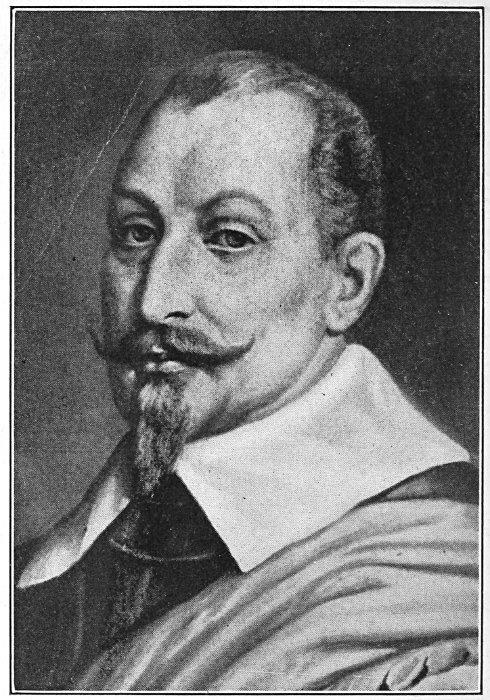
Gustavus Adolphus, the hero general of the
Reformation, was born at the royal palace at
Stockholm, Sweden, December 9th, 1594, a little
more than one hundred years after the birth of
Luther, nearly fifty years after his death, and five
years before the birth of Cromwell.
Washington and Lincoln, as to date of birth,
were only seventy-seven years apart; had Washington
lived but nine years more, they would have
been contemporary.
Washington may, in a sense, be said to have
made this country, and Lincoln to have preserved
it a united people. Just so Luther brought about
the movement known as Protestantism, but it was
given to this great king of Sweden, known as the
Lion of the North, to preserve Protestantism from
extinction on the continent of Europe, even as a
little later it was given Cromwell to stop that curious
movement toward Romanism which is even
yet the puzzle of the historian.
Gustavus II. was the son of Charles, Duke of
Sudermania, youngest son of Gustavus Vasa, who
may be considered the founder of the Vasa family.
8During the entire sixteenth century Sweden was
torn by external wars and internal dissensions.
Sweden, by the contract of Calmar, in 1397, had
become a dependency of Denmark. A trade
among rulers had made a brave people the reluctant
subjects of an alien power. Gustavus
Vasa conceived the project of freeing his country
from Denmark. He made one ineffectual attempt,
and after severe defeat, pursued by the oppressors,
he fled to Delecarlia, whose citizens rallied about
him, and, with the help of these sturdy and valiant
mountaineers, the Danes were expelled from
Sweden and his country was restored to liberty.
His grateful countrymen elected him king.
Gustavus Vasa saw the moral degradation of his
land, and brought disciples of Luther to the
country to instruct in both religious and secular
learning. Among the most distinguished of these
was Olaüs Petri. Of course, the hierarchy of
Rome and priests of Sweden made great opposition
to any change.
Gustavus Vasa reduced the gospel to this simple
message, which a child could understand, viz.:
"To serve God according to His law; to love God
above all; to believe in Jesus Christ as our only
Saviour; to study and to teach earnestly the word
of God; to love our neighbor as ourselves; to
observe the ten commandments." He distinctly
said that the Scriptures speak neither of tapers,
nor palms, nor of masses for the dead, nor of the
worship of saints, but that the Word of God, in
many places, prohibited these things. He added,
"The sacrament of the Lord's Supper has been
given to us as a token of the forgiveness of sin,
9and not to be carried around in a gold or silver
frame to cemeteries and other places."
Now, was not that a clear statement for a youth
brought up a Catholic, whose thought heretofore
had seemed only of war?
As in England, politics had a hand in expelling
the old form of religion and bringing in the new,
so it had an influence in Sweden.
Geijer, the great church historian of Sweden,
says that the Roman Church at that time possessed
two-thirds of the soil, and that the wickedness of
the church was as great as its possessions. Like
Henry VIII. of England, Gustavus Vasa needed
the lands to enrich the crown and to secure the
friendship of the nobles. He deeply hated priests
because they were unionists, that is, they desired
to keep the three Scandinavian countries under one
crown, which would have left Gustavus crownless.
When dying, this great king wrote as his last
message: "Rather die a hundred times than
abandon the gospel." He pointed the way to
glory for Sweden for generations yet unborn.
Eric, the son and successor of Gustavus I., seems
to have inherited the barbarous nature of some far-back
ancestor. He indulged in dangerous and murderous
folly. He proposed at the same time for the
hand of Elizabeth, Queen of England, Mary
Stuart, Queen of Scotland, Princess Renee, of
Loraine, and Christina, of Hessen, and after all
that, married a peasant woman.
At last he was declared incapable and was imprisoned.
This shortened his life. His children
were excluded by law from the succession, and
his brother John ascended the throne.
10John had married Catherine Jagellon, daughter
of Sigismund, king of Poland. She influenced
her husband to admit the Jesuits to Sweden, and
he made an effort to restore the Romish Church.
When the Swedes were converted to the Protestant
faith it seems to have been a deep work of
grace. They did not fluctuate in their faith. So
now they withdrew their love and friendship from
their king, whom they considered false to the faith
he had promised to sustain.
At the death of John the states determined that
their rights should not be invaded, so they forced
from his son, Sigismund, a decree prohibiting
any religion in Sweden except the Lutheran.
Sigismund (who had become a Catholic to secure
the throne of Poland) signed this decree with
great bitterness of heart.
In spite of this decree, which he had evidently
signed with mental reservations, he ordered a
Catholic church to be built in each town in his
kingdom. He further enraged his subjects by refusing
to be crowned by a Protestant prelate, and
accepted coronation at the hands of the Pope's
nuncio. He surrounded himself by the nobles of
Poland and the priests of Rome. These foreigners
could scarcely appear on the streets without causing
quarrels and bloody encounters.
In the midst of these disturbances he was recalled
to Poland, of which he was also king, his
father having secured his election by bribery, and
he left Sweden never to return as a welcome king.
Duke Charles, youngest son of Gustavus Vasa,
and uncle to Sigismund, was the only son of Gustavus
Vasa who showed himself worthy of the
11noble inheritance to which he had been born.
The troubles of the time, the dangers to Protestantism,
caused him to listen to the loud call of
the Estates to act as regent, or ruling king to this
much distressed land.
The Augsburg Confession was again proclaimed,
and all the Swedes present cried: "Our persons
and our property, and all that we have in this
world will be sacrificed, if it is necessary, rather
than abandon the gospel." Diet after Diet approved
of the administration of Duke Charles.
Four years after the departure of Sigismund he
returned with five thousand troops of Poland to
reclaim his crown. He was defeated, but the
Swedes agreed to take him (because by heredity he
had a just claim to the crown) as king if he would
send away his foreign troops and properly administer
the Lutheran form of religion.
But in a year he proved so unfaithful that he
was deposed and sent back to Poland. His claim
to the throne led to long-continued hostility between
Poland and Sweden. On account of the
claim of the Swedish Vasas and the Polish Vasas,
brave men were to die, homes were to be desolated,
and both lands were to have weeping widows
and fatherless children for half a century.
In 1604 Charles was crowned king, the crown
entailed to the eldest son, being Protestant, under
a law that declared that any ruler who deviated
from the Augsburg Confession should by that act
lose his crown.
The heirs of Sigismund were by law forever excluded
from the throne, and it was decreed that
the king should forever make his home in Sweden.
CHAPTER II. CHILDHOOD AND YOUTH OF GUSTAVUS ADOLPHUS.
12
During the stormy scenes described in the
preceding chapter, Gustavus Adolphus was
born. He was baptized on the 1st of January,
1595.
The child was brought up in an atmosphere of
war. His father told him the story of Sweden's
wars and of his own campaigns, to which the boy
listened with enrapt attention.
In 1595 the Diet had closed the throne to every
Catholic candidate. Charles IX., as the king was
now called, was generous enough to assure the
Estates that if any son of Sigismund should become
a Protestant he should inherit the throne.
He also made this reservation in his will, showing
that he had the conscience of a Christian who desires
to do justice, while Sigismund, as king of
Poland, never failed to act on the principle that
the end justifies the means.
The Finns, urged to rebellion by the king of
Poland, proved to be troublesome subjects to King
Charles. They submitted to his rule only after
a bloody contest. The king took Gustavus, who
was barely seven years old, with him on an expedition
against the Finns. The ship became icebound
and had to be abandoned. The child and
his father continued their way on foot in the
13midst of the severities of a Russian winter. The
exposure seems to have done them no harm.
On one occasion his father took him to visit
the fleet at Calmar, and on being asked by an officer
which vessel he preferred, he answered, "The
'Black Knight,' because it has the most guns."
The generosity for which he was so noted in
later years began to show itself in his childhood.
A peasant had brought him a handsome little
pony from the island of Oeland. The good man
said, "I want you to accept the pony as a gift;
as a sign of my love and devotion to you." The
young prince replied, "I am glad to have the
horse, but I will pay you for it, as the gift would
exceed your resources." The child gave the man
all the money in his purse. The peasant was
amazed at the amount of the money and at the
child's great liberality.
His father, foreseeing that Gustavus would need
to command people of different nationalities, saw
that he had instruction in many languages, so
that at the age of seventeen he spoke fluently
the Swedish, Latin, German, Dutch, French and
Italian languages, and could make himself understood
in Russian and Polish. He afterward became
proficient in Greek.
Special attention was given to the development
of a symmetrical character, and everything possible
was done to make him love the Lutheran faith.
The tendencies of both father and son are well
illustrated by a letter, still extant, from King
Charles to his son, as his farewell advice: "Above
all fear God, honor thy father and mother, show
for thy brothers and sisters a deep attachment;
14love the faithful servants of thy father and reward
each one according to his merits. Be
humane towards thy subjects, punish the wicked,
love the good; trust everybody, though not
unreservedly; observe the law without respect to
person; injure no one's well-acquired privileges,
if they are consistent with the law."
Character molded on such principles as these
would certainly touch the sublimities.
The mother of Gustavus Adolphus was a German
princess of superior education for the times.
A haughty queen, a strict disciplinarian, thereby
developing in her son a quick and ready obedience
to the laws of the family. Who would command
must first learn to obey.
She much preferred her second son, Charles
Philip, and, had Gustavus been less generous, or
less noble, an unnatural jealousy might have
divided the brothers, but the young Duke of Finland,
as Gustavus was called, acted as though he
thought his mother could do no wrong.
Gustavus had three teachers, each of whom left
a strong impression upon his character—John
Skytte, a man who had spent ten years in travel,
Von Mörner, an accomplished, traveled man, and
Count de la Gardie, a Swedish noble of a French
family, who instructed Gustavus in fencing and in
military tactics.
Gustavus had an attractive personality and won
the abiding affection of his cousin, Duke John, the
only one of Sigismund's sons who took the Swedish
side of the religious and family quarrel. Duke John
married the only sister of Gustavus, Mary Elizabeth,
and proved a brother, indeed, after the death
15of King Charles. For the choice was left to the
people and to the Estates as to whether they preferred
John or Gustavus. At the sincere urgency
of Duke John the young Duke of Finland, Gustavus,
was chosen.
King Charles IX. began early to train his son
in public affairs. When Gustavus was only ten
years old his father kept him at his side at all
cabinet meetings and in great public assemblies.
He encouraged him to talk to officers from foreign
countries in their own language. The king permitted
him to ask questions on war, special battles
and methods of governing, and the father was
proud of the eager, precocious child, in whom he
recognized a mental and spiritual power far beyond
his own.
At the age of fourteen he was sent, with his
mother, through northern Sweden, in order that
he might become acquainted with the people of his
own country. The king said, "You are only a
boy, but listen to everyone who solicits your protection,
help everyone according to your means,
and dismiss no one without a word of comfort."
The gracious boy made many friends in this
early journey, men who afterwards gladly gave life
itself to forward his interests.
At the age of fifteen he was greatly disappointed
because he was not permitted to lead an army
against the Russians, but for once his father required
him to remain at home to learn affairs concerning
the internal and external policy of the
Swedish government. But in 1611, at the age of
seventeen, when Denmark had declared war
against Sweden, he was permitted to command a
16body of troops. He was sent to deliver the town
of Calmar which was besieged by the Danes. He
was afterward joined by troops under Duke John
and the king himself. On August 16th, 1611,
the town and castle were surrendered by a commander
who proved to be a renegade Swede whom
King Charles had offended.
The king left the war in order to return to
Stockholm to preside at the Diet. On his journey
he was taken violently ill. When it was
plain he could not recover Gustavus was sent
for. The king gave the sorrowing boy his parting
blessing, then laying his hand on the bowed
young head, he said, in a voice full of conviction,
"Ille faciet"—"This one will do it."
CHAPTER III. GUSTAVUS AS A MAN.
17
Gustavus, the Grand Duke of Finland and
Duke of Estland, as he was now called, did not at
once assume the throne. The kingdom was for
two months without a ruler.
The Diet was convened at Nyköping by the
queen and by Duke John, who, with six lords of
the Council, had administered the affairs of the
government. On December 17th, 1611, the queen
and Duke John, who was five years the elder, renounced
before each of the assembled Estates
all right and title to the throne of Sweden, and,
although the age of twenty-four was considered
the legal majority, Gustavus, though only eighteen,
was declared of legal age, and the reigns of
government were placed in his young hands.
He took the title of his father: "Elected king
and hereditary Prince of the Swedes, Goths and
Vandals." He chose for his chancellor, or Secretary
of State, the wisest man of his realm, Axel
Oxenstiern, only ten years older than himself.
Sweden had seen little of peace for fifty years.
From the days of Gustavus I. endless war had
prevailed. In the civil strife between rival
branches of the same house, two kings had been
overthrown. Gustavus inherited a blood-sprinkled
throne, and, could he have foreseen it, was to
18be in almost perpetual warfare during his entire
life.
To him came early the great passion which has
made bad people good, and quite as often made
good people bad. From early boyhood he had
loved a girl, who became a handsome court lady,
called Ebba Brahe. Her family were of the nobility,
though not royal. It was from early youth
his purpose to share his throne with the woman of
his choice.
At Skokloster, Sweden, is preserved a fragment
of their correspondence, including some most
ardent letters from the young king. When he
could not write to her, he sent the "forget-me-not"
flower, which the girlish heart interpreted
aright. He exhibited the symptoms of other
lovers in writing sonnets to her, and at all times in
seeking her society.
But his mother, Queen Christina, was a politician,
and steadily set before him that it was his
duty to strengthen his kingdom by marrying into
a royal family which would become his friend in
peace and his ally in war. On one occasion,
when he was about leaving on a military campaign,
the queen mother forced from him the
promise that he would not write to Lady Ebba for
two years. To this he agreed on the condition that,
at the end of two years, all objection to their
marriage would be withdrawn.
He had scarcely reached the seat of war until
the old queen forced Ebba Brahe into a marriage
with James de la Gardia, a polished noble gentleman,
but not the choice of her young heart.
All through his life the heart of Gustavus
19turned with unutterable longing to the love of his
youth. This is shown in several letters to his
friend, Chancellor Oxenstiern.
We would like to believe that, at least up to
his marriage, he remained the ideal lover, but
truth compels us to say that he had a natural
son, Gustav Gustavson, born in 1616, to a Dutch
lady.
That was an age in which morality along sexual
lines was unusual among royal men, but this one
instance of immorality is the single instance that
even the worst enemy of Gustavus can bring
against his good name.
On November 28th, 1620, in the great palace of
Stockholm, Gustavus was married to Eleanor
Marie of Brandenburg. The marriage was one of
great pomp, and Gustavus recognized his duty to
the state by marrying into a strong Protestant
royal family, and he also recognized his duty as a
Christian to be a true husband and a good man.
The young queen brought a large dower which
greatly assisted the war fund, but the marriage
precipitated another war with Poland.
The marriage was a fairly happy one, as royal
marriages go, but the happiness of the family was
clouded by a dead child being the first born of
the union. This great affliction Gustavus seems
to have borne with a truly Christian spirit. The
following year a similar event occurred, so that
the royal family feared for the succession. At
last, in 1632, after being married twelve years, he
was permitted to hold a living child in his arms.
As he lavished upon her his paternal caresses,
he said, "God be praised! I hope this daughter
20may be as good to me as a son. May God who
has given her preserve her to me."
The life of this princess, whose history will be
given later, proved that what we pray too earnestly
for, almost as it were forcing the hand of God, may
be given in answer to persistent requests, but
the gift is to our undoing. Like Hezekiah's prolonged
life, the boon was given in answer to
prayer. Hezekiah's continued life proved to be
full of anguish, and Manasseh, one of the curses
of Judah, was born to him. If only we could
pray: "O Lord, withhold, if not for my permanent
good and Thy ultimate glory."
No woman ever dishonored her parentage more
than this daughter, known in history as Queen
Christina of Sweden.
This short history is to deal so much with
the history of Gustavus Adolphus, the hero general
of the Reformation, that we have condensed,
for the most part, the history of his loves and
domestic life into this one chapter. Before leaving
the subject, we would remind you that Queen
Eleanor Marie always acted as regent when Gustavus
was absent on his campaigns. She seems
to have ruled wisely. After the death of Gustavus
she generously sent a portrait of the man they
both loved so much to Lady de la Gardia.
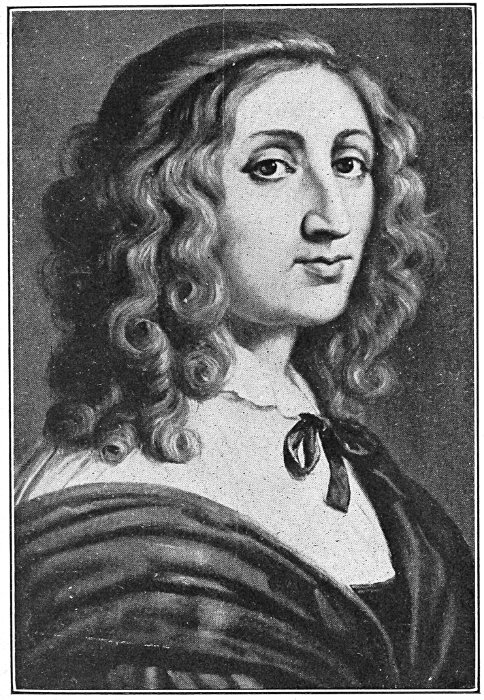
CHRISTINA,
Daughter of Gustavus Adolphus II.
CHAPTER IV. GUSTAVUS AND HIS KINGDOM.
21
We have now these two young men, Gustavus
Adolphus and Axel Oxenstiern, his chancellor,
sitting down to play the game of war against all
the powers of northern Europe. The stake was
the national existence of Sweden.
Buckle thinks that, given the time, the man
may be predicated. But the times did not produce
Jesus Christ. Nero was the natural product
of that period. Gustavus Adolphus, like Luther,
was a special soul sent of God to be the incarnation
of spiritual force against the evil and awful
indifference of a corrupt age.
First, he enlarged the place of his generous
cousin, Duke John, who doubtless had foreseen
the great period of war before them, and gladly
had placed the responsibility in the abler hands of
Gustavus.
Then the young king pursued the war with
Denmark until the King of Denmark renounced
his claim to the Swedish crown. It took him two
years to secure this concession. During these two
years he enlarged the rights of his people, stirred
the patriotism of the peasantry, won the affections
of the nobility of Sweden, and unified his people
into a strong nationality. When Gustavus Vasa
introduced the doctrines of the Reformation into
22Sweden the inhabitants were a rude people, but
fifty years of instruction on the part of the clergy
and independent thinking on the part of the people
had greatly changed this state of affairs.
The revival of learning and the Reformation
which caused an active study of theology and
literature, had greatly pushed forward the intellectual
standing of Germany. Lutheranism has
always been a scholarly faith; it was born in universities,
and never took on the severities or iconoclasms
of Calvinism.
Sweden now kept all that was brilliant, attractive
and energizing in the ideas of the Reformation,
and gave to the Lutheran faith a new impetus, so
that in the time of Gustavus Adolphus the aristocracy
of Sweden were among the most cultivated
people of all Europe.
As in Scotland the Reformation changed the
very nature of the entire nation, so now it did the
same for Sweden, with this difference, that the
Scots followed the doctrines of Calvin, which
stripped religion of its æstheticism and made it
severe and to some degree forbidding, while the
Lutheranism of the Swedes beautified their lives,
stirred their æsthetic taste and improved their intellects,
so that from that day to this Sweden has
been regarded as a scholarly country, and has
produced its fair share of literary and scientific
men and women, beside many great inventors,
and artists of world-wide renown.
The personality of Gustavus had much to do
with his success. He had a fine physique. In
his youth he was of slender figure, pale, fair complexioned,
long-shaped face, fair hair, with a
23touch of red in it, and a tawny, pointed beard.
Every inch of his fine, tall body was trained by
the judicious use of athletics and out-door exercise.
He radiated health, which of itself made
him magnetic.
His tinge of red showed the impetuosity of his
nature, which often had to be restrained by the
great Chancellor Oxenstiern. "If my heat did
not put a little life into your coldness we should
all freeze up," said the king on one occasion. The
chancellor replied, "If my coldness did not assuage
your majesty's heat, we should all burn up,"
whereat the king laughed and acknowledged that
his temper was rather quick and his patience less
than he would like.
No sketch of the great king and of his success
would be complete without understanding his two
chief advisers. Queen Elizabeth once heard that
a courtier had said, "It is not the queen who is
great, but her counsellors." The queen replied,
"Well, who made them counsellors?" Gustavus
had the quality of appreciating greatness in others,
of supplementing his own talents with theirs, and
of not being jealous.
Axel Oxenstiern was born at Fano, in Upland,
June 16th, 1583. His family traced their lineage
back to the thirteenth century, and had intermarried
with both the Danish and Swedish royal families.
His father died in 1597, and he was sent by
his judicious mother to a German university. This
gave him Swedish and German as colloquial
tongues, and he became so proficient in Latin that
he could use it equally well with either.
Latin had for many centuries been the language
24of the learned, in which people of different lands
could converse intelligibly. The people of Europe
needed no Esperanto while they were proficient in
Latin.
Oxenstiern studied theology as thoroughly as if
he expected to enter the ministry. Religion was
the absorbing thought of good people during the
sixteenth and seventeenth centuries. He was recalled
to Sweden by Charles IX., who recognized
his great ability, and sent him on several diplomatic
missions. At the age of twenty-six he was
made house guardian of the royal children, and
the head of the regency, which, in case of the
king's death, might cause him to be called to govern
the realm during the minority of the heir-apparent.
Among the first acts of the young king was to
appoint Oxenstiern chancellor. From this time
during the entire life of the king, this great man
became one of the chief factors in ruling Sweden.
He was a true friend, never failing to restrain or
reprove the impetuous, strong-minded, strong-natured
boy-king. Oxenstiern was a man of
action, and was as little given to "lying around
among the shavings" as Gustavus himself.
But the king had another counsellor of a totally
different type, and that was John Skytte, a fine
scholar and a great traveler, who had acted first as
the tutor of Gustavus; and later became a counsellor.
The king made him a senator, and in 1629
made him governor-general of Livonia.
It is very amusing to read some of the letters
which passed between the governor and his king
at this time. The governor apologizes for certain
25things not being accomplished, Gustavus calls him
a man of theories, and declares, "I expect results
and not explanations."
Returning now to the direct history of Gustavus
Adolphus, in July, 1621, Sigismund having denied
even the title of king to Gustavus, and having sent
strenuous threats of punishment to the Elector of
Brandenburg for permitting his sister to marry
him, Gustavus sailed from Elfsnabb Harbor with
one hundred and fifty sail, manned by fourteen
thousand soldiers, for the purpose of conquering
Livonia. At Pernau he was joined by General
de la Gardia with five thousand Finns.
In August, Riga was surrounded, and on September
15th, it surrendered to the Swedish forces.
In October, Mittau, the capital of Courtland, was
entered, and the season being too far advanced,
the army went into winter quarters. After an
eight years' bloody campaign Gustavus, with his
brave army and his experienced generals, conquered
Sigismund, the unrelenting enemy of the
Swedish Vasas.
The war between the two branches of the house
of Vasa extends from 1600 to 1660. Gustavus felt
that in his war with Poland, from 1621 to 1629,
he was not fighting for his crown alone, but that
he was facing the great struggle of Protestantism
against the Catholic reaction. This war really
should be regarded as part of the Thirty Years'
War.
Queen Eleanor, as the wife of Gustavus was
now called, suffered much during this war, for she
felt that Sigismund's attitude to the Elector of
Brandenburg for permitting her marriage to her
26greatly-beloved husband had much to do with the
awful sorrows of the time. The queen went several
times to see the king while he was absent,
always carrying with her money, food and reinforcements.
On one occasion she came suddenly
upon him, clasping him in her arms, exclaiming:
"Now, Gustavus the Great, thou art my prisoner."
Gustavus took pains to assure her that the war
was now far beyond the question of their marriage,
or even his title to the throne. He made
plain to her that Sigismund, a Roman Catholic
prince, who had the Pope for master, the Hapsburgs
for allies, the Jesuits for advisers, should not
and could not be permitted, even though it cost
much in blood and money, to set up any claim to
the throne of a Lutheran country.
In our own land it was the small Indian wars
which trained our ancestors to be the nation of
warriors who successfully fought England in the
Revolution. So Gustavus Adolphus, his great
generals and his brave troops, had training in
small wars for that part of the Thirty Years' War
which was to make him the most prominent figure
of his century.
Besides the wars with Denmark and with Poland,
he also had a short campaign (in which he took
several Prussian towns) with Brandenburg, the
vassal and ally of Poland, although, like Sweden,
a Lutheran country, so he had really the practical
experience of three wars before entering that
which gives him and his country their place in
history.
The life of Gustavus was now even more precious
to his subjects than at his coronation, because
27his brother, Duke Charles Philip, had died
childless, January 25th, 1622.
He was a youth of great promise and of lovely
spirit. On one occasion, when he was ill, he wrote
home: "My brother is so attentive and takes so
much pains to entertain me that I almost forget
my 'illness.'" The death of this prince was a
severe stroke to the Dowager Queen Christina, who
had always loved him more than she had loved
her gifted elder son.
CHAPTER V. THE CHARACTER OF THE KING AND OF HIS TIMES.
28
Under the stress of war, trial and great exposure
of his life, the piety of Gustavus Adolphus
became more marked. On his long campaigns he
read and studied the Bible. He said: "I seek to
fortify myself by meditations upon the Holy
Scriptures." No one ever studied God's word,
that is able to make us wise unto salvation, without
also gaining worldly wisdom, and perceptibly
increasing in moral beauty of character.
He regarded his high position as a great trust,
given to him by his God. He was not actuated
by a love of conquest, but felt that the defence of
his throne and of his country also meant the protection
of the Protestant faith. He waged war to
bring about peace.
He repressed all acts of vengeance among his
soldiers, he tolerated no licentiousness, and upheld
religion and good morals in the camps of his
army. Divine service was held morning and evening,
at which time the king and the whole army
knelt before God, asking His blessing and guidance.
He was a strict disciplinarian, but banished the
bastinado, which not only punished but degraded
men. He took counsel with his generals, and
made no important move without consulting the
Estates of his kingdom.
29His physical strength was very great. Once
when ordered to bed for fever by his physician, in
the Russian campaign, he went to fencing with
one of his officers. This caused such profuse
perspiration that his disease was cured.
God seemed to visibly protect his life, even as we
think He did the life of General Washington.
During the campaign against Poland, a bullet
struck the place that he had just left. At another
time his garments were spattered with blood from
men who fell at his side. Again, a bullet went
through his tent just above his head.
At Dantzig seven boats were to take a redoubt.
Gustavus commanded one of them and was shot
in the abdomen. He wrote the Estates: "The
engagement was a warm one, and I was wounded,
but not unto death. I hope in a few days to
resume my command."
His recklessness in danger greatly distressed
his friends, and they sent Oxenstiern to ask him
not to expose his life again in battle. Gustavus
answered: "As yet no king has lost his life by a
bullet, moreover, the soldier follows the example
of his leader, and a general who shrinks from danger
will never cover himself with glory. Cæsar
was always to be found in the front rank, and
Alexander moistened each battlefield with his
blood."
He was wounded three months later in a battle
in Prussia against his brother-in-law, the Duke of
Brandenburg. On this occasion he wrote home:
"We met the enemy on foot and horseback, and
our artillery made such execution that we thought
we had put him to flight, but God would not have
30it. When we were about to dislodge him, a musket
ball struck me at the shoulder near the neck,
and was the chief cause of our losing the battle.
I thank God in my misfortune for the hope of
speedy restoration to health."
Now the officers of his army remonstrated,
through Oxenstiern, and entreated him not to expose
his person, calling his attention to the importance
of his life to his country. He replied:
"My friends, I cannot believe my life is so essential
as you seem to think, for should the worst
befall me, I am fully convinced that God would
watch over Sweden as He has done hitherto. As
God has made me king, I dare not permit myself
to be frightened or to be actuated to my own advantage.
Should, in the vicissitudes of war,
death be my lot, how can a king fall more honorably
than in the contest for God and His people?"
Even the surgeon rated him soundly for exposing
his life. He replied: "Ne sutor crepidam!"
"Everyone to his trade."
During the war with Poland, Austria sent
against the Swedish an army of eight thousand infantry
and two thousand cavalry, under the famous
Wallenstein, Duke of Friedland. Gustavus asked
him what motive actuated Austria to meddle between
two foreign countries. Wallenstein insolently
answered, "The emperor, my master, has
more soldiers than he wants for himself, he must
help his friends."
Gustavus meant to take Spelter, in Marienburg,
which he had conquered from the Prussians. One
of his generals was prematurely attacked by the
Imperial forces, and his division seemed near destruction,
31when Gustavus hastened to his assistance.
In the midst of rout and loss, he was in
danger of being made a prisoner by one of the
enemy's cavalry. His hat was knocked off and
a sword grazed his head. On the other side he
was seized by the arm, when a Swedish dragoon
killed his assailants, and led the king's horse to
another part of the field.
Gustavus was deeply grateful to God for sparing
his life, and more than once said in substance:
"God has given me a crown, not to dread or rest,
but to devote my life to His glory and to the happiness
of my subjects."
Wherever he went he expelled the Jesuits, and
required the governors of the conquered countries
to restore to the Protestants the places of worship
which the Catholics had taken from them. He
admonished the Protestant clergy to preach the
plain gospel, to administer the communion, using
both bread and wine, and he insisted that the
clergy should see that the people led honest,
godly lives, consistent with the faith they professed.
He provided that a synod should meet each
year to consult as to church affairs, in order to
provide common schools for the people, and also
for the higher education of the youth of the
country.
The following great principles, showing that
Sweden was in advance of other nations in securing
the rights of the citizen, and limiting the
rights of the crown, were incorporated in the
king's oath, and placed on the statute books. No
one should be apprehended or condemned upon a
32mere assertion, or without knowing his accuser
and being brought face to face with him in a
fair trial.
No man was to be degraded from office without
a fair trial. The land's law provided that, without
the consent of the people, neither a law should
be made, nor a tax imposed, without the consent
of the council and of the Estates. It took the combined
authority of Duke John (during his life),
of the council and of the Estates, to endorse the
wish of the king to make war, peace, a truce or an
alliance with a foreign nation. Think how this
law safeguarded the rights of the people in a century
when great absolutism prevailed.
Under Gustavus the council was reinstated in
its position as mediator between king and people,
as the Estates deprecated their being burdened
with too frequent Diets or Congresses.
The oath taken by Gustavus had eliminated
that part which forbade the king to alienate or
diminish the property of the crown. One of
the first things Gustavus did was to sell the gold
and silver plate and all the jewels of the royal
family he could obtain. Many of the nobility did
the same to provide money for his wars.
The winters of Sweden are long, and the roads
at that time were bad, and, of course, no railroads
existed, so that it was no wonder the people of
the realm disliked being frequently convened,
aside from the great expense of such convocations.
Among the demands of the nobility at the accession
of Gustavus was that, before each Diet, they
should be made acquainted, with the great matters
to be discussed, in order that they might consider
33them at leisure and without influence from others,
also that they might hold neighborhood conclaves
and come to decisions, so that all need not
attend the Diet.
Afterward the presence of military officers at
the Diet was ascribed to Gustavus Adolphus.
In 1664 the knights and nobles, long after the
death of the king, say, "Among other benefits of
his reign, he gave us the deputies of the army for
our assistance, who, without votes of their own,
have stood so that, in conjunction with the councillors
of state, we have been able to balance the
other orders."
Axel Oxenstiern remarks: "The presence of the
military, though having no votes, strengthened the
nobility at the Diets where every nobleman, come
to lawful years, was bound to give attendance."
The spirit of militarism pervaded all Sweden
at that time. The writers of the period speak disparagingly
of "old lords reared away from war
in easy lives, who are no soldiers, and have in
their councils only a heap of economists and literates."
With such a spirit among the people, and
with a king who felt called of God to stop the extermination
of Protestants, was it any wonder,
with the deck cleared for action, and the wars for
his crown ended, that both he and his people
should feel called to study, not local, but European
conditions, and to inquire, "What is our duty in
the premises?"
While the thoughts and plans of Gustavus were
ripening for action in Germany, for a few short
months he devoted himself to the business of his
kingdom.
34In 1627 the king organized a company for work
in America.[1] He sent a small fleet to the West
Indies. He encouraged emigration to a New
Sweden, which extended from the mouth of the
Delaware to Trenton, New Jersey.
In 1624 the Swedish West India Company had
been formed, with the hope of enriching Sweden
and lessening local taxation.
In 1638 two Swedish vessels entered Delaware
Bay and founded New Sweden. They built a fort
at what is now Wilmington, Delaware. The most
interesting relics yet remaining of that company
are the Old Swedes Church, in Wilmington, Delaware,
and the Gloria Dei Church, in Philadelphia,
in the southern section of the city. They constitute
lasting memorials of the great Swedish king.
Unfortunately these two famous historical buildings
have passed out of the possession of the
Lutheran Church. The Swedes had small colonies
and strong churches from the mouth of the Delaware
to Trenton, New Jersey. New Sweden existed
under that name for seventeen years, when it
was incorporated in the William Penn possessions.
The Swedes lost their language in America, but
kept their sturdy Christianity. Their fair dealings
with the Indians prepared the way for William
Penn to have the name of founding a colony
in peace, for which the Swedes should receive
much of the credit.
Gustavus also devoted himself to the improvement
of Stockholm, now one of the most beautiful
35cities of the world. It is often called the
Venice of the North, being situated on a group of
nine islands, connected by picturesque bridges.
Its streets are wider than those of Venice, and the
canals have none of the vile odors of the southern
city.
Sweden has been called Sweden ever since people
inhabited its territory. At different periods it
has been united to Norway and Denmark, under
the same ruler. It has never been invaded or
conquered, or had its boundaries changed by a
foreign power.
CHAPTER VI. THE THIRTY YEARS' WAR.
36
From the time of the abdication of Charles V.
of Germany the country had, for about sixty
years, enjoyed comparative peace. Luther's translation
of the complete Bible had appeared in 1634.
Nearly one hundred years had been given the
plain people to study the word of God, to see
what Christ said and what Paul preached, and to
compare them with the doctrines of the Church
as set forth by the priests of Rome.
The work of Luther was destructive as well as
constructive. He tore down what was false in the
worship of God. The greater part of the constructive
work of his life was formulated in the
Augsburg Confession.
The Diet of Augsburg met in the city of Augsburg
in 1530. It consisted of leading divines of
both Protestant and Catholic faith, and of the
princes who upheld the Reformation.
The Protestants set before the emperor, Charles
V., on June 25th, 1530, their doctrines in a remarkable
document known as the Augsburg Confession,
or the Augustana. It is the plain statement
of the doctrines of the Lutheran Church the
world over, and is the basis from which all other
Protestant confessions are largely taken.
Then followed twenty-five years of the successful
37propagation of the doctrines of the Reformation,
and the purified faith was accepted not only in
Germany, but in Sweden, Norway, Denmark,
Switzerland, the Netherlands and in England and
Scotland.
The Council of Trent, the eighteenth Ecumenical
Council of Rome, met near the time of Luther's
death. If it had been called in 1520, when
Luther entreated for the calling of an Ecumenical
Council to correct the abuses existing in the Church,
it is quite possible that Luther would not have
come out of the Church of Rome. If King George
III. of England had yielded, even in part, to the
prayer of the colonists, what is now the United
States would probably have remained a colony of
Great Britain.
The Council of Trent remained in somewhat
interrupted session for over eighteen years. It was
called with some idea of coming to some understanding
with the Protestants, and of bringing
them back into the Catholic Church. The Protestants
paid little or no attention to the call, and
the Council contented itself with reforming some
of the abuses within the Church, and reformulating
the doctrines of Rome.
The reform party at the Council of Trent demanded
"wine as well as bread in the sacrament
for the laity, schools for the poor, church hymns,
preaching and Communion in the language of the
people, a better catechism, reform in convents
(some of which were mere houses of immorality),
and the right to marry for the priests." The
papal power called this rank heresy, and the entire
council from beginning to end was a disgraceful
38spectacle. A few subordinate improvements on
church discipline were granted, but no important
reformation of church affairs, and the farce ended
by an exultant proclamation calling down curses
on the heretics.
From that day to this it has been Trent versus
Augsburg. These two great councils were the most
important events of the mediæval period. It is
quite possible that the common people did not understand
the bearing of the new religious thought,
but the great statesmen of Europe saw that what
is now called the Dark Ages had passed forever.
"The Protestants," says Ranke, "guided by
the Scriptures, retraced their steps with ever-increasing
firmness toward the primitive forms of
faith and life. The Catholics, on the contrary,
confronted with unflinching opposition and repelled
with determined hostility whatever could
recall the idea of Evangelical doctrines."
At the beginning the Thirty Years' War may be
called a religious quarrel, but it soon became for
the house of Hapsburg a scramble for personal
aggrandizement. Ferdinand II. fought for territory,
power and money, and he hoped, by recovering
all the property which had belonged to the
Catholic Church before the Reformation, he would
attain these three objects. He followed this idea,
although the formal edict was not announced for
several years. It was his intention to break down
all princes, both Catholic and Protestant, of the
smaller German States, to incorporate Denmark,
Holland and Italy (the old dream of Charles V.)
into one great empire, and thus restore the old
German-Roman Empire. It was a fine opportunity
39for self-aggrandizement under the guise of fighting
for his church.
It was not to the interest of France to have the
house of Hapsburg further aggrandized. God used
this jealousy and ambition to further the work of
the Reformation, so that France, through Cardinal
Richelieu, became the ally of Gustavus Adolphus,
and furnished a monthly stipend for paying Protestant
soldiers, but even more valuable to the cause
was the information and advice of this great Catholic
ally. It was now believed that Richelieu[2]
even hoped for a confederacy of the smaller German
States and free cities under the protectorate
of France.
Reviewing for a moment the past, we shall remember
that Charles V. was succeeded by his
brother, Ferdinand I., who reigned from 1556 to
1564. Maximilian II., his son, was lenient to the
Protestants, and ruled from 1564 to 1576. It was
during his reign, in 1572, the St. Bartholomew
massacre occurred in Paris, in which Catherine de
Medicis and her son, Charles IX., caused the
murder of over fifty thousand Huguenots, as the
Protestants were called in France. The massacre
continued three days and nights.
Pope Gregory XIII., on hearing the news,
openly expressed his joy at "the glorious event,"
caused public thanksgiving to be made, and had a
coin struck in commemoration of this vile sin.
This event gave warning to the Protestants that
Rome would take advantage of whatever opportunity
offered to destroy Protestantism.
40During the great war Rudolph II. ruled Germany
from 1576 to 1612, Mathias from 1612 to
1619, followed now by Ferdinand II. Louis XIII.,
the creature of his minister, Cardinal Richelieu,
who, though a churchman, always put the State
before the Church, was the ruler of France. He
was followed by Louis XIV., whose mother, Queen
Anne of Austria, and Cardinal Mazarin ruled till
the majority of Louis XIV. The kings of England
were James I., from 1603 to 1625, and Charles
I., from 1625 to 1649. The Popes were Paul V.,
Gregory XV., Urban VIII. and Innocent X.
The Catholics now formed a strong league. The
Protestants already had a weak union.
Mathias, during a reign of seven years, had
favored the Catholics, and caused Ferdinand, one
of the most cruel Catholics who ever lived, to be
elected king of Hungary and Bohemia.
The election of Ferdinand was a great blow to
Bohemia, and the new king lost no time in trying
to destroy all the Protestants in his kingdom.
Protestants were persecuted as criminals, and when
they appealed to the law of the land, the Jesuits
replied that Ferdinand's election as king of Bohemia
canceled all laws in favor of Protestants.
"Novus rex, nova lex." This they declared was
what was meant by the Reservatum Ecclesiasticum in
the Augsburg Treaty of Peace. The clause stipulated
that the people of each State should follow
the religion of the ruler of the State. It is true
the clause was there, but modified by two things:
1st. Cities were excepted.
2d. The Evangelical princes had not agreed to
the clause and had protested against it.
41Ferdinand's action as king, of course, made an
insurrection. How could it fail to do so?
The Emperor Mathias became frightened and
fled to Vienna, after appointing a regency of four
Catholics and three Protestants. The Protestant
regents sent a petition to the Emperor, and the
Catholic regents at the same time sent a report.
Mathias ordered the implicit and instant obedience
of the Protestants.
While the seven regents were assembled in an
upper room in the palace at Prague to announce
the Emperor's decision, Count Thurn, chief of the
Protestant party, entered the room with a company
of armed men. He demanded of each Catholic
regent, "Did you advise the Emperor's arbitrary
reply?" Two of them answered evasively, the
other two said, "Yes, we did." At this point the
four Catholic regents were seized and pitched out
of the windows from the third story. They fell on
a great heap of barnyard manure and were not
killed. But by this the Protestants took the responsibility
of saying, "By this act we pitch out
of our lives the Pope of Rome, the King of Bohemia
and the Emperor of Germany."
The Emperor was in feeble health and desired
to make peace, but Ferdinand dissuaded him, and
sent an army against these Protestants. The army
was driven by Count Thurn and his men to the
very gates of Vienna, and were only there turned
back by the regular army of Austria.
The winter was coming, and no provision having
been made for the Protestant army, the force
returned to Prague.
This was to the Thirty Years' War what the
42firing on Fort Sumter was in the Civil War, or the
skirmish at Lexington to the Revolutionary War.
Just after this Mathias died and Ferdinand,
king of Bohemia, became Ferdinand II., Emperor
of Germany. He, with his Jesuits, determined
to retake all property which before the Reformation
belonged to the Catholic Church.
In many places all the people had become
Protestants, and the church having been built by
the money of either themselves or their ancestors,
the churches had been used for nearly one hundred
years for Protestant services. Americans can
understand the situation by thinking how it would
be and what would happen if England should
now demand that all property owned by the
Crown before the Revolutionary War should be
restored.
Ferdinand II. was now to force a war upon his
subjects which left Europe a great cemetery.
During the Thirty Years' War the population of
Europe was reduced from sixteen millions to less
than six million people. Thirty-five thousand
towns and villages were destroyed.
Three-fourths of the population perished in
Bohemia, partly by the sword, but also by pestilence
and famine, and many emigrated. The question
had resolved itself into this, "Shall we permit
Protestantism to be forever exterminated?" It
took all this sorrow of destruction of property and
of human life to bring about political toleration
between Protestant and Catholic States.
For thirty-three years Germany seems to have
been blind to what was going on around her. The
intellectual impetus given by the Reformation
43made the theological strife between Lutherans and
Calvinists bitter and absorbing.
Large districts both south and west of them had
been forced back under the dominion of the Church
of Rome, and the Germans did not interfere.
They had done but little for the Dutch in their
desperate fight against the Spanish Hapsburgs
and Romanism, so that William of Orange, in bitterness
of heart, had said, "If Germany remains
an idle spectator of our tragedy, a war will presently
be kindled on German soil which will swallow
up all the wars which have gone before it."
That war was now on.
"No, true freedom is to share
All the chains our brothers wear,
And with heart and hand to be
Earnest to make others free."
CHAPTER VII. THE THIRTY YEARS' WAR.—CONTINUED.
44
This war is usually divided into five periods:
1. War in Bohemia; 2. War in the Palatinate;
3. Danish war; 4. Swedish war; 5. Franco-Swedish
war.
After their king had been made Emperor of
Germany, the Bohemians, in an effort to make
sure of their deliverance from the rule of Ferdinand,
chose for their king Frederick V., Elector
Palatine, who being the head of the Evangelical
Union, was considered the chief of the Reformation
party in Germany.
He was elected August 26th, 1619. He was
not fortunate in securing the friendship and support
of his own subjects. His conduct was so
unbecoming his profession that it was no wonder
God did not prosper him as a public leader.
Frederick V. was son-in-law of James I. of England,
and it was hoped by his election to secure the favor
of the Protestants of England and Scotland.
The Emperor Ferdinand II. now placed Maximilian
of Germany and the ferocious General
Tilly at the head of the army of the Catholic
League, to attack the city of Prague.
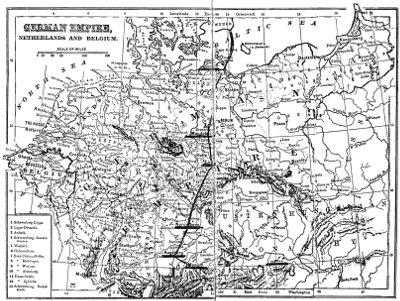
GERMAN EMPIRE, NETHERLANDS AND BELGIUM.
45On November 8th, 1620, the armies met at
White Mountain, near the city, and the Protestant
army, composed of Germans, Hungarians and
Bohemians, lacking first of all a good leader, but
also lacking unity in action, courage and goodwill,
were defeated in less than an hour by the
superior numbers of the Imperial army.
Frederick, their king, was dining at leisure at
Prague, while his army was being sacrificed. He
availed himself of the short armistice of eight
hours granted him by the Duke of Bavaria, to
make a flight by night, in such haste that even his
crown was left behind him.
The battle of White Mountain settled the matter
so far as Bohemia was concerned, and Prague
surrendered the next day. The Estates did the
same homage as had been done by Silesia and
Moravia, but the Emperor had another matter to
settle with Prague. Tilly, with seven thousand
men, principally Spaniards, entered the city.
Twenty-seven Protestant chiefs were instantly executed,
others were less publicly killed, and many
more imprisoned or punished.
All the Protestant churches were confiscated and
handed over to the Jesuits, who now came back
in full force. The soldiers drove the country people
into the mass, so that a baron of Oppersheim
gloried in having converted, without a sermon,
more people than the Apostle Peter, who through
his Pentecostal sermon, had seen three thousand
souls converted.
The Emperor, with his own hands, tore up the
Letter of Majesty by which the Emperor Rudolph
had granted religious liberty to the Bohemians.
Thirty thousand families left Bohemia during
the next two years, and Maximilian was made
Elector Palatine, in place of Frederick V.
46This is a very abbreviated history of the first
division of that great war which laid low the country
of John Huss.
The second period may be said to extend from
1621 to 1624, and is usually spoken of as the war
in the Palatinate. The war was now carried into
that portion of Germany. It was in vain that
each Protestant prince determined to defend his
possessions against the oppressor. Tilly vanquished
them one after another till Ferdinand's
scepter was over every State. The Imperial soldiers
ranged over the country, taking everything
of value, also appropriating to Rome every Protestant
church and school, so that the Protestants
could readily see that their extermination had
been determined. Ferdinand had taken a vow
to the Virgin, both at Loretto and at Rome,
to enforce her worship at the peril of his life, declaring
that he preferred to rule over a wilderness
rather than a nation of heretics. Now, strengthened
by his many successes, it was plain to all
Germany that he meant to soon fulfill that wicked
vow. The executions and massacres of that time
were without parallel since the Christian era.
Ferdinand not only revenged himself on all
Protestants, but he deeply humbled the Catholic
princes by the exercise of despotic power over
their people. All European statesmen became
alarmed at the aggrandizement, as they called it,
of the Hapsburgs. Richelieu, the great cardinal
of France, was glad enough to see Protestantism
punished, as he had no idea of letting Austria
overshadow France. Holland was afraid for
Protestantism within her own borders, the slow
47nature of James I. of England began to arouse
itself, and he planned to reinstate his son-in-law,
Frederick, in the Palatinate, when broken and oppressed
Germany turned to the princes of Scandinavia
for succor.
Gustavus Adolphus, king of Sweden, was busy
with his wars in Poland. He would gladly have
sent part of his well-disciplined army to the assistance
of the German princes, but they preferred
the king of Denmark, Christian IV., brother-in-law
to the Elector Palatine.
He began the third period of the war by entering
into an alliance with England and Holland,
and declaring war against the empire, marched to
the help of the Protestant princes, Dukes of
Brunswick, Mansfield and others.
Christian IV. took the field in March, 1625,
with sixty thousand troops, and entered Germany,
determined to cover himself with glory and to reestablish
Protestantism.
Tilly had been bad enough in ravaging conquered
territory, but now Wallenstein, Duke of
Friedland, appears on the scene. He had distinguished
himself in the battle of White Mountain,
and in the war against the Turks had received
most valuable grants of land, and large revenues
from the Emperor. Wallenstein was now put in
command of the Imperial forces. He was a pervert
from Protestantism to Rome, and such are
always the most bigoted and intolerant. He
had expelled the Hungarian troops from Moravia,
and had accepted as pay the confiscated estates of
his unfortunate countrymen.
He agreed to raise and support his own army
48for the Emperor at his own expense. The banditti
of all Europe came to him for the promised
loot, and, with an army of over one hundred
thousand men, he took the field against Protestantism,
already a divided, cowed, broken body of
people. Not since the Crusades had there been
such a war of devastation.
In five years Wallenstein and Tilly, who hated
each other, but both under command of the Emperor,
had routed the troops of Mansfield, the
strongest of the auxiliaries of the king of Denmark,
and had subdued Silesia, Lower Saxony and
Holstein. As early as August, 1626, Christian
IV. was defeated in the battle of Lutter, and was
forced back to his own country for its defence.
He was obliged to abandon his allies to the vengeance
of their enemies. By the end of the
five years Mansfield and Brunswick, the leading
Protestant princes, were dead, and their troops destroyed
or scattered. Everywhere the Imperialists
laid the country waste.
Wallenstein took possession of Pomerania, and
the Imperial forces, without opposition, marched
into Holstein, Schleswig and Jutland, occupying
all Denmark, except the islands. The neutral
Protestant princes had their territories destroyed.
This they fully deserved.
The Danish king sued for peace, and his possessions
were returned to him on condition that
he would take no further part in the war. This
concession was not from mercy, but because
France and Sweden were now preparing to take
arms against the House of Austria.
In the conference at Lubeck, on May 22d, 1629,
49Wallenstein, with marked contempt, excluded the
Swedish ambassadors while arranging terms with
Denmark.
Wallenstein had been so successful that he had
visions of making himself Emperor, of converting
the Baltic Sea into an Austrian lake, and there
having a great fleet to increase his wealth and
power. For these reasons he now set out to take
the cities on the Baltic coast. He besieged Stralsund,
a Hanse town. The Hanse towns were
the commercial towns of Germany, associated
together for the protection of commercial interests.
Wallenstein now had the title of "Admiral of the
Baltic" conferred on him by the Emperor. The
new admiral said, "There are twenty-eight ports
in Pomerania; we must fortify them to keep
Sweden from attacking them."
Stralsund represented not alone the Hanseatic
League, but the Protestant faith and liberty of
conscience. Wallenstein swore, "I will capture
Stralsund though it were chained to the gates of
heaven." He did not take into the count God
and the king of Sweden.
The inhabitants of Stralsund were a deeply religious
people. With Wallenstein besieging their
city, and well knowing the destruction of the country
over which they had passed, they took the
oath to abide by the true religion of the Augsburg
Confession, to fight for it as well as for the
rights and liberties of the city, and to stand by
the Empire as long as the line of conduct would
be justifiable before God, posterity, and in accordance
with their oath to defend the city. This
shows their faith in God; to Him they appealed,
50and after ten weeks siege, Wallenstein, at the
order of the Emperor, after losing twelve thousand
of his best troops, was forced to abandon the
siege.
Wallenstein had threatened to destroy every
creature within its walls, so the women and children
had been sent to Sweden, and that country
provided the food from the side of Stralsund
opening on the sea.
But the Emperor now considered that his troops
were so successful that he might put into the form
of an edict that which they had been practicing
ever since his coronation. He issued what is
called the Edict of Restitution (1629 A. D.), confiscating
all Protestant property obtained from
Catholics since the Treaty of Passau. This violated
the Treaty of Augsburg, which had guaranteed
that property. This would have made war
in time of peace, now it prolonged a war begun
eleven years before. He further decided "that by
the religious peace Catholic princes were under
no further obligations to their Protestant subjects
than to allow them to quit their territories."
Under this edict the Protestant States were
ordered to surrender all church property and all
secularized religious foundations to the Imperial
commissioner. The Protestants again quite understood
that the extermination of their religion had
been determined. The commissioners were appointed,
and Wallenstein was charged to enforce
the edict.
The enforcement began at Augsburg. The
bishop was reinstated. He prohibited all worship
of the Protestant form, and erected a gallows in
51front of the town hall to show what would happen
to those who disobeyed.
Lorenz Forer, one of Wallenstein's captains,
said, "Be active, my friends, if some withstand
you, kill and burn them in a fire that shall make
the stars melt, and force the angels of heaven to
withdraw their feet."
A cry of agony and terror ran through all Germany.
The Emperor's own brother wrote: "Your
Majesty cannot form any idea of the conduct of
the troops. I have myself waged war for a few
years, and I know that it can seldom be carried
on without leaving traces of violence. But to
break windows, to overthrow walls, to commit
arson, to cut off noses and ears, to torment, to
commit rape, to murder for amusement's sake, are
disorders which field officers can and ought to oppose.
I know there are people who endeavor to persuade
your Majesty that these accusations are unfounded,
but I hope that your Majesty will place
at least as much reliance on me as on such gentlemen
who fill their purses with the blood and toil
of poor people. I could name you many officers
who, a short time ago, had scarcely the means
to clothe themselves, who to-day possess three or
four hundred thousand florins in specie. Discontent
increases threateningly, and my conscience
does not allow me to conceal from your Majesty
the true state of affairs."
The Catholic princes and Duke Maximilian of
Bavaria entreated that Wallenstein should be dismissed.
This was done, and he went back to his
duchy in Bohemia. Some few of his worst officers
were sent away. But Tilly and Pappenheim,
52whose names have ever since been the synonym of
pillage and devastation, were now placed in command.
The princes of Germany began to look with
one accord toward Gustavus Adolphus, king of
Sweden. The truce between Poland and Gustavus
was concluded August 26th, 1629, the very
year of the Edict of Restitution, and the Swedish
king began to shape affairs in his own kingdom to
help his brethren of the Protestant faith in Germany.
His own door to the sea, the Baltic, even the
security of his own State was threatened, but
above all, he saw Protestantism in danger of being
as much extinguished as it had been in Spain and
Portugal. It is possible that he had some hopes
of securing territory from Germany, while the war
was on between Poland and Russia on one side
and Gustavus on the other, the Emperor Ferdinand
II. had declared Gustavus under the ban,
and, no doubt, he was glad, as a man, to measure
swords with the tyrant of Germany.
CHAPTER VIII. CONDITIONS IN SWEDEN.
53
When Gustavus was only twenty-six years of age,
in the midst of wars and struggles, he was laying
the foundations for a greater Sweden. In 1620 he
inquired of the bishops how knowledge could be
disseminated among the people. He claimed that
he had a greater want than that of money, namely,
competent persons for civil and military positions.
He inquired what schools for the common people,
what seminaries, what colleges were necessary
to educate the people. He inquired where good
teachers could be obtained from foreign countries,
and required that they should be brought to
Sweden. He said, "The instruction in religion
may be passable, but as the clergy do not understand
matters of government and of civic life,
they cannot be expected to prepare men for the
State." So men of affairs were now secured to
assist in teaching.
In 1625 he granted to the Upsala Academy, as
he called what is now the great University, from
his own hereditary estates, three hundred and
fifty manors, besides the crown tithes in several
parishes, a stipend for many professors, and
$3,250.00 yearly for the community or student
house, with $2,500.00 yearly for maintenance, besides
setting apart money for prizes.
54He transferred to the Library at Upsala his
printing plant, and began the library by presenting
his own books. He erected a library building,
and arranged for its endowment. He established
four gymnasiums, or, as we would call them, colleges,
and laid the foundation for that general
course of schools, colleges and universities which
has made Sweden one of the best educated nations
on earth.
From 1627 Sweden had by letters patent opened
the doors to Protestant exiles. The Dukes of
Mecklenburg had there found asylum and honorable
occupation for their sons.
The women and children of wealthy Germans
had been sent to Sweden, and the common people
were well informed as to the devastating wars in
Germany.
Oxenstiern was not favorable to Gustavus going
to the relief of Germany. He feared for the
life of his friend, and for the succession of the
Vasas. The same view was taken by Skytte, his
old tutor. The daughter of Gustavus was not
yet quite four years of age.
Before the Estates the king did not urge the defence
of Protestantism so much as patriotism. He
said, "Denmark is used up. The Imperial army
of Papists have Rostock, Wismar, Stettin, Wolgast,
Greifswald and nearly all the other ports.
Rugen is theirs, and they continue to threaten
Stralsund. They aim to destroy Swedish commerce
and to plant a foot on the southern shores
of our Fatherland. The fight is for house, home
and faith."
The Estates voted at once for regular and heavy
55taxes for three years. The nobles renounced their
privilege of freeing tenants from service and taxation.
The mercantile companies gave up their
subsidies to provide for the fleet. Many had
spoken against the war, but when the vote was
taken all voted to sustain their king.
Gustavus said: "I did not call you together because
of any doubt in my mind, but that you
might oppose me if you wished. That freedom
you no longer enjoy. You have spoken. My
view is this, that for our safety, honor and final
peace, I see nothing but to make a bold attack on
the enemy. I hope it will be for the advantage of
Sweden, but I also hope, if the day go hard with
us, no blame will be laid upon me, for I have no
other end in view but that advantage. I do not
underrate the difficulties, such as the want of
means, or the doubtful issue of battle. It is no
idle glory I am seeking, the king of Denmark is
sufficient warning to me against that, besides the
judgment of posterity leaves a man very little
glory. I am satisfied with glory and want no
more. Your duty is clear, to exhort all my subjects
to continue in their present devoted attitude.
For myself, I see that I have no more rest to expect
but the rest of eternity."
From this time Gustavus Adolphus met no
further opposition among his own people. All
Sweden at that time had only about one and a
half million people, not so many as now live in
New York City.
Richelieu sent a wily ambassador to Gustavus,
but the king was careful to enter into no hampering
alliance with a Catholic power. Charnace, the
56emissary of Richelieu, twice visited Sweden, in
the winter and spring of 1629 and 1630. He assured
the king that the Protestant States would receive
him with open arms. The king replied that
such was not the case. Gustavus well knew that
the Elector of Saxony, although a Protestant, was
an ally of the Emperor simply to save his country
from devastation, and that his brother-in-law of
Brandenburg was a slothful glutton, wanting only
to be let alone.
As long as Denmark might "bite Sweden in
the heel," Gustavus felt loth to leave his kingdom.
He now had a personal interview with Christian
IV. of Denmark and assured himself of goodwill
on that side, he renewed the guards along the
side next Russia and Poland, and quietly made
ready his army, both by land and sea, for going
to the relief of Germany.
The Emperor said: "We shall now have
another little enemy to fight." Wallenstein said
that he could expel Gustavus, with the judicious
use of a rod, as he might have spoken of a recalcitrant
boy. At the same time Wallenstein offered
thirty thousand dollars to anyone who would
assassinate the king of Sweden, and thus save him
using the rod.
Falkenberg, a Swedish ambassador, visited the
courts of Holland and of different Protestant
German States, receiving fine verbal promises of
assistance, but they utterly refused to enter into
a written alliance with Sweden. Lubeck and
Hamburg advanced him money and agreed to accept
Swedish copper in return.
Every Swedish regiment was now made up to
57its full complement. Thirty men-of-war, two
hundred transports and fifteen thousand men were
now ready to take their share in one of the most
dangerous campaigns of the great war. It was a
small army, but it was composed of veterans.
Every individual had been seasoned in previous
wars, and was perfect in discipline, courage and in
devotion to his commander and king. The army
was composed mostly of Swedes, but had several
regiments of Scots and several more regiments of
Germans. The king had a small but well-equipped
corps of artillery. He was also well provided
with shovels, spades and picks, with which to construct
earthworks.
Oxenstiern, at the time of the king's embarkation,
was also sent, with ten thousand more men,
to guard the frontier of Poland, and almost as
many as Gustavus took with him were left to
guard against sudden and unexpected invasion at
home.
He set every part of his kingdom in order, as
one who goes forth to meet the doubtful issues
of a great war. The law-making power of Sweden
was vested in the four Estates: Nobility, Clergy,
Burghers and Peasants. The consent of at least
three of these was necessary to the king for every
forward movement.
So now, on May 19th, 1630, he called the Estates
together, to rehearse before them the causes
and conditions which forced the Swedish nation
into the war. He was accompanied by the queen,
also by the Council of State, in whose hands he
was to leave the government. He carried in his
arms his little daughter, Christina, then only four
58years of age. He presented her to the Estates as
his successor in case of his death, and secured
their renewed allegiance to her should he not return.
He read the ordinances for the government
in his absence, or during the minority of his
daughter.
The assembly was in tears, and the king had to
wait a few moments to overcome his own emotion
before giving his farewell address:
"Not lightly nor wantonly," said he, "am I
about to involve myself and you in this new and
dangerous war. God is my witness that I do not
fight to gratify my own ambition, but the Emperor
has wronged me most grievously in the persons of
my ambassadors; he has supported my enemies,
persecuted my friends and brethren; he has trampled
my religion in the dust, and even stretches
his arm against my crown. The oppressed States
of Germany call loudly for aid, which by God's
help we will give them.
"I am fully sensible of the dangers to which
my life will be exposed. I have never shrunk
from dangers, nor is it likely I shall escape them
all. Hitherto Providence has wonderfully protected
me, but I shall at last fall in defence of my
country. I commend you and all my absent
subjects to the protection of heaven, and hope
that we shall meet in eternity.
"To you, my Councillors of State, I first address
myself. May God enlighten you, and fill
you with wisdom to promote the welfare of my
people. You, too, my brave Noblemen, I commend
to the divine protection. Continue to prove
yourselves the worthy successors of those brave
59Goths whose bravery humbled to the dust the
pride of ancient Rome. To you, Ministers of
Religion, I recommend peaceableness and piety;
be yourselves examples of the virtues which you
preach, and abuse not your influence over the
minds of my people. On you, the Burghers and
Peasants, I entreat the blessing of heaven; may
your industry be rewarded by a prosperous harvest,
your stores be plenteously filled, and may
you be crowned abundantly with all the blessings
of this life. For the prosperity of all my
subjects, absent and present, I offer my warmest
prayers to heaven. I bid you all a sincere—it
may be an eternal farewell."
The whole assembly was in tears, the king himself
was weeping, but after a few moments he said,
in a natural voice, the words of the Psalm which
he was accustomed to say aloud before entering
on any new undertaking. We give only
the closing part, upon which he seemed to lay most
emphasis:
"Oh, satisfy us early with Thy mercy, that we
may rejoice and be glad all our days. Make us
glad according to the days wherein Thou hast
afflicted us, and the years wherein we have seen
evil. Let Thy work appear unto Thy servants, and
Thy glory unto their children, and let the beauty
of the Lord our God be upon us; and establish
Thou the work of our hands upon us, yea, the
work of our hands establish Thou it."
He set apart the first Friday of July, August
and September as days of fasting and for prayer
for the nation and for the army.
In about ten days after this, at the beginning of
60June, he embarked at Elfsnabbe, surrounded and
cheered by a concourse of weeping relatives and
friends, but sent forward with their blessing and
best wishes.
CHAPTER IX. GUSTAVUS IN GERMANY.
61
A continued southwest wind kept the fleet from
making progress, and the ships were obliged to
return to port. Their provisions ran out and had
to be renewed from seaport towns. On account
of contrary winds, it took five weeks to make
that short distance. The landing took place on
June 24th, 1630, the one hundredth anniversary of
the day on which the Augsburg Confession had
been presented to Charles V., Emperor of Germany,
in the presence of the leading ecclesiastics
and ruling princes and dukes of all Germany.
Gustavus looked upon this as a good omen, for
his coming was at a time when all those principles
set forth in that Confession were endangered.
He landed his troops on the islands of Wollin
and Usedom. Stepping on shore he fell on his
knees, and in the presence of his staff thanked God
in these words: "O Thou who rulest over the
heavens and the earth, over the wind and the sea,
Lord, how can I worthily thank Thee for Thy
miraculous protection which Thou hast graciously
vouchsafed to me during this dangerous passage?
My heart is full of gratitude for all Thy benefits.
Oh, deign to bless this enterprise undertaken for
the defence of Thy distressed Church, and the
consolation of Thy faithful servants. Let it redound,
not to my glory, but to Thine. O God,
62who triest the hearts and the reins, Thou knowest
the purity of my intentions. Grant me favorable
weather and a good wind, which will cheer my
brave army, and allow me to continue Thy sacred
work. Amen."
A man may talk with reservations to his fellowmen,
but who would presume to be false in prayer
before his God? That prayer reveals beyond all
possibility of doubt the real reason of his undertaking
this great war.
Joshua himself did not more implicitly rely
upon his God than did this brave king. He so
trusted on God's assistance that he marched with
scant supply of food and money, and with what
now seems like a mere handful of soldiers, against
the trained troops of a great empire which for
twelve years had met and conquered every foe on
its triumphant march from the south of Germany
to the Baltic Sea.
He asked his officers and soldiers to pray much.
He said: "The more you pray the more victories
will be ours. Incessant prayer is half a victory."
When Gustavus had finished his prayer, he
took a spade and began to work at the intrenchments.
Colonel Munro, commander of the Scots,
says: "Gustavus was ever impatient till his soldiers
were guarded from their enemies, and when
he had the fewest soldiers he took more pains with
intrenchments." He well understood the duties
of a civil engineer, and when no other was at
hand, directed in person the intrenchment of his
army. When the intrenchments were done he
addressed his troops:
"Do not believe I undertake this war for myself
63or for my kingdom. We march to the relief
of our oppressed brethren. You will by brilliant
victories accomplish this generous project and
acquire immortal glory. Be not afraid of the
enemies whom we are going to meet, they are the
same whom you have already defeated in Prussia.
Your gallantry has just forced Poland to conclude a
truce of six years. If you show the same courage,
the same perseverance, you will procure for the
Evangelical Church and for our German brethren
the peace which they need."
He then had the military laws and regulations
proclaimed in which any outrage on person or
property was to be punished with death. But
Gustavus felt that his soldiers must be governed
from within and not from without. To that end
he urged the chaplains to preach the gospel faithfully
in camp, and he ordered that prayer meetings
should be held twice each day.
Men fresh from their homes, often homesick
and heartsick for the home folks, were open to the
message which their mothers and fathers had so
often laid on their young hearts, so it is not surprising
that the behavior of the Swedish army on
a foreign soil is memorable to this day in Europe,
in strong contrast to the Imperial army which embittered
even friendly provinces in its devastating
journeys.
Gustavus immediately subdued the country on
which he had made his descent, and having taken
possession of Rugen, he expelled the Imperial
troops from all neighboring islands, and made
secure his communications with Sweden.
He then advanced on Stettin, the capital of
64Pomerania, and forced the old Duke Bogislaus
XIV. to make a quick decision between an alliance
with Sweden or with the Empire. The people of
the city hastened privately to pay their respects to
the Swedish king as the true Defender of the Faith,
to which they also subscribed. He talked over
with them the condition of Germany, the affairs of
the Church, and of their faith and love, and completely
won their hearts.
His personality at this time was most pleasing,
his fair hair, his handsome beard, his tall, strong,
lithe, athletic body predisposed everyone in his
favor.
The gates of Stettin were thrown open to him,
but he quartered his soldiers in their tents and
not in the city. The king entered into a close
alliance with Sweden, thus making Pomerania a
protecting State for Sweden, and also for the rearguard
of the Swedish army and for its line of communication
with the home country. The army
covered the greater part of Pomerania, in spite of
the efforts of General Torquato-Conti, who had
charge of all the Imperial troops stationed in this
duchy. As he retreated he wreaked an awful
vengeance upon the innocent people, capturing
women, and even killing children, and leaving
desolation in his wake. The people came out to
meet the Swedes, and hailed them as saviours of
the country.
As Gustavus continued his journey through
Pomerania his army was greatly increased. Troops
who had fought under Mansfield, under Duke
Christian of Brunswick, and under the king of
Denmark, and all those disaffected because of
65Wallenstein now enrolled under his victorious
banner, so that by the end of 1630, only a few
months after leaving Sweden he ruled in Pomerania
as sovereign. The Estates of the Duchy voted
and paid him one hundred thousand florins.
He was anxious to push on to Mecklenburg, but
a severe northern winter was at hand and it was
deemed best to wait and go into winter quarters.
Whatever trepidation of heart the Emperor may
have felt at these advances, he put on a bold front
at Vienna and scoffed at the name of Gustavus
Adolphus, declaring that the "Snow King of the
North" would soon melt away with his army as
he moved southward, but it is a curious fact that
people of northern climates can accustom themselves
to any latitude, while people born under a
hot sun cannot always endure cold, and the
Swedes proved that they could fight in any land.
The Emperor's confidence was by no means
shared by the Catholic League. They now placed
General Tilly, who, it was claimed, had never lost
a battle, at the head of the Imperial forces.
Since Wallenstein had been retired great companies
of mercenary soldiers could be had by any
commander who could pay them. If Gustavus
had possessed money many of these would much
have preferred to fight for him. But God was to
show, as in the case of Gideon, what could be
done with the few. In spite of his faith, however,
Gustavus sometimes feared the future. The winter
used up most of the food and the money. In
a letter to Oxenstiern dated December, 1630, he
says: "May God, into whose hands I commit all,
66help us to live through the winter. Then, thanks
to your care and foresight, the summer will be
more prosperous. I would like to describe our
condition to you, but a sabre cut having rendered
my hand stiff, I am prevented from doing so."
Let it suffice you to know that the enemy enjoys
every advantage for establishing his winter quarters,
since all Germany has become his prey. If
I had more soldiers with me on the bank of the
Oder I would march forward. Although our
cause is good and just the issue is uncertain—uncertain
are also man's days.
"Therefore, I pray you for Christ's sake, be
not discouraged if all does not succeed to our
wishes. I most earnestly recommend my family
to your care if misfortune befall me. It is in
many respects worthy of interest. The mother
needs advice, she is none too wise. The daughter,
a tender child, will be exposed to many difficulties
if she should reign, and to many dangers
if others should reign over her. I commit both
of them, their future, my life and all that I possess
in this world, to God's holy and powerful
keeping. I am persuaded that whatever may befall
me on this earth will always be for my good,
and after this life I hope to enjoy eternal peace
and joy."
Gustavus Adolphus did not remain inactive, but
after conquering Pomerania he advanced into the
Duchy of Brandenburg, for the purpose of reaching
Mecklenburg. He pushed the Imperial troops
from Pomerania, so that Tilly fell back to the
Elbe, without venturing to defend Frankfort-on-the-Oder,
which the Swedes successfully assaulted
67in a three-days siege about the middle of the winter.
William of Hesse-Cassel in October, 1630, gladdened
the heart of the king by entering into an
alliance with him. Aside from this one prince,
not one evangelical prince would come to his
assistance.
The Edict of Restitution set hard on the Lutheran
churches of Saxony and Brandenburg, yet
these rulers looked upon Gustavus more as a rival
than as a friend, so that they may be said to have
forced Gustavus into an alliance with France.
The treaty with France was signed at Baerwalde,
in the Duchy of Brandenburg, January 13th, 1631.
The contracting parties entered into an alliance
offensive and defensive to protect their common
friends, to restore the deposed Prince to the Empire,
and as nearly as possible to restore Church
and State possessions to the conditions existing
before the disturbance began in Bohemia, and before
the Edict of Restitution.
France now agreed to furnish Gustavus for the
payment of his troops four hundred thousand dollars
annually, and paid one hundred thousand
dollars cash for the year past, the object of France
being to check the House of Austria and to retain
what is called in Europe "the balance of power."
Gustavus agreed to keep an armed force of not
less than thirty-six thousand in Germany till
peace should be agreed upon, and to leave Catholics
alone where he found that religion prevailing.
Gustavus had not the slightest reverence nor patience
with the worn out idea of the Holy Roman
Empire. With him religion was an intense incentive
68to action, and sloth, indifference, laziness
were qualities which made him angry to intolerance.
But there was a curious allegiance of the smaller
German States to that name—the Holy Roman
Empire. It was only after two centuries of having
their territory sacrificed again and again to uphold
a crumbling dynasty that they began to center
their eyes on North Germany for a union. Had
Ferdinand turned Lutheran a truly united Germany
would have been made in the seventeenth
instead of the nineteenth century, for he came to
an empire in which the majority of his subjects
were Protestants. He had said that he preferred
to rule in an uninhabited wilderness rather than
to have a prosperous nation of heretics. When
he left it the wilderness was over what had been a
prosperous State.
John George, the Elector of Saxony, was the
leader and most powerful Protestant ruler in
North Germany. He was a Protestant, but he
announced that he preferred an alliance with the
Emperor. Then George William, Elector of
Brandenburg, was slothful, and although a brother-in-law
of Gustavus, was jealous of the hard-won
laurels of the Swedish king.
The jealousy of those Protestant princes show
that whatever religion they may have professed
they had very little of the grace of God in their
hearts. The King of Denmark may be ranked
with these. He was anxious to have Gustavus
wrecked even as he had been, in order to curtail
the power of the Swedish kingdom.
John George, Elector of Saxony, convened the
69rulers of the Protestant States of the Empire at
Leipzig, February, 1631, to enter a remonstrance
against the oppressions of the Empire. Gustavus
made known to them his alliance with France and
entreated them to join him in protecting the Protestant
faith.[3]
Richelieu sent his own gifted diplomat, Charnace,
to lay before them the dangers which threatened
their religion. Gustavus was even willing to
accept a secret support, if the princes were afraid
of the wrath of the Emperor. But the Elector of
Saxony was so filled with the spirit of envy and
jealousy that he not only refused alliance himself
but persuaded the others to at least defer entering
into any agreement with the Swedish king. The
Duke of Weimar and his brother urged that Protestantism
needed just such a leader to unite them,
and failing to convince the assembly, they withdrew
in anger from the convention.
There were sixty-two princes of the two reformed
creeds. There were no end of committees.
All possible grievances were presented to the Emperor
in the form of petition. There was an
implied threat that unless their cry was heard
at some future time they would arm for the defence
of the Augsburg Confession, John George
agreeing to give eleven thousand men, and George
William five thousand for the cause. The name
of Gustavus Adolphus was carefully kept out of
every public document. The Emperor answered
their appeal by ordering them to adjourn at once,
or Leipzig should be blown about their ears.
In the meantime Gustavus learned that Tilly
70had gone to besiege Magdeburg, and the king of
Sweden made immediate preparation to go to the
relief of that devoted city.
Tilly had taken a town guarded by two thousand
Swedes. A surrender was forced, and the
Swedes agreed to lay down their arms on condition
of an oath not to serve again during the war.
The poor fellows had failed to receive a dispatch
from their king to retreat and leave the town to its
fate. They were butchered to the last man. The
only cruel thing recorded in the history of Gustavus
was his revenge for this crime. When he
captured Frankfort-on-the-Oder two thousand
prisoners of war were slain. Such is war. We
shall see how Tilly retaliated on Gustavus for
this. Cruelty, even in war, is always bad policy,
aside from being a sin against God.
He asked at the hand of Brandenburg that he
be permitted to hold the fortresses of Kustrin and
Spandau till the siege of Magdeburg could
be raised. But his brother-in-law, afraid of
the wrath of the Emperor, utterly refused.
The anger of his Emperor concerned him much
more than the anger of his Lord. King Gustavus
wrote him: "My road is to Magdeburg,
not for my own advantage, but for that of
the Protestant religion. If no one will stand by
me I shall immediately retreat, conclude a peace
with the Emperor and return to Stockholm. I
am convinced that Ferdinand will readily grant
me whatever conditions I may require. But if
Magdeburg is once lost, and the Emperor relieved
of all fear of me, then it is for you to look for
yourselves and the consequences. He who makes
71a sheep of himself will be eaten by the wolf. For
I tell you plainly, I will not hear a word of neutrality.
Your serenity must be either friend or
foe. As soon as I get to your frontier you will
have to declare yourself. Here strive God and
the devil. If you will hold with God, come over
to me. If you prefer the devil, you will have to
fight me first. There shall be no neutral party in
this war."
It was just what Duke George William wanted,
to be the third party. He hoped he could hold
off and eventually be the balance of power between
the Empire and Gustavus, King of Sweden.
The Elector of Brandenburg actually gave orders
to the commanders of these fortresses, Kustrin and
Spandau, to let the Imperial troops "pass and
repass," but if the Swedes come "pray them to
turn back," but if prayers failed, they were to be
allowed to pass, for their conduct would show
their power. Such an order must have been given
while the duke was on one of his after-dinner too
free libations.
As the Swedish army approached Spandau was
granted to Gustavus, for the Elector saw that even
without his consent, Gustavus would take it.
Then John George, Elector of Saxony, controlled
by his own envy and jealousy, utterly refused to
let Gustavus have free passage through his State,
even forbidding him to cross the Elbe.
Gustavus did not desire to go to war with the
prince who was the very head and front of the
Protestant Union, which in the February meeting
had demanded the revocation of the Edict of Restitution.
72He had to force his way into Mecklenburg,
whose ruling princes were his kinsmen. He had
given them shelter and kindness when they had
been pressed by the Imperial forces. Indeed, his
entering the Thirty Years' War was partly on their
behalf, but the Emperor had his Jesuits everywhere,
and when Gustavus landed in Pomerania
he found the Dukes of Mecklenburg more friendly
to the Imperialists than to him. He needed that
State to secure his rear and to keep open communications
with Sweden.
In the meantime, while Gustavus was conquering
small towns and restoring order to Pomerania
(to which the frightened inhabitants were returning),
and was being harassed, worried and annoyed
beyond human words to express by these
two Protestant electors, let us recall what was
happening to Magdeburg.
Gustavus had despatched General Falkenberg,
an experienced officer, to Magdeburg. He had
entered the city disguised as a boatman. He
found the people discouraged and disheartened,
but this intrepid soldier so revived them that, with
three thousand militia, two thousand of the regular
infantry and one hundred and fifty horsemen,
they determined to resist the Imperialists, consisting
of thirty-three thousand infantry and nine
thousand cavalry.
There are pages of pathos in every history, but
nothing exceeds the pathetic picture of that heroic,
devoted soldier refusing quarter because the condition
of surrender was that they should become
Papists. There were traitors within the walls.
Three hundred of them rushed with great joy to
73the invaders as they entered the city, but were
mostly cut down.
Magdeburg was taken May 10th by storm.
Their first vengeance was on the Protestant clergy.
They killed them in their homes, and burned them
and their books together. They bound the wives
and daughters of the clergy to the tails of their
horses. They dragged them into camp, where
they were outraged and murdered. St. John's
Lutheran Church was filled with women, the Imperialists
nailed the doors, shut and burned the
church. They tied the most beautiful women of
the city to the stirrups of their horses and raced
each other, with their victims, out of town. They
carried screaming children aloft on their bloody
pikes; of the entire city only the cathedral, the
cloister and four or five houses were left. General
Falkenberg perished with his men. When called
to surrender, he replied, "I hold out while I
live."
The Imperialists were in momentary fear that
Gustavus would arrive, so that they filled every
hour of three days and nights in robbery, rape
and murder, unequaled in all the annals of history.
Babes were speared at their mothers'
breasts. One miscreant boasted that he had
burned twenty infants. Fifty-three women were
beheaded at one time, while at prayers. Probably
forty thousand perished in this holocaust. In this
manner the ban of the Holy Roman Empire was
executed on a German city for defending the
gospel.
Tilly wrote his Emperor: "Not since Troy and
Jerusalem has there been such a victory." On
74Falkenberg's house a tablet was placed, "Remember
May 10th, 1631," and all Protestants who
know history from that day to this do, with bitterness
of heart, remember that dreadful day.
Tilly was born in Brabant in 1559. He had
been educated in a college of Jesuits and well
represented their principles. He had distinguished
himself in the Turkish war, and in the war of the
Netherlands, under the Duke of Alva, whom he
took for his model. In his private life he was
moral, and like Paul before his conversion, he
really thought to kill heretics was doing God's
service. But Magdeburg ruined his reputation,
he became tormented with remorse; the hatred
later shown to him and his retreating forces embittered
his later years, and, possibly, may have
caused that remorse.
But where was Gustavus Adolphus during this
woeful time? He was held back by Duke John
George of Saxony, and by his own brother-in-law,
Duke George William of Brandenburg. The latter
was a weak creature, perfectly under the influence
of his minister, Schwarzenberg, an employé
of the Emperor of Austria.
Neither of these princes dreamed that Magdeburg
would be destroyed, they only expected it to
change hands. There was something of hatred
among the princes against the Hanseatic towns,
which was a factor in their detention of Gustavus
Adolphus.
The Jesuits circulated the report that the king
of Sweden had voluntarily left Magdeburg to
perish. They hoped by that means to alienate
the other Protestants from Gustavus. It was not
75difficult for him to clear himself of this charge,
and most histories now agree that the destruction
of Magdeburg was due to the prejudices, envies,
jealousies and mistrust of the Electors of Saxony
and Brandenburg. Gustavus had written the
Elector of Saxony, when Magdeburg was threatened:
"I see myself obliged to lower my pretensions
and not to advance further. To post myself
between two wavering powers, or to abandon the
rivers by which all my convoys arrive, would be
contrary to all rules of military science. However,
I wish to show Magdeburg how much solicitude I
feel for her, and should I sacrifice my life, I
shall do all I can to deliver her. May God
sustain me by His grace, and make my perseverance
triumphant. Before God and before men I
declare that I am innocent of all the blood that
will be shed, and of all the misfortunes that will
happen."
The terror and agony caused by the destruction
of Magdeburg soon changed to hot indignation,
and the German people raised such a hue and cry
against their princes that they were, for the most
part, glad to throw themselves into the arms of
the king of Sweden. But that hopeful brother-in-law
refused even to permit Gustavus to hold the
fortress of Spandau.
Gustavus well knew that if he left Brandenburg,
Berlin would follow Magdeburg, so, as he retreated
from Spandau, either as a huge joke or in earnest,
he planted his artillery to command the city of
Berlin. The ladies of the Elector's family came
in person to entreat Gustavus not to move north
and leave them to the mercy of the Imperialists,
76and to beg him not to shell the city. They assured
him that the Elector would treat with him, make
any treaty—only Gustavus must not leave the
Duchy to the fate of Magdeburg. Munro says:
"And the king answered, merrily, that if the
Duke did not conclude a treaty with him before
night he would send the Duchess and all the ladies
prisoners to Sweden, and that the Duke should
follow." The alliance was concluded June 11th,
Gustavus to hold Spandau during the war, and to
have free passage through Kustrin and to use any
other fortresses he might need. A payment of
thirty thousand dollars a month and liberal contributions
for the support of the army were also
granted.
About this time Gustavus learned that Greifswald,
the only fortress which the Imperialists yet
held in Pomerania, had surrendered to the Swedish
General Ake Tott. The Czar of Moscow sent
messengers to congratulate him, also to renew his
alliance and to offer him troops. Gustavus was
much gratified at this attitude of Russia, as it was
most desirable to keep Sweden undisturbed by any
foreign foe while its king was absent from his
country.
The latter part of June Gustavus employed in
reinstating the Dukes of Mecklenburg, who were
now put into full possession of all their duchy,
except Rostock and Wismar. They proved very
ungrateful, and General Ake Tott had great difficulty
in making them furnish their share of contributions
for the war which gave back to them
their possessions.
General Tilly now marched direct from Magdeburg
77to Thuringia, in order to force the Landgrave
of Hesse to disband the troops he had gathered
for the assistance of the king of Sweden, also to
force him to receive Imperial garrisons in his
fortresses, and to pay a large war indemnity. Of
course, he refused to comply with these demands.
As Tilly passed over the country everything was
laid waste. His army had been almost as demoralized
by the victory at Magdeburg as if it had
been a defeat. The men of the army seem never
to have desisted even for a single day from robbery,
arson and all forms of nameless crimes.
Meanwhile, General Bauer, of Gustavus' army,
had stormed Havelberg, so that now the Swedes
held nearly all the country north of the Elbe,
and were ready to take the aggressive. But think
of it, he had been obliged to conquer the duchies
of Mecklenburg and Brandenburg, whose princes
were Protestants and should have been more interested
in bringing the army supplies, furnishing
troops and driving back the Imperialists, than
Gustavus himself. It was not their religion, but
their lack of religion that was at fault.
The Landgrave of Hesse gave Tilly's troops
such a severe rebuff that the Imperial army was
ordered immediately into Thuringia, but Tilly,
hearing where Gustavus and his army were located,
made his way to that portion of the country and
encamped on the same side of the Elbe River as
Gustavus.
The Swedes routed three of Tilly's regiments,
carried off most of their baggage and burned the
remainder. But Gustavus' army had been weakened
by much sickness during the winter and he
78carefully avoided a general engagement, while
Tilly considered the entrenchments of the Swedes
far too formidable for assault. Tilly wasted considerable
time before the Swedish camp, then bent
his course toward Saxony. Up to this time this
country had been spared, because of the loyalty of
its ruling house to Austria, and because Emperor
Ferdinand II. earnestly desired to keep Duke
John George with his party, but it was a rich
country, and now Tilly and his hordes pounced
upon it like birds of prey on a carcass. A line of
two hundred burning villages marked Tilly's
march to the neighborhood of Leipzig.
Now the Elector, when the beak of the enemy
was at his own vitals, turned quickly to Gustavus.
He sent Field Marshal Arnheim to request the immediate
help of the king of Sweden. The king
must have been gratified, though no word of history
shows any exultation on his part. He replied
to the Field Marshal: "I am sorry for the Elector;
had he heeded my repeated remonstrances his
country would never have seen the face of an
enemy, and Magdeburg would not have been destroyed.
Now, when necessity leaves no other
alternative, he seeks my assistance. But tell him
that I cannot, for his sake, ruin my own cause and
that of my confederates. What pledge have I for
the sincerity of a prince whose minister is in the
pay of Austria and who will abandon me as soon
as the Emperor flatters him and withdraws his
troops from Saxony?"
In spite of the coldness of the king, Arnheim
persisted, for he had been ordered to secure the
assistance of the king of Sweden at any price.
79Arnheim pressed him to name any conditions,
saying: "I shall see they are accepted." At last
Gustavus said: "I require that the Elector shall
cede to me the fortress of Wittenberg, deliver to
me his eldest son as hostage, furnish my troops
with three months' pay, and deliver up to me the
traitors among his ministry."
"Not Wittenberg alone," said the Elector, when
he had read the message, "but Torgau and all
Saxony shall be open to him, my whole family
shall be hostages, and if that is not enough, I will
place myself in his hands. Return and inform
him I am ready to deliver to him any traitors he
shall name, to furnish his army with any money
he requires, and to venture my life and fortune in
the good cause."
The king had only been testing him, and now,
believing in the sincerity of the Elector's intentions,
he very much modified his demands. "The
distrust," said the king, "which he had shown
me when advancing to the relief of Magdeburg,
had made me distrustful; his present confidence
demands a return. I shall be satisfied if he grants
my army one month's pay, and even for this advance
I hope to indemnify him."
On September 1st, 1631, the princes signed an
alliance, and on September 5th the Saxon army
joined that of Sweden. Tilly had encamped near
Leipzig and had fired on the city. He said to his
army, jubilant with the hope of plunder, "Hitherto
heretics have never gained a victory in a
pitched battle." Gustavus took the opposite
course. He assembled all his field officers about
him the evening before the battle, and said: "I
80neither despise our enemies, nor represent the
affair as more easy than it is. I do not conceal it;
we have before us an experienced, powerful, victorious
enemy, who has hitherto, during his long
wars, been always triumphant. But the more
celebrated this enemy is the greater will be the renown
which we shall obtain by conquering him.
All honor, praise and glory which our adversaries
have acquired during so many years can, with
the help of God, be our own within twenty-four
hours. On our side is the right. We do not
contend for temporal goods, but for the glory and
for the word of God; for the true religion, which
alone is able to save, hitherto grievously oppressed
by the Catholics and which they now intend to
entirely destroy. We must not doubt that
Almighty God, who, in spite of all resistance, has
led us safely through all kinds of dangers, will
now grant us His efficient assistance." Then he
rode through his camp, cheering with kind words
his soldiers, and making each feel that he was indeed
an important factor for his king, for his
country and for his religion.
Munro says the Elector of Saxony and his troops
looked as if they were there to have pictures or
portraits taken, while the Swedes, who had been
on a long march and had slept in a dusty field,
looked like servants, and they both looked tame
beside the besilvered, begilded and beplumed
Imperialists. The Swedish horses looked like
ponies beside the gigantic German chargers. The
king had on a plain buff-colored suit, a gray hat,
with a green plume.
In the meantime, Tilly pushed close to Leipzig
81and promised to leave it like Magdeburg if it did
not yield. But conditions were not the same. On
September 4th the bombardment began. On the
6th the city sent to offer Tilly a large sum of
money in ransom, then capitulated on condition
that the Protestant religion should not be suppressed
and the garrison be permitted to march
out with honors of war. Tilly put three thousand
soldiers in the city and determined to await
the Swedes and Saxons, with his back protected
by the city.
On September 9th, 1631, the hostile armies
were in sight of each other, between Breitenfield
and Leipzig, and here the great battle of the war
was to be fought. It was not Tilly and Gustavus
Adolphus, but the two systems of religion which
that day stood face to face. The Swedish and
Saxon army amounted to about thirty-five thousand
men, and the Emperor and the Catholic
League had about the same number. But if all
the millions which each side represented had all
been present, the battle would not have been more
representative, more decisive, nor more important.
Tilly's usual confidence had deserted him, and
he said afterward that he was forced into battle
by his own subordinate, General Pappenheim.
The battle began with two hours of cannonading,
the wind, being from the west, blew the
smoke, the dust from the plains and from a
plowed field, into the faces of the Swedes. The
king quickly moved his forces to the north, and
Tilly left his position and attacked the Swedes,
but their fire was so galling that he moved to the
82right and attacked the Saxons with such tremendous
impetuosity that their line was broken and
the whole army thrown into confusion. The
Elector himself retired to Eilenberg, but in spite
of his defection, a few of his best regiments held
their ground and saved the good name of Saxony.
Pappenheim, the Phil Sheridan of the Imperial
army, threw his best cavalry regiments against the
Swedes, where the king of Sweden himself commanded.
Seven times did Pappenheim make his
swift charge, seven times repulsed. He left most
of his men on the field, which he abandoned to his
conquerors. In the meantime, Tilly, having
routed the remainder of the Saxons, attacked with
his triumphant troops the left wing of the Swedes,
commanded by General Gustavus Horn. The
Swedes made a gallant resistance, until the king,
with the troops who had driven Pappenheim from
the field, came to terminate the battle. After
driving Tilly and his troops out of the way, Gustavus
reached the eminence on which the Imperial
artillery had been placed, and he turned on the
Imperialists the full destructive play of their
own artillery. Tilly forced a retreat through the
midst of his conquerors, and left only four veteran
regiments to meet Gustavus and his victors.
These veterans of Tilly's had never known defeat.
By night their numbers were reduced to only
six hundred men. As soon as the darkness came
they fled from the field, leaving the Swedes in
undisputed possession. The king of Sweden
threw himself on his knees and gave public thanks
to God in earnest prayer for this wonderful victory.
He then rode through the ranks, shaking hands
83with his officers and thanking his brave men in
warm words of praise for their heroic actions.
The same day he wrote Chancellor Oxenstiern:
"Although we mourn the loss of many brave
men, we must, nevertheless, above all, thank God
for this victory and protection which He has given
us, for we have never incurred greater dangers."
On that battlefield now stands a great monument
with this inscription:
"Gustavus Adolphus,
The Christian and Hero,
Saved, near Breitenfield,
Religious Liberty to the World."
CHAPTER X. GUSTAVUS IN GERMANY.—CONTINUED.
84
The battle of Breitenfield marks an important
epoch in history. Ferdinand had a dream of annexing
all northern Europe to the Holy Roman
Empire. When he failed at Stralsund he saw the
limit of his northern stretch; at Breitenfield he
knew the limitations of his army. This battle
really restored to freedom and to Protestantism all
northern Europe.
It marks an era in military affairs. Gustavus
had practiced his army in great flexibility, or mobility,
and this quality had triumphed over
weight and numbers. Colonel Munro says: "Oh!
would to God I had once again such a leader to
fight such another day in this old quarrel, and
though I died standing, I should be persuaded I
died well."
The united forces of the Emperor and the Catholic
League were broken. Gustavus now reaped
the benefit of all his smaller conquests. Of the
great Imperial army but two thousand remained,
with Tilly old, discouraged and discredited. The
peasantry fell upon Tilly's retreating army and
almost annihilated it. On every side rang the
words of a rude song of the period, "Fly, Tilly,
fly!" It was howled and hissed and yelled by
the peasantry till he had fled far southward.
Tilly was heartbroken as much by the hate shown
85his men in retreat as by the disasters of the battlefield.
Gustavus now had full liberty to go wherever
he desired. Richelieu expected the King of
Sweden to march at once to Vienna. The Elector
of Saxony urged the same course. When Oxenstiern
came, soon after this, on a short visit and
met his king at Mainz he said plainly: "I would
rather have proffered my congratulations at Vienna."
But the king thought differently; he knew
the wily electors who might at any time stab him
in the back, and he doubtless understood Ferdinand's
hereditary position, that, though driven
from Vienna he would have the heart loyalty of
all Catholics and many Protestants as Emperor of
the Holy Roman Empire, and Gustavus believed
such a course would greatly protract the war.
Gustavus said, "First pure, then peaceable;"
so as he passed through the country having
churches rebuilt, property restored, and above all,
restoring hope and courage to the desolated provinces,
he was everywhere hailed as a friend and
deliverer, and just for a short time in the lull
after the battle, it looked as if his work were
really done.
Even after this great battle he continued to
preserve perfect discipline; every morning public
prayer was offered to God, and Gustavus, with
bared head stood before his victorious army leading
them in a hymn of thanksgiving. What an
object-lesson in godliness it was alike to the pious
and the impious, not alone for that age, but for
all time to come.
The defeat of the Imperialists at Breitenfield
86settled the fate of the Edict of Restitution. At
Vienna pious Catholics wondered "if God had indeed
turned Lutheran."
At Halle, Gustavus divided his army. He sent
the Elector of Saxony into Bohemia, which was
most anxious to shake off the Imperial yoke. The
King of Sweden may have remembered that Bohemia
was Ferdinand's crown lands and the
Elector of Saxony would by that act forever exclude
himself from Ferdinand's favor and be most
fully committed to the perpetual alliance with
Sweden. Gustavus himself undertook to march
over all western Germany and to crush out the
Catholic League in its different centers.
Even the Catholics who had been so badly
treated by Tilly's army, seeing the good conduct
of the Swedish troops, came out to meet Gustavus
and greeted him as the liberator of the country.
His march through Thuringia and Franconia to
the Main and the Rhine reads like a triumphal
procession.
The Duke of Saxe-Weimar now joined forces
with Gustavus. He proved to be a skillful general
and was useful in many ways, especially
because of his familiarity with the country.
As Gustavus approached Wurzburg the Catholic
bishop of that city, so noted for his persecution
of Protestants, fled and left his people to the
mercy of the invaders. The city surrendered
without any resistance. The king considered that as
the country had been abandoned by its rulers the
sovereignty became his, so he appointed a cabinet,
one-half of whose members were Protestants. He
restored to the Protestants their churches and encouraged
87the Catholics to attend their own
churches, and to put them in repair. Only those
who refused to submit were severely dealt with.
He was really the first prince who understood religious
toleration. In every place he claimed
that as God's dealing is personal to each individual,
each person should have liberty of conscience.
On one occasion when a Catholic town had been
captured, his officers suggested that here he could
revenge Magdeburg. The king answered, "I
have come to break the chains of slavery and not
to forge new ones. Let them live as they have
done hitherto."
Gustavus now made a triumphal march, loved
and respected by both Catholics and Protestants,
through the garden spot of Germany. After
resting his weary troops in the rich district of
Wurzburg, he continued his march to Frankfort-on-the-Main,
which opened her gates at the first summons.
Gustavus crossed the Rhine at Oppenheim
and on December 20th he entered Mainz, having
cleared the Palatinate of its Spanish garrison. The
Elector of Saxony and General Armin invaded Bohemia
and occupied Prague. Gustavus now commanded
from the Arctic Ocean to the Alps, and
from the Rhine to the Moldau. He encamped at
Main with an army of twenty thousand men. All
the Protestant princes here paid him court. It
was his plan to form a Corpus Evangelicum, or
Union, under the protection of Sweden, which
would include what is now called Germany and
all Scandinavia.
France was much disconcerted by these Swedish
88victories. It was all right to curtail the pretensions
of the House of Hapsburg, but to the eyes
of Richelieu it would be a much worse fate for a
new Emperor of Germany to bear the name of
Gustavus than to let the Hapsburgs have undue
sway.
Richelieu now insisted that Gustavus must come
to an understanding with the Catholic League of
southern Germany. Gustavus refused to surrender
his conquests till the League saw that Maximilian
of Bavaria, who was the head of the
League, was disarmed. Richelieu at that broke
his alliance with Gustavus and renewed his
alliance with the Emperor. This was quite equivalent
to a declaration of war. Richelieu declared
himself the protector of the Catholic princes.
They again took heart and brought together their
armies in behalf of Austria.
The Jesuits who were at the Protestant courts
succeeded in again stirring up the envy and jealousy
of those weak northern Protestant German
Electors. The Elector of Saxony now went back
in heart, if not in force, to Austria.
Gustavus had felt that this would occur, and
this was the main reason he had not pushed his
triumph to Vienna. He now quickly conquered
Franconia. Frankfort-on-the-Main, instead of
opening her gates in welcome at his approach,
wanted a parley. This city had received special
commercial advantages from the Empire, and now
they feared if Gustavus were well received they
would lose their celebrated fairs. When summoned
to surrender they sent a deputation to the
King of Sweden explaining these conditions and
89hoping he would not urge compliance with his
demands.
Gustavus was justly indignant. He said: "I am
very much astonished that when the liberties of Germany
and the Protestant religion are at stake the
citizens of Frankfort talk of annual fairs, and postpone
for temporal interests the great cause of their
country and their conscience." He continued:
"I have managed to find the keys of every town
and fortress from the Island of Rugen to the
Main, and I know where to find the key of Frankfort.
The safety of Germany and the freedom of
the Protestant faith are the sole objects of my invasion.
Conscious of the justice of the cause, I
am determined not to allow any object to impede
my progress. I am well aware that the inhabitants
of Frankfort wish to stretch out only a finger
to me, but I must have the whole hand to grasp."
With his army he escorted the deputies back to
the city, and in full battle array awaited the decision
of the city. The gates were immediately
opened and the entire army marched through the
old imperial city, making a magnificent procession
conducted in wonderful order. Here again the
Protestant princes came to offer congratulations,
to secure favors, or to appease his indignation at
their heavy apathy. It was in Frankfort that the
crown was yet voted upon, and placed on the one
selected as head of the Holy Roman Empire.
Queen Eleanor Marie here visited him in
company with Chancellor Oxenstiern. Neither
of them approved of the brilliant court surrounding
Gustavus, and the queen, with the swift
intuitive knowledge which God gives to good women,
90felt that underneath all these protestations
these Protestant princes had envy and jealousy in
their hearts. Oxenstiern, that keen judge of men,
came to the same conclusions. The king felt these
things himself, and felt, also, that these princes,
so divided among themselves, had little religion
worth defending. He occasionally broke out in
public, showing his surprise and pain at the attitude
of their minds. On one occasion he said:
"I wish to make peace if I am offered honorable
conditions, such as will secure the welfare of the
Protestant princes and their oppressed subjects,
for whose sake I have undertaken this war and
shed my blood. But I shall never conclude a
peace by which the honor of Protestant princes
would be sacrificed, their unhappy subjects bear
an iron yoke, and our religion compromised."
George, Landgrave of Hesse Darmstadt, professed
great friendship for the king, but secretly
kept up a continued intercourse with the Emperor.
On one occasion, when an unusual number
of traitors happened to be among his guests,
Gustavus said to George of Hesse Darmstadt: "If
the Emperor does not care for me I shall not care
for him. You may inform him of this, for I
know you are well disposed towards his majesty."
The landgrave was greatly confused by this unexpected
thrust and stammered some excuse, but
Gustavus continued: "He who receives $30,000.00
a year has indeed a reason to be the Emperor's
friend. Were I to make such a present to
anyone he must have well deserved it. It would
be easy for me to enter into negotiations did I not
consider the danger to those who have assisted me
91in this war for the restoration of the true religion."
That which the friends of Gustavus most feared
was assassination. He suddenly awoke one night
and found an armed man who proved to be a
Catholic priest of Antwerp in his room. Jesuits
were sent through the country to circulate calumnies
against him. In Menz public prayer was
offered for him, and at the same time an assassin
was paid to take his life.
At Vienna on two successive days all Catholics
were urged to pray for the successful execution of
a project which God and one man knew, and on
which the welfare of the Roman Church depended.
Gustavus well knew of all these things, but he
declared that he could not live shut up in a box,
and he urged that when he should be called to his
account God would raise up another leader, that
it was the cause and not the individual that God
was leading to victory.
The entire Catholic world was now clamoring
that Richelieu was misrepresenting France by being
the friend of Gustavus, an enemy of the Catholic
Church. Richelieu tried to persuade the
Catholic League to complete neutrality, and leave
Ferdinand and Gustavus to fight it out, Richelieu's
sole object being to limit the ruling house
of Austria.
Gustavus now plainly saw that no reconciliation
was possible between the Catholic League and the
Protestant Union, if the latter could be said to
exist. He saw that German princes desired to
settle with him on a money basis like a hireling,
to give him no representation for Pomerania in
the Diet, that their envy and jealousy at his success
92was greater than their love for Protestantism,
and that they really preferred the House of Austria
Catholic than him as a Protestant ruler, and
that they were too jealous of each other to secure
a Protestant Union if it were to be under the
protection of Sweden. So in order to arrange
with Richelieu for neutrality towards Bavaria
he required that the League cease from all hostilities,
that they call in all troops belonging to
the League from the Emperor's army, from all
conquered towns and from the Protestant territory.
He also insisted on the reduction of their
army, the exclusion of the Imperial troops from
their territory, the restoration of all property
taken from Protestants, the concession of religious
liberty, and the expulsion of the Jesuits.
In order to arrange for the treaty to be fully
considered, Gustavus had agreed for a cessation of
hostilities for two weeks, so that Richelieu might
induce the Elector of Bavaria to accept the conditions.
But while the French commissioner was
assuring Gustavus of the favorable progress of
these negotiations an intercepted letter between
the Elector and Pappenheim, the commanding
general of the Austrian army, showed that the
Elector had no other object in causing the delay
than the better preparation for continued war.
Thereupon Gustavus notified Richelieu of his
treachery, with word that he would now invade
Bavaria.
When the Pope, Urban VIII., heard of this he
said: "The King of Sweden would commit a
great imprudence if he advanced anywhere before
crushing Maximilian." The Catholic League was
93never able to induce this Pope to make any public
anathemas against Gustavus, for the Pope knew
that the Hapsburgs were striving for personal and
family aggrandizement under the pretence of fighting
for the Church. He also knew that religious
liberty prevailed wherever Gustavus conquered.
Gustavus' rest was interrupted by hearing that
Tilly was ravaging Franconia, and was marching
on Nuremberg. He hastened to meet Tilly, who
retreated towards the Danube.
Gustavus entered Nuremberg March 21st, 1632,
supported by his staff and a company of cavalry.
He left his army at Fürth, a short distance from
the city. His generals and the Protestant princes
whose country he had delivered rode with him
through the streets of that ancient city. The
magistrates offered him the keys of the city, and
the people made a great demonstration of rejoicing.
The ringing of the bells, the firing of many cannon
and the welcoming shouts of the grateful people
stirred the heart of Gustavus Adolphus so
that he showed great emotion. His fine appearance,
his pleasing personality, his cordial manners
completely won the hearts of the people of
Nuremberg.
At his hotel he received the presents sent by the
town. These consisted of money and two cannon
with ammunition for his army, also two silver
globes of the famous Nuremberg workmanship.
The king addressed the waiting people. His
words were put into a circular and sent throughout
the country. He said: "I thank you and
the city for these valuable presents. In return I
can wish you nothing better than perseverance
94in the evangelical faith. May nothing turn
you from it, neither threats nor promises nor any
passion to which human nature is liable. You
have given me the emblems of heaven and earth.
May the riches of earth not make you forgetful of
the still more precious treasures of heaven. I
ask for you this grace of God. We have cunning,
wicked and powerful enemies. All their thoughts
are bent on the destruction of Protestantism. Apparently
they seek peace, but peace would indeed
prove fatal to you, to all Protestants, and ruinous
to many millions of souls.
"God has entrusted you with the administration
of a rich and powerful city. I do not doubt
of your governing it so that you need not fear the
account which will one day be required of you before
God's tribunal. Your city, encompassed
with dangers and persecutions, has as yet been
miraculously preserved. I have myself been not
less miraculously preserved since arriving in these
countries. I had expected to see the end of the
world rather than your city. In the misfortunes
which have befallen your brethren, and in your
own sufferings, God intended to make you feel
and acknowledge what great sinners we all are.
"It is for your sake, for the defence of the gospel,
that I have left my peaceful native land and
have come to these disturbed countries. It is for
this cause I have sacrificed the resources of my
poor subjects, their blood, exposed my life and
renounced domestic happiness. I shall do all
that the grace of God will give me strength to do.
On your side, learn to suffer for a short time if it
is necessary for our holy cause. Remain faithful
95to it. God will bless you. He will increase your
city and make it prosperous, and your renown
will spread everywhere. Let us together praise,
magnify and glorify God here on earth, and in
heaven forever."
After dinner the king left the city amid the enthusiastic
admiration of the people. His pictures
were scattered throughout the country, poems were
written wherein he was likened to Moses, to
Joshua, to Gideon, to David, and even to Judas
Maccabeus, the deliverer of his nation, showing,
at least, that the people knew well their Bible
history.
The signal for Gustavus to leave that part of
the country was the sudden advance of Tilly
against Gustavus Horn, one of the Swedish generals.
Tilly compelled General Horn to evacuate
the bishopric of Bamberg. Gustavus pursued the
Imperialists into Bavaria, forced the passage of the
Danube at Donauwörth, where Tilly's forces retreated
under a galling artillery fire from the
Swedish batteries. The conquest of Donauwörth
made the king controller of the Danube, and only
the small River Lech kept him from the States of
Maximilian, who seems to have been about all
that was left of the Catholic League.
The Lech is usually a small stream, but the
melting snow in the Tyrol mountains had made it
a raging torrent. Tilly's forces were in a strongly
fortified camp protected by this roaring current,
so that the position was impregnable. The armies
were within speaking distance of each other. As
the king rode along the bank he called to the
sentinel on the opposite side, "Good morning,
96sir. Where is old Tilly?" "Praise God, he is
in his quarters at Main," said the man, then
added, "Where is the king, comrade?" "He
is in his quarters, too," said Gustavus. "What!
you don't mean to say he has got any quarters,
do you?" "Oh, yes. Come over here yourself
and you shall have excellent quarters."
It was just that spirit of humor which endeared
Gustavus to his polyglot army. Gustavus rode
up and down the bank reconnoitering. He soon
observed that the side on which his army was
located was considerably higher than the other
side, so he arranged three batteries with seventy-two
field pieces, keeping up a ruinous cross fire
on the Bavarians. While this was going on the
king's army built a bridge across the Lech. They
kept the Bavarians very busy on account of the
destructive fire of the artillery, and they made
a great smoke with wet straw and wet wood so
that their work was concealed for some time from
General Tilly. Gustavus fired over sixty guns
with his own hands and seemed to be everywhere
among his men cheering and directing them.
General Tilly, though a much older man, would
not leave the opposite bank of the river; no danger
from that cross fire could drive him from his
post, and there he was mortally wounded and
carried from the field. The Bavarians gave way
and the dying Tilly advised Maximilian to retreat.
So before a single one of Gustavus' army
had crossed the river Maximilian broke camp
and retreated to Neuburg and to Ingolstadt.
When Gustavus arrived in their vacated camp
he said, "Had I been a Bavarian, though a cannon
97ball had carried away my beard and chin,
never would I have abandoned a position like this
and laid open my territory to my enemies." Gustavus
could now have gone through Bavaria, but
he greatly desired to relieve Augsburg, whose very
name is dear to the Protestant world. He entered
Augsburg on April 14th, 1632, and found every
Protestant church closed. He found that the Edict
of Restitution had here been enforced with great
severity, its administration had been entrusted to
a most bigoted Catholic, and the Protestants had
been outraged in their feelings in the birthplace of
their confession of faith. The King expelled the
Bavarian soldiers and put Protestant magistrates
in command of the city.
Then Gustavus, his staff and leading officers,
went to Saint Ann's Church, which with many
others he restored to the Protestant faith. His
chaplain, Dr. Fabricus, preached from Ps. 12:5—"For
the oppression of the poor, for the sighing
of the needy, now will I arise, saith the Lord.
I will set him in safety from him that puffeth at
him." The citizens were filled with emotion as
they sang again the songs of Zion. Dr. Fabricus
gave thanks for their great deliverance, and
the whole congregation chanted the words of the
psalms—"Bless the Lord, O my soul, and forget
not all His benefits." "The Lord executeth righteousness
and judgment for all that are oppressed."
The citizens spent several days in rejoicing, but
Gustavus felt that he must follow up the pursuit
of the Bavarian army, and did not stay longer to
assist in celebrating their deliverance.
CHAPTER XI. GUSTAVUS IN GERMANY.—CONCLUDED.
98
Gustavus seemed to have had all Catholic Europe
to fight. While on the Rhine he wrote
home: "We have unexpectedly fallen into collision
with the arms of the Spaniards," who were
in the pay of Maximilian of Bavaria and not
that of Spain. He wonders if he shall be obliged
to declare war against Spain. He fervently hoped
not, as he has just heard that Richelieu is sending
a large force of soldiers to help Austria, but he
urges them at home to look to the sea coast, particularly
Gottenburg. At the Council of State
held at Menz, December 31st, 1631, the king had
said: "The king of Denmark has publicly spoken
of the Spanish designs, and that Farensbach had
come to Dunkirk and offered, if he could get
ships, to take Gottenburg." The Swedish cabinet
sent a military force for the protection of that city.
With all these forces of Rome assailing them
one would think the hearts of Protestants would
beat as the heart of one man, but selfish interests
still divided them. The Elector of Saxony could
not endure taking his orders from a Swedish king
as the September treaty forced him to do. He
could only be true to the faith when his particular
State was in danger of being ravaged, and he now
began again to work for a reconciliation with
Ferdinand.
99The German States of the second and third rank
fully acknowledged Gustavus as their deliverer.
They assisted with both men and money to the
full measure of their ability, and after the death
of the king of Sweden they did not desert the
cause. The Electors of Saxony and Brandenburg,
the two chief States, had been forced into the war
and did only such service as Gustavus, and danger
to their own possessions, obliged them to perform.
As one considers that last winter, a survey reveals
how very much had been accomplished.
Bernard of Weimar, Christian, Palgrave of Birkenfield,
and the Rhinegrave, Otto Lewis, kept the
States of the Rhine. Horn carried victorious
arms from Franconia to the Neckar. Tott completed
the conquest of Mecklenburg, Baner was
master at Magdeburg—what was left of it. Yet
with all this to encourage Gustavus the real sorrow
of the invasion was yet before them.
Of all the curious pages of history the relations
between Gustavus and Wallenstein is one of the
most curious. It would seem that very soon after
the Emperor had sent Wallenstein home, or retired
him, Gustavus had been in correspondence
with Wallenstein, hoping to obtain his services in
the Protestant army. Oxenstiern claimed that
the king had written Wallenstein from Stralsund
as early as October 30th, 1630. It is quite
possible that the king hoped that the great general's
anger at the Emperor could be used for the
Protestants' benefit.
In February, 1631, Tilly wrote the Emperor
that he felt sure that Wallenstein had been
100tampered with by the kings of England and
Sweden, that these kings had tried to have Wallenstein
take up arms against the Emperor in
Bohemia. "But," said Tilly, "he thanks their
majesties for the great honor they have done
him, and when he sees the armies of England
in the Palatinate he will not lose the opportunity."
Count Thurn, the leader of the Protestant
party in Bohemia, seems to have been the friend
of both Gustavus and Wallenstein, and acted as
the go-between. In June, 1631, just after the
fall of Magdeburg, when Gustavus was surrounded
with great difficulties, Wallenstein made
this demand as necessary to secure his services.
Gustavus must victoriously complete a trip to
the sea coast, ally himself with Saxony (which he
did September 1st, 1631), attack Tilly (which he
did at Breitenfield), then send twelve thousand
men under Count Thurn, and with this nucleus
Wallenstein was to raise an army of fifty thousand
men. To these terms Gustavus agreed, and
promised to make Wallenstein Viceroy of Bohemia.
At the same time Wallenstein was in secret
correspondence with the Emperor of Austria.
Never was there a creature of more duplicity
than Wallenstein. He met Gustavus soon after
the battle of Breitenfield, offered what seemed
genuine congratulations, told Gustavus the Emperor
thought of reinstating him, possibly to impress
the king with the importance of closing
negotiations with him. He said, "You will
soon chase the Emperor out of his empire."
Gustavus seems to have had in mind that Wallenstein
101(both he and the Emperor were from Bohemia),
would clear Bohemia of Imperialists,
while John George of Saxony would clear Silesia,
and that after Gustavus himself should master
western Germany, they would all meet with their
triumphant armies before the walls of Vienna.
It was a beautiful dream, but its fulfillment
rested on a man false to every tie which binds
man to God or to his fellow-man. But as Gustavus
made his successful trip through western
Germany he began to fear more and more that
such an alliance would not be pleasing to God.
Wallenstein asked for the twelve thousand
troops. Gustavus asked delay, saying he was not
in a position to spare that number of men. That
Wallenstein was a traitor to his Emperor who had
really made him all that he was, was a fact well
known to the king of Sweden and made him hesitate
to employ Wallenstein. A traitor to one is
not likely to be true to another.
When Gustavus was at Nuremberg he again
opened correspondence with this Bohemian general,
but Wallenstein by that time had come to
the conclusion that Gustavus was so far from his
base of supplies, was so poorly sustained by Saxony
and Brandenburg, that with an army of fifty
thousand he could drive Gustavus home, and possibly
he had the dream (as he is charged with)
that he could make himself Emperor, so that
while Gustavus was at Nuremberg the correspondence
closed finally, and it began to be whispered
that Wallenstein would soon be again at the head
of the Imperial army.
General Tilly died of his wounds April 30th,
1021632. Gustavus had barely escaped death on the
day that Tilly was wounded. His horse was shot
under him, and his friend, the Margrave of Baden,
had his head carried away by a cannon ball almost
at the same moment. As Gustavus sprang from
the wounded horse his followers screamed, for
they thought him killed, but, while covered with
blood and dust, he arose from the mêlée, saying,
"The apple is not yet ripe." After his return to
camp, his officers attempted to offer congratulations.
He replied: "The Margrave's death and
the ball which came so close to me, recall to my
mind my mortality. Man, thou must die, that is
the old law from which neither my high descent,
not my royal crown, nor my arms, nor my numerous
victories can save me. I submit to God's will
and guidance. If He removes me from this
world, He will not forsake the holy cause which I
now defend."
From this time on he talked to his officers of
what should be done in case of his death. He
was not entranced with the glories of earth; he
cared nothing for fame, but he cared very much
that he should accomplish the great work he believed
himself called upon to perform. He expected
soon to be called home to God; therefore,
he was careful to show mercy wherever it was
possible.
Gustavus now had an army of about one hundred
thousand men, this he expected to greatly
enlarge during the coming year. He had eighteen
thousand in his own command. Horn had twenty
thousand on the Main; William of Hesse had
eight thousand kept in his own country; Baner,
103at Magdeburg, had thirteen thousand. Tott, who
had been called from Mecklenburg to Lower
Saxony, had thirteen thousand, and the Dukes of
Mecklenburg had been ordered to send four thousand
more. The Saxons in Bohemia had twenty
thousand, besides the twelve thousand engaged in
garrison duty. The army had many languages,
the soldiers were not homogeneous, and were,
therefore, hard to manage.
Wherever there was an attack, Gustavus, no
difference how much needed where he happened
to be, seems to have dropped everything and
rushed to the weak point. He was the needed
man everywhere, and with that small royal army
he seems to have really been blown from one point
of attack to another. In each place, in the midst of
victory, he had to turn away to help, once Nuremberg,
then General Horn, then Saxony. All this
shows that, although he had now a large army, he
did not regard any part of it strong enough to sustain
itself against the Imperial army without his
presence. It shows how small a foundation he
had for his hopes of delivering Germany, which
was so unready, so divided into selfish factions,
that unless God's hand had been as markedly
with him as it was with Moses, Germany would
have been forced back into the mental and spiritual
darkness of the age preceding the Reformation.
The occupation of Ratisbon by the Bavarians
caused Gustavus Adolphus to decide that he would
attack Ingolstadt, and penetrate into the center of
Bavaria. He hoped to draw the Elector Maximilian
from the Danube and strip it of its protectors.
As he was planning for this, France again
104sent a diplomat to negotiate a peace for Bavaria.
To all the talk now concerning Maximilian's neutrality,
the king only laughed. He knew that
Maximilian was all that was left of the Catholic
League, and he replied: "I clearly see that you
have only come to impose upon me. I cannot
believe that the Duke of Bavaria seriously intends
to come to a settlement of our differences. I know
him and his priesthood too well. He wears a
double cassock, and according to circumstances he
turns it, to-day the red, to-morrow the blue. This
time I shall not be deceived." The Ambassador
ceased to cajole and began to threaten, saying that
France was quite able to throw forty thousand
troops into Bavaria for the help of the Elector.
Gustavus replied: "If France withdraws her
alliance, I shall secure that of the Turks, who are
no worse allies than the papists, with their idolatry.
At all events I know that I can rely on the
help of Almighty God, who has sent me into Germany."
The plan was to keep him inactive till
Maximilian had brought together his army.
When Tilly died, the Emperor, Ferdinand II.,
was at his wits' end, and had appealed to the disgraced
Wallenstein to save him. Wallenstein
made the most severe demands, to which the Emperor
was obliged to agree. Immediately Wallenstein
stamped his foot, and the robber bands of all
Europe appeared again from Italy, from England
and Scotland and from Poland. From every German
State men flocked to the banner of the arch
robber of the middle ages.
The articles of Znaim, in which Wallenstein
agrees to take command, are unique on the page of
105history. They were completed in April, 1632. In
this writing the Emperor agreed that no army, except
that under Wallenstein, could be introduced
into Germany. He alone possessed the power of
confiscation and pardon. He could create a new
class of princes to rule over States, princes who received
and held power only under him. His
power was purely military, but by these papers
the Emperor practically put the power out of his
own hands.
Wallenstein immediately drove the Saxons from
Bohemia, offered to revoke the Edict of Restitution
for John George of Saxony, that weak prince who
was now wavering between his sworn allegiance to
Gustavus and Wallenstein. At his side now appeared
an army of sixty thousand skilled troops,
the mercenaries who were promised large pay and
all the loot they could gather.
Wallenstein offered John George of Saxony
such terms of peace that Gustavus feared his adherence
to the Protestant cause. Gustavus knew
that, had Tilly offered the same to the Elector of
Saxony, the latter would never have united his
fortunes to those of the Protestant States. Such
an alliance was a heart-breaking care to the king
of Sweden.
In spite of Richelieu's messenger, the king
pressed on into Bavaria, a country so hostilely
Catholic that to kill a Protestant was considered
by the Bavarians to be doing God a service. Gustavus
had, up to this time, been welcomed even
in the most Catholic State, because he treated the
citizens better by far than their own army had
done, but in Bavaria he met a different spirit.
106The priests had stirred them to great bitterness.
He was called by them the Antichrist, and in
their public prayers they asked God to deliver
them from "the Swedish devil." If a Swedish
soldier fell into the hands of the peasants he was
tortured and mutilated, which greatly exasperated
the army and made it difficult for the king to keep
his men from retaliating in kind, and, indeed, to
keep them from laying waste the entire country.
The king, by his kindness to the towns and to
the prisoners of war, showed that his Christianity
was superior to theirs. He never kept better discipline
in his own army than at this trying time,
and he never failed to repay their bitterest hate by
added kindness. At Landshut the angry passions
were assuaged by the uniform kindness of the
king, leading citizens came from their hiding
places, and, throwing themselves at the king's
feet, they begged for their own lives and for the
protection of their towns. Gustavus answered:
"When I think of the cruelties which you have
practiced on my soldiers, I ask myself the question
whether you are men or ferocious animals, and
I know not how I can have compassion on you."
He made no promises. Profound silence fell on
the town as Gustavus and his staff rode out. He
was soon overtaken by a great storm of thunder,
lightning and rain. He took that as a personal
message from God that he was not to be harsh in
his dealings toward this conquered town, so he
only assessed them to pay one hundred thousand
dollars war expenses, which they considered a
complete reprieve, as they had expected the burning
of the town.
107From Landshut Gustavus went to Munich.
The capital city was greatly excited, yet knowing
his kindness to other places, they hoped for
clemency. Great fear prevailed, but they hoped
by an unconditional surrender to disarm vengeance.
For that reason they sent messengers to
meet him at Freysingen, and placed the keys of
the city at his feet.
The king replied to the deputation: "You have
done well. With justice I might have avenged
Magdeburg on your city. But be not afraid about
your property, your families and your religion.
Go in peace."
His army had suffered so much they really desired
revenge and plunder in this Catholic city,
but Gustavus kept the strictest discipline. He
conducted the king of Bohemia, the Palatine
Frederick, with great pomp and ceremony, into
the very palace of the prince who had driven him
out. At the same time he showed such forbearance
toward the citizens that they paid him
marked respect. Even the Jesuits, who had done
so much against him, wrote to Rome praising his
magnanimity.
Gustavus at Munich visited the Jesuit college.
There the Superior addressed him in Latin, praising
his eminent qualities. The king replied in
the same language, and began an argument concerning
the Lord's Supper. He stated clearly the
evangelical position, and showed how fully he understood
the position of Rome. His staff officers
felt annoyed, and told him that he would serve
his cause better by driving out the Jesuits than
by holding learned arguments with them. Gustavus
108replied "Do you not see they injure the
cause they defend, and how useful they are to
that which they oppose?"
The king found the palace at Munich had been
robbed of its chief treasures. It was a very handsome
building. As he was being escorted through
it, the king inquired, "Who was the architect of
this building?" The guide replied, "No other
than the Elector himself." "I wish," said the
king, "I had this architect to send to Sweden."
"That," said the guide, "the architect will take
care to prevent."
When the arsenal was examined they found the
gun-carriages with no cannon in sight. Gustavus
was like Cromwell, a shrewd detective himself,
and he had the cellars and adjoining ground examined.
He found the cannon concealed under
the floor. The floor was partly raised up, and
the king said: "Rise up from the dead and come
to judgment." One hundred and forty pieces
obeyed the summons.
In one of the cannon was found thirty thousand
gold ducats, which was a great help in paying off
his soldiers.
Gustavus greatly admired the magnificent city,
which he called "a gold saddle on a bad horse,"
but felt that he must now push on, for he
feared Wallenstein would throw a large part of
his army between himself and his base of supplies.
As soon as Wallenstein comprehended that,
Bavaria being conquered, Gustavus would march
to Vienna, he stirred himself. Gustavus learned
that Wallenstein proposed to attack Nuremberg,
109which had shown the Swedish king such great
favor and kindness.
Maximilian entreated Wallenstein to come to
his help, and signed papers of allegiance to this
upstart general and would-be emperor. Concerning
this Wallenstein said: "At last I forced my
mortal enemy to implore my pardon and support.
I am avenged of all the evil he has done me."
Wallenstein now had sixty thousand troops with
which to attack Nuremberg, while Gustavus had
about twenty thousand with which to oppose him.
Gustavus could easily have avoided an engagement
and left Nuremberg to the fate of Magdeburg.
He preferred to perish with the city rather
than expose this Protestant stronghold to the
severities of the Imperial army. He threw up
entrenchments outside the wall, and placed his
soldiers outside the city, so as not to inconvenience
the inhabitants.
The citizens came out with shovels and picks
and assisted the soldiers, the women came with
good food, so that in two weeks they had an entrenchment
which would protect almost as well as
a wall. In the meantime the authorities were out
buying all the provisions possible to put the city
in condition to stand a siege. Then the king had
his officers organize and train the militia as to best
methods of maintaining order, and fitting them to
assist in protecting the city. Gustavus said:
"Nuremberg is the apple of my eye, and I shall
defend it to the best of my ability." The soldiers
and citizens were in perfect harmony, and together
made preparations to receive the rapidly approaching
enemy.
110Wallenstein's army did not at once attack the
city, but went into an almost impregnable camp
on a hill three miles away. Wallenstein said:
"Hitherto enough battles have been fought, I
shall try another method." He fully expected
famine and pestilence to do his work for him in
that crowded, besieged city. He did not understand
that they were in a degree prepared for
siege. On his approach the country people had
sold all farm animals to the city, or had used
them to transport themselves and families far
away.
Gustavus sent out for provisions for his army
as long as provender for man or beast could be
had; when these supplies could no longer be obtained,
the city opened its magazines to the king,
while Wallenstein's troops had to travel long distances
to obtain subsistence.
Once a long train of wagons was bringing supplies
for Wallenstein from Bavaria, and the king,
learning of its approach, sent a regiment of cavalry
and intercepted the entire cavalcade. The
escort was destroyed, twelve thousand cattle and
a thousand wagon-loads of bread were brought to
camp, and what could not be brought in was destroyed
by fire. Wallenstein began to declare
that a battle would have cost him less.
The entrenchments of the Swedes now made
an attack almost impossible, but the crowded city
caused diseases common to the army, the inactivity
of soldiers and men began to play havoc with
army discipline.
The German troops robbed their countrymen,
and Swedish soldiers soon followed their example.
111Gustavus remonstrated again and again with the
German officers; at last, on June 29th, he gave
them a berating which they never forgot. He
brought them together and said: "Complaint
reaches me on all sides about the conduct of our
troops in regard to our allies. People complain
that the Swedes wage war like the Croats. These
reproaches break my heart, especially since I know
they are too true. I am innocent of all these disorders;
I have always forbidden and punished
them severely. It is you yourselves, Germans,
who lay waste your native country, ransack your
fellow-citizens and drive your co-religionists, whom
you have sworn to protect, to despair. As God is
my judge, I abhor you; my heart sinks within
me, even when I look upon you. You break my
orders, you are the cause that the world curses
me, that the tears of poverty follow me, that complaints
ring in my ears. They say, 'The king,
our friend, does us more harm than even Wallenstein,
our worst enemy.' If you were true Christians,
you would fulfill your duties to your country,
to your brethren, and you would remember
what I have done for you. It is for you that I
have ventured my life and sacrificed my peace.
It is for you I have depopulated Sweden, stripped
my kingdom of its treasures, and spent upon you
four million dollars in gold, while from your German
empire I have not received the least aid, not
even so much as would buy a miserable doublet.
I ask nothing of you, and would prefer to return
home poor and naked rather than to clothe and
enrich myself at your expense. I gave you a
share of all that God had given me, and had you
112regarded my orders I would gladly have shared
with you all my future acquisitions.
"Your want of discipline convinces me of your
evil intentions, whatever cause I might otherwise
have to applaud your bravery. If you murmur,
if you forget God and honor so that you forsake
me, I shall surround myself with my Swedes and
Finns; we shall defend ourselves to the last man,
and the whole world shall see that being a Christian
king, I have preferred to give up my life
rather than to defile by a crime the holy work
which God has entrusted to me.
"I request you, for God's sake, to commune
with yourselves, and ask your consciences. Remember,
you must give an account to God of
your conduct, and that you will appear before
the judgment seat of the all-seeing heavenly
Judge."
Many were moved to tears, and promised to
heed his words. Afterward, as the king passed
through camp, he saw a cow before one of the
tents. He took the young corporal before the
court, saying: "Son, it is better I should punish
you for this than that God should punish
me and my army and all of us together." He
punished several officers for stealing, so that while
the Nurembergers paid the severe price of war, yet
the king did his best for their protection.
But hunger continually pinched in the city and
the camp. The one hundred and thirty-eight
bakeries in the city could not supply the demand.
Men fought for the bread as it came from the ovens.
The horses died and infected the air, pestilence in
the form of dysentery attacked both city and
113camp, so that twenty-nine thousand died, and
graves could scarcely be found for them.
By August 12th Oxenstiern, Baner and Duke
Bernard, also William of Weimar, brought in
enough men to give the king an army of seventy
thousand men, with an addition of sixty cannon,
and four thousand wagons of supplies, clothing
and ammunition, but not much food.
Wallenstein also received reinforcements. The
lack of food for both camps was fast rendering the
men unfit for service, so that the king now determined
to attack Wallenstein in his stronghold.
On August 21st, 1632, Gustavus thought he saw
signs of Wallenstein's retiring, and on the 22d
he attacked Wallenstein in his trenches. For
twelve long hours the Swedish army stormed that
hill with unbroken courage, but with dreadful
losses. Bernard on the right held his ground.
Gustavus commanded the left, and at his direction
the cannon were dragged from place to place, the
king pointing many of them with his own hands.
In the morning of August 23d rain began to fall.
The Swedes had lost four thousand men. Torstenston
was prisoner, Baner wounded, the king
had the sole of his boot shot away. They had
fought all day and all night with insufficient food,
and the Swedes were forced to retreat.
Nuremberg had lost over ten thousand inhabitants,
and Gustavus, during the siege and battle,
had lost twenty thousand of his faithful soldiers.
The air was putrid from the decaying flesh of men
and animals dead under an August sun.
On September 8th the king withdrew from
Nuremberg, leaving a sufficient garrison under
114Oxenstiern, and four days after Wallenstein broke
camp and left a trail of burning towns which for
years marked the line of his retreat. He had lost
fifty thousand men, and now moved northward to
prey upon Saxony. Gustavus still had the desire
to finish his work in Bavaria, but when he heard
that Protestant Saxony was again under the
enemy's heel, he prepared at once to move northward.
CHAPTER XII. END OF A VALUABLE LIFE.
115
Wallenstein's letters would not do to use as historic
authority, yet his report of the Nuremberg
affair to his emperor probably was a fair statement
from his point of view. He said: "The king lay
fourteen days at Furth, and now having lost
nearly one-third of his army from hunger and discomfort,
has to-day departed, whither I cannot
learn. For military reasons I should imagine that
he would betake himself to the Main. I mean, at
all events, to follow him and again fix my camp
close to him. I hear that Pappenheim is coming
this way too, so that we shall probably enclose the
king from both sides." ... Later, he says: "I
did not follow him first, because my cavalry was
too scattered to do so; secondly, because he is
sure to guard all passes in his rear; thirdly, because
I did not wish to risk the fruits I have won.
For I believe the king's course is already downward,
that he has completely lost credit, and that
he will be utterly done for as soon as Pappenheim
arrives."
As soon as Gustavus got away from the vitiated
air around Nuremberg out into the good atmosphere
of the country on horseback he regained all
lost enthusiasm, and was ready for the initiative,
and he decided that only a division under Bernard
should go to the assistance of John George of Saxony,
116and he would again try for the hereditary
lands of both the emperor and Wallenstein. That
would keep the Elector Maximilian with his little
army of ten thousand from being with Wallenstein.
Oxenstiern, who seems to have left Nuremberg
soon after the enemy had broken camp and
moved northward, strongly advised a division,
one reason being subsistence. The king then left
Bernard with eight thousand men in Franconia,
with orders to move northward in a line nearly
parallel with Wallenstein. One division of ten
thousand he sent to garrisons, and with not more
then ten thousand of his choice men he again
crossed the Danube and Lech for the purpose of
attacking Ingolstadt. Maximilian made a great
cry to Wallenstein to come to his assistance, but
the general laughed at him, saying, "Protect
yourself."
Wallenstein was making for Saxony because it
was the richest portion of the country, and he
really hoped Maximilian would be humiliated by
a defeat.
General Arnin commanded the army of Saxony,
which numbered about twenty thousand men.
Much of the fluctuating conduct of the Elector
must be placed to the discredit of this Catholic
adviser whose heart was always with the emperor
and not with his king and country.
Oxenstiern came up on the west bank of the
river, and in Alsace had possessed himself of
Strasburg, then a free imperial city. He also
drove the Spaniards and Lorainers before him,
and they were this time, for the most part, driven
from German soil. Pappenheim and Tott were
117keeping each other occupied on the Weser, so that
neither could help the main army to which he
belonged, but the Swedes had the Archbishopric
of Bremen, and Gustavus felt that it was necessary
to win one great battle on account of all that
floating element which shouts only with the winner.
They must be again brought to shout for the
Protestant side.
Wallenstein attacked Schweinfurt after losing
Maximilian's division. Bernard rushed to the
defence of the city, and Wallenstein, having double
the number of soldiers, retired.
Then Bernard protected the passes through the
Thuringian forests, and kept the way open for
Gustavus and the main body of the Protestant
army to make its way to Erfurth.
Pappenheim was almost if not altogether as
ruthless as Wallenstein, but morally a better man.
The latter kept ordering the former to join him,
but Pappenheim had so long been in independent
command that he hated to do this. For one thing,
the stealings would have to be reported, and, for
another, General Tott would harass the rear of his
army, but at length a junction of the two armies
was made a few days before Gustavus entered Saxony,
which was October 21st.
Wallenstein, as a sort of warning of the coming
scourge, sent Colonel Hölch with the most savage
of the Croats into Saxony, and while he wrote
hypocritical letters to the effect that the peasantry
should not be molested, yet the robbers knew they
were to leave nothing behind them.
Gustavus was again all ready for his attack on
Ingolstadt October 8th, when a courier from Oxenstiern
118informed him that not only Hölch's regiment,
but Wallenstein's main army, twenty
thousand strong, had crossed into Saxony on
October 5th. He decided at once to call in all
divisions of his army and to concentrate at Erfurth.
On the 12th he was joined by Oxenstiern
and Knipenhausen. As they marched through
those great forests he kept his friend and chancellor
much by his side. He talked over with Oxenstiern
what should be the terms of peace, when it
could be made, and distinctly told him that in
the case of the death of his king he, as chancellor,
must bring the war sooner or later to a successful
close. Also he talked of the government
at home, of his wife, but most of all of the little
maid upon whom the sorrow of ruling an impoverished
kingdom would fall, should he lose his
life.
On October 28th the army was at Erfurth, having
marched from Bavaria in eighteen days.
Wallenstein declared, "To do that they must
have flown."
As Gustavus came through the country he received
the most enthusiastic welcome. His
soldiers were generously fed and lodged, they
held prayers night and morning with their hosts,
and while the people thanked them for coming,
the soldiers thanked the people for their kindness
and hospitality. It was John George who was
vacillating, not his people, they were always true
to the evangelical faith.
Gustavus rode at the head of his army on a
large white horse, he wore a plain gray suit, a
gray hat on which was a large white feather.
119This was the only distinguishing mark of rank in
his costume. All soldiers and sailors are more or
less superstitious. An incident which the army
took as a good omen occurred as they passed the
Thuringian forest. The king saw a hawk pursuing
a lark, which flew into the bosom of the king,
who took the trembling bird in his hands, holding
it till the hawk was out of sight, then he
said, "Go, poor little bird, may God protect you."
The army took this to mean that Austria was
the bird of prey, and that Protestantism had
thrown itself into the arms of the king of Sweden
for protection, and the privilege would be given
him of God to set it free.
On October 23d the different divisions of his
army met in Arnstadt. Here he and his best
loved friend, Chancellor Oxenstiern, parted to
meet no more on this earth. At Erfurth he met
his queen, who was waiting for him. He had but
little time to talk with her of the home land, or of
the little maid upon whom their love was lavished.
Wallenstein was not far away, so, on the
28th, he called the town council of Erfurth together,
and addressing them in their own language,
he said:
"I intrust you with my most precious jewel,
the queen, my well beloved wife. You know,
gentlemen, that all things are subject to vicissitudes,
and above all war, a scourge which God
uses to chastise men for their sins. Like another,
I may meet with misfortune, perhaps death. If
that is the will of God, show to my beloved wife
the loyalty, the devotion, of which you have
always given me proof."
120The queen broke out into weeping. He clasped
her in his arms, saying, "Cheer up! We shall
see each other again, if not in this life, it will be
sooner or later in the celestial abodes of eternal
bliss."
Then, holding her in his arms a moment in
silence (doubtless in prayer), he sprang on his
horse, rode to the head of his moving army, and
kept that place till he reached Naumburg, November
1st, 1632, before the division which Wallenstein
had hastened toward that town could arrive.
The king strongly entrenched himself here, and
placed three hundred cannon to overlook the approaches.
The inhabitants fell on their knees before
him. He cried out: "Oh, think not of me;
think only of the cause! God will punish me if
I accept such homage from you. Yet, I hope
that He who knows that I take no delight in such
honor will not suffer my work to fail, whatever
becomes of me, seeing it is for the glory of His
Holy Name."
Wallenstein was preparing to march on Dresden
when he learned that Gustavus was ready to
leave Erfurth, so he determined to throw one
corps into Naumburg, and to entrench himself at
Weisenfels, about ten miles from Naumburg.
Wallenstein expected the Swedes would now go
into winter quarters, and make no further advance
or attack until the warmer weather of Spring
should come.
The first days of November were exceedingly
cold, and Gustavus had his men on the outside of
Naumburg brought in for shelter, comfort and
food. All this made Wallenstein think that the
121king was really hibernating. So Wallenstein permitted
Pappenheim to march away again to the
Weser and Towerkline, where General Baudissin,
with a regiment of Swedes, kept guard for the
king. Pappenheim took with him eight thousand
men in order to take Halle on the way. Wallenstein
had twenty-five thousand men left, and he
silently made his way toward Lutzen.
The king called his two generals to him to consult.
"Fight," said Bernard. "Wait," said
Knipenhausen, "till the Saxon army can join
us." The king knew Saxony too well for that,
but he wrote to John George to bring in his forces
at once. The duke replied: "I am deeply sensible
of the importance of the occasion, and I will
at once send two regiments to join you; the rest
I need for the maintenance of my own fortresses."
Fifteen hundred men to help the man who was
imperiling his life, his army, his country, to save
Saxony! But before the elector had sent that
letter, before the fifteen hundred men had left
the Saxon camp, the fatal battle had been fought
at Lutzen, and the sun had seen the noblest life
of that century go out on the field of battle.
On the evening after the council the king heard
that Pappenheim had been sent away; this seems
to have decided him. He said: "I believe, indeed,
that God has delivered the enemy into my
hand," and, suddenly breaking camp at Naumburg,
he hastened to meet Wallenstein, whose
army was weakened by the loss of Pappenheim.
For Gustavus to wait for the Saxons would also
be waiting for the return of Pappenheim.
The spies soon told Wallenstein that the king's
122army was on the move, and Wallenstein wrote a
frantic letter to Pappenheim. He said: "The
enemy is advancing. Sir, let everything else be,
and hurry with all your forces and artillery back
to me. You must be here by to-morrow morning—he
is already over the pass." This letter, all
stained with blood, is yet to be seen at the museum
in Vienna. Pappenheim carried it into the battle
in which he lost his life.
Lutzen is located on a plain over which ran
great ditches or canals (which could be waded)
for irrigating purposes. Gustavus came up to the
enemy on the evening of November 5th, too late,
on account of the rugged ground, to make the
attack. Most writers affirm that could the battle
have taken place on the 5th, before the return of
Pappenheim, Gustavus would, no doubt, have
secured a great victory. It was late that night
before Wallenstein could bring his regiments together.
They fell into line of battle just as they
came in.
Gustavus had eighteen thousand men, Wallenstein
twenty-five thousand, and was momentarily
expecting Pappenheim with troops variously estimated
at from eight to ten thousand men. The
king, with Bernard and Knipenhausen, slept from
time to time through the night in the king's day
coach. The two armies, that bitter cold night,
faced each other, lying down to sleep in the order
they had marched, with their arms and equipment
within easy reach.
Then the fateful morning of November 6th
arrived. It proved to be foggy and very dark.
The king sent for his chaplain and they spent an
123hour in prayer. Divine services were held, as
usual, in camp. The whole army, each in his
own language, sang Luther's battle hymn, "Ein
feste Burg ist unser Gott," "A mighty fortress is our
God." The words in the second stanza, "'Tis Jesus
Christ," which are the words answering the question,
"Askest thou His name?" were usually
accompanied with a salute of artillery, that was
omitted on this occasion. Then the king himself
sang:
"Fear not, O little flock, the foe,
Who madly seek your overthrow,
Dread not his rage and power," etc.
A hymn composed by himself, a hymn which had
been sung by his loving people on the last convocation
in the palace at Stockholm for his encouragement;
now he sang it for theirs.[4]
Since his wound at Dirschau he had not used
armor. When his page brought his accoutrements
that morning, he said, "God is my harness."
He mounted his horse without taking
any refreshments. He rode along the entire army,
saluting and cheering his officers. When he came
to the Swedes and Finns, he said: "Dear friends
and countrymen, this day the moment is come to
show what you have learned in so many combats.
There is the foe, not on a mountain, not behind
walls, but on a clear field. How this enemy hath
heretofore shunned the open field ye well know,
and that he lets it now come to battle proceeds
not from his free will, nor from hope of victory,
124but because he can no longer escape your arms.
Therefore, make yourselves ready, and hold you
well as becomes brave soldiers; stand fast by one
another, and fight like true knights, for your God,
for your Fatherland, and for your king. I will
then so reward you all that you may have cause
to thank me for it; but if you fight not, not a
bone of you shall ever come to Sweden. God
preserve you all."
To the Germans he said: "You, my sincere
brothers and comrades, I pray and exhort by your
Christian conscience and your own honor, now do
your duty, as you have done the same with me
often before, and especially a year ago not far
from this place. Then you beat old Tilly and his
army, and I hope that this enemy shall not slip
for a better bargain. Go freshly to it. Ye shall
not merely fight under me, but with me and beside
me. I myself will go before you, and here
venture life and blood. If you will follow me, I
trust in God that you will win a victory which
shall come to good for you and for your descendants.
If not, there is an end of your religion,
your freedom, your temporal and eternal welfare."
Wallenstein was carried to the army in a litter,
as he could not stand on his feet from the gout.
He made no remarks to his troops; none were
needed. They knew he would reward them in
case of victory, and cruelly punish if they failed.
The fog lay heavy on the field, and did not
begin to lift until nearly noon. The watchword
of the Swedes was, "God with us," while the
Imperial forces had the words, "Jesus, Mary."
After Gustavus' stirring speeches, all the army
125answered with a clash of arms and joyous cheers.
The king looked up to heaven, "Now will we in
God's name onward! Jesu, Jesu, Jesu, may we
fight to-day for the honor of Thy Holy Name!"
He waved his sword over his head, gave the command,
"Forward!"
The Swedes could see that the town of Lutzen
was burning, having been set on fire by the Imperial
troops at the duke's command, to prevent
his troops from being flanked on that side, also to
take the heart out of all local troops in the Protestant
army. The Swedes sustained the onerous
attack, facing a battery with undaunted courage.
They passed those terrible trenches with their ice-cold
water and carried and turned a battery
against their adversaries. The first five Imperial
brigades were immediately routed, the second
soon after, and the third put to flight. Just then
Wallenstein came in person with fresh troops upon
the broken ranks of the Swedes, the fighting was
hand to hand, leaving no room to reload, the guns
were clubbed, or used as pikes, the Swedes were
driven back, the battery recaptured and turned
upon them, then in retreat they had again to wade
those awful irrigating canals. A thousand of the
Protestant army lay dead, and not a foot gained.
In the meantime the king commanded the right
wing, which fell upon the enemy's left.
The Finnish cuirassiers dispersed the Poles and
Croats, who fled, throwing the cavalry into panic
and causing death and confusion to the enemy.
At this moment word was brought to the king of
the disaster to his left wing, which was even
then retreating across those terrible ditches.
126He called General Horn to take his command
and repaired with a splendid regiment to the support
of the left wing. His good horse sprang over
every ditch just as he came to it, his regiment
could not keep up with him, and only a few of his
staff kept at his side, among them Francis Albert,
Duke of Saxe-Lauenburg. He rode to where his
infantry were most pressed, and while he was
reconnoitering for the point of attack his nearsightedness
led him too close to the enemy's line.
An Imperial corporal noticing that in every place
people gave way for him, called to a sharpshooter,
"That is a man of consequence, fire at
him!" The soldier fired and the left arm of the
king was shattered. At that moment his regiment
arrived and a cry of anguish went up, "Our
king is shot! The king bleeds!" "Oh, it is
nothing," shouted the king, "follow me." He
led a short way, then realizing that he would fall,
he said in French to the Duke of Lauenburg,
"Lead my horse, take me out of the battle. I
faint." The duke tried to do this by retiring
by the right wing in order to keep this
discouraging sight from the infantry. The king
was wounded again, this time through the back.
He said, "Brother, I have enough! Look now
to your own life." At this moment he fell from
his horse, which dragged him some distance, literally
riddled with shots, and, in some unexplainable
way, he was separated from all his attendants
except his faithful young page, Lenbelfingen, who
was run through the body by a sword thrust.
The king's last audible words were: "I am the
king of Sweden. I seal this day with my blood
127the liberty and religion of the German nation."
And that heroic soul ascended to God.
The page, a boy of eighteen, lived long enough
to tell the particulars of that sad story. His father
took down his words at his dying bedside. It is
the only authentic testimony of the crucial half
hour of that awful battle.
The field chaplain of Duke Bernard says in a
letter to a friend: "By a first pistol shot Gustavus
was wounded in the arm so that the bone
stuck out through the coat. By another ball,
which he received in the back below the right
shoulder, he was thrown from his horse and fell
dying. We should not even know the circumstances
if we had not them from a young page
who served the monarch."
Word of this awful disaster reached Bernard,
Duke of Weimar, who immediately sent the word
to General Knipenhausen, who prepared in some
measure for orders to retreat. But Bernard
shouted, "Now for revenge! Victory or death!"
and Knipenhausen's division took new heart and
sprang into the fight.
The death of the commander usually means
defeat, but these gallant Swedes and Germans
made it mean splendid victory. They were so
enraged by the king's death that the Imperial
army was literally stampeded, beaten, routed,
driven from the field.
Pappenheim had received Wallenstein's letter
at Halle, and without waiting to get his infantry
together, he took eight regiments of cavalry and
literally galloped to Lutzen, stopping only under
necessity.
128Pappenheim hoped for a personal encounter
with Gustavus and pressed far into the midst of
the fight, where he was struck by two musket
balls and carried from the field. He was a great
cavalry leader, and with his death success deserted
the Imperial arms. The army of Wallenstein,
what was left of it, retreated toward Leipzig, leaving
the Swedish army in possession of the battlefield.
More than nine thousand men lay dead on
the field, and historians say of the Imperial army
scarcely a man escaped from that field uninjured.
The entire plain of Lutzen was strewn with men
dead, dying, starving, freezing, wounded unto
death.
Pappenheim died at Leipzig the day after the
battle. When he fell his troops gave up the fight.
He sent a message to Wallenstein: "I die with
joy, because Gustavus, the enemy of my faith,
dies with me."
Wallenstein's rage was something fearful. All
his officers who had fled from the field were beheaded
the next day at his command. He concluded
Saxony's wealth would not justify the risk
of remaining on its soil, and the victors took possession
of all strongholds which had been occupied
by Austrians. Wallenstein's defeat was complete,
and the Emperor Ferdinand, and all the world,
knew that chains could never again shackle northern
Europe. It was a victory, but the Protestant
army had paid a fearful price.
As the men returned to camp after the great
battle, the loved king came not to welcome and
thank them. After a long search the body of the
king was found with the common crowd of dead
129on the battle field. The body had been stripped
not only of its ornaments but of clothing by the
plunderers, who at that time were in the wake of
every battle. That beautiful body was covered
with blood and wounds and had been trampled
down by horses, so that it was scarcely recognizable.
A funeral service was conducted in the little
local church over the body (which had been placed
in a plain coffin) by a schoolmaster, and a Swedish
officer made a short oration, in which he set forth
the Christian character, the high aims, of this
divinely-led king, whom Weber calls "the purest
character of that deeply agitated time," that great
king of a brave people, whom history rightly
names Gustavus the Great.
The next day the mortal body was taken to
Weissenfels, where a druggist named Kasparins
embalmed it. He found nine wounds. After
this the remains were given to his queen and his
soldiers. The sorrow seemed overwhelming, and
the generals were simply stupefied by grief and by
the magnitude of their loss.
The body was sacredly kept in a church till the
following summer, when it was sent from Saxony
to Sweden. As the procession passed through the
country with the hero's body, accompanied by
his queen and a committee from the Estates of
Sweden, every possible honor was paid to the
dead king. After a fairly prosperous voyage the
fleet arrived, August 8th, at Nykjoeping amid the
clash of a great rain and thunder-storm. The last,
a salute from heaven's artillery, and the rain an
emblem of the tears of a nation.
130The queen insisted on keeping the heart with
her in a golden case, but after the clergy had
reasoned with her, not till June 21st, 1634, was
his body laid in the old Ridderholm church, which
Gustavus had himself chosen for his last earthly
resting place. A beautiful mausoleum covers his
grave. On the different sides of this monument
short sentences concerning his character and his
achievements are engraved. Beneath the cross at
the top a pelican feeding its young with its own
blood fitly represents this life with its bloody self-devotion
to its religion and country. It is constantly
covered with the flag of Sweden, and few
travelers enter the church without placing a
funeral wreath over Sweden's immortal dead.
Now, what good came of all this sorrow, in
which a great country was laid waste, and more
than twelve million people perished? Protestantism
was rescued from extinction on the continent
of Europe. A limit was put to the aggressions of
Austria. Since the Thirty Years' War religious
toleration has been the boast of Protestant Germany.
The awful loss of life would seem to show
the value God places on the rights of the common
people, in contrast with material prosperity. The
spiritual assets of individuals and nations seem
to abide, while their material assets are perishable.
But for this war no such State as modern Germany
would now exist, and northern Europe, not
only Saxony, Brandenburg and Hanover, but
Denmark, Sweden and Norway would have been
swept into the Holy Roman Empire, and their
intellects paralyzed by Romanism, as in Italy,
Spain and Portugal.
131It was not alone the weeping Swedes who bewailed
Gustavus' early death at the age of thirty-eight
years, but his prowess made Greece long for
liberty, prayers were offered for him at the Holy
Sepulchre. The Pope said: "Gustavus was the
greatest king in the world." Wallenstein paid him
homage in saying: "It is well for him and me
that he is gone. The German Empire does not
require two such leaders."
He was a man of sincere faith, which God graciously
honored. He was a just man, always
kind, even to tenderness, and withal he was a
military genius. He transformed the science of
war, making the man behind the gun mean more
than the gun. He caused flexibility of movement
to take the place of large massing of men. He
was a severe disciplinarian, but he tried to have
the obedience of the soldier to come from within,
obeying the outward voice as the voice of God,
country and king. He often said: "One can be
a bold combatant but not a good soldier without
being a Christian."
In our age, so materialistic, so mercenary, that
sees all too little of the heroic along religious lines,
it comes like a breath from heaven to contemplate
such a life, such a service, such a death as that of
Gustavus the Great.
He possessed that peculiar faculty of greatness,
the distinct perception of a distant goal, and an
unfaltering determination to reach it. In generalship
he was superior to Wallenstein, the greatest
Imperial commander of that century. In diplomacy
and statesmanship he excelled Richelieu.
He dared to follow the vision.
CHAPTER XIII. LATER HISTORY OF THE THIRTY YEARS' WAR.
132
After the death of Gustavus the Great, Chancellor
Oxenstiern became commander-in-chief; he
was also chosen chief of the League of the Protestant
Princes against Austria. Oxenstiern was
as earnest as Gustavus, but the great genius and
experience of the Christian soldier, the large wisdom
and sincere honesty of the great king were
all missing, and made the remainder of the war
only a bloody record, with little of the heroic,
except the heroism of a steadfast standing to an
unpleasant delegated duty.
Wallenstein soon recruited a new army, but he
now began to be distrusted by both sides.[5] He
failed to carry out the Edict of Restitution. He
appointed Protestants to good positions in the
army.
Proofs yet exist that he was negotiating with
Oxenstiern. Count Schlick openly said: "Wallenstein
is playing a double game." He received
a messenger from Richelieu. He was aiming first
for the crown of Bohemia, and it is believed that
his astrologers had told him that the stars proclaimed
he would yet be Emperor of Germany.
Ferdinand had long watched him through spies,
but Wallenstein, surrounded by his great generals,
was not easy to take in case he should not choose
133to submit to arrest. Wallenstein had entered into
a bond of friendship with about thirty of his officers,
who promised to be faithful unto death to
him, but even while the astrologer was telling him
of coming triumph, an Imperial proclamation declared
that Wallenstein had been found guilty of
treasonable conspiracy, dismissed from the service
and his officers forbidden to take any orders whatever
from him.
Wallenstein went to the strong fortress of Eyer
in Bohemia, followed by a good-sized army. Here
he hoped to maintain himself till he could close
negotiations with the Duke of Weimar, with the
Swedes and with Richelieu, and carry his army to
the other side. But the Emperor was prepared
before he made the proclamation.
Only four of the thirty officers remained true to
him; in spite of their written oaths of allegiance
that they would sacrifice their estates and shed
their heart's blood for him. The Emperor offered a
reward for him dead or alive. These false friends
proposed a great banquet in his honor. The banquet
lasted late into the night, while they drank
to the general's health and toasted him in fair
speech. Suddenly a company of ruffians burst
into the hall, and, with the assistance of the
traitors, the four friends of Wallenstein were assassinated.
The general had retired to rest, not
being well. Hearing the confusion he rose, dressed
and prepared for the worst. Suddenly the tramp
of many feet were heard, the door was burst open,
and Devereau, at the head of thirty men, cried:
"Are you the villain who would betray our Emperor?"
Wallenstein, like a brave man, opened
134his arms wide, receiving in the breast his mortal
wound.
His vast property was confiscated and divided
among his betrayers, all of whom received offices,
honors and wealth. Twenty-four lower officers
who were his friends fled, but were captured and
beheaded at Pilsen. He had a strong personal
following. His soldiers laughed at being known
as Protestant, Catholic, German or foreigners;
they declared they were Wallensteiners. He cared
for neither friend nor foe, but led his robber band
from State to State till it was laid waste, then
moved on to the next, leaving devastation in his
wake.
The fifth and last period of the war was now
entered upon, known as the French-Swedish War.
Richelieu made the Rhine the frontier of France,
and concluded an open alliance with Sweden.
Ferdinand II. now died, after having made his
son Roman king. This greatly angered Duke
Maximilian, Richelieu and Pope Urban VIII.,
who had other plans for that throne. Ferdinand
died unmourned, after causing as great sorrow as
any human being who ever lived. During the
remaining eleven years before the Peace of Westphalia
in 1648, Ferdinand III. would gladly have
made peace, but Germany was so defenceless that
she was simply in the hands of France and Sweden,
one contending for, the other against the Edict of
Restitution, but the awful story of rapine, murder,
pestilence and death of those eleven years need
not be told here. (See Schiller's "Thirty Years'
War.")
What was Christian Germany doing all this
135time? It kept the faith; it sought consolation in
God's word; it wrote the deep spiritual hymns of
the Church, hymns which have comforted the sorrowing
from that day to this.
The negotiations for peace extended over four
years. While diplomats in comfortable rooms were
bickering over terms, armies were fighting, soldiers
dying, people starving, and utter misery prevailing.
The parties who had to subscribe to the
peace were France, Sweden, the Emperor, the
various German States and princes, Frederick
William, who afterward became known as the
great Elector of Brandenburg, Denmark, Venice,
Spain, Switzerland, England and the Netherlands.
Sweden did not receive Pomerania, which she demanded,
but secured Western Pomerania, with
Rugen, Stettin and a few other places, and an indemnity
of five million thalers. But what was
that to her loss?
The Treaty of Westphalia, in 1648, declared
that the treaties of Passau and Augsburg were
confirmed. The Edict of Restitution was canceled.
The great Supreme Court of the Empire
was to be half Protestant and half Catholic. It
legalized the break which had been made by
Luther and the other reformers. It gave liberty
of conscience to the Protestant part of Europe.
Against the Treaty of Westphalia the Pope of
Rome made an earnest protest that does not at
this distance of time and place seem important.
This protest, however, was the pontifical declaration
that in spite of the treaty of Augsburg,
Rome had never abandoned and never intends to
abandon the claim made by Gregory VIII., Innocent
136III., Bonifacius VIII. and their successors,
that the Pope of Rome is the supreme and exclusive
source of all ecclesiastical and political authority
in all the world.
All the wars, murders, intrigues, massacres and
apparent victories of Charles V., Ferdinand II.,
of Philip II. of Spain, of Alva in the Netherlands,
the half Roman policy of Charles I. of
England, came to dire judgment in the Peace of
Westphalia, and Catholic and Protestant learned
the deep lesson of religious toleration.
It took Luther, Calvin, Knox, Latimer, Ridley,
Cranmer, Gustavus Adolphus and Cromwell, the
Huguenots of France, and all God's faithful plain
people of many nations to bring about the religious
toleration we now enjoy.
Sweden practically saved religious liberty to the
world. So far this has been her greatest contribution
to history. Protestantism everywhere
means liberty of conscience, Romanism everywhere
means absolutism.
Chancellor Oxenstiern, next to Gustavus, deserves
the honors of that war. By his great statesmanship
and unfaltering dignity he secured religious
toleration, which was the chief thing fought
for, and secured a fair share of land and money
for his impoverished country.
When the Thirty Years' War ended, not one of
the great men who began it was alive. Emperor
Ferdinand II., King Christian II., Gustavus the
Great, Wallenstein, Tilly, Pappenheim, James I.
of England, and Richelieu, had all gone to give
an account of the deeds done in the body. For
a whole century the remains of burned and ruined
137towns, villages and desolated homes and farms
marked the sorrows of the cruelest long war of
history.
In the Peace of Westphalia, 1648, ecclesiastical
property was determined by possession in 1624
(six years after the war began), and liberty of
conscience granted to the Protestants. This
treaty was decided by France and Sweden, and in
many respects it bore hard on Germany. It was
from rights granted in this treaty that Louis XIV.
treated Germany as a vassal province, and that
Napoleon I. brought the Empire to a close.[6] The
House of Hapsburg began to see the necessity of
changing the title of Emperor of Austria, though
it kept the shell without the soul for one hundred
and forty years after the Peace of Westphalia.
There was a growing expectation that the young
Elector of Brandenburg might become the real ruler
of northern Germany.
Oxenstiern, supported by a cabinet, ruled over
Sweden till Christina, the daughter of Gustavus, in
her eighteenth year, became Queen of Sweden.
This mannish queen was jealous of the fame of
the old Chancellor, and dishonored herself by dishonoring
him. It is quite possible that she was
slightly insane. She scattered the crown property,
gave costly gifts to unworthy people, and at
last she was in a measure forced to abdicate in
favor of her cousin, one of the Vasa family.
Having lost the love and respect of her subjects,
she soon left Sweden in masculine attire under
the name of Count Dohna. She first went to
Brussels, and later to Italy. It had been known
138for some time that she was greatly influenced by
the Spanish minister at her court, and at Innsbruck
she openly joined the Roman Church, and was
rechristened Alexandria.
She made her way to Rome, was well received
at the Vatican by the Pope. In time she began
to regret her course, and in 1666 and again in
1667 she returned to Sweden in the vain hope of
regaining her crown. In 1668 she laid claim to
the crown of Poland. Returning to Rome, she
died in 1689, old, poor, neglected, at the age of
sixty-three, and was buried in St. Peter's Cathedral.
Christina was succeeded by Charles X. of Sweden.[7]
He proved to be a good ruler. The family
of Vasa remained on the Swedish throne till 1810,
when, the Vasa family having no suitable heirs,
the throne was offered to Field Marshal Bernadotte,
a famous general under Napoleon I., whose
favor was supposed to be secured by this act.
Bernadotte became a Lutheran under the title of
Charles John, sometimes spoken of as Charles
XIV. In 1814 Norway entered into a union with
Sweden which continued until 1905.
Charles XI. was succeeded by his son (in 1844),
known as Oscar I., who lived until 1859, when
the Crown Prince Charles, who, on account of the
bad health of the king, had been acting as regent,
now became king of the two countries under the
name of Charles XV.; he was succeeded by his
brother, the honored Oscar II., September 18th,
1872, and ruled till December 8th, 1907.
139It is not too much to say that Oscar II. was the
best loved monarch of his generation. It fell to
his fate to assent to the loss of his Norwegian
crown, but the magnanimous manner in which he
did this gained more world-wide admiration than
most rulers acquire by conquering an empire.
It is interesting to know that the only scion of
royalty of the Napoleon dynasty now on a throne
is the King of Sweden, through the family of
poor, deeply wounded Josephine. Eugene de
Beauharnaise, son of Josephine, married Augusta
of Bavaria, their daughter became the wife of
Oscar I., whose grandson, Gustavus V., who came
to the throne December 8th, 1907, now most ably
rules over the Swedish people.
Scandinavia has produced great men in every
walk of life, but the proudest name that portion
of the world has yet inscribed among the Imperishables
is that of