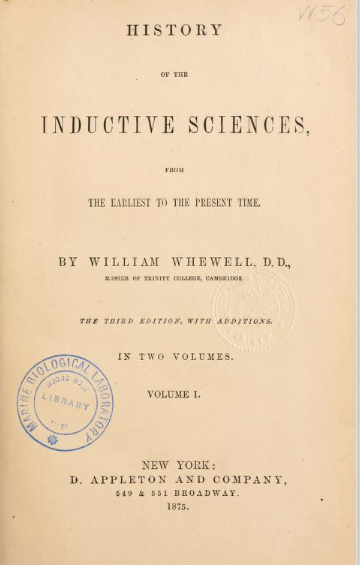
History of the Inductive Sciences
by William Whewell
★★★★★No ratings yet
Language: English
Sign in to rate this book.
Sign in to shelve this book.
About this eBook
- Author
- Whewell, William, 1794-1866
- Title
- History of the inductive sciences, from the earliest to the present time
- Original Publication
- United States: D. Appleton and Company,1875.
- Credits
- Ed Brandon
- Language
- English
- LoC Class
- Q: Science
- Subject
- Science -- History
- Category
- Text
- Project Gutenberg
- eBook-No. 68693
- Release Date
- August 5, 2022
- Copyright
- Public domain in the USA.
Contents
- 1.HISTORY OF THE INDUCTIVE SCIENCE S , FROM THE EARLIEST TO THE PRESENT TIME.
- 2.Untitled
- 3.PREFACE TO THE THIRD EDITION .
- 4.CONTENTS OF THE FIRST VOLUME.
- 5.CONTENTS OF THE SECOND VOLUME.
- 6.INDEX OF PROPER NAMES.
- 7.INDEX OF TECHNICAL TERMS.
- 8.INTRODUCTION.
- 9.BOOK I. — CHAPTER I. Prelude to the Greek School Philosophy. — Sect. 1.— First Attempts of the Speculative Faculty in Physical Inquiries. — Sect. 2.— Primitive Mistake in Greek Physical Philosophy. — CHAPTER II. The Greek School Philosophy. — Sect. 1.— The general Foundation of the Greek School Philosophy. — Sect. 2.— The Aristotelian Physical Philosophy. — Sect. 3.— Technical Forms of the Greek Schools. — CHAPTER III. Failure of the Physical Philosophy of the Greek Schools. — Sect. 1.— Result of the Greek School Philosophy . — Sect. 2.— Cause of the Failure of the Greek Physical Philosophy.
- 10.BOOK II. — INTRODUCTION. — CHAPTER I. Earliest Stages of Mechanics and Hydrostatics. — Sect. 1.— Mechanics. — Sect. 2.— Hydrostatics. — CHAPTER II. Earliest Stages of Optics. — CHAPTER III. Earliest Stages of Harmonics.
- 11.BOOK III. — INTRODUCTION. — CHAPTER I. Earliest Stages of Astronomy. — Sect. 1.— Formation of the Notion of a Year. — Sect. 2.— Fixation of the Civil Year. — Sect. 3.— Correction of the Civil Year. ( Julian Calendar. ) — Sect. 4.— Attempts at the Fixation of the Month. — Sect. 5.— Invention of Lunisolar Years. — Sect. 6.— The Constellations. — Sect. 7.— The Planets. — Sect. 8.— The Circles of the Sphere. — Sect. 9.— The Globular Form of the Earth. — Sect. 10.— The Phases of the Moon. — Sect. 11.— Eclipses. — Sect. 12.— Sequel to the Early Stages of Astronomy. — CHAPTER II. Prelude to the Inductive Epoch of Hipparchus. — CHAPTER III. Inductive Epoch of Hipparchus. — Sect. 1.— Establishment of the Theory of Epicycles and Eccentrics. — Sect. 2.— Estimate of the Value of the Theory of Eccentrics and Epicycles. — Sect. 3.— Discovery of the Precession of the Equinoxes. — CHAPTER IV. Sequel to the Inductive Epoch of Hipparchus. — Sect. 1.— Researches which verified the Theory. — Sect. 2.— Researches which did not verify the Theory. — Sect. 3. —Methods of Observation of the Greek Astronomers. — Sect. 4.— Period from Hipparchus to Ptolemy. — Sect. 5.— Measures of the Earth. — Sect. 6.— Ptolemy’s Discovery of Evection. — Sect. 7.— Conclusion of the History of Greek Astronomy. — Sect. 8.— Arabian Astronomy.
- 12.BOOK IV. — INTRODUCTION. — CHAPTER I. On the Indistinctness of Ideas of the Middle Ages. — CHAPTER II. The Commentatorial Spirit of the Middle Ages. — CHAPTER III. Of the Mysticism of the Middle Ages. — CHAPTER IV. Of the Dogmatism of the Stationary Period. — CHAPTER V. Progress of the Arts in the Middle Ages.
- 13.BOOK V. — INTRODUCTION. — Of Formal and Physical Astronomy. — CHAPTER I. Prelude to the Inductive Epoch of Copernicus. — CHAPTER II. Induction of Copernicus.—The Heliocentric Theory asserted on formal grounds. — CHAPTER III. Sequel to Copernicus.—The Reception and Development of the Copernican Theory. — Sect. 1.— First Reception of the Copernican Theory. — Sect. 2.— Diffusion of the Copernican Theory. — Sect. 3.— The Heliocentric Theory confirmed by Facts.—Galileo’s Astronomical Discoveries. — Sect. 4.— The Copernican System opposed on Theological Grounds. — Sect. 5.— The Heliocentric Theory confirmed on Physical considerations.— ( Prelude to Kepler’s Astronomical Discoveries. ) — CHAPTER IV. Inductive Epoch of Kepler. — Sect. 1.— Intellectual Character of Kepler. — Sect. 2.— Kepler’s Discovery of his Third Law. — Sect. 3.— Kepler’s Discovery of his First and Second Laws.—Elliptical Theory of the Planets. — CHAPTER V. Sequel to the epoch of Kepler. Reception, Verification, and Extension of the Elliptical Theory. — Sect. 1.— Application of the Elliptical Theory to the Planets. — Sect. 2.— Application of the Elliptical Theory to the Moon. — Sect. 3.— Causes of the further Progress of Astronomy.
- 14.BOOK VI. — INTRODUCTION. — CHAPTER I. Prelude to the Epoch of Galileo. — Sect. 1.— Prelude to the Science of Statics. — Sect. 2.— Revival of the Scientific Idea of Pressure.—Stevinus.—Equilibrium of Oblique Forces. — Sect. 3.— Prelude to the Science of Dynamics.—Attempts at the First Law of Motion. — CHAPTER II. Inductive Epoch of Galileo.—Discovery of the Laws of Motion in Simple Cases. — Sect. 1.— Establishment of the First Law of Motion. — Sect. 2.— Formation and Application of the Notion of Accelerating Force.—Laws of Falling Bodies. — Sect. 3.— Establishment of the Second Law of Motion.—Curvilinear Motions. — Sect. 4.— Generalization of the Laws of Equilibrium.—Principle of Virtual Velocities. — Sect. 5.— Attempts at the Third Law of Motion.—Notion of Momentum. — CHAPTER III. Sequel to the Epoch of Galileo.—Period of Verification and Deduction. — CHAPTER IV. Discovery of the Mechanical Principles of Fluids. — Sect. 1.— Rediscovery of the Laws of Equilibrium of Fluids. — Sect. 2.— Discovery of the Laws of Motion of Fluids. — CHAPTER V. Generalization of the Principles of Mechanics. — Sect. 1.— Generalization of the Second Law of Motion.—Central Forces. — Sect. 2.— Generalization of the Third Law of Motion.—Centre of Oscillation.—Huyghens. — CHAPTER VI. Sequel to the Generalization of the Principles of Mechanics.—Period of Mathematical Deduction.—Analytical Mechanics.
- 15.BOOK VII. — CHAPTER I. Prelude to the Inductive Epoch of Newton. — CHAPTER II. The Inductive Epoch of Newton.—Discovery of the Universal Gravitation of Matter, according to the Law of the Inverse Square of the Distance. — CHAPTER III. Sequel to the Epoch of Newton.—Reception of the Newtonian Theory. — Sect. 1.— General Remarks. — Sect. 2.— Reception of the Newtonian Theory in England. — Sect. 3.— Reception of the Newtonian Theory abroad. — CHAPTER IV. Sequel to the Epoch of Newton, continued.—Verification and Completion of the Newtonian Theory. — Sect. 1.— Division of the Subject. — Sect. 2.— Application of the Newtonian Theory to the Moon. — Sect. 3.— Application of the Newtonian Theory to the Planets, Satellites, and Earth. — Sect. 4.— Application of the Newtonian Theory to Secular Inequalities. — Sect. 5.— Application of the Newtonian Theory to the New Planets. — Sect. 6.— Application of the Newtonian Theory to Comets. — Sect. 7.— Application of the Newtonian Theory to the Figure of the Earth. — Sect. 8.— Confirmation of the Newtonian Theory by Experiments on Attraction. — Sect. 9.— Application of the Newtonian Theory to the Tides. — CHAPTER V. Discoveries added to the Newtonian Theory. — Sect. 1.— Tables of Astronomical Refraction. — Sect. 2.— Discovery of the Velocity of Light.—Römer. — Sect. 3.— Discovery of Aberration.—Bradley. — Sect. 4.— Discovery of Nutation. — Sect. 5.— Discovery of the Laws of Double Stars.—The two Herschels. — CHAPTER VI. The Instruments and Aids of Astronomy during the Newtonian Period. — Sect. 1.— Instruments. — Sect. 2.— Observatories. — Sect. 3.— Scientific Societies. — Sect. 4.— Patrons of Astronomy. — Sect. 5.— Astronomical Expeditions. — Sect. 6.— Present State of Astronomy.
- 16.ADDITIONS TO THE THIRD EDITION. — INTRODUCTION.
- 17.BOOK I. — CHAPTER II. The Greek Schools. — The Platonic Doctrine of Ideas. — CHAPTER III. Failure of the Greek Physical Philosophy. — Francis Bacon’s Remarks. — Aristotle’s Account of the Rainbow.
- 18.BOOK II. — Plato’s Timæus and Republic. — Hero of Alexandria.
- 19.BOOK III. — INTRODUCTION. — CHAPTER I. Earliest Stages of Astronomy. — The Globular Form of the Earth. — The Heliocentric System among the Ancients. — The Eclipse of Thales.
- 20.BOOK IV. — GENERAL REMARKS. — CHAPTER V. Progress in the Middle Ages. — Thomas Aquinas. — Roger Bacon.
- 21.BOOK V. — CHAPTER I. Prelude to Copernicus. — Nicolas of Cus. — CHAPTER II. The Copernican Theory. — The Moon’s Rotation. — M. Foucault’s Proofs of the Earth’s Motion. — CHAPTER III. Sequel to Copernicus. — English Copernicans. — Giordano Bruno. — Did Francis Bacon reject the Copernican System? — Kepler persecuted. — Were the Papal Edicts against the Copernican System repealed?
- 22.BOOK VI. — CHAPTER III. Principles and Problems. — Significance of Analytical Mechanics. — Engineering Mechanics. — Strength of Materials. — Roofs—Arches—Vaults.
- 23.BOOK VII. — CHAPTER I. Prelude to Newton. — The Ancients. — Jeremiah Horrox. — Newton’s Discovery of Gravitation. — CHAPTER III. The Principia. — Sect. 2.— Reception of the Principia. — Is Gravitation proportional to Quantity of Matter? — CHAPTER IV. Verification and Completion of the Newtonian Theory. — Tables of the Moon and Planets. — The Discovery of Neptune. — The Minor Planets. — Anomalies in the Action of Gravitation. — The Earth’s Density. — Tides. — Double Stars. — CHAPTER VI. — Sect. 1. Instruments. —2. Clocks.
- 24.BOOK VIII.
- 25.BOOK VIII. — INTRODUCTION. — The Secondary Mechanical Sciences. — CHAPTER I. Prelude to the Solution of Problems in Acoustics. — CHAPTER II. Problem of the Vibrations of Strings. — CHAPTER III. Problem of the Propagation of Sound. — CHAPTER IV. Problem of different Sounds of the same String. — CHAPTER V. Problem of the Sounds of Pipes. — CHAPTER VI. Problem of Different Modes of Vibration of Bodies in General.
- 26.BOOK IX. — INTRODUCTION. — Formal and Physical Optics. — CHAPTER I. Primary Induction of Optics.—Rays of Light and Laws of Reflection. — CHAPTER II. Discovery of the Law of Refraction. — CHAPTER III. Discovery of the Law of Dispersion by Refraction. — CHAPTER IV. Discovery of Achromatism. — CHAPTER V. Discovery of the Laws of Double Refraction. — CHAPTER VI. Discovery of the Laws of Polarization. — CHAPTER VII. Discovery of the Laws of the Colours of Thin Plates. — CHAPTER VIII. Attempts to discover the Laws of other Phenomena. — CHAPTER IX. Discovery of the Laws of Phenomena of Dipolarized Light.
- 27.CHAPTER X. Prelude to the Epoch of Young and Fresnel. — CHAPTER XI. Epoch of Young and Fresnel. — Sect. 1.— Introduction. — Sect. 2.— Explanation of the Periodical Colors of Thin Plates and Shadows by the Undulatory Theory. — Sect. 3.— Explanation of Double Refraction by the Undulatory Theory. — Sect. 4.— Explanation of Polarization by the Undulatory Theory. — Sect. 5.— Explanation of Dipolarization by the Undulatory Theory. — CHAPTER XII. Sequel to the Epoch of Young and Fresnel. Reception of the Undulatory Theory. — CHAPTER XIII. Confirmation and Extension of the Undulatory Theory.
- 28.BOOK X. — INTRODUCTION. — Of Thermotics and Atmology.
- 29.CHAPTER I. The Doctrines of Conduction and Radiation. — Section 1.— Introduction of the Doctrine of Conduction. — Sect. 2.— Introduction of the Doctrine of Radiation. — Sect. 3. —Verifications of the Doctrines of Conduction and Radiation. — Sect. 4.— The Geological and Cosmological Application of Thermotics. — Sect. 5.— Correction of Newton’s Law of Cooling. — Sect. 6.— Other Laws of Phenomena with respect to Radiation. — Sect. 7.— Fourier’s Theory of Radiant Heat. — Sect. 8.— Discovery of the Polarization of Heat. — CHAPTER II. The Laws of Changes occasioned by Heat. — Sect. 1.— Expansion by Heat.—The Law of Dalton and Gay-Lussac for Gases. — Sect. 2.— Specific Heat.—Change of Consistence. — Sect. 3.— The Doctrine of Latent Heat.
- 30.CHAPTER III. The Relation of Vapor and Air. — Sect. 1.— The Boylean Law of the Air’s Elasticity. — Sect. 2.— Prelude to Dalton’s Doctrine of Evaporation. — Sect. 3.— Dalton’s Doctrine of Evaporation. — Sect. 4.— Determination of the Laws of the Elastic Force of Steam. — Sect. 5.— Consequences of the Doctrine of Evaporation.—Explanation of Rain, Dew, and Clouds. — CHAPTER IV. Physical Theories of Heat.
- 31.BOOK XI. — INTRODUCTION. — Of the Mechanico-Chemical Sciences. — CHAPTER 1. Discovery of Laws of Electric Phenomena. — CHAPTER II. The Progress of Electrical Theory.
- 32.BOOK XII. — CHAPTER I. Discovery of Laws of Magnetic Phenomena. — CHAPTER II. Progress of Magnetic Theory.
- 33.BOOK XIII. — CHAPTER I. Discovery of Voltaic Electricity. — CHAPTER II. Reception and Confirmation of the Discovery of Voltaic Electricity. — CHAPTER III. Discovery of the Laws of the Mutual Attraction and Repulsion of Voltaic Currents.—Ampère. — CHAPTER IV. Discovery of Electro-magnetic Action.—Oersted. — CHAPTER V. Discovery of the Laws of Electro-magnetic Action. — CHAPTER VI. Theory of Electrodynamical Action. — CHAPTER VII. Consequences of the Electrodynamic Theory. — CHAPTER VIII. Discovery of the Laws of Magneto-Electric Induction.—Faraday. — CHAPTER IX. Transition to Chemical Science.
- 34.BOOK XIV. — CHAPTER I. Improvement of the Notion of Chemical Analysis, and Recognition of it as the Spagiric Art. — CHAPTER II. Doctrine of Acid and Alkali.—Sylvius. — CHAPTER III. Doctrine of Elective Attractions. Geoffroy. Bergman. — CHAPTER IV. Doctrine of Acidification and Combustion.—Phlogistic Theory. — CHAPTER V. Chemistry of Gases.—Black. Cavendish. — CHAPTER VI. Epoch of the Theory of Oxygen.—Lavoisier. — Sect. 1.— Prelude to the Theory.—Its Publication. — Sect. 2.— Reception and Confirmation of the Theory of Oxygen. — Sect. 3.— Nomenclature of the Oxygen Theory. — CHAPTER VII. Application and Correction of the Oxygen Theory. — CHAPTER VIII. Theory of Definite, Reciprocal, and Multiple Proportions. — Sect. 1.— Prelude to the Atomic Theory, and its Publication by Dalton. — Sect. 2.— Reception and Confirmation of the Atomic Theory. — Sect. 3.— The Theory of Volumes.—Gay-Lussac. — CHAPTER IX. Epoch of Davy and Faraday. — Sect. 1.— Promulgation of the Electro-chemical Theory by Davy. — Sect. 2.— Establishment of the Electro-chemical Theory by Faraday. — Sect. 3.— Consequences of Faraday’s Discoveries. — Sect. 4.— Reception of the Electro-chemical Theory. — CHAPTER X. Transition from the Chemical to the Classificatory Sciences.
- 35.BOOK XV. — INTRODUCTION. — Sect. 1.— Of the Classificatory Sciences. — Sect. 2.— Mineralogy as the Analytico-classificatory Science.
- 36.CHAPTER I. Prelude to the Epoch of De Lisle and Haüy. — CHAPTER II. Epoch of Romé De Lisle and Haüy.—Establishment of the Fixity of Crystalline Angles, and the Simplicity of the Laws of Derivation. — CHAPTER III. Reception and Corrections of the Hauïan Crystallography. — CHAPTER IV. Establishment of the Distinction of Systems of Crystallization.—Weiss and Mohs. — CHAPTER V. Reception and Confirmation of the Distinction of Systems of Crystallization. — CHAPTER VI. Correction of the Law of the same Angle for the same Substance. — CHAPTER VII. Attempts to Establish the Fixity of other Physical Properties.—Werner.
- 37.CHAPTER VIII. Attempts at the Classification of Minerals. — Sect. 1.— Proper object of Classification. — Sect. 2.— Mixed Systems of Classification. — CHAPTER IX. Attempts at the Reform of Mineralogical Systems.—Separation of the Chemical and Natural History Methods. — Sect. 1.— Natural History System of Mohs. — Sect. 2.— Chemical System of Berzelius and others. — Sect. 3.— Failure of the Attempts at Systematic Reform. — Sect. 4.— Return to Mixed Systems with Improvements.
- 38.BOOK XVI. — INTRODUCTION. — CHAPTER I. Imaginary Knowledge of Plants. — CHAPTER II. Unsystematic Knowledge of Plants. — CHAPTER III. Formation of a System of Arrangement of Plants. — Sect. 1.— Prelude to the Epoch of Cæsalpinus. — Sect. 2.— Epoch of Cæsalpinus.—Formation of a System of Arrangement. — Sect. 3.— Stationary Interval. — Sect. 4.— Sequel to the Epoch of Cæsalpinus. Further Formation and Adoption of Systematic Arrangement. — CHAPTER IV. The Reform of Linnæus. — Sect. 1.— Introduction of the Reform. — Sect. 2.— Linnæan Reform of Botanical Terminology. — Sect. 3.— Linnæan Reform of Botanical Nomenclature. — Sect. 4.— Linnæus’s Artificial System. — Sect. 5.— Linnæus’s Views on a Natural Method. — Sect. 6.— Reception and Diffusion of the Linnæan Reform. — CHAPTER V. Progress towards a Natural System of Botany. — CHAPTER VI. The Progress of Systematic Zoology. — CHAPTER VII. The Progress of Ichthyology.
- 39.BOOK XVII. — INTRODUCTION. — Of the Organical Sciences — CHAPTER I. Discovery of the Organs of Voluntary Motion. — Sect. 1.— Knowledge of Galen and his Predecessors. — Sect. 2.— Recognition of Final Causes in Physiology. Galen. — CHAPTER II. Discovery of the Circulation of the Blood. — Sect. 1.— Prelude to the Discovery. — Sect. 2.— The Discovery of the Circulation made by Harvey. — Sect. 3.— Reception of the Discovery. — Sect. 4.— Bearing of the Discovery on the Progress of Physiology. — CHAPTER III. Discovery of the Motion of the Chyle, and consequent Speculations. — Sect. 1.— The Discovery of the Motion of the Chyle. — Sect. 2.— The Consequent Speculations. Hypotheses of Digestion. — CHAPTER IV. Examination of the Process of Reproduction in Animals and Plants, and Consequent Speculations. — Sect. 1.— The Examination of the Process of Reproduction in Animals. — Sect. 2.— The Examination of the Process of Reproduction in Vegetables. — Sect. 3.— The Consequent Speculations.—Hypotheses of Generation. — CHAPTER V. Examination of the Nervous System, and Consequent Speculations. — Sect. 1.— The Examination of the Nervous System. — Sect. 2.— The Consequent Speculations. Hypotheses respecting Life, Sensation, and Volition. — CHAPTER VI. Introduction of the Principle of Developed and Metamorphosed Symmetry — Sect. 1.— Vegetable Morphology. Göthe. De Candolle. — Sect. 2.— Application of Vegetable Morphology. — CHAPTER VII. Progress of Animal Morphology. — Sect. 1.— Rise of Comparative Anatomy. — Sect. 2.— Distinction of the General Types of the Forms of Animals.—Cuvier. — Sect. 3.— Attempts to establish the Identity of the Types of Animal Forms. — CHAPTER VIII. The Doctrine of Final Causes in Physiology. — Sect. 1.— Assertion of the Principle of Unity of Plan. — Sect. 2.— Estimate of the Doctrine of Unity of Plan. — Sect. 3.— Establishment and Application of the Principle of the Conditions of Existence of Animals.—Cuvier.
- 40.BOOK XVIII. — INTRODUCTION. — Of the Palætiological Sciences.
- 41.CHAPTER I. Prelude to Systematic Descriptive Geology — Sect. 1.— Ancient Notices of Geological Facts. — Sect. 2.— Early Descriptions and Collections of Fossils. — Sect. 3.— First Construction of Geological Maps. — CHAPTER II. Formation of Systematic Descriptive Geology. — Sect. 1.— Discovery of the Order and Stratification of the Materials of the Earth. — Sect. 2.— Systematic form given to Descriptive Geology.—Werner. — Sect. 3.— Application of Organic Remains as a Geological Character.—Smith. — Sect. 4.— Advances in Palæontology.—Cuvier. — Sect. 5.— Intellectual Characters of the Founders of Systematic Descriptive Geology. — CHAPTER III. Sequel to the Formation of Systematic Descriptive Geology. — Sect. 1.— Reception and Diffusion of Systematic Geology. — Sect. 2.— Application of Systematic Geology. Geological Surveys and Maps. — Sect. 3.— Geological Nomenclature. — Sect. 4.— Geological Synonymy, or Determination of Geological Equivalents. — CHAPTER IV. Attempts to Discover General Laws in Geology. — Sect. 1.— General Geological Phenomena. — Sect. 2.— Transition to Geological Dynamics.
- 42.CHAPTER V. Inorganic Geological Dynamics. — Sect. 1.— Necessity and Object of a Science of Geological Dynamics. — Sect. 2.— Aqueous Causes of Change. — Sect. 3.— Igneous Causes of Change.—Motions of the Earth’s Surface. — Sect. 4.— The Doctrine of Central Heat. — Sect. 5.— Problems respecting Elevations and Crystalline Forces. — Sect. 6.— Theories of Changes of Climate. — CHAPTER VI. Progress of the Geological Dynamics of Organized Beings. — Sect. 1.— Objects of this Science. — Sect. 2.— Geography of Plants and Animals. — Sect. 3.— Question of the Transmutation of Species. — Sect. 4.— Hypothesis of Progressive Tendencies. — Sect. 5.— Question of Creation as related to Science. — Sect. 6.— The Hypothesis of the regular Creation and Extinction of Species. — Sect. 7.— The Imbedding of Organic Remains.
- 43.CHAPTER VII. Progress of Physical Geology. — Sect. 1.— Object and Distinctions of Physical Geology. — Sect. 2.— Of Fanciful Geological Opinions. — Sect. 3.— Of Premature Geological Theories. — CHAPTER VIII. The Two Antagonist Doctrines of Geology. — Sect. 1.— Of the Doctrine of Geological Catastrophes. — Sect. 2.— Of the Doctrine of Geological Uniformity.
- 44.ADDITIONS TO THE THIRD EDITION. — BOOK VIII. ACOUSTICS. — CHAPTER III. Sound. — The Velocity of Sound in Water.
- 45.BOOK IX. — Photography. — Fluorescence. — CHAPTER XIII. Undulatory Theory. — Direction of the Transverse Vibrations in Polarization. — Final Disproof of the Emission Theory.
- 46.BOOK X. — CHAPTER III. The Relation of Vapour and Air. — Sect. 4.— Force of Steam. — Sect. 5.— Temperature of the Atmosphere. — CHAPTER IV. Theories of Heat. — The Dynamical Theory of Heat.
- 47.BOOK XI. — GENERAL REMARKS. — Dr. Faraday’s Views of Statical Electric Induction.
- 48.BOOK XII. — Recent Progress of Terrestrial Magnetism. — Correction of Ship’s Compasses.
- 49.BOOK XIII. — CHAPTER VII. Magneto-electric Induction. — Magneto-optic Effects and Magnecrystallic Polarity. — Magneto-electric Machines. — Applications of Electrodynamic Discoveries.
- 50.BOOK XIV. — CHAPTER IX. The Electro-chemical Theory. — The Number of Elementary Substances.
- 51.BOOK XV. — 1. Crystallography. — 2. Optical Properties of Minerals. — 3. Classification of Minerals.
- 52.BOOK XVI. — BOTANY. — ZOOLOGY.
- 53.BOOK XVII. — Vegetable Morphology. — Morphology in Linnæus. — CHAPTER VII. Animal Morphology. — Final Causes
- 54.BOOK XVIII.
Community reviews
Sign in to write a review.
No reviews yet.