Companies D, G and I went into camp at Carrollton
on the afternoon of December 18th, 1862. A telegraphic
order was received from New Orleans on the
nineteenth, sent by General Banks, which read as
follows: “Colonel Burrell, with his three companies of
the Forty-Second Massachusetts Volunteers, will proceed
to Galveston forthwith.” Supposing execution of this
order was urgent, preparations to move were at once
made. At three o’clock in the afternoon camp was
struck and the companies ready to move; but, as the
transport Saxon, at New Orleans for repairs, did not
arrive, tents were again pitched and occupied until the
twenty-first. Next day, twentieth, written special orders
from General Banks were handed to Colonel Burrell by
General Sherman, commanding the post, and read:
“Colonel Burrell, with the three companies of the Forty-Second
Regiment, Massachusetts Volunteers, will proceed
to Galveston, land and take post.”
Colonel Burrell decided to execute his orders promptly.
On the twenty-first the Saxon was ready to embark his
men. Camp was struck early in the morning. At eight
o’clock men, baggage and equipage were all on board,
and the steamer proceeded down river until eight o’clock
in the evening, having anchored opposite New Orleans
for about two hours, while the colonel, accompanied
by Chaplain Sanger, went ashore for an interview with
General Banks at his headquarters, to obtain definite
instructions. The only officer to be found at headquarters
was Colonel S. B. Holabird, chief-quartermaster of the
Department, who said full instructions in writing had
been prepared, but he could not find them; during the
conversation carefully looking over documents in the
office. Colonel Holabird suggested to Colonel Burrell
not to be in a hurry in proceeding to Galveston, and
having heard the subject talked over in consultations that
had taken place among other staff-officers and General
Banks, advised him, on arrival at Galveston, to consult
with Commodore Renshaw, commander of the fleet, in
reference to his course of action; that instructions would
be forwarded very soon, as the balance of the regiment
on arrival from New York would be promptly sent to him.
The intention of General Banks, Holabird stated, was to
send there an additional regiment of infantry, a regiment
of cavalry, and a light artillery battery, as soon as it could
possibly be done; that General Banks’ idea was, for the
three companies to remain under protection of the navy
guns until reënforcements arrived. Colonel Holabird
cautioned Colonel Burrell, not to be drawn into any
scrapes by Confederate General Magruder, who had lately
assumed command of all forces in Texas.
After lying alongside the river bank until half-past one
o’clock next morning, the transport proceeded on her way.
Passing out of the Mississippi River by the South West
Pass into the Gulf of Mexico at eleven o’clock in the
morning, the course was taken for Galveston.
The troops on board the Saxon consisted of:
Colonel—Isaac S. Burrell.
Adjutant—Charles A. Davis.
Quartermaster—Charles B. Burrell.
Surgeon—Ariel I. Cummings.
Chaplain—George J. Sanger.
Quartermaster-Sergeant—Henry C. Foster.
A young volunteer in the engineer corps named W. S.
Long, who reported on board at New Orleans.
Lieutenant Brown P. Stowell, Company E, who was
sick when the regiment left New York, and embarked on
the Saxon, instead of remaining with his company.
Private Samuel R. Hersey, Company C, acting as
clerk to the colonel. Frank Veazie, cook to officers’
mess, not an enlisted man. Two colored boys, Charles
L. Amos of Dedham, Mass., servant of Quartermaster
Burrell, and Charles F. Revaleon of Boylston, Mass.,
servant of Surgeon Cummings.
| 1. |
Captain |
George Sherive. |
| 2. |
First Lieutenant |
Wm. H. Cowdin. |
| 3. |
Second Lieutenant |
Darius F. Eddy. |
| 4. |
First Sergeant |
Samuel A. Waterman. |
| 5. |
Second Sergeant |
Charles D. Frye. |
| 6. |
Third Sergeant |
Charles R. Todd. |
| 7. |
Fourth Sergeant |
Wm. E. Humphrey (color bearer). |
| 8. |
Fifth Sergeant |
John W. Davis. |
| 9. |
First Corporal |
Chas. C. Richards. |
| 10. |
Second Corporal |
Benjamin Noyes. |
| 11. |
Third Corporal |
Wm. H. Tileston. |
| 12. |
Fourth Corporal |
Chas. J. Oldham. |
| 13. |
Fifth Corporal |
Benjamin F. Bean. |
| 14. |
Sixth Corporal |
Lewis M. Calhoun. |
| 15. |
Corporal |
Henry W. McIntosh. |
| 16. |
Drummer |
Lewis Eddy. |
| 17. |
Private |
Albert S. Allen. |
| 18. |
“ |
William H. Brown. |
| 19. |
“ |
William H. Bullard. |
| 20. |
“ |
William H. Batson. |
| 21. |
“ |
Charles Brown. |
| 22. |
“ |
Charles W. Bailey. |
| 23. |
“ |
John Barnes. |
| 24. |
“ |
Edward Boardman. |
| 25. |
“ |
William Burke. |
| 26. |
“ |
Major Bacon. |
| 27. |
“ |
Michael Buckmaster. |
| 28. |
“ |
John Burns. |
| 29. |
“ |
Charles H. Cushman. |
| 30. |
“ |
George T. Clinton. |
| 31. |
“ |
Dennis Dailey. |
| 32. |
“ |
John Drury. |
| 33. |
“ |
Peter Durnam. |
| 34. |
“ |
Tobias Enslee. |
| 35. |
“ |
George M. Fisk. |
| 36. |
“ |
Henry Fisk. |
| 37. |
“ |
John Fay. |
| 38. |
“ |
Fitzallen Gourley. |
| 39. |
“ |
Charles J. Grinnell. |
| 40. |
“ |
Amos B. Howard. |
| 41. |
“ |
Thomas C. Houghton. |
| 42. |
“ |
David Howe. |
| 43. |
“ |
Wallace A. Josselyn. |
| 44. |
“ |
Edwin F. Josselyn. |
| 45. |
“ |
Jacob Kopf. |
| 46. |
“ |
William B. Larrabee. |
| 47. |
“ |
Fred Lamote. |
| 48. |
“ |
Thomas Londergan. |
| 49. |
“ |
Frank McConlow. |
| 50. |
“ |
Randolph P. Mosely. |
| 51. |
“ |
John V. McIlroy. |
| 52. |
“ |
James Moore. |
| 53. |
“ |
Francis L. Morrill. |
| 54. |
“ |
Angus G. Nicholson. |
| 55. |
“ |
James O’Shaughnessy. |
| 56. |
“ |
Benjamin Pratt. |
| 57. |
“ |
George Powers. |
| 58. |
“ |
Louis Preami. |
| 59. |
“ |
Gustavus Raymond. |
| 60. |
“ |
Cornelius Ryan. |
| 61. |
“ |
Jerry S. Russell. |
| 62. |
“ |
William Rigby. |
| 63. |
“ |
Jeremiah Quinn. |
| 64. |
“ |
Henry C. Sellea. |
| 65. |
“ |
Joseph H. Stowell. |
| 66. |
“ |
Sargent L. Stoddard. |
| 67. |
“ |
Daniel J. Sullivan. |
| 68. |
“ |
Laban Thaxter. |
| 69. |
“ |
Josiah Thompson. |
| 70. |
“ |
James Thomaston. |
| 71. |
“ |
Daniel H. Vining. |
| 72. |
“ |
Charles G. Weymouth. |
| 73. |
“ |
Daniel L. Weymouth. |
| 74. |
“ |
George S. Walls. |
| 75. |
“ |
George H. Wight. |
| 76. |
“ |
Jonathan G. Wight. |
| 77. |
“ |
Albert P. Wright. |
| 78. |
“ |
Nathaniel White. |
| The following officers and men of Company G: |
| 1. |
Captain |
Alfred N. Proctor. |
| 2. |
2d Lieutenant |
Thaddeus H. Newcomb. |
| 3. |
Sergeant |
Levi W. Goodrich. |
| 4. |
“ |
Philip P. Hackett. |
| 5. |
Corporal |
John W. Buttrick. |
| 6. |
“ |
Seth E. Clapp. |
| 7. |
“ |
John C. Bishop.
|
| 8. |
Corporal |
George W. Griggs. |
| 9. |
“ |
Moses Lincoln, Jr. |
| 10. |
“ |
Robert G. Thompson. |
| 11. |
“ |
George G. Morrison. |
| 12. |
“ |
David L. Wentworth, acting as ordnance-sergeant. |
| 13. |
Drummer |
Horace W. Chandler. |
| 14. |
“ |
David A. Ireson. |
| 15. |
Wagoner |
Roland C. Judkins. |
| 16. |
Private |
Obed F. Allen. |
| 17. |
“ |
Joseph Brownlow. |
| 18. |
“ |
Charles A. Bailey. |
| 19. |
“ |
John Brown. |
| 20. |
“ |
William H. Bickers. |
| 21. |
“ |
Charles L. Barrett. |
| 22. |
“ |
Charles Barrett. |
| 23. |
“ |
Charles Boardman. |
| 24. |
“ |
John M. Barnard, Jr. |
| 25. |
“ |
William M. Bird. |
| 26. |
“ |
Gilbert F. Blaisdell. |
| 27. |
“ |
John H. Cary. |
| 28. |
“ |
Thomas O. Bryant. |
| 29. |
“ |
John Carvey. |
| 30. |
“ |
John T. Cook. |
| 31. |
“ |
Lemuel S. Copeland. |
| 32. |
“ |
Frank Covell. |
| 33. |
“ |
Frederick Corson. |
| 34. |
“ |
Gilbert Crocker. |
| 35. |
“ |
Fred T. Clark. |
| 36. |
“ |
William Carter. |
| 37. |
“ |
George H. Davis. |
| 38. |
“ |
John E. Davis. |
| 39. |
“ |
James L. Davis. |
| 40. |
“ |
George R. Dary. |
| 41. |
“ |
Edmund B. Doubel. |
| 42. |
“ |
Daniel Dinnegan. |
| 43. |
“ |
James G. Emerson. |
| 44. |
“ |
John Eaton. |
| 45. |
“ |
John Eastman. |
| 46. |
“ |
Richard Ellis. |
| 47. |
“ |
Thomas Field. |
| 48. |
“ |
Benjamin Gould. |
| 49. |
“ |
John W. Gordon. |
| 50. |
“ |
George S. Hyde. |
| 51. |
“ |
Albert A. Hayden. |
| 52. |
“ |
John Harmon. |
| 53. |
“ |
Henry T. Horn. |
| 54. |
“ |
Albert A. Holt. |
| 55. |
“ |
Lucius Higgins. |
| 56. |
“ |
Charles Hilger. |
| 57. |
“ |
Alonzo D. Ireson. |
| 58. |
“ |
Eli P. Johnson. |
| 59. |
“ |
Francis Knight. |
| 60. |
“ |
George W. Kibbey. |
| 61. |
“ |
Arthur Kelley. |
| 62. |
“ |
Charles B. Lynde. |
| 63. |
“ |
Amos W. Lynde. |
| 64. |
“ |
William Logan. |
| 65. |
“ |
Samuel Marshall. |
| 66. |
“ |
Joseph Mullen. |
| 67. |
“ |
James H. McAllister. |
| 68. |
“ |
Francis L. Nott. |
| 69. |
“ |
Joseph W. D. Parker. |
| 70. |
“ |
Charles Paine. |
| 71. |
“ |
Daniel D. Penney. |
| 72. |
“ |
John F. Parrott. |
| 73. |
“ |
Benjamin R. Pierce. |
| 74. |
“ |
Diomede Roseline. |
| 75. |
“ |
Martin W. Roberts. |
| 76. |
“ |
Chas. W. H. Sanborn. |
| 77. |
“ |
Albert I. Smart. |
| 78. |
“ |
Thomas T. Sweetser. |
| 79. |
“ |
Henry O. Studley. |
| 80. |
“ |
William Stiles. |
| 81. |
“ |
Charles H. Upham.
66 |
| 82. |
“ |
Edwin A. Vinton. |
| 83. |
“ |
Levi Vincent. |
| 84. |
“ |
James W. Vinal. |
| 85. |
“ |
James Vance. |
| 86. |
“ |
Abiel F. White. |
| 87. |
“ |
Henry J. Wethern. |
| 88. |
“ |
William B. York. |
| 89. |
“ |
Josiah R. York. |
| And the following officers and men of Company I: |
| 1. |
Captain |
Cyrus Savage. |
| 2. |
First Lieutenant |
Samuel F. White. |
| 3. |
Second Lieutenant |
Benjamin F. Bartlett. |
| 4. |
First Sergeant |
Wm. H. Hunt. |
| 5. |
Second Sergeant |
John F. Hewins. |
| 6. |
Third Sergeant |
Chauncy B. Sawyer. |
| 7. |
Fourth Sergeant |
Edward Merrill, Jr. |
| 8. |
Fifth Sergeant |
Cornelius G. Kenney. |
| 9. |
First Corporal |
Frank M. Adams. |
| 10. |
Second Corporal |
Nathaniel H. Bird. |
| 11. |
Third Corporal |
Sanford H. Brigham. |
| 12. |
Fourth Corporal |
David F. Sloan. |
| 13. |
Fifth Corporal |
Daniel H. Walker. |
| 14. |
Drummer |
Albert Schneider. |
| 15. |
Private |
Moses Averill. |
| 16. |
“ |
Edward F. Bryant. |
| 17. |
“ |
Jonathan Baker. |
| 18. |
“ |
Edward J. Baker. |
| 19. |
“ |
Edward K. Baker. |
| 20. |
“ |
John K. Clements. |
| 21. |
“ |
Samuel Crowell. |
| 22. |
“ |
Jefferson W. Cheney. |
| 23. |
“ |
Peter Cuddy. |
| 24. |
“ |
Thomas P. Contillon. |
| 25. |
“ |
James G. Colson. |
| 26. |
“ |
David Chapin. |
| 27. |
“ |
Timothy Dolan. |
| 28. |
“ |
Thomas Dellanty. |
| 29. |
“ |
Charles H. Dodge. |
| 30. |
“ |
Wm. C. Elder. |
| 31. |
“ |
Horace W. Eaton. |
| 32. |
“ |
John Elliott. |
| 33. |
“ |
George K. Farnum. |
| 34. |
“ |
Willard S. Farrington. |
| 35. |
“ |
Henry E. Farrington. |
| 36. |
“ |
James F. Floyd. |
| 37. |
“ |
George T. Fernald. |
| 38. |
“ |
Edward S. Gray. |
| 39. |
“ |
Thomas V. Gleason. |
| 40. |
“ |
Charles Gleason. |
| 41. |
“ |
William F. Gardner. |
| 42. |
“ |
George Glover, Jr. |
| 43. |
“ |
Charles E. Hewins. |
| 44. |
“ |
John A. Hodgkins. |
| 45. |
“ |
Frederick Huggins. |
| 46. |
“ |
Elijah Hunt. |
| 47. |
“ |
Lewis A. Hunt. |
| 48. |
“ |
Alexander Hobbs. |
| 49. |
“ |
Thomas F. Igo. |
| 50. |
“ |
Ambrose A. Knight. |
| 51. |
“ |
Charles Littlefield. |
| 52. |
“ |
William B. Lambert. |
| 53. |
“ |
Frank B. Laury. |
| 54. |
“ |
David W. Lannergan.
|
| 55. |
“ |
James Mulry. |
| 56. |
“ |
Thomas Morris. |
| 57. |
“ |
William Morgan. |
| 58. |
“ |
Dennis Mahoney. |
| 59. |
“ |
Nathaniel McCreary. |
| 60. |
“ |
Lawrence Mannix. |
| 61. |
“ |
James McGee. |
| 62. |
“ |
Jos. W. McLaughlin. |
| 63. |
“ |
Thomas A. Noyes. |
| 64. |
“ |
Solomon Nordlinger. |
| 65. |
“ |
Albert H. Plummer. |
| 66. |
“ |
Porter Plummer. |
| 67. |
“ |
George L. Pitman. |
| 68. |
“ |
George B. Proctor, Jr. |
| 69. |
“ |
John B. Pratt. |
| 70. |
“ |
Charles H. Poole. |
| 71. |
“ |
Joseph T. Paget. |
| 72. |
“ |
Evelyn Ransom. |
| 73. |
“ |
Asa Robbins. |
| 74. |
“ |
Geo. W. Richardson. |
| 75. |
“ |
Edwin Smith. |
| 76. |
“ |
Joseph Scaff. |
| 77. |
“ |
Charles J. Sumner, Jr. |
| 78. |
“ |
George W. Sloan. |
| 79. |
“ |
James E. Stanley. |
| 80. |
“ |
William Spargo. |
| 81. |
“ |
John Taylor. |
| 82. |
“ |
Jacob H. Taylor. |
| 83. |
“ |
Joseph A. Teeling. |
| 84. |
“ |
Wm. H. H. Weeman. |
| 85. |
“ |
George W. Wescott. |
| 86. |
“ |
Ozias Willis. |
| 87. |
“ |
Joel F. Williams. |
| 88. |
“ |
Sanford Woods. |
The total force amounting to 15 officers, 249 enlisted men,
1 white citizen, and 2 colored boys.
The instructions Colonel Holabird could not find were
handed to Lieutenant-Colonel Stedman as the steamer
Che-Kiang was about to leave New Orleans for Galveston.
They never reached Colonel Burrell. They were as follows:—
“Lieut.-Col. Stedman, 42d Reg’t Mass. Vols.:
“Colonel,—I am directed by the Commanding General
to enclose you instructions, which he requests you to hand
Colonel Isaac S. Burrell.
“Very respectfully, your obedient servant,
“W. L. G. GREEN,
“Aid-de-Camp.”
“Colonel:
“Your regiment having been ordered to Galveston, you
are hereby placed in command of that post. You will
execute such orders as you may receive from these headquarters.
My instructions from the Department of War
forbid me at present to make any extended military movements
in Texas. The situation of the people of Galveston
makes it expedient to send a small force there for the
purpose of their protection, and also to afford such facilities
as may be possible for recruiting soldiers for the
military service of the United States. Every assistance
in your power will be afforded for the complete attainment
of these objects.
“General Hamilton is appointed Military Governor of
the State of Texas, and will be recognized by you in that
capacity, but your orders you will receive from these headquarters.
“Until the port of Galveston is regularly opened by the
Government of the United States, no trade can be carried
on, and no attempt for that purpose will be recognized, or
countenanced by you.
“I rely fully upon your energy, vigilance and capacity,
for the performance of the important duties intrusted to
you. Do not fail to make frequent reports of all that
transpires within your command, and of whatever important
facts you may learn from the enemy in Texas, or from
its people.
“It is not probable that any successful movement can
be made upon the main-land until our force shall be considerably
strengthened; and you will take care not to
involve yourself in such difficulty as to endanger the
safety of your command.
“Other instructions will be sent to you from time to
time, as occasion may require and opportunity offer.
“N. P. BANKS,
“Major-General commanding.
“Colonel Isaac S. Burrell,
“42d Regiment Mass. Vols.”
“Colonel:
“You will immediately cause to be constructed a tete-du-pont,
to command the bridge which connects Galveston
Island with the main-land.
“I directed an engineer officer to go there some time
since, and I suppose he is there. If so, he will give suitable
directions for the work.
“Very respectfully yours,
“N. P. BANKS,
“Major-General commanding.
“Colonel Isaac S. Burrell,
“commanding U. S. Forces at Galveston.”
The trip to Galveston was devoid of interest. The
weather was fine and the sea moderately smooth. Few
were sea-sick. At half past eleven on the morning of the
twenty-fourth land was sighted; at noon, the gunboat
Tennessee fired a shot across the bow of the Saxon, and
she hove to, off Galveston Bar, for about two hours, when
a pilot was taken. The navy had been expecting troops
to arrive for some days. Commander Law, of the Clifton,
when he ascertained what troops were on board the Saxon
and their purpose, sent a boat to bring the colonel over
the bar, and on board his vessel, which then proceeded up
the channel a short distance. As the Saxon would not be
able to get over the bar at once, an offer from Law, to
take Burrell in his gig to see Commander Renshaw, was
accepted. Upon reaching the flag-ship Westfield, Renshaw,
who was entertaining Confederate officers in the cabin
under a flag of truce, met the colonel at the gangway,
extending a hearty welcome. He suggested the postponement
of a conference at that time, not wishing the Confederate
officers to see Colonel Burrell, and would meet
him on board the Clifton with all commanding officers of
gunboats then in the harbor, viz.:—
Westfield—A ferry-boat; eight guns; Commander W.
B. Renshaw.
Clifton—A Staten Island ferry-boat; seven guns; Lieutenant-Commander
R. L. Law.
Harriet Lane—Formerly a United States revenue
cutter; eight guns; Commander J. M. Wainwright.
Owasco—Screw propeller; regular war vessel; six guns;
Lieutenant-Commander H. Wilson.
Commander Renshaw, as agreed, met Colonel Burrell
on board the Clifton. The situation was explained and
discussed. Renshaw strongly urged landing the troops in
the city, and was supported in this advice by all of his
officers. Burrell suggested landing on Pelican Spit, an
island near the harbor entrance, with plenty of space, and
buildings that could be occupied until more troops arrived.
Great stress was placed on the difficulty of obtaining water
upon the spit, while abundance was to be had in the city.
Renshaw scouted the idea of danger to so small a force in
the city. A decision was finally made to land on Kuhn’s
Wharf, occupy for barracks the wooden storehouse upon it,
and fully understood by all officers present, that the troops
would be under protection of the navy guns. They were to be
protected or removed. In case an attack was threatened,
the Owasco was to take position on the right, the Clifton
on the left of Kuhn’s Wharf, and these vessels were accustomed
to occupy those positions every night. Assurance
was also given that the troops could be taken from the
wharf in five minutes time if it became necessary to do so.
Galveston City in 1861 was a port of entry and capital
of Galveston County. It is situated near the east end of
Galveston Island, with the best and least difficult harbor
on the whole Texas coast. It was the commercial emporium
of Texas, with the bulk of its commerce coastwise
with New Orleans and New York. The former port connected
with it by regular steamship lines. The city contained
the court-house, a jail, and other county buildings,
several churches, numerous warehouses, wholesale and
retail stores, and hotels; and published several newspapers.
The island in which the city stands, is about
thirty-six miles long, with an average width of two miles.
The soil is good, being a black mould, about a foot deep,
resting on sand and shells, and it has several ponds of
good water. Separated from the main-land by West Bay,
it was connected by a wooden railroad bridge, two miles
in length, used by the Galveston and Houston Railroad.
No portion of the surface is more than twenty feet above
the level of the Gulf of Mexico, and with the exception
of several groves of live oak, the whole is open prairie.
Before the war the land was said to have been in a state
of excellent cultivation, and the city the residence of many
wealthy farmers. Very few slaves were held on the island,
and the population was about seven thousand.
Federal naval forces had virtually been in possession
of Galveston since October 8th, 1862, in full control of
the harbor, but lacking adequate force to land and occupy
permanently the city. Besides the four gunboats in the
harbor when the detachment first arrived, the gunboat
Sachem, an altered merchant screw propeller steamer, five
guns, Acting Master Amos Johnson, came in December
29th with her boilers out of repair, and, securing the services
of two boiler makers from the city, anchored in the
channel on the city front to have them patched up. The
small Government schooner Corypheus, Acting Master A.
T. Spear, with one gun, and manned by fifteen men, also
came into port with the Sachem.
The sailing barks Arthur, Cavallo, and Elias Pike, loaded
with coal for the fleet; the transport steamer Mary Boardman,
loaded with hay and horses; and the transport
steamer Saxon, was all the shipping that was in Galveston
Harbor, January 1st, 1863.
At two o’clock the Saxon passed over the bar, her keel
striking bottom a few times, and at half-past four came to
anchor in the harbor channel.
The troops made a landing December 25th, at ten
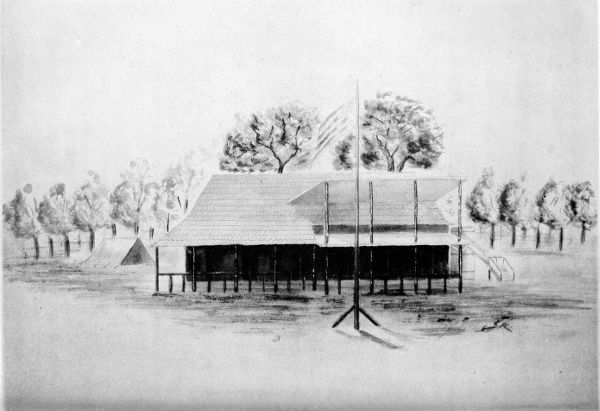
o’clock in the morning. The two-story storehouse was
occupied on the upper floor for sleeping, the lower floor
to store quartermaster and commissary stores, ammunition,
and intrenching tools, which were removed from the Saxon
that day and next. A partitioned room on the lower floor
was fitted up by Surgeon Cummings for a hospital. The
commissary supplies consisted of coffee, hard bread, beans,
salt pork, and molasses, sufficient to last about thirty days
for three hundred men. The intrenching tools were spades,
picks and axes, for five hundred men. Three months medical
supplies and about twenty-five thousand rounds fixed
ammunition for infantry was also landed.
Kuhn’s Wharf was the largest on the harbor front, the
storehouse end large and roomy, connected with the land
by a bridge-like wharf some four hundred feet long, about
twenty feet wide, built on piling. The water was quite
shallow at any tide almost to the end. Tides in Galveston
harbor and bay ebb and flow very little; the depth of
water is greatly influenced by heavy northerly winds,
which blow the water over the bar out to sea. Heavy
draft vessels at such times must keep to the narrow
channel.
A flag-pole was found which belonged on the storehouse,
and being placed in position upon the cupola, the old garrison
flag, used by the regiment at Readville, was run up
about eleven o’clock and greeted with cheers. Sentries
were at once posted in the city as far as Market Square,
one of the principal places with all of the main streets
leading into it. They were also posted on the streets to
the right and left, communicating directly with the wharf.
At night these posts were reënforced in such a manner as
to constitute picket-posts.
Immediately upon landing and taking post, Colonel
Burrell adopted such measures to secure all the protection
possible that in his judgment the situation demanded.
From this time until the morning of January 1st it was
work, work, work. Fatigue and working parties were
constantly employed. Guards and pickets were on duty
day and night. Reconnoitring detachments were on duty
by day and squads scouting at night. The Forty-Second
Infantry, posted upon Kuhn’s Wharf, were very active
during their short stay, occupying the city so far as the
small force and prudence would allow, and exercising
proper surveillance. The men were barely allowed sufficient
time to obtain needed sleep.
Among the first things done was to barricade the interior
of the storehouse facing the city, by placing against
that side, on each floor, barrels of whiting, plaster and
hair, found on the premises. For a temporary shelter to
men on picket at night, if forced to seek it, it was decided
to build a breastwork upon the wharf by tearing up and
utilizing the planks. Volunteer Engineer Long saw no
use or necessity for this, not exercising any supervision
over the work until operations had commenced and he
saw that the colonel was determined about it. Commencing
at a point some fifty feet from the shore end, the
hard pine planks were removed to make a gap in the
wharf for the space of about another fifty feet, and the
first breastwork was erected on the edge of this gap the
day of landing. Fortunately Quartermaster Burrell, in
looking around the city in the morning, had found a keg
of large-sized spikes and ordered them taken to the wharf
where they might be found useful. They were very useful
in building this work.
An examination of the ammunition, ordered in a few
days after landing when it was evident the enemy meant
mischief, was not a welcome surprise. Company G was
armed with Springfield rifles, and Companies D and I had
Springfield smooth-bore muskets. The bulk of ammunition
landed was found to be for rifles, with only a small supply
of ball and buckshot cartridges for smooth-bores. There
was also found to be a scarcity of caps. This is accounted
for by the confused manner in which the regiment was
embarked at Brooklyn on the different transports—a
proper apportionment of the ammunition was not possible
under the circumstances. Sending Adjutant Davis to the
fleet for any surplus caps they had to spare added very
little to the supply, as they were short also. It was found
that cartridges and caps sufficient to give each man eighteen
rounds in his cartridge box was all the ammunition
that could be made serviceable when a distribution was
made to the men on the thirty-first. This was kept a
secret from the command. The men were cautioned to
husband their ammunition until it could be used to effect
at close quarters, in case of an action. No man was to
fire his musket unless so ordered by an officer.
Commander Wainwright, with a few sailors armed with
cutlasses and pistols, visited the wharf on the twenty-sixth.
After a conference with Colonel Burrell, a reconnoissance
through Galveston and its suburbs was determined upon.
Captain Sherive, with about one hundred men, including
the sailors, accompanied by the colonel, adjutant, quartermaster
and chaplain, with Wainwright, started about nine
o’clock in the morning to reconnoitre, proceeding as far as
the brick kilns, some two miles outside of the city. It
was not deemed advisable to go further in the direction
of Eagle Grove, about three miles, but a circuit of the
outskirts was made and the city looked over. The inhabitants
had fled. It was almost entirely deserted. Unlike
many other cities and towns occupied by Federal troops,
very few colored people were to be seen. A lookout was
established in a four-story brick building on the Strand
near Market Square and within the guard lines, where all
that was going on at Eagle Grove on the island, and Virginia
Point on the main-land, was distinctly visible in the
daytime by the aid of a field-glass. This lookout was constantly
maintained.
In the afternoon Colonel Burrell, accompanied by Volunteer
Engineer Long, proceeded in the Harriet Lane
towards West Bay as far as the channel would allow. A
good view of Eagle Grove and Virginia Point was obtained.
The earthwork, mounting three guns, thrown up at Eagle
Grove by Confederates, to protect the railroad bridge,
was abandoned. The end of the bridge at Virginia Point
was protected by extensive works with heavy guns in position,
and here the enemy appeared to be in force. Their
camps could be plainly seen.
It was while on this trip in the Harriet Lane that
Colonel Burrell made up his mind to destroy the railroad
bridge. None of the naval vessels could get near enough
to do any permanent damage, on account of the narrow,
tortuous and shallow channel. The distance from the
fleet anchorage by way of the channel was about four and
one-half miles. Heavy naval guns, fired from a point of
anchorage where it would have been safe to try it, would
not have reached the bridge with any accuracy, the gun-carriages
not admitting a sufficient elevation of the guns
to carry shot or shell that distance, while such heavy
charges of powder would be required for the distance that
the concussion upon the gun-decks of such vessels as were
then at Galveston would have caused serious damage to
the vessels, had everything been favorable in other particulars
for attempting the destruction of the bridge
in this manner. The bridge could not be effectually
severed by the navy except by sending up armed launches
prepared for such duty. These the gunboats did not
have; all of their row-boats were small, not capable of
carrying light guns, even if they had them. This would
have been hazardous service, as the enemy were vigilant
and brave. That the navy could have sent up boat crews
and destroyed it when the vessels first entered the harbor
in October, was admitted by a number of naval officers,
because the enemy had precipitately taken flight, abandoning
everything. The Confederate military commander at
that time was a weak-kneed sort of man. In a very short
time the Confederate troops rallied, removed all of their
guns on the island, and built the works at Eagle Grove
rendering the attempt hazardous. Destroying the bridge
would not have prevented all communication between the
island and the main-land, only rendered it difficult, as
the enemy had plenty of boats hid in the creeks and
bayous adjacent that could be used for ferry purposes.
But no attempt of any sort had been made by the navy
since first entering Galveston Bay to damage or sever this
bridge.
Collecting barrels of tar pitch, with other combustible
material, and confiscating a dray (all horses had been run
out of town), the colonel ordered them stored ready for
use, intending to move up immediately on the landing of
the balance of his regiment, occupy the works at Eagle
Grove, destroy the bridge as far as possible, mount some
heavy guns, and shell the enemy from his works on the
main-land. Those naval officers who talked the matter
over with officers of the Forty-Second agreed that it
ought to be done. Commander Wainwright was especially
in favor of severing this means of communication. Had
the seven companies of the regiment arrived on or before
the twenty-eighth of December, it was thought not much
difficulty would have been experienced. The enemy soon
ascertained the small strength of the detachment landed,
and on the twenty-ninth reoccupied the earthworks at
Eagle Grove, and mounted heavy cannon to protect the
bridge and approaches. Colonel Burrell then requested
Commander Renshaw to go up the bay as far as possible
with two of his lightest draft vessels, and shell the enemy
from the island, which he refused to do. After the
twenty-eighth December, the destruction of this bridge
could not have been accomplished without an action with
the enemy in force at Eagle Grove, but an attempt would
have been made had not the event of January 1st occurred.
During the afternoon of the twenty-sixth, while Captain
Sherive with a small force of men was out on a foraging
expedition, to see what could be found for cooking-stoves,
eight Confederate cavalry-men appeared under a flag of
truce, with a request to see the British consul. No flag-of-truce
trick could be played on Captain Sherive. He
promptly halted the party, and notified his commanding
officer. One man, under guard, was allowed to see the
consul, and the Confederate captain in charge was
ordered to leave by six o’clock, as after that hour they
would be fired upon. For weeks had the enemy enjoyed
the hospitality of Commander Renshaw under these
convenient flags of truce, used freely for the most trivial
reasons; but the military commander stopped all such
nonsense at once. This truce flag was the only one
recognized until the day of surrender.
Supplies of food were not plenty in the city. The
Confederates would not allow any to be brought from the
main-land, consequently, what few inhabitants remained
in Galveston, mostly women, found it hard work to subsist.
In a small way, rations were given to them by Colonel
Burrell. Not much could be done in this direction, owing
to the small supply on hand for the troops, who must be
fed and kept in fighting condition. There were quite a
number of German women with gold and silver coin, who
wished to purchase provisions from the quartermaster.
Their husbands were serving in the Confederate army,
and much valuable information was obtained from them.
Confederate cavalry commenced to infest the city and
suburbs at night, about three days after a landing was
made; but did not attempt to molest the pickets. These
cavalry-men came along the beach, concealed by a range
of sand hills on the Gulf shore; on reaching the outskirts
they would separate to go through the city in squads of
two and three. Before daylight these squads would
rendezvous at a place called Schmidt’s Garden, and return
to Eagle Grove by the same route they came. They
easily obtained, during these nocturnal trips, all information
they required, for the men talked freely with such of
the inhabitants as wished to converse. While there were
a handful of Union men, or refugees as they were termed
by the enemy, who sought protection under the Federal
flag, the bulk of the small population, men, women and
children, were secessionists to the core.
Lieutenant Eddy and Private Hersey must have had
this fact very forcibly impressed upon their minds when
they were entertained by some Galveston ladies at a house
on the Strand, some two miles from quarters, on the afternoon
of Sunday, December 28th. The ladies sang all of
the latest Confederate songs, Eddy and Hersey in return
singing the latest from the North. The conversation was
bitter disunion on the female side, and well calculated to
draw out information on military affairs. On bidding
them good afternoon as they left, several young men were
seen loitering in the vicinity, who had undoubtedly been
listeners to the conversation.
While the enemy easily obtained information of the
Federal strength, position and purposes, the men of the
Forty-Second as easily secured definite information of the
Confederate strength and intentions. At this game of
cards honors were easy.
On the night of the twenty-seventh a report was brought
in that a force of Confederate cavalry was in the city.
Captain Sherive with fifty men and Captain Savage with
fifty men received separate orders to drive them out.
Taking different directions, a thorough scout failed to
discover any traces of this cavalry until Captain Sherive
arrived at the beach road leading to Fort Point, when
fresh horse-shoe prints in the sand were discovered, showing
that a force of mounted men had gone in the
direction of Fort Point, where there was an abandoned
earthwork thrown up to command the harbor entrance.
Captain Savage came up soon after, joined forces with
Sherive, and was directed to place his men on the sand
ridge of the beach, lying down, while Sherive with his
men covered the beach, and all awaited developments.
About midnight Captain Savage became impatient, if not
a little timid, as signal rockets were seen sent up in the
city, and he declined to remain longer, proceeding back to
the wharf. This forced Captain Sherive to retire also, as
he doubted his ability to meet the supposed force of the
enemy with the men left. It was afterwards ascertained
that the party was General Magruder, reconnoitring the
entrance to the bay with some eighty of his officers and
men, who would certainly have been captured, killed, or
wounded, if the detachments had remained where Captain
Sherive had them posted. There was no escape, except
by breaking through the detachments, and the enemy
could not successfully do that while Captain Sherive was
around. Captain Savage destroyed the telegraph lines
connecting Galveston with the main-land, that had remained
intact up to this time, as part of the night’s
operations.
There was a lull in the preparations and rounds of duty
on Sunday, the twenty-eighth, giving the men that rest they
sorely needed. Only two civilians were molested by the
troops during their short stay in Galveston. A German
was arrested on this day for uttering seditious language.
He was confined at guard quarters in the wharf storehouse,
remaining there during the action of January 1st,
almost forgotten, but miraculously escaped without a
wound. The other was a citizen caught hanging around
the head of the wharf in a suspicious manner, and was
arrested for a spy, retained in confinement some six hours,
and then released. This arrest occurred on the ——th.
Sunday afternoon Colonel Burrell, in a row-boat, proceeded
to Fort Point to inspect a 100 Pr. gun, dismounted
in the fort, with the intention of removing
it to the earthwork at Eagle Grove when his force was
increased. The gun was found to be sound, not spiked,
and ready for immediate service, when mounted on a
gun-carriage. The story of the dismounting of this
heavy gun, as told by naval officers and sailors, is said
to be true.
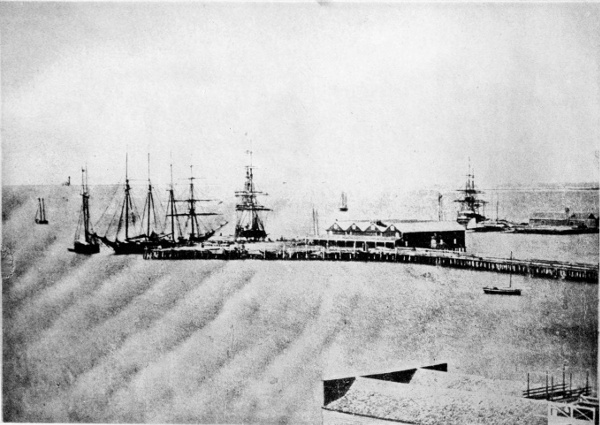
KUHN’S WHARF, GALVESTON, TEXAS.
It seems that when the fleet was sailing towards Galveston
Bar the orders were not to fire, even if fired upon,
until the signal was displayed from the flag-ship. A gunner
on the Clifton, standing by his gun, with lanyard
in hand, accidentally slipped when the vessel lurched,
causing him to pull the lanyard with a sudden jerk
and fire the gun. Without being trained on the fort,
the solid shot took effect on the gun-carriage of this
100 Pr., near the stanchions, shattering the carriage,
heaving the gun up in the air, tumbling it over backward
in the sand. The garrison became panic struck at the
effect of this chance shot and fled. The fleet then entered
the harbor without another gun being fired.
The situation looked serious, and with a doubt in his
mind about the loyalty of the naval commander, and no
news from his expected reënforcements, Colonel Burrell
decided on the twenty-ninth to send Quartermaster Burrell
to New Orleans on the Saxon, with despatches for General
Banks. The commissary supplies had dwindled down to
fifteen days rations for three hundred men, and the ammunition
was not available. Engineer Long decided to go
also, not being under the orders of Colonel Burrell, and
took passage on the Saxon. Much to the transport captain’s
relief, for he had been in a highly nervous state
while lying at the wharf, the Saxon left, proceeding as far
as Pelican Spit, where she had to remain until January 1st.
A strong northerly wind, that continued on the thirtieth
and thirty-first, had blown the water from Galveston Bar
so that only three feet of water covered it, rendering proceeding
to sea impossible.
“Headquarters,
“Galveston, Texas, December 29th, 1862.
“Sir: In obedience to orders, upon arriving at this
place on the evening of the twenty-fourth instant, after
consulting with the commander of the blockading fleet, I
landed the three companies of my command, which were
with me upon the transport Saxon, on the end of Kuhn’s
Wharf, and quartered them in the warehouse there. I
have taken possession of the city as boldly as I could
with the small force at my command, and have thoroughly
reconnoitred the built-upon portions of the city up to
within range of their battery at Eagle Grove, which is
apparently well built, mounting three guns. They have
also one gun at the draw, which is about midway of the
bridge. Upon Virginia Point they have a strong battery,
mounted with heavy guns. From the best information
obtainable, I judge their force in this immediate vicinity
to be about two thousand strong.
“During the day we control the city, but at night, owing
to our small force (as the balance of my regiment has not
yet arrived), I am obliged to draw in the pickets to the wharf
on which we are quartered. I think there are still living
upon the island about three thousand persons, a large proportion
of whom are women and children. A great many
of these people are almost entirely destitute of the means
of subsistence, as the enemy will not allow anything to be
brought over from the main-land, thinking, doubtless, to
make them disloyal by starvation. The naval officer in
command has contributed all he could spare from his
stores, and my men have shared their bread rations with
them. I believe the larger part of the residents now here
to be loyal and really desire to remain in the city, and that
common humanity calls upon us to render them assistance.
This, in my judgment, can best be done by placing the
city under martial law as soon as my force is large enough,
and forcing the rich, who are mainly the secessionists, to
feed the poor. I would most respectfully urge upon your
consideration the necessity of sending provisions for immediate
relief. These can be sold to them at Government
prices, thus conferring a real charity, without subjecting
them to the mortification of being beggars. Under the
existing circumstances I have thought it best to send one
of my staff, Quartermaster Burrell, and Mr. Long, the
engineer, who accompanied us here, to report to you in
person. These gentlemen will explain in detail the state
of affairs, and the importance of the knowledge which
they can convey to you has, in my judgment, authorized
me in ordering the Saxon back to New Orleans, which I
humbly trust will meet your approbation.
“I have the honor to be, your obedient servant,
“ISAAC S. BURRELL,
“Colonel commanding 42d regiment Mass. Vols.”
The small schooner Corypheus had lying useless upon
her deck two captured 12 Pr. Howitzer field-guns, with
over three hundred rounds of ammunition for them.
Adjutant Davis was sent on the night of the twenty-ninth
to Commander Renshaw, with a request for the guns to be
landed upon the wharf. Colonel Burrell intended to place
them in position in the storehouse, opening port-holes on
the land side. Company D (the old Roxbury Artillery)
had many Roxbury men who knew how to handle such
guns, besides having in the ranks a dozen man-of-wars
men, who had enlisted in Boston shortly after their discharge
from a war-vessel, that had arrived from a long
cruise. The idea was ridiculed by Renshaw, who flatly
refused the request.
General Magruder, when he assumed command in December
of the Confederate forces in Texas, immediately
set about perfecting plans to recover possession of Galveston,
and to capture or cripple the fleet. These plans
were so far matured that he intended to attack on the
twenty-seventh, but was obliged to postpone it until the
morning of January 1st from delay in fitting out his river
steamers.
The naval commander heard of these steamers being
got in readiness to attack him, but did not think he would
have much difficulty in blowing them to pieces with his
guns; in fact, affected to look upon such preparations of
the enemy as futile. As for the information of Magruder’s
plan of action on land, obtained by the military force, none
of the naval officers, with the exception of Wainwright,
placed much reliance upon it until the thirty-first, as they
had heard every day since they had been there reports of
an attack to be made.
Definite news was obtained on the thirtieth that the
enemy would make an attack that day or next. Commander
Renshaw had not at any time since the troops
landed been very communicative, or evince any desire to
consult over the situation, although an occasional visitor
to the military headquarters. Determined to protect the
men as far as possible, a second breastwork, close to the
storehouse, was commenced in the afternoon and finished
by midnight, tearing up the wharf in front and opening
another gap for fifty feet.
The two breastworks were strong enough to resist
infantry-fire, but not artillery. Composed of two and two
and one-half inch planking laid one upon the other, two
planks deep, so that the faces were composed of the edges
only, they were some thirty inches in thickness, built
shoulder high. On this last work the entrance port was
protected by a cotton bale. Not satisfied with this, a raft
lying at the wharf, such as is used by caulkers in working
on vessels’ seams near the water line, was raised from the
water by hard labor, and securely placed in position on
the right of the second breastwork, to protect as far as it
would a fire from the next wharf on that flank, one-eighth
of a mile distant. The storehouse protected the left flank
from infantry-fire from the wharf on that side, also about
one-eighth of a mile distant.
That night a false alarm, about ten o’clock, brought the
entire force to arms behind the breastworks, and gunboats
took positions near the wharf as agreed—one on the left
and one on the right.
While the city was apparently deserted for some days
after landing, on the thirtieth and thirty-first of December
it was noticed that many men in citizen’s attire had returned
and were strolling around. It was believed then, by the
officers of the Forty-Second, that these men were in the
Confederate service. No attempt was made to interfere
with them so long as they remained civil, committing no
overt wrong. With the small force on hand, no decisive
measures concerning the inhabitants could be adopted, or
any attempt made to govern the city.
During the day of the thirty-first, in company with Commander
Wainwright, Colonel Burrell with a guard patroled
some of the streets, and noticed many of these strange
faces, who seemed to shun them. From the lookout station
the enemy were seen assembling on the plain near Eagle
Grove, horse, foot and artillery. Wainwright remarked:
“Active operations going on, colonel; things look squally,
and we had better not remain here. I will go up to-morrow
and feel of them.” He intended to go up in his vessel as
far as the channel would permit, and endeavor to shell
them from the island.
Between these two officers a friendship for each other
existed from their first meeting. They were frequently
together, strollers around the city and suburbs, consulting
the STATUS of affairs. Many of the other naval officers
were frequent visitors, very courteous and obliging, but
none appeared to take the same interest in matters that
Wainwright did. The Forty-Second officers thought he
was the only live man in the fleet.
In none of their perambulations and confidential talks
did Wainwright breathe a word against his superior officer,
although the colonel, after a few days on shore, could not
remain quiet with the conviction forced upon his mind that
Renshaw was not acting in such a manner as to warrant
confidence, and bluntly told Wainwright only a day or two
before the final events took place he thought Renshaw was
a traitor. To this plain and straightforward expression of
opinion the naval captain made no reply. Not so with
the sailors; they, coming in contact with the enlisted
men, frequently expressed their suspicion of the “commodore.”
On the morning of the thirty-first of December the
Owasco went down to the coal bark Arthur, lying in the
channel near the harbor entrance, about a mile and one-half
from the wharf, for a supply of coal. Contrary to her
usual custom she did not return to her position near the
wharf when night came. The Westfield lay near Pelican
Spit, on guard at the harbor entrance, and covering the
Bolivar channel of the bay. She had lately received a
new heavy gun, brought by the Tennessee to replace one
disabled while on the coast some time previous. Up to
midnight the balance of the fleet were distributed along
the water front of Galveston, in the channel, which averaged
at any point only a little less than two hundred and
twenty yards in width. The Clifton was at the right of
Kuhn’s Wharf, about one hundred yards distant; then
came the Sachem, still at work on repairs to her boilers;
then the small schooner Corypheus; and up the channel,
a mile away, nearly opposite the depot wharf, was stationed
the Harriet Lane.
At night a conference was held by officers of the
Forty-Second. Positions were assigned for the companies
in case of attack. Companies D and I remained upon the
wharf, in the building, to snatch what sleep they could,
while Company G, Captain Proctor in command, was on
picket during the night. The three companies had been
held in readiness every night since landing. Those not on
duty slept on their arms. On the thirtieth and thirty-first
only one company at a time was allowed to sleep. The
men were informed of what was expected, their courage
and manhood appealed to, with every point emphasized,
that would naturally tend to inspire them with confidence.
Not a word was uttered that could possibly convey any
idea foreign to the fact, that fight was a duty they were to
perform.
Burrell did not like the outlook, nor his position upon
the wharf. Commodore Renshaw had failed to inspire
him with any confidence in his integrity. Seated in his
quarters that evening to muse over his situation, without
allowing his officers or men to know his thoughts for fear
of disheartening them, the colonel fully determined to
order the Saxon up to the wharf next morning, embark his
men, and remain on board in the harbor until reënforcements
arrived.
About midnight Colonel Burrell, Captain Sherive, and
Chaplain Sanger, visited the picket sentinel posts in the
city, finding the men were drawn in from their original
positions, and did not occupy the usual ground. The
original posts were reëstablished. Rumbling noise of artillery
wheels was heard distinctly through the night, together
with the sound of moving railroad cars accompanied by
the locomotive whistles. Captain Proctor had reported in
person to inform Colonel Burrell, “there was trouble
ahead”; so when the Harriet Lane, in the moonlight, discovered
black smoke from smoke-stacks of Confederate
vessels across the bay, some two miles away, and signaled
with rockets, Lieutenant Stowell, placed in charge of the
fireworks signals, burned some lights for the purpose of
giving information to the navy that the military force was
wide awake and ready. Every man on the wharf was
ordered to man the breastworks.
It was at this time the colonel noticed that the Clifton
had left her position. She was signaled by Renshaw from
the Westfield that he was aground, and gone to her assistance
between twelve and one o’clock. The Westfield discovered
these Confederate steamers about the same time
as the Harriet Lane and got under way, but very soon was
hard and fast ashore at high water. The absence of both
the Owasco and Clifton left the military upon the wharf
unprotected on the flanks for some hours.
The Bayou City had left Choppers Bar, at Morgan’s
Point, between nine and ten o’clock Wednesday night,
December 31st, with the Royal Yacht and J. F. Carr in
tow. The Royal Yacht got aground at Redfish Bar and
had to be left behind. The Confederate boats being light
draft steamers could navigate the shoal waters of the bay,
and were not obliged, on arriving opposite the city, to
keep to the ship channel. Upon being discovered these
steamers withdrew out of sight to Half Moon Shoals, six
miles distant. The military force went into their barracks
again to sleep on their arms.
Captain Sherive, with the chaplain, made a second visit
to the city, by a mistake getting outside of the lines; they
had been drawn in once more without any notification to
the rest of the command. They found the city full of
people; and had the enemy been ready then for operations,
both officers would have been killed, or wounded and taken
prisoners. Not ready to act, the Confederates kept in
hiding as much as possible.
About half-past three o’clock in the morning, masses of
moving men in the streets were discovered by the picket
sentries, who fired at them and slowly fell back toward the
wharf, without eliciting a fire in return. The troops asleep
in the barracks, equipments and overcoats on, for the night
was cold, and guns by their side, were immediately ordered
up, and to line the work built on the thirtieth. The order
was promptly obeyed: Company I upon the right; Company
G upon the left; while Company D was to be stationed
in line, with its left resting at the breastwork, the
right prolonged towards the harbor, ready to wheel either
to the right or left up to the work. As the picket detail
came in over the single plank left upon the openings in
the wharf for that purpose, they took position with Company
G. Lieutenant Newcomb was the last man in. Up
to between one and two o’clock a bright moonlight enabled
objects to be distinguished for some distance, but
after two o’clock darkness had shut in to such a degree
that objects ten feet off could not be seen. A few cheering
words were rapidly addressed to his men by the colonel,
who cautioned them not to forget the State they represented,
and to reserve their fire until orders were given to
commence. The enemy lost no time in getting into position.
Magruder must have expected to be able to cut off
the whole or part of the picket from reaching the wharf
by placing his first gun at the large open door of the Star
Foundry, a building at the head of the next wharf to the
right of Kuhn’s Wharf, for the position gave him a chance
to rake the wharf. It was this gun that was first fired,
having been rapidly placed in the foundry after the pickets
gave warning he was at hand.
A city clock had a few minutes previous struck four
o’clock when this gun was fired by General Magruder in
person, the ball glancing over the edge of the breastwork,
crashing through the storehouse, and the action opened.
All of the enemy’s artillery opened fire shortly after
with solid shot, shell and canister. Before he fired
the first gun, Magruder remarked: “Boys, now we will
give them hell,” and after firing left for his headquarters,
established on Broadway, saying, “Now boys,
I have done my part as private, I will go and attend to
that of general.”
A number of men not exactly sick, but worn out and
tired from continued hard work, together with a few lazy
fellows, remained in the building when the rest filed out.
They did not stay long. Private Mosely, Company D,
who was lying down when told by Sergeant Waterman to
get up and come along, said it was “d——d nonsense,”
and proposed to have some sleep. The cannon ball crashing
and smashing things over his head sent Mose rolling
down the run that lead to the second story. Private Dave
Howe, Company D, who claimed to be sick, climbed out
of a window to a pitch roof, that covered the water tank,
straddling along until the end was reached, when he found
himself looking down into the water; a shell over his head
just then sent him wriggling back and through the window
again, and down he tumbled over the run to the wharf.
One of the incidents the men can never forget was the
chaplain finding Privates Thompson and Vining6 had got
into a large iron tank, used to catch rain-water from the
storehouse roofs, that was set upon its side close to the
building, drove them out and got in himself. Not a
very safe place to take shelter if a solid shot happened
to strike it.
The Confederate land force under General Magruder,
consisted of infantry commands of Colonels Green, Bagby
and Reily, Lieutenant-Colonel L. A. Abercrombie and
Major Griffin; Colonel Pyron’s regiment dismounted dragoons;
Colonel X. B. Debray’s cavalry regiment; and
cavalry companies of Captain Bowles, Atkins, Andrews,
and Durant; Colonel J. J. Cook’s regiment artillery;
and Wilson’s six-gun light battery. The country for miles
around was thoroughly scoured for volunteers, who flocked
to Magruder’s force, in this way swelled to about five or
six thousand men of all arms. The brigade commanders
were Brigadier-General W. R. Scurry and Colonel Reily.
General Scurry had command in the immediate vicinity
of the wharf. Besides Wilson’s light battery the enemy
had six siege guns, fourteen field pieces—some of them
rifled—and a railroad ram, armed with an eight-inch
Dahlgren mounted on a railroad flat car. Most of this
artillery arrived from the Mississippi River a week before.
In regard to the numbers of his men General Magruder,
in conversation with the officers some time after they were
prisoners of war, admitted he had no means of officially
knowing the strength of his force, and then placed it as
about five or six thousand men because such large numbers
of volunteers joined him.
Details of the attack were made at Pyron’s camp. Three
heavy guns were ordered to Fort Point in charge of Captain
S. T. Fontaine, of Cook’s artillery regiment, supported
by six companies dismounted dragoons, under Colonel
Pyron. Major Wilson was to open fire on the wharf with
his battery. The railroad ram was to take position on
railroad wharf to fire at the Harriet Lane. The remainder
of the artillery, manned by Cook’s regiment, was to be
posted in eligible positions on the Strand and water front,
and warehouses along the edge. Artillery was hauled by
mules and by hand half way to the city from the railroad
bridge, at one o’clock that night. A large quantity of
cotton was also carried by rail to railroad wharf for use in
building a breastwork, besides a large quantity of intrenching
tools, for the purpose of Magruder was to throw up
intrenchments at the ends of streets leading to the water
if his plan of action did not succeed before daylight. Signals
agreed upon were: white light—enemy in sight;
blue light—order to prepare; red light—make ready
for action; at twenty minutes intervals.
General Magruder is credited with sending this dispatch
to Major Leon Smith from Summit Station,
thirty-five miles from Galveston, on the Galveston and
Houston Railroad, as his soldiers commenced the march
to take positions assigned them: “I am off, and will
make the attack as agreed, whether you come up or
not. The rangers of the prairie send greeting to the
rangers of the sea.”
Upon reaching the city, shortly before four o’clock,
the Confederates placed a 32 Pr. gun at the cotton
press near McKinney’s Wharf, to engage the Harriet
Lane. This point was the left of the Confederate battle
line. A 42 Pr. gun was placed at the head of Kuhn’s
Wharf, near Social Hall, and a section of Wilson’s
battery was near Hendleir’s Wharf. Why they did not
attempt to place guns upon ends of the wharves on each
side of Kuhn’s Wharf, where an enfilading fire upon the
soldiers of the Forty-Second could have been obtained, is
a mystery, unless they feared the positions too much
exposed.
Of the navy, the Sachem was first to open fire, followed
by the Corypheus and the Harriet Lane. For an hour did
shot and shell fly all around the troops upon the wharf,
accompanied with musket balls, causing them to think
they were to get “h—ll” sure, as Magruder said, and
to hug the planks and huddle close to the breastwork
in such a manner that the original position planned
for them to take at that work was lost. After a few
rounds had been fired at them with no wholesale
slaughter occurring, many of the men began to gain
that confidence old soldiers possess, and to note progress
of the action.
The navy fired high and made hot work in the city, but
did not for some time do any execution among the enemy’s
guns. Seeing this, Captain Sherive shouted to them:
“Fire lower, and not so high,” In spite of the distance,
sailors of the Sachem, who were afterwards taken prisoners
at Sabine Pass, said they distinctly heard the warning, and
then depressed their guns as much as possible. The Confederates
admitted that the firing from heavy guns on the
naval vessels was hard to stand. The crashing of walls
and falling timbers, and a constant rain of bricks, mortar
and roofing, as the shot and shell plunged through buildings,
added to the crash of many hundreds of window
panes, assisted to make the night hideous.
At the first shot from the enemy Colonel Burrell ordered
every man to lie down. During the first hour the colonel
walked the wharf, taking careful notice of all that occurred.
Many shells would drop upon the wharf and explode, or
burst overhead, pieces flying forward and overboard, yet
he did not receive a scratch. A shell exploded in the
storehouse and, seeing flame and smoke, he ran in, but a
wooden partition prevented his reaching the fire. He
shouted: “Is any one in there?” Private Hersey, with a
few others, was lying down close to one of the rain-water
hogsheads in the building when the fire started among the
tents stored there, and at once endeavored to put it out.
Hersey answered that HE was and that the tents were on
fire, when Colonel Burrell ordered them thrown into the
water by a back door, that could be easily reached. Part
of the burning tents were soon floating in the harbor; but
finding an empty pail, and drawing water from the hogshead,
Hersey soon extinguished the fire. The ammunition
that lay in dangerous proximity to the tents was at once
attended to. A call for men to “come in here and rout
out this ammunition” was promptly obeyed by a squad of
men, who soon placed the boxes near the end of the wharf
where they could easily be pitched overboard in case of
necessity.
It was still dark at five o’clock when the enemy suddenly
ceased their artillery fire. This was ominous; everybody
felt an assault was premeditated. Not a shot had been
fired from the wharf, which must have deceived the enemy
as to the condition the Forty-Second detachment was in
to repel an assault. They supposed many were killed or
wounded. A sharp lookout from the breastwork was
ordered. Somebody sung out that they were coming in
boats to the left of the wharf. Colonel Burrell called for
men, and ran to where the storehouse abuts the wharf-edge,
but could not see or hear anything. Leaving the
men to watch, he rapidly passed back to the breastwork
to see that the men there took position ready to open fire,
and again ran back to the left. He was there when the
first fire was opened to repel the assault.
The assaulting column (about five hundred men) under
Colonel Cook, said to have been composed of two small
regiments, could be heard splashing in the water as they
waded out. The understanding among the officers was,
in case of an assault they were to wait until the enemy
came within easy range before firing.
Adjutant Davis, Captains Proctor and Sherive, and Lieutenant
Newcomb, were anxiously looking over the breastwork
into the darkness to catch a glimpse of where the
enemy were. Captain Proctor sang out that he could see
moving objects in the water, when Adjutant Davis gave
the order to fire. A volley was given, followed up by
some rapid firing at will, as fast as the men could load.
Those in the front ranks had to look out, for in the excitement
men from the rear would crowd up and blaze away
regardless of friend or foe. As the line of fire was mostly
straight away from the shoulder, very few firing downwards
into the water, the casualties to the attacking force was
not heavy. Some of them attempted to come out upon
the wharf, by placing planks over the openings where they
had been torn up. They did get to the first breastwork,
and showed their heads above it, as the musketry flashes
lit up the scene, but no further.
The Sachem and Corypheus, attracted by this fight, sent
shot and shells toward the head of the wharf among the
enemy in such a manner that they were glad to fall back,
with such scaling ladders as they carried, taking most of
the dead and wounded ashore. A few bodies were floating
in the water during the morning hours.
After this repulse the enemy retired behind the protection
of buildings and side streets, out of musket range.
The combined fire of the three gunboats, who continued
to send their compliments among the enemy’s artillery
placed to cover Kuhn’s Wharf, prevented the Confederates
from anything more than random artillery firing after this
assault. Some of their batteries they had previously found
great difficulty in keeping manned; the gunners were
forced to return to their pieces many times by cavalry
patrols stationed in the rear.
As daylight dawned, a scattered musketry-fire was opened
on both sides. The Confederate riflemen took positions
in windows, and upon the flat roofs of such warehouses as
overlooked the wharf within range. The small field-gun,
stationed at the Star Foundry, was sending some shells
which exploded underneath the wharf, making it a question
whether the piling would not eventually be severed and
destroy the wharf. The gunners had also got the range
where the men lay, and by a little elevation they could
sweep them. Hastily calling for some good rifle shots,
Colonel Burrell posted them near the flanking raft, with
orders to prevent that gun from being served. This detail
did the duty well, effectually putting a stop to the Confederates
dodging from around the street corner to load
and fire. Major Dickinson, General Magruder’s assistant
adjutant-general, lost an eye while gallantry trying to attach
a drag-rope to the gun in order to draw it away, when they
found it dangerous to keep at work; a nephew of the general,
Lieutenant George A. Magruder, aide-de-camp, also
made the attempt after Dickinson was wounded—all of
no avail, the gun had to be abandoned by them.
An attempt was made about seven o’clock to launch a
boat that was upon the wharf for repairs, and then supposed
to be in condition for use, in order to send Captain
Sherive, who volunteered to go, on board one of the vessels
with a request that they come up and take the troops
off. Colonel Burrell, Captain Sherive, Adjutant Davis,
Lieutenant Cowdin and Private Morrill, Company D, had
got the boat launched from the end of the wharf, but it
filled with water and sank at once, because some bullet
holes had not been noticed, when the riflemen from a brick
building at the head of the next wharf commenced to fire
at them. As the bullets began to whistle over their heads
the men shouted: “Look out, colonel, they are firing at
you!” Private Morrill was severely wounded in a hand,
Captain Sherive and Adjutant Davis dodged behind hawser
posts, Lieutenant Cowdin jumped for shelter, and the
colonel disappeared in a hurry down a sloping freight
gangway that was handy. The men thought he was shot
until he called to them: “I am all right.”
In a few moments the Owasco was seen in the slight
foggy mist of the morning coming along from the coal
bark, and when off the wharf sent a few shells into the
building, driving the annoying riflemen out. The Clifton,
ordered by Renshaw to return to the city when the action
opened, with difficulty kept the channel, and returned from
Pelican Spit soon after daylight, opening fire upon the
enemy’s guns placed in position on the sand beach near
Fort Point by Captain Fontaine, driving the gunners away,
and continued on past the wharf a short distance, taking
position near the Sachem. In passing, a solid shot was
fired over the wharf obliquely, into the brick building
used for a lookout station, one quarter of a mile distant,
tearing a corner out and making a bad wreck of the
building.
With the exception of a few shot and shell fired into
the city by the gunboats nearly all firing had ceased when
it was about broad daylight. The enemy had removed
most of their artillery; only a few pieces remained that
they could not and dare not persist in attempting to take
away: the rifles of Company G could reach them and
prevented it. Captain Sherive asked permission to take
his company out and secure them, but the colonel would
not allow it, fearing an ambuscade. Volunteers were
called for, to go out and ascertain the position of the
enemy. Several volunteered, but the selection fell upon
Private Colson, Company I, a rather tough customer, who
had been put in irons for misbehavior and confined in the
guard-house for some time, but been released. He went
out, soon returned, and reported the enemy hid behind
buildings and massed in the yards not far away.
The naval force, excepting the Westfield, all assembled
on the harbor front, daylight to assist them in discovering
the enemy’s position; the front of Kuhn’s Wharf cleared
of their presence, it did seem for a short time that a victory
would eventually be won.
In less than fifteen minutes the whole aspect of affairs
was changed. The State authorities had taken the Bayou
City, a Houston and Galveston packet steamer, made
bulwarks of cotton bales upon her sides and armed her
with a 68 Pr. rifled gun, placed in the bow. The river
steamer Neptune was also fitted out in the same manner
and carried two Howitzer guns. Steamers Lucy
Govirn and Royal Yacht were used as tenders to collect
wood for the gunboats, and steamer John F. Carr was
fitted up for a hospital boat.
The Bayou City was commanded by Captain Henry
Lubbock, with Captain M. McCormick for pilot. Colonel
Green had command of troops on board, about one hundred
and fifty men. Captain A. R. Wier, Cook’s regiment
artillery, was in charge of her artillery. Captain Martin,
of the cavalry, was a volunteer on board. The Neptune
was commanded by Captain Sangster, with Captains Swift
and McGovern for pilots. Colonel Bagby had command
of troops on board, about one hundred men. Lieutenant
Harby, in command of a company infantry acting as artillery,
was in charge of her artillery. The John F. Carr
was commanded by Major A. W. McKee. General
Magruder called for three hundred volunteers from
Sibley’s brigade, armed with Enfield rifles and double-barrel
shot-guns, to man this flotilla.
The entire flotilla was under command of Captain Leon
Smith, a man of great experience in steamboat management,
who was employed by Magruder in the Quartermaster
Department, made a volunteer aide on his staff
with rank of major, and afterwards called commodore by
the general. Major Smith had charge of all work in preparing
these steamers for action. He had orders to be
ready to attack the Federal vessels at midnight.
At half-past four o’clock the Confederate flotilla, at
Half Moon Shoals, fired up with rosin and proceeded
towards Galveston, arriving within a mile of the Federal
gunboats at daylight.
When a lookout on the Harriet Lane soon after midnight
first discovered the Confederate flotilla, Wainwright,
asleep in his stateroom, was notified and assumed charge
of the deck. After this flotilla disappeared the Harriet
Lane retained her position, with steam on, while her officers,
on the watch for further developments, leaned over
her rails listening to sounds from on shore, that indicated
some movement there by the enemy, until the first gun
was fired at the wharf. Her anchor was then raised to the
cathead, but not secured, and attempts made to turn
around for the purpose of proceeding towards Kuhn’s
Wharf to occupy the place made vacant by the Clifton,
gone to Renshaw’s assistance. To do this without getting
aground necessitated a use of great skill and consumed
much time, for the vessel had to forward and back to
gradually swing her bow around. Why she should have
been stationed at this point—head of the ship channel
where it was impossible to manœuvre her—when the
Westfield or Clifton (old ferry-boats) were better adapted
for the position, had often been discussed by naval officers
at Galveston.
While working his vessel around Wainwright opened
fire on the city. Her bow was headed towards the wharf
when signs of an approach by the flotilla were again seen,
which caused him to abandon proceeding down the channel
and to work his vessel around again in order to present
her bow to the enemy. Fairly around she steamed up to
meet the Bayou City and Neptune, who showed a disposition
to attack, other cotton boats keeping out of harm’s way.
A fire was opened upon them with shells from her eight-inch
forward gun, sending three shells and a cannon shot
into the Bayou City; the shells passed through her engineer’s
room, one exploding near the engineer, doing some
damage; the cannon shot passed through her messroom
and pantry.
Within one-half a mile the Bayou City opened fire. Her
second shot struck the Lane plumb behind a wheel, close
to the magazine, making a hole large enough for a man to
crawl through; when fired a fourth time the gun exploded,
killing Captain Wier, with others, and wounding Captain
Schneider, with other men.
As it was plain that the enemy’s intention was to close
with him, Wainwright backed his vessel some distance in
order to get a good headway, for it was understood on
board, the Lane was to try and ram her bow into the Bayou
City, cut her down even if it crippled the Lane, then reach
the Neptune and capture her by boarding. This was not
to be, because just before reaching the Bayou City her
bow ran aground, barely allowing the Confederate pilot
time to put his helm hard around in season to prevent his
boat going on to the Lane’s bow in a strong ebb tide, which
also prevented his running against the Lane so as to strike
forward of the port or left wheel-house, which was his purpose
to enable the Confederates to board. He did carry
away the Lane’s port cathead, whereby an anchor was
let go, and ran out fifteen fathom of chain attached.
The Harriet Lane was now at an anchor and also aground.
Wainwright, from his position upon the bridge with
Third Assistant Engineer Mullen by his side, ordered the
crew forward upon the forecastle ready to repel boarders.
As the Bayou City struck a glancing blow in passing, about
twenty of her men jumped for the forecastle deck. Many
fell into the water, and those that reached the deck were
met by sailors armed with pistols, cutlasses and boarding
pikes, to be hurled overboard. One colored sailor, Nick
Wheeler, caught a man upon a pike, which entered his body
near the stomach and came out between his shoulders, and
had to shake him off into the water. All this occupied
very few minutes.
As the Bayou City passed to shoal water off in the
harbor beyond the channel, with her outside planking of
port wheel-house and sides torn off from contact with the
Lane’s strong upper works, her men from behind cotton
bales opened a scattering musketry-fire upon the blue-jackets.
The blue-jackets trained a gun upon her, and at
a favorable moment Acting Master Hamilton pulled the
lanyard, which broke; he reached for a hatchet that had
lain beside the gun-carriage a few moments before, intending
to strike the percussion-cap to fire the gun, but it was
gone; some one had seized that hatchet for a weapon
when Wainwright called for boarders to be repelled.
It was then thought she would be taken in hand by
other naval vessels, and attention was given to the Neptune,
that came up immediately afterwards and struck the
Harriet Lane upon the starboard (or right) side, intending
to board, but did not succeed, and passed by, her men
firing from their rifles. At this time Commander Wainwright
was killed upon the bridge where he had remained
a mark for the enemy, paying no attention to suggestions
from his officers not to expose himself. He received one
ball in the forehead, that went out back of his head, and
four balls in the body. Lieutenant Lea was also mortally
wounded in the abdomen and carried below, and Acting
Master Hamilton was wounded in the arm. Fire was
returned by the Lane’s crew as fast as they could load
their small-arms.
The Neptune passed astern, turned, and came back
making for the port side, with a brisk musketry-fire maintained
by her men, when a shot or shell from one of the
Lane’s nine-inch port guns, fired by Engineer Mullen (who
broke the lanyard on the first pull, quickly tied it together
and tried a second time with success), smashed the Neptune’s
bow, causing her to take water fast. She got on to
the channel’s edge, and soon sank in about eight feet of
water. Many of her men jumped overboard to reach
land, and for a time the Confederate riflemen on shore
opened a fire upon their own men escaping from one of
their own vessels.
When it was seen that the Neptune was out of the fight
a round of cheers went up on board the Harriet Lane, and
her men threw their caps in the air with joy, supposing all
was ended. But the vessels below had not attended to
the Bayou City, and she had rounded and again approached
the Lane, swung diagonally across the channel, aground,
with her anchor out, for sufficient time had not elapsed to
remedy either mishap. As she came along evidently intending
to board, the pivot gun forward was trained upon
her and fired; the shot struck her wheel-house without
inflicting any perceptible damage, and before another gun
could be brought to bear she struck the Lane abaft the
port wheel-house, running her bow so far under the gunwale
and wheel that both vessels were stuck fast.
After a short exchange of shots with small-arms the
enemy, headed by Major Leon Smith, Colonel Tom Green
and Captain Martin, commenced to jump into the boarding
nettings that were up in place, cutting them apart with
their long knives. They got aboard in three places, on the
wheel-house and aft; met with a gallant resistance by the
Lane’s crew, who fought upon deck until driven under the
gangway, forecastle and hurricane decks by superior numbers,
where they still kept it up, and hurled at the enemy
their pistols, boarding pikes, and whatever they could find
suitable for such a purpose after their small-arm ammunition
had been expended.
No formal surrender of the Harriet Lane was made, and
no man can tell just when her capture could be considered
complete. It is said that her pennant was hauled down
by James Dowland, Jr., clerk to Captain Wharton, assistant
quartermaster, and it is a settled fact, the claim made by
Major Leon Smith that he killed with his own hands Commander
Wainwright is not true, and could not be, as
Wainwright was dead some time before.
Why the casualties upon the Harriet Lane and Bayou
City were so light as they proved to be, is one of those
rare circumstances impossible to explain. While it lasted
the fighting had been of a desperate character on both
sides; shot and dangerous missives of destruction flew in
all directions. Upon a comparison of notes afterwards,
officers of both sides considered it a miracle so few were
seriously injured. Many men suffered from bruises and
light wounds, easily healed, who are not mentioned in the
official report of killed and wounded.
Like their companions on shore the Confederates upon
the Bayou City were without discipline, and for a time
after they had obtained control of the Harriet Lane her
officers and crew were in danger of being shot down in
cold blood. Sailing Master Munroe, as he came down
from the hurricane-deck to surrender, had a shot-gun
levelled at him, and was shot in the face by a drunken
Confederate loafer. He could not be called a soldier, for
soldiers do not act in such a cowardly manner. This
loafer met his deserved punishment then and there, by
being instantly shot through the head by Engineer
Mullen.
Among the Lane’s crew were several colored sailors who
fought nobly; and little Robert Cummings, a second-class
white boy, with two revolvers in his hands danced about
the deck, continually yelling at the top of his voice and
sending a shot at the enemy every opportunity he got, full
of fight as any man aboard.
Beside the crew, made prisoners, were the following officers:
Commander Wainwright, killed; Lieutenant-Commander
Edward Lea, mortally wounded in bowels; Acting
Master Charles H. Hamilton, wounded in arm; Acting
Master Josiah A. Hannum; Acting Master W. F. Munroe,
seriously wounded; Second Assistant Engineers M. H.
Plunkett (in charge) and Charles H. Stone; Third
Assistant Engineers A. T. E. Mullen, Robert N. Ellis
and John E. Cooper; Assistant Surgeon Thomas N.
Penrose; Paymaster R. Julius Richardson.
When it was seen that the Harriet Lane had been captured,
the Clifton and Owasco tried to get near enough to
so disable her as to be unfitted for use to the enemy. One
of the eleven-inch shells, fired while on the way, struck close
to her stern-post, and opened a hole in her hull large
enough for a man to walk in. When this shell from the
Owasco went into the stern, Paymaster Richardson was
about to open his stateroom door to obtain his watch.
The entire shell passed crashing through his room, while
he was turning the door handle; a moment sooner and he
would have been killed or wounded.
The Confederates then placed the captured officers upon
the hurricane-deck, with a threat to shoot them down if
another gun was fired by the Owasco, an act of barbarism
they would have carried out in their state of excitement.
The Owasco got too close and within easy range of the
Confederate riflemen, who fired a volley that killed and
wounded several of the crew, including every man serving
the rifled gun. In consequence of this loss, all of her
guns could not afterwards be manned. The gunboats
were short of a full complement of men; none of them
could suffer much loss without being seriously crippled.
None of the Confederate steamers were a match for any
United States vessel present. They were considered mere
playthings by naval officers, upon which an officer of sound
judgment and discretion would not have risked his life or
reputation in attacking the Federal navy. An ordinary
man-of-war steam launch, armed with a light bow gun,
could have coped successfully with them. They took the
chances, and by nothing but good luck were saved from
an ignominious defeat. Look and see how this luck
favored them: first, the Harriet Lane should not have
been placed where she was, while two other vessels were
present who could have been more easily handled at this
point of the channel; second, she ran aground when
on the verge of ramming the Bayou City, and that steamer
barely had time to save herself; third, the gun missing
fire that Hamilton had trained upon the Bayou City, which
undoubtedly would have sent that steamer where the Neptune
went. Everything favored the Confederates at critical
moments during the engagement, and they had nothing
to brag about, except good fortune, for their dare-devil
bravery.
After the volley had been fired the Owasco fell back,
opening fire upon the city. In passing Kuhn’s Wharf,
within thirty feet, she was hailed by Colonel Burrell, to
take his men off. This request was heard on board, but
no response given. The Owasco kept on.
The Bayou City and Harriet Lane, entangled and
aground, disabled for any service they could render in
this fight, with the Neptune sunk, were at the mercy of the
Federal vessels if they acted promptly. The Lucy Govirn
and John F. Carr remained out of danger. In this emergency
Major Leon Smith ordered a white flag run up at
8 A.M., and adopted bluff tactics. Captain Lubbock was
sent on board the Clifton and Owasco to demand an immediate
surrender of the fleet. This demand was made of
Lieutenant-Commander Law, who asked what terms of
surrender were offered, and received for a reply “that he
would be allowed a ship to remove his people, the balance
of the public property to be surrendered.” Law was also
informed by Captain Lubbock, that Wainwright and Lea
were killed, with two-thirds of the crew killed and wounded,
a statement Acting Master Hannum, who was with Lubbock,
confirmed. The truth was, only ten out of a crew
of one hundred and twenty men were seriously injured.
Hannum had lost his head and did not know what he
was about.
Commander Law asked for three hours’ time to consult
with Commander Renshaw, still aground near Pelican
Spit, and a three hours’ truce was then agreed upon at
about eight o’clock. Law proposed to go with his vessel,
but Lubbock insisted he should go in his gig, anchoring
the Clifton exactly where she was until the truce was over.
Law thought it was rather rough, but agreed. The senior
officer of the Harriet Lane fit for duty, Acting Master
Hannum, was allowed to go with Law, on his parole of
honor to return. All of the gunboats then displayed
white flags.
Renshaw refused to accede to the Confederate proposition,
and ordered Law to get every vessel out of port
with despatch while he blew up the Westfield, as all
attempts to float her had failed.
Not receiving any communication from the navy, and at
a loss to understand what was going on, while the Clifton
and Owasco had dropped down the channel far enough to
be out of direct range of the enemy’s desultory musketry-fire
which was kept up on the troops upon the wharf,
Colonel Burrell ordered Corporal Henry W. McIntosh,
Company D, to stand up upon the breastwork, with
a piece of sail-cloth attached to an oar-blade. Several
handkerchiefs were also attached to bayonets and raised
in the air.
Corporal McIntosh was fired at several times, the bullets
whizzing very close, before the truce flag was acknowledged.
General Magruder afterwards apologized for this
breach of the usages of war, explaining the difficulty of
managing the unruly men that formed his command, and
the personal exertions made by himself and staff-officers
to stop the firing. Magruder was called to account, for
this action of his men, by the Confederate War Department
at Richmond. He had a personal interview with
Colonel Burrell, while a prisoner at Houston, and produced
an order calling upon him to report forthwith to the War
Department, and requested a signed document from the
colonel stating the facts.
A cessation of hostilities for half an hour was asked,
for the express purpose of communicating with the fleet.
This was granted with the understanding that only one
man was to leave the wharf. The intention of Colonel
Burrell was to prevail upon the naval commander to send
a gunboat to the wharf, embark his men at the expiration
of the half-hour, and assist the navy with his men if the
fight was to continue. No idea of a surrender entered his
head at this time.
Selecting Adjutant Davis to see the naval commander,
a difficulty presented itself in obtaining a boat, as the one
held at the wharf was sunk. The Confederates had managed
quietly to remove from the neighborhood all of the
row-boats without attracting any attention. Fortunately
two refugees just then passed towards the gunboats, were
hailed, ordered to the wharf, and took the adjutant into
their boat, proceeding towards the Clifton. While on the
way a row-boat, containing some Confederate officers and
flying a flag of truce, tried to overtake them. One of the
officers ordered them to stop, when the adjutant shouted:
“I will see you d——d first,” and with his revolver in
hand ordered the refugees to row for all they were worth
to the Owasco, the nearest vessel, fearing some treachery.
On reaching the Owasco he found that Commander
Law, the ranking officer, had gone to see Renshaw.
Commander Wilson refused to do anything until Law’s
return, as the truce flags were up. No amount of entreaty
was of avail. Wilson’s attention was called to the fact
that the Confederates on shore had again manned their
guns and moved others into position, even while truce
flags were up on shore—a violation of the truce on their
part. It was of no use, Adjutant Davis had to remain
until Commander Law should return.
The time agreed upon for cessation of hostilities expired.
The Confederates had replaced their artillery in favorable
positions to fully command the wharf. No reply had been
received to the request sent the naval commander, and the
naval vessels had left the troops without protection. Thus
abandoned by his only support, not a sign of succor from
any source, his position completely at the mercy of the
enemy’s artillery, with riflemen posted in commanding
and covered places, when the Confederate truce flag came
to the wharf, at the expiration of the time agreed upon,
Colonel Burrell proceeded to meet it. After a discussion
of terms of surrender, it was agreed that upon an unconditional
surrender the officers and men were to retain all
of their personal effects and all private baggage. Only
property of the United States, except knapsacks, haversacks
and canteens, was to be delivered up. The very
best terms the enemy would concede.
Colonel Burrell then offered General Scurry his sword,
which that officer refused, saying: “Keep your sword
colonel, a man’s done what you have deserves to wear it.”
The Confederate troops came down yelling like mad
people when the surrender was completed, and soon
swarmed upon the wharf. When Major-General Magruder,
in a gorgeous uniform, met Colonel Burrell, he remarked:
“Don’t be cast down colonel, it is the fortune of war; you
will soon be paroled.” On his appearance upon the
wharf, Surgeon Cummings courteously offered him a glass
of whiskey, but Magruder declined with thanks. The
numerous “colonels” and “majors,” who seemed to be
thick as bees, were not so backward, for they sampled
a case of fine liquors, the private property of the officers,
in such a manner that it was never seen afterwards.
To their anxious inquiries about the killed and wounded,
when informed none were killed with but few wounded
they expressed great surprise, expecting to find a heavy
loss had been sustained. Magruder remarked that they
would probably never again be subjected to such a heavy
fire and suffer so small a loss.
An inspection of the breastwork disclosed that it was
marked in hundreds of places by bullets, while the storehouse
looked like a sieve. The officers occupied quarters
in the storehouse on and after the twenty-ninth. Previous
to this time they had lived aboard the Saxon, while she
lay at the wharf. The enlisted men were in the building.
Some cooking was done on the Saxon at the cooking-range;
but stoves having been procured on the twenty-seventh
they were set up, but not fully protected so as to prevent
setting fire to the building until the thirty-first, when they
were ready for use. A pot of beans was being baked in
one of the stoves for the officers, who expected next day
to have a royal meal; a shot cut the stove funnel in two;
the stove sustained no damage; the next day Confederates
enjoyed that royal meal with the savory dish of New
England.
The regimental flags were placed in the barracks
between two heavy beams. Lieutenant Cowdin received
instructions, when landing, to keep a sharp eye on the
colors, and in no event allow them to be lost. Why
Lieutenant Cowdin at this period did not think of some
way in which to avoid their capture is excusable only on
the ground that he was severely wounded in the back and
under the surgeon’s care. Why other officers, or men, did
not arrange to save them is a puzzle. To be sure it was
a time of intense anxiety and excitement; but the colors
should not have been forgotten. It was an easy matter
to take them from the staffs and either placed in somebody’s
knapsack or have been wound around the body of
some man, under his clothing, and the staffs destroyed, or,
what would have been better, the flags could have been
torn into pieces and distributed amongst the men for
keepsakes. The enemy did not know so small a force
had colors with them until they were found after the
action.
Confederate Major Shannon, who had been a prisoner of
war in the Federal hands and received kind treatment, as
a mark of his gratitude for that treatment, asked for and
received permission to take care of private baggage of the
command, and prevent unruly men of Magruder’s force
from despoiling it. This was not an easy matter to do,
but the major succeeded in his purpose; the baggage was
properly delivered in a few days to the prisoners at
Houston. The officers’ swords were passed over to the
provost-marshal at Houston, properly marked, to be returned
when the owners were paroled or exchanged.
They never were seen again.
About nine o’clock arms had been stacked, knapsacks
slung, and the Forty-Second detachment marched from
the wharf, passing between lines of General Magruder’s
force drawn up in the streets of Galveston, and proceeded
to some empty houses in the suburbs, where the men
remained until one o’clock in the afternoon. The captured
crew of the Harriet Lane joined them during the
forenoon.
As the troops marched from the wharf Commander
Law returned. When Adjutant Davis asked him what
was going to be done, he replied: “The Harriet Lane is
captured, Wainwright dead, and the fleet will proceed to
sea immediately.” Orders were sent to the little schooner
Corypheus for the captain to scuttle her and take his men
on board some of the remaining vessels; but he asked
permission to set sail, and did so, saving her. With truce
flags flying, the gunboats proceeded to sea. The Clifton
lead, followed by the Owasco, then the Corypheus, and last
was the Sachem, whose commander, by diligent work
during the action, had patched up her boilers and got
steam started.
Renshaw sent the Westfield’s crew on board transports
Saxon and Mary Boardman, and a slow-match was applied
to a train of powder leading to her magazine. As no
explosion took place at the expected time, he went back
in a row-boat with Lieutenant Zimmerman, Engineer
Green, two quartermasters, four firemen and five sailors.
As Renshaw was about coming over her side into the row-boat
again, a premature explosion took place. The
Westfield fell to pieces, and not a vestige of the boat’s
occupants was ever seen again. This was about ten
o’clock A.M. Her guns were afterwards recovered by the
enemy, and placed in battery to protect the harbor from
another visit by Federal vessels. News of Renshaw’s
death reached Law when the Clifton was half-way towards
the bar, placing him in command of the navy, and that
officer concluded to proceed at once to New Orleans,
abandoning the blockade from fear of an attack by the
Harriet Lane, although an officer on board the Mary
Boardman informed him another transport-vessel would
be down in forty-eight hours, and ought to be warned. In
the race for New Orleans the Mary Boardman reached
the city first, followed next day by the Clifton, and afterwards
the Saxon and Honduras.
The following account of how the Westfield was
destroyed is taken from a letter written by William L.
Burt, aide-de-camp to General Hamilton, to Major-General
Banks. Major Burt was on board transport Mary A.
Boardman, lying at anchor near the flag-ship Westfield:
“Captain Law had an interview with Commander Renshaw.
Our vessel, the Mary Boardman, was then alongside the
Westfield, having endeavored to haul her off. As soon as
Captain Law left for his own vessel Commander Renshaw
sent an officer to us saying, that he was going to blow up
the Westfield, and requesting us to assist in taking off her
men and whatever could be saved. I remonstrated with
this officer, that it was unnecessary, and that the whole
force could lie by and protect the Westfield until the tide
turned (which was then running out), when she would float,
and we could save her, and as she was heavily armed and
of light draught she was invaluable. I also requested
the commander to come on board. This remonstrance
was repeated to every officer that came to my vessel with
men. We received on board the men and their baggage,
with property of the ship, until our decks would hold no
more, and the rest was placed on the transport Saxon.
“At about ten A.M., while the commander’s boat and
crew and second cutter and crew were at the Westfield to
receive the last men, the commander, having poured
turpentine over the forward magazine and just over where
she was aground, set her on fire with his own hand. He
stepped down into his boat, in which were Lieutenant
Zimmerman, Chief-Engineer Green, and two oarsmen. The
magazine immediately exploded, tearing the bow of the
vessel open and blowing her to pieces to the water’s edge
and back to the smoke-stack. After the explosion no living
thing could be seen. She did not sink, being aground;
her guns aft, which were double-shotted and run out, as
the flames should reach them, threatened us, at the short
distance we were from her, with destruction, which might
have been foreseen when she was fired.
“Acting Sailing-Master Smalley took charge of us as
pilot, and we started for the bar. It was evident that
we could not get over with what we had on board, and
we threw overboard everything on deck except what
belonged to the men of the Westfield. We went over
the bar, striking very heavily, followed by the Saxon,
two small schooners, the Clifton, Owasco and Sachem,
gunboats, leaving the Harriet Lane in the hands of the
rebels, with two barks loaded with coal, and one small
schooner.”
The behavior of Colonel Burrell is spoken of in the
highest terms by officers and men who were under him.
He walked the wharf during the entire time the action
continued, with shot and shell flying around in unpleasant
proximity. While risking his own life in this manner, in
order to be able to observe all that was taking place, he
kept his men under shelter as much as possible. They
rose to their feet from behind the breastwork only when
ready to fire on the enemy.
All of the officers are entitled to credit for their gallant
conduct under the trying circumstances of this their first
fight. Gallant Captain Sherive especially showed marked
courage and bravery.
The men, as a whole, behaved like veterans; not that
there was no quivering—there was; but no display of
childish fear took place. Every order given was obeyed
with marked promptitude, and in such a manner to show
that they stood to their duty like men.
Many comical incidents happened during the engagement,
and if all could be remembered they would make a
respectable-sized chapter. A few, that the men often
talked and laughed about, are here given: Frank Veazie,
officers’ cook, during the hot firing, kept up a promenade
inside the storehouse with his coat collar up and bent
over as if rain was falling upon him. Private Billy Burt,
Company D, when all hands were crowded for shelter
near the breastwork, during the first hour, shouted: “For
God’s sake, get where the sergeants are and we will be
safe!” The quartermaster’s colored boy, Charlie Amos,
fell asleep early in the evening, sleeping through all the
uproar, and did not awake until it was over.
The loss by the United States naval squadron was:
Clifton—One wounded.
Owasco—One killed; fifteen wounded, including Commander
Wilson.
Harriet Lane—Five killed; five wounded; exclusive of
officers, one hundred and ten sailors were made prisoners.
Westfield—Fourteen killed.
The Confederate loss is hard to ascertain. From the
character of their raw volunteers many men slightly
wounded must have never been reported, besides, their
administration department was too loose for an exact
official report of casualties. While not so heavy as would
be supposed from the naval cannonade of the city, it is
officially reported by General Magruder to have been
about twenty-six killed and one hundred and seventeen
wounded, but Surgeon Cummings, who had excellent
opportunities for knowing, places it at about three hundred
killed and wounded.7 A part of the Confederate loss was
known at the time to be as follows:
Colonel Pyron’s regiment—Two killed; six wounded.
Captain Wilson’s battery— —— killed; four wounded.
On steamer Bayou City—Five killed; two wounded.
On steamer Neptune—Seven killed; twenty-eight
wounded.
Among the Confederate officers placed hors-de-combat
were:
Surgeon Fisher, Colonel Cook’s regiment, killed.
Captain Weir, Company B, Texas artillery, killed on
Bayou City.
Lieutenant Sidney W. Sherman, Texas artillery,
killed.
Lieutenant Harvey Clark, Colonel Cook’s regiment,
mortally wounded.
Major Dickinson, wounded in eye badly.
Major A. M. Lea, C. S. engineers, wounded.
Captain Schneider, slightly wounded.
Lieutenant Madden, slightly wounded.
Captain McMahan, slightly wounded.
Property captured by the enemy was as follows: the
Harriet Lane with her fine battery, the guns on the
Westfield, three sailing vessels loaded with coal, viz.,
Arthur, Cavallo and Elias Pike—these vessels were said
to have been burned by the navy, or set on fire—one set
regimental colors, one garrison flag, arms and ammunition,
tents, intrenching tools, commissary supplies, and quartermaster
stores of clothing, etc., etc., that the detachment
carried to Galveston.
The garrison flag was afterwards found upon a Confederate
Texan soldier, made prisoner at Thibodeaux by
Lieutenant Alf. Halstead, Company K, One Hundred and
Seventy-Sixth New York Infantry, on the twenty-third
June, 1863, a few days after the action at La-Fourche
Crossing, in which a detachment of the Forty-Second
Regiment took part. This soldier had got possession of
the flag, and carefully preserved it. By request of Lieutenant
Halstead the flag was forwarded to Governor John
A. Andrew, to be placed among other State mementos of
the war.
On the day of surrender the following vessels, with
reënforcements and military stores, were on the way to
Galveston. Had the action been delayed one week quite
a respectable military force would have been assembled
upon the island.
Transport steamer Cambria, with Governor Hamilton
and troops.
Transport steamer Honduras, with detachment First
Vermont Battery, Captain Hibbard.
Transport steamer Charles Osgood, with two companies
Forty-Second Regiment.
Transport steamer Che-Kiang, with three companies
Forty-Second Regiment, one company Texas cavalry, and
a number of Texas refugees.
The Honduras and Charles Osgood were spoken in the
Gulf by gunboat Clifton, and returned to New Orleans.
The Che-Kiang lay at the United States Barracks below
New Orleans January 3d, ready to proceed the next day,
when the news was telegraphed from the Passes, and her
orders were countermanded. The Cambria arrived off
Galveston January 2d, and was fortunate to escape capture
from well-laid plans of General Magruder.
The following accounts were given by Sergeant Nichols,
Company G, Forty-Second Regiment, and by Purser Bach,
steamer Cambria, before it was known what steps were
taken by the Confederates to catch the transport steamer:
“The Cambria, Captain Sumner, arrived off Galveston
Bar at three o’clock P.M. January 2d. On board were
three hundred men First Texas Cavalry, Colonel Davis,
recruited in New Orleans from Texas refugees, and equipments
for a full cavalry regiment; a detachment First
Vermont Battery with guns; Sergeants Nichols, Vialle,
Attwell, and Private Greene, all of Company G, Forty-Second
Regiment, en route to join their company. A
small brass cannon on deck was fired several times to
signal a pilot and notify the navy, without attracting attention.
Several refugees, ‘Nicaragua’ Smith, Foley, big
’Jack’ and others, volunteered and went in a row-boat to
notify the fleet. As his volunteers did not return, Captain
Sumner remained off the bar until morning without suspicion
of any danger. About ten o’clock A.M. next day a
sloop, pilot flag up, with three or four men aboard,
approached and made an attempt to entice the steamer on
the bar, reporting she could follow, and they would take
soundings. There was ten and one-half feet of water on
the bar, and the Cambria drew eleven feet. Not one of
the men would come on board. After some talk Captain
Sumner became suspicious, and, in a loud voice, ordered:
’Men, stand by the ports!’ although the steamer was not
armed. Just then a few refugees on board recognized
Confederate Captain Payne on the sloop, told Sumner of
the fact, who ordered him to come on board the Cambria
or the sloop would be blown to pieces. Captain Payne
came aboard, and, in answer to questions, said, Captain
Wainwright was in command of the fleet, with several
other false stories, playing his part well until he, in turn,
recognized several faces on board. He then knew he was
trapped, and said: ‘The game is up, I am lying; the
Confederates are in possession of the city and harbor.’
The whole story of what had occurred was then told,
including a tale of the capture of Smith and his comrades.
Payne reported that the Harriet Lane was about ready to
come out after the Cambria, so Captain Sumner allowed
the other men on the sloop to get away, while he made
haste to reach New Orleans. This Captain Payne was
placed in confinement on a war-vessel at New Orleans.
He was afterwards seen on the streets of that city
apparently a free man.”
“Nicaragua” Smith was tried by a court-martial, declared
a traitor, and shot January 8th, game to the last. Six
balls entered his body. A characteristic speech made by
him when face to face with the firing party would not bear
repetition here. Two of his comrades escaped, but Foley
and big “Jack” managed to be paroled when the enlisted
men were sent to the Federal lines.
“On Board Steamer Cambria,
“January 7th, 1863.
“Major-General Banks,
“Commanding Department of the Gulf:
“The steamer Cambria, with two companies First Texas
Cavalry, horses of the Second Vermont Battery, and a
great number of men, women and children (refugees), left
New Orleans for Galveston December 31st, 1862, at 9 P.M.
Arrived outside the island January 2d, at 7 P.M. Strong
wind and high sea running. No sign of pilot, consequently
came to anchor.
“Next morning, third instant, weather very hazy and
high sea. We commenced beating about, in the hope of
a pilot coming to us, up to 12 M. No such success, during
which time several of the refugees, being well acquainted
with the bar, were desirous of piloting us in. The captain
would not listen to any such suggestions. They then
offered to take one of the life-boats and go for a pilot, to
which he also dissented; but, upon the earnest solicitations
of officers and refugees, amounting almost to a
demand, he reluctantly consented, and the boat left,
manned by six men, two of whom were soldiers and four
refugees. This was about 12.30 P.M. The colonel sent a
pressing letter to the officer in command, stating that we
were in distress, the horses on board suffering from the
rough weather, and demanding assistance.
“About 7 P.M. the weather cleared to bright moonlight;
sea more calm. The boat did not return, and hopes for
her safety were given up, as it was supposed she might
have swamped in crossing the bar. At this time three
shells were plainly visible as having been fired from near
the city, which was the first cause of uneasiness on the
part of our captain. On the supposed warning the
colonel had his men called together and put in readiness
in case of emergency. Nothing further transpired, however,
during the night.
“The next morning the day broke clear, the sun shining
bright, with the city and its surroundings in full view.
We hoisted pilot-jack and blew the whistle about eight
o’clock, which signal was answered by pilot-boat inside
the bar, near a schooner, and a bark with American colors
flying, which proved to be the bark Cavallo. After the
boat came toward us she tacked, apparently running and
sounding the bar. She then went toward the bark and
lowered her jack, signifying that she had put the pilot on
board. In the meantime the pilot-boat shot up alongside
and asked: ‘How much water do you draw, captain?’
To which he replied: ‘Nine and a half to ten feet.’ The
answer then was: ‘You can go in; there is plenty of
water on the bar.’ ‘Are you a pilot?’ was then demanded.
Reply.—’No, but you can follow us in.’ Question.—’Where
is the pilot?’ Answer.—’On the bark.’ Question.—’Why
does he not come out for us?’ Answer.—’Because he had
special orders to take the bark out first.’ In the meantime
we separated some distance. Again the pilot-boat
shot up alongside, when the captain ordered the pilot on
board, when he replied: ‘There are too many men there
for me.’ He then immediately hauled jib-sheet to windward,
slacked off the main-sheet, and put his helm hard to
port, with the intention of getting clear. Seeing this, the
captain ordered the steamer backed, which placed the
steamer between the pilot-boat and the bar. The captain
then called out: ‘Stand by your guns, fore and aft, and
be ready to fire. Do not open your port-holes before the
colonel gives the word.’ The pilot-boat then came to,
and the pilot said he would come on board. The colonel
asked him who was in command. His immediate reply
was: ‘Captain Wainwright.’ After several unimportant
questions and answers he was recognized and called by
name by one of the refugees, by which he was apparently
confused and lost his presence of mind. Seeing that the
captain looked upon him with marked suspicion, he said:
’Gentlemen, I cannot lie any longer; Galveston is in the
hands of the Confederacy.’ The captain, hearing that the
Harriet Lane was in their hands and as she was reported
uninjured, immediately put the steamer to sea. The
counterfeit pilot, T. W. Paine, was, of course, detained on
board as prisoner. The pilot-boat and crew were permitted
to depart, as the colonel thought by their returning it
would give us more time to escape.
“About nine o’clock on the evening of the fifth instant
we met the United States sloop-of-war Brooklyn, and was
boarded by an officer from her, to whom we gave the foregoing
information. We afterward learned that the boat
sent ashore with the six men was detained and the men
taken prisoners.
“Respectfully submitted,
“LEWIS BACH,
“Acting-Purser Steamer Cambria.”
What steps were taken to entrap the Cambria, or any
transports unlucky enough to arrive while the United
States gunboats fled to New Orleans, is described by
General Magruder in his official report of the action. He
says: “Having buried the dead, taken care of the wounded,
and secured the captured property, my exertions were
directed to getting the Harriet Lane to sea. The enemy’s
ships fled to New Orleans, to which place one of their
steam transports was dispatched during the action. I
knew that a large naval force might be expected to
return in a few days. I therefore ordered the employment
at high wages of all the available mechanics to repair the
Harriet Lane, her main shaft having been dislocated and
her iron wheel greatly disabled, so that the engine could
not work. The United States flags were ordered to
remain flying on the custom-house and at the mast-heads
of the ships, so as to attract into the harbor any of the
enemy’s vessels which might be bound for the port of
Galveston. A line of iron buoys, which we had established
for the guidance of his ships in the harbor, were displaced
and so arranged as to insure their getting aground.
“On the third of January, I being then on board of
the Harriet Lane, a yawl-boat, containing several men, in
command of a person named Thomas Smith, recently a
citizen of Galveston, and who had deserted from our
army, was reported alongside. He informed me he was
sent from the United States transport-steamship Cambria,
then off the bar, for a pilot, and that they had no idea of
the occupation of the city by us. I forthwith ordered a
pilot-boat, under command of Captain Johnson, to bring
in this ship, but, through a most extraordinary combination
of circumstances, the vessel which contained E. J.
Davis and many other apostate Texans, besides several
hundred troops and 2,500 saddles for the use of native
sympathizers, succeeded in making her escape. The man
Smith, who had, it is said, several times set fire to the
city of Galveston before he deserted, had been known as
Nicaragua Smith, and was dreaded by every one. He
returned to Galveston in order to act as Federal provost-marshal.
His arrival produced much excitement, during
which some one without orders sent a sail-boat to Pelican
Spit, now occupied by our troops, to direct the commanding
officer there not fire on our pilot-boat, although she
was under Yankee colors. The sail-boat thus sent was at
once supposed to be destined for the Yankee transport.
The pilot-boat gave chase to her, and the guns from the
shore opened on her within hearing of the ship.
“Night coming on, I thought it surer, as the alarm
might be taken, to capture her at sea before morning;
but the Harriet Lane could not move, and our cotton
gunboats could not live on the rough sea on the bar.
Therefore one of the barks, the Royal Yacht, a schooner
of ours, the pilot-boat and the Leader, a schooner loaded
with cotton, which I had ordered to be sent to a foreign
port, with a proclamation of the raising of the blockade
at Galveston, were directed to be prepared and armed
with light artillery. This was done by two o’clock the
same night, our little fleet being manned by volunteers,
under the command of Captain Mason, of Cook’s regiment
of artillery.
“Unfortunately the wind lulled, and none but the
pilot-boat could reach the enemy’s ship. The pilot-boat
went out under the command of a gallant sailor, Captain
Payne, of Galveston. The enemy’s ship proved to be a
splendid iron steamer, built in the Clyde. I had ascertained
from her men taken ashore that she had only two guns,
and they were packed on deck under a large quantity of
hay, and I anticipated an easy conquest and one of great
political importance, as this ship contained almost all the
Texans out of the State who had proved recreant to their
duty to the Confederacy and to Texas. The pilot-boat
was allowed to get close to the ship, when the boat was
hailed and the pilot ordered to come on board. Captain
Payne answered that he thought there were rather too
many men to trust himself to; whereupon he was directed
to come on board, or he would be fired into. He went on
board as ordered, and soon after the steamer sailed in all
haste seaward, leaving the pilot-boat and hands to return
to us.
“I am thus particular in this narration as the friends of
Captain Payne fear that he may meet with foul play from
the enemy. I shall ascertain, through Commodore Bell,
his fate, and act accordingly. Smith, the deserter, was
tried regularly the next day before a general court-martial,
and, being convicted of deserting to the enemy, was
publicly shot in Galveston, in accordance with his sentence.
The proceedings, which were formal in all respects, legal
and regular, are forwarded.”
The following papers, connected with this action, are
here given. The first, a dispatch from William L. Burt,
was the first news sent North of the action, and naturally
caused many a heart to ache for relatives and friends
supposed to be at Galveston:
“Southwest Pass, La.,
“January 3d, 1863, 1.45 P.M.
“Major-General Banks:
“I have received the following dispatch, which I hasten
to communicate:
“’On Board Mary Boardman,
“’January 3d, 1863, 12 noon.
“’N. P. Banks,
“’Commanding Department of the Gulf:
“’Galveston was attacked by land and water on the
morning of January 1st. Colonel Burrell and his men
were all killed or taken prisoners. Four rebel rams made
an attack on the Harriet Lane, and carried her by boarding.
Captain Wainwright and Lieutenant Lee killed, and all
the men killed or prisoners. The captain of the Owasco
(Wilson) was killed. Commander Renshaw blew up the
flag-ship Westfield to prevent her from falling into the
hands of the enemy. He was killed, and also First-Lieutenant
Zimmerman. Two barks loaded with coal fell
into the hands of the rebels. We have some seventy men
from the Westfield on board. They must have some
arrangements for taking charge of them immediately on
our arrival, as we have only our own crew.
“’Wm. L. Burt,
“’Major and Aide-de-Camp, Staff of General Hamilton.’
“C. HUGGINS.”
General Banks, in a letter to Major-General Halleck,
gives as his reason for sending Colonel Burrell to
Galveston, the following:
“Sir: The detachment of troops was sent to Galveston
upon the suggestion of Admiral Farragut, and upon the
statement of General Butler, that he had contemplated
ordering a small force there to assist in recruiting Texas
refugees. It was supposed that the fleet made the occupation
of the part of the island adjacent to the gunboats
perfectly secure. It would not, however, have been sent
forward so soon after my arrival had it not been for the
impatience of General Hamilton. When it became known
that our destination was New Orleans and not Texas,
which was not until our arrival here, those connected with
him became very violent, and denounced unsparingly the
Government and all connected with the expedition for
what was called bad faith in its management.
“General Hamilton is not a bad man, but he does not
manifest great force of character, and is surrounded by
men who came here on the Government transports, unbeknown
to me, for base, speculative purposes, and nothing
else. I notified him of the conduct of these men, and he
promised to correct it, but has not yet done so. He
explains their presence by saying, that in the North he
became indebted to them for pecuniary assistance. I sent
him notice that they would be required to leave the
Department if their course was approved by him.
“It was mainly the impatience of these people that
prompted me to forward the detachment to Galveston;
but only upon the concurrence of Admiral Farragut and
General Butler as to its expediency and safety. Such is a
full statement of my participation in this affair.
“I have the honor to be, with much respect,
“your obedient servant,
“N. P. BANKS,
“Major-General commanding.
“Major-General Halleck,
“Commander-in-Chief U. S. Army.”
The flag-of-truce scheme, so fortunately put into use by
Major Smith, led to some correspondence on the subject
between General Magruder and Commodore Bell, commanding
United States forces off Galveston. None of
this correspondence is of material interest to the Forty-Second
Regiment, except the following extract from a
letter by Colonel Debray to Commodore Bell, January 22d,
viz.: “As to your complaint of a breach of truce in
connection with the Forty-Second Massachusetts, I would
respectfully state that the land troops were not embraced
in the terms of truce on the 1st instant, either directly or
indirectly. As soon as daylight came they could have
been destroyed by our guns and musketry in five minutes.
To avert a misunderstanding on this subject with you,
which Major-General Magruder would much regret, he will
send a full statement by to-morrow morning.”
The full statement of Magruder to Bell is embraced in
the following papers sent to the Confederate War Department
in Richmond, Va., by Major-General Magruder, in
justification of himself. It is proper to state that the
statement signed by Colonel Burrell, was drafted after a
long consultation between his officers, and, while not
correct in every respect, the officers felt under obligations
to Generals Magruder and Scurry, for favors granted and
expected, and were disposed to help Magruder out of his
muddle with the Confederate War Department. The
documents were:
“The following document is not to be considered or used
as official in any way, but as strictly personal.
“ISAAC S. BURRELL,
“Colonel 42d Regt. Mass. Vols.
“Statement in relation to the surrender of a portion of the
Forty-Second Regiment, Massachusetts Volunteers, at
Galveston, Texas, on the morning of January 1st, A.D.
1863, to the Confederate forces under the command of
Major-General J. B. Magruder, with the circumstances
attending the surrender:
“After the steamer Harriet Lane had raised the white
flag in token of surrender, the white flag was also raised
by the Forty-Second Regiment by order of the colonel
commanding; but the fire continuing for ten or fifteen
minutes from the wharf and the brick building above
Kuhn’s Wharf, where the said Forty-Second Regiment was
stationed, when Brigadier-General Scurry came down to
Kuhn’s Wharf and demanded the unconditional surrender
of the troops on the wharf the firing ceased and was not
resumed so far as the wharf is concerned.
“The surrender was made immediately, and the battle
terminated, so far as said Forty-Second Regiment was
concerned. Between the time the white flag was raised on
the wharf and the cessation of the firing only one man
was wounded and none killed.
“This statement is made in justice to Brigadier-General
Scurry, who, by his gentlemanly conduct and uniform
kindness to officers and privates, is entitled to the grateful
remembrance of the whole command. We believe that
the firing after the white flag was raised was unknown to
him and against his will or orders.
“The flag of truce was not raised on the wharf by the
Forty-Second Regiment until every vessel in the harbor
had raised one.
“When the demand for surrender was made by Brigadier-General
Scurry, the colonel of the Forty-Second Regiment
asked to be allowed the same time given to the fleet for
consideration (three hours), but his request was refused.
“Having carefully examined the above statement, I
believe it to be true in every point, and accordingly I have
affixed my signature thereto.
“ISAAC S. BURRELL,
“Colonel 42d Regt. Mass. Vols.”
This was enclosed in a letter sent to Richmond, Va.,
by General Magruder, of which the following is an
extract:
“Houston, Texas, January 23d, 1863.
“This statement made by Colonel Burrell, commanding
the detachment of the Forty-Second Massachusetts Regiment
Volunteers, captured at Galveston on the 1st instant,
it will be seen agrees in every important particular with
the statement furnished by me in my communication to
Commodore Bell. Our naval officers distinctly state that
the white flag hoisted on board the ship did not apply to
the land force. Captain Lubbock, the commander of one
of our gunboats, who arranged with the senior officer in
command of the Federal fleet the terms of the truce,
stated, on his return from the Federal flag-ship, to Brigadier-General
Scurry, in the presence of Colonel Burrell, that
the land troops were not embraced in these terms, directly
or indirectly, he having been sent by Captain Leon Smith,
commanding our fleet of gunboats, to demand the surrender
of the rest of the Federal fleet, and to give the
Federal commander three hours’ time to accept or decline
his demand, during which time the fire was to cease
between the ships. I knew nothing of the arrangements,
nor did any officer ashore, and when Captain Lubbock, on
his return, touched at Kuhn’s Wharf, where the Forty-Second
Massachusetts Regiment was stationed, he gave
the above information to Brigadier-General Scurry in the
presence of Colonel Burrell, and the latter surrendered unconditionally,
after his request to be allowed the same time
given the ships was refused. Had the Federal commander
of the land forces been in superior force to myself and
engaged in battle ashore he would certainly have prosecuted
his advantage to the utmost, regardless of a truce
between two fleets, which he had not authorized. If
necessary, I think it can be fully established also that
the Federal troops ashore were ready to surrender the
moment daylight gave them an opportunity of doing
so, and would have done it even before daylight had it
been possible.
“I have also to state that I am informed by Brigadier-General
Scurry, who was in that portion of the battle,
that the white flag displayed from Kuhn’s Wharf was
respected the moment it was seen.”
With the exception of Private Hersey, left to help
take care of baggage, wounded men taken to hospital, Surgeon
Cummings, left to attend them, and naval officers
to attend the funeral of Wainwright and Lea, all of the
prisoners marched to Virginia Point in the afternoon,
where they were obliged to wait until half-past one
o’clock A.M. next day, January 2d, for cars to transport
them to Houston.
On arrival at that city, about noon, the depot was
reported to be crowded with people, and the train was
stopped half a mile out. The men then marched, under
guard, through Houston to their quarters in a cotton
warehouse near Buffalo Bayou. The officers were confined
in Kennedy’s building, corner of Travis and Congress
Streets.
On the march through crowded streets, many bantering
remarks were made, mostly by women, who were
exceedingly bitter and sarcastic. The men had been
cautioned by their colonel not to pay any attention to
insults, which they must expect to receive, but carry themselves
as if on parade. They did march through the City
of Houston as if on parade, giving the people a sight of
good marching, military bearing and good manners such
as they had not seen before.
In passing the Houston Telegraph newspaper office,
where from the windows was displayed the captured
regimental colors underneath the Texas Lone Star
Flag, the men got mad, some of them threatening to “go
for them.” Cool counsel prevailed, and no trouble
occurred.
The Houston Telegraph, in giving an account of the
arrival of the prisoners, said they were acknowledged
Americans, with an occasional foreigner to be seen among
them, either Irish or Dutch. Gave them credit for being
well dressed and good looking. Spoke of Colonel Burrell
as a tall, slim specimen of a man, who was much stared at
by the people, but he never lifted his eyes from the ground
during the march. As the prisoners of war marched up
Main Street they were well treated, and received from the
Houstonites the compliment of being a fine-looking body
of men, who ought to be ashamed of themselves for
volunteering their services in the villainy of trying to
subjugate a chivalrous people.
At the hospitals in Galveston Surgeon Cummings
remained until the eighteenth of January, attending
Federal wounded, also assisting the Confederate surgeons.
Sisters of Mercy, attached to the Convent of St. Leon,
rendered service to the wounded of both sides impartially.
On the tenth, while a gunboat was shelling the city from
the Gulf side, some shells exploded in the convent yard,
necessitating removal of patients to a small, wooden
school-house, when a hospital flag was raised, which
stopped further mischief.
Commander Wainwright and Lieutenant Lea, of the
Harriet Lane, were buried with Masonic and military
honors on the second. Major Lea, C. S. A., father of the
lieutenant, officiated at the grave, reading the Episcopal
Church burial service in a firm, unfaltering voice to
the end, when he gave way to his feelings and wept
like a child. The rest of the killed were buried on the
third.
Surgeon Cummings, on the twentieth of January, found
time to make the following official report of the killed
and wounded:
“Sir,—The following is a correct list of the wounded
of said Forty-Second Regiment at the battle of Galveston,
January 1st, 1863:
| Name. |
Co. |
Rank. |
How Wounded. |
Result. |
| Francis L. Nott. |
G. |
Private. |
Shell in left side of bowels. |
Died in 17 hours. |
| Jos. W. D. Parker. |
G. |
“ |
Ball in arm. |
Recovering. |
| Edmund B. Doubel. |
G. |
“ |
Ball in left hand, severe. |
“ |
| George R. Dary. |
G. |
“ |
Ball in left arm, above elbow. |
“ |
| Thos. T. Sweetser. |
G. |
“ |
Buckshot in chin, slight. |
“ |
| James L. Davis. |
G. |
“ |
Splinter in face, slight. |
“ |
| John M. Barnard, Jr. |
G. |
“ |
Spent ball in left leg, slight. |
“ |
| John T. Cook. |
G. |
“ |
Splinter in leg, slight. |
“ |
| David L. Wentworth. |
| Act-Ord.
Sergt.
of regt. |
Shell in leg. |
“ |
| Wm. H. Cowdin. |
D. |
1st Lieut. |
Ball in back. |
“ |
| Francis L. Morrill. |
D. |
Private. |
Minnie ball in hand, severe. |
I fear loss of arm. |
| Tobias Enslee. |
D. |
“ |
Splinter in head, slight. |
Recovering. |
| Edwin F. Josselyn. |
D. |
“ |
Shell in head, severe. |
“ |
| Daniel J. Sullivan. |
D. |
“ |
Minnie ball in hand, severe. |
“ |
| Jas. O’Shaughnessy. |
D. |
“ |
Shell in both legs, right leg amputated. |
“ |
“These are all the casualties in our regiment in the
late severe battle, in which the only wonder is that one of
us lived to tell the story. It seems indeed providential
that so few are wounded and none killed on the spot. We
have to mourn the loss of one noble fellow, Nott of
Company G, a brave soldier and an excellent man, and to
regret the loss of a leg of Company D, O’Shaughnessy,
who is recovering rapidly. I amputated his leg just
below the knee, in order to give him the benefit of
the joint, which was not injured.
“I have the honor to be, dear sir,
“Yours faithfully,
“A. I. CUMMINGS,
“Surgeon 42d Mass. Regt. Vols.”
Besides the above, there were wounded, who did not
report to the surgeon: Private John Barnes, Company D,
slightly in leg; and Private James W. Vinal, Company G,
slightly in hip.
Quartermaster-Sergeant Foster was standing by the
breastwork in conversation with Private Hersey when
the first shot was fired, glanced on the breastwork and
passed into the building. In a moment of excitement
Foster fell wounded, so Hersey thought, but on an
examination of a wound he received, a bad cut of a thumb,
it proved to have been made by oyster shells upon which
he had fallen. It was jocularly reported Foster had
received a shell wound in the action.
Private Nott was wounded during the first hour. He
had got behind a hawser-post, where Colonel Burrell
found him moaning faintly, with a terrible wound in the
side and bowels. He was not apparently suffering any
intense pain. To the question, if he was badly hurt, he
replied, “Yes, in the side,” and begged for water. Private
Hersey went into the building and got it, which appeared
to revive him somewhat from a state of apathy. When
the surgeon got an opportunity to examine his case, Nott
was told he could not live many hours, as he was bleeding
internally, and any message for home had better be
given then.
Private O’Shaughnessy was wounded during the first
half hour. He yelled like an Indian on the war-path, and
was carried into the hospital-room, where the surgeon
remained at his post the entire time that the enemy’s fire
was concentrated upon it.
Privates Enslee and Josselyn were wounded at the
commencement, while standing ready to fire before the
order was heard to lie down. A solid shot, or a shell,
struck and crashed through the breastwork, splinters
wounding Enslee in the head. A fragment of shell ruined
Josselyn’s musket, knocked it overboard, then glanced to
his head. The wound bled profusely, but Josselyn did
not know he was hit until blood was running down his
face. Upon reporting at the hospital he was so covered
with blood Surgeon Cummings was unable to recognize
him. Binding his head up with a handkerchief, Josselyn
returned to his post.
Private Morrill, when wounded, tied a handkerchief
around his hand and kept his place in the ranks until the
action was over before reporting to the surgeon.
Lieutenant Cowdin was wounded while lying down,
during the first hour. A canister shot struck the storehouse
brick chimney, knocking it to pieces, the debris
flying in all directions. Supposing he had been wounded
by a falling brick, on standing up he was surprised to find
several small shot ran down his clothing into a boot; they
had struck him in the back, low down, going through coat,
shirt, pants and under-drawers.
Company I, from its sheltered position, had no casualties.
Private Eaton had his bayonet cut in halves, another
man received a ball in his hat, and Private Paget had a
ball cut his haversack straps.
An official report of the action was not made to General
Banks, until July, 1864, when Colonel Burrell arrived in
New Orleans, paroled and exchanged.
“New Orleans, July 27th, 1864.
“To Major George B. Drake,
“Assistant Adjutant-General:
“Major,—Pursuant to orders, I proceeded with my
command to Galveston, Texas, and took post. I arrived
there December 24th, 1862, landed next day on Kuhn’s
Wharf, and fortified by building barricades, and tearing up
the bridge, making my position as strong as possible.
“I took possession of the city as far as my small force
would allow; my scouts destroyed the telegraph running
to Houston; and I took such precautions as I thought
necessary for holding the place. Commander Renshaw,
who had command of the fleet, laid four months within
musket shot of this telegraph and had allowed it to
remain in working order. We found the railroad in good
condition. Signals were thrown up every night, giving
the enemy all the information they wanted.
“I requested Commander Renshaw to go up the bay
with two of his lightest draft steamers and dislodge the
enemy. I also requested the use of two howitzers, which
were on board of a schooner, and of no use to the
schooner. Both requests he refused to grant.
“I landed my command on the wharf with the distinct
understanding that I was to be supported by the steamer
Harriet Lane on my right and the steamer Clifton on my
left. On the morning of the first January, 1863, about four
o’clock, I was attacked by a force of infantry and cavalry,
amounting to over six thousand men, with thirty-two
pieces of artillery. The only support I received was from
the steamer Sachem, and the schooner Corypheus manned
with fifteen men and one gun. The steamer Sachem was
out of order, with her fires out to repair boilers. The
Harriet Lane laid so far up the stream she was unable to
retreat, and became easy prey. The steamer Owasco
was two miles below the city, with little or no steam up.
The steamer Westfield, with Commander Renshaw aboard,
managed to get aground three miles below the city, and
signaled for the Clifton to come and get her off. At this
time the enemy opened their heavy guns upon me from
the head of the wharf, and continued to throw shot and
shell for one hour, when they made an assault with two of
their regiments to drive me from my position. We
repulsed them, and they retreated with severe loss. My
officers and men fought with great gallantry. Being without
artillery I had to rely upon the Sachem and a little
schooner for support.
“At this time two cotton boats attacked the Harriet
Lane, driving the men from their guns, killing Captain
Wainwright. The steamer Owasco came up and fired a
few shots, also the Clifton, who had fired but seven or
eight shots when a flag of truce was entertained, and they
agreed to cease hostilities for three hours, and immediately
dropped down stream without consulting me at all
in the matter. At this time the enemy were in full
retreat from the wharf; the artillery had limbered up and
withdrawn.
“In a short time they returned, and immediately put
their guns in position and opened fire. I had no alternative
but to surrender after the fleet had left. Entirely
deserted by the navy in a cowardly manner. They had
agreed to take my command off the wharf if we were
hard pressed. The steamers Clifton and Owasco passed
by, but refused to render any assistance. After receiving
the fire of the enemy for a half-hour, and receiving no
assistance, I was compelled to surrender myself and my
command.
“The fleet, at the expiration of the three hours agreed
upon by flag of truce (except the Westfield, which was
blown up), ran out of the harbor without firing a shot.
“It is my opinion and belief that Commander Renshaw
was a traitor, he being in constant communication with
the enemy. Commander Law proved himself unworthy
of his command. In not holding Galveston we lost the
key to Texas.
“Enclosed please find the report of my excellent and
lamented surgeon, Dr. A. I. Cummings.
“The following is a list of the amount of property lost
and surrendered: two hundred and seventy small-arms,
(one hundred and eighty Springfield smooth-bores and
ninety Springfield rifles); equipments for two hundred
and sixty men; medical stores to the amount of $1,000;
one set of surgical instruments; twenty A tents and
three wall tents; five boxes of ammunition; twenty days’
rations for two hundred and sixty men.
“I remain, major,
“Very respectfully,
“I. S. BURRELL,
“Colonel 42d Regt. Mass. Vols.”
Admiral Farragut severely censured the naval officers
for their conduct in this action, and would not listen to
any explanations. He was chagrined at the capture of
the Harriet Lane. When her crew, under parole, reported
to him, on their return to the Federal lines, he gave them
a severe lecture, and accused each and every man of
cowardice, threatening to punish those who tried to offer
an excuse. The sailors said they had never seen the “old
man” so mad. A bitter feeling existed among the Harriet
Lane’s crew against the Clifton’s crew, which led to
several fistic encounters in New Orleans, when they met
each other.
A full inquiry into the cause of the disaster had been
made by Admiral Farragut. A court-martial, held on
board the flag-ship Hartford, had resulted in condemning
Commanders Law and Wilson. The blame for this defeat
had been placed where it belonged, and when the
exchanged officers of the regiment left New Orleans for
New York, General Banks placed in the colonel’s hands
the following letter:
“To His Excellency Governor Andrew,
“Of Massachusetts:
“Sir,—Colonel Isaac S. Burrell, of the Forty-Second
Massachusetts Volunteers, left New York with the troops
under my command at the time I entered service in this
Department. Two days after I assumed command here he
was sent with his regiment to protect the island of Galveston,
which had been for three months in the possession
of the naval authorities of the United States. Two companies
of his regiment, under his own command, arrived
there on the twenty-fourth of December, 1862. The plans
of the rebels for the recapture of the island had been so far
matured that before the balance of his regiment could
reach the island (a large part of which was within sight
at the time the recapture occurred), it was impossible for
him, with his small force, to defend the post or effect a
retreat with his men. By an arrangement with the commanding
officer of the naval squadron the rebels had
maintained a railway communication from the main-land
to the island, and upon the night of the attack they ran
their forces of five or six thousand, with heavy artillery,
to within a quarter of a mile of the position occupied by
Colonel Burrell. It is unnecessary for me to recount the
facts connected with this disaster to our arms, but it is
just to Colonel Burrell, to say, that it is in no wise
attributable to him, but that his conduct and that of his
men, from the testimony of all parties, was highly creditable
to the service.
“He has been held prisoner of war by the enemy from
the first of January, 1863, until recently exchanged. He
has suffered greatly in health, and is entitled to consideration
from the officers of the general government, as
from the officers of the State of Massachusetts. I
commend him to the favor of your Excellency, as in all
respects worthy of favorable consideration.
“I have the honor to be
“Very respectfully, your obedient servant,
“N. P. BANKS,
“Major-General commanding.”