Battle of Fair Oaks—Death of Major Culp—Increasing Sick List—Advancing
Our Lines—The Seven Days' Battles—Glendale or Charles City Cross
Roads—The Fifty-Seventh Under Captain Maxwell as Rear Guard—Malvern
Hill—Retreat to Harrison's Landing
Camp Life at Harrison's Landing—Major Birney Assigned to the Command
of the Regiment—Transferred to General Birney's Brigade—Evacuation of
Harrison's Landing and the Peninsula—The Army of the Potomac is
Sent to Reenforce General Pope
Second Bull Run Campaign—Battle of Chantilly—Death of
General Kearny—His Body Escorted to Washington by
a Detachment of the Fifty-Seventh—Retreat to Alexandria—Conrad's
Ferry—Colonel Campbell Rejoins the
Regiment
Camp Pitcher—The "Mud March"—General Hooker in Command
of the Army—Resolutions Adopted by the Fifty-Seventh—Re-assignment
to the First Brigade—Anecdote
of Colonel Campbell—Drill and Inspection—Adoption of
Corps Badges—The Chancellorsville Campaign—Jackson
Routs the Eleventh Corps—A "Flying Dutchman"—In
a Tight Place—General Hooker Disabled—General Sedgwick's
Movements—A New Line Established—Strength
of the Fifty-Seventh and Its Losses
Back Again in Our Old Camp—Cavalry Battle at Brandy
Station—The March to Gettysburg—Hooker's Request
for Troops at Harper's Ferry—Asks to be Relieved from
the Command of the Army—We Arrive at Gettysburg—Battle
of July 2d—Strength of the Fifty-Seventh—Its
Losses—General Graham Wounded and Captured—Wounding
of General Sickles—Battle of July 3d—July
4th—The Confederates Retreat—General Sickles Asks
for a Court of Inquiry—President Lincoln to Sickles—A
Visit to the Battlefield Twenty-five Years Later
We Leave Gettysburg—Rebel Spy Hung—French's Division
Joins the 3d Corps—Enemy's Position at Falling
Waters—He Escapes Across the Potomac—In Old Virginia
Again—Manassas Gap—Camp at Sulphur Springs—Movement
to Culpepper—Eleventh and Twelfth Corps
Sent West—Lee's Efforts to Gain Our Rear—Skirmish
at Auburn Creek—Warren's Fight at Bristow Station—Deserter
Shot—Retreat of the Enemy—Kelly's Ford—Mine
Run Campaign—The Regiment Re-enlists—The
"Veteran Furlough"—Recruiting—Presented with a New
Flag by Governor Curtin—Back to the Front—General
Grant Commands the Army—Reorganization—The Wilderness
Campaign—Three Days of Hard Fighting—Loss
in Fifty-Seventh
The Movement to Spottsylvania Court House—General Sedgwick
Killed—Hancock's Grand Charge of May 12th—Great
Capture of Prisoners, Guns and Colors—The Famous
Oak Tree—Ewell's Effort to Capture Our Wagon
Train—Losses in the Fifty-Seventh at Spottsylvania—Movement
to North Anna River—Fight at Chesterfield
Ford—We Cross the Pamunkey—Skirmish at Haw's Shop
and Totopotomoy Creek—Battle of Cold Harbor—Our
Colors Struck and Badly Torn by a Piece of Shell—Flank
Movement to the James River—March to Petersburg—Severe
Fighting at Hare's Hill—Battle of June 22d—Losses
in the Fifty-Seventh—Fort Alex. Hays—Petersburg—We
Move to the North Side of the James—Strawberry
Plains—Return to Petersburg—The "Burnside
Mine"—General Mott in Command of Our Division—Deep
Bottom—Other Marching and Fighting Around Petersburg
Recruits—Dangerous Picket Duty—Muster-out of Old Regiments—Composition
of the Brigade—Expedition Against
the South Side Railroad—Battle of Boydton Plank Road
or Hatcher's Run—Disguised Rebels Capture Our Picket
Line—Election Day—Thanksgiving Dinner of Roast Turkey—Change
of Camp—Raid on Weldon Railroad—A
Hard March Returning—"Applejack"—General Humphreys
in Command of the Second Corps
Disbanding of Companies A and E—Regiment Organized
Into a Battalion of Six Companies—Consolidation of the
Eighty-Fourth with the Fifty-Seventh Pennsylvania—Necessity
for Changing the Letter of Some of the Companies—Confusion
in Company Rolls Growing Out of It—Officers
of the Consolidated Regiment—Another Move
Across Hatcher's Run—The Regiment Again Engaged
with the Enemy—Great Length of the Line in Front of
Petersburg—A Lively Picket Skirmish—Battle Near
Watkin's House—Enemy's Picket Line and Many Prisoners
Captured
Beginning of Our Last Campaign—Battle of Five Forks—On
Picket Duty on Old Hatcher's Run Battlefield—Jubilant
Rebels—Enemy's Lines Broken—Petersburg and
Richmond Evacuated—In Pursuit of the Enemy—Battle
of Sailor's Creek—High Bridge—General Mott Wounded—Lee's
Army Breaking Up—Appomattox—Joy Over the
Surrender—On the Backward March—Camp at Burkesville
Junction
Departure from Burkesville—Marching Through Richmond—The
March to Washington—Passing Over Old Battlefields—Camp
at Bailey's Cross Roads—Grand Review
of the Army of the Potomac—The Order of March—The
Fifty-Seventh Ordered Mustered Out—Names of Engagements
in which the Regiment Participated—Its
Casualties—We Start for Harrisburg—Finally Paid and
Discharged—Farewell Address of Our Field Officers
Appendix B.—Medical Report of Surgeon Lyman for year
1862 170
Appendix C.—Address of Lieut.-Col. L. D. Bumpus at the
Dedication of the Regimental Monument at Gettysburg,
July 2d, 1888 176
Appendix D.—Reminiscences of the Fifty-Seventh Regiment
by Gen. William Birney 190
PREFACE.
When the idea of publishing the History of the Fifty-Seventh
Pennsylvania Veteran Volunteers was first conceived
and a committee appointed to prepare the manuscript
for the same, the chief difficulty to be met with was
to confine the limits of the work to such a size that the
price of the book would be such that it might be placed
within the means of all the survivors of the regiment.
The committee regrets that the muster-out rolls of the
regiment were not accessible, nor could they be copied
from the rolls at Washington, D. C.
Even if the rolls could have been copied and published
in the book, it would have greatly added to the price of
the work and would have required a much greater fund
than the committee had on hand for that purpose.
A great deal of pains have been taken and the marches,
campaigns and battles of the regiment have been carefully
studied, and it is to be hoped that they will be found to be
accurately described.
If the labor of the committee will meet the approval
of those who have marched and fought with the gallant old
regiment, it will be duly appreciated by those compiling
the work.
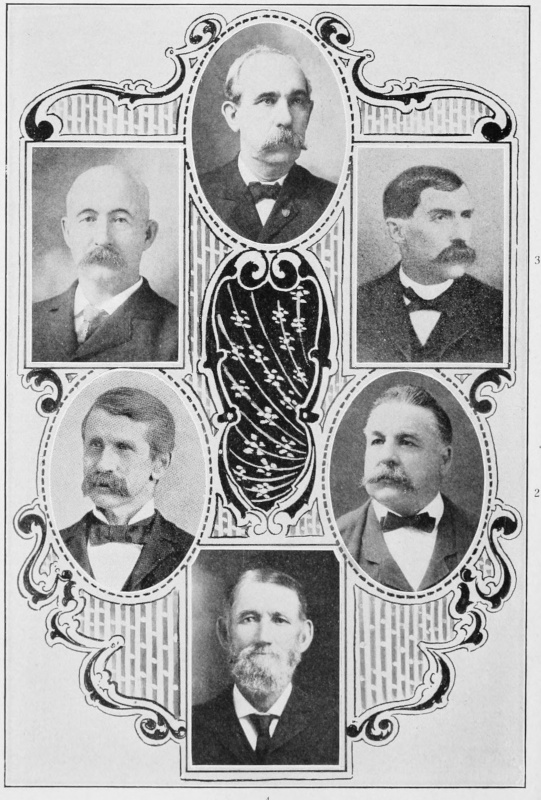
The Historical Committee
1. J. M. Martin.
2. E. C. Strouss.
3. R. G. Madge.
4. R. I. Campbell.
5. M. C. Zahnizer.
6. B. F. Smith.
CHAPTER I. BY J. M. MARTIN.
Organization of the Regiment—Camp Curtin—Departure for
Washington—In Old Virginia—Colonel Maxwell Resigns—Colonel
Campbell.
The sanguinary battle, and almost disgraceful rout
of the Union army under General McDowell at the
first Bull Run in July, 1861, convinced the authorities
at Washington that the insurrection of the slave states
was not a mere spasm of anger at their defeat in the
preceding presidential election to be crushed out by
the levy of 75,000 troops, undisciplined and indifferently
equipped, in a three months' service of holiday
soldiering, and that Secretary Seward's prophecy that
a sixty days' campaign would restore the Union and
bring peace to the nation was a dream destined not to
be realized. Acting on this conviction a call was made
for 300,000 volunteers to serve for three years, or
during the war.
To meet the emergency, evident to many, who
were not disposed to accept the prophecy of the Secretary
of State, Andrew G. Curtin, whose name will
go down in history as "Pennsylvania's War Governor,"
organized, equipped and had put in training
that superb body of men, "The Pennsylvania Reserves,"
who through all the four years of bloody
conflict to follow, were to find the place their name
indicated, on the skirmish and picket line, and in the
front of the battle, were the first to respond, and none
too quickly, for the safety of the Nation's Capital. In
obedience to this call other regiments and battalions
were promptly organized and forwarded so that by
September 1, 1861, Arlington Heights and the environments
of Washington were thickly studded with
the camps of these new levies, and out of the mass was
being moulded, under the hand of that skillful drill
master, General George B. McClellan, that mighty
host known in history as the Army of the Potomac,
whose valiant deeds in the cause of Union and Liberty
are co-eternal with that of the Nation.
At the first, regiments were recruited and mustered
from single cities, towns and counties, but as
time passed and the first flood of recruits were mustered
into service, companies and squads, to the number
of a corporal's guard, were gathered from distantly
separated districts, and rendezvousing at some
common camp were consolidated into regiments and
battalions. Such was the case in the organization of
the 57th Pennsylvania Volunteers, the place of rendezvous
and final mustering being in Camp Curtin at
the State Capital.
The roster of the regiment, by company, shows
the different sections of the state whence recruited, viz:
Company A, Susquehanna and Wyoming counties.
Company B, Mercer county.
Company C, Mercer county.
Company D, Tioga county.
Company E, Allegheny, Mercer and Lawrence
counties.
Company F, Mercer county.
Company G, Bradford county.
Company H, Bradford county.
Company I, Mercer and Venango counties.
Company K, Crawford county.
Thus it will be seen at a glance on the state map
that there were representatives in the regiment from
Wyoming county in the east; thence along the
northern border of Crawford, Mercer, Venango and
Lawrence counties in the extreme west. Before, however,
the final rendezvous of these several companies
at Camp Curtin there were smaller camps established
for recruiting in several localities, notably that at
Mercer, Mercer county, where it may be said was
established the original regimental headquarters.
The Hon. William Maxwell, a graduate of West
Point, but at that time pursuing the peaceful avocation
of the practice of law in that county, was, about
September 1, 1861, authorized by Governor Curtin
to recruit a regiment for the service. With this in
view he established a rendezvous camp outside of
the borough limits of the town of Mercer, on North
Pittsburg street, in a field given for that purpose by
the late Hon. Samuel B. Griffith, and which was
named in honor of the donor, "Camp Griffith." Here
temporary barracks were erected and a regular system
of camp duties inaugurated, and the usually quiet
hamlet of Mercer became the scene of quite active
military enthusiasm; the still breezes of the Neshannock
being stirred by the beat of drums and shrill
notes of fife. In two or three weeks after the establishing
of this camp a large number of volunteers
were recruited who formed the nucleus of what afterwards
became Companies B, C, E, F and I, of the
regiment. When the number of these recruits became
sufficient for the formation of a battalion Colonel
Maxwell transferred them to Camp Curtin. In making
this transfer the men were taken in conveyances overland
to the "Big Bend" on the Shenango and there
embarked on a canal boat for Rochester, Beaver
county, and thence by the only line of railway, the
Pittsburg, Ft. Wayne & Chicago, to Pittsburg and
Harrisburg. Along the way from Camp Griffith to
the Ohio these recruits enjoyed a continual ovation;
the last, alas! that many in that band ever received.
At Pittsburg they were joined by others from Allegheny
and a small contingent from the northeastern
part of Lawrence county, who cast their fortunes
with Company E.
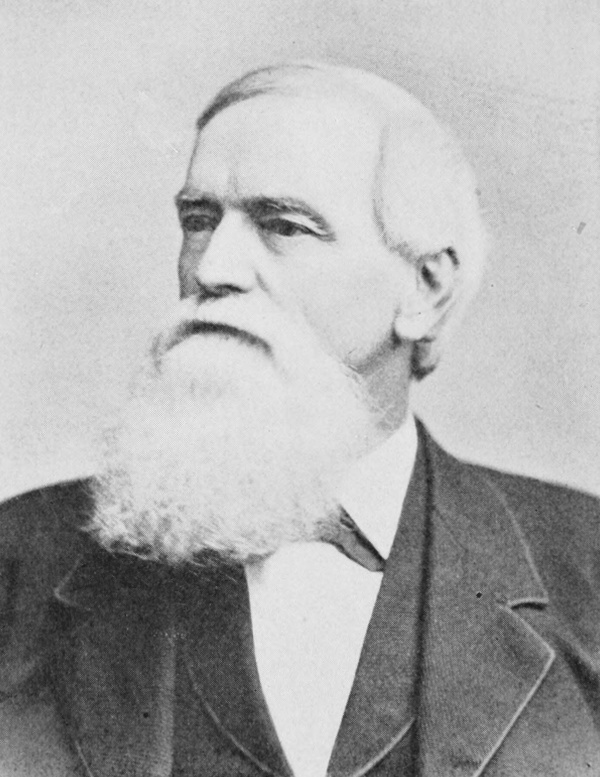
Col. William Maxwell
Arriving at Camp Curtin the regiment was
rapidly filled up to the required ten companies by the
addition of Companies A, D, G, H and K.
In the latter part of October the regiment was
organized and mustered into the United States
service.
Immediately following the mustering, clothing
was distributed, and stripped of every habiliment and
insignia of the citizen and arrayed in forage caps,
dark blue blouses, sky blue pants and army brogans
the regiment marched to the armory in the city and
received its equipment—Springfield muskets and cartridge
boxes. An impressive ceremony, one not to be
forgotten by those present, was the committing by
Governor Curtin with appropriate words to the care
of the regiment the colors:
The starry flag,
With stripes of red and white,
And field of azure blue.
Sacred emblem of our Union, in defense of which
many who that day stood as stalwarts in those ranks,
gave health, and limb, and life in the three years to
follow.
Thus fully inducted into service the regiment settled
down to the daily routine of camp duty, drill and
guard mounting, waiting for the call to the more
heroic service at the front beyond the Potomac.
To those accustomed to the dainties of the home
table and unstinted in their access to the larder, the
black coffee and indigestible sea biscuits, with the
suggestive initials "B. C." stamped upon them, soon
mollified their love of camp life and cultivated a craving
desire to terminate the "cruel war" at the earliest
date possible, even at the risk of being hurt or hurting
somebody in the attempt.
During the month of November that destructive
pest of the camp, measles, broke out in the regiment,
and proved to many a foe more to be dreaded than the
bullets of the enemy; besides, to go a soldiering in
defense of one's country and be ambushed by a disease
that at home was regarded as a trifling affliction
of childhood, was a source of real humiliation.
About December 14th orders were received to
transfer the regiment to Washington. The transfer
was anything but a pleasure jaunt. Instead of the
commodious and comfortable passenger coaches, the
ordinary box freight cars were used, and packed in
there, that cold December night of transfer was truly
one of misery. The cars were seatless, consequently
the Turkish style of sitting had to be adopted by all
who did not prefer to stand or were so fortunate as
to obtain a seat in the side doors from which the feet
could swing with freedom. The night was exceedingly
chilly and with no facilities for warmth the discomfort
was at the maximum. The day following,
the regiment arrived at Washington, where it was
lodged for the night in the "Soldiers' retreat," the
hard floors of which were as downy pillows to our
wearied and cold stiffened limbs. The next day we
marched out of the city, passing the Capitol, and
formed camp near the Bladensburg road. It was now
the dead of winter, a Washington winter, with frequent
storms of rain, sleet and snow. The camp was
on the lowlands and the regiment experienced to the
full the disagreeableness of the mud and slush of "My
Maryland." Here we had our first introduction to the
Sibley tent, a species of canvas tepee of the western
Indian pattern, each of which afforded shelter to a
dozen men. A small sheet iron stove, with the pipe
braced against the center pole, diffused warmth, while
a hole in the canvas at the apex afforded an exit for
the pungent smoke of the green pine used for fuel.
It was while in camp at this place we first heard
the booming of the enemy's guns away to the westward
across the Potomac. These deep notes were of
such frequent recurrence that all were fully convinced
that a battle was in progress. Steed-like "we snuffed
the battle from afar," and many were the expressed
fears that victory would perch upon our banners, and
the war be ended ere we should reach the Virginia
shores.
Alas! poor, ignorant mortals that we were! Little
dreaming of what scenes of carnage and hot battle we
should be called to witness before the last notes of the
hostile guns should be heard. The next morning the
papers brought us the news of the battle of Dranesville
and the repulse of the enemy, and our sorrow
was deep and loud spoken, that we were not forwarded
and permitted, at once, to put an end to this southern
fracas! Such was our confidence of easy victory!
While in this camp the measles again broke out in
the regiment. Many of the men had contracted severe
colds during that night of dismal ride from Harrisburg,
and cases of pneumonia were numerous, many
proving fatal, while others lingered for months in
hospitals, either to be discharged on account of disability
or to again return to their companies mere
wrecks of their former selves.
In February, 1862, the regiment broke camp, and
crossing the Potomac, took its place in the left wing
of the army near Fort Lyon, below Alexandria. Here
in the organization of the army it was assigned to
Jameson's brigade of Heintzelman's division, which
later, upon the organization of the army corps, constituted
the first brigade, first division, third corps,
commanded respectively by Generals Jameson, Hamilton
and Heintzelman, General Hamilton later being
superseded in division command by that intrepid and
fearless fighter, General Philip Kearny, whom the
enemy dubbed with the uneuphoneous soubriquet of
the "One Armed Devil." The brigade as then organized
consisted of the 57th, 63d, 105th Pennsylvania
regiments and the 87th New York, and from that date
so long as the old Third corps existed these Pennsylvania
regiments retained their place side by side.
Our associations were most pleasant, many last friendships
were formed, and the courage of each was ever
held in highest esteem by the others.
On March 1st, Colonel Maxwell resigned his commission
as colonel of the regiment and was succeeded
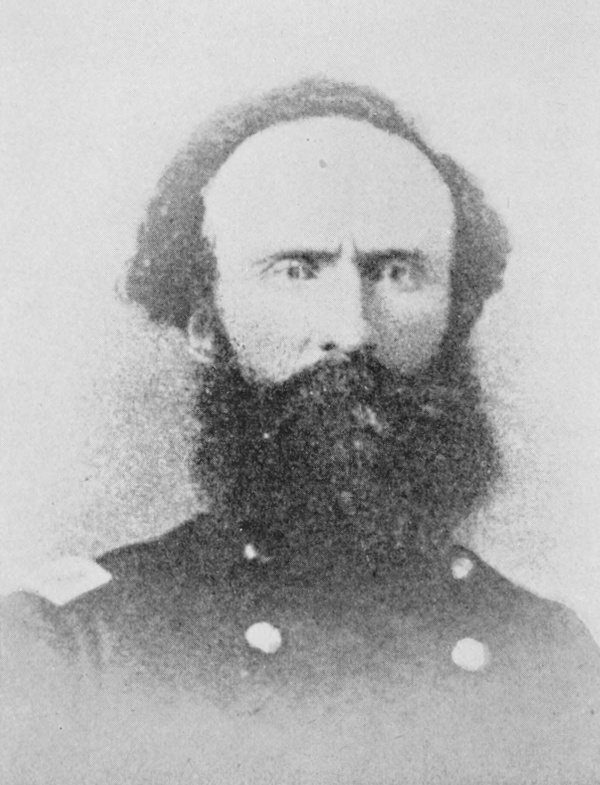
by Colonel Charles T. Campbell. Colonel Campbell
was by education and choice an artillerist, and had
seen service on that arm in the Mexican war. He had
had command of a battery of Pennsylvania artillery in
the three months' service, and had been commissioned
by Governor Curtin colonel of artillery and had recruited
and organized the first Pennsylvania regiment
of light artillery as part of the Pennsylvania Reserve
Corps. When, however, the regiment entered the
United States' service, such an organization was
deemed impracticable and the regiment as a compact
body was disbanded and the batteries assigned to the
several corps. Thus Colonel Campbell found himself
a colonel in commission without a command. But he
was enlisted for the war and with uncomplaining patriotism
he willingly took his place where duty called.
At the first the members of the regiment were impressed
with the thought that they had "caught a
Tartar." Tall and commanding in figure, gruff
voiced and with sanguinary hair and whiskers, the
colonel did not give the impression of being a weakling,
but it was not long until they began to realize
that beneath the rough exterior there beat a considerate
and tender heart and in the gruff voice there
was a soft chord, and soon the name "Charley" was
more frequently on the lips about the camp fires than
the more stately title of "Colonel." These characteristics
of the new commander were manifested in many
acts that the men appreciated. He was always ready
to take the rough side of soldier life and share privations
with the rank and file, and at the end of a hard
day's march he would lie down with only the heavens
for a covering with any of the boys rather than ask
a detail to erect his headquarter tents. And many a
comrade can remember when on camp guard and the
weather was threatening, hearing that gruff voice
calling from his tent door: "Officer of the day, release
the guards and send them into their quarters!"
Gen. Charles T. Campbell
CHAPTER II. BY J. M. MARTIN.
We Embark for the Peninsula—Yorktown—Camping in the
Mud—Peach Orchard—Artillery Practice—Battle of Williamsburg.
On the 17th of March the regiment embarked and
steamed down the Potomac, past Mount Vernon, of
hallowed memories, on its way to Fortress Monroe,
whither the army was being transferred to enter upon
the historic and ill-fated Peninsular campaign. Upon
arrival it went into camp near the ancient, but then
recently burned town of Hampton, crumbling brick
walls and charred chimneys being the only remaining
monuments to mark the site of the once pleasant village,
the beginning, to us, of the scenes of the war's
"rude desolations," while protruding from the placid
waters of the bay were to be seen the masts of the
"Cumberland," that but a few days before had gone
down with flag flying before the onset of the ram
"Merrimac," while over by the Ripraps peacefully
floated low on the waters the little "Monitor" that
David-like, had single-handed put to flight this
Goliath of the rebellion, that had defied our navy; a
veritable "tub on a plank."
On the morning of April 4 the grand advance
was begun. Across the narrow neck of land that
divided the waters of the Chesapeake and James, the
magnificent hosts of the Army of the Potomac,
stretching from shore to shore, moved forward to the
fortified post of the enemy at Yorktown. Battlefields,
like history, repeat themselves. It is said the plains of
Esdraelon have been the theater of a greater number
of conflicts at arms than any other known portion of
the globe, so here at Yorktown, where the Sons of
Virginia, Pennsylvania and others of the thirteen
colonies humbled the British under Cornwallis in
1781, and whose lines of entrenchments were yet
visible, were again to meet in 1862, the sons of these
sires of revolutionary fame, in martial combat, not
shoulder to shoulder, as then, but in opposing phalanx.
The line of advance of the 57th was by the
main road leading from Hampton to Yorktown by
way of Little and Big Bethel, the latter place being
the scene of General B. F. Butler's unfortunate night
venture of 1861.
The afternoon of the second day's march brought
the advance of the army in front of the enemy's formidable
works around Yorktown and along the Warwick
river. For the space of nearly a mile, immediately
in front of the town, the country was open,
scarcely a tree or a shrub impeding the view of the
fortifications, whose embrasures bristled with heavy
ordnance. With drums beating and colors flying we
marched boldly along the way and filing off into the
open fields deliberately proceeded to pitch our tents
and make our camp in the very jaws, as it were, of
these frowning batteries. Whether it was a fear of
bringing on a general engagement, or amazement at
our audacity that kept the Confederates quiet behind
their earth-works we did not then know, but subsequent
events proved the former to be the cause. Not
until the day following did they manifest a disposition
to disturb our repose, and then only by a solitary shot
that plunged into one of our company's streets, burying
itself deep in the soft earth. This shot was sufficient,
however, to admonish us of the fact that they
had a perfect range of our camp, and could, of they
chose, make it exceedingly uncomfortable for us. As
a result we very deliberately withdrew, without the
loss of a tent or knapsack, back to the main line in
the woods, though not wholly beyond the range of
their guns.
Once in our established camp there began a month
of as arduous duty as untried soldiers were ever called
to perform. Digging trenches, constructing earthworks,
and picket duty, kept us constantly engaged,
and to add to our discomfort the weather was extremely
unpleasant; frequent rains wetting us to the
skin and rendering the earth about the consistency of
a mortar bed. Of this time Surgeon Lyman writes:
"Here for three weeks the men walked in mud, slept
in mud and drank water from holes scooped out of the
mud. The combined remonstrances of the medical
officers of the brigade, 'that a month's continuance in
that place would deprive the government of the services
of one-half of its members,' were met by the
silencing reply, 'It is a military necessity.' The result
showed that our fears were well founded. The
malaria of the marshes and swamps of Yorktown,
with the excessive labor performed in the trenches
and on picket duty, debilitated our men for months,
sending dozens of them to their graves, and rendering
hundreds unfit for service, and many for life."
Here we had our first experience with the wild
garlic, which grew spontaneously in the uncultivated
fields and after a day or two's pasturing rendered the
flesh of the beeves unpalatable, the taste of the garlic
remaining long in the mouth after the act of mastication.
Here, too, the regiment had its baptismal of
blood, in the known to us, though never historically
christened, "Battle of the Peach Orchard."
On the afternoon of April 11 the 63d Pennsylvania
Volunteers, while on picket duty in the woods to
the left of the Yorktown road, was attacked by the
enemy. The 57th was ordered to its assistance and
advancing at double quick, formed in line of battle,
moving over the open field in face of a hot fire and
quickly putting to flight the columns of the enemy,
driving them back to the protection of their heavy
batteries. In this short but exciting engagement, the
regiment lost by wounds two men, Samuel Merven, of
Company E, and John Cochran, of Company F.
Cochran subsequently died from the effects of his
wound and Merven was discharged. In this engagement,
insignificant as it was, compared with its after
battles, the regiment exhibited great coolness and gave
token of its ability and readiness for future duty and
service.
An incident occurred about this date, while the
regiment was on picket duty, that is worthy of passing
notice. Lieutenant Wagner, of the topographic engineers,
was engaged in making drawings of the Confederate
works. He had placed a camp table in an
exposed position and spread his drafting material
upon it. The white paper made an excellent target
for the enemy's gunners. One of their shots struck
the table and fatally wounded the lieutenant. A few
moments after he rode along the rear of our lines, his
shattered and bleeding arm dangling at his side. This
shot is referred to, after these many years, by General
Longstreet in his recent work, as one of two of the
most remarkable shots, for accuracy of aim, of the
war. He says:
"An equally good one (shot) was made by a Confederate
at Yorktown. An officer of the topographical
engineers walked into the open in front of our
lines, fixed his plane table and seated himself to make
a map of the Confederate works. A non-commissioned
officer, without orders, adjusted his gun, carefully
aimed it, and fired. At the report of the gun all
eyes were turned to see the occasion of it, and then
to observe the object, when the shell was seen to explode
as if in the hands of the officer. It had been
dropped squarely upon the drawing table and Lieutenant
Wagner was mortally wounded."—Gen. Longstreet,
in "From Manassas to Appomattox."
This shot appears, by a note to the text written by
Capt. A. B. Moore, of Richmond, Va., to have been
fired by Corporal Holzbudon, of the 2d company,
Richmond Howitzers, from a ten-pound parrott gun.
Another incident more immediately connected
with the regiment, worthy of a place in its history
as an exhibition of accurate firing, occurred here. On
the left of our regimental picket line was stationed a
section of a field battery whose duty was to shell the
enemy's works and prevent their annoying our lines.
For some time Colonel Campbell watched with manifest
disgust the green cannoneers blazing away at
random, and with evidently little effect. At length
stepping to one of the guns the colonel said:
"Boys, let me sight this gun for you." Running
his eye along the sights and giving the elevating
screw a turn, he said:
"Now, let her go!"
In an instant the death-dealing missile was speeding
on its way, entered the enclosure and exploded
amid the startled gunners of the enemy.
"There, boys, that's the way to shoot. Don't
waste your powder!" said the colonel, as he turned
and walked away, an expression of satisfaction
wreathing his florid face.
By the 3d of May all things were in readiness to
open our batteries of big guns on the Confederate fortifications
and all were in excited expectation of the
bombardment and possible storming of the enemy's
works on the following day, but the morning light
of the 4th revealed the enemy's strong works abandoned
and empty. In the night, Johnson, who had
superseded Magruder in command, like the Arab had
"folded his tent and silently stolen away." The 105th
Pennsylvania were the first to enter the abandoned
works. The news of the evacuation of the works and
retreat of the Confederates spread rapidly from regiment
to regiment, and our bloodless victory, but not
without the loss of many a brave boy, was celebrated
with wild shouts and cheers. The cavalry followed
closely on the heels of the retreating enemy, but the
infantry did not take up the line of march until later
in the day; Fighting Joe Hooker's division following
first, with Kearny close in his rear. As we marched
through the Confederate works, stakes planted upright
in the ground with red danger signals attached
gave warning that near them were planted torpedoes,
placed there for the injury of the unwary by the
enemy.
A story was told at the time that the planting of
these torpedoes was revealed to Lieut. R. P. Crawford,
of Company E, of the 57th, then serving as aid
on General Jameson's staff, by a Confederate deserter.
That the 105th Pennsylvania, being about to enter the
abandoned works, this Confederate stepped out from
the shelter of a building, and, throwing up his hands
as an indication that he desired to surrender, came
forward and revealed to Lieutenant Crawford, who
chanced to be present, the secret danger that threatened
them if they attempted to enter the works without
caution. Thus forewarned of their danger, a
squad of prisoners, under compulsion, were made to
search out, and locate these concealed missiles, thereby
preventing possible loss of life and woundings.
During the afternoon of the 4th the regiment
marched with the division about four miles on the
main road to Williamsburg and bivouacked for the
night. By dark rain began to fall and continued
throughout the night and the day following. The
early morning of the 5th found us on the march again.
The rain had thoroughly soaked the light clay soil and
the preceding ammunition trains and batteries had
worked the soft clay roads into deep ruts and numerous
mud holes. To take to the fields and roadsides
did not better much the marching, the unsodded fields
being little better than quagmires, in which the men
floundered to the knees.
All the forenoon there was now and then cannonading
to our front with occasional rattle of musketry,
indicative of skirmishing, but by two or three o'clock
there came the long swelling roar of infantry firing,
giving evidence that our advance had overtaken the
enemy and they were making a stubborn stand. The
atmospheric conditions were such that from these
sounds the battle appeared to be but a mile or two in
our advance, and at every turn of the way we expected
to see the blue line of smoke and snuff the odors of
burning powder, while in fact the engagement was five
or six miles distant. Reaching a point about two
miles from the battlefield the regiment was ordered
to unsling knapsacks, doff blankets and overcoats and
march at quick step to the front. As we neared the
field, panting from our exertion, we passed a brass
band standing by the roadside. General Heintzelman,
observing them as he passed, exclaimed in that nasal
twang so familiar to all:
"Play, boys, play! Play Hail Columbia! Play
Yankee Doodle! Play anything! Play like h—l!"
It is needless to add that the band promptly obeyed
and the strains of the national quickstep put a new
spring in our weary limbs, revived our flagging spirits
and with a rousing cheer we pressed forward. Arriving
on the field the regiment was deployed in line of
battle in the woods to the right of the road, but darkness
was settling over the field, the firing soon ceased
and we were not engaged. The night following was
extremely disagreeable. The rain continued to fall,
and drenched to the skin we lay on our arms all night
without fire, blankets or rations. By morning the lowering
clouds were gone, and so also were the Johnnies,
leaving their dead unburied and their wounded to our
tender care. Many private houses of the ancient town,
all of the churches and that venerable seat of learning,
from whose halls came many of the nation's most
eminent statesmen and patriots, William and Mary
College, were turned into hospitals, where friend and
foe were gathered from the field of conflict, housed,
and cared for by our surgeons and nurses with undiscriminating
attention.
An incident that well illustrates the reckless daring
of General Kearny, and which ultimately lost him
to our cause, as well as the influence of such acts upon
others, occurred during this engagement. During the
battle, General Kearny, accompanied by General Jameson,
rode out to the front, and on an open piece of
ground, in full view of the contending forces, the two
sat there observing the progress of the battle, apparently
oblivious of the fact that they were exposing
themselves as targets to the enemy's sharpshooters.
Past them the minie balls were zipping, while the air
was redolent with the "ting" of musket balls and buck-shot.
At length, satisfied with their observations, they
coolly turned their horses about and rode to the rear.
The day following, General Jameson was approached
by one of his aides who had witnessed the act, who
said to him:
"General, don't you think the risk you and General
Kearny exposed yourselves to yesterday was unjustifiable?"
"I certainly do," the general candidly replied.
"Then why did you take the risk?" the aide
queried.
"Captain," said the general, gravely, "If I had
been conscious that I would have been hit the next
minute I would not have turned my horse's head.
Why, what would Kearny have thought of me!"
After the battle the regiment camped immediately
west of town. Of course the commands that had
borne the brunt of the battle were lionized, as were
also those officers who had acted a conspicuous part.
On this field General Hancock received his chief sobriquet,
"The Superb," which clung to him throughout
life. Regimental ranks, after a hard day's fighting,
often were very much broken, the losses not always
being catalogued as of the killed and wounded; roll
calls exhibiting many names marked "missing," or
"absent without leave." These absentees invariably
reported fearful losses in their commands. While in
camp at Williamsburg a strapping big fellow with
turbaned head, blue jacket profusely decorated with
gold lace, and baggy red trousers, wandered into our
midst.
"Hello! What regiment?" one of the boys inquired.
"—— regiment."
"But what state?"
"New York, of course."
"In the fight?"
"Yep. All cut to pieces. I'm the only one left!"
CHAPTER III. BY J. M. MARTIN.
Battle of Fair Oaks—Death of Major Culp—Increasing Sick
List—Advancing Our Lines—The Seven Days' Battles—Glendale
or Charles City Cross Roads—The Fifty-Seventh
Under Captain Maxwell as Rear Guard—Malvern Hill—Retreat
to Harrison's Landing.
On the 7th the army resumed the march "on to
Richmond," the 57th diverging from the main line to
Cumberland Landing on the Pamunkey, where for
several days it guarded the army stores that had been
shipped by steamer to that point. Afterwards we
rejoined the brigade at Baltimore Store, and on the
24th crossed the famous Chickahominy at Bottom's
bridge and camped on a pine covered bluff to the left
of the railroad, a short distance from the river and
near Savage station.
As soldiers we knew little of the danger that confronted
us, and nothing of the councils being held by
the enemy plotting our discomfiture. This knowledge
was reserved for us until the 31st. On that
day about one o'clock, just after the regiment had its
midday ration, like a clap of thunder out of a clear
sky the crash of musketry came to our ears from the
front. Casey's division of Key's corps, which had
pushed about three miles to our front, and had erected
some slight fortifications near Fair Oaks station, had
been suddenly and fiercely attacked by overpowering
numbers. For what seemed to us hours, that probably
did not exceed minutes, we stood listening to the crash
and roar of the battle. Soon the long roll was beaten,
the bugle blast sounded, the order to "fall in" was
given, and we knew our hour had come. Forming
in line with the other regiments of the brigade, we
were soon on the march toward the front at a quick-step.
Taking the line of the railroad, and the sound
of the battle for our guide, we pressed on. Nearing
the battlefield we began to meet the scattered and
retreating men of Casey's division, many of them
wounded and bleeding, but the majority suffering
only from panic. Among this fleeing and panic-stricken
mass, field and staff officers rode, seeking to
stay their flight and reform their broken lines. General
Kearny rode among them shouting, "This is not
the road to Richmond, boys." Approaching nearer
the field of battle the lines assumed a more defiant
order, and it was evident that the greater mass of the
troops were nobly standing, and lustily cheered us
as we passed. A short distance beyond Fair Oaks
station the brigade was deployed in line of battle in
an open field to the right of the railroad. The thick
woods to our front afforded an excellent cover for the
enemy's sharpshooters, of which they speedily availed
themselves, field and staff officers being their tempting
targets. In a few moments orders were received
to move to the left. There was a slight cut at the
point of crossing the railway track and under the
sharp fire from the enemy there was some confusion
in making the crossing. While effecting this movement
Major Culp was instantly killed and several of
the line wounded. After crossing to the left of the
railroad the brigade was again formed in line, face
front, and stood waiting orders to advance. Immediately
in our front was a "slashing," several rods in
width. Beyond that was standing timber quite open.
We were not long waiting orders and soon were moving
cautiously forward, scrambling over and through
the felled timber. Once beyond the "slashing," our
lines that had become disarranged were again formed.
From our position we could see an open field beyond,
across which extended a line of Confederate infantry,
their compact ranks presenting a fine mark and in
easy range of our Austrian rifles, with which we
were then armed. Colonel Campbell, who had dismounted,
having left his horse beyond the "slashing,"
standing a few paces to the rear of the column, in
low, but distinct tone gave the command, "Ready!
Aim! Fire!"
Every gun in the line responded. What the execution
was is not known, the smoke from our pieces
completely excluding our view, but that every Johnnie
had not bitten dust was soon evident from the lively
manner in which they sent their missiles amongst us
in very brief time. After the first volley the regiment
loaded and fired "at will," the men seeking
cover behind logs and trees as best they could from
the enemy's returning compliments. How long this
duel was maintained it is impossible to state, as the
occasion was such that to take note of passing time
was out of question. The troops holding the extreme
right of our line at length gave way, and the enemy,
seizing the opportunity, threw forward a strong flanking
column that soon began a severe enfilading fire that
compelled us to fall back obliquely to avoid a retreat
through the slashing, and take a position in the woods
beyond the open field in which we first formed. This
closed the fighting for the day, and night soon settled
over the scene, and while we had met with reverses,
yet we were encouragingly satisfied, for the enemy
had not succeeded in his purpose, by overwhelming
numbers, to drive us into the Chickahominy before
reinforcement could come to our aid from the north
side. That night we slept on our arms, without tents
or blankets, for these we had left in our camp to the
rear. During the night Sumner's corps succeeded in
crossing the river, swollen by recent rains, and by daybreak
was on the field, and engaging the enemy, drove
him back to the shelter of his works about Richmond.
The regiment lost severely in this engagement. Colonel
Campbell was dangerously wounded in the groin
and while being carried to the rear was again shot in
the arm. Major Culp, as before stated, was killed,
and Captain Chase, of Company K, mortally wounded.
The loss in the line was eleven killed and forty-nine
wounded. The command of the regiment now devolved
on Lieutenant Colonel Woods, and Captain
Simonton of Company B, was promoted to the rank
of major. The battle was immediately followed by
heavy rain storms. Tents and camp equipage were
back in the rear and were not forwarded for two or
three days. In the meantime the men stood about,
drenched to the skin, or sat upon logs drying their
saturated clothing upon their backs in the hot sunshine
that interspersed the showers. The earth was
soaked with water, which for lack of springs or wells,
was used for drinking and cooking purposes, it only
being necessary to dig a shallow hole anywhere to
gather the needed supply. The damp hot weather
brought about rapid decomposition of the dead and
unburied animals and the chance bodies of friend or
foe who had fallen in "slashing" or thicket and thus
remained undiscovered, produced a sickening stench.
These causes soon produced much sickness and the
swamp fevers carried many to the hospitals, some
never to return. Rumors of the renewal of hostilities,
possibly by night attack, kept the army constantly on
the alert, and our accouterments were rarely taken
off night or day; orders being issued to sleep in shoes
ready to "fall out" and "into line" at a moment's
notice. On one occasion a kicking mule was the innocent
cause of a hasty mustering of our forces, to the
great chagrin of the weary and sleepy soldiery.
General Hooker, ever anxious for fight and adventure,
made an advance on his own motion, in which
he was actively supported by General Kearny, pushing
his lines close up to the enemy's defenses, so that from
a lookout station established in the top of a large tree
the church spires and steeples of the coveted Confederate
capital could plainly be seen. But this movement
was not in accord with General McClellan's plan of
campaign. The position was hazardous in the extreme,
inviting another onset by the enemy, and we were
soon withdrawn to our original lines and the shelter
of our breastworks. This was our nearest approach
to Richmond until after Appomattox in the spring of
1865. Amid these scenes of constant picket duty, digging
rifle-pits, and building fortifications the regiment
passed the month of June. On the 26th the sound of
heavy firing on the extreme right came to our ears all
the afternoon. The enemy in our front was exceedingly
vigilant and we drew the fire of their pickets on
the slightest exposure. Late in the evening loud cheering
was heard to our right, and the report was circulated,
and credited, that that wing of our army had
carried the Confederate defenses to the north of the
city, and we lustily joined our comrades, as we supposed,
in their shout of victory. But, alas! for the
truthfulness of camp rumors! It was all a mistake;
our lines had only successfully repulsed the enemy's
repeated assaults at Mechanicsville! That was all.
The next day, the 27th, the battle was renewed at
Gaines Mill, a little nearer to our position. The day
following, the 28th, our immediate line withdrew
from its advanced position and stood ready to repel
any attack that might be made on the battle-worn
troops of Porter and Warren as they slowly filed
across the Chickahominy to the south side. Late in
the afternoon General Kearny directed the distribution
to each man of one hundred and fifty rounds of
ammunition (more than twice our usual allowance),
and also that each officer in his command should place
a red patch in conspicuous view upon his hat or cap.
What to do with the superfluous ammunition was a
question, and called forth many uncomplimentary
remarks, some even suggesting that it was intended
to relieve the mules of the ammunition trains by making
pack-horses of the soldiery. But we had not long
to wait to know the real cause and the wisdom of it,
and glad were we to have the extra cartridges for
convenient use! The red patch order also proved an
important event in army history, in that it was the beginning
of the corps badge so popular and useful in
the after years of the war. The afternoon of the next
day, the 29th, after a day of anxious waiting and
expectancy, the regiment took up the line of march,
with the crash of the battle of Savage station ringing
in their ears, southward across the White Oak
swamp. Late in the evening we filed off upon a by-road
leading at right angles to the road on which
we were moving. Soon we reached a wide swamp,
across which had recently been constructed a causeway,
or bridge of logs laid in the mud and water
side by side, and which was perhaps twenty rods in
length. Without hesitation the regiment marched
out upon this bridge. When the head of the column
had about reached the opposite end it was fired upon
by the enemy's pickets. Here was a dilemma calculated
to try the nerve of the bravest. What the enemy's
force was none knew, but anyone could realize
the terrible slaughter that might be wrought had a
section of artillery been turned upon that narrow roadway
with a swamp of unknown depth on either side.
General Kearny, with his accustomed daring, was at
the head of the column. Turning about, he rode back
along the line, his face grave, but calm. "Keep quiet,
boys, keep quiet. Don't be alarmed. About face and
move to the rear!" he said as he passed. Every
man in the regiment seemed to realize the gravity of
the situation, and that upon his personal coolness
depended the safety of the retreat, and without noise
or confusion the regiment "about faced" and soon was
back on the road from which we had strayed. That
night we bivouacked without tents or fires, wrapping
ourselves in our blankets, and, lying down, star gazed
until our eyes closed in slumber.
The 30th dawned hot and sultry, and as the men
trudged along under the fierce glare of the sun, and
their burden of knapsack, haversack, and extra ammunition,
many succumbed and fell out of the ranks.
Arriving at the intersection of the Charles City road
with that upon which we were marching about mid-day,
the regiment filed to the right into an open field,
stacked arms and broke ranks. Some of our number
sought rest in convenient shade, others busied themselves
building fires and cooking coffee. In all our
surroundings there was not a sign of the enemy's
presence, or that from the cover of the woods beyond
the field his scouts were watching our every movement.
Cannonading from the direction whence we
had come gave evidence that he was yet beyond the
dismal swamps through which we had passed the day
before, and the rank and file at least was not aware that
a strong force was at that moment marching upon our
line from the west with a purpose to intercept us on
our way toward the James. To the left of us a section
of Randolph's battery stood unlimbered, a circumstance
rare to be seen while on the march, and to
the old soldiers suggestive of possible battle, but the
gunners were lolling upon their pieces or sitting about
the ground chatting, apparently indifferent, and if they
were so, why need others feel concern? Thus time
passed until 2 o'clock p. m., when suddenly one of
those unlimbered pieces, with a crash that brought
every man to his feet, sent a screaming shell far out
over the woods beyond. This defiant shot seemed at
once to be accepted by the enemy as a challenge to
action, for immediately there followed a spattering
discharge of musketry along our front, the bugle notes
sounded and the command to "fall in" rang out along
the lines.
"And there was mounting in hot haste, the steed,
The mustering squadrons, and the clattering car
Went pouring forth with impetuous speed,
And swiftly forming in the ranks of war;
And deep thunder, peal on peal, afar;
And near, the beat of the alarming drum
Roused up the soldiers."
In advancing to take our position in the line of
battle each man seized a rail of a convenient fence that
stood in the way, and when halted, out of these constructed
an improvised shelter, behind which we
crouched to meet and repel the enemy's desperate
onslaughts. From that hour until darkness covered
the scene, the battle raged furiously and almost incessantly.
Charge after charge was made upon our lines,
often coming so near that faces were clearly discernible
through the smoke of battle, so determined was
the enemy to break our lines and reach the road in our
rear, over which our wagon trains and unengaged
forces were pressing toward the James river.
Perhaps in no battle of the war was there so long
and continuous fighting by the same troops as in this
engagement. It was all important that the army
should be safely guarded past this most vulnerable
point, and posted on the river bluffs and under the
protection of our gunboats. The enemy, as well,
seemed to realize the need of breaking our lines or
lose the fruits of their victory purchased at such fearful
cost, and therefore pressed our line hard and continuously,
so that if disposed to do so, there was
little time given to relieve us by the substitution of
other troops.
In this engagement Major Simonton was wounded
in the shoulder about 6 o'clock in the evening. Lieutenant
Colonel Woods was absent on sick leave, and
the command of the regiment devolved upon Captain
Ralph Maxwell, of Company F. Before midnight the
troops were withdrawn from the line of battle and
were on the march to Malvern Hill, the place of rendezvous
of the army, near the James river. As we
moved quietly along in the darkness General Kearny
rode up and asked Captain Maxwell what regiment
we were. When informed, he complimented us very
highly for the part we had taken in the recent battle,
then ordered him to return us to our old position and
hold it until daylight, when he would have us relieved.
We "about faced" and were soon back in our old place
as nearly as could be determined in the darkness. The
supposition was that the whole brigade was with us
and we did not discover differently until an hour or
more later. Of this occurrence Captain Maxwell says:
"I thought along toward midnight I would go and
have a talk with whoever commanded the 105th. I
went to the right of the 57th, but could find no one;
all was vacancy. I immediately retraced my steps and,
passing to the left, found the 63d gone also. Nobody
there but one poor, little, lone regiment! It then came
to me that we were placed there to be sacrificed for the
safety of the rest of the army. I knew the penalty for
violating General Kearny's orders, but at the same
time I could not think of sacrificing these men to certain
capture and imprisonment. I did not like to break
orders and I could not do the other. Soon after we
heard the trundle of artillery, and the tread of the
marching men to our front, and then lights gleaming
to our front. Evidently this was the enemy. I made up
my mind I would try and save the regiment, orders
or no orders, and let them court-martial me and be
d—d. I ordered the regiment to form silently in two
ranks, then gave the order to march and file right.
They did so and all filed past me and got on the road.
I then ran along the line to the head of the regiment
and gave the order to double quick, and we went
down that road on the run, and none too soon. Five
minutes more and we would have been prisoners! We
caught up to the main body of the army and took our
usual position in the brigade. I was afraid to ask
any questions and never heard anything about our disobedience
of orders. But one thing is certain, I am
glad I did what I did that night!"
In this engagement our regiment lost seven killed
and fifty-six wounded, a number of whom subsequently
died.
The next morning found the regiment in line on
Malvern Hill. This position was almost impregnable.
On the south side flowed the James river on which
floated the Union fleet of gunboats. On the north side
was an impenetrable swamp. To attack, the Confederates
had to charge from the west and in our front
over long stretches of open ground in the face of our
batteries posted along the hill side, their right flank
enfiladed by the fire from our gunboats. General Porter,
speaking of the strength of this position, says that
when by inspections he realized its natural advantages,
and had seen his division properly posted, he returned
to the Malvern House, where he had established his
headquarters, and, lying down on a cot, dropped at
once into so sound a sleep, that although the battle
following surged up to the front yard of the house, he
was not awakened, although at any other time during
the campaign the snap of a cap would rouse him instantly,
so great was his sense of the security of his
position. Notwithstanding these natural advantages,
the elated, but weary forces of Jackson, Longstreet,
and Hill, reinforced by the fresh troops of Magruder
and Hugar, charged and recharged our lines with
desperate persistence deserving of a better cause, but
each time were repulsed with fearful slaughter. The
losses of the 57th in this engagement were two killed
and eight wounded, Lieutenant Charles O. Etz and
the orderly sergeant of Company D being the two
fatal casualties. The death of Lieutenant Etz and his
companion occurred under peculiarly sad circumstances.
Wearied with the battle of the preceding
afternoon and the night vigil following, these two
comrades had lain down together, the sergeant's head
resting on the lieutenant's breast, and were snatching
a moment's sleep. A shot from one of the enemy's
batteries struck the two sleepers, killing them instantly.
Thus, all unconscious of their danger, they
were swept by one swift stroke into that sleep that
knows no waking.
The battle over and the enemy severely chastised,
the grand Army of the Potomac, with thinned and
broken ranks, a mere shadow of its former greatness,
continued the retreat, Harrison's Landing, a place of
historic importance in that the line of its occupants
has given to our country two chief executives, lying
a few miles below Malvern Hill on the James, being
the place selected for final rendezvous. During the
night following the battle the 57th was again on outpost
duty, but early the following morning was quietly
withdrawn and in a drenching rain that continued
throughout the day, again took up its wearisome
march, arriving in the vicinity of the landing toward
evening, weary, wet and worn!
The Harrison mansion, a substantial structure of
brick, reared in colonial days, stood on an eminence
overlooking the broad sweep of the James river.
Between the mansion and the river was a stretch of
grass-covered field gently sloping to the water's edge.
Adjoining this to the west, or northwest, was a large
wheat field. A greater part of the standing grain
had been cut and was in shock. These golden sheaves
were quickly appropriated by our troops and spread
upon the water-sodden ground, whereon to rest their
weary bodies. A few brief hours sufficed to obliterate
every trace of this harvest scene, and where the husbandman
had so recently been reaping in peace the
fruits of his field, batteries were now thickly packed
and soldiers' tents, not white, but wet and earth soiled,
stood in long ranks.
CHAPTER IV. BY J. M. MARTIN.
Camp Life at Harrison's Landing—Major Birney Assigned
to the Command of the Regiment—Transferred to General
Birney's Brigade—Evacuation of Harrison's Landing
and the Peninsula—The Army of the Potomac is
Sent to Reenforce General Pope.
The regiment, upon its arrival at Harrison's Landing,
presented a most pitiable spectacle. But three
months before it numbered almost nine hundred; now
but little over half a hundred responded for duty at
first roll-call, and there was not a field officer present.
Says Surgeon Lyman: "All were exhausted and disheartened,
scarcely a well man in the regiment, with
two hundred and thirty, for the first few days, on the
sick list." For a time Captain Ralph Maxwell was
in command of the regiment, but was succeeded later
by Captain Strohecker. Funerals were of such frequent
occurrence that the solemn notes of the dead
march were almost continually to be heard, until, for
the benefit of the living, burials with military honors
were suppressed by general order. To the great annoyance
of brigade commanders they could muster
no more men for brigade drill than would compose
an ordinary battalion; the regiments presenting no
better appearance as to numbers than a company, and
a company than a corporal's guard. As a consequence
there were frequent charges of "shirking duty" preferred,
and the officers of the line watched and
counted with greatest care their rolls for available
men. An amusing anecdote of this watchful regard
of the superior officers is told by Colonel Strohecker.
He says:
"For a few days our regiment was attached to the
63d, and under the command of Colonel Alexander
Hayes. On one occasion he had the two regiments
'fall in,' and passing along the line counted the men
in each company with great care, comparing their
number with the adjutant's report which he held in
his hand. When he counted my company I lacked
three men to fill the report, and then the colonel commenced
cursing me for reporting more men than I
turned out. I replied that I did not report more men
than I had in line. At this he exhibited to me the
adjutant's report and said he would see me later.
True enough, there were three more men reported for
duty on the adjutant's report than I had turned out.
The figures were against me. He dismissed me and
I went to my quarters crestfallen. I took up my
morning report book, and discovered there was a
mistake somewhere. My morning report and the
number of men I had in line tallied exactly. I immediately
called upon the colonel and armed with my
morning report proved that I was right. He called
his adjutant and asked him to explain. That officer
replied that in consolidating the company reports he
could not make them agree, so he just put three more
men to my account! 'What!' exclaimed the colonel.
'You falsify the morning report of a captain and
his orderly? I'll let you know' and then the very
air seemed blue! To me he only said, 'Captain won't
you have a drink?'"
General Kearny was no admirer of a rifle-pit campaign.
"An open field and a fair fight," was more to
the pleasing of the military taste of this intrepid commander;
he was, therefore, loth to have his troops
exhausted with the labor of their construction, and as
occasion offered was not slow to so express himself.
One quiet Sabbath morning, while in camp at this
place, a detail from the 57th was on its way, armed
with pick and spade, to this duty. As they trudged
along their way Kearny met them, and, returning
the salute of the lieutenant commanding the squad,
inquired:
"Lieutenant, where are these men going?"
"To work on the breastworks, general," replied
the officer.
"About face your men, and return to your quarters,"
sharply replied the general. "Six days in the
week are enough to work on fortifications. These
men need their Sunday rest!"
It is needless to say the order was promptly obeyed
and regard for their commander rose several degrees
in the estimation of these weary veterans.
The camp of the regiment was near a fine stream
of water on which was erected a dam that afforded
the men most excellent bathing opportunities, which
doubtless contributed much to their general health
besides personal cleanliness. Ovens were also built
and for a time they enjoyed the luxury of "soft
bread." There was, however, a dearth of vegetables,
and aside from an occasional ration of onions, and
that conglomeration of pumpkin, squash, etc., compounded
under the euphonious name of "dessicated
vegetables," but which the boys derisively dubbed
"desecrated vegetables," green truck was unknown in
their daily bill of fare, in consequence of which
diarrhoea and kindred complaints were prevalent, and
many disqualified for active duty.
William Birney
During the encampment at Harrison's Landing
Major William Birney, of the 4th New Jersey regiment,
a brother of General David B. Birney, was assigned
to the command of the 57th regiment. Major
Birney was an officer of rare ability, a strict disciplinarian,
an indefatigable drill-master, and withal a gentleman,
winning and courteous to the humblest when
off duty, and abhorring the petty tyrannies in which
some officers of brief authority seemed to delight. He
also enjoyed to the highest degree the confidence of
his superiors, and very soon won the respect and
esteem, as well, of the rank and file. A story told
about the camp fires, whether true or false, well illustrates
the characteristics of the man and deserves
recording. At the breaking out of the war Major
Birney was commissioned an officer in one of the
New Jersey regiments composing the New Jersey
brigade, commanded by General Kearny, but possessed
of little knowledge of his duties as such, or
ability to drill his men. On one occasion while attempting
to put his regiment through its evolutions
General Kearny chanced to pass, and halting, watched
the major in his attempts with evident disgust. The
general was never noted for his patience, especially
with inefficiency of an officer in his line of duty, and
riding up to the major, reprimanded him sharply, bidding
him to go to his quarters and never attempt to
drill his men again until he had mastered the tactics.
It is said, the major, stung with reproof, went to his
quarters, not to sulk over this and possibly resign his
commission, but to study, and when he next appeared
on drill he was the best informed and most efficient
drill master in the brigade, receiving the compliments
of the general, who ever after held him in highest
esteem. Of the major's persistency, if not his efficiency,
as a drill master, every member of the 57th
regiment would willingly certify.
Major Birney's discipline was not confined to camp
life, and the drill ground. It extended as well to the
march. Every morning on the march the regular
detail for guard duty was made, and this detail, under
command of the officer of the day, marched at the
rear of the column, and proved an efficient preventive
to "straggling," a habit exceedingly demoralizing to
an army on the march. If any fell sick or gave out
by the way they were taken charge of, and if possible,
were placed in an ambulance, or in the absence
of such, in one of the regimental or brigade wagons.
If canteens needed replenishing a detail was made
from each company to perform that duty. If foraging
was to be engaged in it was done in the same
methodical manner, and this was not infrequent, for
the major was a strong believer in the doctrine of the
rights of the army to live off the products of the
enemy's country, but it had to be done "decently and
in order."
When on the march, if an obstruction was encountered,
the head of the column was always halted until
all had passed the obstruction and the ranks closed
up. By this means the men in the rear were saved the
necessity of moving at a "double quick" to overtake
those in advance, a duty very exhausting, and as a
consequence the command was always kept in compact
order and could, with less fatigue, march twenty
miles a day than ten by the old "go as you please"
methods so common while on the march.
During our army's encampment at Harrison's
Landing the Confederates were quiet and only
deigned to make their presence known on one occasion
and that was in the way of a night surprise,
sending by way of a reminder that they were yet
alive and alert, a number of shells across from the
heights on the south side of the river. This piece of
pleasantry was replied to promptly by our batteries,
and the next day arrangements were made to prevent
a repetition by sending a division of infantry under
General Butterfield over to that side and taking possession
of those hills for ourselves.
On August 12th the 57th was transferred from
Jameson's old brigade (the 1st) to General D. B.
Birney's (2d) brigade. General Jameson was injured
by the falling of his horse at Fair Oaks and died from
his injuries the following November. He was one
of the finest looking officers in the army. General J.
C. Robinson succeeded him in command, and led the
brigade in the seven days' battles. General Birney was
one of the original brigade commanders of Kearny's
division. His brigade now comprised the following
regiments, viz: the 57th and 99th Pennsylvania; 3d
and 4th Maine; 38th, 40th and 101st New York.
There were seven regiments, but numerically, they
scarcely exceeded the strength of two full regiments.
On August 15th, the army broke camp and commenced
the retrograde movement back through Williamsburg
and Yorktown, our campaign ground of the
earlier spring, its ultimate destination being to join
Pope in his disastrous campaign with headquarters
"in the saddle."
The breaking camp of a great army is always a
stirring scene. The mounted aids and orderlies riding
in hot haste; the mustering legions and forming
squadrons with flying colors; the bonfires of camp
debris; the popping of discarded cartridges with
occasional deeper intonation of exploding bomb, altogether
make a scene not soon to be forgotten.
The time of year was the "roasting ear" season of
the Virginia cornfields, and great fears were entertained
by the army medical staff as to the probable
disastrous results to the men of a too free indulgence
by them in that luxury. As a consequence they were
strictly admonished to abstain from the toothsome
viand, but all to no purpose. We had roasting ears
boiled, roasting ears roasted, and roasting ears broiled
in the husk. We had green corn on the cob and off
the cob. Green corn for breakfast, green corn for
dinner, and green corn for supper, with an occasional
lunch of green corn between times. Yet, wonderful
to relate, instead of any injury resulting, on the contrary
the effect was decidedly beneficial, in that by
the time we arrived at Yorktown there was scarcely
a man to respond to sick call.
The evening of the first day's march the regiment
camped near a large brick plantation house. The
owner and family were absent, but the negro servants
were very much "at home" with the "Yanks" and
until late in the night were busily employed baking
"hoe cake" for all who applied.
The following day the 57th with the 4th Maine
were detached and served as "flankers" on the left of
the army, marching by a road that intersected the
road by which the regiment had advanced from
Williamsburg toward Richmond at a point near Barhamsville,
thence by the last named road to Williamsburg
and Yorktown. At Williamsburg there still remained
many evidences of the struggle of the preceding
May, particularly the marks of shot and shell
upon the standing timber, many of these marks being
high up on the tree trunks and exhibiting a very unsteady
aim.
At Yorktown the regiment embarked for Alexandria
and from thence were speedily transferred by rail
on the Orange and Alexandria road to a point near
Warrenton Junction.
At Alexandria many of the men took the opportunity
to imbibe a liberal quantity of liquid refreshments,
the first chance they had to do so since the
issuing of whiskey rations in the swamps in front of
Richmond. To the credit of the 57th, but very few
indulged beyond their capacity to carry their load
steadily, but such could not be said of some of the
other regiments in the division, notably one of New
York, in which there were not a sufficient number of
"sobers" to care for the "drunks." The cars on which
we were shipped to the front were the ordinary "flats."
By the time their "drunks" were safely deposited on
these cars by the "sobers" fully one-half had rolled off
into the side ditches, and so the process of reloading
had to be repeated time and again with many intervening,
and sometimes amusing, sparring matches to
add to the confusion and delay. While these bacchanalian
exhibitions were going on General Kearny and
staff rode along the side of the railway track, doing
what they could in the way of encouragement to the
overworked "sobers" in their apparently endless task.
As the general passed the 57th some member called
out to a comrade near to the scene of drunken strife
in progress on the adjoining cars, inquiring if any of
the 57th were engaged in the fracas then going on.
The general promptly turned in his saddle and shouted
back, "No, thank God, there's none of the 57th!"
It was not the regiment's privilege to ride all the
way from Alexandria to its destination at the front.
Disembarking near Catlett Station it advanced by
easy marches.
Somewhere on the Virginia Peninsula Captain
Maxwell, of Company F, had secured the services of
an old negro as his cook. At Malvern Hill this old
fellow had not put sufficient space between himself
and the enemy for safety, and found himself in rather
close proximity for comfort to the shells of their batteries.
While at Harrison's Landing it was the delight
of the boys to get this old man to describe the
battle and give his experience under fire. His inimitable
imitation of the screaming shot and shell accompanied
with grotesque pantomime was amusing in
the extreme. We little thought, however, the deep
impression these scenes and experiences had made
upon his mind until again we came in sound of the
enemy's guns. As the regiment advanced toward
Bealeton the cannonading in our front became at times
quite heavy. The old cook was trudging along by the
side of the marching column, carrying a camp kettle,
when suddenly the batteries opened fire. He stopped,
looked and listened, with fear depicted in every lineament
of his dusky face. "Dis chil' done gone fur
'nuf dis way!" he exclaimed. Then turning about
took toward the rear as fast as his legs could carry
him. It was the last seen of the captain's cook.
CHAPTER V. BY J. M. MARTIN.
Second Bull Run Campaign—Battle of Chantilly—Death of
General Kearny—His Body Escorted to Washington by
a Detachment of the Fifty-Seventh—Retreat to Alexandria—Conrad's
Ferry—Colonel Campbell Rejoins the
Regiment.
Our stay in the neighborhood of Bealeton and
Warrenton Junction was brief. Lee was moving
northward, the main body of his army being west of
the Bull Run mountains, while Jackson with Stewart's
cavalry was on the east. The 3d corps in which the
57th served fell back to Centerville by way of Greenwich
and Manassas Junction. As we passed the
latter the buildings and many cars were smouldering
ruins, showing that Jackson's outflankers had recently
been there, and that the main body of his troops could
not be far distant. The night of the 28th we bivouacked
at Centerville and the next morning marched
out the Warrenton turnpike. On our way we met
quite a number of paroled prisoners who had just
been sent through the lines by Jackson. They were
quite jubilant, reporting that desperate fighter completely
hemmed in at the base of the mountains and
likely to fall an easy prey to our army. With this
hopeful intelligence we pressed on with stimulated zeal
toward the front. Arriving on the battlefield Kearny's
division was deployed on the extreme right of the
line, which position it held during the two succeeding
days of the battle, most of the division at one time
or other being hotly engaged. The 57th, however,
escaped, though frequently under fire. Along the left
and center the battle raged fiercely. The issue hung
upon the ability of Pope to crush his antagonist, the
redoubtable "Stonewall," before assistance could
come to him from his chief beyond the mountains.
But alas for our fondest expectations! Longstreet
pressed his way through the insecurely guarded
mountain pass, Thoroughfare Gap, and late in the
afternoon of the 30th, when victory seemed about to
perch on our banners, threw himself with irresistible
force against our left. The onset was so fierce and
unexpected that it did not lie in human power to resist,
and in a few brief moments, all hope vanished,
rout followed, and an almost fac simile of the disaster
of the preceding summer was the consequence,
except that our legions were veterans now, the army
retained its morale and (especially the right wing)
fell back in good order upon Centerville, the enemy,
either from being sorely crippled, or satisfied with
his success, giving little annoyance. The army in
this encounter could not be said to have been defeated.
Fully one-third of its efficient force had not been engaged.
A general impression prevailed in the ranks
that we either had been outgeneraled or that some
stupendous blunder had been made.
Rumors of disobedience of orders by officers high
in rank filled the air, and mortification and chagrin
the breasts of all. We were not whipped; that would
have been satisfying. The story was that in the game
of war our adversary, in playing his winning card,
had been aided by the petty strifes and jealousies
among our own leaders. Happily history has done
much to remove this feeling and as well the clouds
that overcast the fair name and fame of at least one
of our corps commanders, whose bravery and ability
none doubted. But then it was different, and provoked
by defeat, slight evidence was sufficient to call
down maledictions loud and bitter.
During August 31st and September 1st the regiment
camped near Centerville, but in the afternoon of
the 1st received marching orders and filed out on the
road leading to Fairfax Court House. Marching
leisurely along, all unconscious of the near presence
of an enemy, we were suddenly startled by the sound
of skirmish firing to our left. A moment later General
Kearny and staff rode past at a gallop. The
desultory firing of the skirmishers increased rapidly
to volleys and soon we were advancing to the front at
a double quick. Wheeling to the left of the road on
which we were marching we were deployed in line
of battle; part of the division immediately advanced
and soon was hotly engaged. In the midst of the roar
of battle a fierce electric storm burst upon the contending
forces, and the flashes of lightning and peals
of thunder mingled with the crash of musketry and
booming of cannon, while rain descended in torrents.
While the regiments of the division were being
advanced General Kearny sat on his horse but a few
paces from the 57th. Some of his staff suggested
that the regiment be assigned to the advance column.
"No," replied the general, "place the 57th in reserve.
If these men have to retreat I want them to fall back
upon men that won't run!" These were the last
words he ever uttered in our presence. Within a
brief hour he lay cold in death within the enemy's
lines, the victim of that spirit within him so often
manifested on the field of battle and at the post of
danger, never to send another where he himself
would not willingly go.
To the 57th was accorded the honor of receiving
from the Confederates under a flag of truce the following
morning the remains of their fallen leader,
the five right companies, A, B, C, D and E, with the
colors subsequently acting as special escort of the
body to Washington, D. C.
The day following the short, but sanguinary
engagement at Chantilly, the remaining companies of
the regiment, not detached for the above mentioned
sad duty, marched to Alexandria and encamped near
the regiment's old quarters of the preceding winter.
While in camp an incident occurred that came near
breaking up the regimental organization. During the
Peninsula and Bull Run campaigns the regiment had
become reduced in numbers to scarcely one-fourth of
its original strength, and as a consequence an order
was issued directing the consolidation of the regiment
with the 99th Pennsylvania Volunteers, which was a
comparatively new organization, had seen but little
field service and had but recently been assigned to the
brigade. The news of this order caused the most intense
feeling, the men declaring that "having received
from Governor Curtin their colors when they were
returned to the state capital they would return with
them." Major Birney was still absent, having accompanied
the remains of General Kearny to Newark,
New Jersey. Chaplain McAdam immediately visited
Washington, interviewed the Secretary of War, put
himself in communication with Governor Curtin and
soon brought to us the good news that the order had
been countermanded. Chaplain McAdam's success in
this important undertaking gave him great popularity
in the regiment, if, indeed, his popularity could be
increased, for from the first organization of the regiment
the chaplain had a warm place in the esteem
and confidence of the men, irrespective of rank or
condition.
The regiment had not been visited by its paymaster
since some time before the Seven Days' battle.
As a consequence few if any were the possessors of a
"greenback." This alone was aggravating, but when
our proximity to Alexandria brought us daily visits
by numerous hucksters of fruit and gingerbread, not
to mention real and toothsome pie, the aggravation
was intensified to a degree unbearable. This reached
the climax when on a certain occasion a wagon load
of watermelons was deliberately driven into camp and
displayed on the parade ground. The vender of this
luxury, however, demanded a price that no sixteen
dollar soldier of "Uncle Sam" could think of paying.
The temptation to enjoy the luscious fruit was too
great. One of the boys, disregarding the admonitions
of a home-cultured conscience which he still cherished,
picked up a melon and walked off with it to his
quarters. The huckster followed to collect pay or to
recover his property, but alas! his efforts to reclaim
the lost melon left the remainder unguarded, and he
returned to his wagon only to find the last one gone
and his wagon empty. Gone, doubtless, in the way
of all good melons in an army camp.
During the Antietam campaign the 3d corps remained
in the defences about Washington, south of
the Potomac. From Arlington Heights the low
mutter from the distant battlefield could be heard and
although no tidings came to us of an engagement all
felt that a desperate battle was in progress.
On September 12 we received marching orders for
Poolsville, Md., and on the 15th pitched our tents
(dog kennel style) near Conrad's Ferry on the Potomac,
where we did picket duty until McClellan again
crossed the river and resumed his march on Richmond.
Our sojourn at Conrad's Ferry was very restful
after the summer of hard campaigning; two incidents,
however, occurred to add a touch of excitement
to our otherwise monotonous camp life. The
first was a raid across the river to the ancient town
of Leesburg, the county seat of Loudon county, Va.,
where we had a glimpse, and only that, of the enemy's
cavalry pickets and received a thorough wetting going
and returning while fording the river. The second
was a bootless attempt to head off that bold raider,
J. E. B. Stewart, in his hazardous ride around our
army. We marched and countermarched all day long
up and down the river between Conrad's Ferry and
Monocacy creek, but notwithstanding our vigilance
the wily fox slipped us and gained the Virginia shore
without so much as giving us a chance shot at him.
Early in October Colonel Campbell returned and
resumed command of the regiment, although he still
carried his arm in a sling. We were indeed glad to
see his face again, but sorry to bid farewell to Major
Birney, who had won a warm place in the regimental
affections.
One of the sad incidents of camp life occurred just
before the colonel's return. A member of the regiment
had been found guilty of the theft of a pistol
from one of the cavalry orderlies at brigade headquarters.
His sentence was to stand so many hours
daily on the head of a barrel on the parade ground
and to march by the front of the line at dress parade
under guard to the music of the "Rogue's march,"
with the word "thief" in large letters on a placard
strapped across his back. The punishment, while not
severe, was indeed humiliating. Punishments for
such offenses were often severe and always of a character
to expose to ridicule and invite contempt, while
those of foraging among farmers, which often bore
more of the character of theft and robbery than the
legitimate right of confiscation for justifiable use,
were winked at. On one occasion Colonel Campbell,
while walking along the towing path of the canal
that ran near our camp, espied the recently removed
integument of a porker. In an apparently towering
rage, he returned to camp and announced his discovery,
asserting with not a few expletives, more
forcible than polite, that "any man who would steal
a pig and didn't know enough to hide its skin deserved
to be drummed out of camp!"
A neighboring farmer made complaint to General
Hobart Ward, commanding the brigade, that his hogs
were missing and that some of the 57th were the culprits.
The general promised to institute a thorough
search for evidence of fresh pork in our camp and
carried out his promise to the letter. Through
courtesy (presumably) he sent word to Colonel
Campbell of this proposed inspection. The colonel
felt it his duty to acquaint the company commanders
of the facts; these, in turn, informed the sergeants
and they, following their superior's example, told the
rank and file. The general came at the hour appointed,
and that the farmer might know the sincerity
of his promise, brought him with him. The
search was thorough, but no evidence of the theft
could be obtained. Some other command must have
appropriated the hogs! Of course the farmer was
convinced. Perhaps, if pressed, would have apologized
for his porcine imputation upon our honor.
Perhaps!
CHAPTER VI. BY J. M. MARTIN.
On to Richmond Once More—Foragers Captured—General
McClellan Superseded by General Burnside—The March
to the Rappahannock—Battle of Fredericksburg.
The closing days of October found us again on
the march, swinging down the Virginia valley with
the grand Army of the Potomac, fully recovered and
equipped for another measuring of strength with our
wily foe, the Army of Northern Virginia.
On November 12th, while we were encamped near
Waterloo bridge, six men of Company K, Corporal
Theodore Barber, Privates William Murray, A. L.
Marsh, J. W. Hummer, Adam Wert and F. E. Hinman,
were captured while returning from a foraging
expedition. When captured they had several sheep
they had gobbled. For some days it was rumored that
they had been taken by Mosby's guerrillas and hung,
but after a short sojourn in Libby prison, they were
sent to Camp Parole at Annapolis, Md., were exchanged,
and rejoined the regiment in the following
February.
No other incident of moment occurred until we
reached the vicinity of Warrenton, Va. There the
morale of the army received a shock from which it
required months for recovery. It was the unexpected
relieving of Gen. George B. McClellan from command,
and the assignment of Gen. Ambrose E. Burnside
to that high position. That General McClellan
was the idol of the Army of the Potomac cannot be
gainsaid. In him the mass of the troops had unbounded
confidence. He had organized, equipped
and drilled them. On his shoulders that did not rest
the blame of their discomfiture on the Peninsula.
Instead they praised him for his masterly "change of
base" from the swamps of the Chickahominy to the
James. He had from the jaws of defeat at Bull Run
wrested victory from their elated and confident enemy
at South Mountain and Antietam, and now, when on
the forward movement again, hopeful of final victory,
he was unceremoniously discharged, and one substituted
of whom they knew little, and who with protestations
of unfitness accepted the command!
At Warrenton the army encountered the first
snowfall of the winter, the morning reveille waking
the sleeping host covered with an extra blanket of
purest whiteness. Our march to the Rappahannock
was without further incident of note. On November
25th we arrived upon the heights overlooking the
ancient city of Fredericksburg sleeping in the river
valley, beyond which rose Marye's heights and the
range of wooded hills, on whose slopes was marshaled
our old foe, interrupting our further advance
upon the Confederate capital. Here the army pitched
its winter camp. Many of the quarters were built
quite substantial and comfortable. The messes of
five and six, cut and split the soft pine indigenous to
that region, constructing therewith log cabins roofed
with their shelter tents. Many of these cabins were
fitted up quite tastefully, having open fire places and
bunks erected against the walls which were supplied
with pillows and mattresses of the resinous pine
needles covered with army blankets, making very
comfortable beds, at least quite luxurious to men who
had enjoyed nothing better than the ground, or the
soft side of a plank, for a year past. But from this
dream of peace and comfort we were soon to be rudely
wakened. In the early twilight of the morning of
December 11th, the guards that paced their lonely
beats about the silent camps were startled by the sudden
boom of a signal gun, its deep reverberations up
and down the river valley giving warning to friend
and foe that a strife for the possession of yonder
steeps was soon to begin. For a moment silence followed
this signal and then from the hundred brazen
throats of the batteries that lined the crest of the
hills on the north side flashed sheets of flame amid
deafening roar and scream of shot and shell, that
brought every sleeper to his feet. The deep notes of
the heavier ordnance, mingled with the rifle crack of
the lighter parrotts; the whizzing of shot and screaming
shells, the path of the latter marked by burning
fuse, presented a scene grand and awe-inspiring beyond
description. It was war's magnificent prelude
to the fiercer music of the clash of a hundred thousand
muskets to follow. By daylight, camps were
broken, knapsacks packed, and marching columns
were pouring forward toward the river where the
batteries continued to play and pile their smoke in
thick banks along the crest of the hills. All day long
we sat about our campfires in our dismantled quarters
waiting the order to move, but none came and
darkness found us replacing our shelters for another
night's rest in our accustomed berths. During the
afternoon of the 12th our corps, the 3d, marched to
the extreme left of the line and bivouacked for the
night in a piece of woodland overlooking the river.
The next day, the 13th, we retraced our steps, halting
just before noon at a point where we had a magnificent
panoramic view of the river, town and field,
and down into the valley, where could dimly be seen
through the river mists the long lines of blue with
flying colors waiting the command to storm the
wooded heights beyond. Judged by the character of
our movements it looked as though we were to be
spectators of the struggle about to open. In the line
of battle our place properly would be with Hooker's
grand division, which occupied the center, but instead
we were on the extreme left in support of Franklin.
In this, however, we were mistaken. About 12
o'clock the bugles sounded and the order to fall in
passed along the line, and without further delay the
long line of the 3d corps wound down the hill, crossed
the river on the lower pontoon bridge and from thence
marched directly out upon the plain to the front line
of battle. That the hour to strike for the possession
of yonder wooded slopes, occupied by the veterans of
Jackson, had come was evident to all. From our
right came the crash and long roll of musketry, telling
us that Hooker was crowding the enemy in his
front and we should not long be idle. Soon Randolph's
and other batteries in our front and on our
flanks began to feel for the enemy in the woods to
our front. As we stood intently watching the effect
of the bursting shells a stream of smoke shot out
from a clump of trees and brush to our left center,
and an instant later a shell whizzed wickedly over
our heads. The enemy's cover was now revealed and
on this piece of woodland the fire of every gun in our
batteries were concentrated. For a time he replied
with vigor, sending shot for shot. The voice of
Colonel Campbell rang out above the din: "Lie
down." We waited not a second order, but quickly
and closely embraced our mother earth. Soon explosion
followed explosion in quick succession within
the enemy's lines. A shot from one of our guns had
penetrated one of their caissons and now their own
exploding ammunition was doing its deadly work,
and silencing their only battery in position to do us
immediate harm. Now is the time to charge the
heights! The Pennsylvania Reserves are chosen for
the hazardous task. In three lines, with arms at a
right shoulder shift, they advanced at a quick step.
What a magnificent spectacle! Not a man falters,
but shoulder to shoulder they move across the plain
in perfect alignment. At the railroad in the edge of
the woods they encounter the enemy, who pour into
their ranks a withering fire. With a cheer they spring
forward and press back the foe. Soon they are lost
to view amid the scrub pine, their location only known
by the curling smoke from their pieces and their
cheers as they ascend the hill. Over half way to the
summit the second line of the enemy is encountered.
Again a galling fire is poured into their faces, but
still they cheer and press on. Down in the valley we
stand anxiously, but idly watching the now desperate
and unequal contest our comrades of the Old Keystone
are waging. They are brothers, friends and
neighbors to many, if not all of us. A half mile
intervenes between them and us. We know we are
not in supporting distance. Our impatience overcomes
our discipline to wait the word to advance.
Shouts are being heard all along the line: "Why are
not the Reserves being supported?" We know too
keenly that they must yield to the overpowering odds
against them unless reinforced at once!
"Battalion, right face, forward, file left, march!"
rings out clear from the colonel's lips. The men are
quick to obey, and we move more rapidly to the front.
"By company, half wheel! Forward into line on first
company!" The movement was executed with alacrity.
"Forward, guide right." We pressed forward with
quick step toward the woods from which was now
emerging the broken lines of the Reserves, not in
panic, but resolutely disputing, as best they could,
every step. A drainage ditch from three to four feet
deep, grown up in many places with a tangle of briers,
extended along our front and parallel with the railroad
at the foot of the hills. Into this we were
ordered in the hope that by its protection we could
stay the enemy's countercharge. The Reserves were
still in our front and to deliver an effective fire was
impossible. Orders to fall back were given, but in
the din of battle were unheard or unheeded, and
many who attempted the retreat were left dead or
wounded on the field. The enemy swarmed out of
the woods in our front without order or alignment,
giving but little heed to the ditch, springing over the
heads of its occupants in their mad rush for our batteries.
There was not time for the gunners to debate
the question of the safety of their comrades in their
front if they would save their batteries, and possibly
the day to our cause. They poured volley after volley
of grape and cannister into the advancing enemy,
each discharge mowing great swathes in their ranks.
It was more than human flesh could bear and soon
they were in full retreat for the cover of the woods,
and thus ended, so far as the 57th was concerned,
the battle of Fredericksburg. In this short encounter,
possibly lasting ten minutes, the losses of the regiment
were fearful, considering the number engaged.
Out of 316 men in line, 21 were killed, 76 wounded
and 78 missing, 54 of whom were prisoners, 55.38
per cent of the whole force engaged! Among the
wounded was Colonel Campbell, who fell pierced with
three balls; Captain Strohecker, and Surgeon Kennedy.
During the 14th the remnant of the regiment
acted as provost guard to gather up stragglers until
evening, when we were again placed in the front line,
where we remained until the night of the 15th.
During the 15th a truce was declared for the burial
of the dead, and removal of the wounded; the ghastly
sequel of the battle that robs it of its glory and drowns
the acclaims of the victors in the tears of the widowed
and sobs of the orphans. During the night of the
15th our army withdrew to the north side of the
river, leaving the Confederates the practical victors
on the fiercely contested field. The 57th, with shattered
ranks, reoccupied its old quarters, the empty
tents and broken messes being sad reminders of the
horrors of war, and the uncertainty of the soldier's
term of life. Thus closed the second year of the
war, and the first of service of the 57th regiment for
the preservation of the Union, amid scenes of discomfiture,
defeat and gloom.
CHAPTER VII. BY E. C. STROUSS.
Camp Pitcher—The "Mud March"—General Hooker in Command
of the Army—Resolutions Adopted by the Fifty-Seventh—Re-assignment
to the First Brigade—Anecdote
of Colonel Campbell—Drill and Inspection—Adoption of
Corps Badges—The Chancellorsville Campaign—Jackson
Routs the Eleventh Corps—A "Flying Dutchman"—In
a Tight Place—General Hooker Disabled—General Sedgwick's
Movements—A New Line Established—Strength
of the Fifty-Seventh and Its Losses.
The old camp to which we returned after the battle
was now, by order of General Birney, called Camp
Pitcher, in honor of Major William Pitcher, a brave
and gallant officer of the 4th Maine, who was killed
in the battle of Fredericksburg. The camp was located
near Falmouth on the west side of the Richmond &
Potomac railroad.
Drill and the regular routine of camp life was
resumed. The paymaster soon made his appearance,
and the humiliation of our defeat in the recent battle,
and our sorrow for comrades lost there, had about
vanished, when an order from army headquarters
announced another advance against the enemy.
The weather for a week or more had been bright
and clear, the roads frozen and in good order for the
movement of the artillery and trains, therefore General
Burnside thought the time propitious for an
assault on the enemy. This time an attempt was to
be made to turn the enemy's left, and get in the rear
of their position at Fredericksburg.
Accordingly on the 20th of January, 1863, we
broke camp at daylight and our army was once more
on the move. This expedition is known to the old
soldiers of the Army of the Potomac as "Burnside's
Mud March."
After a march of ten or fifteen miles up the Rappahannock
we reached the vicinity of Bank's Ford
about dark, with the intention of crossing there and
driving the enemy from their works on the south
side of the river. About midnight a warm wind set
in from the south, the rain began to fall, and continued
to fall with more or less violence for the next
three days. After two days of this kind of weather
the project of attacking the enemy was abandoned and
we got ready to go back to our old camps. The return
march was a great trial for the men. With the rain
beating pitilessly, the roads and fields soon became a
vast sea of mud. Heavy details were made from all
the regiments to build corduroy roads in order to
bring along our trains and artillery. Finally we
reached our old camp, where our huts were still standing,
and these were soon roofed with our shelter tents
and we were once more tolerably comfortable.
General Burnside was relieved from the command
of the Army of the Potomac, and was succeeded by
Maj. Gen. Joseph Hooker on January 24th. The
announcement of Hooker's appointment was hailed
with delight by the officers and men of our (Birney's)
division, where his valor and ability were well known.
He was one of the original division commanders of
our (3d) corps. We looked on him as a man of the
same stamp as the former commander of our division,
the lamented Kearny. The divisions of Hooker and
Kearny had fought side by side on the Peninsula
and second Bull Run campaigns, where they acquired
renown and honor. The appointment of Hooker was
soon marked by an improvement in the commissary
department and in the drill and discipline of the army.
Soon after the battle of Fredericksburg certain
evil-disposed newspapers and persons at the North
were loud in their assertions that the Army of the
Potomac was tired of the war, and demoralized, and
circulated reports derogatory to the character of that
army. To confute such reports, and to denounce those
with whom they originated, a meeting of the officers
and men of the 57th was held on February 26th, at
which resolutions were adopted denouncing as false
the calumnious reports circulated concerning the army.
One of the resolutions declared that the 57th would
sustain the government in the future as in the past,
a resolution which was made good in the following
December by three-fourths of the regiment re-enlisting
for three years. Our regiment was the first to
adopt resolutions of this nature which were ordered
to be published in the newspapers in the counties in
which the regiment was raised. Our example was
followed by many of the regiments of the army.
Camp Pitcher, with its many pleasant and some
unpleasant associations, was abandoned on March 4th,
when we moved about four miles and laid out a new
camp about a mile from the Potomac creek bridge.
On the same day our regiment was reassigned
to the First Brigade, commanded by Colonel Collis,
who was succeeded a few days afterward by Gen.
Charles K. Graham. The brigade consisted of the
following named Pennsylvania regiments: 57th, Colonel
Sides; 63d, Colonel Kirkwood; 68th, Colonel
Tippen; 105th, Colonel McKnight; 114th, Colonel
Collis; and 141st, Colonel Madill. Lieut-Colonel
Sides, formerly captain of Company A, of the 57th,
returned to the regiment on the field at Fredericksburg,
and took command after Colonel Campbell was
wounded. The latter had been promoted brigadier
general, and when able for duty was assigned to the
Army of the Northwest, where the Indians of Minnesota
and Dakota were on the warpath and committing
great depredations. Campbell had wished to
be assigned to a command in the Army of the Potomac,
and did not like to be sent West. About this
time a friend of writer, J. T. Chase, of Titusville,
Pa., met Campbell in Harrisburg, and reported him
as saying: "The rebels tried their damnedest to kill
me at Fair Oaks and Fredericksburg, and now I'm
to be sent out West to be scalped by the Indians."
The 57th were much attached to Campbell and nothing
would have pleased them more than to serve in
a brigade commanded by him.
As spring advanced we were kept busy with camp
duties. Among these were the frequent inspections,
by companies, regiment, or brigade. Guard mounting
was by brigade, with great ceremony, which was
always witnessed by many officers and men who were
not on duty.
It was General Hooker who introduced the system
of corps badges into the army. The badge of each
corps was of a different design and were of different
color in the several divisions of a corps, being red for
the first division, white for the second, and blue for
the third. The designs of the different corps badges
were: 1st corps, a sphere; 2d, a trefoil; 3d, a diamond;
5th, a Maltese cross; 6th, a Greek cross; 11th,
a crescent; and 12th, a star. The badge was made of
cloth and was sewed on the top of the cap. By this
arrangement, one could tell at a glance to what corps
and division a man belonged, and it was of much
importance in preventing straggling on the march, or
skulking in battle. The badge system was eventually
adopted by all other armies in the field. The 57th
belonged to the first division of the 3d corps, wore a
red diamond, and are proud to wear it today at all
old soldiers' gatherings.
Toward the close of the month of April it became
evident that another movement against the enemy
would soon be made. General Hooker's plan was to
send a large force up the river, to cross over and turn
the rebel left, at the same time sending a force to a
point below Fredericksburg to make a feint of crossing
there. About eight thousand cavalry under General
Stoneman were to cross the upper Rappahannock,
gain the enemy's rear and destroy his railroad
communications and depots of supplies.
On April 27th the 11th and 12th corps crossed
the Rappahannock at Kelly's ford and moved to the
Rapidan where, with little resistance from the enemy,
they crossed the river at Germania ford. The 5th
corps moved in the same direction, but crossed the
Rapidan lower down at Ely's ford. The three corps
then marched towards Chancellorsville, where they
arrived on the afternoon of the 30th.
About 4 p. m. of the 28th the 3d corps broke camp
and moved to near Franklin's crossing, the place we
had crossed on the 13th of December. In the same
vicinity were the 1st and 6th corps. The 2d corps was
in its camp opposite Fredericksburg. Our position
here was menacing, in order to distract the enemy's
attention from the flanking movement of the 5th, 11th
and 12th corps, in which it was successful.
On the 29th it rained most all day, and nothing
was done on our part of the line. On the morning of
the 30th the rain had ceased when the 2d corps started
up the river, followed by the 3d corps about noon.
The march was skillfully masked to hide our movements
from the enemy. We marched that afternoon
to Hartwood church, where our brigade camped for
the night, and next morning took a road to the left
and crossed the Rappahannock about noon at the
United States ford, which is located a few miles below
the confluence of the Rappahannock and Rapidan.
After a short halt for dinner we resumed our
march and a few hours later we reached the place now
known by the historic name of "Chancellorsville."
There is, however, no village there. Only a large
brick house built for a hotel on account of the mineral
springs in the vicinity which were supposed to
contain valuable medicinal properties. The house was
used by General Hooker as his headquarters and on
May 3d it was set on fire by the enemy's shells and
burned to the ground. We halted in a field near the
brick house for an hour or so, and then, accompanied
by a battery, our brigade moved west on the plank
road until we reached Dowdell's tavern, about two
miles distant. This was the headquarters of General
Howard, who with the 11th corps was in position on
the extreme right of our army. Part of his line faced
toward the south, and a part to the west toward the
Wilderness church. Chancellorsville is on the verge
of the Wilderness, where the great battles of the following
year were fought.
It appears that the reason our brigade was sent to
Dowdell's tavern, far from the rest of the division,
was because General Birney had received an order to
send a brigade to General Howard to strengthen his
line. Howard deemed himself strong enough to hold
his line, so he returned our brigade with compliments
to General Birney.
Howard's line, as far as we could see, was not in
the position that we generally put ourselves, when in
the face of the enemy. His men on the right of the
plank road were on open ground with pickets but a
short distance in front, and with arms stacked and
accoutrements hanging on the guns. The men were
lounging about, some cooking, and others playing
cards. From all reports they were in similar shape
the next evening when they were routed by Jackson's
onset.
When we got back to the division we found it
massed in a large field south of the plank road and a
few rods west of Hooker's headquarters. A section
of rebel artillery opened on us here, but their aim
was bad and they did but little damage. A party of
sharpshooters was sent against them and caused them
to withdraw their guns.
We remained in this field until about 5 o'clock next
morning, when the division moved out the plank road
toward the west, when after we had gone about a
mile we turned to the left and marched for several
hundred rods through a dense wood of small pines, on
the farther edge of which was a slight line of works
which had been built by troops which we relieved.
These works we strengthened and in a short time we
had constructed a formidable line of breastworks.
We faced southward, the country in our front was
open, and we had a good view of the surrounding
territory.
About noon we could see far in the distance, a rebel
wagon train and troops moving, and as at the point
where we discovered them they were going south, the
general opinion was that they were retreating towards
Gordonsville. Clark's battery of rifled guns, attached
to our division, soon got into position and opened on
the rebel column, which, it was plain to see, caused
considerable commotion among them. They hurried
past the point as rapidly as possible, and were soon
lost to view.
A detachment of Berdan's sharpshooters and the
20th Indiana were sent out as skirmishers, and soon
reached Welford's furnace, where they captured several
hundred men of the 23d Georgia and sent them to
the rear. The pioneers were sent out to build bridges
across a small creek in our front and when these were
completed our division moved forward toward the
point where we had seen the enemy. Whipple's 3d
division of our corps moved forward at the same time
on our left and Barlow's brigade of the 11th corps
moved with us on our right. Marching up into the
woods, considerable time was taken up in forming
into line of battle, and it was near sundown before
it was accomplished. The position of the 57th was
along a rail fence on the brow of a hill overlooking
the little valley in which stood the old furnace.
Just as we were about to advance a furious cannonade
was heard far in our rear in the direction of
the plank road. This, as it proved, was caused by
Jackson's assault on the 11th corps, where inadequate
preparations were made for resisting such an onset,
and the whole corps was soon streaming to the rear.
At dark we received orders to fall in as quietly as
possible, when we were marched back by way we had
come and halted in the little field in front of the breastworks
we had left a few hours before. When the
rout of the 11th corps began Berry's (Hooker's old)
division of our corps, which was on the plank road,
was ordered up to check the enemy.
In this division was the 37th New York, a two-year
regiment, one of whose members, Jack Coleman,
afterwards joined Company K, of the 57th. He
relates that at Chancellorsville one of the 11th corps
artillerymen was going to the rear on the run, and
carrying on his shoulder the sponge staff, used to
sponge the gun and which is generally called the
"swab" by battery men. When asked by some of the
boys of the 37th New York what he was running for,
he halted long enough to reply, "Ach, mein Chesus,
Schneider's battery ish all gone but der schwap." He
was evidently bound to hang on to some of Uncle
Sam's property at any rate.
While we were still in position near the old breast-works,
Ward's brigade of our division made a bayonet
charge by moonlight, with uncapped guns, into
the woods in our front and drove the enemy back far
enough to enable us to get out in the morning.
Just at the dawn of day on May 3d, the rebel
general, J. E. B. Stewart, who was commanding Jackson's
corps, was attempting to straighten his line in
the woods on his right. The rebels at that point became
aware that a large body of "yanks" were in the
field in their front. This was our brigade, which was
getting ready to move to the right to get on ground
which was more advantageous to resist an attack.
Where we were, the left flank of the different regiments
were presented to the enemy, so we faced to
the right and commenced to move briskly when the
rebel skirmishers opened fire on us, but we continued
on the double quick until we reached the large field
south of the Chancellor house, where we deployed and
formed line of battle awaiting the onset of the enemy,
and we did not have long to wait, either.
We entered a wood in our front, with the 63d
Pennsylvania on the right of our regiment and the
68th on our left. There our men did some very hard
fighting. At one time we made a charge and drove the
enemy from a log breastwork, but the woods seemed
to swarm with the enemy; they were reenforced and
drove us back in turn. We then went in further to
the right and were engaged again.
The 3d corps had been fighting since 5 o'clock
in the morning. It was now near 10, when victory
was almost in our grasp, as the enemy had been punished
severely, and a fresh brigade would have decided
the battle in our favor. General Sickles had repeatedly
called for reenforcements, which could have been
spared from the large body of troops which were unemployed
in the rear, but General Couch, who was in
temporary command of the army, refused to take the
responsibility of weakening any other part of the line
to reenforce Sickles. General Hooker, while standing
near a large pillar of the Chancellor house which was
hit by a shell, was struck by some of the flying fragments.
He was disabled for several hours, during
which time the command devolved on General Couch,
who was the senior general on the field.
About 2 o'clock our army took up a new line a
short distance in the rear, which covered the roads
leading to Ely's and United States fords. The open
ground around the Chancellor house was abandoned
to the enemy, who by this time were nearly exhausted,
and much reduced by the severe losses they had met
with.
While the fighting was going on at Chancellorsville,
General Sedgwick had crossed at Fredericksburg
and drove the enemy from the heights in the rear
of the town and then advanced up the river to assist
Hooker. But several miles out of Fredericksburg the
rebels encountered him at Salem church, where after
severe fighting Sedgwick's corps (the 6th) was repulsed
and recrossed the river at Bank's ford.
Our new line at Chancellorsville was one of great
strength, and could almost be defended by the artillery
alone, which in large batteries had been posted
at advantageous points commanding the approaches
of the enemy. They made several attempts against
our line during the 4th, but were always repulsed by
the artillery, which was ably handled. In the evening
that part of the line held by our brigade was heavily
shelled by the enemy, but most of their shells passed
over us and burst in the woods in our rear.
On the 5th it began to rain and rained all night,
raising the Rappahannock so high that our pontoon
bridges were in danger of being swept away. One
of them had to be taken up to splice out the other
two, and it was only by the unremitting labor of the
engineer corps that the bridges were held in position.
On the morning of the 6th, after daylight, we
commenced our retreat unmolested by the enemy, and
recrossed the river at United States ford, and, after
plodding all day through the mud and rain, we regained
our old camps about 6 o'clock in the evening.
The losses of the two armies were nearly equal,
though the rebel loss in killed was greater than ours.
The Union loss was 1,612 killed, 9,591 wounded. The
rebel loss was 1,665 killed and 9,081 wounded. A
severe loss to the enemy was the mortal wounding of
Stonewall Jackson. The losses in the 3d corps were
very heavy, among them two general officers, Generals
Berry and Whipple, killed.
According to the monthly return of the 57th, dated
April 30, 1863, we find that the strength of the regiment
present for duty was 24 officers and 232 enlisted
men; total, 256. Our loss at the battle of Chancellorsville
was 2 officers and 8 men killed; 2 officers and
41 men wounded; 2 officers and 17 men captured.
The officers killed were Capt. Edson J. Rice and Lieut.
Joseph Brady, Chaplain McAdam and Assistant Surgeon
Leet were captured, but being noncombatants
they were exchanged a few weeks afterward.
The battle of Chancellorsville ought to have ended
in a victory for us, and no doubt would have done
so, had General Howard taken proper precautions to
prevent surprise on his part of the line. But it seems
the fates were against us. The cavalry expedition
under General Stoneman, of which much was expected,
did but slight damage to the enemy's railroads,
and returned to our lines having accomplished
little or nothing.
CHAPTER VIII. BY E. C. STROUSS.
Back Again in Our Old Camp—Cavalry Battle at Brandy
Station—The March to Gettysburg—Hooker's Request
for Troops at Harper's Ferry—Asks to be Relieved from
the Command of the Army—We Arrive at Gettysburg—Battle
of July 2d—Strength of the Fifty-Seventh—Its
Losses—General Graham Wounded and Captured—Wounding
of General Sickles—Battle of July 3d—July
4th—The Confederates Retreat—General Sickles Asks
for a Court of Inquiry—President Lincoln to Sickles—A
Visit to the Battlefield Twenty-five Years Later.
Although some of our men had destroyed their
huts, when we started on the recent campaign, there
were on account of our losses, enough still standing
to shelter what was left of the regiment. It was sad
to look around at the vacant huts, and to realize that
their former occupants would never rejoin us. The
141st Pennsylvania, whose camp adjoined ours, had
met with severe losses in the late battle and the large
number of unoccupied huts in their camp had a depressing
effect on the spectator.
After a few days' rest the same old routine of
drill, inspection, guard and picket duty was resumed,
relieved occasionally by a division or corps review.
The paymaster arrived on May 11th and paid the
regiment, each man receiving four months' pay,
which to the private soldier meant $52.00.
About the last week in May we abandoned our old
camp for a new location near Belle Plain landing,
which was a depot of supplies on the Potomac. The
camp was soon laid out, and the weather having
become quite warm we needed only our little shelter
tents to protect us from the sun or rain. The camp
of the regiment was near a road leading to the landing,
which was constantly occupied by teams going
to, or coming from there, which raised great clouds
of dust, to our great annoyance.
Our cavalry had quite a battle with the enemy at
Brandy Station, which ended favorably for us, and
also made it obvious that the rebels were moving
northward, thus taking the initiative in what became
known as the "Gettysburg Campaign."
On June 11th, about noon, we were ordered to
strike tents, and were soon on the march, over the
hills, and through the ravines of Stafford county,
which were no longer to be used by us as camping
grounds. The day was very warm and there was
considerable straggling, but the men all got up by
night, when we camped at Hartwood church. On the
12th we marched to near Bealeton station, on the old
Orange & Alexandria railroad, where we halted for
the night, and next day marched for a few miles toward
Rappanhannock station. On the 14th we
started in the evening and marched northward to Catlett
station, where we arrived about midnight. On
the 15th we moved to Manassas Junction. This was
one of the hottest days of the season, and some forty
men of our division were prostrated by sunstroke.
On the 16th, which was another hot and dusty day,
we marched to Bull Run and encamped at Mitchell's
ford. On the 17th we continued our march to Centerville,
where we remained until the evening of the
19th, when we started for Gum Springs. After we
had gone about two miles a violent storm of rain set
in. This was one of the worst night marches we ever
made. The night was dark as pitch, only an occasional
flash of lightning to show us the way. When
we halted for the night we were drenched to the skin
and as our matches were all damp we had hard work
to start our campfires. When we had got our fires
started we found that the regiment must move a mile
further on to go on picket. This was very discomforting,
but it had to be done, for such is the life of
a soldier.
In the meantime the enemy had been moving
northward on the west side of the Blue Ridge mountains.
A Union force under General Milroy of about
seven thousand men was attacked by the rebel General
Ewell, who captured many of them and drove the
rest across the Potomac. This occurred on the 13th
and 14th of June.
On June 25th, the 57th with the rest of the 3d
corps moved from Gum Springs and crossed the Potomac
at Edwards ferry into Maryland and moved up
the river to the mouth of the Monocacy river.
The corps of Hill and Longstreet of Lee's army
crossed the Potomac at Williamsport and Sheppardstown
and moved toward Pennsylvania. They were
preceded for several days by Ewell, who was now in
that state and threatening Harrisburg.
On June 26th we left our camp at the mouth of
the Monocacy and moved to Point of Rocks, on the
Baltimore & Ohio railroad. The next day we marched
by way of Jefferson to Middletown, Md., and on the
28th to Woodsborough. There we learned that General
Hooker had been relieved from command of the
army and had been succeeded by Gen. George G.
Meade. Hooker had asked Halleck, the general-in-chief
of the army, for the forces at Harpers Ferry
and Baltimore which were refused him, whereupon he
asked to be relieved from command. A few days
later Meade asked for the same troops, some thirteen
thousand in number, and his request was complied
with. The change of commanders on the eve of battle
was a questionable thing, but as we were successful
in the coming conflict, not much was said about it.
Hooker's army had been depleted after Chancellorsville,
by the muster out of about thirty thousand
two years or nine months men. He was perfectly
right in asking for the troops at Harpers Ferry, which
were doing no good there, but on account of an ill
feeling existing between Halleck and Hooker they
were refused him, although they were given to Meade.
To a great many old soldiers it was always a puzzle
what Halleck was kept at Washington for anyway.
It now became evident to the men of the 57th that
we would soon be called to fight a battle on the soil
of our native state, but where the battle ground would
be was as yet a matter of conjecture.
On June 29th we marched from Woodborough to
Taneytown and encamped in a fine grove near the
town. Many of the citizens of the town, including
a goodly lot of ladies visited our camp in the evening
and watched with interest the men putting up their
tents, and cooking their coffee. The next day we
marched but a few miles, and encamped at Bridgeport,
a small hamlet about half way between Taneytown
and Emmitsburg, Md.
At 2 o'clock p. m. of July 1st we were hurriedly
ordered to "fall in," when we took the Emmitsburg
pike and rapidly marched toward Gettysburg, twelve
miles distant. The day was very warm and sultry,
but after a fatiguing march we arrived near the town
about 8 p. m., and bivouacked for the night on the
Trostle farm, which is located about two miles south
of Gettysburg. There had been severe fighting going
on north and west of the town from 10 a. m. until
dark. The 1st and 11th corps had been engaged with
overpowering numbers of the enemy, and although
they fought valorously, and met with heavy losses,
they were obliged to fall back through the town and
take up a stronger position on Cemetery hill. General
Reynolds, who commanded the Union forces engaged,
was killed early in the fight. His loss was deeply
regretted, as he was one of the best generals in our
army. During the night all the other corps of our
army came up with the exception of the 6th corps,
which having the greatest distance to march did not
arrive until 2 p. m. of the 2d. The men of the 57th
were up by daylight on the 2d and preparing their
breakfast and otherwise getting ready for the conflict
which all knew would open sooner or later during the
day.
Unlike the battlefields of Virginia where we usually
fought in the woods or thickets, we were now on a
field where we had an unobstructed view, and could
see something of the movements of other troops,
besides our own regiment or brigade.
At this time the 3d corps consisted of two divisions
commanded by Generals Birney and Humphreys. The
right of the latter division joined the left of Hancock's
2d corps on the southern slope of Cemetery
hill. Birney to the left was to extend his line on the
same prolongation to the base of Little Roundtop.
But this line was commanded by the high ground
ground along the Emmitsburg road and at the peach
orchard. General Sickles, after having repeatedly informed
General Meade that the line was a weak one,
assumed the responsibility of changing it. He therefore
posted Birney's division as follows: Graham's
brigade on the right, its right resting a few rods north
of the Sherfy house on the Emmitsburg road. At
the peach orchard, which is a part of the Sherfy farm,
an angle was formed in our brigade line, part of it
facing west, and part to the south. On Graham's
left was De Trobriand's brigade which in part occupied
the wheatfield. Ward's brigade held the left of
the division passing through the rocky ground called
Devil's Den, with his left resting at the western base
of Little Roundtop.
A great part of the day was spent by the maneuvering
of both armies. General Meade's opinion
was that Lee would attack his right, while that general
was moving his troops behind Seminary ridge
for the purpose of attacking Meade's left. The key
point on this part of the line was Little Roundtop,
but strange to tell, it was not occupied by our troops
until after the battle began and then just in the nick
of time. A few minutes later the enemy would have
gained the crest and Gettysburg would have been lost.
The occupation of the hill is due to the energy of
General Warren, chief of engineers, who succeeded in
getting troops there just as the enemy was beginning
to ascend the western base of the hill.
In the meantime our regiment was lying in a field
a few rods in the rear of the Sherfy house, which
stood on the opposite side of the road. The 105th
Pennsylvania was on our right, and the 114th on our
left. For two hours we lay here under the hottest
fire of artillery we had as yet been subjected to. The
enemy had some thirty pieces of artillery planted on
the ridge to the south and west of us, hurling their
missiles toward us as fast as they could work their
guns. Fortunately most of them were aimed too high
to do us injury, but to stay there so long under that
howling, shrieking storm of shot and shell, was more
trying to the nerves than to be engaged in close action
with the enemy.
Finally this long cannonade ceased and the enemy
began to advance his infantry to attack our part of
the line. The 57th and the 114th were ordered across
the road, where we beheld the enemy, which proved
to be Barksdale's Mississippi brigade, advancing
through the fields toward us. Our regiment at once
took advantage of the cover that the house, outbuildings
and trees afforded and opened fire on the enemy,
who were within easy range, and did not reply to our
fire until they reached a rail fence about a hundred
yards in our front. There were then no rebels to the
right of those engaged with us, and for a while we
had the best of the fight owing to our sheltered position.
The men of the 57th who were in the house
kept up a steady fire from the west windows of the
house. The writer had posted himself by a large
cherry tree against which some fenceposts were leaning,
on the north side of the house. Before the fight
closed this cherry tree was struck with a twelve pound
solid shot from one of our guns. When the monument
of the regiment was dedicated in July, twenty-five
years later, the tree with the cannon ball embedded
in it was still standing.
Although the angle of the peach orchard was long
and bravely defended by our troops there, they were
at last compelled to yield ground, and by so doing
the regiments along the Emmittsburg road were enfiladed
and obliged to fall back also. When we found
the enemy coming up the road in our rear, Captain
Nelson, who was in command of the regiment, tried
to notify those in the house, and order them to fall
back, but amid the noise and confusion it was impossible
to make then understand the situation, and they
kept on firing from the windows after the rest of the
men fell back, and they were summoned to surrender
by the rebels who came up the stairs in their rear.
Those of us who got out of this tight place were
soon after formed with the rest of our division, on a
ridge in the rear of the position we had occupied in
the morning. Reenforcements from the 5th, 2d and
12th corps were sent in to reestablish the line which
our division had held, but they were unable to do so
when darkness put an end to the conflict.
The 57th entered the battle with 18 officers and
187 enlisted men. Our losses were 2 officers and 9
men killed, 9 officers and 37 men wounded, and 4
officers and 55 men captured, a total of 116, over half
of the number carried into action. Lieutenant Henry
Mitchell, of Company E, and Lieutenant John F. Cox,
of Company I, were killed, and Colonel Sides was
among the officers wounded. Of the 55 enlisted men
captured only 11 returned to the regiment. The remaining
44 died in prison at Belle Isle, or at Andersonville.
Major Neeper was captured, as were also
Lieutenants Hines, Burns and Crossley.
General Graham was wounded and taken prisoner
in the peach orchard. General Sickles lost a leg near
the Trostle house about 6 p. m. General Birney then
assumed command of the corps. Col. A. H. Tippon,
of the 68th Pennsylvania, succeeded General Graham
in command of the brigade.
Early in the morning of the 3d our division was
ordered to the front, which was now considerably in
rear of the position we occupied the day before. The
enemy occupied the Emmitsburg road and the peach
orchard, and fields to the south. On the left near
the Roundtops their line was farther back than the
position they gained the evening before. From the
position of our regiment we could plainly see the
Sherfy house, which was about three-fourths of a mile
to our front and left.
When General Geary, with part of his division, on
the 2d left his position on the right of the Union line
at Culp's hill to reenforce the 3d corps, he left behind
him to hold his works the brigade of General Greene.
The enemy in the evening in strong force attacked
this position and succeeded in capturing a part of the
line of works, but they were recaptured by General
Geary early next morning.
In front of the 57th everything was quiet and the
men were enjoying a much needed rest under the trees
in the little grove in which they were stationed.
Rations were distributed and we also received a good
ration of commissary whiskey, which at that time
was duly appreciated. It was quiet during the forenoon
and many of our men, pillowed on their knapsacks,
were asleep when the tremendous artillery fire
began which was the prelude to the charge of Pickett's
division on Hancock's position on Cemetery hill.
Their fire was soon responded to by our artillery and
for about two hours the earth fairly shook with the
thunder of these guns and the bursting of shells. All
this noise was going on about a mile to the right of
us and as we were "not in it" we were anxiously
wondering what the result would be.
After this cannonading had been going on for
some time we were ordered to fall in quickly. About
eighty of the 57th were left to respond to the call.
These were soon in line and with the rest of the brigade
we moved rapidly to the right in the direction of
the firing. Moving in double quick for about a mile
we were halted and took a position a few rods in
rear of several batteries which were heavily engaged.
They had just repulsed a charge of Wilcox's rebel
brigade, which was supporting Pickett on his right,
and whose retreat was being covered by the rebel artillery.
We did not become engaged while here, but
were exposed to the enemy's fire, which, however, did
us no harm. After the firing ceased and the smoke
had lifted, we learned of the repulse of Pickett's men
and that our army had for once gained an important
victory.
That night the regiment was sent on picket duty
about half a mile to our front on ground that had been
fought over on the afternoon of the 2d, and as the
bodies of dead men and horses strewed the ground,
the hot sun had decomposed them, causing an odor
that was extremely disagreeable.
At daylight we moved back and rejoined the brigade.
It was the 4th of July, the eighty-seventh anniversary
of American Independence, and here we were
on a field strewn with the bodies of our comrades, who
had died for the great principles which our fathers
had maintained in 1776. With the exception of a
little picket firing there was no fighting on the 4th,
and that night the enemy began their retreat back to
Virginia.
General Sickles has been blamed in some quarters
for taking the advanced position he did at Gettysburg
on July 2d, but he is also sustained by many prominent
military men, among them Gen. U. S. Grant,
who visited the battlefield after the war.
The enemy having retreated, the 6th corps and
cavalry were sent in pursuit. Our corps did not leave
until the 7th. On the afternoon of the 6th the writer
took a stroll out to the Sherfy house to look at the
ground there. At the house the brick walls on the
south and west sides were scarred by the enemy's
bullets and the roof had a number of holes made by
fragments of shell. The bursting of shells had set
fire to the large barn and destroyed it, burning at the
same time a number of wounded soldiers who had
sought refuge in it. The dead had all been buried,
but where our batteries had stood were heaps of dead
horses. It was then I discovered the cannon ball in
the cherry tree, mentioned above, by which I had been
standing during the fight on the 2d. The ball was
from our own guns, and no doubt struck the tree during
the fighting of July 3d, or on the afternoon of
the 2d after our men had abandoned the house.
While visiting the battlefields in 1888 Mrs. Sherfy
informed me that nothing worth mentioning had been
taken from the house or destroyed. An eight-day
clock, which had been wound up before the family left
the house when a battle was imminent, was still ticking
away when they returned after the fight was over.
She also stated that a limber chest containing a lot
of ammunition was found in the field opposite the
house. The men of the family were afraid to handle
the ammunition, so to dispose of it, they dug a hole
beside the chest, and tumbled it in, contents and all,
and covered it up, and it had not been disturbed since.
The chest no doubt belonged to Randolph's battery,
as a section of it was in action at the point indicated
by Mrs. Sherfy.
CHAPTER IX. BY E. C. STROUSS.
We Leave Gettysburg—Rebel Spy Hung—French's Division
Joins the 3d Corps—Enemy's Position at Falling
Waters—He Escapes Across the Potomac—In Old Virginia
Again—Manassas Gap—Camp at Sulphur Springs—Movement
to Culpepper—Eleventh and Twelfth Corps
Sent West—Lee's Efforts to Gain Our Rear—Skirmish
at Auburn Creek—Warren's Fight at Bristow Station—Deserter
Shot—Retreat of the Enemy—Kelly's Ford—Mine
Run Campaign—The Regiment Re-enlists—The
"Veteran Furlough"—Recruiting—Presented with a New
Flag by Governor Curtin—Back to the Front—General
Grant Commands the Army—Reorganization—The Wilderness
Campaign—Three Days of Hard Fighting—Loss
in Fifty-Seventh.
On the morning of July 7th we left Gettysburg
and moved southward, through Emmitsburg and
halted for the night at Mechanicstown, Md. On the
8th we passed Frederick City, and encamped two miles
beyond the town. While passing the town we could
see away off to our right near the town a gallows
standing, and a large crowd gathered about it. A
rebel spy had been caught and hung. Some of our
men who saw this spy, recognized in him the same
man who sold and sang songs throughout our camp
the summer before when we lay in front of Richmond.
He was a fine singer and sold lots of his
songs, but he met the fate of a spy at last. On the
9th we moved again and at night we reached South
Mountain.
About this time the division of Gen. W. H. French
was assigned to our corps and became the 3d division.
General French being the senior general, now took
command of the corps. Colonel Tippon had been
relieved from the command of the brigade, which was
now commanded by Colonel Madill, of the 141st
Pennsylvania.
On July 10th we marched from South Mountain
to a point about five miles beyond Keedysville, Md.
On the 12th we were drawn up in line of battle near
Falling Waters, and expected to attack the enemy,
who had thrown up a strong line of works to cover
their crossing of the Potomac. The attack, however,
was delayed too long, and when we advanced on the
14th we found their works deserted and the enemy
safely across the river. Previous to this many of
their wagons had been captured and many prisoners
taken by our cavalry.
Monument and group of survivors of the Regiment
It was humiliating to think that the enemy escaped
so easily. With the swollen Potomac in their front,
their pontoon bridge destroyed, and our victorious
army in their rear, they ought to have been compelled
to surrender. But Appomattox was still a long way
off and many brave boys would fall before the end
came. The news that General Grant had taken Vicksburg,
and caused the surrender of Pemberton's army,
was some consolation in our disappointment over
Lee's escape.
On the 15th we passed over the old Antietam
battlefield, and halted for the night about two miles
beyond Sharpsburg. On the 16th we passed through
Brownsville and Rohrersville and encamped near
Harper's Ferry. The next day about dark we crossed
the Potomac at Harper's Ferry and were once more
on the soil of Virginia.
We resumed our march on the 18th and 19th,
and on the 20th we reached Upperville. On the 23d
we were near Manassas Gap, where it was expected
we would strike the enemy's column, which was moving
up the Shenandoah valley. We moved to the top
of a high hill, where we had a fine view of Front
Royal and the surrounding country. We also witnessed
a fight in a field in the valley to our right, of a
force of the enemy and Sickles' old Excelsior brigade.
This engagement, in which we were but slightly engaged,
is known as the skirmish of "Wapping
Heights." The enemy retreated during the night and
next day we moved some miles beyond Piedmont on
the Manassas Gap railroad. The greater part of our
march was over the torn up railroad track, and as the
day was excessively hot we were a tired lot of men
when we encamped that night.
On the 25th we marched to within six miles of
Warrenton, in Fauquier county, Va. The next day
we moved four miles beyond the town and encamped
at Fauqueir Sulphur Springs. Here we remained for
about six weeks, during which time Colonel Sides and
some of the officers and men who had been wounded
at Chancellorsville and Gettysburg returned for duty.
Here we had a fine camp, with good facilities for bathing
in Hedgeman's river, a branch of the Rappahannock.
The large brick hotel at the springs had been
destroyed by fire the year before during Pope's campaign.
Back of the hotel site was a fine park which
was surrounded on three sides by cottages which had
been used by summer sojourners at this place. Near
the center of the park stood a pavilion, under which
was the noted spring, the water of which was very
cold and strongly impregnated with sulphur. We
drank freely of this water and were advised to do so
by the medical officers of the division. If we had
been afflicted with the itch, the water would no doubt
have been an effective remedy, but the only itch that
troubled us was caused by a small insect known
among scientists as the pediculus vestimenti and the
sulphur water was not effective in driving the pests
away.
Our camp at the spring was broken up on the
afternoon of September 15th, when we moved southward
to Freeman's ford, where we crossed the Rappahannock
and took up a position between Culpepper
and Stone House mountain. The whole army
was now in position between the rivers Rappahannock
and the Rapidan.
About the end of September the 11th and 12th
corps were detached from the Army of the Potomac
and under General Hooker were sent to the west to
reenforce our army operating around Chattanooga,
Tenn. Longstreet's corps of the rebel army had previously
been sent to the same point to reenforce
General Bragg.
We remained in the vicinity of Culpepper until
October 12th, when it was found that Lee's army had
crossed the Rapidan and was turning our right. This
caused a retrograde movement of our whole army.
Our division moved to the rear on October 11th, the
57th acting as flankers on the left of the column. At
one point, when on a high hill, we had a fine view of
a cavalry battle which was going on in our rear near
Brandy Station. In the evening we crossed the Rappahannock
at Freeman's ford and halted for the night
in a pine woods. On the morning of the 12th we
learned that the enemy had driven back our cavalry,
and was crossing the river at our old camp at Sulphur
Springs, about three miles above us. Our march to
the rear continued on a by-road which brought us to
the Warrenton branch of the O. & A. R. R. about
three miles east of Warrenton. We rested here for
a while and then after a march of about five miles
further we halted for the night.
About 4 p. m. on the 13th we encountered the
enemy's cavalry at Auburn creek. Our brigade held
the advance of the column on this day, and the 57th
was the leading regiment. Companies A and K acted
as advance guard. These companies deployed on both
sides of the road and opened fire on the rebels, who
were dismounted and advancing through the woods
and fields. Our firing soon brought up the rest of
the brigade and a battery, whereupon, the rebels seeing
we were well supported, mounted their horses
and retreated at a lively gait. Several men of our
regiment were slightly wounded in this affair. When
the skirmish was over we resumed our march, and
about dark we reached the English settlement called
Greenwich, where we encamped, and our regiment
was posted as pickets.
We started again next morning and moved to
Centerville, via Bristow and Manassas Junction. Late
in the afternoon, the 2d corps, under General Warren,
acting as rear guard, had a severe battle with Hill's
corps, in which Warren was victorious, capturing a
battery, several battle flags, and about four hundred
prisoners.
On the 15th we moved to Fairfax Station and
here on the following day, our regiment for the first
time witnessed the solemn spectacle of a military execution.
A private of the 5th Michigan who had deserted
to the enemy and had been recaptured, was
shot for desertion.
In the late movements, General Lee's object was to
gain our rear and cut us off from Washington, but
when we reached the strong position on the heights
of Centerville, he found he was foiled, and then it
became his turn to retreat. He was followed by our
cavalry and several brisk skirmishes took place between
our troopers and the enemy.
On the 19th our division was again moving, this
time with our faces toward the Rappahannock, and at
night we encamped near Bristow station. On the
20th we marched through Greenwich and encamped
two miles beyond the town. On the 21st we passed
through Auburn, and over the ground where Gen.
Alex. Hay's division of the 2d corps had engaged
the enemy a few days before, and at night we encamped
near Catlett's station. From this date until
November 7th we moved to various points along the
railroad, which having been destroyed by the enemy,
made it necessary for us to rebuild it, consequently
our advance was slow.
Near Warrenton Junction, at 5 a. m. on November
5th we broke camp and moved to Kelly's ford on the
Rappahannock. Here our crossing was disputed by
the enemy and a brisk skirmish ensued. They finally
relinquished their attempts to hold the ford when we
crossed over and encamped about dark. In this skirmish,
while Capt. T. L. Maynard, our brigade inspector,
was giving a drink of water to a wounded rebel,
he was mortally wounded and died next morning.
While we were fighting at Kelly's ford, the 5th
and 6th corps had a fight with the enemy, whom they
drove out of their works at Rappahannock station,
about eight miles above Kelly's ford.
On the 8th we reached Brandy Station and after
a few days we moved into the woods near James Barbour's
house, and occupied a lot of huts, which had
lately been constructed by the rebels, to be used as
winter quarters, but they had now fallen back beyond
the Rapidan river. We remained in this camp for
a few weeks and then were once more on the move
to take part in what is known as the "Mine Run campaign."
On the morning of November 26th we moved out
of camp, and in the evening crossed the Rapidan at
Jacobs' ford, without interruption from the enemy.
The advance was resumed next morning and about
4 p. m. our division was hurried to the front to relieve
the 3d division, which had become engaged with Johnson's
division of Ewell's corps. We got into a brisk
little fight in which the 57th had seven wounded. This
action occurred near Locust Grove. It appears that
our corps commander, General French, had been instructed
to move on a road which would have led
him between the corps of Hill and Ewell, who were
miles apart, but he got on the wrong road and ran
against the corps of Ewell, which brought on the
engagement. The enemy retreated during the night
and the next morning their army was concentrated,
which our movements the day before were intended
to prevent.
On the 28th we started again and after marching
all day in the rain we came up with the enemy, who
were occupying a strong position near the western
bank of Mine run. This stream, flowing north, is
deep and sluggish, with steep banks, and empties into
the Rapidan at Mitchell's ford.
On the 29th the regiment lay in rear of a battery
as a support, and at night a part of the regiment was
sent out to the run to support the picket line. It was
bitter cold, and we were allowed no fires, so we had
a very uncomfortable night of it.
General Warren, with the 2d corps, held the extreme
left of the line, and he thought that he could
carry the enemy's position in his front, if strongly reenforced.
Early in the morning one division of the
6th corps, and the 2d and 3d divisions of the 3d corps
were sent him. We of Birney's division were in the
center, posted along the brow of a hill with the enemy
behind breastworks about three-fourths of a mile in
our front. We were to hold ourselves in readiness,
upon hearing the sound of Warren's guns, to charge
the enemy's works. Warren, upon further examination
of the enemy's lines, informed General Meade
that the enemy's lines were too strong to hazard an
attack. We were not sorry when we heard this, for
it would have been extremely perilous to have charged
over the broad open field in our front up to the enemy's
works.
On December 1st a snow storm set in, and after
dark we marched to the rear, and recrossed the Rapidan
at Culpepper ford about daylight on the 2d.
About 9 o'clock our march was resumed, the 57th and
the 63d Pennsylvania acting as wagon guard to our
long train. Having run out of rations we were very
hungry, but we contrived to get something to eat before
night. On December 3d we reached our old
camps, and finding our huts still standing, we soon
had them roofed, and were again comfortably housed.
A few days after we got settled down, the question
of reenlistment was much discussed among the men.
The War Department had issued General Order No.
191, which allowed every man who reenlisted a bounty
of $400.00 (to be paid in installments) and a furlough
for thirty days. Before leaving on furlough each
man was to be paid $100.00, under the bounty act of
July 22, 1861, one month's pay in advance, $13.00,
premium, $2.00, and first installment of bounty under
General Order 191, $60.00, making a total of $175.00.
Where three-fourths of the men present for duty in
a regiment reenlisted, the regiment was allowed to go
in a body with their arms to place of organization,
and from thence the men could go to their homes on
furlough. They were also entitled to be designated
as "veteran regiments," and each man was allowed to
wear the veteran stripes on the sleeves of his coat.
On the 24th of December the regiment was formed
in a hollow square in front of headquarters, and was
then briefly addressed by Chaplain McAdam on the
propriety of reenlisting. At the conclusion of the
chaplain's remarks, Colonel Sides requested those who
were willing to reenlist, to step three paces to the
front. Over three-fourths of the men stepped forward,
and, after giving three hearty cheers for the
Union, were dismissed. Then for several days the
officers and first sergeants were busy making out
muster rolls, furloughs, and reenlistment papers.
Among the men the furlough was the all-absorbing
theme. When were they to be granted? It is safe to
say that a bounty of $1,000.00, without the furlough,
would have secured but a small number of the men.
But the assurance of spending thirty days at home
was the great inducement for reenlisting, as most of
the men had been absent from home for two years
or more.
January 8th, 1864, was the time appointed for the
regiment to depart for the north, and long before daylight
the boys were up and getting ready for their
departure. The men who had not reenlisted were
temporarily assigned to the 141st Pennsylvania. At
7 o'clock a. m., in the midst of a snow storm, we
boarded a train at Brandy station and were soon on
our way to Washington, where we remained for a day
and a night, and then started for Harrisburg. Here
we deposited our arms and accoutrements in the arsenal,
and then the men departed by different routes
for their homes.
Our stay at home was one continual round of
pleasure. There were parties, festivals and sleigh-rides
without number and the men will never forget
those halcyon days of our "veteran furlough."
After the men had been at home for some days,
many of their friends were anxious to enlist and return
with them to the army. On account of our success
in obtaining recruits our furlough was extended.
When we left for home the regiment numbered barely
two hundred men. After an absence of forty-five
days we returned with nearly five hundred men in
our ranks.
Our old flag which had been torn by the bullets
of many battles was left at Harrisburg while we
were on furlough, and when we returned to the front
we received a new one, with an appropriate speech,
from the hands of Governor Curtin.
On the 25th of February we rejoined our old brigade
near Culpepper, Va., and on the 27th we went
with the division on a reconnaissance to James City.
We were gone two days, during which time nothing
of importance occurred.
General Grant, having been appointed lieutenant-general,
and placed in command of all our armies,
made his headquarters with the Army of the Potomac
some time in March, 1864. About the 16th of March
the army was reorganized, the 1st and 3d corps were
disbanded and the divisions assigned to other corps.
The 1st and 2d division of the 3d corps (the old divisions
of Kearny and Hooker) were assigned to the
2d corps, commanded by General Hancock. The 3d
division was assigned to the 6th corps. Our division,
now designated as the 3d division, of the 2d corps,
was commanded by General Birney. It consisted of
two brigades commanded by Generals Ward and
Hays. Our brigade (now designated as the 2d brigade,
3d division, 2d corps) was commanded by Gen.
Alexander Hays and was comprised of the following
named regiments: 4th and 17th Maine; 3d and 5th
Michigan; 93d New York; 57th, 63d and 105th Pennsylvania,
and 1st United States Sharpshooters. The
68th and 114th Pennsylvania of our old brigade were
detached, and acted as provost guard at army headquarters.
The 141st Pennsylvania was attached to
Ward's brigade.
The men were proud of the record of the army
corps to which they had formerly belonged, and felt
very glad to know that they would be allowed to wear
the old badge of the corps in which they had previously
served. Under the reorganization the Army
of the Potomac consisted of three corps, as follows:
2d corps, General Hancock; 5th corps, General Warren;
6th corps, General Sedgewick. The 9th corps,
under General Burnside, joined the Army of the
Potomac about the 5th of May.
The great campaign of 1864 began soon after midnight
on May 3d. Our corps, preceded by Gregg's
cavalry, moved out, and about daylight crossed the
Rapidan on a pontoon bridge at Ely's ford, and on
the night of the 4th we bivouacked on the old Chancellorsville
battlefield, on the ground over which we
had fought one year before.
On the morning of the 5th we moved down the
plank road to a point about two miles beyond the
Chancellor house, when we turned to the right, which
brought us to Todd's tavern about noon. Here we
cooked our coffee and then resumed our march until
we struck the Brock road, where we turned to the
right and formed a line of battle facing west. Soon
after we were ordered back into the road, and then
at double quick we went up the road until we reached
the Orange plank road. Here we saw General Hancock,
who ordered General Hays to throw in his first
regiment on the right of the plank road. This happened
to be the 57th, and as soon as our left had
cleared the road we were faced to the left and
advanced in line of battle facing west, with the left
of the regiment resting on the plank road. We were
now in what is known as the Wilderness. This is a
tract of land of about twenty thousand acres covered
principally with small pines and scrub oaks. It
formerly belonged to Governor Spottswood, and was
once covered with heavy timber, which was cut down
and made into charcoal, used for smelting iron in the
old fashioned furnaces, of which there were many in
this vicinity. We continued to grope our way through
the thicket and swamps and finally met the enemy and
opened fire. The whole division was soon engaged
and the roar of the musketry was terrific. In our
front the enemy was less than two hundred feet from
us, but so dense was the underbrush that it was almost
impossible to see them. We had the advantage of
the enemy, who were on higher ground, and many of
their balls passed over us. The left of the regiment
had the hottest part of the line, as it rested on the
plank road and was subjected to the fire of the rebels
who were on the other side of the road. The left
began to break, when the 17th Maine coming up on
the left of the road soon gave the enemy enough to
do on that side. The battle lasted until nearly dark,
when we were relieved, and moved a short distance to
the rear, where we remained for the night.
On the morning of May 6th our corps was ordered
to begin the attack at 5 o'clock. We at once moved
out the plank road and soon attacked the enemy, this
time on the left of the road. The fighting for a while
was all in our favor and we drove the enemy (Hill's
corps) back for over a mile and were just about entering
the open fields around the Widow Tapp's house,
when Longstreet's fresh corps arrived and reenforced
Hill, whose corps was in great confusion. Owing to
the density of the woods through which we had been
chasing the enemy, our lines had become much disordered,
and before that could be rectified, Longstreet
attacked with his usual vigor and we were in turn
forced back. We retired fighting until we reached the
Brock road, where we took a position on the left of
the plank road in rear of the entrenchments that had
been thrown up along the Brock road. Here about
4:15 p. m. the enemy charged the works and drove
back the first line, when we advanced and retook them,
capturing a number of prisoners.
On the morning of the 7th we made a reconnaissance,
crossing over to the right of the plank road and
advancing over three-fourths of a mile, when we
found the enemy entrenched behind strong works. We
had a sharp fight, and were then withdrawn, and again
took position on the Brock road.
According to the monthly report of the regiment,
dated April 30, 1864, we had present for duty 18
officers and 357 men. As this was but a few days
before the battle, it will give a nearly correct estimate
of the number of men the regiment took into the field
on May 5th, on which day our greatest losses occurred.
During the three days' fighting our losses were 22
enlisted men killed; 4 officers and 128 enlisted men
wounded and 3 enlisted men missing. Of those killed
none was more deeply mourned than First Sergeant
Duke Miller, of Company E. He was one of the
bravest and best men in the regiment, and his social
and intellectual qualities were admired by all who
knew him. Colonel Sides and Lieut. F. V. Shaw
were among the wounded.
Senior Captain A. H. Nelson had command of the
regiment as Colonel Side's successor until the last
week in June, when Major Neeper, who had been
captured at Gettysburg, returned and took command.
Gen. Alexander Hays, commander of our brigade,
was killed in the battle fought on the afternoon of the
5th. He was one of the bravest men that ever lived,
and an accomplished soldier. With the exception of
a short time when he served in the 2d corps, in 1863,
he had been identified with the old 1st division of the
3d corps since the Army of the Potomac was organized.
He was a native of Venango county, Pa., and
was a graduate of West Point and had served with
honor in the Mexican war. He entered the war for
the Union as colonel of the 63d Pennsylvania Volunteers.
At Gettysburg he commanded a division in
Hancock's corps. His reputation as a fighter was
well known in both the Union and Confederate
armies.
The writer was wounded on the morning of May
6th, and went to the rear in company with the color
sergeant, Cyrus P. Slaven, also wounded. On our
way to the rear we turned into the woods along the
plank road where we had fought the afternoon before.
The wounded and killed had all been removed, but the
trees were witnesses of the terrible musketry fire that
had raged here. Not a tree or a bush but bore marks
of being hit by a bullet. How any of us got out of
there without being hit is a mystery.
CHAPTER X. BY R. G. MADGE AND M. C. ZAHNIZER.
The Movement to Spottsylvania Court House—General Sedgwick
Killed—Hancock's Grand Charge of May 12th—Great
Capture of Prisoners, Guns and Colors—The Famous
Oak Tree—Ewell's Effort to Capture Our Wagon
Train—Losses in the Fifty-Seventh at Spottsylvania—Movement
to North Anna River—Fight at Chesterfield
Ford—We Cross the Pamunkey—Skirmish at Haw's Shop
and Totopotomoy Creek—Battle of Cold Harbor—Our
Colors Struck and Badly Torn by a Piece of Shell—Flank
Movement to the James River—March to Petersburg—Severe
Fighting at Hare's Hill—Battle of June 22d—Losses
in the Fifty-Seventh—Fort Alex. Hays—Petersburg—We
Move to the North Side of the James—Strawberry
Plains—Return to Petersburg—The "Burnside
Mine"—General Mott in Command of Our Division—Deep
Bottom—Other Marching and Fighting Around
Petersburg.
Many of the men in the Army of the Potomac,
after the battle of the Wilderness had ended, were
heard to say: "We have had the usual three days'
fighting on this side of the river, and by about tomorrow
night we will be back in our old camps." That
had too often been the case before, but there was one
at the head of the army now whose motto was "forward,"
and "Grant is making another movement by
the left flank," soon became a common saying.
On the night of the 7th the movement to Spottsylvania
Court House began. We moved along the
Brock road in the direction of Todd's tavern. On
the morning of the 8th we had a severe engagement,
when we entrenched and had more fighting during
the day. On the 9th we were not actively engaged,
except in skirmishing. On this day Gen. John Sedgwick,
commanding the 6th corps, was killed while
directing the fire of a battery.
On the morning of the 10th, Hancock's corps
crossed the Po river. The resistance to our (Birney's)
division was stubborn and we had some severe
fighting, after which the 57th was detailed to go out
the Anderson's tavern road, to reconnoiter. We were
driven back across Glady run near Waite's shop,
Capt. A. H. Nelson, commanding the regiment, losing
his horse. The whole corps was then drawn back
across the river. In the afternoon there was some
hard fighting and very heavy artillery firing.
On the 11th we built a line of breastworks, and
at night, in the rain, we took up our line of march
for Spottsylvania Court House, moving all night.
The 2d corps had been selected to charge the enemy's
works on that part of the field held by General
Johnson's division of Ewell's corps. Long before
daylight our troops were being massed for the important
work in hand. Major Mitchell, of General Hancock's
staff, says that the line was formed with Birney's
division on the right in two lines, Barlow's
division on Birney's left in column of regiments, and
Mott's and Gibbons' divisions in rear of Birney and
Barlow as supports. This force formed a rectangular
mass of about twenty thousand men.
The troops stood in the cold rain shivering, and
anxiously waiting for the dawn and lifting of the
fog, that they might be ordered forward. At 4:30
a. m., the order to advance was given, when the huge
mass moved forward, and soon after burst into cheers,
and under a hot fire captured the enemy's works.
This charge resulted in the capture of four thousand
rebel prisoners, among them Maj. Gen. Edward
Johnson, Brig. Gen. George H. Stuart, thirty battle
flags, twenty pieces of artillery, with horses and caissons,
and several thousand stand of small arms.
Among the prisoners were nearly all that was left of
Jackson's famous "Stonewall brigade." In the
advance, the 57th was directly in front of a rebel
battery, where in passing over the works, Color Corporal
Spencer killed one of the batterymen by clubbing
him with his musket. The advance was continued
until we reached the second line of the enemy's
works, when they were reenforced by fresh troops,
when we fell back to the first line we captured, and
took position behind the works.
Our position was just to the left of where the
notable oak tree stood. The tree was eighteen inches
in diameter and was actually cut down with musket
balls fired from the opposing lines. A section of this
tree, showing the work of the balls, has been on exhibition
at the Centennial Exposition at Philadelphia,
and at the World's Fair at Chicago, and is now in
the Army Museum at Washington, D. C.
We remained in position during the day and did
some fighting, in which Corporal Spencer was shot
through the head and killed. On the 13th we helped
to bury the dead, and in the evening we moved further
to the right. On the next morning the regiment
made a reconnoissance, during which we had
some skirmishing. On the 18th we attacked the
enemy in their new works, but were repulsed, and in
the evening we moved to the vicinity of Anderson's
Mills, on the west side of the Ny river.
On the evening of the 19th we fought Ewell's
corps, which had made its appearance on the Fredericks
pike and were trying to capture our wagon train.
Tyler's division of new troops held them in check,
until our division came up, when the enemy were
repulsed, and our wagon train saved. About four
hundred rebels were taken prisoners in this affair.
About 9 o'clock in the evening the enemy retreated
rapidly across the Ny. On the 20th we rejoined the
corps at Anderson's Mill.
In our fighting at Spottsylvania and vicinity our
losses were 2 officers and 5 enlisted men killed, 2
officers and 19 enlisted men wounded, and 4 enlisted
men missing. First Lieut. Jeremiah Green, of Company
A, and First Lieut. John Bowers, of Company I,
were killed. Both were promising young officers and
their death was much regretted. Lieutenant Bowers
had command of Company K, when he received a
mortal wound. Capt. Edgar Williams, of Company
E, who had for a long time been our color bearer,
was mortally wounded about this time and died on
May 23d. He was a man of undaunted courage and
a Christian soldier.
On the night of the 20th we started south by way
of Guinea Station and Bowling Green, through to
Milford Station, and took up a position on the right
bank of the Mattapony river. This was twenty miles
distant from our position of the morning.
We had a fight at Guinea Station on the 21st, and
on the 22d we had a skirmish with the enemy's cavalry
at Athens, still holding our position at Milford
Station.
At 5 o'clock on the morning of the 23d we moved
to Chesterfield Ford on the North Anna river, and
took position on the north bank. At 6 p. m. we
advanced and took the enemy's works by a charge of
Pierce's and Egan's brigades of Birney's position.
On the morning of the 24th part of our corps
crossed the river, but the 57th did not cross, it being
on the skirmish line during the day at a point further
down the river, but at night we crossed the river and
joined the rest of the corps.
During the 25th and 26th we lay in the entrenched
line on the south side of the North Anna. On the
night of the 26th we recrossed the river and marched
to the Pamunkey river, crossing it at Huntleys, four
miles above Hanovertown, about noon on the 28th.
We then moved to the vicinity of Haw's shop, where
we had a skirmish with the enemy's cavalry and some
South Carolina infantry.
On the morning of the 29th, we moved up the
Haw's shop road, with considerable fighting at Totopotomoy
creek, keeping in close proximity to the enemy's
lines. On the 30th we had severe skirmishing
in which artillery was brought into action, when at
7:40 p. m. General Meade ordered the attack to cease.
On the 31st the infantry line was pressed up close
to the enemy, and heavy skirmishing was kept up all
day, but without bringing on a general engagement,
the enemy being strongly entrenched.
On the night of June 1st we left the Totopotomoy,
and moved to Cold Harbor, arriving at 6 a. m. on the
2d, when Birney's division was detached and sent to
support the 18th corps on our left. Our army was
now on ground over which it had fought during the
Seven Days' battles, two years previous.
The order for a general attack was countermanded
for June 2d, but the next day at 4:30 a. m. we
made an assault and drove the enemy back to their
main line of entrenchments, but could proceed no
further on account of the heavy cross fire we were
subjected to. We were under a heavy fire until noon,
when our division (Birney's) was ordered to the support
of the 5th corps.
On coming into line for their support, the colors
of the 57th were struck by a piece of the enemy's shell,
cutting the flag staff in two, and tearing out one
entire stripe right in the center of the flag.
We were under a heavy fire until darkness set in,
when the fighting ceased. We remained in this position
until June 12th, being under heavy skirmish and
picket firing during the daytime and under heavy
artillery fire at night, allowing scarcely any sleep, and
during the day it was extremely warm and sultry.
On the evening of the 12th we were stationed in
our entrenched line and remained there until the other
troops had cleared the roads, when we moved by way
of Dispatch Station to Long Bridge, crossing the
Chickahominy river, and then moved towards Charles
City Court House, by way of St. Mary's church and
Walkers. We arrived at the James river on the
evening of the 14th, crossing at Wilcox's Landing
on transports to Windmill Point, arriving on the
south side of the river early on the morning of the
15th. On the afternoon of that day we started for
Petersburg, arriving at that place on the evening of
the same day after a march of sixteen miles. At
Harrison's creek on the way we had a brisk skirmish,
and then halted for the night near an old dirt fort.
On the 16th General Hancock was placed in command
of all the troops on the south side of the river.
During the day we made several reconnoissances, and
in the evening at 6 o'clock we made a charge down
the hill and through an old rebel camp, but were
obliged to fall back to our first position.
On the morning of the 17th Birney's division
pushed forward across Harrison's creek, and at night
we built a line of works on the west side of the creek.
Early on the 18th, with General Birney in command
of the 2d corps, we moved up to, and in, the
Prince George Court House road, in front of the
Hare house, and from there we made a charge on the
enemy's works, which ran across a field about two
hundred yards in our front and almost parallel with
the before mentioned road. Our line advanced about
one hundred yards, when the enemy's fire became so
severe that we were obliged to fall back to the road
and seek cover. During the day we made three different
charges on the enemy's works, but they were
so formidable and well manned that we failed to reach
them. In the third attempt the 57th reached a ditch,
where we lay down and let them fire over us from
both sides until about 6 o'clock in the evening, when
we were recalled, and then returned to the main line
in the Prince George road. We were then relieved
by the 1st Maine heavy artillery (acting as infantry),
when we moved back to the rear of the road. The
Maine regiment made a gallant charge, but were
also repulsed with great loss. While they were
making this charge, a minie ball from the enemy's
lines pierced the flag staff of our regimental colors
about eight inches above the color sergeant's head.
During the night of the 18th we moved out in
front of the Hare house, and built a line of breast-works,
which position remained substantially the
same during the entire siege. We remained in these
works during the 19th and 20th. On the 21st we
moved to the left of the Jerusalem plank road and
took a position on the left of the 5th corps, and there
built another line of works.
It was during these first days of the fighting
around Petersburg that our adjutant, Clark M.
Lyons, was killed, as was also Henry M. Adams,
second lieutenant of Company I. Captain J. R. Lyons
was severely wounded, and about twenty-five enlisted
men were killed or wounded.
On the morning of the 22d we advanced about
half a mile toward the rebel line, where we built a line
of works, with nothing to work with but our bayonets
and tin plates.
In the afternoon we had a hard fight with
Mahone's division, which succeeded in making a flank
movement, and getting on our left flank and rear,
when we were compelled to fall back to our position
of the 21st. In this action our brigade lost heavily
in prisoners, our regiment losing about twenty,
among them Lieut. James F. Ruger, of Company F.
A brave and gallant sergeant of Company K, Pat.
Dempsey, was also captured here, and died in Andersonville
prison. In the evening we again advanced
and retook our former position. It was between these
two lines that Fort Alex. Hays was built afterward,
and named in honor of our old brigade commander.
We remained here for some time, doing picket duty
and building entrenchments, for it was now decided
that Petersburg must be besieged. This old Virginia
town had, in 1860, a population of a little over
eighteen thousand. It is situated on the south side
of the Appomattox river about twenty-five miles from
its mouth at City Point, and is twenty-three miles
south of Richmond.
When we first reached the front of Petersburg,
Lee's army depended for its supplies on two railroads,
running south,—the Weldon railroad, and the
Lynchburg (South Side) railroad. To encircle
Petersburg as completely as a siege demanded, it was
essential that these two roads should be covered by
our army. The first was controlled by us, in the
last week in August, but the South Side never, until
the city fell.
Before the fall of the city our lines of investment
extended from Appomattox, below Petersburg to
Hatcher's Run, on the southwest, a distance of about
twenty-five miles. To supply our army a railroad was
constructed in rear of our lines, which connected with
the Petersburg & City Point railroad near Broadway
Landing. City Point at the confluence of the Appomattox
with the James, was our depot of supplies,
and was also the headquarters of General Grant. It
was a very busy place in 1864, but in ordinary times
it is but an unimportant hamlet. Our front line of
works consisted of huge earthen forts, and redoubts
in which were mounted heavy siege guns and mortars.
The forts were connected by well constructed
breastworks, in front of which was slashed timber or
abattis. So strong were these works that with the
aid of the artillery, they could be held by a small
force of infantry, which enabled General Grant to
detach largely from his forces for operations against
the enemy's flanks, and elsewhere. Our cavalry was
also kept busy raiding the enemy's communications
and doing him as much damage as possible.
The enemy's works were on the same plan as
ours and gave them the same opportunities.
On the afternoon of the 26th of July our corps
made a forced march of thirty miles, and was sent
to the north side of the James, crossing on a pontoon
bridge at Jones Neck, on the morning of the
27th, and soon came up to the enemy, who were
entrenched in strong force at Bailey's creek, from the
mouth of the creek to Fussel's mill. Here we had
some severe fighting on the 28th and 29th, in which
the 57th lost quite a number of men. This fight is
called in official records "Strawberry Plains."
On the evening of the 29th we recrossed the
James and Appomattox, and marched back to a point
in rear of where the "Burnside mine" was to be
exploded, and here we relieved a division of the 9th
corps, in order that they might take part in the
assault that was to follow the explosion. This mine
had been carefully and skillfully constructed by Lieut.
Col. Henry Pleasants and his men of the 48th Pennsylvania.
From a point on the 9th corps lines, where
the Union and rebel lines were close together, a gallery
was run five hundred and ten feet in length, terminating
under a rebel fort garrisoned by Pegram's
battery and the 18th and part of the 23d South Carolina
infantry. The powder was put in the mine in
eight magazines with one thousand pounds in each.
The mine was to have been exploded at 4:30 a. m.,
but owing to the fuse going out, another half hour
went by before it was considered safe to enter the
shaft to mend and relight the fuse. Finally two brave
men, Lieut. Jacob Douty and Sergt. Henry Rees, of
the 48th Pennsylvania, entered the shaft, spliced the
fuse, which was relit, and at a little past 5 o'clock the
mighty explosion followed, sending into the air a
great mass of earth, with which were mingled bodies
of men and parts of muskets and artillery carriages.
The explosion opened a crater one hundred and
twenty feet long, sixty wide, and twenty-five feet
deep. The enemy in their surrounding forts were so
bewildered that it was fully a half hour before they
opened fire or attempted to reoccupy the ground at the
crater. Thus far everything went well for our side,
but that charge of the troops which was to have followed
the explosion, was miserably conducted, and
ended with disaster and the loss of many brave men.
About the 1st of August, Gen. D. B. Birney, who
had for a long time been in command of our division,
was assigned to the command of the 10th army corps.
He was succeeded in the command of our division by
Gen. Gershom Mott, who entered the service in 1861
as colonel of the 6th New Jersey volunteers. For
the greater part of the time that we were in front of
Petersburg, our brigade was commanded by Brig.
Gen. Byron R. Pierce, formerly colonel of the 3d
Michigan volunteers.
After the Burnside mine explosion we moved
back to our old camping ground at Fort Alex. Hays
and remained there until the 13th of August, when
another expedition to the north side of the James was
put on foot. The 2d corps was marched to City Point
and there got on board of transports, which, in order
to deceive any scouts the enemy might have thereabouts,
were at first started down the James, but after
dark they were turned about and proceeded up the
river until we reached Jones Neck, where we landed
on the north side of the river. We moved out the
Newmarket road and soon found the enemy in force
on the west side of Bailey's creek. On the night of
the 14th the division was massed at Fussel's mill, and
on the 15th we were maneuvering all day to get into
position.
On the 16th we engaged the enemy above Fussel's
mill, where we lost quite a number of men, and
took between two and three hundred prisoners. In
this fight Col. Calvin A. Craig, of the 105th Pennsylvania
and temporarily in command of our brigade,
was killed. He was an excellent officer and his loss
was deeply felt by the whole brigade. We remained
on the north side of the river during the 17th and
18th, keeping up a continual threatening attitude by
changing position and skirmishing. On the afternoon
of the 18th another fight was brought on by
the enemy leaving their works and coming out to
attack us.
On the night of the 18th our (Mott's) division
recrossed the James and marched to the extreme left
of the line to reenforce the 5th corps under General
Warren, who was about making an attempt to capture
the Weldon railroad at the Globe tavern or
"Yellow House."
On August 25th our division was ordered to
Ream's station on the Weldon road, to reenforce the
other two divisions of our corps who had a severe
fight there. When we arrived we were under fire, but
the other divisions were withdrawn, and we were
ordered back to the vicinity of Fort Hays, where we
went on picket and established a new picket line at
night.
From this date until September 30th we remained
in the front line of works between the Jerusalem plank
road and the Yellow House doing picket and fatigue
duty, and occasionally having a skirmish with the
enemy on the picket line.
On September 30th in compliance with orders we
packed up, and were ready to move at a moment's
notice, and remained so for the day, but did not move
out of camp. About noon, October 1st, we were
ordered to fall in, when we marched to Hancock Station
on the United States Military railroad, where
we boarded cars which ran us down to the Yellow
House, or Warren's Station, where we got off and
marched about two miles and then bivouacked in rear
of the 9th corps. At 7 a. m., October 2d, we moved
out to the left of the 9th corps, advanced through a
thick woods and charged with the rest of the brigade,
on a line of the enemy's works, through a thick slashing.
This line appeared only to have been occupied
by a few pickets, who fled on our approach, which
gave us a bloodless victory. We remained for half
an hour in these works and again advanced, passed
over a second line of works, and advanced about
half a mile, where we found the enemy strongly
entrenched, and obstinately resisting our further
advance. About 3 p. m. we were deployed as flankers
and were to act as provost. The rest of the brigade
charged the enemy's works, but were repulsed
and fell back to the line we occupied. We remained
in this position until about 4 p. m., when we were
relieved by the 9th corps, and then marched back
about a mile and a half, to the 5th corps, where we
bivouacked for the night. October 3d we were under
arms at 4 a.m., and furnished a detail to work on the
fortifications, the rest of the regiment remaining in
camp. On the 4th we were at work again on the
fortifications. About 8 p. m. on the 8th we marched
back to our old camp at Fort Alex. Hays, where we
arrived at midnight. In this affair we had three men
severely wounded. The engagement is known as
"Peeble's Farm" or "Poplar Springs Church."
CHAPTER XI. BY E. C. STROUSS.
Recruits—Dangerous Picket Duty—Muster-out of Old Regiments—Composition
of the Brigade—Expedition Against
the South Side Railroad—Battle of Boydton Plank Road
or Hatcher's Run—Disguised Rebels Capture Our Picket
Line—Election Day—Thanksgiving Dinner of Roast Turkey—Change
of Camp—Raid on Weldon Railroad—A
Hard March Returning—"Applejack"—General Humphreys
in Command of the Second Corps.
During the month of September the regiment
received about one hundred recruits, principally substitutes
and drafted men. Their term of service was
one year. After they were fairly broken in, they
made good and reliable soldiers.
Picket duty during the month of October in front
of Fort Alex. Hays was quite frequent for both
officers and men. It was also dangerous at night,
when picket firing was kept up all night by both sides.
On our side the picket posts consisted of five or six
men and a noncommissioned officer. These posts were
protected by a small breastwork, in front of which
was a pit in which was posted a vidette, who was
relieved every hour or sometimes every half hour.
These posts were about fifty yards apart and were not
connected by any works, which made it dangerous for
the officer in charge of the line, while making the
rounds of the posts, which he was obliged to do twice
every night. On the part of the line picketed by our
brigade, the line was in the woods, but on our right
in the open ground the posts were connected by a deep
trench. The woods in which we were posted ran to a
point where it met the open field. When we quit
doing picket duty on this part of the line, about November
30th, the trees at this point of woods were
so splintered with musket balls that they resembled a
lot of old fashioned splint brooms. Our lines were
relieved at dark, and from that time firing was kept
up until daylight, when it usually ceased until evening.
During the latter part of summer and early part
of autumn of 1864, the time of many of the old regiments
(who had not reenlisted) expired, and they
were mustered out. In this way we lost in our brigade
the 3d Michigan and 63d Pennsylvania, both
old and renowned regiments. The men of the 63d
who had reenlisted, and the recruits, were transferred
to the 105th Pennsylvania and were mustered out
with it at the close of the war.
Our brigade now consisted of the 1st Massachusetts
heavy artillery (acting as infantry), 5th Michigan,
93d New York, 57th, 84th, 105th and 141st
Pennsylvania, and 17th Maine, and three companies
of the 1st United States Sharpshooters. The brigade
was commanded by Brig. Gen. Byron R. Pierce,
who retained command of it until the war ended.
About the 24th of October orders were issued and
preparations made for another movement by the left
flank, this time the object being the seizure of the
South Side railroad. To assist this movement the
Army of the James was to make a demonstration
against Richmond on the north bank of the James.
The expedition on the left consisted of Hancock's 2d
and Warren's 5th corps supported by the 9th corps
under General Parke. On the afternoon of the 25th,
at 10 o'clock, our division was withdrawn from the
works at Fort Alex. Hays and vicinity and moved to
the rear and bivouacked for the night near the Southall
house. At 2 p. m. on the 26th we continued our
march across the open country in rear of the fortifications
to the Weldon railroad and halted for the
night, at 5 p. m., near the Lewis house.
At 3:30 a. m. we resumed our march, going down
the Halifax road to the Church road, and on the latter
past the Wyatt house to the Vaughn road, and down
this road to the Cummings house, where we were
massed, while the 2d division under General Egan
drove the enemy from the ford on Hatcher's run,
which was soon accomplished and the way opened for
the crossing of the rest of the corps. Our division
then crossed the run, moved up the Vaughn road a
short distance to the Dabney's mill road, kept on this
road until we reached the Boydton plank road, at a
point about a mile and a half south of Burgess' tavern.
This old tavern is located at the point where the
plank road crosses Hatcher's run. A road known as
the White Oak road, coming from the west, intersects
the plank road at this point.
We moved up the plank road to near the tavern,
where we entered a large field surrounded on all sides
by dense woods. Here our brigade formed a line of
battle facing north, and then stacked arms and rested.
It appears that we were waiting for the 5th corps
under General Warren to connect with our right
before commencing our attack. A drizzling rain had
set in.
While we were waiting for Warren's approach,
Generals Grant, Meade and Hancock were in consultation
in the field near the point where the left of our
regiment rested. For some twenty minutes we had
a good view of those famous men. General Grant,
considering his high rank, was quite plainly dressed,
and no one would have taken him for the commander
of all the armies of the United States. General
Meade, who wore glasses and also was plainly attired,
looked more like an old college professor than like a
soldier. General Hancock always looked the grand
soldier which he was, whether he appeared in dress
or fatigue uniform.
Owing to the wooded nature of the country and
the bad roads, General Warren did not get up to join
us on the right before we were attacked by the enemy
under General Mahone. Picket firing had begun in
the woods on our right and growing heavier, General
Pierce ordered the 5th Michigan and the 105th Pennsylvania
into the woods to support the pickets. The
two regiments had been in the woods but a short
time when they were fiercely attacked by the enemy
in overwhelming numbers in front and on both flanks.
The men of Michigan and Pennsylvania were of the
best there were in the army, but they could not withstand
the great odds against them. They were obliged
to fall back, leaving many of their dead and wounded,
and both regiments lost their colors, although they
were two of the best regiments in the division. When
this attack began the rest of the brigade tried to
change front, but the enemy were too close upon us
and for a while considerable confusion existed. The
greater part of our brigade fell back a short distance,
to the woods on the west side of the plank road, where
it reformed and drove the enemy back into the woods
from which they had emerged. In this we were
greatly assisted by our 2d division under General
Egan. Egan had been engaged with the enemy near
Burgess' tavern, and was about to storm the bridge
which crosses Hatcher's run at that place when
Mahone made his attack on our position. Egan
promptly sent part of his command to our support
and his men attacked Mahone's troops in the right
flank and caused them to fall back into the woods
with great loss, and also recapturing several of our
guns which had fallen into the enemy's hands.
General Mahone, who made this attack which
frustrated our designs on the South Side railroad,
was an old resident of Petersburg, and was thoroughly
acquainted with all the roads in that section,
which enabled him to discover the gap in our lines
between Hancock's and Warren's corps, so he "sailed
in," with the result above stated. The rebel cavalry
under Wade Hampton at the same time attacked our
left and rear, but was kept in check by our cavalry
under Gen. D. M. Gregg.
We remained on the field until 11 p. m., when we
withdrew and marched back by the same road over
which we had advanced in the morning. About daylight
we halted for a while near the Wyatt house and
later on resumed the march and occupied our old
camp near Fort Alex. Hays.
Our regimental loss in the action of October 27th
was 5 men wounded and 5 men missing or captured.
The fight is generally called the "Battle of Boydton
Plank Road" or "Hatcher's Run." By the men of
our division it was generally spoken of as the "Bull
Pen" fight.
About dark on the evening of October 30th a number
of rebels, disguised, wearing our uniform, began
to relieve our pickets in front of our 1st division on
that part of the line held by the 69th and 111th New
York volunteers. It was customary at the time to
relieve our pickets at dark, and the enemy took advantage
of that circumstance by dressing themselves
in our clothes, which they had taken from some of
our deserters, and began to relieve our pickets. In
this way they captured a good portion of the line
assisted by other men from their works which were
close by. But fortunately the regular relief from our
side was approaching and after a little skirmishing
succeeded in reestablishing the line, but not before
great commotion was caused in our camps by the report
that the picket line had been captured. All the
regiments were ordered out under arms and manned
the breastworks for an hour or so, when quiet reigned
again and the men were sent back to their tents.
The 57th, however, was ordered to the extreme
front to support the picket line. At this point in front
of Fort Hays our picket line was about a mile in
front, the intervening space being mostly covered by
a broad slashing and a strip of woods. Through
this we marched and stumbled until we reached the
picket line, where we were posted in a deep trench or
covered way. There was a parapet at the top of the
trench, behind which our pickets were stationed, and
these, and the enemy's pickets kept firing at each
other all night, as was usual at that time, on that
part of the line. The night was quite chilly, and as
but small fires could be built in the trenches we passed
a very disagreeable night. We were relieved next
morning and went back to camp, where we spent
most of the day in sleeping.
Tuesday, November 8th, was election day. President
Lincoln was the Republican, and Gen. George B.
McClellan the Democratic candidate for the office of
President. Most of the Northern states had enacted
laws that soldiers in the field should be entitled to vote
if they were of lawful age, the same as if they were
in their respective states. The different states had
appointed commissioners whose duty it was to furnish
the regiments with the necessary election papers and
tickets. The vote of the 57th stood 95 votes for
Lincoln and 33 for McClellan. The regiment was
recruited in those parts of Pennsylvania which were
strongly Republican and it was but natural that the
regiment was the same. The vote, however, in the
entire army was for Lincoln by a large majority.
In the fore part of the war it was thought at headquarters
of the army that political discussions among
the soldiers should be discouraged, or prohibited. But
what could keep an army of freeman from discussing
political questions? Discussions of that kind were as
frequent around our campfires in front of Petersburg
in the fall of 1864, as they were in any ward meeting
or country store in the North.
Thanksgiving Day, November 24, 1864, will long
be remembered by the soldiers of the various Union
armies, when instead of the usual dinner of pork and
beans, hard tack, etc., they were, thanks to the loyal
ladies of the North, treated to a genuine Thanksgiving
dinner of roast turkey and other good things.
Communication by steamer with the Army of the
Potomac was handy to all the principal ports in the
North, and for several days the wharves at City Point
on the James river were piled with boxes and packages
containing good things for the "boys" at the
front. There was more than enough and all was in
good condition. Some of the boxes contained the
names of the fair donors, with the request that the
parties receiving the same should acknowledge the
receipt thereof. This in many instances led to a correspondence
between the parties which ended in marriage,
and the unions thus formed proved to be happy
ones as far as the 57th boys were concerned.
During the month of November the terms of service
of many of our officers expired, and they were
accordingly mustered out of the service. Among
these were Lieut. Col. W. B. Neeper, Capt. A. H.
Nelson, Capt. Sprague Hill, Capt. H. H. Nelson and
First Lieut. A. B. McCartney.
Dr. John W. Lyman, a resident of Lock Haven,
Pa., who was appointed surgeon of the 57th when
the regiment was organized in 1861, and had been
with it constantly, resigned September 16, 1864, in
order to accept the lieutenant-colonelcy of the 203d
Pennsylvania volunteers. While serving with that
regiment he was killed in the attack on Fort Fisher,
North Carolina, January 15, 1865. Dr. Lyman was
an excellent surgeon, kind and genial, and had endeared
himself in the hearts of the men of the 57th,
who were deeply grieved when they learned of his
death.
Col. John W. Moore, of the 203d, had long been
connected with our division, having entered the service
as captain in the 99th Pennsylvania. As captain
and major he had served on the staffs of Generals
Kearny and Birney, and was an accomplished soldier.
He met his death in the same action, with Dr. Lyman.
The 2d corps moved from its camp near Fort
Hell and Fort Hays on November 30th, and took up
a position farther to the left on the Peebles farm,
between Forts Sybert and Emory. Our old camping
grounds were now occupied by the 9th army corps.
On the morning of the 7th of December the regiment
again broke camp to take part in the expedition
to destroy the Weldon railroad. The road had been
destroyed, during the summer and fall, as far south as
Stony creek, some twenty miles south of Petersburg.
As the enemy was still using the road and hauling
provisions, etc., by wagon from Stony creek to Petersburg,
General Grant determined to have the road destroyed
as far south as possible.
For this purpose an expedition was sent out under
General Warren, consisting of his own, the 5th corps,
Mott's division of the 2d corps, and Gen. D. M.
Gregg's cavalry, in all a force of about twenty thousand
men. Our division (Mott's) broke camp at daylight
on December 7th and marched via the Globe
tavern and Gurly house to the Jerusalem plank, and
following the 5th corps on this road, we arrived at
the Nottoway river about dark, after a march of
twenty miles. We crossed the river the same evening
and bivouacked for the night. We resumed our march
at daylight on the 8th, passing through Sussex Court
House, and halted for the night about three miles
from Jarrett's station on the Weldon railroad.
Early on the morning of the 9th, the work of
destroying the railroad commenced. A brigade would
stack arms near the road, then each man taking hold
of the end of a tie, the road would be turned over as
a plow turns over a furrow. Then axes were used to
loosen the rails from the ties; the latter were placed
in piles and the rails put on top. Then dry wood,
from the fences nearby, was added and the piles set
on fire. The rails becoming red hot in the middle
would bend in a semicircular form from their own
weight, which rendered them useless for relaying.
Oft times the men would take a rail from the fire and
twist it around a tree, which of course could not be
removed without cutting down the tree. Travelers in
that section often noticed these rails around the trees
long after the close of the war.
We worked at tearing up the road until 4 o'clock
p. m., when we were ordered to encamp. Two hours
later our brigade, in light marching order, was sent
to within one mile of Belfield on the Meherrin river.
Here we again began to destroy the railroad, back in
the direction in which we came. Belfield is about ten
miles from the North Carolina line, and is the furthermost
point south ever reached by the regiment. This
march of about five miles was made in rain and sleet,
with the weather rapidly growing colder. It began to
snow during the night, and in the morning every tree,
twig and shrub was covered with ice.
On Saturday, December 10th, we started on our
return march. The roads were in a terrible condition,
which made the march very fatiguing, especially
to the new recruits, of which there were many in
every regiment. Crawford's and Ayer's divisions had
some skirmishing to do while we moved to the rear,
but on our part we were not molested and reached
the vicinity of our old camps about 2 o'clock p. m. on
December 12th. We laid out a new camp in front of
the rear line of entrenchments, west of the Halifax
road, where we remained until the 5th of February.
It was reported that many of our soldiers who had
straggled from their regiments during our advance in
the Weldon raid, were found during our retreat,
lying in the woods, killed by rebel guerrillas, some
with their throats cut. Be this as it may, it is certain
that many of these stragglers never returned to their
regiments. Many of the houses that stood near the
road were burned on our return march in retaliation
for the murder of our men.
On account of the abundance of the liquor called
applejack the Weldon raid was generally spoken of
by the men as the "applejack raid." As our division
had the rear of the column in the advance we did
not get hold of much of the liquor. There is no doubt
that many of the men who straggled had tasted too
much of the fiery stuff and became too tired to march,
and lay down to rest. In the 57th we had some who
had taken "as much as was good for them," and they
became rather hilarious, but none of them straggled
from the ranks.
General Hancock bade farewell to the 2d corps on
November 26th. He had been appointed to raise and
organize a new corps, to consist of veterans, and of
which he was to have command. He was succeeded
in command of the 2d corps by Gen. A. A. Humphreys,
an able general, who for a long time had been
chief of staff to General Meade.
CHAPTER XII. BY E. C. STROUSS.
Disbanding of Companies A and E—Regiment Organized
Into a Battalion of Six Companies—Consolidation of the
Eighty-Fourth with the Fifty-Seventh Pennsylvania—Necessity
for Changing the Letter of Some of the Companies—Confusion
in Company Rolls Growing Out of It—Officers
of the Consolidated Regiment—Another Move
Across Hatcher's Run—The Regiment Again Engaged
with the Enemy—Great Length of the Line in Front of
Petersburg—A Lively Picket Skirmish—Battle Near
Watkin's House—Enemy's Picket Line and Many Prisoners
Captured.
The arduous campaign of 1864, with its numerous
terrific battles, had greatly reduced the strength of
all the old regiments that went out in 1861. These,
together with the men who had not reenlisted—some
seventy-five in number—had so thinned the ranks of
the 57th that two of its companies were ordered to be
disbanded and the men to be assigned to other companies.
The following is a copy of the order which
brought about this state of affairs:
Headquarters 57th P. V. V.
January 11, 1865.
Special Orders No. 3.
I. As directed by S. O. No. 8, War Dept. A. G. O., Jan. 6th,
'65, this regiment will be consolidated into a battalion to consist
of six companies of equal strength.
II. Companies A and E will be broken up, and distributed
with the six companies thus formed, so as to equalize them in
strength.
Supernumerary non-commissioned officers to be mustered out
under the supervision of the division mustering officer.
By command of Lieut.-Col. L. D. Bumpus.
Attest: R. I. Campbell, Lieut. and Actg. Adjt.
Lorenzo D. Bumpus
Under the same order from the War Department
the 84th Pennsylvania volunteers, which consisted of
ten small companies, was consolidated into four, and
these were then joined to our regiment, making a
new organization to be designated the "57th Regiment,
Pennsylvania Veteran Volunteers." In order to
avoid having two companies of the same letter, it
became necessary to change the letter of three of the
companies of the old 57th, viz: Company H was
changed to Company A, I to D, and K to E. With
but few exceptions, the companies whose letters were
changed retained the same officers and non-commissioned
officers, and their organizations remained the
same. Companies B, C, and F retained their old
letters. The four companies of the old 84th formed
the left of the regiment and were lettered G, H, I
and K.
The order for consolidation was received with considerable
dissatisfaction by both officers and men.
The 84th, like the 57th, was an old regiment, and had
served faithfully and gallantly since the spring of
1862, and each had an honorable record. The 84th
had seen its first fighting at Winchester, Va., on
March 23, 1862, and then in Bank's campaign in the
Shenandoah valley, Pope's campaign, and had joined
the 3d corps of the Army of the Potomac in September,
1862. It was assigned to Birney's division
of the 2d corps in May and remained in the division
until the close of the war. It was a great injustice
to break up a regiment with such an honorable record
and deprive it of its number.
In the fall of 1864 the State of Pennsylvania sent
to the front a dozen or more new regiments to serve
for one year. These men should have been sent to
the old regiments already in the field, who had upheld
their country's honor in many a bloody battle, and
who were proud of their official distinction.
One of the evil results of all this consolidation,
changing of regimental numbers, and company letters,
can be seen in a work published by the State of Pennsylvania,
after the war, entitled "Bates' History of
Pennsylvania Volunteers." The names of many
worthy soldiers, some of whom died for their country,
are omitted on the rolls as published in the work above
mentioned. It was not the fault, however, of Dr. S.
P. Bates and his assistants, for the rolls at Harrisburg,
from which they procured their information,
were very incomplete. This is particularly so as regards
the 57th Pennsylvania. When the muster-out
rolls of the regiment were prepared in June, 1865, the
company commanders were required to make out two
rolls, each to contain the name of every man, living
or dead, who had ever belonged to the company, and
the manner in which he left the service to be stated.
These rolls never reached Harrisburg, but remained
at Washington, D. C. The writer is informed that
Dr. Bates tried to have access to these rolls for preparing
his history, but was refused the privilege of
using them by the authorities at Washington.
While fortune had thrown together the 57th and
84th Pennsylvania, they served side by side in perfect
concord and amity, no quarrelling between them
ever manifesting itself.
At the time of the consolidation and for some
months previous, Lieut. Col. L. D. Bumpus was in
command of the regiment. He was then honorably
discharged and mustered out. He entered the service,
a mere boy of 17, as a private in Company I of the
57th, and for meritorious conduct was successively
promoted to sergeant, first sergeant, first lieutenant,
captain and lieutenant colonel. He was a brave soldier
and was always with his men whether in the camp
or in front of the enemy.
The officers of the new organization were as
follows:
Colonel—George Zinn.
Lieutenant-Colonel—George W. Perkins.
Major—Samuel Bryan.
Adjutant—Thomas E. Merchant.
Quartermaster—John W. Parks.
Surgeon—H. G. Chritzman.
Assistant Surgeon—J. K. Cassell.
Chaplain—William T. McAdam.
Company A, Capt. D. W. Gore.
Company B, First Lieut. Daniel Comstock.
Company C, Capt. M. W. Houser.
Company D, Capt. J. D. Moore.
Company E, Capt. E. C. Strouss.
Company F, Capt. E. C. Bierce.
Company G, First Lieut. David Larrish.
Company H, Second Lieut. William A. Wilson.
Company I, Capt. John R. Ross.
Company K, Capt. R. C. Lamberton.
The non-commissioned staff were:
Sergeant Major—William McCaslin.
Quartermaster Sergeant—John H. Rodgers.
Commissary Sergeant—Charles Coburn.
Hospital Steward—Cary A. Slayton.
Principal Musician—Daniel Fisher.
Drum Major—J. N. McDonald.
Our new colonel, George Zinn, of Harrisburg, was
a man of undoubted courage and a strict disciplinarian.
He was absent at the time of the consolidation
on account of severe wounds received in action while
in command of the 84th. He returned for duty and
took command of the regiment on March 18.
Lieut.-Col. George W. Perkins, of Bradford
county, Pa., entered the service as a sergeant of Company
H, 57th, in 1861. He was for a time adjutant
of the regiment, and was then promoted as captain
of Company B. For some time previous to his promotion
to lieutenant-colonel he had served on the
staff of General Mott, our division commander.
Maj. Samuel Bryan, of Lycoming county, Pa.,
entered the service as first lieutenant of Company B,
84th Pennsylvania, in 1861. He was not much of a
tactician, but as brave as a lion, and if there was a
chance to get up a row with the enemy's pickets, while
he had charge of a detail, he was sure to do it. His
"staying qualities" in a fight endeared him to all the
men, to whom he was always kind and fatherly.
On February 5th another move was made for the
purpose of extending our lines to the left. At 7 a. m.,
with the division, we broke camp and marched to the
Vaughn road crossing of Hatcher's run. Skirmishers
from our 1st brigade and the cavalry having effected
the crossing, our brigade—temporarily commanded by
Colonel West, of the 17th Maine—crossed over and
began to throw up a slight breastwork, forming the
arc of a circle, the right of the 1st, and the left of the
2d brigade resting on the run. Our brigade (the 2d)
remained in this position till about 5 p. m., when it
was hurriedly moved to the right to support McAllister
(3d brigade), who was being fiercely attacked by
the enemy on the north side of the run. We started
off on the double quick for a mile or more—the 57th
leading—and reaching McAllister's position the 57th
Pennsylvania and the 5th Michigan formed line on
his left and charged the enemy, who would have
driven back McAllister without our assistance. Company
E, of the 57th, was not with the regiment in
this fight, having been sent on picket duty before the
brigade was ordered to the right. The regiment had
two men wounded in this affair. The rest of the
fighting during this expedition was confined to the
5th corps and the cavalry, who were on our left.
The 7th was a very disagreeable day, as it began
to snow and continued to do so all day. On the 9th
we were supplied with axes and began to slash the
timber in front of our new line of works.
Our army now held a line extending from Armstrong's
mill on Hatcher's run on the left to the Appomattox
river below Petersburg on the right, a distance
of about sixteen miles. This line with the
natural and artificial obstructions in its front, was
almost impregnable, and could be held by a small portion
of our troops, leaving the main body of our army
free for operations elsewhere.
On March 10th the regiment proceeded to lay out
a new camp, which proved to be the last one among
the many we occupied along the Petersburg lines,
From this time until March 25th we lay quiet in our
camp with the exceptions of drill, camp and picket
duty.
A heavy detail for picket duty in our front was
sent out on the morning of March 24th. It was a
beautiful spring day and everything remained quiet
along our part of the line, until an hour or so before
daylight on the 25th, when a prolonged and heavy
artillery fire was heard far away on our right. About
7 a. m. a staff officer of our division rode out to our
picket line, with orders to advance our line and feel
of the enemy. After crossing a narrow swamp in our
front we advanced through the woods and were soon
exchanging shots with the enemy's pickets. We were
ordered to cease advancing, so we remained quiet until
the relief came out and took our places at 9 o'clock.
During our advance Lieut. R. I. Campbell, of Company
C, and several of our men, were slightly
wounded.
On our arrival in camp we learned that the heavy
artillery fire on our right which we heard in the
morning, was caused by an attack on our lines by the
enemy, under Gen. J. B. Gordon, at Fort Steadman.
The enemy was temporarily successful, but were
finally driven back with heavy loss by the 9th corps
under General Parke. Many of the enemy were killed
and wounded in trying to get back to their own lines;
1,949 prisoners, including 71 officers and nine stands
of colors, fell into General Parke's hands.
About 3 p. m. of the same day our whole division
was sent to the front for the purpose of driving
back the enemy's picket line near the Watkins house.
Arriving near the ground to be contested, General
Pierce placed Colonel Pulford, of the 5th Michigan,
in charge of the right wing near the Watkins house,
and Colonel Zinn of the left wing, consisting of the
57th, 105th and 141st Pennsylvania. As soon as
Colonel Zinn's line was formed, he sent out details
from each regiment to connect the enemy's rifle-pits
which had been captured in the morning. While
these details were at work, a brigade of rebels charged
them and drove them back to the main line. Colonel
Zinn at once ordered a countercharge of the regiments
under his command, when they went forward with a
cheer, and retook the pits and captured six commissioned
officers and 167 enlisted men. In this charge
Corporal Wolford Case, of Company E, 57th, ordered
a rebel lieutenant to give up his sword. The rebel
refused to do so at first, but, on seeing the state of
affairs, yielded without further comment.
Our regiment lost in this engagement 1 officer
and 5 men wounded. The brigade loss was 4 enlisted
men killed and 1 officer and 29 men wounded.
Gen. A. A. Humphreys, in his book entitled "The
Virginia Campaign of 1864-5," says of this engagement:
"It was this capture of the entrenched picket
line of the enemy that made it practicable for General
Wright to carry the enemy's main line of entrenchments
by assault on the morning of the 2d of April."
We remained on the ground wrested from the
enemy until after dark, when other troops relieved us
and we returned to our camps.
On the morning of the 27th the whole regiment
was ordered once more to the front to support the
picket line, some distance to the left of the point where
we were engaged on the 25th. We threw up a strong
breastwork of logs and earth, which we held until
dark, when without difficulty we advanced our line
to within one hundred yards of the enemy's pickets.
On our return to camp next day we found that the
whole division was under orders to move at 6 o'clock
the next morning.
CHAPTER XIII. BY E. C. STROUSS.
Beginning of Our Last Campaign—Battle of Five Forks—On
Picket Duty on Old Hatcher's Run Battlefield—Jubilant
Rebels—Enemy's Lines Broken—Petersburg and
Richmond Evacuated—In Pursuit of the Enemy—Battle
of Sailor's Creek—High Bridge—General Mott Wounded—Lee's
Army Breaking Up—Appomattox—Joy Over the
Surrender—On the Backward March—Camp at Burkesville
Junction.
Before daylight on the morning of March 29th
our men were astir getting their breakfasts, packing
up, and preparing for the march, which was to terminate
in the surrender of our old antagonists, the
Army of Northern Virginia, ten days later.
We moved out by the Vaughn road, across
Hatcher's run, our corps resting its right on the run,
and its left in communication with the 5th corps.
General Ord's troops of the Army of the James occupied
the entrenchments vacated by our corps. We
moved out toward the enemy: but in that country of
woods and swamps it took nearly the whole day to
rectify the line and get into position. It rained
heavily all night of the 29th and all the next day,
rendering the roads impassable for artillery and
wagons until corduroyed. On the 30th our corps continued
its advance, driving the enemy inside his
entrenchments along Hatcher's run from the Crow
house to the Boydton road, pressing close up against
them, but not assaulting.
On the 31st the 5th corps under General Warren
on our left was more or less engaged with the enemy
with varying success. Our first division under General
Miles, which joined Warren's right, engaged
the enemy in a brisk fight, drove them back and relieved
the pressure on Warren. Our division made
an attempt to attack the enemy's entrenchments at
the Boydton road crossing of Hatcher's run, but the
works were found to be too strong, so the attack was
countermanded.
Late in the afternoon of April 1st General Warren,
assisted by Sheridan's cavalry, succeeded in carrying
the enemy's strong position at Five Forks,
about five miles to our left. The enemy under General
Pickett had 4,500 prisoners, 13 colors and 6 guns
captured.
During the afternoon of this day the regiment
with the brigade was posted in the same field in which
we had fought the enemy on the 27th of October
previous.
Just before dark a heavy detail of the 57th in
charge of Captains Strouss and Moore and First
Lieut. R. I. Campbell was sent to the front instructed
to guard carefully against a night attack from the
enemy. Only a short distance in our front were the
rebel pickets. They yelled at us: "Yanks, do you
know that General Sheridan is killed?" They were
answered: "You lie, you greybacks, you haven't lead
enough to kill him." They had no doubt been told
that we had lost the battle at Five Forks, and that
Sheridan had been killed. At least they were very
hilarious during the fore part of the night. They
also yelled to us asking: "Yanks, have you got any
whiskey over thar?" Being answered in the negative,
they yelled: "We have lots of it over har;
come over and get some." They evidently had
plenty of whiskey or applejack, as some of those we
"gobbled" next morning were very weak in the legs.
On our side we were busy strengthening our picket
pits, hurrying to get the work finished before the rise
of the moon. During the latter part of the night there
was more or less picket-firing along the lines, which
we kept up until daylight, when they also opened on
us with several pieces of artillery in a redoubt close
by. One of their shells struck a large pine tree near
which Captain Moore was standing, and exploding,
threw a large piece of wood against him, injuring
him painfully.
Long before daylight on the 2d began the terrible
cannonade which preceded the attack of the 6th and
9th corps on the rebel works near Petersburg. This
was miles away on our right, but the sound of the
cannon and the reverberation through the woods, together
with our anxiety as to how the battle would
end, put us on an awful strain. In a few hours, however,
we learned that our troops had been victorious
and had broken and held the rebel lines in several
places, and also that Gen. A. P. Hill, one of Lee's
corps commanders, had been killed. On our part of
the line we captured about one hundred of the enemy,
also the cannon in the redoubt in our front.
About 8 o'clock our corps took up the line of
march via the Boydton plank road, to near Petersburg.
Here we formed line, about noon, parallel with
the Appomattox river, the right of our line joining
the left of the 6th corps. Here we were considerably
annoyed by a battery of the enemy on the opposite
side of the river, until some of our sharpshooters
drove the cannoneers away from their guns.
Later in the day we took up a new line near a
large brick house which the day before had been the
rebel General Mahone's headquarters.
A little before dark the enemy from one of their
forts opened on us with artillery, but did little damage,
as we were sheltered by the brow of a hill and
most of their shots passed over us. An officer of our
division, while standing by a pump near the brick
house mentioned above, was killed by a cannon ball
which passed through the pump. Several men of the
57th who had gone to a spring in rear of our line for
water were also injured by fragments of shell.
The enemy evacuated Petersburg and Richmond
during the night of the 2d and morning of the 3d.
Lee's army moved westward with the expectation of
reaching Lynchburg or Danville, Va.
Our corps took up the line of march in pursuit
of the enemy about 8 o'clock a. m. on the 3d. We
marched about twenty miles this day without any
fighting, although some of our infantry and cavalry
had some brisk skirmishes with the enemy's rear
guard.
On the 4th we only marched about eight miles,
but spent most of the day in repairing bridges the
enemy had destroyed and mending the roads, which
recent rains had put in very bad order. Our corps
and the 6th were on what was known as the River
road; the 5th corps and the main body of the cavalry
were on a road further south, and Ord's army and
the 9th corps were following the line of the South
Side railroad.
By the evening of the 5th nearly all of Lee's army
was at Amelia Court House. Lee had expected to
find rations here for his army, which were ordered to
be left there on the 2d. But the authorities at Richmond,
anxious to get away, ordered the trains to go
through to that place, where the rations were dumped
out, the cars loaded with the heads of the various
departments and their archives, and started south
again, the occupants being in great dread of capture
by the Yankees. The consequence was that Lee's
army had to go hungry, as but little to eat was to
be found in the country through which they were
marching.
The 5th corps had reached Jetersville—a station
on the South Side railroad—late in the afternoon of
the 5th and began to entrench as they were in front
and across the path of the rebel army, only five miles
distant. Our corps joined the 5th corps about dark
and the 6th corps a few hours later.
On the morning of the 6th the three corps advanced
toward Amelia Court House, but it was soon
found that Lee had during the night slipped around
our left flank, or, in other words, passed to the north
of us and continued his retreat. He was closely followed
and there was some hot fighting during the
day. Our brigade's first encounter was on the afternoon
of the 6th at a place called Amelia Springs,
about four miles from Jetersville. We drove the
enemy and captured some prisoners. The road we
followed on this day was strewn for miles with tents,
camp equipage, baggage, documents, etc., which the
enemy threw from their wagons to enable the half-starved
mules to pull them through. Our brigade
had frequent skirmishes with the enemy's rear guard
until near dark, when we struck them at Sailor creek
at Perkinson's mill, a few miles from where the creek
empties into the Appomattox. Here, assisted by a
portion of Miles' division, we succeeded in capturing
several hundred prisoners, thirteen flags, and three
guns, and a large part of the main trains of Lee's
army, which were huddled together in a confused
mass at the bridge crossing the creek. Our regiment
and the 17th Maine dashed through the train and
pursued the enemy across the creek, but both regiments
were recalled after dark. In this engagement
the regiment had none killed, and but seven men
wounded. Among the wounded was Lieutenant-Colonel
Perkins. Our division commander, General
Mott, was wounded during the day's fighting.
On the same day, further to our left, or up the
creek, the 6th corps and Sheridan's cavalry had a
battle with the enemy in which the latter met with
severe losses.
General Humphreys, in his book before quoted,
says: "The total loss to Lee's army today (the 6th)
in its actions with the 6th corps and the cavalry, and
with the 2d corps, was not less than eight thousand
men."
Among the prisoners were Generals Ewell, Kershaw,
Custis Lee, and Dubose of Ewell's command,
and Generals Hunton and Corse, of Pickett's division.
The 2d corps resumed the pursuit at half past five
o'clock in the morning of the 7th, keeping near to the
river and taking the routes which appeared to have
been marched on by the largest bodies of infantry,
and came upon High Bridge just as the enemy had
blown up the redoubt that formed the bridge-head and
had set fire to the railroad bridge, and were trying
to burn the wagon road bridge. The railroad bridge
was called High Bridge because built on piers about
sixty feet high, across the narrow river and the wide
marshy low ground on the north bank. This bridge
was saved with the loss of four spans at the north
end, chiefly by the exertions of Colonel Livermore, of
General Humphreys' staff, whose party put out the
fire, while the enemy's skirmishers were fighting under
their feet. It was a wooden, open deck bridge. The
wagon road bridge which the enemy tried to burn
but failed, was still smoking as we crossed it. Sixteen
pieces of artillery which were in the redoubts at either
end of the railroad bridge fell into our hands.
The divisions of Miles and De Trobriand (the
latter now commanding Mott's division) arrived at
the Lynchburg stage road about 1 p. m., when we
suddenly came in contact with the enemy, who opened
on us with a heavy fire of artillery. Dispositions were
at once made for an attack, and a heavy skirmish line
was pressed close up against the enemy to develop
their strength. From prisoners taken it was found
that Lee's whole army was present in strong position
covering the stage and plank roads to Lynchburg,
which was entrenched sufficiently for cover, and had
artillery in place.
General Humphreys pressed against the rebel
positions with his two divisions, but found the enemy
too strong to be dislodged with the forces then under
him. General Meade was notified of the state of
affairs, when it was found that no pontoon bridge was
available at Farmville, that the river was too deep for
fording, and that it would be night before a bridge
could be built to enable the force on our left to come
to our assistance. So all we could do was to lie still
and watch the enemy.
By detention until night at this place, General Lee
lost invaluable time, which he could not regain by
night marching, lost the supplies awaiting him at
Appomattox station, and gave time to Sheridan and
his cavalry, and General Ord with the 5th and 24th
corps to post themselves across his path at Appomattox
Court House.
Lee continued his retreat some time during the
night, and the 2d corps started after him at 5:30 on
the morning of the 8th. There was some skirmishing
during the day, but no hard fighting. The enemy
was anxious to get away, and thousands of their
stragglers and deserters lined the roads. Our regiment
acted as flankers to the main column on the 8th,
moving on the left of it, about a quarter of a mile
distant.
Correspondence pertaining to the surrender of the
rebel army was already passing between Grant and
Lee; but of this we knew nothing at the time.
On the morning of the 9th we moved a few miles
and then halted for several hours and then moved on
a short distance and halted within a few rods of
where General Meade had his headquarters, about
noon. About 3 o'clock in the afternoon an ambulance
bearing a flag of truce and in which were seated
some rebel officers, coming from the front, drove
up to General Meade's headquarters. The ambulance
soon returned accompanied by General Meade and his
chief of staff, General Webb. They had been at the
front but a short time when we heard great cheering
in that direction, and also heard the music of the bands
playing patriotic airs. The cheering came nearer and
nearer, and our men began to line both sides of the
road, when soon we saw the forms of Generals Meade
and Webb approaching, their horses at an easy gallop.
General Webb was riding ahead and shouting to
the men: "Boys, your fighting is over; General Lee
has surrendered." General Meade, who had been sick
for several days, was waving his cap, but was so
exhausted that he was scarcely able to dismount.
Then for a while it seemed as if our army had
suddenly become insane with joy. Men pushed each
other over, mounted a stump or fence and crowed like
roosters, laughed or wept for joy. It was hard to
realize that the men whom we had been fighting for
nearly four years were no longer our foes, and that
the weary nights on picket duty in storm and rain
were ended.
According to the records of the War Department
the number of officers and enlisted men of Lee's army
paroled on the 9th of April, 1865, was: Officers,
2,862; enlisted men, 25,494; total, 28,356. Of the
troops surrendered only 8,000 were armed.
When the surrender took place our corps was near
Clover Hill, about three miles from Appomattox
Court House. It remained there on the 10th and on
the 11th we moved to the rear and bivouacked for
the night at a place called New Store. Moving on
the next day over very muddy roads and in the rain,
we halted for the night at Farmville. On the 13th,
after a hard march, we arrived at Burkesville Junction,
where we went into camp and remained there
until May 2d. While at this place we heard the sad
news that President Lincoln had been assassinated at
Ford's Theater in Washington on the night of
April 14th.
On the 28th we had the joyful news that the rebel
army under General Johnson had surrendered to Gen.
W. T. Sherman. The most doubtful now knew that
the war was over.
CHAPTER XIV. BY E. C. STROUSS.
Departure from Burkesville—Marching Through Richmond—The
March to Washington—Passing Over Old Battlefields—Camp
at Bailey's Cross Roads—Grand Review
of the Army of the Potomac—The Order of March—The
Fifty-Seventh Ordered Mustered Out—Names of Engagements
in which the Regiment Participated—Its
Casualties—We Start for Harrisburg—Finally Paid and
Discharged—Farewell Address of Our Field Officers.
The regiment with the corps received orders on
May 2d to go to Richmond. It left its camp at
Burkesville accordingly and marching via Amelia
Court House, it reached Manchester on the James
river, opposite Richmond, about 11 a. m. on May 5th.
On the 6th it marched through Richmond with bands
playing and colors flying, passing the famous—or
infamous—Libby prison on the way. But few of the
men who then marched with the regiment had ever
been prisoners within its walls. Crossing the Chickahominy
river the regiment bivouacked four and a
half miles north of Richmond on the Fredericksburg
pike. On the 7th it marched through Hanover Court
House, and across the Pamunkey river, halting for
the night after a march of sixteen miles. On the 8th
it marched sixteen miles and on the 9th, seventeen
miles, and halted for the night on the Po river, near
the old battlefield of Spottsylvania. On the 10th it
passed through Fredericksburg and crossing the Rappahannock,
camped for the night on familiar ground
near Stoneman's Switch on the Aquia Creek railroad.
By the 15th the corps had reached the vicinity of
Washington and went into camp near Bailey's Cross
Roads. This proved to be the last camping ground
of the regiment, it remaining here until the last of
June.
The only things of importance that occurred
while in this camp were the Grand Review of the
Army of the Potomac, on May 23d, and the muster-out
of the regiment at the end of June.
On the morning of May 23d we were up early,
getting ready to march to Washington, distant seven
miles, to take part in the Grand Review. We moved
by way of Arlington Mills and Hunter's Chapel to
Long Bridge, crossing which our corps (the 2d) was
massed on the streets east and south of the Capitol.
The Army of the Potomac (with the exception of
the 6th corps, which was on duty at Danville, Va.),
was to pass in review before the President of the
United States in the following order, with the officers
named commanding:
Cavalry Corps, Major General Merritt.
Ninth Corps, Maj. Gen. John G. Parke.
Fifth Corps, Maj. Gen. Charles Griffin.
Second Corps, Maj. Gen. A. A. Humphreys.
This force comprised 151 regiments of infantry,
36 regiments of cavalry and 22 batteries of artillery,
which, with the staff department of the general
officers, made about 80,000 men.
Precisely at 9 o'clock a. m. the signal gun boomed
out the start. The cheery bugles of the cavalry and
artillery were instantly going, the drums of the infantry
rolled, the bands pealed forth inspiring music, and
the Grand Army of the Potomac was on the march.
The infantry marched without knapsacks, by company
front, closed en masse. As the cavalry passed
up Pennsylvania avenue, cheers rent the air, and
horses and riders were pelted with flowers. Similar
demonstrations awaited the other parts of the column.
In front of the White House a large stand had
been erected, on which stood the President, members
of his cabinet, heads of the military and civil departments,
and foreign ambassadors.
Thousands of people from the Northern states had
visited Washington to see this the greatest military
pageant of the nineteenth century, and which this
country may never see surpassed. The streets were
crowded to their utmost, and windows and roofs of
houses and every available spot where the parade
could be viewed was filled with spectators.
It was late in the afternoon when the last regiment
passed the reviewing stand. Our brigade was
the next to the last in the column. It was commanded
by Brig. Gen. Byron R. Pierce and marched in the
following order:
17th Maine, Col. C. P. Mattox.
105th Pennsylvania, Maj. James Miller.
5th Michigan, Lieut. Col. D. S. Root.
93d New York, Lieut. Col. H. Gifford.
141st Pennsylvania, Lieut. Col. J. H. Horton.
1st Massachusetts Heavy Artillery, Maj. Shatwell.
57th Pennsylvania, Maj. Samuel Bryan.
The weather throughout the day was delightful,
and the men being in light marching order, were but
little fatigued, although we had marched altogether
about sixteen miles.
The next day General Sherman's army was
reviewed under like circumstances, the crowd being
swelled by the presence of many officers and men of
the Army of the Potomac, who were anxious to see
the review of their gallant comrades of the western
armies.
The 6th corps of the Army of the Potomac, and
all the artillery that had not previously been reviewed,
passed in review on the 8th of June.
After the reviews were over the government began
mustering out troops as fast as the necessary rolls
could be made out, and transportation be secured to
send the men home.
On June 23d orders were received that the 57th
was on the list of regiments to be mustered out.
Then for a week there were busy times at the headquarters
of the various companies. Five large muster-out
rolls of each company had to be made out, a
discharge paper for each man to be filled out, company
books balanced, and descriptive books verified
up to date.
At last, all the necessary requirements having been
fulfilled, the regiment was mustered out of the United
States service on the evening of June 29, 1865.
According to the records of the War Department
the regiment is credited with having participated in
the following battles, viz: Yorktown, Williamsburg,
Fair Oaks, Oak Grove, Glendale, Malvern Hill, Bristow
Station, Groveton, Second Bull Run, Chantilly,
Fredericksburg, Chancellorsville, Gettysburg, Auburn,
Kelly's Ford, Mine Run, Wilderness, Spottsylvania,
North Anna, Totopotomoy, Cool Harbor, Petersburg,
Strawberry Plains, Deep Bottom, Poplar Grove
Church, Boydton Road, Hatcher's Run, Petersburg
(Watkins' House), Amelia Springs, Appomattox.
The casualties of the regiment were: Killed, 161;
wounded, 432; died of disease or wounds, 217; total,
810. This total is almost as great as the original
strength of the regiment, which was about 850 officers
and men.
The above does not include those who died in
prison, as correct lists of these were never obtained.
The total enlistment in the regiment was 1,711,
but this includes the men who reenlisted, and over 100
who enlisted for the regiment, but never reported for
duty. The regiment also received 150 recruits after
Lee had surrendered and the fighting was over.
At the date of muster-out there were but 97 men
of the original regiment left in the ranks. Chaplain
W. T. McAdam was the only one of the original
officers remaining.
On the morning of June 30th we struck tents for
the last time, and then marched to Washington, where
we took cars for Harrisburg.
We arrived at the latter place on Sunday morning,
July 2d, and marched out to what was called "Camp
Return," adjoining "Old Camp Curtin." Here the
regiment received its final pay and discharges from
Maj. W. T. Asson, Paymaster U. S. A., on July 6th,
1865. On the same day the men departed by various
routes for their homes.
Before disbanding each member of the regiment
received a copy of the following farewell address,
which was prepared by Adjutant Thomas E. Merchant,
of the 57th:
Harrisburg, Pa., July 6, 1865.
To the Officers and Soldiers of the old 57th Pennsylvania:
Four years ago our thoughts were turned on war to come.
To-day our thoughts are on war past and peace to come.
The bloody strife is over, and you with many of your fellow
soldiers are now to return to your homes.
We part joyfully, for the life we have led as soldiers has been
a severe one, and we are glad the task is over, and that henceforth
we may enjoy the comforts of peaceful life. Yet the associations
we have formed are very hard to sever, and during our whole
course of life in the future we will revert with pleasure and pride
to the associations and companionships formed during those three
or four years in which the regiment fought twenty-seven engagements
and marched hundreds of miles.
Let us not forget each other. Parting as a band of brothers,
let us cling to the memory of those tattered banners, under which
we fought together, and which without dishonor we just now restored
to the authorities who placed them in our hands.
Till we grow grey-headed and pass away let us sustain the
reputation of the noble old regiment,—for none can point to one
more glorious!
Fortune threw together two organizations—the 84th P. V. and
the 57th P. V.—to make up the present command. Both regiments
have been in service since the beginning of the strife, and
the records of both will demand respect through all coming time.
Very many of those who have been enrolled with us have
fallen, and their graves are scattered here and there throughout
the south.
We will not forget these; and the people of this nation will and
must honor their memory—for how can they avoid it when they see
little children pointing their fingers at the portrait on the wall and
hear them saying: "He died for our country!"
Comrades, God bless you all! Farewell!
George Zinn,
George W. Perkins,
Samuel Bryan,
Field officers of the late 57th P. V. V.
APPENDIX A.
Roster of the Field, Staff and Line Officers of the
Fifty-Seventh Regiment, Pennsylvania Veteran Volunteer
Infantry, from date of organization, December
14, 1861, to date of muster out, June 29, 1865.
This roster is copied from the report of Gen. A.
L. Russell, Adjutant General of the State of Pennsylvania
for the year 1866.
Rank and Name.
County or Residence.
Rank From
Remarks.
Col. William Maxwell
Mercer
Aug. 24, '61
Resigned March 10, 1862.
Col. Chas. T. Campbell
Franklin
Mar. 4, '62
Promoted to Brig. Gen. Nov. 9, 1862.
Col. Peter Sides.
Philadelphia
Mar. 12, '64
Hon. dis. Nov. 28, '64. Ap't'd Brevet Brig. Gen. April 6, 1865.
Col. Geo. Zinn
Dauphin
Feb. 1, '65
Mustered out with Reg. June 29, 1865.
Lt. Col. E. W. Woods
Mercer
Aug. 24, '61
Resigned September 14, 1862.
Lt. Col. Peter Sides
Philadelphia
Sept. 15, '62
To Colonel.
Lt. Col. T. S. Stroecker
Venango
Mar. 12, '63
Hon. dis. March 12, 1863, as Lt. Colonel.
Lt. Col. Wm. B. Neeper
Allegheny
Sept. 11, '63
Hon. dis. November 4, 1864.
Lt. Col. L. D. Bumpus
Venango
Nov. 5, '64
Mustered out Jan. 13, 1865.
Lt. Col. Geo. W. Perkins
Bradford
Dec. 15, '64
Mustered out June 29, 1865.
Major Jeremiah Culp
Bradford
Aug. 24, '61
Killed at Fair Oaks, Va., May 31, 1862.
Major S. C. Simonton
Mercer
June 1, '62
Hon. dis. January 17, 1863.
Major Wm. B. Neeper
Allegheny
Dec. 31, '62
To Lieut. Colonel.
Major Samuel Bryan
Lycoming
Jan. 6, '65
Mustered out June 29, 1865.
Adjt. Wm. B. Neeper
Allegheny
Aug. 24, '61
To Captain Company C.
Adjt. Geo. W. Perkins
Bradford
Sept. 27, '62
To Captain Company B.
Adjt. Clark M. Lyons
Susquehanna
Feb. 16, '64
Died June 20, 1864, of w'nds rec' in action.
Adjt. Jas. D. Moore
Mercer
June 21, '64
To Captain Company I.
Adjt. R. J. McQuillen
Mercer
Nov. 5, '64
Commission withheld.
Adjt. Thos. E. Merchant
Philadelphia
April 5, '65
Mustered out June 29, 1865.
Qr. Mast. Israel Garretson
Mercer
Aug. 15, '62
Mustered out at ex. of term, Dec. 12, 1864.
Qr. Mast. John H. Rodgers
Mercer
Dec. 12, '64
Not mustered as Quarter Master.
Qr. Mast. John W. Parke
Mercer
Nov. 1, '65
Must. out with reg. June 29, 1865.
Surgeon John W. Lyman
Clinton
Oct. 14, '61
Must. out Sept. 14, '64, to be Lt. Col. 203d P. V.
Surgeon H. G. Chritzman
Franklin
Oct. 24, '64
Must. out June 29, 1865.
Asst. Surg. A. W. Fisher
Northumberland
Oct. 15 '61
Resigned Aug. 9, 1862.
Asst. Surg. D. D. Kennedy
Chester
Aug. 1, '62
To Surgeon 133d Pa. Volunteers.
Asst. Surg. J. Elliott Miller
Franklin
Aug. 19, '62
Resigned December 20, 1862.
Asst. Surg. Fred R. H. Leet
Mercer
Jan. 13, '63
Resigned 1863.
Asst. Surg. T. A. Downs
Philadelphia
Mar. 21, '64
Dis. for disability, Mar. 21, '64, to date.
Asst. Surg. J. K. Cassell
Bucks
Sept. 17, '64
Mustered out June 29, 1865.
Asst. Surg. Wm. Jack
Indiana
Jan. 6, '65
Must. out June 29, '65. Tr. from 84th Pa. V.
Chaplain Wm. T. McAdam
Mercer
Aug. 24, '61
Mustered out June 29, 1865.
Company A.
Capt. Peter Sides
Philadelphia
Sept. 4, '61
To Lieut. Colonel.
Capt. J. R. Lyons
Susquehanna
Sept. 15, '62
Hon. discharged Oct. 4, 1864.
Capt. H. H. Hinds
Susquehanna
Oct. 5, '64
Hon. dis. as 1st Lieut. May 15, 1865.
1st Lieut. J. R. Lyons
Susquehanna
Sept. 4, '64
To Captain.
1st Lieut. Edson J. Rice
Wyoming
Sept. 15, '62
To Captain Co. E.
1st Lieut. H. H. Hinds
Susquehanna
Jan. 7, '63
To Captain.
2d Lieut. Edson J. Rice
Wyoming
Sept. 4, '61
To 1st Lieutenant.
2d Lieut. H. H. Hinds
Susquehanna
Sept. 15, '62
To 1st Lieutenant.
2d Lieut. Jere. C. Green
Wyoming
Jan. 7, '63
Killed in action May 12, 1864.
2d Lieut. Geo. L. Amey
Susquehanna
Mar. 1, '65
Mustered out June 29, 1865.
Company B.
Capt. S. C. Simonton
Mercer
Sept. 16, '61
To Major.
Capt. J. W. Gillespie
Mercer
Oct. 1, '62
Hon. discharged Oct. 23, 1863.
Capt. Geo. W. Perkins
Bradford
Feb. 15, '64
To Lieut. Colonel.
1st Lieut. Israel Garretson
Mercer
Sept. 16, '61
To Quartermaster.
1st Lieut. T. O. Collamore
Mercer
Oct. 1. '62
Resigned May 31, 1863.
1st Lieut. D. C. Comstock
Mercer
Nov. 4, '64
Mustered out June 29, 1865.
2d Lieut. J. W. Gillespie
Mercer
Sept. 16, '61
To Captain.
2d Lieut. James Burns
Mercer
Jan. 6, '63
Hon. discharged Mar. 17, 1865.
2d Lieut. Wm. H. Bell
Mercer
April 1, '65
Mustered out June 29, 1865.
Company C.
Capt. Jere B. Hoagland
Mercer
Oct. 1, '61
Resigned June 5, 1862.
Capt. Wm. B. Neeper
Allegheny
June 1, '62
To Major.
Capt. Sprague S. Hill
Mercer
Jan. 17, '63
Mustered out at ex. of term, Nov. 11, 1864.
Capt. M. W. Houser
Franklin
Nov. 14, '64
Mustered out June 29, 1865.
1st Lieut. Enoch C. Cloud
Mercer
Oct. 1, '61
Discharged June 25, 1862.
1st Lieut. Sprague S. Hill
Mercer
June 25, '62
To Captain.
1st Lieut. A. B. McCartney
Mercer
Jan. 17, '63
Mustered out at ex. of term, Nov. 16, 1864.
1st Lieut. Robt. I. Campbell
Mercer
Nov. 23, '64
Mustered out June 29, 1865.
2d Lieut. Sprague S. Hill
Mercer
April 16, '62
To 1st Lieutenant.
2d Lieut. M. W. Houser
Franklin
Jan. 6, '63
To Captain.
2d Lieut. Geo. W. Miller
Bradford
March 1, '65
Mustered out June 29, 1865.
Company D.
Capt. H. W. Caulking
Tioga
Sept. 4, '61
Resigned Aug. 2, 1862.
1st Lieut. Charles O. Etz
Tioga
Sept. 4, '61
Killed at Malvern Hill, Va., July 1, 1862.
1st Lieut. Cyrus P. Slaven
Crawford
May 19, '65
Mustered out June 29, 1865.
2d Lieut. W. O. Mattison
Tioga
Sept. 4, '61
Resigned June 25, 1862.
2d Lieut. Joseph S. Sharp
Venango
May 19, '65
Must. out as 1st Serg. June 29, 1865.
Company E.
Capt. Jas. E. Moore
Allegheny
Sept. 1, '61
Resigned October 16, 1865.
Capt. W. S. Eberman
Mercer
Oct. 16, '62
Resigned January 17, 1863.
Capt. Edson J. Rice
Wyoming
Feb. 28, '63
Killed at Chancellorsville, Va., May 3, 1863.
Capt. Edgar Williams
Susquehanna
Nov. 1, '63
Died May 23, 1864, of wounds.
Capt. John W. Parke
Mercer
May 13, '65
Mustered out as Quartermaster.
1st Lieut. Henry Mitchell
Allegheny
Jan. 24, '63
Killed at Gettysburg, July 2, 1863.
1st Lieut. Edgar Williams
Susquehanna
Sept. 1, '63
To Captain.
1st Lieut. John W. Parke
Mercer
Nov. 1, '63
To Captain.
1st Lieut. John A. Sillaman
Crawford
April 18, '65
Mustered out June 29, 1865.
2d Lieut. W. S. Eberman
Mercer
Sept. 1, '61
To Captain.
2d Lieut. Henry Mitchell
Allegheny
Oct. 16, '62
To 1st Lieutenant.
2d Lieut. Edgar Williams
Susquehanna
Jan. 24, '63
To 1st Lieutenant.
2d Lieut. John A. Sillaman
Crawford
Mar. 1, '65
To 1st Lieutenant.
2d Lieut. Joseph Freeman
Crawford
April 18,'65
Mustered out June 29, 1865.
Company F.
Captain Ralph Maxwell
Mercer
Sept 16, '61
Resigned Feb. 3, 1863.
Captain George Clark
Mercer
Feb. 8, '63
Resigned Dec. 17, 1863.
Captain H. H. Nelson
Mercer
Dec. 18, '63
Dis. at ex. of term of service, Nov. 1864.
Captain E. C. Bierce
Mercer
Dec. 2, '64
Mustered out June 29, 1865.
1st Lieut. Isaac Cummings
Mercer
Sept. 16, '61
Resigned March 14, 1862.
1st Lieut. Wm. B. Neeper
Allegheny
Aug. 24, '61
To Adjutant.
1st Lieut. George Clark
Mercer
April 22, '62
To Captain.
1st Lieut. H. H. Nelson
Mercer
Feb. 8, '63
To Captain.
1st Lieut. James F. Ruger
Bradford
Dec. 21, '63
Mustered out June 29, 1865.
2d Lieut. George Clark
Mercer
Sept. 16, '61
To 1st Lieutenant.
2d Lieut. H. H. Nelson
Mercer
April 22, '62
To 1st Lieutenant.
2d Lieut. Lafayette Cameron
Mercer
Feb. 8, '63
Discharged December 20, 1863.
2d Lieut. Wm. H. H. Hurry
Mercer
Dec. 21, '61
Mustered out June 29, 1865.
2d Lieut. E. C. Bierce
Mercer
Nov. 7, '64
To Captain.
Company G.
Captain Geo. S. Peck
Bradford
Sept. 4, '61
Hon. dis. Sept. 23, '62.
Captain Chas. W. Forrester
Columbia
April 5, '65
Must. out June 29, '65.
1st Lieut. Daniel Mehan
Bradford
Sept. 4, '61
To Captain Co. H.
1st Lieut. James M. Darling
Bradford
May 20, '62
To Captain Co. H.
1st Lieut. Joseph H. Moore
Blair
June 9, '65
Tr. from 84th Pa. V., Must. out June 29, '65.
2d Lieut. Mort. B. Owen
Northampton
Sept. 4, '61
Resigned October 16, 1862.
2d Lieut. Pierce Russell
Bradford
June 9, '65
Tr. from 84th Pa. V., Must. out June 29, '65.
Company H.
Capt. John Griffin
Bradford
Sept. 17, '61
Resigned May 7, 1862.
Capt. Daniel Mehan
Bradford
May 20, '62
Resigned December 31, 1862.
Capt. James M. Darling
Bradford
Jan. 24, '63
Dis. as of Company A, June 16, 1864.
Capt. Daniel W. Gore
Bradford
Nov. 8, '64
Mustered out with Co. A, June 29, 1865.
Capt. David Larish
Sullivan
June 9, '65
Tr. to and must. out Co. G, June 29, 1865.
1st Lieut. Daniel Minier
Bradford
Sept. 17, '61
Dis. May 9, '62. Dis. removed Apr. 18, '63.
1st Lieut. Joseph Brady
Bradford
Sept. 27, '62
Killed at Chancellorsville, May 3, 1863.
1st Lieut. Frank V. Shaw
Bradford
Sept. 1, '63
Must. out with Co. A. June 29, 1865.
1st Lieut. Wm. A. Wilson
Mifflin
April 7, '65
Hon. dis. June 1, 1865.
1st Lieut. W. H. H. Hurst
Cumberland
June 9, '65
Must. out Co. K, June 29, '65, as 2d Lieut.
2d Lieut. Rich. Sinsabaugh
Bradford
Sept. 17, '61
Resigned Aug. 8, 1862.
2d Lieut. Geo. W. Perkins
Bradford
Aug. 13, '62
To Adjutant.
2d Lieut. R. S. Edmiston
Bradford
Sept. 27, '62
Honorably discharged June 23, 1863.
2d Lieut. Daniel W. Gore
Bradford
Sept. 7, '63
To Captain.
2d Lieut. Jacob Weidensall
Blair
April 7, '65
Mustered out June 29, 1865.
Company I.
Capt. T. S. Strohecker
Venango
Sept. 3, '61
To Lieut. Colonel.
Capt. Lorenzo D. Bumpus
Vanango
Mar. 12, '63
To Lieut. Colonel.
Capt. James D. Moore
Mercer
Nov. 5, '64
Must. out with Co. D, June 29, 1865.
Capt. John R. Ross
Wayne.
1st Lieut. George Suplee
Wayne
Sept. 3, '61
Resigned Aug. 8, 1862.
1st Lieut. L. D. Bumpus
Venango
Aug. 10, '62
To Captain.
1st Lieut. John Bowers
Mercer
April 7, '63
Died May 22, '64, of wounds received at Spottsylvania, Va.
1st Lieut. James M. Lewis
Philadelphia
April 5, '65
Must. out as 2d Lieut. June 29, 1865.
2d Lieut. J. R. Williams
Mercer
Mar. 10, '62
Resigned Aug. 4, 1862.
2d Lieut. E. S. Benedict
Mercer
May 3, '62
Resigned Aug. 23, 1862.
2d Lieut. John F. Cox
Mercer
Aug. 11, '62
Killed at Gettysburg, July 2, 1863.
2d Lieut. Henry M. Adams
Bradford
July 5, '64
Killed in front Petersburg, Va., June 15, '64.
2d Lieut. Cyrus P. Slaven
Crawford
June 18, '64
To 1st Lieutenant Co. D.
2d Lieut. Geo. W. Lower
Blair
April 5, '65
Must. out 1st Sergeant June 29, 1865.
Company K.
Capt. Cornelius S. Chase
Crawford
Died June 17, '62, wds. rec'd Fair Oaks, Va.
Capt. Alanson H. Nelson
Crawford
June 17, '62
Must. out ex. of term, Nov. 4, 1864.
Capt. Ellis C. Strouss
Crawford
Nov. 15, '64
Must. out with Co. E, June 29, 1865.
1st Lieut. A. H. Nelson
Crawford
Sept. 4, '61
To Captain.
1st Lieut. Thos. J. Crossley
Crawford
Dec. 1, '62
Hon. dis. December 30, 1864.
2d Lieut. Chester F. Morse
Crawford
Sept. 4, '61
Resigned Dec. 10, 1862.
2d Lieut. John M. Robinson
Crawford
Dec. 1, '62
Hon. dis. June 27, 1864.
2d Lieut. Ellis C. Strouss
Crawford
June 28, '64
To Captain.
2d Lieut. Isaac Manes
Blair
June 9, '65
Must. out 1st Sergeant June 29, 1865.
APPENDIX B. REPORT OF DR. JOHN W. LYMAN,
Surgeon of the Fifty-Seventh Regiment Pennsylvania
Volunteers.
Camp near Poolesville, Md.,
Headquarters 57th Regiment, Pa. Volunteers.
October 23, 1862.
The 57th Regiment, P. V., was organized at Harrisburg,
Pa., and was mustered into the United States service in the
latter part of October, 1861.
While in Camp Curtin the men suffered, like most other
newly organized regiments, from rubeola, in common with
the whole camp. Variola was also present, but by thorough
and careful vaccination of the men as fast as recruited its
spread was prevented, only two cases of varioloid occurring
in the regiment. Typhoid fever, incident to the season in that
region, diarrhoea and dysentery, the result of sudden change
of diet, and other habits of life, as well as the crowded state
of the camp, involving imperfect police arrangements, bad
sinks, etc., together with the usual excesses of raw recruits,
contributed to keep the sick list of the regiment, at that
time numbering about 800 men, up to the average of fifty
cases in hospital and quarters, or a little over 6 per cent.
During the prevalence of rubeola the regiment was ordered
to Washington, D. C., about the middle of December, and
though the intention of the medical officer was to have left
all cases of measles behind, what with the anxiety of the
convalescents to go along, and new cases occurring on the
way, it was found when reaching Washington, that we had
no less than fifteen cases of rubeola in various stages of progress,
and in three days nearly double that number.
The men were very much exposed to the effects of cold
during the trip, being two days and nights in open cars.
The site selected for a camp—near Bladensburg toll-gate—was
a bad one, low and wet. The result was many cases
of pneumonia as a complication or sequella of rubeola, with
innumerable catarrhs of all degrees of severity. Four cases
of pneumonia resulted fatally the second week. Many more
were sent to the general hospital as soon as admittance could
be obtained for them. At first admittance was refused for
fear of infecting the hospitals. Stimulants were freely used
with benefit in simple rubeola as well as that complicated
with pneumonia.
A change of camp to better ground about the 1st of January,
1862, together with a full supply of medical and hospital
stores, effected a gradual improvement, but the appearance
of mumps among the men before the measles had entirely
disappeared kept the sick list large all winter, sometimes
as great a proportion as 10 per cent. of the whole
command. The men were quartered in Sibley tents, not
more than 10 or 12 in a tent, inspected daily, and by great
care in cleanliness and ventilation, typhus fever was avoided,
and but few cases of typhoid appeared.
In February we were moved to near Fort Lyon, below
Alexandria, and placed in General Jameson's brigade, from
which time until nearly the last of August, the military history
is nearly identical with that of the other regiments of
the same brigade and its medical history similar. They
were the 63d and 105th Pennsylvania and the 87th New York
Volunteers.
On the 17th of March we were shipped on board transports
at Alexandria for Fortress Monroe, where we were
landed at dark during a cold rain storm, to which the men
were exposed during the night, in and by the roadside, without
any protection whatever. The next day and night they
were quartered in open horse sheds. Then for two weeks
they were camped in open fields near Hampton, in shelter-tents,
in the use of which the men were entirely unskilled, a
matter of more moment than would at first appear. The
result of the unusual exposure was the appearance of dysentery
to considerable extent among the men, even at that
early season.
On the 4th and 5th of April we were marched from Hampton
to within three miles of Yorktown and confined for one
week within short range of the rebel guns. A heavy rain
flooded the tents for four days, during two of which neither
officers nor men had anything to eat. The brigade was then
moved back half a mile into the woods, to a spot in the
immediate vicinity of several large marshes; in fact, the
camp itself was little better than a swamp. For three weeks
the men walked in mud, slept in mud, and drank water
from holes scooped out in the mud. The combined remonstrance
of the medical officers of the brigade, that a "month's
continuance in that place would deprive the Government of
the services of one-half the men and officers," was met by
the silencing reply: "It is a military necessity."
The subsequent amount of sickness shows that our fears
were well founded. The malaria imbibed in the marshes and
swamps at Yorktown, together with the excessive amount
of labor performed there, on picket and in the trenches,
debilitated our men for months, putting dozens of them in
their graves and rendered hundreds of them unfit for service
for months, many of them for life.
We had one man killed by a shell and five wounded while
before Yorktown, in the skirmish of the "peach orchard," and
two by accident, one shot through the penis and scrotum,
above the testicle, and behind the cord and thigh, by a
small sized rifle bullet, recovered rapidly by simple dressing.
One shot through the leg died afterwards in general
hospital. Remainder slight wounds.
On the 4th of May we again marched in pursuit of the
enemy, leaving forty-three sick in hospital and sending
four back next day, mostly cases of remittent fever, some
diarrhoea and dysentery.
The 5th we marched nine miles through deep mud and
rain to the battlefield in front of Williamsburg, the last four
and a half on the double quick and a run. The men, exhausted,
in profuse perspiration, and wet to the skin, were
obliged to lie on their arms during the night without either
blankets or fires. From that hour the sickness of the regiment
increased frightfully, six or eight new cases occurring
daily. We left twenty-seven men in hospital at Williamsburg,
sent six to transports at West Point when opposite
that place, sent sixty away at Cumberland Landing, left
forty-eight at Baltimore Store, and had sixty-four on the
sick list at Bottom's Bridge on the 31st of May.
At the battle of Fair Oaks, on the last day of May, we
lost of men and officers eleven killed and forty-nine wounded.
Of the last, twenty-three were wounds of the upper extremities,
two requiring amputation of the arm, and one exsection
of the elbow joints; twelve of the lower extremities, four of
thigh, seven of leg, and one of knee joint, eight of trunk
(three serious); six of head (one serious), and two of both
upper and lower extremities.
While at Fair Oaks from the 1st to the 29th of June, the
regiment suffered greatly from fever and dysentery, the first
of miastamic origin, which, together with the effect of constant
apprehension, rendered the nervous system highly impressible.
Hence the marked effect of the malaria upon the
nervous centers, especially the spine, as evidenced by the
almost constantly present—to a greater or less degree—numbing
of the extremities with partial paralysis of the
lower, usually severe pain in the hips and lumbar region,
with great depression of spirits, etc.
The diarrhoea, as well as all diseases resulting from bad
digestion or affections of the digestive organs, were caused
mainly, if not entirely, by improper habits of cooking and
eating. Each soldier cooked for himself, having no other
implements than a small tin pail made from fruit can, a
tin cup and a borrowed frying pan. Every leisure moment
was devoted to cooking and eating; meat of every description
was fried instead of being boiled. All regularity in
eating was lost, except that uncertain kind, produced by
relief from the routine of duty. Nor can any remedy be suggested
short of the entire removal of the cooking business
from the hands of the soldier, and placing it in charge of a
competent corps organized for that special purpose. Soldiers
cannot march and fight each with a complete stock of cooking
furniture on his back.
In an active campaign like that on the Peninsula, officers
suffer from bad cooking equally with the men. Servants are
an uncertain kind of dependencies and often obliged to cook
for himself, the officer is of course as unskilled as the soldier.
A regimental mess for the officers of this regiment
under charge of a competent cook, established a few weeks
ago, has already proved decidedly advantageous. A similar
arrangement for the men, for instance by companies, would
be found to be as great an improvement.
For five days before commencing the retreat from before
Richmond to Harrison's Landing our men were almost constantly
on duty. On the 29th of June they skirmished all
day, then marched half of the night. The next day (30th)
they fought at Charles City Cross Roads, losing seven killed
and fifty-six wounded, most of whom fell into the hands of
the enemy. They watched until two o'clock a. m., July 1st,
then marched to Malvern Hill, fought there, losing two killed
and eight wounded; remained on picket until 9 a. m. next
morning, then marched twelve miles through deep mud and
hard rain to Harrison's Landing, camped at night in the mud,
then moved three miles and camped permanently for outpost
duty.
All were exhausted and disheartened, scarcely a well man
in the regiment, two hundred and thirty on the sick list for
the first few days. Scurvy made its appearance to a small
extent, yet sufficient to complicate and multiply other ailments.
However, a few weeks' rest, abundance of fresh
vegetables, lemons and ice, and we were ready to commence
the retreat from the Peninsula with two hundred and fifty
men for duty, having lost four by death at Harrison's Landing—two
by typhoid fever, one from entraperitonitis and one
from phthisis pulmonalis.
On reaching Alexandria we immediately moved to the
Rappahannock, had no sickness of moment except two cases
of sunstroke, being actively engaged, yet not overworked.
We had three wounded at Bull Run, one in the hand, one
in the hip, and one in the breast and face. These last two
have since died.
The present health of the regiment is good and its moral
condition excellent.
The general conclusions we arrive at are:
First.—That constant seasonable activity is necessary to
promote the health of the regiment.
Second.—Men accustomed to exposure in the open air
when attacked by fever of any kind, recover with much more
certainty and much sooner in tents than in general hospitals
in houses, probably because less crowded and admitting
more perfect ventilation, and free access to light.
J. W. LYMAN,
Surgeon 57th Reg't., Pa. Vols.
APPENDIX C. THE 57th PA. VETERAN VOLUNTEERS.
THEIR SERVICES TO THE STATE
AND TO THE NATION.
Address of Col. L. D. Bumpus to His Comrades at
Gettysburg, July 2, 1888, on the Occasion of the
Dedication of the Battlefield Monument of the 57th
Pennsylvania Veteran Volunteers.
The 57th Regt., Pa. Vet. Vols., which was made up largely
of Mercer county men, dedicated, on Monday, July 2d, one
of the finest monuments on the Gettysburg field.
The exercises were opened with prayer by Rev. Dr. Sayres,
Department Chaplain of the G. A. R., after which Col. L. D.
Bumpus, President of the Monument Committee, introduced
Capt. H. H. Hinds, who made a few remarks on the movements
of the 3d corps and the work done by the 57th regiment.
When Captain Hinds had concluded, the audience
sang the hymn "America," after which Capt. D. W. Gore,
Secretary of the Monument Association, introduced Col. L.
D. Bumpus in the following speech:
It would not be necessary to introduce the orator for this
occasion to an audience composed of the members of the old
57th regiment, but as there are many strangers present it
would perhaps be proper for me to say that he is a man who
was identified, with the 57th regiment during the entire history
of its eventful existence. He was with us in our various
marches, in our numerous encampments, and in our many
hard-fought battles. He entered the army as a mere boy and
rose from the ranks to the command of the regiment before
reaching his majority. He was known throughout the army
as the boy captain. It is largely due to his tireless efforts
that we are enabled to dedicate this beautiful monument today.
He was true to his country, true to himself, and true
to the men of his command. No braver officer ever drew a
sword in defence of the old flag and no man enjoyed to a
greater degree the respect and regard of his old comrades
in arms than does Col. L. D. Bumpus, whom I now introduce
to you as the orator for this occasion.
COLONEL BUMPUS' ADDRESS.
Comrades of the 57th Pennsylvania Veteran Volunteers:
In obedience to your command, I have appeared before
you in many different characters. I have, with you, trudged
along on the weary march and carried my gun, knapsack and
forty rounds. And in obedience to your call, I rose rank by
rank, until I had the honor to command the grand old regiment.
Today, in obedience to your call, I stand before you
in a new role; that of orator for this occasion. However
well I may have been able to fill the positions to which you
have called me heretofore, I do not hope to meet your expectations
today. I am what President Lincoln was pleased to
call one of the plain people; and you will not be treated today
to any flights of oratory or grand play of words. But I shall
try to speak words of truth with soberness; and whatever
else of merit my remarks may lack, I trust you will do me
the justice to believe that they emanate from an honest
heart.
Our good historian, Captain Strouss, has relieved me of
the necessity of going into history, and I shall confine my
remarks to the trials and triumphs of the grand regiment to
which we had the honor to belong. I need not speak of the
causes that led to the war, for they were so well understood
by every man who marched in the ranks that they are as
familiar as household words. We are met here today as
Pennsylvanians on Pennsylvania soil, on one of the greatest
battlefields of the war; and I propose to speak of the part
Pennsylvania and more particularly the part the 57th regiment,
took in suppressing the rebellion.
When war came, it found us ill prepared. We had a little
army scattered throughout the territories; a weak navy,
lying at anchor in distant waters; a bankrupt treasury, and
a government without credit. What added to the uncertainty
of the result, the people of the North were divided on
party issues, and many honest men believed that there was
no power in the Constitution to coerce a State. All these
difficulties confronted President Lincoln, and he was appalled
at their magnitude. He called upon the Governors of several
of the loyal States to counsel with him in his dread emergency.
They met at the White House. The President informed
them of the terrible cloud that hung like a pall
over our fair land, and asked their advice about issuing a
proclamation, calling upon the people for troops to put down
the rebellion, and with his hands folded behind him awaited
their answer. The six or seven Governors who formed his
auditors had each expressed his opinion, but they were
punctuated by too many "ifs" or "ands." While this was
going on, Governor Andrew G. Curtin, fresh from his mountain
home, stood looking through the window. He had not
yet been approached by the President, personally. There
was profound but awful silence in that small but thoughtful
party of distinguished men.
President Lincoln finally broke the silent spell, and, turning
to Governor Curtin, said: "Governor, what will Pennsylvania
do, if I issue my proclamation?" Silence more profound
prevailed. It was a momentous question. It seemed
as if the fate of a nation depended upon the reply about to
be made. Manifest destiny seemed trembling in the balance.
Governor Curtin faced the President and said: "What
will Pennsylvania do? Why, sir, if you issue your proclamation,
Pennsylvania will give you a hundred thousand men
in one week." Thank God for that noble answer! Truly
Andrew G. Curtin was the right man in the right place. He
was the Richelieu who thwarted the conspirators of the
American rebellion.
But how did the boys of 1861 fulfill the promises of Governor
Curtin? The call to arms came, and before that tornado
of patriotism which followed, "men came as the winds
come when forests are rended; came as the waves come
when navies are stranded." You all know the story: how
the flag went down amidst the smoke of battle; how the
fight was long and bloody; how, finally, the great waves of
Secession, Slavery and Rebellion rolled across our bordering
line and rebaptised the soil of Pennsylvania with the blood
of patriots. And then,
"Through every vale and glen,
Beating like resolute pulses,
She feels the tread of men;
But she stands like an ocean break-water
In fierce rebellion's path,
To shiver its angry surges
And baffle its frantic wrath.
And the tide of Slavery's treason
Dashed on her in vain,
Rolling back from the ramparts of freedom,
In the land: of 'Mad Anthony Wayne.'"
I will not attempt to recount the deeds of the soldiers of
Pennsylvania; to do so would be to repeat the history of the
war. For with but few exceptions there is not a battlefield
from Gettysburg to Mobile where the ground has not been
stained with the blood of the soldiers of Pennsylvania. There
is not a State, loyal or insurrectionary, which was the seat
of war, that does not hold within it the honored and sacred
remains of the slain heroes of Pennsylvania. When Beauregard
first trained his murderous guns upon Fort Sumter,
Pennsylvania was there. Pennsylvania volunteers were the
first to reach the National Capitol. We were at Appomattox
when traitors fired their last volley; and in all those
terrible intermediate struggles in every rebellious State, in
every important battle on land or water, where treason was
to be confronted or rebellion subdued, the soldiers and sailors
of Pennsylvania were ever found, confronting the one and
conquering the other. Therefore, it was in true historic
order that the wicked struggle to terminate the Union should
culminate upon our soil, that its topmost wave should be
dashed against our Capital; that its decisive defeat should
be secured here where literal bulwarks of upheaved slain
preserved the North from the despoiling foot of a traitor,
and, accordingly, the rebellion staggered back from Gettysburg
to its grave. Remember that at Gettysburg the blood
of the people of eighteen loyal States, rich, precious blood,
mingling together, sank into the soil of Pennsylvania, and
by that red covenant she is pledged for all time to Union,
to Patriotism and to Nationality.
Comrade, with a record like this have we not much to
be proud of? Such heroism as I have recounted is too sublime
for the common language of humanity; a heroism
which is patriotic, and a heroism which is heroic; a
heroism which blends in beautiful symmetry the moral and
the physical; a heroism which will shine with increasing
luster as generations pass away. No longer need we look
back through the centuries for deeds of noble daring. We
can point with pride to our own record in the great War
of the Rebellion for achievements that will rival Spartan
valor or Roman fortitude.
The 57th regiment was organized early in the fall of
1861, at Camp Curtin, Pennsylvania, and in December of
that year was ordered to Washington and went into camp
on the Bladensburg pike, near the old toll gate, and subsequently
became a part of the Army of the Potomac. From
that time until you were mustered out, the history of the
Army of the Potomac was your history. You received your
first baptism of fire at Yorktown on April 11, 1862, and
from that time until the close of the war you participated
in every important engagement of that Army, excepting
Antietam. That you did your duty faithfully and well your
list of casualties will prove. The records of the War Department
show that in every engagement you lost men
and in some of them from forty to sixty per cent. of the
whole number engaged. The original strength of the regiment
was eight hundred and fifty men, and your casualties
were over eight hundred during the war; and at the final
muster out but one of the original officers of the regiment
remained to be mustered out with you, Chaplain W. T.
McAdam.
I will now quote from the speech of Hon. Chauncey
Depew, before the Society of the Army of the Potomac.
He says: "Each of the great armies had its distinguishing
merit; but in the achievements and in the records of the
Western forces, following the precedent of previous wars,
are largely represented the genius and personality of great
commanders." To the Army of the Potomac belongs the
unique distinction of being its own hero. It fought more
battles and lost more in killed and wounded than all others;
it shed its blood like water to teach incompetent officers
the art of war, and political tacticians the folly of their
plans; but it was always the same invincible and undismayed
Army of the Potomac. Loyal ever to its mission
and to discipline, the only sound it gave in protest was the
cracking of the bones as the cannon balls ploughed through
its decimated ranks. A good soldier does full honor to his
adversary. Although Americans on the wrong side, no more
formidable force of equal number ever marched or fought
than the Army of Northern Virginia, and it had the rare
fortune of being always under the command of one of the
most creative and accomplished military minds of his time,
Gen. Robert E. Lee.
To conquer and capture such an army the captain of the
Army of the Potomac must overcome what the greatest
tactician has said was impossible, "an armed enemy in his
own country," with the whole population venomously hostile;
acting as spies; furnishing information, removing supplies;
preparing ambuscades, and misleading the invaders.
But it did accomplish this military miracle. It was hard
and trying to be marched and countermarched for naught;
to be separated and paralyzed at the moment when a supreme
effort meant victory; to be hurled against impassable
defenses, and then waste in repairing the mistake. The
Army of the Potomac, was composed of thinking bayonets.
Behind each musket was a man who knew for what he was
fighting, and who understood the plan of campaign, and
with unerring and terrible accuracy sized up his commander.
The one soldier in whom he never lost confidence was himself.
This army operated so near the Capitol that Congressmen
and newspapers directed its movements, changed its
officers and criticised its failures to conquer on blue lines
penciled on Washington maps. It suffered four years under
unparalleled abuse, and was encouraged by little praise,
but never murmured. It saw all its corps and division commanders
sign a petition to the President to remove its general,
and then despairingly but heroically marched to certain
disaster at his order. It saw its general demand the
resignation or court martial of its corps or division officers,
and yet, undemoralized and undismayed, it charged under
his successor in a chaos of conflicting commands. "On to
Richmond!" came the unthinking cry from every city, village
and cross roads in the North. "On to Richmond!"
shouted grave Senators and impetuous Congressmen. "On
to Richmond!!" ordered the Cabinet. No longer able to
resist the popular demand, the raw and untrained recruits
were hurled from their unformed organizations and driven
back to Washington. Then, with discipline and drill, out
of chaos came order; the self-deserting volunteer has become
an obedient soldier; the mass has become moulded
into a complex but magnificent machine; and it was the
Army of the Potomac! Overcoming untold difficulties, fighting
with superb courage, it comes in sight of the spires of
Richmond, and then, unable to succeed, because McDowell
and his corps of thirty thousand men are held back, it renews
each morning and carries on every night in retreat
the Seven Days' Battle for existence; and, brought to bay
at Malvern Hill, asserts its undaunted spirit in hard won
victory. It follows Pope and marches and falls back; pursues
enemies who are not before it, and finds foes for which it
is unprepared, and fights and is beaten under orders so contradictory
and councils so divided, that an army of European
veterans would have disbanded. Immediately, it recognizes
a general in whom it has confidence. The stragglers come
from the bush and the wounded from the hospitals; regiments,
brigades, divisions and corps reform, and at Antietam
it is invincible and irresistible.
Every man in the ranks knew that the fortified heights
of Fredericksburg were impregnable, that the forlorn hope
would charge, not into the imminent deadly breach, but
into a death trap, and yet with unfaltering step this grand
army salutes its blind commander and marches to the
slaughter!
"Theirs not to reason why,
Theirs not to make reply,
Theirs but to do and die!"
Every private was aware of the follies of the Rappahannock
campaign. He knew that the opportunity to inflict an
irreparable blow upon the army of Lee had been trifled
away, and that after reckless delays to make a movement
which at first would have been a surprise, conceived by the
very genius of war, was then mere mid-summer madness;
and yet this incomparable army, floundered through swamps,
lost in almost impenetrable forests, outflanked, outmaneuvered,
outgeneraled, decimated, no sooner felt the firm hand
of Meade than it destroyed the offensive and aggressive
power of the Confederacy in the three days' fighting at
Gettysburg.
At last, this immortal army had at its head a great
Captain, who had never lost a battle. Every morning for
thirty days came the order to storm the works in front and
every evening for thirty nights the survivors moved to the
command of "By the left flank, forward!" and at the end of
that fateful month, with sixty thousand comrades dead or
wounded in the Wilderness, the Army of the Potomac once
more, after four years, saw the spires of Richmond. Inflexible
of purpose, insensible to suffering, inured to fatigue and
reckless of danger, it rained blow on blow upon its heroic
but staggering foe; and the world gained a new and better
and freer and more enduring republic than it had ever
known, in the surrender of Appomattox. All the trials and
triumphs, all the hardships and privations, all the defeats
and humiliations I have enumerated you shared in common
with the Army of the Potomac.
In addition to this, in March, 1864, upon the reorganization
of the army, the grand old 3d corps, to which you belonged,
was broken up; a corps with a name and a record
as brilliant as any organization in the army, a corps that
had furnished a galaxy of names second to none in brilliancy;
such names as Heintzelman, Hamilton and Sickles,
Kearny and Hooker, and Birney and Berry. You must lose
your identity, and were ordered to lay off the badge which
you had honored, the old diamond which you loved; the
badge that was put there in obedience to the orders of the
dashing Kearny, and in its stead put on the badge of another
corps. Against these humiliating orders there was no insubordination,
no murmur, or protest; but with heroic courage
you marched to victory under other officers and as a
part of another organization. You asked the powers to
allow you to wear the old badge, and, thanks to General
Grant's love of fair play, you were allowed to retain the old
diamond, and from that time until the surrender in every
game of war diamonds were trump, and if you did not have
a full hand, you could always be depended on to take a
trick. Another humiliation which you had to endure as a
regiment was in January, 1865, when the regiment, having
been greatly reduced in strength by the severity of the summer's
campaign, was, in obedience to special orders of the
War Department, dated January 11, 1865, broken up and
consolidated into a battalion of six companies, and you saw
your officers who had risen from the ranks, officers of your
own choosing, officers whom you loved, mustered out and
sent home as supernumeraries. Like Moses of old, who was
not permitted to gaze upon the Promised Land, so some
of your officers, after nearly four years of war, after having
passed through more than a score of battles, after having
endured all the hardships and privations that I have enumerated,
within sixty days of reaching the goal for which
they had been fighting, were mustered out and were not permitted
with you to stand at Appomattox and gaze upon the
shattered relics of the Southern Confederacy.
Comrades, if I had the time I would like to name each
loved comrade who fell in battle, died of wounds or sank
down from exhaustion on the weary march; and those who
died a lingering death of starvation in prison pens, or died
of disease in some hospital, far from home and mother and
friends, and who lie scattered through the South, in graves
that only God shall know until the resurrection morning.
I would like to follow you from the time of your enlistment
until the time the regiment came home, few and worn, with
many a powder breath upon its flag and many a bullet hole
through its folds. I would also speak of Sides and Neeper
and Perkins and Lyons and Hill and McCartney and Morse
and Crossley and Comstock and Burns and scores of others
who seemed to have borne charmed lives and who were
discharged and sent home when the war was over, but who
have at last been mustered out. They have passed to the
other side of the silent river. They have been made noble
by God's patent. They have responded to the roll-call
among men for the last time, until that day when the names
of all the living and the dead shall be sounded before the
Great White Throne.
I would go back through the haze of years to hear the
rattling drums, the bugle's call, the loud hooray, the tramp
of soldier boys. I see the waving flags, the red cheeked lads,
the bearded men; I see long lines marching out to do and
die; I hear the mothers' cries, the sobs of wives, the sisters'
wail, the sweethearts' moan; and then comes waiting, day by
day and night by night, the women in darkened homes, the
men amidst the dangers of the field. Today is hope; tomorrow
comes the news, the dreadful news, the battle's
crash, the roar of guns, the din of war, the sharp command,
the fire and smoke, the whirl, the charge, the awful shock,
the iron hoof, the swinging sword, the gush of blood, the
piteous groan, the dying hero and the dead. Oh, bitterness
of victory! Oh, homes made desolate! How many hearts
the battle breaks that never laid a hand to sword! How
many tears must flow for wrong from eyes that only saw
the right! The lesson that we read in blood is one we never
can forget, and God has taught us this, as long ago he
taught the lesson of the cross. Not for his friends alone
was that blood shed, but for his enemies as well; and by
this latter blood not one but all of us shall live; and on
foundations firm as heaven itself the new Republic rises
strong and towering upward to the sky; its glistening summits
lift their points until they touch the far off blue, and
overtopping all the world, they stand up clear against the
clouds, so that the very lowest down may see, and, seeing,
know that what they see is Freedom's home.
After nearly four years of war, with the great Rebellion
subdued, with not an armed enemy within our borders, the
57th Pennsylvania Volunteers was mustered out June 29,
1865, and we write "finis" on the last page of the military
history of one of the grandest organizations that ever took
up arms for the preservation of a "Government of the
people, for the people and by the people."
Upon separating for your homes, your officers issued an
address to the surviving members, from which I quote:
"Parting as a band of brothers, let us cling to the memory
of those tattered banners under which we have fought together
and which, without dishonor, we have just now restored
to the authorities, who placed them in our hands.
Till we grow gray-headed and pass away, let us sustain the
reputation of this noble old regiment." That you have observed
the injunction of your officers in that address, the
testimony of your neighbors in every place in which you have
lived since the war will prove. When you were discharged
you had but one ambition. In that one supreme moment of
triumph, your only thought was of home and family and
friends. You went back into the localities from which you
came, into the ranks as citizens; taking up the daily burden
of life where you had thrown it down when enlisting, ceasing
to be soldiers and becoming again private citizens.
There was no evidence of the contaminating influence of
camp life in your characters. There was no disorder where
you went. On the contrary, your presence became the sign
of order. You showed the world that great as you had been
as soldiers, you had never forgotten that you were citizens.
Most speakers who have made similar addresses upon
this great battlefield of the war have made more extended
remarks upon the movements of the army during the three
days' fighting here, and some have censured certain commanders.
The battle of Gettysburg has given rise to a great
many controversies, and each commander has been censured
and complimented in turn. Doubleday charges that Howard's
troops gave way; Howard affirms that Doubleday's
troops broke. General Meade is charged with ordering a
retreat. One speaker charges that General Sickles made a
great blunder in taking up a position too far in advance,
which well nigh proved disastrous to our army. With all
these charges I have nothing to do. I am not here to censure
or find fault. I have only to do with the part you took
as a regiment. Whether, as some speakers claim, Sickles
saved the day and gained a victory by taking and holding an
advanced line on July 2d, until the Roundtops could be occupied,
or whether, as others assert, Hancock, the "Superb,"
gained the victory by brilliant generalship and magnificent
fighting on the 3d, I will leave the historian to decide. Suffice
it to say, the 57th did her duty by obeying orders, and
that is all that is required of any soldier or set of soldiers.
You went as far as the farthest and left seventy per cent.
of your number behind, when you were obliged to abandon
the line. In regard to the movements of the 3d corps, I will
simply read what President Lincoln wrote to General Sickles
in reply to a request that a court of inquiry should be convened
to inquire into his conduct during the battle. The
President writes:
"My Dear Sickles: You ask for a court of inquiry. They
say you took up an advanced position on July 2d. They say
you crowded the enemy and brought on an engagement. I
guess what they say is true; but, thank God, you gained a
great victory. There were honors enough won at Gettysburg
to go all round. History will do you justice. Don't ask for
a court of inquiry.
[Signed] A. Lincoln."
Comrades, in all countries and in all ages the people have
reared monuments to the memory of their dead heroes; their
deeds of valor have been told in song and story, and the
people have delighted to do them honor. The great Commonwealth
of Pennsylvania, recognizing the services of her
brave soldiers, during the sitting of the last Legislature
passed an act appropriating fifteen hundred dollars to build
a monument to each regiment that participated in the battle
of Gettysburg. In accordance with the provisions of that
act, Capt. D. W. Gore, Capt. H. H. Nelson, Lieut. George
Miller, Comrade Theodore Catlin and myself, were elected
as a committee by the surviving members of the regiment
to select the location, submit designs, and erect a monument.
We organized at Gettysburg by electing your speaker
chairman, and Captain Gore secretary. Not knowing the
magnitude of the work before us, July 2d was agreed upon
as the day upon which our monument should be dedicated.
Scattered as the members of the committee were, over two
States and the District of Columbia, thus rendering it difficult
to convene them, it was thought best that the chairman and
secretary be authorized to act for the committee. The labor
and expense thus devolved upon us have been considerable.
We have been met with many and unlooked for obstacles;
but one by one they have been overcome, and the result of
our work is before you.
As chairman of your committee, in the name of the taxpayers
of the Commonwealth of Pennsylvania, I present you
with this beautiful monument, which will stand while generations
pass away, as a monument to the valor and patriotism
of the 57th regiment, and to the generosity of the
citizens of this grand old State. Pennsylvania honors herself
in thus honoring the memory of those who fell in her
defence. We dedicate this memorial shaft, not to those who
fell at Gettysburg alone, but to the eight hundred who were
swallowed up by the tide of death on other fields; in prison
pens, in hospitals, and on the lonely picket line. We dedicate
it to every member of that grand old regiment, either
living or dead. We dedicate it to our children and our children's
children forever.
And when the few of us who yet survive shall have passed
on to "join the innumerable caravan," may coming generations,
as they gather 'round this granite shaft and read the
record chisled here, learn lessons of patriotism and heroic
devotion and here may they gain inspiration and strength,
which shall make them brave defenders of their country's
institutions and her flag, which we so much love.
Comrades, I cannot refrain from saying a few parting
words to you. As I look over this audience, I am reminded
that the boys of 1861 are now men on the down-hill side of
life. The hand of time has silvered the hair and plowed
deep furrows in the cheeks of the comrades I see gathered
about me, and this will probably be the last roll-call to
which a considerable number of the old regiment will respond.
Soon these pleasant meetings, these delightful and
hallowed associations, with each and all of us must come to
an end. Let us live all the more closely together, then, in
the brief road that remains to us. Let us be truer to our
common name and common fame, so that we shall leave
nothing behind us which will tarnish the polished and war-worn
escutcheons of the grand old 57th regiment. Let us
continue to be good citizens. Let us lead such lives that
when we hear the last tattoo and the lights are ordered out
on earth, we shall be awakened by the reveille at the tent of
the Great Commander and bidden to seats at Headquarters.
The following is a letter from General Longstreet to
General Sickles:
Gen. D. E. Sickles, Gettysburg, Pa.:
My Dear General Sickles: My plan and desire was to
meet you at Gettysburg on the interesting ceremony attending
the unveiling of the Slocum monument; but today I find
myself in no condition to keep the promise made to you
when last we were together. I am quite disabled from a
severe hurt in one of my feet, so that I am unable to stand
more than a minute or two at a time. Please express my
sincere regrets to the noble Army of the Potomac, and to
accept them, especially, for yourself.
On that field you made your mark that will place you
prominently before the world as one of the leading figures
of the most important battle of the Civil War. As a Northern
veteran once remarked to me: "General Sickles can
well afford to leave a leg on that field."
I believe that it is now conceded that the advanced position
at the Peach Orchard, taken by your corps and under
your orders, saved that battlefield to the Union cause. It
was the sorest and saddest reflection of my life for many
years; but, today, I can say, with sincerest emotion, that
it was and is the best that could have come to us all, North
and South; and I hope that the nation reunited, may always
enjoy the honor and glory brought to it by that grand work.
Please offer my kindest salutations to your Governor and
your fellow-comrades of the Army of the Potomac.
Always yours sincerely,
[Signed] James Longstreet,
Lieut.-Gen. Confederate Army.
APPENDIX D.
Reminiscences of the Fifty-Seventh Regiment,
by Gen. William Birney.
Comrades:—It gives me pleasure to respond to your desire
for my reminiscences of the 57th Regiment, Pennsylvania
Volunteers. They are all agreeable.
My first knowledge of it was from the gallant and chivalrous
General Philip Kearny, under whom I had served in
the New Jersey Brigade. August 12, 1862, I was exchanged
as prisoner of war. August 13, the General sent for
me and offered me the command of the 57th. speaking in
very high terms of the intelligence, bravery and moral
stamina of the men. All it needed, he said, to become one
of the best regiments in the army was drill and discipline.
I accepted his offer, was detailed by General McClellan from
my own regiment and corps to General Kearny's, took command
next day at the camp on James river, at Harrison's
Landing, and kept it until October 12. These two months
were filled with active service.
Your historian, in his kindly notice, has given a
wrong version of the only unpleasantness that ever existed
between General Kearny and me. Allow me to correct it.
At a division drill, in the winter of 1861-2, conducted by
General Torbert, I commanded a regiment. Receiving a
wrong order from the brigade commander, I executed the
movement, as was my duty. General Kearny, who was on
the field, rode rapidly up behind me, hissed in my ears:
"Major Birney, you'd better study your tactics, sir," rode
off about fifty yards and halted. Being very angry at this unmerited
reproof given me while at the head of my regiment, I
followed him, expressed my resentment in bitter words and
went back to my command. Ten minutes afterward, the
General put me under arrest. The same evening he sent
his adjutant to offer me a release if I would apologize. I
refused on the ground that he should apologize first to me.
He preferred charges, I was court-martialed, and, for lack
of proof, acquitted. Not long after that, at an accidental
meeting between us, the General offered me his hand after
making a handsome apology for his haste. His magnanimity
gave me occasion to express a conclusion I had
reached on reflection, that my language to him had been
insubordinate, and to express my regrets that I had not kept
my temper; if I had waited for the General to learn the
facts from General Torbert and other witnesses, he would
have made amends. From the date of that reconciliation,
we were better friends than ever before.
Before that bad break, he had recommended me for the
vacant colonelcy of the 1st and, on my declining, had procured
my appointment as major of the 4th. He had cordially
approved choosing me as teacher of the Officers'
School of Tactics and had shown in many ways his confidence
in me. It was, therefore, with pleasure that I accepted
the command of the 57th in his division and corps,
though the regiment was not from my state.
My first special effort was to increase the number of the
regiment by recalling absentees; and this I continued during
the whole time of my command.
Our first honor was being appointed with a Maine regiment
to guard the flank of the army when on its march
from Harrison's Landing to Yorktown. I was in command
of both. We were menaced by the rebel cavalry and had
to form the hollow square twice. Nevertheless, we made
longer marches than had been made in the army up to that
time, marching in order, keeping proper rests, and having
our water canteens well filled. We reached our destination
in excellent condition, after serving as buffer for more than
two days between our army and the enemy.
Our trip by water to Alexandria was uneventful. Our
short stay in that city was made memorable by the drunken
carouse of nearly all the troops. It was a day of debauchery;
staggering and reeling men filled the street
and drunken men the cars which were to take the troops
to the Rapidan. The striking exception was the 57th; it
maintained its sobriety and good order. While I was standing
near the regiment and feeling great pride in it, General
Kearny rode by. "Well, General, what do you think of
that?" said I, pointing to the boozy crowd. He shrugged
his shoulders but said nothing. This was the only time I
ever knew him fail to make his expression adequate to circumstances.
He could express himself vigorously, as you
all remember. But the Alexandria spree was too much for
him.
We went to the Rapidan on cars and for a few days and
one night did a great deal of marching as part of Pope's
army. The night march was to Bristow's station; and your
merit is the greater because it was the very night when
General Porter said his part of the army could not see to
march. Your eyes were good enough. From Bristow's we
marched to Centreville and thence to the battlefield of
Groveton. On that day, we guarded artillery from attacks.
Late at night, we marched to what was known as the "rail
barricade," on the extreme right of the Union army, arriving
about 1 a. m. The General had told me I would find two
regiments of our troops there. What I did find there was
nothing but a picket of sixteen Irishmen and a sergeant,
posted in a clump of small trees at the right end of a steep
and very high hill, quite level on top, which seemed to extend
a great way to the left. In the valley below was a
rebel camp which, the sergeant said, contained at least two
brigades, two batteries of small artillery and a squadron of
cavalry. The outlook was squally; at daybreak, the rebels
would attack; what could the 57th do against such odds?
I at once sent to General Kearny a report and a request for
supports, threw out a company of skirmishers to the left
along the edge of the hill, formed the regiment behind the
rail barricade, ordered the Irish picket to stand fast where
they were and everybody to fire at will and with good aim
at any rebel who should try to reach the top of the hill.
I knew that if the enemy should once gain the level ground
with their artillery, the little 57th would be swept off as
by a cyclone. Until about 8 a. m., the firing was continuous,
the enemy making several attempts that failed. From
the Irish picket on the right to the last skirmisher on the
left, our line of fire was at least a half mile long; the enemy
probably thought we had a large force. I was greatly relieved
when about 8 a. m., General ——, U. S. A.,
appeared in our rear with two brigades of infantry in close
order and two howitzers mounted on mules. "Who is in
command here?" asked the General. I saluted. "You may
withdraw your men." I briefly informed him of the conditions,
asking him if he would not send his men to replace
mine and adding that the rebels would follow up my men
closely and occupy every position abandoned by them. His
reply was: "You may withdraw them, sir; we'll attend to
the enemy." I ordered my bugler to sound the quick recall;
my skirmishers and the Irish picket came in on the run,
and the regiment, being quite ready, retired on the double
quick. It was not many minutes before the rebels had
gained the high ground, placed their batteries in positron
and forced the conceited general to retreat with heavy loss.
Rejoining our division, we took part in the movements
until dark, when the order came to retreat. To reach the
road to Centreville, we had to march back to a road that
ran almost at right angles to ours and crossed the creek.
On our side of the crossing, two hundred yards away, was
a large residence with a front yard of ample proportions.
We had occupied it two hours earlier. As I rode up at the
head of our column, an officer in Confederate uniform passed
in the dusk into the yard through the front gate. The yard was
full of rebel soldiers! They had occupied it after we had
left it. I sent the adjutant to keep the regiment moving
to the crossing, to enjoin silence and quicken step. The
next ten minutes were anxious ones with me. The rebels
might, at any moment, open fire on us from the flank. But
they were probably as afraid of us as I was of them.
They couldn't see how many we were. When our last man
had crossed the creek, I followed. Within about twenty feet
of a yard full of rebels, I had watched for any movement;
but they had not stirred. Not a word was spoken on either
side. We were both glad to get rid of each other. It was
a close rub for the 57th!
We marched in retreat and found the road blocked by
General Poe's brigade. I asked him to let us pass. "No," he
answered. "The 57th is just the buffer I need between my
men and the rebels." I made no reply, but hastening to the
regiment, marched it, single file and in silence, past Poe's
brigade by a side path on the left of the road. My orders
from General Kearny were to rejoin him as soon as practicable;
and I did not care to have General Poe use the 57th
as I had used the Irish picket. His brigade was a brave
one and well able to defend its own rear. The good marching
legs of the 57th stood us in good stead. Next morning,
as I lay on a stretcher in bivouac at Centreville, below the
road, I was conscious that somebody was looking intently
at me. It was General Poe, on horseback, in the road above,
at the head of his brigade. "How in — did you get here?"
he asked.
At Chantilly, the 57th held the picket line, at midnight,
in a heavy rain, across a large corn field, a few feet only
from the picket line of the enemy. Orders were, that we
should withdraw quietly at 2 o'clock a. m. and follow the
other troops in retreat. If the 57th had not been in good
discipline, the movement could not have been successfully
made; there would have been some whispering or noise.
As it was, the rebels did not find out before daybreak that
we were gone.
Our march to Washington and thence to the Monocacy
was without event worthy of notice now.
You cannot have forgotten how you forded the Potomac
on a sudden march to Leesburg to surprise the rebels in
that town. The water was up to the necks of all the short
men. and all of you had to hold above your heads your
muskets and cartridge boxes. But you got through and
succeeded in capturing and paroling a great many skulkers
and shirks who were hiding in that pleasant Virginia town;
how many, I forget, but one of your officers who was there
tells me we paroled more men than were in the 57th. Not
much glory in that kind of work, though!
The "Jeb Stuart raid"' around our army was the most
striking incident of our Monocacy campaign. We heard of
Jeb before he came. Contrabands and Union men told us.
Ward's brigade was to intercept him. Our brigade was
placed, for that purpose, I suppose, on the brow of the steep
hill that overlooked the road which ran between the hill and
the Potomac. The 57th was next the brow of the hill. The
hill was too steep for cavalry to climb; the road was narrow;
the river deep. Jeb Stuart was never in greater danger
than he was in that beautiful morning. When I heard
the distant tramp of his horses, not having received any
orders, I galloped over to General Ward, who was not
further off than two hundred yards, and asked for leave to
attack. He said he could not give it without orders from
General Stoneman! I urged the emergency, but he refused
to take the responsibility. And so, I had to stand quietly
on that hill-top and look at the gallant Jeb and his gay horsemen
as they went riding by!
The great opportunity of the 57th and of its temporary
commander passed with them; if we had received the leave
asked for, the 57th would have made itself the crack regiment
of the army, and its commander would have sported
a star on his shoulder strap eighteen months earlier than
he did. But such are the fortunes of war!
When Colonel Campbell returned to his regiment, I asked
General Stoneman to give me an order to report to my own
regiment. He responded by putting me in command of the
38th New York. Here was a change! But the New York
boys who had run with the machine gave me no reason to
complain of them. In the battle of Fredericksburg, where
some of the fighting was hand to hand, the Sergeant-Major
saved me by a timely pistol shot, from being bayonetted by
a rebel soldier.
The only time I ever saw the 57th after I left it was on
the battlefield of Chancellorsville, on the morning General
Howard's corps was surprised and routed by Stonewall Jackson.
I had volunteered on General Hooker's staff, my own
regiment being temporarily on detached service, and had
been sent by him to rally the flying troops. The smoky
field was covered by the disordered masses; batteries of
artillery were driving on full gallop in retreat; shot and
shell were whistling; fugitives were flying, and officers trying
to make themselves heard in the awful din of cannon
and musketry. Amid the confusion and uproar, I saw but
one regiment moving in order, officers at their posts, companies
in line and flag flying. It was the 57th Pennsylvania!
When the men recognized me, they gave me three cheers,
a compliment I have never recalled except with a full heart
and, must I admit it, with grateful tears. The 57th has a
right to be proud of its service, discipline and veteran courage
on the battlefield of Chancellorsville.
And now, I bid you adieu as friends, tried and true. We
shall never meet again; but as long as life lasts, I shall
never think of the 57th and our "auld lang syne" without a
heart-thrill of gratitude and pride.