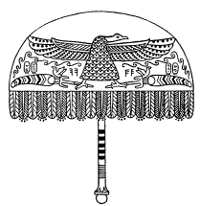
 It is difficult for the Western mind to realise
the degree of importance assumed by the fan,
the fly-flap, and the umbrella, in the countries
of the Far East, especially India; these
objects being regarded with an affection
almost, indeed actually, amounting to reverence.
Its primal cause is to be found in
the overpowering insistence of the sun’s rays,
and the sense of grateful relief afforded by
shade and disturbance of the air. To discover
its origin we must look back, beyond
the age of legendary lore, to actual mythology,
when we find representations of the Puranic
snake gods of India with the sacred umbrella
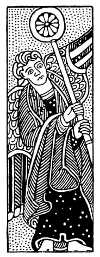
over their heads, attended by Cherubim waving the fan and the fly-flap.
Similarly we find the sacred five- or seven-headed cobra itself assuming
the office of sunshade, uprearing its hood to form a canopy for Buddha
or for the Hindoo gods.
It is difficult for the Western mind to realise
the degree of importance assumed by the fan,
the fly-flap, and the umbrella, in the countries
of the Far East, especially India; these
objects being regarded with an affection
almost, indeed actually, amounting to reverence.
Its primal cause is to be found in
the overpowering insistence of the sun’s rays,
and the sense of grateful relief afforded by
shade and disturbance of the air. To discover
its origin we must look back, beyond
the age of legendary lore, to actual mythology,
when we find representations of the Puranic
snake gods of India with the sacred umbrella
over their heads, attended by Cherubim waving the fan and the fly-flap.
Similarly we find the sacred five- or seven-headed cobra itself assuming
the office of sunshade, uprearing its hood to form a canopy for Buddha
or for the Hindoo gods.
In the Mahábhárata, the ancient epic of Hindostan, we have a
description of the death of the monarch Pândou, in which great crowds
assemble at the bier to do homage to the dead, bringing offerings of
fly-flaps and white umbrellas, the latter having each a hundred ribs of
pure gold, the donors thereby ensuring for themselves a place in
Paradise.
In the same epic, the poet represents the sacred Karna, in the midst
of the acclamations of victory, seated majestically upon his throne,
beneath the emblems of the umbrella, the fan, and the fly-flap; these
being regarded as the most solemn symbols of state throughout the
East.
Thus, the title of the King of Burmah is ‘Lord of the twenty-four
umbrellas,’ this being the number always borne before the Emperor of
China upon every state occasion, and accompanying him even to the
hunting-field.27
The connection between this umbrella-reverence and primitive tree-worship
is abundantly established, both having their origin in climatic
conditions. On the Sanchi Tope is figured the sacred flowering Sal
tree (beneath which Gautama Buddha died at Kasia), surmounted by
two Chhatras, these, together with the tree, being adorned with garlands.
Again, on the Great Tope at Buddha Gaya, B.C. 250, erected in front of
the sacred Bo tree (Ficus religiosa), beneath which Gautama attained
to the Buddhahood, are umbrellas hung with garlands. Also in a
Thibetan picture of the death of Gautama given in Dr. Waddell’s
Buddhism of Thibet, we see a garlanded and festooned umbrella in
the centre over Buddha, with attendants waving fly-flaps, and on the right
a large standard fan.
So deeply rooted, indeed, is the reverence for the umbrella, and so
completely in the minds of the populace are these objects identified with
regal power, that, upon the occasion of the visit of the Prince of Wales
(King Edward VII.) to India, it was deemed necessary for his Royal
Highness to appear beneath a golden umbrella on an elephant in order
that his sovereign dignity might be demonstrated.
In the manuscript of Nieder Muenster of Ratisbon, now in the
library at Munich, we find a curious blending of the tree and umbrella
form, introduced as accessories in representations of the four evangelists,
doubtless merely intended as conventional floral forms, but evidently the
work of some monkish illuminator who had become influenced by
Oriental mythology.
In Ratisbon, also, is an illumination of Christ bearing the cross, to
one arm of which is attached a half-closed umbrella, reproduced in
Curiosités Mystérieuses. ‘Le pommeau,’ says the chronicler, ‘est orné
de ce que les Romains nomment Ombrellino (petit dais en parasol). S’il
s’agissait à coup sûr de ce baldaquin (qui est le propre de certains dignitaires)
nous pourrions rappeler que ce mot figurait déjà dans l’étiquette
impériale avant Constantin.’28
On Attic and other Greek vases of the third and fourth century B.C.,
to quote Sir George Birdwood, it is often very difficult to distinguish the
fan from the umbrella. ‘Where it is distinctly an umbrella, it is either
of the peaked Assyrian form, or of the dome-(‘rondel’ of Valentijin, etc.,
and ‘arundels’ of Fryer) topped Indian form (chhatra); and when it is
distinctly a fan, it is usually of the Indian type, determined by the fan
palm frond and the peacock feather, and rarely of the Egyptian type
determined by the date-palm and the ostrich feather.’
In the early Persian bas-reliefs, says Chardin in his Voyages, the kings
of Persia are frequently represented in the act of mounting on horseback
surrounded by beautiful slaves; the duty of one being that of holding an
umbrella over the head of the monarch. This, not only for the purpose of
protecting the sovereign from the rays of the sun, but also to demonstrate
his absolute right of life and death over both prisoners and subjects.
Umbrellas formed an important feature in the Greek Bacchic processions.
Aristophanes refers to white umbrellas and baskets, signifying
pomp and joy, as being intended to recall to men the acts of Ceres and
Proserpine, and constantly borne by virgins at all religious ceremonials.
In a miniature in the Royal Library at Paris, of Sivaji on the march,
a sayiban or sun-fan is seen, having an arrangement of drapery in form
of a curtain or valance.29 Here we discover a point of contact between
the fan and the umbrella, although it is probable that in this instance its
use as a shade-giving instrument had not developed.
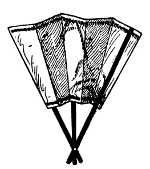
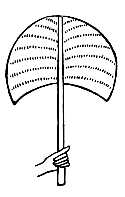
A much closer form-connection, however, between fan and umbrella
is seen in the simple leaf section of the Palmyra palm, cut level at the
top, used by the natives in most parts of India. This assumes exactly
the shape of the pleated fan, the pleating formed by Nature’s deft hands.
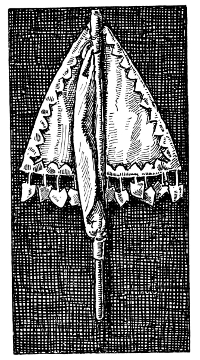
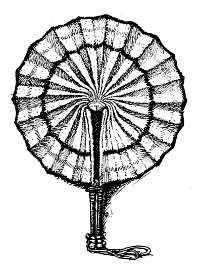
The large Cingalese umbrella used by headsmen and at weddings is
of the same shape, made of the young leaves of the talipot palm, often
richly decorated with plaited patterns in various colours, and with mica
inlay. Of similar form, also, is the sacred processional parasol of the
Indian Mussulmans (Shia sect) and the Hindus.
The fan, therefore, must be considered as part of a continuous development
from the umbrella symbol of might and power, employed
equally in the East as in the West, and the infinitude of military and
processional fan-like standards and sceptral fans, to the hand-fan and
fly-whisk.
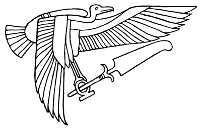
We discover a direct affinity between the hissing of the wind
through the open metal mouth and silken bag of the Roman Dragon
standard, and the beating of the wings of the Norse Raven, used for a
similar purpose; between the Assyrian disc standards with the divine archer
standing on the sacred bull, and the cruciferal discs employed at a more
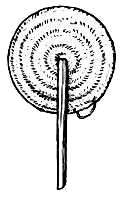
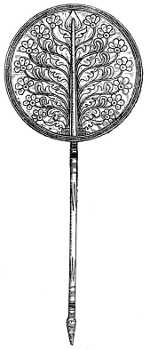 CINGALESE SĒSATA
(Made of the leaf of the talipot palm, enriched with
plates of mica, the handle lacquered wood;
length, including handle, 7 feet.)
recent date in Christian Church ceremonial;
between the chauri waved over the head of
Krishna, and the wafting of divine influence
by the angelic attendants upon the Saviour
in early Christian missal-painting.
CINGALESE SĒSATA
(Made of the leaf of the talipot palm, enriched with
plates of mica, the handle lacquered wood;
length, including handle, 7 feet.)
recent date in Christian Church ceremonial;
between the chauri waved over the head of
Krishna, and the wafting of divine influence
by the angelic attendants upon the Saviour
in early Christian missal-painting.
The alums or allums used in the
Moharram procession in India are analogous
to the standards used by the Greeks and
Romans, and those figured on the gates of
the Sanchi Tope, consisting not only of
flags and banners, but of all sorts of devices
in metal, raised on the top of a long staff
and carried to battle.30
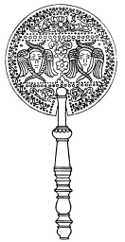
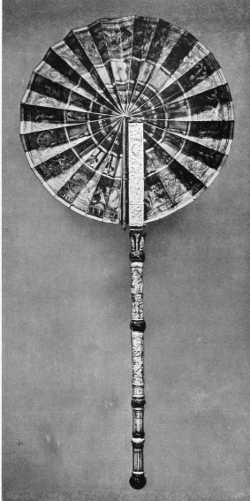
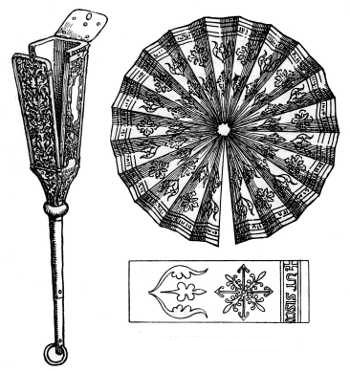
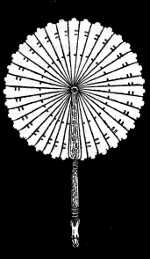
The Cingalese Sēsata, a ceremonial fan
for royal and religious use, or for attendance
upon great personages, consists of an embroidered
cloth disc, or talipot leaf, decorated
with images of the sun, moon, etc., with mica
and other materials introduced, mounted on
a lacquered staff. Tenants of the first rank
attend the Disvāta (lord chief) on journeys,
convey his orders, carrying the great banner,
state umbrella, and Sēsata.31 A smaller
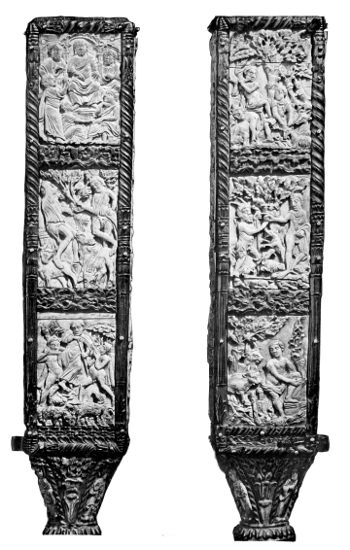
disc-fan, the disc covered with crimson velvet, the handle about fifteen
inches long, of carved ivory, richly inlaid, occurs in the Louvre.
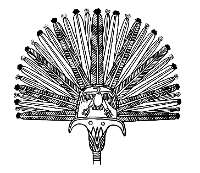
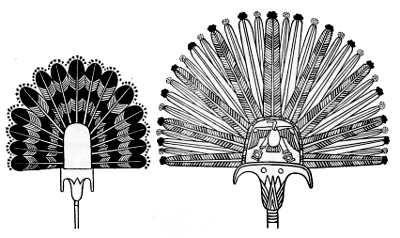
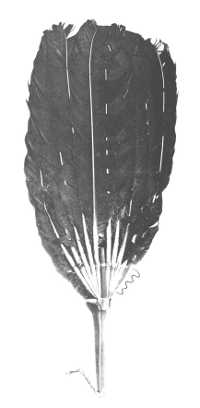
The royal standard, banner, or ensign, employed in India, composed of
peacocks’ feathers, is illustrated in a MS. copy of the Akbar-Namah (c. 1597),
the form being circular, and also that of a somewhat elongated semicircle.
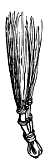
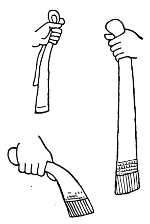
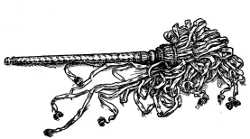
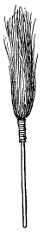
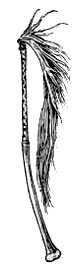
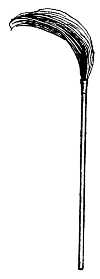
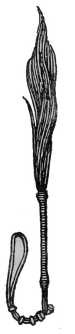
The fly-flap, chowr, chowrie, chourie, chaurie, is next in dignity to
the umbrella, and was in the first instance devoted to the service of the
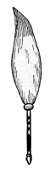 gods. On a bas-relief of the pagoda of Elephanta, described
by the Orientalist Langlés in his History of Hindostan, a
servant is seen behind Brahma and Indra holding in each hand
chauries or fly-whisks. In the India Museum is a charming
little chaurie with silver handle and ribbons of silver gauze
tipped with red silk, used by Jains to drive away insects from
their idol without destroying them.
gods. On a bas-relief of the pagoda of Elephanta, described
by the Orientalist Langlés in his History of Hindostan, a
servant is seen behind Brahma and Indra holding in each hand
chauries or fly-whisks. In the India Museum is a charming
little chaurie with silver handle and ribbons of silver gauze
tipped with red silk, used by Jains to drive away insects from
their idol without destroying them.
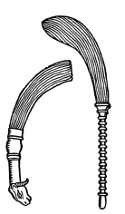
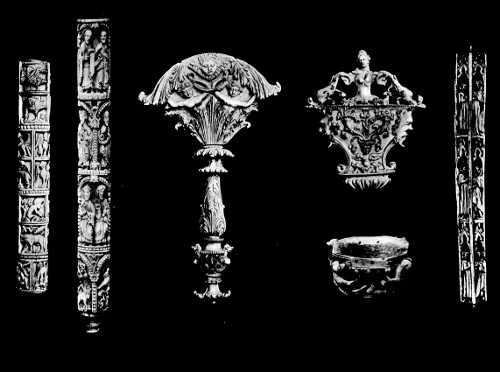
Chauries are formed of various materials—of ivory, the
strips of which are sometimes cut to incredible fineness for
such a substance; in these cases the handles are formed of
the same material, richly carved—of the bushy tail of the
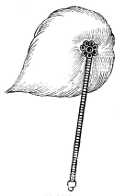 (From a painting on talc. Madras.
Nineteenth century.)
Himalayan yak, both black and white, the handles
either of metal, ivory, or wood—of sandalwood,
also cut into the finest possible strips, the handles
richly carved; the waving of these chauries
emitting a fine fragrance—of the stripped quills
of the larger birds, more generally the peacock—of
horse-hair and the various grasses. The handles
were often formed of the horns of various
animals; an example occurs in the Horniman
Museum, in which instance it is the antelope.
The chaurie from the tail of the yak was in
ancient India fixed upon a gold or ornamented
shaft between the ears of the war-horse, like the
plume of the war-horse of chivalry; the banner or banneret, with the
device of the chief, rose at the back of the car. ‘The waving chaurie
on the steed’s broad brow points backwards, motionless as a picture.’32
(From a painting on talc. Madras.
Nineteenth century.)
Himalayan yak, both black and white, the handles
either of metal, ivory, or wood—of sandalwood,
also cut into the finest possible strips, the handles
richly carved; the waving of these chauries
emitting a fine fragrance—of the stripped quills
of the larger birds, more generally the peacock—of
horse-hair and the various grasses. The handles
were often formed of the horns of various
animals; an example occurs in the Horniman
Museum, in which instance it is the antelope.
The chaurie from the tail of the yak was in
ancient India fixed upon a gold or ornamented
shaft between the ears of the war-horse, like the
plume of the war-horse of chivalry; the banner or banneret, with the
device of the chief, rose at the back of the car. ‘The waving chaurie
on the steed’s broad brow points backwards, motionless as a picture.’32
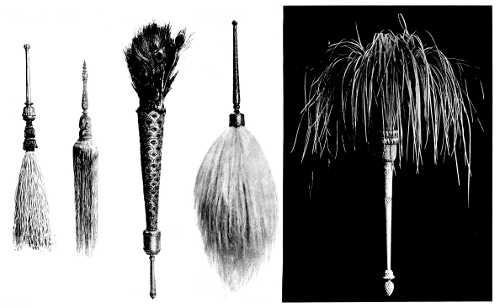
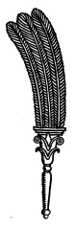
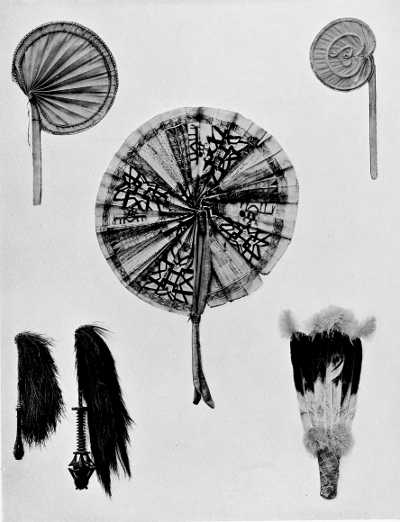
| Quill, & Sandal Wood Chauries, Peacock Emblem of Royalty, Yak, & Ivory Chauries. |
India Museum. |
This, it will be seen, is in strict conformity to the usage of the
ancient Egyptians, who employed the tall fan emblem in a precisely
similar way; these proud plumes serving a double purpose—an ornamental,
and, in the case of Egypt, even an heraldic purpose, and also the
purely utilitarian one of affording the animal some relief from fly pests.
The peacock has ever been regarded as a sacred bird, both by the
peoples of the East and the West. The Greek fable of Argus the
hundred-eyed, the sleepless guardian of Io, serves to connect the idea of
extreme vigilance with that of true kingship, i.e. the universal preserver
and father of the people. The peacock therefore presented a double significance
to the minds of the Hindu peoples; it expressed the vigilance
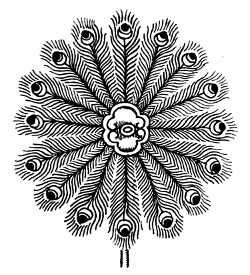
of kingship together with its magnificence. The peacock feather emblem
of royalty is the sign or insignia of the king’s high office, and the
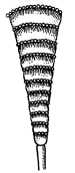 EMBLEM OF
ROYALTY
EMBLEM OF
ROYALTY
(From an illumination of
a Court reception by
the King of Oudh.)
principal evidence of his sovereignty: wherever a king appears
he is accompanied by an attendant bearing this emblem,
which appears in all pictorial or other representations of
royalty.
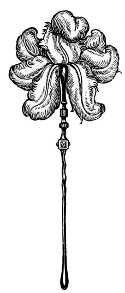
It was, doubtless, in the first instance a fly-flap, and is
either composed entirely of feathers, or, it consists of a bunch
of feathers enclosed two-thirds of the distance in a silver
casing, usually ornamented with an imbricated pattern; the
handle also of silver. Several examples of this object appear
in the India Museum, and numberless representations occur
in sculpture, illumination, embroidery, etc.
The poet Valmiki tells of the sumptuous sceptre, studded
with jewels, prepared for the sacrifices to Rama—a magnificent fan with
a radiant garland resembling the full moon in the clear night sky.
The word punkhá, or pankhá, from pankh, a feather, a bird, is a
generic term applied in India to all fans, pankhi meaning a small fan.
This derivation serves as an indication of the early use of the plumed fan
in India, which divides honours with the palm-leaf fan in point of
antiquity, and doubtless also as suggesting a similarity between the
beating of a bird’s wings and the movement of the fan.
The earliest plumed fans probably consisted of a pair of complete
wings set shoulder to shoulder, resembling the caduceus of Mercury,
which was regarded as a symbol of happiness, peace, and concord, the
wings expressing diligence.
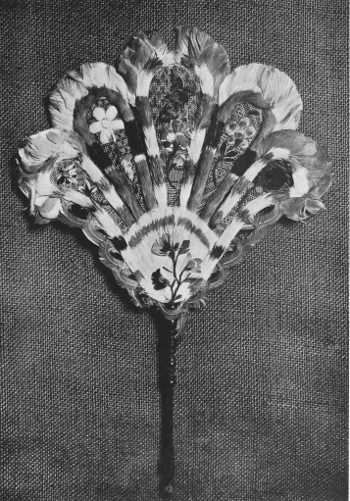
Feather-fans assume all manner of shapes, as the large round banner-fans
already referred to; the familiar crescent-like form with a short
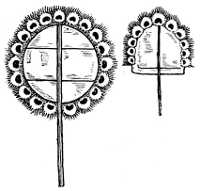 ROYAL STANDARDS
(From a MS. copy of the Akbar-Namah.
Sixteenth century.)
handle set horizontally at its base;
and the various hand-screens, these
either composed entirely of peacocks’
feathers, the breast and
neck feathers forming a pattern
in the centre, with a border of
tail feathers; or, the centre formed
of plaited pith and cane of various
colours, beetles’ wings, etc., with
the border again of feathers; the
handles being of cane or wood,
or of wood covered with cane strippings or other material.
In Persia and Arabia, from the first centuries of our era, fans were
made of ostrich feathers, many being ornamented with that form of inscription
which is such a leading feature of the decorative art of these
countries.
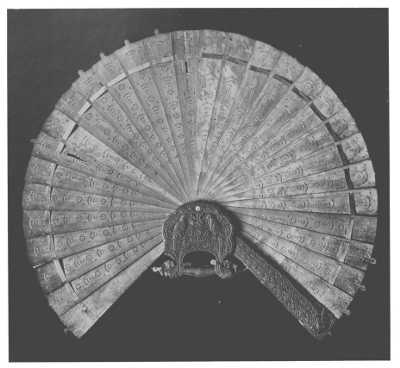
| Large Hand Fan of Sandal Wood, Indian. 18th Cent.
pierced & carved. |
Mrs Hungerford Pollen. |
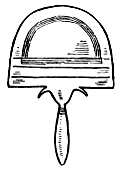
The crescent-shaped hand-fan also dates from a very early period.
In its primitive form, it is seen in the painted decoration of the Buddhist
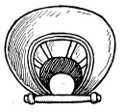 HAND-FAN
(From the cave paintings at Ajanta.)
cave-temples of Ajanta (first century B.C. to eighth century A.D.),
the example given being probably ornamented with strips or panels of
mica, the constructional portion of cane or pith.
A variant of this form, still more simple in
its construction, is seen in one of the sculptured
roundels of the Buddhist tope at Amaravati,
Southern India, circa second century A.D.; an
attendant upon a great personage waves a circular
fan, having the handle stretched across the face,
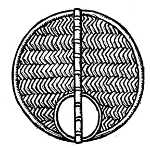 PLAITED GRASS-FAN
(From the Amaravati Tope.)
with a circular opening near the lower edge to
enable the handle to be gripped. All the foregoing
types obtain at the present day, and are
as modern as they are ancient.
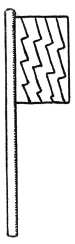
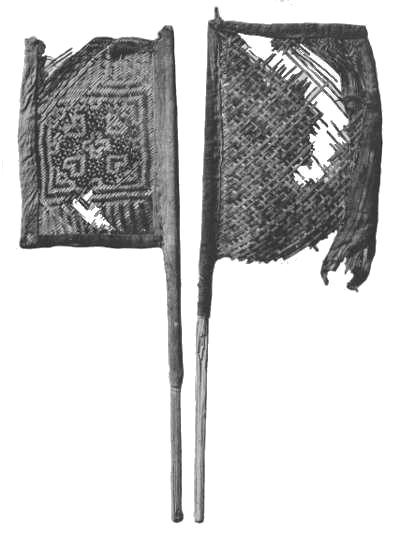
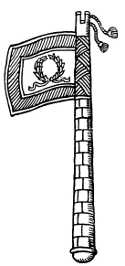
The flag form of fan is, if possible, a still
more remarkable instance of the persistence of
certain decorative motifs throughout long periods
of the world’s history. This type, again, is in
use at the present day—the page of
examples illustrated are of the mid-nineteenth century—this
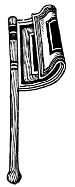 FLAG-FAN
(From the cave paintings
at Ajanta.)
identical form appears in the wall-paintings at Ajanta;33 it is
also seen in Egyptian and Assyrian sculptured reliefs; it was
employed by the Copts from the third to the sixth century,
and earlier in Arabia; it was in general use in Italy during
the period of the Renaissance. There can be no possibility
of doubt that this form of fan was common to the whole of
the East and to a greater portion of the West, and has
endured throughout the centuries.
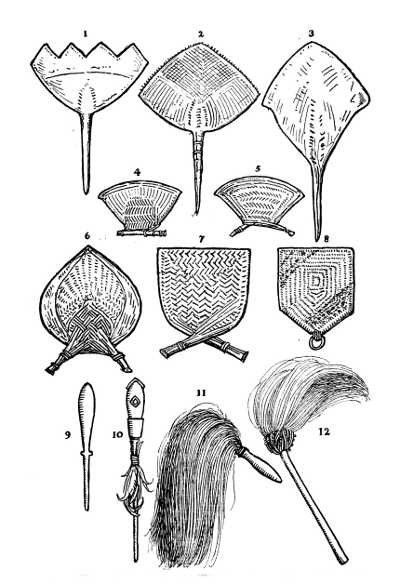
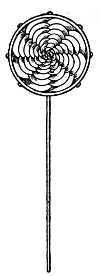
These fans are of two kinds—rigid and flexible; in
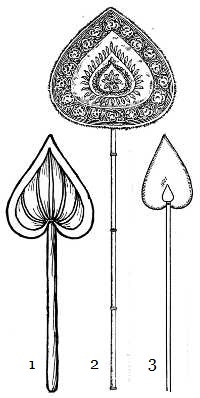 1. ‘TALAPAT’ FAN
2. PANKHÂ. (Embroidered velvet, with silver handle. Moorshedabad. India Museum.)
3. FROM AN ILLUMINATION
both instances they are invariably plaited, the material being stripped
palm, bamboo, ivory, peacock quills, etc. The rigid variety is often placed
loose in the handle, to allow of its being swung round and round like
a policeman’s rattle. See illustration opposite.
The hatchet or halberd shape is a development of the flag form, and
varies from the simple blade to that of a highly ornamental shape. The
material is silk, velvet, cloth or other tissue, often richly embroidered
with gold and silver thread, spangles,
beetles’ wings, etc., with a fringe
of either silver tinsel or peacocks’
feathers; the handles being of wood,
cane, or silver. These are at present
largely made at Delhi.
Occasionally the fan is entirely
formed of threaded glass beads of
various colours forming a pattern
upon a wire framework, with a fringe
of tinsel, the handle also overlaid
with beads.
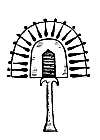
The primitive palm-fan occurs on
the oldest Hindostani bas-reliefs, and
is described by the poets. This
primeval fan still forms part of the
attire of certain Buddhist priests in
Siam, and from it they take their
name of ‘Talapoins’; the fan’s name
being ‘talapat,’ or ‘palm-tree-leaf’ in
the Siamese language.
This form (the reversed heart) is common to both the smaller hand-fans
and the larger ceremonial and processional fans. The natural palm-leaf
is employed, trimmed to the required shape, and used either plain, or
painted in brilliant colours, or forming a base for a covering of embroidery,
feathers or stuffs, as in the example from Moorshedabad
(illustrated), which is of velvet, embroidered with silver.
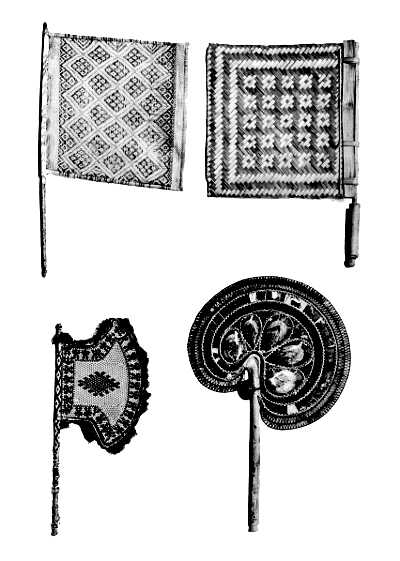
| Flag Fans, split palm & bamboo. 19th. Cent.
Beaded Fan, & Palm Leaf Fan with mica insertions. |
India Museum. |
These fans are of two kinds—rigid and flexible; in
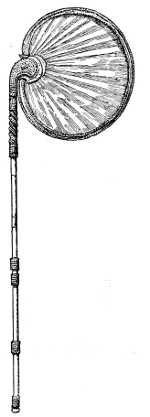 FAN OF GOLD
(Forming portion of the Burmese Regalia.
India Museum.)
The lateral form, in which the leaf is
set sidewise on the stem, follows the same
principle of decorative development. It is
used plain, painted, inlaid with talc as in
the example illustrated, is embroidered with
silk, spangles, beetles’ wings, etc.; it also
supplies the shape or decorative motif for
fans of a different material, as in the instance
of the four long-handled fans, forming
portion of the Burmese regalia, obtained from
Mandalay in 1885, examples of a barbaric
splendour only to be found in the gorgeous
East. These are of gold, jewelled with rubies
and the ‘nan-ratan’ or nine stone, the handles
overlaid with gold and also jewelled.
Amongst fans formed of the more precious
materials is a disc-shaped fan of gold, set
with cabochon sapphires, an offering dedicated
by Kīrti Ṡri to the ‘Tooth relic.’34 Figured
in Mediæval Sinhalese Art, A. K. Coomaraswarmy.
In the collection of the Baroness Salomon
de Rothschild at Paris is a fan of jade, richly
studded with jewels.
Fans are also made of the sweet-scented Khaskhás root (Andropogon
muricatus), and as these are generally used after being wetted, they impart
to the air a cool fragrance; they are often highly ornamented with gold
and silver spangles, gold thread, tinsel, beetles’ wings, etc., and occasionally
provided with ivory handles. A pretty example occurs at Kew, where
there is an excellent collection of fans made of the various vegetable substances.
Fans of talc, decorated with exquisite illumination, were made
at Tanjore during the eighteenth century. Specimens occur in the India
Museum, South Kensington.
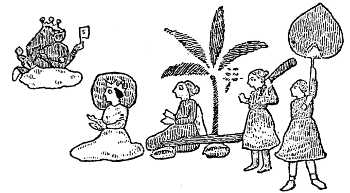
PORTION OF AN EMBROIDERED MUSLIN NAPKIN.
(Chamba. Nineteenth century.)
Representations of the fan are of constant occurrence in Indian
work, both illumination, embroidery, sculpture, and other material. On a
curiously primitive embroidered napkin from Chamba, we are introduced
to the worship of a Hindu deity—a king and queen are kneeling under a
palm-tree, the god Ganesh in the distance with flag-fan; an attendant
bears the peacock feather emblem of royalty, a second attendant waves
a large heart-shaped fan. On a small mat or pad of enamelled leather
(Hyderabad, nineteenth century), we see a whimsical combination of
Krishna and his damsels forming the similitude of an elephant, the
umbrella, pankhá, and two fly-flappers being in evidence.
A beautiful illumination from a MS. copy of the Akbar-Namah, above
quoted, shows a prince seated upon his throne in the act of receiving
offerings; an attendant waves a fly-flap behind the throne, a second
attendant bears one of the large pankhás beautifully embroidered in gold
and colours.
We are also in another illumination introduced to a beautiful flowered
parterre, in which a Mongol princess is seated before a rippling fountain;
attendants wait upon her with fruits, vases containing unguents, spices,
etc.; behind, a female attendant waves the fly-flap.
In the decoration of the entrance gate of the temple at Ajmir, a
prince appears in a howdah on the back of an elephant, an attendant sits
behind waving a fly-flap, a second flabellifer is seated on the head of the
animal; the prince himself holds a small fan in his hand, an attendant on
foot bears the pankhá, and another the insignia of royalty.
Fair and delicate though these creations of Eastern ingenuity may be,
the genius of Oriental imagery and fancy has discovered for us a still
more delicate and effective instrument—a Sanskrit poet recounts a graceful
fable of a princess of extreme beauty, who, although constantly
attending and fanning the divine fire with a view to increasing the prosperity
of her father, never succeeded in producing a flame save by the
breath of her charming lips.
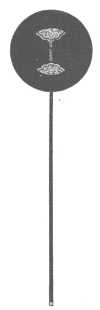 CIRCULAR FAN
‘Like the Moon’ borne by the guard of an
Imperial concubine.
Chinese authorities are at variance concerning the invention
of the fan, which has been attributed to the
Emperor Hsien Yüan, B.C. 2697; to the Emperor Shun,
B.C. 2255, and to the first ruler of the Chou dynasty,
B.C. 1122.
According to a Chinese legend, it had its origin
at the Feast of Lanterns, where, on an occasion when
the heat became particularly oppressive, the beautiful
daughter of a mandarin took off her mask, and agitated
it so as to fan the air into a gentle breeze; the rest of
the fair revellers were so much struck with the grace of
the motion that they one and all let fall their masks
and followed the example of the mandarin’s daughter.
The earliest fans were of the dyed feathers of various
birds, and those of the peacock. We have an account
of a present of two fans of feathers of ‘tsio rouge,’
offered to the Emperor Tchao-wang of the Chou dynasty, B.C. 1052, by
the King of Thou-sieou, and it is affirmed in the ‘Tchéou-li’ that one
of the chariots of the empress carried a feather-fan for the purpose of
keeping the wheels free from dust.
The poet Thou-fou, in the ‘Song of Autumn,’ refers to fans of
pheasants’ feathers as in royal use. The Emperor Kao-Tsong, of the
Chang dynasty, 1323-1266 B.C., having heard the cry of the pheasant,
an omen of good luck, resolved thenceforth to use only fans composed
of the tail feathers of this bird.
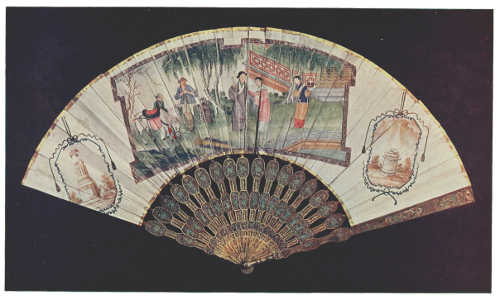
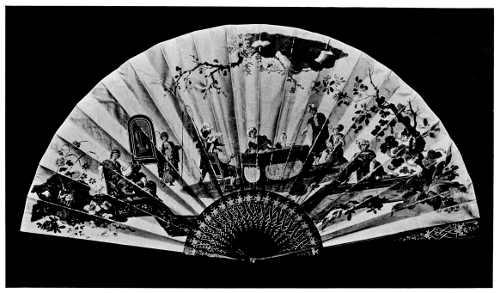
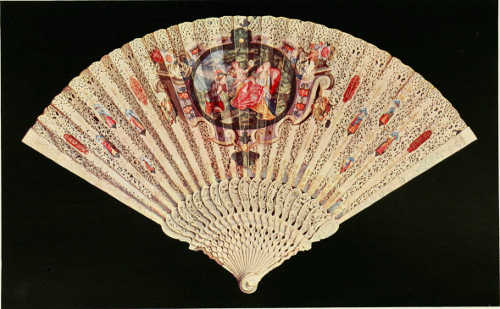
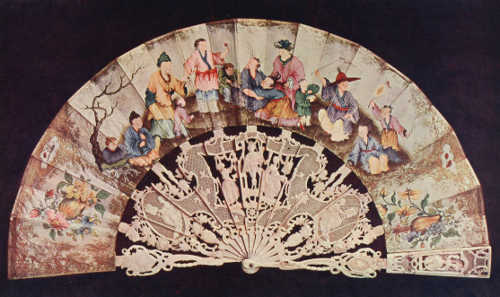
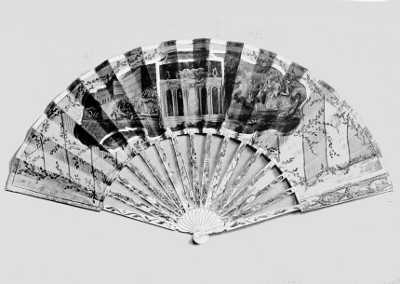
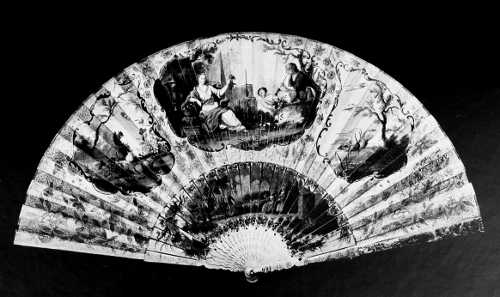
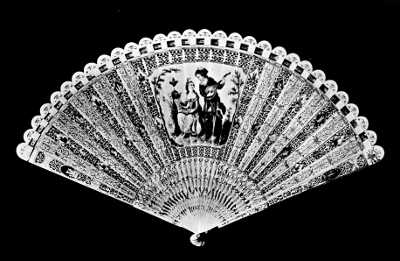
| Chinese Fan, paper mount, painted, with medallion of The Visit,
stick silver-gilt filigree & enamel, 18th Cent. |
Mr M. Tomkinson. |
These have continued in the service of royalty to a late period.
A wing-shaped example, set laterally in a red lacquered handle, appearing
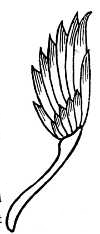 FROM A PAINTED ROLL
OF MING DYNASTY.
FROM A PAINTED ROLL
OF MING DYNASTY.
(British Museum.)
in the hand of an attendant, in a fine painted roll, by Ch’in
Ying of the Ming dynasty, illustrating the occupations of
Court ladies, the larger feathers numbering seven, this
being the sacred number composing the fan, which is the
attribute of Chung-li Ch’uan, one of the eight Taoist
Immortals, the seven broad feathers corresponding to the
constellation of seven stars on the left of the moon (Great
Bear), the seat in the Taoist heavens of their supreme deity,
Shang Ti, round whom all the other star gods circulate in
 FAN OF HSI WANG MU
(From a Japanese painting. British Museum.)
homage. This fan is illustrated on the large lacquered
screen at the Victoria and Albert
Museum, representing the Taoist Genii
worshipping the god of Longevity, and
constantly figures in pictorial and other representations.
Similar fans with several rows of pointed feathers
appear in painted and decorative work; a curious
example being seen in a large drawing from Tonkin
(Louvre). The outer row of feathers, white and pale
blue; the second, yellow; the third, those of the peacock;
the body of the fan, green, red, white, and
blue.
In the lacquered screen above referred to, a large
fan of this character is waved over the head of one of
the devotees riding aloft on a cloud, wending his
way towards the mountain paradise, the home of the
God.
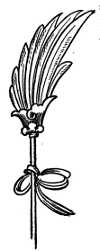
The feather-fan is one of the chief attributes of Hsi Wang Mu, the
famed Queen of the Genii (Royal Mother of the West), whose dwelling
was a mountain palace in Central Asia, where she held Court with her
fairy legions and received the great Taoist Rishis and certain favoured
mortals, and whose amours with the Han Emperor Wu Ti have given
much occupation for both author and artist.35
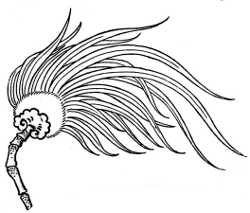
Her fan is borne by one of her four handmaidens, who, like the
Dêva Kings of Mount Sumeru, are severally related to the four points
of the compass. It assumes various shapes, as that of a wing, in the
 WHITE PLUMED FAN OF HSI WANG MU
(From a painting of the Chinese School of Japan. British Museum.)
painting by a pupil of
Itcho riū of the Japanese
popular school, British
Museum, 1722; a bunch
of long pointed plumes
set in a bamboo handle,
in the painting (Chinese
School of Japan, British
Museum, 778), in which
a young girl in deer-skin,
standing beneath the
sacred peach-tree of the
Immortals, offers the fruit to the goddess who, with her attendant bearing
the fan, appears upon a cloud above the waves.
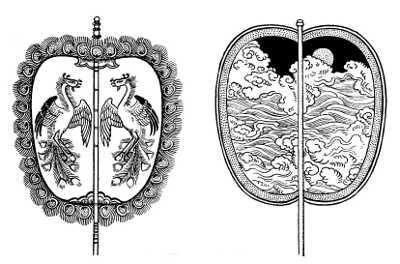
The queen is also represented with the large pear-shaped screen, as
in the painting of the same school, British Museum, 1022, the screen
decorated with the sun, moon, and clouds. In the painting previously
referred to (No. 1722), the goddess herself holds a smaller pear-shaped
screen. Each of the ‘fore-mentioned paintings are Japanese, but the
fan forms are, unquestionably, taken from older Chinese originals.
| Chinese Fan. filigree & enamel. |
Victoria & Albert Museum. |
The earliest illustrations, however, of this personage and her fan,
and probably the oldest representations of fans in Chinese art, are
those of the sculptures of the Han dynasty, B.C. 206-A.D. 25. In these,
Hsi-wang Mu, wearing a coroneted hat, is attended by ladies carrying
cup, mirror, and fan. On the same relief the Emperor Mu Wang of the
Chou dynasty, B.C. 1001, is attended by a servitor with fan and towel
or handkerchief. In the frieze forming the lower part of the relief,
we see the ‘Chariot of the Sage’ preceded by two men on foot, with
staves and fans.
PEAR-SHAPED SCREENS
(From paintings in the British Museum.)
On another of these reliefs, representing the discovery of one of the
sacred bronze tripods, the ancient palladia of the kingdom, the two commissioners
deputed by the Emperor to superintend its recovery from the
river are attended by servitors bearing fans. These are the small hand-screens
(pien-mien) described by M. Rondot as being larger in the upper
part, their shape approaching that of a reversed trapezium with the angles
rounded off.
This same author refers to four screens of white jade (regarded by
the Chinese as the most precious of precious stones), the handles of an
odoriferous amber, that were offered by the Emperor Chun-Hi of the
Southern Sung dynasty, 1174-1190, to his Empress. At this time the
screens were ornamented with incrustation and inscription, which was
much esteemed, and this author quotes a curious passage from the Annals
of the Thsi to the effect that Wang-sun-pen, of Kin-ling, represented in the
space of a few inches a perspective view of rivers, mountains, valleys, and
plains, stretching over a thousand miles of land. These screen pictures are
referred to in the Ku yü t’ou pu, an illustrated catalogue of ancient jade, in
one hundred books, compiled in 1176 by an imperial commission headed
by Lung Ta-Yuan, President of the Board of Rites.
The small hand-screens assume a variety of forms—circular, pear-shaped,
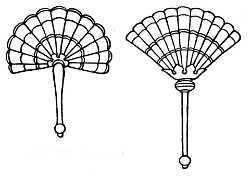
heart-shaped, etc., and are made of various materials, as—(1) The
natural palm leaf, seen in the Chinese painting, British Museum, 37.
(2) The palm leaf cut to various shapes, with a bamboo handle running
up the middle, as in the Japanese example given on page 61. (3) Of bamboo;
from Chinese records we learn that on the fifth day of the fifth month of the
year corresponding to our 219, the Emperor presented to the members of
the Imperial Academy a fan of bamboo, carved and painted blue. There is
also a record of an existing fan of oblong form, made of bamboo leaf,
ornamented with bulrushes, an inscription on the field of the fan. This
dates from the sixth century A.D. (4) Of the turtle shell: the two portions
held together with metal plates, with a wooden or other handle, examples
of which occur in the Musée Guimet, Paris. (5) Of silk stretched upon a
frame, with painted or other decoration, as in the two charming examples
illustrated from the collection of Mr. W. Crewdson. Both front and reverse
are given: the latter decorated in that system of feather-work much affected
by the Chinese, and in which they display great skill. The feathers are
usually the turquoise tinted plumes of the kingfisher: in the present
instance the design is alternated by an imbrication of peacocks’ feathers.
The handles are of carved ivory.
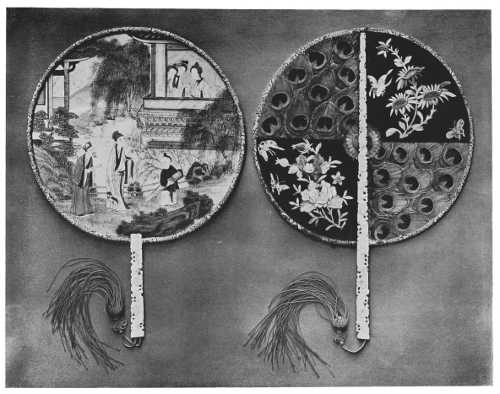
| Hand screen, Chinese, painted silk, reverse embroidered feather work,
carved ivory handle. |
Mr Wilson Crewdson. |
There are also the cockade screens, usually of ivory or sandalwood.
Representations of the earlier large ceremonial banner screens appear
on a carved pedestal of a Buddhist image, Northern Wei dynasty, A.D.
524; these are oval in form, and are seen in both sculptured and painted
representations down to recent times.
In the Musée Guimet in Paris is a large fan of red lacquer framework
(reversed heart shape) enclosing a series of metal ribs through which the
wind plays; in the centre are painted dragons.
Among the painted representations in the India Museum, of objects
from the Summer Palace at Pekin, is a circular screen, ‘like the moon,’
borne by the guard of an imperial concubine. See illustration, p. 46.
A favourite device for the decoration of these larger screens is that of
the fabled Phœnix, the Ho bird of the Japanese. This is seen in the painting
of the Chinese school of Japan, British Museum, 822, in which one
of the two attendants on a Chinese Emperor carries a long oval screen
bordered with peacocks’ feathers, and ornamented with two Phœnixes.36
We therefore perceive that the ceremonies and customs relating to the
fan, no less than the various forms which this instrument assumed, were
practically identical with the ancient peoples of the East and West;—the
same order of development, having its origin in the natural suggestion
afforded by the wings of birds and of the broader leaved plants; the fans
of the Han dynasty reliefs, their exact counterpart being found in Egypt
and Assyria; the rigid hand-screens corresponding to those tabellæ
which the Romans derived from the Greeks, who in turn received them
from the peoples of Asia Minor, and which, doubtless, had their origin in
the more remote East; the employment of the fan in both religious and
civil ceremonial and in war.37
Among the Bat Bu’u (eight precious things) carried at the end of staves
by the inhabitants of Annam in their ceremonial processions, is a fan (Quat)
symbolising the graceful perfection of the form of woman, and the light
breeze that tempers the heat of the summer sun.38 These Bat Bu’u are
made in three ways—
1. Of carved wood lacquered and gilt.
2. Of tin or pewter.
3. In the form of transparencies to be lighted from within.
A huge wooden fan is carried as part of the insignia of a mandarin’s
procession.39
The invention of the folding-fan is generally credited to the ingenious
little inhabitants of the land of the rising sun; its date, however, as well
as its precise character, is impossible to determine with anything approaching
to accuracy. Tradition says that it was designed by an artist
who lived in the reign of the Emperor Jen-ji, about 670 A.D., and was
formed upon the principle of the construction of a bat’s wing, this being
in conformity with the general usage of Japanese designers, who derived
their artistic motifs from natural constructive forms. The date of its introduction
into China is also a matter of considerable uncertainty: we have
a reference to it in a Chinese work of the date 960, to the effect that the
tsin-theou-chen, or folding-fan, was introduced by Tchang-ping-hai, and
was supposed to be offered as a tribute by the barbarians of the south-east,
who came, holding in their hands the pleated fan, which occasioned
much laughter and ridicule. All Chinese authors agree, however, that
it was the invention of foreigners, i.e. the Japanese, who, together with
the Tartars, possessed folding-fans before they were known in China.40
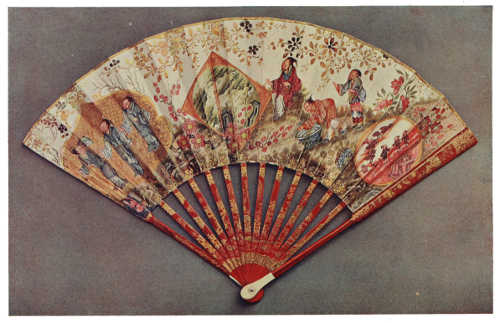
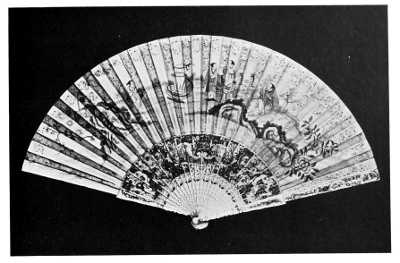
| Chinese Fan, paper mount, painted & richly gilt,
red lacquered stick. |
Miss Moss. |
M. Rondot records the fact that at first, only courtesans made use
of folding-fans, honest women carried round screens.41
Since the appearance of the folding-fan, various materials have been
pressed into its service, including ivory, tortoise-shell, lacquer, mother
of pearl, the various woods—especially sandalwood, the more precious
metals, silk, skin, and paper.
No nation possesses a keener appreciation of ivory as a vehicle for
artistic expression than the Chinese, whose carved balls in concentric
spheres of open work are the wonder of western peoples. Ivory fans
date from a very remote period, it is believed as early as 990 B.C., and
are marvels of patient ingenuity.
The Imperial Ivory Works within the palace at Peking was founded
toward the close of the seventeenth century, and became the centre for
the best production in this delicate material.
Ivory fans are either of pierced flat open work, or elaborately carved
with subjects, the backgrounds of which are formed by delicate ribbing,
imparting a lightness and softness to the fan not obtainable by any other
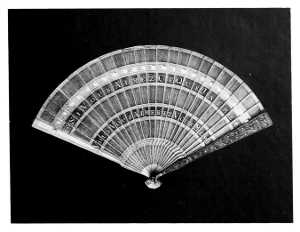
means. An extraordinarily skilful example is the cockade-fan in the Wyatt
collection at South Kensington; this, together with several others in the
same collection, have monograms in cursive European characters, and
were executed to the order of Europeans. In each instance the blades
are connected by means of a ribbon running through the whole. One
example only of these fans is given; that bearing the word ‘Angela’—fitting
name of the gentle lady whose memory is revered wherever the
English language is spoken.
Tortoise-shell is carved with the same consummate skill as ivory, and
on the same principle of delicate piercing and ribbing. Two such fans
occur in the Wyatt collection, profusely decorated in relief with figures of
horsemen, buildings, boats, and flowers. The material, which is softened
both by warm water and dry heat, is obtained from the loggerhead turtle
of the Malay Archipelago and Indian Ocean, and imported to Canton, a
centre both for tortoise-shell and ivory workers. An extremely effective
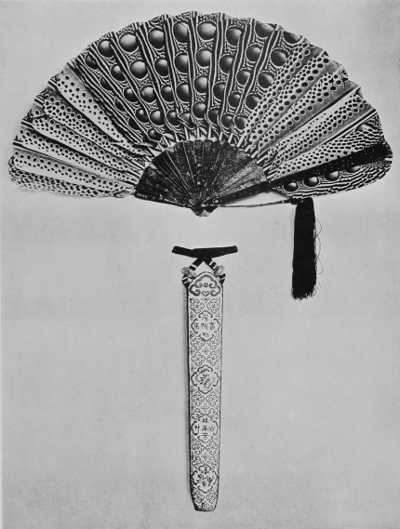
and picturesque fan is that in the same collection, formed of the feathers
of the Argus pheasant, cut short to the fan shape, the sticks of carved
tortoise-shell. In this the colours of the feathers harmonise extremely well
with the translucent red brown of the tortoise-shell.
This material is also lacquered, one of the earliest and most prized
of the Chinese arts, and the technique of which is fully described in the
Ko ku yao lun, a learned work on antiquities published in the reign of
Hung Wu, the founder of the Ming dynasty, 1387. This substance is
obtained from the lac-tree (Rhus vernicifera), cultivated for the purpose
throughout Central and Southern China. The tree exudes a resinous
sap that becomes black upon its exposure to the air, the sap being
extracted from the tree at night, during the summer months, and dried,
ground, and strained through hempen cloth to an evenly flowing liquid,
which is applied by the brush.
Gold plays an important part both in the composition of the lacquer
itself, to which it imparts a richness and pellucidity which is extremely
beautiful, and also in its subsequent decoration. The fan and case of
Canton lacquer in the Wyatt collection are richly decorated with panels
of buildings and gardens, on a diapered background, overlaid with flowers,
butterflies, and other devices, and are excellent examples of Chinese gold
lacquer, an art which, although originating in China, has been somewhat
neglected, and has, at a later period, been brought by the Japanese to a
greater perfection than the Chinese have at any time attained.
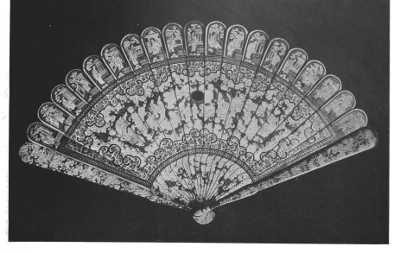
| Lacquered Fan. |
Lady Northcliffe |
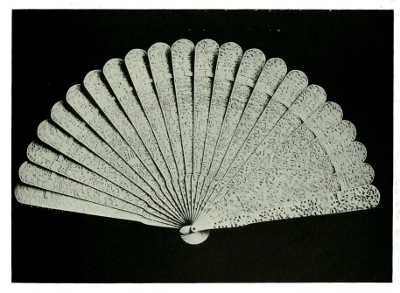
| Carved Ivory Fan, with name ‘Angela’. |
Mr W. Burdett-Coutts. M.P. |
Sandalwood is largely employed for fans, on account of its lightness,
the ease with which it is worked, and also its fine aroma. The tree
is indigenous to India, and is imported by the Chinese, who employ it for
a variety of purposes, including the perfumed joss-sticks which are common
throughout the East. These fans are worked on the same principle
of flat piercing as those of ivory. They are also carved in relief, but can
scarcely be said to rival the last-named substance with its delicate variety
of translucent softness. The large fan at South Kensington is a good
example.
Mother of pearl is a favourite material for fan-sticks on account of its
beautiful play of iridescent colour. A number of fans of Chinese workmanship,
both of mother of pearl and ivory, have found their way to
Europe and have been remounted. Such a fan is that in the Wyatt collection
with a subject finely painted on chicken skin by Eugène André.
Bamboo has already been referred to as in early use. It is extensively
employed for the cheaper fans on account of its durability as
well as cheapness. The number of ribs vary from sixteen to thirty-six;
the former may be regarded as the standard number.
The art of filigree is practised by the Chinese with the most consummate
skill; it is occasionally in gold, but more often in silver gilt, the
gilding being employed for the double purpose of preventing tarnishing
and for decorative effect. Filigree work is often enriched by means of
inlay, either enamel, or the turquoise feathers of the kingfisher, which
latter, however, are merely gummed on the surface of the metal, and, as
a consequence, are wanting in durability.
Enamelling has been practised in western Asia from a very early
period, i.e. previous to the Christian era, and is believed to have reached
China about the thirteenth century. There are two kinds, both accomplished
by the process known as incrustation—cloisonné, in which the
pattern is raised on the surface of the metal by soldering on to it metal
or wire strips of copper, silver, or gold, thus forming a series of cells or
cloisons; and champlevé, in which the cell-walls enclosing the pattern are
either modelled and cast, or cut and hollowed out of the metal itself by
means of graving tools: in both, the pattern is filled in with enamel.
Of the colours, there are two well-contrasted shades of blue—a dark
tint made from cobalt and resembling the lapis-lazuli tone, and a light
sky blue or turquoise; several greens made from copper, a dark coral red,
a fine yellow, black, and white.
Chinese enamels are usually fired in the open courtyard, protected
only by a primitive cover of iron network, the charcoal fire being regulated
by a number of men standing round with large fans in their hands.42
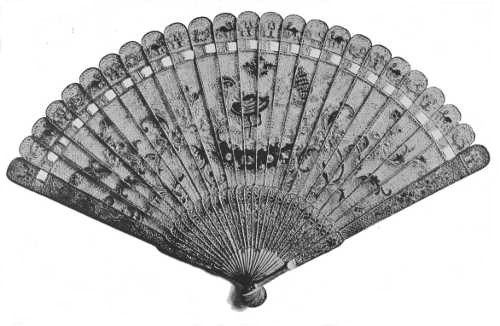
Of the interesting fans in which the combined arts of filigree and
enamel are employed we give a charming example from the Wyatt collection
at South Kensington. In this, the effective colour scheme is that of the
two blues and gold; the design being a conventional rendering of a Phœnix
and foliage. In the colour plate given of the fan in the collection of Mr.
M. Tomkinson, the leaf has a large cartouche in the centre representing
a Chinese garden, with the hostess welcoming a visitor who has arrived
on horseback, the servant bringing tea. On either side are small medallions
of a sun-dial and a broken column, evidently introduced to the
order of a European patron.
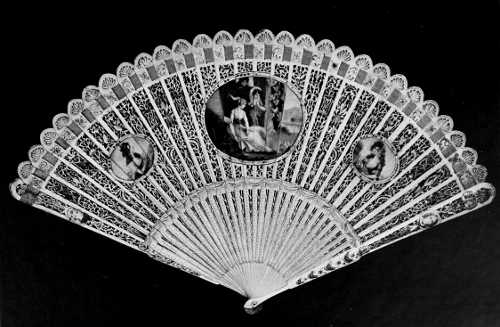
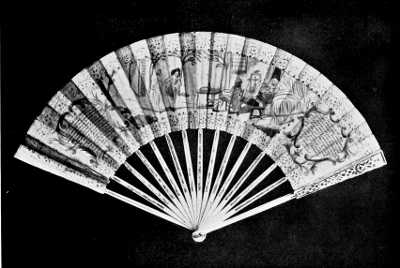
| Chinese Fan with ivory miniatures |
Mr W. Burdett-Coutts. M.P. |
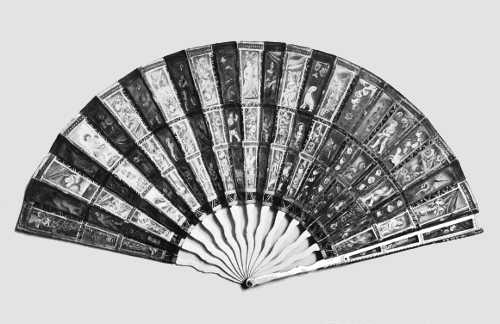
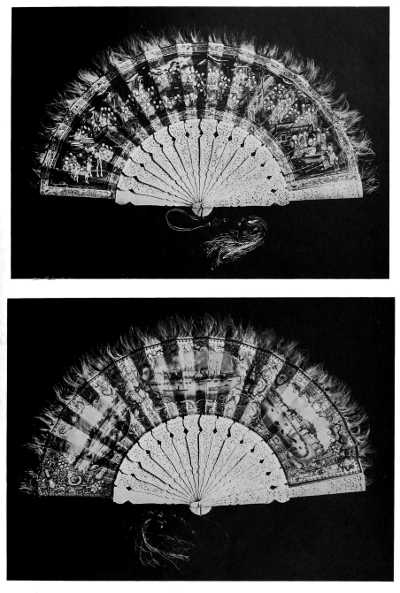
Of the familiar class of fans having large compositions of figures
of which the heads are of applied ivory, painted, the costumes of silk
appliqué, the sticks of ivory elaborately carved, the example illustrated
from the collection of Mr. Burdett-Coutts belonged to a mandarin of
the first rank. A beautiful example was formerly in the possession of
H.I.M. the Empress Eugénie,43 the stick of sandalwood. The brins
of these fans, twelve in number, are occasionally varied, as follows:—Two
of white ivory, pierced and carved; two of silver filigree and
enamel; two of ivory, pierced and carved, coloured scarlet; two of tortoise-shell,
carved and pierced; two of engraved white pearl; and two of
gilt filigree enamel. The panaches of gilt filigree, with silver dragons
in relief. An example occurs in the collection of Mr. Messel, another
was in the possession of the late Mr. R. W. Edis.
Almost every important city or district in China has its characteristic
fan—something distinctive in the make, colour, or ornamentation of the
folding-fan, which is the fan par excellence in the Chinese mind. The
convenience of this fan will at once be apparent—it occupies but little
space, it may, when not in use, be stuck in the high boot of the full-dressed
Chinaman, or in the ample folds of his dress.
These fans are made to suit every class of society from mandarin to
peasant—to suit the changing seasons, in different sizes in proportion to
the quantity of breeze required. The Son of Heaven, during the sultry
summer months, employs fans of feathers, and during winter of silk.
Fashion, however, lays down inexorable laws as to the time and period
of their use, and to be seen with a fan too early or too late in the year is
considered as mauvais ton. A poem by Ow-Yang Hisu informs us that
‘In the tenth moon the people of the capital turn to their warm fans.’
During the warm weather the fan forms part of the ceremony of
tea-drinking; the host takes his fan as soon as tea is drunk, and, bowing
to the company, says, ‘Thsing-chen’ (I invite you to fan yourselves);
each guest immediately using his fan with great gravity and modesty.
It is considered a breach of etiquette to be without a fan on such an
occasion, or to refrain from its use.44
The Chinese have exhausted every species of ingenuity in the construction
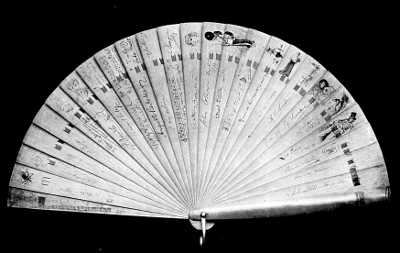
of fans of an outré character. The ‘broken fan,’ a curious trick,
is to all intents and purposes a simple folding-fan, and opened from left
to right presents no feature uncommon. On being opened to the reverse,
the whole fan appears to fall to pieces, each bone, with the part attached,
being separated from the other as though the connecting strings were
broken: the principle is extremely simple, but the effect is surprising.
A fan which has been styled the ‘impracticable,’ is of circular form,
the radiants of ivory, tortoise-shell, sandalwood, or metal filigree, perforated
to such a degree as to render it useless as a means of disturbing
the air. These are elaborately carved with figures, scroll-work, and other
designs, or with birds, flowers, etc., in silver gilt filigree.
The ‘double-entente’ fan, opened in the ordinary manner, exhibits
some harmless motif such as a flower, bird, or landscape; opened the
reverse way, it discloses a ribald sketch that would entail severe penalties
on its maker if discovered. The Peking variety shows two such pictures
which are not seen when the fan is opened, but are disclosed by turning
back the two end ribs of the fan.
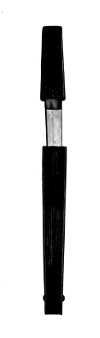
The ‘dagger-fan’ is an invention of the Japanese, its importation
into China being strictly forbidden. In its outward appearance it is
sufficiently harmless, being apparently an ordinary lacquered folding-fan:
in reality it is a sheath containing a deadly blade, short and sharp,
resembling a small Malay kris (see illustration facing page 60). These
dagger or stiletto fans are by no means confined to the East; in the
British Museum is a print of an Italian stiletto concealed in a case
made in imitation of a fan; the panaches of ivory, engraved with
Italian arabesques.
Feather Fan, (Argus Pheasant) with embroidered case.
Chinese, early 19th Cent. |
Victoria & Albert Museum. |
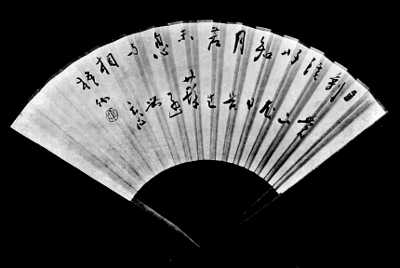
Inscription fans are common, and exhibit an endless variety of
devices. Some are literary tours de force, the most famous being that
associated with the Emperor Chien Wên, of the Liang dynasty, A.D. 550,
and said to be the composition of the monarch himself. This consists
of a couplet of eight characters written in the eight corners of an
octagon fan. On beginning at any one of the eight characters and
reading round the way of the sun, it forms a couplet of perfect sense
and rhythm.
A story is told of a favourite of the Emperor Ch’êng Ti of the Han
dynasty, B.C. 32, whose name was Pan, and who for some time had been
a confidante of his Majesty and the Queen of the Imperial Seraglio.
Having persuaded herself that something more than an ordinary attachment
of the hour existed between herself and the ‘Son of Heaven,’
finding her influence on the wane and being unable to conceal any longer
her mortification, grief, and despair, she forwarded to the Emperor a
circular screen-fan, upon which were inscribed the following lines expressing
the contrast between the summer of her reciprocated love and
the autumn of her desertion:—
‘O fair white silk, fresh from the weaver’s loom,
Clear as the frost, bright as the winter snow—
See, friendship fashions out of thee a fan:
Round as the round moon shines in heaven above;
At home, abroad, a close companion thou;
Stirring at every move the grateful gale,
And yet I fear, ah me! that autumn chills
Cooling the dying summer’s torrid rage,
Will see thee laid neglected on the shelf,
All thought of bygone days, bygone like them.’
45
From this period, in China, a deserted wife has been called an
autumn fan.
 THE fan is regarded by the Japanese as an emblem of life,
that widens and expands as the sticks radiate from the
rivet or starting-point, and for this reason is selected
for the new-year’s gift.46 It enters into almost every
affair of the life of the people, from Emperor to peasant;
friends greet each other with a wave of the fan; it is
one of the gifts which the bride takes with her to
her husband’s house; it is presented to the youth on
the attainment of his majority;47 it is used by jugglers
in feats of skill, by the umpires of wrestling matches
as signal, by singers to modulate their voices; the
condemned man marches to the scaffold fan in hand;
the executioner does not relinquish his fan during the
performance of his duty.
THE fan is regarded by the Japanese as an emblem of life,
that widens and expands as the sticks radiate from the
rivet or starting-point, and for this reason is selected
for the new-year’s gift.46 It enters into almost every
affair of the life of the people, from Emperor to peasant;
friends greet each other with a wave of the fan; it is
one of the gifts which the bride takes with her to
her husband’s house; it is presented to the youth on
the attainment of his majority;47 it is used by jugglers
in feats of skill, by the umpires of wrestling matches
as signal, by singers to modulate their voices; the
condemned man marches to the scaffold fan in hand;
the executioner does not relinquish his fan during the
performance of his duty.
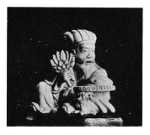
| Netsuki. The Dai Tengu with feather uchiwa. |
Mr W. L. Behrens. |
|
|
|
| Dagger Fan. |
MrL. C. R. Messel. |
Camp Fan of Eagles Feathers, horn handle.
Mr L. C. R. Messel. |
The early history of the fan in the country of Dai Nippon is substantially
the same as in all the countries of the far and nearer East, and
presents us with the same order of development, the earliest being formed
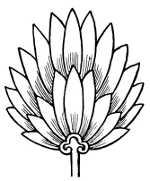
of the primitive palm leaf, or of feathers. We have, in the story of ‘The
Tengus’ a description of the Dai or Master Tengu, who wears a long
grey beard down to his girdle, moustaches to his chin, and carries in his left
hand as a sign of his rank a fan made of seven wide feathers pointed at the
 FEATHER-FAN
(From a Japanese painting. British Museum.)
tip: this he waves while singing a song,
doubtless for the purpose of modulating his
voice. The fan is identical in form with
that of Chung-li Ch’uan, one of the eight
Taoist immortals, referred to on page 47.
The rigid screens received from China
at the close of the sixth century are referred
to in the earlier part of this chapter, under
China. Those in use in Japan present no
material difference to the Chinese except in
the details of their decorative significance.
The larger screens were employed both in
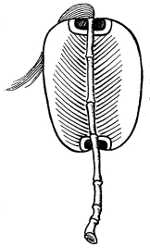 HAND-SCREEN, BAMBOO HANDLE
(From a Japanese painting. British Museum.)
civil and religious ceremonial, as war standards,
and waved by servants in attendance upon
royal and distinguished personages. These
latter denoted the rank of the owner, the
material being of silk or other fabric stretched
over a wooden framework, painted or otherwise
decorated, the forms extremely varied,
but more usually those of the circle, oval, or
pear. The pear-shaped hand-screen is seen
in the hands of Hotei, the fat god of prosperity,
and of Juro, the god of longevity, as an
invariable accompaniment of those divinities.
An example is given from a portrait of Lü
T’ung-pin, a Taorist Rishi of the eighth
century, by Go-gaku, nineteenth century,
British Museum, 640. This has a red tassel or tail at the end of the
fan, a kind of combination of fan and fly-whip. A similar fan appears in
a painting of the Caligraphic school, British Museum, 1617. This fan
is of Chinese origin, and is constantly represented in the art of that
country.
Fly-whips were also used. Of the representations of the sixteen Arhats
(Buddhist divinities) given in the ‘Butsu zō dzu-i,’ three hold fly-whips
(futsujin) in their hands. This instrument is also seen in the right hand of
Vimalakîrrti, an Indian priest, in the painting on silk attributed to
Shingetsu, Sesshiu school, fifteenth century, British Museum collection.
The fly-whip or chasse-mouche was also used by generals while on
horseback, this being made of strips of tough paper suspended from a
lacquered handle mounted with bronze.
A list of the more important varieties of Japanese fans, together with
the dates of their introduction, as given by native authorities, will probably
be of service.
Rigid fans or hand-screens, introduced from China, end of sixth century A.D.
Folding-fans (bamboo), invented by the Japanese, 668-671 A.D.
Gumbai Uchiwa, flat iron battle-fans, eleventh century.
Gun Sen, folding iron battle-fans, twelfth century.
Hi ogi, court-fans, eleventh century.
Mai ogi, dancing-fans, beginning of seventeenth century.
Rikiu ogi, tea-fans,fanbegin“ning ofseven“teenthcen“
Water-fans for kitchen use, eighteenth century.
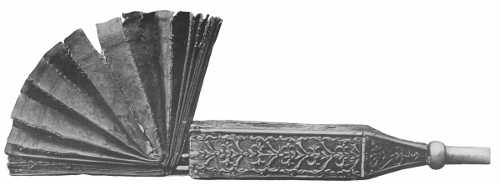
The invention of the folding-fan has already been referred to. Its
earliest form is the Kōmori (bat), so named from the supposition of the wing
of this animal suggesting the principle of its construction. It is formed
of fifteen bamboo sticks having a slight re-divergence springing from
the handle end, so that when held closed in the hand as it is by courtiers
while fulfilling the office of fan-bearing, it still appears open. It is stated
that this spread-out form was adopted as court-fan on account of the misuse
of the dagger-fan. The mount is of paper, which may be painted with any
design in any colour except the unlucky green and light purple.
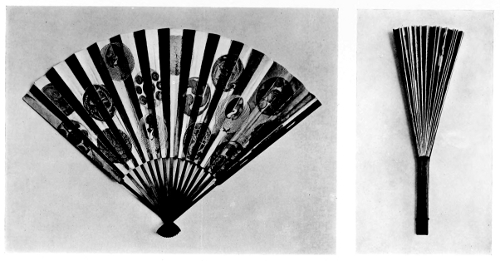
| Suye hiro ogi. open & closed, decorated with crests on a gold ground. |
Mr W. Harding Smith |
One of the many traditions of its invention may be given. It is
attributed to a fan-maker of the Tenji period, 668-672, whose name is
forgotten, living at Tamba near Kyoto. He was married to a shrew, and
on a certain night a bat having found its way into the sleeping-room, the
woman reviled her husband for not getting up to throw the vampire out.
The animal coming in contact with the lamp, scorched its wings and fell to
the floor. As the man picked it up, the opening of the creature’s wings
suggested to him the principle of a folding-fan that might be carried in
one’s sleeve.48
The Suye hiro ogi (wide end) has a similar divergence to the foregoing,
with the addition of a slight curve or rounding of the outward sticks. It
was used for the dances in the Nō drama; the number of sticks varying
from fifteen to twenty-five. This also dates from the seventh century.
The example illustrated is decorated with a series of crests of various
families on a gold ground. In a drawing by Bun-chin, nineteenth century,
British Museum, 891, of Performers in the ‘Nō’ Theatre, is represented a
beautiful fan of a peacock with outspread tail and branches of bamboo,
in gold, blue, and green. This fan is of the ordinary shape.
The Akomé ogi is the earlier court-fan, and dates from the invention of
the folding-fan in the seventh century. It consists of thirty-eight blades of
wood painted white, decorated with cherry, pine, plum, or chrysanthemum,
on a ground of gold and silver powder, ‘among the mist.’ The fan is
ornamented at the corners with an arrangement of artificial flowers in silk,
with twelve long streamers of different coloured silks; the rivet is formed of
either a bird or butterfly. This type of fan was in use by the court ladies
until 1868.
By the courtesy of Mr. W. Crewdson we are enabled to reproduce one
of these rare fans, bearing the following inscription:—
‘The decorations at the end of this Akomé-ogi show that it was used by a court
lady. At Kioto, the Mikado’s Palace had Lemon trees at the right-hand side of the
entrance and Cherry trees at the left; hence these ornaments composed of Cherry
flowers and Pine knots.’
The description which Pierre Loti has given us of these fans is
so charming that we cannot refrain from quoting it.
‘They wave with constant motion, or carry shut, their court-fans, on the pleated
silk (?) of which are delicately painted dreamy fancies, of inexpressible charm, picturing
the reflection in the water of cloud forms, of moons wintry pale, the flight of birds,
or showers of peach blossom wafted by the wind in April mists. At each angle of
the mount is tied an enormous tassel with shades of chenille, the ends of which trail
along the ground, brushing the fine sand at each movement of the fan.’
The Hi-ogi court-fans are made of the Hi wood (Chamæcyparis
obtusa), this being a soft light velvety wood of a beautiful golden
brown, having the additional advantage of immunity from the attacks
of wood-eating insects. The brins are twenty-five in number, fastened
with a metal rivet, and threaded through with silk strings having
very long ends, looped at the top corner of the outer ribs to form a
rosette or other floral device. These fans were first introduced with the
simple ornament of the owner’s crest; afterwards they were painted with
great elaboration and delicacy.
At court ceremonial the Emperor and nobles often bear the Hi-ogi
instead of the Shaku, which is a short staff or sceptre made of wood
(yew) or ivory, generally held vertical in the right hand against the lower
part of the chest, to give the body a more dignified bearing; when the
fan is borne, it is generally carried closed, and held in the same manner
as the Shaku.49
Before the age of fifteen a fan of common wood is carried, painted
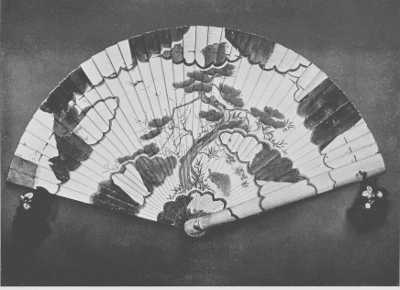
| Court Lady’s Fan. ‘Akome Ogi’. |
Mr. Wilson Crewdson. |
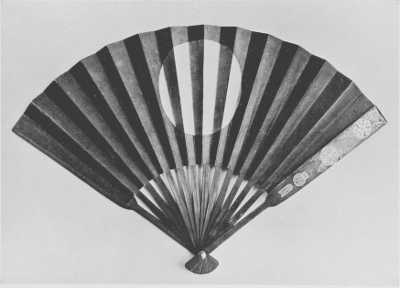
| War Fan. ‘Gun Sen.’ |
Mr W. Harding Smith. |
on the outside, and ornamented with silk threads or strings in five
colours; on his sixteenth birthday the Japanese youth attains his majority
and receives a present of a fan.
The code regulating all the details of court ceremonial is absolute,
and always observed; the use of ivory for the Shaku is confined to the
highest ranks, or the most important ceremonial; no noble could use
an ivory Shaku on any occasion. The various usages connected with the
fan are subjected to similar restrictions.
Ladies carried in place of the Shaku the Hi-ogi.
A fan of special make and design is used by the Empress, and its
use is forbidden to any subject. The blades are twenty-three in number,
connected with a white silk ribbon. The decoration is confined to the
chrysanthemum, pine, orange blossom, plum, or Camellia Japonica. The
ribbon rosettes or loops, affixed to the top of the outer blades, are arranged
in keeping with the particular flower which is represented on the fan;
these have seven long streamers, four feet long, of different colours. The
rivet also is of a particular kind—paper string.50
Chūkei are fans borne by priests and nobles; these have a redivergence
at the ends, and date from the period of the introduction of
the folding-fan; they are often painted with the most consummate skill,
reflecting the best traditions of Japanese art. Many of these paintings
exist; in most cases the leaves have been removed from the sticks and
mounted as pictures.
Fabulous stories are extant recounting the marvellous accomplishment
of the painters of the earlier epochs; amongst these is an account
of Tadahira, who is said to have painted upon a fan a cuckoo which
uttered its characteristic note whenever the fan was opened, and of
Tsunenori, who drew a lion so life-like that other beasts fled
from it.
The leading schools of Japanese painting are the Buddhist, Yamato-Tosa.
Chinese, Sesshiu Kano, Matahei (popular), Korin, Shijō (naturalistic),
and Ukiyo; each of these has well-marked characteristics preserved
even to the present day.
The art of Japan was to a great extent founded upon, and is in
certain directions a development of, that of the older civilisation of China.
The earliest artist, therefore, recorded in Japanese annals, is a Chinese,
Nanriu by name, of royal descent, who came to Japan about the end of
the fifth century; but of this master, and of his immediate successors, there
are no known examples.
It was in the succeeding century, upon the introduction of Buddhism
into Japan, that we find the first establishment of a school of Japanese
art, initiated by the Chinese and Coreans, and dedicated to the mural
decoration of Buddhistic temples.
From the sixth to the ninth centuries, the history of Japanese painting
is more or less clouded in doubt, and the first great artist who emerges
from the general obscurity is Kanaoka (ninth century), although the few
examples extant which are attributed to this painter are doubted by the
best experts.
The Yamato-Tosa school, though the direct outcome of the study
of Chinese methods, was essentially Japanese and naturalistic in character,
and was founded by Kasuga Motomitsu in the latter part of the tenth
century.
In the thirteenth century Tsunetaka, son of Kasuga Mitsunaga,
assumed the name of Tosa and gave to the Yamato school the name it
has since retained.
An important movement set in at the beginning of the fifteenth
century, no less than a Chinese renaissance. For centuries Chinese
influence had been waning, and the national style of Yamato and Tosa had
held the field.
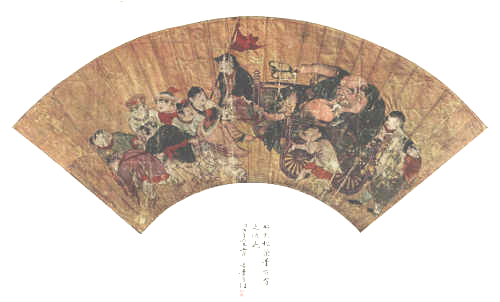
| Hotei and the Children. by Kanō Shō-Yei, 1591. |
Mr Wilson Crewdson. |
Sesshiu, the remarkable painter who founded the school bearing his
name, was of the noble family of Ota, and was born in 1440. At the
age of twelve or thirteen he was intended for the Church and placed
under the instruction of the abbot of the temple of Hōfukuji. Sesshiu’s
sympathies, however, were all in the direction of the fine arts, he neglected
religious training, and a story is told of him—one of those extraordinary
legends familiar in Chinese and Japanese annals—that upon one occasion,
when bound to a pillar as punishment for some misconduct, he beguiled
the weary hours of waiting by drawing rats upon the floor, using his
toes for pencil and his tears for ink (!), the representation being so life-like
as to alarm his janitor. Some versions of the story affirm that, upon the
approach of the priest, the rats scampered away.
At the age of forty he visited China, the fountain-head, but was
surprised to find that he had more to teach than to learn.
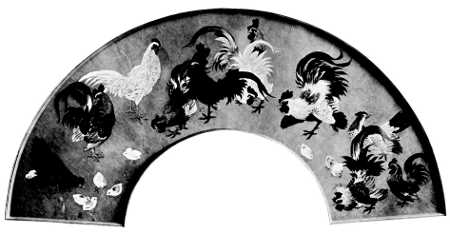
The fan of Hotei and the children, probably by Kanō Shō-yei, 1591,
may be accepted as one of the finest examples of a painted fan of the Kanō
school, the last of the three branches of the fifteenth-century revival of
Chinese teaching. The school was founded by Masanobu, a painter of
landscape, born c. 1423 and died 1520, its actual head, however, being
Motonobu, his son, born 1476.
Hotei (Master Linen-sack), the god of prosperity, was a Chinese
priest of the tenth century, famous for his fatness and his love of children.
He could sleep in the snow, never washed himself, and had the power of
infallibly predicting future events. The legends attached to his name are
very similar to those narrated of many Taoist Rishis, but his claim to
a position as Divinity appears to be due to the view enunciated in the
Butsu-Zō dzu-i and other works, that he was an incarnation of Miroku
Bosatsu Mâitrêya, the Messiah of the Buddhists, in which capacity his
image has long been worshipped in Chinese temples. He is usually
represented with a fan of the pear-shaped gourd type, and carries a cloth
bag as a trap for little boys and girls, who are enticed inside to see the
wonderful things it is supposed to contain, and then imprisoned until
they can beg their way out. These ‘Precious Things’ include the Lucky
Rain Coat, the Sacred Key, the Inexhaustible Purse, etc.51
Innumerable pictures of Hotei by Japanese artists are in existence,
some dating from the fifteenth century.
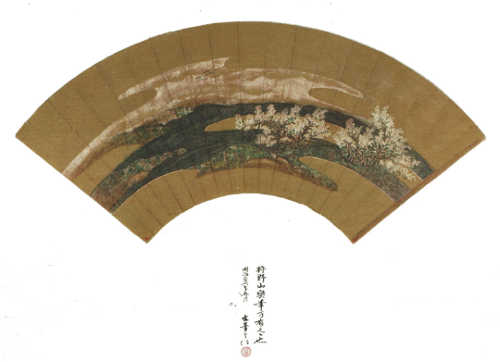
The charmingly poetic view of the Tamagawa River, with the tea-plant
in blossom, and flying cuckoo (Hoto-Togisu), is probably by Kanō San
Raku, 1633. Both these fans are accompanied by a Japanese certificate
of authenticity.
Autograph, motto, and inscription fans are referred to in another part of
this work.52 The practice of inscribing sacred texts upon fans, obtained
during the latter part of the eleventh and beginning of the twelfth century,
the period ‘when the Buddhist religion was openly professed by the
wealthy and warmly supported by the luxurious.’ Fragments of Buddhist
sûtras written on fans and fan leaves exist at the temples at Yamato, Ôsaka,
the Imperial Museum Tôkyô, and elsewhere. These are copied from the
‘Lotus of the True Law,’ or other Mahâyâna texts of a like nature. The
fans, though differing somewhat in size, are all alike in paper, pigments, and
style of painting, and evidently had a common origin; they are overlaid
with gold-leaf and dusted with fine sand; upon this a thin wash of red
or black pigment is applied. The sacred text is written in ink, over a
painting, usually a figure-subject and bearing no reference to the text;
the faces sketched in a curious convention known as Hikimé Kagihana
(eye with a line, the nose with a key), in which the eye is represented
by a straight line and the nose with a somewhat acute angle. This
convention has been traced to Kasuga Takayoshi (beginning of the
twelfth century), who painted a number of picture rolls illustrating the
tales of the Genii.
| The Tamagawa River. with teaplant & flying cuckoo.
by Kanō San Raku, 1633. |
Mr Wilson Crewdson. |
Japanese War Fans, Gumbai Uchiwa.
Mr L.C.R.Messel. Mr. W Harding Smith. Mr W.L.Behrens.
A fan leaf owned by the Temple of Saikyôji, Sakamoto, Omi, is
illustrated in Selected Relics of Japanese Art, S. Tajima. A hi-ogi,
with figures and pine-tree, in the Shinto Temple, Itsukushima-Jinsha
Aki, is illustrated in the same work: this latter, doubtless, is a production
of the Taira era, possibly a dedication to the temple from a scion of the
Taira family, and painted by a daughter of Taira Kiyomori, the premier,
1167-1180, the writer of the ‘Lotus of the True Law.’
A similar combination of painting and writing obtained later, and was
practised by Kôyetsu Hon-Ami, the predecessor of Kôrin Ogata, the reputed
founder of the Korin school. This artist was a skilful writer of Chinese
ideographs, in which art he was one of the ‘Three Pens’ of his time,
being the founder of the Kôyetsu school of caligraphy.53
A fine example of Kôyetsu in the possession of Baron Ryûichi Kuki is
reproduced in Mr. Tajima’s work. This is painted on a gold ground, and
represents a rabbit in a flowered field. The fan is divided in two parts, the
writing, which is by the artist, being on the gilt portion. Kôyetsu died at
Kyoto in 1637, aged eighty-two.
The Ukiyoyé school included most of the makers of colour prints;
two of the more famous of them, Masanobu Kiato, and Hokusai Katsushika,
born in the same year, 1760, also painted fans. The former opened a shop
at Ginza for the sale of smokers’ implements and medicine, and sold besides
folding-fans and long panels upon which poems were written; both of these
he ornamented with sketches; they became renowned far and wide, and
from their sale he derived large profit.
A fan leaf by Hokusai, a masterly sketch of the head and shoulders of
a ‘Beauty,’ is illustrated in Tajima’s work, as also several fans painted
with courtesans, by an almost equally celebrated maker of colour prints,
Kunisada.
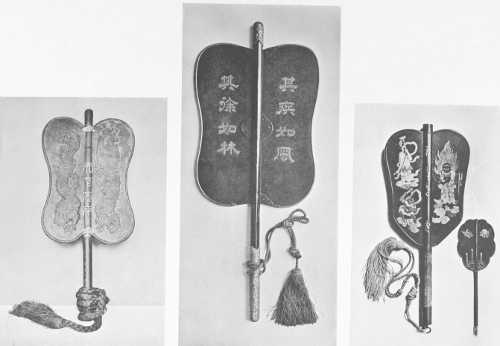
Battle- or war-fans are of two kinds—the flat, rigid screen (uchiwa)
which is the earliest, and the folding (ogi). In both, iron is the material of
which it is mainly composed. The first named is sometimes formed completely
of metal (iron and brass), is of considerable weight, and is used by
officers both for direction, offence and defence, i.e. as baton, weapon,
and shield.
This sometimes assumes a circular form, and is occasionally inlaid with
the more precious metals; more often, however, it resembles the pear-
or gourd-shaped screen. In the centre example illustrated, belonging to
Mr. W. Harding Smith, the handle is of lacquered wood, the ornaments
at its extremities, together with the rim of the fan blade, of bronze gilt; it
bears an inscription on the obverse in Japanese, and on the reverse in
Chinese, as follows:—
Japanese script.
‘Kisei ai shozaru jun-kwan
no hashi naki-ga gotoshi.’
‘Wrong and right (or odd and even) happen for ever,
impartially, like the revolving ball.’
This may, possibly, be rendered by the following:—
‘Defeat and victory succeed each other
by a turn of Fortune’s wheel.’
Chinese script.
‘Sono toki-koto kazé no gotoku
Sono shizuka-nuru koto hayashi no gotoshi.’
‘Its sharpness is as the wind, its softness
as the grave.’
The fan in the possession of Mr. W. L. Behrens is ornamented with
two dragons in low relief, the motto ‘Tenka tai hei’ (international peace).
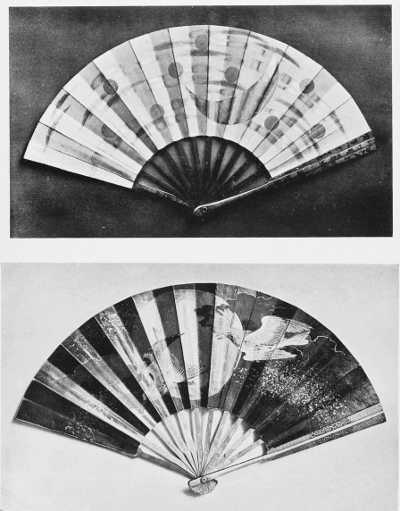
In the folding battle-fan, the stick is of wrought iron, the branches
varying from ten to fourteen in number; in many military fans, the
stick is of bamboo, painted black, the guards of iron, often arrow-shaped,
and richly inlaid with silver.54
The decoration of the mount, of thick paper, consists of the sun, moon,
or north star, usually in red, but also in gold, on a black or coloured ground.
An unusual example, illustrated, has a gold sun on the one side, and a
silver crescent moon and nine golden planets on the reverse; the ground
being light, the guards of yellow bronze, ‘seutoku.’
The fine fan in the possession of Mr. L. C. R. Messel has on the
obverse a golden sun with two flying birds, and on the reverse a silver sun
with similar birds.
The sun motif is occasionally abandoned in favour of a figure-subject.
M. Ph. Burty exhibited at Liverpool in 1877 a fan that belonged to a
commander-in-chief; the leaf, of stout buff paper covered with silk tissue, is
painted in india ink with the Seven Sages in the Forest of Bamboru.
The brins are of plain whalebone, the panaches of oxidised iron, elaborately
inlaid with scroll-work and crests in silver, the latter being of the powerful
family of Nai-To. Another fan from the same collection belonged also to
an officer of high rank. The brins are of bronze gilt, the panaches of
polished iron, shaped like slips of bamboo, and chased with lions and
flowers. On the inside of one panache is an inscription in inlaid gold,
stating that the ironwork was made by U. Da-Kane-Signe; the leaf of
glistening paper.
The most characteristic war-fans are, however, those having the simple
red sun, with no superfluous decoration, the initial purpose of these instruments
being that of a signal. They constantly appear in representations of
battle-scenes, the general on his war-horse in the heat of battle brandishing
in his right hand the fan, the symbol of his authority and command. In
Hokusai’s painting of ‘Tamétomo and the Demons’ (British Museum, No.
1747), the hero is grasping a huge bow in his right hand, and waving the
folding battle-fan in his left.
In a print by Kuniyoshi (c. 1820) of the battle of Kawanakajima
between Uyesugi Kenshin and Takeda Shingen (fifteenth century), a sword-cut
is parried by the war-fan.
In a representation of the same battle by Yoshitora, a dismounted
general is directing with a war-fan an attack by spearmen.
In the colour print by Hiroshige II. of Yoshitsune and Benkei, the war-fan
also appears.
In the print by Shunsui of Atsumori and Kumagai, the hero, mounted,
is plunging into the sea followed closely by his adversary Kumagai, also
mounted, brandishing the war-fan as a signal and challenge.55 Two of the
many stories or legends relating to the war-fan may be given.—The first
refers to Nasu no Yoichi, an archer, whose clan took the fan as their crest,56
in allusion to his performance at the battle of Yashima in 1185. ‘When
the Taira were driven from Kyoto by the Minamoto in 1182, the Empress
Ni no Ama flew with the child-emperor Antoku, to the shrine of Itsukumisha,
where thirty pink fans, bearing the design of the sun disc (Hi no Maru)
were kept. The head-priest gave one to Antoku, saying that it contained in
the red disc the Kami of the dead Emperor Takakura (1169-1180), and would
cause arrows to recoil upon the enemy. The fan was accordingly attached
to a mast of the Taira ship, on which a court lady is always depicted, and a
challenge sent to Minamoto no Yoshitsuné, which was accepted by one of
his archers, Nasu no Yoichi, who on horseback rode in the waves, and with
a well-directed arrow broke the rivet which held the leaves together, and thus
shattered the fan.’
| War Fans, Gun Sen. |
Mr. W. Harding Smith.
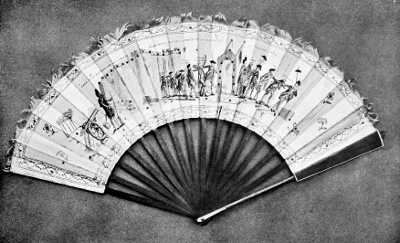
Mr. L. C. R. Messel. |
The second tells of Araki, a Samurai whom Oda Nobunaga wished to
kill, summoning him to audience, placing himself in such a position that the
neck of the Samurai came in line with the sliding panels separating the
audience chamber from the daimio’s room, intending to have the shoji
slammed together as the man knelt, and thus decapitate him. Araki, suspecting
the trap, promptly laid his iron fan in the groove, jamming the
shutters, and thus saving himself.57
The Ha uchiwa (jin sen) is a camp-fan originally introduced from
China in the seventh century and made of the feathers of the eagle, pheasant,
or peacock, the handle usually lacquered red, black, or blue; the interesting
example illustrated is formed of eagles’ feathers fixed in a horn handle.
Dancing-fans (Mai ogi) were introduced at the beginning of the seventeenth
century. The brins are ten in number, the mount of thick paper,
usually bearing a family crest. One of the earliest of these fans is to be
seen in the painting of a dancer by Matabei (born 1578), in the Morrison
collection (reproduced in Painting in the Far East, Laurence Binyon), the
decoration of the mount consisting of a few scattered leaves.
The fan is the most usual accompaniment of the dance, and is
generally seen in the hands of the Kagura dancers or of the performers with
the Shishi mask. The fan dance, which is more nearly allied to jugglery
than to the dance, is said to commemorate the performance of Uzume while
alluring the Sun Goddess Amaterasu from the cavern, whither she once
retired, plunging the world into temporary darkness by her absence. In
this, the fan represents the leaves of the pine-tree, the performer balancing a
number on his forehead, nose, mouth, hands and feet.
Tea-fans (Rikiu ogi) are for use at the tea ceremonies celebrated in
honour of tea in every province on the first day of the first month, and commemorating
the curing of the Emperor Murakami, 947-967 A.D., of a disease
against which the physicians were powerless. The Emperor recovered after
drinking an offering of tea made to the Goddess Kwanyin. The code, that
formerly was of a gorgeous description, was modified later by Sen-no Rikiu,
from whom the fan set apart as cake tray or saucer derives its name. The
Rikiu fan is of the simplest possible construction, having only three sticks,
the decoration also being of a simple character. It is used for handing
round little cakes, and for no other purpose, fanning being strictly tabooed
during such a dignified proceeding.58
The giant closing fans (Mita ogi) were used in the processions at Ise in
honour of the Sun Goddess, the traditional originator of the Japanese
dynasty. These were six or seven feet long, five men being appointed to
carry one of this huge magnitude.
Water-fans (Mizu uchiwa), for kitchen use, date from the eighteenth
century. These are of bamboo split into segments, covered with stout
paper, and varnished or lightly lacquered so as to allow of the fan being
dipped in water, thus securing extra coolness by evaporation. They are
often decorated with figures and other subjects, the varnish subsequently
applied being of a rich warm brown.
Roll-up fans (Maki uchiwa) are circular, the paper stiffened with
thin strips of bamboo; the handle is of bamboo cut through with a slit
to allow the circular fan, which is set on a pivot, to have free play.
When open, the strips of the bamboo foundation are horizontal, thus
securing rigidity; when not in use, the position of the strips may be
reversed, and the disc rolled round the stick and tied.
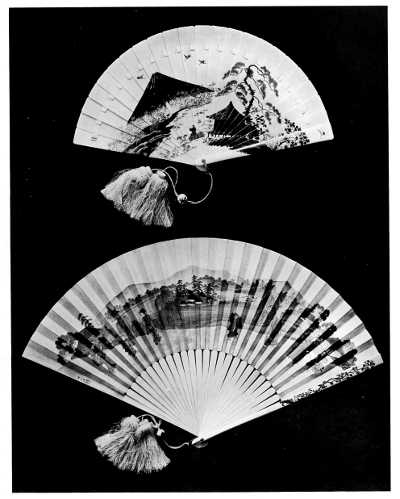
| Modern Japanese Fan, Ivory with gilt Lacquer, and
Painted Fan signed Kunihisa. |
Mr. W. Tomkinson. |
Of modern fans, those of ivory and tortoise-shell, carved or decorated
with lacquer and inlay, are, for the most part, made for exportation, and
are often of extreme beauty. The excellent example in the Victoria and
Albert Museum is decorated with circular medallions in gold lacquer of
various shades, portions being carved in relief. It is finely inlaid in
places with mother of pearl; signed by Taishin (a pupil of Zesshin), and
dated 1884. An example, equally fine, is given from the collection of
Mr. M. Tomkinson. This is decorated with a view of Fuji san, or
Fuji-no-yama (peerless mountain); those born within its watch are considered
most happy and fortunate beings.
‘Great Fujiyama, tow’ring to the sky!
A treasure art thou giv’n to mortal man,
A god-protector watching o’er Japan—
On thee for ever let me feast mine eye.’
59
Of the cheaper hand-screens exported in large quantities to Europe,
the simplest form is that of a dried palm leaf cut to the required shape,
and bound round the edge, the stem forming the handle. The most
common variety is made by splitting bamboo into thin strips that are
spread out radially, fastened with thin cord, and covered with paper; these
are decorated with designs displaying high qualities of arrangement
and graphic skill, and are printed in that process of chromoxylography
which, if not actually invented by the Japanese, has been carried by them
to its highest point of excellence. A more elaborate hand-screen is also
exported, the covering of silk, painted.
It will be readily understood, that the fan, entering as it does so
closely into the daily life of the Japanese, should also form the subject
of many games. Two characteristic instances may be cited. The ‘fan
and cup’ game was particularly favoured by court nobles and ladies.
A company met by the river, each member launching on the water a fan
prepared with varnish or lacquer to ensure buoyancy and to prevent
absorption of moisture. The game consisted in the composition of a
verse or couplet of poetry during the time the fans were at the mercy
of wind and wave, and before they regained terra-firma. Tea-cups were
also used, this last being illustrated in a Chinese makimono by Hwei-chi
Ku-Yuen, British Museum, 276.
In the ogi otoshi or fan target game, a target called ‘cho,’ made somewhat
in the form of a butterfly, is placed on a low table or pedestal on the
floor. A fan is thrown from a given distance with a sudden and peculiar
turn of the wrist, causing it to reverse itself in its passage through the
air and strike the target with the rivet end. This game is played by
two people facing the target at opposite ends. Bells are attached to the
outer edge of the ‘cho,’ that sound when a successful hit has been
accomplished.60
No notice, however brief, of the fans of Japan would be complete
without some reference to the constant employment of the fan form as a
decorative motif in Japanese design, one of the many evidences of the
important place the fan holds in the affections of the people. Lacquered
tea-trays assume the shape of the fan; inkstands take the form of a
closed fan, the ink-well at the rivet end, the body of the fan forming a
case for pens;61 while in diapered patterns, borders, and other decoration,
both flat and in relief, the fan motif is constantly made use of. The
interesting series of fan-shaped panels illustrative of Japanese history, by
an unknown artist of the Yamato Tosa school, seventeenth century,
British Museum, 305-324, are excellent instances of the use of the fan
form in flat decoration, these being probably removed from an old screen.
Three kakémonos in the collection of Mr. R. Phené Spiers are each finely
painted with four full-sized fans, decorated with various lilies, drawn with
that consummate skill and knowledge of plant form which would appear
to be the peculiar heritage of the sons of Dai Nippon.
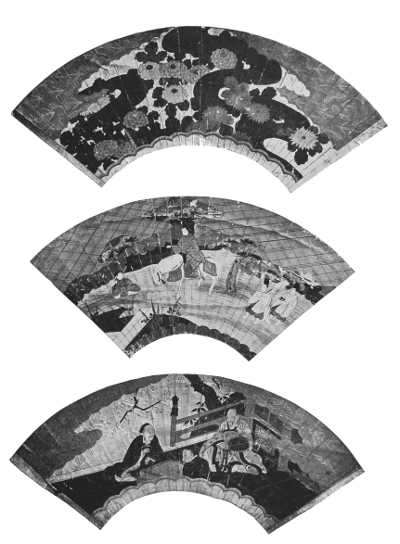
| Three Chūkei. |
Mr L. C. R. Messel. |
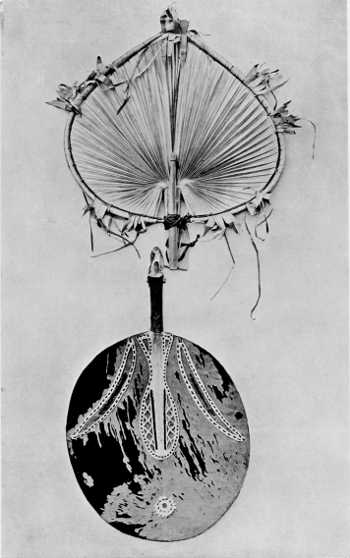
Palm Leaf Fan, used by the Great Chiefs, Fiji.
Hide Fan, Nigeria. |
British Museum. |