As we ascend the river, the nearer we approach the base of the
Alleghany Mountains the fewer places we find even mentioned in quite
early history. On the flat eight or nine miles west of Lewistown, near
a large spring, stood an old Shawnee town. It is mentioned as early as
1731, in a report of the number of Indians accompanying the deposition
of some traders. The town was called Ohesson, on the "Choniata,"
and supposed to be sixty miles distant from the Susquehanna. As this is
Indian computation, some allowance must be made, for in the same
connection we notice the Indian town of Assunnepachla set down
as being distant one hundred miles from Ohesson by water and fifty
miles by land. Assunnepachla was the Indian name of Frankstown; and no
person, by following the most sinuous windings of the river, can make
the distance to Lewistown over eighty miles.
These places were probably never visited by any but Indian traders
previous to Braddock's defeat, and the consequence is that we are
without any record of Ohesson, which was evidently destroyed and
abandoned at an early day. Assunnepachla, however, stood for many
years, but it lost its name before it became a place of importance to
the whites.
Aughwick, it is said, had the honor of receiving the first white
settlers, in 1749, that came within the present limits of Huntingdon
county. Of course, they were in search of choice lands, and there is
reason to believe they found them, too, notwithstanding the proprietors
and their man Peters, in a year thereafter, ousted them by burning
their cabins over their heads. Aughwick Valley is in the extreme
southern part of Huntingdon county, and, if not a regular continuation
of the Tuscarora Valley, is at least one of the chain of valleys
through whose entire length ran the celebrated Indian path from
Kittaning to Philadelphia,—the great western highway for footmen and
pack-horses.
This path, traces of which can yet be plainly seen in various places,
and especially in the wilds of the mountains, must have been a famous
road in its day. It commenced at Kittaning, on the Alleghany River, and
crossed the Alleghany Mountains in a southeastern direction, the
descent on the eastern slope being through a gorge, the mouth of which
is five or six miles west of Hollidaysburg, at what is well known as
Kittaning Point. From this it diverged in a southern direction until it
led to the flat immediately back of Hollidaysburg, from thence east,
wound round the gorge back of the Presbyterian graveyard, and led into
Frank's old town. From thence it went through what is now called Scotch
Valley, Canoe Valley, and struck the river at Water street. From thence
it led to Alexandria, crossed the river, and went into Hartsog Valley;
from thence to Woodcock Valley; from Woodcock Valley, across the
Broadtop Mountain, into Aughwick; from thence into the Tuscarora
Valley, and from thence into Sherman's Valley, by Sterritt's Gap.
At Kittaning Point, this path, although it is seldom that the foot of
any one but an occasional hunter or fisher treads it, is still the same
path it was when the last dusky warrior who visited the Juniata Valley
turned his face to the west, and traversed it for the last time. True,
it is filled up with weeds in summer-time, but the indentation made by
the feet of thousands upon thousands of warriors and pack-horses which
travelled it for an unknown number of years are still plainly visible.
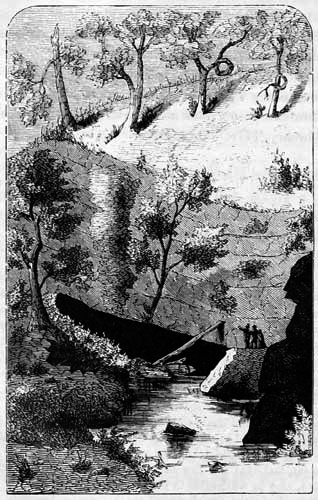
We have gone up the Kittaning gorge two or three miles, repeatedly, and
looked upon the ruins of old huts, and the road, which evidently never
received the impression of a wagon-wheel, and were forcibly struck with
the idea that it must once have been traversed, without knowing at the
time that it was the famous Kittaning trail. In some places, where the
ground was marshy, close to the run, the path is at least twelve inches
deep, and the very stones along the road bear the marks of the
iron-shod horses of the Indian traders. Two years ago, we picked up, at
the edge of the run, a mile up the gorge, two gun-flints,—now rated as
relics of a past age. At the time we supposed that some modern Nimrod
lost them. Now, however, we incline to the belief that they fell from
the pocket of some weary soldier in Armstrong's battalion, who lay down
upon the bank of the brook to slake his thirst, nearly a hundred years
ago. The path can be traced in various other places, but nowhere so
plain as in the Kittaning gorge. This is owing to the fact that one or
two other paths led into it, and no improvement has been made in the
gorge east of "Hart's Sleeping Place," along the line of the path.
Aughwick was an Indian town, located probably near where Shirleysburg
now stands, and for a long time was an important frontier post. The
name of the place figures extensively in the Colonial Records, first as
a place where many conferences were held, and afterward as Fort
Shirley.
Previous to actual settlers coming into the Juniata Valley, every inch
of it was known to the traders—or, at least, every Indian town in it;
and how long they trafficked with the red men before actual settlers
came is unknown. Thus, for instance, six or seven years before the
settlement of Aughwick, a trader named John Armstrong, and his two
servant-men, were murdered at what is now Jack's Narrows, in Huntingdon
county. As there are several narrows along the Juniata, we should have
been at a loss to locate the scene of the murder, had we not
accidentally noticed in the Archives a calculation of distances by John
Harris, wherein he says—"From Aughwick to Jack Armstrong's Narrows—so
called from his being there murdered,—eight miles." At the time of the
massacre, the British colonists and the Indians were on the most
friendly terms of intimacy, and Armstrong was a man of some standing
and influence, so that the murder (the first one of so atrocious a
nature in that region) created the most intense excitement. Along with
Armstrong, his servant-men, James Smith and Woodward Arnold, were also
murdered. The charge was laid to a Delaware Indian, named Musemeelin,
and two companions. Seven white men and five Indians searched for the
bodies, found and buried them. The Indian was arrested and taken to
Lancaster, and from there removed to Philadelphia for trial, but
whether convicted or not the record does not say. Allumoppies,
King of the Delawares, Shickallemy, and a number of other Indians of
standing and influence, were brought before the council in
Philadelphia, when the friends of Armstrong produced the following
affidavit of those who searched for the bodies:—
Paxton, April 19, 1744.
The deposition of the subscribers testifieth and saith, that the
subscribers, having a suspicion that John Armstrong, trader,
together with his men, James Smith and Woodward Arnold, were
murdered by the Indians, they met at the house of Joseph Chambers,
in Paxton, and there consulted to go to Shamokin, to consult with
the Delaware king and Shickcalimy, and there council what they
should do concerning the affair. Whereupon the king and council
ordered eight of their men to go with the deponents to the house of
James Berry, in order to go in quest of the murdered persons; but
that night they came to the said Berry's house three of the eight
Indians ran away; and the next morning these deponents, with the
five Indians that remained, set out on their journey, peaceably, to
the last supposed sleeping-place of the deceased; and upon their
arrival, these deponents dispersed themselves, in order to find out
the corpse of the deceased; and one of the deponents, named James
Berry, a small distance from the aforesaid sleeping-place, came to
a white-oak tree, which had three notches on it, and close by said
tree he found a shoulder-bone, which the deponent does suppose to
be John Armstrong's,—and that he himself was eaten by the
Indians,—which he carried to the aforesaid sleeping-place, and
showed it to his companions, one of whom handed it to the said five
Indians to know what bone it was; and they, after passing different
sentiments upon it, handed it to a Delaware Indian, who was
suspected by the deponents; and they testify and say that as soon
as the Indian took the bone in his hand his nose gushed out with
blood, and he directly handed it to another. From whence these
deponents steered along a path, about three or four miles, to the
Narrows of Juniata, where they suspected the murder to have been
committed; and where the Alleghany Road crosses the creek these
deponents sat down, in order to consult on what measures to take to
proceed on a discovery. Whereupon most of the white men, these
deponents, crossed the creek again, and went down the creek, and
crossed into an island, where these deponents had intelligence the
corpse had been thrown; and there they met the rest of the white
men and Indians who were in company, and there consulted to go
farther down the creek in quest of the corpse. And these deponents
further say, they ordered the Indians to go down the creek on the
other side; but they all followed these deponents at a small
distance, except one Indian, who crossed the creek again; and soon
after these deponents, seeing some bald eagles and other fowls,
suspected the corpse to be thereabouts, and then lost sight of the
Indians, and immediately found one of the corpses, which these
deponents say was the corpse of James Smith, one of said
Armstrong's men; and directly upon finding the corpse these
deponents heard three shots of guns, which they had great reason to
think were the Indians their companions, who had deserted from
them; and in order to let them know that they had found the corpse
these deponents fired three guns, but to no purpose, for they never
saw the Indians any more. And about a quarter of a mile down the
creek they saw more bald eagles, whereupon they made down toward
the place, where they found another corpse (being the corpse of
Woodworth Arnold, the other servant of said Armstrong) lying on a
rock, and then went to the former sleeping-place, where they had
appointed to meet the Indians; but saw no Indians, only that the
Indians had been there, and cooked some victuals for themselves and
had gone off.
And that night, the deponents further say, they had great reason to
suspect that the Indians were then thereabouts, and intended to do
them some damage; for a dog these deponents had with them barked
that night, which was remarkable, for the said dog had not barked
all the time they were out till that night, nor ever since, which
occasioned these deponents to stand upon their guard behind the
trees, with their guns cocked, that night. Next morning these
deponents went back to the corpses, which they found to be
barbarously and inhumanly murdered by very gashed, deep cuts on
their hands with a tomahawk, or such like weapon, which had sunk
into their skulls and brains; and in one of the corpses there
appeared a hole in his skull near the cut, which was supposed to be
with a tomahawk, which hole these deponents do believe to be a
bullet-hole. And these deponents, after taking as particular view
of the corpses as their melancholy condition would admit, they
buried them as decently as their circumstances would allow, and
returned home to Paxton,—the Alleghany Road to John Harris's,
thinking it dangerous to return the same way they went. And further
these deponents say not.
These same deponents, being legally qualified before me, James
Armstrong, one of his majesty's justices of the peace for the
county of Lancaster, have hereunto set their hands in testimony
thereof.
James Armstrong.
Alexander Armstrong, Thomas McKee, Francis Ellis, John Florster,
William Baskins, James Berry, John Watt, James Armstrong, David
Denny.
After the foregoing facts had been elicited, a regular Indian talk was
had upon the matter, when Shickallemy gave the following as a true
version of every thing connected with the massacre:—
Brother the Governor:—
We have been all misinformed on both sides about the unhappy
accident. Musemeelin has certainly murdered the three white men
himself, and, upon the bare accusation of Neshaleeny's son, was
seized and made a prisoner. Our cousins, the Delaware Indians,
being then drunk, in particular Allumoppies, never examined things,
but made an innocent person prisoner, which gave a great deal of
disturbance among us. However, the two prisoners were sent, and by
the way, in going down the river, they stopped at the house of
James Berry. James told the young man, "I am sorry to see you in
such a condition; I have known you from a boy, and always loved
you." Then the young man seemed to be very much struck to the
heart, and said, "I have said nothing yet, but I will tell all; let
all the Indians come up, and the white people also; they shall hear
it;" and then told Musemeelin, in the presence of the people, "Now
I am going to die for your wickedness; you have killed all the
three white men. I never did intend to kill any of them." Then
Musemeelin, in anger, said, "It is true, I have killed them. I am a
man, you are a coward. It is a great satisfaction to me to have
killed them; I will die for joy for having killed a great rogue and
his companions." Upon which the young man was set at liberty by the
Indians.
We desire therefore our brother the governor will not insist to
have either of the two young men in prison or condemned to die; it
is not with Indians as with white people, to put people in prison
on suspicion or trifles. Indians must first be found guilty of a
cause; then judgment is given and immediately executed. We will
give you faithfully all the particulars, and at the ensuing treaty
entirely satisfy you; in the mean time, we desire that good
friendship and harmony continue, and that we may live long together
is the hearty desire of your brethren the Indians of the United Six
Nations present at Shamokin.
The following is what Shickcalamy declared to be the truth of the
story concerning the murder of John Armstrong, Woodworth Arnold,
and James Smith, from the beginning to the end, to wit:—
That Musemeelin owing some skins to John Armstrong, the said
Armstrong seized a horse of the said Musemeelin and a rifle-gun;
the gun was taken by James Smith, deceased. Some time last winter
Musemeelin met Armstrong on the river Juniata, and paid all but
twenty shillings, for which he offered a neck-belt in pawn to
Armstrong, and demanded his horse, and James Armstrong refused it,
and would not deliver up the horse, but enlarged the debt, as his
usual custom was; and after some quarrel the Indian went away in
great anger, without his horse, to his hunting-cabin. Some time
after this, Armstrong, with his two companions, on their way to
Ohio, passed by the said Musemeelin's hunting-cabin; his wife only
being at home, she demanded the horse of Armstrong, because he was
her proper goods, but did not get him. Armstrong had by this time
sold or lent the horse to James Berry. After Musemeelin came from
hunting, his wife told him that Armstrong was gone by, and that she
had demanded the horse of him, but did not get him; and, as is
thought, pressed him to pursue and take revenge of Armstrong. The
third day, in the morning, after James Armstrong was gone by,
Musemeelin said to the two young men that hunted with him, "Come,
let us go toward the Great Hills to hunt bears;" accordingly they
went all three in company. After they had gone a good way,
Musemeelin, who was foremost, was told by the two young men that
they were out of their course. "Come you along," said Musemeelin;
and they accordingly followed him till they came to the path that
leads to the Ohio. Then Musemeelin told them he had a good mind to
go and fetch his horse back from Armstrong, and desired the two
young men to come along. Accordingly they went. It was then almost
night, and they travelled till next morning. Musemeelin said, "Now
they are not far off. We will make ourselves black; then they will
be frightened, and will deliver up the horse immediately; and I
will tell Jack that if he don't give me the horse I will kill him;"
and when he said so, he laughed. The young men thought he joked, as
he used to do. They did not blacken themselves, but he did. When
the sun was above the trees, or about an hour high, they all came
to the fire, where they found James Smith sitting; and they also
sat down. Musemeelin asked where Jack was. Smith told him that he
was gone to clear the road a little. Musemeelin said he wanted to
speak with him, and went that way, and after he had gone a little
distance from the fire, he said something, and looked back
laughing, but, he having a thick throat, and his speech being very
bad, and their talking with Smith hindering them from understanding
what he said, they did not mind it. They being hungry, Smith told
them to kill some turtles, of which there were plenty, and they
would make some bread by-and-by, and would all eat together. While
they were talking, they heard a gun go off not far off, at which
time Woodworth Arnold was killed, as they learned afterward. Soon
after, Musemeelin came back and said, "Why did you not kill that
white man, according as I bid you? I have laid the other two down."
At this they were surprised; and one of the young men, commonly
called Jimmy, ran away to the river-side. Musemeelin said to the
other, "How will you do to kill Catawbas, if you cannot kill white
men? You cowards! I'll show you how you must do;" and then, taking
up the English axe that lay there, he struck it three times into
Smith's head before he died. Smith never stirred. Then he told the
young Indian to call the other, but he was so terrified he could
not call. Musemeelin then went and fetched him, and said that two
of the white men were killed, he must now go and kill the third;
then each of them would have killed one. But neither of them dared
venture to talk any thing about it. Then he pressed them to go
along with him; he went foremost. Then one of the young men told
the other, as they went along, "My friend, don't you kill any of
the white people, let him do what he will; I have not killed Smith;
he has done it himself; we have no need to do such a barbarous
thing." Musemeelin being then a good way before them, in a hurry,
they soon saw John Armstrong sitting upon an old log. Musemeelin
spoke to him and said, "Where is my horse?" Armstrong made answer
and said, "He will come by-and-by; you shall have him." "I want him
now," said Musemeelin. Armstrong answered, "You shall have him.
Come, let us go to that fire," (which was at some distance from the
place where Armstrong sat,) "and let us talk and smoke together."
"Go along, then," said Musemeelin. "I am coming," said Armstrong,
"do you go before, Musemeelin; do you go foremost." Armstrong
looked then like a dead man, and went toward the fire, and was
immediately shot in his back by Musemeelin, and fell. Musemeelin
then took his hatchet and struck it into Armstrong's head, and
said, "Give me my horse, I tell you." By this time one of the young
men had fled again that had gone away before, but he returned in a
short time. Musemeelin then told the young men they must not offer
to discover or tell a word about what had been done, for their
lives; but they must help him to bury Jack, and the other two were
to be thrown into the river. After that was done, Musemeelin
ordered them to load the horses and follow toward the hill, where
they intended to hide the goods. Accordingly they did; and, as they
were going, Musemeelin told them that, as there were a great many
Indians hunting about that place, if they should happen to meet
with any they must be killed to prevent betraying them. As they
went along, Musemeelin going before, the two young men agreed to
run away as soon as they could meet with any Indians, and not to
hurt anybody. They came to the desired place; the horses were
unloaded, and Musemeelin opened the bundles, and offered the two
young men each a parcel of goods. They told him that as they had
already sold their skins, and everybody knew they had nothing, they
would certainly be charged with a black action were they to bring
any goods to the town, and therefore would not accept of any, but
promised nevertheless not to betray him. "Now," says Musemeelin, "I
know what you were talking about when you stayed so far behind."
The two young men being in great danger of losing their lives—of
which they had been much afraid all that day—accepted of what he
offered to them, and the rest of the goods they put in a heap and
covered them from the rain, and then went to their hunting-cabin.
Musemeelin, unexpectedly finding two or three more Indians there,
laid down his goods, and said he had killed Jack Armstrong and
taken pay for his horse, and should any of them discover it, that
person he would likewise kill, but otherwise they might all take a
part of the goods. The young man called Jimmy went to Shamokin,
after Musemeelin was gone to bury the goods, with three more
Indians, with whom he had prevailed; one of them was Neshaleeny's
son, whom he had ordered to kill James Smith; but these Indians
would not have any of the goods. Some time after the young Indian
had been in Shamokin, it was whispered about that some of the
Delaware Indians had killed Armstrong and his men. A drunken Indian
came to one of the Tudolous houses at night and told the man of the
house that he could tell him a piece of bad news. "What is that?"
said the other. The drunken man said, "Some of our Delaware Indians
have killed Armstrong and his men, which if our chiefs should not
resent, and take them up, I will kill them myself, to prevent a
disturbance between us and the white people, our brethren." Next
morning Shickcalamy and some other Indians of the Delawares were
called to assist Allumoppies in council; when Shickcalamy and
Allumoppies got one of the Tudolous Indians to write a letter to
me, to desire me to come to Shamokin in all haste—that the Indians
were very much dissatisfied in mind. This letter was brought to my
house by four Delaware Indians, sent express; but I was then in
Philadelphia, and when I came home and found all particulars
mentioned in this letter, and that none of the Indians of the Six
Nations had been down, I did not care to meddle with Delaware
Indian affairs, and stayed at home till I received the governor's
orders to go, which was about two weeks after. Allumoppies was
advised by his council to employ a conjuror, or prophet, as
they call it, to find out the murderer. Accordingly he did, and the
Indians met. The seer, being busy all night, told them in
the morning to examine such and such a one that was present when
Armstrong was killed, naming the two young men. Musemeelin was
present. Accordingly, Allumoppies, Quitheyquent, and Thomas Green,
an Indian, went to him that had fled first, and examined him. He
told the whole story very freely. Then they went to the other, but
he would not say a word, and they went away and left him. The three
Indians returned to Shickcalamy and informed them of what discovery
they had made, when it was agreed to secure the murderers and
deliver them up to the white people. Then a great noise arose among
the Delaware Indians, and some were afraid of their lives and went
into the woods. Not one cared to meddle with Musemeelin and the
other that could not be prevailed on to discover any thing, because
of the resentment of their families; but they being pressed by
Shickcalamy's son to secure the murderers, otherwise they would be
cut off from the chain of friendship, four or five of the Delawares
made Musemeelin and the other young man prisoners, and tied them
both. They lay twenty-four hours, and none would venture to conduct
them down, because of the great division among the Delaware
Indians; and Allumoppies, in danger of being killed, fled to
Shickcalamy and begged his protection. At last Shickcalamy's son,
Jack, went to the Delawares,—most of them being drunk, as they had
been for several days,—and told them to deliver the prisoners to
Alexander Armstrong, and they were afraid to do it; they might
separate their heads from their bodies and lay them in the canoe,
and carry them to Alexander to roast and eat them; that would
satisfy his revenge, as he wants to eat Indians. They prevailed
with the said Jack to assist them; and accordingly he and his
brother, and some of the Delawares, went with two canoes and
carried them off.
Conrad Weiser, in a letter to a friend, dated Heidelberg, 1746,
adverts to an interesting incident which occurred at the conclusion
of this interview at Shamokin. He says, "Two years ago I was sent
by the governor to Shamokin, on account of the unhappy death of
John Armstrong, the Indian trader, (1744.) After I had performed my
errand, there was a feast prepared, to which the governor's
messengers were invited. There were about one hundred persons
present, to whom, after we had in great silence devoured a fat
bear, the eldest of the chiefs made a speech, in which he said,
that by a great misfortune three of the brethren, the white men,
had been killed by an Indian; that, nevertheless, the sun was not
set, (meaning there was no war;) it had only been somewhat darkened
by a small cloud, which was now done away. He that had done evil
was like to be punished, and the land remain in peace; therefore he
exhorted his people to thankfulness to God; and thereupon he began
to sing with an awful solemnity, but without expressing any words;
the others accompanying him with great earnestness of fervor, spoke
these words: 'Thanks, thanks be to thee, thou great Lord of the
world, in that thou hast again caused the sun to shine, and hast
dispersed the dark cloud! The Indians are thine.'"
Among the first settlers in Aughwick Valley was Captain Jack, certainly
one of the most noted characters of his day. He flourished about
Aughwick between 1750 and 1755, when, with two or three companions, he
went to the Juniata and built himself a cabin near a beautiful spring.
His sole pursuit, it would appear, was hunting and fishing; by which he
procured the means of subsistence for his family. There was a mystery
about him which no person ever succeeded in fathoming, and even his
companions never learned his history or his real name.
He was a man of almost Herculean proportions, with extremely swarthy
complexion. In fact, he was supposed by some to be a half-breed and by
others a quadroon. Colonel Armstrong, in a letter to the governor,
called him the "Half-Indian." The truth of it, however, is that he was
a white man, possessing a more than ordinary share of intelligence for
a backwoodsman, but his early history is altogether shrouded in
mystery. It appears that in the summer of 1752 Captain Jack and his
companions were on a fishing excursion. Returning late in the evening,
Jack found his cabin in ruins and his wife and two children murdered.
From that moment he became an altered man, quit the haunts of men, and
roamed the woods alone, sleeping in caves, hollow logs, or wherever he
could find a shelter. The loss of his family, no doubt, crazed him for
a time, as he did not appear among the settlers until the fall of 1753.
In the interim, however, he was frequently seen, and, we may add,
frequently felt, by the savages, but he studiously avoided all
intercourse with his fellow-men. If we may judge of his subsequent
career, there is every reason to believe that on the discovery of the
wrongs done him by the savages he made a vow to devote the balance of
his life to slaying Indians. If he did, right faithfully was his vow
kept, for his fame spread far and wide among the red-skins, and many a
one bit the dust by his trusty rifle and unerring aim. The settlers
about Aughwick, as well as those in Path Valley and along the river,
frequently found dead savages, some in a state of partial decay, and
others with their flesh stripped by the bald-eagles and their bones
bleaching in the sun on the spot where Jack's rifle had laid them low.
On one occasion Captain Jack had concealed himself in the woods by the
side of the Aughwick Path, where he lay in wait for a stray Indian.
Presently a painted warrior, with a red feather waving from his head
and his body bedizened with gewgaws recently purchased from a trader,
came down the path. A crack from Captain Jack's rifle, and the savage
bounded into the air and fell dead without a groan in the path. It
appears that three others were in company, but had tarried at a spring,
who, on hearing the discharge of the rifle, under the impression that
their companion had shot a deer or bear, gave a loud "whoop." Captain
Jack immediately loaded, and when the Indians came up to the dead body
Jack again shot, and killed a second one. The Indians then rushed into
the thicket, and one of them, getting a glimpse of Jack, shot at him,
but missed him. The wild hunter, seeing that the chances were
desperate, jumped out and engaged in a hand-to-hand encounter—the
fourth savage being only armed with a tomahawk. He soon despatched the
third one by beating his brains out with his rifle; but the fourth one,
an athletic fellow, grappled, and a long and bloody fight with knives
followed, and only ceased when both were exhausted by the loss of
blood. The Indian managed to get away, and left the Black Hunter the
victor on the field of battle. Weak and faint as Jack was, he scalped
the three savages, fixed their scalps upon bushes overhanging the path,
and then, without deigning to touch their gewgaws or their arms, he
managed to work his way to the settlement, where his wounds, consisting
of eight or ten stabs, were dressed. The settlers, then squatters,
cared little about the loss of the Indians, since they deemed it right
for Captain Jack to wreak his vengeance on any and every savage whom
chance should throw in his way; and so little did they care about the
proprietors knowing their whereabouts that no report of the case was
ever made to the government of this combat.
It is said that one night the family of an Irishman named Moore,
residing in Aughwick, was suddenly awakened by the report of a gun.
This unusual circumstance at such a late hour in the night caused them
to get up to discover the cause; and on opening the door they found a
dead Indian lying upon the very threshold. By the feeble light which
shone through the door they discovered the dim outline of the wild
hunter, who merely said "I have saved your lives," and then plunged
into the dark ravine and disappeared.
With an eye like the eagle, an aim that was unerring, daring
intrepidity, and a constitution that could brave the heat of summer as
well as the frosts of winter, he roamed the valley like an uncaged
tiger, the most formidable foe that ever crossed the red man's path.
Various were the plans and stratagems resorted to by the Indians to
capture him, but they all proved unavailing. He fought them upon their
own ground, with their own weapons, and against them adopted their own
merciless and savage mode of warfare. In stratagem he was an adept, and
in the skilful use of the rifle his superior probably did not exist in
his day and generation.
These qualifications not only made him a terror to the Indians, but
made him famous among the settlers, who for their own protection formed
a scout, or company of rangers, and tendered to Captain Jack the
command, which he accepted. This company was uniformed like Indians,
with hunting-shirts, leather leggings, and moccasins, and, as they were
not acting under sanction of government, styled themselves "Captain
Jack's Hunters." All the hunting done, however, after securing
game to supply their wants, was probably confined to hunting
for scalps of Indians; and, as it was a penal offence then to occupy
the hunting-grounds of the Juniata Valley, much more so to shed the
blood of any of the savages, it is not likely that the hunters
ever furnished the Quaker proprietors with an official list of the
"killed and wounded." These exploits gave Captain Jack a number of
names or sobriquets in the absence of his real name; he was known as
the "Black Rifle," "Black Hunter," "Wild Hunter of the Juniata," &c. On
one occasion, with his band, he followed a party of marauding Indians
to the Conococheague, and put them to rout. This act reached the
authorities in Philadelphia, and Governor Hamilton granted him a sort
of irregular roving commission to hold in check the unfriendly Indians
of the frontier. With this authority he routed the savages from the
Cove and several other places, and the general fear he inspired among
them no doubt prevented a deal of mischief in the Juniata Valley.
Early in June, Captain Jack offered the services of himself and his
band of hunters to government to accompany Braddock on his expedition
against Fort Duquesne. His merits were explained to Braddock by George
Crogan, who said, "They are well armed, and are equally regardless of
heat or cold. They require no shelter for the night, and ask no
pay." This generous offer on the part of Captain Jack was not
accepted by Braddock, because, as he alleged, "the proffered services
were coupled with certain stipulations to which he could not consent."
What these stipulations were was not mentioned. It is presumed,
however, that Captain Jack wished his company to go as a volunteer
force, free from the restraints of a camp life which a rigid
disciplinarian like Braddock would be likely to adopt. Braddock had
already accepted the services of a company of Indians under George
Crogan, and, as he wished to gain laurels for himself and his troops by
achieving a victory over the French and Indians by open European
fighting, his own selfishness probably prompted him to refuse the
assistance of any more who adopted the skulking Indian mode of warfare.
He did not live, however, to discover his error. Hazzard, in his
Pennsylvania Register, in speaking of the non-acceptance of Captain
Jack's offer, says, "It was a great misfortune for Braddock that he
neglected to secure the services of such an auxiliary." Very true; for
such men as Jack's Hunters would never have suffered themselves to be
fired upon by an ambuscaded enemy or an enemy hid away in a ravine.
They would not have marched over the hill with drums beating and colors
flying, in pride and pomp, as if enjoying a victory not yet won; but
they would have had their scouts out, the enemy and his position known,
and the battle fought without any advantages on either side; and in
such an event it is more than probable that victory would have crowned
the expedition.
Of the final end of Captain Jack we have nothing definite. One account
says he went to the West; another that he died an old man in 1772,
having lived the life of a hermit after the end of the war of 1763. It
is said that his bones rest near the spring, at the base of the
mountain bearing his name; and this we are inclined to believe. The
early settlers of the neighborhood believed that Captain Jack came down
from the mountain every night at twelve o'clock to slake his thirst at
his favorite spring; and half a century ago we might readily have
produced the affidavits of twenty respectable men who had seen the
Black Hunter in the spirit roaming over the land that was his in the
flesh. The present generation, however, knows little about the wild
hunter. Still, though he sleeps the sleep that knows no waking, and no
human being who ever saw him is above the sod now, the towering
mountain, a hundred miles in length, bearing his name, will stand as an
indestructible monument to his memory until time shall be no more.
George Crogan figured extensively about Aughwick for many years, both
before and after Fort Shirley was built. He was an Irishman by birth,
and came to the colony probably as early as 1742, and soon after took
up the business of an Indian trader. At first he located at Harris's
trading-house, on the Susquehanna, and from thence moved over the river
into Cumberland county, some eight miles from his first place of abode.
From there he made excursions to Path Valley and Aughwick, and finally
to the Ohio River by way of the old Bedford trail. His long residence
among the Indians not only enabled him to study Indian character
thoroughly, but he acquired the language of both the Delaware and
Shawnee tribes, and was of great use to the proprietary government; but
we incline to the opinion that his services were illy requited.
His first letter, published in the Colonial Records, is dated "May ye
26th, 1747," and is directed to Richard Peters. It was accompanied by a
letter from the Six Nations, some wampum, and a French scalp, taken
somewhere on Lake Erie.
In a letter from Governor Hamilton to Governor Hardy, dated 5th July,
1756, in speaking of Crogan, who was at one time suspected of being a
spy in the pay of the French, Hamilton says:—"There were many Indian
traders with Braddock—Crogan among others, who acted as a captain of
the Indians under a warrant from General Braddock, and I never heard of
any objections to his conduct in that capacity. For many years he had
been very largely concerned in the Ohio trade, was upon that river
frequently, and had a considerable influence among the Indians,
speaking the language of several nations, and being very liberal, or
rather profuse, in his gifts to them, which, with the losses he
sustained by the French, who seized great quantities of his goods, and
by not getting the debts due to him from the Indians, he became
bankrupt, and since has lived at a place called Aughwick, in the back
parts of this province, where he generally had a number of Indians with
him, for the maintenance of whom the province allowed him sums of money
from time to time, but not to his satisfaction. After this he went, by
my order, with these Indians, and joined General Braddock, who gave the
warrant I have mentioned. Since Braddock's defeat, he returned to
Aughwick, where he remained till an act of assembly was passed here
granting him a freedom from arrest for ten years. This was done that
the province might have the benefit of his knowledge of the woods and
his influence among the Indians; and immediately thereupon, while I was
last at York, a captain's commission was given to him, and he was
ordered to raise men for the defence of the western frontier, which he
did in a very expeditious manner, but not so frugally as the
commissioners for disposing of the public money thought he might have
done. He continued in the command of one of the companies he had
raised, and of Fort Shirley, on the western frontier, about three
months; during which time he sent, by my direction, Indian messengers
to the Ohio for intelligence, but never produced me any that was very
material; and, having a dispute with the commissioners about some
accounts between them, in which he thought himself ill-used, he
resigned his commission, and about a month ago informed me that he had
not received pay upon General Braddock's warrant, and desired my
recommendation to General Shirley; which I gave him, and he set off
directly for Albany; and I hear he is now at Onondago with Sir William
Johnston."
Crogan settled permanently in Aughwick in 1754, and built a stockade
fort, and must have been some kind of an agent among the Indians,
disbursing presents to them for the government. In December of that
year he wrote to Secretary Peters, stating the wants of his Indians,
and at the same time wrote to Governor Morris as follows:—
"May it please your honor:—
"I am Obligd to advertize the Inhabitance of Cumberland county in
yr honour's Name, nott to barter or Sell Spiretus Liquers to the
Indians or any person to bring amongst them, to prevent ye Indians
from Spending there Cloase, tho' I am obligd to give them a kag
Now and then my self for a frolick, but that is Atended with no
Expence to ye Government, nor no bad consequences to ye Indians
as I do itt butt onst a Month. I hope your honour will approve of
this Proceeding, as I have Don itt to Prevent ill consequences
atending ye Indians if they should be Kept always Infleamd with
Liquors."
In September, 1754, notwithstanding the precautions taken by the
government to conciliate the Indians by profuse presents, and
immediately after Conrad Weiser, the Indian interpreter, and Crogan,
had held a conference at Aughwick, which it was supposed had terminated
satisfactorily to all parties concerned, an Indian, named Israel, of
the Six Nations, after leaving the conference, perpetrated a brutal
murder in Tuscarora Valley. The following is Crogan's report of it to
government:—
Aughwick, September 17, 1754.
May it please Your Honor:—
Since Mr. Weiser left this, an Indian of the Six Nations, named
Israel, killed one Joseph Cample, an Indian trader, at the house of
one Anthony Thompson, at the foot of the Tuscarora Valley, near
Parnall's Knob. As soon as I heard it I went down to Thompson's,
and took several of the chiefs of the Indians with me, when I met
William Maxwell, Esq. The Indian made his escape before I got
there. I took the qualification of the persons who were present at
the murder, and delivered them to Mr. Maxwell, to be sent to your
honor, with the speech made by the chiefs of the Indians on that
occasion, which I suppose your honor has received.
I have heard many accounts from Ohio since Mr. Weiser left this,
all of which agree that the French have received a reinforcement of
men and provision from Canada to the fort. An Indian returned
yesterday to this place whom I had sent to the fort for
intelligence; he confirms the above accounts, and further says
there were about sixty French Indians had come while he stayed
there, and that they expected better than two hundred more every
day. He says that the French design to send those Indians with some
French, in several parties, to annoy the back settlements, which
the French say will put a stop to any English forces marching out
this fall to attack them. This Indian likewise says that the French
will do their endeavor to have the half-king Scarrayooday, Captain
Montour, and myself, killed this fall. This Indian, I think, is to
be believed, if there can be any credit given to what an Indian
says. He presses me strongly to leave this place, and not live in
any of the back parts. The scheme of sending several parties to
annoy the back settlements seems so much like French policy that I
can't help thinking it true.
I hear from Colonel Innes that there certainly have been some
French Indians at the camp at Wills's Creek, who fired on the
sentry in the dead of the night. If the French prosecute this
scheme, I don't know what will become of the back parts of
Cumberland county, which is much exposed. The back parts of
Virginia and Maryland are covered by the English camp, so that most
of the inhabitants are safe.
I would have written to your honor before now on this head; I only
waited the return of this Indian messenger, whose account I really
think is to be depended on. The Indians here seem very uneasy at
their long stay, as they have heard nothing from the Governor of
Virginia nor of your honor since Mr. Weiser went away; nor do they
see the English making any preparations to attack the French, which
seems to give them a great deal of concern. I believe several of
the Indians will soon go to the Six Nation country, and then, I
suppose, the rest will be obliged to fall in with the French. If
this happens, then all the back settlements will be left to the
mercy of an outrageous enemy.
I beg your honor's pardon for mentioning the consequences which
must certainly attend the slow motion of the English government, as
they are well known to your honor, and I am sensible your honor had
done all in your power for the security of those parts. I hope as
soon as his honor, Governor Morris, is arrived, I shall hear what
is to be done with those Indians. I assure your honor it will not
be in my power to keep them together much longer.
I am your honor's most humble and most obedient servant,
Geo. Crogan.
The Indian Israel was arrested, taken to Philadelphia, and tried, but,
in consequence of the critical situation of affairs, the French having
tampered with the Six Nations until they were wavering, he was let off,
returned to his tribe, and the matter smoothed over as best it could
under the circumstances.
The number of Indians under Crogan at Braddock's defeat was thirty; but
what part they performed on that eventful day was not recorded. That
Crogan and his Indians were of some service would appear from the fact
that the Assembly passed a law exempting him from arrests—for debt, it
is supposed—for ten years, and commissioning him a captain in the
colonial service.
The supposition that Crogan was a spy in the pay of the French was
based upon the idea that he was a Roman Catholic, inasmuch as he was
born in Dublin. His loyalty was first brought into question by Governor
Sharpe, in December, 1753, who wrote to Governor Hamilton, informing
him that the French knew every move for defence made in the colonies,
and asked his opinion of Crogan. In answer, Governor Hamilton said:—
I observe what you say of Mr. Crogan; and, though the several
matters of which you have received information carry in them a good
deal of suspicion, and it may be highly necessary to keep a
watchful eye upon him, yet I hope they will not turn out to be any
thing very material, or that will effect his faithfulness to the
trust reposed in him, which, at this time, is of great importance
and a very considerable one. At present I have no one to inquire of
as to the truth of the particulars mentioned in yours but Mr.
Peters, who assures me that Mr. Crogan has never been deemed a
Roman Catholic, nor does he believe that he is one, though he knows
not his education, which was in Dublin, nor his religious
profession.
Whatever Mr. Crogan's religious faith may have been, he paid much less
attention to it than he did to Indian affairs; and that he was deeply
devoted to the proprietary government is evident from his subsequent
career. To keep the Indians loyal, he advanced many presents to them,
as appears by Governor Morris's letter to Governor Hardy, for which he
never was reimbursed; and the company of Indians he commanded was
fitted out at his own expense; and it was the attempt to get what he
advanced on that occasion that led to his quarrel with the
commissioners and his resignation.
From Philadelphia he went to Onondago, in September, 1756, and soon
after was appointed deputy-agent of Indian affairs by Sir William
Johnston. On his arrival in Philadelphia, his appointment was announced
to the council by Governor Denny.
"The council, knowing Mr. Crogan's circumstances, was not a little
surprised at the appointment, and desired to see his credentials;"
which he produced, and again took an active part in Indian affairs.
After the French had evacuated Fort Duquesne, in 1758, Crogan resided
for a time in Fort Pitt. From there he went down the river, was taken
prisoner by the French, and taken to Detroit. From thence he returned
to New York, where he died in 1782.
On the 6th of October, 1754, the reigning chief of Aughwick, called
Tanacharrisan, or Half-King, died at Paxton. In communicating
his death to the governor, John Harris said:—
Those Indians that are here blame the French for his death, by
bewitching him, as they had a conjurer to inquire into the cause a
few days before he died; and it is his opinion, together with his
relations, that the French have been the cause of their great man's
death, by reason of his striking them lately; for which they seem
to threaten immediate revenge, and desire me to let it be known.
The loss of the Half-King must have been a severe affliction to his
tribe, for it appears by a letter of Crogan's that he was compelled to
"wipe away their tears to the amount of thirty pounds fourteen
shillings:"
Scarroyady
[1] succeeded the Half-King in the administration of affairs
at Aughwick. He was a brave and powerful chief, and possessed the most
unbounded influence among the Indians. Governor Morris, in a speech,
previously approved by council, made to Scarroyady and some Indians
accompanying him, said:—
"Brethren:—For the encouragement of you and all who will join you
in the destruction of our enemies, I propose to give the following
bounties or rewards, viz.: for every male Indian prisoner above
twelve years old that shall be delivered at any of the government's
forts or towns, one hundred and fifty dollars.
"For every female Indian prisoner or male prisoner of twelve years
old and under, delivered as above, one hundred and thirty dollars.
"For the scalp of every male Indian of above twelve years old, one
hundred and thirty dollars.
"For the scalp of every Indian woman, fifty dollars."
Let this fixed price for scalps not stand upon the pages of history as
a stigma against the peaceable and non-resistant Quakers of the
province; for, at the time these bounties were offered, John and Thomas
Penn had abjured the habits, customs, and religion of that people.
Fort Shirley was built in Aughwick Valley in the fall of 1755, and the
winter following Crogan resigned his commission, after which the
command was given to Captain Hugh Mercer.
Tradition says that one or two very serious battles were fought in
Aughwick, after Fort Shirley was erected; but the accounts of them are
so vague that we can give nothing like reliable information touching
them.
In January, 1756, two Indians named Lackin, brothers, who professed to
be friendly, came to what was then still called Crogan's Fort. The
commander of the fort made them some few trifling presents, and plied
them well with rum, when they promised to bring in a large number of
prisoners and scalps. On leaving the fort, they fell in with a soldier,
whom they invited to accompany them a short distance and they would
give him some rum. To this the soldier assented, and, after getting out
of sight of the fort, one of them suddenly turned and stabbed the
soldier in the side with a scalping-knife. A man passing at the time of
the occurrence immediately alarmed the garrison, and a posse of
thirteen men sallied out; but when they came up near the Indians the
latter suddenly turned and fired upon the soldiers, wounding one of
them in the thigh. The savages were then surrounded, and one of them
shot; the other they attempted to take to the fort alive, but he acted
so outrageously that one of the soldiers beat his brains out with the
stock of his musket. The Lackins were rather worthless fellows, and it
required no wampum, or even coin, to dry up the tears of their friends.
Fort Shirley was abandoned for a while after the burning of Fort
Granville, by order of Governor Morris, but the importance of the point
prevented it from standing idle long. We hear of some few murders
committed near the Three Springs of the valley at a later day, but no
attack was made in the neighborhood during the second Indian war, as
the entire valley was well protected by the friendly Indians of the Six
Nations.
The Delawares and Shawnees, or at least a great portion of them, left
the valley in 1754-55-56, and before 1761 all had disappeared. But to
the friendly Indian the beautiful Aughwick was a favorite haunt until
the Anglo-Saxon fairly ploughed and harrowed him out of his home and
his hunting-grounds. The last of the Six Nations left Aughwick for
Cattaraugus in 1771.
CHAPTER XII. RAYSTOWN BRANCH — EARLY SETTLEMENT OF RAYSTOWN — GENERAL FORBES'S EXPEDITION — COLONELS WASHINGTON AND BOQUET — COLONEL ARMSTRONG'S LETTER — SMITH AND HIS BLACK BOYS — BLOODY RUN — ROBBERY — INDIAN MASSACRES — REVOLUTIONARY LIEUTENANTS OF BEDFORD COUNTY, ETC.
The earliest settlement on the Raystown Branch of the Juniata
was made by a man named Ray, in 1751, who built three cabins near where
Bedford now stands. In 1755 the province agreed to open a wagon-road
from Fort Louden, in Cumberland county, to the forks of the
Youghiogheny River. For this purpose three hundred men were sent up,
but for some cause or other the project was abandoned.
This road was completed in 1758, when the allied forces of Virginia,
Maryland, and Pennsylvania marched against Fort Duquesne, under General
John Forbes. About the same year the fort was built at Raystown, and
called Fort Bedford. Colonels Boquet and Washington first marched to
Bedford with the advance, and were followed by General Forbes, who had
been detained by illness at Carlisle. The successful troops that put to
rout the French without striking a blow, amounting to 7850 men, were
reviewed, where Bedford now stands, a little over ninety-seven
years ago. Of the triumphant march and the bloodless victory of General
Forbes and Colonels Boquet and Washington there is little use in
speaking here, more than incidentally mentioning that, profiting by the
dear-bought experience at Braddock's defeat, the suggestion of
Washington to fight the savages after their own manner was adopted,
and, after defeating them in several skirmishes, the Indians fled
before them like chaff before the wind, and when they reached Fort
Duquesne the name and the fort alone remained. The latter was
preserved, but the former was speedily changed to Fort Pitt.
Colonel Armstrong, whose name has already frequently appeared, served
as a captain in the expedition under General Forbes against Fort
Duquesne. It may also be as well to remember that Colonel Washington,
as well as the Virginians generally, jealous of the Pennsylvanians
gaining a footing in the Monongahela country, violently opposed the
cutting of the road from Raystown to the mouth of the Yough, and urged
strongly upon Forbes the propriety of using the old Braddock trail. The
decision of General Forbes procured for the people of Pennsylvania a
wagon-road over the Alleghany at least twenty years before the
inhabitants would have entertained the idea of so formidable an
undertaking. Armstrong wrote to Richard Peters, under date of
"Raystown, October 3, 1758," from whose letter we extract the
following:—
Since our Quixotic expedition you will, no doubt, be greatly
perplexed about our fate. God knows what it may be; but, I assure
you, the better part of the troops are not at all dismayed. The
general came here at a critical and seasonable juncture; he is
weak, but his spirit is good and his head clear, firmly determined
to proceed as far as force and provisions will admit, which,
through divine favor, will be far enough. The road to be opened
from our advanced post is not yet fully determined, and must be
further reconnoitered: 'tis yet a query whether the artillery will
be carried forward with the army when within fifteen or twenty
miles of the fort or not. The order of march and line of battle is
under consideration, and there are many different opinions
respecting it. Upon this the general will have a conference with
the commanders of the sundry corps. About four thousand five
hundred are yet fit for duty, five or six hundred of which may be
laid to the account of keeping of different posts, sickness,
accidents, &c. We know not the number of the enemy, but they are
greatly magnified, by report of sundry of the people with Major
Grant, to what we formerly expected. The Virginians are much
chagrined at the opening of the road through this government, and
Colonel Washington has been a good deal sanguine and obstinate upon
the occasion; but the presence of the general has been of great use
on this as well as other accounts. We hear that three hundred
wagons are on the road. If this month happens to be dry weather, it
will be greatly in our favor. My people are in general healthy, and
are to be collected together immediately, except such as are posted
on the communication and in the artillery. Many of them will be
naked by the end of the campaign, but I dare not enter upon
clothing them, not knowing who or how many of the troops may be
continued. Colonel B——t is a very sensible and useful man;
notwithstanding, had not the general come up, the consequences
would have been dangerous. Please to make my compliments to Mr.
Allen, and, if you please, show him this letter, as I have not a
moment longer to write. About the last of this month will be the
critical hour. Every thing is vastly dear with us, and the money
goes like old boots. The enemy are beginning to kill and carry off
horses, and every now and then scalp a wandering person.
I leave this place to-day, as does Colonel Boquet and some pieces
of the artillery.
In 1763, Fort Bedford was the principal depôt for military stores
between Carlisle and Fort Pitt. In order to strengthen it, the command
was given to Captain Ourry, and the small stockades at the Juniata
Crossing and Stony Creek were abandoned and the force concentrated at
Bedford. By this means two volunteer companies were formed to guard the
fort, which, besides being a refuge for the distressed families for ten
or fifteen miles around, contained vast quantities of ammunition and
other government stores.
In 1763, Colonel Boquet again passed up the Raystown Branch with two
regiments of regulars and a large convoy of military stores, to relieve
the beleaguered garrison at Fort Pitt. He found matters in a deplorable
condition at Fort Bedford. The Indians, although they had never made an
attack upon the fort, had for weeks been hovering around the frontier
settlements, and had killed, scalped, or taken prisoner, no less than
eighteen persons. This induced Colonel Boquet to leave two companies of
his army at Bedford.
The names of the persons killed or taken prisoners at that time are not
recorded, and, we regret to say, few of any of the particulars
connected therewith have been preserved.
The town of Bedford was laid out by John Lukens, the surveyor-general,
in 1766, and took its name (in honor of the Duke of Bedford) from the
fort. The town for many years was the most prominent point between
Carlisle and Pittsburg. The county was formed out of Cumberland, in
1771, and embraced a vast extent of territory, from which Huntingdon,
Mifflin, Cambria, Somerset, Westmoreland, Fulton, and Indiana, were
subsequently taken.
During the Revolutionary war, the town of Bedford proper, as well as
the surrounding country, was so well settled that the Indians kept a
respectful distance. On Yellow Creek, one of the tributaries of
Raystown Branch, settlements were made at an early day; also in the
Great Cove. During the Revolution, Colonel John Piper, of Yellow Creek,
was the lieutenant-colonel of the county, and George Ashman lieutenant,
and James Martin, Edward Combs, and Robert Culbertson, were
sub-lieutenants.
Colonel James Smith, whose narrative has been published in several
works, was taken by the Indians in 1755, near Bedford. He was taken to
Fort Duquesne, and was there when the victorious Frenchmen and savages
returned with the scalps and plunder taken from Braddock's vanquished
army. After undergoing some severe trials, such as running the
gauntlet, &c., Smith was taken to Ohio, and, after a ceremony of
baptizing, painting, and hair-pulling, he was adopted, as a warrior "in
good standing," into the Conowaga tribe. No other resort being left, as
a measure of self-defence he adopted the manners and customs of the
tribe, and wandered over the West with them until an opportunity
offered to escape; which did not occur until he reached Montreal, in
1760, when he obtained his freedom in the general exchange of prisoners
which took place.
In 1765, Smith figured conspicuously in Bedford county, as the leader
of the celebrated band of "Black Boys," whose singular and
summary administration of justice bore a marked affinity to the code
sometimes adopted by that worthy disseminator of criminal jurisprudence
in the West,—"Judge Lynch." Of the exploits of the famous Black Boys
Smith speaks as follows:—
Shortly after this (1764) the Indians stole horses and killed some
people on the frontiers. The king's proclamation was then
circulating, and set up in various public places, prohibiting any
person from trading with the Indians until further orders.
Notwithstanding all this, about the 1st of March, 1765, a number of
wagons, loaded with Indian goods and warlike stores, were sent from
Philadelphia to Henry Pollens, Conococheague; and from thence
seventy pack-horses were loaded with these goods, in order to carry
them to Fort Pitt. This alarmed the country, and Mr. William
Duffield raised about fifty armed men, and met the pack-horses at
the place where Mercersburg now stands. Mr. Duffield desired the
employers to store up their goods and not proceed until further
orders. They made light of this, and went over the North Mountain,
where they lodged in a small valley called the Great Cove. Mr.
Duffield and his party followed after, and came to their lodging,
and again urged them to store up their goods. He reasoned with them
on the impropriety of their proceedings and the great danger the
frontier inhabitants would be exposed to if the Indians should now
get a supply. He said as it was well known that they had scarcely
any ammunition, and were almost naked, to supply them now would be
a kind of murder, and would be illegally trading at the expense of
the blood and treasure of the frontiers. Notwithstanding his
powerful reasoning, these traders made game of what he said, and
would only answer him by ludicrous burlesque.
When I beheld this, and found that Mr. Duffield could not compel
them to store up their goods, I collected ten of my old warriors
that I had formerly disciplined in the Indian way, went off
privately after night, and encamped in the woods. The next day, as
usual, we blacked and painted, and waylaid them near Sideling Hill.
I scattered my men about forty rods along the side of the road, and
ordered every two to take a tree, and about eight or ten rods
between each couple, with orders to keep a reserved fire—one not
to fire until his comrade had loaded his gun. By this means we kept
a constant slow fire upon them, from front to rear. We then heard
nothing of these traders' merriment or burlesque. When they saw
their pack-horses falling close by them, they called out, "Pray,
gentlemen, what would you have us to do?" The reply was, "Collect
all your loads to the front, and unload them in one place; take
your private property, and immediately retire." When they were
gone, we burnt what they left, which consisted of blankets, shirts,
vermilion, lead, beads, wampum, tomahawks, scalping-knives, &c.
The traders went back to Fort Louden, and applied to the commanding
officer there, and got a party of Highland soldiers, and went with
them in quest of the robbers, as they called us; and, without
applying to a magistrate or obtaining any civil authority, but
purely upon suspicion, they took a number of creditable persons,
(who were chiefly not anyway concerned in this action,) and
confined them in the guard-house in Fort Louden. I then raised
three hundred riflemen, marched to Fort Louden, and encamped on a
hill in sight of the fort. We were not long there until we had more
than double as many of the British troops prisoners in our camp as
they had of our people in the guard-house. Captain Grant, a
Highland officer who commanded Fort Louden, then sent a flag of
truce to our camp, where we settled a cartel and gave them above
two for one; which enabled us to redeem all our men from the
guard-house without further difficulty.
This exploit of the Black Boys is supposed to have given Bloody
Run its name. Soon after, some British officer wrote an account of the
affair and transmitted it to London, where it was published, and from
which the following is an extract. "The convoy of eighty horses, loaded
with goods, chiefly on His Majesty's account, as presents to the
Indians, and part on account of Indian traders, were surprised in a
narrow and dangerous defile in the mountains by a body of armed men. A
number of horses were killed, and the whole of the goods were carried
away by the plunderers. The rivulet was dyed with blood, and ran
into the settlement below, carrying with it the stain of crime upon its
surface."
Notwithstanding Smith's narrative may have been read by a majority of
our readers, we cannot resist the temptation of transferring another
graphic picture of frontier life from his work. He says:—
In the year 1769, the Indians again made incursions on the
frontiers; yet the traders continued carrying goods and warlike
stores to them. The frontiers took the alarm, and a number of
persons collected, destroyed, and plundered, a quantity of their
powder, lead, &c., in Bedford county. Shortly after this, some of
these persons, with others, were apprehended and laid in irons in
the guard-house in Fort Bedford, on suspicion of being the
perpetrators of this crime.
Though I did not altogether approve of the conduct of this new club
of Black Boys, yet I concluded that they should not lie in irons in
the guard-house or remain in confinement by arbitrary or military
power. I resolved, therefore, if possible, to release them, if they
even should be tried by the civil law afterward. I collected
eighteen of my old Black Boys that I had seen tried in the Indian
war, &c. I did not desire a large party, lest they should be too
much alarmed at Bedford, and accordingly be prepared for us. We
marched along the public road in daylight, and made no secret of
our design. We told those whom we met that we were going to take
Fort Bedford, which appeared to them a very unlikely story. Before
this, I made it known to one William Thompson, a man whom I could
trust, and who lived there. Him I employed as a spy, and sent him
along on horseback before, with orders to meet me at a certain
place near Bedford one hour before day. The next day, a little
before sunset, we encamped near the Crossings of Juniata, about
fourteen miles from Bedford, and erected tents, as though we
intended staying all night; and not a man in my company knew to the
contrary save myself. Knowing that they would hear this in Bedford,
and wishing it to be the case, I thought to surprise them by
stealing a march.
As the moon rose about eleven o'clock, I ordered my boys to march,
and we went on, at the rate of five miles an hour, until we met
Thompson at the place appointed. He told us that the commanding
officer had frequently heard of us by travellers, and had ordered
thirty men upon guard. He said they knew our number, and only made
game of the notion of eighteen men coming to rescue the prisoners;
but they did not expect us until toward the middle of the day. I
asked him if the gate was open. He said it was then shut, but he
expected they would open it, as usual, at daylight, as they
apprehended no danger. I then moved my men privately up under the
banks of the Juniata, where we lay concealed about one hundred
yards from the fort gate. I had ordered the men to keep a profound
silence until we got into it. I then sent off Thompson again to
spy. At daylight he returned and told us that the gate was open,
and three sentinels were standing upon the wall; that the guards
were taking a morning dram, and the arms standing together in one
place. I then concluded to rush into the fort, and told Thompson to
run before me to the arms. We ran with all our might; and, as it
was a misty morning, the sentinels scarcely saw us until we were
within the gate and took possession of the arms. Just as we were
entering, two of them discharged their guns, though I do not
believe they aimed at us. We then raised a shout, which surprised
the town, though some of them were well pleased with the news. We
compelled a blacksmith to take the irons off the prisoners, and
then we left the place. This, I believe, was the first British fort
in America that was taken by what they call American rebels.
For this exploit Smith was arrested, and, in the scuffle which attended
the arrest—for he made a powerful resistance,—one of his captors was
shot. He was taken to Carlisle and tried for murder; but, having the
sympathies of the people with him, he was triumphantly acquitted. He
afterward filled several important stations, and for a time served as a
colonel in the Revolutionary army in New Jersey. In 1778 he moved to
Kentucky, and joined McIntosh in his efforts against the savages. He
had evidently imbibed the habits of frontier life so thoroughly that
the strict routine of military discipline and its restraints were
totally unsuited to his ideas of fighting.
After the year 1769, numerous robberies were committed near Bedford.
The robbers taking the precaution to blacken their faces, all their
crimes, as well as many others, were charged upon Smith's Black Boys,
until they were looked upon as a band of outlaws. Under date of January
26, 1773, John Frazer and George Woods wrote from Bedford to Governor
Penn, as follows:—
May it please Your Honor:—
The many robberies that have lately been committed in the eastern
parts of this county oblige us to trouble you with this letter.
There are a number of people, who, we suspect, now reside at or
near the Sideling Hill, that have been guilty of several
highway-robberies, and have taken from different people—travelling
on the public road between this place and Carlisle—considerable
sums of money; in particular, a certain James McCashlan, of this
place, hath made oath before us that he has been robbed of
twenty-two pounds and a silver watch. We have already done our
endeavor to apprehend the robbers, but have not succeeded, as there
can be no positive proof made who they are, on account of their
blacking themselves, which renders it impossible for any person
robbed to discover or know who are the perpetrators.
We, therefore, pray your honor would take this matter into
consideration, and grant us such relief as your honor may seem most
reasonable for the safety of the public in general, and in
particular for the inhabitants of this county.
These magistrates labored under the conviction that the highwaymen were
none else than a portion of Smith's gang of Black Boys; or else why ask
government for aid to disperse a few robbers, when men, arms, and
ammunition, were plenty in Bedford?
The letter of Frazer and Woods was accompanied by an affidavit from
McCashlan, setting forth that he was robbed, and that he had cause to
suspect "a certain John Gibson and William Paxton" of committing the
robbery. These were two of Smith's Black Boys; but it subsequently
appeared that a couple of independent footpads had relieved Mr.
McCashlan of his pounds and watch, and not a party of the regular Black
Boys, who, no doubt, had sins enough of their own to answer for,
without having all the depredations committed in the county placed to
their account.
Although we spared no effort to get some account of the Indian
massacres near Bedford during the Revolution, we failed, and must
content ourself—if we do not our readers—by giving the two following,
which we copy from Mr. Day's "Historical Collections:"—
About December, 1777, a number of families came into the fort from
the neighborhood of Johnstown. Among them were Samuel Adams, one
Thornton, and Bridges. After the alarm had somewhat subsided, they
agreed to return to their property. A party started with
pack-horses, reached the place, and, not seeing any Indians,
collected their property and commenced their return. After
proceeding some distance, a dog belonging to one of the party
showed signs of uneasiness and ran back. Bridges and Thornton
desired the others to wait while they would go back for him. They
went back, and had proceeded but two or three hundred yards when a
body of Indians, who had been lying in wait on each side of the
way, but who had been afraid to fire on account of the number of
the whites, suddenly rose up and took them prisoners. The others,
not knowing what detained their companions, went back after them.
When they arrived near the spot the Indians fired on them, but
without doing any injury. The whites instantly turned and fled,
excepting Samuel Adams, who took a tree, and began to fight in the
Indian style. In a few minutes, however, he was killed, but not
without doing the same fearful service for his adversary. He and
one of the Indians shot at and killed each other at the same
moment. When the news reached the fort a party volunteered to visit
the ground. When they reached it, although the snow had fallen
ankle-deep, they readily found the bodies of Adams and the Indian,
the face of the latter having been covered by his companions with
Adams's hunting-shirt.
A singular circumstance also occurred about that time in the
neighborhood of the Alleghany Mountain. A man named Wells had made
a very considerable improvement, and was esteemed rather wealthy
for that region. He, like others, had been forced with his family
from his house, and had gone for protection to the fort. In the
fall of the year, he concluded to return to his place and dig his
crop of potatoes. For that purpose, he took with him six or seven
men, an Irish servant girl to cook, and an old plough-horse. After
they had finished their job, they made preparations to return to
the fort the next day. During the night, Wells dreamed that on his
way to his family he had been attacked and gored by a bull; and so
strong an impression did the dream make that he mentioned it to his
companions, and told them that he was sure some danger awaited
them. He slept again, and dreamed that he was about to shoot a
deer, and, when cocking his gun, the main-spring broke. In his
dream he thought he heard distinctly the crack of the spring when
it broke. He again awoke, and his fears were confirmed, and he
immediately urged his friends to rise and get ready to start.
Directly after he arose he went to his gun to examine it, and, in
cocking it, the main-spring snapped off. This circumstance alarmed
them, and they soon had breakfast, and were ready to leave. To
prevent delay, the girl was put on the horse and started off, and,
as soon as it was light enough, the rest followed. Before they had
gone far, a young dog, belonging to Wells, manifested much alarm,
and ran back to the house. Wells called him, but, after going a
short distance, he invariably ran back.
Not wishing to leave him, as he was valuable, he went after him,
but had gone only a short distance toward the house, when five
Indians rose from behind a large tree that had fallen, and
approached him with extended hands. The men who were with him fled
instantly, and he would have followed, but the Indians were so
close that he thought it useless. As they approached him, however,
he fancied the looks of a very powerful Indian, who was nearest
him, boded no good, and being a swift runner, and thinking it "neck
or nothing" at any rate, determined to attempt an escape. As the
Indian approached, he threw at him his useless rifle, and dashed
off toward the woods in the direction his companions had gone.
Instead of firing, the Indians commenced a pursuit, for the purpose
of making him a prisoner, but he outran them. After running some
distance, and when they thought he would escape, they all stopped
and fired at once, and every bullet struck him, but without doing
him much injury or retarding his flight. Soon after this he saw
where his companions concealed themselves, and, as he passed, he
begged them to fire on the Indians, and save him; but they were
afraid, and kept quiet. He continued his flight, and, after a short
time, overtook the girl with the horse. She quickly understood his
danger, and dismounted instantly, urging him to take her place,
while she would save herself by concealment. He mounted, but
without a whip, and for want of one could not get the old horse out
of a trot. This delay brought the Indians upon him again directly,
and as soon as they were near enough they fired—and this time with
more effect, as one of the balls struck him in the hip and lodged
in his groin. But this saved his life; it frightened the horse into
a gallop, and he escaped, although he suffered severely for several
months afterward.
The Indians were afterward pursued, and surprised at their morning
meal; and, when fired on, four of them were killed, but the other,
though wounded, made his escape. Bridges, who was taken prisoner
near Johnstown when Adams was murdered, saw him come to his people,
and describes him as having been shot through the chest, with
leaves stuffed in the bullet-holes to stop the bleeding.
The first white child born in Raystown was William Frazer. When the
Revolution broke out, Bedford county furnished two companies, a greater
portion of one of the companies being recruited in what now constitutes
Huntingdon and Blair counties. Among these were a man named McDonald,
another named Fee, from the mouth of Raystown Branch, and George
Weston, a brother of the tory shot at Kittaning, and a man named
Cluggage.
The town of Bedford was for a long time the residence of General A. St.
Clair and a number of others who subsequently figured prominently in
the affairs of the nation. For pure patriotism and a willingness to
spend their blood and treasure for the cause of liberty, as well as the
defence of their brethren on the confines of the county, few towns
could excel Bedford, which reflected such credit upon them as will be
remembered by the grateful descendants of the frontier-men when history
fails to do them justice.
CHAPTER XIII. RAYSTOWN BRANCH, CONTINUED — MURDER OF SANDERS AND HIS FAMILY — ENGLISHMAN AND WIFE TAKEN PRISONERS — FELIX SKELLY AND MRS. ELDER TAKEN CAPTIVES — THEIR RETURN, ETC.
The country between the mouth of the Raystown Branch of the Juniata and
what is called the Crossings was thinly settled prior to the
Revolution. The land, and general appearance of things, did not strike
settlers very favorably; hence it may be assumed that it was only taken
up about 1772, when the new-comers from the eastern counties had
already taken up the choice tracts lying contiguous to the river.
The first depredation committed on the Branch, near its mouth, by the
savages, occurred in May, 1780. A band of roving Indians were known to
be in the country, as several robberies had occurred in Hartslog
Valley, at houses belonging to men who with their families were forted
either at Lytle's or at Huntingdon. A scout had ranged the entire
frontier in search of these depredators, but could not find them. They
were seen in Woodcock Valley, and information immediately conveyed to
the commander at the fort in Huntingdon. A scout was sent to Woodcock
Valley, but got upon the wrong trail, as the Indians had crossed the
Terrace Mountain, where, it appears, they divided into two parties. One
of them went to the house of one Sanders, on the Branch; and just as
the family were seating themselves at the table to eat dinner, five of
the savages bounded in, and killed Sanders, his wife, and three
children. An Englishman and his wife, whose names are not recollected,
were in the house at the time, both of whom begged for their lives,
declared they were loyal to the king, and would accompany them. The
Indians agreed to take them along as prisoners, notwithstanding at that
period scalps commanded nearly as high a price as prisoners. The
Englishman and his wife were taken to Montreal.
The day following the above massacre, the other party of savages, who
it appears had taken the country nearer the Juniata to range through,
made their appearance at the house of a Mrs. Skelly, who was sick in
bed at the time, and her nearest neighbor, Mrs. Elder, being there on a
visit. It was a beautiful May-day Sabbath afternoon, when Mrs. Elder
prepared to go home, and Felix Skelly, the son, agreed to accompany her
part of the way. They had gone probably a hundred rods through a
meadow, when Mrs. Elder noticed a savage, partly concealed behind some
elder-bushes. She stopped suddenly, and told Felix, who had got a
little in advance, to return, as there were Indians about. Skelly said
he thought not, and advised her to come on, or it would be night before
he could return. Mrs. Elder stood still, however, and soon saw the
figure of the Indian so plainly as not to be mistaken, when she
screamed to Felix to run, and, when in the act of turning around, a
savage sprang from behind an elder bush into the path, and seized her
by the hair. Another seized Skelly, and in a moment the shout of
victory went up, and three or four more Indians came from their places
of concealment. Finding themselves captives, and unable to remedy
matters, they submitted with a good grace.
Fortunately for them, the warrior who had command of the party could
speak a little English, and was a little more humane than the
generality of savages of the day. He gave Mrs. Elder positive assurance
that no harm should befall her. He would not, however, give the same
assurance to Skelly. They took up their line of march over the Terrace
Mountain, crossed over to the base of the Alleghany, avoiding as much
as possible the white settlements, and crossed the mountain by the
Kittaning Path.
Skelly, although but seventeen years of age, was an athletic fellow,
well built, and weighed in the neighborhood of one hundred and eighty
pounds. The Indians, noticing his apparent strength, and in order
probably to tire him so that he would make no effort to escape, loaded
him down with the plunder they had taken in Hartslog Valley. In
addition to this, they found on the Alleghany Mountains some excellent
wood for making bows and arrows, a quantity of which they cut and bound
together, and compelled Skelly to carry. Mrs. Elder was obliged to
carry a long-handled frying-pan, which had been brought all the way
from Germany by a Dunkard family, and had, in all probability, done
service to three or four generations. Of course, Mrs. Elder, burdened
with this alone, made no complaint.
At length the party reached an Indian town on the Alleghany River,
where it was determined that a halt should take place in order to
recruit. One of the Indians was sent forward to apprise the town of
their coming; and on their entering the town they found a large number
of savages drawn up in two lines about six feet apart, all armed with
clubs or paddles. Skelly was relieved of his load and informed that the
performance would open by his being compelled to run the gauntlet.
Skelly, like a man without money at one o'clock who has a note to meet
in the bank before three, felt the importance and value of time;
so, walking leisurely between the lines, he bounded off at a speed that
would have done credit to a greyhound, and reached the far end without
receiving more than one or two light blows. He was then exempt, as no
prisoner was compelled to undergo the same punishment twice.
The Indians, disappointed by the fleetness of Skelly, expected to more
than make up for it in pummelling Mrs. Elder; but in this they reckoned
without their host. The word was given for her to start, but the
warrior who had captured her demurred, and not from disinterested
motives, either, as will presently appear. His objections were
overruled, and it was plainly intimated that she must conform to the
custom. Seeing no method of avoiding it, Mrs. Elder, armed with the
long-handled pan, walked between the lines with a determined look. The
first savage stooped to strike her, and in doing so his scant dress
exposed his person, which Mrs. Elder saw, and anticipated his intention
by dealing him a blow on the exposed part which sent him sprawling upon
all-fours. The chiefs who were looking on laughed immoderately, and the
next four or five, intimidated by her heroism, did not attempt to raise
their clubs. Another of them, determined to have a little fun, raised
his club; but no sooner had he it fairly poised than she struck him
upon the head with the frying-pan in such a manner as in all likelihood
made him see more stars than ever lit the "welkin dome." The Indians
considered her an Amazon, and she passed through the lines without
further molestation; but, as she afterward said, she "did it in a
hurry."
The squaws, as soon as she was released, commenced pelting her with
sand, pulling her hair, and offering her other indignities, which she
would not put up with, and again had recourse to her formidable
weapon—the long-handled pan. Lustily she plied it, right and left,
until the squaws were right glad to get out of her reach.
In a day or two the line of march for Detroit was resumed, and for many
weary days they plodded on their way. After the first day's journey,
the warrior who had captured Mrs. Elder commenced making love to her.
Her comely person had smitten him; her courage had absolutely
fascinated him, and he commenced wooing her in the most gentle manner.
She had good sense enough to appear to lend a willing ear to his
plaintive outpourings, and even went so far as to intimate that she
would become his squaw on their arrival at Detroit. This music was of
that kind which in reality had "charms to soothe the savage," and
matters progressed finely.
One night they encamped at a small Indian village on the bank of a
stream in Ohio. Near the town was an old deserted mill, in the upper
story of which Skelly and the rest of the male prisoners were placed
and the door bolted. That evening the Indians had a grand dance and a
drunken revel, which lasted until after midnight. When the revel ended,
Skelly said to his comrades in captivity that he meant to escape if
possible. He argued that if taken in the attempt he could only be
killed, and he thought a cruel death by the savages would be his fate,
at all events, at the end of the journey. They all commenced searching
for some means of egress, but none offered, save a window. The sash was
removed, when, on looking out into the clear moonlight, to their horror
they discovered that they were immediately over a large body of water,
which, formed the mill-dam, the distance to it being not less than
sixty feet. They all started back but Skelly. He, it appears, had set
his heart upon a determined effort to escape, and he stood for a while
gazing upon the water beneath him. Every thing was quiet; not a breath
of air was stirring. The sheet of water lay like a large mirror,
reflecting the pale rays of the moon. In a minute Skelly formed the
desperate determination of jumping out of the mill-window.
"Boys," whispered he, "I am going to jump. The chances are against me;
I may be killed by the fall, recaptured by the savages and killed, or
starve before I reach a human habitation; but then I may escape,
and, if I do, I will see my poor mother, if she is still alive, in less
than ten days. With me, it is freedom from this captivity now,
or death." So saying, he sprang from the window-sill, and, before the
affrighted prisoners had time to shrink, they heard the heavy plunge of
Skelly into the mill-dam. They hastened to the window, and in an
instant saw him emerge from the water unharmed, shake himself like a
spaniel, and disappear in the shadow of some tall trees. The wary
savage sentinels, a few minutes after the plunge, came down to
ascertain the noise, but Skelly had already escaped. They looked up at
the window, concluded that the prisoners had amused themselves by
throwing something out, and returned to their posts.
The sufferings of Skelly were probably among the most extraordinary
ever endured by any mortal man. He supposed that he must have walked at
least forty miles before he stopped to rest. He was in a dense forest,
and without food. The morning was hazy, and the sun did not make its
appearance until about ten o'clock, when, to his dismay, he found he
was bearing nearly due south, which would lead him right into the heart
of a hostile savage country. After resting a short time, he again
started on his way, shaping his course by the sun northeast, avoiding
all places which bore any resemblance to an Indian trail. That night
was one that he vividly remembered the balance of his life. As soon as
it was dark, the cowardly wolves that kept out of sight during the day
commenced howling, and soon got upon his track. The fearful proximity
of the ravenous beasts, and he without even so much as a knife to
defend himself, drove him almost to despair, when he discovered a sort
of cave formed by a projecting rock. This evidently was a wolf's den.
The hole was quite small, but he forced his body through it, and closed
the aperture by rolling a heavy stone against it. Soon the wolves came,
and the hungry pack, like a grand chorus of demons, kept up their
infernal noise all night. To add to the horrors of his situation, he
began to feel the pangs of both hunger and thirst. With the break of
day came relief, for his cowardly assailants fled at dawn. He ventured
out of the den, and soon resolved to keep on the lowlands. After
digging up some roots, which he ate, and refreshing himself at a
rivulet, he travelled on until after nightfall, when he came upon the
very edge of a precipice, took a step, and fell among five Indians
sitting around the embers of a fire. Uninjured by the fall, he sprang
to his feet, bounded off in the darkness before the Indians could
recover from their surprise, and made good his escape.
In this way he travelled on, enduring the most excruciating pains from
hunger and fatigue, until the fourth day, when he struck the Alleghany
River in sight of Fort Pitt; at which place he recruited for a week,
and then returned home by way of Bedford, in company with a body of
troops marching east.
His return created unusual gladness and great rejoicing, for his
immediate friends mourned him as one dead.
Mrs. Elder gave a very interesting narrative on her return, although
she did not share in the sufferings of Skelly. She was taken to
Detroit, where she lived in the British garrison in the capacity of a
cook. From there she was taken to Montreal and exchanged, and reached
home by way of Philadelphia.
Felix Skelly afterward moved to the neighborhood of Wilmore, in Cambria
county, where he lived a long time, and died full of years and honors.
CHAPTER XIV. STANDING STONE, ANCIENT AND MODERN — MURDER OF FELIX DONNELLY AND HIS SON FRANCIS, ETC.
As an Indian post of ancient date, none is more universally known than
"Standing Stone," where Huntingdon now stands. The very earliest
traders could never ascertain by Indian tradition how long it had been
a village, but that it dated back to a very remote period may be judged
from the fact that the land on the flat between Stone Creek and
Huntingdon was under cultivation one hundred and five years ago. It was
used as one extensive corn-field, with the exception of that portion
lying near the mouth of the creek, where the Indian town stood, and
where also was a public ground, used on great occasions for councils or
dances.
The Standing Stone—that is, the original stone—was, according
to John Harris, fourteen feet high and six inches square. It stood on
the right bank of Stone Creek, near its mouth, and in such a position
as to enable persons to see it at a considerable distance, either from
up or down the river.
About this self-same Standing Stone there still exist contradictory
opinions. These we have endeavored to ascertain; and, after weighing
them carefully, we have come to the conclusion that no person now
living ever saw part or parcel of the original stone,
notwithstanding Dr. Henderson delivered what some are disposed to
believe a portion of it to the Historical Society of Pennsylvania.
The original Standing Stone, we are induced to believe, in addition to
serving a similar capacity to that of a guide-board at a cross-road,
was the official record of the tribe. On it, no doubt, were engraved
all the important epochs in its history,—its wars, its mighty deeds,
its prowess in battle, and its skill in the chase. It might, too, have
served as a sacred tablet to the memory of many a noble chief who fell
by the arrow of an enemy. These things were, no doubt, in cabalistic
characters; and, although each inscription may have been small, its
meaning may have taken in almost an unbounded scope, as Indian brevity
generally does.
This stone was once the cause of a war. The Tuscaroras, residing some
thirty or forty miles down the river,—probably in Tuscarora
Valley,—wished to declare war against the tribe at Standing Stone, for
some real or fancied insult, and for this purpose sent them repeated
war-messages, which the tribe at the Stone refused to give ear to,
knowing as they did the strength and power of the enemy. Taking
advantage of the absence of a large part of the tribe on a hunt, the
Tuscaroras, in great force, came upon the village, captured the stone,
and carried it off. Immediately after the return of the warriors, the
entire available war-force was despatched after the depredators, who
were soon overtaken. A bloody conflict ensued, and the trophy was
recaptured and carried back in triumph.
Dr. Barton, it is said, discovered that the word Oneida meant
"Standing Stone," in the language of the Southern Indians.
[2] The
Oneida tribe of the Iroquois had a tradition that their
forefathers came from the South; consequently, the tribe at Standing
Stone may have been part of the Oneida tribe instead of Delawares, as
was generally supposed. The Tuscaroras, according to history, came from
the South and became one of the Iroquois confederation in 1712. The
language of the two tribes in question, although not identical, bore a
strong affinity to each other. Hence we may surmise that the characters
upon the stone were understood by the Tuscaroras, and that it
possessed, in their eyes, sufficient value to move it some forty or
fifty miles, under what we should call disadvantageous circumstances,
especially when it is known that stones of a better finish could have
been found anywhere along the Juniata River.
There is no doubt at all but what the original stone was removed by the
Indians and taken with them in 1754 or 1755, for it is a
well-ascertained fact that the Indians in the valley, with some few
exceptions, (Aughwick, for instance,) joined the French in the above
years.
The first survey of the land on which Huntingdon now stands was made by
Mr. Lukens, in behalf of a claimant named Crawford, in 1756. It is
therein named as "George Crogan's improvement." It is not improbable
that Crogan may have claimed the improved fields and site of the
deserted village, but that he ever made any improvement beyond probably
erecting a trading-post there is a matter of some doubt. His whole
history proves that he was no improving man.
On the second stone erected were found the names of John and Charles
Lukens, Thomas Smith, and a number of others, with dates varying from
1768 to 1770, cut or chiselled. This stone was most unquestionably
erected, by some of the men whose names it bore, on the same spot where
the original stone stood, but was subsequently removed to or near where
the old court-house in Huntingdon formerly stood. This position it
occupied for many years, and might still stand as a monument of the
past, had not some Vandal taken it into his head to destroy it. One
piece of it still remains in a wall of the foundation of a house in
Huntingdon.
The old Indian graveyard (and an extensive one it must have been) was
on the high ground, near where the present Presbyterian church stands.
To the credit of the Huntingdon folks be it said, they have never
permitted a general exhumation of the bones of the Indians, to fill
scientific cabinets, gratify the morbid appetites of the curious, or
even to satisfy the less objectionable zeal of the antiquarian.
The few white settlers who lived at the Stone, in 1762, partially
erected a stockade fort; but before the spring of 1763 they were forced
to abandon it, as well as their houses, and fly to Carlisle for
protection. When the settlers returned, in 1770, the fort still stood,
though partially decayed. Immediately on the breaking out of the war of
the Revolution, the fort was rebuilt on a more extended scale by the
few inhabitants of the town and surrounding country. It was located
near where the court-house now stands, immediately on the bluff, and,
according to the traces of it discovered by the present generation,
must have covered ten acres of ground. It was strongly built; and, when
the savages were in the midst of their depredations, it was the only
reliable refuge—before the erection of the Lead Mine Fort, in Sinking
Valley—for all the people residing as far west as the base of the
Alleghany Mountains.
No actual attempt was ever made against Standing Stone Fort; neither
were there ever any Indians seen, except on two or three occasions,
very close to it. A party of lurking savages were once surprised and
shot at by a number of scouts on the hill where the graveyard now
stands; but they made good their escape without any injury being done.
At another time, by a display of cool courage, as well as shrewdness,
that would do any general credit, the commander of the fort
unquestionably saved the place from total annihilation. One morning a
large body of savages appeared upon the ridge on the opposite side of
the river, and, by theirmanœuvering, it was clearly evident that
they meditated an attack, which, under the circumstances, must have
proved disastrous to the settlers, for not more than ten men able to
bear arms were in the fort at the time—the majority having left on a
scouting expedition. The commander, with judgment that did him infinite
credit, marshalled his men, and paraded them for half an hour in such a
manner as to enable the Indians to see a constant moving of the middle
of the column, but neither end of it, while the drums kept up a
constant clatter. In addition to this, he ordered all the women out,
armed them with frying-pans, brooms, or whatever he could lay his hands
upon, and marched them about the enclosure after the same manner in
which he did the men. The enemy could only make out the dim outlines of
the people and hear the noise. The stratagem succeeded, and, after a
very short council of war, the Indians disappeared.
Among those who figured about Standing Stone, at the beginning of the
Revolution, were the Bradys. Hugh Brady's name appears in some of the
old title-deeds; and the father of Sam. Brady (rendered famous by R. B.
McCabe, Esq.) lived at the mouth of the little run opposite Huntingdon.
Within the walls of Standing Stone Fort, General Hugh Brady and a
twin-sister were born. All the Bradys went to the West Branch of the
Susquehanna during the Revolution. Hugh entered the army at an early
age, and, step by step, rose from the ranks to the exalted position he
occupied at the time of his death. A characteristic anecdote is related
of him. At one time he was lying ill at Erie, and his physician told
him he could not survive. "Let the drums beat," said he; "my knapsack
is swung, and Hugh Brady is ready to march!" He recovered, however, and
died only a few years ago, at Sunbury.
The only massacre by Indians in the immediate vicinity of Standing
Stone occurred on the 19th of June, 1777, at what was then known as the
"Big Spring," two miles west of the fort. In consequence of hostile
bands of Indians having been seen at a number of places in the
neighborhood, and the general alarm which followed, people commenced
flocking to the forts from every direction.
On the day above named, Felix Donnelly and his son Francis, and
Bartholomew Maguire and his daughter, residing a short distance from
the mouth of Shaver's Creek, placed a number of their movable effects
upon horses, and, with a cow, went down the river, for the purpose of
forting at Standing Stone. Jane Maguire was in advance, driving the
cow, and the Donnellys and Maguire in the rear, on the horses. When
nearly opposite the Big Spring, an Indian fired from ambuscade and
killed young Donnelly. His father, who was close to him, caught him,
for the purpose of keeping him upon the horse. Maguire urged the old
man to fly, but he refused to leave his son. Maguire then rode to his
side, and the two held the dead body of Francis. While in this
position, three Indians rushed from their ambuscades with terrific
yells, and fired a volley, one bullet striking Felix Donnelly, and the
other grazing Maguire's ear, carrying away a portion of his hair. The
bodies of both the Donnellys fell to the ground, and Maguire rode
forward, passing (probably without noticing her) his daughter. The
Indians, after scalping the murdered men, followed Jane, evidently with
the intention of making a prisoner of her. The fleetest of them
overtook her, and grasped her by the dress, and with uplifted tomahawk
demanded her to surrender; but she struggled heroically. The strings of
her short-gown gave way, and by an extraordinary effort she freed
herself, leaving the garment in the hand of the savage; then, seizing
the cow's tail, she gave it a twist, which started the animal running,
and gave her an impetus which soon enabled her to pass her father. The
savage still followed, but in the mean time Maguire had recovered from
the consternation caused by the massacre, and immediately aimed his
rifle at the Indian, when the latter took shelter behind a tree. At
this juncture, a number of men who were pitching quoits at Cryder's
Mill, on the opposite side of the river, who had heard the firing and
the whoops of the savages, put off in a canoe to engage the Indians;
but they were soon discovered, and the Indian, shaking Jane Maguire's
short-gown derisively at them, disappeared. The men, doubtful as to the
number of the enemy, returned to the mill, to await the arrival of a
greater force.
Maguire and his daughter reached the fort in a state better imagined
than described. The garrison was soon alarmed, and a number of armed
men started in pursuit of the savages. At the mill they were joined by
the men previously mentioned; and, although every exertion was made in
their power, they could not get upon their trail, and the pursuit was
abandoned.
The dead bodies of the Donnellys were taken to Standing Stone, and
buried upon what was then vacant ground; but the spot where they now
rest is pointed out in a garden in the heart of the borough of
Huntingdon.
Jane Maguire, who certainly exhibited a very fair share of the heroism
of the day in her escape from the savage, afterward married a man named
Dowling, and moved to Raystown Branch, where she reared a family of
children, some of whom are still living.
Opposite the mouth of the Raystown Branch lived Colonel Fee, an active
and energetic man during the Revolution. He was in Captain Blair's
expedition against the tories, and for a while served as a private in
the army. His widow (a sister of the late Thomas Jackson, of Gaysport)
is still living, at the advanced age of eighty-seven years, and to her
we are indebted for much valuable information in the construction of
these pages.
The Cryders, too, are worthy of a special notice. They consisted of a
father, mother, and seven sons. They built a mill at the Big Spring,
which served for the people of Standing Stone and the surrounding
country. They were all men suitable for the times—rugged and daring. A
majority of them were constantly in service during the war of the
Revolution, either as frontier-men, scouts, or fort guards. Michael
Cryder, the father, used to spend his days at his mill and his nights
at the fort during the troublesome times, and it was himself and five
of his sons who accomplished the then extraordinary achievement of
running the first ark-load of flour down the Juniata River.
The Standing Stone is frequently mentioned in the Archives, but its
name is mostly coupled with rumors, grossly exaggerated, of attacks by
tories, &c. There is no doubt whatever but that great distress,
principally arising from a want of provisions, prevailed there during
the war.
When the alarms were most frequent, and Council had been importuned
time and again to send provisions to Standing Stone, as well as men for
its defence, and munitions, a circular was issued to the county
lieutenants, dated July 16, 1778, from which we extract the following:—
It is proper to acquaint you that Colonel Broadhead's regiment, now
on a march to Pittsburg, is ordered by the Board of War to the
Standing Stone; and we have ordered three hundred militia from
Cumberland, and two hundred from York, to join them.
This promise to the ear of the affrighted settlers was broken to the
hope. Only seventy of the Cumberland militia were taken to the Standing
Stone, and thirty of them soon after removed to garrison the Lead Mine
Fort.
Huntingdon was laid out previous to the commencement of
hostilities—probably in 1775,—but it retained the name of Stone Town
for many years. With the exception of Frankstown, it is the oldest town
on the Juniata. On the formation of the county, in 1787, it took the
same name. The county, during the late war with Great Britain,
furnished three full companies; and, although it once was the
stronghold of tories, we can now safely say that it stands among the
most patriotic in the State.
SCENE
BELOW WILLIAMSBURG.
CHAPTER XV. TRIALS OF THE EARLY SETTLERS — THEIR FORTS, AND OTHER MEANS OF DEFENCE.
The first outbreak of the war in 1775 found the frontier inhabitants
few in number and without arms. Living in a remote part of the State,
where no invading foe would be likely to come, many young and vigorous
men went forward and joined the army. This fancied security, however,
proved a sad delusion to the frontier-men; and the absence of any
regular means of defence was only severely felt when the savages came
down from the mountain, ripe for rapine, blood, and theft. The fact
that the northwestern savages had allied themselves to the English was
only fully realized by the residents of the Juniata Valley when the
painted warriors came down the Kittaning War Path, and commenced their
infernal and atrocious work by scalping women and innocent babes.
The first alarm and panic over, people collected together and consulted
about some means of defence. The more prudent were in favor of
abandoning their farms and retiring to some of the eastern settlements,
which many did, especially after it was discovered that so many of the
king's subjects were likely to remain loyal instead of joining the
cause of the patriots. The more daring would not agree to abandon their
homes, but at once pledged themselves to defend their firesides at the
risk of their lives.
To this end, in the fall of 1777, and in the spring of 1778, a number
of fortifications were commenced, the farms abandoned, or partially so,
and the inhabitants assumed an attitude of defence. These forts were
generally stockades, built of logs or puncheons, with loop-holes made
to flare on the outside, in order to bring rifles to bear in several
directions.
The first of these forts was built near where McCahen's Mill now
stands, which was called Fetter's or Frankstown, about a mile above
Hollidaysburg. A barn on the flat opposite the second lock, a mile
below Hollidaysburg, was turned into a fort and called Holliday's. It
was an old barn, but very large, and belonged to one Peter Titus.
Through the energy of Mr. Holliday and a few others, it was made
comfortable, but not deemed very secure. These forts served for the
families in what was termed the Frankstown district, comprising not
only Frankstown, but all the surrounding country. In Canoe Valley a
fort was built, called Lowry's Fort, but it was small and inconvenient;
and the house of Matthew Dean, a mile farther up, was also turned into
a temporary fortress in 1777. These served the people of Canoe Valley
and Water Street. The people of Hartslog Valley erected a fort south of
Alexandria, on Cannon's mill-run, called Lytle's. A large and
substantial garrison, called Hartsock's Fort, was built in Woodcock
Valley, which served for the people of that valley and also for the
residents of the middle of the Cove. The inhabitants of the lower end
of the Cove, and along Clover Creek, forted at the house of Captain
Phillips, some two or three miles above where Williamsburg now stands,
which was turned into a temporary fortress. Anderson's Fort was erected
where Petersburg now stands, while along Shaver's Creek there were two
others—one at General McElery's, and the other at Alexander
McCormick's, toward Stone Creek. The latter was merely a house
fortified without additional buildings, as was also the house of
Captain E. Rickets, in Warrior's Mark. Forts were also built at
Dunning's Creek, and on the Raystown Branch, while the forts at
Standing Stone and Bedford were enlarged and improved. The year
following, a very substantial fort was built at the residence of Jacob
Roller, in Sinking Valley, to accommodate the large influx of people
into the valley. In the fall of 1778, Fort Roberdeau, or as it was
better known, the Lead Mine Fort, in Sinking Valley, was completed. It
was the largest as well as the best-defended post on the frontier. It
was built under the superintendence of General Roberdeau, and occupied
by Major Cluggage, with a regular company from Cumberland county. On
the ramparts two cannon were mounted, and in the fortress there were
plenty of small-arms and ammunition. This fort was strengthened by
government. Lead was exceedingly scarce, and a high value was attached
to it; and, fearing that the mines might fall into the hands of the
enemy, the most vigilant watch was kept and the most rigid military
discipline enforced.
During the summer of 1776, very few depredations were committed; but in
the following year, as succeeding chapters will show, the incursions
and massacres of the Indians were so bold and cruel that the utmost
consternation prevailed, and business was in a great measure suspended.
The settlers managed to get their sowing done in both fall and spring,
but much was sowed that never was reaped. To add to their deplorable
condition, the horrors of starvation were constantly staring them in
the face.
In order to get in crops, it was necessary to have the reapers guarded
and sentinels posted at each corner of a field, while half-grown boys
followed in the very footsteps of the laborers, carrying their rifles
loaded and primed for defence. By such means they managed to get a
scant supply of grain.
The cattle were suffered to graze at large, for seldom, if ever, any of
them were molested. Hogs, too, were suffered to run at large in the
woods, feeding upon roots and acorns. When meat was wanted, a party ran
down a hog or heifer, butchered it, and took it to the fort. As for
such luxuries as coffee, tea, sugar, &c., they were among the missing,
and little cared for.
It is not, we hope, to the discredit of any of the best men in the
Juniata Valley now, to say that their fathers were born in forts and
rocked in sugar-troughs, and their grandfathers wore entire suits,
including shoes, made of buckskin, lived sometimes on poor fare, and
short allowance at that. They were the men whose sinewy arms hewed down
the monarchs of the forest, and, with shovel, hoe, plough, and pick,
that we might enjoy the bounties of mother earth when they were
mouldering in the bosom thereof, made "waste places glad" and the
wilderness to blossom like the rose. Hallowed be their names! But,
while we raise the tuneful lay to sing psalms of praise to the glorious
old pioneers who by hardship and toil have entailed such blessings upon
us, is it not a melancholy reflection to think that in but a few
succeeding generations the scanty pages of ancient histories
alone will be the monuments to chronicle their deeds?
CHAPTER XVI. THE EARLY SETTLERS — OLD HART, THE INDIAN TRADER, ETC.
We have been unable to procure any thing like a full and complete list
of the early settlers of the entire valley; yet we deem it necessary to
give what we have procured, as a necessary adjunct to our work. It will
be perceived that many of the names are familiar, and the descendants
are still scattered profusely over this section of the country, as well
as the Union.
Mr. Bell, in his Memoir, states that, at the time of his earliest
recollection, between the Stone (Huntingdon) and the mountain, the
pioneers had principally settled along the streams. The prevailing
religion was the Presbyterian, although there were Lutherans and Roman
Catholics, "and probably as many who professed no religion at all as
all the other denominations put together."
In addition to those whose names have already appeared, or will appear
hereafter, we may incidentally mention, as early settlers about
Lewistown, the McClays, McNitts, and Millikin; west of Lewistown, along
the river, the Junkins, Wilsons, Bratton, and Stackpoles.
HART'S WATERING PLACE.
At Huntingdon, Ludwig Sills, Benjamin Elliot, Abraham Haynes, Frank
Cluggage, Mr. Allabaugh, and Mr. McMurtrie; west of Huntingdon, in the
neighborhood of Shaver's Creek, Samuel Anderson, Bartholomew Maguire,
General McElevy, McCormick, and Donnelly. Of course, this place was
settled at a later day than the country farther east.
The first house erected where Alexandria now stands was located near a
spring, and was built and occupied by two young Scotchmen, named
Matthew Neal and Hugh Glover, as a kind of trading-post. They dealt in
goods generally, and in whiskey particularly. The natural consequences
of a free indulgence in the latter were fights innumerable, "even in
them days," and the place received the euphonious title of "Battle
Swamp," which clung to it for many years. Near that place, at what was
called "Charles's Fording of the Big Juniata," was the celebrated log
which gave rise to the name of the valley. Charles Caldwell lived in
the neighborhood—was the oldest settler, and the only one residing
within two miles of "Battle Swamp." In what then constituted the
valley—say in 1776—lived John Tussey, Robert Caldwell, and Edward
Rickets, on the banks of the Little Juniata. On the main stream, or
what was then termed the Frankstown Branch, on the northwest side,
resided John Bell, William Travis, James Dean, Moses Donaldson, and
Thomas Johnston. On the southwest bank resided John Mitchell and Peter
Grafius. George Jackson lived on the banks of the Little Juniata,
probably a mile from the mouth of Shaver's Creek; and a mile farther up
lived Jacob and Josiah Minor. In the neighborhood of Water Street and
Canoe Valley, John and Matthew Dean, Jacob Roller, John Bell, Lowry,
Beattys, Moreheads, Simonton, Vanzant, John Sanders, Samuel Davis,
Edward Milligan. Near Frankstown, and in it, Lazarus Lowry, the Moores,
Alexander McDowell. West of Frankstown, Joseph McCune, Mclntyre, John
McKillip, McRoberts, and John Crouse. Most of the latter lived along
where the Reservoir now is—the building of which destroyed the old
McCune and McRoberts farms. On the flat, west of Frankstown, lived
Peter Titus and John Carr; in the Loop, A. Robinson and W. Divinny;
John Long, near where Jackson's farm now is; Foster, where McCahen's
Mill now stands; and a little distance farther west, David Bard, a
Presbyterian preacher; Thomas and Michael Coleman, Michael Wallack,
James Hardin, a Mr. Hileman, and David Torrence, in the neighborhood of
where Altoona now stands. Of course, this list does not comprise all
the old settlers, nor probably even a majority of them, but we copy a
portion of the names from Mr. Bell's Memoir. A number of them were
given to us by Maguire, and some were found in an old ledger, belonging
to Lazarus Lowry when he kept store in Frankstown in 1790.
The man Hart, whose name is perpetuated, in connection with his log, by
the valley we have spoken of, was an old German, who followed the
occupation of trading among the Indians. He was probably the first
permanent white settler along the Juniata west of the Standing Stone;
and, long before he settled, he crossed and recrossed the Alleghany
Mountains, by the old war-path, with his pack-horses. "John Hart's
Sleeping Place" is mentioned, in 1756, by John Harris, in making an
estimate of the distance between the rivers Susquehanna and Alleghany.
Hart's Sleeping Place is about twelve miles from the junction of the
Burgoon and Kittaning Buns, and still retains its name. When he took up
his residence along the river, he hewed down an immense tree, and
turned it into a trough, out of which he fed his horses and cattle;
hence the name, "Hart's Log."
It is stated that upon one occasion, when Hart was an old man, some
savages came into his settlement on a pillaging excursion. They knew
Hart, and went to his cabin, but he happened to be from home. On his
log they left a tomahawk, painted red, and a small piece of slate upon
which rude hieroglyphics were drawn—one resembling an Indian with a
bundle upon his back, over whose head were seven strokes and whose belt
was filled with scalps. In front of this drawing was the sun rising,
and behind them a picture of the moon.
On Hart's return, he soon found that Indians had been about. The
meaning of the articles left he could readily decipher. The red hatchet
upon the log signified that Indians were about, but to him they laid
down the hatchet. The picture of the rising sun signified that they
were going to the east. The strokes indicated the number of warriors,
and the bundle and scalps intimated that they would both plunder and
murder. The moon signified that they would return at night.
Hart, although he felt safe under such an assurance, had no desire to
encounter the red-skins; so he scratched upon the reverse of the slate
the outline of a heart, and laid by the side of it a
pipe—which, interpreted, meant, "Hart smokes with you the pipe of
peace," and left.
On his return next day he found the Indians had returned, and passed
the night at his log, where they had left a quantity of pewter
platters, mugs, &c. It afterward appeared that they had been at several
houses, but the inmates had fled. From one they stole a quantity of
silver money, and at the house of a Dunkard they stole the pewter-ware.
At the log they attempted to run the metal into bullets, but, finding
it a failure, they probably left the heavy load in disgust.
TUB MILL AT BARRE FORCE, LITTLE JUNIATA.
CHAPTER XVII. THE CONTINENTAL MILLS OF THE VALLEY.
Among the vicissitudes incident to the settlement of the valley was a
very serious one, in the shape of sometimes an absolute want of
flour—not always owing to a lack of grain, but the want of mills.
Especially did this operate seriously during the Revolution. The few
mills at such great distances apart rendered it necessary for parties
of neighbors to join in company, arm themselves, and go to mill
together—all waiting until the grain was turned into flour. The want
of adequate machinery prevented the erection of mills, and those that
were built prior to the Revolution, and during the continuance of the
war, could scarcely do the requisite amount of work for the country,
sparsely as it was settled. To look at some of the old gearing and
machinery in use then would only confirm the adage that "necessity is
the mother of invention."
The late Edward Bell, of Blair county, who rose to competence by his
own indomitable energy and perseverance, and commanded the esteem and
respect of all who knew him, once boasted to us that the first shoes he
ever wore he made for himself in Fort Lowry.
"And," said he, "I made them so well that I soon became shoemaker to
the fort. There is no doubt but that I could have followed the business
to advantage; but I never liked it, so I served a regular
apprenticeship to the millwrighting."
It is to this circumstance, then, that we are indebted for the
following unique description of the old continental mill, which still
stands at J. Green & Company's (formerly Dorsey's) forge, on the Little
Juniata, in Huntingdon county. It was built before the Revolution,—as
near as can be ascertained, in 1774,—by Jacob and Josiah Minor. Mr.
Bell, in his manuscript, says:—
It was a curious piece of machinery when I first saw it. The house
was about twelve feet high, and about fourteen feet square, made of
small poles and covered with clapboards. There was neither floor
nor loft in it. The husk was made of round logs built into the
wall; the water or tub wheel was some three feet in diameter, and
split boards driven into the sides of the shaft made the buckets.
The shaft had a gudgeon in the lower end and a thing they called a
spindle in the upper end, and was not dressed in any way between
the claws. The stones were about two feet four or six inches in
diameter, and not thick, and in place of a hoop they had cut a
buttonwood-tree that was hollow and large enough to admit the
stones, and sawed or cut it off to make the hoop. The hopper was
made of clapboards, and a hole near the eye of the stone answered
for the dampsil, with a pin driven in it, which struck the shoe
every time the stone revolved. The meal-trough, made out of part of
a gun, completed the grinding fixtures. The bolting-chest was about
six feet long, two and half feet wide, and four feet high, made of
live-wood puncheons, split, hewed, and jointed to hold flour, with
a pair of deer-skins sewed together to shut the door. There was not
one ounce of iron about the chest or bolting-reel. It had a crank
or handle on one end, made of wood—the shaft, ribs, and arms, of
the same material; and the cloth was leona muslin, or lining that
looked like it.
Rather a one-horse concern for our day and generation! and its capacity
must have been about as one to one thousand, when compared with the
mills of the present age. We should like to see how some of the people
of the valley now would relish bread baked from flour bolted
through Leona muslin! It might do for dyspepsia; indeed, we doubt
whether such a disease was known in the valley at so early a day.
The mill of which Mr. Bell speaks, although it may have been the first
in his neighborhood, was by no means the first driven by the waters of
the Juniata. William Patterson erected a mill, where Millerstown now
stands, as early as 1758, which, however, was carried off by a flood a
year or so after it was in operation.
The first mill in the Upper Valley was built on Yellow Creek, by the
squatters, previous to the edict of the Penn family which destroyed the
cabins; but in what year, or by whom built, or what its ultimate fate
was, we are unable to say.
The second mill in the valley was built where Spang's Mill now stands,
in Blair county, then considered a part of the Cove. It was erected by
a man named Jacob Neff, a Dunkard. This mill was burned down during the
Revolution by the Indians, but speedily rebuilt, and stood for many
years thereafter.
The third was the "Tub" Mill, of which Mr. Bell gives a description.
The term tub was applied to it in consequence of the peculiar
formation of the water-wheel. Nearly all the mills of those days were
worked with a tub-wheel.
Directly after, a mill was erected by a Mr. Fetter, near where
McCahen's Mill now stands, near Hollidaysburg. No traces whatever are
left of it.
About the same period, two brothers, named Beebault, built a mill,
almost the counterpart of the Minor Mill, at the mouth of Spruce Creek.
Relics of this mill stood until within a few years.
The next was a small mill built by a man named Armitage, at Mill Creek,
below Huntingdon.
Nathaniel Garrard built one in Woodcock Valley, about six miles from
Huntingdon.
Another was built in the vicinity of Frankstown; another near where
Martha Forge, in the Gap, now stands.
Cryder's Mill, above Huntingdon, was finished about 1776.
These were all the mills that existed in the upper end of the valley
prior to the Revolution. Although small, they were evidently of immense
value—people having sometimes been compelled to travel some forty
miles to obtain their services. The vestiges of all are gone,
like shadows that have passed away, save the old Continentaller
described by Mr. Bell. It alone stands, a relic of the past.
CHAPTER XVIII. THE COVE — EARLY SETTLEMENT BY DUNKARDS — INDIAN MASSACRES AND CAPTIVES — MASSACRE OF ULLERY — A RESISTANT DUNKARD, ETC.
"The Great Cove, Little Cove, and Canolloways," are mentioned
frequently in government papers as far back as 1749, Indian traders
having penetrated them at a much earlier date than that; yet they only
figure prominently from that period. The Great Cove, now known as
Morrison's, commences at Pattonsville, in Bedford county, and ends at
Williamsburg, on the Juniata—bounded by Dunning's and Lock Mountains
on the west, and Tussey Mountain on the east. For fertile limestone
land, beautiful scenery, and splendid farms, few valleys in the State
equal—none surpass—Morrison's Cove.
The earliest settlement of the cove was effected by Scotch-Irish, as
early as 1749; but they shared the fate of the burnt-cabin folks when
Secretary Peters answered the prayers of the Indians, and were
expelled. Nothing daunted, however, many of them returned, and
commenced improving; that, too, before the scions of "Father Onus" had
acquired the right, title, and interest, to all and singular these fine
lands, for the munificent sum of £400!
The greater portion of the beautiful valley, however, was almost
unexplored until the Penns made the new purchase. About 1755, a colony
of Dunkards took up the southern portion of the Cove, and their
descendants hold possession of it to this day. They have unquestionably
the finest farms, as well as the most fertile land, in the State; and
right glad should we be to end their portion of the chapter by
saying so, or even by adding that for thrift and economy they stand
unsurpassed; but a sense of candor compels us to speak of them as they
are,—"nothing extenuate, nor set down aught in malice."
In the first place, let it be understood that we are in no particle
indebted to them for one iota of the blessings of government we enjoy.
They are strict non-resistants; and in the predatory incursions of the
French and Indians, in 1756-63, and, in fact, during all the savage
warfare, they not only refused to take up arms to repel the savage
marauders and prevent the inhuman slaughter of women and children, but
they refused in the most positive manner to pay a dollar to support
those who were willing to take up arms to defend their homes and their
firesides, until wrung from them by the stern mandates of the law, from
which there was no appeal.
They did the same thing when the Revolution broke out. There was a
scarcity of men. Sixty able-bodied ones among them might readily have
formed a cordon of frontier defence, which could have prevented many of
the Indian massacres which took place between 1777 and 1780, and more
especially among their own people in the Cove. But not a man would
shoulder his rifle; they were non-resistants! They might, at
least, have furnished money, for they always had an abundance of that,
the hoarding of which appeared to be the sole aim and object of life
with them. But, no; not a dollar! They occupied neutral ground, and
wished to make no resistance. Again; they might have furnished
supplies. And they did furnish supplies to those who were
risking their lives to repel the invaders,—but it was only when the
almighty dollar accompanied the demand.
After the massacre of thirty of them, in less than forty-eight hours,
Colonel Piper, the lieutenant-colonel of Bedford county, made a
stirring appeal to them. But it was of no avail; they were
non-resistants, and evidently determined to remain such.
Of the peculiar religious tenets of these primitive people we do not
profess to know any thing; hence our remarks are unbiassed. We are
solely recording historical facts.
As a curious anomaly in the history of the present generation, it may
be stated that, although they perform that part of the compact between
government and a good citizen which relates to paying taxes, they
never vote, neither can the most seductive persuasions of
politicians bring them to the polls. Like their forefathers, they are
non-resistant—producers, but non-consumers.
During the Indian wars of 1762, quite a number of murders were
committed in the Cove, and many captives taken, but the particulars are
too vague for history. Although we made every effort to ascertain the
names of some of the massacred and the circumstances attending their
massacre, we signally failed. It may, therefore, be supposed that, in
the absence of any record, there is no other method of ascertaining
facts extant.
During the Great Cove massacre, among others carried into captivity was
the family of John Martin. This incursion was indeed a most formidable
one, led by the kings Shingas and Beaver in person. How many were
killed there is no living witness to tell; neither can we conjecture
the number of prisoners taken. The following petition was sent by John
Martin to council:—
August 13, 1762.
The Humble Petition of Your Most Obedient Servant Sheweth, Sir, may
it pleas Your Excellancy, Hearing me in Your Clemancy a few Words.
I, One of the Bereaved of my Wife and five Children, by Savage War
at the Captivity of the Great Cove, after Many & Long Journeys, I
Lately went to an Indian Town, viz., Tuskaroways, 150 miles Beyond
Fort Pitts, & Entrested in Col. Bucquits & Col. Croghan's favor,
So as to bear their Letters to King Beaver & Capt. Shingas,
Desiring them to Give up One of my Daughters to me, Whiles I have
Yet two Sons & One Other Daughter, if Alive, Among them—and after
Seeing my Daughter with Shingas he Refused to Give her up, and
after some Expostulating with him, but all in vain, he promised to
Deliver her up with the Other Captives to yr Excellency.
Sir, yr Excellency's Most Humble Servt, Humbly & Passionately
Beseeches Yr Beningn Compassion to interpose Yr Excellencies
Beneficent influence in favor of Yr Excellencies Most Obedient &
Dutiful Servt.
John Martin.
After the march of General Forbes from Raystown, and immediately
preceding it, no Indian depredations were committed in the Cove up to
the commencement of hostilities between the Colonies and Great Britain.
The Indians in the French interest were constantly on the alert; and
their spies prowling on the outskirts did not fail to report at
head-quarters the arrival at Raystown of Colonel Boquet and his army,
the formidable bearing and arms of which convinced the savages that it
was prudent to keep within the bounds of the French power.
The first Indian depredations of the Revolution in the Juniata Valley
were committed in November, 1777. A large body of Indians—not less
than thirty—armed with British rifles, ammunition, tomahawks,
scalping-knives, and all other murderous appliances they were capable
of using, came into the settlement with the avowed intention of
gathering scalps for His Britannic Majesty's officers at Detroit. Their
coming was not unlooked-for, but the settlers were unprepared for them.
The constant rumors afloat that a large body of savages, British, and
tories, were coming, struck the people with so much panic that there
was no effort made to give any such force as might come a warlike
reception, but their energies were concentrated in measures of defence.
The first Indian depredators, or at least the greater portion of them,
were seen at a camp-fire by a party of hunters; and if the proper
exertions had been made to cut them off, few other outrages would have
followed. The supposition is that there were two parties of about
fifteen each, who met at or near Neff's Mill, in the Cove. On their way
thither, the one party killed a man named Hammond, who resided along
the Juniata, and the other party killed a man named Ullery, who was
returning from Neff's Mill on horseback. They also took two children
with them as prisoners.
The alarm was spread among the inhabitants, and they fled to the
nearest forts with all despatch; and on this first expedition they
would have had few scalps to grace their belts, had the Dunkards taken
the advice of more sagacious people, and fled too; this, however, they
would not do. They would follow but half of Cromwell's advice:—they
were willing to put their "trust in God," but they would not "keep
their powder dry." In short, it was a compound they did not use at all.
The savages swept down through the Cove with all the ferocity with
which a pack of wolves would descend from the mountain upon a flock of
sheep. Some few of the Dunkards, who evidently had a latent spark of
love of life, hid themselves away; but by far the most of them stood by
and witnessed the butchery of their wives and children, merely saying,
"Gottes wille sei gethan."
[3] How many Dunkard scalps they
carried to Detroit cannot now be, and probably never has been, clearly
ascertained,—not less than thirty, according to the best authority. In
addition to this, they loaded themselves with plunder, stole a number
of horses, and under cover of night the triumphant warriors marched
bravely away.
Thomas Smith and George Woods, both, we believe, justices of the peace
at the time, wrote to President Wharton as follows:—
November 27, 1777.
Gentlemen:—The present situation of this country is so truly
deplorable that we should be inexcusable if we delayed a moment in
acquainting you with it. An Indian war is now raging around us in
its utmost fury. Before you went down they killed one man at Stony
Creek; since that time they have killed five on the mountain, over
against the heads of Dunning's Creek, killed or taken three at the
Three Springs, wounded one, and killed some children by Frankstown;
and had they not providentially been discovered in the night, and a
party gone out and fired on them, they would, in all probability,
have destroyed a great part of that settlement in a few hours. A
small party went out into Morrison's Cove scouting, and
unfortunately divided; the Indians discovered one division, and out
of eight killed seven and wounded the other. In short, a day hardly
passes without our hearing of some new murder; and if the people
continue only a week longer to fly as they have done for a week
past, Cumberland county will be a frontier. From Morrison's,
Crayl's, and Friend's Coves, Dunning's Creek, and one-half of the
Glades, they are fled or forted; and, for all the defence that can
be made here, the Indians may do almost what they please. We keep
out ranging-parties, in which we go out by turns; but all that we
can do in that way is but weak and ineffectual for our defence,
because one-half of the people are fled: those that remain are too
busily employed in putting their families and the little of their
effects that they can save and take into some place of safety, so
that the whole burden falls upon a few of the frontier inhabitants,
for those who are at a distance from danger have not as yet offered
us any assistance. We are far from blaming the officers of the
militia because they have not ordered them out, for if they had,
they really can be of little or no service, not only for the
foregoing reasons, but also for these:—Not one man in ten of them
is armed. If they were armed, you are sensible, take the country
through, there is not one fourth man that is fit to go against
Indians, and it might often happen that in a whole class there
might not be a single person who is acquainted with the Indians'
ways of the woods; and if there should be a few good men, and the
rest unfit for that service, those who are fit to take the Indians
in their own way could not act with the same resolution and spirit
as if they were sure of being properly supported by men like
themselves. The consequence would be that the Indians, after
gaining an advantage over them, would become much more daring and
fearless, and drive all before them. A small number of select men
would be of more real service to guard the frontiers than six times
that number of people unused to arms or the woods. It is not for us
to dictate what steps ought to be taken, but some steps ought to be
taken without the loss of an hour. The safety of your country, of
your families, of your property, will, we are convinced, urge you
to do every thing in your power to put the frontiers in some state
of defence. Suppose there were orders given to raise about one
hundred rangers, under the command of spirited officers, who were
well acquainted with the woods and the Indians and could take them
in their own way. They could be raised instantly, and we are
informed there are a great number of rifles lying in Carlisle
useless, although the back country is suffering for the want of
arms. It was a fatal step that was taken last winter in leaving so
many guns when the militia came from camp; about this place,
especially, and all the country near it, they are remarkably
distressed for the want of guns, for when the men were raised for
the army you know we procured every gun that we could for their
use. The country reflect hard on us now for our assiduity on those
occasions, as it now deprives them of the means of defence. But
this is not the only instance in which we hear reflections which
are not deserved. The safety of our country then loudly called on
us to send all the arms to the camp that could be procured, and it
now as loudly calls on us to entreat that we may be allowed some as
soon as possible, as also some ammunition; as that which was
intrusted to our care is now almost delivered out to the officers
who are fortifying, and what remains of it is not fit for rifles.
We need not repeat our entreaties that whatever is done may be done
as soon as possible, as a day's delay may be the destruction of
hundreds.
We are, in haste, gentlemen,
Your most obedient, humble servants,
George Woods.
Thomas Smith.
Bedford, November 27, 1777.
The persons mentioned as having been killed belonged mostly to the
Cove; but the number was greatly exaggerated, as in fact but two were
killed and one wounded. The other five escaped, and did not return
until after the report of their death had gone abroad. The names of the
killed we could not ascertain.
The band of Indians, after the Dunkard massacre, worked their way
toward the Kittaning war-path, leaving behind them some few stragglers
of their party whose appetite for blood and treasure had not been
satiated. Among others, an old and a young Indian stopped at Neff's
Mill. Neff was a Dunkard; but he was a single exception so far as
resistance was concerned. He had constantly in his mill his loaded
rifle, and was ready for any emergency. He had gone to his mill in the
morning without any knowledge of Indians being in the neighborhood, and
had just set the water-wheel in motion, when he discovered the two
Indians lurking, within a hundred yards, in a small wood below the
mill. Without taking much time to deliberate how to act, he aimed
through the window, and deliberately shot the old Indian. In an instant
the young Indian came toward the mill, and Neff ran out of the back
door and up the hill. The quick eye of the savage detected him, and he
fired, but missed his aim. Nothing daunted by the mishap, the savage
followed up the cleared patch, when both, as if by instinct, commenced
reloading their rifles. They stood face to face, not forty yards apart,
on open ground, where there was no possible chance of concealment. The
chances were equal: he that loaded first would be victor in the strife,
the other was doomed to certain death. They both rammed home the bullet
at the same time—with what haste may well be conjectured. This was a
critical juncture, for, while loading, neither took his eye off the
other. They both drew their ramrods at the same instant, but the
intense excitement of the moment caused the Indian to balk in drawing
his, and the error or mishap proved fatal, because Neff took advantage
of it, and succeeded in priming and aiming before the Indian. The
latter, now finding the muzzle of Neff's rifle bearing upon him,
commenced a series of very cunning gyrations and contortions to destroy
his aim or confuse him, so that he might miss him or enable him to
prime. To this end, he first threw himself upon his face; then,
suddenly rising up again, he jumped first to the right, then to the
left, then fell down again. Neff, not the least put off his guard,
waited until the Indian arose again, when he shot him through the head.
Neff, fearing that others might be about, left the mill and started to
the nearest settlement. A force was raised and the mill revisited; but
it was found a heap of smouldering cinders and ashes, and the dead
bodies of the Indians had been removed. It is altogether likely that
the rear of the savage party came up shortly after Neff had left, fired
the mill, and carried away their slain companions.
For the part Neff took in the matter he was excommunicated from the
Dunkard society. Nevertheless, he rebuilt his mill; but the Dunkards,
who were his main support previously, refused any longer to patronize
him, and he was eventually compelled to abandon the business.
On the 4th of May, 1781, a band of marauding savages entered the Cove
and murdered a man, woman, and two children, and took one man prisoner,
within a mile of the fort of John Piper, who was then colonel of the
county. Names or particulars could not be ascertained.
At another time—period not remembered—several prisoners were taken.
The name of the Cove was changed from the "Great Cove" to "Morrison's
Cove," in honor of a Mr. Morris, as early as 1770.
CHAPTER XIX. TOMMY COLEMAN, THE INDIAN FIGHTER — SURPRISE OF THE DUNKARD MURDERERS, ETC.
Among all the early pioneers of the upper end of the Juniata Valley
none was better known to the Indians than Thomas Coleman. His very name
inspired them with terror; and, in all their marauding, they carefully
avoided his neighborhood. He was, emphatically, an Indian-hater,—the
great aim and object of whose life appeared to be centred in the
destruction of Indians. For this he had a reason—a deep-seated revenge
to gratify, a thirst that all the savage blood in the land could not
slake,—superinduced by one of the most cruel acts of savage atrocity
on record.
It appears that the Coleman family lived on the West Branch of the
Susquehanna at an early day. Their habitation, it would also appear,
was remote from the settlements; and their principal occupation was
hunting and trapping in winter, boiling sugar in spring, and tilling
some ground they held during the summer. Where they originally came
from was rather a mystery; but they were evidently tolerably well
educated, and had seen more refined life than the forest afforded.
Nevertheless, they led an apparently happy life in the woods. There
were three brothers of them, and, what is not very common nowadays,
they were passionately attached to each other.
Early in the spring,—probably in the year 1763,—while employed in
boiling sugar, one of the brothers discovered the tracks of a bear,
when it was resolved that the elder two should follow and the younger
remain to attend to the sugar-boiling. The brothers followed the tracks
of the bear for several hours, but, not overtaking him, agreed to
return to the sugar-camp. On their arrival, they found the remains of
their brother boiled to a jelly in the large iron kettle! A sad and
sickening sight, truly; but the authors of the black-hearted crime had
left their sign-manual behind them,—an old tomahawk, red with the gore
of their victim, sunk into one of the props which supported the kettle.
They buried the remains as best they could, repaired to their home,
broke up their camp, abandoned their place a short time after, and
moved to the Juniata Valley.
Their first location was near the mouth of the river; but gradually
they worked their way west, until they settled somewhere in the
neighborhood of the mouth of Spruce Creek, on the Little Juniata, about
the year 1770. A few years after, the two brothers, Thomas and Michael,
the survivors of the family, moved to the base of the mountain, in what
now constitutes Logan township, near where Altoona stands, which then
was included within the Frankstown district.
These men were fearless almost to a fault; and on the commencement of
hostilities, or after the first predatory incursion of the savages, it
appears that Thomas gave himself up solely to hunting Indians. He was
in all scouting parties that were projected, and always leading the van
when danger threatened; and it has very aptly, and no doubt truly, been
said of Coleman, that when no parties were willing to venture out he
shouldered his rifle and ranged the woods alone in hopes of
occasionally picking up a stray savage or two. That his trusty rifle
sent many a savage to eternity there is not a shadow of doubt.
He, however, never said so. He was never known to acknowledge to
any of his most intimate acquaintances that he had ever killed an
Indian; and yet, strange as it may seem, he came to the fort on several
occasions with rather ugly wounds upon his body, and his knife and
tomahawk looked as if they had been used to some purpose. Occasionally,
too, a dead savage was found in his tracks, but no one could tell who
killed him. For such reserve Mr. Coleman probably had his own motives;
but that his fights with the savages were many and bloody is
susceptible of proof even at this late day. We may incidentally mention
that both the Colemans accompanied Captain Blair's expedition to
overtake the tories, and Thomas was one of the unfortunate "Bedford
Scout."
To show how well Thomas was known, and to demonstrate clearly that he
had on sundry occasions had dealings with some of the savages without
the knowledge of his friends, we may state that during the late war
with Great Britain, on the Canadian frontier, a great many Indians made
inquiries about "Old Coley;" and especially one, who represented
himself as being a son of Shingas, pointed out to some of Captain
Allison's men, who were from Huntingdon county, a severe gash on his
forehead, by which he said he should be likely to remember "Coley" for
the balance of his life.
In the fall of 1777, Fetter's Fort was occupied by some twenty-five men
capable of bearing arms, belonging to the Frankstown district. Among
these were both the Colemans, their own and a number of other settler's
families.
The Indians who had murdered the Dunkards, it appears, met about a mile
east of Kittaning Point, where they encamped, (the horses and plunder
having probably been sent on across the mountain,) in order to await
the arrival of the scattered forces. Thomas and Michael Coleman and
Michael Wallack had left Fetter's Fort in the morning for the purpose
of hunting deer. During the day, snow fell to the depth of some three
or four inches; and in coming down the Gap, Coleman and his party
crossed the Indian trail, and discovered the moccasin tracks, which
they soon ascertained to be fresh. It was soon determined to follow
them, ascertain their force, and then repair to the fort and give the
alarm. They had followed the trail scarcely half a mile before they saw
the blaze of the fire and the dusky outlines of the savages seated
around it. Their number, of course, could not be made out, but they
conjectured that there must be in the neighborhood of thirty; but, in
order to get a crack at them, Thomas Coleman made his companions
promise not to reveal their actual strength to the men in the fort.
Accordingly they returned and made report—once, for a wonder, not
exaggerated, but rather underrated. The available force, amounting to
sixteen men, consisting of the three above named, Edward Milligan,
Samuel Jack, William Moore, George Fetter, John Fetter, William
Holliday, Richard Clausin, John McDonald, and others whose names are
not recollected, loaded their rifles and started in pursuit of the
savages. By the time they reached the encampment, it had grown quite
cold, and the night was considerably advanced; still some ten or twelve
Indians were seated around the fire. Cautiously the men approached, and
with such silence that the very word of command was given in a whisper.
When within sixty yards, a halt was called. One Indian appeared to be
engaged in mixing paint in a pot over the fire, while the remainder
were talking,—probably relating to each other the incidents attending
their late foray. Their rifles were all leaning against a large tree,
and Thomas Coleman conceived the bold design of approaching the tree,
although it stood but ten feet from the fire, and securing their arms
before attacking them. The achievement would have been a brilliant one,
but the undertaking was deemed so hazardous that not a man would agree
to second him in so reckless and daring an enterprise. It was then
agreed that they all should aim, and at the given word fire. Coleman
suggested that each man should single out a particular savage to fire
at; but his suggestion was lost upon men who were getting nervous by
beginning to think their situation somewhat critical. Aim—we will not
call it deliberate—was taken, the word "fire!" was given, and
the sharp report of the rifles made the dim old woods echo. Some three
or four of the savages fell, and those who were sitting around the
fire, as well as those who were lying upon the ground, instantly sprang
to their feet and ran to the tree where their rifles stood. In the mean
time, Coleman said—
"Quick! quick! boys, load again! we can give them another fire before
they know where we are!"
But, on looking around, he was surprised to find nobody but Wallack and
Holliday left to obey his order! The number proving unexpectedly large,
the majority became frightened, and ran for the fort.
The Indians, in doubt as to the number of their assailants, took an
early opportunity to get out of the light caused by the fire and
concealed themselves behind trees, to await the further operations of
this sudden and unexpected foe.
Coleman, Wallack, and Holliday, deeming themselves too few in number to
cope with the Indians, followed their friends to Fetter's Fort.
Early the next morning, all the available force of the fort started in
pursuit of the Indians. Of course, they did not expect to find them at
the encampment of the night previous; so they took provisions and
ammunition along for several days' scout, in order, if possible, to
overtake the savages before they reached their own country. To this
end, Coleman was appointed to the command, and the march was among
those denominated by military men as forced.
When they reached the scene of the previous night's work, the evidence
was plain that the savages had departed in the night. This the hunters
detected by signs not to be mistaken by woodsmen; there was not a
particle of fire left, and the coals retained no warmth. The tracks of
the savages west of the fire, too, showed that they conformed to those
east of the fire, in appearance, whereas, those made by the hunters in
the morning looked quite differently. It was then evident that the
Indians had a start of some six or eight hours.
On the spot where the fire had been the small earthen paint-pot was
found, and in it a portion of mixed paint. Near the fire, numerous
articles were picked up:—several scalping-knives, one of which the
owner was evidently in the act of sharpening when the volley was fired,
as the whetstone was lying by its side; several tomahawks, a
powder-horn, and a number of other trifling articles. The ground was
dyed with blood, leaving no doubt remaining in regard to their
execution the night previous. They had both killed and
wounded,—but what number was to remain to them forever a mystery,
for they carried both dead and wounded with them.
This was a singular trait in savage character. They never left the body
of a dead or wounded warrior behind them, if by any possible human
agency it could be taken with them. If impossible to move it far, they
usually buried it, and concealed the place of burial with leaves; if in
an enemy's country, they removed the remains, even if in a state of
partial decay, on the first opportunity that offered. To prevent the
dead body of a brave from falling into the hands of an enemy appeared
with them a religious duty paramount even to sepulture. As an evidence
of this, Sam Brady, the celebrated Indian-fighter, once waylaid and
shot an old Indian on the Susquehanna who was accompanied by his two
sons, aged respectively sixteen and eighteen years. The young Indians
ran when their father fell, and Brady left the body and returned home.
Next morning, having occasion to pass the place, he found the body
gone, and by the tracks he ascertained that it had been removed by the
lads. He followed them forty miles before he overtook them, bearing
their heavy burden with the will of sturdy work-horses. Brady had set
out with the determination of killing both, but the sight so affected
him that he left them to pursue their way unharmed; and he subsequently
learned that they had carried the dead body one hundred and sixty
miles. Brady said that was the only chance in his life to kill an
Indian which he did not improve. It may be that filial affection
prompted the young savages to carry home the remains of their parents;
nevertheless, it is known that the dead bodies of Indians—ordinary
fighting-men—were carried, without the aid of horses, from the Juniata
Valley to the Indian burial-ground at Kittaning, and that too in the
same time it occupied in making their rapid marches between the two
points.
But to return to our party. After surveying the ground a few moments,
they followed the Indian trail—no difficult matter, seeing that it was
filled with blood—until they reached the summit of the mountain, some
six or eight miles from the mouth of the Gap. Here a consultation was
held, and a majority decided that there was no use in following them
farther. Coleman, however, was eager to continue the chase, and
declared his willingness to follow them to their stronghold, Kittaning.
This issue, successful though it was, did not fail to spread alarm
through the sparsely-settled country. People from the neighborhood
speedily gathered their families into the fort, under the firm
impression that they were to be harassed by savage warfare not only
during the winter, but as long as the Revolutionary struggle was to
continue. However, no more Indians appeared; this little cloud of war
was soon dispelled, and the people betook themselves to their homes
before the holidays of 1777, where they remained during the winter
without molestation.
It is said of old Tommy Coleman—but with what degree of truth we are
unable to say—that, about twenty years ago, hearing of a delegation of
Indians on their way to Washington, he shouldered his trusty old rifle,
and went to Hollidaysburg. There, hearing that they had gone east on
the canal packet, he followed them some three miles down the
towing-path, for the express purpose of having a crack at one of them.
This story—which obtained currency at the time, and is believed by
many to this day—was probably put into circulation by some one who
knew his inveterate hatred of Indians. An acquaintance of his informs
us that he had business in town on the day on which the Indians passed
through; hence his appearance there. His gun he always carried with
him, even on a visit to a near neighbor. That he inquired about the
Indians is true; but it was merely out of an anxiety to see whether
they looked as they did in days of yore. His business led him to
Frankstown, but that business was not to shoot Indians; for, if he
still cherished any hatred toward the race, he had better sense than to
show it on such an occasion.
He died at his residence, of old age, about fifteen years ago, beloved
and respected by all. Peace to his ashes!
ARCH SPRING.
CHAPTER XX. SINKING VALLEY — THE LEAD MINES — FORT ROBERDEAU — INDIAN MURDER, AND HEROIC CONDUCT OF A WOMAN — ENCOUNTER WITH A SAVAGE — MURDER OF ROLLER AND BEBAULT, ETC.
One of the most prominent points in Pennsylvania, during the
Revolution, was Sinking Valley, owing, in a great measure, to the fact
that it had a fort, under military discipline,—where the sentry
marched upon ramparts, where the reveille aroused the inmates at the
dawn of day, and where people felt secure in the immediate presence of
muskets with bristling bayonets, a pair of cannon, and an abundance of
ammunition, and where, for a long time, the greater part of the lead
used by the Continental army was procured.
There is every reason to believe that the lead mines of Sinking Valley
were known to the French as early as 1750. Although they searched
extensively for minerals, it is not probable that they ventured as far
into the Penn lands as Sinking Valley, unless the secret of the
existence of the mines had been imparted to them by the Indians.
The Indians of the Juniata, after they had acquired the use of
fire-arms, could always procure an abundance of lead. This, they said,
they procured—almost pure—on a ridge, near where Mifflintown now
stands, in Kishicoquillas Valley; and also at the foot, or in one of
the ravines, of the mountain. With true Indian craft, the warriors kept
the precise location of the lead mines a secret. The scarcity of lead,
in early days, made it a valuable commodity to the settlers; and many
an Indian's jug was filled with whiskey on promise of showing the lead
mines—promises that were always "kept to the ear, but broken to the
hope." It is, therefore, pretty evident that all the lead-ore the
savages displayed was procured in Sinking Valley;—if they obtained any
at other places along the Juniata, the mines have not yet been
discovered, and not for the lack of many thorough searches for them,
either.
The supposition that the French had been prospecting extensively in
Sinking Valley many years ago is based upon the fact that, previous to
Roberdeau's erecting the fort, several old drifts or openings were
discovered, as well as an irregular trench, extending from the upper to
the lower lead mines,—a distance of nearly six miles. The vestiges of
this trench are still visible, and there is no question but what the
digging of it and the immense amount of labor necessary for its
construction was performed in the full confidence that they would be
rewarded by the discovery of a silver mine, or, at least, an
inexhaustible bed of pure lead-ore.
The fact that lead-ore existed in Sinking Valley was ascertained by the
settlers about 1763, and the consequence was that a number of persons
took up their residence there, but without purchasing lands. The
certainty of the existence of lead, and the fabulous stories of the
existence of various other precious metals, induced the proprietary
family to reserve it to themselves, and to that end George Woods
surveyed it for them a short time previous to the Revolution.
The earliest accounts we have of any permanent settlers in Sinking
Valley bears date of 1760. There is a well-authenticated story of an
occurrence that once took place in 1763, but neither names nor dates
have been transmitted. Mr. Maguire had frequently heard the woman's
name mentioned, who became quite a heroine, and lived in Sinking Valley
until some time during the Revolution; but it had slipped his memory.
The story was that a man occupied a cabin in the upper end of the
valley, and one day left it to go to the mouth of the Bald Eagle,
leaving his wife and child at home. No savages had been in the
neighborhood for some time, and, in fact, no friendly Indians either,
except some few who resided in what is now known as Tuckahoe Valley.
Fortunately, the man possessed two rifles, both of which he loaded,
placed one over the chimney-piece, the other upon his shoulder, and
departed on his errand. While the woman was busy attending to her
household affairs, she saw two Indians, partly concealed by some bushes
in front of the house. In an instant she took down the loaded gun, and
watched their motions through the window. In a few minutes both of them
stealthily approached the house, when she pointed the gun at the
foremost savage and fired; the bullet striking him in the breast, he
fell to rise no more. The other savage came directly toward the house,
when the woman, still retaining in her grasp the rifle, ascended a
ladder to the loft, where she stood with the gun in an attitude of
defiance. The quick eye of the Indian detected her movements, and he
followed, but with the usual caution of a savage; and when his head
reached the opening, he peered into the dark garret to see his intended
victim. Grasping one of the puncheons which composed the floor with one
hand, he attempted to draw up his rifle with the other, when a
discharge followed, and he fell lifeless to the floor. The woman, more
dead than alive with fear, remained for a time in the loft, but,
hearing no noise, she at length ventured down-stairs, and at the foot
of the ladder found the savage perfectly dead, lying in a pool of
blood. She took her child out of the cradle, and started for the mouth
of the Bald Eagle, but fortunately met her husband but a few rods from
the house.
All things taken into consideration, and especially the fact that the
woman had never pulled the trigger of a gun before, this was probably
one of the most heroic acts on record.
The nearest neighbors were summoned, and, on examining into the matter,
it was concluded that, after the first Indian had been shot, the second
one immediately cocked his rifle, and that while ascending the ladder
the trigger must have been touched by a twig on the hickory rung of the
ladder. The bullet had struck him under the chin, passed through his
tongue, and lodged in his brain. His death was certainly an
interposition of Providence in behalf of the woman and her infant
child.
THE
CAVE IN SINKING VALLEY.
Sinking Valley proper never could have been much of a resort of the
Indians, for no traces of the existence of any villages in it have ever
been discovered, neither have any relics ever been found or exhumed in
it, that we can hear of, with the exception of some few arrow-heads and
a skull, found near the Arch Springs.
The attention of Council was called to the existence of lead in Sinking
Valley in a letter from Major-General John Armstrong to President
Wharton, dated Yorktown, 23d February, 1778. He says:—
As at present there appears to be a scarcity of the important
article of lead, and it is certain a Mr. Harman Husbands, now a
member of Assembly for our State, has some knowledge of a lead mine
situated in a certain tract of land not far from Frankstown,
formerly surveyed for the use of the proprietary family.
General Gates, President of the Board of War, having signified his
earnest desire to see and converse with Mr. Husbands on the subject
of the mine, and being greatly hurried with business, I have, at
his instance, undertaken the present line, that you would please to
use your influence with the House of Assembly and with Mr.
Husbands, that he, as soon as possible, may be spared to concert
with the Board of War on the best measures for making a trial of
and deriving an early supply from that source.
The general is of opinion with me, that the mine ought to—or may
at least for the present—be seized by and belong to the State; and
that private persons, who, without right, may have sat down on that
reserved tract, should neither prevent the use of the lead nor be
admitted to make a monopoly of the mine. I am of opinion that a few
faithful laborers may be sufficient to make the experiment, and
that the lieutenant of the county, or some other good man, may be
serviceable in introducing the business.
I cannot doubt the compliance of the honorable Assembly and
Council.
P.S.—It may be proper that a summary consideration be first taken,
whether the State will make the effort alone or leave it to the
conduct of the Board of War; that, at any rate, the salutary
effects, if any, may be gained to the public. The water-carriage is
a great thing. Query—Whether the ore should be run into
portable bars at the bank, or at Middleton?
At the writing of the above, some few persons had found their way to
the mines, raised small quantities of ore, and smelted it; but their
operations were contracted for want of tools and the proper appliances
for smelting. They confined themselves to such ore as was on or near
the surface, and made small oven furnaces, and smelted with charcoal.
The Council soon took the suggestion of General Armstrong in hand; and
it was resolved to give the general superintendence of the mining
operations to General Daniel Roberdeau, then a member of Congress, who
went forward to Carlisle to make the necessary arrangements. From that
place he wrote to President Wharton, on the 17th of April, 1778, as
follows:—
The confidence the honorable the representatives of our State have
placed in me by a resolve, together with the pressing and
indispensable necessity of a speedy supply of lead for the public
service, induced me to ask leave of absence of Congress to proceed
with workmen to put their business into a proper train, and have
reached this place on that errand; and, having collected men and
materials, and sent them forward this day, propose to follow them
to-morrow. My views have been greatly enlarged since I left York on
the importance of the undertaking and hazard in prosecuting it, for
the public works here are not furnished with an ounce of lead but
what is in fixed ammunition; on the other hand, the prevailing
opinion of people, as I advance into the country, of Indian
depredations shortly to commence, might not only deter the workmen
I stand in need of, but affright the back settlers from their
habitations, and leave the country exposed and naked. To give
confidence to one and the other, I have drawn out of the public
stores here twenty-five stand of arms and a quantity of gun-powder,
and intended to proceed this morning, but was applied to by John
Caruthers, Esq., Lieutenant of the County, and William Brown,
Commissary of Provisions for the Militia, who advised me on the
subject of their respective departments, and, by the account they
gave of the orders from your honorable board to them as to calling
out and supplying the militia, I find the State is guarding against
the incursions of the savages. This confirmed me in a preconceived
intention of erecting a stockade fort in the neighborhood of the
mine I am about to work, if I could stir up the inhabitants to give
their labor in furnishing an asylum for their families in case of
imminent danger, and thus prevent the evacuation of the country.
Mr. Caruthers, convinced of the necessity of the work for the above
purposes, condescendingly offered one company of the militia, which
he expected would consist of about forty men, under my command, to
co-operate in so salutary a business,—as it consisted with the
orders of Council respecting the station, being only a deviation of
a very few miles,—and that one other company, of about the same
number, should also join me, for the greater expedition, until the
pleasure of Council was known, which he presumed might coincide
with such dispositions, otherwise it might be deranged by an
immediate express; and, that the pleasure of Council might be known
without delay, I give this intelligence. If these measures are for
the good of the public wheel, [weal,] I hope to be honored with a
confirmation, and orders to the militia to exert themselves in
carrying the design into immediate execution; if otherwise, I rely
on the well-known candor of Council that I shall not be suspected
of any sinister design in leaning to an offer freely made as above,
from, I believe, the best motives, much less that I have presumed
to interfere with the arrangements of Council, as this early notice
is full proof to the contrary, as the whole is in their power as
much as if nothing had passed between the lieutenant and myself. I
have only to add, on this subject, that your design of
patrolling-parties of good riflemen shall be encouraged by me. The
commissary, Mr. Brown, being destitute of money, I would have
spared it out of my small stock, but that, by my interference, 1200
dollars—all he asked—was supplied by a public officer here; but
further sums will, he said, be soon necessary, and he expressed
much concern for the scarcity of provisions. I was advised very
lately, by Judge McKean, of a quantity of salted beef in the
neighborhood of Harris's Ferry; and before I left York, I applied
to him by letter to advise me of the quantity and quality, with a
design to purchase, as I intended to employ a much greater number
of men than are already employed at the lead mine, to carry on the
business with vigor. If Council should think proper to order a
quantity of said provisions up the Juniata for the militia, I
should be glad of being favored with what I want through the same
channel. I intend to build such a fort as, with sufficient
provisions, under the smile of Providence, would enable me to
defend it against any number of Indians that might presume to
invest it. If I am not prevented, by an opportunity of serving the
State eminently by a longer stay in the wilderness, I purpose to
return to my duty in Congress in about three weeks. Will Council
favor me with the exemption of a number of men, not exceeding
twenty,—if I cannot be supplied by the adjutant-general, who has
orders co-extensive with my want of smelters and miners from
deserters from the British army,—to suffer such to come to this
part of the country, contrary to a preceding order? If Council
should think such a measure of exemption for the public good, I
should be glad to receive their orders on that head. I would not
intrude my sentiments on Council, but am of opinion that, besides
the supplying of provisions to the militia in Bedford, it is very
important that the intended stockade should be seasonably furnished
with that article; therefore, if it should not be thought advisable
to improve the above hint, that the provisions already mentioned in
the neighborhood of Harris's should be left unnoticed until I shall
have an opportunity of furnishing my own supplies from that stock.
If I shall be advised by Mr. McKean, it is in my offer. My landing
is at Water Street, in [on the] Juniata; but I could, on notice,
receive any supply from Standing Stone.
In the mean time, the persons employed went forward to the mines, and,
under the direction of a Scotch miner named Lowrie, commenced sinking
shafts and raising ore at the upper mine. General Roberdeau arrived at
Standing Stone after the tory expedition to Kittaning, being, as it
would appear, his second visit; the first was a mere tour of
observation. From this point he wrote as follows to John Carothers:—
Standing Stone, April 23, 1778.
Sir:—The enclosed was put into my hands, to be forwarded
to you by express. The intelligence it contains is abundantly
confirmed by several persons I have examined, both fugitives from
the frontiers and some volunteers that have returned for an
immediate supply of ammunition and provisions, to be sent forward
to Sinking Spring Valley, as the troops will be obliged to quit the
service except they are supplied without delay. Want of arms
prevents those who would turn out. I shall furnish what I brought
from Carlisle as soon as they come forward; but it is very
unfortunate that these arms, and the ammunition, which is coming by
water, have been retarded by contrary wind, and probably the
lowness of the water. To remedy this, I have despatched two canoes
this morning to meet them on the way. I am giving Mr. Brown, who is
here, every assistance in my power; but your aid is greatly wanted
to stimulate the militia, and furnish arms, ammunition,
pack-horses, and every thing necessary in your line of duty. The
insurgents from this neighborhood, I am informed, are about thirty.
One of them (Hess) has been taken, and confession extorted, from
which it appears that this banditti expect to be joined by three
hundred men from the other side the Alleghany; reports more vague
mention one thousand whites and savages. The supply of provisions
for so great a number renders it improbable; but, in answer to
this, I have been informed by the most credible in this
neighborhood, that strangers, supposed to be from Detroit, have
been this winter among the disaffected inhabitants, and have
removed with them. If you have authority to call out the militia,
in proportion to the exigence of the times, I think it of great
importance that a considerable number of men should be immediately
embodied and sent forward to meet the enemy; for it cannot be
expected that the volunteers will long continue in service, and I
find that the recruiting the three companies goes on too slowly to
expect a seasonable supply from them of any considerable number. If
you have not authority to call the necessary aid of militia, you,
no doubt, will apply to the honorable the Council, and may furnish
them with my sentiments, and to the Board of War for arms and
ammunition. With ten men here, under the command of Lieutenant
Cluggage, in Continental service until the 1st of December next, I
intend to move forward as soon as the arms, ammunition, and other
things come forward, to afford an escort to Sinking Spring Valley,
where I shall be glad to meet as great a number of militia as you
will station there, to enable me to erect a stockade, to secure the
works so necessary to the public service and give confidence to the
frontier inhabitants, by affording an asylum for their women and
children. These objects, I doubt not, you will think worthy your
immediate attention and utmost exertion, which, I can assure
you,—making the fullest allowance for the timidity of some and
credulity of others,—is a very serious matter; for without
immediate aid the frontiers will be evacuated, for all that I have
been able to say has been of no avail with the fugitives I have met
on the roads,—a most distressing sight, of men, women, and
children, flying through fear of a cruel enemy.
I am, respectfully, sir, your most obedient, humble servant,
Daniel Roberdeau.
The enclosure spoken of in Roberdeau's letter was a note from Robert
Smith to Robert Cluggage, of which the following is a copy:—
Sir:—Be pleased to send expresses to Lieutenant Carothers
by the first opportunity, to give him some account of insurrections
on the South Mountain, and likewise to inspect very closely into
who is abroad at this time and upon what occasion, as there is a
suspicion, by information, of other insurrections rising in other
parts of the county of Cumberland; and in so doing you will oblige
your friend to serve,
Robert Smith.
April 23, 1778.
The letter of Gen. Roberdeau, as well as Smith's, were sent to
President Wharton by Lieutenant Carothers, enclosed in another of his
own dated at Carlisle, on the 27th of April.
Previous to this, however, he sent a letter to the Council, dated on
the 24th, in which he speaks of the deplorable condition of the
frontier and the constant alarms from the tories. He said:—
The marching classes of the fifth battalion I have been obliged to
send up to Sinking Valley and Bald Eagle, which will amount to near
seventy privates. The frontiers in those parts have been greatly
alarmed of late by a number of tories who have banded together,
threatening vengeance to all who have taken the oath of allegiance
to the States. This moment I have received an express from
Kishicoquillas for a supply of arms, and that Colonel McElevy, of
Bedford county, came there express himself, with an account that a
body of tories, near three hundred and twenty, in and above
Standing Stone, had collected themselves together and driven a
number of the inhabitants from Standing Stone Town. Immediately
Colonel Buchanan and Colonel Brown marched off with a few men who
could be got equipped, and we are waiting with patience the issue.
General Roberdeau wrote to Council on the 27th of April, after Captain
Blair's return, as follows:—
Sinking Spring Valley, April 27, 1778.
Sir:—I have little more time to refer you to the enclosed
examination, taken in great haste, but correct as it respects the
testimony. The confiscation of the effects of the disaffected in
these parts is very irregular, and the brutality offered to the
wives and children of some of them, as I have been informed, in
taking from them even their wearing apparel, is shocking. I wish
the magistrates were furnished with the late law respecting
confiscation, and that they were more capable ministers of justice;
the one I have seen is such a specimen of the popular election of
these officers as I expected. I am happy to inform you that a very
late discovery of a new vein promises the most ample supply; but I
am very deficient in workmen. Mr. Glen is with me, to direct the
making and burning of bricks, and is to come up to build a furnace,
by which time I expect to be in such forwardness as to afford an
ample supply to the army. The want of provision I dread
notwithstanding the active endeavors of Mr. Brown, for it is
scarcely to be got; therefore I beg leave to refer you to a hint on
this subject in my letter from Carlisle. Of forty militia, I have,
at most, seven with me, which retards building a stockade to give
confidence to the inhabitants, who were all on the wing before I
reached this. I send Richard Weston, under guard, to Carlisle jail,
to wait your orders. He is conducted by Lieutenant John Means, of
the militia. The inhabitants are hunting the other insurgents, and
hope they will all be taken, but wish any other the trouble of
examining them, as my hands are full. I am, with respectful
salutations to Council, sir,
Yr most obt, humbl servt,
Danl Roberdeau.
The general speaks of the tory Hess (in his first letter) as if he had
been forced to confess. This is an error. Hess made a voluntary
confession after the return of Captain Blair, and after some of Blair's
men had partially hung him and let him off.
The statement that McElevy reported at Kishicoquillas that three
hundred and twenty tories had driven off some of the inhabitants of
Standing Stone Town is no doubt true enough, but no such occurrence
ever took place. The fears of the people no doubt prompted McElevy to
exaggerate, in order to get aid forthwith. Shortly after the arrival of
Buchanan and Brown at Standing Stone, the Blair expedition returned, so
that their services were not required.
General Roberdeau complained of the manner in which confiscations were
conducted. He was grossly misinformed. The facts in the case are simply
these:—On the receipt of the news of the disasters met by the tories
at Kittaning, many of the tory families fled, leaving every thing
behind them. These articles, even if wearing apparel was included,
could not well escape confiscation unless they were pitched into the
street. There is no instance on record of the women and children of
tories having any thing like wearing-apparel taken from them. If such
acts were committed, they were without the sanction of the officers or
the people, by outlaws who lived by plunder, who may be found in any
community, and for whose acts most assuredly the patriots should not
have been held accountable.
General Roberdeau's stay at the mines must have been brief. The next we
hear of him is in a letter to Vice-President Bryan, dated at York, on
the 30th of May of the same year. The direction of affairs at the mines
was probably left in the hands of Lowrie and Cluggage.
It is altogether uncertain how long the mines were carried on by
government, but not longer, probably, than till the fall of 1779; and
what the total yield of lead was during that time we cannot ascertain.
In one place in the Records we find an order forwarded to one of the
sub-lieutenants of the county for five hundred pounds; and we also hear
that quantities were issued to the militia at sundry times. There must
have been some kind of a bargain existing between government and
Roberdeau for taking out the lead, for, in a letter to Vice-President
Bryan for some pay due him, he says, "My late engagement in the
lead-works has proved a moth to my circulating cash, and obliged me to
make free with a friend in borrowing." He also says, in a letter to
President Reed, bearing date November 10, 1779:—
Sir:—Permit me to ask the favor of you to make my request
known to the honorable Board of your Presidence that they would be
pleased this day to order me payment for the ten hundred pounds of
lead delivered to your order some months ago. The price of that
article is so enormous that I should blush to make a demand, but my
necessity keeps equal pace with the rapid depreciation of our
money; and particularly as I purpose leaving the city to-morrow,
dependence has been had on the money in question, for my advances
are insupportably great, for my defected purpose of supplying lead
to Continent, which, entirely through default of Congress in not
furnishing the necessary defences, has been entirely stopped, as
the honorable the Assembly have been informed. After the most
diligent inquiry, I cannot find less than six dollars per pound
demanded for lead by the quantity,—a price which, Mr. Peters just
now informed me, the Board of War was willing to give.
This epistle near about fixes the time of the abandonment of the mines;
and it also shows that lead commanded rather an exorbitant price at
that time—payable, of course, in Continental funds.
In 1779, Sinking Spring Valley contained, according to an anonymous
writer, "sixty or seventy families, living in log-houses." The
principal portion of these were foreigners, who were taken there to
work the mines. After Roberdeau's project had fallen to the ground, in
consequence of the scarcity of the ore and the immense expense of
mining and melting it, these miners attempted for a while to carry on
operations for themselves. Their close proximity to the Indians, and
the fact that several incursions were made into the valley by the
savages in search of plunder and scalps, made those men, unused to
border life, quit, and seek refuge in the Atlantic cities. The fort was
evacuated by the government militia. Nevertheless it was still a place
of refuge, and was used by the settlers of Sinking Valley and Bald
Eagle up to the close of the war.
In 1781, Jacob Roller, Jr., and a man named Bebault, were massacred by
Indians in Sinking Valley. Few particulars of this massacre are known,
and many contradictory stories still exist in regard to it. We give Mr.
Maguire's version of it, but would at the same time state that he did
not vouch for the authenticity of it, as he gathered it from the
exaggerated rumors that in those days followed the recital of current
events.
Roller, it appears was an active and energetic frontier-man, bold,
fearless, and daring; and the common belief was that his unerring rifle
had ended the days of many a red-skin. Be that as it may, however, it
is certain that the Indians knew him, and marked him out for a victim
long before they succeeded in despatching him. Several small roving
bands were in the habit of coming down into the valley after the mines
were abandoned; but no favorable opportunity offered for a long time to
kill Roller.
On one occasion, four of the settlers had met at Roller's house for the
purpose of going on a hunt for deer. Early in the morning, when just
ready to start, Roller heard the breaking of a twig near his cabin. He
peered out into the deep gloom of the misty morning, and discovered
three Indians crouching near an oak-tree. It was very evident that the
Indians had not been close enough to the house to ascertain the number
within, and the inmates were in a state of doubt as to the number of
savages. Profound silence was observed, and it was resolved to shoot
from the window as soon as the light was sufficiently strong to render
their aim certain. The Indians were evidently waiting for Roller to
come out of his house. At length, when they thought the proper time had
come, the settlers gathered at the window, and thrust out their rifles
as silently as possible. The quick eyes of the savages saw, even by the
hazy light, that there were too many muzzles to belong to one man, and
they took to the woods with all the speed they could command, leaving
behind them a quantity of venison and dried corn, and a British rifle.
On another occasion, Roller had an encounter with a single Indian in
the woods, which probably stands unparalleled in the history of
personal encounters between a savage and a white man. Roller left home
about seven o'clock in the morning, in search of deer. He had ranged
along the edge of the mountain an hour or two, when he heard a
rifle-shot but a short distance from him, and a minute had scarcely
elapsed before a wounded doe came in the direction where he stood. To
shoot it was but the work of an instant, because he supposed that one
of his neighbors had wounded it; for the thought of the presence of
Indians never entered his head. Yet it appears that it was an Indian
who fired. The Indian mistook the crack of Boiler's rifle for that of a
companion left at the base of the mountain. Under this impression, the
Indian, anxious to secure the doe, and Roller, intent on bleeding her,
both neglected one of the first precautions of the day,—viz.: to
reload their rifles. Roller was leaning over the doe, when he heard the
crust of the snow breaking in a thicket near him. He jumped to his
feet, and was confronted by the Indian,—a tall, muscular fellow, who
was quite as large as Roller. The savage, well aware of the fact that
neither of the rifles were loaded, and probably satisfied in meeting "a
foeman worthy of his steel," deliberately placed his gun against a tree
by the side of Roller's, and, drawing his tomahawk, he cast a glance of
savage delight at the white man before him, which seemed to imply that
he would soon show him who was the better man of the two. Roller,
anticipating his intentions, drew his tomahawk and stood on the
defensive. The savage made a spring, when Roller jumped aside, and the
Indian passed. The latter suddenly wheeled, when Roller struck him upon
the elbow of the uplifted hand, and the hatchet fell. Fearing to stoop
to regain it, the savage drew his knife, and turned upon Roller. They
clinched, and a fearful struggle ensued. Roller held the savage's right
arm, so as to render useless his knife, while the Indian grasped firmly
the hand in which Roller held his hatchet, and in this manner they
struggled until they were both tripped by the carcass of the doe; still
both retained their hold. Roller fortunately grasped his knife, lying
beside the doe, with his left hand, and thrust it into the side of the
Indian. The struggle now became terrible, and by one powerful effort
the savage loosened himself and sprang to his feet; but Roller was as
quick as he was. In attempting to close again, the savage stabbed
Roller in the shoulder and in the arm. Roller had dropped his hatchet
in regaining his feet, and the combat was now a deadly one with knives.
They cut and thrust at each other until their buckskin hunting-shirts
were literally cut into ribbons and the crusted snow was dyed with
their blood. At length, faint with the loss of blood, the combat
ceased, by mutual consent, as it were, and the Indian, loosening
himself from Roller's grasp, took his rifle and disappeared. Roller
stanched, with frozen snow and some tow, the only dangerous wound he
had, and managed to reach his home. He was stabbed in four or five
places, and it was some weeks before he fully recovered from his
wounds. The skeleton of the savage, with his rifle by his side, was
found the succeeding summer on the top of Warrior Ridge.
The time of Roller's death is not positively known. Mr. Maguire thought
it was in the fall of 1781. From subsequent evidences, three Indians
came down the mountain, avoiding the fort of Jacob Roller, Sr., which
was located at the head of Sinking Valley, and passed on down through
the valley to the house of Bebault, whom they tomahawked and scalped.
From thence they went to the house of Jacob Roller, Jr., who was alone
at the time, his family being at his father's fort. He was murdered and
scalped while at work in his corn-field. His absence from the fort at
night created alarm, and early next morning a party went down to his
house to see if any thing had befallen him. While searching for him,
one of the men discovered blood on the bars, which soon led to the
discovery of his body in the field. From the footprints in the ground,
it was plain that the murder had been committed by two men and a boy
between twelve and fourteen years of age. Roller had been shot and
scalped, his head shockingly mangled with a tomahawk, and the region of
his heart was gashed with a dozen cuts and stabs made by a sharp
scalping-knife. The inference was that, after shooting Roller, the men
induced the lad to tomahawk and stab him. In other words, they gave him
a lesson in butchery and courage.
Bebault was found shot and scalped, although still alive,—a shocking
spectacle to look upon. He was so much exhausted by the loss of blood
as to be unable to give any account of the transaction.
The bodies of both were taken to the fort and buried, and, as soon as
possible, a large party, consisting of the Rollers, Beattys, Rickets,
&c, started in pursuit. They followed the trail for nearly fifty miles,
but at last lost it, and were compelled to return without overtaking
the murderers.
Every settler knew Roller, and his death cast a universal gloom over
the valley. The manner of it alarmed the settlement to such an extent
that such fall crops as were still out were suffered to rot upon the
field, as no force could be spared from the forts, and people would no
longer risk their lives to the mercy of the marauders.
Jacob Roller, Jr., was the oldest of seven brothers, all powerful
fellows, and active frontier-men.
There are quite a number of the descendants of the seven brothers, who
reside in various places,—some in the West, but probably a majority of
them at Williamsburg, or in the neighborhood of Springfield Furnace, in
Blair county.
Richard B. McCabe, Esq., in a series of reminiscences of old times,
published in 1832, while speaking of the lead mines in Sinking Valley,
said:—
The Upper Lead Mine, as it is called, on the lands now belonging to
a German family of the name of Crissman, exhibits but the traces of
former excavation, and trifling indications of ore. The lower one,
about a mile in direct distance from the Little Juniata, was worked
within my remembrance, under the superintendence of a Mr. Sinclair,
a Scotch miner from the neighborhood of Carron Iron-works, in the
"land o' cakes." The mine was then owned by two gentlemen named
Musser and Wells. The former, I think, lived and died in Lancaster
county. Mr. Wells was probably a Philadelphian. Three shafts were
sunk to a great depth on the side of a limestone-hill. A drift was
worked into the bowels of the hill, possibly a hundred yards, six
feet high, and about the same width. This was expensive. No furnace
or other device for melting the ore was ever erected at this mine.
Considerable quantities of the mineral still lie about the pit's
mouth. The late Mr. H——, of Montgomery county, who had read much
and practised some in mining, (so far as to sink some thousand
dollars,) visited this mine in 1821, in company with another
gentleman and myself, and expressed an opinion that the indications
were favorable for a good vein of the mineral. But the vast mines
of lead in the West, such as Mine a Barton and the Galena, where
the manufacture of lead can be so much more cheaply carried on,
must forever prevent a resumption of the business in Sinking
Valley, unless, indeed, some disinterested patriot shall
procure the adoption of a tariff of protection for the
lead-manufacturer of the happy valley.
Notwithstanding Mr. McCabe's prediction implied that the lead mines of
Sinking Valley would in all probability never be worked again, some
enterprising individuals from New York prospected at the upper mine so
late as 1852, and soon found, as they supposed, sufficient
encouragement to sink shafts. Accordingly, several were sunk, the
German heirs agreeing to take a certain percentage on all ore raised. A
regular company was organized, and, for a while, the "Sinking Valley
Lead Mining Company" stock figured among the bulls and bears of Wall
Street, in New York. Extensive furnaces for smelting, and other
operations on a large scale, were talked of; but suddenly, one
very fine day, the ore, like the Yankee's horse, "gin eout;" the
superintendent left, the miners followed, and the stock depreciated so
rapidly that it could have been purchased for about one cent on the
dollar. Latterly, we have heard nothing whatever of the Lead Mining
Company. There is unquestionably lead-ore still left at the upper mine;
but, in order to make the mining operations pay, foreign wars must
create a demand at increased prices.
The people of Sinking Valley long entertained the idea that stores of
mineral wealth still existed in it; and a legend was current that a man
from the city of Philadelphia, on the strength of a letter from
Amsterdam, came there to seek for a portion of it in the shape of a
canoe-load of bullion, buried by two men many years ago. The person who
searched found some of the guide-marks pointed out to him, but he did
not reach the bullion. The treasure, it is generally believed to this
day by the older residents, was found by a Mr. Isett, while engaged in
digging a mill-race. This belief was based upon the fact that, previous
to digging the race, Mr. Isett was poor, but became wealthy and
abandoned the digging of the race before it was half completed.
We have incidentally mentioned the name of a Scotch miner taken to
Sinking Valley by General Roberdeau, named Lowrie. He was the head of
an illustrious line of descendants, some of whom have figured in
Congress, at the bar, on the bench, and in the pulpit. One of the
present Supreme Judges of Pennsylvania is a grandson of the old Scotch
miner, and nearly all of the name in the Union are his lineal
descendants.
Truly may it be said that Sinking Valley was once a place of note.
CHAPTER XXI. TORIES OF THE VALLEY — THEIR UNFORTUNATE EXPEDITION TO JOIN THE INDIANS AT KITTANING — CAPTAIN JOHN WESTON, THE TORY LEADER — CAPTAIN THOMAS BLAIR — CAPTURE OF THE BROTHERS HICKS — HANGING A TORY — NARROW ESCAPE OF TWO OF WESTON'S MEN, ETC.
A successful rebellion is a revolution; an unsuccessful attempt at
revolution is a rebellion. Hence, had the Canadians been successful in
their attempt to throw off the British yoke in 1837, the names of the
leaders would have embellished the pages of history as heroes and
patriots, instead of going down to posterity as convicts transported to
the penal colonies of England. Had the efforts of the Cubanos to
revolutionize the island of Cuba been crowned with success, the
cowardly "fillibusteros" would have rated as brave men, and,
instead of perishing ignominiously by the infamous garrote and starving
in the dismal dungeons of Spain, they would now administer the affairs
of state, and receive all the homage the world pays to great and
successful warriors. On the other hand, had the revolution in Texas
proved a failure, Burleson, Lamar, Houston, and others, who carved
their names upon the scroll of fame as generals, heroes, and statesmen,
would either have suffered the extreme penalty of the Mexican law, or
at least occupy the stations of obscure adventurers, with all the odium
which, like the poisoned shirt of Nessus, clings to those who are
unsuccessful in great enterprises.
The same may be said of the American Revolution. If those who pledged
their "lives, their fortunes, and their sacred honor," to make the
colonies independent of all potentates and powers on earth, had lost
the stake, the infamy which now clings to the memory of the tories
would be attached to that of the rebels, notwithstanding the latter
fought in a glorious cause, endured the heats of summer and braved the
peltings of the winter's storms, exhausted their means, and shed their
blood, for the sacred cause in which they were engaged. For this
reason, we should not attach too much infamy to the tories
merely because they took sides with England; but their
subsequent acts, or at least a portion of them, were such as to leave a
foul blot upon their names, even had victory perched upon the cross of
St. George. The American people, after the Revolution, while reposing
on the laurels they had won, might readily have overlooked and forgiven
weak and timid men who favored the cause of the crown under the firm
conviction that the feeble colonies could never sever themselves from
the iron grasp of England; but when they remembered the savage
barbarities of the tories, they confiscated the lands of all who were
attainted with treason, drove them from the country, and attached black
and undying infamy to their names.
To some it may appear strange—nevertheless it is true—that, in 1777,
the upper end of the Juniata Valley contained nearly as many tories as
it did patriots. This is not a very agreeable admission to make by one
who has his home in the valley; nevertheless, some of the acts of these
tories form a part of the history of the time of which we write, and
must be given with the rest. Let it be understood, however, that, as
some of the descendants of those men, who unfortunately embraced the
wrong side, are still alive and in our midst, we suppress names,
because we not only believe it to be unprincipled in the extreme to
hold the son responsible for the sins and errors of the fathers, but we
think there is not a man in the valley now who has not patriotic blood
enough in his veins to march in his country's defence at a moment's
warning, if occasion required it.
The great number of tories in what now constitutes Huntingdon county
may, in a great measure, be attributed to the fact, that, living as
they did upon the frontier, they had no idea of the strength or numbers
composing the "rebel" army, as they called it. They knew the king's
name to be "a tower of strength;" and they knew, too, the power and
resources of England. Their leaders were shrewd men, who excited the
fears of the king's followers by assuring them that the rebels would
soon be worsted, and all of them gibbeted.
The most of these tories, according to Edward Bell, resided in
Aughwick, Hare's Valley, on the Raystown Branch, in Woodcock Valley, at
Standing Stone, Shaver's Creek, Warrior's Mark, and Canoe Creek. They
held secret meetings, generally at the house of John Weston, who
resided a mile and a half west of Water Street, in Canoe Valley. All
their business was transacted with the utmost secresy; and those who
participated in their meetings did so under an oath of "allegiance to
the king and death to the rebels."
These meetings were frequently attended by tory emissaries from
Detroit, who went there advised of all the movements of the British
about the lakes; and it is thought that one of these men at length gave
them a piece of intelligence that sealed the doom of a majority of
them.
It appears that a general plan was formed to concentrate a large force
of Indians and tories at Kittaning, then cross the mountain by the
Indian Path, and at Burgoon's Gap divide,—one party march through the
Cove and Conococheague Valleys, the other to follow the Juniata Valley,
and form a junction at Lancaster, killing all the inhabitants on their
march. The tories were to have for their share in this general massacre
all the fine farms on the routes, and the movable property was to be
divided among the Indians. It would seem, however, that Providence
frustrated their plans. They elected John Weston their captain, and
marched away in the dead of night, without drums or colors, to join the
savages in a general massacre of their neighbors, early in the spring
of 1778—all being well armed with rifles furnished by the British
emissaries, and abundance of ammunition. They took up the line of
march—avoiding all settlements—around Brush Mountain, and travelled
through the Path to Kittaning. When near the fort, Weston sent forward
two men to announce their coming. The savages, to the number of ten or
twelve, accompanied the messengers; and when they met the tories,
Weston ordered his men to "present arms." The order proved a fatal one;
for the Indians, ever suspecting treachery, thought they had been
entrapped, and, without any orders, fired a volley among the tories,
and killed Weston and some eight, or probably ten, of his men, then
turned and ran toward the town. The disheartened tories fled in every
direction as soon as their leader fell.
Although these tories marched from the settlements under cover of
night, and with the greatest possible caution, all their movements were
watched by an Indian spy in the employ of Major Cluggage. This spy was
a Cayuga chief, known as Captain Logan, who resided in the valley at
the time,—subsequently at an Indian town called Chickalacamoose, where
the village of Clearfield now stands. He knew the mission of the
tories, and he soon reported their departure through the settlements.
Of course, the wildest and most exaggerated stories were soon set
afloat in regard to the number constituting Weston's company, as well
as those at Kittaning ready to march. Colonel Piper, of Yellow Creek,
George Woods, of Bedford, and others, wrote to Philadelphia, that two
hundred and fifty tories had left Standing Stone, to join the Indians,
for the purpose of making a descent upon the frontier,—a formidable
number to magnify out of thirty-four; yet such was the common rumor.
The greatest terror and alarm spread through the settlements, and all
the families, with their most valuable effects, were taken to the best
forts. General Roberdeau, who had the command of the forces in the
neighborhood, had left Standing Stone a short time previous, leaving
Major Cluggage in command. The latter was appealed to for a force to
march after Weston. This he could not do, because his command was
small, and he was engaged in superintending the construction of the
fort at Sinking Valley, the speedy completion of which was not only
demanded to afford protection to the people, but to guard the miners,
who were using their best exertions to fill the pressing orders of the
Revolutionary army for lead.
Cluggage was extremely anxious to have Weston and his command overtaken
and punished, and for this purpose he tendered to Captain Thomas Blair,
of Path Valley, the command of all who wished to volunteer to fight the
tories. The alarm was so general, that, in forty-eight hours after
Weston's departure, some thirty-five men were ready to march. Twenty of
them were from Path Valley, and the remainder were gathered up between
Huntingdon—or Standing Stone, as it was then still called—and
Frankstown.
[4] At Canoe Valley the company was joined by Gersham and
Moses Hicks, who went to act in the double capacity of scouts and
interpreters. They were brothers, and had—together with the entire
family—been in captivity among the Indians for some six or seven
years. They were deemed a valuable acquisition.
Captain Blair pushed on his men with great vigor over the mountain, by
way of the Kittaning trail; and when he arrived where the path crosses
the head-waters of Blacklick, they were suddenly confronted by two of
Captain Weston's tories, well known to some of Blair's men, who, on the
impulse of the moment, would have shot them down, had it not been for
the interference of Captain Blair, who evidently was a very humane man.
These men begged for their lives most piteously, and declared that they
had been grossly deceived by Weston, and then gave Captain Blair a true
statement of what had occurred.
Finding that Providence had anticipated the object of their mission, by
destroying and dispersing the tories, Captain Blair ordered his men to
retrace their steps for home. Night coming upon them, they halted and
encamped near where Loretto now stands. Here it was found that the
provisions had nearly run out. The men, on the strength of the reported
destruction of Weston, were in high spirits, built a large fire, and
passed the night in hilarity, although it was raining and exceedingly
disagreeable. At the dawn of day, Gersham and Moses Hicks started out
in search of game for breakfast, for some of the men were weak and
disheartened for the want of food. These wood-rangers travelled three
miles from the camp without anticipating any danger whatever, when
Gersham shot a fine elk, which, in order to make the load as light as
possible, the brothers skinned and disemboweled, shouldered the
hind-quarters, and were ready to return to the camp, when five Indians
suddenly came upon them and took them prisoners. They were again
captives, and taken to Detroit, from which place they did not return
until after peace was declared. These men unquestionably saw and
experienced enough of Indian life to fill an interesting volume.
In the mean time, the company becoming impatient at the continued
absence of the Hicks, several small parties were formed to go in search
of them. One of these parties fell in with three Indians, and several
shots were exchanged without injuring any person. The Indians took to
the woods, and the men returned to the camp. The other party found the
place where the elk had been skinned, and took the remains to the camp;
the meat was speedily roasted and divided among the men, and the line
of march again taken up. The certain capture of the guides, and the
Indians seen by the party in search of them, induced the belief that a
larger body of them than they wished to encounter in their
half-famished condition was in the neighborhood, considerably
accelerated their march.
The sufferings endured by these men, who were drenched by torrents of
rain and suffered the pangs of hunger until they reached the
settlements on the east side of the mountain, were such as can be more
readily imagined than described. But they all returned, and, though a
portion of them took sick, they all eventually recovered, and probably
would have been ready at any time to volunteer for another expedition,
even with the terrors of starvation or the scalping-knife staring them
in the face.
The tories who, through the clemency of Captain Blair, escaped shooting
or hanging, did not, it seems, fare much better; for they, too, reached
the settlements in an almost famished condition. Fearing to enter any
of the houses occupied, they passed the Brush Mountain into Canoe
Valley, where they came to an untenanted cabin, the former occupants
having fled to the nearest fort. They incautiously set their rifles
against the cabin, entered it, and searched for food, finding nothing,
however, but part of a pot of boiled mush and some lard. In their
condition, any thing bearing resemblance to food was a god-send, and
they fell vigorously to work at it. While engaged in appeasing their
appetite, Samuel Moore and a companion,—probably Jacob Roller, Sr., if
we mistake not,—who were on a hunting expedition, happening to pass
the cabin, saw the rifles, and immediately secured them, when Mr. Moore
walked in with his gun cocked, and called upon the tories to surrender;
which peremptory order they cheerfully complied with, and were marched
to Holliday's Fort. On the way thither, one of them became insolent,
and informed Moore and his companion that in a short time they would
repent arresting them. This incensed Roller, and, being an athletic
man, when they arrived at the fort he fixed a rope to the tory's neck,
rove it over a beam, and drew him up. Moore, fortunately, was a more
humane man, and persuaded his companion to desist. They were afterward
taken to Bedford; but whether ever tried or not, we have not been able
to ascertain.
Captain Blair's men, while passing through what is now known as
Pleasant Valley, or the upper end of Tuckahoe, on their return, paid a
visit to a tory named John Hess, who, it is said, was armed, and
waiting the return of Weston to join his company. They found Hess in
his house, from which they took him to a neighboring wood, bent down a
hickory sapling and fastened the branches of it around his neck, and,
at a given signal, let him swing. The sight was so shocking, and his
struggles so violent, that the men soon repented, and cut him down
before he was injured to any extent. It appears from that day he was a
tory no longer, joined the rangers, and did good service for his
country. His narrow escape must have wrought his conversion.
The tories who escaped the fatal error of the Indians at Kittaning
never returned to their former homes. It was probably as well that they
did not, for their coming was anxiously looked for, and their greeting
would unquestionably have been as warm a one as powder and ball
could have been capable of giving. Most of them made their way to Fort
Pitt, and from thence toward the South. They eventually all sent for
their families; but "the land [of the Juniata Valley] that knew them
once knew them no more forever!"
Captain Blair, whom we have frequently mentioned, soon after or about
the close of the war moved to what is known as the mouth of Blair's
Gap, west of Hollidaysburg, where John Walker now lives. He was an
energetic man, and, by his untiring exertions, succeeded in getting a
pack-horse road cut through his gap at an early day.
His son, Captain John Blair, a prominent and useful citizen, flourished
for many years at the same place. His usefulness and standing in the
community made him probably the most conspicuous man of his day in this
section; and, when Huntingdon county was divided, his old friends paid
a tribute to his memory in giving the new county his name.
MILL CREEK.
CHAPTER XXII. THE TORY HARE — MURDER OF LOUDENSLAGER — ABDUCTION AND MURDER OF MRS. EATON AND CHILDREN — TREATMENT OF HARE BY THE SETTLERS, ETC.
During the troubles which followed immediately after the declaration of
war, a great many depredations were committed by the tories, that were
invariably charged to the Indians. As we have stated in the preceding
chapter, the patriots and the tories, in point of numbers, were about
equally divided in many of the settlements of what now constitutes
Huntingdon county; yet the victims of tory wrongs could not for a long
time bring themselves to believe that they were inflicted by their
neighbors. Barns and their valuable contents were laid in ashes, cattle
were shot or poisoned, and all charged to the Indians, although scouts
were constantly out, but seldom, if ever, got upon their trail.
In a small isolated valley, about a mile south of Jack's Narrows, lived
a notorious tory named Jacob Hare. We could not ascertain what
countryman Hare was, nor any thing of his previous history. He owned a
large tract of land, which he was exceedingly fearful of losing. Hence
he remained loyal to the king, under the most solemn conviction, no
doubt, that the struggle would terminate in favor of the crown. He is
represented as having been a man of little intelligence, brutal and
savage, and cowardly in the extreme. Although he did not take up arms
positively against the Colonists, he certainly contributed largely to
aid the British in crushing them.
A short time previous to the Weston Tory Expedition, a young man named
Loudenslager, who resided in the upper end of Kishicoquillas, left his
home on horseback, to go to Huntingdon, where Major Cluggage was
enlisting men to guard the lead mines of Sinking Valley. It was young
Loudenslager's intention to see how things looked, and, if they suited,
he would join Cluggage's command and send his horse home. As he was
riding leisurely along near the head of the valley, some five or six
Indians, accompanied by a white man, appeared upon an eminence, and
three of them, including the white man, fired at him. Three buckshot
and a slug lodged in his thigh, and one bullet whistled past his ear,
while one of the buckshot struck the horse. The animal took fright, and
started off at a full gallop. Loudenslager, although his thigh-bone was
shattered and his wound bled so profusely that he left a trail of blood
in his wake, heroically clung to his horse until he carried him to the
Standing Stone fort.
Weak and faint from the loss of blood, when he got there he was unable
to move, and some of the people carried him in and cared for him as
well as they could; but he was too much exhausted to give any account
of the occurrence. After some restoratives were applied, he rallied,
and gave a statement of the affair. His description of the white man in
company with the Indians was so accurate, that the people knew at once
that Hare, if not the direct author, was the instigator, of this
diabolical outrage.
Loudenslager, for want of good medical attendance or an experienced
surgeon, grew worse, and the commander, to alleviate his sufferings if
possible, placed him in a canoe, and despatched him, accompanied by
some men, on his way to Middletown,—then the nearest point of any
importance; but he died after the canoe had descended the river but a
few miles.
The excitement occasioned by the shooting of young Loudenslager was
just at its height when more bad news was brought to Standing Stone
Fort.
On the same day, the same party that shot Loudenslager went to the
house of Mr. Eaton, (though probably unaccompanied by Hare,) in the
upper end of the same valley; but, not finding any men about the
house,—Mr. Eaton being absent,—they took captives Mrs. Eaton and her
two children, and then set fire to all the buildings. The work of
devastation was on the point of being completed when Mr. Eaton reached
his home. He did not wait to see his house entirely reduced to ashes,
but rode to Standing Stone as fast as his horse could carry him, and
spread the alarm. The exasperated people could hardly muster sufficient
patience to hear the particulars before they started in pursuit of the
enemy. They travelled with all the speed that energetic and determined
men could command, scouring the country in every direction for a period
of nearly a week, but heard no tidings of Mrs. Eaton and her children,
and were forced to give her up as lost.
This aroused the wrath of the settlers, and many of them were for
dealing out summary punishment to Hare as the instigator; but, in the
absence of proof, he was not even brought to trial for the Loudenslager
murder, of which he was clearly guilty. The act, however, put people
upon their guard; the most notorious known tory in the county had
openly shown his hand, and they knew what to expect of him.
Mr. Eaton—broken-hearted, and almost distracted—hunted for years for
his wife and children; and, as no tidings could be had of them, he was
at last reluctantly forced to believe that the savages had murdered
them. Nor was he wrong in his conjecture. Some years afterward the
blanched skeletons of the three were found by some hunters in the
neighborhood of Warrior's Mark. The identity of the skeletons was
proved by some shreds of clothing—which were known to belong to
them—still clinging to their remains.
When Captain Blair's rangers, or that portion of them raised in Path
Valley, came across to the Juniata, they had an old drum, and—it is
fair to infer, inasmuch as the still-house then seemed to be a
necessary adjunct of civilization—sundry jugs of whiskey accompanying
them. At Jack's Narrows lived a burly old German, named Peter
Vandevender, who, hearing the noise, came to his door in his
shirt-sleeves, with a pipe in his mouth.
"Waas ter tuyfel ish ter meaning of all dish?" inquired old
Vandevender.
"We are going to hunt John Weston and his tories," said one of the men.
"Hunt dories, eh? Well, Captin Plair, chust you go ant hunt Chack Hare.
He ish te tamtest dory in Bennsylvania. He dold Weshton ash he would
half a gompany to help him after he come mit ter Inchins."
What Vandevender told Blair was probably true to the letter; for one of
the inducements held out to the tories to accompany Weston was that
they would be reinforced by all the tories in the county as soon as the
first blow was struck; but he was not raising a company. He was
too cowardly to expose himself to the danger attending such a
proceeding.
As soon as Vandevender had communicated the foregoing, the company,
with great unanimity, agreed to pay Hare a visit forthwith. The drum
was laid aside, and the volunteers marched silently to his house. A
portion of them went into the house, and found Hare, while Blair and
others searched the barn and outbuildings to find more of the tories.
On the arrival of Captain Blair at the house, some of his men, in a
high state of excitement, had a rope around Hare's neck, and the end of
it thrown over a beam, preparatory to hanging him. Blair interposed,
and with great difficulty prevented them from executing summary
vengeance upon the tory. In the mean time, one of the men sharpened his
scalping-knife upon an iron pot, walked deliberately up to Hare, and,
while two or three others held him, cut both his ears off close to
his head! The tory, during these proceedings, begged most piteously
for his life—made profuse promises to surrender every thing he had to
the cause of liberty; but the men regarded his pleadings as those of a
coward, and paid no attention to them, and, after cropping him, marched
back to Vandevender's on their route in search of Weston.
On their arrival at the Standing Stone, they communicated to the people
at the fort what they had done. The residents at the Stone only wanted
a piece of information like this to inflame them still more against
Hare, and, expressing regrets that he had not been killed, they
immediately formed a plot to go down and despatch him. But there were
tories at the Stone. Hare soon got wind of the affair, placed his most
valuable effects upon pack-horses, and left the country.
The failure of Weston's expedition, and the treatment and flight of
Hare, compelled many tories, who had openly avowed their sentiments, to
leave this section of the country, while those who were suspected were
forced into silence and inactivity, and many openly espoused the cause
of the colonies. Still, many remained who refused to renounce their
allegiance to the king, and claimed to stand upon neutral ground. Those
who had taken up arms against Great Britain, however, declared that
there were but two sides to the question, and no neutral ground;—that
those who were not for them were against them.
Hare was declared and proclaimed an "attainted traitor," and his
property was confiscated and sold. Who became the purchaser we could
not ascertain; but, after peace was declared and the treaty between the
United States and Great Britain ratified, Hare returned, and claimed
the benefit of that part of the treaty which restored their possessions
to all those of his Majesty's subjects that had not taken up arms
against the colonists. As there was no direct evidence that he killed
Loudenslager, Congress was compelled to purchase back and restore his
property to him.
He lived and died on his farm. The venerable Mrs. Armitage, the
mother-in-law of Senator Cresswell, of Hollidaysburg, remembers seeing
him when she was quite young and he an old man. She says he used to
conceal the loss of his ears by wearing his hair long.
During life he was shunned, and he died unregretted; but, we are sorry
to say, his name is perpetuated: the place in which he lived, was
cropped, and died, and is still called Hare's Valley. The people of
Huntingdon should long since have changed it, and blotted from their
memory a name linked to infamy and crime.
CHAPTER XXIII. MOSES DONALDSON — CAPTURE AND MURDER OF HIS WIFE AND TWO CHILDREN.
Moses Donaldson lived in Hartslog settlement, where Hatfield's
iron-works are now located, near Alexandria. In 1777, after the first
Indian outrages had been committed, the neighboring settlers met, and
resolved for their better protection to build a stockade fort somewhere
near the river. After the building was decided upon, the location
became a subject of contention—one party wanting the fort at Lytle's,
another at Donaldson's, and for a while party strife ran high. Lytle,
however, succeeded in out-generalling Donaldson,—not because his
location was the most eligible, but simply because he was the most
popular man. The fort was built at Lytle's, under Donaldson's protest,
who declared that he never would go into it,—that if danger threatened
he would fort at Standing Stone,—a vow he religiously kept, at the
expense of the loss of his wife and two children, we regret to say.
He continued living at his own house until the spring of 1778, when
Indian alarms became so frequent that he removed his family to
Huntingdon. In a short time the fears of the people were somewhat
lulled, and most of them returned to their homes again. Mr. Donaldson,
finding his farm-work pressing, returned to his home about the first of
June, and prepared to make hay.
On the 11th of the month, a girl who was after cows discovered in
Anderson's bottom, near the mouth of Shaver's Creek, an encampment of
some five or six Indians. Without their discovering her, she made her
way back and communicated the intelligence, and the news was soon
circulated among the settlers. The five Indians were considered the
advance of a large party; otherwise they might readily have been cut
off by a dozen resolute men. Instead of making the least effort to
ascertain the number of the savages, the people fled to the forts in
the utmost consternation.
On the same evening, a convoy of canoes landed at the mouth of Shaver's
Creek, and the soldiers stopped at an old inn on the bank of the creek.
They had taken a load of supplies to Water Street Landing for the Lead
Mine Fort, and were returning with lead-ore, consigned to Middletown
for smelting. The state of affairs was laid before the commander of the
convoy, and Mr. Anderson prevailed upon him to stay a day or two, until
the alarm had subsided.
On the afternoon of the 12th, Donaldson was warned that the Indians had
been seen a second time, and advised to fort at Lytle's without delay.
This he refused to do point-blank, but immediately packed up, put his
family into a canoe, and started for Huntingdon. When he reached the
mouth of Shaver's Creek, he tied the canoe to the root of a tree at the
bank of the creek, and went up to transact some business with Mr.
Anderson, accompanied by his oldest child—a lad nine or ten years of
age,—leaving his wife and two younger children in the canoe.
After an absence of half an hour, the boy returned to the canoe; but,
as he came in sight of it, he observed a number of Indians taking his
mother and the children out of it. He hastened back to the inn and told
the soldiers, but they considered it a fabrication, and paid no
attention to what he said. From thence he hastened to Anderson's and
told his father, who immediately followed him, and found it only too
true that his family had been abducted—that, too, within the hearing,
and almost within sight, of twelve soldiers. Donaldson went to the inn,
and appealed to the commandant to start his force in immediate pursuit.
This, however, was found totally impracticable, as they had been making
a sort of holiday by getting drunk, and were unfit for duty of any
kind; which was to be regretted, for the timely notice of the outrage
would easily have enabled them, had they been in condition, to overtake
the savages.
Early next morning the soldiers started in pursuit in one direction,
and the people of the settlement formed into a strong party and went in
another, and in this manner the entire country was scoured. Toward
evening a bonnet belonging to one of the children was found in a
rye-field, near where the Maguire farm now stands, which indicated the
direction the savages had taken.
Next day the search was resumed and continued until night; but no
tidings whatever could be obtained of the route the savages had taken,
and they were finally obliged to give them up as lost.
Several years elapsed before their fate was known. Thomas Johnston and
Peter Crum, while hunting up Spruce Creek, probably a mile and a half
from its mouth, came upon the camp of a friendly Indian family, near
whose wigwam an old woman was engaged in boiling sugar, and who
informed them that she had long been waiting for some white hunters to
come up, as she had something to show them. She then led the way, and,
half a mile off, showed them the skeletons of a grown person and two
children. This news was communicated to Mr. Donaldson, and he had the
skeletons taken to Shaver's Creek, with a view of interring them. But
here a new difficulty arose. Mr. Eaton had not yet recovered his
family, abducted from Kishicoquillas Valley, and there was no reason
why these skeletons might not be those of his family. The matter was
finally determined by a weaver, who testified to a piece of Mrs.
Donaldson's short-gown, found near her remains.
When we reflect over this act of savage atrocity, we are free to
confess that we look upon it as one of the most inhuman and revolting
on record. The woman, with her two children, taken to a neighboring
wood, and there, in all probability, tomahawked and scalped in
succession,—the children witnessing the agony of the dying mother, or
perhaps the mother a witness to the butchery of her helpless
offspring,—the very recital chills the blood.
The son, who accompanied his father to Anderson's, died at a very
advanced age, at or near Lock Haven, a year or two ago.
William Donaldson, of Hollidaysburg, is a son of Moses Donaldson by a
second wife.
CHAPTER XXIV. DEPREDATIONS AT THE MOUTH OF SPRUCE CREEK — MURDER OF LEVI HICKS — SCALPING OF HIS CHILD.
We have already mentioned the Hicks family in a preceding chapter, and
incidentally mentioned their captivity for a number of years among the
Indians. We have made the most unremitting exertions, yet we have
failed to ascertain any thing like a satisfactory account of this
remarkable family. The name of Gersham Hicks figures in Miner's
"History of Wyoming" as an Indian guide, while in the Archives he is
noticed as an Indian interpreter, previous to the war of the
Revolution. Where they were taken, or when released, is not positively
known. One thing, however, is quite certain: that is, that they made
themselves masters of both the habits and language of many of the
Indians.
Mrs. Fee thinks they came to Water Street immediately after their
release from captivity, and settled there. During their captivity they
imbibed the Indian habit to such a degree that they wore the Indian
costume, even to the colored eagle-feathers and little trinkets which
savages seem to take so much delight in. Gersham and Moses were
unmarried, but Levi, the elder, brought with him a half-breed as his
wife, by whom he had a number of children. They all settled at Water
Street, and commenced the occupation of farming. Subsequently, Levi
rented from the Bebaults the tub-mill at or near the mouth of Spruce
Creek.
TUNNEL ON THE PENNSYLVANIA
CENTRAL ROAD AT THE MOUTH OF SPRUCE CREEK.
When the Indian troubles commenced in the spring of 1778, he was
repeatedly urged to go either to Lytle's or Lowry's Fort, and let the
mill stand until the alarm had subsided. Hicks, however, obstinately
refused, declaring that he was safe. It is thus apparent that he relied
upon his intimate knowledge of the Indian character and language for
safety, in case any of the marauders should find their way to what he
looked upon as a sort of an out-of-the-way place,—a fatal case of
misplaced confidence, notwithstanding it was asserted that the fall
previous a party had attacked his cabin, and that, on his addressing
them in their own language, they had desisted.
On the 12th of May, 1778, Hicks started his mill in the morning, as was
his usual custom, and then repaired to breakfast. While in the house he
procured a needle and thread, returned to the mill, replenished the
hopper, and then seated himself near the door and commenced mending a
moccasin. He had been occupied at this but a minute or two before he
heard a rustling in the bushes some ten or fifteen yards in front of
him. The idea of there being Indians in the vicinity never entered his
head; nobody had seen or heard of any in the settlement. Consequently,
in direct violation of an established custom, he walked forward to
ascertain the cause of the commotion in the bushes, leaving his rifle
leaning against the mill. He advanced but one or two steps before he
was shot through the heart.
His wife, who was in the house at the time, hearing the report, ran to
the door, and in an instant comprehended how matters stood. She opened
the back door, ran down the river to a fording, crossed over, and, with
all the speed she could command, hastened over the mountain to Lytle's
Fort. Near Alexandria she met a man on horseback, who, noticing her
distracted condition, demanded what the matter was. She explained as
best she could, when the man turned back and rode rapidly toward the
fort to apprise the people of what had occurred. It was then that the
woman fairly recovered her senses, and, on looking around for the first
time, she noticed her little son, about ten years old, who had followed
her. The sight of him reminded her of her family of children at home,
at the mercy of the savages, and all the mother's devotion was aroused
within her. She picked up her boy, and, exhausted as she was, hastened
toward the fort with him.
As it subsequently appeared, one of the children of Mrs. Hicks,—a girl
between three and four years of age,—directly after her escape, went
out to see her father, just while the savages were in the act of
scalping him. She was too young to comprehend the act clearly, but,
seeing the blood about his head, she commenced crying, and screamed,
"My pappy! my pappy! what are you doing to my poor pappy?"
One of the Indians drew his tomahawk from his belt and knocked the
child down, after which he scalped it; and, without venturing to the
house, the savages departed. Mrs. Hicks reached the fort, and the news
of the murder soon spread over the country, but the usual delays
occurred in getting up a scout to follow the marauders. Some declared
their unwillingness to go unless there was a large force, as the
depredators might only be some stragglers belonging to a large party;
others, that their rifles were out of order; and others again pleaded
sickness. In this way the day slipped around, and in the mean time the
savages got far beyond their reach, even in case the scout could have
been induced to follow them.
Next morning, however, a party mustered courage and went over to the
mill, where they found Hicks scalped on the spot where he fell, and his
rifle gone.
The inside of the house presented one of the saddest spectacles ever
witnessed in the annals of savage atrocities. Two of the children were
lying upon the floor crying, and the infant in the cradle, for the want
of nourishment had apparently cried until its crying had subsided into
the most pitiful moanings; while the little girl that had been scalped
sat crouched in a corner, gibbering like an idiot, her face and head
covered with dry clotted blood!
Of course, considering the start the Indians had, it was deemed useless
to follow them; so they buried Hicks near the mill, and removed the
family to the fort.
It may seem a little singular, nevertheless it is true, that the child,
in spite of its fractured skull and the loss of its scalp, actually
recovered, and lived for a number of years after the outrage, although
its wounds were never dressed by a physician. It was feeble-minded,
however, owing to the fracture.
As no other family resided near the mill, no person could be induced to
take it after Hicks was murdered, and it stood idle for years.
The murder of Hicks created the usual amount of alarm, but no
depredations followed in the immediate neighborhood for some time after
his death.
CHAPTER XXV. STONE VALLEY — McCORMICK'S FORT — MURDER OF MRS. HOUSTON AND JAMES McCLEES — A DEALER IN GRAIN OF THE OLDEN TIME.
In consequence of the rumors so rife in 1778 of the country being
filled with Indians, the people of Stone Valley, north of Huntingdon,
determined to build a fort. While concerting the measures for its
erection, a Mr. McCormick stated that, inasmuch as the population of
the valley was not very large, and the labor and expense attending the
erection of a fortress very great, he would agree that his house should
be put into repair, pierced for defence, and that the people should
fort with him. This proposition was eagerly accepted by the people, who
went willingly to work; and in a very short time his house was
converted into Fort McCormick, into which nearly all the settlers of
Stone Valley fled at once.
Among others who took up their residence there was an old lady named
Houston, who had resided some seven miles up the valley. She was a very
amiable old lady, though somewhat garrulous, for which some of the
settlers were disposed to ridicule her. It appears she had a small
patch of flax out, which gave her more trouble than a hundred acres of
wheat would occasion some men. She was constantly lamenting the certain
loss of her flax, until the very word flax got to be a byword. As the
time for pulling the flax approached, the old woman importuned every
man in the fort to accompany her to her house only for a day, but her
appeals were all in vain; some declared they would not go so far from
the fort for a ten-acre field of flax, while an old soldier intimated
that he would be pretty sure to be flaxed if he went. In short,
her request was treated as a jest. Nevertheless, the old woman indulged
some sort of a vague hope that somebody would help her out of her
difficulty, and she continued talking about the flax.
One morning, about the middle of August, a number of men were seated in
front of the fort, when some one started the ever laughable theme of
the old woman's flax-patch; and, while conversing with the usual levity
upon the old woman's trials, a young man, named James McClees, joined
the party. After listening to them some time, he got up and said—
"Boys, it is bad enough to be too cowardly to help the old woman gather
her flax; to ridicule her misfortune is a shame."
"If you think it is cowardly, why don't you go and help her pull it?"
said one of the men, who was evidently piqued at what had been said.
"That is just my intention," said he. "Mrs. Houston, get ready, and
I'll go with you to pull your flax."
The dream was at last to be realized, and the old woman's heart was
overflowing with gratitude. In a few moments she was ready. McClees
shouldered his rifle, and the two departed—alas! to return no more.
McClees was but eighteen years of age, but extremely well-proportioned,
and his vocabulary knew no such word as fear. Sad fate, that his noble
and generous impulses should have been the means of cutting him off in
the very flower of youth!
Of the manner of his death there was no living witness to speak; but on
and around his body, when found, there were unmistakable signs of such
actions as are supposed to speak as plain as words.
Both had promised to return to the fort in the evening, or the evening
following at farthest. The first evening passed, and they came not; the
second evening, and still no sign of them. This created alarm, and the
necessary arrangements were made to go in search of them.
As soon as the ordinary duty of the morning was performed, as many
armed men as it was deemed safe to spare were sent up the Valley. When
they arrived at Mrs. Houston's house they found all quiet, and no signs
of either Mrs. Houston or McClees having been there. They then started
up the hill-side, toward the flax-patch; but before they reached it
they found the dead body of Mrs. Houston. She had been killed
apparently by cuts from a hatchet on the forehead, and her scalp was
taken off. The flax was untouched, which rendered it probable that she
was attacked and killed while on her way to the patch.
A hundred yards farther on lay McClees, literally covered with blood,
and stabbed and cut in every part of his body. As there were no
bullet-wounds upon him, it was evident that the fight was a
hand-to-hand encounter, and the struggle must have been a long,
fearful, and bloody one. That McClees had sold his life dearly was also
very apparent. His rifle was gone; but by his side lay his knife,
bloody, and the point broken off. Near him lay a tomahawk, also bloody,
and the ground was clotted with blood for a circuit of twenty yards. In
addition to these, eagle-feathers, beads, and shreds of buckskin, were
found lying about where the struggle had taken place.
The nature of this fearful fight could only be guessed at by these
tokens; but the true state of it was revealed in a few years after; for
within a mile of where the struggle took place, on the bench of the
mountain, two hunters found the remains of three Indians covered with
bark. The supposition was that McClees had been attacked by five of
them, and killed two outright and mortally wounded a third before they
despatched him.
A hero such as this brave youth proved himself in that desperate
encounter certainly deserved a better fate.
In concluding our reminiscences of Stone Valley we cannot omit giving
an anecdote, characteristic of the times, told us by an old friend.
Far up Stone Creek lived an old gentleman named O'Burn. In 1777, being
a thrifty farmer, he raised nearly a thousand bushels of wheat. The
year following, times became very hard—wheat was high, and commanded a
price which placed it almost beyond the reach of poor men. The fact
that O'Burn had a large quantity of wheat attracted to his house
numerous customers; and the manner in which he dealt with them may be
inferred from the following:—
A man reputed to be rich rode up to his house, when Mr. O'Burn made his
appearance in the doorway.
"Mr. O'Burn, have you any wheat?"
"Plenty of it. Have you the money to pay for it?"
"Certainly."
"A horse to carry it, and bags to put it in, I see."
"Oh, yes; every thing," said the stranger.
"Well, then," replied O'Burn, "you can go to Big Valley for your wheat;
mine is for people who have no money to pay, no bags to put it in, and
no horses to carry it off!"
We regret to say that the race of O'Burns became extinct some years
ago.