DESPERATE ASSAULT ON THE QUARTERS—FURY OF THE MEXICANS—SALLY OF
THE SPANIARDS—MONTEZUMA ADDRESSES THE PEOPLE—DANGEROUSLY WOUNDED
1520
THE palace of Axayacatl, in which the Spaniards were quartered, was, as
the reader may remember, a vast, irregular pile of stone buildings,
having but one floor, except in the centre, where another story was
added, consisting of a suite of apartments which rose like turrets on
the main building of the edifice. A vast area stretched around,
encompassed by a stone wall of no great height. This was supported by
towers or bulwarks at certain intervals, which gave it some degree of
strength, not, indeed, as compared with European fortifications, but
sufficient to resist the rude battering enginery of the Indians. The
parapet had been pierced here and there with embrasures for the
artillery, which consisted of thirteen guns; and smaller apertures were
made in other parts for the convenience of the arquebusiers. The
Spanish forces found accommodations within the great building; but the
numerous body of Tlascalan auxiliaries could have had no other shelter
than what was afforded by barracks or sheds hastily constructed for the
purpose, in the spacious court-yard. Most of them, probably, bivouacked
under the open sky, in a climate milder than that to which they were
accustomed among the rude hills of their native land. Thus crowded into
a small and compact compass, the whole army could be assembled at a
moment’s notice; and, as the Spanish commander was careful to enforce
the strictest discipline and vigilance, it was scarcely possible that he
could be taken by surprise. No sooner, therefore, did the trumpet call
to arms, as the approach of the enemy was announced, than every soldier
was at his post, the cavalry mounted, the artillery-men at their guns,
and the archers and arquebusiers stationed so as to give the assailants
a warm reception.
On they came, with the companies, or irregular masses, into which the
multitude was divided, rushing forward each in its own dense column,
with many a gay banner displayed, and many a bright gleam of light
reflected from helmet, arrow, and spear-head, as they were tossed about
in their disorderly array. As they drew near the enclosure, the Aztecs
set up a hideous yell, or rather that shrill whistle used in fight by
the nations of Anahuac, which rose far above the sound of shell and
atabal and their other rude instruments of warlike melody. They followed
this by a tempest of missiles,—stones, darts, and arrows,—which fell
thick as rain on the besieged, while volleys of the same kind descended
from the crowded terraces in the neighborhood.[109]
The Spaniards waited until the foremost column had arrived within the
best distance for giving effect to their fire, when a general discharge
of artillery and arquebuses swept the ranks of the assailants and mowed
them down by hundreds.[110] The Mexicans were familiar with the report
of these formidable engines as they had been harmlessly discharged on
some holiday festival; but never till now had they witnessed their
murderous power. They stood aghast for a moment, as with bewildered
looks they staggered under the fury of the fire;[111] but, soon
rallying, the bold barbarians uttered a piercing cry, and rushed forward
over the prostrate bodies of their comrades. A second and a third
volley checked their career, and threw them into disorder, but still
they pressed on, letting off clouds of arrows; while their comrades on
the roofs of the houses took more deliberate aim at the combatants in
the court-yard. The Mexicans were particularly expert in the use of the
sling;[112] and the stones which they hurled from their elevated
positions on the heads of their enemies did even greater execution than
the arrows. They glanced, indeed, from the mail-covered bodies of the
cavaliers, and from those who were sheltered under the cotton panoply,
or escaupil. But some of the soldiers, especially the veterans of
Cortés, and many of their Indian allies, had but slight defences, and
suffered greatly under this stony tempest.
The Aztecs, meanwhile, had advanced close under the walls of the
intrenchment, their ranks broken and disordered and their limbs mangled
by the unintermitting fire of the Christians. But they still pressed on,
under the very muzzles of the guns. They endeavored to scale the
parapet, which, from its moderate height, was in itself a work of no
great difficulty. But the moment they showed their heads above the
rampart they were shot down by the unerring marksmen within, or
stretched on the ground by a blow of a Tlascalan maquahuitl. Nothing
daunted, others soon appeared to take the place of the fallen, and
strove by raising themselves on the writhing bodies of their dying
comrades, or by fixing their spears in the crevices of the wall, to
surmount the barrier. But the attempt proved equally vain.
Defeated here, they tried to effect a breach in the parapet by battering
it with heavy pieces of timber. The works were not constructed on those
scientific principles by which one part is made to overlook and protect
another. The besiegers, therefore, might operate at their pleasure, with
but little molestation from the garrison within, whose guns could not be
brought into a position to bear on them, and who could mount no part of
their own works for their defence without exposing their persons to the
missiles of the whole besieging army. The parapet, however, proved too
strong for the efforts of the assailants. In their despair, they
endeavored to set the Christian quarters on fire, shooting burning
arrows into them, and climbing up so as to dart their firebrands through
the embrasures. The principal edifice was of stone. But the temporary
defences of the Indian allies, and other parts of the exterior works,
were of wood. Several of these took fire, and the flame spread rapidly
among the light, combustible materials. This was a disaster for which
the besieged were wholly unprepared. They had little water, scarcely
enough for their own consumption. They endeavored to extinguish the
flames by heaping on earth. But in vain. Fortunately, the great building
was of materials which defied the destroying element. But the fire raged
in some of the outworks, connected with the parapet, with a fury which
could only be checked by throwing down a part of the wall itself, thus
laying open a formidable breach. This, by the general’s order, was
speedily protected by a battery of heavy guns, and a file of
arquebusiers, who kept up an incessant volley through the opening on the
assailants.[113]
The fight now raged with fury on both sides. The walls around the palace
belched forth an unintermitting sheet of flame and smoke. The groans of
the wounded and dying were lost in the fiercer battle-cries of the
combatants, the roar of the artillery, the sharper rattle of the
musketry, and the hissing sound of Indian missiles. It was the conflict
of the European with the American; of civilized man with the barbarian;
of the science of the one with the rude weapons and warfare of the
other. And as the ancient walls of Tenochtitlan shook under the thunders
of the artillery, it announced that the white man, the destroyer, had
set his foot within her precincts.[114]
Night at length came, and drew her friendly mantle over the contest. The
Aztec seldom fought by night. It brought little repose, however, to the
Spaniards, in hourly expectation of an assault; and they found abundant
occupation in restoring the breaches in their defences and in repairing
their battered armor. The beleaguering host lay on their arms through
the night, giving token of their presence, now and then, by sending a
stone or shaft over the battlements, or by a solitary cry of defiance
from some warrior more determined than the rest, till all other sounds
were lost in the vague, indistinct murmurs which float upon the air in
the neighborhood of a vast assembly.
The ferocity shown by the Mexican seems to have been a thing for which
Cortés was wholly unprepared. His past experience, his uninterrupted
career of victory with a much feebler force at his command, had led him
to underrate the military efficiency, as well as the valor, of the
Indians. The apparent facility with which the Mexicans had acquiesced in
the outrages on their sovereign and themselves had led him to hold their
courage, in particular, too lightly. He could not believe the present
assault to be anything more than a temporary ebullition of the populace,
which would soon waste itself by its own fury. And he proposed, on the
following day, to sally out and inflict such chastisement on his foes as
should bring them to their senses and show who was master in the
capital.
With early dawn, the Spaniards were up and under arms; but not before
their enemies had given evidence of their hostility by the random
missiles which from time to time were sent into the enclosure. As the
gray light of morning advanced, it showed the besieging army, far from
being diminished in numbers, filling up the great square and neighboring
avenues in more dense array than on the preceding evening. Instead of a
confused, disorderly rabble, it had the appearance of something like a
regular force, with its battalions distributed under their respective
banners, the devices of which showed a contribution from the principal
cities and districts in the Valley. High above the rest was conspicuous
the ancient standard of Mexico, with its well-known cognizance, an eagle
pouncing on an ocelot, emblazoned on a rich mantle of feather-work. Here
and there priests might be seen mingling in the ranks of the besiegers,
and, with frantic gestures, animating them to avenge their insulted
deities.
The greater part of the enemy had little clothing save the maxtlatl,
or sash round the loins. They were variously armed, with long spears
tipped with copper or flint, or sometimes merely pointed and hardened in
the fire. Some were provided with slings, and others with darts having
two or three points, with long strings attached to them, by which, when
discharged, they could be torn away again from the body of the wounded.
This was a formidable weapon, much dreaded by the Spaniards. Those of a
higher order yielded the terrible maquahuitl, with its sharp and
brittle blades of obsidian. Amidst the motley bands of warriors were
seen many whose showy dress and air of authority intimated persons of
high military consequence. Their breasts were protected by plates of
metal, over which was thrown the gay surcoat of feather-work. They wore
casques resembling in their form the head of some wild and ferocious
animal, crested with bristly hair, or overshadowed by tall and graceful
plumes of many a brilliant color. Some few were decorated with the red
fillet bound round the hair, having tufts of cotton attached to it,
which denoted by their number that of the victories they had won, and
their own pre-eminent rank among the warriors of the nation. The motley
assembly plainly showed that priest, warrior, and citizen had all united
to swell the tumult.
Before the sun had shot his beams into the Castilian quarters, the enemy
were in motion, evidently preparing to renew the assault of the
preceding day. The Spanish commander determined to anticipate them by a
vigorous sortie, for which he had already made the necessary
dispositions. A general discharge of ordnance and musketry sent death
far and wide into the enemy’s ranks, and, before they had time to
recover from their confusion, the gates were thrown open, and Cortés,
sallying out at the head of his cavalry, supported by a large body of
infantry and several thousand Tlascalans, rode at full gallop against
them. Taken thus by surprise, it was scarcely possible to offer much
resistance. Those who did were trampled down under the horses’ feet, cut
to pieces with the broadswords, or pierced with the lances of the
riders. The infantry followed up the blow, and the rout for the moment
was general.
But the Aztecs fled only to take refuge behind a barricade, or strong
work of timber and earth, which had been thrown across the great street
through which they were pursued. Rallying on the other side, they made a
gallant stand, and poured in turn a volley of their light weapons on
the Spaniards, who, saluted with a storm of missiles at the same time
from the terraces of the houses, were checked in their career and thrown
into some disorder.[115]
Cortés, thus impeded, ordered up a few pieces of heavy ordnance, which
soon swept away the barricades and cleared a passage for the army. But
it had lost the momentum acquired in its rapid advance. The enemy had
time to rally and to meet the Spaniards on more equal terms. They were
attacked in flank, too, as they advanced, by fresh battalions, who
swarmed in from the adjoining streets and lanes. The canals were alive
with boats filled with warriors, who with their formidable darts
searched every crevice or weak place in the armor of proof, and made
havoc on the unprotected bodies of the Tlascalans. By repeated and
vigorous charges, the Spaniards succeeded in driving the Indians before
them; though many, with a desperation which showed they loved vengeance
better than life, sought to embarrass the movements of their horses by
clinging to their legs, or, more successfully, strove to pull the riders
from their saddles. And woe to the unfortunate cavalier who was thus
dismounted,—to be despatched by the brutal maquahuitl, or to be
dragged on board a canoe to the bloody altar of sacrifice!
But the greatest annoyance which the Spaniards endured was from the
missiles from the azoteas, consisting often of large stones, hurled
with a force that would tumble the stoutest rider from his saddle.
Galled in the extreme by these discharges, against which even their
shields afforded no adequate protection, Cortés ordered fire to be set
to the buildings. This was no very difficult matter, since, although
chiefly of stone, they were filled with mats, cane-work, and other
combustible materials, which were soon in a blaze. But the buildings
stood separated from one another by canals and draw-bridges, so that the
flames did not easily communicate to the neighboring edifices. Hence the
labor of the Spaniards was incalculably increased, and their progress in
the work of destruction—fortunately for the city—was comparatively
slow.[116] They did not relax their efforts, however, till several
hundred houses had been consumed, and the miseries of a conflagration,
in which the wretched inmates perished equally with the defenders, were
added to the other horrors of the scene.
The day was now far spent. The Spaniards had been everywhere victorious.
But the enemy, though driven back on every point, still kept the field.
When broken by the furious charges of the cavalry, he soon rallied
behind the temporary defences, which, at different intervals, had been
thrown across the streets, and, facing about, renewed the fight with
undiminished courage, till the sweeping away of the barriers by the
cannon of the assailants left a free passage for the movements of their
horse. Thus the action was a succession of rallying and retreating, in
which both parties suffered much, although the loss inflicted on the
Indians was probably tenfold greater than that of the Spaniards. But the
Aztecs could better afford the loss of a hundred lives than their
antagonists that of one. And, while the Spaniards showed an array broken
and obviously thinned in numbers, the Mexican army, swelled by the
tributary levies which flowed in upon it from the neighboring streets,
exhibited, with all its losses, no sign of diminution. At length, sated
with carnage, and exhausted by toil and hunger, the Spanish commander
drew off his men, and sounded a retreat.[117]
On his way back to his quarters, he beheld his friend the secretary
Duero, in a street adjoining, unhorsed, and hotly engaged with a body of
Mexicans, against whom he was desperately defending himself with his
poniard. Cortés, roused at the sight, shouted his war-cry, and, dashing
into the midst of the enemy, scattered them like chaff by the fury of
his onset; then, recovering his friend’s horse, he enabled him to
remount, and the two cavaliers, striking their spurs into their steeds,
burst through their opponents and joined the main body of the army.[118]
Such displays of generous gallantry were not uncommon in these
engagements, which called forth more feats of personal adventure than
battles with antagonists better skilled in the science of war. The
chivalrous bearing of the general was emulated in full measure by
Sandoval, De Leon, Olid, Alvarado, Ordaz, and his other brave
companions, who won such glory under the eye of their leader as prepared
the way for the independent commands which afterwards placed provinces
and kingdoms at their disposal.
The undaunted Aztecs hung on the rear of their retreating foes, annoying
them at every step by fresh flights of stones and arrows; and, when the
Spaniards had re-entered their fortress, the Indian host encamped around
it, showing the same dogged resolution as on the preceding evening.
Though true to their ancient habits of inaction during the night, they
broke the stillness of the hour by insulting cries and menaces, which
reached the ears of the besieged. “The gods have delivered you, at last,
into our hands,” they said; “Huitzilopochtli has long cried for his
victims. The stone of sacrifice is ready. The knives are sharpened. The
wild beasts in the palace are roaring for their offal. And the cages,”
they added, taunting the Tlascalans with their leanness, “are waiting
for the false sons of Anahuac, who are to be fattened for the
festival!” These dismal menaces, which sounded fearfully in the ears of
the besieged, who understood too well their import, were mingled with
piteous lamentations for their sovereign, whom they called on the
Spaniards to deliver up to them.
Cortés suffered much from a severe wound which he had received in the
hand in the late action. But the anguish of his mind must have been
still greater as he brooded over the dark prospect before him. He had
mistaken the character of the Mexicans. Their long and patient endurance
had been a violence to their natural temper, which, as their whole
history proves, was arrogant and ferocious beyond that of most of the
races of Anahuac. The restraint which, in deference to their monarch
more than to their own fears, they had so long put on their natures,
being once removed, their passions burst forth with accumulated
violence. The Spaniards had encountered in the Tlascalan an open enemy,
who had no grievance to complain of, no wrong to redress. He fought
under the vague apprehension only of some coming evil to his country.
But the Aztec, hitherto the proud lord of the land, was goaded by insult
and injury, till he had reached that pitch of self-devotion which made
life cheap in comparison with revenge. Armed thus with the energy of
despair, the savage is almost a match for the civilized man; and a whole
nation, moved to its depths by a common feeling, which swallows up all
selfish considerations of personal interest and safety, becomes,
whatever be its resources, like the earthquake and the tornado, the most
formidable among the agencies of nature.
Considerations of this kind may have passed through the mind of Cortés,
as he reflected on his own impotence to restrain the fury of the
Mexicans, and resolved, in despite of his late supercilious treatment of
Montezuma, to employ his authority to allay the tumult,—an authority so
successfully exerted in behalf of Alvarado at an earlier stage of the
insurrection. He was the more confirmed in his purpose on the following
morning, when the assailants, redoubling their efforts, succeeded in
scaling the works in one quarter and effecting an entrance into the
enclosure. It is true, they were met with so resolute a spirit that not
a man of those who entered was left alive. But, in the impetuosity of
the assault, it seemed, for a few moments, as if the place was to be
carried by storm.[119]
Cortés now sent to the Aztec emperor to request his interposition with
his subjects in behalf of the Spaniards. But Montezuma was not in the
humor to comply. He had remained moodily in his quarters ever since the
general’s return. Disgusted with the treatment he had received, he had
still further cause for mortification in finding himself the ally of
those who were the open enemies of his nation. From his apartment he had
beheld the tragical scenes in his capital, and seen another, the
presumptive heir to his throne, taking the place which he should have
occupied at the head of his warriors and fighting the battles of his
country.[120] Distressed by his position, indignant at those who had
placed him in it, he coldly answered, “What have I to do with Malinche?
I do not wish to hear from him. I desire only to die. To what a state
has my willingness to serve him reduced me!”[121] When urged still
further to comply by Olid and Father Olmedo, he added, “It is of no use.
They will neither believe me, nor the false words and promises of
Malinche. You will never leave these walls alive.” On being assured,
however, that the Spaniards would willingly depart if a way were opened
to them by their enemies, he at length—moved, probably, more by the
desire to spare the blood of his subjects than of the
Christians—consented to expostulate with his people.[122]
In order to give the greater effect to his presence, he put on his
imperial robes. The tilmatli, his mantle of white and blue, flowed
over his shoulders, held together by its rich clasp of the green
chalchivitl. The same precious gem, with emeralds of uncommon size,
set in gold, profusely ornamented other parts of his dress. His feet
were shod with the golden sandals, and his brows covered by the
copilli, or Mexican diadem, resembling in form the pontifical tiara.
Thus attired, and surrounded by a guard of Spaniards and several Aztec
nobles, and preceded by the golden wand, the symbol of sovereignty, the
Indian monarch ascended the central turret of the palace. His presence
was instantly recognized by the people, and, as the royal retinue
advanced along the battlements, a change, as if by magic, came over the
scene. The clang of instruments, the fierce cries of the assailants,
were hushed, and a deathlike stillness pervaded the whole assembly, so
fiercely agitated, but a few moments before, by the wild tumult of war!
Many prostrated themselves on the ground; others bent the knee; and all
turned with eager expectation towards the monarch whom they had been
taught to reverence with slavish awe, and from whose countenance they
had been wont to turn away as from the intolerable splendors of
divinity. Montezuma saw his advantage; and, while he stood thus
confronted with his awe-struck people, he seemed to recover all his
former authority and confidence, as he felt himself to be still a king.
With a calm voice, easily heard over the silent assembly, he is said by
the Castilian writers to have thus addressed them:
“Why do I see my people here in arms against the palace of my fathers?
Is it that you think your sovereign a prisoner, and wish to release him?
If so, you have acted rightly. But you are mistaken. I am no prisoner.
The strangers are my guests. I remain with them only from choice, and
can leave them when I list. Have you come to drive them from the city?
That is unnecessary. They will depart of their own accord, if you will
open a way for them. Return to your homes, then. Lay down your arms.
Show your obedience to me who have a right to it. The white men shall go
back to their own land; and all shall be well again within the walls of
Tenochtitlan.”
As Montezuma announced himself the friend of the detested strangers, a
murmur ran through the multitude; a murmur of contempt for the
pusillanimous prince who could show himself so insensible to the insults
and injuries for which the nation was in arms. The swollen tide of their
passions swept away all the barriers of ancient reverence, and, taking a
new direction, descended on the head of the unfortunate monarch, so far
degenerated from his warlike ancestors. “Base Aztec,” they exclaimed,
“woman, coward! the white men have made you a woman,—fit only to weave
and spin!” These bitter taunts were soon followed by still more hostile
demonstrations. A chief, it is said, of high rank, bent a bow or
brandished a javelin with an air of defiance against the emperor,[123]
when, in an instant, a cloud of stones and arrows descended on the spot
where the royal train was gathered. The Spaniards appointed to protect
his person had been thrown off their guard by the respectful deportment
of the people during their lord’s address. They now hastily interposed
their bucklers. But it was too late. Montezuma was wounded by three of
the missiles, one of which, a stone, fell with such violence on his
head, near the temple, as brought him senseless to the ground. The
Mexicans, shocked at their own sacrilegious act, experienced a sudden
revulsion of feeling, and, setting up a dismal cry, dispersed,
panic-struck, in different directions. Not one of the multitudinous
array remained in the great square before the palace!
The unhappy prince, meanwhile, was borne by his attendants to his
apartments below. On recovering from the insensibility caused by the
blow, the wretchedness of his condition broke upon him. He had tasted
the last bitterness of degradation. He had been reviled, rejected, by
his people. The meanest of the rabble had raised their hands against
him. He had nothing more to live for. It was in vain that Cortés and his
officers endeavored to soothe the anguish of his spirit and fill him
with better thoughts. He spoke not a word in answer. His wound, though
dangerous, might still, with skilful treatment, not prove mortal. But
Montezuma refused all the remedies prescribed for it. He tore off the
bandages as often as they were applied, maintaining, all the while, the
most determined silence. He sat with eyes dejected, brooding over his
fallen fortunes, over the image of ancient majesty and present
humiliation. He had survived his honor. But a spark of his ancient
spirit seemed to kindle in his bosom, as it was clear he did not mean to
survive his disgrace. From this painful scene the Spanish general and
his followers were soon called away by the new dangers which menaced the
garrison.[124]
STORMING OF THE GREAT TEMPLE—SPIRIT OF THE AZTECS—DISTRESSES OF
THE GARRISON—SHARP COMBATS IN THE CITY—DEATH OF MONTEZUMA
1520
OPPOSITE to the Spanish quarters, at only a few rods’ distance, stood
the great teocalli of Huitzilopochtli. This pyramidal mound, with the
sanctuaries that crowned it, rising altogether to the height of near a
hundred and fifty feet, afforded an elevated position that completely
commanded the palace of Axayacatl, occupied by the Christians. A body of
five or six hundred Mexicans, many of them nobles and warriors of the
highest rank, had got possession of the teocalli, whence they
discharged such a tempest of arrows on the garrison that no one could
leave his defences for a moment without imminent danger; while the
Mexicans, under shelter of the sanctuaries, were entirely covered from
the fire of the besieged. It was obviously necessary to dislodge the
enemy, if the Spaniards would remain longer in their quarters.
Cortés assigned this service to his chamberlain, Escobar, giving him a
hundred men for the purpose, with orders to storm the teocalli and
set fire to the sanctuaries. But that officer was thrice repulsed in the
attempt, and, after the most desperate efforts, was obliged to return
with considerable loss and without accomplishing his object.
Cortés, who saw the immediate necessity of carrying the place,
determined to lead the storming party himself. He was then suffering
much from the wound in his left hand, which had disabled it for the
present. He made the arm serviceable, however, by fastening his buckler
to it,[125] and, thus crippled, sallied out at the head of three hundred
chosen cavaliers and several thousand of his auxiliaries.
In the court-yard of the temple he found a numerous body of Indians
prepared to dispute his passage. He briskly charged them; but the flat
smooth stones of the pavement were so slippery that the horses lost
their footing and many of them fell. Hastily dismounting, they sent back
the animals to their quarters, and, renewing the assault, the Spaniards
succeeded without much difficulty in dispersing the Indian warriors and
opening a free passage for themselves to the teocalli. This building,
as the reader may remember, was a huge pyramidal structure, about three
hundred feet square at the base. A flight of stone steps on the outside,
at one of the angles of the mound, led to a platform, or terraced walk,
which passed round the building until it reached a similar flight of
stairs directly over the preceding, that conducted to another landing as
before. As there were five bodies or divisions of the teocalli, it
became necessary to pass round its whole extent four times, or nearly a
mile, in order to reach the summit, which, it may be recollected, was an
open area, crowned only by the two sanctuaries dedicated to the Aztec
deities.[126]
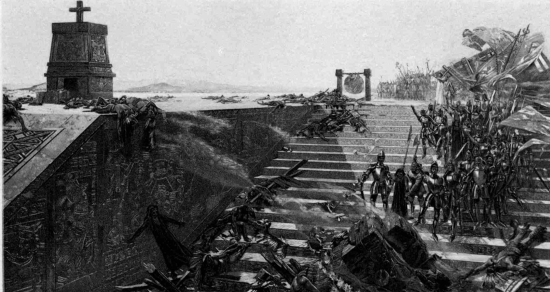
Cortés, having cleared a way for the assault, sprang up the lower
stairway, followed by Alvarado, Sandoval, Ordaz, and the other gallant
cavaliers of his little band, leaving a file of arquebusiers and a
strong corps of Indian allies to hold the enemy in check at the foot of
the monument. On the first landing, as well as on the several galleries
above, and on the summit, the Aztec warriors were drawn up to dispute
his passage. From their elevated position they showered down volleys of
lighter missiles, together with heavy stones, beams, and burning
rafters, which, thundering along the stairway, overturned the ascending
Spaniards and carried desolation through their ranks. The more
fortunate, eluding or springing over these obstacles, succeeded in
gaining the first terrace; where, throwing themselves on their enemies,
they compelled them, after a short resistance, to fall back. The
assailants pressed on, effectually supported by a brisk fire of the
musketeers from below, which so much galled the Mexicans in their
exposed situation that they were glad to take shelter on the broad
summit of the teocalli.
Cortés and his comrades were close upon their rear, and the two parties
soon found themselves face to face on this aerial battle-field, engaged
in mortal combat in presence of the whole city, as well as of the troops
in the court-yard, who paused, as if by mutual consent, from their own
hostilities, gazing in silent expectation on the issue of those above.
The area, though somewhat smaller than the base of the teocalli, was
large enough to afford a fair field of fight for a thousand combatants.
It was paved with broad, flat stones. No impediment occurred over its
surface, except the huge sacrificial block, and the temples of stone
which rose to the height of forty feet, at the farther extremity of the
arena. One of these had been consecrated to the Cross. The other was
still occupied by the Mexican war-god. The Christian and the Aztec
contended for their religions under the very shadow of their respective
shrines; while the Indian priests, running to and fro, with their hair
wildly streaming over their sable mantles, seemed hovering in mid-air,
like so many demons of darkness urging on the work of slaughter!
The parties closed with the desperate fury of men who had no hope but in
victory. Quarter was neither asked nor given; and to fly was impossible.
The edge of the area was unprotected by parapet or battlement. The least
slip would be fatal; and the combatants, as they struggled in mortal
agony, were sometimes seen to roll over the sheer
THE STORMING OF THE GREAT TEMPLE
Goupil & Cº. Paris
sides of the precipice together.[127] Cortés himself is said to have had
a narrow escape from this dreadful fate. Two warriors, of strong,
muscular frames, seized on him, and were dragging him violently towards
the brink of the pyramid. Aware of their intention, he struggled with
all his force, and, before they could accomplish their purpose,
succeeded in tearing himself from their grasp and hurling one of them
over the walls with his own arm! The story is not improbable in itself,
for Cortés was a man of uncommon agility and strength. It has been often
repeated; but not by contemporary history.[128]
The battle lasted with unintermitting fury for three hours. The number
of the enemy was double that of the Christians; and it seemed as if it
were a contest which must be determined by numbers and brute force,
rather than by superior science. But it was not so. The invulnerable
armor of the Spaniard, his sword of matchless temper, and his skill in
the use of it, gave him advantages which far outweighed the odds of
physical strength and numbers. After doing all that the courage of
despair could enable men to do, resistance grew fainter and fainter on
the side of the Aztecs. One after another they had fallen. Two or three
priests only survived, to be led away in triumph by the victors. Every
other combatant was stretched a corpse on the bloody arena, or had been
hurled from the giddy heights. Yet the loss of the Spaniards was not
inconsiderable. It amounted to forty-five of their best men; and nearly
all the remainder were more or less injured in the desperate
conflict.[129]
The victorious cavaliers now rushed towards the sanctuaries. The lower
story was of stone; the two upper were of wood. Penetrating into their
recesses, they had the mortification to find the image of the Virgin and
the Cross removed.[130] But in the other edifice they still beheld the
grim figure of Huitzilopochtli, with his censer of smoking hearts, and
the walls of his oratory reeking with gore,—not improbably of their own
countrymen! With shouts of triumph the Christians tore the uncouth
monster from his niche, and tumbled him, in the presence of the
horror-struck Aztecs, down the steps of the teocalli.{*} They then set
fire to the accursed building. The flames speedily ran up the slender
towers, sending forth an ominous light over city, lake, and valley, to
the remotest hut among the mountains. It was the funeral pyre of
paganism, and proclaimed the fall of that sanguinary religion which had
so long hung like a dark cloud over the fair regions of Anahuac![131]
{*} [Sir Arthur Helps speaks, rather oddly, of Cortés having set fire to
this image. Neither Cortés himself nor Bernal Diaz mentions any such
attempt to burn what is described as a “huge block of basalt, covered
with sculptured figures.”—K.]
Having accomplished this good work, the Spaniards descended the winding
slopes of the teocalli with more free and buoyant step, as if
conscious that the blessing of Heaven now rested on their arms. They
passed through the dusky files of Indian warriors in the court-yard, too
much dismayed by the appalling scenes they had witnessed to offer
resistance, and reached their own quarters in safety. That very night
they followed up the blow by a sortie on the sleeping town, and burned
three hundred houses, the horrors of conflagration being made still more
impressive by occurring at the hour when the Aztecs, from their own
system of warfare, were least prepared for them.[132]
Hoping to find the temper of the natives somewhat subdued by these
reverses, Cortés now determined, with his usual policy, to make them a
vantage-ground for proposing terms of accommodation. He accordingly
invited the enemy to a parley, and, as the principal chiefs, attended by
their followers, assembled in the great square, he mounted the turret
before occupied by Montezuma, and made signs that he would address them.
Marina, as usual, took her place by his side, as his interpreter. The
multitude gazed with earnest curiosity on the Indian girl, whose
influence with the Spaniards was well known, and whose connection with
the general, in particular, had led the Aztecs to designate him by her
Mexican name of Malinche.[133] Cortés, speaking through the soft,
musical tones of his mistress, told his audience they must now be
convinced that they had nothing further to hope from opposition to the
Spaniards. They had seen their gods trampled in the dust, their altars
broken, their dwellings burned, their warriors falling on all sides.
“All this,” continued he, “you have brought on yourselves by your
rebellion. Yet, for the affection the sovereign whom you have so
unworthily treated still bears you, I would willingly stay my hand, if
you will lay down your arms and return once more to your obedience. But,
if you do not,” he concluded, “I will make your city a heap of ruins,
and leave not a soul alive to mourn over it!”
But the Spanish commander did not yet comprehend the character of the
Aztecs, if he thought to intimidate them by menaces. Calm in their
exterior, and slow to move, they were the more difficult to pacify when
roused; and now that they had been stirred to their inmost depths, it
was no human voice that could still the tempest. It may be, however,
that Cortés did not so much misconceive the character of the people. He
may have felt that an authoritative tone was the only one he could
assume with any chance of effect in his present position, in which
milder and more conciliatory language would, by intimating a
consciousness of inferiority, have too certainly defeated its own
object.
It was true, they answered, he had destroyed their temples, broken in
pieces their gods, massacred their countrymen. Many more, doubtless,
were yet to fall under their terrible swords. But they were content so
long as for every thousand Mexicans they could shed the blood of a
single white man![134] “Look out,” they continued, “on our terraces and
streets; see them still thronged with warriors as far as your eyes can
reach. Our numbers are scarcely diminished by our losses. Yours, on the
contrary, are lessening every hour. You are perishing from hunger and
sickness. Your provisions and water are failing. You must soon fall into
our hands. The bridges are broken down, and you cannot escape!”[135]
There will be too few of you left to glut the vengeance of our gods!” As
they concluded, they sent a volley of arrows over the battlements, which
compelled the Spaniards to descend and take refuge in their defences.
The fierce and indomitable spirit of the Aztecs filled the besieged with
dismay. All, then, that they had done and suffered, their battles by
day, their vigils by night, the perils they had braved, even the
victories they had won, were of no avail. It was too evident that they
had no longer the spring of ancient superstition to work upon in the
breasts of the natives, who, like some wild beast that has burst the
bonds of his keeper, seemed now to swell and exult in the full
consciousness of their strength. The annunciation respecting the bridges
fell like a knell on the ears of the Christians. All that they had heard
was too true; and they gazed on one another with looks of anxiety and
dismay.
The same consequences followed which sometimes take place among the crew
of a shipwrecked vessel. Subordination was lost in the dreadful sense of
danger. A spirit of mutiny broke out, especially among the recent levies
drawn from the army of Narvaez. They had come into the country from no
motive of ambition, but attracted simply by the glowing reports of its
opulence, and they had fondly hoped to return in a few months with their
pockets well lined with the gold of the Aztec monarch. But how different
had been their lot! From the first hour of their landing, they had
experienced only trouble and disaster, privations of every description,
sufferings unexampled, and they now beheld in perspective a fate yet
more appalling. Bitterly did they lament the hour when they left the
sunny fields of Cuba for these cannibal regions! And heartily did they
curse their own folly in listening to the call of Velasquez, and still
more in embarking under the banner of Cortés![136]
They now demanded, with noisy vehemence, to be led instantly from the
city, and refused to serve longer in defence of a place where they were
cooped up like sheep in the shambles, waiting only to be dragged to
slaughter. In all this they were rebuked by the more orderly,
soldier-like conduct of the veterans of Cortés. These latter had shared
with their general the day of his prosperity, and they were not disposed
to desert him in the tempest. It was, indeed, obvious, on a little
reflection, that the only chance of safety, in the existing crisis,
rested on subordination and union, and that even this chance must be
greatly diminished under any other leader than their present one.
Thus pressed by enemies without and by factions within, that leader was
found, as usual, true to himself. Circumstances so appalling as would
have paralyzed a common mind only stimulated his to higher action and
drew forth all its resources. He combined, what is most rare, singular
coolness and constancy of purpose with a spirit of enterprise that might
well be called romantic. His presence of mind did not now desert him. He
calmly surveyed his condition and weighed the difficulties which
surrounded him, before coming to a decision. Independently of the hazard
of a retreat in the face of a watchful and desperate foe, it was a deep
mortification to surrender up the city where he had so long lorded it as
a master; to abandon the rich treasures which he had secured to himself
and his followers; to forego the very means by which he had hoped to
propitiate the favor of his sovereign and secure an amnesty for his
irregular proceedings. This, he well knew, must, after all, be dependent
on success. To fly now was to acknowledge himself further removed from
the conquest than ever. What a close was this to a career so
auspiciously begun! What a contrast to his magnificent vaunts! What a
triumph would it afford to his enemies! The governor of Cuba would be
amply revenged.
But, if such humiliating reflections crowded on his mind, the
alternative of remaining, in his present crippled condition, seemed yet
more desperate.[137] With his men daily diminishing in strength and
numbers, their provisions reduced so low that a small daily ration of
bread was all the sustenance afforded to the soldier under his
extraordinary fatigues,[138] with the breaches every day widening in his
feeble fortifications, with his ammunition, in fine, nearly expended, it
would be impossible to maintain the place much longer—and none but men
of iron constitutions and tempers, like the Spaniards, could have held
it so long—against the enemy. The chief embarrassment was as to the
time and manner in which it would be expedient to evacuate the city. The
best route seemed to be that of Tlacopan (Tacuba). For the causeway, the
most dangerous part of the road, was but two miles long in that
direction, and would, therefore, place the fugitives, much sooner than
either of the other great avenues, on terra firma. Before his final
departure, however, Cortés proposed to make another sally, in order to
reconnoitre the ground, and, at the same time, divert the enemy’s
attention from his real purpose by a show of active operations.
For some days his workmen had been employed in constructing a military
machine of his own invention. It was called a manta, and was contrived
somewhat on the principle of the mantelets used in the wars of the
Middle Ages. It was, however, more complicated, consisting of a tower
made of light beams and planks, having two chambers, one over the other.
These were to be filled with musketeers, and the sides were provided
with loop-holes through which a fire could be kept up on the enemy. The
great advantage proposed by this contrivance was to afford a defence to
the troops against the missiles hurled from the terraces. These
machines, three of which were made, rested on rollers, and were provided
with strong ropes, by which they were to be dragged along the streets by
the Tlascalan auxiliaries.[139]
The Mexicans gazed with astonishment on this warlike machinery, and, as
the rolling fortresses advanced, belching forth fire and smoke from
their entrails, the enemy, incapable of making an impression on those
within, fell back in dismay. By bringing the mantas under the walls of
the houses, the Spaniards were enabled to fire with effect on the
mischievous tenants of the azoteas, and, when this did not silence
them, by letting a ladder, or light draw-bridge, fall on the roof from
the top of the manta, they opened a passage to the terrace, and closed
with the combatants hand to hand. They could not, however, thus approach
the higher buildings, from which the Indian warriors threw down such
heavy masses of stone and timber as dislodged the planks that covered
the machines, or, thundering against their sides, shook the frail
edifices to their foundations, threatening all within with
indiscriminate ruin. Indeed, the success of the experiment was doubtful,
when the intervention of a canal put a stop to their further progress.
The Spaniards now found the assertion of their enemies too well
confirmed. The bridge which traversed the opening had been demolished;
and, although the canals which intersected the city were, in general, of
no great width or depth, the removal of the bridges not only impeded the
movements of the general’s clumsy machines, but effectually disconcerted
those of his cavalry. Resolving to abandon the mantas, he gave orders
to fill up the chasm with stone, timber, and other rubbish drawn from
the ruined buildings, and to make a new passageway for the army. While
this labor was going on, the Aztec slingers and archers on the other
side of the opening kept up a galling discharge on the Christians, the
more defenceless from the nature of their occupation. When the work was
completed, and a safe passage secured, the Spanish cavaliers rode
briskly against the enemy, who, unable to resist the shock of the
steel-clad column, fell back with precipitation to where another canal
afforded a similar strong position for defence.[140]
There were no less than seven of these canals intersecting the great
street of Tlacopan,[141] and at every one the same scene was renewed,
the Mexicans making a gallant stand and inflicting some loss, at each,
on their persevering antagonists. These operations consumed two days,
when, after incredible toil, the Spanish general had the satisfaction to
find the line of communication completely re-established through the
whole length of the avenue, and the principal bridges placed under
strong detachments of infantry. At this juncture, when he had driven the
foe before him to the farthest extremity of the street, where it touches
on the causeway, he was informed that the Mexicans, disheartened by
their reverses, desired to open a parley with him respecting the terms
of an accommodation, and that their chiefs awaited his return for that
purpose at the fortress. Overjoyed at the intelligence, he instantly
rode back, attended by Alvarado, Sandoval, and about sixty of the
cavaliers, to his quarters.
The Mexicans proposed that he should release the two priests captured in
the temple, who might be the bearers of his terms and serve as agents
for conducting the negotiations. They were accordingly sent with the
requisite instructions to their countrymen. But they did not return. The
whole was an artifice of the enemy, anxious to procure the liberation of
their religious leaders, one of whom was their teoteuctli, or
high-priest, whose presence was indispensable in the probable event of a
new coronation.
Cortés, meanwhile, relying on the prospects of a speedy arrangement, was
hastily taking some refreshment with his officers, after the fatigues of
the day, when he received the alarming tidings that the enemy were in
arms again, with more fury than ever; that they had overpowered the
detachments posted under Alvarado at three of the bridges and were
busily occupied in demolishing them. Stung with shame at the facility
with which he had been duped by his wily foe, or rather by his own
sanguine hopes, Cortés threw himself into the saddle, and followed by
his brave companions, galloped back at full speed to the scene of
action. The Mexicans recoiled before the impetuous charge of the
Spaniards. The bridges were again restored; and Cortés and his chivalry
rode down the whole extent of the great street, driving the enemy like
frightened deer, at the points of their lances. But, before he could
return on his steps, he had the mortification to find that the
indefatigable foe, gathering from the adjoining lanes and streets, had
again closed on his infantry, who, worn down by fatigue, were unable to
maintain their position at one of the principal bridges. New swarms of
warriors now poured in on all sides, overwhelming the little band of
Christian cavaliers with a storm of stones, darts, and arrows, which
rattled like hail on their armor and on that of their well-barbed
horses. Most of the missiles, indeed, glanced harmless from the good
panoplies of steel, or thick quilted cotton, but, now and then, one
better aimed penetrated the joints of the harness and stretched the
rider on the ground.
The confusion became greater around the broken bridge. Some of the
horsemen were thrown into the canal, and their steeds floundered wildly
about without a rider. Cortés himself, at this crisis, did more than any
other to cover the retreat of his followers. While the bridge was
repairing, he plunged boldly into the midst of the barbarians, striking
down an enemy at every vault of his charger, cheering on his own men,
and spreading terror through the ranks of his opponents by the
well-known sound of his battle-cry. Never did he display greater
hardihood, or more freely expose his person, emulating, says an old
chronicler, the feats of the Roman Cocles.[142] In this way he stayed
the tide of assailants till the last man had crossed the bridge, when,
some of the planks having given way, he was compelled to leap a chasm of
full six feet in width, amidst a cloud of missiles, before he could
place himself in safety.[143] A report ran through the army that the
general was slain. It soon spread through the city, to the great joy of
the Mexicans, and reached the fortress, where the besieged were thrown
into no less consternation. But, happily for them, it was false. He,
indeed, received two severe contusions on the knee, but in other
respects remained uninjured. At no time, however, had he been in such
extreme danger; and his escape, and that of his companions, were
esteemed little less than a miracle. More than one grave historian
refers the preservation of the Spaniards to the watchful care of their
patron Apostle, St. James, who, in these desperate conflicts, was beheld
careering on his milk-white steed at the head of the Christian
squadrons, with his sword flashing lightning, while a lady robed in
white—supposed to be the Virgin—was distinctly seen by his side,
throwing dust in the eyes of the infidel! The fact is attested both by
Spaniards and Mexicans,—by the latter after their conversion to
Christianity. Surely, never was there a time when the interposition of
their tutelar saint was more strongly demanded.[144]
The coming of night dispersed the Indian battalions, which, vanishing
like birds of ill omen from the field, left the well-contested pass in
possession of the Spaniards. They returned, however, with none of the
joyous feelings of conquerors to their citadel, but with slow step and
dispirited, with weapons hacked, armor battered, and fainting under the
loss of blood, fasting, and fatigue. In this condition they had yet to
learn the tidings of a fresh misfortune in the death of Montezuma.[145]
The Indian monarch had rapidly declined, since he had received his
injury, sinking, however, quite as much under the anguish of a wounded
spirit as under disease. He continued in the same moody state of
insensibility as that already described; holding little communication
with those around him, deaf to consolation, obstinately rejecting all
medical remedies as well as nourishment. Perceiving his end approach,
some of the cavaliers present in the fortress, whom the kindness of his
manners had personally attached to him, were anxious to save the soul of
the dying prince from the sad doom of those who perish in the darkness
of unbelief. They accordingly waited on him, with Father Olmedo at their
head, and in the most earnest manner implored him to open his eyes to
the error of his creed, and consent to be baptized. But
Montezuma—whatever may have been suggested to the contrary—seems never
to have faltered in his hereditary faith, or to have contemplated
becoming an apostate; for surely he merits that name in its most odious
application, who, whether Christian or pagan, renounces his religion
without conviction of its falsehood.[146] Indeed, it was a too implicit
reliance on its oracles which had led him to give such easy confidence
to the Spaniards. His intercourse with them had, doubtless, not
sharpened his desire to embrace their communion; and the calamities of
his country he might consider as sent by his gods to punish him for his
hospitality to those who had desecrated and destroyed their
shrines.[147]
When Father Olmedo, therefore, kneeling at his side, with the uplifted
crucifix, affectionately besought him to embrace the sign of man’s
redemption, he coldly repulsed the priest, exclaiming, “I have but a few
moments to live, and will not at this hour desert the faith of my
fathers.”[148] One thing, however, seemed to press heavily on
Montezuma’s mind. This was the fate of his children, especially of three
daughters, whom he had by his two wives; for there were certain rites of
marriage which distinguished the lawful wife from the concubine. Calling
Cortés to his bedside, he earnestly commended these children to his
care, as “the most precious jewels that he could leave him.” He besought
the general to interest his master, the emperor, in their behalf, and to
see that they should not be left destitute, but be allowed some portion
of their rightful inheritance. “Your lord will do this,” he concluded,
“if it were only for the friendly offices I have rendered the Spaniards,
and for the love I have shown them,—though it has brought me to this
condition! But for this I bear them no ill will.”[149] Such, according
to Cortés himself, were the words of the dying monarch. Not long after,
on the 30th of June, 1520,[150] he expired in the arms of some of his
own nobles, who still remained faithful in their attendance on his
person. “Thus,” exclaims a native historian, one of his enemies, a
Tlascalan, “thus died the unfortunate Montezuma, who had swayed the
sceptre with such consummate policy and wisdom, and who was held in
greater reverence and awe than any other prince of his lineage, or any,
indeed, that ever sat on a throne in this Western World. With him may be
said to have terminated the royal line of the Aztecs, and the glory to
have passed away from the empire, which under him had reached the zenith
of its prosperity.”[151] “The tidings of his death,” says the old
Castilian chronicler, Diaz, “were received with real grief by every
cavalier and soldier in the army who had had access to his person; for
we all loved him as a father,—and no wonder, seeing how good he
was.”[152] This simple but emphatic testimony to his desert, at such a
time, is in itself the best refutation of the suspicions occasionally
entertained of his fidelity to the Christians.[153]
It is not easy to depict the portrait of Montezuma in its true colors,
since it has been exhibited to us under two aspects, of the most
opposite and contradictory character. In the accounts gathered of him by
the Spaniards on coming into the country, he was uniformly represented
as bold and warlike, unscrupulous as to the means of gratifying his
ambition, hollow and perfidious, the terror of his foes, with a haughty
bearing which made him feared even by his own people. They found him, on
the contrary, not merely affable and gracious, but disposed to waive all
the advantages of his own position, and to place them on a footing with
himself; making their wishes his law; gentle even to effeminacy in his
deportment, and constant in his friendship while his whole nation was in
arms against them. Yet these traits, so contradictory, were truly enough
drawn. They are to be explained by the extraordinary circumstances of
his position.
When Montezuma ascended the throne, he was scarcely twenty-three years
of age. Young, and ambitious of extending his empire, he was continually
engaged in war, and is said to have been present himself in nine pitched
battles.[154] He was greatly renowned for his martial prowess, for he
belonged to the Quachictin, the highest military order of his nation,
and one into which but few even of its sovereigns had been
admitted.[155] In later life, he preferred intrigue to violence, as more
consonant to his character and priestly education. In this he was as
great an adept as any prince of his time, and, by arts not very
honorable to himself, succeeded in filching away much of the territory
of his royal kinsman of Tezcuco. Severe in the administration of
justice, he made important reforms in the arrangement of the tribunals.
He introduced other innovations in the royal household, creating new
officers, introducing a lavish magnificence and forms of courtly
etiquette unknown to his ruder predecessors. He was, in short, most
attentive to all that concerned the exterior and pomp of royalty.[156]
Stately and decorous, he was careful of his own dignity, and might be
said to be as great an “actor of majesty” among the barbarian potentates
of the New World as Louis the Fourteenth was among the polished princes
of Europe.
He was deeply tinctured, moreover, with that spirit of bigotry which
threw such a shade over the latter days of the French monarch. He
received the Spaniards as the beings predicted by his oracles. The
anxious dread with which he had evaded their proffered visit was founded
on the same feelings which led him so blindly to resign himself to them
on their approach. He felt himself rebuked by their superior genius. He
at once conceded all that they demanded,—his treasures, his power, even
his person. For their sake, he forsook his wonted occupations, his
pleasures, his most familiar habits. He might be said to forego his
nature, and, as his subjects asserted, to change his sex and become a
woman. If we cannot refuse our contempt for the pusillanimity of the
Aztec monarch, it should be mitigated by the consideration that this
pusillanimity sprung from his superstition, and that superstition in the
savage is the substitute for religious principle in the civilized man.
It is not easy to contemplate the fate of Montezuma without feelings of
the strongest compassion;—to see him thus borne along the tide of
events beyond his power to avert or control; to see him, like some
stately tree, the pride of his own Indian forests, towering aloft in the
pomp and majesty of its branches, by its very eminence a mark for the
thunderbolt, the first victim of the tempest which was to sweep over its
native hills! When the wise king of Tezcuco addressed his royal relative
at his coronation, he exclaimed, “Happy the empire which is now in the
meridian of its prosperity, for the sceptre is given to one whom the
Almighty has in his keeping; and the nations shall hold him in
reverence!”[157] Alas! the subject of this auspicious invocation lived
to see his empire melt away like the winter’s wreath; to see a strange
race drop, as it were, from the clouds on his land; to find himself a
prisoner in the palace of his fathers, the companion of those who were
the enemies of his gods and his people; to be insulted, reviled, trodden
in the dust, by the meanest of his subjects, by those who, a few months
previous, had trembled at his glance; drawing his last breath in the
halls of the stranger,—a lonely outcast in the heart of his own
capital! He was the sad victim of destiny,—a destiny as dark and
irresistible in its march as that which broods over the mythic legends
of antiquity![158]
Montezuma, at the time of his death, was about forty-one years old, of
which he reigned eighteen. His person and manners have been already
described. He left a numerous progeny by his various wives, most of
whom, having lost their consideration after the Conquest, fell into
obscurity, as they mingled with the mass of the Indian population.[159]
Two of them, however, a son and a daughter, who embraced Christianity,
became the founders of noble houses in Spain.[160] The government,
willing to show its gratitude for the large extent of empire derived
from their ancestor, conferred on them ample estates and important
hereditary honors; and the counts of Montezuma and Tula, intermarrying
with the best blood of Castile, intimated by their names and titles
their illustrious descent from the royal dynasty of Mexico.[161]
Montezuma’s death was a misfortune to the Spaniards. While he lived,
they had a precious pledge in their hands, which, in extremity, they
might possibly have turned to account. Now the last link was snapped
which connected them with the natives of the country. But, independently
of interested feelings, Cortés and his officers were much affected by
his death, from personal considerations, and, when they gazed on the
cold remains of the ill-starred monarch, they may have felt a natural
compunction, as they contrasted his late flourishing condition with that
to which his friendship for them had reduced him.
The Spanish commander showed all respect for his memory. His body,
arrayed in its royal robes, was laid decently on a bier, and borne on
the shoulders of his nobles to his subjects in the city. What honors, if
any, indeed, were paid to his remains, is uncertain. A sound of wailing,
distinctly heard in the western quarters of the capital, was interpreted
by the Spaniards into the moans of a funeral procession, as it bore the
body to be laid among those of his ancestors, under the princely shades
of Chapoltepec.[162] Others state that it was removed to a burial-place
in the city named Copalco, and there burned with the usual solemnities
and signs of lamentation by his chiefs, but not without some unworthy
insults from the Mexican populace.[163] Whatever be the fact, the
people, occupied with the stirring scenes in which they were engaged,
were probably not long mindful of the monarch who had taken no share in
their late patriotic movements. Nor is it strange that the very memory
of his sepulchre should be effaced in the terrible catastrophe which
afterwards overwhelmed the capital and swept away every landmark from
its surface.
COUNCIL OF WAR—SPANIARDS EVACUATE THE CITY—NOCHE TRISTE, OR “THE
MELANCHOLY NIGHT”—TERRIBLE SLAUGHTER—HALT FOR THE NIGHT—AMOUNT
OF LOSSES
1520
THERE was no longer any question as to the expediency of evacuating the
capital. The only doubt was as to the time of doing so, and the route.
The Spanish commander called a council of officers to deliberate on
these matters. It was his purpose to retreat on Tlascala, and in that
capital to decide, according to circumstances, on his future operations.
After some discussion, they agreed on the causeway of Tlacopan as the
avenue by which to leave the city. It would, indeed, take them back by a
circuitous route, considerably longer than either of those by which they
had approached the capital. But, for that reason, it would be less
likely to be guarded, as least suspected; and the causeway itself, being
shorter than either of the other entrances, would sooner place the army
in comparative security on the main land.
There was some difference of opinion in respect to the hour of
departure. The daytime, it was argued by some, would be preferable,
since it would enable them to see the nature and extent of their danger
and to provide against it. Darkness would be much more likely to
embarrass their own movements than those of the enemy, who were familiar
with the ground. A thousand impediments would occur in the night, which
might prevent their acting in concert, or obeying, or even ascertaining,
the orders of the commander. But, on the other hand, it was urged that
the night presented many obvious advantages in dealing with a foe who
rarely carried hostilities beyond the day. The late active operations of
the Spaniards had thrown the Mexicans off their guard, and it was
improbable they would anticipate so speedy a departure of their enemies.
With celerity and caution they might succeed, therefore, in making their
escape from the town, possibly over the causeway, before their retreat
should be discovered; and, could they once get beyond that pass of
peril, they felt little apprehension for the rest.
These views were fortified, it is said, by the counsels of a soldier
named Botello, who professed the mysterious science of judicial
astrology. He had gained credit with the army by some predictions which
had been verified by the events; those lucky hits which make chance pass
for calculation with the credulous multitude.[164] This man recommended
to his countrymen by all means to evacuate the place in the night, as
the hour most propitious to them, although he should perish in it. The
event proved the astrologer better acquainted with his own horoscope
than with that of others.[165]
It is possible Botello’s predictions had some weight in determining the
opinion of Cortés. Superstition was the feature of the age, and the
Spanish general, as we have seen, had a full measure of its bigotry.
Seasons of gloom, moreover, dispose the mind to a ready acquiescence in
the marvellous. It is, however, quite as probable that he made use of
the astrologer’s opinion, finding it coincided with his own, to
influence that of his men and inspire them with higher confidence. At
all events, it was decided to abandon the city that very night.
The general’s first care was to provide for the safe transportation of
the treasure. Many of the common soldiers had converted their share of
the prize, as we have seen, into gold chains, collars, or other
ornaments, which they easily carried about their persons. But the royal
fifth, together with that of Cortés himself, and much of the rich booty
of the principal cavaliers, had been converted into bars and wedges of
solid gold, and deposited in one of the strong apartments of the palace.
Cortés delivered the share belonging to the crown to the royal officers,
assigning them one of the strongest horses, and a guard of Castilian
soldiers, to transport it.[166] Still, much of the treasure, belonging
both to the crown and to individuals, was necessarily abandoned, from
the want of adequate means of conveyance. The metal lay scattered in
shining heaps along the floor, exciting the cupidity of the soldiers.
“Take what you will of it,” said Cortés to his men. “Better you should
have it, than these Mexican hounds.[167] But be careful not to overload
yourselves. He travels safest in the dark night who travels lightest.”
His own more wary followers took heed to his counsel, helping themselves
to a few articles of least bulk, though it might be, of greatest
value.[168] But the troops of Narvaez, pining for riches of which they
had heard so much and hitherto seen so little, showed no such
discretion. To them it seemed as if the very mines of Mexico were
turned up before them, and, rushing on the treacherous spoil, they
greedily loaded themselves with as much of it, not merely as they could
accommodate about their persons, but as they could stow away in wallets,
boxes, or any other means of conveyance at their disposal.[169]
Cortés next arranged the order of march. The van, composed of two
hundred Spanish foot, he placed under the command of the valiant Gonzalo
de Sandoval, supported by Diego de Ordaz, Francisco de Lujo, and about
twenty other cavaliers. The rear-guard, constituting the strength of the
infantry, was intrusted to Pedro de Alvarado and Velasquez de Leon. The
general himself took charge of the “battle,” or centre, in which went
the baggage, some of the heavy guns, most of which, however, remained in
the rear, the treasure, and the prisoners. These consisted of a son and
two daughters of Montezuma, Cacama, the deposed lord of Tezcuco, and
several other nobles, whom Cortés retained as important pledges in his
future negotiations with the enemy. The Tlascalans were distributed
pretty equally among the three divisions; and Cortés had under his
immediate command a hundred picked soldiers, his own veterans most
attached to his service, who, with Cristóval de Olid, Francisco de
Morla, Alonso de Avila, and two or three other cavaliers, formed a
select corps, to act wherever occasion might require.
The general had already superintended the construction of a portable
bridge to be laid over the open canals in the causeway. This was given
in charge to an officer named Magarino, with forty soldiers under his
orders, all pledged to defend the passage to the last extremity. The
bridge was to be taken up when the entire army had crossed one of the
breaches, and transported to the next. There were three of these
openings in the causeway, and most fortunate would it have been for the
expedition if the foresight of the commander had provided the same
number of bridges. But the labor would have been great, and time was
short.[170]
At midnight the troops were under arms, in readiness for the march. Mass
was performed by Father Olmedo, who invoked the protection of the
Almighty through the awful perils of the night. The gates were thrown
open, and on the first of July, 1520, the Spaniards for the last time
sallied forth from the walls of the ancient fortress, the scene of so
much suffering and such indomitable courage.[171]
The night was cloudy, and a drizzling rain, which fell without
intermission, added to the obscurity. The great square before the palace
was deserted, as, indeed, it had been since the fall of Montezuma.
Steadily, and as noiselessly as possible, the Spaniards held their way
along the great street of Tlacopan, which so lately had resounded with
the tumult of battle. All was now hushed in silence; and they were only
reminded of the past by the occasional presence of some solitary corpse,
or a dark heap of the slain, which too plainly told where the strife had
been hottest. As they passed along the lanes and alleys which opened
into the great street, or looked down the canals, whose polished surface
gleamed with a sort of ebon lustre through the obscurity of night, they
easily fancied that they discerned the shadowy forms of their foe
lurking in ambush and ready to spring on them. But it was only fancy;
and the city slept undisturbed even by the prolonged echoes of the tramp
of the horses and the hoarse rumbling of the artillery and
baggage-trains. At length, a lighter space beyond the dusky line of
buildings showed the van of the army that it was emerging on the open
causeway. They might well have congratulated themselves on having thus
escaped the dangers of an assault in the city itself, and that a brief
time would place them in comparative safety on the opposite shore. But
the Mexicans were not all asleep.
As the Spaniards drew near the spot where the street opened on the
causeway, and were preparing to lay the portable bridge across the
uncovered breach, which now met their eyes, several Indian sentinels,
who had been stationed at this, as at the other approaches to the city,
took the alarm, and fled, rousing their countrymen by their cries. The
priests, keeping their night-watch on the summit of the teocallis,
instantly caught the tidings and sounded their shells, while the huge
drum in the desolate temple of the war-god sent forth those solemn
tones, which, heard only in seasons of calamity, vibrated through every
corner of the capital. The Spaniards saw that no time was to be lost.
The bridge was brought forward and fitted with all possible expedition.
Sandoval was the first to try its strength, and, riding across, was
followed by his little body of chivalry, his infantry, and Tlascalan
allies, who formed the first division of the army. Then came Cortés and
his squadrons, with the baggage, ammunition-wagons, and a part of the
artillery. But before they had time to defile across the narrow passage,
a gathering sound was heard, like that of a mighty forest agitated by
the winds. It grew louder and louder, while on the dark waters of the
lake was heard a plashing noise, as of many oars. Then came a few stones
and arrows striking at random among the hurrying troops. They fell every
moment faster and more furious, till they thickened into a terrible
tempest, while the very heavens were rent with the yells and war-cries
of myriads of combatants, who seemed all at once to be swarming over
land and lake!
The Spaniards pushed steadily on through this arrowy sleet, though the
barbarians, dashing their canoes against the sides of the causeway,
clambered up and broke in upon their ranks. But the Christians, anxious
only to make their escape, declined all combat except for
self-preservation. The cavaliers, spurring forward their steeds, shook
off their assailants and rode over their prostrate bodies, while the men
on foot with their good swords or the butts of their pieces drove them
headlong again down the sides of the dike.
But the advance of several thousand men, marching, probably, on a front
of not more than fifteen or twenty abreast, necessarily required much
time, and the leading files had already reached the second breach in the
causeway before those in the rear had entirely traversed the first.[172]
Here they halted, as they had no means of effecting a passage, smarting
all the while under unintermitting volleys from the enemy, who were
clustered thick on the waters around this second opening. Sorely
distressed, the van-guard sent repeated messages to the rear to demand
the portable bridge. At length the last of the army had crossed, and
Magarino and his sturdy followers endeavored to raise the ponderous
framework. But it stuck fast in the sides of the dike. In vain they
strained every nerve. The weight of so many men and horses, and above
all of the heavy artillery, had wedged the timbers so firmly in the
stones and earth that it was beyond their power to dislodge them. Still
they labored amidst a torrent of missiles, until, many of them slain,
and all wounded, they were obliged to abandon the attempt.
The tidings soon spread from man to man, and no sooner was their
dreadful import comprehended than a cry of despair arose, which for a
moment drowned all the noise of conflict. All means of retreat were cut
off. Scarcely hope was left. The only hope was in such desperate
exertions as each could make for himself. Order and subordination were
at an end. Intense danger produced intense selfishness. Each thought
only of his own life. Pressing forward, he trampled down the weak and
the wounded, heedless whether it were friend or foe. The leading files,
urged on by the rear, were crowded on the brink of the gulf. Sandoval,
Ordaz, and the other cavaliers dashed into the water. Some succeeded in
swimming their horses across. Others failed, and some, who reached the
opposite bank, being overturned in the ascent, rolled headlong with
their steeds into the lake. The infantry followed pellmell, heaped
promiscuously on one another, frequently pierced by the shafts or struck
down by the war-clubs of the Aztecs; while many an unfortunate victim
was dragged half stunned on board their canoes, to be reserved for a
protracted but more dreadful death.[173]
The carnage raged fearfully along the length of the causeway. Its
shadowy bulk presented a mark of sufficient distinctness for the enemy’s
missiles, which often prostrated their own countrymen in the blind fury
of the tempest. Those nearest the dike, running their canoes alongside,
with a force that shattered them to pieces, leaped on the land, and
grappled with the Christians, until both came rolling down the side of
the causeway together. But the Aztec fell among his friends, while his
antagonist was borne away in triumph to the sacrifice. The struggle was
long and deadly. The Mexicans were recognized by their white cotton
tunics, which showed faint through the darkness. Above the combatants
rose a wild and discordant clamor, in which horrid shouts of vengeance
were mingled with groans of agony, with invocations of the saints and
the blessed Virgin, and with the screams of women;[174] for there were
several women, both natives and Spaniards, who had accompanied the
Christian camp. Among these, one named María de Estrada is particularly
noticed for the courage she displayed, battling with broadsword and
target like the stanchest of the warriors.[175]
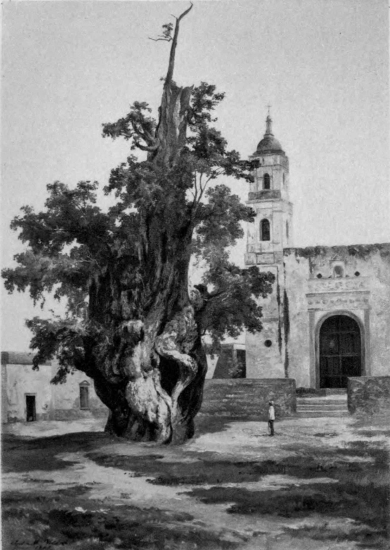
THE NOCHE TRISTE
Goupil & Cº., Paris
The opening in the causeway, meanwhile, was filled up with the wreck of
matter which had been forced into it, ammunition-wagons, heavy guns,
bales of rich stuffs scattered over the waters, chests of solid ingots,
and bodies of men and horses, till over this dismal ruin a passage was
gradually formed, by which those in the rear were enabled to clamber to
the other side.[176] Cortés, it is said, found a place that was
fordable, where, halting, with the water up to his saddle-girths, he
endeavored to check the confusion, and lead his followers by a safer
path to the opposite bank. But his voice was lost in the wild uproar,
and finally, hurrying on with the tide, he pressed forward with a few
trusty cavaliers, who remained near his person, to the van; but not
before he had seen his favorite page, Juan de Salazar, struck down, a
corpse, by his side. Here he found Sandoval and his companions, halting
before the third and last breach, endeavoring to cheer on their
followers to surmount it. But their resolution faltered. It was wide and
deep; though the passage was not so closely beset by the enemy as the
preceding ones. The cavaliers again set the example by plunging into the
water. Horse and foot followed as they could, some swimming, others with
dying grasp clinging to the manes and tails of the struggling animals.
Those fared best, as the general had predicted, who travelled lightest;
and many were the unfortunate wretches who, weighed down by the fatal
gold which they loved so well, were buried with it in the salt floods of
the lake.[177] Cortes, with his gallant comrades, Olid, Morla, Sandoval,
and some few others, still kept in the advance, leading his broken
remnant off the fatal causeway. The din of battle lessened in the
distance; when the rumor reached them that the rear-guard would be
wholly overwhelmed without speedy relief. It seemed almost an act of
desperation; but the generous hearts of the Spanish cavaliers did not
stop to calculate danger when the cry for succor reached them. Turning
their horses’ bridles, they galloped back to the theatre of action,
worked their way through the press, swam the canal, and placed
themselves in the thick of the mêlée on the opposite bank.[178]
The first gray of the morning was now coming over the waters. It showed
the hideous confusion of the scene which had been shrouded in the
obscurity of night. The dark masses of combatants, stretching along the
dike, were seen struggling for mastery, until the very causeway on which
they stood appeared to tremble, and reel to and fro, as if shaken by an
earthquake; while the bosom of the lake, as far as the eye could reach,
was darkened by canoes crowded with warriors, whose spears and
bludgeons, armed with blades of “volcanic glass,” gleamed in the morning
light.
The cavaliers found Alvarado unhorsed, and defending himself with a poor
handful of followers against an overwhelming tide of the enemy. His good
steed, which had borne him through many a hard fight, had fallen under
him.[179] He was himself wounded in several places, and was striving in
vain to rally his scattered column, which was driven to the verge of the
canal by the fury of the enemy, then in possession of the whole rear of
the causeway, where they were reinforced every hour by fresh combatants
from the city. The artillery in the earlier part of the engagement had
not been idle, and its iron shower, sweeping along the dike, had mowed
down the assailants by hundreds. But nothing could resist their
impetuosity. The front ranks, pushed on by those behind, were at length
forced up to the pieces, and, pouring over them like a torrent,
overthrew men and guns in one general ruin. The resolute charge of the
Spanish cavaliers, who had now arrived, created a temporary check, and
gave time for their countrymen to make a feeble rally. But they were
speedily borne down by the returning flood. Cortés and his companions
were compelled to plunge again into the lake,—though all did not
escape. Alvarado stood on the brink for a moment, hesitating what to
do. Unhorsed as he was, to throw himself into the water, in the face of
the hostile canoes that now swarmed around the opening, afforded but a
desperate chance of safety. He had but a second for thought. He was a
man of powerful frame, and despair gave him unnatural energy. Setting
his long lance firmly on the wreck which strewed the bottom of the lake,
he sprung forward with all his might, and cleared the wide gap at a
leap! Aztecs and Tlascalans gazed in stupid amazement, exclaiming, as
they beheld the incredible feat, “This is truly the Tonatiuh,—the
child of the Sun!”[180] The breadth of the opening is not given. But it
was so great that the valorous captain Diaz, who well remembered the
place, says the leap was impossible to any man.[181] Other
contemporaries, however, do not discredit the story.[182] It was,
beyond doubt, matter of popular belief at the time; it is to this day
familiarly known to every inhabitant of the capital; and the name of the
Salto de Alvarado, “Alvarado’s Leap,” given to the spot, still
commemorates an exploit which rivalled those of the demi-gods of Grecian
fable.[183]
Cortés and his companions now rode forward to the front, where the
troops, in a loose, disorderly manner, were marching off the fatal
causeway. A few only of the enemy hung on their rear, or annoyed them by
occasional flights of arrows from the lake. The attention of the Aztecs
was diverted by the rich spoil that strewed the battle-ground;
fortunately for the Spaniards, who, had their enemy pursued with the
same ferocity with which he had fought, would, in their crippled
condition, have been cut off, probably, to a man. But little molested,
therefore, they were allowed to defile through the adjacent village, or
suburbs, it might be called, of Popotla.[184]
The Spanish commander there dismounted from his jaded steed, and,
sitting down on the steps of an Indian temple, gazed mournfully on the
broken files as they passed before him. What a spectacle did they
present! The cavalry, most of them dismounted, were mingled with the
infantry, who dragged their feeble limbs along with difficulty; their
shattered mail and tattered garments dripping with the salt ooze,
showing through their rents many a bruise and ghastly wound; their
bright arms soiled, their proud crests and banners gone, the baggage,
artillery, all, in short, that constitutes the pride and panoply of
glorious war, forever lost. Cortés, as he looked wistfully on their
thin and disordered ranks, sought in vain for many a familiar face, and
missed more than one dear companion who had stood side by side with him
through all the perils of the Conquest. Though accustomed to control his
emotions, or, at least, to conceal them, the sight was too much for him.
He covered his face with his hands, and the tears, which trickled down,
revealed too plainly the anguish of his soul.[185]
He found some consolation, however, in the sight of several of the
cavaliers on whom he most relied. Alvarado, Sandoval, Olid, Ordaz,
Avila, were yet safe. He had the inexpressible satisfaction, also, of
learning the safety of the Indian interpreter, Marina, so dear to him,
and so important to the army. She had been committed, with a daughter of
a Tlascalan chief, to several of that nation. She was fortunately placed
in the van, and the faithful escort had carried her securely through all
the dangers of the night. Aguilar, the other interpreter, had also
escaped. And it was with no less satisfaction that Cortés learned the
safety of the ship-builder, Martin Lopez.[186] The general’s solicitude
for the fate of this man, so indispensable, as he proved, to the success
of his subsequent operations, showed that, amidst all his affliction,
his indomitable spirit was looking forward to the hour of vengeance.
Meanwhile, the advancing column had reached the neighboring city of
Tlacopan (Tacuba), once the capital of an independent principality.
There it halted in the great street, as if bewildered and altogether
uncertain what course to take; like a herd of panic-struck deer, who,
flying from the hunters, with the cry of hound and horn still ringing in
their ears, look wildly around for some glen or copse in which to plunge
for concealment. Cortés, who had hastily mounted and rode on to the
front again, saw the danger of remaining in a populous place, where the
inhabitants might sorely annoy the troops from the azoteas, with
little risk to themselves. Pushing forward, therefore, he soon led them
into the country. There he endeavored to reform his disorganized
battalions and bring them to something like order.[187]
Hard by, at no great distance on the left, rose an eminence, looking
towards a chain of mountains which fences in the Valley on the west. It
was called the Hill of Otoncalpolco, and sometimes the Hill of
Montezuma.[188] It was crowned with an Indian teocalli, with its large
outworks of stone covering an ample space, and by its strong position,
which commanded the neighboring plain, promised a good place of refuge
for the exhausted troops. But the men, disheartened and stupefied by
their late reverses, seemed for the moment incapable of further
exertion; and the place was held by a body of armed Indians. Cortés saw
the necessity of dislodging them if he would save the remains of his
army from entire destruction. The event showed he still held a control
over their wills stronger than circumstances themselves. Cheering them
on, and supported by his gallant cavaliers, he succeeded in infusing
into the most sluggish something of his own intrepid temper, and led
them up the ascent in face of the enemy. But the latter made slight
resistance, and, after a few feeble volleys of missiles which did little
injury, left the ground to the assailants.
It was covered by a building of considerable size, and furnished ample
accommodations for the diminished numbers of the Spaniards. They found
there some provisions; and more, it is said, were brought to them, in
the course of the day, from some friendly Otomi villages in the
neighborhood. There was, also, a quantity of fuel in the courts,
destined to the uses of the temple. With this they made fires to dry
their drenched garments, and busily employed themselves in dressing one
another’s wounds, stiff and extremely painful from exposure and long
exertion. Thus refreshed, the weary soldiers threw themselves down on
the floor and courts of the temple, and soon found the temporary
oblivion which Nature seldom denies even in the greatest extremity of
suffering.[189]
There was one eye in that assembly, however, which we may well believe
did not so speedily close. For what agitating thoughts must have crowded
on the mind of their commander, as he beheld his poor remnant of
followers thus huddled together in this miserable bivouac! And this was
all that survived of the brilliant array with which but a few weeks
since he had entered the capital of Mexico! Where now were his dreams of
conquest and empire? And what was he but a luckless adventurer, at whom
the finger of scorn would be uplifted as a madman? Whichever way he
turned, the horizon was almost equally gloomy, with scarcely one light
spot to cheer him. He had still a weary journey before him, through
perilous and unknown paths, with guides of whose fidelity he could not
be assured. And how could he rely on his reception at Tlascala, the
place of his destination,—the land of his ancient enemies, where,
formerly as a foe, and now as a friend, he had brought desolation to
every family within its borders?
Yet these agitating and gloomy reflections, which might have crushed a
common mind, had no power over that of Cortés; or, rather, they only
served to renew his energies and quicken his perceptions, as the war of
the elements purifies and gives elasticity to the atmosphere. He looked
with an unblenching eye on his past reverses; but, confident in his own
resources, he saw a light through the gloom which others could not. Even
in the shattered relics which lay around him, resembling in their
haggard aspect and wild attire a horde of famished outlaws, he discerned
the materials out of which to reconstruct his ruined fortunes. In the
very hour of discomfiture and general despondency, there is no doubt
that his heroic spirit was meditating the plan of operations which he
afterwards pursued with such dauntless constancy.
The loss sustained by the Spaniards on this fatal night, like every
other event in the history of the Conquest, is reported with the
greatest discrepancy. If we believe Cortés’ own letter, it did not
exceed one hundred and fifty Spaniards and two thousand Indians. But the
general’s bulletins, while they do full justice to the difficulties to
be overcome and the importance of the results, are less scrupulous in
stating the extent either of his means or of his losses. Thoan Cano, one
of the cavaliers present, estimates the slain at eleven hundred and
seventy Spaniards and eight thousand allies. But this is a greater
number than we have allowed for the whole army. Perhaps we may come
nearest the truth by taking the computation of Gomara, who was the
chaplain of Cortés, and who had free access, doubtless, not only to the
general’s papers, but to other authentic sources of information.
According to him, the number of Christians killed and missing was four
hundred and fifty, and that of natives four thousand. This, with the
loss sustained in the conflicts of the previous week, may have reduced
the former to something more than a third, and the latter to a fourth,
or perhaps fifth, of the original force with which they entered the
capital.[190] The brunt of the action fell on the rear-guard, few of
whom escaped. It was formed chiefly of the soldiers of Narvaez, who fell
the victims, in some measure, of their cupidity.[191] Forty-six of the
cavalry were cut off, which with previous losses reduced the number in
this branch of the service to twenty-three, and some of these in very
poor condition. The greater part of the treasure, the baggage, the
general’s papers, including his accounts, and a minute diary of
transactions since leaving Cuba,—which, to posterity at least, would
have been of more worth than the gold,—had been swallowed up by the
waters.[192] The ammunition, the beautiful little train of artillery
with which Cortés had entered the city, were all gone. Not a musket even
remained, the men having thrown them away, eager to disencumber
themselves of all that might retard their escape on that disastrous
night. Nothing, in short, of their military apparatus was left, but
their swords, their crippled cavalry, and a few damaged cross-bows, to
assert the superiority of the European over the barbarian.
The prisoners, including, as already noticed, the children of Montezuma
and the cacique of Tezcuco, all perished by the hands of their ignorant
countrymen, it is said, in the indiscriminate fury of the assault. There
were, also, some persons of consideration among the Spaniards whose
names were inscribed on the same bloody roll of slaughter. Such was
Francisco de Morla, who fell by the side of Cortés on returning with him
to the rescue. But the greatest loss was that of Juan Velasquez de Leon,
who, with Alvarado, had command of the rear. It was the post of danger
on that night, and he fell, bravely defending it, at an early part of
the retreat. He was an excellent officer, possessed of many knightly
qualities, though somewhat haughty in his bearing, being one of the
best-connected cavaliers in the army. The near relation of the governor
of Cuba, he looked coldly, at first, on the pretensions of Cortés; but,
whether from a conviction that the latter had been wronged, or from
personal preference, he afterwards attached himself zealously to his
leader’s interests. The general requited this with a generous
confidence, assigning him, as we have seen, a separate and independent
command, where misconduct, or even a mistake, would have been fatal to
the expedition. Velasquez proved himself worthy of the trust; and there
was no cavalier in the army, with the exception, perhaps, of Sandoval
and Alvarado, whose loss would have been so deeply deplored by the
commander. Such were the disastrous results of this terrible passage of
the causeway; more disastrous than those occasioned by any other reverse
which has stained the Spanish arms in the New World; and which have
branded the night on which it happened, in the national annals, with the
name of the noche triste, “the sad or melancholy night.”[193]
RETREAT OF THE SPANIARDS—DISTRESSES OF THE ARMY—PYRAMIDS OF
TEOTIHUACAN—GREAT BATTLE OF OTUMBA
1520
THE Mexicans, during the day which followed the retreat of the
Spaniards, remained, for the most part, quiet in their own capital,
where they found occupation in cleansing the streets and causeways from
the dead, which lay festering in heaps that might have bred a
pestilence. They may have been employed, also, in paying the last honors
to such of their warriors as had fallen, solemnizing the funeral rites
by the sacrifice of their wretched prisoners, who, as they contemplated
their own destiny, may well have envied the fate of their companions who
left their bones on the battle-field. It was most fortunate for the
Spaniards, in their extremity, that they had this breathing-time allowed
them by the enemy. But Cortés knew that he could not calculate on its
continuance, and, feeling how important it was to get the start of his
vigilant foe, he ordered his troops to be in readiness to resume their
march by midnight. Fires were left burning, the better to deceive the
enemy; and at the appointed hour the little army, without sound of drum
or trumpet, but with renewed spirits, sallied forth from the gates of
the teocalli, within whose hospitable walls they had found such
seasonable succor. The place is now indicated by a Christian church,
dedicated to the Virgin, under the title of Nuestra Señora de los
Remedios, whose miraculous image—the very same, it is said, brought
over by the followers of Cortés[194]—still extends her beneficent sway
over the neighboring capital; and the traveller who pauses within the
precincts of the consecrated fane may feel that he is standing on the
spot made memorable by the refuge it afforded to the Conquerors in the
hour of their deepest despondency.[195]
It was arranged that the sick and wounded should occupy the centre,
transported on litters, or on the backs of the tamanes, while those
who were strong enough to keep their seats should mount behind the
cavalry. The able-bodied soldiers were ordered to the front and rear,
while others protected the flanks, thus affording all the security
possible to the invalids.
The retreating army held on its way unmolested under cover of the
darkness. But, as morning dawned, they beheld parties of the natives
moving over the heights, or hanging at a distance, like a cloud of
locusts, on their rear. They did not belong to the capital, but were
gathered from the neighboring country, where the tidings of their rout
had already penetrated. The charm which had hitherto covered the white
men was gone. The dread Teules were no longer invincible.[196]
The Spaniards, under the conduct of their Tlascalan guides, took a
circuitous route to the north, passing through Quauhtitlan, and round
lake Tzompanco (Zumpango), thus lengthening their march, but keeping at
a distance from the capital. From the eminences, as they passed along,
the Indians rolled down heavy stones, mingled with volleys of darts and
arrows, on the heads of the soldiers. Some were even bold enough to
descend into the plain and assault the extremities of the column. But
they were soon beaten off by the horse, and compelled to take refuge
among the hills, where the ground was too rough for the rider to follow.
Indeed, the Spaniards did not care to do so, their object being rather
to fly than to fight.
In this way they slowly advanced, halting at intervals to drive off
their assailants when they became too importunate, and greatly
distressed by their missiles and their desultory attacks. At night, the
troops usually found shelter in some town or hamlet, whence the
inhabitants, in anticipation of their approach, had been careful to
carry off all the provisions. The Spaniards were soon reduced to the
greatest straits for subsistence. Their principal food was the wild
cherry, which grew in the woods or by the roadside. Fortunate were they
if they found a few ears of corn unplucked. More frequently nothing was
left but the stalks; and with them, and the like unwholesome fare, they
were fain to supply the cravings of appetite. When a horse happened to
be killed, it furnished an extraordinary banquet; and Cortés himself
records the fact of his having made one of a party who thus sumptuously
regaled themselves, devouring the animal even to his hide.[197]
The wretched soldiers, faint with famine and fatigue, were sometimes
seen to drop down lifeless on the road. Others loitered behind, unable
to keep up with the march, and fell into the hands of the enemy, who
followed in the track of the army like a flock of famished vultures,
eager to pounce on the dying and the dead. Others, again, who strayed
too far, in their eagerness to procure sustenance, shared the same fate.
The number of these, at length, and the consciousness of the cruel lot
for which they were reserved, compelled Cortés to introduce stricter
discipline, and to enforce it by sterner punishments than he had
hitherto done,—though too often ineffectually, such was the
indifference to danger, under the overwhelming pressure of present
calamity.
In their prolonged distresses, the soldiers ceased to set a value on
those very things for which they had once been content to hazard life
itself. More than one who had brought his golden treasure safe through
the perils of the noche triste now abandoned it as an intolerable
burden; and the rude Indian peasant gleaned up, with wondering delight,
the bright fragments of the spoils of the capital.[198]
Through these weary days Cortés displayed his usual serenity and
fortitude. He was ever in the post of danger, freely exposing himself in
encounters with the enemy; in one of which he received a severe wound in
the head that afterwards gave him much trouble.[199] He fared no better
than the humblest soldier, and strove, by his own cheerful countenance
and counsels, to fortify the courage of those who faltered, assuring
them that their sufferings would soon be ended by their arrival in the
hospitable “land of bread.”[200] His faithful officers co-operated with
him in these efforts; and the common file, indeed, especially his own
veterans, must be allowed, for the most part, to have shown a full
measure of the constancy and power of endurance so characteristic of
their nation,—justifying the honest boast of an old chronicler, “that
there was no people so capable of supporting hunger as the Spaniards,
and none of them who were ever more severely tried than the soldiers of
Cortés.”[201] A similar fortitude was shown by the Tlascalans, trained
in a rough school that made them familiar with hardship and privations.
Although they sometimes threw themselves on the ground, in the extremity
of famine, imploring their gods not to abandon them, they did their duty
as warriors, and, far from manifesting coldness towards the Spaniards as
the cause of their distresses, seemed only the more firmly knit to them
by the sense of a common suffering.
On the seventh morning, the army had reached the mountain rampart which
overlooks the plains of Otompan, or Otumba, as commonly called, from the
Indian city—now a village—situated in them. The distance from the
capital is hardly nine leagues. But the Spaniards had travelled more
than thrice that distance, in their circuitous march round the lakes.
This had been performed so slowly that it consumed a week, two nights
of which had been passed in the same quarters, from the absolute
necessity of rest. It was not, therefore, till the seventh of July that
they reached the heights commanding the plains which stretched far away
towards the territory of Tlascala, in full view of the venerable
pyramids of Teotihuacan, two of the most remarkable monuments of the
antique American civilization now existing north of the Isthmus. During
all the preceding day they had seen parties of the enemy hovering like
dark clouds above the highlands, brandishing their weapons, and calling
out, in vindictive tones, “Hasten on! You will soon find yourselves
where you cannot escape!” words of mysterious import, which they were
made fully to comprehend on the following morning.[202]
The monuments of San Juan Teotihuacan are, with the exception of the
temple of Cholula, the most ancient remains, probably, on the Mexican
soil. They were found by the Aztecs, according to their traditions, on
their entrance into the country, when Teotihuacan, the habitation of
the gods, now a paltry village, was a flourishing city, the rival of
Tula, the great Toltec capital.[203] The two principal pyramids were
dedicated to Tonatiuh, the Sun, and Meztli, the Moon. The former,
which is considerably the larger, is found by recent measurements to be
six hundred and eighty-two feet long at the base, and one hundred and
eighty feet high, dimensions not inferior to those of some of the
kindred monuments of Egypt.[204] They were divided into four stories, of
which three are now discernible, while the vestiges of the intermediate
gradations are nearly effaced. In fact, time has dealt so roughly with
them, and the materials have been so much displaced by the treacherous
vegetation of the tropics, muffling up with its flowery mantle the ruin
which it causes, that it is not easy to discern at once the pyramidal
form of the structures.[205] The huge masses bear such resemblance to
the North American mounds that some have fancied them to be only natural
eminences shaped by the hand of man into a regular form, and ornamented
with the temples and terraces the wreck of which still covers their
slopes. But others, seeing no example of a similar elevation in the wide
plain in which they stand, infer, with more probability, that they are
wholly of an artificial construction.[206]
The interior is composed of clay mixed with pebbles, incrusted on the
surface with the light porous stone, tetzontli, so abundant in the
neighboring quarries. Over this was a thick coating of stucco,
resembling, in its reddish color, that found in the ruins of Palenque.
According to tradition, the pyramids are hollow; but hitherto the
attempt to discover the cavity in that dedicated to the Sun has been
unsuccessful. In the smaller mound an aperture has been found on the
southern side, at two-thirds of the elevation. It is formed by a narrow
gallery, which, after penetrating to the distance of several yards,
terminates in two pits or wells. The largest of these is about fifteen
feet deep,[207] and the sides are faced with unbaked bricks; but to what
purpose it was devoted, nothing is left to show. It may have been to
hold the ashes of some powerful chief, like the solitary apartment
discovered in the great Egyptian pyramid. That these monuments were
dedicated to religious uses, there is no doubt; and it would be only
conformable to the practice of antiquity in the Eastern continent that
they should have served for tombs as well as temples.[208]
Distinct traces of the latter destination are said to be visible on the
summit of the smaller pyramid, consisting of the remains of stone walls
showing a building of considerable size and strength.[209] There are no
remains on the top of the pyramid of the Sun. But the traveller who will
take the trouble to ascend its bald summit will be amply compensated by
the glorious view it will open to him;—towards the southeast, the hills
of Tlascala, surrounded by their green plantations and cultivated
corn-fields, in the midst of which stands the little village, once the
proud capital of the republic. Somewhat farther to the south, the eye
passes across the beautiful plains lying around the city of Puebla de
los Angeles, founded by the old Spaniards, and still rivalling, in the
splendor of its churches, the most brilliant capitals of Europe; and far
in the west he may behold the Valley of Mexico, spread out like a map,
with its diminished lakes, its princely capital rising in still greater
glory from its ruins, and its rugged hills gathering darkly around it,
as in the days of Montezuma.
The summit of this larger mound is said to have been crowned by a
temple, in which was a colossal statue of its presiding deity, the Sun,
made of one entire block of stone, and facing the east. Its breast was
protected by a plate of burnished gold and silver, on which the first
rays of the rising luminary rested.[210] An antiquary, in the early
part of the last century, speaks of having seen some fragments of the
statue. It was still standing, according to report, on the invasion of
the Spaniards, and was demolished by the indefatigable Bishop Zumárraga,
whose hand fell more heavily than that of Time itself on the Aztec
monuments.[211]
Around the principal pyramids are a great number of smaller ones, rarely
exceeding thirty feet in height, which, according to tradition, were
dedicated to the stars and served as sepulchres for the great men of the
nation. They are arranged symmetrically in avenues terminating at the
sides of the great pyramids, which face the cardinal points. The plain
on which they stand was called Micoatl, or “Path of the Dead.” The
laborer, as he turns up the ground, still finds there numerous
arrow-heads, and blades of obsidian, attesting the warlike character of
its primitive population.[212]
What thoughts must crowd on the mind of the traveller as he wanders
amidst these memorials of the past; as he treads over the ashes of the
generations who reared these colossal fabrics, which take us from the
present into the very depths of time! But who were their builders? Was
it the shadowy Olmecs, whose history, like that of the ancient Titans,
is lost in the mists of fable? or, as commonly reported, the peaceful
and industrious Toltecs, of whom all that we can glean rests on
traditions hardly more secure? What has become of the races who built
them? Did they remain on the soil, and mingle and become incorporated
with the fierce Aztecs who succeeded them? Or did they pass on to the
South, and find a wider field for the expansion of their civilization,
as shown by the higher character of the architectural remains in the
distant regions of Central America and Yucatan? It is all a
mystery,—over which time has thrown an impenetrable veil, that no
mortal hand may raise. A nation has passed away,—powerful, populous,
and well advanced in refinement, as attested by their monuments,—but it
has perished without a name. It has died and made no sign!
Such speculations, however, do not seem to have disturbed the minds of
the Conquerors, who have not left a single line respecting these
time-honored structures, though they passed in full view of
them,—perhaps under their very shadows. In the sufferings of the
present they had little leisure to bestow on the past. Indeed, the new
and perilous position in which at this very spot they found themselves
must naturally have excluded every other thought from their bosoms but
that of self-preservation.
As the army was climbing the mountain steeps which shut in the Valley of
Otompan, the vedettes came in with the intelligence that a powerful body
was encamped on the other side, apparently awaiting their approach. The
intelligence was soon confirmed by their own eyes as they turned the
crest of the sierra, and saw spread out, below, a mighty host, filling
up the whole depth of the valley, and giving to it the appearance, from
the white cotton mail of the warriors, of being covered with snow.[213]
It consisted of levies from the surrounding country, and especially the
populous territory of Tezcuco, drawn together at the instance of
Cuitlahua, Montezuma’s successor, and now concentrated on this point to
dispute the passage of the Spaniards. Every chief of note had taken the
field with his whole array gathered under his standard, proudly
displaying all the pomp and rude splendor of his military equipment. As
far as the eye could reach, were to be seen shields and waving banners,
fantastic helmets, forests of shining spears, the bright feather-mail of
the chief, and the coarse cotton panoply of his follower, all mingled
together in wild confusion and tossing to and fro like the billows of a
troubled ocean.[214] It was a sight to fill the stoutest heart among the
Christians with dismay, heightened by the previous expectation of soon
reaching the friendly land which was to terminate their wearisome
pilgrimage. Even Cortés, as he contrasted the tremendous array before
him with his own diminished squadrons, wasted by disease and enfeebled
by hunger and fatigue, could not escape the conviction that his last
hour had arrived.[215]
But his was not the heart to despond; and he gathered strength from the
very extremity of his situation. He had no room for hesitation; for
there was no alternative left to him. To escape was impossible. He could
not retreat on the capital, from which he had been expelled. He must
advance,—cut through the enemy, or perish. He hastily made his
dispositions for the fight. He gave his force as broad a front as
possible, protecting it on each flank by his little body of horse, now
reduced to twenty. Fortunately, he had not allowed the invalids, for the
last two days, to mount behind the riders, from a desire to spare the
horses, so that these were now in tolerable condition; and, indeed, the
whole army had been refreshed by halting, as we have seen, two nights
and a day in the same place, a delay, however, which had allowed the
enemy time to assemble in such force to dispute its progress.
Cortés instructed his cavaliers not to part with their lances, and to
direct them at the face. The infantry were to thrust, not strike, with
their swords; passing them at once through the bodies of their enemies.
They were, above all, to aim at the leaders, as the general well knew
how much depends on the life of the commander in the wars of barbarians,
whose want of subordination makes them impatient of any control but that
to which they are accustomed.
He then addressed to his troops a few words of encouragement, as
customary with him on the eve of an engagement. He reminded them of the
victories they had won with odds nearly as
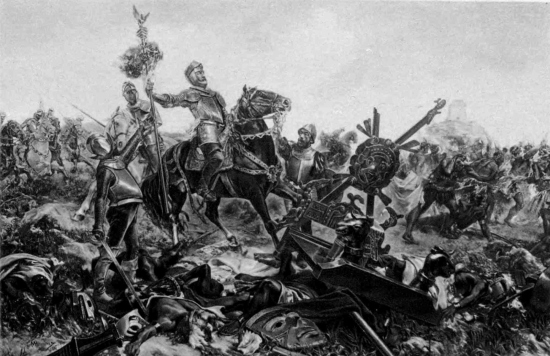
THE GREAT BATTLE OF OTUMBA
Goupil & Cº., Paris
discouraging as the present; thus establishing the superiority of
science and discipline over numbers. Numbers, indeed, were of no
account, where the arm of the Almighty was on their side. And he bade
them have full confidence that He who had carried them safely through so
many perils would not now abandon them and his own good cause to perish
by the hand of the infidel. His address was brief, for he read in their
looks that settled resolve which rendered words unnecessary. The
circumstances of their position spoke more forcibly to the heart of
every soldier than any eloquence could have done, filling it with that
feeling of desperation which makes the weak arm strong and turns the
coward into a hero. After they had earnestly commended themselves,
therefore, to the protection of God, the Virgin, and St. James, Cortés
led his battalions straight against the enemy.[216]
It was a solemn moment, that in which the devoted little band, with
steadfast countenances and their usual intrepid step, descended on the
plain, to be swallowed up, as it were, in the vast ocean of their
enemies. The latter rushed on with impetuosity to meet them, making the
mountains ring to their discordant yells and battle-cries, and sending
forth volleys of stones and arrows which for a moment shut out the light
of day. But, when the leading files of the two armies closed, the
superiority of the Christians was felt, as their antagonists, falling
back before the charges of cavalry, were thrown into confusion by their
own numbers who pressed on them from behind. The Spanish infantry
followed up the blow, and a wide lane was opened in the ranks of the
enemy, who, receding on all sides, seemed willing to allow a free
passage for their opponents. But it was to return on them with
accumulated force, as rallying they poured upon the Christians,
enveloping the little army on all sides, which, with its bristling array
of long swords and javelins, stood firm,—in the words of a
contemporary,—like an islet against which the breakers, roaring and
surging, spend their fury in vain.[217] The struggle was desperate of
man against man. The Tlascalan seemed to renew his strength, as he
fought almost in view of his own native hills, as did the Spaniard, with
the horrible doom of the captive before his eyes. Well did the cavaliers
do their duty on that day; charging, in little bodies of four or five
abreast, deep into the enemy’s ranks, riding over the broken files, and
by this temporary advantage giving strength and courage to the infantry.
Not a lance was there which did not reek with the blood of the infidel.
Among the rest, the young captain Sandoval is particularly commemorated
for his daring prowess. Managing his fiery steed with easy horsemanship,
he darted, when least expected, into the thickest of the mêlée,
overturning the stanchest warriors, and rejoicing in danger, as if it
were his natural element.[218]
But these gallant displays of heroism served only to ingulf the
Spaniards deeper and deeper in the mass of the enemy, with scarcely any
more chance of cutting their way through his dense and interminable
battalions than of hewing a passage with their swords through the
mountains. Many of the Tlascalans and some of the Spaniards had fallen,
and not one but had been wounded. Cortés himself had received a second
cut on the head, and his horse was so much injured that he was compelled
to dismount, and take one from the baggage train, a strong-boned animal,
who carried him well through the turmoil of the day.[219] The contest
had now lasted several hours. The sun rode high in the heavens, and shed
an intolerable fervor over the plain. The Christians, weakened by
previous sufferings, and faint with loss of blood, began to relax in
their desperate exertions. Their enemies, constantly supported by fresh
relays from the rear, were still in good heart, and, quick to perceive
their advantage, pressed with redoubled force on the Spaniards. The
horse fell back, crowded on the foot; and the latter, in vain seeking a
passage amidst the dusky throngs of the enemy, who now closed up the
rear, were thrown into some disorder. The tide of battle was setting
rapidly against the Christians. The fate of the day would soon be
decided; and all that now remained for them seemed to be to sell their
lives as dearly as possible.
At this critical moment, Cortés, whose restless eye had been roving
round the field in quest of any object that might offer him the means of
arresting the coming ruin, rising in his stirrups, descried at a
distance, in the midst of the throng, the chief who from his dress and
military cortége he knew must be the commander of the barbarian forces.
He was covered with a rich surcoat of feather-work; and a panache of
beautiful plumes, gorgeously set in gold and precious stones, floated
above his head. Rising above this, and attached to his back, between the
shoulders, was a short staff bearing a golden net for a banner,—the
singular, but customary, symbol of authority for an Aztec commander. The
cacique, whose name was Cihuaca, was borne on a litter, and a body of
young warriors, whose gay and ornamented dresses showed them to be the
flower of the Indian nobles, stood round as a guard of his person and
the sacred emblem.
The eagle eye of Cortés no sooner fell on this personage than it lighted
up with triumph. Turning quickly round to the cavaliers at his side,
among whom were Sandoval, Olid, Alvarado, and Avila, he pointed out the
chief, exclaiming, “There is our mark! Follow and support me!” Then,
crying his war-cry, and striking his iron heel into his weary steed, he
plunged headlong into the thickest of the press. His enemies fell back,
taken by surprise and daunted by the ferocity of the attack. Those who
did not were pierced through with his lance or borne down by the weight
of his charger. The cavaliers followed close in the rear. On they swept
with the fury of a thunderbolt, cleaving the solid ranks asunder,
strewing their path with the dying and the dead, and bounding over every
obstacle in their way. In a few minutes they were in the presence of the
Indian commander, and Cortés, overturning his supporters, sprang forward
with the strength of a lion, and, striking him through with his lance,
hurled him to the ground. A young cavalier, Juan de Salamanca, who had
kept close by his general’s side, quickly dismounted and despatched the
fallen chief. Then, tearing away his banner, he presented it to Cortés,
as a trophy to which he had the best claim.[220] It was all the work of
a moment. The guard, overpowered by the suddenness of the onset, made
little resistance, but, flying, communicated their own panic to their
comrades. The tidings of the loss soon spread over the field. The
Indians, filled with consternation, now thought only of escape. In their
blind terror, their numbers augmented their confusion. They trampled on
one another, fancying it was the enemy in their rear.[221]
The Spaniards and Tlascalans were not slow to avail themselves of the
marvellous change in their affairs. Their fatigue, their wounds, hunger,
thirst, all were forgotten in the eagerness for vengeance; and they
followed up the flying foe, dealing death at every stroke, and taking
ample retribution for all they had suffered in the bloody marshes of
Mexico.[222] Long did they pursue, till, the enemy having abandoned the
field, they returned, sated with slaughter, to glean the booty which he
had left. It was great, for the ground was covered with the bodies of
chiefs, at whom the Spaniards, in obedience to the general’s
instructions, had particularly aimed; and their dresses displayed all
the barbaric pomp of ornament in which the Indian warrior
delighted.[223] When his men had thus indemnified themselves, in some
degree, for their late reverses, Cortés called them again under their
banners; and, after offering up a grateful acknowledgment to the Lord of
Hosts for their miraculous preservation,[224] they renewed their march
across the now deserted valley. The sun was declining in the heavens,
but, before the shades of evening had gathered around, they reached an
Indian temple on an eminence, which afforded a strong and commodious
position for the night.
Such was the famous battle of Otompan,—or Otumba, as commonly called,
from the Spanish corruption of the name. It was fought on the eighth of
July, 1520. The whole amount of the Indian force is reckoned by
Castilian writers at two hundred thousand! that of the slain at twenty
thousand! Those who admit the first part of the estimate will find no
difficulty in receiving the last.[225] It is about as difficult to form
an accurate calculation of the numbers of a disorderly savage multitude
as of the pebbles on the beach or the scattered leaves in autumn. Yet it
was, undoubtedly, one of the most remarkable victories ever achieved in
the New World. And this, not merely on account of the disparity of the
forces, but of their unequal condition. For the Indians were in all
their strength, while the Christians were wasted by disease, famine, and
long-protracted sufferings; without cannon or fire-arms, and deficient
in the military apparatus which had so often struck terror into their
barbarian foe,—deficient even in the terrors of a victorious name. But
they had discipline on their side, desperate resolve, and implicit
confidence in their commander. That they should have triumphed against
such odds furnishes an inference of the same kind as that established by
the victories of the European over the semi-civilized hordes of Asia.
Yet even here all must not be referred to superior discipline and
tactics. For the battle would certainly have been lost had it not been
for the fortunate death of the Indian general. And, although the
selection of the victim may be called the result of calculation, yet it
was by the most precarious chance that he was thrown in the way of the
Spaniards. It is, indeed, one among many examples of the influence of
fortune in determining the fate of military operations. The star of
Cortés was in the ascendant. Had it been otherwise, not a Spaniard would
have survived that day to tell the bloody tale of the battle of Otumba.
ARRIVAL IN TLASCALA—FRIENDLY RECEPTION—DISCONTENTS OF THE
ARMY—JEALOUSY OF THE TLASCALANS—EMBASSY FROM MEXICO
1520
ON the following morning the army broke up its encampment at an early
hour. The enemy does not seem to have made an attempt to rally. Clouds
of skirmishers, however, were seen during the morning, keeping at a
respectful distance, though occasionally venturing near enough to salute
the Spaniards with a volley of missiles.
On a rising ground they discovered a fountain, a blessing not too often
met with in these arid regions, and gratefully commemorated by the
Christians for the refreshment it afforded by its cool and abundant
waters.[226] A little farther on they descried the rude works which
served as the bulwark and boundary of the Tlascalan territory. At the
sight, the allies sent up a joyous shout of congratulation, in which the
Spaniards heartily joined, as they felt they were soon to be on friendly
and hospitable ground.
But these feelings were speedily followed by others of a different
nature; and, as they drew nearer the territory, their minds were
disturbed with the most painful apprehensions as to their reception by
the people among whom they were bringing desolation and mourning, and
who might so easily, if ill disposed, take advantage of their present
crippled condition. “Thoughts like these,” says Cortés, “weighed as
heavily on my spirit as any which I ever experienced in going to battle
with the Aztecs.”[227] Still he put, as usual, a good face on the
matter, and encouraged his men to confide in their allies, whose past
conduct had afforded every ground for trusting to their fidelity in
future. He cautioned them, however, as their own strength was so much
impaired, to be most careful to give no umbrage or ground for jealousy
to their high-spirited allies. “Be but on your guard,” continued the
intrepid general, “and we have still stout hearts and strong hands to
carry us through the midst of them!”[228] With these anxious surmises,
bidding adieu to the Aztec domain, the Christian army crossed the
frontier, and once more trod the soil of the Republic.
The first place at which they halted was the town of Huejotlipan, a
place of about twelve or fifteen thousand inhabitants.[229] They were
kindly greeted by the people, who came out to receive them, inviting the
troops to their habitations, and administering all the relief of their
simple hospitality. Yet this was not so disinterested, according to some
of the Spaniards, as to prevent their expecting in requital a share of
the plunder taken in the late action.[230] Here the weary forces
remained two or three days, when, the news of their arrival having
reached the capital, not more than four or five leagues distant, the old
chief Maxixca, their efficient friend on their former visit, and
Xicotencatl, the young warrior who, it will be remembered, had commanded
the troops of his nation in their bloody encounters with the Spaniards,
came with a numerous concourse of the citizens to welcome the fugitives
to Tlascala. Maxixca, cordially embracing the Spanish commander,
testified the deepest sympathy for his misfortunes. That the white men
could so long have withstood the confederated power of the Aztecs was
proof enough of their marvellous prowess. “We have made common cause
together,” said the lord of Tlascala, “and we have common injuries to
avenge; and, come weal or come woe, be assured we will prove true and
loyal friends and stand by you to the death.”[231]
This cordial assurance and sympathy, from one who exercised a control
over the public counsels beyond any other ruler, effectually dispelled
the doubts that lingered in the mind of Cortés. He readily accepted his
invitation to continue his march at once to the capital, where he would
find so much better accommodations for his army than in a small town on
the frontier. The sick and wounded, placed in hammocks, were borne on
the shoulders of the friendly natives; and, as the troops drew near the
city, the inhabitants came flocking out in crowds to meet them, rending
the air with joyous acclamations and wild bursts of their rude Indian
minstrelsy. Amidst the general jubilee, however, were heard sounds of
wailing and sad lament, as some unhappy relative or friend, looking
earnestly into the diminished files of their countrymen, sought in vain
for some dear and familiar countenance, and, as they turned disappointed
away, gave utterance to their sorrow in tones that touched the heart of
every soldier in the army. With these mingled accompaniments of joy and
woe,—the motley web of human life,—the way-worn columns of Cortés at
length re-entered the republican capital.[232]
The general and his suite were lodged in the rude but spacious palace of
Maxixca. The rest of the army took up their quarters in the district
over which the Tlascalan lord presided. Here they continued several
weeks, until, by the attentions of the hospitable citizens, and such
medical treatment as their humble science could supply, the wounds of
the soldiers were healed, and they recovered from the debility to which
they had been reduced by their long and unparalleled sufferings. Cortés
was one of those who suffered severely. He lost the use of two of the
fingers of his left hand.[233] He had received, besides, two injuries on
the head; one of which was so much exasperated by his subsequent
fatigues and excitement of mind that it assumed an alarming appearance.
A part of the bone was obliged to be removed.[234] A fever ensued, and
for several days the hero who had braved danger and death in their most
terrible forms lay stretched on his bed, as helpless as an infant. His
excellent constitution, however, got the better of disease, and he was
at length once more enabled to resume his customary activity. The
Spaniards, with politic generosity, requited the hospitality of their
hosts by sharing with them the spoils of their recent victory, and
Cortés especially rejoiced the heart of Maxixca by presenting him with
the military trophy which he had won from the Indian commander.[235]
But while the Spaniards were thus recruiting their health and spirits
under the friendly treatment of their allies, and recovering the
confidence and tranquillity of mind which had sunk under their hard
reverses, they received tidings, from time to time, which showed that
their late disaster had not been confined to the Mexican capital. On his
descent from Mexico to encounter Narvaez, Cortés had brought with him a
quantity of gold, which he left for safe keeping at Tlascala. To this
was added a considerable sum collected by the unfortunate Velasquez de
Leon in his expedition to the coast, as well as contributions from other
sources. From the unquiet state of the capital, the general thought it
best, on his return there, still to leave the treasure under the care of
a number of invalid soldiers, who, when in marching condition, were to
rejoin him in Mexico. A party from Vera Cruz, consisting of five
horsemen and forty foot, had since arrived at Tlascala, and, taking
charge of the invalids and treasure, undertook to escort them to the
capital. He now learned that they had been intercepted on the route and
all cut off, with the entire loss of the treasure. Twelve other
soldiers, marching in the same direction, had been massacred in the
neighboring province of Tepeaca; and accounts continually arrived of
some unfortunate Castilian, who, presuming on the respect hitherto shown
to his countrymen, and ignorant of the disasters in the capital, had
fallen a victim to the fury of the enemy.[236]
These dismal tidings filled the mind of Cortés with gloomy apprehensions
for the fate of the settlement at Villa Rica,—the last stay of their
hopes. He despatched a trusty messenger, at once, to that place, and had
the inexpressible satisfaction to receive a letter in return from the
commander of the garrison, acquainting him with the safety of the colony
and its friendly relations with the neighboring Totonacs. It was the
best guarantee of the fidelity of the latter, that they had offended the
Mexicans too deeply to be forgiven.
While the affairs of Cortés wore so gloomy an aspect without, he had to
experience an annoyance scarcely less serious from the discontents of
his followers. Many of them had fancied that their late appalling
reverses would put an end to the expedition, or, at least, postpone all
thoughts of resuming it for the present. But they knew little of Cortés
who reasoned thus. Even while tossing on his bed of sickness, he was
ripening in his mind fresh schemes for retrieving his honor, and for
recovering the empire which had been lost more by another’s rashness
than his own. This was apparent, as he became convalescent, from the new
regulations he made respecting the army, as well as from the orders sent
to Vera Cruz for fresh reinforcements.
The knowledge of all this occasioned much disquietude to the disaffected
soldiers. They were, for the most part, the ancient followers of
Narvaez, on whom, as we have seen, the brunt of the war had fallen the
heaviest. Many of them possessed property in the Islands, and had
embarked on this expedition chiefly from the desire of increasing it.
But they had gathered neither gold nor glory in Mexico. Their present
service filled them only with disgust; and the few, comparatively, who
had been so fortunate as to survive, languished to return to their rich
mines and pleasant farms in Cuba, bitterly cursing the day when they had
left them.
Finding their complaints little heeded by the general, they prepared a
written remonstrance, in which they made their demand more formally.
They represented the rashness of persisting in the enterprise in his
present impoverished state, without arms or ammunition, almost without
men; and this, too, against a powerful enemy, who had been more than a
match for him with all the strength of his late resources. It was
madness to think of it. The attempt would bring them all to the
sacrifice-block. Their only course was to continue their march to Vera
Cruz. Every hour of delay might be fatal. The garrison in that place
might be overwhelmed from want of strength to defend itself; and thus
their last hope would be annihilated. But, once there, they might wait
in comparative security for such reinforcements as would join them from
abroad; while in case of failure they could the more easily make their
escape. They concluded with insisting on being permitted to return at
once to the port of Villa Rica. This petition, or rather remonstrance,
was signed by all the disaffected soldiers, and, after being formally
attested by the royal notary, was presented to Cortés.[237]
It was a trying circumstance for him. What touched him most nearly was
to find the name of his friend the secretary Duero, to whose good
offices he had chiefly owed his command, at the head of the paper. He
was not, however, to be shaken from his purpose for a moment; and, while
all outward resources seemed to be fading away, and his own friends
faltered, or failed him, he was still true to himself. He knew that to
retreat to Vera Cruz would be to abandon the enterprise. Once there, his
army would soon find a pretext and a way for breaking up and returning
to the Islands. All his ambitious schemes would be blasted. The great
prize, already once in his grasp, would then be lost forever. He would
be a ruined man.
In his celebrated letter to Charles the Fifth, he says that, in
reflecting on his position, he felt the truth of the old adage, “that
fortune favors the brave.” The Spaniards were the followers of the
Cross; and, trusting in the infinite goodness and mercy of God, he could
not believe that He would suffer them and his own good cause thus to
perish among the heathen.[238] He was resolved, therefore, not to
descend to the coast, but at all hazards to retrace his steps and beard
the enemy again in his capital.”
It was in the same resolute tone that he answered his discontented
followers.[239] He urged every argument which could touch their pride or
honor as cavaliers. He appealed to that ancient Castilian valor which
had never been known to falter before an enemy; besought them not to
discredit the great deeds which had made their name ring throughout
Europe; not to leave the emprise half achieved, for others more daring
and adventurous to finish. How could they with any honor, he asked,
desert their allies whom they had involved in the war, and leave them
unprotected to the vengeance of the Aztecs? To retreat but a single step
towards Villa Rica would be to proclaim their own weakness. It would
dishearten their friends and give confidence to their foes. He implored
them to resume the confidence in him which they had ever showed, and to
reflect that, if they had recently met with reverses, he had up to that
point accomplished all, and more than all, that he had promised. It
would be easy now to retrieve their losses, if they would have patience
and abide in this friendly land until the reinforcements, which would be
ready to come in at his call, should enable them to act on the
offensive. If, however, there were any so insensible to the motives
which touch a brave man’s heart, as to prefer ease at home to the glory
of this great achievement, he would not stand in their way. Let them go,
in God’s name. Let them leave their general in his extremity. He should
feel stronger in the service of a few brave spirits than if surrounded
by a host of the false or the faint-hearted.[240]
The disaffected party, as already noticed, was chiefly drawn from the
troops of Narvaez. When the general’s own veterans heard this
appeal,[241] their blood warmed with indignation at the thoughts of
abandoning him or the cause at such a crisis. They pledged themselves to
stand by him to the last; and the malecontents, silenced, if not
convinced, by this generous expression of sentiment from their comrades,
consented to postpone their departure for the present, under the
assurance that no obstacle would be thrown in their way when a more
favorable season should present itself.[242]
Scarcely was this difficulty adjusted, when Cortés was menaced with one
more serious, in the jealousy springing up between his soldiers and
their Indian allies. Notwithstanding the demonstrations of regard by
Maxixca and his immediate followers, there were others of the nation who
looked with an evil eye on their guests, for the calamities in which
they had involved them; and they tauntingly asked if, in addition to
this, they were now to be burdened by the presence and maintenance of
the strangers. These sallies of discontent were not so secret as
altogether to escape the ears of the Spaniards, in whom they occasioned
no little disquietude. They proceeded for the most part, it is true,
from persons of little consideration, since the four great chiefs of the
republic appear to have been steadily secured to the interests of
Cortés. But they derived some importance from the countenance of the
warlike Xicotencatl, in whose bosom still lingered the embers of that
implacable hostility which he had displayed so courageously on the field
of battle; and sparkles of this fiery temper occasionally gleamed forth
in the intimate intercourse into which he was now reluctantly brought
with his ancient opponents.
Cortés, who saw with alarm the growing feeling of estrangement which
must sap the very foundations on which he was to rest the lever for
future operations, employed every argument which suggested itself, to
restore the confidence of his own men. He reminded them of the good
services they had uniformly received from the great body of the nation.
They had a sufficient pledge of the future constancy of the Tlascalans
in their long-cherished hatred of the Aztecs, which the recent disasters
they had suffered from the same quarter could serve only to sharpen. And
he urged, with much force, that if any evil designs had been meditated
by them against the Spaniards the Tlascalans would, doubtless, have
taken advantage of their late disabled condition, and not waited till
they had recovered their strength and means of resistance.[243]
While Cortés was thus endeavoring, with somewhat doubtful success, to
stifle his own apprehensions, as well as those in the bosoms of his
followers, an event occurred which happily brought the affair to an
issue, and permanently settled the relations in which the two parties
were to stand to each other. This will make it necessary to notice some
events which had occurred in Mexico since the expulsion of the
Spaniards.
On Montezuma’s death, his brother, Cuitlahua, lord of Iztapalapan,
conformably to the usage regulating the descent of the Aztec crown, was
chosen to succeed him. He was an active prince, of large experience in
military affairs, and, by the strength of his character, was well fitted
to sustain the tottering fortunes of the monarchy. He appears, moreover,
to have been a man of liberal, and what may be called enlightened,
taste, to judge from the beautiful gardens which he had filled with rare
exotics and which so much attracted the admiration of the Spaniards in
his city of Iztapalapan. Unlike his predecessor, he held the white men
in detestation, and had, probably, the satisfaction of celebrating his
own coronation by the sacrifice of many of them. From the moment of his
release from the Spanish quarters, where he had been detained by Cortés,
he entered into the patriotic movements of his people. It was he who
conducted the assaults both in the streets of the city and on the
“Melancholy Night;” and it was at his instigation that the powerful
force had been assembled to dispute the passage of the Spaniards in the
Vale of Otumba.[244]
Since the evacuation of the capital, he had been busily occupied in
repairing the mischief it had received,—restoring the buildings and the
bridges and putting it in the best posture of defence. He had endeavored
to improve the discipline and arms of his troops. He introduced the long
spear among them, and, by attaching the sword-blades taken from the
Christians to long poles, contrived a weapon that should be formidable
against the cavalry. He summoned his vassals, far and near, to hold
themselves in readiness to march to the relief of the capital, if
necessary, and, the better to secure their good will, relieved them from
some of the burdens usually laid on them. But he was now to experience
the instability of a government which rested not on love, but on fear.
The vassals in the neighborhood of the Valley remained true to their
allegiance; but others held themselves aloof, uncertain what course to
adopt; while others, again, in the more distant provinces, refused
obedience altogether, considering this a favorable moment for throwing
off the yoke which had so long galled them.[245]
In this emergency, the government sent a deputation to its ancient
enemies the Tlascalans. It consisted of six Aztec nobles, bearing a
present of cotton cloth, salt, and other articles rarely seen, of late
years, in the republic. The lords of the state, astonished at this
unprecedented act of condescension in their ancient foe, called the
council or senate of the great chiefs together, to give the envoys
audience.
Before this body the Aztecs stated the purpose of their mission. They
invited the Tlascalans to bury all past grievances in oblivion, and to
enter into a treaty with them. All the nations of Anahuac should make
common cause in defence of their country against the white men. The
Tlascalans would bring down on their own heads the wrath of the gods, if
they longer harbored the strangers who had violated and destroyed their
temples. If they counted on the support and friendship of their guests,
let them take warning from the fate of Mexico, which had received them
kindly within its walls, and which, in return, they had filled with
blood and ashes. They conjured them, by their reverence for their common
religion, not to suffer the white men, disabled as they now were, to
escape from their hands, but to sacrifice them at once to the gods,
whose temples they had profaned. In that event, they proffered them
their alliance, and the renewal of that friendly traffic which would
restore to the republic the possession of the comforts and luxuries of
which it had been so long deprived.
The proposals of the ambassadors produced different effects on their
audience. Xicotencatl was for embracing them at once. Far better was it,
he said, to unite with their kindred, with those who held their own
language, their faith and usages, than to throw themselves into the arms
of the fierce strangers, who, however they might talk of religion,
worshipped no god but gold. This opinion was followed by that of the
younger warriors, who readily caught the fire of his enthusiasm. But the
elder chiefs, especially his blind old father, one of the four rulers of
the state, who seem to have been all heartily in the interests of the
Spaniards, and one of them, Maxixca, their stanch friend, strongly
expressed their aversion to the proposed alliance with the Aztecs. They
were always the same, said the latter,—fair in speech, and false in
heart. They now proffered friendship to the Tlascalans. But it was fear
which drove them to it, and, when that fear was removed, they would
return to their old hostility. Who was it, but these insidious foes,
that had so long deprived the country of the very necessaries of life,
of which they were now so lavish in their offers? Was it not owing to
the white men that the nation at length possessed them? Yet they were
called on to sacrifice the white men to the gods!—the warriors who,
after fighting the battles of the Tlascalans, now threw themselves on
their hospitality. But the gods abhorred perfidy. And were not their
guests the very beings whose coming had been so long predicted by the
oracles? “Let us avail ourselves of it,” he concluded, “and unite and
make common cause with them, until we have humbled our haughty enemy.”
This discourse provoked a sharp rejoinder from Xicotencatl, till the
passion of the elder chieftain got the better of his patience, and,
substituting force for argument, he thrust his younger antagonist, with
some violence, from the council-chamber. A preceding so contrary to the
usual decorum of Indian debate astonished the assembly. But, far from
bringing censure on its author, it effectually silenced opposition. Even
the hot-headed followers of Xicotencatl shrunk from supporting a leader
who had incurred such a mark of contemptuous displeasure from the ruler
whom they most venerated. His own father openly condemned him; and the
patriotic young warrior, gifted with a truer foresight into futurity
than his countrymen, was left without support in the council, as he had
formerly been on the field of battle. The proffered alliance of the
Mexicans was unanimously rejected; and the envoys, fearing that even the
sacred character with which they were invested might not protect them
from violence, made their escape secretly from the capital.[246]
The result of the conference was of the last importance to the
Spaniards, who, in their present crippled condition, especially if taken
unawares, would have been, probably, at the mercy of the Tlascalans. At
all events, the union of these latter with the Aztecs would have settled
the fate of the expedition; since, in the poverty of his own resources,
it was only by adroitly playing off one part of the Indian population
against the other that Cortés could ultimately hope for success.
WAR WITH THE SURROUNDING TRIBES—SUCCESSES OF THE SPANIARDS—DEATH
OF MAXIXCA—ARRIVAL OF REINFORCEMENTS—RETURN IN TRIUMPH TO
TLASCALA
1520
THE Spanish commander, reassured by the result of the deliberations in
the Tlascalan senate, now resolved on active operations, as the best
means of dissipating the spirit of faction and discontent inevitably
fostered by a life of idleness. He proposed to exercise his troops, at
first, against some of the neighboring tribes who had laid violent hands
on such of the Spaniards as, confiding in their friendly spirit, had
passed through their territories. Among these were the Tepeacans, a
people often engaged in hostility with the Tlascalans, and who, as
mentioned in a preceding chapter, had lately massacred twelve Spaniards
in their march to the capital. An expedition against them would receive
the ready support of his allies, and would assert the dignity of the
Spanish name, much dimmed in the estimation of the natives by the late
disasters.
The Tepeacans were a powerful tribe of the same primitive stock as the
Aztecs, to whom they acknowledged allegiance. They had transferred this
to the Spaniards, on their first march into the country, intimidated by
the bloody defeats of their Tlascalan neighbors. But, since the troubles
in the capital, they had again submitted to the Aztec sceptre. Their
capital, now a petty village, was a flourishing city at the time of the
Conquest, situated in the fruitful plains that stretch far away towards
the base of Orizaba.[247] The province contained, moreover, several
towns of considerable size, filled with a bold and warlike population.
As these Indians had once acknowledged the authority of Castile, Cortés
and his officers regarded their present conduct in the light of
rebellion, and, in a council of war, it was decided that those engaged
in the late massacre had fairly incurred the doom of slavery.[248]
Before proceeding against them, however, the general sent a summons
requiring their submission, and offering full pardon for the past, but,
in case of refusal, menacing them with the severest retribution. To this
the Indians, now in arms, returned a contemptuous answer, challenging
the Spaniards to meet them in fight, as they were in want of victims for
their sacrifices.
Cortés, without further delay, put himself at the head of his small
corps of Spaniards and a large reinforcement of Tlascalan warriors. They
were led by the younger Xicotencatl, who now appeared to bury his
recent animosity, and desirous to take a lesson in war under the chief
who had so often foiled him in the field.[249]
The Tepeacans received their enemy on their borders. A bloody battle
followed, in which the Spanish horse were somewhat embarrassed by the
tall maize that covered part of the plain. They were successful in the
end, and the Tepeacans, after holding their ground like good warriors,
were at length routed with great slaughter. A second engagement, which
took place a few days after, was followed by like decisive results; and
the victorious Spaniards with their allies, marching straightway on the
city of Tepeaca, entered it in triumph.[250] No further resistance was
attempted by the enemy, and the whole province, to avoid further
calamities, eagerly tendered its submission. Cortés, however, inflicted
the meditated chastisement on the places implicated in the massacre. The
inhabitants were branded with a hot iron as slaves, and, after the royal
fifth had been reserved, were distributed between his own men and the
allies.[251] The Spaniards were familiar with the system of
repartimientos established in the islands; but this was the first
example of slavery in New Spain.{*} It was justified, in the opinion of
the general and his military casuists, by the aggravated offences of the
party. The sentence, however, was not countenanced by the crown,[252]
which, as the colonial legislation abundantly shows, was ever at issue
with the craving and mercenary spirit of the colonist.
{*} [It may have been the first instance of natives being reduced to
slavery by the Spaniards, but female slaves at least had been given to
them on several previous occasions by the Mexican chiefs. The present
case has also no connection with the system of repartimientos, by
which, after the conquest was effected, the soil and its inhabitants
were divided among the new possessors. In the case of the Tepeacans, no
attempt was made to enslave the adult males, whose services were not
needed, and who would have brought only embarrassment to their captors.
See Bernal Diaz, Hist. de la Conquista, cap. 135.—K.]
Satisfied with this display of his vengeance, Cortés now established his
headquarters at Tepeaca, which, situated in a cultivated country,
afforded easy means for maintaining an army, while its position on the
Mexican frontier made it a good point d’appui for future operations.
The Aztec government, since it had learned the issue of its negotiations
at Tlascala, had been diligent in fortifying its frontier in that
quarter. The garrisons usually maintained there were strengthened, and
large bodies of men were marched in the same direction, with orders to
occupy the strong positions on the borders. The conduct of these troops
was in their usual style of arrogance and extortion, and greatly
disgusted the inhabitants of the country.
Among the places thus garrisoned by the Aztecs was Quauhquechollan,[253]
a city containing thirty thousand inhabitants, according to the
historians, and lying to the southwest twelve leagues or more from the
Spanish quarters. It stood at the extremity of a deep valley, resting
against a bold range of hills, or rather mountains, and flanked by two
rivers with exceedingly high and precipitous banks. The only avenue by
which the town could be easily approached was protected by a stone wall
more than twenty feet high and of great thickness.[254] Into this place,
thus strongly defended by art as well as by nature, the Aztec emperor
had thrown a garrison of several thousand warriors, while a much more
formidable force occupied the heights commanding the city.
The cacique of this strong post, impatient of the Mexican yoke, sent to
Cortés, inviting him to march to his relief, and promising a
co-operation of the citizens in an assault on the Aztec quarters. The
general eagerly embraced the proposal, and detached Cristóval de Olid,
with two hundred Spaniards and a strong body of Tlascalans, to support
the friendly cacique.[255] On the way, Olid was joined by many
volunteers from the Indian city and from the neighboring capital of
Cholula, all equally pressing their services. The number and eagerness
of these auxiliaries excited suspicions in the bosom of the cavalier.
They were strengthened by the surmises of the soldiers of Narvaez, whose
imaginations were still haunted, it seems, by the horrors of the noche
triste, and who saw in the friendly alacrity of their new allies
evidence of an insidious understanding with the Aztecs. Olid, catching
this distrust, made a countermarch on Cholula, where he seized the
suspected chiefs, who had been most forward in offering their services,
and sent them under a strong guard to Cortés.
The general, after a careful examination, was satisfied of the integrity
of the suspected parties. He, expressing his deep regret at the
treatment they had received, made them such amends as he could by
liberal presents, and, as he now saw the impropriety of committing an
affair of such importance to other hands, put himself at the head of his
remaining force and effected a junction with his officer in Cholula. He
had arranged with the cacique of the city against which he was marching,
that on the appearance of the Spaniards the inhabitants should rise on
the garrison. Everything succeeded as he had planned. No sooner had the
Christian battalions defiled on the plain before the town, than the
inhabitants attacked the garrison with the utmost fury. The latter,
abandoning the outer defences of the place, retreated to their own
quarters in the principal teocalli, where they maintained a hard
struggle with their adversaries. In the heat of it, Cortes, at the head
of his little body of horse, rode into the place, and directed the
assault in person. The Aztecs made a fierce defence. But, fresh troops
constantly arriving to support the assailants, the works were stormed,
and every one of the garrison was put to the sword.[256]
The Mexican forces, meanwhile, stationed on the neighboring eminences,
had marched down to the support of their countrymen in the town, and
formed in order of battle in the suburbs, where they were encountered by
the Tlascalan levies. “They mustered,” says Cortés, speaking of the
enemy, “at least thirty thousand men; and it was a brave sight for the
eye to look on,—such a beautiful array of warriors glistening with gold
and jewels and variegated feather-work.”[257] The action was well
contested between the two Indian armies. The suburbs were set on fire,
and, in the midst of the flames, Cortés and his squadrons, rushing on
the enemy, at length broke their array, and compelled them to fall back
in disorder into the narrow gorge of the mountain, from which they had
lately descended. The pass was rough and precipitous. Spaniards and
Tlascalans followed close in the rear, and the light troops, scaling the
high wall of the valley, poured down on the enemy’s flanks. The heat was
intense, and both parties were so much exhausted by their efforts that
it was with difficulty, says the chronicler, that the one could pursue,
or the other fly.[258] They were not too weary, however, to slay. The
Mexicans were routed with terrible slaughter. They found no pity from
their Indian foes, who had a long account of injuries to settle with
them. Some few sought refuge by flying higher up into the fastnesses of
the sierra. They were followed by their indefatigable enemy, until, on
the bald summit of the ridge, they reached the Mexican encampment. It
covered a wide tract of ground. Various utensils, ornamented dresses,
and articles of luxury, were scattered round, and the number of slaves
in attendance showed the barbaric pomp with which the nobles of Mexico
went to their campaigns.[259] It was a rich booty for the victors, who
spread over the deserted camp, and loaded themselves with the spoil,
until the gathering darkness warned them to descend.[260]
Cortés followed up the blow by assaulting the strong town of Itzocan,
held also by a Mexican garrison, and situated in the depths of a green
valley watered by artificial canals and smiling in all the rich
abundance of this fruitful region of the plateau.[261] The place, though
stoutly defended, was stormed and carried; the Aztecs were driven across
a river which ran below the town, and, although the light bridges that
traversed it were broken down in the flight, whether by design or
accident, the Spaniards, fording and swimming the stream as they could,
found their way to the opposite bank, following up the chase with the
eagerness of bloodhounds. Here, too, the booty was great; and the Indian
auxiliaries flocked by thousands to the banners of the chief who so
surely led them on to victory and plunder.[262]
Soon afterwards, Cortés returned to his headquarters at Tepeaca. Thence
he detached his officers on expeditions which were usually successful.
Sandoval, in particular, marched against a large body of the enemy lying
between the camp and Vera Cruz, defeated them in two decisive battles,
and thus restored the communications with the port.
The result of these operations was the reduction of that populous and
cultivated territory which lies between the great volcan, on the west,
and the mighty skirts of Orizaba, on the east. Many places, also, in the
neighboring province of Mixtecapan acknowledged the authority of the
Spaniards, and others from the remote region of Oaxaca sent to claim
their protection. The conduct of Cortés towards his allies had gained
him great credit for disinterestedness and equity. The Indian cities in
the adjacent territory appealed to him, as their umpire, in their
differences with one another, and cases of disputed succession in their
governments were referred to his arbitration. By his discreet and
moderate policy he insensibly acquired an ascendency over their counsels
which had been denied to the ferocious Aztec. His authority extended
wider and wider every day; and a new empire grew up in the very heart of
the land, forming a counterpoise to the colossal power which had so long
overshadowed it.[263]
Cortés now felt himself strong enough to put in execution the plans for
recovering the capital, over which he had been brooding ever since the
hour of his expulsion. He had greatly undervalued the resources of the
Aztec monarchy. He was now aware, from bitter experience, that, to
vanquish it, his own forces, and all he could hope to muster, would be
incompetent, without a very extensive support from the Indians
themselves. A large army would, moreover, require large supplies for its
maintenance, and these could not be regularly obtained, during a
protracted siege, without the friendly co-operation of the natives. On
such support he might now safely calculate from Tlascala and the other
Indian territories, whose warriors were so eager to serve under his
banners. His past acquaintance with them had instructed him in their
national character and system of war; while the natives who had fought
under his command, if they had caught little of the Spanish tactics, had
learned to act in concert with the white men and to obey him implicitly
as their commander. This was a considerable improvement in such wild and
disorderly levies, and greatly augmented the strength derived from
numbers.
Experience showed that in a future conflict with the capital it would
not do to trust to the causeways, but that, to succeed, he must command
the lake. He proposed, therefore, to build a number of vessels like
those constructed under his orders in Montezuma’s time and afterwards
destroyed by the inhabitants. For this he had still the services of the
same experienced shipbuilder, Martin Lopez, who, as we have seen, had
fortunately escaped the slaughter of the “Melancholy Night.” Cortés now
sent this man to Tlascala, with orders to build thirteen brigantines,
which might be taken to pieces and carried on the shoulders of the
Indians to be launched on the waters of Lake Tezcuco. The sails,
rigging, and iron-work were to be brought from Vera Cruz, where they had
been stored since their removal from the dismantled ships. It was a bold
conception, that of constructing a fleet to be transported across forest
and mountain before it was launched on its destined waters! But it
suited the daring genius of Cortés, who, with the co-operation of his
stanch Tlascalan confederates, did not doubt his ability to carry it
into execution.
It was with no little regret that the general learned at this time the
death of his good friend Maxixca, the old lord of Tlascala, who had
stood by him so steadily in the hour of adversity. He had fallen a
victim to that terrible epidemic, the smallpox, which was now sweeping
over the land like fire over the prairies, smiting down prince and
peasant, and adding another to the long train of woes that followed the
march of the white men. It was imported into the country, it is said, by
a negro slave in the fleet of Narvaez.[264] It first broke out in
Cempoalla. The poor natives, ignorant of the best mode of treating the
loathsome disorder, sought relief in their usual practice of bathing in
cold water, which greatly aggravated their trouble. From Cempoalla it
spread rapidly over the neighboring country, and, penetrating through
Tlascala, reached the Aztec capital, where Montezuma’s successor,
Cuitlahua, fell one of its first victims. Thence it swept down towards
the borders of the Pacific, leaving its path strewn with the dead bodies
of the natives, who, in the strong language of a contemporary, perished
in heaps like cattle stricken with the murrain.[265] It does not seem to
have been fatal to the Spaniards, many of whom, probably, had already
had the disorder, and who were, at all events, acquainted with the
proper method of treating it.
The death of Maxixca was deeply regretted by the troops, who lost in him
a true and most efficient ally. With his last breath he commended them
to his son and successor, as the great beings whose coming into the
country had been so long predicted by the oracles.[266] He expressed a
desire to die in the profession of the Christian faith. Cortés no sooner
learned his condition than he despatched Father Olmedo to Tlascala. The
friar found that Maxixca had already caused a crucifix to be placed
before his sick couch, as the object of his adoration. After
explaining, as intelligibly as he could, the truths of revelation, he
baptized the dying chieftain; and the Spaniards had the satisfaction to
believe that the soul of their benefactor was exempted from the doom of
eternal perdition that hung over the unfortunate Indian who perished in
his unbelief.[267]
Their late brilliant successes seem to have reconciled most of the
disaffected soldiers to the prosecution of the war. There were still a
few among them, the secretary Duero, Bermudez the treasurer, and others
high in office, or wealthy hidalgos, who looked with disgust on another
campaign, and now loudly reiterated their demand of a free passage to
Cuba. To this Cortés, satisfied with the support on which he could
safely count, made no further objection. Having once given his consent,
he did all in his power to facilitate their departure and provide for
their comfort. He ordered the best ship at Vera Cruz to be placed at
their disposal, to be well supplied with provisions and everything
necessary for the voyage, and sent Alvarado to the coast to superintend
the embarkation. He took the most courteous leave of them, with
assurances of his own unalterable regard. But, as the event proved,
those who could part from him at this crisis had little sympathy with
his fortunes; and we find Duero not long afterwards in Spain, supporting
claims of Velasquez before the emperor, in opposition to those of his
former friend and commander.
The loss of these few men was amply compensated by the arrival of
others, whom Fortune—to use no higher term—most unexpectedly threw in
his way. The first of these came in a small vessel sent from Cuba by the
governor, Velasquez, with stores for the colony at Vera Cruz. He was not
aware of the late transactions in the country, and of the discomfiture
of his officer. In the vessel came despatches, it is said, from Fonseca,
bishop of Burgos, instructing Narvaez to send Cortés, if he had not
already done so, for trial to Spain.[268] The alcalde of Vera Cruz,
agreeably to the general’s instructions, allowed the captain of the bark
to land, who had no doubt that the country was in the hands of Narvaez.
He was undeceived by being seized, together with his men, so soon as
they had set foot on shore. The vessel was then secured; and the
commander and his crew, finding out their error, were persuaded without
much difficulty to join their countrymen in Tlascala.
A second vessel, sent soon after by Velasquez, shared the same fate, and
those on board consented, also, to take their chance in the expedition
under Cortés.
About the same time, Garay, the governor of Jamaica, fitted out three
ships with an armed force to plant a colony on the Panuco, a river which
pours into the Gulf a few degrees north of Villa Rica. Garay persisted
in establishing this settlement, in contempt of the claims of Cortés,
who had already entered into a friendly communication with the
inhabitants of that region. But the crews experienced such a rough
reception from the natives on landing, and lost so many men, that they
were glad to take to their vessels again. One of these foundered in a
storm. The others put into the port of Vera Cruz to restore the men,
much weakened by hunger and disease. Here they were kindly received,
their wants supplied, their wounds healed; when they were induced, by
the liberal promises of Cortés, to abandon the disastrous service of
their employer and enlist under his own prosperous banner. The
reinforcements obtained from these sources amounted to full a hundred
and fifty men, well provided with arms and ammunition, together with
twenty horses. By this strange concurrence of circumstances, Cortés saw
himself in possession of the supplies he most needed; that, too, from
the hands of his enemies, whose costly preparations were thus turned to
the benefit of the very man whom they were designed to ruin.
His good fortune did not stop here. A ship from the Canaries touched at
Cuba, freighted with arms and military stores for the adventurers in the
New World. Their commander heard there of the recent discoveries in
Mexico, and, thinking it would afford a favorable market for him,
directed his course to Vera Cruz. He was not mistaken. The alcalde, by
the general’s orders, purchased both ship and cargo; and the crews,
catching the spirit of adventure, followed their countrymen into the
interior. There seemed to be a magic in the name of Cortés, which drew
all who came within hearing of it under his standard.[269]
Having now completed the arrangements for settling his new conquests,
there seemed to be no further reason for postponing his departure to
Tlascala. He was first solicited by the citizens of Tepeaca to leave a
garrison with them, to protect them from the vengeance of the Aztecs.
Cortés acceded to the request, and, considering the central position of
the town favorable for maintaining his conquests, resolved to plant a
colony there. For this object he selected sixty of his soldiers, most of
whom were disabled by wounds or infirmity. He appointed the alcaldes,
regidores, and other functionaries of a civic magistracy. The place he
called Segura de la Frontera, or Security of the Frontier.[270] It
received valuable privileges as a city, a few years later, from the
emperor Charles the Fifth,[271] and rose to some consideration in the
age of the Conquest. But its consequence soon after declined. Even its
Castilian name, with the same caprice which has decided the fate of more
than one name in our own country, was gradually supplanted by its
ancient one, and the little village of Tepeaca is all that now
commemorates the once flourishing Indian capital, and the second Spanish
colony in Mexico.
While at Segura, Cortés wrote that celebrated letter to the emperor—the
second in the series—so often cited in the preceding pages. It takes up
the narrative with the departure from Vera Cruz, and exhibits in a brief
and comprehensive form the occurrences up to the time at which we are
now arrived. In the concluding page, the general, after noticing the
embarrassments under which he labors, says, in his usual manly spirit,
that he holds danger and fatigue light in comparison with the attainment
of his object, and that he is confident a short time will restore the
Spaniards to their former position and repair all their losses.[272]
He notices the resemblance of Mexico, in many of its features and
productions, to the mother country, and requests that it may henceforth
be called “New Spain of the Ocean Sea.”[273] He finally requests that a
commission may be sent out, at once, to investigate his conduct and to
verify the accuracy of his statements.
This letter, which was printed at Seville the year after its reception,
has been since reprinted, and translated, more than once.[274] It
excited a great sensation at the court, and among the friends of science
generally. The previous discoveries in the New World had disappointed
the expectations which had been formed after the solution of the grand
problem of its existence. They had brought to light only rude tribes,
which, however gentle and inoffensive in their manners, were still in
the primitive stages of barbarism. Here was an authentic account of a
vast nation, potent and populous, exhibiting an elaborate social polity,
well advanced in the arts of civilization, occupying a soil that teemed
with mineral treasures and with a boundless variety of vegetable
products, stores of wealth, both natural and artificial, that seemed,
for the first time, to realize the golden dreams in which the great
discoverer of the New World had so fondly, and in his own day so
fallaciously, indulged. Well might the scholar of that age exult in the
revelation of these wonders, which so many had long, but in vain,
desired to see.[275]
With this letter went another to the emperor, signed, as it would seem,
by nearly every officer and soldier in the camp. It expatiated on the
obstacles thrown in the way of the expedition by Velasquez and Narvaez,
and the great prejudice this had caused to the royal interests. It then
set forth the services of Cortés, and besought the emperor to confirm
him in his authority, and not to allow any interference with one who,
from his personal character, his intimate knowledge of the land and its
people, and the attachment of his soldiers, was the man best qualified
in all the world to achieve the conquest of the country.[276]
It added not a little to the perplexities of Cortés that he was still in
entire ignorance of the light in which his conduct was regarded in
Spain. He had not even heard whether his despatches, sent the year
preceding from Vera Cruz, had been received. Mexico was as far removed
from all intercourse with the civilized world as if it had been placed
at the antipodes. Few vessels had entered, and none had been allowed to
leave, its ports. The governor of Cuba, an island distant but a few
days’ sail, was yet ignorant, as we have seen, of the fate of his
armament. On the arrival of every new vessel or fleet on these shores,
Cortés might well doubt whether it brought aid to his undertaking, or a
royal commission to supersede him. His sanguine spirit relied on the
former; though the latter was much the more probable, considering the
intimacy of his enemy, the governor, with Bishop Fonseca, a man jealous
of his authority, and one who, from his station at the head of the
Indian department, held a predominant control over the affairs of the
New World. It was the policy of Cortés, therefore, to lose no time; to
push forward his preparations, lest another should be permitted to
snatch the laurel now almost within his grasp. Could he but reduce the
Aztec capital, he felt that he should be safe, and that, in whatever
light his irregular proceedings might now be viewed, his services in
that event would far more than counterbalance them in the eyes both of
the crown and of the country.
The general wrote, also, to the Royal Audience at St. Domingo, in order
to interest them in his cause. He sent four vessels to the same island,
to obtain a further supply of arms and ammunition; and, the better to
stimulate the cupidity of adventurers and allure them to the expedition,
he added specimens of the beautiful fabrics of the country, and of its
precious metals.[277] The funds for procuring these important supplies
were, probably, derived from the plunder gathered in the late battles,
and the gold which, as already remarked, had been saved from the general
wreck by the Castilian convoy.
It was the middle of December when Cortés, having completed all his
arrangements, set out on his return to Tlascala, ten or twelve leagues
distant. He marched in the van of the army, and took the way of Cholula.
How different was his condition from that in which he had left the
republican capital not five months before! His march was a triumphal
procession, displaying the various banners and military ensigns taken
from the enemy, long files of captives, and all the rich spoils of
conquest gleaned from many a hard-fought field. As the army passed
through the towns and villages, the inhabitants poured out to greet
them, and as they drew near to Tlascala, the whole population, men,
women, and children, came forth, celebrating their return with songs,
dancing, and music. Arches decorated with flowers were thrown across the
streets through which they passed, and a Tlascalan orator addressed the
general, on his entrance into the city, in a lofty panegyric on his late
achievements, proclaiming him the “avenger of the nation.” Amidst this
pomp and triumphal show, Cortés and his principal officers were seen
clad in deep mourning in honor of their friend Maxixca. And this tribute
of respect to the memory of their venerated ruler touched the Tlascalans
more sensibly than all the proud display of military trophies.[278]
The general’s first act was to confirm the son of his deceased friend in
the succession, which had been contested by an illegitimate brother. The
youth was but twelve years of age; and Cortés prevailed on him without
difficulty to follow his father’s example and receive baptism. He
afterwards knighted him with his own hand; the first instance, probably,
of the order of chivalry being conferred on an American Indian.[279] The
elder Xicotencatl was also persuaded to embrace Christianity; and the
example of their rulers had its obvious effect in preparing the minds
of the people for the reception of the truth. Cortés, whether from the
suggestions of Olmedo, or from the engrossing nature of his own affairs,
did not press the work of conversion further at this time, but wisely
left the good seed, already sown, to ripen in secret, till time should
bring forth the harvest.
The Spanish commander, during his short stay in Tlascala, urged forward
the preparations for the campaign. He endeavored to drill the Tlascalans
and to give them some idea of European discipline and tactics. He caused
new arms to be made, and the old ones to be put in order. Powder was
manufactured with the aid of sulphur obtained by some adventurous
cavaliers from the smoking throat of Popocatepetl.[280] The construction
of the brigantines went forward prosperously under the direction of
Lopez, with the aid of the Tlascalans.[281] Timber was cut in the
forests, and pitch, an article unknown to the Indians, was obtained from
the pines on the neighboring Sierra de Malinche. The rigging and other
appurtenances were transported by the Indian tamanes from Villa Rica;
and by Christmas the work was so far advanced that it was no longer
necessary for Cortés to delay the march to Mexico.
GUATEMOZIN, EMPEROR OF THE AZTECS—PREPARATIONS FOR THE
MARCH—MILITARY CODE—SPANIARDS CROSS THE SIERRA—ENTER
TEZCUCO—PRINCE IXTLILXOCHITL
1520
WHILE the events related in the preceding chapter were passing, an
important change had taken place in the Aztec monarchy. Montezuma’s
brother and successor, Cuitlahua, had suddenly died of the smallpox,
after a brief reign of four months,—brief, but glorious, for it had
witnessed the overthrow of the Spaniards and their expulsion from
Mexico.[282] On the death of their warlike chief, the electors were
convened, as usual, to supply the vacant throne. It was an office of
great responsibility in the dark hour of their fortunes. The
teoteuctli, or high-priest, invoked the blessing of the supreme God on
their deliberations. His prayer is still extant. It was the last one
ever made on a similar occasion in Anahuac, and a few extracts from it
may interest the reader, as a specimen of Aztec eloquence:
“O Lord! thou knowest that the days of our sovereign are at an end, for
thou hast placed him beneath thy feet. He abides in the place of his
retreat; he has trodden the path which we are all to tread; he has gone
to the house whither we are all to follow,—the house of eternal
darkness, where no light cometh. He is gathered to his rest, and no one
henceforth shall disquiet him.... All these were the princes, his
predecessors, who sat on the imperial throne, directing the affairs of
thy kingdom; for thou art the universal lord and emperor, by whose will
and movement the whole world is directed; thou needest not the counsel
of another. They laid down the intolerable burden of government, and
left it to him, their successor. Yet he sojourned but a few days in his
kingdom,—but a few days had we enjoyed his presence, when thou
summonedst him away to follow those who had ruled over the land before
him. And great cause has he for thankfulness, that thou hast relieved
him from so grievous a load, and placed him in tranquillity and rest....
Who now shall order matters for the good of the people and the realm?
Who shall appoint the judges to administer justice to thy people? Who
now shall bid the drum and the flute to sound, and gather together the
veteran soldiers and the men mighty in battle? Our Lord and our
Defence! wilt thou, in thy wisdom, elect one who shall be worthy to sit
on the throne of thy kingdom; one who shall bear the grievous burden of
government; who shall comfort and cherish thy poor people, even as the
mother cherisheth her offspring?... O Lord most merciful! pour forth thy
light and thy splendor over this thine empire!... Order it so that thou
shalt be served in all, and through all.”[283]
The choice fell on Quauhtemotzin, or Guatemozin, as euphoniously
corrupted by the Spaniards.[284] He was nephew to the two last monarchs,
and married his cousin, the beautiful princess Tecuichpo, Montezuma’s
daughter. “He was not more than twenty-five years old, and elegant in
his person for an Indian,” says one who had seen him often; “valiant,
and so terrible that his followers trembled in his presence.”[285] He
did not shrink from the perilous post that was offered to him; and, as
he saw the tempest gathering darkly around, he prepared to meet it like
a man. Though young, he had ample experience in military matters, and
had distinguished himself above all others in the bloody conflicts of
the capital. He bore a sort of religious hatred to the Spaniards, like
that which Hannibal is said to have sworn, and which he certainly
cherished, against his Roman foes.
By means of his spies, Guatemozin made himself acquainted with the
movements of the Spaniards and their design to besiege the capital. He
prepared for it by sending away the useless part of the population,
while he called in his potent vassals from the neighborhood. He
continued the plans of his predecessor for strengthening the defences of
the city, reviewed his troops, and stimulated them by prizes to excel in
their exercises. He made harangues to his soldiers to rouse them to a
spirit of desperate resistance. He encouraged his vassals throughout the
empire to attack the white men wherever they were to be met with,
setting a price on their heads, as well as on the persons of all who
should be brought alive to him in Mexico.[286] And it was no uncommon
thing for the Spaniards to find hanging up in the temples of the
conquered places the arms and accoutrements of their unfortunate
countrymen who had been seized and sent to the capital for
sacrifice.[287] Such was the young monarch who was now called to the
tottering throne of the Aztecs; worthy, by his bold and magnanimous
nature, to sway the sceptre of his country in the most flourishing
period of her renown, and now, in her distress, devoting himself in the
true spirit of a patriot prince to uphold her falling fortunes or
bravely perish with them.[288]
We must now return to the Spaniards in Tlascala, where we left them
preparing to resume their march on Mexico. Their commander had the
satisfaction to see his troops tolerably complete in their
appointments; varying, indeed, according to the condition of the
different reinforcements which had arrived from time to time, but, on
the whole, superior to those of the army with which he had first invaded
the country. His whole force fell little short of six hundred men; forty
of whom were cavalry, together with eighty arquebusiers and crossbowmen.
The rest were armed with sword and target, and with the copper-headed
pike of Chinantla. He had nine cannon of a moderate calibre, and was
indifferently supplied with powder.[289]
As his forces were drawn up in order of march, Cortés rode through the
ranks, exhorting his soldiers, as usual with him on these occasions, to
be true to themselves and the enterprise in which they were embarked. He
told them they were to march against rebels, who had once acknowledged
allegiance to the Spanish sovereign;[290] against barbarians, the
enemies of their religion. They were to fight the battles of the Cross
and of the crown; to fight their own battles, to wipe away the stain
from their arms, to avenge their injuries, and the loss of the dear
companions who had been butchered on the field or on the accursed altar
of sacrifice. Never was there a war which offered higher incentives to
the Christian cavalier; a war which opened to him riches and renown in
this life, and an imperishable glory in that to come.[291]
Thus did the politic chief touch all the secret springs of devotion,
honor, and ambition in the bosoms of his martial audience, waking the
mettle of the most sluggish before leading him on the perilous emprise.
They answered with acclamations that they were ready to die in defence
of the Faith, and would either conquer, or leave their bones with those
of their countrymen in the waters of the Tezcuco.
The army of the allies next passed in review before the general. It is
variously estimated by writers from a hundred and ten to a hundred and
fifty thousand soldiers! The palpable exaggeration, no less than the
discrepancy, shows that little reliance can be placed on any estimate.
It is certain, however, that it was a multitudinous array, consisting
not only of the flower of the Tlascalan warriors, but of those of
Cholula, Tepeaca, and the neighboring territories, which had submitted
to the Castilian crown.[292]
They were armed, after the Indian fashion, with bows and arrows, the
glassy maquahuitl, and the long pike, which formidable weapon Cortés,
as we have seen, had introduced among his own troops. They were divided
into battalions, each having its own banner, displaying the appropriate
arms or emblem of its company. The four great chiefs of the nation
marched in the van; three of them venerable for their years, and
showing, in the insignia which decorated their persons, the evidence of
many a glorious feat in arms. The panache of many-colored plumes floated
from their casques, set in emeralds or other precious stones. Their
escaupil, or stuffed doublet of cotton, was covered with the graceful
surcoat of feather-work, and their feet were protected by sandals
embossed with gold. Four young pages followed, bearing their weapons,
and four others supported as many standards, on which were emblazoned
the armorial bearings of the four great divisions of the republic.[293]
The Tlascalans, though frugal in the extreme, and rude in their way of
life, were as ambitious of display in their military attire as any of
the races on the plateau. As they defiled before Cortés, they saluted
him by waving their banners and by a flourish of their wild music, which
the general acknowledged by courteously raising his cap as they
passed.[294] The Tlascalan warriors, and especially the younger
Xicotencatl, their commander, affected to imitate their European
masters, not merely in their tactics, but in minuter matters of military
etiquette.
Cortés, with the aid of Marina, made a brief address to his Indian
allies. He reminded them that he was going to fight their battles
against their ancient enemies. He called on them to support him in a
manner worthy of their renowned republic. To those who remained at home,
he committed the charge of aiding in the completion of the brigantines,
on which the success of the expedition so much depended; and he
requested that none would follow his banner who were not prepared to
remain till the final reduction of the capital.[295] This address was
answered by shouts, or rather yells, of defiance, showing the exultation
felt by his Indian confederates at the prospect of at last avenging
their manifold wrongs and humbling their haughty enemy.
Before setting out on the expedition, Cortés published a code of
ordinances, as he terms them, or regulations for the army, too
remarkable to be passed over in silence. The preamble sets forth that in
all institutions, whether divine or human,—if the latter have any
worth,—order is the great law. The ancient chronicles inform us that
the greatest captains in past times owed their successes quite as much
to the wisdom of their ordinances as to their own valor and virtue. The
situation of the Spaniards eminently demanded such a code; a mere
handful of men as they were, in the midst of countless enemies, most
cunning in the management of their weapons and in the art of war. The
instrument then reminds the army that the conversion of the heathen is
the work most acceptable in the eye of the Almighty, and one that will
be sure to receive his support. It calls on every soldier to regard this
as the prime object of the expedition, without which the war would be
manifestly unjust, and every acquisition made by it, a robbery.[296]
The general solemnly protests that the principal motive which operates
in his own bosom is the desire to wean the natives from their gloomy
idolatry and to impart to them the knowledge of a purer faith; and next,
to recover for his master, the emperor, the dominions which of right
belong to him.[297]
The ordinances then prohibit all blasphemy against God or the saints; a
vice much more frequent among Catholic than Protestant nations, arising,
perhaps, less from difference of religion than of physical
temperament,—for the warm sun of the South, under which Catholicism
prevails, stimulates the sensibilities to the more violent expression of
passion.[298]
Another law is directed against gaming, to which the Spaniards, in all
ages, have been peculiarly addicted. Cortés, making allowance for the
strong national propensity, authorizes it under certain limitations, but
prohibits the use of dice altogether.[299] Then follow other laws
against brawls and private combats, against personal taunts and the
irritating sarcasms of rival companies; rules for the more perfect
discipline of the troops, whether in camp or the field. Among others is
one prohibiting any captain, under pain of death, from charging the
enemy without orders; a practice noticed as most pernicious and of too
frequent occurrence,—showing the impetuous spirit and want of true
military subordination in the bold cavaliers who followed the standard
of Cortés.
The last ordinance prohibits any man, officer or private, from securing
to his own use any of the booty taken from the enemy, whether it be
gold, silver, precious stones, feather-work, stuffs, slaves, or other
commodity, however or wherever obtained, in the city or in the field,
and requires him to bring it forthwith to the presence of the general,
or the officer appointed to receive it. The violation of this law was
punished with death and confiscation of property. So severe an edict
may be thought to prove that, however much the Conquistador may have
been influenced by spiritual considerations, he was by no means
insensible to those of a temporal character.[300]
These provisions were not suffered to remain a dead letter. The Spanish
commander, soon after their proclamation, made an example of two of his
own slaves, whom he hanged for plundering the natives. A similar
sentence was passed on a soldier for the like offence, though he allowed
him to be cut down before the sentence was entirely executed. Cortés
knew well the character of his followers; rough and turbulent spirits,
who required to be ruled with an iron hand. Yet he was not eager to
assert his authority on light occasions. The intimacy into which they
were thrown by their peculiar situation, perils, and sufferings, in
which all equally shared, and a common interest in the adventure,
induced a familiarity between men and officers, most unfavorable to
military discipline. The general’s own manners, frank and liberal,
seemed to invite this freedom, which, on ordinary occasions, he made no
attempt to repress; perhaps finding it too difficult, or at least
impolitic, since it afforded a safety-valve for the spirits of a
licentious soldiery, that, if violently coerced, might have burst forth
into open mutiny. But the limits of his forbearance were clearly
defined; and any attempt to overstep them, or to violate the established
regulations of the camp, brought a sure and speedy punishment on the
offender. By thus tempering severity with indulgence, masking an iron
will under the open bearing of a soldier, Cortés established a control
over his band of bold and reckless adventurers, such as a pedantic
martinet, scrupulous in enforcing the minutiæ of military etiquette,
could never have obtained.
The ordinances, dated on the twenty-second of December, were proclaimed
to the assembled army on the twenty-sixth. Two days afterwards, the
troops were on their march, and Cortés, at the head of his battalions,
with colors flying and music playing, issued forth from the gates of the
republican capital, which had so generously received him in his
distress, and which now, for the second time, supplied him with the
means for consummating his great enterprise. The population of the city,
men, women, and children, hung on the rear of the army, taking a last
leave of their countrymen, and imploring the gods to crown their arms
with victory.
Notwithstanding the great force mustered by the Indian confederates, the
Spanish general allowed but a small part of them now to attend him. He
proposed to establish his headquarters at some place on the Tezcucan
lake, whence he could annoy the Aztec capital by reducing the
surrounding country, cutting off the supplies, and thus placing the city
in a state of blockade.[301]
The direct assault on Mexico itself he intended to postpone until the
arrival of the brigantines should enable him to make it with the
greatest advantage. Meanwhile, he had no desire to encumber himself with
a superfluous multitude, whom it would be difficult to feed; and he
preferred to leave them at Tlascala, whence they might convey the
vessels, when completed, to the camp, and aid him in his future
operations.
Three routes presented themselves to Cortés by which he might penetrate
into the Valley. He chose the most difficult, traversing the bold sierra
which divides the eastern plateau from the western, and so rough and
precipitous as to be scarcely practicable for the march of an army. He
wisely judged that he should be less likely to experience annoyance from
the enemy in this direction, as they might naturally confide in the
difficulties of the ground for their protection.
The first day, the troops advanced five or six leagues, Cortés riding in
the van, at the head of his little body of cavalry. They halted at the
village of Tetzmellocan, at the base of the mountain chain which
traverses the country, touching, at its southern limit, the mighty
Iztaccihuatl, or “White Woman,”—white with the snows of ages.[302] At
this village they met with a friendly reception, and on the following
morning began the ascent of the sierra.
The path was steep and exceedingly rough. Thick matted bushes covered
its surface, and the winter torrents had broken it into deep stony
channels, hardly practicable for the passage of artillery, while the
straggling branches of the trees, flung horizontally across the road,
made it equally difficult for cavalry. The cold, as they rose higher,
became intense. It was keenly felt by the Spaniards, accustomed of late
to a warm, or at least temperate, climate; though the extreme toil with
which they forced their way upward furnished the best means of resisting
the weather. The only vegetation to be seen in these higher regions was
the pine, dark forests of which clothed the sides of the mountains, till
even these dwindled into a thin and stunted growth. It was night before
the way-worn soldiers reached the bald crest of the sierra, where they
lost no time in kindling their fires; and, huddling round their
bivouacs, they warmed their frozen limbs and prepared their evening
repast.
With the earliest dawn, the troops were again in motion. Mass was said,
and they began their descent, more difficult and painful than their
ascent on the day preceding; for, in addition to the natural obstacles
of the road, they found it strewn with huge pieces of timber and trees,
obviously felled for the purpose by the natives. Cortés ordered up a
body of light troops to clear away the impediments, and the army again
resumed its march, but with the apprehension that the enemy had
prepared an ambuscade, to surprise them when they should be entangled in
the pass. They moved cautiously forward, straining their vision to
pierce the thick gloom of the forest, where the wily foe might be
lurking. But they saw no living thing, except only the wild inhabitants
of the woods, and flocks of the zopilote, the voracious vulture of the
country, which, in anticipation of a bloody banquet, hung, like a troop
of evil spirits, on the march of the army.
As they descended, the Spaniards felt a sensible and most welcome change
in the temperature. The character of the vegetation changed with it, and
the funereal pine, their only companion of late, gave way to the sturdy
oak, to the sycamore, and, lower down, to the graceful pepper-tree
mingling its red berry with the dark foliage of the forest; while, in
still lower depths, the gaudy-colored creepers might be seen flinging
their gay blossoms over the branches and telling of a softer and more
luxurious climate.
At length the army emerged on an open level, where the eye, unobstructed
by intervening wood or hill-top, could range, far and wide, over the
Valley of Mexico. There it lay bathed in the golden sunshine, stretched
out, as it were, in slumber, in the arms of the giant hills which
clustered, like a phalanx of guardian genii, around it. The magnificent
vision, new to many of the spectators, filled them with rapture. Even
the veterans of Cortés could not withhold their admiration, though this
was soon followed by a bitter feeling, as they recalled the sufferings
which had befallen them within these beautiful but treacherous
precincts. It made us feel, says the lion-hearted Conqueror, in his
Letters, that “we had no choice but victory or death; and, our minds
once resolved, we moved forward with as light a step as if we had been
going on an errand of certain pleasure.”[303]
As the Spaniards advanced, they beheld the neighboring hill-tops blazing
with beacon-fires showing that the country was already alarmed and
mustering to oppose them. The general called on his men to be mindful of
their high reputation; to move in order, closing up their ranks, and to
obey implicitly the commands of their officers.[304] At every turn among
the hills, they expected to meet the forces of the enemy drawn up to
dispute their passage. And, as they were allowed to pass the defiles
unmolested, and drew near to the open plains, they were prepared to see
them occupied by a formidable host, who would compel them to fight over
again the battle of Otumba. But, although clouds of dusky warriors were
seen, from time to time, hovering on the highlands, as if watching their
progress, they experienced no interruption till they reached a
barranca, or deep ravine, through which flowed a little river, crossed
by a bridge partly demolished. On the opposite side a considerable body
of Indians was stationed, as if to dispute the passage; but, whether
distrusting their own numbers, or intimidated by the steady advance of
the Spaniards, they offered them no annoyance, and were quickly
dispersed by a few resolute charges of cavalry. The army then proceeded,
without molestation, to a small town, called Coatepec, where they halted
for the night. Before retiring to his own quarters, Cortés made the
rounds of the camp, with a few trusty followers, to see that all was
safe.[305] He seemed to have an eye that never slumbered, and a frame
incapable of fatigue. It was the indomitable spirit within, which
sustained him.[306]
Yet he may well have been kept awake through the watches of the night,
by anxiety and doubt. He was now but three leagues from Tezcuco, the
far-famed capital of the Acolhuans. He proposed to establish his
headquarters, if possible, at this place. Its numerous dwellings would
afford ample accommodations for his army. An easy communication with
Tlascala, by a different route from that which he had traversed, would
furnish him with the means of readily obtaining supplies from that
friendly country, and for the safe transportation of the brigantines,
when finished, to be launched on the waters of the Tezcuco. But he had
good reason to distrust the reception he should meet with in the
capital; for an important revolution had taken place there since the
expulsion of the Spaniards from Mexico, of which it will be necessary to
give some account.
The reader will remember that the cacique of that place, named Cacama,
was deposed by Cortés, during his first residence in the Aztec
metropolis, in consequence of a projected revolt against the Spaniards,
and that the crown had been placed on the head of a younger brother,
Cuicuitzca. The deposed prince was among the prisoners carried away by
Cortés, and perished with the others, in the terrible passage of the
causeway, on the noche triste. His brother, afraid, probably, after
the flight of the Spaniards, of continuing with his own vassals, whose
sympathies were altogether with the Aztecs, accompanied his friends in
their retreat, and was so fortunate as to reach Tlascala in safety.
Meanwhile, a second son of Nezahualpilli, named Coanaco, claimed the
crown, on his elder brother’s death, as his own rightful inheritance. As
he heartily joined his countrymen and the Aztecs in their detestation of
the white men, his claims were sanctioned by the Mexican emperor. Soon
after his accession, the new lord of Tezcuco had an opportunity of
showing his loyalty to his imperial patron in an effectual manner.
A body of forty-five Spaniards, ignorant of the disasters in Mexico,
were transporting thither a large quantity of gold, at the very time
their countrymen were on the retreat to Tlascala. As they passed
through the Tezcucan territory, they were attacked by Coanaco’s orders,
most of them massacred on the spot, and the rest sent for sacrifice to
Mexico. The arms and accoutrements of these unfortunate men were hung up
as trophies in the temples, and their skins, stripped from their dead
bodies, were suspended over the bloody shrines, as the most acceptable
offering to the offended deities.[307]
Some months after this event, the exiled prince, Cuicuitzca, wearied
with his residence in Tlascala, and pining for his former royal state,
made his way back secretly to Tezcuco, hoping, it would seem, to raise a
party there in his favor. But, if such were his expectations, they were
sadly disappointed; for no sooner had he set foot in the capital than he
was betrayed to his brother, who, by the advice of Guatemozin, put him
to death, as a traitor to his country.[308] Such was the posture of
affairs in Tezcuco when Cortés, for the second time, approached its
gates; and well might he doubt, not merely the nature of his reception
there, but whether he would be permitted to enter it at all, without
force of arms.
These apprehensions were dispelled the following morning, when, before
the troops were well under arms, an embassy was announced from the lord
of Tezcuco. It consisted of several nobles, some of whom were known to
the companions of Cortés. They bore a golden flag in token of amity, and
a present of no great value to Cortés. They brought also a message from
the cacique, imploring the general to spare his territories, inviting
him to take up his quarters in his capital, and promising on his arrival
to become the vassal of the Spanish sovereign.
Cortés dissembled the satisfaction with which he listened to these
overtures, and sternly demanded of the envoys an account of the
Spaniards who had been massacred, insisting, at the same time, on the
immediate restitution of the plunder. But the Indian nobles excused
themselves by throwing the whole blame upon the Aztec emperor, by whose
orders the deed had been perpetrated, and who now had possession of the
treasure. They urged Cortés not to enter the city that day, but to pass
the night in the suburbs, that their master might have time to prepare
suitable accommodations for him. The Spanish commander, however, gave no
heed to this suggestion, but pushed forward his march, and at noon, on
the thirty-first of December, 1520, entered, at the head of his legions,
the venerable walls of Tezcuco, “the place of rest,” as not inaptly
denominated.[309]
He was struck, as when he before visited this populous city, with the
solitude and silence which reigned throughout its streets. He was
conducted to the palace of Nezahualpilli,{*} which was assigned as his
quarters. It was an irregular pile of low buildings, covering a wide
extent of ground, like the royal residence occupied by the troops in
Mexico. It was spacious enough to furnish accommodations not only for
all the Spaniards, says Cortés, but for twice their number.[310] He gave
orders, on his arrival, that all regard should be paid to the persons
and property of the citizens, and forbade any Spaniard to leave his
quarters, under pain of death.
{*} [Nezahualcoytl. According to Ixtlilxochitl, the only authority on
this point, it was the palace of Nezahualpilli that was burned by the
Tlascalans soon after their arrival.—M.]
His commands were not effectual to suppress some excesses of his Indian
allies, if the report of the Tezcucan chronicler be correct, who states
that the Tlascalans burned down one of the royal palaces soon after
their arrival. It was the depository of the national archives; and the
conflagration, however it may have occurred, may well be deplored by the
antiquary, who might have found in its hieroglyphic records some clue to
the migrations of the mysterious races which first settled on the
highlands of Anahuac.[311]
Alarmed at the apparent desertion of the place, as well as by the fact
that none of its principal inhabitants came to welcome him, Cortés
ordered some soldiers to ascend the neighboring teocalli and survey
the city. They soon returned with the report that the inhabitants were
leaving it in great numbers, with their families and effects, some in
canoes upon the lake, others on foot towards the mountains. The general
now comprehended the import of the cacique’s suggestion that the
Spaniards should pass the night in the suburbs,—in order to secure time
for evacuating the city. He feared that the chief himself might have
fled. He lost no time in detaching troops to secure the principal
avenues, where they were to turn back the fugitives, and arrest the
cacique, if he were among the number. But it was too late. Coanaco was
already far on his way across the lake to Mexico.
Cortés now determined to turn this event to his own account, by placing
another ruler on the throne, who should be more subservient to his
interests. He called a meeting of the few principal persons still
remaining in the city, and, by their advice and ostensible election,
advanced a brother of the late sovereign to the dignity, which they
declared vacant. This prince, who consented to be baptized, was a
willing instrument in the hands of the Spaniards. He survived but a few
months,[312] and was succeeded by another member of the royal house,
named Ixtlilxochitl, who, indeed, as general of his armies, may be said
to have held the reins of government in his hands during his brother’s
lifetime. As this person was intimately associated with the Spaniards in
their subsequent operations, to the success of which he essentially
contributed, it is proper to give some account of his early history,
which, in truth, is as much enveloped in the marvellous as that of any
fabulous hero of antiquity.[313]
He was son, by a second queen, of the great Nezahualpilli. Some alarming
prodigies at his birth, and the gloomy aspect of the planets, led the
astrologers who cast his horoscope to advise the king, his father, to
take away the infant’s life, since, if he lived to grow up, he was
destined to unite with the enemies of his country and overturn its
institutions and religion. But the old monarch replied, says the
chronicler, that “the time had arrived when the sons of Quetzalcoatl
were to come from the East to take possession of the land, and, if the
Almighty had selected his child to co-operate with them in the work, His
will be done.”[314]
As the boy advanced in years, he exhibited a marvellous precocity not
merely of talent, but of mischievous activity, which afforded an
alarming prognostic for the future. When about twelve years old, he
formed a little corps of followers of about his own age, or somewhat
older, with whom he practised the military exercises of his nation,
conducting mimic fights and occasionally assaulting the peaceful
burghers and throwing the whole city as well as palace into uproar and
confusion. Some of his father’s ancient counsellors, connecting this
conduct with the predictions at his birth, saw in it such alarming
symptoms that they repeated the advice of the astrologers to take away
the prince’s life, if the monarch would not see his kingdom one day
given up to anarchy. This unpleasant advice was reported to the juvenile
offender, who was so much exasperated by it that he put himself at the
head of a party of his young desperadoes, and, entering the houses of
the offending counsellors, dragged them forth and administered to them
the garrote,—the mode in which capital punishment was inflicted in
Tezcuco.
He was seized and brought before his father. When questioned as to his
extraordinary conduct, he coolly replied “that he had done no more than
he had a right to do. The guilty ministers had deserved their fate, by
endeavoring to alienate his father’s affections from him, for no other
reason than his too great fondness for the profession of arms,—the most
honorable profession in the state, and the one most worthy of a prince.
If they had suffered death, it was no more than they had intended for
him.” The wise Nezahualpilli, says the chronicler, found much force in
these reasons; and, as he saw nothing low and sordid in the action, but
rather the ebullition of a daring spirit, which in after-life might lead
to great things, he contented himself with bestowing a grave admonition
on the juvenile culprit.[315] Whether this admonition had any salutary
effect on his subsequent demeanor, we are not informed. It is said,
however, that as he grew older he took an active part in the wars of his
country, and, when no more than seventeen, had won for himself the
insignia of a valiant and victorious captain.[316]
On his father’s death, he disputed the succession with his elder
brother, Cacama. The country was menaced with a civil war, when the
affair was compromised by his brother’s ceding to him that portion of
his territories which lay among the mountains. On the arrival of the
Spaniards, the young chieftain—for he was scarcely twenty years of
age—made, as we have seen, many friendly demonstrations towards them,
induced, no doubt, by his hatred of Montezuma, who had supported the
pretensions of Cacama.[317] It was not, however, till his advancement to
the lordship of Tezcuco that he showed the full extent of his good will.
From that hour he became the fast friend of the Christians, supporting
them with his personal authority and the whole strength of his military
array and resources, which, although much shorn of their ancient
splendor since the days of his father, were still considerable, and made
him a most valuable ally. His important services have been gratefully
commemorated by the Castilian historians; and history should certainly
not defraud him of his just meed of glory,—the melancholy glory of
having contributed more than any other chieftain of Anahuac to rivet the
chains of the white man round the necks of his countrymen.
The two pillars on which the story of the Conquest mainly rests are
the Chronicles of Gomara and of Bernal Diaz, two individuals having
as little resemblance to each other as the courtly and cultivated
churchman has to the unlettered soldier.
The first of these, Francisco Lopez de Gomara, was a native of
Seville. On the return of Cortés to Spain after the Conquest,
Gomara became his chaplain, and on his patron’s death continued in
the service of his son, the second Marquis of the Valley. It was
then that he wrote his Chronicle; and the circumstances under which
it was produced might lead one to conjecture that the narrative
would not be conducted on the strict principles of historic
impartiality. Nor would such a conjecture be without foundation.
The history of the Conquest is necessarily that of the great man
who achieved it. But Gomara has thrown his hero’s character into so
bold relief that it has entirely overshadowed that of his brave
companions in arms; and, while he has tenderly drawn the veil over
the infirmities of his favorite, he is ever studious to display his
exploits in the full blaze of panegyric. His situation may in some
degree excuse his partiality. But it did not vindicate him in the
eyes of the honest Las Casas, who seldom concludes a chapter of his
own narrative of the Conquest without administering a wholesome
castigation to Gomara. He even goes so far as to tax the chaplain
with “downright falsehood,” assuring us “that he had neither eyes
nor ears but for what his patron chose to dictate to him.” That
this is not literally true is evident from the fact that the
narrative was not written till several years after the death of
Cortés. Indeed, Gomara derived his information from the highest
sources; not merely from his patron’s family, but also from the
most distinguished actors in the great drama, with whom his
position in society placed him in intimate communication.
The materials thus obtained he arranged with a symmetry little
understood by the chroniclers of the time. Instead of their
rambling incoherencies, his style displays an elegant brevity; it
is as clear as it is concise. If the facts are somewhat too thickly
crowded on the reader, and occupy the mind too busily for
reflection, they at least all tend to a determinate point, and the
story, instead of dragging its slow length along till our patience
and interest are exhausted, steadily maintains its onward march. In
short, the execution of the work is not only superior to that of
most contemporary narratives, but, to a certain extent, may aspire
to the rank of a classical composition.
Owing to these circumstances, Gomara’s History soon obtained
general circulation and celebrity; and, while many a letter of
Cortés, and the more elaborate compositions of Oviedo and Las
Casas, were suffered to slumber in manuscript, Gomara’s writings
were printed and reprinted in his own day, and translated into
various languages of Europe. The first edition of the Crónica de
la Nueva-España appeared at Medina, in 1553; it was republished at
Antwerp the following year. It has since been incorporated in
Barcia’s collection, and lastly, in 1826, made its appearance on
this side of the water from the Mexican press. The circumstances
attending this last edition are curious. The Mexican government
appropriated a small sum to defray the expense of translating what
was supposed to be an original chronicle of Chimalpain, an Indian
writer who lived at the close of the sixteenth century. The care of
the translation was committed to the laborious Bustamante. But
this scholar had not proceeded far in his labor when he
ascertained that the supposed original was itself an Aztec
translation of Gomara’s Chronicle. He persevered, however, in his
editorial labors, until he had given to the public an American
edition of Gomara. It is a fact more remarkable that the editor in
his different compilations constantly refers to this same work as
the Chronicle of Chimalpain.
The other authority to which I have adverted is Bernal Diaz del
Castillo, a native of Medina del Campo in Old Castile. He was born
of a poor and humble family, and in 1514 came over to seek his
fortunes in the New World. He embarked as a common soldier under
Cordova in the first expedition to Yucatan. He accompanied Grijalva
in the following year to the same quarter, and finally enlisted
under the banner of Cortés. He followed this victorious chief in
his first march up the great plateau; descended with him to make
the assault on Narvaez; shared the disasters of the noche triste;
and was present at the siege and surrender of the capital. In
short, there was scarcely an event or an action of importance in
the whole war in which he did not bear a part. He was engaged in a
hundred and nineteen different battles and rencontres, in several
of which he was wounded, and in more than one narrowly escaped
falling into the enemy’s hands. In all these Bernal Diaz displayed
the old Castilian valor, and a loyalty which made him proof against
the mutinous spirit that too often disturbed the harmony of the
camp. On every occasion he was found true to his commander and to
the cause in which he was embarked. And his fidelity is attested
not only by his own report, but by the emphatic commendations of
his general; who selected him on this account for offices of trust
and responsibility, which furnished the future chronicler with
access to the best means of information in respect to the Conquest.
On the settlement of the country, Bernal Diaz received his share of
the repartimientos of land and laborers. But the arrangement was
not to his satisfaction; and he loudly murmurs at the selfishness
of his commander, too much engrossed by the care for his own
emoluments to think of his followers. The division of spoil is
usually an unthankful office. Diaz had been too long used to a life
of adventure to be content with one of torpid security. He took
part in several expeditions conducted by the captains of Cortés,
and he accompanied that chief in his terrible passage through the
forests of Honduras. At length, in 1568, we find the veteran
established as regidor of the city of Guatemala, peacefully
employed in recounting the valorous achievements of his youth. It
was then nearly half a century after the Conquest. He had survived
his general and nearly all his ancient companions in arms. Five
only remained of that gallant band who had accompanied Cortés on
his expedition from Cuba; and those five, to borrow the words of
the old chronicler, were “poor, aged, and infirm, with children and
grandchildren looking to them for support, but with scarcely the
means of affording it,—ending their days, as they had begun them,
in toil and trouble.” Such was the fate of the Conquerors of golden
Mexico.
The motives which induced Bernal Diaz to take up his pen at so late
a period of life were to vindicate for himself and his comrades
that share of renown in the Conquest which fairly belonged to them.
Of this they had been deprived, as he conceived, by the exaggerated
reputation of their general; owing, no doubt, in part, to the
influence of Gomara’s writings. It was not, however, till he had
advanced beyond the threshold of his own work that Diaz met with
that of the chaplain. The contrast presented by his own homely
diction to the clear and polished style of his predecessor filled
him with so much disgust that he threw down his pen in despair.
But, when he had read further, and saw the gross inaccuracies and
what he deemed disregard of truth in his rival, he resumed his
labors, determined to exhibit to the world a narrative which should
at least have the merit of fidelity. Such was the origin of the
Historia verdadera de la Conquista de la Nueva-España.
The chronicler may be allowed to have succeeded in his object. In
reading his pages, we feel that, whatever are the errors into which
he has fallen, from oblivion of ancient transactions, or from
unconscious vanity,—of which he had full measure,—or from
credulity, or any other cause, there is nowhere a wilful perversion
of truth. Had he attempted it, indeed, his very simplicity would
have betrayed him. Even in relation to Cortés, while he endeavors
to adjust the true balance between his pretensions and those of his
followers, and while he freely exposes his cunning or cupidity, and
sometimes his cruelty, he does ample justice to his great and
heroic qualities. With all his defects, it is clear that he
considers his own chief as superior to any other of ancient or
modern times. In the heat of remonstrance, he is ever ready to
testify his loyalty and personal attachment. When calumnies assail
his commander, or he experiences unmerited slight or indignity, the
loyal chronicler is prompt to step forward and shield him. In
short, it is evident that, however much he may at times censure
Cortés, he will allow no one else to do it.
Bernal Diaz, the untutored child of nature, is a most true and
literal copyist of nature. He transfers the scenes of real life by
a sort of daguerreotype process, if I may so say, to his pages.
He is among chroniclers what De Foe is among novelists. He
introduces us into the heart of the camp, we huddle round the
bivouac with the soldiers, loiter with them on their wearisome
marches, listen to their stories, their murmurs of discontent,
their plans of conquest, their hopes, their triumphs, their
disappointments. All the picturesque scenes and romantic incidents
of the campaign are reflected in his page as in a mirror. The lapse
of fifty years has had no power over the spirit of the veteran. The
fire of youth glows in every line of his rude history; and, as he
calls up the scenes of the past, the remembrance of the brave
companions who are gone gives, it may be, a warmer coloring to the
picture than if it had been made at an earlier period. Time, and
reflection, and the apprehensions for the future, which might steal
over the evening of life, have no power over the settled opinions
of his earlier days. He has no misgivings as to the right of
conquest, or as to the justice of the severities inflicted on the
natives. He is still the soldier of the Cross; and those who fell
by his side in the fight were martyrs for the faith. “Where are now
my companions?” he asks; “they have fallen in battle or been
devoured by the cannibal, or been thrown to fatten the wild beasts
in their cages! they whose remains should rather have been gathered
under monuments emblazoned with their achievements, which deserve
to be commemorated in letters of gold; for they died in the service
of God and of his Majesty, and to give light to those who sat in
darkness,—and also to acquire that wealth which most men covet.”
The last motive—thus tardily and incidentally expressed—may be
thought by some to furnish a better key than either of the
preceding to the conduct of the Conquerors. It is, at all events, a
specimen of that naïveté which gives an irresistible charm to the
old chronicler, and which, in spite of himself, unlocks his bosom,
as it were, and lays it open to the eye of the reader.
It may seem extraordinary that after so long an interval, the
incidents of his campaigns should have been so freshly remembered.
But we must consider that they were of the most strange and
romantic character, well fitted to make an impression on a young
and susceptible imagination. They had probably been rehearsed by
the veteran again and again to his family and friends, until every
passage of the war was as familiar to his mind as the “tale of
Troy” to the Greek rhapsodist, or the interminable adventures of
Sir Lancelot or Sir Gawain to the Norman minstrel. The throwing of
his narrative into the form of chronicle was but repeating it once
more.
The literary merits of the work are of a very humble order; as
might be expected from the condition of the writer. He has not even
the art to conceal his own vulgar vanity, which breaks out with a
truly comic ostentation in every page of the narrative. And yet we
should have charity for this, when we find that it is attended with
no disposition to depreciate the merits of others, and that its
display may be referred in part to the singular simplicity of the
man. He honestly confesses his infirmity, though, indeed, to excuse
it. “When my chronicle was finished,” he says, “I submitted it to
two licentiates, who were desirous of reading the story, and for
whom I felt all the respect which an ignorant man naturally feels
for a scholar. I besought them, at the same time, to make no change
or correction in the manuscript, as all there was set down in good
faith. When they had read the work, they much commended me for my
wonderful memory. The language, they said, was good old Castilian,
without any of the flourishes and finicalities so much affected by
our fine writers. But they remarked that it would have been as well
if I had not praised myself and my comrades so liberally, but had
left that to others. To this I answered that it was common for
neighbors and kindred to speak kindly of one another; and, if we
did not speak well of ourselves, who would? Who else witnessed our
exploits and our battles,—unless, indeed, the clouds in the sky,
and the birds that were flying over our heads?”
Notwithstanding the liberal encomiums passed by the licentiates on
our author’s style, it is of a very homely texture, abounding in
colloquial barbarisms, and seasoned occasionally by the piquant
sallies of the camp. It has the merit, however, of clearly
conveying the writer’s thoughts, and is well suited to their simple
character. His narrative is put together with even less skill than
is usual among his craft, and abounds in digressions and
repetitions, such as vulgar gossips are apt to use in telling their
stories. But it is superfluous to criticise a work by the rules of
art which was written manifestly in total ignorance of those rules,
and which, however we may criticise it, will be read and re-read by
the scholar and the schoolboy, while the compositions of more
classic chroniclers sleep undisturbed on their shelves.
In what, then, lies the charm of the work? In that spirit of truth
which pervades it; which shows us situations as they were, and
sentiments as they really existed in the heart of the writer. It is
this which imparts a living interest to his story, and which is
more frequently found in the productions of the untutored penman
solely intent upon facts, than in those of the ripe and fastidious
scholar occupied with the mode of expressing them.
It was by a mere chance that this inimitable chronicle was rescued
from the oblivion into which so many works of higher pretensions
have fallen in the Peninsula. For more than sixty years after its
composition the manuscript lay concealed in the obscurity of a
private library, when it was put into the hands of Father Alonso
Remon, Chronicler-General of the Order of Mercy. He had the
sagacity to discover, under its rude exterior, its high value in
illustrating the history of the Conquest. He obtained a license for
the publication of the work, and under his auspices it appeared at
Madrid in 1632,—the edition used in the preparation of these
volumes.