PROCEEDINGS AT CEMPOALLA—THE SPANIARDS CLIMB THE
TABLE-LAND—PICTURESQUE SCENERY—TRANSACTIONS WITH THE
NATIVES—EMBASSY TO TLASCALA
1519
WHILE at Cempoalla, Cortés received a message from Escalante, his
commander at Villa Rica, informing him there were four strange ships
hovering off the coast, and that they took no notice of his repeated
signals. This intelligence greatly alarmed the general, who feared they
might be a squadron sent by the governor of Cuba to interfere with his
movements. In much haste, he set out at the head of a few horsemen, and,
ordering a party of light infantry to follow, posted back to Villa Rica.
The rest of the army he left in charge of Alvarado and of Gonzalo de
Sandoval, a young officer who had begun to give evidence of the uncommon
qualities which have secured to him so distinguished a rank among the
conquerors of Mexico.
Escalante would have persuaded the general, on his reaching the town, to
take some rest, and allow him to go in search of the strangers. But
Cortés replied with the homely proverb, “A wounded hare takes no
nap,”[75] and, without stopping to refresh himself or his men, pushed on
three or four leagues to the north, where he understood the ships were
at anchor. On the way, he fell in with three Spaniards, just landed from
them. To his eager inquiries whence they came, they replied that they
belonged to a squadron fitted out by Francisco de Garay, governor of
Jamaica. This person, the year previous, had visited the Florida coast,
and obtained from Spain—where he had some interest at court—authority
over the countries he might discover in that vicinity. The three men,
consisting of a notary and two witnesses, had been sent on shore to warn
their countrymen under Cortés to desist from what was considered an
encroachment on the territories of Garay. Probably neither the governor
of Jamaica nor his officers had any precise notion of the geography and
limits of these territories.
Cortés saw at once there was nothing to apprehend from this quarter. He
would have been glad, however, if he could by any means have induced the
crews of the ships to join his expedition. He found no difficulty in
persuading the notary and his companions. But when he came in sight of
the vessels, the people on board, distrusting the good terms on which
their comrades appeared to be with the Spaniards, refused to send their
boat ashore. In this dilemma, Cortés had recourse to a stratagem.
He ordered three of his own men to exchange dresses with the new-comers.
He then drew off his little band in sight of the vessels, affecting to
return to the city. In the night, however, he came back to the same
place, and lay in ambush, directing the disguised Spaniards, when the
morning broke, and they could be discerned, to make signals to those on
board. The artifice succeeded. A boat put off, filled with armed men,
and three or four leaped on shore. But they soon detected the deceit,
and Cortés, springing from his ambush, made them prisoners. Their
comrades in the boat, alarmed, pushed off, at once, for the vessels,
which soon got under way, leaving those on shore to their fate. Thus
ended the affair. Cortés returned to Cempoalla, with the addition of
half a dozen able-bodied recruits, and, what was of more importance,
relieved in his own mind from the apprehension of interference with his
operations.[76]
He now made arrangements for his speedy departure from the Totonac
capital. The forces reserved for the expedition amounted to about four
hundred foot and fifteen horse, with seven pieces of artillery. He
obtained, also, from the cacique of Cempoalla, thirteen hundred
warriors, and a thousand tamanes, or porters, to drag the guns and
transport the baggage. He took forty more of their principal men as
hostages, as well as to guide him on the way and serve him by their
counsels among the strange tribes he was to visit. They were, in fact,
of essential service to him throughout the march.[77]
The remainder of his Spanish force he left in garrison at Villa Rica de
Vera Cruz, the command of which he had intrusted to the alguacil, Juan
de Escalante, an officer devoted to his interests. The selection was
judicious. It was important to place there a man who would resist any
hostile interference from his European rivals, on the one hand, and
maintain the present friendly relations with the natives, on the other.
Cortés recommended the Totonac chiefs to apply to this officer in case
of any difficulty, assuring them that so long as they remained faithful
to their new sovereign and religion they should find a sure protection
in the Spaniards.
Before marching, the general spoke a few words of encouragement to his
own men. He told them they were now to embark in earnest on an
enterprise which had been the great object of their desires, and that
the blessed Saviour would carry them victorious through every battle
with their enemies. “Indeed,” he added, “this assurance must be our
stay, for every other refuge is now cut off but that afforded by the
providence of God and your own stout hearts.”[78] He ended by comparing
their achievements to those of the ancient Romans, “in phrases of
honeyed eloquence far beyond anything I can repeat,” says the brave and
simple-hearted chronicler who heard them. Cortés was, indeed, master of
that eloquence which went to the soldiers’ hearts. For their sympathies
were his, and he shared in that romantic spirit of adventure which
belonged to them. “We are ready to obey you,” they cried as with one
voice. “Our fortunes, for better or worse, are cast with yours.”[79]
Taking leave, therefore, of their hospitable Indian friends, the little
army, buoyant with high hopes and lofty plans of conquest, set forward
on their march to Mexico.
It was the sixteenth of August, 1519. During the first day, their road
lay through the tierra caliente, the beautiful land where they had
been so long lingering; the land of the vanilla, cochineal, cacao (not
till later days of the orange and the sugar-cane), products which,
indigenous to Mexico, have now become the luxuries of Europe; the land
where the fruits and the flowers chase one another in unbroken circle
through the year; where the gales are loaded with perfumes till the
sense aches at their sweetness, and the groves are filled with
many-colored birds, and insects whose enamelled wings glisten like
diamonds in the bright sun of the tropics. Such are the magical
splendors of this paradise of the senses. Yet Nature, who generally
works in a spirit of compensation, has provided one here; since the same
burning sun which quickens into life these glories of the vegetable and
animal kingdoms calls forth the pestilent malaria, with its train of
bilious disorders, unknown to the cold skies of the North. The season in
which the Spaniards were there, the rainy months of summer, was
precisely that in which the vómito rages with greatest fury; when the
European stranger hardly ventures to set his foot on shore, still less
to linger there a day. We find no mention made of it in the records of
the Conquerors, nor any notice, indeed, of an uncommon mortality. The
fact doubtless corroborates the theory of those who postpone the
appearance of the yellow fever till long after the occupation of the
country by the whites. It proves, at least, that, if existing before, it
must have been in a very much mitigated form.
After some leagues of travel over roads made nearly impassable by the
summer rains, the troops began the gradual ascent—more gradual on the
eastern than the western declivities of the Cordilleras—which leads up
to the table-land of Mexico. At the close of the second day they reached
Xalapa, a place still retaining the same Aztec name that it has
communicated to the drug raised in its environs, the medicinal virtues
of which are now known throughout the world.[80] This town stands
midway up the long ascent, at an elevation where the vapors from the
ocean, touching in their westerly progress, maintain a rich verdure
throughout the year. Though somewhat infected by these marine fogs, the
air is usually bland and salubrious. The wealthy resident of the lower
regions retires here for safety in the heats of summer, and the
traveller hails its groves of oak with delight, as announcing that he is
above the deadly influence of the vómito.[81] From this delicious
spot, the Spaniards enjoyed one of the grandest prospects in nature.
Before them was the steep ascent—much steeper after this point—which
they were to climb. On the right rose the Sierra Madre, girt with its
dark belt of pines, and its long lines of shadowy hills stretching away
in the distance. To the south, in brilliant contrast, stood the mighty
Orizaba, with his white robe of snow descending far down his sides,
towering in solitary grandeur, the giant spectre of the Andes. Behind
them, they beheld, unrolled at their feet, the magnificent tierra
caliente, with its gay confusion of meadows, streams, and flowering
forests, sprinkled over with shining Indian villages, while a faint line
of light on the edge of the horizon told them that there was the ocean,
beyond which were the kindred and country they were many of them never
more to see.
Still winding their way upward, amidst scenery as different as was the
temperature from that of the regions below, the army passed through
settlements containing some hundreds of inhabitants each, and on the
fourth day reached a “strong town,” as Cortés terms it, standing on a
rocky eminence, supposed to be that now known by the Mexican name of
Naulinco. Here they were hospitably entertained by the inhabitants, who
were friends of the Totonacs. Cortés endeavored, through Father Olmedo,
to impart to them some knowledge of Christian truths, which were kindly
received, and the Spaniards were allowed to erect a cross in the place,
for the future adoration of the natives. Indeed, the route of the army
might be tracked by these emblems of man’s salvation, raised wherever a
willing population of Indians invited it, suggesting a very different
idea from what the same memorials intimate to the traveller in these
mountain solitudes in our day.[82]
The troops now entered a rugged defile, the Bishop’s Pass,[83] as it is
called, capable of easy defence against an army. Very soon they
experienced a most unwelcome change of climate. Cold winds from the
mountains, mingled with rain, and, as they rose still higher, with
driving sleet and hail, drenched their garments, and seemed to penetrate
to their very bones. The Spaniards, indeed, partially covered by their
armor and thick jackets of quilted cotton, were better able to resist
the weather, though their long residence in the sultry regions of the
valley made them still keenly sensible to the annoyance. But the poor
Indians, natives of the tierra caliente, with little protection in the
way of covering, sank under the rude assault of the elements, and
several of them perished on the road.
The aspect of the country was as wild and dreary as the climate. Their
route wound along the spur of the huge Cofre de Perote, which borrows
its name, both in Mexican and Castilian, from the coffer-like rock on
its summit.[84] It is one of the great volcanoes of New Spain. It
exhibits now, indeed, no vestige of a crater on its top, but abundant
traces of volcanic action at its base, where acres of lava, blackened
scoriæ, and cinders proclaim the convulsions of nature, while numerous
shrubs and mouldering trunks of enormous trees, among the crevices,
attest the antiquity of these events. Working their toilsome way across
this scene of desolation, the path often led them along the borders of
precipices, down whose sheer depths of two or three thousand feet the
shrinking eye might behold another climate, and see all the glowing
vegetation of the tropics choking up the bottom of the ravines.
After three days of this fatiguing travel, the wayworn army emerged
through another defile, the Sierra del Agua.[85] They soon came upon
an open reach of country, with a genial climate, such as belongs to the
temperate latitudes of southern Europe. They had reached the level of
more than seven thousand feet above the ocean, where the great sheet of
table-land spreads out for hundreds of miles along the crests of the
Cordilleras. The country showed signs of careful cultivation, but the
products were, for the most part, not familiar to the eyes of the
Spaniards. Fields and hedges of the various tribes of the cactus, the
towering organum, and plantations of aloes with rich yellow clusters of
flowers on their tall stems, affording drink and clothing to the Aztec,
were everywhere seen. The plants of the torrid and temperate zones had
disappeared, one after another, with the ascent into these elevated
regions. The glossy and dark-leaved banana, the chief, as it is the
cheapest, aliment of the countries below, had long since faded from the
landscape. The hardy maize, however, still shone with its golden harvest
in all the pride of cultivation, the great staple of the higher equally
with the lower terraces of the plateau.
Suddenly the troops came upon what seemed the environs of a populous
city, which, as they entered it, appeared to surpass even that of
Cempoalla in the size and solidity of its structures.[86] These were of
stone and lime, many of them spacious and tolerably high. There were
thirteen teocallis in the place; and in the suburbs they had seen a
receptacle, in which, according to Bernal Diaz, were stored a hundred
thousand skulls of human victims, all piled and ranged in order! He
reports the number as one he had ascertained by counting them
himself.[87] Whatever faith we may attach to the precise accuracy of his
figures, the result is almost equally startling. The Spaniards were
destined to become familiar with this appalling spectacle as they
approached nearer to the Aztec capital.
The lord of the town ruled over twenty thousand vassals. He was
tributary to Montezuma, and a strong Mexican garrison was quartered in
the place. He had probably been advised of the approach of the
Spaniards, and doubted how far it would be welcome to his sovereign. At
all events, he gave them a cold reception, the more unpalatable after
the extraordinary sufferings of the last few days. To the inquiry of
Cortés, whether he were subject to Montezuma, he answered, with real or
affected surprise, “Who is there that is not a vassal of Montezuma?”[88]
The general told him, with some emphasis, that he was not. He then
explained whence and why he came, assuring him that he served a monarch
who had princes for his vassals as powerful as the Aztec monarch
himself.
The cacique, in turn, fell nothing short of the Spaniard in the pompous
display of the grandeur and resources of the Indian emperor. He told his
guest that Montezuma could muster thirty great vassals, each master of a
hundred thousand men![89] His revenues were immense, as every subject,
however poor, paid something. They were all expended on his magnificent
state and in support of his armies. These were continually in the
field, while garrisons were maintained in most of the large cities of
the empire. More than twenty thousand victims, the fruit of his wars,
were annually sacrificed on the altars of his gods! His capital, the
cacique said, stood in a lake, in the centre of a spacious valley. The
lake was commanded by the emperor’s vessels, and the approach to the
city was by means of causeways, several miles long, connected in parts
by wooden bridges, which, when raised, cut off all communication with
the country. Some other things he added, in answer to queries of his
guest, in which, as the reader may imagine, the crafty or credulous
cacique varnished over the truth with a lively coloring of romance.
Whether romance, or reality, the Spaniards could not determine. The
particulars they gleaned were not of a kind to tranquillize their minds,
and might well have made bolder hearts than theirs pause, ere they
advanced. But far from it. “The words which we heard,” says the stout
old cavalier so often quoted, “however they may have filled us with
wonder, made us—such is the temper of the Spaniard—only the more
earnest to prove the adventure, desperate as it might appear.”[90]
In a further conversation Cortés inquired of the chief whether his
country abounded in gold, and intimated a desire to take home some, as
specimens, to his sovereign. But the Indian lord declined to give him
any, saying it might displease Montezuma. “Should he command it,” he
added, “my gold, my person, and all I possess, shall be at your
disposal.” The general did not press the matter further.
The curiosity of the natives was naturally excited by the strange
dresses, weapons, horses, and dogs of the Spaniards. Marina, in
satisfying their inquiries, took occasion to magnify the prowess of her
adopted countrymen, expatiating on their exploits and victories, and
stating the extraordinary marks of respect they had received from
Montezuma. This intelligence seems to have had its effect; for soon
after the cacique gave the general some curious trinkets of gold, of no
great value, indeed, but as a testimony of his good will. He sent him,
also, some female slaves to prepare bread for the troops, and supplied
the means of refreshment and repose, more important to them, in the
present juncture, than all the gold of Mexico.[91]
The Spanish general, as usual, did not neglect the occasion to inculcate
the great truths of revelation on his host, and to display the atrocity
of the Indian superstitions. The cacique listened with civil but cold
indifference. Cortés, finding him unmoved, turned briskly round to his
soldiers, exclaiming that now was the time to plant the Cross! They
eagerly seconded his pious purpose, and the same scenes might have been
enacted as at Cempoalla, with perhaps very different results, had not
Father Olmedo, with better judgment, interposed. He represented that to
introduce the Cross among the natives, in their present state of
ignorance and incredulity, would be to expose the sacred symbol to
desecration so soon as the backs of the Spaniards were turned. The only
way was to wait patiently the season when more leisure should be
afforded to instil into their minds a knowledge of the truth. The sober
reasoning of the good father prevailed over the passions of the martial
enthusiasts.
It was fortunate for Cortés that Olmedo was not one of those frantic
friars who would have fanned his fiery temper on such occasions into a
blaze. It might have had a most disastrous influence on his fortunes;
for he held all temporal consequences light in comparison with the great
work of conversion, to effect which the unscrupulous mind of the
soldier, trained to the stern discipline of the camp, would have
employed force whenever fair means were ineffectual.[92] But Olmedo
belonged to that class of benevolent missionaries—of whom the Roman
Catholic church, to its credit, has furnished many examples—who rely on
spiritual weapons for the great work, inculcating those doctrines of
love and mercy which can best touch the sensibilities and win the
affections of their rude audience. These, indeed, are the true weapons
of the Church, the weapons employed in the primitive ages, by which it
has spread its peaceful banners over the farthest regions of the globe.
Such were not the means used by the conquerors of America, who, rather
adopting the policy of the victorious Moslems in their early career,
carried with them the sword in one hand and the Bible in the other. They
imposed obedience in matters of faith, no less than of government, on
the vanquished, little heeding whether the conversion were genuine, so
that it conformed to the outward observances of the Church. Yet the
seeds thus recklessly scattered must have perished but for the
missionaries of their own nation, who, in later times, worked over the
same ground, living among the Indians as brethren, and, by long and
patient culture, enabling the germs of truth to take root and fructify
in their hearts.
The Spanish commander remained in the city four or five days, to recruit
his fatigued and famished forces; and the modern Indians still point
out, or did, at the close of the last century, a venerable cypress,
under the branches of which was tied the horse of the
Conquistador,—the Conqueror, as Cortés was styled, par
excellence.[93] Their route now opened on a broad and verdant valley,
watered by a noble stream,—a circumstance of not too frequent
occurrence on the parched table-land of New Spain. The soil was well
protected by woods,—a thing still rarer at the present day; since the
invaders, soon after the Conquest, swept away the magnificent growth of
timber, rivalling that of our Southern and Western States in variety and
beauty, which covered the plateau under the Aztecs.[94]{*}
{*} [The amount of timber in Mexico at the time of the Conquest has been
greatly overestimated. Humboldt complains of the Spaniards for cutting
down trees. Yet Bernal Diaz says (cap. ccix.): “y han plantado sus
tierras y heredades de todos los árboles y frutas que hemos traido de
España, y venden el fruto que procede dello: y han puesto tantos
árboles, que porque los duraznos no son buenos para la salud y los
platanales les hacen mucha sombra, han cortado y cortan muchos, y lo
ponen de membrilleros y manzanas, y perales, que los tienen en mas
estima.”—M.]
All along the river, on both sides of it, an unbroken line of Indian
dwellings, “so near as almost to touch one another,” extended for three
or four leagues; arguing a population much denser than at present.[95]
On a rough and rising ground stood a town that might contain five or six
thousand inhabitants, commanded by a fortress, which, with its walls and
trenches, seemed to the Spaniards quite “on a level with similar works
in Europe.” Here the troops again halted, and met with friendly
treatment.[96]
Cortés now determined his future line of march. At the last place he had
been counselled by the natives to take the route of the ancient city of
Cholula, the inhabitants of which, subjects of Montezuma, were a mild
race, devoted to mechanical and other peaceful arts, and would be likely
to entertain him kindly. Their Cempoallan allies, however, advised the
Spaniards not to trust the Cholulans, “a false and perfidious people,”
but to take the road to Tlascala, that valiant little republic which had
so long maintained its independence against the arms of Mexico. The
people were frank as they were fearless, and fair in their dealings.
They had always been on terms of amity with the Totonacs, which afforded
a strong guarantee for their amicable disposition on the present
occasion.
The arguments of his Indian allies prevailed with the Spanish commander,
who resolved to propitiate the good will of the Tlascalans by an
embassy. He selected four of the principal Cempoallans for this, and
sent by them a martial gift,—a cap of crimson cloth, together with a
sword and a cross-bow, weapons which, it was observed, excited general
admiration among the natives. He added a letter, in which he asked
permission to pass through their country. He expressed his admiration
of the valor of the Tlascalans, and of their long resistance to the
Aztecs, whose proud empire he designed to humble.[97] It was not to be
expected that this epistle, indited in good Castilian, would be very
intelligible to the Tlascalans. But Cortés communicated its import to
the ambassadors. Its mysterious characters might impress the natives
with an idea of superior intelligence, and the letter serve instead of
those hieroglyphical missives which formed the usual credentials of an
Indian ambassador.[98]
The Spaniards remained three days in this hospitable place, after the
departure of the envoys, when they resumed their progress. Although in a
friendly country, they marched always as if in a land of enemies, the
horse and light troops in the van, with the heavy-armed and baggage in
the rear, all in battle-array. They were never without their armor,
waking or sleeping, lying down with their weapons by their sides. This
unintermitting and restless vigilance was, perhaps, more oppressive to
the spirits than even bodily fatigue. But they were confident in their
superiority in a fair field, and felt that the most serious danger they
had to fear from Indian warfare was surprise. “We are few against many,
brave companions,” Cortés would say to them; “be prepared, then, not as
if you were going to battle, but as if actually in the midst of
it!”[99]
The road taken by the Spaniards was the same which at present leads to
Tlascala; not that, however, usually followed in passing from Vera Cruz
to the capital, which makes a circuit considerably to the south, towards
Puebla, in the neighborhood of the ancient Cholula. They more than once
forded the stream that rolls through this beautiful plain, lingering
several days on the way, in hopes of receiving an answer from the Indian
republic. The unexpected delay of the messengers could not be explained,
and occasioned some uneasiness.
As they advanced into a country of rougher and bolder features, their
progress was suddenly arrested by a remarkable fortification. It was a
stone wall nine feet in height, and twenty in thickness, with a parapet,
a foot and a half broad, raised on the summit for the protection of
those who defended it. It had only one opening, in the centre, made by
two semicircular lines of wall overlapping each other for the space of
forty paces, and affording a passage-way between, ten paces wide, so
contrived, therefore, as to be perfectly commanded by the inner wall.
This fortification, which extended more than two leagues, rested at
either end on the bold natural buttresses formed by the sierra. The work
was built of immense blocks of stones nicely laid together without
cement;[100] and the remains still existing, among which are rocks of
the whole breadth of the rampart, fully attest its solidity and
size.[101]
This singular structure marked the limits of Tlascala, and was intended,
as the natives told the Spaniards, as a barrier against the Mexican
invasions. The army paused, filled with amazement at the contemplation
of this Cyclopean monument, which naturally suggested reflections on the
strength and resources of the people who had raised it. It caused them,
too, some painful solicitude as to the probable result of their mission
to Tlascala, and their own consequent reception there. But they were too
sanguine to allow such uncomfortable surmises long to dwell in their
minds. Cortés put himself at the head of his cavalry, and, calling out,
“Forward, soldiers, the Holy Cross is our banner, and under that we
shall conquer,” led his little army through the undefended passage, and
in a few moments they trod the soil of the free republic of
Tlascala.[102]
REPUBLIC OF TLASCALA—ITS INSTITUTIONS—EARLY HISTORY—DISCUSSIONS
IN THE SENATE—DESPERATE BATTLES
1519
BEFORE advancing further with the Spaniards into the territory of
Tlascala, it will be well to notice some traits in the character and
institutions of the nation, in many respects the most remarkable in
Anahuac. The Tlascalans belonged to the same great family with the
Aztecs.[103]{*} They came on the grand plateau about the same time with
the kindred races, at the close of the twelfth century, and planted
themselves on the western borders of the lake of Tezcuco. Here they
remained many years, engaged in the usual pursuits of a bold and
partially civilized people.
{*} [The Tlascalans, “belonging to the same great family with the
Aztecs,” of course had governmental institutions similar to those of the
Aztecs. The clan dwelt in a pueblo and was divided into four phratries.
For the system of government, see note, pp. 33-36, vol. i.—M.] From
some cause or other, perhaps their turbulent temper, they incurred the
enmity of surrounding tribes. A coalition was formed against them; and a
bloody battle was fought on the plains of Poyauhtlan, in which the
Tlascalans were completely victorious.
Disgusted, however, with their residence among nations with whom they
found so little favor, the conquering people resolved to migrate. They
separated into three divisions, the largest of which, taking a southern
course by the great volcan of Mexico, wound round the ancient city of
Cholula, and finally settled in the district of country overshadowed by
the sierra of Tlascala. The warm and fruitful valleys, locked up in the
embraces of this rugged brotherhood of mountains, afforded means of
subsistence for an agricultural people, while the bold eminences of the
sierra presented secure positions for their towns.
After the lapse of years, the institutions of the nation underwent an
important change. The monarchy was divided first into two, afterwards
into four separate states, bound together by a sort of federal compact,
probably not very nicely defined. Each state, however, had its lord or
supreme chief, independent in his own territories, and possessed of
co-ordinate authority with the others in all matters concerning the
whole republic. The affairs of government, especially all those relating
to peace and war, were settled in a senate or council, consisting of the
four lords with their inferior nobles.
The lower dignitaries held of the superior, each in his own district,
by a kind of feudal tenure, being bound to supply his table and enable
him to maintain his state in peace, as well as to serve him in war.[104]
In return, he experienced the aid and protection of his suzerain. The
same mutual obligations existed between him and the followers among whom
his own territories were distributed.[105] Thus a chain of feudal
dependencies was established, which, if not contrived with all the art
and legal refinements of analogous institutions in the Old World,
displayed their most prominent characteristics in its personal
relations, the obligations of military service on the one hand, and
protection on the other. This form of government, so different from that
of the surrounding nations, subsisted till the arrival of the Spaniards.
And it is certainly evidence of considerable civilization that so
complex a polity should have so long continued, undisturbed by violence
or faction in the confederate states, and should have been found
competent to protect the people in their rights, and the country from
foreign invasion.
The lowest order of the people, however, do not seem to have enjoyed
higher immunities than under the monarchical governments; and their rank
was carefully defined by an appropriate dress, and by their exclusion
from the insignia of the aristocratic orders.[106]
The nation, agricultural in its habits, reserved its highest honors,
like most other rude—unhappily, also, civilized—nations, for military
prowess. Public games were instituted, and prizes decreed to those who
excelled in such manly and athletic exercises as might train them for
the fatigues of war. Triumphs were granted to the victorious general,
who entered the city leading his spoils and captives in long procession,
while his achievements were commemorated in national songs, and his
effigy, whether in wood or stone, was erected in the temples. It was
truly in the martial spirit of republican Rome.[107]
An institution not unlike knighthood was introduced, very similar to one
existing also among the Aztecs. The aspirant to the honors of this
barbaric chivalry watched his arms and fasted fifty or sixty days in
the temple, then listened to a grave discourse on the duties of his new
profession. Various whimsical ceremonies followed, when his arms were
restored to him; he was led in solemn procession through the public
streets, and the inauguration was concluded by banquets and public
rejoicings. The new knight was distinguished henceforth by certain
peculiar privileges, as well as by a badge intimating his rank. It is
worthy of remark that this honor was not reserved exclusively for
military merit, but was the recompense, also, of public services of
other kinds, as wisdom in council, or sagacity and success in trade. For
trade was held in as high estimation by the Tlascalans as by the other
people of Anahuac.[108]
The temperate climate of the table-land furnished the ready means for
distant traffic. The fruitfulness of the soil was indicated by the name
of the country,—Tlascala signifying the “land of bread.” Its wide
plains, to the slopes of its rocky hills, waved with yellow harvests of
maize, and with the bountiful maguey, a plant which, as we have seen,
supplied the materials for some important fabrics. With these, as well
as the products of agricultural industry, the merchant found his way
down the sides of the Cordilleras, wandered over the sunny regions at
their base, and brought back the luxuries which nature had denied to his
own.[109]
The various arts of civilization kept pace with increasing wealth and
public prosperity; at least, these arts were cultivated to the same
limited extent, apparently, as among the other people of Anahuac. The
Tlascalan tongue, says the national historian, simple as beseemed that
of a mountain region, was rough compared with the polished Tezcucan or
the popular Aztec dialect, and, therefore, not so well fitted for
composition. But the Tlascalans made like proficiency with the kindred
nations in the rudiments of science. Their calendar was formed on the
same plan. Their religion, their architecture, many of their laws and
social usages, were the same, arguing a common origin for all. Their
tutelary deity was the same ferocious war-god as that of the Aztecs,
though with a different name; their temples, in like manner, were
drenched with the blood of human victims, and their boards groaned with
the same cannibal repasts.[110]
Though not ambitious of foreign conquest, the prosperity of the
Tlascalans, in time, excited the jealousy of their neighbors, and
especially of the opulent state of Cholula. Frequent hostilities rose
between them, in which the advantage was almost always on the side of
the former. A still more formidable foe appeared in later days in the
Aztecs, who could ill brook the independence of Tlascala when the
surrounding nations had acknowledged, one after another, their influence
or their empire. Under the ambitious Axayacatl, they demanded of the
Tlascalans the same tribute and obedience rendered by other people of
the country. If it were refused, the Aztecs would raze their cities to
their foundations, and deliver the land to their enemies.
To this imperious summons, the little republic proudly replied, “Neither
they nor their ancestors had ever paid tribute or homage to a foreign
power, and never would pay it. If their country was invaded, they knew
how to defend it, and would pour out their blood as freely in defence of
their freedom now as their fathers did of yore, when they routed the
Aztecs on the plains of Poyauhtlan!”[111]
This resolute answer brought on them the forces of the monarchy. A
pitched battle followed, and the sturdy republicans were victorious.
From this period, hostilities between the two nations continued with
more or less activity, but with unsparing ferocity. Every captive was
mercilessly sacrificed. The children were trained from the cradle to
deadly hatred against the Mexicans; and, even in the brief intervals of
war, none of those intermarriages took place between the people of the
respective countries, which knit together in social bonds most of the
other kindred races of Anahuac.
In this struggle the Tlascalans received an important support in the
accession of the Othomis, or Otomies,—as usually spelt by Castilian
writers,—a wild and warlike race originally spread over the table-land
north of the Mexican Valley. A portion of them obtained a settlement in
the republic, and were speedily incorporated in its armies. Their
courage and fidelity to the nation of their adoption showed them worthy
of trust, and the frontier places were consigned to their keeping. The
mountain barriers by which Tlascala is encompassed afforded many strong
natural positions for defence against invasion. The country was open
towards the east, where a valley, of some six miles in breadth, invited
the approach of an enemy. But here it was that the jealous Tlascalans
erected the formidable rampart which had excited the admiration of the
Spaniards, and which they manned with a garrison of Otomies.
Efforts for their subjugation were renewed on a greater scale after the
accession of Montezuma. His victorious arms had spread down the
declivities of the Andes to the distant provinces of Vera Paz and
Nicaragua,[112] and his haughty spirit was chafed by the opposition of a
petty state whose territorial extent did not exceed ten leagues in
breadth by fifteen in length.[113] He sent an army against them under
the command of a favorite son. His troops were beaten, and his son was
slain. The enraged and mortified monarch was roused to still greater
preparations. He enlisted the forces of the cities bordering on his
enemy, together with those of the empire, and with this formidable army
swept over the devoted valleys of Tlascala. But the bold mountaineers
withdrew into the recesses of their hills, and, coolly awaiting their
opportunity, rushed like a torrent on the invaders, and drove them back,
with dreadful slaughter, from their territories.
Still, notwithstanding the advantages gained over the enemy in the
field, the Tlascalans were sorely pressed by their long hostilities with
a foe so far superior to themselves in numbers and resources. The Aztec
armies lay between them and the coast, cutting off all communication
with that prolific region, and thus limited their supplies to the
products of their own soil and manufacture. For more than half a century
they had neither cotton, nor cacao, nor salt. Indeed, their taste had
been so far affected by long abstinence from these articles that it
required the lapse of several generations after the Conquest to
reconcile them to the use of salt at their meals.[114] During the short
intervals of war, it is said, the Aztec nobles, in the true spirit of
chivalry, sent supplies of these commodities as presents, with many
courteous expressions of respect, to the Tlascalan chiefs. This
intercourse, we are assured by the Indian chronicler, was unsuspected by
the people. Nor did it lead to any further correspondence, he adds,
between the parties, prejudicial to the liberties of the republic,
“which maintained its customs and good government inviolate, and the
worship of its gods.”[115]
Such was the condition of Tlascala at the coming of the Spaniards;
holding, it might seem, a precarious existence under the shadow of the
formidable power which seemed suspended like an avalanche over her head,
but still strong in her own resources, stronger in the indomitable
temper of her people; with a reputation established throughout the land
for good faith and moderation in peace, for valor in war, while her
uncompromising spirit of independence secured the respect even of her
enemies. With such qualities of character, and with an animosity
sharpened by long, deadly hostility with Mexico, her alliance was
obviously of the last importance to the Spaniards, in their present
enterprise. It was not easy to secure it.[116]
The Tlascalans had been made acquainted with the advance and victorious
career of the Christians, the intelligence of which had spread far and
wide over the plateau. But they do not seem to have anticipated the
approach of the strangers to their own borders. They were now much
embarrassed by the embassy demanding a passage through their
territories. The great council was convened, and a considerable
difference of opinion prevailed in its members. Some, adopting the
popular superstition, supposed the Spaniards might be the white and
bearded men foretold by the oracles.[117] At all events, they were the
enemies of Mexico, and as such might co-operate with them in their
struggle with the empire. Others argued that the strangers could have
nothing in common with them. Their march throughout the land might be
tracked by the broken images of the Indian gods and desecrated temples.
How did the Tlascalans even know that they were foes to Montezuma? They
had received his embassies, accepted his presents, and were now in the
company of his vassals on the way to his capital.
These last were the reflections of an aged chief, one of the four who
presided over the republic. His name was Xicotencatl. He was nearly
blind, having lived, as is said, far beyond the limits of a
century.[118] His son, an impetuous young man of the same name with
himself, commanded a powerful army of Tlascalan and Otomi warriors, near
the eastern frontier. It would be best, the old man said, to fall with
this force at once on the Spaniards. If victorious, the latter would
then be in their power. If defeated, the senate could disown the act as
that of the general, not of the republic.[119] The cunning counsel of
the chief found favor with his hearers, though assuredly not in the
spirit of chivalry, nor of the good faith for which his countrymen were
celebrated. But with an Indian, force and stratagem, courage and deceit,
were equally admissible in war, as they were among the barbarians of
ancient Rome.[120] The Cempoallan envoys were to be detained under
pretence of assisting at a religious sacrifice.
Meanwhile, Cortés and his gallant band, as stated in the preceding
chapter, had arrived before the rocky rampart on the eastern confines of
Tlascala. From some cause or other, it was not manned by its Otomi
garrison, and the Spaniards passed in, as we have seen, without
resistance. Cortés rode at the head of his body of horse, and, ordering
the infantry to come on at a quick pace, went forward to reconnoitre.
After advancing three or four leagues, he descried a small party of
Indians, armed with sword and buckler, in the fashion of the country.
They fled at his approach. He made signs for them to halt, but, seeing
that they only fled the faster, he and his companions put spurs to their
horses, and soon came up with them. The Indians, finding escape
impossible, faced round, and instead of showing the accustomed terror of
the natives at the strange and appalling aspect of a mounted trooper,
they commenced a furious assault on the cavaliers. The latter, however,
were too strong for them, and would have cut their enemy to pieces
without much difficulty, when a body of several thousand Indians
appeared in sight, coming briskly on to the support of their countrymen.
Cortés, seeing them, despatched one of his party in all haste, to
accelerate the march of his infantry. The Indians, after discharging
their missiles, fell furiously on the little band of Spaniards. They
strove to tear the lances from their grasp, and to drag the riders from
the horses. They brought one cavalier to the ground, who afterwards died
of his wounds, and they killed two of the horses, cutting through their
necks with their stout broadswords—if we may believe the chronicler—at
a blow![121] In the narrative of these campaigns there is sometimes but
one step—and that a short one—from history to romance. The loss of the
horses, so important and so few in number, was seriously felt by Cortés,
who could have better spared the life of the best rider in the troop.
The struggle was a hard one. But the odds were as overwhelming as any
recorded by the Spaniards in their own romances, where a handful of
knights is arrayed against legions of enemies. The lances of the
Christians did terrible execution here also; but they had need of the
magic lance of Astolpho, that overturned myriads with a touch, to carry
them safe through so unequal a contest. It was with no little
satisfaction, therefore, that they beheld their comrades rapidly
advancing to their support.
No sooner had the main body reached the field of battle, than, hastily
forming, they poured such a volley from their muskets and cross-bows as
staggered the enemy. Astounded, rather than intimidated, by the terrible
report of the fire-arms, now heard for the first time in these regions,
the Indians made no further effort to continue the fight, but drew off
in good order, leaving the road open to the Spaniards. The latter, too
well satisfied to be rid of the annoyance to care to follow the
retreating foe, again held on their way.
Their route took them through a country sprinkled over with Indian
cottages, amidst flourishing fields of maize and maguey, indicating an
industrious and thriving peasantry. They were met here by two Tlascalan
envoys, accompanied by two of the Cempoallans. The former, presenting
themselves before the general, disavowed the assault on his troops, as
an unauthorized act, and assured him of a friendly reception at their
capital. Cortés received the communication in a courteous manner,
affecting to place more confidence in its good faith than he probably
felt.
It was now growing late, and the Spaniards quickened their march,
anxious to reach a favorable ground for encampment before nightfall.
They found such a spot on the borders of a stream that rolled sluggishly
across the plain. A few deserted cottages stood along the banks, and the
fatigued and famished soldiers ransacked them in quest of food. All they
could find was some tame animals resembling dogs. These they killed and
dressed without ceremony, and, garnishing their unsavory repast with the
fruit of the tuna, the Indian fig, which grew wild in the
neighborhood, they contrived to satisfy the cravings of appetite. A
careful watch was maintained by Cortés, and companies of a hundred men
each relieved each other in mounting guard through the night. But no
attack was made. Hostilities by night were contrary to the system of
Indian tactics.[122]
By break of day on the following morning, it being the second of
September, the troops were under arms. Besides the Spaniards, the whole
number of Indian auxiliaries might now amount to three thousand; for
Cortés had gathered recruits from the friendly places on his
route,—three hundred from the last. After hearing mass, they resumed
their march. They moved in close array; the general had previously
admonished the men not to lag behind, or wander from the ranks a moment,
as stragglers would be sure to be cut off by their stealthy and vigilant
enemy. The horsemen rode three abreast, the better to give one another
support; and Cortés instructed them in the heat of fight to keep
together, and never to charge singly. He taught them how to carry their
lances that they might not be wrested from their hands by the Indians,
who constantly attempted it. For the same reason, they should avoid
giving thrusts, but aim their weapons steadily at the faces of their
foes.[123]
They had not proceeded far, when they were met by the two remaining
Cempoallan envoys, who with looks of terror informed the general that
they had been treacherously seized and confined, in order to be
sacrificed at an approaching festival of the Tlascalans, but in the
night had succeeded in making their escape. They gave the unwelcome
tidings, also, that a large force of the natives was already assembled
to oppose the progress of the Spaniards.
Soon after, they came in sight of a body of Indians, about a thousand,
apparently, all armed, and brandishing their weapons, as the Christians
approached, in token of defiance. Cortés, when he had come within
hearing, ordered the interpreters to proclaim that he had no hostile
intentions, but wished only to be allowed a passage through their
country, which he had entered as a friend. This declaration he commanded
the royal notary, Godoy, to record on the spot, that, if blood were
shed, it might not be charged on the Spaniards. This pacific
proclamation was met, as usual on such occasions, by a shower of darts,
stones, and arrows, which fell like rain on the Spaniards, rattling on
their stout harness, and in some instances penetrating to the skin.
Galled by the smart of their wounds, they called on the general to lead
them on, till he sounded the well-known battle-cry, “St. Jago, and at
them!”[124]
The Indians maintained their ground for a while with spirit, when they
retreated with precipitation, but not in disorder.[125] The Spaniards,
whose blood was heated by the encounter, followed up their advantage
with more zeal than prudence, suffering the wily enemy to draw them into
a narrow glen or defile intersected by a little stream of water, where
the broken ground was impracticable for artillery, as well as for the
movements of cavalry. Pressing forward with eagerness, to extricate
themselves from their perilous position, to their great dismay, on
turning an abrupt angle of the pass, they came in presence of a numerous
army, choking up the gorge of the valley, and stretching far over the
plains beyond. To the astonished eyes of Cortés, they appeared a hundred
thousand men, while no account estimates them at less than thirty
thousand.[126]
They presented a confused assemblage of helmets, weapons, and
many-colored plumes, glancing bright in the morning sun, and mingling
with banners, above which proudly floated one that bore as a device the
heron on a rock. It was the well-known ensign of the house of Titcala,
and, as well as the white and yellow stripes on the bodies and the like
colors on the feather-mail of the Indians, showed that they were the
warriors of Xicotencatl.[127]
As the Spaniards came in sight, the Tlascalans set up a hideous war-cry,
or rather whistle, piercing the ear with its shrillness, and which, with
the beat of their melancholy drums, that could be heard for half a
league or more,[128] might well have filled the stoutest heart with
dismay. This formidable host came rolling on towards the Christians, as
if to overwhelm them by their very numbers. But the courageous band of
warriors, closely serried together and sheltered under their strong
panoplies, received the shock unshaken, while the broken masses of the
enemy, chafing and heaving tumultuously around them, seemed to recede
only to return with new and accumulated force.
Cortés, as usual, in the front of danger, in vain endeavored, at the
head of the horse, to open a passage for the infantry. Still his men,
both cavalry and foot, kept their array unbroken, offering no assailable
point to their foe. A body of the Tlascalans, however, acting in
concert, assaulted a soldier named Moran, one of the best riders in the
troop. They succeeded in dragging him from his horse, which they
despatched with a thousand blows. The Spaniards, on foot, made a
desperate effort to rescue their comrade from the hands of the
enemy,—and from the horrible doom of the captive. A fierce struggle now
began over the body of the prostrate horse. Ten of the Spaniards were
wounded, when they succeeded in retrieving the unfortunate cavalier from
his assailants, but in so disastrous a plight that he died on the
following day. The horse was borne off in triumph by the Indians, and
his mangled remains were sent, a strange trophy, to the different towns
of Tlascala. The circumstance troubled the Spanish commander, as it
divested the animal of the supernatural terrors with which the
superstition of the natives had usually surrounded it. To prevent such a
consequence, he had caused the two horses, killed on the preceding day,
to be secretly buried on the spot.
The enemy now began to give ground gradually, borne down by the riders,
and trampled under the hoofs of their horses. Through the whole of this
sharp encounter the Indian allies were of great service to the
Spaniards. They rushed into the water, and grappled their enemies, with
the desperation of men who felt that “their only safety was in the
despair of safety.”[129] “I see nothing but death for us,” exclaimed a
Cempoallan chief to Marina; “we shall never get through the pass alive.”
“The God of the Christians is with us,” answered the intrepid woman;
“and He will carry us safely through.”[130]
Amidst the din of battle, the voice of Cortés was heard, cheering on his
soldiers. “If we fail now,” he cried, “the Cross of Christ can never be
planted in the land. Forward, comrades! When was it ever known that a
Castilian turned his back on a foe?”[131] Animated by the words and
heroic bearing of their general, the soldiers, with desperate efforts,
at length succeeded in forcing a passage through the dark columns of the
enemy, and emerged from the defile on the open plains beyond.
Here they quickly recovered their confidence with their superiority. The
horse soon opened a space for the manœuvres of the artillery. The close
files of their antagonists presented a sure mark; and the thunders of
the ordnance vomiting forth torrents of fire and sulphurous smoke, the
wide desolation caused in their ranks, and the strangely mangled
carcasses of the slain, filled the barbarians with consternation and
horror. They had no weapons to cope with these terrible engines, and
their clumsy missiles, discharged from uncertain hands, seemed to fall
ineffectual on the charmed heads of the Christians. What added to their
embarrassment was the desire to carry off the dead and wounded from the
field, a general practice among the people of Anahuac, but one which
necessarily exposed them, while thus employed, to still greater loss.
Eight of their principal chiefs had now fallen, and Xicotencatl, finding
himself wholly unable to make head against the Spaniards in the open
field, ordered a retreat. Far from the confusion of a panic-struck mob,
so common among barbarians, the Tlascalan force moved off the ground
with all the order of a well-disciplined army. Cortés, as on the
preceding day, was too well satisfied with his present advantage to
desire to follow it up. It was within an hour of sunset, and he was
anxious before nightfall to secure a good position, where he might
refresh his wounded troops and bivouac for the night.[132]
Gathering up his wounded, he held on his way, without loss of time, and
before dusk reached a rocky eminence, called Tzompachtepetl, or “the
hill of Tzompach.” It was crowned by a sort of tower or temple, the
remains of which are still visible.[133] His first care was given to the
wounded, both men and horses. Fortunately, an abundance of provisions
was found in some neighboring cottages; and the soldiers, at least all
who were not disabled by their injuries, celebrated the victory of the
day with feasting and rejoicing.
As to the number of killed or wounded on either side, it is matter of
loosest conjecture. The Indians must have suffered severely, but the
practice of carrying off the dead from the field made it impossible to
know to what extent. The injury sustained by the Spaniards appears to
have been principally in the number of their wounded. The great object
of the natives of Anahuac in their battles was to make prisoners, who
might grace their triumphs and supply victims for sacrifice. To this
brutal superstition the Christians were indebted, in no slight degree,
for their personal preservation. To take the reports of the Conquerors,
their own losses in action were always inconsiderable. But whoever has
had occasion to consult the ancient chroniclers of Spain in relation to
its wars with the infidel, whether Arab or American, will place little
confidence in numbers.[134]
The events of the day had suggested many topics for painful reflection
to Cortés. He had nowhere met with so determined a resistance within the
borders of Anahuac; nowhere had he encountered native troops so
formidable for their weapons, their discipline, and their valor. Far
from manifesting the superstitious terrors felt by the other Indians at
the strange arms and aspect of the Spaniards, the Tlascalans had boldly
grappled with their enemy, and only yielded to the inevitable
superiority of his military science. How important would the alliance of
such a nation be in a struggle with those of their own race,—for
example, with the Aztecs! But how was he to secure this alliance?
Hitherto, all overtures had been rejected with disdain; and it seemed
probable that every step of his progress in this populous land was to be
fiercely contested. His army, especially the Indians, celebrated the
events of the day with feasting and dancing, songs of merriment, and
shouts of triumph. Cortés encouraged it, well knowing how important it
was to keep up the spirits of his soldiers. But the sounds of revelry at
length died away; and, in the still watches of the night, many an
anxious thought must have crowded on the mind of the general, while his
little army lay buried in slumber in its encampment around the Indian
hill.
DECISIVE VICTORY—INDIAN COUNCIL—NIGHT-ATTACK—NEGOTIATIONS WITH
THE ENEMY—TLASCALAN HERO
1519
THE Spaniards were allowed to repose undisturbed the following day, and
to recruit their strength after the fatigue and hard fighting of the
preceding. They found sufficient employment, however, in repairing and
cleaning their weapons, replenishing their diminished stock of arrows,
and getting everything in order for further hostilities, should the
severe lesson they had inflicted on the enemy prove insufficient to
discourage him. On the second day, as Cortés received no overtures from
the Tlascalans, he determined to send an embassy to their camp,
proposing a cessation of hostilities, and expressing his intention to
visit their capital as a friend. He selected two of the principal chiefs
taken in the late engagement, as the bearers of the message.
Meanwhile, averse to leaving his men longer in a dangerous state of
inaction, which the enemy might interpret as the result of timidity or
exhaustion, he put himself at the head of the cavalry and such light
troops as were most fit for service, and made a foray into the
neighboring country. It was a mountainous region, formed by a
ramification of the great sierra of Tlascala, with verdant slopes and
valleys teeming with maize and plantations of maguey, while the
eminences were crowned with populous towns and villages. In one of
these, he tells us, he found three thousand dwellings.[135] In some
places he met with a resolute resistance, and on these occasions took
ample vengeance by laying the country waste with fire and sword. After a
successful inroad he returned laden with forage and provisions and
driving before him several hundred Indian captives. He treated them
kindly, however, when arrived in camp, endeavoring to make them
understand that these acts of violence were not dictated by his own
wishes, but by the unfriendly policy of their countrymen. In this way he
hoped to impress the nation with the conviction of his power on the one
hand, and of his amicable intentions, if met by them in the like spirit,
on the other.
On reaching his quarters, he found the two envoys returned from the
Tlascalan camp. They had fallen in with Xicotencatl at about two
leagues’ distance, where he lay encamped with a powerful force. The
cacique gave them audience at the head of his troops. He told them to
return with the answer, “that the Spaniards might pass on as soon as
they chose to Tlascala; and, when they reached it, their flesh would be
hewn from their bodies, for sacrifice to the gods! If they preferred to
remain in their own quarters, he would pay them a visit there the next
day.”[136] The ambassadors added that the chief had an immense force
with him, consisting of five battalions of ten thousand men each. They
were the flower of the Tlascalan and Otomi warriors, assembled under the
banners of their respective leaders, by command of the senate, who were
resolved to try the fortunes of the state in a pitched battle and strike
one decisive blow for the extermination of the invaders.[137]
This bold defiance fell heavily on the ears of the Spaniards, not
prepared for so pertinacious a spirit in their enemy. They had had ample
proof of his courage and formidable prowess. They were now, in their
crippled condition, to encounter him with a still more terrible array of
numbers. The war, too, from the horrible fate with which it menaced the
vanquished, wore a peculiarly gloomy aspect, that pressed heavily on
their spirits. “We feared death,” says the lion-hearted Diaz, with his
usual simplicity, “for we were men.” There was scarcely one in the army
that did not confess himself that night to the reverend Father Olmedo,
who was occupied nearly the whole of it with administering absolution,
and with the other solemn offices of the Church. Armed with the blessed
sacraments, the Catholic soldier lay tranquilly down to rest, prepared
for any fate that might betide him under the banner of the Cross.[138]
As a battle was now inevitable, Cortés resolved to march out and meet
the enemy in the field. This would have a show of confidence that might
serve the double purpose of intimidating the Tlascalans and inspiriting
his own men, whose enthusiasm might lose somewhat of its heat if
compelled to await the assault of their antagonists, inactive in their
own intrenchments. The sun rose bright on the following morning, the
fifth of September, 1519, an eventful day in the history of the Spanish
Conquest. The general reviewed his army, and gave them, preparatory to
marching, a few words of encouragement and advice. The infantry he
instructed to rely on the point rather than the edge of their swords,
and to endeavor to thrust their opponents through the body. The horsemen
were to charge at half speed, with their lances aimed at the eyes of the
Indians. The artillery, the arquebusiers, and crossbowmen were to
support one another, some loading while others discharged their pieces,
that there should be an unintermitted firing kept up through the
action. Above all, they were to maintain their ranks close and unbroken,
as on this depended their preservation.
They had not advanced a quarter of a league, when they came in sight of
the Tlascalan army. Its dense array stretched far and wide over a vast
plain or meadow-ground about six miles square. Its appearance justified
the report which had been given of its numbers.[139] Nothing could be
more picturesque than the aspect of these Indian battalions, with the
naked bodies of the common soldiers gaudily painted, the fantastic
helmets of the chiefs glittering with gold and precious stones, and the
glowing panoplies of feather-work which decorated their persons.[140]
Innumerable spears and darts, tipped with points of transparent itztli
or fiery copper, sparkled bright in the morning sun, like the phosphoric
gleams playing on the surface of a troubled sea, while the rear of the
mighty host was dark with the shadows of banners, on which were
emblazoned the armorial bearings of the great Tlascalan and Otomi
chieftains.[141] Among these, the white heron on the rock, the
cognizance of the house of Xicotencatl, was conspicuous, and, still
more, the golden eagle with outspread wings, in the fashion of a Roman
signum, richly ornamented with emeralds and silver-work, the great
standard of the republic of Tlascala.[142]{*}
{*} The accounts of the Tlascalan chronicler are confirmed by the
Anonymous Conqueror and by Bernal Diaz, both eyewitnesses; though the
latter frankly declares that had he not seen them with his own eyes he
should never have credited the existence of orders and badges among the
barbarians, like those found among the civilized nations of Europe.
Hist. de la Conquista, cap. 64, et alibi.—Camargo, Hist. de Tlascala,
MS.—Rel. d’un gentil’ huomo, ap. Ramusio, tom. iii. fol. 305.
{*} [I.e., the standard of the tribe. The tribe was divided into
phratries. Each phratry had its peculiar cognizance, as had also each of
the clans into which the phratry was divided. It was the color of the
clan, and not of its war chief, by which the warriors were
distinguished.—M.]
The common file wore no covering except a girdle round the loins. Their
bodies were painted with the appropriate colors of the chieftain whose
banner they followed. The feather-mail of the higher class of warriors
exhibited, also, a similar selection of colors for the like object, in
the same manner as the color of the tartan indicates the peculiar clan
of the Highlander.[9]
The caciques and principal warriors were clothed in quilted cotton
tunics, two inches thick, which, fitting close to the body, protected
also the thighs and the shoulders. Over these the wealthier Indians wore
cuirasses of thin gold plate, or silver. Their legs were defended by
leathern boots or sandals, trimmed with gold. But the most brilliant
part of their costume was a rich mantle of the plumaje or
feather-work, embroidered with curious art, and furnishing some
resemblance to the gorgeous surcoat worn by the European knight over his
armor in the Middle Ages. This graceful and picturesque dress was
surmounted by a fantastic head-piece made of wood or leather,
representing the head of some wild animal, and frequently displaying a
formidable array of teeth. With this covering the warrior’s head was
enveloped, producing a most grotesque and hideous effect.[143] From the
crown floated a splendid panache of the richly variegated plumage of the
tropics, indicating, by its form and colors, the rank and family of the
wearer. To complete their defensive armor, they carried shields or
targets, made sometimes of wood covered with leather, but more usually
of a light frame of reeds quilted with cotton, which were preferred, as
tougher and less liable to fracture than the former. They had other
bucklers, in which the cotton was covered with an elastic substance,
enabling them to be shut up in a more compact form, like a fan or
umbrella. These shields were decorated with showy ornaments, according
to the taste or wealth of the wearer, and fringed with a beautiful
pendant of feather-work.
Their weapons were slings, bows and arrows, javelins, and darts. They
were accomplished archers, and would discharge two or even three arrows
at a time. But they most excelled in throwing the javelin. One species
of this, with a thong attached to it, which remained in the slinger’s
hand, that he might recall the weapon, was especially dreaded by the
Spaniards. These various weapons were pointed with bone, or the mineral
itztli (obsidian), the hard vitreous substance already noticed as
capable of taking an edge like a razor, though easily blunted. Their
spears and arrows were also frequently headed with copper. Instead of a
sword, they bore a two-handed staff, about three feet and a half long,
in which, at regular distances, were inserted, transversely, sharp
blades of itztli,—a formidable weapon, which, an eyewitness assures
us, he had seen fell a horse at a blow.[144]
Such was the costume of the Tlascalan warrior, and, indeed, of that
great family of nations generally who occupied the plateau of Anahuac.
Some parts of it, as the targets and the cotton mail, or escaupil, as
it was called in Castilian, were so excellent that they were
subsequently adopted by the Spaniards, as equally effectual in the way
of protection, and superior on the score of lightness and convenience to
their own. They were of sufficient strength to turn an arrow or the
stroke of a javelin, although impotent as a defence against fire-rms.
But what armor is not? Yet it is probably no exaggeration to say that,
in convenience, gracefulness, and strength, the arms of the Indian
warrior were not very inferior to those of the polished nations of
antiquity.[145]
As soon as the Castilians came in sight, the Tlascalans set up their
yell of defiance, rising high above the wild barbaric minstrelsy of
shell, atabal, and trumpet, with which they proclaimed their triumphant
anticipations of victory over the paltry forces of the invaders. When
the latter had come within bowshot, the Indians hurled a tempest of
missiles, that darkened the sun for a moment as with a passing cloud,
strewing the earth around with heaps of stones and arrows.[146] Slowly
and steadily the little band of Spaniards held on its way amidst this
arrowy shower, until it had reached what appeared the proper distance
for delivering its fire with full effect. Cortés then halted, and,
hastily forming his troops, opened a general well-directed fire along
the whole line. Every shot bore its errand of death; and the ranks of
the Indians were mowed down faster than their comrades in the rear could
carry off their bodies, according to custom, from the field. The balls
in their passage through the crowded files, bearing splinters of the
broken harness and mangled limbs of the warriors, scattered havoc and
desolation in their path. The mob of barbarians stood petrified with
dismay, till at length, galled to desperation by their intolerable
suffering, they poured forth simultaneously their hideous war-shriek and
rushed impetuously on the Christians.
On they came like an avalanche, or mountain torrent, shaking the solid
earth and sweeping away every obstacle in its path. The little army of
Spaniards opposed a bold front to the overwhelming mass. But no strength
could withstand it. They faltered, gave way, were borne along before it,
and their ranks were broken and thrown into disorder. It was in vain the
general called on them to close again and rally. His voice was drowned
by the din of fight and the fierce cries of the assailants. For a
moment, it seemed that all was lost. The tide of battle had turned
against them, and the fate of the Christians was sealed.
But every man had that within his bosom which spoke louder than the
voice of the general. Despair gave unnatural energy to his arm. The
naked body of the Indian afforded no resistance to the sharp Toledo
steel; and with their good swords the Spanish infantry at length
succeeded in staying the human torrent. The heavy guns from a distance
thundered on the flank of the assailants, which, shaken by the iron
tempest, was thrown into disorder. Their very numbers increased the
confusion, as they were precipitated on the masses in front. The horse
at the same moment, charging gallantly under Cortés, followed up the
advantage, and at length compelled the tumultuous throng to fall back
with greater precipitation and disorder than that with which they had
advanced.
More than once in the course of the action a similar assault was
attempted by the Tlascalans, but each time with less spirit and greater
loss. They were too deficient in military science to profit by their
vast superiority in numbers. They were distributed into companies, it is
true, each serving under its own chieftain and banner. But they were not
arranged by rank and file, and moved in a confused mass, promiscuously
heaped together. They knew not how to concentrate numbers on a given
point, or even how to sustain an assault, by employing successive
detachments to support and relieve one another. A very small part only
of their array could be brought into contact with an enemy inferior to
them in amount of forces. The remainder of the army, inactive and worse
than useless, in the rear, served only to press tumultuously on the
advance and embarrass its movements by mere weight of numbers, while on
the least alarm they were seized with a panic and threw the whole body
into inextricable confusion. It was, in short, the combat of the
ancient Greeks and Persians over again.
Still, the great numerical superiority of the Indians might have enabled
them, at a severe cost of their own lives, indeed, to wear out, in time,
the constancy of the Spaniards, disabled by wounds and incessant
fatigue. But, fortunately for the latter, dissensions arose among their
enemies. A Tlascalan chieftain, commanding one of the great divisions,
had taken umbrage at the haughty demeanor of Xicotencatl, who had
charged him with misconduct or cowardice in the late action. The injured
cacique challenged his rival to single combat. This did not take place.
But, burning with resentment, he chose the present occasion to indulge
it, by drawing off his forces, amounting to ten thousand men, from the
field. He also persuaded another of the commanders to follow his
example.
Thus reduced to about half his original strength, and that greatly
crippled by the losses of the day, Xicotencatl could no longer maintain
his ground against the Spaniards. After disputing the field with
admirable courage for four hours, he retreated and resigned it to the
enemy. The Spaniards were too much jaded, and too many were disabled by
wounds, to allow them to pursue; and Cortés, satisfied with the decisive
victory he had gained, returned in triumph to his position on the hill
of Tzompach.
The number of killed in his own ranks had been very small,
notwithstanding the severe loss inflicted on the enemy. These few he was
careful to bury where they could not be discovered, anxious to conceal
not only the amount of the slain, but the fact that the whites were
mortal.[147] But very many of the men were wounded, and all the horses.
The trouble of the Spaniards was much enhanced by the want of many
articles important to them in their present exigency. They had neither
oil nor salt, which, as before noticed, was not to be obtained in
Tlascala. Their clothing, accommodated to a softer climate, was ill
adapted to the rude air of the mountains; and bows and arrows, as Bernal
Diaz sarcastically remarks, formed an indifferent protection against the
inclemency of the weather.[148]
Still, they had much to cheer them in the events of the day; and they
might draw from them a reasonable ground for confidence in their own
resources, such as no other experience could have supplied. Not that the
results could authorize anything like contempt for their Indian foe.
Singly and with the same weapons, he might have stood his ground against
the Spaniard.[149] But the success of the day established the
superiority of science and discipline over mere physical courage and
numbers. It was fighting over again, as we have said, the old battle of
the European and the Asiatic. But the handful of Greeks who routed the
hosts of Xerxes and Darius, it must be remembered, had not so obvious an
advantage on the score of weapons as was enjoyed by the Spaniards in
these wars. The use of fire-arms gave an ascendency which cannot easily
be estimated; one so great, that a contest between nations equally
civilized, which should be similar in all other respects to that between
the Spaniards and the Tlascalans, would probably be attended with a
similar issue. To all this must be added the effect produced by the
cavalry. The nations of Anahuac had no large domesticated animals, and
were unacquainted with any beast of burden. Their imaginations were
bewildered when they beheld the strange apparition of the horse and his
rider moving in unison and obedient to one impulse, as if possessed of a
common nature; and as they saw the terrible animal, with his “neck
clothed in thunder,” bearing down their squadrons and trampling them in
the dust, no wonder they should have regarded him with the mysterious
terror felt for a supernatural being. A very little reflection on the
manifold grounds of superiority, both moral and physical, possessed by
the Spaniards in this contest, will surely explain the issue, without
any disparagement to the courage or capacity of their opponents.[150]
Cortés, thinking the occasion favorable, followed up the important blow
he had struck by a new mission to the capital, bearing a message of
similar import with that recently sent to the camp. But the senate was
not yet sufficiently humbled. The late defeat caused, indeed, general
consternation. Maxixcatzin, one of the four great lords who presided
over the republic, reiterated with greater force the arguments before
urged by him for embracing the proffered alliance of the strangers. The
armies of the state had been beaten too often to allow any reasonable
hope of successful resistance; and he enlarged on the generosity shown
by the politic Conqueror to his prisoners—so unusual in Anahuac—as an
additional motive for an alliance with men who knew how to be friends as
well as foes.
But in these views he was overruled by the war-party, whose animosity
was sharpened, rather than subdued, by the late discomfiture. Their
hostile feelings were further exasperated by the younger Xicotencatl,
who burned for an opportunity to retrieve his disgrace, and to wipe away
the stain which had fallen for the first time on the arms of the
republic.
In their perplexity they called in the assistance of the priests, whose
authority was frequently invoked in the deliberations of the American
chiefs. The latter inquired, with some simplicity, of these interpreters
of fate, whether the strangers were supernatural beings, or men of flesh
and blood like themselves. The priests, after some consultation, are
said to have made the strange answer that the Spaniards, though not
gods, were children of the Sun, that they derived their strength from
that luminary, and when his beams were withdrawn their powers would also
fail. They recommended a night-attack, therefore, as one which afforded
the best chance of success. This apparently childish response may have
had in it more of cunning than credulity. It was not improbably
suggested by Xicotencatl himself, or by the caciques in his interest, to
reconcile the people to a measure which was contrary to the military
usages—indeed, it may be said, to the public law—of Anahuac. Whether
the fruit of artifice or superstition, it prevailed; and the Tlascalan
general was empowered, at the head of a detachment of ten thousand
warriors, to try the effect of an assault by night on the Christian
camp.
The affair was conducted with such secrecy that it did not reach the
ears of the Spaniards. But their general was not one who allowed
himself, sleeping or waking, to be surprised on his post. Fortunately,
the night appointed was illumined by the full beams of an autumnal moon;
and one of the vedettes perceived by its light, at a considerable
distance, a large body of Indians moving towards the Christian lines. He
was not slow in giving the alarm to the garrison.
The Spaniards slept, as has been said, with their arms by their side;
while their horses, picketed near them, stood ready saddled, with the
bridle hanging at the bow. In five minutes the whole camp was under
arms; when they beheld the dusky columns of the Indians cautiously
advancing over the plain, their heads just peering above the tall maize
with which the land was partially covered. Cortés determined not to
abide the assault in his intrenchments, but to sally out and pounce on
the enemy when he had reached the bottom of the hill.
Slowly and stealthily the Indians advanced, while the Christian camp,
hushed in profound silence, seemed to them buried in slumber. But no
sooner had they reached the slope of the rising ground than they were
astounded by the deep battle-cry of the Spaniards, followed by the
instantaneous apparition of the whole army, as they sallied forth from
the works and poured down the sides of the hill. Brandishing aloft their
weapons, they seemed to the troubled fancies of the Tlascalans like so
many spectres or demons hurrying to and fro in mid air, while the
uncertain light magnified their numbers and expanded the horse and his
rider into gigantic and unearthly dimensions.
Scarcely awaiting the shock of their enemy, the panic-struck barbarians
let off a feeble volley of arrows, and, offering no other resistance,
fled rapidly and tumultuously across the plain. The horse easily
overtook the fugitives, riding them down and cutting them to pieces
without mercy, until Cortés, weary with slaughter, called off his men,
leaving the field loaded with the bloody trophies of victory.[151]
The next day, the Spanish commander, with his usual policy after a
decisive blow had been struck, sent a new embassy to the Tlascalan
capital. The envoys received their instructions through the interpreter,
Marina. That remarkable woman had attracted general admiration by the
constancy and cheerfulness with which she endured all the privations of
the camp. Far from betraying the natural weakness and timidity of her
sex, she had shrunk from no hardship herself, and had done much to
fortify the drooping spirits of the soldiers; while her sympathies,
whenever occasion offered, had been actively exerted in mitigating the
calamities of her Indian countrymen.[152]
Through his faithful interpreter, Cortés communicated the terms of his
message to the Tlascalan envoys. He made the same professions of amity
as before, promising oblivion of all past injuries; but, if this proffer
were rejected, he would visit their capital as a conqueror, raze every
house in it to the ground, and put every inhabitant to the sword! He
then dismissed the ambassadors with the symbolical presents of a letter
in one hand and an arrow in the other.
The envoys obtained respectful audience from the council of Tlascala,
whom they found plunged in deep dejection by their recent reverses. The
failure of the night-attack had extinguished every spark of hope in
their bosoms. Their armies had been beaten again and again, in the open
field and in secret ambush. Stratagem and courage, all their resources,
had alike proved ineffectual against a foe whose hand was never weary
and whose eye was never closed. Nothing remained but to submit. They
selected four principal caciques, whom they intrusted with a mission to
the Christian camp. They were to assure the strangers of a free passage
through the country, and a friendly reception in the capital. The
proffered friendship of the Spaniards was cordially embraced, with many
awkward excuses for the past. The envoys were to touch at the Tlascalan
camp on their way, and inform Xicotencatl of their proceedings. They
were to require him, at the same time, to abstain from all further
hostilities and to furnish the white men with an ample supply of
provisions.
But the Tlascalan deputies, on arriving at the quarters of that chief,
did not find him in the humor to comply with these instructions. His
repeated collisions with the Spaniards, or, it may be, his
constitutional courage, left him inaccessible to the vulgar terrors of
his countrymen. He regarded the strangers not as supernatural beings,
but as men like himself. The animosity of a warrior had rankled into a
deadly hatred from the mortifications he had endured at their hands, and
his head teemed with plans for recovering his fallen honors and for
taking vengeance on the invaders of his country. He refused to disband
any of the force, still formidable, under his command, or to send
supplies to the enemy’s camp. He further induced the ambassadors to
remain in his quarters and relinquish their visit to the Spaniards. The
latter, in consequence, were kept in ignorance of the movements in their
favor which had taken place in the Tlascalan capital.[153]
The conduct of Xicotencatl is condemned by Castilian writers as that of
a ferocious and sanguinary barbarian. It is natural they should so
regard it. But those who have no national prejudice to warp their
judgments may come to a different conclusion. They may find much to
admire in that high, unconquerable spirit, like some proud column
standing alone in its majesty amidst the fragments and ruins around it.
They may see evidences of a clear-sighted sagacity, which, piercing the
thin veil of insidious friendship proffered by the Spaniards, and
penetrating the future, discerned the coming miseries of his country;
the noble patriotism of one who would rescue that country at any cost,
and, amidst the gathering darkness, would infuse his own intrepid spirit
into the hearts of his nation, to animate them to a last struggle for
independence.
DISCONTENTS IN THE ARMY—TLASCALAN SPIES—PEACE WITH THE
REPUBLIC—EMBASSY FROM MONTEZUMA
1519
DESIROUS to keep up the terror of the Castilian name by leaving the
enemy no respite, Cortés, on the same day that he despatched the embassy
to Tlascala, put himself at the head of a small corps of cavalry and
light troops to scour the neighboring country. He was at that time so
ill from fever, aided by medical treatment,[154] that he could hardly
keep his seat in the saddle. It was a rough country, and the sharp winds
from the frosty summits of the mountains pierced the scanty covering of
the troops and chilled both men and horses. Four or five of the animals
gave out, and the general, alarmed for their safety, sent them back to
the camp. The soldiers, discouraged by this ill omen, would have
persuaded him to return. But he made answer, “We fight under the banner
of the Cross; God is stronger than nature,”[155] and continued his
march.
It led through the same kind of checkered scenery of rugged hill and
cultivated plain as that already described, well covered with towns and
villages, some of them the frontier posts occupied by the Otomies.
Practising the Roman maxim of lenity to the submissive foe, he took full
vengeance on those who resisted, and, as resistance too often occurred,
marked his path with fire and desolation. After a short absence, he
returned in safety, laden with the plunder of a successful foray. It
would have been more honorable to him had it been conducted with less
rigor. The excesses are imputed by Bernal Diaz to the Indian allies,
whom in the heat of victory it was found impossible to restrain.[156] On
whose head soever they fall, they seem to have given little uneasiness
to the general, who declares in his letter to the emperor Charles the
Fifth, “As we fought under the standard of the Cross,[157] for the true
Faith, and the service of your Highness, Heaven crowned our arms with
such success that, while multitudes of the infidel were slain, little
loss was suffered by the Castilians.”[158] The Spanish Conquerors, to
judge from their writings, unconscious of any worldly motive lurking in
the bottom of their hearts, regarded themselves as soldiers of the
Church, fighting the great battle of Christianity, and in the same
edifying and comfortable light are regarded by most of the national
historians of a later day.[159]
On his return to the camp, Cortés found a new cause of disquietude, in
discontents which had broken out among the soldiery. Their patience was
exhausted by a life of fatigue and peril to which there seemed to be no
end. The battles they had won against such tremendous odds had not
advanced them a jot. The idea of their reaching Mexico, says the old
soldier so often quoted, “was treated as a jest by the whole army;”[160]
and the indefinite prospect of hostilities with the ferocious people
among whom they were now cast threw a deep gloom over their spirits.
Among the malecontents were a number of noisy, vaporing persons, such as
are found in every camp, who, like empty bubbles, are sure to rise to
the surface and make themselves seen in seasons of agitation. They were,
for the most part, of the old faction of Velasquez, and had estates in
Cuba, to which they turned many a wistful glance as they receded more
and more from the coast. They now waited on the general, not in a
mutinous spirit of resistance (for they remembered the lesson in Villa
Rica), but with the design of frank expostulation, as with a brother
adventurer in a common cause.[161] The tone of familiarity thus assumed
was eminently characteristic of the footing of equality on which the
parties in the expedition stood with one another.
Their sufferings, they told him, were too great to be endured. All the
men had received one, most of them two or three wounds. More than fifty
had perished, in one way or another, since leaving Vera Cruz. There was
no beast of burden but led a life preferable to theirs. For, when the
night came, the former could rest from his labors; but they, fighting or
watching, had no rest, day nor night. As to conquering Mexico, the very
thought of it was madness. If they had encountered such opposition from
the petty republic of Tlascala, what might they not expect from the
great Mexican empire? There was now a temporary suspension of
hostilities. They should avail themselves of it to retrace their steps
to Vera Cruz. It is true, the fleet there was destroyed; and by this
act, unparalleled for rashness even in Roman annals, the general had
become responsible for the fate of the whole army. Still there was one
vessel left. That might be despatched to Cuba for reinforcements and
supplies; and, when these arrived, they would be enabled to resume
operations with some prospect of success.
Cortés listened to this singular expostulation with perfect composure.
He knew his men, and, instead of rebuke or harsher measures, replied in
the same frank and soldier-like vein which they had affected.
There was much truth, he allowed, in what they said. The sufferings of
the Spaniards had been great; greater than those recorded of any heroes
in Greek or Roman story. So much the greater would be their glory. He
had often been filled with admiration as he had seen his little host
encircled by myriads of barbarians, and felt that no people but
Spaniards could have triumphed over such formidable odds. Nor could
they, unless the arm of the Almighty had been over them. And they might
reasonably look for his protection hereafter; for was it not in his
cause they were fighting? They had encountered dangers and difficulties,
it was true. But they had not come here expecting a life of idle
dalliance and pleasure. Glory, as he had told them at the outset, was to
be won only by toil and danger. They would do him the justice to
acknowledge that he had never shrunk from his share of both. This was a
truth, adds the honest chronicler who heard and reports the dialogue,
which no one could deny. But, if they had met with hardships, he
continued, they had been everywhere victorious. Even now they were
enjoying the fruits of this, in the plenty which reigned in the camp.
And they would soon see the Tlascalans, humbled by their late reverses,
suing for peace on any terms. To go back now was impossible. The very
stones would rise up against them. The Tlascalans would hunt them in
triumph down to the water’s edge. And how would the Mexicans exult at
this miserable issue of their vain-glorious vaunts! Their former friends
would become their enemies; and the Totonacs, to avert the vengeance of
the Aztecs, from which the Spaniards could no longer shield them, would
join in the general cry. There was no alternative, then, but to go
forward in their career. And he besought them to silence their
pusillanimous scruples, and, instead of turning their eyes towards Cuba,
to fix them on Mexico, the great object of their enterprise.
While this singular conference was going on, many other soldiers had
gathered round the spot; and the discontented party, emboldened by the
presence of their comrades, as well as by the general’s forbearance,
replied that they were far from being convinced. Another such victory as
the last would be their ruin. They were going to Mexico only to be
slaughtered. Until, at length, the general’s patience being exhausted,
he cut the argument short, by quoting a verse from an old song, implying
that it was better to die with honor than to live disgraced,—a
sentiment which was loudly echoed by the greater part of his audience,
who, notwithstanding their occasional murmurs, had no design to abandon
the expedition, still less the commander to whom they were passionately
devoted. The malecontents, disconcerted by this rebuke, slunk back to
their own quarters, muttering half-smothered execrations on the leader
who had projected the enterprise, the Indians who had guided him, and
their own countrymen who supported him in it.[162]
Such were the difficulties that lay in the path of Cortés: a wily and
ferocious enemy; a climate uncertain, often unhealthy; illness in his
own person, much aggravated by anxiety as to the manner in which his
conduct would be received by his sovereign; last, not least,
disaffection among his soldiers, on whose constancy and union he rested
for the success of his operations,—the great lever by which he was to
overturn the empire of Montezuma.
On the morning following this event, the camp was surprised by the
appearance of a small body of Tlascalans, decorated with badges, the
white color of which intimated peace. They brought a quantity of
provisions, and some trifling ornaments, which, they said, were sent by
the Tlascalan general, who was weary of the war and desired an
accommodation with the Spaniards. He would soon present himself to
arrange this in person. The intelligence diffused general joy, and the
emissaries received a friendly welcome.
A day or two elapsed, and, while a few of the party left the Spanish
quarters, the others, about fifty in number, who remained, excited some
distrust in the bosom of Marina. She communicated her suspicions to
Cortés that they were spies. He caused several of them, in consequence,
to be arrested, examined them separately, and ascertained that they were
employed by Xicotencatl to inform him of the state of the Christian
camp, preparatory to a meditated assault, for which he was mustering his
forces. Cortés, satisfied of the truth of this, determined to make such
an example of the delinquents as should intimidate his enemy from
repeating the attempt. He ordered their hands to be cut off, and in that
condition sent them back to their countrymen, with the message “that the
Tlascalans might come by day or night; they would find the Spaniards
ready for them.”[163]
The doleful spectacle of their comrades returning in this mutilated
state filled the Indian camp with horror and consternation. The haughty
crest of their chief was humbled. From that moment he lost his wonted
buoyancy and confidence. His soldiers, filled with superstitious fear,
refused to serve longer against a foe who could read their very thoughts
and divine their plans before they were ripe for execution.[164]
The punishment inflicted by Cortés may well shock the reader by its
brutality. But it should be considered, in mitigation, that the victims
of it were spies, and, as such, by the laws of war, whether among
civilized or savage nations, had incurred the penalty of death. The
amputation of the limbs was a milder punishment, and reserved for
inferior offences. If we revolt at the barbarous nature of the sentence,
we should reflect that it was no uncommon one at that day; not more
uncommon, indeed, than whipping and branding with a hot iron were in our
own country at the beginning of the present century, or than cropping
the ears was in the preceding one. A higher civilization, indeed,
rejects such punishments, as pernicious in themselves, and degrading to
humanity. But in the sixteenth century they were openly recognized by
the laws of the most polished nations in Europe. And it is too much to
ask of any man, still less one bred to the iron trade of war, to be in
advance of the refinement of his age. We may be content if, in
circumstances so unfavorable to humanity he does not fall below it.
All thoughts of further resistance being abandoned, the four delegates
of the Tlascalan republic were now allowed to proceed on their mission.
They were speedily followed by Xicotencatl himself, attended by a
numerous train of military retainers. As they drew near the Spanish
lines, they were easily recognized by the white and yellow colors of
their uniforms, the livery of the house of Titcala. The joy of the army
was great at this sure intimation of the close of hostilities; and it
was with difficulty that Cortés was enabled to restore the men to
tranquillity and the assumed indifference which it was proper to
maintain in presence of an enemy.
The Spaniards gazed with curious eye on the valiant chief who had so
long kept his enemies at bay, and who now advanced with the firm and
fearless step of one who was coming rather to bid defiance than to sue
for peace. He was rather above the middle size, with broad shoulders,
and a muscular frame intimating great activity and strength. His head
was large, and his countenance marked with the lines of hard service
rather than of age, for he was but thirty-five. When he entered the
presence of Cortés, he made the usual salutation by touching the ground
with his hand and carrying it to his head; while the sweet incense of
aromatic gums rolled up in clouds from the censers carried by his
slaves.
Far from a pusillanimous attempt to throw the blame on the senate, he
assumed the whole responsibility of the war. He had considered the
white men, he said, as enemies, for they came with the allies and
vassals of Montezuma. He loved his country, and wished to preserve the
independence which she had maintained through her long wars with the
Aztecs. He had been beaten. They might be the strangers who, it had been
so long predicted, would come from the east, to take possession of the
country. He hoped they would use their victory with moderation, and not
trample on the liberties of the republic. He came now in the name of his
nation, to tender their obedience to the Spaniards, assuring them they
would find his countrymen as faithful in peace as they had been firm in
war.
Cortés, far from taking umbrage, was filled with admiration at the lofty
spirit which thus disdained to stoop beneath misfortunes. The brave man
knows how to respect bravery in another. He assumed, however, a severe
aspect, as he rebuked the chief for having so long persisted in
hostilities. Had Xicotencatl believed the word of the Spaniards, and
accepted their proffered friendship sooner, he would have spared his
people much suffering, which they well merited by their obstinacy. But
it was impossible, continued the general, to retrieve the past. He was
willing to bury it in oblivion, and to receive the Tlascalans as vassals
to the emperor, his master. If they proved true, they should find him a
sure column of support; if false, he would take such vengeance on them
as he had intended to take on their capital had they not speedily given
in their submission. It proved an ominous menace for the chief to whom
it was addressed.
The cacique then ordered his slaves to bring forward some trifling
ornaments of gold and feather-embroidery, designed as presents. They
were of little value, he said, with a smile, for the Tlascalans were
poor. They had little gold, not even cotton, nor salt. The Aztec emperor
had left them nothing but their freedom and their arms. He offered this
gift only as a token of his good will. “As such I receive it,” answered
Cortés, “and, coming from the Tlascalans, set more value on it than I
should from any other source, though it were a house full of gold;”—a
politic as well as magnanimous reply, for it was by the aid of this good
will that he was to win the gold of Mexico.[165]
Thus ended the bloody war with the fierce republic of Tlascala, during
the course of which the fortunes of the Spaniards more than once had
trembled in the balance. Had it been persevered in but a little longer,
it must have ended in their confusion and ruin, exhausted as they were
by wounds, watching, and fatigues, with the seeds of disaffection
rankling among themselves. As it was, they came out of the fearful
contest with untarnished glory. To the enemy they seemed invulnerable,
bearing charmed lives, proof alike against the accidents of fortune and
the assaults of man. No wonder that they indulged a similar conceit in
their own bosoms, and that the humblest Spaniard should have fancied
himself the subject of a special interposition of Providence, which
shielded him in the hour of battle and reserved him for a higher
destiny.
While the Tlascalans were still in the camp, an embassy was announced
from Montezuma. Tidings of the exploits of the Spaniards had spread far
and wide over the plateau. The emperor, in particular, had watched every
step of their progress, as they climbed the steeps of the Cordilleras
and advanced over the broad table-land on their summit. He had seen
them, with great satisfaction, take the road to Tlascala, trusting that,
if they were mortal men, they would find their graves there. Great was
his dismay when courier after courier brought him intelligence of their
successes, and that the most redoubtable warriors on the plateau had
been scattered like chaff by the swords of this handful of strangers.
His superstitious fears returned in full force. He saw in the Spaniards
“the men of destiny,” who were to take possession of his sceptre. In his
alarm and uncertainty, he sent a new embassy to the Christian camp. It
consisted of five great nobles of his court, attended by a train of two
hundred slaves. They brought with them a present, as usual, dictated
partly by fear and in part by the natural munificence of his
disposition. It consisted of three thousand ounces of gold, in grains,
or in various manufactured articles, with several hundred mantles and
dresses of embroidered cotton and the picturesque feather-work. As they
laid these at the feet of Cortés, they told him they had come to offer
the congratulations of their master on the late victories of the white
men. The emperor only regretted that it would not be in his power to
receive them in his capital, where the numerous population was so unruly
that their safety would be placed in jeopardy. The mere intimation of
the Aztec emperor’s wishes, in the most distant way, would have sufficed
with the Indian nations. It had very little weight with the Spaniards;
and the envoys, finding this puerile expression of them ineffectual,
resorted to another argument, offering a tribute in their master’s name
to the Castilian sovereign, provided the Spaniards would relinquish
their visit to his capital. This was a greater error: it was displaying
the rich casket with one hand which he was unable to defend with the
other. Yet the author of this pusillanimous policy, the unhappy victim
of superstition, was a monarch renowned among the Indian nations for his
intrepidity and enterprise,—the terror of Anahuac!
Cortés, while he urged his own sovereign’s commands as a reason for
disregarding the wishes of Montezuma, uttered expressions of the most
profound respect for the Aztec prince, and declared that if he had not
the means of requiting his munificence, as he could wish, at present, he
trusted to repay him, at some future day, with good works![166]
The Mexican ambassadors were not much gratified with finding the war at
an end, and a reconciliation established between their mortal enemies
and the Spaniards. The mutual disgust of the two parties with each other
was too strong to be repressed even in the presence of the general, who
saw with satisfaction the evidences of a jealousy which, undermining the
strength of the Indian emperor, was to prove the surest source of his
own success.[167]
Two of the Aztec envoys returned to Mexico, to acquaint their sovereign
with the state of affairs in the Spanish camp. The others remained with
the army, Cortés being willing that they should be personal spectators
of the deference shown him by the Tlascalans. Still he did not hasten
his departure for their capital. Not that he placed reliance on the
injurious intimations of the Mexicans respecting their good faith. Yet
he was willing to put this to some longer trial, and at the same time to
re-establish his own health more thoroughly before his visit. Meanwhile,
messengers daily arrived from the city, pressing his journey, and were
finally followed by some of the aged rulers of the republic, attended by
a numerous retinue, impatient of his long delay. They brought with them
a body of five hundred tamanes, or men of burden, to drag his cannon
and relieve his own forces from this fatiguing part of their duty. It
was impossible to defer his departure longer; and after mass, and a
solemn thanksgiving to the great Being who had crowned their arms with
triumph, the Spaniards bade adieu to the quarters which they had
occupied for nearly three weeks on the hill of Tzompach. The strong
tower, or teocalli, which commanded it, was called, in commemoration
of their residence, “the tower of victory;” and the few stones which
still survive of its ruins point out to the eye of the traveller a spot
ever memorable in history for the courage and constancy of the early
Conquerors.[168]
SPANIARDS ENTER TLASCALA—DESCRIPTION OF THE CAPITAL—ATTEMPTED
CONVERSION—AZTEC EMBASSY—INVITED TO CHOLULA
1519
THE city of Tlascala, the capital of the republic of the same name, lay
at the distance of about six leagues from the Spanish camp. The road led
into a hilly region, exhibiting in every arable patch of ground the
evidence of laborious cultivation. Over a deep barranca, or ravine,
they crossed on a bridge of stone, which, according to tradition,—a
slippery authority,—is the same still standing, and was constructed
originally for the passage of the army.[169] They passed some
considerable towns on their route, where they experienced a full measure
of Indian hospitality. As they advanced, the approach to a populous city
was intimated by the crowds who flocked out to see and welcome the
strangers; men and women in their picturesque dresses, with bunches and
wreaths of roses, which they gave to the Spaniards, or fastened to the
necks and caparisons of their horses, in the same manner as at
Cempoalla. Priests, with their white robes, and long matted tresses
floating over them, mingled in the crowd, scattering volumes of incense
from their burning censers. In this way, the multitudinous and motley
procession defiled through the gates of the ancient capital of Tlascala.
It was the twenty-third of September, 1519, the anniversary of which is
still celebrated by the inhabitants as a day of jubilee.[170]
The press was now so great that it was with difficulty the police of the
city could clear a passage for the army; while the azoteas, or flat
terraced roofs of the buildings, were covered with spectators, eager to
catch a glimpse of the wonderful strangers. The houses were hung with
festoons of flowers, and arches of verdant boughs, intertwined with
roses and honeysuckle, were thrown across the streets. The whole
population abandoned itself to rejoicing; and the air was rent with
songs and shouts of triumph, mingled with the wild music of the national
instruments, that might have excited apprehensions in the breasts of the
soldiery had they not gathered their peaceful import from the assurance
of Marina and the joyous countenances of the natives.
With these accompaniments, the procession moved along the principal
streets to the mansion of Xicotencatl, the aged father of the Tlascalan
general, and one of the four rulers of the republic. Cortés dismounted
from his horse to receive the old chieftain’s embrace. He was nearly
blind, and satisfied, as far as he could, a natural curiosity respecting
the person of the Spanish general, by passing his hand over his
features. He then led the way to a spacious hall in his palace, where a
banquet was served to the army. In the evening they were shown to their
quarters, in the buildings and open ground surrounding one of the
principal teocallis; while the Mexican ambassadors, at the desire of
Cortés, had apartments assigned them next to his own, that he might the
better watch over their safety in this city of their enemies.[171]
Tlascala was one of the most important and populous towns on the
table-land. Cortés, in his letter to the emperor, compares it to
Granada,{*} affirming that it was larger, stronger, and more populous
than the Moorish capital at the time of the conquest, and quite as well
built.[172] But, notwithstanding we are assured by a most respectable
writer at the close of the last century that its remains justify the
assertion,[173] we shall be slow to believe that its edifices could have
rivalled those monuments of Oriental magnificence, whose light, aerial
forms still survive after the lapse of ages, the admiration of every
traveller of sensibility and taste. The truth is, that Cortés, like
Columbus, saw objects through the warm medium of his own fond
imagination, giving them a higher tone of coloring and larger dimensions
than were strictly warranted by the fact. It was natural that the man
who had made such rare discoveries should unconsciously magnify their
merits to his own eyes and to those of others.
{*} [So Coronado compared Zuñi and Granada. What both meant was probably
that the cities, if properly defended, would be as hard to capture as
Granada.—M.]
The houses were built, for the most part, of mud or earth; the better
sort of stone and lime, or bricks dried in the sun. They were unprovided
with doors or windows, but in the apertures for the former hung mats
fringed with pieces of copper or something which, by its tinkling sound,
would give notice of any one’s entrance. The streets were narrow and
dark. The population must have been considerable,{*} if, as Cortés
asserts, thirty thousand souls were often gathered in the market on a
public day. These meetings were a sort of fairs, held, as usual in all
the great towns, every fifth day, and attended by the inhabitants of the
adjacent country, who brought there for sale every description of
domestic produce and manufacture with which they were acquainted. They
peculiarly excelled in pottery, which was considered as equal to the
best in Europe.[174] It is a further proof of civilized habits that the
Spaniards found barbers’ shops, and baths both of vapor and hot water,
familiarly used by the inhabitants. A still higher proof of refinement
may be discerned in a vigilant police which repressed everything like
disorder among the people.[175]
{*} [About the same as that of Cholula, which Bandelier estimated at
30,000.—M.]
The city was divided into four quarters, which might rather be called so
many separate towns, since they were built at different times, and
separated from each other by high stone walls, defining their respective
limits. Over each of these districts ruled one of the four great chiefs
of the republic, occupying his own spacious mansion{*} and surrounded by
his own immediate vassals. Strange arrangement,—and more strange that
it should have been compatible with social order and tranquillity! The
ancient capital, through one quarter of which flowed the rapid current
of the Zahuatl, stretched along the summits and sides of hills, at
whose base are now gathered the miserable remains of its once
flourishing population.[176] Far beyond, to the southeast, extended the
bold sierra of Tlascala, and the huge Malinche, crowned with the usual
silver diadem of the highest Andes, having its shaggy sides clothed with
dark-green forests of firs, gigantic sycamores, and oaks whose towering
stems rose to the height of forty or fifty feet, unencumbered by a
branch. The clouds, which sailed over from the distant Atlantic,
gathered round the lofty peaks of the sierra, and, settling into
torrents, poured over the plains in the neighborhood of the city,
converting them, at such seasons, into swamps. Thunder-storms, more
frequent and terrible here than in other parts of the table-land, swept
down the sides of the mountains and shook the frail tenements of the
capital to their foundations. But, although the bleak winds of the
sierra gave an austerity to the climate, unlike the sunny skies and
genial temperature of the lower regions, it was far more favorable to
the development of both the physical and moral energies. A bold and
hardy peasantry was nurtured among the recesses of the hills, fit
equally to cultivate the land in peace and to defend it in war. Unlike
the spoiled child of Nature, who derives such facilities of subsistence
from her too prodigal hand as supersede the necessity of exertion on his
own part, the Tlascalan earned his bread—from a soil not ungrateful,
it is true—by the sweat of his brow. He led a life of temperance and
toil. Cut off by his long wars with the Aztecs from commercial
intercourse, he was driven chiefly to agricultural labor, the occupation
most propitious to purity of morals and sinewy strength of constitution.
His honest breast glowed with the patriotism, or local attachment to the
soil, which is the fruit of its diligent culture; while he was elevated
by a proud consciousness of independence, the natural birthright of the
child of the mountains. Such was the race with whom Cortés was now
associated for the achievement of his great work.
{*} [One of the great communal houses.—M.]
Some days were given by the Spaniards to festivity, in which they were
successively entertained at the hospitable boards of the four great
nobles, in their several quarters of the city. Amidst these friendly
demonstrations, however, the general never relaxed for a moment his
habitual vigilance, or the strict discipline of the camp; and he was
careful to provide for the security of the citizens by prohibiting,
under severe penalties, any soldier from leaving his quarters without
express permission. Indeed, the severity of his discipline provoked the
remonstrance of more than one of his officers, as a superfluous caution;
and the Tlascalan chiefs took some exception at it, as inferring an
unreasonable distrust of them. But, when Cortés explained it, as in
obedience to an established military system, they testified their
admiration, and the ambitious young general of the republic proposed to
introduce it, if possible, into his own ranks.[177]
The Spanish commander, having assured himself of the loyalty of his new
allies, next proposed to accomplish one of the great objects of his
mission, their conversion to Christianity. By the advice of Father
Olmedo, always opposed to precipitate measures, he had deferred this
till a suitable opportunity presented itself for opening the subject.
Such a one occurred when the chiefs of the state proposed to strengthen
the alliance with the Spaniards by the intermarriage of their daughters
with Cortés and his officers. He told them this could not be while they
continued in the darkness of infidelity. Then, with the aid of the good
friar, he expounded as well as he could the doctrines of the Faith, and,
exhibiting the image of the Virgin with the infant Redeemer, told them
that there was the God in whose worship alone they would find salvation,
while that of their own false idols would sink them in eternal
perdition.
It is unnecessary to burden the reader with a recapitulation of his
homily, which contained, probably, dogmas quite as incomprehensible to
the untutored Indian as any to be found in his own rude mythology. But,
though it failed to convince his audience, they listened with a
deferential awe. When he had finished, they replied they had no doubt
that the God of the Christians must be a good and a great God, and as
such they were willing to give him a place among the divinities of
Tlascala. The polytheistic system of the Indians, like that of the
ancient Greeks, was of that accommodating kind which could admit within
its elastic folds the deities of any other religion, without violence to
itself.[178] But every nation, they continued, must have its own
appropriate and tutelary deities. Nor could they, in their old age,
abjure the service of those who had watched over them from youth. It
would bring down the vengeance of their gods, and of their own nation,
who were as warmly attached to their religion as their liberties, and
would defend both with the last drop of their blood!
It was clearly inexpedient to press the matter further at present. But
the zeal of Cortés, as usual, waxing warm by opposition, had now mounted
too high for him to calculate obstacles; nor would he have shrunk,
probably, from the crown of martyrdom in so good a cause. But,
fortunately, at least for the success of his temporal cause, this crown
was not reserved for him.
The good monk, his ghostly adviser, seeing the course things were likely
to take, with better judgment interposed to prevent it. He had no
desire, he said, to see the same scenes acted over again as at
Cempoalla. He had no relish for forced conversions. They could hardly
be lasting. The growth of an hour might well die with the hour. Of what
use was it to overturn the altar, if the idol remained enthroned in the
heart? or to destroy the idol itself, if it were only to make room for
another? Better to wait patiently the effect of time and teaching to
soften the heart and open the understanding, without which there could
be no assurance of a sound and permanent conviction. These rational
views were enforced by the remonstrances of Alvarado, Velasquez de Leon,
and those in whom Cortés placed most confidence; till, driven from his
original purpose, the military polemic consented to relinquish the
attempt at conversion for the present, and to refrain from a repetition
of scenes which, considering the different mettle of the population,
might have been attended with very different results from those at
Cozumel and Cempoalla.[179]
In the course of our narrative we have had occasion to witness more than
once the good effects of the interposition of Father Olmedo. Indeed, it
is scarcely too much to say that his discretion in spiritual matters
contributed as essentially to the success of the expedition as did the
sagacity and courage of Cortés in temporal. He was a true disciple in
the school of Las Casas. His heart was unscathed by that fiery
fanaticism which sears and hardens whatever it touches. It melted with
the warm glow of Christian charity. He had come out to the New World as
a missionary among the heathen, and he shrank from no sacrifice but that
of the welfare of the poor benighted flock to whom he had consecrated
his days. If he followed the banners of the warrior, it was to mitigate
the ferocity of war, and to turn the triumphs of the Cross to a good
account for the natives themselves, by the spiritual labors of
conversion. He afforded the uncommon example—not to have been looked
for, certainly, in a Spanish monk of the sixteenth century—of
enthusiasm controlled by reason, a quickening zeal tempered by the mild
spirit of toleration.
But, though Cortés abandoned the ground of conversion for the present,
he compelled the Tlascalans to break the fetters of the unfortunate
victims reserved for sacrifice; an act of humanity unhappily only
transient in its effects, since the prisons were filled with fresh
victims on his departure.
He also obtained permission for the Spaniards to perform the services of
their own religion unmolested. A large cross was erected in one of the
great courts or squares. Mass was celebrated every day in the presence
of the army and of crowds of natives, who, if they did not comprehend
its full import, were so far edified that they learned to reverence the
religion of their conquerors. The direct interposition of Heaven,
however, wrought more for their conversion than the best homily of
priest or soldier. Scarcely had the Spaniards left the city—the tale is
told on very respectable authority—when a thin, transparent cloud
descended and settled like a column on the cross, and, wrapping it round
in its luminous folds, continued to emit a soft, celestial radiance
through the night, thus proclaiming the sacred character of the symbol,
on which was shed the halo of divinity![180]
The principle of toleration in religious matters being established, the
Spanish general consented to receive the daughters of the caciques. Five
or six of the most beautiful of the Indian maidens were assigned to as
many of his principal officers, after they had been cleansed from the
stains of infidelity by the waters of baptism. They received, as usual,
on this occasion, good Castilian names, in exchange for the barbarous
nomenclature of their own vernacular.[181] Among them, Xicotencatl’s
daughter, Doña Luisa, as she was called after her baptism, was a
princess of the highest estimation and authority in Tlascala. She was
given by her father to Alvarado, and their posterity intermarried with
the noblest families of Castile. The frank and joyous manners of this
cavalier made him a great favorite with the Tlascalans; and his bright,
open countenance, fair complexion, and golden locks gave him the name of
Tonatiuh, the “Sun.” The Indians often pleased their fancies by
fastening a sobriquet, or some characteristic epithet, on the
Spaniards. As Cortés was always attended, on public occasions, by Doña
Marina, or Malinche, as she was called by the natives, they
distinguished him by the same name. By these epithets, originally
bestowed in Tlascala, the two Spanish captains were popularly designated
among the Indian nations.[182]
While these events were passing, another embassy arrived from the court
of Mexico. It was charged, as usual, with a costly donative of embossed
gold plate, and rich embroidered stuffs of cotton and feather-work. The
terms of the message might well argue a vacillating and timid temper in
the monarch, did they not mask a deeper policy. He now invited the
Spaniards to his capital, with the assurance of a cordial welcome. He
besought them to enter into no alliance with the base and barbarous
Tlascalans; and he invited them to take the route of the friendly city
of Cholula, where arrangements, according to his orders, were made for
their reception.[183]
The Tlascalans viewed with deep regret the general’s proposed visit to
Mexico. Their reports fully confirmed all he had before heard of the
power and ambition of Montezuma. His armies, they said, were spread over
every part of the continent. His capital was a place of great strength,
and as, from its insular position, all communication could be easily cut
off with the adjacent country, the Spaniards, once entrapped there,
would be at his mercy. His policy, they represented, was as insidious as
his ambition was boundless. “Trust not his fair words,” they said, “his
courtesies, and his gifts. His professions are hollow, and his
friendships false.” When Cortés remarked that he hoped to bring about a
better understanding between the emperor and them, they replied it would
be impossible; however smooth his words, he would hate them at heart.
They warmly protested, also, against the general’s taking the route of
Cholula. The inhabitants, not brave in the open field, were more
dangerous from their perfidy and craft. They were Montezuma’s tools, and
would do his bidding. The Tlascalans seemed to combine with this
distrust a superstitious dread of the ancient city, the headquarters of
the religion of Anahuac. It was here that the god Quetzalcoatl held the
pristine seat of his empire. His temple was celebrated throughout the
land, and the priests were confidently believed to have the power, as
they themselves boasted, of opening an inundation from the foundations
of his shrine, which should bury their enemies in the deluge. The
Tlascalans further reminded Cortés that, while so many other and distant
places had sent to him at Tlascala to testify their good will and offer
their allegiance to his sovereigns, Cholula, only six leagues distant,
had done neither. The last suggestion struck the general more forcibly
than any of the preceding. He instantly despatched a summons to the
city, requiring a formal tender of its submission.
Among the embassies from different quarters which had waited on the
Spanish commander, while at Tlascala, was one from Ixtlilxochitl, son of
the great Nezahualpilli, and an unsuccessful competitor with his elder
brother—as noticed in a former part of our narrative—for the crown of
Tezcuco.[184] Though defeated in his pretensions, he had obtained a part
of the kingdom, over which he ruled with a deadly feeling of animosity
towards his rival, and to Montezuma, who had sustained him. He now
offered his services to Cortés, asking his aid, in return, to place him
on the throne of his ancestors. The politic general returned such an
answer to the aspiring young prince as might encourage his expectations
and attach him to his interests. It was his aim to strengthen his cause
by attracting to himself every particle of disaffection that was
floating through the land.
It was not long before deputies arrived from Cholula, profuse in their
expressions of good will, and inviting the presence of the Spaniards in
their capital. The messengers were of low degree, far beneath the usual
rank of ambassadors. This was pointed out by the Tlascalans; and Cortés
regarded it as a fresh indignity. He sent in consequence a new summons,
declaring if they did not instantly send him a deputation of their
principal men he would deal with them as rebels to his own sovereign,
the rightful lord of these realms![185] The menace had the desired
effect. The Cholulans were not inclined to contest, at least for the
present, his magnificent pretensions. Another embassy appeared in the
camp, consisting of some of the highest nobles; who repeated the
invitation for the Spaniards to visit their city, and excused their own
tardy appearance by apprehensions for their personal safety in the
capital of their enemies. The explanation was plausible, and was
admitted by Cortés.
The Tlascalans were now more than ever opposed to his projected visit. A
strong Aztec force, they had ascertained, lay in the neighborhood of
Cholula, and the people were actively placing their city in a posture of
defence. They suspected some insidious scheme concerted by Montezuma to
destroy the Spaniards.
These suggestions disturbed the mind of Cortés, but did not turn him
from his purpose. He felt a natural curiosity to see the venerable city
so celebrated in the history of the Indian nations. He had, besides,
gone too far to recede,—too far, at least, to do so without a show of
apprehension implying a distrust in his own resources which could not
fail to have a bad effect on his enemies, his allies, and his own men.
After a brief consultation with his officers, he decided on the route to
Cholula.[186]
It was now three weeks since the Spaniards had taken up their residence
within the hospitable walls of Tlascala, and nearly six since they
entered her territory. They had been met on the threshold as enemies,
with the most determined hostility. They were now to part with the same
people as friends and allies; fast friends, who were to stand by them,
side by side, through the whole of their arduous struggle. The result of
their visit, therefore, was of the last importance; since on the
co-operation of these brave and warlike republicans greatly depended the
ultimate success of the expedition.
CITY OF CHOLULA—GREAT TEMPLE—MARCH TO CHOLULA—RECEPTION OF THE
SPANIARDS—CONSPIRACY DETECTED
1519
THE ancient city of Cholula, capital of the republic of that name, lay
nearly six leagues south of Tlascala, and about twenty east, or rather
southeast, of Mexico. It was said by Cortés to contain twenty thousand
houses within the walls, and as many more in the environs;[187] though
now dwindled to a population of less than sixteen thousand souls.[188]
Whatever was its real number of inhabitants, it was unquestionably, at
the time of the Conquest, one of the most populous and flourishing
cities in New Spain.
It was of great antiquity, and was founded by the primitive races who
overspread the land before the Aztecs.[189] We have few particulars of
its form of government, which seems to have been cast on a republican
model similar to that of Tlascala.{*} This answered so well that the
state maintained its independence down to a very late period, when, if
not reduced to vassalage by the Aztecs, it was so far under their
control as to enjoy few of the benefits of a separate political
existence. Their connection with Mexico brought the Cholulans into
frequent collision with their neighbors and kindred the Tlascalans. But,
although far superior to them in refinement and the various arts of
civilization, they were no match in war for the bold mountaineers, the
Swiss of Anahuac. The Cholulan capital was the great commercial emporium
of the plateau. The inhabitants excelled in various mechanical arts,
especially that of working in metals, the manufacture of cotton and
agave cloths, and of a delicate kind of pottery, rivalling, it was said,
that of Florence in beauty.[190] But such attention to the arts of a
polished and peaceful community naturally indisposed them to war, and
disqualified them for coping with those who made war the great business
of life. The Cholulans were accused of effeminacy, and were less
distinguished—it is the charge of their rivals—by their courage than
their cunning.[191]
{*} [The older authorities agree in stating that Cholula was
democratically governed. Bandelier (Studies about Cholula and its
Vicinity, in his Report of an Archæological Tour in Mexico in 1881)
concludes that there were in the community six kins. Torquemada says the
tribal council consisted of six speakers. The tribe was governed by two
chief executives (called Aquiach and Tlalquiach). Their functions were
partly warlike, as is evidenced by their appellations “eagle” and
“tiger,” and partly religious. The tribe occupied one large pueblo, with
a few smaller groups, possibly twenty, scattered about it, of which
perhaps two deserved the title of villages. The population of the pueblo
may have been 30,000 in 1519. The estimate of houses which Cortés gives
is too large. Moreover, a large number of houses in each pueblo was
always unoccupied.—M.]
But the capital, so conspicuous for its refinement and its great
antiquity, was even more venerable for the religious traditions which
invested it. It was here that the god Quetzalcoatl paused in his passage
to the coast, and passed twenty years in teaching the Toltec inhabitants
the arts of civilization. He made them acquainted with better forms of
government, and a more spiritualized religion, in which the only
sacrifices were the fruits and flowers of the season.[192] It is not
easy to determine what he taught, since his lessons have been so mingled
with the licentious dogmas of his own priests and the mystic
commentaries of the Christian missionary.[193] It is probable that he
was one of those rare and gifted beings who, dissipating the darkness
of the age by the illumination of their own genius, are deified by a
grateful posterity and placed among the lights of heaven.
It was in honor of this benevolent deity that the stupendous mound{*}
was erected on which the traveller still gazes with admiration as the
most colossal fabric in New Spain, rivalling in dimensions, and somewhat
resembling in form, the pyramidal structures of ancient Egypt. The date
of its erection is unknown; for it was found there when the Aztecs
entered on the plateau. It had the form common to the Mexican
teocallis, that of a truncated pyramid, facing with its four sides the
cardinal points, and divided into the same number of terraces. Its
original outlines, however, have been effaced by the action of time and
of the elements, while the exuberant growth of shrubs and wild flowers,
which have mantled over its surface, give it the appearance of one of
those symmetrical elevations thrown up by the caprice of nature rather
than by the industry of man. It is doubtful indeed, whether the interior
be not a natural hill; though it seems not improbable that it is an
artificial composition of stone and earth, deeply incrusted, as is
certain, in every part, with alternate strata of brick and clay.[194]
In the teacher himself they recognize no less a person than St.
Thomas the Apostle! See the Dissertation of the irrefragable Dr.
Mier, with an edifying commentary by Señor Bustamante, ap. Sahagun.
(Hist. de Nueva-España, tom. i., Suplemento.) The reader will find
further particulars of this matter in the essay on the Origin of
the Mexican Civilization, at the end of the first book of this
history.
{*} [The most careful measurements of the great mound, or “pyramid,”
were those made by Bandelier in 1881. He found the base to be a trapeze.
North line, 1000 feet; east line, 1026 feet; south line, 833 feet; west
line, 1000 feet; total, 3859 feet. This would give an approximate area
of over twenty acres for the base. Measuring the height of the mound
from each of its four sides, he found the average altitude to be 169
feet. There is not a trace of aboriginal work upon the summit. The
structure was built long before the Nahuatl period. It was not erected
at one time, but grew as necessity ordered. It was a place of refuge and
its top was used as a place of worship.—M.]
The perpendicular height of the pyramid is one hundred and seventy-seven
feet. Its base is one thousand four hundred and twenty-three feet long,
twice as long as that of the great pyramid of Cheops. It may give some
idea of its dimensions to state that its base, which is square, covers
about forty-four acres, and the platform on its truncated summit
embraces more than one. It reminds us of those colossal monuments of
brickwork which are still seen in ruins on the banks of the Euphrates,
and, in much higher preservation, on those of the Nile.[195]
On the summit stood a sumptuous temple, in which was the image of the
mystic deity, “god of the air,” with ebon features, unlike the fair
complexion which he bore upon earth, wearing a mitre on his head waving
with plumes of fire, with a resplendent collar of gold round his neck,
pendants of mosaic turquoise in his ears, a jewelled sceptre in one
hand, and a shield curiously painted, the emblem of his rule over the
winds, in the other.[196] The sanctity of the place, hallowed by hoary
tradition, and the magnificence of the temple and its services, made it
an object of veneration throughout the land, and pilgrims from the
farthest corners of Anahuac came to offer up their devotions at the
shrine of Quetzalcoatl.[197] The number of these was so great as to give
an air of mendicity to the motley population of the city; and Cortés,
struck with the novelty, tells us that he saw multitudes of beggars,
such as are to be found in the enlightened capitals of Europe;[198]—a
whimsical criterion of civilization, which must place our own prosperous
land somewhat low in the scale.
Cholula was not the resort only of the indigent devotee. Many of the
kindred races had temples of their own in the city, in the same manner
as some Christian nations have in Rome, and each temple was provided
with its own peculiar ministers for the service of the deity to whom it
was consecrated. In no city was there seen such a concourse of priests,
so many processions, such pomp of ceremonial, sacrifice, and religious
festivals. Cholula was, in short, what Mecca is among Mahometans, or
Jerusalem among Christians; it was the Holy City of Anahuac.[199]{*}
{*} [Cholula was not a “Holy City” or pilgrim resort for other tribes.
“It suffices to recall the state of intertribal warfare which prevailed
in aboriginal Mexico to establish the utter fallacy of this
pretension.... Even the preëminence which Quetzalcohuatl, the chief idol
of Cholula, is said to have enjoyed over the whole of Central Mexico is
vigorously denied by the Indians of Tlascala and of the Mexican valley
itself.” Cholula was a great mart of trade and crowds flocked to it
because of that fact. Outside Indians were accustomed to bring presents
to its chief idol. See Bandelier, Arch. Tour, pp. 168, 169.—M.]
The religious rites were not performed, however, in the pure spirit
originally prescribed by its tutelary deity. His altars, as well as
those of the numerous Aztec gods, were stained with human blood; and six
thousand victims are said to have been annually offered up at their
sanguinary shrines![200] The great number of these may be estimated from
the declaration of Cortés that he counted four hundred towers in the
city;[201] yet no temple had more than two, many only one. High above
the rest rose the great “pyramid of Cholula,” with its undying fires
flinging their radiance far and wide over the capital, and proclaiming
to the nations that there was the mystic worship—alas! how corrupted by
cruelty and superstition!—of the good deity who was one day to return
and resume his empire over the land.
Nothing could be more grand than the view which met the eye from the
area on the truncated summit of the pyramid. Towards the west stretched
that bold barrier of porphyritic rock which nature has reared around the
Valley of Mexico, with the huge Popocatepetl and Iztaccihuatl standing
like two colossal sentinels to guard the entrance to the enchanted
region. Far away to the east was seen the conical head of Orizaba
soaring high into the clouds and nearer, the barren though
beautifully-shaped Sierra de la Malinche, throwing its broad shadows
over the plains of Tlascala. Three of these are volcanoes higher than
the highest mountain-peak in Europe, and shrouded in snows which never
melt under the fierce sun of the tropics. At the foot of the
spectator{*} lay the sacred city of Cholula, with its bright towers and
pinnacles sparkling in the sun, reposing amidst gardens and verdant
groves, which then thickly studded the cultivated environs of the
capital. Such was the magnificent prospect which met the gaze of the
Conquerors, and may still, with slight change, meet that of the modern
traveller, as from the platform of the great pyramid his eye wanders
over the fairest portion of the beautiful plateau of Puebla.[202]
{*} [Bandelier (Gilded Man, p. 259) shows that the spectator who stood
on the “truncated summit of the pyramid” was standing upon a structure
which had long been in ruins, and which was covered with bushes when
Cortés passed through the country. On the summit was a “little ancient
temple.” There was no trace of a large building, and the pyramid looked
so much like a wooded hill that the Conquerors regarded it as a natural
elevation. No pinnacles sparkled in the sun, because the architecture of
the natives did not include those features. The houses were for the most
part only one story high, and were whitewashed.—M.]
But it is time to return to Tlascala. On the appointed morning the
Spanish army took up its march to Mexico by the way of Cholula. It was
followed by crowds of the citizens, filled with admiration at the
intrepidity of men who, so few in number, would venture to brave the
great Montezuma in his capital. Yet an immense body of warriors offered
to share the dangers of the expedition; but Cortés, while he showed his
gratitude for their good will, selected only six thousand of the
volunteers to bear him company.[203] He was unwilling to encumber
himself with an unwieldy force that might impede his movements, and
probably did not care to put himself so far in the power of allies whose
attachment was too recent to afford sufficient guarantee for their
fidelity.
After crossing some rough and hilly ground, the army entered on the wide
plain which spreads out for miles around Cholula. At the elevation of
more than six thousand feet above the sea, they beheld the rich products
of various climes growing side by side, fields of towering maize, the
juicy aloe, the chilli or Aztec pepper, and large plantations of the
cactus, on which the brilliant cochineal is nourished. Not a rood of
land but was under cultivation;[204] and the soil—an uncommon thing on
the table-land—was irrigated by numerous streams and canals, and well
shaded by woods, that have disappeared before the rude axe of the
Spaniards. Towards evening they reached a small stream, on the banks of
which Cortés determined to take up his quarters for the night, being
unwilling to disturb the tranquillity of the city by introducing so
large a force into it at an unseasonable hour.
Here he was soon joined by a number of Cholulan caciques and their
attendants, who came to view and welcome the strangers. When they saw
their Tlascalan enemies in the camp, however, they exhibited signs of
displeasure, and intimated an apprehension that their presence in the
town might occasion disorder. The remonstrance seemed reasonable to
Cortés, and he accordingly commanded his allies to remain in their
present quarters, and to join him as he left the city on the way to
Mexico.
On the following morning he made his entrance at the head of his army
into Cholula, attended by no other Indians than those from Cempoalla,
and a handful of Tlascalans, to take charge of the baggage. His allies,
at parting, gave him many cautions respecting the people he was to
visit, who, while they affected to despise them as a nation of traders,
employed the dangerous arms of perfidy and cunning. As the troops drew
near the city, the road was lined with swarms of people of both sexes
and every age, old men tottering with infirmity, women with children in
their arms, all eager to catch a glimpse of the strangers, whose
persons, weapons, and horses were objects of intense curiosity to eyes
which had not hitherto ever encountered them in battle. The Spaniards,
in turn, were filled with admiration at the aspect of the Cholulans,
much superior in dress and general appearance to the nations they had
hitherto seen. They were particularly struck with the costume of the
higher classes, who wore fine embroidered mantles, resembling the
graceful albornoz, or Moorish cloak, in their texture and
fashion.[205] They showed the same delicate taste for flowers as the
other tribes of the plateau, decorating their persons with them, and
tossing garlands and bunches among the soldiers. An immense number of
priests mingled with the crowd, swinging their aromatic censers, while
music from various kinds of instruments gave a lively welcome to the
visitors, and made the whole scene one of gay, bewildering enchantment.
If it did not have the air of a triumphal procession so much as at
Tlascala, where the melody of instruments was drowned by the shouts of
the multitude, it gave a quiet assurance of hospitality and friendly
feeling not less grateful.
The Spaniards were also struck with the cleanliness of the city, the
width and great regularity of the streets, which seemed to have been
laid out on a settled plan, with the solidity of the houses, and the
number and size of the pyramidal temples.{*} In the court of one of
these, and its surrounding buildings, they were quartered.[206]
{*} [“According to tradition Cortés was lodged in the present
southwestern quarter of the city, which is now called Santa Maria
Tecpan, the Tecpan being the communal house where strange visitors were
received. In the middle of the quarter there still stands, in the
Calle-de-Herreros, an ancient portal, with the inscription in the
Nahuatl language and Latin letters, ‘Here stood the Tecpan, where now is
the house of Antonio de la Cruz.’” Bandelier, Gilded Man, p. 272.—M.]
They were soon visited by the principal lords of the place, who seemed
solicitous to provide them with accommodations. Their table was
plentifully supplied, and, in short, they experienced such attentions as
were calculated to dissipate their suspicions, and made them impute
those of their Tlascalan friends to prejudice and old national
hostility.
In a few days the scene changed. Messengers arrived from Montezuma, who,
after a short and unpleasant intimation to Cortés that his approach
occasioned much disquietude to their master, conferred separately with
the Mexican ambassadors still in the Castilian camp, and then departed,
taking one of the latter along with them. From this time the deportment
of their Cholulan hosts underwent a visible alteration. They did not
visit the quarters as before, and, when invited to do so, excused
themselves on pretence of illness. The supply of provisions was stinted,
on the ground that they were short of maize. These symptoms of
alienation, independently of temporary embarrassment, caused serious
alarm in the breast of Cortés, for the future. His apprehensions were
not allayed by the reports of the Cempoallans, who told him that in
wandering round the city they had seen several streets barricadoed, the
azoteas, or flat roofs of the houses, loaded with huge stones and
other missiles,{*} as if preparatory to an assault, and in some places
they had found holes covered over with branches, and upright stakes
planted within, as if to embarrass the movements of the cavalry.[207]
Some Tlascalans coming in, also, from their camp, informed the general
that a great sacrifice, mostly of children, had been offered up in a
distant quarter of the town, to propitiate the favor of the gods,
apparently for some intended enterprise. They added that they had seen
numbers of the citizens leaving the city with their women and children,
as if to remove them to a place of safety. These tidings confirmed the
worst suspicions of Cortés, who had no doubt that some hostile scheme
was in agitation. If he had felt any, a discovery by Marina, the good
angel of the expedition, would have turned these doubts into certainty.
{*} [But there were always heaps of stones and other missiles kept for
defence on the flat roofs of the houses in the unwalled cities.—M.]
The amiable manners of the Indian girl had won her the regard of the
wife of one of the caciques, who repeatedly urged Marina to visit her
house, darkly intimating that in this way she would escape the fate that
awaited the Spaniards. The interpreter, seeing the importance of
obtaining further intelligence at once, pretended to be pleased with
the proposal, and affected, at the same time, great discontent with the
white men, by whom she was detained in captivity. Thus throwing the
credulous Cholulan off her guard, Marina gradually insinuated herself
into her confidence, so far as to draw from her a full account of the
conspiracy.
It originated, she said, with the Aztec emperor, who had sent rich
bribes to the great caciques, and to her husband among others, to secure
them in his views. The Spaniards were to be assaulted as they marched
out of the capital, when entangled in its streets, in which numerous
impediments had been placed to throw the cavalry into disorder. A force
of twenty thousand Mexicans was already quartered at no great distance
from the city, to support the Cholulans in the assault. It was
confidently expected that the Spaniards, thus embarrassed in their
movements, would fall an easy prey to the superior strength of their
enemy. A sufficient number of prisoners was to be reserved to grace the
sacrifices of Cholula; the rest were to be led in fetters to the capital
of Montezuma.
While this conversation was going on, Marina occupied herself with
putting up such articles of value and wearing apparel as she proposed to
take with her in the evening, when she could escape unnoticed from the
Spanish quarters to the house of her Cholulan friend, who assisted her
in the operation. Leaving her visitor thus employed, Marina found an
opportunity to steal away for a few moments, and, going to the general’s
apartment, disclosed to him her discoveries. He immediately caused the
cacique’s wife to be seized, and, on examination, she fully confirmed
the statement of his Indian mistress.
The intelligence thus gathered by Cortés filled him with the deepest
alarm. He was fairly taken in the snare. To fight or to fly seemed
equally difficult. He was in a city of enemies, where every house might
be converted into a fortress, and where such embarrassments were thrown
in the way as might render the manœuvres of his artillery and horse
nearly impracticable. In addition to the wily Cholulans, he must cope,
under all these disadvantages, with the redoubtable warriors of Mexico.
He was like a traveller who has lost his way in the darkness among
precipices, where any step may dash him to pieces, and where to retreat
or to advance is equally perilous.
He was desirous to obtain still further confirmation and particulars of
the conspiracy. He accordingly induced two of the priests in the
neighborhood, one of them a person of much influence in the place, to
visit his quarters. By courteous treatment, and liberal largesses of the
rich presents he had received from Montezuma,—thus turning his own
gifts against the giver,—he drew from them a full confirmation of the
previous report. The emperor had been in a state of pitiable vacillation
since the arrival of the Spaniards. His first orders to the Cholulans
were to receive the strangers kindly. He had recently consulted his
oracles anew, and obtained for answer that Cholula would be the grave of
his enemies; for the gods would be sure to support him in avenging the
sacrilege offered to the Holy City. So confident were the Aztecs of
success, that numerous manacles, or poles with thongs which served as
such, were already in the place to secure the prisoners.
Cortés, now feeling himself fully possessed of the facts, dismissed the
priests, with injunctions of secrecy, scarcely necessary. He told them
it was his purpose to leave the city on the following morning, and
requested that they would induce some of the principal caciques to grant
him an interview in his quarters. He then summoned a council of his
officers, though, as it seems, already determined as to the course he
was to take.
The members of the council were differently affected by the startling
intelligence, according to their different characters. The more timid,
disheartened by the prospect of obstacles which seemed to multiply as
they drew nearer the Mexican capital, were for retracing their steps and
seeking shelter in the friendly city of Tlascala. Others, more
persevering, but prudent, were for taking the more northerly route,
originally recommended by their allies. The greater part supported the
general, who was ever of opinion that they had no alternative but to
advance. Retreat would be ruin. Half-way measures were scarcely better,
and would infer a timidity which must discredit them with both friend
and foe. Their true policy was to rely on themselves,—to strike such a
blow as should intimidate their enemies and show them that the Spaniards
were as incapable of being circumvented by artifice as of being crushed
by weight of numbers and courage in the open field.
When the caciques, persuaded by the priests, appeared before Cortés, he
contented himself with gently rebuking their want of hospitality, and
assured them the Spaniards would be no longer a burden to their city, as
he proposed to leave it early on the following morning. He requested,
moreover, that they would furnish a reinforcement of two thousand men to
transport his artillery and baggage. The chiefs, after some
consultation, acquiesced in a demand which might in some measure favor
their own designs.
On their departure, the general summoned the Aztec ambassadors before
him. He briefly acquainted them with his detection of the treacherous
plot to destroy his army, the contrivance of which, he said, was imputed
to their master, Montezuma. It grieved him much, he added, to find the
emperor implicated in so nefarious a scheme, and that the Spaniards must
now march as enemies against the prince whom they had hoped to visit as
a friend.
The ambassadors, with earnest protestations, asserted their entire
ignorance of the conspiracy, and their belief that Montezuma was equally
innocent of a crime which they charged wholly on the Cholulans. It was
clearly the policy of Cortés to keep on good terms with the Indian
monarch, to profit as long as possible by his good offices, and to avail
himself of his fancied security—such feelings of security as the
general could inspire him with—to cover his own future operations. He
affected to give credit, therefore, to the assertion of the envoys, and
declared his unwillingness to believe that a monarch who had rendered
the Spaniards so many friendly offices would now consummate the whole by
a deed of such unparalleled baseness. The discovery of their twofold
duplicity, he added, sharpened his resentment against the Cholulans, on
whom he would take such vengeance as should amply requite the injuries
done both to Montezuma and the Spaniards. He then dismissed the
ambassadors, taking care, notwithstanding this show of confidence, to
place a strong guard over them, to prevent communication with the
citizens.[208]
That night was one of deep anxiety to the army. The ground they stood on
seemed loosening beneath their feet, and any moment might be the one
marked for their destruction. Their vigilant general took all possible
precautions for their safety, increasing the number of the sentinels,
and posting his guns in such a manner as to protect the approaches to
the camp. His eyes, it may well be believed, did not close during the
night. Indeed, every Spaniard lay down in his arms, and every horse
stood saddled and bridled, ready for instant service. But no assault was
meditated by the Indians, and the stillness of the hour was undisturbed
except by the occasional sounds, heard in a populous city, even when
buried in slumber, and by the hoarse cries of the priests from the
turrets of the teocallis, proclaiming through their trumpets the
watches of the night.[209]
TERRIBLE MASSACRE—TRANQUILLITY RESTORED—REFLECTIONS ON THE
MASSACRE—FURTHER PROCEEDINGS—ENVOYS FROM MONTEZUMA
1519
WITH the first streak of morning light, Cortés was seen on horseback,
directing the movements of his little band. The strength of his forces
he drew up in the great square or court, surrounded partly by buildings,
as before noticed, and in part by a high wall. There were three gates of
entrance, at each of which he placed a strong guard. The rest of his
troops, with his great guns, he posted without the enclosure, in such a
manner as to command the avenues and secure those within from
interruption in their bloody work. Orders had been sent the night before
to the Tlascalan chiefs to hold themselves ready, at a concerted signal,
to march into the city and join the Spaniards.
The arrangements were hardly completed, before the Cholulan caciques
appeared, leading a body of levies, tamanes, even more numerous than
had been demanded. They were marched at once into the square, commanded,
as we have seen, by the Spanish infantry, which was drawn up under the
walls. Cortés then took some of the caciques aside. With a stern air,
he bluntly charged them with the conspiracy, showing that he was well
acquainted with all the particulars. He had visited their city, he said,
at the invitation of their emperor; had come as a friend; had respected
the inhabitants and their property; and, to avoid all cause of umbrage,
had left a great part of his forces without the walls. They had received
him with a show of kindness and hospitality, and, reposing on this, he
had been decoyed into the snare, and found this kindness only a mask to
cover the blackest perfidy.
The Cholulans were thunderstruck at the accusation. An undefined awe
crept over them as they gazed on the mysterious strangers and felt
themselves in the presence of beings who seemed to have the power of
reading the thoughts scarcely formed in their bosoms. There was no use
in prevarication or denial before such judges. They confessed the whole,
and endeavored to excuse themselves by throwing the blame on Montezuma.
Cortés, assuming an air of higher indignation at this, assured them that
the pretence should not serve, since, even if well founded, it would be
no justification; and he would now make such an example of them for
their treachery that the report of it should ring throughout the wide
borders of Anahuac!
The fatal signal, the discharge of an arquebuse, was then given. In an
instant every musket and cross-bow was levelled at the unfortunate
Cholulans in the courtyard, and a frightful volley poured into them as
they stood crowded together like a herd of deer in the centre. They
were taken by surprise, for they had not heard the preceding dialogue
with the chiefs. They made scarcely any resistance to the Spaniards, who
followed up the discharge of their pieces by rushing on them with their
swords; and, as the half-naked bodies of the natives afforded no
protection, they hewed them down with as much ease as the reaper mows
down the ripe corn in harvest-time. Some endeavored to scale the walls,
but only afforded a surer mark to the arquebusiers and archers. Others
threw themselves into the gateways, but were received on the long pikes
of the soldiers who guarded them. Some few had better luck in hiding
themselves under the heaps of slain with which the ground was soon
loaded.
While this work of death was going on, the countrymen of the slaughtered
Indians, drawn together by the noise of the massacre, had commenced a
furious assault on the Spaniards from without. But Cortés had placed his
battery of heavy guns in a position that commanded the avenues, and
swept off the files of the assailants as they rushed on. In the
intervals between the discharges, which, in the imperfect state of the
science in that day, were much longer than in ours, he forced back the
press by charging with the horse into the midst. The steeds, the guns,
the weapons of the Spaniards were all new to the Cholulans.
Notwithstanding the novelty of the terrific spectacle, the flash of
fire-arms mingling with the deafening roar of the artillery as its
thunders reverberated among the buildings, the despairing Indians
pushed on to take the places of their fallen comrades.
While this fierce struggle was going forward, the Tlascalans, hearing
the concerted signal, had advanced with quick pace into the city. They
had bound, by order of Cortés, wreaths of sedge round their heads, that
they might the more surely be distinguished from the Cholulans.[210]
Coming up in the very heat of the engagement, they fell on the
defenceless rear of the townsmen, who, trampled down under the heels of
the Castilian cavalry on one side, and galled by their vindictive
enemies on the other, could no longer maintain their ground. They gave
way, some taking refuge in the nearest buildings, which, being partly of
wood, were speedily set on fire. Others fled to the temples. One strong
party, with a number of priests at its head, got possession of the great
teocalli. There was a vulgar tradition, already alluded to, that on
removal of part of the walls the god would send forth an inundation to
overwhelm his enemies. The superstitious Cholulans with great difficulty
succeeded in wrenching away some of the stones in the walls of the
edifice. But dust, not water, followed. Their false god deserted them in
the hour of need. In despair they flung themselves into the wooden
turrets that crowned the temple, and poured down stones, javelins, and
burning arrows on the Spaniards, as they climbed the great staircase
which, by a flight of one hundred and twenty steps, sealed the face of
the pyramid. But the fiery shower fell harmless on the steel bonnets of
the Christians, while they availed themselves of the burning shafts to
set fire to the wooden citadel, which was speedily wrapt in flames.
Still the garrison held out, and though quarter, it is said, was
offered, only one Cholulan availed himself of it. The rest threw
themselves headlong from the parapet, or perished miserably in the
flames.[211]
All was now confusion and uproar in the fair city which had so lately
reposed in security and peace. The groans of the dying, the frantic
supplications of the vanquished for mercy, were mingled with the loud
battle-cries of the Spaniards as they rode down their enemy, and with
the shrill whistle of the Tlascalans, who gave full scope to the
long-cherished rancor of ancient rivalry. The tumult was still further
swelled by the incessant rattle of musketry, and the crash of falling
timbers, which sent up a volume of flame that outshone the ruddy light
of morning, making altogether a hideous confusion of sights and sounds
that converted the Holy City into a Pandemonium. As resistance
slackened, the victors broke into the houses and sacred places,
plundering them of whatever valuables they contained, plate, jewels,
which were found in some quantity, wearing-apparel and provisions, the
two last coveted even more than the former by the simple Tlascalans,
thus facilitating a division of the spoil much to the satisfaction of
their Christian confederates. Amidst this universal license, it is
worthy of remark, the commands of Cortés were so far respected that no
violence was offered to women or children, though these, as well as
numbers of the men, were made prisoners to be swept into slavery by the
Tlascalans.[212] These scenes of violence had lasted some hours, when
Cortés, moved by the entreaties of some Cholulan chiefs who had been
reserved from the massacre, backed by the prayers of the Mexican envoys,
consented out of regard, as he said, to the latter, the representatives
of Montezuma, to call off the soldiers, and put a stop, as well as he
could, to further outrage.{*} Two of the caciques were, also, permitted
to go to their countrymen with assurances of pardon and protection to
all who would return to their obedience.
{*} [Andrés de Tápia, who participated in the massacre, says that the
work of destroying the city (“el trabajar por destruir la cibdad”) went
on for two days, before Cortés gave orders for it to cease, and that it
was not till two or three days later that the inhabitants, many of whom
had fled to the mountains and neighboring territory, obtained pardon and
leave to return. Col. de Doc. para la Hist. de México, publicada por
Joaquin García Icazbalceta, tom. ii.—K.]
These measures had their effect. By the joint efforts of Cortés and the
caciques, the tumult was with much difficulty appeased. The assailants,
Spaniards and Indians, gathered under their respective banners, and the
Cholulans, relying on the assurance of their chiefs, gradually returned
to their homes.
The first act of Cortés was to prevail on the Tlascalan chiefs to
liberate their captives.[213] Such was their deference to the Spanish
commander that they acquiesced, though not without murmurs, contenting
themselves, as best they could, with the rich spoil rifled from the
Cholulans, consisting of various luxuries long since unknown in
Tlascala. His next care was to cleanse the city from its loathsome
impurities, particularly from the dead bodies which lay festering in
heaps in the streets and great square. The general, in his letter to
Charles the Fifth, admits three thousand slain, most accounts say six,
and some swell the amount yet higher. As the eldest and principal
cacique was among the number, Cortés assisted the Cholulans in
installing a successor in his place.[214] By these pacific measures
confidence was gradually restored. The people in the environs,
reassured, flocked into the capital to supply the place of the
diminished population. The markets were again opened; and the usual
avocations of an orderly, industrious community were resumed. Still, the
long piles of black and smouldering ruins proclaimed the hurricane which
had so lately swept over the city, and the walls surrounding the scene
of slaughter in the great square, which were standing more than fifty
years after the event, told the sad tale of the Massacre of
Cholula.[215]
This passage in their history is one of those that have left a dark
stain on the memory of the Conquerors. Nor can we contemplate at this
day, without a shudder, the condition of this fair and flourishing
capital thus invaded in its privacy and delivered over to the excesses
of a rude and ruthless soldiery. But, to judge the action fairly, we
must transport ourselves to the age when it happened. The difficulty
that meets us in the outset is, to find a justification of the right of
conquest, at all. But it should be remembered that religious infidelity,
at this period, and till a much later, was regarded—no matter whether
founded on ignorance or education, whether hereditary or acquired,
heretical or pagan—as a sin to be punished with fire and fagot in this
world, and eternal suffering in the next. This doctrine, monstrous as it
is, was the creed of the Romish, in other words, of the Christian
Church,—the basis of the Inquisition, and of those other species of
religious persecutions which have stained the annals, at some time or
other, of nearly every nation in Christendom.[216] Under this code, the
territory of the heathen, wherever found, was regarded as a sort of
religious waif, which, in default of a legal proprietor, was claimed
and taken possession of by the Holy See, and as such was freely given
away by the head of the Church, to any temporal potentate whom he
pleased, that would assume the burden of conquest.[217] Thus, Alexander
the Sixth generously granted a large portion of the Western hemisphere
to the Spaniards, and of the Eastern to the Portuguese. These lofty
pretensions of the successors of the humble fisherman of Galilee, far
from being nominal, were acknowledged and appealed to as conclusive in
controversies between nations.[218]
With the right of conquest, thus conferred, came also the obligation, on
which it may be said to have been founded, to retrieve the nations
sitting in darkness from eternal perdition. This obligation was
acknowledged by the best and the bravest, the gownsman in his closet,
the missionary, and the warrior in the crusade. However much it may
have been debased by temporal motives and mixed up with worldly
considerations of ambition and avarice, it was still active in the mind
of the Christian conqueror. We have seen how far paramount it was to
every calculation of personal interest in the breast of Cortés. The
concession of the Pope, then, founded on, and enforcing, the imperative
duty of conversion,[219] was the assumed basis—and, in the apprehension
of that age, a sound one—of the right of conquest.[220]
This right could not, indeed, be construed to authorize any unnecessary
act of violence to the natives. The present expedition, up to the period
of its history at which we are now arrived, had probably been stained
with fewer of such acts than almost any similar enterprise of the
Spanish discoverers in the New World. Throughout the campaigns, Cortés
had prohibited all wanton injuries to the natives in person or property,
and had punished the perpetrators of them with exemplary severity. He
had been faithful to his friends, and, with perhaps a single exception,
not unmerciful to his foes. Whether from policy or principle, it should
be recorded to his credit; though, like every sagacious mind, he may
have felt that principle and policy go together.
He had entered Cholula as a friend, at the invitation of the Indian
emperor, who had a real, if not avowed, control over the state. He had
been received as a friend, with every demonstration of good will; when,
without any offence of his own or his followers, he found they were to
be the victims of an insidious plot,—that they were standing on a mine
which might be sprung at any moment and bury them all in its ruins. His
safety, as he truly considered, left no alternative but to anticipate
the blow of his enemies. Yet who can doubt that the punishment thus
inflicted was excessive,—that the same end might have been attained by
directing the blow against the guilty chiefs, instead of letting it fall
on the ignorant rabble who but obeyed the commands of their masters? But
when was it ever seen that fear, armed with power, was scrupulous in the
exercise of it? or that the passions of a fierce soldiery, inflamed by
conscious injuries, could be regulated in the moment of explosion?
We shall, perhaps, pronounce more impartially on the conduct of the
Conquerors if we compare it with that of our own contemporaries under
somewhat similar circumstances. The atrocities at Cholula were not so
bad as those inflicted on the descendants of these very Spaniards, in
the late war of the Peninsula, by the most polished nations of our time;
by the British at Badajoz, for example,—at Tarragona, and a hundred
other places, by the French. The wanton butchery, the ruin of property,
and, above all, those outrages worse than death, from which the female
part of the population were protected at Cholula, show a catalogue of
enormities quite as black as those imputed to the Spaniards, and without
the same apology for resentment,—with no apology, indeed, but that
afforded by a brave and patriotic resistance. The consideration of these
events, which, from their familiarity, make little impression on our
senses, should render us more lenient in our judgments of the past,
showing, as they do, that man in a state of excitement, savage or
civilized, is much the same in every age. It may teach us—it is one of
the best lessons of history—that, since such are the inevitable evils
of war, even among the most polished people, those who hold the
destinies of nations in their hands, whether rulers or legislators,
should submit to every sacrifice, save that of honor, before authorizing
an appeal to arms. The extreme solicitude to avoid these calamities, by
the aid of peaceful congresses and impartial mediation, is, on the
whole, the strongest evidence, stronger than that afforded by the
progress of science and art, of our boasted advance in civilization.
It is far from my intention to vindicate the cruel deeds of the old
Conquerors. Let them lie heavy on their heads. They were an iron race,
who perilled life and fortune in the cause; and, as they made little
account of danger and suffering for themselves, they had little sympathy
to spare for their unfortunate enemies. But, to judge them fairly, we
must not do it by the lights of our own age. We must carry ourselves
back to theirs, and take the point of view afforded by the civilization
of their time. Thus only can we arrive at impartial criticism in
reviewing the generations that are past. We must extend to them the same
justice which we shall have occasion to ask from posterity, when, by the
light of a higher civilization, it surveys the dark or doubtful passages
in our own history, which hardly arrest the eye of the contemporary.{*}
{*} [The “massacre” at Cholula was a military necessity to one warring
as Cortés was. Having discovered the existence of a plot to exterminate
his forces, he simply struck first. The Cholulans had taken measures to
annihilate the invaders, which must have proved successful against
ordinary foes. Not only the Spanish historians but the native
chroniclers testify to this fact. The Mexican story is told in the
Indian paintings still preserved at San Juan Cuauhtlautzinco. The
Cholulans did not regard the Spaniards as gods. They went to work to
trap them and starve them like ordinary human beings. They cut off their
supplies. They shut them up in the great Tecpan. The Tlascalans knew all
the while that treachery was planned. They knew also (what the Spaniards
did not know, because of their ignorance of Indian governmental
institutions) that any oaths the Cholulan chiefs might take would be
binding upon the tribe only if the tribe had commissioned its
representatives to take them. The embassy was only a decoy. The
Spaniards thought that the perfuming with incense indicated submission
to themselves. They did not know that prisoners of war, destined for
sacrifice, were perfumed in the same way. But the slaughter could not
have been by any means as great as is ordinarily supposed. In the first
place, there were not as many inhabitants in the city as Cortés
imagined; and, in the second place, three of the wards of the city were
not involved either in the plot or the killing. The great crowd which
attended the Spaniards as they passed through the streets was always the
same crowd. It made a prodigious noise, and the invaders naturally
imagined it to betoken an immense population. But Bandelier’s estimate
of 30,000 inhabitants is probably correct. Cortés, in his first report,
writes, with apparent complacency, that “3000 muriéron en dos horas.”
This would imply a most astounding killing capacity on the part of the
less than 500 Spaniards and their allies. The fire-arms of course made
awful havoc, yet we must remember that it was a matter of time to load
and fire the muskets and cannons of that age. No women and children were
killed, not only because the soldiers were ordered to spare all women
and children, but also because all non-combatants had been sent away
some time before. Armed men fought and killed armed men. Moreover, the
Tlascalan allies were more eager to plunder and to capture prisoners
than to kill. Bandelier, recalling the fact that the battle was fought
on a space not a quarter of a mile in length, questions whether more
than five hundred men fell. His estimate is probably too small. The
killing was stopped by Cortés five hours after the first shot was fired.
Andrés de Tápia, who wrote some time after the affair, says the
pillaging, etc., went on for two days. Bernal Diaz, writing fifty years
afterward, says it ended the second «lay. But Cortés, writing the next
year, says the place was full of women and children the next day. The
“smoking ruins” must be dismissed as a creation of the imagination.
Adobe and stone walls, and roof timbers covered with a thick coating of
earth, do not afford good material for a conflagration. The 20,000
warriors from Mexico mentioned on p. 194 could not have been present. It
would have been impossible for so large a body to have been sent from
that city, and Cortés would have learned of its approach, through his
Tlascalan allies, long before. Bandelier treats the massacre very
lucidly in his “Gilded Man,” pp. 258-282.—M.]
But, whatever be thought of this transaction in a moral view, as a
stroke of policy it was unquestionable. The nations of Anahuac had
beheld, with admiration mingled with awe, the little band of Christian
warriors steadily advancing along the plateau in face of every obstacle,
overturning army after army with as much ease, apparently, as the good
ship throws off the angry billows from her bows, or rather like the
lava, which, rolling from their own volcanoes, holds on its course
unchecked by obstacles, rock, tree, or building, bearing them along, or
crushing and consuming them in its fiery path. The prowess of the
Spaniards—“the white gods,” as they were often called[221]—made them
to be thought invincible. But it was not till their arrival at Cholula
that the natives learned how terrible was their vengeance; and they
trembled!
None trembled more than the Aztec emperor on his throne among the
mountains. He read in these events the dark characters traced by the
finger of Destiny.[222] He felt his empire melting away like a morning
mist. He might well feel so. Some of the most important cities in the
neighborhood of Cholula, intimidated by the fate of that capital, new
sent their envoys to the Castilian camp, tendering their allegiance, and
propitiating the favor of the strangers by rich presents of gold and
slaves.[223] Montezuma, alarmed at these signs of defection, took
counsel again of his impotent deities; but, although the altars smoked
with fresh hecatombs of human victims, he obtained no cheering response.
He determined, therefore, to send another embassy to the Spaniards,
disavowing any participation in the conspiracy of Cholula.
Meanwhile Cortés was passing his time in that capital. He thought that
the impression produced by the late scenes, and by the present
restoration of tranquillity, offered a fair opportunity for the good
work of conversion. He accordingly urged the citizens to embrace the
Cross and abandon the false guardians who had abandoned them in their
extremity. But the traditions of centuries rested on the Holy City,
shedding a halo of glory around it as “the sanctuary of the gods,” the
religious capital of Anahuac. It was too much to expect that the people
would willingly resign this pre-eminence and descend to the level of an
ordinary community. Still Cortés might have pressed the matter, however
unpalatable, but for the renewed interposition of the wise Olmedo, who
persuaded him to postpone it till after the reduction of the whole
country.[224]
The Spanish general, however, had the satisfaction to break open the
cages in which the victims for sacrifice were confined, and to dismiss
the trembling inmates to liberty and life. He also seized upon the great
teocalli, and devoted that portion of the building which, being of
stone, had escaped the fury of the flames, to the purposes of a
Christian church; while a crucifix of stone and lime, of gigantic
dimensions, spreading out its arms above the city, proclaimed that the
population below was under the protection of the Cross. On the same spot
now stands a temple overshadowed by dark cypresses of unknown antiquity,
and dedicated to Our Lady de los Remedios. An image of the Virgin
presides over it, said to have been left by the Conqueror
himself;[225] and an Indian ecclesiastic, a descendant of the ancient
Cholulans, performs the peaceful services of the Roman Catholic
communion on the spot where his ancestors celebrated the sanguinary
rites of the mystic Quetzalcoatl.[226]
During the occurrence of these events, envoys arrived from Mexico. They
were charged, as usual, with a rich present of plate and ornaments of
gold, among others, artificial birds in imitation of turkeys, with
plumes of the same precious metal. To these were added fifteen hundred
cotton dresses of delicate fabric. The emperor even expressed his
regret at the catastrophe of Cholula, vindicated himself from any share
in the conspiracy which he said had brought deserved retribution on the
heads of its authors, and explained the existence of an Aztec force in
the neighborhood by the necessity of repressing some disorders
there.[227]
One cannot contemplate this pusillanimous conduct of Montezuma without
mingled feelings of pity and contempt. It is not easy to reconcile his
assumed innocence of the plot with many circumstances connected with it.
But it must be remembered here, and always, that his history is to be
collected solely from Spanish writers and such of the natives as
flourished after the Conquest, when the country had become a colony of
Spain. Not an Aztec record of the primitive age survives, in a form
capable of interpretation.[228] It is the hard fate of this unfortunate
monarch to be wholly indebted for his portraiture to the pencil of his
enemies.
More than a fortnight had elapsed since the entrance of the Spaniards
into Cholula, and Cortés now resolved without loss of time to resume his
march towards the capital. His rigorous reprisals had so far intimidated
the Cholulans that he felt assured he should no longer leave an active
enemy in his rear, to annoy him in case of retreat. He had the
satisfaction, before his departure, to heal the feud—in outward
appearance, at least—that had so long subsisted between the Holy City
and Tlascala, and which, under the revolution which so soon changed the
destinies of the country, never revived.
It was with some disquietude that he now received an application from
his Cempoallan allies to be allowed to withdraw from the expedition and
return to their own homes. They had incurred too deeply the resentment
of the Aztec emperor, by their insults to his collectors, and by their
co-operation with the Spaniards, to care to trust themselves in his
capital. It was in vain Cortés endeavored to reassure them by promised
of his protection. Their habitual distrust and dread of “the great
Montezuma” were not to be overcome. The general learned their
determination with regret, for they had been of infinite service to the
cause by their stanch fidelity and courage. All this made it the more
difficult for him to resist their reasonable demand. Liberally
recompensing their services, therefore, from the rich wardrobe and
treasures of the emperor, he took leave of his faithful followers,
before his own departure from Cholula. He availed himself of their
return to send letters to Juan de Escalante, his lieutenant at Vera
Cruz, acquainting him with the successful progress of the expedition. He
enjoined on that officer to strengthen the fortifications of the place,
so as the better to resist any hostile interference from Cuba,—an event
for which Cortés was ever on the watch,—and to keep down revolt among
the natives. He especially commended the Totonacs to his protection, as
allies whose fidelity to the Spaniards exposed them, in no slight
degree, to the vengeance of the Aztecs.[229]
MARCH RESUMED—ASCENT OF THE GREAT VOLCANO—VALLEY OF
MEXICO—IMPRESSION ON THE SPANIARDS—CONDUCT OF MONTEZUMA—THEY
DESCEND INTO THE VALLEY
1519
EVERYTHING being now restored to quiet in Cholula, the allied army of
Spaniards and Tlascalans set forward in high spirits, and resumed the
march on Mexico. The road lay through the beautiful savannas and
luxuriant plantations that spread out for several leagues in every
direction. On the march, they were met occasionally by embassies from
the neighboring places, anxious to claim the protection of the white
men, and to propitiate them by gifts, especially of gold, their appetite
for which was generally known throughout the country.
Some of these places were allies of the Tlascalans, and all showed much
discontent with the oppressive rule of Montezuma. The natives cautioned
the Spaniards against putting themselves in his power by entering his
capital; and they stated, as evidence of his hostile disposition, that
he had caused the direct road to it to be blocked up, that the
strangers might be compelled to choose another, which, from its narrow
passes and strong positions, would enable him to take them at great
disadvantage.
The information was not lost on Cortés, who kept a strict eye on the
movements of the Mexican envoys, and redoubled his own precautions
against surprise.[230] Cheerful and active, he was ever where his
presence was needed, sometimes in the van, at others in the rear,
encouraging the weak, stimulating the sluggish, and striving to kindle
in the breasts of others the same courageous spirit which glowed in his
own. At night he never omitted to go the rounds, to see that every man
was at his post. On one occasion his vigilance had wellnigh proved fatal
to him. He approached so near a sentinel that the man, unable to
distinguish his person in the dark, levelled his cross-bow at him, when
fortunately an exclamation of the general, who gave the watchword of the
night, arrested a movement which might else have brought the campaign to
a close and given a respite for some time longer to the empire of
Montezuma.
The army came at length to the place mentioned by the friendly Indians,
where the road forked, and one arm of it was found, as they had
foretold, obstructed with large trunks of trees, and huge stones which
had been strewn across it. Cortés inquired the meaning of this from the
Mexican ambassadors. They said it was done by the emperor’s orders, to
prevent their taking a route which, after some distance, they would find
nearly impracticable for the cavalry. They acknowledged, however, that
it was the most direct road; and Cortés, declaring that this was enough
to decide him in favor of it, as the Spaniards made no account of
obstacles, commanded the rubbish to be cleared away. Some of the timber
might still be seen by the roadside, as Bernal Diaz tells us, many years
after. The event left little doubt in the general’s mind of the
meditated treachery of the Mexicans. But he was too politic to betray
his suspicions.[231]
They were now leaving the pleasant champaign country, as the road wound
up the bold sierra which separates the great plateaus of Mexico and
Puebla. The air, as they ascended, became keen and piercing; and the
blasts, sweeping down the frozen sides of the mountains, made the
soldiers shiver in their thick harness of cotton, and benumbed the limbs
of both men and horses.
They were passing between two of the highest mountains on the North
American continent; Popocatepetl, “the hill that smokes,” and
Iztaccihuatl, or “white woman,”[232]—a name suggested, doubtless, by
the bright robe of snow spread over its broad and broken surface. A
puerile superstition of the Indians regarded these celebrated mountains
as gods, and Iztaccihuatl as the wife of her more formidable
neighbor.[233] A tradition of a higher character described the northern
volcano as the abode of the departed spirits of wicked rulers, whose
fiery agonies in their prison-house caused the fearful bellowings and
convulsions in times of eruption. It was the classic fable of
antiquity.[234] These superstitious legends had invested the mountain
with a mysterious horror, that made the natives shrink from attempting
its ascent, which, indeed, was from natural causes a work of incredible
difficulty.
The great volcan,[235] as Popocatepetl was called, rose to the
enormous height of 17,852 feet above the level of the sea; more than
2000 feet above the “monarch of mountains,”—the highest elevation in
Europe.[236] During the present century it has rarely given evidence of
its volcanic origin, and “the hill that smokes” has almost forfeited its
claim to the appellation. But at the time of the Conquest it was
frequently in a state of activity, and raged with uncommon fury while
the Spaniards were at Tlascala; an evil omen, it was thought, for the
natives of Anahuac. Its head, gathered into a regular cone by the
deposit of successive eruptions, wore the usual form of volcanic
mountains when not disturbed by the falling in of the crater. Soaring
towards the skies, with its silver sheet of everlasting snow, it was
seen far and wide over the broad plains of Mexico and Puebla, the first
object which the morning sun greeted in his rising, the last where his
evening rays were seen to linger, shedding a glorious effulgence over
its head, that contrasted strikingly with the ruinous waste of sand and
lava immediately below, and the deep fringe of funereal pines that
shrouded its base.
The mysterious terrors which hung over the spot, and the wild love of
adventure, made some of the Spanish cavaliers desirous to attempt the
ascent, which the natives declared no man could accomplish and live.
Cortés encouraged them in the enterprise, willing to show the Indians
that no achievement was above the dauntless daring of his followers. One
of his captains, accordingly, Diego Ordaz, with nine Spaniards, and
several Tlascalans, encouraged by their example, undertook the ascent.
It was attended with more difficulty than had been anticipated.
The lower region was clothed with a dense forest, so thickly matted that
in some places it was scarcely possible to penetrate it. It grew
thinner, however, as they advanced, dwindling by degrees into a
straggling, stunted vegetation, till, at the height of somewhat more
than thirteen thousand feet, ¡t faded away altogether. The Indians who
had held on thus far, intimidated by the strange subterraneous sounds of
the volcano, even then in a state of combustion, now left them. The
track opened on a black surface of glazed volcanic sand and of lava, the
broken fragments of which, arrested in its boiling progress in a
thousand fantastic forms, opposed continual impediments to their
advance. Amidst these, one huge rock, the Pico del Fraile, a
conspicuous object from below, rose to the perpendicular height of a
hundred and fifty feet, compelling them to take a wide circuit. They
soon came to the limits of perpetual snow, where new difficulties
presented themselves, as the treacherous ice gave an imperfect footing,
and a false step might precipitate them into the frozen chasms that
yawned around. To increase their distress, respiration in these aerial
regions became so difficult that every effort was attended with sharp
pains in the head and limbs. Still they pressed on, till, drawing nearer
the crater, such volumes of smoke, sparks, and cinders were belched
forth from its burning entrails, and driven down the sides of the
mountain, as nearly suffocated and blinded them. It was too much even
for their hardy frames to endure, and, however reluctantly, they were
compelled to abandon the attempt on the eve of its completion. They
brought back some huge icicles,—a curious sight in these tropical
regions,—as a trophy of their achievement, which, however imperfect,
was sufficient to strike the minds of the natives with wonder, by
showing that with the Spaniards the most appalling and mysterious
perils were only as pastimes. The undertaking was eminently
characteristic of the bold spirit of the cavalier of that day, who, not
content with the dangers that lay in his path, seemed to court them from
the mere Quixotic love of adventure. A report of the affair was
transmitted to the emperor Charles the Fifth, and the family of Ordaz
was allowed to commemorate the exploit by assuming a burning mountain on
their escutcheon.[237]
The general was not satisfied with the result. Two years after, he sent
up another party, under Francisco Montaño, a cavalier of determined
resolution. The object was to obtain sulphur to assist in making
gunpowder for the army. The mountain was quiet at this time, and the
expedition was attended with better success. The Spaniards, five in
number, climbed to the very edge of the crater, which presented an
irregular ellipse at its mouth, more than a league in circumference. Its
depth might be from eight hundred to a thousand feet. A lurid flame
burned gloomily at the bottom, sending up a sulphurous steam, which,
cooling as it rose, was precipitated on the sides of the cavity. The
party cast lots, and it fell on Montaño himself, to descend in a basket
into this hideous abyss, into which he was lowered by his companions to
the depth of four hundred feet! This was repeated several times, till
the adventurous cavalier had collected a sufficient quantity of sulphur
for the wants of the army.[238] This doughty enterprise excited general
admiration at the time. Cortés concludes his report of it to the emperor
with the judicious reflection that it would be less inconvenient, on the
whole, to import their powder from Spain.[239]
But it is time to return from our digression, which may perhaps be
excused, as illustrating, in a remarkable manner, the chimerical spirit
of enterprise—not inferior to that in his own romances of
chivalry—which glowed in the breast of the Spanish cavalier in the
sixteenth century.
The army held on its march through the intricate gorges of the sierra.
The route was nearly the same as that pursued at the present day by the
courier from the capital to Puebla, by the way of Mecameca.[240] It was
not that usually taken by travellers from Vera Cruz, who follow the more
circuitous road round the northern base of Iztaccihuatl, as less
fatiguing than the other, though inferior in picturesque scenery and
romantic points of view. The icy winds, that now swept down the sides of
the mountains, brought with them a tempest of arrowy sleet and snow,
from which the Christians suffered even more than the Tlascalans, reared
from infancy among the wild solitudes of their own native hills. As
night came on, their sufferings would have been intolerable, but they
luckily found a shelter in the commodious stone buildings which the
Mexican government had placed at stated intervals along the roads for
the accommodation of the traveller and their own couriers. It little
dreamed it was providing a protection for its enemies.
The troops, refreshed by a night’s rest, succeeded, early on the
following day, in gaining the crest of the sierra of Ahualco, which
stretches like a curtain between the two great mountains on the north
and south. Their progress was now comparatively easy, and they marched
forward with a buoyant step, as they felt they were treading the soil of
Montezuma.
They had not advanced far, when, turning an angle of the sierra, they
suddenly came on a view which more than compensated the toils of the
preceding day. It was that of the Valley of Mexico, or Tenochtitlan, as
more commonly called by the natives; which, with its picturesque
assemblage of water, woodland, and cultivated plains, its shining cities
and shadowy hills, was spread out like some gay and gorgeous panorama
before them. In the highly rarefied atmosphere of these upper regions,
even remote objects have a brilliancy of coloring and a distinctness of
outline which seem to annihilate distance.[241] Stretching far away at
their feet, were seen noble forests of oak, sycamore, and cedar, and
beyond, yellow fields of maize and the towering maguey, intermingled
with orchards and blooming gardens; for flowers, in such demand for
their religious festivals, were even more abundant in this populous
valley than in other parts of Anahuac. In the centre of the great basin
were beheld the lakes, occupying then a much larger portion of its
surface than at present; their borders thickly studded with towns and
hamlets, and, in the midst,—like some Indian empress with her coronal
of pearls,—the fair city of Mexico, with her white towers and pyramidal
temples, reposing, as it were, on the bosom of the waters,—the
far-famed “Venice of the Aztecs.” High over all rose the royal hill of
Chapoltepec, the residence of the Mexican monarchs, crowned with the
same grove of gigantic cypresses which at this day fling their broad
shadows over the land. In the distance beyond the blue waters of the
lake, and nearly screened by intervening foliage, was seen a shining
speck, the rival capital of Tezcuco, and, still farther on, the dark
belt of porphyry, girdling the Valley around, like a rich setting which
Nature had devised for the fairest of her jewels.
Such was the beautiful vision which broke on the eyes of the Conquerors.
And even now, when so sad a change has come over the scene; when the
stately forests have been laid low, and the soil, unsheltered from the
fierce radiance of a tropical sun, is in many places abandoned to
sterility; when the waters have retired, leaving a broad and ghastly
margin white with the incrustation of salts, while the cities and
hamlets on their borders have mouldered into ruins;—even now that
desolation broods over the landscape, so indestructible are the lines of
beauty which Nature has traced on its features, that no traveller,
however cold, can gaze on them with any other emotions than those of
astonishment and rapture.[242]
What, then, must have been the emotions of the Spaniards, when, after
working their toilsome way into the upper air, the cloudy tabernacle
parted before their eyes, and they beheld these fair scenes in all
their pristine magnificence and beauty! It was like the spectacle which
greeted the eyes of Moses from the summit of Pisgah, and, in the warm
glow of their feelings, they cried out, “It is the promised land!”[243]
But these feelings of admiration were soon followed by others of a very
different complexion, as they saw in all this the evidences of a
civilization and power far superior to anything they had yet
encountered. The more timid, disheartened by the prospect, shrank from a
contest so unequal, and demanded, as they had done on some former
occasions, to be led back again to Vera Cruz. Such was not the effect
produced on the sanguine spirit of the general. His avarice was
sharpened by the display of the dazzling spoil at his feet; and, if he
felt a natural anxiety at the formidable odds, his confidence was
renewed, as he gazed on the lines of his veterans, whose weather-beaten
visages and battered armor told of battles won and difficulties
surmounted, while his bold barbarians, with appetites whetted by the
view of their enemies’ country, seemed like eagles on the mountains,
ready to pounce upon their prey. By argument, entreaty, and menace, he
endeavored to restore the faltering courage of the soldiers, urging them
not to think of retreat, now that they had reached the goal for which
they had panted, and the golden gates were opened to receive them. In
these efforts he was well seconded by the brave cavaliers, who held
honor as dear to them as fortune; until the dullest spirits caught
somewhat of the enthusiasm of their leaders, and the general had the
satisfaction to see his hesitating columns, with their usual buoyant
step, once more on their march down the slopes of the sierra.[244]
With every step of their progress, the woods became thinner; patches of
cultivated land more frequent; and hamlets were seen in the green and
sheltered nooks, the inhabitants of which, coming out to meet them, gave
the troops a kind reception. Everywhere they heard complaints of
Montezuma, especially of the unfeeling manner in which he carried off
their young men to recruit his armies, and their maidens for his harem.
These symptoms of discontent were noticed with satisfaction by Cortés,
who saw that Montezuma’s “mountain-throne,” as it was called, was indeed
seated on a volcano, with the elements of combustion so active within
that it seemed as if any hour might witness an explosion. He encouraged
the disaffected natives to rely on his protection, as he had come to
redress their wrongs. He took advantage, moreover, of their favorable
dispositions, to scatter among them such gleams of spiritual light as
time and the preaching of Father Olmedo could afford.
He advanced by easy stages, somewhat retarded by the crowd of curious
inhabitants gathered on the highways to see the strangers, and halting
at every spot of interest or importance. On the road, he was met by
another embassy from the capital. It consisted of several Aztec lords,
freighted, as usual, with a rich largess of gold, and robes of delicate
furs and feathers. The message of the emperor was couched in the same
deprecatory terms as before. He even condescended to bribe the return of
the Spaniards, by promising, in that event, four loads of gold to the
general, and one to each of the captains,[245] with a yearly tribute to
their sovereign. So effectually had the lofty and naturally courageous
spirit of the barbarian monarch been subdued by the influence of
superstition!
But the man whom the hostile array of armies could not daunt was not to
be turned from his purpose by a woman’s prayers. He received the embassy
with his usual courtesy, declaring, as before, that he could not answer
it to his own sovereign if he were now to return without visiting the
emperor in his capital. It would be much easier to arrange matters by a
personal interview than by distant negotiation. The Spaniards came in
the spirit of peace. Montezuma would so find it; but, should their
presence prove burdensome to him, it would be easy for them to relieve
him of it.[246]
The Aztec monarch, meanwhile, was a prey to the most dismal
apprehensions. It was intended that the embassy above noticed should
reach the Spaniards before they crossed the mountains. When he learned
that this was accomplished, and that the dread strangers were on their
march across the Valley, the very threshold of his capital, the last
spark of hope died away in his bosom. Like one who suddenly finds
himself on the brink of some dark and yawning gulf, he was too much
bewildered to be able to rally his thoughts, or even to comprehend his
situation. He was the victim of an absolute destiny, against which no
foresight or precautions could have availed. It was as if the strange
beings who had thus invaded his shores had dropped from some distant
planet, so different were they from all he had ever seen, in appearance
and manners; so superior—though a mere handful in numbers—to the
banded nations of Anahuac in strength and science and all the fearful
accompaniments of war! They were now in the Valley. The huge mountain
screen, which nature had so kindly drawn around it for its defence, had
been overleaped. The golden visions of security and repose in which he
had so long indulged, the lordly sway descended from his ancestors, his
broad imperial domain, were all to pass away. It seemed like some
terrible dream,—from which he was now, alas! to awake to a still more
terrible reality.
In a paroxysm of despair, he shut himself up in his palace, refused
food, and sought relief in prayer and in sacrifice. But the oracles were
dumb. He then adopted the more sensible expedient of calling a council
of his principal and oldest nobles. Here was the same division of
opinion which had before prevailed. Cacama, the young king of Tezcuco,
his nephew, counselled him to receive the Spaniards courteously, as
ambassadors, so styled by themselves, of a foreign prince. Cuitlahua,
Montezuma’s more warlike brother, urged him to muster his forces on the
instant, and drive back the invaders from his capital or die in its
defence. But the monarch found it difficult to rally his spirits for
this final struggle. With downcast eye and dejected mien, he exclaimed,
“Of what avail is resistance, when the gods have declared themselves
against us?[247] Yet I mourn most for the old and infirm, the women and
children, too feeble to fight or to fly. For myself and the brave men
around me, we must bare our breasts to the storm, and meet it as we
may!” Such are the sorrowful and sympathetic tones in which the Aztec
emperor is said to have uttered the bitterness of his grief. He would
have acted a more glorious part had he put his capital in a posture of
defence, and prepared, like the last of the Palæologi, to bury himself
under its ruins.[248]
He straightway prepared to send a last embassy to the Spaniards, with
his nephew, the lord of Tezcuco, at its head, to welcome them to Mexico.
The Christian army, meanwhile, had advanced as far as Amaquemecan, a
well-built town of several thousand inhabitants. They were kindly
received by the cacique, lodged in large, commodious, stone buildings,
and at their departure presented, among other things, with gold to the
amount of three thousand castellanos.[249] Having halted there a
couple of days, they descended among flourishing plantations of maize
and of maguey, the latter of which might be called the Aztec vineyards,
towards the lake of Chalco. Their first resting-place was Ajotzinco, a
town of considerable size, with a great part of it then standing on
piles in the water. It was the first specimen which the Spaniards had
seen of this maritime architecture. The canals which intersected the
city, instead of streets, presented an animated scene, from the number
of barks which glided up and down freighted with provisions and other
articles for the inhabitants. The Spaniards were particularly struck
with the style and commodious structure of the houses, built chiefly of
stone, and with the general aspect of wealth and even elegance which
prevailed there.
Though received with the greatest show of hospitality, Cortés found some
occasion for distrust in the eagerness manifested by the people to see
and approach the Spaniards.[250] Not content with gazing at them in the
roads, some even made their way stealthily into their quarters, and
fifteen or twenty unhappy Indians were shot down by the sentinels as
spies. Yet there appears, as well as we can judge, at this distance of
time, to have been no real ground for such suspicion. The undisguised
jealousy of the court, and the cautions he had received from his allies,
while they very properly put the general on his guard, seem to have
given an unnatural acuteness, at least in the present instance, to his
perceptions of danger.[251]
Early on the following morning, as the army was preparing to leave the
place, a courier came, requesting the general to postpone his departure
till after the arrival of the king of Tezcuco, who was advancing to meet
him. It was not long before he appeared, borne in a palanquin or litter,
richly decorated with plates of gold and precious stones, having pillars
curiously wrought, supporting a canopy of green plumes, a favorite color
with the Aztec princes. He was accompanied by a numerous suite of nobles
and inferior attendants. As he came into the presence of Cortés, the
lord of Tezcuco descended from his palanquin, and the obsequious
officers swept the ground before him as he advanced. He appeared to be a
young man of about twenty-five years of age, with a comely presence,
erect and stately in his deportment. He made the Mexican salutation
usually addressed to persons of high rank, touching the earth with his
right hand, and raising it to his head. Cortés embraced him as he rose,
when the young prince informed him that he came as the representative of
Montezuma, to bid the Spaniards welcome to his capital. He then
presented the general with three pearls of uncommon size and lustre.
Cortés, in return, threw over Cacama’s neck a chain of cut glass, which,
where glass was as rare as diamonds, might be admitted to have a value
as real as the latter. After this interchange of courtesies, and the
most friendly and respectful assurances on the part of Cortés, the
Indian prince withdrew, leaving the Spaniards strongly impressed with
the superiority of his state and bearing over anything they had hitherto
seen in the country.[252]
Resuming its march, the army kept along the southern borders of the lake
of Chalco, overshadowed, at that time, by noble woods, and by orchards
glowing with autumnal fruits, of unknown names, but rich and tempting
hues. More it passed through cultivated fields waving with the yellow
harvest, and irrigated by canals introduced from the neighboring lake;
the whole showing a careful and economical husbandry, essential to the
maintenance of a crowded population.
Leaving the main land, the Spaniards came on the great dike or causeway,
which stretches some four or five miles in length and divides lake
Chalco from Xochicalco on the west. It was a lance in breadth in the
narrowest part, and in some places wide enough for eight horsemen to
ride abreast. It was a solid structure of stone and lime running
directly through the lake, and struck the Spaniards as one of the most
remarkable works which they had seen in the country.
As they passed along, they beheld the gay spectacle of multitudes of
Indians darting up and down in their light pirogues, eager to catch a
glimpse of the strangers, or bearing the products of the country to the
neighboring cities. They were amazed, also, by the sight of the
chinampas, or floating gardens,—those wandering islands of verdure,
to which we shall have occasion to return hereafter,—teeming with
flowers and vegetables, and moving like rafts over the waters. All round
the margin, and occasionally far in the lake, they beheld little towns
and villages, which, half concealed by the foliage, and gathered in
white clusters round the shore, looked in the distance like companies of
wild swans riding quietly on the waves. A scene so new and wonderful
filled their rude hearts with amazement. It seemed like enchantment; and
they could find nothing to compare it with but the magical pictures in
the “Amadis de Gaula.”[253] Few pictures, indeed, in that or any other
legend of chivalry, could surpass the realities of their own experience.
The life of the adventurer in the New World was romance put into action.
What wonder, then, if the Spaniard of that day, feeding his imagination
with dreams of enchantment at home and with its realities abroad, should
have displayed a Quixotic enthusiasm,—a romantic exaltation of
character, not to be comprehended by the colder spirits of other lands!
Midway across the lake the army halted at the town of Cuitlahuac, a
place of moderate size, but distinguished by the beauty of the
buildings,—the most beautiful, according to Cortés, that he had yet
seen in the country.[254] After taking some refreshment at this place,
they continued their march along the dike. Though broader in this
northern section, the troops found themselves much embarrassed by the
throng of Indians, who, not content with gazing on them from the boats,
climbed up the causeway and lined the sides of the road. The general,
afraid that his ranks might be disordered, and that too great
familiarity might diminish a salutary awe in the natives, was obliged to
resort not merely to command, but menace, to clear a passage. He now
found, as he advanced, a considerable change in the feelings shown
towards the government. He heard only of the pomp and magnificence,
nothing of the oppressions, of Montezuma. Contrary to the usual fact, it
seemed that the respect for the court was greatest in its immediate
neighborhood.
From the causeway, the army descended on that narrow point of land which
divides the waters of the Chalco from the Tezcucan lake, but which in
those days was overflowed for many a mile now laid bare.[255] Traversing
this peninsula, they entered the royal residence of Iztapalapan, a place
containing twelve or fifteen thousand houses, according to Cortés.[256]
It was governed by Cuitlahua, the emperor’s brother, who, to do greater
honor to the general, had invited the lords of some neighboring cities,
of the royal house of Mexico, like himself, to be present at the
interview. This was conducted with much ceremony, and, after the usual
present of gold and delicate stuffs,[257] a collation was served to the
Spaniards in one of the great halls of the palace. The excellence of the
architecture here, also, excited the admiration of the general, who does
not hesitate, in the glow of his enthusiasm, to pronounce some of the
buildings equal to the best in Spain.[258] They were of stone, and the
spacious apartments had roofs of odorous cedar-wood, while the walls
were tapestried with fine cotton stained with brilliant colors.
But the pride of Iztapalapan, on which its lord had freely lavished his
care and his revenues, was its celebrated gardens. They covered an
immense tract of land; were laid out in regular squares, and the paths
intersecting them were bordered with trellises, supporting creepers and
aromatic shrubs that loaded the air with their perfumes. The gardens
were stocked with fruit-trees, imported from distant places, and with
the gaudy family of flowers which belonged to the Mexican flora,
scientifically arranged, and growing luxuriant in the equable
temperature of the table-land. The natural dryness of the atmosphere was
counteracted by means of aqueducts and canals that carried water into
all parts of the grounds.
In one quarter was an aviary, filled with numerous kinds of birds,
remarkable in this region both for brilliancy of plumage and of song.
The gardens were intersected by a canal communicating with the lake of
Tezcuco, and of sufficient size for barges to enter from the latter. But
the most elaborate piece of work was a huge reservoir of stone, filled
to a considerable height with water well supplied with different sorts
of fish. The basin was sixteen hundred paces in circumference, and was
surrounded by a walk, made also of stone, wide enough for four persons
to go abreast. The sides were curiously sculptured, and a flight of
steps led to the water below, which fed the aqueducts above noticed, or,
collected into fountains, diffused a perpetual moisture.
Such are the accounts transmitted of these celebrated gardens, at a
period when similar horticultural establishments were unknown in
Europe;[259] and we might well doubt their existence in this
semi-civilized land, were it not a matter of such notoriety at the time
and so explicitly attested by the invaders. But a generation had
scarcely passed after the Conquest, before a sad change came over these
scenes so beautiful. The town itself was deserted, and the shore of the
lake was strewed with the wreck of buildings which once were its
ornament and its glory. The garden shared the fate of the city. The
retreating waters withdrew the means of nourishment, converting the
flourishing plains into a foul and unsightly morass, the haunt of
loathsome reptiles; and the water-fowl built her nest in what had once
been the palaces of princes![260]
In the city of Iztapalapan, Cortés took up his quarters for the night.
We may imagine what a crowd of ideas must have pressed on the mind of
the Conqueror, as, surrounded by these evidences of civilization, he
prepared with his handful of followers to enter the capital of a monarch
who, as he had abundant reason to know, regarded him with distrust and
aversion. This capital was now but a few miles distant, distinctly
visible from Iztapalapan. And as its long lines of glittering edifices,
struck by the rays of the evening sun, trembled on the dark-blue waters
of the lake, it looked like a thing of fairy creation, rather than the
work of mortal hands. Into this city of enchantment Cortés prepared to
make his entry on the following morning.[32]
ENVIRONS OF MEXICO—INTERVIEW WITH MONTEZUMA—ENTRANCE
INTO THE CAPITAL—HOSPITABLE
RECEPTION—VISIT TO THE EMPEROR
1519
With the first faint streak of dawn, the Spanish general was up,
mustering his followers. They gathered, with beating hearts, under their
respective banners, as the trumpet sent forth its spirit-stirring sounds
across water and woodland, till they died away in distant echoes among
the mountains. The sacred flames on the altars of numberless
teocallis, dimly seen through the gray mists of morning,[261]
indicated the site of the capital, till temple, tower, and palace were
fully revealed in the glorious illumination which the sun, as he rose
above the eastern barrier, poured over the beautiful Valley. It was the
eighth of November, 1519, a conspicuous day in history, as that on
which the Europeans first set foot in the capital of the Western World.
Cortés with his little body of horse formed a sort of advanced guard to
the army. Then came the Spanish infantry, who in a summer’s campaign had
acquired the discipline and the weather-beaten aspect of veterans. The
baggage occupied the centre; and the rear was closed by the dark
files[262] of Tlascalan warriors. The whole number must have fallen
short of seven thousand; of which less than four hundred were
Spaniards.[263]
For a short distance, the army kept along the narrow tongue of land that
divides the Tezcucan from the Chalcan waters, when it entered on the
great dike, which, with the exception of an angle near the commencement,
stretches in a perfectly straight line across the salt floods of Tezcuco
to the gates of the capital. It was the same causeway, or rather the
basis of that, which still forms the great southern avenue of
Mexico.[264] The Spaniards had occasion more than ever to admire the
mechanical science of the Aztecs, in the geometrical precision with
which the work was executed, as well as the solidity of its
construction. It was composed of huge stones well laid in cement, and
wide enough, throughout its whole extent, for ten horsemen to ride
abreast.
They saw, as they passed along, several large towns, resting on piles,
and reaching far into the water,—a kind of architecture which found
great favor with the Aztecs, being in imitation of that of their
metropolis.[265] The busy population obtained a good subsistence from
the manufacture of salt, which they extracted from the waters of the
great lake. The duties on the traffic in this article were a
considerable source of revenue to the crown.
Everywhere the Conquerors beheld the evidence of a crowded and thriving
population, exceeding all they had yet seen. The temples and principal
buildings of the cities were covered with a hard white stucco, which
glistened like enamel in the level beams of the morning. The margin of
the great basin was more thickly gemmed than that of Chalco with towns
and hamlets.[266] The water was darkened by swarms of canoes filled
with Indians,[267] who clambered up the sides of the causeway and gazed
with curious astonishment on the strangers. And here, also, they beheld
those fairy islands of flowers, overshadowed occasionally by trees of
considerable size, rising and falling with the gentle undulation of the
billows. At the distance of half a league from the capital, they
encountered a solid work or curtain of stone, which traversed the dike.
It was twelve feet high, was strengthened by towers at the extremities,
and in the centre was a battlemented gateway, which opened a passage to
the troops. It was called the Fort of Xoloc, and became memorable in
after-times as the position occupied by Cortés in the famous siege of
Mexico.
Here they were met by several hundred Aztec chiefs, who came out to
announce the approach of Montezuma and to welcome the Spaniards to his
capital. They were dressed in the fanciful gala costume of the country,
with the maxtlatl, or cotton sash, around their loins, and a broad
mantle of the same material, or of the brilliant feather-embroidery,
flowing gracefully down their shoulders. On their necks and arms they
displayed collars and bracelets of turquoise mosaic, with which
delicate plumage was furiously mingled,[268] while their ears,
under-lips, and occasionally their noses, were garnished with pendants
formed of precious stones, or crescents of fine gold. As each cacique
made the usual formal salutation of the country separately to the
general, the tedious ceremony delayed the march more than an hour. After
this, the army experienced no further interruption till it reached a
bridge near the gates of the city. It was built of wood, since replaced
by one of stone, and was thrown across an opening of the dike, which
furnished an outlet to the waters when agitated by the winds or swollen
by a sudden influx in the rainy season. It was a drawbridge; and the
Spaniards, as they crossed it, felt how truly they were committing
themselves to the mercy of Montezuma, who, by thus cutting off their
communications with the country, might hold them prisoners in his
capital.[269]
In the midst of these unpleasant reflections, they beheld the glittering
retinue of the emperor emerging from the great street which led then, as
it still does, through the heart of the city.[270] Amidst a crowd of
Indian nobles, preceded by three officers of state bearing golden
wands,[271] they saw the royal palanquin blazing with burnished gold. It
was borne on the shoulders of nobles, and over it a canopy of gaudy
feather-work, powdered with jewels and fringed with silver, was
supported by four attendants of the same rank. They were bare-ooted, and
walked with a slow, measured pace, and with eyes bent on the ground.
When the train had come within a convenient distance, it halted, and
Montezuma, descending from his litter, came forward, leaning on the arms
of the lords of Tezcuco and Iztapalapan, his nephew and brother, both of
whom, as we have seen, had already been made known to the Spaniards. As
the monarch advanced under the canopy, the obsequious attendants strewed
the ground with cotton tapestry, that his imperial feet might not be
contaminated by the rude soil. His subjects of high and low degree, who
lined the sides of the causeway, bent forward with their eyes fastened
on the ground as he passed, and some of the humbler class prostrated
themselves before him.[272] Such was the homage paid to the Indian
despot, showing that the slavish forms of Oriental adulation were to be
found among the rude inhabitants of the Western World.
Montezuma wore the girdle and ample square cloak, tilmatli, of his
nation. It was made of the finest cotton, with the embroidered ends
gathered in a knot round his neck. His feet were defended by sandals
having soles of gold, and the leathern thongs which bound them to his
ankles were embossed with the same metal. Both the cloak and sandals
were sprinkled with pearls and precious stones, among which the emerald
and the chalchivitl—a green stone of higher estimation than any other
among the Aztecs—were conspicuous. On his head he wore no other
ornament than a panache of plumes of the royal green, which floated
down his back, the badge of military, rather than of regal, rank.
He was at this time about forty years of age. His person was tall and
thin, but not ill made. His hair, which was black and straight, was not
very long; to wear it short was considered unbecoming persons of rank.
His beard was thin; his complexion somewhat paler than is often found in
his dusky, or rather copper-colored, race. His features, though serious
in their expression, did not wear the look of melancholy, indeed, of
dejection, which characterizes his portrait, and which may well have
settled on them at a later period. He moved with dignity, and his whole
demeanor, tempered by an expression of benignity not to have been
anticipated from the reports circulated of his character, was worthy of
a great prince. Such is the portrait left to us of the celebrated Indian
emperor in this his first interview with the white men.[273]
The army halted as he drew near. Cortés, dismounting, threw his reins to
a page, and, supported by a few of the principal cavaliers, advanced to
meet him. The interview must have been one of uncommon interest to both.
In Montezuma, Cortés beheld the lord of the broad realms he had
traversed, whose magnificence and power had been the burden of every
tongue. In the Spaniard, on the other hand, the Aztec prince saw the
strange being whose history seemed to be so mysteriously connected with
his own; the predicted one of his oracles; whose achievements proclaimed
him something more than human. But, whatever may have been the
monarch’s feelings, he so far suppressed them as to receive his guest
with princely courtesy, and to express his satisfaction at personally
seeing him in his capital.[274] Cortés responded by the most profound
expression of respect, while he made ample acknowledgments for the
substantial proofs which the emperor had given the Spaniards of his
munificence. He then hung round Montezuma’s neck a sparkling chain of
colored crystal, accompanying this with a movement as if to embrace him,
when he was restrained by the two Aztec lords, shocked at the menaced
profanation of the sacred person of their master.[275] After the
interchange of these civilities, Montezuma appointed his brother to
conduct the Spaniards to their residence in the capital, and, again
entering his litter, was borne off amidst prostrate crowds in the same
state in which he had come. The Spaniards quickly followed, and, with
colors flying and music playing, soon made their entrance into the
southern quarter of Tenochtitlan.[276]
Here, again, they found fresh cause for admiration in the grandeur of
the city and the superior style of its architecture. The dwellings of
the poorer class were, indeed, chiefly of reeds and mud. But the great
avenue through which they were now marching was lined with the houses of
the nobles, who were encouraged by the emperor to make the capital
their residence. They were built of a red porous stone drawn from
quarries in the neighborhood, and, though they rarely rose to a second
story, often covered a large space of ground. The flat roofs, azoteas,
were protected by stone parapets, so that every house was a fortress.
Sometimes these roofs resembled parterres of flowers, so thickly were
they covered with them, but more frequently these were cultivated in
broad terraced gardens, laid out between the edifices.[277] Occasionally
a great square or market-place intervened, surrounded by its porticoes
of stone and stucco; or a pyramidal temple reared its colossal bulk,
crowned with its tapering sanctuaries, and altars blazing with
inextinguishable fires. The great street facing the southern causeway,
unlike most others in the place, was wide, and extended some miles in
nearly a straight line, as before noticed, through the centre of the
city. A spectator standing at one end of it, as his eye ranged along the
deep vista of temples, terraces, and gardens, might clearly discern the
other, with the blue mountains in the distance, which, in the
transparent atmosphere of the table-land, seemed almost in contact with
the buildings.
But what most impressed the Spaniards was the throngs of people who
swarmed through the streets and on the canals, filling every door-way
and window and clustering on the roofs of the buildings. “I well
remember the spectacle,” exclaims Bernal Diaz: “it seems now, after so
many years, as present to my mind as if it were but yesterday.”[278] But
what must have been the sensation of the Aztecs themselves, as they
looked on the portentous pageant! as they heard, now for the first time,
the well-cemented pavement ring under the iron tramp of the horses,—the
strange animals which fear had clothed in such supernatural terrors; as
they gazed on the children of the East, revealing their celestial origin
in their fair complexions; saw the bright falchions and bonnets of
steel, a metal to them unknown, glancing like meteors in the sun, while
sounds of unearthly music—at least, such as their rude instruments had
never wakened—floated in the air! But every other emotion was lost in
that of deadly hatred, when they beheld their detested enemy the
Tlascalan stalking, in defiance, as it were, through their streets, and
staring around with looks of ferocity and wonder, like some wild animal
of the forest who had strayed by chance from his native fastnesses into
the haunts of civilization.[279]
As they passed down the spacious street, the troops repeatedly traversed
bridges suspended above canals, along which they saw the Indian barks
gliding swiftly with their little cargoes of fruits and vegetables for
the markets of Tenochtitlan.[280] At length they halted before a broad
area near the centre of the city, where rose the huge pyramidal pile
dedicated to the patron war-god of the Aztecs, second only, in size as
well as sanctity, to the temple of Cholula, and covering the same ground
now in part occupied by the great cathedral of Mexico.[281]
Facing the western gate of the enclosure of the temple, stood a low
range of stone buildings, spreading over a wide extent of ground, the
palace of Axayacatl, Montezuma’s father, built by that monarch about
fifty years before.[282] It was appropriated as the barracks of the
Spaniards. The emperor himself was in the court-yard, waiting to receive
them. Approaching Cortés, he took from a vase of flowers, borne by one
of his slaves, a massy collar, in which the shell of a species of
crawfish, much prized by the Indians, was set in gold and connected by
heavy links of the same metal. From this chain depended eight ornaments,
also of gold, made in resemblance of the same shell-fish, a span in
length each, and of delicate workmanship;[283] for the Aztec goldsmiths
were confessed to have shown skill in their craft not inferior to their
brethren of Europe.[284] Montezuma, as he hung the gorgeous collar round
the general’s neck, said, “This palace belongs to you, Malinche”[285]
(the epithet by which he always addressed him), “and your brethren. Rest
after your fatigues, for you have much need to do so, and in a little
while I will visit you again.” So saying, he withdrew with his
attendants, evincing in this act a delicate consideration not to have
been expected in a barbarian.
Cortés’ first care was to inspect his new quarters. The building, though
spacious, was low, consisting of one floor, except, indeed, in the
centre, where it rose to an additional story. The apartments were of
great size, and afforded accommodations, according to the testimony of
the Conquerors themselves, for the whole army![286] The hardy
mountaineers of Tlascala were, probably, not very fastidious, and might
easily find a shelter in the out-buildings, or under temporary awnings
in the ample court-yards. The best apartments were hung with gay cotton
draperies, the floors covered with mats or rushes. There were, also, low
stools made of single pieces of wood elaborately carved, and in most of
the apartments beds made of the palm-leaf, woven into a thick mat, with
coverlets, and sometimes canopies, of cotton. These mats were the only
beds used by the natives, whether of high or low degree.[287]
After a rapid survey of this gigantic pile, the general assigned his
troops their respective quarters, and took as vigilant precautions for
security as if he had anticipated a siege instead of a friendly
entertainment. The place was encompassed by a stone wall of considerable
thickness, with towers or heavy buttresses at intervals, affording a
good means of defence. He planted his cannon so as to command the
approaches, stationed his sentinels along the works, and, in short,
enforced in every respect as strict military discipline as had been
observed in any part of the march. He well knew the importance to his
little band, at least for the present, of conciliating the good will of
the citizens; and, to avoid all possibility of collision, he prohibited
any soldier from leaving his quarters without orders, under pain of
death. Having taken these precautions, he allowed his men to partake of
the bountiful collation which had been prepared for them.
They had been long enough in the country to become reconciled to, if not
to relish, the peculiar cooking of the Aztecs. The appetite of the
soldier is not often dainty, and on the present occasion it cannot be
doubted that the Spaniards did full justice to the savory productions of
the royal kitchen. During the meal they were served by numerous Mexican
slaves, who were, indeed, distributed through the palace, anxious to do
the bidding of the strangers. After the repast was concluded, and they
had taken their siesta, not less important to a Spaniard than food
itself, the presence of the emperor was again announced.
Montezuma was attended by a few of his principal nobles. He was received
with much deference by Cortés; and, after the parties had taken their
seats, a conversation commenced between them, through the aid of Doña
Marina, while the cavaliers and Aztec chieftains stood around in
respectful silence.
Montezuma made many inquiries concerning the country of the Spaniards,
their sovereign, the nature of his government, and especially their own
motives in visiting Anahuac. Cortés explained these motives by the
desire to see so distinguished a monarch and to declare to him the true
Faith professed by the Christians. With
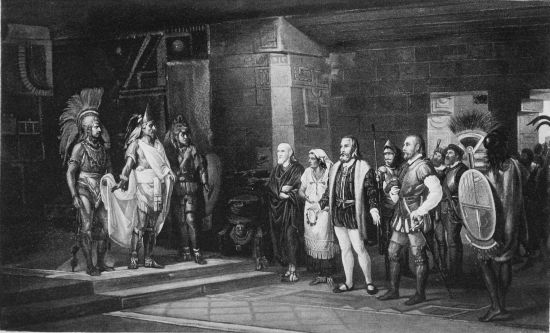
AUDIENCE OF CORTÉS WITH MONTEZUMA
Goupil & Cº., Paris
rare discretion, he contented himself with dropping this hint, for the
present, allowing it to ripen in the mind of the emperor, till a future
conference. The latter asked whether those white men who in the
preceding year had landed on the eastern shores of his empire were their
countrymen. He showed himself well informed of the proceedings of the
Spaniards from their arrival in Tabasco to the present time, information
of which had been regularly transmitted in the hieroglyphical paintings.
He was curious, also, in regard to the rank of his visitors in their own
country; inquiring if they were the kinsmen of the sovereign. Cortés
replied, they were kinsmen of one another, and subjects of their great
monarch, who held them all in peculiar estimation. Before his departure,
Montezuma made himself acquainted with the names of the principal
cavaliers, and the position they occupied in the army.
At the conclusion of the interview, the Aztec prince commanded his
attendants to bring forward the presents prepared for his guests. They
consisted of cotton dresses, enough to supply every man, it is said,
including the allies, with a suit![288] And he did not fail to add the
usual accompaniment of gold chains and other ornaments, which he
distributed in profusion among the Spaniards. He then withdrew with the
same ceremony with which he had entered, leaving every one deeply
impressed with his munificence and his affability, so unlike what they
had been taught to expect by what they now considered an invention of
the enemy.[289]
That evening the Spaniards celebrated their arrival in the Mexican
capital by a general discharge of artillery. The thunders of the
ordnance, reverberating among the buildings and shaking them to their
foundations, the stench of the sulphureous vapor that rolled in volumes
above the walls of the encampment, reminding the inhabitants of the
explosions of the great volcan, filled the hearts of the superstitious
Aztecs with dismay. It proclaimed to them that their city held in its
bosom those dread beings whose path had been marked with desolation, and
who could call down the thunderbolts to consume their enemies! It was
doubtless the policy of Cortés to strengthen this superstitious feeling
as far as possible, and to impress the natives, at the outset, with a
salutary awe of the supernatural powers of the Spaniards.
[290]
On the following morning, the general requested permission to return the
emperor’s visit, by waiting on him in his palace. This was readily
granted, and Montezuma sent his officers to conduct the Spaniards to his
presence. Cortés dressed himself in his richest habit, and left the
quarters attended by Alvarado, Sandoval, Velasquez, and Ordaz, together
with five or six of the common file.
The royal habitation was at no great distance. It stood on the ground,
to the southwest of the cathedral, since covered in part by the Casa
del Estado, the palace of the dukes of Monteleone, the descendants of
Cortés.[291] It was a vast, irregular pile of low stone buildings, like
that garrisoned by the Spaniards.[292] So spacious was it, indeed, that,
as one of the Conquerors assures us, although he had visited it more
than once, for the express purpose, he had been too much fatigued each
time by wandering through the apartments ever to see the whole of
it.[293] It was built of the red porous stone of the country,
tetzontli, was ornamented with marble, and on the façade over the
principal entrance were sculptured the arms or device of Montezuma,{*}
an eagle bearing an ocelot in his talons.[294]
{*} [The totem or “beast symbol” of the clan to which it belonged.—M.]
In the courts through which the Spaniards passed, fountains of crystal
water were playing, fed from the copious reservoir on the distant hill
of Chapoltepec, and supplying in their turn more than a hundred baths in
the interior of the palace. Crowds of Aztec nobles were sauntering up
and down in these squares, and in the outer halls, loitering away their
hours in attendance on the court. The apartments were of immense size,
though not lofty. The ceilings were of various sorts of odoriferous wood
ingeniously carved; the floors covered with mats of the palm-leaf. The
walls were hung with cotton richly stained, with the skins of wild
animals, or gorgeous draperies of feather-work wrought in imitation of
birds, insects, and flowers, with the nice art and glowing radiance of
colors that might compare with the tapestries of Flanders. Clouds of
incense rolled up from censers and diffused intoxicating odors through
the apartments. The Spaniards might well have fancied themselves in the
voluptuous precincts of an Eastern harem, instead of treading the halls
of a wild barbaric chief in the Western World.[295]
On reaching the hall of audience, the Mexican officers took off their
sandals, and covered their gay attire with a mantle of nequen, a
coarse stuff made of the fibres of the maguey, worn only by the poorest
classes. This act of humiliation was imposed on all, except the members
of his own family, who approached the sovereign.[296] Thus bare-footed,
with downcast eyes and formal obeisance, they ushered the Spaniards into
the royal presence.
They found Montezuma seated at the further end of a spacious saloon and
surrounded by a few of his favorite chiefs. He received them kindly, and
very soon Cortés, without much ceremony, entered on the subject which
was uppermost in his thoughts. He was fully aware of the importance of
gaining the royal convert, whose example would have such an influence on
the conversion of his people. The general, therefore, prepared to
display the whole store of his theological science, with the most
winning arts of rhetoric he could command, while the interpretation was
conveyed through the silver tones of Marina, as inseparable from him, on
these occasions, as his shadow.
He set forth, as clearly as he could, the ideas entertained by the
Church in regard to the holy mysteries of the Trinity, the Incarnation,
and the Atonement. From this he ascended to the origin of things, the
creation of the world, the first pair, paradise, and the fall of man. He
assured Montezuma that the idols he worshipped were Satan under
different forms. A sufficient proof of it was the bloody sacrifices they
imposed, which he contrasted with the pure and simple rite of the mass.
Their worship would sink him in perdition. It was to snatch his soul,
and the souls of his people, from the flames of eternal fire by opening
to them a purer faith, that the Christians had come to his land. And he
earnestly besought him not to neglect the occasion, but to secure his
salvation by embracing the Cross, the great sign of human redemption.
The eloquence of the preacher was wasted on the insensible heart of his
royal auditor. It doubtless lost somewhat of its efficacy, strained
through the imperfect interpretation of so recent a neophyte as the
Indian damsel. But the doctrines were too abstruse in themselves to be
comprehended at a glance by the rude intellect of a barbarian. And
Montezuma may have, perhaps, thought it was not more monstrous to feed
on the flesh of a fellow-creature than on that of the Creator
himself.[297] He was, besides, steeped in the superstitions of his
country from his cradle. He had been educated in the straitest sect of
her religion, had been himself a priest before his election to the
throne, and was now the head both of the religion and the state. Little
probability was there that such a man would be open to argument or
persuasion, even from the lips of a more practised polemic than the
Spanish commander. How could he abjure the faith that was intertwined
with the dearest affections of his heart and the very elements of his
being? How could he be false to the gods who had raised him to such
prosperity and honors, and whose shrines were intrusted to his especial
keeping?
He listened, however, with silent attention, until the general had
concluded his homily. He then replied that he knew the Spaniards had
held this discourse wherever they had been. He doubted not their God
was, as they said, a good being. His gods, also, were good to him. Yet
what his visitor said of the creation of the world was like what he had
been taught to believe.[298] It was not worth while to discourse further
of the matter. His ancestors, he said, were not the original
proprietors of the land. They had occupied it but a few ages, and had
been led there by a great Being, who, after giving them laws and ruling
over the nation for a time, had withdrawn to the regions where the sun
rises. He had declared, on his departure, that he or his descendants
would again visit them and resume his empire.[299] The wonderful deeds
of the Spaniards, their fair complexions, and the quarter whence they
came, all showed they were his descendants. If Montezuma had resisted
their visit to his capital, it was because he had heard such accounts of
their cruelties,—that they sent the lightning to consume his people, or
crushed them to pieces under the hard feet of the ferocious animals on
which they rode. He was now convinced that these were idle tales; that
the Spaniards were kind and generous in their natures; they were
mortals, of a different race, indeed, from the Aztecs, wiser, and more
valiant,—and for this he honored them.
“You, too,” he added, with a smile, “have been told, perhaps, that I am
a god, and dwell in palaces of gold and silver.[300] But you see it is
false. My houses, though large, are of stone and wood like those of
others; and as to my body,” he said, baring his tawny arm, “you see it
is flesh and bone like yours. It is true, I have a great empire
inherited from my ancestors; lands, and gold, and silver. But your
sovereign beyond the waters is, I know, the rightful lord of all. I rule
in his name. You, Malinche, are his ambassador; you and your brethren
shall share these things with me. Rest now from your labors. You are
here in your own dwellings, and everything shall be provided for your
subsistence. I will see that your wishes shall be obeyed in the same way
as my own.”[301] As the monarch concluded these words, a few natural
tears suffused his eyes, while the image of ancient independence,
perhaps, flitted across his mind.[302]
Cortés, while he encouraged the idea that his own sovereign was the
great Being indicated by Montezuma, endeavored to comfort the monarch by
the assurance that his master had no desire to interfere with his
authority, otherwise than, out of pure concern for his welfare, to
effect his conversion and that of his people to Christianity. Before the
emperor dismissed his visitors he consulted his munificent spirit, as
usual, by distributing rich stuffs and trinkets of gold among them, so
that the poorest soldier, says Bernal Diaz, one of the party, received
at least two heavy collars of the precious metal for his share. The iron
hearts of the Spaniards were touched with the emotion displayed by
Montezuma, as well as by his princely spirit of liberality. As they
passed him, the cavaliers, with bonnet in hand, made him the most
profound obeisance, and “on the way home,” continues the same
chronicler, “we could discourse of nothing but the gentle breeding and
courtesy of the Indian monarch, and of the respect we entertained for
him.”[303]
Speculations of a graver complexion must have pressed on the mind of the
general, as he saw around him the evidences of a civilization, and
consequently power, for which even the exaggerated reports of the
natives—discredited from their apparent exaggeration—had not prepared
him. In the pomp and burdensome ceremonial of the court he saw that nice
system of subordination and profound reverence for the monarch which
characterize the semi-civilized empires of Asia. In the appearance of
the capital, its massy yet elegant architecture, its luxurious social
accommodations, its activity in trade, he recognized the proofs of the
intellectual progress, mechanical skill, and enlarged resources of an
old and opulent community; while the swarms in the streets attested the
existence of a population capable of turning these resources to the
best account.
In the Aztec he beheld a being unlike either the rude republican
Tlascalan or the effeminate Cholulan, but combining the courage of the
one with the cultivation of the other. He was in the heart of a great
capital, which seemed like an extensive fortification, with its dikes
and its draw-bridges, where every house might be easily converted into a
castle. Its insular position removed it from the continent, from which,
at the mere nod of the sovereign, all communication might be cut off,
and the whole warlike population be at once precipitated on him and his
handful of followers. What could superior science avail against such
odds?[304]
As to the subversion of Montezuma’s empire, now that he had seen him in
his capital, it must have seemed a more doubtful enterprise than ever.
The recognition which the Aztec prince had made of the feudal supremacy,
if I may so say, of the Spanish sovereign, was not to be taken too
literally. Whatever show of deference he might be disposed to pay the
latter under the influence of his present—perhaps temporary—delusion,
it was not to be supposed that he would so easily relinquish his actual
power and possessions, or that his people would consent to it. Indeed,
his sensitive apprehensions in regard to this very subject, on the
coming of the Spaniards, were sufficient proof of the tenacity with
which he clung to his authority. It is true that Cortés had a strong
lever for future operations in the superstitious reverence felt for
himself both by prince and people. It was undoubtedly his policy to
maintain this sentiment unimpaired in both, as far as possible.[305]
But, before settling any plan of operations, it was necessary to make
himself personally acquainted with the topography and local advantages
of the capital, the character of its population, and the real nature and
amount of its resources. With this view, he asked the emperor’s
permission to visit the principal public edifices.
Antonio de Herrera, the celebrated chronicler of the Indies, was
born of a respectable family at Cuella, in Old Spain, in 1549.
After passing through the usual course of academic discipline in
his own country, he went to Italy, to which land of art and letters
the Spanish youth of that time frequently resorted to complete
their education. He there became acquainted with Vespasian Gonzaga,
brother of the duke of Mantua, and entered into his service. He
continued with this prince after he was made Viceroy of Navarre,
and was so highly regarded by him, that, on his death-bed, Gonzaga
earnestly commended him to the protection of Philip the Second.
This penetrating monarch soon discerned the excellent qualities of
Herrera, and raised him to the post of Historiographer of the
Indies,—an office for which Spain is indebted to Philip. Thus
provided with a liberal salary, and with every facility for
pursuing the historical researches to which his inclination led
him, Herrera’s days glided peacefully away in the steady, but
silent, occupations of a man of letters. He continued to hold the
office of historian of the colonies through Philip the Second’s
reign, and under his successors, Philip the Third and the Fourth;
till in 1625 he died at the advanced age of seventy-six, leaving
behind him a high character for intellectual and moral worth.
Herrera wrote several works, chiefly historical. The most
important, that on which his reputation rests, is his Historia
general de las Indias occidentales. It extends from the year 1492,
the time of the discovery of America, to 1554, and is divided into
eight decades. Four of them were published in 1601, and the
remaining four in 1615, making in all five volumes in folio. The
work was subsequently republished in 1730, and has been translated
into most of the languages of Europe. The English translator,
Stevens, has taken great liberties with his original, in the way of
abridgment and omission, but the execution of his work is, on the
whole, superior to that of most of the old English versions of the
Castilian chroniclers.
Herrera’s vast subject embraces the whole colonial empire of Spain
in the New World. The work is thrown into the form of annals, and
the multifarious occurrences in the distant regions of which he
treats are all marshalled with exclusive reference to their
chronology, and made to move together pari passu. By means of
this tasteless arrangement the thread of interest is perpetually
snapped, the reader is hurried from one scene to another, without
the opportunity of completing his survey of any. His patience is
exhausted and his mind perplexed with partial and scattered
glimpses, instead of gathering new light as he advances from the
skilful development of a continuous and well-digested narrative.
This is the great defect of a plan founded on a slavish adherence
to chronology. The defect becomes more serious when the work, as in
the present instance, is of vast compass and embraces a great
variety of details having little relation to each other. In such a
work we feel the superiority of a plan like that which Robertson
has pursued in his “History of America,” where every subject is
allowed to occupy its own independent place, proportioned to its
importance, and thus to make a distinct and individual impression
on the reader.
Herrera’s position gave him access to the official returns from the
colonies, state papers, and whatever documents existed in the
public offices for the illustration of the colonial history. Among
these sources of information were some manuscripts, with which it
is not now easy to meet; as, for example, the memorial of Alonso de
Ojeda, one of the followers of Cortés, which has eluded my
researches both in Spain and Mexico. Other writings, as those of
Father Sahagun, of much importance in the history of Indian
civilization, were unknown to the historian. Of such manuscripts as
fell into his hands, Herrera made the freest use. From the writings
of Las Casas, in particular, he borrowed without ceremony. The
bishop had left orders that his “History of the Indies” should not
be published till at least forty years after his death. Before that
period had elapsed Herrera had entered on his labors, and, as he
had access to the papers of Las Casas, he availed himself of it to
transfer whole pages, nay, chapters, of his narrative in the most
unscrupulous manner to his own work. In doing this, he made a
decided improvement on the manner of his original, reduced his
cumbrous and entangled sentences to pure Castilian, omitted his
turgid declamation and his unreasonable invectives. But, at the
same time, he also excluded the passages that bore hardest on the
conduct of his countrymen, and those bursts of indignant eloquence
which showed a moral sensibility in the Bishop of Chiapa that
raised him so far above his age. By this sort of metempsychosis, if
one may so speak, by which the letter and not the spirit of the
good missionary was transferred to Herrera’s pages, he rendered the
publication of Las Casas’ history, in some measure, superfluous;
and this circumstance has, no doubt, been one reason for its having
been so long detained in manuscript.
Yet, with every allowance for the errors incident to rapid
composition, and to the pedantic chronological system pursued by
Herrera, his work must be admitted to have extraordinary merit. It
displays to the reader the whole progress of Spanish conquest and
colonization in the New World for the first sixty years after the
discovery. The individual actions of his complicated story, though
unskilfully grouped together, are unfolded in a pure and simple
style, well suited to the gravity of his subject. If at first sight
he may seem rather too willing to magnify the merits of the early
discoverers and to throw a veil over their excesses, it may be
pardoned, as flowing, not from moral insensibility, but from the
patriotic sentiment which made him desirous, as far as might be, to
wipe away every stain from the escutcheon of his nation, in the
proud period of her renown. It is natural that the Spaniard who
dwells on this period should be too much dazzled by the display of
her gigantic efforts, scrupulously to weigh their moral character,
or the merits of the cause in which they were made. Yet Herrera’s
national partiality never makes him the apologist of crime; and,
with the allowances fairly to be conceded, he may be entitled to
the praise so often given him of integrity and candor.
It must not be forgotten that, in addition to the narrative of the
early discoveries of the Spaniards, Herrera has brought together a
vast quantity of information in respect to the institutions and
usages of the Indian nations, collected from the most authentic
sources. This gives his work a completeness beyond what is to be
found in any other on the same subject. It is, indeed, a noble
monument of sagacity and erudition; and the student of history, and
still more the historical compiler, will find himself unable to
advance a single step among the early colonial settlements of the
New World without reference to the pages of Herrera.
Another writer on Mexico, frequently consulted in the course of the
present narrative, is Toribio de Benavente, or Motolinia, as he
is still more frequently called, from his Indian cognomen. He was
one of the twelve Franciscan missionaries who, at the request of
Cortés, were sent out to New Spain immediately after the Conquest,
in 1523. Toribio’s humble attire, naked feet, and, in short, the
poverty-stricken aspect which belongs to his order, frequently drew
from the natives the exclamation of Motolinia, or “poor man.” It
was the first Aztec word the signification of which the missionary
learned, and he was so much pleased with it, as intimating his own
condition, that he henceforth assumed it as his name. Toribio
employed himself zealously with his brethren in the great object of
their mission. He travelled on foot over various parts of Mexico,
Guatemala, and Nicaragua. Wherever he went, he spared no pains to
wean the natives from their dark idolatry, and to pour into their
minds the light of revelation. He showed even a tender regard for
their temporal as well as spiritual wants, and Bernal Diaz
testifies that he has known him to give away his own robe to clothe
a destitute and suffering Indian. Yet this charitable friar, so
meek and conscientious in the discharge of his Christian duties,
was one of the fiercest opponents of Las Casas, and sent home a
remonstrance against the Bishop of Chiapa, couched in terms the
most opprobrious and sarcastic. It has led the bishop’s biographer,
Quintana, to suggest that the friar’s threadbare robe may have
covered somewhat of worldly pride and envy. It may be so. Yet it
may also lead us to distrust the discretion of Las Casas himself,
who could carry measures with so rude a hand as to provoke such
unsparing animadversions from his fellow-laborers in the vineyard.
Toribio was made guardian of a Franciscan convent at Tezcuco. In
this situation he continued active in good works, and at this
place, and in his different pilgrimages, is stated to have baptized
more than four hundred thousand natives. His efficacious piety was
attested by various miracles. One of the most remarkable was when
the Indians were suffering from great drought, which threatened to
annihilate the approaching harvests. The good father recommended a
solemn procession of the natives to the church of Santa Cruz, with
prayers and a vigorous flagellation. The effect was soon visible in
such copious rains as entirely relieved the people from their
apprehensions, and in the end made the season uncommonly fruitful.
The counterpart to this prodigy was afforded a few years later,
while the country was laboring under excessive rains; when, by a
similar remedy, the evil was checked, and a like propitious
influence exerted on the season as before. The exhibition of such
miracles greatly edified the people, says his biographer, and
established them firmly in the Faith. Probably Toribio’s exemplary
life and conversation, so beautifully illustrating the principles
which he taught, did quite as much for the good cause as his
miracles.
Thus passing his days in the peaceful and pious avocations of the
Christian missionary, the worthy ecclesiastic was at length called
from the scene of his earthly pilgrimage, in what year is
uncertain, but at an advanced age, for he survived all the little
band of missionaries who had accompanied him to New Spain. He died
in the convent of San Francisco at Mexico, and his panegyric is
thus emphatically pronounced by Torquemada, a brother of his own
order: “He was a truly apostolic man, a great teacher of
Christianity, beautiful in the ornament of every virtue, jealous of
the glory of God, a friend of evangelical poverty, most true to the
observance of his monastic rule, and jealous in the conversion of
the heathen.”
Father Toribio’s long personal intercourse with the Mexicans, and
the knowledge of their language, which he was at much pains to
acquire, opened to him all the sources of information respecting
them and their institutions, which existed at the time of the
Conquest. The results he carefully digested in the work so often
cited in these pages, the Historia de los Indios de Nueva-España,
making a volume of manuscript in folio. It is divided into three
parts. 1. The religion, rites, and sacrifices of the Aztecs. 2.
Their conversion to Christianity, and their manner of celebrating
the festivals of the Church. 3. The genius and character of the
nation, their chronology and astrology, together with notices of
the principal cities and the staple productions of the country.
Notwithstanding the methodical arrangement of the work, it is
written in the rambling, unconnected manner of a commonplace-book,
into which the author has thrown at random his notices of such
matters as most interested him in his survey of the country. His
own mission is ever before his eyes, and the immediate topic of
discussion, of whatever nature it may be, is at once abandoned to
exhibit an event or an anecdote that can illustrate his
ecclesiastical labors. The most startling occurrences are recorded
with all the credulous gravity which is so likely to win credit
from the vulgar; and a stock of miracles is duly attested by the
historian, of more than sufficient magnitude to supply the wants of
the infant religious communities of New Spain.
Yet amidst this mass of pious incredibilia the inquirer into the
Aztec antiquities will find much curious and substantial
information. Toribio’s long and intimate relations with the natives
put him in possession of their whole stock of theology and science;
and as his manner, though somewhat discursive, is plain and
unaffected, there is no obscurity in the communication of his
ideas. His inferences, colored by the superstitions of the age and
the peculiar nature of his profession, may be often received with
distrust. But, as his integrity and his means of information were
unquestionable, his work becomes of the first authority in relation
to the antiquities of the country, and its condition at the period
of the Conquest. As an educated man, he was enabled to penetrate
deeper than the illiterate soldiers of Cortés, men given to action
rather than to speculation. Yet Toribio’s manuscript, valuable as
it is to the historian, has never been printed, and has too little
in it of popular interest, probably, ever to be printed. Much that
it contains has found its way, in various forms, into subsequent
compilations. The work itself is very rarely to be found. Dr.
Robertson had a copy, as it seems from the catalogue of MSS.
published with his “History of America;” though the author’s name
is not prefixed to it. There is no copy, I believe, in the library
of the Academy of History at Madrid; and for that in my possession
I am indebted to the kindness of that curious bibliographer, Mr. O.
Rich, now consul for the United States at Minorca.
Pietro Martire de Angleria, or Peter Martyr, as he is called by
English writers, belonged to an ancient and highly respectable
family of Arona in the north of Italy. In 1487 he was induced by
the count of Tendilla, the Spanish ambassador at Rome, to return
with him to Castile. He was graciously received by Queen Isabella,
always desirous to draw around her enlightened foreigners, who
might exercise a salutary influence on the rough and warlike
nobility of Castile. Martyr, who had been educated for the Church,
was persuaded by the queen to undertake the instruction of the
young nobles at the court. In this way he formed an intimacy with
some of the most illustrious men of the nation, who seem to have
cherished a warm personal regard for him through the remainder of
his life. He was employed by the Catholic sovereigns in various
concerns of public interest, was sent on a mission to Egypt, and
was subsequently raised to a distinguished post in the cathedral of
Granada. But he continued to pass much of his time at court, where
he enjoyed the confidence of Ferdinand and Isabella, and of their
successor, Charles the Fifth, till in 1525 he died, at the age of
seventy.
Martyr’s character combined qualities not often found in the same
individual,—an ardent love of letters, with a practical sagacity
that can only result from familiarity with men and affairs. Though
passing his days in the gay and dazzling society of the capital, he
preserved the simple tastes and dignified temper of a philosopher.
His correspondence, as well as his more elaborate writings, if the
term elaborate can be applied to any of his writings, manifests an
enlightened and oftentimes independent spirit; though one would
have been better pleased had he been sufficiently independent to
condemn the religious intolerance of the government. But Martyr,
though a philosopher, was enough of a courtier to look with a
lenient eye on the errors of princes. Though deeply imbued with the
learning of antiquity, and a scholar at heart, he had none of the
feelings of the recluse, but took the most lively interest in the
events that were passing around him. His various writings,
including his copious correspondence, are for this reason the very
best mirror of the age in which he lived.
His inquisitive mind was particularly interested by the discoveries
that were going on in the New World. He was allowed to be present
at the sittings of the Council of the Indies when any communication
of importance was made to it; and he was subsequently appointed a
member of that body. All that related to the colonies passed
through his hands. The correspondence of Columbus, Cortés, and the
other discoverers with the court of Castile was submitted to his
perusal. He became personally acquainted with these illustrious
persons on their return home, and frequently, as we find from his
letters, entertained them at his own table. With these advantages,
his testimony becomes but one degree removed from that of the
actors themselves in the great drama. In one respect it is of a
higher kind, since it is free from the prejudice and passion which
a personal interest in events is apt to beget. The testimony of
Martyr is that of a philosopher, taking a clear and comprehensive
survey of the ground, with such lights of previous knowledge to
guide him as none of the actual discoverers and conquerors could
pretend to. It is true, this does not prevent his occasionally
falling into errors; the errors of credulity,—not, however, of the
credulity founded on superstition, but that which arises from the
uncertain nature of the subject, where phenomena so unlike anything
with which he had been familiar were now first disclosed by the
revelation of an unknown world.
He may be more fairly charged with inaccuracies of another
description, growing out of haste and inadvertence of composition.
But even here we should be charitable. For he confesses his sins
with a candor that disarms criticism. In truth, he wrote rapidly,
and on the spur of the moment, as occasion served. He shrunk from
the publication of his writings, when it was urged on him, and his
Decades De Orbe Novo, in which he embodied the results of his
researches in respect to the American discoveries, were not
published entire till after his death. The most valuable and
complete edition of this work—the one referred to in the present
pages—is the edition of Hakluyt, published at Paris in 1587.
Martyr’s works are all in Latin, and that not of the purest; a
circumstance rather singular, considering his familiarity with the
classic models of antiquity. Yet he evidently handled the dead
languages with the same facility as the living. Whatever defects
may be charged on his manner, in the selection and management of
his topics he shows the superiority of his genius. He passes over
the trivial details which so often encumber the literal narratives
of the Spanish voyagers, and fixes his attention on the great
results of their discoveries,—the products of the country, the
history and institutions of the races, their character and advance
in civilization. In one respect his writings are of peculiar value.
They show the state of feeling which existed at the Castilian court
during the progress of discovery. They furnish, in short, the
reverse side of the picture; and, when we have followed the Spanish
conquerors in their wonderful career of adventure in the New World,
we have only to turn to the pages of Martyr to find the impression
produced by them on the enlightened minds of the Old. Such a view
is necessary to the completeness of the historical picture.
If the reader is curious to learn more of this estimable scholar,
he will find the particulars given in “The History of Ferdinand and
Isabella” (Part I. chap. 14, Postscript, and chap. 19), for the
illustration of whose reign his voluminous correspondence furnishes
the most authentic materials.