INTRODUCTION
VIEW OF THE AZTEC CIVILIZATION
OF all that extensive empire which once acknowledged the authority of
Spain in the New World, no portion, for interest and importance, can be
compared with Mexico;—and this equally, whether we consider the variety
of its soil and climate; the inexhaustible stores of its mineral wealth;
its scenery, grand and picturesque beyond example; the character of its
ancient inhabitants, not only far surpassing in intelligence that of the
other North American races, but reminding us, by their monuments, of the
primitive civilization of Egypt and Hindostan; or, lastly, the peculiar
circumstances of its Conquest, adventurous and romantic as any legend
devised by Norman or Italian bard of chivalry. It is the purpose of the
present narrative to exhibit the history of this Conquest, and that of
the remarkable man by whom it was achieved.
But, in order that the reader may have a better understanding of the
subject, it will be well, before entering on it, to take a general
survey of the political and social institutions of the races who
occupied the land at the time of its discovery.
The country of the ancient Mexicans, or Aztecs as they were called,
formed but a very small part of the extensive territories comprehended
in the modern republic of Mexico.[4] Its boundaries cannot be defined
with certainty. They were much enlarged in the latter days of the
empire, when they may be considered as reaching from about the
eighteenth degree north, to the twenty-first, on the Atlantic; and from
the fourteenth to the nineteenth, including a very narrow strip, on the
Pacific.[5] In its greatest breadth, it could not exceed five degrees
and a half, dwindling, as it approached its southeastern limits, to less
than two. It covered, probably, less than sixteen thousand square
leagues.[6] Yet such is the remarkable formation of this country, that,
though not more than twice as large as New England, it presented every
variety of climate, and was capable of yielding nearly every fruit,
found between the equator and the Arctic circle.
All along the Atlantic, the country is bordered by a broad tract, called
the tierra caliente, or hot region, which has the usual high
temperature of equinoctial lands. Parched and sandy plains are
intermingled with others, of exuberant fertility, almost impervious from
thickets of aromatic shrubs and wild flowers, in the midst of which
tower up trees of that magnificent growth which is found only within
the tropics. In this wilderness of sweets lurks the fatal malaria,
engendered, probably, by the decomposition of rank vegetable substances
in a hot and humid soil.[7] The season of the bilious fever,—vómito,
as it is called,—which scourges these coasts, continues from the spring
to the autumnal equinox, when it is checked by the cold winds that
descend from Hudson’s Bay. These winds in the winter season frequently
freshen into tempests, and sweeping down the Atlantic coast and the
winding Gulf of Mexico, burst with the fury of a hurricane on its
unprotected shores, and on the neighboring West India islands. Such are
the mighty spells with which Nature has surrounded this land of
enchantment, as if to guard the golden treasures locked up within its
bosom. The genius and enterprise of man have proved more potent than her
spells.
After passing some twenty leagues across this burning region, the
traveller finds himself rising into a purer atmosphere. His limbs
recover their elasticity. He breathes more freely, for his senses are
not now oppressed by the sultry heats and intoxicating perfumes of the
valley. The aspect of nature, too, has changed, and his eye no longer
revels among the gay variety of colors with which the landscape was
painted there. The vanilla, the indigo, and the flowering cacao-groves
disappear as he advances. The sugar-cane and the glossy-leaved banana
still accompany him; and, when he has ascended about four thousand
feet, he sees in the unchanging verdure, and the rich foliage of the
liquid-amber tree, that he has reached the height where clouds and mists
settle, in their passage from the Mexican Gulf. This is the region of
perpetual humidity; but he welcomes it with pleasure, as announcing his
escape from the influence of the deadly vómito.[8] He has entered the
tierra templada, or temperate region, whose character resembles that
of the temperate zone of the globe. The features of the scenery become
grand, and even terrible. His road sweeps along the base of mighty
mountains, once gleaming with volcanic fires, and still resplendent in
their mantles of snow, which serve as beacons to the mariner, for many a
league at sea. All around he beholds traces of their ancient combustion,
as his road passes along vast tracts of lava, bristling in the
innumerable fantastic forms into which the fiery torrent has been thrown
by the obstacles in its career. Perhaps, at the same moment, as he casts
his eye down some steep slope, or almost unfathomable ravine, on the
margin of the road, he sees their depths glowing with the rich blooms
and enamelled vegetation of the tropics. Such are the singular contrasts
presented, at the same time, to the senses, in this picturesque region!
Still pressing upwards, the traveller mounts into other climates,
favorable to other kinds of cultivation. The yellow maize, or Indian
corn, as we usually call it, has continued to follow him up from the
lowest level; but he now first sees fields of wheat, and the other
European grains brought into the country by the Conquerors. Mingled with
them, he views the plantations of the aloe or maguey (agave
Americana), applied to such various and important uses by the Aztecs.
The oaks now acquire a sturdier growth, and the dark forests of pine
announce that he has entered the tierra fria, or cold region,—the
third and last of the great natural terraces into which the country is
divided. When he has climbed to the height of between seven and eight
thousand feet, the weary traveller sets his foot on the summit of the
Cordillera of the Andes,—the colossal range that, after traversing
South America and the Isthmus of Darien, spreads out, as it enters
Mexico, into that vast sheet of table-land which maintains an elevation
of more than six thousand feet, for the distance of nearly two hundred
leagues, until it gradually declines in the higher latitudes of the
north.[9]
Across this mountain rampart a chain of volcanic hills stretches, in a
westerly direction, of still more stupendous dimensions, forming,
indeed, some of the highest land on the globe. Their peaks, entering the
limits of perpetual snow, diffuse a grateful coolness over the elevated
plateaus below; for these last, though termed “cold,” enjoy a climate
the mean temperature of which is not lower than that of the central
parts of Italy.[10] The air is exceedingly dry; the soil, though
naturally good, is rarely clothed with the luxuriant vegetation of the
lower regions. It frequently, indeed, has a parched and barren aspect,
owing partly to the greater evaporation which takes place on these lofty
plains, through the diminished pressure of the atmosphere, and partly,
no doubt, to the want of trees to shelter the soil from the fierce
influence of the summer sun. In the time of the Aztecs, the table-land
was thickly covered with larch, oak, cypress, and other forest trees,
the extraordinary dimensions of some of which, remaining to the present
day, show that the curse of barrenness in later times is chargeable more
on man than on nature. Indeed, the early Spaniards made as
indiscriminate war on the forest as did our Puritan ancestors, though
with much less reason. After once conquering the country, they had no
lurking ambush to fear from the submissive, semi-civilized Indian, and
were not, like our forefathers, obliged to keep watch and ward for a
century. This spoliation of the ground, however, is said to have been
pleasing to their imaginations, as it reminded them of the plains of
their own Castile,—the table-land of Europe;[11] where the nakedness of
the landscape forms the burden of every traveller’s lament who visits
that country.
Midway across the continent, somewhat nearer the Pacific than the
Atlantic Ocean, at an elevation of nearly seven thousand five hundred
feet, is the celebrated Valley of Mexico. It is of an oval form, about
sixty-seven leagues in circumference,[12] and is encompassed by a
towering rampart of porphyritic rock, which nature seems to have
provided, though ineffectually, to protect it from invasion.
The soil, once carpeted with a beautiful verdure and thickly sprinkled
with stately trees, is often bare, and, in many places, white with the
incrustation of salts caused by the draining of the waters. Five lakes
are spread over the Valley, occupying one-tenth of its surface.[13] On
the opposite borders of the largest of these basins, much shrunk in its
dimensions[14] since the days of the Aztecs, stood the cities of Mexico
and Tezcuco, the capitals of the two most potent and flourishing states
of Anahuac, whose history, with that of the mysterious races that
preceded them in the country,[15] exhibits some of the nearest
approaches to civilization to be met with anciently on the North
American continent.
Of these races the most conspicuous were the Toltecs. Advancing from a
northerly direction, but from what region is uncertain,[16] they entered
the territory of Anahuac,[17] probably before the close of the seventh
century. Of course, little can be gleaned with certainty respecting a
people whose written records have perished, and who are known to us only
through the traditionary legends of the nations that succeeded them.[18]
By the general agreement of these, however, the Toltecs were well
instructed in agriculture and many of the most useful mechanic arts;
were nice workers of metals; invented the complex arrangement of time
adopted by the Aztecs; and, in short, were the true fountains of the
civilization which distinguished this part of the continent in later
times.[19] They established their capital at Tula, north of the Mexican
Valley, and the remains of extensive buildings were to be discerned
there at the time of the Conquest.[20] The noble ruins of religious and
other edifices, still to be seen in various parts of New Spain, are
referred to this people, whose name, Toltec, has passed into a synonym
for architect.[21] Their shadowy history reminds us of those primitive
races who preceded the ancient Egyptians in the march of civilization;
fragments of whose monuments, as they are seen at this day, incorporated
with the buildings of the Egyptians themselves, give to these latter the
appearance of almost modern constructions.[22]
After a period of four centuries, the Toltecs, who had extended their
sway over the remotest borders of Anahuac,[23] having been greatly
reduced, it is said, by famine, pestilence, and unsuccessful wars,
disappeared from the land as silently and mysteriously as they had
entered it. A few of them still lingered behind, but much the greater
number, probably, spread over the region of Central America and the
neighboring isles; and the traveller now speculates on the majestic
ruins of Mitla and Palenque, as possibly the work of this extraordinary
people.[24][25]
After the lapse of another hundred years, a numerous and rude tribe,
called the Chichimecs, entered the deserted country from the regions of
the far Northwest. They were speedily followed by other races, of higher
civilization, perhaps of the same family with the Toltecs, whose
language they appear to have spoken. The most noted of these were the
Aztecs or Mexicans, and the Acolhuans. The latter, better known in later
times by the name of Tezcucans, from their capital, Tezcuco,[26] on the
eastern border of the Mexican lake, were peculiarly fitted, by their
comparatively mild religion and manners, for receiving the tincture of
civilization which could be derived from the few Toltecs that still
remained in the country.[27] This, in their turn, they communicated to
the barbarous Chichimecs, a large portion of whom became amalgamated
with the new settlers as one nation.[28]
Availing themselves of the strength derived, not only from this
increase of numbers, but from their own superior refinement, the
Acolhuans gradually stretched their empire over the ruder tribes in the
north; while their capital was filled with a numerous population, busily
employed in many of the more useful and even elegant arts of a civilized
community. In this palmy state, they were suddenly assaulted by a
warlike neighbor, the Tepanecs, their own kindred, and inhabitants of
the same valley as themselves. Their provinces were overrun, their
armies beaten, their king assassinated, and the flourishing city of
Tezcuco became the prize of the victor. From this abject condition the
uncommon abilities of the young prince, Nezahualcoyotl, the rightful
heir to the crown, backed by the efficient aid of his Mexican allies, at
length redeemed the state, and opened to it a new career of prosperity,
even more brilliant than the former.[29]
The Mexicans, with whom our history is principally concerned, came also,
as we have seen, from the remote regions of the North,—the populous
hive of nations in the New World, as it has been in the Old.[30] They
arrived on the borders of Anahuac towards the beginning of the
thirteenth century, some time after the occupation of the land by the
kindred races. For a long time they did not establish themselves in any
permanent residence, but continued shifting their quarters to different
parts of the Mexican Valley, enduring all the casualties and hardships
of a migratory life. On one occasion they were enslaved by a more
powerful tribe; but their ferocity soon made them formidable to their
masters.[31] After a series of wanderings and adventures which need not
shrink from comparison with the most extravagant legends of the heroic
ages of antiquity, they at length halted on the southwestern borders of
the principal lake, in the year 1325. They there beheld, perched on the
stem of a prickly pear, which shot out from the crevice of a rock that
was washed by the waves, a royal eagle of extraordinary size and beauty,
with a serpent in his talons, and his broad wings opened to the rising
sun. They hailed the auspicious omen, announced by an oracle as
indicating the site of their future city, and laid its foundations by
sinking piles into the shallows; for the low marshes were half buried
under water. On these they erected their light fabrics of reeds and
rushes, and sought a precarious subsistence from fishing, and from the
wild fowl which frequented the waters, as well as from the cultivation
of such simple vegetables as they could raise on their floating gardens.
The place was called Tenochtitlan, in token of its miraculous origin,
though only known to Europeans by its other name of Mexico,[32] derived
from their war-god, Mexitli.[33] The legend of its foundation is still
further commemorated by the device of the eagle and the cactus, which
form the arms of the modern Mexican republic. Such were the humble
beginnings of the Venice of the Western World.[34][35]
The forlorn condition of the new settlers was made still worse by
domestic feuds. A part of the citizens seceded from the main body, and
formed a separate community on the neighboring marshes. Thus divided, it
was long before they could aspire to the acquisition of territory on the
main land. They gradually increased, however, in numbers, and
strengthened themselves yet more by various improvements in their polity
and military discipline, while they established a reputation for courage
as well as cruelty in war which made their name terrible throughout the
Valley. In the early part of the fifteenth century, nearly a hundred
years from the foundation of the city, an event took place which created
an entire revolution in the circumstances and, to some extent, in the
character of the Aztecs. This was the subversion of the Tezcucan
monarchy by the Tepanecs, already noticed. When the oppressive conduct
of the victors had at length aroused a spirit of resistance, its prince,
Nezahualcoyotl, succeeded, after incredible perils and escapes, in
mustering such a force as, with the aid of the Mexicans, placed him on a
level with his enemies. In two successive battles, these were defeated
with great slaughter, their chief slain, and their territory, by one of
those sudden reverses which characterize the wars of petty states,
passed into the hands of the conquerors. It was awarded to Mexico, in
return for its important services.[36]
Then was formed that remarkable league, which, indeed, has no parallel
in history. It was agreed between the states of Mexico, Tezcuco, and the
neighboring little kingdom of Tlacopan, that they should mutually
support each other in their wars, offensive and defensive, and that in
the distribution of the spoil one-fifth should be assigned to Tlacopan,
and the remainder be divided, in what proportions is uncertain, between
the other powers. The Tezcucan writers claim an equal share for their
nation with the Aztecs. But this does not seem to be warranted by the
immense increase of territory subsequently appropriated by the latter.
And we may account for any advantage conceded to them by the treaty, on
the supposition that, however inferior they may have been originally,
they were, at the time of making it, in a more prosperous condition than
their allies, broken and dispirited by long oppression. What is more
extraordinary than the treaty itself, however, is the fidelity with
which it was maintained. During a century of uninterrupted warfare that
ensued, no instance occurred where the parties quarrelled over the
division of the spoil, which so often makes shipwreck of similar
confederacies among civilized states.[37]
The allies for some time found sufficient occupation for their arms in
their own valley; but they soon overleaped its rocky ramparts, and by
the middle of the fifteenth century, under the first Montezuma, had
spread down the sides of the table-land to the borders of the Gulf of
Mexico. Tenochtitlan, the Aztec capital, gave evidence of the public
prosperity. Its frail tenements were supplanted by solid structures of
stone and lime. Its population rapidly increased. Its old feuds were
healed. The citizens who had seceded were again brought under a common
government with the main body, and the quarter they occupied was
permanently connected with the parent city; the dimensions of which,
covering the same ground, were much larger than those of the modern
capital of Mexico.[38][39]
Fortunately, the throne was filled by a succession of able princes, who
knew how to profit by their enlarged resources and by the martial
enthusiasm of the nation. Year after year saw them return, loaded with
the spoils of conquered cities, and with throngs of devoted captives, to
their capital. No state was able long to resist the accumulated strength
of the confederates. At the beginning of the sixteenth century, just
before the arrival of the Spaniards, the Aztec dominion reached across
the continent, from the Atlantic to the Pacific, and, under the bold and
bloody Ahuitzotl, its arms had been carried far over the limits already
noticed as defining its permanent territory, into the farthest corners
of Guatemala and Nicaragua. This extent of empire, however limited in
comparison with that of many other states, is truly wonderful,
considering it as the acquisition of a people whose whole population and
resources had so recently been comprised within the walls of their own
petty city, and considering, moreover, that the conquered territory was
thickly settled by various races, bred to arms like the Mexicans, and
little inferior to them in social organization. The history of the
Aztecs suggests some strong points of resemblance to that of the ancient
Romans, not only in their military successes, but in the policy which
led to them.[40]
The most important contribution, of late years, to the early
history of Mexico is the Historia antigua of the Lic. Don.
Mariano Veytia, published in the city of Mexico, in 1836. This
scholar was born of an ancient and highly respectable family at
Puebla, 1718. After finishing his academic education, he went to
Spain, where he was kindly received at court. He afterwards visited
several other countries of Europe, made himself acquainted with
their languages, and returned home well stored with the fruits of a
discriminating observation and diligent study. The rest of his life
he devoted to letters; especially to the illustration of the
national history and antiquities. As the executor of the
unfortunate Boturini, with whom he had contracted an intimacy in
Madrid, he obtained access to his valuable collection of
manuscripts in Mexico, and from them, and every other source which
his position in society and his eminent character opened to him, he
composed various works, none of which, however, except the one
before us, has been admitted to the honors of the press. The time
of his death is not given by his editor, but it was probably not
later than 1780.
Veytia’s history covers the whole period from the first occupation
of Anahuac to the middle of the fifteenth century, at which point
his labors were unfortunately terminated by his death. In the early
portion he has endeavored to trace the migratory movements and
historical annals of the principal races who entered the country.
Every page bears testimony to the extent and fidelity of his
researches; and, if we feel but moderate confidence in the results,
the fault is not imputable to him, so much as to the dark and
doubtful nature of the subject. As he descends to later ages, he is
more occupied with the fortunes of the Tezcucan than with those of
the Aztec dynasty, which have been amply discussed by others of his
countrymen. The premature close of his labors prevented him,
probably, from giving that attention to the domestic institutions
of the people he describes, to which they are entitled as the most
important subject of inquiry to the historian. The deficiency has
been supplied by his judicious editor, Orteaga, from other sources.
In the early part of his work, Veytia has explained the
chronological system of the Aztecs, but, like most writers
preceding the accurate Gama, with indifferent success. As a critic,
he certainly ranks much higher than the annalists who preceded him,
and, when his own religion is not involved, shows a discriminating
judgment. When it is, he betrays a full measure of the credulity
which still maintains its hold on too many even of the
well-informed of his countrymen. The editor of the work has given a
very interesting letter from the Abbé Clavigero to Veytia, written
when the former was a poor and humble exile, and in the tone of one
addressing a person of high standing and literary eminence. Both
were employed on the same subject. The writings of the poor abbé,
published again and again, and translated into various languages,
have spread his fame throughout Europe; while the name of Veytia,
whose works have been locked up in their primitive manuscript, is
scarcely known beyond the boundaries of Mexico.
[The opinions set forth by Mr. Prescott respecting the Mexican
empire were attacked with much vigor by Lewis H. Morgan. Mr. Morgan
demonstrated conclusively that many of those opinions were
erroneous. But, as Payne says in his History of the New World
called America, vol i. p. 306, “his results cannot be regarded as
satisfactory, much less as final.” The Spanish chroniclers Prescott
consulted were correct ordinarily in their statement of facts, but
were misleading in their conclusions because of their inability to
comprehend the Aztec institutions.
On the pueblo as the unit of aboriginal history, see Payne, vol. i.
pp. 36-47.
In his Ancient Society, p. 186, Mr. Morgan says: “The histories of
Spanish America may be trusted in whatever relates to the acts of
the Spaniards, and to the acts and personal characteristics of the
Indians; in whatever relates to their weapons, implements and
utensils, fabrics, food and raiment, and things of a similar
character. But in whatever relates to Indian society and
government, their social relations and plan of life, they are
nearly worthless, because they learned nothing and knew nothing of
either. We are at full liberty to reject them in these respects and
commence anew, using any facts they may contain which harmonize
with what is known of Indian society.” He does not, however, always
observe his own rules if those rules seem to militate against the
thesis he is endeavoring to establish. Moreover, he is so dogmatic
in his statements and so confident in the infallibility of his own
judgment, that the reader who is seeking simply to ascertain the
truth about the whole matter is oftentimes intensely exasperated
with him. This is especially true with respect to the famous essay
on “Montezuma’s Dinner,” where he writes almost as though he had
been a guest at the banquet and had partaken of the viands which
were there consumed. As Mr. Morgan may justly be regarded as the
founder of a school, it is well to state his views at length.
According to him, then, there was no kingdom or empire of Mexico.
There was simply a confederacy of three tribes, and this
confederacy was a military democracy. The governmental powers were
vested in a council of chiefs with a general commander. The council
exercised all civil power, the military power being left in the
hands of the war chief. There were no feudal castles inhabited by
lawless lords. There were only great communal houses tenanted by
clans.
In his brilliant work on Ancient Society, Mr. Morgan places below
civilization two stages of development—savagery and barbarism. The
invention of pottery marks the difference between these two stages.
The savage makes no pottery. When the women of the savage tribes
used vessels of fire-hardened clay for boiling their food they had
passed into the first stage of barbarism. Elsewhere there were
pastoral stages of development. In North America there were none.
The only domesticated animal its inhabitants possessed when the
Europeans landed on the continent was the dog. The first stage of
barbarism in North America was marked by the cultivation of maize
or Indian corn. This grain can be cultivated more easily than any
other cereal. No other yields such enormous returns. In virgin soil
it is only necessary to drop the seed into the earth. Nature cares
for its complete development. But virgin soil becomes exhausted in
a few years. As population becomes denser and migrations cease to
be practicable, the land must be more carefully tilled, and, where
rains are comparatively infrequent, must be irrigated. Irrigation
and the use of adobe (sun-dried brick) and stone in building mark
the beginning of the second period of barbarism. In this period
also tools of stone give place to those of metal, the metal used in
America being copper. The Aztecs, the Mayas, and, in South America,
the Peruvians were in the second period. But to the third period,
when the smelting of iron ore was invented, these people never
passed.
The invention of a phonetic alphabet and the use of written
records, Mr. Morgan thinks, mark the beginning of civilization.
But, as John Fiske points out, it will not do to insist too
narrowly upon the phonetic alphabet. Hieroglyphics have perpetuated
much historic record in Egypt and China. Although the Mexicans and
Central Americans did not smelt iron ore, they yet possessed
historic records in their hieroglyphics (hieroglyphics which may
still be read). They were then enjoying civilization of an
extremely rude type, combined with a marvellously developed
barbarism. For though their barbarism was marked by human
sacrifices and by cannibalism, yet, according to testimony which
Mr. Morgan says may be taken at its face value, these barbarians
had pleasure-gardens and fountains, baths, menageries, feather-work
that was marvellously beautiful, pottery that showed admirable
taste, vessels of gold and silver, and many other accessories of an
advanced civilization.
Mr. Morgan was adopted into the Seneca tribe of North American
Indians, and he was able to study Indian institutions from an
inside point of view. Unquestionably he had a more profound
knowledge of those institutions than any other scholar of his time.
But he went too far when he confined the Aztecs to the narrow
limits in development to which the Senecas had attained. Moreover,
he does not make due allowance for the changes in development which
the more favorable climate of the Mexican table-lands brought
about. The “long house” of the Iroquois may have been constructed
on the same general plan, but it could hardly have been mistaken
for the building in which Montezuma quartered Cortés and his
allies. The one meal, freshly cooked and eaten about midday, bore
but little resemblance to the banquets in Mexico described with
such watery appreciation by the Spanish chroniclers. (Morgan admits
that these same chroniclers may be trusted when they write of food
and other such palpable matters.)
But Mr. Morgan is unquestionably right in saying that Montezuma’s
so-called “empire” was really a confederacy of tribes—living in
pueblos, governed by a council of chiefs, and levying tribute upon
other pueblos. The Aztec confederacy dominated the Mexican land as
the Iroquois confederacy dominated the region between the
Connecticut and the Mississippi. To assert that otherwise the two
nations were alike both in their institutions and in their
development is as unwarranted as to say that the governmental
institutions and the political development of the United States and
Venezuela are identical.
How did this confederacy come to be formed?
The earliest family group was the clan. As Sir Henry Maine points
out in his Ancient Law, the individual was nothing in ancient
society, the state was nothing, the family was everything. This
statement holds good everywhere, for America as well as for India.
A group of clans made up a phratry or brotherhood; a group of
phratries made a tribe. This threefold grouping was universal. The
Greek phratry, the Roman curia, the Teutonic hundred were analogous
institutions. In the clans kinship was always derived through the
female line. The Mutterrecht everywhere prevailed.{*}
{*} [This subject Mr. Morgan treats with a master’s hand in his
Houses and House Life of the American Aborigines.]
μήτηρ μεύ τʹ ἐμέ ψησι Του ἑμμεναι ᾶυτὰρ ἐγωγε
οὐκ ὀιδ, ὀυ γαρ πώ τις ἐον γόνον ἀυτὸς ἀνέγνω
Odyssey, I, 215-6.
In that middle stage of barbarism when men began to acquire
property, when warriors of valor converted to their uses what had
once been common property,—herds of cattle, wives, etc.,—when
polygamy became a custom, kinship came to be reckoned through the
male line. In this way relationship was mightily changed. But in
aboriginal America where domesticated animals were unknown this
change did not take place as early as it did elsewhere. In Mexico
the change did not probably come much before the century of the
Conquest. Kinship was through females only. The exogamous clan (the
system which required that the spouse should be taken from another
clan) was the unit of the social structure, not the family.
House life found expression in architecture. One underlying
principle was everywhere apparent—namely, adaptation to communal
living. Gradations in culture were evident from the buildings.{*}
Thus, the “long house” of the Iroquois, from fifty to one hundred
feet long, divided into compartments every six or eight feet, and
roughly constructed from timber and bark, betokened very different
conditions from those which prevailed among the pueblos of the Zuñi
Indians, with their immense structures of adobe and of stone.
{*} [This subject Mr. Morgan treats with a master’s hand in his
Houses and House Life of the American Aborigines.]
In the communal house woman ruled. To her belonged the personal
property. Because it was derived through her, this property
remained always with the exogamous clan. Thus, marriage made very
little difference to woman’s maintenance. If the husband who had
come into the house proved to be lazy and otherwise worthless,
divorce was easy, and he was sent back to his own.
From its own members the clan elected a sachem to attend to civil
matters, and a chief to direct its military affairs.
The son could not succeed his father in these offices, but a
brother might succeed a brother. (This was true of the Indian tribe
to which Powhatan belonged. Had James I of England been aware of
this fact, he would not have looked with such jealous eyes upon his
subject Rolfe who had married the Indian princess Pocahontas.) The
clan was always known by some distinctive name, usually that of
some animal—beaver, fox, wolf, etc.
When the clan became so large as to be unwieldy, it split up into
phratries. The “phratry” was at first a religious and social
organization; and one of its chief duties was the prosecution of
criminals. (The Teutonic hundred was ever ready to exact
“wehrgeld.”) “The tribe” was usually the highest attainment in
organization of which the aborigines of America were capable. The
Mexican confederacy was the most interesting and important of their
permanent organizations. The Spaniards did not understand the
principles on which this confederacy was founded, because it was
entirely unlike anything with which they were familiar.—M.]
SUCCESSION TO THE CROWN—AZTEC NOBILITY—JUDICIAL SYSTEM—LAWS AND
REVENUES—MILITARY INSTITUTIONS
THE form of government differed in the different states of Anahuac. With
the Aztecs and Tezcucans it was monarchical and nearly absolute. The two
nations resembled each other so much in their political institutions
that one of their historians has remarked, in too unqualified a manner
indeed, that what is told of one may be always understood as applying to
the other.[41] I shall direct my inquiries to the Mexican polity,
borrowing an illustration occasionally from that of the rival
kingdom.[42]
The government was an elective monarchy. Four of the principal nobles,
who had been chosen by their own body in the preceding reign, filled
the office of electors, to whom were added, with merely an honorary
rank, however, the two royal allies of Tezcuco and Tlacopan. The
sovereign was selected from the brothers of the deceased prince, or, in
default of them, from his nephews. Thus the election was always
restricted to the same family. The candidate preferred must have
distinguished himself in war, though, as in the case of the last
Montezuma, he were a member of the priesthood.[43] This singular mode of
supplying the throne had some advantages. The candidates received an
education which fitted them for the royal dignity, while the age at
which they were chosen not only secured the nation against the evils of
minority, but afforded ample means for estimating their qualifications
for the office. The result, at all events, was favorable; since the
throne, as already noticed, was filled by a succession of able princes,
well qualified to rule over a warlike and ambitious people. The scheme
of election, however defective, argues a more refined and calculating
policy than was to have been expected from a barbarous nation.[44]
The new monarch[45] was installed in his regal dignity with much parade
of religious ceremony, but not until, by a victorious campaign, he had
obtained a sufficient number of captives to grace his triumphal entry
into the capital and to furnish victims for the dark and bloody rites
which stained the Aztec superstition. Amidst this pomp of human
sacrifice he was crowned. The crown, resembling a mitre in its form, and
curiously ornamented with gold, gems, and feathers, was placed on his
head by the lord of Tezcuco, the most powerful of his royal allies. The
title of King, by which the earlier Aztec princes are distinguished by
Spanish writers, is supplanted by that of Emperor in the later reigns,
intimating, perhaps, his superiority over the confederated monarchies of
Tlacopan and Tezcuco.[46]
The Aztec princes, especially towards the close of the dynasty, lived in
a barbaric pomp, truly Oriental. Their spacious palaces[47] were
provided with halls for the different councils who aided the monarch in
the transaction of business. The chief of these was a sort of privy
council, composed in part, probably, of the four electors chosen by the
nobles after the accession, whose places, when made vacant by death,
were immediately supplied as before. It was the business of this body,
so far as can be gathered from the very loose accounts given of it, to
advise the king, in respect to the government of the provinces, the
administration of the revenues, and, indeed, on all great matters of
public interest.[48]
In the royal buildings were accommodations, also, for a numerous
body-guard[49] of the sovereign, made up of the chief nobility. It is
not easy to determine with precision, in these barbarian governments,
the limits of the several orders. It is certain there was a distinct
class of nobles, with large landed possessions, who held the most
important offices near the person of the prince, and engrossed the
administration of the provinces and cities.[50] Many of these could
trace their descent from the founders of the Aztec monarchy. According
to some writers of authority, there were thirty great caciques, who
had their residence, at least a part of the year, in the capital, and
who could muster a hundred thousand vassals each on their estates.[51]
Without relying on such wild statements, it is clear, from the testimony
of the Conquerors, that the country was occupied by numerous powerful
chieftains, who lived like independent princes on their domains. If it
be true that the kings encouraged, or, indeed, exacted, the residence of
these nobles in the capital, and required hostages in their absence, it
is evident that their power must have been very formidable.[52]
Their estates appear to have been held by various tenures, and to have
been subject to different restrictions. Some of them, earned by their
own good swords or received as the recompense of public services, were
held without any limitation, except that the possessors could not
dispose of them to a plebeian.[53] Others were entailed on the eldest
male issue, and, in default of such, reverted to the crown. Most of them
seem to have been burdened with the obligation of military service. The
principal chiefs of Tezcuco, according to its chronicler, were expressly
obliged to support their prince with their armed vassals, to attend his
court, and aid him in the council. Some, instead of these services, were
to provide for the repairs of his buildings, and to keep the royal
demesnes in order, with an annual offering, by way of homage, of fruits
and flowers. It was usual, if we are to believe historians, for a new
king, on his accession, to confirm the investiture of estates derived
from the crown.[54]
It cannot be denied that we recognize, in all this, several features of
the feudal system,[55] which, no doubt, lose nothing of their effect
under the hands of the Spanish writers, who are fond of tracing
analogies to European institutions. But such analogies lead sometimes to
very erroneous conclusions. The obligation of military service, for
instance, the most essential principle of a fief, seems to be naturally
demanded by every government from its subjects. As to minor points of
resemblance, they fall far short of that harmonious system of reciprocal
service and protection which embraced, in nice gradation, every order of
a feudal monarchy. The kingdoms of Anahuac were in their nature
despotic, attended, indeed, with many mitigating circumstances unknown
to the despotisms of the East; but it is chimerical to look for much in
common—beyond a few accidental forms and ceremonies—with those
aristocratic institutions of the Middle Ages which made the court of
every petty baron the precise image in miniature of that of his
sovereign.
The legislative power, both in Mexico and Tezcuco, resided wholly with
the monarch.[56] This feature of despotism, however, was in some measure
counteracted by the constitution of the judicial tribunals,—of more
importance, among a rude people, than the legislative, since it is
easier to make good laws for such a community than to enforce them, and
the best laws, badly administered, are but a mockery. Over each of the
principal cities, with its dependent territories, was placed a supreme
judge, appointed by the crown, with original and final jurisdiction in
both civil and criminal cases. There was no appeal from his sentence to
any other tribunal, nor even to the king. He held his office during
life; and any one who usurped his ensigns was punished with death.[57]
Below this magistrate was a court, established in each province, and
consisting of three members. It held concurrent jurisdiction with the
supreme judge in civil suits, but in criminal an appeal lay to his
tribunal. Besides these courts, there was a body of inferior
magistrates, distributed through the country, chosen by the people
themselves in their several districts. Their authority was limited to
smaller causes, while the more important were carried up to the higher
courts. There was still another class of subordinate officers, appointed
also by the people, each of whom was to watch over the conduct of a
certain number of families and report any disorder or breach of the laws
to the higher authorities.[58]
In Tezcuco the judicial arrangements were of a more refined
character;[59] and a gradation of tribunals finally terminated in a
general meeting or parliament, consisting of all the judges, great and
petty, throughout the kingdom, held every eighty days in the capital,
over which the king presided in person. This body determined all suits
which, from their importance or difficulty, had been reserved for its
consideration by the lower tribunals. It served, moreover, as a council
of state, to assist the monarch in the transaction of public
business.[60]
Such are the vague and imperfect notices that can be gleaned, respecting
the Aztec tribunals, from the hieroglyphical paintings still preserved,
and from the most accredited Spanish writers. These, being usually
ecclesiastics, have taken much less interest in this subject than in
matters connected with religion. They find some apology, certainly, in
the early destruction of most of the Indian paintings, from which their
information was, in part, to be gathered.
On the whole, however, it must be inferred that the Aztecs were
sufficiently civilized to evince a solicitude for the rights both of
property and of persons. The law, authorizing an appeal to the highest
judicature in criminal matters only, shows an attention to personal
security, rendered the more obligatory by the extreme severity of their
penal code, which would naturally have made them more cautious of a
wrong conviction. The existence of a number of co-ordinate tribunals,
without a central one of supreme authority to control the whole, must
have given rise to very discordant interpretations of the law in
different districts. But this is an evil which they shared in common
with most of the nations of Europe.
The provision for making the superior judges wholly independent of the
crown was worthy of an enlightened people. It presented the strongest
barrier that a mere constitution could afford against tyranny. It is
not, indeed, to be supposed that, in a government otherwise so despotic,
means could not be found for influencing the magistrate. But it was a
great step to fence round his authority with the sanction of the law;
and no one of the Aztec monarchs, so far as I know, is accused of an
attempt to violate it.
To receive presents or a bribe, to be guilty of collusion in any way
with a suitor, was punished, in a judge, with death. Who, or what
tribunal, decided as to his guilt, does not appear. In Tezcuco this was
done by the rest of the court. But the king presided over that body. The
Tezcucan prince Nezahualpilli, who rarely tempered justice with mercy,
put one judge to death for taking a bribe, and another for determining
suits in his own house,—a capital offence, also, by law.[61]
The judges of the higher tribunals were maintained from the produce of a
part of the crown lands, reserved for this purpose. They, as well as the
supreme judge, held their offices for life. The proceedings in the
courts were conducted with decency and order. The judges wore an
appropriate dress, and attended to business both parts of the day,
dining always, for the sake of despatch, in an apartment of the same
building where they held their session; a method of proceeding much
commended by the Spanish chroniclers, to whom despatch was not very
familiar in their own tribunals. Officers attended to preserve order,
and others summoned the parties and produced them in court. No counsel
was employed; the parties stated their own case and supported it by
their witnesses. The oath of the accused was also admitted in
evidence.[62] The statement of the case, the testimony, and the
proceedings of the trial were all set forth by a clerk, in
hieroglyphical paintings, and handed over to the court. The paintings
were executed with so much accuracy that in all suits respecting real
property they were allowed to be produced as good authority in the
Spanish tribunals, very long after the Conquest; and a chair for their
study and interpretation was established at Mexico in 1553, which has
long since shared the fate of most other provisions for learning in that
unfortunate country.[63]
A capital sentence was indicated by a line traced with an arrow across
the portrait of the accused. In Tezcuco, where the king presided in the
court, this, according to the national chronicler, was done with
extraordinary parade. His description, which is of rather a poetical
cast, I give in his own words. “In the royal palace of Tezcuco was a
court-yard, on the opposite sides of which were two halls of justice. In
the principal one, called the ‘tribunal of God,’ was a throne of pure
gold, inlaid with turquoises and other precious stones. On a stool in
front was placed a human skull, crowned with an immense emerald of a
pyramidal form, and surmounted by an aigrette of brilliant plumes and
precious stones. The skull was laid on a heap of military weapons,
shields, quivers, bows, and arrows. The walls were hung with tapestry,
made of the hair of different wild animals, of rich and various colors,
festooned by gold rings and embroidered with figures of birds and
flowers. Above the throne was a canopy of variegated plumage, from the
centre of which shot forth resplendent rays of gold and jewels. The
other tribunal, called ‘the King’s,’ was also surmounted by a gorgeous
canopy of feathers, on which were emblazoned the royal arms. Here the
sovereign gave public audience and communicated his despatches. But when
he decided important causes, or confirmed a capital sentence, he passed
to the ‘tribunal of God,’ attended by the fourteen great lords of the
realm, marshalled according to their rank. Then, putting on his mitred
crown, incrusted with precious stones, and holding a golden arrow, by
way of sceptre, in his left hand, he laid his right upon the skull, and
pronounced judgment.”[64] All this looks rather fine for a court of
justice, it must be owned. But it is certain that the Tezcucans, as we
shall see hereafter, possessed both the materials and the skill
requisite to work them up in this manner. Had they been a little further
advanced in refinement, one might well doubt their having the bad taste
to do so.
The laws of the Aztecs were registered, and exhibited to the people, in
their hieroglyphical paintings. Much the larger part of them, as in
every nation imperfectly civilized, relates rather to the security of
persons than of property.[65] The great crimes against society were all
made capital. Even the murder of a slave was punished with death.
Adulterers, as among the Jews, were stoned to death. Thieving, according
to the degree of the offence, was punished by slavery or death. Yet the
Mexicans could have been under no great apprehension of this crime,
since the entrances to their dwellings were not secured by bolts or
fastenings of any kind. It was a capital offence to remove the
boundaries of another’s lands; to alter the established measures; and
for a guardian not to be able to give a good account of his ward’s
property. These regulations evince a regard for equity in dealings, and
for private rights, which argues a considerable progress in
civilization. Prodigals, who squandered their patrimony, were punished
in like manner; a severe sentence, since the crime brought its adequate
punishment along with it. Intemperance, which was the burden, moreover,
of their religious homilies, was visited with the severest penalties; as
if they had foreseen in it the consuming canker of their own as well as
of the other Indian races in later times. It was punished in the young
with death, and in older persons with loss of rank and confiscation of
property. Yet a decent conviviality was not meant to be proscribed at
their festivals, and they possessed the means of indulging it, in a mild
fermented liquor, called pulque, which is still popular, not only with
the Indian, but the European population of the country.[66]
The rites of marriage were celebrated with as much formality as in any
Christian country; and the institution was held in such reverence that a
tribunal was instituted for the sole purpose of determining questions
relating to it. Divorces could not be obtained until authorized by a
sentence of this court, after a patient hearing of the parties.
But the most remarkable part of the Aztec code was that relating to
slavery. There were several descriptions of slaves: prisoners taken in
war, who were almost always reserved for the dreadful doom of sacrifice;
criminals, public debtors, persons who, from extreme poverty,
voluntarily resigned their freedom, and children who were sold by their
own parents. In the last instance, usually occasioned also by poverty,
it was common for the parents, with the master’s consent, to substitute
others of their children successively, as they grew up; thus
distributing the burden as equally as possible among the different
members of the family. The willingness of freemen to incur the penalties
of this condition is explained by the mild form in which it existed. The
contract of sale was executed in the presence of at least four
witnesses. The services to be exacted were limited with great
precision. The slave was allowed to have his own family, to hold
property, and even other slaves. His children were free. No one could be
born to slavery in Mexico;[67] an honorable distinction, not known, I
believe, in any civilized community where slavery has been
sanctioned.[68] Slaves were not sold by their masters, unless when these
were driven to it by poverty. They were often liberated by them at their
death, and sometimes, as there was no natural repugnance founded on
difference of blood and race, were married to them. Yet a refractory or
vicious slave might be led into the market, with a collar round his
neck,[69] which intimated his bad character, and there be publicly sold,
and, on a second sale, reserved for sacrifice.[70]
Such are some of the most striking features of the Aztec code, to which
the Tezcucan bore great resemblance.[71] With some exceptions, it is
stamped with the severity, the ferocity indeed, of a rude people,
hardened by familiarity with scenes of blood, and relying on physical
instead of moral means for the correction of evil.[72] Still, it evinces
a profound respect for the great principles of morality, and as clear a
perception of these principles as is to be found in the most cultivated
nations.
The royal revenues were derived from various sources. The crown
lands,[73] which appear to have been extensive, made their returns in
kind. The places in the neighborhood of the capital were bound to supply
workmen and materials for building the king’s palaces and keeping them
in repair. They were also to furnish fuel, provisions, and whatever was
necessary for his ordinary domestic expenditure, which was certainly on
no stinted scale.[74] The principal cities, which had numerous villages
and a large territory dependent on them, were distributed into
districts, with each a share of the lands allotted to it, for its
support. The inhabitants paid a stipulated part of the produce to the
crown. The vassals of the great chiefs, also, paid a portion of their
earnings into the public treasury; an arrangement not at all in the
spirit of the feudal institutions.[75]
In addition to this tax on all the agricultural produce of the kingdom,
there was another on its manufactures. The nature and the variety of the
tributes will be best shown by an enumeration of some of the principal
articles. These were cotton dresses, and mantles of feather-work
exquisitely made; ornamented armor; vases and plates of gold; gold dust,
bands and bracelets; crystal, gilt, and varnished jars and goblets;
bells, arms, and utensils of copper; reams of paper; grain, fruits,
copal, amber, cochineal, cacao, wild animals and birds, timber, lime,
mats, etc.[76] In this curious medley of the most homely commodities
and the elegant superfluities of luxury, it is singular that no mention
should be made of silver, the great staple of the country in later
times, and the use of which was certainly known to the Aztecs.[77]
Garrisons were established in the larger cities,—probably those at a
distance and recently conquered,—to keep down revolt, and to enforce
the payment of the tribute.[78][79] Tax-gatherers were also distributed
throughout the kingdom, who were recognized by their official badges,
and dreaded from the merciless rigor of their exactions. By a stern law,
every defaulter was liable to be taken and sold as a slave. In the
capital were spacious granaries and warehouses for the reception of the
tributes. A receiver-general was quartered in the palace, who rendered
in an exact account of the various contributions, and watched over the
conduct of the inferior agents, in whom the least malversation was
summarily punished. This functionary was furnished with a map of the
whole empire, with a minute specification of the imposts assessed on
every part of it. These imposts, moderate under the reigns of the early
princes, became so burdensome under those at the close of the dynasty,
being rendered still more oppressive by the manner of collection, that
they bred disaffection throughout the land, and prepared the way for its
conquest by the Spaniards.[80]
Communication was maintained with the remotest parts of the country by
means of couriers. Post-houses were established on the great roads,
about two leagues distant from each other. The courier, bearing his
despatches in the form of a hieroglyphical painting, ran with them to
the first station, where they were taken by another messenger and
carried forward to the next, and so on till they reached the capital.
These couriers, trained from childhood, travelled with incredible
swiftness,—not four or five leagues an hour, as an old chronicler would
make us believe, but with such speed that despatches were carried from
one to two hundred miles a day.[81] Fresh fish was frequently served at
Montezuma’s table in twenty-four hours from the time it had been taken
in the Gulf of Mexico, two hundred miles from the capital. In this way
intelligence of the movements of the royal armies was rapidly brought
to court; and the dress of the courier, denoting by its color the
nature of his tidings, spread joy or consternation in the towns through
which he passed.[82]
But the great aim of the Aztec institutions, to which private discipline
and public honors were alike directed, was the profession of arms. In
Mexico, as in Egypt, the soldier shared with the priest the highest
consideration. The king, as we have seen, must be an experienced
warrior. The tutelary deity of the Aztecs was the god of war. A great
object of their military expeditions was to gather hecatombs of captives
for his altars. The soldier who fell in battle was transported at once
to the region of ineffable bliss in the bright mansions of the Sun.[83]
Every war, therefore, became a crusade; and the warrior, animated by a
religious enthusiasm like that of the early Saracen or the Christian
crusader, was not only raised to a contempt of danger, but courted it,
for the imperishable crown of martyrdom. Thus we find the same impulse
acting in the most opposite quarters of the globe, and the Asiatic, the
European, and the American, each earnestly invoking the holy name of
religion in the perpetration of human butchery.
The question of war was discussed in a council of the king and his chief
nobles.[84] Ambassadors were sent, previously to its declaration, to
require the hostile state to receive the Mexican gods and to pay the
customary tribute. The persons of ambassadors were held sacred
throughout Anahuac. They were lodged and entertained in the great towns
at the public charge, and were everywhere received with courtesy, so
long as they did not deviate from the high-roads on their route. When
they did, they forfeited their privileges. If the embassy proved
unsuccessful, a defiance, or open declaration of war, was sent; quotas
were drawn from the conquered provinces, which were always subjected to
military service, as well as the payment of taxes; and the royal army,
usually with the monarch at its head, began its march.[85]
The Aztec princes made use of the incentives employed by European
monarchs to excite the ambition of their followers. They established
various military orders, each having its privileges and peculiar
insignia. There seems, also, to have existed a sort of knighthood of
inferior degree.[86] It was the cheapest reward of martial prowess, and
whoever had not reached it was excluded from using ornaments on his arms
or his person, and obliged to wear a coarse white stuff, made from the
threads of the aloe, called nequen. Even the members of the royal
family were not excepted from this law, which reminds one of the
occasional practice of Christian knights, to wear plain armor, or
shields without device, till they had achieved some doughty feat of
chivalry. Although the military orders were thrown open to all, it is
probable that they were chiefly filled with persons of rank, who, by
their previous training and connections, were able to come into the
field under peculiar advantages.[87]
The dress of the higher warriors was picturesque and often magnificent.
Their bodies were covered with a close vest of quilted cotton, so thick
as to be impenetrable to the light missiles of Indian warfare. This
garment was so light and serviceable that it was adopted by the
Spaniards. The wealthier chiefs sometimes wore, instead of this cotton
mail, a cuirass made of thin plates of gold or silver. Over it was
thrown a surcoat of the gorgeous feather-work in which they
excelled.[88] Their helmets were sometimes of wood, fashioned like the
heads of wild animals, and sometimes of silver, on the top of which
waved a panache of variegated plumes, sprinkled with precious stones
and ornaments of gold. They wore also collars, bracelets, and ear-rings
of the same rich materials.[89]
Their armies were divided into bodies of eight thousand men; and these,
again, into companies of three or four hundred, each with its own
commander. The national standard, which has been compared to the ancient
Roman, displayed, in its embroidery of gold and feather-work, the
armorial ensigns of the state. These were significant of its name,
which, as the names of both persons and places were borrowed from some
material object, was easily expressed by hieroglyphical symbols. The
companies and the great chiefs had also their appropriate banners and
devices, and the gaudy hues of their many-colored plumes gave a dazzling
splendor to the spectacle.
Their tactics were such as belong to a nation with whom war, though a
trade, is not elevated to the rank of a science. They advanced singing,
and shouting their war-cries, briskly charging the enemy, as rapidly
retreating, and making use of ambuscades, sudden surprises, and the
light skirmish of guerilla warfare. Yet their discipline was such as to
draw forth the encomiums of the Spanish conquerors. “A beautiful sight
it was,” says one of them, “to see them set out on their march, all
moving forward so gayly, and in so admirable order!”[90] In battle they
did not seek to kill their enemies, so much as to take them
prisoners;[91] and they never scalped, like other North American tribes.
The valor of a warrior was estimated by the number of his prisoners; and
no ransom was large enough to save the devoted captive.[92]
Their military code bore the same stern features as their other laws.
Disobedience of orders was punished with death. It was death, also, for
a soldier to leave his colors, to attack the enemy before the signal was
given, or to plunder another’s booty or prisoners. One of the last
Tezcucan princes, in the spirit of an ancient Roman, put two sons to
death—after having cured their wounds—for violating the last-mentioned
law.[93]
I must not omit to notice here an institution the introduction of which
in the Old World is ranked among the beneficent fruits of Christianity.
Hospitals were established in the principal cities, for the cure of the
sick and the permanent refuge of the disabled soldier;[94] and surgeons
were placed over them, “who were so far better than those in Europe,”
says an old chronicler, “that they did not protract the cure in order to
increase the pay.”[95]
Such is the brief outline of the civil and military polity of the
ancient Mexicans; less perfect than could be desired in regard to the
former, from the imperfection of the sources whence it is drawn. Whoever
has had occasion to explore the early history of modern Europe has found
how vague and unsatisfactory is the political information which can be
gleaned from the gossip of monkish annalists. How much is the difficulty
increased in the present instance, where this information, first
recorded in the dubious language of hieroglyphics, was interpreted in
another language, with which the Spanish chroniclers were imperfectly
acquainted, while it related to institutions of which their past
experience enabled them to form no adequate conception! Amidst such
uncertain lights, it is in vain to expect nice accuracy of detail. All
that can be done is to attempt an outline of the more prominent
features, that a correct impression, so far as it goes, may be produced
on the mind of the reader.
Enough has been said, however, to show that the Aztec and Tezcucan races
were advanced in civilization very far beyond the wandering tribes of
North America.[96] The degree of civilization which they had reached, as
inferred by their political institutions, may be considered, perhaps,
not much short of that enjoyed by our Saxon ancestors under Alfred. In
respect to the nature of it, they may be better compared with the
Egyptians; and the examination of their social relations and culture may
suggest still stronger points of resemblance to that ancient people.
Those familiar with the modern Mexicans will find it difficult to
conceive that the nation should ever have been capable of devising the
enlightened polity which we have been considering. But they should
remember that in the Mexicans of our day they see only a conquered
race; as different from their ancestors as are the modern Egyptians from
those who built,—I will not say, the tasteless pyramids,—but the
temples and palaces whose magnificent wrecks strew the borders of the
Nile, at Luxor and Karnac. The difference is not so great as between the
ancient Greek, and his degenerate descendant, lounging among the
masterpieces of art which he has scarcely taste enough to
admire,—speaking the language of those still more imperishable
monuments of literature which he has hardly capacity to comprehend. Yet
he breathes the same atmosphere, is warmed by the same sun, nourished by
the same scenes, as those who fell at Marathon and won the trophies of
Olympic Pisa. The same blood flows in his veins that flowed in theirs.
But ages of tyranny have passed over him; he belongs to a conquered
race.
The American Indian has something peculiarly sensitive in his nature. He
shrinks instinctively from the rude touch of a foreign hand. Even when
this foreign influence comes in the form of civilization, he seems to
sink and pine away beneath it. It has been so with the Mexicans. Under
the Spanish domination, their numbers have silently melted away. Their
energies are broken. They no longer tread their mountain plains with the
conscious independence of their ancestors. In their faltering step and
meek and melancholy aspect we read the sad characters of the conquered
race. The cause of humanity, indeed, has gained. They live under a
better system of laws, a more assured tranquillity, a purer faith. But
all does not avail. Their civilization was of the hardy character which
belongs to the wilderness. The fierce virtues of the Aztec were all his
own. They refused to submit to European culture,—to be engrafted on a
foreign stock. His outward form, his complexion, his lineaments, are
substantially the same; but the moral characteristics of the nation, all
that constituted its individuality as a race, are effaced forever.
Two of the principal authorities for this chapter are Torquemada
and Clavigero. The former, a Provincial of the Franciscan order,
came to the New World about the middle of the sixteenth century. As
the generation of the Conquerors had not then passed away, he had
ample opportunities of gathering the particulars of their
enterprise from their own lips. Fifty years, during which he
continued in the country, put him in possession of the traditions
and usages of the natives, and enabled him to collect their history
from the earliest missionaries, as well as from such monuments as
the fanaticism of his own countrymen had not then destroyed. From
these ample sources he compiled his bulky tomes, beginning, after
the approved fashion of the ancient Castilian chroniclers, with the
creation of the world, and embracing the whole circle of the
Mexican institutions, political, religious, and social, from the
earliest period to his own time. In handling these fruitful themes,
the worthy father has shown a full measure of the bigotry which
belonged to his order at that period. Every page, too, is loaded
with illustrations from Scripture or profane history, which form a
whimsical contrast to the barbaric staple of his story; and he has
sometimes fallen into serious errors, from his misconception of the
chronological system of the Aztecs. But, notwithstanding these
glaring defects in the composition of the work, the student, aware
of his author’s infirmities, will find few better guides than
Torquemada in tracing the stream of historic truth up to the
fountain-head; such is his manifest integrity, and so great were
his facilities for information on the most curious points of
Mexican antiquity. No work, accordingly, has been more largely
consulted and copied, even by some who, like Herrera, have affected
to set little value on the sources whence its information was
drawn. (Hist. general, dec. 6, lib. 6, cap. 19.) The Monarchía
Indiana was first published at Seville, 1615 (Nic. Antonio,
Bibliotheca Nova (Matriti, 1783), tom. ii. p. 787), and since, in a
better style, in three volumes folio, at Madrid, in 1723.
The other authority, frequently cited in the preceding pages, is
the Abbé Clavigero’s Storia antica del Messico. It was originally
printed towards the close of the last century, in the Italian
language, and in Italy, whither the author, a native of Vera Cruz,
and a member of the order of the Jesuits, had retired, on the
expulsion of that body from Spanish America, in 1767. During a
residence of thirty-five years in his own country, Clavigero had
made himself intimately acquainted with its antiquities, by the
careful examination of paintings, manuscripts, and such other
remains as were to be found in his day. The plan of his work is
nearly as comprehensive as that of his predecessor, Torquemada; but
the later and more cultivated period in which he wrote is visible
in the superior address with which he has managed his complicated
subject. In the elaborate disquisitions in his concluding volume,
he has done much to rectify the chronology and the various
inaccuracies of preceding writers. Indeed, an avowed object of his
work was to vindicate his countrymen from what he conceived to be
the misrepresentations of Robertson, Raynal, and De Pau. In regard
to the last two he was perfectly successful. Such an ostensible
design might naturally suggest unfavorable ideas of his
impartiality. But, on the whole, he seems to have conducted the
discussion with good faith; and, if he has been led by national
zeal to overcharge the picture with brilliant colors, he will be
found much more temperate, in this respect, than those who preceded
him, while he has applied sound principles of criticism, of which
they were incapable. In a word, the diligence of his researches has
gathered into one focus the scattered lights of tradition and
antiquarian lore, purified in a great measure from the mists of
superstition which obscure the best productions of an earlier
period. From these causes, the work, notwithstanding its occasional
prolixity, and the disagreeable aspect given to it by the profusion
of uncouth names in the Mexican orthography, which bristle over
every page, has found merited favor with the public, and created
something like a popular interest in the subject. Soon after its
publication at Cesena, in 1780, it was translated into English, and
more lately into Spanish and German.
THE civil polity of the Aztecs is so closely blended with their religion
that without understanding the latter it is impossible to form correct
ideas of their government or their social institutions. I shall pass
over, for the present, some remarkable traditions, bearing a singular
resemblance to those found in the Scriptures, and endeavor to give a
brief sketch of their mythology and their careful provisions for
maintaining a national worship.
Mythology may be regarded as the poetry of religion, or rather as the
poetic development of the religious principle in a primitive age. It is
the effort of untutored man to explain the mysteries of existence, and
the secret agencies by which the operations of nature are conducted.
Although the growth of similar conditions of society, its character must
vary with that of the rude tribes in which it originates; and the
ferocious Goth, quaffing mead from the skulls of his slaughtered
enemies, must have a very different mythology from that of the
effeminate native of Hispaniola, loitering away his hours in idle
pastimes, under the shadow of his bananas.
At a later and more refined period, we sometimes find these primitive
legends combined into a regular system under the hands of the poet, and
the rude outline moulded into forms of ideal beauty, which are the
objects of adoration in a credulous age, and the delight of all
succeeding ones. Such were the beautiful inventions of Hesiod and Homer,
“who,” says the Father of History, “created the theogony of the Greeks;”
an assertion not to be taken too literally, since it is hardly possible
that any man should create a religious system for his nation.[97] They
only filled up the shadowy outlines of tradition with the bright touches
of their own imaginations, until they had clothed them in beauty which
kindled the imaginations of others. The power of the poet, indeed, may
be felt in a similar way in a much riper period of society. To say
nothing of the “Divina Commedia,” who is there that rises from the
perusal of “Paradise Lost” without feeling his own conceptions of the
angelic hierarchy quickened by those of the inspired artist, and a new
and sensible form, as it were, given to images which had before floated
dim and undefined before him?
The last-mentioned period is succeeded by that of philosophy; which,
disclaiming alike the legends of the primitive age and the poetical
embellishments of the succeeding one, seeks to shelter itself from the
charge of impiety by giving an allegorical interpretation to the popular
mythology, and thus to reconcile the latter with the genuine deductions
of science.
The Mexican religion had emerged from the first of the schools we have
been considering, and, although little affected by poetical influences,
had received a peculiar complexion from the priests, who had digested as
thorough and burdensome a ceremonial as ever existed in any nation. They
had, moreover, thrown the veil of allegory over early tradition, and
invested their deities with attributes savoring much more of the
grotesque conceptions of the Eastern nations in the Old World, than of
the lighter fictions of Greek mythology, in which the features of
humanity, however exaggerated, were never wholly abandoned.[98]
In contemplating the religious system of the Aztecs, one is struck with
its apparent incongruity, as if some portion of it had emanated from a
comparatively refined people, open to gentle influences, while the rest
breathes a spirit of unmitigated ferocity. It naturally suggests the
idea of two distinct sources, and authorizes the belief that the Aztecs
had inherited from their predecessors a milder faith, on which was
afterwards engrafted their own mythology. The latter soon became
dominant, and gave its dark coloring to the creeds of the conquered
nations,—which the Mexicans, like the ancient Romans, seem willingly to
have incorporated into their own,—until the same funereal superstition
settled over the farthest borders of Anahuac.
The Aztecs recognized the existence of a supreme Creator and Lord of the
universe. They addressed him, in their prayers, as “the God by whom we
live,” “omnipresent, that knoweth all thoughts, and giveth all gifts,”
“without whom man is as nothing,” “invisible, incorporeal, one God, of
perfect perfection and purity,” “under whose wings we find repose and
a sure defence.” These sublime attributes infer no inadequate conception
of the true God. But the idea of unity—of a being with whom volition is
action, who has no need of inferior ministers to execute his
purposes—was too simple, or too vast, for their understandings; and
they sought relief, as usual, in a plurality of deities, who presided
over the elements, the changes of the seasons, and the various
occupations of man.[99] Of these, there were thirteen principal deities,
and more than two hundred inferior; to each of whom some special day or
appropriate festival was consecrated.[100]
At the head of all stood the terrible Huitzilopochtli, the Mexican Mars;
although it is doing injustice to the heroic war-god of antiquity to
identify him with this sanguinary monster. This was the patron deity of
the nation. His fantastic image was loaded with costly ornaments. His
temples were the most stately and august of the public edifices; and his
altars reeked with the blood of human hecatombs in every city of the
empire. Disastrous indeed must have been the influence of such a
superstition on the character of the people.
[101]
A far more interesting personage in their mythology was Quetzalcoatl,
god of the air, a divinity who, during his residence on earth,
instructed the natives in the use of metals, in agriculture, and in the
arts of government. He was one of those benefactors of their species,
doubtless, who have been deified by the gratitude of posterity. Under
him, the earth teemed with fruits and flowers, without the pains of
culture. An ear of Indian corn was as much as a single man could carry.
The cotton, as it grew, took, of its own accord, the rich dyes of human
art. The air was filled with intoxicating perfumes and the sweet melody
of birds. In short, these were the halcyon days, which find a place in
the mythic systems of so many nations in the Old World. It was the
golden age of Anahuac.[102]
From some cause, not explained, Quetzalcoatl incurred the wrath of one
of the principal gods, and was compelled to abandon the country. On his
way he stopped at the city of Cholula, where a temple was dedicated to
his worship, the massy ruins of which still form one of the interesting
relics of antiquity in Mexico. When he reached the shores of the Mexican
Gulf, he took leave of his followers, promising that he and his
descendants would revisit them hereafter, and then, entering his wizard
skiff, made of serpents’ skins, embarked on the great ocean for the
fabled land of Tlapallan. He was said to have been tall in stature, with
a white skin, long, dark hair, and a flowing beard. The Mexicans looked
confidently to the return of the benevolent deity; and this remarkable
tradition, deeply cherished in their hearts, prepared the way, as we
shall see hereafter, for the future success of the Spaniards.[103]
We have not space for further details respecting the Mexican divinities,
the attributes of many of whom were carefully defined, as they
descended, in regular gradation, to the penates or household gods,
whose little images were to be found in the humblest dwelling.
The Aztecs felt the curiosity, common to man in almost every stage of
civilization, to lift the veil which covers the mysterious past and the
more awful future. They sought relief, like the nations of the Old
Continent, from the oppressive idea of eternity, by breaking it up into
distinct cycles, or periods of time, each of several thousand years’
duration. There were four of these cycles, and at the end of each, by
the agency of one of the elements, the human family was swept from the
earth, and the sun blotted out from the heavens, to be again
rekindled.[104]
They imagined three separate states of existence in the future life. The
wicked, comprehending the greater part of mankind, were to expiate their
sins in a place of everlasting darkness. Another class, with no other
merit than that of having died of certain diseases, capriciously
selected, were to enjoy a negative existence of indolent contentment.
The highest place was reserved, as in most warlike nations, for the
heroes who fell in battle, or in sacrifice. They passed at once into the
presence of the Sun, whom they accompanied with songs and choral dances
in his bright progress through the heavens; and, after some years, their
spirits went to animate the clouds and singing-birds of beautiful
plumage, and to revel amidst the rich blossoms and odors of the gardens
of paradise.[105] Such was the heaven of the Aztecs; more refined in its
character than that of the more polished pagan, whose elysium reflected
only the martial sports or sensual gratifications of this life.[106] In
the destiny they assigned to the wicked, we discern similar traces of
refinement; since the absence of all physical torture forms a striking
contrast to the schemes of suffering so ingeniously devised by the
fancies of the most enlightened nations.[107] In all this, so contrary
to the natural suggestions of the ferocious Aztec, we see the evidences
of a higher civilization,[108] inherited from their predecessors in the
land.
Our limits will allow only a brief allusion to one or two of their most
interesting ceremonies. On the death of a person, his corpse was dressed
in the peculiar habiliments of his tutelar deity. It was strewed with
pieces of paper, which operated as charms against the dangers of the
dark road he was to travel. A throng of slaves, if he were rich, was
sacrificed at his obsequies. His body was burned, and the ashes,
collected in a vase, were preserved in one of the apartments of his
house. Here we have successively the usages of the Roman Catholic, the
Mussulman, the Tartar, and the ancient Greek and Roman; curious
coincidences, which may show how cautious we should be in adopting
conclusions founded on analogy.[109]
A more extraordinary coincidence may be traced with Christian rites, in
the ceremony of naming their children. The lips and bosom of the infant
were sprinkled with water, and “the Lord was implored to permit the holy
drops to wash away the sin that was given to it before the foundation of
the world; so that the child might be born anew.”[110] We are reminded
of Christian morals, in more than one of their prayers, in which they
used regular forms. “Wilt thou blot us out, O Lord, forever? Is this
punishment intended, not for our reformation, but for our destruction?”
Again, “Impart to us, out of thy great mercy, thy gifts, which we are
not worthy to receive through our own merits.” “Keep peace with all,”
says another petition; “bear injuries with humility; God, who sees, will
avenge you.” But the most striking parallel with Scripture is in the
remarkable declaration that “he who looks too curiously on a woman
commits adultery with his eyes.”[111] These pure and elevated maxims, it
is true, are mixed up with others of a puerile, and even brutal,
character, arguing that confusion of the moral perceptions which is
natural in the twilight of civilization. One would not expect, however,
to meet, in such a state of society, with doctrines as sublime as any
inculcated by the enlightened codes of ancient philosophy.[112]
But although the Aztec mythology gathered nothing from the beautiful
inventions of the poet or from the refinements of philosophy, it was
much indebted, as I have noticed, to the priests, who endeavored to
dazzle the imagination of the people by the most formal and pompous
ceremonial. The influence of the priesthood must be greatest in an
imperfect state of civilization, where it engrosses all the scanty
science of the time in its own body. This is particularly the case when
the science is of that spurious kind which is less occupied with the
real phenomena of nature than with the fanciful chimeras of human
superstition. Such are the sciences of astrology and divination, in
which the Aztec priests were well initiated; and, while they seemed to
hold the keys of the future in their own hands, they impressed the
ignorant people with sentiments of superstitious awe, beyond that which
has probably existed in any other country,—even in ancient Egypt.
The sacerdotal order was very numerous; as may be inferred from the
statement that five thousand priests were, in some way or other,
attached to the principal temple in the capital. The various ranks and
functions of this multitudinous body were discriminated with great
exactness. Those best instructed in music took the management of the
choirs. Others arranged the festivals conformably to the calendar. Some
superintended the education of youth, and others had charge of the
hieroglyphical paintings and oral traditions; while the dismal rites of
sacrifice were reserved for the chief dignitaries of the order. At the
head of the whole establishment were two high-priests, elected from the
order, as it would seem, by the king and principal nobles, without
reference to birth, but solely for their qualifications, as shown by
their previous conduct in a subordinate station. They were equal in
dignity, and inferior only to the sovereign, who rarely acted without
their advice in weighty matters of public concern.[113]
The priests were each devoted to the service of some particular deity,
and had quarters provided within the spacious precincts of their temple;
at least, while engaged in immediate attendance there,—for they were
allowed to marry, and have families of their own. In this monastic
residence they lived in all the stern severity of conventual
discipline. Thrice during the day, and once at night, they were called
to prayers. They were frequent in their ablutions and vigils, and
mortified the flesh by fasting and cruel penance,—drawing blood from
their bodies by flagellation, or by piercing them with the thorns of the
aloe; in short, by practising all those austerities to which fanaticism
(to borrow the strong language of the poet) has resorted, in every age
of the world,
“In hopes to merit heaven by making earth a hell.”[114]
The great cities were divided into districts, placed under the charge of
a sort of parochial clergy, who regulated every act of religion within
their precincts. It is remarkable that they administered the rites of
confession and absolution. The secrets of the confessional were held
inviolable, and penances were imposed of much the same kind as those
enjoined in the Roman Catholic Church. There were two remarkable
peculiarities in the Aztec ceremony. The first was, that, as the
repetition of an offence once atoned for was deemed inexpiable,
confession was made but once in a man’s life, and was usually deferred
to a late period of it, when the penitent unburdened his conscience and
settled at once the long arrears of iniquity.[115] Another peculiarity
was, that priestly absolution was received in place of the legal
punishment of offences, and authorized an acquittal in case of arrest.
Long after the Conquest, the simple natives, when they came under the
arm of the law, sought to escape by producing the certificate of their
confession.[116]
One of the most important duties of the priesthood was that of
education, to which certain buildings were appropriated within the
enclosure of the principal temple. Here the youth of both sexes, of the
higher and middling orders, were placed at a very tender age. The girls
were intrusted to the care of priestesses; for women were allowed to
exercise sacerdotal functions, except those of sacrifice.[117] In these
institutions the boys were drilled in the routine of monastic
discipline; they decorated the shrines of the gods with flowers, fed the
sacred fires, and took part in the religious chants and festivals. Those
in the higher school—the Calmecac, as it was called—were initiated
in their traditionary lore, the mysteries of hieroglyphics, the
principles of government, and such branches of astronomical and natural
science as were within the compass of the priesthood. The girls learned
various feminine employments, especially to weave and embroider rich
coverings for the altars of the gods. Great attention was paid to the
moral discipline of both sexes. The most perfect decorum prevailed; and
offences were punished with extreme rigor, in some instances with death
itself. Terror, not love, was the spring of education with the
Aztecs.[118]
At a suitable age for marrying, or for entering into the world, the
pupils were dismissed, with much ceremony, from the convent, and the
recommendation of the principal often introduced those most competent to
responsible situations in public life. Such was the crafty policy of
the Mexican priests, who, by reserving to themselves the business of
instruction, were enabled to mould the young and plastic mind according
to their own wills, and to train it early to implicit reverence for
religion and its ministers; a reverence which still maintained its hold
on the iron nature of the warrior, long after every other vestige of
education had been effaced by the rough trade to which he was devoted.
To each of the principal temples, lands were annexed for the maintenance
of the priests. These estates were augmented by the policy or devotion
of successive princes, until, under the last Montezuma, they had swollen
to an enormous extent, and covered every district of the empire. The
priests took the management of their property into their own hands; and
they seem to have treated their tenants with the liberality and
indulgence characteristic of monastic corporations. Besides the large
supplies drawn from this source, the religious order was enriched with
the first-fruits, and such other offerings as piety or superstition
dictated. The surplus beyond what was required for the support of the
national worship was distributed in alms among the poor; a duty
strenuously prescribed by their moral code. Thus we find the same
religion inculcating lessons of pure philanthropy, on the one hand, and
of merciless extermination, as we shall soon see, on the other. The
inconsistency will not appear incredible to those who are familiar with
the history of the Roman Catholic Church, in the early ages of the
Inquisition.[119]
The Mexican temples—teocallis, “houses of God,” as they were
called[120]—were very numerous. There were several hundreds in each of
the principal cities, many of them, doubtless, very humble edifices.
They were solid masses of earth, cased with brick or stone, and in their
form somewhat resembled the pyramidal structures of ancient Egypt. The
bases of many of them were more than a hundred feet square, and they
towered to a still greater height. They were distributed into four or
five stories, each of smaller dimensions than that below. The ascent was
by a flight of steps, at an angle of the pyramid, on the outside. This
led to a sort of terrace, or gallery, at the base of the second story,
which passed quite round the building to another flight of stairs,
commencing also at the same angle as the preceding and directly over it,
and leading to a similar terrace; so that one had to make the circuit
of the temple several times, before reaching the summit. In some
instances the stairway led directly up the centre of the western face of
the building. The top was a broad area, on which were erected one or two
towers, forty or fifty feet high, the sanctuaries in which stood the
sacred images of the presiding deities. Before these towers stood the
dreadful stone of sacrifice, and two lofty altars, on which fires were
kept, as inextinguishable as those in the temple of Vesta. There were
said to be six hundred of these altars, on smaller buildings within the
enclosure of the great temple of Mexico, which, with those on the sacred
edifices in other parts of the city, shed a brilliant illumination over
its streets, through the darkest night.[121][122]
From the construction of their temples, all religious services were
public. The long processions of priests, winding round their massive
sides, as they rose higher and higher towards the summit, and the dismal
rites of sacrifice performed there, were all visible from the remotest
corners of the capital, impressing on the spectator’s mind a
superstitious veneration for the mysteries of his religion, and for the
dread ministers by whom they were interpreted.
This impression was kept in full force by their numerous festivals.
Every month was consecrated to some protecting deity; and every week,
nay, almost every day, was set down in their calendar for some
appropriate celebration; so that it is difficult to understand how the
ordinary business of life could have been compatible with the exactions
of religion. Many of their ceremonies were of a light and cheerful
complexion, consisting of the national songs and dances, in which both
sexes joined. Processions were made of women and children crowned with
garlands and bearing offerings of fruits, the ripened maize, or the
sweet incense of copal and other odoriferous gums, while the altars of
the deity were stained with no blood save that of animals.[123] These
were the peaceful rites derived from their Toltec predecessors, on which
the fierce Aztecs engrafted a superstition too loathsome to be exhibited
in all its nakedness, and one over which I would gladly draw a veil
altogether, but that it would leave the reader in ignorance of their
most striking institution, and one that had the greatest influence in
forming the national character.
Human sacrifices were adopted by the Aztecs early in the fourteenth
century, about two hundred years before the Conquest.[124] Rare at
first, they became more frequent with the wider extent of their empire;
till, at length, almost every festival was closed with this cruel
abomination. These religious ceremonials were generally arranged in such
a manner as to afford a type of the most prominent circumstances in the
character or history of the deity who was the object of them. A single
example will suffice.
One of their most important festivals was that in honor of the god
Tezcatlipoca,[125] whose rank was inferior only to that of the Supreme
Being. He was called “the soul of the world,” and supposed to have been
its creator. He was depicted as a handsome man, endowed with perpetual
youth. A year before the intended sacrifice, a captive, distinguished
for his personal beauty, and without a blemish on his body, was selected
to represent this deity. Certain tutors took charge of him, and
instructed him how to perform his new part with becoming grace and
dignity. He was arrayed in a splendid dress, regaled with incense and
with a profusion of sweet-scented flowers, of which the ancient Mexicans
were as fond as their descendants at the present day. When he went
abroad, he was attended by a train of the royal pages, and, as he halted
in the streets to play some favorite melody, the crowd prostrated
themselves before him, and did him homage as the representative of their
good deity. In this way he led an easy, luxurious life, till within a
month of his sacrifice. Four beautiful girls, bearing the names of the
principal goddesses, were then selected to share the honors of his bed;
and with them he continued to live in idle dalliance, feasted at the
banquets of the principal nobles, who paid him all the honors of a
divinity.
At length the fatal day of sacrifice arrived. The term of his
short-lived glories was at an end. He was stripped of his gaudy apparel,
and bade adieu to the fair partners of his revelries. One of the royal
barges transported him across the lake to a temple which rose on its
margin, about a league from the city. Hither the inhabitants of the
capital flocked, to witness the consummation of the ceremony. As the sad
procession wound up the sides of the pyramid, the unhappy victim threw
away his gay chaplets of flowers, and broke in pieces the musical
instruments with which he had solaced the hours of captivity. On the
summit he was received by six priests, whose long and matted locks
flowed disorderly over their sable robes, covered with hieroglyphic
scrolls of mystic import. They led him to the sacrificial stone, a huge
block of jasper, with its upper surface somewhat convex. On this the
prisoner was stretched. Five priests secured his head and his limbs;
while the sixth, clad in a scarlet mantle, emblematic of his bloody
office, dexterously opened the breast of the wretched victim with a
sharp razor of itztli,—a volcanic substance, hard as flint,—and,
inserting his hand in the wound, tore out the palpitating heart. The
minister of death, first holding this up towards the sun, an object of
worship throughout Anahuac, cast it at the feet of the deity to whom the
temple was devoted, while the multitudes below prostrated themselves in
humble adoration. The tragic story of this prisoner was expounded by the
priests as the type of human destiny, which, brilliant in its
commencement, too often closes in sorrow and disaster.[126]
Such was the form of human sacrifice usually practised by the Aztecs. It
was the same that often met the indignant eyes of the Europeans in their
progress through the country, and from the dreadful doom of which they
themselves were not exempted. There were, indeed, some occasions when
preliminary tortures, of the most exquisite kind,—with which it is
unnecessary to shock the reader,—were inflicted, but they always
terminated with the bloody ceremony above described. It should be
remarked, however, that such tortures were not the spontaneous
suggestions of cruelty, as with the North American Indians, but were all
rigorously prescribed in the Aztec ritual, and doubtless were often
inflicted with the same compunctious visitings which a devout familiar
of the Holy Office might at times experience in executing its stern
decrees.[127] Women, as well as the other sex, were sometimes reserved
for sacrifice. On some occasions, particularly in seasons of drought, at
the festival of the insatiable Tlaloc, the god of rain, children, for
the most part infants, were offered up. As they were borne along in open
litters, dressed in their festal robes, and decked with the fresh
blossoms of spring, they moved the hardest heart to pity, though their
cries were drowned in the wild chant of the priests, who read in their
tears a favorable augury for their petition. These innocent victims were
generally bought by the priests of parents who were poor, but who
stifled the voice of nature, probably less at the suggestions of poverty
than of a wretched superstition.[128]
The most loathsome part of the story—the manner in which the body of
the sacrificed captive was disposed of—remains yet to be told. It was
delivered to the warrior who had taken him in battle, and by him, after
being dressed, was served up in an entertainment to his friends. This
was not the coarse repast of famished cannibals, but a banquet teeming
with delicious beverages and delicate viands, prepared with art, and
attended by both sexes, who, as we shall see hereafter, conducted
themselves with all the decorum of civilized life. Surely, never were
refinement and the extreme of barbarism brought so closely in contact
with each other.[129]
Human sacrifices have been practised by many nations, not excepting the
most polished nations of antiquity;[130] but never by any, on a scale to
be compared with those in Anahuac. The amount of victims immolated on
its accursed altars would stagger the faith of the least scrupulous
believer. Scarcely any author pretends to estimate the yearly sacrifices
throughout the empire at less than twenty thousand, and some carry the
number as high as fifty thousand![131]
On great occasions, as the coronation of a king or the consecration of a
temple, the number becomes still more appalling. At the dedication of
the great temple of Huitzilopochtli, in 1486, the prisoners, who for
some years had been reserved for the purpose, were drawn from all
quarters to the capital. They were ranged in files, forming a procession
nearly two miles long. The ceremony consumed several days, and seventy
thousand captives are said to have perished at the shrine of this
terrible deity! But who can believe that so numerous a body would have
suffered themselves to be led unresistingly like sheep to the slaughter?
Or how could their remains, too great for consumption in
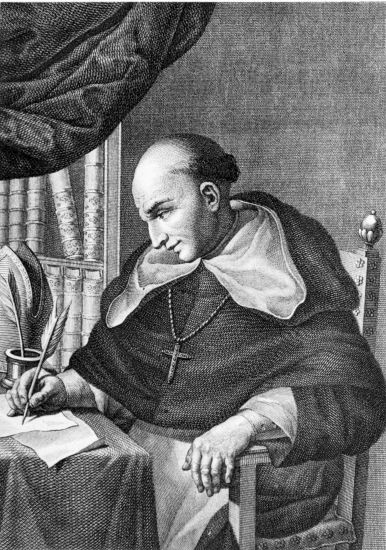
FRA BARTOLOMÉ DE LAS CASAS
Goupil & Cº. Paris
the ordinary way, be disposed of, without breeding a pestilence in the
capital? Yet the event was of recent date, and is unequivocally attested
by the best-informed historians.[132] One fact may be considered
certain. It was customary to preserve the skulls of the sacrificed, in
buildings appropriated to the purpose. The companions of Cortés counted
one hundred and thirty-six thousand in one of these edifices![133]
Without attempting a precise calculation, therefore, it is safe to
conclude that thousands were yearly offered up, in the different cities
of Anahuac, on the bloody altars of the Mexican divinities.[134]
Indeed, the great object of war, with the Aztecs, was quite as much to
gather victims for their sacrifices as to extend their empire. Hence it
was that an enemy was never slain in battle, if there were a chance of
taking him alive. To this circumstance the Spaniards repeatedly owed
their preservation. When Montezuma was asked “why he had suffered the
republic of Tlascala to maintain her independence on his borders,” he
replied, “that she might furnish him with victims for his gods”! As the
supply began to fail, the priests, the Dominicans of the New World,
bellowed aloud for more, and urged on their superstitious sovereign by
the denunciations of celestial wrath. Like the militant churchmen of
Christendom in the Middle Ages, they mingled themselves in the ranks,
and were conspicuous in the thickest of the fight, by their hideous
aspect and frantic gestures. Strange, that, in every country, the most
fiendish passions of the human heart have been those kindled in the name
of religion![135]
The influence of these practices on the Aztec character was as
disastrous as might have been expected. Familiarity with the bloody
rites of sacrifice steeled the heart against human sympathy, and begat a
thirst for carnage, like that excited in the Romans by the exhibitions
of the circus. The perpetual recurrence of ceremonies, in which the
people took part, associated religion with their most intimate concerns,
and spread the gloom of superstition over the domestic hearth, until the
character of the nation wore a grave and even melancholy aspect, which
belongs to their descendants at the present day. The influence of the
priesthood, of course, became unbounded. The sovereign thought himself
honored by being permitted to assist in the services of the temple. Far
from limiting the authority of the priests to spiritual matters, he
often surrendered his opinion to theirs, where they were least competent
to give it. It was their opposition that prevented the final
capitulation which would have saved the capital. The whole nation, from
the peasant to the prince, bowed their necks to the worst kind of
tyranny, that of a blind fanaticism.
In reflecting on the revolting usages recorded in the preceding pages,
one finds it difficult to reconcile their existence with anything like a
regular form of government, or an advance in civilization.[136] Yet the
Mexicans had many claims to the character of a civilized community. One
may, perhaps, better understand the anomaly, by reflecting on the
condition of some of the most polished countries in Europe in the
sixteenth century, after the establishment of the modern
Inquisition,—an institution which yearly destroyed its thousands, by a
death more painful than the Aztec sacrifices; which armed the hand of
brother against brother, and, setting its burning seal upon the lip, did
more to stay the march of improvement than any other scheme ever devised
by human cunning.
Human sacrifice, however cruel, has nothing in it degrading to its
victim. It may be rather said to ennoble him by devoting him to the
gods. Although so terrible with the Aztecs, it was sometimes voluntarily
embraced by them, as the most glorious death and one that opened a sure
passage into paradise.[137] The Inquisition, on the other hand, branded
its victims with infamy in this world, and consigned them to everlasting
perdition in the next.
One detestable feature of the Aztec superstition, however, sunk it far
below the Christian. This was its cannibalism,[138] though, in truth,
the Mexicans were not cannibals in the coarsest acceptation of the term.
They did not feed on human flesh merely to gratify a brutish appetite,
but in obedience to their religion. Their repasts were made of the
victims whose blood had been poured out on the altar of sacrifice. This
is a distinction worthy of notice.[139] Still, cannibalism, under any
form or whatever sanction, cannot but have a fatal influence on the
nation addicted to it. It suggests ideas so loathsome, so degrading to
man, to his spiritual and immortal nature, that it is impossible the
people who practise it should make any great progress in moral or
intellectual culture. The Mexicans furnish no exception to this remark.
The civilization which they possessed descended from the Toltecs, a race
who never stained their altars, still less their banquets, with the
blood of man.[140] All that deserved the name of science in Mexico came
from this source; and the crumbling ruins of edifices attributed to
them, still extant in various parts of New Spain, show a decided
superiority in their architecture over that of the later races of
Anahuac. It is true, the Mexicans made great proficiency in many of the
social and mechanic arts, in that material culture,—if I may so call
it,—the natural growth of increasing opulence, which ministers to the
gratification of the senses. In purely intellectual progress they were
behind the Tezcucans, whose wise sovereigns came into the abominable
rites of their neighbors with reluctance and practised them on a much
more moderate scale.[141]
In this state of things, it was beneficently ordered by Providence that
the land should be delivered over to another race, who would rescue it
from the brutish superstitions that daily extended wider and wider with
extent of empire.[142] The debasing institutions of the Aztecs furnish
the best apology for their conquest. It is true, the conquerors brought
along with them the Inquisition. But they also brought Christianity,
whose benign radiance would still survive when the fierce flames of
fanaticism should be extinguished; dispelling those dark forms of horror
which had so long brooded over the fair region of Anahuac.
The most important authority in the preceding chapter, and, indeed,
wherever the Aztec religion is concerned, is Bernardino de Sahagun,
a Franciscan friar, contemporary with the Conquest. His great work,
Historia universal de Nueva-España, has been recently printed for
the first time. The circumstances attending its compilation and
subsequent fate form one of the most remarkable passages in
literary history.
Sahagun was born in a place of the same name, in old Spain. He was
educated at Salamanca, and, having taken the vows of St. Francis,
came over as a missionary to Mexico in the year 1529. Here he
distinguished himself by his zeal, the purity of his life, and his
unwearied exertions to spread the great truths of religion among
the natives. He was the guardian of several conventual houses,
successively, until he relinquished these cares, that he might
devote himself more unreservedly to the business of preaching, and
of compiling various works designed to illustrate the antiquities
of the Aztecs. For these literary labors he found some facilities
in the situation which he continued to occupy, of reader, or
lecturer, in the College of Santa Cruz, in the capital.
The “Universal History” was concocted in a singular manner. In
order to secure to it the greatest possible authority, he passed
some years in a Tezcucan town, where he conferred daily with a
number of respectable natives unacquainted with Castilian. He
propounded to them queries, which they, after deliberation,
answered in their usual method of writing, by hieroglyphical
paintings. These he submitted to other natives, who had been
educated under his own eye in the College of Santa Cruz; and the
latter, after a consultation among themselves, gave a written
version, in the Mexican tongue, of the hieroglyphics. This process
he repeated in another place, in some part of Mexico, and subjected
the whole to a still further revision by a third body in another
quarter. He finally arranged the combined results into a regular
history, in the form it now bears; composing it in the Mexican
language, which he could both write and speak with great accuracy
and elegance,—greater, indeed, than any Spaniard of the time.
The work presented a mass of curious information, that attracted
much attention among his brethren. But they feared its influence in
keeping alive in the natives a too vivid reminiscence of the very
superstitions which it was the great object of the Christian clergy
to eradicate. Sahagun had views more liberal than those of his
order, whose blind zeal would willingly have annihilated every
monument of art and human ingenuity which had not been produced
under the influence of Christianity. They refused to allow him the
necessary aid to transcribe his papers, which he had been so many
years in preparing, under the pretext that the expense was too
great for their order to incur. This occasioned a further delay of
several years. What was worse, his provincial got possession of his
manuscripts, which were soon scattered among the different
religious houses in the country.
In this forlorn state of his affairs, Sahagun drew up a brief
statement of the nature and contents of his work, and forwarded it
to Madrid. It fell into the hands of Don Juan de Ovando, president
of the Council for the Indies, who was so much interested in it
that he ordered the manuscripts to be restored to their author,
with the request that he would at once set about translating them
into Castilian. This was accordingly done. His papers were
recovered, though not without the menace of ecclesiastical
censures; and the octogenarian author began the work of translation
from the Mexican, in which they had been originally written by him
thirty years before. He had the satisfaction to complete the task,
arranging the Spanish version in a parallel column with the
original, and adding a vocabulary, explaining the difficult Aztec
terms and phrases; while the text was supported by the numerous
paintings on which it was founded. In this form, making two bulky
volumes in folio, it was sent to Madrid. There seemed now to be no
further reason for postponing its publication, the importance of
which could not be doubted. But from this moment it disappears; and
we hear nothing further of it, for more than two centuries, except
only as a valuable work, which had once existed and was probably
buried in some one of the numerous cemeteries of learning in which
Spain abounds.
At length, towards the close of the last century, the indefatigable
Muñoz succeeded in disinterring the long-lost manuscript from the
place tradition had assigned to it,—the library of a convent at
Tolosa, in Navarre, the northern extremity of Spain. With his usual
ardor, he transcribed the whole work with his own hands, and added
it to the inestimable collection, of which, alas! he was destined
not to reap the full benefit himself. From this transcript Lord
Kingsborough was enabled to procure the copy which was published in
1830, in the sixth volume of his magnificent compilation. In it he
expresses an honest satisfaction at being the first to give
Sahagun’s works to the world. But in this supposition he was
mistaken. The very year preceding, an edition of it, with
annotations, appeared in Mexico, in three volumes octavo. It was
prepared by Bustamante,—a scholar to whose editorial activity his
country is largely indebted,—from a copy of the Muñoz manuscript
which came into his possession. Thus this remarkable work, which
was denied the honors of the press during the author’s lifetime,
after passing into oblivion, reappeared, at the distance of nearly
three centuries, not in his own country, but in foreign lands
widely remote from each other, and that almost simultaneously. The
story is extraordinary, though unhappily not so extraordinary in
Spain as it would be elsewhere.
Sahagun divided his history into twelve books. The first eleven are
occupied with the social institutions of Mexico, and the last with
the Conquest. On the religion of the country he is particularly
full. His great object evidently was, to give a clear view of its
mythology, and of the burdensome ritual which belonged to it.
Religion entered so intimately into the most private concerns and
usages of the Aztecs, that Sahagun’s work must be a text-book for
every student of their antiquities. Torquemada availed himself of a
manuscript copy, which fell into his hands before it was sent to
Spain, to enrich his own pages,—a circumstance more fortunate for
his readers than for Sahagun’s reputation, whose work, now that it
is published, loses much of the originality and interest which
would otherwise attach to it. In one respect it is invaluable; as
presenting a complete collection of the various forms of prayer,
accommodated to every possible emergency, in use by the Mexicans.
They are often clothed in dignified and beautiful language, showing
that sublime speculative tenets are quite compatible with the most
degrading practices of superstition. It is much to be regretted
that we have not the eighteen hymns inserted by the author in his
book, which would have particular interest, as the only specimen of
devotional poetry preserved of the Aztecs. The hieroglyphical
paintings, which accompanied the text, are also missing. If they
have escaped the hands of fanaticism, both may reappear at some
future day.
Sahagun produced several other works, of a religious or
philological character. Some of these were voluminous, but none
have been printed. He lived to a very advanced age, closing a life
of activity and usefulness, in 1590, in the capital of Mexico. His
remains were followed to the tomb by a numerous concourse of his
own countrymen, and of the natives, who lamented in him the loss of
unaffected piety, benevolence, and learning.
IT is a relief to turn from the gloomy pages of the preceding chapter to
a brighter side of the picture, and to contemplate the same nation in
its generous struggle to raise itself from a state of barbarism and to
take a positive rank in the scale of civilization. It is not the less
interesting, that these efforts were made on an entirely new theatre of
action, apart from those influences that operate in the Old World; the
inhabitants of which, forming one great brotherhood of nations, are knit
together by sympathies that make the faintest spark of knowledge, struck
out in one quarter, spread gradually wider and wider, until it has
diffused a cheering light over the remotest. It is curious to observe
the human mind, in this new position, conforming to the same laws as on
the ancient continent, and taking a similar direction in its first
inquiries after truth,—so similar, indeed, as, although not warranting,
perhaps, the idea of imitation, to suggest at least that of a common
origin.
In the Eastern hemisphere we find some nations, as the Greeks, for
instance, early smitten with such a love of the beautiful as to be
unwilling to dispense with it even in the graver productions of
science; and other nations, again, proposing a severer end to
themselves, to which even imagination and elegant art were made
subservient. The productions of such a people must be criticised, not by
the ordinary rules of taste, but by their adaptation to the peculiar end
for which they were designed. Such were the Egyptians in the Old
World,[143] and the Mexicans in the New. We have already had occasion to
notice the resemblance borne by the latter nation to the former in their
religious economy. We shall be more struck with it in their scientific
culture, especially their hieroglyphical writing and their astronomy.
To describe actions and events by delineating visible objects seems to
be a natural suggestion, and is practised, after a certain fashion, by
the rudest savages. The North American Indian carves an arrow on the
bark of trees to show his followers the direction of his march, and some
other sign to show the success of his expeditions. But to paint
intelligibly a consecutive series of these actions—forming what
Warburton has happily called picture-writing[144]—requires a
combination of ideas that amounts to a positively intellectual effort.
Yet further, when the object of the painter, instead of being limited to
the present, is to penetrate the past, and to gather from its dark
recesses lessons of instruction for coming generations, we see the
dawnings of a literary culture, and recognize the proof of a decided
civilization in the attempt itself, however imperfectly it may be
executed. The literal imitation of objects will not answer for this more
complex and extended plan. It would occupy too much space, as well as
time in the execution. It then becomes necessary to abridge the
pictures, to confine the drawing to outlines, or to such prominent parts
of the bodies delineated as may readily suggest the whole. This is the
representative or figurative writing, which forms the lowest stage
of hieroglyphics.
But there are things which have no type in the material world; abstract
ideas, which can only be represented by visible objects supposed to have
some quality analogous to the idea intended. This constitutes
symbolical writing, the most difficult of all to the interpreter,
since the analogy between the material and immaterial object is often
purely fanciful, or local in its application. Who, for instance, could
suspect the association which made a beetle represent the universe, as
with the Egyptians, or a serpent typify time, as with the Aztecs?
The third and last division is the phonetic, in which signs are made
to represent sounds, either entire words, or parts of them. This is the
nearest approach of the hieroglyphical series to that beautiful
invention, the alphabet, by which language is resolved into its
elementary sounds, and an apparatus supplied for easily and accurately
expressing the most delicate shades of thought.
The Egyptians were well skilled in all three kinds of hieroglyphics.
But, although their public monuments display the first class, in their
ordinary intercourse and written records it is now certain that they
almost wholly relied on the phonetic character. Strange that, having
thus broken down the thin partition which divided them from an alphabet,
their latest monuments should exhibit no nearer approach to it than
their earliest.[145] The Aztecs, also, were acquainted with the several
varieties of hieroglyphics. But they relied on the figurative infinitely
more than on the others. The Egyptians were at the top of the scale, the
Aztecs at the bottom.
In casting the eye over a Mexican manuscript, or map, as it is called,
one is struck with the grotesque caricatures it exhibits of the human
figure; monstrous, overgrown heads, on puny, misshapen bodies, which are
themselves hard and angular in their outlines, and without the least
skill in composition. On closer inspection, however, it is obvious that
it is not so much a rude attempt to delineate nature, as a conventional
symbol, to express the idea in the most clear and forcible manner; in
the same way as the pieces of similar value on a chess-board, while they
correspond with one another in form, bear little resemblance, usually,
to the objects they represent. Those parts of the figure are most
distinctly traced which are the most important. So, also, the coloring,
instead of the delicate gradations of nature, exhibits only gaudy and
violent contrasts, such as may produce the most vivid impression. “For
even colors,” as Gama observes, “speak in the Aztec hieroglyphics.”[146]
But in the execution of all this the Mexicans were much inferior to the
Egyptians. The drawings of the latter, indeed, are exceedingly
defective, when criticised by the rules of art; for they were as
ignorant of perspective as the Chinese, and only exhibited the head in
profile, with the eye in the centre, and with total absence of
expression. But they handled the pencil more gracefully than the Aztecs,
were more true to the natural forms of objects, and, above all, showed
great superiority in abridging the original figure by giving only the
outline, or some characteristic or essential feature. This simplified
the process, and facilitated the communication of thought. An Egyptian
text has almost the appearance of alphabetical writing in its regular
lines of minute figures. A Mexican text looks usually like a collection
of pictures, each one forming the subject of a separate study. This is
particularly the case with the delineations of mythology; in which the
story is told by a conglomeration of symbols, that may remind one more
of the mysterious anaglyphs sculptured on the temples of the Egyptians,
than of their written records.
The Aztecs had various emblems for expressing such things as, from their
nature, could not be directly represented by the painter; as, for
example, the years, months, days, the seasons, the elements, the
heavens, and the like. A “tongue” denoted speaking; a “footprint,”
travelling; a “man sitting on the ground,” an earthquake. These symbols
were often very arbitrary, varying with the caprice of the writer; and
it requires a nice discrimination to interpret them, as a slight change
in the form or position of the figure intimated a very different
meaning.[147] An ingenious writer asserts that the priests devised
secret symbolic characters for the record of their religious mysteries.
It is possible. But the researches of Champollion lead to the conclusion
that the similar opinion formerly entertained respecting the Egyptian
hieroglyphics is without foundation.[148]
Lastly, they employed, as above stated, phonetic signs, though these
were chiefly confined to the names of persons and places; which, being
derived from some circumstance or characteristic quality, were
accommodated to the hieroglyphical system. Thus, the town Cimatlan was
compounded of cimatl, a “root,” which grew near it, and tlan,
signifying “near;” Tlaxcallan meant “the place of bread,” from its
rich fields of corn; Huexotzinco, “a place surrounded by willows.” The
names of persons were often significant of their adventures and
achievements. That of the great Tezcucan prince Nezahualcoyotl signified
“hungry fox,” intimating his sagacity, and his distresses in early
life.[149] The emblems of such names were no sooner seen, than they
suggested to every Mexican the person and place intended, and, when
painted on their shields or embroidered on their banners, became the
armorial bearings by which city and chieftain were distinguished, as in
Europe in the age of chivalry.[150]
But, although the Aztecs were instructed in all the varieties of
hieroglyphical painting, they chiefly resorted to the clumsy method of
direct representation. Had their empire lasted, like the Egyptian,
several thousand years, instead of the brief space of two hundred, they
would doubtless, like them, have advanced to the more frequent use of
the phonetic writing. But, before they could be made acquainted with the
capabilities of their own system, the Spanish Conquest, by introducing
the European alphabet, supplied their scholars with a more perfect
contrivance for expressing thought, which soon supplanted the ancient
pictorial character.[151]
Clumsy as it was, however, the Aztec picture-writing seems to have been
adequate to the demands of the nation, in their imperfect state of
civilization. By means of it were recorded all their laws, and even
their regulations for domestic economy; their tribute-rolls, specifying
the imposts of the various towns; their mythology, calendars, and
rituals; their political annals, carried back to a period long before
the foundation of the city. They digested a complete system of
chronology, and could specify with accuracy the dates of the most
important events in their history; the year being inscribed on the
margin, against the particular circumstance recorded. It is true,
history, thus executed, must necessarily be vague and fragmentary. Only
a few leading incidents could be presented. But in this it did not
differ much from the monkish chronicles of the dark ages, which often
dispose of years in a few brief sentences,—quite long enough for the
annals of barbarians.[152]
In order to estimate aright the picture-writing of the Aztecs, one must
regard it in connection with oral tradition, to which it was auxiliary.
In the colleges of the priests the youth were instructed in astronomy,
history, mythology, etc.; and those who were to follow the profession of
hieroglyphical painting were taught the application of the characters
appropriated to each of these branches. In an historical work, one had
charge of the chronology, another of the events. Every part of the labor
was thus mechanically distributed.[153] The pupils, instructed in all
that was before known in their several departments, were prepared to
extend still further the boundaries of their imperfect science. The
hieroglyphics served as a sort of stenography, a collection of notes,
suggesting to the initiated much more than could be conveyed by a
literal interpretation. This combination of the written and the oral
comprehended what may be called the literature of the Aztecs.[154]
Their manuscripts were made of different materials,—of cotton cloth, or
skins nicely prepared; of a composition of silk and gum; but, for the
most part, of a fine fabric from the leaves of the aloe, agave
Americana, called by the natives maguey, which grows luxuriantly over
the table-lands of Mexico. A sort of paper was made from it, resembling
somewhat the Egyptian papyrus,[155] which, when properly dressed and
polished, is said to have been more soft and beautiful than parchment.
Some of the specimens, still existing, exhibit their original freshness,
and the paintings on them retain their brilliancy of colors. They were
sometimes done up into rolls, but more frequently into volumes, of
moderate size, in which the paper was shut up, like a folding screen,
with a leaf or tablet of wood at each extremity, that gave the whole,
when closed, the appearance of a book. The length of the strips was
determined only by convenience. As the pages might be read and referred
to separately, this form had obvious advantages over the rolls of the
ancients.[156]
At the time of the arrival of the Spaniards, great quantities of these
manuscripts were treasured up in the country. Numerous persons were
employed in painting, and the dexterity of their operations excited the
astonishment of the Conquerors. Unfortunately, this was mingled with
other and unworthy feelings. The strange, unknown characters inscribed
on them excited suspicion. They were looked on as magic scrolls, and
were regarded in the same light with the idols and temples, as the
symbols of a pestilent superstition, that must be extirpated. The first
archbishop of Mexico, Don Juan de Zumárraga,—a name that should be as
immortal as that of Omar,—collected these paintings from every quarter,
especially from Tezcuco, the most cultivated capital in Anahuac, and
the great depository of the national archives. He then caused them to
be piled up in a “mountain-heap”—as it is called by the Spanish writers
themselves—in the market-place of Tlatelolco, and reduced them all to
ashes![157] His greater countryman, Archbishop Ximenes, had celebrated a
similar auto-da-fé of Arabic manuscripts, in Granada, some twenty
years before. Never did fanaticism achieve two more signal triumphs than
by the annihilation of so many curious monuments of human ingenuity and
learning![158]
The unlettered soldiers were not slow in imitating the example of their
prelate. Every chart and volume which fell into their hands was wantonly
destroyed; so that, when the scholars of a later and more enlightened
age anxiously sought to recover some of these memorials of civilization,
nearly all had perished, and the few surviving were jealously hidden by
the natives.[159] Through the indefatigable labors of a private
individual, however, a considerable collection was eventually deposited
in the archives of Mexico,[160] but was so little heeded there that some
were plundered, others decayed piecemeal from the damps and mildews, and
others, again, were used up as waste paper![161] We contemplate with
indignation the cruelties inflicted by the early conquerors. But
indignation is qualified with contempt when we see them thus ruthlessly
trampling out the spark of knowledge, the common boon and property of
all mankind. We may well doubt which has the stronger claim to
civilization, the victor or the vanquished.
A few of the Mexican manuscripts have found their way, from time to
time, to Europe, and are carefully preserved in the public libraries of
its capitals. They are brought together in the magnificent work of Lord
Kingsborough; but not one is there from Spain. The most important of
them, for the light it throws on the Aztec institutions, is the Mendoza
Codex; which, after its mysterious disappearance for more than a
century, has at length reappeared in the Bodleian Library at Oxford. It
has been several times engraved.[162] The most brilliant in coloring,
probably, is the Borgian collection, in Rome.[163] The most curious,
however, is the Dresden Codex, which has excited less attention than it
deserves. Although usually classed among Mexican manuscripts, it bears
little resemblance to them in its execution; the figures of objects are
more delicately drawn, and the characters, unlike the Mexican, appear to
be purely arbitrary, and are possibly phonetic.[164] Their regular
arrangement is quite equal to the Egyptian. The whole infers a much
higher civilization than the Aztec, and offers abundant food for curious
speculation.[165]
Some few of these maps have interpretations annexed to them, which were
obtained from the natives after the Conquest.[166] The greater part are
without any, and cannot now be unriddled. Had the Mexicans made free use
of a phonetic alphabet, it might have been originally easy, by mastering
the comparatively few signs employed in this kind of communication, to
have got a permanent key to the whole.[167] A brief inscription has
furnished a clue to the vast labyrinth of Egyptian hieroglyphics. But
the Aztec characters, representing individuals, or, at most, species,
require to be made out separately; a hopeless task, for which little aid
is to be expected from the vague and general tenor of the few
interpretations now existing. There was, as already mentioned, until
late in the last century, a professor in the University of Mexico,
especially devoted to the study of the national picture-writing. But, as
this was with a view to legal proceedings, his information, probably,
was limited to deciphering titles. In less than a hundred years after
the Conquest, the knowledge of the hieroglyphics had so far declined
that a diligent Tezcucan writer complains he could find in the country
only two persons, both very aged, at all competent to interpret
them.[168]
It is not probable, therefore, that the art of reading these
picture-writings will ever be recovered; a circumstance certainly to be
regretted. Not that the records of a semi-civilized people would be
likely to contain any new truth or discovery important to human comfort
or progress; but they could scarcely fail to throw some additional light
on the previous history of the nation, and that of the more polished
people who before occupied the country.[169] This would be still more
probable, if any literary relics of their Toltec predecessors were
preserved; and, if report be true, an important compilation from this
source was extant at the time of the invasion, and may have perhaps
contributed to swell the holocaust of Zumárraga.[170] It is no great
stretch of fancy to suppose that such records might reveal the
successive links in the mighty chain of migration of the primitive
races, and, by carrying us back to the seat of their possessions in the
Old World, have solved the mystery which has so long perplexed the
learned, in regard to the settlement and civilization of the New.[171]
Besides the hieroglyphical maps, the traditions of the country were
embodied in the songs and hymns, which, as already mentioned, were
carefully taught in the public schools. These were various, embracing
the mythic legends of a heroic age, the warlike achievements of their
own, or the softer tales of love and pleasure.[172] Many of them were
composed by scholars and persons of rank, and are cited as affording the
most authentic record of events.[173] The Mexican dialect was rich and
expressive, though inferior to the Tezcucan, the most polished of the
idioms of Anahuac. None of the Aztec compositions have survived, but we
can form some estimate of the general state of poetic culture from the
odes which have come down to us from the royal house of Tezcuco.[174]
Sahagun has furnished us with translations of their more elaborate
prose, consisting of prayers and public discourses, which give a
favorable idea of their eloquence, and show that they paid much
attention to rhetorical effect. They are said to have had, also,
something like theatrical exhibitions, of a pantomimic sort, in which
the faces of the performers were covered with masks, and the figures of
birds or animals were frequently represented; an imitation to which they
may have been led by the familiar delineation of such objects in their
hieroglyphics.[175] In all this we see the dawning of a literary
culture, surpassed, however, by their attainments in the severer walks
of mathematical science.
They devised a system of notation in their arithmetic sufficiently
simple. The first twenty numbers were expressed by a corresponding
number of dots. The first five had specific names; after which they were
represented by combining the fifth with one of the four preceding; as
five and one for six, five and two for seven, and so on. Ten and fifteen
had each a separate name, which was also combined with the first four,
to express a higher quantity. These four, therefore, were the radical
characters of their oral arithmetic, in the same manner as they were of
the written with the ancient Romans; a more simple arrangement,
probably, than any existing among Europeans.[176] Twenty was expressed
by a separate hieroglyphic,—a flag. Larger sums were reckoned by
twenties, and, in writing, by repeating the number of flags. The square
of twenty, four hundred, had a separate sign, that of a plume, and so
had the cube of twenty, or eight thousand, which was denoted by a purse,
or sack. This was the whole arithmetical apparatus of the Mexicans, by
the combination of which they were enabled to indicate any quantity. For
greater expedition, they used to denote fractions of the larger sums by
drawing only a part of the object. Thus, half or three-fourths of a
plume, or of a purse, represented that proportion of their respective
sums, and so on.[177] With all this, the machinery will appear very
awkward to us, who perform our operations with so much ease by means of
the Arabic or, rather, Indian ciphers. It is not much more awkward,
however, than the system pursued by the great mathematicians of
antiquity, unacquainted with the brilliant invention, which has given a
new aspect to mathematical science, of determining the value, in a great
measure, by the relative position of the figures.
In the measurement of time, the Aztecs adjusted their civil year by the
solar. They divided it into eighteen months of twenty days each. Both
months and days were expressed by peculiar hieroglyphics,—those of the
former often intimating the season of the year, like the French months
at the period of the Revolution. Five complementary days, as in
Egypt,[178] were added, to make up the full number of three hundred and
sixty-five. They belonged to no month, and were regarded as peculiarly
unlucky. A month was divided into four weeks, of five days each, on the
last of which was the public fair, or market-day.[179] This arrangement,
differing from that of the nations of the Old Continent, whether of
Europe or Asia,[180] has the advantage of giving an equal number of days
to each month, and of comprehending entire weeks, without a fraction,
both in the months and in the year.[181]
As the year is composed of nearly six hours more than three hundred and
sixty-five days, there still remained an excess, which, like other
nations who have framed a calendar, they provided for by intercalation;
not, indeed, every fourth year, as the Europeans,[182] but at longer
intervals, like some of the Asiatics.[183] They waited till the
expiration of fifty-two vague years, when they interposed thirteen days,
or rather twelve and a half, this being the number which had fallen in
arrear. Had they inserted thirteen, it would have been too much, since
the annual excess over three hundred and sixty-five is about eleven
minutes less than six hours. But, as their calendar at the time of the
Conquest was found to correspond with the European (making allowance for
the subsequent Gregorian reform), they would seem to have adopted the
shorter period of twelve days and a half,[184] which brought them,
within an almost inappreciable fraction, to the exact length of the
tropical year, as established by the most accurate observations.[185]
Indeed, the intercalation of twenty-five days in every hundred and four
years shows a nicer adjustment of civil to solar time than is presented
by any European calendar; since more than five centuries must elapse
before the loss of an entire day.[186] Such was the astonishing
precision displayed by the Aztecs, or, perhaps, by their more polished
Toltec predecessors, in these computations, so difficult as to have
baffled, till a comparatively recent period, the most enlightened
nations of Christendom![187]
The chronological system of the Mexicans, by which they determined the
date of any particular event, was also very remarkable. The epoch from
which they reckoned corresponded with the year 1091 of the Christian
era. It was the period of the reform of their calendar, soon after their
migration from Aztlan. They threw the years, as already noticed, into
great cycles, of fifty-two each, which they called “sheafs,” or
“bundles,” and represented by a quantity of reeds bound together by a
string. As often as this hieroglyphic occurs in their maps, it shows the
number of half-centuries. To enable them to specify any particular year,
they divided the great cycle into four smaller cycles, or indictions,
of thirteen years each. They then adopted two periodical series of
signs, one consisting of their numerical dots, up to thirteen, the
other, of four hieroglyphics of the years.[188] These latter they
repeated in regular succession, setting against each one a number of the
corresponding series of dots, continued also in regular succession up to
thirteen. The same system was pursued through the four indictions, which
thus, it will be observed, began always with a different hieroglyphic of
the year from the preceding; and in this way each of the hieroglyphics
was made to combine successively with each of the numerical signs, but
never twice with the same; since four, and thirteen, the factors of
fifty-two,—the number of years in the cycle,—must admit of just as
many combinations as are equal to their product. Thus every year had its
appropriate symbol, by which it was at once recognized. And this symbol,
preceded by the proper number of “bundles” indicating the
half-centuries, showed the precise time which had elapsed since the
national epoch of 1091.[189] The ingenious contrivance of a periodical
series, in place of the cumbrous system of hieroglyphical notation, is
not peculiar to the Aztecs, and is to be found among various nations on
the Asiatic continent,—the same in principle, though varying
materially in arrangement.[190]
The solar calendar above described might have answered all the purposes
of the people; but the priests chose to construct another for
themselves. This was called a “lunar reckoning,” though nowise
accommodated to the revolutions of the moon.[191] It was formed, also,
of two periodical series, one of them consisting of thirteen numerical
signs, or dots, the other, of the twenty hieroglyphics of the days.
But, as the product of these combinations would be only 260, and as some
confusion might arise from the repetition of the same terms for the
remaining 105 days of the year, they invented a third series, consisting
of nine additional hieroglyphics, which, alternating with the two
preceding series, rendered it impossible that the three should coincide
twice in the same year, or indeed in less than 2340 days; since 20 × 13
× 9 = 2340.[192] Thirteen was a mystic number, of frequent use in their
tables.[193] Why they resorted to that of nine, on this occasion, is not
so clear.[194]
This second calendar rouses a holy indignation in the early Spanish
missionaries, and Father Sahagun loudly condemns it, as “most
unhallowed, since it is founded neither on natural reason, nor on the
influence of the planets, nor on the true course of the year; but is
plainly the work of necromancy, and the fruit of a compact with the
Devil!”[195] One may doubt whether the superstition of those who
invented the scheme was greater than that of those who thus impugned it.
At all events, we may, without having recourse to supernatural agency,
find in the human heart a sufficient explanation of its origin; in that
love of power, that has led the priesthood of many a faith to affect a
mystery the key to which was in their own keeping.
By means of this calendar, the Aztec priests kept their own records,
regulated the festivals and seasons of sacrifice, and made all their
astrological calculations.[196] The false science of astrology is
natural to a state of society partially civilized, where the mind,
impatient of the slow and cautious examination by which alone it can
arrive at truth, launches at once into the regions of speculation, and
rashly attempts to lift the veil—the impenetrable veil—which is drawn
around the mysteries of nature. It is the characteristic of true science
to discern the impassable, but not very obvious, limits which divide the
province of reason from that of speculation. Such knowledge comes
tardily. How many ages have rolled away, in which powers that, rightly
directed, might have revealed the great laws of nature, have been wasted
in brilliant but barren reveries on alchemy and astrology!
The latter is more particularly the study of a primitive age; when the
mind, incapable of arriving at the stupendous fact that the myriads of
minute lights glowing in the firmament are the centres of systems as
glorious as our own, is naturally led to speculate on their probable
uses, and to connect them in some way or other with man, for whose
convenience every other object in the universe seems to have been
created. As the eye of the simple child of nature watches, through the
long nights, the stately march of the heavenly bodies, and sees the
bright hosts coming up, one after another, and changing with the
changing seasons of the year, he naturally associates them with those
seasons, as the periods over which they hold a mysterious influence. In
the same manner, he connects their appearance with any interesting
event of the time, and explores, in their flaming characters, the
destinies of the new-born infant.[197] Such is the origin of astrology,
the false lights of which have continued from the earliest ages to
dazzle and bewilder mankind, till they have faded away in the superior
illumination of a comparatively recent period.
The astrological scheme of the Aztecs was founded less on the planetary
influences than on those of the arbitrary signs they had adopted for the
months and days. The character of the leading sign in each lunar cycle
of thirteen days gave a complexion to the whole; though this was
qualified in some degree by the signs of the succeeding days, as well as
by those of the hours. It was in adjusting these conflicting forces that
the great art of the diviner was shown. In no country, not even in
ancient Egypt, were the dreams of the astrologer more implicitly
deferred to. On the birth of a child, he was instantly summoned. The
time of the event was accurately ascertained; and the family hung in
trembling suspense, as the minister of Heaven cast the horoscope of the
infant and unrolled the dark volume of destiny. The influence of the
priest was confessed by the Mexican in the very first breath which he
inhaled.[198]
We know little further of the astronomical attainments of the Aztecs.
That they were acquainted with the cause of eclipses is evident from the
representation, on their maps, of the disk of the moon projected on that
of the sun.[199] Whether they had arranged a system of constellations is
uncertain; though that they recognized some of the most obvious, as the
Pleiades, for example, is evident from the fact that they regulated
their festivals by them. We know of no astronomical instruments used by
them, except the dial.[200] An immense circular block of carved stone,
disinterred in 1790, in the great square of Mexico, has supplied an
acute and learned scholar with the means of establishing some
interesting facts in regard to Mexican science.[201] This colossal
fragment, on which the calendar[202] is engraved, shows that they had
the means of settling the hours of the day with precision, the periods
of the solstices and of the equinoxes, and that of the transit of the
sun across the zenith of Mexico.[203]
We cannot contemplate the astronomical science of the Mexicans, so
disproportioned to their progress in other walks of civilization,
without astonishment. An acquaintance with some of the more obvious
principles of astronomy is within the reach of the rudest people. With a
little care, they may learn to connect the regular changes of the
seasons with those of the place of the sun at his rising and setting.
They may follow the march of the great luminary through the heavens, by
watching the stars that first brighten on his evening track or fade in
his morning beams. They may measure a revolution of the moon, by marking
her phases, and may even form a general idea of the number of such
revolutions in a solar year. But that they should be capable of
accurately adjusting their festivals by the movements of the heavenly
bodies, and should fix the true length of the tropical year, with a
precision unknown to the great philosophers of antiquity, could be the
result only of a long series of nice and patient observations, evincing
no slight progress in civilization.[204] But whence could the rude
inhabitants of these mountain-regions have derived this curious
erudition? Not from the barbarous hordes who roamed over the higher
latitudes of the North; nor from the more polished races on the Southern
continent, with whom, it is apparent, they had no intercourse. If we are
driven, in our embarrassment, like the greatest astronomer of our age,
to seek the solution among the civilized communities of Asia, we shall
still be perplexed by finding, amidst general resemblance of outline,
sufficient discrepancy in the details to vindicate, in the judgments of
many, the Aztec claim to originality.[205]
I shall conclude the account of Mexican science with that of a
remarkable festival, celebrated by the natives at the termination of the
great cycle of fifty-two years. We have seen, in the preceding chapter,
their tradition of the destruction of the world at four successive
epochs. They looked forward confidently to another such catastrophe, to
take place, like the preceding, at the close of a cycle, when the sun
was to be effaced from the heavens, the human race from the earth, and
when the darkness of chaos was to settle on the habitable globe. The
cycle would end in the latter part of December, and as the dreary season
of the winter solstice approached, and the diminished light of day gave
melancholy presage of its speedy extinction, their apprehensions
increased; and on the arrival of the five “unlucky” days which closed
the year they abandoned themselves to despair.[206] They broke in pieces
the little images of their household gods, in whom they no longer
trusted. The holy fires were suffered to go out in the temples, and none
were lighted in their own dwellings. Their furniture and domestic
utensils were destroyed; their garments torn in pieces; and every thing
was thrown into disorder, for the coming of the evil genii who were to
descend on the desolate earth.
On the evening of the last day, a procession of priests, assuming the
dress and ornaments of their gods, moved from the capital towards a
lofty mountain, about two leagues distant. They carried with them a
noble victim, the flower of their captives, and an apparatus for
kindling the new fire, the success of which was an augury of the
renewal of the cycle. On reaching the summit of the mountain, the
procession paused till midnight; when, as the constellation of the
Pleiades approached the zenith,[207] the new fire was kindled by the
friction of the sticks placed on the wounded breast of the victim.[208]
The flame was soon communicated to a funeral pile, on which the body of
the slaughtered captive was thrown. As the light streamed up towards
heaven, shouts of joy and triumph burst forth from the countless
multitudes who covered the hills, the terraces of the temples, and the
house-tops, with eyes anxiously bent on the mount of sacrifice.
Couriers, with torches lighted at the blazing beacon, rapidly bore them
over every part of the country; and the cheering element was seen
brightening on altar and hearthstone, for the circuit of many a league,
long before the sun, rising on his accustomed track, gave assurance that
a new cycle had commenced its march, and that the laws of nature were
not to be reversed for the Aztecs.
The following thirteen days were given up to festivity. The houses were
cleansed and whitened. The broken vessels were replaced by new ones. The
people, dressed in their gayest apparel, and crowned with garlands and
chaplets of flowers, thronged in joyous procession to offer up their
oblations and thanksgivings in the temples. Dances and games were
instituted, emblematical of the regeneration of the world. It was the
carnival of the Aztecs; or rather the national jubilee, the great
secular festival, like that of the Romans, or ancient Etruscans, which
few alive had witnessed before, or could expect to see again.[209]
M. de Humboldt remarked, many years ago, “It were to be wished that
some government would publish at its own expense the remains of the
ancient American civilization; for it is only by the comparison of
several monuments that we can succeed in discovering the meaning of
these allegories, which are partly astronomical and partly mystic.”
This enlightened wish has now been realized, not by any
government, but by a private individual, Lord Kingsborough. The
great work published under his auspices, and so often cited in this
Introduction, appeared in London in 1830. When completed it will
reach to nine volumes, seven of which are now before the public.
Some idea of its magnificence may be formed by those who have not
seen it, from the fact that copies of it, with colored plates, sold
originally at £175, and, with uncolored, at £120. The price has
been since much reduced. It is designed to exhibit a complete view
of the ancient Aztec MSS., with such few interpretations as exist;
the beautiful drawings of Castañeda relating to Central America,
with the commentary of Dupaix; the unpublished history of Father
Sahagun; and, last, not least, the copious annotations of his
lordship.
Too much cannot be said of the mechanical execution of the
book,—its splendid typography, the apparent accuracy and the
delicacy of the drawings, and the sumptuous quality of the
materials. Yet the purchaser would have been saved some superfluous
expense, and the reader much inconvenience, if the letter-press had
been in volumes of an ordinary size. But it is not uncommon, in
works on this magnificent plan, to find utility in some measure
sacrificed to show.
The collection of Aztec MSS., if not perfectly complete, is very
extensive, and reflects great credit on the diligence and research
of the compiler. It strikes one as strange, however, that not a
single document should have been drawn from Spain. Peter Martyr
speaks of a number having been brought thither in his time. (De
Insulis nuper Inventis, p. 368.) The Marquis Spineto examined one
in the Escorial, being the same with the Mendoza Codex, and perhaps
the original, since that at Oxford is but a copy. (Lectures, Lect.
7.) Mr. Waddilove, chaplain of the British embassy to Spain, gave a
particular account of one to Dr. Robertson, which he saw in the
same library and considered an Aztec calendar. Indeed, it is
scarcely possible that the frequent voyagers to the New World
should not have furnished the mother-country with abundant
specimens of this most interesting feature of Aztec civilization.
Nor should we fear that the present liberal government would
seclude these treasures from the inspection of the scholar.
Much cannot be said in favor of the arrangement of these codices.
In some of them, as the Mendoza Codex, for example, the plates are
not even numbered; and one who would study them by the
corresponding interpretation must often bewilder himself in the
maze of hieroglyphics, without a clue to guide him. Neither is
there any attempt to enlighten us as to the positive value and
authenticity of the respective documents, or even their previous
history, beyond a barren reference to the particular library from
which they have been borrowed. Little light, indeed, can be
expected on these matters; but we have not that little. The defect
of arrangement is chargeable on other parts of the work. Thus, for
instance, the sixth book of Sahagun is transferred from the body of
the history to which it belongs, to a preceding volume; while the
grand hypothesis of his lordship, for which the work was
concocted, is huddled into notes, hitched on random passages of the
text, with a good deal less connection than the stories of Queen
Scheherezade, in the “Arabian Nights,” and not quite so
entertaining.
The drift of Lord Kingsborough’s speculations is, to establish the
colonization of Mexico by the Israelites. To this the whole battery
of his logic and learning is directed. For this, hieroglyphics are
unriddled, manuscripts compared, monuments delineated. His theory,
however, whatever be its merits, will scarcely become popular;
since, instead of being exhibited in a clear and comprehensive
form, readily embraced by the mind, it is spread over an infinite
number of notes, thickly sprinkled with quotations from languages
ancient and modern, till the weary reader, floundering about in the
ocean of fragments, with no light to guide him, feels like Milton’s
Devil, working his way through chaos,—
“neither sea,
Nor good dry land; nigh foundered, on he fares.”
It would be unjust, however, not to admit that the noble author, if
his logic is not always convincing, shows much acuteness in
detecting analogies; that he displays familiarity with his subject,
and a fund of erudition, though it often runs to waste; that,
whatever be the defects of arrangement, he has brought together a
most rich collection of unpublished materials to illustrate the
Aztec and, in a wider sense, American antiquities; and that by this
munificent undertaking, which no government, probably, would have,
and few individuals could have, executed, he has entitled himself
to the lasting gratitude of every friend of science.
Another writer whose works must be diligently consulted by every
student of Mexican antiquities is Antonio Gama. His life contains
as few incidents as those of most scholars. He was born at Mexico,
in 1735, of a respectable family, and was bred to the law. He early
showed a preference for mathematical studies, conscious that in
this career lay his strength. In 1771 he communicated his
observations on the eclipse of that year to the French astronomer
M. de Lalande, who published them in Paris, with high commendations
of the author. Gama’s increasing reputation attracted the attention
of government; and he was employed by it in various scientific
labors of importance. His great passion, however, was the study of
Indian antiquities. He made himself acquainted with the history of
the native races, their traditions, their languages, and, as far as
possible, their hieroglyphics. He had an opportunity of showing the
fruits of this preparatory training, and his skill as an antiquary,
on the discovery of the great calendar stone, in 1790. He produced
a masterly treatise on this, and another Aztec monument, explaining
the objects to which they were devoted, and pouring a flood of
light on the astronomical science of the aborigines, their
mythology, and their astrological system. He afterwards continued
his investigations in the same path, and wrote treatises on the
dial, hieroglyphics, and arithmetic of the Indians. These, however,
were not given to the world till a few years since, when they were
published, together with a reprint of the former work, under the
auspices of the industrious Bustamante. Gama died in 1802, leaving
behind him a reputation for great worth in private life,—one in
which the bigotry that seems to enter too frequently into the
character of the Spanish-Mexican was tempered by the liberal
feelings of a man of science. His reputation as a writer stands
high for patient acquisition, accuracy, and acuteness. His
conclusions are neither warped by the love of theory so common in
the philosopher, nor by the easy credulity so natural to the
antiquary. He feels his way with the caution of a mathematician,
whose steps are demonstrations. M. de Humboldt was largely indebted
to his first work, as he has emphatically acknowledged. But,
notwithstanding the eulogiums of this popular writer, and his own
merits, Gama’s treatises are rarely met with out of New Spain, and
his name can hardly be said to have a transatlantic reputation.
IT is hardly possible that a nation so far advanced as the Aztecs in
mathematical science should not have made considerable progress in the
mechanical arts, which are so nearly connected with it. Indeed,
intellectual progress of any kind implies a degree of refinement that
requires a certain cultivation of both useful and elegant art. The
savage wandering through the wide forest, without shelter for his head
or raiment for his back, knows no other wants than those of animal
appetites, and, when they are satisfied, seems to himself to have
answered the only ends of existence. But man, in society, feels numerous
desires, and artificial tastes spring up, accommodated to the various
relations in which he is placed, and perpetually stimulating his
invention to devise new expedients to gratify them.
There is a wide difference in the mechanical skill of different nations;
but the difference is still greater in the inventive power which directs
this skill and makes it available. Some nations seem to have no power
beyond that of imitation, or, if they possess invention, have it in so
low a degree that they are constantly repeating the same idea, without
a shadow of alteration or improvement; as the bird builds precisely the
same kind of nest which those of its own species built at the beginning
of the world. Such, for example, are the Chinese, who have probably been
familiar for ages with the germs of some discoveries,[210] of little
practical benefit to themselves, but which, under the influence of
European genius, have reached a degree of excellence that has wrought an
important change in the constitution of society.
Far from looking back and forming itself slavishly on the past, it is
characteristic of the European intellect to be ever on the advance. Old
discoveries become the basis of new ones. It passes onward from truth to
truth, connecting the whole by a succession of links, as it were, into
the great chain of science which is to encircle and bind together the
universe. The light of learning is shed over the labors of art. New
avenues are opened for the communication both of person and of thought.
New facilities are devised for subsistence. Personal comforts, of every
kind, are inconceivably multiplied, and brought within the reach of the
poorest. Secure of these, the thoughts travel into a nobler region than
that of the senses; and the appliances of art are made to minister to
the demands of an elegant taste and a higher moral culture.
The same enlightened spirit, applied to agriculture, raises it from a
mere mechanical drudgery, or the barren formula of traditional precepts,
to the dignity of a science. As the composition of the earth is
analyzed, man learns the capacity of the soil that he cultivates; and,
as his empire is gradually extended over the elements of nature, he
gains the power to stimulate her to her most bountiful and various
production. It is with satisfaction that we can turn to the land of our
fathers, as the one in which the experiment has been conducted on the
broadest scale and attended with results that the world has never before
witnessed. With equal truth, we may point to the Anglo-Saxon race in
both hemispheres, as that whose enterprising genius has contributed most
essentially to the great interests of humanity, by the application of
science to the useful arts.
Husbandry, to a very limited extent, indeed, was practised by most of
the rude tribes of North America. Wherever a natural opening in the
forest, or a rich strip of interval, met their eyes, or a green slope
was found along the rivers, they planted it with beans and Indian
corn.[211] The cultivation was slovenly in the extreme, and could not
secure the improvident natives from the frequent recurrence of
desolating famines. Still, that they tilled the soil at all was a
peculiarity which honorably distinguished them from other tribes of
hunters, and raised them one degree higher in the scale of
civilization.
Agriculture in Mexico was in the same advanced state as the other arts
of social life. In few countries, indeed, has it been more respected. It
was closely interwoven with the civil and religious institutions of the
nation. There were peculiar deities to preside over it; the names of the
months and of the religious festivals had more or less reference to it.
The public taxes, as we have seen, were often paid in agricultural
produce. All except the soldiers and great nobles, even the inhabitants
of the cities, cultivated the soil. The work was chiefly done by the
men; the women scattering the seed, husking the corn, and taking part
only in the lighter labors of the field.[212] In this they presented an
honorable contrast to the other tribes of the continent, who imposed the
burden of agriculture, severe as it is in the North, on their
women.[213] Indeed, the sex was as tenderly regarded by the Aztecs in
this matter, as it is, in most parts of Europe, at the present day.
There was no want of judgment in the management of their ground. When
somewhat exhausted, it was permitted to recover by lying fallow. Its
extreme dryness was relieved by canals, with which the land was
partially irrigated; and the same end was promoted by severe penalties
against the destruction of the woods, with which the country, as already
noticed, was well covered before the Conquest. Lastly, they provided for
their harvests ample granaries, which were admitted by the Conquerors to
be of admirable construction. In this provision we see the forecast of
civilized man.[214]
Among the most important articles of husbandry, we may notice the
banana, whose facility of cultivation and exuberant returns are so fatal
to habits of systematic and hardy industry.[215] Another celebrated
plant was the cacao, the fruit of which furnished the chocolate,—from
the Mexican chocolatl,—now so common a beverage throughout
Europe.[216] The vanilla, confined to a small district of the sea-coast,
was used for the same purposes, of flavoring their food and drink, as
with us.[217] The great staple of the country, as, indeed, of the
American continent, was maize, or Indian corn,[218] which grew freely
along the valleys, and up the steep sides of the Cordilleras to the high
level of the table-land. The Aztecs were as curious in its preparation,
and as well instructed in its manifold uses, as the most expert New
England housewife. Its gigantic stalks, in these equinoctial regions,
afford a saccharine matter, not found to the same extent in northern
latitudes, and supplied the natives with sugar little inferior to that
of the cane itself, which was not introduced among them till after the
Conquest.[219] But the miracle of nature was the great Mexican aloe, or
maguey, whose clustering pyramids of flowers, towering above their
dark coronals of leaves, were seen sprinkled over many a broad acre of
the table-land. As we have already noticed, its bruised leaves afforded
a paste from which paper was manufactured;[220] its juice was fermented
into an intoxicating beverage, pulque, of which the natives, to this
day, are excessively fond;[221] its leaves further supplied an
impenetrable thatch for the more humble dwellings; thread, of which
coarse stuffs were made, and strong cords, were drawn from its tough and
twisted fibres; pins and needles were made of the thorns at the
extremity of its leaves; and the root, when properly cooked, was
converted into a palatable and nutritious food. The agave,[222] in
short, was meat, drink, clothing, and writing-materials, for the Aztec!
Surely, never did Nature enclose in so compact a form so many of the
elements of human comfort and civilization![223]
It would be obviously out of place to enumerate in these pages all the
varieties of plants, many of them of medicinal virtue, which have been
introduced from Mexico into Europe. Still less can I attempt a catalogue
of its flowers, which, with their variegated and gaudy colors, form the
greatest attraction of our greenhouses. The opposite climates embraced
within the narrow latitudes of New Spain have given to it, probably, the
richest and most diversified flora to be found in any country on the
globe. These different products were systematically arranged by the
Aztecs, who understood their properties, and collected them into
nurseries, more extensive than any then existing in the Old World. It is
not improbable that they suggested the idea of those “gardens of plants”
which were introduced into Europe not many years after the
Conquest.[224]
The Mexicans were as well acquainted with the mineral as with the
vegetable treasures of their kingdom. Silver, lead, and tin they drew
from the mines of Tasco; copper from the mountains of Zacotollan. These
were taken not only from the crude masses on the surface, but from veins
wrought in the solid rock, into which they opened extensive galleries.
In fact, the traces of their labors furnished the best indications for
the early Spanish miners.[225] Gold, found on the surface, or gleaned
from the beds of rivers, was cast into bars, or, in the form of dust,
made part of the regular tribute of the southern provinces of the
empire. The use of iron, with which the soil was impregnated, was
unknown to them. Notwithstanding its abundance, it demands so many
processes to prepare it for use that it has commonly been one of the
last metals pressed into the service of man. The age of iron has
followed that of brass, in fact as well as in fiction.[226]
They found a substitute in an alloy of tin and copper, and, with tools
made of this bronze, could cut not only metals, but, with the aid of a
silicious dust, the hardest substances, as basalt, porphyry, amethysts,
and emeralds.[227] They fashioned these last, which were found very
large, into many curious and fantastic forms. They cast, also, vessels
of gold and silver, carving them with their metallic chisels in a very
delicate manner. Some of the silver vases were so large that a man could
not encircle them with his arms. They imitated very nicely the figures
of animals, and, what was extraordinary, could mix the metals in such a
manner that the feathers of a bird, or the scales of a fish, should be
alternately of gold and silver. The Spanish goldsmiths admitted their
superiority over themselves in these ingenious works.[228]
They employed another tool, made of itztli, or obsidian, a dark
transparent mineral, exceedingly hard, found in abundance in their
hills. They made it into knives, razors, and their serrated swords. It
took a keen edge, though soon blunted. With this they wrought the
various stones and alabasters employed in the construction of their
public works and principal dwellings. I shall defer a more particular
account of these to the body of the narrative, and will only add here
that the entrances and angles of the buildings were profusely ornamented
with images, sometimes of their fantastic deities, and frequently of
animals.[229] The latter were executed with great accuracy. “The
former,” according to Torquemada, “were the hideous reflection of their
own souls. And it was not till after they had been converted to
Christianity that they could model the true figure of a man.”[230] The
old chronicler’s facts are well founded, whatever we may think of his
reasons. The allegorical phantasms of his religion, no doubt, gave a
direction to the Aztec artist, in his delineation of the human figure;
supplying him with an imaginary beauty in the personification of
divinity itself. As these superstitions lost their hold on his mind, it
opened to the influences of a purer taste; and, after the Conquest, the
Mexicans furnished many examples of correct, and some of beautiful,
portraiture.
Sculptured images were so numerous that the foundations of the cathedral
in the plaza mayor, the great square of Mexico, are said to be
entirely composed of them.[231] This spot may, indeed, be regarded as
the Aztec forum,—the great depository of the treasures of ancient
sculpture, which now lie hid in its bosom. Such monuments are spread all
over the capital, however, and a new cellar can hardly be dug, or
foundation laid, without turning up some of the mouldering relics of
barbaric art. But they are little heeded, and, if not wantonly broken in
pieces at once, are usually worked into the rising wall or supports of
the new edifice.[232] Two celebrated bas-reliefs of the last Montezuma
and his father, cut in the solid rock, in the beautiful groves of
Chapoltepec, were deliberately destroyed, as late as the eighteenth
century, by order of the government![233] The monuments of the barbarian
meet with as little respect from civilized man as those of the civilized
man from the barbarian.[234]
The most remarkable piece of sculpture yet disinterred is the great
calendar stone, noticed in the preceding chapter. It consists of dark
porphyry, and in its original dimensions, as taken from the quarry, is
computed to have weighed nearly fifty tons. It was transported from the
mountains beyond Lake Chalco, a distance of many leagues, over a broken
country intersected by watercourses and canals. In crossing a bridge
which traversed one of these latter, in the capital, the supports gave
way, and the huge mass was precipitated into the water, whence it was
with difficulty recovered. The fact that so enormous a fragment of
porphyry could be thus safely carried for leagues, in the face of such
obstacles, and without the aid of cattle,—for the Aztecs, as already
mentioned, had no animals of draught,—suggests to us no mean ideas of
their mechanical skill, and of their machinery, and implies a degree of
cultivation little inferior to that demanded for the geometrical and
astronomical science displayed in the inscriptions on this very
stone.[235][236]
The ancient Mexicans made utensils of earthenware for the ordinary
purposes of domestic life, numerous specimens of which still
exist.[237] They made cups and vases of a lackered or painted wood,
impervious to wet and gaudily colored. Their dyes were obtained from
both mineral and vegetable substances. Among them was the rich crimson
of the cochineal, the modern rival of the famed Tyrian purple. It was
introduced into Europe from Mexico, where the curious little insect was
nourished with great care on plantations of cactus, since fallen into
neglect.[238] The natives were thus enabled to give a brilliant coloring
to the webs which were manufactured, of every degree of fineness, from
the cotton raised in abundance throughout the warmer regions of the
country. They had the art, also, of interweaving with these the delicate
hair of rabbits and other animals, which made a cloth of great warmth as
well as beauty, of a kind altogether original; and on this they often
laid a rich embroidery, of birds, flowers, or some other fanciful
device.[239]
But the art in which they most delighted was their plumaje, or
feather-work. With this they could produce all the effect of a beautiful
mosaic. The gorgeous plumage of the tropical birds, especially of the
parrot tribe, afforded every variety of color; and the fine down of the
humming-bird, which revelled in swarms among the honeysuckle bowers of
Mexico, supplied them with soft aerial tints that gave an exquisite
finish to the picture. The feathers, pasted on a fine cotton web, were
wrought into dresses for the wealthy, hangings for apartments, and
ornaments for the temples. No one of the American fabrics excited such
admiration in Europe, whither numerous specimens were sent by the
Conquerors. It is to be regretted that so graceful an art should have
been suffered to fall into decay.[240]
There were no shops in Mexico, but the various manufactures and
agricultural products were brought together for sale in the great
marketplaces of the principal cities. Fairs were held there every fifth
day, and were thronged by a numerous concourse of persons, who came to
buy or sell from all the neighboring country. A particular quarter was
allotted to each kind of article. The numerous transactions were
conducted without confusion, and with entire regard to justice, under
the inspection of magistrates appointed for the purpose. The traffic was
carried on partly by barter, and partly by means of a regulated
currency, of different values. This consisted of transparent quills of
gold dust; of bits of tin, cut in the form of a T; and of bags of cacao, containing a specified
number of grains. “Blessed money,” exclaims Peter Martyr, “which exempts
its possessors from avarice, since it cannot be long hoarded, nor hidden
under ground!”[241]
There did not exist in Mexico that distinction of castes found among the
Egyptian and Asiatic nations. It was usual, however, for the son to
follow the occupation of his father. The different trades were arranged
into something like guilds; each having a particular district of the
city appropriated to it, with its own chief, its own tutelar deity, its
peculiar festivals, and the like. Trade was held in avowed estimation by
the Aztecs. “Apply thyself, my son,” was the advice of an aged chief,
“to agriculture, or to feather-work, or some other honorable calling.
Thus did your ancestors before you. Else how would they have provided
for themselves and their families? Never was it heard that nobility
alone was able to maintain its possessor.”[242] Shrewd maxims, that must
have sounded somewhat strange in the ear of a Spanish hidalgo![243]
But the occupation peculiarly respected was that of the merchant. It
formed so important and singular a feature of their social economy as to
merit a much more particular notice than it has received from
historians. The Aztec merchant was a sort of itinerant trader, who made
his journeys to the remotest borders of Anahuac, and to the countries
beyond, carrying with him merchandise of rich stuffs, jewelry, slaves,
and other valuable commodities. The slaves were obtained at the great
market of Azcapozalco, not many leagues from the capital, where fairs
were regularly held for the sale of these unfortunate beings. They were
brought thither by their masters, dressed in their gayest apparel, and
instructed to sing, dance, and display their little stock of personal
accomplishments, so as to recommend themselves to the purchaser.
Slave-dealing was an honorable calling among the Aztecs.[244]
With this rich freight, the merchant visited the different provinces,
always bearing some present of value from his own sovereign to their
chiefs, and usually receiving others in return, with a permission to
trade. Should this be denied him, or should he meet with indignity or
violence, he had the means of resistance in his power. He performed his
journeys with a number of companions of his own rank, and a large body
of inferior attendants who were employed to transport the goods. Fifty
or sixty pounds were the usual load for a man. The whole caravan went
armed, and so well provided against sudden hostilities that they could
make good their defence, if necessary, till reinforced from home. In one
instance, a body of these militant traders stood a siege of four years
in the town of Ayotlan, which they finally took from the enemy.[245]
Their own government, however, was always prompt to embark in a war on
this ground, finding it a very convenient pretext for extending the
Mexican empire. It was not unusual to allow the merchants to raise
levies themselves, which were placed under their command. It was,
moreover, very common for the prince to employ the merchants as a sort
of spies, to furnish him information of the state of the countries
through which they passed, and the dispositions of the inhabitants
towards himself.[246]
Thus their sphere of action was much enlarged beyond that of a humble
trader, and they acquired a high consideration in the body politic. They
were allowed to assume insignia and devices of their own. Some of their
number composed what is called by the Spanish writers a council of
finance; at least, this was the case in Tezcuco.[247] They were much
consulted by the monarch, who had some of them constantly near his
person, addressing them by the title of “uncle,” which may remind one of
that of primo, or “cousin,” by which a grandee of Spain is saluted by
his sovereign. They were allowed to have their own courts, in which
civil and criminal cases, not excepting capital, were determined; so
that they formed an independent community, as it were, of themselves.
And, as their various traffic supplied them with abundant stores of
wealth, they enjoyed many of the most essential advantages of an
hereditary aristocracy.[248]
That trade should prove the path to eminent political preferment in a
nation but partially civilized, where the names of soldier and priest
are usually the only titles to respect, is certainly an anomaly in
history. It forms some contrast to the standard of the more polished
monarchies of the Old World, in which rank is supposed to be less
dishonored by a life of idle ease or frivolous pleasure than by those
active pursuits which promote equally the prosperity of the state and of
the individual. If civilization corrects many prejudices, it must be
allowed that it creates others.
We shall be able to form a better idea of the actual refinement of the
natives by penetrating into their domestic life and observing the
intercourse between the sexes. We have, fortunately, the means of doing
this. We shall there find the ferocious Aztec frequently displaying all
the sensibility of a cultivated nature; consoling his friends under
affliction, or congratulating them on their good fortune, as on occasion
of a marriage, or of the birth or the baptism of a child, when he was
punctilious in his visits, bringing presents of costly dresses and
ornaments, or the more simple offering of flowers, equally indicative of
his sympathy. The visits at these times, though regulated with all the
precision of Oriental courtesy, were accompanied by expressions of the
most cordial and affectionate regard.[249]
The discipline of children, especially at the public schools, as stated
in a previous chapter, was exceedingly severe.[250] But after she had
come to a mature age the Aztec maiden was treated by her parents with a
tenderness from which all reserve seemed banished. In the counsels to a
daughter about to enter into life, they conjured her to preserve
simplicity in her manners and conversation, uniform neatness in her
attire, with strict attention to personal cleanliness. They inculcated
modesty, as the great ornament of a woman, and implicit reverence for
her husband; softening their admonitions by such endearing epithets as
showed the fulness of a parent’s love.[251]
Polygamy was permitted among the Mexicans, though chiefly confined,
probably, to the wealthiest classes.[252] And the obligations of the
marriage vow, which was made with all the formality of a religious
ceremony, were fully recognized, and impressed on both parties. The
women are described by the Spaniards as pretty, unlike their unfortunate
descendants of the present day, though with the same serious and rather
melancholy cast of countenance. Their long black hair, covered, in some
parts of the country, by a veil made of the fine web of the pita,
might generally be seen wreathed with flowers, or, among the richer
people, with strings of precious stones, and pearls from the Gulf of
California. They appear to have been treated with much consideration by
their husbands, and passed their time in indolent tranquillity, or in
such feminine occupations as spinning, embroidery, and the like, while
their maidens beguiled the hours by the rehearsal of traditionary tales
and ballads.[253]
The women partook equally with the men of social festivities and
entertainments. These were often conducted on a large scale, both as
regards the number of guests and the costliness of the preparations.
Numerous attendants, of both sexes, waited at the banquet. The halls
were scented with perfumes, and the courts strewed with odoriferous
herbs and flowers, which were distributed in profusion among the guests,
as they arrived. Cotton napkins and ewers of water were placed before
them, as they took their seats at the board; for the venerable ceremony
of ablution[254] before and after eating was punctiliously observed by
the Aztecs.[255] Tobacco was then offered to the company, in pipes,
mixed up with aromatic substances, or in the form of cigars, inserted in
tubes of tortoise-shell or silver. They compressed the nostrils with the
fingers, while they inhaled the smoke, which they frequently swallowed.
Whether the women, who sat apart from the men at table, were allowed the
indulgence of the fragrant weed, as in the most polished circles of
modern Mexico, is not told us. It is a curious fact that the Aztecs also
took the dried leaf in the pulverized form of snuff.[256]
The table was well provided with substantial meats, especially game;
among which the most conspicuous was the turkey, erroneously supposed,
as its name imports, to have come originally from the East.[257] These
more solid dishes were flanked by others of vegetables and fruits, of
every delicious variety found on the North American continent. The
different viands were prepared in various ways, with delicate sauces and
seasoning, of which the Mexicans were very fond. Their palate was still
further regaled by confections and pastry, for which their maize-flour
and sugar supplied ample materials. One other dish, of a disgusting
nature, was sometimes added to the feast, especially when the
celebration partook of a religious character. On such occasions a slave
was sacrificed, and his flesh, elaborately dressed, formed one of the
chief ornaments of the banquet. Cannibalism, in the guise of an
Epicurean science, becomes even the more revolting.[258]
The meats were kept warm by chafing-dishes. The table was ornamented
with vases of silver, and sometimes gold, of delicate workmanship. The
drinking-cups and spoons were of the same costly materials, and likewise
of tortoise-shell. The favorite beverage was the chocolatl, flavored
with vanilla and different spices. They had a way of preparing the froth
of it, so as to make it almost solid enough to be eaten, and took it
cold.[259] The fermented juice of the maguey, with a mixture of sweets
and acids, supplied, also, various agreeable drinks, of different
degrees of strength, and formed the chief beverage of the elder part of
the company.[260]
As soon as they had finished their repast, the young people rose from
the table, to close the festivities of the day with dancing. They danced
gracefully, to the sound of various instruments, accompanying their
movements with chants of a pleasing though somewhat plaintive
character.[261] The older guests continued at table, sipping pulque,
and gossiping about other times, till the virtues of the exhilarating
beverage put them in good humor with their own. Intoxication was not
rare in this part of the company, and, what is singular, was excused in
them, though severely punished in the younger. The entertainment was
concluded by a liberal distribution of rich dresses and ornaments among
the guests, when they withdrew, after midnight, “some commending the
feast, and others condemning the bad taste or extravagance of their
host; in the same manner,” says an old Spanish writer, “as with
us.”[262] Human nature is, indeed, much the same all the world over.
In this remarkable picture of manners, which I have copied faithfully
from the records of earliest date after the Conquest, we find no
resemblance to the other races of North American Indians. Some
resemblance we may trace to the general style of Asiatic pomp and
luxury. But in Asia, woman, far from being admitted to unreserved
intercourse with the other sex, is too often jealously immured within
the walls of the harem. European civilization, which accords to this
loveliest portion of creation her proper rank in the social scale, is
still more removed from some of the brutish usages of the Aztecs. That
such usages should have existed with the degree of refinement they
showed in other things is almost inconceivable. It can only be explained
as the result of religious superstition; superstition which clouds the
moral perception, and perverts even the natural senses, till man,
civilized
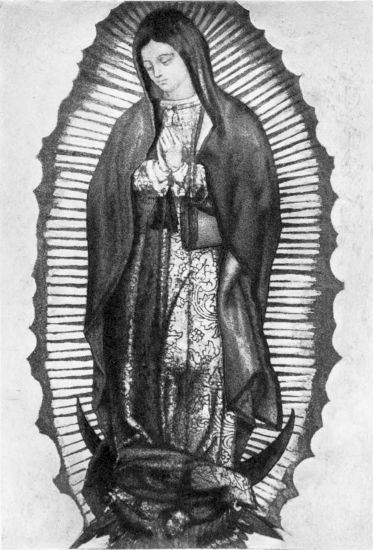
OUR LADY OF GUADALOUPE
Goupil & Cº. Paris
man, is reconciled to the very things which are most revolting to
humanity. Habits and opinions founded on religion must not be taken as
conclusive evidence of the actual refinement of a people.
The Aztec character was perfectly original and unique. It was made up of
incongruities apparently irreconcilable. It blended into one the marked
peculiarities of different nations, not only of the same phase of
civilization, but as far removed from each other as the extremes of
barbarism and refinement. It may find a fitting parallel in their own
wonderful climate, capable of producing, on a few square leagues of
surface, the boundless variety of vegetable forms which belong to the
frozen regions of the North, the temperate zone of Europe, and the
burning skies of Arabia and Hindostan.
One of the works repeatedly consulted and referred to in this
Introduction is Boturini’s Idea de una nueva Historia general de
la América Septentrional. The singular persecutions sustained by
its author, even more than the merits of his book, have associated
his name inseparably with the literary history of Mexico. The
Chevalier Lorenzo Boturini Benaduci was a Milanese by birth, of an
ancient family, and possessed of much learning. From Madrid, where
he was residing, he passed over to New Spain, in 1735, on some
business of the Countess of Santibañez, a lineal descendant of
Montezuma. While employed on this, he visited the celebrated shrine
of Our Lady of Guadaloupe, and, being a person of devout and
enthusiastic temper, was filled with the desire of collecting
testimony to establish the marvellous fact of her apparition. In
the course of his excursions, made with this view, he fell in with
many relics of Aztec antiquity, and conceived—what to a
Protestant, at least, would seem much more rational—the idea of
gathering together all the memorials he could meet with of the
primitive civilization of the land.
In pursuit of this double object, he penetrated into the remotest
parts of the country, living much with the natives, passing his
nights sometimes in their huts, sometimes in caves and the depths
of the lonely forests. Frequently months would elapse without his
being able to add anything to his collection; for the Indians had
suffered too much not to be very shy of Europeans. His long
intercourse with them, however, gave him ample opportunity to learn
their language and popular traditions, and, in the end, to amass a
large stock of materials, consisting of hieroglyphical charts on
cotton, skins, and the fibre of the maguey; besides a considerable
body of Indian manuscripts, written after the Conquest. To all
these must be added the precious documents for placing beyond
controversy the miraculous apparition of the Virgin. With this
treasure he returned, after a pilgrimage of eight years, to the
capital.
His zeal, in the mean while, had induced him to procure from Rome a
bull authorizing the coronation of the sacred image at Guadaloupe.
The bull, however, though sanctioned by the Audience of New Spain,
had never been approved by the Council of the Indies. In
consequence of this informality, Boturini was arrested in the midst
of his proceedings, his papers were taken from him, and, as he
declined to give an inventory of them, he was thrown into prison,
and confined in the same apartment with two criminals! Not long
afterward he was sent to Spain. He there presented a memorial to
the Council of the Indies, setting forth his manifold grievances,
and soliciting redress. At the same time, he drew up his “Idea,”
above noticed, in which he displayed the catalogue of his museum
in New Spain, declaring, with affecting earnestness, that “he would
not exchange these treasures for all the gold and silver, diamonds
and pearls, in the New World.”
After some delay, the Council gave an award in his favor;
acquitting him of any intentional violation of the law, and
pronouncing a high encomium on his deserts. His papers, however,
were not restored. But his Majesty was graciously pleased to
appoint him Historiographer-General of the Indies, with a salary of
one thousand dollars per annum. The stipend was too small to allow
him to return to Mexico. He remained in Madrid, and completed there
the first volume of a “General History of North America,” in 1749.
Not long after this event, and before the publication of the work,
he died. The same injustice was continued to his heirs; and,
notwithstanding repeated applications in their behalf, they were
neither put in possession of their unfortunate kinsman’s
collection, nor received a remuneration for it. What was worse,—as
far as the public was concerned,—the collection itself was
deposited in apartments of the vice-regal palace at Mexico, so damp
that they gradually fell to pieces, and the few remaining were
still further diminished by the pilfering of the curious. When
Baron Humboldt visited Mexico, not one-eighth of this inestimable
treasure was in existence!
I have been thus particular in the account of the unfortunate
Boturini, as affording, on the whole, the most remarkable example
of the serious obstacles and persecutions which literary
enterprise, directed in the path of the national antiquities, has,
from some cause or other, been exposed to in New Spain.
Boturini’s manuscript volume was never printed, and probably never
will be, if indeed it is in existence. This will scarcely prove a
great detriment to science or to his own reputation. He was a man
of a zealous temper, strongly inclined to the marvellous, with
little of that acuteness requisite for penetrating the tangled
mazes of antiquity, or of the philosophic spirit fitted for calmly
weighing its doubts and difficulties. His “Idea” affords a sample
of his peculiar mind. With abundant learning, ill assorted and ill
digested, it is a jumble of fact and puerile fiction, interesting
details, crazy dreams, and fantastic theories. But it is hardly
fair to judge by the strict rules of criticism a work which, put
together hastily, as a catalogue of literary treasures, was
designed by the author rather to show what might be done, than that
he could do it himself. It is rare that talents for action and
contemplation are united in the same individual. Boturini was
eminently qualified, by his enthusiasm and perseverance, for
collecting the materials necessary to illustrate the antiquities of
the country. It requires a more highly gifted mind to avail itself
of them.
THE TEZCUCANS—THEIR GOLDEN AGE—ACCOMPLISHED PRINCES—DECLINE OF
THEIR MONARCHY
THE reader would gather but an imperfect notion of the civilization of
Anahuac, without some account of the Acolhuans, or Tezcucans, as they
are usually called; a nation of the same great family with the Aztecs,
whom they rivalled in power and surpassed in intellectual culture and
the arts of social refinement. Fortunately, we have ample materials for
this in the records left by Ixtlilxochitl, a lineal descendant of the
royal line of Tezcuco, who flourished in the century of the Conquest.
With every opportunity for information he combined much industry and
talent, and, if his narrative bears the high coloring of one who would
revive the faded glories of an ancient but dilapidated house, he has
been uniformly commended for his fairness and integrity, and has been
followed without misgiving by such Spanish writers as could have access
to his manuscripts.[264] I shall confine myself to the prominent
features of the two reigns which may be said to embrace the golden age
of Tezcuco, without attempting to weigh the probability of the details,
which I will leave to be settled by the reader, according to the measure
of his faith.
The Acolhuans came into the Valley, as we have seen, about the close of
the twelfth century, and built their capital of Tezcuco on the eastern
borders of the lake, opposite to Mexico. From this point they gradually
spread themselves over the northern portion of Anahuac, when their
career was checked by an invasion of a kindred race, the Tepanecs, who,
after a desperate struggle, succeeded in taking their city, slaying
their monarch, and entirely subjugating his kingdom.[265] This event
took place about 1418; and the young prince, Nezahualcoyotl, the heir to
the crown, then fifteen years old, saw his father butchered before his
eyes, while he himself lay concealed among the friendly branches of a
tree which overshadowed the spot.[266] His subsequent history is as full
of romantic daring and perilous escapes as that of the renowned
Scanderbeg or of the “young Chevalier.”[267]
Not long after his flight from the field of his father’s blood, the
Tezcucan prince fell into the hands of his enemy, was borne off in
triumph to his city, and was thrown into a dungeon. He effected his
escape, however, through the connivance of the governor of the fortress,
an old servant of his family, who took the place of the royal fugitive,
and paid for his loyalty with his life. He was at length permitted,
through the intercession of the reigning family in Mexico, which was
allied to him, to retire to that capital, and subsequently to his own,
where he found a shelter in his ancestral palace. Here he remained
unmolested for eight years, pursuing his studies under an old preceptor,
who had had the care of his early youth, and who instructed him in the
various duties befitting his princely station.[268]
At the end of this period the Tepanec usurper died, bequeathing his
empire to his son, Maxtla, a man of fierce and suspicious temper.
Nezahualcoyotl hastened to pay his obeisance to him, on his accession.
But the tyrant refused to receive the little present of flowers which he
laid at his feet, and turned his back on him in presence of his
chieftains. One of his attendants, friendly to the young prince,
admonished him to provide for his own safety, by withdrawing, as
speedily as possible, from the palace, where his life was in danger. He
lost no time, consequently, in retreating from the inhospitable court,
and returned to Tezcuco. Maxtla, however, was bent on his destruction.
He saw with jealous eye the opening talents and popular manners of his
rival, and the favor he was daily winning from his ancient
subjects.[269]
He accordingly laid a plan for making away with him at an evening
entertainment. It was defeated by the vigilance of the prince’s tutor,
who contrived to mislead the assassins and to substitute another victim
in the place of his pupil.[270] The baffled tyrant now threw off all
disguise, and sent a strong party of soldiers to Tezcuco, with orders to
enter the palace, seize the person of Nezahualcoyotl, and slay him on
the spot. The prince, who became acquainted with the plot through the
watchfulness of his preceptor, instead of flying, as he was counselled,
resolved to await his enemies. They found him playing at ball, when they
arrived, in the court of his palace. He received them courteously, and
invited them in, to take some refreshments after their journey. While
they were occupied in this way, he passed into an adjoining saloon,
which excited no suspicion, as he was still visible through the open
doors by which the apartments communicated with each other. A burning
censer stood in the passage, and, as it was fed by the attendants, threw
up such clouds of incense as obscured his movements from the soldiers.
Under this friendly veil he succeeded in making his escape by a secret
passage, which communicated with a large earthen pipe formerly used to
bring water to the palace.[271] Here he remained till nightfall, when,
taking advantage of the obscurity, he found his way into the suburbs,
and sought a shelter in the cottage of one of his father’s vassals.
The Tepanec monarch, enraged at this repeated disappointment, ordered
instant pursuit. A price was set on the head of the royal fugitive.
Whoever should take him, dead or alive, was promised, however humble his
degree, the hand of a noble lady, and an ample domain along with it.
Troops of armed men were ordered to scour the country in every
direction. In the course of the search, the cottage in which the prince
had taken refuge was entered. But he fortunately escaped detection by
being hid under a heap of maguey fibres used for manufacturing cloth. As
this was no longer a proper place of concealment, he sought a retreat in
the mountainous and woody district lying between the borders of his own
state and Tlascala.[272]
Here he led a wretched, wandering life, exposed to all the inclemencies
of the weather, hiding himself in deep thickets and caverns, and
stealing out, at night, to satisfy the cravings of appetite; while he
was kept in constant alarm by the activity of his pursuers, always
hovering on his track. On one occasion he sought refuge from them among
a small party of soldiers, who proved friendly to him and concealed him
in a large drum around which they were dancing. At another time he was
just able to turn the crest of a hill as his enemies were climbing it on
the other side, when he fell in with a girl who was reaping chia,—a
Mexican plant, the seed of which was much used in the drinks of the
country. He persuaded her to cover him up with the stalks she had been
cutting. When his pursuers came up, and inquired if she had seen the
fugitive, the girl coolly answered that she had, and pointed out a path
as the one he had taken. Notwithstanding the high rewards offered,
Nezahualcoyotl seems to have incurred no danger from treachery, such was
the general attachment felt to himself and his house. “Would you not
deliver up the prince, if he came in your way?” he inquired of a young
peasant who was unacquainted with his person. “Not I,” replied the
other. “What, not for a fair lady’s hand, and a rich dowry beside?”
rejoined the prince. At which the other only shook his head and
laughed.[273] On more than one occasion his faithful people submitted to
torture, and even to lose their lives, rather than disclose the place of
his retreat.[274]
However gratifying such proofs of loyalty might be to his feelings, the
situation of the prince in these mountain solitudes became every day
more distressing. It gave a still keener edge to his own sufferings to
witness those of the faithful followers who chose to accompany him in
his wanderings. “Leave me,” he would say to them, “to my fate! Why
should you throw away your own lives for one whom fortune is never weary
of persecuting?” Most of the great Tezcucan chiefs had consulted their
interests by a timely adhesion to the usurper. But some still clung to
their prince, preferring proscription, and death itself, rather than
desert him in his extremity.[275]
In the mean time, his friends at a distance were active in measures for
his relief. The oppressions of Maxtla, and his growing empire, had
caused general alarm in the surrounding states, who recalled the mild
rule of the Tezcucan princes. A coalition was formed, a plan of
operations concerted, and, on the day appointed for a general rising,
Nezahualcoyotl found himself at the head of a force sufficiently strong
to face his Tepanec adversaries. An engagement came on, in which the
latter were totally discomfited; and the victorious prince, receiving
everywhere on his route the homage of his joyful subjects, entered his
capital, not like a proscribed outcast, but as the rightful heir, and
saw himself once more enthroned in the halls of his fathers.
Soon after, he united his forces with the Mexicans, long disgusted with
the arbitrary conduct of Maxtla. The allied powers, after a series of
bloody engagements with the usurper, routed him under the walls of his
own capital. He fled to the baths, whence he was dragged out, and
sacrificed with the usual cruel ceremonies of the Aztecs; the royal city
of Azcapozalco was razed to the ground, and the wasted territory was
henceforth reserved as the great slave-market for the nations of
Anahuac.[276]
These events were succeeded by the remarkable league among the three
powers of Tezcuco, Mexico, and Tlacopan, of which some account has been
given in a previous chapter.[277] Historians are not agreed as to the
precise terms of it; the writers of the two former nations each
insisting on the paramount authority of his own in the coalition. All
agree in the subordinate position of Tlacopan, a state, like the others,
bordering on the lake. It is certain that in their subsequent
operations, whether of peace or war, the three states shared in each
other’s councils, embarked in each other’s enterprises, and moved in
perfect concert together, till just before the coming of the Spaniards.
The first measure of Nezahualcoyotl, on returning to his dominions, was
a general amnesty. It was his maxim “that a monarch might punish, but
revenge was unworthy of him.”[278] In the present instance he was averse
even to punish, and not only freely pardoned his rebel nobles, but
conferred on some, who had most deeply offended, posts of honor and
confidence. Such conduct was doubtless politic, especially as their
alienation was owing, probably, much more to fear of the usurper than to
any disaffection towards himself. But there are some acts of policy
which a magnanimous spirit only can execute.
The restored monarch next set about repairing the damages sustained
under the late misrule, and reviving, or rather remodelling, the various
departments of government. He framed a concise, but comprehensive, code
of laws, so well suited, it was thought, to the exigencies of the times,
that it was adopted as their own by the two other members of the triple
alliance. It was written in blood, and entitled the author to be called
the Draco rather than “the Solon of Anahuac,” as he is fondly styled by
his admirers.[279] Humanity is one of the best fruits of refinement. It
is only with increasing civilization that the legislator studies to
economize human suffering, even for the guilty; to devise penalties not
so much by way of punishment for the past as of reformation for the
future.[280]
He divided the burden of government among a number of departments, as
the council of war, the council of finance, the council of justice. This
last was a court of supreme authority, both in civil and criminal
matters, receiving appeals from the lower tribunals of the provinces,
which were obliged to make a full report, every four months, or eighty
days, of their own proceedings to this higher judicature. In all these
bodies, a certain number of citizens were allowed to have seats with the
nobles and professional dignitaries. There was, however, another body, a
council of state, for aiding the king in the despatch of business, and
advising him in matters of importance, which was drawn altogether from
the highest order of chiefs. It consisted of fourteen members; and they
had seats provided for them at the royal table.[281]
Lastly, there was an extraordinary tribunal, called the council of
music, but which, differing from the import of its name, was devoted to
the encouragement of science and art. Works on astronomy, chronology,
history, or any other science, were required to be submitted to its
judgment, before they could be made public. This censorial power was of
some moment, at least with regard to the historical department, where
the wilful perversion of truth was made a capital offence by the bloody
code of Nezahualcoyotl. Yet a Tezcucan author must have been a bungler,
who could not elude a conviction under the cloudy veil of hieroglyphics.
This body, which was drawn from the best-instructed persons in the
kingdom, with little regard to rank, had supervision of all the
productions of art, and of the nicer fabrics. It decided on the
qualifications of the professors in the various branches of science, on
the fidelity of their instructions to their pupils, the deficiency of
which was severely punished, and it instituted examinations of these
latter. In short, it was a general board of education for the country.
On stated days, historical compositions, and poems treating of moral or
traditional topics, were recited before it by their authors. Seats were
provided for the three crowned heads of the empire, who deliberated with
the other members on the respective merits of the pieces, and
distributed prizes of value to the successful competitors.[282]
Such are the marvellous accounts transmitted to us of this institution;
an institution certainly not to have been expected among the aborigines
of America. It is calculated to give us a higher idea of the refinement
of the people than even the noble architectural remains which still
cover some parts of the continent. Architecture is, to a certain extent,
a sensual gratification. It addresses itself to the eye, and affords the
best scope for the parade of barbaric pomp and splendor. It is the form
in which the revenues of a semi-civilized people are most likely to be
lavished. The most gaudy and ostentatious specimens of it, and sometimes
the most stupendous, have been reared by such hands. It is one of the
first steps in the great march of civilization. But the institution in
question was evidence of still higher refinement. It was a literary
luxury, and argued the existence of a taste in the nation which relied
for its gratification on pleasures of a purely intellectual character.
The influence of this academy must have been most propitious to the
capital, which became the nursery not only of such sciences as could be
compassed by the scholarship of the period, but of various useful and
ornamental arts. Its historians, orators, and poets were celebrated
throughout the country.[283] Its archives, for which accommodations were
provided in the royal palace, were stored with the records of primitive
ages.[284] Its idiom, more polished than the Mexican, was, indeed, the
purest of all the Nahuatlac dialects, and continued, long after the
Conquest, to be that in which the best productions of the native races
were composed. Tezcuco claimed the glory of being the Athens of the
Western world.[285]
Among the most illustrious of her bards was the emperor himself,—for
the Tezcucan writers claim this title for their chief, as head of the
imperial alliance. He doubtless appeared as a competitor before that
very academy where he so often sat as a critic. Many of his odes
descended to a late generation, and are still preserved, perhaps, in
some of the dusty repositories of Mexico or Spain.[286] The historian
Ixtlilxochitl has left a translation, in Castilian, of one of the poems
of his royal ancestor. It is not easy to render his version into
corresponding English rhyme, without the perfume of the original
escaping in this double filtration.[287] They remind one of the rich
breathings of Spanish-Arab poetry, in which an ardent imagination is
tempered by a not unpleasing and moral melancholy.[288] But, though
sufficiently florid in diction, they are generally free from the
meretricious ornaments and hyperbole with which the minstrelsy of the
East is usually tainted. They turn on the vanities and mutability of
human life,—a topic very natural for a monarch who had himself
experienced the strangest mutations of fortune. There is mingled in the
lament of the Tezcucan bard, however, an Epicurean philosophy, which
seeks relief from the fears of the future in the joys of the present.
“Banish care,” he says: “if there are bounds to pleasure, the saddest
life must also have an end. Then weave the chaplet of flowers, and sing
thy songs in praise of the all-powerful God, for the glory of this world
soon fadeth away. Rejoice in the green freshness of thy spring; for the
day will come when thou shalt sigh for these joys in vain; when the
sceptre shall pass from thy hands, thy servants shall wander desolate in
thy courts, thy sons, and the sons of thy nobles, shall drink the dregs
of distress, and all the pomp of thy victories and triumphs shall live
only in their recollection. Yet the remembrance of the just shall not
pass away from the nations, and the good thou hast done shall ever be
held in honor. The goods of this life, its glories and its riches, are
but lent to us, its substance is but an illusory shadow, and the things
of to-day shall change on the coming of the morrow. Then gather the
fairest flowers from thy gardens, to bind round thy brow, and seize the
joys of the present ere they perish.”[289]
But the hours of the Tezcucan monarch were not all passed in idle
dalliance with the Muse, nor in the sober contemplations of philosophy,
as at a later period. In the freshness of youth and early manhood he led
the allied armies in their annual expeditions, which were certain to
result in a wider extent of territory to the empire.[290] In the
intervals of peace he fostered those productive arts which are the
surest sources of public prosperity. He encouraged agriculture above
all; and there was scarcely a spot so rude, or a steep so inaccessible,
as not to confess the power of cultivation. The land was covered with a
busy population, and towns and cities sprang up in places since deserted
or dwindled into miserable villages.[291]
From resources thus enlarged by conquest and domestic industry, the
monarch drew the means for the large consumption of his own numerous
household,[292] and for the costly works which he executed for the
convenience and embellishment of the capital. He filled it with stately
edifices for his nobles, whose constant attendance he was anxious to
secure at his court.[293] He erected a magnificent pile of buildings
which might serve both for a royal residence and for the public
offices. It extended, from east to west, twelve hundred and thirty-four
yards, and from north to south, nine hundred and seventy-eight.[294] It
was encompassed by a wall of unburnt bricks and cement, six feet wide
and nine high for one half of the circumference, and fifteen feet high
for the other half. Within this enclosure were two courts. The outer one
was used as the great market-place of the city, and continued to be so
until long after the Conquest,—if, indeed, it is not now. The interior
court was surrounded by the council-chambers and halls of justice. There
were also accommodations there for the foreign ambassadors; and a
spacious saloon, with apartments opening into it, for men of science and
poets, who pursued their studies in this retreat or met together to hold
converse under its marble porticoes. In this quarter, also, were kept
the public archives, which fared better under the Indian dynasty than
they have since under their European successors.[295]
Adjoining this court were the apartments of the king, including those
for the royal harem, as liberally supplied with beauties as that of an
Eastern sultan. Their walls were incrusted with alabasters and
richly-tinted stucco, or hung with gorgeous tapestries of variegated
feather-work.[296] They led through long arcades, and through intricate
labyrinths of shrubbery, into gardens where baths and sparkling
fountains were overshadowed by tall groves of cedar and cypress. The
basins of water were well stocked with fish of various kinds, and the
aviaries with birds glowing in all the gaudy plumage of the tropics.
Many birds and animals which could not be obtained alive were
represented in gold and silver so skilfully as to have furnished the
great naturalist Hernandez with models for his work.[297]
Accommodations on a princely scale were provided for the sovereigns of
Mexico and Tlacopan when they visited the court. The whole of this
lordly pile contained three hundred apartments, some of them fifty yards
square.[298] The height of the building is not mentioned. It was
probably not great, but supplied the requisite room by the immense
extent of ground which it covered. The interior was doubtless
constructed of light materials, especially of the rich woods which, in
that country, are remarkable, when polished, for the brilliancy and
variety of their colors. That the more solid materials of stone and
stucco were also liberally employed is proved by the remains at the
present day; remains which have furnished an inexhaustible quarry for
the churches and other edifices since erected by the Spaniards on the
site of the ancient city.[299]
We are not informed of the time occupied in building this palace. But
two hundred thousand workmen, it is said, were employed on it.[300]
However this may be, it is certain that the Tezcucan monarchs, like
those of Asia and ancient Egypt, had the control of immense masses of
men, and would sometimes turn the whole population of a conquered city,
including the women, into the public works.[301] The most gigantic
monuments of architecture which the world has witnessed would never have
been reared by the hands of freemen.
Adjoining the palace were buildings for the king’s children, who, by his
various wives, amounted to no less than sixty sons and fifty
daughters.[302] Here they were instructed in all the exercises and
accomplishments suited to their station; comprehending, what would
scarcely find a place in a royal education on the other side of the
Atlantic, the arts of working in metals, jewelry, and feather-mosaic.
Once in every four months, the whole household, not excepting the
youngest, and including all the officers and attendants on the king’s
person, assembled in a grand saloon of the palace, to listen to a
discourse from an orator, probably one of the priesthood. The princes,
on this occasion, were all dressed in nequen, the coarsest manufacture
of the country. The preacher began by enlarging on the obligations of
morality and of respect for the gods, especially important in persons
whose rank gave such additional weight to example. He occasionally
seasoned his homily with a pertinent application to his audience, if any
member of it had been guilty of a notorious delinquency. From this
wholesome admonition the monarch himself was not exempted, and the
orator boldly reminded him of his paramount duty to show respect for his
own laws. The king, so far from taking umbrage, received the lesson with
humility; and the audience, we are assured, were often melted into tears
by the eloquence of the preacher.[303] This curious scene may remind one
of similar usages in the Asiatic and Egyptian despotisms, where the
sovereign occasionally condescended to stoop from his pride of place and
allow his memory to be refreshed with the conviction of his own
mortality.[304] It soothed the feelings of the subject to find himself
thus placed, though but for a moment, on a level with his king; while it
cost little to the latter, who was removed too far from his people to
suffer anything by this short-lived familiarity. It is probable that
such an act of public humiliation would have found less favor with a
prince less absolute.
Nezahualcoyotl’s fondness for magnificence was shown in his numerous
villas, which were embellished with all that could make a rural retreat
delightful. His favorite residence was at Tezcotzinco, a conical hill
about two leagues from the capital.[305] It was laid out in terraces, or
hanging gardens, having a flight of steps five hundred and twenty in
number, many of them hewn in the natural porphyry.[306] In the garden on
the summit was a reservoir of water, fed by an aqueduct that was carried
over hill and valley, for several miles, on huge buttresses of masonry.
A large rock stood in the midst of this basin, sculptured with the
hieroglyphics representing the years of Nezahualcoyotl’s reign and his
principal achievements in each.[307] On a lower level were three other
reservoirs, in each of which stood a marble statue of a woman,
emblematic of the three states of the empire.[308] Another tank
contained a winged lion, (?) cut out of the solid rock, bearing in its
mouth the portrait of the emperor.[309] His likeness had been executed
in gold, wood, feather-work, and stone; but this was the only one which
pleased him.
From these copious basins the water was distributed in numerous channels
through the gardens, or was made to tumble over the rocks in cascades,
shedding refreshing dews on the flowers and odoriferous shrubs below. In
the depths of this fragrant wilderness, marble porticoes and pavilions
were erected, and baths excavated in the solid porphyry, which are still
shown by the ignorant natives as the “Baths of Montezuma”![310] The
visitor descended by steps cut in the living stone and polished so
bright as to reflect like mirrors.[311] Towards the base of the hill, in
the midst of cedar groves, whose gigantic branches threw a refreshing
coolness over the verdure in the sultriest seasons of the year,[312]
rose the royal villa, with its light arcades and airy halls, drinking
in the sweet perfumes of the gardens. Here the monarch often retired, to
throw off the burden of state and refresh his wearied spirits in the
society of his favorite wives, reposing during the noontide heats in the
embowering shades of his paradise, or mingling, in the cool of the
evening, in their festive sports and dances. Here he entertained his
imperial brothers of Mexico and Tlacopan, and followed the hardier
pleasures of the chase in the noble woods that stretched for miles
around his villa, flourishing in all their primeval majesty. Here, too,
he often repaired in the latter days of his life, when age had tempered
ambition and cooled the ardor of his blood, to pursue in solitude the
studies of philosophy and gather wisdom from meditation.
The extraordinary accounts of the Tezcucan architecture are confirmed,
in the main, by the relics which still cover the hill of Tezcotzinco or
are half buried beneath its surface. They attract little attention,
indeed, in the country, where their true history has long since passed
into oblivion;[313] while the traveller whose curiosity leads him to the
spot speculates on their probable origin, and, as he stumbles over the
huge fragments of sculptured porphyry and granite, refers them to the
primitive races who spread their colossal architecture over the country
long before the coming of the Acolhuans and the Aztecs.[314]
The Tezcucan princes were used to entertain a great number of
concubines. They had but one lawful wife, to whose issue the crown
descended.[315] Nezahualcoyotl remained unmarried to a late period. He
was disappointed in an early attachment, as the princess who had been
educated in privacy to be the partner of his throne gave her hand to
another. The injured monarch submitted the affair to the proper
tribunal. The parties, however, were proved to have been ignorant of the
destination of the lady, and the court, with an independence which
reflects equal honor on the judges who could give and the monarch who
could receive the sentence, acquitted the young couple. This story is
sadly contrasted by the following.[316]
The king devoured his chagrin in the solitude of his beautiful villa of
Tezcotzinco, or sought to divert it by travelling. On one of his
journeys he was hospitably entertained by a potent vassal, the old lord
of Tepechpan, who, to do his sovereign more honor, caused him to be
attended at the banquet by a noble maiden, betrothed to himself, and
who, after the fashion of the country, had been educated under his own
roof. She was of the blood royal of Mexico, and nearly related,
moreover, to the Tezcucan monarch. The latter, who had all the amorous
temperament of the South, was captivated by the grace and personal
charms of the youthful Hebe, and conceived a violent passion for her. He
did not disclose it to any one, however, but, on his return home,
resolved to gratify it, though at the expense of his own honor, by
sweeping away the only obstacle which stood in his path.
He accordingly sent an order to the chief of Tepechpan to take command
of an expedition set on foot against the Tlascalans. At the same time he
instructed two Tezcucan chiefs to keep near the person of the old lord,
and bring him into the thickest of the fight, where he might lose his
life. He assured them this had been forfeited by a great crime, but
that, from regard for his vassal’s past services, he was willing to
cover up his disgrace by an honorable death.
The veteran, who had long lived in retirement on his estates, saw
himself with astonishment called so suddenly and needlessly into action,
for which so many younger men were better fitted. He suspected the
cause, and, in the farewell entertainment to his friends, uttered a
presentiment of his sad destiny. His predictions were too soon
verified; and a few weeks placed the hand of his virgin bride at her
own disposal.
Nezahualcoyotl did not think it prudent to break his passion publicly to
the princess so soon after the death of his victim. He opened a
correspondence with her through a female relative, and expressed his
deep sympathy for her loss. At the same time, he tendered the best
consolation in his power, by an offer of his heart and hand. Her former
lover had been too well stricken in years for the maiden to remain long
inconsolable. She was not aware of the perfidious plot against his life;
and, after a decent time, she was ready to comply with her duty, by
placing herself at the disposal of her royal kinsman.
It was arranged by the king, in order to give a more natural aspect to
the affair and prevent all suspicion of the unworthy part he had acted,
that the princess should present herself in his grounds at Tezcotzinco,
to witness some public ceremony there. Nezahualcoyotl was standing in a
balcony of the palace when she appeared, and inquired, as if struck with
her beauty for the first time, “who the lovely young creature was, in
his gardens.” When his courtiers had acquainted him with her name and
rank, he ordered her to be conducted to the palace, that she might
receive the attentions due to her station. The interview was soon
followed by a public declaration of his passion; and the marriage was
celebrated not long after, with great pomp, in the presence of his
court, and of his brother monarchs of Mexico and Tlacopan.[317]
This story, which furnishes so obvious a counterpart to that of David
and Uriah, is told with great circumstantiality, both by the king’s son
and grandson, from whose narratives Ixtlilxochitl derived it.[318] They
stigmatize the action as the basest in their great ancestor’s life. It
is indeed too base not to leave an indelible stain on any character,
however pure in other respects, and exalted.
The king was strict in the execution of his laws, though his natural
disposition led him to temper justice with mercy. Many anecdotes are
told of the benevolent interest he took in the concerns of his subjects,
and of his anxiety to detect and reward merit, even in the most humble.
It was common for him to ramble among them in disguise, like the
celebrated caliph in the “Arabian Nights,” mingling freely in
conversation, and ascertaining their actual condition with his own
eyes.[319]
On one such occasion, when attended only by a single lord, he met with a
boy who was gathering sticks in a field for fuel. He inquired of him
“why he did not go into the neighboring forest, where he would find a
plenty of them.” To which the lad answered, “It was the king’s wood, and
he would punish him with death if he trespassed there.” The royal
forests were very extensive in Tezcuco, and were guarded by laws full as
severe as those of the Norman tyrants in England. “What kind of man is
your king?” asked the monarch, willing to learn the effect of these
prohibitions on his own popularity. “A very hard man,” answered the boy,
“who denies his people what God has given them.”[320] Nezahualcoyotl
urged him not to mind such arbitrary laws, but to glean his sticks in
the forest, as there was no one present who would betray him. But the
boy sturdily refused, bluntly accusing the disguised king, at the same
time, of being a traitor, and of wishing to bring him into trouble.
Nezahualcoyotl, on returning to the palace, ordered the child and his
parents to be summoned before him. They received the orders with
astonishment, but, on entering the presence, the boy at once recognized
the person with whom he had discoursed so unceremoniously, and he was
filled with consternation. The good-natured monarch, however, relieved
his apprehensions, by thanking him for the lesson he had given him, and,
at the same time, commended his respect for the laws, and praised his
parents for the manner in which they had trained their son. He then
dismissed the parties with a liberal largess, and afterwards mitigated
the severity of the forest laws, so as to allow persons to gather any
wood they might find on the ground, if they did not meddle with the
standing timber.[321]
Another adventure is told of him, with a poor woodman and his wife, who
had brought their little load of billets for sale to the market-place of
Tezcuco. The man was bitterly lamenting his hard lot, and the
difficulty with which he earned a wretched subsistence, while the master
of the palace before which they were standing lived an idle life,
without toil, and with all the luxuries in the world at his command.
He was going on in his complaints, when the good woman stopped him, by
reminding him he might be overheard. He was so, by Nezahualcoyotl
himself who, standing screened from observation at a latticed window
which overlooked the market, was amusing himself, as he was wont, with
observing the common people chaffering in the square. He immediately
ordered the querulous couple into his presence. They appeared trembling
and conscience-struck before him. The king gravely inquired what they
had said. As they answered him truly, he told them they should reflect
that, if he had great treasures at his command, he had still greater
calls for them; that, far from leading an easy life, he was oppressed
with the whole burden of government; and concluded by admonishing them
“to be more cautious in future, as walls had ears.”[322] He then ordered
his officers to bring a quantity of cloth and a generous supply of cacao
(the coin of the country), and dismissed them. “Go,” said he; “with the
little you now have, you will be rich; while, with all my riches, I
shall still be poor.”[323]
It was not his passion to hoard. He dispensed his revenues
munificently, seeking out poor but meritorious objects on whom to bestow
them. He was particularly mindful of disabled soldiers, and those who
had in any way sustained loss in the public service, and, in case of
their death, extended assistance to their surviving families. Open
mendicity was a thing he would never tolerate, but chastised it with
exemplary rigor.[324]
It would be incredible that a man of the enlarged mind and endowments of
Nezahualcoyotl should acquiesce in the sordid superstitions of his
countrymen, and still more in the sanguinary rites borrowed by them from
the Aztecs. In truth, his humane temper shrunk from these cruel
ceremonies, and he strenuously endeavored to recall his people to the
more pure and simple worship of the ancient Toltecs. A circumstance
produced a temporary change in his conduct.
He had been married some years to the wife he had so unrighteously
obtained, but was not blessed with issue. The priests represented that
it was owing to his neglect of the gods of his country, and that his
only remedy was to propitiate them by human sacrifice. The king
reluctantly consented, and the altars once more smoked with the blood of
slaughtered captives. But it was all in vain; and he indignantly
exclaimed, “These idols of wood and stone can neither hear nor feel;
much less could they make the heavens, and the earth, and man, the lord
of it. These must be the work of the all-powerful, unknown God, Creator
of the universe, on whom alone I must rely for consolation and
support.”[325]
He then withdrew to his rural palace of Tezcotzinco, where he remained
forty days, fasting and praying at stated hours, and offering up no
other sacrifice than the sweet incense of copal, and aromatic herbs and
gums. At the expiration of this time, he is said to have been comforted
by a vision assuring him of the success of his petition. At all events,
such proved to be the fact; and this was followed by the cheering
intelligence of the triumph of his arms in a quarter where he had lately
experienced some humiliating reverses.[326]
Greatly strengthened in his former religious convictions, he now openly
professed his faith, and was more earnest to wean his subjects from
their degrading superstitions and to substitute nobler and more
spiritual conceptions of the Deity. He built a temple in the usual
pyramidal form, and on the summit a tower nine stories high, to
represent the nine heavens; a tenth was surmounted by a roof painted
black, and profusely gilded with stars, on the outside, and incrusted
with metals and precious stones within. He dedicated this to “the
unknown God, the Cause of causes”[327] It seems probable, from the
emblem on the tower, as well as from the complexion of his verses, as we
shall see, that he mingled with his reverence for the Supreme the astral
worship which existed among the Toltecs.[328] Various musical
instruments were placed on the top of the tower, and the sound of them,
accompanied by the ringing of a sonorous metal struck by a mallet,
summoned the worshippers to prayers, at regular seasons.[329] No image
was allowed in the edifice, as unsuited to the “invisible God;” and the
people were expressly prohibited from profaning the altars with blood,
or any other sacrifices than that of the perfume of flowers and
sweet-scented gums.
The remainder of his days was chiefly spent in his delicious solitudes
of Tezcotzinco, where he devoted himself to astronomical and, probably,
astrological studies, and to meditation on his immortal destiny,—giving
utterance to his feelings in songs, or rather hymns, of much solemnity
and pathos. An extract from one of these will convey some idea of his
religious speculations. The pensive tenderness of the verses quoted in a
preceding page is deepened here into a mournful, and even gloomy,
coloring; while the wounded spirit, instead of seeking relief in the
convivial sallies of a young and buoyant temperament, turns for
consolation to the world beyond the grave:
“All things on earth have their term, and, in the most joyous career of
their vanity and splendor, their strength fails, and they sink into the
dust. All the round world is but a sepulchre; and there is nothing which
lives on its surface that shall not be hidden and entombed beneath it.
Rivers, torrents, and streams move onward to their destination. Not one
flows back to its pleasant source. They rush onward, hastening to bury
themselves in the deep bosom of the ocean. The things of yesterday are
no more to-day; and the things of to-day shall cease, perhaps, on the
morrow.[330] The cemetery is full of the loathsome dust of bodies, once
quickened by living souls, who occupied thrones, presided over
assemblies, marshalled armies, subdued provinces, arrogated to
themselves worship, were puffed up with vainglorious pomp, and power,
and empire.
“But these glories have all passed away, like the fearful smoke that
issues from the throat of Popocatepetl, with no other memorial of their
existence than the record on the page of the chronicler.
“The great, the wise, the valiant, the beautiful,—alas! where are they
now? They are all mingled with the clod; and that which has befallen
them shall happen to us, and to those that come after us. Yet let us
take courage, illustrious nobles and chieftains, true friends and loyal
subjects,—let us aspire to that heaven where all is eternal and
corruption cannot come.[331] The horrors of the tomb are but the cradle
of the Sun, and the dark shadows of death are brilliant lights for the
stars.”[332] The mystic import of the last sentence seems to point to
that superstition respecting the mansions of the Sun, which forms so
beautiful a contrast to the dark features of the Aztec mythology.
At length, about the year 1470,[333] Nezahualcoyotl, full of years and
honors, felt himself drawing near his end. Almost half a century had
elapsed since he mounted the throne of Tezcuco. He had found his kingdom
dismembered by faction and bowed to the dust beneath the yoke of a
foreign tyrant. He had broken that yoke; had breathed new life into the
nation, renewed its ancient institutions, extended wide its domain; had
seen it flourishing in all the activity of trade and agriculture,
gathering strength from its enlarged resources, and daily advancing
higher and higher in the great march of civilization. All this he had
seen, and might fairly attribute no small portion of it to his own wise
and beneficent rule. His long and glorious day was now drawing to its
close; and he contemplated the event with the same serenity which he had
shown under the clouds of its morning and in its meridian splendor.
A short time before his death, he gathered around him those of his
children in whom he most confided, his chief counsellors, the
ambassadors of Mexico and Tlacopan, and his little son, the heir to the
crown, his only offspring by the queen. He was then not eight years old,
but had already given, as far as so tender a blossom might, the rich
promise of future excellence.[334]
After tenderly embracing the child, the dying monarch threw over him the
robes of sovereignty. He then gave audience to the ambassadors, and,
when they had retired, made the boy repeat the substance of the
conversation. He followed this by such counsels as were suited to his
comprehension, and which, when remembered through the long vista of
after-years, would serve as lights to guide him in his government of the
kingdom. He besought him not to neglect the worship of “the unknown
God,” regretting that he himself had been unworthy to know him, and
intimating his conviction that the time would come when he should be
known and worshipped throughout the land.[335]
He next addressed himself to that one of his sons in whom he placed the
greatest trust, and whom he had selected as the guardian of the realm.
“From this hour,” said he to him, “you will fill the place that I have
filled, of father to this child; you will teach him to live as he ought;
and by your counsels he will rule over the empire. Stand in his place,
and be his guide, till he shall be of age to govern for himself.” Then,
turning to his other children, he admonished them to live united with
one another, and to show all loyalty to their prince, who, though a
child, already manifested a discretion far above his years. “Be true to
him,” he added, “and he will maintain you in your rights and
dignities.”[336]
Feeling his end approaching, he exclaimed, “Do not bewail me with idle
lamentations. But sing the song of gladness, and show a courageous
spirit, that the nations I have subdued may not believe you
disheartened, but may feel that each one of you is strong enough to keep
them in obedience!” The undaunted spirit of the monarch shone forth even
in the agonies of death. That stout heart, however, melted, as he took
leave of his children and friends, weeping tenderly over them, while he
bade each a last adieu. When they had withdrawn, he ordered the officers
of the palace to allow no one to enter it again. Soon after, he expired,
in the seventy-second year of his age, and the forty-third of his
reign.[337]
Thus died the greatest monarch, and, if one foul blot could be effaced,
perhaps the best, who ever sat upon an Indian throne. His character is
delineated with tolerable impartiality by his kinsman, the Tezcucan
chronicler: “He was wise, valiant, liberal; and, when we consider the
magnanimity of his soul, the grandeur and success of his enterprises,
his deep policy, as well as daring, we must admit him to have far
surpassed every other prince and captain of this New World. He had few
failings himself, and rigorously punished those of others. He preferred
the public to his private interest; was most charitable in his nature,
often buying articles, at double their worth, of poor and honest
persons, and giving them away again to the sick and infirm. In seasons
of scarcity he was particularly bountiful, remitting the taxes of his
vassals, and supplying their wants from the royal granaries. He put no
faith in the idolatrous worship of the country. He was well instructed
in moral science, and sought, above all things, to obtain light for
knowing the true God. He believed in one God only, the Creator of heaven
and earth, by whom we have our being, who never revealed himself to us
in human form, nor in any other; with whom the souls of the virtuous are
to dwell after death, while the wicked will suffer pains unspeakable. He
invoked the Most High, as ‘He by whom we live,’ and ‘Who has all things
in himself.’ He recognized the Sun for his father, and the Earth for his
mother. He taught his children not to confide in idols, and only to
conform to the outward worship of them from deference to public
opinion.[338] If he could not entirely abolish human sacrifices, derived
from the Aztecs, he at least restricted them to slaves and
captives.”[339]
I have occupied so much space with this illustrious prince that but
little remains for his son and successor, Nezahualpilli. I have thought
it better, in our narrow limits, to present a complete view of a single
epoch, the most interesting in the Tezcucan annals, than to spread the
inquiries over a broader but comparatively barren field. Yet
Nezahualpilli, the heir to the crown, was a remarkable person, and his
reign contains many incidents which I regret to be obliged to pass over
in silence.[340]
He had, in many respects, a taste similar to his father’s, and, like
him, displayed a profuse magnificence in his way of living and in his
public edifices. He was more severe in his morals, and, in the execution
of justice, stern even to the sacrifice of natural affection. Several
remarkable instances of this are told; one, among others, in relation to
his eldest son, the heir to the crown, a prince of great promise. The
young man entered into a poetical correspondence with one of his
father’s concubines, the lady of Tula, as she was called, a woman of
humble origin, but of uncommon endowments. She wrote verses with ease,
and could discuss graver matters with the king and his ministers. She
maintained a separate establishment, where she lived in state, and
acquired, by her beauty and accomplishments, great ascendency over her
royal lover.[341] With this favorite the prince carried on a
correspondence in verse,—whether of an amorous nature does not appear.
At all events, the offence was capital. It was submitted to the regular
tribunal, who pronounced sentence of death on the unfortunate youth; and
the king, steeling his heart against all entreaties and the voice of
nature, suffered the cruel judgment to be carried into execution. We
might, in this case, suspect the influence of baser passions on his
mind, but it was not a solitary instance of his inexorable justice
towards those most near to him. He had the stern virtue of an ancient
Roman, destitute of the softer graces which make virtue attractive. When
the sentence was carried into effect, he shut himself up in his palace
for many weeks, and commanded the doors and windows of his son’s
residence to be walled up, that it might never again be occupied.[342]
Nezahualpilli resembled his father in his passion for astronomical
studies, and is said to have had an observatory on one of his
palaces.[343] He was devoted to war in his youth, but, as he advanced in
years, resigned himself to a more indolent way of life, and sought his
chief amusement in the pursuit of his favorite science, or in the soft
pleasures of the sequestered gardens of Tezcotzinco. This quiet life was
ill suited to the turbulent temper of the times, and of his Mexican
rival, Montezuma. The distant provinces fell off from their allegiance;
the army relaxed its discipline; disaffection crept into its ranks; and
the wily Montezuma, partly by violence, and partly by stratagems
unworthy of a king, succeeded in plundering his brother monarch of some
of his most valuable domains. Then it was that he arrogated to himself
the title and supremacy of emperor, hitherto borne by the Tezcucan
princes as head of the alliance. Such is the account given by the
historians of that nation, who in this way explain the acknowledged
superiority of the Aztec sovereign, both in territory and consideration,
on the landing of the Spaniards.[344]
These misfortunes pressed heavily on the spirits of Nezahualpilli. Their
effect was increased by certain gloomy prognostics of a near calamity
which was to overwhelm the country.[345] He withdrew to his retreat, to
brood in secret over his sorrows. His health rapidly declined; and in
the year 1515, at the age of fifty-two, he sank into the grave;[346]
happy, at least, that by this timely death he escaped witnessing the
fulfilment of his own predictions, in the ruin of his country, and the
extinction of the Indian dynasties forever.[347]
In reviewing the brief sketch here presented of the Tezcucan monarchy,
we are strongly impressed with the conviction of its superiority, in all
the great features of civilization, over the rest of Anahuac. The
Mexicans showed a similar proficiency, no doubt, in the mechanic arts,
and even in mathematical science. But in the science of government, in
legislation, in speculative doctrines of a religious nature, in the more
elegant pursuits of poetry, eloquence, and whatever depended on
refinement of taste and a polished idiom, they confessed themselves
inferior, by resorting to their rivals for instruction and citing their
works as the masterpieces of their tongue. The best histories, the best
poems, the best code of laws, the purest dialect, were all allowed to be
Tezcucan. The Aztecs rivalled their neighbors in splendor of living, and
even in the magnificence of their structures. They displayed a pomp and
ostentatious pageantry truly Asiatic. But this was the development of
the material rather than the intellectual principle. They wanted the
refinement of manners essential to a continued advance in civilization.
An insurmountable limit was put to theirs by that bloody mythology which
threw its withering taint over the very air that they breathed.
The superiority of the Tezcucans was owing, doubtless, in a great
measure to that of the two sovereigns whose reigns we have been
depicting. There is no position which affords such scope for
ameliorating the condition of man as that occupied by an absolute ruler
over a nation imperfectly civilized. From his elevated place, commanding
all the resources of his age, it is in his power to diffuse them far and
wide among his people. He may be the copious reservoir on the
mountain-top, drinking in the dews of heaven, to send them in
fertilizing streams along the lower slopes and valleys, clothing even
the wilderness in beauty. Such were Nezahualcoyotl and his illustrious
successor, whose enlightened policy, extending through nearly a century,
wrought a most salutary revolution in the condition of their country. It
is remarkable that we, the inhabitants of the same continent, should be
more familiar with the history of many a barbarian chief, both in the
Old and New World, than with that of these truly great men, whose names
are identified with the most glorious period in the annals of the Indian
races.
What was the actual amount of the Tezcucan civilization it is not easy
to determine, with the imperfect light afforded us. It was certainly far
below anything which the word conveys, measured by a European standard.
In some of the arts, and in any walk of science, they could only have
made, as it were, a beginning. But they had begun in the right way, and
already showed a refinement in sentiment and manners, a capacity for
receiving instruction, which, under good auspices, might have led them
on to indefinite improvement. Unhappily, they were fast falling under
the dominion of the warlike Aztecs. And that people repaid the benefits
received from their more polished neighbors by imparting to them their
own ferocious superstition, which, falling like a mildew on the land,
would soon have blighted its rich blossoms of promise and turned even
its fruits to dust and ashes.
Fernando de Alva Ixtlilxochitl, who flourished in the beginning of
the sixteenth century,[348] was a native of Tezcuco, and descended
in a direct line from the sovereigns of that kingdom. The royal
posterity became so numerous in a few generations that it was
common to see them reduced to great poverty and earning a painful
subsistence by the most humble occupations. Ixtlilxochitl, who was
descended from the principal wife or queen of Nezahualpilli,
maintained a very respectable position. He filled the office of
interpreter to the viceroy, to which he was recommended by his
acquaintance with the ancient hieroglyphics and his knowledge of
the Mexican and Spanish languages. His birth gave him access to
persons of the highest rank in his own nation, some of whom
occupied important civil posts under the new government, and were
thus enabled to make large collections of Indian manuscripts, which
were liberally opened to him. He had an extensive library of his
own, also, and with these means diligently pursued the study of the
Tezcucan antiquities. He deciphered the hieroglyphics, made himself
master of the songs and traditions, and fortified his narrative by
the oral testimony of some very aged persons, who had themselves
been acquainted with the Conquerors. From such authentic sources he
composed various works in the Castilian, on the primitive history
of the Toltec and the Tezcucan races, continuing it down to the
subversion of the empire by Cortés. These various accounts,
compiled under the title of Relaciones, are, more or less,
repetitions and abridgments of each other; nor is it easy to
understand why they were thus composed. The Historia Chichimeca
is the best digested and most complete of the whole series, and as
such has been the most frequently consulted for the preceding
pages.
Ixtlilxochitl’s writings have many of the defects belonging to his
age. He often crowds the page with incidents of a trivial, and
sometimes improbable, character. The improbability increases with
the distance of the period; for distance, which diminishes objects
to the natural eye, exaggerates them to the mental. His chronology,
as I have more than once noticed, is inextricably entangled. He has
often lent a too willing ear to traditions and reports which would
startle the more skeptical criticism of the present time. Yet there
is an appearance of good faith and simplicity in his writings,
which may convince the reader that when he errs it is from no worse
cause than national partiality. And surely such partiality is
excusable in the descendant of a proud line, shorn of its ancient
splendors, which it was soothing to his own feelings to revive
again—though with something more than their legitimate lustre—on
the canvas of history. It should also be considered that, if his
narrative is sometimes startling, his researches penetrate into the
mysterious depths of antiquity, where light and darkness meet and
melt into each other, and where everything is still further liable
to distortion, as seen through the misty medium of
hieroglyphics.[349]
With these allowances, it will be found that the Tezcucan historian
has just claims to our admiration for the compass of his inquiries
and the sagacity with which they have been conducted. He has
introduced us to the knowledge of the most polished people of
Anahuac, whose records, if preserved, could not, at a much later
period, have been comprehended; and he has thus afforded a standard
of comparison which much raises our ideas of American civilization.
His language is simple, and, occasionally, eloquent and touching.
His descriptions are highly picturesque. He abounds in familiar
anecdote; and the natural graces of his manner, in detailing the
more striking events of history and the personal adventures of his
heroes, entitle him to the name of the Livy of Anahuac.
I shall be obliged to enter hereafter into his literary merits, in
connection with the narrative of the Conquest; for which he is a
prominent authority. His earlier annals—though no one of his
manuscripts has been printed—have been diligently studied by the
Spanish writers in Mexico, and liberally transferred to their
pages; and his reputation, like Sahagun’s, has doubtless suffered
by the process. His Historia Chichimeca is now turned into French
by M. Ternaux-Compans, forming part of that inestimable series of
translations from unpublished documents which have so much enlarged
our acquaintance with the early American history. I have had ample
opportunity of proving the merits of his version of Ixtlilxochitl,
and am happy to bear my testimony to the fidelity and elegance with
which it is executed.
Note.—In a note which has heretofore appeared at the end of this
first book Mr. Prescott states that it had been his intention to
conclude the introductory portion of the work with an inquiry into
the origin of the Mexican civilization. But because he agreed with
Humboldt, that “the general question of the origin of the
inhabitants of a continent is beyond the limits prescribed to
history,” and with Livy, that “for the majority of readers the
origin and remote antiquities of a nation can have comparatively
little interest,” he had decided, on further consideration, to
throw his observations on this topic into the Appendix. A man of
extraordinary modesty, he feared lest the reader should become so
wearied with his presentation of the story of the earlier
civilization, in the first book, that he would not have energy
enough left for the proper consideration of the tale of the
Conquest, set forth with such conscientious care in the succeeding
chapters. The essay has now been taken from the Appendix and placed
in its proper position.—M.
THE following Essay was originally designed to close the Introductory
Book, to which it properly belongs. It was written three years since, at
the same time with that part of the work. I know of no work of
importance, having reference to the general subject of discussion, which
has appeared since that period, except Mr. Bradford’s valuable treatise
on American Antiquities. But in respect to that part of the discussion
which treats of American Architecture a most important contribution has
been made by Mr. Stephens’s two works, containing the account of his
visits to Central America and Yucatan, and especially by the last of
these publications. Indeed, the ground, before so imperfectly known, has
now been so diligently explored that we have all the light which we can
reasonably expect to aid us in making up our opinion in regard to the
mysterious monuments of Yucatan. It only remains that the exquisite
illustrations of Mr. Catherwood should be published on a larger scale,
like the great works on the subject in France and England, in order to
exhibit to the eye a more adequate representation of these magnificent
ruins than can be given in the limited compass of an octavo page.
But, notwithstanding the importance of Mr. Stephens’s researches, I have
not availed myself of them to make any additions to the original draft
of this Essay, nor have I rested my conclusions in any instance on his
authority. These conclusions had been formed from a careful study of the
narratives of Dupaix and Waldeck, together with that of their splendid
illustrations of the remains of Palenque and Uxmal, two of the principal
places explored by Mr. Stephens; and the additional facts collected by
him from the vast field which he has surveyed, so far from shaking my
previous deductions, have only served to confirm them. The only object
of my own speculations on these remains was to ascertain their probable
origin, or rather to see what light, if any, they could throw on the
origin of Aztec Civilization. The reader, on comparing my reflections
with those of Mr. Stephens in the closing chapters of his two works,
will see that I have arrived at inferences, as to the origin and
probable antiquity of these structures, precisely the same as his.
Conclusions formed under such different circumstances serve to
corroborate each other; and, although the reader will find here some
things which would have been different had I been guided by the light
now thrown on the path, yet I prefer not to disturb the foundations on
which the argument stands, nor to impair its value—if it has any—as a
distinct and independent testimony.
When the Europeans first touched the shores of America, it was as if
they had alighted on another planet,—every thing there was so different
from what they had before seen. They were introduced to new varieties of
plants, and to unknown races of animals; while man, the lord of all, was
equally strange, in complexion, language, and institutions.[350] It was
what they emphatically styled it,—a New World. Taught by their faith to
derive all created beings from one source, they felt a natural
perplexity as to the manner in which these distant and insulated regions
could have obtained their inhabitants. The same curiosity was felt by
their countrymen at home, and the European scholars bewildered their
brains with speculations on the best way of solving this interesting
problem.
In accounting for the presence of animals there, some imagined that the
two hemispheres might once have been joined in the extreme north, so as
to have afforded an easy communication.[351] Others, embarrassed by the
difficulty of transporting inhabitants of the tropics across the Arctic
regions, revived the old story of Plato’s Atlantis, that huge island,
now submerged, which might have stretched from the shores of Africa to
the eastern borders of the new continent;[352] while they saw vestiges
of a similar convulsion of nature in the green islands sprinkled over
the Pacific, once the mountain summits of a vast continent, now buried
beneath the waters.[353] Some, distrusting the existence of revolutions
of which no record was preserved, supposed that animals might have found
their way across the ocean by various means; the birds of stronger wing
by flight over the narrowest spaces; while the tamer kinds of quadrupeds
might easily have been transported by men in boats, and even the more
ferocious, as tigers, bears, and the like, have been brought over, in
the same manner, when young, “for amusement and the pleasure of the
chase”![354] Others, again, maintained the equally probable opinion that
angels, who had, doubtless, taken charge of them in the ark, had also
superintended their distribution afterwards over the different parts of
the globe.[355] Such were the extremities to which even thinking minds
were reduced, in their eagerness to reconcile the literal interpretation
of Scripture with the phenomena of nature! The philosophy of a later day
conceives that it is no departure from this sacred authority to follow
the suggestions of science, by referring the new tribes of animals to a
creation, since the deluge, in those places for which they were clearly
intended by constitution and habits.[356]
Man would not seem to present the same embarrassments, in the
discussion, as the inferior orders. He is fitted by nature for every
climate, the burning sun of the tropics and the icy atmosphere of the
North. He wanders indifferently over the sands of the desert, the waste
of polar snows, and the pathless ocean. Neither mountains nor seas
intimidate him, and, by the aid of mechanical contrivances, he
accomplishes journeys which birds of boldest wing would perish in
attempting. Without ascending to the high northern latitudes, where the
continents of Asia and America approach within fifty miles of each
other, it would be easy for the inhabitant of Eastern Tartary or Japan
to steer his canoe from islet to islet, quite across to the American
shore, without ever being on the ocean more than two days at a
time.[357] The communication is somewhat more difficult on the Atlantic
side. But even there, Iceland was occupied by colonies of Europeans many
hundred years before the discovery by Columbus; and the transit from
Iceland to America is comparatively easy.[358] Independently of these
channels, others were opened in the Southern hemisphere, by means of
the numerous islands in the Pacific. The population of America is not
nearly so difficult a problem as that of these little spots. But
experience shows how practicable the communication may have been, even
with such sequestered places.[359] The savage has been picked up in his
canoe, after drifting hundreds of leagues on the open ocean, and
sustaining life, for months, by the rain from heaven, and such fish as
he could catch.[360] The instances are not very rare; and it would be
strange if these wandering barks should not sometimes have been
intercepted by the great continent which stretches across the globe, in
unbroken continuity, almost from pole to pole. No doubt, history could
reveal to us more than one example of men who, thus driven upon the
American shores, have mingled their blood with that of the primitive
races who occupied them.
The real difficulty is not, as with the animals, to explain how man
could have reached America, but from what quarter he actually has
reached it. In surveying the whole extent of the New World, it was found
to contain two great families, one in the lowest stage of civilization,
composed of hunters, and another nearly as far advanced in refinement as
the semi-civilized empires of Asia. The more polished races were
probably unacquainted with the existence of each other on the different
continents of America, and had as little intercourse with the barbarian
tribes by whom they were surrounded. Yet they had some things in common
both with these last and with one another, which remarkably
distinguished them from the inhabitants of the Old World. They had a
common complexion and physical organization,—at least, bearing a more
uniform character than is found among the nations of any other quarter
of the globe. They had some usages and institutions in common, and spoke
languages of similar construction, curiously distinguished from those in
the Eastern hemisphere.
Whence did the refinement of these more polished races come? Was it only
a higher development of the same Indian character which we see, in the
more northern latitudes, defying every attempt at permanent
civilization? Was it engrafted on a race of higher order in the scale
originally, but self-instructed, working its way upward by its own
powers? Was it, in short, an indigenous civilization? or was it borrowed
in some degree from the nations in the Eastern World? If indigenous,
how are we to explain the singular coincidence with the East in
institutions and opinions? If Oriental, how shall we account for the
great dissimilarity in language, and for the ignorance of some of the
most simple and useful arts, which, once known, it would seem scarcely
possible should have been forgotten? This is the riddle of the Sphinx,
which no Œdipus has yet had the ingenuity to solve. It is, however, a
question of deep interest to every curious and intelligent observer of
his species. And it has accordingly occupied the thoughts of men, from
the first discovery of the country to the present time; when the
extraordinary monuments brought to light in Central America have given a
new impulse to inquiry, by suggesting the probability—the possibility,
rather—that surer evidences than any hitherto known might be afforded
for establishing the fact of a positive communication with the other
hemisphere.
It is not my intention to add many pages to the volumes already written
on this inexhaustible topic. The subject—as remarked by a writer of a
philosophical mind himself, and who has done more than any other for the
solution of the mystery—is of too speculative a nature for history,
almost for philosophy.[361] But this work would be incomplete without
affording the reader the means of judging for himself as to the true
sources of the peculiar civilization already described, by exhibiting
to him the alleged points of resemblance with the ancient continent. In
doing this, I shall confine myself to my proper subject, the Mexicans,
or to what, in some way or other, may have a bearing on this subject;
proposing to state only real points of resemblance, as they are
supported by evidence, and stripped, as far as possible, of the
illusions with which they have been invested by the pious credulity of
one party, and the visionary system-building of another.
An obvious analogy is found in cosmogonal traditions and religious
usages. The reader has already been made acquainted with the Aztec
system of four great cycles, at the end of each of which the world was
destroyed, to be again regenerated.[362] The belief in these periodical
convulsions of nature, through the agency of some one or other of the
elements, was familiar to many countries in the Eastern hemisphere; and,
though varying in detail, the general resemblance of outline furnishes
an argument in favor of a common origin.[363]
No tradition has been more widely spread among nations than that of a
Deluge. Independently of tradition, indeed, it would seem to be
naturally suggested by the interior structure of the earth, and by the
elevated places on which marine substances are found to be deposited. It
was the received notion, under some form or other, of the most civilized
people in the Old World, and of the barbarians of the New.[364] The
Aztecs combined with this some particular circumstances of a more
arbitrary character, resembling the accounts of the East. They believed
that two persons survived the Deluge,—a man, named Coxcox, and his
wife. Their heads are represented in ancient paintings, together with a
boat floating on the waters, at the foot of a mountain. A dove is also
depicted, with the hieroglyphical emblem of languages in his mouth,
which he is distributing to the children of Coxcox, who were born
dumb.[365] The neighboring people of Michoacán, inhabiting the same high
plains of the Andes, had a still further tradition, that the boat in
which Tezpi, their Noah, escaped, was filled with various kinds of
animals and birds. After some time, a vulture was sent out from it, but
remained feeding on the dead bodies of the giants, which had been left
on the earth, as the waters subsided. The little humming-bird,
huitzitzilin, was then sent forth, and returned with a twig in its
mouth. The coincidence of both these accounts with the Hebrew and
Chaldean narratives is obvious. It were to be wished that the authority
for the Michoacán version were more satisfactory.[366]
On the way between Vera Cruz and the capital, not far from the modern
city of Puebla, stands the venerable relic—with which the reader will
become familiar in the course of the narrative—called the temple of
Cholula. It is a pyramidal mound, built, or rather cased, with unburnt
brick, rising to the height of nearly one hundred and eighty feet. The
popular tradition of the natives is that it was erected by a family of
giants, who had escaped the great inundation and designed to raise the
building to the clouds; but the gods, offended with their presumption,
sent fires from heaven on the pyramid, and compelled them to abandon the
attempt.[367] The partial coincidence of this legend with the Hebrew
account of the tower of Babel, received also by other nations of the
East, cannot be denied.[368] But one who has not examined the subject
will scarcely credit what bold hypotheses have been reared on this
slender basis.
Another point of coincidence is found in the goddess Cioacoatl, “our
lady and mother;” “the first goddess who brought forth;” “who bequeathed
the sufferings of childbirth to women, as the tribute of death;” “by
whom sin came into the world.” Such was the remarkable language applied
by the Aztecs to this venerated deity. She was usually represented with
a serpent near her; and her name signified the “serpent-woman.” In all
this we see much to remind us of the mother of the human family, the Eve
of the Hebrew and Syrian nations.[369]
But none of the deities of the country suggested such astonishing
analogies with Scripture as Quetzalcoatl, with whom the reader has
already been made acquainted.[370] He was the white man, wearing a long
beard, who came from the East, and who, after presiding over the golden
age of Anahuac, disappeared as mysteriously as he had come, on the great
Atlantic Ocean. As he promised to return at some future day, his
reappearance was looked for with confidence by each succeeding
generation. There is little in these circumstances to remind one of
Christianity. But the curious antiquaries of Mexico found out that to
this god were to be referred the institution of ecclesiastical
communities, reminding one of the monastic societies of the Old World;
that of the rites of confession and penance; and the knowledge even of
the great doctrines of the Trinity and the Incarnation![371] One party,
with pious industry, accumulated proofs to establish his identity with
the Apostle St. Thomas;[372][373] while another, with less scrupulous
faith, saw, in his anticipated advent to regenerate the nation, the
type, dimly veiled, of the Messiah![374]
Yet we should have charity for the missionaries who first landed in this
world of wonders, where, while man and nature wore so strange an
aspect, they were astonished by occasional glimpses of rites and
ceremonies which reminded them of a purer faith. In their amazement,
they did not reflect whether these things were not the natural
expression of the religious feeling common to all nations who have
reached even a moderate civilization. They did not inquire whether the
same things were not practised by other idolatrous people. They could
not suppress their wonder, as they beheld the Cross,[375] the sacred
emblem of their own faith, raised as an object of worship in the temples
of Anahuac. They met with it in various places; and the image of a cross
may be seen at this day, sculptured in bas-relief, on the walls of one
of the buildings of Palenque, while a figure bearing some resemblance to
that of a child is held up to it, as if in adoration.[376]
Their surprise was heightened when they witnessed a religious rite which
reminded them of the Christian communion. On these occasions an image of
the tutelary deity of the Aztecs was made of the flour of maize, mixed
with blood, and, after consecration by the priests, was distributed
among the people, who, as they ate it, “showed signs of humiliation and
sorrow, declaring it was the flesh of the deity!”[377] How could the
Roman Catholic fail to recognize the awful ceremony of the Eucharist?
With the same feelings they witnessed another ceremony, that of the
Aztec baptism; in which, after a solemn invocation, the head and lips of
the infant were touched with water, and a name was given to it; while
the goddess Cioacoatl, who presided over childbirth, was implored “that
the sin which was given to us before the beginning of the world might
not visit the child, but that, cleansed by these waters, it might live
and be born anew!”[378]
It is true, these several rites were attended with many peculiarities,
very unlike those in any Christian church. But the fathers fastened
their eyes exclusively on the points of resemblance. They were not aware
that the Cross was a symbol of worship, of the highest antiquity, in
Egypt and Syria,[379] and that rites resembling those of communion[380]
and baptism were practised by pagan nations on whom the light of
Christianity had never shone.[381] In their amazement, they not only
magnified what they saw, but were perpetually cheated by the illusions
of their own heated imaginations. In this they were admirably assisted
by their Mexican converts, proud to establish—and half believing it
themselves—a correspondence between their own faith and that of their
conquerors.[382]
The ingenuity of the chronicler was taxed to find out analogies between
the Aztec and Scripture histories, both old and new. The migration from
Aztlan to Anahuac was typical of the Jewish exodus.[383] The places
where the Mexicans halted on the march were identified with those in the
journey of the Israelites;[384] and the name of Mexico itself was found
to be nearly identical with the Hebrew name for the Messiah.[385] The
Mexican hieroglyphics afforded a boundless field for the display of this
critical acuteness. The most remarkable passages in the Old and New
Testaments were read in their mysterious characters; and the eye of
faith could trace there the whole story of the Passion, the Saviour
suspended from the cross, and the Virgin Mary with her attendant
angels![386]
The Jewish and Christian schemes were strangely mingled together, and
the brains of the good fathers were still further bewildered by the
mixture of heathenish abominations which were so closely intertwined
with the most orthodox observances. In their perplexity, they looked on
the whole as the delusion of the devil, who counterfeited the rites of
Christianity and the traditions of the chosen people, that he might
allure his wretched victims to their own destruction.[387]
But, although it is not necessary to resort to this startling
supposition, nor even to call up an apostle from the dead, or any later
missionary, to explain the coincidences with Christianity, yet these
coincidences must be allowed to furnish an argument in favor of some
primitive communication with that great brotherhood of nations on the
old continent, among whom similar ideas have been so widely
diffused.[388] The probability of such a communication, especially with
Eastern Asia, is much strengthened by the resemblance of sacerdotal
institutions, and of some religious rites, as those of marriage,[389]
and the burial of the dead;[390] by the practice of human sacrifices,
and even of cannibalism, traces of which are discernible in the Mongol
races;[391] and, lastly, by a conformity of social usages and manners,
so striking that the description of Montezuma’s court may well pass for
that of the Grand Khan’s, as depicted by Maundeville and Marco
Polo.[392] It would occupy too much room to go into details in this
matter, without which, however, the strength of the argument cannot be
felt, nor fully established. It has been done by others; and an
occasional coincidence has been adverted to in the preceding chapters.
It is true, we should be very slow to infer identity, or even
correspondence, between nations, from a partial resemblance of habits
and institutions. Where this relates to manners, and is founded on
caprice, it is not more conclusive than when it flows from the
spontaneous suggestions of nature, common to all. The resemblance, in
the one case, may be referred to accident; in the other, to the
constitution of man. But there are certain arbitrary peculiarities,
which, when found in different nations, reasonably suggest the idea of
some previous communication between them. Who can doubt the existence of
an affinity, or, at least, intercourse, between tribes who had the same
strange habit of burying the dead in a sitting posture, as was practised
to some extent by most, if not all, of the aborigines, from Canada to
Patagonia?[393] The habit of burning the dead, familiar to both Mongols
and Aztecs, is in itself but slender proof of a common origin. The body
must be disposed of in some way; and this, perhaps, is as natural as any
other. But when to this is added the circumstance of collecting the
ashes in a vase and depositing the single article of a precious stone
along with them, the coincidence is remarkable.[394] Such minute
coincidences are not unfrequent; while the accumulation of those of a
more general character, though individually of little account, greatly
strengthens the probability of a communication with the East.
A proof of a higher kind is found in the analogies of science. We have
seen the peculiar chronological system of the Aztecs; their method of
distributing the years into cycles, and of reckoning by means of
periodical series, instead of numbers. A similar process was used by the
various Asiatic nations of the Mongol family, from India to Japan. Their
cycles, indeed, consisted of sixty, instead of fifty-two years; and for
the terms of their periodical series they employed the names of the
elements and the signs of the zodiac, of which latter the Mexicans,
probably, had no knowledge. But the principle was precisely the
same.[395]
A correspondence quite as extraordinary is found between the
hieroglyphics used by the Aztecs for the signs of the days, and those
zodiacal signs which the Eastern Asiatics employed as one of the terms
of their series. The symbols in the Mongolian calendar are borrowed from
animals. Four of the twelve are the same as the Aztec. Three others are
as nearly the same as the different species of animals in the two
hemispheres would allow. The remaining five refer to no creature then
found in Anahuac.[396] The resemblance went as far as it could.[397] The
similarity of these conventional symbols among the several nations of
the East can hardly fail to carry conviction of a common origin for the
system as regards them. Why should not a similar conclusion be applied
to the Aztec calendar, which, although relating to days instead of
years, was, like the Asiatic, equally appropriated to chronological
uses and to those of divination?[398]
I shall pass over the further resemblance to the Persians, shown in the
adjustment of time by a similar system of intercalation;[399] and to the
Egyptians, in the celebration of the remarkable festival of the winter
solstice;[400] since, although sufficiently curious, the coincidences
might be accidental, and add little to the weight of evidence offered by
an agreement in combinations of so complex and artificial a character as
those before stated.
Amid these intellectual analogies, one would expect to meet with that of
language,[401] the vehicle of intellectual communication, which
usually exhibits traces of its origin even when the science and
literature that are embodied in it have widely diverged. No inquiry,
however, has led to satisfactory results. The languages spread over the
Western continent far exceed in number those found in any equal
population in the Eastern.[402] They exhibit the remarkable anomaly of
differing as widely in etymology as they agree in organization; and, on
the other hand, while they bear some slight affinity to the languages of
the Old World in the former particular, they have no resemblance to them
whatever in the latter.[403] The Mexican was spoken for an extent of
three hundred leagues. But within the boundaries of New Spain more than
twenty languages were found; not simply dialects, but, in many
instances, radically different.[404] All these idioms, however, with one
exception, conformed to that peculiar synthetic structure by which every
Indian dialect appears to have been fashioned, from the land of the
Esquimaux to Terra del Fuego;[405] a system which, bringing the
greatest number of ideas within the smallest possible compass, condenses
whole sentences into a single word,[406] displaying a curious mechanism,
in which some discern the hand of the philosopher, and others only the
spontaneous efforts of the savage.[407]
The etymological affinities detected with the ancient continent are not
very numerous, and they are drawn indiscriminately from all the tribes
scattered over America. On the whole, more analogies have been found
with the idioms of Asia than of any other quarter. But their amount is
too inconsiderable to balance the opposite conclusion inferred by a
total dissimilarity of structure.[408] A remarkable exception is found
in the Othomi or Otomi language, which covers a wider territory than any
other but the Mexican in New Spain,[409] and which, both in its
monosyllabic composition, so different from those around it, and in its
vocabulary, shows a very singular affinity to the Chinese.[410] The
existence of this insulated idiom in the heart of this vast continent
offers a curious theme for speculation, entirely beyond the province of
history.
The American languages, so numerous and widely diversified, present an
immense field of inquiry, which, notwithstanding the labors of several
distinguished philologists, remains yet to be explored. It is only after
a wide comparison of examples that conclusions founded on analogy can be
trusted. The difficulty of making such comparisons increases with time,
from the facility which the peculiar structure of the Indian languages
affords for new combinations; while the insensible influence of contact
with civilized man, in producing these, must lead to a still further
distrust of our conclusions.
The theory of an Asiatic origin for Aztec civilization derives stronger
confirmation from the light of tradition, which, shining steadily from
the far Northwest, pierces through the dark shadows that history and
mythology have alike thrown around the traditions of the country.
Traditions of a Western or Northwestern origin were found among the
more barbarous tribes,[411] and by the Mexicans were preserved both
orally and in their hieroglyphical maps, where the different stages of
their migration are carefully noted. But who, at this day, shall read
them?[412] They are admitted to agree, however, in representing the
populous North as the prolific hive of the American races.[413] In this
quarter were placed their Aztlan and their Huehuetlapallan,—the bright
abodes of their ancestors, whose warlike exploits rivalled those which
the Teutonic nations have recorded of Odin and the mythic heroes of
Scandinavia. From this quarter the Toltecs, the Chichimecs, and the
kindred races of the Nahuatlacs came successively up the great plateau
of the Andes, spreading over its hills and valleys, down to the Gulf of
Mexico.[414]
Antiquaries have industriously sought to detect some still surviving
traces of these migrations. In the northwestern districts of New Spain,
at the distance of a thousand miles from the capital, dialects have been
discovered showing intimate affinity with the Mexican.[415] Along the
Rio Gila, remains of populous towns are to be seen, quite worthy of the
Aztecs in their style of architecture.[416] The country north of the
great Rio Colorado has been imperfectly explored; but in the higher
latitudes, in the neighborhood of Nootka, tribes still exist whose
dialects, both in the termination and general sound of the words, bear
considerable resemblance to the Mexican.[417] Such are the vestiges,
few, indeed, and feeble, that still exist to attest the truth of
traditions which themselves have remained steady and consistent through
the lapse of centuries and the migrations of successive races.
The conclusions suggested by the intellectual and moral analogies with
Eastern Asia derive considerable support from those of a physical
nature. The aborigines of the Western World were distinguished by
certain peculiarities of organization, which have led physiologists to
regard them as a separate race. These peculiarities are shown in their
reddish complexion, approaching a cinnamon color; their straight, black,
and exceedingly glossy hair; their beard thin, and usually
eradicated;[418] their high cheek-bones, eyes obliquely directed towards
the temples, prominent noses, and narrow foreheads falling backwards
with a greater inclination than those of any other race except the
African.[419] From this general standard, however, there are deviations,
in the same manner, if not to the same extent, as in other quarters of
the globe, though these deviations do not seem to be influenced by the
same laws of local position.[420] Anatomists, also, have discerned in
crania disinterred from the mounds, and in those of the inhabitants of
the high plains of the Cordilleras, an obvious difference from those of
the more barbarous tribes. This is seen especially in the ampler
forehead, intimating a decided intellectual superiority.[421] These
characteristics are found to bear a close resemblance to those of the
Mongolian family, and especially to the people of Eastern Tartary;[422]
so that, notwithstanding certain differences recognized by
physiologists, the skulls of the two races could not be readily
distinguished from one another by a common observer. No inference can be
surely drawn, however, without a wide range of comparison. That hitherto
made has been chiefly founded on specimens from the barbarous
tribes.[423] Perhaps a closer comparison with the more civilized may
supply still stronger evidences of affinity.[424]
In seeking for analogies with the Old World, we should not pass by in
silence the architectural remains of the country, which, indeed, from
their resemblance to the pyramidal structures of the East, have
suggested to more than one antiquary the idea of a common origin.[425]
The Spanish invaders, it is true, assailed the Indian buildings,
especially those of a religious character, with all the fury of
fanaticism. The same spirit survived in the generations which succeeded.
The war has never ceased against the monuments of the country; and the
few that fanaticism has spared have been nearly all demolished to serve
the purposes of utility. Of all the stately edifices, so much extolled
by the Spaniards who first visited the country, there are scarcely more
vestiges at the present day than are to be found in some of those
regions of Europe and Asia which once swarmed with populous cities, the
great marts of luxury and commerce.[426] Yet some of these remains, like
the temple of Xochicalco,[427] the palaces of Tezcotzinco,[428] the
colossal calendar-stone in the capital, are of sufficient magnitude, and
wrought with sufficient skill, to attest mechanical powers in the Aztecs
not unworthy to be compared with those of the ancient Egyptians.
But, if the remains on the Mexican soil are so scanty, they multiply as
we descend the southeastern slope of the Cordilleras, traverse the rich
Valley of Oaxaca, and penetrate the forests of Chiapa and Yucatan. In
the midst of these lonely regions we meet with the ruins, recently
discovered, of several ancient cities, Mitla, Palenque, and Itzalana or
Uxmal,[429] which argue a higher civilization than anything yet found
on the American continent; and, although it was not the Mexicans who
built these cities, yet, as they are probably the work of cognate races,
the present inquiry would be incomplete without some attempt to
ascertain what light they can throw on the origin of the Indian, and
consequently of the Aztec civilization.[430]
Few works of art have been found in the neighborhood of any of the
ruins.[431] Some of them, consisting of earthen or marble vases,
fragments of statues, and the like, are fantastic, and even hideous;
others show much grace and beauty of design, and are apparently well
executed.[432] It may seem extraordinary that no iron in the buildings
themselves, nor iron tools, should have been discovered, considering
that the materials used are chiefly granite, very hard, and carefully
hewn and polished. Red copper chisels and axes have been picked up in
the midst of large blocks of granite imperfectly cut, with fragments of
pillars and architraves, in the quarries near Mitla.[433] Tools of a
similar kind have been discovered, also, in the quarries near Thebes;
and the difficulty, nay, impossibility, of cutting such masses from the
living rock with any tools which we possess, except iron, has confirmed
an ingenious writer in the supposition that this metal must have been
employed by the Egyptians, but that its tendency to decomposition,
especially in a nitrous soil, has prevented any specimens of it from
being preserved.[434] Yet iron has been found, after the lapse of some
thousands of years, in the remains of antiquity; and it is certain that
the Mexicans, down to the time of the Conquest, used only copper
instruments, with an alloy of tin, and a silicious powder, to cut the
hardest stones, some of them of enormous dimensions.[435] This fact,
with the additional circumstance that only similar tools have been
found in Central America, strengthens the conclusion that iron was
neither known there nor in ancient Egypt.
But what are the nations of the Old Continent whose style of
architecture bears most resemblance to that of the remarkable monuments
of Chiapa and Yucatan? The points of resemblance will probably be found
neither numerous nor decisive. There is, indeed, some analogy both to
the Egyptian and Asiatic style of architecture in the pyramidal,
terrace-formed bases on which the buildings repose, resembling also the
Toltec and Mexican teocalli. A similar care, also, is observed in the
people of both hemispheres to adjust the position of their buildings by
the cardinal points. The walls in both are covered with figures and
hieroglyphics, which, on the American as on the Egyptian, may be
designed, perhaps, to record the laws and historical annals of the
nation. These figures, as well as the buildings themselves, are found to
have been stained with various dyes, principally vermilion;[436] a
favorite color with the Egyptians also, who painted their colossal
statues and temples of granite.[437] Notwithstanding these points of
similarity, the Palenque architecture has little to remind us of the
Egyptian or of the Oriental. It is, indeed, more conformable, in the
perpendicular elevation of the walls, the moderate size of the stones,
and the general arrangement of the parts, to the European. It must be
admitted, however, to have a character of originality peculiar to
itself.
More positive proofs of communication with the East might be looked for
in their sculpture and in the conventional forms of their hieroglyphics.
But the sculptures on the Palenque buildings are in relief, unlike the
Egyptian, which are usually in intaglio. The Egyptians were not very
successful in their representations of the human figure, which are on
the same invariable model, always in profile, from the greater facility
of execution this presents over the front view; the full eye is placed
on the side of the head, while the countenance is similar in all, and
perfectly destitute of expression.[438] The Palenque artists were
equally awkward in representing the various attitudes of the body, which
they delineated also in profile. But the parts are executed with much
correctness, and sometimes gracefully; the costume is rich and various;
and the ornamented head-dress, typical, perhaps, like the Aztec, of the
name and condition of the person represented, conforms in its
magnificence to the Oriental taste. The countenance is various, and
often expressive. The contour of the head is, indeed, most
extraordinary, describing almost a semi-circle from the forehead to the
tip of the nose, and contracted towards the crown, whether from the
artificial pressure practised by many of the aborigines, or from some
preposterous notion of ideal beauty.[439] But, while superior in the
execution of the details, the Palenque artist was far inferior to the
Egyptian in the number and variety of the objects displayed by him,
which on the Theban temples comprehend animals as well as men, and
almost every conceivable object of use or elegant art.
The hieroglyphics are too few on the American buildings to authorize any
decisive inference. On comparing them, however, with those of the
Dresden Codex, probably from this same quarter of the country,[440] with
those on the monument of Xochicalco, and with the ruder picture-writing
of the Aztecs, it is not easy to discern anything which indicates a
common system. Still less obvious is the resemblance to the Egyptian
characters, whose refined and delicate abbreviations approach almost to
the simplicity of an alphabet. Yet the Palenque writing shows an
advanced stage of the art, and, though somewhat clumsy, intimates, by
the conventional and arbitrary forms of the hieroglyphics, that it was
symbolical, and perhaps phonetic, in its character.[441] That its
mysterious import will ever be deciphered is scarcely to be expected.
The language of the race who employed it, the race itself, is unknown.
And it is not likely that another Rosetta stone will be found, with its
trilingual inscription, to supply the means of comparison, and to guide
the American Champollion in the path of discovery.
It is impossible to contemplate these mysterious monuments of a lost
civilization without a strong feeling of curiosity as to who were their
architects and what is their probable age. The data on which to rest our
conjectures of their age are not very substantial; although some find in
them a warrant for an antiquity of thousands of years, coeval with the
architecture of Egypt and Hindostan.[442] But the interpretation of
hieroglyphics, and the apparent duration of trees, are vague and
unsatisfactory.[443] And how far can we derive an argument from the
discoloration and dilapidated condition of the ruins, when we find so
many structures of the Middle Ages dark and mouldering with decay, while
the marbles of the Acropolis and the gray stone of Pæstum still shine in
their primitive splendor?
There are, however, undoubted proofs of considerable age to be found
there. Trees have shot up in the midst of the buildings, which measure,
it is said, more than nine feet in diameter.[444] A still more striking
fact is the accumulation of vegetable mould in one of the courts, to the
depth of nine feet above the pavement.[445] This in our latitude would
be decisive of a very great antiquity. But in the rich soil of Yucatan,
and under the ardent sun of the tropics, vegetation bursts forth with
irrepressible exuberance, and generations of plants succeed each other
without intermission, leaving an accumulation of deposits that would
have perished under a northern winter. Another evidence of their age is
afforded by the circumstance that in one of the courts of Uxmal the
granite pavement,[446] on which the figures of tortoises were raised in
relief, is worn nearly smooth by the feet of the crowds who have passed
over it;[447] a curious fact, suggesting inferences both in regard to
the age and population of the place. Lastly, we have authority for
carrying back the date of many of these ruins to a certain period, since
they were found in a deserted, and probably dilapidated, state by the
first Spaniards who entered the country. Their notices, indeed, are
brief and casual, for the old Conquerors had little respect for works of
art;[448] and it is fortunate for these structures that they had ceased
to be the living temples of the gods, since no merit of architecture,
probably, would have availed to save them from the general doom of the
monuments of Mexico.
If we find it so difficult to settle the age of these buildings, what
can we hope to know of their architects? Little can be gleaned from the
rude people by whom they are surrounded. The old Tezcucan chronicler so
often quoted by me, the best authority for the traditions of his
country, reports that the Toltecs, on the breaking up of their
empire,—which he places earlier than most authorities, in the middle of
the tenth century,—migrating from Anahuac, spread themselves over
Guatemala, Tehuantepec, Campeachy, and the coasts and neighboring isles
on both sides of the Isthmus.[449] This assertion, important,
considering its source, is confirmed by the fact that several of the
nations in that quarter adopted systems of astronomy and chronology, as
well as sacerdotal institutions, very similar to the Aztec,[450] which,
as we have seen, were also probably derived from the Toltecs, their more
polished predecessors in the land.
If so recent a date for the construction of the American buildings be
thought incompatible with this oblivion of their origin, it should be
remembered how treacherous a thing is tradition, and how easily the
links of the chain are severed. The builders of the pyramids had been
forgotten before the time of the earliest Greek historians.[451] The
antiquary still disputes whether the frightful inclination of that
architectural miracle, the tower of Pisa, standing, as it does, in the
heart of a populous city, was the work of accident or design. And we
have seen how soon the Tezcucans, dwelling amidst the ruins of their
royal palaces, built just before the Conquest, had forgotten their
history, while the more inquisitive traveller refers their construction
to some remote period before the Aztecs.[452]
The reader has now seen the principal points of coincidence insisted on
between the civilization of ancient Mexico and the Eastern hemisphere.
In presenting them to him, I have endeavored to confine myself to such
as rest on sure historic grounds, and not so much to offer my own
opinion as to enable him to form one for himself. There are some
material embarrassments in the way to this, however, which must not be
passed over in silence. These consist, not in explaining the fact that,
while the mythic system and the science of the Aztecs afford some
striking points of analogy with the Asiatic, they should differ in so
many more; for the same phenomenon is found among the nations of the Old
World, who seem to have borrowed from one another those ideas, only,
best suited to their peculiar genius and institutions. Nor does the
difficulty lie in accounting for the great dissimilarity of the American
languages to those in the other hemisphere; for the difference with
these is not greater than what exists among themselves; and no one will
contend for a separate origin for each of the aboriginal tribes.[453]
But it is scarcely possible to reconcile the knowledge of Oriental
science with the total ignorance of some of the most serviceable and
familiar arts, as the use of milk and iron, for example; arts so
simple, yet so important to domestic comfort, that when once acquired
they could hardly be lost.
The Aztecs had no useful domesticated animals. And we have seen that
they employed bronze, as a substitute for iron, for all mechanical
purposes. The bison, or wild cow of America, however, which ranges in
countless herds over the magnificent prairies of the west, yields milk
like the tame animal of the same species in Asia and Europe;[454] and
iron was scattered in large masses over the surface of the table-land.
Yet there have been people considerably civilized in Eastern Asia who
were almost equally strangers to the use of milk.[455] The buffalo range
was not so much on the western coast as on the eastern slopes of the
Rocky Mountains;[456] and the migratory Aztec might well doubt whether
the wild, uncouth monsters whom he occasionally saw bounding with such
fury over the distant plains were capable of domestication, like the
meek animals which he had left grazing in the green pastures of Asia.
Iron, too, though met with on the surface of the ground, was more
tenacious, and harder to work, than copper, which he also found in much
greater quantities on his route. It is possible, moreover, that his
migration may have been previous to the time when iron was used by his
nation; for we have seen more than one people in the Old World employing
bronze and copper with entire ignorance, apparently, of any more
serviceable metal.[457]—Such is the explanation, unsatisfactory,
indeed, but the best that suggests itself, of this curious anomaly.
The consideration of these and similar difficulties has led some writers
to regard the antique American civilization as purely indigenous.
Whichever way we turn, the subject is full of embarrassment. It is easy,
indeed, by fastening the attention on one portion of it, to come to a
conclusion. In this way, while some feel little hesitation in
pronouncing the American civilization original, others, no less
certainly, discern in it a Hebrew, or an Egyptian, or a Chinese, or a
Tartar origin, as their eyes are attracted by the light of analogy too
exclusively to this or the other quarter. The number of contradictory
lights, of itself, perplexes the judgment and prevents us from arriving
at a precise and positive inference. Indeed, the affectation of this, in
so doubtful a matter, argues a most unphilosophical mind. Yet where
there is most doubt there is often the most dogmatism.
The reader of the preceding pages may perhaps acquiesce in the general
conclusions,—not startling by their novelty,—
First, that the coincidences are sufficiently strong to authorize a
belief that the civilization of Anahuac was in some degree influenced by
that of Eastern Asia.
And, secondly, that the discrepancies are such as to carry back the
communication to a very remote period; so remote that this foreign
influence has been too feeble to interfere materially with the growth
of what may be regarded in its essential features as a peculiar and
indigenous civilization.
[458]