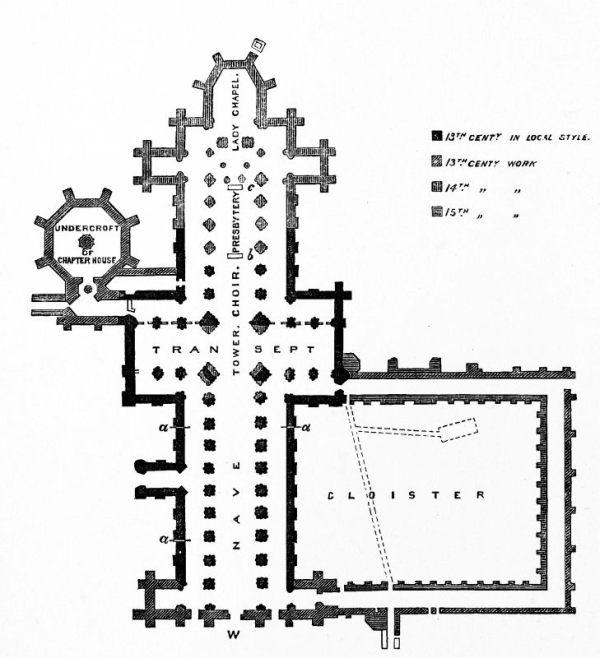
The subject which I have chosen for this course of
lectures is one which must always have an interest
beyond all others for us who live in this city and
neighbourhood. In every place which boasts of a
cathedral church, that cathedral church is commonly
the chief object of interest, alike as its present
ornament and as the chief centre of its past history.
But in Wells the cathedral church and its appurtenances
are yet more. Their interest is not only
primary, but absorbing. They are not only the chief
ornament of the place; they are the place itself. They
are not only the centre of the past history of the
city; their history is the history of the city. Of our
other cities some can trace up a long history as cities
independent of their ecclesiastical foundations. Some
were the dwelling-places of Kings in days before
England became one kingdom. Some have been for
ages seats of commerce or manufactures; their history
is the history of burghers striving for and obtaining
their freedom, a history which repeats in small that
same tale of early struggles and later abuses which
forms the history of so many greater commonwealths.
Others have a long military history; their name at
once suggests the memory of battles and sieges, and
they can still show walls and castles as the living
memorials of the stirring scenes of bygone times.
In others even the ecclesiastical pre-eminence of the
cathedral church may be disputed by some other ecclesiastical
building. The bishoprick and its church may
be comparatively modern institutions, and they may
be altogether eclipsed by some other institution more
ancient in date of foundation, perhaps more ancient in
its actual fabric. Thus at Oxford the cathedral church
is well-nigh lost among the buildings of the University
and its greatest college. At Chester its rank may
be disputed by the majestic fragments of the older
minster of Saint John. At Bristol the cathedral church,
even when restored to its old proportions, will still
have at least an equal rival in the stateliest parish
church in England. In these cities the bishoprick, its
church and its chapter, are institutions of yesterday;
the cities themselves were great and famous for ages
before they were founded. So at Exeter, though the
bishoprick is of far earlier date, yet Exeter was a
famous city, which had played its part in history, long
before Bishops of Exeter were heard of. Even at
Winchester the overwhelming greatness of the Old
Minster has to compete with the earlier and later interests
of the royal palace, of the fallen Abbey, of the
unique home of noble poverty[39] and of the oldest
of the great and still living schools of England.
Salisbury alone in our own part of England, and
Durham in the far north, have a history which in
some measure resembles that of Wells. Like Wells,
Salisbury and Durham are cities which have grown
up around the cathedral church. But they have
grown up—I presume it is no offence to say so—into
a greater measure of temporal importance than our
own city. To take a familiar standard, no one has
ever proposed to strike either of them out of the
list of parliamentary boroughs. Wells stands alone
among the cities of England proper as a city which
exists only in and through its cathedral church, whose
whole history is that of its cathedral church. The
Bishoprick has been to us what the Abbey has been
to our neighbours at Glastonbury, what the church
first of Abbots and then of Bishops has been elsewhere
to Ely and Peterborough. The whole history
of Wells is, I say, the history of the bishoprick and
of its church. Of the origin and foundation of the
city, as distinguished from that of the church, nothing
is known. The name of Wells is first heard of
as the place where the church of Saint Andrew was
standing, and its name seldom appears in later history
except in connexion with the affairs of its church.
It was never a royal dwelling-place; it was never a
place of commercial importance; it was never a place of
military strength. Like other cities, it has its municipal
history, but its municipal history is simply an
appendage to its ecclesiastical history; the franchises
of the borough were simply held as grants from the
Bishop. It has its parochial church, a church standing
as high among the buildings of its own class as
the cathedral church itself. This parochial church
has a parochial constitution which is in some points
unique. But the parochial church is simply an appendage
to the cathedral church; it is the church of the
burghers who had come to dwell under the shadow of
the minster and the protection of its spiritual lord.
And it has ever retained a close, sometimes perhaps
a too close, connexion with the cathedral and its
Chapter. Thus the history of the church is the history
of the city; no battles, no sieges, no parliaments,
break the quiet tenor of its way; the name of
the city has hardly found its way into our civil and
military history. Its name does appear among the
troubles of the seventeenth century, in the pages of
Clarendon and of Macaulay, but it appears in connexion
with events whose importance was mainly
local. And even here the ecclesiastical interest
comes in; the most striking event connected with
Wells in the story of Monmouth's rebellion is the
mischief done to the cathedral, and the way in which
further damage and desecration was hindered by Lord
Grey. And in our own times, when the parliamentary
existence of this city became the subject of an
animated parliamentary discussion, even then the
ecclesiastical interest was still uppermost. The old
battle of the regulars and seculars was fought again
over the bodies of two small parliamentary boroughs.
I need not remind you that the claims of the old
secular foundation were stoutly pressed by one of our
own members. But the monastic influence was too
strong for us; the mantle of Dunstan and Æthelwald
had fallen on the shoulders of Sir John Pakington, and
the claims of the fallen Abbey of Evesham were preferred
to those of the existing Cathedral of Wells.[40]
The whole interest, then, of this city is ecclesiastical;
but its ecclesiastical interest in one point of
view surpasses that of every church in England,—I
am strongly tempted to say, every church in Europe.
The traveller who comes down the hill from Shepton
Mallet looks down, as he draws near the city, on a
group of buildings which, as far as I know, has no
rival either in our own island or beyond the sea. To
most of these objects, taken singly, it would be easy
to find rivals which would equal or surpass them.
The church itself, seen even from that most favourable
point of view, cannot, from mere lack of bulk,
hold its ground against the soaring apse of Amiens,
or against the windows ranging, tier above tier, in the
mighty eastern gable of Ely. The cloister cannot
measure itself with Gloucester or Salisbury; the
chapter-house lacks the soaring roofs of York and
Lincoln; the palace itself finds its rival in the ruined
pile of Saint David's. The peculiar charm and glory
of Wells lies in the union and harmonious grouping
of all. The church does not stand alone; it is neither
crowded by incongruous buildings, nor yet isolated
from those buildings which are its natural and necessary
complement. Palace, cloister, Lady chapel,
choir, chapter-house, all join to form one indivisible
whole. The series goes on uninterruptedly along that
unique bridge which by a marvel of ingenuity connects
the church itself with the most perfect of buildings
of its own class, the matchless Vicars' close.
Scattered around we see here and there an ancient
house, its gable, its window, or its turret falling in
with the style and group of greater buildings, and
bearing its part in producing the general harmony of
all. The whole history of the place is legibly written
on that matchless group of buildings. If we could
fancy an ecclesiastical historian to have dropped from
the clouds, the aspect of the place would at once tell
him that he was looking on an English cathedral
church, on a cathedral church which had always been
served by secular canons, on a church of secular
canons which had preserved its ancient buildings and
ancient arrangements more perfectly than any other
in the island. It is to the history of that great institution,
alike in its fabric and its foundation, that I
call your attention in the present course of lectures.
And, taking Wells as my text, I purpose to compare
our own church, alike in its fabric and its foundation,
with other churches of the same class. The subject
naturally falls into three divisions. I purpose to
devote three discourses of moderate length to the
early, the mediæval, and the modern history of the
Church of Wells.
For a subject like that which I have chosen is obviously
one which may be looked at from various points
of view. A cathedral church like ours is not only a
material fabric, a work of architecture; it is also an
ecclesiastical institution, an establishment founded
for the benefit of our Church and nation, and which
has played its part, whatever that part may have
been, in the general history of the country. I purpose
to look at it in both aspects, aspects either
of which is very imperfectly treated if it wholly shuts
out the other. But I do not purpose to treat either
branch of the subject in any very minute detail. A
minute architectural or antiquarian memoir has its
value, but it is not at all suited to a popular lecture.
A minute architectural exposition, if it is to be intelligible,
must be given on the spot. A minute antiquarian
memoir, crowded with names and dates, is
often very profitable when printed, but it is not at all
suited to be read out to a general audience. Moreover
I should be very sorry to trespass on the province of
one to whose minute knowledge of local history I can
make no claim. My object is different. I wish to
treat the history of Wells Cathedral, both as a building
and as an institution, in a more general, in what I
may call a comparative, way. I wish to dwell on the
position of our own church as one of a class, to point
out how it stands among other buildings and other
institutions of its own class, and to trace out its connexion
with the general history of the Kingdom and
Church of England.
For my first portion then this evening, I purpose
to take as my subject the early days of the church of
Saint Andrew, from the first time that its name is
heard of in history or record to the time when both
the material fabric and the ecclesiastical foundation
assumed something like their present form. And as
this subject will lead us into somewhat obscure times,
and into many matters which people in general are
far from accurately understanding, I hope that those
among my hearers to whom all that I have to say is
familiar will forgive me if I deal with some matters
in a somewhat elementary way. I have spoken of
Saint Andrew's church in Wells as a cathedral church,
as a cathedral church which has always been served
by secular canons; I have spoken of an opposition
between the regular and the secular clergy. To some
of my hearers all these terms carry their meaning at
once. To others I am afraid that they may not suggest
any very definite idea. But without a definite idea of
them neither the general history of England nor the
local history of Wells can be clearly understood. Let
then my better informed hearers bear with me if I go
somewhat into the A B C of the matter.
To begin then with the beginning, what do we
mean when we call the larger of the two ancient
churches in this city, the Cathedral? What is the
meaning of the word? Some people seem to think
it means simply a bigger church than usual—I have
heard a vast number of churches in other places called
cathedrals which have no right to the name. Sometimes
people seem to think that it means a church
which has a Dean and Chapter or a special body of
clergy of some kind, or a church where there are
prayers every day, or a church where the prayers are
chanted and not merely read. Nay, some people
seem to think that a cathedral is not a church at all;
I have heard it said that a cathedral was not a church,
but that it had a church inside it. And I do not
wonder at people thinking so when they go into a
cathedral church, and see the greater part standing
empty indeed and swept, but never garnished. I was
once in a large parish church, that of Grosmont in
Monmouthshire, where the man who let me in told
me very proudly: "Our church is like a cathedral."
What he meant by the church being like a cathedral
was that the whole congregation was rammed, jammed,
crammed into the choir, while the nave stood empty
and useless. Again it is not at all uncommon to hear
people talk of "cathedrals and churches," as if they
were two different sorts of things. And people seem
also to think that some particular sort of worship is
right in a cathedral, which is not right in other places.
When there is a good deal of singing and organ-playing
in divine service, they call it "cathedral
service," as if singing and organ-playing were something
specially belonging to a cathedral more than to
other places.
Now all these latter notions are simply mistakes.
And those with which I began are mistakes too,
though in a somewhat different way. A cathedral is
simply a church, one particular sort of church, and,
instead of being a thing to be proud of, it is a thing
to be ashamed of if the nave of any church stands
empty and useless. What is called "cathedral service"
is simply divine service done in the best and most
solemn way, a way which other churches may not
always be able to follow in everything, but which
they should try to follow as nearly as they can. On
the other hand, it is very right that a cathedral
church should be larger and finer than other churches,
that it should have a larger body of clergy belonging
to it, and that they should perform divine service in
such a way as to be a light and an example to other
churches. Still none of these things lies at the root
of the matter; it is none of these things which makes
the difference between a cathedral and another church.
That difference is that it contains the throne or
official seat of the Bishop. In Greek and Latin that
seat is called cathedra,—a word which in English is
cut short into chair—and the church which contains
it is called ecclesia cathedralis, the cathedral church.
Cathedral in short is an adjective and not a substantive,
and its use as a substantive is always rather
awkward and slovenly. Certain churches, namely
those which contain the throne of a Bishop, are cathedral
churches, as churches which do not contain the
throne of a Bishop, but which have a Chapter or
College of clergy, are collegiate churches, while the
great mass of churches are simply parochial churches,
churches designed for the use of a single parish, and
with only a single parish priest.
The essence then of the cathedral church is its
being, beyond all other churches, the church of the
Bishop. It is the church which contains his official
seat, and it is by taking possession of that official seat
that the Bishop, as we shall presently see when our
newly chosen Bishop comes among us, takes possession
of his Bishoprick.[41] From that seat the church,
and the city in which it stands, is called the Bishop's
See. And from that see the Bishop takes his title.
Thus we call this city of Wells the see of a Bishop,
the Bishop of Bath and Wells. The Bishop is called
Bishop of Bath as well as of Wells, because this
diocese, unlike most others, contained two cathedral
churches. The Bishop had his throne in the church
of Saint Peter at Bath as well as in the church of
Saint Andrew at Wells. But since the time of Henry
the Eighth the church of Bath has not been reckoned
as a cathedral church, and the Bishop has been
enthroned in the church of Wells only.
Now you may ask how it is that, while, of all the
churches of the diocese, the cathedral church is pre-eminently
the Bishop's church, the church which is
specially his own, and whence he takes his title, it is
precisely in the cathedral church that he has less
authority than in any other church, that the whole
management of the cathedral church seems to have
passed away from the Bishop into the hands of the
Dean and Chapter. The independence of the Dean
and Chapter, when it is carried so far as it now is, is
undoubtedly an abuse and an anomaly, and how it
came about I shall show as I go on. You may also
ask how it happened that the see of the Bishop of this
diocese should have been placed at Wells rather than
anywhere else. For it was at Wells that it was placed
first of all, and it was not till nearly two hundred
years after the foundation of the Bishoprick that Bath
became a cathedral church.
To see how this happened we must go back to the
days of the first preaching of the Gospel to Englishmen.
In those parts of Western Europe which first
became Christian, in Italy, for instance, and Gaul and
Spain, the cities were at that time almost everything
the open country was of very little account. The
Gospel was therefore first preached to the people of
the cities, and the cities had become almost wholly
Christian at a time when the people of the country
were still mainly heathens. Hence the word pagan—in
Latin paganus—which at first meant only a countryman
as opposed to a townsman, came to mean a
heathen or worshipper of false gods. Now in this
state of things the Bishop was pre-eminently the
Bishop of the city; the city was his home, and the
home of his original flock; it was only gradually that
he came to have much to do with the people beyond
the city, and, when he did so, the limits of his diocese
were fixed by the limits of the civil jurisdiction of the
city of which he was Bishop. In England, and indeed
in the British Islands generally, the state of things
was very different. The country was divided among
many princes; there were but few large towns, and
those that there were exercised no authority over the
people of the country round them. In England therefore
at first there commonly was a Bishop in each
Kingdom; he fixed his throne, his bishopstool as it was
called, in some particular church in his diocese, which
thus became his special home and cathedral church;
but he was not Bishop of the city in the same special
sense in which an Italian or even a Gaulish Bishop was
Bishop of the city. In fact in many of the English
dioceses the Bishop did not even take his title from
the city where his cathedral church stood, but was
called from the country at large, or rather from the
tribe which inhabited it. Thus up to the Norman
Conquest the Bishop of this diocese was not called
the Bishop of Wells, but the Bishop of the Sumorsætas,
the tribe from which Somersetshire takes its name.
Now the Bishoprick of the Sumorsætas was not one
of the oldest Bishopricks, one of those which were
founded at the first preaching of the Gospel in
England. When Augustine came to Britain in 597,
only a very small part of Somersetshire was English
at all; the Welsh of Cornwall still held all the land
from the Land's End to the Axe. Thus Wells, if
Wells existed, was within the Welsh border, though
Wookey was within the English border. When the
West-Saxons became Christians in 635, a Bishop was,
as usual, appointed for the whole kingdom. He was
called Bishop of the West-Saxons, and his bishopstool
was placed, after some changes, in the royal city of
Winchester.[42] After a while, as Christianity spread
and as the West-Saxon Kingdom grew by conquests
from the Welsh, this great diocese was divided in the
year 705.[43] One Bishop remained at Winchester; the
other had his bishopstool at Sherborne, and his diocese
took in the shires of the Dorsætas, the Wilsætas, and
the Sumorsætas, and Berkshire, a shire which, unlike
the other three, was not called after a people. In the
time of Eadward the Elder, in 909, this diocese was
divided again; the Sumorsætas now got a Bishop to
themselves, and his bishopstool was placed where it
still is, in the church of Saint Andrew at Wells.[44]
Now we come at once to the question, why was
Wells chosen to be the seat of the Bishoprick? I
think you will easily see that there is not now, nor
was there then, any diocese in England where the
Bishop was more thoroughly driven to be the Bishop of
the whole diocese and not merely the Bishop of one
city. Somersetshire had not then, and it has not now,
any one town at once larger than any of its neighbours
and placed conveniently in the middle of the
shire. Then, as now, the two greatest towns in the
shire must have been the old Roman city of Bath at
one end and the purely English town of Taunton at
the other. Taunton was founded by King Ine between
710 and 722 as a border fortress against the Welsh,
after he had carried the English frontier as far west as
the boundary of Somersetshire goes now.[45] Neither
of these places was well suited to be the centre of the
diocese. Bridgewater, which is more central, was not
built till some ages later. Glastonbury, which is more
central still, could not well be made the Bishoprick,
because it was the seat of the greatest monastery of
the West. Also Glastonbury was in those days a
singularly inaccessible place. It stood on an island,
and could be reached only by boats; so that unless
the Bishop was to be altogether a hermit, he would
have been a good deal out of place there. Some
Bishops had fixed their sees in places of this kind,
but it is clear that such an arrangement was in every
way inconvenient, and so wise a King as Eadward the
Elder was not likely to sanction it. And we may be
sure that the monks of Glastonbury would be then,
as they were long after, altogether set against having
the Bishop for their chief instead of an Abbot of their
own. I conceive that Wells was chosen, because at
Wells there was already a body of secular priests
attached to the church of Saint Andrew.
The whole history of Wells before the time of
Eadward the Elder is excessively obscure, and much
of it is undoubtedly fabulous. There is a story about
King Ine planting a Bishoprick at Congresbury, which
was presently moved to Wells, and a list of Bishops
is given between Ine and Eadward. There is also a
document which professes to be a charter of King
Cynewulf in 766, which does not speak of any Bishop
at Wells, but which implies the existence of an ecclesiastical
establishment of some kind. But unluckily
the Congresbury story rests on no good authority,
and the charter of Cynewulf is undoubtedly spurious.
But because a charter is spurious in form, it does not
always follow that its matter is unhistorical. And
I am the more inclined to attach some value to it,
because, while implying the existence of some ecclesiastical
establishment, it does not imply the existence
of a Bishoprick. Putting all things together, and
remembering the strong and consistent tradition
which connects the name of Ine with the church of
Wells, I am inclined to think that there must have
been some body of priests, probably of Ine's foundation,
existing at Wells before the foundation of the
Bishoprick by Eadward.[46] If then Ine did, somewhere
about the year 705, found a church at Wells with a
body of priests attached to it, we can well understand
why Wells should be chosen as the seat of the new
Bishoprick in 909. The secular canons of Ine's
foundation could receive the Bishop as their chief,
and become his Chapter, in a way in which the monks
of Glastonbury could not so well do. If this be so,
then the Chapter of Wells is really an older institution
than the Bishoprick. The present form of the
Chapter is, as I shall presently show, comparatively
modern; but if this be so, the priests of Wells are, in
one shape or another, two hundred years older than
the Bishop. On this view, Eadward the Elder did
with the church of Wells exactly what has been done
with the churches of Ripon and Manchester in our own
time. Both these churches were collegiate; Ripon
had a Dean and Prebendaries; Manchester had a
Warden and Fellows. In our present Queen's reign
Bishopricks were founded in these two churches; from
being only collegiate, they became cathedral, and the
collegiate bodies became the Chapters of the new
Bishops. In the like sort it seems probable that the
church of Saint Andrew at Wells, founded by King
Ine as a collegiate church, was made into a cathedral
church by King Eadward the Elder. Saint Andrew's
church therefore may be said to have two founders;
King Ine founded the Chapter, King Eadward
founded the Bishoprick. Now perhaps some of you
read the notice which was placed on the choir-door
last week summoning all the members of the Chapter
to attend for the election of the new Bishop. You
might there have seen the Queen's congé d'élire, the
writ giving leave to the Chapter to elect a Bishop.
In that congé d'élire, the Queen calls her rights over
the church of Wells her "fundatorial rights." That
is to say, they are the rights which she has inherited
as the successor of King Ine, as not only the successor
but the direct descendant of King Eadward
the Elder.
Let us now try and picture to ourselves the state
of things at Wells and in its neighbourhood at either
of these early times. In some respects the aspect of
the country has greatly changed; in others closely
connected with them the influence of the then state
of things abides to this day. The traveller who in
Ine's day looked down from the height of Mendip
looked down on a land which had been but lately
wrested from its old British owners. By the hard
fighting of about a hundred and twenty years the
English border had been carried from the Axe to
nearly the present limits of the shire.[47] Taunton was
a border fortress, newly raised against the gradually
retreating but still often threatening Welsh. If the
eye caught the hills of Devon or perhaps even those
of Western Somerset, it looked, no less than when it
looked across the Channel to the hills of Gwent and
Morganwg, upon a foreign and hostile land.[48] The
great natural features of the country were of course
the same as they are now. The rocks of Cheddar
and of Ebber, the bold headland of Brean, the island
rock of the Steep Holm, the little hills scattered here
and there, and the knoll of Brent and the Tor of
the Archangel rising above their fellows, are objects
which do not change. But in the days of Ine we
must remember that those hills were truly islands.
The low ground was one wide extent of marsh; the
dwelling-places of man were confined to those ridges
and isolated heights where the ground was high
enough to be safe against accidents of tide and flood.
Mendip itself was a wild forest land, peopled only by
beasts of chase, and we must remember that the
hunters of those days had to struggle against really
formidable foes. The cave-lion had indeed long ago
vanished, but we cannot doubt that the wolf still
preyed on the flocks, and that the wild boar still
ravaged the fields, of the men who were striving to
bring the land into subjection. The inhabitants were
doubtless still mainly of the old British stock, no
longer dealt with as wild beasts or as irreclaimable
enemies, but allowed to sit down as subjects, though
as subjects of an inferior class, under the rule of the
West-Saxon King.[49] But English influence was fast
spreading; between the days of Ine and the days of
Eadward the tongue and laws and manners of the
conquerors had spread themselves, and, by the time
of the second foundation of Wells, Somersetshire must
have been mainly an English land. The evidence of
nomenclature shows us that most of the sites now
occupied, most of the old towns and villages, were
occupied between these two dates, and the population
must have been, then as now, thickly scattered over the
insular and peninsular heights of the district. I need
not tell you that it is mainly along those old lines of
habitation that men dwell still. Along the hill-sides
of Mendip and of the opposite ridges villages and
houses lie thick together, while the flat land below,
though it has become the wealth of the country, remains
almost as little dwelled in by man as in the days
when it was one impassable swamp. And in the land
which was thus fast becoming part of the inheritance
of Englishmen, the piety and discernment of English
Kings had planted two special centres of religion and
civilization, richly endowed of the wealth of the land
for the common benefit of all. In the isle of Avalon,
the isle of Glastonbury, the great Abbey still lived
on, rich and favoured by the conquerors as by the
conquered, the one great institution which bore up
untouched through the storm of English Conquest,
the one great tie which binds our race to the race
which went before us, and which binds the Church
of the last thirteen hundred years to the earlier
days of Christianity in Britain. There in their island
monks and pilgrims still worshipped in that primæval
church of wood and wicker which time and conquest
had as yet agreed to spare.[50] To the north of the old
British monastery, not alone on an island, but nestling
under the shadow of the great hill range itself, the
younger ecclesiastical foundation, the foundation of
the conquerors, was growing up. Of purely English
and Christian origin, claiming no Roman or British
forerunner, the church and town which were rising at
the foot of Mendip drew their name from no legend of
old times, from no tradition of gods and heroes, but
from the most marked natural feature of the spot and
from the patron saint in whose name the young foundation
was hallowed. While the origin of the Abbey is
lost in the gloom of hoariest antiquity, while its name
of Avalon has become a name of legend, a name
rather of some fancied fairy-land than of an actual
spot of earth, no traditions, no legends, have decorated
the birth and early years of the church and
city which drew its name, as intelligible to English
ears now as it was then, from the holy wells of
Saint Andrew.
Two ecclesiastical foundations, two centres of
civilization, were thus planted in each other's near
neighbourhood; but it is the history of one only
of them with which we are now concerned. I have
not to follow out the tale of the monks of Glastonbury,
but that of the secular priests of Wells. And here
perhaps it may be needful to set forth more fully the
exact meaning of those words, and to say something
about the two different classes of clergy in those
days, the differences between whom tore the whole
country in pieces at a time a little later than the
foundation of our Bishoprick. Some people seem to
fancy that all the clergy in old times were monks. I
have heard people talk of monks even in our church
of Wells, where there never was a monk. Indeed
they sometimes seem to fancy that not only all the
clergy but all mankind were monks; at least one
hardly ever sees an old house, be it parsonage or
manor-house or any other, but some one is sure to
tell us that monks once lived in it. It is hard to make
people understand that there were clergymen in those
days, just as there are now, parsons of parishes and
canons of cathedral or collegiate churches, living, as
they do now, in their own houses, and in early times not
uncommonly married. These were the secular clergy,
the clergy who live in the world. The monks, on the
other hand, the regular clergy, those who live according
to rule, were originally men who, instead of living
in the world to look after the souls of others, went
out of the world to look after their own souls. There
is no need that a monk should be a priest, or that he
should be in holy orders at all, and the first monks
were all laymen. Gradually however the monks took
holy orders, and they did much good in many places
by teaching and civilizing the people, by preaching
and writing books, and, not least, by tilling the
ground. But in all this they were rather forsaking
their own proper duty as monks and taking on them
the duty of secular priests. The main difference between
them came to be that the monks bound themselves
by three vows, those of poverty, chastity, and
obedience, while the secular clergy did not take vows,
but were simply bound, as they are now, to obey
whatever might be the law of the Church at the time.
Now of these two classes of clergy some of our early
Kings and Bishops preferred one and some the other.
But whenever a new diocese was founded, the Bishop
surrounded himself with a company of clergy of one
sort or the other. You will remember that when a
bishoprick, say that of the West-Saxons, was founded,
the cathedral church was the first church that was
built and endowed. The Bishop of the West-Saxons
had his home at Winchester, along with a body of
monks or clergy, who were his special companions
and advisers, his helpers in keeping up divine worship
in the cathedral church, and in spreading the Gospel
in other parts of the diocese. Gradually churches
and monasteries were built in other places, and monks
and clergy were appointed to serve them, but a
special body of monks or clergy always remained at
the cathedral church, to be the Bishop's special companions,
and to keep up the cathedral church as the
model and example for the whole diocese. This is
the origin of the Chapters of our cathedral churches.
The clergy of a cathedral were sometimes regulars
and sometimes seculars; and as men looked on the
monks as holier than the seculars, the seculars were
turned out of several cathedral and other churches,
and monks were put in their place. Hence several
of our cathedrals were served by monks down to the
time of Henry the Eighth, when all monasteries were
suppressed, and the cathedral monasteries, as at
Canterbury, Winchester, and elsewhere, were changed
into chapters of secular canons. But in other churches,
as in our own church of Wells, and in the neighbouring
churches of Exeter and Salisbury, the secular
canons have always gone on to this day. And this
makes a great difference in the appearance of our
buildings at Wells from those of many other cities.
We have here in Wells the finest collection of domestic
buildings surrounding a cathedral church to be seen
anywhere. There is no place where so many ancient
houses are preserved and are mainly applied to their
original uses. The Bishop still lives in the Palace; the
Dean still lives in the Deanery; the Canons, Vicars,
and other officers still live very largely in the houses
in which they were meant to live. But this is because
at Wells there always were secular priests, each man
living in his own house. In a monastery I need hardly
say it was quite different. The monks did not live
each man in his own house; they lived in common,
with a common refectory to dine in and a common
dormitory to sleep in. Thus when, in Henry the
Eighth's time, the monks were put out and secular
canons put in again, the monastic buildings were no
longer of any use, while there were no houses for the
new canons. They had therefore to make houses how
they could out of the common buildings of the monastery.
But of course this could not be done without
greatly spoiling them as works of architecture. Thus
while at Ely, Peterborough, and other churches which
were served by monks, there are still very fine fragments
of the monastic buildings, there is not the same
series of buildings each still applied to its original use
which we have at Wells. I wish that this wonderful
series was better understood and more valued than it is.
I can remember, if nobody else does, how a fine prebendal
hall was wantonly pulled down in the North
Liberty not many years ago. Some of those whose
duty it was to keep it up said that they had never
seen it. I had seen it, anybody who went by could see
it, and every man of taste knew and regretted it.
Well, that is gone, and I suppose the organist's house,
so often threatened, will soon be gone too. Thus it
is that the historical monuments of our country perish
day by day. We must keep a sharp eye about us or
this city of ours may lose, almost without anybody
knowing it, the distinctive character which makes it
unique among the cities of England.
It is then in this way that Wells became, what it
still is, the seat of the Somersetshire Bishoprick. The
Bishop had his throne in the church of Saint Andrew,
and the clergy attached to that church were his special
companions and advisers, in a word his Chapter. We
have thus the church and its ministers, but the church
had not yet assumed its present form, and its ministers
had not yet assumed their present constitution. Of
the fabric, as it stood in the tenth century, I can tell
you nothing. There is not a trace of building of anything
like such early date remaining: while in other
places we have grand buildings of the eleventh and
twelfth centuries, at Wells we have little or nothing
earlier than the thirteenth. But it is quite a mistake
to fancy that our forefathers in the tenth century were
wholly incapable of building, or that their buildings
were always of wood. We have accounts of churches
of that and of still earlier date which show that we
had then buildings of considerable size and elaboration
of plan.[51] And we know that in the course of
the same century Saint Dunstan built a stone church
at Glastonbury to the east of the old wooden church of
British times.[52] The churches both of Wells and
Glastonbury must have been built in the old Romanesque
style of England which prevailed before the
great improvements of Norman Romanesque were
brought in in the eleventh century. You must conceive
this old church of Saint Andrew as very much
smaller, lower, and plainer than the church which we
now have, with massive round arches and small round-headed
windows, but with one or more tall, slender,
unbuttressed towers, imitating the bell-towers of Italy.
I do not think that we have a single tower of this kind
in Somersetshire, but in other parts of England there
are a good many. There is a noble one at Earls
Barton in Northamptonshire, and more than one in
the city of Lincoln.
Of the foundation attached to the church at this
time there is but little to say. The clergy of the
cathedral did not as yet form a corporation distinct
from the Bishop, and the elaborate system of officers
which still exists had not yet begun. The number
of canons was probably not fixed; in the next century
we incidentally hear that there were only four or
five. They had no common buildings besides the
church, and they lived no doubt each man in his
own house.[53] The revenues of the church seem not
to have been large. The ceremony which happened
among us last week may make some of you ask
whether the canons of Saint Andrew had already
the right of electing the Bishop. This is a question
which it would be hard to answer. I am not prepared
with any detailed account of the appointment
of a Bishop of this particular see in the tenth or
eleventh century. But it is certain that the way of
appointing Bishops in those days was very uncertain.[54]
It is clear that no Bishop could be consecrated
without the King's consent, and that it was
by a document under the King's writ and signature
that the Bishoprick was formally conferred. But the
actual choice of the Bishop seems to have been
made in several ways. Sometimes we hear of the
monks or canons choosing whom they would, and
then going to the King and his Witan or Wise Men,
the great assembly of the nation, to ask for the confirmation
of their choice. This confirmation was sometimes
given and sometimes refused. Sometimes we
expressly read that the King gave the monks or
canons leave to elect freely. This is exactly what
would happen now, if the letter missive should be
lost on the road and the congé d'élire should come
by itself.[55] At other times we read of the King
alone, or the King and his Witan, appointing, seemingly
without any reference to the monks or canons.
The truth is that in those days the Church and the
nation were more truly two aspects of the same
body than they have ever been since, and that those
questions as to the exact limits of the civil and
ecclesiastical powers, which have gone on, in one
shape or another, from the days of William Rufus till
now, had not yet arisen.
Things thus went on in our church of Wells without
anything very memorable happening, from the days of
Æthelhelm the first Bishop, who was appointed in
909, to those of Duduc, who was Bishop from 1033 to
1060.[56] Tombs bearing the names of several Bishops
of those days are still to be seen in the church. But
they are all work of the thirteenth century, and, if
the names given to them are trustworthy, Bishop
Jocelin, when he rebuilt the church, must have made
new tombs for his predecessors, a thing which sometimes
was done. But when we get to Duduc, we are
getting towards things which ought to be remembered;
we are getting to the actual local history of the church
of Wells itself, which hitherto it has been hard to
distinguish from the general history of the Church in
England. Duduc was the first Bishop who was not
an Englishman; he was a Saxon. Of course there
was a sense in which the Bishops before him might
be called Saxons, that is West-Saxons, subjects of
the King of the West-Saxons and probably in most
cases themselves of West-Saxon blood. But Duduc
was a Saxon from the Old-Saxon land in Germany,
the old land of our fathers, and this is always the
meaning of the word Saxon in the history of those
times.[57] This Bishop Duduc was in high favour both
with King Cnut and afterwards with Eadward the
Confessor. And his name at once brings us to a
story which connects our church of Wells with the
greatest Englishman of those days, though in a way
which has brought undeserved obloquy on his name.
I dare say some of you have read the tale of Harold's
plundering the church of Wells, banishing the Bishop,
bringing the Canons to beggary, and what not. However,
I will read you the story as it stands in Collinson's
"History of Somersetshire." He is speaking
of the next Bishop Gisa, of whom I shall say more
presently.
"On his entry into his diocese, he found the estates
of the church in a sad condition; for Harold earl of
Wessex, having with his father, Godwin earl of Kent,
been banished the kingdom, and deprived of all his
estates in this county by King Edward, who bestowed
them on the church of Wells, had in a piratical manner
made a descent in these parts, raised contributions
among his former tenants, spoiled the church of all
its ornaments, driven away the canons, invaded their
possessions, and converted them to his own use.
Bishop Giso in vain expostulated with the King on
this outrageous usage; but received from the Queen,
who was Harold's sister, the manors of Mark and
Mudgley, as a trifling compensation for the injuries
which his bishoprick had sustained. Shortly after
[after 1060] Harold was restored to King Edward's
favour, and made his captain-general; upon which
he in his turn procured the banishment of Giso, and
when he came to the crown, resumed most of those
estates of which he had been deprived. Bishop Giso
continued in banishment till the death of Harold, and
the advancement of the Conqueror to the throne,
who in the second year of his reign restored all
Harold's estates to the church of Wells, except some
small parcels which had been conveyed to the
monastery of Gloucester; in lieu of which he gave
the manor and advowson of Yatton, and the manor
of Winsham." ("History of Somersetshire," iii. 378.)
Now all this, as is commonly the case with what
we read in county histories and books of that class,
is pure fiction, but it is very curious and instructive
to see how the fiction arose. We can trace every
step. Collinson improved on the account in Bishop
Godwin's Catalogue of Bishops, which was written in
the time of Elizabeth.[58] Godwin improved on the
Latin history of Wells, written by a Canon of Wells
in the fifteenth century, which is one of our chief
authorities on all local matters.[59] The Canon of
Wells, in his turn, improved on the original account
given by Bishop Gisa, the person concerned. We have
no account from Harold's side, but we have the contemporary
version from the other side, and it certainly
differs not a little from the version given by
our worthy local antiquary. All about Harold's
estates being granted to the church of Wells, all
about his seizing the estates of the church, all about
Gisa being banished and the Canons being driven
away, is all pure invention, which has gradually grown
up between Gisa's time and Collinson's. Gisa's own
account, which is printed in Hunter's Ecclesiastical
Documents, is to this effect.[60] King Cnut had given
to Duduc the two lordships of Banwell and Congresbury,
not as a possession of his see, but as a private
estate. These lands, together with some ornaments
and relics, Duduc wished to leave to the see. But
on his death Harold, the Earl of the district, took
possession of them. This is the whole of the charge.
Gisa does not accuse Harold of taking anything
which had ever belonged to the see, but only of hindering
Duduc's will in favour of the see from taking
effect. We thus have Gisa's charge, but we have not
Harold's answer. That answer, I conceive, would
have been that, as Duduc was a foreigner dying without
heirs, he had no power of making a will, but that
his property went to the King or to the Earl as his
representative. I cannot say for certain whether this
would have been good law everywhere, but it certainly
would have been good law in some places, and
it at once suggests an intelligible explanation of
Harold's conduct. But churchmen in those days
always held that the Church was always to gain and
never to lose, and we find other cases in which laymen
who prosecuted legal claims against ecclesiastical
bodies are called nearly as hard names as if they had
robbed the Church by fraud or violence.[61] Gisa does
not say that he complained to the King or attempted
any legal prosecution of the matter; but he made
private appeals to Harold and threatened him with
excommunication. You must remember that all this
concerns only the moveable goods and the lands at
Banwell and Congresbury, which, before Duduc's
death, had never belonged either to Harold or to the
church of Wells. With Winesham Harold had nothing
to do; that lordship, Gisa says, was wrongly detained
from the see by a man named Ælfsige. Gisa was
never banished, and it so happens that the only writ
of Harold's which we have is one addressed to Gisa,
assuring him of his friendship and confirming him and
his see in all their possessions.[62] Gisa himself adds
that Harold, after his election to the Crown, promised
to restore the two lordships and to make other gifts
as well. This he was hindered from doing by what
Gisa calls God's judgement upon him, that is to say,
by the Conquest of England.[63]
Now this is a very remarkable story, as showing
how tales grow, like snowballs rolled along the
ground, and how dangerous it is to take things on
trust from late and careless writers. You see at once
how utterly different Gisa's own account of his own
doings is from that in Collinson. The Canon of
Wells and Bishop Godwin give the story in intermediate
forms. I should strongly recommend those who
are able to get at the books to compare all four
accounts together. There cannot be a better example
of the growth of a legend.
This Bishop Gisa, who succeeded Duduc in the
year 1060, was a remarkable man in our local history.
Like Duduc, he was a foreigner. Like several other
Bishops at that time, he came from Lotharingia or
Lorraine. But you must remember that the name Lorraine
then meant, not only Upper Lorraine which is now
part of France, but Lower Lorraine, a great part of
which is now part of the Kingdom of Belgium. Gisa
in short was what we should now call a Belgian, and he
probably spoke the old tongue of those parts, which is
one of the tongues of the Continent which is most like
our own. He complains that, when he came to his diocese,
he found his church mean and its revenues small;
so much so that the four or five canons who were
there had to beg their bread.[64] Of course I need
not say that this is an exaggerated way of talking;
but we may well believe that, like many a poor
clergyman still, they were glad of any help that well-disposed
people would give them. It is worth notice
that another Bishop of the same time and of the same
nation, Hermann, Bishop of the Wilsætas, complained
that the revenues of his church at Ramsbury were so
small that they could not maintain any monks or
canons at all. Hermann mended matters in one way
by getting the Bishoprick of Dorsetshire or Sherborne
joined to that of Wiltshire and Berkshire, and in the
end he moved his see to Salisbury, that is of course
Old Sarum, whence it was afterwards again moved to
the new city of that name.[65] Gisa set to work to
increase the revenues of his church by buying and
begging in all directions. King Eadward gave him
Wedmore; his wife, the Lady Eadgyth—remember
that the proper title of the wife of a West-Saxon
King was not Queen but Lady—gave him Mark and
Mudgeley; William the Conqueror gave him the disputed
lordships of Banwell and Winesham, and he
bought Combe and lands at Litton and Wormestor
or Worminster.[66] He was thus able to make a good
provision for his canons; you will doubtless remember
that many of the places which I have just spoken of
give their names to prebends in the church of Wells
to this day. He also greatly increased the number
of canons, but he did something more. Among the
things which he complains of is that the canons of
Wells before his time had no cloister or refectory.
This means that they did not live in common, but
lived, after the manner of English secular priests, each
man in his own house. They therefore had no need
of a common refectory or dining-hall, nor had they
any need of a cloister. In a monastery the cloister is
one of the most important parts of the building; it is
the centre of everything, all the other parts gathering
round it; and it is always built in one particular place
and of one particular shape, namely a square north or
south of the nave of the church. In a monastery in
short the cloister is a necessity; in a secular church
it is a luxury, a thing which may be very well left
alone. In our secular churches therefore we sometimes
find a cloister and sometimes not, and, when
there was one, it might be built of any shape and in
any position that might be thought good. But in
Gisa's country of Lorraine the secular canons were
used to live in a much stricter way than they did in
England. They were not monks, because they did
not take vows; but they lived much more after the
manner of monks, dwelling together with a common
refectory and a common dormitory or sleeping-room,
and being governed by very strict rules which had
been drawn up by Chrodegang, Bishop of Metz in
Upper Lorraine.[67] You will see that the main object
of all this was to hinder them from marrying, which
the English secular priests, living each man in his own
house, often did. Gisa's great object was to bring
this discipline, the discipline, as he says, of his own
country, into his church of Wells. This was what
several Bishops about the same time were doing elsewhere.
About a hundred years before Adalbero,
Archbishop of Rheims, had done the same in his
church, the metropolitan church of France.[68] But
Rheims, you may remark, though in France and the
head church of France, is quite near enough to the
borders of Lorraine to come within the reach of
Lotharingian influences. So in our own country, at
this very time Leofric Bishop of Exeter was introducing
the same discipline into his church.[69] But
we find that Leofric, though by birth an Englishman,
or perhaps rather a Welshman of Cornwall, had been
brought up in Lorraine. It is always from Lorraine,
in one shape or another, that this kind of change
seems to come. And we have quite enough to show
that Englishmen did not like it, as the changes which
were brought in by Gisa and Leofric did not last very
long either at Wells or at Exeter. Gisa, however,
carried his point for the time. He built a cloister, a
refectory, and whatever other buildings were needed
for his purpose, and made the Canons live after the
Lotharingian fashion. As their chief officer he appointed
one Isaac, one of their own body, and whom
they themselves chose. He was called the Provost,
and his chief business was to look after the temporal
concerns of the church.
Now in this account there are many things worthy
of careful notice. First, mark the full authority of
the Bishop in his own church; Gisa seems to do
whatever he pleases. We need not suppose that he
did what he did without obtaining the consent of his
Chapter in some shape or other; but it is plain that
the Bishop was still, to say the least, the chief mover
in everything. One is also inclined to think that
before Gisa's time the Canons had no property distinct
from that of the Bishop. A large portion of his new
acquisitions was bestowed to the benefit of the
Canons; but it appears from Domesday that what
they held at the time of the Survey was all held under
the Bishop.[70] Secondly, mark the very important
change which Gisa made in the constitution of the
church of Wells by bringing in the Lotharingian
discipline. He did not, like some other Prelates, drive
out his canons and put monks in their stead, nor yet
did he, as was done at some other places, compel his
canons to take monastic vows. The Canons of
Wells, after his changes, still remained secular priests
and not regulars. But the changes which he made
were all in a monastic direction. They brought in
something of the strictness of monastic discipline
among a body of men who had hitherto lived in a
very much freer way. I cannot help thinking that the
rule of Chrodegang was but the small end of the
wedge, and that before long it would, if not by Gisa,
by some reforming Bishop or other, have been developed
into the rule of Saint Benedict. But the next
Bishop was not a reforming Bishop, and the fear of
the Canons of Wells being displaced to make room
for monks, or being themselves turned into monks,
happily passed away. Gisa, there can be no doubt,
was a good man and a diligent and conscientious
Bishop, though some of his doings were such as we
Englishmen are not likely to approve. At last, after
being Bishop twenty-eight years, he died in 1088, and
was buried under an arch in the wall on the north side
of the high altar, as his predecessor Duduc was on
the south side.[71] This notice is important; it shows
that Gisa, among all his works of other kinds, did not
rebuild the church itself; it also shows, by speaking
of an arch in the wall, that the eastern part of the
church had no aisles.
The next Bishop was quite another kind of man.
I know not whether he is reverenced at Bath, but we
at Wells have certainly no reason to love his memory.
You will remember that, as Gisa was Bishop from
1060 to 1088, the Norman Conquest of England came
in his time. One result of that event was that all the
Bishopricks and Abbeys of England were gradually
filled by strangers, and much greater strangers to
England than Duduc and Gisa had been. The new
Bishops and Abbots, just as much as the new
Earls, were almost all Normans or Frenchmen, who, I
suspect, seldom learned to talk English. The first
Bishop of Somersetshire after the Conquest was John
de Villulâ, a Frenchman from Tours, who was appointed
by William Rufus. About this time there
was a great movement, which had begun under
Edward the Confessor and which went on under
William the Conqueror, for moving the sees or
bishopstools of Bishops from smaller towns to greater
ones. Thus, in our own part of England, Bishop
Leofric, in King Edward's time, removed the united
see of Devonshire and Cornwall from Crediton to
Exeter, and in King William's time Bishop Hermann
removed the united see of Dorsetshire and Wiltshire
from Ramsbury and Sherborne to Salisbury. By
Salisbury you will of course remember that I mean
Old Sarum and not New. The historian William of
Malmesbury, who wrote under Henry the First, calls
this change the removal of Bishopricks from villages
or small towns to cities. And among the villages or
small towns from which Bishopricks were removed
I am sorry to say that he reckons our city of Wells.[72]
For the first thing that the new Bishop John did
was to remove his bishopstool from the church of
Saint Andrew at Wells to the church of Saint Peter at
Bath, on which William of Malmesbury remarks that
Andrew, although the elder brother, was obliged to
give way to his younger brother Simon.[73] Bath was
then, as now, a much larger town than Wells, and was
a walled city, which Wells never has been. It was
an old Roman town, which had been taken by the
West-Saxons in 577, a good while before Somersetshire
south of the Axe became English.[74] The church
of Saint Peter there was founded by Offa, King of the
Mercians, for secular canons, but King Eadgar had, as
in so many other churches, put monks instead, and
Bath had ever since been a famous monastery. So, if
the Bishop's see is necessarily to be fixed in the
greatest town in the diocese, Bath was undoubtedly
the right place, but it had the disadvantage of being
much less central than Wells, being, as we all know,
quite in a corner of the diocese. The Abbey of Bath
was just then vacant by the death of the Abbot
Ælfsige, an Englishman who had contrived to keep his
office all through the reign of William the Conqueror;
so Bishop John persuaded King William Rufus to grant
the Abbey of Bath for the increase of the Bishoprick of
Somersetshire.[75] This was done by a charter in 1088,
which was confirmed by two charters of Henry the
First in 1100 and 1111. In the next year the Bishop
begged or bought of the King the whole town of Bath,
which had lately been burned. The effect of these
changes was that the Abbey of Bath was merged in
the Bishoprick. There was no longer a separate
Abbot, but the Bishop was Abbot; the church of
Saint Peter became his cathedral church, and its Prior
and monks became his Chapter. The Bishop also, by
his grant or purchase from the King, became temporal
lord of the town. Bishop John, having thus got
possession of Bath and all that was in it, spiritual and
temporal, reigned there at first somewhat sternly. He
was, as I have said, a foreigner; he was also a skilful
physician and fond of learned men of every kind.
The monks of Bath, no doubt mostly Englishmen, he
despised as ignorant barbarians; so he oppressed them
and cut their living very short, till afterwards, we are
told, he repented, and gave them their possessions
back again.[76] He also rebuilt the church of Bath,
now become his cathedral church, and greatly enriched
it with ornaments and the like, and then, after
being Bishop for thirty-six years, he died and was
buried in 1124.
But it more concerns us to know what was going
on at Wells all this time. The see had been altogether
taken away, so much so that one of the charters
of Henry the First speaks of the see of all Somersetshire
having been moved to Bath from the town
which is called Wells. I conceive that the Bishop of
Bath now looked on Wells simply as one of the lordships
of the see, just like Banwell, Evercreech, Wookey,
or any other, where the Bishops had houses and where
they occasionally lived. So, among his other doings,
Bishop John built himself a house at Wells. But the
way in which he found himself a site and materials
was a somewhat remarkable one. For it was by pulling
down all the buildings that Gisa had built for the
use of the Canons, and building his own house on the
spot.[77] Now this shows that either the church or
the Bishop's Palace has changed its place since the
time of John of Tours. For we may be sure that Gisa
built his cloister, refectory, and dormitory close to the
church, just as they would be in a monastery. Therefore,
if John built his house on their site, it must have
been much nearer to the church than the present
palace is. Nothing is left of either the church or the
palace as they stood then, and it is most likely that
the site of the palace has been changed, and that
Gisa's canonical buildings and John's manor-house
both stood where the cloister, library, &c. stand now.
But I thought it worth while to mention this, because
it was not very uncommon, when a church was rebuilt,
to build the new church a little way off from the old
one.[78] The reason for this was, that the service
might go on in the old church while the new one was
building; and when the new church was finished, the
old one was pulled down and the new used instead.
It is therefore quite possible that our present cathedral
does not stand quite on the same site as the
church which was standing in Gisa and John's time.
But on the whole the chances are the other way.
The Canons of Wells were thus turned out of the
buildings which Gisa had made for them, and were
driven to live where they could in the town.[79] The
great and learned Bishop of Bath cared nothing about
them, or rather he made spoil of them in every way. A
portion of their estates, valued then at thirty pounds
a year, was held by the Bishop's steward, Hildebert
by name, who seems also to have been his brother and
to have held the office of Provost of the Canons. On
Hildebert's death, the estate, by the Bishop's assent,
passed as an hereditary possession to his son John,
who is described as Archdeacon and Provost.[80] As I
understand the matter, the estate became a kind of
impropriation; Hildebert, John, and their heirs held
the estate, and paid the Canons a fixed rent-charge.
For though we read of the estate being taken away
from the Church, yet we also read incidentally that
Provost John paid each Canon sixty shillings yearly.[81]
This would seem to show that there were ten Canons,
among whom the thirty pounds had to be divided.
But as we read that, when Bishop Robert recovered
the property, he paid each Canon a hundred shillings,
it would seem that the estate increased in value, but
that John simply paid the Canons their old stipends,
taking to himself the surplus, which should no doubt
have been employed either in raising the stipends of
the existing Canons or else in increasing their number.
This is the kind of abuse which we constantly light
upon in all manner of institutions, and we see that at all
events it is not a new abuse. Canons in their own infancy
were treated by Provosts much as Canons, in the
days of their greater developement, have in different
places treated Minor Canons, Singing Men, Grammar-Boys,
and Poor Knights. The peculiar thing is that
the Provostship became hereditary, subject only to
this fixed charge, exactly like a lay rectory charged
with a payment to the Vicar.
I think then that, however our Bath neighbours may
look at him, we at Wells have a right to set down
Bishop John of Tours as the worst enemy that our
church had from the eighth century to the sixteenth.
We are told that he repented, but it must have been
an ineffectual kind of repentance, as he made no restitution.[82]
Or we may say that his repentance was
geographical, for a deed is extant in which he restores
to the monks of Bath all that he had taken from them,
but there is no sign that he restored anything to the
Canons of Wells.[83] Still his doings had one effect;
the Lotharingian discipline was broken up for ever,
and the secular priests of Wells were never again
constrained to sleep in a common dormitory or to dine
in a common refectory. John thus indirectly helped
to put things on the footing which they assumed
under the next Bishop but one, and which, in its
main features, has been retained to this day. It is
that Bishop, Robert by name, whose episcopate forms
the natural boundary of the first portion of my subject.
Hitherto I have had to deal with a church and
a Chapter of Wells; but hardly with the church and
Chapter which at present exist. I have had to speak
of the early beginning of things, of fabrics and institutions
alike which were far from having reached
their full developement. With Robert a new era
begins alike in architectural, capitular, and municipal
matters. He was a founder in every sense. He rebuilt
the fabrics of both his churches. He settled
the relations between those two churches as they remained
till the suppression of the monastery of Bath
in the sixteenth century. He gave the Chapter of
Wells a new constitution, which, with some changes in
detail, it still retains. Last, but not least, he gave
the first charter of incorporation to the burghers who
had gradually come to dwell under the shadow of
the minster. He may therefore be looked upon as
the founder of Wells, church and city alike, as they
now stand. The reign of this memorable Prelate
therefore marks the first stage in my story; I will
therefore now bring my first lecture to an end,
and will reserve a detailed account of the important
episcopate of Robert to form the beginning of my
account of the mediæval, as distinguished from the
early, history of the church of Wells.
In my former Lecture I did my best to trace the
history of the church of Wells from the earliest days.
We have seen its small beginnings, a colony of priests
planted in a newly-conquered land, with their home
fixed on a small oasis between the wild hill-country
on the one side and the never-ending fen on the
other. There their church had risen, and settlers had
gathered round it; it had grown into the seat of a
Bishop, the spiritual centre of the surrounding country,
a rival in fame and reverence of that great island
church which stood as a memorial of the past days
of the conquered, while Wells rose as a witness of
the presence of the conquerors. We have seen one
Prelate of foreign birth at once vastly increase the
power and revenues of his see and try to subject his
clergy to the yoke of a foreign rule against which the
instincts of Englishmen revolted. We have seen
another foreigner undo the work of his predecessor
alike for good and for evil; we have seen him forsake
church and city altogether, and remove his episcopal
chair to a statelier and safer dwelling-place. We
have seen the local foundation again brought back to
a state lower than the poor and feeble condition out
of which Gisa had raised it. We now come to the
great benefactor whom we may fairly look upon as
the founder of Wells as it is, the man who put the
Bishoprick and Chapter into the shape with which
we are all familiar, and who moreover gave to the
city its first municipal being.
On this last head I shall not enlarge. The subject
is so completely the property of others both present
and absent that I should feel myself the merest intruder
if I attempted to dwell upon it. I will rather
go on with those parts of Bishop Robert's career
which more directly concern my subject, and look at
him in three lights, as his actions concern respectively
the Bishoprick, the Chapter, and the fabric of
the church.
After the death of John of Tours the see was held
by one Godfrey, a countryman of Gisa's from Lower
Lorraine, and therefore somewhat nearer to an Englishman
than a mere Frenchman like John. His promotion
was owing to his being a chaplain of the Queen,
Henry the First's second wife, Adeliza of Löwen,
with whom he had doubtless come into England.[84]
He is described as being of noble birth, mild, and
pious, but perhaps mere mildness was not the virtue
which was most needed in those days. All that we
hear of him is that he tried to get back the Canons'
lands from John the Archdeacon, but that King
Henry and Roger Bishop of Salisbury, who was a
mighty man in those days, hindered him. He died
in 1135. Then came Robert. He was a rare case of
a Bishoprick in those times being held by a man who
could be called in any sense an Englishman. As a
rule, the great ecclesiastical offices were now given to
men who were not only not of Old-English descent,
but who were not even the sons of Normans or other
strangers settled in England. Utter foreigners, men
born on the Continent, were commonly preferred to
either. But Robert was a Fleming by descent and
born in England. As a native of the land, and sprung
from one of those foreign nations whose blood and
speech is most closely akin to our own, we may welcome
him a countryman, in days when the most part
of the land was parcelled out among men who did
not even speak our tongue. He had been a monk at
Lewes at Sussex, and was promoted by the favour
of Henry of Blois, Bishop of Winchester, the famous
brother of King Stephen. Henry had been Abbot
of Glastonbury before he became Bishop, and, what
is more, he kept the Abbey along with his Bishoprick.
He is said to have sent for Robert to look
after the affairs of the monastery; that is, I suppose,
to act as his deputy after he became Bishop.[85] Thus
we see that the comfortable practice of pluralities,
and what somebody calls the "sacred principle of
delegation,"—that is to say, the holding two or more
incompatible offices and leaving their duties to be done
by others or not to be done at all,—are inventions in
which the nineteenth century was forestalled by the
twelfth. Robert next from deputy Abbot of Glastonbury
became Bishop of Bath, and he seems to
have set himself manfully to work to bring his diocese
and its two head churches out of the state of confusion
into which the changes of John of Tours had
brought them. First of all with regard to the Bishoprick.
You understand of course that the removal of
the see from Wells to Bath had been made without
the consent of the Canons of Wells, who had an
undoubted right to be consulted about the matter.
In ecclesiastical theory a Bishop and his Chapter are
very much like a King and his Parliament; neither
of them can do any important act without the consent
of the other. And here a thing had been done
for which of all others the consent of the Wells
Chapter ought to have been had, as their most
precious rights had been taken away from them. All
this time they had never formally submitted to the
change, and they had been always complaining of
the wrongful removal of the see, and asserting their
own rights against the usurpations of the monks of
Bath. And it is to be noticed that the change had
never been approved or recognized by any Pope.
The Bishops of Somersetshire were still known in
official language at Rome as Episcopi Fontanenses or
Bishops of Wells, not as Episcopi Bathonienses or
Bishops of Bath. Robert now procured that the
episcopal position of Bath should be recognized, and
from this time for some while after our Bishops are
commonly called Bishops of Bath.[86] But it would
seem that this is merely a contracted form, for the style
of Bishop of Bath and Wells, with which we are all so
familiar, is found before very long. And there can be
no doubt that the controversy was now settled by
Robert on these terms, that Bath should take precedence
of Wells, but that the Bishop should have his
throne in both churches, that he should be chosen by
the monks of Bath and the Canons of Wells conjointly,
or by deputies appointed by the two Chapters,
and that those episcopal acts which needed the confirmation
of the Chapter should be confirmed both by
the Convent of Bath and by the Chapter of Wells.[87]
There are deeds hanging up in this very room to
which you will see the confirmation of both those
bodies. The Bishop of Somersetshire thus had two
cathedral churches, as was also the case with the
Bishop of Coventry and Lichfield, and as has been
the case with the Bishop of Gloucester and Bristol
since those sees were joined within our own memory.
This arrangement lasted till the cathedral church of
Bath was suppressed under Henry the Eighth, after
which, by an Act of Parliament passed in 1542, the
Chapter of Wells was made the sole Chapter for the
Bishop.[88] Things thus came back, as far as Wells
was concerned, to much the same state as they had
been in before the changes of John of Tours, except
that Bath still forms a part of the Bishop's style. But
since the Act of Henry the Eighth it has been a
mere title, as the Bishop is Bishop of Bath in no sense
except that in which he is Bishop of Taunton or of
any other place in the diocese. He is elected by the
Chapter of Wells only; he is enthroned in the church
of Wells only; and when Saint Peter's church at
Bath was set up again in the reign of James the First,
it was not as a cathedral, but as a simple parish
church.
Bishop Robert, having thus settled himself as
Bishop of Bath and Wells, with two churches under
his special care, began to set to work to put in order
whatever needed reform in both of them. He enlarged
and finished the church of Bath, if he did not
actually rebuild it from the ground. I speak thus
doubtingly, because our accounts do not exactly agree.
The little book called "Historiola de Primordiis
Episcopatûs Somersetensis" says that "he himself
caused the church of the Blessed Peter the Apostle at
Bath to be built at a great cost."[89] But the history
commonly quoted as the Canon of Wells says only
that "he finished the fabric of the church of Bath
which had been begun by John of Tours."[90] Now the
"Historiola" is the earlier authority, and that which
we should generally believe rather than the other, whenever
there is any difference between the two. But, on
the other hand, stories generally grow greater and not
smaller; a man's exploits are much more likely to be
made too much of by those who repeat the tale than to
be made too little of. When therefore the later writer
attributes to Robert less than the earlier one does,
one is tempted to think that the earlier writer exaggerated
or spoke in a loose way, and that the Canon
of Wells had some good reason for his correction.
And this is the more to be noticed, because we shall
find exactly the same difference when we come to
the accounts which the two writers give of what
Robert did at Wells. It is indeed said that the
church and city of Bath were again destroyed by fire
in 1135, and that this made Robert's rebuilding necessary.
But the phrase of being destroyed by fire is
often used very laxly of cases where a building, like
York Minster within the memory of some people, was
simply a good deal damaged, and had to be repaired,
but did not need to be wholly rebuilt. At any rate,
whether Robert altogether rebuilt or only finished, the
great church of Saint Peter at Bath was now brought
to perfection. Do not for a moment think that this is
the Abbey Church of Bath which is now standing,
and which I do not doubt that a great many of you
know very well. The church of John and Robert
was of course built in the Romanesque style with
round arches, and in that particular variety of
Romanesque which had been imported by Eadward
the Confessor from Normandy into England, and
which we therefore call the Norman style. But the
present church of Bath is one of the latest examples
of our latest English Gothic, and of that special
variety of it which forms the local Perpendicular
style of Somersetshire. Moreover the Romanesque
church was very much larger than the present one,
which covers the site of its nave only. One little bit
of the Romanesque building, the arch between the
south aisle and the south transept, is still to be seen
at the present east end. The fact is that the later
Bishops of Bath and Wells were not at all of the
same mind as John of Tours. They lived much more
at Wells than at Bath, and took much more care of
the church of Wells. Bath indeed was quite neglected,
and by the end of the fifteenth century the church
was in a great state of decay. It was then, in the
year 1500, that Bishop Oliver King and Prior Bird
began to build the present church on a smaller scale
and in a widely different style of architecture. Besides
what he did to the church, Bishop Robert built
or rebuilt all the conventual buildings of his Abbey
of Bath, the cloister, refectory, dormitory, and the
rest, all which were necessary for the monks of Bath,
though the secular priests of Wells could do without
them.[91]
It is to be noticed that Bishop Robert, himself a
monk, when he began to reconstitute the Church of
Wells in the way of which I now have to speak, made
no attempt to bring in monks instead of secular canons,
or even to subject the Canons to the same half-monastic
discipline which had been brought in by Gisa. All his
changes in fact tended in an exactly opposite direction.
Hitherto the Canons had been altogether dependent
on the Bishop. They do not seem to have formed a
distinct corporation, and the lands which they held,
when they were not taken away from them altogether
were held by them as the Bishop's tenants.
All Robert's changes tended to give them greater
distinctness and independence. The first business was
to get back the lands which had been alienated by
the connivance of Bishop John, and which Bishop
Godfrey had in vain tried to get back. John the
Archdeacon, we are told, repented on his death-bed,
and straitly charged his brother Reginald to restore
the lands. This he now did; he came to Bath and
surrendered everything to the Bishop, but we shall
presently see that his vested interest was thought
worthy of some respect. It is now that we are told
that, instead of the sixty shillings which John had
paid each Canon yearly, the Bishop was able to pay
them a hundred shillings.[92] And now, to hinder
anything of the kind happening again, Robert put
the constitution and revenues of his Chapter on
altogether a new footing. The Canons became a
separate corporation, distinct from the Bishop; and,
besides this, each Canon became for some purposes
a separate corporation sole, distinct alike from the
Bishop and from his brother Canons. For Robert
first founded the dignities and prebends of the
Church of Wells. The dignities are the chief offices
of the Chapter, those of the Dean, the Precentor, the
Chancellor, the Treasurer, and the Sub-Dean, all
which offices still remain, to which we may add the
Provostship, which still went on, and the Subchantership;
these two no longer exist. Of these the
Deanery and the Precentorship were certainly founded
by Robert. Of the others I do not feel quite certain
whether they were founded by Robert or by Jocelin.[93]
But in any case all that Jocelin did in this matter was
to carry out the plans of Robert somewhat more fully,
and we may fairly discuss the whole constitution as
one work at this point. We need not suppose that all
these offices were absolutely new; for instance, there
must always have been a Precentor, or some one
discharging the Precentor's duties in the immediate
government of the choir. But at all events these
offices were not till now distinct and permanent foundations,
with a special status and distinct revenues
of their own, which they now became. In the Dean
especially the Canons now got for the first time a head
of their own body distinct from the Bishop. Now as
to the prebends. There is a corrupt way of speaking
in use now of calling some few members of the
Chapter Canons, as if the name belonged to them
only, and calling the rest of the body Prebendaries, as
if they were something different and, I suppose, something
inferior. That this is a mere corruption is well
known to every one who knows anything of the history
of these foundations. But it is also made very
plain by the language of official documents to this day.
Whenever a new Prebendary is installed, he is still
installed into "the Canonry or Prebend" of so and
so; and when the whole Chapter is summoned for
the election of a Bishop, all its members without distinction
are still summoned by the title of Canons.
The truth is that every member of the cathedral body
is at once a Canon and a Prebendary. Canon and
Prebendary are two different names for the same man
looked at in two different characters. He is a Canon
as one of the capitular body, a member of the corporation
called the Dean and Chapter; he is also a Prebendary
as holding—or of later years not holding—a
certain prebend, præbenda, or separate estate, in regard
to which he himself forms a corporation sole. The
priests of Saint Andrew's had been Canons all along,
but they first became Prebendaries under Bishop
Robert. For it was he who first founded the prebends
or separate estates. He divided the property of the
Canons into two parts. Certain estates were to be
held by the whole body in common as a corporation
aggregate. Certain other estates were cut up into
smaller portions or prebends, of which each Canon
held one as a corporation sole. Such and such lands
or tithes were attached as a prebend to the Deanery,
to the Precentorship, and so on through the whole
body; those Canons who did not hold any dignity,
such as Dean or Precentor, being called Prebendaries
of the place where their estates or corpses lay,
Wormestor, Buckland, or any other. Some estates,
as those of Combe and Wedmore, were so large as to
form several prebends; thus we get the titles which
sound so odd, Wedmore the first, Combe the twelfth,
and the like. Thus each Canon came to have as it
were two beings. As a Canon, he was one of a body,
enjoying rights and discharging duties in common
with his brethren. As a Prebendary he was independent,
holding his own prebendal estate like any
other holder of a benefice. But mark that the title
of Canon, a title of office and duty, is clearly a more
honourable title than that of Prebendary, which is a
mere title of property. And mark again that, now
that all the prebendal estates are transferred to the
Ecclesiastical Commissioners, it may fairly be doubted
whether there are any Prebendaries left, save the few
who were appointed before those changes began. But
there is nothing in the Act of Parliament which
brought about those changes which at all touches the
status of a non-residentiary Canon in any point except
that of his property. What I want you to bear in
mind is that, when a non-residentiary Canon becomes
a Residentiary, he is not, as people commonly talk,
changed from a Prebendary into a Canon. He was
a Canon before, and, saving my own objection which
I have just started, he remains a Prebendary afterwards.
How the distinction between residentiary
and non-residentiary Canons came about I shall
explain presently.
The Church of Wells thus received a new constitution
at the hands of Bishop Robert, who was helped in
his undertaking by King Stephen and by his former
patron, the King's brother Henry, Bishop of Winchester.[94]
This constitution is essentially the same
as that which, in theory at least, exists still, and it is
one which, in all its main features, is shared by Wells
with all the other cathedral churches of the Old
Foundation. The cathedral churches of the Old
Foundation are those which have always had secular
canons, which therefore were not suppressed at the
dissolution of monasteries, but have gone on uninterruptedly
with essentially the same constitution down
to our own time. Such, besides our own church, are
the neighbouring churches of Salisbury and Exeter.
Such, in other parts of England, are York, London,
Lincoln, Lichfield, Hereford, Chichester, and the four
cathedrals of Wales. The churches of the New
Foundation are those which in the time of Henry the
Eighth were served by monks, which were therefore
dissolved along with the other monasteries, and all of
which, except Bath and Coventry, were refounded by
him as Chapters of secular canons. Such was our old
mother church of Winchester; such was the common
mother church at Canterbury; such were Rochester,
Norwich, Worcester, Durham, and the newer sees of
Ely and Carlisle. With these are also reckoned
the churches which became cathedral by Henry
planting Bishops in them for the first time, Oxford,
Peterborough, Saint Werburgh's at Chester, our own
neighbours of Gloucester and Bristol, and Westminster,
which lost its Bishop in the next reign, and is now
only a collegiate church. And to these I suppose we
must again add the churches of Ripon and Manchester,
which have become cathedral in our own time. In all
these the constitution is very different from that of
the churches of the Old Foundation; among other
things, they have not that variety of officers, each
with his separate duties and revenues, which are to be
found in the Old Foundations. And the influence of
the Crown is much greater in the New Foundations
than in the Old. Their Deans have always been
appointed by the Crown, and in several of them the
Canons also are appointed either by the Crown or
by the Lord Chancellor. In the Old Foundations
the Dignitaries and other Canons, except the Dean,
have always been appointed by the Bishop. In the
Welsh churches the Deans also have always been,
and still are, appointed by the Bishops.[95] In the
others the Canons elected their own Dean, but a
custom gradually came in by which the Crown recommended
a person, who was always chosen. But
within the reign of the present Queen, there chanced
to be some legal objection to the person recommended
by the Crown to the Chapter of Exeter, so that the
Canons freely elected their own Dean, who held his
place till his death; only meanwhile an Act of Parliament
was passed, vesting in the Crown the appointment
to the Old Deaneries as well as to the New.
You will see easily that, though the connexion
between the Bishop and his Chapter is everywhere
much weakened from what it once was and from
what it ought to be, it still is much closer in the
churches of the Old Foundation than in those of
the New.
It is to the wise and careful gradation of officers,
each with his special function, in our own church and
in the other churches of the Old Foundation, that I
wish specially to call your attention. I assume of
course that all are constantly resident, as constantly
resident as a parish clergyman is on his living. I
assume of course that none of them holds any preferment
besides his cathedral office. These two conditions
are necessary to the effective carrying out of
the ancient scheme; it is owing to the breach of them,
a breach which is no new thing, but which began
almost from the beginning, that a most wisely and
beautifully ordered system has gradually become a
mere name. When offices whose duties require the
constant presence of their holders on the spot are held
by men who are resident for three months only or
not resident at all; when there is not even any provision
for the proper discharge of their duties by
deputy, the whole scheme of those offices fails, and
their mere empty titles become mockeries. The
great offices of the cathedral, those of Dean, Precentor,
Chancellor, and Treasurer, are sinecures in the legal
sense, as being without cure of souls;[96] but they were
certainly not meant to be sinecures in any other sense.
They are offices any one of which would afford ample
occupation for a studious and thoughtful man, whose
soul was in his work and who loved the institution of
which he was a member. The Dean is the President
of the Chapter, the general superintendent of the
whole institution. I can say from the examples of men
alike dead and living, that when that important post
is held by a man who understands its duties, it is anything
but a sinecure, anything but useless. A man of
ability and zeal, to whom the cathedral and everything
about it supplies some labour of love at every step,
who knows and loves every stone of the fabric, whose
heart answers to every note of its services, to whom
every tittle of its history is a living thing, will not
find the office of a Dean an idle or an irksome
one. Unencumbered by any parochial charge, he
will influence men's minds as the chief preacher of
the cathedral church, and as continuing the old missionary
functions of capitular bodies by preaching on
fitting occasions in other parts of the diocese. As
the chief presbyter of the city and diocese, he will be
foremost in every good work within that city and
diocese, ever at his post, keeping up order and discipline
alike by precept and by example, dispensing
the simple but liberal hospitality enjoined by ecclesiastical
rule. As the President of the Bishop's Council,
he will be the Bishop's right-hand man in his
presence, and his most natural representative in his
absence. Such I conceive to have been the sort of
Dean whom good Bishop Robert wished to see at the
head of his Chapter; such Deans there have been
and still are, and under such Deans cathedral institutions
are not found to be useless. Hardly less important
are the functions of the officer second in
rank, the Precentor. To his lot falls the immediate
management of the cathedral services; he is, as
Bishop Godwin says, "the Precentor to govern the
choir."[97] Here is work, full and worthy work, for
an accomplished musician and profound liturgical
scholar. It is plain that the duties of both these great
officers are constant, that the presence of some one to
discharge those duties is always needed. The pious
care either of Robert or of Jocelin therefore provided
for their occasional and unavoidable absence, by the
foundation of two officers, holding the rank of dignitaries,
whose duty it was to supply their place on
such occasions, namely, the Sub-Dean and the Sub-Chanter.
The office of Sub-Chanter no longer exists;
the Sub-Dean, I need not say, is still among us.
Next comes the Chancellor, the Chancellor of the
Church, whom I hope no one will confound with the
Chancellor of the Diocese, a judicial functionary with
whom my history has nothing to do. His business,
says Godwin, is "to instruct the younger sort of
Canons." But his business is more than this: he is
the great educational officer of the church and diocese;
the head and centre of all that is done in that
way in the city and diocese. Here, I need not say,
is practical work enough for any man, especially in
these days. One very natural part of his functions is
now very efficiently discharged among us, but it is
discharged by other members of the capitular body,
and by them hardly in their capitular character.[98]
The last of these great officers is the Treasurer, who
must not be taken for a bursar or steward; his duty
is to "look to the ornaments of the church." His
duties are certainly less wide and less important than
those of his brethren: but they are duties which to
an ecclesiastical antiquary would be a labour of love;
and, if they were combined with the special care of
the church itself, with the office of Master of the
Fabric, they would rise in importance to a level with
any of the others. Such were the dignitaries, each,
besides his share of the general revenue, having his
own special prebendal estate. Such was the case
with the other Canons also, the whole body amounting
in Robert's time to about twenty-two. Other
Bishops increased their numbers till they reached the
full tale of fifty, at which they still remain.
In what I have just been saying, I have been
drawing an ideal picture, a picture of the great officers
of a cathedral body, as they ought to be, as I doubt
not that their founders meant them to be, but not as
I suppose that they ever will be, or that they ever
were. But in this, as in all other matters, it is well
to make our ideal the highest possible. If we aim at
the highest mark, we shall, in this imperfect world,
most likely not hit it, but we shall assuredly come
much nearer to it than if we are content to aim at a
lower mark. What hindered this goodly scheme
from being carried out for any length of time, what
probably hindered it from being ever in its fulness
carried out at all, was the vice of the age, the inveterate
tendency to pluralities and non-residence.
In fairness to our own age we must say that the
instances of those abuses which still remain, even
those which remained in the last generation, are
trifles compared with the pluralities and non-residence
of the Middle Ages. But in fairness to those
ages we must also say that the pluralities and non-residence
of those days had not always their root in
mere unscrupulous greediness, but in a peculiar view
of ecclesiastical offices, which we now hold to be
wrong, but which the circumstances of those times
rendered natural. The true theory of the endowment
of an ecclesiastical office doubtless is that
an office is instituted for the common good; it is
the business of its holder to discharge its duties in
person; an endowment is attached to it, not as mere
payment for work done, but as a maintenance for its
holder and a means of enabling him to discharge his
duties efficiently and liberally. But the feudal notions
which were then prevalent caused ecclesiastical offices
to be looked on in quite another light. Temporal
estates, temporal benefices—for the word is just as
correctly applied to a lay fee as to a bishoprick or a
rectory[99]—were held of the lord by the tenure of
performing some service, military or otherwise, for the
lord's behoof. So that those services were efficiently
performed, it was not necessary, it was not always
possible, that the holder of the fief should perform
them in his own person. And of course there has
been no time when temporal men have had any
scruple, nor is there any reason why they should have
any scruple, in multiplying their temporal estates as
largely as they honestly can. A false analogy led
men to look on ecclesiastical offices in the same feudal
light. They were looked on as benefices rather than
as offices, as estates held by a certain service, by the
discharge of certain ecclesiastical duties, but, provided
those duties were performed, it was thought to matter
little whether the holder of the benefice performed
them personally or by deputy. Here and there a
specially virtuous man, a saint in short, would not
cumber himself with any office whose duties he could
not perform in his own person. But men of ordinary
virtue, men who were not scrupulous beyond the
public opinion of their day, did not hesitate to heap
benefice upon benefice, and thought their consciences
were perfectly clear if the duties of each were discharged
by a competent deputy. It is like any other
evil fashion; we admire those who rise above it; we
are not hard on those who conform to it, provided
they do not sink before the received morality of the
time. But the prevalence of this view of ecclesiastical
property was enough to undermine from the very
beginning all such pious schemes as those of our
Bishop Robert. And we find that Robert was himself
driven to a course which was probably unavoidable,
but which reads very like a compromise, not to say
a job. We have seen that Reginald the brother of
Archdeacon John restored the capitular estate. But
we find that Robert invested Reginald with the office
of Precentor, and, what is more, attached to it as its
prebend the whole estate of Combe, an estate so
valuable that it was provided that on Reginald's
death it should be divided into five prebends.[100] Possibly
Reginald did not personally lose much by surrendering
the estate of the Canons, when his prebend,
like Benjamin's mess, was five times as much as any
of theirs. And it is further to be noticed that two
nephews of Reginald, two knights called Payne of
Pembridge and Roger Witing, did not willingly acquiesce
in an arrangement which cut them off from
the succession to what they had learned to look on
as an hereditary estate. In the reign of Henry the
Second they brought an action to recover the lands
which had been restored to the Church by their uncle
Reginald. It is said in a marked way that this happened
after the death of Stephen and the accession
of Henry. This looks therefore as if Henry had some
ill-feeling against a Bishop who had been so specially
favoured by his mother's rival. It sounds very strange
to read that, though the claim of the two knights was
strongly withstood by the Bishop, by Ivo the first
Dean, and by their own uncle Reginald, now Precentor,
yet in the end the matter had to be compromised,
and the claims of Reginald's nephews were
bought off with a payment of twenty marks.[101]
This case is only one of many in which the Church
found it very hard to recover lands of which it had
once parted with the possession, whether in the usual
form of a lease for three lives—a very old custom
indeed[102]—or of any other. We have no statement
from the side of Reginald's nephews, and it is quite
possible that their case may really have been not
unlike that of those who in our own day have enfranchised
lands held of ecclesiastical bodies. In any
case the name of one of the claimants is worth
notice, and local genealogists may perhaps be able
to tell me something about his descendants. It
would be remarkable indeed if Roger Witing, the
obstinate enemy of the Church of Wells, should
prove to have been a forefather of Richard Whiting,
the Abbot and martyr of Glastonbury.
In the deed by which Bishop Robert founds the
Deanery and Precentorship, he distinctly says that
his object is to secure the Canons against such spoliations
as they had suffered at the hands of the
Provosts.[103] This object, there can be no doubt,
was effectually compassed. When part of the estates
of the church was held by the Canons in common,
while each Canon held another portion as his own
separate endowment, it is clear that they could no
longer lie at the mercy of any one officer. He also
founded an admirable system of offices in his church,
which, if fully carried out, would greatly improve its
discipline within and greatly extend its usefulness
without. But there can be no doubt that his changes
had indirectly, and certainly undesignedly, another
effect of which we cannot so fully approve, the effect of
weakening the old connexion between the Bishop and
his cathedral church. We must remember that a
spirit of corporate isolation was the spirit of the times.
Liberty, as has been well said, meant privilege.
Every body of men, ecclesiastical or civil, strove
rather for its own independence than for the well-being
of the whole country. Every town, district,
monastery, university, ecclesiastical body of any kind,
did all it could to procure exemptions of one kind
or another, to withdraw itself from the general and
ordinary jurisdiction and to set up some exceptional
jurisdiction of its own. Traces of this system linger
here and there, wherever there is a temporal jurisdiction
different from the jurisdiction of the ordinary
Judges and magistrates, wherever there is an
ecclesiastical jurisdiction different from that of the
Archbishop, the Bishop, and their regular officers. I
am far from saying that the working of this system
has been altogether bad. In many cases it has been
conspicuously good. For it was simply by one application
of this system that the boroughs of England
each, one by one, wrested or bought their independence
from their temporal or spiritual lords. But
it illustrates the difference between those times and
ours that the original independence of those boroughs
was won by a series of isolated local struggles, while
their reform in our days was wrought by a single Act
of Parliament for the whole country. The spirit of
local and corporate independence was the natural, and
in many cases the beneficial, result of the circumstances
of the time. But it had its weak side, especially
in ecclesiastical matters. The monasteries set
the example in obtaining exemptions from the jurisdiction
of the Bishop of the diocese. Other ecclesiastical
corporations followed them. Each cathedral
Chapter now became a distinct corporation, with a
head, in the person of its Dean, distinct from the
Bishop. I suspect that the institution of the Deanery,
more than any of the other changes, tended to weaken
the tie between Bishop and his Chapter. Hitherto the
Bishop had been the head of his Canons, much as an
Abbot was the head of his monks. Now the Chapter
became a separate body, with interests and possessions
of its own distinct from those of the Bishop.
It had a head of its own, who must have been strongly
tempted to set himself up as a rival of the Bishop.
The old tie was gradually loosened; the Bishop, from
being the immediate head of his cathedral, sank
into the mere Visitor of an independent corporation,
having less authority in his own church than in any
other church in the diocese. It became a point of
honour with capitular bodies to lay more stress on
maintaining their chartered rights against the Bishop
than on working with the Bishop to promote the ends
for which both Bishops and Chapters were founded.
The Bishop and his Chapter became alike isolated.
Two authorities which were intended to work together
very much like a King and his Parliament, silently
divided the departments of administration between
them. The Bishop came to manage the affairs of the
diocese without any reference to the advice of his
nominal Council the Chapter. The Chapter came to
manage the affairs of the cathedral with very little
reference to the authority of the Bishop. Instead of
an immediate ruler, he became an external power,
called in ever and anon to reform an abuse or to
settle a dispute. It gradually came, in most places
at least, to be held in law that the freehold of the
cathedral church was vested in the Dean and Chapter
or Prior and Convent. The old theory that, when
the cathedral was served by monks, the Bishop was
their Abbot, had thus quite died away. At the dissolution
of religious houses, the monastic cathedrals
were surrendered by their Priors and Convents, just
like the other monasteries. The metropolitan church
of England became the property of Henry the Eighth,
and he had the right in law, not only, as he did, to
despoil it of all its treasures, but to destroy, dismantle,
or desecrate the fabric itself, as was actually
done with the churches of Bath and Coventry. The
Bishop of Coventry and Lichfield earnestly prayed
that his head church might be spared, but the tyrant
was not to be moved, and in law, as law had gradually
come to be understood, no right of the Bishop was
touched by its destruction.[104]
Thus the Chapter of Wells gradually became, like
other Chapters, no longer a body of clerks headed
by the Bishop, but a separate corporation subject
only to the Bishop's visitation. But this was not the
only instance of the spirit of local and corporate
isolation which is supplied by the history of capitular
bodies. Besides the Chapter becoming an independent
corporation aggregate, we have seen that
each Canon became for some purposes a separate
corporation sole, independent alike of the Bishop and
of his brother Canons. Nor did this independence
always affect matters of property only. The notions
of property and jurisdiction were closely connected in
the ideas of those times. It followed that in many
cases the parishes where either the Chapter or any
particular Prebendary had property, those especially
where they possessed advowsons or rectories, became
exempt from the ordinary jurisdiction of the Bishop,
and were placed under the peculiar jurisdiction of
the Chapter itself or of the particular Prebendary.[105]
My friend the Sub-Dean can bear witness that,
though his rectory and advowson have gone elsewhere,
he still retains, or very lately retained, some
small remnants of ecclesiastical jurisdiction among
my neighbours at Wookey. But the spirit of corporate
independence went further still. We have not
yet come to the days of Vicars and Chantry-priests.
But we shall find that even these purely subordinate
officers, mere assistants to the Canons as regards their
ecclesiastical duties, became perfectly independent
corporations as regards their temporal possessions.
I have dwelt at length on the changes wrought by
Bishop Robert in the constitution of the foundation,
because they were the beginning of the constitution as
it still exists, and because these changes of Bishop
Robert's were simply one example out of many of
the changes which were going on everywhere. The
constitution which was assumed by the church of
Wells was essentially the same as the constitution
which was assumed by all the secular cathedrals, some
a little sooner, some a little later. The exact number
and functions of the officers are not everywhere precisely
the same. But we everywhere find the Precentor,
the most absolutely indispensable functionary of all,
and we commonly find the Dean, Chancellor, and
Treasurer. The distinction too between the property
of the Chapter as a body and the property of separate
Prebendaries is common to all the cathedrals of the
Old Foundation.
I now come to what Bishop Robert did with regard
to the fabric of the church. I have already said,
while speaking of Robert's building at Bath, that our
two chief accounts, earlier and later, do not exactly
agree as to the extent of his works at either place.
The earlier account seems to assert a complete rebuilding
from the ground; the later implies only a
thorough repair of a church which had become ruinous
and dangerous.[106] As all the work of this date at
Wells has vanished, it is impossible to say for certain
how the case really stood, but at all events Robert's
repair must have been very extensive, as it was followed
by a reconsecration of the church. But what I want
you specially to remark is this, that the church which
Robert either repaired or destroyed in order to rebuild
must have been the Old-English church, one can
hardly venture to say the church of Ine, but very
possibly the church of Eadward the Elder. The old
church thus lasted, certainly to the middle of the
twelfth century, perhaps even some way into the
thirteenth. Now at either of those times large
churches earlier than the Norman Conquest must
have been almost as rare in England as they are now.
The Norman and other foreign Prelates, who were
thrust into English Bishopricks and Abbeys, had
almost everywhere rebuilt their minsters in the newly
imported style long before the time of Robert's episcopate.
But it is plain that such was not the case at
Wells. The acts of Gisa and John of Tours are so
fully recorded that, if either of them had rebuilt the
church of Wells, we could not fail to have heard of
it. Gisa, we know, thought poorly of the building,[107]
but he does not say that he did anything to improve
or enlarge it. His architectural works were all devoted
to the accommodation of the Canons on his new system.
And it is plain from the account of his burial that
he was buried in the same church in which his predecessor
lay, which it therefore follows that he had not
rebuilt. John of Tours, I need not say, was not
likely to rebuild the church of Wells. In short, we
have no mention of the actual fabric of the cathedral
till we come across this description of its dangerous
and ruinous state in Robert's time. The Old-English
church was therefore still standing, and, if Robert
merely repaired and did not wholly rebuild, parts of
it must have been standing down to the great rebuilding
under Jocelin. Perhaps we may be the more
inclined to think that this was the case, when we see
how soon Robert's work was done, and when we
remember how utterly his work was swept away so
soon after his own time. The church was consecrated
in the presence of three other Bishops, one of whom,
Robert, Bishop of Hereford, died in 1148.[108] Our
Robert therefore had at the outside only thirteen years
of the stormy reign of Stephen for the rebuilding of
his church at Wells, and that at a time when he was
also occupied with his architectural works at Bath,
and with his efforts to recover the lost property of
the Canons. At all events, whatever was the exact
extent of his work, it is certain that not a single bit
of detail of his age is to be seen in the present church;
a single stone with Norman mouldings, which must
have formed part of Robert's building, is built up in
the house which was lately restored by Mr. Parker.
That is literally all; in the church itself I think I can
show one small bit of masonry of Robert's age, but
it is merely masonry, without any ornamental work.
It is seldom that one of the massive piles of that day
has so utterly gone, without leaving any trace of
itself. But it is easy to call up before our eyes what
the church of Robert must have been. It was small
compared with the great Romanesque minsters of
Peterborough, Ely, and Norwich, or with its own rival
at Bath. The present building is one of the very
smallest of the original cathedral churches of England,
and, as it stood in Robert's day, it must have been
much smaller than it is now. The western limb was
most likely of its present length; the eastern limb
was very much shorter than it now is, containing
probably only one or two bays and the apse. The
choir—the place for the stalls—if not actually placed
in the western limb, was under the central tower, the
usual place for it in Norman minsters. It has indeed
struck me that what Robert did was perhaps mainly
to rebuild and enlarge the choir and presbytery,—a
change which the increase in the number of the
Canons would make needful, and which, as changing
the site of the high altar, would call for a fresh
hallowing of the building. In this case it is quite
possible that the ancient nave may have remained
substantially untouched down to the building of the
present church. As for the style of Robert's building,
whatever he built or added was of course built in the
fully developed Norman style of the middle of the
twelfth century, somewhat less massive, somewhat
more highly enriched, than the church of John de
Villulâ at Bath is likely to have been. But the style
was essentially the same; the church of Eadward at
Westminster was still the great model for English
buildings;[109] it is not likely that the pointed arch
found its way, even as a purely constructive feature,
into any part of the church of Robert. If the nave
or any other considerable part of the ancient minster
really survived, it would have been most curious to
trace the way in which the architect, like the architects
of Le Mans and of Saint Remigius at Rheims, doubtless
strove to throw a coating of the more refined
Romanesque of his own day over the still living body
of the old primitive building. But on these matters
we cannot get beyond fairly probable conjecture.
Whatever stood before the days of Robert, whatever
was built in the days of Robert, has utterly
vanished. Still there does seem every reason to
believe that the ancient church of Wells, a church
most likely of the tenth century, remained at least to
the middle of the twelfth century, and that large
portions of it were not improbably standing even in
the thirteenth.
The episcopal reign of Bishop Robert has thus
occupied a large part of our time. Nor has it done
so unworthily, for his episcopate is the most important
of all in the constitutional history of the
Church of Wells; and, though all Robert's architectural
works happen to have perished, yet his episcopate
must have been almost equally important with
regard to the material fabric. We may pass more
lightly over the time of the two Bishops who came
between the first great founder Robert and the second
great founder Jocelin. Their time is a most important
time in the history of the see of Bath and Wells; it
is the most important of all times in the later history
of the Church of Glastonbury; but it provides but
little matter bearing on the history of either the
fabric or the constitution of the Church of Wells.
Bishop Robert died in 1166, and the see remained
vacant for seven years. The next Bishop, Reginald,
founded several new prebends,[110] but I do not find
any mention of the fabric in his time. Then came
the famous Savaric, the last of our Lotharingian Prelates,
whose detailed history belongs in a special
manner to Professor Stubbs.[111] His great object,
as we all know, was to annex the Abbey of Glastonbury
to the Bishoprick, and to make Glastonbury
a third, or perhaps rather the first, cathedral church
of the Diocese.[112] The controversy which arose
about this matter fills up the whole of his episcopate,
and part of that of his successor, Jocelin, who was
Bishop from 1206 to 1242. For a short time
Glastonbury, much against the will of its own monks,
remained an episcopal see, with the Bishop for its
Abbot, and Jocelin himself signs the Great Charter
by the title of Bishop of Bath and Glastonbury.
One might have thought that this change was one
which tended still more to the lowering of the
position of the Church of Wells. But we may
perhaps infer that it was not so taken, as we find
the Dean and some of the Canons of Wells acting
zealously on the Bishop's side in the course of
the long dispute.[113] In the end, as is well known,
the monks of Glastonbury gained their point at the
expense of considerable sacrifices. Jocelin gave up
his claims over the Abbey; the Bishop of Bath and
Wells ceased to be Bishop and Abbot of Glastonbury,
and the minster of Glastonbury ceased to be a
cathedral church. It became once more simply a
monastery governed by its own Abbot, as it had been
for so many ages. On the other hand, the monks of
Glastonbury had to buy their independence by the
surrender of several manors and advowsons; and,
though the Bishop ceased to be Abbot, yet he retained
a more efficient right of visitation over the
Abbey than Bishops could commonly retain over
monasteries so great in wealth and dignity.[114] This
agreement was made in the year 1218, and from
that time till Jocelin's death in 1242, it would seem
that his chief attention was given to the rebuilding of
the fabric of the church of Wells, to some further
changes in the constitution of the Chapter, and to
other good works in the city. He could not have
begun his works at Wells before the year 1211; for
the first five years of his episcopate were spent in
banishment under the tyranny of John.[115] Jocelin
was a Wells man in every sense of the word. As he
is called Jocelin of Wells, and as his brother Hugh,
Bishop of Lincoln, is called Hugh of Wells, both
were doubtless natives of the city, and Jocelin had
been a Canon of the Church before he became its
Bishop. He is a memorable man indeed in our local
history; he may be called the creator of the cathedral
as it now stands, he put the last finishing touches
to the capitular constitution devised by Robert, and
he also began another of our institutions which has
lasted to our own time, I mean that of the Vicars.
With regard to the fabric, I now come upon ground
which Professor Willis has made his own. As many
of you doubtless remember, he has twice lectured
on Wells Cathedral: once in 1851, when the Archæological
Institute at their Bristol meeting paid a
hurried visit to Wells; and again in 1863, at the
meeting of our own local Archæological and Natural
History Society, an honour, let me tell you, of a very
rare kind, and which I believe has not been granted
to any other local society. Now, if we had Professor
Willis's lecture as he delivered it, there would be little
else for any future historian of the fabric to do except
to make spoil of what the Professor said. But unluckily,
the great work of which this and all other
Professor Willis's lectures of the same kind were to
form parts has not yet appeared, and I greatly fear
that it never will appear. We have therefore to draw
our own recollections, helped by the report in our own
Society's Proceedings, 1863, which is at least fuller
and more accurate than that in the Bristol volume of
the Institute. I shall therefore, in what I have to say
as to architectural facts, follow Professor Willis as
nearly as I can, though I shall have to make more
use of my own light than I need have done if I really
had the Professor's lecture before me. I speak thus
of architectural facts, with regard to which he who
follows Professor Willis will seldom go wrong; as for
matters of taste and opinion, architectural or otherwise,
I hold myself independent of Professor Willis as
of every other man. But I should add that I have
not had, like the Professor, the advantage of a diligent
study of the manuscript documents in possession of
the Chapter. I once glanced at them in company
with Professor Stubbs, and that is all. When these
documents are printed, as all documents of the kind
ought to be printed, I hope I may be able to make
good use of them; but while they are shut up in
manuscript they are useless to me. Searching into
manuscripts is a special gift, one which Professor
Willis and Professor Stubbs, and some nearer to ourselves,
possess in the highest degree, but it is a work
for which I have neither time nor inclination.
Let us now look, in a general historical way, without
attempting to enter into any very minute detail,
at the church of Wells, as it was designed and begun,
if not absolutely finished, during the long episcopate
of Jocelin. That episcopate reached over twenty-four
years from the settlement of the Glastonbury
controversy, over thirty-six from Jocelin's first consecration.
That any part of the church is older than
Jocelin I see no reason to believe; but if anybody
holds that the porch may be a little earlier than his
time, I will not dispute against him. The church of
Jocelin, thus understood, takes in the nave, the transepts,
and what is now the choir proper, that is, the
three western arches of the eastern limb. It takes in
the three towers, up to the point where they rise
above the roof of the church, but no higher. With
the present presbytery, that is, the three eastern bays
of the eastern limb, with the Lady chapel and the
other small eastern chapels, with the Chapter-house
and the tops of the towers, we have as yet nothing
to do. Now within these limits, that is, between the
west door and the Bishop's throne, I think that every
one of common observation must have remarked that
there are two styles of architecture in use. I do not
speak of certain small changes and insertions made
at later times, such as the tracery which has been
put into the nave windows, or of the changes which
were made when it was found needful to add new
props to the great central tower. Of these I shall
have to speak further on. I speak of differences of
style in the original fabric itself. The west front,
within and without, differs widely in its architectural
detail from the arcades of the nave and transepts.
If there is any one here who has never remarked the
difference, I can only say, let him go into the church
to-morrow and use his eyes for himself. Both parts are
built in the style which is called Gothic, the style which
uses pointed arches with an appropriate form of ornament;
both are built in that variety of Gothic which
is called Lancet or Early English, that is, the first
form of Gothic, which in England is mainly distinguished
by the use of long narrow windows without
tracery. But, notwithstanding this general likeness,
there is a wide difference between the two. To those
who have never marked the difference I am not sure
that I could make it perfectly intelligible, except
either on the spot or with the help of large drawings.
But go, I say, into the building itself, go especially
under either of the western towers, at the point where
the two styles join, and I think any one of common
observation will easily see the difference. The west
front is built in that form of Early Gothic which is
common in other parts of England, the style of Ely,
Lincoln, and Salisbury. The rest of the Early work
is built in a style which in England is almost peculiar
to Somersetshire, South Wales, and the neighbouring
counties, and which is much more like French
work. Among greater churches it is the style of
Glastonbury and Llandaff as well as of Wells; among
smaller buildings good examples will be found in
parts of Whitchurch in Somersetshire and Cheriton
in Gower, and above all in the beautiful church of
Slymbridge in Gloucestershire. Of the two styles
used in this part of the building this is the one
which, speaking of England generally, we should be
inclined to call foreign, and the other native. Here
in the West we must call the ordinary English style
of Ely and Salisbury foreign, and the French-looking
style of Wells and Llandaff we must call native or
local. Our local Somersetshire and South-Welsh
style has a good deal of the earlier Romanesque
leaven hanging about it; its mouldings and the clustering
of its pillars are much less free; the abaci or
tops of the capitals are square or octagonal instead
of round; it makes no use of those detached shafts,
often of marble, which are so abundantly found in
the west front. Now which of these two is the older?
The local style is no doubt older in idea; but that
does not absolutely prove that the parts of the church
which are built in it are necessarily older in date.
The evidence of the masonry is puzzling; some bits
look one way and some the other. Mr. Parker and I
once looked very carefully at it, and we were both
inclined to think that the west front was the oldest
part, that it had been built up against the earlier
church, like the west front of Peterborough, and that
the nave and the rest had been built later. Then
Professor Willis came and told us that we were
wrong, and showed us other signs to prove that the
west front was the latest part built. We of course
dutifully bowed to our master; but, if the west front
is the latest part, then it follows, what Professor
Willis is inclined to doubt, that the whole work was
finished during the episcopate of Jocelin—and surely
thirty-one years is enough even for so great a work.
For that Jocelin built the west front I have no doubt
at all. It is certain that he built the oldest parts
of the palace at Wells and of the manor-house at
Wookey[116], and the style in both of those buildings
exactly agrees with the foreign style of the west
front, and not with the local style of the nave. And
these buildings are certainly earlier than some works
in the local style. For it is certain from an account in
Matthew Paris that in 1248, six years after Jocelin's
death, the vault, which was not commonly put on till
some time after the walls and arches were finished,
was then being put on some part of the church of
Wells. The vault fell in by reason of an earthquake
and did a good deal of damage.[117] The present vault
then is later than Jocelin, and to the repair rendered
needful by this accident I am also inclined to attribute
the breaks and style of differences—not amounting to
differences of style—which it is easy to see between the
eastern and western bays of the nave. The chances
therefore seem on the whole to be that Jocelin began to
build in the local style; that for his later works, the
west front and the two houses at Wells and Wookey, he
sent for architects from a distance, who brought in the
more advanced style which was usual in other parts
of England; but that the mere damage caused by the
fall of the vault was, even after his death, repaired by
the local workmen in the local style.
This last work was almost certainly done after
Jocelin's time; still it was simply the restoration
of a damaged portion of his design, and it does
not at all bar his claim to be looked on as the real
builder of the church. The church was hallowed in
1239. This shows that so much of the building as
was absolutely needful for divine service was then
finished. It does not prove whether the other parts
were finished or not, neither does it show how long
the essential parts had been finished at the time of the
consecration. For in the history of those times we
often come across complaints that various churches
still remained unconsecrated, and indeed Mr. Dimock
has told me that the present church of Lincoln has
never been consecrated to this day. We find several
cases in which a whole batch of cathedral and abbey
churches were consecrated in the same year, and this
year 1239 one of those cases. In that year, besides the
cathedral church of Wells, seven great abbey churches
were all consecrated.[118] This date therefore proves
only that the choir was ready for service in 1239. It
proves nothing either way as to the state of the works
in the rest of the church, and it does not prove that
the choir may not have been ready some years before.
But we can thus see how much at least of the church
was finished in that year. The choir was no doubt
under the tower, stretching possibly a bay eastward or
a bay westward. For you must remember that it is
the only three western bays of the eastern limb which
belong to Jocelin's work. It is quite impossible that
the whole choir and presbytery could have been
crammed into the narrow space of those three bays.
It follows then that the eastern limb contained only
the presbytery, that is, the void space left to give
dignity to the high altar, while the choir proper, containing
the stalls of the Canons, must still have kept
its old place under the central tower. By this time
then the presbytery, the tower-choir, and the transepts
must all have been finished, together with at least one
or two bays of the nave, to form at once a constructive
abutment to the tower and a necessary approach to the
choir. The work of Jocelin's date in the transepts and
eastern limb differs in some small points of detail,
especially in the triforium, from the work in the nave.
There is no difference in style, no difference in general
effect, but these are just those little differences which
show that they were not all built at exactly the same
time. In a work which may well have been spread
over thirty-one years it is not wonderful if there were
several stoppages and fresh beginnings. And of
such a stoppage and fresh beginning we may see
clear signs at this particular point of the building.
Every one who looks carefully at the buttresses of
the north aisle of the nave will see that, though
the general effect of all is the same, yet at
two different points there are minute differences,
showing change or stoppage of work. One of
these points is where I have just mentioned, at the
second bay from the east. This no doubt marks the
completion of the first part of the work, the part absolutely
necessary for divine service. The other marks
the extent of the repair caused by the fall of the vault.
When the first or absolutely necessary part of the
work was done, a stoppage of a few years might well
take place, and it is well to try and call up before our
eyes the appearance of the church during this interval.
The old nave—probably, as we have seen, the Old-English
nave recast by Robert—still remained in
the greater part of its extent; it would be taken down
piecemeal as the new nave gradually stretched itself
westward. For a short time therefore the old nave,
much lower no doubt as well as much ruder in style
than the new work, must have stood against it in an
incongruous fashion. The eastern limb, the transepts,
and the small part of the nave that was built, must
have soared like a tower over the older part. This is
a state of things which we do not often see in England,
but which is common enough in France, and which
reaches its height in the famous cathedral of Beauvais.
There the old nave of the tenth century—the Basse
Œuvre as it is locally called—still survives—at least
it survived while I was there,—cleaving as a kind of
excrescence to the mighty pile which has risen up
to the east of it. And with the reverse process we
are familiar enough in England, and specially familiar
in our own shire. It is a characteristic of the churches
of Somersetshire that the nave has often been rebuilt
on a lofty and magnificent scale, while the choir
still remains small, low, and quite unworthy of its
companion. We may see this disproportion to some
extent in our own church of Saint Cuthbert, and it
comes out much more strongly at Yatton and in some
other of the great parish churches of the county. At
the time of which I speak the transepts and eastern
limb of Wells Cathedral must have soared over the
nave, exactly as the nave of Yatton soars over its
transepts and eastern limb. Then the rest of the
nave would be gradually rebuilt. We have seen that
there is some slight difference of detail, not affecting
the general design, between the transepts and the eastern
part of the nave. And going westward, we can see
the place of the second stoppage, marked by a second
slight change of detail, probably caused, as I have
already said, by the fall of the vault in 1248.
Still, notwithstanding all these smaller differences,
the whole work, except the west front, is essentially
in one style, and is evidently built from one general
design. And though the repair which followed
the fall of the vault must have happened after
Jocelin was dead, yet I think we may fairly speak
of the thirteenth century work at Wells as being,
as a whole, the work of that great Prelate. This
is a case in which I see no reason to depart from
the received tradition and the received manner of
speech.
Still, when I speak of the work as being the work
of Jocelin, I ought perhaps to pause and explain, and
in some sort to qualify, my meaning. As regards the
design of the building, Jocelin may or may not have
been his own architect. In some of our great churches
there is no doubt that the Bishop, the Abbot, or some
other member of the society, really was the architect.
William of Wykeham, long after Jocelin's time, really
designed his own nave at Winchester, but we read of
some of the works in Saint Alban's Abbey that they
were designed by one of the other officers of the
monastery, but that it was held right to attribute them
to the Abbot, on account of his higher dignity.[119]
While Jocelin's nave was building, the vault over the
nave of Gloucester Abbey was actually made by the
hands of the monks themselves.[120] In other cases
there can be no doubt that professional architects and
masons were employed, just as they are now.[121] The
vault which fell in at Wells was being made, not by the
hands of the Canons or of their Vicars, but by those
of skilled workmen. One thing is certain, that the
designer of the local work at Wells must have been a
local man; whether he was actually Jocelin of Wells
in his own person I cannot say. Another thing is
equally certain, that, before the work was done, the
local style was forsaken and another style was adopted
in its stead. And that this was the personal act of
Jocelin is shown by the new style being used, not
only in the west front of the church, but in his own
domestic buildings both at Wells and at Wookey.
And as to another point, when I call the work
Jocelin's work, I do not necessarily mean that he paid
out of his own pocket for everything that was done.
We must remember that in Jocelin's day we are just
at a moment of transition in the history of our own
and of other churches. The earlier Bishops, who did
what they pleased, no doubt paid for whatever they
did. At any rate, we cannot suppose that the Canons
of Wells in the eleventh century did, out of their
poverty and beggarly estate, contribute much either
towards the erection of Gisa's buildings or towards
their pulling down by John of Tours. In our own
day, as we all know, any works done to the cathedral
are done by the Chapter, either out of their own
funds, or out of funds collected by them. In the
intermediate ages we sometimes find works of this
sort attributed to the Bishop alone, sometimes to the
Chapter alone, sometimes to the Bishop and Chapter
working together. I suspect that this last would commonly
be the truer account in all cases; at any rate,
what either Bishop or Chapter did the other party
must have consented to. Jocelin was doubtless the
great mover in the work, the life and soul of the whole
undertaking. The whole would be done under his
care, and his personal contributions would doubtless
be large. But all this in no way shuts out the co-operation
of the Chapter, of the clergy and laity of
the diocese, and of well-disposed persons wherever
they might be found.[122]
Another part of the buildings of the church belongs
to the age of Jocelin, where his hand might not have
been looked for at first. This is the cloister as it
stood in its first estate. You will remember that the
cloister which was built by Gisa, together with his
dormitory and refectory, was pulled down by John of
Tours. You will also remember that a cloister, which
in a monastery is an essential part of the building,
and is always built after a particular model, is in a
secular church a mere convenience, which may perfectly
well be left out, and which may be built in any
place and after any fashion which may be thought
good. Jocelin then, or his Canons, now built them a
cloister, but it was a cloister which was no longer accompanied,
as in Gisa's time, by any refectory or dormitory.
It is more like a monastic cloister than those
of Chichester and Hereford; it is less like one than
that of Salisbury. It occupies, like a monastic cloister,
one side of the nave; still it is not a perfect square, but
an irregular parallelogram; it has no walk on the
north side, and the eastern walk comes up against the
south end of the transept, while in a monastery it
would have been built against its western wall. To the
east, where the chapter-house would have stood in a
monastery, there was a detached Lady chapel, of which
the traces may easily be seen, but which was rebuilt
late in the fifteenth century and wholly destroyed in
the sixteenth. Now that the cloister was first built at
this time is plain, as all the outer walls, including that
very pretty doorway leading to the Palace, are all of
Jocelin's date. The doorway leading from the transept
into the cloister is also mentioned in an Act of
Chapter in 1297, printed in Dugdale's Monasticon.[123]
But this very doorway, and the doorway which is in
some sort the fellow to it in the south-western tower,
give us the surest signs that the cloister is not now
in the same state in which it was originally designed.
Even in its first estate, it seems to have been, as we
should expect, an addition, though an addition made
not very long after the building of the part of the
church which it joins. The wall comes up uncomfortably
close against this fine doorway, though it does
not mutilate it in the way which is done by the vault
which was added long after. This vault, and the
window-tracery of the cloister of the same date, are
therefore not only later additions, but additions which
could not have been so much as contemplated when
the cloister was first built. What then was the cloister
in its original state? That its outer wall was of
stone is plain; but I believe that whatever was inside,
the roof and whatever there may have been in the
way of tracery or arcading, was of wood. Wooden
cloisters were not uncommon. Even in so great a
monastery as Glastonbury, it is plain that the cloister
was not of stone.
Jocelin, the great builder of the fabric, is hardly
less memorable with regard to the constitution of the
church. He put the last touches to the system which
had been devised by Robert. To him, as we have
seen, was perhaps owing the foundation of the other
dignities besides the two chief ones, the Deanery and
the Precentorship. He certainly increased the number
of prebends, and enlarged or settled again the endowments
of some of them.[124] And to him is owing the
beginning of another class among the officers of our
church, who still remain among us; I mean the Vicars.
The institution of this order is closely connected with
certain changes which were going on about this time
in our own and in other capitular bodies, and which
produced the distinction which I have already mentioned,
and with which we are all familiar, between
Residentiary and Non-residentiary Canons. All the
old capitular bodies were framed upon one general
model, the essential features of which they retain to
this day. But, amid this general likeness, each church
has its own personal peculiarities; it would be impossible
to find two Old Foundation cathedrals in England
which are exactly alike in the names, numbers, and
duties of their officers. And so with the change of
which I am now about to speak; it happened in all
the secular cathedrals with the single exception of
Llandaff; but it was not brought about in all by exactly
the same stages nor at exactly the same time. The
general result was the same in all; but the process
was not everywhere the same, and this or that change
might be made a few years earlier in one place and a
few years later in another. The exact dates and
stages in the church of Wells I am not prepared to
tell you, till all the information which now lurks in
manuscript has been unlocked by means of the printing-press.
There is one among us who has no doubt
mastered every single record in its existing form, and
who, I feel sure, can tell us the year, day, and hour of
every change of detail. But all I can do is to point
out the stages of change in a general way, and to
mark that in the time of Jocelin the changes of which
I speak were at least beginning.
I have already spoken of that inveterate tendency
to pluralities, and consequently to non-residence, which
was the bane of the mediæval Church, and which
brought to nothing so many fair schemes of discipline
and reform. This had already begun to extend itself to
cathedral foundations. We may be sure that in early
times the whole body of Canons were constantly
resident. Gisa at all events, we may be sure, would
allow of no absentees from the common refectory
and the common dormitory. But the changes made
by Robert would certainly tend to make non-residence
possible. A Canon was no longer a mere member of
a body which, even as a body, had hardly any corporate
rights. His prebend had now been made a
distinct benefice, as independent, as far as its temporal
possessions went, as a Bishoprick or a rectory. The
feudal ideas which, as I before said, came to be
applied to ecclesiastical benefices, would come to be
applied to a prebend no less than to a Bishoprick or
a rectory. It would come to be looked on as a benefice,
which a man might, as in the case of any other
benefice, hold along with any other preferment, and,
as in the case of any other benefice, its holder would
deem his conscience discharged if its duties were discharged
by deputy. The non-residence of Canons
became a matter of complaint in the twelfth century.
It was a favourite subject for monkish writers, who
naturally found in it a fruitful field for declamation
against their secular rivals. Thus Richard of
Devizes, one of the most amusing writers of that or
of any age, holds forth on the superiority of the
monks who praised God with their own mouths, while
the Canons praised Him only through the mouths of
their Vicars. He goes on to draw a grotesque picture
of a stranger coming to ask alms at the door of a
rich Canon. The door is opened by a poor Vicar,
who bids the wayfaring man go away, as the master of
the house is not at home.[125] Then, at a somewhat
earlier time, in the Life of Saint Thomas of Canterbury,
we find how the man whom he sent over with a
bull of excommunication against the Bishop of London
went to high mass in Saint Paul's Cathedral on so
great a festival as the Ascension, and found the officiating
priest to be neither Bishop, Dean, nor Canon,
but only a Vicar.[126] An incidental notice of this
sort speaks volumes.
The non-residence of the Canons was in itself an
evil, and it grew out of a relaxation of discipline; still
it wrought some incidental good by calling into being
a class of men whom I look upon as highly valuable,
and indeed as essential to the proper working of the
cathedral system. I mean the Non-residentiary
Canons. The distinction between Residentiary and
Non-residentiary Canons, which is found in all the
strictly English cathedrals of the Old Foundation,
grew up in different churches at nearly the same time
and by nearly the same steps, but with some differences
of detail in each case. The first stage seems
to have been one of very general non-residence. The
Canons lived at the cathedral or not just as they
pleased; those who did not reside keeping (as we have
incidentally heard) Vicars to discharge their share of
the duties of the church. Here we have the origin
of that body of Vicars, clerical and lay, whom we still
see among us. The Vicar at first was simply the
deputy of the Canon whose place he took, just as a
curate takes the place of a non-resident rector.
Each Vicar was thus dependent on a particular
Canon, who was looked upon as his Master. Of this
name, after the lapse of so many ages and after such
great changes in the position of the Vicars, we still
have traces among us. Among the legislative acts of
Jocelin were some which concerned the institution of
Vicars.[127] He certainly did not form them into a
corporation, which was the work of a benefactor of
the next age. But he probably insisted that the
non-residence of the Canons should not involve
any neglect of the services of the church, that every
absent Canon should be represented by a competent
Vicar, perhaps even that each Vicar should receive a
decent stipend. It is plain that the principle of non-residence
was already recognized. Savaric, in founding
two new prebends in the church, had directed
them to be held by the Abbots of Muchelney and
Athelney for the time being.[128] It probably was
good policy thus to connect the heads of two great
monastic houses in the diocese with the diocesan
church. But it is plain that the two Abbots were not
meant to reside permanently at Wells. They would
have their votes in Chapter, and they would come to
give them on fitting occasions; but their share in the
ordinary duties of the cathedral must have been discharged
by deputy from the beginning.
Non-residence thus became rife everywhere. But
strict men naturally looked upon it as a scandal. It
was not fitting that all or most of the responsible
officers of the church should be habitually absent
from their post, leaving their duties to be discharged
by deputy. And it is likely enough that the deputies
might not in every case be the most creditable representatives
of their principals that could be found. It
was needful to take some steps to check the system
by which, in cathedral churches as well as elsewhere,
one man did the work while another took the pay.
On the other hand, we can see a growing and very
reasonable feeling that, as it was not possible, so
neither was it desirable, to demand constant residence
at the cathedral from the whole of so large a body
as the Canons had now become. Now that the
prebends had been increased to so great a number
as fifty, there was really no object in requiring the
holders of all of them to be always present either
in the choir or in the chapter-house. The twofold
objects of the cathedral foundation would be better
carried out by dividing the Canons into two classes.
One portion of the body was placed constantly on
the spot, to maintain the regular services and to discharge
the routine duties of the corporation. Another
portion consisted of men scattered about the diocese,
appearing at the cathedral only at stated seasons,
who, as being at once cathedral clergy and diocesan
clergy, might help, above all other men, to keep up
the connexion between the mother church and the
diocese at large. How far these objects were consciously
present to the minds of those who established
the distinction between Residentiary and
Non-residentiary Canons, I do not pretend to say;
but I do say that the distinction has really worked
for good, and has given us, in the Non-residentiary
Canons, a very valuable body of men, whose position
I should like to see better appreciated than it
commonly is. This is, however, a subject which will
again come before us, and at present we have to deal
only with the origin of the distinction. In the first
stage no fixed number of Residentiaries was appointed.
It was open to every Canon to reside if he
chose; and if he chose to reside, he was in every
sense a Residentiary. There could not be then, as
there is now, the strange sight of Canons, even dignitaries,
of the cathedral, who really do reside, but
who are not reckoned as Residentiaries, while others
bear the name of Residentiaries who come among us
for three months in the year only. The first stage
was commonly this. Every Canon could reside or
not, as he pleased; but those who did reside enjoyed
great worldly advantages over those who did
not. The common revenues of the corporation were
divided among those only who resided, while those
who did not reside received only, what the corporation
of course could not meddle with, the incomes of
their own prebends. The non-resident thus had only
his prebend; the resident had his prebend and a share
in the common income as well. This is all explained
in a statute of Jocelin himself, dated in 1242, the year
of his death, in which a daily distribution is ordered
to such Canons and Vicars as are present, while at
the end of the year the remainder of the common
revenues is to be divided among such Canons as
have kept residence. Residence is defined to be six
months in the year for a simple Canon, that is, for
one not a dignitary, and eight for the Dean, Precentor,
Chancellor, and Treasurer.[129]
With this stage, when residence was voluntary, is
connected the curious institution of ribs, which, as
far as I know, is peculiar to our own church. A rib,
as many of you know, is a house, or a piece of ground
fit for building a house, which the Bishop must give
to some Canon, but which he might give to any Canon
that he pleased. If therefore the Bishop wished to call
into residence any Canon who had not a house of his
own, he might give him the means of residing by
giving him a rib. At this stage, then, residence was
optional, just as it is at this moment among Fellows
of Colleges in the Universities. But there was this
important difference, that the resident Canon, unlike
the resident Fellow, greatly bettered his income
by residing. The natural result was that, whereas
hitherto the tendency had been to shirk residence,
there now was a general rush of the Canons to reside.
And this new tendency to residence next led to all
kinds of devices to hinder residence. If a small
number were already residing, and therefore divided
the common fund among them, they would be
tempted to look with no friendly eye on those of
their brethren who came trooping in to share their
funds, and thereby to lessen their own dividends. It
was often ordered that no one should be allowed to
reside, or at least to draw any profits from his residence,
unless he obtained the consent of those who
were already Residentiaries. And it was no uncommon
rule, a rule which existed in our own church,
that no one should reside unless he purchased the
right to residence by giving a series of costly entertainments
to his brother Canons and to various other
people.[130] This of course many of the Canons could
not afford to do, and so were hindered from residing
if they wished. All these devices were clear abuses,
arising out of a selfish wish on the part of the existing
Residentiaries to have as few sharers in their
dividends as they could. Still it was clearly not to
be wished that the whole body of Canons should
reside, while it was desirable that the choice of those
who should reside should not depend upon their
power of giving great dinners. The remedy was to
appoint a fixed number of Residentiaries to be
chosen in some regular way out of the whole body of
Canons. This was done sooner or later in all the
strictly English Old Foundation churches, but the
number of the Residentiaries, and the way of choosing
them from among the Canons, differed widely in
different places. Here in Wells the number finally
settled was eight, including the Dean; now, by the
Act of Parliament settling such matters, it is, as
you all know, four besides the Dean. Here too, on
a vacancy among the Residentiaries, the existing
Residentiary body determines which of the other
Canons shall be called into residence. You will
see that the rule that no man could reside without
the consent of the existing Residentiaries would, as
soon as there was a fixed number, naturally grow
into an election of this kind. But in some places, as
at York, the Dean alone called into residence whom
he would. In others, as at Lincoln, the duty of
residence was laid on some or all of the dignitaries,
who of course must reside if they are to do their
duties effectually. This, you will see, was in effect
to put the choice of Residentiaries into the hands of
the Bishop. At Saint David's this mode was combined
with that with which we are familiar here.
There was a Residentiary body of six, consisting of
three dignitaries, the Precentor, the Chancellor, and
the Treasurer, and of three other Canons elected by
the Residentiary body. As the Church of Saint
David's had no Dean, the Precentor was the President
of the Chapter.[131] These small differences
meet us everywhere, but the general system is the
same everywhere. Both the likeness and the unlikeness
were exactly what was to be looked for, when
the same causes were working in different places in a
great number of institutions of the same class, but
where the changes were made, not by any one
general enactment, but by independent local legislators
laying down rules for their own societies only.
But the general result was everywhere the same. A
smaller body arose within the general body of the
Canons, a body on whom alone fell the duty of residence
and the common daily care of the fabric and
its services. The change was undoubtedly a good
one. It brought in a regular order and discipline
instead of a state of things which must have been
verging on anarchy. It produced two classes of men,
the Residentiary and the Non-residentiary Canons,
each of whom, as it seems to me, has a very useful
function to perform in the economy of the Church.
But it had its weak side also. The tendency of a
smaller body, more constantly present on the spot
and more constantly in the habit of acting together,
has naturally been gradually to draw all power into
its own hands. The result has been that in many
churches, including our own, the rights of the Non-residentiary
Canons have been cut down, greatly to
the disadvantage of the institution as a whole, to little
beyond a bare name and a barren precedence.
I need hardly say that when the duty of residence
was laid exclusively on a certain number of the
Canons on behalf of the whole, it was meant that
those on whom the duty of residence was laid should
really discharge that duty. But the same tendencies
which had before worked in the general body of
Canons began after a while to work again in the
smaller body of Residentiaries. It was clearly intended,
it was implied in the very distinction between Residentiaries
and Non-residentiaries, that those who were
to reside should really reside; that the cathedral
should be their home, their dwelling-place, at least
as constantly as the parish of a clergyman who resides
on his living is his dwelling-place. But a passion
which seems almost inherent in human nature, the
passion for shirking one's own immediate duties, soon
stepped in. Residence was shirked even by the Residentiaries;
it was cut short to the smallest possible
amount, till the strange doctrine was finally established
that residence was effectually kept by the
presence of a single Canon, the Residentiary body
coming in turn for periods which in some places fell
below, and which I believe never rose above, the
mystical period of three months. This period is now
fixed by law for all churches alike. At Wells,
however, it does seem to have been, even in the
worst times, at least the theory that there should
always be two Canons resident at once.[132] But even
two is a very small show out of fifty, and with what
propriety of language a man who is away nine months
or longer in the year can be called a Residentiary is altogether
beyond my understanding. The three months'
system is a mockery, and worse. Three months is too
long a time for a bad man, and not long enough for
a good man. The man who comes for three months
only has not time enough to do much good, but he
has time enough to do a great deal of mischief. We
ourselves know by experience that more mischief may
be done to the fabric of the cathedral in one term of
three months than can, with the best will in the world,
be undone in the next term. We do not want to get
rid of our Residentiary Canons, but we do want to
have more of their company. If our cathedrals are
ever to be made what they ought to be and what they
might be, the first reform of all must be that Residentiaries
shall really reside. I assume of course that
they hold no other preferment involving residence.
I do not want them to be resident at the cathedral and
non-resident somewhere else. No Dean or Canon
Residentiary ought to have any other benefice, or any
cure of souls, except such as may be attached to the
cathedral itself. And if the right kind of men—men
very far from scarce in the Church—were always made
Deans and Canons Residentiary, they would find their
cathedral offices enough for them, and would not
go hungering after other functions which are incompatible
with their proper discharge.
We must now turn once more from the constitution
of the Church to its fabric. The church as built by
Jocelin, though capable, as we know, of much further
enlargement and improvement, was still essentially
perfect. But one important building was still lacking.
In a secular foundation, where each man lives in
his own house, only one common building besides
the church is actually necessary. The refectory
and dormitory are useless; the cloister is a luxury
which may be dispensed with; but there must be
a place where the whole body may meet for elections,
and for whatever other business they have
to discharge. The Chapter-house is therefore quite
as much needed in a secular as it is in a monastic
foundation. And it should be noticed that in secular
foundations the Chapter-house is much more strictly
part of the church than it is in a monastery. In a
monastery the Chapter-house is one of the main parts
of the whole building. It communicates directly with
the cloister, and thereby with the church and the
other principal buildings. But it has no direct communication
with the church; it has no more connexion
with the church than the refectory has, and not nearly
so much as the dormitory has. But in secular foundations
the Chapter-house is much more commonly a part
of the church, its principal or only entrance being
from the church itself. This is a general but not an
universal rule, Salisbury being a notable instance to
the contrary. This, as you all know, was at first the
case with the Chapter-house at Wells. When it was
first built, and up to the time when the way which
leads to the Vicars' Close was made, long afterwards,
the only approach to the Chapter-house was from
the church itself. And now that the door which leads
to the Vicars' Close is always kept fastened, we may
be thought to have come back again to the old state
of things. Our Chapter-house is one of the best examples
of a type which chiefly belongs to the thirteenth
century, though one or two examples are earlier and
one or two examples are later.[133] This is the type
in which the building is of an octagonal or other
polygonal shape, most commonly with a single
pillar in the middle, from which all the ribs of the
vaulting branch out in different directions. This is
the case with our own and with most other chapter-houses
of this kind, both in monastic and in secular
churches. But in the great example at York, and in
the smaller one imitated from it at Southwell, the
central pillar is wanting. With the beauty of our
own Chapter-house we are all familiar; its windows
are amongst the finest examples of tracery of their
own date; still the details of the Chapter-house itself
do not please my personal taste so much as the
details, one stage earlier in the history of art, of the
staircase which leads to it. The Chapter-house
stands on what is commonly called a crypt, but
which, as not being underground, hardly deserves that
name. It is rather of a piece with those vaulted
undercrofts or substructures which are so common
under the principal buildings of monasteries and
other houses, and which are constantly mistaken for
cloisters, dormitories, and what not.[134] There cannot
be a better example than the lower stage of our own
Bishop's palace. I need hardly say that, when this
substructure and the staircase were made, the Chapter-house
was already designed; for both staircase and
substructure are simply buildings subordinate to the
Chapter-house. Yet there must be a certain difference
of date between the two. The staircase must be
a little later than the church itself, for it is manifestly
built up against the buttresses of the north transept, and,
while the church has only lancet windows, the staircase
has some of the best examples of the earliest form of
Geometrical tracery. The Chapter-house itself again
has Geometrical tracery of a later type, and the details
throughout are more advanced. It appears from Professor
Willis's account that in 1286 the Chapter determined
to finish a certain new structure which had been
long before begun, and which urgently needed to be
finished. This, as the Professor says, can be no other
than the Chapter-house. In 1286, then, the staircase
and substructure were already finished, but the works
were at a standstill, and the Chapter-house itself had
not yet been begun. The result of these debates of
the Chapter was the carrying out of the Chapter-house.
The general design had no doubt been planned
long before, and it was now carried out according to
that original design, but, as might be expected, with
all the changes in detail, whether we look on them as
improvements or not, which had come into fashion
since the work began.[135]
Thus, by the end of the thirteenth century, we may
look on the church of Wells as at last finished. It
still lacked much of that perfection of outline which
now belongs to it, and which the next age was finally
to give it. Many among that matchless group of
surrounding buildings which give Wells its chief charm
had not yet arisen. The church itself, with its unfinished
towers, must have had a dwarfed and stunted
look from every point. The Lady chapel had not
yet been reared, with its apse alike to contrast with
the great window of the square presbytery above it,
and to group in harmony with the more lofty Chapter-house
of its own form. The cloister was still of wood.
The palace was still undefended by wall or moat.
The Vicars' Close and its chain-bridge had not yet been
dreamed of. Still the church, alike in its fabric and
its constitution, may be looked on as having by this
time been brought to perfection. There was still
much to add, to improve, and to develope, but all
that was essential was there. The church itself,
though still lacking somewhat of ideal grace and
finish, had been made perfect in all that was absolutely
needful. The nave, recast in forms of art such
as Ine and Eadward, such as Gisa and Robert, had
never dreamed of, with the long range of its arcades
and the soaring sweep of its newly-vaulted roof, stood,
perfect from western door to rood-loft, ever ready,
ever open, to welcome worshippers from city and
village, from hill and combe and moor, in every corner
of the land which looked to Saint Andrew's as its
mother church. The choir, the stalls of the Canons,
the throne of the Bishop, were still confined within the
narrow space of the crossing; but that narrow space
itself gave them a dignity which they lost in later
arrangements. For the central lantern, not yet driven
to lean on ungainly props, with the rich arcades of its
upper stages still open to view, still rose, in all the
simple majesty of its four mighty arches, as the noblest
of canopies over the choir below. And if the receding
vista of the Lady chapel, with that matchless grouping
of slender pillars, that no less matchless harmony
of colour, was still a thing of the future, yet we have
fragments enough to tell us that the older ending of
the choir was one rich with the best detail of the thirteenth
century,[136] and one which perhaps gave greater
majesty to the high altar itself, the sole feature of the
eastern limb, than any arrangement that can be devised
with the present ground-plan. The group of buildings
of which the Chapter-house now forms a part was as
yet unthought of, but the great octagon itself was
already rising; by the end of the century it was
perhaps already finished. There it stood, with
its central pillar and its surrounding stalls, the
many ribs of its vault converging to one centre,
typifying, as symbolical writers tell us, the government
of each diocesan church, with its many members,
clergy and laity, gathering around one common head
and father. All this was there already; that is,
everything had been done which was needful for the
practical perfection of a cathedral church, though
something might still be needed to give the fabric its
ideal perfection as a work of art. And as with the
fabric of the church, so with its constitution. The
relations of the original centre of the diocese with its
sister or rival churches, in one sense more ancient, in
another newer than itself,[137] had been finally and
peacefully settled. The relations between the Bishop
and his Chapter, between the Chapter and its subordinate
officers, had been definitely settled also. All
the great offices of the church which still exist had
been already founded, and those duties had been attached
to them which, however much they have been
forgotten, still remain the duties of their holders as
much now as they were then. In short, the church
of Wells, alike in its fabric and in its constitution, was
already perfect. The thirteenth century had done its
great creative work, and had left to future ages only
to improve and develope according to the principles
which the thirteenth century had laid down. That is
to say, the thirteenth century had done for the local
church of Wells what it did for England, what it did
for Europe and for the world. It is well to mark how
exactly the most striking periods in our local history
fall in with the great and decisive epochs in the
general history of our country. The church of Wells
first arose at the bidding of the first great West-Saxon
lawgiver, the prince whose reign fixed for
ever that the south-western peninsula of Britain
should be, in speech and allegiance, if not wholly in
blood, a Teutonic and not a Celtic land. The church
received its Bishop at the hands of the great West-Saxon
conqueror, at the moment when Wessex
finally grew into England, and the first endowment
of the Bishoprick of Somersetshire was a gift from
the hand of the prince to whom the Northumbrian, the
Scot, and the Briton bowed as their father and their
lord. The old dynasty passed away and strangers
sat on the throne of England; that was the time when
a stranger prelate first brought into our church the
foreign and novel discipline which he had learned in
his own land beyond the sea. And yet, with strangers
alike on the royal throne of England and in the episcopal
chair of Wells, the ancient fabric, the church
of native Kings and saints and heroes, still lived on.
Through the reigns of the Norman and the Angevin
the ancient fabric still survived as a witness that
England and her Church, conquered as they were,
still preserved their national being, and would one
day arise to wrest their ancient freedom from the
hands of their conquerors. That ancient fabric still
lived on into days when its witness was no longer
needed, to days when England had won her conquerors
to her heart, and had changed the sons of
her oppressors into the foremost champions of her
freedom. A Prelate who had suffered banishment at
the hands of John, whose name stands subscribed to
the Great Charter of our rights, might venture to
sweep away the still abiding monument which told of
the older freedom of the days of Ine and Eadward.
And, even before his time, we may see how the darker
and brighter days of the church of Wells coincided
with the darker and brighter days of England. It
was during the blackest night of oppression, in the
days of the tyrant Rufus, that the name of our
church was for a moment wiped out from the roll
of Bishopricks, and that its ministers were reduced
to beggary by the arbitrary violence of a foreign
Bishop. The wrong was redressed in days which, if
days of sorrow and conflict, were still days of hope.
If the fabric of the church was renewed and
strengthened during the civil wars of Stephen, its
constitution was finally settled and confirmed when
peace and order returned under the sway of the
great Henry. And next came the great age of all, the
age which, in its creative and in its destructive power,
was to leave its mark on every land from one end of
heaven to the other. Time would fail to tell of all the
mighty men and mighty deeds which are crowded
more thickly into the age of Innocent and Frederick,
the age of Saint Ferdinand and Saint Lewis, the age
of Bacon and Dante, the age in distant lands of the
first Mongol and the first Ottoman invaders, than
into almost any other equal space in the world's
history. Throughout the world destruction and creation
were marching side by side; old systems were
falling, new systems were rising. But it was in England
alone that the new and the old could be worked
together into harmony, that the age which elsewhere
was an age of destruction and of creation could become
simply an age of reform and restoration, an age
which put new life into old names and old traditions,
and made England England once again. We see the
sons of the soil, of whatever blood, alike the children
of the conquerors and the children of the conquered,
rising in their strength to put a bridle on the tyranny
of Popes and Kings, to break the yoke of the stranger,
and to win the land back once more for its own
children. Then it was that our tongue, our laws, our
constitution, assumed those shapes which the six
ages that have followed have had only to improve in
detail. It was the age of Stephen Langton and Robert
Fitzwalter, of Robert Grosseteste and Simon of
Montfort, of Roger Bigod and Humfrey Bohun, and
of the King from whom they won our freedom. And
we in this place may add to the list the name of our
local worthy, foremost in local honour and not without
his share in the general history of our land, the
rebuilder of the fabric of our church, the final
lawgiver of its constitution, the honoured name of Jocelin
of Wells. As it was throughout all England, so it
was in our little city at the foot of Mendip. The
older state of things was passing into a newer by a
process of gradual and peaceful change and developement.
And as throughout all England Englishmen
were rising against foreign influence in every shape,
so here too it was no stranger from Tours or Lüttich,
but a true son of the soil, a native of the kingdom, of
the shire, of the city itself, bearing the name of the
city as his distinctive surname, to whom fell the great
work of calling the fabric of the church into a new
being, and of putting the finishing stroke to its ecclesiastical
constitution. The local chronicler says with
truth that there was none such before him and none
such after him.[138] Our local history contains earlier
and later names which must ever claim our reverence,
Beckington, Robert, Gisa himself. But no name of
Canon or Dean or Bishop can dwell in the hearts of
the men of Wells and Somersetshire like the man of
their own shire and their own city who gave that city
its greatest and most lasting ornament. He went to
his rest and his works followed him; his name and
his honour still abideth. Ruthless hands had, even
three hundred years back, "monstrously defaced" his
marble tomb within his own choir.[139] But he is one
of those who need not a marble tomb to enshrine
their memory. Benefactors of lesser fame may need
their graven figures, their epitaphs of brass or alabaster;
of Jocelin of Wells we may truly say—
"Si monumentum requiris, circumspice."
I have in my former lectures carried the history both
of the fabric and the foundation of the church of
Wells to the time of Jocelin, and somewhat later.
The thirteenth century, the great creative century of
later English history, brought both fabric and foundation
to a state, if not of ideal, at least of essential
perfection. We now come to two centuries which
found much to improve and to enlarge, but which
had no need, like their predecessors, to begin afresh
from the beginning. Jocelin, we may say, was the last
of the line of great innovators for good and for evil,
the line formed by Ine and Eadward and Gisa and
John de Villulâ and Robert. We now come to what
we may call quieter times. One thing to be noticed
is that by this time the work of John de Villulâ, the
degradation of Wells and exaltation of Bath, has
been pretty well reversed. Roger, the successor of
Jocelin, may be called the last Bath Bishop. In
his election Bath made its last effort. On Jocelin's
death the monks of Bath, contrary to the agreement
which had been made, ventured to make an election
without joining with the Canons of Wells. The story
is very characteristic of the reign of Henry the Third.
The Pope and the King joined together to do an illegal
act to the prejudice of Englishmen. The monks of
Bath got their congé d'élire from the King; then they
elected in this irregular way; the elect went to the
Pope, Innocent the Fourth, who, glad no doubt of such
an opportunity, took no heed to the appeal of the
Wells Chapter, conferred the Bishoprick on Roger by
his own authority, bargaining that the preferment
which he vacated, the Precentorship of Salisbury,
should be given to his own nephew. The new Bishop
was consecrated at Rome, and the temporalities were
restored to him by the King.[140] This is a sort of
thing which could hardly have happened at any time
earlier or later. Both in earlier and in later times we
suffered a good deal at the hands of both Kings and
Popes, but Henry the Third was the only King who
habitually conspired with the Pope against his own
people. It really adds to the shamelessness of the
whole story that, when Innocent had gained his personal
point, when he had established the precedent
that the Pope might if he pleased appoint to an
English Bishoprick, when he had further established
his own kinsman in an English living, he then was
ready enough to confirm the former agreement, and
to decree that the rights of the Chapter of Wells in
the election of the Bishop should be observed for the
future.[141] Roger also made up what he could to the
Wells Chapter by the grant of various advantages.[142]
He did not, however, think good to choose his last
resting-place among them. He was the last of our
Bishops who was buried at Bath. This marks the
time when Wells once more became the real home
of the Bishoprick, though Bath still retained its
precedence in the episcopal title. And it was doubtless
from this time that that comparative neglect of the
church of Bath began which ended, as I have already
said, in its falling into a state of decay verging on
ruin.
During the time that followed I need not go
through every Bishop in succession, as several Bishops
seem to have had very little to do with the fabric.
William Button the First, who was Bishop from
1247 to 1264, was chiefly remarkable for a practice
which we certainly have not seen among us for
some time past, but of which the traces still linger.
In his day all the chief places of the church were
filled with the Bishop's own kinsfolk. It was no
doubt a most comfortable family party when the
Bishop was surrounded by a Dean, Precentor, Treasurer,
Archdeacon, and Provost, all of them his own
brothers and nephews.[143] Yet mark that, though the
fact of being the kinsman of a Bishop does not prove
a man to be fit for high preferment, it does not prove
him to be unfit. One of the Buttons, William the
Second, first Archdeacon and afterwards Bishop from
1267 to 1274, was looked on as the holiest Prelate of
his time, and after his death miracles were held to be
worked at his tomb.[144] So they were said to be at
the tomb of William of March, Bishop from 1293 to
1302.[145] Between these two saintly persons came
Robert Burnell, whose place, whether in the history
of England or in the history of Wells, is by no means
small, but whose name is not specially connected
with the fabric or foundation of the cathedral. In
general history he appears as the minister of the
great Edward; we know him here as the builder of
that noble, but alas ruined, hall in the episcopal palace,
which may take its place alongside of the great works
of Gower at Saint David's.[146] For the next Bishop
who claims any minute notice in a sketch of this
kind we have to hurry on to the reign of Edward the
Third, when a worthy successor of Robert and Jocelin
meets us in the fortifier of the palace, the founder of
the Vicars' Close, the famous Ralph of Shrewsbury.
Great works had been going on in the cathedral
from the beginning of the century, although we do
not find the name of any Bishop distinctly connected
with them. The fact is that, now that the Chapters
had gained so great a degree of corporate independence,
the Bishops naturally become less prominent
in such works than they were at an earlier
time. The church, as designed by Jocelin, had
hardly been brought to perfection by the building
of the Chapter-house, when a series of works were
begun which had the effect of completely transforming
the whole eastern part of the church. There
is reason to believe that the arrangements of the
church of Jocelin were, like its style of architecture,
a little old-fashioned. In the thirteenth century the
tendency was to enlarge the eastern limbs of churches
on a larger scale. The famous rebuilding of the choir
of Canterbury late in the twelfth century had most
likely set the example. The choir was now commonly
placed in the eastern limb, which sometimes swelled
to a length as great or greater than that of the nave.
Sometimes the choir itself became cruciform by the
addition of an eastern transept. Jocelin's church, on
the other hand, still kept its choir under the tower,
and east of the tower there was only a presbytery of
three bays—the present choir—with some small chapels
beyond it on the site of the present presbytery. The
new scheme involved a complete recasting of all this
part of the church, which seems to have been done
from one general design which was carried out bit by
bit. They began, as usual, at the east end, and with
that part of the work which involved the least disturbance
of the existing building. A distinct addition
was made at the east end, an addition covering
new ground which had not hitherto been part of the
church. This addition was no other than the present
beautiful Lady chapel, with the small transept immediately
to the west of it. With the exquisite
beauty of the Lady chapel every one is familiar;
but every one may not have remarked how distinct
it is from the rest of the church. Unlike
any other of the component parts of the church,
it could stand perfectly well by itself as a detached
building. As it is, it gives an apsidal form to the
extreme east end of the church; but it is much
more than an apse; it is in fact an octagon no less
than the Chapter-house, and to this form it owes
much of its beauty. As an octagon standing detached
at one end and joined to other buildings at the
other end, it allowed the apsidal end to be combined
with the exquisite slender shafts which open into the
space to the west. But it must be remembered that
the chapel must at first have stood almost as a detached
building, and that, though it was doubtless
not intended to remain so, yet the fact of its original
isolation clearly had an effect on its form. There is
a second transept at Wells, but, instead of dividing
the choir from the presbytery, it is a mere appendage
to the Lady chapel, and it is therefore far from being
the important feature which the eastern transept is at
Canterbury and Salisbury. The Lady chapel, with this
dependent transept, clearly formed the first instalment
of this general reconstruction of the eastern part of
the church; and it appears, by an incidental notice
in a document quoted by Professor Willis, that it was
finished before the year 1326.[147] Then came the
reconstruction of the eastern limb itself. This, as
I said, involved an utter change in all the arrangements
of the church. The eastern limb was to be
lengthened by the addition of three bays, or, to speak
more accurately, by substituting three bays of the
full height of the church for whatever chapels had
formerly stood on the site. These three bays were
to form the presbytery, while the former presbytery
was to be fitted up as the choir; that is to say, the
stalls of the Canons were to be placed where they are
now, instead of being under the tower. You must
all have marked for yourselves the great difference in
style between the three bays of Jocelin's work which
now form the choir and the three added bays which
now form the presbytery. They furnish a good study
of the difference between the architecture of the thirteenth
and the architecture of the fourteenth century.
The two are put side by side, and their several details
may be easily compared. And yet the contrast is
perhaps not a perfectly fair one. The two pieces
of work are rather extreme cases in opposite ways.
The earlier work retains something of the character
of the style earlier still; as I have said all along, it
is not typical English architecture of the thirteenth
century, but has something of Romanesque leaven
hanging to it. On the other hand, the new work,
though exceedingly graceful, is perhaps rather too
graceful; it has a refinement and minuteness of detail
which is thoroughly in place in a small building like
the Lady chapel, but which gives a sort of feeling of
weakness when it is transferred to a principal part
of the church of the full height of the building.
The three elder arches are all masculine vigour; the
three newer arches are all feminine elegance; but
it strikes me that feminine elegance, thoroughly in
its place in the small chapels, is hardly in its place
in the presbytery. That the same style can be worked
with great vigour and boldness is shown by the nave
of York Minster. The next stage, after the addition
of the new presbytery, would be the attempt to
adapt what had now become the choir to the new
work. You all know that Jocelin's triforium and
clerestory have vanished, or nearly so, from the three
bays of the choir, and that a clerestory and a
triforium, if I may call it so, in the same style as
the three new bays, have taken its place. I conceive
that this work was not absolutely contemporary with
the addition of the presbytery. If it had been done
exactly at the same time, care would surely have
been taken to keep the arcade, triforium, and clerestory
exactly on the same level. There could be no
motive for doing otherwise. I take the case to be
this. The three bays were added, as such additions
often were, without any regard to the style or proportion
of the original building, beyond keeping the
walls themselves at the same height. In an addition,
like the presbytery, built in an utterly different style
and without any adaptation to the earlier work, it was
of no great moment whether the three divisions of the
elevation exactly agreed or not with the levels of the
older work. But a little later, probably when the roof
came to be added, the idea suggested itself of bringing
the three older bays into harmony, as far as
might be, with the newer ones. The roofing of the
presbytery would naturally suggest this change; it
would perhaps make it absolutely necessary. For
the form of roof chosen for the new work was of a
kind very different from the older vaults of the
church, and of a kind very singular and unusual. It
is in fact a coved roof, such as we are used to in
woodwork in this part of England, only with cells
cut in it for the clerestory windows.[148] Such a roof
could hardly have been added to the three eastern
bays without disturbing the original roof of the three
western bays; and it could hardly have been, as it
was, carried over the three western bays also without
disturbing the original triforium and clerestory.
When therefore the design of the roof of the presbytery
was determined on, the attempt was made to
adapt the triforium and clerestory of the choir to
those of the new work. But it was now impossible
to keep the exact levels, and the result is what we see.
You will remark that the upper stages of the choir were
not, strictly speaking, rebuilt, but were simply cased
and new windows inserted. The latter process, as is
to be seen on the outside, was somewhat awkwardly
done. The aisles of the choir were also recast at
the same time by the addition of a vault and the
insertion of windows in the new style.
The choir and presbytery, as we see them now,
were thus finished in the course of the first half of
the fourteenth century, but there may be some question
as to the exact date. Professor Willis quotes
an order of Chapter in 1325, by which each Canon
was ordered to make his own stall at his own cost.
The Professor infers that at that time the new choir
was ready for the stalls to be placed in it.[149] But
perhaps the words need not absolutely bear that meaning;
and one or two things seem to me to look the other
way. First of all, the style of the presbytery seems to
point to a time somewhat later in the century. The
windows have fully advanced, and not very good,
Flowing tracery, and in the east window there is a
distinct approach to the Perpendicular lines of the
next style. The other details too seem to belong to
quite the later stage of what is called the Decorated
style; they show decided signs of the near approach
of the latest form of Gothic, our own local Perpendicular.
Then again, our famous Bishop Ralph of
Shrewsbury, who sat from 1329 to 1363, and of
whom I shall have presently to speak more fully, was
buried between the steps of the choir and the high
altar, having seemingly a detached tomb in the middle
of the presbytery.[150] His tomb, which was fenced
in by a grating, was afterwards moved to the north
side of the presbytery, but, as Bishop Godwin says in
his quaint fashion, it "lost his grates by the way."[151]
But the original place of Ralph's tomb was a place
of special honour; it was the place of a founder;
Ralph held the same place in the new choir which
Jocelin had held in the old one. The inference seems
irresistible, that Ralph stood to the new work in
somewhat of the same relation in which Jocelin stood
to the old; that he was in some sort its founder;
that, at the very least, it was done during his episcopate.
I confess that these two considerations seem
to me to outweigh the presumption drawn from the
order of Chapter about making the stalls, which,
after all, might have been made as a precaution
before the works in the choir were begun just as well
as after they were ended. I believe therefore that the
recasting of the eastern limb, the addition of the new
presbytery, the change of the old presbytery into a
choir, and the architectural changes following on the
change of arrangement, belong mainly to the days of
Ralph of Shrewsbury.
These changes, you will see, finished the ground-plan
of the church itself as it now stands. The church
itself has not been extended northwards, southwards,
eastwards, or westwards, since the days of Bishop
Ralph. Nor, on the other hand, has any part of the
church itself been destroyed. Other buildings have
been attached to it, and parts of the subordinate
buildings have perished, but the ground covered by the
church itself is exactly the same now as it was when
Ralph was buried before the high altar. As a church
then, as a building set apart for divine worship, Saint
Andrew's was now quite perfect and needed neither
addition nor change. Nave, choir, presbytery, chapels,
and the one necessary adjunct of the Chapter-house,
were all finished. But besides the completion of the
ground-plan, there was another great work to be done
before the building could be said to be finished as a
work of architecture. Jocelin had not carried his three
towers above the height of the roofs; they were mere
stumps, and the effect must have been unfinished
and unsightly. In the course of the fourteenth and
fifteenth centuries this defect was supplied. Indeed,
as far as the central tower is concerned, the defect had
been supplied already. I have carried on the history
of the changes which affected the ground-plan as a
continuous narrative, but the raising of the central
tower and its consequences belong to the same period.
The raising of the tower seems to have formed part
of the general plan of recasting the whole part of the
church east of the crossing, and it may actually have
been the first instalment of the work. I may here
perhaps say a few words on the general subject of central
towers. As the principal feature of churches of the
highest class, the central tower is all but confined to
England and Normandy; in other parts of France it
is common enough, but, reversing our English rule, it
is common in churches of a smaller class, but nearly
unknown in the great cathedrals and abbeys. I ought
perhaps to say that I am now speaking mainly of
Gothic buildings, not of Romanesque. The truest
way of putting the case would perhaps be that the
central tower, the direct representative of the cupola,
is a Romanesque feature, prevalent everywhere in
Romanesque times, but which England and Normandy
alone retained in large churches of later date. The
question of central tower or no central tower resolves
itself into this; which is the greater merit in a cathedral
or other great church—the highest amount of
internal majesty, or the highest perfection of external
outline? England and Normandy decided for the
external outline; the rest of Western Christendom
decided for the internal effect. A great French
church, Amiens, Beauvais, Chartres, Rheims, Saint
Quentin, is carried up to a height in the inside of
which we in England have no notion. But this internal
majesty is bought by the utter sacrifice of external
outline. The crossing of the four limbs of the church
cries in vain for its natural crown in the central lantern.
Indeed I am not clear that, if the central tower is left
out, it is not better to leave out the transepts also.
Certainly no churches ever impressed me more than
those of Bourges and Alby, which follow this arrangement.
Some of the great churches of France, which
are most glorious within, are absolutely shapeless
without. The central tower is impossible, and it is
hard to adapt even western towers to a body of so
great a height, unless their size is something prodigious.
On the other hand, several of our English
churches, on whose external outline the eye rests with
the greatest pleasure, are positively depressing when
we go in. Such above all is Lincoln; nothing can
surpass the grouping of its three towers, but the effect
of the lowness of the choir roof is positively crushing.
The only church in England which affects great
internal height is that of Westminster, and there,
though a central tower was certainly designed, it
seems to have been found impossible to carry it up.
The general look of Westminster Abbey is therefore
much more that of a French than that of an English
church. I know of one church only which thoroughly
combines both kinds of merit, namely, the church of
Saint Ouen at Rouen. There are French churches
of greater height; there are English and Norman
churches of more perfect outline. But no other church
of equal internal height carries a central tower; no
other church finished with a central tower can boast
of the same internal height. Inferior to Amiens in
one point, to Lincoln in another, I place Saint Ouen's,
as a whole, above either.
Turn we now to our own church of Wells, a church,
I need not say, built on a much smaller scale than
any of those of which I have been speaking. It was
of course designed, according to the usual English
custom, for a central tower, though most likely Jocelin
did not think of carrying it up so high as was afterwards
done. This was constantly the case; a tower
was carried up to a vast height, in what we cannot
help calling a reckless way, on piers and arches which
had been designed only for a much smaller weight.
The natural consequence followed; the supports
began to give way under the vast mass which was
laid upon them, and, to keep the whole from falling,
some means or other of propping, in a way necessarily
more or less awkward, had to be resorted to. In
many cases the tower actually fell down, as the spire
of Chichester fell a few years ago. That it fell at that
particular moment seems to have been pure matter of
accident. It had always been dangerous; it might
just as well have fallen three or four hundred years
sooner, or it might just as well have lasted three or
four hundred years longer. So at Salisbury, that
lovely spire, so graceful to the sight, is constructively
an excrescence which ought never to have been placed
there, which the piers below it were never designed to
support, and which has been kept up to this day only
by using various props and devices from time to time.
Our own case at Wells was bad enough, though not
nearly so bad as at Chichester and Salisbury. The
tower was carried up between the years 1318 and
1321,[152] but if any spire was ever added or designed,
it was simply one of wood and lead, like those which
have vanished from all the three towers of Lincoln.
Hence, though the weight which was laid on the piers
was much greater than they were able to bear, it was
not so great as at Salisbury and Chichester, and the
danger and destruction has not been so great as it
has been in those two cases. The tower then was
raised, and the usual results followed, results which
have been graphically described by Professor Willis
both at Wells and in other places. The increased
height caused the four great piers to sink into the
ground. This of course tore away the masonry of
the four limbs of the church from their connexion
with the piers; the new tower, perhaps as yet hardly
brought to perfection, stood, so to speak, on four
lame legs, on four supports which were giving way
beneath it, and yawning gaps began to appear
between the tower arches and the main walls of
the church. Thus, within twenty years after its
first building, in the years 1337 and 1338,[153] the
tower needed to be strengthened by supports which
the first builders had never thought of, and the damage
which had already been actually done had to be made
good. The tower at Wells had to be propped like
the towers at Canterbury and Salisbury. The question
at once follows as to the way in which the
propping was done. Any support of the kind must
be more or less unsightly; thrust in as an after-thought,
to remedy a constructive defect, it cannot
fail to interfere with the original design and the
original proportions. No one would have put them
there, if he could have helped it; if constructive
reasons had not called for the props, they would have
been better away. When we compare the way in which
this needful, though unpleasant, work was done in
the different cases, we shall see a kind of clumsy
ingenuity about the Wells work which may call for a
certain measure of praise. At Salisbury and Canterbury
the prop takes the form of a horizontal screen
running across the arches. Such a form is more
elegant in itself, and it interferes less with the general
appearance of the building. But it is more distinctly
an excrescence; it forces itself more strongly on the
eye as something stuck in than when the props are
worked into the earlier work in the way that they are at
Wells. You all know the low arches under the lantern
with the inverted arches on the top of them, the great
circles in the spandrils, the whole arch turned into a
kind of pattern of gigantic Geometrical tracery. It is
very heavy, very clumsy; till the eye gets thoroughly
familiar with it, it seems very ugly; but it is in every
way ingenious. The prop is worked and fitted into
the old work in a way in which it is not in the other
cases. I can even think it possible that people who
do not know the history, and who do not at once see
from its details that it is an insertion, may even mistake
it for part of the original design. And, granting
its position at all, granting the peculiar form which it
takes, there is something in the detail or rather lack
of detail, something in the great size of the few mouldings
and the absence of capitals and shafts, which
seems to suit the boldness of the general outline.
And I am not sure whether there is not a further
propriety in the form chosen. The lines of the inverted
arches roughly suggest a Saint Andrew's cross,
and it may be that we have here, now that the affairs
of Wells were beginning to brighten, a new trophy of
success offered to the now triumphant elder brother.[154]
The object of the inverted arches was strictly to
support the tower by strengthening its piers. Other
changes were needed to make good the damage done
by the tearing away of the masonry on each side.
This involved a partial blocking of the clerestory
and triforium in the bays adjoining the tower, so as
to make a set of gigantic flying-buttresses for its support.
The pier-arches below them had most likely
been quite shattered; those at least in the nave and
transept certainly had been. New arches in the style
of the fourteenth century were accordingly inserted,
and it is instructive at once to compare the difference
of their details from those of the original work, and to
trace the exact extent of the new masonry. As ever,
the mediæval builders wasted nothing; every stone
of the old work which could be kept in its place
or used again they did keep in its place or use
again. And though the details are of exactly the
same date and style as those of the inverted arches,
it is worth while to notice the extreme boldness with
which the mouldings are wrought in the great arches,
and the extreme delicacy with which they are wrought
in the smaller ones. Altogether it is plain that the
raising of the tower must have been done recklessly
and without due regard to the strength of its supports.
It is plain also that the result of this reckless building
has been the lasting disfigurement of the church by
the insertion of props which the eye wishes away.
Still, as the disfigurement had to be made, we must
allow the praise of considerable ingenuity to the way
in which it was made.
All that was now lacking to the fabric of the church
was the completion of the western towers. The general
effect of these towers is so exactly alike that no one
would guess that nearly fifty years passed between
the building of the two. A minute examination will
reveal certain small differences. The height of the
two towers is not exactly the same, and a niche
which is found on one is not repeated on the other.
But these are not differences of style: they are just
the same kind of differences as those which we find
at an earlier time between the different parts of the
nave. Still it is strange to find that a gap of so many
years had made absolutely no difference at all in style
strictly so called. But this, at this time at least, is
characteristic of the district. The Perpendicular style
was introduced into Somersetshire very early, and it
remained in use for a long time without any material
change. Between the earliest and the latest examples
there undoubtedly is a difference, but it is a difference
much slighter than is usual in other parts of the
country. In many cases there is no perceptible difference
of style between buildings separated by an
interval of a good many years. I have therefore
always declined to guess at the dates of Perpendicular
buildings in Somersetshire, when no documentary evidence
could be brought forward; and I think that the
case of the western towers of Wells shows that I have
been discreet in so doing. I do not think that any one
would have found out the difference in date between
these towers by simply looking at them, and I think
that any one would have been inclined, from simply
looking at them, to place the earlier of the two a
good deal later than its real date. I must confess
that, knowing as I do that they are nearly fifty years
apart, I sometimes find it hard to remember whether
it is the northern or the southern tower which is the
older. In fact, the southern one is the older. It was
built in the time of John Harewell, who was Bishop
from 1366 to 1386, at the joint cost of himself and
the Chapter, the Chapter paying two-thirds and the
Bishop one.[155] The tower therefore belongs to the
very first days of the Perpendicular style; it must have
followed so soon upon the east window of the choir,
that we may count the completion of the western
towers as really parts of the same work as the changes
in the eastern part of the church. The other, the
northern tower, was built in the days, and largely at
the cost, of Bishop Bubwith,[156] whose name is well
known to us all by reason of his hospital and his
chantry chapel. He has also a special place in the
municipal history of the city, through his gift of the
old Guildhall to the citizens. His episcopate lasted
from 1408 to 1424, so that the very considerable
difference of date between the building of the two
towers is clearly marked.
Nothing more remains to be spoken of in the
fabric of the church itself, beyond a few insertions
in the Perpendicular style—such, for instance, as the
window tracery inserted in the nave and transept. I
do not know the exact date of this not very important
change, but it must have been late in the fourteenth
or early in the fifteenth century. For it is plain that
it was made before the reconstruction of the cloister
and the addition of the rooms over it, as these last
block one of the windows inserted in the transept.
Now these rooms were built by Bishop Bubwith,[157]
so that the insertion of the tracery was made before
his time, not improbably when the southern tower
was carried up. A more important change, and one
which must have happened later, was the insertion of
a fan-tracery vault in the central tower, hiding the
original arcades which remain above it. One hardly
sees the reason of this insertion, as there could be
no reason for hanging bells in the central tower of a
church which had two towers at the west end.
Thus, after about two hundred years from the
beginning of the present building in the days of
Jocelin, we may look on the cathedral church of
Saint Andrew as at last finished. It was finished, in
a sense, before the end of the thirteenth century,
when everything had been built which was needed
for its ecclesiastical completeness. But it was in the
course of the fifteenth century that it finally assumed
the shape with which we are all familiar, and which
has from that time remained almost unchanged. Now
then we have reached the point at which we can estimate
the place which fairly belongs to the church of
Wells among the other churches of England and of
Christendom. As it seems to me, that position, as I
began by saying, is a special and remarkable one. I
need not say that, in point of size and splendour, the
church of Wells has no claim to a place in the first
rank of European, or even of English, churches. Setting
aside the Welsh churches, and the churches which have
become cathedral without being originally meant for
that rank, Wells is one of the very smallest of English
episcopal churches. It is hardly fair to compare it with
Carlisle, which is a mere fragment, or with Hereford,
which has lost its western tower, and with it a part of
its nave. But it is, in point of scale, with Carlisle,
Hereford, Lichfield, and Rochester, or again with
non-cathedral churches like Southwell, Beverley, and
Tewkesbury, that Wells must fairly be compared, not
with churches like Canterbury and York, or even like
Salisbury and Gloucester. And among churches of
its own class it certainly ranks very high. It has
one accidental advantage in having been much less
damaged by mere destroyers than any of them, except
perhaps Beverley. But this is not all. I think that
those under whose hands the church of Wells gradually
grew up showed a wiser discretion, and a greater skill
in adapting their changes and additions to what they
found existing, than was shown in most of the other
cases. Let us take the two ends of the church, the
two parts to which a church owes so much of its
external character, the east end and the west front.
Now the west front of Wells is a thing which it is the
fashion to rave about. It is the finest part of the
church; the finest thing in Somersetshire; the finest
thing in England; for aught I know, the finest thing
in the world. I am perverse enough to think differently,
and to look on the west front as the one part
of the church of Wells which is thoroughly bad in principle.
It is doubtless the finest display of sculpture
in England; but it is thoroughly bad as a piece of
architecture. I am always glad when I get round the
corner, and can rest my eye on the massive and
simple majesty of the nave and transepts. The west
front is bad, because it is a sham—because it is not
the real ending of the nave and aisles, but a mere
mask, devised in order to gain greater room for the
display of statues. The architecture, in short, is sacrificed
to the sculpture. A real honest west front, if it
have two towers, will be made by the real gable of
the nave flanked by a tower at the end of each aisle.
So it is at York; so it is at Abbeville; so it is at
Llandaff. Or a front may, like those of Winchester,
Gloucester, and Bath, have no towers at all, but may
simply consist of the endings of the nave and aisles,
set off with turrets and pinnacles. Or a front may be,
like that one glorious and unequalled front at Peterborough,
built up in front of and across the endings
of the nave and aisles, but without at all professing to
be itself their finish. All these forms are honest; but
I deny the honesty of such fronts as those at Wells,
Salisbury, and Lincoln.[158] In all these cases the
front is not the natural finish of the nave and aisles;
it is a blank wall built up in a shape which is not the
shape which their endings would naturally assume.
It is therefore a sham; it is a sin against the first law
of architectural design, the law that enrichment should
be sought in ornamenting the construction, in giving
a pleasing form, and such enrichment as may be
thought good, to those features which the construction
makes absolutely necessary, not in building up anything
simply for the sake of effect. The main features
in a front should be the windows and doorways. There
must be some windows and some doorways; it is the
business of the architect to make these necessary
features the main sources of ornament. Now in the
Wells front the windows and doorways are made
nothing of; they could not be altogether got rid of,
but they seem to have been felt as mere interruptions
to the lines of sculpture. They are therefore stowed
away as they best may be, and they do not form, as
they should, the main features of the front. Look,
for instance, at Llandaff; the front suffers much from
the incongruity of the two towers built at different
times: but look at the ending of the nave itself; that
perfect composition of lancets, inside and out, is, as
it should be, the main feature; at Wells the west
window is made nothing of; it is simply cut through
the sculpture. The small size of doorways is a common
fault of English as opposed to foreign churches;
but at Wells they reach the extreme point of insignificance
in those narrow mouse-holes at the end of the
aisles, through one of which we are commonly driven
to creep, while the west doorway remains shut. But
even the west doorway itself is a very small mouthful,
I will not say after Laon or Rheims, but after York;
nay even at Lichfield and Salisbury the doorways
have a little more of dignity than they have at Wells.
In a really good design the architectural features
ought to be the first thing; sculpture or any other
source of ornament should be secondary. At Wells
the rule is reversed; a sham wall is built up and
loaded with statues, and the windows and doorways
are left to shift for themselves.
You may perhaps be surprised, perhaps even a little
indignant, at the freedom of my criticism on a work
which you have doubtless all learned to look on with
traditional admiration. But there is nothing like
truth, and I think that, if you go and fairly examine
for yourselves, you will see that the censures which I
have made on our west front rest on good grounds.
Those censures are pretty well summed up in the one
charge of unreality. But, if we can get over that
charge, there is much to be said for the design on the
score of boldness and originality. You know that
the towers, instead of standing, as usual, at the ends
of the aisles, stand beyond them, an arrangement
which I have seen nowhere else except in the metropolitan
church of Rouen.[159] Now in a church of the
comparatively small size of Wells the effect of this
arrangement is undoubtedly to sacrifice height to
width, and thereby to take away from the truest
dignity of the front. Still it is not to be denied
that even the width has a dignity of its own, and the
arrangement was well planned with regard to the
special object in view, that of gaining the greatest
possible space for the display of sculpture. And
after all, though the west front of Wells is a sham, it
is by no means so contemptible a sham as the west
fronts of either Salisbury or Lincoln. The form given
to the front, if unreal, is at least stately. At Salisbury
the form given to the front is equally unreal, and it is
indescribably mean; as no western towers were intended,
one cannot conceive why the natural endings
of the nave and aisles were not left, as at Winchester,
Gloucester, and Bath, and in our great parish churches
of Yatton and Crewkerne. The Wells front again is
at least a whole; the Lincoln front is a mass of incongruous
pieces. Large parts of two earlier fronts are
left to disturb the harmony of the design, and a blank
wall is actually carried in front of two of the noblest
towers in the world, as if of set purpose to destroy
their effect. The Wells front, after all, unreal as it is,
has more connexion with the main building than that
of Beverley, where a front, poorly imitated from that of
York, is built up against the church, with a gable which
has no reference whatever to the real gable of the
nave.[160] At Wells, again the later builders seem to have
had more feeling than usual for the harmony of the
front. Wells has not suffered like Southwell, where a
huge Perpendicular window was cut through the noble
Romanesque front, and a sham wall with a flat battlement
carried up above it. The towers were carried
up in the fourteenth and fifteenth centuries in a way
which harmonizes very well with the general design
of the front, though there is no kind of adaptation
to its details. And here comes the question which
I believe everybody asks at a first sight of Wells
Cathedral. As I once heard it clearly and tersely
put, "Well, that is a fine piece of work, but what are
those pieces without their tops?" Every one, I suppose,
feels the unfinished look of the towers; the eye
craves for something or other more than there is, be
it pinnacles, spires, or anything else. Now I once
very carefully examined the tops of the towers in
company with Mr. Parker, and we could see no signs
that there ever had been, or had been designed to
be, any stone-work more than there is now. But
any sort of finish that any one chooses to imagine
may have been added, or designed to be added, in
wood. I suspect that people seldom take in how
many of our great churches had their towers finished
with spires of wood covered with lead or shingle.
Spires of this sort were either destroyed by accident
or taken away in wantonness at Old Saint Paul's,
Lincoln, Ely, Hereford, Exeter, Southwell, and a
crowd of other churches. A single one of two still
remains at Ottery Saint Mary. On the Continent
they are far more common, and they sometimes furnish
beautiful examples of work in lead. Among
the English examples, the towers of Lincoln supply
the example which is most instructive for our own
case. The spires are gone, but the angle turrets are
still finished with pinnacles of wood covered with lead.
Whether such an arrangement as this ever actually
existed at Wells I do not know, but there can be no
doubt that a finish of this kind, spires of wood sheeted
with lead, with pinnacles of the same materials at the
angles, would be the true means of getting rid of the
flat and imperfect look of which every one complains.
If we turn to the east end, we shall, as I have
already said, find the church of Wells holding a
far higher position among its fellows. The east
ends of English churches are of various kinds; the
apsidal form, that most usual on the Continent,
being the rarest. We do indeed find the German
apse without aisles repeated at Lichfield, and the
French apse with its divergent chapels is found
on a vast scale at Westminster, and on a smaller
at Tewkesbury. And there are a few other examples
of apses of less merit and importance at
Pershore, Coventry, Wrexham, and a few other
places.[161] But the apsidal arrangement never was
thoroughly English. Of the three great examples
Tewkesbury is the only one where the apse fills its
proper function of a canopy over the high altar. At
Westminster the high altar is displaced by the shrine
of Eadward the Confessor, and at Lichfield it is not
the choir, but a Lady chapel of the full height, of
which the apse is the ending. English east ends fall
for the most part under two classes. Sometimes, as
at York, Lincoln, Ely, Beverley, and Southwell, the
Lady chapel and whatever else stands east of the
high altar is carried on at the full height of the
church. In other cases, as at Winchester, Hereford,
Exeter, and Salisbury, the Lady chapel and other
chapels east of the choir are much lower than the main
body of the church. Now of these arrangements I
confess that I myself prefer the apse to all others. No
other plan gives such dignity to the high altar, or
makes it so evidently the central and crowning point
of the whole church. There is undoubtedly great
stateliness in such an arrangement as that of York and
Lincoln; but its good effect is almost wholly confined
to the outside. The high altar seems to have come
where it is by accident; its position is marked by a
mere screen, not by anything in the arrangement of
the building itself. In the third arrangement, where
all that is east of the choir is much lower than the
choir, some share of its proper dignity is or may be
restored to the high altar. But, on the other hand, it
is not easy to add on a lower building which shall be
in full harmony with the loftier parts of the church.
There is something insignificant about the Lady chapel
at Salisbury, and it is hard to admire, externally at
least, the long masses of low chapels at Winchester
and Saint Alban's. A happy accident, as I have
already explained, gave the opportunity at Wells of
producing a form of east end which I think certainly
surpasses all others of its class. The general outline
and proportion of the church are no less excellent,
and it is fortunate in having had everything finished,
and in having nothing destroyed. At Hereford, as I
have already said, the western tower has vanished,
and it has carried part of the nave away with it.
But, even while it stood, the single western tower
could never have grouped so well with the central
lantern as the two western towers at Wells. Wimborne,
the chief surviving example of this arrangement,
I have heard irreverently compared to driving
tandem, and I cannot deny the aptness of the
saying.[162] At Southwell, where the grouping of the
three towers is as perfect as it well may be, the
general effect has greatly suffered by the lowering of
the roofs throughout. We shall hardly venture to
compare the four limbs of Wells with the four limbs
of Beverley, but of the Beverley west front I have
already spoken, and the general effect of the church
is altogether ruined through the central tower never
having been carried up. Even at Lichfield, the faultless
grace of the three spires, even the loveliness of the
apse, cannot reconcile us to the long low body and
to the extravagant length of the eastern limb. The
eastern view of Lichfield, graceful as it is, cannot
compare with the real stateliness of the east end of
Wells. I have seen many fine churches both in our
own country and abroad, many of them of course on a
scale which might seem to put Wells out of all comparison.
But I can honestly say that I know of no
architectural group which surpasses the harmony and
variety of our own cathedral, as seen by the traveller
as he first enters the city from Shepton Mallet.
From the outside we turn to that of which the
outside is after all the mere shell. When we enter
the church, we find ourselves in a building which can
fairly hold its own against competitors of its own
class. The nave has a distinct character of its own:
there may be differences of taste as to its merit, but
it has a character, and that character is clearly the
result of design. The main lines of the interior are
horizontal rather than vertical. We can hardly say
that there is any division into bays; no vaulting-shafts
run up from the ground, nor does the triforium
take, as usual, the form of a distinct composition over
each arch. In short we cannot, as we can in most
churches, take each arch with the triforium and clerestory
over it as a thing existing by itself. One would
rather say that three horizontal ranges, one over the
other, all converged to the centre, without thinking of
what was above or below them. Now tastes may
differ as to whether this is a good arrangement or not,
but there is no doubt that it is in its way an effective
arrangement; there is no nave in which the eye
is so irresistibly carried eastward as in that of Wells.
And it is worth notice that this arrangement, in its
fulness, is confined to the nave; in the transepts the
bays are much more clearly marked. The idea of
producing this marked horizontal effect was clearly
one which came into the heads of the designers as
they were working westwards.
It might have been expected that the marked prominence
which is thus given to the horizontal line might
have gone far to destroy all effect of height in the
interior; but it is not so. There is no special feeling
of height in Wells Cathedral—not so much, for instance,
as there is in the church of Saint Mary Redcliff;
but there is no such crushing feeling of lowness
as there is at Lincoln. This I imagine to be mainly
owing to the form of the arch chosen for the vaulting,
one boldly but not acutely pointed, and to the way
in which the lantern-arches fit into the vault. Contrast
this with the far larger and loftier nave of York. In
that nave the positive height is second only to Westminster
among English churches, and the design of
the separate bays can hardly be surpassed in its
soaring effect. But in the direct eastern or western
view the nave of York loses almost its whole effect,
partly, no doubt, from the excessive breadth, but
partly also from the flat and crushing shape of the
vaulting-arch. Another point which I think helps
to redress the balance between horizontal and vertical
effect is the great height of the clerestory.
In a church where the vertical bays are strongly
marked I do not think that great comparative
height in the clerestory helps to increase the effect
of height. But in such cases the question rather
lies between the arcade as one thing, and the triforium
and clerestory together as another. Here
the question lay between the triforium and the clerestory,
and I cannot help thinking that, if the triforium
had been on the same scale as that in the choir of
Ely, the effect of height would have been less. At
any rate, the nave of Wells makes the most of its
small actual height: so do the choir and presbytery
also; for, though I cannot at all admire the kind of
vault which is there used, the shape of the arch is as
judiciously chosen as it is in the nave. In the presbytery
we also get the vaulting-shafts rising from the
ground, so as to give the vertical division, and the
consequent effect of height, in its highest perfection.
Of the exquisite beauty of the Lady chapel, looked
on, as it should be, not as a part of the whole, but
as a distinct and almost detached building, I have
already spoken. In short, the internal effect of the
church, whether looked at as a whole or taken in its
several parts, if not of the highest order, which its
comparatively small scale forbids, may claim a high
place among churches of its own class.
I think then on the whole that, even looking at the
church by itself, we have every reason to be thankful
for what we have got. We have not a church of the
first order; but we have a church whose several parts
fit very well together, all whose parts have been
finished, and of which no part has been destroyed.
And I may add that we may be thankful for another
thing, for the goodness of the stone of which the
greater part of the church is built. The sculpture of
the west front indeed has crumbled away; but elsewhere
at Wells, as at Glastonbury, wherever the work
has not been wantonly knocked away, it is as good
as when it was first cut. Now we might have had
a church like Chester or Coventry, where the whole
surface of the stone has crumbled away, and where
the whole ornamental design has become unintelligible.
I have said that the church of Wells forms a
harmonious whole, that it was perfectly finished, and
that no part has been destroyed; and this is a great
thing to say. Let me compare the good fortune of
Wells in this respect with the cathedral church of a
much more famous city at the other end of England.
At Carlisle there is a noble choir, ending in what is
probably the grandest window in England. If that
choir only had transepts, nave, and towers to match
it, the church of Carlisle would be a splendid church
indeed. But the choir is built up against a little
paltry transept and central tower, and nothing remains
by way of nave but two bays of the original small
Norman church, the rest having utterly vanished.
Here then is a church which does not form a harmonious
whole, a church which remains utterly unfinished,
and of which one essential part has been
destroyed. Or, without taking such an extreme case
as this, we may compare our church with some of
those of which I have already spoken, with Hereford,
Southwell, Beverley, and Tewkesbury. In all of these
some important feature has either never been finished
or has been destroyed at a later time. The church
of Wells then, simply taken by itself, claims a high
place among buildings of its own class, that is, among
minsters of the second order. But, as I began these
lectures by saying, the real charm of Wells does not
lie in the church taken by itself, but in the church
surrounded by its accompanying buildings. Of some
of these I must now speak a word. I do not intend
to go minutely into either their architecture or their
history; but some of them are inseparably connected
both with the fabric and with the foundation of the
cathedral. And it is the preservation of them which
gives Wells its peculiar character. Each part may
easily be equalled or surpassed, but the whole has no
rival in England, and I cannot think that it has many
in Christendom.
It was during the fourteenth and fifteenth centuries,
alongside of the works in the church itself of which I
have already spoken, that those subordinate buildings
were also rising, which have given Wells this its
peculiar character as the most complete and most
uninjured example of the buildings of a great secular
foundation. The greatest name in this way in the
course of the fourteenth century is one which we all
know, that of Bishop Ralph of Shrewsbury; I have
already spoken of him as having probably had a
chief hand in the reconstruction of the choir and
presbytery. He also gave the palace its present
form. The house had been originally built by Jocelin.
The great hall had been added by Robert Burnell.
It was Ralph who fenced himself in with a moat and
a wall as we now see.[163] But his greatest work is to
be looked for on the other side of the church, and
it is closely connected with the constitutional change
which may be looked on as putting the finishing stroke
to the existing constitution of the cathedral, I mean
the foundation of the College of Vicars. The great
offices of the church were now all in being, and the
relations between the two classes of Canons had been
pretty well fixed. It now remained to fix the exact
position of that subordinate body of clergy which
had grown up through the prevalent practice of non-residence
among the Canons. The Vicar, we have
seen, was at first simply the personal deputy of some
particular Canon, appointed by him to discharge his
duties in his absence. But it could hardly fail that
the Vicars as a body should gradually enter into
some sort of relation with the Chapter as a body.
This would especially be the case, when residence
became the fixed duty of one class of Canons and
no part of the duty of another. The Vicars would
gradually change from deputies of absent Canons
into assistants of Canons who at least professed to be
present. As such, it was natural that they should
receive a fixed status in the church, and, with the
ideas of those times, it was equally natural that they
should receive somewhat of corporate independence.
The Vicars of Wells then, like the Vicars of most or
all of the Old Foundation churches, became a distinct
corporation. They were subordinate to the Chapter
as regards their duties in the church, but they were
independent of it as regards the estates with which
they were endowed, and they were governed by
statutes given them by their founder. That founder
was, as we all know, Ralph of Shrewsbury. Most
of you, no doubt, have seen the picture with the
Latin verses in which the Vicars set forth their
hard case to the Bishop, how they are driven
to live where they can about the town, and how
he promises to give them a house where they
may live together.[164] Then arose the Vicars'
Close of Wells, and, though the present buildings
mainly belong to a later time, yet portions of Ralph's
work may still be seen, especially in the hall,
where several of his windows still remain. But the
complaint of the Vicars, that they were scattered
through the streets of the town, deserves notice. In
the first state of things, as is plain from the stories
told by Richard of the Devizes, the Vicar lived in the
house of the Canon whom he represented.[165] But
it is equally plain that as the number of prebends
increased, even the institution of ribs did not provide
a house for every Canon, and, as the institution of
special Residentiaries became fixed, the available
houses would be mainly occupied by them. We can
thus understand how there might now be many
Vicars unprovided with any place to dwell in. The
buildings of the Close were recast and almost rebuilt
by the three executors of Bishop Beckington, Richard
Swan the Provost, Hugh Sugar the Treasurer, and
John Pope, Prebendary of Saint Decumans.[166] They
were commissioned to dispose of the unbequeathed
portion of the Bishop's goods to pious uses at their
discretion, and, besides other works in other parts of
the diocese, the Vicars' Close now assumed its present
shape. In that shape it is certainly without a
rival. I know nothing to compare to those two quiet
ranges of houses, the hall at one end, the chapel at
the other, suggesting the very perfection of collegiate
life; and, as an ingenious device for turning a piece
of practical convenience into a matter of high architectural
ornament, nothing can well surpass the chain-bridge.
I need not say that the original design of
the institution was at once broken in upon as soon as
marriage was allowed to its members. The two
rooms, with the separate approach to each, were
designed as college rooms for men who took their
meals in the common hall; and, as college rooms, they
give very far from contemptible accommodation.
But they were, of course, utterly unsuited for the
reception of wives and families, and the architectural
features of the Close have been sadly damaged by
throwing two or more houses into one. I have always
cherished a sort of dream that, by some means or
other, the old institution of the Vicars' College and
the new institution of the Theological College might
be rolled into one, that the office of Vicar in the
cathedral might be held by young clergymen and by
men preparing for holy orders, and that collegiate
life might be again restored in the old hall of Ralph
and Beckington. But, however this may be, I would
at least call on the clerical members of the College to
stick to their good old title of Priest Vicar, and not
to call themselves, or allow themselves to be called,
by the new-fangled name of Minor Canon. It is
historically incorrect; it was in use at Saint Paul's
and at Hereford, but it was never in use at Wells.
That it is better sounding or more honourable than
that of Priest Vicar I cannot believe. To me it
seems exactly the reverse, as the stress is always
laid on the word Minor, never on the word Canon.
And it tends to confound the Priest Vicars of our Old
Foundations with men holding a position very inferior
to theirs, namely the Petty Canons or Minor Canons of
the churches founded by Henry the Eighth. These
are simple subordinates of the Chapter, without any
separate endowment or corporate independence of
any kind. The supposed legal necessity for the
change arises from a misconstruction of an Act of
Parliament, which really orders nothing of the kind.
To hear of a Minor Canon of Wells is as bad as to
hear of an Honorary Canon; that is to say, to hear
a Canon or Prebendary of Wells, whose stall dates
perhaps from the twelfth century, pulled down to
the level of those mysterious personages, not only
without revenues but without either rights or duties,
who have sprung up at Bristol or Manchester within
the present reign.
The history of Vicars' Colleges at Wells and elsewhere
should be written in full. No one could do it
so well as my friend Mr. Dimock, once himself a
Priest Vicar of the collegiate church of Southwell.[167]
One point to be worked out with special care would
be the steps and causes by which the office came to
be held by laymen. The change in this respect was
fully recognized by the charter of Elizabeth, which
confirmed the rights and estates of the Vicars, and
regulated, without absolutely fixing, the numbers of
the two classes of Vicars, clerical and lay. It is a
change which has not taken place everywhere. The
Vicars at York are still a purely clerical body, the lay
members of the choir being mere stipendiaries. And,
unless some change has been made very lately, the
same is the case at Hereford.[168] And as the Priest
Vicars of our Old Foundations should never be confounded
with the Petty Canons of the New, still less
should the lay members of those colleges, equal in
corporate rights to their clerical brethren, ever be
degraded to the level of the mere lay clerks or singing-men
of other churches, who are sometimes simply
stipendiaries, and who, even when they are statutable
officers, have no separate endowment or corporate
being.
There were thus, before the end of the fourteenth
century, two distinct corporations attached to the
cathedral church, namely, the Chapter and the College
of Vicars. These two were and are distinct and independent
as regards their property and personal
being, though, as regards the duty and discipline of
the church, the members of the younger foundation
were and are subordinate to the members of the
elder. These two bodies still remain, and I trust they
may long remain and flourish; but, in the first years
of the fifteenth century, a third body arose, which
has vanished from among us. We read that Ralph
Erghum, who was Bishop from 1388 to 1401, and who
was a benefactor to his church in several ways,[169]
founded by his will a College of fourteen priests in a
place which was then called the Mounterye, and which
from this foundation took the name of College
Lane.[170] That is to say, he seems to have incorporated
the Chantry-priests of the cathedral, the
priests who, besides the public services performed
by the Canons and Vicars, said masses for particular
persons at particular altars. All foundations of this
kind were suppressed by the Act of the first year
of Edward the Sixth, and the only memory which
Erghum's foundation has left among us is the name
which still belongs to the lane.
The separate houses of Canons and other officers
belong mainly to the fifteenth century, though there
are some portions of earlier date. Let me here especially
mention one small and decaying but very
beautiful fragment, namely the round window with
wooden tracery at the east end of the house which
formerly belonged to the Archdeacons of Wells. The
house itself, strangely disguised as it is without, contains
within a very fine timber roof; the Deanery too,
much as it has suffered from the insertion of modern
windows, still retains much of the dignity of design
which it received from its builder, the learned Dean
Gunthorpe, who held the office from 1473 to 1498.[171]
But I will not enlarge more fully on the particular
houses; they are the especial province of Mr. Parker,
and he has dealt with them all from the Bishop's palace
to the house of the organist.[172] I would only again
insist on the necessity, on the duty, of carefully preserving
every one of these ancient buildings to the
assemblage of which our city owes its special position
among the cities of England. We have lost too much
already. Every year some ancient building is destroyed
or threatened.[173] Let those whose business it is awake
before it is too late; let them see that not another
stone is sacrificed to niggardliness, to caprice, or to
ignorant notions of improvement. Look, for instance,
at what was some time back trumpeted as a vast improvement,
the pulling down of a house to open a
view of the west front of the Cathedral to the windows
of the Swan Inn. The doers of that deed most
likely knew not what they were doing. They perhaps
did not even remember that, in opening the view of
the west front of the Cathedral to the windows of
the Swan Inn, they were also opening the not very
picturesque view of the Swan Inn to those who came
out of the western doors of the Cathedral. They
did not stop to think that the space before the west
front was really too open already, and that at any
rate matters were not mended by opening a view
through so ludicrous a gap, which I have heard witty
people compare to the space left in a man's mouth
by drawing a single tooth. Still less did they think
that, in a thoughtless moment of destruction, they
were wiping out the whole history of the church and
city. The house indeed was in itself valueless; I
should not have wept for the removal of the house or
of the whole row of houses of which it formed a part.
But, along with the house, the destroyers overthrew
the wall against which the house was built up, and
that wall was the history of the city of Wells. At
Wells, as I have already set forth, the church was not
founded in the city, but the city grew up under the
shadow of the church.[174] The church and its
precincts were not taken into the city till the days of
parliamentary and municipal reform. The wall of
the Close is everywhere a sign of separation, marking
off ecclesiastical and temporal property, and often
marking the limits of distinct jurisdictions. But at
Wells the wall has a special significance, as a memorial
of the days when the city arose outside the
ecclesiastical precinct. Thus, by a single thoughtless
act, not only is a material piece of antiquity destroyed,
but a page of local, and thereby of national, history
is torn away.
The only remaining work to be mentioned is one
to which I have incidentally referred more than once,
namely, the cloister and the buildings attached to it.
I have now to add that the detached Lady chapel in
the east walk of the cloister was rebuilt by Robert
Stillington, who was Bishop from 1464 to 1487, an
event which is best recorded in the words of Bishop
Godwin.
"He built that goodly Lady Chappell in the
cloysters, that was pulled down by him that destroyed
also the great hall of the palace ... and was entombed
in the said Chappell, but rested not long
there: For it is reported, that divers olde men, who
in their youth had not onely seene the celebration of
his funerals, but also the building of his toombe,
Chappell and all; did also see, toombe and Chappell
destroyed, and the bones of the Bishop that built
them, turned out of the lead in which they were
interred."[175]
This quotation may serve as a fitting transition to
the times which we have now reached. We have
now done with the age of building up, and we have
come to the age of pulling down. At the end of the
fifteenth century the church of Wells had reached its
highest degree of perfection. The church was complete;
its appurtenances were complete. Of the
fabric itself it is enough to say that our great
Beckington, so bountiful a benefactor to the city and
diocese in every other way, did nothing to the actual
fabric of the cathedral, because there was really
nothing for him to do. My subject, you will remember,
is the cathedral church, alike in its fabric and in
its constitution. Had my subject been the city generally,
I should have found something to say about
the parish church, about the hospitals, about the
Guild-hall, about Beckington's houses in the marketplace.
But I keep myself to the cathedral and
its immediate belongings. The destruction spoken
of in the extract which I just before made from
Godwin carries us on to the reign of Edward the Sixth.
But I must first say a few words about the reign
of Henry the Eighth. I must now once more call
on you carefully to bear in mind the distinction between
the regular and secular clergy, and between the
cathedral churches served by each of them severally.
In the course of the reign of Henry the Eighth all
the monastic foundations in England were destroyed.
Everybody knows this fact, but everybody does not
put the fact in its right place. People talk of an
event called the Reformation, as if it were a single
event which happened in some one particular year,
like the passing of the Reform Bill or the cutting off
of Charles the First's head. No such event ever
happened. A great many ecclesiastical changes took
place in the course of the sixteenth century, but those
changes did not happen all at once, and many of
them had no immediate connexion with one another.
Above all, do not fancy that an old Church was destroyed
and a new Church founded; do not fancy
that property was taken from one set of clergy and
given to another set of clergy. Nothing of the sort
ever happened. Great changes were made in the
Church of England, changes which, as some people at
the time thought, went too far, and which, as other
people thought, did not go far enough. But these
changes in no way touched what we may call the personal
identity of the Church before and after them.
Remember that I am not talking theology but history.
No one here will suppose that I, of all men, deny the
power of Parliament to disestablish and disendow a
Church, if it sees good reason to do so; I only say
that, as a matter of fact, that power was not exercised
by Parliament in the sixteenth century. Certain
ecclesiastical changes were made; certain ecclesiastical
foundations were suppressed; but the Church
itself went on. The throwing off of the authority of
the Bishop of Rome, the suppression of the monasteries,
the introduction of the English Prayer-Book
and Articles, were three different events, which happened
at three different times, and which had nothing
directly to do with one another. The monastic
foundations accepted the King's supremacy just as
fully as the secular foundations did, and, after the
monasteries were suppressed, mass went on being
said in the cathedral, collegiate, and parochial churches,
just as it had been before. And let no one fancy that
the two suppressions familiar to us in the reign of
Henry the Eighth, the suppression of the lesser and
of the greater monasteries, were the first cases of
the suppression of ecclesiastical foundations known in
England. The supreme power of the state in England
has in all ages, as it has done in our own day,
exercised that authority over the temporalities of the
Church, which, in its own nature, it must exercise over
everything. Cardinal Wolsey suppressed a number
of small monasteries in order to transfer their
endowments to his colleges at Ipswich and Oxford.[176]
Before that, in the reign of Henry the Fifth, the
Alien Priories, that is the monasteries which were
dependent on monasteries in foreign countries, were
suppressed by Act of Parliament.[177] The main difference
is that in these cases monasteries were suppressed
for good political reasons, and their revenues
were applied to useful public purposes, while in the
suppression under Henry and Cromwell all that was
thought of was the scramble of the King and his
courtiers for their own private pelf.[178] The most
sickening havoc and sacrilege ran wild among the
noblest and holiest fabrics of the land. We have but
to go as far as Glastonbury, to see the desolation of
the most venerable spot in Britain, to ask in vain for
the burying-places of our Kings and heroes, and to
look up to the height where the last Abbot of that
great house won the martyr's crown rather than betray
his trust and provide for his own enrichment and
promotion by wilfully surrendering his church to the
illegal bidding of the spoiler.[179]
But we have now chiefly to see how these various
changes affected the constitution and position of our
church of Wells. As Wells was a secular foundation,
the suppression of the monasteries did not touch it at
all; Glastonbury and Bath fell, but Wells went on
just as it had done before. If anything, the church of
Wells gained by the suppression, as it was thereby
restored to the rank which it held before the days of
John de Villulâ. As I have already said, the church
of Bath was suppressed along with the other monasteries,
and the Chapter of Wells was once more made,
by an Act of Parliament in 1543, the sole Chapter of
the Somersetshire Bishoprick.[180] It is undoubtedly
true that, for three years, from 1537 to 1540, the
Deanery was irregularly held by the King's favourite,
Lord Cromwell, who, of course, as a layman, could
not perform its duties.[181] This was a great abuse,
but it was not altogether a new abuse. To search
no further, earlier in Henry's reign the two Deaneries
of Exeter and Wimborne had been held at once
by the King's cousin, Reginald Pole, who was afterwards
Cardinal and Archbishop, but who had not
then taken holy orders. Reginald Pole was, to be
sure, a theological student, a description which would
hardly apply to Thomas Cromwell; still Pole could
as little discharge the duties of Dean of Exeter
as Cromwell could discharge those of Dean of
Wells.[182] It was not till the reign of Edward the
Sixth that the systematic picking and stealing from
ecclesiastical bodies, as distinguished from their regular
suppression, set in like a flood. The first instalment
of destruction was indeed done in a regular
and legal way. In his first year (1547), all chantries
and colleges were suppressed, the cathedral
chapters, the colleges in the Universities, and a few
others only being spared.[183] The suppression of the
chantries, where masses were said for the souls of
particular persons, necessarily followed on the change
of doctrine; but the general suppression of Colleges,
which had the effect of destroying the capitular bodies
at Beverley, Wimborne, and a crowd of other places,
was sheer destruction, and not reformation. Then
came the general plunder of Bishopricks, Chapters,
and ecclesiastical bodies generally, which began under
Edward, and went on again in a form one degree less
shameless under Elizabeth. A Bishop was commonly
bullied into exchanging the estates of his see for
some pretended equivalent, commonly in the shape
of impropriate tithes. No church suffered in this
way more than that of Wells. William Barlow, who
became Bishop in 1547, the first year of Edward the
Sixth, was driven in the course of that year and the
next to give up to Edward Duke of Somerset pretty
well everything belonging to the see, including the
palace of Wells itself, in exchange for a few rectories.[184]
A large part of this property was lost for
ever; but a good deal was recovered by Barlow himself
after the Duke's execution, and by his successor
Gilbert Bourne in the days of Queen Mary.[185] It is
not easy for us to conceive that there was a time when
the palace had ceased to be the house of the Bishop,
and had become the dwelling of a lay nobleman. And
when we remember that that lay nobleman, besides
receiving endless estates elsewhere, was also the grantee
and the destroyer of the Abbey of Glastonbury, we get
a good specimen of the way in which the property of
the Church was squandered away, not for the public
good in any shape, but for the private enrichment of
greedy courtiers. Of the other foundations in Wells,
the Priory of Saint John had fallen in 1541. This, I
should explain, though its chief officer bore the title
of Prior, was not a monastery, but a hospital.[186] The
college of Chantry-priests fell by the Act of 1547;[187]
the plunderers then fell upon the property of the Chapter
and of its individual members. The estates of the
Deanery were swallowed up, and, in order to patch up
a new endowment for the Dean, an Act was passed
for the suppression of the offices of Provost and Sub-Chanter,
the estates of which formed a new corps for
the Deanery.[188] But as with the lands of the Bishoprick,
so with those of the Deanery, a great part was
recovered in the days of Queen Mary; so that, as the
provostship and sub-chantership were never restored,
I suspect that the Deans in the end gained by their
spoliation. Some of the common possessions of the
Chapter were also lost, and were partly recovered by
Bishop Bourne, as also were the lands of the Archdeaconry;
but the Archdeacon's house of which I have
already spoken has remained alienated to this day.[189]
These are specimens of the spoliations, many of
them positively illegal, all of them wrought, not for
the public good but for private enrichment, which our
Bishopricks, Chapters, and other ecclesiastical foundations
underwent in the course of the sixteenth century.
But at Wells these spoliations had an important effect
on the constitution of the church. Legal cavils were
raised as to the right both of the Chapter and the
Vicars to their possessions. It was affirmed that
the reconstitution of the Deanery had somehow involved
the complete suppression of the Chapter.
Both the Chapter and the College of Vicars therefore
found it expedient to procure charters from
Queen Elizabeth confirming them in their rights
and properties. The charter granted to the Chapter
is a most curious document, because it is evident
that the Residentiaries took this opportunity
to procure something like a legal confirmation of
the usurpations by which the non-residentiary Canons
were gradually cheated out of their rights and powers.
The Queen refounds all the dignities and prebends,
and endows them afresh with their old possessions.
Then, as if the holders of these dignities and prebends
did not form the Chapter, the Charter goes
on to found the Chapter, as a body consisting
of Residentiaries only, and to grant to them the
cathedral church and other property. The deed
winds up by saying that the non-residentiary Canons
are to have votes in Chapter, but only for the
purpose of electing a Bishop.[190] I do not profess
to know what may be the legal force of such
a document, though it certainly seems to me that
nothing short of an Act of Parliament can take
away from any man or any corporation any rights
which they already legally enjoy. But whatever it
may be worth, this charter is the authority for the
practice by which at Wells the non-residentiary
Canons are summoned to the election of a Bishop
and not to other meetings of the Chapter, while at
York they are still summoned to every meeting. I
am not a lawyer and I do not speak as one. But historically
the thing is a cheat and an usurpation. The
Elizabethan charter carries its own contradiction with
it; and, as an ecclesiastical reformer, I say once more
that the point to be most strongly insisted on, if our
cathedral bodies are ever again to fulfil their ancient
uses, is to make both classes of Canons realities.
The Residentiaries must be Residentiaries, living on
the spot, not making the cathedral a place of holiday
retirement from duties elsewhere. And lest the
smaller body of Residentiaries should again sink into
a narrow oligarchy, the whole body of Canons must
be again restored to their ancient rights, not only
in the formal election of a Bishop, but in all those
matters of election, patronage, discipline, and business
of every kind, which are expressed in the ancient
formula of "a stall in the choir and a voice in the
chapter-house."[191]
On the two following centuries I need not dwell.
I will rather hasten on to our own times. The last
great changes in the church of Wells come within
our own memory. Those changes say a great deal
for the zeal and energy of those who carried them
out, but they say very little for their taste and knowledge.
The pity is that they were done at the particular
time when they were done, when it was quite
possible to get detail well executed—and the detail
certainly is very well executed—but when ecclesiastical
arrangement was not understood. It would
have been far better to have let the church remain in
its old state, wretched as that state was, for twenty or
thirty years longer. As it was, the change was made
in one sense so badly as to make the whole thing a
by-word, in another sense so well that I fear there is
little chance of undoing it for a good while to come.
Some things were done which were deeds of sheer
havoc, deeds worthy of no one but of Protector
Somerset himself. What had those Bishops done
whose figures may be seen in the undercroft of the
Chapter-house, that they should be torn away from
their places and shut up as it were in a posthumous
dungeon? What had our famous Beckington done that
his canopy should be carried away, and set up where,
as covering nothing, it is simply ridiculous and unmeaning?
To be sure even that was not the lowest
depth in store for the great benefactor. His canopy
had yet to be mutilated and moved backwards and
forwards in order the better to display the most
hideous stoves with which human perversity ever disfigured
an ancient building.[192] When we think of
the havoc of last year, one is half inclined to forgive
the havoc of twenty years back. Yet one cannot
help asking why the long continuous ranges of stalls
which give such dignity to the choirs of Winchester,
Ely, and Manchester, were forsaken for the absurd
arrangement which sticks the stalls piecemeal between
the pillars, and which so lessens their numbers
that, if the whole Chapter were ever to assemble,
some less lucky Canons must sit on the laps of
others?[193] Why was all this done? I know the
answer well. It was to provide room for the congregation;
it was thought a great feat to give a little
more width to the choir, and so to gain a few more
sittings, by putting the stalls between the pillars
instead of in their proper place in front of them.
Now to provide for the congregation is an excellent
object, but the wisdom of our forefathers had already
found ample room for the congregation in quite
another way. Did those who planned the last
arrangements of Wells Cathedral know that there
was a nave, and, if they did know it, for what end did
they suppose that that nave was built? A Bishop,
coming in by the cloister door, might possibly never
find out that there was a nave at all; but a Dean,
coming in at the west end, must have seen that there
was a good deal of building between that door and
his own stall, and one would have thought that he
must sometimes have stopped to think for what end
that building was set up. Was that long array of
arches, that soaring vault, made simply as a place for
rubbing shoes before the service begins or for chattering
after the service is ended? I think that Robert
and Jocelin had better notions of the adaptation of
means to ends than to rear so great a work for such
small purposes. When the last changes were made
at Wells, these elementary questions seem not to
have presented themselves to men's minds. Had the
work waited till now, Wells might not have been, as
it now is, a reproach and a proverb among the minsters
of England, but we might have held our place
alongside of our fellows at Chichester and Hereford
and Lichfield and Llandaff. The truth, simple as it is,
though it seems so strange to many minds, is that the
nave of a cathedral, no less than of any other church,
is nothing in the world but the place for the congregation.
There is something wonderful in the kind
of difficulty which some people seem to have in
taking in so plain a fact. It is a thing which I have
said over and over again, and people stare and seem
not to know what I mean. Yet I am not putting
forth any dream of my own; I am saying what is a
sober fact in many other places, and what might
easily be made a sober fact at Wells also. I do not
ask you to go to the ends of the earth; I do not ask
you even to go to places like Ely and Durham in
distant parts of our island. A short trip will take
you to Llandaff, and a trip a little longer will take
you to Hereford, and there you will see English
cathedral churches as they ought to be, but as the
church of Wells is not. Enter the church of Wells,
you find yourself in a vast empty space; a solid wall
in front of you, with an organ on the top of it, blocks
off the small part of the church which alone is used
for divine worship. Into that small part, designed
originally for the clergy and choir only, the whole
congregation is rammed, jammed, crammed without
distinction; or rather there is distinction, and too much
distinction, but it is distinction wholly of the wrong
kind. Can the small space in which we find ourselves
be the common church of the diocese, the
church of the Bishop, the church of his flock? Alas!
it looks far too much like the private chapel of
some half-dozen clergymen and their private friends.
Think too of the burning shame of appropriated seats
in a cathedral choir. The gold ring and the goodly
apparel soon find their way to the chief seats of the
synagogue, while the poor man in vile raiment is
bidden by an unconscious irony to go and further
crowd up the space which should be left void to give
dignity to the approach to God's altar. Is this the
way to make the whole people of the diocese feel at
home in the temple which was built for them? Is
this the way to strengthen a Church which seems to
shrink from proclaiming itself as the Church of the
People, and which seems to clutch at the shadowy
dignity of being the Church of the exclusive few?
Ten arches of nave stand empty, and the worshipper
seeking a place has to ask, "Is this or the other
person likely to come to-day?" before the spot sacred
to exclusiveness may be safely intruded on. Cross
the Channel, and you will see another sight. Enter
by the western door of the church of Llandaff, and
right before your eyes stands the altar, raised aloft in
fitting majesty. Below it, open to all eyes, is the
Bishop on his throne, the clergy and singers in their
stalls. The long nave is filled with the people, the
faithful of the city and diocese. Nothing distinguishes
worshippers of higher worldly position; nothing distinguishes
the households of the dignitaries of the
cathedral from their fellow Christians of lower degree.
There is the church as it should be;[194] can we apply
that name to our own church as it is? Here is the
great reform; here is the one great work to be done.
Make the church once more a church, before we
trouble ourselves with the enrichments of the building.
Make clean the inside of the cup and the platter, and
the adornment of the outside may come afterwards.[195]
Do not misunderstand me; do not think I am asking
for the wretched half-and-half mockery which is called
"service in the nave." We know what that means;
we see it once or twice in the year; it means a return
to chaos. It means a sham altar, sham stalls, sham
everything. At the very times when an unusual
number of the cathedral clergy are present, it is
impossible for them to take their proper places, and
they are driven higgledy-piggledy into the places of
the congregation. What I want is service in the nave
and in the choir at once. Then comes the answer, "Oh,
but it is impossible; the screen is in the way." The
remedy is easy; pull the screen down.[196] There are
churches where so simple a remedy could not be so
easily applied. In churches of the vast size of Canterbury,
York, and Winchester, where also the screen
is often a work of great antiquity and architectural
beauty, there are no doubt real difficulties in the way
of carrying out the scheme for which I am fighting.
The close screen, shutting off the choir from the nave,
was in its right place in a monastery, where the church
really belonged to the monks, where the people
were present only by sufferance, and where the monks
needed some such shelter during their midnight worship.
But in a cathedral church, which exists for the sake of
the whole diocese, such screens were an abuse from
the beginning, which ought never to have been brought
in. Still we should think twice before we pulled
down the ancient and splendid screens which divide
the naves and choirs of some of our greater minsters.
But at Wells there is no difficulty at all. The size of
the church is moderate, and the screen is of no architectural
value. Cut it down; why cumbereth it the
ground? Break down the middle wall of partition
that is against us, and let the people of the diocese of
Wells again have their own church for their own.
Did you not feel the lack at the last great ceremony
held in this place, when our new Bishop came to take
possession of his seat and to show himself as a father
among his children? That ceremony, which in its
very nature ought to have been done in the sight of
the whole people of the diocese, could be done only in
the sight of a favoured few. It was a very different
sight which I saw two years back in the cathedral
church of Bayeux. There I saw the installation of a
new Bishop of that see,—a Bishop, I may add, who is
at this moment bravely defending Gallican liberties
against Roman usurpations. The rite was done in
the face of the world, and the whole of that noble
minster was thronged with clergy and laity from
the west door to the high altar. Tell me not of
impossibilities; what has been done at Lichfield and
Hereford and Llandaff may be done at Wells also.
I remember Llandaff a ruin; go and see for yourselves
what it now is. I remember the choir of
Lichfield in a far worse case than ever the choir of
Wells was. I remember it blocked off from the nave,
glazed and plastered, and room for the congregation
found by throwing the Lady chapel into it. Go and
see what the model church of England is now. "Oh,
but, if we are in the nave, and if the altar is raised as
it is at Llandaff, we shall not be able to see into the
Lady chapel." Certainly you will not; but, of all the
possible lawful and unlawful uses of a Lady chapel,
that of acting as a peep-show to the choir certainly
never came into the heads of its founders. But if
you are not able to see the Lady chapel, you will be
able to see something much better: you will be able to
see what you never have seen; you will see the inside
of the cathedral church itself. You will see the
mighty whole, from west door to high altar, each part
performing its proper function, and, as a mere view,
affording a far nobler sight than the pretty peep into
the eastern chapels which would be lost. And then
comes another objection. "Oh, but if we are in the
nave, we shall never be able to hear." Solvitur audiendo.
If the officiating minister spouts or mumbles,
of course you will not hear; if he chants as there is
at least one among us who can chant, you might
hear to the end of Saint Alban's Abbey. The light
open screen, such as you see at Lichfield and Hereford,
in no way hinders sight and hearing; and for
those parts of the service for which chanting is unfit,
for the sermon and the lessons, the preacher or
reader would of course come out into the nave. The
pulpit is ready for him, the lectern is ready for him,
and the new device of a pulpit stuck so grotesquely
opposite the Bishop's throne might, I should think,
be swept away without anybody weeping for it. But
from the elder pulpit, the quaint design of the seventeenth
century, I will draw a lesson. It bears the
legend, "Be instant in season, out of season," and
instant in season, out of season, I will be, and let
every one who thinks with me be also, till we have
broken down the dull mass of prejudice and ignorance
which stands in our way. We must work till
we have given new life to what is not dead but only
sleeping—till we have reformed our ancient institutions
on their ancient principles—till we have swept
away all traces of the days of greediness and ignorance—till
pluralist Deans and non-resident Residentiaries
have become things of the past—till the
mother-church of the diocese has again become the
church of the Bishop and the church of his flock, open
to all, free to all, whose doors are never shut against
any, and where every inch from western door to rood-screen
stands ready for men not only to admire but
to worship. Thus let us reform, lest others destroy.
The true conservative is ever the true reformer, and
the true reformer is ever the true conservative. If we
would preserve the essence of our institutions, we
must sweep away their abuses. And none of our
institutions are nobler in their theory, none have
more sadly fallen away in their practice, than our
ancient cathedral churches. The Church of England
is at this moment on her trial, and, above all her
institutions, her cathedral foundations are pre-eminently
on their trial. There never was a moment
when a little more sleep and a little more slumber
was less fitted to be the order of the day. Those who,
with me, love and venerate those ancient fabrics and
foundations, those who, by seeking their reformation,
are thereby seeking their preservation, are bound to
be up and doing. The work has begun; wherever
there is a will, there is a way; many an ancient
minster has put on a new garb, alike in its material
fabric and in the worship carried on within it. Why
should we lag behind our neighbours? Why should
the mistakes of twenty years past be hung like a
clog around our necks? Some needful reforms
indeed could not be done without the legislative help,
but it needs no Act of Parliament to make the nave
of Wells Cathedral as truly a living thing, as truly
a place of real and living worship, as the naves of
Llandaff and Lichfield. A zeal not according to
knowledge condemned us to the mischiefs of a restoration
which was done too soon. Whenever zeal
accompanied by knowledge appears in authority
among us, as it has already appeared among others,
the work will be done.