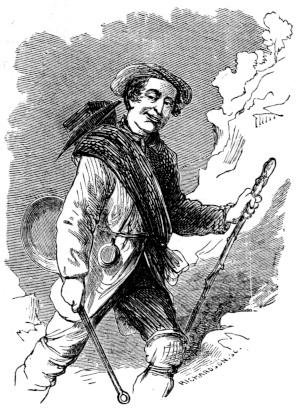
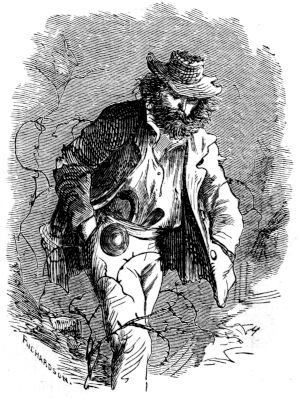
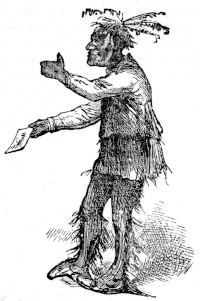
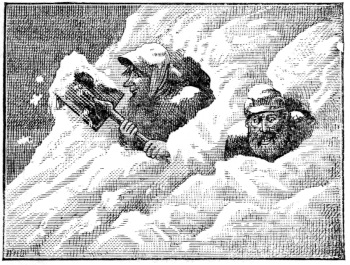
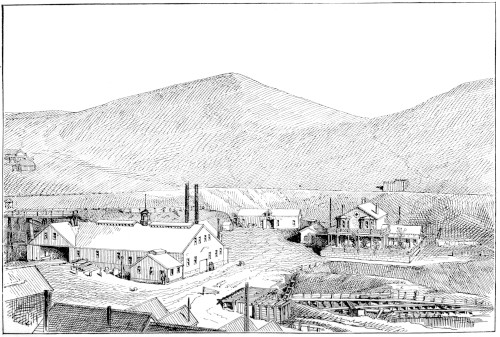
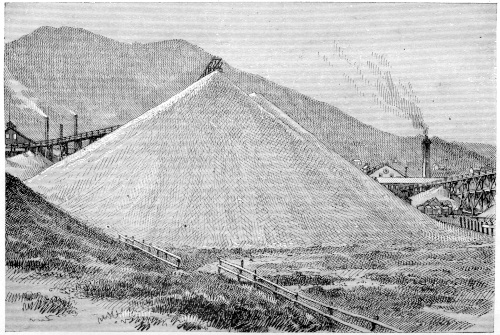
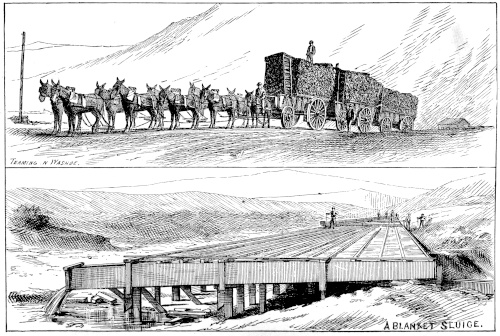
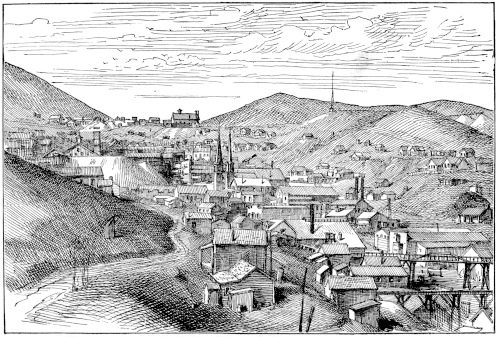
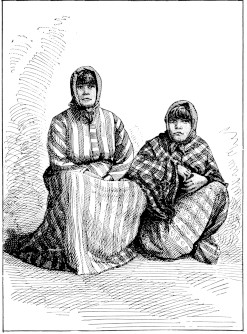
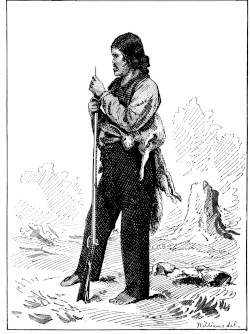
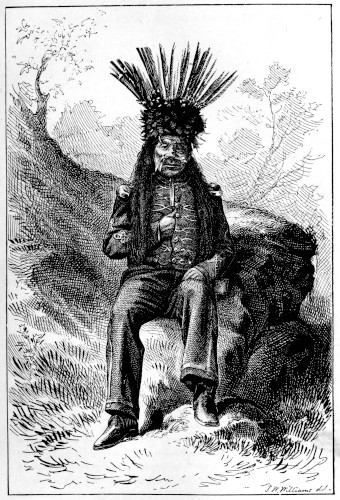
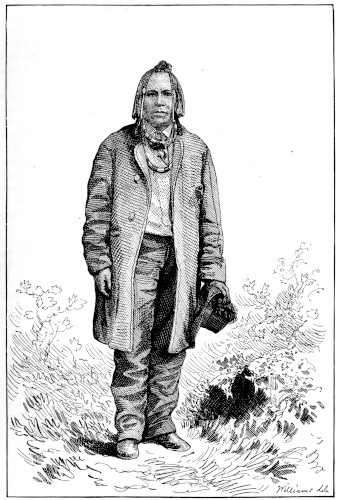
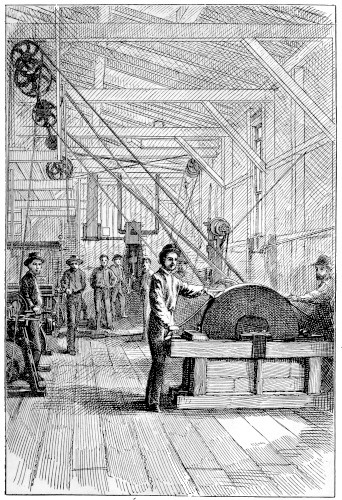
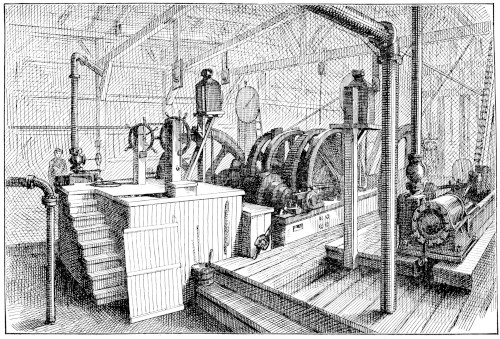
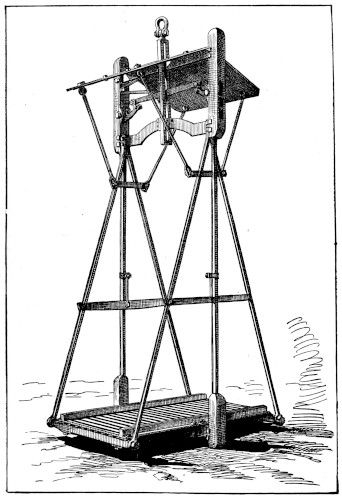
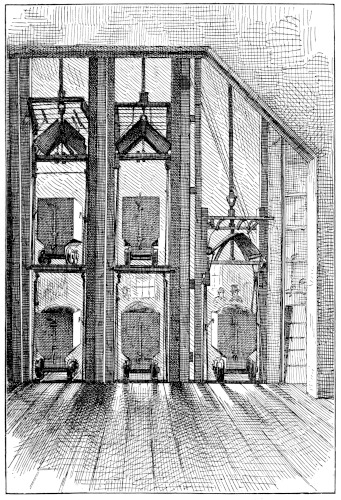
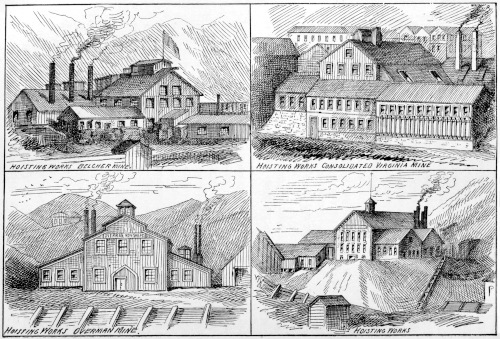
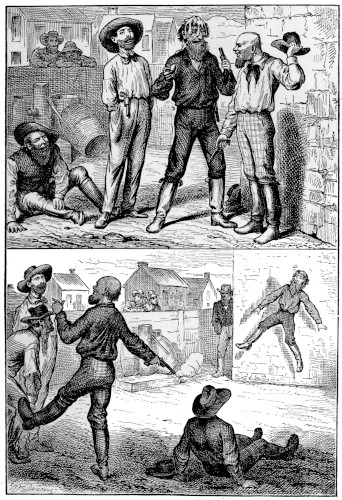
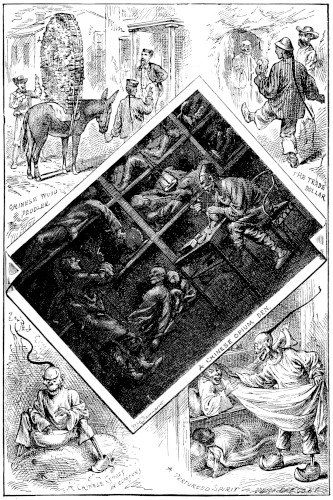
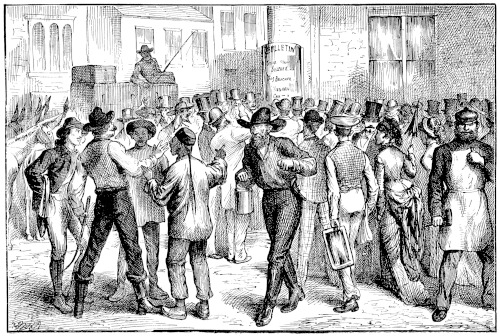
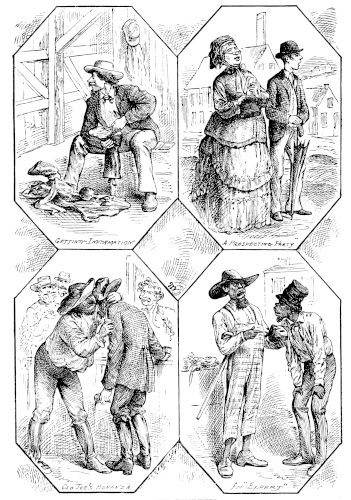
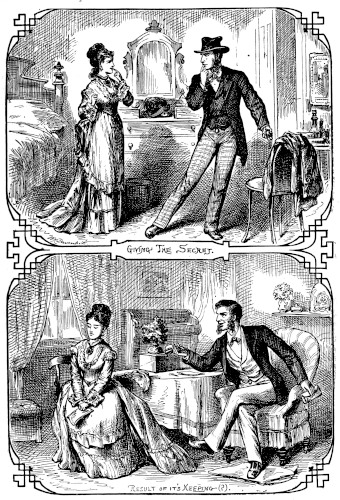
Full page illustrations throughout the text have been placed
at closest paragraph breaks.
Minor errors, attributable to the printer, have been corrected. Please
see the transcriber’s note at the end of this text
for details regarding the handling of any textual issues encountered
during its preparation.
Any corrections are indicated using an underline
highlight. Placing the cursor over the correction will produce the
original text in a small popup.
Any corrections are indicated as hyperlinks, which will navigate the
reader to the corresponding entry in the corrections table in the
note at the end of the text.
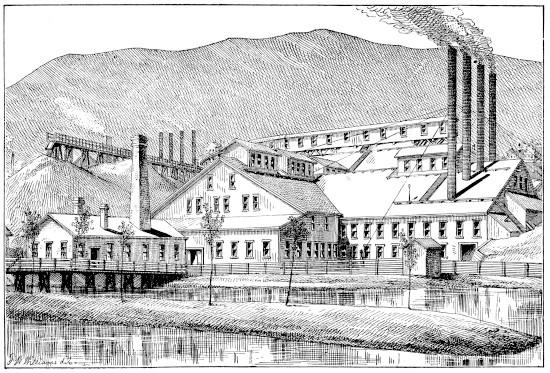
GOLD HILL
CONSOLIDATED VIRGINIA MINE.
AN AUTHENTIC ACCOUNT OF THE DISCOVERY, HISTORY, AND WORKING OF THE
WORLD RENOWNED
COMSTOCK SILVER LODE OF NEVADA
INCLUDING THE
PRESENT CONDITION OF THE VARIOUS MINES SITUATED THEREON;
SKETCHES OF THE MOST PROMINENT MEN INTERESTED IN
THEM; INCIDENTS AND ADVENTURES CONNECTED WITH
MINING, THE INDIANS, AND THE COUNTRY;
AMUSING STORIES, EXPERIENCES,
ANECDOTES, &C., &C.
AND A FULL
EXPOSITION OF THE PRODUCTION OF PURE SILVER
BY
DAN DE QUILLE.
(WILLIAM WRIGHT.)
PROFUSELY ILLUSTRATED.
SOLD BY SUBSCRIPTION ONLY.
HARTFORD, CONN.:
AMERICAN PUBLISHING COMPANY.
SAN FRANCISCO, CAL.:
A. L. BANCROFT & CO.
1876.
Entered according to act of Congress, in year 1876 by
AMERICAN PUBLISHING CO.,
in the office of the Librarian of Congress at Washington.
INTRODUCTORY.
One easily gets a surface-knowledge of any remote country, through the
writings of travellers. The inner life of such a country is not very often
presented to the reader. The outside of a strange house is interesting, but
the people, the life, and the furniture inside, are far more so.
Nevada is peculiarly a surface-known country, for no one has written of
that land who had lived long there and made himself competent to furnish
an inside view to the public. I think the present volume supplies this defect
in an eminently satisfactory way. The writer of it has spent sixteen years in
the heart of the silver-mining region, as one of the editors of the principal
daily newspaper of Nevada; he is thoroughly acquainted with his subject,
and wields a practised pen. He is a gentleman of character and reliability.
Certain of us who have known him personally during half a generation are
well able to testify in this regard.
MARK TWAIN.
Hartford, May, 1876.
TO
JOHN MACKEY, Esq.,
PRINCE OF MINERS,
AND
“Boss” of the Big Bonanza,
IS THIS BOOK
RESPECTFULLY INSCRIBED.
PREFACE.
I have put all I had to say into the body of this book; but, being informed
that a preface is a necessary evil, I have written this one.
The Great Oil-Tank—An Untapped Reservoir—Going in and Coming out—Experiences of those who Stayed—Approach of Spring—“Zephyrs” and Avalanches—A Rather long Night—Queer Incidents
In the Heart of the Bonanza—Inside the Mine—Extraordinary Experiments—“Process Peddlers” and their Devices—The Value of Tailings—Neat way of making Rings—WasteWaste of Gold and Silver
Yellow-Jacket Mine in a Blaze—A Scene of Horror—The Victims Subduing the Flames—The Work of Destruction—Scenes at the Mouth of the Shaft—On Fire for three Years—Missing Men.
Explosions of Firedamp—How Gas is formed in the Mines—Searching for the Dead—What the Giant-powder Did—The Inquest, and the Dead—Carelessness of the Miners.
Progress of the Flames—Descending the Burning Shaft—Danger—A Cave in the Mine—Deluge of Fire—Courage of the Men—Still Burning—A Warm Comparison—The Centre of the Earth.
The Adventures of Four Miners—Fixed—A Struggle for Life—Dangerous Playthings—Exploding with a Scratch—Those little Copper Cylinders—Loss of Noses and Thumbs.
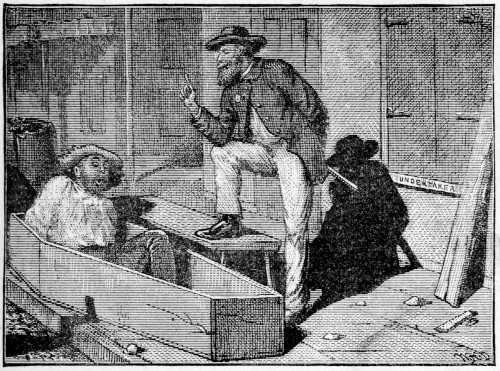
Tumbling down Two Thousand Feet—Blown to Atoms—A Singular Accident—Automatic Safety—Origin of Accidents—The Pilgrim in a Coffin—Shuffling out the “Corpse”.
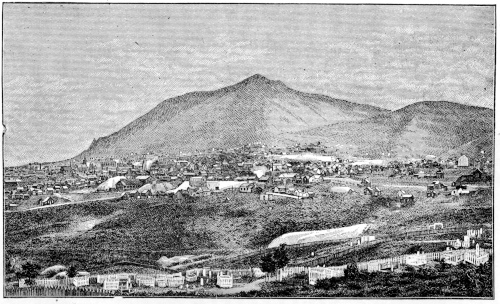
The First-born of Virginia City—A Comical Newspaper-Office—Growing like Mushrooms—A little PicturePicture—Among the Rubbish-Dumps—Big Loads—“See for Yourselves.”
Travelling in a Circle—Through the Six Tunnels—Crooked Roads—Side-tracks and Other Devices—The Way the Iron Horse Goes—The Men on the Line—Timed by Telegraph.
A Little Warrior in a Fix—Only a Shrimp—Piutes in Virginia City—The Lord and His Lady—How the Little Ones Came—The Early Settler—Adam and Eve—A Model Parent—An Important Occasion—Sam’s Theft.
A trifling Accident—Blazer and His Friends—A Little Misunderstanding—“Couldn’t Drink Alone”—“I’ll bring in the Rabble”—The Deacon Sent For—Resurrection!—“Awful big Gooses.”
A Fuddled Pillar—Philosophical Advice—“Don’t Git Married Afferd”— Mr. Jones’s Guest—The War-hoss of the Hills—Something of a Fighter—Beating a Retreat—“Jim Carter or the Devil.”
Mines of Ancient Days—The Yield of American Mines—Humboldt’s Curious Calculations—Varied Fortunes—The Plum in the Pudding—Value of the Different Levels—Searching in the Dark.
A Fortune in one Foot—Future Prospects—What Yet Remains—Undiscovered Bonanza—Figures before Facts—Facts After Figures—Distribution of the Wealth—Its Influence.
The bare mention of a mine of silver calls up in most minds
visions of glittering wealth and a world of romantic situations
and associations. All no doubt have read the story
of the Indian hunter, Diego Hualca, who, in the year 1545,
discovered the world-famous silver-mine of Potosi, Peru. How,
while climbing up the face of a steep mountain in pursuit of a
wild goat, this fortunate hunter laid hold upon a bush, in order
to pull himself up over a steep ledge of rocks, and how the bush
was torn out by the roots, when lo! wonderful store of wealth
was laid bare. In the roots of the upturned bush, and in the
soil of the spot whence it was torn, the eyes of the lone Indian
hunter beheld masses of glittering silver.
Having all our lives had in mind this romantic story, and
having a thousand times pictured to ourselves the great, shining
lumps of native silver, as they lay exposed in the black soil
before that Indian, who stood alone in a far-away place on the
wild mountain, we are apt to imagine that something of the same
kind is to be seen wherever a silver-mine exists. Besides, we
have all heard the stories told by the old settlers of the Atlantic
States in regard to the wonderful mines of silver known to the
Indians in early days.
Hardly a State in the Union but has its legend of a silver-mine
known to the red-men when they inhabited the country. This
mine was pretty much the same in every State and in every
region. Upon the removal of a large flat stone an opening
resembling the mouth of a cavern was seen. Entering this, you
18found yourself in a great crevice in the rocks, and the sides of
this crevice were lined with silver, which you forthwith proceeded
to hew and chip off with a hatchet kindly furnished you by your
Indian guide. You worked rapidly, as, according to contract,
you had but a limited time to remain in the mine. When the
Indian at your side announced your time up, the tomahawk was
taken from your hand, even though you might have an immense
mass detached, save a mere clinging thread.
Only men who had saved the life of some Indian of renown
were ever led to these silver caverns and they were invariably
obliged to submit to be blindfolded, so that none of them were
ever able to find their way back to the mines they had been
shown.
These and kindred stories have placed masses of native silver,
and deposits of rich ores of silver very near to the surface of the
ground, in the popular mind. No doubt there are many places
in the world where native silver exists almost upon the present
surface, as was the case in the Potosi mine, in Peru, and as was
the case with the rich deposit of silver ore first found on the
Comstock lode, but those who visit the present mines of the
Comstock will find little in them that at all agrees with their
preconceived notions of silver-mines. On the surface they will
find nothing that is glittering, nothing that is at all romantic.
The soil looks much the same as in any other mountainous
region, and the rocks seem to have a very ordinary look to the
inexperienced eye. The general hue of the hills is a yellowish-brown,
and all about through the rents in the ashen-hued sagebrush
which clothes the country, peep jagged piles of granite—the
bones of the land, showing through its rags.
In sketching the history of the famous Comstock silver lode of
Nevada, however, and of the bonanza mines, situated on that
lode, it seems proper to begin by giving a brief account of the
first settlement of the country, when known as Western Utah,
and under Mormon, if under any rule; also, to chronicle what is
to be gathered in regard to the finding of gold-diggings in that
region, the working of which finally resulted in the discovery of
the richest silver-mines in the world.
Nevada, as at present bounded, extends from the 35th to the
1942d degree of north latitude, and from the 114th to the 120th
degree west longitude from Greenwich.
The area of the State is 112,190 square miles, or 71,801,819
acres. Assuming the water-surface of the several lakes in the
State to cover an area of 1,690 square miles, or 1,081,819 acres,
there remain 110,500 square miles, or 70,720,000 acres as the
land-area of the State.
I do not know that this is correct to the fraction of an acre,
but, when the quality of the greater part of the land is considered,
I don’t think anybody is likely to come along and make trouble
about the measurement.
The Sierra Nevada Mountains, with long lines of snowy
peaks towering to the clouds, form the western boundary of
the State and rise far above any mountain ranges lying to
the westward in the Great Basin region, a region largely
made up of alkali deserts and rugged, barren hills, yet a
country abounding in all manner of minerals.
The rivers of Nevada are none of them of great size. They
all pour their waters into lakes that have no outlet, where
they sink into the earth or are dissipated by the active evaporation
that goes on in all this region during the greater part
of the year. Each river empties into its lake, or what in that
country is called its “sink.” Not a river of them all gets out
of the State or through any other river reaches the sea.
This condition of the rivers of Nevada was once thus
curiously accounted for by an old mountaineer and prospector.
Said he:
“The way it came about was in this wise—The Almighty,
at the time he was creatin’ and fashionin’ of this here yearth,
got along to this section late on Saturday evening. He had
finished all of the great lakes, like Superior, Michigan, Huron,
Erie and them—had made the Ohio, Missouri and Mississippi
rivers, and, as a sort of wind-up, was about to make a river
that would be far ahead of anything he had yet done in that
line. So he started in and traced out Humboldt River, and
Truckee River, and Walker River, and Reese River, and all
the other rivers, and he was leadin’ of them along, calkerlatin’
to bring ’em all together into one big boss river and then
lead that off and let it empty into the Gulf of Mexico or the
Gulf of California, as might be most convenient; but as he
20was bringin’ down and leadin’ along the several branches—the
Truckee, Humboldt, Carson, Walker, and them—it came
on dark and instead of trying to carry out the original plan,
he jist tucked the lower ends of the several streams into the
ground, whar they have remained from that day to this.”
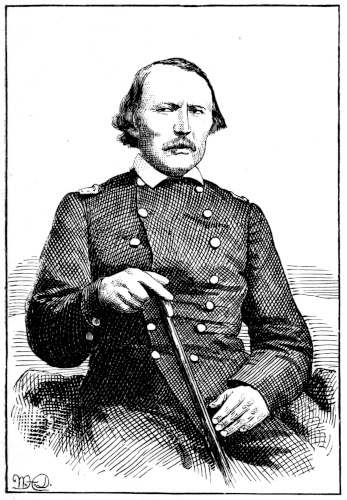
Carson River and Carson Valley were named in honor of
Kit Carson, the famous Indian fighter, trapper, and guide, who
visited that region as early as 1833. He was accompanied by
old Jim Beckworth, once chief of the Crow Indians, three
Crow Indians and some white trappers—nine men in all.
The party passed over the Sierra Nevada Mountains to California.
Thirteen years later when with Col. J. C. Fremont, Kit
Carson followed his old trail in crossing the Sierras, going in
the direction of Bear River, and at last, ascending a high hill
in the neighborhood of where Rough-and-Ready, California,
now stands, Kit struck a landmark he well remembered.
Pointing out the blue peaks of the Marysville Buttes, seen far
away in the smoky distance, he said,said, “Yonder lies the
valley of the Sacramento!”
At the time of the discovery of silver, the principal settlement
in that part of Utah which afterwards became the
Territory and eventually the State of Nevada, was at Genoa,
now the county-seat of Douglas county and situated about
fourteen miles south of Carson City, the capital of the State.
To all who crossed the Plains, on their way to the gold-fields
of California, in the early days, Genoa was known as “Mormon
Station,” a name it continued to bear for some years.
Even after the name had been changed to Genoa, many of
the old settlers persisted in calling the place Mormon Station.
The first building of a permanent character erected in Genoa
was built by Col. John Reese, who came from Salt Lake City
early in the spring of 1851 with a stock of dry-goods. This
first structure was a large log-house, covering an area of
forty-five square yards, was in the form of an L and at one
time formed two sides of a pentagon-shaped fort. Colonel
Reese bought the land on which the town of Genoa now
stands, with a farm adjoining, of Captain Jim, of the Washoe
tribe of Indians, for two sacks of flour.
KIT CARSON.
23Besides the settlement at Mormon Station, a settlement, also
by Mormons, was commenced in the spring of 1853 at Franktown,
Washoe Valley. Quite a little hamlet was formed at
Franktown; and others of the colony settled at various points
along the west side of the valley at the base of the Sierra
Nevada Mountains. Several Mormon families still reside in
this neighborhood and occasionally the voice of the Mormon
preacher is yet to be heard.
Orson Hyde, a man of considerable note at Salt Lake, had
in charge the spiritual and temporal welfare of the Mormon
settlements in the early days, he being both preacher and
Justice of the Peace.
At this time in the history of the country there was no town
in Eagle Valley, where Carson City now stands. The first
building erected in that neighborhood was at Eagle Ranche,
from which ranche the valley took its name. This place was
afterwards better known as King’s Ranche, a name it still bears.
Two or three houses were next built on the present site of
Carson City, but the town was not regularly laid out until 1858,
when the land was purchased by Major Ormsby, who gave the
place the name it now bears.
Although these early settlements were made upon lands
belonging to the Washoe Indians, a tribe of considerable strength
at the time, yet no very serious battles were ever had with them.
The whites, however, who were at first a mere handful, Mormons
and “Gentiles,” all told, stood in considerable awe of the
redskins. They were obliged to quietly endure not a few insults
from some of the bullies of the tribe, who had a fashion of walking
into houses and making themselves at home in the cupboards.
They were often exceedingly insolent, and when only women
and children were found at a house, always managed to frighten
them into giving up most of the provisions about the place.
In one instance, however, an Indian who went to the house of
a Gentile, when the only occupants were a boy about twelve
years of age and his sister still younger, met a fate he little
anticipated. The Indian, after regaling himself in the pantry,
began threatening the children with a roasting at the stake, for
the purpose of enjoying their fright; and, finally, whipping out a
24big knife, began “making believe” to take the scalp of the little
girl. The boy, it would seem, thought they had had about enough
of this foolishness, as he went into an adjoining room, took down
his father’s rifle and returning to where the brave was flourishing
his knife and enjoying himself, shot him dead in his tracks.
The Indian killed was one of the worst in the Washoe tribe,
and was greatly dreaded in all the settlements. The father of
the boy who rid the country of the much-feared Indian bully,
was obliged to “pull up stakes” at once and fly to California for
safety.
The Washoes inhabited the eastern slope of the Sierras, and
made the stealing of the stock of the settlers both their
business and their pleasure. Like crows they sat looking down
into the valleys from the tops of the rocky buttresses of the
mountains, and when they saw the coast clear, down they came
and gathered in as many animals as they were able to drive.
Whenever the whites were so incautious as to collect for the
purpose of enjoying a ball or any such social festivity, the
Washoes were pretty sure to know of the affair, and seldom
neglected to swoop from their mountain fastnesses, gathering up
and driving away whatever animals they could find. The trail
of the Indian depredators, when followed, was generally found
marked with the remains of roasted horses—the Washoes having
a great fondness for horse-flesh. On the occasion of a ball
in Dayton, as late as 1854, the Washoes came down and “gobbled
up” all the horses of the revellers. The Indians appeared
to think this cunning and a very good joke.
Although Colonel Reese had about his big log-house at
Mormon Station, a strong stockade, that defence was never
required as a protection against the Washoe Indians. The
tribe has dwindled away until at the present day those remaining
are few and miserably poor, ragged, filthy, and spiritless.
They now cling to the skirts of the white man and stand in awe
of all surrounding tribes of Indians, even in time of peace.
The settlements thus far mentioned were all scattered along
the eastern base of the Sierra Nevada Mountains, but as early
as 1851, there were erected a few temporary structures, principally
canvas houses, at various points to the eastward, along
25the line of the main “Emigrant Road.” This, the then grand
highway across the continent, after passing through some of the
worst and most dreaded deserts between the Rocky Mountains
and the Sierras, led to the well-watered and fertile valley of the
Carson, a region that doubtless seemed almost a paradise to the
weary emigrant, who for months and months had been toiling
over rugged mountains and across sterile plains.
Mormon Station being directly on the old Hangtown (afterwards
Placerville) Road, then the principal route over the
Sierras, drove a thriving trade with the thousands and tens of
thousands of adventurers who were then pushing their way
toward the gold-fields of California. Seeing that there was
money in this trade, not a few adventurers, principally from
Salt Lake and California, established posts on the line of the
road to the eastward of Mormon Station and Eagle Ranche, a
few even pushing out a considerable distance into the deserts.
The majority of these traders, however, returned to California
each season, following in the wake of the last emigrant-trains
that came in over the Plains, and there remained until the
tide of emigration began to pour in again the next year.
These traders furnished the “pilgrims” cheap luxuries at
outrageously high prices, traded for their disabled cattle and
swindled them in every possible manner, as they all considered
the emigrant their lawful prey.
CHAPTER II. THE SEARCH FOR GOLD.
26
Gold was first discovered in Nevada in the spring of
1850, by some Mormon emigrants. They had started
for California, but so early in the season that when
they arrived at the Carson River they learned that the snow
on the summit of the Sierra Nevada Mountains was still too
deep to allow of their being crossed. This being the case,
the party encamped on the Carson to await the opening of
the road.
Having nothing else to do, some of the men of the party
began prospecting for gold. Their camp on the river being
at no great distance from the mouth of the Gold Cañon, the
largest cañon in the neighborhood, they were naturally attracted
to it and there began their prospecting operations.
Although they knew but little about mining, and had only
pans with which to wash the gravel, they found gold sufficiently
plentiful to enable them to make small wages. It does
not appear, however, that the discoverers worked them longer
than until they were able to continue their journey to California.
Other emigrants coming in and encamping on the river
learned of the discovery of gold in the cañon, and, being
anxious to begin gold-digging as soon as possible, did some
prospecting along the bed of the ravine.
But the gold being fine (i. e., like dust—in fine particles),
and the quantity not being up to their expectations, nearly all
pushed on to California, where they expected to make fortunes
in a few weeks or months; as all believed, that they,
27through their superior acuteness, would find places in some
of the dark and secret gulches of the Sierras where they
would be able to gather pounds of golden nuggets.
Finally, Spofford Hall, of Fort Wayne, Indiana, arrived
across the Plains and, thinking it a good point at which to
establish a permanent station, erected a substantial log-house
at a point not far from the mouth of the Gold Cañon. This
was for some time known as Hall’s Station. Afterwards it
was known as McMartin’s Station, the property having been
purchased by James McMartin, a man who came across the
Plains with Mr. Hall. This house stood on ground now
covered by the town of Dayton and was still being used as a
store at the time of the discovery of silver, it being then
owned by Major Ormsby, killed at Pyramid Lake, in 1860, in
the first battle with the Piutes.
This discovery of gold at the mouth of Gold Cañon was
undoubtedly that which led to the discovery, some years
later, of the Comstock lode—the first step, as it were, to the
grand silver discovery of the age. At the head of Gold Cañon
are situated a number of the leading mines of the Comstock
range.
In the spring of 1852 a considerable number of men began
working on the lower part of Gold Cañon, most of them using
rockers in their mining operations. As these men did well,
making from $5 to $10 per day, the number of miners on the
cañon was considerably greater in the winter and spring of
1853, there being as many as two or three hundred men
at work. As there was little water in the bed of the cañon
except during the winter and spring months, few miners
were to be seen at work in summer—seldom more than forty
or fifty.
As the miners worked their way up the cañon from bar to
bar, a new town was eventually founded at a point a few
miles above the first settlement at its mouth. This was a
little hamlet of a dozen houses of all kinds, and was christened
Johntown. In this little town or “Camp,” as such
places are usually styled in mining countries, lived Henry
Comstock, who gave his name, some years later to the great
silver lode; also, Peter O’Riley and Patrick McLaughlin,
28the discoverers of the Comstock vein. “Old Virginia”
(James Finney, or Fennimore), in whose honor Virginia
City, the great mining town of Nevada, was named, was also
a resident of Johntown in the early days, as were several
other persons who are now classed among the worthies of
the Comstock range.
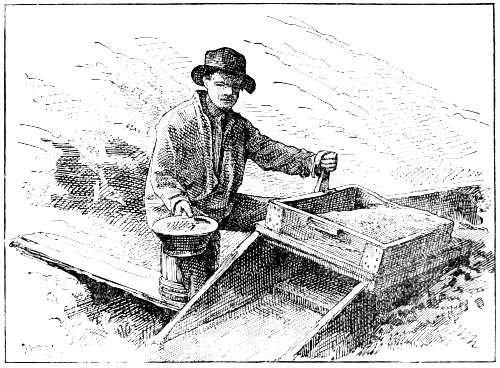
“OLD VIRGINIA” AT HIS ROCKER.
From about 1856 up to 1858, Johntown was the “big mining
town” of Western Utah—at least was the headquarters of most
of the miners at work in the country. All told, the camp contained
only about a dozen buildings, some of which were mere
shanties, but many of the miners preferred to camp out during
the spring and summer months—they had no use for houses.
A large number of Chinamen being at work at the mouth of
the cañon, near where the gold was first discovered, that place
finally became known as “Chinatown,” a name which it long
retained, though the whites who settled there did not much
fancy the name. They gave the place the name of Mineral
Rapids, but this did not take; then there was danger of it being
29christened Nevada City, but the citizens rose in their might and
at a meeting, held November 3d. 1861, the name of Dayton was
unanimously adopted, and Dayton it has ever since remained.
The Chinamen mentioned, forty or fifty in number at first,
were brought over from California, in 1856, to work on a big
water-ditch, by means of which water was to be brought to the
Gold Cañon mines from the Carson River. Finding they would
be allowed to mine in certain places, others followed, and at one
time not less than one hundred and eighty Mongolians were at
work at the lower end of the Cañon.
The Celestials probably found very good pay, even in the
places where they were allowed to plant their rockers, as it is
said that the bars for some miles up the cañon paid well when
first worked, there being places where an ounce per day was
taken out.
The cañon continued to pay pretty fair wages for some years,
and was still being worked at the time of the discovery of silver
and the grand silver excitement which immediately followed.
Literature was not neglected at this early period in the history
of Washoe. There were, even in the early days when Johntown
was the great mining centre of the country, two spicy weekly
papers published in the land. They were written on foolscap,
often several sheets, and, by being assiduously passed from hand
to hand, were widely circulated in the several settlements.
These papers were everywhere eagerly read. One, called
the Scorpion, was published at Genoa, and was edited by S. A.
Kinsey; the other was published at Johntown and was edited
by Joe Webb. It was called The Gold-Cañon Switch. These
papers were both published between the years 1854 and 1858.
The people of Johntown, though not numerous, were jovial.
They were fond of amusements of all kinds. Nearly every
Saturday night a “grand ball” was given at “Dutch Nick’s”
saloon. As there were but three white women in the town, it
was necessary, in order to “make up the set,” to take in Miss
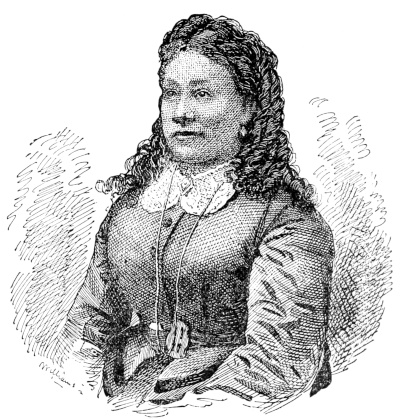
Sarah Winnemucca, the “Piute Princess” (daughter of Winnemucca,
chief of all the Piutes). When the orchestra—a “yaller-backed
fiddle”—struck up and the ‘French four’ was in order,
the enthusiastic Johntowners went forth in the dance with ardor
and filled the air with splinters from the puncheon floor. When
30a Johntown “hoss” balanced in front of the “Princess” he made
no effort to economise shoe-leather.
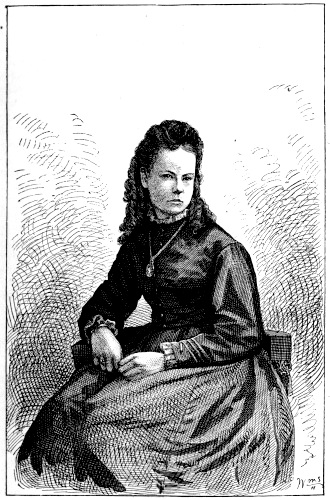
THE PRINCESS SARAH WINNEMUCCA.
Even in those early days and in that primitive community, the
“beast of the jungle” was known in the land. The “boys”
were not allowed to languish for want of amusement. When
their sacks of gold-dust became painfully plethoric, and too heavy
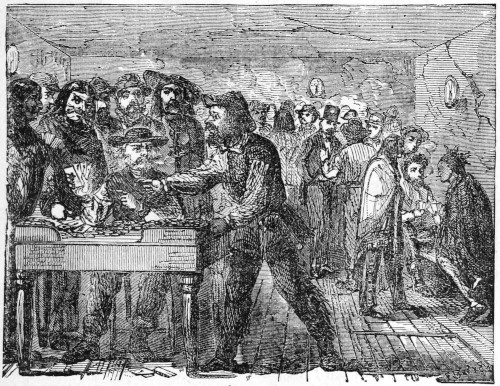
to be conveniently packed around, Jacob Job, the leading merchant
of the place used to deal faro for them “out of hand;” that
is, he took the cards from his hand and laid them out on the
table, instead of drawing them from a box such as is used in the
game by regular “sports.”
Billy Williams, a man who had a ranche up in Carson Valley,
occasionally came down to Johntown in seasons of great auriferous
affluence, and dealt for the boys a little game called
“Twenty-one.” Faro, out of hand, and Twenty-one, with
Williams at the helm, usually sent all the male Johntowners back
31to their toms and rockers, each man financially a total wreck.
About 1857-58 the diggings along Gold Cañon showed signs
of failing, all the best bars and banks being pretty well worked
out. It was only occasionally that a rich spot could be found,
and most of the miners were only making small wages. That
this was the case is evident from the fact that about this time the
Johntowners, the mining men of the land, began to scatter out
through the country and make prospecting raids in all directions
among the hills.
JACOB JOB’S LITTLE GAME.
In 1857, several men from Johntown, struck gold-diggings on
Six-mile Cañon. This cañon heads on the north side of Mount
Davidson, while Gold Cañon, in which gold was first found,
heads on the south side of the same mountain. The heads of
the two cañons are about a mile apart, and through the eastern
face of Mount Davidson, across a sort of plateau, runs the Comstock
Silver lode. The lode (or lead), extends across the heads
of both cañons, and the gold that was being mined in both came
from the decomposed rock of the croppings of the vein.
Thus, it will be seen, these early miners were approaching the
32great silver lode from two points—on Gold Cañon towards the
south, and on Six-mile Cañon toward the north side of Mount
Davidson. But not a man among them knew anything of what
was ahead. They were only working for gold and were looking
for that nowhere but in the gravel of the ravines; none of them
having thought of looking for gold-bearing quartz veins.
The men who were mining on Six-mile Cañon first struck paying
ground, at a point nearly a mile below the place where silver
ore was afterwards found in the Ophir mine. The gold was in
clay, which was so tough that before it could be washed out in
rockers it was necessary to “puddle” it—that is, put it into a
large square box or a hole in the ground, and dissolve it by
adding a proper quantity of water and working it about with
hoes or shovels. Even working in this way, the men were able to
make from five dollars to an ounce per day. The gold found
at this distance down the cañon was worth about $13.50 per
ounce.
The miners on Six-mile Cañon sold their dust in Placerville,
California. Being acquainted with some California boys who
were mining in a place called ’Coon Hollow, our Washoe
miners were in the habit of buying a certain quantity of fine
dust of them, which they mixed with the gold from Six-mile
Cañon, when they were able to sell the whole lot at such a price
as was equal to fifteen dollars per ounce for their own dust. As
they worked further up the ravine, toward the Comstock lode,
the gold deteriorated so rapidly in weight, color and value, that
this game could no longer be played. The gold-buyer looked
upon the mixture of Six-mile Cañon and ’Coon Hollow
products and pronounced it a delusion and a snare.
CHAPTER III. ADVENTURES OF EARLY PROSPECTORS.
33
Two young men who were mining in Gold Cañon, suspected
the existence of silver-mines in the country at
least five or six years before silver was actually discovered.
These men were Hosea B. and Edgar Allen Grosch,
sons of A. B. Grosch, a Universalist clergyman of considerable
note, and editor of a Universalist paper at Utica, New York.
The Grosch brothers were well educated and had considerable
knowledge of mineralogy and assaying.
They came to Gold Cañon in 1852, from Volcano, California,
and engaged in placer-mining. In 1853 and 1854, they appear
to have become convinced that there was silver to be found in
the country, and did a good deal of prospecting in various
directions among the neighboring mountains, doubtless in search
of silver ore.
In their cabin, which stood near the present town of Silver
City, about a mile above Johntown, they are said to have had a
library consisting of a considerable number of volumes of
scientific works; also chemical apparatus and assayer’s tools.
They did not associate with the miners working on the cañon,
and were very reticent in regard to what they were doing.
They, however, informed a few persons that they had discovered
a vein of silver-bearing quartz and it was well known among
the miners that they had formed a company for the purpose of
working their mine. The majority of the members of their
company were understood to be in California (about Volcano),
and in one of the Atlantic States. Mrs. L. M. Dettenreider,
one of the early settlers of the country, and a lady who had
34befriended the brothers, was given an interest in their mine, and
at one time had in her possession a piece of ore from it. This
ore, they assured her, contained gold, silver, lead, and antimony.
Mrs. Dettenreider, who is a resident of Virginia City, says
she always understood that the mine discovered by the Grosch
brothers was somewhere about Mount Davidson, and thinks they
may have obtained their ore somewhere along the Comstock
lead.
In 1860, I saw their old furnaces unearthed, they having been
covered up to the depth of a foot or more by a deposit of mud
and sand from Gold Cañon. They were two in number and but
two or three feet in length, a foot in height and a foot and a half
in width. One had been used as a smelting and the other as a
cupel furnace. The remains of melting-pots and fragments of
cupels were found in and about the furnaces, also a large piece
of argentiferous galena, which had doubtless been procured a
short distance west of Silver City, where there are yet to be seen
veins containing ore of that character, some of which yield fair
assays in silver.
In the spring of 1857, Hosea Grosch, while engaged in mining,
stuck a pick in his foot, inflicting a wound, from the effects of
which he died, in a few days. In November of that year, while
on his way to Volcano, California, Allen, the surviving brother,
was caught in a heavy storm in the Sierra Nevada Mountains,
and had his feet frozen so badly that amputation was necessary,
from the shock of which operation he died. With the brothers
was lost the secret of the whereabouts of their silver-mine; if
they ever discovered any silver except that contained in the ore
of the veins of argentiferous galena I have mentioned.
After the discovery of the old furnaces of the Grosch brothers
in 1860, there was much search by miners in the neighborhood
for the mine they had been prospecting, but no mine was ever
found.
In a sort of sink on the side of a large mountain, at the foot of
which stood the cabin and furnaces of the brothers, was found an
old shaft. Here was supposed to be the spot where they had
worked, and the place was “located” (“claimed” or “pre-empted”),
and called the “Lost Shaft.”
35About the first discovery made by the locators, when they
began cleaning out the shaft, was the body—a sort of mummy—of
a Piute squaw, who had been murdered some years before by
members of her tribe, who had tumbled her remains into the
old shaft.
After finding this “dead thing,”thing,” the owners of the claim let a
contract for the further sinking and exploration of the old shaft.
The men who took the contract soon gave it up. They said
they could not work in the shaft; that stones were falling out
of its sides without cause. Others took the contract, and each
party of miners that went to work in the shaft gave it up, saying
that their lives were endangered by the stones which suddenly
and at unexpected times, jumped out of its sides. A tunnel
was then started to tap the ledge on which the old shaft was
supposed to have been sunk, but it was never completed. It is
now well known that the old shaft was sunk by a party of Gold
Cañon miners in 1851, they having taken it into their heads that
from this curious-looking pit or sink in the side of the mountain
came all the gold found below in the cañon.
There was also a story current among the miners, in 1860, that
before starting on the trip over the Sierras which resulted in his
death, Allen Grosch boxed up the library and all the chemical
and assaying apparatus, and cached the whole somewhere about
Grizzly Hill, the mountain at the base of which stood the cabin
occupied by the brothers. There was much search by curious
miners in the neighborhood for this supposed deposit of valuables.
They crawled under the edge of shelving rocks, peered into
crevices among the cliffs, and probed all suspicious-looking stone-heaps,
but no bonanza of scientific apparatus was ever discovered.
When Allen Grosch left to go over the mountains to California,
Comstock was placed in charge of the cabin, and it is very
probable that whatever books and apparatus there may have been
were carried away by such visitors as took a fancy to them, and
thus were scattered and lost.
In the summer of 1860 I was camped on a branch of Gold
Cañon, near where the old stone-cabin of the Grosch brothers
stood. I had a score or more of neighbors, whose tents were
pitched on the banks of the ravine, or who, having no tents,
36made the willows on the bars their shelter. One hot day in
July, one of the men, a big, long-legged Missourian, started up
the mountain to see what he could find. One object probably
was to look for the Grosch scientific “bonanza,” but, being a
man who had no more knowledge of ores and minerals than a
Piute, he was quite sure to make some remarkable discovery, no
matter in what direction he traveled.
He had been absent some hours when, looking up towards the
summit of Grizzly Hill, we saw a cloud of dust moving down the
face of the mountain. In the midst of this whirling cloud, we
caught occasional glimpses of a man, bounding along like a wild
goat. Rocks disturbed by his feet, rolled down the steep slope
of the mountain, adding greatly to the dust and commotion.
All in camp were soon out gazing at the unusual spectacle, and
all wondered what had happened to “Pike,” who by this time
had been recognized by his long legs and reckless manner of
handling them.
Some thought that a bear or some other wild beast was in
pursuit of Pike, as he charged down the steep mountain in
a manner so reckless that it was very evident he was taking no
thought of the risk he ran of breaking his neck.
Over jutting ledges and through huge patches of loose, sliding
rock, bounded Pike, and soon he came rushing wild-eyed into
camp.
Rivulets of perspiration were coursing down his dust-covered
cheeks; dust whitened the ends of his long black locks, and dust
seemed to fly from his nostrils as, puffing and blowing, he made
his way into our midst.
In both hands he held a quantity of black-looking rock. As
soon as he could get his breath he said: “Boys, I’ve struck it!
There’s millions of tons of it! Millions on millions—enough to
make the whole camp rich!”
“Well, what is it Pike?” asked some one. “Is it silver, gold,
or what?”
“It is what none of you fellers would ever have found: it’s the
stuff they make compasses of!”
“Make compasses of! What do you mean?” asked the men.
“Mean! I mean just what I say, that it is the stuff they make
37compasses of—surveyors’ compasses, mariners’ compasses, and all
them kind of compasses that pint to the North Pole. None of
you would ever have found it; you wouldn’t have knowed what
it was!”
“Well, where is it? Where is this big thing?”
“Way up yander on top of the mountain,” said Pike, pointing
towards the summit of Grizzly Hill. “There’s a whole ledge of
it—a ledge fifty foot wide!”
“But how do you know that the stuff is good for anything?”
asked the boys. “How do you know that it is what compasses
are made of?”
“How do I know? Easy enough. Just look here, will you!”
Pike then took a piece of the rock weighing about five pounds,
and placing one end of it in the midst of a handful of smaller
pieces, ranging from the size of a pea to that of a hulled walnut,
the whole mass of small fragments was lifted up and remained
clinging to the larger lump of rock.
“See that!” cried Pike, glancing at one and another of the
men about him: “What did I tell you? and there is millions
more where I got this!”
All were now really a good deal interested in the rock found
by Pike, and in the powerful magnetic qualities it exhibited, as
the large lumps would pick up and hold suspended fragments
weighing over an ounce.
“The way I come to find it,” now explained Pike, “was this:
I found the big ledge of black, heavy rock, and taking up a
chunk of it began trying to break off a slice from the main ledge.
As I hammered away, I noticed that all the little bits of rock
pounded loose stuck to the chunk I held in my hand. I thought
at first that there was pine-gum on the chunk, but could find none,
then it all at once flashed into my mind, and I said—‘I’ve struck
it! This is the stuff they make compasses of!’ Then you
just ought to have seen me make tracks down the mountain.”
“We saw you!” said the men.
Pike then went on to say, that his discovery was one of the
most important, in many respects, that had been made in modern
times. It would be of incalculable advantage to navigation
and would increase the navies of the world a thousand-fold.
38He even went so far the next morning (which showed that his
brain had not been idle during the night) as to assert that hereafter
there would be no difficulty about reaching the North Pole.
All that would be necessary, he said, would be to place a block
of about ten tons of his rock on the bow of a ship, when, without
the aid of sail or rudder, and in spite of adverse winds and ice-floes,
the vessel would plough its way up through the oceans of
the north and never stop until its nose rested against the side of
the Pole.
Pike had several assays of his “find” made, and it was weeks
before he could be made to believe that it was not something of
more value than magnetic iron ore.
Some years after Pike’s great discovery, a prospector who
had been roaming through the Pahranagat Mountains, the
wildest and most sterile portion of southeastern Nevada,
brought back with him a great curiosity in the shape of a
number of traveling stones. The stones were almost perfectly
round, the majority of them as large as a hulled walnut,
and very heavy, being of an irony nature. When scattered
about on the floor, on a table, or other level surface, within
two or three feet of each other, they immediately began traveling
toward a common centre, and then huddled up in a
bunch like a lot of eggs in a nest. A single stone removed
to a distance of a yard, upon being released, at once started
off with wonderful and somewhat comical celerity to rejoin
its fellows; but if taken away four or five feet it remained
motionless.
The man who was in possession of these traveling stones
said that he found them in a region of country that, though
comparatively level, is nothing but bare rock. Scattered
about in this rocky plain are a great number of little basins,
from a few feet to two or three rods in diameter, and it is in
the bottom of these basins that the rolling stones are found.
In the basins they are seen from the size of a pea to five or
six inches in diameter. These curious pebbles appeared to
be formed of loadstoneloadstone or magnetic iron ore.
CHAPTER IV. WHAT THEY DISCOVERED.
39
To return to the notions of the early miners and others,
in regard to the existence of silver in Nevada. Few,
it would seem, besides the Grosch brothers, and one or
two of their intimate friends, ever dreamed of there being any
silver-mines in the country. Had there been anything said
about the existence of silver, those who made predictions
that it would be found, would not have been slow to remind
their friends of the fact as soon as the first discovery of silver
was made. Some of the Johntowners say that, in 1853, a
Mexican who was hired by them and who worked a few days
in Gold Cañon, tried to tell them that he was of the opinion
that there were silver-mines in the mountains above them.
The man spoke no English, therefore was unable at that time
to make himself understood; now that the silver-mines have
been found, all seems plain enough.
Pointing to the large fragments of quartz rock lying along
the bed of the cañon, the Mexican said: “Bueno!”—good!
Then pointing toward the mountain peaks about the head of
the cañon, and giving his hand a general wave over them all,
he cried emphatically: “Mucho plata! mucho plata!” “Much
silver! much silver! all above you in those hills,” was what
the Mexican said by word and gesture.
The men who were at work with the Mexican remember
this, because during the two or three days he was at work
with them he several times uttered the same words and went
through the same pantomime. All that the miners understood
of what the fellow was driving at was, “lots of money,
gold,” somewhere above them in the mountains.
40The fact is, that silver was so little in the minds of the early
miners, and they knew so little about any ore of silver, that
when they at last found it, they did not know what it was and
cursed it as some kind of heavy, worthless sand of iron, or
some other base metal, that covered up the quicksilver in the
bottom of their rockers and interfered with the amalgamation
and saving of the gold they were washing out. They damned
this stuff from the rising of the sun till the going down thereof,
and worked in it for a considerable length of time before anybody
knew what it was. Until after an assay of the “blasted
blue stuff” had been made, the miners were all working in
blissful ignorance of silver existing anywhere in the country.
In the spring of 1858, which the snow was going off and
water was plentiful, the men who had worked in Six-mile
Cañon the year before, with a number of other miners from
Johntown, returned to their diggings. The newcomers set to
work on the cañon above the claims of those who had mined
there the previous year, planting their rockers wherever they
found a spot of ground that would pay wages.
Among those who came to mine on Six-mile Cañon at this
time were Peter O’Riley and Pat McLaughlin, the discoverers
of the Comstock silver lode, and “Old Virginia” who gave
his name to Virginia City, under the streets of which now lie
the bonanza mines.
Nick Ambrose, better known in that country as “Dutch
Nick,” also moved up to Six-mile Cañon, following his customers
in their exodus from Johntown. Nick came not to
mine, but to minister to the wants of the miners. He set up
a large tent and ran it as a saloon and boarding-house. The
boys paid him $14 per week for board and “slept themselves;”
that is, they were provided with blankets of their own,
and rolling up in these, they just curled down in the sagebrush,
wherever and whenever they pleased.
The liquid refreshment furnished these miners by Nick was
probably the first of that popular brand of whisky known as
“tarantula juice” ever dispensed within the limits of Virginia
City. When the boys were well charged with this whisky it
made the snakes and tarantulas that bit them very sick.
41At this time, H. T. P. Comstock was engaged in mining on
American Flat Ravine, a branch of Gold Cañon, a short
distance above the point where Silver City now stands. He
was working with a “tom” (a contrivance for washing auriferous
gravel which combines the principles of the rocker and
the sluice-box), and, the water used in the tom being some
distance below where his “pay-dirt” was found, he had a
number of lusty Piute Indians employed in packing the dirt
to where he was engaged in washing it and supervising things
in general, as became the proprietor of the “works.”
The ground worked was not so rich as to greatly excite
anyone, it being about, as the Chinamen say, “two pan, one
color,” therefore it is not likely that the Indians received
wages that gave them a very exalted opinion of mining as a
regular business.
At that time Comstock, whose name is now heard in all
parts of the world in connection with the great silver lode
bearing his name, was familiarly known to the miners of
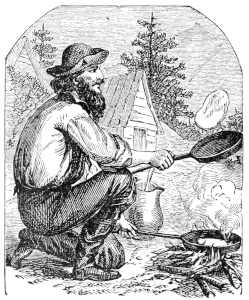
Johntown and neighboring mining camps as “Old Pancake.”
This name was given him by his brother miners because he
was never known to bake any bread. He always had—or
imagined he had—so much business on hand that he could
spare no time to fool away in making and baking bread. All
of his flour was worked up into pancakes. And even as,
with spoon in hand, he stirred up his pancake batter, it is said
he kept one eye on the top of some distant peak and was lost
in speculations in regard to the wealth in gold and silver that
might rest somewhere beneath its rocky crest.
Meantime, while “Old Pancake” was thus toiling in American-Flat
Ravine, and utilizing the native muscle of the land
in his struggles with the stubborn matrix of auriferous deposits,
the miners on Six-mile Cañon were steadily working along
the channel of the same, picking out the richer places, and
the gold extracted was gradually becoming lighter in color
and weight, consequently less valuable; a condition of things
that puzzled them all not a little. As, at that time, the presence
of silver was not suspected, the miners could not imagine
what was the matter with the gold, further than that there
42seemed to be some kind of bogus stuff mixed with it in the
form of an alloy. This light metal, whatever it might be,
seemed gradually taking the place of the gold and changing
the color of the dust. As a small percentage of silver alters the
color of a great quantity of gold, the value per ounce was not
so much reduced as one would have supposed from looking
at it; but in the value there was a slight but steady decrease.
The miners on Six-mile Cañon worked on in the fall of
1858 with tolerable success—making small wages—until it
became so cold that the water they had been using in rocking
was frozen up, when all hands broke up camp and returned
to Johntown, to go into winter quarters.
In January 1859, there came a spell of fine weather, when
some of the Johntowners struck out in various directions, for
the purpose of prospecting; water being plentiful in all the
ravines, owing to the melting of the snow.
On Saturday, January 28, 1859, “Old Virginia,” H. T. P.
(Pancake) Comstock, and several others struck the surface-diggings
at Gold Hill, and located a considerable number of
claims. They claimed the ground for placer-mining but had
no idea of there being a rich vein of gold and silver-bearing
quartz underlying the whole region upon which they were
staking off their gravel-mines.
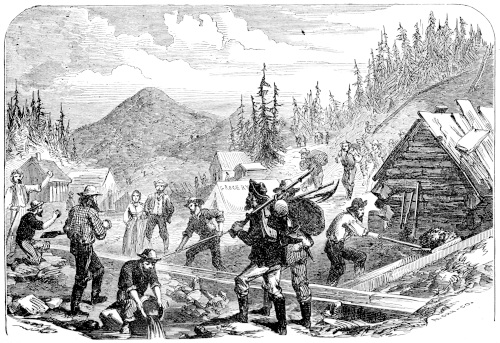
GOLD DIGGINGS OF 1859.
They had struck upon the little knoll to which the name of
Gold Hill was soon after given, which knoll stood at the
north end of the site of the present town of Gold Hill.
Although at first mistaken for placer-diggings, the ground
forming this hillock was in reality nothing more than a great
mass of the decomposed croppings of the Comstock lode.
This discovery was made at a point on the head of Gold
Cañon about a mile south of where, a few months later, silver
was discovered in the Ophir mine, at the head of Six-mile
Cañon. John Bishop, one of the men who made this strike,
thus describes the manner of it. I give his own words:
“Where Gold Hill now stands, I had noticed indications of
a ledge and had got a little color. I spoke to ‘Old Virginia’
about it, and he remembered the locality, for he said he had
often seen the place when hunting deer and antelope. He
45also said that he had seen any quantity of quartz there. So
he joined our party and Comstock also followed along. When
we got to the ground, I took a pan and filled it with dirt, with
my foot, for I had no shovel or spade. The others did the
same thing, though I believe that some of them had shovels.
I noticed some willows growing on the hillside and I started
for them with my pan. The place looked like an Indian
spring, which it proved to be.
“I began washing my pan. When I had finished, I found
that I had in it about fifteen cents. None of the others had
less than eight cents, and none more than fifteen. It was
very fine gold; just as fine as flour. Old Virginia decided
that it was a good place to locate and work.
“The next difficulty was to obtain water. We followed the
cañon along for some distance and found what appeared to
be the same formation all the way along. Presently Old Virginia
and another man who had been rambling away, came
back and said they had found any amount of water which
could be brought right there to the ground.
“I and my partner had meantime had a talk together and
had decided to put the others of the party right in the middle
of the good ground.
“After Old Virginia got back we told him this, but were
not understood, as he said if we had decided to ‘hog’ it we
could do so and he would look around further; but he
remained, and when the ground was measured off, took his
share with the rest.
“After we had measured the ground we had a consultation
as to what name was to be given the place. It was decidedly
not Gold Cañon, for it was a little hill; so we concluded to
call it Gold Hill. That is how the place came by its present
name.”
The new diggings were discovered on Saturday, and the next
day (Sunday) nearly all the male inhabitants of Johntown went
up to the head of Gold Cañon to take a look at and “pass upon”
the new mines. The majority of the sagacious citizens of the
then mining metropolis of the country did not think much of the
new strike. They had placer-mines near at home, five miles
below, that prospected much better. However, “Old Pancake”
and some of others interested in the new diggings, blowed
about them as being the big thing of the country.
Although the prospects at first may not all have been as large
as stated by Bishop, who is quoted above, yet Comstock, Old
Virginia, and party soon reached very rich dirt—very much
richer than Comstock had ever found in any part of his American
46Ravine claim, where he worked the braves of the Piute tribe.
Starting in at about $5 per day, they were soon making from $15
to $20, and for a time even more to the man. Believing they were
working placer-mines, they were at times moved too far away
from the main deposit of decomposed croppings, when they
made small wages until they got back and started again on the
right track.
It was not long before most of the Johntowners had moved to
Gold Hill, camping under the trees at first, then building shanties
and eventually putting up substantial log-houses.
Thus was first discovered, located, and worked that portion
of the Comstock lode lying under the town of Gold Hill, and
containing the Belcher, Crown Point, Yellow Jacket, Imperial,
Empire, Kentuck, and other leading mines of the country—mines
that have yielded millions upon millionsmillions in gold and
silver bullion.
It was not, however, until these mines had been worked for
two or three years, that they were positively known to be silver-mines
and a continuation of the Comstock lead, then being so
successfully mined upon a mile north, at Virginia City.
CHAPTER V. DISCOVERY OF THE GREAT COMSTOCK MINE.
47
In the spring of 1859, a considerable number of miners returned
to Six-Mile Cañon, to work. They now made their headquarters
at Gold Hill, where two or three log-houses including
a large log boarding-house, had been erected.
Peter O’Riley and Pat McLaughlin set to work well up at the
head of the ravine, where the ground began to rise toward the
mountain. They used rockers and found small pay. They
continued to work at this point until about the 1st of June, 1859,
gradually extending their operations up the slope of the hill, in
the hope of finding something better. They had started a
little cut or trench up the hill and were washing the dirt taken
from this in their rockers. Before they started the cut they
were making only from $1.50 to $2 per day; in the cut their
pay was even less. They were becoming discouraged, and were
thinking of going to Walker River to try their luck, placer-mines
having been found in that region the year before, but concluded
to work on where they were a few days longer—probably in the
hope of being able to raise money with which to go to Walker
River.
Having but a small stream of water, it became necessary for
them to dig a hole as a sort of reservoir, in which to collect it
for use in their rockers.
They set to work a short distance above the little cut in which
they were mining, to make the needed reservoir or water-hole,
and at a depth of about four feet, struck into a stratum of the
rich decomposed ore of the Ophir Mine, and of the now world-famous
Comstock silver lode.
48The manner in which the grand discovery was made, was
much less romantic than in the case of the discovery of the
celebrated silver-mine of Potosi, Peru. What our miners found,
was not glittering native silver, but a great bed of black sulphuret
of silver—a decomposed ore of silver filled with spangles
of native gold. This gold, however, was alloyed with silver to
such an extent that it was more the color of silver than of gold.
The gold dug in the placer-mines of California, is worth from
$16 to $19 per ounce, whereas, the gold taken from the croppings
of the Comstock was worth no more than $11 or $12 per
ounce.
When the discoverers struck into the odd-looking, black dirt,
they only thought that it was a sudden and rather singular
change from the yellowish gravel and clay in which they had
been digging. As any change was welcome, the luck in which
they had been working considered, they at once concluded to
try some of the curious-looking stuff in their rockers.
The result astounded them. Before, they had only been
taking out a dollar or two per day, but now they found the
bottoms of their rockers covered with gold as soon as a few
buckets of the new dirt had been washed. They found that
they were literally taking out gold by the pound.
However, as the gold they were getting was much lighter
in color and weight than any they had found below on the
cañon, or even on the surface in their cut, they began to fear
that all was not right. They thought that, after all, what they
had found might be some sort of “bogus stuff”—base metal of
some new and strange kind.
It is not strange that these impecunious miners, tinkering
away there on the side of a lone, sage-covered mountain, with
their rockers, should have felt a little alarmed on account of the
great quantity of gold they were getting, as in a few weeks after
the discovery had been made—and the work had been advanced
further into the croppings of the lode—they were taking out
gold at the rate of $1,000 per day. This they were doing with
the rockers. Taking the harder lumps left on the screens of
the rockers, one man was able to pound out gold at the rate of
$100 per day in a common hand-mortar.
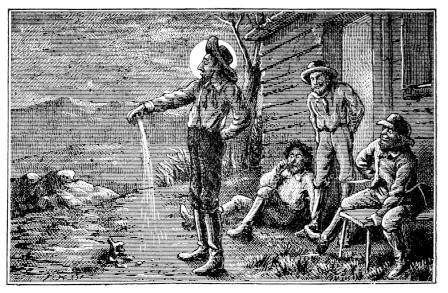
COMSTOCK DISCOVERING SILVER.
In the evening of the day on which the grand discovery was
51made by O’RileyO’Riley and McLaughlin, H. T. P. Comstock made his
appearance upon the scene.
“Old Pancake,” who was then looking after his Gold Hill mines,
which were beginning to yield largely, had strolled northward
up the mountain, toward evening, in search of a mustang pony
that he had out prospecting for a living among the hills. He
had found his pony, had mounted him, and with his long legs
dragging the tops of the sage-brush, came riding up just as the
lucky miners were making the last clean-up of their rockers for
the day.
Comstock, who had a keen eye for all that was going on in the
way of mining in any place he might visit, saw at a glance the
unusual quantity of gold that was in sight.
When the gold caught his eye, he was off the back of his pony
in an instant. He was soon down in the thick of it all—“hefting”
and running his fingers through the gold, and picking
into and probing the mass of strange-looking “stuff” exposed.
Conceiving at once that a wonderful discovery of some kind
had been made, Old Pancake straightened himself up, as he
arose from a critical examination of the black mass in the cut,
wherein he had observed the glittering spangles of gold, and
coolly proceeded to inform the astonished miners that they were
working on ground that belonged to him.
He asserted that he had some time before taken up 160 acres
of land at this point, for a ranche; also, that he owned the water
they were using in mining, it being from the Caldwell spring, in
what was afterwards known as Spanish Ravine.
Suspecting that they were working in a decomposed quartz
vein, McLaughlin and O’Riley had written out and posted up
a notice, calling for a claim of 300 feet for each and a third claim
for the discovery; which extra claim they were entitled to under
the mining laws.
Having soon ascertained all this from the men before him,
Comstock would have “none of it.” He boisterously declared
that they should not work there at all, unless they would agree
to locate himself and his friend Manny (Emmanuel) Penrod in
the claim. In case he and Penrod were given an interest, there
should be no further trouble about the ground.
After consulting together, the discoverers concluded that,
52rather than have a great row about the matter, they would put
the names of Comstock and Penrod in their notice of location.
This being arranged to his satisfaction, Comstock next demanded
that 100 feet of ground on the lead should be segregated
and given to Penrod and himself for the right to the water they
were using—he stoutly asserting that he not only owned the
land, but also the water, and, as they had recognized his right
to the land, they could not consistently ignore his claim to the
water flowing upon it. In short, he talked so loudly and so
much about his water-right that he at last got the 100 feet,
segregated, as he demanded. This 100 feet afterwards became
the Spanish or Mexican mine, and yielded millions of dollars.
Comstock would probably not so easily have obtained what
he demanded, had the men who made the discovery been fully
aware of its great value. They, however, did not know that the
“blue stuff” (sulphuret of silver), which they had dug into, was
of any value, and even the gold itself seemed altogether too
plentiful as well as a good deal “off color.”
Comstock had probably at some time posted up a notice
claiming 160 acres of land, somewhere in that neighborhood,
as a ranche, but if he did so he never had his notice recorded.
Men in those days, while roving about the country, very
frequently wrote out and stuck up notices claiming land,
springs, the water of streams, quartz veins, gravel deposits,
or anything else that they might for the moment think valuable,
but unless such claims were properly recorded and
worked they could not be held, as all miners and others well
knew—a mere notice expiring at the end of ten days, when
the property might be taken up, recorded and held by the
first man that came along. Comstock had some show of
right to the water and to the placer-mines along the upper
part of Six-mile Cañon, as the year before, he, Old Virginia
and Penrod, had bought of old Joe Caldwell a set of sluice-boxes
and the water of a spring. However, the possession of
a set of sluices on the cañon and a right to use water from a
certain spring in the neighborhood, by no means gave Comstock
or his friends the right to lay claim to a vein of quartz
found in a hill somewhere in their section of the country.
John Bishop, who bought Old Virginia’s interest in the
53sluices, gravel-diggings and water, got no share of the quartz
vein discovered by Pete O’Riley and Pat McLaughlin, though
he managed to get in on the lead, locating the mine known as
the Central No. 1; now a part of the California, one of the
bonanza mines with millions of ore in sight.
Bishop put up the first arastra ever built on the lead, starting
it up two or three days before that of the Ophir folks
began running. He sold his interest in the Central No 1.No 1.
for $4,000 and shortly afterwards the purchasers sold the
same ground for $1,800 per foot—now (as incorporated in the
California mine) the ground is selling at over $50,000 per
foot, and John Bishop still works, as a miner, at Gold Hill.
After Comstock had managed to become largely interested
in the new discovery, and after the gold taken out by O’Riley
and McLaughlin had been carried down to Gold Hill and
exhibited and examined, there was at once a great local
excitement in regard to the new diggings, and all were
anxious to get an interest in the claim, or on the lead as near
to the original discovery as possible.
Those who were finally recorded in the Ophir notice as
original locators were the following persons: Peter O’Riley,
Patrick McLaughlin, H. T. P. Comstock, E. Penrod, and
J. A. (“Kentuck”) Osborne. The men named had one-sixth
each of 1,400 feet of ground on the lead and, in addition,
Comstock and Penrod had 100 feet segregated to them, making
1,500 feet taken up by the party.
The 100 feet of Comstock and Penrod, though in the midst
of the 1,400 feet of ground, was not reckoned as a part of the
Ophir claim and was soon sold and worked as a separate
mine, under the name of the Mexican or Spanish mine.
The Ophir claim was the first that was located, as a quartz
claim, at any point on the Comstock lode, though as early as
February 22nd., 1858, Old Virginia made a location on a
large vein lying to the westward of the Comstock. This
vein is known as the Virginia lead or Virginia croppings.
It has never yielded much ore, but contains vast quantities of
base metal of various kinds.
At one time it was thought by some that this would prove
to be the main or “mother” lead of the range, as at the
54surface, and for a considerable distance below the surface, the
Comstock vein dipped west toward it. Parties bought Old
Virginia’s claim, and began suit against the Ophir Company,
asserting that the lead on which they were at work was the
same as that located, in 1858, by Old Virginia. It was a
sort of speculation on the part of those who brought the suit,
and it is understood that they succeeded in obtaining $60,000
from the Ophir Company.
At the beginning of this suit it was necessary, if possible,
to produce the original notice placed upon the croppings of
the lead by Old Virginia, but the parties to whom he had
sold his claim could never get him sufficiently sobered up to
show where it could be found. Growing desperate, they at
length seized the old fellow one evening, and thrusting him
into the mouth of a big tunnel, closed and locked upon him a
heavy iron gate. The next morning when they went to the
tunnel they found Old Virginia sober, but very savage.
He would say nor do nothing until they had taken him
down town and given him half a tumbler of whisky. This
swallowed, he was ready for business. He marched directly
up the side of the mountain, and going straight to a large
tower of croppings, drew out a small block of rock, and lo!
behind it was seen snugly stowed the much-desired notice.
It was probably on account of his having made this location
that Old Virginia was given the credit of having been the
discoverer of the Comstock lode, his interest in which he was
said to have sold for an old horse, a pair of blankets, and a
bottle of whisky. He sold a third interest in the sluices,
water, and diggings in the cañon to John Bishop, for $25.
James Hart, who had an interest in the sluices, and diggings
in the cañon, sold his right to be “considered in” on the big
discovery to J. D. Winters, of Washoe Valley, for a horse and
$20 in coin. In this way Winters got into the Ophir as one of
the locators, and from this came the “old horse” story that has
always been saddled upon Old Virginia—to fix it still more
firmly upon the old fellow, the bottle of whiskey was added.
CHAPTER VI. THE DISCOVERY OF SILVER.
55
Once Comstock got into the Ophir claim he elected himself
superintendent and was the man who did all of the
heavy talking. He made himself so conspicuous on every
occasion that he soon came to be considered not only the discoverer
but almost the father of the lode. As it was all
Comstock for a considerable distance round the Ophir mine,
people began to speak of the vein as Comstock’s mine, Comstock’s
lode, and the lead throughout its length and breadth came to be
known as the Comstock lode, a name which it bears to this day;
while the names of O’Riley and McLaughlin, the real discoverers,
are seldom heard, even in the city that stands on the spot
where they first opened to the light of the sun the glittering
treasures of the vein.
Even after the Ophir claim had been duly recorded and its
owners had gone regularly to work upon it, they had no idea that
the ore contained anything of value except the gold that was found
in it.
For some weeks they dug down the rich decomposed silver
ore, washed the gold out of it, and let it go as waste—throwing it
anywhere to get it out of the way of the rockers. They not only
did not try to save it, but they constantly and conscientiously
cursed it.
Being very heavy, it settled to the bottom of their rockers,
covered up the quicksilver they contained, and prevented the
thorough amalgamation of the gold. The miners all thought
well of the diggings, but for this stuff. It was the great drawback.
In mining on Gold Cañon, they had been bothered with
a superabundance of black sand and heavy pebbles of iron ore,
but this new, bluish sand was a thing which they had never before
encountered anywhere in the country.
56Notwithstanding their trouble with the sulphuret of silver,
they were taking out gold at the rate of a thousand dollars or
more per day; their dust selling at about $11 per ounce. In
some spots they obtained from $50 to $150 in a single pan of dirt.
About this time some ladies from Genoa visited the mine,
attracted by the reports which had reached their town of its
great richness. Comstock was delighted, showed them everything
and very gallantly offered each lady a pan of dirt, a piece
of politeness customary in California in the early days when
ladies visited a mine. “Old Pancake” was anxious that each
of the ladies should get something worth carrying home, therefore
by means of sly nods and winks gave one of the workmen
to understand that he was to fill the pans from the richest spot.
One of the ladies was young and very pretty. Although the
other ladies had each obtained from $150 to $200 in her pan,
Comstock was determined that something still handsomer should
be done for this one. Therefore, when her pan of dirt was being
handed up out of the cut (i. e. the open drift run into the lead), he
stepped forward to receive it, and as he did so, slyly slipped into
it a large handful of gold which he had taken out of his private
purse. The result was a pan that went over $300, and “Old
Pancake”Pancake” was happy all the rest of the day.
Although Comstock had a passion for possessing rich mines,
and appeared to have a great greediness for gold, yet no sooner
was it in his possessionpossession than he was ready to give it to the first
man, woman, or child that asked for it, or to recklessly squander
it in all directions. Anything that he saw and took a fancy to
he bought, no matter what the price might be, so long as he had
the money. The article to which he had taken a momentary
fancy, once purchased, he presented it to the first person that appeared
to admire it, whether that person was white, red, or black.
As work progressed, and the opening made in the hillside
penetrated further into the lead, the silver sulphuret, which had
at first been found in a decomposed condition, began to grow
more firm. In order to work it in the rockers it was necessary
to pulverise much of it by beating it with the poll of a pick or
sledge-hammer. Even then there were many lumps which it
was necessary to pound in a mortar, and soon much of the ore
began to assume the form of a tolerably firm rock, when it
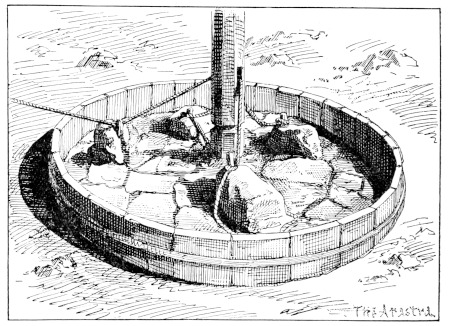
59became necessary to work it in arastras—an old Mexican contrivance
for grinding up gold and silver-bearing quartz.
AN ARASTRA.
NAMING VIRGINIA CITY.
As soon as the grand strike had been made at the Ophir mine
by O’Riley and McLaughlin, there was a great rush to that
neighborhood; not only of miners from Johntown, Gold Hill,
and Dayton (then known as Chinatown), but also from the agricultural
sections of the country—from Washoe Valley, Tracker
Meadow and from Carson and Eagle Valleys.
Claims were taken up and staked off for a great distance north
and south of the Ophir mine in the direction the lead was shown
to run by the huge croppings of quartz that came to the surface,
and towered far above the surface, in various places.
It was not long before other companies had found pay, and
soon there was in the place quite a lively little camp, the miners
living in brush shanties, houses made of canvas, or camping in
the open air in the sage-brush flats.
At this time the camp was spoken of, in documents placed
upon the records, as “Pleasant Hill” and as “Mount Pleasant
Point;” in August, 1859, it was designated as “Ophir” and
“the settlement known as Ophir,” and in September, as “Ophir
Diggings.” In October the place is first mentioned as “Virginia
Town,” but a month later it was proposed to “change the name
of the place from Virginia Town to Wun-u-muc-a, in honor of
the chief of the Py-utes.” Old Winnemucca, chief of all the Piutes
was not so honored, and in November, 1859, the town was
first called Virginia City, a name it has ever since retained.
Comstock says the way the place came to take the name of
Virginia City was this:
“‘Old Virginia‘ was out one night with a lot of the “boys”
on a drunk, when he fell down and broke his whisky bottle.
On rising he said—‘I baptize this ground Virginia.’Virginia.’”
For a time the old settlers had the new diggings all to themselves
and were hard at work with their rockers, saving only the
gold and paying no further attention to the silver than to curse
it for interfering with their operations; but in a few weeks after
the discovery had been made, there was suddenly stirred up in
California a whirlwind of excitement that swept over the Sierras,
and not only overwhelmed these first miners on the Comstock,
but swept them almost out of sight.
60About the 1st of July, 1859, Augustus Harrison, a ranchman
living on the TruckeeTruckee Meadows, visited the new diggings about
which so much was then said in the several settlements. He
took a piece of the ore and going to California shortly afterwards
carried it to Grass Valley, Nevada county. He gave the specimen,
as a curiosity, to Judge James Walsh, a resident of Grass
Valley, who took it to the office of Melville Atwood, an assayer
in the town. The ore was assayed and yielded at the rate of
several thousand dollars per ton, in gold and silver.
All were astonished and not a little excited when it was ascertained
that the black-looking rock which the miners over in
Washoe—as the region about the Comstock lode was called—considered
worthless, and were throwing away, was almost a
solid mass of silver. The excitement by no means abated when
they were informed by Mr. Harrison that there were tons and
tons of the same stuff in sight in the opening that the Ophir
Company had already made in the lead. It was agreed among
the few who knew the result of the assay, that the matter should,
for the time being, be kept a profound secret; meantime they
would arrange to cross the Sierras and secure as much ground
as possible on the line of the newly-discovered silver lode.
But each man had intimate friends in whom he had the utmost
confidence in every respect, and these bosom friends soon knew
that a silver-mine of wonderful richness had been discovered
over in the Washoe country. These again had their friends,
and, although the result of the assay made by Mr. Atwood was
not ascertained until late at night, by 9 o’clock the next morning
half the town of Grass Valley knew the wonderful news.
Judge Walsh and Joe Woodworth packed a mule with provisions,
and mounting horses, were off for the eastern slope of the
Sierras at a very early hour in the morning. This was soon
known, and the news of the discovery and their departure ran
like wildfire through Nevada county. In a few days hundreds
of miners had left their diggings in California and were flocking
over the mountains on horseback, on foot, with teams, and in any
way that offered. Many men packed donkeys with tools and
provisions, and, going on foot themselves, trudged over the
Sierras at the best speed they were able to make.
CHAPTER VII. REMINISCENCES OF EARLY MINING DAYS.
61
When news began to be received in various parts of California
from the first parties of these adventurers, upon
their arrival in Washoe, their reports were confirmatory
of all that had before been said and imagined of the new mines,
and an almost unparalled excitement followed. Miners, business
men, and capitalists flocked to the wonderful land of silver that
had been found in the wilderness of Washoe, beyond the snowy
peaks of the Sierras.
The few hardy first prospectors soon counted their neighbors
by thousands, and found eager and excited newcomers jostling
them on every hand, planting stakes under their very noses
and running lines round or through their brush-shanties, as
regardless of their presence as though they were Piutes. The
handful of old settlers found themselves strangers, almost in a
single day, in their own land and their own dwellings.
There were numerous sales of mining claims almost daily,
at what then was thought high prices, and the hundreds who
were unprovided with money with which to purchase mining
ground swarmed the hills in search of ledges that were still
undiscovered and unclaimed. The whole country was supposed
to be full of silver lodes as rich as the Comstock, and
the man who was so fortunate as to find a large unoccupied
vein, containing rock of a color similar to that of the Ophir,
considered his fortune made.
The Mining Recorder of the district now drove a thriving
trade; he could hardly record the locations of mining claims
as fast as they were made.
Some of these notices were literary curiosities, particularly
those to be found in the old Gold Hill book of records.
62V. A. Houseworth, the “village blacksmith,” was the first
Recorder at Gold Hill, and the book of records was kept at a
saloon, where it lay upon a shelf behind the bar.
The “boys” were in the habit of taking it from behind the
bar whenever they desired to consult it, and if they thought a
location made by them was not advantageously bounded they
altered the course of their lines and fixed the whole thing up
in good shape, in accordance with the latest developments.
When the book was not wanted for this use, those lounging
about the saloon were in the habit of snatching it up and
“batting” each other over the head with it.
The old book is now in the office of the County Recorder,
at Virginia City, and is beginning to be regarded as quite as
curiosity. It shows altered dates, places where leaves have
been torn out, and much other rough usage.
The majority of the notices of location recorded by the
early miners are very vague. The first notice recorded in the
book is one of the location of a spring of water by Peter
O’Riley and Patrick McLaughlin. It reads:
“We the undersigned claim this spring and stream, for mining purposes.”
Nothing is said about where the spring is located. For
aught the person reading the record can discover, it may be
in California or Oregon.
In the book are scores of locations made and recorded in
the same loose manner. Many of the recorded notices read:
“We the undersigned claim 2,000 feet on this quartz lead, ledge, lode, or
vein, beginning at this stake and running north.”
Not a word is said about where the stake is to be found.
No wonder that the lawyers drove a thriving trade in the
early days of Washoe!
During the progress of a mining suit in the early days the
lawyers quarrelled for nearly two days about a certain stump
from which one of the parties to the suit desired to begin the
measurement of their claim. They produced witnesses who
said they could identify the stump, and the next morning the
court adjourned, and jury and all concerned went out to take
a look at the landmark in question. No stump could be
found. The parties of the opposite side had dug it up the
night before and packed it away. Not even the spot where it
63was supposed to have stood could be found, so completely
had the ground been levelled in all directions.
I give the following verbatim copy of the original location-notice
of the Yellow-Jacket mine—a mine that has yielded
many millions of dollars—as it stands on the old Gold Hill
records:
NOTICE.
That we the undersign claim Twelve hundred (1200) feet of this Quartz
Vain of ofof of its depths & Spurs commencing at Houseworth claim
& running north including twenty-five feet of surface on each Side of the
Vain. This Vain is known as the Yellow Jacket Vain. Taken up on May
1st. 1859—recorded June 27th, ’59.
H. B. Camp.
John Bishop.
J. F. Rogers.
The claim was called the Yellow Jacket because of the fact
of the locators finding a nest of yellow-jackets in the surface
rock while they were digging about for the purpose of prospecting
the vein. Future developments proved this claim to
be on the Comstock lode.
What the locators meant by “depths,” in their notice, was
dips—no matter in what direction the “vain” might dip, they
desired to put on record their right to follow it.
Many notices read—“This vein with all of its dips, spurs,
angles, and variations.” The word ‘variations’ was presumed to
capture everything in the vicinity.
A practice prevailed among the early miners of locating
quartz ledges as “twins.” This was when they found two
parallel veins so near together that they feared, in case of
their locating but one, that parties would take up the other
and give them trouble in some way. None of the twins ever
became famous.
The owners of the Ophir, and some of the adjoining claims
on the Comstock lead, continued to use rockers and arastras
for some time after it was ascertained that what was at
first supposed to be worthless, was silver ore of the richest
description, but they no longer threw the “blue stuff”
away. It was all saved and sacked up for shipment to San
Francisco, thence to England for reduction. Many arastras
were running, and the camp soon presented quite a bustling
appearance. The first house erected in Virginia City, was built
64by Lyman Jones, who is still a resident of Nevada. It was
a canvas structure, 18 × 40 feet in size, and stood near the
present corner of B Street and Sutton Avenue, at no great
distance from the Ophir Mine.
It was kept as a boarding-house and saloon. Mr. Jones
opened his house with two barrels of “straight” whisky, but
being of an accommodating disposition and wishing to suit all
tastes, he dignified the contents of one of these barrels with the
name of brandy. As alcohol was the foundation of nearly all
the liquors seen in the country at that time, it made little
difference by what name they were announced to the consumer,
Mr. Jones had an old sluice-box for a bar, and the bar fixtures
were by no means numerous or costly.
At this time the Ophir Company were in the habit of bringing
their gold-dust to Mr. Jones’s house, and leaving it for safe-keeping,
and frequently he had in his place as high as twenty and
thirty thousand dollars.
As the walls of his “hotel” were constructed of nothing more
substantial than a single thickness of cotton cloth, safer places
might have been conceived of, in which to deposit such an
amount of gold. At length, when the grand rush from California
came, and adventurers of all kinds swarmed along the lode,
Mr. Jones refused to any longer act in the capacity of banker
to the Ophir folks, as he did not care to run the risk of having
his throat cut for gold not his own,—in fact did not want his
throat cut at all.
At first it was almost impossible to procure lumber of any
kind for building purposes, and the houses erected were principally
of canvas; though a few rough stone-houses were
soon built and the miners constructed cabins of the rough rocks
lying about on the sides of the hills. Many dug holes a few
feet square in the sides of steep banks, and covering these with
a roof of sage-bush and dirt announced themselves “at home”
to their friends.
As winter came on, not a few who had been living in tents or
the open air, betook themselves for shelter to the tunnels they
had begun to run into the hills; widening out a place at some
distance back from the mouth for bedroom and parlor.
Some of those who thus made habitations of tunnels did their
65cooking in the open air, under a brush-shed placed in front;
others, displaying more industry and ingenuity, made a kitchen
some distance back in their underground quarters, working a
hole up to the surface of the earth, through which the smoke of
their fire found egress, presenting the curious appearance of a
small semi-active volcano, when seen at a distance by one who
knew nothing of the subterranean lodging-house whence the
smoke proceeded.
A Scotchman tunnelled into a hill of dry and soft rock near
Silver City and excavated a habitation in which he dwelt for
years, and in which he finally died. He worked out several
chambers of considerable size in the rock, one of which was his
library and contained three or four hundred volumes of books,
principally of a religious character.
His place was on a secluded ravine, a mile from the town,
and he led the life of a hermit; indeed, his home not a little
resembled the rock-dwelling of Robinson Crusoe. He had
been educated for the ministry in his youth, and now in his old
age, became again a student and gave nearly his whole time to
pious meditations. During pleasant weather, in summer, the
ladies of Silver City frequently visited the recluse on the Sabbath,
when, sitting on a bench at the mouth of his subterranean
habitation, he would talk beautiful sermons to them.
In 1859, when the discovery of silver was made, the only
wagon-road in all the country was the old Emigrant Road;
coming in across the Plains, passing through Carson Valley and
thence ascending and crossing the Sierra Nevada Mountains
to California, by the way of Placerville.
Virginia City being situated on a sort of sloping plateau,
on the eastern face of Mount Davidson, at the height of over
6000 feet above the level of the sea, was a place difficult of
access. Wagons could be used in the surrounding valleys,
but Virginia City could receive no freight except such as
could be carried up the mountain on the backs of pack-mules.
Soon after the discovery of silver, however, companies located
routes for wagon-roads to the place, and began the difficult
work of building them, blasting out passage-ways in many
places through solid rock along the sides of cañons shut in by
almost perpendicular walls. Men swarmed on these roads
66during their construction, the explosion of heavy blasts was
almost constant along the cañons, and it was not many
months before they were completed, when lumber, timber,
and many other much-needed articles, that could not be
packed on the backs of mules, poured into Virginia City
whose streets were soon crowded with huge “prairie schooners”—as
the great mountain wagons are called—drawn by
long lines of mules or horses, all musical with bells.
The completion of a practicable wagon-road to Virginia
City was at that time considered a great achievement, but
now locomotives rush and shriek round the mountain steeps
up which the patient mules tugged and groaned in former
days.
While the wagon-roads were being built, the miners were
not idle. Supplies for their use could readily be packed up
the mountain, and the rich silver ore, securely sewed up in
canvas bags, made convenient return loads for the trains of
pack-mules. In a month or two the several companies working
on the Comstock discontinued the use of rockers and
arastras. The richest of their ore was sacked up and sold for
shipment to Europe, and that of a lower grade was piled up
in dumps and ore-bins to be worked in mills in the country
at some future day.
THE EUREKA MILL—CARSON RIVER.
The following extract from the Territorial Enterprise, then
published as a weekly newspaper at Genoa (it is now published
as a daily and weekly at Virginia City, and is the
leading paper of the city and state), will give some idea
of what was being done three months after the discovery.
The item was published on Saturday, October 1, under the
title of “The Mines:”
“The mines at Virginia Town and Gold Hill are exceeding the most sanguine
expectations of their owners. At Virginia Town, particularly, the
claims on the main leads promise to excel in richness the far-famed Allison
lead in California in its palmiest days.
“Claims are changing hands at almost fabulous prices. No fictitious sales
either, but bona-fide business operation. The main lead, on which is the
celebrated Comstock and other claims, appears to be composed of ores producing
both silver and gold, and the more it is prospected the richer it is
proving.
“Donald Davidson & Co., of San Francisco, have purchased 200 tons of the
rock, containing gold and silver in conjunction, at $2,000 per ton, and are
69shipping it to England by way of San Francisco, for assay. (Smelting is
meant). Other parties are investing heavily. All that are now interested
are but making preliminary arrangements for next spring, when we may
expect to find an amount of either dust or ore sent from that section that
will astonish some of the now incredulous ones in California.California.”
They were not only selling and shipping large quantities
of ore at this time, but were also beginning to work ores in
mills and water-power arastras on the Carson River, near
Dayton. In October, 1859, Logan & Holmes had a four-stamp
mill in operation (by horse-power) at Dayton, which
crushed four tons of ore per day, and Messrs. Hastings &
Woodworth had two water-power arastras running, which
reduced three tons each per day. The ore being worked by
these mills was from Gold Hill, where the ore of the vein as
yet contained only gold, they not yet having penetrated to a
sufficient depth to reach the silver.
CHAPTER VIII. THE FATE OF THE DISCOVERERS.
70
Although occupying the western portion of Utah
Territory, the laws under which the people of the
Comstock range were at this time living were of their
own making. At a meeting held by the miners of Gold Hill,
June 11, 1859, the following preamble and “rules and regulations”
were unanimously adopted:
At the present day all manner of gambling games are
allowed by the State laws and are licensed by the towns and
cities. In the original document, preserved in the old Gold
Hill book of records, there are given several additional sections,
but as they relate to matters not of interest to the
general reader I have omitted them. One of these provides
that “No Chinaman shall hold a claim in this district.”
Whereas, The isolated position we occupy far from all legal tribunals, and
cut off from those fountains of justice which every American citizen should
enjoy—renders it necessary that we organize in body politic for our mutual
protection against the lawless and for meting out justice between man and
man, therefore we, citizens of Gold Hill, do hereby agree to adopt the following
rules and laws for our government—
Rules and Regulations.
Sec. 1. Any person who shall wilfully and with malice aforethought take
the life of any person, shall, upon being duly convicted thereof, suffer the
penalty of death by hanging.
Sec. 2. Any person who shall wilfully wound another, shall upon conviction
thereof, suffer such penalty as the jury may determine.
Sec. 3. Any person found guilty of robbery or theft, shall, upon conviction,
be punished with stripes or banishment, as the jury may determine.
Sec. 4. Any person found guilty of assault and battery, or exhibiting
deadly weapons, shall, upon conviction, be fined or banished, as the jury may
determine.
71Sec. 5. No banking games, under any consideration, shall be allowed in
this district, under the penalty of final banishment from the district.
At the present day all manner of gambling games are allowed
by the State laws and are licensed by the towns and cities. In
the original documents, preserved in the old Gold Hill book of
records, there are given several additional sections, but as they
relate to matters not of general interest to the reader I have
omitted them. One of these provides that “No Chinaman shall
hold a claim in this district.”
As may be seen, the laws of the first settlers were few and to the
point; they were for use, not for ornament or the puzzling of the
common understanding.understanding. In each settlement were in force some
such “rules and regulations” as these. The man who broke
one of the “rules” was sure to suffer a strict enforcement of the
“regulations.”
In August, 1859, two thieves who gave the names of George
Ruspas and David Reise, stole a yoke of cattle at Chinatown
(now Dayton), and driving them to Washoe Valley, offered them
for sale at a price so low that they were at once suspected of
having stolen the animals. They were arrested, and it having
been proved that the cattle had been stolen from the ranche of
a Mr. Campbell, near Dayton, the sentence of the jury was that
they have their left ears cut off, and that they be banished the
country.
The trial was held under a big pine-tree, near the western
shore of Washoe Lake, at the base of the Sierra Nevada Mountains.
Jim Sturtevant, an old resident of Washoe Valley, was
appointed executioner. He drew out a big knife, ran his thumb
along the blade, and not finding its edge just to his mind, gave
it a few rakes across a rock. He then walked up to Reise and
taking a firm hold on the upper part of the organ designated
by the jury, shaved it off, close up, at a single slash.
As he approached Ruspas, the face of that gentleman was
observed to wear a cunning smile. He seemed very much
amused about something. The executioner, however, meant
business, and tossing Reise’s ear over to the jury, who sat at the
root of the pine, he went after that of Ruspas, whose eyes were
following every motion made and whose face wore the expression
of that of a man about to say or do a good thing.
72Sturtevant pulled aside the fellow’s hair, which he wore hanging
down about his shoulders, and lo! there was no left ear, it
having been parted with on some previous and similar occasion.
Here was a fix for the executioner! His instructions were to
cut off the fellow’s left ear, but there was no left ear on which to
operate.
The prisoner now looked him in the face and laughed aloud.
The joke was so good that he could no longer restrainrestrain himself.
Sturtevant appealed to the jury for instructions. The jury
were enjoying the scene not a little, and being, in a good humor,
said that they would reconsider their sentence; that rather than
anyone should be disappointed the executioner might take off
the prisoner’s right ear, if he had one.
The smile faded out of the countenance of Ruspas as he felt
Sturtevant’s fingers securing a firm hold on the top of his right
ear. An instant after, Sturtevant gave a vigorous slash, and then
tossed Ruspas’ earRuspas’ ear over to the jury, saying as he did so, that they
now had a pair of ears that were “rights and lefts” and therefore
properly mated.
This little ceremony over, the pair of thieves were directed to
take the road leading over the Sierras to the beautiful “Golden
State.” They went, not as Adam and Eve left paradise, “dropping
some natural tears,” but as a pair of twin lambs are seen to
depart when in the spring-time the farmer has whacked off their
too luxuriant tails—went dropping blood.
There have been numerous stories told in regard to the amount
of money received by Comstock for his interest in the Ophir
mine and other mining property on the Comstock lode at Virginia
City, some of which are far from the truth. The sale
made by Comstock to Judge Walsh is recorded in the books of
Virginia mining district and is dated at the “mining village
or settlement known as Ophir,” August 12, 1859. I make the
following extract in regard to the amount to be paid—and what
was eventually paid:
“For and in consideration of $10 to me in hand paid, and for the further
consideration of ten thousand nine hundred and ninety dollars to be paid by
James Walsh, according to the provisions and terms of an obligation executed
by him to me this day,day, I have bargained and sold,” etc.
The description of the property sold is as follows:
“One undivided one-sixth part of 1400 feet, said 1400 feet being now
73worked by myself, Penrod, Osborne, McLaughlin, Riley, and other owners, and
known as Comstock & Co.’s claims, and owned jointly by myself, James Cary
and others our associates; also, one undivided half of 200 feet of mining ground
being worked by the California Company at the present time under an agreement
made with me; also, all my right,right, title, and interest in and to certain
mining claims at Six-mile Cañon diggings, being the claims known as the
Caldwell claims; also, one-half the water-right known as the Caldwell Springs,
situated on the hill above the said village of Ophir, and being the springs
supplying the workings on the first-mentioned 1,400 feet—the present owners
in said 1,400 feet being only entitled to the use of said water so long as they
continue to be owners; also my recorded title, to a ranche on which the
aforesaid village of Ophir is located, together with the springs on the lower
part of said ranche. Also, the surface-diggings on the first-mentioned 1,400
feet and one-sixth of all improvements, animals, arastras, and all other property
belonging to the company working the first-mentioned 1,400 feet.”
If Comstock had a ranche recorded which covered the site of
Virginia City, the page containing such record must have been
one in the old book of records of Gold Hill district. At first all
claims located in Virginia district were recorded at Gold Hill.
September 23, 1859, Pat McLaughlin, one of the discoverers of
the silver, sold his interest, one-sixth, in the Ophir mine for
$3,500. Peter O’Riley, the other original discoverer, held on
to his interest in the mine longer than any of the original locators,
and received for it about $40,000, with back dividends
amounting to four or five thousand dollars. Osborne received
$7,000 for his ground.
V. A. Houseworth, the recorder at Gold Hill, who had trade
for one-fourth of one-sixth interest in the mine, sold that interest
to Judge Walsh, in September, 1859, for $3,000. All of these men
supposed at the time that they were obtaining a big price for their
interests in the mine. They knew nothing about silver-mines
and feared that the deposit discovered might suddenly “peter”
out.
November 30, 1859, E. Penrod sold to Gabriel Maldarnardo,
a Mexican miner, his interest in the 100 feet of ground segregated
to himself and Comstock, at the time the Ophir mine was
located. The deed given on this occasion is quite a curiosity.curiosity.
It shows that the legal genius who drew it up was determined to
corral all that was in sight in the way of “tenements, hereditaments”
and “appurtenances.” It reads:
“For and in consideration of $3,000, to him in hand paid, this day, E.
74Penrod has remised, released, and quit-claimed, and by these presents do
remise, release and quitclaim unto said party of the second part and his
heirs and assigns forever, all his right, title, and interest in and to the undivided
one-half of one hundred feet of a certain Quartz Lead known as the
reserved claim of Comstock, Penrod, & Co., on the original location of the
said company at Virginia City, near the head of Six-mile Cañon, in Virginia
Mining District, said Territory of Utah, said claim known as the Spanish
claim, together with all and singular the tenements, hereditaments and appurtenances
thereunto belonging, or in anywise appertaining, and the reversion
and reversions, remainder and remainders, rents, dues, and profits thereof.
And, also, all the estate, right, title, interest, property, possession, claim, and
demand whatsoever, as well in law as in equity, of said party of the first part,
of, in, or to the above-described premises, and every part and parcel thereof,
with the appurtencesappurtences, to have and to hold, all and singular the above-mentioned
and described premises, together with the appurtenances, unto the said party
of the second part, to his heirs and assigns forever.”
This tremendous document held the property, and Maldarnardo
soon after coming into possession of it, erected two
small smelting-furnaces and began working the ore of the mine
after the Mexican fashion.
The furnaces would hold but about fifty pounds of ore each,
yet he managed to melt out a considerable amount of bullion—gold
and silver mingled. The bullion, as it came from the furnace,
was worth about $2.25 per ounce. The blast for the
furnace was furnished by means of a common blacksmith’s bellows.
It was a slow process, and was soon abandoned, though
quite a number of cakes of bullion of considerable value were
shipped to San Francisco during the time the furnaces were
in operation.
COMSTOCK’S AFFINITY.
RETURN OF COMSTOCK’S WIFE.
CHAPTER IX. COMSTOCK’S MATRIMONIAL VENTURE.
77
A short time before he sold his mining interests in Virginia
City, Comstock was smitten by the tender passion
and made a venture in the matrimonial time. It appears
that a Mormon from Salt Lake, a little sore-eyed fellow named
Carter, landed at the diggings one day with his wife and all
his worldly effects on board of a dilapidated wagon, drawn by
a pair of sorry nags.
The man said he desired to go to work, and if he could find
employment would take up his residence in the diggings.
Comstock looked upon the fair features of the wife, and his
susceptible heart was touched—his soul went out toward her as
she sat there in the end of the little canvas-covered wagon,
mournfully gazing out from the depths of her calico sun-bonnet.
Having charge of the Ophir mine, as superintendent, Comstock
hired the man and set him to work, being determined to keep the
woman in the camp.
The Mormon pair made their home in their wagon, and in
the course of a week or two it was observed that Comstock
spent most of his time in the neighborhood of the vehicle, was
all the time hanging about it. Finally he was one day seen
seated upon the wagon tongue, smiling upon all nature, with the
Mormon wife engaged in combing his hair. The next morning
both Comstock and the wife were missing. The hair-combing
had meant business—showed the sealing of a compact of some
kind. The pair had made a bee-line for Washoe Valley, where
a preacher acquaintance of Comstock’s—one of the old settlers
of the country—married them after the manner of the “Gentiles.”
78The next day Comstock and bride went to Carson City, and
while there receiving the congratulations of friends, the Mormon
husband suddenly appeared upon the scene.
There was for a time a considerable amount of blowing on
both sides, Comstock producing his certificate of marriage and
asserting that it was the right he stood upon. Finally, to settle
the difficulty, Comstock agreed to give the ex-husband a horse,
a revolver, and $60 in money for the woman, and so have no
more bother.
This was agreed to and Carter took the “consideration” and
started off. After he had gone a distance of two or three hundred
yards, Comstock shouted after him and told him to come back.
When he had returned, Comstock demanded of him a bill of
sale for his wife, saying that the right way to do business was
“up and up;” he wanted no “after-claps”—didn’t wish to be
obliged to pay for the woman a dozen times over.
Carter then made out and signed a regular bill of sale, which
Comstock put in his wallet and then waved the man away.
In a few days Comstock had business at San Francisco. He
left his bride at Carson City and started over the mountains.
When he had reached Sacramento, word was sent him that his
wife had run away with a seductive youth of the town, and that
the pair were on their way to California by the Placerville route.
Comstock was all activity as soon as this news reached him.
He engaged the services of half a dozen Washoe friends whom
he found at Sacramento, and all hands hastened to Placerville,
where they waited for the runaways, who were on foot, to come in.
In due season they arrived and were pounced upon. Comstock
and his wife had a long talk in private.
At length Comstock made his appearance and told his friends
that it was all right, there would be no more trouble, as his wife
was sorry for what she had done and would now live with him
right along and be a good wife to him. All congratulated “Old
Pancake” upon having brought his affairs to a conclusion so
satisfactory.satisfactory.
Wishing to bring forth his wife and have her tell his friends
how good she was going to be in the future, Comstock presently
went to the room in which he had left her. No wife was there!
While Comstock had been talking with his friends and receiving
79their congratulations, his wife had climbed out of a back window
and was off again with her young lover.
“To horse! to horse!” was then the cry, and soon Comstock’s
friends had mounted and were away. Not a moment was to be
lost if the fugitives were to be captured, and the pursuit began
at once. Comstock himself was not idle. He went forth into
the town and offered $100 reward for the capture and return of
the runaways.runaways. He also went to a livery-stable and hired all
the teams about the establishment, sending forth upon the search
all who could be induced to go.
Most of those who accepted teams went off pleasure-riding,
and would not have disturbed the runaways had they found
them. One man who went out on the search, however, was a
California miner who happened to be in Placerville “dead
broke.” He wanted the reward, and when he started out he
meant business.
The next day this man walked the runaways into Placerville
in front of his six-shooter. Comstock was delighted, and
at once paid the man the $100 reward. He then took his wife
away to a secure place in the upper story of a building, and
locked her up in a room in order to have another talk with her.
Meantime, his friends had charge of the young fellow who
was making a business of stealing Comstock’s wife. They
shut him up in a room at the hotel where they were stopping,
and placed a man over him as a guard, until they
could consult together in regard to what was to be his fate—at
least this was what the young fellow was given to understand.
Soon after dark the guard told the young man that it had
been decided to take him out and hang him. The guard pretended
to regret that they were going to be so rough with
the young fellow and finally told him that if he could manage
to escape it would be all right. “Now,” said he, “I am going
out to the bar to take a drink and if I find you here when I
come back it will be your own fault.”
The young fellow was not found nor was he ever seen in
the town again.
By practicing eternal vigilance, Comstock managed to keep
his wife that winter, but in the spring, when the snow had
80gone off and the little wild-flowers were beginning to peep
up about the rocks and round the roots of the tall pines, she
watched her chance and ran away with a long-legged miner
who, with his blankets on his back, came strolling that way.
Mrs. Comstock finally ceased to roam; she came to anchor
in a lager-beer cellar in Sacramento.
The fate of Carter, the Mormon who sold his wife to Comstock,
was tragic. After making the sale he mounted the
horse he had received in part payment for his spouse, and
crossing the Sierra Nevada Mountains by way of Hope Valley
and the Big Trees, went down into California. There he
fell in with an emigrant train and courted and married a
young girl, all within a week. The next spring he came to
Virginia City with his wife. He had lived there but a short
time before his wife learned of his having sold a recent wife
to Comstock, when she left Carter’s bed and board and sued
for and obtained a divorce. She then married a Mr. Winnie,
of Gold Hill.
At that time it was the fashion to take up mining ground
in the names of women. Carter had caused some claims to
be located in his wife’s name, and after she was divorced from
him and married to Winnie, kept running to see her about
these claims, wishing to get some share of them back. The
frequent visits of Carter were not relished by Winnie, and he
and Carter had several wars of words. At length, one day
when Carter came and was bothering Mrs. Winnie about
the mining ground, she went out and called in her husband,
who was at work near at hand. As Winnie entered the house
the battle was opened by Carter drawing his revolver and
shooting three fingers off Winnie’s left hand. Winnie then
turned loose with his six-shooter and killed Carter in his
tracks. Some time after this, in a similar argument Winnie
had a few fingers—less than half a dozen—shot off his right
hand.
Winnie afterwards went to Honey Lake Valley, where his
wife was thrown from a horse, dragged over the ground, and
killed.
After Comstock’s wife ran away with the strolling miner he
thought best to let her continue her travels unmolested. He
81opened a store at Carson City with the money received for his
mining interests in Virginia City and also had a branch-store
at Silver City, a town on Gold Cañon, about three miles
below Gold Hill, which was laid out in the summer of 1859.
He soon broke up in the mercantile line, losing everything.
He trusted everybody—all went to his stores and purchased
goods without money and without price, and at last his old
friends the Piute Indians came in and carried away the remnants.
Comstock made them all happy, male and female, by
passing out to them armfuls of red blankets and calico of
brilliant hues.
His stock in the Carson store was as good as was seen in
most trading establishments of the kind at that day, but his
Silver City branch never amounted to much, the stock consisting
principally, as the miners said, of blue cotton overalls,
pick-handles, rusty bacon, “nigger” shoes, and “dog-leg” tobacco.
After losing all of his property, Comstock left Nevada and
went to Idaho and Montana, through which countries he
wandered and prospected for some years, always hoping that
some day he should come upon a second Comstock lode. He
was always ready to join every expedition that was fitted out
to explore new regions, as the “big thing” seemed to him to
be ever just ahead.
In 1870 he joined the Big Horn expedition in Montana, and
this was his last undertaking. When near Bozeman City, on
September 27th, 1870, he committed suicide by shooting
himself in the head with his revolver. The Montana papers
said it was supposed that he committed the act while laboring
under temporary aberration of mind, and this was doubtless
the case, as his was by no means a sound or well-balanced
brain.
CHAPTER X. A LETTER FROM COMSTOCK.
82
The following letter from H. T. P. Comstock was originally
published in the St. Louis Republican, some years ago,
and gives a good idea of the man and his mental condition
during the latter years of his life. He was always very
eccentric, and even during the time he was in Washoe, in the
early days, was considered by many persons to be “a little
cracked” in the “upper story”—was a man flighty in his imaginings.
The first part of the letter, with the date, is lacking and
was no doubt left off as being merely introductory and unimportant,
by the papers which republished it after it reached the Pacific
Coast. The letter was written from Butte City, Montana.
Some of Comstock’s statements are correct, but the greater part
of what he says is a mere jumble and shows a wavering mind.
His letter begins:
“These men, there in Washoe, are interested in misrepresenting the facts
about the Comstock lode; they fear my claims to the water, the town site of
Virginia and other interests they have swindled me out of. It is just what
they are afraid of exactly; and that’s what everybody in Washoe is afraid of.
I shall yet have my say, I am writing a history of my life and all those
fellows had better stand from under. Now I want to tell the whole truth
about the Comstock lode: I’ll try to do it and I want you to publish it. If
you are gentlemen you will do it—it is nothing more than right. Here it is:
I, Henry Thomas Paige Comstock, first went to that country—the Washoe—from
Mexico, in 1853; roved all around California, and went back to Mexico
that year; went back then to Washoe, in the spring of 1854, and staid there.
My home was in Santa Fe, when in Mexico. I, old Joe Caldwell, Elmore &
Co., partners of mine for twelve years, were the first men who ever worked in
that section.
Worked there in 1855-56 on surface-diggings, prospecting all the while
for silver ore. The Grosch brothers worked at what is now known as Silver
83City. One of them, Hosea, stuck a pick in his foot and died in my cabin.
The other, Allen, died near Sugar-Loaf, California. This was three years
before the Comstock lode was discovered.
The first discovery of the Comstock lode was made in this way: In the
middle of January, 1859, I saw some queer-looking stuff in a gopher hole; I
ran my hand in and took out a handful of dirt and saw silver and gold in it.
At that time, big John Bishop and old Virginia were with me, when I found
it; they were sitting upon the side of the hill, Gold Hill, a couple of hundred
yards from me. I took up five claims. A couple of weeks from that time,
and where the Ophir is now located, I found the same prospects, and told the
boys at Gold Hill I was going to work as good a mine as the first discovery;
did not know at the time there was a lead of that description there.there. Riley
and McLaughlin were working for me at the time of the Ophir discovery.
I caved the cut in and went after my party to take up the lead and form my
company. Manny Penrod, Peter Riley, Patrick McLaughlin, ‘Kentuck,’ or
Osborne, and myself formed a company. With my party I opened the lead,
and called it Comstock lode; that is the way they came by their interests; I
gave it to them.
We started to rocking with my water; had only a small quantity to rock
with. We made from five to ten and twelve pounds a day, and the dust was
from $9 to $12 an ounce—went that at Brewster’s bank, Placerville, California,
where I did my business.
I continued owning the claim, locating 1,400 feet out for myself, for the use
of my water to the company. I also located the Savage claim; showed the
ground to old man Savage. I located the Gould & Curry—went into the
valley and got old Daddy Curry to come down, and put him in possession of it.
I also owned the Hale & Norcross, and kept Norcross for a year to work in
that ground. I also owned the principal part in Gold Hill and leased it out
to Walsh and Woodruff—leased to them 950 for 760—don’t now remember
which. Now I will tell you how I sold it; it has never been told as it ought
to be told throughout the United States for my benefit, and it shall be.
Sandy Bowers, I gave him his claim of 20 feet in Gold Hill. Bill Knight,
I gave him his claim; Joe Plato, I gave him his. Joe is dead now, and his
widow is awful rich.
I was working this claim, the Ophir, and taking out a good deal of ore; I
did not know what the ore was worth, being in the wilderness then, with no
road to get out or into from California. It was an awful wilderness! I took
several tons of the ore and transported it by ox-teams, to best advantage
through the mountains of California, and Judge Walsh was my agent and
helped me.
Now during this time I was taking out large gold and silver specimens, and
took one specimen, weighing 12 pounds, and boxed it up and ordered it sent
to Washington City. I instructed John Musser, a lawyer at Washoe, to send
it; I don’t know whether it ever reached there or not. I wanted Congress
to see it, and the President, for it was the first gold and silver ore mixed ever
found in the United States.
84I went on working, and Judge Walsh and Woodruff were there for two
months, trying every day to buy me out. My health being bad I sold the claim
to them on these terms: I was to get $10,000, and did get it at last; and
I was to receive one-eleventh of all that ever came out of the claim during my
natural life, and at my death was to will it to whoever I pleased; also, to receive
$100 per month.
That was the contract; and two men, Elder Bennett and Manny Penrod,
witnessed it; but my health was bad, and before I had the contract of sale
recorded, Woodruff and Walsh sold it out.out. Having taken no lien on the
property, I never got a dollar, from that day to this, except what was at first
received.
I am a regular born mountaineer, and did not know the intrigues of civilized
rascality.rascality. I am not ashamed to acknowledge that. Well, I had a store in
Carson City and was lying in the back room sick and helpless. I told Ed.
Belcher to take all my papers, and the contract between Judge Walsh and
Woodruff and myself, and put them under my pillow. I could speak, but
couldn’t help myself a bit. They all said I would die, and said: ‘Boys, let’s
pitch in and help ourselves!’ And they did pitch in; and I never saw the
papers afterwards. And the Gold Hill I leased to Walsh and Woodruff; and
then Frink and Kincaid got it, and I never got anything for it; and the 160
acres of ground on which Virginia City is built is my old recorded ranche.
I used to raise all my potatoes and vegetables on it, and had the Indians do
the work for me.
Virginia City was first called Silver City. I named it at the time I gave the
Ophir claim its name. Old Virginia and the other boys got on a drunk one
night there, and Old Virginia fell down and broke his bottle, and when he
got up he said he baptized that ground Virginia—hence Virginia City—and
that is the way it got its name. At that time there were a few tents, a few
little huts, and a grog-shop; that was all there was. I was camped under a
cedar-tree at that time—I and my party.
I am now living at Butte City, in Montana Territory. The quartz in Montana
is very rich quartz, and the Cable claim is next to the Comstock, but
gold in place of silver. There is a greater variety of minerals in Montana
than in any country I have ever explored. There are tin mines here. I
discovered them myself; and there are alabaster mines here.here. Silver, vastly
rich, and gold very rich. The Flint Creek mines—oh, God! how rich!
This is bound to be a rich country, but we are a long way from market and
have to go slow.
And the Butte mines, too, they are vastly rich, but very much mixed with
other metals—that is, a great many of them—and Highland has a good many
rich leads now open and opening.
H. T. P. COMSTOCK.
This is a country second to none on the globe, in point of mineral wealth
and in the precious metals. Now, you newspaper men have got me in your
papers, I want to say a word about myself. I am a man that has been
through the wars. I was in the Black Hawk war; was with Black Hawk
when he died. I was in the Mexican war, and all through in the patriot war
87in Canada; had three brothers in it—I was the youngest; they are all dead
now.
I am the son of old Noah Comstock, living in Cleveland, Ohio. He has
been largely engaged in the lumber and hotel business there. I have been
in the wilderness since a child; was bound to the American Fur Company;
my boss died and that’s the way I got with old Black Hawk. My first recollection
was packing traps; trapped all over Canada, Michigan, and Indiana;
but the Rocky Mountains have been my home; I have been a guide these
years and years. I was born in Canada, and am now near fifty years of age.
Henry T. P. Comstock.”
James Fennimore, better known as James Finney and
familiarly called “Old Virginia,” by all the old settlers of
Washoe, he being a native of the State of Virginia, came to
the mines on Gold Cañon, in 1851. He came from the Kern
River country, California, where he had a “difficulty” with a
man, and, believing he had killed him, took a little walk across
the Sierra Nevada Mountains, dropping the name of Fennimore
and calling himself James Finney.
Although fond of the bottle, Old Virginia was by no means
a loafer. He had his sprees, but these were generally followed
by seasons of great activity.
He was very fond of hunting, and when not engaged in
mining or prospecting he was ranging the mountains and
valleys in search of deer, antelope, and mountain sheep. He
was interested in nearly all the enterprises of the early Johntown
and Gold Hill mines but missed being in the Ophir at
the time of the discovery of silver, having sold his interest in
the Six-mile Cañon diggings the previous season.
He was killed in the town of Dayton, in July, 1861, by being
thrown from a “bucking” mustang that he was trying to
ride while a good deal under the influence of liquor. He
was pitched head first upon the ground, suffered a fracture of
the skull, and died in a few hours. At the time of his death
he was possessed of about $3,000 in coin and had been talking
of returning soon to his native State.
I one day met a Piute Indian in Virginia City who recollected
both Comstock and Old Virginia very well. Fifteen
or twenty stalwart Indians, who had been engaged at driving
wood and timber on the Carson River, had visited Virginia
for the purpose of expending their earnings in the purchase
88of blankets and other staples. Among the number was an
Indian who appeared to be forty-five or fifty years of age.
Something that he said about the changed appearance of the
place induced me to ask him how long he had known the
town.
“Well,” said he, speaking pretty fair English, “long time.
When me first come here, no house here; all sagebrush. Me
work here first time me come for Old Birginey (Old Virginia).
Yes; me work for Old Birginey down in Six-mile Cañyum.”
“At mining?” I asked.
“Yes; minin’. Me heap pull um rocker. Me that time
know Comstock—Ole Comstock. You Sabe him?”
“Yes;” said I, “have seen him. He is dead now. Got
broke, up in Montana; bad luck all the time; got crazy and
shot himself through the head with a pistol.”pistol.”
“Hum! Ole Comstock dead,” said the old warrior musingly,
“dead! Well, Ole Comstock owe me fifty-five dollar.
That money gone now. Well, same way Ole Birginey. He
owe me forty-five dollar when he die.”
“How did he die?” I asked.
“Well, you see he die down to Dayton long time ago. Ole
Birginey he all time drink too much whisky. One day he
bully drunk, he get on pony; pony he run, he buck one bully
buck and Ole Birginey go over pony head. One foot stay in
stirrup and pony drag ole man on ground and kill him. Me
help dig one grave, bury Ole Birginey, down Dayton, by
Carson River. Well, well,” said the old redskin, reflectively,
“hoss kill um Ole Birginey, Comstock he kill heself. Comstock
owe me fifty-five dollar; Ole Birginey owe me forty-five
dollar! Me think,” shaking his head, “maybe both time
too much whisky!” The sage old Piute was mistaken as
regarded Comstock; he was a man who drank but little.
CHAPTER XI. OLD VIRGINIA AND HIS STORIES.
89
Old Virginia used to tell of a terrible fight that took
place one evening in Gold Hill. The stakes, he said,
were two short bits (twenty cents). The fight lasted half
an hour and was most stubbornly contested on both sides. The
contest was, as he would here explain, between his appetite
and his “drinketite.” He held stakes, and for a good while
was unable to decide which had won. At last, however,
drinketite got his opponent down and kept him down so long
that he decided in his favor, and all three struck out for the
nearest saloon—appetite grumbling at him all the way about
his decision.
As has been already mentioned, Old Virginia was a great
hunter. When not engaged in mining or prospecting, he was
off in the hills with his gun; most generally alone wandering
and philosophizing through the wilderness as he viewed the
stupendous works of nature. He used to tell a story of a
feast he once had in the desert regions of the Humboldt,
which was quite amusing. It ran as follows:
OLD VIRGINIA’S FISHER STORY.
“In ’53, six or eight of us were out on a huntin’ trip and
camped on the Humboldt River, down to’ards the sink of the
same.
“We’d been havin’ miserable luck. Couldn’t strike any
game and had ’bout devoured what grub we’d carried out
with us when we left Johntown. This being the case, we
nat’rally had to keep stirrin’ about to try to skeer up somethin’
that would do to eat. So, one afternoon, when the pot
was ’bout empty, all hands struck out to try for something in
the way of game; some goin’ one way and some another.
90“Old Captain Crooks and one or two more, went off down
the river, while the rest of our fellers struck back from the
stream and kind o’ promiscuously diversified themselves out
across the sand-hills and sage-brush flats in search of sage-hen
and rabbits; you see we couldn’t expect to find big game in
that section—deer, and antelope, and them sort of fellers.
“I finally went off up the river alone. I jogged along up
the stream, ’bout half a mile, and then laid down in a big
bunch of weedy-lookin’ bushes. As I was reposin’ thar in the
silence, gazin’ up at the deep blue sky, I fell to ruminatin’ on
the unsartainty of all things here below—on what is above,
and why we are here.
“I had jist arrived at the conclusion that man can no more
help bein’ born than a blade of grass can stay in the ground
when spring comes; and, as the blade of grass can’t help
fadin’ and dyin’ when winter comes on, so man goes out of
the world with about as little say in the matter as when he
comes into it.
“All of this I was a-thinkin’ about as I lay thar lookin’ upup
at the sky, half-way noticin’ a solitary raven as was a sailin
about high above. I’d fixed it up that thar was a great head
mind up in them blue heavens somewhar, as was a-seein’ to
all matters for me and the grass, and that things was liable to
work jist about as that mind willed, whether me and the grass
made a fuss about it or not, when all at once I heerd a small
racket, near me in some dry grass.
“Erectin’ myself cautiously, and peepin’ over the top of my
clump of bushes, I seed a all-fired big skunk, rootin’ under
the dry, matted grass near the brink of the river. He war
lookin’ after mice, worms, bugs, grass-nuts, and sich like
provender.
“I brought my gun to my shoulder and knocked the unsuspectin’
critter over so dead that he never kicked. He was jist
as good game as I wanted—I wouldn’t have traded him for
any number of blue-meated rabbits.
“Bein’ shot in jist the right spot, thar wasn’t a particle of
smell about him. You see I’d knocked over many sich fellers
back in Ole Virginney and knowed percisely whar to hold on
him to do the work. Many’s the fine fat one I’d cooked and
devoured! But it’s not every place whar they’ll eat skunk—it’s
a thing that runs in streaks and through sartain settlements,
as you may say.
“This was a prime feller! I think I never, in all my
experience, killed a finer or fatter one. I shouldered my
game and trudged back to the camp, which I found vacant.
None of the boys had yet returned.
THE HAPPY BREAKFAST.
“I sat down and skinned my skunk, then tuck and hid the
93skin in some low bushes, a few rods from camp, in order that
none of the fellows might know the exact natur of the game
I’d brought in.
“If they knowed it war a skunk, not one of ’em would eat a
bite of it—some people’s so prejudiced, you know ’bout outside
appearances and the little nat’ral peculiarities of birds and beast.
“Well,“Well, to’ards night, Captain Crook’s and all the fellers got
into camp, and not one of them had killed a thing. They soon
spied the fine plump animal I had hangin’ up on a stake, near
camp, and wanted to know what for critter it war. I told ’em I
didn’t know for sartin—the blame thing ruther headed my time,
and I war convarsant with most of the four-footed quadrupeds
perambulatin’ the present hemisphere; yet I reckon the thing
might do to eat on a pinch.
“All hands now wanted to see the skin. I pretended to look
for it, then told ’em I’d seed the dogs a worryin’ with somethin’
a bit ago’ and ruther guessed they’d drug the skin into the river.
“Captain Crooks seemed to be took with a idea. Says he:
‘Was it a kinder brownish-black lookin’ thing, with a kinder
middlin’-like bushy tail?’
“‘What would it be apt to be if it was that way?’ says I.
“‘A fisher,’ says he.
“‘Is a fisher good to eat?’ says I.
“‘Yes, fisher’s bully eatin,’ says he.
“‘That’s the way its tail looked,’ says I.
“‘How about the color?‘ says he.
“‘Air fishers as good as rabbit?’ says I.
“‘Much bulleyer!’ says he.
“‘Then,’ says I, ‘you’ve guessed the color.’
“The old Captain then turned to the boys and said he knowed
it was a fisher the moment he sot eyes on it, and he hadn’t seen
one for goin’ on eleven year, now.
“Then he went to braggin’ so much about what good eatin’
fisher was, that the boys all got awful anxious to be tryin’ some
of the critter.
“But the Captain said fisher warn’t good till it had first been
well parboiled; that we must put him in the camp-kettle and
bile him that night, then stew him down in a pan for breakfast.
“When we went to bed we left the fisher gently simmerin’ over
the fire, and by mornin’ he was not only biled, but too much so—was
biled to rags.
“The Captain looked a litle puzzled at this phernominon, but
the boys said it was all the better.
“We fried as much of the animal as we could stack into two
pans and had a reg’lar feast of fisher; as the fellers all believed
the thing to be.
94“Old Captain Crooks was delighted. He had his plate filled
about five times, and told the boys, as all were squatted in a
circle round about on the ground, how he used to have big times
up in Wisconsin a catchin’ and a cookin’ of fishers.
“I’d finished my breakfast and started to go and ketch up my
horse, when I came to the skunk skin, layin’ in the bushes whar
I’d hid it away. An idea popped into my head. I looked at
the great black-and-white, woolly hide, then at the ole Captain,
who, with his knife and fork balanced acrost his fingers, was showin’
the boys how to set a trap for a fisher. He still had in his lap
’bout half a plate of greasy, steamin’ fisher stew, and the fellers
was all still a shovelin’ in fisher, watchin’.watchin’., between mouthfuls,
the trap the Captain was fixen up for ’em.
“‘I’ll do it!’ says I, to myself. Pickin’ up the skin by ’bout
six of the long white hairs in the end of the tail, I marched up
to where all war squatted.
“Hy‘ar, fellers,’ says I, ‘blame me if hyar ain’t that dam
fisher skin now!’now!’
“Gentlemen, if I war to talk from now till next week I couldn’tcouldn’t
do full justice to what follered! Old Captain Crooks was just
raisin’ a forkful of stew to his mouth, when he ketched sight of
that air skin. The fork dropped from his hand; his eyes
bugged out like the horns of a snail, and a sort of convulsive
shudder shook his whole animal system as he yelled: ‘Skunk,
by all that’s stinkin’ and nasty!’nasty!’
“‘Skunk, by thunder!’ howled all the rest in chorus.
“Sick! well, I needn’tneedn’t mention what follered. But, fellers,
that like ter cost me my life—that trick did. When them boys
finally got convalescent and riz up and come for me, it was
close papers for a time.
“Ole Captain Crooks picked one lock o’ hair out o’ my head
before I had time to make the least explanation.explanation. It tuck awful
hard swearin’ to make them fellers believe I had’nt never seed a
skunk afore.”
PeterPeter O’Riley, in the early days, when mining on Gold
Cañon and along Six-mile Cañon, was an honest, hard-working,
good-natured, harmless kind of man, yet when aroused
displayed a most fierce and ungovernable temper. When he
flew into a passion he was ready to do anything or use any
kind of weapon that first came to hand. Even then, he
showed, in this, signs of that insanity in which he ended his
days. Many instances of his exhibitions of blind and furious
rage are related by the early miners.
During these early days a sham duel was got up at Johntown
between O’Riley and a young man named Smith, a
95miner working in Gold Cañon. As in most real duels, there
was a woman in the case, a girl living up in Carson Valley.
Both O’Riley and Smith found pleasure in the smile of the
young girl in question, and the light of her eyes was as sunshine
to their hearts. O’Riley was so much smitten that he
would sometimes go and work all day on the farm of the
father without money and without reward of any kind, other
than the pleasure of being near the daughter during the time
he was taking his meals. Such hard-working love as this
must have been strong and honest. As O’Riley could neither
read nor write the “boys” fixed up letters purporting to come
from the girl, in which she expressed unboundedunbounded love for
both men, but the trouble was that for the life of her she could
not say which she most loved. At last there came a letter in
which she said she had thought of a way of deciding the
matter. O’Riley and Smith were to fight a duel, and her
hand was to be the prize of the victor.
O’Riley was ready for this at once, for, as I have said, he
was a man who was quite desperate when the deeper feelings
of his nature were aroused, and Smith, though he pretended
to dislike the proposition, finally agreed to stand up to the
rack; there appearing to be no other way in which the difficulty
could be settled.
It was left to the friends of the principals to make the
necessary arrangements. These decided that as but one of
the men could have the girl, the duel should be to the death.
They therefore announced that the fight must be with double-barrelled
shotguns, at twenty paces.
The appointed time arrived, and the rival lovers were placed
in position, each armed with a shotgun. The guns were
heavily charged with powder and paper-wads, but O’Riley,
who was in downright earnest and thirsted for blood, supposed
that all was on the square and that each barrel of both
guns contained not less than nine revolver-balls.
At the word, both men fired; but O’Riley, who was determined
to put his rival out of the way, turned loose with both
barrels of his gun, firing his second barrel almost before the
smoke had drifted away from the muzzle of the first.
Young Smith fell groaning to the ground, where his brother
96who was standing near with his left hand filled with the blood
of a chicken, ran to him, crying: “Oh! my poor brother, my
poor brother!” at the same time smearing his brother’s breast
with the blood he held in his hand.
O’Riley was brought to the spot by his seconds, and while
they were asking the seconds of the opposite side if their man
had received satisfaction, the brother of the man lying on the
ground suddenly drew his six-shooter, and shouting: “You
have killed my brother, now I’ll have your life!” made at
O’Riley, who ran like a deer for the house of a neighbor,
where he knew a loaded shotgun was kept.
As he ran, the brother of the man supposed to be killed,
occasionally fired his pistol, causing O’Riley to do some lively
zigzaging, after the manner practiced by the Piute Indians
under similar circumstances.
The farce of the duel having been carefullycarefully studied in all
of its details, long before going upon the ground, and knowing
that at this stage of its progress O’Riley would go for
this shotgun, the boys had rammed tremendous charges into
both barrels of the ponderous old family weapon, putting a
number of paper wads down upon the powder.
Leaping into the house and getting possession of the gun,
O’Riley rushed out and was about to make his way across
Gold Cañon, when his pursuer, now dangerously near, blazed
away at him again with his revolver.
O’Riley, standing on the brink of the cañon, wheeled about
and let drive at his relentless pursuer. He had cocked both
barrels of the gun and both went off together, the breech
striking him full on the nose and mouth, sending him rolling
fifteen or twenty feet to the bottom of the cañon. He landed
in active retreat, however, and went up through the cañon
like an antelope.
O’Riley made directly for the village of Franktown, distant
twelve miles, over the mountain, and remained there some
two weeks, though the Johntowners several times sent word
to him to come back and work his claim—that he had not
killed Smith, that all was right and the duel was only a
sham affair.
But not a word of all this would O’Riley believe. He had
97seen his rival stretched upon the ground in his gore, had
heard his dying groans, and was not to be fooled back to
Johntown to be shot by the incensed Smiths or hanged by the
miners of the camp.
Taking with them young Smith, the man supposed to have
been killed in the duel, a party
of Johntowners went over to
Franktown to see O’Riley. No
sooner did the latter see that
Smith was really alive than he
flew into a terrible rage and it
was all that the friends on both sides could do to prevent
shooting that was not sham and bloodshed in earnest. Peace
was finally made by young Smith agreeing to renounce all
pretensions to the hand of the young lady.
Peter O’Riley, one of the discoverers of the Comstock lode,
as has been stated, held his interest in the Ophir mine, longer
than any of the original locators, and realized nearly $50,000.
He seemed to be “fixed” for the remainder of his days. Being
a man used to roughing it all the days of his life, his wants, both
real and imaginary, were few. Had he placed his money at
interest he could have taken his ease all the rest of his days.
But he built a big stone hotel in Virginia City, and then allowed
persons to persuade him that he was a great man, a man of
financial genius, who should make himself felt in the stock-market.
As he could neither read nor write, he was obliged to find
persons to do that part of the business for him. He and his
assistants then speculated—speculated until one day “poor
old Pete” found himself with pick, shovel, and pan, on his
98back, again going forth to prospect; as we have seen Comstock
wandering in unrest through the wilds of Montana.
Being a spiritualist and having always the latest advices from
the ghosts of the departed, in regard to mines and all else worth
knowing about, O’Riley did not find it necessary to wander as
far as to Montana. The spirits pointed out a place in the foothills
of the Sierra Nevada Mountains, where they said was
stored up far more gold and silver than in the whole Comstock
lode.
The place shown O’Riley by the spirits was nothing more
than a bed of rotten granite. Here he toiled alone at running
a tunnel—worked for two or three years—under all manner of
difficulties.
The ground in which he was at work was full of water, and
caves frequently occurred in his tunnel. The work of many
weeks was often lost in a moment by a cave, which crushed in
his timbers and drove him back almost to where he first began;
but the spirits said there was a whole mountain of silver and
gold ahead, and he believed them and persevered.
GUIDED BY SPIRITS.
He was without money but not without friends. One and
another of his friends among the old settlers, purchased for him
what he required in the way of provisions and tools. As he
worked alone in his dark tunnel, month after month, far
under the mountain, the spirits began to grow more and more
familiar. They swarmed about him, advising him and directing
99the work. As he wielded pick and sledge, their voices came to
him out of the darkness which walled in the light of his solitary
candle, cheering him on; voices from the chinks in the rocks
whispered to him stories of great masses of native silver at no
great distance ahead, of caverns floored with silver and roofed
with great arches hung with stalactites of pure silver and
glittering, native gold.
The spirits talked so much with him in his tunnel under the
mountain, and had made themselves so familiar then, that at last
they boldly conversed with him under the broad light of day, and
in the city as well as in the solitude of the mountains. He was
heard muttering to them as he walked the streets, and a wild
and joyous light gleamed in his eyes as he listened to their
promises of mountains of gold and caves of silver.
News at length came that O’Riley had been caved on and
badly hurt; then that the physicians had pronounced him
insane.
When he recovered from his hurt, he was anxious to return
to his tunnel—the spirits under the mountain were calling
to him—but he was sent to a private asylum for the insane,
at Woodbridge, California, and in a year or two died there;
the spirits to the last lingering about him and heaping on him
reproaches for having left the golden mountains and silver
caverns they had pointed out to him.
CHAPTER XII. MISLED BY THE “SPIRITS.”
100
Comstock was a believer in spirits. Mrs.Mrs. L. S. Bowers—one
of the early settlers at Johntown and at Gold Hill, and
now known as the “Washoe Seeress,” on account of her
many predictions about fires in the mines and rich bodies of ore—is
a Spiritualist, and very many of the early settlers and those
who were one way and another connected with the discovery of
silver in Nevada, were Spiritualists. Old Virginia was also a
believer in “spirits.” O’Riley was not the only person who did
mining in Nevada under the direction of the spirits. Much
money has been lost in that country with spirit superintendents
in charge of the work.
The most ridiculous work of the kind ever done there however,
under the direction of spirits was that by some parties who were
led to believe that Mount Davidson—the mountain on the side
of which Virginia stands and which towers nearly 2000 feet above
the city—was an immense tank of oil.
This was about the time of the excitement in regard to the oil
wells of Pennsylvania; while “Coal-oil Tommy” was “swinging
round the circle.”
The great coal oil revelation was made through an old lady of
Virginia City who was a great medium, and the great oil deposit,
according to this old lady and her spirits, was near the summit
of Mount Davidson.
To Joe Grigg, an engineer at the old Savage mining-works,
the medium made known the spot where the great subterranean
lake of oil was to be found. Joe got some tools and began a
tunnel in the flinty granite, or rather gneiss, which was stratified
and stood as would the shingles on a house if turned upside
101down. For a long time Joe
dug away in his tunnel, encouraged
by new revelations
almost daily.
ENCOURAGED BY REVELATIONS.
THE LAST BLAST.
The medium could see the
oil and was carefully observing
the progress of the tunnel.
Joe was getting closer and
closer to the vast reservoir
every day. At last it seemed
to Joe that he must be almost
on the point of breaking
through into it. Just ahead
of him the medium could see
the great lake of oil—an oleaginous
ocean. Joe, at work
away up there all alone on
the steep slope of the mountain
began cogitating on the
situation and became frightened.
It seemed altogether
too big a thing—too great an
abundance of oil. Then, too,
he began to think of the
consequences to the town,
and the innocent and unsuspecting
inhabitants thereof.
There he was, blasting and
banging away on the mountain-side,
with a mere shell
of granite—perhaps not ten
inches thick—between himself
and the great lake. He
pondered upon the matter
until at last he became afraid
to continue, and decided the
blast he was then putting in,
should be his last. He feared
even that might break through
the shell of rock and set on fire the great lake of oil. In
102imagination he already saw this vast tank of oil pouring down
the side of the mountain, overwhelming and destroying the city.
In this emergency the spirits were again consulted. They
declared that a large iron pipe must be procured and laid from
the tunnel down into the town, when the oil might be tapped and
its flow controlled. The spirits also asserted that the time for
forming a company had now arrived and advised that certain
persons be let into the secret. Joe having hitherto been “going
it alone.”
The persons to whom the secret of the existence of the great
subterranean reservoir of oil was made known were nearly all
spiritualists. The “Mount Davidson Oil Company” was formed,
and all concerned kept very quiet about the matter in hand.
All was now in readiness for tapping the oil so soon as the
pipe could be procured and laid. In order that they might not
lack the pipe, the medium—who was at the head of the company
and was managing the whole business—proceeded to levy
an assessment of $5 per share on the capital stock. That
assessment exploded the whole arrangement. Every shareholder
turned tail and “got out of the wilderness.” To this day that
lake of oil remains untapped, and—as it is not likely that the
spirits would lie about the small matter of a few million hogshead
of coal-oil—Mount Davidson stands to-day the greatest
natural reservoir of oil in the known world.
Patrick McLaughlin, who, with Peter O’Riley, made the discovery
of silver in the Ophir mine, was alive at last accounts
(in 1875) and was at work at the Green mine, San Bernardino
county, California. He was doing the cooking for some half-dozen
men, employed at the mine named. He sold his interest
in the Ophir mine for $3,500 and probably received considerable
sums for shares owned by him in other mines on the Comstock
range, all of which he doubtless lost in speculations of various
kinds—speculations undertaken with a view to securing millions.
Few of those who were original locators anywhere along the
Comstock lode received large prices for their claims, and in a
few years all were again as poor as before the silver was found.
Those who bought and continued to buy at what seemed like
enormous figures were they who have made the most money out
of the mines.
103The first winter after
the discovery of silver:
1859-60, was one of the
severest the country has
known. As I have already
stated, there were
very few buildings in Virginia
City that were worthy
of the name. The
majority of the inhabitants
lived in mere shanties
and in underground
caves and dens—a tribe
of troglodytes.
BOUND FOR WASHOE.
D——N WASHOE.
Many men who were in
the country during the
summer and fall, left for
California before winter
set in, some with the intention
of returning and
others cursing the country.
These last were men
who had for years been
working in the placer-mines
of California and
who had rushed over the
mountains to Washoe as
soon as news reached
them of the great wages
being taken out with
rockers. They supposed
there were extensive placer-mines
in the new
region. When they found
none but such as had
already been gutted by
the Johntowners and the
Chinese who had worked
about the mouth of Gold
Cañon, they wanted nothing more to do with the country. They
104had no taste for working quartz veins or for deep mining of
any kind. They lingered in the country till toward fall, hunting
for rich pockets in veins of quartz that appeared to be gold-bearing,
then rose up and in a flock crossed the Sierras to the more
congenial hills,hills, flats, and gulches of the “Golden State.”
Many persons, however, remained at Virginia City, Gold
Hill, Silver City, and Dayton, and a rough time they all had
of it before spring. The first snow fell on the 22nd of November;
it snowed all day, and four days later again set in, when
snow fell to the depth of five or six feet, cutting off all communication
between Gold Hill and Virginia, though the two
towns were but a mile apart. The worst of the winter was
between this time and the 1st of February. In December
many cattle were dying of cold and hunger about Chinatown
(Dayton), where they had been sent to find a living in the
valley along the Carson River. Not only cattle, but also
horses, donkeys, and animals of all kinds died of cold and
hunger. Most of them starved to death. It was impossible
to procure food for them.
In March, 1860, hay was selling at 50 cents per pound and
barley at 40 cents. Men could not afford to keep horses, and
therefore shot them or let them wander away into the valleys
and flats and take their own time about dying. Food for
man was about as dear as that for beast. Flour sold for $75
per 100 pounds in Virginia City; coffee at 50 cents per
pound, and bacon at 40 cents. Lumber was worth $150 per
thousand feet, and all else in proportion. None of the settlers
starved, but the stomachs of many of them had frequent holidays.
Fuel was scarce, it being necessary to pack it through
the deep snow from the surrounding hills, where, at that time,
was to be found a sparse growth of stunted pines and cedars.
The stoves of the saloons and lodging-houses were well
patronized. Bean-poker and old sledge were the principal
amusements, aside from talking over the great expectations,
which all cherished. Every man who had a claim expected
to sell it for a fortune when spring came.
Little work could be done in the mines, but that little
showed them to be growing richer and richer for every foot
of progress made or depth attained. The excitement was at
105fever heat in California, and a grand rush of capitalists was
expected as soon as the mountains could be crossed. This
being the case, those who were wintering in Washoe though
physically uncomfortable were comfortable in spirit. Gold
lent its hue to all of their visions of the future.
BUSINESS.
Some Indians lingered in the neighborhood, and they were
quite as hard up for provisions as the whites. They frequently
came to the cabins of the miners to beg food. On
such occasions—like some
white beggars—they began
business by presenting a
paper to be read. The
paper very often read as
follows:
“This Indian is a d—d old
thief. He will steal anything he
can lay his hands on. If he comes
about your camp, break his head.
A Friend”
In the early part of February
it began to grow
warm. Many days were almost
as warm as summer,
but of nights it continued
to freeze. Building soon
began, and in March many
houses were going up in
Virginia City, in all directions,
and the town was
roughly laid out for many
a mile along the Comstock lead. People began to flounder
through the snow from California, during the latter part of
February, and early in March began to cross the Sierras in
swarms. Great hardships were endured by some of the first
parties that crossed the mountains, and a few persons lost their
lives in storms that suddenly arose.
Although there was much fine weather in February, March,
and April, snow-squalls were of frequent occurrence in May
and even as late as June; this, however, was not particularly
out of place in that country; it still does the same way out
106there. It is a region that has no climate of its own. What
climate it has is blown over the Sierras from California and
comes in fragments. But for the towering, snow-clad peaks
of the Sierra Nevada Mountains, Nevada would have a climate
similar to that of California, but these mountains chill all the
“weather” that passes over them.
They may be having a fine, warm rain in California, but
any portion of it that reaches Nevada is transformed during
its passage over the Sierras and descends in the shape of snow.
Owing to the altitude of Virginia City, whenever clouds shut
off the sun for any considerable length of time it becomes cold.
The early settlers at Virginia made the acquaintance of the
“Washoe zephyr” during this first winter of their sojourn in
the town. This “zephyr,” as it is sarcastically termed, is a
furious westerly gale which is a frequent visitant during the
fall and spring months. It appears to come sweeping from
the Pacific Ocean, passing over California, and only plunging
down to the earth when it has crossed the Sierras. It made
wild work that first winter with the frail tenements of the
first settlers. Canvas-houses, tents, and brush-shanties were
scattered right and left.
During the prevalence of a zephyr, early in the spring of
1860, some enterprising Washoeite performed the feat of stealing
a hot stove. A canvas-house occupied by a lone woman
was blown down, and while she was gone to find some men to
set it up, her stove disappeared, and never more was seen.
Avalanches also put in an appearance, and in March, a man
who was cutting wood on a hill just north of Virginia was
buried by one, and his body was not recovered till the snow
had melted away. Avalanches are still of occasional occurrence,
and several lives have been lost and a number of
buildings demolished in the southern part of Virginia City,
by heavy slides of snow rushing down the side of Mount Davidson
into the western suburbs of the town.
In the spring of 1860, an avalanche which fell near Silver
City, covered the mouth of a tunnel in which half a dozen
miners were living. It came down in the night when they
were all asleep. At the usual hour in the morning some of
the men awoke, but finding it still dark, turned over and went
107to sleep again. Others of the party did the same. After a
time all were tired of sleeping and began talking about what
a long night it seemed. However, they concluded it was all
right, and each again addressed himself to the task of trying to
sleep the night through. All would not do, and in an hour or
two they were again discussing the apparent great length of
the night, wondering, also, whether or not all hands might
not be unusually wakeful.
At length, one of the party said he would go out to the mouth
of the tunnel and see if he could perceive any sign of the
approach of daylight. On reaching the mouth of the tunnel, he
ran his nose into a solid bank of snow. The exclamation of
surprise he uttered, brought all to their feet. They soon comprehended
the situation. Luckily they had several shovels in
the tunnel. Lighting a candle, they set to work, and in half an
hour had dug their way out, when they found that it was almost
sundown.
GOOD MORNING.
When warm weather came, and men and money were pouring
in from California, those who had wintered in the several new
towns of Washoe forgot all the troubles they had had and all
the hardships they had passed through. They were on the alert
to sell claims, and many did realize handsome little fortunes, as
all the newcomersnewcomers, see next sentence on next page] were wild with excitement, and all were
108anxious to get hold of ground near
the mines. Newcomers who had no
money, prospected for new leads, or
“jumped” the claims of parties who
had made locations the previous fall.
This made times lively, and numerous
battles, with guns and pistols were
the result.
GOING IN.
CHANGE OF MIND.
COMING BACK.
One day while a battle was raging
at a claim on the hillside, near the
town, a big long-legged fellow, with
a knife and pistol slung to his
belt, started up to where the fight was raging, on a dead run.
Those who were watching the affair
said: “Now, we shall see the fur
fly, when that fellow gets on the
ground!” When about half way up
the hill, a pistol ball came along and
took off a portion of his goatee. He
never for an instant ceased to run,
but as the ball cut through his goatee
he spun round on his heel and the
running he did after that was all in
the other direction. From his start till
his return, his gait was unbroken.
An honest Dutchman who, at great pains and expense, had
built him a cabin in the northern part
of the place, came into town one evening
to make some purchases. When
he went home he found his cabin jumped.
To add insult to injury the jumpers were
fiddling and dancing, had a lot of whisky,
and were having a regular house-warming.
The Dutchman had to go and raise
an army of his friends before he could
drive the intruders out. It was three or
four days before he regained possession
of his cabin. Such occurrences were not
rare, and persons were often placed in very annoying situations.
CHAPTER XIII. EARLY MINING.
109
During the spring of ’60, two mining companies were
at war about their locations, and one company threatened
the other with an injunction. There had been
considerable talk among members of the threatened company
about this injunction being put on their claim. Two green
Irishmen of the company, who heard this, and who were at
work on the claim, concluded that they would keep a bright
lookout for this injunction. They had no idea what it was
like, but if anything of the kind was going to be put upon
their claim they’d see about it. Every day they kept a bright
eye open for the injunction, but saw nothing stuck up anywhere
about their claim that looked like one.
About this time, however, it so happened that a party of
surveyors were engaged in running out a road in that neighborhood.
The surveyors arrived at the disputed claim just at
noon, and, leaving their theodolite standing on the line they
were running, went into town to get dinner. Pat and Mike
were also away at dinner, but got back to their claim before
the party of surveyors returned. It so chanced that the theodolite
had been left standing on the bank immediately above
the cut in which the two sons of Erin had been at work. The
first thing that caught the eye of Pat and Mike, was the large
and costly instrument, standing on the bank, as though on
guard over the cut in which they had been working.
“By the powers ’o war, Pat!” cries Mike, “what divilish
thing is that, standing there on its three legs?”
“It looks like some quare kind of patent invintion,” said
110Pat, “wid all of its brass muzzles and stop-cocks. What
would it be, anyhow?”
“Well, now,” said Mike, “I wondther if it isn’t the thaving
injunction thim rascally divils over beyant have been swearin’
they’d put upon the claim?”
“By the sivin churches, ye’ve said it!” yelled Pat. “Let’s
afther it!”
BUSTIN’ THE INJUNCTION.
With this, one seized a pick, the other a crowbar, and rushing
upon the theodolite they smashed it into a hundred pieces,
crying—“This for all of yer infernal injunctions!” Pat flung
one leg of the instrument as far as he could send it, yelling:
“To the divil wid all injunctions!” Mike sent another whirling
down the hill, shouting: “Bring on yer injunctions,
we’re the lads that can knock the stuffin’ out of the best and the
biggest of thim!” Just as the pair had succeeded in “bustin’
up the injunction” the party of surveyors returned. The
interview between them and the two Irishmen was short, but,
as Pat afterwards acknowledged, it was “mighty improvin.”
The newcomers who swarmed across the Sierras spread
along the Comstock range for miles, pitching their tents and
establishing their camps wherever wood and water were to
be found. Having thus established their headquarters they
scouted out on prospecting expeditions in all directions
111among the hills. In places on the ravines and in the flats,
where good water and some grass were to be found, there were
to be seen considerable villages of tents and brush shanties.
Of evenings, when the prospectors returned from the hills,
there was a big time among them, as they exhibited specimens
of ore from the ledges they had discovered and compared
notes. All gathered about and opinions were passed in regard
to the value of the ores brought in.
The next business was to test the ores for the precious
metals. In gold-bearing quartz, small specks of gold were
often to be seen with the naked eye or aided by a small magnifying
glass, such as every prospector carried in his vest
pocket for use in the examination of ores. If gold could be
seen at all, either with the naked eye or the glass, it was
considered a good sign. In order to further test the specimen,
it was then either beaten to a powder in a mortar or was
ground as fine as flour on a large flat stone, using a smaller
stone for a muller. This pulverized ore was then placed in a
“horn,” a little canoe-shaped vessel made of the split horn of
an ox, when it was carefully washed out, much as auriferous
gravel is washed in a pan. The gold, in case the ore experimented
upon contained that metal, was found lying in a
yellow streak in the bottom of the horn; generally small
particles of gold dust, almost as fine as flour.
This was the test for gold, and any miner was able to judge,
from the “prospect” obtained in his horn, whether or not the
quartz from which it came was rich enough to pay for working
in a mill.
In testing ores for silver, the miners in the early days used
acids. If a specimen of ore was supposed to contain silver, it
was pulverized in the same way as gold-bearing quartz, then
was placed in the horn and the lighter matter it contained
washed out. When that which remained in the horn appeared
to be principally sulphurets and other metalline matter, the
washing ceased. The heavy residuum was then washed from
the horn into a matrass (a flask of annealed glass, with a narrow
neck and a broad bottom). Nitric acid was then poured into the
matrass until the matter to be tested was covered, when the flask
was suspended over the flame of a candle or lamp and boiled until
112the fumes escaping (which are for a time red) came off white.white.
The boiling operation was then presumed to be completed.
When the contents of the matrass had been allowed to cool and
settle, the liquid portion was poured off into a vial of clear, thin
glass, called a test-tube. A few drops of a strong solution of
common salt was now poured into the test-tube. If the ore operated
upon contained silver, the contents of the test-tube would at
once assume a milky hue. This would begin at the top of the
liquid in the tube, where the salt solution first touched the solution
of silver in the acid and would be seen to gradually descend
to the bottom of the vial. If there was much silver in the ore,
the milky matter formed was quite thick, and clinging together
descends to the bottom of the tube in the form of little ropes.
Muriatic acid poured into the tube produced the same effect
as the solution of salt and water. The white matter formed was
the chloride of silver.
In case the prospector had any doubt about what he had
obtained being genuine chloride of silver, he held the test-tube
in the strong light of the sun for a few minutes, when the
chloride would be seen to assumeassume a rich purple color—a color
which no photographer would ever mistake. Those who wish to
try this experiment may do so anywhere. If no silver ore is to be
had a few filings of a silver coin, or anything containing silver,
may be used. The boiling in nitric acid may be performed in a
small saucer of ordinary table ware and a common vial may be
used in lieu of a test-tube.
The chloride of silver obtained in the bottom of the tube
may easily be reduced to the metallic state. To do this it is
dried and placed in a small hole scooped out in a piece of
charcoal, when the flame of a candle is blown upon it until it
is melted, and a bright little button of pure silver is obtained.
Lead ore (galena) treated with nitric acid, as in testing silver
ore, will produce a chloride somewhat resembling that of silver,
but is more granular in appearance, does not turn purple
in the light of the sun, and is dissolved in twenty times its bulk
of water; whereas washing with water does not dissolve the
chloride of silver, no matter how many times the washings
are repeated.
If the presence of copper is suspected in the ore tested for
113silver, a bit of bright iron wire or the blade of a penknife may
be dipped into the solution obtained from the specimen, either
before or after adding the salt, when, if copper be present, the
wire or knife will show a coating of it in the metallic state.
Chloride ores of silver cannot be tested by the acid method—they
being chloride of silver in advance of the operation.
These ores must be subjected to the test of a fire assay—must
be smelted in a crucible. This being the case, our prospectors
were not utterly cast down when their pet specimens failed
to show silver when tested by the acid process. They at once
declared that the silver was in the form of a chloride, and were
not satisfied that they were not millionaires, until they had
carried their specimens to some assay office and had a regular
fire assay made. Then, when the certificate of the assayer
came, they were generally obliged to take a back seat, receiving
the imprecations of the camp. Occasionally, however, a “big
assay” was obtained. Then there was a grand excitement.
Every man in the camp wanted the lucky man to put him
down in his notice of location for a claim of 200 feet—the
amount of ground that could be taken up by one man under
the revised laws of the district. In order to get an interest in
a claim that promised to turn out a “big thing,” there was
much pulling and hauling, buzzing and log-rolling, among the
miners who knew of the “strike.”
The miners all did their own cooking, but this was no great
task, as when you had mentioned slapjacks, beans, bacon,
and coffee, you were at the bottom of the bill of fare. A few
men, however, in every camp, developed a decided genius in
the art culinary and concocted some wonderful dishes, the
raw material at hand considered.
About three-fourths of the prospecting miners who came
over from California, packed their traps on the backs of donkeys,
and, driving these before them, boldly, if not swiftly,
scaled the Sierras. These donkeys became a great nuisance
about the several camps. All became thieves of the most
accomplished type. They would steal flour, sugar, bacon,
beans, and everything eatable about the camp. They would
even devour gunny sacks in which bacon had been packed,
old woollen shirts and almost everything else but the picks
114and shovels. The donkeys would be seen demurely grazing
on the flats and on the hillsides when the miners left camp in
the morning to go out prospecting, but all the time had one
eye upon every movement that was made. Hardly were the
miners out of sight ere the donkeys were in the camp, with
heads in the tents devouring all within reach. When the
miners returned the donkeys were all out picking about on
the hillsides, as calmly as though nothing had happened; but
the swearing heard in camp, as the work of the cunning
beasts came to light, would have furnished any ordinary bull-driver
a stock of oaths that he could not exhaust in six months.
One of these donkeys—too confiding—was caught in the act.
Many of the miners used a kind of flour, called “self-rising.”
There was mixed with it when it was ground all of the ingredients
used in the manufacture of yeast powders. All the miner
had to do in making bread from this flour was to add the
proper quantity of water and mix it, when it “came up”
beautifully. The donkey in question had struck a sack of
this flour and had eaten all he could hold of it. He then
went down to a spring, near the camp, and drank a quantity
of water. When we came home that evening Mr. Donkey
was still at the spring. The self-rising principle in the flour
had done its work. The beast was round as an apple and his
legs stood out like those of a carpenter’s bench. He was very
dead. Here was one of the thieves. Cunning as he had been,
he was caught at last, and with “wool in his teeth.”
A queer genius thus described the donkey, called by everybody
in that region, “The Washoe Canary”:
SOME ACCOUNT OF YE WASHOE CANARY.
Let it be proclaimed at the outset that ye Washoe canary is not at all a
bird: and, though hee hath voice in great volume, lykë unto that of a prima
donna, yet is hee no sweet singer in Israel. Hee is none other than ye ungainly
beaste known in other landes as ye jackass. You may many times
observe ye Washoe canary strolling at hys leasure high up on the side of ye
craggy hill and in ye declivous place, basking in ye picturesque and charging
hys soul wyth ye majestic. Hee rolleth abroad hys poetic eye upon ye beauties
of nature; yea, expandeth hys nostryls and drinketh in sublimity.
Hee looketh about hym upon ye rocks and ye sage-bushes; he beholdeth
ye lizard basking in ye sun, and observeth ye gambols of ye horned toad.
Straightway hys poetic imagination becometh heated, he feeleth ye spirit
upon him; hee becometh puffed up with ye ardent intensity of hys elevated
115sensations; he braceth outwardly hys feet and poureth forth in long-drawn,
triumphant gushes hys thunderous notes of rapture, the meanwhile wielding
hys tayle up and down in the most wanton manner. Hys musick does not
approach unto ye ravishing strains whyche descended through ye charmed
mountain of Alfouran, and overflowed with melody the cell of the hermit
Sanballad. It hath, in some parts, a quaver more of Chinese harmoniousness.
A wild, uneducated species of canary was thought worthy of mention in ye
booke of Job, among the more note-worthy beasts and birds of ye earth; now,
how much more worthy of description must be the cultivated and highly
accomplished warbler whyche is ye subject of this briefe hystory? We shall
presently see that hee will compare favorably with any fowl or beaste of
whyche we have mention in ye goode booke. Of ye leviathan we read—“Who
can come to him with a double bridle?” But, ah! who dare come to
ye Washoe canary wythe a Spanish-bitted double bridle, two rope halters
and a lasso? Again, of ye leviathan: “Lay thine hand upon hym, remember
the battle, do no more.” Verily, I say of ye Washoe canary—lay thine hand
upon hym, remember hys heeles, do no more.
Of ye behemoth it is said: “He moveth hys tayle lyke a cedar,” but when
ye Washoe canary giveth vent to hys sudden inspiration in an impromptu
vocal effort he moveth hys tayle like unto two cedars and one pump-handle.
Again, of ye behemoth—“He eateth grass as an ox.” Ye Washoe canary
not only eateth grass, but in ye wild luxuriance of hys voluptuous fancy, and
hys unbounded confidence in hys digestive capacity, rioteth in ye most reckless
manner on sage-brush, prickly-pears, thorns and greasewood.
Of ye horse: “He smelleth ye battle afar off and saith, ‘ha, ha!’” Now,
not any horse can further smell out a thing presumed to be hidden—sugar,
bacon, and ye lyke—than ye Washoe canary—then, indeed, hys “yee-haw”
far surpasseth the “ha, ha!” of a horse-laugh. What are ye wings of ye
peacock or ye feathers of ye ostriche to ye fierceness of hys foretop and ye
widespread awfulness of hys ears?
Of ye horse: “He swalloweth ye ground in fierceness and rage.” Now,
ye Washoe canary swalloweth woolen shirts, old breeches, gunny sacks and
dilapidated hoop-skirts when in a state of pensive good nature—what, then,
must we suppose hym capable of swallowing, once hys wrath is enkindled
and all ye fearful ferocity of hys nature is aroused; Such is ye Washoe
canary. Be in haste at no time to proclaim a victory over him.
CHAPTER XIV. MIGRATION ON A LARGE SCALE.
116
On the Pacific Coast there is felt every spring a kind of
unrest—men of all classes feel as if they should go somewhere.
This feeling is particularly strong among miners,
and they look about to see if some region cannot be thought of into
which they may make a prospecting raid. Others feel like going
up into the mountains, or some wild and far-away region, on
general principles—just to be rambling and seeing something
new and picturesque. To desire to be on the move when spring
opens appears to be natural to all mankind—to be a sort of
animal instinct implanted in the human race, and an instinct
probably never wholly eradicated by the influences of even the
most refined civilization.
With the opening of spring, our Indians and all savage tribes
of people are on the move. Even among wild animals the
same migratory instinct is to be observed. Bear, deer, elk, and
other animals that have wintered in the valleys, move up into the
mountains, when the snow has disappeared under the warmth
of the returning sun. The spring unrest is doubtless now much
less strong within us, than at that remote period when we sported
tails, yet we still retain in some degree this instinct of our former
savage state; it is still in us, and at each return of the season for
breaking up camp and moving out of winter quarters it takes possession
of us. In the older settled communities, the people may
not think of wandering to any great distance, but even there the
farmer feels best when he is rambling in his farthest fields, and his
wife prefers working in her garden and roving in the open air,
to remaining in her house.
117No doubt in the dim and distant ages of the past—when we
still retained our caudal appendages—spring was a stirring
season with the race. There was then a general awakening of
the tribes. Knowing nothing, at that time, of the means by
which we might provide artificial warmth, when the rigors of
winter began to be felt we all left the mountains. Descending
into the deepest and most sheltered valleys, we there hibernated,
as best we might, in the mouths of caves and in sunny nooks
among the hills, till the spring sun again warmed us into life.
When it was judged time to be on the move toward the mountains,
the sagacious elders probably took up their position on some
prominent ledge of rock above the sheltering ravine in which
the winter had been passed, and addressed the assembled tribe.
What a glad chorus of yelps applauded the sage chatterings of
the orators, and what a wildly exultant waving of tails was there
when it was known all were to migrate “to fresh woods and
pastures new!”
The discovery of the silver mines in Nevada gave all an
excellent opportunity of gratifying their migratory instincts,
and miners and men of all classes and all trades and professions
flocked over the Sierras, in the spring of 1860.
At first they came on foot, driving donkeys or other pack-animals
before them, or on horseback, riding where they
could and leading their horses where the snow was soft, but
soon sleighs and stages were started, and in some shape
floundered through with their passengers. Saddle trains for
passengers were started, however, before vehicles of any kind
began to run, and the snow passed over was in many places
from thirty to sixty feet in depth.
At first there was not sufficient shelter for the newcomers,
and they crowded to overflowing every building of whatever
kind, in all the towns along the Comstock range. But houses
were rapidly being built in all directions, and the weather soon
became warm enough to allow of camping out in comfort
almost anywhere; men who had rolled up in their blankets
and slept on the snow, high up on the frosty Sierras, did not
much mind sleeping in the open air on the lower hills.
The newcomers from California not only prospected in the
neighborhood of Virginia, Gold Hill, Silver City, and all
118the hills surrounding these towns and the Comstock, but
scouted out in all directions to the distance of from fifty to
one hundred miles. They generally went in parties of from
five or six to a dozen or more men, and when they traveled
any great distance, were mounted, and had pack animals with
them, to carry their provisions and tools.
The excitement in regard to the mines discovered and being
worked, those newly found and those yet to be found—in
regard to town sites, mill sites and all manner of property in
the new land—was at its greatest height, when that occurred
which for a time paralyzed every industry, and alike brought
business and prospecting to a stand. A Pony rider—the mail
was then being carried across the Plains and over the Sierras
to California by Pony Express—came in and reported that the
Piute Indians, till then friendly toward the whites, had burned
Williams’ Station, on the Carson River, thirty-one miles
below Dayton, and had murdered two or three men whom
they found in charge.
The news that the Piutes were on the war path, and had
begun killing and burning, spread like wild-fire through the
several towns and settlements of the country. It was determined
that the murderous redskins should be punished.
There was a call for volunteers in all the towns, and the call
was promptly responded to everywhere.
The news of the burning of Williams’ Station, and the murders
there, reached Virginia City, May 8th, 1860, and May 9th
a party of 105 men, volunteers from the several towns, under
command of Major Ormsby, of Carson City, marched down
the Carson River for the purpose of overtaking the Indians,
and inflicting upon them a proper chastisement.
As I am not writing a history of Nevada I shall leave a
detailed account of the “Indian war” to be given by some
future writer. I shall but briefly sketch this first and last
Indian trouble in Nevada, not attempting to give the names
of more than a few of the men who were prominent participants
in the battles at Pyramid Lake.
The men under Major Ormsby were poorly armed, badly
mounted, and almost wholly unorganized. The majority of
the men thought that there would not be much of a fight.
119They thought they should probably have a bit of a skirmish
with the Indians, kill a few of them, capture a lot of ponies,
and on the whole have rather a good time. Major Ormsby
and a few of the leading men and old settlers doubtless knew
the Indians better, but most of the recent arrivals from California
who volunteered on the occasion thought it would turn
out a sort of pleasure excursion. They were wofully disappointed.
Finding no Indians at Williams’ Station on his
arrival there, Major Ormsby and command marched toward
Pyramid Lake, known to be the headquarters of the Piute
tribe in that region of country, and distant less than two days’
march.
On the morning of the 12th of May, on the Truckee River,
at a point about three miles from Pyramid Lake, they found
a party of Indians occupying a strong position on a rocky
hill. They attacked these Indians, who retreated after firing
a few shots, falling back along the sides of a ravine.
As the Indians fell back they continued a scattering fire.
The whites charged into the ravine in pursuit. They had
proceeded some distance when a body of two or three hundred
Indians suddenly confronted them, pouring into their ranks
in quick succession several deadly volleys.
On the side of the whites many men and horses fell at this
spot. The volunteers were staggered by this sudden onslaught,
and made but a feeble reply to the fire of the enemy.
At this critical juncture it was observed that the Indians were
gathering in the ravine behind them, when a precipitate
retreat was made for a piece of woods on the river. The
Indians hotly pursued them, firing as they advanced. At the
edge of the wood the whites dismounted and tried to make
a stand, but the Indians gathered from all sides, pouring in a
rapid and galling fire, killing several men and horses. The
men were then ordered to mount for another charge. While
this was being done the Indians rushed forward, firing and
yelling, throwing the whites into a confusion which ended in
a precipitate and disorderly retreat.
Many men had no horses, and these fell an easy prey to the
elated and victorious savages who pursued the whites a distance
of fifteen or twenty miles, even overtaking and killing
men who were tolerably well mounted.
120The trail of the retreating volunteers was strewn with dead
bodies, saddles, guns, knives, pistols, and blankets, thrown
away when the chase became desperate, and every man was
trying to save his own life. Of the 105 men who went into
the fight 76 were killed and a few wounded, slightly, who
managed to escape.
Among the killed was Major Ormsby, the commander of
the expedition, an old resident in the country; and Henry
Meredith, a young lawyer from Nevada City, California, a man
well-known and highly esteemed on the Pacific Coast. At the
first volley fired by the Indians, in the cañon into which the
command had been entrapped, Meredith was wounded and
fell from his horse, but rose on one knee and fired three shots
from his revolver as the foe advanced upon him.
When the survivors of this slaughter reached Virginia City
and told the news of the defeat, the excitement was intense.
In all the towns it began to be feared that the Indians, elated
by their victory, would come in and sweep everything before
them. It was said that there were 500 warriors in the fight at
Pyramid Lake and it was supposed that the Piutes could
muster 5,000 men. Dispatches were sent to California for
regular troops, and as the news spread men volunteered and
companies were formed in Sacramento, Nevada City and
Downieville, California. Men also volunteered again in the
several Washoe towns, and soon an army of several hundred
men, regulars and volunteers, was in the field for the effectual
putting down of the savages.
CHAPTER XV. TROUBLE WITH THE INDIANS.
121
Meantime there was a grand panic in the several towns
along the Comstock range. Many men, women, and
children at once left for California. The night after
the survivors of the fight at Pyramid Lake came in, it was
reported in Virginia City and Gold Hill that the Indians were
advancing in full force and were but twenty miles away. This
news caused a grand stampede, many men suddenly remembering
that they had business on the other side of the Sierra Nevada
Mountains.
At Virginia City, during this season of alarms, the women and
children who remained were corraled for safety in a large stone
hotel, that was being built by Peter O’Riley, and the walls of
which were up to such a height that it made a pretty fair sort of
a fort.
There were frequent night alarms and at times it was reported
that the Indians were on their way up Six-mile Cañon to attack the
town. There were but two classes of persons in the place, those
who were not at all frightened, and those who were frightened
almost out of their wits.
One night when there was an alarm at Virginia, a Dutchman
got his partner to let him down into a shaft, about fifty feet in
depth, thinking that about the safest place that could be found
in case of an Indian raid.
After the Dutchman had been deposited at the bottom of the
shaft his partner went down into the town. He had been there
but a short time before a lot of horses and mules were stampeded
somewhere down the cañon and came charging up toward the
122town with great clatter. All thought the Indians were surely
coming this time, and not a few went out of the town by the back
trails and struck out for California.
Among these was the Dutchman’s partner. In his fright
he thought only of himself. The poor Teuton roosted at the
bottom of the shaft for three days and nights before he was discovered,
and was almost dead when taken out.
The people of Silver City determined to stand their ground.
They were on the war-path. Just above their town, on Gold
Cañon, rugged rocks rise to the height of two hundred feet or
more, leaving a very narrow pass. This place is called the
Devil’s Gate, and here the Silverites determined to make the
Indians smell “villainous saltpeter.” They went up on top of
the Devil’s Gate, and built a stone fort about two rods in diameter.
The genius in command of this enterprise then bored out
a pine log, hooped it with iron bands, and mounting it in the fort
as a cannon, filled it full of pieces of scrap-iron, bits of chain,
and the like. The muzzle was so pointed that when fired it
would sweep the cañon for a great distance, making it very unpleasant
for any Indians who might happen to be jogging up that
way.
After the war was over, some parties one day concluded to
fire this wooden gun off. They took it from the fort and carried
it to a considerable distance back on the hill, rigged a slow
match to it, and then got out of the way.
When the explosion finally came, the air was filled in all directions,
for many rods, with pieces of scrap-iron, iron bands, and
chunks of wood. Had it ever been fired in the fort it would
have killed every man near it.
At Virginia City, when the news of the defeat at Pyramid
Lake came, among other business transacted was the unanimous
adoption of the following resolution:
“Resolved, That during the next sixty days, or until the settlement of the
present Indian difficulties, no claim or mining ground within the Territory,
shall be subject to re-location, or liable to be jumped for non-work.”
This gave many persons who had urgent business in California
an opportunity of going over and attending to it—doubtless
many started soon after voting upon the resolution.
On the 24th of May, the second expedition against the Indians
123left Virginia City. It consisted of a force of 207 regular soldiers
and 549 volunteers, all armed with minie-muskets and well
equipped in every respect.
The regulars had with them two twelve-pounder mountain
howitzers, and all felt in starting out that they were now prepared
to give the Indians a good substantial battle, in case they should
be found in fighting humor.
About noon, June 2d., the Piutes were found in force near the
old battle-ground at Pyramid Lake, and fire was opened on them.
As soon as the firing began, the plain, the ravines, hillsides,
sand-drifts, and mountain tops seemed alive with Indians.
The battle was short and decisive. The Indians were severely
punished. They lost 160 killed and had a great many wounded,
while the whites had but two men killed and only three or four
wounded. Captain E. F. Storey, from whom Storey county, Nevada,
takes its name, was shot through the lungs, and died in
camp in the evening. Captain Storey was taking aim at an Indian
who was lying behind a rock at the time he received his death
wound. The Indian was too quick for him and got the first shot.
Storey’s men instantly riddled the fellow.
This expedition brought in the remains of Meredith and
Major Ormsby. The bodies of many of the dead were found to
have been horribly mutilated. About the place where the
bodies of the volunteers were found, the ground, for the space of
two hundred yards, was beaten as solid as a brickyard. Appearances
indicated that the Indians had taken these men
alive, and had held a big dance about them before killing them.
After this battle no more was seen of the Indians in a long time,
and there has been no trouble with them since.
In September of that year, Winnemucca, chief of the tribe,
visited Fort Churchill, (a fort that was built on the Carson
River, near Williams’ Station, after the last battle at Pyramid
Lake,) accompanied by several leading men of his tribe. The
old fellow said that he not only desired at that time, but at all
other times had desired, to live at peace with the whites. The
late trouble had been brought about by a few Bannocks, a lot
of Shoshones and Pitt River Indians, with some bad Piutes.
The whites had, he said, charged in among his people without
seeking an interview with him and he had defended himself to
124the best of his ability. He hoped that the peace would be
permanent, and desired that the whites and Piutes should now
become firm friends and allies.
After the trouble was all over the cause of it was ascertained.
It was this.—In the absence of Williams, proprietor of the
station where the massacre, as it was called, occurred, two or
three men left in charge had seized upon two young Piute
women and had treated them in the most outrageous manner,
keeping them shut up in an outside cellar or cave for a day or
two.
The husband of one of the women coming in search of his wife,
heard her voice calling him from the place in which she was
hidden. When he attempted to go to his wife’s assistance the
men at the station beat him and drove him away, threatening
to kill him if he did not leave at once.
It so happened that the women who had been outraged were
of the branch of the Piute tribe living at Walker Lake who had
married men of the Bannock tribe. The Indian who was driven
away from the station hastened to Walker Lake and informed
the chief man there of the outrage, asking him to send a band
of braves to punish the men at the station. But the sub-chief
at Walker Lake would send no men.
The wronged Indian then went to Old Winnemucca, who said
he would send no men, that he wanted no trouble with the whites.
His advice was that the whites be informed of the outrage, and
requested to punish the men in their own way, in accordance
with their laws.
Not satisfied with this, the Bannock went to young Winnemucca,
the war chief. Here he was given the same advice that
he had already received from the old chief. Thirsting for
vengeance, the man then hastened to his own country and his
own chief.
When the chief of the Bannocks had heard the man’s story he
at once gave him thirty of his best men, and told him to go and
avenge the wrong that had been done him. He went and the
result is known.
After killing the men and burning the station, the Bannocks
marked their return trail with blood. They murdered in cold
blood several small parties of unarmed prospectors. The bodies
127of these were not discovered until after the last fight at Pyramid
Lake, when the murders were charged to the account of the Piutes.
SAVAGES.
Old Winnemucca was not at the first fight at Pyramid Lake,
he being on the Humboldt River at the time, but young Winnemucca,
the war-chief, was there, and commanded.
Before the fight began he showed a white flag and wished to
explain matters, but a man among the whites, who had a telescope
rifle, fired and killed an Indian who showed himself on the
rocks, and thus precipitated the battle which ended so disastrously
for the whites.
When the volunteers returned victorious from the second battle,
they were the heroes of the hour, until some of them began to
walk into stores and help themselves to clothing.
They called this mode of obtaining clothing “pressing” it,
and declared that it was a military necessity. Some of the
merchants thought they were “pressing” it a little too strong
when they began to help themselves to fine calf-skin boots and
cassimere pantaloons, and in two or three instances fights ensued
in which pistols were used, one of the merchants and two or
three of the raiders receiving severe wounds. This “pressing”
was done by a “hoodlum” class that came over the Sierras
among the volunteers. These were the men who took Indian
scalps after the battle. In one instance one of them found an
Indian lying with his back broken by a minie musket-ball.
Drawing his bowie-knife he proceeded to scalp the poor devil
alive. As he was sawing away at the tough scalp, the Indian
spat in his face. This had the desired effect—the white butcher
drew his revolver and blew out the Indian’s brains. The officers
allowed no scalping, yet two or three scalps found their way to
Virginia City.
“Old Gus,” an old Dutchman, marched about the town, from
saloon to saloon, with an Indian bow stuck in the muzzle of his
musket, at the end of which dangled a scalp. This gave “Old
Gus” all the whisky he wanted. Wherever he came it was:
“Hurrah for Old Gus, he got his Injun!”
The captain of one of the volunteer companies afterwards
told me that in passing over the ground after the fight he chanced
to come upon Old Gus, behind a rock, industriously engaged in
skinning the head of a dead Indian, meanwhile calmly smoking
his pipe.
CHAPTER XVI. STATE OF SOCIETY.
128
Owing to the breaking out of the war with the Piutes,
and to the fact that the precious metals existed in solid
quartz, and, in most instances, far beneath the surface,
where it could only be reached by means of deep shafts or
long and expensive tunnels, many men who came to the
country early in the spring of 1860, left in disgust.
Hundreds of prospectors came in the expectation of being
able to find rich placer-mines, or at least large deposits of
decomposed quartz, rich in gold, which they might wash out
with rockers and sluices, as they were accustomed to wash the
auriferous gravel of the California gold-fields. Being unable
to find anything of this kind, except the ground already taken
up and being worked at Virginia and Gold Hill, these men
said that, though rich, the mines were of “no extent,” and
made haste to return to those they had left on the western
slope of the Sierras, in the Golden State.
The Indian troubles greatly assisted many of these men in
a speedy arrival at the conclusion that Washoe was no good
country in which to abide. Few of those who first rushed to
the country possessed sufficient capital to enable them to
undertake the expensive works required for the proper opening
and development of the claims they had located, and not
being able to sell a “pig in a poke,” they wanted nothing
more to do with silver mining, while many of those who had
the means lacked faith in the value of the leads discovered.
The business of working silver mines was then new to our
people, and at first they depended much on what was told
them by the Mexican silver miners who flocked to the country.
129Mexicans were in great demand. The man who had the word
of a Mexican that his lead or his location was “bueno,” felt
that his fortune was made. It has since been suspected that
many of these Mexicans were but “vaqueros” from the “cow
counties” of California, who knew no more of silver and
silver mining than a Digger Indian. They were shrewd
enough, however, to keep their own counsel, and any man
who spoke the Spanish language was supposed to have mined
all his days in the richest silver mines of Mexico.
There were, however, undoubtedly in the country many old
and skilful Mexican miners—skilful after the fashion of mining
in Mexico—and with what our people were able to learn
of these men, and what they soon themselves discovered, it
was not long before very good work was being done, both in
the mines and in the works erected for the reduction of the
ores. In the reduction of ores much that was of great practical
value was learned from the scientific Germans who flocked to
the mines, men who had had much experience in the silver
mines of their own country, both in mining and in the working
of ores. Although rapid progress was made in mining and
milling, in building roads and making substantial improvements
of all kinds, Washoe was a region almost destitute of
laws of any kind, and all carried pistols and knives at their
belts, each man a “law unto himself.”
The people of Western Utah, now Nevada, were supposed
to be living under Mormon law, but the laws of the Saints
were distasteful to the Gentiles and they would have nothing
to do with them. They preferred living under some such
“rules and regulations,” as we have seen were adopted at
Gold Hill, in June, 1859, or to settle their difficulties in a fair
fight. Such a dislike had the people to the Mormon laws
that they early began to agitate the matter of a separation
from Utah and the erection of a new Territory out of its
western half. Delegates were sent to Congress to urge this,
but nothing was accomplished, and at length the people took
the matter into their own hands and determined to secede
from Utah.
A convention was called, and met at Genoa, July 18th., 1859,
when steps were taken for the formation of a “Provisional
130Government.” A “Declaration” and “Constitution” were
drafted, submitted to a vote of the people, and adopted. An
election for Governor and members of the Legislature was held,
and, December 15th., 1859, this Legislature met at Genoa, the
capital, organized, received the “first annual message” of Governor
Roop, passed a number of resolutions, appointed a few
committees, and then adjourned. This was their first and last
adjournment; they never met again. The silver mines were
discovered and Governor Roop and all hands had other things
to think of. The new population created by the grand rush
to the mines so altered the whole face of affairs that it was
considered inexpedient and impolitic to proceed further in the
Provisional Government at that time. The discovery of silver
and the rapid settlement of the country soon brought the
people of Western Utah to the notice of Congress: the Territory
of Nevada was created, and in July, 1861, Governor Nye
and a number of the Federal appointees arrived in the country
and set in motion the wheels of a government that was in
accord with the feelings and traditions of the people. In 1860,
however, the Mormon laws were the only laws left to the
people; the Legislature of the provisional government having
adjourned before making any new laws. Having an abundance
of “rules and regulations,” with that ready-reckoner
the revolver, laws were not much missed for a time; besides,
all were too eagerly engaged in the pursuit of wealth in the
shape of mines of silver and gold to give much serious attention
to matters political.
Soon after the last battle at Pyramid Lake, prospecting
parties again began to scout out into the wild and then
unknown and unexplored regions lying to the eastward and
southward of the Comstock range. Stories of wonderful discoveries
of all kinds in these regions kept the people in the
several mining towns and settlements in a constant state of
excitement. Reports of these new discoveries, greatly exaggerated
in most instances, reaching California, a return tide
of miners from that State soon set in. The marvellous
richness of the Ophir and other Comstock mines continuing,
and constantly increasing, capitalists came flocking back to
Virginia and Gold Hill, and it was not long before all
131enterprises were in a condition as flourishing as before the
Indian troubles began. With the miners and capitalists also
came gamblers of both high and low degree, roughs, robbers,
thieves, and adventurers of all kinds, colors, and nationalities.
Not a few noted and well-known desperadoes arrived and
walked the streets and presided in the saloons as “chiefs.” It
was the ambition of men of this class to be considered as being
“chief” in whatever town they might conclude to infest.
Early in the spring of 1860, Sam Brown, known all over the
Pacific Coast as “Fighting Sam Brown,” arrived at Virginia.
He was a big chief, and when he walked into a saloon, a side
at a time, with his big Spanish spurs clanking along the floor,
and his six-shooter flapping under his coat-tails, the little
“chiefs” hunted their holes and talked small on back seats.
In order to signalize his arrival and let it be known that he
was no “King Log,” Sam Brown committed a murder soon
after reaching Virginia. He picked a quarrel one night in a
saloon with a man who was so drunk that he did not know
what he was saying, ripped him up with his bowie-knife,
killing him instantly; then, wiping his knife on the leg of his
pantaloons, walked across the saloon, lay down on a bench
and went to sleep. After this, where was the chief who dared
say that Sam Brown was not the big chief? Sam had then
killed about fifteen men, doubtless much in the same way as
he killed the last man. Not long was Sam chief in Washoe.
He took a ride down into Carson Valley, and stopping at
Van Sickles’Sickles’ Station, near Genoa, took a shot or two at the
barkeeper, then mounted his horse and rode away.
Van Sickles was soon informed of what had occurred, and
mounting a fast horse, with a heavily-loaded double-barrelled
shotgun in his hand, started in pursuit.
He overtook the desperado before he reached Genoa.
Sam no doubt felt that his hour had come, for an enraged
ranchman on his track meant business, as he well knew—it
was very different from having to do with a “chief.” Sam
turned in his saddle and began firing, as Van Sickles approached;
but the ranchman was uninjured, and raising his
shotgun riddled the great fighter with buckshot, tumbling him
dead from his horse, just in the edge of the town of Genoa.
132Thus died “Fighting Sam Brown”—died with his “boots on;”
an end which all “chiefs” dread.
After the death of Sam Brown, numerous chiefs rose up and
there were many bloody fights in regard to the succession.
Also, there were many bloody fights in which the chieftainship
was not the mooted question. Having knives and pistols
ever at hand, men of all classes too frequently used them.
The reports of pistols were heard almost nightly, and in passing
along the streets frequent stampedes from the gambling-houses
were to be seen. As innocent parties were as likely
to be killed as the persons engaged in the shooting, those who
were not directly interested in a fight always withdrew when
pistols were drawn in a saloon or gambling-house. At such
times they came out into the street much as a flock of sheep
would go through a gap in a fence with a dog at their heels.
The street gained they turned and stood peeping back. If
the war did not presently begin they gradually ventured to
return and resume their interrupted occupations and pleasures,
not expecting an apology from the gentlemen who had inconvenienced
them.
Thus were those not directly engaged in mining, or other
productive industry worrying along.
CHAPTER XVII. EARLY COMSTOCK MINING OPERATIONS.
133
In the mines rapid advances were soon made, both in the development
of the various claims and in the machinery and
appliances used. Whereas, the first shafts sunk were mere
round holes, precisely similar in every respect to an ordinary
well, now began to be seen well-timbered square shafts of two or
more compartments; the old hand-windlasses gave place to
horse-whims and to steam hoisting machinery, and large and substantially
constructed tunnels took the place of the “coyote
holes” which were at first run into the hills.
The first steam hoisting and pumping machinery seen on the
Comstock lead was put in at the Ophir mine, in 1860. The
machinery was driven by a fifteen-horse-power donkey-engine.
The mine was at that time being worked through an incline (an
inclined shaft) which followed the dip of the vein. A track was
laid down in this incline and a car was lowered and hoisted
through it by steam-power. The pump then used had a pipe
but four inches in diameter, and it was hard work to keep the
mine drained, even at the slight depth then attained. At this time
the dip of the vein was to the west, and all supposed that that
was the true dip of the Comstock lode: on this account locations
lying to the west of the Comstock were considered to be
much more valuable, and were much more sought for than those
lying to the east. The westward dip of the great lode
would carry it directly into and under Mount Davidson, on the
eastern slope of which, and 1500 feet below its summit, the
croppings of the vein made their appearance; all, therefore, were
desirous of obtaining mining ground on the side of Mount Davidson
134and the mountains flanking it north and south. But when
the depth of 300 feet had been attained in the Ophir mine, the
lead began to straighten up and soon assumed its true dip to
the east, at an angle of about forty-five degrees, a dip it has
maintained ever since, and not only at that particular point, but
throughout its entire length of nearly three miles.
When the true dip of the vein had been ascertained, it was then
seen that its apparent dip to the west was owing to the pressure
of the superincumbent rock and earth, on the steep side of the
mountain, having pressed down the upper part and bent it over
to the east. When those who had located claims on the side of
Mount Davidson, and adjacent mountains, saw the Comstock
lead thus turning tail and leaving them, they stood aghast.
Those who had located to the eastward and had mourned because
they could do no better, were now happy men—the Comstock
was making toward them.
In December, 1860, the Ophir folks had attained a depth of
but 180 feet in their mine. They were working down in the heart
of the bonanza, or rich ore-body, and at that depth the breadth
of ore was forty-five feet. No such great width of ore had ever
before been seen, and the miners were at their wits’ end to know
how to work it and keep up the superincumbent ground—how
to support such a great width of ground with timbers, was the
question. The ordinary plan of using posts and caps would not
do, as posts of sufficient length could not be obtained, and, even
though they could be had, would be inadequate to the support
of the great weight and pressure that would be brought to bear
upon them. In this emergency the company sent to California
for Mr. Philip Deidesheimer, a gentleman who had had much
practical experience both in the mines of Germany and those
of the Pacific coast.
After Mr. Deidesheimer arrived and was placed in charge of
the mine as superintendent, he worked upon the problem before
him for three weeks before he arrived at a satisfactory solution.
He then hit upon the plan of timbering in “square sets” which
is still in use in all the mines on the Comstock, and without
which they could not be worked. The plan was to frame timbers
and put them together in the shape of cribs, four by five or six
feet in size, piling these cribs one upon another—but all neatly
135framed together—to any desired height. Thus was the ground
supported and braced up in all directions. Where the vein was
of great width, a certain number of these cribs could be filled
in with waste rock, forming pillars of stone reaching up to the
wall of rock to be supported—up to the roof of the mine.
Previous to the invention by Mr. Deidesheimer of the system
of timbering by means of “square sets,” the only supports used
in the mines were round logs cut on the surrounding hills.
These logs were from sixteen to thirty-five feet in length.
When of the latter length they were manufactured, that is, were
made of two logs spliced and held together by means of iron
bolts and bands. Owing to the stunted character of the pines and
cedars found in the neighborhood it was almost impossible to procure
a log more than twenty feet in length. After setting up two
of these long logs, a log about eighteen feet long was placed upon
them as a cap. These posts and caps were placed as close
together as they could be made to stand, but then would not hold
up the ground when it began to slack and swell from exposure
to the air.
Besides this difficulty there was no safe way of working either
above or below these sets, in the vein. To take out ore, either
under or over the timbers, loosened them and caused a disastrous
cave. Many accidents happened and many men lost their lives
while this method of timbering was practiced, but no lives have
ever been lost in timbering by the square-set or Deidesheimer
plan. In the mines at Gold Hill was where the timbers thirty-five
feet in length were used, and there was where the greatest
number of accidents happened; but in the Ophir mine, timbers
sixteen feet long had been used.
When the miners of Gold Hill heard of the new mode of timbering
practiced in the Ophir mine, they went up to Virginia to see
it, and found it was just what was required. Mr. Deidesheimer
sent some of his carpenters down to Gold Hill to show the
workmen there how to frame the new timbers, and how to set
them up. In 1861 this style of timbering was adopted along
the whole line of the Comstock and has been in use ever since.
The Ophir was probably the first mine in any part of the world
where such a system of timbering became a necessity, as no ore-body
of such great width had ever before been found. Nothing
136seen in the Comstock mines more surprises and pleases the
mining men of Europe than this mode of timbering. It is a
thing none of them has ever before seen or thought of, and its
utility is so strikingly obvious that they can hardly find words
in which to adequately express their great admiration of it.
In 1861, Mr. Deidesheimer prevailed upon the Ophir Company
to put up a forty-five horse-power engine, an eight-inch pump
and improved hoisting machinery for the incline of the mine.
The company thought this a fearfully extravagant move, and
were almost frightened out of their wits when this “tremendous”
machinery was first mentioned. Now there is hardly anything
in the shape of a mine anywhere along the Comstock range on
which there is not in operation more powerful and costly
machinery.
At the depth of 180 feet, at what was called the third gallery,
the width of the ore was, as I have said, 45 feet; at the fourth
gallery it became 66 feet in width, and the miners were delighted
to find that the new timbers supported the ground in the most
perfect manner. At this time the ore extracted from this first
bonanza was assorted as it was extracted. That which would
average $1,000 per ton was sacked up and shipped to England
for reduction, while the remainder was piled up as second and
third-class ore, to await the erection of proper mills for working
it at home. At the Mexican and other mines in the neighborhood,
about the same disposition was at this time being made of
the ores taken out, while at Gold Hill they had not yet attained
a sufficient depth to reach the silver, and were working their
ores for gold alone; though much silver was obtained with the
gold.
TIMBERING OF A MINE.
The first mill started up for the reduction of silver ores was
that known as the “Pioneer,” located at the Devil’s Gate, just
where the warlike “Silverites” built their fort at the time of the
Indian troubles. Other mills started up within a few days after
this first one went into operation and soon there were many at
work in all directions. The early millmen knew but little about
working silver ores, and all manner of experiments were tried
with a view to the thorough amalgamation of the silver contained
in the rock that was crushed. This, in the opinion of most
superintendents of mills, was to be accomplished by the use of
139chemicals. A more promiscuous collection of strange drugs
and vegetable decoctions never before was used for any purpose.
The amalgamating pans in the mills surpassed the caldron of
Macbeth’s witches in the variety and villainousness of their
contents. Not content with blue-stone (sulphate of copper),
salt, and one or two other simple articles of known efficacy,
they poured into their pans all manner of acids; dumped in
potash, borax, saltpetre, alum, and all else that could be found
at the drug-stores, then went to the hills and started in on the
vegetable kingdom. They peeled bark off the cedar-trees,
boiled it down till they had obtained a strong tea, and then
poured it into the pans where it would have an opportunity of
attacking the silver stubbornly remaining in the rocky parts of
the ore. The native sage-brush, which everywhere covered the
hills, being the bitterest, most unsavory, and nauseating shrub
to be found in any part of the world, it was not long before a
genius in charge of a mill conceived the idea of making a tea of
this and putting it into his pans. Soon, the wonders performed
by the “sage-brush process,” as it was called, were being heralded
through the land. The superintendent of every mill had his
secret process of working the silver ore. Often, when it was
supposed that one of the superintendents had made a grand discovery,
the workmen of the mill were bribed to make known the
secret. To guard as much as possible against this, the superintendent
generally had a private room in which he made his vile
compounds. “Process-peddlers,” with little vials of chemicals
in their vest pockets, went from mill to mill to show what they
could do and would do, provided they received from $5,000 to
$20,000 for their secret. The object with many inventors of
“processes” appeared to be to physic the silver out of the rock,
or at least to make it so sick that it would be obliged to loose its
hold upon its matrix and come out and be caught by the quicksilver
lying in wait for it in the bottom of the pans. Had it been
in the dark ages that these experiments were in progress, the
efficacy of the blood of human victims would doubtless have
been tried; they would occasionally have hoisted an honest
miner up from the subterranean depths and cut his throat over a
pan. The “process-peddlers” finally became a worse nuisance
than ever lightning-rod men have been—the limited space of
140country to which they were confined being considered—and the
millmen became disgusted with all the patent processes—-their
own as well as those of others—and soon little, save salt and
blue-stone, was used in the pans. It was found that thorough
grinding and careful working of the ore was what was required.
During the first few years that they were experimenting on
the Comstock ores, in the many new and inefficient mills, millions
of dollars in silver and gold were lost in the tailings; that is, in
the pulverized ore that ran away from the mills after it had been
operated upon in the pans, settlers, and other apparatus for the
saving and amalgamation of silver by the wet-process. These
tailings flowed from the mills into the cañons and were swept
down into the Carson River, thence down to the “sink” or lake
into which the river empties. These millions still lie in the bed
of the Carson River and in the bottom of the sink. Had any
man thought of saving these tailings in the early days of milling,
by putting a flume into Gold Cañon and running them to some
flat or valley where they could have been dumped in a great
heap, all that is now lost would have been saved, and the originator
of the enterprise would have made half a dozen big fortunes.
The Mexicans knew the value of these tailings and
worked them, but they always do things on such a small scale
that what they obtained was a mere trifle, and nobody thought of
collecting the whole of the tailings running to waste in the
cañons and saving them in bulk; besides, the price of milling at
that time was so high—about $50 per ton—that the general impression
was that it would not pay to save the whole mass of
tailings.
Two Mexicans were at work all one summer in Gold Cañon,
at Silver City, at concentrating and working the tailings that
were flowing down the stream, a mere rill of muddy water.
They caught the tailings in a small reservoir, from which they
took them and spread them on a table that stood at an inclination
of about thirty degrees. They then threw water over the
tailings with a small dipper, beginning at the top of the table
and gradually working downward until they reached the bottom,
at which point, where the end of the table rested on the ground,
would be found some pounds of sulphuret of silver, with some
particles of amalgam and quicksilver that had escaped from the
141mills. This they placed upon a platform of boards, called a
“patio,” and when several hundred pounds had been saved, sulphate
of copper, salts, and quicksilver, in proper proportions, were
added to the mass of sulphuret and tailings, and the whole was
mixed up as builders mix mortar. When thoroughly mixed, the
whole mass was drawn together into a round heap, and allowed
to stand and sweat and digest in that shape for a certain number
of hours. It was then spread out and worked over, giving it the
benefit of the air for a time, when it was again heaped up to digest.
This being several times repeated, the operation was
complete, and the silver, amalgamated with quicksilver, was
washed out in a pan or rocker. This is the famous Mexican
‘patio’ process on a small scale. At the mines in Mexico they
have large, circular patios, paved with stone or tamped with
tough clay, in which horses are driven about to tread and
knead the pulverized and moistened ore. It is, however, the
same thing in effect as the process described above. The two
Mexicans mentioned worked all summer, and the supposition was
that they were about “making grub,” but after they left, the
butcher of whom they obtained their meat stated that they took
away with them about $3,000 each; that they were in the habit
of bringing their bullion to his shop every Saturday night to
weigh it, therefore he knew what they had been doing all the
time, but had promised to keep their secret, as they were afraid
of being driven away before winter if it were known that they
were making money.
After freshets in the cañon the miners used to go out and collect
amalgam by digging it out of the crevices in the rocks with
knives, or scooping it out with spoons. Having retorted this,
they would take it to a blacksmith’s forge, and make rings out of it
by melting it and pouring it into a mould cut in an adobe or
piece of brick. In this way they made rings that would weigh
an ounce or more, and of nights, when going into town to have a
good time with the “boys,” would slip three or four of these
rings upon the fingers of their right hands, for use in lieu of
brass knuckles.
Notwithstanding all these evidences of the richness of tailings
it was long before men began to work them in any regular or
scientific manner. At length, however, shallow flumes were put
142up on the cañons in which the tailings were concentrated and
the sulphurets caught on strips of coarse blanketing placed in the
bottom of the sluices, and, finally, huge reservoirs were constructed
in which the whole of the tailings were caught and saved in
bulk, it being found that they could be worked at an expense
not exceeding four or five dollars per ton. With the tailings
there is always caught more or less amalgam and quicksilver.
It appears to be impossible to save all the gold and silver contained
in ore by any one process; indeed, after it has been
worked over several times, and in several different ways, the
tailings that finally escape still contain gold, silver, and quicksilver,
but a much larger per cent is at present saved than formerly.
CHAPTER XVIII. LOSS OF THE PRECIOUS METALS.
143
The divisibility of quicksilver, and also of silver and
gold, as shown by the milling operations conducted in
Nevada, is incomprehensibly great, and would seem to
be almost unlimited; particularly in the case of the metal first
named. A globule of quicksilver may be divided until no
longer visible to the naked eye, and, indeed, until scarcely
visible under a microscope, and yet even the most minute
subdivision shall be found to contain both gold and silver.
How infinitesimally small, then, must be the particles of silver
and gold contained in one of these almost invisible and
immeasurable globules of mercury!
In regard to the remarkable divisibility of the precious
metals, the following instance may be given in illustration:
The superintendent of a water mill on the Carson River,
when working for a considerable length of time an ore in
which gold largely predominated, used every precaution to
guard against loss. In addition to the usual settling-tanks, he
caused to be dug in the ground a number of large pits, into
which the waste water flowed after leaving the tanks.
After leaving these pits, the water passed off in a small
flume, and to the eye appeared as clear as the water of the
purest mountain stream. For the sake of experiment, the
superintendent coated a copper bowl with quicksilver, and
placed it in such a position that the water from the flume
should fall into it. He also placed in the flume, below the
bowl, some copper riffles, properly coated with quicksilver.
Although the water passing through the flume appeared to be
144perfectly clear, yet at the end of three months the bowl and
riffles were cleaned up and over $100 in amalgam was obtained.
This mill is driven by water taken from the Carson River,
and carried for a considerable distance through a large wooden
flume. At one time it became necessary to shut off the water,
for the purpose of repairing this flume. In making the repairs it
was found that in many places that the heads of the nails driven
into the bottom of the flume were thickly coated with amalgam.
Within a distance of about three rods along the flume, the
workmen engaged in making repairs collected over an ounce
of amalgam. The water flowing through the flume was taken
from the river, below a number of large mills, and, though far
from being clear, would never have been suspected to contain
floating quicksilver in such quantity as to form collections of
amalgam on the heads of iron nails. In order that quicksilver
may amalgamate with iron, the iron must be scratched or
polished while immersed in the quicksilver; it will therefore
be seen that much amalgam must have passed by before the
accidental occurrence of the conditions under which the
collection of amalgam on the heads of the nails could begin.
As a beginning, a passing pebble must have pricked through
a globule of quicksilver just at the moment when it was rolling
over the head of a nail. By a succession of these accidental
collisionscollisions the head was finally covered with quicksilver,
and the collection of amalgam then went on rapidly.
As further evidence that quicksilver in considerable quantities
floats in the water of flumes and streams, below reduction-works,
in a state of invisible division, and yet carries with it
the precious metals, I may give an additional instance. At
a mill on the Carson River one of the workmen required a
piece of copper. Remembering to have seen some old sheets
of that metal lying near the waste-gate of the flume, through
which water was brought to the wheel of the mill, he went to
the spot and hauled them out of a puddle in which they were
lying. Much to his surprise he found the sheets heavily
coated with amalgam and so eaten up by quicksilver that
they were as thin as writing paper. The water pouring out
through the waste-gate had a fall of about fifteen feet. It did
not fall directly upon the copper plates, but in such a way
145as to keep them constantly splashed and wet. The plates had
lain where they were found four or five years. Over a pound
of amalgam was scraped off them. It would seem that in
these striking instances of the unsuspected floating away of
the precious metals there is for millmen food for reflection,
and for inventors a field of profit and distinction.
Just what becomes of all the quicksilver used in the reduction-works
of Nevada is a question which has never yet been
fully and satisfactorily answered. Much floats away with the
water flowing from the mills; but it cannot be that the whole
of the immense quantities used is lost in that way. Quicksilver
in great quantities is constantly being taken into the
State, and not an ounce is ever returned. When it has been
used in the amalgamation of a batch of ore, it is taken to
the amalgamating-pans, and is used over and over again
until it has disappeared. Whether it may float away with the
water used in amalgamating, or is lost by evaporation while
in the hot-bath of the steam-heated pans, there must be a vast
amount of the metal collecting somewhere, as it is a metal
not easily destroyed. In case it is lost by evaporation it must
condense and fall to the ground somewhere near the works in
which it is used, and if it floats away in the water it must
eventually find a resting place on the bottom of the stream in
which it is carried away.
It is an axiom among millmen that “wherever quicksilver
is lost, silver is lost;” therefore there must be a large amount
of silver lost, as we shall presently see. The amount of
quicksilver used by mills working the Comstock ores alone
averages 800 flasks, of 76½ pounds each; or 61,200 pounds per
month. This in one year would amount to 734,400 pounds of
quicksilver that go somewhere, and counting backwards for
ten years shows 7,344,000 pounds that have gone somewhere—either
up the flue or down the flume.
The quantity of quicksilver distributed monthly among the
mills shows just how much is lost per month. None is sold
or sent out of the country in or with the bullion; therefore, if
there were no loss, the mills would never want any more
quicksilver than enough to give them their first start, as the
same lot could be used over and over again, ad infinitum.
CHAPTER XIX. THE SOCIAL ASPECT OF THE TERRITORY.
146
In 1862-3, with mills running in all directions and mines
open and hoisting ore for a distance of a mile or more along
the Comstock, Virginia City was a lively place. Where
but two or three years before was nothing but a rocky slope
covered with sage-brush and scrub cedar, were now to be seen
large fire-proof brick and stone buildings, and streets crowded
with men and teams.
As all goods were at that time brought across the mountains
by teams, and as hundreds of teams were required to haul ore
from the mines to the mills, and to bring wood and timber
from the hills and mountains, as well as to do all kinds of
local freighting, there often occurred most vexatious blockades
in the streets. A jam of teams would take place, owing
to some accident or to mismanagement on the part of some
teamster, and teams rolling in from each side, there would
soon be seen a regular blockade. These blockades were of
daily occurrence and sometimes lasted for hours. Teamsters
waiting for the road to open grew hungry, and producing
their lunch-pails sat on their wagons and ate dinner, still
waiting patiently for the blockade to be broken. Half a dozen
stage-lines were running into the place, and these arrived
loaded down with passengers—capitalists, miners, “sports,”
thieves, robbers, and adventurers of all kinds. Cutting, shooting,
and rows of every description became of much more
frequent occurrence than at any time in the early days. The
stages on all the roads leading to the city were very frequently
robbed by masked men, who halted the driver with revolvers
147or double-barrelled shot-guns and called upon him to hand out
Wells, Fargo & Co’s treasure-box. One driver was halted
so often and became so well acquainted with the routine of
the business, that whenever he happened upon a man with a
shot-gun, he went down into the boot of his vehicle for the
treasure-box. The usual plan of the robbers, after securing the
treasure-box, was to form the passengers in line by the roadside,
and while one masked robber stood guard over them with a
shot-gun, another would search them and relieve them of their
coin, watches, and other valuables. After this ceremony they
would be ordered on board the stage and told to “go along.”
The stages were robbed scores of times, bars of bullion,
coin, and all manner of valuables being taken. It was finally
ascertained that the gang who did most of this work—indeed,
made it a regular business—were men living on Six-mile
Cañon, only about five miles from Virginia City. They were
ostensibly engaged in mining and had leased a mill, but the
bars they produced were those captured in their raids upon
the stages. The mill was only a blind. Without it they
would not have dared to dispose of their stolen bars. The
capture of stage-coaches being considered not quite up to the
genius of the gang, they finally took a whole train of cars on
the Central Pacific Railroad, and got a spoil of over $50,000.
But this was their last exploit. All were soon captured and
the greater part of the stolen treasure recovered.
On the ridge between Virginia City and Gold Hill, called
the “Divide,” and forming the suburbs of both towns, was for
some years a place where footpads prowled nightly, and robberies
there were of constant occurrence. A belated Gold
Hiller would be hurrying to his home when a man would
suddenly step out from behind a lumber-pile and tell him to
hold up his hands. With a cocked pistol pointed at his head
the Gold Hiller, or any other man, uniformly obeyed the
order, when he was quickly relieved of his loose change and
told to “move on.” A footpad would sometimes rob three or
four men in quick succession in this way, provided they happened
along one at a time. They were quite industrious, and
were not the men to borrow or beg while they were able to
make a living by the labor of their hands.
148On one occasion a Virginian was coming up over the Divide
from Gold Hill late at night. He had three twenty-dollar
gold pieces in his breeches’ pocket, and, happening to be sauntering
along with his hands in his pockets, had the coin in
his hand. Suddenly a masked man stepped before him and
thrusting a pistol into his face, cried: “Hold up your hands,
sir!” The gentleman held both hands high above his head,
when the footpad searched his pockets and found nothing. The
gentleman had closed his hand upon the three “twenties” and
held them above his head while submitting to the search. The
footpad was evidently much disappointed, as he said: “If
you ever come along here again without any money, I’ll take
you a lick under the butt of the ear. That’s what I’ll do with
you!”
One night a stout young German was passing over the
Divide, when he was suddenly confronted by two masked
robbers, one of whom placed a six-shooter at his head. The
level-headed German just reached out and twisted the pistol
out of the robber’s hand; whereupon he and his partner in the
business of collecting tolls from belated travelers took to their
heels, zigzagging and dodging industriously in the expectation
that a bullet would be sent after them. Some one asked the
young German what put it into his head to go for the pistol.
“Py dunder,” said he, “I did vant him; because in der spring,
you see, I goes to der Bannock country!”
Although few dead bodies were found on the roads, it is
supposed that many murders were committed about this time,
the majority of the victims being strangers in the country;
yet not a few well-known residents of the State have from
time to time mysteriously disappeared. Almost every year
the remains of human beings are found in old shafts. Inquests
are held by the coroner of the county, but the remains
are generally so much decomposed that they cannot be identified,
and the witnesses summoned can only make mention of
the several men known to them who have at various times
suddenly and unaccountably disappeared. In one old shaft,
when work was resumed on it after the lapse of some years,
no less than three dead bodies of men were found. Pieces of
rope were found tied about the arms and legs, as though for
149the purpose of making the bodies up into a bundle convenient
for transportation to the shaft. This shaft was located below
the town of Gold Hill, a short distance from a road on which
there were few houses. Many persons have also, no doubt,
accidentally walked into these old abandoned shafts, which
everywhere cover the face of the country, in the night or in
the winter, when their mouths were covered with drifts of
snow. There are many instances of this where persons have
narrowly escaped death.
In Virginia City and other Washoe towns many goats are
kept by families for their milk. There are hundreds of goats
to be seen everywhere on the hills and mountains. The goat
is an animal that is fond of caves and caverns. De Foe was
right in putting an old goat into a dark cavern, in his “Robinson
Crusoe.” The goats in Washoe constantly frequent the
old tunnels high up on the side of Mount Davidson and other
mountains. In many of these tunnels, at a distance of from
two hundred to five hundred feet from the mouth, vertical
shafts have been sunk, to the depth of from one hundred to
two or three hundred feet. It often happens that the goats,
in the darkness of the old tunnels, walk into these shafts.
Some years ago a man living on Gold Cañon went out to look
up a strayed goat. He found the fresh tracks of goats leading
into an old tunnel, and ventured in. In walking back along
the tunnel in the darkness he fell into a shaft in its bottom.
The shaft was about eighty feet in depth, and he would probably
have been instantly killed, but that there were at the
bottom the bodies of four or five dead goats; as it was, he had
an arm and a leg broken.
The man being missed, his neighbors turned out in search of
him. They found his tracks leading into the tunnel and went
in after him, in Indian file. Suddenly the head man disappeared,
he having in the dim light of the place, stepped into
the mouth of the old shaft. From the groans heard below his
friends knew that he had not been killed, and at once procured
a windlass and rope and descended to his rescue, when,
to their surprise, they found that they had two men in the
bottom of the shaft. The man who last fell in had a leg
broken, and by his fall came so near jolting the life out of the
150man of whom they at first came in search, that when first
taken out it was thought he was dead.
In Virginia City, some men who were one day at work in a
lumber-yard, concluded it would be a good plan to pile a lot
of boards over the mouth of an old shaft that was in a part of
the yard, not far from the principal street leading to the town
of Gold Hill. After they had commenced the work, one of
the men said that as he put down a plank he thought that
he heard a groan in the shaft. All listened. After a time
another man said he had heard what seemed to be a faint
moan at the bottom of the shaft. All again listened, and
hearing nothing more were about to go on with their work,
when there came up from the bottom of the shaft a deep groan
that was heard by all. A windlass was procured, and on descending
the shaft a man was found lying at its bottom in an
unconscious condition. He was brought to the surface, when
it was found that he had a leg broken in two places, and was
badly cut and bruised in many parts of his body. He was a
man weighing about 180 pounds, and had fallen a distance of
over one hundred feet. He proved to be an engineer employed
at one of the mills at Silver City, and finally fully recovered.
He remembered nothing about falling into the shaft; he only
remembered that on a certain day he was in Virginia City and
started for home very drunk. From this it was shown that
he had been in the shaft three days and nights when found.
He stated, that while in the shaft he regained his consciousness
for a time, and to some extent comprehended his situation, as,
looking about, he saw the walls of the shaft and the light of
day at its top. When he recovered he “swore off” drinking—never
would drink another drop as long as he lived—and did
not get drunk again for nearly a month.
“HOLD UP YOUR HANDS!”
A BONANZA OF BEEF.
One day a boy about six years of age was lost at Virginia
City. His parents and their neighbors searched in vain for
the missing child. The police turned out to their assistance,
and many firemen and miners joined in the search. Bell-ringers
had been through the city, and every place above
ground had been searched. A dog had accompanied the boy
when he left home, and this dog was also missing. Finally
some one went up on the side of the mountain above town,
and entered an old tunnel, in the floor of which was a vertical
153shaft over one hundred and fifty feet in depth. Calling at the
mouth of this shaft, a faint cry was heard below. A windlass
was hastily rigged, and a miner descended the shaft, and at its
bottom found the missing child with not a bone broken. He
had fallen upon the dead bodies of two or three goats that lay
at the bottom of the shaft. The dog was also found alive at
the bottom of the shaft. The man who descended was almost
suffocated when he came to the surface. The air was bad in
the bottom of the shaft and the stench from the dead goats
almost unendurable. The child was nearly dead when taken
out, and was covered with a mass of flies that had insinuated
themselves into his mouth, nose, ears, and eyes; but in about
ten days the little fellow had fully recovered and was ready
for fresh adventures.
Many other instances—scores of them—might be given to
show the dangerous character of these traps, which everywhere
cover the face of the country, for miles about the principal
mining towns, but I shall conclude with the following:
A teamster, stopping at noon two or three miles from the
city, unhitched eight yoke of oxen from his wagon, in order
to let them graze about among the sage-brush while he was
eating his dinner. Although unhitched, they were fastened
together in a string by a heavy log-chain which passed through
their several yokes. The teamster, seated on his wagon, eating,
was astounded at seeing his whole team of cattle, then distant
about one hundred yards, suddenly disappear into the ground.
In picking along they reached an old shaft, round which
those in the lead had passed, then moving forward had so
straightened the line as to pull a middle yoke into the mouth
of the shaft. All then followed, going down like links of
sausage. The shaft was three hundred feet in depth, and that
bonanza of beef still remains unworked at its bottom.
The Comstock range is a region in which a stranger should
never venture to wander at night, either on foot or on horseback.
Even in daylight, in the midst of a driving snow-storm,
a man once rode his horse into a shaft over fifty feet in depth.
The city authorities have caused most of the old shafts to be
filled up or securely planked over, but scores of open shafts
are still to be seen everywhere in the suburbs of the town.
CHAPTER XX. THE MOUNTAIN REGION OF NEVADA.
154
Mount Davidson, of which frequent mention has been
made, was originally called “Sun Peak.” This was the
name given it by the early miners of Gold Cañon—Old
Virginia, Comstock, O’Riley, and the other pioneers of the
country. It was a very appropriate name, as the towering
granite peak reaching far above all others about it is the first
to be lighted by the morning sun and the last on which rest his
evening rays.
The mountain was given its present name in honor of the late
Donald Davidson, of San Francisco, who in the early days
purchased the ores of the Ophir and other companies on the
Comstock, sending them to England for reduction. On one of
his trips to Virginia, Donald Davidson accompanied a party of
men to the summit of the mountain. On their return to the
town it was unanimously agreed that the tall peak which they
had that day scaled should be called Mount Davidson.
Half a score of the hardy miners whose camps were pitched
along the lead had accompanied Mr. Davidson up the mountain,
and while on their way a number of quartz veins of more or less
promising appearance were found. In the evening, while in a
saloon, talking over the events of the day, it was thought that it
would not be a bad idea to locate some of the ledges they had
seen. The charge was then fifty cents per name for recording
a claim of two hundred feet on a ledge. A man called “Joe
Bowers,” but probably not the original “Joe” immortalized by
the poet, took the lead in making out the notices and arranging
for the recording. Joe swore that all the ledges they had seen
155were immensely rich—millions in them!—and would make the
fortune of any man who had an interest in any one of them.
As the names were mentioned and written down on the notices,
Joe called for “four-bits.” This must be put up, in order that it
might be handed over to the recorder of the district the first
thing in the morning.
Donald Davidson would say: “Well, here is Mr. A., a neighbor
of mine in San Francisco, and a very worthy man; suppose
we put him down for a claim in this mine?”
“All right, Mr. Davidson,” Joe would cry, “all right, sir; put
up for him and in he goes!”
“Then there is Mr. B., a friend of mine and a worthy fellow;
we might put him down.”
“All right, Mr. Davidson,” cried Joe, who cared not how long
the string of names might be, provided each name were represented
in his pocket by a half-dollar, “down he goes!”
All the notices were finally made out, and all the half-dollars
paid in. Joe was to attend to the recording the first thing in the
morning, but that night he struck a “little game of draw,” and
to this day those claims have not been recorded—at least not
by Joseph.
As the leads upon the side of Mount Davidson have turned out,
it was no doubt a fortunate thing for the old Scotchman’s
“worthy friends” that Joe found his “little game.” The height
of Mount Davidson above the level of the sea is 7,775 feet, and
the altitude of C street, the principal business street in Virginia
City, is 6,205 feet. Thus, it will be seen, the peak of the mountain
towers to the height of 1,570 feet above the town. As the
city stands on the eastern face of the mountain, the sunsets in
Virginia are rather early. In winter the sun sinks behind the
top of Mount Davidson about 3 o’clock in the afternoon, when
the city lies in shadow and it at once begins to grow cold. The
altitude of the place is so great that, at any season, when clouds
obscure the sun and shut out his rays it rapidly becomes cold.
During the summer, however, clouds are seldom seen—weeks
and weeks pass without a cloudy day. In order to have the
benefit of the sun in winter, until a late hour each day, a Washoe
genius once proposed to run a large tunnel through the peak of
Mount Davidson. Through this tunnel he proposed to bring
156the light and heat of the sun after it had gone down behind the
mountain. As he could not expect the sun to shine directly
through the tunnel at all points in his course down to the western
horizon, our inventor proposed to set at the western terminus
of his tunnel a huge mirror, moved by clock-work, which should
pour the rays of the sun in a constant stream through the tunnel.
At the eastern terminus was to be placed a large receiving mirror,
which should catch the rays coming through the tunnel and
throw them to a distributing mirror down in the town, and from
this the sunlight would be reflected throughout the town by
smaller mirrors placed at proper points on all the streets.
Although this grand scheme was much admired, capital—which
is proverbially timid—could never be found to begin the work.
There is a grand view from the summit of Mount Davidson.
On a clear day the eye reaches hundreds of miles in many
directions. The Sierra Nevada Mountains, twenty-five miles
away to the west, and extending north and south as far as the
eye can reach, form a magnificent panorama of wild mountain
scenery, embracing hundreds of tall snowy peaks and dark, pine-clad
ridges reaching upwards toward naked granite towers. To
the southward along the great range, the peaks are taller and
more imposing than those rising along the northern part of its
course. To the southward, then, we turn and see at the distance
of from forty to seventy-five or eighty miles, scores of massive
peaks standing stately and clearly defined against the sky. Seen
when robed from head to foot in glittering snow, these peaks
present a particularly striking appearance. They may easily be
imagined an army of giants marching up from the desert wilds
of Arizona in meandering array.
Far away the tail of this procession of the peaks is seen to
sweep miles on miles to the eastward, while above the white
hoods of the giants forming this lagging curve, is dimly discerned
through the haze a hint of heads in the still more distant rear,
swinging back to the west and falling, as it were, into the general
line of march to the northward. All above, beyond, and about
the giant army, looks so settled, calm, and silent that one is awed
into all manner of weirdweird imaginings in regard to its motionless
march. These mighty peaks are impressive at any time, but
when they come before us in procession robed in their trailing
157shrouds they set us to thinking ponderous, solemn thoughts that
we don’t more than half like. The view to the eastward is
unobstructed for over one hundred miles, and by its vastness and
its stern ruggedness is made imposing and grand, though but a
region of rocky sterile mountains and broad deserts crested over
with salt and alkaline exudations from the sandy and bitter soil.
Far as the eye can range, not a tree, not a house, not a sign of
life is seen. All is as dead, and as arid and wrinkled in death,
as the valleys and the mountains of the moon. On this side—the
east—clinging along the face of the mountain, we see below us
Virginia City; turning again to the west, Washoe Lake is seen
shimmering almost at the base of the peak on which we stand,
its waves washing the feet of the hills that flank the Sierras.
Where we stand, on the narrow circle of granite forming the
apex of the mountain, is planted a tall flag-staff on which, upon
each recurrence of the natal day of the nation, the Stars and
Stripes are unfurled. The flag is run up during the night, by a
man who is annually sent to the top of the mountain on this
errand, and those who turn their eyes toward the peak, on the
morning of the 4th of July, will always see the flag of their
country floating there through the “dawn’s early light.”
On the occasion of the total eclipse of the moon, which occurred
on the night of October 24, 1874, it was not only cloudy at
Virginia City, but there prevailed a furious and blinding snow-storm.
Not a glimpse of the heavens or of the rising moon could
be obtained when evening set in. Not to lose a spectacle so
grand as a total eclipse of the moon, I determined to make the
ascent of Mount Davidson and so reach a point above the clouds.
Accompanied by half a dozen friends, I started a few minutes
before 8 o’clock in the evening, and, pressing upward through
the fast-falling snow, and through the dense cloud-mass, which
we entered on the upper slopes of the mountain, at 10 o’clock
we reached the topmost peak, and to our delight found that we
at last stood above the clouds and the storm.
It was one of the grandest sights ever witnessed by mortals.
As far as the eye could reach, on all sides, stretched a level sea
of clouds. All the surrounding mountains were shut—all the
lower world was hidden; all but the extreme point of the bare
granite peak on which we stood, a little island some fifty feet in
158circumference, with the tall flag-staff standing in its centre.
High above, the full moon shone in splendor, and in all quarters
of the heavens the stars twinkled brightly. The air was keen
and frosty, but we were provided with blanket-overcoats and
mufflers.
For some minutes after rising out of the sea of clouds in
which we had so long been enveloped, our little party stood at
the foot of the flag-staff and gazed on all around in speechless
awe. It almost seemed that we had left the world. Our little
island appeared to be all that remained of earth. Hundreds of
miles on all sides, as it looked to us, stretched a smooth and
level sea of pearl. In the distance this appeared to be motionless,
but nearer it all moved slowly and majestically from west
to east, while, at the same time, a peculiar swaying up and down
was seen as it passed along. On and along the crests of these
cloud-waves, or rather cloud-swells, were observed to run and
faintly flicker such tints as are seen in mother-of-pearl. All this
was very beautiful, but with it came a sense of isolation from the
world—a feeling of loneliness that was most depressing.
However, as the moon began to enter the shadow of the earth
there were so many and such wonderful changes in the appearance
of all about us, that our loneliness and littleness were forgotten.
The sea about us, which before had shown only the tints of
the pearl, now took on the hue of amber, but still floated past
and gently waved up and down as had the sea of pearl. As the
obscuration progressed, the more distant portions of the cloud-sea
changed from amber to brown, and this to black, gradually
closing in upon us from all sides, but most from the northward.
In our immediate neighborhood all had changed from amber to
a deep burnt-sienna tinge. So deep and decided was this tint
that at one time, for the space of some minutes, it seemed to
pervade the whole atmosphere; our clothing partook of it, and
the flag-staff near which we stood looked like a great rod of
rusty iron.
During this dark stage a heavy breeze sprang up, and the
swells in the vaporous sea surrounding us were tossed far higher
than before. At times these billows rolled many feet above our
heads, and the eclipse being then nearly total, we were sometimes,
159for minutes, left in midnight darkness, and but for the
lanterns we had carried up the mountain, and which were standing
at the foot of the flag-staff, we could not have seen our hands
when held before our faces. But these waves of darkness seldom
lasted more than two or three minutes, and we had, from first to
last, an imposing and deeply impressive view of the eclipse.
It is probable that a total eclipse of the moon was never before
observed under precisely such circumstances as was this by our
little party, standing on a mountain peak above the clouds. As
the eclipse passed off, about the same phenomena were observed
above and about us as in its coming on.
Being chilled to the very marrow in our bones, we left the top
of the mountain, however, while nearly half the face of the moon
was still obscured. Taking a last lingering look at all about us,
observing that our cloud-sea was again assuming the hue of
amber and that the horizon was widening and brightening in all
directions, as the light spread abroad and drove back the brown
and the more distant black, we plunged down into the thick cloud-stratum,
and, guided by the light of our lanterns, made the best
of our way down the bed of a huge gorge in the face of the
mountain, and went back into the city. Strange as it may appear
to some, we found it much warmer in the midst of the clouds and
drifting snow than above on the summit of the mountain. Not
one of the party will ever forget that total eclipse of the moon,
seen from old Mount Davidson’s topmost height, nearly 8,000
feet above the level of the sea.
CHAPTER XXI. THE SIERRA NEVADA MOUNTAINS.
160
The Virginia range of mountains, of which Mount Davidson
is the principal peak, is separated from the
Sierra Nevada Mountains by a series of small valleys,
the principal of which are Washoe Valley, Eagle Valley,
Steamboat Valley, and the Truckee Meadows. The range
can be traced for a distance of about one hundred miles from
the point where it diverges from the Sierras, as they trend to
the northwest, to where it finally dies out in the Mud Lake
region. The average width of the range is about eighteen
miles, though it is quite irregular. The great mass of the
mountains composing the range is made up of volcanic rocks,
the accumulation of several successive outpourings.
On the eastern face of Mount Davidson, about 1,500 feet
below the summit, are found the croppings of the Comstock
lode. The rock on the west side of the vein—called the
“country rock” by mining men, because it is the general
rock of the country outside of the lode—is syenite, a rock
which forms the mass of Mount Davidson; on the east side
of the vein the country rock is propylite, a volcanic rock ofof
of much more recent origin than the syenite. (Syenite(Syenite is
much the same as granite, and propylite is a rock of a porphyritic
character.) Between these two rocks, by some throe
of nature, was formed the immense fissure in which lies the
Comstock vein—a fissure known to be nearly four miles in
length and from one or two hundred to nearly fifteen hundred
feet in width. This vast chasm was undoubtedly formed
by volcanic action. It is not one fissure, but more properly
speaking, a series of rents running parallel with the main
161opening. The smaller parallel fractures are principally in
the propylite or east country rock. It is but natural that
they should be in this, as it was the stratum that was lifted
up and shattered when the main fissure was formed. In
depth, all of these rents will be found to be lost in the principal
opening.
After the rending apart of the rocks and the formation of
the chasm, there doubtless burst up through the opening immense
volumes of hot mineral waters, steam, and gases, from
solfataras or hot springs underneath, and these charged the
vein with its rich sulphurets and other ores of silver.
Signs of hot springs are seen everywhere on the hills to the
eastward of the vein, and hot springs that are still active are
found in various directions, at the distance of a few miles, the
most remarkable of which are those known as the Steamboat
Springs; which, even at this day, are briskly sending up hot
water, steam, and columns of heated gases through a fissure
over a mile in length, in fact are actively engaged in the formation
of a metallic lode.
It is not improbable that the fissure in which the Comstock
lode was formed was originally rent by the upward pressure
of the confined steam and gases of hot springs formed between
the syenite and propylite far beneath the surface of the earth.
Be that as it may, the rent was formed, and afterwards was
charged with its present mineral contents.
When the rocks were rent apart, fragments from the edges
of the chasm—principally from the east or propylite side, the
side reared up—fell into the opening, and sliding down the
smooth slope of the syenite, blocked the fissure, preventing its
closing. Some of these fragments were at least one thousand
feet long and from three to four hundred feet in thickness, and
many of them were from fifty to one hundred and fifty feet in
length, with a proportionate thickness. These still rest in the
vein, the ore, quartz, etc. having formed about them.
By the miners these are called “horses.” They are generally
composed of propylite (commonly spoken of as porphyry
in the mines, owing to its inclosing crystals of feldspar and
fragments of hornblende), but there are some that came from
the west side of the fissure and are syenite.
162After the fissure was thus propped open, still other fragments
of propylite fell from its roof during the time the vein
was filling with its present precious contents, and these are
found to be surrounded on all sides by ore of the richest
character. The cavities caused by their displacement were
also filled with quartz and ore. This makes the east wall or
propylite side of the vein very jagged and uneven, while the
less disturbed west or syenite wall is quite regular, descending
to the eastward at an angle of from thirty-five to fifty
degrees, being throughout quite smooth and covered with a
heavy coating of clay.
The fragments of rock that fell into the chasm during the
time it was being charged with the precious metals, formed
each a nucleus about which the quartz and ores collected.
In all parts of the vein are to be seen pieces of country rock,
from the size of a filbert to many pounds in weight, about
which quartz has formed, and with the quartz ore.
After the vein was filled, it appears to have again several
times opened, when fresh fragments fell into the newly formed
fissures, and were surrounded by quartz and ores by the action
of the waters and gases forced up from below. These several
convulsions pulverized the quartz and ore previously formed
in the vein, leaving it in such a condition that in most of the
mines the greater part of it can be dug down with picks.
In most places in the ore-bodies in the lower levels, appearances
indicate that while the ore and quartz were in this
shattered and pulverized state, floods of hot water poured in
upon it and boiled it as in a caldron, and that at the end of
this cooking operation it finally settled down, assuming a horizontally
stratified position. In this way must have been
formed the occasional streaks of clay and the numerous strata
of various shades of color and degrees of fineness of subdivision
of component parts seen in the ore as it now rests in the
vein. It is as plainly sedimentary in form as any gravel
deposit seen on the surface. This is not seen everywhere in
the lower levels, but in such places as were most subject to
dynamical action.
All who have visited the lower levels of the mines on the
Comstock lode must have observed, even upon the most
163cursory examination of the ores, the peculiar stratificationstratification of
which I speak. The chasm in which is formed the Comstock
lode was doubtless at one time a seething caldron, and at the
great depths now attained, not only great quantities of hot
water are found, but the rock itself is in many places sufficiently
hot to be almost painful to the naked hand.
The course or “strike” of the Comstock vein is a little east
of the magnetic meridian, about north twenty-five degrees east.
The lode crops out in several places along the face of Mount
Davidson, throwing up huge piles of quartz at intervals of
from three hundred to five hundred or one thousand yards, as
it takes its course southward across the “Divide,” and through
and beyond Gold Hill; also, to the northward, in the direction
of Cedar Hill and Seven-mile Cañon. When the ledge crops
out it has a first or false dip to the west, but after being followed
down it becomes straight, then turns, and takes its
regular dip to the east at an angle of from thirty-five to fifty
degrees. In the Ophir, when the true dip was first discovered,
the vein turned to the east at the depth of three hundred and
thirty feet. The croppings of the vein being above and to the
west of Virginia City, this eastern dip carries it under the
whole length and breadth of the town, and it also passes under
the town of Gold Hill, a mile further south in the same way.
The lead follows the curved outlines of the hills on the
surface, swinging in at the ravines and bearing out on the
points of the ridges, but as depth is attained it will doubtless
be found to straighten in the direction of its present general
course. The only gangue of the vein is quartz, though, in
places, there are found detached patches and masses of gypsum
and carbonate of lime. The ore contains native gold,
native silver, sulphuret of silver (silver glance), stephanite,
chloride of silver, some rich galena and antimony, and a few
rare forms of silver in small quantities; also, mingled with
the whole mass of the ores, iron pyrites, copper pyrites, zinc-blende,
and a few other minerals.
The early miners began the work of opening their claims
along the Comstock by sinking shafts on the croppings and
by running short tunnels to pass under these croppings and
tap the vein at depths varying from two hundred to six or
164seven hundred feet. The shafts were mere circular holes
precisely like an ordinary well, and a common windlass, rope,
and bucket, constituted all there was coming under the head
of machinery.
When more water was encountered than could be hoisted
out with a bucket, these early miners were at the “end of their
string.” Those who were running tunnels, however, were not
incommoded by the water they tapped during the progress of
their work, as it flowed out as fast as it came in.
The Ophir mine was at first worked by means of an incline
which followed the dip of the vein to the west. They soon
began to be bothered with water and were obliged to set up a
small pump, as has already been stated. All of those who
had locations on the Comstock, however, were able to find
means for the erection of machinery as soon as it was found
necessary to use it, though much of the first hoisting and
pumping apparatus was too light and was badly arranged.
But almost any kind of steam machinery was better than
hoisting by the hand-windlass or with the horse-whim.
After starting up with steam hoisting-works, it was not
long before a number of companies began to extract ore from
the upper series of bonanzas, and these being exhausted, carried
their work to lower levels and searched out new bodies
of ore. It often happened that when the ore in sight was
exhausted, the company was obliged to drift in all directions
for a long time before again finding paying ore. In case a
level was opened and explored in all parts without finding
ore, sinking was resumed in the main shaft, and a new level
was opened at a greater depth in the vein. The miners are
never discouraged so long as they find a good width of quartz
and other vein-matter between the two walls of the lode, as
there is then always a chance of finding ore somewhere in the
mass. What they do not like, however, is to find the walls
coming together—“pinching,” as they call it. The coming
together of the walls pinches out or cuts off the vein; yet,
even at the “pinch,” there is always left a seam of clay, or
some such sign, by which the lead may be followed until the
pinch has been passed and the vein again widens and becomes
ore-producing.
HOISTING-WORKS.
CHAPTER XXII. BONANZA AND BORRASCA.
165
There are always some companies in “borrasca”—out of
luck; in barren rock—while others are in “bonanza”—in
good luck; working large bodies of rich ore. In a
year or two, those who are to-day at work in barren quartz may
have a rich body of ore, while those who are to-day in rich ore
may in a year or two be delving through barren rock in search
of a new bonanza.
When a company has for a long time been engaged in the unsuccessful
search for ore, their stock very frequently falls to a
very low figure and few care to buy it at all, when of a sudden
they come upon a great body of rich ore. A rumor of this reaches
the surface, and those who have money to invest buy—“take in”—a
few shares at a venture. The officers of the company and
their friends in San Francisco—who are daily informed by telegraph
of all that is going on in the mine—begin to quietly
gather in all of the stock that they can find, and soon the secret
is out and the stock at once bounds upward to a high figure.
Everybody then becomes wild to possess a few shares of the
stock. Men who would not touch it when it was selling for a
mere trifle, now rush in and pay the highest prices. Some appear
never to think of buying stock until they see the whole community
excited about it and recklessly bidding for it; they then
rush in and pay the highest figures. It is like piling bricks one
upon another till the whole column begins to topple and finally
tumbles to the ground. When stock goes down in this way it
nearly always goes as far below as it has before been above true
merit.
166Many men who are good judges of mines make large purchases
of stock in mines that are in borrasca—that are out of ore and
appear to be out of luck, biding their time for profit. They have
confidence in the mine from the position it occupies on the
Comstock lode and from its having had rich bodies of ore above.
These, they will contend, were never rained down into the mines
from the heavens, but came up from the regions below; therefore
in the regions below, whence came the rich ore already
found, there must be more of the same kind. To find it, say
they, is a mere matter of time.
In November, 1870, an immense bonanza was found in the
Crown Point mine, Gold Hill, at the depth of 1,100 feet. Four
months before the discovery of this bonanza, that is, in August
of the same year, the stock of the mine was selling at three
dollars per share; in May, 1872, the stock was selling at one
thousand eight hundred and twenty-five dollars per share. The
same bonanza extended south into the Belcher mine, the stock
of which was selling for one dollar and fifty cents per share in
September, 1870; in April, 1872, it sold for one thousand five
hundred and twenty-five dollars per share. At this time, however,
there was a grand stock excitement and the stock of many
mines in which there was little if any ore sold at very high
figures. The masses had come into the market as purchasers
and were blindly buying right and left; they were all industriously
engaged in adding bricks to the pile, stocking them up
higher and higher, as idiotically strong in the faith that they
were building for all time as were the builders of Babel.
Finally down went everything in a grand crash. During this
excitement there was an increase in the value of the mines on the
Comstock, in about two months, of over forty-five million dollars.
THREE FAMOUS MINES.
It frequently happens that when a company have been a long
time in search of ore it is at last found at a time when the officers
and leading men have but a small amount of stock in their possession.
They then not only keep their strike a secret, but in case
of anything leaking out through their men they bear their stock
in the market, throwing in all the shares they dare venture for
the purpose of breaking down the price in order that they may
buy in a great amount at a low figure. Sometimes they succeed
in this, but it often happens that the “outsiders” are too well
167informed in regard to what is in the mine, when there is a
general scramble for the stock and it at once goes up with a
rush. Not a few persons nearly always make money in stocks
by observing the simple rule of buying them when they are down
so low that nobody appears to care to touch them, paying for
them in full and then holding them for developments in the
mines, and it seldom happens that there is not a time within two
years when they can sell for twice or three times the price originally
paid. If there should be no strike in the mines in which
they hold stock there may be valuable developments in adjoining
mines, which sends up the price of the stocks of all the mines in
the neighborhood.neighborhood.
While work is being done in a mine there is always a probability
of something being found, sooner or later. When a
company whose claim is well situated on the lead has been a
longtime out of luck not a few will buy stock in their mine,
because they consider that it is about time for the luck of the
company to change.
The Mexican silver-miners have an aphorism, in the infallibility
of which they have unbounded faith. It is as follows: “As
many days as you are in borrasca (barren rock), so many days
shall you be in bonanza”—rich ore. Such faith have they in
this maxim, that in Mexico they frequently go to work in a
mine that has ceased to be productive with no other contract or
understanding than the simple one that they are to be allowed
to work as many days in the “bonanza” as they spend days in
finding it. Such a contract as this was once made on the Comstock
lode. It was at the time when the upper or first line of
bonanzas was opened in the Ophir, Mexican, Gould & Curry,
and other leading mines.
Otto H. Frank was at that time superintendent of the old
Central mine. He was anxious to find a bonanza in his mine,
but found only barren quartz in all of his drifts and cross-cuts.
Some Mexican miners were very desirous of getting into the
mine. They “felt it in their bones” that they could find a
bonanza. The terms they proposed to Superintendent Frank
were simply these: “As many days as we are drifting in search
of the bonanza, so many days shall we be allowed to extract ore
from the bonanza.”
168Mr.Mr. Frank thought it all over. He had failed in his search
for a bonanza; what was proposed by the Mexicans seemed fair
enough; he would let them try their luck, anyhow, to get a
bonanza.
So the bargain was struck:—“So many days in borrasca, so
many days in bonanza.”
The Mexicans went to work in high spirits. Mr.Mr. Frank also
was quite cheerful, as he thought those “knowing cusses” from
the mines of Mexico would drift into a big body of ore the first
week, when he would step in the week after and turn them all
out before they had done more than get a taste of the
bonanza. But they didn’t strike it the first week, nor the
second, nor the third. The fact is they didn’t strike it the first
month, nor the second, nor the third. Indeed, at the end of six
months they had found no bonanza.
Now it was that Superintendant Frank began to be frightened—began
to curse all Mexican mining aphorisms and rules and
regulations. Should the Mexicans now strike a bonanza, what
kind of a bonanza, he reasoned, would it be by the time it came
into his hands? In six months those Mexicans would have it
completely skinned and gutted. He might as well have no mine.
He now began to suspect that the fellows knew exactly where
to drift to open out in a bonanza of vast size and incalculable
richness—probably nearly all silver—but were only drifting about
on the outside of it in order to get more time inside. He began
to hate the very sound of those words: “As many days as you
are in borrasca, so many days shall you be in bonanza.”
Being greatly worried about the bargain he had thoughtlessly
made, Mr. Frank went to see old man Meer, an old Castilian
who had but one eye, but who was the greatest “ore expert”
that ever set foot upon the Comstock—whose one eye bored into
the rock further and faster than any diamond drill. He told
Meer about the bargain he had made and the fears and suspicions
he entertained, asking him to go into the mine, give it a
thorough examination, and tell him if there was a bonanza anywhere
about. Old Meer went into the mine, traversed all the
drifts, cross-cuts, and coyote-holes, boring into the rock at all
points with that eye of his.
When they came out and again and stood upon the surface at
169the mouth of the tunnel, in the broad light of day, Mr. Frank
turned to Meer and said: “Well, what do you think?”
Meer uttered only two words, but those two words lifted a
great load off Mr. Frank’s breast. Old Meer simply said: “Nada
bonanza,” and “no bonanza” it proved.
The Mexicans worked on for another week or two, when they
became disheartened and gave up their contract, and with it,
doubtless, some portion of their faith in their favorite saying:
“So many days as you are in borrasca, so many days shall you
be in bonanza.” They had toiled more than six long, weary
months and the result was—“nada bonanza.”
CHAPTER XXIII. HOW THE MINES ARE WORKED.
170
When the upper line of bonanzas had been worked out,
and the shafts were sunk to greater depths in search
of new bodies of ore, they eventually attained such a
depth as brought them down upon the barren syenite forming
the west wall. The shafts were then deflected from the vertical
and passed down along the syenitic foot-wall to the
eastward, in the shape of an incline. At length it was seen
that these inclines were becoming too long to permit of their
being worked through to advantage with the machinery then
in use, and company after company moved to the eastward, a
distance of a thousand feet or more, and then established a
new line of shafts, over which they set up new and more
powerful machinery than had yet been seen on the lead.
These shafts did not strike the lead until they had been sunk
to the depth of one thousand or one thousand two hundred
feet, whereas the first line of shafts were either sunk on the
lead, or at such a distance in front of the croppings as to tap
it at the depth of from two to five hundred feet.
A third line of shafts had been commenced in 1875, and one
of these, which is now being sunk by the Savage, Hale, &
Norcross, and the Challar-Potosi Companies combined, is
nearly a mile east of the croppings. This is intended to be a
shaft for all time. It will be of vast size, containing several
spacious compartments for hoisting and pumping purposes,
and will be supplied with the most powerful machinery that
can be manufactured. It will require some years to sink this
shaft to a point where it will intersect the vein; meantime the
171several companies will continue to work through their present
shafts and inclines.
WASTE ROCK DUMPS. (Challar, Potosi, Savage, Hale & Norcross Mines.)
The Savage Company are prepared to sink the incline of
their present shaft to the great depth of four thousand feet.
For this purpose they have set up new hoisting machinery of
novel construction and of the most powerful description.
The reel on which the hoisting-cable winds is a novelty for
the first time introduced on the Comstock lode, and a brief
description of it and the cable used upon it may not be without
interest for the general reader.
The reel is fifteen feet in length, and at the larger end is
twenty-two feet in diameter, while at the smaller end the
diameter is but thirteen feet. It is suspended upon a wrought
iron shaft about sixteen inches in diameter, the ends of which
revolve in ponderous bearings supported by foundations of
cut stone reaching into the earth to solid rock. The shell of
the reel is covered with thick wooden staves, and the whole
somewhat resembles a great tapering cask. Over the staves
are securely bolted heavy iron plates forming a strong armor
outside of the wooden structure. In this iron armor is a deep
groove which, starting at the smaller end of the great conical
drum, runs in a spiral manner to the larger end; just as the
groove between the threads of a screw is seen to run. In this
groove winds the cable as the incline-car (“giraffe”) is let
down into or drawn up out of the mine.
When the car is at the bottom of the incline, the greater
part of the cable is off the reel, and when the hoisting begins
it is wound up on the smaller end of the drum, where the
engines have greater purchase on the load. As the hoisting
proceeds, and the weight to be raised becomes momentarily
lighter, on account of the heavy steel cable being wound up,
the lifting force is steadily moved toward the larger end of
the drum, and each revolution adds to the swiftness of the
ascent of the car that is being raised. The cable is round,
and is made of the best steel wire. It is 4,000 feet in length,
and weighs 25,190 pounds. The upper part, for a distance of
1,500 feet down, is two inches in diameter; for the remainder
of its length, 2,000 feet, it gradually tapers till at the lower
end its diameter is one and three-quarter inches. The taper
172is not made by dropping wires in the several strands of the
rope, but by drawing each wire (as it is manufactured) slightly
tapering for the last 2,500 feet of its length.
The incline hoisting-works stand a short distance from the
building in which is contained the hoisting machinery of the
vertical shaft, and the cable, after entering the latter building,
is carried over a large iron pulley or sheave that is placed
over the main shaft. Thence it passes down a compartment
of the main shaft a vertical distance of 1,300 feet, when it
passes under a second sheave and continues down the incline
to its bottom.
The car used in the incline runs on an iron track, holds
about five tons of rock, and is capable of hoisting (easily) from
480 to 500 tons per 24 hours. The car is made wholly of iron
and steel.
When this incline car has been hauled up as far as the bottom
of the vertical shaft, that is, to within 1,300 feet of the
surface, it there dumps its load by means of a self-acting gate
in its bottom. The rock thus dumped from the incline-car is
then taken in smaller cars and sent to the surface on cages
that ply up and down the hoisting-compartments of the main
vertical shaft.
The engines for driving the huge reel, and thus hoisting
this iron car or “giraffe,” with its load of ore and the 25,000
pounds of cable, are two in number and of 200-horse power
each. A precisely similar hoisting apparatus has since been
set up at the Ophir mine; indeed, the drawings for this powerful
machinery were first made for the Ophir Company.
The length and weight of cable at the Ophir is the same as
that in use at the Savage mines.
Some of the old shafts opened on and about the first or
upper line of bonanzas have quite gone to decay. They still
stand, but the timbers in many places, far down in the bowels
of the earth, are racked and rotten; while the timbers built up
in the mine to support the chambers from which ore was
extracted, and set up in the galleries, drifts, cross-cuts, and
chutes, millions on millions of feet in all, have quite gone to
decay. It is perilous to undertake the exploration of these
old worked-out levels. In many places they are caved in
173every direction, the old floors are rotten, water drips from
above, a hot musty atmosphere and almost stifles the explorer,
and in places, the air is so foul that his candle is almost extinguished.
Down in these deserted and dreary old levels, hundreds of
feet beneath the surface, are encountered fungi of monstrous
growth and most uncouth and uncanny form. They cover
the old posts in great moist, dew-distilling masses, and depend
from the timbers overhead in broad slimy curtains, or hang
down like long squirming serpents or the twisted horns of
the ram. Some of these take most fantastic shapes, almost
exactly counterfeiting things seen on the surface. Specimens
of these are to be seen in most of the cabinets of curiosities
in Virginia City. Some of the fungi that grow up from the
bottoms of old disused drifts are wholly mineral and are
composed of minute crystals of such salts as are contained in
the earth from which they spring.
These old, decaying places breed all manner of gases, some
of them, as the firedamp (carburetted hydrogen gas), dangerous
to human life.
One winter night, in 1874, some of the residents of the
western part of Virginia City were startled by seeing what
seemed a column of flame fifty or sixty feet in height, shooting
up from the mouth of an old shaft near the old upper
works of the Ophir Company. It was at first thought that
the timbers in the old mine were on fire, and three or four
men ran to the spot to see what could be done toward smothering
the flames.
On reaching the shaft, however, they found that there was
no smell of smoke, and also that the supposed fire was a light
unlike anything they had ever before seen, in its weird whiteness
and the strange coruscations of its component particles,particles,
the light shed about by the flame, the faces of the men were
of a corpse-like pallorpallor. Their clothing and hair also partook
in some degree of the same ghastly and unnatural hue. The
light came up the full size of the large square shaft, and seen
at a distance, as it rose through the falling snow, closely
resembled one of the shooting spires of the aurora borealis,
and it exhibited something of the same waving and inconstant
motion.
174Although the men felt creeping over them a sort of superstitious
awe, they still had sufficient courage to approach the
shaft and gaze into it. A strange sight was there seen. The
whole interior of the shaft seemed to be at a white heat, and
glowed like a furnace. The timbers on the sides were particularly
brilliant. Each splinter, excrescence, or bit of fungus
seemed darting dazzling rays that streamed steadily out in all
directions. A warm, strange current of air ascended from the
sweltering regions below, and there was observed a musty,
sickening smell. All of those who looked into the shaft
afterwards felt a severe pain in the temples, and two or three
were made sick at the stomach.
This strange appearance lasted over half an hour, and
before it ended a crowd of a dozen or more miners returning
from their work had collected about the shaft. The light
died out from the top downwards, and protuberances from
the sides of the shaft continued to glow for some minutes
after the light was no longer visible at its top. This remarkable
phenomenon was undoubtedly caused by the belching
forth of a highly phosphurated gas of some kind from the
deep, underground chambers of the old abandoned works.
The rush of this gas was probably caused by an extensive
cave in a place where the timbers had rotted away. One of
the men who witnessed the spectacle was of the opinion that
the mingling of the gas from the mine with the atmospheric
air had something to do with intensifying the light. He
observed in the ascending current of pseudo-flame myriads of
small particles of some substance of a floss-like texture, which
appeared to flash and glow as they darted upward, and which
presented in the general column of light much the same
appearance as motes moving about in a sunbeam.
In February, 1874, some miners at work in the Utah mine,
just north of Virginia City, were all made temporarily blind
by certain water or gases which they encountered. They
were running a drift at the depth of 400 feet to connect with
some old, flooded works. When the end of the drift neared
the old works, the water they contained began to be drained
off. The water had attained a great height, and the pressure
was so strong that it sent streams darting and hissing from
175every hole and crevice in the rock in which the drift was
being run. In places, these streams of water spurted out
with as much force as though they had been thrown by a
hydraulic pipe.
The water, or the steam and gases from it, poisoned all who
worked in the drift. Their heads and faces were so swollen
that their eyes were closed, and all were thus rendered blind
for some days. A few years before, the same thing occurred
in the Savage and the Yellow-Jacket mines, when drifts were
run to tap old flooded works in which rotten timbers were
soaking. Quite recently, all the miners at work in the Sutro
Tunnel were poisoned, and had their eyes closed for some
days by the tapping of a shaft which had been filled with
water for two or three years. All who are thus poisoned
speedily recover by remaining above ground for three or four
days.
CHAPTER XXIV. FIREDAMP.—A MINE IN FLAMES.
176
No premature explosion of blasts, crushing in of timbers,
caving of earth and rock—no accident of any kind is so
much feared or is more terrible than a great fire in a large
mine. It is a hell, and often a hell that contains living, moving,
breathing, and suffering human beings—not the ethereal and
intangible souls of men. It is a region of fire and flame, from
which the modes of egress are few and perilous. A great fire on
the surface of the earth is a grand and fearful spectacle, but a
great fire hundreds of feet beneath the surface of the earth is
terrible—terrible beyond measure or the power of words to
express, when we know that far down underneath the ground
which lies so calmly on all sides, giving forth no sound, are
scores of human beings pursued by flames and gases, scorched
and panting, fleeing into all manner of nooks and corners, there
to meet their death.
A large mine in which are employed from five hundred to one
thousand men is of itself a considerable village, though it be a
village far below the light of day. In it are more timbers, lumber,
and other combustible matter than is found in all the houses
of a town of two thousand inhabitants—it contains millions on
millions of square feet of timber—in it whole forests have found
a tomb.
Besides being built up to a height of from one thousand to one
thousand five hundred or two thousand feet, with cribs composed
of massive timbers, each crib filling a space five by six feet in
size, there are floors of heavy planks, six feet apart, one above
another, all the distance from bottom to top. In many places,
177too, the main timbers are doubled again and so filled with blocks
and wedges and braces that all is a solid mass of wood. In
numberless places there are stairs leading from floor to floor, and
then there are scores of chutes, built of timber and lined with
planks, with verticalvertical winzes, constructed in the same way, all of
which, with the chutes, lead up through the floors from level to
level; also numerous drifts and cross-cuts supported by timbers
and walled in with lagging (split pine-stuff like staves, but
longer), all of which serve as flues to conduct and spread the
heat and flames throughout the mine.
The mines of the Comstock have not escaped fires. They
have not beenbeen many, but they have been fearful as experiences,
and have cost many lives.
The first and most terrible of these fires was that which broke
out in the Yellow-Jacket mine, Gold Hill, about 7 o’clock on the
morning of Wednesday, April 7, 1869, in which forty-five men
lost their lives.
The fire started at the 800-foot level (that is 800 feet below
the surface) at a point two hundred feet south of the main shaft,
near the line of the Kentuck mine. It was first discovered at 7
o’clock in the morning, though it had no doubt been burning
longer, as some of the miners asserted that they detected the
smell of smoke as early as 3 o’clock A. M. The night shift
(relay) left at 4 A. M. and the morning shift began work at 7 A. M.,
and it was supposed that the fire originated from a candle
left sticking against a timber by men on the night shift. From
4 o’clock till 7 o’clock the only men in the mine were the car-men,
but before the danger had been discovered many of the
day shift had been lowered into the mines—Yellow-Jacket,
Crown Point, and Kentuck.
The first thing done on discovering the fire was to try to get
the men up out of the mines. The alarm of fire was sounded,
and the fire companies of Gold Hill and Virginia City at once
turned out.
Pending the arrival of the firemen with their apparatus, those
about the several mines were doing all in their power to rescue
the men who were left underground. At first the smoke was so
dense that no one dared venture into either of the shafts, but
about 9 o’clock in the morning it seemed to draw away from the
178Kentuck shaft, and men descended on the cage and recovered
two dead bodies.
At the Crown Point mine, when the cage was being hoisted
for the last time, some of the men on it were so far suffocated
as to fall back and were crushed to death between the sides of
the cage and the timbers of the shaft.
Toward noon some of the firemen working at the Yellow-Jacket
mine ventured down the shaft to the 800-foot level and
recovered three or four bodies of asphyxiated miners.
About the same time, at the Crown Point mine, a cage was
sent down with a lighted lantern upon it. It was lowered to the
1000-foot level, and with the lantern was sent the following
dispatch, written on a large piece of pasteboard:
“We are fast subduing the fire. It is death to attempt to come up from
where you are. We shall get you out soon. The gas in the shaft is terrible,
and produces sure and speedy death. Write a word to us and send it upon
the cage, and let us know where you are.”
No answer came back—all below were dead.
As soon as it was known that the mines were on fire, and that
a large number of miners were imprisoned below, by the dense
volumes of smoke and suffocating gases that poured up through
the several shafts, the most intense excitement prevailed, both in
Gold Hill and Virginia City. The wives, children, and relatives
of the lost flocked to the several hoisting works, approaching
as near to the mouths of the shafts as they were allowed to come,
and, standing there on all sides, their grief and lamentations
caused tears to course down the cheeks of the most stout-hearted.
“Lost! lost! lost!” was the despairing cry constantly
uttered by many of the women whose husbands were below.
The Rev. Father Manogue, a pioneer of the country, and
several other Catholic clergymen of Virginia City and Gold
Hill, moved about among the people and did all that could be
done to comfort and quiet the weeping women and children,
but even the reverend fathers could find little to say in mitigation
of the woes of such an occasion. Many of the poor women,
with weeping children clinging about them, stood round the
shafts, convulsively clasping and wringing their hands, and
rocking their bodies to and fro in excess of misery, yet uttering
scarcely a word or a sob—they at first seemed utterly stupefied and
179overwhelmed by the suddenness and awfulness of the calamity.
Turn where they might there was no comfort for them.
At the Yellow-Jacket mine the smoke and gases drew away to
the southward, men descended the shaft, and all but one man
known to be below at that point were brought up dead.
As the cage containing the dead bodies rose up at the mouth
of the shaft there was heard a general wail from the women, who
could with difficulty be restrained from climbing over the ropes
stretched to keep back the crowd. “Oh! God,! who is it this
time?” Some one among them would be heard to say. The
dead bodies would then be lifted from the cage, and then borne
in the arms of stout miners and firemen outside of the circle of
ropes.
As the men passed out with the dead, the women would crowd
forward in an agony of fear and suspense to see the faces. “Oh!
Patrick!” one would be heard to shriek, when the bystanders
would be obliged to seize her and lead her away.
At the Kentuck and Crown Point shafts there steadily arose
thick, stifling columns of smoke and pungent gases, generated
by the burning pine-wood and heated ores below. No person
who stood at the mouth of either of these shafts could entertain
the slightest hope that any one of those in the mines could be
alive; yet wives and relatives would still hope against everything.
In every direction almost superhuman exertions were
made to extinguish the fire.
By closing up the shafts and pouring down water, it was
thought that the fire might have been extinguished, but to have
done so would have been equivalent to saying that all below
were dead—and would, indeed, have been death to any that
might have been living—besides, the order to close the shafts
would have drawn from all present at all interested in the fate
of those below such a wail as no one would have cared to hear.
No one could enter the Crown Point or Kentuck shafts, but
that of the Yellow-Jacket being cooler, the firemen began to
work their way down it, carrying with them their hose and bravely
battling with the fire. A long string of hose was attached to
a hydrant and carried down to the 800-foot level, where the fight
began. It was such work as few firemen in the United States
have ever undertaken, and such as none but firemen in a mining
180country could have done. The miners and firemen battled side
by side. The firemen would advance as far as possible, extinguishing
the burning timbers, and when a cave of earth and
rock occurred, or the blackened and weakened timbers seemed
about to give way, the miners would go to the front and make all
secure.
The walls of the drifts were so heated that it was very frequently
found necessary to fall back, even after the burning
timbers had been extinguished, and play a stream on the rock
in order to cool it down. In places boiling hot water stood, to
the depth of two or three inches, on the floors of the drifts.
Steam, fumes of sulphur, and gases from the heated ore and
minerals rendered the air so bad that it became necessary to
lead in an air-pipe from the main blower above, to enable the
men to continue work. When caves occurred, flames and poisonous
gases were driven forward upon the men, singeing and
partially suffocating them. Their position was one of great
peril. Their only means of reaching the surface was through
the shaft, and at any moment an accident might happen that
would cut them off from this; or the draught might change and
overwhelm them with stifling gases before they could ascend to
the surface.
The situation below, when the fire broke out, was fearful. The
smoke and gases came upon the men so suddenly that, although
they ran at once for the shaft, many were suffocated and sank
down by the way. At the Crown Point the men so crowded
upon the cage at first (a cage holds from twelve to sixteen men.)
that it was detained nearly five minutes; the station-tender
being afraid to give the signal to hoist while so many men were
in danger of being torn to pieces. A young man who came up
on that cage told me, that as they were finally about to start, a
man crawled upon the cage, and thrusting his head in between
his (the young man’s) legs, begged to be allowed to remain there
and go up. He was permitted to keep the place, and his life
was saved.
THE BURNING MINE.
As this cage started up, hope left the hearts of those remaining
behind. They were heard to throw themselves into the
shaft and to fall back on the floors of the mine. Another young
man told me that in rushing toward the shaft, it occurred to him
181that he might fall into it—all being dark below—when he got
down on his hands and knees and crawled, feeling his way until
he knew that he was at the shaft. While lying there, three or
four men came running along from behind, and pitched headlong
into it, to their instant death. At one lowering of the cage, a
man who went down from the surface, finding that there were
more persons below than could be brought up that trip, generously
got off into a drift and put on board a young man who
was so far suffocated that he was unable to stand. The man
who did this was afterwards brought up unharmed.
The firemen not only went into the burning underground
regions cheerfully, but there was strife among them to be allowed
to go. To see them in their big hats, ascending and descending
the shafts, as they relieved each other, was a novel sight. It was
a new way of going to a fire. Although a stream was kept playing
at the 800-foot level of the Yellow-Jacket all day, at 9 o’clock
at night it was found that the fire was rising, and a second stream
was put on at the 700.
At 2 o’clock, on the morning of the 8th, thirteen bodies had
been recovered. Some of these were found in the sump (place
in which to collect water at the bottom of a shaft) at the 1,100-foot
level where they had fallen from stations above, others were
found at the 1000-foot level, lying in all kinds of despairingdespairing
positions, just as they had sunk down and died when overtaken
by the poisonous gases.
At 1 o’clock, on the afternoon of the 8th, twenty-three bodies
had been recovered. When the fire first broke out, an explosion
of gases occurred near the Crown Point shaft, which is supposed
to have killed several men in that direction. Wherever the
stifling gas swept in upon the men it left them dead. One dead
miner was found clasping a ladder with death grip, his head
hanging backwards. It was necessary to lower the body with a
rope a distance of fifty feet to the bottom of the level. On the
900-foot level of the Crown Point mine, about thirty feet from
the shaft, nine men were found in one heap. They had unjointed
an air-pipe in the hope of being able to get enough fresh air to
keep them alive.
On the morning of the 10th it was evident that the fire had
increased to such an extent that no more bodies could be
182recovered,—that none in that pit of fire could be alive—and at,
11 A. M., the mouths of all the shafts were covered with planks,planks,
wet blankets, and earth. At noon, steam from the boilers was
turned into the Yellow-Jacket shaft through the air-pipe leading
from the blower (a fan revolving in a drum, used in forcing air
into the mines) down to the 800 and 900-foot levels, whence it
would go wherever it could find egress.
On the 12th, a few more bodies were found, and there was so
much fire that the mines were again closed and steam forced into
them. Some of the bodies last taken out of the mines were so decomposed,
owing to the great heat below, that in order to handle
them it was necessary to roll them up in canvas coated with tar.
Several bodies were in such a condition that the wives and relatives
of the deceased were not allowed to see their faces. They
were told to remember them as they had last seen them in life.
One woman begged hard to see the face of her husband; then to
see his hair. Being shown his hair, she laid her hand on it, and
said: “Good-bye, my husband.” As she turned away, a little girl
she was leading said: “Can’t I see my papa?” when the mother
fainted.
On the 14th, at 3 o’clock P. M., steam was shut off from the
shafts and all the works stopped. Five bodies still remained in
the mines. Three days later the shafts were opened and some
explorations made. Spots of fire were extinguished, where they
could be reached. Almost daily they were able to get into some
one of the mines and direct streams of water upon some parts of
the fire. At this work men were frequently asphyxiated, and
then it was necessary to hasten with them to the surface. On the
28th, another body was recovered, and on the 29th, efforts were
made to reach the bodies (four) still remaining on the upper
levels of the Kentuck; but some of the men fell down insensible
from asphyxia, and the attempt was abandoned.
Thus the miners struggled with the fire, until May 2nd, when it
grew worse. The drifts between the Yellow-Jacket and the
Kentuck and Crown Point mines were then closed, and the shafts
of the latter mines were again sealed. The fresh air thrown
into the mines by the blowers was supposed to have given the
fire new life.
On May 18th, the Kentuck and the Crown Point mines were
183opened, and miners descended to the lower levels of both. On the
20th May another body was recovered in the south compartment
of the Crown Point shaft, when it was found lying on a
scaffold at the 1000-foot level, leaving three bodies not yet
found. After this the fire again increased and drove the men
away from places where they had been able to work. May 24th,
it was discovered that the fire was on the 800-foot levels of
the Crown Point and Kentuck mines, and the miners finally
succeeded in walling it up and confining it to this space.
As late as June 23d, men were occasionally brought to the
surface in an insensible condition, and the fire continued to burn
in that portion of the mines to which it was confined, for over a
year. Nearly three years from the time of the breaking out of
the fire the rocks in the 800-foot levels of the Crown Point and
Kentuck mines were found to be red-hot. Only fragments of
the skeletons of the three missing men were ever found. Their
bodies were in those parts of the mines that were walled in and
given up to the flames.
CHAPTER XXV. DEATH IN THE MINE.
184
On the 20th of September, 1873, about 3 o’clock in the
morning, a second fire and series of explosions occurred
in the Yellow-Jacket mine, by which six men lost their
lives and several were seriously injured.
This fire originated in a winze on the 1300-foot level of the
mine. The winze was directly over the forge of an underground
blacksmith’s shop, for which it served as a chimney.
The fire seems to have been burning in the wood-work of this
winze in a smouldering way, generating a quantity of gas,
and when an assistant blacksmith approached with a lighted
lantern in his hand, a heavy explosion occurred. A great
quantity of smoke rushed up the main shaft and hung in a
black cloud over the works. When this was seen, an alarm
of fire was sounded on the surface, and soon there were over
two thousand persons collected about the mine. Among the
wives, children, and relations of those in the mines were
enacted the same heartrending scenes as on the occasion of
the first great fire in April, 1869. When the firemen reached
the works, the fatal mistake was made of throwing water
down the shaft, thus driving the smoke and gases back upon
the men in the lower levels, and causing the loss of life.
This was stopped by Captain Taylor, superintendent of the
mine, as soon as he arrived on the ground.
About this time a man was sent to the old shaft of the mine,
some distance above on the hill, to see that all was right there.
Doors were shut down over the mouth of this shaft, and while
the man was looking to see that these were properly closed,
185he took the candle from his lantern and held it over the shaft.
As he did so, he saw a streak of fire flash along up a post that
stood in the middle of the shaft, between the folding doors.
Thinking that a quantity of lint on the corner of the post had
taken fire, he struck at it with his hat to blow it out. As he
did this, an explosion occurred that shook the whole town.
A sheet of flame darted from the mouth of the shaft, and the
man, who was still over it, hat in hand, was thrown backwards
a distance of several feet.
This second explosion, which caused the solid earth to rock,
not only added greatly to the terror of those on the surface,
but it sent sheets of flame through all the mines as far as the
Belcher, a distance of two thousand feet. Men who were in
the Crown Point mine at the moment, stated that this fire
seemed a solid mass that filled all the space about them, and
that it flashed toward and past them as swiftly as lightning.
At the same time the concussion which accompanied the flash
was so great as to knock them down and drive them along
the ground for a considerable distance. These streams of fire
did not penetrate into the cross-drifts, but darted straight
southward along the main drifts and galleries, owing to which
fact, doubtless, several miners who happened to be in cross-drifts,
escaped being killed or seriously injured. To add to
the terrors of the situation, all of the lights were blown out by
the explosions, and the lower levels of the mines were everywhere
in total darkness.
Those who lost their lives died from asphyxia, while those
who were injured were burned by the sheets of flame that
darted through the several mines. The fire burned and
stripped the shirts entirely off the backs of some of the men,
and those who were touched by any part of the flame lost
their whiskers, eyebrows, and the greater part of their hair.
There being several hundred men in the mines, the utmost
consternation prevailed when the first explosion occurred,
and the smell of smoke and gases—a smell well remembered
by the old miners—swept through the lower levels; but the
work of hoisting these men to the surface was performed at
the several shafts with safety, precision, and almost lightning
swiftness. Notwithstanding the excitement that prevailed all
186about them, the engineers never for a single instant lost their
presence of mind. They answered every tap of the signal-bells
as promptly, and kept their eyes as steadfastly fixed
upon the marks on their cables, as though nothing were
wrong below. The cages and “giraffes” were rushed up and
down the shafts and inclines with their living freight at a rate
of speed which under ordinary circumstances would have
been simply terrific. But by no means was this work too
rapidly performed to suit the men who were fleeing up from
the fiery furnace of the regions below.
It luckily happened that the winze in which this fire raged
was surrounded on all sides by solid rock, therefore when the
timbers it contained were consumed, the fire died out. The
man who at first approached the smouldering winze with his
lantern, was found lying dead at a distance of about two hundred
feet from it; having been asphyxiated. Men who die
of asphyxia in the mines, look like living men if brought to
the surface at any time within a few hours after life is extinct.
Their cheeks are flushed and roseate, and their bodies are as
limp as though they were still alive. With their eyes closed,
they appear to be men in a fever, lying in a sound sleep. It
is a painless death. Several miners who were brought to the
surface in an unconscious state, and who would no doubt
have died in a few minutes had they been left in the mine,
assert that a sensation of faintness was all they experienced,
they did not even remember falling to the ground; but all
are very sick after regaining their senses.
As it would have been impossible for the small fire in the
winze to have generated such immense quantities of inflammable
gases as must have been consumed in the two explosions
that occurred during this last fire in the Yellow-Jacket
mine, many men are of the opinion that a small quantity of
the gas from pine-wood mingled with gases already in the
mines, rendered the whole explosive. In this instance some
such accidental compound must have been formed. Common
air being mingled with the gases probably had much to do
with causing the explosions.
On the morning of May 24th, 1874, the hoisting works of
the Succor Mining Company, near Silver City, were destroyed
187by fire, and two miners who were at work in the shaft at the
time, lost their lives. The fire was kindled by some cartridges
of giant-powder that had been left lying on the boiler. The
cartridges did not explode, but simply burned. They were
about a dozen in number, enough to have blown the works to
atoms, had they exploded. They burned very rapidly, throwing
up a fountain of fire. The flames were intensely bright,
and wherever the jets struck they set fire to the wood-work.
The roof and all that part of the works about the boilers were
on fire in an instant.
The only men in the works were the engineer and the carman.
Two miners were at work at the bottom of the shaft,
five hundred feet below the surface. The engineer and carman
shook the cable attached to the hoisting tub, which was at the
bottom of the shaft, as a signal for the men below to come up;
also, shouted to them, but could not make them understand
their danger. Soon the two men were driven out of the building,
which was speedily consumed.
Two days later, when the fire in the timbers of the upper
part of the shaft had been extinguished, a windlass was rigged
and men were lowered to see how things looked below. It
was not expected that the bodies of the dead miners would be
found, as much earth had caved from the top of the shaft, and
its bottom was supposed to be filled to the depth of twenty or
thirty feet with broken timbers, rocks, and earth. Contrary to
the general expectation, the men had not been lowered a
great distance into the shaft before they signalled those above
to stop; they then shouted up the shaft that the bodies were
found. A large crowd had collected about the shaft, and when
this unexpected report came up, the excitement was great.
The bodies of the poor fellows were discovered at the pump
station—a recess some feet square in one side of the shaft—to
which point they had ascended by almost superhuman exertions.
This pump station was two hundred and sixty-five
feet above the bottom of the shaft, and the whole of this
great distance the men had climbed in their desperate struggle
for life, with nothing to cling to but the slight cracks
between the timbers walling the sides. Considering the small
and uncertain hold afforded by the timbers of the shaft, their
188climbing to such a height was a feat bordering on the miraculous,
and one which could only have been performed by young
and active men, as both were. Both men had died from asphyxia.
Neither their bodies nor their clothing were scorched.
In the pump station they were protected from the falling
brands and beams from the burning building, and there they
had remained till suffocated by the deadly gases that settled
down into the shaft. The face of one of the men was rosy
and as natural as in life, while that of the other, who lay in
the outer part of the station, was black and frightfully swollen.
An inquest was held, and the verdict of the Coroner’s jury
was that the men who lost their lives by the fire, James Billings
and James Rickard
“came to their death by suffocation caused by the burning of the Succor
hoisting-works and part of the shaft, said fire having been caused by the
combustion of giant-powder which was kept on the top of one of the boilers,
and we strongly deprecate the custom prevalent in many mines of keeping
giant-powder on the boilers about the works.”
And well they might find fault with this practice of cooking
giant-powder on the tops of boilers; also, they might mildly
suggest that the custom of thawing frozen giant-powder and
nitro-glycerine on stoves and at the forges of blacksmith’s
shops is a thing not to be encouraged. Several, however,
have prospected about until they have found this out for
themselves. It is now probably well known in the other
world, as a few of those best informed on the point have gone
there.
OFFICE OF THE CONSOLIDATED VIRGINIA MINE.
CHAPTER XXVI. DESTRUCTION OF THE BELCHER SHAFT.
191
About 2 o’clock, on the afternoon of October 30, 1874,
the air shaft of the Belcher mine took fire and was totally
destroyed. The shaft was not completed at the time of
the accident, but went down to a depth of 1000 feet below the
surface. It was twelve by six feet in width, divided into two
compartments, and substantially timbered from top to bottom.
It had cost between $30,000 and $40,000, and was designed to
ventilate and cool the lower levels of the mines—those at the
depth of 1500 and 1600 feet.
As soon as the fire was discovered, the miners working below
were notified, and all were safely hoisted out of the mine. It
being found impossible to save the shaft, all connection between
it and other parts of the mine was cut off and the fire allowed
to have its way.
The fire was first discovered by persons down in the mine,
but it soon made itself manifest on the surface, in the dense
volume of smoke of inky blackness that rose from the mouth
of the shaft and ascended to a perpendicular height of three or
four hundred feet. This large column of smoke was one of the
grandest sights imaginable. The air was perfectly calm, and the
smoke assumed the form of huge balloons rolling upward, one
over the other. This ominous cloud of smoke was visible for
many miles in all directions and filled the hearts of all beholders
with terror. The steam-whistle at the Belcher hoisting works,
near at hand, sent forth its long-drawn wail—the fire signal—as
soon as the first black puffs of smoke rose above the surface of
the ground. Instantly, the whistles of dozens of mills and hoisting
works joined in, and the whole air was rent for half an hour
192with their steady unceasing shrieks. All who saw the awful pall
of smoke rise up and hang over the mine, feared the worst, and
all who had husbands, fathers, brothers, or friends at work in the
Belcher, hastened to the mine.
Firemen from Gold Hill and Virginia, with steamers and hand-engines,
soon swarmed the place, but were not allowed to throw
water into the shaft—the effects of this had been seen at the
last fire in the Yellow-Jacket mine. There were houses to save,
all about the shaft, and to this work the attention of the firemen
was turned. To attempt to describe the wretchedness and
despair of the women and children gathered round the shaft
and looking upon the awful column of smoke, would be futile,
and to the imagination of the reader may be left their joy on
being told that all who had been in the mine were safe upon
the surface.
After the great column of smoke had rolled upward from the
mouth of the shaft for twenty minutes or more, and when a
great crowd was collected about the spot, there came a flash, as
of lightning, there was a dull, heavy report, which was heard at
the distance of a mile, and a sheet of flame shot upward to the
height of nearly five hundred feet.
Instantly, the dark column of smoke was gone—was consumed
in the tall pillar of fire. The flame then gradually fell back to
a height of about sixty feet, and to this height it continued to rush
for over an hour, with a roar that could be heard at the distance
of half a mile. Pieces of flaming wood and live coals larger
than a man’s hand, were shot sixty feet into the air, and fell in
such showers that they covered the ground on all sides and
rolled by bushels from the roofs of buildings in the neighborhood.
At a distance the burning shaft bore a striking resemblance
to an active volcano. The draught through it was the same
that would be seen on the surface, in a burning chimney a
thousand feet in height.
At this critical juncture it was decided to go below and close
all of the drifts leading from the burning shaft. The main
hoisting shaft and works stood at a distance of one hundred
yards from the air-shaft, and in the buildings at this point were
collected the miners who had just escaped from the lower levels.
Showers of live coals were falling upon the roofs of all the
193buildings about and over the main working shaft, and a score of
men engaged in pouring water over them could hardly prevent
them from taking fire. In the hoisting works the engineers stood
at their posts awaiting orders. A rope had been stretched about
the mouth of the main shaft to keep back the crowd, and within
the circle of this rope stood thirty or forty miners, also awaiting
orders. The cage was below with two or three officers of the
mine, who had gone down to ascertain the situation in the
neighborhood of the bottom of the burning shaft. All were
anxiously awaiting some news from these men, as since the
escape of the miners from the lower levels, they were the first
who had ventured back into the underground regions.
Presently a cage—a three-decker—came up and stopped at
the mouth of the shaft. On its lower deck stood an underground
foreman. As the cage stopped, this official said: “I
want eighteen men to go down to the 1000-foot level with me.”
The men knew that on the level mentioned was the bottom of
the perpendicular portion of the burning air-shaft, but they did
not know the situation at that point, nor did they know what
they would be asked to do on arriving at their destination. Yet
no sooner had the call for volunteers been made than there was
a rush of men to the cage.
The lower compartment was instantly filled. The engineer,
who stood with his hand on the lever of his engine, dropped the
cage till the second compartment stood level with the floor, and
this had no sooner been done than it was filled with men. The
same was the case when the last compartment came down;
indeed there was a quiet struggle among the men for a place
on the cage, though few words were spoken. As the six men
were taking their places on the last section of the cage, a young
man pulled one of them off, and took his place, saying: “No,
John, you’ve got a family.”
The men were all brave, determined-looking fellows. The
faces of all were calm and firm—not a cheek was pale. While
the men were filling the cage, as it hung in the mouth of the
shaft,shaft, I said to a friend, “Those are all fine, brave men.
See! with what nerve they step upon that cage to go down into
the burning mine! It may be that some of those men will never
reach the surface alive, yet not one shows a sign of fear.”
194“Very true,” said my friend, “but I don’t think there is any
real danger down there. The fire is confined to the air-shaft,
all around it is safe enough.”
“Men never go into a mine at any time,” said I, “but they
are in danger, and when there is anything wrong in a mine the
danger is vastly increased—particularly when there is a fire in
any of the lower levels.”
“Well, but what can happen to these men?” asked the gentleman.
“These men,” said I, “will probably come out all right, if no
cave shall occur in the burning shaft while they are below;
but it will now soon be time for the caving to begin. The
timbers must soon begin to weaken.”
“Well, what would be the result of a cave in the shaft?”
“It would close up the shaft and suddenly send poisonous
gases through the lower levels.”
Leaving the shaft and the works, soon after the men had descended
on their dangerous mission, 1000 feet below the surface
of the earth, we returned to the town of Gold Hill.
As we entered the main street of the town, we turned and
looked in the direction of the burning shaft, half a mile away.
No sign of flame was visible, but there rolled up from the mouth
of the shaft a great inky cloud of smoke.
“See!” cried my companion, “the fire has gone out! It is
all smoke now!”
“There has been a cave in the shaft!” said I, and in less
than half a minute the column of flame again darted into the air
to the height of sixty or eighty feet, and instantly all the smoke
disappeared.
Now let us see what happened in the mine at that time.
After the fire broke out in the air-shaft, the draught, which had
always before been downward into the mine (contrary to the
general expectation when it was made), changed, and rushed
fiercely upwards. The draught in the main shaft at the hoisting
works, one hundred yards distant, which had before been upward,
was instantly changed, and in it there was found a strong
downward suction. This allowed the men who went below to
approach quite near to the bottom of the burning shaft. They
were set to work at tearing out the woodwork and pulling up the
195car-tracks in a drift connecting with the air-shaft at the 1000-foot
level, preparatory to filling it with a bulkhead of rocks and
earth, in order to cut off its connection with other parts of the
mine.
While they were at this work the cave occurred in the shaft.
When the mass of rocks and earth composing the cave fell down
through the shaft—perhaps a distance of five hundred feet—it
forced back, down into the mine, and out through the drift
in which the miners were at work, a vast tongue of flame as
fierce as that from a blow-pipe—forced back upon the men all
the heat and flame there was in the lower part of the shaft when
it fell.
This deluge of fire lasted but the fraction of a minute, when it
was all sucked back into the shaft by the draught, but while it
lasted it was fierce as the flames of a furnace. The men working
in the drift were naked from the waist upwards, and below
wore nothing but cotton overalls. In a moment the flames were
upon them, and all were terribly burned, notwithstanding that
they threw themselves flat upon the ground. In some instances
their overalls were licked from their bodies—turned to ashes in
an instant.
Nine of the eighteen men we saw so bravely descend into the
burning mine were hoisted out, scarred and crisped; their clothes
burnt from their bodies, and the skin peeling off in great flakes,
wherever they were touched. One man was brought up dead.
He was not found till the next day, when his dead body was
discovered at the bottom of a winze into which he had fallen
while fleeing before the flames. All of those burned finally
recovered, but several not for many weeks. When the first squad
of men was disabled, others bravely took their place in the
drift, and finally succeeded in completing a substantial bulkhead;
thus saving the mine. Though several caves occurred and
drove them from their work, none were so disastrous as the first—the
mass of rock in the bottom of the shaft doubtless preventing
a free outpouring of flame.
Although this fire occurred in October, 1874, in May, 1875,
when a new shaft was being constructed, great masses of rocks,
still almost at a white heat were encountered by the workmen.
These lay at the bottom of the old shaft, and there was no burning
196timber, charcoal, or fire among them, but they were so hot as to
set on fire the timbers the miners were trying to set up in the
drift run by them, and in order to work at all it was found
necessary to carry a line of hose into the place and play a stream
of water upon the rocks.
When we find so small a mass of rocks as can be contained in
the bottom of a shaft, remaining red-hot for eight months, should
we be incredulous on being assured by men of science that the
centre of the earth, once a molten mass of rock, still remains
in a molten state after untold ages?
CHAPTER XXVII. WAR IN THE MINE.
197
Little difficulty has ever been experienced from firedamp,
in the mines along the Comstock lode. Firedamp
is a gas which is more frequently generated in, and more
strictly confined to, coal mines than to any others; yet in a
few instances it has been found to exist in mines on the
Comstock. It is probably generated by decaying pine-timber.
On one occasion, a mining superintendent of Gold Hill
went into an old drift of the Segregated Belcher mine, and
while passing along it, happened to lift his candle to its roof,
to examine the rock. Much to his astonishment, he set fire
to a stratum of carburetted hydrogen (firedamp), which produced
a brilliant flash that extended the whole length of the
drift. Some miners working in the Gould & Curry mine on
one occasion had a similar, but much more lively, bit of
experience. On tapping an old drift in that mine quite an explosion
occurred, though no harm was done, further than the
singeing of the hair and whiskers of the astonished miners.
In the early days of Washoe it occasionally happened that
adjoining mining companies drifted into each other’s works,
far below the surface. On such occasions there was war
down in the bowels of the earth. In case pistols and similar
weapons were not used, the battles were fought after the Chinese
stink-pot plan. Each company sought to smoke the other
out. The latest instance in which these underground amenities
of the amiable miner were indulged in, was in May, 1874,
when the Kossuth and the Alhambra folks ceased to admire
each other.
198The works of the two companies made an unexpected connection
several feet below the surface. As to what passages
at arms may have occurred in and about the breach below
when it was first opened, those of the surface world are not
informed. However, the Alhambra folks presently smelt
something burning. They were not long in doubt as to the
nature of the fumigation. The odor wafted to them was not
that of sandal-wood, neither of frankincense nor myrrh. That
which reached them was the hot, pungent, stifling smoke and
gas that told of burning pitch-pine. The Kossuth folks had
secretly prepared and lighted in a drift of their mine, connecting
with the Alhambra shaft, a large bonfire of pine-wood.
There being a draught into and up the shaft named, the men
working therein soon found themselves in danger of suffocation,
and made all possible haste to reach the surface.
The superintendent of the Alhambra mine narrowly escaped
losing his life. When he was hoisted to the top of the shaft,
some hundreds of feet, he was asphyxiated to the verge of
insensibility, and fell back, but luckily caught at the edge of
some planks and held on long enough to give those standing
near time to snatch him away. Had he fallen to the bottom
of the shaft, it would have been certain death, for had he not
been dashed to pieces by the fall, the smoke and gases ascending
the shaft would have prevented his friends from going
down to his assistance, and he must have inevitably perished.
Turning the tables on the Kossuthites was now tried by the
men of the Alhambra. They covered the mouth of their shaft
with planks and wet blankets, in order, if possible, to force
the smoke back into the Kossuth mine. The smoke still
appearing to gather in their shaft, several large casks of water
were got in readiness, the planks and blankets were raised,
and a flood of water turned suddenly down. To what extent
this experiment discommoded the Kossuthites was never made
public, but the indications were that they received at least a
temporary hoist from their own petard, as, shortly after, their
numbers above ground were observed to have increased.
During the war, a deserter came over to the Alhambra side
and informed them that he had been ordered to drill a hole
under the bottom of their shaft, charge it with giant-powder,
199and blow them all to the lower levels of Lucifer’s brimstone
pit, when they came to work in the morning. Rather than
become a second Guy Fawkes, the man threw up his situation;
at least this was his story. The Kossuth folks caused to be
published a statement of the affair, in which it was said that
their foreman was a second Uncle Toby—he wouldn’t harm a
fly. As for the smoking business, they had explained to the
Alhambra folks the fact that they were about to kindle a little
fire to dry their drift, and had told them that in case they
found the smoke disagreeable, they could “go aloft.”
There is nothing so much dreaded by the miner as fire.
When millions of tons of rock begin to settle down he is not
frightened. He goes among them when they are being splintered
in all directions and are cracking like pistols; coolly
puts in double timbers and braces, drives wedges, and builds
up sections with rock, for he knows that the settling must be
gradual, and that if it is not stopped it can only continue till
all the timbers in the place are pressed out as thin as wafers—shortly
before which time he will depart. When caves of
ore fall from the breasts in a stope, he knows that they only
endanger the few men who happen to be under or near them.
When the premature explosion of a blast occurs, only those in
the immediate vicinity are killed or wounded. But when
there is a fire in a mine, the life of every man is in peril.
One great reason why a fire in a mine is so much dreaded,
is because there are so few avenues of escape open to the
miner. Probably there is but a single shaft (if the mine is
connected with no other) and up this, a thousand or fifteen
hundred feet, he must go to escape. The smoke and deadly
gases may reach the shaft before he arrives, and then he can
but sit down and await his death. In case of a fire, there is
liable to be a panic. A panic in a church or other building
on the surface is always a terrible thing; then what must be
a panic in a mine where there are eight hundred or one
thousand men, perhaps, all to go up a single shaft a thousand
feet, a cage-load at a time? At such times, too, there are
explosions of gases which extinguish all of the lights, and the
men rushing to and fro are exposed to the danger of tumbling
headlong into scores of pitfalls in the shape of chutes, winzes,
and other excavations.
200All these things being often in the miner’s mind give him
a wonderful delicacy of nostril. He can scent a fire afar. He
knows the smell of burning fuse, of giant-powder, of black
powder and of everything with which fire ordinarily comes in
contact in a mine, and the scent of these are no more noticed
than is noticed the air he breathes on the surface of the earth;
but let any unusual substance be ignited and, like the hunted
stag, his nose is in the air at once. Let but a splinter of pine
be held in a candle, and soon the smell of the burning wood
is detected by the miners above and around, and there is a
commotion such as is seen when a hive of bees is disturbed—men
drop down from, and rush out of, all manner of places
where no men were seen before. A bit of burning rag or
anything of that nature creates uneasiness.
On one occasion, I was in the 1500-foot level of the Consolidated
Virginia mine when a gentleman from San Francisco
was getting some samples of ore. These he tied up in small
sacks. When he tied up the first he found that he had left his
knife above, in changing his clothes. Having no knife with
which to cut the string he had tied about the sack, he held it
in the flame of a candle and burnt it off. The string was of
cotton, and a length of about two inches was consumed in all.
In less than a minute afterwards a man from some part of the
mine hastily approached, and said to the underground foreman,
“What is burning?”
“Is there anything burning?” inquired the foreman, giving
us a wink.
“Yes, sir; there is something burning in this part of the
mine.”
“What makes you thinks so?”
“Well, I smell it. It’s cotton rags or something of that
kind.”
The foreman then showed the man the cotton string that
had been burned off, and he left, giving the San Francisco
man a sour look as he departed. Even a dead rat in any
close or heated part of the mine annoys the men, and is
speedily scented out and sent above. So with everything else
from which there can arise the slightest effluvium.
CHAPTER XXVIII. A CHAPTER OF ACCIDENTS.
201
Accidents are of constant occurrence in mines in every
part of the world, and the mines on the Comstock lode
enjoy no immunity from what appears to be the common
lot or prevalent fatality, in this respect. Accidents of every
imaginable kind have occurred since the opening of the first
mine on the Comstock, still occur, and will continue to occur so
long as a mine on the lode is worked.
In the early days, when the miners worked in a primitive way
with a hand-windlass, and sunk a small round shaft resembling
an ordinary well, they quite as frequently broke legs, arms, and
ribs, or were instantly killed, as at the present day. Though
men were working in that which was but a straight round hole,
only fifty or a hundred feet in depth, they were still able to
injure themselves in many ways. They fell out of buckets, or
the crank of a windlass was broken, and they went back to the
bottom of the shaft “by the run;” a blast exploded while they
were yet standing over it; rocks fell out of the walls of their
untimbered shafts; or dropped from a bucket as it was being
landed at the top of the shaft—in short, they were maimed and
killed in ways innumerable and past finding out until the thing
had happened.
At the present day, with all manner of safety apparatus, and
every avenue to accident seemingly thoroughly guarded, men
are wounded and killed the same as before. They are constantly
being hurt and killed in new and unheard-of ways—in
fact, in every way imaginable. It is a saying in the mines, that
these accidents run in streaks; that they occur in groups. When
202two or three accidents have happened within as many days, you
will hear the miners say: “Now, look out, we are going to have
a regular run of accidents!” and so it generally turns out.
There will often be a dozen accidents within a fortnight, half of
them, perhaps, of a fatal character.
More accidents happen to old miners than to men who are
new to the business. The old miner sometimes forgets where
he is, while ‘where he is’ is just what the greenhorn is all the
time thinking about. He is always on the lookout for trouble,
and he is always holding on to something that has the appearance
of being pretty substantial—particularly when he is in the
neighborhood of shafts and winzes; but a man who has worked
in the mines for years will walk into a winze or chute in a musing
mood, or run a car into the main shaft and be pulled in after it,
which is a thing a green hand has never been known to do.
Shafts, chutes, winzes, and things of that nature are what he is
always looking for, and you couldn’t pull him into one of them
with any yoke of oxen ever seen in a mine.
Hundreds upon hundreds of accidents have happened in the
Comstock mines, some hundreds of them fatal. A large volume
would not contain their history. I may furnish a few examples
at random—by no means the worst that have happened—in order
to give the reader some insight into the nature of the accidents
that occur in mines:
In January, 1874, four miners met with quite a thrilling and
perilous adventure in the bottom of the main shaft of the Ophir
mine. No situation in a sensational play could possibly have
been more blood-curdling than that in which the four men found
themselves.
ACCIDENTS IN THE MINES.
They were at work sinking the shaft below the 1700-foot level,
and had drilled and charged four holes, all of which they intended
to fire at once. All being in readiness, they pulled the
bell-rope, striking five bells at the surface, which was the signal
for the engineer to lower the cage to the bottom. The signal
was answered by the cage coming down to where they stood.
They now set fire to the fuses leading into the four blasts in the
bottom of the shaft, and then hastened to place themselves upon
the cage, when they gave the signal to hoist—this signal being
one bell. To their consternation the cage did not move. As
205each second passed—seconds were long then—they expected to
feel the cable taut and the cage start up, but it remained stationary.
The fuses were spitting fire and smoke as they burned
down toward the powder; still the cage moved not. The signal
was again given, but the cage remained as steadfast as before.
The fire was now just boring its way down through the fuses
toward the four charges of powder tightly tamped deep in the
rock, while the men were standing helplessly over the fearful
spot. One of the men, as a forlorn hope, ran to the charges and
wrenched away two of the fuses before they had burned down
into the rock below his reach, but when he came to the others
he found to his consternation that the fire had passed down into
the rock. Rushing back to the cage, he shouted to his companions
to save themselves by climbing the cable and timbers.
A fierce struggle for life then ensued. The men scrambled, by
means of the cable and the timbers, to get as far up the shaft as
possible, each moment expecting the stunning explosion and
shower of rocks which they knew must soon come. One of the
men, who, it would seem, was completely paralyzed by the
terrors of the situation, had hardly made an attempt to move
when the explosion came. The three others managed to flatten
their bodies against the walls, and screw themselves among the
lower timbers of the shaft, and escaped unhurt; but the man
below was struck in the forehead, above the right eye, by a small
piece of rock which crushed in his skull.
The charges in the bottom of the shaft were usually fired by
means of an electrical machine stationed above, but this being
out of order at the time, the men took the responsibility of firing
the blasts in the manner described, and with the result stated.
The trouble in regard to the giving of the last signal was that
the bell-rope—one thousand seven hundred feet in length—had
got foul on a timber, and no stroke was given on the bell above;
thus the engineer knew nothing of the thrilling scene that was
being enacted below. Strange to relate, the man who was hurt
got well. A surgeon took out a number of pieces of bone, and
though a large hole was left in the skull, the man soon regained
his senses and complained but little about his injury.
In February, 1874, they had a new blasting experience at
the Belcher mine, Gold Hill. They had this experience at the
2061200-foot level at a point where a patent drill run by compressed
air was being used. It was the practice to drill a number of
holes, charge them all with giant-powder cartridges (without any
tamping), and explode the whole series at once by means of an
electrical battery. On the occasion of the accident, the men on
the forenoon shift had fired a number of holes in this way, but
one of the holes, it seems, did not explode, the wire thrust into
it having slipped out. When the afternoon shift came to work,
they supposed this hole was one that had not been finished, and,
inserting the drill, began working in it. The concussion of the
drill fired the cartridge, and a terrific explosion followed.
At the moment of the explosion there were five men standing
about the drill, all of whom were more or less injured. The
man who was guiding the drill was struck by a shower of small
pieces of rock, which cut his face, and badly cut and bruised
his arms and hips, and, in short, peppered him over the whole
body. Another man had the bridge of his nose broken, was cut
about the head, and had his eyes filled with gravel, and all the
others injured were somewhat similarly cut and bruised. Scores of
ordinary blasting accidents might be mentioned—accidents that
occurred from the premature explosion of blasts; by trying to
drill out blasts; by blasts being discharged as the wires from the
electrical battery were being inserted; by persons coming unawares
upon blasts at the moment of their explosion; and powder
and blasting accidents of every conceivable nature—but they
can all be imagined.
The caps used in exploding giant-powder and nitro-glycerine
are filled with a powerful fulminating powder, and are very dangerous.
They explode with the slightest scratch upon their
contents. They are about half an inch in length, and their
interior diameter is sufficient to admit the end of a piece of
ordinary blasting fuse. Persons unacquainted with their uses
always appear to be overcome by an ungovernable curiosity in
regard to the nature of their contents, the moment they by any
means get hold of any of these caps. The first thing they do is
to begin probing and scratching in the interior of the little copper
cylinders, in order to get out and examine a sample of their
contents. It invariably happens that at about the first or second
scratch the cap explodes, and the person engaged in prospecting
207it loses the ends of two fingers and the thumb of the left hand.
In Virginia City and Gold Hill, about one boy per week, on
an average, tries this experiment, and always with the same
result. In the two towns there must now be scores of boys who
lack the ends of the thumb and first and middle fingers of their
left hands. On one occasion a boy created quite a sensation in
one of the public schools by prospecting the interior of one of
these giant-powder caps. The report startled the whole school,
frightened the school-teacher nearly out of her wits, and spattered
blood and bits of flesh and bone over the faces and books
of half a dozen of the pupils. Miners very frequently carry
these caps loose in their pockets, often mixed with their tobacco,
and thus occasionally get them into their pipes. Several favorite
meerschaums have been lost in this way, and the ends of a few
noses.
CHAPTER XXIX. MINING FATALITIES.
208
Many miners are killed by thoughtlessly running cars
into the main working shafts of the mines, when no cage
is standing in the shaft. They probably suppose that a
cage is standing in the shaft ready to receive the car, and, without
looking, push it into the open mouth of the shaft.
Accidents of this kind generally happen at the stations of the
underground levels. It almost invariably happens when a carman
pushes his car into the mouth of a shaft, that he is pulled in
after it. The sudden pitching forward and downward of the
car, upon the top of the rear end of which he has hold with both
hands, causes him to so far lose his balance that he can never
regain it, and down the shaft he goes after his car, dashed from
side to side against the timbers and planking of the compartments
of the shaft into which he has fallen, till the bottom is
reached, hundreds of feet below.
The effect of a fall through a vertical shaft 1500 feet in depth
is much the same as though a man were shot from the mouth of
a cannon and thrown a distance of 500 yards. Mount Davidson
stands about 1500 feet higher than Virginia City, and to fall
down a shaft 1500 feet in depth, is much the same as would be
a fall from the peak of that mountain (if such a thing were
possible) into one of the streets of the town. The body of a man
falling a distance of one thousand feet or more, emits towards the
latter part of its course, a humming sound, somewhat similar to
that heard from a passing cannon-ball of large size.
A few instances will serve to show the effect of a fall of this
character upon the human body: A miner who was ascending
209the Imperial-Empire[B] shaft, from the 900-foot level, accompanied
by six companions, when within one hundred and fifty feet
of the surface, spoke of feeling faint. He had hardly spoken
before he reeled and fell. As he was falling, his friends caught
him by the coat, but as the garment was only thrown loosely
over his shoulders, it pulled off, and he fell off the cage and to
the bottom of the shaft—a distance of 750 feet. The cage was
promptlypromptly lowered again and search made for the body, which was
found to have fallen into the “sump” or well at the bottom of
the shaft. As the sump contained a considerable quantity of water
the efforts to fish up the body were not successful, until a good
deal of bailing with the hoisting tank (a large tank with a valve
in its bottom) had been done.
B. This is not the name of a single mining company, else it would be as
idiotic as it sounds, but the partnership shaft is owned by the “Empire” company
and the “Imperial” company—hence the name.
When the body was at last recovered, it was found to be
shockingly mangled. The left foot was pulled off at the ankle
joint, the left hand at the wrist, the skull was crushed to pieces,
and the bones of the right leg were crushed into small fragments.
The face was but slightly disfigured. The left foot was found
hanging by the torn tendons, to a timber some 200 feet below
where the man fell from the cage. The left hand fell into the
sump, and was not found.
Many lives are lost in this way. Men coming up from the
heated regions below, when the thermometer indicates a temperature
of from 110 to 120 degrees, faint on reaching the cold air
at, or near, the top of the shaft. Strangers visiting the mines
should always mention the fact to those with them on the cage,
if they feel the slightest symptom of vertigo or faintness, as they
may then be properly supported.
On one occasion when I was in the Consolidated Virginia
mine, a foreman who had gone up with a cage-load of men,
some of whom were visitors to the mine, informed us on his
return that one of the party just conducted to the surface had
made a narrow escape. He said, that just at the moment of
reaching the surface, the man fainted, and fell upon the floor of the
cage. Had he fallen before, while the cage was in motion, we
should probably have had him down with our party at the foot
210of the shaft, 1500 feet below, some minutes before the foreman
returned. As our party got on board the cage, I said that a man
who felt the slightest degree of uneasiness in the region of the
stomach, or of faintness, should at once mention the fact. We
were within about 200 feet of the top of the shaft when a gentleman
from San Francisco said:— “I am beginning to feel sick!”
Instantly two or three person took firm hold upon his arms and
the collar of his coat, and thus held him until the surface was
reached. At the surface he fainted, and a man under each arm
carried him into the dressing-room, where he soon revived.
The last time I visited this mine I had but just changed my
clothes, and stepped outside of the building, when a miner fainted
at the top of the shaft and fell to the bottom.
His head was torn off, his arms and legs were torn off, and all
that was left was his trunk, in which not a whole bone remained.
The trunk was rolled up in a piece of canvas and brought to the
surface, while pieces of his arms, legs, and head were scraped
up and sent up in candle-boxes.
In falling, the body bounded from side to side against the
walls of the shaft, and, in passing the 1400-foot station, a piece of
one of the bones of a leg, with some flesh adhering, flew out of
the compartments and fell on the station floor. He was a French
Canadian, and had just purchased a lot of trinkets to send home
to his wife and family by a friend who was going to leave for
Canada the next day.
Just as they were bringing up the remains in the canvas and
candle-boxes, this friend arrived to get the trinkets which he
was to carry to Canada.
When cages are passing stations, men sometimes put their heads
out into the shaft and have them crushed to atoms or pulled
entirely off. In June, 1874, a miner was instantly killed by
having his head caught by a descending cage at the Crown
Point mine. He was at the time in the act of pulling the bell-wire
at the station at the 1000-foot level. As the man went to
pull the wire to stop the cage, a friend who was with him turned
to a box to get a candle. When he turned again he saw his
companion going down with the cage. The cage passed down
just below the level of the station, and stopped, having struck the
head of the man who had fallen being wedged between it and
211the side of the shaft. The man left at the station, thinking his
friend had gone to the bottom of the shaft, rang up the cage (a
double-decker), when the body came up with it, the legs still
fast.
In August, 1873, at the Chollar-Potosi mine, a miner ran an
empty car into the shaft, and was pulled in after it, falling a
distance of 890 feet. In the sump were found floating portions
of the shattered car but the body of the man had sunk to the
bottom of the water. By the use of grappling-irons the body,
mangled almost out of all semblance to a man, was finally
recovered. The whole of the head was gone, down to the underjaw,
both legs and both arms were broken in dozens of places,
and, indeed, not a whole bone was left in any part of the body.
So torn and mangled was it—so nearly reduced to pulp—that
it was found necessary to roll it in a blanket, and lash it to
a piece of plank, in order to get it up to the surface. In pulling,
the man was dashed from side to side of the shaft, striking
against the timbers, now on this side and now on that, tearing
all the clothing from his person. Shreds of clothing were found
sticking to the shaft timbers in several places. In one place one
of his gloves was found lying on a timber, and in another place
hung a piece of one of his socks, containing a toe that had been
torn from the foot. The pump brought up bloody water for a
considerable time after the accident, showing that the whole
contents of the sump had been crimsoned.
Although the ingenuity of the many mechanics about the
mines is constantly exercised in devising means for the prevention
of accidents, and although there are now in operation a
great number of useful inventions of this kind, yet men continue
to find ways of being wounded and killed never before dreamed
of. In all of the leading mines safety-cages are in use; also,
safety incline-cars, or “giraffes,” and these have saved scores of
lives. With the safety-cage or giraffe in use the miners do not
fall to the bottom when a cable breaks. The safety apparatus
instantly comes in play, and the cage or giraffe is at once stopped,
at the point of ascent or descent at which the cable parted.
In all the hoisting works there is a strong cover of latticework
over the mouth of each compartment of the main shaft, to
prevent men from stumbling or thoughtlessly walking into it.
212When the cage comes up the shaft, the iron shield or “bonnet”
on its top picks up this cover, and holds it up out of the way,
the floor of the cage meantime filling the mouth of the compartment,
and guarding it in place of the cover; when the cage
descends it leaves the cover behind on the opening through
which it passed down, somewhat like the cunning little animal
that pulls the door of its hole in after it when it retreats into
the ground.
With all these provisions for protecting life and limb, accidents
continue, and must ever continue to happen, as there are
so many things against which neither the owners of mines nor
the miners themselves can guard. In case of a cable parting,
for instance, the men who are on the cage are protected by the
safety apparatus, but the upper part of the cable is liable to
spring backwards and kill the engineer standing at his engine
fifty or sixty feet in the rear of the shaft, quite at the opposite
end of the building.
A heavy cable of steel wire whipping back in this way, will cut
a broad road through the whole length of the ceiling of a building,
taking off large joists and beams as though they were so
many bars of soap. Huge fly-wheels of many tons’ weight
occasionally burst asunder, tearing the sides and roof of the
works to pieces, killing or wounding all who may be in the way
of the flying fragments; boilers sometimes explode, and leave
hardly a vestige of the works in which they stood; men are
caught in the cog-wheels of the machinery; and, in short, there
is no safety either above or below ground.
Below the surface, however, the accidents are most numerous
and terrible. In the examples given by means of which to illustrate
the fearful velocity attained by the human body in falling
through a space of from 1000 to 1500 feet, it may be thought
that I have selected the most shocking I could find; but such
is not the case. It is the usual experience that in falling such a
distance, the hand, foot, or head of a man coming in contact
with a timber toward the bottom of a shaft, is cut or torn off.
It is by no means unusual for the remains of men to be collected
at the bottom of a shaft and sent to the surface in candle-boxes;
to such an extent are the bodies and limbs of many who fall
into shafts rent and scattered. On one occasion of this kind,
213when the jury of inquest had finished hearing the testimony and
were sitting silent round the fragmentary remains, considering
their verdict, a man came hurriedly in, with a candle-box under
his arm, approached the foreman, and said to him in a reverent
tone, “Wait a moment, please—I’ve got some more of him.”
THE PILGRIM’S LODGINGS.
Speaking of undertakers, reminds me of a little story: One
night a Virginia City policeman while going his round, found an
inebriated “pilgrim” reposing on a bench in front of an undertaking
establishment. The officer shook the fellow until he
awoke him from his drunken slumber, and then explained to him
that unless he found other and less public quarters he should
be obliged to escort him to the station-house. The pilgrim sat
up, and rubbing his eyes, explained to the officer that he was a
stranger in the town; that he had but fifty cents in his pocket,
and, the night being warm, he had concluded to sleep out of
doors, and save his money to pay for a breakfast the next
morning. Not being a hard-hearted man the officer told the
fellow that he might finish his sleep, provided he would get up
214and move out of sight before people were astir in the streets.
Passing the same way, in the course of an hour or two, the
officer found that his man had rolled off the bench, and was
lying at full length in the empty case of a coffin that was standing
at the edge of the sidewalk, close beside the bench. Rousing
his “pilgrim” again, the officer told him he must “get out
of that!”
“Out o’ what?” growled the fellow.
“Why, out of that coffin!” said the officer—though it was
only one of those coffin-shaped cases in which coffins are
shipped.
“Who’s in a coffin?” asked the fellow, evidently becoming
somewhat interested.
“Why, you are!” said the officer.
“Not if I know it, I ain’t!” said the pilgrim.
“Well, I know it,” said the officer sharply, “and if you don’t
get out of it pretty shortly it will be the last of you. Don’t you
know that if these undertakers get up in the morning and find
you snoozing away there, they’ll clap a lid on that coffin, screw
it down, hustle you out to the graveyard and bury you, then send
in a bill and make the county pay your funeral expenses. It’s
just one of the tricks that our Washoe undertakers like to
play!”
Crawling out of his narrow quarters, the fellow rubbed his
eyes and gazed at the coffin-shaped case for some time, then
said:
“I’d like to know what sort of a dod-rotted set of undertakers
you’ve got out here in this country, anyway, that go and set
rows of coffins ’longside the sidewalks, fur to ketch corpses?”
and without waiting for an answer, he shuffled away to find
safer quarters.
VIRGINIA CITY, NEVADA.
CHAPTER XXX. HE TOWNS OF THE BIG BONANZA.
215
As not much has yet been said in regard to the principal
towns of the “big bonanza,” I shall now devote a few
chapters to Virginia City and Gold Hill, but more
particularly to railroads, water-works, lumber-flumes, and
other things intimately connected with the growth and prosperity
of those towns, and the cheap and economical working
of the mines.
To begin, I may say that the two towns, Virginia City and
Gold Hill, which were formerly over one mile apart, are now
united, and the dividing line cannot be distinguished. The
population of Virginia City is a little over twenty thousand,
and that of Gold Hill about ten thousand, according to the
directory for 1875.
Virginia City, as has already several times been mentioned,
lies along the eastern face of Mount Davidson, on a broad
sloping plateau, and is surrounded on all sides by rugged
hills and rocky mountain peaks. In the early days, these
hills were covered with a sparse growth of nut pine-trees—a
sort of stunted pine, in size and form of trunk and branches
somewhat resembling an ordinary apple-tree—but the demand
for fuel for the mines, mills, and domestic uses, swept all
these away in a very few years, and even the stumps have
been dug up and made into firewood by the Chinese.
Gold Hill is situated at the head of Gold Cañon, on the
south side of Mount Davidson, and is shut in by the walls of
the ravine, along which stand the principal buildings of the
town. A ridge about two hundred feet in height, lies between
216the two towns, which is known as the “Divide.” The Divide
is covered with buildings, and is a fine airy location—a place
where the “Washoe zephyr” waltzes to and fro at will.
In 1859, there were some scattering nut pine-trees on the
sides of the mountains about Gold Hill, but these soon went
the way of those about Virginia City, and now all the hills
and mountains, as far as the eye can reach, are brown and
treeless. The only covering of either hills or valleys is the
eternal and ever-present sage-brush.
This shrub grows to the height of from one to four feet, and
its leaves are not green, but of an ashen-grey—much the color
and much the same in shape as the leaves of the common
garden sage. The botanical name of this shrub is artemisia
tridentata. Through the scanty covering of sage-brush the
rocks everywhere rise up as though they might be the bones
of the land peeping through its skin.
The first house built in Virginia City was a canvas structure,
eighteen by forty feet in size, erected in 1859 by Lyman
Jones, one of the pioneers of the country. Mrs. Jones was
the first white woman who lived where Virginia City now
stands, and her daughter Ella, was the first white child seen
in the camp.
The first white child born in Virginia City was a daughter
of J. H. Tilton, one of the pioneer wagon-road builders of the
country. She was born on the 1st of April, 1860, and was named
Virginia. She still lives in the town in which she first saw
the light.
In Virginia City are to be seen as many large and substantial
buildings, both public and private, as in any town of like
population on the Pacific Coast. The Catholics, Episcopalians,
Presbyterians, Methodists, Baptists, and other leading
Christian denominations have fine and costly churches in the
town, and these are as well attended as the churches in any
other land. The Masons and Odd Fellows have fine halls,
and both societies are in a very flourishing condition.
VIRGINIA TILTON.
There are in the city most of the orders and societies found
in other large towns; as, the Knights of Pythias, Ancient
Order of Druids, Improved Order of Red-Men, Knights of the
Red Branch, Champions of the Red Cross, Crescents, Irish
217Confederation, Ancient Order of Hibernians, Caledonia Society,
Society of Pacific Coast Pioneers, two Turn Vereins,
Miners’ Union, Printers’ Union, and several similar societies.
In the way of benevolent associations, there are, the Virginia
Benevolent Society, Italian Benevolent Society, Hibernian
Benevolent Society, St. Vincent de Paul Benevolent
Society, and several others. In the city is St. Mary’s Orphan
Asylum and School (under the charge of the Sisters of
Charity), built at the cost of about $100,000, and the St.
Vincent Hospital, which cost $40,000 or $50,000. In the
town are five military companies—the National Guard, Emmet
Guard, Washington Guard, Montgomery Guard, and the
Nevada Artillery.
In the several wards of the city are handsome, commodious
and comfortable school-houses, and there are several flourishing
Sunday-schools, conducted under the auspices of various
religious societies. The city is lighted with gas, is supplied
with pure water from the Sierra Nevada Mountains, and has
telegraphic communication with all parts of the world.
Two daily papers are published in Virginia, the Territorial
Enterprise, and the Evening Chronicle. The Enterprise is a
morning paper, and the Chronicle, as its name implies, is
published in the evening. The Enterprise is the oldest newspaper
in Nevada. The first number (it was then a weekly),
was issued at Genoa, on Saturday, December 18th, 1858. This
was the year before the discovery of silver in Nevada, and
Genoa was then a town of about 200 inhabitants. The office
of publication was removed to Carson City, in November,
1859, and remained there till November, 1860, when it was
removed to Virginia City. The office in which the Enterprise
was first published in Virginia City, was a small, one-story
frame building with a shed or lean-to on one side, and was a
queerly arranged establishment. The proprietors had the
shed part fitted up as a kitchen and dining and lodging-place.
Bunks were ranged along the sides of the room, one above
another, as on shipboard, and here editors, printers, proprietors,
and all hands “bunked” after the style of the miners in
their cabins. A Chinaman, “Old Joe,” did the cooking, and
three times each day the whole crowd of “newspaper men”
218were called out to the long table in the shed to get their
“square meal.” The “devil” went for numerous lunches
between meals, and often came flying out into the composition-room
with a large piece of pie in his mouth, and the old Chinaman
at his heels.
The Virginia City Fire Department contains four fine steam
fire engines, one Babcock engine and two or three hand
engines, hook and ladder apparatus, and all else required in
battling with fires in a town of the size. There are also in
various places hydrants, to which hose can be attached and
powerful streams thrown, in case of a fire occurring in their
neighborhood.
In the business part of the city are many large and substantial
fire-proof brick and stone structures. There is a large
frame theatre and several halls in which balls and lectures
are given. The rooms of the Washoe Club are as fine as
those of most similar clubs in large cities, and were fitted up
at a cost of about $75,000. They contain a library, reading
and billiard-rooms, dining-room, and all else required for the
accommodation of members. Many fine oil paintings adorn
the walls, and the furniture and all the appointments are
costly and elegant.
Owing to the fact that the plateau on which the town is
built slopes rapidly to the east, buildings that are but three
stories high in front, are in places five or six stories in the
rear. This configuration of the ground is of great advantage
to those who wish to make a display in cellars and basements.
On account of the altitude, the atmosphere is very light and
thin, but the climate is as healthful as that of any town on
the Pacific Coast. When the town was first settled, for some
reason never explained, a notion prevailed that it was a bad
place for children—that children could not be reared there;
but this was a great mistake. Finer or more robust children
can be seen in no town or city in the Union than those of
Virginia. They grow like mushrooms. This is probably
because they have to contend with but a small amount of
atmospheric pressure—there is nothing to prevent their shooting
up and expanding in all directions.
COUNTRY AND CITY.
It is a well-knownwell-known scientific fact that animals, as
221sheep and deer, found on elevated mountain ranges, have
larger lungs than the same species when inhabiting places at
or near the level of the sea; therefore the children of Virginia
City are likely to be large-lunged and broad-chested when
they arrive at maturity. The air being thin and light, it is
necessary for those breathing it to inhale it in greater volume
than would be required in breathing the denser atmosphere
of places at or near the level of the sea, and to do this, there
must be a proper and proportionate expansion of the lungs.
Children born in the country provide themselves with a
proper supply of lungs without any looking after, but adults
sometimes find the stretching of their lungs to the required
standard, a somewhat unpleasant operation.
The town of Gold Hill is well supplied with churches and
schools, societies of all kinds, fire apparatus, and all else that
should be found in a place of its population and business.
What has been said of Virginia City in regard to these matters,
will apply equally well to Gold Hill. The town has one
daily paper, the Evening News, contains the works of many of
the leading mines of the Comstock, and is a lively, bustling
business place—is full of the thunder of machinery and the
shriek of steam-whistles. Although but a mile from the
centre of Virginia, the temperature of Gold Hill is about five
degrees higher, winter and summer, than in the first-named
town.
The whole town is undermined, and may be said to stand
on a foundation of timbers. The ground worked out underneath
the town has, however, been so thoroughly filled in
with timbers and waste rock that there is no danger of it
caving, though it is immediately but slowly settling. To the
eastward of the town, and behind a large hill on which a
portion of the town stands, a crevice has opened which
is nearly a mile in length, and in places over two feet in
width. This shows that the whole place, hill and all, is
gradually “subsiding.” Both Virginia and Gold Hill have
frequently been swept over by great fires, involving a loss
of property to the extent of many millions of dollars. The
burnt districts, however, have always been speedily rebuilt.
The houses destroyed have been replaced with better and
222more substantial structuresstructures, and consequently the towns have
improved in appearance by means of the fires they have passed
through, though many persons have suffered great loss.
A striking feature of both towns, and one which at once
rivets the attention of all strangers, is the immense piles of
rock seen in the neighborhood of all the principal mines. In
these great dump-piles are heaped the rock and earth extracted
in sinking the shafts, running the drifts, and in making other
underground excavations. Persons from the Atlantic States,
who are in the habit of judging of the depth of a well or other
excavation by the amount of rubbish seen on the surface, are
greatly surprised at the size of the dumps, and their first
question is: “Did all that dirt come out of one mine?” As
soon as they see one of these mountains of waste rock, they
begin a mental calculation as to the size of the hole left in
the ground. It is no small pile of rubbish that comes out of a
shaft six feet wide, twenty-two feet long, and from 1,500 to
2,500 feet deep—to say nothing of the débris from innumerable
drifts, crosscuts and winzes.
The dump-piles of the Savage and Hale and Norcross,
mining companies, situated in the southeastern part of Virginia
City, are among the largest on the Comstock, the shafts
of these mines having been carried down to a depth of nearly
2,500 feet; the waste-dump of the Bullion mine, at the north
end of Gold Hill, is also of great size. In many instances,
the waste rock hoisted out of the mines is utilized in filling in
and leveling the ground surrounding the buildings above the
shafts. In this way, acres of level ground are made, and the
number of the unsightly dump-piles is much diminished.
J. P. Jones, United States Senator from Nevada, has a
residence in the town of Gold Hill, where live his mother and
three of his brothers, one of whom, Samuel L. Jones, is superintendent
of the Crown Point mine, one of the leading mines
of the Comstock. The mother of the Senator, although she
might reside in any one of the cities of the Union, prefers to
make her home at Gold Hill—is really in love with the wild
beauty of the surrounding hills, and the thunder of machinery,
and all the sights, sounds, and excitements incident to life in
the midst of the silver-mines.
RHODE ISLAND, GOLD HILL.
WASTE ROCK. (Hale & Norcross Mines.)
225Omnibuses ply between Gold Hill and Virginia City, and
soon street-cars will be running between the two towns, and
perhaps as far as Silver City, a distance of five miles. Gold
Cañon, between Gold Hill and Silver City, is filled with
mills, hoisting-works, business houses and residences, and
from the place last named to Virginia City, a distance of five
miles, it may be said to be one town.
In the early history of the Comstock towns, huge “prairie
schooners,” laden with goods, merchandise, and machinery,
from over the Sierras, thronged the streets. Each “schooner”
was drawn by a team of from fourteen to sixteen mules, and
each mule was provided with a chime of bells, suspended in a
steel bow or arch above the bearskin housings of his collar.
A few of these teams sufficed to fill a whole street with music,
but it was a kind of music that sounded best when heard at a
distance and far up in the mountains. These great teams are
now no longer seen. The only big teams are those employed
in hauling quartz to mills that are off the line of the railroad,
and in similar local freighting.
Many of the wagons still in use are capable of hauling
immense loads. In that country they have a way of hitching
a second and smaller wagon behind the first, which second
wagon is called a “back-action.” Often as many as three and
four wagons are thus coupled together in a train. In this
way twenty-four cords of wood have been hauled by a team
of twelve animals; ten horses hauled on one occasion 73,050
pounds of quartz, and on another occasion twelve horses
hauled 84,000 pounds of ore a distance of eight miles. Four
wagons were used in each instance. These were, of course,
unusually large loads, and were hauled on account of there
being some bantering between certain team-owners, but the
teamsters of Nevada usually haul heavier loads than are
hauled elsewhere.
Being in Gold Hill, on one occasion, with two Western
farmers who wished to see some of the mills and hoisting
works of the place, I was somewhat amused at their anxiety
to satisfy themselves in regard to the weight of the loads
hauled by the Washoe teamsters. They had been told a good
many stories in regard to big loads, and had made many
226memorandums of the same, but still could hardly credit what
had been told them.
Seeing a wagon-load of ore being weighed, they said:
“Now we have caught them in the act! Now we shall see
for ourselves. They are just weighing that load. Two—four—six
horses. We shall now see what is a Washoe load for
six horses!”
As the wagon was driven off the scales, I said to the man
who had done the weighing: “These gentlemen are farmers
from the West. They are curious to know the weight of the
load of ore that has just been driven off the scales.”
“It weighed just 28,000 pounds,” said the man of the scales.
The farmers looked at each other and smiled.
“You may see for yourselves,” said he of the scales; “the
weights used, as you see, are still on—count them up.”
“No;” said the farmers; “we are satisfied; but it will never
do for us to speak of the loads hauled in Washoe, when we
get back among our neighbors.”
Said the weigh-master, “I’ll tell you what is a fact; a team
of ten horses, drawing a train of four wagons, hauled a load
of ore which weighed over 73,000 pounds along this street on
which you stand.”
Said the Iowa farmer to the Ohio farmer: “Let us go; we
don’t want to hear too much!”
The man at the scales then offered to show them a whole
bookful of weights of loads hauled, if they would step into
his office; but they had seen and heard enough, and, as they
said—“More than we dare speak of at home.”
At present, the greater part of the ore that is not reduced
near the mines, is exported by rail, and, indeed, the railroad
does most of the heavy freighting of the whole country.
WOOD AND WATER.
CHAPTER XXXI. CONSTRUCTION OF RAILROAD LINES.
227
The Virginia and Truckee Railroad, runs from Virginia
City to Reno, on the Truckee River, at which point it
connects with the Central Pacific Railroad. The length
of the road is 52 miles, and it is undoubtedly the crookedest
road in the United States—probably the crookedest in the world.
Ground was broken for the road, on the 19th of February, 1869,
and in eight months after, it was doing business between Virginia
and Carson City—a distance of twenty-one miles.
The heavy work lies between these points—nearly all of the
tunnels, deep cuts and sharp curves—and for the greater part of
the distance the road was cut through solid rock.
From Virginia City to the Carson River, a distance of 13
miles, the track is a continuous incline. The maximum grade
is 116 feet. The maximum radius of curves is 300 feet, and the
degrees of curvature amount in all—between Virginia and
Carson City—to 6,120; or, in other words, are equal to going
seventeen times round a circle. Thus, in traveling from Virginia
City to Carson—twenty-one miles—one passes through a
sufficiency of curves to carry him round a circle, 360 degrees,
seventeen times. This surpasses any “swinging round the
circle,” political or otherwise, that has ever been done in the
United States.
There are on the road six tunnels of an aggregate length of
2,400 feet. All of these tunnels are lined through their whole
length with zinc, as a protection against fire. Wood is the fuel
used on all the locomotives, and in tugging up the mountain
with heavy trains such a Vesuvius of sparks is poured from the
228smoke-stacks, that without the protection of the zinc lining the
woodwork of tunnels would constantly be taking fire.
As I have said, the heaviest work on the road was between
Virginia and Carson City. The cost of this section of 21 miles
of road was $1,750,000, or about $83,000 per mile, which includes
permanent way and graduation—that is, with the track laid, and
the road ready for business. The cost of the whole road was
about $3,000,000. From Virginia City to Reno, the terminus
of the road, the distance in an air-line is 16½ miles, while by
rail it is 52 miles. By the wagon-road, over the mountain, the
distance from Virginia to Reno is only 22 miles. Over this
wagon-road, known as the Griger Grade, supplies of all kinds,
including heavy machinery for the mines, were brought to Virginia,
previous to the completion of the railroad; the hauling
being done by teams of ten, twelve, fourteen, and sixteen mules
each, attached to huge wagons known as “prairie schooners.”
As will be seen, by the distance from Virginia City to Reno in
a direct line, the traveler not only swings seventeen times round
the circle, in going from Virginia to Carson, but has almost
completed a grand circle when he reaches the end of the road and
connects with the Central Pacific. He starts off in a southerly
direction, and so continues until Carson is reached, when he
turns and travels northward until he arrives at Reno.
At Steamboat Springs, between Carson City and Reno, the
traveler who starts from Virginia has traveled forty miles by
rail, yet it is but 5½ miles from the place whence he started,
Steamboat Springs being situated just back or west of Mount
Davidson, on the eastern face of which Virginia City stands.
Between Virginia and Carson the only piece of straight road is
one little stretch about 5½ miles in length, but between Carson
and Reno are found several miles of road tolerably straight.
The road does an immense local carrying business. From 500
to 800 tons of ore are daily carried over it to the mills on the
Carson River, and return trains bring great quantities of wood,
lumber, and timber for use at the mines. From thirty to as
high as forty-five trains per day pass over that part of the road
lying between Virginia and Carson City.
Notwithstanding the crookedness of the road, trains run over
it at a high rate of speed, as the road is kept in perfect order
229and steel rails are used on the mountains where short curves
most abound. So crooked is the road that in places, in going
down the mountain with a long train, the locomotive seems to
be coming back directly toward the rear car, when directly it
gracefully sheers off and heads down the mountain again, the
train being thrown into the form of the letter S, reminding one
of what the Bible says of the “way of a serpent on a rock.”
From Reno—over the whole length of the road—come vast
amounts of machinery, stores, and supplies of all kinds for the
mines and mills, and goods and merchandise for all of the towns
along the river and in the mines. Along the road are a great
number of side tracks and switches leading to mills and mining
works. Some of these are of considerable length and, as more
are constantly being constructed, the indications are that the
added length of these will possibly exceed that of the main road.
Branch roads, all of a permanent and substantial character,
are being built to the shafts of the leading mines, to be used in
taking in machinery, wood, timber, lumber, and other supplies,
and for sending ore out to the mills. Many of these side-tracks
are laid in places where it would be almost impossible to construct
an ordinary wagon-road, and to see trains darting out of
tunnels, and rushing along the face of almost perpendicular hills,
disappearing behind a great tower of rock one moment, and the
next coming in sight again and swinging round a second rugged
tower, looks somewhat too “lively.” All the wonderful engineering
required in the construction of these side-tracks, as well
as in the main road, was done by Mr. I. E. James, an old
resident of the country—the man who has done nearly all of
the intricate surveying that has been required in the leading
mines on the Comstock lode. Although one of the most modest
and unassuming men on the Pacific Coast, with him nothing in
the way of engineering appears to be impossible.
After having seen the Virginia and Truckee Railroad, all will
say that there is no region so rugged but that a track for the
“iron horse” may be found over it and through it in all directions.
When engineers, conductors, and other railroad men from
the Atlantic States, first begin running on the Virginia and
Truckee road they promise themselves that they will make a
very short stay, but in a few months they begin to take pride in
230their ability to run on such a road; they like the excitement of
it and consider that those who only run on roads that are
straight and level know but little about the beauties of the
business—about railroading as a fine art. Although these men
run trains down the mountains from Virginia City to Carson
River swinging seventeen times round the circle and going at a
fearful rate of speed, yet serious accidents very seldom occur.
The trains are timed by telegraph and the stations are so numerous
that the conductors are always well informed in regard to
the trains on the road, and their position.
Surveys have been made for a narrow-gauge railroad from
Virginia City to Reno, and thence to the northward, along the
eastern base of the Sierra Nevada Mountains. This road will
run northward from Virginia—starting out in an opposite direction
from that taken by the Virginia and Truckee Railroad,
and will pass over some very rough country, but will reach
Reno by a shorter route than the other road named. The
object in building this narrow-gauge road is the tapping of the
vast forests of pine lying along the eastern slope of the Sierras.
CHAPTER XXXII. AN ENGINEERING TRIUMPH.
231
Another work that has been of great benefit to the
towns along the Comstock, and to all the mining and
milling companies in and about the towns, and along the
cañons below, was the bringing of an ample supply of pure
water from the Sierra Nevada Mountains.
In the early days, when the first mining was done at Virginia
City and Gold Hill, natural springs furnished a supply of water
for the use of the few persons then living in the two camps. For
a time after the discovery of silver, these springs, and a few wells
that were dug by the settlers, sufficed for all uses, but as the
towns grew in population, an increased supply of water was
demanded. A water company was formed and the water flowing
from several tunnels that had been run into the mountains
west of Virginia City for prospecting purposes, was collected in
large wooden tanks, and distributed about the two towns by
means of pipes. At length the tunnels from which this supply
was obtained began to run dry, and a water famine was threatened.
It then became necessary to set men to work at extending
the tunnels further into the hills to cut across new strata of rock.
This increased the supply for a time, but, at length, the whole top
of the hill into which the tunnels extended appeared to be completely
drained.
Early in the spring, when the snow was melting, they afforded
a considerable supply; but in the summer, when water was most
needed, the tunnels furnished but feeble streams and these were
much impregnated with minerals, one of the least feared of
which was arsenic. The ladies rather liked arsenic, as it improved
232their complexion; made them fair and rosy-cheeked—almost
young again, some of them. The miners did not object
to arsenic; as, while it did not injure their complexion, it
strengthened their lungs—made them strong-winded, and able
to scale mountains. (Every man of them hungered to hunt the
wild chamois.) But there were other minerals held in solution
in the water—those that caused diarrhœa for instance—that
were not so well thought of.
The nearer hills having thus been drained, tunnels were run
into such of those further away as were of sufficient altitude to
permit of streams from them being brought to the two towns.towns.
These tunnels were run for no other purpose than to find water.
A hill was examined with a view to its water-producing capacity.
It was found that those which rose up in a single sharp or
rounded peak were not rich in water. The best water-producers
were hills on the tops of which there were large areas of flat
ground. That portion of a range of mountains which contained
on the summit a large shallow basin surrounded by clusters of
hills or peaks was found to yield largely and for a long time,
when tapped by a tunnel run under the basin or sink at the
depth of three or four hundred feet.
Dams were constructed across the outlets of these basins to
hold back the water from the melting snow, in order that it might
filter down through the earth to the tunnels. At the mouths of
the tunnels heavy bulkheads of timbers and plank were constructed,
to keep back and dam up the water where it could be
kept cool and pure. Where deep shafts stood near the line of
these tunnels, ditches were dug to them along the sides of the
hills, and the water formed by the melting of the snow in the
spring was let into them. All manner of devices, in short, were
resorted to for the purpose of keeping in and upon the hills all
of the moisture from snow or rains that fell upon them. Yet
one after another these hills failed. When once the tops had been
thoroughly drained it appeared to require all of the water that
fell on them in any shape during winter to reach down into and
moisten them to the level of the tunnels. Finally, there were in
all many miles of these horizontal wells. All the hills from
which water could be brought, for miles away to the northward
and southward of Virginia and Gold Hill, were tapped, thousands
233on thousands of dollars being expended in this work. When a
reservoir of water was first tapped in a new hill there would be
poured out a great flood for a few days; this would then fall to
a moderate stream and so remain for a month or two, when it
would begin to dwindle away. The water from the many
tunnels was collected by means of small wooden flumes or
troughs, winding about the curves of the hills for miles, and in
summer, when most wanted, the sickly streams from the more
distant tunnels were lost by leakage and evaporation before
having finished half their course to the towns.
Virginia City and Gold Hill were frequently placed upon a
short allowance of water, and it was seen that a great water
famine must soon prevail in both towns, in case the tunnels that
had been run into the mountains were depended upon for a supply.
The Virginia and Gold Hill Water Company then determined to
bring a supply of pure water from the streams and lakes of the
Sierra Nevada Mountains—from the regions of eternal snow.
The distance from Virginia City to the first available streams
in the Sierras was about twenty-five miles; but between the Virginia
range of mountains and the Sierras, lay the deep depression
known as Washoe Valley,—in one part of which is situated
Washoe Lake. The problem to be solved in bringing water
from the Sierras to Virginia City was how to convey it across this
deep valley.
Mr. H. Schussler, the engineer under whose supervision the
Spring Valley Water Works, of San Francisco, were constructed,
was sent for, and crossing the Sierras he made an examination of
the route over which it was proposed to bring the water. He
acknowledged that the undertaking was one of great difficulty.
To convey the water across the deep depression formed by
Washoe Valley would demand the performing of a feat in
hydraulic engineering never before attempted in any part of the
world. This was to carry the water through an iron pipe under
a perpendicular pressure of 1,720 feet. This feat, however, Mr.
Schussler said could be performed, and he was ready to undertake
it at once.
Surveys were made, in the spring of 1872, and orders given for
the manufacture of the pipe. To make the pipe was the work of
nearly a year. The manufacturers were furnished with a diagram
234of the line on which it was to be laid and each section was
made to fit a certain spot. When the route lay round a point of
rocks the pipe was made of the required curve, and other
curved sections were required when the line crossed deep and
narrow ravines.
The first section of pipe was laid, June 11th, 1873, and the
last on the 25th, of July the same year. The whole length of the
pipe is seven miles and one hundred and thirty-four feet. Its
interior diameter is twelve inches, and it is capable of delivering
2,200,000 gallons of water per twenty-four hours. It lies
across Washoe Valley, in the form of an inverted siphon. The
end at which the water is received rests upon a spur from the
main Sierras, at an elevation of 1885 feet above Washoe Valley.
The outlet is on the crest of the Virginia range of mountains,
on the eastern slope of which are situated the towns of Virginia
and Gold Hill. The perpendicular elevation of the inlet above
the outlet is 465 feet. Thus is brought to bear a great pressure
which forces the water rapidly through the pipe.
The water is brought to the inlet through a large wooden
flume, and at the outlet is delivered into a similar flume, twelve
miles in length, which conveys it to Virginia City. The pipe is
of wrought iron, and is fastened by three rows of ⅝ inch rivets.
At the lowest point in the ground crossed, the perpendicular
pressure is 1,720 feet, equal to 800 pounds to the square inch.
Here the iron is 5/16 of an inch in thickness, but as the ground
rises to the east and west, and the pressure is reduced, the thickness
of the iron decreases through ¼, 3/16, down to 1/16.
In its course, the pipe crosses thirteen deep gulches, making
necessary that number of undulations, as it is throughout its
length laid at the depth of 2½ feet below the surface of the
earth. Besides these, there are a great number of lateral curves
round hills and points of rocks. There was just one place and
none other for each section of pipe as received from the manufactory.
At each point where there is a depression in the pipe
there is a blow-off cock, for the removal of any sediment that
may collect, and on the top of each ridge is an air-cock, for
blowing off the air when the water was first let in, and at other
times when the pipe is being filled. The pipe contains no less
than 1,150,000 pounds of rolled iron; is held together by 1,000,000
235rivets, and there were used in securing the joints 52,000 pounds
of lead, which was melted and poured in from a portable furnace
that moved along the line as the work of laying the pipe progressed.
Before being put down, each section of pipe was boiled
in a bath of asphaltum and coal-tar, at a temperature of 380
degrees. At the first filling of the pipe a stream of water, about
the thickness of a common lead-pencil, escaped through the lead
packing of a joint, at a point where the pressure was greatest.
This struck against the face of a rock, and, rebounding, played
upon the upper side of the pipe. The water brought with it
from the rock a small quantity of sand or grit, perhaps, but at
all events it soon bored a hole through the top of the pipe, and
from this hole, which shortly became two or three inches in
diameter, a jet of water ascended to the height of two hundred
feet or more, spreading out in the shape of a fan toward the top.
When this break occurred, a signal smoke was made in the
valley, and the lookout at the inlet of the pipe on the mountain
spur shut off the water. Over each joint in the pipe was placed
a cast-iron sleeve or band, weighing 300 pounds, and within this
sleeve was poured the molten lead which served as packing. In
all there were used 1,475 or 442,500 pounds of these sleeves,
and but three out of the whole number proved faulty, and failed
to sustain the strain brought upon them, and of 12,640 sheets of
iron used in the pipe, but one bad one was found. As it would
have been a great task to test each section of the pipe by
hydraulic pressure at the manufactory, the engineer proposed to
bring the whole under the required strain at once, after they
were put down. He began the pressure with a perpendicular
height of 1,250 feet in the column of water; increased it to
1,550, to 1,700, and finally to 1,850, being 130 feet more than
the pipe would be required to sustain when in actual use.
During these experiments, men were stationed at the inlet of
the pipe, at its outlet on the summit of the Virginia range, and
at various points through the valley, as lookout men. They
made their signals by means of a smoke during the day, and a
fire by night—a trick learned from the Piute Indians.
As the water came surging down through the great inverted
siphon from the elevated mountain spur, and began to fill and
press upon the parts lying in the deeper portions of the valley,
236one after another the blow-off cocks on the crests of the ridges
crossed, opened, and allowed the escape of the compressed air.
Compared with what was heard when these cocks blew off, the
blowing of a whale was a mere whisper. The water finally
flowed through the pipe and reached Gold Hill and Virginia
City on the night of August 1, 1873. Early that evening a
signal fire was lighted in the mountains at the inlet of the pipe,
showing that the water had again been turned on.
As the pipe filled, the progress of the water in it could be
traced by the blowing off of the air on the tops of the ridges
through the valley, and at last, to the great joy of the engineer
and all concerned in the success of the enterprise, the signal
fire at the outlet, on the summit of the Virginia range, was for
the first time lighted, showing that the water was flowing through
the whole length of the pipe.
When the water reached Virginia there was great rejoicing.
Cannon were fired, bands of music paraded the streets, and
rockets were sent up all over the city. Many persons went out
and filled bottles with this first water from the Sierras, and a
bottle of it is still preserved in the cabinet of the Pacific Coast
Pioneers.
Previous to the laying of this pipe for the Virginia and Gold
Hill Water Company, the greatest pressure under which water
had ever been carried in any part of the world was 910 feet.
This was at Cherokee Flat, California, and was also under the
supervision of Mr. Schussler.
In 1875, the Virginia and Gold Hill Water Company laid a
second pipe alongside of the first. This has an inside diameter
of ten inches. Instead of being fastened with rivets it is lap-welded,
and is the largest pipe ever made in that way. As there
are no rivet-heads in it to produce friction, it delivers the same
amount of water as the larger pipe, namely, 2,200,000 gallons
per twenty-four hours.
GOLD HILL—LOOKING NORTH.
Previous to 1875, the supply of water was principally obtained
from a stream known as Hobart Creek, but, in the year named,
the works in the mountains were extended by pushing the supply
flume through to Marlette Lake, within the basin of Lake Tahoe,
a distance of eight and a half miles, and a total distance from
Virginia City of thirty-one and a half miles. In order to reach
237and tap Marlette Lake it was necessary in one place to run a
tunnel 3,000 feet in length under a dividing ridge—the ridge
forming the rim of the Lake Tahoe basin. Marlette Lake
covers over 300 acres of ground, and in the middle is 30 or 40
feet in depth.
Connected with the works are several reservoirs that hold
from three million to ten million gallons of water. Signal fires
are no longer necessary along the line of the works, as there is
now set up a line of printing telegraph, with numerous stations
between Virginia City and Marlette Lake. Marlette Lake lies
at an altitude of 1,500 feet above C street, Virginia City, and
the water is brought in at such a height above the town that it
can everywhere be carried far above the highest buildings, and
streams from the hydrants are thrown with great force and effect
in case of a fire occurring near them.
There is now not only an ample supply of water in the city
for all town and domestic uses, but also for the boilers of the
many hoisting works, and for use in the several mills where the
ores of the Comstock mines are reduced. The cost of the water-works
was over two million dollars.
CHAPTER XXXIII. HOW WOOD IS CUT IN THE SIERRAS.
238
The Comstock lode may truthfully be said to be the tomb
of the forests of the Sierras. Millions on millions of
feet of lumber are annually buried in the mines, never-more
to be resurrected. When once it is planted in the lower
levels it never again sees the light of day. The immense
bodies of timber now being entombed along the Comstock,
will probably be discovered some thousands of years hence, by
the people to be born in a future age, in the shape of huge beds
of coal, and the geologists of that day will say that this coal
or lignite came from large deposits of driftwood at the bottom
of a lake; that there came a grand upheaval, and Mount Davidson
arose, carrying the coal with it on its eastern slope.
Not less than eighty million feet of timber and lumber are
annually consumed on the Comstock lode. In a single mine—the
Consolidated Virginia—timber is being buried at the rate
of six million feet per annum, and in all other mines in like
proportion. At the same time about 250,000 cords of wood
are consumed.
The pine-forests of the Sierra Nevada Mountains are drawn
upon for everything in the shape of wood or lumber, and
have been thus drawn upon for many years. For a distance
of fifty or sixty miles all the hills of the eastern slope of
the Sierras have been to a great extent denuded of trees of
every kind; those suitable only for wood as well as those fit
for the manufacture of lumber for use in the mines. Already
the lumbermen are not only extending their operations to a
greater distance north and south along the great mountain
239range, but are also beginning to reach over to the western
slope—over to the California side of the range.
Long since, all the forests on the lower hills of the Nevada
side of the mountains that could be reached by teams, were
swept away, when the lumbermen began to scale the higher
hills, felling the trees thereon, and rolling or sliding the logs
down to flats whence they could be hauled. The next movement
was to erect saw-mills far up in the mountains, and to
construct from these, large flumes leading down into the
valleys, through which to float wood, lumber, and timber.
Some of these flumes are over twenty miles in length, and are
very substantial structures, costing from $20,000 to $250,000
each. They are built on a regular grade, and, in order to
maintain this grade, wind round hills, pass along the sides
of steep mountains, and cross deep cañons; reared, in many
places, on trestle-work of great height.
These flumes are made so large that timbers sixteen inches
square and twenty or thirty feet in length may be floated
down in them. In a properly constructed flume, timbers of a
large size are floated by a very small head of water; and not
alone single logs, but long processions of them. Timbers,
wood, lumber—in fact, all that will float—is carried away as
fast as thrown in. When a stick of timber or a plank has
been placed in the flume, then ends all the expense of transportation,
as, without further attention, it is dumped in the
valley—twenty miles away, perhaps. By means of these
flumes, tens of thousands of acres of timber-land are made
available, that could never have been reached by teams.
In some places, where the ground is very steep, there are to
be seen what are called gravitation flumes, down which wood
is sent without the aid of water. These, however, are merely
straight chutes, running from the top to the bottom of a single
hill or range of hills. In places, they are of great use, as
through them wood may be sent down within reach of the
main water-flume leading to the valley. Nearly all of the
flumes have their dumps near the line of the Virginia and
Truckee Railroad, or some of its branches or side-tracks, and
in these dumps are at times to be seen thousands upon thousands
of cords of wood and millions of feet of lumber.
240In some localities a kind of chute is in use, made by laying
down a line of heavy timbers in such shape as to form a sort
of trough. Down these tracks or troughs are slid huge logs.
When the troughs are steep, the logs rush down at more than
railroad speed, leaving behind them a trail of fire and smoke.
Such log-ways are generally to be seen about the lakes, and
are so contrived that the logs leap from them into water of
great depth, as otherwise they would be shivered to pieces
and spoiled for use in the manufacture of lumber. Occasionally,
in summer, a daring lumberman mounts a large log at
the top of one of these chutes, high up the mountain, and
darting down at lightning speed, with hair streaming in the
breeze, takes a wild leap of twenty or thirty feet into the
lake. In one place, in order to obtain a supply of water
sufficient to run two lumber-flumes, a tunnel was run a
distance of 2,100 feet at a cost of $30,000. This tunnel passed
through a ridge, and tapped a lake lying within the basin of
Lake Tahoe.
Yerington, Bliss, & Co., one of the heaviest lumbering firms
in the Sierra Nevada Mountains, have built a narrow-gauge
railroad from their saw-mills on the shore of Lake Tahoe to
the head of Clear Creek, on the first or eastern summit of the
Sierras. The road is eight miles in length, and is used in the
transportation of lumber from the mills of the company to
their large flume at the head of Clear Creek. This railroad
passes through a tunnel 500 feet in length, which was the
only tunnel and the heaviest piece of work on the road.
Logs are rafted across Lake Tahoe to the mills, from all
points. The lake being of great size, and all of its shores and
the slopes of the surrounding mountains being heavily timbered,
the company have command of a vast area of pine-forests.
Through the waters of the lake and its numerous
bays, they reach out and up into the mountains in all directions,
gathering the pines into their mills, carrying them, in
the shape of lumber, up their railroad, and then shooting them
through their big flume down over all the hills till they land
in Carson Valley.
LOG RIDING
LUMBERING AT LAKE TAHOE.
This is all very well for the company and for the mining
companies, who must have lumber and timber, but it is going
243to make sad work, ere long, with the picturesque hills surrounding
Lake Tahoe, the most beautiful of all the lakes in
the Sierra Nevada Mountains. Where tall pines now shade
all the shores and wave on all the mountain slope, nought
will shortly be seen, save decaying stumps and naked granite
rocks. But timber and lumber are imperatively demanded,
and the forests of not only these hills but of a thousand others,
will doubtless be sacrificed.
The rafts of logs are towed across the lake by small steamboats.
This rafting is of a novel character. The logs forming
the raft are not pinned or in any way fastened together. The
steamboat runs up to a bay or other place where logs are
lying, and casts anchor. A boat is then sent out which
carries a long cable strung full of large buoys. This cable is
carried round a proper fleet of logs, as a seine is carried
round a school of fish. The steamer then weighs anchor and
starts across the lake, towing along all the logs about which
the cable has been cast. No matter how rough the lake may
be, the logs remain in a bunch, being attracted the one to the
other, and clinging together as bits of stick and chips are
often seen to do when floating on a lake or stream.
On the side of the lake opposite the mills of Yerington,
Bliss, & Co., a man who has a contract for delivering logs
in the water ready for rafting, does his “logging” with a
locomotive. He has laid a railroad track, some six miles in
length, through the heaviest part of the forest, and instead of
hauling the logs to the lake with oxen, in the old-fashioned
way, rolls them upon low trucks, and hauls a whole train of
them away at once, with his locomotive.
At the edge of the lake the track is laid under water for a
considerable distance, and the train being run upon this track,
the logs are floated off the low cars, and are ready for rafting.
Other large mills besides those of the company named, are
engaged in devouring the forest surrounding Lake Tahoe.
About five million feet of lumber per month are turned out
by the several mills at the lake, and each summer about three
million feet of timbers are hewn in that locality. Many of
the sugar-pine trees about Lake Tahoe are five, six, and
some even eight feet, in diameter; all are very tall and straight.
244At a point in the Sierra Nevada Mountains, about eleven
miles from the town of Reno, on the Central Pacific Railroad,
Messrs. Mackay & Fair have a lumber-flume over twenty
miles in length. This flume was built through an exceedingly
rugged region, and cost $250,000. It taps a tract of
twelve thousand acres of heavy pine-forest owned by the
parties named. The land is estimated to contain 500,000
cords of wood, 100,000,000 feet of saw-logs, and 30,000,000 feet
of hewn timber; all of which will be brought down to the
Virginia and Truckee Railroad, through the flume. A printing
telegraph extends along the whole line of the flume, by
means of which orders are transmitted to all points.
There are a great number of these flumes reaching up into
the Sierras from the valleys of Nevada, and soon it will be
necessary to build railroads to haul the lumber up to the
heads of these from the California side of the mountains, as
has been done by Yerington, Bliss, & Co. No means of transporting
wood, lumber, and timber is or can be cheaper than
these flumes. When once a plank or stick of wood has been
dropped in at the head of the flume it is already as good as at
the other end, twenty or thirty miles away. The flumes are
far ahead of railroads of any gauge, broad or narrow, as a
means of cheap transportation for wood and lumber.
Each season, from 80,000 to 100,000 cords of wood are
floated down the Carson River. This wood is cut high up in
the Sierras, at the head-waters of the Carson and its tributaries,
and is sent down from the mountain slopes for many
miles, in flumes of the same kind as those in use for the transportation
of lumber. The wood is collected on the banks of
the river, ready to be launched at the proper and auspicious
moment.
Contrary to what most persons would suppose, the proper
time for starting one of these drives of eighty or one hundred
thousand cords of wood, is not when there is a big freshet,
but at the falling of the stream after a freshet; that is, on the
heels of a grand overflow. If the wood be put into the river
at a time when its waters are over the banks, it floats away
into the flats and out over the valleys, whence it is almost
impossible, but at too great cost, to get it back into the
245channel, and thus it is as good as lost. The lumbermen are
for this reason careful not to put their wood into the river
while there is danger of there occurring a sudden flood, which
would lift it above the banks and scatter it broadcast over the
country.
The time for starting the drive is just after the great flood
of the season—after the thaw which sweeps the greater part
of the snow from the mountains. Then the wood comes down
huddled in the channel, and covering the whole surface of the
water, for fifty miles or more. At points where there are
sloughs or bayous leading out of the river, booms are stretched
to keep the wood in the straight and narrow way. French
Canadian lumbermen and Piute Indians are generally employed
in making these drives. As the wood must be followed
up and kept moving, it is a wet and laborious business.
The time is not far distant when the whole of that part of
the Sierra Nevada range lying adjacent to the Nevada silver-mining
region will be utterly denuded of trees of every kind.
Already, one bad effect of this denudation is seen in the
summer failure of the water in the Carson River. The first
spell of hot weather in the spring now sweeps nearly all the
snow from the mountains, and sends it down into the valleys
in one grand flood; whereas, while the mountains were thickly
clad with pines, the melting of the snow was gradual, and
there was a good volume of water in the river throughout the
summer and fall months.
The prevailing breezes in Nevada are from the west—indeed
the wind seldom blows from any other quarter than the west—which
is directly over the Sierra Nevada Mountains. In
passing over the fields of snow, on the summit of the Sierras,
the breezes are cooled, and the summer weather in Nevada is
thus rendered delightful. But when once the mountains shall
have been denuded of their timber, all the snow on both slopes
will be swept away by the first warm weather of spring—as it
is now swept away on the eastern slope—when a marked increase
in the heat of the summers in Nevada is likely to be
experienced.
Railroads are being pushed, both north and south, along the
eastern base of the Sierras, with no other object than to strip
246the mountains of the forests in which they are now clothed,
in the course of time. We may therefore look to see the whole
range lying bare in the sun. When this shall come to pass,
the Great Basin region to the eastward will be a perfect furnace
in summer.
There must come a day when wood will be scarce and dear,
and some other fuel must be found. Coal from the Rocky
Mountains is now extensively used at Virginia City, but it
costs about as much as wood. The problem may be solved in a
wonderful deposit of lignite recently opened by the Virginia
City Coal Company, and it is to be hoped that the mine will
prove to be all that it now promises.
This coal deposit is on El Dorado Cañon, eleven miles from
Dayton, ten from Carson City, and seventeen from Virginia
City. Such an extensive deposit of lignite as this has seldom
been found in any country. There are two strata of it,
each fifteen feet in thickness. The first vein was cut at the
depth of forty feet, and forty feet below this was found the
second stratum, of the same thickness (fifteen feet) as that
above. Both veins dip to the southwest, at an inclination of
four inches per foot, under a mountain of great size. The
company have erected steam-hoisting and pumping machinery,
and have sunk their main shaft to the depth of 180 feet,
at which point they drifted out until they cut their lower vein,
at a point 460 feet distant from the bottom of the shaft. They
then followed the stratum back to the shaft, for the purposes
of ventilation, and were all the way in coal of an excellent
quality. The coal burns well and freely, and must prove of
great value as soon as it can be cheaply brought to the several
towns where it is needed, as it appears to exist in almost
inexhaustible quantities. A narrow-gauge railroad is to be
built from the mine to the neighboring towns.
One or two mills have been run with coal, but the cost
of hauling it on wagons is too great to make it much more
economical as a fuel than the wood and coal already in use.
CHAPTER XXXIV. THE “SIX HUNDRED AND ONE.”
247
In the spring of 1871, there sprang into existence in Virginia
City, a secret organization known as “Six Hundred and One.”
It was a “Vigilance Committee” similar to that organized in
San Francisco in the early days. The object of the organization
in Virginia City, as far as is known, appears to have been the
speedy execution of persons guilty of cold-blooded murder, and
the banishment of dangerous men from the city.
At the time “601” made its appearance, there were frequent
incendiary fires, many murders had been committed, robberies
were common, and there prevailed an unusual amount of lawlessness.
The idea of those belonging to the organization seems
to have been to strike terror to the hearts of evil-doers by the
summary punishment of desperate characters who, with little or
no provocation, killed peaceable citizens.
“Six Hundred and One” was so quietly and secretly organized
that it appeared to spring into existence in a single night.
The first that was publicly known of the organization was on the
night of March 24, 1871, when Arthur Perkins Heffernan, who,
a short time before, had shot down a man in cold blood at the
bar of the saloon in the principal hotel of the town, was taken
from the County Jail and hanged.
In the morning, when the coroner went to cut down the body
of Arthur Perkins, as he was commonly called, there was found
pinned upon it a paper on which were the figures “601.” This
was taken to be the name of the “vigilante” organization, and
“601” it has ever since been called. It is supposed to be still
in existence, and it is said that meetings are frequently held, in
248which the “situation” is discussed. The members are supposed
to be leading citizens and business men of the town, but just
who they are is not certainly known, as they always appear in
masks when out on business. Perkins was taken from the jail
and hanged, at about 1 o’clock in the morning. The majority of
the residents of the city knew nothing of the occurrence until
they arose, yet many persons were still on the streets and lingering
about the saloons and other places of public resort, and not a few
met “601” face to face, greatly to their astonishment.
The meaning of the appearance of armed and masked men in
the streets at such a time in the night was rightly guessed by
most persons, as soon as they had time for reflection. The
members of the organization had quietly taken possession of the
armory of one of the military companies of the town, where they
armed themselves with muskets and bayonets, drew on their
white masks, and suddenly sallied forth.
Their first move was to place a strong guard at the four
corners of the streets round the block in which stood the jail.
The appearance of these guards at the street corners was the
first intimation that the people of the town had that anything
unusual was transpiring. Men started to go to their homes, when
they suddenly found themselves confronted by a score of masked
men, who brought to bear upon them a row of glittering bayonets,
and said; “Go back!” Most persons went “back” without a
word, but a few wanted to know “what’s up!” and “what was
the reason they could not pass?” when they were again told to
go back or they would “find out what was up!”
Some persons after being thus turned back, went round the
block and tried at the next street corner, where they were again
met by a glittering array of bayonets and the stern order: “Go
back!”
A woman who happened to be scouting about the town at the
unseemly hour when the net was drawn about the block, found
herself caught in it. She tried every corner and, at each, found
a row of bayonets held in front of her.
Not a word was spoken anywhere, and this silence and the
sight of the arms and masks so frightened her that she galloped
about at a very lively rate for a time, then suddenly disappeared,
no one knew whither. Some printers also going home from their
249work on a morning paper, were halted, and their foreman, a fussy,
fidgetty old fellow, recently from San Francisco, was frightened
nearly out of his wits. When he found half a dozen bayonets at
his breast, and saw before him the masked faces, he was sure he
had fallen into the hands of robbers.
“Don’t shoot! for God’s sake don’t shoot!” he cried. “I’m
a poor miserable old printer and haven’t got a cent!”
Said a voice: “We know you, you old fool. You only want
to go two doors above here. I guess we’ll just escort you!”
Then turning to the printers, who stood back, heartily enjoying
the fright of their foreman, the same masked man said: “Come
on boys, you lodge in the same house, I believe!”
Four or five men stepped out and marched the printers within
the lines, seeing them to and through their own door.
“Gentlemen, will we be quite safe here?” asked the still
anxious foreman, thrusting his head out at the door, after it was
thought he was secured within.
“You are safe inside,” said one of the masked men, “but if
you come out again we’ll blow the whole top of your head off!”
The head instantly disappeared.
Every few minutes some belated citizen was halted and turned
back, at one or another corner of the beleagueredbeleaguered block, giving
him an opportunity of returning to his favorite saloon, telling of
the wonder and taking another drink. The armed and masked
men at the corners were all that any one saw; what was going on
within the guarded square no one knew, but all were able to make
a tolerably correct guess.
Suddenly the heavy boom of a cannon shook the town and
disturbed the stillness of the night. Instantly, and as though by
magic, the armed and masked men disappeared from the streets,
going no one knew whither. The boom of the cannon, which
was fired in the eastern part of the city, at an old military post
occupied during the rebellion by a provost guard, told that
Arthur Perkins was no more.
While the masked men stood on guard at the corners of the
streets, Perkins was hanged in the western suburb of the city.
It appears that twenty or thirty members of “601” who were
within the lines, quietly went to the Court-house, and, with a crow-bar,
wrenched open the front door. They then quickly advanced
250to the private office and sleeping-apartment occupied by the
sheriff and a deputy. These officers were surprised in their beds,
their weapons were secured, and the keys of the jail and cells
taken from them. All the rest was now easily done. Arthur
Perkins and a man who, in a fit of jealousy, had shot and
wounded his wife, occupied the same cell. When the heavy
tramp of the vigilantes was heard in the outer room, Perkins
suspected its meaning—
“They have come for me,” said he to his companion. “I may
as well bid you good-bye; this is my last night on earth!”
When the masked men entered the room in which were ranged
the cells, they advanced to that occupied by Perkins, and unlocking
the door, said: “Come out, we want you.”
The man who was in the cell with Perkins was terribly frightened.
He supposed that he, also, was wanted—indeed thought
a clean sweep of all in the jail was to be made. He started to
march out with Perkins, but was pushed back, one of the men
saying: “Go back! we don’t want you.” These, the man
afterwards said, were the most comforting words he ever heard
in his life. In his excitement Perkins was unable to get on one
of his boots. “Never mind the boot,” said one of the vigilantes,
“where you are going you will not need boots!”
Perkins was marched by the back way through the Court-house,
was hurried to a point near the old Ophir works, and
there, when a convenient timber was found, was hanged. He
stood on a plank placed across the mouth of a tunnel and, when
the fatal moment came, did not wait for the plank to be pulled
from under his feet, but sprang into the air as high as he could
leap, in order to fall with as much force as possible and thus end
his life quickly and with little pain.
CAPTURE OF PERKINS.
EXECUTION OF PERKINS.
On the 26th of September, 1846, the ship Thomas H. Perkins
sailed from New York, having on board a portion of Stevenson’s
regiment of California volunteers. The Perkins was commanded
by Captain Arthur, and Arthur Perkins Heffernan was born on
the vessel during her passage between New York and Rio de
Janeiro. He was named after the vessel and her captain. His
father was a corporal in Company F; F. J. Lippite commanding;
his mother was a sister of the notorious robber, Jack Powers,
who was also at that time a member of company F. A girl was
251born on the ship Thomas H. Perkins about the same time that
young Heffernan first saw the light, and it was an understood
thing by those on board the vessel that this girl, called Alta
California, should, at the proper age, become the wife of Arthur
Perkins Heffernan,—an event that never came to pass. Both
children were baptized at Rio, at the American Embassy, by the
chaplain of the United States’ ship Columbia, then lying in Brazilian
waters.
On the 18th of July, 1871, “601” hanged George B. Kirk, a
man who was considered a very bad character, who had killed a
man in California, and who had lately been released from the
Nevada State Prison. He had received a note (ticket of leave,
as these notes came to be called) from “601,” ordering him to
leave the city. He left, but after being gone some time ventured
back. Acquaintances told him that to attempt to remain in the
town would cost him his life, but he thought otherwise.
The first night he was in the city he was found at the house of
a female acquaintance, and, at about 11 o’clock, he was captured
by “601,” placed in a buggy, and taken out to the north end of
the town, to the Sierra Nevada mining works, and there hanged
from the timbers of a flume. Again the cannon in the eastern
part of the city boomed, and as the single, heavy shot echoed
through the mountains those who heard it said: “Ha! Six
Hundred and One! Another man gone!” Had Kirk remained
away from the city he would not have been harmed. When he
came back in defiance of the order he had received, commanding
him to absent himself from the city, the vigilantes found it
necessary to make an example of him, as otherwise all who had
received “tickets of leave” would have flocked back to the town.
Since the hanging of Kirk, “601” has not found it necessary to
“deal with” any others of the desperadoes of the country. A
wholesome fear of the organization is felt. All know that a man
who behaves himself in even a half-way decent manner is in no
danger from the vigilantes.vigilantes.
As the reader may desire to know what the regularly constituted
authorities do in the case of an execution of the irregular
character of those of “601,” I give the verdict of the coroner’s
jury in the case of Kirk:
“We find the deceased was named Geo. B. Kirk; was a native of Jackson
252county, Missouri, aged about 36 years; that he came to his death on the 18th
day of July, 1871, by being hanged by parties unknown to us.”
The morning after the hanging, when Kirk’s remains were
lying at an undertaking establishment, a man who appeared to
be a stranger in the city, observing something of a crowd about
the door, approached, and looked in at the body lying in the
coffin.
“Man dead?” asked he of a person standing near.
“Yes, sir;” shortly answered the person questioned.
Fidgetting a little the stranger tried it again: “How did he
die?”
“Hung.” was the laconic reply.
“Hung! Ah, hung himself?”
“No sir, he was hanged by ‘601‘—by the Vigilantes.”
“What did they hang him for?”
“He had been notified to leave town, but after leaving he
came back.”
“When a man has been notified to leave the town, can’t he
never come back here again and stay?”
“Yes, sir.”
“Yes? Then how is this?”
“Well he came back and”—pointing to the coffin—“you see
he stayed.”
CHAPTER XXXV. THE WASHOE “ZEPHYR.”
253
The “zephyr” is one of the peculiar institutions of Washoe,
and as such is worthy of special mention. At certain
seasons—generally in the fall and spring—furious gales
prevail along the Comstock range. In and about Virginia City
these wind-storms are particularly severe. The city being built
on the eastern slope of Mount Davidson, at an elevation of over
6,000 feet above the level of the sea, and the mountain rising
abruptly above the city on the west, to the height of about 2,000
feet above the town, fierce whirls and “sucks” are formed in the
lee of the mountain.
The prevailing winds of the country come from the west, and
from this quarter also comes the “zephyr.” It is probably a
straight-ahead gale before it strikes Mount Davidson, but upon
that towering mass of granite it splits. Currents pass round
the north and south sides of the mountain, meet in the city,
and waltz about in the shape of whirlwinds of from eighty to
two hundred horse-power. To complicate things still more, a
third portion of the gale comes howling directly over the peak
of the mountain, and plunges down into the town among the
whirlwinds, knocking them right and left whenever it encounters
them.
It is no doubt this particular and peculiar current of the gale
whipping down over the summit of the mountain, that produces
the remarkable vertical atmospheric action observable during
the prevalence of a first-class zephyr. A breeze of this kind
will snatch a man’s hat off his head and take it vertically a
hundred feet into the air; then, as he stands gazing after it, the
254hat suddenly comes down at his feet, as though shot out of a
cannon, and lies before him as completely flattened out as though
it had been struck with a sledge-hammer.
The action of the zephyr is sometimes much the same as that
seen in the leathern sucker with which boys are able to lift
stones of considerable weight. A furious gust falls upon the
flat tin roof of a building, then suddenly bounding upward rips
a great hole in the tin. The whirlwinds and winds of all other
kinds—for in the same minute, and almost at the same instant,
it blows fiercely from every point of the compass—then enter
the hole, seize upon the roof, and very soon complete its wreck.
A section of tin twenty feet square, may be seen to flap in the
air, like the loose sail of a vessel at sea, but with a clashing
sound that may be heard a mile away; then, on a sudden, the
whole sheet is ripped off, and goes sailing through the air like a
piece of paper, landing, perhaps, two or three hundred yards
away, and passing over half a dozen houses during its flight.
Of late these “zephyrs” have not been so furious and destructive
as in years past. Then the tin on half a dozen roofs was
often to be seen flapping in the breeze at the same moment,
each section of roofing giving out a roar more startling than
would be the combined sheet-iron thunder of a dozen country
theatres of average enterprise.
“Sleep! Sleep no more! the zephyr doth murder sleep.”
After a night of such wild work, the stranger within the gates of
Virginia City is likely to make his appearance very early in the
morning, red-eyed and wrathy.
I remember to have heard a gentleman who sported a bunch
of hair on each cheek, about the size of a coyote’s tail, thus
express himself one morning after such an elemental carnival:
“Wind! talk about wind! Why, the wind ’owled at such a
rate last night that I thought it would bring the bloody ’ouse
down about my ears. Blast it! when it ’owls like that a fellow
can’t sleep, you know! The clark o’ the ’otel calls it a Washoe
zephyr—zephyr be blowed, it was a bloody gale, you know!”
Not to exaggerate, I may say that one of the good old-fashioned
Washoe zephyrs, even in the present condition of the town, not
only howls itself, but also makes Virginia City howl, and would
make Rome or any other place howl. At times such clouds of
255dust are raised, that, viewed from a distance, all there is to be
seen is a steeple sticking up here and there, a few scattering
chimneys, an occasional poodle-dog, and, perhaps, a stray infant
drifting wrong end up, high above all the house-tops. Down
below in the darkness, gravel-stones are flying along the street
like grape-shot, and all the people have taken refuge in the
doorways.
Such ripping of signs, threshing of awnings, rattling and
banging of iron and wooden shutters—such tumbling about of
chimney-pots and sections of stovepipe, is seldom seen or heard
in any less favored town.
Out on the Divide, a high part of the city where the wind has
a fair sweep (this is generally of nights, when strangers are not
likely to see it), the air is filled with dust, rags, tin cans, empty
packing-cases, old cooking-stoves, all manner of second-hand
furniture, crowbars, log-chains, lamp-posts, and similar rubbish.
Hats! More hats are lost during the prevalence of a single
zephyr than in any city in the Union on any election held in the
last twenty years. These hats all go down the side of the mountain
and land in a deep gulch known as Six-mile Cañon—the
place where the Johntown Jasons found the first tag-locks of
the big bonanza.
After a very severe zephyr, it is said, drifts of hats fully fifteen
feet in depth, are to be seen in the bed of the cañon just named.
All these hats are found and appropriated by the Piute
Indians, who always go down to the cañon the next morning
after a rousing and fruitful gale, to gather in the hat crop. When
the innocent and guileless children of the desert come back to
town, they are all loaded down to the guards with hats. Each
head is decorated with at least half a dozen hats of all kinds
and colors—braves, squaws, and pappooses are walking pyramids
of hats.
There is a tradition in Virginia City, that in the spring of
1863, a donkey was caught up from the side of Mount Davidson—far
up on the northern side, near the summit of the mountain—and
carried eastward over the city, at a height of five or
six hundred feet above the houses, finally landing near the Sugar-Loaf
Mountain—nearly five miles away. Those who witnessed
this remarkable instance of the force of the zephyr, say that as
256the poor beast was hurried away over the town, his neck was
stretched out to its greatest length, and he was shrieking in the
most despairing and heart-rending tones ever heard from any
living creature. The oldest inhabitant sometimes tries to spoil
this story by saying that what was seen was an old gander, the
leader of a flock of wild geese, lost in the storm, and baffled in
his attempt to make headway southward against the hurricane.
It may be so, but most folks along the Comstock cling to the
donkey and sneer at the gander.
Although there is hardly a green spot to be seen in any direction,
yet there are, in many places in Washoe, landscapes that
will always at once attract attention. From Virginia City,
perched as it is, high on the side of Mount Davidson, is obtained
a grand view of a vast wilderness of hills, mountains, and desert
plains. The eye sweeps eastward over untold scores of hills
and valleys to the tall peaks of the Humboldt mountains, distant
not less than one hundred and eighty miles. Hill rises beyond
hill far away in all directions, each hill exhibiting in all its outlines
a stern individuality, and each rearing aloft a rock-crowned
and treeless head.
In the interstices of these peaks, each of which stands a dark-browed
and sullen Ajax, we catch glimpses of deserts that lie
white and glittering, long journeys away, yet we almost feel our
eyes scorched as we gaze, by their far-darted shimmer. These
spots that so glitter and twinkle, far away through the brown of
the hills, are great plains of salt and alkali—deserts more hungry
and sterile than the wilds of Sahara. In the view before us we
have the “hoar austerity of rugged desolation,” yet there dwells
in it a grandeur that is almost awful, and a something very
fascinating.
Every artist who looks upon this weird and unsmiling landscape
feels his soul stirred with a desire to paint it. No man
has yet painted it—no man will ever paint it. There is that in
it which no cunning in colors can reach—no skill in drawing
can express. The only way in which an artist can approach the
subject is by painting what he feels, not what he sees. This
vast landscape is at all times grand and worthy of study, but
when its many moods are evoked by elemental disturbances, it
becomes wildly beautiful.
257Often in summer several thunder-showers are to be seen in
progress at the same moment, far out in the wide wilderness,
each separated from the other by a broad belt of blue sky and
bright sunshine. While one dark storm-cloud hovers over the
city, showering its moisture upon the thirsty earth, another is
seen a whole day’s journey to the eastward, creeping along some
parched desert, with the rain, in slanting columns, pouring upon
the white and shining fields of alkali, and still others hang about
the mountain peaks in various directions, sending down red
bolts of lightning upon their dark granite summits. Away to
the northeast the tall, turreted peaks of Castle District rise
against an inky sky, each line of their rugged spires distinctly
traceable, while to the southeast, looming high above the horizon,
are seen, through a shower, the ashen-hued mountains of
Como.
To the right of these, and miles on miles further away—far
south of the Carson River—stand many tall, purple peaks, here
and there one among the highest tipped with sunlight. Eastward,
below the level of the city and almost in the centre of the
picture, the Sugar-Loaf rears its rounded top, over which, and
far beyond, stretched partly in sunlight and partly in shadow,
lies the valley of the Carson. A green fringe of cottonwoods,
visible along all the river’s eccentric meanderings, is the only
tinge of green in all the broad land before us. Here and there
are seen short reaches in the river that glitter like burnished
silver in the rays of the evening sun.
A long table-mountain cuts short our view of the valley and
river, but over this mountain we see, spread out like a vast
sheet of parchment, the Forty-mile Desert, over which shadows
of clouds move as slowly as in early times crawled across the
same sands the long trains of weary pilgrims, wearing out the
way to the land of gold, over the Sierras. Far beyond, where
the cloud-shadows move in black squadrons across the desert
sands—quite two days’ journey beyond—are reared against the
eastern sky the Humboldt mountains, whose white peaks might
pass for the tombs and cenotaphs of the giants of the olden
times. Some of these are half hidden in patches of dark mist,
or veiled by slanting columns of rain, while others stand in the
full glory of the sun. But in this scene we have a constant
258change of light and shade. Peaks that were a moment since
sooty-black, suddenly flash up and become golden and brilliant,
soon again to resume their dusky robes, while neighboring peaks
stand forth clad in the garments of their departed glory.
As the sun sinks lower, night is seen to settle into the deeper
cañons, and take shelter behind the lower hills, and the shadow
of Mount Davidson goes forth as a giant, and stretches darkness
from hill-top to hill-top everywhere.
CHAPTER XXXVI. THE RED PROPRIETORS.
259
As we have now been a long time among the mines, the
reader will probably not object to a little more information
concerning the Indians of the country, before
making another plunge into the “lower levels” of the Comstock
lode.
The Piute Indians were formerly the owners of all that
region in which the Comstock mines are situated; also, of
nearly all of the western part of the State of Nevada, though
the Washoe Indians held Carson, Eagle, Steamboat, and
Washoe Valley, the Truckee Meadows and the country in
the neighborhood of Lake Tahoe. The Shoshones owned
what is now Eastern Nevada, and they still live in that region.
The Piutes range nearly up to Oregon, and far south
toward Arizona. They have always been great travelers, and
as early as in the days of the “Mission Fathers,” were in the
habit of crossing the Sierra Nevada Mountains and visiting
the Pacific seaboard every summer; a journey still taken by
many of them each year, as not a few Piute women are married
to Spaniards who own large ranches in the vicinity of
Santa Cruz and other towns in the southern part of California.
Originally, it is said, the Piutes, the Utes, the Pitt River Indians,
the Queen’s River Indians, and some other small bands,
were all Shoshones, but the tribe multiplied rapidly, and at
last was spread over such a vast extent of country that one
chief could not govern all. They then broke up into large
bands that took the names which now distinguish them as
tribes.
260The Piutes belonged to the Ute band at the time that the
original Shoshone tribe broke up through its own weight and
unwieldy size. They settled about the lakes—Humboldt,
Pyramid, Carson, and Walker—and were therefore called
Pah-Utes; that is, water Utes, “pah” being the word that signifies
water among all the Indians of the Great Basin region,
Finally, the Utes and Pah-Utes, or “Piutes”—as the name is
now generally, though improperly, written—became separate
tribes.
The language of all the tribes in the Great Basin region and
far to the northward still retains a sufficient number of the
words of the original Shoshone tongue to enable members of
any one of the present tribes to make themselves understood
by their neighbors. When pressed to go far back into the
dim and distant past, beyond the time when they were all
Shoshones, the Piutes have a legend according to which they
owe their origin to the marriage of a white wolf and a
woman. The white wolf came from the far north, and the
woman, who was the daughter of a great chief, came from the
south.
The Piutes, according to the legend, are the descendants of
this strange pair.
Away north, on the summit of a high bluff on Pitt River, is
to be seen a huge white rock which, when viewed from certain
points, bears a striking resemblance to a wolf in a
recumbent position. To this day, many of the Piutes point
to this rock and say that it is their great father—the father of
all the Piutes—that he never died, but was changed into this
rock, in which he still lives. I once told this story to an old
and very intelligent Piute, and asked him what he thought
about it. He said: “Who told you this story, Tom or
Natchez?” referring to two of the sons of old Winnemucca,
the head chief.
“I have heard it from Tom, and also from many other
Piutes,” said I.
“O,” said he, “it is only a story of times long ago. It was
while we were still Shoshones, that this happened. You have
heard the story the way the old women tell it.”
WASHOE INDIAN SQUAWS.
WASHOE INDIAN HUNTER.
He then proceeded to say that, a very long time ago, there
263was a great war between a tribe of Indians living in the north,
the name of whose chief was White Wolf, and a tribe living
in the south. For years they fought every summer, and many
on both sides were killed. Still, the old men would stir up
the young men to continue the strife. At last both tribes
grew weak and weary of the long war, and at a big council it
was arranged that the White Wolf should marry the daughter
of the chief of the tribe against which he had so long drawn
a hostile bow, and thus all difficulties were settled. The two
tribes settled down and lived together, all as Shoshones.
The old Indian then proceeded to give me the true and
most ancient tradition that has been handed down in the tribe,
in regard to the origin of the Indians living in the Great
Basin. He said that the Indians were made by a man and his
wife, who came from he knew not where. They made the
Indians of clay and something else, taken out of the water,
the English name of which he did not know. After the
Indian men and women were made, the man made all kinds
of animals; as bears, deer, antelopes, buffaloes, rabbits, wolves,
and the like. The woman made the birds and the flowers,
and all the fishes in the rivers, and the grass and the nut-pine
trees, and all the bushes that bear berries.
The man taught the men to make bows and arrows, spears
with which to catch fish, and nets for use in fishing and
taking rabbits. He also taught them to build and navigate
tule (a giant bulrush) boats, for all the country was then
covered with great lakes, and the tops of the present hills and
mountains were islands. The woman taught the Indian women
to make baskets and how to prepare food and do all
things proper to be done by women.
After they had done all these things the mysterious pair
took their departure, going away to the southward.
“Do you expect them to return some day?” I asked.
“How can I say?” answered the Indian. “They came of
their own accord at first.”
“Do you hear the old men of the tribe speak of them?”
“Do they think the man and his wife will come back?”
“How do they know? They only know that they are gone.”
“That is all the old men know?”
264“Well, they sometimes say they have gone south to the big
water—maybe they live in the big water. Who knows?”
When an Indian begins to say “who knows,” he has then
told you about all he knows in regard to the point upon
which you are questioning him. All the Indian could say
was that the pair came and did their work of creation, and
then went away to the southward.
This tradition bears a striking resemblance, in many respects,
to that of the Peruvians in regard to the appearance
among them of Manco Capac and his sister and wife, Mama
Ocllo Huaco; also, to the Mexican tradition in regard to the
Huastecas, the strange family that came, whence, no one knew,
to the mouth of the Panuco River, headed by Quetzalcoatl,
priest and lawgiver, and who afterwards disappeared in the
direction of Guatemala. The disappearance of Quetzalcoatl
is strikingly like that of the pair mentioned in the Piute tradition.
Strange as it may appear, a prehistoric skull was
found at the depth of several hundred feet in the Comstock
vein which, on being sent to the Academy of Sciences, San
Francisco, was found to exhibit peculiarities to be found only
in the skulls of the ancient Peruvians, the people to whom
appeared Manco Capac and his wife.
What is said in the Indian traditions, about nearly the whole
face of the country having been covered with water in ancient
times, is undoubtedly true. In all the valleys throughout the
Great Basin are to be seen traces of water, and on the sides of
the hills water-marks have been left that are visible at the
distance of a mile, and can be traced for many miles. In
places, there are four or five of these water marks, showing
the gradual subsidence of the lakes. For hundreds on hundreds
of miles, on all sides, there was a labyrinth of lakes.
The water-marks showing the former levels of the lakes (in
places two or three hundred feet above the present level of
the valleys) not having yet disappeared by erosion, the date
of the subsidence of their waters cannot be many centuries
back. The Piutes and Shoshones have lost nothing by the
coming among them of the whites; indeed, they appear to fare
better now than in the days when they were in undisturbed
possession of the whole land. They pitch their camps in the
suburbs of the towns and fare sumptuously every day on the
265broken victuals collected by the bushel at hotels, restaurants,
and private houses, by the squaws. The men, unlike the men
of many other tribes, are not above work. They work at
sawing and splitting wood, at grading off building-lots, or
anything that they can manage—all they want is to be shown
money.
It is not unusual to see a Piute brave marching through a
street in Virginia City with a wood-saw and buck under his
left arm, and upon his right shoulder an ax—the living exemplification
of the dawn of civilization upon barbarism. Thus
far, however, he is one of the civilized, and represents “labor”
seeking “capital,” but with all the implements of peaceful
industry borne about him, his pride still clings to the ancient
insignia of the “brave” in his tribe. His face is painted in
zigzag lines of black, white, and red; a necklace of bear’s
claws rests on his breast, and an eagle feather decorates his
scalp-lock; but instead of bearing a bow and arrows, a tomahawk
and scalping-knife, he carries only his saw, buck, and
ax, and is only on the war-path to do battle with a wood-pile;
therefore is either a peaceful warrior or a warlike wood-sawyer,
just as you may choose to consider him. He has, as
we may say, beaten his sword into a plowshare, but has not
the heart to throw away the scabbard.
Old Winnemucca, the head chief of all the Piutes, is about
70 years of age, and has but little to say about the “affairs of
the nation”; indeed, there is little demand for legislation as
the tribe is at present situated. Many years ago the old
fellow appears to have turned over business of almost every
kind to his nephew, young Winnemucca, then war-chief.
Young Winnemucca was in command at the time of the
trouble between the Piutes and the whites, in the spring of
1860. Young Winnemucca never gambled, but old Winnemucca
was an inveterate gambler—that is, among his own
people. The Piutes do not gamble with white men. Old
Winnemucca has been known to lose all his ponies, all his
blankets and arms, and, in fact, everything he possessed,
down to a breech-clout, at a single sitting. He is a good-natured,
kind-hearted old man, but not a man remarkable for
either wisdom or cunning.
CHAPTER XXXVII. WINNEMUCCA AND HIS BRAVES.
266
At the time the war broke out between the whites and Piutes,
two young Germans were engaged in prospecting at a point
in the mountains east of the sink of the Humboldt. They
knew nothing of the trouble and started to come into Chinatown.
On reaching a station on the Humboldt River they found the
buildings burned, and various articles, such as books and cards,
strewn about. The thought then struck them that there was
trouble between the Indians and whites. Feeling that they
could make no fight, and not desiring to give the Indians an
opportunity of blowing their brains out with their own weapons,
the young men threw their guns into the river, and poured their
powder upon the ground and set fire to it.
After leaving the burned station they traveled on till night,
without seeing any Indians; but after they camped, an Indian
who spoke very good English came riding up to the fire. He
told the young fellows to pack their things and come with him,
for should they remain in their present camp they were sure to
be killed, as the Piutes were now at war with the whites.
“Piute man,” said he, “kill um great many white man at
Pyramid Lake, get heap gun, heap pony. S’pose white man
kill Piute, Piute kill um white man!”
The young men thought it best to do as requested, and catching
up their mustangs, packed their blankets and equipments,
when they announced their readiness to follow their red guide.
After an hour’s travel they reached a large encampment, and
found themselves in the midst of three or four hundred warriors.
Their guide conducted them to a tent near the middle of the
camp, which he informed them was “Winnemucca’s house.”
WINNEMUCCA—CHIEF OF THE PIUTES.
267Soon the old chief made his appearance and catechised them
as follows:
“Where are you from?”
“From beyond the Sink of the Humboldt.”
“What were you doing there?”
“Prospecting.”
“Did you see many Indians there?”
“A good many.”
“Did they beg of you much?”
“A great deal.”
“Did you give them anything?”
“All we could spare.”
“Did they try to take your grub?”
“No.”
“Did they steal?”
“Yes, a little.”
“Bad Injuns! bad Injuns! Many white men bad too; many
bad men—some white some red! What have you in your packs?packs?”
“Blankets and grub.”
“Have you sugar left?”
“A little.”
“Will you sell me two pounds?”
“Yes; certainly—or give it to you.”
“No, no! I must pay.”
Having measured out the sugar in a tin cup—a cupful for a
pound—Winnemucca, on being told the price was a dollar,
said it was not enough, and handed them two dollars. He next
asked for gunpowder. Being told they had none, he caused
their packs to be opened and searched. No powder being found
the old fellow looked disappointed.
When first brought into camp, the young fellows were a good
deal frightened, but after their interview with Winnemucca,
began to feel quite easy in mind. Winnemucca told them that
he was only at war with the Californians, and said he had no
quarrel with white men who came from the East. The horses
of the young men were picketed out with those of the Indians,
and they were shown where to spread their blankets. Although
surrounded by Indians, they were soon asleep, being very tired.
Late in the night one of the men felt a hand on his head, and
268awoke. He was greatly terrified at finding that an old squaw
with a long knife in her hand had him by the hair, and was about
to cut his throat. Before he could make a move, or utter a cry,
an Indian lying near, sprang up, pushed the squaw away and
then lay down at their heads.
“Hush!” said this man as he lay down.
“I shall speak to old Winnemucca about this in the morning,”
whispered the man whose throat had been in danger.
“Do nothing of the kind,” said their self-appointed guard,
“that woman with the knife was one of the old fellow’s wives.
Say nothing about it.”
“Who are you? You speak now like a white man.”
“I am not only a white man, but am also a countryman of
yours. I heard you and your partner speaking together in
German last night. Say nothing, I am an Indian now, and
have been for years.”
The young men were not again disturbed, and in the morning
went to Winnemucca and signified their desire to depart. The
old chief gave orders for their horses to be brought, and then
told them to be sure to travel fast, and not to stop to prospect.
When they had packed up and were about ready to start,
Winnemucca gave them a string made of twisted sinews in
which were tied a number of knots, telling them that wherever
they were stopped by Indians they must show them the string.
They were stopped two or three times in the course of the
forenoon, but the string operated like magic, as the sight of it
instantly changed the countenances of the Indians from the
scowl of an enemy to the smile of a friend.
Wherever they were stopped the string was taken from them
and one of the knots untied, when it was handed back to them.
The Indians would then say, as they left them: “Go straight to
Chinatown—travel fast!” In one place, while they were passing
through a cañon, they were fired on by a small party of
Indians and two or three bullets whistled past them. They
halted and called out: “We are from Winnemucca’s camp!
We are friends!” Two or three Indians then approached, and
being shown the pass they exchanged glances, but took the
string and undid a knot. They then shook hands, saying;
“Now we all heap good friend.” As they were leaving, one of
269them faced about, and said, “Don’t tell Winnemucca that we
shot at you.” In another place they passed a hut that stood
near the road, but seeing no one there, except an old woman, they
did not take the trouble to show her the pass. In half an hour
they were overtaken by three Indians on horseback, who levelled
guns at them and told them to stop. On showing their pass they
were asked why they did not show it to the old woman; however,
one of the braves took out a knot, when all three turned
about and went off laughing.
After they had passed the site of Williams’ Station, the burning
of which, and the killing of the men stopping there, brought on
all the trouble, they were again stopped by an Indian who
undid their last knot and then kept the string. As the Indian
turned to ride away, he began singing in a low tone: “Was
ist des Deutschen Vaterland?” and the young fellows said:
“There is our countryman again!” They were about to turn
back and call to him, but looking in the direction whence he
came and in which he was again going, they saw the heads of
several Indians and ponies among the willows, on the banks of
the Carson River, along which they were now traveling.
Old Captain Truckee, in whose honor the Truckee River was
named, was a very intelligent man, and was always a great friend
to the whites. He had been a good deal with Fremont and
other American explorers, in the capacity of guide, and well
understood and appreciated the superior conveniences and
substantial comforts resulting from the industrious habits of
civilized people. He deplored the ignorance and wilfulness
of his people in preferring to lead a wandering life—deriving a
precarious subsistance from the proceeds of the chase and the
spontaneous products of the soil—to settling permanently in
their rich valleys and turning their attention to the raising of
stock and the cultivation of the soil.
Captain Truckee died in the Palmyra Mountains, in 1860, from
the bite of some insect—probably a tarantula. Before his death
he gave the most minute directions in regard to his burial. He
had in his possession a letter of recommendation from Col. John
C. Fremont, speaking of him as being a faithful and efficient
guide and a good honest man. He also had other documents of
a similar character from other white men, all of which he desired
270to have placed in his left hand when he was carried to his grave.
He had been much about the Catholic Missions in California, and
desired to have a cross erected at the head of his grave with his
name cut upon it; he also told how deep the grave must be dug,
how his head was to be laid, and mentioned particularly that
they were to fold his hands on his breast and heap the earth in a
mound above his last resting-place.
As the Indians did not know how to do all these things, they
asked some whites who were prospecting near at hand to come
and bury Truckee as he had desired to be buried. All of his
instructions were carried out to the last particular. The Indians
all loved the old man, and there was great weeping and wailing at
his funeral, which was taken charge of by a white man who had
long known the old fellow and who was called by the Indians
“the white Winnemucca.”
At the grave, Captain John, a son-in-law of Truckee, pronounced
the eulogy. He spoke first in Piute and then in English,
and said:
“A good man is gone. The white man knows he was good,
for he guided him round deserts and led him in paths where
there was grass and good water. His people know he was
good, for he loved them and cared for them and came home
to them to die. All know that Truckee was a good man—Piutes
and Americans. He is dead; the good man is gone. All of
our people cry, for they loved Truckee.
I must go to Walker River and see the big Captain there
and say to him, the good man is dead. I must go to Pyramid
Lake, to Winnemucca, and say to him, the good man is dead.
Winnemucca sits in the door of his house and says: ‘No sabe,
no sabe?’ Winnemucca himself is growing old. When he
knows the good man is dead, he and the big Captain at Walker
River will have a talk and will choose a man to put in his place;
but not many are fit to lead in the path where Truckee walked.
[Captain John was himself chosen.] Truckee was much with
the white men, he liked their way and learned much of them
that we don’t understand. He wished to be buried as the white
men bury their dead, and the white Winnemucca and the white
men his friends have seen it done. I thank him and I thank
them—I thank all for Truckee and Truckee’s people. Good-bye!
I go to Walker River to see the big Captain—” and he at
once set out on a run.
The Indians who remained packed up their traps, and setting
fire to the hut in which Truckee died, they all set out along a
trail leading to the northward, weeping and wailing as they went.
PRINCE NATCHEZ.
271One of old Winnemucca’s wives (he had three or four) was a
daughter of Captain Truckee. This wife was the mother of
Sarah, known in Nevada as the “Princess Sarah.” She was
educated at Santa Cruz, California, at a Catholic Mission, and
reads and writes very well, sometimes writing articles for publication
in the papers, concerning her people. She was married
to a German named Snyder, and lived with him a number of
years. Snyder died while on his way to Germany, on a visit,
when the “Princess Sarah” married Lieutenant Bartlett, of the
United States Army. She lived with him but a short time, when
she left him and returned to her people.
When in towns and cities she dresses after the fashion of
American ladies,[C] but when with her people generally dons the
Piute dress. Her Indian name is Sonometa—even a prettier
name than Sarah. Prince Natchez, a full brother of Sonometa,
is heir-apparent to the Winnemucca throne and is now looked
upon by all the Piutes as their leading man—the man to stir
up the agent sent to the tribe by the “Great Father” at
Washington, and he keeps all the money appropriated for the
use of the Piutes. “Natches” is a name given to the “Prince”
by the whites. His folks simply called him “Nah-tze,” the Piute
for boy. The Indians have now split the difference and call
him “Natchee.”
Old Winnemucca wears in his nose a stick some four inches in
length, and when he goes to the happy hunting-ground Nachez
will no doubt thrust into his nasal croppings this badge of
royalty. The name, “Winnemucca,” means the charitable man.
CHAPTER XXXVIII. SKETCHES OF INDIAN LIFE.
272
Shortly after the so-called Indian war I took a prospecting
trip into the wilderness lying to the eastward
of the sinks or lakes of the Carson and Humboldt Rivers.
I had with me two white men, and we roamed through the
Indian country for nearly a month. During the greater part
of this time we had with us a Piute guide known as Captain
or “Capitan” Juan.
When Fremont passed through the country and took Captain
TruckeeTruckee into his service as a guide, Juan and nine other
adventurous Piute youths accompanied him. When they
reached California, these young Piutes liked the country so
well, that the majority of them remained there several years.
Juan lived there ten years. He worked upon a ranche and
could plow and plant, reap and thresh grain as well as any
white man. Then he learned the Spanish language, which
he spoke quite as well as the Mexicans generally speak it.
He also speaks pretty fair English, but mixed in a good deal
of Spanish, when a little excited. He proved a trusty and
excellent guide, and we retained him as long as we remained
in his country. Captain Juan had seen his ups and downs in
the world as well as the rest of us.
One evening when we were all seated about our camp-fire,
after a hearty supper, being in a talkative mood, he said: “I
was pretty well off once, over in California—I had fifty dollars.”
He named the amount with an emphasis which showed
that he considered the announcement one of considerable
importance.
273“Indeed!—Had you so much money?” said I.
“O, yes; I was well off—many ricos!”
“And what became of all this wealth?”
“Me burst all to smash!”
“Well, that was bad. In kind of speculation?”
“Me not understand spectoolation. What you call um
spectoolation?”
“Well, it’s when you put your money into something that
you expect to make plenty more money out off—like you
plant wheat. You plant your money in some speculation to
get more money.”
“Yes; well, me make one bad plant.”
“One bad speculation, eh?”
“Yes; muy malo—one mucho bad spectoolashe. She was
one Spanish spectoolashe. Me marry one Spanish woman.
She purty soon got all me money. She say, ‘Juan‘Juan you got-a
some money?’ Me say, ‘No; no, got-a money?’ She say,
‘Juan, you no ketch-a money you vamose—you git!’ Me no
like los senoritas. Spanish spectoolashe no good for Piute
man—you think?”
“No; very bad speculation. But I suppose you went to
work and earned more money for your Spanish wife?”wife?”
“No; me stop work—heap mad. Me no want no more
money—no more senorita. Too much all time want new
dress. One night me vamose. Me come over mountains to
my people, ketch me one Piute wife. She no all time want
moneymoney, money.’”
“Then you have a good Piute wife?”
“O, yes; muy bueno—muy bonita! Me keep-a her mucho
well dress—give her many shirt. She got heap-a shirt. Not
many Piute woman get so much shirt!”
“Why“Why, John, you surprise me. How many shirts has she
got—twenty?”twenty?” Juan looked astounded and abashed at this
extravagant guessing. He scratched his head, looked at me,
then at the fire, and seemed to have some notion of not telling
me the exact “quantity” of shirt in which his wife rejoiced.
At length he slowly said:
“Well, she got two shirt—two shirt, but all fix up nice—plenty
braid, mucho ribbon, O, very nice! Twenty shirt no
274good. What you talk?—me never see one woman got twenty
shirt.”
Juan one evening told me the story of a wonderful cave in
a region far to the northward, where his tribe lived in the
days of his fathers—long and long before they came south,
and long before the first white men crossed the Plains. This
cave was in the side of a great mountain, and when the Evil
One tried his hand at creation and began to make scorpions,
tarantulas, snakes, horned toads, cactus, deserts and pools of
alkali water, the Good Spirit (Pahah) caught him and put
him into the cave, closing the entrance with a great mountain.
There, far down in the ground, for many hundred of winters
the Evil One used to roar and bellow. At times the hills
trembled with terror; great rocks were shaken from their
beds on the mountains and rolled down into the valleys, and
fire came up out of the ground. Some of the mountains burst
open, and one—a great one—sank down out of sight and left
in its place a broad lake.
The hill rolled off the mouth of the cave at this time
and the devil came out and flew away toward sunrise. So
large was he that, though he flew more swiftly than a hawk,
his wings had not passed over when three sleeps were done.
They shut out the light of the sun. There was no moon or
stars. The medicine men said there would be no more day
till the Evil One was again shut up, for he was very mad and
had swallowed the sun, moon, and stars. The medicine men,
however, held a council and by burning a great deal of
buffalo hair made such a smoke as to make the devil very
sick, when he vomited up the sun, moon and a great many
stars, and it has been light ever since; but now there are not
so many stars as in former times. Since the flight of the Evil
One there has been no more groaning in the mountains, and
the hills have ceased to tremble.
THE STORY OF THE CAVE.
After the devil left the cave, a great buffalo came and lived
in it. This buffalo was larger than twenty ponies, and had
horns growing out of his nose. All the other buffalo went
into this great cave every winter to see their big chief and did
not come back till spring. At last this big buffalo got to be
so old and weak that when he went to get a drink at the lake
277where the mountains had sunk, he stuck fast in the mud.
The Indians there found him, and got all round him, and for
three days shot him full of arrows and beat him with great
stones. Still he was not dead. They then built a big fire on
his head, and so killed him. Afterwards, an old man came
out of the cave. His hair was as white as snow, and reached
to his hips. The Indians called him Taweeta. He never
spoke to living man, for he had seen the Great Spirit and
had spoken with him, and therefore dare not again speak
the language of man.
Taweeta was very wise; he had seen the place where the
sun sleeps, and had visited the wigwam where a great black
man keeps the thunder in a gourd: he had been allowed to
view the happy hunting-grounds, where all who die like men
are permitted to live and hunt in peace forever; and he knew
the place where winter hides from summer and where the
summer has its home.
The white sage on which the herds of Nevada now fatten,
was in times past much used by the Piutes as an article of
food. Juan, in speaking of the many advantages enjoined by
the Indians since the coming amongst them of the whites,
said that in former times they were often almost starved. He
said that he could still remember a time, when he was a little
boy, when they were obliged to live almost wholly on white
sage.
“How did you cook it?” I asked.
“Well,” said Juan, “the women cooked it. They made
soup of it.”
“How did they make the soup?”
“Well, they put the sage into a big basket and filled the
basket with water, then put in hot stones till it was cooked.”
“Did they put in nothing but sage—no meat?”
“Sometimes—s’pose you ketch um—put in some piece
rabbit or pish” (fish).
“As you had no spoons, how did you eat the soup—drink
it out of the basket?”
“No. All got round basket and dip up with hands.”
“Was it good?”
“Yes; good all same hay for cow,” said Juan making a
wry face.
278Juan then explained that in former times when there was a
failure of the pine-nut crop and no game could be found, the
whole tribe was obliged to subsist on white sage.
The white sage differs from the common sage-brush of the
country, which few animals can eat, owing to its extreme
bitterness. It sends up a great number of white shoots which
become quite tender and nutritious after the fall frosts, when
cattle greedily feed and rapidly fatten upon them.
In Nevada this white sage is the principal food of vast
herds of cattle that cover not alone a thousand but ten thousand
hills—the white sage and the bunch-grass. The bunch-grass
is considered to be as good for horses as barley, as it
bears a heavy crop of seed. This seed somewhat resembles
millet, and is much used as an article of food by the Indians.
It is ground on a flat stone, with the seeds of the wild sunflower
and other oleaginous seeds, and cakes are made of
the meal thus produced. I have seen patches of bunch-grass
many acres in extent, that had been cut, bound up in sheaves,
and set up in shocks, the same as wheat in a field. This work
is done by the squaws, who also sometimes strip the heads of
the grass off between two sticks, tied together in the shape of
a pair of scissors, throwing the seed over their heads into a
large basket carried on their backs.
In regions where deserts abound, on all sides there are
always extensive flats on the tops of the mountain ranges
where the bunch-grass and other grasses flourish.
In Nevada, no less than four kinds of wild-clover are found.
The seeds of one kind are inclosed in a small octagonal burr.
In the little valleys on these mountains, flax is found growing
wild. It is precisely the same as the cultivated species, except
that it is perennial. It is from the fibre of this flax that the
twine is made which is used by the Indians in making their
nets for catching fish, rabbits, and water-fowl. While all is
green and fresh on the summits of the mountains, in the surrounding
deserts all is salt, alkali, sterility, and desolation.
In the early days, when thousands on thousands of persons
were annually crossing the Plains to California and Oregon,
hundreds perished because they did not understand the country
through which they were passing. In looking for water they
279always went to the lowest places they could find, as they were
in the habit of doing at home in the Eastern and Western
States, whereas they should have left the desert valleys and
climbed to the tops of the highest of the surrounding hills.
On all of the mountain ranges springs of excellent water
are found, and in places, small brooks; but the water sinks in
the beds of the ravines and is lost long before it reaches the
level of the deserts. The Indians always travel along the
tops of the mountain ranges in summer. On their trails are
put up signs that tell where springs can be found. These are
small monuments of rock, capped with a stone, the longest
part of which points in the direction of the nearest spring.
Toward this spring are turned the long points of all the
cap-stones on the monuments, until it is reached. Passing by
the spring, the index-stones all point back to it until there is
a nearer spring ahead, when the pointers are all turned in
that direction.
On finding the first monument, after striking the Indian
trail, one may thus know which end of it to take to the nearest
water. In traveling along a dry cañon, where all was parched
and dusty, I have sometimes seen upon one of its steep banks
a monument, and, climbing up to it, have found the index
pointing directly up the hill, where all seemed as dry as in
the ravine below. But taking the direction indicated, it
would not be long before a bunch of willows would be seen,
and among these a spring was sure to be found. Not knowing
the meaning of these little stone monuments, the early
prospectors made a business of kicking them over wherever
they found them, and so destroyed what would have been a
useful thing to them had they understood it.
The Piutes believe in a heaven and a hell, a good being and
an evil being. God, or the Good Spirit, they call “Pah-ah;”
the devil or the Evil One, they call “Avea-dagii.” Heaven is
a delightful place where there is plenty of good water, and
abundance of game and droves of stout squaws, to do all the
work—no rest for the poor squaws, even in heaven. Hell is
one vast burning desert; no water there but that which is red
with alkali, and which burns like fire when swallowed. When
the bad Indians try to get out of this, and essay to climb the
280hills to the happy hunting-grounds they are thrust with
brands of fire, and so wander back across the burning sands
to meet with the same treatment in trying to escape on the
other side. Thus they wander forever; always trying to
escape, and always thrust back into the burning desert. They
have preachers—Piutes—among them who preach very good
Methodist doctrine. They sometimes begin preaching early
in the evening and preach all night—telling the Indians that
if they lie, steal, and murder, they are sure to bring up in the
great desert, “tooroop,” when they die.
Among themselves, and at their own games, the Piutes are
nearly all inveterate gamblers. Old and young, male and
female, are always ready to bet their last quarter at one of
their games. Very few Piutes will touch whiskey or liquor
of any kind. The women are remarkable for their chastity,
and are in this respect models not only for the women of all
surrounding tribes, but for those of all nations and colors.
Although the Piutes swarm about the towns no one ever
thinks of their stealing anything. On the contrary, the
Chief of Police of Virginia City knows a certain man called
“Snake Creek Sam” who often brings him valuable information
in regard to the movements of rogues who may be
hiding or scouting about in the hills. Some of them are a
little trickish when it comes to a trade, but there are white
men who think it no sin to get the best of a bargain when
opportunity offers.
A Piute on one occasion went about among the residents of
Virginia City, selling suckers for trout to such unsophisticated
housewives as he could find. One lady thought the
fish did not look exactly right for trout, and said: “What
makes their noses so long, Jim?” “Him heap young,” said
the deceitful Jeems. “Poco tiempo plenty old; no more nose—mout’
all same me,” and Jim opened his mouth from ear to
ear. Looking upon the open countenance of the red-man,
the lady believed him free from guile, and purchased a dozen
of his long-nosed trout.
An Indian is always ready to leave any work he may be
doing and run after game if any is seen to approach. One
day, at Washoe City, a few miles west of Virginia, some men
281who were stopping at the principal hotel, happened to be out
on the veranda, taking a look at the surrounding country,
when they saw a large flock of ducks settle down on the
further side of Washoe Lake. A Washoe Indian, who was
sawing wood near the hotel, also saw the ducks, and told the
men that he would go after them if they would get him a gun.
In the hotel they found an old United States’ musket. This
they loaded nearly to the muzzle, and giving it to the Indian,
started him for the lake.
The men then went into the balcony of the hotel, and, with
opera glasses, watched the progress of the red Nimrod.
He, at length, reached the spot where the ducks had been
seen to settle down among the tules—a kind of bulrush from
ten to fifteen feet in height.
Presently the watchers saw the smoke dart from the end of
the Indian’s gun; saw him fall backwards to the ground, then
a tremendous roar came across the lake—a sound as though
the gun had burst into a thousand pieces. Fearing that the
gun had indeed burst and killed the poor devil, the wags
began to feel very guilty. They hastened from the house and
hurried round the lake to the rescue. When they had gone
about half way round they met their Indian coming toward
them. There was a long gash across his right cheek-bone, his
nose was bunged up, and his face was covered with blood, but
he was completely loaded down with ducks.
“Well, Jim,” said the wags, who now felt better satisfied
with their little joke, “how did you make it?”
“Yes;” said Jim, “one more shoot um—no more ducks, no
more Injun!”
CHAPTER XXXIX. CONCERNING “LO” AND HIS FAMILY.
282
It is said to be next to impossible to astonish an Indian, but
on one occasion, while residing in Virginia City, I astonished,
frightened, and disgusted a whole flock of the unsophisticated
“children of the desert,” and with a mere handful of shrimps.
A crowd of Piutes, numbering over a dozen, male and female,
great and small, had come to anchor, squat upon the ground,
just off the sidewalk, in front of a fruit-stand (a favorite place of
resort with them), and were in the midst of what to them was a
great feast. Upon an old shawl, spread in the centre of their
circle, was a great heap of half-rotten apples, damaged cherries,
soured strawberries, and other offal from the fruit-store in front
of which they were squatted. Among the male Indians was
Smoke Creek Sam, the Piute detective, who, with head thrown
back, was each moment dropping into his mouth great wads of
strawberries, squeezed together, stems and all, of the size of an
ordinary codfish-ball.
Some of the little Indian boys and girls were smeared to the
eyes with a leathery mess, half strawberries and half dirt, which
they scooped up from the common heap, and held to their
mouths in both hands.
Even the most comely among the squaws had a brown dab of
rotten apple on the end of her nose, which that organ had
brought away as a trophy during some one of the frequent
visits of her industrious mouth to the deep interior of a slushy
pippin.
One hideous old woman had raked a quantity of decayed
cherries into her lap, and sat “and munched, and munched, and
munched.”
283Under the vigorous attack of so many diligent hands and
capacious and willing mouths, the mound of vegetable garbage
was soon swept away.
As I then lacked amusement, I stepped to a market next door,
and procured a handful of shrimps. With these I approached
the now surfeited group of savages, and began eating, by way of
experiment on their nerves.
At first they looked curiously on, and some of the juveniles
rose to their feet to have a better view of the new and horrible-looking
esculent. At a respectful distance they stood and gazed,
as they saw me pull in two and devour the many-legged little
monsters, each “little Injun” with lips curled up, teeth set, and
nose wrinkled.
The bucks shrugged their shoulders as they saw each fresh
“bug” pulled out and eaten, and some of the squaws drew down
the corners of their mouths and spat upon the ground with
decided emphasis.
The whole party, as though fascinated by a sight so fearful,
sat and closely watched each shrimp as it was shucked out and
swallowed, the general disgust each moment increasing.
Finally, I held out toward a “brave” of some ten “snows”
the few crustaceous specimens remaining in my hand. This
incipient warrior was arrayed as to his head, in some Comstock
dandy’s cast-off “stovepipe” hat, and as to his nether extensions,
in a pair of adult unmentionables of bake-oven capacity in the
rear.
As my hand approached, his moon eyes rapidly grew moonier,
and he began craw fishing, though determined, if possible, to
retreat in good order, and with his face to the foe.
At this critical moment I pitched at the budding chieftain
the empty shell of a shrimp I had just finished. By chance it
alighted upon a lock of hair hanging over his forehead, and
there remained for a moment, hanging by the claws, and dangling
before his eyes.
The boy gave a yelp, made one grab at the ugly thing, then
turned a complete back somersault over the old cherry-muncher.
He landed running, but, his “plug” hat being down over his
eyes, he soon brought up on all-fours, with his head between the
legs of a passing Chinese wood-peddler, who was so frightened
284at the unexpected assault in the rear, that he, in turn, came near
turning a somersault over the back of the donkey he was driving.
The other youngsters, seeing what had happened, scattered in
all directions like a brood of startled quail, while the squaws—lusty
old gals, all of them!—hastily snatched up the pappooses,
which, in their wicker cradles, were lying across their laps, or
standing against awning-posts or empty barrels, and deftly slinging
them upon their backs, drew the straps across their foreheads,
and started up the street at a rolling gallop, the noise of which
resembled that of the stampede of a flock of fat wethers when
in full wool.
The old hag mentioned as the “cherry-muncher”—probably
fearing that a shrimp would be thrown into her straggling locks—hanging
with both hands to the dead branch of a cedar, poled
herself along in the rear of the stampeders with astonishing
agility.
At the distance of thirty yards she halted to get her wind,
and seeing that she was not being pursued, faced about. Still
grasping her rude staff in both hands, and resting her wrinkled
and venerable lump of nose on its top, she stared back at me
from under her mop of grizzled hair, like an old witch frightened
away from some unholy feast.
Some of the bucks sullenly marched away, casting backward
glances from malevolent eyes which plainly showed their opinion
of practical jokes, but Smoke Creek Sam stood his ground. He,
too, had been outraged and disgusted, but as he had not yet
found opportunity to beg a handful of smoking tobacco, he concealed
his feelings and deferred his retreat. Extracting the pith
of a particularly large and healthy shrimp, I approached Sam
with it.
“You no bring um here!” cried he, waving me back with his
hand. “No bring um, me say!”
“Just try this one, Sam,” said I.
“No!” said Sam, decidedly; “glash-hop, purty good; klicket,
me eat um; scorpium-bug, heap no good. Scorpium make Injun
man high up sick!”
SHRIMPS.
I now saw it all, and was not so much surprised at the astonishment
and disgust shown by the whole crowd of redskins.
Knowing nothing about shrimps, all supposed that I was eating
287scorpions, a poisonous reptile very abundant in Nevada, and
very closely resembling the shrimp. Seeing me, as they supposed,
deliberately devouring scorpions, all thought that the Evil
One himself was before them.
The Piutes are the early birds in Virginia City. Almost as
soon as it is sufficiently light for them to see, the squaws are
down from their huts on the slopes of the surrounding mountains.
The Piute squaw is the scavenger of the town. When
she rolls into the place in the morning, she comes with her
gunny-sack over her shoulder, and into this stows all that in her
eyes is valuable. She gathers up every little wisp of hay that
falls in her way, even to the last straw, as she wants it for the
half-starved family pony, staked out in the hills near the camp;
looks into dry-goods boxes in search of straw, also for the pony;
dives into barrels in front of the markets, for half-rotten fruit,
wilted turnips, carrots, and other vegetables good for the family,
and as the markets open and the business of the day begins, she
manages to secure all the heads and tails of salmon and other
fish that are cut up. All this time she has one eye open for fuel—the
hills being stripped to the last rotten stick, by the Chinamen,
who have even dug all the tree-stumps out by the roots.
Bits of boxes, wooden hoops, staves, all that is wood she stuffs
into her sack, along with the rest of her plunder.
If the sack is full and a good haul of wood falls in her way,
she makes it up into a bundle and places it on her head, and
finally, loaded down like a donkey, the frugal housewife climbs
the mountain to where her hut is perched, when she makes glad
the heart of her lord and master and little ones, with the good
things she has brought home to them. Others hang about the
kitchens of the town, and collect loads of broken victuals, as
there no swine are kept by families, and they have no use for the
scraps that are carried from the table.
The male Piute is not always idle, but he cannot always find a
job. The Chinamen swarm the town in search of about the
only kinds of work poor “Lo” is able to do. But no man with
a fat government contract ever felt himself better fixed, than
does one of these ex-warriors when he has fairly settled down at
a job of wood-sawing, for which he is to receive one dollar per
cord in coin, and board while he is doing the work. This is just
288the kind of bargain he likes to make with a newcomer, or some
other unsophisticated citizen. The kitchen upon which he has
thus established a lien is never out of his mind. He is on hand
at dawn of day, and from the mountain height on which sits his
eyrie, brings the appetite of a tiger. Until he has had his
breakfast, his face is ever toward the dwelling of his employer,
and ever and anon he is seen to pause with his saw in the midst
of a half-finished stick, as he snuffs the odors wafted from the
kitchen.
Breakfast over, he begins watching and snuffing for his dinner;
dinner over, his mind dwells upon the coming supper. Between
meals, he frequently becomes so exhausted that he cannot
force his saw through the smallest stick, unless braced up by an
occasional cup of coffee, slice of bread, and joint of cold meat.
When the noble red-man boards himself, however, he works
like a steam-engine, and loses not a moment until the last stick
is done, and he can extend his palm for his coin.
We hear much about the disappearance of the Indian before
the march of civilization, and in some quarters predictions are
freely hazarded that in a short time he will become extinct—will
pass away with the dodo. Whatever may be the case with
other tribes, the Piute has no notion of passing away. He is
among the most prolific of autochthones. To “increase and
multiply” appears to be the first care of the average adult
Piute. It looks somewhat as if he were bound to occupy the
land in case his productiveness shall continue. The Piutes are
a remarkably healthy people. They are seldom sick, and few
deaths occur among them. The few who die seem to die of old
age. There appear to be about one hundred births among them
to one death. Hardly a squaw that is over sixteen and under
sixty years of age can be seen, but she has a pappoose slung on
her back, and some of them surpass the wife of the martyred
John Rogers in evidences of prolificness. The women do not
appear to be much addicted to twins, but the little ones come
marching along quite rapidly in single file.
The Piutes are certainly multiplying more rapidly than any
other people in the State of Nevada. Even astonishingly old
women among them bear children.
“What shall be done with these people?” will one day be a
289question in Nevada that must be answered in some way. The
women are virtuous, and the men temperate, and so long as they
thus remain, there seems to be no likelihood of their dying off.
Among the Piutes to work is considered no disgrace, and the
biggest “brave” is not ashamed to be seen handling an ax or
saw—no, nor to be found carrying his child, a thing that would
ruin him in almost any other tribe. Their greatest vice is
gambling among themselves.
All is now well with these children of the desert, as they are
not yet so numerous but that the cast-off clothing of the whites
suffices for all, great and small, and the cold victuals given
away in all the towns is more than enough to feed them; but a
time will come when this will not be the case. Then some place
must be found, and some provision made for this people.
A well-known old Piute couple in Virginia City were “Adam”
and “Eve.” Old Adam was supposed to have been about one
hundred years of age at the time of his death, and Eve also was
very old.
At the death of the aged couple there was a strange fatality.
Old Adam was bitten by a ferocious dog, and after lingering
some weeks, during which time he was cared for by the Sisters
of Charity, he departed for the happy hunting-grounds. A year
later old Eve was attacked and terribly mangled by a savage dog,
the sinews being drawn out of one of her ankles by the teeth of
the brute. She, too lingered some weeks, watched over and
cared for by the Sisters, when she went to join old Adam where
the grass is always green and bright waters ever flow.
The old couple seem to have embraced the Christian religion
in the early days, at some one of the Catholic Missions in California.
Old Adam was very fond of being in and about the
Catholic Church in Virginia City, and was never happier than
when noticed by Father Manogue, the pastor, with whom the
ancient red-man was fond of conversing, in his childish way, upon
religious subjects. Whenever grand-children and great-grand
children were born to him, “Old Adam” never failed to bring
them to Father Manogue, in order that they might be duly baptized.
Thus is the name of Patrick and Michael now heard in
the Piute tribe.
About the streets of Virginia is frequently to be seen stalking
290a thin-visaged, solemn-looking squaw who attracts much attention
from her great height and her tremendous strides in walking.walking.
The gaunt apparition in female attire is, however, no squaw, but
a “buck,” a man of the Piute tribe condemned to wear the dress
of a woman all the days of his life, for cowardice exhibited at the
battle of Pyramid lake. He is shunned by both the men and
women among his people, and therefore, like Baxter’s hog, goes in
a “drove” by himself. The last time I saw him he had on a new
calico dress, of the meal-bag pattern in the skirt, and had a new
gingham handkerchief upon his head; still he was not proud.
Nothing good, bad, or indifferent is said to him by the Indians,
but the white boys about town scoff at him and his face wears a
calm, resigned, chronic “sour.”
Many of the Piutes are anxious to have their children learn to
read and write, and, in 1875, three little Indians boys were in
attendance at the public school in Silver City, the principal of
the school taking them in at the solicitation of the father and by
way of experiment. In a few weeks they were able to read
tolerably well in the first reader. They began with the alphabet
and were very proud of the progress they were able to make.
Unlike the majority of white parents, the father of the little redskins
thinks it worth while to visit the school occasionally, to see
how things are going. When the stern old brave visits the
school he marches into the institution of learning with a turkey
feather in his hair, his face painted in bright zigzag lines of black,
white and red, and a long double-barrelled shotgun on his
shoulder. This has a business look which is doubtless appreciated
by the teacher.
As an object of distraction to the school the “lamb that little
Mary had” would not amount to a row of pins—would be a
mere digitless cipher—by the side of that Indian father in all the
full-blown pride of shotgun, war-paint, and turkey feathers.
The Piutes have some notion of picking up English songs and
tunes. I one day saw a dusky maiden of perhaps sixteen summers
vocalizing in front of a fruit-store, who evidently felt that she
was a long way in advance of the majority of her tribe. The
song she sang was: “I feel, I feel like a to-morrow morning
star, Soo Fly! don’t bodda my! Soo Fly!” Her object
appeared to charm a few wilted apples from the keeper of the
291store, but he being a native of melodious Italy was not much
affected, and even scowled upon the singer, as though he felt it
a duty to discourage and nip in the bud all talent manifesting
itself in such a quarter.
AN INDIAN ENCAMPMENT.
At one time a savior arose for the Piute people. This was
Sam Brown, the civilizer, an Oregon Indian who had wandered
to Virginia City and who was able to read and write. Sam
Brown was a natural born philantropistphilantropist—he cared not for
himself so long as he could ameliorateameliorate the condition of the
aborigine. He desired to see the Indian tribes educated and
civilized, and to this work he was devoted, body and soul. He
went forth among the Piutes residing in the neighborhood of
Virginia and Gold Hill, and made known to them his plans—told
them of the school-house he would build for the education
of their children and how he should finally have them all
residing in houses and working at trades like white men.
All the Indians were well pleased with what Sam told them;
they said it was “good talk.” Sam looked about him for a man
fit to be made chief of all the Piutes living about the two towns,
and finally selected himself as being the person most worthy to
receive that high and honorable position. Soon after that he
one day marshalled all of his people in procession, and with the
American flag proudly floating at the head of the motley throng
of men, women, and children, gaily marched them about the
streets of Virginia City. They were the raggedest lot of recruits
ever seen. To observe the dignified bearing of the old warriors
and the grave expression of each countenance, was ludicrous
beyond measure. They thought they were being adopted into
the American nation, and therefore considered it a duty to
conduct themselves in a grave and becoming manner on such a
momentous occasion.
The use of a balcony on the principal street in the city was
obtained, and from this, Sam Brown and several Piutes, also one
or two white men, addressed the common herd below.
This completed the inauguration of Sam Brown as chief, and
he was now ready to begin the work of civilizing his subjects.
The first thing in order with Sam was the building of a school-house.
He owned a lot somewhere in the suburbs of the town,
and on this he determined to rear a proper structure, Sam had
292worked as a carpenter in Oregon, and felt equal to the task of
building the school-house himself, if he but had tools and lumber.
However, to the man who is a born reformer and philanthropist,
whose soul thirsts continually to improveimprove and benefit his
species, no obstacle is so great but that by dint of untiring
patience and perseverance it will finally overcome.
Sam stole a chest of carpenters’ tools and had made considerable
progress in the gradual removal of a lumber-yard, when
unsympathetic eyes took cognizance of his philanthropic labors,
and, failing to appreciate the purity of his motives, threw him
into a prison, the fate, alas! of many great reformers in all ages.
Samuel Brown, the civilizer, now abides in the Nevada State
Prison, where he has time to consider the vanity of all philanthropic
endeavors, and to mourn the obtuseness of the average
human intellect in respect to the motives that inspire the soul of
the reformer to do noble deeds and undertake arduous labors.
To this day the proposed school-house has not been built and
to this day the Piutes remain uncivilized.
CHAPTER XL. A VISIT TO THE MINES.
293
Having rambled far and wide among the Piute Indians,
I shall now ask the reader to accompany me in a ramble
far below the light of day, to the underground regions of
the silver-mines. During our trip through the lower levels of the
mines I shall endeavor to explain all that is seen.
As all of the leading mines in the Comstock lode are opened
and worked after the same general plan, a description of one
mine will suffice for all. In singling out a mine, a description
of the machinery and operations in which shall stand for all, I
select the Consolidated Virginia as that in which is to be found
all of the latest and most approved machinery, and in which all
operations are conducted in a systematic and scientific manner.
It will also be more satisfactory to the reader if he knows that
what he is reading applies to a certain mine the name of which
is known to him.
In giving a description of the various operations of mining,
and of the machinery used, I shall find it necessary in but two
or three instances to go outside of the Consolidated Virginia
mine. In these cases I shall name the mine in which is to be
seen what I am speaking of.
The popular idea of a silver-mine among most persons in the
Atlantic States, appears to be that a deep hole in the form of a
common well has been sunk somewhere on the side of a mountain,
from the bottom of which is dug the silver ore. As the ore
is dug up from the bottom of the shaft, they suppose it to be
hoisted to the surface in buckets, by means of an ordinary windlass,
or some such rude contrivance. What really is seen at the
294main shaft or entrance to one of the leading mines on the Comstock
lode is very different.
When we approach the main shaft and hoisting works of the
Consolidated Virginia Mining Company we find before us a
main building of great size, from which extend several large
wings. One of these wings is the boiler-house, in which are
several sets of boilers, and from the roof arise a number of tall,
black smoke-stacks.
Another wing is the blacksmith shop, containing several
forges at which are sharpened the picks and drills used, and
where is done a vast amount of work of all kinds required in and
about the mine.
Then there is the wing in which is the carpenter’s shop, where
the timbers used as supports in the lower levels of the mine are
framed, and where circular saws, run by steam, are used in
cutting and shaping the heavy square beams; also, a wing in
which is a machine-shop containing a steam-engine which runs
planers, lathes, and other machines for working iron. The main
building is handsomely finished and painted with fire-proof
paint, as are all of the wings. Rows of windows are seen in the
several buildings, and from the roof of the main building and
some of the wings, arise pipes from which white clouds of steam
are constantly puffed.
In the mass of buildings before us we see nothing to cause us
to think of a mine. What we have before us more nearly resembles
a large iron-foundry or big manufactory of some kind. As
we see on the grounds surrounding the buildings a number of
immense piles of timber and lumber; in all, an amount sufficient
to stock at least half a dozen ordinary lumber-yards, we should
be more likely to guess that we saw before us a large planing-mill,
or door, sash, and blind manufactory, than that we were
approaching the main working shaft of a great silver-mine. Near
the main pile of buildings, are detached structures, which are
occupied as offices; one being the assay office, where the silver
bullion is melted, moulded into bars, and assayed.
GRINDING AXES.
Upon entering the main building, we are at once struck by
the peculiar style of dress worn by the men we see grouped or
moving about. They all wear grey or blue woollen shirts, caps,
or narrow-brimmed felt hats, and blue cotton or thin woollen
297overalls. They are all serious-looking men, and their faces all
seem bleached out to an unnatural and unhealthy whiteness.
The whole building is floored as handsomely as though it were
a church, and all the floors are scrupulously neat and clean.
All overhead being open to the roof, forty feet above, and there
being no partitions in the main building, the interior presents a
most spacious appearance.
Almost the first object that attracts our attention upon entering
the place, is the mouth of the main shaft. Toward this we are at
once attracted, for the reason that we see rushing up through
several square openings in the floor, great volumes of steam.
This steam appears to be hissing hot, and rushes almost to the
roof of the building. We are surprised to see men coolly ascending
and descending the very heart of these columns of steam.
Looking for the first time upon the rolling and whirling clouds
of vapor pouring up from the shaft, more than one dandy tourist,
who but a few minutes before was very enthusiastic in his talk
about exploring the lower levels, has wished in his secret soul
that he had never hinted that he had the slightest desire to
descend into the dark and dismal bowels of the earth.
Many back down squarely. They suddenly remember that
they are subject to vertigo, are threatened with apoplexy; or—which
is a very common disease at such times—palpitation of
the heart. So many persons visiting the mines, and seeing the
mouth of the shafts for the first time, have made serious mention
of being greatly troubled with “palpitation of the heart,” that
the old miner standing near finds it a difficult matter to keep a
sober countenance upon hearing that ailment mentioned. Nothing
can induce some persons to venture into the steaming shaft
after they have taken one good look at it, while proper explanations
speedily cure others of their vertigo, apoplectic symptoms,
palpitation of the heart, or whatever disease it may be their
fancy to affect.
When we inspect the mouth of the shaft more closely, we find
before us an opening in the floor about five feet in width and
twenty feet in length. This opening is divided into four lesser
openings or “compartments,” by partitions which run from the
top to the bottom of the shaft. Three of these are called hoisting-compartments,
as in them the hoisting-cages pass up and
298down, just us does the elevator in a hotel. The fourth is known
as the pump-compartment, as down it passes the pump column,
an iron pipe from twelve to sixteen inches in diameter, through
which the water is forced up from the bottom of the mine. The
pumping machinery is the most pondrous about a mine, and the
largest engine in the hoisting works of a mine is always that
which drives the pump. The pumping apparatus, balance-bobs,
tanks down the line of the shaft, the course of the water from the
bottom of the mine to the surface, and the working of the several
parts from the surface down, all are too complicated to be explained
without the aid of many drawings.
The hoisting-engines, and all the hoisting machinery, are at
the end of the building opposite that occupied by the shaft and
fifty or sixty feet away. Here we find the alert and keen-eyed
engineers constantly at their post by their engines. Before them
is a large dial, like the face of a clock. On this dial are figures,
and there is a hand like that of a clock, which moves slowly
round and tells the engineer exactly where his cage is at all
times after it has entered the shaft and passed out of his sight.
By watching the hand moving round the dial he can see exactly
when his cage is at the 900, the 1,000, 1,200, 1,500-foot or any
other station. Besides keeping his eyes upon the dial, he must
also keep his ears open for the signals struck upon his bell.
The bell stands near him and is his only means of communication
with those far down in the lower levels of the mine. A
man 1,500 feet below the surface strikes a signal upon the bell,
and the engineer unhesitatingly obeys it. By means of this bell
the engineer receives nearly all his orders. He is told when to
start the cage up and when to stop, if he is to stop short of the
surface; is told to hoist slowly; that there are men on board; and
a great many other things which he understands as readily as the
telegraph operator understands the click of his instrument. Each
engineer has his bell and knows its sound better than he knows
the sound of his own voice.
CONSOLIDATED VIRGINIA HOISTING-WORKS
The hoisting-engines and the engineers who run them, occupy
a large platform raised three or four feet above the general
level of the floor, and about this platform are placards inscribed:
“NO PERSON IS ALLOWED ON THE PLATFORM, OR TO SPEAK TO
THE ENGINEERS WHILE ON DUTY.”
299The lives of the miners are in the engineer’s hands every
minute of the day and night. To turn his head to nod to an
acquaintance might cost a dozen lives. The man who is trusted
at one of these engines is always a man who is thoroughly known
and who has a well-established reputation for sobriety, “eternal
vigilance,” and good qualities of all kinds. In short, he is a man
that can be trusted anywhere, and to say that Mr. Jones is
engineer at this or that mine is to say that Jones is a man much
above the average.
Over the mouth of the shaft stands a frame, made of very large
and strong timbers, which is called the gallows-frame, probably
from the huge cross-beam it supports. On this cross-beam are
fastened the great iron wheels or pulleys over which pass the
cables that extend down into the shaft and raise and lower the
cages. These cables are not, as might be supposed from the
name, round hempen ropes, like the cables of a vessel. The
cables used in hoisting from the shafts of mines are flat, like a
piece of tape, and are braided of the best quality of steel wire.
They are five or six inches in width and about three-quarters of
an inch in thickness. As they are constantly exposed to dripping
water in the lower part of the shaft, the cables are all kept
covered with a coating of tar to prevent their rusting.
Near the engine is what is called the hoisting-reel, and on this
the cable is wound up or unwound, in raising or lowering the
cage, just as a piece of tape would be wound upon a spool. The
steam-engines revolve the huge reels, and the cage is let down
into the shaft or is hauled up from its bottom just as is required.
The cages work independently of each other. One may be
going down while another is coming up, or one may be in
motion while the others are standing still. When there is no
living freight on the cages, they are often raised and lowered at
a frightful rate of speed, but with men on board they are moved
less rapidly.
Owing to the intense heat prevailing in many places in the
lower levels of the mines, visitors must divest themselves of every
stitch of their ordinary attire, as the first step toward their underground
journey. This being the case, a comfortable and commodious
dressing-room is fitted up in the works.
Hanging upon the walls of this room will be found a great
300number of clean suits for the accommodation of visitors. A suit
for the journey into the lower regions is neat but not gaudy. It
consists simply of a pair of blue flannel pantaloons, a grey or
blue woollen shirt, a pair of heavy brogans for the feet, and a
felt hat, with a narrow brim, for the head. In a suit of this kind
even the greatest dignitaries present a very ordinary appearance.
A minister of the gospel of meek and lowly aspect, when in his
suit of black, becomes such a desperate-looking villain on donningdonning
blue woollen pantaloons and shirt, brogans, and felt hat, that
you would not meet him alone on a mountain trail for all the
wealth of the big bonanza; a pompous railroad president to whom
you would almost fear to speak while in his upper-world attire,
upon presenting himself before you in lower-level rig looks so
much like a sneak-thief that you feel strongly impelled to kick
him out of the room.
Fat men have the advantage in dressing for a trip to the lower
levels, as nearly all of the pantaloons appear to have been selected
for the special accommodation of men of Falstaffian proportions.
In thus dressing for a trip into the mine there is always great
merriment; each man laughs at his friend, unconscious of the
ridiculous, mean, or insignificant figure he himself is cutting.
In the dressing-room will be found a bath-tub, hot and cold
water ready to hand by the mere turning of the cocks, an abundance
of clean towels and all the convenience for taking a bath
on coming up from the sweltering lower levels.
HOISTING CAGE.
CHAPTER XLI. DESCENDING IN THE SAFETY-CAGE.
301
All being clad in the uniform of the gnomes of the silver-caverns,
we go out to the shaft. A cage is stopped at
the top of one of the compartments of the shaft, and its
platform stands just on a level with the floor of the building.
The cage is a heavy iron frame with grooves on two sides,
which fit upon wooden guides run from the top to the bottom
of the shaft. Upon these guides the cage runs smoothly
through the whole course up and down the shaft, much the
same as an elevator in a large hotel is seen to work.
The cage may have but a single floor or platform, or it may
have two or three, upon each of which may be hoisted a car
loaded with ore, or on which men may be raised or lowered.
Those with two platforms are called “double-deckers,” and
those with three platforms are called “three-deckers.”
One of the foremen of the mine, the superintendent, or
whoever is to be our conductor, groups us upon the cage,
showing us where we may safely grasp its iron frame for
support, and finally all are in position.
The engineer is standing with one hand on the lever of his
engine, watching our proceedings. Our conductor turns
toward him with a wave of the hand. Instantly we feel ourselves
dropping into the depth and darkness of the shaft.
Our first thought is, that between us and the bottom of the
shaft—1500 feet below—we have nothing but the frail platform
of the cage, and, instinctively, we tighten our grip upon the
iron bars of the cage, determined that, should the bottom
drop out, we will be found hanging to the upper works of
our strange vehicle.
302At the first plunge all is dark, but suspended from the
cross-bar of the cage, or in the hands of our conductor, we
have a lantern or two, and by the light afforded by these, we
soon begin to distinguish the sides of the shaft. Our view is
very unsatisfactory, however, as all the timbers on the sides
of the compartment appear to be darting swiftly upward
toward the top of the shaft; just as trees, fences, and telegraph
poles seem to be running backwards when we are flying
through the country on a lightning-express train.
Our speed is probably not half that at which the cage is
lowered when its only load is an empty ore-car, a few beams
of timber, or some such freight; but we are not anxious to go
any faster. In the early days, on receiving a wink from a
foreman, an engineer would drop men down a shaft at such a
rate of speed that their breath was almost taken away, but at
present, no superintendent on the Comstock allows any such
dangerous fooling.
As soon as we have descended a few feet into the shaft, we
see nothing of the steam, which, rushing out at its top, had
presented so formidable an appearance above. It really
amounts to nothing. It is merely the moist, warm breath of
the mine coming in contact with the cold air at the surface.
It is the same as the steam rising from a spring in winter, or
as one’s breath blown into the air on a frosty morning. This
steam is seen at the mouth of the Consolidated Virginia shaft
because it is what is called an “upcast,” that is, the draft in it
is upward. At the Ophir shaft no steam is seen, as it is a
“downcast,” the surface air is drawn or sucked in at its
mouth. The air that enters the mouth of the Ophir shaft
comes out at the mouth of the Consolidated Virginia shaft.
As we dart along down the shaft, we soon begin to pass the
stations of the first or upper levels. Our speed is such that
we see but little. We get a glimpse of what appears to be a
room of considerable size, see a few men standing about with
candles or lanterns in their hands, hear voices, and probably
the clank of machinery. An instant after, all is again smooth
sailing, and we see only the upward-fleeing sides of the shaft.
Then there is another flash of many lights, a glimpse of half-naked
men, a murmur of voices, and a clash of machinery,
303and we have passed another station. It is much like running
past a railroad station in the night.
Sometimes our conductor is hailed by some one at a station
as we dart past. We hear the voice, but distinguish no words.
The conductor, however, has understood, and makes answer.
As he replies, we drop away from the sound of his voice at
such a rapid rate that his words are drawn out into sounds
which we can hardly understand, though we are standing by
his side.side. The answer, which is left scattered along up the
shaft, is finally gathered in at the station for which it was
intended, and is there put together and understood.
When we have descended to such a depth that from one
thousand to twelve hundred feet of cable have been paid out
from the reel above, we begin to experience quite a novel
sensation. This is the “spring” of the cable.
Most persons have observed the very active bobbing motion
of a toy ball suspended from an india-rubber string. The
motion of our cage, hanging at the end of the cable, is much
the same. The less one has of this peculiar motion the more
he enjoys it. When this motion sets in, we at once begin to
speculate in regard to the probable amount of “stretch” to be
found in a first-class steel-wire cable—how far it may stretch
before reaching the breaking point. It may be no more than
500 feet to the bottom of the shaft, but we feel that we do not
care to risk falling even that short distance.
However, should the cable really break, there would be no
danger, we should not fall. Attached to the upper part of the
cage is a safety-apparatus designed expressly to prevent accidents
of this nature. At the instant that the cable parted
there would be released powerful springs which would throw
out on each side of the shaft an eccentric, toothed wheel.
These wheels, biting into the guides on each side, would
instantly stop and hold the cage, block it fast in the shaft, as
the wheels are of such a shape that the greater the weight and
downward pressure upon the cage, the tighter they hold. In
case of the cable breaking, we should not fall an inch, perhaps
not half an inch—thanks to that life-saving invention,
the safety-cage!
When the safety-cage was first introduced on the Comstock,
304I had the pleasure of assisting in making a test of the efficacy
of the safety-apparatus at the Savage mine. We attached the
cage to the iron cable by means of a large hempen rope.
This done, the superintendent and a gentleman present, who
was in search of excitement, got upon the cage, and we lowered
them into the mouth of the shaft, which was 1,000 feet in
depth. We at the surface, who were conducting the experiment,
then asked the superintendent and his companion if
they were ready to be “launched into eternity,” and receiving
an affirmative reply, a brawny-armed miner, standing ready
with a big broad-ax, severed the rope at a single blow. The
cage dropped less than an inch, we above were all glad the
experiment was over.
Had the safety apparatus failed to work, we at the surface
would doubtless have all been summoned as witnesses when
the coroner held his inquest.
In case of a train of railroad cars getting off the track, we
never know where we shall bring up; we may go over an
embankment or may be dragged against a point of rocks, but
when a cable breaks while we are descending a shaft, we stop
exactly where we happen to be when the accident occurs.
Thus, as the sailor in a storm at sea pities the poor wretches
who are on shore, so may the miner pity those persons above
ground who travel on railroads.
In former times, however, previous to the introduction of
the safety-cage in the Comstock mines, the breaking of a cable
was an accident more dreaded and more dreadful than almost
any other. There was no dodging when a cable parted. All
who were on the cage must go to the bottom of the shaft.
There the cage would be torn to pieces and driven through
platforms of plank three or four inches in thickness into the
“sump” or well of the shaft, where all who were not killed
outright, were drowned.
Whether half a dozen men or a dozen were on the cage, it
nearly always happened that all were killed. If any did in
any instance escape, it was in such a horribly mangled condition
that they were maimed for life. No wonder, then, that
the miner every day of his life, and as often as he goes up
and down the great shafts, blesses in his heart the inventor of
the safety-cage!
HOISTING CAGES AND CARS IN SILVER MINES.
307We have been a long time in the shaft, though it takes but
a very short time to make the actual descent. There is an
occasional flash of lights, hum of voices, and clash of machinery,
as described above, when the motion of the cage begins
to “slow down,” and a moment after this is noticed it stops
exactly on a level with the floor of the station, 1,5001,500 feet
below the surface of the earth. We can hardly realize that
we are standing at such a great depth below the upper world
and the light of day.
Before us is what is called the “Station.”
A ‘station’ is the place of landing at each level of the mine
(the levels are generally about 100 feet apart), and it is at the
station that the cage stops to take on or let off passengers, to
take on cars loaded with ore that are going up, or to put off
empty cars that are going down. The station is generally a
large and roomy apartment, the walls of which are ceiled
with rough boards, and the roof of which shows heavy supporting
beams.
It looks not unlike the interior of some of the large, rude
wayside-inns seen in places in California on mountain roads.
Hats, coats, shirts, and many similar articles are seen hanging
upon nails driven into the walls, and two or three large coal-oil
lamps fixed in brackets, render the place light and cheerful.
Upon the floor of the station (it has a floor as good as would
be seen in most houses), ranged along the walls are seen boxes
of candles, coils of fuse, and many other mining stores. There
is also a large cask containing ice-water, with a tin dipper
hanging on a nail near at hand. The station is a sort of
lounging place, where the men who happen to have nothing
to do for a few minutes stop to hear the news from the surface.
Here there is more chat and sociability than in any
other part of the mine. The reports of the sales of stocks in
the San Francisco Stock Board are brought to the office of
the mine as soon as they are telegraphed to the city, and about
the time the reports arrive, you will hear the men at the
station anxiously inquiring the price of stocks of the first man
who comes down from the surface. The man thus questioned
seems well prepared to answer, and gives the prices for the
day, of a dozen or more of the leading stocks.
308His report doubtless quickly passes through the mine, and
soon five or six hundred men away down in the silver caverns,
from 1,500 to 2,000 feet beneath the surface, know as much
about the price of stocks for the day as do those persons who
are walking the streets of the town. Other items of news
circulate in the same way; but stocks they are always interested
in. Almost every miner owns shares in some mine.
There are not a few men working in mines along the Comstock
who are worth from $40,000 to $50,000, and some who
are probably worth still larger sums. While at work they
are earning $4 per day regularly, and can “speculate” just as
well as if they were constantly on the streets watching the
stock reports.
In some of the stations are to be seen things that one would
not expect to find hundreds of feet below the surface. In the
Crown Point mine, for instance, the visitor finds on one of the
walls of the station at the 1,100-foot level, a handsome little
cabinet of ores, minerals, coins, and curiosities of all kinds—all
neatly displayed in a suitable case which is provided with
glazed doors. On the walls is also to be seen a considerable
collection of photographs of actors, actresses, singers, and
other celebrities. There is one group that is labelled “Vasquez
and His Friends.” The “friends” grouped about the
notorious bandit are photographs of leading citizens of the
town of Gold Hill, a church deacon among the number.
We have all heard about things being played “low down,”
but it would seem that this joker, at the depth of 1,100 feet,
has it down about as low as any man on the continent. The
cabinet, and the gallery of celebrities are the property, the
care, and the pride of the station-tender of the level named.
A car-track—a railroad track in miniature—is laid through
the floor in the centre of the station, which track runs out to
the main north and south drift of the mine (it must be borne
in mind that the general course of the Comstock lode is north
and south), and through the main drift connects—by means
of turn-tables—with a great number of cross-cuts and other
drifts.
As we stand in the station, cars loaded with ore are regularly
arriving from the several “stopes” of the level. These
309are run upon the cage, the signal to hoist is given to the
engineer above, and an instant after, the cage and car, with
its load of ore, dart swiftly up the shaft. Perhaps at the same
instant a cage comes down the adjoining compartment, bringing
with it an empty ore-car. This is at once grasped by a
man in waiting, known in the mine as a “carman,” and is
trundled away to some distant part of the mine, to be again
loaded with ore and again whisked up to the surface on the
cage.
As there are three hoisting compartments, the arrivals and
departures are quite frequent, and the station is really quite a
business place.
CHAPTER XLII. BELOW THE SURFACE.
310
In order that the reader may get a proper idea of the underground
works of a mine, I shall now give a detailed description
of all that is worthy of special mention. Drifts are
openings or galleries from four to six feet in width, and from
six to eight feet in height, opened along the course of the
vein. They are generally run along one of the walls of the
vein, in the “country rock,” (rock outside of the vein) as that contains
no lime, and therefore stands best, and does not swell and
crush the timbers. In some drifts the rock stands without being
timbered. The main north and south drift, generally the first
reached after leaving a station in a mine, is the highway of the
level in which it is opened. It has a car-track running through
its whole length, and, in some cases, as in the main drift on the
1500-foot level of the consolidated Virginia and California mines,
contains a double car-track.
The cross-cuts are the same kind of openings as the drifts,
but they are smaller and run across the course of the vein—run
east and west. They start from the main drift, and are pushed
out into the vein and ore-body, if ore-body there be. Pushed
out in this way from the main drift at intervals of about 100 feet,
they cut through and “prospect” the vein. The progress of the
cross-cuts on a new level in a leading mine on the Comstock is
always watched with great interest by all the “mining experts,”
“stock sharps,” and mining men generally.
Car-tracks are laid in all of the cross-cuts, and connect with
the track of the main drift by means of turn-tables. The cross-cuts
are pushed through the vein to its opposite wall, in order
311that the whole of the ground may be thoroughly explored and
its boundaries defined. In order to secure a free circulation of
air on the level, they are frequently connected at various points
by cross-drifts.
Winzes are small shafts sunk from one level to another in the
mine. They are sunk in any place where they may happen to
be required. Some are sunk vertically, but many follow the
foot-wall of the vein, and thus go down at an angle of from
thirty-five to forty-five degrees. All are of great use for the
purpose of ventilation, and those that are sunk at an angle are
very frequently properly planked up, and used as chutes through
which to send ore or timbers to a lower level. In all mines will
be found a great number of these chutes. Sometimes the men
fall into them. When this happens they are always to be found
at the bottom, on the level below, immediately after. Generally,
men are not very badly hurt by sliding through an ordinary
chute, yet not a few have been killed by such a fall, and many
have had bones broken.
In going down a chute much depends upon the angle of the
opening—the steeper, the more danger there is in making the
trip. On the surface of the earth all the vertical winzes
would be called shafts, and what are called drifts and cross-cuts
below would be called tunnels, were they where their mouths
came out on the surface. An “upraise” is where the miners
begin on a lower level and dig upward toward a higher. While
it is going up, it is an upraise, but when it is connected with the
level above it is a winze. Should it never reach the level for
which it was started it remains an upraise for all time.
Winzes are very often thus made—one set of miners being
engaged below at digging up, while above another set are digging
down. The progress made by the men below is always much
more rapid than that of the men above, as every ounce of dirt
loosened at once falls down out of the way.
When the ore-body has been properly opened, explored, and
ventilated by means of drifts, cross-cuts, and winzes, the work
of extraction is commenced.
The first opening is made on the “track-floor” of the level—the
floor on which are run the drifts and cross-cuts wherein are
laid the car-tracks—and in the bottom of this opening or chamber
312are put down the sills for the first “square-set” of timbers.
The timbers used as supports in a mine are from twelve to
fourteen inches square. The posts are six feet, and the caps five
feet, in length. The upper ends of the posts are framed in such
a manner that the ends of four caps may rest upon each, and
leave a mortise in the centre, in which to insert the tenon of the
post of the next “set”; on the top of this is a place for another
post, and so the work of building up sets goes on to any height
that may be required.
As the ore is extracted at the sides of the first set, the same
squares of timbers are built up in those places, and there is
formed a sort of pyramid of cribs, rising constantly as the work
of extracting the ore proceeds. The top sets of this pyramid
are secured closely against the ore, by means of large wooden
wedges, and the side sets are also wedged up against the ore in
the same way, as they are carried up. In this way the mass of
ore overhead is supported at all points by the cribs of timbers,
except here and there where chambers are being excavated in
the ore-body for new sets.
Thus are squares of timbers constantly added, and the pyramid
carried up till the ore has been worked out to the level
above. If the level above has been worked out, it is already
filled with the same square sets as are being built up from below,
and the latter rise into their proper places and fit as neatly as
the squares on a checker or chess-board.
The sets are six feet in height by five feet in width, and as
they rise, floors of strong plank are laid upon each set. Thus
there are seen floors some six feet apart from the bottom to the
top of the level.
In these floors are square openings as for trap-doors, with
short flights of steps leading from floor to floor. The floors are
pushed out against the breasts of ore on all sides as the stope is
extended. A light blast of giant-powder being exploded in the
face of the ore-breast, the mass is shattered, and is then easily
pulled down by the picks of the miners.
As the ore is dug down it falls upon the floors, from which it
is easily shovelled into the wheelbarrows, by means of which it
is carried to the chutes. These chutes lead down to ore-bins on
the track-floor, where the cars are loaded which carry the ore to
313the main shaft and finally up to the surface, and out along a
track which leads to the ore-house, from which it is sent to the
mills. This is the method of timbering mines that was invented
by Mr. Philip Deidesheimer, in the early days of Washoe, when
he was superintendent of the old Ophir mine. The building up
of timbers in square sets or cribs is found to be exactly what is
required, as a cavity of any size, however great, can by this plan
be filled up and its roof supported.
In order to still further secure the mine, it is usual to plank
or timber up a section of four of these square sets, and fill them
in from bottom to top with waste rock. Thus is provided a large
column of stone reaching up to and supporting the roof of the
mine. Such columns are constructed in a number of places, at
suitable intervals throughout each level of the mine, and they
are found to stand more strain than would all of the timber that
could be piled into a level. Being built up of loose rocks they
gradually yield for a time, but still stand as firmly in their places
as before, whereas a solid column of stone would be crushed
into a thousand fragments, and would let down the whole upper
part of the mine.
In some mines many blocks of porphyry and other barren rock
are found with the ore, making it necessary to do a great deal of
assorting, but in the Consolidated Virginia mine there is no work
of this kind to be done, at least not on the 1500-foot level,
where they are slopingsloping out in the bonanza. There is nothing to
do but dig down the rich masses of black sulphuret and chloride
ores, shovel them into the cars, and send them to the surface to
be taken to the mills, and the same is the case in the California
mine.
Samples are taken from each car-load of ore down in the
mine, when it reaches the main shaft; at the surface other samples
are taken, and at the mills samples are taken of the pulp,
every hour, as it runs from the batteries—in short, the ore is
sampled everywhere, and at all stages in the handling, from the
ore-breasts till it has passed through the mills, and finally
appears in the shape of large, shining silver bricks, each weighing
a hundred pounds or more. All the samples thus taken
are carefully assayed, and the results compared and noted.
An incline is simply an inclined extension of the main shaft,
314from some convenient point below, or rather at or near the point
where the shaft strikes the west wall of the vein. The Comstock
lode dips to the eastward at an angle of from thirty-five to
forty-five degrees, and as the main working shaft of a mine is
always sunk to a considerable distance—a thousand feet or more—to
the eastward of the croppings [i. e. that part of the lode which
comes to the surface of the earth], the west wall is not reached
until the shaft has attained a depth of from 1000 to 1500 feet,
depending upon how far east of the croppings it was sunk.
The main incline of a mine is of about the same dimensions
as the main shaft, and is timbered in much the same way. In
the Consolidated Virginia mine there is as yet no incline, but at
the Crown Point mine is to be seen one that is a model in every
respect. This incline starts at the 1100-foot level, from the
bottom of the vertical shaft, and goes down with the dip of the
vein (at an angle of about thirty-five degrees), to the 1700-foot
level, its present terminus. A track is laid on its bottom, of
ordinary railroad iron, and as neither cages nor a car of the usual
pattern can be used in an incline, recourse is had to another
device. A kind of car called a “giraffe” is used for hoisting
through an incline. It has low wheels in front and high ones
behind; thus the body of the giraffe stands level, the same as a
common ore-car on an ordinary track.
The giraffe is capable of carrying eight tons of ore—more
than eight ordinary car-loads. It is lowered down the track to
the bottom of the incline, and hauled up to the foot of the shaft
by means of a round steel-wire cable which runs upon a reel at
the surface.
The cable passes over a large iron pulley at the top of the
vertical shaft, and under a second pulley of the same kind at its
bottom. The cable is also supported by rollers, placed in the
centre of the track, as it travels up and down the incline, otherwise
its great weight would cause it to drag upon the ground.
From the upper side of an incline, stations are made, the same
as they are made at intervals along a vertical shaft; drifts are
then run, and the work of cross-cutting and prospecting the
vein goes on in the same way as when the ore-body is approached
by means of a shaft. The giraffe has in front and on the “outside”
two seats, facing each other, on which six passengers
315can ride very comfortably. Sometimes there is hitched behind
the giraffe a second car of the same pattern, called the “back-action.”
There is not a little of novelty in a ride up an incline on a
“giraffe.” The conductor of the “train,” who is seated by our
side, gives the signal for starting by pulling a wire and striking
upon the engineer’s bell—far away up the incline and up
the vertical shaft, and some distance beyond that again in the
engine-house—a certain number of strokes. Instantly we start,
and soon are darting up the steep iron way at a terrific rate of
speed. Lamps are placed at intervals on the sides of the incline;
besides, we carry lanterns, and there are lights burning at all
the stations. Thus our underground railroad is well lighted up.
We have a good view of the track, and can see the rails glistening
far ahead of and above us.
We rush up this steep road so rapidly that the posts along the
sides of the incline resemble a fine-toothed comb. To look
ahead and see before you, and high above you, a hundred yards
or more of semi-vertical railroad, up which you are thundering
at whirlwind speed, is strikingly the reverse of natural. Going
down does not in any way interfere with your notions of the
“eternal fitness of things,” for it is quite natural for anything
that is loose to run down hill, but this fierce darting up the steep
iron rails somewhat unsettles you.
Up this queer railroad you are hurled through the caverns of
the gazing Troglodytes, till you reach the foot of the vertical
shaft, when they transfer you to a cage, and you are shot out at
the top, much as the “Red Gnome,” in the play, is shot up
through the trap in the stage-floor of a theatre.
A giraffe is provided with a safety-apparatus somewhat similar
to that on a cage. A large wooden rail runs the whole length
of the track. Extending from the side of the giraffe, and almost
clasping this rail, are two toothed, eccentric wheels. Should
the cable break, these wheels would instantly grasp and clasp
the rail, and the greater the weight upon the car the more fiercely
they would bite into the wood, and retain their hold upon it.
This invention has been the means of saving scores of lives.
The “sump” is the well or hole sunk below the bottom of a
shaft, for the purpose of holding the water flowing in from
316above. In this is placed the “suction” of the pump, and into
it is collected the water from all parts of the mine. Although
“sump” is now considered an English word, it was doubtless
derived from the German word, “sumpf,” which means a marsh,
pool, bog, or fen. When miners fall down a shaft it is frequently
necessary to fish their mangled remains out of the sump with
grappling irons.
As some persons may desire to know how sinking can be
carried on in the bottom of a shaft where there is a strong influx
of water, it may be well to explain the matter. On the end
of the pump-column or tube which comes down near to the
bottom of the shaft, is a piece of flexible hose, the same as the
“suction” of a fire-engine, and this is moved about from side to
side in the shaft, always keeping the end of it in the low places
where the water collects.
CHAPTER XLIII. CURIOSITIES OF VENTILATION.
317
The only air-shaft on the Comstock lode worthy of the
name, is that of the Belcher Mining Company. In
many situations air-shafts do not seem to be required,
connections with the main working shafts of other mines serving
the same purpose. In some places along the lode are old
shafts—sunk in the early days—with which connection has
been made, and these often do very good service as air-shafts.
The air-shaft of the Belcher Company is sunk at a point about
100 yards to the northward of their main hoisting-works.
The size of the excavation made in the rock is 8×14 feet.
This, when timbered up, gives two compartments, each 6×6
in size. Where the rock is hard and perfectly solid the shaft
is cribbed with timbers 6×12 inches in size; but where it is
soft and inclined to swell, it is timbered in sets; timbers 12
inches square being used. All of this work is done in the
most substantial manner possible. From the surface to the
1000-foot level the shaft is carried down vertically, but from
this point it is on an incline corresponding to the dip of the
ledge, which is about 36 degrees, and to the east. The portion
of the shaft which is carried down on an incline was kept in
the west country rock lying back of the ledge. The object in
keeping in this rock was to avoid ground that would be liable
to swell and then crush in the sides of the shaft.
This shaft is of the same size and is constructed after the
same plan as that destroyed by fire, October 30, 1874, by
which accident a large number of men were badly burned,
and some lost their lives. It extends down to the lowest
levels of the mine and will be continued downward as
318new levels are opened. In excavating the shaft, work was
begun at the same time on the surface and down at the 850-foot
level of the mine—the men below digging upward while
those above were sinking.
The shaft is “downcast,” that is, the air from the surface of
the earth is drawn or sucked down into it and finds its way
out through the main working shaft and other shafts connecting
with the mine by means of drifts. The first shaft was also
a “downcast,” but when on fire, the draught was changed, and a
column of flame darted upward from its mouth a hundred feet
into the air, with a roar that could be heard at the distance of
a mile or more. Had not the shaft caved and filled up with
rock after the timbers were burned out of it, it would always
have remained an “upcast;” at least, so say all the old miners.
Here it may not be out of place to speak of some of the
curiosities of ventilation.
The Yellow-Jacket shaft, previous to the great fire in that
mine some years ago, had a strong draught downward; the fire
changed the draught, and it has ever since remained an “upcast.”
This is a curious freak of nature which all old miners
have observed. When once the change in the draught takes
place it is permanent. A curious thing in ventilation—and it
is a nut for the scientists to crack—is that everywhere along the
Comstock lode the tendency of all currents of air is to the southward—in
the same direction that the ore chimneys tend. Here
certainly is at work another mysterious force of nature. This
tendency of the air-currents to move southward has never
been overcome, except in one or two instances, and these
exceptional cases will presently be mentioned. There are
some queer courses taken by currents of air when once they
have descended beneath the surface of the earth, which none of
our scientific men have attempted to explain. The commonly
accepted theory is that when two shafts are connected by
means of a drift, the draught or ascending current of air will be
through the higher shaft—the longer branch of the siphon—but
exactly the reverse is seen if the short shaft happens to
stand to the southward of the long one.
The air will even go down a shaft and crawl out through
a tunnel when that tunnel runs in a southerly direction!
319When the Union tunnel connected with the old Ophir mine
the air did not draw through the tunnel and pass up and out
through the main shaft, but came out of the mouth of the
tunnel. When the old Best and Belcher works connected
with the Gould and Curry tunnel, the same thing was seen—the
air went down the shaft and passed out at the mouth of
the tunnel. About the next connection of the kind made on
the lead was between the Crown Point and Belcher, at the
depth of 160 feet; and the current of air went down the higher
shaft, moved southward, and came out at the Belcher. Next
the Yellow-Jacket and the Crown Point connected, and the
draught was southward to the Crown Point. The Alpha and
the Imperial next connected, and the draught went south to the
Jacket. When the Gould and Curry and the Savage connected,
the draught went south to the Savage. When connection
was made between the Ophir and the Consolidated Virginia,
the air went south to the Consolidated. The only places I
know of on the lead where the air moves to the northward are
between the Gould and Curry and the Consolidated Virginia,
and between the Hale and Norcross and the Savage, and here
it probably would not move north but for strong inducements.
The latest instance of this tendency of currents of air to
move southward in mines is seen in the Overman mine.
When that mine was connected with the Belcher, the draught
was southward, out through the Overman shaft, though it
stands much lower than any of the shafts connected with the
Belcher mine.
From the facts given, it will be seen that there are some
curious things connected with the ventilation of mines, and
that it is not altogether impossible that Sutro’s big tunnel
may draw backwards, when completed.
A great deal of machinery is now beginning to be used on
the lower levels of the principal mines on the Comstock.
Some years ago steam-engines were set up in the lower levels
of some of the leading mines, with boilers, furnaces, and all,
just as on the surface. This would not do. The heat of the
furnaces, boilers, and steam, added to the heat of the mine,
could not be endured by the engineers and others whose duty
it was to “stand watches” about the machinery.
320A few years since an engine was set up on the 1000-foot
level of the Gould and Curry mine, and steam was conducted
to it from boilers situated on the surface. When this engine
was started up there was a popping of champagne corks away
down there in the bowels of the earth, and a good time was
had drinking to the success of the experiment. But it was
not a success after all—it wouldn’t do. The ground began
swelling, the timbers were crushed and twisted, the engine
bed could not be kept level three days at a time—it was like a
boat in a rough sea, now on this end, and now on that—and
the experiment was a failure.
The latest attempt to use steam machinery underground
was at the Ophir mine. A boiler and engine were set up on
the 1465-foot level, near the main shaft, up which was extended
a sheet-iron smoke-stack reaching to the surface. This
engine was used in sinking a winze (situated 365 feet to the
eastward) to the 1700-foot level, and also in doing some work
on the level last named. The furnace and boiler heated up
the level to such a degree that it was “killing” to the men.
The boiler still stands where it was set up, but is now used as
a reservoir for compressed air.
The introduction of engines and machinery to be run by
means of compressed air, was a grand forward stride in the
science of mining.
In the Consolidated Virginia and California mines are to
be seen at work a number of small engines that are run by
compressed air, furnished by two powerful compressors that
are constantly in operation on the surface. The air is carried
down the main shaft in a large iron pipe, and from this smaller
pipes branch off in all directions, and are carried along the
roofs of the drifts and cross-cuts, as we see gas-pipes running
through buildings in the upper-world.
Thus is the compressed air carried down into all parts of
the mine where work is being done. In places we see small
engines at work at the top of winzes, where they do all the
hoisting, and effect a great saving of both money and muscle.
At other points, in passing along a drift, we suddenly come
upon a small chamber constructed on one side, and sitting in
this we see a “cunning” little engine, industriously at work
321at running a blower (a machine such as we see in foundries
for furnishing a blast to the cupola, where metal is melted),
which blower is sending a stream of fresh air through a pipe
to men working in some far-away, heated cross-cut or upraise.
There are quite a number of these little engines and blowers
in various parts of the mine, and instead of heating they
greatly assist in cooling those parts of the mine in which
they are used.
As the drifts and cross-cuts are advanced, the air-pipes are
carried along their roofs or sides, and are in readiness for use
in running the Burleigh drills, by means of which the holes
are drilled in the face of the drift where the rock requires to
be blasted. The air-pipes being in place in all the cross-cuts
and drifts, the Burleigh drill may be moved about from
place to place as required, and thus a single drill can be used
in several different drifts during the day. When a sufficient
number of holes for blasting have been made in one drift, the
drill is placed upon its carriage and is moved along the car-track
to another, where connection is made with the air-pipe,
and it is hammering away again with but little loss of time.
In the Ophir mine a small engine, situated at the winze
mentioned above as being 365 feet east of the main shaft,
does all the hoisting from the 1700-foot level, and in a more
satisfactory manner in every respect than the same work was
formerly done by the old steam-engine. On the 1150-foot
level of the Consolidated Virginia mine a winze was sunk to
the depth of 140 feet, with one of these little air-engines, and
it could have been sunk to any depth required, but for an
influx of water which was too strong to be contended with
in that remote part of the mine at that time.
Each year more and more machinery will be run in the
mines of the Comstock, by means of compressed air. It is
exactly what is needed, as all the air exhausted in the lower
levels of a mine is beneficial and is so much ventilation
and so much food gained for the lungs of the miners. Compressors,
and machinery to be worked by them, are being
ordered by all of the leading mines, and are already considered
indispensable appliances in modern mining.
CHAPTER XLIV. UNDERGROUND BUSINESS ARRANGEMENTS.
322
In order that the reader may obtain something like a correct
idea of the appearance of the interior of a first-class mine,
let him imagine it hoisted out of the ground and left
standing upon the surface. He would then see before him an
immense structure, four or five times as large as the greatest
hotel in America, about twice or three times as wide, and over
2000 feet high. The several levels of the mine would represent
the floors of the building, These floors would be 100 feet apart—that
is, there would be in the building twenty stories, each 100
feet in height. In a grand hotel communication between these
floors would be by means of an elevator; in the mine would be
in use the same contrivances, but instead of an “elevator,” it
would be called a “cage.”
Our mine, raised to the surface, as we have supposed, would
present much the same appearance as would a large building
with the side walls removed, allowing a full view of all of its
floors to be obtained. As we should see the elevator stopping at
various floors to take on and put off passengers and baggage,
so we should see the cage stopping at the several levels to take
on and put off miners or full or empty ore-cars.
Upon the various floors of our mine we should see hundreds
of men at work, but there would be seen between the floors, in
many places, a solid mass of ore, in which the men were working
their way up and rearing their scaffolding of timbers toward the
floor above.
Not only would the men be seen thus at work, but there would
also be seen at work on the various floors, engines and other
323machinery; with, high above all, the huge pump, swaying up
and down its great rod, 2,000 feet in length and hung at several
points with immense balance-bobs, to prevent it being pulled
apart by its own weight.
Occasionally, too, we should see all of the men disappear from
a floor, and soon after would be heard in rapid succession ten or
a dozen stunning reports—the noise of exploding blasts.
When blasts are about to be let off in a mine, after the fuses
have been lighted and the miners are retreating to a place of
safety, “Fire!” is the startling cry that is heard from them, as
they fall back along the drifts and cross-cuts. The cry is well
understood throughout the mine to mean no more than that fire
has been set to the fuses, and that several blasts will shortly go off.
In the Consolidated Virginia mine, and in all other leading
mines, three shifts of men are employed, each shift working
eight hours.
The morning shift goes on at 7 o’clock. Before descending
the shaft the men go to the office of the time-keeper, situated
in the hoisting works, and give their names at a window which
resembles the window of the ticket-office at a railroad-station.
These men come up out of the mine at 3 o’clock P. M.P. M., and again
go to the window of the time-keeper’s office, and give their names.
The afternoon shifts go down at this hour—3 o’clock P. M.,—giving
in their names before descending the shaft. They come
up out of the mine at 11 o’clock at night, but do not give their
names. If any men are missing, or are taken sick, and do not
work, their names are reported by the bosses of their shift.
The night shift go down into the mine at 11 o’clock at night
and come out at 7 o’clock in the morning, when they go to the
time-keeper’s window, give their names, and get their mark for
the day’s work done. There are three shift-bosses for each
level where regular eight-hour shifts are being worked.
When the shifts are being changed the men do not rush promiscuously
to the shaft, but form in a line and march up to the
cages in single file, just as men are seen to form in line in front
of the window of a post-office or at the polls on the occasion of
an election. On the levels below, when the men are coming up,
they form in lines in the same way in front of the shaft. No
crowding or disorder of any kind is permitted.
324The shift-bosses report to the time-keepers the number of men
employed on their shift, the number of car-loads of ore, and the
number of car-loads of waste rock hoisted during the shift, all of
which is placed in a daily report, for which there are, in the
office of the time keeper, printed blanks. A car-load of ore is
calculated to weigh 1,800 pounds, and the number of tons
hoisted during the day is also figured up and set down in the
blank. The following is one of the blanks used in the Consolidated
Virginia—filled up with the exact work of the day on
which it is dated—the names given are those of the shift-bosses:
CONSOLIDATED VIRGINIA MINING COMPANY.
DAILY REPORT OF ORE EXTRACTED.
DATE.
NUMBER
CARS
CARS
TONS OF
TOTAL TONS
OF
OF
OF
ORE
OF ORE
March 19th, 1875.
MEN.
WASTE.
ORE.
HOISTED.
HOISTED.
1300 STATION LEVEL.
7
o’clock
}
17
3
do.
Wilson.
8
11
do.
8
1400 STATION LEVEL.
7
o’clock
Dan. Skerry,
75
4
54
48
1200
3
do.
Wm. Harper,
78
7
67
60
600
11
do.
Jas. McCourt,
76
5
79
71
200
180
1500 STATION LEVEL.
7
o’clock
Jas. O’Toole,
63
6
65
58
1000
3
do.
Wm. Odey,
53
3
131
117
1800
11
do.
Richd. Lewis,
54
7
117
105
600
281
1400
Hoisted through
G and C Shaft.
March 18th, ’75.
41
26
38
38
38
——
——
Total No. of Tons
499
1400
180 Tons to Mill Lump,
281 ” ” Mine ”
By this report it will be seen that the account of the ore taken
out through the Gould and Curry (“G & C.”) shaft is not
handed in until the day after the work is done. The report
also shows the number of tons sent to the dump of the big mill,
near the mine, and the number sent to the dump of the mine to
be shipped to other mills. In all departments an equally exact
account is kept of all work done.
DIAGRAM SHOWING HEIGHT OF MINES.
325In the Consolidated Virginia mine there is a man who is
what may be called a general foreman. He has charge of the
shaft, the prospecting drifts, and cross-cuts, and attends to the
ventilation of the mine and to keeping it clear of water; in short,
looks after underground affairs generally.
After ore has been struck in the drifts and the work of extraction
begins, this officer turns that portion of the mine over
to one of the foremen who superintends the work of extracting
the ore.
There is always a day-boss on the 1500-foot level, and at
night his place is filled by a second general foreman of the
underground regions, who has charge of everything by night, as
the other officer has during the day.
Besides the miners there are employed a great number of
timbermen, who look after the timbers and the timbering; the
pump man, who takes care of the pumps; the watchmen, who go
their rounds, each on his level, to look out for fire and to keep
an eye on things generally; and the pick-boy, who goes about
through the mine gathering up the dull picks and sending them
up the shaft to be sharpened, who carries the sharp picks to the
places where they are wanted, who distributes water among the
men and who, in short, is general errand-boy in the mine. As
may be supposed, his position is no sinecure.
The following amounts of timber, wood, and other mining
supplies are used per month in the Consolidated Virginia mine,
and, from this, what is used in other leading mines may be
surmised: Feet of timber per month, 500,000; cords of wood,
550; boxes of candles, 350; giant-powder, 2 tons; 100 gallons
of coal-oil, 200 gallons of lard-oil, 800 pounds of tallow, 20,000
feet of fuse, 37 tons of ice, 3,000 bushels of charcoal, 1½ tons of
steel, 5 tons of round and square iron, 4 tons of hard coal
(Cumberland), 50 kegs of nails, and a thousand and one other
articles in the same proportion. The amount of timbers buried
in the mines of the Comstock is almost beyond computation.
It is more than there is in all of the buildings in the State of
Nevada.
Nearly all the pine forests on the eastern slope of the Sierra
Nevada Mountains, for a distance of fifty or sixty miles north
and south, have been swept away and buried in the lower levels,
326or consumed under the boilers of the mills and hoisting works.
Already the lumbermen are pushing their way beyond the summit
of the mountains, and the demand for timber and lumber is
increasing every month, as new levels and new mines are opened.
In a silver-mine it is not all dark and dismal below, as many
persons suppose. On the contrary, the long drifts and cross-cuts
are lighted up with candles and lamps. It is only the little-used
drifts, in parts of the mine distant from the main workings,
that absolute and pitchy darkness prevails.
In the principal levels candles and lamps are always burning.
When it is midnight above, and storms and darkness prevail
throughout the city, whole acres of ground, hundreds of feet below
in the bowels of the earth, are lighted up; and down there all is
calm and silent, save when sounds peculiar to the place break
the stillness.
In a mine there is neither day nor night; it is always candle-light.
If we go into a mine late in the afternoon and remain
below for some hours, a gloomy feeling is experienced when we
come to the surface and find it is everywhere night above. We
almost wish ourselves back in the lower levels of the mine, for
when we are there it seems to be always daylight above.
On the principal levels of a mine we have long drifts, galleries
and cross-cuts which intersect each other, much as do the streets
and alleys in some old-fashioned, overcrowded village—some
village seated in a confined place, where encroaching precipices
seem to crush it out of shape.
Our underground streets are not wanting in life. As we pass
along the highways and byways of the lower levels, we meet with
the people of the place at every turn. One mine connects with
another, and so we have streets 3 miles long. There are employed
in a single mine from 500 to 700 men; a number sufficient to populate
a town of considerable size. Men meet and pass us—all
going about their business, as on the surface—and frequently a
turn brings us in sight of whole groups of them. We seem to
have been suddenly brought face to face with a new and strange
race of men. All are naked to the waist, and many from the
middle of their thighs to their feet. Superb, muscular forms are
seen on all sides and in all attitudes, gleaming white as marble
in the light of the many candles. We everywhere see men who
327would delight the eye of the sculptor. These men seem of a
different race from those we see above—the clothes-wearers.
Before us we have the Troglodytes—the cave-dwellers. We go
back in thought to the time when the human race housed in
caverns; not only far up the Nile, as the ancients supposed,
but in every land, at a certain stage of their advancement in the
arts of life.
Not infrequently, while travelling along a lonely passage in some
remote section of the mine, we are suddenly confronted by a man
of large stature, huge, spreading beard, and breast covered with
shaggy hair, who comes sliding down out of some narrow side-drift,
lands in our path, and for a moment stands and gazes
curiously upon us, as though half inclined to consider us intruders
upon his own peculiar domain. We seem to have before us one
of the old cave-dwellers and we should not be at all surprised to
see him cut a caper in the air, brandish a ponderous stone ax,
and advance upon us with a wild whoop.whoop.
The only clothing worn by the men working in the lower
levels of a mine are a pair of thin pantaloons or overalls,
stout shoes, and a small felt hat or a cap such as cooks are often
seen to wear. Not a shirt is seen. From the head to the hips
each man is as naked as on the day he was born. All are drenched
with perspiration, and their bodies glisten in the light of the
candles as though they had just come up through the waters of
some subterranean lake.
In places, in some of the mines, the heat is so great that the
men do not even wear overalls, but are seen in the breech-clout
of the primitive races. Instead of a breech-clout, some of the
miners wear a pair of drawers with the legs cut off about the
middle of the thighs. Something must be worn on the head to
keep the falling sand and dirt out of the hair, and shoes must be
worn to protect the feet from the sharp fragments of quartz
which strew the floors of the levels. One may be well acquainted
with a miner as he appears upon the streets, yet for a time
utterly fail to recognize him as found attired in the underground
regions of a mine.
When about their work in the mine, the miners have little to
say, and in going about in the several levels group after group
may be passed and nothing said by any one, except some
328question may be asked by the foreman of the level or the superintendent
of the mine, who are the usual guides of those who visit
these underground regions.
Underground the men all have their respective levels, and
there alone they belong. The miner who works on the 1400-foot
level may not venture down upon the 1,500, nor up to the 1300.
Those who are working on one level of a mine knows no more
of what is going on in the level above or below—when there is
anything of special importance being done—than they do of the
developments that are being made in the mine of another company.
The foreman of one level does not intrude upon the
domain of a brother foreman. When, for instance, he has shown
a visitor through his own level, he conducts him to the next and
turns him over to the foreman or “boss” in charge of that portion
of the mine.
In small or newly-opened mines this is of course different, as
there but little is to be seen, and there is generally but a single
officer in charge.charge.
No fighting is allowed among the miners while in the lower
levels. No matter how angry they may become, not a blow
must be struck. The penalty for a violation of this rule is the
immediate discharge of both parties to the quarrel.
It very frequently happens that two men who have had a
serious misunderstanding while in the mine, repair to some quiet
place when they come to the surface and have their fight out,
friends on both sides being present and the rules of the prize
ring being observed.
Fights growing out of wrangles in the mines are always thus
settled with fists; knives or pistols are never used on such occasions.
However, there is much less quarrelling in the mines
than would be supposed, the large number of men and their
various and antagonistic nationalities being considered. The
fact that nearly all are members of the same society,—the Miners
Union—doubtless has much to do with keeping peace among all
the large underground families along the Comstock lode.
CHAPTER XLV. GHOST-HAUNTED SHAFTS.
329
Thus far we have seen only such levels, drifts, and cross-cuts
as were well-timbered and in perfect order. We
will now take a trip through an old upper level, where the
ore has all been extracted, and where no trouble is taken to
keep the ground up—one of the old upper levels of the Belcher
mine, for instance. Here we find about ten acres of worked-out
ground which is a regular wilderness.
In this place one sees something of the tremendous weight
and pressure of the superincumbent earth. It is a place to make
the hair rise erect on the head of any clothes-wearing man who
has not been scalped by nature or by art. The large, square
timbers are crushed down to half their original height, and are
splintered and twisted; chambers originally square are squeezed
into a diamond shape, and their roofs almost touch the floor in
the centre; solid piles of timber that have been packed into
the ground as long as there was room for another stick, are
pressed into pancakes; winzes and chutes are “telescoped;”
ladder-ways, once spacious, are crushed out of all shape, and
now can hardly accommodate a cat—all is confused and
shapeless.
This region somewhat resembles the track of a tornado in a
timbered country—what is called a “windfall.” In places we
enter immense caverns where the timbers are gone, and where
huge flakes of clay lean far out from the walls, and composedly
look down upon us as we tremblingly glide along underneath.
One is afraid to sneeze lest he bring these down upon his head.
A smell of mustiness and decay pervades the whole place. The
330whole level is gradually settling down and squeezing together.
There is no danger of the sudden caving of any considerable
area of ground, but eventually all the timbers will be pressed
into a pancake, and the place will be forever closed.
In these deserted levels the paths are circuitous and uncertain,
and in threading the labyrinth of fast-disappearing drifts,
galleries, and cross-cuts, one must have a guide who passes
through them almost daily.
To those not familiar with mines it may appear strange, but
the lower levels—indeed, all of the levels—are alive with rats.
The miners never kill or molest them, therefore they become
quite tame and saucy. As the miners all carry a lunch with
them into the mine, the rats live well on the fragments. These
rats are really of service, as they devour the scraps of meat and
bones thrown upon the ground, which would in a short time
create a bad odor in the mine. The decay of the smallest thing
in a mine cannot be endured. Should a rat be killed by any
accident it must be sent up out of the mine. Should a small
piece of cotton cloth be burned in a drift, the miners would
smell it throughout the level, and to burn a small splinter of
pine would probably cause serious alarm, if not a grand stampede
among them, as they would think there was a fire in the
timbers of the mine.
In the old upper levels we find as many rats as in any other
place. If we sit down upon a fallen timber and converse for a
few minutes they will come about us. They think we are miners
sitting down to lunch. They come and sit near us on the ends
of the timbers, and cock their heads this way and that, as they
look inquiringly about. Evidently they do not at all understand
it. Why we should be sitting there talking, with no dinner-pails
in sight, seems to puzzle them not a little.
There are frequently rats that are the pets of the men working
in a particular part of the mine—a rat known to them by some
mark, as his having lost a piece of his tail. To this rat they give
some such name as “Bobby,” or “Tommy,” and feed and pet
him until he becomes so saucy that he can hardly be kept out of
the dinner-pails.
When there is about to be a great cave in a mine, the rats
give the miners their first warning. They become very uneasy,
331and are seen scampering about at unwonted times and in unusual
places. The rats first discover that the mine is settling, and
they start out in search of a place of safety. It is supposed that
in settling, the waste rock and timbers pinch them in their usual
holes and haunts, and they are obliged to go forth in search of
new quarters, in order to escape being crushed to death. A fire
in a mine kills them by thousands. The poisonous gases penetrate
to every part of the level, and not a rat is left alive. Sometimes
after a fire in a mine they are gathered up on the floors by
bushels. In trying to jump across the main shaft, a rat occasionally
miscalculates the distance, and falls to the bottom. A
rat falling a thousand feet and striking a miner on the head is
sure to knock him down. The rat is killed, of course, as he
generally explodes wherever he strikes. Dogs are dangerous
about a shaft. Some years since, at Gold Hill, a dog fell into a
shaft across which he attempted to jump, and killed two men who
were at work at its bottom, three hundred feet below the surface.
So many men have been killed in all of the principal mines
that there is hardly a mine on the lead that does not contain
ghosts, if we are to believe what the miners say.
Some of the miners are very superstitious, while others are
afraid of nothing living or dead, and lay plans for frightening
those known to be timid. At times, the miner who is passing
through unfrequented drifts in the old upper levels is almost
paralyzed by the sudden breaking forth of most fearful groans
and shrieks, all ending, perhaps, in a burst of fiendish laughter.
These sounds sometimes follow him to a considerable distance,
coming from various directions. When a timid man hears these
ghostly salutations, he loses no time in making his way to the
settled portions of the mine.
The last troublesome ghost was one that haunted the 700-foot
level of the Ophir mine, where a miner was killed some years
ago. The bells of the engineers and all the signal-bells in the
Ophir are worked by electricity. Although there was no one at
work on the 700-foot level, troublesome signals often came from
there. When the cage arrived at that point the engineer would
be signalled to stop. Although confident that there was no one
at the level, he could not do otherwise than obey the signal;
not to heed it might cost a life.
332Next would come a signal to lower to the level below; then a
signal to hoist to the top, and the cage which had thus been
travelling about would come to the surface with nothing upon it
but the car-load of ore with which it started from the bottom of
the shaft.
Sometimes there would come from the haunted level a perfect
storm of signals, such as no man could understand; then for a
day or two there would be no trouble. A man who was set to
watch at the level was frightened nearly out of his wits by groans
and shrieks, flashing lights, and all manner of fearful things,
and swore he would not go there again for the whole Ophir
mine. He even went so far as to declare that a ghost crept up
behind him and threw its arms about him. All this perplexed
the electrician of the mine not a little. One day, therefore,
when signals were coming from the haunted level, he took a
dark lantern and went down to that point. He had hardly
stepped off the cage before he was saluted with an awful groan.
Advancing into the drift a blinding light flashed into his eyes,
and he heard a low, gurgling laugh that almost froze the blood
in his veins.
He had gone down to the level, however, to clear up the
mystery of the disturbances at that point, and he determined
that no ghost should frighten him away.
He advanced towards where he had heard the laugh, and was
again blinded by a flash of light. He then threw the light of
his dark lantern before him along the drift, but it was empty.
Far away, however, he heard groans, and then a fearful shriek.
Pushing on and flashing his light this way and that, he pursued
the ghost. Time and again the light was flashed in his
eyes, and the low, mocking laugh was heard, but however quickly
he might turn his own light in the direction whence came the
sound, he could see nothing. A moment after, the whole mine
would seem to be lighted up in the distance, and the laugh
would be heard far away.
MERRIMAC MILL, CARSON RIVER.
Did he attempt to advance, the light flashed in his face from
some nook near at hand, and a shriek was uttered almost at his
side. Becoming desperate, the electrician charged about at
random through the level, flashing his lantern in all directions.
At length his light fell upon a man just as he was making into
335the mouth of an old drift. Keeping his light upon the spot, our
electrician rushed forward, and pushing into the drift saw his
man crouched behind some timbers at the further end. He was
cornered at last.
Finding that he was caught, the fellow rose up and coolly
said: “Well, you don’t scare worth a cent!” In his hand the
man held the bulls-eye lantern which he had been flashing in
the face of the electrician, and he owned to having a confederate
somewhere on the level who was similarly equipped, but refused
to give his name.
The mysterious signals from the level were now accounted
for. This man and two or three other mischievous fellows, who
were the only men employed in that part of the mine, had been
ringing themselves up and down between the almost deserted
levels, and had been frightening out of their wits all who ventured
near the haunted 700-foot level. Since the day of the
electrician’s adventure nothing more has been heard of the
Ophir ghost.
CHAPTER XLVI. EXTRACTING SILVER FROM THE ORE.
336
Having shown the reader what is to be seen in the
underground regions of the mines, I shall now proceed
to show him what is to be seen in a quartz-mill, explaining
the use of the machinery and various processes for
the extraction of the silver from the ore. I shall begin with
the ore as it comes from the mine, and follow it through the
reduction-works until it makes its appearance in the shape of
silver bars, stamped with their value, and ready for the mint
or the market.
The mills in which the ores of the Comstock lode are
reduced, are all built on the same general plan. When the
tourist has visited and examined one mill, he has seen them
all, both great and small, so far as regards the processes in
use for the reduction of the ore. Some mills are more conveniently
arranged than others, however, and while in some
machinery is used which is somewhat behind the age, in
others will be found in operation in every department machinery
of the latest and most approved pattern.
The model mill of the State, and of the world, for the
reduction of silver ore, is the new 60-stamp mill of the Consolidated
Virginia Mining Company. In this mill is to be
found all that is valuable in any mill, and much in the way of
machinery that can be seen in no other works of the kind.
LOADING SILVER ORE—CONSOLIDATED VIRGINIA MILLS.
In describing a quartz-mill, and the processes used in
working the ores of the Comstock mines, I shall, therefore,
select the Consolidated Virginia reduction-works as those
through which to conduct the reader. The Consolidated
339Virginia mill stands about 200 feet north-east of the company’s
main shaft and hoisting-works. The ground was well chosen,
there being a considerable incline toward the east, which
allowed of a proper and regular descent from the battery-room
on the west to the room containing the agitators on the
east, so that the course of everything is downward, from the
time of dumping the ore into the chutes at the top of the mill.
The ground was graded out in regular terraces of the proper
size for the several departments, as the initial step, and in
their proper order were reared upon these, foundations for the
various kinds of machinery, and the whole covered by one
immense building or series of buildings, principally under
one roof—a vast aggregation of buildings and machinery.
The battery-room, with ore-bin, etc., is situated on the west
side of the mill, and is 100 feet in length by 58 feet in width.
Immediately adjoining this, on the east, on a terrace a few
feet lower, is the amalgamating-room, containing the pans,
settlers, and other amalgamating apparatus. This room is
120 feet in length by 92 feet in depth. East of this, and a few
feet lower down, is the room containing the agitators and
other apparatus connected therewith. This room is 92 feet in
length by 20 feet in width. North of the amalgamating-room
is the engine-room, containing the engine and boilers. This
room is 92 feet long by 58 feet in width. Near the mill stands
a handsome office, 20×30 feet in size; and to the eastward, and
distant from the mill some 30 feet, is the retort-house, built of
brick, and 20×60 feet in size.
To drive the whole of the machinery of the works there is a
compound condensing-engine of 600-horse power. This engine
has two cylinders, the first 24×48 inches, and the second
48×48 inches in size. The steam is admitted to the first or
“initial cylinder,” where it is cut off at half stroke. It then
passes into the second or “expansion cylinder,” which, being
twice the size of the first and having four times its capacity in
cubical contents, gives an expansion of eight bulks—twice in
the first cylinder, and four times in the second. After the
steam has left the expansion cylinder, instead of exhausting
in the open air it exhausts into a condenser, where it gains an
additional power equal to the atmospheric pressure at the
340altitude of Virginia. The main shaft from this engine is 14
inches in diameter, and weighs 15,000 pounds. On this shaft
is a fly-wheel (which is also a band-wheel and carries the
large belt by which the batteries are driven) 18 feet in diameter
and weighing 16½ tons. On the extreme end of the main
driving shaft is coupled a shaft 11 inches in diameter, which
extends into the amalgamating-room and drives the pans and
settlers—indeed, all the machinery except that connected with
the batteries. The whole weight of the engine is about 50
tons, and it stands on a foundation of 450 cubic yards of
masonry, laid in cement, the weight of which is over 600 tons.
There are in this room four pair of boilers, eight in all, each
of which is 54 inches in diameter, and 16 feet in length. All
of these boilers can be used simultaneously, or each pair can
be run separately—just as may be required. From the floor
of the engine-room to the ridge of the roof the distance is 50
feet. The west side of this, and of some of the adjoining
rooms, is formed by a stone wall 22 feet in height. In these
walls there are in all, 4,000 perches of mason-work—all trachyte
rock. The smoke-stacks of the boilers are four in number,
and each is 42 inches in diameter and 90 feet in height. In
this room are two large steam-pumps for use in feeding the
boilers, or to be used for fighting fire, if need be; each being
supplied with hose of sufficient length to reach to any part
of the building.
About 28 cords of wood are used per day—10,080 per
annum. This wood is brought to the mill from a side-track
of the Virginia and Truckee Railroad, on a truck which holds
exactly one cord. Thus is the wood measured as it is delivered.
The truck dumps the wood into a chute, which
carries it down into the boiler-room, and it is landed just in
front of the furnaces, where it is wanted.
We will now return to the west side of the mill and ascend
to its extreme top, even above the roof. Here, above the roof,
comes in a large car-track, leading directly from the main shaft
of the hoisting-works at the mine. This track is 278 feet in
length, and is housed in for its entire length. It is handsomely
finished off, contains windows its whole length, is
painted a light brown color, and strikingly resembles a rope-walk.
341When the cages bring to the top of the shaft the cars loaded
with ore, a carman is standing ready, who takes the car from
the cage and pushes it before him over an iron track to the
chutes which lead down through the roof of the mill into the
huge ore-bin below. This car-track, and the long building
covering it, are supported upon a strong trestle-work constructed
of large square timbers, and rising forty-four feet
above the surface of the ground in the highest part. To keep
the stamps supplied with ore requires one car-load to be sent
out from the shaft every five minutes during the day and
night. Although the cars were at first pushed out over the
track by hand, they are now made up into trains of ten, and
are hauled by a mule from the hoisting-works to the mill.
The ore, on being dumped into the chutes at the top of the
mill, descends to the centre, from each side. The chutes have
in their bottoms what are called “grizzlies”—iron bars placed
three inches apart so as to form a screen—through which the
fine ore drops into the bin below, while the coarse rock rolls
on down and is dumped on a floor above the ore-bin, and
about its centre, where stands the rock-breaker.
The rock-breaker is a heavy piece of machinery, which in
appearance, and the principle upon which it works, not a
little resembles a huge nut-cracker or lemon-squeezer. It is
the same kind of machine that is used in some cities for chewing
up rock for macadamizing streets, and which is known as
a “masticator.”
The coarse rock being crushed in the rock-breaker is carried
into the ore-bin by a chute. In the main chutes above are
what are called distributing chutes, which are chutes that
carry the descending ore far away from the centre of the bin.
But for this arrangement, all of the ore would fall in the
middle of the bin, which is 110 feet in length.
In the battery-room are ranged in a row, north and south
through the building, six batteries of ten stamps each, or sixty
stamps in all. Each stamp weighs 800 pounds. Each set of
ten stamps works independently of each other set, and can be
stopped and started at will by simply moving a sort of brake
or clutch. The whole of the stamps and the apparatus connected
therewith, are driven by a belt from the main fly and
342band-wheel (mentioned above), which belt is 24 inches in
width and 160 feet in length. This runs the counter-shaft
in front of the batteries, and from the pullies on this counter-shaft
there are belts 14 inches in width and 60 feet in length,
which run each battery of ten stamps. The main belt, which
drives the whole of this machinery, runs at the rate of 3,600
feet per minute.
From the ore-bin the ore descends into the Tulloch self-feeders,
one of which machines is required for every five
stamps, or twelve in all. These do the whole work of feeding.
The ore is not touched by anyone after it falls into the bin.
Two men are able to keep watch over all the feeders supplying
ore to the whole sixty stamps. The feeder is the invention
of James Tulloch, of California, and is a very valuable labor-saving
apparatus. The feeders are self-regulating, the motion
of the stamps in dropping, operating them. When there is
too much ore in the battery, the tappet of the stamp does not
fall sufficiently low to strike the end of the rod attached to
the feed-table, and no more rock enters the battery for a time;
but as the rock is worked out, the feeder again begins to
operate. In most of the mills the ore is still fed into the batteries,
with shovels, by men known as “feeders.” When the
feeding is done by hand, the amount of ore reduced in a given
time, depends much on the men who do the work. They
must put under the stamps all the ore they can crush, and no
more. This must be done constantly throughout the twenty-hours
for weeks and months.
In the Consolidated Virginia mill, the mortars—the huge
iron boxes in which the stamps work—do not discharge the
pulp or pulverized ore in front, as is usual, but at one side.
This gives free access to the mortars in front for the purpose
of putting in new shoes and dies. The “shoes” are the heavy
blocks of iron or steel fastened to the lower end of the stamp.
It is the shoes that fall upon and crush the ore when the
stamp is dropped by the cam which raises it. The “dies” are
much the same in shape and size as the shoes, and are fitted
into the bottom of the mortar in such a position that one is
exactly under the point where the shoe of each stamp strikes.
Thus it is between the “shoes” and “dies” that the rock is
pulverized.
FIRST QUARTZ MILL IN NEVADA.
QUARTZ-MILL—AMALGAMATING ROOM.
343A small stream of water is constantly running into the
battery among the ore, which water, being strongly churned
and agitated takes up and floats all of the finer particles of
ore. Across the face of the mortar, just in front of the dies,
are the screens, made of the best Russian sheet-iron, punched
full of small holes. Through these holes the water and the
finely powdered ore pass into a sluice or trough running to
the settling-tanks in the amalgamating-room, where the ore,
now in the shape of fine sand, is deposited, to be finally
shovelled out and placed in the amalgamating-pans. The
finer the screens the smaller the quantity of ore that can be
put through a battery in a given time.
The roar of Niagara is as a faint murmur compared with
the deafening noise of sixty stamps, all in full operation. In
the battery-room, and indeed throughout the mill, the noise is
such that it is almost impossible to converse. Every word
must be shouted into your ear at the top of the speaker’s
voice, and in a tone that would be audible at the distance of a
mile in the open air. There is little talking done in the
battery-room; except when ladies visit the works; then you
can see that their lips continue to move, and the presumption
is that they are talking right straight along.
Just in front of the battery-room, but having its floor some
feet lower, is the amalgamating or pan-room, 92×120 feet in
size. Into this room comes the pulp as it runs from the batteries.
The pans stand in two long lines, running east and
west, and back of the lines of pans are the settling-tanks,
while in front of them are ranged the “settlers,” a large kind
of pan into which the pulp passes from the pans proper—the
amalgamating-pans. On each side of the building, over the
settling-tanks, are sluices bringing the pulp (mingled with
water) from the batteries. Each sluice brings the pulp from
thirty stamps, and supplies one row of settling-tanks—there
being spouts leading from the sluice to each tank. There are
seventeen of these settling-tanks, and when the pulp has
settled in them till it is of the consistency of thick mortar, it
is shovelled out upon a platform which runs alongside the
row of amalgamating-pans. There are sixteen pans in each
row—thirty-two in all—and each pan is five and one-half feet
344in diameter, and holds a charge of 3,000 pounds of this pulp.
In the bottom of the pans are thick plates of cast-iron
called “dies,” while revolving upon these are the mullers,
which are furnished with other thick plates of iron called
“shoes.” It amounts to much the same thing as the shoes
and dies in the batteries, except that in the latter the ore is
pulverized by percussion, while in the pans it is done by a
rotary motion—by grinding.
When the charge of pulp has been shovelled into an amalgamating-pan,
a certain quantity of water is added to thin it
to the proper consistency for working, when the mullers are
set in motion, and the work of grinding the ore in the pan
begins. The pans have covers and double bottoms, and when
they are at work, steam is not only let into the pulp, but also
underneath, between the two bottoms.
After the pulp has been thus heated and ground for two
and a half hours, there is placed in the pan 300 pounds of
quicksilver, and it is run two and a half hours longer—five
hours in all. Besides the quicksilver, there is put into the
pan with the charge a certain quantity of salt and sulphate of
copper; also, when thought necessary, soda and some other
chemicals are added.
The foundation of this method of working silver-ore is the
old Mexican patio process. When Americans came to engage
in the working of silver ores, upon the discovery of the Comstock
lode, they found the Mexican plan of working too slow,
and they began to study, in order to make improvements in
it. In the Mexican patio process the pulverized ore is made
up into a thick mortar on a floor of planks or stone (which is
the patio), when salt and sulphate of copper are added and
mixed in, and the pile of mortar is built up in the shape of a
mound, and allowed to heat and sweat.
After a proper time has elapsed the mound is pulled down
and spread about, when quicksilver is sprinkled upon and
well worked into the mass, and it is again made up into a
mound-shaped pile, to heat. This pulling down and building
up, spreading about, and airing, is several times repeated, and
the whole operation lasts a number of days, when finally the
mass of mortar is washed and the quicksilver and amalgam
345secured. By placing the pulp, or mortar, in large iron pans,
heated by steam and stirred by machinery, we see that the
time of bringing the ore to the metallic state, is reduced from
five or six days to as many hours. The principle involved in
the two processes—pan and patio—is essentially the same.
On a platform below the amalgamating-pans, stand eight
settlers, one for each pair of pans. The settlers are each nine
feet in diameter, and five or six feet in depth. Into the settlers,
at the end of five hours, the contents of the pans—quicksilver
and all—are drawn. The pulp, quicksilver, and the
amalgam (silver and quicksilver combined), remain in the
settler about two hours, during which time the quicksilver
and amalgam are drawn off through a pipe, at the bottom of
the settler, and run into strainers, one of which stands in front
of each settler, and all of which are provided with iron covers
that are kept locked.
The silver separates from the ore while in the amalgamating-pan,
being changed from the chloride and sulphuret to the
metallic form, by the action of the salt and sulphate of copper.
As soon as it has assumed the metallic form, it unites or
amalgamates with the quicksilver, but both in the pan and in
the settler it is still mingled with the earthy matter of the ore
from which it was produced.
It is first seen freed from this gross and earthy matter—pulverized
rock, principally quartz—when it passes from the
bottom of the settler through the iron pipe into the top of the
strainer. Then it is mingled with nothing more base than
quicksilver.
The strainers are bags of heavy canvas suspended in strong
boxes, covered, as has been mentioned, with iron lids, somewhat
funnel-shaped, and perforated with holes through which
the quicksilver and amalgam may pass to the straining-bags—where
we will leave them for the present.
CHAPTER XLVII. ASSAYS OF THE SILVER BULLION.
346
The water and pulp discharged from the settlers runs
through sluices to the lowest part of the building, where,
some eight or ten feet below the level of the floor of the
amalgamating-room, stand the agitators, four in number. These
are huge tubs, having in them revolving rakes or “stirrers,” and
here is caught whatever valuable matter may have passed
through the settlers.
Twice in twenty-four hours, the heavy matter collected in the
bottom of the agitators is cleaned out and placed in four small
pans and two settlers that stand in the same room to be re-worked.
Finally, the pulp leaves the agitators and, carried by a quantity
of water to float it, passes out of the mill in a trough or flume
through which it flows eastward to a considerable distance from
the mill, when it reaches what are called the “blanket sluices,”
the working of which will be described further on. In speaking
of the pans and settlers, I have described but one row or set.
The two rows, one on the north and the other on the south side
of the large room, are exactly alike. Each row of pans has its
row of settling tanks, settlers and amalgam strainers. To these
strainers, in which we left the amalgam and quicksilver, a few
minutes since, we now return.
While in the strainers a great quantity of the superfluous
quicksilver mingled with the amalgam drains off, and flowing
through pipes, is conducted to a large receiving-tank under the
floor of the room. After it has thus drained till no more quicksilver
will flow from it, the amalgam is removed from the ordinary
strainers and is taken to the hydraulic strainer.
347It is now a pasty mass of fine particles of silver, held together
by quicksilver, and when pressed between the fingers gives out a
peculiar squeaking sound. Although we may be unable to start
a single globule of quicksilver from a lump of this amalgam by
pressing it beneath our fingers, yet it is far from being as dry as
it may be made by pressure. In this state it is placed in the
hydraulic strainer, a heavy cylindrical cast-iron vessel, a good
deal resembling a mortar—such as bombs are fired from. Over
the “muzzle” of the “mortar” is fastened, by means of bolts
and screws, a lid of iron through which enters an iron pipe.
This pipe is then connected with a water-pipe, and water under
several hundred feet of pressure is turned into the strainer.
The pressure exerted upon the amalgam in this strainer amounts
to 150 pounds to the square inch.
When taken out the amalgam has changed color and looks
much less bright than before; one would think that but little
quicksilver now remained in it, yet three-fourths of the mass is
still quicksilver. Though strained and pressed as thoroughly as
possible by ordinary methods, amalgam yields but one-sixth or
one-seventh in silver bullion when retorted, whereas by the
hydraulic strainer the yield is one-fourth.
The quicksilver pressed out by the hydraulic strainer is also
conducted to the large receiving tank under the floor of the
room. From this tank it is pumped up by powerful patent
machinery—a pump having valves which are india-rubber balls
[Toy balls of india-rubber, such as children play with may be
used when those furnished with the pump are not at hand]—and
goes to the distributing tanks. There are two of these tanks,
one standing above each row of pans. Each distributing tank
feeds eight quicksilver bowls, and each bowl supplies two pans,
all by means of pipes. Thus, it will be seen, the quicksilver is
in constant circulation. It passes through the pans, settlers, and
strainers to the main receiving tank, from which it is pumped up
into the distributingdistributing tanks, from these flows into the quicksilver
bowls, thence passing into the pans again. So it goes on constantly
circulating until it is worn out and lost.
The loss in quicksilver by grinding the “life” out of it in the
pans is very great. In the eight mills of the Consolidated
Virginia Mining Company—mostly mills of from ten to twenty
348stamps each—the loss in quicksilver amounts to between $60,000
and $70,000 per month. Much of this loss is occasioned by
grinding quicksilver in the pans five hours, when it should only
be subjected to this destructive process two and a half hours.
The intention is to have quicksilver in the pans but the length
of time last mentioned, but in drawing off their contents into the
settlers a considerable quantity remains behind in the interstices
of the dies in the bottom of the pans, and is thus subjected to
the two and a half hours of grinding given the first charge of
pulp, previous to the putting in of the usual dose of 300 pounds
of quicksilver. Many millmen and amalgamators are experimenting
for the purpose of, if possible, devising means by which
this extra grinding of quicksilver may be obviated.
Through the whole length of the amalgamating-room, between
the two rows of strainers, a car-track is laid upon the floor and
on this runs the amalgam car, made wholly of iron, and capable
of holding two tons of amalgam. When told that this car, so
insignificant in size, holds two tons, we get some idea of the
great weight of the amalgam. The car takes the amalgam from
the hydraulic strainer and conveys it to the retort-house, standing
about 30 feet from the main mill building.
The floor of the amalgamating-room is eight or ten feet above
the level of that of the retort-house, and when the car, with its
load, has reached the end of the car-track in the amalgamating
room, it is run upon a hydraulic elevator by means of which it is
quickly lowered to the level of the track running to the retorts.
The retort-house is built of brick and is 24×60 feet in size.
It contains six retorts, capable of retorting five tons of amalgam
per day, but the amount retorted daily is but from two to two
and a half tons. The retorts are cast-iron cylinders about six
feet in length and eighteen inches in diameter, placed horizontally
in brickwork, each having under it a small furnace. The
row of retorts closely resembles a row of little steam boilers.
In charging the retorts they are about half filled with the
amalgam, which looks more like grey mud than silver or any
other metal. It is very cheap-looking stuff. Although one cannot
see a single globule of quicksilver in it, yet it is about
three-fourths quicksilver. You can squeeze no quicksilver out.
HOISTING-WORKS.
Upon the application of gradual but intense heat, the mercury
351separates rapidly from the silver, which from the retort-house
is taken to the assay-office. All mining companies do not do
their own melting and assaying. It is only a few of the leading
companies that can afford to have assay-offices of their own.
The assay-office of the Consolidated Virginia Mining Company
is a large and handsomely constructed building standing
a short distance south of the main hoisting works. It is divided
into a number of rooms, in which are the several departments of
the business. In the melting-room are six furnaces ranged in a
row in which are placed the melting-pots, which are made of
plumbago. These pots are capable of holding 300 pounds of
silver each, but the quantity melted is generally from 220 to 230
pounds, sufficient to make two large bars or “bricks,” as they
are commonly called.
After the silver is thoroughly melted it is well stirred up, and
the dross which rises to the surface is skimmed off. The pots
are then lifted out of the furnace, and the molten silver is
poured into iron moulds which form the bars, weighing a little
over 100 pounds each.
When the pots of molten silver are lifted out of the furnace, a
small quantity of the liquid mass is taken from the surface in a
little ladle.
The silver thus taken out is thrown into water, when it scatters,
and spreads out in a thousand fantastic shapes. Some of these
sprays of silver resemble butterflies, flowers, or the leaves of
plants—all are very bright and beautiful. They are called
“granulations” and it is from these particles of silver that the
assays are made by which the value of the bar is known.
As the molten silver is poured from the pot, in moulding the
second and last bar, the little ladle is dipped quite down to the
bottom of the pot and a small quantity of the liquid metal
is taken out and thrown into cold water, as was the first. The
resulting granulations are assayed, and the two assays must agree
exactly, or all is to be done over again before the bars can be
stamped with their value in silver and gold.gold. All of the Comstock
bullion contains a considerable percentage of gold. This
percentage varies in different mines. Thus in the Belcher bullion
it is often as high as 50 per cent., while in the Consolidated
Virginia bullion it is as low as 10 per cent.
352On an average there are melted, moulded into bars and assayed
at the Consolidated Virginia assay-office from 500 to 600 pounds
of bullion per day.
In making an assay of the granulated silver, a French gramme
in weight is taken. This is wrapped up in a thin sheet of pure
lead—lead which contains no silver—when it is put into a cupel,
made of bone ashes, and the whole is then placed in a muffle-furnace.
In the great heat of this furnace both lead and silver
are soon liquified, when the lead is absorbed by the cupel,
carrying with it whatever base metal there may be in the gramme
of bullion. The “button” left at the end of this process of
cupellation is weighed, when is ascertained the weight in fine
metal—gold and silver.
The bullion is now hammered out till it forms a thin sheet,
when it is placed in an annealed glass flask, called a matrass,
and strong nitric acid is poured over it. The flask is then
placed in a sand-bath (a sort of oven, the bottom of which is
covered to the depth of an inch or more with hot sand) and the
flattened button is boiled in the acid until all the silver in it is
dissolved. The gold which remains in the bottom of the flask
in the form of a fine powder, is collected in an unglazed porcelain
crucible. The crucible is placed in a warm place until the
gold has dried; when it is put into a furnace and annealed—heated
until the particles unite and form what is called “matte.”
It is then removed from the crucible and carefully weighed.
The weight of this matter shows the gold contained in the button,
and the loss in the weight—that which was dissolveddissolved out of the
original button by the action of the nitric acid—represents the
silver. The bars being next accurately weighed, their value is
determined from the amount of gold and silver found in the
sample of one gramme taken from the silver of which the bars
were moulded. The calculations here required are much facilitated
by the use of very comprehensive tables of values for all
degrees of fineness of silver and gold—a species of logarithms.
Thus, for instance, when silver is 900 fine, an ounce of such
silver is worth $1,16,36, and when gold is 900 fine an ounce of
it is worth $18,60½. This is seen at a glance by referring to the
tables; and the same is the case no matter what the degree of
fineness of the metal may be.
353The scales used in assaying are wonderfully delicate and
sensitive. The smaller ones will weigh a piece of hair only
an inch in length, from the human head. There is a separate
room in which the weighing is done and the calculations made.
All in this room is as neat and clean as in the finest parlor. In
another room are the muffle-furnace and sand-bath, and in still
another the furnace where the assays are made, also a still for
distilling water. In ore assays, 200 grains of finely powered ore
are placed in a small earthen crucible; a proper quantity of
flux is added, and the whole is then placed in the furnace and
melted. After the mass has remained in the molten state a
sufficient length of time, the crucible is taken out and allowed
to cool. When cold it is broken by a blow with a hammer, and
the button deposited by the ore is found at its bottom. This
button is then assayed in the same way as the granulations taken
from the melting-pot, and from the result the value per ton of
the ore is calculated.
In the Consolidated Virginia assay-office from sixty to eighty
assays of ore, tailings, and slimes are daily made. The finished
bars of silver have stamped upon them their weight, fineness of
gold and silver, value in gold and in silver, and the total value
of the bars. They are then ready to be sent to one of the
United States’ Mints to be coined, or to be shipped to Europe,
China, or Japan, and sold. The total cost of the Consolidated
Virginia reduction works was $350,000.
CHAPTER XLVIII. SALOON BIRDS.
354
As the reader has been kept for some time in the “lower
levels,” and amid the roar of the machinery of the mills,
I shall now give a few chapters illustrative of life in
Virginia City, and along the Comstock lode.
In Virginia City are found many odd, curious, and reckless
characters. It would be strange, indeed, if such were not the
case, in a city having a population of over twenty thousand souls,
composed of adventurers from every land, all attracted thither
by the great richness of the mines and the abundance of money.
Hundreds of thousands of dollars being paid out on the first of
every month to the miners and the workmen employed in the
many mills, there have been attracted to the Comstock range
hundreds of gamblers of all grades, and men of all kinds who
live by their wits. There is always a small army of men who
haunt the saloons and gambling rooms, and by begging a good
deal and stealing a little, and playing all manner of tricks and
dodges, manage to pick up a precarious subsistence. There are
in Virginia City about one hundred saloons, all of which have
their customers. The majority of these saloons are what are
called “bit houses;” that is, drinks of all kinds and cigars are
one bit—twelve and one-half cents. The dime, however, passes
as a “bit” in all of these houses.
The money in circulation is wholly gold and silver coin, and
the smallest coin in use is the bit, ten-cent piece—sometimes
spoken of as a “short bit,” as not being twelve and one-half
cents, the “long bit.” There being no smaller change in use
than the dime, the bit passes for the half of twenty-five cents.
355Thus, whenever a customer throws down a quarter of a dollar in
payment for a drink or a cigar, he gets back a dime, and so has
paid fifteen cents for his “nip” or smoke. The new twenty-cent
pieces, of which Senator Jones, of Nevada, is the father,
will, however, cure this little ill. In the “two-bit,” or twenty-five
cent saloons, everything is twenty-five cents, even the same
drinks that are sold in the bit houses for ten cents; as lager
beer, soda water, lemonade, cider, and the like.
There is really but one hotel—kept after the plan of hotels in
other places—in Virginia City. The people of the town eat at
restaurants and have their rooms at lodging-houses. It is on the
European plan, except that a restaurant is seldom found in the
same building as a lodging-house. Those who live in lodging-houses
patronize that restaurant which best suits them. Restaurants
and lodging-houses are, therefore, even more numerous in
the town than saloons.
The grand army of men who live by their wits are always at
war with the restaurant keepers. Of late, however, the latter
have formed an association for their mutual protection, and
furnish each other lists of all swindling customers, which makes
it no easy matter for one of the “dead beats” to get a “square
meal,” unless he first “puts up” his coin. These fellows cannot
now rove from house to house as in former times.
Some years ago a restaurant keeper had a number of these
customers, who were eating him out of house and home. One
day he seriously remonstrated with one of his patrons. He told
him that unless he and others like him paid up, the house must
close.
Said the restaurant man: “Here, now, it has been two weeks
since I paid my meat bill. If I don’t pay up this week the
butcher will shut down on me, and I can get no more meat.
Don’t you see, I shall be obliged to close my house!”
“O, no!” said the customer, “don’t close your house. Keep
her open. We’ll all stay by you. If you can’t get any meat,
we’ll play you a string on vegetables!”
Even some such customers as pay are a terror to the restaurant
keeper. When the check-guerrilla is eating his semi-weekly
square meal, the landlord paces the room wringing his hands—eyes
red, face flushed, brows corrugated, general aspect venomous.venomous.356In his walk—as steak after steak disappears—he eyes his customer
in a malignant, yet helpless manner. In case of fifteen
or twenty such customers arriving in one day, the restaurant
keeper generally goes out into his back yard and cuts his
throat.
Pat Murphy had the name of being the biggest eater on the
Comstock range. He was a very good sort of man, and tried
his best not to make his appetite conspicuous, but it was a
thing that could not be concealed. In order not to be too hard
on any one man, Murphy was in the habit of changing his
boarding place quite frequently. On one occasion a new restaurant
was opened, and nearly every morning the patrons of
the place would ask the landlord if Pat Murphy had not yet
come to board with him. The landlord would say that he had
seen no man of that name. Finding that the “sports” who
were boarding with him continued daily to ask if he had yet
seen Murphy, the landlord began to feel that he should like to
know something about him. He asked what kind of man
Murphy was, and how he would be able to recognize him in
case he should come to the restaurant.
“Never mind about how he looks,” said the sports, “you will
know him when he comes.”
One morning a tall, gaunt, middle-aged man came edging
into the restaurant, and meekly took a seat. The landlord
rather liked the appearance of the new customer, and at once
went to take his order.
“Landlord,” said the man, “let me have a porther-house
steak and onions, some liver and bacon on the side, six fried
eggs, a bit of ham, a Jarman pancake, some fried pertaties, a
cup of coffee, and a couple of doughnuts, and—if ye have them—a
couple of waffles.” When the sports came in to breakfast,
the landlord said: “He has been here—I’ve seen Murphy, the
man who eats.”
Many of the emigrants from the older states arrive in Washoe
with exaggerated notions and with eyes and ears open for strange
things of all kinds. Being well aware of this, a Comstocker
who dropped in at a chop-house where about a dozen newcomers
had just settled in a flock, at two or three adjoining
tables, concluded to have some fun with them. Seating himself
357near them, the Comstocker roared: “Waiter, how long does a
man have to sit here before you come to take his order?”
“All right, sir!” said the alert waiter, who was well acquainted
with the customer, and saw that he was up to some kind of mischief.
“All right! What will you have, sir?”
The emigrants all turned to take a look at the man of stentorian
voice, who spoke so authoritatively.
Straightening himself up, and speaking even louder than
before, the Comstocker cried: “Give me a baked horned toad,
two broiled lizards on toast, with tarantula sauce—stewed rattlesnake
and poached scorpions on the side!”
Without the slightest hesitation or the least sign of astonishment,
the waiter called out to the Chinese cooks in the kitchen:
“Baked horned toad; two briled lizards on toast, tarantula
sauce; stewed rattlesnake and poached scorpions. Very nice
and well done, for Mr. Terry!”
There was then a great buzzing among the emigrants as they
laid their heads together, and many curious side glances were
shot at that most incorrigible of jokers, Bill Terry. Even after
Bill’s breakfast had been placed before him—his real order
having been given on the sly—the emigrants were unable to
make out what he was eating, though they nearly twisted their
necks out of joint with glancing over their shoulders at his
table.
The white sage which grows in great abundance throughout
Nevada, is not only useful as a food for cattle, but from it has
been manufactured a hair restorative—a wash for making hair
grow on bald heads. One day Bill Terry happened to be seated
opposite a stranger at a table in a restaurant, when the stranger—who
was a side-whiskered, lisping man who showed a good
deal of the dandy in his dress—attracted the attention of
“William” by opening a conversation as follows:—
Stranger.—“Deah me! this is disgusting! (Holding up his
knife and gazing fixedly at its point.) This is either the second
or the third hair that I have found in this buttah!”
Bill Terry—“You’ve not been here long, I judge?”
Stranger—“No sir; I arrived here yesterday morning.”
Bill Terry—“I thought so, otherwise you would not complain
of hairs in the butter.”
358Stranger—“Not complain of hairs in the butter? You suppwise
me, sir! How could I do otherwise?”
Bill Terry—“Those hairs, sir, are just as natural to Washoe
butter as butter is a natural product of milk. They are just as
good and just as clean as the butter.”
Stranger—“Impossible!”
Bill Terry—“Not at all, sir. All our butter comes from the
great valley of our State where flourishes that most nutritious
and truly wonderful plant, the white sage. On this white sage
our cattle feed and fatten. The plant has many virtues. It is
of an oleaginous nature and is good in lung diseases, and from it
is also manufactured a most wonderful and very popular hair
restorative.”
Stranger—“Ah, yes; I’ve heard something of the kind.”
Bill Terry—“Well, then, sir, in a country where all the cows
feed on the white sage, do you think it likely that the butter will
be bald-headed.”
Promontory is a new place out on the Central Pacific Railroad.
Out there they have no “Hotel and Restaurant-keepers’
Mutual Protection Association,” as they have in Virginia City.
The place is too small and scattering for the advanced ideas
that rule in the more metropolitan towns. A Comstocker went
out to Promontory to prospect and look around for a time. He
stopped at the principal hotel, which stood at the edge of the
town. Our Comstocker liked the looks of things. The landlord
seemed a very agreeable and friendly sort of man, and he
thought he would stop and board with him a while.
When dinner was ready the landlord took a double-barrelled
shot-gun from behind the bar, and, stepping out in front of his
house, fired off one of the barrels.
The Comstocker, who had followed him to the door to see
what was up, said to him: “What did you do that for?”
“To call my boarders to dinner,” said the landlord.
“I see,” said the Comstocker, “but why don’t you fire off both
barrels?”
“Well,” said the landlord, “you see I keep the other to collect
with.”
Having but a few “short bits” in his pocket our Comstocker,
after getting his dinner, concluded to shoulder his carpet-bag
359and jog along. Speaking of short bits: A “hoodlum” went
into a cigar store in Virginia City one day, and after getting a
“bit” cigar, laid a dime on the counter and picked up a twenty-five
cent piece which he saw lying there, saying as he walked off:
“Just the change!”
The astonished shop-keeper gazed at the lone bit, then at his
box of cigars, and then in the direction taken by the young
sharper. At last he said: “Vell, now, how dat vas? Dat vas
make der right schange, sure; but it look to me like it vas make
em de wrong vay somehow. Vell, de next time what dare comes
a bargain like dese, I make der schange mineselfs. Ven effery
fool what come to der store make schange, it soon schpiles der
piziness!”
The saloon-keepers as well as the keepers of restaurants have
some very amiable gentlemen to deal with occasionally, but
more frequently such as are “on the beat.”
One evening a tall wild-looking fellow rushed into a first-class
saloon apparently in a terrible state of excitement. Throwing
his hat on the counter he said to the bar-keeper: “There’ll be
the biggest row here in about a minute that ever you saw! Give
me a drink quick!”
The bar-keeper set out the bottle, and while the fellow was
helping himself, looked under the bar to see that his six-shooter
was all right and his club handy.
Leaving his hat on the bar, the fellow ran to the door, looked
out, then rushed back and said: “Yes; in less than half a
minute there’ll be a devil of a time here! Give me another drink,
quick!” And seizing the bottle he helped himself to another
rousing horn. He then took up his hat and was coolly marching
away, when the bar-keeper called after him: “See here you
fellow there! What’s all this about a row? Do you know you
haven’t paid me for those drinks!”
“There you go!” said the fellow.
“Well, and there you don’t go until you pay for your drinks.
Come back here or I’ll give you a taste of my club!”
“There you go again! Didn’t I say there’d be a fearful row
here in about a minute? I knew it; and there you go!”
The bar-keeper now saw the point and said: “Look here,
you can come back here and take another drink if you like, but
360I wish it distinctly understood, my good fellow, that this is to
be the last “row” you ever raise in this house!”
A man one day sauntered into a two-bit saloon and called for
a drink of whiskey. The proprietor of the place was behind the
bar and set out the Bourbon bottle. When the man had drank
he threw a ten-cent piece on the counter and started off.
“This is a two-bit house, sir,” said the proprietor, in a tone
which showed that he felt some pride in the establishment.
“Ah!” said the customer. “Two-bit house, eh? Well, I
thought so when I first came in, but after I had tasted your
whiskey I concluded it was a bit house.”
Some of the customers of the saloon-keepers are not only
fellows of infinite jest, but are also men of such an agreeable
disposition that it is pleasant to have them around.
“Do you know Mr. Popper?” asked a saloon-keeper of one of
his customers.
“I’ve heard of him,” said the customer, “but I don’t know
that I ever met him.”
“No;” said the saloon man. “Well, you ought to make his
acquaintance. He’s a nice agreeable gentleman. I never saw
him until night before last when he came in here about 12 o’clock
and took a drink. He is a man who makes himself at home
with you at once. Why he had hardly been in here five minutes
before he drew out his six-shooter and began shooting holes
through the pictures, the lamp, and other little notions about the
place, just as familiarly as though he and I had been boys
together. Nothing cold and distant about him! He’s a charming
fellow!—charming!”
There is nothing at which these agreeable gentlemen are more
likely to take a shot, than a large and costly mirror. A mirror
is generally the first thing that attracts their attention when they
are inclined to be sociable and good-natured, though a lamp,
suspended in the middle of a room, very frequently draws their
first fire. Sometimes two or three marksmen take a hand in the
sport. Then it’s right jolly.
Probably as preparatory to a more public performance, half a
dozen men went one night to a pistol gallery to practice. To
snuff a candle with a pistol or rifle has always been a great feat
among crack shots. These men were not only going to snuff the
361candle, but each man in turn was to hold the candle while the
other snuffed it. At the first fire the man who held the candle
got a bullet through his left hand. Although the wound was of a
very painful character, he insisted on having his shot. He got it,
and put a bullet through his friend’s arm just below the elbow.
After this the party did not feel that enthusiasm for candle-snuffing
which previously animated their bosoms. They concluded
that they were not candle-snuffers.
CHAPTER XLIX. SOME VERY QUEER CUSTOMERS.
362
Out on the Divide, in the extreme southern part of Virginia
City, they do much better shooting than that
mentioned in the last chapter—also, much worse. Out
there, one morning, a man fired six shots at his brother-in-law
and missed him every time, though the practice all took
place within the bounds of a small door-yard. During the
afternoon of the same day some men at a saloon were discussing
the morning’s shooting, and all agreed that it was
scandalous—was a discredit to their end of the town, and to
Washoe. That to shoot at a man six times, and not hit him,
was shameful. After awhile, with these things occurring, it
would go abroad that a Washoe man could not hit the side of
a barn.
After much more talk about the disgraceful affair of the
morning, a man from Pioche—a lively camp in the eastern
part of Nevada (they kill a man there every week or two)
bantered a Comstocker, whom he knew to be a fine shot with
a pistol, to go out into the back yard with him and do some
shooting, just to show the “boys” how it should be done.
In the saloon—which also was a grocery-store—was a box
of eggs, and the Piocher proposed, that they each shoot
two eggs off the bare head of the other, at the distance of ten
paces, the one missing, to treat the crowd. The Comstocker
was determined not to be bluffed by a man from the other
end of the State, so to the back yard all hands adjourned.
Each man used his own six-shooter. The Comstocker first
“busted” his egg on the top of the Piocher’s head, and the
feat was loudly applauded by all present.
THE TRIAL OF SKILL.
363It was then the Piocher’s time to shoot, and an egg was
produced to be placed upon the head of the Comstocker, but
when he removed his hat, there was a general laugh, as the
top of his head was as smooth as a billiard-ball.
For full five minutes all hands tried to make an egg stand
on the smooth pate of the Comstocker. It couldn’t be done.
The Piocher then taunted the Comstocker with having gone
into the arrangement knowing that he was safe. The latter
told him to set up his egg, and it was all right—he was there.
The Pioche man stood contemplating the bald pate before
him for a time, then turned, and went into the saloon. A
moment after he came out with a small handful of flour,
which he dabbed upon the bald head of the Comstocker, and
then triumphantly planted in it his egg, fell back ten paces,
and knocked it off. The Comstock man then told him to set
up his second egg and shoot at it, as he didn’t want to have
his head chalked twice during the same game. This was
done, and the wreck of the second egg streamed over the
Comstocker’s pate.
The Piocher now stood out with his last egg on his head.
The Comstocker raised his pistol and fired. The Piocher
bounded a yard into the air, and the egg rolled unscathed
from his head.
“I’ve lost!” cried the Comstocker. “Let all come up and
drink. By a slip of the finger, I’ve put half the width of my
bullet through the top of his left ear!” and so it proved upon
measurement.
All Washoe men, however, do not stand fire so well as this
pair of egg-shooters. On one occasion a “sport,” of herculean
frame, and wearing a huge black beard that gave him a
most ferocious appearance, cheated a miner out of four or five
hundred dollars in a game of draw-poker. As he made his
last losing, the miner saw the cheat, and demanded the return
of all the money he had lost. The big gambler laughed in
his face. The miner, who was quite a small man, left the
place wearing an ugly look. Some of those present, who
knew the miner, told the big sport that he had better leave, as
his man had gone off to “heel himself,” and there would soon
be trouble.
364But the big man was not alarmed—he was not going to be
frightened away. He sat in a chair in a rear room of the
saloon, near an open window, his head thrown back, and his
legs cocked up. He didn’t care how many weapons the
miner might bring.
“Why, gentlemen,” said he, “you don’t know me!—you
don’t know who I am! I’m the Wild Boar of Tehama! The
click of a six-shooter is music to my ear, and a bowie-knife is
my looking-glass—” Here he happened to look toward the
door, and saw the miner entering the door with a shot-gun,
when he said: “But a shot-gun lets me out!” and he went
through the window behind him, head first.
A very different sort of man from the “Wild Boar of Tehama”
was Blazer. Blazer was a man who never felt himself
at peace except “when at war.” He would leave his dinner
any day, if he thought he could find a fight. When unable to
“mix” in a “muss” of some kind, he was the most miserable
dog alive. A week without a battle, and he began to think
there was nothing in the world worth living for.
Although Blazer seldom won more than one fight out of
ten, it was all the same to him. He rather enjoyed a good
pommelling.
One night some of Blazer’s friends—because they were his
enemies—happened to be passing through a part of Virginia
City called the “Barbary Coast,” on account of its being the
roughest and worst place in the town—the “Five Points” of
the place. As Blazer’s friends were passing through this
region of blood and robberies, their attention was attracted
to a “shebang” near at hand, by a terrible uproar within its
doors. There was a smashing of glass, a crashing of chairs,
bottles, and tumblers; fierce yells, bitter curses, and, in short,
a fearful commotion.
Thinking one of the voices heard above the din had a
familiar sound, Blazer’s friends entered the place. As they
pushed in at the door they saw Blazer surrounded by half a
dozen “Coasters,” who were giving it to him right and left.
Blazer’s nose was flattened; one eye closed; his upper lip laid
open, his face covered with blood, and his clothes nearly torn
off his back. A clip under the ear sent him to “grass,” when
365those nearest him began jumping upon him and kicking him
in the ribs. His friends rushed to his rescue. The breath
was completely knocked and kicked out of poor Blazer, and
he lay stretched senseless on the floor.
Some water dashed in his face revived him. Recognizing
his friends, he smiled as amiably as was possible, with his
distorted upper lip, and huskily whispered: “Boys, it’s gorgeous!
I’ve struck a perfect paradise!”
Somewhat of the same pattern as Blazer was the youth
encountered on this same “Barbary Coast” one night by a
policeman whose beat was among the “dives” in that region.
“Where was that row just now?” said the policeman. The
question was addressed to a wall-eyed young hoodlum, who,
with hands thrust nearly to his knees in his breeches pockets,
lounged against a lamp-post.
“Ro-o-ow?” listlessly drawled the short-haired youth. “I
hain’t seen nuthin’ of no row.”
“You hain’t?” said the policeman, eyeing the young gentleman
over.
“N-o; I hain’t!” reiterated the fellow, with a sneering
Bowery drawl. “Do yer sup-pose I’d be a loafin’ here if ther’
was any row a-goin? Not much!”
“I was told down street,” said the policeman, “that there
was a regular row in one of the shebangs up this way. Now
I want to know where it was—do you understand?”
“Wa-all, I dunno, but I guess maybe ther’ mout a bin a
little misunderstandin’ or sumpthin’ o’ that sort in at Broncho
Sall’s saloon. ’Bout a minit or so ago I seed Wasatch Sam
roll out ’er thare and seed him spit out some feller’s ear, as he
went ’long by here; but I don’t reckon there’s bin any pertickler
row—hain’t seed nuthin’ o’ none.”
The same policeman one night heard a sound of scuffling
in a Barbary Coast “dive” and ran in to see was what going
on. As he entered the place, he saw two men struggling
upon the floor. The uppermost man arose from the prostrate
and bleeding form of his antagonist as the policeman approached,
and said: “I’m a quiet man, a man who wouldn’t
harm a fly, but when I’m crowded too far, I will remonstrate!”
whereupon he spat out the nose of the man who was lying on
the floor.
366Curious characters are frequently encountered in towns of
the silver-mines—queer customers from all parts of the world.
A few drinks generally bring out the peculiarities of these
men. One day an odd-looking, wiry old chap, evidently
from some ranch in the Sierra Nevada Mountains, and apparently
a man rich in flocks and herds, made his way to the bar
of one of the first-class two-bit saloons of Virginia City. His
“keg” was evidently “full” to overflowing, yet he was still
athirst. Cocking one eye upon the bar-keeper and the other
on the array of bottles before him, he thrust his right hand
deep into his breeches’ pocket and there stirred up a stunning
jingle of coin. Turning to a gentleman standing near, the
little old man said: “Stranger, excuse me, but will yer jine
in a drink?”
“Please excuse me, sir,” said the gentleman addressed, “I’ve
just drank.”
“Stand another, can’t yer?”
“No; I’m much obliged. I don’t wish to drink.drink.”
Turning to another gentleman, the old fellow said: “Take
a drink, sir—with me?”
“No, sir; I thank you, I’ve just been to dinner,” and this
man turned and walked away.
The little old man of the mountains looked annoyed and
irritated, and turning from the bar, he walked across the saloon
to where three or four gentlemen were conversing together:
“Gentlemen,” said he, “you must excuse me, I’m a stranger
here, but I never like to drink alone. Now, will you oblige
me by all comin’ up and takin’ a drink at my expense? I’m
one of your sociable kind, and never like to go in a drove by
myself.”
Thinking the old fellow had drank about as much as was
good for him, all declined the proffered treat. This exasperated
the old chap. Jerking his cap off his head and slapping
it against his thigh, he broke loose with: “Well, now, this
beats my time! Not a man in this room that will drink with
me! Damme! I’ll go forth into the street and bring in the
rabble! I’ll be like that old rancher down in the Valley of
Galilee, that the Bible tells of. He was one of my kind.
When he had a frolic he wanted to see things whiz!”
367“Which of the old patriarchs was that?” asked a gentleman
present, who thought it might be worth while to draw the
old fellow out.
“I’m not much of a biblist,” said the old man, “but I mean
that jolly old cock that lived somewhere down in Galilee or
Nazareth. The old gentleman, you know, that gave the big
blow-out when his oldest gal got married. You recollect he
killed a lot of oxen, and sheep, and calves, and goats, and had
a tearin’ barbacue, invitin’ all the neighbors for miles round.
But devil a one came near the house. All too durned high-toned!
Then what does that old chap do but git up on his
ear and swear the thing shall be a success. So he sends his
hired man out to gather up all of the old bummers and deadbeats,
the lame, halt, and blind, sayin: ‘Bring ’em all in, and
we’ll have a regular tear—the big blow-out of the season!’
“Then the hungry and thirsty old bummers and guttersnipes
all came charging in from the back alleys, and tumblin’
up from the lumber-yards, and they piled in and they
made it hot for that lunch, and whiskey, and lager-beer, and
they fiddled and danced till they all got blind drunk and
broke up in a row. But the gal had a stavin’ lively weddin’
after all!
“Now that’s the kind of man I am. Ef you gentlemen won’t
drink with me, damme, I’ll go out and bring in the rabble and
we’ll eat up all the free-lunch, drink ourselves disorderly, and
have a reg’lar weddin’ feast right hyar!”
This little oration had the desired effect. All in the room
shook hands with the old chap and took a drink with him,
when he exultantly exclaimed, bringing his fist down upon
the counter, as he emptied his glass: “Damme, you don’t
know Old Sol Winters down hyar; but he’s a pretty big
Injun when he’s at home, up in Orion Valley!”
Another curious old ’coon was “Old Taggart.” Old Taggart
is dead. We planted him under the sod in 1874. Where
the soul of Old Taggart has gone to, nobody knows. Old
Taggart was a good sort of man, but had his “ways.” Old
Taggart didn’t fear death. As he lay on his death-bed, he was
conscious, calm, and serene to the last. Said he toward the
close:
368“During these many years I have thought it all over, and I
am ready to take the chances.”
Being what is called a “pious” woman, Old Taggart’s wife
was a good deal disturbed by the thought of seeing her husband
die without having “experienced religion.” She worried
the old man a good deal toward the last on this account.
Old Taggart said: “Wife, I’m as sorry for all the bad
things I have done during my life, and as much ashamed of
all the mean things, as any man could be.”
Still the old lady wanted to see him “experience a change
of heart.” So she sent for Deacon Dudley to come and talk
to the old man. The deacon came, and, seating himself by
the bedside, turned to the sick man and told him about the
wonders and the glories of heaven. He told him all about
the New Jerusalem, where the streets are paved with gold,
and where angels “touch the soft lyre and tune the vocal
lay.” He then asked Old Taggart if he didn’t think he’d like
to go up there.
“No;” said Old Taggart, “I don’t think I should feel at
home in the kind of place you tell about.”
“But, my dear friend,” said the Deacon, “you are at the
point of death—you should not talk in this way about heaven!”
“Well, Deacon, I’ll jist die and trust to the Almighty. I’ll
jist settle down wherever he puts me. I don’t know nothin’
about the lay of the land in ’tother world myself, but I’ll
chance Him.”
“I’m surprised, my good friend, to hear that you don’t
want to be one of that heavenly band that sit before the
throne, playing on golden harps, and singing praises forever
and forever!”
“Me play on a harp, Deacon?” said Old Taggart, smiling
faintly.
“Yes; upon the wondrous golden harp!” briskly replied
the Deacon.
“There,” said Old Taggart, doggedly, “I don’t want to go
to that part of heaven. The Lord will give me a place out in
some of the back settlements, like. He’ll find a place for me,
I’ll be bound!”
“It’s wicked to talk as you are doing,” said the Deacon.
369“You have the worst ideas about heaven of any man I ever
saw!”
“Can’t help it, Deacon,” said Old Taggart, “its all nonsense
to talk about me playin’ a harp. I tell you plainly, Deacon,
that I don’t want to go among the musicians up there. It
wouldn’t suit me!”
“This is absolutely sinful!” said the Deacon.
“Can’t help it,” said the old man, “can’t help it! It’s no
use of talkin’; I’ll die my own way, and trust to the Almighty.
I’ve a notion that when Old Taggart comes to Him, He will
make him comfortable somewheres up there in the kingdom.”
Here Old Taggart gave a gasp or two, and was dead. He
has probably found a place “up there.”
Then there was Old Daniels, a queer old fellow who lived
at Gold Hill. Old Daniels would sometimes get so drunk
that he didn’t know whether he was dead or alive. Very late
one night some wags found Old Daniels lying in an alley so
much intoxicated that they at first thought he was dead. They
got a hand-barrow and carried him out to the graveyard.
They there found the grave of a Chinaman that had been
opened in order that the bones of the defunct might be sent
back to China. The old shattered coffin of the Chinaman
still lay beside the open grave, and alongside of the coffin
they laid Old Daniels.
The wags then secreted themselves near the spot in order
to see how the old fellow would act when he came to his
senses, for he was sleeping like a log. They were obliged to
wait a long time—till very weary of it—but about daylight,
when the air began to grow cold, Old Daniels began to toss
and tumble uneasily, and presently was fully awake. He arose
to a sitting posture and began a deliberate survey of his surroundings—the
empty coffin by his side, the open grave, the
tombstones all round.
“The day of resurrection!” said he solemnly, then took
another survey of the graveyard. “Yes;” said he, “the day
of resurrection, and I’m the first son of a gun out of the
ground!”
In the early days, a Frenchman brought to Nevada half a
dozen camels, which he placed on his ranche, on the Carson
370River, a few miles below Dayton. The climate and the
herbage of the country appear to be well adapted to the
requirements of the animals, and they have thriven and increased
and multiplied until the herd now numbers about
forty, of all ages. These camels are used in packing salt
from the deserts, for carrying wood, hay, and freight of all
kinds, and they carry quite as large loads as do the camels of
Arabia. They are not allowed to be brought into the streets
of Virginia City during daylight, for the reason that they
frighten mules and horses, and cause dangerous runaways.
Mules cannot endure the sight of them. Of nights, however,
the camels come into town and pass along the back streets.
One moonlight night, as the animals were solemnly stalking
along an unfrequented street, a pair of Teutons, who had
probably been enjoying themselves at some festival until a
late hour, turned into the street through which the camels
were passing: “O, Sheorge,” cried one of the men, to his
companion, “yoost see dem awful big gooses!”
The other took one look, and said: “Mine Gott, Levi, we
petter run home quick. I dinks dare coomes der raisurrection!”
and both took to their heels.
CHAPTER L. ORIGINAL CHARACTERS.
371
Occasionally persons not usually found training in the
ranks of the festive throng of Comstockers are out until
the “wee sma’” hours, and meet with adventures quite as
strange as was that of the two Germans who encountered a herd
of camels at a time when they supposed that there were no
animals of the kind nearer than the desert of Sahara.
One of the pillars of the church, a powerful exhorter and a
liberal disburser of psalmody before the Lord, went astray one
Fourth of July night, and even got into a German dance-house
before his patriotism was fully expended. However, he recollected
himself presently, and took his departure. As he was
meandering along the street, with his hat resting in a style of
graceful bravado on his left ear, he was met by a policeman who
knew him and advised him to get home.
“Home? No, sir!—no sir!” cried the exhorter. “Live
while you live. Life is short, sir; we are like flowers of the
field, sir—lilies of the valley. Let us not be proud nor puffed
up, for we are all worms of the dust! I’m not proud, sir—nozur!
I’ve been among the daughters of the Teuton, sir;
even among the cunning dancers whose feet are beautiful on the
mountains—whose feet twinkle as alabaster in the waters of the
Jordan—also have I been among the sons of Jubal, even such
as handle the harp, the fiddle, and the psaltry. I have danced
even as David danced, and drank wine even as Noah, when he
began to be a husbandman. But tell it not in Gath, publish it
not in the streets of Virginia!” The policeman—a “son of
Belial,” the fuddled pillar called him—now began to talk very
372plainly, and the godly reveller caught a glimpse of the error of
his ways, and changed his tune.
“Woe is me!” cried he, “how could I dare to burn incense
unto Baal and walk after strange gods! Silver spread into
plates is brought from Tarshish, and gold from Uphaz, but who
shall be able to keep shekels of silver, wedges of gold, or rings
of jasper from these greedy Delilahs—Delilahs not to be
appeased with hair, whose hands a whole wig would not stay!
For the mountains I will take up a wailing, and for the habitations
of the wilderness a lamentation. I flee from the daughters
of the Teuton; they are as black as the tents of Kedar. How
can I face that good woman, Hanner?—bone of my bone and
flesh of my flesh—for in the day that I see her face will there
come, that selfsame day, a blowing of trumpets, a breaking of
seals, and a pouring out of vials! No, sir; don’t talk to me or
wrestle with me, even as the angel wrestled with Jacob at the
ford of Jabbok; whither thou goest I cannot go; whither thou
lodgest I cannot lodge. I’m the speckled bird of the mountains
of Gilboa—a hungry pelican in the wilderness, sir! I go to the
unsealing—to the breaking of seals, and the blowing of trumpets—yea,
I go to face Hanner!” and the “speckled bird of
Gilboa” spread its wings and took its zigzag flight to meet the
good Hannah, mighty blower of trumpets, breaker of seals, and
outpourer of vials before the Lord.
These matters—churches and pillars of churches—bring up
the “old French Doctor,” of Virginia City, who was one of the
oddities of the place. Whole volumes of his curious sayings
might be given. The old man is now dead, but he is still
remembered and quoted along the Comstock by those who
knew him in life. The old doctor—for a wonder—had been to
church, and came away delighted.
“Ah, my dear boy,” said he, “I have to-day listen to one ver’
excellent narratif by ze reverence preacher. It was about David
and Nasan. You see Nasan he vish to make to David one
grand reproof. So Nasan he come to David one day, and tell
to him one ver’ long, big sheep story. He fool David—Nasan
do—wiz ze story of ze sheep and ze big rich man zat steal ze
sheep of ze poor man, till by and by David become ver’ver’ moche
interest in ze narratif—become ver’ much enrage wiz ze rich
373man. Wiz zat, and precisement at zat moment, Nasan he jump
up on ze top of a bench and he proclaim to David: ‘Zou art
ze man! I see ze wool in you teef!’ Ah, my boy, zat was one
gran’ reproof—one ver’ big what you call sell, on Monsieur
David—eh?”
“Uncle Pete,” the curb-stone philosopher, always had his
“say” on all topics of the day, and he also looked after the
welfare of such of the rising generation as fell in his way. His
disciples were generally of the genus “hoodlum.” Propped at
ease against a favorite lamp-post, with one of these before him,
he would say: “Young man, don’t you go to strivin’ for a big
name, or frettin’ yourself to make a mark in the world. It’s all
wanity and wexation of spirit.spirit. Study to become a philosopher.
Look at me! Life has no terrors for me; yet I toil not, neither
do I spin. To live without care is my philosophy. That’s a
motto to live up to. All else is wanity. What does a man get
by doin’ things, makin’ inwentions and the like? Nuthin.
“Look at Christopher Columbus! What does he get for the
trouble he had in discovering America? He gits called a
swindler and a imposture. He had all his trouble for nuthin’,
for they have found out that he wasn’t the feller that discovered
America after all. It was some Laplander—one of them fellers
away up north. But he never said nuthin’ about it until lately.
The next generation will find out that the Laplander was a
humbug.
“What does William H. Shakespeare git for the trouble he had
in writin’ them plays o’ his? He gits busted out intirely. They
now say there never was no sich man as William H. Shakespeare,
and I believe ’em. No one man could a-done it.
“What“What was the use of William Tell shootin’ old Geyser? He
run a big risk of passin’ in his own checks, and now they say
there never was no sich man. He’d better staid up in the mountains
and prospected.
“See the life that Robinson Crusoe led on that ‘lone barren
isle,’ as the song says, and now they say there never was no
Crusoe.
“Young man, don’t you never try to discover America, nor the
steam-engine, nor the cotton-gin, nor the telegraft—as old Moss
did—’cause you’ll find out when its too late to be of any benefit
374to you that it wasn’t you at all, but some other jackass that died
before you was born, and don’t know whether he ever done
anything or not. Lead the life of a philosopher, young man.
Get all you can out of the world, and never do nothin’ for the
world—then you are ahead of the world and are a true philosopher!”
The disciples of Uncle Pete are many and promising.
The inebriated individual who took his friend by the button
and read to him the following lecture on matrimony, was also
something of a philosopher: “Now, don’t get married, Afferd—don’t
git married! If you git married yer gone up the flume—busted
out. You won’t be married a week ’fore yer wife’ll
put on her worst shoes and stick ’em rite up on the stove under
your nose. When she gits all the clothes she wants, she’ll have
a sick sister down to San Jose; wants two hunerd fifty dollar go
see’r poor sisser. Goes; sisser dies; father-in-lor straitened
sirkstances; wants two hunerd fifty more—bury poor sisser.
Goes into hunerd fifty dollar wuth mournin’, then wants more
money to come home on. Comes home’n calls you nassy, dirty,
drunken beas’—don’t you git married, Afferd—don’t!”
This man should have had a dog such as that owned by the
ranchman on Truckee Meadows. This rancher once brought
his dog to Virginia City. The dog rode into town by the side
of his master on a load of potatoes. He was not a pretty dog.dog.
He was a tall, gaunt, shaggy-haired, wild-eyed, brindle beast of
unrecorded pedigree. When the wagon halted in town some
men who were lounging in the neighborhood began to remark
upon the ungainly appearance of the countryman’s dog.
“Fellers,” said the owner of the animal, coming to the front,
“that air ain’t a purty dog, I know—he’s like me, makes no pertentions
to nat’ral beauty—but he’s jist the durndest knowenest
dog what ever wore har. Now, he’s got more instink, that dog
has, an’ more savey, an’ pen’tration into human natur, right in
that ugly old cabeza of his, nor can be found in the heds of a
whole plaza full of eddicated town dogs—poodles and sich.
“Now, that’s what I pride in him fur—his reg’lar human
sense. I tell yer, fellers, he’s jist the durndest dog out! Now,
ef I come home from town perfectly sober (when I’ve left him
to see after the ranch), it would do your hearts good to see that
dog show off what a sense of appreciation he’s got of me.
375Fellers, his gorgeous tail then stands aloft; he skyugles about;
he runs on afore me, a-scrapin’ up the yearth with his hind feet,
sendin’ the chips a-flyin’; he holds up his head and barks in a
cheerful, manly tone of voice, escortin’ me forward, and feelin’feelin’
prouder’n ef he’d holed a woodchuck!
“But let me come home full of tangle-leg, sheep-herder’s
delight, and tarant’ler juice, and that is the durndest shamedest
dog above ground. He jist takes one look at me and he knows
it all. Down goes his tail, he lops his years, hangs his head,
squats his back, and slinks away, and crawls under the barn—acturly
ashamed to be seen about the primises for fear somebody’ll
find out I own him!”
Just previous to the Senatorial contest which resulted in his
election, the Hon. J. P. Jones had the following funny adventure
in Virginia City with a man who came to hire himself out as a
“fighter”:
Mr. Jones and several friends were in one of the first-class
saloons, sipping their wine, smoking and chatting, when a rather
strange-looking customer entered the place, and, sauntering up
to the group, began the operation of “eying over” the gentlemen
composing it.
He was a man of middle age and medium height, with arms
disproportionately long, great, spreading hands, and knotty
fingers. His angular, ungainly form was poorly and scantily
clad, and he was topped out with a curious little bullet-head, set
upon a very short allowance of neck. From the sides of his
little, round head stood leaning out two great pulpy ears, and
all that appeared on his face in the way of beard was a jet-black
stubbed moustache. This seemed to have been planted a hair
at a time with a pegging-awl and hammer, the latter coming
down on the defenseless nose as each bristle was inserted, and
so intimidating said organ that it had ever since remained
crouched out of sight behind the hairy stockade. A large, livid
scar described a semi-circle round one of his projecting cheek-bones,
and passing down entered the corner of his mouth, giving
to the feature an ugly upward hitch on that side. Wabbling his
little, glittering grey eyes over the party before him, until said
orbs rested upon the rotund form and rosy face of Mr. Jones,
he pulled off the hirsute ten-pin ball which he would have called
his head, a scrap of hat, and making an awkward bow, said:
376“J. P. Jones, I believe?”
“That is my name, sir,” said Jones.
“Correct,” sententiously observed the strange visitor.
“Do you want to see me?” said Jones.
“About three minutes, and in private, if you please.”
Mr. Jones led the way to a large private room in the rear of
the saloon.
“Mr. Jones, sir, you don’t know me,” said the fellow, “but
when you lived in old Tuolumne, I war also in that part of Californey—in
the adjinin’ county. Mr. Jones, I’m the ‘Taranterler
of Calaveras;’ I’m a war-hoss of the hills and a fighter from
h—l!”
“I don’t dispute your word, sir,” said J. P., “but how does
your being ‘war-horse of the hills’ concern me?”
“I’m here to tell you. Here, now, you are goin’ into this
here contest, and it’s liable to be a very lively one. About
’lection day it’ll be all-fired hot. Now what you’ll need will be
a good fighter; a feller to stand up, knock down, and drag out
for you; a man what can go to the polls and knock down right
an’ left—wade through everything!”
Mr. Jones said he had not thought it would be necessary to
have such a man at the polls on election day.
“Oh, but it will!” cried the man of muscle. “You see you
don’t know about them things. I’ll manage it all for you.”you.”
“So you want me to hire you as my fighter?”
“Jest so!”
“What would be your price from now till after election? You
see as I’ve never yet had occasion to hire a fighter, I don’tdon’t know
much about the value of such service.”service.”
“Well, I couldn’t undertake the job short of $1,000; there’ll
be lots of work to do.”
“Ain’t that pretty high?”
“Of course it’sit’s a considerable sum, but thar’s a terrible rough
set over here. These Washoe fellow are nearly h—l themselves,
and they are more on the cut and shoot than is healthy. You
see $1,000 is no money at all when you calkerlate the risk. I’m
liable to be chopped all to pieces, riddled with bullets, and
either killed out and out or crippled for life. You see $1,000 is
no money at all.”
377“Well, come to look at it in that light, I don’t know but your
price is reasonable enough.”
“Cheap! of course it is. I rather like your style or I wouldn’t
undertake the job at that figger. Come—is it a bargain? Am
I your man, at the figger named?”
“Well, not so fast. If I am to have a fighter, I want the best
that is to be had. I don’t want a fellow that will be kicked and
cuffed about town by every bummer. I am able to pay for a
first-class fighter, and I won’t have anything else!”
“Ain’t I a fighter?” rolling his eyes fiercely and thrusting
first his right, then his left arm, straight out from the shoulder,
ducking his head comically about and poising himself on one
foot; “will anybody kick and cuff me? me, the war-hoss of the
hills; the Taranterler of Calaveras? Not much!”
“Have you ever whipped anybody?”
“Ever whipped anybody? Me—have I ever whipped anybody?
Ha! ha! ha! You make me laugh. Next you will be
asking if I was ever whipped. Show me your man—show me
your men—for I ain’t perticular about ’em coming one at a time.
Bring ’em on, and I’ll whip all that can stand in this room in
one minute by the clock!”
“Well,” said “J. P.,” “I think you’ll do; but, as I said before,
I want the best man in the country. My fighter must be a regular
lightning striker. Now I have another man in my eye.
He is something of a fighter. Has a graveyard of his own of
considerable size. It lies between the pair of you. The best
man is the man for my money.”
“D—n your man! Bring him on. D—n me, I’ll devour him!
Show him to the Taranterler!”
“Remain here two minutes and I’ll bring him in.”
Now, before coming into the room with the fellow, Mr. Jones
had observed James N. Cartter—commonly known on the
Pacific Coast as Big Jim Cartter—sauntering around the saloon.
As is well known to everybody in this city, and pretty generally
throughout the towns and cities of Nevada and California, Jim
Cartter is a powerfully-built man, standing over six feet in his
stockings, a man who is “on the shoulder” and who is at home
with either knife or pistol, as more than one grave can testify.
Calling to Cartter, Mr. Jones briefly made known the situation
and invited him in to interview the “war-hoss of the hills.”
378This was as good a thing as Cartter wanted, and into the room
they went.
“Here,” said Jones, as they entered the room, “is the man.
Nobody will disturb you here, and after all is over the best man
is the man for my coin.”
Jim waltzed into the room with his hat standing on two hairs
and a wicked smile playing upon his features. Said he:
“Is this the blessed infant that has come to eat me up? Is
this the Calaveras skunk that has come over here to set himself
up as ‘Chief?’ Move back the chairs!”
With this Cartter began to wriggle from side to side in the
effort to “shuck” himself of the long-tailed black coat he
always wore, and in so doing he displayed on one side that
famous old white-handled, sixteen-inch bowie-knife, his constant
companion, and on the other the buttbutt of a navy revolver.
“So this is the lop-eared cur of Calaveras who comes here to
set up as a fighter? Move the chairs to the wall!” cried Cartter
still wriggling at his coat.
“Mr. Jones,” cried the mighty devourer of men, “Mr. Jones
this man is a friend of yours. I can’t fight any friend of yours.
With any friend of yours I am a lamb; I could not harm a hair
of his head!”
“No friend at all. He is a fighter like yourself. Besides,
what has friendship got to do with a transaction involving $1,000?
I want the best man I can find. If you whip this fellow I hire
you as my fighter. That’s all there is about it.”
“That’s fair and business-like, you skunk!” cried Cartter.
“Peel yourself and waltz out here!”
“Mr. Jones,” said the “war-hoss of the hills,” in a mild conciliatory
tone, “I am satisfied that this man is a friend of yours.
You might insult me and banter me and tear me all to pieces,
but against a friend of yours I’d never lift a hand. Now your
friend is of the right stripe; I like his looks. Thar’s no use of
two good men a-fightin for nothin, so I’ll tell you what you best
do. You give him $500 and me $500 an’ we’ll work together.
The two of us could chaw up the town—we’d be a terror to it.”
“No,” said Jones, “you won’t do. You ain’t game, you—”
“He’s a dunghill!” chipped in Cartter.
“I can’t fight in a room,” said the fellow; “I have never yet
had a fight in a room. I don’t like it.”
THE SCARED BULLY.
381“I guess you’re not struck after it anywhere!” said Cartter.
“It is rather close to fight in a room,” said Jones. Then turning
to the fellow, whose eyes were still wandering in the direction
of Cartter’s coat-tails, he handed him a twenty-dollar gold
piece, saying; “Take this: I hire you for my open-air fighter.
You are never to fight for me except in the open air and where
there is a good chance for you to run.”
“Thank you Mr. Jones,” said the fellow, pocketing the coin
and making for the door. “Thank you, and if I ever see a
show to put in a lick for you I’ll not forget to do it.”
“Provided you have a chance to run,” sneered Cartter.
Turning as he was passing out of the door, the fellow said:
“It’s all very nice, Mr. Jones, but that is either Jim Cartter
or the devil, and you can’t ring him in on me!”
CHAPTER LI. THE “HEATHEN CHINEE.”
382
As a rule the miners have no very exalted opinion of
geologists, mineralogists, and other scientific persons
who come into the country and claim to be able to tell
all about each lead and stratum of rock, from the earliest ages
down to the last Presidential election.
In 1874, after a State Mineralogist had been elected in Nevada—it
was just previous to the transit of Venus—a Comstocker
gave the following information in regard to the duties of the
newly-elected officer, they not being very well understood by
the majority of the people:
1. He will calculate all eclipses of the sun, moon, and larger stars, as soon
as he is reliably informed that any have occurred, sending in to the Board of
Alderman on the following Tuesday evening his diagnosis, in order that it
may be duly referred to the Committee on Fire and Water.
2. He is to discover earthquakes and provide suitable means for the extermination
of the same; also, for book-agents, erysipelas, corn doctors, cerebro-spinal
meningitis and the Grecian bend.
3. He will be expected to foretell cloud-bursts, and to cause them to burst
by degrees.
4. He is to guard the State against irruptions of the grasshopper, and must
at suitable intervals, put up petitions for the putting down of the potato-bug.
5. When Venus transits he is to go up to the top of Mount Davidson, the
day before, provided with a shot-gun and other nautical instruments with
which to stop her, if, in his opinion, what she does on that occasion is liable
to have a bad effect on any of the leading interests of this State—particularly
the anchovy-fields and the bologna marshes.
6. In case of an aurora borealis he will let it take its course—the same with
comets and measles.
7. In the spring, when the farmers have sown their cereals, he is to go down
into the valleys and reduce the atmospheric pressure, in order that the grains
383may sprout without painfully straining themselves in swelling; also, in the
fall he will perform the same duty, so that the pumpkins and cabbages may
grow with less effort.effort.
8. He will assist the Fish Commissioner in the introduction into our State
of the alligator and other improved breeds of shrimps; will splice out short
rainbows, cure warts free of charge, and furnish antidotes for harelip, night-mare,
corners in stocks, twins, and Beecher-Tilton at the same price—sending
his bill in to the Board of County Commissioners.
9. In case of foreign invasion, by the Piute Indians, or any other intestine
foe, he is to so alter the boundary lines to our State, so as to throw the part
containing the war into California—reserving, of course, our right to the free
navigation of the waters of Lake Tahoe.
10. Should he at any time discover in any part of the State indications of
milk-sickness, female suffrage, poison-oak or choke-damp, he will forthwith
proceed to make an assay of the same, and, having extracted the cube root,
will deposit it among the archives of the Pacific Coast Pioneers; with a recommendation
to the mercy of the Court.
11. When a man is bitten by a mad dog, he is to kill the dog first—the same
if the dog bites anybody else.
12. When not otherwise engaged, he is to keep our cows from giving bloody
milk; cause the water to run up hill in the Virginia City sewers; bag the
surplus of all “Washoe zephyrs” for use in the lower levels of the mines; clip
the ears of black-and-tans; cause the sun to shine on cloudy days; vaccinate
for fits; have the moon shine on dark nights, and cause all the leading mines
on the Comstock range to pay monthly dividends every two weeks.
In the eastern suburbs of Virginia City is situated the Chinese
quarter of the town, commonly called “Chinatown.” In this
Chinese quarter live several hundred Mongolians of both sexes
and all ages and conditions. In their part of the town they have
stores of various kinds, shops, and markets, gambling-dens, a
joss-house, where they worship their gods, and all other establishments
required by them either for business or pleasure. In
their part of the town these people live much as they would at
home in China.
Many of the men are employed as servants in families in the
city, generally in the capacity of cooks. In most of the restaurants,
Chinese cooks are also employed. Many of them are
laundrymen, and the town is full of wash-houses. There are
several Chinese-physcians in the city, some of whom are frequently
consulted by white persons. Among the residents of Chinatown
are a great number of wood-peddlers. During the summer
months they collect wood among the hills surrounding the city,
often scouting out several miles. They get wood where a white
384man would see nothing that he would think of attempting to
convert into fuel. For many miles in all directions about the
town they have dug up and hacked to pieces the stumps left by
the white men who first denuded the hills of their sparse covering
of cedar and nut-pine.
The Chinese wood-peddlers are a feature of the town in winter.
They are to be seen on every street, patiently plodding along
behind the donkey on which is piled their stock-in-trade.
They utter no cry in passing along the streets, but expect to be
called by those who want wood. The common price is one
dollar for a donkey-load, but when the weather is very cold and
stormy, or when a storm is imminent, if you say: “How much-ee,
John?” John, with a knowing look from his weather eye, in
the direction of the approaching storm, glibly says: “One
dolla quarty!” If the storm is very bad he probably says:
“One dolla hap!” The price of wood goes up and down with
the mercury.
John also understands the art of piling wood. He cuts his
sticks very short and piles them up to a great height. While he
is trading with you he keeps the head of his donkey turned
toward you, so you have but an end view of the commodity in
which you propose to invest. To the casual observer this
manœuver of the Mongolian may seem to be mere accident, but
it is pure cunning and is one of the tricks of his trade. Turn his
donkey about broadside and view your load of wood edgewise,
and it is not much thicker than a trade dollar. Take a rear
view, and you find that the rotten ends of all the sticks of the
load are pointing in the direction of the donkey’s tail. When
you see John approaching you he seems to have a monster load
on his donkey, but when he is opposite there is little of it but
“ragged edge.” Take what appears to be quite a little “jag”
of wood, as seen on the donkey, and when it is tumbled off, and
lies on the ground, half of it seems to have disappeared—such
is their cunning in piling it on their donkeys.
The Chinese are a curious people and have curious notions on
all subjects. They are like Europeans in nothing. They are
very superstitious, and believe in ghosts and all that sort of thing,
yet they sometimes act as though Satan himself could not frighten
them. As showing their notions in regard to funerals, death,
385and a future state, I am able to give the ideas of a very intelligent
Chinaman, of the name of Wing Lee.
On the 29th of June, 1875, at 11 o’clock at night, there occurred
in Virginia City an explosion of nitro-glycerine by which
ten or twelve persons lost their lives, three buildings were torn
to piecespieces and then totally destroyed by a fire which broke out in
them. The explosion occurred in a room occupiedoccupied by General
J. L. Van Bokkelen, in a large brick building. The General
was agent for a giant-powder company, and at the time of the
explosion was known to be experimenting, with a view to the
invention of an explosive that should be far more powerful than
anything known; but nobody knew that he was conducting his
experiments in the heart of the city, until after the mischief had
been done. What it was that blew up was never exactly ascertained,
but it was known that he had in his room a considerable
quantity of gun-cotton saturated with nitro-glycerine. He also
had in his room a pet monkey, and by many it was supposed
that the monkey having seen the General experimenting, tried
his hand among the chemicals. Man or monkey, the explosion
killed ten or twelve persons, and destroyed property to the
value of nearly $200,000. Among those killed were several
leading citizens, and the funeral procession on the occasion of
their burial was one of the largest and most imposing ever seen
in the place.
It was while this procession was passing through the town that
the Chinaman referred to above gave me his views in regard to
such matters. What he said can only be given in his words.
Said he: “Suppose some big lich (rich) Chinaman die; Chinaman
no get newspaper all same ’Melican, so he family send-ee
some letter to everybody come bury. Everybody be belly glad
for cause one big lich man die; he all heap come—two, tlee
(three) thousand maybe—all glad get heap eat-ee. Put many
mat on ground; 10 o’clock morning all begin eatee pake (pork)
and licee (rice); all belly glad, heap eat-ee.
“Now“Now all people, everyone, he get tlee (three) piec-ee white
cloth—two yard-ee long, hap (half) yard-ee wideyard-ee wide. One piec-ee
he tie ’bout he head; one piec-ee ’bout he waist, one piec-ee on
arm—all white; no black same ’Melican man. Now, all go to
take dead man; all go foot, no wagon, no horse-ee, all go foot.
386Big lich man he get one big housee make on top big hill; housee
all stone. Put he in he housee he sleep well, all set up in he
chair make in stone; all he fine dress put on, all he diamond,
all he watch-ee, all he chain—everything same one live man.
Then he git all fasten up by heself in he housee; then he family
hire one man watchee every nightee all time, so no man he come
dig. So everybody he go home belly glad, for because he got
one big dinner, tlee piec-ee good clothee—all Chinaman belly
glad when one big lich Chinaman dies. Poor Chinaman, put he
in one hole like ’Melican, all in mud—no big dinner, no clothee.
Some big lich Chinaman he funeral cost-ee ten, twrenty thousand
dolla.
“One“One dead Chinaman he all same one live Chinaman—he heap
eat all time, he come back to he hous-ee, to he bed, he walkee
in house all same like when he no dead. Suppose you no put
some pake (pork), some licee (rice) on he grave he come back
in dark nightee, talkee in your ear, he pinch you toe. Dead
Chinaman heap hungry, all same one live Chinaman—heap want
eatee.
“Chinaman“Chinaman no likee git bury this countlee—he no git good
feed—likee be take back he own countlee to he father, he
mother, he sister, he brother, so he git feed—no likee die here.
You say ’Melican man no come back when he die?—me no sabe
why—Chinaman he come back, sure. Dead Chinaman all same
live Chinaman.
“One“One ’Melican man he die on one bed; two nightee more you
put one live ’Melican sleep same bed—no good! You put one
live Chinaman in one dead Chinaman bed, dead Chinaman he
makee some d—d hot for live Chinaman—you bet! Dead
he all same live Chinaman—Chinaman he never all dead: You
know one Chinaman two, tlee year ’go, he git kill down Chinatown?
Well, he heap come back—many Chinaman see him—you
bet.bet. He lookee all blood; he say all time: ‘Oh! oh!’
and all time he say: ‘You go catchee that one man what he kill
me!’ He come walkee up and down belly much. One time he
no come one hap (half) year; all other time he come every week.
When dead Chinaman he come back some people he much
flaid, put-a blanket on he head; some people hee no flaid, talkee
to dead Chinaman: ‘What matter? You no sleep well?’
387Some Chinaman no got good eye, no can see dead Chinaman;
he only can hear dead man walkee, maybe talkee. Me hear
belly good, me no got good eyes—no see dead Chinaman.
“Dead“Dead Chinaman all the same like one live Chinaman! Las’
year one Chinaman git die here in this town, git bury over China
bury-ground. Nex’ night he come back he say to one man:
‘Me no can sleep; my one leg he crook up, me belly (very)
sore.’ But that one man he will no go straight he leg, so he go
to some other several Chinaman and all time say: ‘Come fix
me leg.’ Well, when they can no do other way some Chinaman
go dig up fix he leg; he sleep belly well, he come back no more.
Dead Chinaman he not get plenty eat, he come back, sure—you
bet! Dead Chinaman all same like one live Chinaman!”
CHAPTER LII. CHINESE OPIUM-DENS.
388
In Virginia City, as in all other places where there is
a considerable Chinese population, are found opium-dens.
These are sometimes on the first floor, but are generally
in a cellar or basement. We will take a look at one not in
any building: it is a subterranean opium-den—a cave of
oblivion:—
In the side of a little hill in the eastern part of the Chinese
quarter of Virginia City is to be seen a low door of rough
boards. An open cut, dug in the slope of the hill and walled
with rough rocks, leads to the door. The boards forming
the door and its frame are blackened by smoke, particularly
at the top, for the den has neither chimney nor flue. The
surface of the hill forms its roof. All that is to be seen on
the outside is the door and the walled entrance leading up to
it. Not a sound is heard within or about the place. The
cave of the Seven Sleepers was not more silent. But gently
pushing the door, it opens—opens as noiselessly as though
hinged in cups of oil.
At first we can see nothing, save a small lamp suspended
from the centre of the ceiling. This lamp burns with a dull
red light that illuminates nothing. It seems more like a
distant fiery star than anything mundane. Though at first
we see nothing but the lamp, gradually our eyes adapt themselves
to the dim light, and we can make out the walls and
some of the larger objects in the place. A voice says: “What
you want?” Looking in the direction whence proceeds the
inquiry, we see a sallow old Mongolian seated near a small
table. He is the proprietor of the den. “What you want?”
391he repeats. We feel that we have no business where we are,
but to speak the truth is always best, therefore we simply say,
in pigeon-English: “Me comee see your smokee saloon.”
The old fellow settles one elbow on the table before him, and
makes a remark which appears to be the Chinese equivalent
for “Humph!”
“THE HEATHEN CHINEE.”
Before this taciturn dispenser of somnial drugs are a number
of little horn boxes of opium, several opium-pipes, small
scales for weighing, with beam of bone, covered with black
dots instead of figures; small steel spatulas, wire probes, andand
other smoking-apparatus.
We now observe that two sides of the den are fitted up with
bunks, one above the other, like the berths on shipboard. A
cadaverous opium-smoker is seen in nearly every bunk. These
men are in various stages of stupor. Each lies upon a scrap
of grass mat or old blanket.blanket. Before him is a small alcohol
lamp burning with a blue flame which gives out but little
light—only enough to cast a sickly glare upon the corpse-like
face of the smoker, as he holds his pipe in the flame, and
by a long draught inhales and swallows the smoke of the
loved drug. These fellows are silent as dead men, and seem
unconscious of our presence. Occasionally, at a sign, the proprietor
arises and furnishes the customer a fresh supply of the
drug. The peculiar sweetish-bitter odor of the burning opium
fills and saturates the whole place—one can almost taste it.
While the majority, lying upon their sides, and propped on
one elbow, are calmly inhaling their dose, a few appear to
have had enough. These lie with their heads resting upon
short sections of bamboo, which serve this curious people
as pillows, and move no more than dead men. The eyes
of some are wide open, as in a fixed stare, while those of
others are partially or wholly closed. If they have any of
those heavenly visions of which we are told, they keep them
to themselves; as, save in a few somniloquous mutterings,
they utter no sound. The door is gently opened, and a gaunt,
wild-eyed Mongolian slips stealthily in. The old man at the
table merely elevates his eyes. The newcomer steps out of
his sandals and, making no more noise than a cat, crosses the
earthen floor of the room and creeps into a vacant bunk. The
392boss of this cavern of Morpheus now raises his elbows from
the table, takes up a pipe and its belongings, sleepily lights
one of the small alcohol lamps, and then places the whole
before his customer. The old man then returns to his table
and sits down. Not a word is spoken.
Thus the business of the cavern goes on, day and night, and
this is all of opium-smoking that appears on the surface, tales
of travellers to the contrary notwithstanding. What shapes
may appear to the sleepers, or what flight their souls may
take into interstellar regions, we know not. To a looker-on
it is all vapid, vacuous stupefaction.
Not a few white men in Virginia City—and a few women—are
opium-smokers. They visit the Chinese opium dens two
or three times a week. They say that the effect is exhilarating—that
it is the same as intoxication produced by drinking
liquor, except that under the influence of opium a man has
all his senses, and his brain is almost supernaturally bright
and clear. An American told me that he had been an opium-smoker
for eighteen years, and said there were about fifty
persons in Virginia City who were of the initiated. In San
Francisco he says there are over five hundred white opium-smokers,
many women among them.
During summer, men who have for sale all manner of
quack nostrums, men with all kinds of notions for sale, street-shows,
beggars, singers, men with electrical-machines, apparatus
for testing the strength of the lungs, and a thousand
other similar things, flock to Virginia City. Of evenings,
when the torches of these parties of peddlers, showmen, and
quack doctors are all lighted and all are in full cry, a great
fair seems to be under headway in the principal street of the
town—there is a perfect Babel of cries and harangues.
The man with the electricalelectrical-machine, for instance, leads off
with:
“Who is the next gentleman who wishes to try the battery? It makes the
old man feel young, and the young man feel strong. Remember, gentlemen,
that a quarter of a dollar pays the bill. Try the battery! Try the battery!
Bear in mind that there can be nothing applied equal to it, as it is one of
nature’s own remedies. A quarter of a dollar places you in a position to have
your nervous system electrified. The small sum of one quarter of a—Try the
battery, sir? The small sum of one quarter of a dollar pays the whole entire
393bill. Who is the next man to try the battery? Try the battery! Try the
battery and improve your health while you have the opportunity. Who is
the next man that wishes to—Try the battery, sir? Try the battery! Try
the battery! Purifies the blood, strengthens the nervous system; cures headaches,
toothaches, neuralgia, and all diseases of the nervous system. Can be
applied to a child six months old as well as to a full-grown person. Try the
battery! Try the battery! Re-e-emember, gentlemen, that the sma-a-all
and tri-i-fling sum of o-one quarter of a dollar pays the whole entire—Try
the battery, sir? Try the battery! Try the battery! Can regulate the
instrument to suit all constitutions. Try the battery! Re-e-member that
electricity is life. It is what you, each and every one of you, require, and it
is utterly impossible for you to live without it. Try the battery! Try the
battery!”
The soap-root tooth-powder man next starts in with his
little talk:
“Gentlemen, I have here three little articles, and I start out by telling you
that they are all three humbugs. But starting out with this proposition that
they are all humbugs, I only do so in order that before I get through I may
[Try the battery!] disprove said proposition to your entire satisfaction. I
will first show you a little article called [Try the battery! Try the battery!]
the California Soap-root Tooth-powder. Years ago, gentlemen, about 75
miles northeast of Waterville, in the State of California, I saw the Indians
[Try the battery!] washing their clothes with this root. I examined it and
found [One quarter of a dollar pays the entire bill!] it was a wonderful production
of nature, gentlemen. I found that it [Makes the old man feel young,
and the young man feel strong!] grew in abundance in the mountains. I
procured a quantity of it and took it to [Try the battery, sir?] San Francisco,
when I began to [Try the battery!] to try [Try the battery!] experiments
with it.it. The result was, gentlemen, that I produced this beautiful article
which [Purifies the blood, strengthens the nervous system, and improves your
general health!] instantly removes all stains from the teeth and [A quarter of
a dollar pays the whole entire bill!] leaves the breath pure and sweet. [Try
the battery!]”
The German ballad-singer now comes to the front:
“Lauterbach hab’ i mein’ Strumpf verlorn,
Ohne Strumpf geh’ i not hoam,
Geh’ i halt weider auf Lauterbach,
Kauf’ mir an Strumpf zu dem oan.
Tillee leari, oiko, hi oiko, hi oiko!
Tillee oiko, oiko. Tilli oi-i-oi-oiko!
Tillee leari—[Try the battery!] hi oiko!
Z’ Lauterbach hab’ i mein Herz verlorn,
Ohne Herz kann i not [Try the battery!] leb’n.”
Clem Berry (Scipio Africanus) now takes the field:
“Only two dollars, gentlemen, takes you to Reno by this splendid Concord
394coach, landing you there at 6 o’clock in the evening, when you may [Try the
battery!] sleep till the train arrives [Seventy-five miles northeast of Weaverville,
in the State of California, where I saw the Indians—] from the East,
when you [Try the battery!] get aboard [which removes all stains from the
teeth] at the same time as the passengers by the Virginia and Truckee Railroad
[Tillee oiko, hioiko!] and [Try the battery!] are perfectly fresh—[Oi-i-oi-oiko!]”
The spotted boy, dwarf, and big snakes now loom up, and
we hear that:
“This wonderful spotted boy was captured in the wilds of Africa [Seventy-five
miles northeast of Weaverville—] with his strange companion [Lauterbach],
the huge boa constructor, which you see [Try the battery!] him handle
with the greatest possible [Hioiko!] freedom [without causing the gums to
bleed]. And here is the wonderful little Fairy Queen, 18 years of age, and
only thirty-one inches in height. She was born [Ohne Strumpf] in Grand
Rapids, [Seventy-five miles northeast of Weaverville], Wisconsin; has a thorough
education, and possesses [A splendid Concord coach!] the [Small sum
of one quarter of a dollar] graces and manners becoming a [Lauterbach] lady
of the highest [Hioiko!] standing in society.”
All hands round:
“Get right aboard here, now, and at 6 o’clock I’ll land you at Reno, seventy-five
miles northeast of Weaverville, in the wilds of Africa, where I saw the
Indian thirty-one inches in height, born at Grand Rapids, try the battery and
take all the stains out of the wonderful spotted boy, who only eats once in
four months, and sheds his skin twice a year. Having been educated in a
convent in Milwaukee, geh i not hoam to try the battery, when the big white
snake eats the little girl across the way you’ll get a drink for a bit, and see
the sea-lion try the battery free, up in the mountains this wonderful Lauterbach
soap-root climbs a tree and then hangs by the tail, tilee leari, oiko hi
oiko! which purifies the blood, strengthens the nerves of the spotted boy,
cleanses the teeth, and does not fear to encounter either the lion or the tiger,
being able to regulate the instrument to suit all constitutions.”
In Virginia City, as well as in all the towns and cities on
the Pacific Coast, gold and silver coin is the only money in
circulation. There are now in circulation at least two American
coins almost unknown in other parts of the Union—the
trade-dollar and the twenty-five cent piece—as their coinage
was not authorized until after greenbacks became a legal
tender, and had taken possession of the Atlantic States to the
exclusion of all coin, except copper and nickle.
The trade-dollar was coined for our trade with China and
Japan. It was coined expressly to supersede the Mexican
dollar in the countries named. It contains a trifle more silver
395than the Mexican dollar, and the Chinese were not long in
ascertaining this fact. Now the American trade-dollar is in
great demand both in China and Japan, and the old Mexican
dollar is thrown completely into the shade. The Chinese and
Japanese are great lovers of silver, and the American trade-dollar,
being pure silver, is preferred by them to the coin of
any other nation. The end—the final fate—of the trade-dollar,
however, is inglorious. It is sent to India by the Chinese for
the purchase of opium. In India they are sent to the Calcutta
mint and are there made into rupees, stamped with the value
on one side and on the other outlandish heathen characters.
Thus the silver of the big bonanza fills the opium-pipe of the
Chinese mandarin. The amount of American silver sent to
India to pay for opium is very great.
The Chinese in Nevada and in all other towns on the Pacific
Coast industriously gather trade-dollars which they send to
the head men of their companies in San Francisco, by whom
they are shipped to China. Persons who have but lately
arrived from States where no coin is seen, are astonished at
the abundance of silver in Virginia City, and delighted to be
in a place where they may once again hear the almost forgotten
jingle of gold and silver; though I once heard a New
York lady say: “I never saw such a place. I hear nothing
but the jingle of money from one end of the town to the other.
The people all go about jingling their money as though on
purpose to show that they are able to pay their way!”
To the impecunious new arrivals—the weary and tattered
immigrants—this jingling of coin must be still more aggravating.
A gentleman in Virginia City one day told a story about
slipping a silver half-dollar into the gaping coat pocket of a
grasshopper sufferer who was gazing hungrily in at the window
of a restaurant. The man continued looking at the good
things displayed in the window for some time, devouring them
in imagination, then, heaving a sigh, turned away. As he
was moving off, however, he carelessly, and through force of
habit, as it were, put his hand into his pocket. Bringing
forth the silver coin the instant his hand came in contact with
it, the fellow gazed upon it with a face which wore a look of
396astonishment comical to behold. Finally he seemed to conclude
that it was all right, the Lord had sent it, when he
retraced his steps to the restaurant and soon was seated before
that which was probably the first square meal he had faced in
some days.
A Comstocker, who heard this story told, relates that he
concluded he would experiment a little in the same direction.
If half a dollar had power to so astound an impecunious
immigrant, he would try the effect of a trade-dollar. Procuring
a bright, new trade-dollar, he sallied forth in search of a
subject. He had not travelled far until he saw before him a
young man of most rueful countenance—an undoubted grasshopper
sufferer. The man was leaning against a lamp-post
on a street corner, his face elongated, his mouth standing
negligently open, and his half-closed eyes gazing wearily up
among the fleecy clouds, as though he were wishing himself
dead and taking his ease as an angel, far away in the realms
above.
The Comstocker saw that here was his man, and, passing
near the dreamer, slily slid the trade-dollar into the capacious
pocket of his butternut coat, then taking up a position a few
paces distant, awaited developments. He had not long to
wait. Soon, in shifting his position, the grasshopper man
mechanically placed his hand in his pocket, and, as was to be
seen by the general awakening of his features, was not a little
surprised to find something where he had supposed there was
nothing. When he brought out the big bright dollar, his
eyes almost started from their sockets, and he looked as
though about to fall down in a fit of some kind. However,
after a gasp or two he appeared to recover somewhat, and
glancing curiously, and in a bewildered sort of way, at all
standing near him, started across the street, carefully fobbing
the dollar as he went.
By the time he had gone half across the street, he appeared
to change his mind. After gazing back and scratching his
head for half a minute, he returned to the post and taking up
his old position, spread open the pocket of his coat to its
fullest extent. He had concluded to set it again.
CHAPTER LIII. HOW FORTUNES ARE MADE AND LOST.
397
During the prevalence of a big stock excitement, times are
lively along the Comstock range. Virginia City then
hums like a Brobdignagian beehive. All who failed to
make fortunes on the occasion of previous excitements in stocks
are going to do better this time. They have seen how these
things work, and this time are going to sell when they can do so
at a fair profit. They don’t want the last cent: they will give
some one else a chance to make something.
This is the way they talk at the start. As soon as there is a
marked advance in stocks, however, they will be heard to say:
“As soon as I can double my money I am going to sell.” In
three days from the time of their making this assertion, stocks
have taken such a “jump” that they could sell and double or
more than double their money. Everybody is saying, however,
that they are not selling for half what they are worth; that they
will sell for twice or three times present prices before the end of
another month.
The men who were intending to sell whenever they could
double their money cannot think of doing anything of the kind
as things are now looking. Instead of selling they become
excited, put up their stocks (which they had probably bought
and paid for “out and out”) as a “margin,” then put in all the
money they can raise besides, and buy as many shares of their
favorite stocks as they can in any way manage to secure. Stocks
still go up, and each day these dabblers will be found counting
their profits. They have invested largely in the low-priced
stocks of “outside mines”—mines in which nothing of value has
398yet been found, but mines in which, all are saying, grand developments
are liable to be made at any time—mines, in short,
which in dull times are generally designated as “wild-cat.”
The masses—the servant girls, chamber-maids, cooks, hostlers,
washerwoman, preachers, teachers, hackmen and draymen—are
wildly and blindly buying these low-priced stocks, and from day
to day they are going up “with a rush,” and everybody is getting
rich.
Our men who only “went in” to make a fair profit, now tell
you that they made yesterday $10,000; to-day they have made
$15,000, and in a week or two they will say that they are worth
a quarter of a million, half a million or a million of dollars.
But they are not going to sell yet: no, indeed—the rise has only
commenced. Pretty soon stocks fall off a little. Never mind,
to-morrow they will do better. To-morrow they are still a
“little off,” as is said when stocks are going down. The next
day they are rather “soft,” which is the same thing as a “little
off.” However, that is all right. Our dealers—amateur speculators—have
some points, given them by a friend who is on the
inside. A development is about to be made in a favorite mine.
The “bears” are trying to break the stock; but they can’t do
it; no, sir!—impossible. Too much merit in the mines at this
time. All will be up and “booming” in a day or two.two. Next
time you shall see them go higher than they have yet been seen.
Our men who started in to make a fair profit might yet sell
and double their money—much more than double it—but they
are not going to do anything of the kind. They are going to
wait till “things take a turn.” The “bulls” will soon make a
grand rally, and when things go up again our men will sell.
They admit that they should have sold when their stocks were
all up before, but, never mind! they will go to the same figures
again in less than a fortnight, when they will be sure to sell.
There does come a “spurt,” and for a day or two there is a
cheering improvement in prices along the whole line. Faces
brighten and everybody talks of all stocks going higher than ever.
All at once everything is again “soft;” the next day “softer,”
and the next decidedly “off.” It is then said that some one in
the “bear” interest has been telegraphing to the “Bay” (San
Francisco) a pack of lies about the mines, and the “bears”
399“below” (at San Francisco) have made use of these lies to get
up a “scare.” Never mind! the scare will be over in a day or
two.
But stocks still go down.down. Then it is said that some big
dealer is “unloading” and there is talk of a “crash.” Still our
men who started in but to make a “fair profit” do not feel like
taking thousands, when they might a short time before have
taken tens of thousands of dollars. They still hold on, saying
that even though one or two big dealers are unloading, the big
men among the bulls will “stand in” and take all the stocks
that are offered. Also, they will have some points from a friend
“on the inside” and developments are about to be made in one
or two of the mines that will make all who have sold “very sick”
particularly those bloodless demons who have “sold short.”
The “shorts” will have a merry time of it when they come to
“fill.”
Thus matters stand, when suddenly there comes what looks
very much like the beginning of a “crash.” The “bears” are all
diligently crying, “stand from under.” Many persons become
frightened, and throw their stocks upon the market. Down go
prices and soon “soft” is no name for it. The masses—the
tinker and tailor, the preacher and the teacher, the hostler and
the waiter—rush in to try to “save themselves” and there is
seen a grand and unmistakeable crash. Brokers are calling on
all sides for “margins” to be “made good,” and men are rushing
about trying to raise money to “put up” in order to prevent
their stocks being sold at less than cost.
They perhaps raise the money required, and for a few days
breathe again, when there is a further decline in stocks, and the
brokers are again sending notes to their customers telling them
that if they do not put up more money they will be sold out.
Sooner or later there comes a time when the customer can raise
no more money, and his stocks are thrown into the market by
the broker—in whose hands they remain—and are sold. Thus
ends the grand speculation.
Our men, who at the start were resolved to be content with a
fair profit are generally found among the number of those who
are sold out, when they are heard to say that if they ever have
another such chance to make money they will not hold on for
400the last cent. They have said the same thing year after year
ever since the opening of the Comstock mines. But whenever
there is a grand upward movement in stocks they never fail to
become excited and try to buy about ten times as much stock as
they can pay for. In this way they lose all except what they
may have happened to purchase at a fair price in a mine of real
merit.
Persons who purchase mining-stocks on a “margin” pay
their broker, as a rule, one-half the market value of the stock
so bought. The other half is advanced by the broker, the
customer paying him interest on the amount at the rate of two
per cent. per month. The broker also receives one per cent
commission on all sales and purchases made for the customer.
Stocks are nearly always bought and sold in the San Francisco
Stock Board, the broker in Virginia City telegraphing to his
agent “at the Bay” to buy or sell such a number of shares of a
certain stock, and the bill for this telegraphing is paid by the
customer.
In case of a decline in the price of the stock purchased, the
customer must pay in to the broker enough money to make him
secure for the amount he has advanced, taking into account the
current price of the stock. Should there be a furtherfurther and continued
decline, the customer must continue to put up money, in
order to make his broker safe. If he is unable to do this his
broker sells him out—i. e. takes care of “number one.”
From this it will be seen that the broker who does a strictly
commission business—who is not himself a dabbler in stocks—makes
a very soft thing out of it. Sometimes, however, stocks
drop so rapidly that the broker cannot sell in time to save himself.
This is generally when the customer has been allowed to
buy stock on the presumed value of the stocks he already has
in the hands of his broker, putting up stocks that have advanced
at their current value as a margin on which to purchase still
other stocks, and so running his purchases up on the compound-interest
principle.
When a broker calls for money to make margins good, “mud”
is the slang word used among dealers in stocks, by which to
designate the money so demanded. One frequently hears a man
who is a dabbler in stocks cursing his luck, the condition of the
401market, and all else, concluding with: “And here is my broker
calling for more mud!” When the reports of the sales of stocks
are received from San Francisco and prices are a “little off,”
one hears some person who has read the news sing out: “More
mud, boys!”
The demand for “mud” often causes very long faces to be seen
on the streets—to many it means ruin. Yet men will continue
to buy on margins, taking all the chances, and stretching what
ready-money they have as far as the broker will allow them to
go. Provided men buy on a margin at a time when stocks are
very low and then shortly after comes a grand excitement, they
are liable to make a little fortune with a very small amount of
capital, but to buy in this way at a time when everything is
high is dangerous business and the demands for “mud” are
likely to be very numerous.
The following letter received in Virginia City, from a Frenchman,
in San Francisco, shows how he first became acquainted
with this dreadful word, “mud” and how he relished the thing
itself:
San Francisco, Cal. April 11 1875.
Monsieur—By zee advice of one goot friend who informed me zat he be on
zee inside, and who make for me zee negoziazione, I have procure some
time past on what you call “on zee time,” many share of zee Bobtaile. Zee
prix zat time be fortee dollaire on monnie d’or des Etats-Unis; bote I buy
on zee time and not pay zee prix. My friend on zee insides tell me Bobtaile
one ver fine bargain for fortee dollaire. Ah ha! Bobtaile one ver fine compagnie!
plenty mashine pour work; grand nombre d’employés; Superintendent
un salaire plus grand, je suppose! all ting ver fine. Me buy? Vraiment,
oui. He—mine friend who repose on zee insides—express himself of zee
mine wis moche enthousiasme. “Zee“Zee mine be one merveille de la nature; zee
works, un chef-d’œuvre de l’art!” Je suppose to purchase be une chance
rare. I purchase, but now, pretty soon—le diable! Zee brokaire man use
zee expression to me, as follows: “More mud.” At zee first I not ver well
comprehend. Sans doubte it be une expression, ver mysterieuse—zis exclamation:
“More mud.” So many five, seex time have he, zee brokaire,
desire of me some leetle more mud, zat now I mus make one grand sacrifice
pecuniaire. It be now become scandaleuse! Parbleu, c’est horrible, cette
“mud!” For me to communicate wis my brokaire—bah! it was one grand
plaiser, Of de mine, des minerals I be plenty sick. Under de circonstances
I read no more wis enthousiasme of—“Les compagnie’s certificat d’incorporation;”
“la Pussy Cat Wilde, objet: Operations dans l’Etat de Nevada, etc.”—“Les
directeurs sont: Bill Tubb, Sam Hobb, Jack Dobb, etc.” CapitalCapital402social, $45,800,000,002; divise en 56,000,000,000,000,000 actions. Vraiment
oui!—“More mud!” Pretty soon you hear one crash financial,—I gone bust—me!
No more do I eat me my dennaire a de la restaurant du Poodle Dog,
rue Duponte, but wis circomspection admirable I betake me to la cote de
Barbarie, to zee Hell Kitchen—zee cuisine de l’enfer. Parole d’honneur
monsieur, I be ver moche perplex wis zee stoke prices, He viggle up, he
viggle down all zee time. Vill you have zee complaisance to inform me how
soon he vill viggle high up and remain to pass some time up dare? “Mud!”
le diable!—zee word have for me un signification sardonique!
Your tres-humble and tres-obeissant servant,
Pierre Edouard Oudin.
In the winter of 1874-75, owing to the wonderful developments
made in the Consolidated Virginia and California mines,
there was a grand stock excitement throughout the towns of the
Pacific Coast. San Francisco and Virginia City, however, were
the two great centres of this excitement. As the vast and
astonishingly rich deposits of ore in the California mine began to
be drifted into and opened to view, the stock of the company
rapidly and steadily advanced from about fifty dollars per share
to nearly one thousand dollars. Consolidated Virginia stock
advanced in about the same ratio, as in the mine of that company
the width and richness of the ore was far beyond anything
that had ever before been seen on the Comstock lode. In the
Ophir mine, the next north of the California, large and rich
bodies of ore were being opened, and the stock of that company
advanced with almost bewildering rapidity. Persons who
happened to have twenty, fifty, or one hundred shares in either
of these mines suddenly found themselves rich. The investment
of a few hundreds of dollars had brought them thousands,
and the investments of thousands brought them tens of thousands
of dollars.
The great strike in the “bonanza” mines started up the stocks
of all the adjoining mines, and, indeed, of all the mines along the
Comstock range. The stock of mines that were rich in “great
expectations” only were as eagerly sought for and as briskly
dealt in, as were those in which ore was already being extracted,
for many said: “It is just as well for us to double our money
in a stock that costs but one or two dollars per share as in stocks
that cost from one to five hundred dollars.” And many did
double and more than double their money in such stocks;
403indeed, in some instances they sold for five or ten times what
their stocks cost them.
SCANNING THE BULLETIN.
Every day there is a morning and an afternoon session of the
San Francisco Stock Board, and the reports of the sales are
telegraphed to Virginia City, Gold Hill and other Nevada towns
as fast as the stocks are called. Thus, as soon as the Stock
Board is in session and business begins, reports of sales begin to
arrive in Virginia City and are placed in the windows or on the
bulletin-boards of the various stock-brokers of the town, where
all interested may see them. Therefore during a big stock
excitement the bulletin-boards are the centres about which are
seen large crowds of anxious dealers—and nearly everybody in
the city dabbles more or less in stocks, women as well as men.
On very critical occasions, either when stocks are rapidly
rushing or when they are rapidly “tumbling,” then is a grand
charge made upon all the bulletin-boards as soon as it is known
that the reports have arrived. Dry-goods clerks—yardstick in
hand and scissors peeping from vest-pocket—come running out
bare-headed and bald-headed to catch a glimpse of the bulletin;
bar-keepers in their white aprons come; bare-headed, bare-armed,
and white-aproned butchers smelling of blood, come;
blacksmiths, in leather aprons and hammer in hand, flour-dusted
bakers, cooks in paper caps cobblers, tinkers, and tailors all
come to learn the best and the worst. The miner on his way to
or from work, carrying his dinner-pail and candlestick, halts for
a moment to see how fares his favorite stock, the teamster stops
his long string of mules opposite one of the centres of attraction
and, thrusting his “black snake” under the housing of his
saddle-mule, marches to the board to read his fate. Ladies
linger as they pass the groups at the bulletin-boards and try to
catch some word of hope, or ensconce themselves in the nearest
shops, and hence send messenger-lads to bring tidings of their
favorite gamble.
Even the Chinese dabble in stocks. Some of these are able
to read the reports for themselves, while others ask white men
to tell them the price of the stocks in which they are dealing.
There was an old fellow who, for a long time was dealing in the
stocks of the Belcher and the Segregated Belcher mines. The
Belcher he called the “big Belch,” and the Segregated Belcher
404the “little Belch.” Crowding his way up to a bulletin-board he
would say to some by-stander: “How much-ee to-day catch-ee
big Belch?” Being told, and finding the stock up, he would
say: “Bully for big Belch!”
Next he would ask: “How much-ee to day catch-ee little
Belch?”
Finding that stock a “little off” he would say:
“Belly bad! belly bad! Little Belch too much-ee all time,
bust me up!”
In passing the bulletin-boards one catches scraps of conversation
like the following: “Didn’t I tell you so? I have said
so all the time.” “I saw a man this morning who is thoroughly
reliable, and he says”—“Yes, it may be a buy, but, confound it,
I get sold so often!”—“I knew they would all be up to-day”—“Now
you raise the money; I tell you it is just as I say. I have
points that”—“Dealing in stocks with these rings is just like
playing poker with a man who knows both hands”—“They have
it awful in the”—“They haven’t got an ounce afore in the”the”—“I
shan’t sell yet. Stocks have only begun to go up.” “I wish I
had sold yesterday.” “Well I have laid up my treasures above,
where the bulls and bears can never come.”—The last speaker
is generally a newspaper reporter or some other such holy person,
who is seen standing aloof from the ungodly worshippers at the
shrine of Mammon.
The amount of “stock talk” heard in every saloon, public-house
and shop, and on every street, is at times enough to
render an easy-going Granger from one of the eastern or middle
States, to whom it is all Greek a raving maniac or a drivelling
idiot. The sidewalks on C street, the principal business street
of Virginia City, are generally so thronged that it is a difficult
matter to pass along them, except at the same slow pace at
which the mass of the pedestrians is moving; therefore at times
when there is an excitement in regard to stocks there are frequent
blockades in front of the offices of the brokers, and persons
wishing to pass are obliged to take to the streets. At times the
police are obliged to clear passages through the throngs, as men
become so interested in their stocks as to have neither eyes
nor ears for anything else, and ladies and children find themselves
unable to pass.
CHAPTER LIV. CURIOUS SPECULATIONS IN STOCK.
405
When there is a grand upward movement in stocks,
and all is excitement among the dealers, from the
big operator worth millions, down to the little curb-stone
broker whose fortune is yet to be made, early and
reliable information in regard to what is going on in the
lower-levels is valuable and is always in demand.
On the Comstock there is a class of men, for whom there is
no distinctive name, whose business it is to find out all that
can in any way be learned in regard to the condition of the
mines, and report the same to the dealers in stocks by whom
they are employed. These mining reporters, they might be
called—as a class, are shrewd and eternally vigilant. They
must always keep their employers, who are generally in San
Francisco, well informed in regard to the condition of the
Comstock mines at all times when a “strike” is anticipated
or reported in any particular mine; it is expected of them, by
hook or by crook, to ascertain exactly in what part of the
mine it was made or is about to be made. If made at all, they
are to find out the value of the strike, probable extent of the
body of ore found, its richness, direction, and many other
things not easily ascertained.
When a strike is reported made in a mine and all its gates
and doors are closed, the strictest secresy enjoined on all the
workmen, and admittance refused to all “outsiders,” then is
the time for the mining reporter to display his genius or give
up his trade. By bribing workmen or by getting a man of
his own into the mine to work, or in some other way he must
find out what he wants to know.
406On one occasion a rich strike was reported in a leading
mine. Every avenue to the lower-levels was closed against
the outside world. The superintendent was exceedingly close-mouthed
and mysterious; the miners were reticent and unbribable—nothing
could be learned in regard to the strike,
though strike there was, as all felt convinced. The gatherers
of mining news scouted about the surface works, watching
everything and making mental notes of all that occurred
which appeared to be indicative of a rich body of ore below.
Nothing, however, of the slightest value could be bored,
pumped, or gouged out of anybody or anything, and finally
all the newsgatherers but one drew off and gave it up as a
bad job. One man still lingered, day after day, all eyes and
ears. The superintendent came and went, and he was none
the wiser for having seen him.
At last a bright idea struck him. The superintendent came
to the mine, and, as usual, went down into the lower-levels.
Our man remained loitering about the works until he came
out—lingered until he had seen him take off and throw aside
his muddy boots, his clay-besmeared overalls and shirt, and
till he had finally taken himself off. Watching his chance,
the hungry reporter of mining news darted into the dressing-room,
and with his jack-knife scraped from the boots, overalls,
felt hat, shirt, and everything, all the mud, clay, and earth
sticking to them. Of this and the loose particles of ore found
in the pockets of the shirt, he made a large ball, which was
composed of a general average of the bottom, top and sides
of the drift run into the new deposit; he had a little of
everything the superintendent had touched, and this ball he
had carefully assayed. By the result obtained he became
satisfied that a strike of extraordinary richness had been made.
He immediately telegraphed to his employers in San Francisco
to buy all of the stock they could get. They bought largely,
and made an immense profit, as the stock soon went up from
a few dollars to high in the hundreds.
At the time of the big excitement in 1875, a fine, motherly-looking
old lady came up to Virginia City from Reno to see
about the “big bonanza.” She had in her pocket twenty
shares of California stock which she had bought when it was
407selling at $30. At the time she made her trip to Virginia the
stock was selling for over $600 per share. Her son accompanied
her on her trip of inspection. Leaving the cars at the
depôt, mother and son walked down the railroad-track to a
point where could be obtained a good view of the Consolidated
Virginia hoisting-works, the big mill of that company
and of the Ophir works. Some men of whom they inquired
told them that the ground they saw between the Ophir and
the Consolidated Virginia, was that of the California Company,
and was principally bonanza.
On hearing this, the good old lady wiped her spectacles,
placed them astride of her venerable nose, threw back her
head, and long and carefully surveyed the lay of the land
between the two sets of hoisting-works. This done, she took
off and folded up her glasses, put them into their case, and
carefully deposited them in her capacious pocket. She then
brought forth her reticule, opened it, took out her stock,
found it all right, replaced it, and drew the string as tight as
her trembling fingers would allow of her doing. She then
said to her son: “George, give me your arm. Let us go
home—it will go to $1,000.”
Nat Codrington was one of the unlucky speculators. He
was always complaining about William Sharon, the great
mining millionaire. Whenever things went wrong with Nat,
“Uncle Billy”—as Nat affectionately called Mr. Sharon—was
at the bottom of the business.business. When Nat bought stock it was
sure to go down at once, then he would say: “That’s Uncle
Billy, he’s turning the crank again!” As soon as Nat sold
short on a stock, up it would go, and he would say: “Well,
Uncle Billy’s at it again—grindin’ of ’em the other way this
time!”
As long as he could, Nat responded to the calls for “mud,”
but his pile of filthy lucre was not like the widow’s cruse of
oil, and at last it became a thing of the past, and Nat ceased
to take even his former feeble interest in “Uncle Billy’s”
crank-turning.
The last seen of Nat he was off for California. The iron
had entered his soul and he had reached the seventh level of
despair. No more mining—no more mud-eating stocks for
408him. “Yes,” said Nat, “I’m off for the pastoral regions, where
the woodbine twineth and the dissolute grasshopper sitteth on
the mullin stalk and assiduously raspeth his stridulous fiddle.”
Old Joe Staker is one of a class to be found both along the
line of the Comstock and in San Francisco, on those streets
where speculators in stocks most do congregate. Old Joe
probably never owned the shadow of a share in any mine on
the Comstock lode, yet he is always in the thick of every
excitement, and claims to have shares in all the big mines.
In 1875, Old Joe was in his element. His is a very sympathetic
nature, and when California was booming up toward
$1,000 per share, Old Joe was rushing about, ever in the midst
of the mélée—was ever with those who were drinking and
rejoicing.
Later in the season, when there had been a crash along the
whole line—when all stocks, good, bad, and indifferent, “tumbled”—Old
Joe was to be found in the midst of the mourners,
drowning his sorrows at every opportunity. He did not,
however, at all times find those who were losing their thousands
each hour by the fall so liberal as had been those who
had been winning at the same rate by the rise, nor were they
so good-natured, and Old Joe frequently found himself elbowed
out altogether.
One day half a dozen groups had given him the shake. He
was exceedingly thirsty—his throat as dry as a lime-burner’s
shoe.
FUNNY INCIDENTS.
While he was disconsolately roving from saloon to saloon
in search of a sympathetic being with whom to shed tears, he
encountered a dilapidated-looking individual just arrived from
the great West—a Kansas sufferer, in short. Old Joe heard
something of this man’s story of the ruin wrought in the West
by the grasshopper, and at once froze to him with his story
of losses in stocks. After three drinks together—the grasshopper
man appeared to have a thin stratum of greenbacks left
in his wallet, toward which Old Joe cocked an occasional eye—after
about three drinks it was settled by the pair that
grasshoppers and bonanzas were two of the worst plagues by
which the world had ever been devastated. As more drinks
were taken, grasshoppers and porphyry and bonanzas and
409beanstalks became fearfully mixed. At a late hour they were
still mingling their tears and toasting each other. “Here’s
hoping,” said the grasshopper man, “that yer cornstalks may
always bear three full (hic!) ears and a nubbin!” “And
here,” said Old Joe, “is death and confusion to all (hic!)
brasshoppers and gonanzas!”
Old Joe then encircled the neck of his new-found friend
with his left arm, and said in his most kindly tone: “Now,
ef you was perfec’ly des (hic!) destitute and I was perfec’ly
des (hic!) tute, you’d soak everything you had for (hic!) me,
and I’d spout everything I persessed for you; (hic!) wouldn’t
we?”
The opening of the big bonanza at the north end of the
Comstock occasioned a grand rush of prospectors to the
northward of Virginia City, a region which had, strangely
enough, never been prospected.
There had been some surface-scratching done in that direction
in early times, and some shafts had been sunk to the
depth of fifty to one hundred feet, but no regular scientific
prospecting had been done. Claims were taken up in all
directions, first-class shafts begun, machinery set up, and
buildings of all kinds erected. In a few months quite a village
was built up, to which was given the name of North
Virginia. This place is about two miles north of Virginia
City, and in case of the continuation of the Comstock lode
being found in that neighborhood will be likely to be a place
of considerable importance. Some excellent “prospects” are
being found in the shafts that are being sunk in that direction,
and the owners of several mines are confident that at no
distant day they will find a big bonanza on their part of the
lode.
At the time these claims were being located there was
almost a revival of the scenes of early days. Men were out
in the night staking off ground and posting notices, and there
was a good deal of claim-jumping, with some fights, going
on. Men were seen bringing pieces of rock into town as
specimens from their mines, and these were passed from hand
to hand and commented on, much as when the miners first
began to roam the hills. Even the colored population, who
410seldom trouble themselves about mines, caught the infection
and went out prospecting and locating mines—became experts
on ore. One of these coming into town with a big chunk of
rock in his hand met a friend whose eyes began to dilate at
what he thought might be a lump of solid silver. Said the—
First Expert—“Wha—what yer got thar?”
Second Expert—“Look at dat, sah! Dat’s out’en de Day
of Jubilee mine. Boy, I tell yer dat’s gwine to be a mine.
Wha—what you say, now, dat’s gwine to pay at de present
prices of deduction, hey?”
First Expert—“Fore de Lord, I doesn’t know! Gwine to
pay, think?”
Second Expert—“Gwine to pay? gwine to pay? Now you
makes me laugh. Jes look at dat rock, Edward Arthur—look
at dat side of it! See de pure chloroform dat’s percolated all
ober it! Now ax me ef dat rock’s gwine to pay. Look at de
formation and de stratification! Ax me ef dat rock’s gwine to
pay! Why, you see you doesn’t know de fust principles
’bout dem oldah prefatory periods when dis here yearf was a
multitudinous mass, floatin’ roun’ in a chaotic hemisphere;
time o’ de propylites an jewrasic periods. Your ignorance
perfectly affixes me.”
During the stock excitement on the Comstock, in 1872, a
shrewd operator in stocks found himself in possession of an
immense number of shares of Alpha mining-stock—many
more shares than he cared to hold. He was a man who was and
still is considered one of the sharpest operators on the lode.
A word or even a hint from him was worth a whole mint of
money. One day this “stock-sharp” said to his wife: “My
dear, how much money have you got?”
“I have $6,000,” said the wife. “Why?”
“Put it all into the Alpha,” said her husband. “Ask no
questions, but buy all the Alpha you can get. Be careful,
however, not to mention to a living soul that I told you to do
this.”
THE SECRET.
The wife faithfully promised that she would “not even
breathe the name of the mine.” As soon as her husband was
out of sight, she put on her hat and shawl and hurried away
to the house of her married sister and gently murmured into
411her ear the news that Alpha was a “big buy.” That night
the brother-in-law, Mr. Hornbeck, knew that there was a big
speculation in Alpha; his folks and the Doolittles next heard
of it, then the Turners, and Horners, and Huffs, and Howards—all
the relations of the speculator’s wife, and the relations
of their relations, were in possession of the grand secret
in about three days, and about the fifth day all the bosom
friends of all these knew that Alpha was going to “boom sky-high”
and all were buying Alpha right and left.
Being in such great demand, the stock did “boom,” sure
enough. All the time it was booming, and the wife’s relations
were going for it, our shrewd manipulator and deep observer
of human nature (feminine), was quietly feeding it out to them
at the highest figures—not only to them, but to hundreds of
others, for by this time about half the population of Virginia
City had been confidentially informed that Alpha was the
“greatest buy on the whole lead.”
Just what was to happen in the mine no one knew—no one
pretended to know—but the grand head authority—away
back so far along the line of knowing ones that few in the
front ranks knew his name even—could not be mistaken. The
general idea was that a grand development was about to be
made in the mine. Some went so far as to say that a big
strike had been made in one of the drifts on the lower-level
of the mine months before, but that the drift had been boarded
up for reasons best known to the officers of the company.
This bit of news, it was said, had come out through one of the
miners who was of the secret shift engaged in the drift when
the rich ore—“almost pure silver,” some now began to assert
with a considerable degree of positiveness—was struck.
All at last being loaded down with the stock, and no new
buyers coming in, Alpha began to tumble. The Horners and
the Huffs and the Howards became frightened and began to
sell. The stock then tumbled more rapidly than ever, and
the HornbecksHornbecks and Doolittles and Turners became panic-stricken
and threw their stock upon the market, when from
$280 per share it finally went down to $42 and stopped there
dead and flat.
One day, soon after this low price had been reached, our
412stock-sharp said to his wife: “By the way, my dear, how did
you come out with that Alpha stock of yours? You sold, I
presume, while it was up?”
“Why, n-no, dear,” hesitatingly answered his better-half,
“I thought from all I heard that it would go to $500 and so
I held on to it and have got it all yet.”
“Well, well,” said the husband, “did I ever hear the like in
my life! Got all of your stock yet? Tut! tut! then you’ve
lost your $6,000! Well, dear, don’t mind it. Here is a check
for $6,000; take it, and don’t you ever again try speculating
in stocks. You don’t understand it, my dear—indeed you
don’t!”
CHAPTER LV. HOLIDAYS AND FUN.
413
The people of the land of the “big bonanza” do not toil
always and without ceasing; but, as in other lands, give
some time to pleasure and recreation.
There are a number of places of summer resort to which all
may flee for a few weeks each year during the hot weather of
July and August. Most popular among these is Lake Tahoe,
situated high among the grand scenery of the Sierra Nevada
Mountains, and distant but thirty-five miles from Virginia City.
No land can boast a more beautiful sheet of water than Lake
Tahoe, and its surroundings form a fit setting for such a gem.
Donner Lake, also in the Sierra Nevada Mountains, and situated
but a few miles north of Lake Tahoe, is almost as popular as
the latter, though it is much smaller. Its surroundings are,
however, grand and picturesque, turn which way we may.
There are, besides, Webber and Independence Lakes, which
are in the same neighborhood, and which are easy of access. In
Hope Valley on or near the summit of the Sierras, where many
pleasure-seekers go, there is found fine trout-fishing in all the
brooks, and excellent quail and grouse-shooting everywhere
among the hills. Indeed, for those who have the time and means
to spend a few weeks in the bracing atmosphere and amid the
wild and picturesque scenery of the mountains, there is no lack
of attractions. The man of meditative disposition, who is weary
of the bustle and strife and the noise and crowds of towns, will
wander along by himself and be happy in many and many a
place away up by the tall peaks in the grand solitudes, where
whispers from heaven seem to come down through the pines.
414Lake Tahoe lies one mile and a quarter above the level of the
sea, and is surrounded on all sides by most romantic and picturesque
mountain scenery. The lake is about thirty miles in length
from north to south, and from eight to fifteen miles in width.
It lies partly in California and partly in Nevada. Its waters are
of extraordinary purity and clearness and, in places, have been
sounded to a depth of over two thousand feet.
There are several fine bays around the lake, the largest and
most beautiful of which is that known as Emerald Bay, which is
over two miles long. This bay is about four hundred yards wide
at its mouth, but rapidly widens inland. It is completely land-locked
and is surrounded with timbered hills, many of which are
covered with rugged and picturesque rocks, which tower among
and above the pines, and other evergreen-trees. There are some
small islands in the bay which add much to its beauty, and on all
sides are to be obtained fine views of immense rocky cañons.
Eagle Cañon contains some vast piles of rocks, with clumps of
pines scattered here and there among them, and a whole day
might be spent in rambling through it without exhausting its
many beauties. Cave Rock, on the eastern shore of the lake
is a huge pyramid of granite which occupies a very picturesque
position and which contains on one side a cavern of considerable
extent. In the neighborhood of this rock tall and beautiful pines
are seen quite down to the shore of the lake.
The view from what is called Rocky Point, on the eastern
shore, looking toward Cave Rock is also very fine. Another
fine view in the direction of Cave Rock is obtained from the
Sierra Rocks. The view to the northward from Sierra Rocks,
toward Rocky Point, is one in which are found several picturesque
tree-covered points of rocky land, extending far out into
the waters of the lake. Indeed, there are new beauties to be
found in all directions.
VIEWS ON LAKE TAHOE.
Zephyr Cave, also on the eastern shore of the lake is a most
romantic spot and the scenery is such as to set the artist
thinking of his pencils the moment he enters the little bay. The
Shakespeare-Rock, plainly visible from the Glenbrook House, on
the southern shore of the lake, is so called on account of there
being in the rugged outlines of its face a striking resemblance
to the features of the immortal poet. All who visit the lake
415desire first of all to see this rock. Like many other things of
the kind, there is much in the position from which it is viewed,
and not a little in the imaginative powers of the person viewing
it. The water of the lake is so transparent that pebbles on its
bottom can be distinctly seen at the depth of fifty or sixty feet.
When out upon the water in a boat during a time when it is perfectly
calm, one seems suspended in mid-air. It is not easy to
swim in the waters of the lake. Owing to the great altitude and
consequent decrease of atmospheric pressure, the water is much
less dense then the water of a lake or stream at the level of the
sea. On account of this lack of density and buoyancy, the bodies
of persons drowned in the lake never rise to the surface. Many
have been drowned in Lake Tahoe, but a body has never yet
been recovered.
Leaving the lake and rambling off into the surrounding country,
much that is grand and romantic is to be found. From the
western summit is to be had a magnificent panoramic view of
the lake and the valley or basin in which it is situated, with all
the surrounding mountains. The tourist may extend his rambles
above Lake Tahoe to Fallen Leaf Lake, one of the most beatifulbeatiful
little lakes in the mountains. Cascade Lake and other small
lakes will also be found worthy of a visit. About the shores of
Lake Tahoe will frequently be encountered the huts of the
Washoe Indians. They are generally found in some romantic
spot, and, with their uncouth occupants, add not a little to the
picturesqueness of the region. Some of the old saw-mills are
also of a rather unusualunusual style and will attract the attention of the
tourist and the artist.
At “Yank’s Station,” on the Placerville road, a short distance
from the shore of the lake, is to be seen a most singular freak
of nature to which the name of “Nick of the Woods” has been
given. It is a large knot in a crotch of a cedar-tree, which forks
a few feet from the ground, but it looks like a work of art. It
startlingly resembles the head of an old man. In looking upon
this marvel of nature we can very easily imagine it to be some
hoary-headed old sinner thus wedged into the crotch of the tree
and imprisoned for all time on account of some grievous offence
committed about the time that he was thus placed in the stocks.
So natural and perfect is this head of an old man, and such an
416expression of patient suffering is seen in every feature of the face,
that many persons will not believe that it is wholly the work of
nature until after having closely examined it. “Yank’s”“Yank’s” and all
of the other stations along the Placerville road, were places of
much importance during the early days of Washoe, when all the
machinery and supplies of every kind came over the mountains
on wagons.
When the teamsters stopped at night or noon, the road in front
of the stations at which they halted would be blockaded for a
great distance, and it looked almost as though all the teams in
California were crossing the Sierras in one grand caravan. Now,
since the completion of the Central Pacific, and Virginia and
Truckee Railroads, the travellers on the old mountain-roads are
few, and nothing of the old life and bustle is seen at the once
famous stations. Even the old Lake House, at Tahoe, though
it was built of good pine-logs and was very warm and substantial,
has given way to more stylish structures. Times are
changed and few but pleasure-seekers are now seen on the old
road where once the sounding “blacksnake” awoke the echoes
far and wide among the hills.
The tourist who wishes to see as much as possible of the
mountains may go to the Big Tree Grove, Calaveras county,
California, from Lake Tahoe, by taking what is called the Big
Tree Road. On this road he will find many beautiful valleys,
and much romantic scenery at an elevation of from seven to
nine thousand feet above the level of the sea. At Lake Tahoe
there are large and well-kept hotels at several points, two or
three small steamboats and a great fleet of sail and row-boats,
with fishing-tackle of all kinds, as trout abound in the waters of
the lake. Tourists from the East who desire to visit the lake
while on their way to California can do so very conveniently by
leaving the Central Pacific Railroad at Reno and taking the
cars of the Virginia and Truckee Railroad to Carson City, a
distance of thirty-one miles, thence by stage to the lake, a distance
of fourteen miles.
NICK-OF-THE-WOODS.
HANK MONK. (The Famous Stage-driver of the Sierras.)
On this stage-line (Benton’s) from Carson to Lake Tahoe will
be found Hank Monk, one of the best known and most famous
stage-drivers of the Sierra Nevada Mountains. He it was who
gave Horace Greeley his memorable ride across the Sierras on
the occasion of his visit to California. Mr. Greeley was anxious
417to reach Placerville as early in the evening as possible, as he
was expected to make a speech to the people of the town,
and once or twice expressed a fear that he should be behind
time. Monk said nothing, as he was then on a long up-grade.
At length the top of the mountain was reached, and Monk
started on the down-grade at a fearful rate of speed. Mr.
Greeley bounded about the coach like a bean in a gourd, and
soon became greatly alarmed. He thrust his head out at the
coach window and tried to remonstrate, but Monk only cried:
“Keep your seat, Horace, I’ll take you through on time!”
Mr. Greeley then remained quiet for a time, when he again
became alarmed as they whirled at lightning speed around some
short curve in the road, and out would come his head, and
again Monk would shout: “Keep your seat, Horace.”
It is safe to say that the philosopher never took a wilder ride,
than that in the Sierras with Hank Monk for his driver.
Monk, in common with all his tribe, hates the sight of one of
those ponderous specimens of architecture in the trunk-line
known as the “Saratoga bandbox.” On one occasion a lady
who was stopping at the Glenbrook House, Lake Tahoe, had a
“Saratoga” of the three-decker style at Carson City, which she
wished brought up to the lake. The trunk was about as long
and wide as a first-class spring mattress and seven or eight feet
high. The lady had managed to get it as far as Carson by rail,
but the trouble was to get it up into the mountain. Monk had
two or three times promised to bring it up “next trip,” but always
arrived without it. At last he drove up in front of the hotel one
evening, and, as usual, the lady came out on the veranda to ask
if he had brought her trunk.
Like the immortal Washington, Monk cannot tell a lie, and so
he said: “No, marm, I haven’t brought it, but I think some of
it will be up on the next stage.”
“Some of it!” cried the lady.
“Yes; maybe half of it, or such a matter.”
“Half of it?” fairly shrieked the owner of the Saratoga.Saratoga.
“Yes, marm; half to-morrow and the rest of it next day or
the day after.”
“Why, how in the name of common sense can they bring half
of it?”
418“Well, when I left they were sawing it in two, and—”
“Sawing it in two! Sawing my trunk in two?”
“That was what I said,” coolly answered Monk. “Two men
had a big cross-cut saw, and were working down through it—had
got down about to the middle, I think.”
“Sawing my trunk in two in the middle!” groaned the lady.
“Sawing it in two and all my best clothes in it! God help the
man that saws my trunk!—God help him I say!” and in a flood
of tears and a towering passion she rushed indoors, threatening
the hotel-keeper, the stage-line, the railroad company, the town
of Carson, and the State of Nevada with suits for damages. It
was in vain that she was assured that there was no truth in the
story of the sawing—that she was told that Monk was a great
joker—she would not believe but that her trunk had been cut in
two until it arrived intact; even then she had first to examine its
contents most thoroughly, so strongly had the story of the sawing
impressed itself on her mind. Monk’s “Saratoga” joke is
still remembered and told at Lake Tahoe, but the ladies all say
that they can’t see that there is “one bit of fun in it.”
Just here I may say that when at Carson City, by taking the
cars of the Virginia and Truckee Railroad to Virginia City, the
“big bonanza” and all of the big mines, and mills on the
Comstock lode may be seen and explored. The distance is but
twenty-one miles.
In passing down the Carson River by rail, the tourists will see
a number of water-mills that are at work on silver ores, and after
leaving the river, and beginning the ascent of the mountain to
Virginia, he will see many miles of the crookedest railroad in the
world. Were these wonderful silver-mines in Chili and Peru,
all Americans who found themselves anywhere within five
hundred miles of them would visit and examine them, even
though obliged to bribe a dozen squads of guards in order to
attain their object; but being here on American soil, where
they may be reached in a ride of three hours by rail from the
main line of travel, few take the trouble to visit them. Ladies,
as well as gentlemen, may visit and explore the mines, even to
the lowest of the lower levels.
Travellers may leave the Central Pacific Railroad at Reno,
take the Virginia and Truckee Railroad and run up to Virginia
419City, examine the mines and mills, return to Carson City
and take the stage-line to Lake Tahoe, cross the lake on a
steamer, then take another line of stages, nine miles, to Truckee,
on the line of the Central Pacific again, when the journey to
San Francisco may be resumed.
In passing by stage from Carson City to Lake Tahoe a fine
view will be obtained of the huge lumber-flume of the Carson
and Lake Tahoe Lumber Company, which is twenty-one miles
in length and through which seven hundred cords of wood, or
half a million feet of lumber or mining timbers can daily be
delivered at Carson from the eastern summit of the Sierras.
The altitude of the eastern summit is 7,312 feet; of Lake Tahoe,
6,220 feet; and of the western summit, 7,315 feet; consequently
the lake lies in a basin about 1000 feet in depth.
At the north end of the lake, near Tahoe City, stands the
mountain selected for the Lick Observatory. This astronomical
observatory is to be built with money donated for the purpose
by James Lick, a San Francisco millionaire, and on it is to be
mounted the finest and most powerful telescope that can be
manufactured in the world. At Truckee, on the Central Pacific
Railroad, the altitude is 5,860 feet; at Summit Valley, seventeen
miles further west, it is 6,800; and ten miles beyond, at
Cisco, it has decreased to 5,950. Here is the great snow-belt on
the summit of the Sierras. It is here that snow falls to such a
depth as to almost cover up the houses, and here it is that the
people travel on Norwegian snow-shoes in winter, when they
travel any other way than by rail.
About Cisco the snow appears to fall to a greater depth than
at any other point on the mountains. It is a very difficult
matter to keep the track of the railroad open at this place in
winter, and at times the trains are almost buried in the snow.
The snow-banks are frequently so high on both sides of the
track that even the smoke-stack of the engine is hidden when a
train passes along.
CHAPTER LVI. TERRIBLE STORY OF THE DONNERS.
420
On his arrival at Truckee, the pleasure-seeker will do
well to spend a few hours in the examination of the
beauties of Donner Lake, a lake much resorted to by
the people both of California and Nevada, and a perfect little
gem. Those who are afraid to venture out upon the broad
waters of Tahoe, will be quite at ease on Donner.
From the town of Truckee, Donner Lake is reached in
travelling a distance of but two miles, over an excellent
carriage-road. The lake is about three miles in length and
from a mile to a mile and a half in width. It is shut in on
all sides by lofty and picturesque mountains. To the south
and west these are very imposing—mountain piled on mountain.
While the mountains to the southward are covered to a
considerable extent, in their lower ranges, with pine, fir,
spruce, and other evergreen trees, those on the west, toward
the summit, are principally bald and barren piles of granite;
though there are scattering pines clinging in places where
their roots find a hold in the crevices of the rocks.
The track of the Central Pacific Railroad passes along the
face of the mountains on the south side of the lake, hundreds
of feet above its placid waters. From the lake the trains are
seen moving along the sides of the great cliffs, where they
seem to run on a track laid in the air or to cling to the rocks
“by their eyebrows,” as an old “mountain man” once suggested,
on looking up at the trains. At numerous points
along the track there are snow-sheds which greatly interfere
with the view of the lake from the cars, yet in many places
421picturesque glimpses of it are obtained, and of the mountain
scenery in all directions.
Through the bare granite mountains walling in the lake on
the west, passes a tunnel, into which it is a relief to see the
trains plunge as they dart through the last of the snow-sheds
and glide round the last of the cliffs.
From the top of the great mountain through which passes
the railroad-tunnel, is obtained a grand and comprehensive
view of Donner Lake and all its surroundings. The valley in
which the little sheet of water lies is so small that, seen from
above, it presents much the appearance of the crater of an
extinct volcano. At each end, east and west, are seen dark
groves of small pines, a few acres in extent, and these, with
the waters of the lake, occupy all the level land in the basin.
To the eastward of the lake, days of mountain climbing
distant, rise the snowy peaks of the eastern summit of the
Sierras, glittering in the sunlight and dimly seen; to the westward,
on the western summit, rises Donner Peak, crowned
with black and rugged rocks, flecked with patches of snow,
and tufted here and there with a few scattering and stunted
pines. The water of Donner Lake is as clear, cold, and sweet
as that of any mountain-spring. At the lake are good hotels
and both sail and row-boats for the accommodation of visitors.
Those who are lovers of the sport so lauded by good old
Isaak Walton, will find an abundance of trout in the small
brooks putting down from the mountains. The lake has an
outlet at the east end which forms a stream of considerable
size, called Little Truckee River. This unites with the main
Truckee River, which is the outlet of Lake Tahoe. There is
good trout-fishing in the Little Truckee, which is a bright
and rapid stream.
It was on the banks of the Little Truckee, in the groves of
pine at the foot of the lake, that occurred the horrible Donner
disaster, some years before the discovery of gold in California.
The unfortunate Donner party, numbering seventy-six souls,
principally emigrants from Illinois, reached the Sierra Nevada
Mountains, October 31st, 1746, a month later in the season
than was safe at that time to be found in such a region. That
year the winter snows set in about three weeks earlier than
422usual, and with unusual severity, and in a few days fell to the
depth of several feet.
When the snow began falling, the train had crossed what is
known as the eastern summit of the Sierras, and had entered
Summit Valley, in which lies Donner Lake. The train was
pushed on through the storm until the foot of the lake was
reached. Here the snow fell so rapidly, day and night, that
it was soon several feet in depth, and it was impossible to
proceed; indeed, so great was the fall of snow that the cattle
and horses of the train were soon buried beneath it in all
directions about the camp.
The emigrants then built a number of log-houses in which
to winter, and moving into these from their wagons, began a
season of suffering unprecedented in the history of the Sierras,
where many men have perished in the snow. Though many
individuals and small parties have lost their lives in these
mountains, as a horrible scene of suffering, starvation, and
death, the disaster which befel the Donner party stands alone
in the history of the Pacific Coast.
The stumps of the trees cut by the party still stand, and are
from fifteen to eighteen feet in height, showing the great
depth to which the cabins and all in the camp lay buried. At
first the unfortunate people lived on the cattle they were able
to dig out of the snow, but there came a time when no more
of these could be found, and then the pangs of hunger began
to be felt in the dreary camp. It was seen that unless relief
could be obtained from some quarter, all must soon die of
starvation.
In this emergency a Mr. Reed, a man of iron frame, provided
with a scanty stock of such provisions as could be
gathered in the huts of the castaways, struggled through
the snow till he had crossed the western summit of the Sierras,
when he made his way as speedily as possible to the
village of Yerba Buena, now San Francisco; the first place
where he could look for relief. Here he made known the
perilous position of his friends in the mountains. As soon as
his story was heard, a meeting was called, provisions were
contributed, and a relief-party was organized. When the
relief-party arrived at the camp on Donner Lake and entered
423the cabins of the unfortunates, forty persons were found to be
still alive and were rescued. Thirty-six were dead, and the
snow formed for them a winding-sheet.
DONNER LAKE, SIERRA NEVADAS.
SUMMIT-CROSSING OF SIERRA NEVADAS, NEAR DONNER LAKE.
When the relief-party started on their return from the cabins,
they were obliged to leave behind Mr. Donner, a farmer
from Illinois, who was very ill; also, his wife, who refused
to be saved if her husband must be left behind. Keysbury, a
German, for some reason for which no satisfactory explanation
has ever been given, was left behind with the Donners.
These three persons were left to winter in the camp, such
provisions as could be spared by the relief-party being given
them. What passed in the lone camp during the dark and
dreary months that followed, will never be known.
In April, a party, under General Kearney, was sent out to
bring these persons over the mountains. On entering the
camp, only Keysbury was found alive. The party found the
body of Mr. Donner in a tent, where it had been carefully
laid out by his wife. Nothing could be seen of Mrs. Donner,
however. Old Keysbury was found reclining at his ease upon
the floor of one of the cabins, calmly smoking his pipe, and
apparently engaged in watching the smoke-wreaths as they
curled upward. He sat near a wide fireplace on the hearth
of which blazed a fire, on which hung a camp-kettle, found
to be half filled with human flesh. Near at hand stood a
bucket partly filled with blood and pieces of human flesh,
while pieces of human flesh, fresh and bloody, were strewn
about the floor.
Old Keysbury himself presented a most repulsive appearance—no
ogre or ghoul, feasting in his den, could have been
more hideous. His beard was of great length, and spread in
tangled strings over his breast, his hair in a great, matted
mop, hung about his shoulders and stood out over his eyes,
while the nails of his fingers had grown to such a length that
they resembled the claws of a wild beast. He was ragged to
an indecent degree, exceedingly filthy, and as ferocious as he
was filthy. When confronted in his den and discovered in
the very act of indulging in his cannibal feast, he roused up
and glared upon those who approached as though he were a
hyena.
424After some trouble he was secured and was then charged
with having murdered Mrs. Donner for her flesh and money.
He stoutly denied the charge, but a rope having been placed
about his neck and one end of it thrown over the limb of a
tree, the old fiend began to beg for his life, and, being released,
showed where he had hidden a portion of the money. In
pity of his miserable condition—he appearing not wholly in
his right mind—and in view of the apparent fact that he was
driven to the deed by the pangs of hunger, Keysbury’s life
was spared, but he was driven forth from the society of his
kind, and became a wanderer on the face of the earth, spurned
and avoided wherever he became known.
A young son and daughter of the Donners were rescued by
the first relief-party. They were carried over the deep snow
that lay in the mountains, on the backs of men. When these
children reached San Francisco they excited universal sympathysympathy
and in order to do something toward giving them a start
in the world, they were granted a 100-vara lot each. Many
years afterwards, when the village of Yerba Buena became
San Francisco, and a great and rich city, these lots became
the subject of a lawsuit of much importance. The remains of
the Donner cabins were to be seen until a few years since.
In some of the cabinets of the curious, in Virginia City, are
bones collected at the old Donner camp, about the sites of the
decayed cabins, and some of these may even have been
gnawed by old Keysbury.
At no great distance from Virginia City, there are in several
localities hot springs, all of which possess medicinal virtues
and are much frequented by persons afflicted with rheumatism
and kindred disorders. The most wonderful of all these
are the Steamboat Springs, in Steamboat Valley, on the line
of the Virginia and Truckee Railroad, about midway between
Reno and Carson City. The springs are situated on a low
mound, about a mile in length and six hundred feet in width,
formed of rocky incrustations deposited by the mineral waters.
Running north and south through this low ridge are several
large crevices from which arise columns of steam, heated air
and gases.
WINTER IN THE MOUNTAINS.
Early in the morning, when the air is cool and calm, as
425many as sixty or seventy columns of steam may be seen rising
along the ridge, many of which ascend to the height of over
fifty feet. Far down in the crevices, which are over a foot in
width, may be heard the surging of billows of boiling water.
At the sides and ends of the crevices are a great number of
boiling springs, some of which spurt water to the height of
two or three feet above the surface. A strong smell of sulphur
pervades the atmosphere, and pure sulphur is found in
many places along the line of the large crevices.
At times, some of these springs spout water to a great height.
In 1860, one about the diameter of an ordinary well, threw a
column of hot water three feet in diameter to the height of
over fifty feet. This spring was intermittent. After spouting
steadily for an hour it would suddenly cease with a sound as
of a great sigh, as the direction of the internal force changed
and the water seemed sucked back into the regions below.
The eruptions of this spring occurred once in about eight
hours. After the water was sucked back into the ground, a
hole about nine feet in depth was seen, the bottom of which
was covered with sand. The withdrawing of the water through
this sand appeared to be the cause of the sighing sound heard
at the end of each eruption.
When a grand season of spouting was about to begin, a
heavy rumbling would be heard below, there was a hissing
sound at the bottom of the well, bubbles came up through
the sand, and presently boiling water surged in. This water
would rush, foaming and hissing, to within two or three feet
of the surface, when it would suddenly withdraw with a great
sigh. In about a minute the hissing and rumbling would
again begin, and again the water would rush almost to the
top of the well. When this had been three or four times
repeated, the preliminary performance—notes of preparation,
as it were—had ended. A rumbling much louder than anything
before heard began, the ground for many rods about
the spot was violently shaken, and on a sudden, with a great
roar, a huge column of water darted into the air. Had this
spring continued these eruptions, it would have been one of
the lions of the country, but after a season of activity in the
Spring of 1860, it became closed up, and has since been one of
426the tamest springs along the line. In 1862 a spring for a
time spouted water to the height of fifty or sixty feet, through
an orifice about three inches in diameter.
In June, 1873, the then proprietor of the Steamboat Springs
and hotel, lost his life in one of the springs. He was engaged
in the erection of a new bath-house over a large pool of
boiling water, some five feet in depth, for use in giving steam
baths. Timbers for the foundation had been laid across the
pool, and the man walked out on one of these to arrange a
cross-timber, when he slipped and fell into the scalding water.
The water was so deep as to reach nearly to his neck, and so
hot that eggs could be cooked in it in two minutes.
When he fell into the pool, he was either so much frightened
or felt such pain that for a time he seemed in a manner
paralyzed, and did hardly anything toward trying to make
his escape. He was in the spring at least half a minute before
he got out, which he at last did principally through his own
exertions, though a man who was working near the place ran
to his assistance and lent him a helping hand when he had
reached the bank of the pool. When his clothes were taken
off, the greater part of the skin slipped from his body. He
was literally cooked alive, and lived but a short time.
At certain seasons of the year, many of the millionaires of
the Comstock are to be found rambling in California, taking
their ease in that land of sunshine and flowers. Los Angeles,
Santa Barbara, and other places on the sea-coast are much
frequented by those who are weary of the eternal sameness
and the light and dry atmosphere of the mountains, and who
wish to find some pleasant place in which to rest and recuperate.
Said an enthusiastic Comstocker, who had just
returned from a visit to the “Golden State”: “California,
sir! It is the land of the palm, and the banana! Look abroad
on her vine-clad hills, sir! Beautiful! Observe her glorious
gardens—gardens such as were not in Eden—the propped
trees of her orchards; her fields of golden grain; her giant
eucalyptus; and see, towering over all and overshadowing all—with
one hand resting on the peaks of the Coast Range
and the other on the summit of the Sierras—her hoodlum!
Beautiful, sir, beautiful!”
CHAPTER LVII. TRACES OF THE TRICKSY MINER.
427
Now that we have had a ramble among the lakes and
the valleys of the Sierras, and are rested and recuperated
by reclining under the tall pines, and breathing the
cool air of that region of eternal snow, we return once more to
the mines and the miners. A few chapters on the tricks of
miners, and their characteristics, good and bad, may prove of
interest to readers residing in regions purely agricultural.
The “honest miner” is sometimes a little trickish. Should
he find that he has made a bad bargain in taking a contract, he
will sometimes resort to “ways that are dark” in order to “play
even.” A trick of rather an original character was some years
since successfully played by some roving miners who had taken
a contract to extend a certain tunnel at Virginia City, a distance
of ten feet.feet. The tunnel already extended a distance of five or six
hundred feet, and in exceedingly hard rock. The miners, four
in number, contracted to drive the tunnel forward ten feet, at
$30 per foot, but soon found they would make nothing at this
price, owing to the extreme hardness and stubbornness of the
rock.
When they took the contract an officer of the mine caused a
hole to be drilled in the rock, and a wooden plug inserted just
even with the face of the tunnel. The plug was shown the
contractors as their starting point—the point from which they
were to advance the work a distance of ten feet. All this was
quite satisfactory, but when the men began work they soon
found that they had undertaken a very unprofitable job—a job
that would not pay their “grub.”
428As soon as they became fully aware of this, the men began to
consider how they might best find their way out of the trouble
into which they had involved themselves. That way they were not
long in hitting upon. They drew out the wooden plug which
had been placed in the rock as the mark from which they were
to start, then putting a blast in the hole, blew it out, completely
obliterating all trace of the place where it had been drilled.
They then measured back from the face of the tunnel a distance
of ten feet, good strong measure, and drilling a hole in the rock
drove into it the plug. This done, the four men took their ease
about town for some days—about the length of time that would
have been required to do the work—when they waited upon the
officer from whom they had taken the contract and informed him
that they were ready to receive their pay: also, putting in a
great deal about the hardness of the rock and the very poor
speculation the job had proved. The secretary, if it was that
officer, hunted up a tape-line and went out to the tunnel with one
of the men to measure the work.
Mr. Secretary found the peg all right. Placing the end of
his line upon it, he measured back to the face of the tunnel and
found the distance to be ten feet, good and strong. The honest
sons of toil received their $300, immediately slung their blankets
across their shoulders and “lit out” in search of a new camp
and another profitable contract.
The trick was not discovered until a “doubting Thomas,” a
member of the company—some days after the money had been
paid—called for a measurement of the tunnel from its mouth
back to its face. The whole tunnel was then found to be exactly
the same length, to an inch, as before the last contract was let.
The language of the members of the company who were present
when this last measurement was made, as they groped their way
out of the tunnel, was such as would be discountenanced in any
Sabbath School in the land.
“Doctoring the tape-line” is a trick that strolling miners have
sometimes been known to perform, when the opportunity was
found. This operation is simple enough. All that is to be
done is to get hold of the foreman, superintendent, or whoever
is likely to measure the work; and cut out a few feet. The line
is then neatly sewed together again. In order to succeed in
429this game it is necessary for those playing it, to “doctor” the
line a few hours before their work is to be measured—at night,
for instance, when they know their work is to be measured the
first thing in the morning.
A mining superintendent, on the Comstock range, one day
said to me: “I had my tape-line ‘doctored’ the other day,
and, confound the fellows! they got away with their trick
nicely.”
“How was that?” I asked.
“Well, I had let a contract to some boys who came along to
sink a small shaft to the depth of 50 feet. One morning they
told me the shaft was finished, and asked me to go out and
measure the work.
“One“One of the men got into the bucket and was lowered into the
shaft, holding the end of the line, which was reeled off as he
descended. When he got down he held his end of the line on
the bottom of the shaft, and, looking at my end, I found the
shaft exactly 50 feet in depth. I paid the men their money,
and they left. In a day or two I had occasion to measure
something—a stick of timber—and was astonished to find it
much longer than it looked. Overhauling my tape-line, I found
that just six feet had been cut out of it and the two parts neatly
sewed together again. I knew then that my shaft was exactly
44 feet deep, and, I tell you, I never was more ashamed of
anything in all my life!”
In 1861, a miner who had been out on a prospecting expedition,
upon his return to Silver City, the place whence he started,
showed several business men of the town some very fine specimens
of ore taken, as he said, from a lead he had discovered in
the foothills of the Sierras, a few miles below Carson City. He
proposed to put the names of the business men down in his
notice of location, informing them that all he asked of them
was a trifle monthly to be used in the purchase of provisions,
powder, fuse, and other supplies. He was ready to do all the
work, provided these things were furnished him. As the specimens
shown contained a considerable percentage of gold and
silver, a number of men allowed their names to be used, and agreed
to be assessed for the amount that would be required in pushing
the proposed mining enterprise. This was in the fall of the
430year. From the time of perfecting the arrangement for working
his claim, and all through the winter, the miner was punctuallypunctually
at hand every month for his assessments. He reported the
work progressing favorably, and brought specimens of ore that
showed steady improvement; each month the ore was just a
little better than the last.
The men who had been taken into the company by the honest
miner, paid the assessments willingly and smilingly; each man
expecting at no distant day he would be able to sell for several
thousand dollars that which cost him but a few dollars per month.
About the middle of the winter the assessment was more than
doubled, but none of the stockholders found fault with this, as
the miner informed them that his tunnel had attained such a
length that he had found it necessary to hire two assistants, to
help about the blasting and wheeling out of the earth. As it
would have looked a little mean to have found fault with the
miner about the manner in which he was doing the work, after
he had as good as given them their shares in the mine, all spoke
well of the plan of rushing along the work by hiring assistance.
All went on swimmingly until late in the spring, the honest
miner appearing punctually on the first day of each month for
his regular assessment. As it was no unusual thing at that day
to locate as many as fifteen or twenty men in one claim, each
man being set down in the notice for 200 feet of ground, the
assessments, when they were all gathered in, amounted to quite
a snug little sum. Finally, when the snow was all gone from
the hills, and wild-flowers began to bloom in the little valleys on
the side of the mountains, the honest miner came no more for
his assessment. The stockholders wondered, yea, marvelled
greatly at this—the man had heretofore been as true to his time
as the planets in their course. They began to think some accident
had befallen their honest friend—feared he might have been
hurt by a cave in the tunnel.tunnel. There were some, however, who
held other views. “If this man was hurt by a cave,” said these,
“his assistants would most assuredly have come up to Silver
City and made known the fact.” Their idea was that their man
had suddenly drifted into a bonanza of immense richness and
that he was going to manage in some way to cheat them out of
their share.
431Finally, one of the party holding this opinion volunteered to
spare sufficient time from his business to go and look after the
mine, which, by the way, was called the “Royal George.” He
arrived in the neighborhood in which the mine was understood
to be situated, and after two days of inquiry at last found a man
who said he could point out the Royal George location. This
man led the way to a rugged hill and in its side, where there
was a small streak of decomposed granite, pointed out a little
open cut, such as any man of ordinary industry might dig in half
a day. The stockholder thought his guide mistaken: “Where
was the tunnel, where the dwelling of the men, the ore-dump
and the rest of the works?” The guide, however, pointed to a
notice posted on the trunk of a small cedar, a short distance
above the cut; and proceeding thither, the stockholder read the
name of the claim—the Royal George—and below it his own
name and the names of fifteen or twenty of his business friends
as the locators of—“this silver lode or lead, with all dips, spurs,
angles and variations.”
During his journey back to Silver City, the stockholder had
plenty of time in which to swear, and he doubtless made the
most of the opportunity. It was afterwards ascertained that
the honest miner who was the discoverer and original locator of
the Royal George, never went near the claim after making the
location, but was all the fall and winter engaged in cutting wood
on a ranche he had taken up in the Palmyra Mountains, many
miles away, and quite in a different direction from the region in
which was located the Royal George. The assessments collected
were sufficient to keep the honest fellow in provisions, to
enable him to hire some assistance, and, indeed, to keep his
wood-ranche running very nicely until he found a purchaser at a
good round sum—good wood-ranches being at that time in
brisk demand.
CHAPTER LVIII. THE PARADISE OF BOGUS MINERS.
432
In the early days the roving, prospecting miners who
swarmed the country were given to tricks of all kinds.
Not being able to “salt” quartz veins as easily as they had
salted the placer-mines Of California, where they frequently
planted gold in the gravel, to the taking in and undoing of
Chinamen and greenhorns, they often showed rich specimens
of ore obtained from mines on the Comstock, and, pretending
that they were obtained in some wild region in distant mountains,
soon had about them men of capital from San Francisco
and other cities, who were only too glad to accommodate
them with loans of from $20 to $50 or $100.
These men were always about to return to the place wherein
was situated their “big finds,” but were able to find no end of
excuses for not going at once. They must have money with
which to pay up their landlords before leaving; they must
have money with which to procure a proper outfit, and when
this had been given they pretended to have discovered that
they were being watched—that there were parties dogging
them day and night for the purpose of following them out
into the mountains and crowding in and gobbling up the
lion’s share of the “big thing” discovered.
SONG OF THE HONEST MINER.
Thus these pretended prospectors, who probably never
went outside of the town, would linger and delay, living on
the fat of the land. They carried a memorandum book of
considerable size, in which they could be induced, after much
persuasion, to place the name of a man of means as one whose
good fortune it would be to have a share in the wonderful
435silver discovery when the mine came to be duly located.
Once he was thus fairly hooked, the man of money was never
to refuse the jolly prospector any favor, was always to stand
ready to hand out any sum that might be called for, from a
four-bit piece to a double eagle; otherwise, the prospecting
man might bring out that little stub of a pencil which he
always carried in his vest pocket—with which he was to be
seen figuring most industriously, as though trying to estimate
the millions in his mine—and at a single sweep scratch out
the name of the moneyed man and his chance for an interest
in one of the biggest things of the age. This kind of game
the pretended prospector would play till found out by all
with whom he had dealings, when he would find it necessary
to start business afresh in some other camp.
In the early days the Indians were supposed to know the
whereabouts of many rich mines, and men were ready to
follow wherever they might lead. A man who always had an
eye open for the main chance, one day saw a Piute Indian
strolling about Virginia City with a piece of very rich silver-ore
in his hand. He at once secured that Indian’s undivided
attention by enticing him out to a vacant lot.
Would Jim tell where he found the ore? Well, Jim might
tell. Could he find the place again? O yes; Jim could find
the place, sure. Was there more ore of the same kind in the
place Jim had seen? Heap more. Finally, Jim agreed to
point out the place in consideration of his receiving a big red
blanket and two new shirts. Jim then led his white acquaintance
up the side of the mountain to the dump of the Ophir
Mining Company, and pointing out a great heap of ore said:
“Me ketch um there. You see, heap plenty more all same.
Injun man heap good, he no lie!” It was a fair transaction,
still the white man was not happy.
The paradise of the roving class of miners for many years
was the gold-fields of California. There was his “happy
home,” the place where he roamed and howled—when he felt
inclined to howl. Put him in a gulch where there was free
water, water for the use of which in his mining operations he
was obliged to pay no man a cent, and he asked nothing more—except
that the distance to the nearest place where grub
436and grog could be obtained should not exceed six or eight
miles; just a nice Sabbath day’s journey for him.
The real simon-pure, “honest miner” was pretty apt to
“peter” (fail to pay, become unproductive) a short time before
his mine had “petered,” as he laid by treasure with which to
tramp away in search of fresh fields. In case of his becoming
“dead broke,” he often had a hard time of it with the dealers
in grub and “tarantula juice,” for if he had not “played them
a string” some of his friends of a feather had, and in order to
get trusted it was necessary for him to do big talking and
show big prospects. It was not so in the “days of ’49,” for
then all had money, or if they had not, no man was refused
credit for provisions, as those who had no gold to-day were
liable to have thousands to-morrow. In the days of the roving
class to which the “honest miner” belongs, however, many
of the diggings were of the kind spoken of by the Chinaman,
who said that in his claim you “wash um one pan, catch um
one color.”
When silver was discovered in Nevada, there was a grand
rush of the roving miners of California to the Comstock
range, but they did not like the hard work requisite to insure
success in quartz-mining, and it was not long before the
majority of them made their way back to their old haunts in
the foothills of California, where they could find patches of
ground in which to use their rockers and sluices. While they
remained in Nevada, these were the fellows who carried memorandum
books and talked of wonders in distant wilds, big
things they had found, but had not yet fully appropriated.
I shall conclude my account of the honest miner by giving
“A Tribute to the Goddess of Poverty,” by George Sand, and
a parody on the “good goddess,” in which I shall try to do
justice to the “honest miner.” The tribute to the “Goddess
of poverty” runs as follows:
Paths sanded with gold, verdant heaths, ravens loved by the wild goats,
great mountains crowned with stars, wandering torrents, impenetrable forests,
let the good Goddess pass through—the Goddess of Poverty! Since the world
existed, since men have been, she travels the world, she dwells among men;
she travels singing, and she sings working—the Goddess, good Goddess of
Poverty! Some men assembled to curse her. They found her too beautiful,
too gay, too nimble, and too strong. ‘Pluck out her wings,’ said they;
437‘chain her, bruise her with blows, that she may perish—the Goddess of
Poverty!’
They have chained the good Goddess; they have beaten and persecuted
her; but they cannot disgrace her. She has taken refuge in the soul of poets,
in the soul of peasants, in the soul of martyrs, in the soul of saints—the good
Goddess, the Goddess of Poverty! She has walked more than the Wandering
Jew; she has travelled more than the swallows; she is older thanthan the
egg of the wren: she has multiplied more upon the earth than strawberries
in Bohemian forests—the Goddess, the good Goddess of Poverty! She
always makes the grandest and most beautiful things that we see upon earth;
it is she who has cultivated the fields, and pruned the trees; it is she who
tends the fields, singing the most beautiful airs; it is she who sees the first
peep of dawn, and receives the last smile of evening—the good Goddess of
Poverty! It is she who carries the sabre and gun; who makes war and
conquest; it is she who collects the dead, tends the wounded, and hides the
conquered—the Goddess, the good Goddess of Poverty!
Thy children will cease, one day, to carry the world on their shoulders;
they will be recompensed for their labor and toil. The time approaches
when there will be neither rich nor poor; when all men shall consume the
fruits of the earth, and equally enjoy the gifts of God. But thou wilt not be
forgotten in their hymns—oh, good Goddess of Poverty!
TRIBUTE TO THE “HONEST MINER:”
Two-bits to the pan on the bed-rock, bed-rock pitching,
nuggets loved by the dead-broke, great chunks of gold in the
ground-sluice, fine dust in the boxes, oceans of free water,
hardest granite rim-rock, let the Honest Miner pass through—the
bully Honest Miner!
Since “indications” have existed, since miners have been,
he tramps the mountains, he dwells in brush-shanties, he
packs his blankets, he whistles as he works his rocker—the
Honest Miner, the bully Honest MinerMiner! The grub dealers
assembled to curse him. They found him on his muscle, too
strong, too much sinew, too handy with his six-shooter.
“Seize him by the coat-tails,” said they; “roll him in the
mud, let into him with pick-handles, that he may be knocked
into a cocked-hat, that he may kick the bucket—the Honest
Miner!”
They have kicked the bully Miner; they have ducked him
in the ditch, but they can’t make him pungle. He has fallen
back on his “dig,” swears by the soul of a beggar, by the soul
of a Chinaman, by the soul of a Digger, by the soul of a nigger
he has nary red—the Honest Miner, the bully Honest
438Miner! He has out-packed the Dutch peddler; he has travelled
more than a candidate for Congress; he is older than
Washoe butter; he is younger than the beef; he has drunk
more cocktails than there are shares on the Comstock—the
Honest Miner, the bully Honest miner!
He it is that makes it hot for the free-lunch tables; it is he
that bucks at monte; plays draw-poker; fights the tiger;
patronizes the Hurdies; sings like a “Washoe canary;” it is
he who sees the first peep of dawn—through the bottom of a
tumbler—through the same cocks his eye on the last smile of
evening—the bully Honest Miner! It is he who carries the
pick, pan, and shovel, who digs about croppings, who picks
up “indications,” pounds them in a mortar, and “salts” the
“prospect”—the Honest Miner, the bully Honest Miner!
Thou wilt, one day, cease to carry sacks of “specimens” on
thy shoulders; thou’lt go into thy last “prospect hole;” six
feet will be the extent of thy last claim on earth; the stakes
bearing thy last “notice” will be no further apart—six feet
only; but six feet is a big “interest” in the “Eternal lead,” if
properly “recorded;” the “pay-streak” there is broad, the
bullion pure—no base metal. Every miner claiming on this
lead shall find pay, even unto the farthest “extension.”
Honest Miner, we shall think of thee as we halt and read thy
last “notice.” So long as thou art remembered, thou shalt
not be forgotten—oh, bully, Bully Honest Miner!
CHAPTER LIX. PAY-DAY AT THE MINES.
439
The majority of the miners at present working in the silver-mines
of Nevada are honest in the true and best sense of
the word, and are the most charitable men, as a class, to
be found on the continent; and the same will apply to the owners
and officers of mines.
The money annually donated by the miners of the leading
mines on the Comstock must aggregate a very large sum. When
a brother miner is accidentally killed it is not at all unusual for
the men of the mine in which he worked to make up a purse of
from $1,000 to $1,500 for his widow and orphans.
A small sum is generally given at once—say, two or three
hundred dollars—then on the first of the next month, which is
always pay-day in the mines, each man, as he receives his wages,
leaves in the hands of the officer who is “paying off” from one
to two dollars, to be given to the person to be assisted. There
being in the leading mines from five hundred to eight hundred
or one thousand men, a large sum is in this way speedily raised.
Each man gives cheerfully and as a duty, for he does not know
but that on the next pay-day his brother-miners may be giving
a share of their wages for the support of his own widow and
her children.
When men are hurt in the mines the companies always render
them assistance and they are also assisted, if long disabled,
by their comrades. There are three Miners’ Unions, one at
Virginia City, one at Gold Hill, and the third at Silver City, the
object of which is the protection of the interest of the working
miner and the keeping up of wages to the standard of four
440dollars per day—eight hours. These Unions have handsome
and commodious halls in which they hold regular meetings, and,
thus far, the principal officers and leading spirits of the several
organizations have been men of such honesty of purpose and
have shown such fairness in all of their demands that there has
been no trouble between miners and mine-owners.
These Unions always have money with which to assist the
distressed in case of emergency. The excursions of the Unions,
and balls and benefits of all kinds, are always very liberally patronized
by all classes of citizens, and thus, when their treasury
has been depleted by some calamity in the mines—as a fire—large
sums of money are speedily placed in their hands.
The relations existing between the miners and the superintendents
are generally very cordial. The men are always
respectful and obedient and the superintendents by no means
haughty or austere in their intercourse with their men, conversing
as freely with a miner upon all subjects, when conversation
is in order, as though he were a millionaire. The same may be
said of the foremen of the mines, most of whom have been
raised from the ranks, as also, have not a few of the
superintendents. The miners always have it as an incentive to
good conduct and the acquiring of skill and knowledge in
mining, that they may one day be promoted.
Most superintendents take a good deal of pride in their men—in
having men who are industrious, skilful and reliable in
every emergency—and they not infrequently take an interest in
the pecuniary affairs of those who are found to be deserving,
lending them a helping hand occasionally and always advising
them as well as they are capable of doing, when their advice is
sought in regard to any little investments they may think of
making.
MINERS’ UNION HALL.
AT WORK AND AT HOME.
The miners in return take a considerable degree of interest
and feel a certain pride in a mine in which they are at work—in
the richness of its ores, the power and perfection of its machinery,
and, in short, in all connected with it. As sailors are proud
of belonging to a first-class ship, so miners are proud to be able
to mention a first-class mine as that in which they are employed.
In short, thus far the relations of miner and mine-owner have
been all that could be desired, and there seems to be no danger
443of any trouble in the future, as it is generally conceded that the
miner who risks his life in the mines and toils in the sweltering
lower levels should receive at least four dollars per day.
The mining superintendents themselves lead no easy life, as
they make daily visits to the mines in their charge, descend into
the lower levels, and pass through and inspect all manner of
dangerous and disagreeable places. Often they are in the lower
levels for hours at a time, and sometimes are obliged to descend
into the mine three and four times in one day.
As a rule the superintendents of the mines on the Comstock
lode are men much above the average in understanding, culture,
and education—men of marked ability and such as would be
leaders in any line of business in which they might engage—captains
among men, as it were. The foremen are men of
much the same class as the superintendents, but are generally
less prominently before the public. Their time is spent in the
mines among the men, and though they do not labor with their
hands, they have by no means an easy time of it, as they must be
almost constantly on their feet, and are obliged to climb and
crawl into all manner of dangerous and difficult places. When
anything is going wrong in a mine—ground settling, and timbers
giving way, a fire or a rush of water—they have little rest until
all is again secure.
But for the better wages and the honor of the position, the
ordinary miner has a more desirable place in a mine than that
occupied by a foreman, as he has nothing to do but work his shift,
of eight hours, when he can go home and leave care behind—he
has no responsibilities, nothing about which to worry. To do
an honest day’s work is all his care.
The engineers, station-tender, pump-men, and the watchmen
on the lower levels, all occupy positions to which are attached
grave responsibilities, the lives of their fellow workmen being
constantly in their hands. The miners receive their pay—$4
per day—regularly every month, from the first to the third day
of the month. Pay-day is a happy day with the men. They
go to the office of the time-keeper as they come up out of the
mine, at the change of shifts, and “get their time” for the
month—that is they get a slip of paper on which is an account
of the number of days they have worked during the month.
444With this they go to the office of the secretary or head-clerk of
the mine where they form in a line, as lines are sometimes formed
in a post-office or at the polls on an election day, and each man
in his turn receives his wages.
Over half a million dollars are paid out on the first of every
month along the Comstock, to miners, mechanics, and others
who are employed in and about the mines. The monthly pay-rolls
of some of the leading companies are as follows: Consolidated
Virginia, $90,000; Crown Point, $90,000; Belcher, $65,000;
Ophir, $33,000; Savage, $22,000; Chollar-Potosi, $25,000;
Hale & Norcross, $20,000; and a long list of companies whose
pay-rolls amount to from $10,000 to $15,000 per month. Even
at mines where they are merely sinking a prospecting-shaft, from
ten to fifteen men are employed and there is paid out per month
in the shape of wages from $1,500 to $2,000—as mechanics,
carpenters, blacksmiths, and engineers, receive from five to
seven dollars per day.
Besides the money that is paid out monthly to the men about
the mines, the wages of the men employed in the many mills
about Virginia City, and Gold Hill, and along the Carson River
amount to a large sum. There may be added to this the wages
of the men employed on the Virginia and Truckee Railroad,
over which ore is sent to the mills, and lumber, timber, and
wood are brought to the mines; also, the men employed in the
saw-mills and in other branches of the lumbering business in
the mountains are paid monthly, and all this money is expended
in the towns along the Comstock.
Such large sums paid out every month to working men—who
scatter it broadcast in the land—causes money to be quite plentiful
in all the towns. In case of business being a little dull
toward the close of any month, merchants, shopkeepers, and
others do not grumble. They merely say: “Never mind, the
pay-days are near at hand!” It is not as in agricultural communities,
where when a bad crop is made all must wait for
another year before good times can be expected.
Besides the money paid out every month in the shape of wages,
dividends are paid each month by such companies as are in a
sufficiently flourishing condition to thus gladden the hearts of
their stockholders. The Consolidated Virginia alone pays
$1,080,000 per month in dividends.
445In many kinds of business the persons employed are paid
every week, and the merchants, and business men in general,
square all accounts of transactions among themselves every
Monday; hence Monday in Virginia City is sometimes jocularly
termed “steamer day,” as corresponding to the old “steamer
day” of San Francisco—the day when the steamer sailed for
New York, and when all business men were expected to make
good all their coin contracts.
When the miners receive their wages the first business of the
unmarried men is to pay the rent of their lodging room, and the
next is to pay their bill at the restaurant, while the married men
settle their bills at the meat-markets, the grocery and provision
stores, and the dry-goods stores. Happy is the man who can
square up every month and have a few dollars to put by for a
rainy day. Some, as in every country, are always behind, but
the most miserable of the miners are those who gamble. Much
of the time they are working to pay for a “dead horse,” for when
they have lost their wages they borrow as long as they can find
friends to lend. But whether gambled away or judiciously and
economically expended, the money paid out each month to
laboring men makes lively times for a fortnight or more—all
have coin jingling in their pockets, even check guerillas and
thieves.
CHAPTER LX. THE HOTTEST PLACE IN THE MINE.
446
“Curbstone brokers” and many other dabblers in
stocks rely a good deal upon “points” obtained from
miners, in regard to what is going on in the lower
levels of the mines. It probably happens once in a while
that a miner gives some friend on the “outside” early news
of a rich strike in the mine in which he is employed, but it is
generally on condition that the “outsider” purchase and
carry for him a considerable amount of the stock of the mine.
In order to keep himself well informed in regard to the
mines in this way, the speculator must not only have a man
in each mine but must have a man on nearly every level of
each mine, as the miners are not allowed to ramble about at
will in the lower levels of any of the leading mines. To fee
a man on each level of half a dozen mines, even, would be a
very expensive means of obtaining early information.
As the miner who is merely receiving a fee occasionally for
such “points” as he may be able to furnish is desirous of
receiving a “price” as frequently as possible, he is somewhat
addicted to the manufacture in a dull time.
Men working in a large and strictly-regulated mine have
little opportunity of knowing when a development has been
made at a particular point in a mine, or anything about the
value of any body of ore that may be encountered.
When a cross-cut is being run at a point where it is thought
that ore will be found, the work is carried on by what is
called a “secret shift.” This shift is composed of the oldest
and most trustworthy men in the mine—men who will work
447for weeks in a drift that sparkles with native silver and yet
remain as mute as the same number of oysters, when above,
circulating among those of the surface-world. These secret-shift
men generally find their silence profitable. They are
helped to a few shares of the stock at the low figure at which
it is probably selling when the ore is found, and pocket whatever
advance there may be in the stock when the nature and
extent of the new development have been made known.
The men working on a secret shift are not sworn to secrecy,
and it is seldom that they are even pledged—they know why
they are selected, and what is expected of them. When a
secret has been divulged and the guilty person cannot be
discovered, every man on that shift is discharged, and not one
of them will again be employed on a secret shift in any mine
until the real culprit has been found. Men working in any
kind of place in the mines are very cautious about telling
what is going on underground, as any valuable information
given on the surface is soon sown broadcast, and is not long in
reaching the ear of the superintendent, foreman, or some
other officer of the mine, when it is quickly traced to the man
who brought it up from the lower levels. This being the
case, many of the men, when “pumped” for “points,” invent
some story of a rich development at some point in the mine
where all is country rock or mere barren porphyry. These
stories circulate as rapidly as the others, but a quiet smile is
all the attention they receive from the officers of the mine—they,
at such times, remain mute and neutral.
During the great stock excitement in 1872, a gentleman
who had several thousand dollars that he desired to invest in
stocks, cultivated the acquaintance of a man who had the
appearance of being a miner, and soon gave him to understand
that in case he could give him any points in regard to
what was going on in certain mines, they would invest and
divide the profits. The man thus “approached” was a miner,
but was out of employment, was at work in no mine on the
lead. However, he was willing to do something. He saw
that the gentleman in search of points was a stranger in the
town, and felt that a good thing to do would be to take him
in. Therefore points were promised. In a day or two the
448alert miner made his appearance at the hotel of the stranger,
and beckoning him out, furnished him a big point in regard
to a grand development in a certain Gold Hill mine, and a
large number of shares were at once purchased.
This was just at the beginning of the excitement, and the
next day there was a considerable advance in the price of the
stock. The man of points said the newly-discovered ore-body
was improving. Day after day the stock continued to rise,
and the pseudo-miner swore it was the richest thing he ever
saw in any mine on the Comstock. He seemed greatly excited,
and was not made easy in mind until he had sworn the
gentleman to secrecy, saying that if even a whisper in regard
to the strike got abroad he would lose his place—would
almost be kicked out of the mine.
What the fellow said about the strike seemed to be gospel
truth, as the next day after he had described the appearance
of the silver-caverns in which he was daily delving, the stock
went up like a rocket in the San Francisco Stock Board.
“Aha!” cried the gentleman, “they have found it out
already down at the Bay!”
For two or three days the stock “boomed”—for every
stock was just then booming—then it began to go down a
little and “see-sawed” for a day or two. As soon as the
latter symptom became manifest, the well-informed miner
came to his stranger friend wearing a long face and told him
to sell at once. The gentleman was inclined to think that
by holding on a day or two the stock would go to a higher
figure than it had yet reached, but on hearing this the miner
came out with another great secret, and the stranger was
again sworn. The ore-body had pinched out in porphyry,
and in cross-cutting through what at first appeared to be a
vast body of immensely rich ore, it had been found a mere
shell, all the rest was barren quartz. Hearing this, the gentleman
sold at once, and the pair of speculators divided over
§6,000 profit. The joke of the whole affair was that no work
was being done in the mine whose stock they had been dealing
in, nor had a pick been struck in any part of it for over
two years.
THE HOTTEST PLACE.
Some of the pranks of the miners are quite amusing. The
449following is an instance: At the time that the 1,400-foot
level of the Crown Point mine was being opened, and while
it was boiling hot, a Frenchman, a stranger and a very suave
and enthusiastic young man withal, called at the hoisting-works
and asked permission to descend and examine the
lower-levels. The foreman was very busy at the time, and
would have refused the request had it been preferred in language
less polite or manner less eager and earnest. But,
seeing the man’s soul in his eyes, and that he was almost
trembling with excess of desire, he thought it would be positive
cruelty to deny him the favor he craved. After some
hesitation, with the Frenchman’s pleading eyes still fixed
upon him, the foreman said it was not a proper time for
admitting visitors; that he was particularly engaged at the
moment and could not accompany him; yet, some miners
being about to descend to the lower levels, he might, if so
inclined, go down in their company. The little Frenchman
was delighted. It was just the arrangement that suited him,
and he was profuse in his thanks.
Leaving the native of “sunny France” for a moment, the
foreman advanced to where the workmen were preparing to
descend the shaft, and told them he was going to send a
Frenchman down with them to see the lower levels, and that
one of them could bring him up after he had satisfied his
curiosity. Being somewhat vexed at having to send the man
down at all, the foreman added to his other instructions:
“And, confound him, put him into the hottest hole you can
find!”
“All right, sir,” cheerily answered the men.
The Frenchman was told to get aboard the cage, when down
he was sent in the same clothing in which he came to the
mine—coat, hat, and all. Now the miners in whose hands
the Frenchman had fallen, were all fellows of “infinite jest”—ready
for any kind of deviltry. They considered that in
the parting words of their foreman—“Put him into the
hottest place you can find,” they were given permission to
play the Frenchman almost any trick their humor might
suggest.
On arriving at the 1,400-foot level, while moving about
450lighting candles, the plan hit upon for “doing” their French
friend was whispered among the miners. They showed their
man about for a time, greatly to his delight. He admired
everything; yet he could but exclaim occasionally: “Begar
zee atmosphere which exist here be fearful intemperate!”
At length the miners informed the visitor that they were
about to conduct him to the most interesting point in the
mine—to the most advanced drift, the place in which all the
hopes of the company were centered. They honestly stated
that the place was very hot, but if he could stand the heat he
should see a spot the eye of no “outsider” had yet viewed,
but which many would give thousands of dollars to behold.
“Oh,” cried the Frenchman, “it will be one grand plaisir!
I sall be ver delighted! Nossing could be more agreeable.
Bote, now zat I sink of it, I would prefer zat I have leave me
coat at zee surface.”
The miners led the way to a long drift, in the end of which
had been bored a deep drill-hole, from which flowed a stream
of water so hot that eggs had actually been boiled in it in a
few minutes. All of the rock forming the walls of the drift
was so hot that to place the naked hand upon it was painful.
The crowbars and drills lying back near the face of the drift
were so hot that they could not be handled.
Into the very end of this drift the miners led the enthusiastic
little man, and began showing him the ore there to be
seen. Soon the perspiration poured in streams from his face
and a small rill ran from the end of his nose. He opened his
vest and clutched at his necktie to get air, but still he was not
utterly discouraged. Said he, rubbing the water from his
eyes: “How ver true it is for you gentlemen vich vork in
zee mines what is observe in zee Bible, in zee curse to the
first parent—‘In zee perspiration of you forehead sall you eat
of zee loaf of bread! ’”
About this time, in some unaccountable way, all of the
candles at once went out. Pitchy darkness prevailed. The
miners charged their French friend to stand perfectly still
and they would go out and re-light their candles. The poor
devil only said:
“Vell, vell, ziz is to me incomprehensible and must be one
451chance extraordenaire for all zee candaile to become extinguish
so very instantaneous. Je suppose it was one accident.
Make all zee dispatch vich is possible. Zee heat of zee
atmosphere is indescriptible!” Soon after this little scene
in the drift, Sam Jones, superintendent of the mine, came
along through the level with a lantern in his hand. Much to
his surprise, he found several men standing in the dark before
a drift, the mouth of which they had carefully closed with
“logging” and pieces of boards.
“Hello!” cried he, “what are you all doing here in the
dark? And why is the mouth of this drift closed?” No one
volunteered a remark, each waiting for the other probably.
“Have you seen a young Frenchman on this level?” asked
the superintendent, “the foreman above tells me he sent him
down here.”
Now some one had to speak.
“Yes;” said one of the men, “he is here.”
“Here! Where?”
“Back in the end of the drift.”
“What in thunder is he doing there?”
“Waiting for a light, I think.”
“In the devil’s name! what trick is this?” cried the superintendent.
“Don’t you know that the man is an ex-count
and a big French banker—a man of note?”
“Can’t help that. The foreman told us to show him the
hottest place in the mine, and we’re a-showin’ it to him—and
makin’ it as hot for him as we know how.”
In an instant the superintendent had torn away the planks
and logging, and was making his way back, lantern in hand,
to where the poor devil of a Frenchman was roasting—literally
roasting, for the whole drift was as hot as a furnace seven
times heated, and the man was more dead than alive. Elevating
his lantern, to get a view of the foreign gentleman,
the superintendent found him standing with coat and vest
across his arm, and collar and necktie in his hand. He was
wilted till as limber as a dish-rag.
“Ze Cod on ’bove be praise,” he cried, “zat you have come!
I am just on zee point to expire. Zee distemperament of zee
place have increase immediatement after you retire in more
452as ten-fold progression.” Then, wiping the blinding perspiration
from his eyes, he surveyed Mr. Jones for a moment in
surprise. “Ah! pardon me monsieur,” he cried, “I have not
first zee plaisir to behold you before. I mistake you for zee
gentlemen who have depart wis the purpose to re-enlight
zee candaile. Excuse me zat I trouble you wis zee narration,
bote we meet here wis one leetle accident, sare; one
leetle accident which have, how you call it? exterminate,
estinguis’ zee entire of the candaile, sare.”
“I am sorry that anything so unpleasant should have
occurred,” said the superintendent, “and I assure you, sir, I
shall look into this matter.”
“You are too kind, monsieur—too kind! I assure you
sare, zat I have remain here until zis moment in parfaite tranquilety;
bote now, sare, I vill depart, if you please. Vill you
have zee complaisance to put me on zee machine, and elevate
me to zee surfaice immediatement? My God, sare, I expire
wis zee heat! Elevate me, monsieur, wis dispatch—wis all
dispatch. I vill not remain for zee gentleman who have go
wis zee purpose to re-enlight zee candaile. Some ozzaire time
I vill make zem my apology.”
In all haste the superintendent led the way to the main shaft,
the polite little Frenchmen hurrying after, saying: “Yes“Yes, some
ozzaire time I moos make to zem my apology.” They were
soon aboard the cage, and, a minute after, at the 1100-foot
level. Here the superintendent was obliged to stop a few
minutes, but told the Frenchman that if he would get off and
wait, they would go up together on the next cage. But to
this the half-dead man would not listen. He stuck to the
cage like grim death, and said:
“Let zee machine continue to ascend up, if you please, sare,
I vill be elevate on zee surfaice promptment—wis all despatch,
sare.”
The superintendent then sent a trusty miner up with the
roasted ex-count. When daylight was reached the little
fellow was himself again.
“Ah!” cried he, “how“how ver’ beautiful is zee cool air, zee
light of zee glorious sun, and all of God’s work, how grand!
I have make one terrible experience; bote I would not have
miss him, sare, no, not for many dollaires!”
453He then tried to make the man who came up the shaft with
him accept a five-dollar gold piece. Not succeeding in
this he made him go with him to the nearest saloon and get a
glass of beer. Not satisfied with this, and the men below
again coming into his mind, he paid the barkeeper for two
buckets of beer, telling the miner with him that he wished it
given to the men who went to light the candle.
“I have,” said he, “been ver impolite to come away before
zee return of zee gentlemen who have gone to re-enlight zee
candaile. Veil, zat was one ver curious accident and bring
to me one ver terrible experience of zee discomfort of zee
heat at zat place of remarkable interest.”
Although the French count doubtless suffered terribly
while shut up in the drift, with boiling water and heated rock
all about him, his “discomfort,” after all, was not much greater
than was that of the miners who played him the trick while
drinking the beer he sent them—though their torture was of
a different kind. Most amply, yet most innocently, had the
Frenchman avenged himself.
CHAPTER LXI. UNDERGROUND BATTLES
454
In the early days of Washoe, fights between rival claimants
of mining ground were frequent, and often stubbornly contested
and bloody. These fights sometimes occurred upon
the surface, sometimes far down in the bowels of the earth—one
company having broken into ground claimed by another with a
drift or a tunnel. On such occasions the rival companies armed
and fortified underground as well as upon the surface.
Sometimes a company tried to smoke their rivals out, and in
this they generally succeeded, but were, in most instances, themselves
smoked out as well, by their own bonfires and stink-pots.
Of late years, however, most difficulties in regard to the ownership
of mining property have been settled in the courts. Men
at last began to realize that battles with guns, pistols, and knives
settled nothing; no matter how many lives were sacrificed,
matters had to be brought before the proper tribunal at last.
Yet a little of the old warlike spirit is occasionally manifested
even at the present day.
The last mining fight, of any importance, on the Comstock
lode, occurred at the Justice mine on the evening of Saturday,
October 3, 1874, which resulted in the death of five men in about
as many minutes.
MINERS’ BATTLES.
It may be of interest to give the particulars in regard to the
last-affair, as it will serve to illustrate the manner in which these
battles in the mines are fought, and show in what way they are
sometimes brought on. The fight occurred at about 6 o’clock
in the evening, at what is known as the Waller’s Defeat Shaft
of the Justice mine, situated on Gold Cañon, between Gold Hill
457and Silver City. The battle was between two factions of the
Justice Mining Company, contending for possession of the mine.
There had for some time been trouble among the trustees of the
company, and on the day of the fight the president of the company
appointed a new superintendent and instructed him to
take possession of the mine.
It was the talk that the old superintendent would not give up
the mine, and there were rumors during the afternoon that a
fight might be expected, and many were talking about going
down to the Justice to “see the fun.” Finally the brother of
the newly-appointed superintendent, as a deputy, and accompanied
by a number of men, went down to the mine, and had a
talk with the foreman in charge about taking possession of the
works. The foreman said he was ready to give possession
whenever the other came with proper authority, but as things
then stood he would prefer to hear from his superior, the old
superintendent, before doing anything.
Meantime the newly-appointed superintendent was in Virginia
City looking for the old superintendent, in order to show him
the dispatches he had received from San Francisco, instructing
him to take possession of the mine; but he failed to find him and
left the city. About this time the old superintendent, who was in
Virginia City, sent a note to his foreman at the mine instructing
him to give the newly-appointed officer possession of the works
at both shafts—the old Justice and the Waller’s Defeat Shaft.
Before this note reached its destination and before the two
superintendents—the old and the new—had met, the men themselves
had precipitated the fight. There were with the deputy
superintendent twelve men who were to be used in holding
possession of the two shafts in case of their being given up by
the men in charge. All of these men were armed with pistols,
and some of them had been drinking enough to make them feel
inclined to have things go about as they wished. They grew
impatient on account of the delay in giving possession of the
works and presently left the Justice shaft, and started for the
Waller’s Defeat, two or three hundred yards distant.
The deputy superintendent had started to go to Gold Hill,
when, looking back, he saw his men moving in a body toward
the Waller’s Defeat Shaft. Fearing trouble, he turned and
458hastened after them. When he overtook them they were close
to the building over the shaft and were still advancing. It was
well understood that there were in this building several armed
men, and he ran before his men and tried to induce them to halt.
At the same time a voice from the hoisting-works over the
shaft commanded them to stop. It was now growing dark, and
the persons in the building could not be seen. As the deputy
was still trying to keep his men back, two of them pushed past
him and advanced toward the building. One of these raised
his revolver as he moved forward, and instantly a volley was
fired from the building. Three men fell, two of whom died on
the ground, while the third, who was shot through the spine and
abdomen, lived but a few hours.
A short parley now ensued. The deputy superintendent told
those within the building that he desired to have a talk with
them; to tell them what he wanted to do. He said that such
work as they were having must not go on; that he did not come
there to have a battle with those in possession of the works.
He then asked if he might enter the building. A voice said he
might come in, if he came alone; but if another man attempted
to follow him they would fire on the whole party. The deputy
then advanced to the building, and had just raised his foot to
step into the door when those inside fired, and he fell dead in
his tracks. One of his men ran up to bring away his body and
received a charge of buckshot in the breast that laid him dead
beside the deputy. During this time several shots were fired
into the building by those on the outside, but without effect.
After these scattering shots there was an entire cessation of
hostilities on both sides, and outside parties—persons not
belonging to either faction—were allowed to approach and
carry away the dead.
A gentleman who was on the ground through the whole affair,
considered the advance of the deputy’s party as being very ill-advised,
and quite against the wishes of the deputy himself, as
that gentleman did all in his power to keep his men back.
Much rashness and hot-headedness was exhibited on both sides.
It was said that the reason the deputy was fired on was that as
he advanced to the door of the works some of his men moved
forward behind him. The dead were carried to a small cabin
459near at hand, and when they had been decently composed, with
handkerchiefs tied over their heads and under their chins, they
presented a ghastly spectacle, as they were still in the clothes
in which they fell, all of which were soaked in blood. Their
shirts were open, and the wounds of those shot in the breast were
exposed to sight. To stand in the little cabin, twelve by fourteen
feet in size, and see the whole floor covered with dead
bodies, one seemed to be on the edge of a field whereon had
just been fought some great and bloody battle.
The news of the fight brought not less than a thousand persons
to the spot, but all gave the building over the Waller’s Defeat
shaft a wide berth. All was dark and silent as the grave within
the building. This stillness and darkness seemed ominous.
No one wished to venture near it, as all said it was quite certain
that the men within would not be taken alive. A guard was
placed about the works and all night men armed with muskets
patrolled before and around the building.
When daylight came a cautious advance was made, and finally
the building was entered. Not a man was found within it. All
had escaped some time during the previous night, probably immediately
after the last shooting, and long before the guard was
set. Though no men were found in the building, there was
found a Henry rifle, a double-barrelled shot-gun, three revolvers,
and a smaller pistol, together with several powder-flasks and a
quantity of ammunition; also, about one hundred cigars, and two
demijohns partly filled with whisky—“fighting whisky,” no
doubt. An inquest was held by the coroner of Storey County,
and the following verdict found:
We the undersigned jurors, summoned by Coroner Homles of Storey
County to make due inquiry into the cause of the deaths of William Kellogg,
Michael Riley, John Brown, Michael Cain, and W. D. Shifiett, on being
duly sworn do find that the true names and ages of deceased were as follows:
Michael Cain, a native of Ireland, aged 35 years; W. D. Shifiett, a native of
Virginia, aged 47 years; W. P. Kellogg, a native of New York, aged 42 years;
Michael Riley, a native of Ireland, aged 37 years, and John Brown, a native
of Pennsylvania, aged 37 years: and we do find that they came to their deaths
at Waller Defeat shaft of the Justice mine in Gold Hill, Storey County,
Nevada, on Saturday October 3, 1874, from gunshot wounds inflicted by the
hands of parties to us unknown.
Four men were arrested on suspicion of being concerned in
460the shooting, but these were finally discharged by the grand
jury, and so ended the last mining battle on the Comstock lode.
The men who were in the Waller’s Defeat building, and
handled the guns, were not regular miners such as work in the
lower levels, but belonged to a class that generally toil on the
surface at about ten dollars per day, taking “fighting interests”
in mines that are in dispute, or hiring out keep possession of
property that has more than one claimant. In former times
they were a class of laborers that were in brisk demand.
CHAPTER LXII. THE WEALTH OF THE WORLD.
461
Silver was known to the ancients as far back in the dim
and distant ages of the past as any record extends. It
was undoubtedly one of the first metals mined by mankind.
In writings, both sacred and profane, mention is made
of silver in the earliest ages of the world.
Gold being a metal that is found native, and silver being
very frequently found in the native state, these were doubtless
among the first metals with which the primitive races of
mankind became acquainted. Native silver being found
mingled with various ores of silver, it was probably not long
after the metal became known and valued that men conceived
the idea of smelting these ores and thus obtaining a larger
supply of the metal than was yielded in the native form. In
the Bible frequent mention is made of silver, from the very
beginning. Silver was more highly prized than gold by all
the primitive peoples of the earth. Even the sacred writers
speak of it with gusto. To this day we find that savages and
semi-civilized nations prefer silver to gold. It is the case
with the negro tribes of Africa, the Indians of the American
Continent, and with the nations of China and Japan. The
human animal must be educated up to a just appreciation of
gold, but silver by its brilliant white lustre and flash in the
light of the sun recommends itself to him as soon as its sheen
strikes his eye.
All metals were no doubt first extracted from their ores by
smelting, yet it appears that the process of extracting silver
from its ores, and gold from its matrix, by means of quicksilver
462was not unknown to the ancients. Pliny and Vitruvius
speak of quicksilver being used for this purpose. In ancient
times, if Pliny is to be believed, the art of mining was well
understood, as he speaks of silver-mines being worked to the
depth of a mile and a half. If this be true, our modern mines
have little to boast of. To have done such mining the
ancients must have possessed hoisting and pumping machinery,
or their equivalents, with appliances for ventilation
equal to if not surpassing any known to the mining engineers
of the present age. There is every evidence that silver-mines
were worked in many countries in the Old World at a very
early day, and not a few are still being worked, in regard to
the date of the discovery and opening of which there is no
record. All that is known is that they seem to have always
been worked.
Fuller, in his treatise on silver-mines, says:
“Wherever in any part of the world silver-mines have been worked they
are worked now, unless for some unexplainable cause, such as the lack of
machinery, the existence of war, the invasion of Indians, etc. We know of
no silver-mining regions in the world that have given out. Mexican mines,
worked by the Aztecs before the conquest, are still worked as profitably as
ever; the old Spanish mines opened long before Hannibal’s time, are still
worked with enormous profits; the South American mines have constantly
yielded their wealth for more than three hundred years, and are as productive
as ever; mines in Hungary, that were worked by the Romans before the
Saviour’s time, still yield abundance of ore; the silver-mines of Freiburg,
opened in the eleventh century and worked continually ever since, yield
their steady increase. So in Norway, Sweden, and Russia, and indeed,
wherever silver-mines have been opened, we believe without exception, they
continue to be worked at the present day, and generally are more productive
than at any time in their past history. For permanent and rich returns,
silver-mining has no parallel in any other business.”business.”
In regard to the yield of the silver-mines in Spain in ancient
times little can now be ascertained. By many persons the
Spanish peninsula is regarded as the Tarshish of old, and
through such traditions as have come down to us it is quite
certain that Solomon drew much of his wealth from the
Spanish mines at the time it is said, “it was nothing accounted
of, for the King made silver to be as stones in Jerusalem.”
Among the fabulous stories of the ancients in regard to
the silver-mines of Spain is that of Diodorous, who relates
463that the shepherds of the Pyrenees set fire to the forests in the
neighborhood of their camps, when by the burning of the
fallen timber the minerals of the earth were fused and the
molten silver ran upon the ground as water in a brook.
Among the modern silver-mines of Spain are those of Sierra
de Almagrera, which were discovered and opened in 1839, and
which in 1845 gave employment to eight thousand miners.
The most important silver-mines in Spain at the present
time are those of Hiendelaencia, which were discovered about
thirty years ago and which have been productive ever since—their
average annual yield for twenty years was 31,577
pounds troy. The whole silver yield of Spain is at present
about one hundred thousand pounds troy per annum.
In Germany, the silver-mines discovered in the Hartz
mountains and at Frieberg, Saxony, in the tenth century
are still being worked as vigorously as ever. Much of the
silver-ore worked in Germany is of no better quality than is
thrown away on the Comstock as “waste rock.” In Norway
and Sweden silver-mines known before the discovery of
America, are being worked. The mines of Sala, Westmania,
which are yet being worked were known and worked over
500 years ago. The Cero de Pasco mines, Peru, discovered
in 1630, from which no less than five million pounds of silver
were taken out in forty-three years, are still productive. The
famous mines of Potosi (Cerro de Potosi), Bolivia, formerly
included in the territory of Peru, discovered in 1544, are said
to have yielded $1,200,000,000. The total annual yield of
Bolivia at present is about 450,000 pounds.
The Zacatecas mines, in Mexico, were opened in 1548, and
the mines of Guanajuata in 1558. The principal mines of
Mexico are those of Guanajuata, Catorce, Zacatecas, and Real
del Monte. The yield of the Mexican mines since the conquest
of the country by the Spaniards, up to 1860, amounted
to $2,039,100,000. The following is the yield of some of the
older silver-mines of Mexico and South America: Sierra
Madre mines, $800,000,000, Veta Madre, $235,934,636; Rio
Grande, $650,000,000; Royas, $85,421,015; Valencia, $31,813,486;
Santa Anna, $21,347,210; Biscania, $16,341,000. These
are, in most instances, not single veins, but mining districts
464in which there are numerous veins of various sizes and
degrees of richness. They are groups of parallel veins. The
Veta Madre, of Mexico, is however, situated much the same
as the Comstock lode of Nevada. It fills a similar fissure
and is in a similar formation. Although other mines in
Mexico contain much richer ores, the Veta Madre (Mother
Vein), has been more extensively worked than any other
mine in that country. It has been steadily worked for over
three hundred years, yet during the three centuries there has
been taken from it but little more silver than has been taken
from the Comstock during sixteen years.
Humboldt says the silver sent to Europe from Mexico and
South America, from the discovery of the New World by
Columbus to 1809, would make a solid ball eighty-three and
seven-tenths Paris feet in diameter; at the present rate of
production the Comstock lode alone should roll up a tolerably
large ball, as in sixteen years it is estimated the yield of the
vein has been $220,000,000, or an average annual yield of
$13,750,000. This is a good showing when we consider that
our people did not know what the silver-ore was when they
found it, and that during the first two or three years after they
began working the ores much time was spent in trying experiments
with all kinds of processes, and with machinery of an
inferior character.
In 1874 the yield of the Comstock mines was $21,940,123,96;
in 1874, it was $22,242,274,95; and for 1875 it will be much
greater.
According to recent estimates the total silver product of the
world from 1850 to 1875 was $1,025,000,000 and the Comstock
mines are now yielding one-tenth of the entire amount produced
in the world. The latest estimates of German and
American authorities give the total product of all the gold
and silver-mines in the world, from the year 1500 to 1874, as
follows: Pounds of silver—364,000,000, valued at $8,175,000,000.
Pounds of gold—17,000,000, valued at $6,450,000,000.
Total pounds of gold and silver—381,600,000; valued at $14,625,000,000.
These figures are probably not very exact. It
is a hard matter to get the exact yield of even such mines as
are worked by regularly organized companies, and almost
465impossible to get figures at all where gold is being mined
from placers.
It would not be of general interest to trace the progress of
mining events on the Comstock year by year from the discovery
of silver up to the present writing. It is sufficient to
say that in 1862-3, up to which time operations on the lode
have been pretty fully described, there began to be an abundance
of tolerably efficient mills, and hoisting-works that
were sufficiently powerful to do the work at the depth to
which the shafts of the principal companies had then been
sunk. Even as late as 1866 the greatest depth which had been
attained in any mine on the Comstock lode was 923 feet.
This was in the Chollor-Potosi mine. The Gould & Curry
were then working at a depth of 900 feet, Belcher, 850; Bullion,
800; Hale & Norcross, 783; Savage, 614; Ophir, 547, and
other leading companies at a depth of from 500 to 600 feet.
Ever since the setting up of the first steam-hoisting and
pumping machinery on the lode, and ever since the starting
of the first mills for the reduction of the ores extracted,
improvements have been made and still continue to be made.
The mills and hoisting-works at present in operation would
astound the miner and millman of 1862-3, though he doubtless
flattered himself that the mills and hoisting-works of that day
had attained a degree of perfection beyond which there was
little room for improvement.
During these years there were numerous changes in the
fortunes of the companies along the lode. Some that had
rich ore upon the surface had worked down to the bottom of
their deposit and had found themselves in clay or barren
porphyry, while others who had started in with no ore on the
surface, as the Hale & Norcross and some others, found themselves
in “bonanza” at the depth of six or seven hundred
feet; and when ore began to grow thin with these last the first
companies, by drafting east from the point where their pay
pinched out in clay and porphyry, had again found ore and in
larger and richer bodies than at first. Thus the bonanza and
luck shift, and will probably so continue to shift as long as
the mines are worked. It never but once happened—which
was in 1865—that so many mines were at once in barren as to
466depress business and cause a feeling of distress in regard to
the permanence of the mines.
No sooner had some of the more timid taken their departure,
however, and raised the cry that the country was “played
out,” than longer and richer bodies of ore began to be found
than ever before. Those who had run away then came back,
bitterly regretting the want of faith which had caused them to
leave just at a time when a fortune might have been had for
a mere song. In 1862, the Reese River mines, 150 or 200
miles east of Virginia City, were discovered, a rush to these
occurred, and the town of Austin was built up; then came the
White Pine excitement, and the towns of Hamilton and
Treasure City were built; afterwards Eureka and Pioche
were built by the discovery of rich mines in their neighborhood.
The camps named still flourish, though they have
their “ups and downs”—are sometimes in “bonanza” and
sometimes in “borrasca.”
It may be well just here to explain these words. Both are
Spanish. “Bonanza” signifies prosperity, success—that all
is well. At sea it is used by sailors when the weather is fair
and they are sailing with a fair wind—when all is well with
them. Among miners it means that they are working in a
body of ore, that they are in luck, and all with them is prosperous.
“Borrasca” means just the opposite of “bonanza.”
At sea it means tempestuous and dangerous weather, bad
fortune—all going wrong; among miners it means that they
are in barren rock, that they are in a bad streak, out of luck.
Among miners, borrasca is suggestive of long faces, sad
hearts, and empty pockets, while bonanza shows us faces
wreathed in smiles, hearts that are merry, and purses that are
plethoric. Along the Comstock the mining companies are
sometimes in bonanza and sometimes in borrasca. So long
as they are in the great fissurefissure, however, and have a good
width of “vein-matter” they are not utterly cast down even
though they may be drifting in barren rock—they are liable
to run into ore at any time and often do so when such
good fortune is least expected. Some have compared the
vein-matter of the lode to a great pudding into which has
been stirred raisins, currants, and plums; sometimes you find
467a currant, sometimes a raisin, and sometimes a plum, while
again you are blessed with nothing better than the matter of
which the mass of the pudding is composed.
To multiply examples would be tedious, but an example or
two will probably not be out of place. Although there is ore
in the Crown Point mine, Gold Hill, at the depth of 900 feet,
their first great bonanza was not found until they had attained
a depth of 1300 feet. This was a magnificent body of
ore, and yielded many millions of dollars. The very rich ore
was confined to a space about two hundred feet in length
lying just north of the line of the Belcher mine, but the vein
contained a considerable amount of low-grade ore for a distance
of about 350 feet further north. Finally, in 1873, they
had worked down through this rich deposit to the 1400-foot
level and there started a cross-cut east in search of ore. When
this cross-cut had passed through the west clay wall of the
vein a deposit of very rich ore was found some feet in width.
Passing through the cross-cut next encountered, a streak of
white and almost barren quartz about two feet in width, and
beyond this reached ore worth from $45 to $75 per ton. This
body of ore proved to be twenty-four feet in width. The
cross-cut being continued east across this suddenly struck a
solid wall of porphyry. The whole face of the cross-cut was
in this barren rock, and it was at first thought that the east
wall of the ledge had been reached, but after passing through
a few feet of porphyry a very large body of ore assaying from
$250 to $600 per ton was reached. As the mine continued
to be worked this search for ore was repeated at intervals, and
thus far the search has never been in vain. In 1875 ore was
being extracted everywhere from the 900 down to the 1500-feet
level, though much of that obtained in the upper-levels
was of low-grade, yet too rich to be left behind.
In May, 1873, in the Belcher mine, adjoining the Crown
Point on the south, was found the continuation of the same
rich deposit worked on the 1300-foot level of the last mine
named. Afterwards, other bodies were found at a still greater
depth, and to the eastward, and so the work of sinking and
searching for new bonanza still goes on, while at the same
time ore is being extracted from those already found. In the
468Savage, Gould & Curry, Hale & Norcross, Chollar-Potosi,
Yellow-Jacket, Imperial, Empire, Overman, and a score of
other mines this is the work which is constantly going on.
Some persons will no doubt think that if there is a deposit
of ore in a mine it should be found in a short time and with
but little trouble, but miners can see no further into the
ground than persons who have their homes and business on
the surface. Place a man in the bottom of a shaft one thousand
feet in depth; then tell him to drift off and find a body
of ore, and he is much the same as a man groping about in a
dark cellar. He knows which way to go to reach the vein,
but when once he is in the vein he may almost touch that of
which he is in search without finding it.
If mining men knew the exact spot in which the rich deposits
are located, it would be an easy matter to sink a shaft
or run a drift to tap them. Thus it happened that it was
fourteen years after the discovery of silver, and the Comstock
lode before what is now known as the “Big Bonanza,”—the
chief of all the bonanzas—was found. For fourteen years men
daily and hourly walked over the ground under which lay
the greatest mass of wealth that the world has ever seen in
the shape of silver ore, yet nobody suspected its presence.
The ground on the surface presented the same appearance as
the soil in other places in the same neighborhood, and roads
were dug in it, houses were built upon it, and all kinds of
things were done on, in, and about it without anybody
thinking any more of, or about it, than of any other ground in
the town.
CHAPTER LXIII. FLUCTUATIONS OF FORTUNE.
469
What are now known as the “bonanza mines” are in
great part made up of small mines that were located to
the southward of the Ophir soon after the discovery of
silver. The big bonanza lies in the Consolidated Virginia and
California mines, and its northern extremity extends into the
Ophir, as is supposed; it is also thought that it will be found to
extend into the Best and Belcher, which is the first mine south
of the Consolidated Virginia.
The north end of the vein is divided into claims at this point,
as is shown in the accompanying diagram.
The California mine contains 600 feet on the length of the
ledge, and is of whatever width the vein shall prove to be, as
the owners have a right to follow it, wherever it may go. It
consists of the original California of 300 feet to which has been
added by purchase the Central mine No. 1, containing 150 feet;
the Central No. 2, 100 feet, and the Kinney ground 50 feet.
There are 900 shares to the foot, or 540,000 shares in the whole
mine.
The Consolidated Virginia mine contains 710 feet of ground
along the lode, and is made up of the Dick Sides ground, 500
feet, and the White & Murphy ground, 210 feet. There are
108,000 shares in the mine. The Ophir, which lies next north
of the California mine, contains 675 feet and is divided into
100,800 shares. In 1874, 600 feet were taken off the north end
of the Ophir and incorporated as a separate mine, which was
called the Mexican. The Mexican contains 108,000 shares.
470Longitudinal Section of the North End of the Comstock Lode.
North
Sierra Nevada.
2657 ft.
Union Consolidated.
600 ft.
Mexican.
600 ft.
Ophir.
675 ft.
California.
600 ft.
Consolidated Virginia.
710 ft.
Best & Belcher.
224 ft.
Gould & Curry.
921 ft.
Savage.
768 ft.
SOUTH.
471The bonanza mines are situated in the northeast part of Virginia
City, and many buildings stand on the ground under
which they lie. Small bodies of paying ore were found in some
of the mines composing the California mine in the early days,
but they were soon worked out, and for a number of years the
ground lay idle. In the Dick Sides and White & Murphy, the
two mines from which was formed the Consolidated Virginia,
very little ore of any kind was found on the surface or even at
the depth of three oror four hundred feet, and these claims had
also lain idle several years before they were purchased by
Messrs Mackey & Fair and their associates Messrs Flood &
O’Brien, of San Francisco. However, on what is now the Consolidated
Virginia ground, a shaft had been sunk to the depth of
six or seven hundred feet from the bottom of which had been
run a drift of considerable length.
Ore was first found in the Consolidated Virginia, in March, 1873
at the time when Captain S. T. Curtis (in 1875 superintendent
of the Ophir) was in charge. The ore then found was a body
about twelve feet in width, which was encountered at the depth
of 1,167 feet below the surface in a drift run from the corresponding
level of the Gould & Curry mine. At the same time two
other bodies of ore—the largest seven feet in width—were found,
which yielded assays averaging $60 per ton. At this time
their present main shaft was down 710 feet, and was being sunk
at the rate of three feet per day.
In October, 1873, the main shaft had reached the 1,167-foot
level and in drifting southeasterly a distance of 250 feet a very
rich deposit of ore was reached—the top of the big bonanza, inin
fact. The work of breasting out and regularly extracting
ore from this body was commenced October 16, and by the 29th
a chamber had been opened in it from six to nine sets of timbers
in width (the sets are five feet apart each way) and four floors or
sets in height, with solid masses of ore in sight on all sides. A
drift had then been run lengthwise through the ore a distance
of one hundred and forty feet, while the nine sets of timbers
showed it to be fifty-four feet in width. Although all this wealth
was in sight in the mine, the people of the town, walking over
and around the mine knew nothing of it. What was in the
mine was only known to those at work there, and to the officers
472of the company. I had the satisfaction of being the first “outsider”
to descend into the mine and inspect the deposit in
regard to which—the mine being closed to visitors—there had
been a thousand surmises, favorable and unfavorable. I took
samples from all parts of the ore-body and had them assayed.
The highest assay obtained was $632,63 per ton, and the
lowest, $93,67,—seven samples being tested. Thus it will be
seen that even the top of the bonanza was wonderfully rich.
The company continued to explore this body of ore in all
directions, running drifts and cross-cuts through it, sinking
winzes upon it and making upraises. They followed it down
to the 1200, the 1300, 1400 and to the 1500-foot levels, with
the same rich ore everywhere. Although people knew in a
general way that there was an abundance of rich ore in the mine,
they did not get excited about it, nor did they trouble themselves
much about it in any way, further, perhaps, than to say:
“Well, I am glad to hear that the Consolidated folks have a big
body of ore; it will be a good thing for the town.” The mine
did not attract more attention than many others, until in October
1874, when the work of opening out on the 1500-foot level was
begun. The ore then found was of such extraordinary richness,
and the ore-body appeared to be of such unprecedented extent
that people began to talk about it, and then some few began
to visit and examine it, all coming to the surface greatly astonished
at what they had seen. The reports in regard to the
great wealth in sight in the mine, brought to the people of the
upper world by scores of reliable men and capable mining
experts, soon caused not a little excitement, and everywhere in
the streets persons were to be heard talking of the wonderful
wealth that was being developed in the Consolidated Virginia
mine. Day after day the excitement grew as the reports came
from the visitors to the mine that the cross-cuts had been
advanced fifty feet, seventy-five, then one hundred feet into the
big bonanza and still no signs of getting through it were seen.
The cross-cuts still contained in a solid mass of ore of the richest
description and each day found them advancing in the same,
even after they had gone one hundred and fifty and two hundred
feet.
At this time no cross-cuts had been made into the California
473ground, but the most northerly cross-cut in the Consolidated
Virginia was but a few feet from the California south line,
therefore this would serve very well to test that portion of both
mines. All who comprehended the situation being now confident
that the great body of ore which was slowly being explored
in the Consolidated Virginia must extend far northward into
the ground of the California Company, the stock of said company
was soon in brisk demand. As drifts extended southward
from the Ophir mine into the California and they encountered
rich ore in two or three places, it was considered certain that
a mass of ore extended all the way from the Consolidated Virginia
to the mine first named, a distance of six hundred feet.
Although the stock of the California was but $30 or $40 per
share in the beginning, it finally reached $750, for the old shares—afterwards
increased five for one.
At this time, although there were no cross-cuts in the California
section of the bonanza, there was a main north and south
drift extending from the Consolidated Virginia mine to the
Ophir, through the west-country rock, and, from this, cross-cuts
had been started, and at no distant day reached the ore.
As the progress of these cross-cuts in the rich ore of the
bonanza was made known from time to time the excitement
gradually increased until it reached fever heat, both in Virginia
City and San Francisco. Never were the people more fairly
treated on the occasion of any big strike on the Comstock lode
than they were by the Consolidated Virginia and California
Companies during the time the big bonanza was being opened
and explored. All who desired to do so were allowed to
descend into the mines and see for themselves what was being
done. Often there were such crowds of visitors as to very
seriously interfere with all underground operations. There
were times when for days together the miners did not do more
than two or three hours work on a shift, so frequent were the
interruptions caused by persons visiting the drifts and cross-cuts
that had penetrated the ore-body. One party had no
sooner been shown through the two mines than another arrived.
All were allowed to dig into and examine the ore, to carry away
samples for assays, and, in short, to try whatever experiments
they chose in order to satisfy themselves in regard to the value
of the deposit.
474The men who visited the lower levels and made themselves
most familiar with the developments thereon, were the men who
purchased more freely, and those who were experts in mining
matters were those who were most astounded at the great
richness and vast extent of the body of ore opened into. These
men bought on their judgement while the mercurial masses
bought at random, and under the influence of contact with
persons as much and as blindly excited as they themselves were.were.
It was the coming in of the multitude, as, indeed, it always
is, that sent not only the stock of the bonanza mines, but also
all other stocks rushing sky-ward with rocket-like celerity.
When the people start in en masse to buy stocks they—to use a
very elegant illustration—shut their eyes and rush in like a hog
going into battle. They exhibit startling vigor, activity, and enthusiasm,
for a short time, but the moment they stop to “get their
wind,” that moment they are in a fit condition for a panic.
The least thing now startles them, and they take wing and are
off like a flock of pigeons; or, to carry out the simile, turn tail
with a snort, and make for the canebrakes. As many of these
unusual dealers in stocks have bought at the highest figures,
and on margins to a ruinous extent taking all manner of desperate
chances, a panic among them speedily demoralizes the money-markets,
and persons who have made their purchases with the
best of judgement lose, as all stocks are driven as much below
as they were before forced above their real value.
In the time of a grand panic the coolest of persons and men
of best judgment are forced to sell their stocks in self-defence,
or because it is, as they say, “business” to sell when it is plainly
to be seen that the tendency of prices is irresistibly downward;
and in this way the crash is made still more complete and
sweeping. Men no more take into consideration the real value
of a stock at a time when there is a crash in the market than
they do when the market is unduly excited and everything is
going up with a “rush.” The condition of the mines is not
taken into consideration on the occasion of a panic. Rich
developments in the mines undoubtedly are the prime cause of
an advance, and this advance is generally such as is justified by
the mineral wealth brought to light until the people “rise up in
their might” and take a hand in the business, after which time
no man can say what will happen.
475As the masses purchase without knowing anything of the mines
except what they have heard, so they sell in spite of all that may
be told them. Having never seen or examined the mines into
which they have bought, when a panic occurs they are more
ready to believe that there are no mines at all than to believe
that they still exist and remain the same as when they made
their purchases. Thus at the time of the panic, in 1875, there
was actually a vast deal more ore in sight and the mines were
looking better than at the time that the highest figures were
reached—that was daily being brought to light the existence of
which had formerly only been surmised. Men, however, were
not dealing in the big bonanza as it existed in Nevada, but as it
appeared on California street, San Francisco. They had lost
their interest in the mines and were thinking only of their money.
At the time of the panic men who had seen and examined the
great bodies of ore developed in the Consolidated Virginia and
California mines, not only held on to their stock but continued
to purchase as long as they had money—buying more and more
as the stock receded, and in this way some of even the best-informed
“came to grief,” as, looking only at the mines and not
at California street, they bought on margins, and the call of the
brokers for “mud” soon distressed them and forced them to
make ruinous sacrifices. In speaking with Mr. John Mackey,
the mining millionaire and one of the principal owners in the
bonanza mines, about this time (February, 1875), he said to me:
“We have not yet fairly started in upon the California. It will
require steady work for at least six months to show what that
mine really is.”
In regard to the Consolidated Virginia (then yielding at the
rate of $1,000,000 per month), he said: “Some persons think
that the stock has already sold for more than it is worth. The
truth is that it has never yet sold for one-half of its value; but
all this will be seen in good time. People will see it after a
while.”
Speaking of the crash in stocks, Mr. Mackey said; “It is no
affair of mine. I am not speculating in stocks. My business
is mining—legitimate mining. I see that my men do their work
properly in the mines, and that all goes on as it should in the
mills. I make my money here out of the ore. Had I desired
476to do so, I could have gone down to San Francisco with ten
thousand shares of stock in my pocket, and, by throwing it on
the market at the critical moment, I could have brought about
a panic and a crash, just as has been done. Suppose I had done
so, and had made $500,000 by the job—what is that to me?
By attending to my legitimate business here at home I take out
$500,000 in one week.”
Mr. Mackey, indeed, troubles himself very little with the ups
and downs of the stock-market or with the chicanery and wire-pulling
of the stock manipulators. As he says, he is content to
see that all goes well in his mines and mills, and, as it were,
scoops his coin directly from the lower levels into his pockets.
He wants to make no money by engineering crashes in stocks
which ruin thousands on thousands of industrious and worthy
persons. During a short conversation with him, Mr. Mackey
repeatedly said: “My business is square, legitimate mining,
I make my money here from the mines—from the ore itself.
Both here and in San Francisco,” continued he, “persons are
constantly coming to me, or writing to me, to ask—‘What shall
I buy?' I say to all that come to me—‘Go and put your money
in a savings bank.bank.’”
Indulging in a quiet laugh, at this point, Mr. Mackey said:
“You should see some of them stare at me when they hear this
advice. They evidently consider me a strange kind of mining-man.
But in speaking so I mean just what I say, and my advice
is good. I never advise people to buy mining-stocks of any
kind.”
In this Mr. Mackey is right. He can never know what jobs
may be put up by the “stock-sharps” to break the price of
almost any stock on the list, merit or no merit. By giving no
advice he escapes all reproach, and pursues the even tenor of
his way, digging his dollars out of his mines, regardless of the
fluctuations in stocks and the machinations of the “manipulators.”
SURROUNDINGS.
CHAPTER LXIV. THE RICHEST SPOT IN THE WORLD.
479
As by this time the general reader will have heard as
much as he will care to know about excitements in
stocks, crashes, the tricks of the manipulators, and the
troubles of the manipulated, I shall now turn to the Big
Bonanza itself.
A description of a trip down a deep shaft being given elsewhere,
I shall with the reader’s permission, drop at once to
the bottom of the shaft of the Consolidated Virginia mine,
landing among the miners at a station 1,500 feet below the
surface of the earth, on what is known as the “1500-foot level.”
Although many bodies of ore that have yielded millions of
dollars have been found on the great lode, here has at last
been discovered what appears to be the heart of the Comstock.
At the point where the big bonanza was found the fissure in
which is formed the Comstock lode is of unusual width.
Measuring, from the country-rock (syenite) on the west to
the east country rock (propylite), the distance is from one
thousand to one thousand two hundred feet. This space
between the two country-rocks represents the width of the
fissure, and is filled with a “vein-matter” or gangue composed
of quartz, clay, and porphyry. In this gangue has been
formed the ore. As the vein-matter or gangue appears to be
the “matter” of the ore, in order to produce so great a deposit
as is seen in the Consolidated Virginia and California mines,
an immense mass of it was required. In a place where the
fissure is narrow and the vein-matter is pinched, no great
breadth of ore may be looked for—it will be in proportion to
the vein-matter.
480As we have seen, the Consolidated Virginia folks reached
the crest of the subterranean silver-mountain in 1873, at the
depth of 1,167 feet, but it was not until in the fall of 1874 that
they began to open out on the 1500-foot level, running cross-cuts
into the mass of ore that produced an unprecedented
sensation among the mining men of both Europe and America.
Leaving the station into which we dropped with the cage
from the hoisting-works, standing 1500 feet above, we advance
a few steps eastward along a broad gallery, the sides and roof
of which are composed of a mass of heavy timbers and thick
planks, when we reach the main north-and-south drift, which
is the great highway of the mine. It is a grand gallery, nine
feet in width by about the same in height, and over one thousand
feet in length. It extends through the whole length of
the California (600 feet) to the Ophir mine. From the Ophir
to the north line of the Consolidated Virginia it was made of
double height in order to carry a great volume of air; as the
air, fresh and pure from the surface, is drawn down the Ophir
shaft and passing through that mine enters the great main
drift which it follows through the California and the Consolidated
Virginia to the shaft of the mine last named, where it
ascends and again mingles with the atmosphere of the upper-world.
In passing from shaft to shaft, however, this air has
been turned from its direct course in various places (by means
of doors closing drifts and cross-cuts) and carried to where it
has refreshed and given life to many miners digging down the
ore in the breasts of the several heated stopes.
Crossing this thoroughfare of the 1500-foot level and advancing
a few steps further to the eastward, we reach the vast
deposit of ore known as the “Big Bonanza.” Cross-cuts pass
through the ore, east and west, and cross-drifts from north to
south, cutting it into blocks from fifty to one hundred feet
square, as the streets run through and divide a town into
blocks. It is indeed a sort of subterranean town, and is more
populous than many towns on the surface, as it numbers from
800 to 1,000 souls, and nearly all are voters.
Passing to the south end of the bonanza, to the place where
it was first crossed by a drift, we find it to be one hundred
and forty-eight feet in width—all a solid mass of ore of the
481richest description. Here a large stope is opened, and we see
the miners at work in the vein, blasting and digging down
the ore. They are working upward from the floor of the
level, and as they progress they build up square sets of
supporting timbers in the cavities or chambers cut out in
extracting the ore from the bonanza. Even here, well toward
its south end—as far as explored—the ore-body is by no
means small, being over nine and one half rods in width!
This is not a mixture of ore and worthless rock, but is a solid
mass of rich silver-ore which is sent to the mills just as it is
dug or blasted down—ore that will pay from $100 to $300 per
ton. As thirteen cubic feet make a ton of ore, we have here
for every block of ore three feet square from $200 to $600 in
pure silver and gold.
We may take our stand here, where the miners are digging
out the ore, and for a distance of seventy-five feet on each
side of us all is ore, while we may gaze upward to nearly that
height to where the twinkling light of candles shows us
miners delving up into the same great mass of wealth. On
all sides of the pyramidal scaffold of timbers to its very apex,
where the candles twinkle like stars in the heavens, we see
the miners cutting their way into the precious ore—battering
it with sledge-hammers and cutting it to pieces with their
picks as though it were but common sandstone. Silver-ore
is not—as many may suppose—a bright and glittering mass.
In color the ore runs from a blueish-grey to a deep black.
The sulphuret ore (silver glance) is quite black and has but a
slight metallic lustre, while what is called chloride ore is a
kind of steel-grey, with, in places, a pale green tinge—the
green showing the presence of chloride of silver. Throughout
the mass of the ore in very many places, however, the
walls of the silver-caverns glitter as though studded with
diamonds. But it is not silver that glitters. It is the iron
and copper pyrites that are everywhere mingled with the ore,
and which, in many places, are found in the form of regular
and beautiful crystals that send out from their facets flashes
of light that almost rival the fire and splendor of precious
stones. There are also often found in the mass of the ore
great nests of transparent and beautiful quartz crystals that
482are almost as brilliant as diamonds. Many of these crystals
are three or four inches in length. Some of the nests of
crystals are of a light blue color, and then they may be classed
among the precious stones, as they are amethysts. Some of
these are almost as handsome as the precious amethyst. The
miners always like to find these nests of crystals, as they
indicate life and strength in the vein.
On the 1500-foot level the bonanza extends into the Consolidated
Virginia ground over three hundred feet. How
much further it may extend in that direction on the levels
below remains to be ascertained. The “chimneys” of ore, or
bonanzas, everywhere on the Comstock have had a southward
inclination, in addition to dipping eastward with the vein.
The dip of the vein is to the east, at an angle of from 30 to 45
degrees, while the inclination of the chimneys of ore to the
southward is at an angle of from 60 to 75 degrees. This
southern dip or inclination will, as many suppose, carry the
southern part of the bonanza into the Best & Belcher ground
at a certain depth. To reach the Best & Belcher the ore must
pass entirely through the lower-levels of the Consolidated
Virginia mine. At the depth of 1700 feet a drift has been run
southward into the Best & Belcher ground from the Gould
& Curry, and the work of cross-cutting commenced. Even at
this depth it is not unlikely that they will tap the bonanza.
Two hundred feet north of the bonanza we have been
examining (the stope at cross-cut No. 3), another stope has
been raised (on cross-cut No. 1) toward the 1400-foot level, and
here large quantities of rich ore are being extracted. Cross-cut
No. 2, about half way between the two stopes mentioned,
shows the bonanza to be three hundred feet in width, all of
this great distance being a mass of rich ore, and ore that can
be sent to the mills without assorting. Think of a mass of
silver-ore over eighteen rods in width! In many places a
vein of ore three feet in thickness is considered large, and in
California veins of gold-bearing quartz that are only from one
to six inches in thickness are profitably worked. Compared
with such deposits the bonanza is not a vein at all but a field,
a district of ore!
No such breadth of silver-ore has ever before been found
483in any mine in the world. The silver-bearing veins of Europe
are but a few feet in width, and to speak to a German miner
of a mine in which the breadth of ore was measured by rods
would cause him to suppose that he was talking with a crazy
man. Even in the richest mines of Mexico and South America
they have never had any such astounding width of bonanza.
Then they have always been able to keep up their ground
with single timbers—posts and caps—which they could not
have done with bodies of ore more than a few feet in width.
On the Comstock hardly one bonanza has been found that
could have been worked by timbering with posts and caps.
In order to work the ore-bodies of the Comstock it became
necessary to invent a new and special system of timbering.
In this broadest part of the bonanza we find at work a great
number of miners, but they are so distributed that we see but
a few in any one spot. They work on separate floors, and
floor above floor they are digging down the ore. The pyramids
of timbers rise to the height of fifty or seventy-five feet,
and, as all the heated air of the level ascends to the highest
point, it is very hot where the upper gangs of men are at
work. In addition to the natural heat of the mine, coming
from the heated rock and hot water, the flame of the hundreds
of candles and lamps does much to heat the limited atmosphere
of the level; besides, the air is vitiated by the breathing
of so many men. Candles and lungs rapidly consume the
oxygen contained in a given amount of air. In order that
the miners in the upper part of the stope may work in something
approaching to comfort, there are here small blowers
which send up to them through tin tubes a supply of fresh
air. Without fresh air from the surface men can no more
work in a mine than they could work under the sea in a
diving-bell, were no air sent them. These blowers are all
driven by small engines run by compressed air, there being
in constant operation on the surface two powerful air-compressors
that force air down through mains, under a great
pressure, for the supplying of the Burleigh drills and the
engines in various places on the several levels of the mine.
Besides the air-engines that run the blowers in this part of
the mine there are other engines, driven by compressed air,
484that hoist all of the timbers to the men working in the upper
part of the stopes. Nothing is done by hand that can be done
by machinery. As the miners always work upwards in extracting
ore, there is little heavy handling of the ore itself
after it is dug out of the breasts. It is sent down to the floor
of the level in chutes, which land it in bins, from which it is
drawn out through gates into the cars which convey it to the
main shaft, up which it is hoisted to the surface.
In the centre of this part of the bonanza we have on each
side of us a width of over nine rods of silver-ore that will
mill from $100 to $250, and in many parts of which ore is
found that assays five or six hundred dollars. Not only have
we this mass of ore on all sides of us, but it also extends to a
great height above. On the 1,400, 1,300, 1,200, and the 1,167-foot
levels men are at work as we see them here. From the
level last named, when the ore was first found, in 1873, they
have followed it up to the 1000-foot level and even above.
Fifty feet below the level on which we stand, or on the 1550-foot
level, a long drift has been run through rich ore toward
the Ophir mine, and from this drift a number of cross-cuts
have been run into the bonanza. On this 1550-foot level a
winze has been sunk to the depth of over two hundred feet,
all the way in excellent ore. This shows the bonanza to
extend, at least, to a depth of over 1,750 feet. Near the stope
on cross-cut No. 1, about the California line, is seen some of
the richest ore found in the great bonanza. At this point
comes in what is called a “horse,” which is a huge mass of
propylite (generally spoken of as porphyry in the mines),
which tumbled into the vein from the upper or hanging wall
at the time of the formation of the fissure. This “horse”
crowds the ore into a smaller space, and the ore-body is here
only about twelve rods in width, but the greater part of it is
immensely rich—such as will yield from $300 to $600 per ton.
Here are frequently found deposits of stephanite, or silver
in the form of crystals. This is almost pure silver. In the
places where the stephanite occurs there are frequently found
nests of pure, malleable silver in the shape of flattened wires
that look as though they had been pulled in two, and in
springing back after breaking had coiled up against the pieces
485of ore on which they are found. Some of these wires have
the lustre of metallic silver, but the greater part are blackened
as though by the fumes of sulphur. Some of the smaller and
finer wires on being unrolled and straightened out are found
to be a foot or more in length, and often have several branches,
when they somewhat resemble sea-moss, or some similar vegetable
production. The old Mexican mine was particularly
rich in specimens of this kind. In that mine they were found
in a kind of yellow clay in the crevices occurring in the mass
of the ore.
Free gold, in glittering spangles, is also very frequently
found in the places where the rich deposits of black sulphuret
of silver, and native silver occur. A large percentage of the
value of the ores of all the mines on the Comstock is in gold.
In many instances the bullion extracted is fifty per cent. gold.
In that part of the bonanza through which passes the line
between the California and the Consolidated Virginia Companies,
it is an easy matter to find ore that assays from $1,000
to $5,000 or $10,000 per ton, but this is, of course, only in
places where the strength of the vein appears to have concentrated.
At the time that the first cross-cut (No. 1) was run through
this part of the bonanza, at a point about fourteen feet south
of the California line, a chamber about ten feet square was
opened (at a point marked “winze down to 1550” on the map)
the walls of which were a solid mass of black sulphuret ore
flecked with native silver, while the roof was filled with stephanite,
or silver in the form of crystals. This was one of
the richest spots found in that part of the bonanza, and the
masses of ore taken out were almost pure silver. Many
magnificent specimens for cabinets were taken from this
chamber and parts of the mine adjoining, some of them little
else but stephanite and wires of native silver. The whole
cross-cut through this part of the mine showed an average
assay of $600 per ton. Bottom, top, sides were all the same.
Look where you might you saw but a solid mass of black
sulphuret ore mingled with the pale green ore containing
chloride of silver.
Two mining superintendents were one day discussing the
486bonanza, when one of them said to his brother silver-hunter:
“Supposing the Almighty to have given you full power and
authority to make such a body of ore as you pleased, could
you have made a better than this?”
“I don’t know that I could,” said the other, “but I should
have made it still bigger.”
“Well,” said the first speaker, “you have more cheek than
any man I ever saw!”
CHAPTER LXV. AGGREGATED WEALTH.
487
In the California ground the bonanza extends through to the
Ophir, the next mine north, and by the cross-cuts run into
it every one hundred feet, it is shown to be—as far as
explored—fronfron one hundred and fifty to two hundred and fifty
feet in width, and everywhere are found the rich chloride and
sulphuret ores. At the present writing (August 1875,) no ore
has been extracted from the California, except that taken out in
running drifts and cross-cuts. The ground, however, as far as
developed, has been laid off in large blocks by means of drifts
and cross-cuts, therefore is ready to be mined whenever it is
necessary to extract ore for reduction, which will be whenever
the company’s new mill is completed.
In the California ground are found the same nests of stephanite
and other extraordinarily rich ores as are seen in the
Consolidated Virginia mine. While these form no large part of
the bonanza, they are sufficiently large and numerous to very
materially swell the average value of the deposit.
The Consolidated Virginia Company extracts five hundred
tons of ore per day. This is the average daily yield from all
parts of the mine—from the 1500-foot level, and from the levels
above. Although much of the ore from the upper levels is of
low grade, yet the whole averages $100 per ton in the mills.
The yield of the mine has regularly been $50,000 per day, or
from $1,500,000 to $1,600,000 per month ever since the work
of reaching ore from the bonanza began. Much of the ore on
the 1500-foot level is too rich to be economically worked alone
by pan process, therefore it is mixed with poorer ore from
488certain parts of the upper levels. Much more than 500 tons of
ore per day might be extracted were it necessary, but that is
all that is required to keep the mills of the company in operation.
Opened as it now is, there can easily be extracted from the
California mine as many tons of ore per day as are being taken
out of the Consolidated Virginia, and ore that will average even
higher, as the upper levels of the California are all intact.
There is not the slightest doubt that when the California mill
shall be started up, these two mines will produce $3,000,000 per
month, or $36,000,00036,000,000 per year; and not for one or two, but for
many years—ten years at least, in which time would be extracted
$360,000,000. A single foot of ground taken out across
the whole width of the bonanza in its widest part would contain
a fortune for any man of moderate desires. Should we go into
the centre of the Consolidated Virginia ground and take a slice
from the bonanza 250 feet in width and extending one level
below and two levels above the 1500-foot level we should then
have a section of ore 300 feet long, 250 feet in width, and one
foot thick. This would contain 75,000 cubic feet, and containing
thirteen cubic feet to the ton would weigh a trifle over 5,769 tons,
which at $100 per ton would amount to $576,900 for a single
slice of the bonanza one foot in width. By continuing to cut
off such slices until we had reached the California line—say 230
feet—we should have in all $132,687,000.
At a time when the Consolidated Virginia mine was much less
extensively developed than at present, Mr. I. E. James, a mining
engineer who has been engaged on the Comstock for many
years, made an estimate of the ore contained in the mine at the
time. He took from the working plans of the mines the actual
length of each drift and the cross-cuts measured by sections, and
measured all triangles separately. The winzes were measured
no lower than they had been sunk, and in no place did he
estimate ore which had not yet been opened. The amount of
ore thus found was 20,669,500 cubic feet. The usual calculation
is thirteen cubic feet of ore to the ton, but in order to make
ample allowances for “horses” and waste rock two feet were
added and fifteen cubic feet reckoned to a ton, giving 1,377,966
tons, which at $100 per ton amounts to $137,796,600, and at
$200, as many estimate, the average of the ore in the bonanza
489proper, would amount to $275,593,200. Mr. James G. Fair,
superintendent of the mine, puts the cost of milling and mining
at $17 per ton, but calling it $18, it cost to mine and mill the
number of tons mentioned $24,803,388. SubtractingSubtracting this from
the gross amounts at $100 and at $200 per ton, and dividing the
product by the number of shares in the mine, namely 108,000,
and it is found that if the ore averages $100 per ton, each share
of stock will receive in net dividends $1,046 and at $200 per ton
will receive $2,322 in dividends. The stock is selling at about
$400 per share, and a dividend of $10 per share $1,080,000 in
all is paid regularly every month.
Whatever amount of wealth there may be in the Consolidated
Virginia and California mines it is evident that their owners are
quite confident that they will continue to yield as at present for
many years to come, otherwise they would not expend money
as lavishly as they are doing in preparations for their long
continued and more extensive working. They are sinking a
new and very large shaft 1000 feet east of the present main
shaft of the Consolidated Virginia, the machinery to be set up at
which will cost $200,000. Through a drift run from this shaft
ore will be extracted from both the California and the Consolidated
Virginia mines. The two companies are equally interested
in the shaft. The new mill being erected by the California
Company will cost $400,000. The mill containing the stamps
will be near the mine, and the crushed ore as it runs from the
batteries will be conveyed in a flume to the pan-mill, nearly
half a mile below on Six-mile Cañon.
Besides these heavy expenditures the two companies have
bought 12,000 acres of timber-land high in the Sierras, to which
has been constructed a flume through which to float wood,
lumber, and timber, and the cost of this flume (twenty-one
miles in length) was $250,000. These grand and expensive
preparations show that the companies in question are but
getting ready to mine.
Notwithstanding that this Comstock bonanza is the largest and
richest deposit of silver in the world, none of the scientific men
of America have yet taken the trouble to visit and examine it.
It has been visited by many mining men from Europe, however.
The majority of the European visitors are Englishmen, though
490many Germans and Frenchman, and a few Russians, have come
to see and inspect this wonder of the modern mining world.
All these foreigners are not only astounded at the great size
and richness of the vein, but are also forced to admit that the
mining and milling machinery of Nevada is far superior to
anything of the kind to be found in Europe.
The northern extremity of the bonanza penetrates the Ophir
ground where, however, it as yet appears to be somewhat broken
and is found to lie in huge detached masses, between the 1300
and the 1600-foot levels. Much of the ore found is exceedingly
rich, carrying a large percentage of gold. Stopes have been
opened in several places in the Ophir, and ore is being extracted
at the rate of three hundred tons per day. Here, too, are being
made very extensive preparations for future mining operations.
Hoisting-machinery for the incline is being erected that will be
capable of sinking to the depth of 4,000 feet—well on toward a
mile. Machinery for the pumping from the same great depth is
also being erected. Their present greatest depth is 1700 feet,
at which point they are drifting for the vein. Their present
shaft is on a line, north and south, with the Consolidated Virginia,
and Gould & Curry shafts, and is about one thousand feet
east of the old shaft, and the point where silver was first
discovered in 1859 by Pat McLaughlin and Peter O’Riley.
It is a circumstance worthy of note that fourteen years after
the discovery of silver, the big bonanza, the mammoth deposit
of the lode, should be found near where the first silver ore was
turned up to the light of day. About one thousand feet eastward
from the spot where O’Riley and McLaughlin first saw and
wondered at the strange “blue stuff” in the bottom of their
rocker we now have the bonanza, a second wonder. Still to
the eastward one of these days a third will be found. Out of
the first bonanza, into the top of which O’Riley and McLaughlin
luckily struck their picks, was taken about $20,000,000 before
the deposit was exhausted; out of the Consolidated Virginia
mine alone has already been taken $15,500,000 and as yet they
have hardly begun working in real earnest.earnest. What they have
worked out in the bonanza is as one room to a whole block of
buildings. In regard to what is still below, they only know
that at the greatest depth yet attained they still have the same
rich ore that is found on the 1500-foot level.
491By referringreferring to the map of the 1500-foot level it will be seen
that the Consolidated Virginia Company still have a great
amount of unexplored ground lying to the southward of where
they have drifted and opened stopes in the great ore-body.
What is in the ground remains to be seen, but undoubtedly
it contains a vast amount of rich ore. As is to be seen, the California
Company have to the eastward a vast unexplored region
into which no less than five cross-cuts, one hundred feet apart,
are being extended. All of these are in ore of the richest
character, and the width of the bonanza at that point is likely
to prove as great as at cross-cut No. 2, in the Consolidated
Virginia, namely eighteen or twenty rods. To cut off and
estimate “slices” through the whole length of the California
ground would count up more hundreds of millions of dollars
than I dare name. When the new mill of the California Company
shall have gone into operation, silver will be produced so
rapidly, and in such amount as to astonish the world, and may
perhaps reduce the market value of the metal. When they
begin the work of extracting ore they will be able to take out
all that they can reduce in their own mill and as many other
mills as they can secure, whether the amount required be five
hundred or one thousand tons per day.
In the Mexican and Union Consolidated mines, lying just
north of the Ophir, the work of prospecting has but recently been
commenced, yet very promising assays are obtained. The
Sierra Nevada mine, which lies next to the Union Consolidated,
on the north, has yielded a large amount in gold from surface
earth, and from decomposed rock and earth extracted a short
distance below the surface, but as yet nothing that could be
called a bonanza has been found. In the early days, about
1862, a great deal of gold was extracted from the surface earth
by washing with the hydraulic apparatus, as the placer-mines of
California are worked. As at Gold Hill, and at the head of
Six-mile Cañon were found great bonanzas where were at first
found gold-diggings on the surface; so the Sierra Nevada Company
may yet expect to find a bonanza in some part of the
large mountain on which their mine is located. To the eastward
of the mines in which is situated the big bonanza a score of
new claims have been located, and on many of these, machinery
492has been set up, and large shafts are being rapidly sunk. A new
bonanza is liable to be found in this direction, as it is a part of
the silver belt that has been but little explored.
The excitement in regard to the grand development in the
Consolidated Virginia and California mines had the effect of
sending up the price of stocks along the whole line of the Comstock.
Mines that could show no manner of improvements in
their prospects went up with the rest, under the pressure of the
excitement. The aggregate value of mines in Virginia and
Gold Hill districts, whose stocks are called in the San Francisco
Stock Board, was about $93,000,000 November 22, 1874. On
the same day of the following month their market value was as
follows:
Andes,
$250,000
Arizona and Utah,
18,000
Alpha,
159,000
American Flat,
240,000
Baltimore Consolidated,
450,000
Bacon,
240,000
Belcher,
5,720,000
Best & Belcher,
3,528,000
Bullion,
1,700,000
Caledonia,
520,000
California,
54,000,000
Chollar,
2,464,000
Confidence,
1,123,200
Consolidated Virginia,
54,000,000
Consolidated Gold Hill Quartz,
140,000
Crown Point,
5,200,000
Challenge,
600,000
Crown Point Ravine,
100,000
Dardanelles,
670,000
Eclipse,
250,000
Empire Mill,
800,000
Exchequer,
900,000
Globe,
25,000
Gould and Curry,
2,880,000
Hale and Norcross,
1,024,000
Imperial,
1,900,000
Julia,
210,000
Justice,
1,470,000
Kentuck,
660,000
493Knickerbocker,
120,000
Kossuth,
216,000
Lady Washington,
75,000
Leo,
40,000
Mexican,
3,456,000
New York Consolidated,
144,000
Ophir,
18,900,000
Overman,
2,944,000
Rock Island,
125,000
Savage,
2,000,000
Segregated Belcher,
960,000
Silver Hill,
540,000
Sierra Nevada,
340,000
Succor,
114,000
Trench,
50,000
Union Consolidated,
1,400,000
Utah,
160,000
Whitman,
150,000
Woodville,
252,000
Yellow-Jacket,
1,920,000
Total.
$175,147,200
By the above it will be seen that the appreciation in the value
of forty-nine mines was over $82,000,000 in thirty days.
Besides the mines given in the above list there were a score
more that have a market value, all of which were more or less
affected by the excitement, and were bought by persons who not
having money to purchase bonanza stocks were yet determined
to get into mines of some kind.
The body of ore in the California and Consolidated Virginia
mines, known as the “Big Bonanza” is by no means the only
bonanza found on the Comstock that was worth having. From
the first Ophir bonanza was extracted, all told, about $20,000,000;
from the Savage, $15,750,000; Hale & Norcross, $8,000,000;
Chollar-Potosi, $16,000,000; Gould & Curry, $15,550,000;
Yellow-Jacket, $15,000,000; Crown Point, $20,000,000; Belcher,
$25,000,000; Overman, $3,000,000; Imperial, $2,500,000, and
many other mines sums running into millions, or well up in the
hundreds of thousands. The Belcher and Crown Point mines
are still yielding about 500 tons of ore each per day. The
Belcher mine has paid its stockholders dividends to the amount
494of $14,135,000; the stockholders of the Crown Point have
received $11,588,000; the Consolidated Virginia has paid $9,720,000;
Chollar-Potosi, $3,080,000; Gould & Curry, $3,826,800;
Hale & Norcross, $1,598,000; Savage, $4,440,000; Yellow-Jacket,
$2,184,000; and many others sums ranging from fifty thousand
to one million dollars.
There is, of course, a vast deal of money paid out in the shape
of assessments levied for the purpose of opening new mines, and
sometimes on mines already opened, when they get into a “bad
streak”—are in “borrasca”—but, taking all kinds of mines
together, the dividends have far exceeded the assessments.
From first to last, on all the mines the stock of which is bought
and sold in the San Francisco Stock Board, there have been
levied assessments amounting to $54,258,500; showing a balance
of $28,256,708 in favor of the mines; there is also the present
market value of the mines to be taken into consideration, which
is a grand item.
The mines of the Comstock give life to the whole Pacific
Coast, and are the main-spring, so to speak, of all kinds of trades
and every kind of business. They furnish to the California mechanic
that employment which gives him his bread.bread. The army
of workmen of all kinds, who were employed in the building of
the famous Palace Hotel, of San Francisco, the largest and
most costly structure of the kind in the world, were all paid
with money taken out of the mines of the Comstock. Washoe
money also reared the Nevada Block, and scores more of the
finest and most costly buildings in San Francisco—buildings
which are the pride of the city.
All the foundries and machine-shops of San Francisco and
other large towns on the Pacific Coast are running day and
night to fill orders from Nevada for engines, boilers, pumps, and
all manner of mining machinery; but for the Washoe silver-mines
nearly all the workmen employed in these foundries and machine-shops
would be obliged to migrate to some other land.
The ranchmen and fruit-growers of California would find times
very dull with them but for Nevada, as in the towns of the silver-mines,
they always find a market for all their products at high
prices in ready coin. Without the “big bonanza,” and the
many other silver-mines of all classes in Nevada, times would
495be very different from what they now are in San Francisco, and,
indeed, throughout California and over the whole Pacific Coast.
The influence of the Washoe silver-mines does not stop on
the Pacific Coast, but extends throughout the United States and
is also felt in Europe. Not only are manufacturing establishments
in California running to fill orders for machinery for the
mines of Nevada, but many establishments in the Atlantic States
and a few in European countries are also at work on certain
kinds of machinery required in the silver-mines; as steel-wire
cables, air-compressure power-drills, and the like. Not alone to
the deposit of ore in one or two mines, but to the whole Comstock
lode should be given the name of the “Big Bonanza.”
CHAPTER LXVI. CONCERNING VENTILATION.
496
Although something has already been said of the
ventilation of mines and of subterranean water, I shall
now devote a chapter or two to these matters, else they
may not be thoroughly understood.
The proper ventilation of a mine is a matter of the first
importance. Without ventilation no mine can be worked.
Without ventilation the whole mine, even to the mouth of the
shaft, would be filled with stagnant and foul air, in which men
could not live for half a minute. No mine can be worked
unless air from the surface of the earth is introduced into it.
It is even impossible to sink a straight shaft to the depth of
one hundred and fifty or two hundred feet—all the circumstances
being the most favorable possible—without carrying
fresh air down to the men working in its bottom. When
mining was first begun on the Comstock, wind-sails were used
to carry air down into the shafts. This is a contrivance of
cotton-cloth, and is a cross between a sail and a bag. The
mouth of the baggy sail is turned to the wind, and when it
fills, air is forced down a tube that leads from its lower end.
Sometimes air was forced into a shaft by means of a common
blacksmith’s bellows—slow and hard work. When water and
a proper amount of fall can be obtained, a water-blast is
sometimes used. In this the water falling through a tube
carries down with it and forces into the shaft or mine a certain
amount of air.
At the present time, however, the only manner in which air
is forced into mines is by means of rotary blowers or fans—precisely
497the same as those used at the foundries for furnishing
a blast to the cupolas in which iron is melted. At all of
the mines along the Comstock these blowers are seen in
operation. The best, cheapest, and most thorough means of
ventilation is by making connection with the shaft of an
adjoining mine. The moment such connection is made, the
air from the surface goes down one shaft and comes up the
other. In passing to the shaft through which it again rises
to the surface, the air, of course, takes the most direct route,
yet a great volume of pure air is introduced into the two
mines. By means of doors fitted to the connecting drifts
between the two mines, the air thus introduced may be distributed
pretty evenly through the principal levels, as it can
be made to circulate at a considerable distance from what
would be its direct and natural route.
In all mines, however, there are always drifts, cross-cuts,
winzes, and upraises in remote places to which it is impossible
to convey the air circulating in the body of the mine. To
provide a supply of air at these points the blowers are used.
They send a column of air down into the mine through a
large iron pipe, and on the several levels are smaller pipes
which convey it to where it is required. In many of the
mines there are small blowers on the lower-levels that are
run by engines driven by compressed air. These are very
useful in furnishing a supply of air in out-of-the-way places.
It is not only necessary to furnish pure air for the miners
to breathe, but fresh air is required in great volume to cool
off the rock and keep down the heat in the drifts and cross-cuts
of the lower-levels. As the shafts and inclines increase
in depth there is a constant and corresponding increase of
heat in the rocks into which the works are advanced. At the
depth of from 1,500 to 2,000 feet the rock is so hot that it is
painful to the naked hand. In many places, from crevices in
the rock, or from holes drilled into it, streams of boiling
water gush out. In these places the thermometer often shows
a temperature of from one hundred and twenty to one hundred
and thirty degrees. It is as hot as in the hottest Turkish
bath. In these places men could not live but for the supply
of cool air that is pumped into the drift or other place in
498which they are at work; even then the temperature often
remains as high as one hundred and ten degrees. The rock
in a newly opened level retains its heat for months, however
much air may be brought into the mine. Nearly all the
leading mines on the Comstock are down to where the rock
is exceedingly hot. The Crown Point and Belcher Companies
are down 1,700 feet; Yellow-Jacket, 1,740; Bullion, 1,700;
Imperial-Empire, 2,100; Gould & Curry, Best & Belcher,
Consolidated Virginia, and Ophir, each 1,700; while the Savage
Company are down nearly 2,300, and the Hale & Norcross,
about 2,200. In the two mines last named they find it fearfully
hot. As the Savage Company have started up machinery
capable of sinking to the depth of 4,000 feet, they will presently
be in danger of dropping into the great central fires of
the earth.
As depth is attained it is found necessary to increase the
size and capacity of the blowers used and the main pipes
through which the air is forced into the mines have now been
increased to about two feet in diameter, whereas the diameter
of those first used was only about six inches. With a small
pipe the air backs up on the blower and there is a waste of
power. The pipe should be so large that there is no longer
any perceptible back-pressure—so large that all the air blown
into it finds an abundance of room in which to advance without
encountering the resistance of its own elasticity. The pipes
should be enlarged until the air goes through without any
rebounding.
It is a question in many minds whether the miners of Nevada
have gone the right way about the ventilation of their mines;
whether instead of forcing air into the lower-levels they
should not pump the foul and heated air out, when pure air
would rush down and fill the vacuum thus created. In the
mines of Germany they practice this plan of pumping out the
foul air. In Nevada, however, it is not likely that it would
answer so good a purpose as the plan of pumping in fresh air.
By blowing in air as is now practiced there is always more or
less good air at the face of a drift about the end of the pipe,
but by the pumping-out plan the air surrounding the end of
the pipe would be sucked into it, and that which would reach
499the men would be such as flowed a long distance in contact
with the heated rock forming the walls of the cross-cut or
drift. American miners work so fast that the rock does not
have much time in which to cool behind them. Therefore
the better plan for them seems to be the reverse of that practiced
in the Old World.
It remains to be seen what effect the Sutro Tunnel will
have in creating a circulation of air in the lower-levels of the
mines when it shall have been completed. This tunnel, about
which so much has been said in Congress and elsewhere,
starts at the edge of the valley of the Carson River, in a
southeasterly direction from VirginiaVirginia City, and is intended to
tap the Comstock lode at the depth of 200 feet. Its total
length will be 20,145 feet. Work was commenced on it in
October, 1859, and it has now been extended a distance of
between nine and ten thousand feet. About 1,100 feet of the
tunnel, from the mouth in, has been made of full size, twelve
by sixteen feet; the remainder, what is called the header, is
six by seven feet in size.
There are along the line of the tunnel, which runs under
several mountains of considerable size, four shafts. These
were designed to be sunk down to the level of the tunnel,
when work on the tunnel might be prosecuted in two directions
from the bottom. Shaft No. 1 is located at a distance
of 4,915 feet from the mouth of the tunnel; shaft No. 2, 9,065
feet from the mouth of the tunnel; No. 3, 13,545 feet from the
mouth of the tunnel; and shaft No. 4, 17,695 feet from the
same point, and 2,450 feet from the point where the tunnel
will intersect the Comstock lode. Shafts Nos. 1 and 2 are
down to the level of the tunnel and work has been done
through them. Shaft No. 1 is 523 feet, and shaft No. 2, 1,041
feet in depth. Shafts Nos. 3 and 4 are not yet down to the
level of the tunnel, the “header” of which is progressing
between shafts Nos. 2 and 3. When the tunnel shall have
been completed, there will be a connection between the Comstock
lode and shaft No. 4 through which there will be a
circulation of air. This shaft (No. 4) will be 1,485 feet in depth,
and when the connection is made the air will either pass down
it, along the tunnel a distance of 2,450 feet and out through
500the mines at the point of intersection, or will pass down
through the mines and out through the shaft. Which way
the draught will be, no man can say, as the course of currents
of air underground is governed by laws not yet well understood.
Whichever way the draught may be, however, there
will be a great improvement in the circulation of the air in
the lower-levels of the adjacent mines, to the depth of 2,000 feet.
However diligently work may be prosecuted on the Sutro
Tunnel, it must be some years yet before it can be completed
to the point of intersection with the Comstock lode. Meantime
there is being sunk at the distance of about 2,000 feet
east of the lode, and about 450 or 500 feet west of shaft No. 4
of the Sutro Tunnel, a shaft which will be the largest and
most perfect in every respect ever sunk in that country. This
shaft is being sunk by a combination of three leading mining
companies—the Chollar-Potosi, Savage, and Hale & Norcross.
It will be ten by thirty feet in size, divided into four compartments
by stout plank partitions, and the machinery placed
over it will be of a capacity to sink it to the depth of one mile.
Rapid progress is being made in the sinking of this great
shaft. At proper intervals drifts will be run from it to the
Comstock lode. The first drift will probably be run at the
depth of 2,000 feet, and it will reach the lode long before the
completion of the Sutro Tunnel, and as regards ventilation,
will do all that could be expected of the tunnel. As two or
three of the leading mines are already working at a depth of
nearly 2,500 feet, the big shaft must be looked to for ventilation
everywhere below the depth of 2,000 feet; therefore below
this depth drifts will doubtless be run between the lode and
the shaft at frequent intervals.
Owing to the lead dipping to the east at an angle of from
thirty to fifty degrees, the distance necessary to be run to
connect the lode and shaft will constantly decrease until at a
certain depth the shaft itself will cut the lead, after which
time the drift to reach and ventilate the vein must be run to
the eastward. A branch-track connects this shaft with the
main Virginia and Truckee Railroad.
CHAPTER LXVII. BELOW THE WATER-DEPOSITS.
501
In countries where no mining is done it is the prevalent
opinion that at a certain depth the earth is full of water,
and that the deeper we go the more water will abound.
This is a mistaken notion. After delving beyond certain bounds,
water ceases to be generally disseminated in the earth. This is
after we have gone below the “scalp” or surface-water of the
country. Until we have passed through this scalp, water is
found almost everywhere. This being the case, it is quite
natural that persons residing in countries where wells sunk in
search of a supply of water are the deepest works of the kind
undertaken, should imagine overwhelming floods of water to
exist everywhere far down in the bowels of the earth.
In Nevada—and the rule probably holds good in every
country—after passing the more open and softer matter—drift
and rock—there is reached the solid rocky mass forming what
might be termed the “skull” of the earth—the hard shell lying
between the comparatively spongy exterior strata, and the molten
interior mass. This intermediate shell of hard rock is where
the miners along the Comstock are now delving in all the
deeper mines. Here we find that solid rock takes the place
of water in most situations—solid rock is the rule. When the
rock is not solid and perfectly homogeneous, there water finds
its way and forms subterranean reservoirs of all sizes and shapes,
which, in mining parlance, are called “pockets.”
These pockets may be of almost any shape, but are generally
in the form of a crevice. As a rule, the crevices are not open
spaces like caverns, but are filled with some permeable material
502into which the water may find its way and settle, as in the
ground composing the “scalp” above.
The water at the depth of from 1,000 to 2,000 feet lies in
detached bodies. In the country-rock (the rock lying on each
side of a vein and forming the general rock of the country) there
are fewer of these pockets of water than within the bounds of a
vein, as the solidity and homogenous character of the outside
rock leaves no space in which water may be contained. The
Comstock lode occupying an immense fissure, extending into the
intermediate crust of the earth to an indeterminate depth,
there are naturally many openings in it, through which water
may descend; besides, the material of which the vein is composed
is in general much softer, and therefore more pervious
than the great mass of rock outside of the vein. The pockets of
water are confined within walls of clay or hard, impervious rock.
Thus drifts may be run on all sides of, and even under, these
subterranean reservoirs, and no water is seen until the confining
walls are cut. When a body of clay is encountered and there is
reason to suspect that a body of water is being approached, a
long drill is used with which to feel the way in advance of the
drift, and let the water out, if any there be, in a controllable
stream. Were the miners to push ahead with a drift of full
size, the pressure of water would presently burst in the whole
face of their opening, tear down the timbers, cause extensive
caving of the ground, and perhaps flood everything and drown
the men before they could escape.
When once the works of a mine have been carried down into
the solid shell of the earth, the work of draining any body of
water that may be encountered is a mere question of time. If
the underground cistern is small it is soon pumped out; if large
it takes a proportionally longer time, the same pump being used
in each case; but, sooner or later, it must be exhausted. If
water were not thus found in detached bodies (instead of being
universally diffused) in that zone of the earth under consideration,
there could be mining under seas, lakes, and rivers, as is now
successfully practiced in many countries.
In illustration of the manner in which miners often drift under
and around bodies of water, I may give an incident of the early
days of Washoe, when drifts and tunnels had not yet drained off
503the surface-water, and wells were yet a possibility in Virginia
City.
THE MISSING WELL BOTTOM.
A lady resident of the town one day went to a well in her
door-yard to draw some water. Being in haste, she let the
bucket go down from the windlass “by the run,” and the instant
it struck the water out dropped the whole bottom of the well.
Every drop of water instantly disappeared and nought was seen
where it had been, but a black, yawning chasm in which hung
and dangled the bucket. Amazed almost beyond the power
of speech, the lady for a time stood and gazed into the bottomless
well, then rushed to the house. She had considered the matter
and comprehended it.
“What did I tell you?” cried she, addressing her rather easy-going
husband. “I knew that the men who dug that well were
taking no pains with their work!”
“What is the matter now?” said the husband.
“Matter?—matter enough! The bottom has dropped out of
the well!”
“Bottom dropped out of the well!” exclaimed the husband,
beginning to become interested.
“Yes: the bottom has dropped out of the well, and I am not
at all surprised—I am not one bit astonished! I knew when I
saw the men putting the bottom in that well that it would never
be of any account!”
The cause of the accident was simple enough. The well had
been dug in the line of a tunnel advancing from a distant point
below. The miners, all unconsciousunconscious of the presence of the well,
had drifted under it, and at no great distance below its bottom.
Being without adequate support the bottom must soon have
fallen out, of its own accord, but the sudden jar of the bucket on
the surface of the water undoubtedly precipitated the event. A
peculiar kind of clay is found in many places on the Comstock
lode which is not a little curious on account of its creeping propensities.
A stratum of this clay will be seen to crawl out into
tunnels and other openings in a manner much resembling the
action of the toy known as Pharaoh’s serpents.serpents. You are unable
to see where it is coming from or what moves it, yet it is constantly
crawling out into all the openings that reach it.
In places where drifts have been run into this clay it is
504necessary to keep one or two men constantly at work at
cutting it away in order to keep the drifts open and passable.
This is not owing to the slaking and swelling of the exposed
surface, as in that case after a few removals of the surplus
material a hole would be left, and there would be no more
trouble. The whole body of the clay appears to be creeping.
It has the almost imperceptible motion of the glacier, irresistibly
advancing, crushing everything in the shape of timbers that may
be placed before it. All that can then be done is to set men to
work at cutting it off as fast as it comes out. The cause of this
creeping is probably to be found in the pressure, of the superincumbent
or surrounding strata of rock. Its motion is not
unlike that seen in the straightening out of a piece of pith that
has been compressed. There is a limit to this creeping power
of the clay, but it is not reached till many feet have crept out
into the drift, tunnel, shaft, or chamber, and have been cut off
and removed. Its actions is so mysterious that some of the
miners are ready to explain it by saying that the clay comes out
and fills up the drifts because “Nature abhors a vacuum.”
If left to its course the clay would very soon close up the drift,
as completely as if none had ever been made. Thousands of
feet of drifts and tunnels in the mines are closed in this way.
In the Caledonia mine, American Flat, much trouble was
experienced with this creeping clay. On one occasion a streak
of it two or three feet in width continued to rise from the floor
of a tunnel until over thirty feet had thus come up and been cut
off. It is bad anywhere, but is most mischievous in the main
shaft. For this reason mining men always seek a spot in which
to put down such shafts, where they are likely to pass through
solid “country-rock” to a great depth below surface. The sad
experience of early days taught them this lesson. The clay is
generally found within the wall of the vein. It abounds in the
mines south of Gold Hill, about American Flat. The ordinary
clay found next to the foot, and hanging walls in all mines is
liable to swell—on account of the lime it contains—when exposed
to atmospheric action, but after the pressure on the timbers has
been eased by cuttingcutting away behind them a few times, there is
no more trouble.
The power of this swelling, slacking clay is immense. It
505crushes in, and splinters all the timbers that can be placed
before it: it somewhat resembles the power exerted in the expansion
and contraction of large masses of iron, as seen in iron
bridges and similar structures. The following curious Comstock
“find” may be of interest to some readers.
In working out the first or upper bonanza of the Ophir mine,
there was brought to light a human skull of a very ancient and
curious type. The skull was dug out where a drift was being
run in the ore-body at a depth of about three hundred feet
below the surface. It was brought out, and dumped with a car-load
of ore, not being observed by the miners. United States
District Judge A. W. Baldwin, since killed by a railroad accident
in California, happened to be present when the car-load of
ore was dumped. Seeing an object of peculiar shape roll
toward his feet among the ore dumped from the car, the Judge
picked it up, and found it to be a human skull of a peculiar form
and thickly crusted over with sulphuret of silver. He carried it
into town and presented it to Wm. Shepard, of the firm of Tinker
& Shepard, who placed it in a cabinet of curiosities, where it
still remains.
The skull attracted no attention outside of Virginia City until
1874, when, mention being made of it in the newspapers, the
Academy of Sciences, of San Francisco, sent for it for the
purpose of making a critical examination of it. While it was in
San Francisco a plaster cast was made of it, and at a meeting of
the Academy of Sciences, Dr. Blake exhibited the cast and
spoke of it as follows: “There is in this skull a peculiarity that
is seen in some of the ancient Peruvian skulls, namely, on interparietal
bone. The general contour of the skull is of a very low
type; the anterior portion is very slightly developed and
receding; the hinder portion is largely developed. It bears a
similarity to the skull of the carnivorous apes, the cavity for the
lower jaw-bone being very deep and not allowing of any grinding
motion of the jaws. The skull when found was covered
with a metallic layer. It is of a different type from any that
have been found, and belonged to a carnivorous man, who could
walk easier on all fours than on two feet.” Several ancient
Peruvian skulls were then produced inin order to show the interparietal
bone.
506Professor Whitney was very anxious to be allowed to send the
skull to the Atlantic States and Europe, but the owners would
not part with it for that purpose. The plaster cast taken was
sent to Dr. J. Wyman, of Cambridge. It would seem that the
conclusion arrived at in San Francisco was that the skull was
that of a man belonging to a pre-historic race. He probably
was adorned with a tail. At the time the great fissure was
formed in which the Comstock lode was deposited, or perhaps
at the time the fissure was being filled with its rich ores, this
pre-historic creature was probably fooling about the edge of the
chasm, looking down into it to see what discoveries he could
make, when the earth crumbled beneath his weight, and he
rolled down and was incorporated in the heart of the vein. His
sad fate must have proved a salutary warning to all others of
his tribe, as his skull is the only thing in the way of ancient
human remains that has ever been found in any mine on the
lode.
THE MAN-EATER
CHAPTER LXVIII. SOME INTERESTING CREATURES.
509
There are in operation, in all, in the vicinity of the
Comstock, mills, the aggregate of whose stamps is over
one thousand.
The Consolidated Virginia Company give employment to
the following mills: Consolidated mill, sixty stamps and
crushing capacity of 230 tons per day; Sacramento mill, 50
tons; Mariposa, 12 stamps, 40 tons; Hoosier State, 18 stamps,
50 tons; Devil’s Gate, 10 stamps, 35 tons; Kelsey, 15 stamps,
45 tons; Bacon, 20 stamps, 50 tons; Occidental, 20 stamps, 50
tons; total, 195 stamps, 600 tons per day. The pay-roll of the
men employed in these mills amounts to $35,000 per month.
At Silver City, about five miles below Virginia City, on
Gold Cañon, are a considerable number of fine mills (some of
those mentioned above among the number) in all of which
steam is the motive power. A branch of the Virginia and
Truckee Railroad runs to Silver City and supplies these mills
with ore, wood, and all other articles required. Near the
town are several mines—the Silver Hill, Dayton, Kossuth,
Daney, and Buckeye—on which are in operation first-class
hoisting-works, and the southern continuation of the Comstock
is supposed to pass through the ground on which the
village stands. It is already a lively camp, boasts a tri-weekly
newspaper—the Lyon County Times—and should the hopes
of the mining-companies now at work in that vicinity be
realized, will soon be one of the leading mining-towns of the
State.
On the Carson River are a large number of first-class
510reduction-works that are driven by water-power. The Eureka
mill, of the Union Mill and Mining Company, of which
company Mr. Sharon is a principal stockholder, is one of the
finest mills on the river. It contains sixty stamps (the same
number as the Consolidated Virginia mill) and is provided
with a proportionate amount of amalgamating-machinery. It
is run on ore from the Belcher mine. It is connected with
the Virginia and Truckee Railroad by a tramway over two
miles in length. The Brunswick mill, also on the river, contains
fifty-six stamps and works Crown Point ore. The
Merrimac, Santiago, Morgan, and Mexican mills are all on
the Carson River and receive their supplies of ore over the
Virginia and Truckee Railroad. Some of these mills are
very picturesquely situated, being surrounded by high, rocky
hills and having near them, on the bars of the river, handsome
groves of willow and cottonwood trees.
Carson City contains no mills, but the interests of her
business men are identified with those of the mining towns
above. The town, which contains about 8,000 inhabitants, is
situated in Eagle Valley, at the base of the Sierra Nevada
Mountains, and contains many fine buildings, both public
and private. Carson City is the capital of the State. The
capitol building and the United States’ Mint are imposing
structures, built of a handsome grey sandstone obtained at
the State Prison quarry, about one mile east of the town.
The Virginia and Truckee Railroad Company have large
machine-shops and other large and substantial buildings at
Carson.
At Carson trees are grown, and about the town are to be
seen some very handsome private grounds. The plaza surrounding
the State House, some ten acres in extent, is inclosed
by a handsome wrought-iron fence, the successful bidder for
the construction of which was an enterprising New England
schoolmarm.
Although Carson is an oasis where something in the shape
of verdure refreshes the eye, yet to the eastward, northward,
and in all directions but westward—where the Sierras rise—all
the landscape is made up of brown and sterile hills and
mountains capped with piles of grey granite. These hills are
511not only barren and dreary in aspect, but are, in fact, as desolate
as they appear. In travelling among the rocky hills and
desert valleys there is apparent an absence of animal life that
causes one to feel very lonely. Out in the great wilds all is
silence. Not the note of a bird is heard—not a bird is seen.
Although the wind may be blowing a gale, nothing is stirred
by it, for there is nothing to stir. It seems strange to feel the
force of the wind, yet hear no sound from it nor see anything
moved by it. In these wild regions we find basking upon the
rocks or gambolling over the barren ground great numbers
of lizards. They are seen in great variety, and some of them
are very handsome, being striped in red, yellow, black, white,
brown, and many other colors. Some kinds are over a foot
in length. All are very active, and it is a difficult matter to
catch them. Some of the larger kinds have long and sharp
teeth and know how to use them. I have never heard of anyone
being bitten by one of them, but the Mexicans say that
the bite of one variety, which has a black ring round its neck,
is fatal.
On one occasion I assisted a gentlemen in catching a dozen
or more of all kinds, the object being to preserve them in
alcohol. They were placed in a sack as caught. On getting
home with them, after carrying them about two miles, it was
found that they had torn each other to ribbons.
A curious little reptile is found everywhere throughout the
country, which is called a horned toad. It grows to be four
or five inches in length and looks like a cross between a
lizard and a terrapin. What are called its horns are nothing
more than several diamond-shaped scales that grow on its
head, and which it has the power to erect or depress. It is of
a buff color, sprinkled with spots of dull red. Like the chameleon,
it appears to live on air. Specimens have been kept
for months in glass jars and have never been seen to eat,
though flies and other insects in abundance were furnished
them. Persons in Nevada sometimes send these pets to friends
in the Atlantic States through the mails. They generally go
through all right. Scorpions abound among the loose rock
on the sides of the hills. They have a sting in the end of the
tail with which they are very handy. Their sting is very
512painful, but not fatal. The antidote is ammonia, taken internally,
and rubbed upon the wound. These unpleasant creatures
are from three to five inches in length, and present
much the appearance of a shrimp or a craw-fish. When the
prospector is camped in the hills the scorpion is fond of
crawling down his neck as he lies sleeping on the ground.
When objection is made to this familiarity the scorpion uses
his sting.
A few centipedes are found in the country, but they are not
very large or venomous, and are not much boasted of. In the
spring of 1875, a lady residing in Silver City awoke one night
to find something crawling about in her bed, and getting a
light discovered it to be a centipede about eight inches in
length. She was stung in two or three places by the insect,
but eventually recovered. In countries further south the
centipede is more dreaded than the rattlesnake.
Tarantulas are abundant in Nevada, but persons are seldom
bitten by them. They are sometimes so large that they stand
three inches high when walking, and their legs and bodies
covered with hair as long as that of a mouse. Their fangs
are about the length of those of a rattlesnake, and the little,
round mouth from which they project is blood-red. When
the end of an iron ramrod is presented to them their fangs
may be heard to grate upon it. They make a nest in the
ground about four inches in diameter, which is lined by a
fabric, spun by the creature itself, which is as fine and glossy
as white satin. A lid, made of small bits of rock and soil
glued together, covers the entrance to the nest. The under
side of the lid is also lined with the satin-like substance, and
is hung on a hinge of the same. Although the tarantula
travels slowly, yet when it has reached its nest it darts within
it and closes the lid so quickly that the eye can hardly follow
its motions. When the lid of the nest has been closed it is a
difficult matter to distinguish it, as its upper side presents
precisely the same appearance as the pebbles and earth surrounding
it. Once it is within its nest the tarantula is able
to hold the lid down and to resist any small force used for
the purpose of raising it. When the lid is raised the creature
shrinks back in its nest and there sits with its malignant
little eyes shining like two beads of jet.
513By using great care the nest of the tarantula may be extracted
from the ground, when it is found to be a ball about
four inches in diameter composed of agglutinated pebbles,
bits of clay, and other components of the soil in which it is
built. In this shape they are sometimes placed in cabinets
with the tarantula imprisoned within, a thread being tied over
the lid of the nest. A tarantula, however, is not a very desirable
pet. The tarantula has an enemy in a large wasp, of
which he stands in mortal fear. When the tarantula goes out
for a quiet stroll this wasp frequently finds him, and if he is
more than a few feet away from his nest he never reaches it.
As vultures appear to drop out of the sky when an animal
has fallen dead in the desert, so this wasp, the deadly enemy
of the tarantula, comes upon the scene. Straight as an arrow
from the bow, and as swift as light, he comes from the upper
air and pierces the tarantula through the body. The tarantula
turns upon his back and in mortal terror claws the air,
but the wasp has disappeared—can nowhere be seen. After
watching for a time, with his legs in the air, the tarantula gets
upon his feet and travels at his best pace for his nest.
Almost instantly there is a whiz, and the wasp has given him
another thrust—perhaps two stabs, as he is quick as lightning.
Although I have called the enemy of the tarantula a wasp,
it is not a wasp, though looking much like one. The lance
which it thrusts into the tarantula is not a sting, but an ovapositor,
and at each stab an egg is deposited in the body of
the tarantula. All this appears to be well understood by the
tarantula himself and from the time the first egg has been
planted in his back he seems to feel that his days are numbered;
as the egg will soon hatch a grub—a worm—that will
devour his vitals. At each encounter the tarantula throws
himself upon his back and tries to fend off or to grasp his
antagonist with his claws, but the wasp patiently waits somewhere
high in the air, till he gets upon his feet, then darts
down and pierces him with his lance. The tarantula soon
grows weak, and then the wasp thrusts into his body half a
dozen eggs at each visit. Soon the tarantula is unable to
move and after a few stabs is quite dead. The wasp then digs
a hole in the ground two or three inches in depth, crams the
514dead tarantula down to the bottom of it, and then closes it up.
When the eggs of the wasp hatch, the young grubs find their
food at hand in the body of the dead tarantula.
Another agreeable insect found in the hills of Nevada is an
ant that is armed with a sting. It is black in color, and has
a few scattering orange-colored hairs on its back. It is seldom
seen, and appears to lead even a more solitary and
secluded life than does the tarantula.
JOHN McKEY.
CHAPTER LXIX. MILLIONAIRE PROPRIETORS.
517
A chapter giving a few words in regard to persons
prominently connected with the big bonanza and the
Comstock lode may be of interest to some readers. I
cannot undertake to give more than the outlines in each instance.
The biography of almost any man who has been ten years on
the Pacific Coast would make a large volume, were all of his
experiences written up.up.
John Mackey Esq., the millionaire miner of the “big bonanza,”
was born in the city of Dublin, Ireland, and served his time as
a ship-carpenter. He came to California soon after the discovery
of gold, and mined at and near Downieville, Sierra county,
for many years. In the placer-mines he had his “ups and
downs” the same as other miners, and often did a vast amount
of hard work for a small amount of gold. Mr. Mackey came to
the silver-mines of Washoe in the early days, and for a time
after his arrival worked for wages at the Mexican and other
mines—swinging a pick and shovel as an ordinary miner. It
was not long, however, before he began to get ahead financially,
and, it is said, made his first “raise” in the Kentuck mine,
Gold Hill. He finally obtained a large interest in the Hale &
Norcross mine, Virginia City. Here he took Mr. Fair in as a
partner and the two men secured control of the mine, rescinded
an assessment that had been levied, and began paying dividends.
The Hale & Norcross being “in bonanza,” the partners soon
had money with which to secure other mines. Finally, in company
with Messrs Flood & O’Brien, of San Francisco, they
purchased the Consolidated Virginia ground, getting it for about
518$80,000, and eventually acquired a controlling interest in the
California mine.
Although Mr. Mackey is now worth fifty or sixty million
dollars, yet, like Mr. Fair, he spends much of his time, when at
Virginia City, in the lower levels. Almost every morning at six
o’clock he descends into one or another of his mines, and often
remains underground for several hours, passing through all the
levels where work is being done, when there is anything that
requires his attention. In passing through a level he sees all
that is going on at a glance. Mr. Mackey is one of the most
modest and unassuming of men, yet he is a shrewd observer of
character, and of all that is going on in the world about him.
Generally he has but little to say, but that little is to the point—goes
directly to the bull’s-eye. He is not often misunderstood.
He most thoroughly understands mining in all its branches, as
there is nothing required to be done in a mine that he has
not done with his own hands. No man is more ready to adopt
improvements than Mr. Mackey. He is ever ready to spend
money for labor-saving machinery. Those of his men who
imagine they have discovered a new plan of doing any kind of
work whereby a saving in time or muscle can be effected, always
find an attentive listener in Mr. Mackey, and all the encouragement
they require. He frequently stimulates their inventive
faculties by telling them of certain things for which he desires
some new mode of working to be thought out, or some new
machine to be constructed.
Although one of the most kind-hearted and generous of men—as
the hundreds he has befriended can testify—I may here
state, for the benefit of a certain class of persons, that he pays
no attention to the bushels of silly begging-letters which he
receives from all parts of the United States and even from the
remotest corners of Europe—all are tumbled into his waste-basket.
HON. WILLIAM SHARON.
Notwithstanding that Mr. Fair is the superintendent of the
mine owned by the firmfirm, Mr. Mackey also does duty as superintendent,
and the pair generally hold a grand council on all
matters of moment. When this council is in session in the
private office at the works, the miners in passing back and forth
hold up their fingers to one another as a sign that no noise is to
521be made that will interfere with the deliberations that are in
progress near at hand. No man in Nevada more thoroughly
understands the Comstock lode than Mr. Mackey. He has made
it his study for years. No change of rock can occur but that
he knows what it portends. He appears to know almost every
clay-seam, and streak of quartz, and porphyry that runs through
the vein. By looking at a sample of ore he can tell the amount
of silver it contains almost as well as if he had seen it assayed.
He is particularly at home in the northern part of the Comstock,
where he has had most acquaintance with the mines, and may
be said to have that part of the lode by heart. As regards
mining knowledge, Mr. Mackey is the “boss” of the big bonanza.
The Hon. William Sharon, who for many years figured so
prominently in the mining and milling interests of the Comstock
lode as to earn for himself the title of the “King of the Comstock,”
was born in Jefferson county, Ohio, in 1821. His
family were Quakers and his ancestors were among those who
settled at Philadelphia with William Penn. When a boy of
seventeen Mr. Sharon thought that the life of a boatman would
suit him. He purchased an interest in a flatboat, and started
down the Ohio River, bound for New Orleans, but “landed his
boat” when he reached Louisville. At this point the boat
struck a rock in crossing the falls, and was left a total wreck.
Mr. Sharon then returned to his native town disgusted with a
“seafaring” life, and went to college a few years, then studied
law and practiced for a time in St. Louis, Missouri.
Giving up the practice of law on account of bad health, he
figured as a merchant, at Carrollton, Illinois, until the discovery
of gold in California. He was among those who crossed the
Plains in 1849, and in August of that year reached Sacramento,
where he purchased a stock of goods and opened a store. The
floods of the winter of 1849-50 swept his stock into the Pacific
Ocean, leaving him about as he was left when he struck the
falls at Louisville, on the Ohio River.
After his store had been carried away by the flood he went
down to San Francisco and opened a real-estate office. He
continued in this business until 1864, and had accumulated a
fortune of $150,000, when he began speculating in mining-stock.
In this he again struck the Louisville Falls and again “landed
522his boat,” a total wreck. Being once more foot-loose and ready
for anything that might offer in the way of business, he was
sent over the Sierras to Virginia City, Nevada, by the Bank of
California to look after certain of the affairs of that institution
which required attention. After reaching Virginia City he soon
arranged all the affairs of the Bank of California, and while
looking about and probing into matters in so doing, was shrewd
enough to see that he had at last reached the place where all
the money on the Pacific Coast was coming from. He at once
urged upon the officers of the Bank of California the necessity
of opening a branch at Virginia City, which was done and Mr.
Sharon was placed at the head of the new institution, with unlimited
powers. He remained in Virginia City a number of
years as the head of the branch bank in that place, and finally
resigned in order to look after affairs of his own, leaving in his
place an excellent and capable man in the person of Mr. A. J.
Ralston.
Mr. Sharon is the father of the Virginia and Truckee Railroad,
undoubtedly the crookedest railroad in the world, and a wonderful
road in many other respects. In building this road Mr.
Sharon secured a subsidy of $500,000 from the people of Washoe
in aid of the project, constructed as much of the road as the
sum would build, then mortgaged the whole road for the amount
of money required for its completion. In this way he built the
road without putting his hand into his own pocket for a cent,
and he still owns half the road—worth $2,500,000 and bringing
him in as Mr. Adolph Sutro says, $12,000 per day. On this
trip he got his boat over the falls in good shape. The road,
however, has been of great benefit to the country, and Mr.
Sharon was a good man for the country while he was at the
head of the Virginia branch of the Bank of California, as he had
the nerve to advance money for the development of mines and
the building of mills at the time when no outside banking-house
would have ventured a cent. He saw that, though some of the
mining companies were in “borrasca” there was every likelihood
of their being in “bonanza” soon again, provided they were
furnished with a sum sufficient to make proper explorations.
Mr. Sharon is the principal owner of the Palace Hotel, San
Francisco, the largest and most costly hotel in the world, and
525of a vast deal of other property in the city named, and in various
places in California and Nevada. In all he is probably worth
seventy or eighty million dollars. In 1874, he was elected
United States’ Senator from Nevada, for six years, to take the
place of Mr. Stewart. Mr. Sharon has a very clear head, a
thorough understanding of financial questions, is a shrewd business
man, and a man of large capabilities in all the walks of life.
JAMES G. FAIR. (Supt. California and Consolidated Virginia Mines.)
James G. Fair Esq., one of the principal owners and the
superintendent of the Consolidated Virginia and California
mines, was born in the north of Ireland. He came to the
United States in his youth and settled in Illinois. Upon the
discovery of gold in California he determined to try his “luck”
as a miner. He left Illinois, in 1849, and reached California, in
August, 18501850, when he went to Long’s Bar, Feather River,
called by the Mexicans el Rio de los Plumas—the river of
feathers.
On Feather River, Mr. Fair learned the art of mining for gold
in the bars and river channels, among boulders so large that to
look at them made one sick at heart. In 1860 he gave up
mining for gold, and made his way across the Sierras to Virginia
City, where he has ever since made his home, and where he has
constantly been engaged in mining and other enterprises. In
1857 he became the partner of John Mackey in the Hale & Norcross
mine, when both he and Mr. Mackey made a “snug bit”
of money.
Since becoming partners, Messrs Mackey & Fair, and their
associates, Messrs Flood & O’Brien, of San Francisco, who are
interested with them in many speculations, have acquired controlling
interests in the Gould & Curry, Best & Belcher, Consolidated
Virginia, California, Utah, and Occidental mines; also, of
the Virginia City and Gold Hill Water-Works, of a large number
of quartz-mills, of the Pacific Wood, Lumber, & Fluming Company,
in the Sierra Nevada Mountains, and are concerned in
various enterprises in California. Messrs Mackey & Fair also
have mines in Idaho, Montana, and Utah—have even reached
down into Georgia and taken hold of some of the gold-mines in
that region, sending old and reliable Comstock mining superintendents
to examine and test the mines. They have probably
also viewed the New Hampshire silver-mines through their
526agents, and weighed and estimated Silver Isle, Lake Superior.
At the time of the Arizona diamond excitement, and swindle,
Mr. Fair had a man there and all over the ground as soon as the
first whisper in regard to the finding of precious stones in that
region had gone abroad. While nobody in Virginia City knew
that he was taking the slightest interest in the diamond excitement,
or that he had even heard of it, Mr. Fair had “prospected”
the whole thing and found out all about it. Still he said
nothing, and probably not five men on the Comstock range to-day
know that Mr. Fair was close upon the heels of the men
who put up the great Arizona diamond swindle and prospected
their “salted” ground about as soon as the “salt” was sown.
He now has in his house at Virginia City a whole drawerful of
stones of all kinds that were brought to him by the agent he sent
down into the diamond-fields.
Mr. Fair is a man who never talks when he is acting, and no
one knows exactly what “Uncle Jimmy,” as the “boys” call him,
is up to. You see the hole by which he goes into the ground, but
when once he is down out of sight you never know in what direction
he is drifting. Mr. Fair is worth thirty or forty million
dollars, yet he spends as much time in miners’ garb, down in the
seething lower levels, and “poking about” in all manner of old
abandoned drifts, and tunnels, as though he were working for
four dollars per day, and had a very hard and exacting “boss.”
He is a shrewd and enterprising business man, and thoroughly
understands mines and mining. In his mills he is as much at
home as in the mines, and perfectly understands the reduction
of silver ores, and all the operations connected therewith. He
is quite unassuming, and always has a cheerful word for the
“boys” of the lower levels when passing through his mines.
Like Mr. Mackey he is ever ready to give all kinds of machinery
a trial and to adopt it if it is found useful.
Captain Samuel T. Curtis, superintendent of the Ophir mine,
is a miner of great experience both in the silver-mines of Nevada
and the gold-mines of California. He was born in the south of
Ireland, but came to the United States when quite young,
settling in Western Virginia, where he lived many years. From
Virginia he went to Cincinnati, Ohio, where he resided until
the discovery of gold in California.
CAPTAIN SAMUEL CURTIS. (Supt. Ophir Mine.)
529In common with thousands of others of an adventurous disposition,
he caught the gold-fever, and in April 1849 started
across the Plains. After many hardships and adventures of
all kinds, he landed at Lassen’s Ranche, in the northern part of
California, in November of the year named. His party started
across the Plains with saw-mills, and an immense train of
wagons loaded with all manner of machinery and stores, but
abandoned everything, and were glad to reach California alive.
Mr. Curtis at once made his way to Feather River, where he
mined until 1858 when he went to Nevada county and engaged
in mining in that place. In 1859 he was elected to the California
Legislature, and when he went to Sacramento to take
his seat was the first time that he had been out of the mountains
for ten years—he had seen no towns larger than the mining
camps of the Sierras.
At the time of the Indian trouble in Washoe, in 1860, Mr.
Curtis raised a company of volunteers in Sacramento, and, as
captain of the company so raised, brought over the Sierra
Nevada Mountains a timely supply of arms and ammunition.
Being obliged to provision his company for some time after
arriving in Nevada, the part he took in the “war” cost him
over $3000. It was no better as a speculation than bringing
saw-mills across the Plains. During his residence in Washoe,
Captain Curtis has had the superintendence, of the St. Louis,
Empire Mill Mining Company, Union Consolidated, Sierra
Nevada, Mexican, Savage and several other mines, and now is
in charge of the Ophir. As a mining superintendent he has
always been very fortunate, and, from his many years of experience
in various mines along the Comstock, he knows almost
every foot of the vein. He has given much attention to the
stratification of the vein, and to the crystalization and other
characteristics of the rocks found within its walls. So fortunate
has he been in hitting upon bonanzas that when he has taken
charge of a mine the men say: “If there is anything in the
claim the Captain will find it!” When in charge of a mine he
is indefatigable. He is about as much underground, and about
as much at home there as upon the surface.
The Hon. J. P. Jones, United States Senator from Nevada,
is a man who had much mining experience in California,
530previous to his crossing the Sierras and taking up his residence
on the Comstock lode. He has long had control of the Crown
Point mine, at Gold Hill, and from its several bonanzas has
extracted many millions of dollars. He thoroughly understands
the business of silver-mining and is an excellent judge of the
ores of the Comstock. He is not only well acquainted with
that portion of the great lode which passes through Gold Hill,
but also with the mines on all parts of the vein.vein. He owns a
controlling interest in the Savage mine, in Virginia City, and
still retains the Crown Point mine which is yielding as largely
as ever, though the ore extracted is less rich than that which
was being extracted some years since.
The mills of the Nevada Mill Company, nine in number, and
containing 222 stamps, are owned by Mr. Jones and Hon. Wm.
Sharon and are capable of crushing 650 tons of ore per day.
The Rhode Island mill, 24 stamps, belongs to the Crown Point
Company. Besides his many interests along the Comstock
range, Mr. Jones has a large number of mines and much mining
property at Panamint, has town-sites down on the coast of
California, and is engaged in enterprises of various kinds in all
parts of the Union. “No pent-up Utica contracts his powers,”
he has a genius for mining and for surface business of all
kinds, and when he rises in his place in the United States
Senate can make a good talk—is about as much at home as
though among the men on the lower levels of one of his mines,
giving directions for the opening of a new stope. Mr. Jones
counts his dollars by millions. It is said that he has about five
times as many millions as he has fingers and toes.
HON. J. P. JONES.
CHAPTER LXX. FUN AND FROLIC.
533
As it may be of interest to persons who have never been
in the mining-regions of the Pacific Coast, I shall give
an account of a prospecting trip which I took in Washoe,
in 1860, just after the Indian troubles. Although no grand
discovery was made, a sketch of the trip will serve to show
the manner in which such expeditions were at one time
conducted.
I was at that time camped at Silver City. One day a miner
came to my cabin in a great state of excitement and said he
had just learned that some men had struck placer-diggings of
extraordinary richness on El Dorado Cañon, a large cañon to
the southward of the Carson River. He said: “They are
getting gold as large as peas, and are making from $10 to $20
per man with rockers.” A dozen or more in the camp were
let into the secret, and we soon had several mules packed with
“grub”—flour, beans, bacon, tea, and sugar—and were ready
for a start. We wished to reach the new gold-region in time
to get good claims and in advance of the rush of prospectors
that was likely to occur as soon as news of the new strike
should leak out. Not a soul in the camp knew where we
were going, and as we marched down Gold Cañon, the miners
pushed aside the blankets which were hung up as doors to
their cabins and gazed in wonder upon our caravan. Each
countenance said more plainly than words could have expressed
it: “A big strike has been made somewhere. Those
fellows know where it is and are going to it. I must find out
about it and be off after them!” With a great clatter of pots,
534kettles, gold-pans, and frying-pans, our mules trotted into
Chinatown (now Dayton). In this camp our “grand entry”
created something of a sensation, and curiosity was seen in
every face. Even the unimpressible Chinamen gazed upon
us in almond-eyed astonishment. We were nearly all on foot
and carried picks and shovels upon our shoulders, and long
knives and six-shooters slung to our belts.
All who saw us were dying to ask us what was up; but,
evidently feeling that it was a secret expedition, no man ventured
to question us. Already we were rich, in imagination,
and all felt as jolly as so many millionaires setting off on a
pleasure excursion. Indeed, miners generally make these
trips a sort of pleasure excursion and give about as much
time to deviltry, and to curiously wandering about and viewing
the wonders of the wilds, as they do to the real business
of the journey.
Passing through Chinatown, we were soon at the Carson
River, where we found trouble that we had not thought of.
The river was high and swift; nearly all of our party were on
foot; the mules were heavily packed, and there was but one
horse without a load. This horse, however, was a large and
powerful animal. Tom Lovel, his owner, finally rode across
the stream and found that the water just reached to the horse’s
back. The pack-mules were driven across the stream after
Tom by means of clubs and stones thrown after them. All
got safely over but one puny and unlucky beast that was
carried down the stream. The little rascal never attempted
to swim until he had been swept some distance down the
river, when he turned his head against the current and paddled
away like a good fellow, for about ten minutes, without
gaining or losing an inch, then with a mournful, despairing
groan he gave up and floated ashore on the same side from
which he started. Tom then came back on his horse, and
throwing a lasso about the neck of the dripping little beast,
towed him to the other shore, despite his moanings, and
sundry other expostulatory demonstrations. Next we foot-men
were, one at a time, mounted behind Tom and borne
across the stream, all but myself landing in shape. I was
the last to cross, and, on mounting the opposite shore, Tom,
535having overmuch confidence in the strength and activity of
his horse, insisted upon trying to ascend a perpendicular
bank. The consequence was that we both slid back upon the
horse’s rump, causing his hind feet to sink into the mud until
he assumed a perpendicular position.
The next thing I saw was that horse’s head coming straight
into my face. There was then a dull splash and a surging
sound, and I was at the bottom of the Carson River, with Tom
and horse a-top of me. I did some lively work for a time,
and finally came to the surface with my mouth full of black
mud. Tom got out in some way before I came to the surface.
While I was pouring the water out of my boots, wringing
out my shirt, and firing off and reloading my revolver, the
majority of our party moved on, Tom allowing a friend to
ride his horse. Only Tom, myself, and a Missourian known
as “Pike” (the man who found the “stuff compasses are made
of”) remained behind; and when we finally started the others
were nearly a mile away. We had not travelled half a mile
before we came to a bayou or slough, half as large as the
river itself and of which it was a sort of a cut-off. Here we
halted. The “boys” had gone on with the animals, and,
seeing that there was no other way—and being about as wet
as water could make me—I plunged in and waded across, the
water coming almost to my armpits. Tom hesitated and
hallooed to try to make those in advance come back with his
horse, but they were beyond hearing. Finally he offered
Pike half a dollar to carry him across the slough on his back,
which offer Pike gladly accepted. When Tom mounted
Pike’s back he settled him down in the mud nearly to his
knees, and when he got out into the stream, Pike floundered
about alarmingly.
Tom drew up his legs and wrapped them about Pike’s hips,
hugging to him as closely as a young Indian.
All on a sudden Pike began to shout: “Snake! snake!
For God’s sake, Tom, get off my back, a snake is biting me
all to pieces!”
“What in thunder do you mean?” cried Tom. “Don’t you
try foolin’ with me about a snake!”
“Snake! snake!” cried Pike, striving to run, but Tom
536clung to him like the Old Man of the Sea, thinking that he
was putting up a job to throw him into the water.
“Stop your foolin’ or I’ll hit you!” said Tom.
But Pike still plunged furiously, and then began calling
upon Tom to put down his legs. “Put down your legs, confound
you! Don’t you see that you are killing me—that you
are cutting me all to pieces with—” But Pike was not
allowed to finish the sentence, as Tom, who was by this time
blind with rage, drew back his fist as well as he was able and
struck Pike in the mouth.
The unexpected blow caused Pike to throw his head back
so far that both went over backwards and disappeared under
the water. They came up about four feet apart, and as soon
as Tom got his hair out of his eyes he made for Pike. The
latter was on his guard and stepped aside, at the same time
grasping Tom and giving him such a plunge as must have
sent him to the depth of a foot into the mud at the bottom of
the stream. Pike then broke for the shore with such furious
strides as to nearly lift the waters from their bed. By the
time Tom had reached shore Pike was at a safe distance, yet
when Tom began snapping his revolver at him he danced
about at a lively rate.
“Hold on! hold on!” cried Pike, “stay where you are!
Don’t shoot till I tell you about it! Blast it, don’t you know
that down in the water thar you was jist cuttin’ me all to
pieces with them infernal spurs of yours!”
Tom glanced down at his heels and saw it all. There were
his huge Spanish spurs, sharp as needles, and there he had
been digging into poor Pike’s flesh while riding him through
the water, causing him to think he was being bitten on all
sides by water-snakes.
“Haw! haw!” laughed Tom. “Why Pike, you fool, why
didn’t you tell me that I was hurtin’ you with my spurs?”
“I didn’t know what it was myself, at fust; then when I did
find out you wouldn’t give me time to say it.”
After these explanations Tom and Pike shook hands and
called it even. Peace being restored, we set forward along
the trail on which our companions had preceded us, but did
not overtake them until we had reached the mouth of El
537Dorado Cañon, the gulch on which we expected to find the
diggings. Up this cañon we travelled a considerable distance,
when we found our friends had halted for dinner.
Most of the way we had found the cañon but a few rods in
width and walled in by almost perpendicular piles of granite
and slate, but where our party had halted there was a beautiful
little valley, several springs, and two or three small
groves of willows and cottonwoods.
It does not take long for a party of prospectors to prepare
a meal. The mules are first unpacked and turned out to
graze; wood is then collected and a fire built, and by the
time this is blazing several cooks are getting ready for business.
Self-rising flour is placed in the same pans that are
used in prospecting for gold; water is then added, and the
whole is then stirred up with a spoon until of the proper
consistency for pancakes. Soon two or three men, each with
a frying-pan, are at work baking slapjacks, while as many
more are frying the savory bacon; tea is being made in a
coffee-pot, and soon all is ready. Each man then hunts up
his tin plate, puts a handful of earth upon it and scours away
all traces of the last meal, when he is ready for his allowance
of bacon and slapjacks. Tin cups are used for the tea.
These meals in the wilds of the mountains are eaten with a
relish by the hardy prospector. There are generally a few
raw onions to go with the bacon, and when a camp is made at
night beans are cooked.
Of nights, too, when there is more time for cooking than
during the noon halt, bread is baked. In making bread the
miner mixes it in his prospecting-pan, as for slapjacks, and
when it has been properly kneaded, takes it between his huge
paws, and hammers it out in the shape of a large flat cake.
This cake he places in his frying-pan and then stands it in
front of his fire to bake, turning it over when one side is done.
Sometimes a regular loaf is made. When a loaf is decided
upon, a large hole is dug in the ground, and a fire made in it.
By the time the fire has burnt down and there is nothing left
but a bed of coals, the loaf is manufactured. The coals are
raked out of the pit, and the loaf is placed in a gold-pan and
set in its bottom. Another gold-pan is turned over that
538containing the loaf, when the whole is covered with live coals,
hot ashes and earth. In this way is made a loaf that is as sweet
as any that ever came out of the oven of the baker. Beans—after
they have been boiled until soft—are often baked in the
same way, the camp-kettle containing them being buried in a
pit in which a fire has been made.
THE SLAPJACK FEAT.
In making slapjacks a miner considers himself a greenhorn
if he is not able to turn them without doing it with a
knife, after the fashion of a woman. He shuffles the cake
about in the pan till it is loosened, then deftly tosses it into
the air, catching it, batter side down, as it descends. This
way of turning slapjacks is a trick, however, that some men
find it impossible to learn. I once had a partner whose one
dream of life it was to be able to turn a slapjack in this way.
If he could but flip a slapjackslapjack into the air and catch it all
right, he thought he would be perfectly happy, whether the
diggings paid or not. One day, while in the cabin cooking
slapjacks, he announced that he would turn one in the air or
die. He was a man who weighed about one hundred and
eighty pounds and had somehow got it into his head that in
order to successfully perform the feat a great outlay of
strength was required.
539Taking hold of the handle of the frying-pan with both
hands and getting out into the middle of the floor, where he
could have plenty of room, he hustled the cake about in the
pan until he found it was loose on all sides. He then squatted
nearly to the floor, and, giving a mighty heave, sent the pancake
flying upward. This done, he stood, frying-pan in hand,
waiting for the cake to come down, in order that he might
catch it. But that pancake never came down, it struck batter
side against the ceiling, and there it stuck as fast as the wafer
on a love-letter.
I have heard of men who were able to throw a slapjackslapjack up
through the chimney, then run outside of the house and catch
it before it struck the ground, but I have never had the good
fortune to see the feat performed.
CHAPTER LXXI. THE BRIGHT SIDE OF PROSPECTING.
540
In the place where we had encamped for dinner there was on
one side of the ravine, and at the height of about fifty feet
above its bed, a long bench of rocks on which were piled,
tier upon tier, rocks that bore a striking resemblance to sacks of
grain. Always having the “evil one” in their winds when not
in the wilderness, the boys called this place the “Devil’s Levee.”
Another place, on the opposite side of the cañon, where a dozen
or more huge, egg-shaped boulders, set on end, stood nodding
this way and that, they christened the “Granite Polka.”Polka.”
Continuing our journeysners were at work who were reported to
be making from $10 to $20 per day. They seemed much surprised
to see our party and told us that they were making
nothing. None of us believed this, and, without waiting to
unpack their animals, two or three of our men rushed off up
the ravine to secure claims. I asked to see the kind of gold
they were getting, and was shown a pan in which were five or six
specks about one fourth as large as the head of a pin. The man
who had told me in Silver City, about the big strike, and who
had induced me to join the expedition, said the men were
fooling us; he was sure they had rich diggings. Taking the
pan, this man got down into the hole that had been dug by the
miners, and got a panful of the best-looking gravel he could
find. Winking for me to follow, he started down the stream to
a small pool. When we were out of hearing he said he thought
the men were trying to “play us.” “They don’t want it known
that there is anything here,” said he, “until their friends are all
541on hand to gobble up the ground. You can bet high that I’ll
get a good prospect out of this pan of dirt. It looks like the
right stuff.”
Meanwhile he was washing it down, stopping once in a while
as he neared the bottom to flit the water over it in the expectation
of seeing a “chispa” or a “nugget.” The less sand there
was in the pan the longer grew his face. At last all was panned
out, even to the last grain of “black sand,” and nought remained
but the few little specks of gold (“colors”) originally in the pan.
“Skunked, by the holy spoons,” cried he. I then washed out
the pan and filled it with earth out of a crevice—the best I
could find—panned it down, and had three small colors.
We then went back to the camp of the miners who had dug
the prospect-hole and asked how the story got started that they
had found gold of the size of peas and were making from $10
to $20 per day. They knew nothing about it, but one of them
finally recollected that when he went to Silver City for a rocker
he had said to some one that from the number and shape of
the “colors” they were finding on the surface he did not
doubt they would find them as big as peas when they reached
the bed-rock. Some one then remarked—‘If you do you’ll be
able to make from $10 to $20 per day,’—from this grew the
story of the rich strike in El Dorado Cañon. We all felt rather
“cheap” when we heard this explanation, the perfect truthfulness
of which we could not doubt. I have known many grand
mining excitements that had even less foundation. Even this
little “sport” did not end with our visit to the cañon.
After we had been at home a week, and when we supposed
it was well understood that the diggings were too poor to pay,
parties were still rushing thither. Presently the story crossed
the Sierras, and the California papers said that, “in the El
Dorado Cañon diggings, Nevada, miners are making from $20
to $40 per day with rockers; and the gold is of fine quality,
being worth $17 per ounce.” Though our ardor was a good
deal cooled by what we had learned in regard to the diggings,
we were not altogether discouraged. The boys got their picks,
pans and shovels, and dividing into small parties, struck out in
various directions, up and down the cañon, and among the
small ravines putting in from the hills; agreeing that wherever
542the best prospects were found, claims should be staked out for
all. At night all hands returned, and nothing had been found
that would pay—a few small colors was all that could be found,
and they could be obtained almost everywhere. It was something
like the present Black Hills mines. Lighting our camp-fire
we baked our slap-jacks, fried our bacon, and made a glorious
meal, after which pipes were lighted, and many stories told
of the good old days of “49,” when the pockets of every honest
miner overflowed with gold. When each man had spun his
yarn it was time to think of sleep, and every man rolled himself
in his blankets and stretched himself in the best and softest
spot he could find, looking up at the stars in the ceiling of his
bedroom until he fell asleep. At daylight we were astir, Pike
was among the first up. Tom did not “unroll” till breakfast
was almost ready. He then crawled out and proceeded to pull
on his boots, taking a seat on a pack-saddle.
About this time I observed that Pike was closely watching
Tom’s movements. Tom had got one boot on and his toes
started in the other, when he stopped and yawned lazily.
Rousing himself, he then drew his boot on with a “chuck.”
His foot had hardly struck bottom before he gave a yell and
turned deadly pale. Grasping his foot he tried to pull his boot
off, but lost balance and rolled to the ground.
“Pull off my boot, quick, somebody! There is a scorpion in
it!” cried Tom.
Pike managed to be the first to reach Tom, and catching him
by the ankle began tugging desperately, dragging Tom here and
there, with nothing but the top of his head touching the
ground.
“Your foot is swelled, Tom, and this boot can’t be got off!”
said Pike.
“Yes, it can,” cried Tom. “Pull, confound you, pull! He
is stingin’ me all the time. Pull, Pike—confound you, pull!
He’s stingin’ me to death!”
Pike gave several desperate plunges, lifting Tom clear of the
ground each time; then stopped.
“I tell yer, Tom,” said he, “it ain’t no use; it’ll never come
off, your foot is swelled so bad.”
“Cut it off then!” roared Tom, “cut it off, I can’t die this
way!”
543Pike drew his bowie-knife and had ripped the leg of Tom’s
boot half way down when, thinking the joke had been carried
far enough—for I was satisfied Pike had been playing a trick
of some kind—I pushed Pike aside, and pulled the boot off at
once. When the boot was off, behold! sticking to the bottom
of Tom’s stocking, a small prickly pear.
On seeing the prickly pear, where there should have been a
scorpion, all hands laughed, and all were pretty well satisfied
that the trick was Pike’s, as a good deal of sport had been made
of him in regard to his having been snake-bitten. To the
surprise of all Tom neither raved nor swore—said not a word,
in fact—but set quietly to work at extracting the spines which
had penetrated his foot in fifty places. He then examined his
boot, which was cut down almost to the heel, drew it on and
took his seat in silence at the camp breakfast. This conduct
on Tom’s part gave Pike great uneasiness, as all could see. At
last he said:
“Who in thunder do you suppose put that air cussed par in
your boot, Tom?”
“I suppose you know as much about it as anyone here,” said
Tom.
“Me! good Lord I don’t purtend to know. I can’t account
for it nohow, without one of them mountain rats might of done
it.”
“Yes,” said Tom, dryly, “mountain rats are mighty fond of
runnin’ about with prickly pears in their mouths, so we’ll say
no more about it.”
Pike felt very uneasy about the matter. He didn’t like the
way Tom was acting. After breakfast, when we were alone, he
asked me if I didn’t think Tom would watch his opportunity
and shoot him. When all had breakfasted it was concluded to
scout out and prospect at a greater distance from camp than we
had yet done. While some of us prospected the ravines others
were to take the animals and go out into the hills to look for
quartz ledges. Pike wished to go with the quartz-hunters, but
had no animal to ride. To the surprise of all, and almost to
the terror of Pike, Tom offered him his horse. Pike stammered
his acceptance and turned away, looking very quiet. In passing
off it fell out that Tom and myself were to prospect certain
544ravines. We dug a number of holes down to the bed-rock and
washed and washed out many pans of earth, but a few small
colors was all the gold we could find.
During the day Tom said:
“Do you know that was a villainous trick that Pike played
me? To pretend, too, that he couldn’t get my boot off, when
all the time he had hold about my ankle. Then to go and cut
my boot!”
“But you told him to do that.”
“Yes, I know I did, for between you and me, I was awful
scared. I thought I was gone in sure. I’d have bet my life on
there being a scorpion in my boot.”
“Do you know that Pike thinks you intend to kill him?”
said I.
“No. Is he such a fool as that?”
“You know men are killed in this country for more trifling
things.”
“I don’t want to kill any man, but I do want to play even
on Pike. It was mean on him to put that thing into my boot
after we had shook hands down at the river.”
After a time Tom said: “Pike is a great coward and I’ll
watch my chance and scare the life out of him before this trip
is over.”
“So be it,” said I.
As we could find no gold we turned our attention to prospecting
for the beauties of nature. In one place, standing high
and dry at some distance from the cañon, we found a very
handsome natural bridge or arch. It was about eighty feet
high, with a span or opening thirty feet in width by fifty feet in
height, and beautifully set off with turrets and spires which rose
from the top of the arch. Near this natural arch we found a
cave, but it proved to be of no great depth. From the remains
of fires in it, it appeared to have been used by the Indians as a
place of shelter.
After wandering about in the hills for some hours we started
for camp, and as we neared it saw a great bustle there among
the men. They had brought in all of the animals and were
busily engaged in packing up. As soon as they saw us approaching
they called to us to make haste. Pike came running towards
545us, and laying his hand alongside of his mouth, sang out in a
hoarse whisper: “Injuns!”
“Injuns?” said we.
“Yes,” said Pike, “Injuns! Hills full of ’em! Hurry up,
we’re goin’ to light out o’ here!”
The long and short of the story was that Pike and his partner
had crossed the mountain into what was called Sullivan district,
when they found all the miners packing up and leaving for
Carson City, on account of Indians having been seen watching
them from the rocks. One of our boys who was lying in
the shade of a bushy cedar, with his boots off, cooling his feet,
had also seen Indians and had rushed into camp. His story
was that, as he was lying under the tree, eleven Indians, all in
war-paint, and each armed with a minie musket and revolver,
passed along a trail about five rods away. They were in single
file and were going eastward at a dog-trot. Thus were the
Indians running one way and the whites another—the opposite
direction. On reaching camp we tried to prevent this stampede,
telling the men that the Indians seen were merely a scouting
party, and were probably then many miles away in the direction
of Pyramid Lake, but several said they would bet any money
that the redskins were even then watching us from the tops of
some of the surrounding rocky hills. They could see rocks
on the hills that looked like the heads of Indians, and by watching
these some said they could see them move.
The miners whom we found on the cañon had pulled up stakes
and left on the first alarm. After much talk, a majority of our
party declared in favor of remaining on the cañon another day,
but the minority owned the mules, and swore they were going to
leave at once. They said they did not imagine the Indians
would attack us, but they were tired of prospecting and were
going down to Carson River to fish. Pike was very anxious to
try his luck at fishing, and was ready to start at once for Chinatown
to buy hooks and lines, if anyone would furnish him a
horse.
After much talk, Tom came to me, and said: “Let us go
down the cañon a few miles with these fellows, and then make
them camp, where we can have a night-attack by the Indians,
and scare Pike out of his wits.” This was agreed to, and off we
546all started. About sundown we reached an open, grassy spot
calling a halt proposed to camp there. The minority would not
hear of such a thing. Pike was the most determined of any,
and was bound to go to the river. The joke of the night-attack
had been whispered among our men, and they determined to
keep Pike with us. One of them took him aside and told him
that we had reason to believe that the Indians were lower
down the cañon; that, in fact, they were lying in wait for us in
the rocky hills about its mouth, and that all who went down
that night would be killed.
“Good Lord!” cried Pike, “you don’t say so. Well, if that’s
the case I’ll be dogoned if you ketch me goin’ down thataway!”
But Pike presently had a doubt about this plan. Said he: “If
we stop here won’t the cussed Injuns get tired of waitin’ and
come up here after us?”
“Well,” said our man, “but you see we’ll let these fellows go
that want to go so bad, and when the Injuns git them they’ll
think they’ve got us all and so will be satisfied. However, it is
almost too bad to let them go down there and be killed. I
guess I’ll go and tell them where the Injuns are.”
“No, no!” cried Pike, “what are you about. If you tell
them and stop them from goin’ down, thar won’t be no place
safe! Don’t talk so loud or they may take the hint and not go.”
“Come, Pike,” called the fellows who were so anxious to go
fishing, “if you intend to go with us, hurry up, or we’ll leave
you!”
“Leave me and be dogoned to you!” cried Pike. “I’ve got
a pistol now (a lie) and I’m goin’ to stay here and have some
fun a fightin’ Injuns ’fore mornin’. Go along with you. I’m
all right now!”
Pike’s friendsfriends were evidently amazed at this sudden exhibition
of courage on his part. They whispered together for a time;
then one of them said: “Gentlemen you may think that you
are exhibiting bravery; but, gentlemen, it is not bravery, it is
madness.” This earnest speech was greeted with a laugh from
our side of the house, and the “fishermen” turned the mules
into the trail and were soon out of sight.
CHAPTER LXXII. THE COMICAL STORY OF PIKE.
547
As soon as we were left to ourselves we built a roaring
fire, in spite of all Pike’s remonstrances. “It’s jist as
good a thing as the Injuns want,” said he. “It’s jist
showin’ ’em whar we are. We’ll all lose our skelps afore
mornin’.”
When we began to think of supper, we found that we had
played a little joke on ourselves, in our hurry to get the other
fellows away in order to make sure of Pike. We had nothing
in the shape of provision except a few pounds of rice, which
happened to be on Tom’s horse. We put some of this into a
gold-pan and boiled it, but it was rather poor eating without
either butter or salt. As we were sitting about the pan
scooping up this rice with knives and wooden paddles, Pike
said: “I allers knowed I didn’t like rice as well as I thought
I did, and now I’m sure of it.” But we had plenty of tobacco
and what we lacked in “grub” we made up in smoke. As
soon as it grew dark Pike became very restless.
“What was that?” he would say. “Did you hear the rocks
rattle upon the hillside?” and he would peer out into the
darkness.
Tom now began to sing as loud as he could roar:
“My name it is Joe Bowers, I’ve got a brother Ike,
I come from old Missouri, yes, all the way from Pike.”
“Stop singin’ so loud, Tom,” cried Pike in alarm. “Don’t!”
But Tom roared the louder—
“I’ll tell you why I left thar, and how I came to roam,
And leave my poor old mammy, so far away from home.”
548“Tom! Tom! Good Lord don’t!” begged Pike.
“I used to love a gal thar, they called her Sally Black,
I axed her for to marry me, she said it was a whack,
But says she to me: ‘Joe Bowers, before we hitch for life,
You’d orter have a little home, to keep your little wife.’”
“If you’ve got a little home, Tom,” said Pike, “I wish to
God you was now in it!”
“Says I, ‘my dearest Sally, Oh! Sally for your sake,
I’ll go to Californy, and try to raise a stake.’”stake.’”
“That thar’s a fool song,” said Pike, “and nobody but a
fool would sing it!”
“But one day I got a letter, from my dear brother Ike,
ItIt came from old Missouri, sent all the way from Pike.”
“Whar I wish to the Lord I was now!” groaned Pike.
“It brought the goldarndedst news that ever you did hear,
My heart is almost bustin’, so pray excuse this tear,
It said my Sal was fickle, that her love for me had fled,
That she’d married with a butcher, whose har was orful red.”
“Thar’ll be butchers here ’fore long,” groaned Pike.
“It told me more than that, Oh! it’s enough to make one swear!
It said Sally had a baby, and the baby had red hair.”
“Now, cuss yer pictur!” said Pike, “yer done, air yer?
I’ll bet thar’ll be red har enough here before mornin’. Your
singin’ has played thunder with us, sure as thar’s wool on a
nigger, but you’ll not have a bit on the—”
“Top of his head, where the wool had orter be,” roared Tom.
Pike was now at his wits’ end, and went off a rod or two
from the fire and sat down by a dark clump of bushes, sullen
and thoroughly disgusted. Tom called out to him: “Say,
Pike, are you loadin’ that revolver o’ your’n?” but Pike
had the sulks and would not condescend to answer. It was
soon time to “turn in” for the night, and each man took his
blankets and sought the smoothest place to be found. Pike
and one of our party known as “Hank,” spread their blankets
together at some distance from the fire, which was now quite
low, while the rest of us found places for our beds among
some willows.
THE STORY OF PIKE AND TOM.
Pike lay awake a long time listening for Indians, and would
rise to his knees at the slightest sound, pulling the blankets
551off Hank, who was trying to make him lie still, so that he
could get to sleep. There was a high hill on the east side of
the cañon, covered on the side next to us with shelly slate
rock, and whenever a fox, coyote, or even a rat ran over this
it caused a great clatter, the scales of slate ringing like pieces
of pottery. This was a place fruitful of alarms and caused
Pike to be upon his knees about every five minutes, but
about midnight he could keep his eyes open no longer.
Hank made the signal agreed upon, by holding up his hat,
when two of the boys crept cautiously out of the camp with
six-shooters in their hands. By following up a little ravine
they were able to gain the summit of the slaty hill without
making the slightest noise, as there was no loose rock except
on the slope. Presently they started down the slope through
the loose rock, leaping and making as much noise as though
old Winnemucca and half the Piute tribe were coming down
the mountain. At the same time they began yelling and
firing their revolvers. At the first racket made on the hill
Pike was on his feet and came running toward us, who were
returning the fire of the supposed Indians, and yelling as we
fired, making altogether enough noise for half a dozen small
battles. When Pike reached us two or three of our men fell,
crying out that they were killed, and at the same time Hank
fell and caught him about the legs, crying: “I’m wounded.
Carry me off and hide me in the bushes!”
“Let go of me, Hank, there’s five hundred of ’em comin’!”
“I’ll never let go of you,” said Hank. “Carry me off!”
Pike then lifted Hank who was groaning at a terrible rate,
and carrying him about two rods, pitched him, neck and heels,
into a clump of thorny bushes. This done, Pike rushed down
the cañon at the speed of an antelope. Tom rolled on the
ground and laughed until he almost smothered himself.
“I’m even with Pike on the prickly-pear business!” cried he,
as soon as he was able to speak, “he shall never hear the
last of this Injun fight!” For my part, now that the fun was
all over, I began to feel quite miserable over the whole affair.
I feared that in his great fright Pike might dash his brains
out against a tree or break his neck among the rocks. I
firmly resolved never to take part in another affair of the
552kind, calling to mind several sham fights and other deviltry
in California that had been attended by fatal results to the
victims.
In the morning we were ready for a start at sunrise. The
first thing I saw was Pike’s hat, lying near the place where
he had spread his blankets the night before. The sight gave
me quite a shock, as it seemed to be the hat of a dead man.
I soon found that the others were beginning to feel much as
I did about the matter, for, as Pike’s blankets were being
rolled up to be packed on Tom’s horse, one of the boys said:
“I hope nothing has happened to Pike.” Another said: “O,
he’s all right!” but at the same time it was easy to see that
the speaker feared that he was not “all right.”
As we passed down the cañon, I could not help thinking
that we should presently find Pike lying wounded or already
dead in some rocky pit or pile of boulders near the trail, and
most of our party looked quite solemn. The man who carried
Pike’s hat looked as though he were in a funeral procession,
carrying a portion of the corpse. At length we were through
the cañon, and having reached the level plain without finding
Pike’s remains, we all felt quite jolly again and immediately
set to work and planned another surprise for him, when we
should find him. Instead of fording the river, as we had done
in going out, we went some two miles further down and
crossed at a ferry. We inquired of the colored man in charge
if anyone had crossed during the night. He assured us that
no one had crossed, as he found the boat tied up on the west
bank, as he had left it the evening before.
We now knew that Pike must have crossed at the ford and
again began to feel uneasy, fearing that reaching the river
in a state of exhaustion, he had plunged in and had been
swept under by the current. One of two things was certain:
he was either safe across, or was drowned, as the Mississippi
itself would not have stayed his flight. On turning into the
main street of Chinatown we came suddenly upon a group
of men with minie muskets in their hands and in their midst
stood Pike, with a handkerchief tied about his head. He
had a musket in his hand and was the centre of attraction.
We could see that he was telling those about him of the
553dreadful affair of the previous night. All those surrounding
him were listening so intently that we approached without
being observed. Pike was just saying: “Yes; Hank may be
alive. I carried him about two miles on my back, with the
red cusses yellin’ at my heels, then laid him down and kivered
him up with brush. But all the rest—” Here Pike
turned and saw our party. His jaw dropped, and his eyes
almost started from their sockets.
“Well, what of the rest?” said one of his auditors.
“Why, my God! they are all here!” said Pike. “There
they all stand!”
The crowd now turned to us, and began to ask: “Who
was killed?” “Were there many Indians?” and many other
like questions. Not a word of this, however, could we be
made to understand. We had seen no Indians; we had never
dreamed of any danger from Indians. The whole crowd at
once turned to Pike for an explanation. Some of the men
hinted that unless he gave a pretty satisfactory explanation of
his strange stories he would get into trouble. Pike was
thunderstruck and gazed at us with a look of utter helplessness.
At last he stammered: “Tom, wasn’t you killed?”
“If I was killed I wouldn’t be here, would I?”
“I thought I saw you fall,” and Pike’s face wore the most
puzzled look imaginable. His fingers sought the yellowish
tuft of hair on his chin and gazing at one and another of us
he sighed: “I don’t understand it all.”
“We none of us understand it,” said one of the crowd,
sneeringly.
“All here—all here!” said Pike, his countenance wearing
the look of an insane person.
“Pike,” said I, “you must have dreamt all this about
Indians.”
Pike’s face brightened for a moment, but soon resumed its
old look of despair. “No, no,” said he, “no dream. I saw
them all killed.”
“But, Pike, look at us; we are all here—all alive and well!”
Pike looked vacantly about him at the boys, and said:
“Yes, I know, but I don’t understand it at all.”
“Well,” said I, “all there is about it is that you were
554dreaming and suddenly rose up shouting ‘Injuns! Injuns!’
and before we could stop you, you ran away down the cañon.”
“Yes,” said Pike, “it must have been a dream. You are
all here—it must have been a dream. But it don’t seem that
way at all.”
“Don’t seem what way?”
“Why, the way you tell it.”
“Well, how does it seem. Let us hear you tell it. Let us
have your dream.”
“Give us the dream!dream! Let’s have yer dream!” cried the
crowd.
“Well, you see I was a layin’ thar in my blankets—But I’ll
be dogoned ef I believe I did dream it!” cried Pike. “I
can almost hear the guns crack now!”
“Of course you dreamt it. Ain’t we all here?”
“Yes; I know. But how did I act—what did I do?”
“Why, I’ve just told you all you did. You know that after
you went to bed you was bouncing up on your knees every
five minutes, and at last you bounced up and took to your
heels.”
“Yes; I know I was a little oneasy like. I kept a-hearin’
somethin’ rattle up on that hill, so I kinder kept on my guard
like.”
“Well, let us have the dream,” all again cried.
“Well,” began Pike, “at first I was a-dreamin’ along kinder
nice and easy like, when all at once I heard the rocks clatter—I
mean I thoughtthought I heard ’em clatter. Then bang, bang!
pop, pop! went the guns, and O! sich yells—sich yells! I
thought my hair riz straight on end, and I seed more’n five
hundred Injuns, all a-hoppin’ down the hill like turkeys. All
this time I thought that you fellers was a blazin’ away at
about two hundred of ’em that was all round you, and about
five hundred on the hill. Then I thought I grabbed up a
pick and went right inter the thick of the cusses and fit and fit
till I’d wore out the pick, and then fit a long time with the
handle. By this time I thought you fellers was all killed and
I thought I’d git up and dust. But jist then I thought that
Hank got holt round my legs and said he was wounded, and
wouldn’t let go of me ’thout I’d carry him off. I thought I
555tuck him on my back and carried him ’bout four miles, and
hid him in some brush. Then I thought I run on and waded
across the river—”
“No, no! you didn’t dream that! You did actually wade
across the river.”
“Well, then what part of it did I dream? Can anybody
tell me that?” and poor Pike looked more puzzled than ever.
“You must have waded the river, you know, or you would
not be here.”
“Well, yes; I s’pose I did, but that don’t seem a bit plainer,
nor hardly half as plain as the shootin’ and yellin’ part.
That was the dogonest plainest dream I ever did hev!”
“Yet, as we are all here, alive and well; it must have been
a dream?”
“Oh, yes, it was a dream, sartain and sure, but what gits
me was its bein’ so astonishin’ plain—jist the same as bein’
wide awake!”
Pike continued to tell his dream for some years, constantly
adding new matter, till at last it was a wonderful yarn. He
enlarged greatly on the part he took in the fight, and after
wearing out the pick on the skulls of the Indians, wound up
by thrusting the handle down the throat of a brave, as his last
act before beating a retreat. Tom more than once told him
the truth about the whole affair, bringing in half a dozen of
the “boys” to corroborate what he said, but not a word of it
would Pike believe.
“Do you think,” he would say, “that I was fool enough to
believe that sich things actually happened? No, it was all
a dream from fust to last, and the biggest and plainest dream
I ever had!”
The account I have given of our prospecting trip is a fair
sample of all such expeditions—though this trip “panned
out” rather more than the usual amount of deviltry. Parties
of men frequently travel two or three hundred miles to prospect
a certain region, and when they reach it, merely scratch
about on the surface for a day or two and if nothing is then
found they curse the place and strike out for some other
section, when the same surface scratching is repeated. With
prospectors the “big thing” is always just ahead, never in
556the place where they are. Of course good miners are frequently
found, but in nine cases out of ten a prospecting trip
results about as did the little scout given above.
When we were prospecting there were things worth looking
after, but we did not pay any attention to them. We saw in
the cañon abundant indications of coal, but we were looking
for gold alone. The coal, the croppings of which we saw, is
now being extracted by a company and their mine is one of
great value. Near where we camped while prospecting in the
cañon now stand the steam-hoisting works of the coal company.
It may look as though we did very little work for a
prospecting party, but I have known a party of men to travel
three hundred miles without having washed a pan of dirt; half
the time they did not even dismount from their horses when
looking at mining ground. Large parties do less work than
small ones, as they can never agree in regard to where they
are to set in or what is to be done. If one or two men wish
to stop and prospect, the others are pretty sure to say: “Confound
the place! there is nothing there. I know by the looks
of the ground that it is of no account,” and so the whole party
moves on, and a good place in which to set to work is never
found.
A majority of those who go on prospecting expeditions do
not want to find a place where there is going to be much hard
work to be done. They prefer rambling through the country
and viewing new and curious sights to sinking shafts and
running tunnels. If they can’t find gold or silver in rock
that shows itself on the surface, they continue to travel. The
novelty of delving in the earth for the precious metals has
long since passed away in the case of the old miner or prospector.
New-comers—known as “pilgrims” or “greenhorns”—are
much more likely to do real work when on a prospecting
trip than any of the old miners. In the case of the
pilgrim there is a fascination in the bare fact that he is
digging for silver or gold which drives him on and lends
strength to his muscle.
557THE GREAT FIRE.
[OCTOBER, 1875.]
Many large fires have at various times swept through
Virginia City, but the greatest and most destructive
that ever occurred in the town was that of October 26,
1875. At 6 o’clock on the morning of that day a fire started in
a little wooden lodging-house on A street, in the western part of
the town, which in a few hours destroyed all the buildings standing
on an area of ground half a mile square, in the heart of the
city. Most of the public buildings and the hoisting-works, and
many other buildings of the bonanza mines, were burned. In
all, property to the value of over $10,000,000 was swept away.
About two thousand buildings were reduced to ruins, and hundreds
of persons left homeless and destitute.
The fire started at an hour when few persons were abroad.
Only the butchers, bakers, marketmen, and other early risers
were astir. The “owls” of the city, birds of prey that haunt
the place all night, had disappeared with the grey of dawn and
were in their first deep sleep; the time was an hour too early for
the change of shifts in the mines, therefore at no other time, day
or night, could the streets have been found more completely
deserted.
When the first fire-bells rang few persons heeded, even though
they heard them. Soon, however, the mournful and long-drawn
wail of one steam-whistle after another, in quick succession, was
heard to join in sounding the alarm till the fierce clangor of the
bells was almost drowned. The bells, loudly as they rang, only
said: “There is a fire,” but in the fierce, wild shriek of the
whistles there was that which thrilled all, and which said as
558though with a human voice: “There is a fire, and a great and
most dangerous one!” In the sounding of the whistles it was
to be noted that there was no hesitation or timidity anywhere
shown; each engineer pulled open the valve of his whistle to
its full extent, at the first grasp of his hand.
The fire started in the midst of scores of wooden buildings,
and seemed to dart above all the surrounding roofs at the first
bound. In addition to their being constructed of wood, nearly
the whole of the buildings in the neighborhood were lined with
cotton cloth, on which was pasted paper, as on a plastered wall.
The partitions dividing the room, and the ceilings of all the
rooms, were also constructed of muslin and wall-paper. Hardly
a drop of rain had fallen during the preceding summer months,
and the whole town was as inflammable as scorched flax.
Almost instantly the column of fire that was at first seen to
arise began to assume the form of a pyramid. The base of this
pyramid rapidly extended into the sides of houses in all directions—the
glass falling in showers from the windows to give
ingress to the flames—and structure after structure burst out in
sheets of fire more rapidly than could be counted or noted
down. Shouts of men and women rang through the halls of all
the large hotels and lodging-houses in the neighborhood, and
loud rappings, to arouse the sleepers, were heard at the doors of
rooms. Nearer the scene of the fire, persons of all ages, both
sexes, and every condition were fleeing for their lives in all
stages of dress and all manner of undress. Many of those
nearest the building in which the fire broke out had only time to
leap from their beds and rush into the streets, as their houses
were wrapped in fire before they were aware of their danger.
At the time the fire burst forth a fierce gale was blowing from
the west. This carried great sheets of wall-paper, blazing
shingles, and a great shower of fiery missiles of all kinds high
into the air and far to the eastward, kindling fresh fires in
advance of the main roaring mass of flame. The main body of
the fire streamed before the gale as fierce as the flame from a
blow-pipe. It stopped for nothing. It was seen resting against
the side of a stone or brick building for a minute, then black
smoke began to roll up through the roof, and a moment after the
smoke became flame—flame that joined the main stream and
darted on and through all that stood in its way.
559Many of the buildings destroyed were such as had always
been thought fire-proof; but they fell before the fire as quickly
as though they had been the commonest of wooden structures.
There was apparently much fire in the midst of the streets as
within the buildings; indeed the whole air seemed on fire.
Water thrown into the midst of the flames produced no effect
unless, as many thought, it added to their fury and fierceness.
Although the firemen were at work with both hand-engines and
steamers, while yet but few buildings were involved, the water
they threw upon the burning buildings might as well have been
as much oil, for any effect it had in checking the flames. The
firemen were driven back from every point where they attempted
to make a stand, and it soon became evident that no
efforts of theirs could check the progress of the fire. It was such
a fire as that which swept Chicago and Boston—a fire as fierce
and uncontrollable as though belched up from the bottomless
pits of the lower regions.
When it was seen that the fire was wholly beyond control,
that it must take its own course and burn its way out through
the city, the wildest confusion ensued. It was as when a beaten
army begins its retreat. All took what they could conveniently
carry in their hands, those things they most prized, and fell back
out of the track of the fire. Men, women, and children thus
leaving their homes, and house after house being thus deserted,
a great human wave was pushed back on all sides toward the
suburbs of the city. Hundreds moved their goods again and
again, each time losing something, until at last they found themselves
driven far up on the open face of the mountain, empty-handed,
panting for breath, and parched with thirst. While the
whole face of the mountain seemed a sea of fire, with great
billows tossing to and fro, the sounds that reached the ear were
as fearful as the scene spread before the eye. From the
armories of the various military companies, from the gunsmith
shops and from many of the variety-stores, there came a constant
roar of exploding cartridges, guns, pistols, fire-crackers, bombs,
rockets, and all manner of fireworks, sounding like the steady
discharge of small arms in a great battle. Amid and above all
this din were heard the frequent and startling discharges of
giant-powder, gunpowder, and Hercules powder, as building after
building was blown up in various parts of the town.
560As the fire began to approach the great mining-works these
heavy reports became more frequent and terrific. The miners
carried into buildings, not a few cartridges only of the powerful
explosives they were using, but whole boxes of them, and when
thesethese were fired they seemed to shake Mount Davidson from
base to peak. By the blowing up of buildings, and by almost
superhuman exertions at carrying water and wetting the roofs
and sides of houses, the progress of the fire was stayed at a few
important points, and a great amount of valuable property saved
that would otherwise have been destroyed; yet, in the main,
the flames held their course through the heart of the town.
Thus in a few short hours was swept away the best part of
what at dawn had been a fair city—a city filled with elegant
and comfortable homes, handsome and costly public buildings,
large stores, packed with all manner of valuable goods, and mills
and mining-works the most complete of the kind in the whole
world. All these were licked from the face of the mountain, and
but a wilderness of toppling walls and smoking ruins showed
where they had been.
This great fire was started in a low lodging-house kept by a
woman known as “Crazy Kate”—Kate Shea—by the breaking
of a coal-oil lamp in a drunken row, as is asserted by those who
occupied the adjoining houses.
In its march to the eastward down the slope of the mountain,
the Court-house was the first large public building that was
destroyed; the building and rooms of the Washoe Club, filled
with elegant furniture and costly paintings, was the next to fall.
Devouring at a gulp a score of smaller buildings, the International
Hotel, the principal hotel of the city and a huge brick
structure, filled with stores, saloons, and other places of business
on its first floors, was soon reached by the flames and became
a volcano of fire. About the same time, further to the southward,
the Bank of California, the Enterprise (newspaper) building,
and many large brick and stone structures, from three to
five stories in height, were vomiting fire from every window and
door from roof to basement. Soon Piper’sPiper’s Opera House, a huge
frame building, like some great fire-ship was spreading terror
through the neighborhood; while to the right andand southward
the Methodist, Catholic, and Episcopal Churches were towering
561pillars of fire, with seas of fire below and about them. To the
left and northward the freight and passenger depôts of the Virginia
and Truckee Railroad Company, with many smaller buildings,
were pouring great streams of fire to the eastward into the
hoisting-works of the Consolidated Virginia Mining Company,
which in turn, with over a million feet of lumber, sent a broad
river of flame into and over the big mill of the company—a mill
the most costly and complete then in operation in any part of the
world. Not only this mill, but also the California stamp mill,
near at hand, was here swept away. The buildings of the new
“C and C” (California and Consolidated Virginia) shaft were
saved through the most strenuous exertions of many miners, and
after blowing up many houses.
To the northward at this time, the City Hall and scores of
large and costly private residences were wallowing in a lake of
flames, which lake overflowing on the east, inundated the several
buildings constituting the works of the Ophir Mining Company,
sweeping them from the face of the earth. Building after
building was hurled hundreds of feet into the air to prevent the
fire reaching these works, but nothing stayed its advance.
Shattered buildings seemed to burst into flames in mid-air and
their wrecks served but as trains laid to lead the fire more
surely to the doomed works.
At times great whirlwinds came down the side of the mountain
and waltzed about in the midst of the burning buildings,
carrying spiral columns of flame and fiery missiles thousands of
feet into the air. The tops of some of these pillars of fire were
seen by persons fifteen or twenty miles away. An Indian who
was on the opposite side of Mount Davidson, and on the west
side of Washoe Valley, at the foot of the Sierra Nevada Mountains,
fifteen miles distant, observed one of these whirlwinds of
fire, which he said “looked like an augur,” and started for the
city to see what had befallen it. Jonah-like he wanted to see
whatever trouble there might be in store for the place. He
reached the top of Mount Davidson in time to see the churches
all aflame. A grand view of the burning town he must have
had from the top of the mountain!
At first, while but a few houses were on fire, there was heard
some wailing among the half-dressed women and children, but
562as block after block became involved, the ruin being wrought
was on a scale so grand that the excitement and terror of the
scene forbade all thought of anything so small that tears could
prove a solace for its loss.
When all was over, the people for a time seemed stupefiedstupefied, or
rather drunk, with the excitement of the day, and it was almost
night before many of them remembered that they were without
homes. All the houses left standing were soon filled; many
young men, who could do so, went by rail to neighboring towns,
while, for one or two nights, persons camped out on the sides of
the hills—the school-houses and other public buildings remaining
being filled to overflowing. The next morning after the fire, relief
came pouring in from all quarters, for over two thousand buildings
were destroyed, and hundreds of people were left homeless and
destitute. Carson City sent two or three car-loads of provisions,
ready cooked, early the next morning after the fire, to supply
the immediate wants of the sufferers, and San Francisco and
other towns and cities of California, at once telegraphed money
and started clothing, blankets, bedding, and provisions over the
Sierras, by express. A Relief Committee was organized in the
city, and similar committees in San Francisco and other towns
and cities of the Pacific Coast, and soon all the sufferers were
made as comfortable as shelter, food, and clothing could make
them. All the towns of Nevada and California contributed as
generously as though their own people had been in distress, and
San Francisco was untiring in her efforts for the relief of the
sufferers as though the people of Virginia were her own sons
and daughters. But two persons are known to have perished
in the flames, though there were scores of narrow escapes.
After the fire two or three men were killed by falling walls.
The insurance on the property amounted to $2,500,000, and
this, with what many had left in money, stocks, and other kinds
of property, joined with stout hearts and unlimited faith in the
inexhaustible wealth of the mines, gave all courage to set to
work at re-establishing themselves.
To rebuild the town was the one thought of all. The next
morning after the fire the work of cooling down and clearing
away the ruins of buildings was in progress in hundreds of
places; lumber was coming in by rail and was being hauled up
563on the still smoking ground. From that time forward the work
went on almost day and night, and in all kinds of weather. A
week after the fire a tornado blew down and demolished a great
number of the newly erected and partially completed wooden
buildings, but the moment the storm ceased the wrecks were
cleared away and building was again resumed. The mining
companies whose works were destroyed showed undaunted
spirit and indomitable energy. The Consolidated Virginia
Mining Company’s hoisting-works and mill, and the California
Mining Company’s stamp mill, were a loss of over a million
dollars at one fell swoop.
The Consolidated Virginia hoisting work’s assay-office, 1,250,000
feet of lumber and timbers, 800 cords of wood and the stock
of mining supplies on hand was a loss of $800,000.
The loss by the burning of the Consolidated Virginia mill
was $431,000; battery mill of the California Company, $80,000;
hoisting-works and building of the Ophir Company $150,000; a
total loss to the bonanza mines of $1,461,000. Large as were the
losses of the several mining companies they had hundreds of
men at work the day after the fire at clearing away the still
burning ruins preparatory to immediate rebuilding. There was
not a moment’s hesitation.
In November the Consolidated Virginia Company declared
their usual dividend (No. 19), of $10 per share on their capital
stock, aggregating $1,080,000; and again in December a dividend
(No. 20), amounting to the same great sum was declared. Thus
did this Crœsus of mining companies pay out to stockholders
the princely sum of $2,160,000 during the time they were
engaged in the costly business of rebuilding their works and
filling them with expensive machinery. That they could do
this must seem incredible to persons unacquainted with the
almost inexhaustible deposits of rich ore in the bonanza mines.
The withholding of one of these dividends would have furnished
more than enough money to have rebuilt both hoisting-works
and mill, but having millions in sight in the lower levels
of the mine which could be rapidly taken out when once the
works were again running, the company gave the stockholders
their regular dividends, just as though nothing had happened.
The California Company had both their stamp-mill and their
564pan-mill almost completed and in a short time, but for the fire,
would have been extracting ore. Their pan-mill (an improvement
on the big mill of the Consolidated Virginia Company),
one of the finest in existence, was saved, being nearly half a
mile to the eastward of the mine and the scene of the fire. The
shafts of the Ophir and Consolidated Virginia mines were
blocked up and filled in with earth about their mouths when it
was seen that the buildings covering them were doomed to
destruction, yet the fire worked its way some distance down the
latter and was with difficulty extinguished. Had the fire
reached the immense masses of timbers in the underground
works it would perhaps have gone through the whole of the
mines on the northern part of the Comstock range, when the
loss would have been many times greater than that of all that
was destroyed on the surface, counting in all that was swept
away in the town as well as on and about the mines.
In San Francisco the wildest excitement prevailed on California
StreetStreet and, indeed, in all parts of the city as soon as it
become generally known that a great fire was raging in Virginia
City, and that the mining-works were in danger. Those who
first received news of the fire did not make it public, but began
selling their stocks on the street. Ophir, which closed at $52.75
on Monday evening, October 25, was offered, Tuesday morning,
October 26, at $50, and considerable amounts of the stock were
sold at this figure. As the news spread all stocks fell, and before
the panic ended Ophir sold as low as $36 per share, but before
night rallied to $41. Thousands upon thousands of shares of
stocks were sold on California StreetStreet (the grand rallying place
for dealers in stocks) before the Stock-Boards opened, the
street being a surging mass of pale-faced and excited humanity.
In the San Francisco Board, when the calling of the list of stocks
began the place instantly became a perfect bedlam.
In the evening, when the full extent of the damage done by
the fire had reached San Francisco, the people became quiet
and began to gain courage. They reasoned that although the
surface-works of the leading companies had been destroyed the
mines were still there and as rich as the day before the fire;
that the resumption of the extraction of ore was only a matter
of time and all would be going on as usual in from forty to sixty
565days. Finally all retired for the night, greatly reassured, and
the terrible panic was over. The people of San Francisco were
correct in their estimate of the energy of the men who were at
the head of the affairs of the mining companies—Col. James G.
Fair and John Mackey, of the Consolidated Virginia and
California, and Capt. S. T. Curtis, of the Ophir. In less than
thirty days new buildings stood in the place of those that had
been burned, both at the Consolidated Virginia and Ophir
mines; and on Thanksgiving Day, just thirty days after the fire,
the hoisting engine of the latter was started up amid the rejoicings
of some hundreds of persons who had collected at the
works, and (merely to be able to say that it was done) a few
car-loads of ore were hoisted from the 1,300 foot level, though
the business of regularly hoisting ore was not resumed until
after the starting of the large pump and the proper draining of
the mine, some time afterwards.
Before the expiration of the sixty days allowed (by close
calculators at the time of the fire) for the rebuilding of the
Consolidated Virginia hoisting-works, they were not only put up
in better style in all respects than before the fire, but they were
again taking out ore at the rate of over $1,500,000 per month.
The Ophir Company were also soon after hoisting ore as before
the fire, and ere long the work of extracting the vast stores of
immensely rich ore (hitherto untouched) standing in great
squares in the mine of the California Company was begun,
giving full employment to the splendid mill of that company
and, with the yield from the Consolidated Virginia, adding
$3,000,000 per month to the hard-money wealth of the world.
In order to guard against a recurrence of such a calamity as
that described in this chapter, the people of Virginia City at
once set about the construction of a series of large reservoirs
upon the side of the mountain above their town which, with a
proper system of mains and hydrants, should afford them better
protection against fire than they had ever before enjoyed. In
sixty days after the fire the principal streets running through the
burnt districts were again lined with business houses, the
majority of which were of a better class than those destroyed,
and dwellings once more covered what a few weeks before a
good deal resembled the bottomless pit. The gap left in the
566city by the fire was again filled, and was not readily distinguished
by strangers, except by its striking resemblance to a new patch
placed on a pair of old pantaloons.
But for the Virginia and TruckeeTruckee Railroad all this work could
not have been done in a year. Indeed it would have taken the
whole winter, with all the teams that could be pressed into the
service, to have hauled from the mills in the mountains sufficient
lumber to rebuild the mining-works alone. Nearly all of those
whose homes were destroyed would have been obliged to seek
shelter in California, and it would have been a difficult matter
to bring in enough provisions and other supplies to comfortably
keep such as remained in those parts of the city left intact.
The Railroad Company not only poured into the city an
unbroken stream of lumber, timbers, and supplies of all kinds
for the use of the mining companies and citizens, but at the
same time did a vast amount of work for themselves. Their
depôt buildings, trestle-work, bridges, switches, the timbers of a
tunnel, track, and, in short, all of their improvements in the
city were destroyed. All these were replaced and at the same
time all the other work done. Trains ran day and night—as
many as forty-five trains passing over this road some days—and
thus was the great work of rebuilding so speedily accomplished
that a new town seemed to spring up out of the ground.
THE END.
APPENDIX. MEXICAN MINING TERMS.
567
Agua—Water.
Acciones—Shares in a mine.
Ahogar—To gouge out a mine by working narrow and only in rich places.
Un Tapextle—A landing or platform in a shaft—a gallery.
Un Quarton—A slip or “fault” which cuts off the ore.
Un Clavo—A chimney of ore.
Un Amparo—A permit from the Government to quit work on a mine for any time
beyond the customary four months in each year.
Un Ojo—A “pocket.”
Una Bonanza—A big rich strike.
Una Caida—A fall—a slide.
Un Barreno—A drill-hole.
Un Cohete—A blast.
Un Tequio—A task—each cleaner’s pile of ore.
Una Adema—A set of timbers.
Un Malacate—A horse whim.
Una Manesuela, Argans, Hicho bueno—A windlass.windlass.
Una Soga—A native rope.
Un Negocio—An enterprise, transaction, or business.
Veta Cata—A new vein.
Vapor—Foul air.
Ventilacion—Ventilation.
Ventilar—To Ventilate.
Transcriber’s Note
The list of illustrations, though numbered consecutively, are somewhat
disordered.
Illustration #43 (“Rhode Island Mill, Gold Hill”) at p. 222 is listed after
#42 (“Wood and Water”) on p. 227.
Illustration #44 (“Resicence of Hon. J. P Jones”), also referring to p. 222 is simply
missing.
Illustration #46 (“Lumbering on Lake Tahoe”) consists of two drawings with the first
“Log Riding:” not appearing in the list.
Illustration #80 (“The Hottest Place”) appears at p. 449, not p. 459.
In the Table of Contents,
Chapter XXXV appears at p. 259, not p. 261.
Chapter LIII appers at p. 397, not p. 497.
By far the most common error was finding a comma or no punctuation at all at
the end of a sentence: California[,/.] (69.5), understanding[.] (71.12),
curiosity[.] (73.37), satisfactory[.] (78.35),
runaways[,/.] (79.8),
there[,/.] (83.12),
out[,/.] (84.9),
rascality[,/.] (84.13),
here[,/.] (84.35),
explanation[,/.] (94.31),
white[.]) (112.1),
neighborhood[,/.] (167.12),
particles[./,] (173.31),
shaft[./,] (193.36),
towns[.] (232.11),
“Often[.]” (263.37),
walking[,/.] (290.2),
side[.] (303.9),
whoop[.] (327.17),
charge[.] (328.18),
venomous[.] (355.39),
drink[.] (366.17),
spirit[’/.] (373.13),
dog[.] (374.23),
effort[,/.] (383.3),
blanket[.] (391.16),
with it[.] (393.29),
or two[,/.] (398.23),
down[,/.] (399.4),
Saratoga[,/.] (417.35),
feet[,/.] (427.16),
tunnel[,/.] (430.33),
business[. ](407.26),
were[.] (474.8),
bank[,/.] (476.21),
earnest[,/.] (490.36),
bread[,/.] (494.21),
up[.] (517.9),
vein[,/.] (530.8),
adversity[,/.] (567.14),
merely[,/,] (567.26),
extracted[,/.] (569.8),
mine[,/.] (569.10),
windlass[.] (569.11),
blast[.] (568.4),
poles[.] (568.6),
inches[.] (569.5).
The (many) other errors deemed most likely to be the printer’s have been corrected,
and are noted here. The references are to the page and line in the original. Where
the error occurs in a quoted document, it is merely noted.