Previous to the end of the first quarter of the nineteenth
century, no droves of cattle were seen in the country west of
Ohio. The first drove ever driven from Illinois was taken from
Springfield, through Chicago, to Green Bay, Wisconsin, in 1825,
by Colonel William S. Hamilton. Beginning with this date, the
practice of collecting cattle into droves and driving them to
market soon grew from a minor occupation into an industry within
itself; beef cattle that were grown and fattened in Illinois were
gathered together into large droves by men who made it a business,
and were driven to the then great cattle markets on the sea
board. Foremost among these early pioneer cattlemen were: Jacob
Strawn, John T. Alexander, B. F. Harris, and Tom C. Ponting.
In the scope of their operations, Jacob Strawn and John T. Alexander
exceeded many of the conspicuous operators in the rise and
fall of the range industry in this state. These men owned
hundreds of acres of the prairie land of the state, on which
they collected enormous droves of cattle. These cattle were
grazed here throughout the spring and summer, then were fed
during the winter. It was no uncommon occurrence for one of
these operators to buy all the corn for sale during one season
in three or four counties. The next spring these fat bullocks
were trailed across the level country to the eastern mountain
ranges, over which they climbed to reach Lancaster, Philadelphia,
and New York. Cincinnati and Buffalo received a few of these
cattle, but most of them were driven on through to the markets
on the sea board, where better prices were obtained. These cities
bore about the same relation to the livestock traffic of those days
as Chicago, St. Louis, Kansas City, and St. Joseph bear to the
cattle trade of today; they were the collecting points for the
business and the slaughterers who bought them either salted the
carcasses down in barrels and casks or sold them to local consumers.
Other dealers, however, bought some of these cattle
and drove them on to smaller towns nearer the coast. "In the
census of 1850, it was recorded that Illinois alone sent 2,000
head of cattle each week to the New York market."
While the cattle barons represented a large part of the
beef cattle trade of Illinois, there were hundreds of smaller
dealers who fed only a few cattle each year which added materially
to the magnitude of the beef cattle industry of the state. A few
of these smaller operators were found in almost every section
of the state, especially in the central and northern part.
Cattle trailing continued until lines of railroad connecting
Illinois with the cities on the Atlantic coast were built.
This made cattle trailing unnecessary and greatly stimulated the
production of beef in the state by furnishing means for placing
beef before the consumers of the east quickly and, at a much less
cost than that of the old method. The long drives greatly
decreased the weight of the animals, and, at the same time, the
meat of carcasses was inferior to that of the cattle that were
shipped by railroad, and slaughtered without having taken such
a long drive.[15]
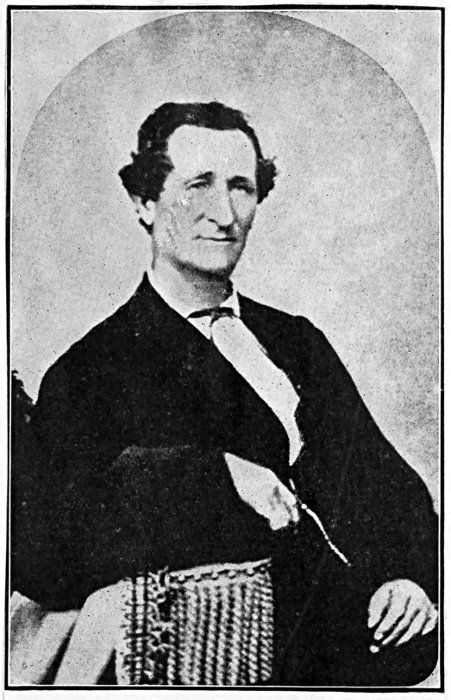
"Among the cattle operators
of Illinois, John T. Alexander
was probably the greatest
by reason of the magnitude of his
transactions, but he was antedated
by Jacob Strawn, who located in
Morgan County in 1827. Alexander
has been regarded as America's
greatest cattleman in a commercial
sense. In the strict sense of the
term, he was a pastoralist and a
trader, not an agriculturalist.
His parents were native of Ireland,
who migrated to Virginia in
1818, and in 1824 joined the exodus
to the Mississippi Valley, settling
in Jefferson County, Ohio. John T.
Alexander was the oldest of a family
of eleven children. His education was on the farm. He was
endowed with that faculty called cattle sense. At the age of
fifteen, he was entrusted, by his father, with the entire charge
of a drove of cattle sent to Philadelphia. He sold them to
advantage, collected the money, and took it safely home. At the
age of seventeen, he was purchasing cattle in Illinois to replenish
his father's Ohio pastures. It is related that his
search took him down into Sangamon county, where he was so struck
with its natural advantages, from a cattle standpoint, that he
determined to migrate."
In 1840, the Alexanders settled in Morgan county, then a
cattle range bounded only by the horizon. Mr. Alexander accumulated
a herd of steers, pastured them on the public domain, and
for half a decade prospered in a moderate way. As the country
became settled, it soon became evident that he must own land or
get out of the cattle business as far as that locality was concerned.
In 1848, he purchased 3,000 acres of land at prices
ranging from 87 cents to $3.00 per acre. This land was adjoining
the half section that he had originally homesteaded. In 1855,
he acquired another 1,000 acres at $30.00 per acre. This indicated
how rapidly the price of land was advancing. In 1857, he
bought 700 acres more at $50.00 per acre, and in 1859, he acquired
1500 acres of the Strawn estate at $30.00 per acre. In 1864, he
secured 853 acres at $60.00 to $70.00 per acre, making him the
owner of 7,233 acres of the choicest land in Illinois. In 1866,
he purchased the stock farm of Michael Sullivan in Champaign
county, Illinois, containing 26,000 acres at $11.00 to $12.00
per acre.
It was during this period of purchase that John T. Alexander
acquired the title of "cattle king." His transactions were
on an enormous scale. His buyers searched every nook and cranny
of the cattle producing region of the Mississippi valley, and
Alexander, on the Wabash railroad in Morgan county, Illinois,
was the largest cattle shipping station in the world. Entire
trains of cattle, destined for eastern markets, were daily loaded
there and almost the entire population was on the Alexander
pay roll. Thousands of other cattle, for which he paid but never
saw, were loaded at innumerable points for eastern markets.
From a pastoralist, he had emerged into a speculator on probably
the most gigantic scale the live stock industry has ever witnessed.
He ruled the markets of the East and was the Napoleon of the
cattle trade. His name was more familiar to the West than that
of Vanderbilt or A. T. Stewart. His annual cattle shipment for
many years exceeded 50,000 head, and in 1868, reached 75,000.
For a lengthy period, his sales on eastern markets exceeded
$4,000,000 annually, and it is related that prior to his
Champaign county purchase, an inventory of his assets showed
7,233 acres of land, averaging $75.00 per acre in value, $100,000
in bank, 7,000 cattle on his Morgan county pastures, and not a
dollar of debt.
Such speculative operations, however, had the result of
entailing financial embarrassment. In 1871, Alexander had to
contract his business and part with his Champaign county property.
This embarrassment was due to many causes, not the least serious
of which was cattle mortality by splenetic fever, by which he
lost $100,000. He also sustained heavy losses by shrinkage in
cattle values, and the Champaign county investment proved disastrous.
He also became involved in railroad complications. The
railroads were keen competitors for the livestock traffic and
in 1871, Alexander severed his relations with the Pennsylvania
railroad, making a contract with the New York Central, by which
that company gave him a low rate conditional to a specified
tonnage. By way of resentment, the Pennsylvania railroad put
merely nominal rates into effect, thereby glutting eastern markets
and crippling Alexander's trade, which had become so colossal as to
be unwieldy. To carry on such gigantic operations, he was compelled
to trust to innumerable assistants, many of whom proved to
be either incompetent or unfaithful. Confronted with liabilities
aggregating $1,200,000, he was forced to make an assignment, but
his estate was sufficient not only to pay off every creditor,
but leave him a large sum for a fresh start in life. It was
while energetically engaged in retrieving his fortune that he
died, in 1876.
Those survivors of John T. Alexander, who remember his
activity as Illinois' greatest operator, describe him as being
tall and commanding in appearance. Even at the time of his death,
he was hale and youthful. He was of sanguine temperament, naturally
impulsive, but quiet and non-assuming in manner, sparing in
speech, and undoubtedly one of the great American captains of
industry in his time, an outstanding figure in a trade that
boasts many conspicuous men.
The old Alexander mansion in Morgan county, the greatest
house in the countryside half a decade ago, remains in a somewhat
dilapidated condition, and the decaying out-buildings convey a
mournful hint of vanished greatness. Here, during Alexander's
time, Abraham Lincoln, Stephen A. Douglas, Richard Yates, and
others, whose illustrious names adorn Illinois history, were the
guests of America's greatest cattleman.
Jacob Strawn came from Ohio and settled in Morgan county
in 1827, and a few years later was probably the most extensive
cattle dealer in the world, but his operations were, to a large
extent, local and his most distant shipping point, Saint Louis.
His pastures in Morgan county embraced about 15,000 acres and
his business reached its maximum about 1860.
Survivors of that period recall Strawn's free handed
methods. He purchased cattle by the thousands, fixing the price
on mere verbal description as to quality and weight. Frequently,
at delivery time, nobody was on hand to receive the cattle, but
they were driven into the Strawn pastures and left with confidence
that payment would be prompt. Both Strawn and his successor,
Alexander, were always ready to buy cattle, in fact they were
the market of that period. Strawn was at the height of his career
when John T. Alexander came on the scene. Strawn produced beef
as a feeder and grazier; Alexander contracted cattle to be
delivered in the future.[17]
Mr. T. C. Sterrett relates that in the summer of 1856 he
came to Illinois and was informed that the largest cattle dealer
in the state was Jacob Strawn, living near Jacksonville, in
Morgan county. He visited Strawn's place and found a remarkably
large brick house and was astonished at the amount of brick paving
about the house. Mr. Strawn lived on a good farm at Orleans
Station, east of Jacksonville. He owned a lot of good horses
and Shorthorn cattle. Piloted by the foreman, Mr. Sterrett went
out into a 1,200 acre pasture which was fenced with rails and
stocked with a fine lot of cattle. He was very much struck
with a hundred head of the finest general work horses that could
be found anywhere. This band of horses and cattle, the good
fences, and the general appearance of everything about the place,
indicated the power and ability of the owner. Mr. Strawn was by
far the greatest American cattleman of his time.[18]
December 15, 1811—May 7, 1905
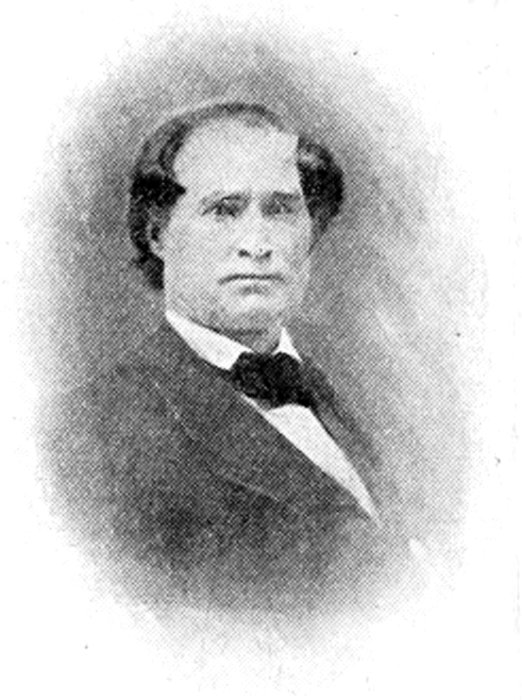
"Benjamin Franklin Harris was born December 15, 1811, on
a farm in the Shenandoah Valley, near Winchester
and Harper's Ferry, in Frederick county, Virginia.
He was the second of ten children of William
Hickman Harris and Elizabeth Payne (own cousin
of Dolly Payne Madison from England). His
grandfather, Benjamin Harris, with two brothers,
came from England and settled on the eastern
shore of Maryland in 1726. The family were
of Scotch-English extraction and Quakers;
in this country becoming fighting Quakers, then Methodists. He
grew to manhood on his father's Virginia farm, attending the
country schools until sixteen years of age. At that time, President
Jackson's attitude toward the United States bank so seriously
affected values that wheat declined from $1.50 to 50 cents
and Virginia farm land to less than one-third of its former price.
These declines so affected the father's obligations that Benjamin
Franklin Harris and his brothers, each with a six horse team—in
those days without railroads—went into the "wagoning" or freighting
business, and for three years "wagoned" freight over that
section and out through Pennsylvania and as far west as Zanesville,
Ohio, in order to recoupe the father's losses."
On March 20, 1833, the Virginia farm had been sold at 40 %
of its original cost, and in a one-horse gig and a two-horse
carryall, the Harris family set out for Ohio, arriving at Springfield
on April 8, and nearby, purchased and settled upon their
new farm. It was during this year that Benjamin Franklin Harris
commenced business for himself, buying and driving cattle overland
to Lancaster, Pennsylvania, and there disposing of them
to cattle feeders.
In 1834, he started for Illinois via Danville, then
through the present site of Sidney, and Urbana—where there was
but one cabin—and on to what is now Monticello in Piatt county.
During the ensuing years, he began to accumulate farming lands
in Piatt and Champaign counties and to buy cattle throughout
all this section as far south and west as Mt. Vernon, Vandalia,
and Springfield. During several seasons, he bought for the
purpose of feeding cattle, all the corn for sale in Macon,
Sangamon, and Champaign counties. Each year, for nine years,
he drove these cattle overland via Muncie, Indiana; Springfield,
and Columbus, Ohio, into Pennsylvania, and some into New York and
Boston, where they were sold.
When B. F. Harris came into this state, no streams were
bridged, and there were only eleven families on the Sangamon river
from its source to the limits of Piatt county. Fifteen years later
not a half dozen men had ventured their cabins a mile from the
timber limits—the deer and the Indians were still at home here.
In 1840, he visited Chicago, a town of 2000 people, on stilts in
a swamp. Nineteen days were required for the trip and the corn
and wheat he teamed there sold for 20 and 30 cents respectively.
Fifteen years after he came, not 25 % of the land in these
counties had passed from government ownership and the first railroad
came twenty years later.
The operations of B. F. Harris in connection with the
early beef cattle industry of Illinois were conducted more largely
along the feeding lines than were those of John T. Alexander or
Jacob Strawn. He bought, fed, and sold, from 500 to 2000 head of
cattle annually for nearly three-quarters of a century. The
Pittsburgh Live Stock Journal, May 8, 1905, in speaking of his
death, referred to him as "The grand old man of the live stock
trade—the oldest and most successful cattle feeder in the world."
Everything to which he put his hand flourished. His judgment was
so trustworthy that he made but few business mistakes. He did
business on a cash basis and was never in debt. Operating on
this basis, he was a rich man long before his race was run, and
he enjoyed a period of ease and entire freedom from anxiety much
longer than falls to the lot of most men who are counted fortunate
in the world.
On May 23, 1856, his famous herd of one hundred cattle—the
finest and heaviest cattle ever raised and fattened in one
lot by one man—were weighed on his farm by Dr. Johns of Decatur,
the president of the State Board of Agriculture. The average
weight of each of the hundred head was 2,378 pounds. Visitors
to the number of 500 came from Ohio, Indiana, Kentucky, and this
state to see these cattle, whose weight can never again be
equalled. The following year, February 22, 1857, twelve of
these cattle which he had retained and fed were shipped to
Chicago. This remarkable bunch averaged 2,786 pounds. Clayborn
and Alley, the most famous butchers in Chicago at that time,
paraded them about Chicago's downtown streets.
Following is a copy of a pamphlet gotten out by Mr. Harris
immediately after the sale of these cattle. (see next page)
The New York Tribune of October, 1853, refers to his
prize winning drove of cattle averaging 1,965 pounds, displayed
at the New York World's Fair then in session.
Every few years, he took cattle prizes or topped the
market. Less than a year before his death, his 1,616 pound
cattle topped the Chicago market for that season.
Mr. Harris died May 7, 1905, in his ninety-fourth year,
still in strong mental and physical vigor, although at the age of
fifty-three, he had retired from extremely active business life.
He came in the day of ox teams and lived to ride over his farm
with his son, grandsons, and great grandsons in an automobile.
He voted for nineteen presidents, beginning with Henry Clay, and
saw five generations of his family settled in Champaign county.
He established the First National Bank in Champaign in 1865—the
oldest bank in the county, and was its president at the time
of his death.
In the issue of The Breeder's Gazette, May 24, 1905, is the
following statement: "In literature, art, professional life, or
politics, a man with a record of achievements equal to that of
the late Benjamin Franklin Harris would deservedly have numerous
biographers. Many a man has been made the subject of bulky
biography who might not measure up to him on any score. This is
not because the most inviting and interesting personalities are
found outside the farmer's calling, but largely because until
recent years agriculture as a vocation has not been adequately
appreciated by the public. It has not been sufficiently dignified
to become the source of life histories. Other professions have
furnished the candidates for the Plutarchs, and contributed the
heroes and heroines famous in fiction. Farming has been drawn
on principally for Philistines. Its great men, its geniuses, its
Harrises, have been overlooked by almost all writers worthy of
putting their useful lives into books."
(Cont. on page 47.)
Record of the Best Hundred Head of Cattle
Ever Fattened in One Lot in the United States.
STOCKMEN, ATTENTION
Who Can Beat This Record?
Weight of 100 head of Cattle, fatted by B. F. Harris, of Champaign
County, Illinois:
| No. Cattle |
Weight |
| 2 |
4718 |
| 2 |
4782 |
| 2 |
4340 |
| 2 |
4580 |
| 2 |
4582 |
| 2 |
4730 |
| 2 |
4764 |
| 2 |
4738 |
| 2 |
4880 |
| 2 |
4756 |
| 2 |
5150 |
| 2 |
4624 |
| 2 |
4582 |
| 2 |
5364 |
| 2 |
4828 |
| 2 |
5378 |
| 2 |
4864 |
| 2 |
4640 |
| 2 |
4694 |
| 2 |
4610 |
| 2 |
4776 |
| 2 |
4488 |
| 2 |
4572 |
| 2 |
4988 |
| 2 |
4634 |
| 2 |
4458 |
| 2 |
4920 |
| 2 |
4828 |
| 2 |
4702 |
| 2 |
4852 |
| 2 |
4464 |
| 2 |
4900 |
| 2 |
4634 |
| 2 |
4764 |
| 1 |
2690 |
| 2 |
4650 |
| 2 |
4806 |
| 2 |
4505 |
| 1 |
2548 |
| 2 |
4830 |
| 2 |
4762 |
| 2 |
4706 |
| 2 |
4854 |
| 2 |
4746 |
| 2 |
4700 |
| 2 |
4546 |
| 1 |
2516 |
| 2 |
4648 |
| 2 |
4724 |
| 2 |
4720 |
| 2 |
4732 |
| 1 |
2646 |
Average price sale, 7 cents
These cattle were weighed by Dr. Johns, President of State
Agricultural Society.
Twelve of the large cattle out of 100 head, weighed May 23d,
1856, which was during the time of fattening:
| Black |
2424 |
| Red |
2340 |
| Pied |
2640 |
| M. Red |
2264 |
| Ch. Roan |
2522 |
| B. Red |
2574 |
| S. Roan |
2330 |
| C. Red |
2340 |
| S. White |
2360 |
| P. Red |
2486 |
| Long White |
2496 |
| M. Red |
2540 |
Same cattle weighed July 18, 1856:
| Black |
2526 |
| Red |
2480 |
| Pied |
2730 |
| M. Red |
2424 |
| Ch. Roan |
2654 |
| B. Red |
2646 |
| S. Roan |
2470 |
| C. Red |
2490 |
| S. White |
2430 |
| P. Red |
2630 |
| L. White |
2600 |
| M. Red |
2564 |
Same cattle weighed February 12th, 1857:
| Black |
2720 |
| Red |
2780 |
| Pied |
2990 |
| M. Red |
2640 |
| Ch. Roan |
2810 |
| B. Red |
2910 |
| S. Roan |
2680 |
| C. Red |
2770 |
| S. White |
2605 |
| P. Red |
2840 |
| L. White |
2810 |
| M. Red |
2880 |
Average, 2786¼ lbs.
Average age, 4 years
Weighed by B. F. Harris; sold for 8 cents per lb.
Largest steer in Illinois, weight 3524, 7 years old, raised
by John Rising, fed by H. H. Harris.
Average weight of the 100 head, 2377 lbs.
The foregoing is a correct statement of a famous cattle sale
which occurred in the City of Chicago, month of March, 1856.
The herd comprised 100 head of the finest and heaviest cattle
ever raised and fattened in one lot by one man in the State of
Illinois, or in the United States of America, or elsewhere, so
far as the records go to show. These cattle were raised from
1 and 2-year-old steers on my farm in Champaign County, Illinois,
and fattened for the market in the years of 1855 and '56, their
average age, at that time, being 4 years. They were weighed on
my farm by Dr. Johns, of Decatur, Illinois, President State Agricultural
Society. Said weights were witnessed by a large number
of representative men from Ohio, Indiana, Kentucky and Illinois,
to the number of five hundred, among whom were many professional
cattle raisers and dealers, all of whom bore willing testimony
to the average weight of the cattle, which was 2,377 lbs. per
head. Out of this lot of 100 cattle, 12 head of the finest steers
were selected and fed until the following February. They then
showed an average weight of 2,786¼ lbs., and were sold to
Messrs. Cliborn and Alby, of Chicago, at 8 cents per lb. The
weight master kept a record of each draft as the cattle were
weighed—one and two in a draft. A copy of said weights is herewith
attached for the inspection of the general public; also copy
of average gain at different periods.
On the 22d of February, 1857, the 12 steers sold to Cliborn
and Alby, appropriately decorated with tri-colored ribbon, preceded
by a band of music, were led through the principal streets
of Chicago, followed by 100 butchers, mounted and uniformed. After
this unique procession, the cattle were slaughtered by said Cliborn,
and Alby, for the city markets, some of the beef selling as high
as 50 cents per lb. Small packages of it were sent to customers
in various parts of the United States, and even Europe, and sold,
in some cases, as high as $1.00 per lb. These orders were given
by these parties simply that they might say they had eaten of this
famous premium beef.
B. F. Harris.
August 26, 1824-
"Tom Candy Ponting was born at Heyden farm, Parish of
Kilsmeredo, near Bath, Somersetshire, England, August 26, 1824.
He was the son of John Ponting and Ruth Sherron Ponting. The
Pontings came into England with William the Conqueror, so were
descendants of Normandy. The Ponting family were breeders of
cattle and Tom Ponting has followed cattle breeding all of his
life, both in England and in this country."
Tom Candy Ponting came to the United States in 1847,
landing in New York City, and finally making his way to Etna,
Ohio. Here he was employed by a Mr. Matthews, to sell mutton
from a wagon in the market house in Columbus, where they attended
twice a week. Mutton sold for 15 cents to 25 cents per quarter
in those days, while beef sold for 2½ cents to 3 cents per pound.
After a short time, Mr. Ponting quit his job selling mutton, went
to Columbus, bought a horse and saddle, and went into the country
to buy cattle. The first cattle that he ever bought in the
United States were eight head which he purchased from a Mr. Bishop
eight miles northeast of Columbus, Ohio.
In the spring of 1848, Mr. Ponting, in company with a
Mr. Vickery, another Englishman, visited Racine, Janesville,
Watertown, Madison, and Milwaukee, Wisconsin, looking for a
location to start a butcher shop. Although there was plenty
of need for butcher shops at these places, they did not locate
because cattle were so scarce in the country. From Milwaukee,
Mr. Ponting came to Chicago to study the situations there. He
found no regular markets and only two places where they sold
stock. While in Chicago, he met a Mr. Bradley, who had driven
some cattle from McLean county, near Leroy. Mr. Bradley had
sold all of his cattle except forty cows with calves. He sold
these to Mr. Ponting, who drove them to Wisconsin and sold them
to immigrants, a few at a time. He sold them for $15 to $25 per
head and still made money. He returned to Chicago and again met
Mr. Bradley, who had brought a boat load of sides of bacon up
from Peoria. He had purchased this bacon from the farmers, hauled
it to Peoria, and shipped it up the Illinois river to
Chicago, where he sold it to grocery stores. This was the only
means to dispose of the bacon put up by the farmers, as there
was no hog packing done in Chicago at that time.
Mr. Bradley wanted Mr. Ponting to go with him to McLean
county, but as Illinois was known in those days as a very sickly
state, Mr. Ponting was afraid to venture.
While in Chicago at this time, he met a Mr. Lewis and
Mr. Heyworth who had come up from Vermilion county with a drove
of cattle. Mr. Heyworth was taken sick here and Mr. Ponting was
employed to assist Mr. Lewis in taking the cattle on to Milwaukee.
In the spring of 1849, Mr. Ponting went to Georgetown,
Illinois, and there purchased about 300 head of cattle. He also
bought a camping outfit, a yoke of oxen, employed a cook, and
drove through with the cattle to Wisconsin. The cattle that
got fat on the way were sold to the butchers, while those that
were fit for milk cows were sold to the immigrants. During this
same spring, when Mr. Ponting was in Vermilion county, he visited
Mr. Lewis at Crabapple Grove, which is on the line of Vermilion
and Edgar counties. This man and one of his neighbors had bought
a drove of geese, drove them to Iowa, and traded them for steers.
They drove the steers back to Vermilion county, fattened them,
and the next spring built flat boats and shipped them to New
Orleans. In the fall of this same year, he made several trips
over the line into Illinois, in Stevenson county, buying fat sheep
to drive to Milwaukee. There were no regular banks in Milwaukee,
therefore all the money that was paid for stock was Mexican
dollars and five franc pieces. Very little American silver money
was seen at that time. The hotel rates in Milwaukee were very
cheap; only $2.00 per week, with bitters before breakfast, free.
Whiskey sold for 15 cents a gallon and was used liberally by
stock drivers.
In March, 1850, Mr. Ponting rode on horseback from Milwaukee
to Leroy, in McLean county, where he met with some men
who were buying cattle to take back to California. He went from
here to Christian county, where he bought a drove of cattle which
cost him from $6 to $11 per head. In the spring, he drove them
to Milwaukee. There had been very heavy rains that spring and
rivers were very high, which made cattle driving very difficult.
In the spring of 1851, he purchased about 350 head of
cattle, buying from Rochester, near Springfield, to the Wabash
river. After gathering the cattle together, he pinned them
up near the present site of Moweaqua. He bought these cattle very
cheap and drove the entire herd to Milwaukee, where they were
herded on the prairies near town until sold. He took a few in
each week and sold them to the butchers. After finishing the
season's work, he returned to Indiana to spend the winter.
In the summer of 1852, the cattle business in Wisconsin
was dull. Money matters were very much changed; gold began to
come in from California, and get into circulation. Mr. Ponting
and his partner decided to go to Texas and buy their feeder
cattle. They rode through to Hopkins county, Texas. Here they
visited a Mr. Hart, one of the large cattle men in that country.
They bought several hundred cattle and drove them back to Illinois,
reaching Moweaqua in July of the next year. He put these Texas
cattle on pasture until winter, when they were fed out on shocked
corn. Mr. Ponting's partner went to Indiana and bought several
hundred hogs to follow these cattle. They bought shocked corn,
paying about 50 cents a bushel for it. They would go into a
piece of corn after it was dry enough and select two of the smallest
shocks they could find. The owner would select two of the
largest ones. These were shocked out and weighed, the average
being taken as an average size shock. He bought about 40 acres
from Mr. Dennison Sanders this way. The shocked corn was fed to
the cattle in the same place each day, so that when it rained, the
accumulation of stalks would keep the steers out of the mud. He
drove this bunch of cattle to New York the next summer, where they
were sold July 4, 1854.
In the spring of 1855, Mr. Ponting purchased a large drove
of cattle, which together with some he had bought a few months
before, were driven through to Chicago. Illinois was pretty well
settled by this time, and it was unnecessary to take a camping
outfit along. He stopped this drove of cattle near Pullman, put
them out on the grass and took only a few into Chicago at a time.
There had been a great change made in the Chicago market since Mr.
Ponting was there two years before. There were two regular stock
yards; the Merrick Yards, now known as the Sherman Yards, and the
Bullshed Yards. In the fall of this year, he bought another bunch
of cattle and drove them to Chicago in October. This time he
stopped the cattle near the present site of Kankakee, and rode on
into Chicago to learn the prospects for a market. They were then
taken on to Chicago and left just outside the city to graze until
they could be sold to the cattle dealers. This was the last bunch
of cattle Mr. Ponting ever drove over land to Chicago, and it is
probable that they were the last bunch ever driven from central
Illinois. From this time on, the cattle were sent to market by
railroad. The next year, 1856, he shipped 110 head of cattle from
Moweaqua, the first cattle ever shipped from that place.
In the early part of 1857, the cattle business was very
flourishing and the packers said there would be a big demand for
them that fall. Mr. Ponting contracted for 1000 head of cattle
and about 1500 hogs before the season was over, but before he got
them on the market, a panic came on, money became almost worthless,
and he suffered a heavy loss.
In 1866, Mr. Ponting went to Abilene, Kansas, to buy some
feeders. He purchased about 700, sold them the next spring, making
a good profit. He repeated the Kansas purchase the next year with
like success. In 1868, he took the cattle he had bought in Kansas
to Albany. They numbered around 800. In 1870, he went back down
into Texas and bought cattle as he had done in 1852. He found
a herd of about 2500, out of which he bought all of the two and
three year olds. These numbered about 850, for which he paid
$16 per head. There had been a new railroad, just finished, from
St. Louis through Missouri, close to the Indian Territory line
to a place called Pierce City. The railroad officers had
some agents trying to get a contract to carry these cattle, together
with some other cattle belonging to Hall brothers, over the new
road. They billed the cars, numbering 80 in all, with a contract
to refund $50 per car. They did this to get the contract which
made a big showing before some New York magnates, who were there
at the time trying to buy stock in the new railroad.
In 1876, Mr. Ponting visited a Shorthorn sale at Springfield
and bought several head of cattle with which he started a Shorthorn
herd. In the spring of 1880, he attended another Shorthorn sale
at Chicago, where he bought a few more Shorthorns to add to his
herd. Until his first purchase of Shorthorns, Mr. Ponting's
operations had been entirely along the line of buying and feeding
and although he did a small pure bred business from this time on,
he continued his feeding operations as he had done in previous
years, although probably not on as large a scale.
Mr. Ponting had not been in the Shorthorn business very
long until he became interested in Herefords. In the fall of 1880,
he visited the fair at St. Louis, where he purchased four Herefords.
In the spring of the next year, Mr. W. H. Sotham of Guelph,
Canada, bought four more Herefords for him. In the fall of 1882,
he sold out all of his Shorthorns, thereby severing his relations
with this breed.
In 1886, Mr. Ponting made a contract with the Wyoming
Hereford Association to sell them 270 head of Hereford cattle,
to be delivered in the spring of 1887. The firm paid for a part
of them and Mr. Ponting took a note for a few more. About 60 were
left on his hands and had to be sold for beef. As a result, he
lost about $800 on the deal, which killed all of his profits.
Mr. Ponting continued in the Hereford business until
1903, when he decided to retire from actual business. In the
summer, a gentleman came from Iowa and bought his entire Hereford
cattle trade. He had at this time about 3700 acres of land, 1500
acres of which were in Christian county. He decided to divide
his property among his children, keeping a sufficient amount to
support Mrs. Ponting and himself. He bought a home in Moweaqua,
where he and Mrs. Ponting have lived happily ever since.
When Mr. Ponting came to Chicago in 1848, there was only
one cattle market west of the Allegheny mountains, and that was at
St. Louis. At that time, there were a good many cattle sold for
the New Orleans market during the spring and winter, but the
principal markets were New York, Boston, Baltimore, and Philadelphia
It took ninety days to make the trip to New York with cattle and
the drovers had to wait until the roads settled in the spring before
they started.
At Fort Worth, Texas, there was nothing but a large fort
and force of United States soldiers to subdue the Indians around
there. The present six big western markets have all been started
since that time.
"While the magnitude of Mr. Ponting's operations was not as
great as that of John T. Alexander, and although he probably never
accumulated as much wealth as Benjamin F. Harris, he was successful
and his operations extended over a greater period of time than any
one of the early pioneer cattlemen of the state of Illinois. He
operated throughout two of the stages of cattle feeding and has
lived to see the beginning of the third."[20]
IV. THE RANGE INDUSTRY — Texas Cattle — FOOTNOTES:
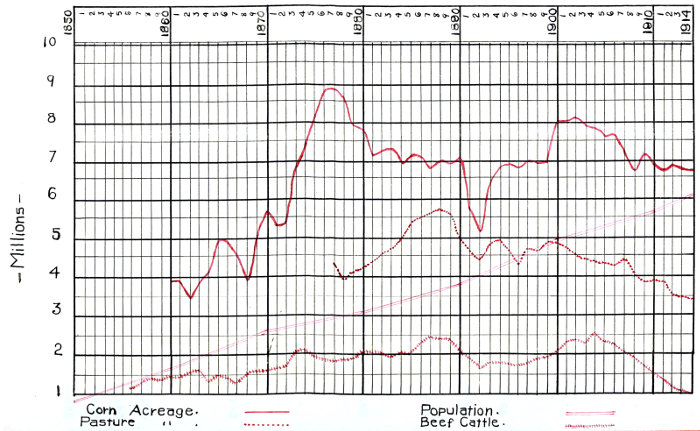
"In the ante-bellum period, central Illinois was a vast
blue grass pasture. The people were breeding many cattle, but not
enough to supply the steady increasing demand for stockers and
feeders. Cattle feeders made good the deficiency in the local
production by heavy drafts on Missouri, Kansas, Texas, and other
sections of the trans-Mississippi region. The subsequent reign of
King Corn was then barely in the incubating stage. Grass was the
beef maker's principal reliance.
"Not until well along in the sixties did the cultivation of
corn begin on an extensive scale and corn-fed steers become
conspicuous on the markets. After the grazing period, corn speedily
took possession of the whole of central Illinois, until now less
than 15 per cent remains in pastures, whereas in the days of the
"barons" an exactly reverse condition existed. At that time, fully
85 per cent of such counties as Sangamon, Morgan, and Logan, were
in grass.
"The cattle that were secured from Missouri, Iowa, and
Kansas, were purchased during the fall months. By the early part
of winter, central Illinois pastures would be fully stocked with
three and four year old bullocks, which were allowed to graze
all through the winter and the following spring and summer. About
three acres of the rich blue grass was allowed to a steer and on
this they fattened rapidly.
"There are men now living in Missouri and Illinois who
drove cattle from that vast breeding ground west of the Mississippi
river, into central Illinois, for the cattle kings, Jacob Strawn
and John T. Alexander. These herds, numbering about 300 to 400
head, grazed leisurely across the open country at about 15 miles
or so a day. During the war, the trade was more or less interrupted,
but the practice was continued until settlement and railroads
rendered trailing both unnecessary and impossible.
"The annexation of Texas to the United States, and the discovery
of gold in California in 1849, resulted in an influx of
population and capital that soon exerted a stimulating effect
upon the production of cattle throughout the southwest, as well as
beyond the Sierra Nevada Mountains in the west.
"At a comparatively early date, there was a ready market
for Illinois bred cattle to go to the states west of the Mississippi
river to be used for breeding stock. The development of the
range cattle industry created a strong demand for pure bred bulls,
and cattle breeders of Illinois were called upon, perhaps to a
greater extent than those of any other state in the Union, to
supply this demand. The range cattle business also created a
market for young cows and heifers to be used for breeding purposes.
This demand steadily increased from year to year, until a very
large part of the yearly product of pure bred cattle in Illinois
was absorbed for that purpose."[21]
"In 1880, the range cattle trade was yet in a transition
stage, especially as to the destination of marketable cattle and
the special use to which they were put. Before this time, the
bulk of the range cattle trade was divided between the coming
establishments of the west, slaughter for home consumption, for
exportation as dressed carcasses to the eastern markets, and
shipping on the hoof to eastern states as feeders. Large feeding
stables had been established in Nebraska for the purpose of
feeding out these large numbers of rangers, but they could not
utilize all of them. The overflow of these grass fat rangers
found their way to eastern feed lots to be finished on the grain
of the corn belt. The numbers increased from year to year, and
extended farther and father east as the numbers increased.
"The fact that one of the large feeding plants of Nebraska
could turn off as many as 2000 ripe range steers in one month,
gives some indication of the immense capacity of the range cattle
trade.
"As the Indians were confined more closely from year
to year, there were more grazing lands opened up to be devoted to
the raising of these range cattle. Most people at this time,
seeing the rapid increase of the range industry, thought there
would never be a beef famine as the economists of the time predicted.
They said such economists always look on the dark side
of things."[22]
"Not many had any adequate conception of the vastness of
the cattle interest in the great pasture region lying on the
eastern slope of the Rocky Mountains during the seventies and
eighties. It was worth quite a journey to see a single thousand
head of these cattle engaged in feeding together. To witness a
drove of 4000 moving leisurely along at a convenient distance from
each other, to allow the animals to graze as they traveled a
mile or so an hour, would seem to an unaccustomed eye as if the
herd must consist of tens of thousands. The appearance of such a
drove as this might be recalled by a single transaction made by
Dennis Sheedy of Colorado, who sold 27000 head of cattle to the
Ogalla Cattle Company. This company was composed of A. H. Swan,
of Cheyenne, Wyoming, William Paxton, of Omaha, Nebraska, and
J. H. Bosler of Carlisle, Pennsylvania. The cattle were put on a
range on the north side of the north Platte Run in Nebraska and
Wyoming. The lumping price was $30 per head, amounting to
$810,000 for the entire lot."[23]
"It will be no departure from the strictest truth to say
that the oldest known race of cattle on this continent is the
Texas or Spanish cattle. They have been very generally popular
with the stockmen of the plains, because they turned the free
grass of the plains into available cash for their owners.
"The Texas cattle are truly the only animals except the
bison that deserve the name of "Native" American cattle. All
the other scrubs in the country are foreigners by blood, or are
descendants of intruders from other lands. These long legged,
big headed, thin fleshed brutes were in this country centuries
ago. It is by no means certain that their ancestors did not roam
the plains of the Brazos and the Rio Grande a thousand years or
more before America was visited by the Spaniards. There is
evidence that the real ancestors of the cattle of Texas were seen
in Old Mexico and described about five hundred years after the
Christian era, but this evidence has been considered unworthy
of full confidence, because to admit its truth would be to confess
that the honor of first discovering America belongs to the barbarians
from the Orient.
"In the carefully edited official records, known as the
"Chinese Year Book", which was written some fourteen hundred years
ago, a circumstantial account of a visit to Mexico by a party of
Buddhist Priests is given. These priests saw in the country two
breeds of cattle. One of these breeds was described as having
very large horns which would hold ten measures. These were probably
the earliest ancestors of the present race of Texas cattle,
while the other breed with shorter horns was, it is likely, the
ancestors of the bison that later roamed over the ranges of the
western plains. Those ancient travelers were too well accustomed
to seeing cattle and horses in their own country to be in even
the slightest degree likely to mistake any other animal for kine.
The generally accepted belief, however, is that the Texas cattle
are descendants of cattle brought to America by the Spanish invaders,
although no definite proof seems to have been brought forward
to show that those roistering, plundering explorers ever imported
any cattle to this continent, and turned them loose in such
numbers as would have produced the vast horde that covered the
Southwestern plains before the Civil War.
"To western people, especially in those parts where
Spanish or Texas fever has caused the destruction of stock, Texas
cattle are so well known that a description of their peculiarities
will appear unnecessary. There are many who do not know that
the chief purpose of the Texas bullock, pure and simple, seems
to be the lugging about of a prodigious pair of horns. To this
end, a big head and coarse shoulders have been given him. Behind
these are a flat ribbed, thin chested, light body, held up at the
hinder end by a pair of cat hams on thin, deer-like legs. The
whole outfit, unburdened by flesh or fat, is muscular, nervous,
and active. Such of them as lived through alternate roasting,
starving, and freezing during the early years of their lives,
found their way to the northern markets to be fattened and slaughtered.
These rangers fattened very readily in the northern feed
lots and those that were not too old and tough made very good beef.
Thousands of them were driven from Texas in the early forties and
fifties to Illinois feed lots, where they were fattened and then
re-driven to the markets on the seaboard. In later years, they
were slaughtered in Illinois and shipped in refrigerator cars, in the
form of dressed carcasses, to the Atlantic States. Choice parts,
as steaks, roasts, and tenderloins, were sent to health resorts,
watering places, and to hotels and restaurants. A vast quantity
of their flesh found its way into tin cans, to feed hungry humanity,
in the hut of the laborer, at the picnic of the aristocrat, in the
camp of the miner, and in the forecastle of the sailor in every
corner of the world. It will be seen that the mission of the
Texas steer was to raise the standard of living, to add to the
comfort, and preserve the health and strength of people the world
over."[24]
V. THE PURE BRED INDUSTRY — T. L. Miller — Thomas Clark — FOOTNOTES:
The beginning of the pure bred cattle industry in the state
of Illinois was antedated by the introduction of the mongrel bred
cattle by a very narrow margin of time. While there were probably
a few mongrel bred cattle in the state before 1830, those that were
brought in after that date were the real foundation cattle. These
cattle were brought from the eastern states, by the early pioneers,
for milk cows, and it is their descendants which are referred to
when the native cattle of the state are spoken of.
The changes which have been made from the mongrel bred cattle
that were brought into the state by the early settlers to the
present day improved breeds have been marked.
"For almost a century, attention has been given to the
breeding of pure bred cattle in Illinois. As early as 1833, a man
by the name of James Williams, brought some Shorthorn cattle of
the Patten Stock, from Kentucky to Sangamon county. In 1834, J. D.
Smith and J. N. Brown brought a number of Shorthorns from Kentucky
to the central part of the state. In the spring of 1838, Colonel
John Williams, a son of James Williams, brought a Shorthorn bull
and a Shorthorn cow from Lexington, New York, into Sangamon county.
These three importations of pure bred stock into Illinois were the
earliest of which there are any records. Other importations of
Shorthorns into the state were made at later dates, however, and
they soon became the leading breed of cattle in the state for both
beef and dairy purposes."[25]
The rapid dissemination of Shorthorns throughout the state
was probably due chiefly to the method by which the breed was
advertised. The leading breeders held public auction sales
annually on their farms, or at some convenient place, and people
all over the state were invited to come to these sales and bring
such pure bred animals as they had for sale. In view of apprehensions
on the part of some of the breeders, that this method might
tend to spread disease among the cattle, it became a rule to
require that every contributor to a sale furnish a certificate
from a veterinarian, showing his cattle to be in good health, and
that they had not been exposed to any contagious disease.
Shorthorns held full sway in the state until about 1865
or 1870, when the tide began to turn. Other breeds began to be
introduced into various parts of the state. Some of these breeds
gained popularity so rapidly that within a very few years the
competition became very keen between them and the Shorthorns. At
the shows, all breeds were shown in the same class. This created
considerable excitement among the enthusiastic advocates of the
various breeds and often resulted in fist and skull fights.
"At the Chicago show in 1879, there was close competition
among the breeds when it come to tying the ribbon for sweepstakes
award. Mr. F. L. Miller, a Hereford man, wanted to put the breeds
to a slaughter test. The other breeders refused to kill their
pure bred cattle, but some grades were slaughtered instead; one
Shorthorn, one Hereford, and one Devon."
|
Herefords |
Shorthorns |
Devons |
| Gross Weight |
1963 |
1795 |
1614 |
| Net Weight |
1317 |
1179 |
1055 |
| Offal |
452 |
389 |
394 |
| Dressing per cent |
67.1 |
65.7 |
65.3 |
| Fore Quarters |
354 |
308 |
277 |
|
371 |
303 |
275 |
| Hind Quarters |
287 |
283 |
247 |
|
305 |
285 |
256 |
| Tallow |
178 |
155 |
145 |
| Hide |
106 |
90 |
99 |
| Head |
55 |
47 |
49 |
Neither of these steers had marbled flesh. One family
who ate some of one of the steers was said to have been made sick,
due to the excessive fatness.
The feeders of this time gave very little or no attention
to the marbling of meat. All they noted was whether an animal
was getting fat or not. They didn't notice whether they were
putting the fat on evenly.[26]
From the very earliest improvement of cattle in Illinois,
Shorthorn blood has been used more extensively than that of any
other breed. They were the first pure bred cattle brought into
the state and were the only pure bred cattle in the state for
several years. They were more generally known by farmers throughout
the state and at a very early date were found in almost every
county.
Hereford cattle have ranked next to Shorthorns, both in
number and popularity.
"About 1870, Herefords began to play an important part
in beef production in this state, and it was only a few years
after this time that they were taken into Sangamon county, where
Shorthorns had first gotten their strong hold."[27]
"The competition between the Herefords and the Shorthorns
grew stronger each year. In February of 1885, the Shorthorn
Breeders' Association, in session, decided to ask each member
to contribute fifteen cents for each Shorthorn owned by him, to be
used for the good of the Shorthorn interest. The rivalry between
the different breeds of cattle was so sharply defined and closely
pressed that they thought it indispensable to the protection and
prosperity of the Shorthorn interest and thought the State
Association of Shorthorn Breeders should be kept in an active and
strong existence."[28]
The following is a summary of reports gathered by the
Bureau of Animal Industry in 1885, by sending out questionnaires
to different parts of the state, showing the breed of cattle that
has been used moot extensively in cattle improvement.
| State as a Whole |
|
No. Reports |
Breed Used |
|
240 |
Shorthorns |
|
80 |
Herefords |
|
28 |
Angus |
|
17 |
Devons |
| State by Sections |
| Northwest Counties |
27 |
Shorthorns |
| 9 |
Herefords |
| 5 |
Angus |
| Northern Counties |
34 |
Shorthorns |
| 13 |
Herefords |
| 5 |
Angus |
| 4 |
Devons |
| 2 |
Galloways |
| Western Counties |
32 |
Shorthorns |
| 8 |
Herefords |
| 5 |
Angus |
| 4 |
Devons |
| 3 |
Galloways |
| Central Counties |
55 |
Shorthorns |
| 20 |
Herefords |
| 3 |
Angus |
| 1 |
Red Polled |
| Western Counties |
20 |
Shorthorns |
| 14 |
Herefords |
| 7 |
Angus |
| Southwest Counties |
9 |
Shorthorns |
| 1 |
Herefords |
| 1 |
Angus |
| Southern Counties |
44 |
Shorthorns |
| 6 |
Herefords |
| 3 |
Devons |
| 1 |
Dutch Belted |
| Southeast Counties |
10 |
Shorthorns |
| 2 |
Herefords |
| 2 |
Devons |
"Early in the "seventies," Mr. T. L. Miller, than a
business man in Chicago, who owned a farm at Beecher, Will county,
Illinois, became interested in Hereford cattle."
Mr. Miller was born at Middletown, Connecticut, on April
7, 1817. In 1842, he went to Cuyahoga Falls, Ohio, where he was
in business until 1856, when he removed to Chicago, Illinois. Here
he was in the fire insurance business until about 1870. He had
bought the first 320 acres of his farm at Beecher and 207 acres
three miles to the north. He commenced to improve the farm with
buildings in 1862. His nearest railroad station then was Monee,
on the Illinois Central. In 1870, the Chicago, Danville, and
Vincennes Railroad, was built, and Mr. Miller bought about 340
acres of additional land to the west of that already acquired and
laid out the village of Beecher. He closed out his business in
Chicago and went to live on this "Highland Stock Farm" in March,
1870. A few years later, he laid the foundation for his herd
of Hereford cattle.
Mr. William Powell, an Englishman, who later on bred and
handled Herefords extensively on his own account both in Illinois
and Texas, was jointly interested with Mr. Miller in some of his
earlier ventures in Herefords. An item in the "National Live Stock
Journal" for February, 1872, reads as follows: "We learn that Messrs.
Byers and Campbell, of Nevada, Ohio, have sold to Messrs.
T. L. Miller and Wm. Powell of Highland Stock Farm, Beecher, Will
county, Illinois, an individual half interest in three Hereford
cows and two bulls, and thirty-six pure bred Cotswold sheep.
Mr. Miller's farm soon afterward became the center of the greatest
American activity in the Hereford trade."[29]
"Thomas Clark was born in Herefordshire, England, near the
Monmouth border, in 1842. His father was a cattle grower of local
repute, who used pure bred Hereford bulls, but did not profess
to be a handler of pedigreed strains. Thomas Clark came to the
United States in the spring of 1866, and after working for a time
on a farm near Pittsfield, Ohio, was employed by a Cleveland
butcher having a large city trade. Thrifty and possessed of an
inborn faith in the "white faces" of his native land, by dint of
hard work and economy in the course of a few years, Clark found
himself in a position to get into business in a small way on his
own account. As foreman and cutter in Cleveland, he acquired a
practical familiarity with what lies under a bullock's hide, that
was of distinct advantage in his subsequent career as a breeder
and feeder of good cattle. He had an interest in his brother-in-laws
little butcher shop in Elyra, but his own fondness for the
fields led him to give most of his time to the 80 acres he had
under lease near town. He moved on this farm and began breeding
Hereford cattle. He bought his first bull, Sir Arthur (705), as
a calf, from F. W. Stone of Canada.
"In 1877, when Mr. Clark's lease on the Ohio farm expired,
seeing that the west was becoming a good market for Herefords, he
decided to remove to Beecher, Illinois. He had shown every year
at the Ohio fairs, and always won. He made one show at Erie,
Pennsylvania, while breeding in Ohio, and another at Jackson,
Michigan, in 1876, winning first prize on herd, in competition
with seven Shorthorn and Devon herds. This was the first time
Herefords had won that prize in Michigan, and the event caused a
lot of controversy. Clark had, meantime, sold three calves to
T. L. Miller and delivered them personally. He was impressed with
the idea that Illinois would be a better location for his cattle
business than Ohio. He bought 80 acres of land, about one and
one-fourth miles from the village of Beecher. He afterward added
forty acres to the home farm, and subsequently, bought twenty-six
acres in addition. Mr. Clark always kept his own lands
largely in grass, and leased fields for farming purposes. He
brought his Ohio herd, numbering at that time about twenty-eight
head, to Beecher.
"In 1877, Mr. Clark showed a herd at the northern Ohio
Fair at Cleveland, winning all prizes shown for."[30]
(1857) "There is no question but what the native cattle of the
state may be improved by successive generations of judicious
breeding, but if in and in-breeding is followed, as at present,
the effects will be negative.
"The true comparison between native steers and improved
steers is seen when they are put on the market. Shorthorn and
Hereford steers at weaning time are worth about $15, while the
native steers at weaning time are worth about $5. The Shorthorn
and the Hereford steers could be made to go to the New York market
weighing around 1800 to 2000 pounds gross, and sell for 12 cents
to 15 cents per pound, while the native steers were sent to market
at six or seven years of age, weighing from 900 to 1000 pounds, and
sold for 10 to 12 cents per pound.
"The Illinois Cattle Importing Company received a shipment
of 38 Shorthorn cattle from Europe."[31]
"Messrs. Calef and Jacoby at Springfield, Illinois, sold
at auction, March 23, fifteen head of cows and heifers, all
Shorthorns. Two of the number were imported. They reached an
average of $583. They also sold eight Shorthorn bulls which
averaged $171.98 each."[32]
"Messrs. H. E Gardner of Bradfordton, Illinois, and
J. S. Highmore of Rochester, Illinois, sold 30 Shorthorn cows
and heifers at the Sangamon County Fair Grounds. The total number
brought $3,140. Average of the cows was $104.66. They also sold
14 bulls for $10.20. The highest price paid in the sale was $280
for a cow. The total sale for cows and bulls amounted to $4,160,
an average of $95.54. L. C. Carlin of Edinburg, Illinois, bought
a bull for $100. Philimon Stuart of Cotton Hill, Illinois, bought
one for $100 also.
"In the afternoon of the same day, D. W. Smith of Bates,
Illinois, sold five cows and heifers for $770, an average of $154;
also three bulls sold for $710, an average of $236.66. The total
of the cows was $1,480. The highest cow sold to Lafayette Funk of
Shirley, Illinois, for $2.30. The highest bull sold to George M.
Caldwell, Williamsville, Illinois, for $300."[33]
"Rossland Park Stock Farm at Ashkum, Illinois: The farm
is 73 miles south of Chicago, on the Illinois Central Railroad,
in Iroquois county. It is composed of 120 acres of deep, dark
prairie soil.
"This farm was first owned by Mrs. Ross of Chicago, who gave
very little attention to it and allowed it to become badly run
down. It was then purchased by G. W. Henry of Chicago, who at
once set about to improve it. He put a new fence around the entire
farm and prepared it to be kept as a grazing farm for cattle.
"Mr. Henry was a Shorthorn enthusiast and bred Shorthorns
until 1884, when he became interested in Herefords. High grade
and pure bred Herefords had his attention then for two or three
years, after which he decided to deal in none but pure-breds. He
sold his entire lot of grades. R. W. Hollenbeak of Casey, Iowa,
purchased 73 of the two year olds at $75 a head; 25 high grade one
year old at $50 a head; one yearling grade bull at $75; and 49
young grade calves at $40 a head.
"There were left on the farm about 150 pure bred Herefords
which soon were increased enormously by using some valuable bulls
as herd headers."[34]
"The "Summit Farm", owned by Mr. Wentworth, comprises about
4000 acres, which is mostly prairie. He has on his farm 80
Shorthorns. He has some yearling heifers by the son of "Booth's
Lancaster", which are very promising. He also owns the "Fifteenth
Duke of Ardie" who still holds his place as one of the grandest
Bates bulls in existence.
"Mr. Wentworth feeds mangles in connection with hay."[35]
"The Polled Aberdeen Angus herd, belonging to Messrs.
Anderson and Findley, of Lake Forest, Illinois, is one of the
oldest herds in the United States, and is probably the largest of
any in the United States or Scotland."[36]
"Our first importation was made in the summer of 1878, and
consisted of the bull Nicolis 1102, and the five females: Jeannie
Gordon 2914, Lazy 3rd 1100, Violet of Brucehill 1951, Diana 4th
3226, and Waterside Fancy 1854, and thus was established the first
breeding herd of Aberdeen Angus cattle in the United States so far
as we know. The cattle in this importation did so well with us
that we were induced to make further importations, and the
cattlemen of this country readily recognized the superiority of the
breed, and with proverbial American go-aheadness, took hold of
them at once. Such was the demand for animals of this breed in
the early eighties that we found ready sale for them at prices
almost beyond the reach of cattlemen of moderate means. We,
together with other importers, drew upon the parent stock in Scotland
to such an extent about this time that the straining point
was soon reached and prices rapidly advanced in that country also.
"The land at Lake Forest, Illinois, upon which for so many
years we maintained our herd, was constantly appreciating in value,
until it is now (1901) worth about four hundred per cent more than
when we first established our herd there. We were, therefore,
compelled to move our herd into cheaper lands, and this we began
to do about 1894, and in 1897, practically all of our herd had been
transferred to our Allendale Farm, in Allen county, Kansas. We
purchased most of the land composing Allendale Farm in 1878, and
have improved and added to it since until now, we have over 2000
acres, making as fine a place for the breeding of fine stock and
the fattening of cattle as can be found in the country."[37]
"The Illinois Cattle Breeders' Association was organized
in 1895. The first annual meeting was held at Springfield, on
January 13, 1896. Mr. J. Frank Prather presided at this meeting.
Mr. J. H. Pickrell was the first secretary. A committee was
appointed to draft by-laws.
"The first paper on the program was "Home and Foreign
Demand for Beef Cattle" by A. C. Howell, the editor of the
Drover's Journal. The paper was read by the secretary, Mr. Pickrell.
The main theme of the paper was on Baby Beef, in which
he said that it was no longer a fad, but a profitable business."
VI. CATTLE PLAGUES [38] — FOOTNOTES:
"In 1882, Dr. Salmon of the Bureau of Animal Industry,
became convinced, from the experimental evidence at his command,
that certain disease germs produced a chemical substance during
their growth and multiplication which, if injected into the
tissues of an animal, would induce immunity from a disease that
these germs cause. In other words, he thought that the liquid
in which the bacteria were grown in the laboratory might be used
after the bacteria had been killed or removed, to protect animals
from the disease caused by these specific bacteria.
"The first experiment made at that time with fowl cholera
failed to confirm the theory. Later experiments with hog cholera
bacillus gave unmistakable proof of its correctness. The results
were first published in 1886 and additional evidence was published
the following year.
"Many cattlemen have been prejudiced against the tuberculin
test and have objected to it, due to inaccurate or greatly
exaggerated statements as to the damage it caused to the cattle
on which it was used. Those who have had most experience with
tuberculin have consequently failed to observe any injurious
effects following its injection into healthy cattle. With
cattle that are affected with tuberculosis, it produces a fever
which lasts only a short time, and in the great majority of cases,
the effects disappear within forty-eight hours after the administration
of the tuberculin. The cases of abortion following the
tuberculin test have not been numerous, even when cows were tested
within a very short time before the normal time of calving. The
few cases that have occurred may be explained by the fact that
abortion in cattle is a very common occurrence and that it would
have happened even though the test had not been applied and that it
was a coincidence.
"From the investigations and observations made, the following
conclusions may be safely drawn:
"1. The tuberculin test is an accurate method of determining
the presence of tuberculosis in an animal.
"2. By the use of tuberculin such animals as are affected
with the disease may be detected and removed from the herd.
"3. It has no injurious effects.
"4. Comparatively small numbers of cattle which have
aborted, suffered ill health, or fell off in flesh after the
tuberculin test was made, were either diseased before the test
was made or were affected by some other cause other than that of
the tuberculin."
"On the 15th day of July, 1884, Dr. Trumbower was requested
to visit a cow at Sterling, Illinois, belonging to Mr. C. A. Keefer.
He found one of Mr. Keefer's pure bred Jersey cows, aged about six
years, with symptoms of pleuro-pneumonia."
Mr. Keefer had bought this cow, Lass O' Lowrie, from
Mr. W. C. Clark, of Geneva, Illinois, on June 6, of the same year.
When Mr. Keefer visited Mr. Clark's farm on April 6, he saw Lass
O' Lowrie with two other cows, Tama Warren, and Nutriena Tunlaw.
All three of the cows had the appearance of unthriftiness, the
hair was looking rough and dry, but this was attributed to a severe
winter without proper care and, in the case of Lass O' Lowrie, to
recent calving. Mr. Keefer bought her with the assurance that
she was perfectly healthy. She was shipped June 8 and was on
the road four hours. When she was driven from the car to
Mr. Keefer's farm, she was noticed to cough occasionally. She
had calved in March and was again pregnant. From the time
Mr. Keefer bought her, she became poorer, weaker, and milk secretion
became entirely suspended. She stood in the field away from
the other cattle and ceased ruminating. Coughing increased in
frequency and strings of mucus dropped from the nostrils.
The case was thought to be one of tuberculosis and isolation
was recommended, slaughter and burial to follow as soon
as possible upon the necessity of the measure. On the morning of
June 8, she was bled to death. On examination, the anterior lobe
of the right lung was found filled with tubercles covering a
space of four inches in diameter. They presented different stages
of development; some containing a thick yellow inspissated pus,
while others were undergoing a caseous degeneration or calcification,
and still others appeared as small indurated brown or
reddish circumscribed spots in the interlobular tissue. Beginning
at the bifurcation of the trachea and extending downward and
backward, was found a cavity about ten inches in length, which
contained a pint of fluid of a grayish-black color and of very
offensive odor, holding in suspension disintegrated lung tissue;
also in this cavity was found a mass of inforcated lung tissue
weighing two pounds. The part nearest the right lung was breaking
down and liquifying. Another mass of dead lung, weighing four
ounces, of a yellow, granular, or caseous appearance, indicating
that it was much older than the larger mass, was found lying
in and partially buried in a separate sack which communicated with
the larger cavity. In the abdominal lymphatic glands these were
masses of compact tuberculous matter encysted in strong fibrous
capsules, one of which measured three inches in diameter.
The cow had evidently been affected with tuberculosis,
but the encysted mass of dead lung was a lesion which is not
produced in this disease, but which is a frequent result of
contagious pleuro-pneumonia. It seemed possible that this animal
had both of the diseases at the same time, although the fact that
pleuro-pneumonia was not known to exist in that part of the
country made it appear very doubtful.
Upon investigating the conditions of affairs at Mr. Clarke's
farm, it was learned that his animals had suffered from a disease
that had caused the death of several during the spring and summer.
A cow which had been sold to C. P. Coggeshall and taken to the
farm of Mr. John Boyd, of Elmhurst, was very sick, and a second
cow bought by Mr. Boyd was also sick. Mr. Boyd's farm was visited
on August 12. The cow called Cream Ecca, belonging to Mr. Coggeshall
had died on July 20. The cow, Edith St. Hilaire, had improved
very much during the two weeks previous to the visit and was
then believed by her owner to be nearly well. An examination of
the lungs of Cream Ecca showed them to be hepatized as in pleuro-pneumonia.
These facts appeared sufficient to justify the diagnosis
of contagious pleuro-pneumonia, but in the absence of any history
beyond the Clarke herd, and considering the fact that the only
cow of which a careful post-mortem examination had been made was
certainly affected with tuberculosis, it seemed best to reserve
a decision until more complete evidence had been obtained.
On August 14, Mr. George B. Loring made a third visit
to Elmherst Farm, and in the presence of Mr. J. H. Sanders, a
member of the Treasury Cattle Commission, and Mr. Wadham, and
Mr. Boyd, the two sick cows were slaughtered. An examination
of the lungs of Edith St. Hilaire showed that she had every
symptom of pleuro-pneumonia. The other cow, Dassie 4th, was
likewise examined with the same indications of the disease.
On August 15, Mr. Loring, the agricultural commissioner,
went to Geneva, Illinois, and examined the conditions of the
animals that were still on Mr. Clarke's farm. Mr. Clarke informed
Mr. Loring that the first animal to show signs of the
disease on his farm was the bull, Finis Lawrence, which became
sick during the latter part of May and was killed in June. The
cows, Ella Lawrence, Duchess of Broome County, Myrrhine, and
Damask, all showed signs of sickness about the middle of June.
Ella Lawrence was killed at the same time as the bull; Duchess
of Broome County died; Myrrhine and Damask recovered and were
on the farm at the time the examination was made. Tama Warren
had also been killed, but Mr. Clarke insisted that this was
because she was worthless as a breeder. Six animals in all had
been killed or had died on Mr. Clarke's place since May. According
to accounts received from other sources, it is probably that
Tama Warren and Nutrina of Tunlaw were sick as early as April 6.
Mr. Clarke had brought on his place since June 1, one
animal from New Jersey, three which he had purchased at the Epler
sale at Virginia, Illinois, one from C. A. Keefer, of Sterling,
Illinois, and several from Wisconsin. It was impossible to judge,
from any information that Mr. Clarke could give, in what manner
the disease had been brought to his place. As Ella Lawrence had
come from Peoria, and as there were rumors of the disease at that
place, it was decided to make investigations there.
On August 16, Mr. Loring visited Messrs. D. H. and S. S.
Tripp, and Mr. O. J. Bailey at Peoria. These gentlemen admitted
that they had lost animals from some disease, the nature of which
they did not understand, and they freely placed at Mr. Loring's
disposal all the information which they could obtain, bearing upon
the matter. It was here that Mr. Loring gained a first insight into
the history of the introduction of the disease into Illinois.
The first cases of this disease occurred in the Tripp herd,
and the only animals that had been brought upon their place for
several months before this sickness were three cows purchased at the
Virginia sale, which occurred February 21. These cows, Helena, Rex,
Albert's Pansy, and Fancy LeBrocq, were taken to Mr. Tripp's stable
in Peoria, and afterward Helen Rex was taken to his farm, which is
situated about two miles from the city. It was said that Helen Rex
was coughing at the time of the sale at Virginia, and that she did
not appear to be in good health, but Mr. Tripp either did not
notice this or was not impressed with the idea that she was affected
at all seriously. The first cow that showed unmistakable evidence
of the disease was Pomare, a cow kept for family use in the town
stable. The earliest symptoms were noticed with her on April 1,
and she died April 17. No other cases of the disease occurred until
July 12, when the cow, Annos Orphan, presented the symptoms of
inflammation of the lungs and died July 27. The next case occurred
July 25, when a cow called Queenette showed that she was affected.
She died August 4. No disease had been in Messrs. Tripp's herd nor
in any other cattle in the vicinity previous to the purchase of the
three animals at Mr. Epler's sale at Virginia.
The first sickness in Mr. Bailey's herd occurred May 10.
The first cow affected, Lady Florentia, had been in his stable
in Peoria up to this time, when she was taken to his farm seven
miles in the country. This cow had not been in actual contact with
any of Mr. Tripp's cattle, and the only way in which the disease could
be accounted for in her was that it had been carried by some person
going from one stable to the other. This cow recovered from the
disease but several others of the same herd died within a few days
after taking the disease. On August 18, a cow was killed and
examined in the presence of Dr. J. H. Rauch, Secretary of the State
Board of Health, and Dr. N. H. Pooren, State Veterinarian, both
of whom had been invited to be present in order that they might see
the disease and be convinced of its nature.
Mr. Epler's place at Virginia, Cass county, Illinois, was
visited August 22. No animals were found showing symptoms of the
disease, and Mr. Epler stated that he had lost none from his
original herd since the sale, but a cow which he had bought at
Beardstown, Illinois, and brought to his place in April or May,
which died in June of an acute lung disease that evidently was
pleuro-pneumonia. A cow sold to Porter Yates, of Springfield,
Illinois, at Mr. Epler's sale, was attacked by the disease and died
in April. Another cow sold to E. S. Hodson, of Springfield, soon
after her arrival was treated for a similar disease. Another cow
sold to Frank Gaston, of Normal, Illinois, became sick April 6, but
recovered.
As very many of the cattle sold at the Epler sale soon
afterward became affected with pleuro-pneumonia, and as the mingling
of the animals at the sale was the only means by which many of
these herds could be connected, it became very certain that the
disease in Illinois had been brought to the state with some animals
that had been sent to Mr. Epler. The animals which he had collected
for this sale had come from a number of different herds located
at widely separated points. Upon investigation, it was found that
only one of these herds had been affected with pleuro-pneumonia.
That herd belonged to Mr. C. R. C. Dye, of Troy, Ohio. Mr. Epler
had purchased five cows from Mr. Dye on December 28, 1883. These
cows arrived at Mr. Epler's farm at Virginia, Illinois January 4,
1884. Two of the five cows purchased from Mr. Dye had been previously
bought from the herd of James Lyman, of Downer's Grove,
Illinois, in May, 1883. Mr. Dye had bought cattle from several
farms in the east, but it was decided that the disease had been brought
to his herd by some grade Jerseys which he bought in the vicinity
of Baltimore, Maryland. One of these cows had, apparently, recovered
from the disease, but was still able to communicate the disease
which was afterwards determined.
The steps taken to eradicate the dreadful disease were as
follows:
(1) Investigation to determine the existence of pleuro-pneumonia
in any suspected locality in the country.
(2) The immediate quarantine and isolation of any herd
in which the disease was found. If any considerable amount of the
disease was found in any section of the country so as to be dangerous
of spreading to other districts, the immediate quarantine of
that district was enforced, as well as the prohibition of the movement
of any animals from one herd or premises to any other within
the district, or of any cattle to be upon any highway or any
enclosed land within such district; provided, however, that
animals might be moved, upon a written permit, signed by an inspector
of the Bureau of Animal Industry. As soon as the quarantine order
had been made, the immediate inspection, tagging, and numbering of
every bovine animal in the district, and the keeping of a record
of the same, and a record of all animals moved by permits was
attended to so that the Bureau of Animal Industry might have complete
control of the movements of all cattle within the quarantined
districts.
(3) The condemnation and slaughter of all animals found to
be diseased or exposed to the disease within the quarantined districts,
and the thorough disinfection of all premises where such
animals had been, or on which contagious was suspected to exist.
At the same time, inspection and post-mortem examinations were
made of every animal slaughtered during the quarantine, whether
purchased and slaughtered by order of the Bureau of Animal Industry
or killed by butchers, or others for their own use.