We have already described the paganism of the Saxons, both as
it existed on the Continent, and after their arrival in England;
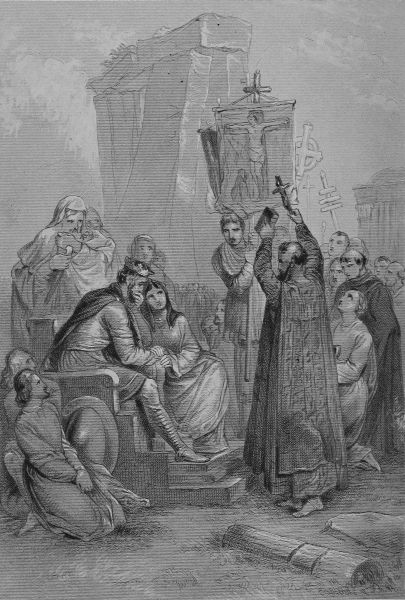
and we must now glance briefly at their change to Christianity,
and the early modes of worship which they adopted. When
they landed in England, they found the Britons generally worshippers
of the True Divinity. Christianity had become grafted
and grown, and overpowered and bore down the remains of
druidism, on which it was first planted. The idolatry that
existed had assumed a more classic form; and instead of the
grim wicker idols of the druids, the sightly forms of the heathen
gods, which the Romans worshipped, had usurped their places.
Among the ancient Cymry who had not come into such close
contact with the Roman conquerors, the old druidical forms of
idolatry still lingered; though through them we are enabled
to catch faint glimpses of the Deity, and to discover a slow, but
sure approach towards the Creator. We have already shown
how the Saxon invasion checked the progress of Christianity—how
the churches were overthrown, and the priests massacred,
until pope Gregory sent over Augustin, who succeeded in
converting the Saxon king, Ethelbert, to the religion of Christ.
How Paulinus accompanied Edilburga into Northumbria, and
Edwin, the king of the Deira and Bernicia, became a convert
to the holy faith. We have shown how the abbey of Croyland
rose up amid the wild marshes of Lincolnshire, and the gospel
sound was carried through the vast territory of Mercia, until
at last the whole of the Saxon Octarchy bowed before the
image of the dying Redeemer. To the forms of worship which
were adopted in these ancient Christian churches, we must now
turn.
A rude wooden cross, planted by the roadside, a humble cell
scooped out of the rock, or a wattled shed, thatched with the
tufted rushes or the broad-leaved water-flags, first marked the
places of worship of the primitive Christians. Some came over,
and settled down upon waste and lonely places; their piety and
peaceful habits soon attracted the attention of the neighbouring
peasantry, and of the chief, who granted them permission to
reside and build upon the soil; allowed them to fell timber in the
adjacent forest, or to hew stone from the distant quarry. Nor were
they long in procuring assistance; many came and laboured for
the love of God; they dug foundations; they mixed cement; the
trees were sawn, and squared into beams; a forge was erected,
and, as the blue smoke curled above the landscape, the clattering
of the brawny smith was heard upon the anvil, as, with his
"buck-horn fist," he shaped the iron which bound together beam
and rafter. At length a tower rose up above the wild waste of
marshes, and morning, and evening, and often at intervals during
the day, the little bell was heard to toll; and as the sound fell
upon the wayfarer's ears who journeyed past, he thought of life,
and death, and heaven. Vast estates were at length given to
them; they received rich donations, houses, and lands, and
forests, which were secured by grants and charters, and attested
by the signatures of kings. These bequests were made from
love—and fear—a hope to escape future punishments, and by
the intercession of the priests to enter heaven.
Thus was a door thrown open, into which good and evil were
promiscuously admitted. The truly pious, and the hardened
sinner, received alike encouragement—bells were rung, and
masses said, no matter for whom, as long as the altar was piled
high with treasure—and mankind were at last wrongfully taught,
that forgiveness could be purchased by wealth. Still the knee
had to be bended, and prayers offered up, penances performed,
and fastings endured, before the conscientious priest promised
to intercede for the sinner. Then instead of the wooden cross,
the naked walls, and the floor strewn with rushes, woven tapestry,
and glaring pictures, graven images, and relics of saints,
costly vessels of gold and silver, rich vestments and dazzling
gems, and all the glitter and pomp which had hitherto been confined
to courts, or borne in triumphal processions, were called up
to decorate the buildings dedicated to God. In place of the
lowly dwelling, scarcely distinguishable from the thatched hut of
the peasant that rose above the waste, mighty fabrics were
erected by skilful architects, whose roofs seemed to rest on the
rim of the horizon, and the traveller looked in vain for those
beautiful openings in the landscape which had so long been
familiar to his eye. Mighty barons, who had distinguished
themselves in many a hard-fought field, became abbots; kings
laid aside their costly robes, their crowns, and sceptres, put on
the grey homely serge of the pilgrim, and, with staff in hand,
journeyed weary miles to kneel before the shrines of saints, and
either left their bones to moulder in a foreign land, or returned
home again to die in the quiet solitude of the cloister—leaving
miles of hill and vale, and wood and river, to enrich the revenues
of the grey abbey in which they expired, amid the shady sadness
of long-embowered aisles.
These religious houses were happy havens for the poor and
needy, the hungry, the wretched, and the oppressed. They
became landmarks to the sick, storm-tossed, and rain-drenched
wayfarer. All who came thither were sheltered and relieved;
none were sent away empty-handed, for spiritual and bodily
comfort were alike administered to all. They were the only
resting places where the traveller could halt, and find refreshment
and welcome, where his steed was stabled, his wants
attended to, and where, without charge, he was dismissed on the
morrow with a prayer and a blessing. Nor did their works of
charity end here: they sent out missionaries to other countries,
to the benighted land from which their ancestors first came,
over the sounding billows, to many a shore whose echoes had
never yet rung back the holy hallelujah. Although there were
many things in their ancient forms of worship which in us
awaken a sigh or a smile, we must remember that religion was
then in its infancy—that they had but few guides, but few
books to instruct them. There were but few able to translate
the gospels from the Latin into the Saxon tongue; such versions
as they were enabled to make were crude and incorrect,
and many of the priests were incompetent to instruct them in
points of faith. They ventured but little further in their instruction
than to teach that the soul was immortal, and lived in
a future state, where the good were rewarded, and the evil
punished; that Christ died for our salvation—that the dead
arose, and the faithful and just would at last be admitted into
eternal glory. Into the more intricate mysteries of our religion
they ventured not. Every priest was commanded to read the
gospels, and to study well the Holy Book, that "he might
teach his people rightly, who looked up to him." Several valuable
MSS. of the translation of the gospel into the Saxon language,
which were written between the reigns of Alfred and
Harold, are still in existence. Although they used the cross as
the sign of their salvation, they were taught not to reverence
the wood, but to bear in mind His form who had suffered upon
it. They held relics in high veneration; and though the remains
of good and holy men cannot be contemplated without awakening
a religious feeling, they carried their reverence to a superstitious
excess; for by them they believed that the greatest miracles
could be worked, and that they were the only safeguards against
disease, magic, and witchcraft. The priests were only allowed
to celebrate mass when fasting; nor, unless in cases of sickness,
was this ceremony to be held anywhere but upon the altar in
the church; and to this altar no woman was permitted to
approach during its celebration; neither dogs nor swine were
allowed to come within the enclosure that surrounded the holy
edifice. The purest of bread, wine, and water, were only to be
used in celebrating the Eucharist, and the sacramental cup was
to be formed of gold, or silver, glass, or tin; and none made of
earth or wood were permitted to be used. The altar was
always to be kept clean, and covered; and the mass-priest was
to have his missal, his psalter, his reading-book, penitential,
numeral, hand-book, and singing-book. He was also to learn
some handicraft, and to abolish all witchcraft. Each priest performed
his allotted duty; the ostiary guarded the church doors,
and tolled the bell; the exorcist drove out devils, and sprinkled
houses which were infested with witches and foul fiends, with
abyssum; the lector read the gospels to the congregation; the
acolyth held the tapers while the lector read; the deacon attended
on the mass-priest, placed the oblations on the altar,
baptized children, and administered the Eucharist to the people;
the sub-deacon had charge of the holy vessels, and waited at the
altar while the mass-priest preached and consecrated the Eucharist.
The bishop was looked up to as a comforter to the wretched,
and a father to the poor; the priests were forbidden to carry
their controversies before a lay tribunal, and when they could
not settle it amongst themselves, it was left to the decision of
the bishop. The high-born were taught not to despise those
that were lowly; they were ordered to teach youth with care—to
give alms, and chaunt holy hymns during the distribution; to
humble themselves, and to become examples of mildheartedness.
Many of the penances they inflicted were severe; he who was
guilty of any heinous offence, was to lay aside his weapons,
travel barefooted many weary miles, nor seek household shelter
during the night. He was to pay no regard to his dress, nor to
enter a bath, neither might he eat flesh, nor taste strong drink,
but fast, watch, and pray, both by day and night. The wealthy,
however, might evade the heaviest penances, by giving alms;
and the following extract will show to what useful purposes the
church applied these penalties:—
"He that hath ability may raise a church to the praise of
God, and if he has wherewithal, let him give land to it, and
allow ten young men, so that they may serve in it, and minister
the daily service. He may repair churches where he can, and
make folk-ways, with bridges over deep waters, and over miry
places; assist poor men's widows, step-children, and foreigners.
He may free his own slaves, and redeem the liberty of those who
belong to other masters, and especially the poor captives of war.
He may feed the needy, house them, clothe and warm them, and
give them baths and beds."
Thus did our pious ancestors make crime administer to the
wants of the poor; they filtered the pure waters of charity from
these corrupt sources, and displayed a wisdom which our modern
legislators have yet to be taught.
When the Saxons first landed in England they could have
had no previous knowledge of the Roman laws, which were then
in existence in our island; for the government of the conquerors
had long overthrown the primitive customs which were in use
among the ancient Britons before the landing of Julius Cæsar.
We have already shown that the earliest of our Saxon invaders
were led on by some military chief, who claimed his descent
from Odin, and was acknowledged as leader by the consent of
his followers, also allowed the largest share of the plunder or
captives which were taken in war. Thus it would naturally
follow, that when they came to settle down upon the soil which
they had conquered, the power of the military chief would soon
be acknowledged, and that to him would be given the greatest
portion of the land; while amongst his followers such shares
would be distributed as were considered proportionate to their
rank. After having conquered and divided the land, they
would naturally unite together to defend the possessions they
had won, and the chief, or his descendant,—if found worthy of
being still retained at their head, by his wisdom or valour—would,
either in peace or war, continue to hold the title and
power of ruler; and thus would governments be formed, thrones
established, and laws made by the wealthy and powerful, to
keep their followers and captives in subjection. Nor would it
be probable in all instances that the conquered were made captives.
Many by their valour and opposition would still present
a formidable front to the invaders; and as both parties would in
time grow weary of a continued system of attack or defence,
concessions would be made, peace agreed upon, the land divided,
vows sworn, and penalties fixed, to be paid by those who first
broke the treaty. In such cases, war would not be entered into
by either party without their first stating the grievances. This,
again, would lead to discussions, assemblies, accusations, defences;
times and places would be allotted for meeting; and so courts
and tribunals were formed; and thus in all countries did law and
civilization commence. We have shown how England was
at first divided into separate kingdoms; how chief after chief
came over, fought, conquered, and established a separate state,
until the Octarchy was formed; and that when the whole island
was occupied, the Saxon kings began to make war upon each
other, until state after state was subdued, and one king at last
reigned over all. That governors had to be placed over different
divisions of this vast extent of territory; that these, again, placed
officers over the sub-divisions: thus there were earls or aldermen,
sheriffs, or shrieves, officers to each hundred or tithing;
headboroughs, frankpledges, who attended the court-leet which
was held at given periods, and accounted for all grievances or
violations of the law. The first laws made would naturally be
those which protected persons and property,—to punish acts of
violence and theft, and to prevent personal vengeance being
inflicted. Thus, murder might be compounded for, under certain
circumstances, at a fixed penalty, and every portion of the body
injured had its price, from the leg to the little finger, even down
to the hair, tooth, or nail. The loss of an eye and a leg appears
to have been considered the most important, and was punished
by a fine of fifty shillings. To lame a person only, the sum
exacted was thirty shillings. To wound, or strike such a blow
as caused deafness, twenty-five shillings; for fracturing the
skull, twenty shillings; for cutting off the little finger, eleven
shillings; tearing off the hair, ten shillings. For tearing off a
nail, or driving out a tooth, the penalty was one shilling; but if
a front tooth, the charge was six shillings. Robbery was
punished according to the rank of the party plundered. If a
freeman committed robbery, he forfeited all his goods and his
freedom; if he was taken in the fact, and the stolen property
found in his hand, the king had the option of killing him, of
selling him, or receiving the value of his Were, which was the
sum at which his life would have been rated had he been murdered.
Even the life of the king had its Were or value. One
hundred and twenty pounds was the price fixed to be paid as
the penalty for the murder of a king. A noble's, a bishop's, an
alderman's, a thane's, a servant's, had each its fixed penalty,
according to the rank of the deceased,—from that of the king,
as above named, to the humblest hind, whose life was rated at
thirty shillings. Besides the Were, there was another protection,
called the Mund. This seems to have been a penalty paid
for disturbing the peace of a man's household; or, as Sharon
Turner has observed, "it was a privilege which made every
man's house his castle." The Saxons had also their bail or
sureties. Thus, when a man had committed homicide, he had
to find borh, or sureties for the payment of the penalty. The
time allowed for payment is not mentioned, excepting in one
case, where it appears to have been limited to forty days. The
head of every tithing, or ten families, also appears to have been
responsible for those under his jurisdiction or keeping, as we
have previously shown in the reign of Alfred. He who had no
surety, or borh, or could not pay the penalty for the crime committed,
or had no kinsman to redeem him, either became a slave,
or might be slain, according to the nature of the offence.
Their mode of trial was very simple, and their general method
of arriving at the innocence or guilt of the party accused appears
to have been influenced by the number and respectability of the
witnesses who swore for or against the prisoner. Thus, if a man
stood charged with any offence, and he could bring the given
number of persons to swear that he was innocent, the prisoner
was acquitted, unless the accusing party could produce a greater
number of witnesses to swear against him, and show clearer
proofs of his guilt. When this was the case, the offender either
submitted to the punishment or underwent the trial of ordeal,
or, as it was considered, submitted to the "judgment of God."
The ordeal consisted either of hot water or hot iron; in some cases
the iron weighed three pounds, and was to be carried nine paces.
The ordeal appears to have taken place in the church; if the trial
was to be by hot iron, a number of men were allowed to enter
the church, and, being ranged on each side, the priest sprinkled
them with holy water; they were then to kiss the Gospel, and
were signed with the cross. The priest afterwards read a prayer,
and during this period the fire was not to be mended, and if burnt
out the iron still rested upon the staples to cool, so that in no
instance could it be red-hot; the paces were measured by the
feet of the accused, and it has been computed that the hot iron
would hardly remain in his hand beyond two seconds. Whether
the culprit moved rapidly or walked slowly, or threw the iron
upon the floor, or placed it on some allotted spot, we cannot tell;
though there is but little doubt that means were taken to render
the trial as short as possible. When the ordeal was by water,
it was sufficient if four witnesses stepped forward to state that
they had seen it boiling; whether the vessel was of iron, copper,
or clay, a stone was placed in it, which the accused with his bare
hand and arm had to take out; the vessel was shallow or deep,
according to the nature of the offence he stood charged with; in
some cases he had only to plunge in his hand to take out the
stone, in others his arm to the elbow. As in the ordeal by heated
iron, the same ceremonies were observed, and during the time
that elapsed in praying and sprinkling the witnesses the fire was
not allowed to be mended; while the act took place, a prayer
was offered up to God to discover the truth. When the trial
was over, the hand or arm was bound up, and the bandages were
not removed until the expiration of three days. It does not
appear that the marks of burning or scalding were the tests of
guilt; it was only when the wounds were found foul and unhealed
that the accused was pronounced guilty; if they looked
healthy and well, and were nearly healed, it was considered a
proof of innocence. It will be readily imagined that few who
were guilty would willingly undergo such a trial, for it must be
borne in mind that punishment still followed; and when the
signs were unfavourable, there can be but little doubt after so
solemn a ceremony that the penalty the accused was doomed to
suffer must have been severe. It could, however, like homicide,
be compounded for; and capital punishment seems seldom to
have taken place amongst the Saxons, unless the crime was committed
in open day, and the culprit was caught in the fact, or
under such circumstances as were considered too clear to need
any trial; in such cases, vengeance was generally taken on the
spot, and the robber or murderer was either hanged upon the
nearest tree, or slain where he was captured—no evidence was
required,—no defence was allowed.
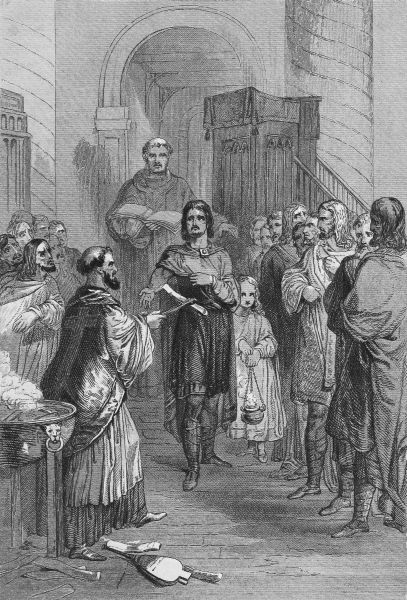
Trial by Ordeal.
There were two other forms of ordeal, called the cross and the
corsned; the former consisted of two pieces of wood, which were
covered over, one bearing the mark of the cross; if the accused
drew this, he was considered innocent; if the piece that was unmarked,
guilty. The other consisted in swallowing a piece of
bread which the priest had blessed; if it stuck in the throat, or
the culprit turned pale, or trembled, or had a difficulty in swallowing
it, he stood condemned. Besides fines, many of the
punishments they inflicted were severe; they used the whip and
the heated brand, mutilated the face, imprisoned, banished, sentenced
the guilty to slavery, or doomed them to suffer imprisonment,
while their capital punishments appear to have been
hanging and stoning to death. The land was divided into what
was called "folkland" and "bocland." The folkland was such
as belonged to the king and the people; that which was held by
agreement or charter was called "bocland," or land made over by
agreement of the book, or some written instrument, though conveyances
of land were sometimes made by the delivery of an
arrow, a spear, or any other object. The king had, however,
his bocland or private property, as is proved by the will of king
Alfred; and the word folkland in time was changed to crownland,
which, no doubt, means that the wastes and commons
which the people were allowed to make use of, and were not
private property, were considered to belong to the king or the
state. Boclands appear originally only to have been granted
during the life of the holder. It was the work of time and the
change of events which caused them to become hereditary. The
Saxons were divided into many classes or ranks; first stood the
king, then the earls, nobles, or chiefs; then came the other class
of small landed proprietors; and below these another grade, whom
we may term freemen; the theows, ceorls, or villains, came
last, and were slaves of the soil; if the estate changed hands,
the theow went to the next owner; on no account could he remove
from the land; he was, however, protected, and, so long as
he did his duty, could not be removed by the owner; neither
could more than a regular portion of labour be exacted from
him; but we have before alluded to his privileges in the laws of
Ina. The ceremonies used at their witenagemotes, guilds, moots,
and other courts, are matters of law rather than subjects suited
to a narrative and picturesque history of England.
We have no proof that the early pagan Saxons possessed an
alphabet, or had any acquaintance with a written language,
until the introduction of Christianity; for, unlike the Britons,
they had not the enlightened Romans to instruct them. Even
as late as Alfred's time, we have shown that but few of the
English chiefs could either read or write; and we find Wihtred,
king of Kent, as long after the Saxon invasion as the year 700,
unable to affix his signature to a charter, but causing some
scribe, who had probably drawn up the document, to add as an
explanation to the royal mark, that "I, Wihtred, king of Kent,
have put this sign of the holy cross to the charter, on account
of my ignorance of writing." As the Saxons were the avowed
enemies of the ancient Cymry, and came amongst them only to
slay, destroy, and take possession of the land, it is easy to account
for the length of time that must have elapsed before the
Britons would impart the knowledge they had gathered from
the Romans to their Saxon conquerors.
One of the earliest histories we possess is that to which the
name of Gildas is affixed, who appears, however, to have belonged
to the Cymry, and to have had a brother at that period
who was celebrated as one of the Welsh bards. To him we
have already alluded; also to Nennius, who is said to have been
one of the monks of Bangor, and to have had a narrow escape
from the massacre, in which so many of his brethren perished.
To his early history of Britain we have before alluded. Columbanus,
a celebrated Irishman, who died in Italy about the year
615, appears to have been well acquainted with both the Greek
and Hebrew languages. Literature at this period seems to
have been confined principally to the monasteries; and towards
the close of the sixth century, we find Aldhelm, an abbot of
Malmsbury, celebrated for his Latin writings. "But his meaning,"
says Sharon Turner, "is clouded by gorgeous rhetoric: his
style an endless tissue of figures, which he never leaves till he
has converted every metaphor into a simile, and every simile
into a wearisome episode." But the venerable Bede's is the
most distinguished name amongst the early Anglo-Saxon
writers. He also wrote in Latin, and his ecclesiastical history
of England still stands as the chief authority, whence we
derive the clearest knowledge of the manners and customs of
the early Anglo-Saxons. He was born about 670, or 680, at a
village named Yarrow, which stands near the mouth of the
Tyne, and was educated at the neighbouring monastery of
Wearmouth. He was acquainted with Egbert, the learned archbishop
of York, to whom he addressed a letter, which is still
extant. Egbert left behind him a famous library, mention of
which is made by the celebrated Alcuin, who proposed to Charlemagne
that the boys he was educating should be sent out of
France, to "copy and carry back the flowers of Britain, that the
garden might not be shut up in York, but the fruits of it placed
in the paradise of Tours." Though both writing in the same
language, and about the same period, no two authors out of the
thousands who have since lived and written, have ever exhibited
a greater contrast in the style of composition than that which
exists between the writings of Aldhelm and Bede. "The style
of Bede," says Turner, "in all his works, is plain and unaffected.
Attentive only to his matter, he had little solicitude for the
phrase in which he dressed it; but, though seldom eloquent, and
often homely, it is clear, precise, and useful." Alfred was
the first who translated the works of Bede into Saxon, and
made them familiar to his subjects. Alcuin, who speaks so
highly of the library collected at York by the archbishop Egbert,
was sent on an embassy by Offa, surnamed the Terrible,
to Charlemagne. Alcuin was a pupil of Bede's, and a native of
Northumbria; and while he resided in France, he was instrumental
in persuading the emperor to collect many valuable manuscripts.
His works seem to have been written for the use and
instruction of his friend and patron, the emperor Charlemagne;
and, though highly valuable in their day, they lack that living
spirit which was infused into the writings of Bede.
But few of the civilized nations of Europe possess works
which will bear comparison with those produced by our early
Saxon writers; nor has any other of the Gothic tribes, from
which our old Germanic language sprung, a literature of so old
a date, that in any way approaches to the perfection attained by
the early Anglo-Saxons. What we possess is wonderful, considering
the short time that elapsed from the first introduction
of letters amongst the Saxons, to the troubles which followed
the Danish invasion, when so many monasteries and libraries
were destroyed by those illiterate but brave barbarians. The
first business of the Saxons, after they had ceased fighting,
and settled down in England, would be to build and plant; and
much time and labour would be required in erecting their habitations,
preparing a supply of food, and defending their possessions
in a new and hostile country, before they would be enabled
to find leisure to direct their thoughts to literature, or do anything
more than establish those civil institutions which were
necessary for the protection of the colony. They had that work
to do which we find ready done to our own hands; fields to inclose,
and roads to make; and even the monks to whom we are
indebted for our earliest writings were at first compelled to
assist in building the monasteries they wrote in, and to cultivate
the waste lands which lay around them: yet, in spite of these
drawbacks, what wonderful progress was made in literature by
the close of the reign of Alfred! Though illiterate, the early
Saxons were a highly intelligent race: look at the speech of
the chieftain we have already quoted in the reign of Edwin,
the king of Deiri—the beautiful and applicable imagery of the
bird, the warm hall it enters in winter, and the cold and darkness,
which is compared to death, that reigns without; all
evince a fine appreciation of the true elements which constitute
poetry; yet we have no doubt in our own minds that this
heathen orator could neither read nor write. When the Saxons
once turned their attention to letters, none of the barbarous nations
excelled them—the progress made during the reign of
Alfred, we again repeat, is marvellous.
Nothing can be more primitive than our Anglo-Saxon poetry.
Every line bears the stamp of originality. The praise of brave
warriors is ever the subject. It has always been the same. They
but extolled what then stood highest in their estimation—the
brave—the giver of rewards—the terror of enemies—the leader
of battles are but the plaudits of men put into metre—the
natural outbreak of admiration. Watch a fond mother when
alone, talking to her infant—nature is still the same—she
addresses it as her darling, her dearest, her life, her delight;
and when she has exhausted every endearing epithet—uttered
every fond word that her heart dictated, she evinces her affection
by caresses. To what lengths could we extend the comparison!
But neither mother nor child in those days called forth
the lavish praises which were expended on a brave chieftain.
We need only refer to the extracts we have already given in
the body of our history, from the Welsh bards, to prove this.
The literature in no country was ever built upon so original a
foundation as that of the Anglo-Saxons. Their language at an
early period was enriched by the Danish: their habits resembled
those of the sea-kings. Long before the Norman
conquest, they had melted into one; the sea-horses, and the
road of the swans, were to them familiar images; there was a
sublimity about the ocean, and the storm, and the giant headlands,
which they felt and understood; and had we the space,
we could fill pages with proofs of this grand poetical appreciation—of
this natural inspiration. The Saxon ode which
celebrates Athelstan's victory at Brunanburg bears evidence
of the fiery spirit which the Scandinavians diffused. Neither
drew from the classic stores of Rome or Greece.
Their homilies and graver works scarcely come within the
compass of our history; they require more serious treatment
than we are able to bestow upon them. Those attributed to
Alfric are now on the eve of becoming widely known; and we
doubt not but that, in the course of time, the study of the
Anglo-Saxon language will be pursued by every man who
aspires to literature. A few days' attention to it, renders the
reading of Chaucer easy; and although it may be long before
the student is enabled to decypher an old Saxon manuscript,
yet he will be rewarded by the facility with which he will get
through our early stores of black-letter lore.
Ballads were sung in the English streets before the time of
Alfred. Our music and singing-parties are nothing new. More
than a thousand years ago, the harp sounded in the festal hall,
accompanied by the voice of the singer. Look at the beauty of
the following extract. It is an old Saxon ditty, and was known
long before the Normans invaded England. Read it; then turn
to some of our specimens of modern versification. The exile is
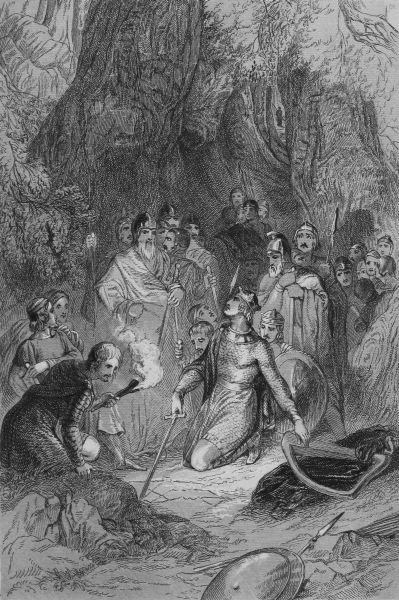
banished from his friends, and encounters many hardships. He
is doomed to dwell in a cave within the forest; and thus he
complains:—
This earthly dwelling is cold, and I am weary;
The mountains are high up, the dells are gloomy,
Their streets full of branches, roofed with pointed thorns;
I am weary of so cheerless an abode.
My friends are now all in the earth—
The grave guards all that I loved;
I alone remain above, and thitherward am I going.
All the long summer day I sit weeping
Under the oak tree, near my earthly cave,
And there may I long weep.
The exile's path still lies through a land of troubles;
My mind knows no rest—it is the cave of care.
Throughout life has weariness ever pursued me.
This passage wants but the polish of Shakspere, and to be
uttered by his own mournful monarch, king Richard the Second,
to be worthy of a place in his immortal writings.24
That the Saxons possessed considerable skill in architecture
before they took possession of England, we have already shown
in our description of the Pagan temple, which was erected in
their own country.25 It is also on record, that the Christian
missionaries sent over by Pope Gregory, converted the heathen
temples, which they found already erected in our island, into
churches, destroying only the idols they found therein; but
whether these edifices were erected by the Britons or Romans,
or by the Saxons themselves, it is difficult to decide. All we
know for a certainty is, that the church in which Augustin and
his monks were located on their arrival at Canterbury was called
an ancient British temple, and was probably built by the first
Christians who were converted by the Romans. The earliest
churches which the Saxons erected after their conversion to
Christianity were formed of wood, and covered with thatch; and
even as late as the time of Chaucer, we find mention of the
sacred edifices being roofed with the same substance. The celebrated
cathedral of Lindisfarne could boast of no costlier material
than sawn oak and a straw roof, until Eadbert, the seventh
bishop, removed the thatch, and threw over the rafters a covering
of lead. The minster of York, founded by Edwin, after
his marriage with Edilburga, the daughter of Ethelbert, was
built of stone; and as early as 669, we find mention of the
windows being glazed. Prior to this period, the windows consisted
of mere openings in the walls, through which the light
was admitted; they were called eye-holes, and were protected
by lattice-work, through which the birds flew in and out, and
built inside the fabric; nor was there any other means of keeping
out the rain and snow, excepting by lowering down the
simple linen blinds. The few remains we possess of Saxon
architecture display great strength and solidity without grace.
The columns are low and massy, the arches round and heavy,
seeming as if they formed a portion of the bulky pillars, instead
of springing from them with that light and airy grace which
is the great beauty of Gothic architecture. Their chief ornament
in building appears to have been the zig-zag moulding
which resembles sharks' teeth. The very word they used in
describing this form of ornament also signified to gnaw or eat;
and from the Saxon word fret, or teeth work, the common term
of fret-work arose. Towards the close of the seventh century, the
celebrated bishop Wilfrid, who had visited Rome, made great improvements
in ecclesiastical architecture. He brought with him
several eminent artists from Italy; and as he stood high in the
favour of Oswy, king of the Deiri and Bernicia, he was enabled
to reward his architects liberally. He restored the church which
Paulinus founded at York. But the most celebrated edifice
he raised, appears to have been the church at Hexham, of which
the following description is given by Richard, who was the
prior of Hexham, and who wrote while the building still existed
about the close of the twelfth century:—"The foundations of
this church," says prior Richard, "were laid deep in the earth
for the crypts and oratories, and the passages leading to them,
which were then with great exactness contrived and built under
ground. The walls, which were of great length, and raised to
an immense height, and divided into three several stories, or
tiers, he supported by square and various other kinds of well-polished
columns. Also, the walls, the capitals of the columns
which supported them, and the arch of the sanctuary, he decorated
with historical representations, imagery, and various figures
in relief, carved in stone, and painted with a most agreeable
variety of colours. The body of the church he compassed about
with pentices and porticoes, which, both above and below, he
divided, with great and inexpressible art, by partition walls and
winding stairs. Within the staircases, and above them, he
caused flights of steps and galleries of stone, and several passages
leading from them, both ascending and descending, to be artfully
disposed, that multitudes of people might be there, and go quite
round the church, without being seen by any one below in the
nave." Prior Richard goes on further to state, that he also
caused several altars to be erected to the blessed saints. In 767,
the church of St. Peter's at York having been either damaged or
destroyed by fire, was rebuilt by archbishop Albert, assisted by
the celebrated Alcuin. Here, also, we find mention of lofty
arches, supported on columns, of vaultings, windows, porticoes,
galleries, and altars, richly ornamented. What additions the
genius of Alfred made to the architecture of the period we know
not. We have, however, already shown that he set apart a great
portion of his revenue to the building and repairing of churches.
But he lived amid stormy times, when the strengthening of
military fortresses was of more consequence to the welfare of
his kingdom than the erection of costly edifices; and during the
ravages of the Danes the fine arts appear not to have made any
advance.
We have scarcely any records of the domestic architecture of
the Saxons, but may safely infer, from the simple style of their
early churches, that their houses were built of wood, and
thatched with reeds, and we have proof that timber houses continued
until a comparatively modern period.
Of their painting and sculpture we know but little: the horn
of Ulphus, which is still preserved, is beautifully carved; and
we find mention of the tomb of the bishop of Hexham having
been richly decorated. Their paintings seem to have been imported
from Rome, and were principally pictures of saints and
martyrs, which appear to have formed the most attractive
ornaments in their churches. Their illuminated missals we
have already alluded to. The Saxon ladies were skilful embroiderers,
weavers, and spinners, arts in which the daughters
of Edward the Elder excelled. Even the celebrated St.
Dunstan, with all his surliness, deigned to draw patterns for
his fair countrywomen to copy in their embroidery. Among
other costly gifts, mentioned in a Charter relating to Croyland
Abbey, granted by a king of Mercia, we find a golden veil, on
which was enwrought the famous siege of Troy. Many of the
initial letters, already mentioned, are of the most intricate patterns,
scroll is interlaced within scroll, chain-like links, and
heads of birds and serpents, running into the most beautiful
flourishes, and compelling us to admit that the Saxons were
either excellent copyists, or gifted with considerable invention.
Their musical instruments consisted of horns, trumpets, flutes,
drums, cymbals, a stringed instrument not unlike the violin,
which was played upon with a bow, and the harp; and in their
churches organs which must have shaken the sacred buildings
with their powerful tones. Dunstan was celebrated for his skill
upon the harp; he also made an organ with brass pipes, and
made several presents of bells to the Saxon churches. From
the description given of a harp in an old poem, it was made of
birch-wood, with oaken keys, and strung with the long hairs
pulled from the tails of horses. The cymbals were formed of
mixed metals, and when played, struck on the concave side, as
they are now; and Bede dwells upon their beautiful modulation
in the hands of a skilful player. He describes the drum as
having been made of stretched leather, fastened on rounded hoops,
and which emitted a loud sound when struck—he mentions
tones, and semi-tones, and thus concludes his remarks on the
power of music: "Among all the sciences this is the more
commendable, pleasing, courtly, mirthful, and lovely. It makes
men liberal, cheerful, courteous, glad, and amiable—it rouses
them to battle—it exhorts them to bear fatigue, and comforts
them under labour: it refreshes the mind that is disturbed,
chases away headache and sorrow, and dispels the depraved
humours, and cheers the desponding spirits." We find the
Saxon organs described as rising high, some having gilded pipes,
and many pairs of bellows; one especially is pointed out by the
monk Wolfstan, as having stood in Winchester cathedral.
"Such a one," says the monk, "had never before been seen."
"It seems to have been a prodigious instrument," says Sharon
Turner, in a note to his History of the Anglo-Saxons. "It had
twelve bellows above, and fourteen below, which were alternately
worked by seventy strong men, covered with perspiration,
and emulously animating each other to impel the blast with all
their strength. There were four hundred pipes, which the hand
of the skilful organist shut or opened as the tune required.
Two friars sat at it, whom a rector governed. It had concealed
holes adopted to forty keys; they struck the seven notes of the
octave, the carmine of the lyric semi-tone being mixed. It
must," adds the learned historian, "have reached the full sublime
of musical sound, so far as its quantity produces sublimity."
In arithmetic, they simply studied the division of even numbers,
separating them into those "metaphysical distinctions of
equally equal, and equally unequal," though they seem to have
attained something approaching to perfection in calculation. In
natural philosophy, Bede was far in advance of many of the
Roman writers. In astronomy, they drew their information
from such Greek and Latin treatises as chanced to fall into
their hands. They believed that comets portended war, pestilence,
and famine, and all those evils which the ignorant still
attribute to their appearance in the present day. Of geography
they knew but little, until the work of Orosius was translated
by our own Alfred. They trusted to cure diseases by charms,
though they were not without physicians, herbs being what they
principally used for medicine; and, no doubt, many of our village
herb-doctors, who trust to the full or wane of the moon, for
finding the healing virtues in their favourite plants, are fair
samples of the early Saxon practitioner in the same art; and
that many such old books, as "The Gentlewoman's Closet," &c.,
contain the genuine recipes used by the Saxons. From a rare
original work, in our possession, we quote the following, whose
counterpart may be found in many a valuable Saxon MS.: "The
sixth and tenth days of March shalt thou draw out blood of the
right arm, the eleventh day of April, and in the end of May, of
which arm thou wilt, and that against a fever; and if thou dost,
neither shalt thou lose thy sight, nor thou shalt have no fever so
long as thou livest!" He who fell sick on the first day of the
month, was supposed to be in danger for three days after; on the
second day, would get well; on the third, was to be ill for twenty-eight
days; on the fourth, to escape; on the fifth, to suffer
grievously; on the eighth, "if he be not whole on the twelfth day,
he shall be dead." And so on for every day throughout the
month and year.26
Of the every-day life and domestic manners of our Anglo-Saxon
forefathers, we possess considerable information, partly
from written records, such as charters, wills, grants, and leases,
but more especially from the drawings which we find in the
ancient manuscripts which are still preserved. Amongst the
higher classes we discover that the walls were hung with tapestry,
ornamented with gold and rich colours, for the needles of
the Saxon ladies seem ever to have been employed in forming
birds, animals, trees, and flowers, upon the hangings which were
so necessary to keep out the wind that must have blown in at
every chink of their wooden apartments. Their garments were
loose and flowing, that of the men consisting of a shirt, over
which they wore a coat or tunic, open at the neck and partly up
the sides, having wide sleeves which reached to the wrists; and
as this was ample enough to be put on by slipping it over the
head, (not unlike the common frock worn by our carters or peasantry,)
it was occasionally, and no doubt always in cold weather,
to make it sit closer, confined to the waist by a girdle or belt.
Over this they occasionally wore a short cloak, which was fastened
to the breast by a brooch or loop; they also wore drawers
or long hose, which were bandaged crosswise, from the ankle to
the knee, with strips of coloured cloth or leather. Their shoes,
which were open at the front, were secured by thongs; and
though the poorer classes are sometimes represented as bare-legged,
yet they are seldom drawn without shoes, which are
generally painted black, while many of them wear the short
stocking or sock. That their shoes were made of leather is expressly
stated by Bede, who describes St. Cuthbert, as often
keeping on his shoes for months together, and that it was with
difficulty he could be persuaded to take them off, to permit his
feet to be made clean. Hats or caps they seem rarely to have
worn, although there are one or two instances in which they
appear. They seem generally to have gone bareheaded, excepting
when in battle; then they wore a pointed helmet. In nearly all
the early illustrations, we find the hair worn long, parted in the
middle, and falling down upon the neck and shoulders. The
beard is also long and forked. Silk garments were not uncommon
amongst the nobles: as early as the time of Ethelbert, king
of Kent, mention is made of a silk dress. We also read of a
coronation garment, which was made of silk, and woven of gold
and flowers. In the churches the altars were generally covered
with silk, and at his death, the body of the venerable Bede was
enclosed in a silken shroud. The Saxon noblemen seem to have
been lavish in their ornaments, and to have worn costly bracelets
on their arms, and rings upon their fingers—the ring
appears to have been worn upon the third finger of the right
hand—it was called the gold finger, and the penalty for cutting
this off was greater than for amputating any of the other fingers.
Furs of the sable, beaver, fox, martin, and other animals, were
also worn, and amongst the poorer classes the skins of lambs and
sheep.
The costume of the Saxon ladies seems to have varied but
little, excepting in length, from that worn by the men. The
gunna, or gown, which was worn over the skirt or kirtle, was
of the same form as the tunic already described; it was a little
shorter than the kirtle, which reached to the feet—the latter
being covered by shoes similar to those already mentioned. The
women, however, wore a head-dress, formed of linen or silk,
which looks not unlike the hood of comparatively modern times.
It was called the head-rail, and besides forming a covering for
the head, was made to enfold the neck and shoulders, not unlike
the gorget which we see in ancient armour, in appearance; but
formed by throwing fold over fold—making the face appear as
if it looked out from a close-fitting helmet or gorget. Nor were
the Saxon ladies at all deficient in ornaments. They had their
cuffs and ribbons, necklaces and bracelets, ear-rings and brooches,
set with gems—were quite adepts at twisting and curling the
hair; and, as it is the historian's duty to tell the whole truth, we
are compelled to confess, that at this early period they were also
guilty of painting their cheeks, so that England has long had its
rouged, as well as its rosy daughters. We read also of pale tunics,
of dun-coloured garments, of white kirtles—and, in the Anglo-Saxon
illustrations, we see robes of purple bordered with yellow,
of green striped with red, of lilac interlaced with green, crimson
striped with purple, all showing that a love of rich and pleasing
colours was, above a thousand years ago, common to the ladies
of England. Gloves appear to have been rarely worn. The
sleeve of the tunic was made long enough to be drawn over the
hand in cold weather; where the glove is represented, the thumb
only is separate, the remainder of the fingers are covered, without
any division, like the mits, or mittens, worn by children at the
present day. The military costume we have already described:
nor does it appear to have undergone any alteration until after
the Norman Conquest. They wore helmets, had wooden shields
covered with leather, rimmed, and bossed with iron, had a kind
of ringed armour to defend the breast, and such weapons as we
have frequently made mention of in our descriptions of the battles.
Turning to their furniture, we find, that besides benches and
stools, they had also seats with backs to them, not unlike the
chairs or sofas of the present day. Many of these are richly
ornamented with the forms of lions, eagles, and dragons; and no
better proof need be advanced than this profusion of carved
work, to show, that in their domestic comforts they had stepped
far beyond the mere wants and common necessaries of life, and
made considerable progress in its refinements and luxuries.
Their chairs and tables were not only formed of wood richly
carved, but sometimes inlaid with gold, silver, and ivory. Nor
were the eating and drinking vessels of the nobles less costly.
Mention is made of gold and silver cups, on which figures of
men and animals were engraven; and the weight of some of
these was from two to four pounds. They covered their tables
with cloths; had knives, spoons, drinking-horns, bowls, dishes,
but in no instance do we meet with a fork. The roast meat
or fowl appears to have been served on long spits; each guest
cut off what he approved of, and then the attendant passed on
to the next, who also helped himself—the bread and salt standing
ready for all upon the table. The Saxons were hard drinkers—mead,
wine, and ale flowed freely at their feasts; and it seems to
have been a common custom for the guests to have slept in the
apartment where the feast was held; for we read of the tables
being removed, of bolsters being brought into the hall, and the
company throwing themselves upon the floor, their only covering
being their cloaks or skins, while their weapons were suspended
from the boarded walls over their heads. Bedsteads were, however,
in use, though they appear to have been low; the part
where the head rested was raised like the end of a modern
couch; beds, pillows, bed-clothes, curtains, sheets, and coverlets
of linen and skins, are occasionally mentioned in the old Saxon
wills, where we also find both the words sacking and bolster.
The bed-pillows appear occasionally to have been made of
plaited straw; and in one place we find mention of bed-curtains
formed of gilded fly-net, but what this may have been we are
ignorant of. We read also of candlesticks, hand-bells, and mirrors,
being made of silver. Glass appears to have been used
more sparingly, though it is mentioned by Bede as being "used
for lamps and vessels of many uses." The use of the bath is
also frequently named; and we find them using frankincense,
pepper, and cinnamon, and other spices.
England, at this period, abounded in woods, and the chief
meat of the Saxons appears to have been the flesh of swine.
Swine are frequently mentioned in wills. They were given in
dowries, bequeathed to abbeys and monasteries, together with the
land on which the swine fed. Oxen and sheep they used more
sparingly; and it is very probable that they were not at this
period so plentiful as swine. Deer, goats, and hares, and several
varieties of fowl, were also used for food. Of fish, the eel appears
to have been the most abundant. Eels were often received in
payment of rent; estates were held by no other form than that
of presenting so many eels annually; and eel-dykes are mentioned
as forming the boundary lines of different possessions.
Herrings, salmon, sturgeons, flounders, plaice, crabs, lobsters,
oysters, muscles, cockles, winkles, and even the porpoise, is
named amongst the fish which they consumed. Cheese, milk,
butter, and eggs, were among the common articles of the food
of the Saxons. They used also both wheat and barley bread,
and had wind and water mills to grind their corn. They appear
to have been great consumers of honey; and amongst their vegetables,
beans and colewort are frequently mentioned. In their
soups they used herbs; and amongst their fruits we find pears,
apples, grapes, nuts, and even almonds and figs were grown in
the orchards which belonged to the monasteries. Salt was extensively
used; and they seem to have slaughtered numbers of
their cattle in autumn, which they cured and salted for winter
consumption; and from this we might infer that there was a
scarcity of fodder during the winter months. They boiled,
baked, and roasted their victuals as we do now. Mention is
made of their ovens and boiling vessels, and of their fish having
been broiled. To eat or drink what a cat or dog had spoiled,
they were compelled afterwards to undergo a penance; also, if
any one gave to another any liquor in which a mouse or a
weazel had been found dead, four days' penance was inflicted;
or if a monk, he was doomed to sing three hundred psalms.
There seem to have been ale-houses or taverns at a very early
period; and we find a priest forbidden to either eat or drink in
those places where ale was sold. So plentiful does animal food
appear to have been, that a master was prohibited from giving
it to his servants on fast-days; if he did, he was sentenced to
the pillory.
Beginning with their in-door sports and pastimes, we find
games similar to chess and backgammon amongst their social
amusements, while gleemen, dancers, tumblers, and harpers, contributed
to their merriment. In the early illuminations we see
jugglers throwing up three knives and balls, and catching each
alternately, just as the same feat is performed in the present day.
The Saxons were also great lovers of the chase. Alfred, as we
have shown, was a famous hunter; and Harold received his surname
of Harefoot through his swiftness in following the chase.
Boars and wild deer appear to have been their favourite game,
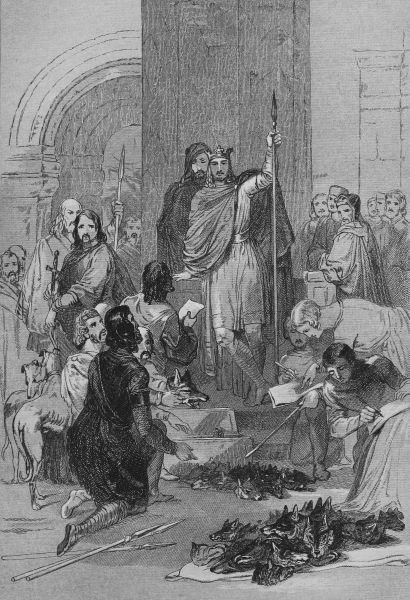
and sometimes they hunted down "the grey wolf of the weald."
Wolf-traps and wolf-pits are often mentioned in the Saxon
records. England was not in those days cursed with game-laws.
Every man might pursue the game upon his own land, and
over hundreds of miles of wood and moor-hill, dale and common,
without any one interfering with him. There was no exception
made, only to the spot in which the king hunted, and this restriction
appears only to have been limited to the time and
place where he followed the chase. When the royal hunt was
over, the forest was again free. The Saxons hunted with hawks
and hounds; and Alfred the Great wrote instructions on the
management of hawks. Nets, pits, bows and arrows, and slings,
were also used for capturing and destroying game.
The women were protected by many excellent laws; and violence
offered to them was visited by such severe pains and penalties as
make us ashamed of the justice which the insulted female obtains
in modern times when she seeks redress. The first step towards
marriage consisted in obtaining the lady's consent, the second
that of her parents or friends; the intended husband then pledged
himself to maintain his wife in becoming dignity; his friends were
bound for the fulfilment of his engagement. Next, provision was
made for the children; and here, again, the husband had to find
sureties. Then came the morgen-gift, or jointure, which was
either money or land, paid or made over the day after the marriage.
Provision was also made in case of the husband's death,
but if a widow married within twelve months of her widowhood
she forfeited all claim to the property of her former husband.
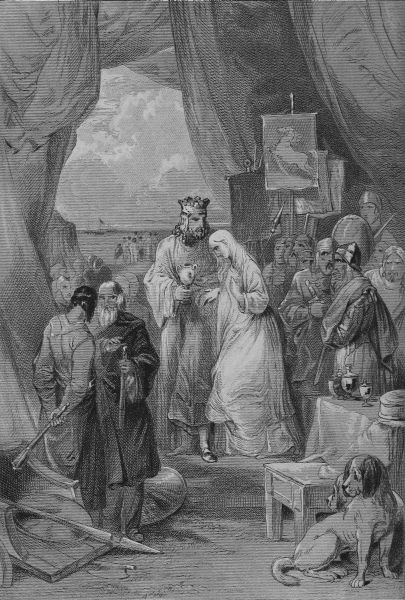
The marriage ceremony was solemnized by the presence of the
priest, who having consecrated their union, prayed for the
Divine blessing to settle upon them, and that they might live in
holiness, happiness, and prosperity. Women had property in
their own right, which they could dispose of without the husband's
consent; they were also witnesses at the signing of deeds
and charters. In the Saxon manuscripts we never meet with the
figures of women engaged in out-of-door labour; this was always
done by the men, although the wealthy classes had their slaves
of both sexes. To women the household occupation seems solely
to have belonged. Alfred the Great wrote the following beautiful
description of the love of a wife for her husband:—"She
lives now for thee, and thee only; hence she loves nothing else
but thee. She has enough of every good in this present life,
but she has despised it all for thee alone. She has shunned it
all because she has not thee also. This one thing is now wanting
to her; thine absence makes her think that all which she
possesses is nothing. Hence, for thy love she is wasting; and
full nigh dead with tears and sorrow." Who can doubt but that
this passage describes his own feelings, when he wandered
hungry and homeless about the wilds of Athelney, and thought
of her he had left weeping in solitude behind? It is one of the
many beautiful original passages which are found in his Boethius,
for Alfred was no mere translator, but enriched his author from
the storehouse of his own thoughts.
While pagans, the Saxons frequently burnt the bodies of their
dead, but this custom they for ever abandoned after they became
converts to Christianity. Their first mode of interment appears
to have been a grave, in which they placed the body without
any covering excepting the earth which was thrown over it.
Sometimes the body was rolled in a sheet of lead; and at Swinehead's
Abbey, in Lincolnshire, several skeletons have been dug
up lately, wrapped round with the same material, but without any
vestige of a coffin appearing; though this is no proof of wooden
coffins not having been used at the period of interment, which
through the lapse of long centuries may have decayed and
mingled with the soil. Stone coffins were commonly used by
the wealthy, and but few were at first allowed to be buried within
walled towns. By degrees the churches began to be used as
places of sepulture, though only men distinguished for their piety
and good works appear at first to have been buried in these
ancient edifices. After a time, the churches and church-yards
became crowded with graves, and then the bodies were removed
to some distance for burial. The passing-bell was rung at a
very early period; it is mentioned by Bede, and there is but
little doubt that the custom dates from nearly the first introduction
of Christianity. The clergy, on the death of a person, received
a payment, called the "soul-scot," which at times amounted
to an immense sum; even land was left by the dead, that prayers
might be offered up for the welfare of the soul; and thus in
early times the churches were enriched. The burial of Archbishop
Wilfred, in the eighth century, is thus described by
Eddius:—"Upon a certain day, many abbots and clergy met
those who conducted the corpse of the holy bishop in a hearse,
and begged that they might be permitted to wash the body, and
dress it honourably, as befitted its dignity. This was granted;
and an abbot named Baculus then spread his surplice on the
ground, and the brethren depositing the body upon it, washed it
with their own hands, then, dressing it in the ecclesiastical habit,
they carried it along, singing psalms and hymns as they proceeded.
When they approached the monastery, the monks came
out to meet it, and scarcely one refrained from shedding tears
and weeping aloud. And thus it was borne, amid hymns and
tears, to its final resting-place, the church which the good bishop
had built and dedicated to St. Peter." The Saxons had also
gilds or clubs, in which the artizans, or such as seem to have
consisted of the middle classes, subscribed for the burial of a
member, and a fine was inflicted upon every brother who did
not attend the funeral. Thus, above a thousand years ago, were
burial societies established in England—a clear proof of the
respect which the Saxons paid to their dead.
Savill & Edwards, Printers, 4, Chandos-street, Covent-garden.