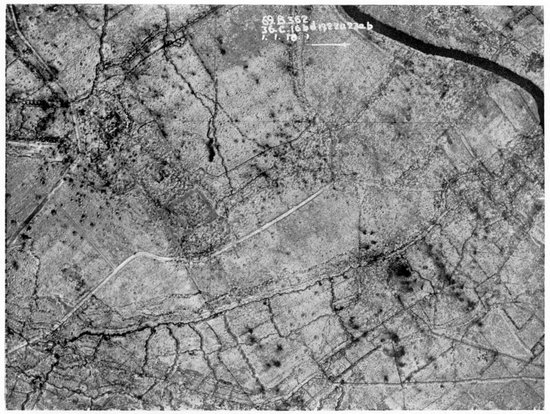
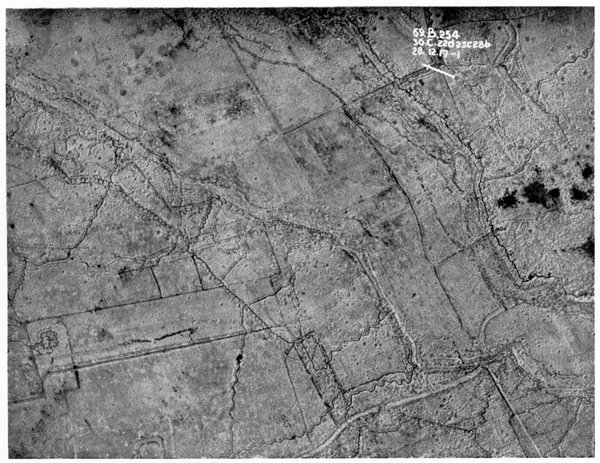
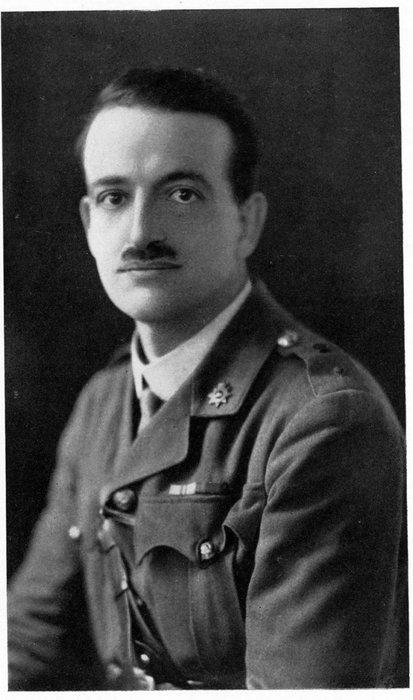
On April 19th we received orders to reconnoitre the Boutillerie
sector, held by the 2/5th King's Own Royal Lancaster Regiment,
with a view to early relief; and the Commanding Officer, Adjutant,
and Company Commanders proceeded the same day to Foray
House, the "King's Own" Headquarters. This sector was
a combination of the old Boutillerie trenches, held by us in
February, and the trenches on our immediate right. There
had been several British and enemy raids since then, and the
damage caused had been considerable. The difficulty of maintaining
2,800 yards of front in a decent state of repair throughout
its whole length had further impaired the condition of
the trenches, and we were not surprised to find serious signs
of decay on every hand. Our first experience, moreover,
of walking quite considerable distances—i.e., several hundred
yards—without finding a trace of the defenders proved very
instructive, and showed us what to expect for the future. The
next day (April 20th, 1917) these orders were cancelled, and we
were now informed that on the 26th we were to take over the
Houplines sector in front of Armentières from the Australians.
We set out once more on a tour of exploration. We rode to the
Australian Brigade Headquarters in the Rue Jesuit, and thence
on foot along the Houplines road to Tissage Dump, where the
trenches began.
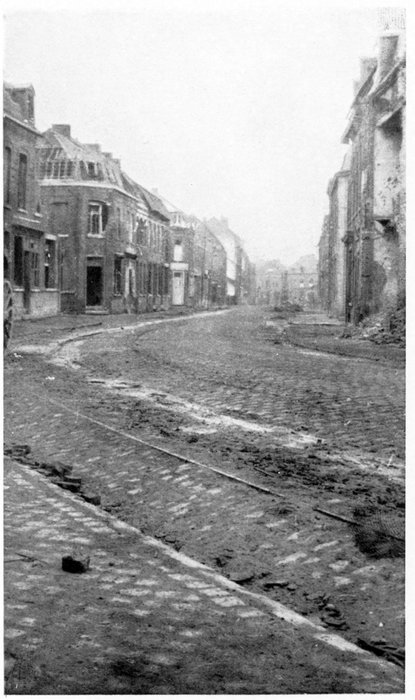
Those who now saw Armentières for the first time might well
be impressed by the feeling of desolation which prevailed. The
silent, shuttered houses, the empty streets, the ruins and the
débris were familiar from the villages which had been already
visited, but nowhere hitherto had the picture been on so large a
scale as here. Armentières had been a bright and busy town before
the war, with a population of some 30,000 people. Large spinning
factories, fine houses and handsome shops abounded. Many
of the streets, it is true, still contained quite a number of inhabitants;
but as you made your way down the Rue Jesuit
towards the line, fewer and fewer grew the signs of any civil population,
and more and more battered became the houses. It is a
long walk to Tissage Dump. On the left you soon passed Barbed-Wire
Square, then quite a pleasant grass-grown square with
young trees just beginning to bud. In the far corner a wonderful
green and blue tiled house had apparently been the residence of
a lady fortune-teller. The next landmark was the level-crossing,
beside which a huge church bell was suspended on a wooden
frame to give warning against gas. The road a little farther on
swung round first to the right, past some very dilapidated workmen's
cottages of a curious blue tint; and then to the left, where
stood L'Octroi d'Houplines, the familiar little wooden erection to
be found on the outskirts of every French town. This had been
hit by a shell; it was a corner of ill repute, and the board bearing
its title hung at an acute angle, being only supported by a fastening
at one end. On the left of the road, next to the factory
belonging to an English firm, stood Von Kluck's house, alleged
to have been once the Headquarters of that famous General,
and now used as the A.D.S., which for many months escaped a
direct hit, while neighbouring houses were all but obliterated.
A strip of open country followed; on the left, a wilderness of ruins
and marshland, with a glimpse of 18-pounders cleverly concealed;
on the right, loop-holed screening with a considerable view of
the country beyond.
Nouvel Houplines (often thought to be Houplines itself, which
was close to the river) consisted of two main streets forming an
acute angle. At the junction stood Tissage Dump, where R.E.
material for the line was stored. In the adjoining houses were
a pioneer workshop, an observation post, the canteen, and the
regimental aid post. The trench tram line (a continuation of the
ordinary tram line from Armentières) divided here, one line running
up alongside Gloucester Avenue to the trenches, the other
following round to Durham Castle and other dumps. Several
tall factory chimneys were grouped about this spot, all used as
observation posts, and rejoicing in colonial names difficult to pronounce.
Most of them bore signs of shell fire, one having been
pierced right through close to its base, another having a large
piece taken right out of its side.
The entrance to Gloucester Avenue—or "Gloster Ave," as the
signboard called it—was really very picturesque, the trench
descending gradually below ground level through what had once
been a garden. On either side was abundant foliage, which later
became prettily covered with flowers and presented a picture that
might well have been the setting for the opening scene of "The
Arcadians."
We began our walk up Gloucester Avenue, noting the trench
running off to Spain Avenue, another fine communication trench.
The way was up a gradual incline. At the top a network of narrow
trenches appeared, and through these we made our way into the
subsidiary line to Battalion Headquarters, a group of "bivvies"
and short trenches entered under a small overhead traverse.
On the immediate left stood a small elephant back, which combined
the dual functions of mess and Adjutant's office, and
opposite this was the cook-house. To the left was a double concrete
dug-out, where "Signals" dwelt, and up a little short trench
a minute concrete "bivvy" for the Commanding Officer.
In the mess we found the Commanding Officer of the 38th Battalion
A.I.F. awaiting us, and he explained that our present place
of rest was the old right Battalion Headquarters, while the left
was in more commodious but less conveniently situated quarters
in the spacious cellars of Cambridge House, some way along the
subsidiary line. Half the Australians' Headquarters lived in one
place and half in the other, and, though the two were connected
by telephone, the disadvantages of the separation were obvious.
The Company Commanders now proceeded to their respective
areas, while the Commanding Officer and Adjutant took a general
survey of the line under the guidance of the Australian Colonel.
The first impression was certainly most unfavourable. The
principle of gaps and localities was maintained here, and constant
shell fire, combined with lack of any means of repair, gave the
sector a most dilapidated and depressing appearance, which was
intensified by a great superfluity of water and a number of useless
and derelict trenches running in all directions. Lateral communication,
too, as so often happens in a combined sector, was
extremely bad. After lunch at Cambridge House, the Commanding
Officer and Adjutant proceeded on a tour of the left
sector. This was notoriously the weak point, the left being
bounded by the River Lys, which in winter rendered an area of
several hundred yards along the bank quite impassable, though
in summer this same area was perfectly passable, and to a large
extent undefended. From the support line an excellent view
could be obtained, the ground falling steeply away from there to
a flat stretch called the Cricket Field, and then sloping upwards
to a raised plateau on which Frelinghien stood, and on the hither
side of which was built our front line. The sector, we found, was
full of notices warning you that the spot you stood on was under
direct observation from the Germans, which caused you to move
round the traverses with alacrity. Most of these notices, we
found, were obsolete, but on the left company's front, parts of
the front line were certainly exposed, and till these spots were
blinded casualties occurred from snipers. Generally speaking,
the line appeared fairly quiet that afternoon, only intermittent
shelling of a very desultory nature occurring. To our disgust,
however, we learnt that gas cylinders were installed along
practically the whole length of the front line, and the absence of
heavy shelling was accordingly noted with some pleasure.
The relief took place on March 26th, the Lewis gunners entering
the line the previous evening, and, in addition, one signaller
per station, two battalion runners, all snipers, of whom one N.C.O.
and three men were to take over the observation post, and one
officer and one N.C.O. per platoon. On the morning of the 26th
the Sniping Officer and Sergeant, the Medical Officer's orderly, the
Bombing Officer and Corporal, all Company Sergeant-Majors,
the Regimental Sergeant-Major, and two runners, together with
the balance of the signallers under the Signalling Officer, made
their way up to the trenches. This was the usual advance party
for a new sector, and the arrangement undoubtedly quickened the
relief, while in addition increased knowledge of a sector was
acquired from the extra length of time spent with members of the
outgoing unit.
Guides were to meet the companies at Houplines Level Crossing,
commencing at 7 p.m. The following were the dispositions and
routes: "D" Company, right front sector viâ Spain Avenue;
"C" Company, right centre viâ Gloucester Avenue; "B" Company,
up Durham and Edmeads Avenue to left centre; while
"A" Company went up Durham and along the subsidiary line
to Irish Avenue and thence to left sector. Each company was
responsible for its own supports and reserves, the latter consisting
usually of a few cooks and ration carriers. Headquarters were
accommodated in "bivvies" in the subsidiary line round Battalion
Headquarters, and a few details at Cambridge House.
The relief was completed at 11.40 p.m., and the Australians moved
off for a rest and training preliminary to the Battle of Messines.
They were a very cheery crowd and extremely obliging, and
rendered the relief a very agreeable task. The code word was
dispatched by telephone to Brigade, and we commenced our first
tour in a sector that we were destined to occupy, turn and turn
about with the 2/7th K.L.R., for four and a half months.
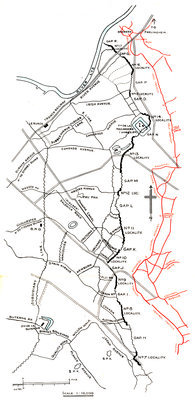
As the period was such a long one, a more detailed description
may be attempted than has been thought necessary in regard to
other sectors held from time to time by the battalion. There
were three main communication trenches leading into the line,
all previously referred to. Spain and Gloucester Avenues, both
starting from Tissage Dump, cut the subsidiary line on the right
and right centre respectively. Durham Avenue started from
Nouvel Houplines a few yards from Tissage Dump and to the north
of it, and joined the subsidiary line close to Cambridge House.
There was also the road from Nouvel Houplines to Frelinghien
which ran past the north end of the subsidiary and support lines,
but was under observation by day and unhealthy by night.
On the extreme right, and just beyond our boundary, was Buterne
Avenue, a deep traversed trench over which we had a right of
way. It wandered about distressingly, and eventually ended in
a small side street near Barbed Wire Square. Farther to the
right and well on into the Epinette sector was Lunatic Lane,
which eventually became an open track and led into the outskirts
of Armentières by the Asylum.
The subsidiary line was marked on the right by a large civilian
cemetery, through which the trench passed. It was full of graves
with wooden crosses and artificial flowers such as are usually to
be found in a French burial-ground. From there to the Battalion
Headquarters the trench was traversed, but there was little
parados. "Bivvies" of small breadth and height abounded,
and there were one or two concrete dug-outs, usually full of water.
A ditch, with a railing in front of it, marked the approach to Battalion
Headquarters, after which the trench narrowed into two
small alley-ways where Gloucester Avenue joined the subsidiary
line, and thence ran down steeply to a road from Nouvel Houplines
to Quesnoy. Here the tram line crossed the subsidiary line
and ran across country to the right company front. The open
road was masked by a big screen. At this point the subsidiary
line was built on a somewhat higher level, and contained big bays
and long traverses, protected in rear by a parados, behind which
was a traffic trench, in which a number of "bivvies" had been
constructed.
Continuing your course, you came to Wessex Avenue, the finest
communication trench in the sector, though but little used. The
line now became a long, straight trench with a high parapet,
with duck-boards along the side of the bank and also at the
bottom. Beside the lower track was a green ditch. At the end
of this stretch was a bridge across the Panama Canal, which ran
back in a south-easterly direction to the support line in the right
company sector. In design it was merely a deep drain, but it
was duck-boarded and a handy short-cut diagonally across the
sector. It was seldom used in daylight, in the hope, which was
probably justified, that the enemy would regard it merely as a
drain. Durham, Edmeads, and Sussex Avenues all met at this
point; and a few yards in the rear stood Cambridge House. The
last part of the line was full of "bivvies," and just before the end,
Irish Avenue, the left-hand communication trench of the sector,
led off to the front line. At the end the ground fell away steeply
to some marshland beside the banks of the Lys. The only other
means of communication with the front line, except the communication
trenches above mentioned and a few overland tracks,
was the road which ran from the junction of Wessex Avenue
and the subsidiary line to Edmeads Farm. This was only passable
at night, but it was an excellent short-cut, though subject to
bursts of machine-gun fire and "whizz-bangs."
The description of the trenches forward of the subsidiary line
is a far more formidable undertaking. We will commence with
the right, as being the simplest and also, generally speaking, the
most healthy. The subsidiary line was followed to the right
almost as far as the cemetery. Just before reaching it a communication
trench was found leading off (if you were lucky and
knew the way) to the left under an overhead traverse, and guarded
by a sentry. The latter in the early days informed you, in a
bored fashion, that the wind was dangerous or the reverse, and
criticized your box-respirator if not in the alert position. Following
the trench in its windings for a short distance, Vancouver
Avenue branched off to the left. This was only half finished,
though you could with much floundering get through it to
Gloucester Avenue; in reality, however, it was quite useless.
A hundred yards or so farther on you suddenly came on a corrugated
iron sentry-box, with a small weather-cock and a shell
case suspended from a stick beside it, where the gas sentry over the
right company Headquarters was stationed. Here in an open
space you found two or three log huts of small dimensions, with
one or two orthodox "bivvies." You then passed over a bridge,
and, ducking your head to avoid a sheet of corrugated iron, under
which cooking operations were usually going on, you entered a
low edifice, which was lighted, it may be mentioned, with two
small windows of real glass. Here you might find O.C. "D"
Company sitting at the table, endeavouring to compose one of the
innumerable reports that the higher powers delighted to collect.
Two or three bunks adorned the walls; and a form on either side
of the table, a Véry pistol, a tin of cigarettes, some recent pamphlets,
and odd pieces of officers' equipment, made up the furniture.
You could stand up more or less erect, and the place was
really quite comfortable, but hardly shell-proof.
Beyond Company Headquarters the communication trench
showed the strongest inclination to close in. It was extremely
narrow, and but for the overhead struts would very soon have
become impassable. Newburn Lane led off to the left, certainly
more of a lane than a trench, through which you could reach the
Orchard, a regular target for German gunners, and a place to be
avoided at certain times of the day. Farther down the communication
trench was a slit on the left where Light Trench Mortar
Battery men lived. Just below here the trench suddenly came
to an end, and you crossed a little stream running along a diminutive
valley. The tram line also came in sight, wandering away
along an old road through tangled bushes and weeds to the front
line. It was badly smashed in places, and was never used as far
forward as this. The trench began again up the far side of the
tiny valley—London Road, as it was now called—and here stood
two graves marking the resting-place of two unknown soldiers.
The going was sticky and the trench much battered. Later on
grass and green things generally were conspicuous on either side
of the trench, but now everything looked bare and muddy—just
yellow clay, shell-holes, mud banks, and trenches more or less
derelict. Suddenly you heard voices, and without quite realizing
it you found you were in the front line.
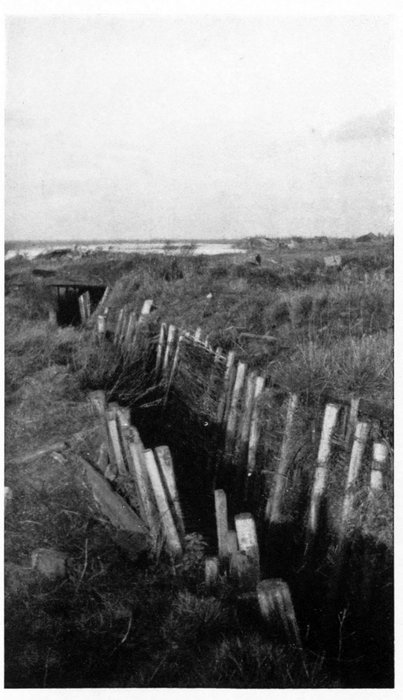
A broad breastwork formed the means of defence, occasional
bays being held, but the majority being unoccupied and full of
loose barbed wire. Everything betokened the effects of shell fire
where men were too few to do more than just repair their own
particular posts. Derelict "bivvies," odd broken duck-boards
half covered with slime, sheets of corrugated iron riddled with
holes, bits of old ground sheets, and fragments of equipment,
lay about in all directions. Everything presented that damp,
yellow aspect peculiar to clay soil. The traverses, sodden with
water, were bursting down the hurdles or wire netting with which
they were revetted, while the empty bays were falling in of their
own accord, or presented a crushed and crumbling appearance,
the result of the direct burst of a shell or "minnie."
As you rounded the traverse of an occupied bay the following
picture met your eye. Imagine a narrow trench about 12 feet
long by 4 feet wide, with a fire-step running along the entire
length some 12 inches from the ground. Near the centre of the
trench stands a rifleman in skeleton equipment, gazing into the
bottom mirror of a box periscope which is fastened by a spike
to the parapet, its top covered by dirty canvas to match the
surrounding sand-bags. By the sentry's side is a rifle, and close
at hand are the empty shell-case gong and strombos horn, in case
of gas. Next to him sits his relief, similarly attired, all men
invariably wearing equipment in the front line. The relief sentry
is passing the time in cleaning some clips of ammunition from an
open small-arms ammunition box. The corporal and two men are
filling sand-bags, which will be required at dusk. Another rifleman
sits at the far end, sleeping peacefully and dreaming of something
(we hope) remote from the war. He was the last sentry.
Two boxes let into the parados contain Véry lights and bombs;
the Véry pistol hangs from a peg in the parapet. Five rifles
with swords fixed stand in a row against the side of the trench;
while a shelf holds some mess-tin lids, two water-bottles, some
bread, and a tin of bully beef. Two sand-bags for salvage and
rubbish hang at the end of the bay. Round the corner two
"bivvies"—mere hovels about three foot high, wet and slimy—complete
the "home comforts" of this cheerful abode. From
one of the "bivvies" protrude two pairs of muddy boots and
four legs covered with clay-stained puttees. Their owners are
enjoying a well-earned rest, having spent most of the night
prowling about in No Man's Land.
Taking the next communication trench, Gloucester Avenue,
we could make our way up to the front line to a point not far
distant from the top of London Road; or, better still, we could
branch off along Pretoria to the right-centre company's support
line. Gloucester Avenue was a good winding trench cut through
what had once been cornfields. Pretoria was even better, and
brought you out close to the point where the Panama Canal joined
the support line. By the end of the canal were two deep concrete
dug-outs, both small and damp, and in one of these the
signallers and in the other the Company Commander were to be
found. In the latter, as you carefully descended the steps, you
would have been able at once to recognize, not only from the
orderly appearance of the spot, but from the number of parcels
from Fortnum and Mason, that Captain Eccles dwelt there;
and, sure enough, there he was, looking as if he had just
stepped out of a band-box, with Company Sergeant-Major
Heyworth sitting by his side working at the company card
index.
After making your way along the support line round interminable
traverses, you squeezed your way up Timaru to the front
line. Thence you went along past Wessex Avenue, which requires
no further description, to the end of Locality 12. From here a
path led up to the support line—Gap "M" being impassable—and
from the support line by another path to the left centre company's
front line—quite a decent stretch of bays and traverses
with a wilderness of ruined trenches in their rear. Half-way
along this sector you turned up a miserable ruin of a trench to
Captain Steward's Headquarters, a concrete dug-out set like an
oasis in a desert of derelict trenches. In spite of the neighbourhood,
Captain Steward would appear perfectly groomed and
with a cheerful smile, though denouncing the Germans for making
him so uncomfortable. Another dug-out adjoining was used by
his subalterns.
To visit the left sector it was now necessary to go right down
Edmeads Avenue and then up Sussex Avenue, whence you could
go to Hobbs Farm along Cambridge or along Fusilier Avenue
to Captain Wyatt's Headquarters at Goodwood. The latter was
another of these concrete dug-outs, and the owner, whether
Captain Wyatt or any other Company Commander, generally
had some severe remarks to make about the enemy, who gave the
left sector but little rest. To reach "A" Company's front line
you went along the support line to Irish Avenue, which from there
back to the subsidiary line was good enough, but forward of the
support line was hardly better than a track, and, except for some
canvas, pretty well exposed to view from all points of the enemy
front line. The whole of the left front line, in fact, from Edmeads
Farm past Hobbs Farm, the ruins of which had almost
been obliterated, was a maze of battered and derelict trenches,
only entered by the inquisitive or by some luckless individual who
had lost his way. The left company front was built into the side
of a small ridge, and possessed no general parados, though most of
the posts were self-contained. It ended some two or three hundred
yards from the Lys, though from the enemy point of view
it probably appeared to go much farther. It was very much
knocked about, and it was hard work to maintain even a semblance
of respectability.
Such is a brief outline of the Houplines sector. Its main
features were its size, its maze of useless and ruined trenches,
and its lack of lateral communication. There was not a single
dug-out that would have stood the direct hit of a 5·9, and only
a few that one would have cared to be in when hit by a "whizz-bang."
The day after relief (April 27th) was spent quietly enough.
We had not yet got used to the presence of so many gas cylinders
in the front line, and were not anxious to provoke unnecessary
retaliation. The Germans were also very quiet. Some shrapnel,
a few "whizz-bangs," six "pineapples," and two medium
"minnies" made up his total expenditure for the hours of daylight.
Sniping from the Chicken Run on to "A" Company's
front line was, however, fairly persistent, but no casualties
occurred that day. "A" Company of the 2/7th K.L.R. moved
into the subsidiary line that evening as a more permanent garrison,
and occupied the line between Battalion Headquarters and Cambridge
House.
At midnight a gas attack from the whole front of our Brigade
and that of the Brigade north of the Lys had been planned, but
was cancelled at the last minute, as the wind proved unfavourable.
However, the right battalion was not warned in time, and
released their cylinders. We much regretted that ours could not
be released too, as the clearing of the line had been arranged,
and already several cylinders were leaking badly. But on the
night of March 29th, after many "alarums and excursions," our
two flank companies and the Brigade north of the Lys let off
their gas, while projectors were flung into Frelinghien at the same
time. It was a very bright night, and the whitish cloud could
be seen rolling across No Man's Land. The wind was rather
light, and the Germans must therefore have obtained sufficient
warning. A number of coloured lights shot up into the air,
bells rang, and rapid rifle and machine-gun fire commenced,
which caused the inquisitive to expose as little of their heads above
the parapet as was feasible. "Whizz-bangs" and "minnies"
began to rain on the front line, where the special R.Es. working
the cylinders and the garrison of infantry had a somewhat uneasy
time. Our orders were to send an officers' patrol to inspect the
damage in the enemy's front line. Fortunately, however, this
futile and dangerous performance was countermanded, as No
Man's Land was itself full of the gas, which the wind hardly carried
beyond our trenches, and three of the R.Es. and four of our men
were gassed, and a corporal was killed. Otherwise no one was hit
during the retaliation. In due course the R.Es. withdrew in motor
lorries and the rest of the men returned to the front line, where the
sickly smell of gas was strongly in evidence.
Now that most of the cylinders were empty we paid less regard
to the enemy, and determined to try to damp the ardour of the
sniper, who had already shot two of our men through the head.
Every effort from the front line to spot the fellow had failed, but
the observation post in the support line had detected him, though
the distance from there to the Germans made it futile to try a
shot with a rifle. Major Brookes's assistance was accordingly
invoked. A telephone line was run out to the observation post,
and a trial round was fired with an 18-pounder. This was sufficiently
near for the purpose, but unfortunately was too much
for the sniper, who promptly retired. However, a few rounds
of "battery fire" were delivered, and the area in the immediate
neighbourhood of the sniper's lair was greatly disturbed. We
knew he was not hit, but he knew that we had spotted him, and
from that moment his activities ceased.
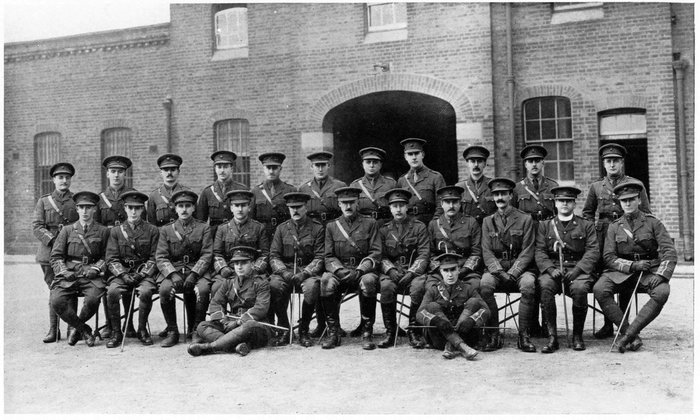
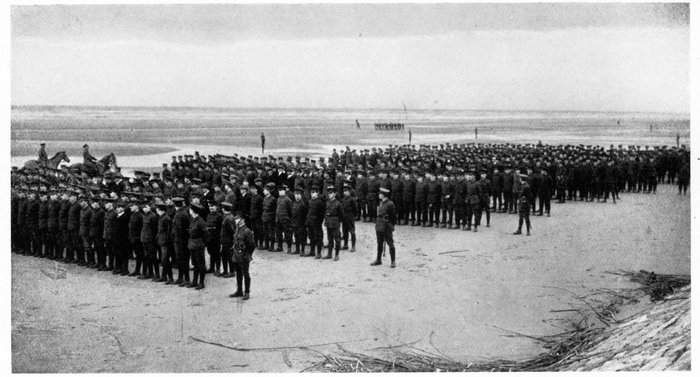
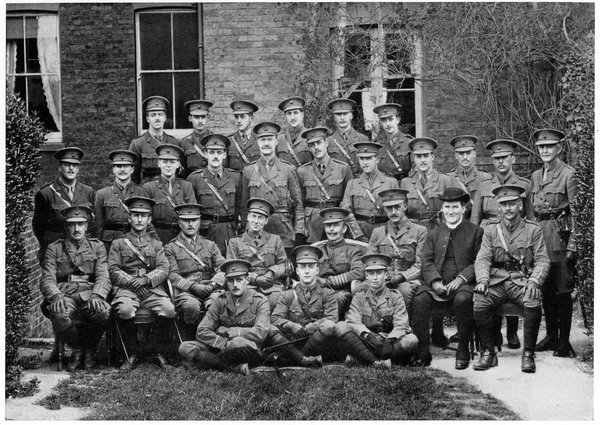
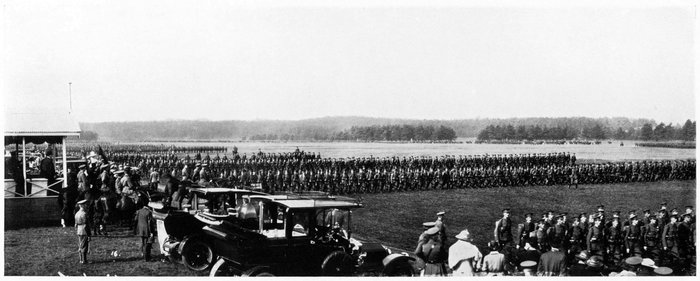
Photo by Gale & Polden Ltd., Aldershot.
THE OFFICERS-WOKING, FEBRUARY, 1917.
The next day, April 30th, a great aeroplane fight took place
high over our line. The day was perfect, and it was a wonderful
sight to see the aeroplanes twisting and doubling and hear the
thin rattle of their machine guns. Suddenly one of the enemy's
machines commenced to fall, with a tell-tale streak of smoke trailing
behind him. In a moment the grey smoke became a vivid
red, and the burning machine came roaring down, crackling and
spluttering as the ammunition went off in the flames. For a few
minutes it seemed that it must come down right on the top of
Battalion Headquarters, but eventually it crashed about two
hundred yards away on the open stretch between Battalion
Headquarters and Spain Avenue. Both the occupants must have
been dead before the machine reached the ground; the pilot was
burned beyond recognition in the machine; the observer, an
artillery officer, fell out about fifty feet from the ground, and among
his papers we found a secret correction card for artillery shooting
with aeroplane observation. All attempts to salve anything from
the machine proved fruitless. It burned and smouldered for more
than twenty-four hours, and its proximity was rendered dangerous
by the exploding ammunition.
The question of our billets now began to exercise our minds.
The 2/7th K.L.R., in spite of remonstrances, had been located
at first in a row of houses close to the Houplines Level Crossing.
In that position they had been continually shelled, and the powers
that be had finally decided to move them back to a more salubrious
locality. This we were very glad to hear, because, other things
being equal, billets that are not regular targets for enemy artillery
are distinctly preferable. Casualties in billets are always more
trying than elsewhere, as they generally seem so gratuitous.
In the Houplines sector more than in any other our snipers
and observers had found plenty of scope for the exercise of their
special talents. The battalion observation post was in an upper
room of a small house in the Rue Solferino, a narrow street which
ran off the main road close to Tissage Dump. The Germans had
kindly put a "dud" 5·9 through the gable end, thereby providing
an excellent view point. The official apparatus installed in this
spot was a telescope working on a pivot which was fixed to a
quadrant. The observer sat on a chair raised on a rough platform
to the necessary height, while next to him sat another man
to make the necessary written notes of observations. In addition
to a blanket to screen the shell-hole, the observation post was
supplied with maps and compass, and also a telephone to Battalion
Headquarters and the battery immediately in rear. A fine view
of the enemy trenches and the ground in rear was obtainable
from this observation post. In addition, there were three sniping
posts in the front line, from which subsequently P. G. Jones,
Maddocks, Matchett, and Corkill all secured definite "hits";
while for additional observation purposes there was a natural
observation post half-way up Irish Avenue, about level with the
support line, from which much valuable information of a more
local description was obtained.
On May 1st the activity of the hostile artillery began to give
evidence of registration on the left half of the battalion front,
and support lines, important trench junctions, and communication
trenches received direct hits or bursts sufficiently near to be
suggestive. That night, as had been anticipated, it being the
German Labour Day, sounds of shouting were clearly heard from
the enemy lines, while a regular "Brock's benefit" was kept
up for a considerable time. Next day the registration was even
more marked, so early on the morning of May 4th 2nd-Lieutenant
Hodgkinson and a small party of stout-hearted men from "D"
Company (Walmsley, Mann, Moore, Evans, Woods, and Bissell)
crept out to try to kidnap a German sentry. They worked their
way up to a post in Centaur Trench opposite the Pont Ballot
salient, and got right under the parapet without being detected.
Hodgkinson was, in fact, just climbing into the trench to effect
the capture when, most unluckily, the relief arrived, and one of them
spotted the blackened face of Rifleman Mann peering over the
parapet. Dawn had broken and the game was up. Bombs were
hurled in among the Germans, the fellow who had spotted Mann
receiving a back-hander from a Mills grenade in the face, and the
party raced for home under a hail of machine-gun bullets, rifle
grenades, and "pineapples." No casualties were sustained, and,
as the G.O.C. Division remarked, "it was a bold and useful bit
of work," which only failed through sheer bad luck.
At 10 p.m. the 2/7th K.L.R. began to arrive, and at 12.40 a.m.,
relief being complete, the various companies and platoons were
making for Tissage Dump, where transport awaited the Lewis
guns and trench stores. "C" Company moved into the subsidiary
line.
Two companies were billeted in large houses in the Rue Jesuit
adjoining Brigade Headquarters. These must have been fine
residences once, and even the ravages of war had not been able
entirely to destroy their architectural pretensions. What was of
more importance, they were very strongly built and had good
cellar accommodation.
The other two companies were at 57, Rue de Lille, where the
battalion had spent the evening en route for the Rue du Bois.
Battalion Headquarters were in a good house, No. 3, Rue Bayard,
a turning off the Rue de Lille. You entered through a gateway
into a paved courtyard, surrounded by various domestic offices,
and thence up a few steps into a roomy building with a delightful
garden behind. The dining-room contained a book-case full of
beautifully bound volumes. The Quartermaster's Stores were
situated in a large house in the Rue de Lille, opposite which the
truck-lines for the trenches started. Mule-drawn trolleys as far
as Tissage Dump, and from there smaller trucks man-handled,
were the methods of transport employed. The transport lines
remained at Bac St. Maur. For the men there were several good
estaminets dotted about the town; while a good meal for officers
could be obtained at the "Au Bœuf," an ordinary French provincial
restaurant, while the more fastidious frequented
"Lucienne's," opposite the church of Notre Dâme. There was
also "Madame Burberry's" shop, where most items of clothing
and field kit were on sale.
The period in reserve was not without incident. To begin
with, General Headquarters' pamphlet S.S. 143, "The Training
of Platoons for Offensive Action," had just been issued. It
contained a scheme for the employment of a platoon as a small
force of all arms—one section Lewis gunners, one rifle grenadiers,
one bombers, and one riflemen, with a platoon headquarters
consisting of the officer, platoon sergeant, runner, and signaller.
Each battalion was now ordered to tell off one platoon for special
instruction in this latest scheme. This was not particularly
difficult, except that the average strength of a platoon and its
four sections never approached the strength of the "War Establishment"
platoon for whose instruction these illuminating pamphlets
were always designed. The selection of ground proved far
more difficult, but an open space in the vicinity of the Nieppe
Bridge, where some old practice trenches stood, afforded reasonable
facilities at a moderate distance from the billets. The Second-in-Command,
Major H. K. Wilson, undertook to find a site, and
ultimately decided upon what seemed suitable for the purpose.
Unfortunately, the site selected had also been chosen as the position
for certain silent batteries and defensive machine-gun companies,
who watched Major Wilson making notes in his notebook
and arrested him as a suspected person. Major Wilson persuaded
the machine gunners to accompany him to Battalion Headquarters,
whence, after he had been identified, they retired,
feeling no doubt that they had at least done their duty. The
incident caused considerable merriment, but to no one more
than to the officer chiefly concerned.
The shelling of Armentières by the enemy had recently become
a daily and nightly operation. Our gradual increase of guns of
major calibre hidden among the houses—there were two 8-inch
howitzers in a garden in the Rue Bayard—was quite sufficient to
attract hostile notice. Apart from Armentières itself, the enemy
had also been busy shelling many back areas, and in retaliation the
Second Army decided on a general back area shoot, commencing at
7.30 p.m. on April 7th, and all ranks were warned to keep under cover.
The shoot duly commenced, but in spite of the din we heard
what sounded uncommonly like a barrage on the 2/7th K.L.R.
front. However, we imagined, as at first did they, that this was
the anticipated retaliation. At 7.45 p.m. a false gas alarm
occurred, but at 8 p.m. the order came for the battalion to
stand-to. The raid for which we thought the Germans had been
registering had actually come off, and, as ill-luck would have it,
at the same moment as our area shoot. At 10.15 p.m. we were
ordered to send up a company to reinforce the 2/7th K.L.R., and
"D" Company duly moved off, returning at dawn the next morning
without casualties. A further barrage at 10 p.m. caused a
second stand-to, but the fire died away in a short time, and normal
conditions were finally re-established.
On May 8th "A" Company relieved "C" Company in the
subsidiary line, and full particulars of the raids were obtainable.
The enemy had certainly put up a very fine barrage, but fortunately
"C" Company had escaped casualties, though Captain
Eccles, returning from Battalion Headquarters, had a narrow
escape, and had been forced on one occasion to make a somewhat
hasty descent into a muddy ditch.
Preparations now commenced for the relief, an operation which
became easier every time the battalion returned to the old sector.
On May 11th the Lewis gunners moved in, and the trollies were
soon busy trundling up and down the Houplines road, which
became more unhealthy every day. Shelling was, in fact, much
more frequent and general by day, though our nights also were
regularly disturbed by the scream and crash of the shells landing
in the houses. The area round the Pont de Nieppe attracted
special attention, and many civilians were killed or wounded.
The gas-works, where a number of guns were concentrated, the
churches of Notre Dâme and St. Vaast, the Rue Sadi Carnot, the
railway station, and other places, also came in for their share of
attention, till really one began to think that perhaps the trenches
were preferable to the billets.
On May 10th a Padre was attached to us, the Rev. M. T. Eland,
and it was arranged that he should share Captain McHugh's
elegant quarters at Tissage Dump. This was a reasonably intact
house, containing, amongst other choice bits of furniture collected
from the neighbouring houses, some beautiful plush-covered chairs.
The area just beyond Tissage Dump itself used to come in for a
good deal of shelling, but McHugh slept unconcernedly on the
first floor, and paid little attention to the noise of falling débris
and the hum of flying splinters. It was a handy place of call
for visitors, often rather breathless in consequence of having
traversed the last part of the Houplines road in what the text-books
call "a series of short rushes."
Just before the relief the enemy expended more than his usual
quantity of ammunition on Armentières, and we were not sorry
when he desisted shortly before the march to the trenches was
scheduled to commence. The relief itself was carried out without
any interference on the part of the foe. The companies had been
moved round, and the order from right to left was "A," "B,"
"C," "D." To our disgust, we found that great quantities of
gas were in process of being installed in our sector, projectors
being located near the cemetery and on the extreme left. Every
night large carrying parties of the Irish came struggling up the
trenches; and for the benefit of those who have never had personal
experience, it may be stated that gas cylinders are no light weight
and are awkward things to handle, apart from the extremely
unpleasant nature of their contents should a flying piece of shell
happen to cause a leak. One very wet night, when the duck-boards,
slippery with the rain, made the task more than usually
distressing, Captain Eccles was passing down Wessex Avenue on
his nightly tour of inspection. Suddenly the sounds of highly-coloured
language from the direction of the Fry Pan attracted
his attention. Now, it was quite easy to turn into the Fry Pan
unwittingly, and even in daylight very far from easy to find your
way out again. An unfortunate carrying party, loaded with
cylinders, were found by Captain Eccles just completing their
third tour round this circular redoubt—an occupation which,
when the frequent low overhead traverses were concealed by the
blackness of the night, would warrant the employment of any
form of bad language. Great apprehension existed in the minds
of the authorities, and not without reason, lest the enemy should
detect what was going on. Cylinders and gas were never allowed
to be alluded to as such either in the front line or on the telephone.
They were called "eggs," and incidentally by the men
many other names not fit for publication. In addition to this,
companies had to send out covering parties into No Man's Land
to prevent the approach of any inquisitive German. Lying flat
on your stomach in wet mud and grass on a drenching night,
and for two hours at a stretch, is most dispiriting work, especially
if you have to live in your soaking garments for the next eight
days, with the added joy of expecting that you may be in the front
line when the gas is being released. Fortunately, during these
operations the enemy remained exceedingly quiet. Artillery
destructive shoots drew no response; and a rifle grenade and
light trench mortar battery shoot on Cell Trench, and wire-cutting
in front of Centaur Trench by medium trench mortar
batteries, produced no effect on him whatever.
The damage done by the raid barrage was found to be considerable.
A trench which had been laboriously constructed from the
left-centre Company Headquarters to the detached post at Hobbs
Farm, previously only accessible viâ Cambridge Avenue, had been
completely obliterated. It appeared to have been in the 100 per
cent. zone of the barrage line, and though to save time one did
go along it, one risked constant exposure.
The observers now began to notice considerable movement in
and behind the enemy's line. Men were seen wearing packs,
others popped their heads over the parapet, and transport was
heard at night. A relief was suspected, and on May 17th the
suspicion was more than confirmed by the unusual activity of
the Germans. Their attitude became suddenly aggressive.
"Pineapples" became unpleasantly frequent on the left company
sector, and a sniper reappeared in the old loophole in the Chicken
Run, which had not been used for fifteen days. Fortunately,
the larger "minnie," which commenced operations just before
our last tour ended, showed no signs of activity; it was probably
part of a "travelling circus" brought up for the raid. Anyhow,
"pineapples," small though they may be, are noisy and
destructive, and made the left company sector very unpopular.
There was also a long-range light "minnie" which carried nearly
to the subsidiary line. Artillery activity, though spasmodic, was
considerable on some days. The left-hand communication
trenches—Edmeads and, more particularly, Irish Avenues—were
heavily shelled, direct hits being not infrequent, and parties
were always being sent to clear away the fallen earth. On other
days a few rounds on Houplines and two or three bursts of shrapnel
over the cemetery were the only signs of activity.
On May 20th Colonel Fletcher went on leave, and Major H. K.
Wilson assumed command of the battalion.
On the night of May 20th we made an attempt to get into
Centaur Trench, but the party was detected, and had to retire
hastily under a shower of grenades. At 2 a.m. the next morning
the enemy returned the compliment by trying to cut off a bombing
post situated between Edmeads and Hobbs Farms. The operation
commenced with a sudden shower of stick grenades, and a couple
of men were seen trying to get through the wire into the derelict
trenches in "N" Gap. Bombs were thrown and rapid fire
opened, and Rifleman "Gink" Bailey distinguished himself by
standing on the parapet and slanging the Germans to the full
extent of his very adequate Irish-American vocabulary. The
Germans, disliking this, or at any rate not appreciating their
general reception, withdrew, and a patrol was immediately
dispatched, which located a dead German on the wire. He proved
to belong to the 14th Bavarian I.R. Shrapnel was called for on
the enemy's front line to welcome their return, after which the
night settled down to its normal state once more.
As the spring advanced the trenches lost a great deal of their
barren unloveliness. What had been mud or greyish-looking
grass now became a deep and luxuriant carpet of bright fresh
green, with many a wild flower peeping out here and there. The
trees, which so far had been but gaunt skeletons, began to cover
their nakedness with fresh foliage. The sides of Gloucester
Avenue were gay with poppies and white daisies; Sussex Avenue
became an ideal country footpath, dotted with may-trees; and
even that forbidding-looking spot the Orchard assumed quite a
cheerful aspect. Round Cambridge House the lilacs blossomed
out, both purple and white. Roses bloomed in the old gardens
near Tissage Dump, and later on a small crop of strawberries and
currants was gathered there. A stroll round the line in the early
morning was a real pleasure. Just as the dawn was breaking
you could wander anywhere. Not a shot would be fired and
the guns were silent. As the sun climbed higher in the heavens,
the pleasant smell of fresh, moist earth filled the nostrils, instead
of the stale stench of which one had grown so sick. Dew-spangled
grasses and fern overhanging the trench brushed your face as you
passed along. In the rapidly clearing mist that heralded the hot
day even the ugliest features of the line seemed to take on a certain
softening outline, a certain grace in harmony with the countryside.
High over No Man's Land you could see the fluttering lark,
and all the air was resonant with its trilling notes. The call of
the cuckoo sounded from the trees, and the chatter of sparrows
and finches in the overgrown hedges filled the air with a merry
sound, while but a few hours previously the nightingale had been
pouring out its full-throated melody. "Oh, to be in England
now that April's here!" How we re-echoed Browning's wish,
with the substitution for "April" of the month of June, at which
we had now arrived! How true the words seemed, how deep
their significance! Beautiful as Nature was around us, rejoiced
as we were at this delightful contrast to the hideousness of
strife, yet it increased the bitterness and made one feel more
keenly than ever the loathsome misery of war. How one pictured
to oneself the peaceful beauty of the English countryside,
so like this in outward appearance, and yet so different in
reality! How one longed for the war to be over, to wander
once more in the fields on a summer's morn, with the black clouds
of war cleared away for good, and not merely lifted for a few
precious moments!
Boom! The "morning hate" has begun. With a start we
come back from our pleasant dreams. Another stifling day is
before us, and the never-ending struggle with its monotony, its
destruction, its every detestable feature, claims us once more
for its own.
One of the special delights of the Commanding Officer was crawling
about exposed parts of the sector by day. It was not only
his anxiety to acquire an accurate knowledge of his sector, though
that was certainly one reason; he wanted to find out where
every derelict trench led to, what secrets lay hidden in those areas
of abandoned chaos in which the sector abounded, and no one
could ever have known his sector better than did Colonel Fletcher.
But apart from all this, his old big-game hunting instincts were
aroused. This time he was not tracking the shy koodoo or the
skulking lion, but matching his brains and his woodcraft against
the ever-watchful German. Major Geddes more than once accompanied
him on these excursions, as he crawled and wriggled on
his stomach from place to place, now lying up to use telescope
and field-glasses, now tracing out all the intricacies of our own
or the enemy trenches. Home the pair would come at last,
with the perspiration streaming down their faces. "Well, that
is the best afternoon I have had since the war started!" the
Commanding Officer would exclaim, as he sat mopping his face
and drinking large cups of tea.
The gas attack had originally been fixed for the night of May
20th-21st. The targets selected for the projectors were Census
Support Line, Les 4 Hallots Farm, and Battalion Headquarters
at Census Farm. The inclusion of the latter target caused some
people certain misgivings, as they had a suspicion—afterwards
confirmed from a captured German map—that our own Headquarters
were not unknown to the enemy. The usual invasion
of our sector by "N" and "L" Special Companies, R.E., took
place on the night in question. Extra telephones had been rigged
up, and in addition cryptic messages about "presentations of
medals" and "indents for bicycles" came frequently over the
'phone. At the last moment the wind veered round, as it frequently
did at night. It was too late to cancel the orders by
message, so a special signal rocket was fired from Headquarters.
It was a red, green and red rocket. The first one lighted refused
to move at all; but the second, a parachute light, went up with a
roar for about twenty feet, and then sailed off along the subsidiary
line. Fortunately, it was successful in stopping the discharge of
the gas. We took a more than usual interest in this discharge,
as it appeared that we could not be relieved till it took place.
However, in the end, when we had been in ten days, the
attack was definitely postponed for twenty-four hours to
allow the relief to be effected. On the early morning of
May 22nd 2nd-Lieutenants Hodgkinson and Little with patrols
attempted entries into the German line at Cell Trench, opposite
Hobbs Farm and at Centaur Trench respectively. Both were
spotted and heavily bombed, Little being slightly wounded,
but not sufficiently for evacuation. Lieutenant Alcock two days
previously had been hit in the eye by a splinter from a "pineapple,"
and had retired temporarily to a Base hospital.
In spite of rather depressing accounts from the 2/7th K.L.R.
as to shelling in the vicinity of billets, we were glad to find, on
May 22nd, that the relief, twice postponed, was really to take
place. Dug-outs or "bivvies" are not particularly comfortable—some,
indeed, very much the reverse. You get tired of stooping,
of working by the light of one miserable candle, of eating at odd
times and of sleeping at odd hours. The daily and nightly tours
round the line become more than usually wearisome. Duck-boards
seem to get more treacherous, angle irons and stray bits
of barbed wire seem to project still farther from the sides of
trenches; while for the man in the post—and everyone else's
position is bliss compared with his—the time must have been
trying indeed. Not that it was particularly dangerous, though even
in quiet sectors most posts have their highly unpleasant periods;
but it was infinitely uncomfortable and trying to the last degree.
Besides, there was the pleasant hope that the wind would surely
be favourable for one night at least out of the next eight, and
then the 2/7th K.L.R., and not we, would experience the delights
of a gas discharge, to the accompaniment of the applause of the
enemy, which was usually of a vigorous nature. However, the
relief took place at last without any hitch, and the early hours
of May 23rd found us back in our old billets in Armentières.
The routine was the same as last time—working parties, one
platoon for special training, and the remainder general training.
The new extension for the box-respirator was also fitted, and in
addition we received twenty horse respirators, to which even the
mules raised no violent objection. The opportunity was also
taken to have all the swords sharpened. Two officers at a time
were attached for instruction to A/286 Battery, R.F.A., and as
the latter's quarters were situated in a comfortable orchard, the
two days allowed passed pleasantly enough.
On May 26th "B" Company, who had remained in the subsidiary
line, were relieved by "D" Company. Early the next
morning sounds were heard suggestive of a gas attack. The great
bell at Houplines Level Crossing was tolling. Runners flew off
to rouse the companies. Officers appeared at doorways, clothed
in pyjamas, gum-boots, and box-respirators; while Lieutenant
James, the Gas Officer, sniffed the early morning air like a war-horse
scenting battle. Each person in turn thought he smelt
chlorine—or was it phosgene? In every case it turned out to
be the smell of a stale cigar, the proximity of the refuse-bin, or
something else equally harmless. Gas there was none, and at
length, after conversation with the Brigade, it was discovered
that a few gas shells had fallen near the sentry at the level-crossing,
and thus produced an alarm. So back we all went, cursing, to
bed, everyone feeling a bit resentful that after we had been thus
disturbed no gas had come after all.
On May 29th the gas stored in Houplines was at length released.
The only part that we took in the proceedings was the posting
of six stretcher-bearers at the top of Irish Avenue, an unpleasant
spot, though fortunately they sustained no casualties.
During these days in billets the presence of the Battalion
Orchestra made itself felt, with excellent results. The instruments
had been brought over for us by the Division. It was a considerable
item for regimental baggage, consisting as it did of ten
instruments. Sergeant Lawton, battalion sanitary N.C.O., was
in charge of the orchestra, and played the trombone when his
duties permitted. Rifleman Garrod, the first violin, was a player
of exceptional merit from the Liverpool Philharmonic Orchestra.
As a soloist he was particularly fine. The remaining members of
the party, all well above the average, were—violins, Lewin,
Hardacre, and Lance-Corporal Hume; viola, Edmondson; 'cellos,
Kaye and Kennedy; bass, Lance-Corporal Buckley; trombone,
Williams; drums, Burden; and librarian (self-styled and self-appointed),
Rifleman King. Lance-Corporal Bell, from the
Quartermaster's Stores, occasionally performed on the oboe.
Rifleman Collins, an excellent violinist, had been left behind,
unfortunately, in England suffering from influenza.
By arrangement with the other units of the Brigade, our contribution
to the recently formed Brigade Pioneer Company was
reduced by the strength of the orchestra. In return for this,
the latter was always loaned to another battalion while we were
in the line, and also for special occasions when we were out. In
addition, it used to play for our own mess on guest nights, and
very delightful it was; and also occasionally for the Divisional
Concert Party's performances, and for the Brigade and Divisional
Commanders. It was in great demand everywhere, and there can
be no doubt that the results more than justified the employment
of the personnel thus utilized. Another invaluable asset was
Rifleman Kessen, a very prince of conjurers. He seemed to have
an infinity of excellent tricks, and he fooled you under your very
nose in the most baffling fashion.
On May 31st the battalion once more relieved the 2/7th K.L.R.
The arrangement of companies—"A," "B," "D," "C" from the
right—was due to the forthcoming raid, to be carried out by parties
from "A" and "B" Companies on Centaur Trench, opposite
the Pont Ballot salient. This necessitated "A" and "B" Companies
being as near the proposed area as possible. Colonel
Fletcher arrived in the line from leave at midnight, and with
characteristic energy proceeded at once on a tour of inspection.
This spell in the line was one of exceptional activity. To begin
with, there was the impending raid, which, being our first, occupied
nine-tenths of our thoughts. There were innumerable special
patrols to examine the wire and the approaches to the points of
entry; the artillery wire-cutting operations had to be settled;
the incessant visits to observation posts and the selection of
forming-up places, raid headquarters, regimental aid posts, etc.,
to be arranged for. In addition to all this, the Battle of Messines
took place during the tour. Immediately after that came orders
for following up the enemy, if he voluntarily evacuated his trenches;
and before we were half through that came schemes for the defence
of Armentières in the event of an attack by the Germans. But
we must take things in order.
The morning after relief (June 1st, 1917) the enemy dropped
a "pineapple" into a Lewis-gun post of "C" Company, killing
three men and wounding two. His activity in this direction was
now so great that steps had to be taken to cope with it. Two light
trench mortars were permanently established in the front line,
and for every "pineapple" we returned a number of Stokes
shells. The teams did not have a pleasant time of it, as the
Germans made every endeavour to knock them out; but they
stuck to it gallantly, and by the end of the time their efforts had
become singularly effective, although the enemy later retaliated
by producing a medium "minnie."
A slight scare was caused by the alleged appearance of a German
near "C" Company's cook-house, at the left extremity of the
subsidiary line, and patrols spent several nights down by the
river trying to catch the supposed intruder. Whether there was
anything in the rumour or not was never satisfactorily settled,
but it would have been perfectly simple for him to get there.
Between our left and the river there was a gap of a couple of hundred
yards, which after weeks of fine weather had become dry
and hard, and, as subsequent investigations after the Armistice
proved, there was ample cover for a whole battalion to come up
unseen. Moreover, the German raids on the left sector must have
revealed to them the absence of any serious opposition in that
part of the line. In fact, the liability of the battalion to be outflanked
on the left was the subject of a strong memorandum from
Colonel Fletcher, but nothing was done except that some wire
was erected later, and a Lewis gun post located in the cellar of a
ruined house close to the river and in line with our support line.
The presence of fresh earth on a footbridge crossing a branch of
the Lys, which was discovered by the patrol, certainly gave some
colour to the story of "C" Company's cook.
June 4th, 5th, and 6th produced barrages on the Messines Ridge;
they took place each afternoon, and lasted for about an hour.
It was understood that barely half of the guns to be employed
on the day were in action, but it was a wonderfully awe-inspiring
sight to watch the effect of the mass of shells crashing down on the
slopes of the ridge. The heavies in Armentières and our own
18-pounders took part in these preliminary barrages, with the
result that the shelling of Armentières by the enemy became
intense, and particularly in the vicinity of battery positions,
which constant firing had now revealed to the enemy, and produced
the most severe counter-battery work on his part. Our
trenches, too, received marked attention. The enemy seems
always to have been suspicious of an attack on Frelinghien, and
he set to work on the left and left-centre company sectors with
great determination. Shells of a calibre not usually employed
in ordinary trench warfare began to plough up our communication
trenches, Irish Avenue especially. Cambridge House was
frequently shelled intensely, and, in fact, there was no part of
our sector that did not receive considerable attention daily.
The wire-cutting on the right provoked the enemy terribly, and
each time it was carried out severe retaliation took place. Houplines
road was now shelled regularly with great bursts of 5·9's
and heavy shrapnel. One 4·2 battery kept up such an incessant
fire into the vicinity of Tissage Dump that we used to call it the
"rising tide," the noise of the stream of shells as they passed
over sounding not unlike the steady onrush of the sea.
Quesnoy, nearly opposite to us, we used to bombard heavily,
and some part of it was usually on fire. Frelinghien was frequently
almost hidden in red dust, while Wytschaete Ridge for
long periods at a stretch looked as if it were enveloped in a sandstorm.
Every night north of the Lys one or both sides were
raiding, and the rumble of barrages, the red bursts of shrapnel,
and the stream of coloured rockets continued well on into the
daylight.
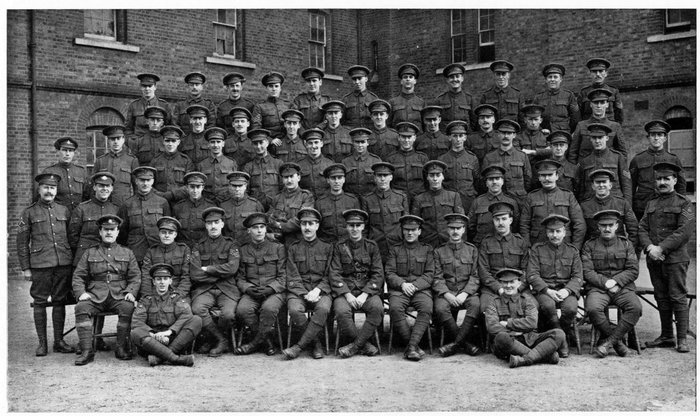
Photo by Gale & Polden, Ltd., Aldershot.
SERGEANTS' MESS—WOKING, FEBRUARY, 1917.
At 3.10 a.m. on June 7th the Battle of Messines opened with the
most tremendous mine explosions and the most magnificent
barrage that can be imagined. It was a lovely morning, and there
was not a cloud in the sky. With a stupendous roar and upheaval
that baffles description the mines exploded. Simultaneously the
whole weight of the artillery gathered together for the occasion,
and hidden away in every conceivable place, opened on the enemy.
From their trenches lights of many colours shot into the air,
mutely appealing for assistance from their gunners. These were
not long in replying, but our counter-battery work, which had
left them in false security during the preliminary barrages, was
dealing faithfully with them now. For a few moments the ridge
stood out clear and distinct. Then clouds of smoke and dust
shut out the view, and it was only by the alteration in the sound
that we knew that the barrage was creeping forward, and we
waited anxiously for the telegrams announcing the result.
During the first few hours we were unmolested. A 4·2 battery
opened on Houplines ten minutes before zero, but switched as
soon as the barrage opened. About 7 a.m., however, "whizz-bangs"
came down in a regular barrage on the front line, and then
high explosives up and down the subsidiary line for about a couple
of hours. Between two and six in the afternoon the enemy concentrated
on Tissage Dump, putting over 300 high explosive shells
into that locality during the four hours. Aeroplanes were very
busy, and a German machine dropped two bombs about fifty yards
from Battalion Headquarters. The enemy balloons were in a
state of great excitement, being hauled down whenever a plane
appeared, till at last one of them apparently got tired of this,
broke away, and sailed off out of sight. One thing that greatly
interested us was that both this day and the next the enemy
shelled his own front line opposite the Brewery. Up to the end
of this tour the Germans continued intensely active, the left sector
and Irish Avenue receiving the lion's share of the shelling.
One very necessary piece of work was completed before we
quitted the trenches—the cutting of the grass in front of the
parapet. It was now so high and so close to the parapet that it
entirely obstructed the view through the periscope, and made it
quite possible for a man to work his way unseen right up to the
trenches. Sickles had to be obtained and parties went out
nightly to "cut the hay crop." To do this just in front of the
posts alone would, of course, have revealed their exact position
to any inquisitive airman, and a strip had therefore to be cut
along the whole length of the front line.
At 9.30 p.m. on June 9th the leading company of the 2/7th
K.L.R. began to arrive. At the last moment, owing to the continued
harassing fire of the Germans on to the Houplines road,
we decided to proceed out by Lunatic Lane in the right battalion
sector. This was a long and winding communication trench
which so far had sustained little damage. It brought you out by
the Lunatic Asylum, and from there you went up the Rue Gambetta
and so on to the Rue de Lille. "C" Company remained
in the subsidiary line.
On arrival in billets we were somewhat astonished to learn that
we were under orders to move at one hour's notice, and that guides
to bring up reinforcing troops were always to be kept in readiness
at Battalion Headquarters. The retirement of the enemy, after
the Battle of Messines, from his remaining trenches north of the
River Lys had caused the Higher Command to think that a partial
retirement might be effected opposite our front also. Consequently
some most elaborate schemes to meet this emergency had
been issued, and we were now in the throes of trying to draw up,
in conjunction with the 2/7th K.L.R., a scheme of movement in
the event of the enemy's voluntary withdrawal. We were therefore
not a little surprised to find signs that an attack by the
Germans might now be expected. The mental effort required
to concentrate your attention simultaneously on an advance and
a defence—and both had to be fully provided for—and at the
same time to attend to the all-absorbing orders and arrangements
for the raid, proved somewhat exhausting. For clearness' sake
we will take them one by one, but it should be remembered that
three sets of orders, and in addition a salvage scheme (a kind of
corollary to the advance orders), were all drawn up at the same
time, and the difficulty of remembering which you were working
on at any particular moment was by no means imaginary.
Operation Order No. 22, dated June 15th, 1917, began with
the words: "In the event of the enemy voluntarily evacuating
his present front line system opposite the battalion frontage,
companies will be ready to move forward and occupy the sectors
of the enemy line with minimum of delay." The orders ran
into fifteen headings with seven appendices and, it need hardly
be added, three pages of subsequent amendments, dated July 1st.
As the orders, fortunately, were never put into operation, it will
be sufficient to deal with them quite briefly. Each company was
allotted an area in the enemy front line, and on the word "floreat"
fighting patrols, consisting of one officer and twenty-four men,
were expected to dash across No Man's Land "at ten minutes'
notice." The difficulty of this initial part of the proceedings did
not at first occur to the higher authorities, but some weeks later
the time allowed was suddenly increased to six hours!
A consolidating platoon, armed with picks, shovels, sand-bags,
etc., followed as a carrying party; and, finally, Company Headquarters
moved into the German front line, and Battalion Headquarters
moved up to Edmeads Farm. The Brigade Pioneer
Company, assisted by working parties from the reserve battalion,
were responsible for digging communication trenches from Fiji
Road on the right and Hobbs Farm on the left, to the enemy's
front line. The Reserve Battalion Headquarters and two remaining
companies moved up to the subsidiary line.
To assist in these operations advanced dumps, containing
vast quantities of R.E. stores and bombs and small-arms ammunition,
were gradually accumulated in the vicinity of the front
line, to the great delight of the Germans, who shelled them cheerfully.
An elaborate system of flags and identification marks was
also evolved. In addition to this, it being now presumed that we
had to all intents and purposes occupied the German trenches,
the collection of salvage from our old trenches became a matter
of considerable moment, and comprehensive orders were issued
for that work also; but these we may pass over.
To change for a moment from the offensive to the defensive,
it was also considered possible that the enemy was likely to make
an attack on Armentières, in the hope of obtaining a good headline,
"Capture of Armentières," for his newspapers, which might
divert attention from the rumour that Messines had fallen. Moreover,
his possession of Armentières would have made our tenure
of Messines Ridge extremely uncomfortable, if not impossible.
Consequently, an extensive system of routes for reinforcing troops
was worked out, and guides instructed for this purpose. Men not
required to carry bombs and R.E. material to the front line
dumps were now collecting similar material in Armentières itself.
Others were busily engaged wiring up the streets, building
machine-gun emplacements, and generally trying to make up
in a few weeks for the total neglect of the old defences, which
during the last two years had decayed to a degree almost beyond
repair. A Major was appointed O.C. Armentières Defences, and
the place began to hum with life and movement. Throughout
the proceedings the foe kept up continual shelling with every
description of gun, and made life in the town anything but comfortable.
The swimming-baths, which had been so acceptable,
had to be abandoned owing to the fact that they only had a glass
roof, and shells came perilously near it. Training was confined
to the vicinity of billets, or more often to the cellars. The destruction
of the big brewery near Pont de Nieppe, whence came our
beer supply, so needed in those scorching hot days, helped to complete
our unhappiness. The baths near Erquinghem were also
destroyed, thanks to the action of the Heavy Artillery Commander,
who had placed some 60-pounders just in front of them. The
sight of the soldier bathers, in every kind of dress or undress,
running wildly across the fields in the company of the French
laundry-maids certainly produced considerable merriment; but
the price paid for this piece of humour, the entire demolition of
the only bathing-place reasonably handy, was thought to be
excessive.
The only people who really appreciated the spell out of the line
were the raiding party. Captain Steward, Captain Parker,
Lieutenant Clarke, 2nd-Lieutenant Moseley, and 100 men were
comfortably installed close to Croix du Bac in the quarters of the
old Divisional Reinforcement Camp, which had recently been
moved to Steenwerck, the present railhead. Division Headquarters
had removed from the White Chateau at Sailly, and were
now in Croix du Bac; and a field close to their offices was secured
for the training-ground. Here a replica of the enemy trenches
was made with tapes and turned sods, care being taken to add
sufficient "duds" to mislead the aerial photographer should he
chance to wander over. Aeroplane photos were studied till the
head nearly swam to ensure that the reproduced line corresponded
as exactly as possible with the original. Throughout these proceedings
Captain Glyn, G.S.O.3, was most helpful in procuring
photographs and maps. The choice of the sector to be raided
was limited by the necessity of having reasonable approaches
to our own front line, and these the right sector alone provided.
Moreover, the old road passing through the Pont Ballot salient
made a fine natural guide, and was selected as such for the right
flank. Centaur Trench and support, with their two communication
trenches, Centaur Lane and Centaur Row, formed roughly
speaking the area of operations. There were three parties—Captain
Parker and twenty men of "D" Company, who were
to enter on the right; Lieutenant Clarke and sixteen men of
"A" Company in the centre, though Clarke himself was to
remain on the parapet with a 'phone to our own front line to
Captain Steward, O.C. Raid; and 2nd-Lieutenant Moseley and
thirty-one men of "B" Company, who were to enter on the left.
The route up to the gap in the wire was to be indicated by tapes.
Bridges were to be laid and the parties formed up in No Man's
Land between sign-boards by zero minus three minutes. The
barrage was to lift and the raid commence at zero plus two
minutes. The duty of the blocking parties, etc., was worked
out to the smallest detail and rehearsed again and again.
The co-operation of medium trench mortar batteries, light
trench mortar batteries, and machine guns was on a large scale
both for barrage and neutralizing purposes. The artillery consisted
of 18-pounders and 4·5 howitzers, fourteen pieces in all.
All this time the Quartermaster was busy collecting revolvers,
knobkerries, torches, and all the other minor but necessary
articles of equipment, and many were the alarums and
excursions.
During this period in billets the reorganized seniority of the
Territorial Force was published, all temporary rank being cancelled.
We suddenly found ourselves with no Majors and only
four Captains, while several of our Company Commanders fell
to 2nd-Lieutenants. The system of promotion to acting ranks
was, however, at once instituted, and we resumed most of our
original ranks, though Major Charles Wilson lost his majority,
only one Major being allowed instead of two. About this time
Captain Bowring took over command of "A" Company.
On June 12th "A" Company relieved "C" Company in the
subsidiary line, and on the 15th the battalion relieved the 2/7th
K.L.R. The route chosen was Buterne Avenue, the common
communication trench between ourselves and the right battalion.
Owing to the destructive shooting of the enemy, Irish Avenue
had more or less ceased to exist; and "C" Company, who once
more found themselves in this unhealthy sector, had to use Cambridge
Avenue and Regent Street, which made their relief a slow
and tedious process. "B" Company was on the right, and then
came "A" and "D" Companies. Owing to the raiding detachment
being left out of the line, "D" Company had to be assisted
by a loan of men from "C" Company; while "A" and "B"
Companies were supplemented by various employed men—buglers,
grooms, etc.—normally left out of the line.
The sector was again full of gas, and the persistent efforts of
the R.Es. to discharge it seriously hampered the patrolling that
had to be carried out nightly in the vicinity of the area to be
raided, and which was of vital importance. The real nature of
the bridge over the ditches, which eventually proved to be a brick
culvert, had long been in dispute, and Lieutenant Royle, the
Intelligence Officer, spent every night while we were in Armentières
with the Battalion scouts in No Man's Land up to and including
the night of the raid. In spite of his multifarious duties as
Intelligence Officer and his two daily summaries, he never
spared himself in his efforts to make certain that the gaps were
open and the routes beyond dispute. The enemy activity had
meanwhile still further increased. Irish Avenue was reduced to
a mere chain of shell-holes and débris, while every communication
trench, and in fact every part of the sector, was well hammered.
We were surprised and pleased to find how well the gas cylinders
stood being knocked about.
On June 20th a practice disconnection of all telephones was
ordered by the Division. The result as far as we were concerned
was highly satisfactory, Battalion Headquarters getting a brief
respite from those in authority. As regards the internal routine
work it made no difference, as telephone messages had been
reduced, at any rate during the daytime, to the lowest possible
figure. The repeated warnings that the enemy could pick up
messages, and later the presence of a Police Listening Set in
the subsidiary line, had greatly cooled our enthusiasm for this
form of communication. The daily report of conversations
picked up by the Listening Set was, in fact, a source of much
merriment, the angry remarks of Major Brookes one day to
someone at his battery causing special amusement. We also
received a rather futile complaint from the authorities, so
to prevent a repetition of similar rebukes we made a suitable
arrangement with the Listening Set personnel, who were
located in a dug-out they had long coveted; and after that
our conversations, when picked up, were treated with more
discretion.
The enemy evinced considerable nervousness at night, possibly
owing to our active patrolling. On more than one occasion he
bombed his own wire. His apparent unpreparedness when our
raid took place was therefore the more surprising.
On the morning of June 20th a serious loss was sustained by
the Division. Lieutenant-Colonel Short, C.M.G., the artillery
Group Commander, had arranged to visit our Headquarters to
discuss certain details in connection with the barrage for the raid.
His departure from our Brigade Headquarters happened to
synchronize with the arrival of General Broadwood, who decided
to walk up with him. They stopped for a few minutes on a rather
exposed bridge in Houplines to examine the lie of the land.
Whether they were observed or whether it was simply bad luck
will never be known, but the bridge at this moment received a
direct hit from a 5·9, and both officers were badly wounded.
Their orderlies at once carried the General to a place of comparative
safety, but while this was being done a second shell
arrived, killing the Group Commander on the spot. General
Broadwood was taken straight to Estaires, but his wounds proved
mortal, and he only lingered for a few hours. He was buried in
the cemetery at Sailly. The whole affair was a most unhappy
tragedy, and the loss of the General was keenly felt throughout
the Division. Colonel Short had been indefatigable in his efforts
to ensure adequate support to our raid, and his cheerful disposition
and amusing stories had made him very popular at Battalion
Headquarters.
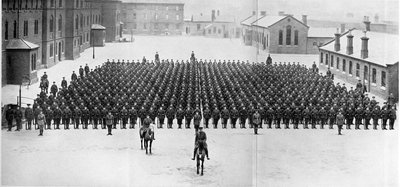
June 21st was a busy day for all. The final preparations for
the raid, which was to commence early in the morning of
June 22nd, were now in full swing. The bridges had been brought
up overnight, and were duly concealed in the front line. Raid
Headquarters, the advanced regimental aid post, and all the other
details, were now being finally completed. The raiding party
were brought up in lorries to the Houplines Level Crossing after
dark, each man with his face blackened and his label, bearing
number and name, tied to the top button of his jacket. All other
traces of identification had been removed. About 11 p.m. the
party was moving down from the subsidiary line with many a
handshake and a "Good luck, boys!" The men were all as keen
as could be. The official report has been reproduced as it stands.
It gives a faithful account of what happened. That the raid was
not so successful as we had hoped—that is to say, that no identification
was obtained—was due to several causes. First, Captain
Parker himself and several of his party were knocked out at the
very start by pressing too close on the barrage and being caught
in a short burst of shrapnel. Next, Lieutenant Clarke's party
ought to have had an officer actually in the trench with them;
the men were willing enough in all conscience, but lacked the controlling
influence of the officer's presence. Then Lieutenant Moseley's
party missed their way, owing to fresh guides having to be
substituted at the last moment. Although we did not claim it
as a successful raid, yet there is no doubt that the effect on the
battalion was good, and the men who had taken part in it were
keen to make another attempt. Colonel Fletcher's disappointment
was great, as he had slaved from morning till night to make
the raid a success. Captain Parker's wounds were more serious
than had at first been realized, and at one time nearly proved
fatal. His reception at the Casualty Clearing Station was typical
of his luck. He was, of course, wearing a "Tommy's" jacket,
and so by mistake was put into a "Tommies'" ward, and was
welcomed on his arrival by the words: "Gawd, Bill, here comes
a b—— nigger!"
P. G. Jones, a Battalion Scout, who fell on this occasion, was
one of our best and keenest young soldiers, and very popular
with everyone. His death was a real personal loss to all who
knew him.
Report on Minor Operation carried out in Houplines
Sub-Sector on the Night of June 21st-22nd, 1917.
"Strength of Party.—Three officers and 97 other ranks.
"Point of Exit.—C.29.a.35.80—C.23.b.96.34.
"Points of Entry.—C.29.a.48.17—C.29.a.62.41.
"Time.—1.6 a.m. Entry reported by telephone.
"Object.—(a) To continue a harassing policy and prevent the
enemy from withdrawing troops.
"(b) Killing and capturing as many of the enemy as possible.
"(c) Obtaining identification and gaining information regarding
the enemy's system of defence.
"Narrative.—Minus five minutes zero: Bridges laid across ditch.
"Minus three minutes zero: All parties formed up across ditch.
"Zero: Barrage commenced exactly on time. All parties commenced
moving on objective.
"Right (Parker's) Party.—This party was so keen to get into
enemy's trenches that they followed the barrage too closely,
and in consequence suffered the following casualties:—
"The leading scout was killed, and the officer who was close
behind him was wounded in the leg and neck and could not go
on. The N.C.O. in charge of the leading party was fatally
wounded, and two of his men were incapacitated. The N.C.O.
in charge of the second party was hit, and one of his men was
killed and another wounded.
"The remainder of the party carried on and entered the enemy
trench as arranged. The party who were detailed to work along
the trench to the right found a concrete dug-out, fitted with iron
doors, in the front-line trench as anticipated, at about
C.28.a.48.10. There was a light in the dug-out, and three men
were seen inside wearing blue uniform with Red Cross brassards.
They were summoned to come out, but refused, and a bomb
was therefore thrown into the dug-out just before the men inside
had time to slam the iron door. The bomb exploded, and groans
and cries were heard, and also a noise which sounded like a trapdoor
being shut. Our men tried to force the door open, but were
unable to do so. The muzzle of a revolver was then put through
a loophole in the iron door and six shots were fired.
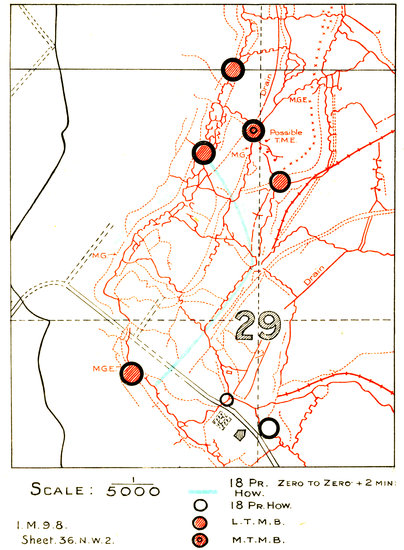
Pont Ballot Salient Houplines.
Area Raided 21·6·17.
"Efforts were again made to open the door, but proved unsuccessful.
Whilst trying to force this door, fire was opened on our
party from the traverse next beyond; this was replied to, and the
Huns ran away. Much valuable time was spent trying to get
into the dug-out for the purpose of obtaining identification, and
owing to this, and also the casualties already suffered, this party
were unable to get on to their farthest objective.
"In the meantime the party working along the trench to the
left were bombed by the enemy, and when they retaliated the
enemy climbed out of the trench and disappeared to the rear.
"Progress was then continued along the trench, and a dug-out
was found, but on examination it proved to be empty. Shortly
after this some of the Centre Party were met and connection
established.
"Just after the withdrawal signal had gone up—zero plus 22
minutes—two Germans were seen approaching the front line over
the top from the direction of their support line. Shots were fired
at them and they withdrew. It is not known whether either of
them were shot.
"Parker's party then left the enemy trench, bringing with them
a rifle and bayonet which were found in the trench.
"On the way back those men who had been hit on crossing No
Man's Land were all brought in except one man, who could not
be found. It is believed that this man was killed. On reaching
our trenches it was found that another man was missing. He was
last seen soon after leaving the enemy's trench.
"At zero plus 33 minutes the N.C.O. i/c Right Party observed
one green light and one golden rain rocket fired apparently from
the enemy's subsidiary line in C.23 or C.24.
"The trench is very deep and narrow, and no duck-boards were
found.
"Centre (Clarke's) Party.—This party crossed No Man's Land
in the order practised. They found the ground much torn up by
shell-holes, over which it was impossible to proceed quickly.
They found the gaps in the wire, but had to zig-zag a good deal
to get through. There was a considerable quantity of cut wire
lying about, which further delayed their progress. They entered
the enemy's trench at about C.20.a.44.21 (i.e., about 30 yards
farther to the right than had been intended).
"2nd-Lieutenant C. W. Clarke established telephone
communication with O.C. Raid at zero plus 7½ minutes, and
sent a message to the effect that his party 'had entered enemy's
trench.'
"The trench was deep, and in getting in the leading man stumbled
and lost his rifle, which he was unable to find in the darkness.
Thereupon another bayonet man was brought up to take his place.
The first party then proceeded along the trench to the right,
and immediately found a dug-out, into which a bomb was thrown.
After the bomb had exploded the dug-out was entered and two
dead Germans found. An effort was made to tear a button off
the tunic of one of those men, but it was on too tight. At this
moment a scuffle was going on outside the dug-out with a Hun
who had come running down the trench, shouting 'Surrender,'
and our man inside the dug-out hurried out to see what was happening,
and picked up a German rifle on his way. The Hun was
placed in charge of two men, to be passed out of the trench as
soon as the two men waiting on the parapet had been called to
the spot. Whilst the two men were holding the prisoner, one
of them was wounded and let go. The prisoner thereupon
wrenched himself free from the other man and escaped to the left.
One of our men chased him along the trench, but, going over
strange ground, was unable to catch him; he came to a communication
trench (Centaur Lane), and, hearing footsteps, threw a bomb
into this trench. As by this time the withdrawal signal had gone
up, he withdrew and joined his own party.
"In the meantime the rest of this party had started working
along the trench to join up with the right party, which they did.
This party was followed by a small party which had been detailed
to proceed along Centaur Lane and block it. They expected to
find this communication trench to the right of where they entered
the front line, but owing to the fact that they had unconsciously
entered the trench farther to the right than had been intended,
this trench was not found until too late.
"A bomb store was found and blown up as the party were
leaving the trench.
"This party had one casualty (referred to above), and he was
brought back to our trenches.
"No S.O.S. signal was seen and no artillery fire was opened
until this party were half-way back across No Man's Land.
"Left (Moseley's) Party.—Moseley's party failed to enter enemy's
trench. The two scouts who had reconnoitred the gaps and
knew the ground well were sick four days before the raid took
place. The new scouts did not know the ground as well, possibly,
as some of the other members of the raiding party; also their
reconnaissance was made difficult by enemy working at their
gaps, and having covering parties out; also they had not the same
opportunity of rehearsal as they should have had in laying tapes,
etc. In consequence, after passing through the first gap, a doubt
arose as to direction owing to other members of the raiding party
thinking that they knew best, with the result that several parties
tried to get through impassable wire. The main party moved
to the left eventually, followed by other parties, and lost direction.
While this was going on one of the scouts found the proper gaps,
dashed after the party, who reorganized, and the leading men
reached enemy's trench when return signal went up. In this
Rifleman Bamber was wounded; he was found by Rifleman F.
Taylor, who bound up his wounds, and as he was not certain of
his direction, he waited for daylight, and brought the wounded
man in the same morning at 10 a.m. This party had three rows
of wire to negotiate, the second and third rows consisting of
heavy knife rests, etc., and, the grass being very long, gaps were
not easy to find.
"Casualties.—Two killed; Lieutenant Parker and six other ranks
wounded; one missing believed killed.
"Action of the Enemy.—There is no doubt the enemy had no idea
he was going to be raided. His action was extremely weak and
slow in beginning.
"It is very doubtful if he inflicted any casualties on us.
"His barrage did not start until about zero plus 10 minutes,
and then increased in intensity by degrees. His fire was directed
chiefly on our front line (the shells falling just short of and just
over our trench) and partly on our support line and subsidiary
lines.
"The enemy's resistance in his trenches was very weak.
Several men were seen running away.
"Summing up.—The raid, unfortunately, failed in its chief
objects, for no prisoners or identifications were obtained, though
there is little doubt that four, and probably several more, Germans
were killed or wounded. Had the left party succeeded in entering
the enemy's trench, there is every probability that more damage
would have been done, and identifications, if not prisoners,
obtained.
"The support of the artillery was excellent, the wire had been
well cut, and the barrage started precisely at the time arranged.
"The medium and light trench mortar batteries were also most
effective, and completely stopped all enemy machine-gun fire.
"The machine-gun barrages were all that could be desired.
"The reconnaissance had been well done. Enemy posts were
found where they had been expected. Suspected machine-gun
emplacements were adequately dealt with either by artillery
beforehand or by my trench mortars during operations.
"Signal communication worked well. Three special lines had
been laid to Raid Headquarters. The raiding party established
telephone communication from near the enemy's trench with
commendable speed.
(Sgd.) "W. A. L. Fletcher, Lieutenant-Colonel,
"Comdg. 2/6th (Rifle) Bn. Liverpool Regiment.
"June 24th, 1917."
At 9.15 a.m. two men missing from the raid suddenly appeared
in our line, one of them wounded. This showed how easy it was
to get into our trenches unobserved. Artillery was very active
against us all that day. In the course of two hours and a half
Hobbs Farm and the detached post received over 120 rounds
from a 4·2 battery, while at times it seemed as if our wire in that
vicinity was the real target. Spain Avenue, the Orchard, Panama,
Pretoria, were all singled out in turn; but probably this was
merely a cloak for the German activities on the left.
The following night the Brigade north of the Lys carried out a
raid, and the enemy seemed very uneasy opposite our left company
front, sending up innumerable Véry lights, letting off bursts
of rifle fire, and industriously bombing his own wire.
The early morning of June 23rd found the German 'planes
extremely active. There was a flight of scarlet machines, which
performed various evolutions for our benefit, and at intervals
swooped down and fired into our trenches. Rifle grenades were
fired at one very low-flying 'plane, and at another a light trench
mortar shell with a shortened fuse and a full charge. The latter
must certainly have surprised the pilot when it exploded in the air.
Every part of the left sector, front line, support, subsidiary,
and communication trenches was heavily shelled for long periods
throughout the day, while a regular box barrage was put round
the detached post. Even the new drain between Irish and Cambridge
was regularly bombarded. The wire in front of our trenches,
never very good, was now reduced to a mass of shattered fragments,
and the impression that a raid must be expected in the
near future grew apace. Down to the day of the relief this extreme
activity continued, and it was difficult to keep Edmeads, Wessex,
and Cambridge clear of blocks. Irish was still being heavily
hammered, but, except for occasional repairs to keep up appearances,
we had long since ceased to use Irish as an avenue. 2nd-Lieutenants
E. E. Paul and J. N. Blake were slightly wounded in
Fry Pan. On the evening of June 26th the relief took place.
We were fully expecting the raid, and precautions were taken
accordingly to prevent any sort of congestion in communication
trenches, all of which had now been accurately registered. However,
it turned out a wet night and as black as pitch, and the relief
was completed viâ Buterne Avenue at 12.37 a.m. without molestation.
"B" Company remained in the subsidiary line.
We found Armentières, as indeed we had expected, hardly less
noisy than the trenches. The Rue de Lille had become more of
a storm centre than previously, and the Quartermaster's staff
were frequently compelled to make a hasty descent to the cellar.
The battalion mess, which had been held in a magnificent house
opposite, its ceilings decorated with fat cherubs flying in a bright
blue sky, was abandoned, as it seemed too risky to have all the
officers congregated together in such a shelled area. The usual
working and wiring parties, made none the pleasanter by the double
journey up the Houplines road, and the same efforts to carry out
training under difficulties were resumed. On the 29th "D"
Company replaced "B" in the subsidiary line.
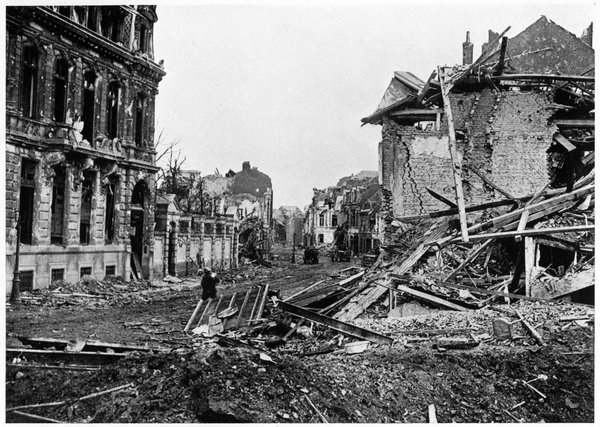
Official Photograph by permission of The Imperial War Museum.
RUE DE LILLE, ARMENTIÈRES.
June had seen an increase in our monthly total of casualties.
Four officers, of whom one was the Padre (at duty), had been
wounded; fourteen men had been killed and sixty-three wounded.
In addition, 2nd-Lieutenants Dugdale and Rule were at the Base
marked "T.B." (i.e., Temporary Base). Captain Gilling, who
had for several months been attached to the R.E., had now been
invalided to England. Our "effective strength" was reduced
from 33 Officers and 744 other ranks to 28 officers and 656 other
ranks; and from the latter numbers had to be deducted Lieutenant
Parkinson and a number of men with the Brigade Pioneer Company,
Lieutenant Huntley at Brigade, and several parties of men
otherwise employed, but whom we were not permitted to strike
off our effective strength. Our total strength in France on
June 30th was 36 officers and 800 other ranks, a disparity in totals
which is eloquent of the number of "employed" on extra-regimental
duties or on courses. Leave had not yet begun
seriously to affect our numbers.
July 3rd found us back in the trenches in order "A," "D,"
"C" and "B" from the right. Relief was complete at 2.25 a.m.
on July 12th. We found that the enemy was systematically
destroying the left company sector, especially the communication
trenches and the support line. The latter, standing as it
did on the forward slope of a ridge, presented a splendid target,
and it was impossible to keep pace with the damage being done.
The constant bombardment of communication trenches threatened
to isolate the left company altogether, and work was accordingly
commenced on a new cut from Cambridge Avenue to the front
line, called "Peter's Cat." The Heavy Artillery were also persuaded
to do some serious shooting on the enemy main communication
trenches, Celia Row and Celt Drive; but though this
may have annoyed him, it did not damp his enthusiasm in the
least.
At 1.30 a.m. on July 11th the gas cylinders were opened and
the projectors discharged simultaneously. The noise of the latter
was tremendous, just like a mine explosion, while a huge black
cloud of great density drifted away from the scene of discharge.
Unfortunately, these projectors had been so long in the ground
that a large number fell in No Man's Land; two fell almost on
the top of a post in "A" Company's front line, while one landed
practically on the top of "A" Company's Headquarters. In
spite of precautions, a number of gas casualties occurred, and the
usual kind of correspondence followed between ourselves and the
Higher Command. Only a case of "trench foot" could exceed
a gas casualty in the excitement it caused.
The patrols which had again been ordered to follow the discharge
were once more countermanded. It was most unlikely
that they would have achieved anything but casualties, though it
would have been interesting to know something of the results.
Certainly an inspection of the enemy line after the Armistice
revealed frequent remains of projectors. These, and detonated
but unexploded medium trench mortar bombs, were to be found
everywhere. The same day the enemy vented his wrath on us in
no small measure, so we hoped we had done him some harm.
To give an idea of what patrolling was like in this sector, the
following account may be quoted as an example. The narrative
was written by a member of the patrol who took part in it:—"The
patrol, which left our trenches shortly after midnight, was
composed of Riflemen Bolshaw, Matchett, and Corkill, with the
section sleuth, Rifleman Dixon, in charge. The front line to the
left of the head of Irish Avenue was only held to within about
two hundred yards of the River Lys, the remainder of the trench
from that point up to the river being rendered untenable by the
marshy condition of the ground and the enemy command.
Judging the Boche lines opposite to be similarly governed, it was
obvious that this deserted area formed an excellent approach
to Frelinghien. About this time a Boche withdrawal was expected
opposite. The object of our patrol was to advance as far, and
learn as much, as possible. The music encountered en route for
the front line speedily dispelled any idea as to a Boche retirement.
A relief was in progress at the time, and Fritz must have spotted
it, for we ran into a veritable nightmare inferno. Rifle and
machine-gun bullets whined and snipped, 'pineapples' cracked,
shells crashed, and 'minnies' crumped! Added attractions
were a dense fog and the choking fumes of the explosions. Through
it all the fitful glare of the Véry lights grew and waned, and the
tout ensemble created in me a stronger desire to enter No Man's
Land than I had ever experienced before. There, at any rate,
we would miss some of the 'hate' floating around. With due
caution we made our way along the deserted trenches to the bank
of the Lys. We then struck out sharply to the right some distance
and lay down to listen. Barely distinguishable amid the din,
we could hear a knocking, rattling, and clanking to our immediate
front. A surmise that a Boche wiring party was at work was
confirmed a few minutes later by the location of its covering
party at no great distance from us. Our batteries about then
commenced to retaliate for the "strafe," and a breeze, till then
absent, commenced to carry the fumes from the Boche shells
back home. Fritz's nerves were evidently not at their best that
night, for almost immediately the musical tinkle of his gas alarms
rippled south down the sector, incidentally causing us no little
amusement. Having discovered that, far from being absent from
Frelinghien, the Boche was busy improving his position there,
and further progress on our part being impossible, we emptied our
rifles into the darkness in the direction of the wiring party and
withdrew."
During this tour Captain Charles Wilson left us for the three
months' Senior Officers' Course at Aldershot. There were not a
few who imagined the war would be over before his return.
Lieutenant Burton took over command of "D" Company.
On July 11th the battalion was relieved, and proceeded once
more (less "B" Company) to Armentières. One company was
now required nightly to press on with the new Peter's Cat Trench;
and as this meant a long journey and a night in the trenches, it
may be doubted whether the men welcomed the change from the
line to the billets. If anything, the Germans were still more
active with their artillery, and movement within the town was
limited to what was absolutely necessary. The one pleasure of
mounted officers was a gallop along the banks of the Lys from
Armentières to Bac St. Maur. If you were energetic you could
follow the towpath as far as Estaires. Between Armentières and
Bac St. Maur there were some fine shell-holes, and the farm at the
wooden bridge by the Jute Factory had been gutted. Bac St.
Maur bridgehead was not infrequently shelled, and our old Battalion
Headquarters was found to have received a direct hit.
Shrapnel used to be put over the Bac St. Maur road even beyond
Erquinghem, and the latter place itself used to be shelled intermittently.
For the battalion as a whole there was little recreation,
except that afforded by the estaminets and an occasional
concert.
The morning after relief (July 12, 1917) a 12-inch shell landed
in the Rue Gambetta next to the school where "C" Company
were billeted; and before there was time to do anything another
one, most unluckily, crashed right in and down as far as the cellar,
where it exploded with a terrific detonation. It was followed by
a third, which fortunately missed the building, but produced a
crater which filled the whole width of the street. The shell which
entered "C" Company's billet unfortunately killed five men and
wounded six. It was a pleasant greeting for Lieutenant Penrice
and a draft of thirty men who had arrived the previous evening.
"C" and "D" Companies were now moved more to the back
of the town to a less exposed position. This move had been under
consideration for some time, as the vicinity of the Rue de Lille
was far from ideal. It was also decided to bring "A" Company
from the Rue Jesuit into a more "salubrious" neighbourhood.
Brigade Headquarters had already moved to the Rue Sadi Carnot
by order of the Corps Commander, who visited them one day during
a period of enemy activity; and certainly their former situation
was far from pleasant—a feature, however, in which it resembled
most other parts of the town.
The Quartermaster, going down to make some arrangements,
was unfortunately badly wounded by a 5·9 which burst just in
front of the entrance to "A" Company's billet. His left thigh
was damaged, and two pieces of shell entered his stomach, one
lodging in the muscles of the back near his spine. He was
hurriedly taken to the regimental aid post, where Captain McHugh
did his best for him, and thence to the Advanced Surgical Centre,
Estaires. No one thought he could possibly live, but, with his
usual determination, he won through; and though his health was
badly impaired,[1] he became in due course an S.O.3 in the Air
Force after the Army had finally thrown him out. For his services
with the battalion he was Mentioned in Dispatches. His
place was taken by Regimental Quartermaster-Sergeant Wallas,
for whom we tried in vain to obtain a Quartermaster's commission.
At 11 p.m. on July 14th the sound of a heavy barrage disturbed
us, and shortly after one company was ordered to stand-to. We
thought the German raid had come off, but except for the heavy
barrage nothing further happened. The next night "C" Company
relieved "B" Company in the subsidiary line, and were probably
not sorry to leave the "peace" of reserve billets for a while.
The post of extra company in the subsidiary line was undoubtedly
very popular. The area they occupied was seldom shelled, and
work could only be done by them at night and in the vicinity
of their posts. In the early hours of the morning, just as "B"
Company had got clear of the line, the barrage fell once more,
and after rolling the length of the front line from right to left
formed a box barrage on the left company front. It was a really
heavy barrage, and two working parties from our "A" Company,
who were just stopping work in Peter's Cat and had begun to arrive
in Cambridge Avenue, suddenly found themselves in the centre
of a tornado of exploding high explosives. 2nd-Lieutenant
McWilliam, who was in command of one of the parties, was,
however, equal to the occasion, and with great gallantry got the
parties under cover, and then proceeded to reinforce the front
line. A number of Germans were seen coming across towards
Cambridge Avenue, and were called on to surrender. This they
seemed quite prepared to do, but an N.C.O. suddenly appeared,
and they all fled back together. One prisoner, however, was
captured by Rifleman Mills.
The 2/7th were not sorry to see the arrival of our men in the
front line. They had suffered heavy casualties, and their position
had become none too pleasant, as the Germans had come round
the left flank and they were being bombed from behind as well
as in front. Colonel Slater and Captain Drakeford, his Adjutant,
were in the left post of all when the raid commenced, and had a
pretty lively experience. Our men and the men in the posts got
in some useful shooting at the enemy as he fled back to Frelinghien
by the river road, and a dozen dead Germans were found, in addition
to the live prisoner. It proved on the examination of the
latter to have been a big raid; and had the enemy shown a little
more enterprise, they might have made the position of that left
company extremely dangerous. There is no doubt that the
accidental presence of our working party, with McWilliam to make
full use of it, proved of great service to the 2/7th K.L.R. In
connection with the operations Rifleman Mills and Rifleman J.
Bailey were awarded the M.M.
The Light Trench Mortar Battery suffered severely, their S.O.S.
positions having apparently been well registered by the enemy,
with the result that in more than one case the team was buried,
together with their gun. "C" Company dug them out, and spent
over six hours cleaning up this part of the line, so great was the
damage done.
During this period in billets our new Divisional Commander,
Major-General R. W. R. Barnes, C.B., D.S.O., called at Headquarters,
and was introduced to the Commanding Officer and
others present.
On July 19th the battalion once more relieved the 2/7th K.L.R.,
"C," "B," "D," "A" being now the order in the line. The
repair of the damage done by the raid, the erection of a complicated
wire entanglement on the left (which was carried out, under
Major H. K. Wilson's supervision, with some difficulty, owing to
the heavy shelling and machine-gun fire), and the preparations
for a two-company raid to be carried out under Captain Eccles,
were quite sufficient to occupy our attention. In addition, one
company of Portuguese was attached to us for instruction, forty
men being handed over to each company. The relief of these men
by another company on the night of the 20th produced rather an
amusing scene. It had been arranged that the old company
should not leave till the new company had arrived; but some time
before the latter were due, the junction of Gloucester Avenue
and the subsidiary line was packed with Portuguese, about half
of whom went out on their own initiative. Suddenly the Germans
opened a regular barrage of gas shells on Houplines Level Crossing,
and the wind blew the gas back to our subsidiary line. The commencement
of the barrage divided the relieving company into two
halves, and likewise the old company, one half of whom, going
back without orders, had just passed the Level Crossing. All
those on the far side, relieving and relieved troops alike, hurried
back to their billets in Armentières. The relieving troops, and a
few others who had been stopped by the barrage, rushed into the
trenches and mingled with those waiting to go out, thus producing
the most complete confusion, to which the necessity of wearing
small box-respirators added the finishing touch. It was a matter
of no small difficulty to get them sorted out, especially as our
only means of communication with the Portuguese was in bad
French, and they all talked at once. However, eventually we
got things straightened out somehow, and order was once more
established.
On July 22nd, 1917, to keep up a pretence that we were going
to attack Frelinghien, a practice barrage was put down on that
place at 5 p.m. At 5.30 p.m. the enemy replied with a far heavier
bombardment of our left company sector, which in a few moments
was entirely concealed from view by smoke and dust. A Portuguese
Commanding Officer and Adjutant arrived that day for
instruction, and Battalion Headquarters was the centre of quite
a heavy gas shell bombardment. Fortunately, the next day
all the Portuguese were removed. It was not a sector calculated
to give new troops a very favourable impression of the line.
During that night the battalion north of the Lys dug dummy
assembly trenches opposite Frelinghien, and the following day
another bombardment was carried out. A second company of
2/7th K.L.R. was now brought into the subsidiary line, partly
to enable more work to be done, partly in view of the continued
threatening attitude of the Germans.
At 1.55 a.m. on the 26th we discharged two torpedoes in the
enemy's wire on the left, and a dummy barrage was put down to
divert attention from a 2/8th K.L.R. raid about to take place
on our right. We ourselves were scheduled to do a two-company
raid, under the command of Captain Eccles, in a short while,
and took considerable interest in the reception accorded to the
"Irish" raiding party. Our barrage was thin, and the enemy
paid little attention to it, but his retaliation fell heavily on the
2/8th K.L.R.
The next two days brought intense artillery fire all over the
sector, and on the 27th heavy "minnies" appeared and blew in
Captain Burton's Headquarters with two direct hits, though,
fortunately, he was not there at the time and no one was killed.
The night of the 28th, the original night for relief, produced continuous
shrapnel from about 9 p.m. to 3 a.m. all over the subsidiary
line and communication trenches. About 3 a.m. an aeroplane
bombed Houplines Level Crossing, and a deluge of heavy
"minnies" descended on the left-centre company's line; but
on the whole we congratulated ourselves on our luck, little dreaming
of what was to happen on the real relief night, July 29th.
The 2/7th K.L.R. came into the sector without a shell being fired.
Colonel Slater and his Headquarters had just arrived, and the
relief was progressing well, when, with a sudden rush and roar,
a terrific bombardment of Armentières commenced. A regular
semicircle of flashes could be seen running continuously round
the rear of the enemy line. This was clearly no ordinary shoot,
but a specially arranged show with artillery in proportion. The
relief was promptly stopped, and all troops stood-to. Suddenly
the S.O.S. went up from the right battalion, and our guns opened
up. This, however, shortly afterwards proved to be a mistake,
and as the German infantry made no move the relief continued.
The din was terrific. Apart from the actual noise of the batteries
firing and the unbroken rush and scream of shells overhead, the
uproar in Armentières was tremendous as buildings were smashed
and battered and the broken débris hurled about in all directions
by this unceasing rain of shells. Lieutenant Evans rang up on the
telephone from Rue Bayard, where he had gone to take over billets,
and told us that the town was soaked with gas, and warned us
not to come out at present. Fires now began to appear all over
the town, but still the barrage did not slacken. At 12.15 a.m.
it stopped, but began again with renewed firing at 12.45 a.m.,
though about 1.15 a.m. this was reduced to one or two areas
and some general miscellaneous shooting, lasting until about
4 a.m., when it was further reduced to action by one or two
heavy guns alone.
About 3 a.m. "B" Company began to thread its way down
Buterne Avenue towards the town. They were caught by a heavy
bombardment in the Houplines road, and had to take temporary
shelter in odd cellars. "C" Company and Battalion Headquarters
followed, but escaped with nothing worse than casual
shelling. "A" and "D" Companies remained in the subsidiary
line, and very glad they were to do so.
Our arrival in the area of our billets was anything but cheerful.
A large part of the Rue de Lille, including the Quartermaster's
Stores, was in flames. The house next to Battalion Headquarters
was practically gutted, and both the company billets were blazing
merrily. The streets were littered with gas shells and the grey
powder which they had scattered. The houses also were full of
gas, nor were any of the gas-proof cellars better off. The first
casualties were being loaded up into the ambulances, the men
gasping, vomiting, choking, and with bloodshot, streaming eyes.
Lieutenant Wyatt, who gallantly carried a wounded man across
Armentières through the bombardment, was especially bad; and
Quartermaster-Sergeant Jackson, who had been found wounded
and unconscious in the street, was little better. Most of our
advance party were in various stages of collapse, and the road
to the advanced dressing station was already marked by a small
stream of casualties. The civilians were in a terrible state. Gas
protection for them consisted merely of one or two "P.H." helmets
per family, and many of the poor creatures were now in agony
from the gas poisoning. Efforts to rouse the Town Major proved
of little use, and a search was instituted to try and discover some
part of the town where the gas was less pronounced. It need
hardly be said that the Commanding Officer was tireless in his
efforts to relieve the situation, and in company with Major H. K.
Wilson searched the town from one end to the other. It was on
occasions such as these that the ordinary man got a glimpse of
what the Commanding Officer really was. After a prolonged
search, the schools between St. Vaast Church and the Convent
were found to be clear, and thither the remains of the battalion
were removed. The men, utterly tired out, fell fast asleep, but
only to wake up and find that they were blind. This was
"mustard gas," till then unheard of by us; and processions of
blind men, led by one who could still see, became more and more
frequent. We did contrive to make some tea, but the rest of the
food was splashed with gas and was unusable; otherwise there
was little to be done. The shelling of the Place de la Republique
now began from a heavy battery, and the shells came perilously
near the open courtyard where we sat under the cloisters that
surround it. A thunderstorm broke suddenly, and probably did
more to clear away the gas than anything else could have done.
That night and the whole of the next day the Germans shelled
the town fiercely. Splendid work was done by Lieutenant Penrice,
who had just gone to the Transport in place of Hutchinson;
by Lieutenant Clarke, who had gone to join a Brigade Training
School in course of formation; and by the transport drivers, who
worked with unceasing energy and courage.
By July 31st the following had been evacuated: Colonel Fletcher,
Major H. K. Wilson, Captains Eccles and Steward, Lieutenants
Alcock, Collinge, Evans, Royle, Rothwell, J. R. Paul, 2nd-Lieutenants
E. E. Paul, Pegge, Little, and Wyatt, the new Padre,
Weaver, and the new Medical Officer, Robinson. The Adjutant,
who went on leave on the 29th, before the far-reaching effects
of the gas had fully revealed themselves, went into hospital on
his arrival in England. Company Sergeant-Major Heyworth had
started with him but had been compelled to remain behind at
the M.D.S., Fort Rompu, being quite blind and delirious. The
stream of ambulances, lorries, general service waggons, and
farm carts pouring into and out of Armentières, was a sight that
will long be remembered. The whole of "B" Company and
the whole of "C" Company, except 2nd-Lieutenant Fell and
one man, became casualties. Of Battalion Headquarters there
remained only one policeman and one store-keeper. The rest,
including the Regimental Sergeant-Major, Regimental Quartermaster-Sergeant,
orderly-room, medical, sanitary, and Quartermaster's
staff, the cooks, the tailors, the bootmakers, and all the
other details, were evacuated. The Battalion Orchestra, who were
playing when the barrage opened, were badly gassed to a man,
and their instruments destroyed. Captain Bowring suddenly
found himself Commanding Officer, and his command consisted
simply of "A" and "D" Companies and the transport. The
total casualties, including the gassed, for July were: 17 officers
wounded, of whom Lieutenant Collinge died from the effects
of the gas, 12 men killed, and approximately 428 wounded. Of
these a few died later, and more were invalided from the service,
but a good many rejoined us in due course.
Before proceeding any further it will be as well to discuss
briefly the cause of this disaster. In the first place, this was only
the second concentrated bombardment with mustard gas that
had occurred. The first had taken place at Ypres a month before,
and caused extensive casualties, but the report of these did not
reach us till the night of relief, when it came with the usual correspondence,
which, owing to pressure of work, was not opened till
after the disaster had happened. The significance of the new
form of gas should certainly have been circulated earlier. With
the dangers of ordinary gas we were familiar, and in any case no
one could have lived for five minutes in the area most strongly
affected without a respirator. The slightest breath of this new
gas was like inhaling red-hot air and choked you immediately.
After the first density of the gas had dispersed, the area became
comparatively clear, and the insidious and silent evaporation,
practically free from smell, caused no one inconvenience, and in
some places was so slight as to be barely perceptible. It was
this that affected the eyes, an entirely new phenomenon to us;
and the comparatively small number that suffered from serious
internal gassing proves that the ordinary precautions were taken.
Moreover, most of those badly gassed were actually caught in
Armentières itself by the original barrage, which began at the rate
of hundreds of shells in a minute. When it is remembered that
as late as the spring of 1918, after mustard gas had long been
recognized and widely advertised, and every possible precaution
taken against it, a concentrated bombardment still produced
casualties running into hundreds, it is not so very surprising that
on the second occasion when it was used, and the first as far as we
were concerned, only about fifty escaped out of the total troops
in Armentières, consisting of two half battalions, some field and
heavy batteries, and some Royal Engineer, Machine Gun Corps,
and Trench Mortar sections. Of the civilian population, it is
probable that scarcely one single person got off unscathed.
This bombardment was the climax of our long period in Houplines.
We had been instructed to be as offensive as possible, in
order to divert the attention of the enemy by our aggressive tactics
from the operations scheduled to commence on July 31st, and
now known as the Third Battle of Ypres. Little glory attaches
to a "feint" attack, whether it be stationary or by movement;
but if successful it brings down upon you severe hostile attention,
which has to be endured without any compensating chance of
sharing in the glory of a great victory. That we succeeded in
our allotted task, and that the 171st Infantry Brigade bore the
brunt of it, we know not only from what our Army Commander
said, but because the Intelligence showed that the Division kept
two German Divisions pinned down opposite to it right till the
end, and this notwithstanding the fact that the hostile artillery
was about ten times as great as our own. The steady increase
of destructive shooting on the area immediately north and south
of the Lys, the regular "crashing" of all lines of communication,
the intense shelling of Armentières, culminating in the great gas
bombardment, prove conclusively that the enemy was daily
expecting an attack on Frelinghien, for which he imagined a force
was concentrating in Armentières. That our casualties were not
greater was due to the scattered position of the posts holding
such a large sector, and to our constant efforts to provide such
protection as could best be constructed under the circumstances.