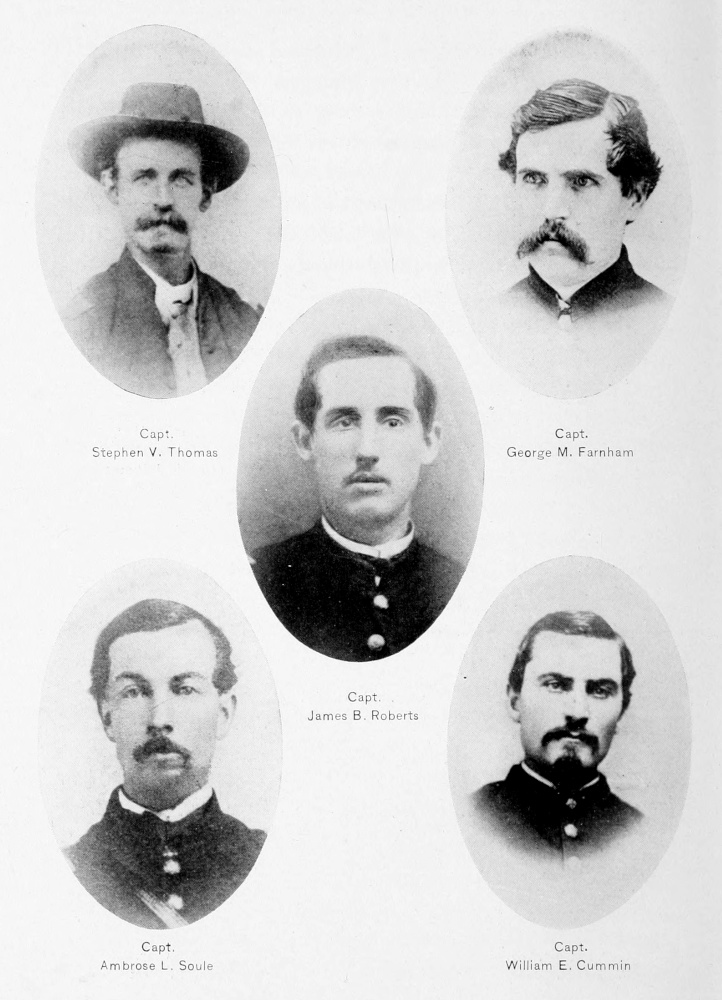
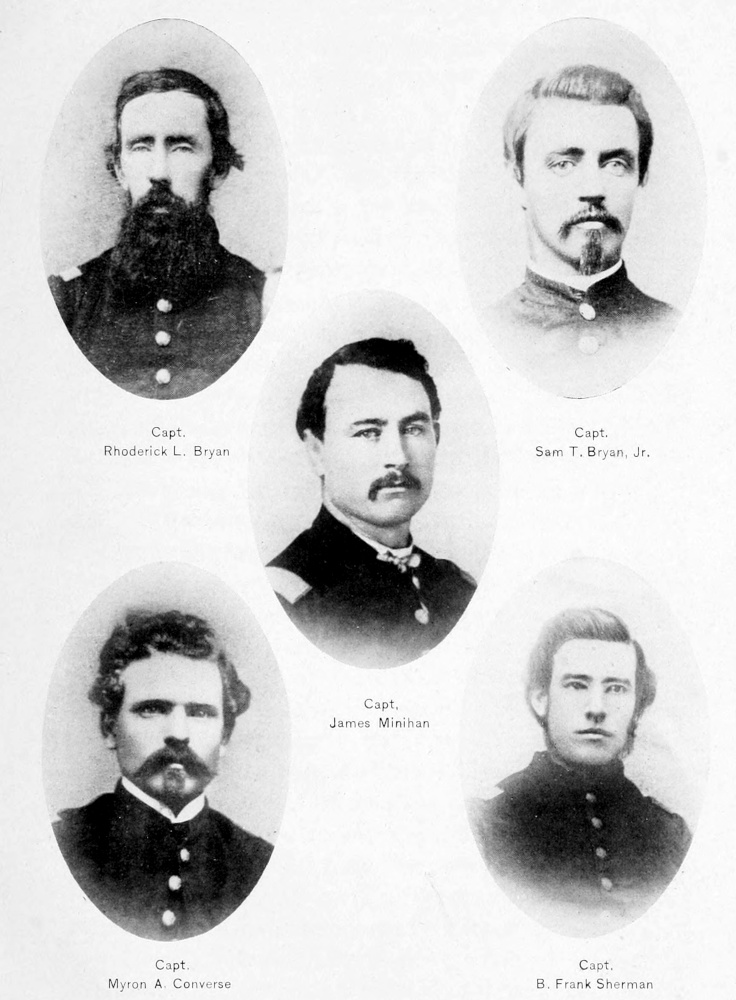
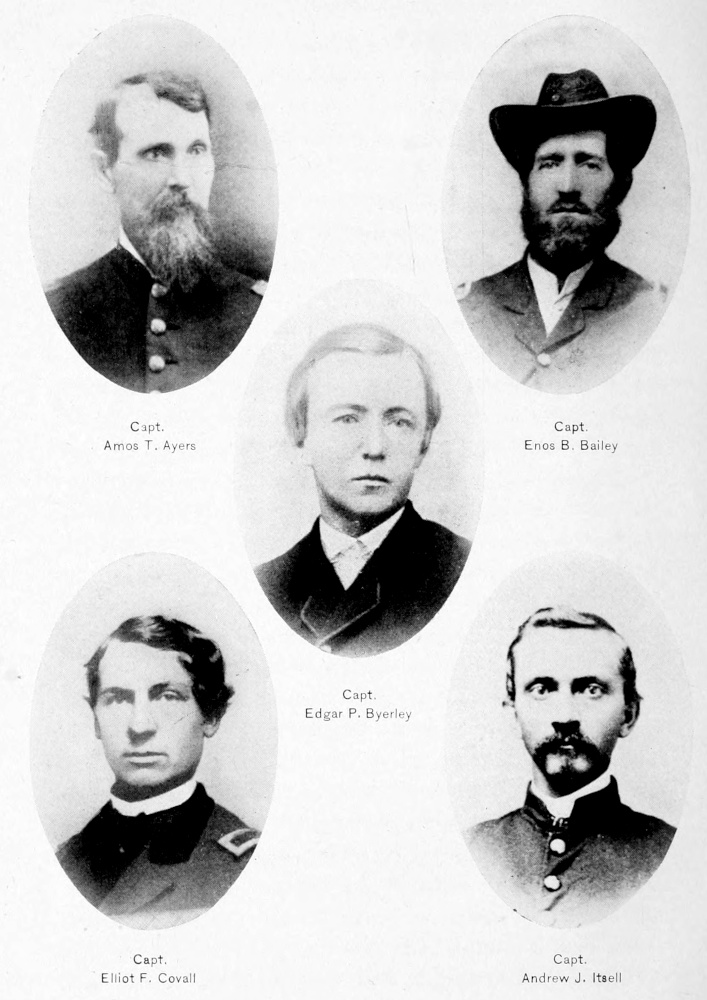
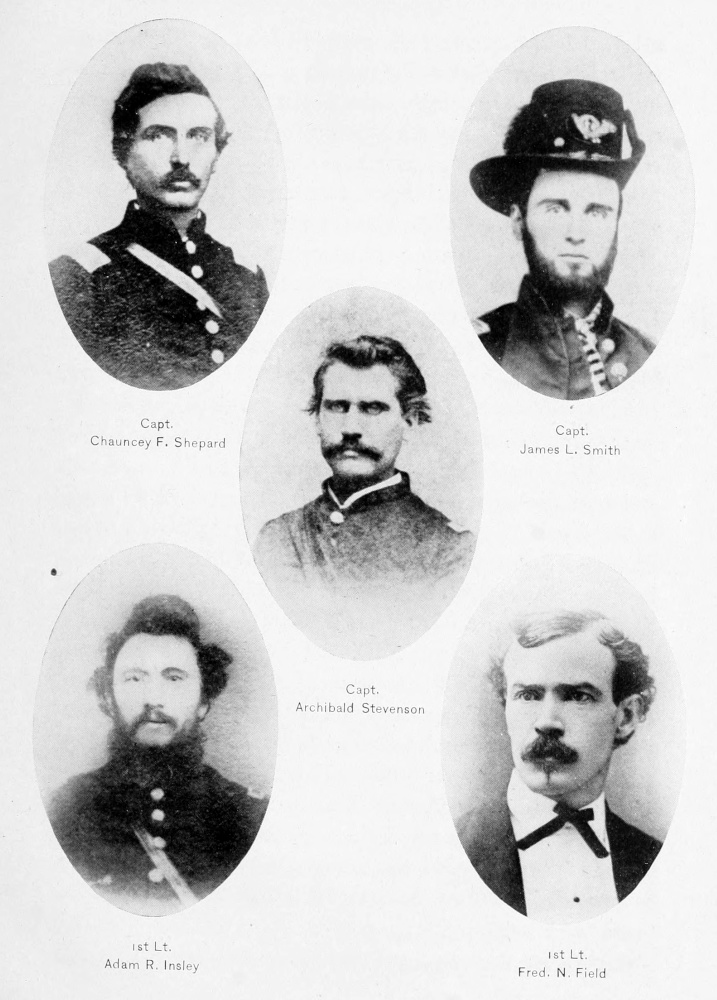
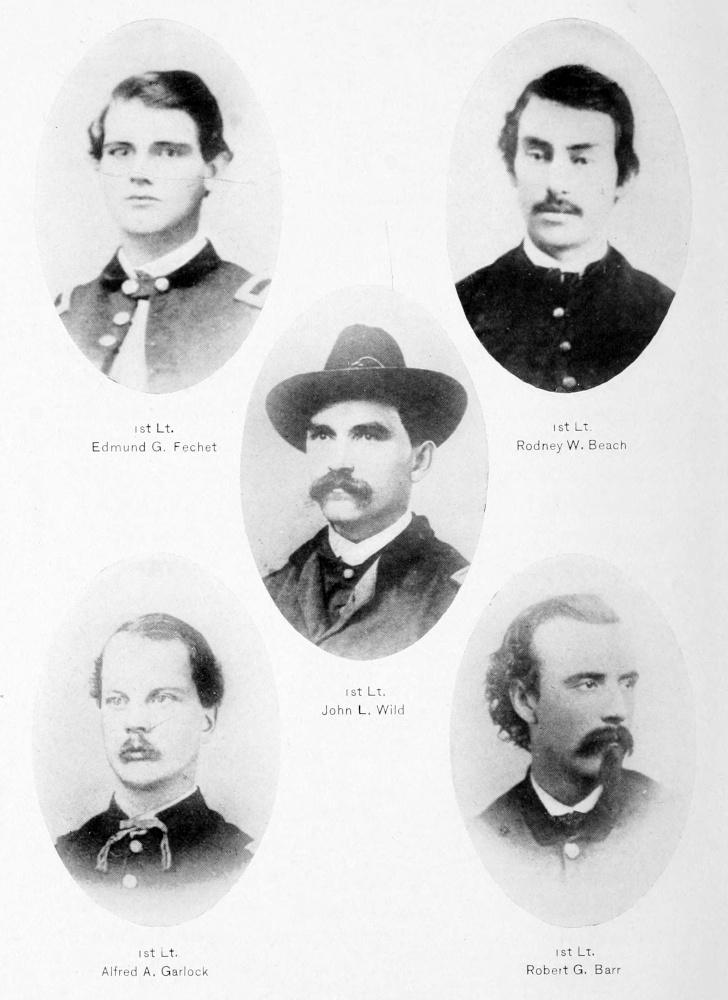
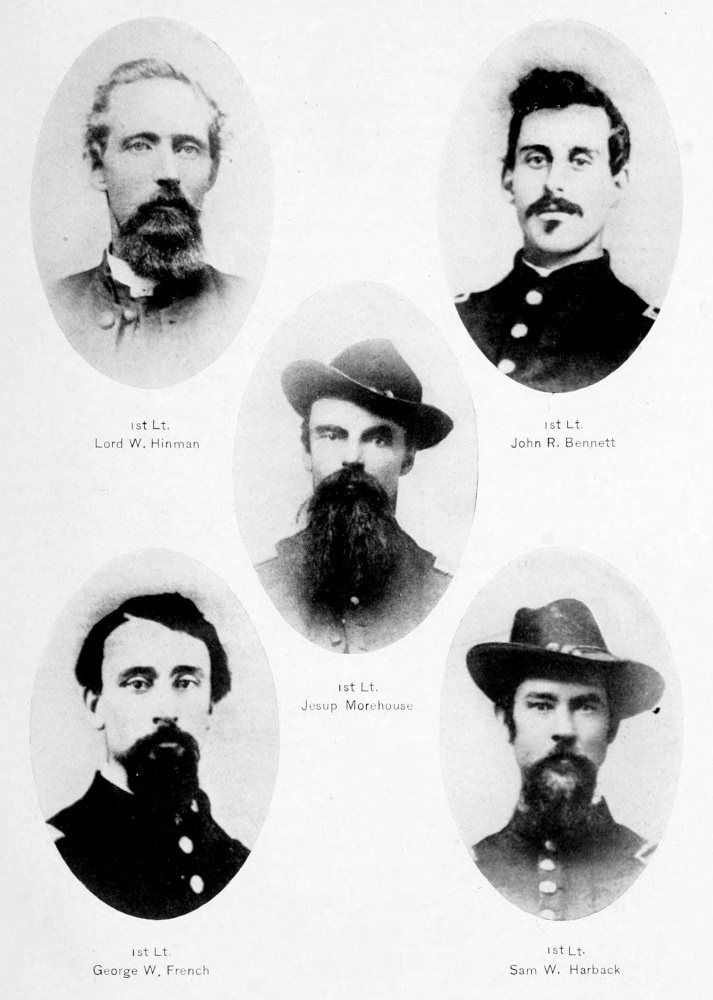
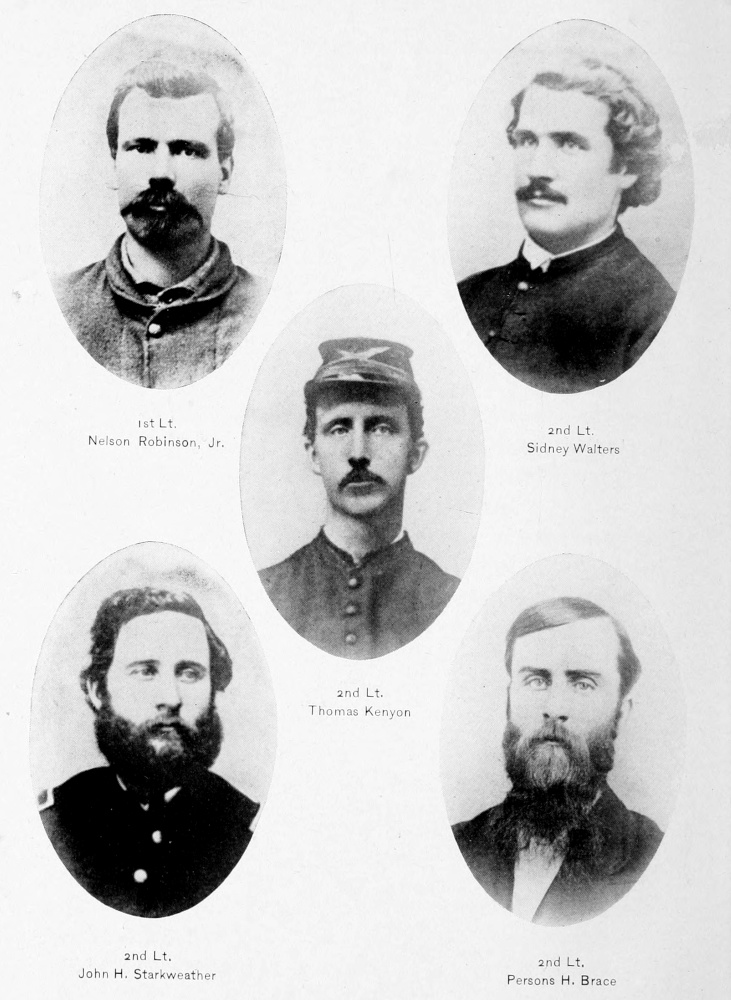
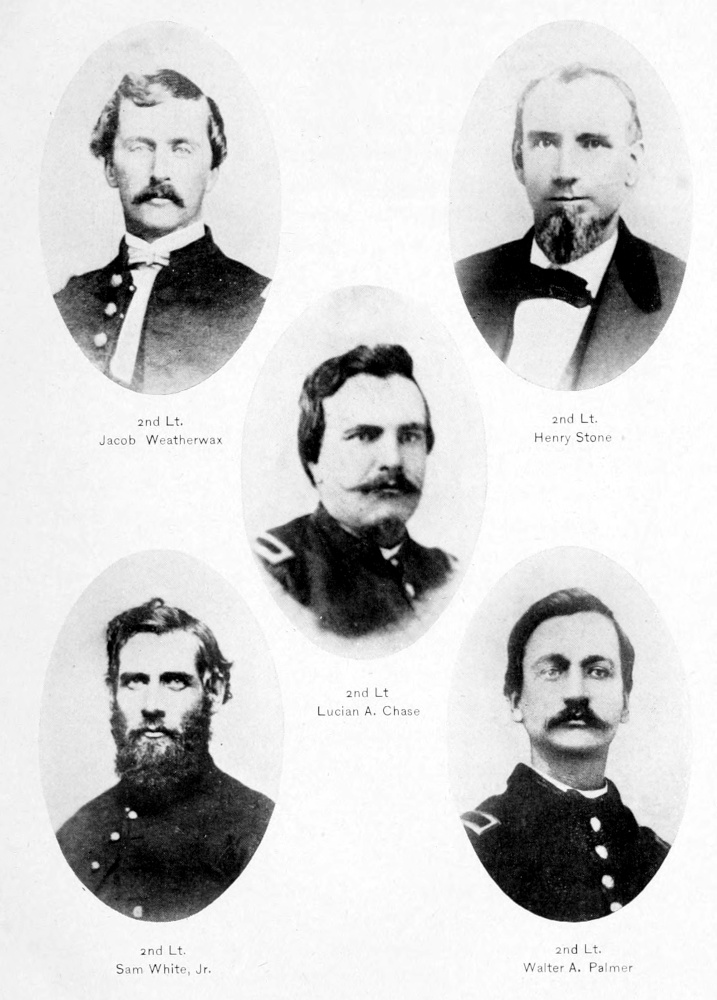
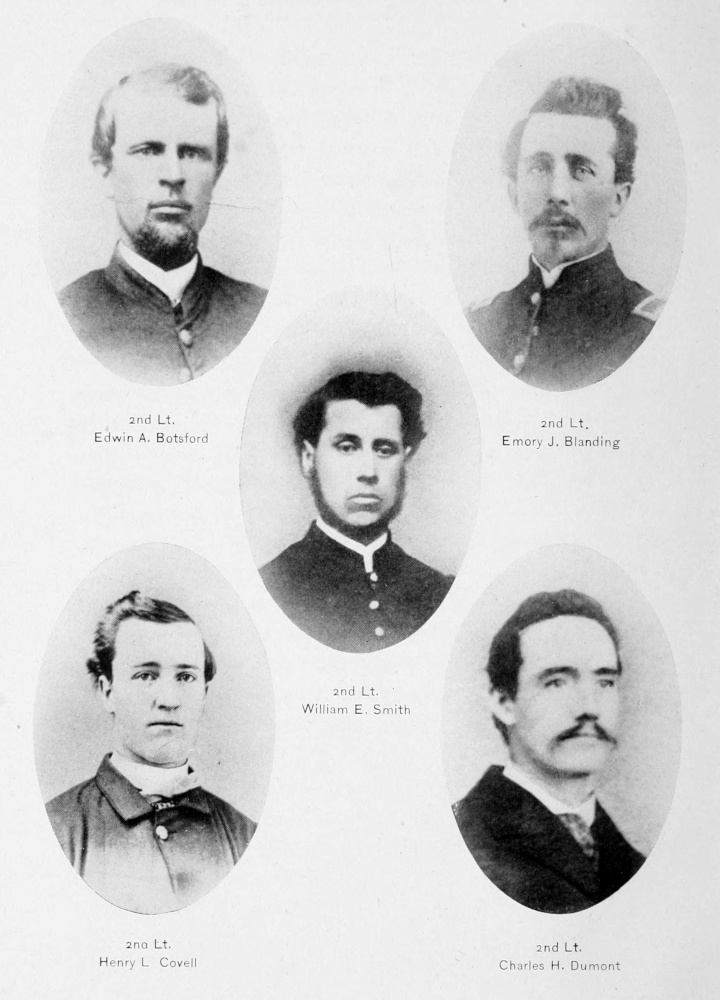
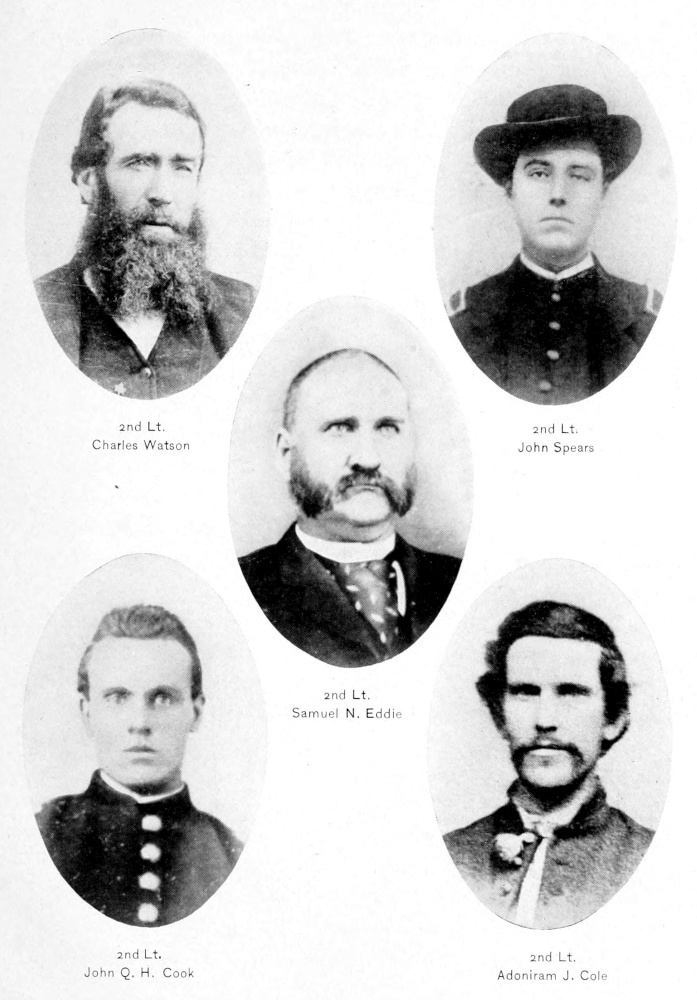
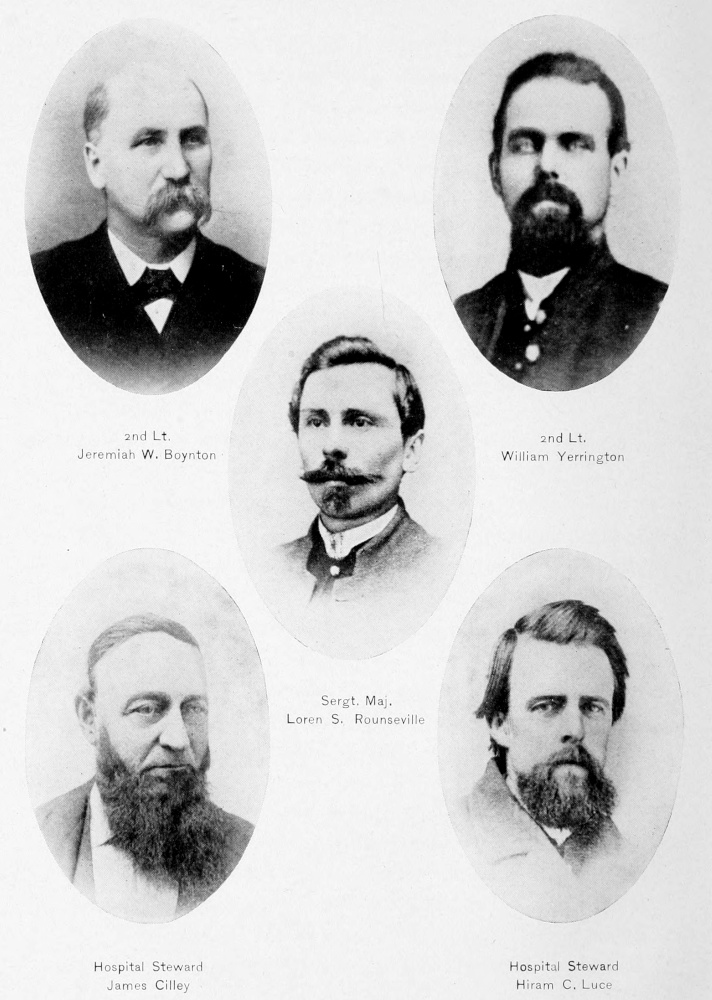
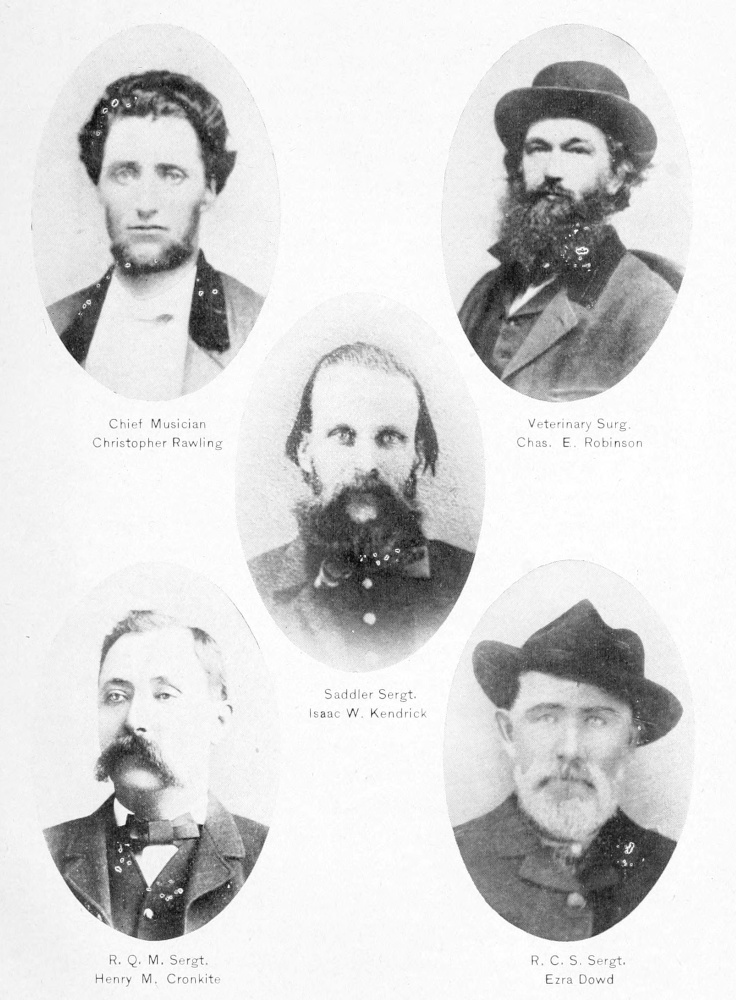
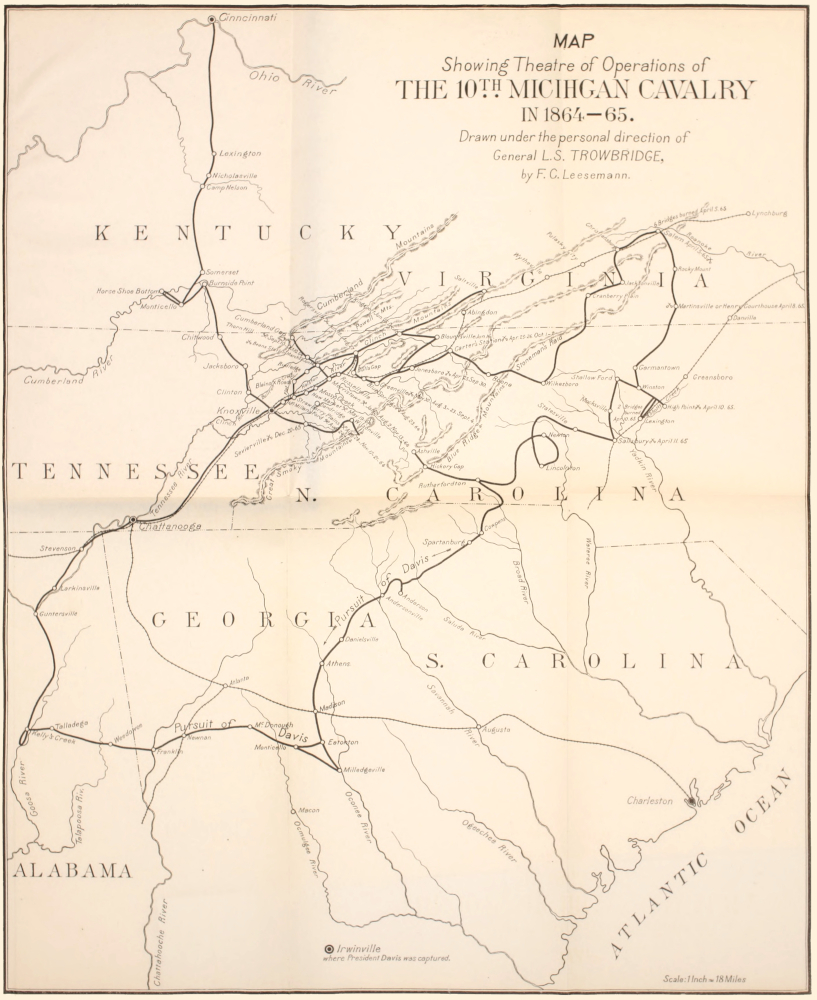
The Tenth Michigan Cavalry was organized in the summer
and fall of 1863, under authority given to the Hon. F.
W. Kellogg, Representative in Congress, who had shown
great zeal and efficiency in raising troops. It rendezvoused
at Grand Rapids. All the field officers of the regiment had
seen service in other regiments—the Colonel and Junior Major
in the Sixth Michigan Cavalry; the Lieutenant-Colonel
in the Fifth Michigan Cavalry; the Senior Major in the
Third Michigan Infantry, where he had won merited distinction
in the battles of Chancellorsville and Gettysburg, in
the latter of which he was seriously wounded while serving
on the staff of General De Trobriand; the Second Major in
the Third Michigan Cavalry, where he distinguished himself
by the capture of a large band of troublesome guerillas
in Western Tennessee.
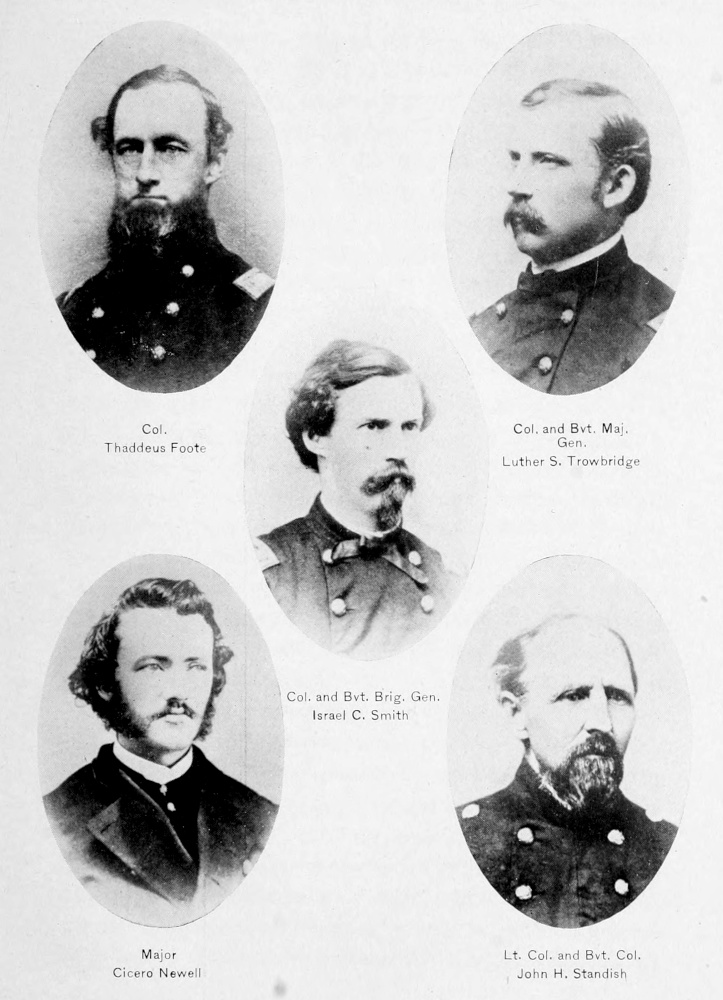
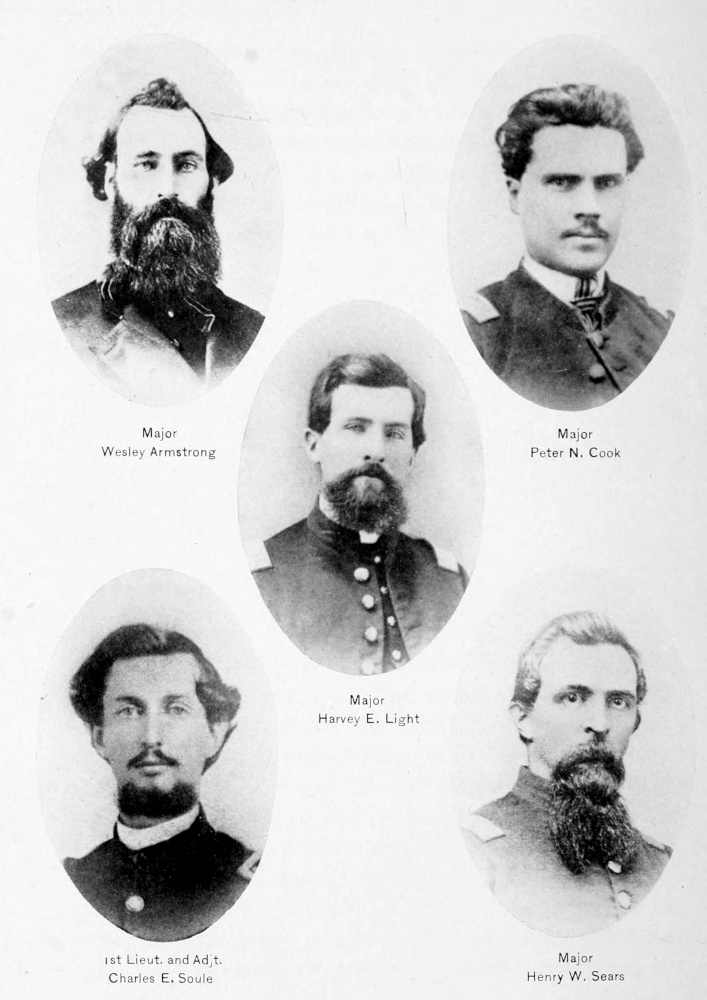
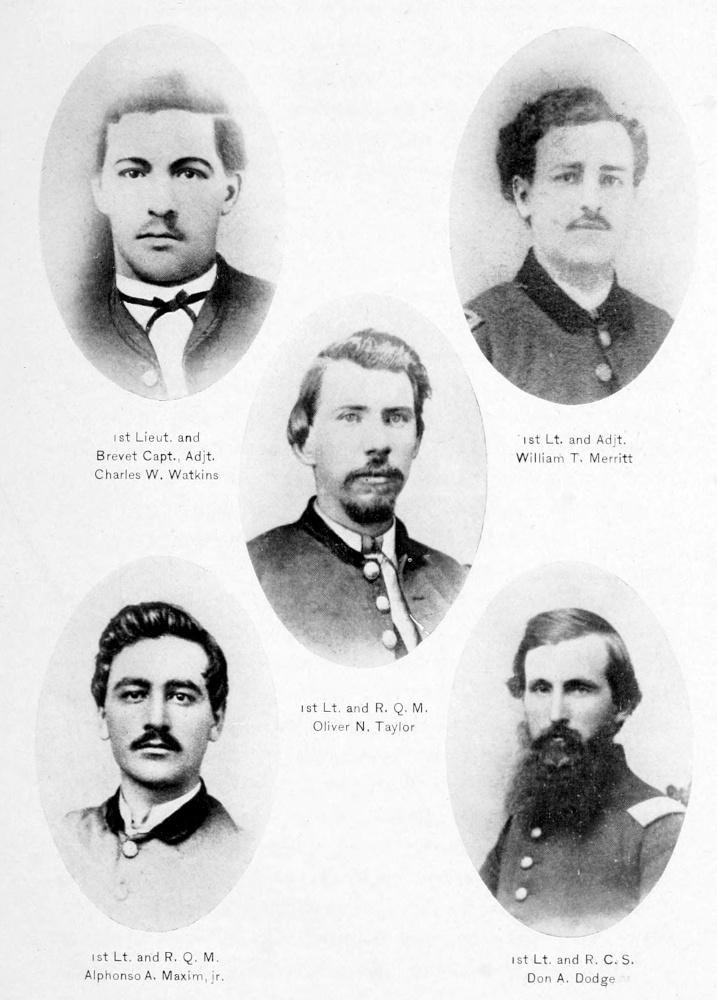
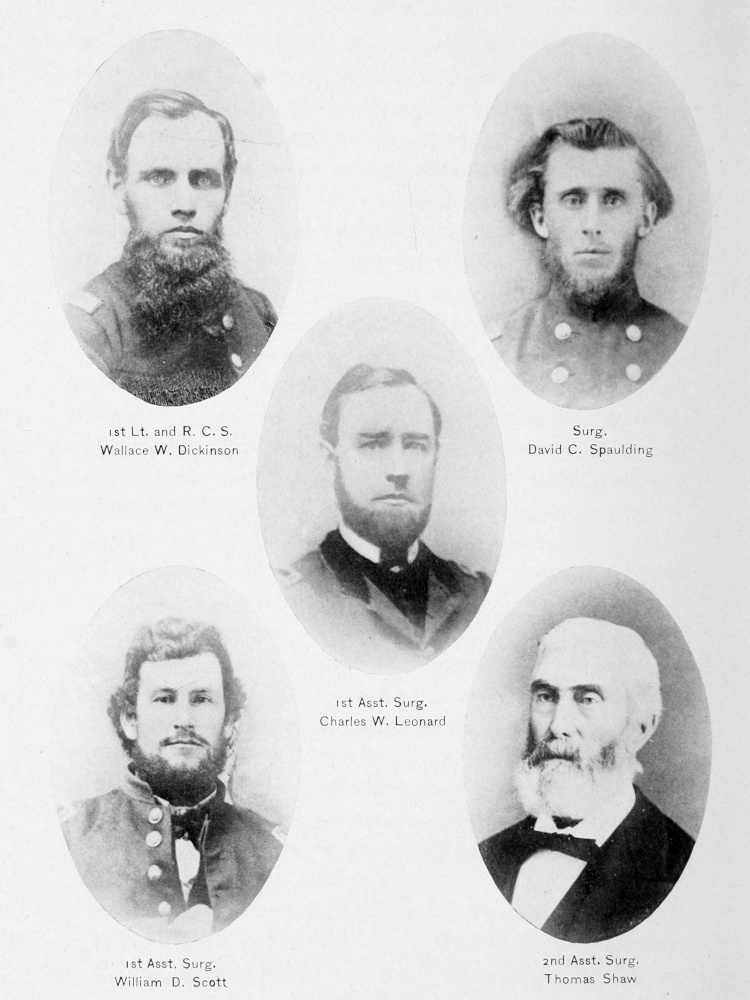
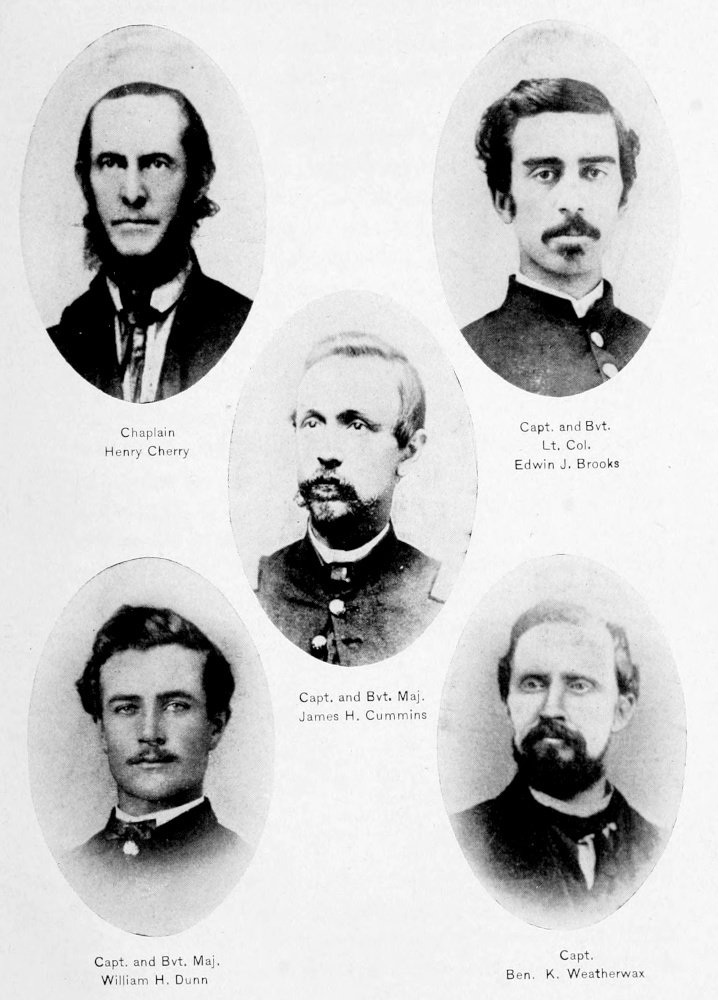
The full organization of the regiment was as follows:
Colonel Thaddeus Foote, Grand Rapids. Lieutenant Colonel
Luther S. Trowbridge, Detroit. Senior Major, Israel
C. Smith, Grand Rapids. Second Major, Cicero Newell,
Ypsilanti. Junior Major, Wesley Armstrong, Lapeer. Adjutant,
Charles E. Soule, Muir. Quartermaster, Oliver N.
Taylor, Grand Rapids. Commissary, Don A. Dodge, Grand
Rapids. Surgeon, David C. Spalding, Muir. Assistant
Surgeon, Charles W. Leonard, Newaygo. Assistant Surgeon,
William D. Scott, Greenville. Chaplain, Henry Cherry,
Owosso.
Co. A. Captain, John H. Standish, Brooks. First Lieutenant,
Henry W. Sears, Muskegon. Second Lieutenant,
Wallace B. Dickinson, Newaygo.
Co. B. Captain, Rhoderick L. Bryan, Franklin. First
Lieutenant, Adam R. Insley, Muir. Second Lieutenant,
Samuel T. Bryan, Franklin.
Co. C. Captain, Benjamin K. Weatherwax, Grand Rapids.
First Lieutenant, Stephen V. Thomas, Elba. Second
Lieutenant, L. Wellington Hinman, Elba.
Co. D. Captain, Archibald Stevenson, Bay City. First
Lieutenant, Frederick N. Field, Grand Rapids. Second Lieutenant,
William H. Dunn, Ganges.
Co. E. Captain, Harvey E. Light, Eureka. First Lieutenant,
Edwin J. Brooks, Leelanaw. Second Lieutenant,
Robert G. Barr, Grand Rapids.
Co. F. Captain, Chauncey F. Shepherd, Owosso. First
Lieutenant, William E. Cummin, Corunna. Second Lieutenant,
Myron A. Converse, Corunna.
Co. G. Captain, James B. Roberts, Ionia. First Lieutenant,
Ambrose L. Soule, Lyons. Second Lieutenant, George
W. French, Lyons.
Co. H. Captain, Peter N. Cook, Antrim. First Lieutenant,
Edgar P. Byerly, Owosso. Second Lieutenant, John
Q. A. Cook, Antrim.
Co. I. Captain, Amos T. Ayers, Bingham. First Lieutenant,
Enos B. Bailey, Bingham. Second Lieutenant,
George M. Farnham, St. Johns.
Co. K. Captain, Andrew J. Itsell, Marion. First Lieutenant,
William T. Merritt, Eaton Rapids. Second Lieutenant,
William Yerrington, Muir.
Co. L. Captain, Elliott F. Covell, Grand Rapids. First
Lieutenant, James H. Cummins, Holly. Second Lieutenant,
Edwin A. Botsford, Fenton.
Co. M. Captain, James L. Smith, Plainfield. First Lieutenant,
B. Franklin Sherman, Virginia. Second Lieutenant,
Jeremiah W. Boynton, Grand Rapids.
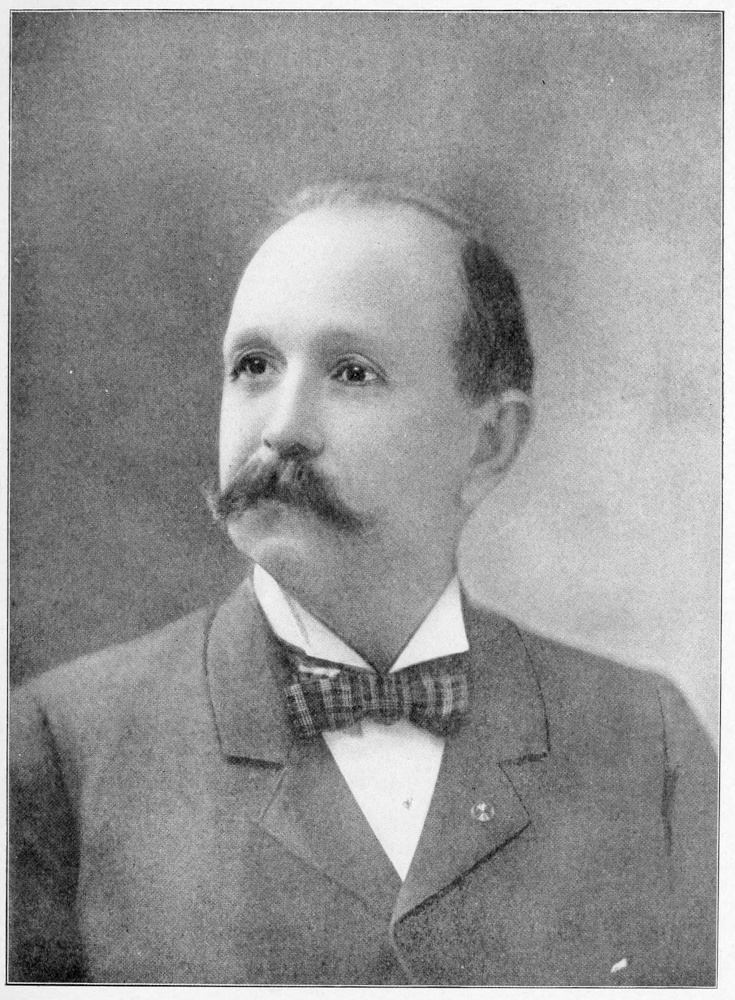
Capt. and Bvt. Maj. James H. Cummins
The organization having been completed, and the ranks
filled, the regiment was ordered to Lexington, Kentucky,
where it arrived on the 5th of December, and there received
its horses and camp and garrison equipage. After remaining
at Lexington one week, the regiment was ordered to
Camp Nelson, where it arrived on December 13th, and remained
there until January 25th. On December 30th, Co.
H, under command of Captain Cook, started for Knoxville
in charge of a drove of cattle for the army in East Tennessee,
but a superior force of the enemy relieved them of the further
care of the cattle, and they were appropriated by the
enemy’s commissary. The stay at Camp Nelson was exceedingly
unpleasant, the weather intensely cold, and much
sickness in camp. There were other troops there and large
depots of supplies for the quartermaster and commissary departments,
and some hospitals not well constructed for cold
weather, as many men were reported as having frozen to
death in them. The regiment suffered much from sickness
and disease, and it was a great relief when orders came to
move to Knoxville, via. Burnside Point. After a very leisurely
march, mostly in pleasant weather, the regiment
reached Burnside Point February 1st. The question of supplies,
especially of forage, was still a serious one at Knoxville,
and consequently the march to that point was not hastened,
and it remained at Burnside Point, protecting boats
while collecting forage on the Cumberland river, and discharging
other appropriate duties until February 29th, when
it started for Knoxville. To all who participated in it, that
march across the mountains will long be remembered as one
of especial discomfort. Rain, snow, sleet and ice made the
marching very uncomfortable for both men and horses.
Heavy branches overloaded with snow were breaking on
all sides. One man of Co. E was seriously injured, and had
to be left behind at the first available stopping place, while
the Colonel narrowly escaped injury from a large branch,
which struck his horse. All discomforts, however, have an
end some time, and as the regiment wound down the side of
the Cumberland Mountains above Jacksboro, it presented a
sight worthy the attention of the greatest artists. The view
from the top of the mountains was one of rare beauty. After
a tedious delay in crossing the Clinch River at Clinton by a
small and inadequate ferry, Knoxville was finally reached on
the evening of March 6th. Remained at Knoxville until the
9th, when ordered to report to the Major General Commanding
at Morristown, via Strawberry Plains. At Mossy Creek
received orders to make a reconnaissance to the mouth of
Chucky River, thence to Springvale, if possible, thence to
Morristown. The reconnaissance was made, and although
no enemy was seen, it gave the men a taste of real business.
Upon reaching Morristown, ordered to report to Colonel
Gerrard, commanding Cavalry Division. The whole army
fell back to Mossy Creek. One incident of the service with
Colonel Gerrard will be recalled with interest by all who
participated in it. The whole division made a reconnaissance
to Morristown and Russellville, when the regiment,
under the command of Lt.-Col. Trowbridge, was
sent to Hugh Kane’s to get forage. On March 22 a violent
storm of wet snow came on, and as the snow balled greatly
under the horses’ feet the march was very hard on the horses
and very cold and chilly for the men. When they reached
Mr. Kane’s (he was a very thorough union man) they were
received by a most hearty welcome. Mr. Kane came out to
welcome them, and said, “Come in. I have been looking for
you. The day they were fighting at Bean’s Station I hid a
lot of corn in the hay mow, as I thought you would want it
some day.” “But, Mr. Kane,” said the commanding officer,
“there is one thing that we want almost more than corn.
My men are almost frozen with this wet storm. We want
some fires.” “Oh, well,” said he, “don’t you see all those
fence rails? Help yourselves, only leave those around the
house.” Then he took all the officers in and gave them such
a dinner as they had not had before in Tennessee. Of such
stuff were made the sturdy union men of East Tennessee.
The regiment returned to Mossy Creek, and the next
day received orders to report to General Thomas
J. Wood, commanding a division of the Fourth
Corps at Rutledge. The service with General Wood
was made up of outpost duty—scouting and reconnaissance—with
nothing worthy of note except the lessons learned in
practical campaigning, of which the men were in need. It
continued until the 6th of April, when the regiment was ordered
to Strawberry Plains to recruit the horses.
During the month of March, two companies, under Captain
Light, were detached for service at Knoxville. The command
was afterwards increased to four companies under
the same officer. The service was pleasant and important,
consisting of picket duty, courier and escort duty, with some
scouting when occasion required. They had the disadvantage,
however, of being away from the regiment and missing
many of its interesting and exciting experiences. Captain
Light was highly commended by Generals Tillson and Ammen
for his fidelity and zeal. East Tennessee
had been so much of a thoroughfare for the two
armies that it was pretty well stripped of all supplies, and it
was difficult to obtain forage for the horses or provisions
for the men away from the railroad. April 20th the regiment
was ordered to move with all effective force to Bull’s
Gap, to report to General Cox. The Colonel being indisposed,
the command fell on Lieutenant Colonel Trowbridge.
Upon reporting to General Cox he was informed that he
was to take six companies of the Third Indiana Cavalry, besides
the Tenth, with Manson’s Brigade of Infantry in support,
and move to Carter’s Station to destroy a large railroad
bridge over the Wautauga River. The movement was to be
made with as much ostentation as practicable, so as to lead the
enemy to believe that it was the advance of an army in the
hope that at its approach the enemy might destroy the bridge,
but if he did not, then the force was to destroy the bridge,
and falling back, destroy the railroad as much as possible
back to Bull’s Gap. Upon reaching Jonesboro, it was
learned that the bridge was defended by General A. E. Jackson
with a strong force on the north side, occupying a redoubt,
and extensive and well constructed rifle pits on the
south side of the river. Colonel Trowbridge, thinking it
possible to capture the entire force, divided his command
and directed Major Smith with one portion to cross the
river at a ford below the bridge and get in the rear. Upon
the approach of Smith’s command the detachment guarding
the ford precipitately fled, but the river was found to be not
fordable, and the attempt had to be abandoned, and Smith
rejoined his command on the south side of the river. The
cavalry was dismounted and deployed and advancing soon
received the enemy’s fire. In addition to the force in the
redoubt and rifle pits, the force on the other side of the river
swept the open ground with a hot cross fire. The ground
in front of the redoubt and rifle pits was perfectly open for
two or three hundred yards, and it seemed a risky thing to
attempt an assault with a thin line of dismounted cavalry. It
was apparent, however, that if the bridge was to be destroyed,
these men must be driven out. Moreover as this
was the first serious business in which the regiment had been
engaged, the effect upon it of a successful assault would be
very marked, while to retire without accomplishing anything
would be very dispiriting. So the assault was ordered, and
as the long thin line sprang forward with a cheer the enemy
broke and fled. Major Smith was the first man inside the
works, and Captain Weatherwax the second. As soon as
they were joined by sufficient men, they dashed over the hill
on which the redoubt was built, expecting to further rout
the enemy and capture many prisoners before they could
cross the river. They were met, however, by a destructive
volley from a mill in which the enemy had taken refuge.
That volley killed Captain Weatherwax and two men, and
wounded sixteen. The rest of the men fell back under cover
of the brow of the hill. Although a strong position had been
gained, it was found to be still impracticable to reach the
bridge without exposure to a destructive fire. Word was
therefore sent to General Manson at Jonesboro that the enemy
was in too strong a force and held too good a position to
be dislodged by the cavalry, and suggesting that if he
thought the destruction of the bridge of sufficient importance
he would better come on with his brigade of infantry. He
replied that he did not consider the destruction of the bridge
important enough for that, and directed the cavalry to return,
doing such damage to the railroad as they could. This
was done, and so ended the first serious business in which
the regiment had been engaged. Should it be thought that
too much space has been given to this unimportant affair, it
may be answered that the importance of a matter cannot always
be determined by immediate results. The effect on the
regiment of a successful assault on superior numbers in well
constructed defenses had not been miscalculated, and undoubtedly
had much to do with making the regiment the
strong aggressive force which it afterwards became. Mention
of this incident should not be closed without a just
tribute of praise to Captain Weatherwax. He was a noble
man, and a soldier of dauntless courage. His loss was
most deeply felt. The command of the company naturally fell
to Lieutenant S. V. Thomas, who was promoted to fill the
vacancy, and proved himself a worthy successor.
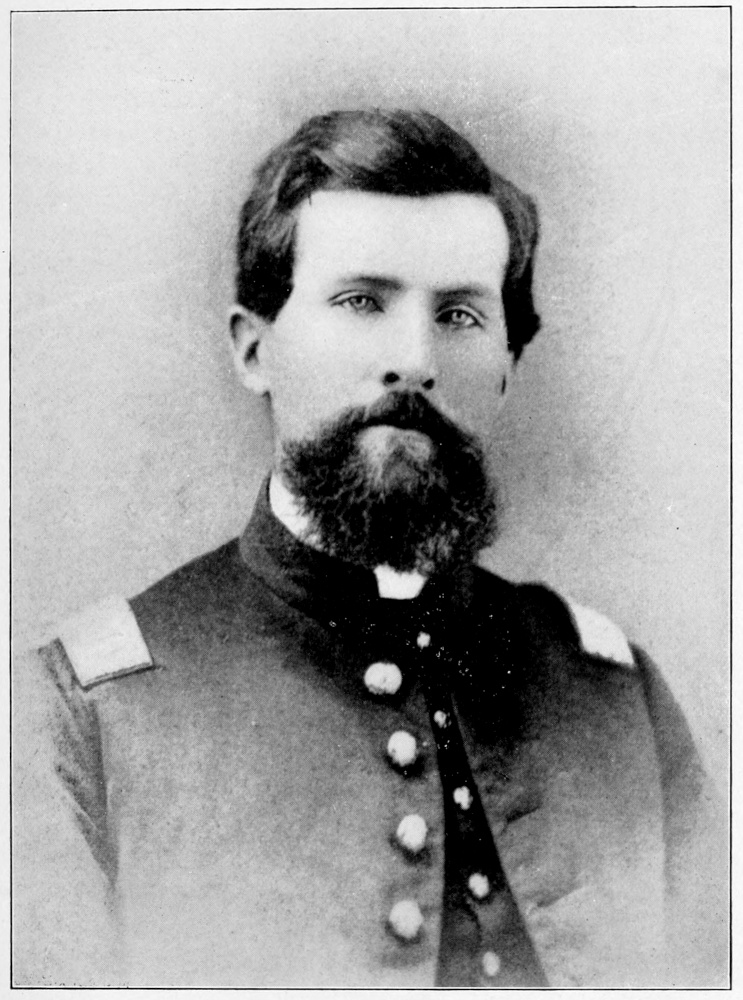
Maj. Harvey E. Light
On reaching Bull’s Gap it was learned that preparations
were being hurried for the infantry to join General Sherman’s
army at Chattanooga. The Tenth was directed to
remain at Bull’s Gap until the last train had left, and then to
move out immediately. This being done, the regiment returned
to camp at Strawberry Plains.
All available troops, except necessary garrisons, had gone
to join Sherman’s army. The Tenth was the only cavalry
left in East Tennessee. Its outpost and picket duty, its constant
scouting and responsibility for the frontier in the direction
of Virginia, gave it plenty of work to do. It was
important work, too, and work that must be done by somebody,
but there was no chance for glory in it, except such
glory as attaches to the faithful performance of duty. There
was plenty of scouting—plenty of hard work—plenty of
fighting—severe and gallant fighting, but on a small
scale. When such great things were going on in
other parts of the great theater of war, as in
Virginia and Georgia, it could not be expected
that the operations of a single regiment of cavalry in East
Tennessee would attract much attention. Headquarters and
a permanent camp were established at Strawberry Plains,
and the regiment assigned to the Second Brigade, Fourth
Division, Twenty-third Army Corps, commanded respectively
by Generals Tillson, Ammen and Schofield. After
matters had settled down to working order, General Tillson
sent for Colonel Trowbridge and informed him that a small
fort had been laid out and partially constructed by an engineer
officer for the protection of the large railroad bridge
at Strawberry Plains, and he was directed to go on and finish
it. Upon examining the work, it was thought that a
mistake had been made in laying it out unless it was intended
to put the guns in barbette. General Tillson was consulted
about it, and declared most emphatically that he would never
put guns in barbette, but always in embrasures, but he thought
no mistake had been made in laying out the work, as he had
done it himself. Colonel Trowbridge being still satisfied
that a mistake had been made, prepared a diagram of the
work and a sketch of the surrounding country, which showed
plainly enough that if the guns were put in embrasures, not
one could be brought to bear on any one of the prominent
points where the enemy would be likely to plant his batteries.
On being shown this diagram and sketch, General Tillson
burst out laughing and said, “I wrote you that I laid out
that work; I did not actually lay it out myself, but I explained
to the engineer what I wanted. It is plain to see
that he did not understand me, or he did not know how to
do it. You are clearly right, so go ahead and change the
faces of the work according to your ideas.”
It became necessary to change every one of the five faces
of the work, and when completed it was a strong fortification
of its class. This matter would not have been considered
worthy of mention except for the fact that on two occasions
afterwards a small force was enabled by it to repulse attacks
from largely outnumbering forces of the enemy, whereas if
the fort had been finished as originally laid out, the enemy
could have maintained a constant fire from a dozen batteries,
indefinitely, without coming within the range of a single gun
from the fort. As it was, their guns were knocked out of
commission very soon after they showed themselves.
Startling reports came from headquarters in Knoxville of
large bodies of the enemy coming down from Rogersville.
After several such alarms, it was thought best to make a
good preparation for any such attack, and work at the fort
was suspended, and all hands put to work constructing some
rifle pits of permanent value. It was astonishing how much
could be accomplished by concentrated effort, with a few
picks and spades, and in one afternoon some very respectable
rifle pits were dug, which gave the men a sense of security,
and furnished a rallying place easily found in the darkest
night. These rifle pits were extended and strengthened until
in a short time the camp had become an entrenched camp of
no small strength and importance. With frequent reports
of the enemy, and necessary scouting in different directions,
with work on the fort between times, the time was well occupied.
On May 28th Colonel Foote, with 160 men, made a reconnaissance
to Greenville, where he encountered Major Arnold’s
Battalion. A brisk fight ensued, in which the enemy
was completely routed, losing 24 men killed, 14 wounded
and 26 taken prisoners, besides 38 horses and mules and 17
negroes. One man, Sergeant Clark, of Co. A, was wounded
in the knee. It was a very creditable affair, and served to
increase the reputation of the regiment as a fighting organization.
On the return march Colonel Foote was slightly
wounded in the foot by the accidental discharge of his own
pistol.
June 14th General Tillson was informed that the enemy
had a large number of horses, estimated at 1,000, in pasture
near Kingsport, and Lieutenant Colonel Trowbridge, with
such force as could be spared from the camp, was directed
to attempt their capture. He very unexpectedly met a party
of the enemy at Bean’s Station, which was promptly charged
by the advance guard and portions of Companies C and M,
under Captain Roberts. The charge was a spirited one, and
the enemy was put to flight. One of them was badly wounded
and left at Colonel Garrett’s house. After charging them
for about two miles, Captain Roberts wisely called a halt.
Lieutenant Brooks of Company M, however, being in advance,
and smarting under some ill-treatment from a superior
officer, kept up the pursuit with a few men for about ten
miles. The command went into camp about eight miles
from Rogersville. Taking an early start the next morning,
the enemy was again met before proceeding a mile, and another
brisk fight ensued. Co. D led in a charge in which
three of the enemy were killed and one mortally wounded.
The only loss sustained by the charging party was one man
of Co. D—Corporal Benton—wounded in the leg. The command
moved on to Kingsport, but all hope of capturing the
horses had to be abandoned, as couriers had been sent on to
give warning, and the horses had been removed. The next
morning, while giving the horses a much needed feed in a
meadow near Blountsville, the enemy made a sudden dash
on our pickets, but was promptly driven back. One man of
Co. M, coming in from picket when the attack was made,
was mistaken for one of the enemy and lost an arm by a
shot from one of our own men. For convenience in foraging,
the command was divided into three parts and sent by different
routes for the camp at Strawberry Plains, where it arrived
on June 21st without further incident worthy of note.
In a brief history like this it is impossible to make mention
of every movement of every detachment of the regiment.
An affair occurred at Wilsonville, about twenty-five or thirty
miles north of east from Sevierville, which showed the steadiness
of the men in presence of sudden danger. Lieutenant
Dunn was ordered with twenty-five men to attempt the rescue
of Colonel Fry of the East Tennesseeans, a valuable
scout and guide, who had been captured by a roving band of
guerrillas. Soon after leaving Sevierville, he struck the
track of a party of about the same size as his own, which
had been robbing the citizens right and left, and was making
for the mountains. He followed them all day, and part
of the next, until they reached the mountains without bringing
them to action. As he could learn nothing of Colonel
Fry, and there were no prisoners with the band he was pursuing,
he deemed it proper to return. At Wilsonville, while
unbridled and unsaddled and feeding in a meadow, they were
charged by the same party they had been pursuing, reinforced
by about sixty men, who killed one of the pickets,
Bert or David A. Crammer, of Ottawa County, but when
they reached the field where the horses were feeding, they
were met by a sharp fire from the Spencer carbines, which
killed and wounded six men and two horses. As soon as
the men could be mounted, pursuit was made, but the enemy
seemed quite unwilling to come within range of the Spencer
carbines again, and kept at a respectful distance.
It must be sufficient for many such matters to say that
there was constant scouting in pretty much all directions toward
the Virginia line. Reports were made of the approach
of the enemy in larger or smaller bodies, and in order to keep
well informed and ready for any emergency, it was necessary
to keep scouting parties out all the time. On July 31st
orders were received by Colonel Trowbridge to take 250 men
and go up the country to destroy bridges on the Wautauga
and Holston Rivers. Major Smith went up with three
companies from Knoxville to join the expedition. At Morristown
they met Major Arnold’s battalion of rebel cavalry.
Major Smith, with one battalion, immediately charged them
and drove them through the town and up the road to Russellville,
where Major Smith was detached with one battalion
to get in their rear at Bull’s Gap, but they succeeded in getting
away by taking the Snapp’s Ferry road. The Tenth
then moved on to Greenville, where it being evident that the
attempt to destroy the bridges would be fruitless, the command
returned to Strawberry Plains, where it arrived on
the 5th of August. On that day Colonel Foote went home
on leave of absence, and on the 10th word was received of
the acceptance of his resignation. Exciting rumors continued
to come in of the proximity of large bodies of confederate
cavalry, and their threatening attitude, which caused
work on the defenses at Strawberry Plains to be pushed
with the greatest vigor, although it is doubtful if anyone
really apprehended a serious attack. It is easy to be deceived,
and so in order to be well prepared for such an
event, work was rushed and scouting parties sent out in
every direction where a confederate force was reported. An
indented line of rifle pits had been run from the fort to the
railroad, and strengthened by piling up railroad ties. On
the 17th of August General Joe Wheeler, of Hood’s Army,
and later of much repute in the Spanish-American war, was
reported to have cut the railroad at Athens, and was approaching
with his corps of cavalry, with several batteries
of artillery. It seems that, wishing to get into Middle Tennessee,
to cut up the communications of Sherman’s Army,
he was obliged to go above Knoxville, in order to cross the
Holston River, there being no fords below Knoxville, and
the ferries all being in possession of the Union troops. On
the same day there arrived at Strawberry Plains from Middle
Tennessee a brigade of three regiments of cavalry, under
command of General A. C. Gillem. These regiments were
well armed and splendidly mounted, having had their pick
of horses from the well stocked farms of Middle Tennessee.
General Gillem claimed to have a command independent of
the officers at Knoxville, and to have been sent to East Tennessee
at the urgent request of Andrew Johnson, then Military
Governor of Tennessee, to rid that section of the state
of the presence of confederate troops. Colonel Trowbridge
was ordered to report to him with every available man that
could be mustered in his regiment. Such a force judiciously
handled in contesting the fords of the Holston, hanging on
the flanks of Wheeler’s command, and attacking whenever
and wherever opportunity offered, could have greatly impeded
the march of Wheeler, and doubtless could have
picked up many prisoners. Instead of that course, however,
General Gillem decided to go towards Virginia, and on the
19th moved to New Market, with the Tenth in advance. An
incident occurred on this march which tested the steadiness
of the regiment in a new and unexpected manner. The command
stopped at a small stream to water. Company A,
under Lieutenant Converse, was in the advance of the column,
with two companies under the command of Captain
Sears a mile or so further in advance as an advance guard.
The General, with his staff and an escort of two full companies,
had moved out after watering. Co. A had finished
watering, and the Colonel, after giving directions how to
hasten the watering, went to the head of the column, when
back from the front in a wild race came the General with
his staff, orderlies and escort, wildly shouting, “I’m ruined,
I’m ruined, I’m ruined—they are right on us, they are right
on us,” and went galloping back to the rear, apparently very
much in a panic. It would not have been remarkable if the
panic had communicated to the rest of the command, but
the voice of the Colonel rang out clear and strong, “Steady,
Co. A, draw sabre, forward, trot, march.” If there had
been any fear of a panic it was over, and the regiment
trotted on to the advance guard, only to learn that the
alarm was without any foundation in fact. But the Tenth
had a chance to show its nerve, and it showed it. On the
23rd Giltner’s brigade was met at Blue Springs, and a sharp
fight ensued, in which six men in Co. A and one in Co. L
were wounded, three of whom died. The enemy was dislodged
from a strong position, pursued for several miles and
driven in confusion through Greenville. Instead of following
the enemy up, the command was switched over to
Rogersville, and for several days nothing was done worthy
of note except to march down to Bean’s Station to keep away
from Wheeler, when it was learned that Wheeler had gone
into Middle Tennessee. Colonel Trowbridge was sent to
camp by General Gillem on some duty, leaving Major Newell
in command.
While the Colonel was away occurred an affair reflecting
great credit on the regiment and all the officers concerned,
and worthy of a more extended notice than the writer can
give it by reason of lack of authentic information on the
subject. He cannot recall that any written report was made
at the time, of the part taken by the regiment, and he has
endeavored by correspondence and otherwise to get at the
facts. While the different accounts agree as to the principal
facts, they differ widely in matters of detail.
Mrs. Joe Williams, a loyal woman of Greenville, rode one
dark night to General Gillem’s camp at Bull’s Gap and notified
the General of the presence at Greenville, eighteen miles
away, of General John H. Morgan and his command. It was
a very dark and stormy night, the 4th of September. Gillem
moved out with his command, with the 10th Michigan in the
advance. They struck the pickets of Vaughn’s brigade at
Copper Ridge a few miles west of Greenville. They captured
the first picket post, and moved on the second, when
Vaughn’s brigade opened fire on them from behind Copper
Ridge. Major Newell dismounted and deployed the advance
battalion under Captain Light, and followed the enemy
towards Greenville. There was more or less firing on the
way, and it seems strange that it did not arouse the force
in Greenville. A story was current at the time that General
Morgan had given orders the night before to have all the
fire arms discharged at daylight, and when the firing was
heard it was supposed to be only the result of that order. At
all events, when the 9th Tennessee and the 10th Michigan
charged into town, the enemy was in no condition to resist,—some
were getting their breakfasts, others cleaning up their
equipment, and all unprepared for an attack. The 12th
Tennessee under Colonel Miller had gone around to the east
of the town to come in on the flank and rear of the enemy.
General Morgan and staff were at the house of Mrs. Williams,
the mother-in-law of the woman who had carried the
information to General Gillem at Bull’s Gap. The men of
the 9th Tennessee learning that fact surrounded the house.
Morgan ran out of the rear door, seeking to escape by hiding
in a grape arbor. He was seen by a member of the 9th
Tennessee, who ordered him to halt, and upon his disregarding
the order, he was shot and killed. His staff, among
whom was a grandson of Henry Clay, 100 prisoners and 6
pieces of artillery were captured.
In this fight the 10th did its full share, and great credit
is due to Major Newell for the coolness and skill with which
he handled his men, as well as to the officers and men of his
command for the promptness and zeal with which they
executed his orders.
When Colonel Trowbridge reported to General Gillem for
duty, he took with him every man from Strawberry Plains
who was fit for duty, leaving behind 125 men who were convalescent,
blacksmiths, horse farriers, and other special duty
men. There was also in the fort which the regiment had
constructed a section of a field battery of light artillery,
Colvin’s Illinois Battery. While the regiment was away
Wheeler came up with his cavalry corps of six thousand men
and nine pieces of artillery. Standish played a splendid game
of bluff, blazing away with his two field pieces as if he had a
great sufficiency of men stowed away somewhere. General
Williams, commanding one of Wheeler’s divisions, and
known in the old army as Cerro Gordo Williams, was told
by some of the rebel citizens that there were no troops there,
that they had all gone up the country. He replied, “Oh, you
can’t fool me. Those Yankees are full of tricks. Those men
wouldn’t be walking about there so unconcerned if they
hadn’t plenty of men to back them.” Standish had sent a
sergeant, Edward Drew, and seven men to guard McMillan’s
ford. One of the men, formerly a corporal, was disgruntled
at having been reduced to the ranks, and went off on his own
hook, so that only seven were left. One of them was a horse
farrier of Co. B, by the name of Alexander H. Griggs, of
Wayne County. These seven men actually kept
back a rebel brigade from crossing at that
ford for three hours, and a half by desperate
fighting—disabling more than fifty. The rebels
finally, by swimming the river above and below this little
party, and out of their sight, succeeded in surrounding and
capturing them all. During the fight Griggs was badly
wounded. General Wheeler, who crossed over with the
brigade, was much impressed by the valor of these men, and
at once paroled a man to stay and take care of Griggs, particularly
cautioning him to take good care of him, as he was
too brave a man to be allowed to die. Approaching the
wounded farrier, the following dialogue is said to have taken
place.
General Wheeler—Well, my man, how many men had you
at this ford?
Griggs—Seven, sir.
Wheeler—My poor fellow, don’t you know that you are
badly wounded. You might as well tell me the truth; you
may not live long.
Griggs (indignantly)—I am telling you the truth, sir. We
only had seven men.
Wheeler (laughing)—Well, what did you expect to do?
Griggs—To keep you from crossing, sir.
Wheeler (greatly amused and laughing)—Well, why
didn’t you do it?
Griggs—Why you see we did until you hit me, and that
weakened our forces so much that you were too much for us.
Wheeler was greatly amused, and turning to another prisoner
(who happened also to be a horse farrier—John Dunn,
of Co. I), inquired to what regiment they belonged. On
being informed he said, “Are all the Tenth Michigan Cavalry
like you?” “Oh, no,” said Dunn, “we are the poorest of the
lot. We are mostly horse farriers and blacksmiths and special
duty men, and not much accustomed to fighting.”
“Well,” said Wheeler, “if I had 300 such men as you, I
could march straight through h—l.”
On the same day Major Smith, of the Tenth, was sent out
from Knoxville with seventy-two men, all the mounted force
that could be mustered, to scout in the direction of Strawberry
Plains, and ascertain the strength and position of the
enemy. The authorities at Knoxville had become a little
anxious over the near approach of so large a body of the
enemy’s troops, for while the fortifications were extensive
and very strong, the garrison was sufficient to man them
only very inadequately. General Tillson therefore desired
Major Smith to get as much accurate information as possible.
Accordingly the Major gave orders to his advance
guard, Sergeant Rounsville and ten men, to charge the first
body of the enemy that they should meet, regardless of its
strength. Two and a half miles from Flat Creek bridge the
enemy was discovered and charged by the advance guard in
gallant style, the Major following up with his command.
The enemy proved to be the Eighth Texas Cavalry, 400
strong. Major Smith routed them completely, capturing
their commanding officer, a Lieutenant Colonel, and thirty
or forty prisoners. Thinking that he could capture the
whole party before they could recross the Holston River, he
pursued them at full gallop until he came to Flat Creek
bridge. Over this he dashed, to find himself confronted by
Hume’s entire division of cavalry drawn up in line of battle,
scarcely 300 yards from the bridge. Of course he was obliged
to retire, and the pursuit was the other way. All his
prisoners were recaptured, and about one-half of his men,
but he obtained a good deal of information. The officers,
among whom were Lieutenants Barr and Weatherwax, and
men were paroled after having been stripped of their boots
and shoes and much of their clothing, and being obliged to
walk barefoot over the rough and stony roads for more than
twenty-five miles. They were so used up by their ill-treatment
as to be unfit for duty for a considerable time.
September 4th Lieutenant Colonel Trowbridge received his
commission as Colonel.
On the 5th General Gillem was ordered to send the Tenth
back to Strawberry Plains, but refused to do so. On that
day Colonel Trowbridge, Major Smith and Captain Thomas,
of General Carter’s staff, were appointed commissioners to
negotiate for the exchange of citizen prisoners, and went up
to Greenville to meet the rebel commissioners. After several
days’ delay waiting for them a meeting was held on the
11th and 12th, but could accomplish nothing, as they had no
lists, and adjourned to meet at Danbridge October 1st.
The regiment returned to Strawberry Plains, but nothing
worthy of note occurred until the 15th, when the regiment
was ordered out with General Tillson and about 850 infantry
to intercept a large force on the other side of Clinch River,
said to be four brigades of Wheeler’s cavalry going to Virginia
from Middle Tennessee. The movement to intercept
them was too late, however, as they had all passed Walker’s
Ford before the Tenth reached there. On the 21st Colonel
Trowbridge was ordered to move to Bull’s Gap, which he
reached on the 23rd, and reported to General Ammen. The
joint command of Generals Gillem and Ammen marched
toward Carter’s Station. At Jonesboro, on the 29th, the
rebel commissioners were met on their way to Danbridge,
under flag of truce. Colonel Trowbridge was directed to return
with them, and turned the command of the regiment
over to Major Newell, who gained for the regiment fresh
laurels and the hearty commendation of General Ammen for
their steadiness and gallant conduct in a stubborn fight at
Carter’s Station the next day, when the enemy was driven
from his position.
October 9th a party of 75 men, under Lieutenant Sherman,
a loyal and gallant officer from Virginia, of Co. M, was sent
out by General Ammen to find a band of guerillas under
Hipshir. Sherman’s party was led into an ambush at Thorn
Hill, and lost 1 man killed, 4 wounded and 15 captured.
On the 13th Colonel Trowbridge was ordered to Michigan
to hurry forward a large number of men who were said to
have been enlisted for the regiment, and were awaiting
transportation. The command devolved upon Major Newell.
Nothing of unusual interest occurred beyond the usual scouting
until the 12th of November, when occurred a series of
actions worthy of careful notice. General Gillem had remained
at Bull’s Gap with his brigade without any good
reason apparent. There was nothing in particular to be defended
there, and the position was easily turned. General
Breckenridge was coming down from Virginia with quite a
little army, larger than the one with which General Taylor
fought the battle of Buena Vista. He had several thousand
infantry, under the command of General John B. Palmer,
formerly of Detroit, about 1,500 cavalry, under Basil Duke,
an experienced officer from Kentucky, and a full complement
of artillery. Undoubtedly his object was to capture Knoxville,
and in that way relieve the pressure at other points.
The movement excited much interest, and aroused much
apprehension in the minds of those charged with responsibility
for affairs in that region, as was shown by dispatches
between the Secretary of War and Generals Thomas and
Ammen. General Gillem remained at Bull’s Gap until nearly
surrounded by General Duke’s cavalry, and then attempted
to withdraw. In doing so he seemed to have lost his head,
and much confusion followed. In answer to appeals for reinforcement,
Major Smith of the Tenth was sent up by train
from Knoxville with one hundred men of the
Tenth dismounted, and one hundred men of
Kirk’s North Carolina regiment to Morristown. There they
disembarked and formed, Major Smith on the right of the
railroad and Kirk on the left. When Smith arrived panic
and confusion reigned supreme in Gillem’s command. That
officer, for reasons best known to himself, had gathered together
a few officers and twenty or thirty men, abandoned
his command, and taken the shortest route through the
woods for Knoxville, where he safely arrived the next day.
The officers and men of his command, being deserted by
their commanding officer, naturally thought that everything
was lost, and the only safety was in flight. There was one
notable exception, brave and gallant Colonel Miller, with his
sturdy regiment, the Thirteenth Tennessee, seeing no hope
of any successful resistance to Duke’s victorious legions,
wisely withdrew to the north side of the river and escaped
the rout. The other regiments were streaming past Smith
in wildest confusion, hotly pursued by the enemy. The
captain of the battery of six Parrott guns, a brave and
gallant officer, whose name is not recalled, seeing Smith in
position, thought he would be supported in making a fight,
and took position some little distance in the rear. Smith
sent him word by two or three mounted men not to stop,
but to keep on down the road. He did not get the order.
Smith, having cautioned his men not to fire until the order
was given, waited until he thought the last of Gillem’s men
had passed, and the enemy was within a few rods when his
challenge rang out clear and strong, “Halt! Who comes
there?” “Johnny rebs” was the quick response. Then,
“Ready, aim, fire,” and the Spencer carbines belched forth
their fiery blast. It was reported that those volleys killed
seven officers and thirty men, and doubtless wounded many
more. The effect of the sudden and unexpected shock was
tremendous and most stunning. The enemy broke and fled
in the greatest alarm. A Colonel commanding one of Duke’s
brigades told the writer afterwards that he was in the rear
that night, and that if those volleys had been followed up by
a charge of a single squadron of cavalry, the whole of Duke’s
command would have been thrown into a panic. As it was,
they came pouring back upon him in the greatest confusion.
But there was no squadron to make the charge. Smith, seeing
that with the confusion of Gillem’s command, it would
be hopeless for him to contend against such overwhelming
odds, and doubtless supposing, too, that the check which the
enemy had received would enable the balance of Gillem’s
men to make their escape, wisely drew off into some timber
and quietly withdrew, and after an all-night’s march brought
his men safely into camp the next day at Strawberry Plains.
After recovery from the shock of their bloody repulse, the
enemy advanced again and captured the battery and wagon
train. The most of Gillem’s remaining force, however, made
good their escape, with the loss of about 300 prisoners.
There is no doubt that except for the timely arrival of Smith
and his men of the Tenth, and the bloody check which they
administered with their Spencer carbines, the bulk of Gillem’s
force, or of two regiments of it, would have been captured,
for up to that time the enemy had had things all
their own way. This fight occurred on Sunday night. On
the following Tuesday morning Colonel Trowbridge returned
and found Major Newell calmly awaiting Breckenridge’s
approach, keeping well informed of his movements
by frequent scouting parties. Colonel Trowbridge kept Generals
Tillson and Ammen at Knoxville well informed, and
suggested that, if it was considered important to hold the
post, it would be well to send up some reinforcements.
General Gillem heard of the suggestion and stoutly protested
against it, as the post was certain to be captured, and
sending any reinforcements would be just throwing the men
away. General Tillson, however, sent up two companies of
Ohio Heavy Artillery, acting as infantry, which brought the
force at Strawberry Plains, including hundred days’ men,
scouts and a small battalion of Kentucky cavalry that had
happened to stop there, up to about 700 men—besides a section
of an Illinois field battery, under Captain Wood, which
was in the fort of which mention has been made. Two hundred
of the Tenth had been sent to Kentucky for horses and
had not returned. Scouting parties were kept out on both
sides of the river Tuesday and Wednesday, and Wednesday
night it was thought that an attack would be made in the
morning, and the men were ordered to sleep on their arms
in the trenches. The next morning the enemy opened with
three guns from College Hill, and drew a prompt response
from Wood, who had the hill covered with his guns. At
the same time a strong skirmish line was thrown out to the
rear, which developed the enemy about a mile from the camp.
A brisk fight was kept up with that portion of the enemy
all the forenoon, while an equally sharp fight was maintained
with the enemy across the river, both artillery and
infantry. About half past three the force in the rear was
seen to be moving away up the river. Undoubtedly the hot
reception which they had met at Morristown had made them
cautious about coming near the Spencer carbines. Breckenridge
remained in the vicinity for several days, when he
withdrew, and the fear of the capture of Knoxville was relieved.
Should inquiry be made why the conduct of General
Gillem was not officially investigated, it might be answered
that he had in Governor Johnson a very warm and powerful
friend, and the influence of personal and political considerations
was so great as to make the institution and prosecution
of charges a matter of extreme difficulty. No one familiar
with the facts seemed to be willing to take the responsibility
of pressing an investigation.
On December 6th, the regiment broke camp permanently
and moved to Knoxville to refit. On December 10th Captain
Roberts, with 50 men, was sent as an escort to General Stoneman,
in command of Gillem’s and Burbridge’s Cavalry, on
an expedition to the Salt Works in Southwestern Virginia.
The regiment remained at Knoxville engaged in the affairs
of the camp, until March 20th, 1865. During this time some
changes had occurred. Lieutenant Colonel Trowbridge had
been promoted to be Colonel; Major Smith to be Lieutenant
Colonel, and Captain Standish to be Major. But these officers
could not muster in their new grades by reason of the
paucity in numbers. An order was received from Washington
to send an officer and six men to Michigan on recruiting
service. Captain Light was selected for that service, which
he discharged with his accustomed energy and zeal, and the
ranks were filled.
On the 20th of January Lieutenant Colonel Trowbridge
was appointed Provost Marshal General of East Tennessee,
to relieve General S. P. Carter. Major Newell, having mustered
out, the command of the regiment devolved on Major
Standish. Colonel Trowbridge remained in the position of
Provost Marshal General until March 20th, when he was
relieved at his own request to take command of the regiment
on an important expedition organized by General Stoneman,
who had come to Knoxville to take command of the cavalry
in Kentucky and East Tennessee, and to organize an expedition
into Virginia. General Grant, with his great foresight,
anticipating, as a possibility, that General Lee, when driven
out of Richmond, might attempt to retire into the mountainous
and easily defensible regions of South Western Virginia
and East Tennessee, determined to send an expedition
to destroy as much as possible of the railroad running to the
southwest by way of Lynchburg. That was the Stoneman
expedition of which the Tenth Michigan was a part. It
consisted of three brigades and one field battery. It left
Knoxville on March 20th and moved to Jonesboro. On the
26th there was an issue of rations for eight days, the last
regular issue for nearly two months. The destination was
kept very secret. In order to deceive the enemy, one brigade
was sent to Bristol, to draw the attention of the enemy in
that direction, afterwards rejoining the column as it crossed
the mountains, while the other two brigades struck directly
across the mountains to Wilkesboro, North Carolina. The
appearance of a large body of cavalry in Western North
Carolina, threatening both Salisbury and Greensboro, must
have been somewhat disturbing to the confederate authorities.
It was reported that troops were hurried to both of
those places in anticipation of an attack. After waiting a
few days for the subsidence of a freshet in the Yadkin River,
and incidentally for its presence to be fully felt, the command
turned square off to the north to strike the railroad.
Five hundred picked men of the Tennessee brigade, under
Colonel Miller, were sent to Wytheville. A battalion of the
Fifteenth Pennsylvania, under Major Wagner, was sent to
the immediate vicinity of Lynchburg, while the main body,
by a rapid march, moved to Christiansburg, arriving there
April 4th about midnight. The Tenth was immediately sent
about 20 miles east to destroy six railroad bridges over the
Roanoke River, which was thoroughly accomplished. While
engaged in the work at Big Spring, Colonel Trowbridge
found a Lynchburg paper of the day before containing an
account of the fall of Richmond. He immediately sent it to
General Stoneman at Christiansburg, and thus was the first
to convey intelligence of that important event. After resting
at Salem the 5th and 6th, he received orders at 1 a. m. of the
7th to move by the shortest and best route to Rocky Mount,
thence to Martinsville, or Henry Court House, to be there
by 9 o’clock on the morning of the 8th, and there await the
balance of the brigade, which was to move by a different
route. The distance was 75 miles. The regiment moved at
4 a. m., and by a forced night march reached Henry Court
House about 7 a. m. of the 8th, to find it occupied by about
500 of Wheeler’s cavalry, said to be a regiment commanded
by Colonel Wheeler, a brother of General Joe Wheeler. The
regiment was encamped about a mile from the town, in a
piece of woods, leaving a picket post in the town. Captain
James H. Cummins, commanding the leading battalion, immediately
charged and routed the party in the town, and
drove them back on the main body. The noise of the firing
aroused the main body, which quickly saddled and formed,
and when Cummins reached them they were in line of battle.
Nothing could restrain the Tenth, however, and they attacked
with vigor, and the enemy was driven out of the
woods. They mainly took refuge in a deep depression so
common at the South, and there, huddled together, they
formed an excellent target for the Spencer carbines of Captain
Dunn and his plucky boys. The casualties of the enemy
were reported as 27 killed. How many were wounded was
not learned. The fight was not without loss to the Tenth.
Lieutenant Kenyon, a gallant young officer, who had been
promoted but not mustered, and four men were killed, and
Lieutenant Field, a brave and gallant officer, and three men
were wounded. As the regiment was ordered to remain
there until the balance of the brigade came up, the men
were drawn in and placed in the most available positions for
defense in case they should be attacked, and then waited the
balance of the brigade until 3 o’clock in the afternoon. The
next day the command started for Germantown and Salem.
General Stoneman, with two brigades, crossed the Yadkin
at Shallow Ford and moved on Salisbury. The Tenth was
sent to burn bridges on the railroad between Greensboro and
Salisbury. One battalion under command of Captain J. H.
Cummins was sent to High Point to attract the attention of
the enemy, if any there should be, in that direction, while the
other two battalions, under Colonel Trowbridge, proceeded
towards Lexington to burn some bridges over Abbott’s
Creek. Captain Cummins at High Point captured and destroyed
a large amount of Confederate Government property,
four warehouses filled with quartermaster and commissary
stores, one woolen factory, one engine, 20 box cars, one
baggage car, about $75,000 of medical stores and 7,000 bales
of cotton.
Colonel Trowbridge wishing to get the bridges destroyed
before daylight, sent on Captain Roberts with two companies
to go ahead at a trot, while he followed more leisurely. It
was an all-night march. About half-past six, to his great
surprise, he came on a party of the enemy. All his information
up to that time was to the effect that there were no
confederate troops in that section. They had all gone to
Greensboro to join General Beauregard. Such was the information,
but before him quietly in camp was Ferguson’s
brigade of confederate cavalry from Wheeler’s corps. His
orders were, after destroying the bridges, to proceed on the
direct road to Salisbury to co-operate with General Stoneman,
who had gone to attack on the other side. But what
had become of the two companies which had passed over
the same road only a few hours before? And the bridges,
what of them? Had Roberts been able to destroy them, or
had he been gathered in and left no sign? It was a perplexing
situation. Apparently the Confederates were quite
unaware of the approach of an enemy, and, with horses and
men fresh, it might be possible to stampede them by a sudden
dash, but after a nearly continuous march of more than
twenty-four hours, neither horses nor men were in good condition
to make an aggressive fight against such large odds,
six companies against a brigade. Moreover, if it were possible
by any good fortune to drive the enemy, which was
very doubtful, he would simply go towards Salisbury, and
make General Stoneman’s task the harder. On the other
hand if by falling back the enemy could be drawn after and
still kept at arm’s length, it was thought to be a good move in
this game of military chess, like capturing a bishop or a
knight at the expense of a pawn. These considerations
quickly passed through the mind of the commanding officer,
and he decided to retire by alternate squadrons. But he did
not wish to begin the movement without hearing from Captain
Roberts, and so he placed his men in the best positions
available, threw a barricade across the road, behind which
he placed Captain Dunn with his reliable and plucky company.
He had scarcely completed his arrangements when
Captain Roberts came in with his two companies in good
order, and reported that he had destroyed two bridges.
“But,” said he, “there is a large force about a mile down
the road.” Upon being asked how he knew, he said he had
slipped passed them on their flank, and could see the whole
camp. He was quite sure that besides the cavalry there was
a good force of infantry. The object of the expedition, the
destruction of the bridges, having been accomplished, the
movement to retire by alternate squadrons was explained,
and without longer delay commenced. It was not long before
it was discovered, and the enemy attacked with great
vigor. Then for two hours ensued a remarkable fight, in
which the officers and men of the Tenth acquitted themselves
with great credit. The enemy repeatedly charged with great
gallantry, and as he attempted to pass a column around each
flank, it became necessary to retire rapidly, but never at any
time was there the slightest evidence of uneasiness or panic.
The men wheeled out of line into column and into line again,
when new positions were reached with the same coolness and
precision as if on the parade ground and no enemy near.
Their conduct was worthy of the highest praise. Strange
as it may seem, the only losses in the Tenth were two men
captured during the night while trying to get some horses
out of a barn. From rebel newspapers, deserters and men
who came in to be paroled, it was learned that the losses of
the enemy in killed and wounded were between 75 and 100.
Where all did so well, it may seem invidious to mention any
specially, and in the lapse of years some names may have
been lost sight of, but the following named officers are distinctly
remembered as worthy of special mention for their
coolness and courage: Major Standish, Captains Roberts,
Dunn, Minihan, Lieutenants Beech, Wild and Sergeant
Dumont, commanding Co. D.
Upon rejoining the brigade at Salem the command
moved to Shallow Ford to join General Stoneman
in his attack on Salisbury. On reaching
the South Fork of the Yadkin, about three miles from Salisbury,
General Stoneman was unable to cross. The stream,
though narrow, was deep, with high precipitous banks. It
was spanned by a bridge, the planks of which had been removed,
and it was covered by artillery well supported. General
Stoneman, with his battery, tried to drive them away,
but could not succeed. After some delay he said to Major
Smith, of the Tenth, who was serving on his staff, “I want
you to take 20 men of the Tenth Michigan, with their
Spencer carbines (he had an escort from the Tenth), get
across this stream in some way, and flank those fellows out
of there.” Smith got across on logs and fallen trees, and
creeping up on the flank of the rebels, delivered some rattling
volleys from his repeating carbines, when the whole force
broke and fled. Stacey, with his Tennesseeans, who had
been waiting for the chance, quickly relaid the planks on the
bridge and charged across. The fight was over in a very
short time, and the city, with 900 prisoners, 19 pieces of
artillery and immense quantities of stores was captured. It
was estimated by General Gillem’s quartermaster that
enough quartermaster stores were destroyed to equip an
army of 75,000 men. About midnight of the 14th news was
received at Statesville of the surrender of Lee’s army. On
the 17th the Tenth was sent to Newton to guard the fords
of the Catawba, and to gather in any stragglers from Lee’s
army who were seeking to get away without being paroled,
being busy at that work for several days. News of the
assassination of President Lincoln was received at Newton
on the 23d. Then came the ill-judged armistice between
Generals Sherman and Johnson, and the division was ordered
to East Tennessee. When about fifteen miles from
Ashville, an order was received reciting that the armistice
had been disapproved, and directing General Palmer, commanding
the division (Generals Stoneman and Gillem having
returned to East Tennessee) to return to the Carolinas,
and make sure by laying waste the country, if necessary, that
no supplies should reach General Johnson’s army from south
or west of the Catawba River. The Division returned, but
before the work of laying waste the country had begun,
Johnson had surrendered, and that painful necessity was
avoided.
Thus ended what has been called the Stoneman Raid of
1865. It may be safely said that no similar enterprise in the
history of the war accomplished so much of importance with
so little public attention. General Thomas, in his official
report, said that no railroad was more effectively dismantled
than the road running to the southwest from Lynchburg.
For 125 miles substantially every bridge and trestle of any
importance had been destroyed, while several bridges on the
Danville road had met a similar fate. Large quantities of
military supplies and property of the Confederate Government
had been captured and destroyed at High Point and
Salisbury. That it attracted no more attention ought not to
be wondered at under the circumstances. With Farragut
and Canby knocking at the gates of Mobile, with Wilson and
his splendid army of cavalry sweeping over the states of
Mississippi, Alabama and Georgia, with Sherman striding
like a giant through the Carolinas, and Grant tightening his
relentless grip on the army of Northern Virginia, it was not
strange that a small division of cavalry in Virginia and
North Carolina, away from the scenes of great achievements,
should attract but a small degree of public attention. In all
the operations of the division, the Tenth Michigan Cavalry
bore a conspicuous part.
On the 29th an order was received from the Secretary
of War reciting that Jefferson Davis and his Cabinet, with
a large amount of treasure (estimated at $6,000,000.00 in
coin), with a large escort of cavalry, was making his way to
the southwest, and directing the commanding officer to spare
neither men nor horses, but to pursue him to the ends of the
earth if necessary, and to obey no orders except such as
should come directly from the Secretary of War. Mr. Davis
and his party, with an escort of 6,000 cavalry, had been
reported two days before at Yorkville, two days’ march in
advance. By making a wide detour and a rapid march, the
Division was thrown across his front on his line of march.
All the commands of the escort had been embraced in the
terms of surrender of Lee’s and Johnson’s armies, and consequently
were not in condition to do any more fighting.
When they found further progress disputed by an armed
force, they broke up into small parties and scattered in different
directions for their homes. Many of these small
parties reported having Mr. Davis with them, so that according
to apparently very reliable authorities Mr. Davis was
reported in many different places in many different directions
at the same time. The plan of the pursuers was to occupy
all the roads running to the west, and all the fords and
ferries on the rivers, and this was done for a distance of
probably one hundred and fifty miles from north to south.
It was while trying to avoid these forces as well as General
Wilson’s cavalry at Macon by a wide detour to the south of
Macon, that he was captured by the Fourth Michigan Cavalry
near Irwinsville. While the Tenth had no part in the
capture itself, there is no doubt that the close watch they
kept by scouting parties on the roads, bridges, fords and
ferries, contributed very largely to the result. The capture,
however, was not known for several days at General
Palmer’s headquarters, and the Tenth was ordered to move
to McDonough and guard the road from there to Sandtown.
At McDonough orders were received to move to the west
side of the Coosa River in Alabama, and there take up a
line as had been done in Georgia. At Newnan, May 13th, it
was learned that the railroad and telegraph lines were
opened to Atlanta, and a halt was made to get rations and
forage, the first regular rations that the men had received
since the issue of March 26th in East Tennessee. While
waiting for them information was received by telegraph
from Atlanta that Mr. Davis had been captured, and passed
through Atlanta for Savannah under good escort. This
information was at once sent to General Palmer, in the hope
that it would soon be followed by an order to return to East
Tennessee, but Division Headquarters were about 100 miles
away toward the north, and it necessarily took some time to
reach there, and a long and tiresome march through a
sparsely settled country, affording scant provender for men
and horses, was unavoidable. But there is an end to all disagreeable
experiences, and there was an end to this pursuit
of President Davis, whom we knew to have been captured,
and the Tenth returned to East Tennessee on the 31st day
of May, having marched not less than 1,800 miles in the
enemy’s country, without any base of supplies, living on the
country, except for the few days’ rations received from
Atlanta, for 58 days, counting from the end of the eight
days for which rations were issued on the 26th of March.
Much to the disappointment of the men, the regiment was
not to be mustered out at once. There was a reorganization
of the Division at Linoir Station. Colonel Trowbridge was
assigned to the command of the First Brigade, and Major
Standish to the regiment, Lieutenant Colonel Smith being
still on staff duty at Headquarters in Knoxville. This assignment
continued at Linoir Station and Sweetwater until
the latter part of August, when the Tenth was ordered to
Jackson, West Tennessee. Colonel Trowbridge’s term of
enlistment would expire on the 1st of September, and he
thought as the war was over it would be but fair for him
to muster out, and thus make possible a promotion in each
grade. By permission he remained at Knoxville until he
mustered out on September 1st. On August 24th the regiment,
under command of Lieutenant Colonel Smith, left for
Jackson, West Tennessee. Captain Light had returned, having
had great success in recruiting, and the ranks were full
enough to permit promotion and muster in all the grades.
The regiment remained in West Tennessee until the latter
part of October, when it was ordered to Jackson, Mich.,
where on November—it was finally mustered out and paid
off.
In the short space allowed for this general history, it has
not been practicable to mention in detail all the engagements
in which detachments of the regiment participated, and only
the more important ones are selected for special mention.
The monthly returns of the regiment show that some portions
of it came in contact with the enemy on the following
occasions:
At House Mountain, Tenn., Jan., 1864; Bean’s Station,
March 27 and June 14, 1864; Powder Spring Gap, Tenn.,
March 28, 1864; Rheatown, Tenn., April 24, 1864; Jonesboro,
Tenn., April 25 and Sept. 30, 1864; Johnsonville,
Tenn., April 25, 1864; Wautauga, Tenn., April 25, 26 and
Oct. 1 and 2, 1864; Dandridge, Tenn., May 19, 1864; Greenville,
Tenn., May 30, Aug. 3 and 23 and Sept. 4, 1864; White
House, Tenn., May 31, 1864; Morristown, Tenn., June 2,
Aug. 2, Nov. 13, 1864; Rogersville, Tenn., June 15, 1864;
Kingsport, Tenn., June 16, 1864; Blountsville, June 16,
1864; Cany Branch, Tenn., June 18, 1864; New Market,
June 19, 1864; Mooresburg, June 25, 1864; Williams’ Ford,
June 25, 1864; Dutch Bottom, June 28, 1864; Seviersville,
July 5, 1864; Newport, July 8, 1864; Mossy Creek, Aug. 18,
1864; Bull’s Gap, Aug. 21 and 29, 1864; Blue Spring, Aug.
23, 1864; Flat Creek Bridge, Aug. 24, 1864; Rogersville,
Aug. 27, 1864; Sweet Water, Sept. 10, 1864; Thorn Hill,
Sept. 10, 1864; Seviersville, Sept. 18, 1864; Johnson’s Station,
Oct. 1, 1864; Thorn Hill, Oct. 10, 1864; Chucky Bend,
Oct. 10, 1864; Newport, Oct. 18, 1864; Irish Bottoms, Oct.
25, 1864; Madisonville, Oct. 30, 1864; Morristown, Nov.
13, 1864; Strawberry Plains, Aug. 24, Nov. 17, 18, 19, 20
and 21, 1864; Kingsport, Dec. 12, 1864; Bristol, Dec. 14,
1864; Saltville, Dec. 20, 1864; Chucky Bend, Jan. 10, 1865;
Brabson’s Mills, March 25, 1865; Booneville, N. C., March
27, 1865; Henry C. H., N. C., April 8, 1865; Abbott’s
Creek, N. C., April 10, 1865; High Point, N. C., April 10,
1865; Statesville, N. C., April 14, 1865; Newton, N. C.,
April 17, 1865.
The writer of this short history himself a companion in
nearly all the hardships, dangers and successes of the Tenth
Michigan Cavalry, desires to put on record his high appreciation
of the courage, patient endurance and conspicuous
gallantry by which it established and maintained to the end
a high reputation. Whether acting on the defensive, as at
Strawberry Plains, Morristown, McMillan’s Ford and Abbott’s
Creek, or on the offensive, as at Carter’s Station,
Morristown, Blue Springs, Greenville, Bean’s Station, Rogersville,
Flat Creek and Henry Court House, it was always
the same cool, courageous and reliable body of citizen
soldiers, never seeking to provoke useless or unnecessary
fighting, and never declining or seeking to avoid in any
way a fight where fighting was the thing to be done. It is
and ever will be a source of profound satisfaction that he
was permitted to serve with such a manly, resolute, courageous
and patriotic body of men. He rejoices with them
in their enviable record of hardships patiently endured,
dangers bravely met and victories nobly won.
L. S. TROWBRIDGE,
Colonel 10th Mich. Cavalry.