Synopsis of Chapter. Origin of Bathing—Early Greek Baths—Roman
Private Baths—Public Baths of Rome—Ruins of Baths of Caracalla—Description of
the Thermæ—The Thermæ of Titus at Rome—Baths of Pompeii—Heating Water
for Roman Baths—Thermæ of Titus Restored.
The value of bathing for pleasure, cleanliness and
health was early realized by the ancients, who in
many cases made the daily bath part of their religious
ritual, with the hope of thus inducing a practice that would,
from constant observance, become a habit not easy to overcome,
and which
would be a lasting
benefit to the health
of the individual and
a safeguard to the
community.
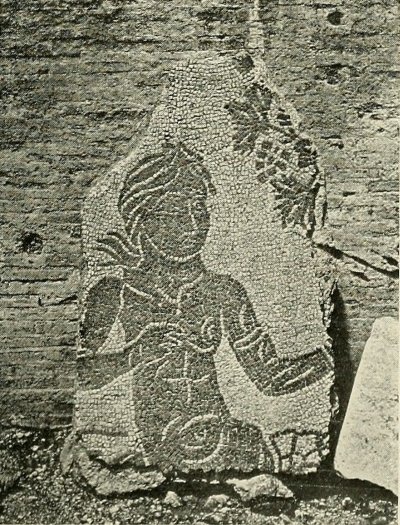
Mosaic from the Floor of the Baths of Caracalla
It perhaps was
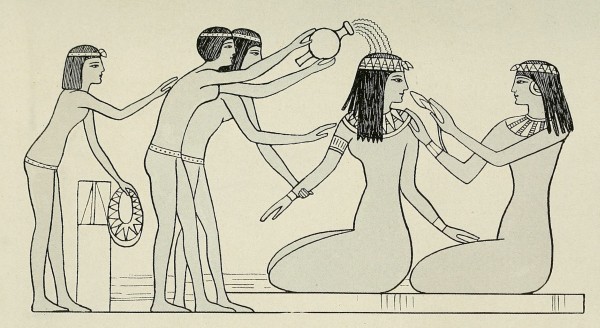
among the Greeks that
bath tubs were first
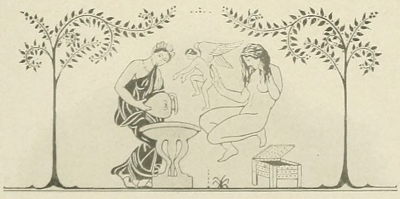
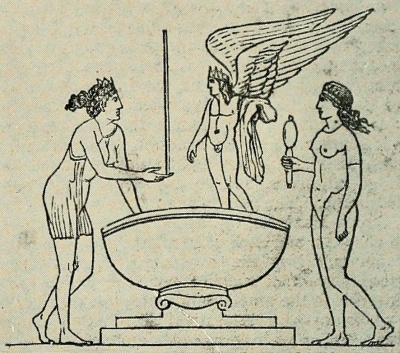
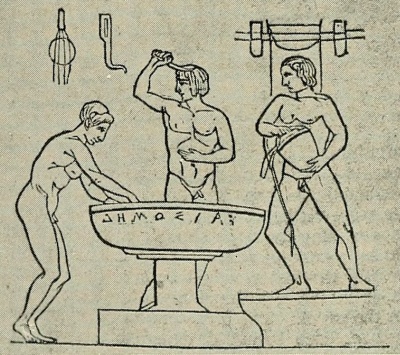
introduced. The early
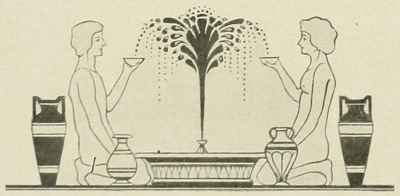
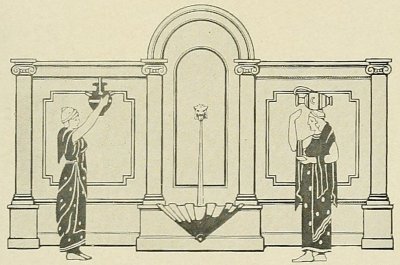
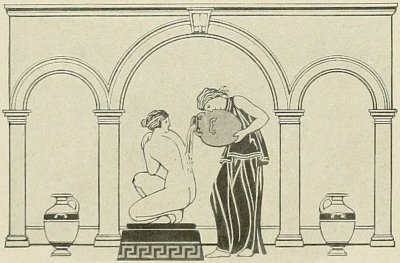
Greek bathing vessels
(see preceding woodcuts)
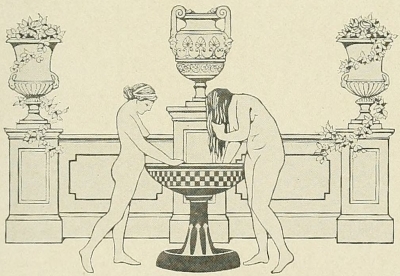
were made of
polished marble,
shaped something
like a punch bowl,
stood about 30 inches
high, and were not
occupied by the bather
as in a modern bath
tub, but served only to hold the water which was applied to
the bather by an attendant, who dashed or poured, as circumstances
required, a vessel full of water on his head or
body. Both woodcuts shown were reproduced from ancient
Greek vases and convey a fair idea of the way these baths
were used. One of the bathers is shown with an iron, bone,
bronze or ivory instrument called a strigilis, in his hand,
which was used to scrape off perspiration when the bather
emerged from the hot room, or induced a flow by exercising
in the gymnasium, which was generally connected with the
baths. The inscription on the woodcut, representing men
bathing, shows that this was a public bath, and is probably
the earliest picture of a bathing establishment extant. The
women's bath bowl differed but slightly from the men's.
It was a trifle lower and considerably deeper, but the
method of using was the same as for the men.
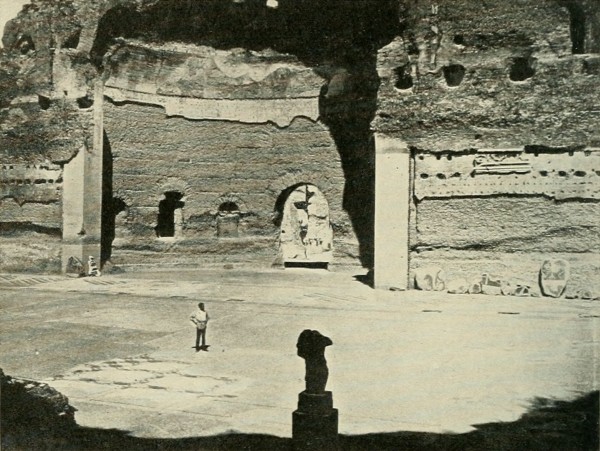
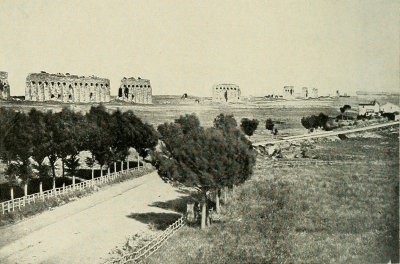
Ruins of the Baths of Caracalla, Rome
While the Greeks were prior to the Romans in the use
of the bath, they considered it effeminate to use warm
water, and consequently their bathing establishments never
attained the luxury and splendor that later marked the
Roman baths. When bath tubs were first introduced into
Rome, the wealthy inhabitants fitted up their houses with
a bathroom much as do the people of our own time. As
the luxury, pleasure and benefit of the bath became better
known, more elaborate bathing facilities similar to a modern
Turkish bath were installed. In some houses several rooms
were devoted to this purpose. The anointment of the body
with oils was one of the characteristics of a Roman bath.
The practice was indulged in by people of both sexes, and
the time when applied depended much on the treatment
the bather was taking. For instance, most bathers anointed
the body as the finishing touch of the bath, while some bathers
applied the oil before going to the hot or sweat room.
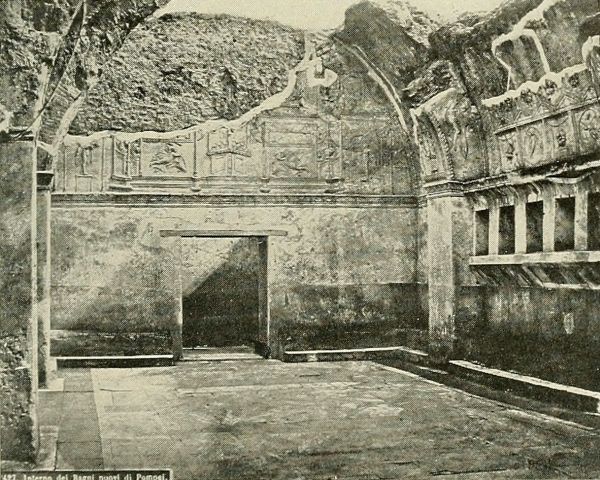
Interior of the Frigidarium or Cold Bath, Caracalla
No luxury can be monopolized by the rich, and it
was not long before public bathing establishments, in which
a small entrance fee was charged, were built by private
capital. Following quickly on the heels of these private
enterprises, came the establishment of public baths, then,
according to the authority of Pliny, for 600 years Rome
needed no medicine but the public baths.
When the public baths were first instituted they were
only for the lower classes, who alone bathed in public.
The people of wealth and those who held positions of state
bathed in their own homes. But this monopoly of the poor
was not long enjoyed. In the process of time even the
emperors bathed in public among their subjects, and we
read of the abandoned Gallienus amusing himself by bathing
in the midst of the young and old of both sexes, men,
women and children.
In the earlier stages of Roman history a much greater
delicacy was observed with respect to promiscuous bathing,
even among men, than obtained at a later period. Virtue
passed away as wealth increased, and the public baths became
places of meeting and amusement where not only did
men bathe together in numbers, but even men and women
stripped and bathed promiscuously in the same bath.
Some idea of the magnitude of the baths at Rome can
be gained from a statement of the number of bathers they
could accommodate at one time. The baths of Diocletian,
which were perhaps the most commodious of them all,
could accommodate at one time 3,200 bathers. One hall of
this famous bathing institution was at a later date converted
by Michael Angelo into the church of St. Marie de gli
Angeli.
The baths of Caracalla, built A. D. 212, were perhaps
the most famous of the baths of Rome. They were not as
commodious however as many other baths, and they had
accommodations at one time for only 1,600 bathers, or just
one-half that could be accommodated by the baths of Diocletian.
The following description of the Roman baths, together
with the historical sketch of the people of that period who
indulged in the luxury, is abstracted from an old dictionary
of Greek and Roman antiquities, published in London,
England, almost a century ago. The illustrations are from
woodcuts appearing in the article.
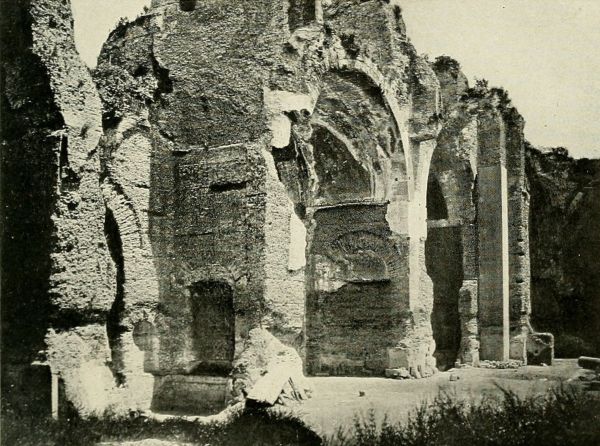
Outer Row of Baths, Caracalla, Rome
"In the earlier ages of Roman history a much
greater delicacy was observed with respect to promiscuous
bathing, even among the men, than was usual
among the Greeks; for according to Valerius Maximus,
it was deemed indecent for a father to bathe in company
with his own son after he had attained the age of
puberty, or son-in-law with his father-in-law, the same
respectful reserve being shown to blood and affinity as
was paid to the temples of the gods, toward whom it was
considered an act of irreligion even to appear naked in
any of the places consecrated to their worship. But virtue
passed away as wealth increased, and when the thermæ
came into use, not only did the men bathe together in
numbers, but even men and women stripped and bathed
promiscuously in the same bath. It is true, however, that
the public establishment often contained separate baths
for both sexes adjoining each other, as will be seen to have
been also the case at the baths of Pompeii. Aulus Gellius
relates a story of a consul's wife who took a whim to bathe
at Teano, a small provincial town of Campania, in the
men's baths, probably because in a small town the female
department, like that at Pompeii, was more confined and
less convenient than that assigned to the men, and an
order was consequently given to the quaestor to turn the
men out. But whether the men and women were allowed
to use each other's chambers indiscriminately, or that
some of the public baths had only one common set of
baths for both, the custom prevailed under the empire of
men and women bathing indiscriminately together. This
custom was forbidden by Hadrian, and Alexander Severus
prohibited any baths common to both sexes from being
opened in Rome.
When the public baths were first instituted they were
only for the lower orders, who alone bathed in public, the
people of wealth, as well as those who formed the Equestrian
and Senatorian orders, using private baths in their
own houses. But this monopoly was not long enjoyed,
for as early even as the time of Julius Cæsar, we find no
less a personage than the mother of Augustus making use
of the public establishments, which were probably at that
time separated from the men's, and, in process of time,
even the emperors themselves bathed in public with the
meanest of the people. Thus Hadrian often bathed in
public among the herd, and even the virtuous Alexander
Severus took his bath among the populace in the thermæ
he had himself erected, as well as in those of his predecessors,
and returned to the palace in his bathing dress; and
the abandoned Gallienus amused himself by bathing in the
midst of the young and old of both sexes, men, women
and children.
The baths were opened at sunrise and closed at sunset,
but in the time of Alexander Severus, it would appear that
they were kept open nearly all night, for he is stated to
have furnished oil for his own thermæ, which previously
were not opened before daybreak and were shut before
sunset; and Juvenal includes in his catalogue of female
immoralities that of taking the bath at night, which may,
however, refer to private baths.
The price of a bath was a quadrant, the smallest piece
of coined money from the age of Cicero downward, which
was paid to the keeper of the bath. Children below a certain
age were admitted free, and strangers, also foreigners,
were admitted to some of the baths, if not to all, without
payment.
The baths were closed when any misfortune happened
to the republic, and Sentonius says that the Emperor
Caligula made it a capital offence to indulge in the luxury
of bathing upon any religious holiday. The baths were
originally placed under the superintendence of the ædiles,
whose business it was also to keep them in repair, and to
see that they were kept clean and of a proper temperature.
The time usually assigned by the Romans for taking
the bath was the eighth hour or shortly afterward. Before
that time none but invalids were allowed to bathe in
public. Vilruvins reckoned the best hours adapted for
bathing to be from midday until about sunset. Pliny took
his bath at the ninth hour in summer and the eighth in
winter; and Martial speaks of taking a bath when fatigued
and weary at the tenth hour and even later.
When the water was ready and the baths prepared,
notice was given by the sound of a bell. One of these bells
with the inscription Firmi Balneatoris was found in the
thermæ Diocletiane, in the year 1548.
When the bath was used for health merely or cleanliness,
a single one was considered sufficient at a time, and
that one only when requisite. But the luxuries of the
empire knew no such bounds, and the daily bath was
sometimes repeated as many as seven and eight times in
succession. It was the usual and constant habit of the
Romans to take the bath after exercise, and previous to
the principal meal; but the debauchees of the empire
bathed also after eating, as well as before, in order to promote
digestion so as to acquire a new appetite for fresh
delicacies. Nero is said to have indulged in this practice.
Upon quitting the bath, it was usual for the Romans,
as well as the Greeks, to be anointed with oil; indeed,
after bathing, both sexes anointed themselves, the women
as well as the men, in order that the skin might not be left
harsh and rough, especially after hot water. Oil is the
only ointment mentioned by Homer as used for this purpose,
and Pliny says the Greeks had no better ointment at
the time of the Trojan war than oil perfumed with herbs.
A particular habit of body or tendency to certain complaints,
sometimes required the order to be reversed and
the anointment to take place before bathing. For this
reason, Augustus, who suffered from nervous disorders,
was accustomed to anoint himself before bathing, and a
similar practice was adopted by Alexander Severus. The
most usual practice, however, seems to have been to take
some gentle exercise in the first instance, and then after
bathing to be anointed either in the sun or in the tepid or
thermal chamber, and finally to take their food.
The Romans did not content themselves with a single
bath of hot or cold water, but they went through a course
of baths in succession, in which the agency of air as well
as water was applied. It is difficult to ascertain the precise
order in which the course was usually taken, if indeed
there was any general practice beyond the whim of the
individual. Under medical treatment, of course, the succession
would be regulated by the nature of the disease for
which a cure was sought, and would vary also according to
the different practice of different physicians. It is certain,
however, that it was a general practice to close the pores
and brace the body after the excessive perspiration of the
vapor bath, either by pouring cold water over the head,
or by plunging at once into the tank. Musa, the physician
of Augustus, is said to have introduced the practice which
became quite the fashion, in consequence of the benefit
which the emperor derived from it, though Dion accuses
him of having artfully caused the death of Marcellus by an
improper application of the same treatment. In other
cases it was considered conducive to health to pour warm
water over the head before the vapor bath, and cold water
immediately after it; and at other times a succession of
warm, tepid and cold water was resorted to.
The two physicians, Galen and Celsus, differ in some
respects as to the order in which the baths should be
taken; the former recommending first the hot air of laconicum,
next the bath of warm water, afterward the cold, and
finally to be well rubbed; while the latter recommends his
patients first to sweat for a short time in the tepid chamber
without undressing, then to proceed into the thermal
chamber, and after having gone through a regular course
of perspiration there, not to descend into the warm bath,
but to pour a quantity of warm water over the head, then
tepid, and finally cold; afterward to be scraped with the
strigil and finally rubbed dry and anointed. Such in all
probability was the usual habit of the Romans when the
bath was resorted to as a daily source of pleasure, and not
for any particular medical treatment; the more so as it
resembles in many respects the system of bathing still in
practice among the Orientals who succeeded by conquest
to the luxuries of the enervated Greeks and Romans.
Having thus detailed from classical authorities the
general habits of the Romans in connection with their
systems of bathing, it now remains to examine and explain
the internal arrangements of the structures which contained
their baths, which will serve as a practical commentary
upon all that has been said. Indeed, there are
more ample and better materials for acquiring a thorough
insight into Roman manners in this one particular than for
any of the other usages connected with their daily habit.
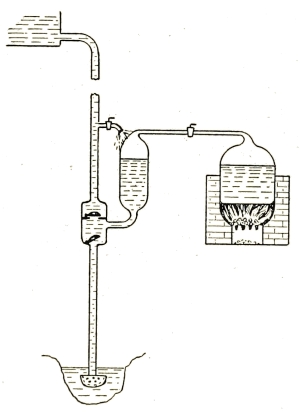
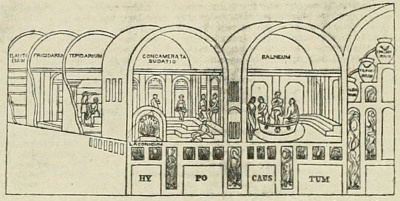
In order to make the subjoined description clear, a
reproduction from an old woodcut of a fresco painting on
the walls of the thermæ of Titus at Rome, is here reproduced,
showing in broken perspective the general arrangement
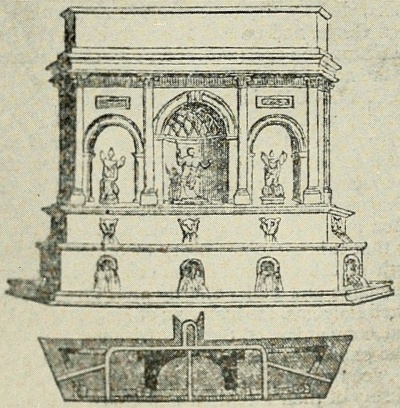
of one of the baths known as the thermæ. Heat was
supplied to warm the apartments and the water used in the
baths by the furnace shown extending under the entire
floor of the establishment. This furnace was known as a
Hypocustum. To the right may be seen the vessels in which
water for the baths was heated. The topmost vessel, the
Frigidarium, contained cold water from which the hot
water tanks and the various baths were supplied. Next in
order is the tepidarium,
in which
water of moderate
temperature
was stored, and
in the lowest,
the caldarium,
was heated the
hottest water
used in the baths.
After the end of
the republic, large establishments used to have a separate
steam bath, the laconicum, and in this apartment, or
sometimes adjoining the tepidarium, was the Clipeus, a
small circular chamber covered by a cupola. The Clipeus
received its light through an aperture in the center of the
dome, and this
aperture served
also as a vent from
the chamber. The
Clipeus was heated
by means of a separate
heating
apparatus, and its
temperature could
be raised to an
enormous degree
or could be regulated
to suit the
bather by raising
or lowering the
shield.
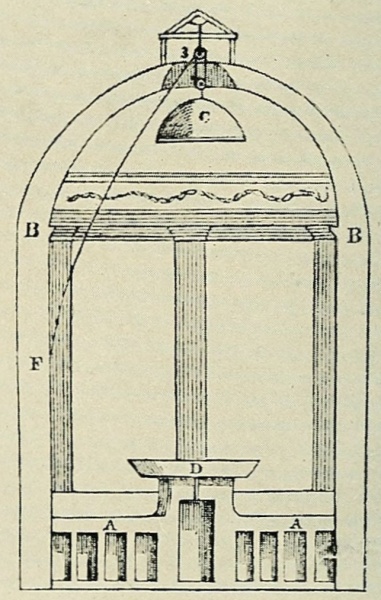
Clipeus. From an old woodcut
The tepidarium,
as the name
would imply, was a room in which a moderately warm bath
could be taken and where the process of dry rubbing also
took place. In the balneum a hot bath could be taken,
originally in a tub, but in later times in a large reservoir;
and in the frigidarium a cold plunge could be had. The
elæothesium was the anointing room where the body was
rubbed with oil and massaged.
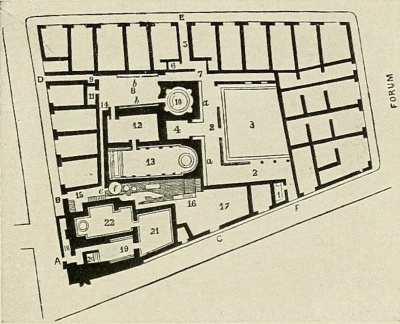
Floor Plan of the Baths of Pompeii
From an old woodcut
A good idea of the general layout of a Roman bath can
be gained from the accompanying woodcut, showing the
ground floor plan of the baths of Pompeii. The baths, as
may be seen by the illustration, are nearly surrounded on
three sides by houses and shops. The whole building,
which comprises a double set of baths, has six different
entrances from the street, one of which, A, gives admission
to the smaller set only, which was appropriated to
the women, and five others to the male department, of
which two, B and C, communicate directly with the furnaces,
and the other three, D, E, F, with the bathing apartments,
of which
F, the nearest to
the Forum, was
the principal one;
the other two, D
and E, being on
opposite sides of
the building
served for the convenience
of those
who lived on the
north and east
sides of the city.
To have a variety
of entrances was
one of the qualities
considered necessary to a well constructed set of baths.
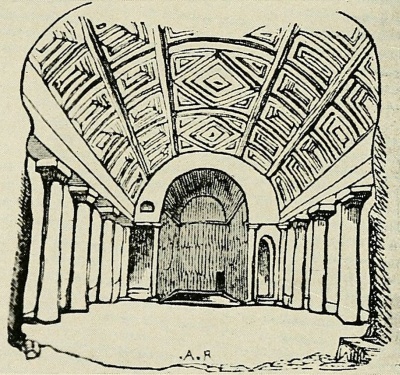
Frigidarium. From an old woodcut
Passing through the principal entrance, F, which is
removed from the street by a narrow footway, and after
descending three steps, the bather finds upon his left hand
a small chamber or toilet room, 1, which contains a latrine.
From passage, F, he proceeded to covered portico, 2, which
ran around three sides of an open court, 3, and this portico
and court together formed the vestibule of the baths,
in which servants belonging to the establishment, as well
as such of the slaves and attendants of the great and wealthy,
whose services were not required in the interior, waited.
Within the court the keeper of the baths who exacted the
fee paid by each visitor, was also stationed, and accordingly
in it was found the box for holding the money. The room, 4,
which runs back from the portico, might have been apportioned
to him, or if not, it might have been a waiting room for
the convenience of the better classes while waiting the return
of their acquaintances
from the
interior. In this
court, likewise,
as being the most
public place, advertisements
for
the theater and
other announcements
of general
interest were
posted, one of
which, announcing
a gladiatorial
show, still remains.
The passageway,
5, is the corridor which leads from the entrance, E,
to the vestibule; and the cell, 6, is a toilet room similar
to 1. Number 7 is a passage of communication which
leads into the chamber, 8, which served as a room for undressing.
This room is also accessible from the street by
the door, D, through the corridor, 9, in which a small
niche is observable, which probably served for the station
of another doorkeeper, who collected money from those
entering from the north street. Here, then, is the center
in which all the persons must have met before entering
into the interior of the baths; and its locality, as well as
other characteristic features of its fitting up, leave no room
to doubt that it served as an undressing room. It does
not appear that any general rule of construction was followed
by the architects of antiquity with regard to the
locality and temperature best adapted for a dressing room.
The bathers were expected to take off their garments in
the dressing room, not being permitted to enter the interior
unless naked. The clothes were then delivered to a class
of slaves whose duty it was to take charge of them. These
men were notorious for dishonesty, and leagued with all
the thieves of the city, so that they connived at the robberies
they were placed there to prevent. To so great
an extent were these robberies carried, that very severe
laws were finally enacted making the crime of stealing
from a bath a capital offence.
To return to the chamber itself, it is vaulted and
spacious, with stone seats along two sides of the wall and
a step for the feet below, slightly raised from the floor.
Holes can still be seen in the walls which might have
served for pegs on which the garments were hung when
taken off; for in a small provincial town like Pompeii,
where a robbery committed in the bath could scarcely
escape detection, there would be no necessity for slaves to
take charge of them. The dressing room was lighted by a
window closed with glass, and the walls and ceilings were
ornamented with stucco mouldings and painted yellow.
There are no less than six doors to this chamber: one
leading to the entrance, E, another to the entrance, D, a
third to the small room, 11, a fourth to the furnaces, a
fifth to the tepid apartment, and the sixth opened upon
the cold baths, 10. The bath, which is coated with white
marble, is 12 feet 10 inches in diameter, about 3 feet deep
and has two marble steps to facilitate the descent into it,
and a seat surrounding it at a depth of 10 inches from the
bottom, for the purpose of enabling the bathers to sit
down and wash themselves. It is probable that many
persons contented themselves with cold baths only, instead
of going through the severe course of perspiration in the
warm apartments; and as the frigidarium could have had
no effect alone in baths like these, the natatio must be
referred to when it is said that at one period cold baths
were in such request that scarcely any others were used.
There is a platform or ambulatory around the bath,
also of marble, and four inches of the same material disposed
at regular intervals around the walls, with pedestals
for statues probably placed in them. The ceiling is
vaulted and the chamber lighted by a window in the
center. The annexed woodcut represents a frigidarium
with its cold bath at one extremity, supposed to have
formed a part of the Formian Villa of Cicero, to whose
age the style of construction, the use of the simple Doric
order, undoubtedly belongs. The bath itself, into which
water still continues to flow from a neighboring spring, is
placed under the alcove, and the two doors on each side
opened into small chambers.
In the cold bath of Pompeii the water ran into the
basin through a spout of bronze and was carried off again
through a conduit on the opposite side. It was also furnished
with a waste pipe under the coping to prevent the
water from running
over.
Atlantes. From an old woodcut
No. 11 is a
small chamber on
the side opposite
to the frigidarium,
which might
have served for
shaving or for
keeping unguents
or strigils; and
from the centers
of the side of the
frigidarium, the
bather who
intended to go through the process of warm bathing and
sudation entered into 12, the tepidarium.
The tepidarium did not contain water, either at Pompeii
or at the baths of Hippias, but was merely heated
with warm air of an agreeable temperature, in order to
prepare the body for the great heat of the vapor and
warm baths; and, upon returning, to obviate the danger of
too sudden transition to the open air.
In the baths of Pompeii, this chamber served likewise
as a disrobing room for those who took the warm bath, for
which purpose the fittings up are evidently adapted, the
walls being divided into a number of separate compartments
or recesses for receiving the garments when taken
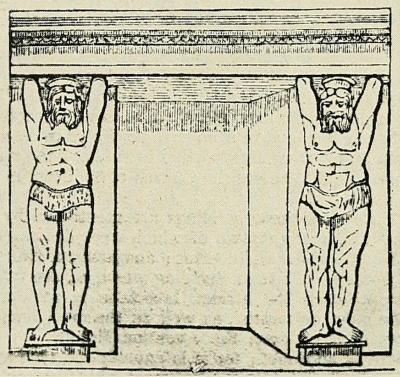
off. One of these compartments, known as an Atlantes, is
shown in the annexed woodcut.
In addition to this service there can be little doubt
that this apartment was used as a depository for unguents
and a room for anointing, which service was performed by
slaves. For the purpose of anointing, the common people
used oil simply or sometimes scented, but the more wealthy
classes indulged in the greatest extravagances with regard
to their perfumes and unguents. These they evidently
procured from the elæothesium of the baths, or brought
with them in small glass bottles, hundreds of which have
been discovered in different excavations made in various
parts of Italy.
From the tepidarium, a door which closed by its own
weight, to prevent the admission of cold air, opened into
No. 13, the thermal chamber. After having gone through
the regular course of perspiration, the Romans made use
of instruments called strigils, to scrape off the perspiration,
much in the same way as we are accustomed to scrape the
sweat off a horse with a piece of iron hoop after he has run
a heat or come in from violent exercise. These instruments,
many of which have been discovered among the
ruins of the various baths of antiquity, were made of bone,
bronze, iron and silver. The poorer classes were obliged
to scrape themselves, but the more wealthy took their
slaves to the baths for the purpose, a fact which is elucidated
by a curious story related by Spartianus. The
Emperor while bathing one day, observing an old soldier,
whom he had formerly known among the legions, rubbing
his back as the cattle do against the marble walls of the
chamber, asked him why he converted the walls into a
strigil, and learning that he was too poor to keep a slave he
gave him one, and money for his maintenance. On the
following day, upon his return to the bath, he found a
whole row of old men rubbing themselves in the same
manner against the wall, in the hope of experiencing the
same good fortune from the prince's liberality; but instead
of taking the hint, he
had them all called
up and told them to
scrub one another.

Coppers for Heating Water. From an old woodcut
The strigil was
by no means a blunt
instrument, consequently
its edge was
softened by the application
of oil which
was dropped on it
from a small vessel.
This vessel had a narrow
neck, so as to discharge
its contents drop by drop. Augustus is related
to have suffered from an over violent use of this instrument.
Invalids and persons of delicate habit made use of sponges,
which Pliny says answered for towels as well as strigils.
They were finally dried with towels and anointed.
The common people were supplied with these necessaries
in the baths, but the more wealthy carried their own
with them.
After the operation of scraping and rubbing dry, they
retired into or remained in the tepidarium until they
thought it prudent to encounter the open air. But it does
not appear to have been customary to bathe in the water,
when there was any, which was not the case at Pompeii
nor at the Baths of Hippias, either of the tepidarium or
frigidarium; the temperature only of the atmosphere in
the two chambers being of consequence to break the
sudden change from the extreme hot to cold. Returning
now to the frigidarium, 8, which according to the directions
of Vitruvius has a passage, 14, communicating with
the mouth of the furnace, e, and passing down that passage
we reach the chamber, 15, into which the præfurnium projects,
and which has also an entrance from the street, B,
appropriated to those who had charge of the fires. There
are two stairways in it, one leading to the roof of the baths,
and the other to the coppers which contained the water.
Of these there were three, one of which contained the hot
water, caldarium; the second, the tepid, tepidarium; and
the last, the cold, frigidarium. The warm water was
introduced into the warm bath by means of a conduit pipe,
marked on the plan, and conducted through the wall.
Underneath the caldarium was placed the furnace which
served to heat the water and give out streams of warm air
into the hollow cells of the hypocanstum. These coppers
were constructed in the same manner as is represented in
the engraving from the Thermæ of Titus; the one containing
hot water being placed immediately over the furnace,
and as the water was drawn out from these it was supplied
from the next, the tepidarium, which was already considerably
heated, from its contiguity to the furnace and the
hypocaust below it, so that it supplied the deficiency of
the former without materially diminishing its temperature;
and the space in the last two was in turn filled up from the
farthest removed, which contained the cold water received
direct from the square reservoir behind them. Behind the
coppers there is another corridor, 16, leading into the
court, 17, appropriated to the servants of the baths, and
which has also the conveniences of an immediate communication
with the street by the door, C.
We now proceed to the adjoining set of baths, which
were assigned to the women. The entrance is by the
door, A, which conducts into a small vestibule, 18, thence
into the apodyterium, 19, which, like the one in the men's
baths, has a seat on either side built up against the wall.
This room opens upon a cold bath, 20, answering to the
natiatio of the other set, but of much smaller dimensions.
There are four steps on the inside to descend into it.
Opposite to the door of entrance there is another doorway
which leads to the tepidarium, 21, which also communicates
with the thermal chamber, 22, on one side of which is a
warm bath in a square recess. The floor of this chamber
is suspended and its walls perforated for flues, like the
corresponding one in the men's baths.
The comparative smallness and inferiority of the fittings
up in this suit of baths has induced some Italian antiquaries
to throw a doubt upon the fact of their being assigned
to women, and ingeniously suggest that they were a set of
old baths, to which the larger ones were subsequently
added when they became too small for the increasing
wealth and population of the city. But the story already
quoted of the consul's wife who turned the men out of
their bath at Teanum for her convenience, seems sufficiently
to negative such a supposition and to prove that
the inhabitants of ancient Italy, if not more selfish, were
certainly less gallant than their successors. In addition to
this, Vitruvius expressly enjoins that the baths of the men
and women, though separate, should be contiguous to each
other, in order that they might be supplied from the same
boilers and hypocaust; directions that are here fulfilled to
the letter, as a glance at the plans will demonstrate.
Notwithstanding the ample account which has been
given of the plans and usages respecting baths in general,
something yet remains to be said about that particular class
denominated thermæ, of which establishment the baths, in
fact, constituted the smallest part. The thermæ, properly
speaking, were a Roman adaptation of the Greek gymnasium.
The thermæ contained a system of baths in conjunction
with conveniences for athletic games and youthful
sports, places in which rhetoricians declaimed, poets recited
and philosophers lectured, as well as porticos and vestibules
for the idle, and libraries for the studious. They
were decorated with the finest objects of art, both in painting
and sculpture, covered with precious marbles and
adorned with fountains and shaded walks. It may be
said that they began and ended with the Empire, for it
was not until the time of Augustus that these magnificent
structures were commenced. M. Agrippa was the first who
afforded these luxuries to his countrymen by bequeathing
to them the thermæ and gardens which he had erected in
the Campus Martius. The Pantheon, now existing at
Rome, served originally as a vestibule to these baths; and,
as it was considered too magnificent for the purpose, it is
supposed that Agrippa added the portico and consecrated
it as a temple, for which use it still serves.
The example set by Agrippa was followed by Nero
and afterward by Titus, the ruins of whose thermæ are
still visible, covering a vast extent, partly under ground
and partly above the Esquiline Hill.
Previous to the erection of these establishments for
the use of the population, it was customary, for those who
sought the favor
of the people, to
give them a day's
bathing free of expense.
Ground Plan of Thermæ of Caracalla. From an old woodcut
Thus, according
to Divi Cassius,
Faustus, the
son of Sulla, furnished
warm baths
and oil gratis to the
people for one day;
and Augustus,
on one occasion,
furnished warm
baths and barbers
to the people for
the same period free of expense, and at another time for a
whole year to the women as well as the men. From thence
it is fair to infer that the quadrant paid for admission to the
balnea was not exacted at the thermæ, which as being the
works of the emperors, would naturally be opened with imperial
generosity to all, and without any charge, otherwise
the whole city would have thronged to the establishment
bequeathed to them by Agrippa; and in confirmation of
this opinion it might be remarked that the old establishments,
which were probably erected by private enterprises,
were termed Meritorial.
Most, if not all, of the other regulations previously
detailed as relating to the economy of the baths, apply
equally to the thermæ; but it is in these establishments
especially that the dissolute conduct of the emperors and
other luxurious indulgence of the people in general, as
detailed in the compositions of the satirists and later
writers, must be considered to refer.
Although considerable remains of the Roman thermæ
are still visible, yet, from the very ruinous state in which
they are found, we are far from being able to arrive at the
same accurate knowledge of their component parts and the
usages to which they were applied, as has been done with
respect to the balnea; or, indeed, to discover a satisfactory
mode of reconciling their constructive details with the
description left us by Vitruvious and Lucian. All, indeed,
is doubt and guesswork. Each of the learned men who
have pretended to give an account of their contents differing
in all the essential particulars from one another; and
yet the general similarity of the ground plan of the three
which still remain cannot fail to strike even a superficial
observer; so great indeed that it is impossible not to perceive
at once that they were all constructed upon a similar
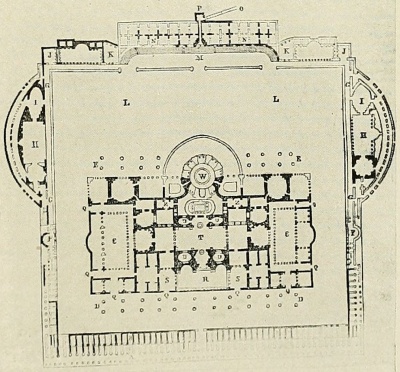
plan. Not, however, to discuss the subject without enabling
the reader to form something like a general idea of these
enormous edifices, which from their extent and magnificence
have been likened to provinces, a ground plan of
the thermæ of Caracalla is annexed, which are the best
preserved among those remaining, and which were perhaps
more splendid than all the rest. Those apartments
of which the use is ascertained with the appearances of
probability, will be alone marked and explained. The dark
parts represent the remains still visible; the open lines are
restorations.
Hypocaust for Heating Water, Thermæ of Caracalla
From an old woodcut
A is a portico fronting the street made by Caracalla
when he constructed his thermæ. B are separate bathing-rooms,
either for the use of the common people, or perhaps
for any person who did not wish to bathe in public.
C are apodyteria attached to them. D, D and E, E, the
porticos. F, F,
exedra in which
there were seats
for the philosophers
to hold their
conversations.
G, passages open
to the air. H, H,
sladra. I, I, possibly
schools or
academies where
public lectures
were delivered.
J, J and K, K,
rooms appropriated
to the servants
of the bath.
In the latter are staircases for ascending to the principal
reservoir. L, space occupied by walks and shrubberies.
M, the arena or stadium in which the youth performed
their exercises, with seats for spectators. N, N, reservoirs
with upper stories; O, aqueduct which supplied the baths.
P, cistern.
This external range of buildings occupies one mile in
circuit.
We now come to the arrangement of the interior, for
which it is very difficult to assign satisfactory destinations.
Q represents the principal entrances, of which there were
eight. R is the natiatio or cold water baths to which the
direct entrance from the portico is by a vestibule on either
side marked S, and which is surrounded by a set of chambers
that serve most probably as rooms for undressing and
anointing.
Those nearest to the peristyle were, perhaps, where
the powder was kept which the wrestlers used in order to
obtain a firmer grip upon their adversaries.
The inferior quality of the ornaments which these
apartments had, and the staircases in two of them, afford
evidences that they were occupied by menials. T is
considered to be the tepidarium with four warm baths taken
out of its four angles, and two labra on its two flanks.
There are steps for descending into the baths, in one of
which traces of the conduit are still manifest. It would
appear that the center part of this apartment served as a
tepidarium, having a cold water lavatory in four of its
corners. The center part, like that also of the preceding
apartment, is supported by eight immense columns.
Restoration of Thermæ of Titus. (Restored by Leclerc)
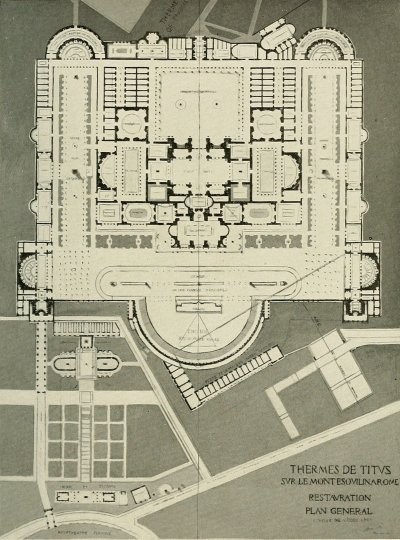
Plan of the Thermæ of Titus, Rome. (Restored by Leclerc)
The apartments beyond this, which are too much dilapidated
to be restored with any degree of certainty, contained,
of course, the laconium and sudatories, for which
the round chamber, W, and its appurtenances seem to be
adapted, and which are also contiguous to the reservoirs,
Z, Z. The apartments e, e' are probably places where youths
were taught their exercises, with the appurtenances belonging
to them. The chambers on the other side, which
are not marked, probably served for the exercises in bad
weather. These baths contained an upper story, of which
nothing remains beyond what is just sufficient to indicate
the fact. It will be observed that there is no part of the
bathing department separate from the rest which could be
assigned to the use of women exclusively. From this it
must be inferred either that both sexes always bathed
together promiscuously in the thermæ, or that the women
were excluded altogether from these establishments.
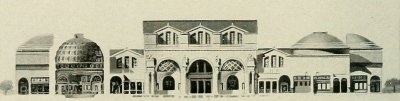
Sectional Elevation, Thermæ of Titus, Rome. (Restored by Leclerc)
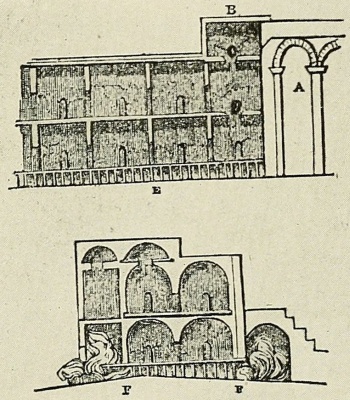
It remains to explain the manner in which the immense
body of water required for the supply of a set of
baths in the thermæ was heated. This has been done very
satisfactorily by Piranesi and Cameron, as may be seen by
a reference to the two sectional elevations showing the
reservoir and aqueducts belonging to the Thermæ of
Caracalla. A are arches of the aqueduct which conveyed
the water into the reservoir, B, whence it flowed into the
upper range of cells through the aperture at C, and thence
again descended into the lower ones by the aperture, D,
which were placed immediately over the hypocaust, E, the
furnace of which can be seen in the transverse section at
F. There were thirty-two of these cells arranged in two
rows over the hypocaust, sixteen on each side, and all
communicating with one another, and over these a similar
number similarly arranged, which communicated with
those below by the aperture at D. The parting walls between
these cells were likewise perforated with flues which
served to disseminate the heat all around the whole body
of water. When the water was sufficiently warm it was
turned on to the baths through pipes conducted likewise
through flues in order to prevent the loss of temperature
during passage, and the lower reservoir was supplied as
fast as water was drawn off from the reservoir next above,
which in turn was supplied with water from the topmost
tier and the aqueduct.
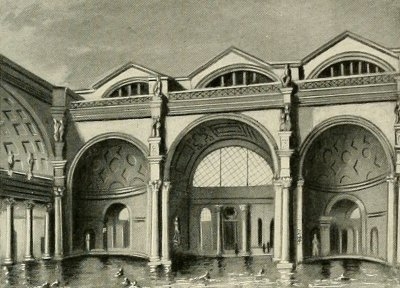
Frigidarium, Thermæ of Caracalla, Rome. (Restored by Viollet-le-Duc)
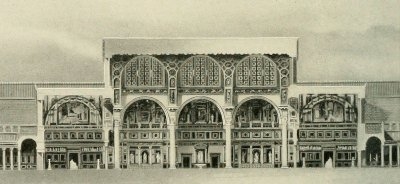
Perhaps a better idea of the thermæ can be had by an
examination of the plan of the Thermæ of Titus, Rome,
restored by Leclerc, also the sectional elevation and front
elevation of the same bath, restored by the same artist.
The original drawings, which won the Grand Prix de Rome,
are preserved in the library of the Ecole des Beaux-Arts,
Paris. A restoration by Viollet-le-Duc, which appeared
with the other restorations in the June, 1906, number of the
Architectural Record, conveys a very good idea of the interior
of a frigidarium.
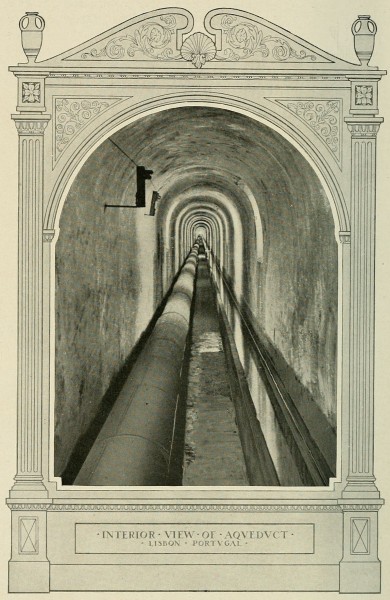
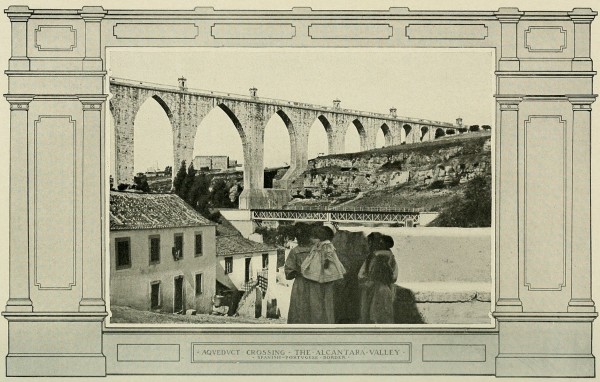
INTERIOR VIEW OF AQVEDVCT
LISBON PORTVGAL