LONDON:
PRINTED BY WILLIAM CLOWES AND SONS,
STAMFORD STREET AND CHARING CROSS.
PREFACE.
Although familiar with most subjects relating to
Merchant Ships, I have found it alike necessary and
desirable to look to others for aid in collecting some
of the materials for this work; and I am especially
indebted to my friends Mr. Vaux, F.R.S., late of the
British Museum, and Sir Patrick Colquhoun, Q.C.,
for much valuable assistance rendered by them in
connection with the two volumes now presented to
the public. By combining the learning of my friends,
so far as regards the records of the ships and commerce
of ancient times, with my own knowledge of
the subject, I am not without hope that the work
may in some respects prove useful.
I am also much indebted to Mr. T. H. Farrer, of
the Board of Trade, and to his assistant, Mr. Thomas
Gray, of the Marine Department, for many valuable
suggestions; and in thanking them for their courtesy,
I venture to express the belief that by their assistance
and that of other friends I shall be able to
give in the two succeeding volumes necessary to
complete the work an impartial narrative of the
many important events and changes which have
occurred within my own time, I might say within
my own experience, together with an accurate account
of the ships and maritime commerce of the age in
which we live.
W. S. LINDSAY.
Shepperton Manor, Middlesex.
CONTENTS.
INTRODUCTORY.
Introductory—The first attempt to float, by means of a hollowed log
and raft—The Ark—Boats of skin—Earliest boats or ships—Their
form—Mode of construction—Names of ships—Decorations—Launching,
&c.—Master—Mate—Boatswain—St. Paul’s ship—Rig
and Sails—Undergirders—Anchors and cables—Decks—Nautical
instruments—Mariner’s compass—Speed of ancient ships
Maritime commerce of Antiquity—Coasting—Tyre—Argonautic Expedition—Queen
Semiramis—The Phœnicians—Early notices of
them—The prophecy of Ezekiel—Trade in tin—Origin of the
name “Cassiterides Insulæ”—Amber—Mainland trade of Phœnicia—Cause
of prosperity—Carthage—Utica—Commercial policy—Trade
with Spain—Trade in Africa—The commercial policy of Carthage—Limits
of trade
Earliest caravan trade—Ophir—Port of Ezion-geber—The voyages of
the Jewish ships—The inland commerce of Solomon—Babylon—Gerrha
and Tylos—Babylonian commerce—Assyrian boats—Lydia—Ionia—Caria—Phrygia—Scythians—Their
caravan routes to India,
viâ the Caspian
Egypt—Commerce—Sesostris—Naucratis—The Nile—Sailors of Egypt—Their
boats—How navigated—Mode of building them—Cargo
barges—Their rig—Steering—Passage and cargo boats—Boat for
the conveyance of the dead—Variety of boats, and their superiority—Prosperity
of Egypt under the Ptolemies, B.C. 283—Canal over
the Isthmus—Ptolemy’s great ship—Analysis of her dimensions—The
Thalamegus, her size and splendour—Great size of other
Egyptian monuments—Probability of such vessels having been constructed—Hiero’s
great ship—Not unlike a modern inland American
steamer—Details of her construction, accommodation, outfit, and
decorations—Greek ships—Habits of piracy—Corinth—Athens—The
size of her ships as described by Herodotus—Discrepancy
between the different accounts
Route viâ the Cape to India, discovered by the Phœnicians, B.C. 610-594—Voyage
of the first Eudoxus—Story of the second Eudoxus (of
Cyzicus)—Opinion of Dr. Vincent on the circumnavigation of Africa—Remarks
upon his opinion—Routes to India and to the East by land—Origin
of the caravans—Resting-places—Their management—The
more important routes—Eastern—Southern—Northern—The character,
size, and discipline of the caravans—The route from Sardes
to Susa, described by Herodotus—Between Tyre and Gerrha—Length
of journey—Importance of Petra—Intercourse between Syria and
Babylon—Value of the trade of Babylon—Caravan routes from that
city to Candahar, Cashmir, Ecbatana, and Peucela on the Indus—Earliest
land and sea combined routes—Commercial efforts of Alexander
in the East, and the impetus he gave to the development of
the trade with India by the erection of Alexandria, B.C. 331—Time of
the departure of the fleets—Residence of the merchants and course
of trade from Alexandria to the East—Value of the trade with India—The
ports through which it was conducted—Course of the voyage
to India—Outwards—Homewards—The vessels engaged in the trade
with India—The nature of their cargoes—Immense demand at Rome
for the luxuries of the East, and the enormous prices paid for them—Imports
and exports to and from Pattala—Barygaza or Baroach—Musiris—Cape
Comorin—Ceylon—Time of departure of the fleets for
Africa and the coasts of Arabia—Rhapta, or Quiloa—Sofala—Articles
of commerce—Moosa—Yemen, or Arabia Felix—Its great wealth,
and the importance attached to its trade—Kane—Sachal—Moskha—Maskat—Omana
Ancient India—Expedition of Sesostris—Doubts of Dr. Robertson with
regard to it—Hindustan, its early commerce, and the probability,
from its great value, of its having attracted Sesostris—The conquests
of Darius, and of Alexander—Trade with China—Its maritime intercourse—A
comparison of the Chinese boats with those of the ancient
Britons—The conquests of Alexander in India, B.C. 327-5—The gain
to commerce by his conquests—The spread of knowledge—His march
into India—Preparations for the voyage down the Indus—Departure
of his fleet from Nicæa, B.C. 326—Description of the vessels employed—Progress
of the fleet—Establishment of new cities on the
banks of the Indus—Character of the vessels engaged on the voyage
from the Indus to Susa—Time occupied—Future voyages—Death of
Alexander, B.C. 323—Eastern India—Ceylon—Internal commerce of
India—Manufactures of India—State of the trade of India from the
sixth to the ninth century—Change in the course of trade—Persian
trade with India—The Muhammedans, A.D. 622—The extent of
their commerce with the East—The trade between Constantinople
and India and China
Rome—The repugnance of the Romans to seafaring pursuits—Single-banked
galleys of the Liburni—The fleets of Rome—Their creation
and slow progress—The form and construction of their galleys—War
with the pirates of Cilicia—First treaty with Carthage, B.C. 509—Its
purport—College of merchants, established B.C. 494—No senator
allowed to own ships, B.C. 226—Cicero’s opinion of merchants—Contempt
for mariners—Reduction of Egypt, B.C. 30, and trade with
India—Customs’ duties—The excise—Bounties on the importation
of corn, A.D. 14—System of collecting the taxes—Value of the trade
with Alexandria—Its extent—Vessels of Spain—Pharos or lighthouse
at Gessoriacum—The shipping described by Tacitus—Rhodians—Their
maritime laws—System of accounts in use at Rome—The
corn trade of the city—Port of Ostia
Roman empire—The cause of its decline—First invasion of Goths,
A.D. 217—Their habits—Defeat the Emperor Decius, A.D. 257—Rebellion
of Egypt, A.D. 273—Franks and Allemanni—The Veneti on
the coast of Gaul—Constantinople founded, A.D. 323—Its commercial
advantages and harbour—The extent of its ancient trade—Black
Sea and Sea of Azov—Oppressive taxation—The laws affecting
shipping—Constans and Julian—Produce of certain lands applied
to the sea service—Neglect and decline of commerce, and sufferings
of the people—Siege of Rome by Alaric and the Goths, A.D. 408—Genseric—His
capture of Rome—Rise of Constantinople—Customs’
duties—Silk trade—Naval expedition of Justinian against the Vandals,
A.D. 533, and conquest of Carthage—Rise of the Muhammedan
power, A.D. 622—Rapid conquests; of Jerusalem, A.D. 636; of Alexandria,
A.D. 638; and of Africa, A.D. 647—Sieges of Constantinople,
A.D. 668-675
Constantinople, A.D. 718-1453: its increased prosperity—Manufactures
of Greece—System of taxation, and of expenditure—Fleets and
mode of warfare—Struggle for maritime supremacy—Scandinavians—Muscovites,
their trade and ships—Russians; their early commerce,
and attempts to capture Constantinople—Their ships—The
Normans, and their expeditions—Establish themselves in Italy, A.D.
1016—Amalfi—Futile attempts of the Normans to take Constantinople,
A.D. 1081-1084—Rise of Venice—The cause of its prosperity—Spread
of the Scythians, Huns, or Turks, A.D. 997-1028—The
Crusades, A.D. 1095-1099—Siege of Acre, A.D. 1189—Armistice,
A.D. 1192—Fourth Crusade, A.D. 1202—The effect of the Crusades
on the commerce of Constantinople, and on its fall—Power of
Venice, A.D. 1202; her ships join in the Crusade, which was afterwards
altered from its original design—They besiege and take Constantinople,
A.D. 1204—Commerce declines under the Latins, but
revives on the restoration of the Empire, A.D. 1261—Genoa—Genoese
settlement at Galata and Pera—Arrogance of the Genoese,
who at last rebel, A.D. 1348, and declare war, A.D. 1349—The
progress of the Turks, A.D. 1341-47—Their fleet—First use of
gunpowder and of large cannon—The Turks finally become masters
of the Eastern capital, A.D. 1453
Ancient galleys—Different descriptions—Their outfit—Beaks—Stern—Masts
and sails—Oars—Mode of rowing—Single-banked galleys—French
galley—General Melvill’s theory—Charnock’s theory—Vossius’s
views—Mr. Howell’s plan—Plan of Rev. J. O. W. Haweis
(Appendix No. 1)—Our own views—Biremes—Triremes—Quadriremes—Quinqueremes—Hexiremes
and larger galleys—Suggested
plan of placing the rowers—Summary
Britain: its maritime position, and limited extent of over-sea trade—The
vessels of the ancient Britons, and the larger kind used by the
Veneti—Encouragement by law to construct superior vessels—Britain
and its inhabitants little known—Cæsar’s reasons for
invading Britain—First invasion, B.C. 55—Size of his transports—Second
invasion, B.C. 54—Cæsar’s preference for small vessels—Violent
storm, and great loss of ships—Final action on the banks of
the Thames—Cæsar makes terms with the Britons, and re-embarks
his legions—Advantages derived by the Britons from their intercourse
with the Romans—Conquest of Britain, A.D. 43: its state of
civilization—Speech of Caractacus—The course of commerce with
Rome—Inland water traffic—Transit duties—Articles of commerce,
and knowledge of manufactures and of the arts—Colchester and its
mint—London—Agricola, A.D. 78-85—His fleet sails round Britain—The
influence of the rule of Agricola on the Britons—Hadrian,
A.D. 120—State of commerce in and after his reign—The Caledonian
incursions—Piratical invasions of the Germans—Carausius seizes
the fleet of Maximian, and declares himself Emperor of Britain—Welsh
and Scots, A.D. 360—Saxons, A.D. 364—Their ships—State of
the Britons when abandoned by the Romans
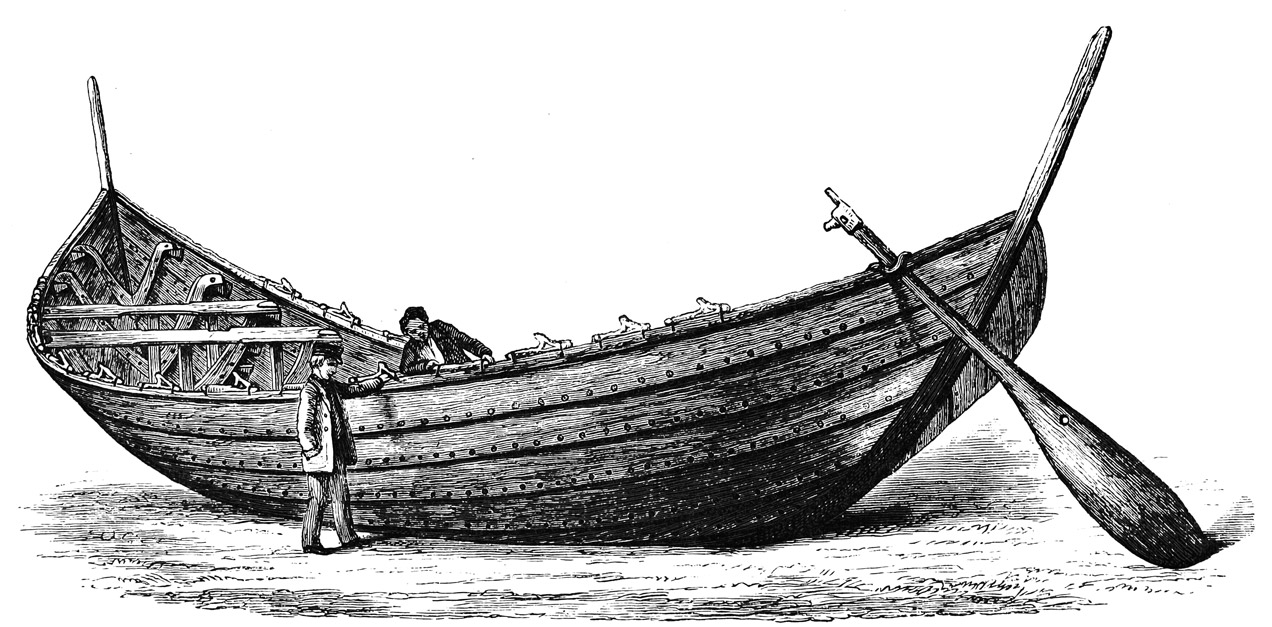
The early Scandinavian Vikings settle on the coast of Scotland and
elsewhere—Great skill as seamen—Discovery of ancient ship, and of
other early relics—Incursions of the Saxons and Angles into Britain;
and its state soon afterwards—London—Accession of Offa, A.D.
755—Restrictions on trade and commerce—Salutary regulations—Charlemagne’s
first treaty of commerce with England, A.D. 796—Extension
of French commerce, A.D. 813—Commerce of England
harassed by the Danes—Their ships, and the habits of their owners—Increase
of the Northern marauders—Language of the Northmen
still spoken by mariners in the North—Accession of Alfred the
Great, A.D. 871: his efforts to improve navigation, and to extend
the knowledge of geography—Foundation of a royal and commercial
navy—His voyages of discovery and missions to the East—Reign
of Edward the Elder, A.D. 901-25, and of his son Athelstan, A.D.
925-41—Edgar’s fleet, and his arrangements for suppressing piracy—The
wisdom of his policy—Ethelred II., A.D. 979-1016—Sufferings
of the people—Charges on vessels trading to London—Olaf, king
of Norway, his ships, and those of Swein—Love of display—Mode
of navigating—Canute, A.D. 1016—Reduction of the English fleet—Prosperity
of commerce—Norman invasion, A.D. 1066—Number
of vessels engaged, and their form—State of trade and commerce—Exports—Manufactures—Wealth—Imports—Taxation—London
specially favoured—Chester specially burdened—State of the people
at the time of the Conquest
Increase of the English fleet, A.D. 1066—Its participation in the Crusades
to the Holy Land—Departure of the English expedition—Arrival
at Messina—Number of ships—Their order of sailing—Arrival
at, and capture of, Acre, 10th June, 1191—Richard returns to England—Maritime
laws founded on the “Rôles d’Oléron”—Power to pledge
ship and tackle—The sailors consulted—Laws relating to hiring—Drunkenness—Sickness—Damage
to ship and cargo—Quarrels—Mooring
of ships—Partnership in freight—Food—Obligation to carry the
ship to her destination—Rules as to sailors—Demurrage—Bottomry—A
bad pilot forfeited his head—Punishments—Shares in fishing
vessels—Wreckers—Jetsam and flotsam—Royal fish—Timber of
wrecks—Remarks on these laws—Code of Wisby—Magna Charta,
A.D. 1215—Henry III., A.D. 1216—Naval actions—Cinque Ports—Increase
of piracy—Measures for its suppression—Treaty of commerce
with Norway, A.D. 1217, and facilities afforded to foreign merchants—English
merchants first open trading establishments abroad—Origin
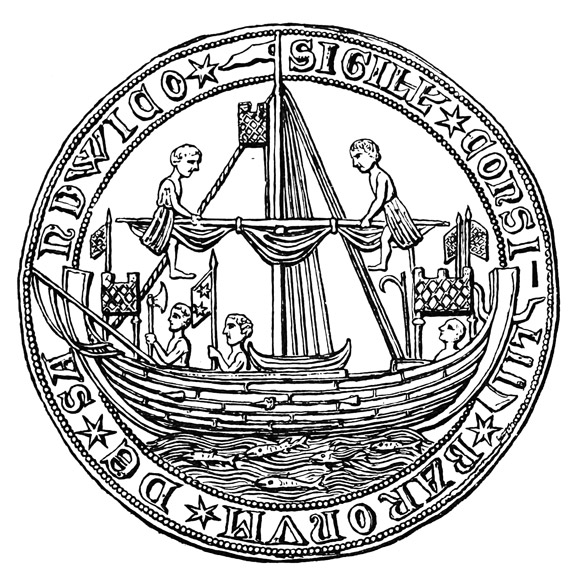
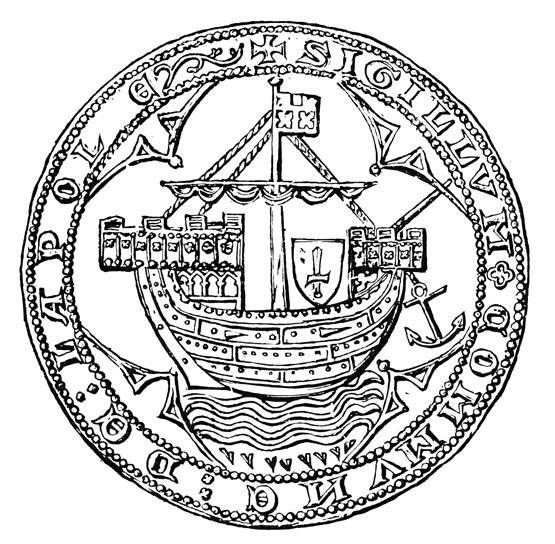
of the Hanseatic League, A.D. 1241—Corporate seals—Sandwich—Poole—Dover—Faversham—Stanhope,
vice-admiral of Suffolk—Duties
of the Cinque Ports—Increased privileges to foreign
merchants—Letters of marque first issued—Law for the recovery of
debts, and adjustment of average—Shipping of Scotland, A.D. 1249—Extremely
liberal Navigation Act—Chief ports of England and
extent of its shipping and commerce—Edward II., A.D. 1307-1327—Edward
III., A.D. 1326-7-1377—Extension of English commerce—The
discovery of coal—First complete roll of the English fleet, A.D.
1347—Quota of different ports—Pay of soldiers, sailors, &c.—War
renewed, A.D. 1354—Death of Edward III., A.D. 1377—State of the
merchant navy during his reign—Loss sustained by war, and encouragement
afforded thereby to foreign nations—Rapid increase of
the trade of Flanders—Trade between Italy and Flanders—Commercial
importance of Bruges and Antwerp—Wealth of Flanders,
and extent of its manufactures and commerce—Special privileges to
her merchants—Progress of the Hanseatic League, and its system of
business: its power too frequently abused
Treaties with Spain and the merchants of Portugal—Early claim of the
right of search—Restrictive laws against the English, and in favour
of foreign traders—Accession of Richard II., A.D. 1377—Character of
the imports from Italy—Sudden change of policy—First Navigation
Act, A.D. 1381—A rage for legislation—Relaxation of the Navigation
Act, A.D. 1382-8—Free issue of letters of marque; and of
commissions for privateering—Special tax for the support of the
Navy, A.D. 1377—Superiority of English seamen—Their intrepidity
and skill—Chaucer’s description of the seamen of his time—Henry
IV., A.D. 1399-1413—Disputes between the Hanse and the
English merchants—Agreement for guarding the English coasts—Henry
V., A.D. 1413: his liberal policy, and ambition—The extent
of his fleet—Size and splendour of the royal ships—Prologue of the
“Dominion of the Sea”—England first formally claims dominion
of the sea, about A.D. 1416—Prerogatives conferred thereby—First
accounts of revenue and expenditure, A.D. 1421—Law for the admeasurement
of ships and coal barges—Henry VI. crowded, A.D.
1422—Marauding expedition of the Earl of Warwick—Distress
among shipowners not royal favourites, A.D. 1461—Fresh legislative
enactments—First “sliding scale” applied to the importation of
corn—Relaxation of the laws by means of treaties, A.D. 1467—Treaties
of reciprocity—Extension of distant maritime commerce,
A.D. 1485—First English consul in the Mediterranean, A.D. 1490—The
advantages derived from reciprocal intercourse
Early efforts of France to restore the civilization of Europe—Charlemagne,
A.D. 771-814—Protection against pirates—Efforts of Venice
to suppress piracy—Rise of Marseilles—Monopoly in shipping
trade—Customs on shipping—Spain; its early commercial importance—Superior
influence of the Venetians, which was invariably
used to their own advantage—Participation of Genoa
and Pisa in the profits derived from the Crusades—Venice claims
the dominion of the Adriatic, A.D. 1159—Annual ceremony of espousing
the Adriatic—Bucentaur state barge—Form of espousal—The
progress and commercial policy of Venice—Variable character
of her laws, A.D. 1272; which were protective generally, especially
as regards her ships—Official exposition of the trade of Venice—Her
ships and dockyards—Merchant galleys—Their greatest size—Contract
for the construction of vessels—Great variety of classes—The
Gondola—The Tarida—The Zelander—The Huissier—The Cat—The
Saitie—The Galliot, &c.—The Galeass—The Galleon—The Buzo—Government
merchant galleys—How engaged, equipped, and
manned—Nobles’ sons taken on board—Capacity of these vessels—Crew,
and regulations on board—Value of their cargoes—Despatch
boats—Consuls; their establishment, duties and emoluments—Ancient
ships’ consuls; their duties—The Cartel—Conditions of the
contract—Restraints upon seamen—Extraordinary display on the
departure of any important expedition—The reception of the commander,
and his plan of inspection—Signal to depart—Adaptation
of merchant vessels to the purposes of war—Regulations at sea—Stringent
rules to regulate the loading of vessels
Prohibition to trade with infidels—Its futility—Commercial policy of
the Italian republics—Genoa—Genoese fleets and treaties with the
Venetians—The Genoese restore the Greek dynasty, and secure a
more permanent footing at Constantinople—Galata—Kaffa—Genoese
vessels—Details of contract with the ship-builders—Napier’s description
of a large Genoese ship of the fifteenth century—Evident
mistakes in the account—First great improvement in the Genoese
ships—Genoese carrack—Their corsairs and pirates—The most daring
of the pirates; their terrible fate—Corsairs—Bologna and Ancona—Importance
of Pisa—Her trade with the Saracens, about A.D. 1100;
and ships—Her first great misfortune—Mode of conducting her
trade—Florence—The Florentines ship goods from a port of Pisa—Sale
and transfer of Leghorn, A.D. 1421—First expeditions to Egypt,
Constantinople, and Majorca—Freedom of commercial intercourse
amongst the Florentines—Their frugality, contrasted with their magnificent
public displays—Duties and powers of the board of the “six
consuls of the sea”—Their public vessels, and the trade in which
they were employed—Consular agents—Extent of the Florentine
commerce, and cause of its decline—The smaller states—Decorations
and traditionary emblems of ships—Signals—Manners and customs
of seamen—Their legends—Punishments for gambling and swearing—Superstitions—Manners
and morals, A.D. 1420—General severity
of punishments—Impaling, flogging, &c.—Branding
Spain and Portugal—Importance of their commerce in ancient times;
and its decline during the Middle Ages—Trade with the coasts of
Africa—The maritime discoveries of the Portuguese—Expeditions
along the West Coast of Africa by order of Prince Henry—Discovery
of Madeira, A.D. 1418—Capes Boyador and Blanco, A.D. 1441—Cape
Verde Islands, A.D. 1446, and Azores, A.D. 1449—Equator crossed,
A.D. 1471—John II. of Portugal—First attempt to reach India by
the Cape of Good Hope, A.D. 1487—Ancient dread of the Atlantic—Christopher
Columbus—His ideas of the form of the earth, and love
for maritime discovery—His visit to Lisbon, and treatment by the
Portuguese—His formal proposal in 1480 to the crown of Portugal,
which is referred to a learned junto, who ridicule his idea—He
leaves Lisbon, A.D. 1484; and visits Spain, A.D. 1485—His kind
reception by the prior of the convent of La Rabida—First interview
with the sovereigns of Spain—Its result—The ridicule he endured—Evidences
of an inhabited country to the West of Europe—Orders
given by Ferdinand to provide Columbus with the vessels and stores
necessary for his voyage to the West—Conditions signed 17th April,
1492—Vessels at last provided for the expedition—Their size and
character—Smallness of the expedition—Its departure, 3rd August,
1492—Arrival at the Canary Islands—Great fear and discontent
among the crews—Matters become serious—Contemplated mutiny—Land
discovered 12th October, A.D. 1492—Columbus takes possession
of the island of Guanahani in the name of Spain—The first impressions
of the natives on Columbus
The state of the West India Islands when discovered—Wreck of one
of the vessels of the expedition—A colony established—Columbus
sets sail for Spain, 4th January, 1493—Arrives at St. Mary’s, 18th
February, and in the Tagus a few days afterwards—Re-enters, with
his ship, the harbour of Palos, 15th March—Great rejoicings—He
proceeds to Seville and Barcelona—Orders for a fresh expedition—Its
extent, and departure, 25th Sept., 1493—Reaches Dominica, 2nd Nov.,
1493, and Santa Cruz, 14th Nov.—Arrives at Hayti, 22nd Nov.—Founds
a fresh colony at Hispaniola or Hayti—Sufferings of the
colonists, and disappointment of Columbus—His sanguine expectations
for the future—Threatened mutiny among the colonists—Columbus
proceeds on further explorations—Discovery of the island
of Jamaica—Surveys Cuba, and returns to Isabella—Arrival of
Bartholomew Columbus—Intrigues at home—Commission of inquiry
despatched to Hayti—Columbus sets sail for Europe, 10th March,
1496—Arrives at Cadiz, 11th June, 1496—Re-visits the West, May
1498—Reaches Trinidad, 31st July—Discovers Tobago, Granada, and
other islands, reaching Hispaniola, 19th August—Finds everything
in disorder—Makes a tour of inspection, but is arrested, and sent a
prisoner to Spain—Arrives at Cadiz, Nov. 1500, and is restored to the
royal favour—A fleet sails for the colony with Ovando, Feb. 1502,
and two months afterwards (9th May) Columbus follows, and reaches
St. Domingo, 29th June—Discovers the island of Guanaga 30th July—Trading
canoe—Her cargo—Prosecutes his researches to the South—Reaches
Cape Honduras—Discovers and explores the Mosquito
coast—Puerto Bello—Forms a settlement on the river Belem,
6th Feb., 1503—Anchors at Jamaica, June 1503, and Dominica,
13th August of that year—Sails for Spain, 12th September, which he
reaches 7th Nov., 1504—His sufferings and death, 20th May, 1506.
Introductory—The first attempt to float, by means of a hollowed log
and raft—The Ark—Boats of skin—Earliest boats or ships—Their
form—Mode of construction—Names of ships—Decorations—Launching,
&c.—Master—Mate—Boatswain—St. Paul’s ship—Rig and
sails—Undergirders—Anchors and cables—Decks—Nautical instruments—Mariner’s
compass—Speed of ancient ships.
Introductory.
It is my intention to write a History of Merchant
Shipping; I am not aware that there exists any work
of the kind contemplated. No doubt everything relating
to the vessels of ancient times has been published
in one form or another, as also an account of
all that is known of the maritime commerce of the
Middle Ages; but this information is widely scattered,
and frequently so diffused among other matters of a
very different description, that considerable research
is necessary to ascertain where it is to be found. I
desire to remedy this inconvenience, and to furnish
from those fragmentary materials a consecutive,
though necessarily a condensed, account of the
Merchant Shipping, Ancient and Modern, of those
nations which at different periods have carried on an
extensive over-sea commerce. I shall also presume
to correct some errors and misapprehensions which
have found their way into the writings of men who,
though far more competent to undertake the work of
an historian, have not had an opportunity of gaining
a practical knowledge of this special subject.
It is only from Holy Writ, from the fragments in
the works of heathen historians and poets, and from
the sculptured monuments of the East, that information
can be obtained about the vessels and commerce
of very ancient times. From such sources I shall
endeavour to compile, in a manner as brief as possible
consistently with perspicuity, a narrative of how
these vessels were constructed, manned, and navigated,
separating, as far as my knowledge and experience
will permit, facts from fiction, and omitting
legends frequently accepted as historical truths. It
can serve no good purpose to record descriptions of
ships evidently the creations of romance; and, in a
work professing to deal with established facts, care
must be taken to admit nothing improbable unless
well authenticated.
It will not be the least pleasing portion of my work
to furnish, as fully as I can, a description of the
manners and customs of the seamen of all nations,
and, at the same time, to notice incidentally their
habits, prejudices, and superstitions. To illustrate
the effects produced upon maritime commerce by the
laws of different nations, it will be necessary to direct
attention to those legislative measures which have
had a marked bearing upon its prosperity or otherwise.
Towards the close of this work, the merchant
vessels of our own time, the cost of construction,
speed, and capacity for cargo, will be fully described,
as well as the number and duties of the crew, and the
expenses of management. I shall endeavour to supply
every material fact connected with the business of
the shipowner, which nowadays is separated from
that of the merchant, so that hereafter a complaint
may not be urged against me for having followed the
example of other writers, and by so doing omitted interesting
and instructive knowledge, simply because
it was of a character hitherto considered beyond the
province of the historian.
Many years have already been employed in collecting
materials for this work, but hitherto time
has been wanting for the study and elucidation of a
subject which, from the nature of my avocations, can
hardly fail to prove interesting to myself, whatever
it may be to my readers. To trace the origin of
navigation, and to detail the numerous steps by which
the merchant vessels of the great trading nations of
the world have reached their present state of perfection;
to record those discoveries in science and art
connected with navigation, which enable the mariner
to cross the ocean without fear and with unerring
certainty; to dilate upon those triumphs of man’s
genius and skill whereby he can bid defiance to the
elements; and to enter in these pages the names of
the men who have benefited mankind by their maritime
discoveries, or by affording greatly increased
facilities for intercourse between nations, is to me
a task of the most gratifying description.
But as many of my readers may not take so lively
an interest in a subject necessarily dry in its character
and technical in its details, I shall endeavour to
describe everything relating to shipping in clear and
condensed language, so as to induce them, if possible,
to accompany me in my researches; and it is to be
hoped that at least the ships and commerce of the
ancient Egyptians and Phœnicians, and of those
nations which, like Carthage and Assyria, have long
since passed away, may prove not uninteresting to
the general public.
Passing from very remote ages, I purpose to
examine the maritime commerce and shipping of the
different nations which flourished from about the
time when, on the decline of the power of Rome, the
Italian Republics arose; and thence through the
Middle Ages, till Spain sent forth her celebrated
Armada, to the period when Great Britain, slowly
but surely extending her influence upon the ocean,
claimed to be “Mistress of the Seas.”
Considerable space must likewise be devoted to an
account of the principal institutions connected with
shipping, and to the vast changes which have taken
place in the over-sea carrying trade since Vasco
da Gama doubled the Cape of Good Hope, and
Christopher Columbus discovered a new and now
mighty world to the West.
But the larger portion of this work will be devoted
to the progress of Modern Shipping. Since the
introduction of steam, the merchant navies of the
world have increased to an enormous extent; and in
comfort, beauty, and speed, the vessels of the present
day immeasurably surpass those of any other period.
Modern appliances in their propulsion, while altering
the mode in which commercial pursuits are conducted,
have also materially changed the seats and centres of
maritime commerce. Changes such as these necessarily
require to be fully described, and their results
carefully recorded.
As the ports of Great Britain are now free to the
vessels of all nations, it will be my duty to explain
the nature of the navigation laws of Cromwell and of
the reciprocity treaties of Huskisson, and to show
how, step by step, all barriers to free navigation
have been removed. The fallacy of endeavouring
to enrich ourselves by the ruin of our neighbours
will be exposed, and, from the experience of the
past, I shall hope to inculcate lessons of use for
the future.
Ample materials are to be found for the elucidation
of most of these subjects, and there can be no
excuse to plead, beyond my own incapacity, if I fail
to produce a work which shall hereafter be useful for
reference, especially with regard to the merchant vessels
of modern times. Though the enterprising traders
of Tyre extended their commercial intercourse to all
parts of the Mediterranean and even to the Northern
and the Erythræan Seas, yet her merchants, “who
were princes,” and her traffickers, who were “the
great men of the earth,” have left no records of their
vast commerce, nor of the vessels which were engaged
in it. No mercantile man appears to have written
an account of how he conducted his trade, or given
to posterity a drawing of his ship; nor, indeed, to
have recorded anything relating to the great maritime
state to which he belonged. Our limited knowledge
of Tyre is derived therefore almost exclusively from
other sources. If these early navigators had taken
one-half the pains to transmit to posterity the sum
of their acquired knowledge, practical and historical,
which the Egyptians have done, a vast amount of
information would have been added to the science of
ancient navigation and commerce. Unfortunately,
almost every vestige of Phœnicia has been swept
away, a significant example that the most extended
commerce, enjoyed by a purely trading people, cannot
alone save them from eventual insignificance
and oblivion.
In concluding these introductory remarks, I may
be fairly permitted to indulge the hope that, from
the vast stores of knowledge bequeathed to us, we
may leave more lasting records of our maritime commerce
than either Tyre or Carthage, and that the
improved civilization and extensive colonial possessions
of Great Britain may render her pre-eminence
at sea and her commercial greatness much more
enduring than the once celebrated maritime city of
the Phœnicians, which has become “a place for the
spreading of nets in the midst of the sea,” and “a
spoil to the nations.”
The first attempt to float, by means
of a hollowed
log, and raft.
It is impossible to say who first taught man to
float upon a log or an inflated skin, or who had the
genius to construct the earliest raft. The exclusive
honour of the discovery of navigation—which now,
through the successive improvements of many ages,
and the application of steam as a motive power, has
arrived at its present high state of development,
tending to the safety, convenience, and civilization of
mankind—is too great an honour to be awarded to
any single individual. Indeed it is a glory which
writers alike in ancient and in modern times have
declined to confer on any frail mortal like themselves.
Accordingly the Libyans and the Greeks
ascribed the merit of the invention to the gods.
Neptune, however little in other respects may be
known of this mythological personage, was not only
worshipped by the ancients as the first inventor
of navigation and supreme ruler of the sea, but
his glory has survived the wreck of empires and
the extinction of races, and the name of a heathen
god is still associated with the dominion of the
ocean.
There is, however, no difficulty in conceiving what
would give the first idea of flotation. At the period
of the earliest history of man acknowledged by
Christian nations, our first parents must have noticed
leaves or branches of trees floating in the river
“which went out of Eden to water the garden.”
Thus would be conceived at the creation of man
the idea of a vessel or of a substance which would
float and could be made useful for his wants.[1] The
buoyancy of the branch or trunk of a tree would
suggest the means of carrying him across unfordable
rivers; and there is no doubt that, long anterior
to the era assigned to Noah, the first step in the art
of ship-building was taken in hollowing out the log
by fire, or by some rude instrument, in order to
render more secure the position of any adventurous
navigator. A pole or paddle might be used to propel
the rude barque, but probably ages passed away without
any improvement in this respect. In fact, to
this day, some of the inhabitants of the Polynesian
Islands have not made any greater progress in the
construction of their primitive vessels; and the
canoes in the Pacific, and in various parts of South
America, are still formed on what is evidently the
most ancient model of vessels.
While the hollow log was made to answer the
purpose of a boat, a number of logs placed together
would suggest the idea of a raft, for the carrying
of a number of persons or animals, or of any article
of greater weight than could be conveyed in a
canoe across a lake or river. These, by degrees,
would be improved in form, in strength, or in
capacity, to suit the wants of man or the navigation
for which they were intended. The ingenuity of
even the rudest savages would lead them, it may be
easily supposed, in course of time, to construct their
raft so as to make it more easy of propulsion, and
thus give to it the first form of a ship.
The Ark.
But it is doubtful if any progress were made in
ship-building beyond the mere raft, anterior to the
period assigned to the Flood; and the Ark[2] of Noah
is unquestionably the first ship of which we have
any notice, either in acknowledged history or in
the legends of the earliest nations. As this vessel,
however, has been so much a matter of controversy,
some of our readers may think it well, in imitation of
other modern writers, that we should omit the consideration
of the subject. But the difficulties, physical
and practical, surrounding it ought not to induce us
to pass over altogether unnoticed the earliest recorded
effort of naval architecture. This great ship
is described in Scripture[3] as having been three
hundred cubits in length, fifty in breadth, and thirty
in height or depth—dimensions corresponding very
nearly with those of the most approved models of
the sailing vessels of the present day. If the cubit
be taken at eighteen inches, her registered tonnage,
reckoned according to the present mode of admeasurement,
would not have been more than fifteen thousand
tons, or considerably less than that of the Great
Eastern.
But the probability is that, after all, the Ark was
simply a raft of stupendous size, bearing on it a
structure of the above dimensions resembling a huge
warehouse, roofed in the usual manner, and built
to float on the breast of a great flood, the narrative
in the Bible neither suggesting nor requiring any
means of propulsion.[4]
Boats of
skin.
Although for years after the Flood[5] the raft may
have been the only form of vessel for carrying heavy
burthens, other means of flotation must soon have
suggested themselves; and of these, the inflated
skins of animals would seem to have prevailed the
most generally and the most widely. Thus on the
ancient monuments recently discovered by Mr.
Layard, we find numerous representations of the
Assyrians crossing a river—probably the Tigris—on
inflated skins; and rafts may also be seen on
which goods and men are floating down similarly
supported.[6] The same practice is still in use among
the present inhabitants of the country, and is also
noticed as common on the Setlege by Baron Hügel, in
his interesting “Travels in Cashmir.”[7] Baron Hügel
also speaks of baskets, suspended from ropes firmly
tied to each shore, for crossing the mountain waters
of the same river; while coracles—basket-work
over which leather or prepared flannel has been
stretched—may still be seen in Wales, thus enabling
the inhabitants to fish, and to cross streams not
otherwise fordable. It is also worthy of note that
Pliny[8] alludes to this custom, where he states that
“Even now, in British waters, vessels of vine-twigs
sewn round with leather are used.” Mr. Layard[9]
likewise speaks of still finding on the Tigris light
boats called terradas, constructed by the Southern
Mesopotamians of twisted reeds, rendered watertight
by bitumen, and often of sufficient consistency to
support four or five men. As a remarkable proof
of the long persistency of custom and of trade, we
may add that the bitumen of Babylonia was exported
to Egypt so early as the reign of Thothmes III.,
B.C. 1500, from the Is (now Hit) of Herodotus,
where it is still abundant.
The balza of the western coast of South America,
in use within the last hundred years, appears to
have been a raft of logs of very light wood carefully
fastened together, and capable of carrying occasionally
as much as twenty tons.[10]
Such were probably the rude beginnings of the
art of ship-building.
Earliest
boats or
ships.
Though it is impossible to give any authentic
details of forms and means of navigation, such as
those we have mentioned—remembrances as they
are of pre-historic times—we need not doubt that
the earliest people who practised navigation, in any
sense after the manner since recognised, by ships or
boats as distinguished from rafts, were the inhabitants
of the eastern coast of the Mediterranean, and,
notably, the Phœnicians of Sidon and Tyre.
The Phœnicians, however, as is now admitted,
were not originally inhabitants of the territory they
have made famous by their commercial operations,
but immigrants from the shores of the Persian Gulf,
whence they carried with them the nautical tastes
and knowledge they had been maturing, perhaps
for centuries, to develop them in a new and
enlarged sphere. Indeed, it is not unlikely that,
antecedently to History, these enterprising people
had made voyages even to the far-distant East, as
the “Erythræan Sea” comprehended an area far
wider than our Red Sea, being really, as in Herodotus,[11]
what we now call the “Indian Ocean.” If it be
true that Jacob’s blessing,[12] “Zebulun shall dwell at
the haven of the sea; and he shall be for an haven
of ships,” is probably the earliest written document
implying navigation of any kind, it is at the same
time impossible to determine at what period that
prophecy was to take place, while the occurrence
of the name Zidon in the next paragraph, “His
border shall be unto Zidon,” might suggest the
inference that the wording of this announcement,
as we have it now, is of later date than Jacob
himself.
Neither the Egyptians nor the Greeks have any
claim to be considered among the first navigators;
indeed, the former people were during their whole
history averse to seafaring pursuits, and were dependent
on the Phœnicians for nearly all their
carrying trade, beyond what passed along their own
great river, while the first Greek expedition—that
of the Argonauts, to which we shall refer presently—was
possibly as much a Phœnician as a Greek
adventure.
Their
form.
In form, we may be sure that the first boats were
flat-bottomed—barges for river service rather than
ships for the sea. But keels must have been added
as soon as ever coasting voyages commenced, or any
speed was needed. In shallow waters they may
have been propelled by poles, like modern punts;
but oars, and at least one sail of simple construction,
must have been introduced very early.
Passing over the exploits attributed to Perseus,
Theseus, and Bellerophon, from which no facts worthy
of record are deducible, it is enough to state here
that in the construction of the earliest rafts or
boats the axe or the adze was, probably, the only
implement the builders possessed, the result of
their work being doubtless of the rudest character;[13]
and that the timber first employed would be that
most ready at hand in the countries where such
vessels were first required; though but a short time
would elapse, and but little experience be needed,
to insure the selection of those woods which were
the best for the purpose intended. Phœnicia, Cyprus,
and Greece were well supplied with all the timber
that could have been wanted. Hence we have early
notices of the employment of the oak, the chestnut,
and the cedar; while the pine, together with the
alder, the ilex, and the ash, were in general use for
ship-building. Many fanciful stories are told in
Hesiod, Vegetius, and other writers, of the methods
adopted by the ancient workmen to secure sound and
durable timber; but on these we need not here dwell.
Mode of
construction.
It may be inferred from the passage in Homer
that in his time sawn timber was not unknown;
and, though nearly all the then voyages were performed
by coasting from headland to headland, it is
clear from other passages[14] that the navigators did
even then sometimes venture out of sight of land:
their vessels were, however, then, and for many years
later, undecked; few representations of any ancient
galleys, even on the earliest vases, having come down
to us in which there is any certain indication of
a deck: while Thucydides distinctly gives it as his
opinion that the Homeric vessels were only large
open boats.[15] The larger ones had, perhaps, a sort
of half-deck, to give the people in them a little
shelter. Being flat-floored and of small immersion,
they as it were glided over the surface of the water,
having little or no power of resistance to the action
of the waves, and being, therefore, capable of very
little progress except when sailing before the wind.
To enable them to resist the penetrating power of
the water, the ancients appear to have used in very
early times a species of pounded sea-shells, introduced
carefully into the seams and chinks between the
planks—a process found to answer well for a short
time; when, however, the ship strained, this caulking
was liable to fall out, letting in the water as before.
A somewhat similar method is described in the Transactions
of the Embassy sent to China in 1792, as
seen there at that time.
In later days, other methods were adopted; one of
which, attributed by Pliny to the Belgæ,[16] consisted
in beating pounded seeds into the fissures between
the planks of vessels—a substance, he says, found to
be more tenacious than glue, and more to be relied on
than pitch. This is evidently the same in principle
as the modern practice of caulking. In the same
way we find in remote times that pitch and wax were
used partly for the prevention of leakage, and partly
also to preserve the planks from the sea-weeds and
animalculæ with which the waters of the Mediterranean
abound.[17] The discovery, too, of what is supposed
to have been a galley of Trajan at the bottom
of Lake Riccio shows clearly that, in Roman times,
sheathing as well as caulking were used to preserve
the bottoms of ships. The famous Locke,[18] alluding
to this discovery, says, “Here we have caulking and
sheathing together above sixteen hundred years ago;
for I suppose no one can doubt that the sheet of
lead nailed over the outside with copper nails was
sheathing, and that in great perfection; the copper
nails being used rather than iron, which, when once
rusted in water with the working of the ship, soon
lose their hold and drop out.”
Names of
ships.
Ships in ancient times were known by a great
variety of names, most of which are descriptive of
the purposes for which they were built, or of the
services in which they were employed.
Omitting triremes, the most usual ships of war, the
following list enumerates their chief varieties:—
Thus olkas was a large heavy tow-barge; ponto—a
word of Gallic or Celtic origin[19]—a punt.
Gaulos, a round heavy merchant vessel, named
probably so originally by the Phœnicians, and preserved
to modern days in the galleon or galeass
of the Middle Ages, and the galley of later times.
Corbitæ, slow sailing ships of burthen—so called
because they carried baskets at their mast-heads.
Hippagogi, as their name implies, carried horses.
The characteristic of all these vessels was that their
structure was bulky, their sides and bottom rounded
from the flat, and, though not without rowers, that
they were chiefly dependent on their sails.
Of a lighter class, and for greater speed, were the
scapha (or skiff); the acation, or acatus; and the
linter, which, though like ratis, often used for any
kind of vessel, was more strictly a light boat or
wherry.[20] Generically, merchant vessels were called
mercatoriæ, or vectoriæ, as being the carriers of merchandise.
So piscatoriæ were boats used for fishing.
Decorations.
The ships of the Greeks had various ornaments
attached to the prow and stern, most of which were
afterwards adopted by the Romans, and may even still
be seen on the waters of the Mediterranean. Thus
an eye painted on each side of the prow was supposed
to indicate watchfulness and to ward off ill-luck;
while the prow itself terminated in the acrostolium,
the head of an animal or bird—corresponding in
principle with our figure-head. An original goose-head
(technically called cheniscus) is still preserved
in the Bibliothèque at Paris.[21] So, at a later period,
St. Paul’s ship had for its “ensign” the “sign of
Castor and Pollux,”[22] while Ovid’s ship, which bore
him to the land of his exile, had a head of Minerva
painted on her prow.[23]
On the stern was the aplustre, forming a kind of
roof over the steersman, and bearing also the image
of the tutelary Deity—a flag or pennon—sometimes
a lantern, as may be seen on Trajan’s Column, and
the purple sail which, in Roman times, marked the
Admiral’s ship.[24] Ships, it appears, were from remote
times painted with various colours. Thus Homer
specifies black, red, and purple,[25] and Herodotus
speaks of red paint;[26] while Plautus, in a well-known
passage, classes together ships and women
as equally greedy of ornament.[27] It was also, occasionally,
the custom to paint the sails with stripes
of various colours.
As a rule, the names of the ships were, in ancient
days, feminine, and named from celebrated women, as
Nausicaa; hence Aristophanes calls them “Virgins.”[28]
The Romans, on the other hand, sometimes gave
them masculine names.
Launching,
&c.
From the earliest ages, the launch of a vessel has
been attended with considerable ceremonies; frequently
with feasting and bands of music, and a
dedication to various deities who were supposed to
watch over her safety in an especial manner. On
setting sail, she was adorned with flowers and
garlands indicative of future prosperity; and the
special aid of Neptune, Minerva, and of the other
gods invoked with solemn prayer and sacrifices for
her success.[29] When large fleets started, it was usual
to send the lighter vessels first, then the ships which
acted as convoy, and lastly those of heavy burthen or
deep draught of water. The oars, when not required,
were triced up to the sides of the vessels. On the
completion of the voyage, ships were generally
hauled up on shore and protected from the weather;
similar prayers being again offered to Nereus,
Glaucus, Melicertes, and the other deities of the sea,
or to Mercury, to whom the merchant and shipowner
(then almost invariably identical in meaning) had
specially committed their ships.[30]
Men who had escaped shipwreck felt bound to
make special offerings to the gods in testimony of
their gratitude; sometimes hanging up in a neighbouring
temple the garment in which they had been
saved,[31] or shaving their hair—a custom Petronius
justly calls the last vow of men who have saved
nothing but their lives.[32]
Rigid discipline was maintained on board the
ships, and punishments of great severity inflicted on
those who failed to keep proper ward and watch;
nay, even the barbarous practice of “keel-hauling,”
once not uncommon in the English service, was not
wholly unknown to the ancients. The crews were
generally composed of two classes; the mariners,
who attended to the navigation and trimming of the
sails, and the rowers. These offices were usually
kept distinct, the mariners being rarely, except in
cases of great emergency, compelled to labour at
the oars.[33]
The work of the rowers, to which we shall allude
more particularly hereafter, was one of severe toil;
hence, as in modern times, the music of the voice or
the pipe stimulated the rowers to fresh exertion or
tended to relieve the depressing monotony of their
work.[34] Many ancient writers, and notably Xenophon,
Polybius, and Arrian,[35] have left us interesting accounts
of the way in which the rowers were trained;
the practice of the Greeks and Romans, and especially
that of the latter people, having been remarkable
for its perfection in the execution of the most
difficult manœuvres.
Master.
The master or pilot, whose place was in the stern,
though not himself required to steer, was expected
to understand the due management of the rudder
and sails, the usual course of the winds, the indications
in the sky of a change of weather, and the situation
of the harbours most fitting for his vessel, or
of the shoals the most to be avoided.[36] He was also
expected to take proper cognizance of the omens
offered by the sea-fowl and fishes, with divers other
phenomena, as the murmuring of the floods, the dashing
of waves against the shore, and other signs believed
to import changes in the weather.[37]
Mate.
Boatswain.
Next in authority to the master was the mate,
whose place was at the prow of the ship, and who
had charge of the tackle and of the rowers, who were
placed by him on their proper seats.[38] With him was
associated a third officer, whom we may call the
boatswain and steward, as he gave the word to the
rowers and distributed the rations.[39] There was also a
fourth officer, whose especial duty it was to take heed
of possible rocks or shoals, and to direct the ship at
night by the aid of long poles.
ST. PAUL’S SHIP, FROM THE WORK BY MR. SMITH OF JORDAN HILL.
St. Paul’s
ship.
It is remarkable that while we have many notices
of matters comparatively unimportant, no writer of
antiquity has given us any intelligible account of the
capacity of their ships of burthen, at least anterior
to the Christian era. Nor have the speculations of
modern authors been much more successful; with the
exception of Mr. Smith, of Jordan Hill. His essay
“On the Voyage and Shipwreck of St. Paul,” the
work of a man of much practical experience in the
management of sailing craft, and a yachtsman of
thirty years’ practice, is a really valuable contribution
to the history of ancient merchant ships.
Mr. Smith has tested, by modern experiences, the
details furnished by St. Luke,[40] and has himself
worked out the “dead reckoning” of St. Paul’s ship—a
feat requiring both knowledge and skill. He
has also, by a diligent comparison of the representations
of ancient vessels on coins, and on the marbles
and paintings of Pompeii, with the scriptural account
of St. Paul’s ship, reproduced as perfect a drawing
as we are ever likely to obtain of the Mediterranean
merchant-ship at the dawn of Christianity.
St. Paul’s ship must have been one of considerable
size, as, besides her cargo of grain, she had on board
two hundred and seventy-six souls. Moreover, as
she had to make a long and, as it turned out, a
boisterous voyage, she must have been completely
decked, and probably had two decks from the number
of passengers she carried, besides a high poop and
forecastle, like the ships of two or three centuries
ago, though these are not shown in the illustration;
her bulwarks were formed of battens fastened horizontally
across the stanchions.
Mr. Smith has collected many instances bearing
upon the arrangement of different parts of ancient
ships. Thus, from a painting at Herculaneum,
said to represent the ship of Theseus, he has shown
that the ancient sailors knew the use of the capstan
and hawser; but it still remains a difficulty to understand
how their large ships were steered, unless
some machinery were used of which we have no
account, to work the very large oars thrust through
portholes in either quarter. Mr. Smith has also
proved, from representations on the Leaning Tower
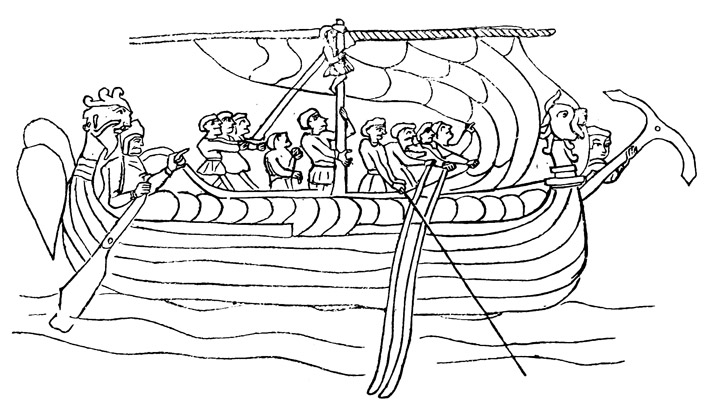
of Pisa, on the Bayeux Tapestry, and on the gold
nobles of Edward III., that the primitive mode of
steering by one or more oars—as visible on the
reliefs of Trajan’s Column—prevailed as late as
the fourteenth century; such rude appliances, however,
could have been available only for small
vessels.[41]
Rig and
sails.
For a long period the rig of ancient ships was of
the simplest kind—a single large square sail on the
mainmast being the chief means of propulsion. In
the case of large vessels there was a sort of square
sail on a short mast at the stern, and a similar one at
the bow; but these would be of more use in steering
than in propelling. The Romans appear to have
had a small triangular sail, like the Greek letter Delta
(Δ), which bore the name of suppara, from its supposed
resemblance to a woman’s shift;[42] but such a
sail could only have been used in fair weather.
Undergirders.
“Undergirding” a ship, as mentioned by St. Luke,
is rarely practised at the present day; but implements
for that purpose—probably stream cables or hempen
hawsers—would seem certainly to have been part of
the occasional outfit of ancient vessels. They are
mentioned as having been kept in store in the
Athenian arsenals, and to have been served out for
voyages known to be of unusual danger.[43]
Anchors
and
cables.
The use of anchors was early understood, but, in
Homer’s time, they were simply large stones attached
by ropes to the prow.[44] In after-times, much attention
seems to have been paid to their construction,[45] and
ships often carried several (as St. Paul’s, which had
four[46]). A cork float marked where the anchor was
sunken;[47] and chain cables were sometimes used, as
is noticed by Arrian in his account of the siege of
Tyre by Alexander.[48] In St. Paul’s case, the fact
that the ship was able to anchor by the stern probably
saved the lives of those on board, as otherwise she
might have driven broadside on the rocks.
Decks.
But though, as we have stated, the small early
coasting vessels may have had no decks, the large
grain-carrying ships, which performed the voyages
between Alexandria and Italy, were unquestionably
fully decked. In the so-called “ship of Theseus,”[49]
there is a complete deck, and also what would seem
to be a skylight; nor need we doubt that, in the
largest and best-fitted ships, there was adequate accommodation
for both men and officers. The great
ships constructed by Ptolemy Philopater and Hiero
were (as we shall see hereafter) rather “show-ships,”
and cannot be considered as representing the usual
type of even the most sumptuous of ancient merchant
vessels.
Nautical
instruments.
The skilled mariners of ancient days determined
their latitude by means still in use, but their instruments
were very inferior. The gnomon, in some
form or other, was their most common instrument
for measuring the length of the sun’s shadow at noon
on different days and in different places. We know
from Herodotus,[50] that this instrument was of great
antiquity—indeed, he ascribes the invention of it to
the Babylonians; but the report of Arrian to the
Emperor Hadrian[51] of his shipwreck implies that
there were other instruments besides this on board.
Pytheas, the first known navigator of the North Sea,
is said to have determined the summer solstice at
Marseilles by observing the proportion of the shadow
of the gnomon.[52] Further, Eratosthenes drew a
parallel of latitude through Gibraltar, Rhodes, and
Lycia to India; while Hipparchus made the first
map, on the principle of “Mercator’s Projection,” by
transferring the celestial latitudes and longitudes to
the terrestrial globe. On the other hand, Ptolemy
erred so far in his calculation of the longitude, that
he placed China 60° nearer Europe than it really is,
and thus led Columbus to fancy the distance he had
to traverse to the New World was just so much less.
It must not, however, be forgotten that Aristotle,
centuries before him, when reasoning from the assumed
sphericity of the earth, was really the first to
point out that the west coast of Spain was the fittest
point of departure for India.
The latitudes were reckoned in stadia from the
Equator to Syracuse, the stadium being about two
hundred and one yards and one foot. The determination
of the longitude was, however, a far more difficult
problem; as the only phenomena whereby men could
readily determine the distance between any two
places, viz. eclipses of the moon, would have been
of no practical value in calculating a ship’s position
at sea; moreover, it would not be easy to secure
certainty in such observations, nor could they easily
be repeated. Hence the ancients were led to depend
either on actual survey, or on the vague information
obtainable from the reckonings of sailors, or on the
itineraries of travellers. We need not, therefore, be
surprised when we see how Ptolemy and the greatest
of ancient geographers have erred, owing to the
impossibility of fixing with even tolerable accuracy
the longitudes of different places. It is likely that
their practice of constantly landing might have in
some degree supplied their deficiency in this particular;
but we have now no record of any astronomical
observations which were made at sea, by
even the most skilful of ancient navigators. A sort
of dead-reckoning—an observation of the position of
the sun during the day, or of certain stars during
night—was the haphazard mode by which their
positions at sea were chiefly ascertained. If they
had been accustomed to steer a direct course instead
of following the coast line, or if they had been acquainted
with the properties of the compass, or of
any instrument by which the bearings of the different
headlands could have been determined, they might,
having found their latitude, have depended, as
mariners in modern times have been often obliged
to depend, with some confidence upon their dead-reckoning.
The wonder is that they should ever
have ceased to hug the land, and that they really
ventured on the long voyages they unquestionably
accomplished.
Mariner’s
compass.
Some writers have attempted to show that the
Arabians and the Chinese were acquainted with the
mariner’s compass even in those remote ages; but
for this idea there does not seem to be any warrant
whatever. Certain it is that Marco Polo, who made
voyages on the Chinese seas in native boats, nowhere
alludes to it; while Niccola de’ Conti, who navigated
the Indian waters in an Indian vessel, in 1420, after
the properties of the magnet were known in Italy,
expressly states that the mariners had no compass,
but were guided by the stars of the Southern Pole,
the elevation of which they knew how to measure.
Nor is there any reason to believe that the Chinese
had any greater knowledge, though there may be in
some Chinese books a notice of the physical fact
that, by constant hammering, an iron rod becomes
magnetized—in other words, has imparted to it the
property of pointing to the north and to the south.
Such a discovery, so important for purposes of
navigation, would at once have been recognised, and
could not have been kept secret for ten centuries.
Moreover, there is really abundant evidence to show
that the compass had been long in use among the
nations of the West before it was adopted by the
Chinese; Dr. Robertson having justly remarked that
in Arabic, Turkish, and Persian, there is not only no
original word for it, but that the name they give it
is the Italian bossolo: nay, further, that the Arabians
have nowhere recorded any observation by them of
the variation of the needle.[53] We may add that Dr.
Robertson’s view is completely confirmed by Sir
John Chardin, one of the most learned of Eastern
travellers, who made special inquiries on this subject.
“I have sailed,” says he, “from the Indies to Persia
in Indian ships when no European has been on board
but myself. The pilots were all Indians, and they
used the forestaff and quadrant for their observations.
These instruments they have from us, and
made by our artists, and they do not in the least
vary from ours, except that the characters are
Arabic.”[54]
Speed of
ancient
ships.
A few notices remain to us of the time occupied
in the performance of different voyages by ancient
vessels, from which we may deduce the general fact,
that though owing to their construction—being
generally from three to four times as long as they
were broad, with shallow keels, and rarely other than
square sails—they could not have made much way
on a wind, they were capable of considerable speed
when the wind was right aft. Thus Pliny states
that a merchant-ship passed from Messina to Alexandria
in six days; another from the Pillars of
Hercules to Ostia in seven; another from the nearest
port of Spain in four; another from Narbonne in
three, and another from Africa in two.[55] So, too,
Arrian relates that the ship in which he sailed on
the Euxine accomplished five hundred stadia (or,
as is more probable, three hundred stadia) before
mid-day;[56] and St. Luke tells us that he ran from
Rhegium to Puteoli (one hundred and eighty-two
miles) by the second day after he had started:[57] but,
in all these cases, we may be quite sure that the
sailors had (as St. Luke distinctly states was his case)
a good stiff breeze abaft.
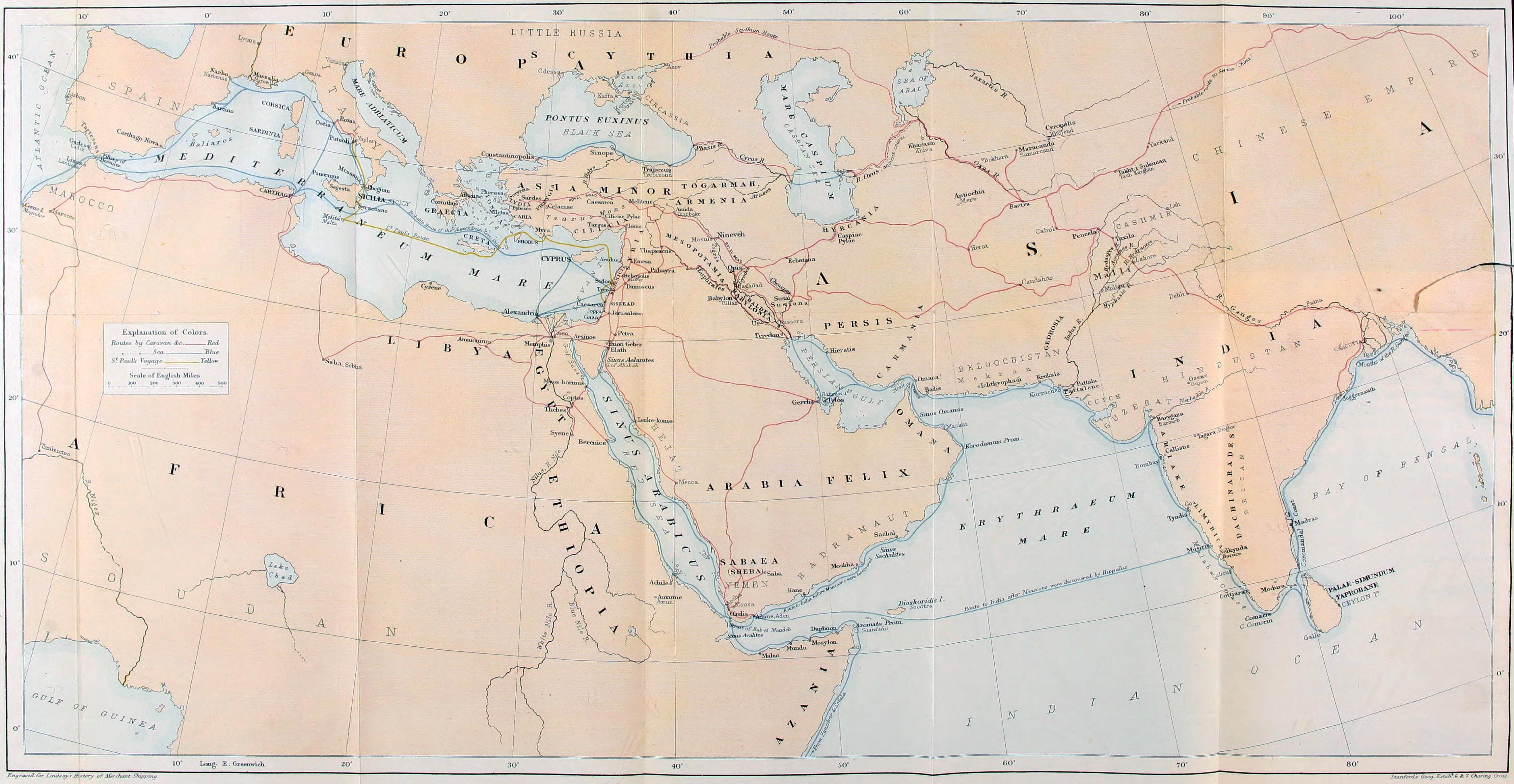
ANCIENT CARAVAN AND OTHER ROUTES. Engraved for Lindsay’s History of Merchant Shipping. Stanford’s Geog. Estabt. 6 & 7 Charing Cross
London: Sampson Low, Marston, Low, & Searle.
[4] Gen. vii. 16, 17. Cory, “Ancient Fragm.,” for traditions of the Ark
in various lands.
[5] The Scriptural narrative of a great flood, and of a great vessel
to float upon it, has just met with a remarkable confirmation. At
a meeting of the Society of Biblical Archæology, Sir Henry Rawlinson
in the chair, on December 3, 1872, Mr. George Smith, of the British
Museum, read a paper, giving an account of his discovery, on cuneiform
tablets (part of the so-called library of Ashur-ban-i-pal, king
of Nineveh), of an unquestionable account of the Deluge. The name
of the king under whom this event occurred cannot as yet be deciphered,
nor can anything like a certain date be assigned to it; but
Sir Henry Rawlinson accepted fully the truth of Mr. Smith’s decipherings.
Of the inscription describing the Flood, there are fragments
of three copies, containing duplicate texts.
[7] Hügel, “Travels in Cashmir,” p. 27, with a picture, p. 247.
[8] Pliny, vii. 57. Cf. also Lucan, Phars. iv. 131. Such vessels were
called “boats sewn together,” Plin. xxiv. 65; and Virgil (Æn. vi. 448)
gives the same title to Charon’s boat.
[13] Homer (Od. v. 243), &c., gives some curious details of the building
of the vessel of Ulysses; whence it appears that he made use of an axe,
had means of cutting planks, together with a boring instrument to
make holes for nails and hooks: he had also ropes, and at least one sail.
His bulwark was raised higher by wickerwork, to prevent the sea
dashing over.
Maritime commerce of Antiquity—Coasting—Tyre—Argonautic Expedition—Queen
Semiramis—The Phœnicians—Early notices of
them—The prophecy of Ezekiel—Trade in tin—Origin of the
name “Cassiterides Insulæ.”—Amber—Mainland trade of Phœnicia—Cause
of prosperity—Carthage—Utica—Commercial policy—Trade
with Spain—Trade in Africa—The commercial policy of Carthage—Limits
of trade.
Maritime
commerce
of Antiquity.
When different tribes were desirous of exchanging
with each other the commodities their countries
respectively produced, their first consideration would
naturally be the means of transport; and though we
may not be able to fix the period when it commenced,
the interchange of goods by barter must have been
nearly coexistent with the existence of man himself.
In the most ancient times the chief commercial routes
were undoubtedly overland; but it may safely be
assumed that at a scarcely less early period trading
vessels had begun to creep along the shores of the
Red Sea, Persian Gulf, and Mediterranean, and to
pass from island to island amid the land-locked
waters of the Levant.
Coasting.
There can, indeed, be no doubt that, till a period
comparatively recent, the characteristic of all early
navigation was that of a coasting trade, the mariners
seldom quitting the land except when constrained to
do so by some unavoidable necessity, such as the
violence of a gale or the force of currents, or when
a great saving of distance could be effected by
crossing the mouths of deep bays where the headlands
were at a moderate distance from each other.
But a coasting navigation is really subject to greater
difficulties and dangers than any other, and hence
has in all times had the property of forming the most
expert seamen. Thus it was that the seamen of Tyre
found their way to Carthage, and ultimately through
the pillars of Hercules to Gades and the tin-bearing
islands of the West: and thus, too, the States
of Tyre and of her great colony, Carthage, for centuries
maintained their power and lofty position
in the midst of nations in other respects greatly
their superiors. By the prosecution, too, of coasting
voyages the Portuguese, in later ages, passed the
Cape of Good Hope, and reached the East Indies.
Indeed nothing was more likely to advance discovery
than voyages of such a character, for which
the position of the three continents of the ancient
world afforded considerable natural facilities, especially
when taken in connection with the two long
narrow seas known as the Red Sea and the Persian
Gulf. Again, the Mediterranean, with its subordinate
portions, comprising the Adriatic and the Levant,
with the Black Sea and the Sea of Azov, was peculiarly
adapted for the commencement of an over-sea
trade with a shipping still rude and with sailors little
skilled; while its position in the centre, as it were,
of these three continents, surrounded by the most
fruitful and civilized regions of the then known
world, prepared it, naturally, to be the principal
scene of such an intercourse.
It should also be remembered that the Mediterranean
possesses the singular advantages of a very
considerable number of excellent harbours and roadsteads,
with numerous islands, projecting promontories,
and deep bays, affording excellent shelter for
small undecked craft; and, more than this, that the
two nations who were, in remote ages, the most
eminent among its merchant navigators, the Tyrians
and Carthaginians, were, as a rule, peaceful traders,
and slow to take up arms except in self-defence.
The Indian Ocean, within prescribed limits, and the
Persian and Arabian Gulfs, afforded somewhat similar
facilities, from the moderate distance between the
opposite shores, and from the periodical winds, which
change their direction twice in the year—a fact
which could hardly fail to have been early recognised,
though the reason of this change may have
remained long unsuspected. Bearing, therefore, these
physical facts and conditions in mind, it is not unreasonable
to believe that long and distant voyages
were accomplished with no greater nautical science
than has been generally conceded to the most ancient
mariners.
Tyre.
We find, too, as might be supposed, that the
nations who held in their hands the means of conducting
the largest amount of maritime commerce
were the most prosperous as well as the most
powerful. The small state of Phœnicia, of which,
in its most prosperous days, Tyre was the capital,
though insignificant in territory and population,
as compared with either Syria or Egypt, possessed
in some respects far greater power than either.
Holding, during many centuries, the command
of the sea, she was able, in great measure, to
control them as she pleased, and to prohibit their
intercourse with any nations that could not be
reached by their caravans. Phœnicia, therefore, as
the leading maritime state at the earliest period to
which any reliable records ascend, is entitled to the
first consideration in any work having for its object
an historical account of Merchant Shipping. To
trace the course of the extensive maritime trade of
the Phœnicians is to elucidate the progress of navigation
in ancient times.
Argonautic
Expedition.
Before, however, we speak of the Phœnicians we
must briefly notice two maritime adventures, which,
though fabulous in most of their details, were highly
estimated by the ancients, and had, doubtless, some
foundation in fact. The first of these, the Argonautic
Expedition, as it was called, was evidently a
commercial enterprise, promoted by reports of abundant
deposits of gold along the eastern shores of the
Black Sea. It is remarkable that the name of the
ship from which the expedition itself derived its
appellation is almost certainly taken from the Semitic
word arek, “long,”[58] suggesting that it was perhaps
the first “long” ship, and indicating a direct connection
with the Phœnicians, who spoke the dialect to
which this name belongs.
Queen
Semiramis.
The second is the celebrated legend of Queen
Semiramis, and of the fleet she employed the
Phœnicians in building, which is given at great
length by Diodorus.[59] That such a fleet was ever
built, or that Semiramis invaded India by its means,
may well be questioned; but, since the interpretation
by Sir Henry Rawlinson of the Assyrian
inscriptions, we know that Semiramis is not a
mythical personage, but a real queen within historical
times. In the Assyrian Hall at the British Museum
stand two statues of the god Nebo, each bearing a
cuneiform inscription, with the statement that they
were made for Queen Semiramis by a sculptor of
Nineveh. Semiramis was, in fact, the wife of the
Assyrian king who is mentioned in the Bible under
the name of Pul.[60]
The Phœnicians.
To recur to the Phœnicians. There has been
much discussion as to whence they came; and many
able writers a few years since, as Bochart and
Heeren, held the view that they were the same as
the Canaanites. Modern research, however, fully
confirms the judgment of Herodotus,[61] that they were
really immigrants from the shores of the Persian
Gulf; thereby, in themselves, affording an illustration
of that great law of migration westwards, of
which that of Abraham and of his family, and that
of Chedorlaomer from Elam to the valley of the
Jordan, are the earliest recorded instances. There
seems, indeed, to have been a marked distinction
between the Phœnicians and the Canaanites; the
former having been a peaceable mercantile population,
generally on terms of good will with the Jews,
while the Canaanites were a fierce and warlike race.
The names, too, of many of the Phœnician cities
in Syria are believed to be of Hamite, and not of
Semitic origin, as, for instance, those of Askalon,
Arka, Aradus, Gaza, and, most probably, those also
of Sidon and Tyre.
It is remarkable that a district, whose people became
so famous in the early history of the world, should
have been confined within so limited an area; for the
average breadth of Phœnicia never exceeded twelve
miles, while sometimes it is considerably less. In
length it was about two hundred and twenty-five
miles, from Aradus in the north to Joppa in the south.
Early
notices of
them.
But if its territory was small, its position was
admirably fitted for the grandest development of
over-sea trade; and Tyre itself occupied pre-eminently
the situation best fitted for carrying on the commerce
of the then known world. We shall, therefore,
briefly trace the course of that commerce, with a
sketch of the chief places to which the Tyrians
traded, and with some notice of the colonies they
founded in the prosecution of this object; for to the
activity of this remarkable people we owe the first
link connecting the civilization of the East with
Europe and Western Africa.[62]
The inhabitants of Phœnicia are first mentioned as
Sidonians of the coast (though the name Phœnician
also occurs), whose trinkets, like those of Autolycus,
captivated the maidens of the Grecian islands,[63] and
the produce of the Sidonian looms is said in the
Iliad[64] to have been used for the most costly offerings
to the gods. A little later we are able to trace them
to Cyprus, Carthage, Malta, Sicily, the Balearic
Islands, and, through the Pillars of Hercules, to
Cadiz on the shores of the Atlantic. At first, probably,
kidnapping went hand-in-hand with more
legitimate trade; but, even in remote times, the
presence of the Phœnicians must have been deemed
beneficial, or Pindar would not have compared his
own relations with his patron Hiero to those of a
Phœnician merchant.[65] Indeed there is no recognised
value in the dealings of the civilized with the
uncivilized when they first meet; hence those Phœnicians
need not be deemed unjust who exchanged the
pottery of Athens against the ivory of Africa.[66]
The
prophecy
of Ezekiel.
Phœnician commerce was probably at its highest
when Nebuchadnezzar, with the view, it is likely,
of obtaining a powerful navy, made his famous
attack upon Tyre. Hence the description of Tyre,
and of her dealings with the nations around her, in
the celebrated prophecy of Ezekiel, ch. xxvii., has
great value as showing what her state was (about
B.C. 588) when ruin was immediately impending
over her; and it becomes worth while to give an
attentive consideration to the statements of the prophet,
who was evidently well acquainted with the
history of Tyre. Thus, after stating that Tyre was
“a merchant of the people for many isles,”[67] Ezekiel
tells us that her “ship boards” were made “of fir-trees
of Senir,” her masts of “cedars from Lebanon,”
her oars “of the oaks of Bashan,” and the benches of
her galleys “of ivory, brought out of the isles of
Chittim.”[68] It is true that doubts have been expressed
as to the fitness of some of these materials
for the purposes mentioned; but it is, perhaps, best
not to strain to the uttermost a description obviously
poetical. The “ivory” here noticed is most likely
box-wood,[69] the abundant produce of Corsica, Italy,
and Spain, of the “Isles of Chittim,” or Western
Europe.
“The inhabitants of Zidon and Arvad” (Aradus,
now Ruad,) “were thy mariners;”[70] but Tyre kept the
command of her ships in her own hands, for “thy
wise men, O Tyrus, that were in thee, were thy
pilots.”[71] “The ancients of Gebal,” Ezekiel continues,
“and the wise men thereof were in thee
thy calkers. All the ships of the sea with their
mariners were in thee to occupy their merchandise;”[72]
that is, besides their own shipping, they largely employed
those of surrounding and seafaring peoples, as
those of Cyprus, and probably of Rhodes and Crete.
“Fine linen with broidered work from Egypt was that
which thou spreadest forth to be thy sail; blue and
purple from the isles of Elishah was that which
covered thee.”[73] The isles of Elishah are generally
supposed to be the Greek Archipelago, and Pausanias
states that the purple of the coast of Laconia, which
was but little inferior to that of Tyre itself, was used
for the decoration of awnings.[74] “Javan” (the Ionian
Greeks) “Tubal, and Meshech” (probably the people
of the southern coasts of the Black Sea) “they were
thy merchants; they traded the persons of men and
vessels of brass in thy market;”[75] a trade in slaves
which has survived to the present day from the
neighbouring district of Circassia; as, also, many of
the brazen vessels procurable at Mosul and other
Turkish entrepôts derive their copper from the
mountain districts of the Taurus.
Again, “They of the house of Togarmah traded
in thy fairs with horses and horsemen and mules,”[76]
a species of merchandise equally existent now in
Armenia (or Togarmah),[77] that country being still as
famous for its horses and mules as it was then. The
constant denunciations of the prophets show how the
baneful trade in slaves prevailed of old.[78] The Mossynoeci
and Chalybes were famous for their mineral
wealth;[79] and the prophet adds, “Tarshish was thy
merchant by reason of the multitude of all kind of
riches; with silver, iron, tin, and lead, they traded in
thy fairs.”[80] “The ships of Tarshish did sing of thee
in thy market.”[81] Tarshish has been identified by some
with Tartessus in Spain, by others with other places;
but the probability is that the phrase “ships of
Tarshish” was an accepted term for any vessels with
large and rich cargoes, like our name “Indiamen.”
Ancient history abounds with notices of the mineral
wealth of the Spanish Peninsula. Aristotle tells
us that silver was once so abundant there, that the
Phœnicians not only freighted their ships with it,
but even made their anchors of that precious metal;[82]
and iron, lead, salt, corn, and wine, were among its
most common productions.[83]
Trade in
tin.
Tin, which has been often attributed, as by the
prophet, to Spain, probably came thence only in small
quantities;[84] though some is, indeed, still found in
Porto, Beira, and Bragança, and was exhibited in
the Exhibition of 1862. The great bulk, however,
of this metal was brought from the Cassiterides
Insulæ, unquestionably the Scilly Islands, and from
Cornwall; partly, as may be readily believed, by
Phœnician vessels which sailed thither from Gades,
and partly from St. Michael’s Mount, whence it was
conveyed, through France, on the backs of horses, as
Diodorus has pointed out, to the great Roman
colonies of Marseilles and Narbonne.[85]
In the Museum at Truro is still preserved a pig of
tin, supposed by some to be one of the original Phœnician
blocks. It is impossible to assign even a probable
period for the commencement of the tin trade;
but this is certain, that some of the earliest objects in
metal which have come down to us, are formed of
an alloy of copper with tin, generally in nearly the
same proportions, viz. ten to twelve per cent. of tin.
Such monuments are the nails which fastened on the
plates of the so-called Treasury of Atreus at Mycenæ,
the instruments found in the earliest Egyptian
tombs, the bowls and lion-weights from Nineveh,
and the so-called “celts” from European graves.
All these facts tend to show that the ancient world
must have been acquainted with tin at a very remote
period.
Origin of
the name
“Insulæ
Cassiterides.”
There has been much discussion as to the meaning
of the word cassiteros, which has no equivalent in
either the Semitic or the Greek families of languages;
on the other hand, the Sanscrit name for tin, kastira,
is almost the same. It seems, therefore, not improbable
that the Phœnicians, while still in their old
homes on the Persian Gulf, may have found their way
in pre-historic ages to India, and may there have met
with it, as it is abundant at Banka in the Straits of
Sumatra; then, when in later days they found it
again in even greater abundance in England, that
they gave it the name they had previously adopted
from the far East.[86] The trade in tin was so valuable
that the Phœnicians did their best to keep secret the
locality whence they obtained it; and Strabo tells a
curious tale of a merchant captain, whose ship was
pursued by the Romans, and who preferred stranding
his vessel to allowing her to fall into their hands,
whereby the secret would have been discovered; and
moreover, that on his return home, he recovered
from his government the value of the ship he had
thus sacrificed for the public weal of his country.[87]
Amber.
Another very important trade may be noticed
here, though it is not strictly of Phœnician origin,
that in amber. This semi-mineral substance, as is
well known, is procured chiefly from the shores of
the Baltic, though it is not unknown elsewhere.
There is a curious record of what was supposed to be
its discovery, in Pliny’s account[88] of an exploratory
voyage by Pytheas, of Marseilles, who named the
island whence he obtained it Abulus. Xenophon of
Lampsacus, however, calls the island Baltia—whence
obviously our Baltic. The amber trade is strangely
mixed up with one of the most poetical of ancient
legends, that of the daughters of Phaethon, who are
said to have been changed into poplars, and to have
wept amber by the banks of a river called Eridanus,
generally identified with the great river of Italy,
the Po. But there was also an Eridanus on the
Baltic shores, which has left traces of its name in
that of a small river still flowing near the modern
town of Dantzig. Tacitus, referring to amber as an
article of commerce—the native name of which he
states to be glesum (glass?)—refers to the Suionæ,
who dwelt along those shores, and had vessels differing
from the Roman type in that they were equally
high at prow and stern. This is even now characteristic
of what are called Norway yawls.[89]
Mainland
trade of
Phœnicia.
It is not so easy to trace the course of Phœnician
commerce with the countries on the mainland to the
north, east, and south, as it is in the case of the
islands of the west. But here, too, the statements of
the Prophet come to our aid, and enable us to fill up
an outline which would have been otherwise very
incomplete. Thus we find Ezekiel saying, “The
men of Dedan were thy merchants ... they brought
thee for a present horns of ivory and ebony,”[90]
and “precious cloths for chariots.”[91] So Syria,[92] Dan
and Javan,[93] and “the merchants of Sheba and
Raamah,”[94] dealt with Tyre in precious stones, fine
linen, broidered work, and gold. From “Judah and
the land of Israel,” from “Minnith and Pannag,”
she obtained “wheat and honey, and oil and balm;”[95]
from Damascus, “the wine of Helbon and white
wool;”[96] and from “Arabia and all the princes of
Kedar,” lambs and rams and goats.[97] Lastly, to
those “of Persia, and of Lud, and of Phut,” she was
indebted for her mercenaries, for they “were in thine
army, thy men of war: they hanged the shield and
helmet in thee; they set forth thy comeliness. The
men of Arvad with thine army were upon thy walls
round about, and the Gammadims were in thy
towers: they hanged their shields upon thy walls
round about; they have made thy beauty perfect.”[98]
The probability is that most of the Tyrian commerce
with the East was carried on by the aid of
caravans passing through Arabia Felix to Petra, and
thence to the western seaports of Gaza, Askalon, and
Ashdod.[99] Many of the more precious articles were
obtainable direct from Arabia;[100] spices, of which
cinnamon and cassia (the produce of the same plant,
Laurus cassia), were of great importance, were best
procured thence up to the discovery of Ceylon;[101]
while some, like the “bright iron” and the calamus
(Calamus aromaticus) point to India itself for their
origin. The “bright iron,” for which Diodorus
states that the Arabians exchanged equal weights of
gold,[102] is perhaps the famous Wootz steel.[103] Asshur
and Chilmad, who were “thy merchants in all sorts
of things, in blue clothes, and broidered work, and in
chests of rich apparel, bound with cords, and made
of cedar,”[104] point to articles of commerce for which,
from a very early period, Babylon and Nineveh were
famous.[105] We may also gather that it must have
been for the extension of Babylonian commerce, from
the Persian Gulf to Damascus on the north, that
Nebuchadnezzar built Teredon, near the present Bussorah.[106]
The mode of packing rich garments, like
those described in Ezekiel, is one still in use among
the natives of Upper India.
We may add that civilization owes to the Phœnicians
the invention of the alphabet; and, probably,
that of the well-known weight of ancient Greece,
the mna, or mina, which is found on certain lion-weights
from Nineveh, bearing bilingual legends in
Assyrian and Phœnician, their value being expressed
in the latter tongue:[107] they also discovered the
Cynosure (called after them, Phœnice), the last star
in the Little Bear, which, as nearly identical
with the Pole Star, gave superior fixity to their
observations;[108] while they are said to have noticed
at Gades the connection between the moon and the
oceanic tides.[109]
Cause of
prosperity.
It is not difficult to discern the principal causes of
the success and prosperity of these Phœnician traders,
which we may be sure did not rest, as some writers[110]
have supposed, on an extensive system of piracy.
This, and other evils of a similar character, may
have existed among them, as elsewhere, for a certain
period; but they would not have ruled the maritime
commerce of the world, had not their power rested
on foundations far more firm than those of robbery
and plunder. No nation has ever become great
merely by lawless acts. We believe their success
was chiefly due to the practice of dealing with any
one who was willing to deal with them, and to the
encouragement they invariably gave to perfect freedom
of intercourse. Nor must it be forgotten that they
largely imported the raw materials of other countries,
assorting their various products to suit the demand,
and transporting them when thus assorted, together
with their own manufactures, to all parts of the
world.
Their practice, indeed, was as perfect as their
policy was wise. The merchants of Tyre were
the first to establish the system of factories or
agencies, where they were able not only to dispose
of their several cargoes to the best advantage, but to
collect the produce of other lands so as to be ready
for shipment on the arrival of their fleets. Every
nation was, in fact, their merchant; just as every
nation is, at the present moment, manufacturing or
producing something for England.
Again, to the Tyrians belongs the credit of the establishment
of the first regular colonies; some of which,
as Carthage, probably far surpassed in wealth and
power those of the mother city—nay, what is more,
they succeeded in planting their colonies on terms
so liberal as to retain through all time an affectionate
remembrance from their children; for we know that,
as Tyre refused the aid of her fleet to Cambyses when
he wished to attack Carthage[111] so Carthage offered
a refuge to the inhabitants of Tyre when besieged
by Alexander.[112] Thus, without the aid of conquering
armies, this remarkable people spread over the
remotest parts of the then known world, establishing
the arts of peace among nations previously buried in
darkness and barbarism, and making the “solitary
places of the earth to rejoice.” No commercial nation
of either ancient or modern times presents a history,
so far as we can trace it, more worthy of imitation
than that of Phœnicia. Liberal, by comparison, in its
policy, and enlightened in its intercourse with other
peoples, it offered, in the plenitude of its power, an
example to the ancient world of what industry and a
sound policy could effect—a course worthy of imitation,
even now. All nations “were merchants of Tyre;”
that is, all nations found it to their advantage to be
on good terms with such a people; and it would be
well if some of the nations of our own times could be
persuaded to act on Tyrian principles, and if, instead
of checking free intercourse by the imposition of high
protective duties, they would do as Tyre did 2600
years ago, invite all nations to be their merchants.[113]
Carthage.
Utica.
Of all her colonies, Carthage was the one of which
Tyre had the best reason to be proud. Situated on a
peninsula, in Lat. 36° 55´ N., 10° 20´ E., with a long
narrow neck of land westward, forming a double
harbour for ships of war and commerce, it is believed
to have been founded between B.C. 878 and B.C. 826,
the Roman writers, as a rule, assuming Carthage to
have been only a collection of huts till Dido[114] came.
On the other hand, Utica[115] is distinctly stated from
Phœnician records to have been in existence two
hundred and eighty years before Carthage. As, too,
it was earlier in date, so did it long survive the
greater city, being, according to Strabo, in his time,
the metropolis of Northern Africa. Utica appears
also as an independent power in the treaties between
Carthage and the Romans.
The headland first occupied by the Tyrians, near
the harbour now called the Goletta, is exactly the kind
of place Thucydides[116] says the Phœnicians always
selected; a promontory easy of defence and commanding
an adjoining port. Modern travellers have
recognized in the “Hill of St. Louis,”[117] the site of
the ancient Byrsa (itself a genuine Phœnician word,
meaning fortress).
Commercial
policy.
Unfortunately, no ancient historian has given us
any reliable information as to the means whereby
Carthage raised herself so far above the other Phœnician
colonies. But these may be in part traced to
the natural fertility of her soil, the excellent situation
of the city for carrying on a large inland as well
as maritime commerce, and, above all, to the firmness
with which she adhered to the enlightened policy of
her founders. The Carthaginians closely followed
the example of the Tyrians, in establishing colonies of
their own, whenever they could do so advantageously,
their first object being maritime commerce, a preference
being, therefore, naturally given by them
to islands such as Sicily, Sardinia, Corsica, the
Baleares, and Melita (Malta). “Carthage,” says
Aristotle,[118] “continually sent out colonies composed
of her citizens into the districts around her, and by
these means gave them wealth. It is a proof,” he
adds, “of a mild and intelligent government, that it
assists the poor by accustoming them to labour.”
Thus the Carthaginians, while they enriched themselves,
increased the prosperity of surrounding states
and tribes; and, by promoting colonization, prevented
the too great increase of their home population.
Many of their colonies embraced the rich provinces
to the west of Carthage, and the territory under the
immediate control of the republic was little less than
two hundred geographical miles in length. As the
native population of these provinces comprised many
of the nomad tribes, the Carthaginians were enabled
to direct their attention to the inland trade of Africa,
by caravans which crossed the Libyan Desert, and
penetrated as far as the Niger and Æthiopia on the
one hand, and to Upper Egypt and the Nile on the
other.
There is no justice in the assertion that Carthage
ever exhibited a lust of conquest. Throughout her
whole career she seems to have acted in the spirit
of her Tyrian ancestors; as long as her merchants
were free to trade, her neighbours were not disturbed,
her naval reputation in later days having
been mainly caused by the necessity of protecting
her commerce and her colonies from the piratical
attacks of other nations. With Spain, for instance,
she maintained for centuries extensive and
peaceful commercial relations: nor was it till the
Greeks and Romans had become the most daring
marauders in the Mediterranean, that Carthage, in
self-defence, fitted out a navy, and thus became a
great naval power. That these peaceful employments
were crowned with success, we learn from the
universal testimony of antiquity, it being generally
admitted that, in the manufactures she had transplanted
from Tyre and Sidon, she greatly surpassed
in excellence whatever reputation the parent state had
acquired. Moreover, we have still extant a series
of coins of extraordinary beauty, struck for her no
doubt, in many instances, by Greek artists of Sicily
and Magna Græcia, yet which could hardly have been
intended, as some numismatists have thought, for only
her colonial cities of Panormus, Segesta, &c.[119]
Acknowledged by Polybius[120] to have possessed
hereditary pre-eminence in nautical matters, with the
undisputed dominion of the sea for a long period, it
may be fairly assumed that her ships were then unrivalled.
Indeed Aristotle states that the Carthaginians
were the first to increase the size of their
galleys from three to four banks of oars.
Trade
with
Spain.
As the Carthaginians followed in the wake of the
Phœnicians, it is impossible to ascertain the exact
period of their colonization of Spain; but it is well
known that Gades (Cadiz) was one of their earliest and
most important commercial entrepôts, and that thence
they sent expeditions to the south and to the north,
along the western shores of Africa and Europe, securing
for themselves the most favourable positions
as marts for their merchandise.
Their first expedition to the western shores of
Africa was that of Hanno, it is said, with sixty ships,
of fifty oars each, and an incredible number of emigrants.
Though all traces of their settlements have
long since been obliterated, there is no reason to
question the fact that such a voyage was really
made, that Hanno did reach the small island of Cerne
(probably the modern Arguin in N. Lat. 20.5), that he
laid the foundations of six towns, or trading stations,
and that he proceeded farther along a coast, inhabited
by negro races, for a period of twenty-six days, in all
probability passing Cape Verde, even if he did not
visit the islands of that name.[121]
About the same time Himilco[122] was sent to explore
the north-western coasts of Europe, founding, as he
proceeded, if we may believe the very curious poem
of Festus Avienus, settlements even in Britain and
Ireland. The whole of this story (which has been
carefully translated by Heeren, “Asiatic Nations,”
i., p. 502, and appendix) is well worthy perusal;
and is almost certainly based on reliable traditions
or records. Among other things, the navigator
speaks of men who dwelt in lands rich in tin and
lead; who used boats made of skins and leather;
of the Œstrymnades, or Scilly Islands; of the ancient
trade between them and Tartessus; and of a sea
where weeds abounded so much that navigation was
impeded (probably part of the Sargasso). Nor ought
it to be forgotten that many antiquaries, more perhaps
formerly than now, have been of the opinion that
metallic objects of unquestionably Phœnician workmanship
have been found in Irish bogs.
Trade in
Africa.
On the western coast of Africa, the island of Cerne
was the chief Carthaginian depôt; the goods from
the merchant vessels being here unladen, and placed
under tents, to be conveyed thence in smaller vessels
to the continent. This trade itself was conducted
wholly by barter. The method is well described by
Herodotus. “The Carthaginians,” says he,[123] “are
wont to sail to a nation beyond the Pillars of
Hercules, on the Libyan coast. When they come
there, they transport their wares on shore and leave
them, and, after kindling a fire, go back to their
ships. Upon this signal the natives come down to
the sea, and placing gold against the wares, again
return. The Carthaginians then again approach,
and see whether what they have left be sufficient.
If it be, they take it and depart; should it, however,
not be enough for their wares, they again go back to
their ships and wait; and the other party bring more
gold, until the strangers are satisfied. But neither
party deals unfairly by the other, for the one touches
not the gold till the value of the wares be brought,
nor the other the wares until the gold be taken away.”
A similar system of silent barter has been noticed
by many travellers. Thus Captain Lyon states that
“In Soudan, beyond the desert, in the countries
abounding in gold, there dwells an invisible nation
who are said to trade only by night. Those who
come to traffic for their gold, lay their merchandise in
heaps, and retire. In the morning they find a certain
quantity of gold dust placed against every heap,
which, if they think sufficient, they leave the goods,
if not, they let them both remain until more of the
precious ore is added.”[124] Hoest says the same thing
in the case of very large caravans, from Marocco to
Timbuctoo. “The Moors enter not into the Negro
country, but only go to a certain place on the frontiers,
where one of each party exhibits and exchanges
the goods, without scarcely opening their lips.”[125]
The commercial
policy of
Carthage.
The commercial treaties between Carthage and
Rome, to which fuller reference will hereafter be
made, show that if the duties levied were in some cases
heavy, they were not differential or protective, but
chiefly with the object of securing a sufficient revenue.
That, like all commercial nations, the Carthaginians
were jealous of competitors need not be doubted, but
while other nations were content with profits derived
from intercourse among their own people, Tyre and
Carthage sought the trade of all nations and erected
entrepôts where required for this commerce.
At the same time, it must be borne in mind that
free trade, pure and simple, as now understood,
could, in ancient times, have been possible only with
a very considerable modification; especially where,
as was the case with Carthage and Tyre, a large
portion of the dealings with barbarous nations was
by barter; for competition, while tending seriously to
reduce the profits, could not then have increased the
demand to an extent equivalent to the reduction in
price. As long as the savage is kept in ignorance,
he is ready to exchange goods of great value for
mere trifles, and rivalry would only serve to enlighten
him as to their actual value. Moreover with uncivilized
nations whose wants are limited, it is impossible
to create a demand adequate to the loss
accruing from open competition. Hence Carthage
watched these branches of her trade with peculiar
jealousy, and, while throwing wide open the harbours
of the capital, closed as far as possible her colonial
ports to the shipping of rival nations.
It seems, therefore, unreasonable for Heeren to
call the commercial policy of Carthage “paltry and
selfish:”[126] for if she did guard the colonial trade which
her genius and industry had created, her policy
generally, as compared with that of contemporaneous
nations, was as liberal as that of Great Britain now
is in comparison with that of the United States of
America. Carthage acted on principles of reciprocity,
while her neighbours were rigid protectionists. She
was ready to grant, as her treaties show, reciprocal
privileges to all nations ready to deal with her on
similar conditions; and on such terms, she dealt
largely with Greece and with Egypt during the reign
of the Ptolemies, and even with Rome.
Limits of
trade.
The trade of Carthage, as might be anticipated
from her position, was almost entirely with the west,
her chief rivals being Sicily, Italy, and Massalia
(Marseilles), who prevented her from obtaining anything
like an exclusive monopoly. Yet the abundant
details given by Herodotus, Diodorus, Aristotle,
Strabo, Terence, and Plautus, show clearly that, even
with these places, her commercial relations attained
considerable dimensions. The wines and oils of
Sicily and Italy found their best market in Carthage,
the return being black slaves from Central Africa.
Malta, Corsica, Elba, produced fine cloths, wax and
honey, and iron, respectively; while the mines of
Spain, with her great port Cadiz, the entrepôt for
tin from Britain, before the Massalians brought it
overland through France, produced the largest and
most enduring portion of her revenue.
To her commerce with the interior of Africa
by means of caravans mention has already been
made; and it is scarcely necessary to add that
the details which Herodotus and other ancient
writers give of this trade, read much like a page
out of Livingstone, or Baker, or Du Chaillu. Then,
as now, the wants of the respective populations
were much the same; if the interior could send
abundance of ivory or gold-dust, salt, a need of their
daily life, could be procured only from the Mediterranean
shores. Lastly, it is certain that Carthage,
like the United States of America in modern times,
was mainly indebted for her navy to her merchant
service, inasmuch as in times of peace she set apart
scarcely any shipping for merely warlike purposes.
[86]Vide Lassen ap. Ritter’s Erdkunde, v. p. 549; and cf. Hom. Il.
xxiii. 503, who was clearly aware of the practice of tinning.
[87] Strabo, iii. 5. For further details of the tin trade, vide Herod.
iii. 115; Arist. de Mundo, viii. 3; Polyb. iii. 37; Strab. v. 10; Phillips’
Mineralogy, p. 249.
[105] Cf. Nahum iii. 16; 2 Kings iii. 4; Plin. H. N. viii. 48; and the
“goodly garments of Shinar,” for the secreting of which Achan was
punished, Josh. vii. 21.
[113] Xenophon, in his “Œconomics,” c. 18, gives some interesting
details of a large Phœnician merchant ship which he went over, when
at anchor in the Piræeus. He appears to have entered into conversation
with the “prow’s-man” (who probably acted as supercargo), and
to have been greatly surprised at the care with which everything was
arranged, so that it could be got at at once. From the phraseology
Xenophon uses it would seem that such a vessel came, in his day,
annually to Athens. Heliodorus (v. 18) speaks, too, of the “beauty
and magnitude of Phœnician ships.”
[117] Barth. “Wanderungen,” p. 94. Sir Grenville Temple’s “Excursions,”
ii. 37. Admiral W. H. Smyth’s “Mediterranean,” p. 92.
[118] Arist. Polit. ii. 11, vi. 5, and Heeren i. p. 40.
[119] The question of the reality of Carthaginian coins has been fully
examined by Müller, “Études Numismatiques,” and by Vaux, “Numism.
Chron.” vol. xxi.
[126] Heeren’s “Ancient Nations of Africa,” vol. i. p. 159.
CHAPTER II. — FOOTNOTES:
Earliest caravan trade—Ophir—Port of Ezion-geber—The voyages of
the Jewish ships—The inland commerce of Solomon—Babylon—Gerrha
and Tylos—Babylonian commerce—Assyrian boats—Lydia—Ionia—Caria—Phrygia—Scythians—Their
caravan routes to India,
viâ the Caspian.
Earliest
caravan
trade.
Reference has already incidentally been made to
a few of the caravan routes of very ancient times:
these and other more important routes will now and
hereafter be considered somewhat more in detail,
as, antecedently to the invention of boats, there must
have existed some interchange of commodities between
different nations and tribes on land, by the
agencies of different kinds of beasts of burthen; and,
here, the records of Holy Writ are, as in so many
other cases, the first available; the earliest caravan
noticed in history being that mentioned in the
37th chapter of the book of Genesis, v. 25: “behold,
a company of Ishmaelites came from Gilead with
their camels bearing spicery and balm and myrrh,
going to carry it down to Egypt;” and again, v. 28:
“Then there passed by Midianites merchantmen; and
they drew and lifted up Joseph out of the pit, and sold
Joseph to the Ishmaelites for twenty pieces of silver.”
Here there is a clearly defined trade at a very
remote period of authentic history, and one which
there is no reason to suppose was even then new or
unusual.
Moreover, a somewhat subsequent statement, “all
countries came into Egypt to Joseph for to buy corn”
(Gen. xli. 57), proves that Egypt was already what
it remained for many centuries, the granary of
adjacent, and even of distant nations; while some
of the goods she received from Palestine in exchange
were in great demand for the embalmment of the
Egyptian dead.
This the first regular trade appears to have been
conducted wholly by camels, the “ships of the
desert:” an animal marvellously adapted by Providence
for the toil it has to undergo in traversing
for many continuous days almost waterless deserts.
It is worthy of note, too, that in the earliest notice
we have of any trade at all, we find slave-dealing
in full operation; and, supposing for a moment the
Biblical date B.C. 1862 to be correct, it is an interesting
though accidental coincidence, that in the year
1862 after Christ, the same inhuman commerce was
finally put a stop to in the United States by the direct
action of its government.
But the brief words of Genesis imply more than is
at first obvious—they imply a trade with Arabia—possibly
even with the yet more remote India; for
balsam and myrrh are products of the Arabian province,
Hadramaut, and the spices may have come
either thence or from India. In like manner there
is reasonable probability for believing that in the remotest
ages there was a trade between Egypt and
the borders of the Persian Gulf and Indian Oceans;
indeed, recent researches strongly lead to the belief
that the Egyptians, like the Phœnicians, were immigrants
from the same neighbourhood, and connected,
therefore, with the chief cities of Chaldæa, such as
“Ur of the Chaldees,” the primitive Babel, and other
sites, the great mounds of which have been partially
explored by Loftus and Taylor, though it is not
as yet possible in all cases to assign to them their
true ancient names. Babylon, the great city of Nebuchadnezzar,
did not then exist, nor could Nineveh
have been of importance, at least commercially. All
the evidence available, and especially that obtainable
through the latest interpretation of the Cuneiform
Inscriptions, tends to show that the greatest people in
the earliest period were the Chaldæans—a race probably
older than the Egyptians, and like them of Hamite
origin—the true inventors of alphabetic writing,
astronomy, agriculture, navigation, and of other
sciences, which the Semites, in after days, claimed as
their own exclusive discoveries.
It was in connexion with this trade that the ports at
the head of the Ælanitic gulf came first into existence.
As the caravans of Edom or Idumæa passed
to and fro between Egypt and the borders of Arabia,
the foundation of Elath and Ezion-geber would be
but the satisfying of a necessary want; becoming,
when seized by King David, places of much greater
importance than they could have been in the hands
of Hadad, or of any other petty Idumæan prince.
Ophir.
David would seem to have been the first, in connection
with caravans from Petra and from the west,
to open up, by means of a line of ships, that trade with
“Ophir” which his son Solomon afterwards made so
famous. Where and what “Ophir” was, has been
the subject of innumerable essays by men of learning,
but to enter into a discussion of this uncertain though
interesting inquiry, would be out of our province. Let
it suffice that the first notice in the Bible[127] clearly
means by “Ophir” someplace in Arabia, where
great wealth was found, and was no doubt applicable
afterwards to all other similar places. Those writers
who, relying on the native Indian names of some
of the products said to have come thence, assert
Ophir to be the name of a people near the mouths
of the Indus, advance opinions more ingenious
than convincing. If Ophir were an Arabian entrepôt
for the trade of India, the occurrence of Indian names
for certain Indian products would be as natural as
the use in English of the Persian word shâl, which
we pronounce as they do, “shawl.” Then David’s
“gold of Ophir” may have been simply descriptive
of quality, as we used to speak of “guinea-gold.”[128]
Be this, however, as it may, it is certain that to
David the Jews owe their first practical knowledge
of the result of successful commerce, though a careful
consideration of the story of his life suggests that
his coffers were filled, not so much by any legitimate
trade, however extended, as by the conquest and
plunder of his neighbours. Though probably not
averse to royal monopolies, the fashion of his day,
David was a great warrior, and it is likely, indeed
it is so stated on more than one occasion, that it
was by the capture of Philistine (Phœnician) towns,
the overthrow of Moab, the plunder of Hadadezer, the
garrisoning of Syria and of its chief city, Damascus,
and the extortion of heavy tribute as the condition
of peace, that David accumulated the enormous
wealth which he proposed devoting to the building
and decoration of the future Temple at Jerusalem:[129]
but God said, “Thou shalt not build an house unto
my name, because thou hast shed much blood upon
the earth in my sight.”[130]
To Solomon more strictly belongs the great commercial
results of a long and peaceful reign, materially
aided as this was by the king’s personal superintendence,
by his visits to Elath and Ezion-geber, by
his treaty of amity, mutual forbearance, and important
commercial arrangements with Hiram, King of
Tyre, and last, not least, by the extraordinary fame he
thus obtained, leading, to the memorable visit to
him by the Queen of Sheba, and to the display
of his wisdom and wealth, till she felt, on beholding
them, that “there was no more spirit in her.”[131]
Port of
Ezion-geber.
Dean Stanley, in his “Lectures on the History of
the Jewish Church,” has eloquently described the position
of Solomon’s chief port, where, he says,[132] “Ezion-geber,
the ‘Giant’s backbone,’ so called, probably,
from the huge range of mountains on each side of it,
became an emporium teeming with life and activity;
the same, on the eastern branch, that Suez has, in
our own time, become on the western branch of the
Red Sea. Beneath that line of palm trees which
now shelters the wretched village of Akaba, was then
heard the stir of ship-builders and sailors. Thence
went forth the fleet of Solomon, manned by Tyrian
sailors, to Ophir, in the far East, on the coast of
India or Arabia. From Arabia also, near or distant,
came a constant traffic of spices, both from private
individuals and from the chiefs. So great was
Solomon’s interest in these, that he actually travelled
himself to the gulf of Akaba to see the port.”
It appears that the fleets though manned by Tyrian
sailors, were under charge of Jewish supercargoes,
who were responsible for the stores and merchandise,
and conducted all the trading operations. This happy
alliance materially extended the commerce of both
countries; for shut out from the Mediterranean by
the inefficiency of the ports of Palestine, and with no
communication with the Indian Ocean, except by
caravans traversing the Arabian desert, the Jewish
people could in no other way have derived material
advantages from the valuable and much coveted trade
of the East. For the first time, too, the trade of
Europe was opened to the Jews through their connexion
with the Tyrians; while, on the other hand,
the merchants of Tyre found in Israel a large and
lucrative field for the full development of their
commerce.
The
voyages
of the
Jewish
ships.
So far as can now be ascertained, the joint fleets of
Hiram and Solomon sailed periodically from the Ælanitic
or Akaba gulf, for the East, somewhere between
November and March, when the winds are favourable
for a voyage down the Red Sea. Thence, probably,
a portion of the ships shaped their course for the
south-east shores of Africa, from the straits of Bab-el-Mandeb,
to Zanzibar and Sofala; while a second
portion coasted to the northward till they reached
the shores of Beloochistan, Baroach (Barygaza), and
even the western coasts of Hindostan. Over-sea
voyages from Arabia to India were doubtless of
considerably later date, when the character and use
of the monsoons had been more or less ascertained.
“Every three years once came the ships of Tarshish,
bringing gold, and silver, ivory, and apes, and
peacocks;”[133] a length of time which, at first sight,
seems scarcely credible, yet is accounted for by the
habits of those early mariners. The merchants of
those days had no factors as consignees of their
produce or home manufactures, with orders to have
ready a cargo in return. They were therefore obliged
to keep their ships as a floating warehouse until the
exported cargo had been sold, and the produce of
the country they were to take in exchange was
ready for shipment. Indeed Herodotus states, what
seems to have been a common custom, that when
their stock of corn was exhausted, the mariners landed
at some convenient spot, sowed corn, and reaped the
harvest, before proceeding with their voyage.[134]
The inland
commerce
of
Solomon.
There is some difficulty, looking at the present
desolate and barren state of Palestine and of the
districts around it, in realizing the possibility of such
vast productiveness as the story of Solomon evidently
implies; and the face of the country must have
greatly changed in the last two thousand eight
hundred years, for, now at least, the land of the
Edomites, and a great portion of Arabia from the
Persian Gulf to the Euphrates on the one side, and to
the Red Sea on the other, is perfectly barren. Yet,
that Babylonia was once of extraordinary fertility
we know from the statements of Herodotus, and it
is possible that much of Palestine, now withering
under the bane of Turkish despotism, might revive
with better and wiser treatment.
Mr. Rich[135] states that Babylonia “is not cultivated
to above half the degree of which it is susceptible;”
and General Chesney[136] says “that those portions of
Mesopotamia which are still cultivated, as the country
about Hillah, show that the region has all the fertility
ascribed to it by Herodotus.”[137]
But though the Jewish trade under Solomon had
reached proportions so unusually large, these soon
fell away and dwindled almost to nothing under his
successors. With his death came wars and divisions;
Jehoshaphat lost his ships at Ezion-geber, the Edomites
revolted, the Syrians under Rezin seized the port,
till at length it fell into the more powerful grasp
of Tiglath Pileser, who thus finally destroyed the
only maritime career in which the Jewish people
had ever taken an active or successful part.
Babylon.
There is reason to believe that it was not many
years before the time of David that the great cities
of Mesopotamia, strictly so called, Babylon, and
Nineveh, made themselves known as commercial
entrepôts, for the storing of goods on their way from
the East to the West; and that at first, and for a
considerable period, Babylon was of the two the most
important. Placed advantageously so as to make
available both the Euphrates and Tigris, Babylon
secured easy communication with the interior of
Asia, and was able, therefore, to supply all the surrounding
populations with the produce of the far
East. She soon became what the prophet calls her,
“a land of traffic—a city of merchants,” partly, no
doubt, because the navigation of the Persian Gulf
presented fewer difficulties and dangers than that
of the Red Sea, while her traders were largely aided
by the Phœnician settlement of Tylos among the
Bahrein Islands and by Gerrha, a port on the western
shores of the Persian Gulf.[138]
In Babylon itself there were manufactories of
cotton and linen, which, with the maritime imports
not required for the use of the great city, were
carried by water as far as Thapsacus and thence
distributed by caravans all over Asia.
Gerrha
and
Tylos.
Gerrha was a place of large trade, and its merchants
and ship-owners are probably as old as any recorded
in history, for they were not merely the factors for
the precious commodities of Asia and Europe, but, in
conjunction with the Midianites and Edomites, conducted
the first caravans on record. From the
remotest times they carried on an extensive trade
with the Phœnicians in spices and aromatics, and
with Babylon in mineral salt and cotton, which the
island of Tylos produced in great abundance. Indeed,
the words of Herodotus in his first chapter
clearly indicate the existence of such an ancient trade
conducted by aid of the Phœnicians.
Babylonian
commerce.
Though frequently interrupted by the great internal
revolutions of Asia, in which Babylon was
constantly compelled to take part, and though the
trading routes between Babylon and Tyre lay through
wild and inhospitable deserts, the intercourse between
them continued for many centuries, nor ceased, so far
as we know from history, till the final overthrow
of Babylon by Cyrus and the Medes and Persians.
Of the objects of this commerce a tolerably certain
account has been preserved; and among these are
found corn (which has been supposed to be indigenous
in Babylonia), dogs of an extraordinary breed, carpets,
cotton and woollen fabrics, woven and embroidered
with figures of mythic animals and famous alike for
their texture and workmanship and for the richness
and variety of their colours. These native products
were exchanged for spices, ivory, ebony, cinnamon and
precious stones. The sindones, or flowing garments, of
Babylon had a great reputation from remote times, for
it was “a goodly Babylonian garment,” which tempted
Achan to his destruction (Josh. vii. v. 21); and, centuries
after Babylon had almost ceased to be counted
among the nations, an Edict of Diocletian, A.D. 284,
the purpose of which was to regulate the maximum
prices of articles in the empire, speaks of several products
of Babylonian manufacture.[139]
Herodotus[140] has given a curious description of the
boats seen by him when he was at Babylon—made
of willows from Armenia, sewn round with hides, so
that they must have as much resembled the Welsh
coracles still in use, as they do some of the boats on
the Assyrian monuments.
Assyrian
boats.
If, indeed, we may assume that there was little
difference between Assyrian and Babylonian boats,
the recently disentombed monuments of Nineveh will
afford excellent evidence of their character, whether for
purposes of war or pleasure, and confirm remarkably
the accuracy of the “Father of History.” Mr. Layard
remarks, that vessels (or rather rafts) of an exactly
similar construction were used by him for the conveyance
of the sculptures he discovered, from Nimrúd
to Bussorah. They were generally built of twigs and
boughs, and covered with skins smeared with bitumen,
to render them water-proof. Other boats represented
on the sculptures would seem to have been constructed
of planks of poplar, fastened together by wooden pins
or trenails, and in some instances by iron nails.
But, though using boats and rafts of a rude type
for the conveyance of merchandise, there is no reason
to suppose that either the Assyrians or the Babylonians
had any naval tastes. Like the Egyptians and
the Jews, when they wanted vessels of large dimension
or strength, they had recourse to their Phœnician
neighbours. Thus, Phœnician shipwrights built the
vessels for Sennacherib’s invasion of Chaldæa; as
they were said to have done for Semiramis.[141]
Again, Shalmaneser, when about to besiege Tyre,
manned his ships with Phœnician sailors.[142]
It is probable that the vessels on the Assyrian
sculptures range in date from Tiglath Pileser I., B.C.
1110, to nearly the fall of the empire, B.C. 625. The
earliest are those of wicker work, covered with skins.
(Layard, II. Series, Pl. 28.)
On other sculptures we see:—
(1.) Vessels—carrying two chariots, and apparently
constructed of planks, with a double
arrangement of oars, one set for steering,
the other for rowing (Layard, I. Series,
Pl. 15, 16).
(2.) —— conveying planks, large stones, &c.
(Layard, II. Series, Pl. 10, 12, 13, &c.).
(3.) —— carrying horses (Layard’s Nin. and
Bab. p. 232).
In one instance, where a huge carved block of
stone is being moved (one of the great bulls weighing
10 tons), the boat is evidently a flat-bottomed barge
or raft.
After the Cypriote expedition, the Assyrian boats
show signs of improvement, hence a lighter and more
ornamental class of vessel; one of the best has the
prow in the form of a horse’s head.
Others have a broad top to their masts, not unlike
the crow’s nest, visible in some of the medieval boats,
represented on the Corporate seals of different English
port towns.
Lastly, we find vessels wherein the oarsmen are
obviously placed so as to row to the best advantage.
The ships are generally biremes, with perhaps thirty
rowers, and are decked.
On the deck of the second of these last illustrations
two figures may be noticed with white head-dresses
or veils; these are, no doubt, the wives who are
accompanying their husbands in the expedition.
The circular objects attached to the sides of the ships
are probably the shields of the warriors. The rowers
are evidently placed on a lower as well as on an
upper deck.
(Layard, I. Series, Pl. 71.)(Layard, I. Series, Pl. 71.)
No representations of naval engagements have as
yet been met with on the Assyrian bas-reliefs, but
they may be found hereafter.
The sculptures further show, contrary to what was
long the received opinion, that the ancients possessed
mechanical contrivances for diminishing manual
labour, not unlike those now made use of. Indeed,
the genius that planned and carried out the sculptures
at Nineveh, might have been deemed equal
to the knowledge of the pulley, or of the wheel and
axle; and such we find to have been the case.
In the museum at Leyden there exists a well made
pulley, brought from Egypt; and on a bas-relief
from Nineveh we clearly discern that the old
mechanical contrivances differed inappreciably from
those of modern days. Similar appliances would
certainly have been adopted on shipboard, and ancient
vessels must have been furnished with pulleys, or
such other simple mechanical contrivances as were
required for raising the anchor, hoisting heavy sails,
or otherwise assisting manual labour.
In fact, the sculptures exhibit most of the common
implements in actual use, as the saw, the pickaxe, the
adze, and the handspike (or lever of the first class).
Moreover, there are still preserved in the British
Museum specimens of the metallic parts of all the
above-named instruments.
Having called attention to the more important
nations, the Tyrians, the Carthaginians, the Babylonians
and the Assyrians, some other peoples who,
in the ancient history of the world, played an important
part, as maritime or naval states, require to
be noticed, but more briefly.
Among these are the following: Lydia, Ionia,
Caria, Phrygia, Sinope, Cilicia, and Scythia.
Lydia.
To take first Lydia. There can be no doubt that
the Persians deemed the conquest of Lydia one of the
most important of their achievements, in the erroneous
belief that the Lydians were a great naval power.
The Lydians had a navy, and may have built it
themselves (though Heeren thinks not); but their
real wealth lay in the great power of their capital,
Sardes,[143] and in the fertility of the plains above and
below it. The city has well nigh perished, but the
meadows, once her joy, still retain their marvellous
luxuriance. Moreover, that Lydia was very early a
state unusually rich, may be inferred from the gold
coins still occasionally found there. These, it is
now believed, are the oldest specimens of coined
money, a fact affording a striking proof of the
accuracy of Herodotus,[144] who, as a Greek, would
naturally have given the first origin of coinage to
Argos, or to some other Greek state.
Ionia.
Next in order, as memorable for their sea-faring
and trading abilities, are the inhabitants of Phocæa,
Ephesus, and Smyrna, who long contested with the
Phœnicians the supremacy of the Archipelago; cities
too, which, in a humbler degree, would seem to have
worked out an inter-commercial system, much resembling
the Hanseatic League of later days.
Caria.
Phrygia.
Miletus, again, as the capital of Caria, achieved no
small maritime renown, and was the parent of colonies
maintaining their sway for centuries along the inhospitable
shores of the northern side of the Black Sea.
“Her extensive commerce,” says Heeren, “was not
confined to the Mediterranean, but sought to monopolize
the navigation of the Euxine and of the Sea of
Azov.”[145] Again, Phrygia, one of the earliest commercial
populations of Asia Minor, was famous for
its capital, Celænæ, a great internal entrepôt, and, in
a less degree, for the possession of Sinope, itself a
colony of Miletus, and a port which until now has
attracted to itself a very considerable trade with the
populations on the shores of the Black Sea.
Scythians.
The Scythians, with boundaries perfectly undefinable,
but who may be roughly described as the
inhabitants of the great Steppe country, now known
as Little Russia, and of the districts north of Circassia,
for centuries played an important part in the commerce
of the ancient world. Though chiefly nomads,
they were also, to a great extent, carriers by land,
while no inconsiderable section of their population
devoted itself to agriculture. Strangely, however,
they cultivated, not that they might themselves
enjoy the produce, but that they might sell it to other
nations. From the same districts, embracing Odessa,
and from the ports of the Sea of Azov, vast quantities
of corn are still annually imported into England.[146]
Nor was this all: like the modern inhabitants of the
eastern shores of the Black Sea, the Scythians were
also notorious for their extensive traffic in slaves, the
countries situated to the north and east of this inland
lake affording then, as now, inexhaustible magazines
for this lucrative branch of commerce: they at the same
time extended thence their trading operations far into
the interior of Asia. “As far as the Argyppæi” (the
modern Calmucks), says Herodotus,[147] “the country is
well known; and also that of the other nations which
we have mentioned before. For it is often visited either
by the Scythians, of whom inquiry may easily be
made, or by the Greeks of the commercial towns on
the Borysthenes [Dnieper] and Pontus. The Scythians
who go into these districts usually carry on
their affairs in seven different languages, by the
assistance of the same number of interpreters.”
Their
caravan
routes.
The Scythian caravans probably crossed the southern
end of the Ural mountains, and passed on, round
the Caspian Sea, to Great Mongolia and the Sea of
Aral. Travelling with immense herds and numerous
beasts of burden, they were able to conduct with
advantage the overland trade through Asia Minor;
following, during part of their journeys, a road
which Herodotus carefully describes and to which
reference will hereafter be made.
Herodotus states that their principal trade was in
furs, and that it had been carried on from time immemorial.
They also probably dealt largely in horses,[148]
and other beasts of burden, and exchanged the manufactures
of the West for such animals, and for furs
and metals of various kinds, including gold, which was
apparently to be procured in considerable quantities.
To India,
via the
Caspian.
These routes, as well as those through Bactra
(Balkh) and Maracanda (Samarcand), the two principal
marts for Indian merchandise, were all in connection
with the Caspian Sea, across which, Herodotus
informs us, there existed an organised system of
navigation.[149] On this point Heeren remarks:[150] “In
the Macedonian period, the productions of India and
Bactra were carried down the Oxus to the Caspian
Sea; then over this sea to the mouths of the Araxes
and Cyrus; after that by land to the Phasis, where
they were once again conveyed by water to the
different cities on the coast of the Euxine Sea.”[151]
By means such as these, the chief trade between
the western shores of the Mediterranean, the Black
Sea, and the East was carried on during the earliest
periods of history. Babylon, Susa, and Nineveh,
on the one hand, with David and Solomon on the
other, having been the chief causes alike of its early
success and of its vast extension.
[128] Taking all things into consideration, it looks very much as if the
Saphara of Ptolemy (vi. 7, 41), described as a metropolis of Arabia,
was the original Ophir.
[129] 1 Sam. xviii.; xix. 8; xxvii. 8; 2 Chron. viii. 17, &c.
[137] Cf. also Ammianus (“March of Julian,” xxiv. 3) and Zosimus (iii.)
with Layard (“Nineveh” ii. 6), and Ker Porter (ii. p. 355), for the
luxuriance of the date-bearing districts, and the general sylvan
character of many of these plains.
[138] It has been supposed that the Babylonian vessels passed along the
Persian Gulf, from Bussorah to Crokala near Kurachi, and that they
there met the vessels of Gerrha and Tylos, and proceeded onwards
along the western coast of Hindustan to Ceylon; but there seems little
probability that any ships strictly Babylonian found their way to India.
Probably between Ceylon and Babylon there was more than one transhipment
of Indian and other produce.
[139] This Edict is a great curiosity. It was first copied by Sherard in
1709 at Eski-Hissar (Stratonicæa), and this copy is preserved in the
Harleian MSS. at the British Museum, No. 7509. Leake, “Asia Minor,”
pp. 229-239. It has been recently (1866) re-edited by Mr. W. H. Waddington
with great care.
[140] Herod. i. 194. Compare, also, description of boats at Rhapta
(Arrian’s Peripl. c. 16); and the name derived from the way the boats
were made by being sewn together.
[146] The fisheries of the Black Sea were also particularly famous in
ancient times, the brackish waters of the Sea of Azov providing excellent
breeding grounds. Plin. ix. 15. Ælian. De Animal, xv. 5.
Athen. vii. p. 303. Polyb. iv. c. 5.
[151] There seems reason to doubt whether the Oxus ever flowed into
the Caspian Sea—it now flows into the Aral. (See Alex. Burnes’s
“Journey to Bokhara,” ii. p. 188.) On the other hand, Conolly believed
he crossed the bed of the river which did formerly flow by one branch
into the Caspian. (“Travels,” i. p. 50.) Dr. Vincent goes so far as
to express his belief that communication between the west and east, by
one of the routes specified above, was even more ancient than that by
the Red Sea. (“Commerce of the Euxine,” p. 113.)
CHAPTER III. — FOOTNOTES:
Egypt—Commerce—Sesostris—Naucratis—The Nile—Sailors of Egypt—Their
boats—How navigated—Mode of building them—Cargo
barges—Their rig—Steering—Passage and cargo boats—Boat for the
conveyance of the dead—Variety of boats, and their superiority—Prosperity
of Egypt under the Ptolemies, B.C. 283—Canal over
the Isthmus—Ptolemy’s great ship—Analysis of her dimensions—The
Thalamegus, her size and splendour—Great size of other
Egyptian monuments—Probability of such vessels having been constructed—Hiero’s
great ship—Not unlike a modern inland American
steamer—Details of her construction, accommodation, outfit, and
decorations—Greek ships—Habits of piracy—Corinth—Athens—The
size of her ships as described by Herodotus—Discrepancy
between the different accounts.
Egypt.
The ancient history of Egypt is to be found almost
exclusively in the works of Herodotus and Diodorus
Siculus; but it has been materially supplemented, and
in many respects confirmed by the researches of
modern scholars. Moreover, from the time when
Young[152] discovered the key to the hieroglyphical
writings, a flood of light has been thrown upon it by
the labours of Champollion, Lepsius, Bunsen, Birch,
De Rougé, Chabas, Goodwin and Wilkinson; the
works of the last-named writer being especially full of
information with reference to its ships and commerce.
Of the period of the commencement of civilization
in Egypt there is no reliable information, nor are
modern scholars at all agreed as to the evidence
deducible from Herodotus, as compared with the
monuments. There is no certainty about the age of
Menes, or about the reign in which the Exodus took
place; even the date of the invasion of Judæa by
Shishak is not undisputed; and it would require more
materials than are yet at our disposal to harmonize all
the Biblical with the Monumental records. There can
be no doubt, however, that the country was richly
cultivated and fully peopled many centuries before the
classical nations, or even the Phœnicians, were known
as merchants or warriors. As already noticed, there
is further reason for believing that the populations
depicted on the sculptures were not originally natives
of the Valley of the Nile, but immigrants thither from
Chaldæa and its neighbourhood.
The skulls of Egyptians from the mummy-pits are
Caucasian, and have no affinity with those of
Africa, and the grammar of their language is not
Semitic. Again, the name “Egypt” is not found
on any of the early monuments: the country is
simply called “Cheme,” the “black-land”; the “land
of Ham,” the “Caphtorim” (Genesis x. 14). Moreover,
the complexion and features of the people
prove that the immigrants did not appreciably mingle
with the primitive population, the lineaments of many
of even the existing inhabitants still showing these
marks of Asiatic origin.
Commerce.
Egypt under the Pharaohs was almost entirely an
agricultural country; commerce and manufactures
(excepting in the case of cloths of various descriptions)
were neglected. With a soil of unexampled richness,
annually renewed by the Nile floods, the Egyptians
acted wisely in devoting their attention chiefly to the
development of their own vast natural resources.
The paintings on the walls of their tombs, and
other monuments, suffice to show the attention the
early population paid to agricultural pursuits; for
there was obviously no higher tribute to the memory
of a deceased landowner than to represent him overlooking
his labourers in the field, cultivating the soil,
or reaping, and carrying, in nets and baskets, the
produce to the thrashing floor. In fact, apart from the
records of Herodotus, valuable as they undoubtedly
are, the monuments furnish a great amount of information,
with regard to the state and progress of the
arts and sciences among this ancient people. To
measure and to calculate the fitting seasons for their
various religious ceremonies, they observed, with
much accuracy, the courses of the heavenly bodies,
especially those of the sun and stars; at the same
time keeping a careful registry of their movements,
little, if at all, inferior to that of the Chaldæans.
But while a practical acquaintance with geometry
was a necessity to the men who constructed the
Pyramids and the great dams and dykes required
for the complete utilizing of the periodical inundations
of the Nile, the study of this exact science was still
more stimulated by the mechanism necessary to enable
them to transport from the quarries the enormous
blocks of stone of which the Pyramids and temples
were constructed, some of these having to be brought
for more than five hundred miles. Such works could
not have failed to demand considerable mechanical
invention.
Nor indeed is this all. Remains still existing show
that the Egyptians were well skilled in the use of
metals, and in their application to delicate as well as
rough work. The paintings in the tombs, and abundant
drawings preserved on the Egyptian papyri,
demonstrate also their knowledge of at least the
elementary branches of the Fine Arts; while their
colossal statues exhibit great power in the working of
sculptures in a very hard and untractable material.
Sesostris.
During the earliest periods there is no record of
any large vessels having been in use, for those
employed for the conveyance of the huge blocks of
stone from the quarries were doubtless rather rafts
or barges than boats. In the reign, however, of
Rameses II. (the Sesostris of the Greeks) we hear
of vessels of large dimensions; these, however,
it is most likely were all of Phœnician origin, and
simply hired for use during his foreign expeditions.
Prodigious sculptured memorials of this king exist
all over Egypt, and there is still a curious relief
of him at the Nahr el Kelb near Beyrût, which was
seen by Herodotus.[153] Tacitus[154] further tells us that
others were shown to Germanicus when in Egypt.
It is not necessary here to discuss the vexed question
of the conquests of Sesostris; it is enough to suggest
that, in whatever extensive expeditions by sea he
may have been engaged, he was indebted to the
Phœnicians for his fleet—and that, by their agency
if at all, he was able to destroy “the Khairetans of
the sea and the Tokhari” (probably the Cretans and
Carians), nautical races, who, from the mythical till the
commencement of the historical period, were highly
esteemed by the Greeks for their skill as sailors. A
figure discovered by the Rev. G. C. Renouard, and
engraved in Texier’s “Asie Mineure”[155] is almost
certainly the Sesostris of Herodotus. It is on the
highway from Sardes to Smyrna, but the inscriptions
on it are no longer legible.
Naucratis.
There seems no reason to suppose that the native
population of Egypt was at any time of its history accustomed
to nautical pursuits. As the Phœnicians supplied
the navy of Sesostris, so other foreign shipping
were engaged in the later times of Egyptian history.
Hence it was that the famous port of Naucratis was
founded on the Canopic mouth of the Nile, foreign
merchants and sailors being restricted to this and to
one or two other places: a practice recalling the
custom of the Chinese up to a very recent period.
Herodotus says that the abodes of these foreign settlers
were generally called “Camps;”[156] and gives some
details which show how jealously the Egyptians
provided against the advent of strangers to any
but the one port of Naucratis. “There was,” he
says, “no other in Egypt for them” (the merchants).
“If a merchant or a ship-owner entered any other
branch of the Nile than that of the Canopic mouth,
he was compelled to swear he had come there against
his will through stress of weather; and he was required
to sail in his own ship to the Canopic mouth,
or to have his cargo transported in barges, should
the winds prove adverse, round the Delta, to the
factory at the port of Naucratis, which had an exclusive
privilege.”[157]
In the reign of Amasis (B.C. 556) special privileges
were granted to the Greeks by that king, with protection
to those who made Naucratis their place of
abode; while for those who did not care to reside
there permanently, but were simply sea-faring traders,
he appropriated sites for temples and altars to their
gods, and sanctuaries where their lives and properties
would at all times be secure. But these privileges
seem to have been restricted to the Greeks; for when
another nation claimed a similar protection, Herodotus[158]
simply remarks that “they claim what does not
belong to them.”
Thus the Greeks became the sole agents and ship
brokers through whom business could be transacted at
Naucratis, and, though at first reluctantly admitted
within its sacred soil, they, in the end, largely aided in
promoting the wealth and prosperity of Egypt. The
merchandise imported by them gave rise to new
fashions and new wants, and by degrees, the introduction
of Greek manners and customs produced an influence
over nearly the whole of Egypt, and prevailed
in spite of numerous revolutions throughout the rule
of the Persians till the time of Alexander the Great.
The Nile.
But the Nile itself was, after all, the chief source
or cause of the wealth of Egypt. Although the only
river in the world which has during so long a course
so few tributaries of any magnitude, it has, or rather
had, several mouths, and these, with various canals,
were the principal high roads for Egyptian traffic.
The external character of the greatest of these canals
(the Bahr-Jusuf, or “River of Joseph”), which runs
parallel with the Nile on its western side from a
little below Cairo for three hundred and fifty miles,
though now no longer navigable, rendered it, up to
the opening of the Suez Canal in 1869, the most important
work of the kind in Egypt. Nor were there
wanting canals which received the surplus of the
inundations of the great river.
Sailors of
Egypt.
The sailors of Egypt—a numerous class—were
chiefly boatmen employed on the Nile and the canals—bargemen
rather than seamen. So vast, however,
was the trade on this river that, according to
Herodotus, no fewer than seven hundred thousand
sailors (persons, we must presume) assembled on board
different vessels on the occasion of one of the principal
festivals;[159] while, then as now, during the periodical
inundations, a large portion of the population were
compelled to live in boats and barges, where fairs
and markets were also held, giving fresh impulse to
trade and navigation.
Their
boats.
How navigated.
Herodotus has furnished an interesting description
of how the Egyptian boats and barges were built.
From the acantha[160] tree the Egyptians cut planks
about two cubits in length, arranging them like
bricks. “They attach them,”[161] he adds, “to a
number of long poles till the hull is complete, when
they lay the cross planks on the top from side to
side. They make no use of ribs, but caulk the seams
with the papyrus; they make only one rudder, and
that is driven through the keel. They use a mast
of acantha and sails of papyrus. These vessels
are unable to sail up the stream unless they
have a brisk breeze, but are towed from the
shore. They are thus carried down the stream.
There is to each a raft made of tamarisk, wattled
with a band of reeds, and a stone, bored through
the middle, of about two talents[162] in weight; the raft
is fastened to the vessel by a cable, and allowed to
float down in front, while the stone is held by
another cable at the stern; by this means the raft,
by the stream bearing hard upon it, moves quickly,
and draws along the ‘baris’ (for this is the name
given to these vessels); but the stone being dragged
at the stern, and sunk to the bottom, keeps the
vessel straight. They have very many of these
vessels, and some of them carry many thousand
talents.”
Mode of
building
them.
The following drawing, taken from Champollion’s
“Description de l’Egypte,” furnishes monumental
proof of the accuracy of Herodotus, in his description
of their construction.[163]
Men may be seen building a boat, much resembling
a modern barge, with a high poop, and a long bow,
apparently binding bands of papyrus round the
boards, while others are bringing, on their backs,
baskets filled with reeds, to be twisted into similar
bands. But the larger vessels must have been
fastened together (though Herodotus does not
mention this) by either metal bolts, or trenails.
Cargo
barges.
Herodotus, therefore, probably refers to the smaller
craft employed upon the Nile.
Many interesting drawings of these river boats
are to be found in Wilkinson’s “Manners and
Customs” of that ancient people. Most of them
have been copied from ancient monuments, and have
evidently had their imperfections corrected, as far
as practicable, by a reference to the boats and
barges of modern times, similarly employed. For
instance, the following sketch, taken originally from
one of the paintings on a tomb at Kom-el-Ahmars,[164]
near Minieh, represents, in many respects, one of
the large Nile barges still in use. From having
twenty-two oars on each side, her length could
hardly have been less than from eighty to one
hundred feet, and her form shows considerable
capacity for cargo.
Their rig.
Like the other boats of the Nile, this vessel has
only one sail, but the mast appears to have been
composed of two spars of similar size, secured by
backstays to her after-part. It is not easy to understand
why two spars should have been used; but it
is possible that by these means a large and heavy
sail might in stormy weather be lowered on either
side, according to the direction of the wind; this,
however, would require some mechanical contrivance
not indicated. If the yard was a fixture aloft, moving
on a pivot, the sail may have been triced up and
furled to it: the cross bars, at the top of the masts,
serving to enable the sailors more easily to furl the
sail, tend to confirm this supposition. Although
such a mode of furling the sail would be inconvenient
and full of risk, if the ship were exposed to heavy
seas, it would answer very well for barges on the
Nile, as the yard and sail, when furled, would be
entirely clear of the cargo while loading or unloading.
It has been supposed that the sail, in this
vessel, was made of papyrus, as noticed by Herodotus;
but it may be doubted whether papyrus could
be manufactured into a material sufficiently tough to
form a large sail. The braces are apparently worked
by a man seated in the stern.
Steering.
The mode of steering here depicted is different
from that usually seen on the monuments, for, instead
of a single oar, passing through the stern
frames, or one on each quarter, there are, in this
instance, three on the same quarter; and how this
was managed it is not easy to discern. Nor does
the drawing show the mode in which the propelling
oars were triced up when not in use.
Tacitus[165] speaks of Germanic tribes who used a
rudder at each end; but the practice was not general,
and none of the Egyptian boats or barges were thus
fitted, or had more than one sail, in these respects resembling
the earliest of the Greek vessels. Sometimes
a single rudder, instead of working in a rowlock, or in
a porthole through the stern, was applied outside,
merely over the stern-rail, and held in its place by a
stout thong. This imperfect mode of steering was,
however, confined to the rudest river craft, and of
these we have a model in the museum at Berlin, as well
as a painting at Thebes. The Berlin model shows
also the position of the rowers, the arrangements of
the mast, yard, and rigging, the place of the pegs and
mallet, for fastening the vessel to the shore, and the
landing planks, which were always kept in readiness
at the bow, in charge of the man stationed there, to
fathom and report the depth of the water. This boat
is decked, the cabins occupying only a portion of the
middle, like the pleasure vessels of the Nile, or the
passage-boats at Diarbekr. But in most of the
larger boats the cabin resembled our “round house,”
extending from one side to the other, and was
often sufficiently spacious to contain cattle, horses,
and general stores.
Passage
and cargo
boats.
In another drawing, Wilkinson exhibits another
description of Nile boat. Here there is a single
rudder or paddle, passing through the counter, and
evidently worked by some kind of machine attached
to the post against which its handle rests. Or it may
be worked on the one side, as the drawing is not
very distinct, somewhat after the style in use in
large boats or river barges of the present day. Its
general character suggests that it is a passage-boat,
as it has a round house, with windows at each
end and a semblance of decoration for the upper
yard. This yard is fitted with lines, for the purpose
of drawing it down with the sail when furled to the
lower yard.
One of the illustrations subjoined, taken from a
bas-relief at Thebes, represents a double cattle-boat;[166]
in other words, two canal boats lashed together
when descending the Nile, much like the “monkey-boats,”
or “wussers,” employed on the Thames
or Severn. In the cabin a man is represented, inflicting
the bastinado on a boatman; an occurrence
probably not unusual, as we find it on the ordinary
cattle-barge of the period. In the same boat a cow
eats hay out of a net, precisely resembling the sherif
now used in Egypt. These boats are without masts.
The “house” appears to be of a light and a temporary
character, and as the sailors on the top are
evidently making a rope fast to bind it together, it
may be inferred that such houses were chiefly used
when these vessels were employed in the conveyance
of cattle, and that they could be removed at pleasure.
Boat for
the conveyance
of
the dead.
In Champollion’s great work, we find a sketch of
another boat, in this instance carrying a bier. It is
taken from a bas-relief on the tomb of Beni-Hassan.
Here two rudders, one on each quarter, are clearly
represented. Their upper extremities are, by some
mode not easily understood, attached to separate
upright posts, and the helmsmen appear to hold lanyards
or bow-lines for the regulation of the rudders,
proving that mechanical appliances of one sort or
another were then in use as tillers to assist the
steerage.
Although a tolerably accurate impression may be
formed from the monuments of the various kinds of
vessels employed on the great river and the canals,
there is, beyond these, no evidence of the form and
dimensions of their other vessels. We may, however,
presume that, till the times of the Ptolemies, the Egyptians
did not build any large sea-going ships; one
reason of this probably being, that Egypt, within her
own territory, had no forest timber adapted for such a
purpose. Hence, indeed, as is well known, arose the
sanguinary wars so long and so fiercely waged between
the Ptolemies and the Seleucidæ—the inheritors
from the Tyrians of the forests of Lebanon, who, mindful
of the elder times, as well as of the value of this
property, were little inclined to give the Egyptians
the means of becoming a powerful maritime people.
Variety of
boats, and
their superiority.
But though, from the scarcity of suitable timber,[167]
and the repugnance of its people to sea-faring pursuits,
Egypt was never destined to occupy a position of
any influence as a maritime nation, it surpassed all
others of the old world in the number, variety, and
excellence of its boats for inland navigation. Beyond
those already described there were others of the most
fanciful description, in form and rig. The mode of
keeping the sail flat introduced only a few years ago
by the famous yacht America, whose sails were lashed
to spars to prevent them from bellying, was, after
all, only the double yard used by the Egyptians four
thousand years ago. The painted eye upon the
bow, still so common in the Mediterranean, was a
favourite mode of decorating the boats of ancient
Egypt. Modern ship-owners of all nations have
adopted their plan of deck-houses; and the decoration
of the stems and sterns of their ships are in some
respects not unlike those of the Nile during the reign
of the Pharaohs. But the ancient Egyptians carried
the decorations of their vessels sometimes to a ludicrous
extent. They were frequently wont to paint
even the masts, sails, and yards in the most variegated
and gaudy colours. A lotus leaf usually adorned
the blade of the rudder, and some other design that
of the oars, the prevailing colours being, red, yellow,
or green.[168]
Prosperity
of Egypt
under the
Ptolemies,
B.C. 283.
The conquest of Egypt by Alexander put an end
to the internal convulsions which had so long disturbed
that country, and gave new life to its trade,
and Alexandria became the entrepôt of the trade of
India and the West. Favoured after his death by
wise counsellors and enterprising monarchs, Egypt
flourished under the rule of the Ptolemies, and devoted
more attention to maritime commerce than she had
hitherto done. Ptolemy, son of Lagos, by a judicious
exercise of sovereign authority, and by encouraging
by all means in his power sea-faring pursuits and free
intercourse with other nations, collected a considerable
body of traders at the new city; and perceiving
what had been the intentions and policy of Alexander,
steadily endeavoured to follow in his footsteps.
It was during this long and prosperous reign
that the celebrated Pharos at Alexandria was erected
by Sostratus of Cnidus,[169] at the cost, it is said, of eight
hundred talents; and though Pliny doubts the value
of such buildings, and seems to think of them rather
as snares to the navigator,[170] Cæsar fully approved
of the Alexandrian one.[171] The upper storeys had
windows, looking seaward; and fires therein at night
lighted ships into the harbour. A few similar structures
are mentioned in ancient history as those at
Ostia, Ravenna, Brundusium, Capreæ, and Gessoriacum
(Boulogne). In England, it is believed that we
have remains of two similar structures—the Pharos
in Dover Castle, and at Moel Van in Flintshire.
Upon the front of the Alexandrian Pharos there
was written the appropriate inscription: “King
Ptolemy to the God the Saviour, for the benefit of
sailors.”
Canal
over the
Isthmus.
More than one of the followers of Ptolemy I. pursued
the same course, and encouraged their subjects in the
promotion of commerce. Thus Philadelphus, his son,
made a fresh attempt to cut a canal a hundred cubits
in breadth, between Arsinoe (on the Red Sea, not
far from Suez) to the Pelusiac or eastern branch of
the Nile. But though he failed to carry out his plan,
as Necho had done two centuries before,[172] he built
on the south-western shores of the Red Sea the port
of Berenice, so that goods from Alexandria could be
carried on camels’ backs for shipment, either from
Myos Hormus, or from this new port; while stations
were erected on the road, so as to facilitate the commercial
intercourse between the Mediterranean and
the Red Sea, Thus Egypt, mainly through his instrumentality,
enjoyed a line of commerce to India uninterruptedly
until the period of Augustus Cæsar, when
Egypt became a province of the Roman Empire.
Although, as we have seen, the Egyptians were not
naturally fond of maritime occupations, it is certain
that, during the sway of the Ptolemies, an Egyptian
fleet was maintained in the Mediterranean of sufficient
size to command that sea, and to afford effectual
protection to their merchants and ship-owners.
Appian, in his preface, enumerating the naval and
military forces of Ptolemy, the son of Lagos, says that
he had five hundred galleys, two thousand smaller
vessels, and eight hundred thalamegi, or pleasure
boats; and Lucian[173] states that he saw in Egypt a
vessel of the country, one hundred and twenty cubits
long, thirty broad, and twenty-nine deep.
Again, another Ptolemy (Philopator) appears to
have been no common enthusiast in ship-building, for
he constructed vessels of a size far in excess of any
before his day, either in his own or in any other
country—ships, indeed, as much larger than any then
known, as the Great Eastern is larger than any vessel
built in modern times.
Ptolemy’s
great ship.
One of these extraordinary vessels is described
at length in Athenæus,[174] from an Alexandrian historian
named Callixenus. The following are some
of her chief peculiarities: she is said to have been
two hundred and eighty cubits long, thirty-eight
broad, and fifty-three from the highest part of the
stern to the water; she had four rudders, each thirty
cubits long; and the oars of the thranitæ were thirty-eight
cubits long, with handles necessarily weighted
with lead. She had two heads, two sterns, and no
fewer than seven beaks, one of them much larger than
the rest. She carried on board four thousand rowers,
and about three thousand mariners, besides a large
body of men under her decks, and a vast quantity of
stores and provisions. She was launched by means
of a contrivance invented by a Phœnician, one,
indeed, which might probably have been adopted
with success for the launching of the Great Eastern,
and, assuredly, at less cost.
GREAT SHIP OF PTOLEMY PHILOPATOR.
Analysis
of her dimensions.
Various imaginary drawings have been made of
Ptolemy’s great vessel; but as none of them appear to
answer the only description of her which has been preserved,
or to fulfil the requirements of a structure meant
to float in safety, an endeavour has been made, in the
drawing annexed, to illustrate this remarkable ship,
which was “well proportioned in an extraordinary
degree.”[175] If the cubit be taken at eighteen inches,
Ptolemy’s ship was four hundred and twenty feet in
length, fifty-seven feet beam, and had seventy-two feet
depth of hold: proportions which, as far as regards the
length and breadth, accord very well with those of
the large steam-ships of our own time; but the depth
is so great and so much out of proportion to the
length and breadth, that there is no doubt a mistake
in the figures. The depth was much more likely to
have been twenty-eight cubits, for which forty-eight
has, through some misapprehension, been substituted.
There is no doubt, also, a mistake in the height of
the stern above the water, for though the ships of the
ancients had frequently very high poops or enormous
castles erected aft, a practice which prevailed up to
the seventeenth century, it is hardly possible to conceive
that the highest portion of the poop of Ptolemy’s
ship was fifty-three cubits, or about eighty feet above
the water. The object of having so many as seven
beaks is not easily understood; two of them may,
however, have been placed at the bluff, or rounds of
the bows, so as to protect, in some measure, the oars
from being destroyed by the ship of an enemy sheering
alongside. “Some of them,” we are informed,
“were fixed to the ears of the ship.”
Nor is it easy to understand what is meant by the
“ears,” unless they represent that portion of the head
or bow where the cat-heads are now placed. A beak
in that place would protect the upper bank of oars,
while another below it, a little above the water-line,
would guard the lower banks. Though inferior in
length, breadth, and capacity to our modern wonder,
the Great Eastern, Ptolemy’s huge vessel could hardly
have been meant for sea-going purposes, if the
dimensions given of her depth, and the height of
her poop, are accurate; nor could seven or eight
thousand men, besides a “large number under deck,”
have been accommodated in her ’tween decks; but,
though the nautical knowledge of the present day
renders it difficult to accept all the recorded details of
this extraordinary vessel, it is not necessary to agree
with the writers who altogether deny her existence.
The four thousand rowers could perfectly well have
been placed at their stations, though it is most likely
that she was never used except for display, or as an
object of ornament or luxury.
Other writers insist that the oars, by reason of their
length, would be unmanageable; but in approaching
the question of rowing such ponderous vessels, which
more properly belongs to and shall be treated of in
a subsequent portion of this work, it will be found
that the oars described by Callixenus are not longer
than those which have been used in galleys, of which
authentic accounts exist. It may be denied that four
thousand men could have been made available as
oarsmen in any vessel; but if it be possible to work
the upper bank of oars, which shall hereafter be shown
to be practicable, it will be found on examining the
drawing and number of oar-ports, that with ten men
to each oar, two thousand rowers could be placed at
their stations on each side of the vessel, or, in all,
“four thousand rowers,” as described by Callixenus.
The Thalamegus,
her size
and
splendour.
Nor was this the only vessel of huge dimensions
constructed during the reign of the Ptolemies.
Callixenus describes another, the Thalamegus, or the
“carrier of the bed-chamber” which was half a
stadium (three hundred feet) in length, thirty cubits
wide, and forty cubits high. From his elaborate
description we learn that she was fitted with every
conceivable luxury, and in a style of magnificence
much superior to that of any other ship or floating
structure of the period; with “colonnades,” “marble
stairs,” and “gardens,” whence it may safely be concluded
that this vessel was never meant for sea-going
purposes. But there is no reason to question
her existence. Such a vessel might have remained
moored on the Nile, or on one of the great lakes or
canals, as a pleasant place of resort during the
hottest months of an Egyptian summer.
Great size
of other
Egyptian
monuments.
When, indeed, the colossal character of all Egyptian
monuments (more especially those of the Pyramids,
now known to have been in some cases tombs,
as that of Mycerinus,) and that, too, of their
temples, statues, and canals, is borne in mind, the
presumption is strong that this love of the colossal
extended to other Egyptian works, and further, that
in a country where so much mechanical genius was
displayed, the construction of one or two great ships
would not form an exception, even though a seafaring
life may have been repugnant to the habits and tastes
of a majority of the people. Plutarch, in speaking
of the great war-ships built by Demetrius, observes,
that while these could really be used, the still larger
ship of Philopator “was a mere matter of curiosity,
for she differed very little from an immovable building,
and was calculated more for show, as she could not
be put in motion without great difficulty and danger.”
Probability
of
such
vessels
having
been constructed.
During the last three thousand years the steady
tendency of commercial enterprise has been towards
the West, and may, in its circuit from New York
to California, even cross the Pacific and restore
commercial life to Assyria, Phœnicia, and Egypt.
Three thousand years hence London may have
become a city of ruins, which an Egyptian antiquary
may, in the interests of science, consider worthy of
a visit. By the year 4873 all references to Ptolemy’s
ship, constructed five thousand years before, may
have been destroyed, but some account of the Great
Eastern, built on the banks of the Thames in the nineteenth
century of the Christian era, may have endured.
The supposed Egyptian traveller may seek diligently
for some proof that such a vessel was really built and
launched, yet all he may ascertain, by a careful measurement
of the ruined docks, will be that not one of
them was large enough to receive her: he will, therefore,
conclude that what he has read about her was but
the vainglorious romance of the historian of the day.
Hiero’s
great
ship.
The Egyptian monarchs were, however, not alone in
their desire of building ships of gigantic proportions;
but found a worthy rival in Hiero, king of Syracuse;
nay, more, while the Syracusan ruler constructed a
vessel scarcely if at all inferior to that of Ptolemy,
this ship surpassed the Egyptian one in accomplishing
at least one successful voyage. No details have been
preserved of the dimensions of Hiero’s ship; but
from the description of the cargo she carried, of the
number of her decks, and of the structures of various
kinds above her hold, she must have been of even
greater cubic contents than Ptolemy’s ship.[176]
Not unlike
a modern
inland
American
steamer.
The probability is that Hiero’s vessel was simply
an enormous barge, and that, on this barge or hulk
there were erected, much after the fashion of the
steam-vessels on the rivers and inland waters of
America, one or more decks or tiers of houses, suited
to carry wool or other kinds of light cargo, or
capable of being fitted up for passengers, as occasion
might require. It is, however, more likely
from the description we have of her, that the decks
immediately above the hold were reserved entirely
for cargo, and that the houses upon deck were
appropriated to the passengers and the crew.
Details of
her construction;
accommodation,
outfit, and
decorations.
It is stated that, for the construction of this magnificent
vessel, Hiero cut down on Mount Etna trees
enough to have built sixty triremes; procuring stores
of trenails, &c., from Italy and Sicily, ropes from
Spain, and hemp and pitch from the banks of the
Rhone; and watching himself over the progress of
the works. To launch her effectively, Archimedes
invented a screw of great power; and the building
was pushed on with such rapidity, that, in six months
from the time she was commenced, great progress had
been made, every part as it was finished (referring
no doubt to the sheathing of the bottom and to the
interstices on the upper decks or houses) being
covered with sheets of lead. She is further said to
have had twenty banks of oars, and three entrances,
the lowest leading to the hold, the next to the
eating-rooms, while the third was appropriated to
the armed men. On both sides of the middle
entrance thirty rooms, each containing four couches,
were assigned to the soldiers; the sailors’ supper-room
held fifteen, and there were, besides, three
cabins, each containing three couches. The floors of
these rooms were composed of stone mosaic work,
bearing on it a pictorial representation of the whole
story of the Iliad. There was also a temple to
Venus of cypress inlaid with ivory, furnished with
rich and valuable goblets and vases. This great ship
was fitted with four wooden and eight iron anchors;
and the mainmast, of a single tree, was procured after
much search from the mountains of the Bruttii.
But the most remarkable part of the story is that
relating to her freight, as it is stated that one or two
of the launches belonging to this ship, built, it may
be presumed to attend upon her, were able themselves
to carry three thousand talents (about eighty
tons); and these tenders are said to have put on
board of the Alexandrian “sixty thousand measures
of corn, ten thousand jars of Sicilian salt fish, twenty
thousand talents’ weight of wool, and of other cargo
twenty thousand talents, all of which was in addition
to the provisions required for the crew.” It is
further stated that she was sent to Alexandria, partly
because Hiero discovered he had no harbours in
Sicily that could contain her, and partly because he
had heard that at that time there was a dearth of corn
in Egypt. She bore upon her the following curious
inscription: “Hiero, the son of Hierocles the Dorian,
who wields the sceptre of Sicily (sends this ship),
bearing in her the fruits of the earth—a rich gift to
all Greece and her islands. Do thou, O Neptune!
preserve in safety this ship over the blue waves.”
There is no more reason for doubting the existence
of this ship than there is for questioning the vessel constructed
by the Egyptian king; though, in each case,
there may be some exaggeration in the description preserved.
Vessels not differing much from her in form
may be seen on the Mississippi and traverse the stormy
lakes of America; they even trade along her shores,
exposed to the boisterous waves of the Atlantic; and
hence it may be reasonably inferred that, though not
well adapted for sea-going purposes, Hiero’s ship
may have made, in perfect safety, voyages to both
Greece and Alexandria.
Greek
ships.
Although the Greeks were for many centuries well
known alike for their intellectual abilities and for
their zeal as merchants and traders, Herodotus speaks
with some contempt of their geographical knowledge
in the time of Xerxes, and says they were so ignorant
of the position and distance of places, that they
could with difficulty be prevailed upon to advance as
far as Delos,[177] and that all the countries beyond that
island and in the vicinity of Ionia were avoided by
them. “They believed,” he adds, “that it was as far
from Ægina to Samos as from Ægina to Gibraltar.”
Habits of
piracy.
On the other hand, history clearly demonstrates
that each Greek power, as it became famous, turned
its attention to the sea as a source of wealth and
greatness; and that, during the struggles between the
Lacedæmonians and Athenians, Philip of Macedon,
with a powerful fleet under his command, swept the
seas of the pirates and marauders, enriching himself
by the spoils. The Greeks, moreover, paid a marked
attention to the mode of conducting their local commerce,
forbidding their vessels to sail with more
than a specified number of men on board. Plutarch,
quoting from a more ancient author,[178] names a limit
of five persons only to each vessel; while others,
referring to later periods, speak of a general law
applicable to all Greece, which fixed the maximum
crew of its merchant ships at one hundred men.
These restrictive navigation laws were passed professedly
for the suppression of piracy; but in those
days, the strong were generally held to be right and
the weak to be wrong, for even Philip resorted to the
practice he had denounced, to recruit his finances at
the siege of Byzantium. Nor, indeed, are such principles
wholly forgotten at the present day; for, even
now, while Great Britain captures and destroys at
sea the private property of the people with whom
she may happen to be at war (which is simply the
right of the strong confirmed by ancient usage and unhappily
still sanctioned by international maritime
law), she does not allow depredations similar in
their character to be perpetrated by nations that sell
their prisoners as captives of war. We, like Philip
of Macedon, denounce in others what we ourselves
practise, because it is sanctioned by usage and by
law. Who will say that the destruction at sea of the
goods of private individuals is not as barbarous as
the practice which still prevails among illiterate
African chiefs? England, in this matter, simply
overlooks the beam in her own eye, though sacrificing
much to extract the mote in that of other and
less civilized nations.
Corinth.
Corinth, once so celebrated, was among the first of
the Greek states to avail herself of the many advantages
nature had given her. Built a little to the
west of the isthmus connecting the Peloponnesus with
northern Greece, she was destined by her position to
be the entrepôt of both. Nor did her people fail to
appreciate this, for, contrary to what Herodotus states
generally of the Greeks, the Corinthians are known
to have been expert sailors, and to have made navigation
and ship-building their study, being, as Thucydides
remarks (i. 13), the inventors of the trireme.[179]
In maritime pursuits, and by an extensive commercial
intercourse with the neighbouring states, they
amassed great wealth. Corinth also affords a striking
instance that the cultivation of commerce can be successfully
combined with a taste for the most refined
arts, for the Corinthian column continues to this day
the finest type of architectural beauty; while Corinth
was famous in antiquity for her celebrated artists,
and their works.[180]
B.C. 326.
The writers, however, of ancient Greece have left
but few particulars either of the merchant vessels or
of the trade in which they were engaged. Of the
character and habits of its seamen, or of the remuneration
they received, the accounts are brief and
fragmentary, though we know that after the time of
Demosthenes their wages were provided for by a tax
upon property. In cases of emergency, it would
seem that men of substance in Greece, besides paying
the whole of this special tax, fitted out at their
own expense numerous vessels for the service of the
state, and that a patriotic and generous rivalry prevailed
among them, inducing them to do their utmost
for the good of their country. From this laudable
public spirit arose, in a great measure, that enlarged
and enlightened system of commerce with foreign
nations, for which the Greeks have been in all times
conspicuous, and which still largely prevails among
the leading Greek merchants resident in England.
Athens.
Athens, too, though in a less degree than Corinth,
was also a place of commercial importance; for
though at some distance from the sea, it possessed
three harbours—the Piræeus, Munychia, and Phalerum,
themselves forming a city as large as, if not
larger than, Athens herself. From the harbour of
the Piræeus a large foreign trade, chiefly in corn,
was carried on with the countries bordering on the
Black Sea and the Crimea, as well as with Palestine
and Egypt. The Piræeus contained extensive warehouses
for the reception of various descriptions of
produce, as well as a large portico or arcade, where,
after the fashion of eastern bazaars, manufactures of
every description were exposed for sale.
This portico (technically called the Deigma, or
Show-Place) was in fact the Royal Exchange of
Athens, where her merchants transacted business with
those of Syria and of Asia Minor, who resorted thither
in great numbers; and though Athenian commerce,
even at its best times, was small when compared
with that of Tyre, Carthage, or Miletus, Athenian
merchants held a high position in ancient times.[181]
But, if commercially inferior to some other states,
Athens maintained the highest rank among the
naval cities of the ancient world, though it is difficult
from such records as still exist to determine either
the size or the number of the vessels belonging to
her or to other Greek states.[182]
The size
of her
ships
as described
by
Herodotus.
The superiority of Athens was, however, due to
political rather than commercial causes; and her
people were chiefly famed for their daring and
prowess as warriors at sea. To the Athenians,
Greece was mainly indebted for her freedom from
the Persian yoke. It was the Athenian fleet that
resisted successfully the gigantic navy of Xerxes;
and the description of this fleet, by Herodotus, is
almost the only information we possess with regard
to the size of Greek ships, and of the relative
maritime power of the different Greek states. Describing
the naval force which defeated the Persian
fleet off the promontory of Artemisium, Herodotus
states:[183]—“The Greeks engaged in the sea-service
were these. The Athenians furnished one hundred
and twenty-seven vessels to the fleet; but the Platæans,
from a spirit of valour and zeal, though inexperienced
in the sea-service, assisted the Athenians
in manning the ships. The Corinthians furnished
forty ships, the Megarians twenty; the Chalcideans
manned twenty, the Athenians having furnished them
with ships; the Æginetans eighteen; the Sicyonians
twelve; the Lacedæmonians ten; the Epidaurians
eight; the Eretrians seven; the Trœzenians five;
the Styreans two; and the Cêans two ships, and
two penteconters; the Opuntian Locrians also came
to their assistance with seven penteconters.” Of the
individual size of these vessels no mention is however
made; but speaking, in another portion of
his history, of the preparations made to resist the
invasion of Xerxes, Herodotus[184] says: “Now the
Grecians from Thrace, and the islands contiguous to
Thrace, furnished one hundred and twenty ships;
with crews in number amounting to twenty-four
thousand men,” equivalent to two hundred fighting-men
a ship. The same author further remarks,[185] that
“Clinias,[186] son of Alcibiades, at his own expense,
joined the fleet with two hundred men and a ship of
his own:” on the other hand, Xenophon states that
the Athenians in this celebrated war put on board
a fleet of a hundred sail only one thousand marines,
and four hundred archers, which is only fourteen men
to each vessel, besides the rowers.
B.C. 481.
The fleet of Xerxes, Herodotus adds,[187] amounted
to twelve hundred and seven triremes, carrying two
hundred and forty-one thousand four hundred men,
or two hundred men to each vessel, exclusive of
Persians, Medes, and Sacæ, who served as marines,
thirty to each ship, in addition to the crew. The
vessels must, therefore, have been larger than those
of the Athenians, described by Herodotus and Xenophon.
But besides the twelve hundred and seven
triremes, Xerxes is said to have brought with him
three thousand transports and penteconters, with
many light boats, and long horse-transports, so that
his whole naval force must have consisted of four
thousand two hundred and seven vessels of one sort
and another: a number almost as inconceivable as
the reputed catalogue of his combined land and sea
force, even though he brought, as was said of him,
“all Asia in his train.”
This vast fleet had the misfortune to encounter a
great storm on the coast of Magnesia, in which four
hundred vessels, besides store ships, were totally
wrecked; and so great were the spoils from the
derelict ships that, according to the testimony of
Herodotus,[188] one Ameinocles, who owned the land on
the coast, became immensely rich from the quantity
of gold and silver Persian cups which were afterwards
found. Having described the coast of Magnesia,
Herodotus says:[189] “The ships of the first row
were moored to the land, while the others behind
rode at anchor; and as the beach extended but a
little way, they had to anchor off the shore in eight
rows. Thus they passed the night, but at daybreak,
after serene and tranquil weather, the sea began to
swell, and a heavy storm, with a violent gale from the
east, which those who inhabit these parts call Hellespontias,
burst upon them. As many of them, then,
as perceived the gale increasing and were able
from their position to do so, avoided the storm by
hauling their ships upon the beach, and both they and
their ships escaped. But such of the ships as the
storm caught at sea were driven ashore; some near
the place called Ipni, “the Ovens,” at the foot of
Pelion, others on the beach; some were dashed on
Cape Sepias itself; some were wrecked near the
cities of Melibœa and of Casthanæa. The storm was
indeed irresistible.”
Hauling the ships on shore seems to have been
customary in those days; for, in another place,
(when referring to the ship-canal Xerxes[190] had
ordered to be cut to the north of the headland of
Athos,) Herodotus[191] remarks that “it was possible,
without any great labour, to have drawn his ships
over the isthmus.”
Discrepancy
between
the different
accounts.
It is not easy to account for the discrepancy in the
statements about the number of men each of the
vessels carried, or to comprehend the facility with
which they were drawn up on a beach in the face
of an approaching storm, or how they could, as
Herodotus suggests, have been transported across the
isthmus. Possibly Herodotus was misinformed as to
the number of men in each of the vessels. Curiously
enough, the descriptions preserved of the fleets and
maritime exploits of Cyrus, and of other great conquerors,
partake of the same character as these recorded
of Xerxes, and are equally inconsistent, when
we look to the capacity of the vessels as compared
with the apparent ease with which they could be
moved about on dry land. Although the ancients
had capstans, of which Herodotus speaks, and were
conversant with pulleys, and with the best mode of
transporting, by means of manual labour, aided by
blocks and rollers, heavy weights across land, it is
difficult to understand how any vessels competent
to convey between two and three hundred men each,
could, just as a storm was coming on, have been
hauled high and dry upon a beach with sufficient
speed.[192]
A vessel of size sufficient to take that number of
men even for a short distance and across a smooth
sea, must have been, according to the present mode
of measurement, of at least seventy tons register.
But no vessel of that tonnage, or of three-fourths
that size, could be drawn up on a beach, much less
across an isthmus, with the facility the narrative of
Herodotus presumes, unless the ancients had methods
for transporting their vessels on shore of which no
accounts have been preserved. A vessel of fifty-five
tons register might hold between two and
three hundred men, and transport them, in a calm,
across the smooth and narrow waters of the Hellespont;
but to attempt to make a voyage of no greater
distance than from Constantinople to Athens, in the
craft of those days, measuring fifty-five tons, with
so many men on board, would be attended with very
considerable risk, and, this too, without taking into
consideration the convenience of the troops, or the
space required for their stores and accoutrements.
[152] Dr. Young, not Champollion, was the first to discover the true
method of deciphering the hieroglyphics by determining that “certain
characters in the Proper Names, whatever may have been their original
import, were employed to represent sounds.” This he published, in
1819, in the “Supplement to the Encyclopædia Britannica.” Two
years later, in 1821, M. Champollion published at Grenoble a work in
which he still asserted “that hieroglyphics are not phonetic,” and
“that hieroglyphical symbols are the signs of things, and not the signs
of sounds.”
[160] The Acantha is a species of Mimosa, or Acacia, still common
in Egypt, and the origin of our “gum Arabic,” perhaps the same as
the Shittim wood of Exodus. The present boats are built of it. The
Egyptians exported “fine linen” for sail-cloths to Phœnicia (Ezek.
xxvii. 7). Hempen (Herod. vii. 25) and palm ropes (not papyrus)
were used for the tackle. The process of making them may be seen on
the tombs at Beni-Hassan and Thebes, and specimens of them have
been often found. The modern boatmen place a stone aft to keep the
boat’s head to the stream. Col. Chesney (ii., p. 640) found the Arabs
using a bundle of hurdles and a stone for the kufahs on the Euphrates,
exactly as described by Herodotus. Baris occurs in Æschylus, technically,
as an Egyptian boat (Suppl. 815 and 858); see also Plutarch,
Isis, c. 18; Iamblichus De Myst. 5, 6. All their larger, and even
their market boats, had cabins. Wilkinson adds that there is as much
difference now as of old in the size of the boats; and that there are
some (which can only navigate the Nile during the inundation) which
are rated as high as twenty-four thousand bushels of corn. The war
vessels of the eighteenth and nineteenth Dynasties had a single row of
twenty to fifty oars, like the Greek penteconters.
[175] See a further examination of her by Leroy, Mémoires de l’Acad.
d’Inscriptions, t. xxxvii.
[176] A long account is given of her by Athenæus (v. 40-44), who makes
use of three distinct words for the trenails, the ribs, and the upright
supports of the side planks.
[177] This is surely an exaggeration, as the passage through the islands
to Asia Minor must have been familiar to them. Even the Spartans
were used to the voyage (Herod. i. 70, 152; iii. 47, 57). The reason
was rather, as Mr. Grote suggests, “fear of an enemy’s country, where
they could not calculate the risk beforehand” (vol. v. p. 198).
[178] Plutarch in Thes. c. 19, where “trireme” is used in the sense of
any vessel.
[179] Cicero, de leg. Agrar. ii. 32; Eurip. Troad. 1097; and Hor. Od.
i. 7, 2, exactly describe the geographical position of Corinth. The
Phœnicians must have been there early, as a mountain at Corinth
bore the name of the “Phœnician” (Ephor. ap. Steph. Byz.), and the
“Phœnician Athene” was also worshipped there (Tzetz. ap Lycophr.
658.) The Corinthians, too, were the founders of Syracuse and Corcyra
(Corfu) and of many ports along the coast of Greece. The principal
port of Corinth (represented on a coin of Antoninus Pius) was called
Cenchreæ, and is noticed in Acts xviii. 18, and Romans xvi. 1.
[181] The actual boundary stone of the mercantile port of the Piræeus,
of the date of the Peloponnesian war, was found in situ in 1842
(Ulrich’s Athen. 1843). Themistocles planned, and Pericles carried
out the building of this port-town (Paus. i. 1; Schol. Arist. Equit.
974; ibid. 547).
[182] The few following facts are, perhaps, worth recording. Thus, an
oar cost 5 drachmæ (Andoc. p. 81); and Lucian, Dial. de Mort. 4,
charges the anchor for Charon’s boat at 3 dr. The tropoter cost 2
obols; a needle for sewing the sail, 3 obols; and the pitch, wax, nails,
&c., 2 drachmæ more. Again, Demosthenes speaks of a bottomry bond
of 3000 drachmæ; and Polyænus states, generally, that a ship cost a
talent. Usually the State found the hull, and the trierarch the fittings.
In the naval service the pay and the provisions were generally joined
together: 20 minæ was good pay for a month, and the complement of
a trireme about 200 men; the proportion of sailors, rowers, and fighting
men varying considerably at different times. The thranitæ got the best
pay (Arnold’s note, Thucyd. vi. 43). The whole equipment of shipping
(for war) was under the control of trierarchs (Böckh, Publ. Economy of
Athens, bk. iv. c. 11).
[190] Some ancient, as well as many modern writers, have questioned the
story of this canal (Cf. Juvenal, x. 173, 174); but later researches have
shown that there are undoubted remains of this great work. Captain
Spratt, R.N., has surveyed it thoroughly, and has published an account
and map thereof in the “Journ. Roy. Geogr. Soc.” v. 17. The canal
now forms a line of ponds, from 2 to 8 feet deep, and from 60 to 90
broad, extending from sea to sea. It is cut through tertiary sands,
which would naturally fall in, as Herodotus states (vii. 23). Previously
to Spratt, the genuineness of this work had been maintained by
Choiseul-Gouffier, Voy. Pittor. ii. i. 148; Colonel Leake, “Northern
Greece,” ii. 145; and Sir George Bowen, “Athos,” p. 57. Moreover, we
can hardly fancy that Herodotus could be in error about a work of such
magnitude, and executed only thirty-six years before he publicly read
his history at the Olympic Games, B.C. 445.
[192] There is no doubt that the ancients did adopt this plan of hauling
vessels over land to a great extent; a portion of the Isthmus of Corinth
was called Diolcus—as the spot where the ships were so drawn across.
Hesych. ad voc. Cf. Thucyd. iii. 81; iv. 8. Horat. Od. i. 4, 2.
CHAPTER IV. — FOOTNOTES:
Route viâ the Cape to India, discovered by the Phœnicians, B.C. 610-594—Voyage
of the first Eudoxus—Story of the second Eudoxus (of
Cyzicus)—Opinion of Dr. Vincent on the circumnavigation of Africa—Remarks
upon his opinion—Routes to India and to the East by land—Origin
of the caravans—Resting places—Their management—The
more important routes—Eastern—Southern—Northern—The character,
size, and discipline of the caravans—The route from Sardes
to Susa, described by Herodotus—Between Tyre and Gerrha—Length
of journey—Importance of Petra—Intercourse between Syria and
Babylon—Value of the trade of Babylon—Caravan routes from that city—to
Candahar—Cashmir—Ecbatana, and Peucela—on the Indus—Earliest
land and sea combined routes—Commercial efforts of Alexander
in the East, and the impetus he gave to the development of the
trade with India by the erection of Alexandria, B.C. 331—Time of the
departure of the fleets—Residence of the merchants and course
of trade from Alexandria to the East—Value of the trade with India—The
ports through which it was conducted—Course of the voyage
to India—Outwards—Homewards—The vessels engaged in the trade
with India—The nature of their cargoes—Immense demand at Rome
for the luxuries of the East, and the enormous prices paid for them—Imports
and exports to and from Pattala—Barygaza or Baroach—Musiris—Cape
Comorin—Ceylon—Time of departure of the fleets for
Africa and the coasts of Arabia—Rhapta, or Quiloa—Sofala—Articles
of commerce—Moosa—Yemen, or Arabia Felix—Its great wealth,
and the importance attached to its trade—Kane—Sachal—Moskha—Maskat—Omana.
Route viâ
the Cape
to India,
discovered
by the
Phœnicians,
B.C. 610-594.
It has been often questioned whether the ancients
had really any geographical knowledge south of the
farthest point reached by Hanno, or, speaking generally,
far south of the Cape Verde Islands; but some
of the statements preserved in their writings are
too definite to have been the mere creation of
imagination. We shall, therefore, briefly examine
these assertions. To take first the account in Herodotus,[193]
of the famous voyage undertaken by the
orders of Pharaoh Necho. His words are: “As for
Libya, we know it to be washed on all sides by the
sea, except where it is attached to Asia. This discovery
was first made by Necho, the Egyptian king,
who, on desisting from the canal he had begun between
the Nile and the Arabian Gulf, sent to sea a
number of ships manned by Phœnicians, with orders
to make for the Pillars of Hercules, and return to
Egypt through them, and by the Northern sea (the
Mediterranean). The Phœnicians took their departure
from Egypt by the way of the Erythræan sea,
and so sailed into the Southern ocean. When autumn
came they went ashore wherever they might happen
to be, and, having sown a tract of land with corn,
waited until the grain was fit to cut. Having reaped
it, they set sail again; and thus it came to pass that
two whole years went by, and it was not till the third
year that they doubled the Pillars of Hercules, and
made good their voyage home. On their return, they
declared—I for my part do not believe them, but
perhaps others may—that in sailing round Libya,
they had the sun on their right hand.”
But what Herodotus disbelieved, from ignorance
of the principles of spherical geography, affords the
strongest confirmation of the report of the Phœnician
mariners; for, in sailing westwards, south of the line,
the sun would at noon appear on the right hand of the
observer, and not on his left, as in sailing westwards
in the Mediterranean. Herodotus relates a second
story,[194] how one Sataspes was sent, during the reign of
Xerxes, by way of punishment, on a voyage through
the Pillars of Hercules, with orders to sail round
Africa; and states that this man, after having occupied
many months in traversing unknown seas and sailing
along strange coasts, doubled a cape called Soloeis
(Cape Spartel), and thence returned to Egypt. Sataspes
gave a minute account of his journey, and of
the strange, dwarfish men (probably Bosjesmans) he
had met with; but Xerxes, either not crediting his
tale, or angry because of his cowardice in turning back,
ordered him to be impaled.[195]
Voyage of
the first
Eudoxus.
Story of
the second
Eudoxus
(of Cyzicus.)
A third expedition is reported by Pliny,[196] who
states, on the authority of Cornelius Nepos, that a
certain Eudoxus, his contemporary, in an attempt
to escape the pursuit of Ptolemy Lathyrus, passing
down the Arabian Gulf, came at length to Gades;
and further, on the same authority, that Cœlius
Antipater had seen a man who had made a commercial
voyage from Spain to Æthiopia. Lastly, we
have the memorable narrative in Strabo,[197] of Eudoxus
of Cyzicus. This Eudoxus, he tells us, was sent
with sacrifices and oblations to the sacred games
of Proserpine, and travelled through Egypt in the
reign of Ptolemy VII. (Physcon). It befell that
during his stay there, a certain Indian was brought
to the king, by his officers employed along the
Arabian Gulf, with the report that he had been found
in a ship, alone and half dead, and that they knew
not who he was or whence he came, as he spoke a
language unintelligible to them.
Strabo further states that this Indian, when, after a
certain time, he had acquired a sufficient knowledge of
the Greek language, related how, after leaving the
coast of India, he had lost his course, and reached
Egypt alone, all his companions having perished of
hunger, adding that he would point out to any persons
sent with him by the king the best and quickest
route by sea to that part of India whence he had
started. Eudoxus, who had previously prevailed on
the king to attempt the exploration of the Nile, was
able to carry out the wishes of the Indian, by sailing
to India in a vessel under his own charge and with the
Indian as his pilot. It appears, further, that the
voyage was successful, and that Eudoxus brought back
in due time to Egypt, in exchange for the presents he
had taken with him, aromatics and precious stones,
some of which, he said, were collected among the
pebbles of the rivers, while others were dug out of
the earth.
On the king’s widow, Cleopatra, succeeding him
on the throne, Eudoxus was despatched on a second
voyage, with a still richer cargo, for purposes of exchange;
but his previous good fortune did not, on
this occasion, attend him; for, on his return, he was
driven by adverse winds on the south coast of Æthiopia,
where he is said to have conciliated the inhabitants
by presents of grain, wine, and cakes of pressed
figs, articles the natives did not possess, receiving in
exchange a supply of water and pilots for his voyage.
Before, however, taking his departure, he had made
himself acquainted with a few words of their language,
and having ascertained that the portion of a
prow he had seen on the beach, representing the head
of a horse, belonged to a vessel which the natives
said had come from the west, he took it with him to
Egypt, where he exhibited it in the market-place.
Some of the Egyptian pilots, it is further stated, on
examining this figure head, recognized it as that of
a vessel which had sailed from Gades (Cadiz), beyond
the river Lixus,[198] and had not returned. She was
one, they said, of a class of vessels styled “horses”
(from the figure of that animal borne upon the prow),
which were employed in fishing around Maurusia as
far south as Lixus.[199]
Eudoxus, from the account of the pilots, inferred the
possibility of circumnavigating Africa, and resolved
to attempt it, first visiting various parts of Europe
to procure the necessary funds. Having succeeded
in doing so, he equipped one large ship, and two swift
boats of considerable size, embarking merchandise of
various kinds, as also physicians and singing boys,
no doubt to cure and delight the natives of the
places he proposed visiting. No particulars are given
of this voyage except that he unfortunately lost his
ship, and returned to Egypt. It must be added, that
Strabo doubts the story of Eudoxus, and sneers at the
discovery of the head of the Spanish ship, thus
casting ridicule on a statement which has at least
the merit of being circumstantial, and which tends
to confirm the general correctness of the narrative
as well as the authenticity of the voyage round
the Cape in the days of Pharaoh Necho, related by
Herodotus.
But Strabo, to whom posterity is indebted for a
vast amount of ancient geographical knowledge,
was in this case merely the exponent of the
ignorant prejudices of his age. Of the fact there is
little doubt. Few persons who have studied the
observations of Rennell, Humboldt, and Heeren, on
this subject, without reference to the questionable
extent of the voyages of the Carthaginians
under Hanno, will doubt the accounts preserved by
Herodotus and Strabo; though both these distinguished
authors treat as romance the circumstances
they have recorded.
Opinion of
Dr. Vincent
on the
circumnavigation
of Africa.
These voyages have, however, been seriously questioned
by a modern writer of no mean authority,
Dr. Vincent,[200] who denies altogether any circumnavigation
of Africa previously to the expedition of
the Portuguese. “Nothing is more easy,” he says,
“than to affirm the accomplishment of these great
attempts, where an author clogs himself with neither
circumstances nor particulars; but whenever we obtain
these, as we do in the journal of Nearchus, or
the Periplus, we find, indeed, that the ancients performed
great things with slender means; but we see
also plainly what they could not do. We see with
such vessels as they had, they could neither have got
round the Cape of Good Hope, by adhering to the
coast, where the violence of the ocean must have
been insupportable, nor could they have avoided this
by standing out to sea, as they had neither the means
nor the knowledge to regain the shore, if they had
lost sight of it for a single week.” He further asserts,
that no voyages were accomplished except by coasting;
and that no vessels were accustomed to cross
the stormy waves of the ocean except, perhaps, the
ships of the Veneti, in Brittany, noticed by Cæsar.
And yet there is abundant ground for believing
that the Phœnicians as well as the Carthaginians
carried on a regular trade with Cadiz, and could
hardly have failed to visit the British Isles; moreover,
they must have often done so at seasons when they
would have been liable to encounter heavy gales in
the Bay of Biscay. Again, near the commencement
of the Christian era, the vessels of Crete engaged in
the commerce between Rome and Alexandria were
evidently ships of considerable dimensions; and
though, from their style of build and rig, they may
not have been well adapted for long over-sea voyages,
there seems no valid reason why they should not
have made a coasting voyage round Africa. Besides,
as the southern portions of that vast continent were
doubtless as thickly peopled as the north, why should
the traders on the east coast have limited their
voyages and explorations to Sofala, and those on the
west coast to Cape Corrientes? Even if so distant
a trade did not prove sufficiently remunerative to
encourage constant voyages, this is no reason why
such a voyage should never have been made, or why
the stories in Herodotus and Strabo should be deemed
to have no foundation in fact. The admitted coasting
character of all the early voyages in antiquity, is
really one of the best arguments in favour of the
longest of these expeditions; so that what Dr. Vincent
states in support of his views, tells against the objection
he raises, and tends to confirm the probability
of the stories as we have them.
Remarks
upon his
opinion.
He further admits that the very “inferior vessels”
of ancient times did cross the Indian Ocean from
Africa, and from Arabia to India, when the nature of
the monsoon winds was first fully understood, fifteen
hundred years before Vasco de Gama made his celebrated
voyage; and that long before even that early
period Solomon’s ships found their way to Sofala.
Nor does he doubt that the Carthaginians under
Hanno had explored the western shores of Africa,
at least as far as the Equator. Now, if so much
be admitted, it is not easy to understand why the
rest should not be conceded also. It is true that
no account has been preserved of the size of the
ships built at Ezion-geber; but, considering the
length of the voyages it is agreed they accomplished,
there is no reason why they should not, on an occasional
voyage, have safely doubled even the stormy
promontory of the Cape, and also, perhaps as occasionally,
have found their way to the East Indies.
Routes to
India and
to the East
by land.
Previously, however, to the time of Solomon, communication
with the East was, as has been incidentally
noticed, chiefly carried on by caravans, themselves in
many instances vast undertakings. The camels, or
“ships of the desert,” put it in the power of many
of the ancient nomad tribes to become carriers
through sandy and otherwise impenetrable deserts;
and, as Moses was forbidden to molest the sons of Edom
during the Jewish passage through the Wilderness,[201] it
is reasonable to infer that there was, even in his time, a
considerable commerce carried on through the country
of Edom, or Idumea, by means of caravans. Again,
Gideon, when he conquered Midian, a few years afterwards,
found among the Midianites, an Idumean tribe,
abundant gold and camels and many other proofs
of a large traffic, by which they had evidently long
flourished. He “demanded for his reward the earrings
of the men, and the chains that were about the
camels’ necks;”[202] decorations alike attesting the value
of the animals, and the extent and wealth of the commerce
in which these people had been engaged.
B.C. 1453.
Origin of
the caravans.
Indeed, when we consider the extent of the Asiatic
continent, its sterile deserts, and its geographical
features, together with the lawless hordes that roamed
over them, it would seem to have been impossible
for any but a numerous company to conduct a trade
across it in safety and with success. Hence it became
necessary to collect companies of travellers or
merchants in sufficient numbers, either to defend
themselves, or to pay for the protection of a body of
guards. Moreover, as it frequently happened that the
merchants of any one district were too few to cope
with the marauders they were likely to encounter on
their journey, some central depôt or rendezvous was
named where the smaller caravans might meet.
These were not a matter of choice, but of established
custom.
Resting
places.
Happily, in the deserts they had to cross,
Nature had allotted to the traveller occasional spots,
though few and far between, where he could obtain
rest for himself and his beasts of burden under the
shade of a cluster of palm trees, with the additional refreshment
of invigorating springs of cool, fresh water.
These places of repose naturally became entrepôts
of commerce, where merchants from all parts exchanged
their commodities; and, hence, some of
them, as Palmyra and Petra, became wealthy and
magnificent cities, and the sites of temples and sanctuaries,
to which the pilgrim and the merchant alike
resorted. From these and other great centres, the
leading caravans took their departure on their distant
and dangerous journeys by routes as untraceable to
the eye as the track of a ship on the ocean.
Their
management.
The entire management or safe conduct of the
great Asiatic and Arabian caravans was confided to
the nomad tribes,[203] who provided the means of
transport and directed their movements. In their
hands was necessarily placed the important duty
of breeding and rearing the camels,[204] and, in the
transport of the goods of the merchants across the
desert, they acted much as ship-owners now do in
the conveyance of goods across the ocean; such
duties, then as now, forming a separate and distinct
branch of commercial enterprise. These undertakings
vast in themselves—for it would require about
four thousand camels to transport the amount of
produce and manufactures constituting the cargo of a
single modern Indiaman—formed an important trust.
Articles of great value, in proportion to their bulk, such
as silks, perfumes, balsams, and rich manufactures of
various sorts, besides gold and silver, were entrusted
to the care of those who had charge of the caravan,
and who had dangers even greater to encounter than
the perils of the sea. Nor was their responsibility
limited to merchandise. All classes, as well as
merchants, availed themselves of these caravans, so
that arrangements had to be made on a large scale,
and often for months before the caravan started, for
the means of conveyance and for the requisite supply
of water and provisions.
The more
important
routes.
Besides Petra and Palmyra, the cities of Sardes,
Babylon, Gerrha, Damascus, and Susa were all peculiarly
well situated for carrying on a large inland
commerce; and these places, with Thebes and
Memphis, were as famous in their day as great commercial
entrepôts, as London, Liverpool, Glasgow,
New York, Marseilles, or Hamburg are in our own
time. At the period to which we now refer, Arabia,
including Asia Minor, and the northern portion of
Africa, may be said to have been divided into four
great caravan routes, with numerous tributaries. The
first embraced the traffic between Egypt and Palestine;
the second extended from the coast of Syria, including
the trade of Phœnicia with Babylon and Assyria,
through the plains of Mesopotamia to the north, and
along the shores of the Red Sea to the south; the third
traversed Asia Minor to the north; and the fourth
route lay through Africa, with Thebes as its centre,
and the Nile and ports of the Red Sea as its outlets.
Eastern.
But Arabia, of all countries, was the most frequented
by caravans. From Petra, where vast numbers
of travellers met, an important and lucrative
trade was carried on with Yemen and the fertile
districts of the south, especially with that portion of
the great peninsula which lies between the Persian
and Arabian Gulfs, where it is washed by the Indian
Ocean. In a commercial point of view, Yemen was
one of the most important countries through which
the caravans passed; not merely on account of its
own productions, but from being at a very early
period a depôt of Indian as well as of Ethiopian
merchandise, and the principal mart in those days
for spices, perfumes, and especially frankincense.
Southern.
That branch of the caravan trade between Palestine
and Egypt, mentioned in the Mosaic records,
is also noticed by Herodotus, who states that the
transport of Egyptian and Assyrian wares was the
first business carried on by the Phœnicians.[205] Tyre
also sent large quantities of wine into Egypt, receiving
in exchange the “fine cotton and embroidered
work” of which Ezekiel speaks.[206]
In somewhat later times, Babylon became one of
the principal places to which the Phœnicians directed
their attention, and traces are still to be seen of the
cities which marked alike the course and the extent
of this inland traffic.
Northern.
In considering the account in Ezekiel, we have
already noticed the trade between Tyre and the nations
on the Black Sea such as “Tubal and Meshech”:
where a portion of the trade was probably by caravans,
especially that from “Togarmah” (Armenia),
whence the Tyrians obtained “horses of noble and
common breeds, and mules for their wares.” The
same is probably true of the vessels of copper imported
thence into Tyre, the same range of mountains
(the Taurus) affording at present similar productions.
The character,
size,
and discipline
of
the caravans.
Though conducted wholly by nomad tribes, these
caravans were, nevertheless, as complete in their
organization and control, as the modern Indiamen
which now occupy their place. Frequently
consisting of between one and two thousand persons,
with numerous horses and many thousand camels,
they had a captain (pasha) of their own choice, to
whom all owed and gave implicit obedience. Separate
officers were likewise appointed to regulate the
march, to perform the duties of treasurers and paymasters,
to superintend the servants and the cattle,
to take charge of the baggage and merchandise, and
to make the necessary arrangements for encampment.
Thus the caravans had each their captain, their
pilot, their purser, and mates, who had their respective
duties to perform like those of the officers of the
merchant-man of the present day. It was a point of
honour that each traveller should assist the other; and
if the humblest fell into difficulties, he had only to
claim the assistance of his companions. If a camel
broke down, or even if its load was thrown to the
ground, the whole line halted until the accident was
repaired.
On the main routes, special seasons, well known to
the merchants and travellers, were appointed for the
arrival and departure of the caravans. Their departure
was an animated sight. For several days,
persons destined for the journey were hourly arriving
at the rendezvous with their camels, horses, and
merchandise. Provisions had to be provided, and
plans arranged for the comfort and safety of all who
were about to undertake so long and hazardous a
journey. The risk of falling short of food, or of
being lost in the deserts, and the danger of attack
from the predatory tribes infesting them, required a
careful arrangement and strict discipline; but, though
generally well armed, the merchants often adopted
the safer plan of paying a fixed sum to the Bedouins,
to secure a safe transit for themselves and their goods.
Some of the routes, were provided with numerous
resting-places and caravanserais, so that travelling
along these lines was comparatively safe and easy.
Herodotus[207] furnishes a description of one constructed
by Cyrus, king of Persia, which was originally,
it is true, for military purposes, but which
proved also to be of great importance to the merchants
trading between the leading cities of Persia,
Asia Minor, Babylonia, and India.
The route
from
Sardes to
Susa, described
by
Herodotus.
Starting from Sardes, not from Smyrna and
Ephesus, there appears to have been one continuous
road to Susa (a city second in importance only to
Babylon itself). “Royal stations and magnificent
caravanserais,” says Herodotus, “continually succeed
each other in all parts of it, and it passes through
an inhabited and safe region all the way. First (from
Sardes) there are twenty stations through Lydia and
Phrygia, or ninety-four parasangs and a half (about
two hundred and eighty-three miles). Leaving
Phrygia we come to the river Halys, near which there
is a guarded passage, necessary to be passed on our
way over the river. On the other side of the river
we come to Cappadocia, and through this country to
the Cilician mountains, comprehending twenty-eight
stations, or a hundred and four parasangs. We
penetrate into these mountains through two sets of
gates, at each of which there is a guard posted, and
then traverse Cilicia, a space of three stations, or
fifteen parasangs and a half. The river Euphrates,
which can only be passed by a ferry, separates Cilicia
from Armenia, in which there are fifteen stations, or
fifty-six parasangs and a half. There is one place
where a guard is posted, and four rivers which are
crossed in boats. The first is the Tigris, the second
and third bear the same appellation,[208] without being
either the same river or flowing from the same
country, as the first of them comes out of Armenia,
and the other out of the land of the Matienians;
the fourth is the Gyndes, which Cyrus dispersed by
digging for it three hundred and sixty branches.[209]
From Armenia into the land of the Matienians there
are four stations; and eleven stations, or forty two
parasangs and a half, from this country into that of
the Cissians (Khuzistan), as far as the river Choaspes,
which must likewise be passed in boats; and on the
banks of this river stands the city of Susa. Thus,
in the journey from Susa to Sardes, there are one
hundred and eleven stations with the same number
of caravanserais.”
Here, then, is a record, four hundred and fifty years
before our era, of a well made road of more than
one thousand miles in length; and this road is still
in existence.[210]
Between
Tyre and
Gerrha.
The trading routes between Babylon and Tyre,
and more especially between Tyre and Gerrha[211] lay, in
both cases, through long and uninterrupted deserts; a
course, some have thought, chosen as better enabling
merchants to preserve the secrecy of their business,
and the real character of the wares in which they
were trading. Baalath and “Tadmor in the desert”[212]
(Baalbek and Palmyra) were, it is supposed, founded
by Solomon with the intention of obtaining for
himself a share of the commerce which the Phœnicians
were at that time carrying on with Babylon
and other inland cities.
Length of
journey.
Here many caravans assembled, and thence diverged
to their different destinations. Those destined for
the East proceeded by way of Palmyra,[213] and to this
day, the commercial road from Damascus to the
Euphrates runs close to the ruins of that city. Seven
days were occupied in the journey from Baalbek to
Palmyra, four of them in passing through the desert
which lay between that city and Emesa (Hems),
another celebrated city of Syria. From Palmyra, other
four days were required to reach Thapsacus,[214] where
the caravan had the choice either of following the
course of the Euphrates, or of passing through the
plains of Mesopotamia. The southern, or rather the
southern and eastern routes, passed through Palestine
(where Joseph was sold to the caravan of Midianitish
merchants) into Egypt, terminating at Memphis on
the Nile. The eastern route diverged from it to Petra,[215]
a place perhaps more celebrated than any other in
the inland trade of ancient times. From Petra, there
were two great routes to the East, both terminating
in Gerrha on the Persian Gulf. Opposite to this place,
and about fifty miles distant, lay the island of Tylos,[216] a
settlement of the Phœnicians, as already stated. One
of the routes lay along the line of the eastern shore of
the Arabian Gulf, but at some distance from it, except
where it touched Leuke Kome, and, most probably,
Mecca also, till it reached Saba or Saphar, perhaps, as
already suggested, the Ophir of Solomon, a distance
of twelve hundred and sixty geographical miles from
Petra, or a caravan journey of seventy days; thence
the route lay through a great desert to Gerrha. The
other route was almost a straight line through a
more northern desert, from Gerrha to Petra, and
was probably that by which Europe was first supplied
with the produce of India.
Importance
of
Petra.
While Gerrha was the chief commercial city of
Arabia to the east, Petra,[217] the capital of the Nabathæans,
may be considered as occupying a similar
position in the north-west of that country. A city
equal in opulence to Gerrha, it constituted the chief
western mart of the Arabian spices and frankincense,
of which immense quantities were consumed in Egypt.
Here important fairs were periodically held for the
exchange of different commodities; and here the
traders from the south met the merchants of Syria,
and bartered the luxuries of the East for the manufactures
of Tyre, and of the other cities of Phœnicia
and Syria.
According to the testimony of Ezekiel, the whole
of this trade was carried on by barter, being an
exchange of merchandise for merchandise, in which
even the precious metals were included.
Intercourse
between
Syria and
Babylon.
Many of the caravans of the northern route unloaded
their merchandise on the banks of the Euphrates,
whence it was shipped for Babylon and Susa, or
conveyed through the canals, some of which were of
considerable magnitude.[218]
Value of
the trade
of Babylon.
Situated between the Indus and the Mediterranean,
with a productive soil, and commanding, by means of
the Euphrates and Tigris, every communication with
the interior, and, by the Persian Gulf, with India and
the eastern shores of Arabia, the Babylonians, until
they were brought under the yoke of Persia, carried on
a commercial intercourse with surrounding nations
which for many ages was second only to that of the
Phœnicians. Babylon stood in its relations with
the East somewhat as Tyre in its dealings with
the West. Hence the traffic between these two great
centres of ancient commerce was necessarily of an
important character. Nor indeed was it ever
seriously interrupted, except when the ambition of
Nebuchadnezzar vainly prompted him to attempt
the capture,[219] if not the destruction, of Tyre. Each
had its own spheres of commerce and its own means
of usefulness, and those of Tyre must have been
materially impaired, if not annihilated, by the siege
of thirteen years, whether the Babylonian monarch
did or did not succeed. While Tyre increased in
strength and wealth, spreading her colonies over the
west, Babylon continued her dealings with her and
with the nations dwelling on the Euxine and the
Caspian Seas. By means of her caravans, canals,
and rivers, Babylon became also the chief entrepôt
for Western Asia, where the merchants of many
countries assembled to exchange their merchandise;
and such it remained for ages. Neither the heavy
yoke of Asiatic despotism, nor the devastating sword
of conquering nations, could destroy, though they
might for a time overshadow, its splendour. It was
only when the Persians, feeling no interest in sea-borne
commerce, and dreading the incursions of the
maritime powers, blocked up the Tigris, that its
commercial greatness began to decline.
B.C. 604.
Although Babylon did not reach the zenith of
its power till Nebuchadnezzar made it his capital,
everything leads to the supposition that, for many
ages, it had been the seat of science and civilization,
and had carried on an extensive intercourse
with distant as well as with neighbouring nations.
Highly skilled in astrology and in astronomical observations,
to which the clearness of the sky and the
brightness of the stars offered every encouragement,
the Babylonians were, however, not familiar with
either the science or practice of navigation; but that
they, in connexion with the Chaldeans, possessed an
over-sea maritime commerce when their power was
at its height, may be inferred from the writings of
Isaiah:[220] “Thus saith the Lord, your deliverer; For
your sakes have I sent to Babel, and thrown to the
ground all obstacles, and the Chaldeans, whose cry
is in their ships.” While however they carried on
a large inland trade in vessels of their own, their
oversea commerce was most probably conducted by
the Phœnician ships of Tylos, or by the Arabians.
Indeed, Heeren,[221] quoting Agatharchides, shows that
the merchants of Gerrha sent to Babylon in their
own ships the produce of India, as well as frankincense
and other perfumes from Arabia Felix. Of these the
consumption must have been enormous, for Herodotus
states that no fewer than a thousand talents were
annually consumed by the Chaldeans in the temple
of Belus alone.[222] Besides, there was a large overplus,
which was conveyed up the Euphrates to Thapsacus,
and then distributed by caravans over the whole of
Western Asia.
Caravan
routes
from that
city,
to Candahar,
While Babylon constituted the emporium on the
river Euphrates, the city of Opis,[223] on the Tigris, a
few miles above Baghdad, formed another centre of
commerce, to which the merchants of Gerrha had,
with much success, directed their navigation from
very early times, until interrupted by the Persians.
From Opis, an important caravan route lay across
Mesopotamia to Aradus, near Tyre; while from Susa,
taking first a northerly direction, there diverged
another route almost due east to Candahar, and thence
by one of the branches of the Indus into Cashmir,[224]
running almost in a continuous line with the road
through Asia Minor mentioned by Herodotus. This
great eastern route has been fully described by both
Strabo and Pliny, who derived their knowledge
chiefly from the writings of the companions of
Alexander.
Cashmir,
Ecbatana,
and,
Peucela,
on the
Indus.
According to these accounts, it appears to have gone
directly east in about 36° N. latitude to Ecbatana, the
capital of Media, and thence to the Caspian gates,
through which everything coming from the west
necessarily passed. On the north lay the Hyrcanian
mountains; on the south an impenetrable desert;
and on one portion of the route there was the narrow
defile, about eight Roman miles in length, which
Pliny describes as having been cut through the
rocks.[225] From the Caspian Pass, the road led with
various considerable turns till it reached Peucela on the
Indus. From Alexandria in Ariis (Herát), and Ortospanum
(Kâbul), other routes turned off into Bactriana,
and thence proceeded into Great Tatary and Central
Asia.[226] As there was considerable commercial intercourse
between the neighbouring inhabitants of the
city of Bactra (Balkh) and of Upper India, another
route ran due north to Marakanda (Samarcand); and
Heeren is of opinion that caravans traversed the
desert from Badakhshan to Serica (China), and from
that country to the Ganges.
Earliest
land and
sea combined
routes.
Herodotus relates that from the Greek establishments
on the Black Sea there were commercial
routes through Central Asia, over the Ural Mountains
to the country of the Calmucks of Great
Tatary.[227] These different highways will be found
laid down on a map, which has been prepared for
reference (see Frontispiece), wherein will also be
found the courses adopted by the vessels of ancient
times in the navigation of the Asiatic seas, which,
as far as can now be ascertained, was chiefly confined
to the Arabian and Persian Gulfs, and the
Indian Ocean. The periodical winds in these gulfs
when once ascertained, rendered navigation comparatively
easy, but, in navigating the Indian Ocean
at the time of Alexander’s expedition, the monsoons
were either not generally known to extend across
the Indian Ocean, or were not made available to any
great extent. Voyages, in the days of Herodotus,
and for three centuries afterwards, were almost wholly
of a coasting character.
Commercial
efforts
of Alexander
in the
East, and
the impetus
he
gave to the
development
of
the trade
with India,
by the
erection of
Alexandria,
B.C. 331.
Although Alexander endeavoured, when he took
possession of Babylonia, to remove the obstructions
by which the Persians had blockaded the river Tigris,
and, by this and other means, hoped to restore the
maritime commerce they had destroyed, he was only
partially successful; hence, subsequently, the great
bulk of the sea-borne trade between the Western and
Eastern world reverted to the Arabian Gulf, and, with
a few unimportant deviations, continued in that route
until the Portuguese successfully doubled the Cape of
Good Hope. For some time, however, after his death
this new trade was materially retarded by the anarchy
which occurred on that event; nor did it thoroughly
revive until Ptolemy Philadelphus established an
embassy on the coast of Hindustan, and, at the same
time, built the port of Berenice, on the Red Sea, at
the eastern end of the great commercial road from
Coptos on the Nile.
Ptolemy, son of Lagos and father of Philadelphia,
as soon as he had taken possession of Egypt, established
the seat of his government in Alexandria,
entering readily into the schemes which had led
Alexander, a few years before, to lay the foundations
of that city. With a rapidity truly astonishing,
merchants from all parts flocked to the new city, so
that in a space of time incredibly short the commerce
of the East came to be carried on in the channel
which the sagacity of Alexander had anticipated for it.
By a prudent exercise of authority, by many acts
of liberality, and, above all, by the fame of a mild
and judicious administration, Ptolemy drew so many
inhabitants to this place that it soon became one of
the most populous and wealthy cities in Egypt.
Ptolemy had possessed, as he well deserved, the confidence
of the great conqueror more perfectly than
any of his other officers; hence he knew better than
any of them that Alexander’s chief object in founding
Alexandria was to secure the advantages arising from
the trade with India. His long and prosperous reign
enabled him to carry out this purpose with great
success; while his general attention to the requirements
of a wide maritime commerce is exemplified by
his construction of the celebrated Pharos, at the mouth
of the harbour of Alexandria, of which mention has
already been made.
From Alexandria the course of trade with the East
seems to have at first passed to Arsinoe, the present
Suez, but the difficulties and dangers of the navigation
of the northern extremity of the Red Sea, led to the
formation by Ptolemy Philadelphus, on its western
shores, of the harbour of Myos Hormus, as well as
the more important roadstead of Berenice, whereby
direct communication with the outer ocean was greatly
facilitated, and due advantage could be taken of
the prevailing winds within the Straits. Goods were
conveyed by the Nile to Coptos, and were thence
transported over land by caravans to Myos Hormus,
or Berenice. To render these routes more easy and
endurable during many days’ march through torrid
deserts, Philadelphus sought out the needful springs,
and established caravanserais at these necessary halting
places. Pliny[228] and the Itinerary of Antonine[229]
give a list of them; and it is worthy of record,
that Belzoni recognized traces of many of these routes
when he visited that country.[230]
Time of
the departure
of the
fleets.
From both Myos Hormus and Berenice the fleets
appear to have sailed in the month of September for
Arabia, as well as for various ports on the coast of
Africa; and in July for India. These periods, from
the course of the prevailing winds, were the best
adapted for proceeding upon such voyages. In the
first instance, clearing, as we may presume they would
do, the Straits in the month of November, they would
probably fall in with a wind during that month which
would carry them down the coast of Africa, and enable
them to return with equal facility in the course of the
following months of May and June. By sailing in
July from Berenice, or Myos Hormus, they would
reach Bab-el-Mandeb before the 1st of September,
and would thus have a fair wind for nearly three
months. Thence they could easily reach the shores
of Malabar, even by adhering to an almost strictly
coasting route, in the forty days, in which, as we learn
from Pliny, that portion of the voyage was usually
performed.[231]
Residence
of the
merchants,
and course
of trade
from Alexandria
to
the East.
The merchants who carried on these important
trades, both under the Ptolemies and the Romans,
resided chiefly, if not altogether, at Alexandria; and
though the Ptolemies, for their own interest, were
willing to extend, as far as possible, mercantile
privileges, the law of Egypt still required (as in the
case of Naucratis) the employment of an Alexandrian
factor for the transaction of the merchant’s business:
a custom which in a great measure accounts for the
immense wealth of Alexandria.
It is clear that the prevailing winds must now have
been studied with care, and the intercourse between
West and East so arranged as to admit of the utmost
possible advantage being derived from them. Towards
the latter end of July the annual, or Etesian
(north), wind commences its influence and extends
from the Euxine Sea to Syene in Upper Egypt.[232]
As a northerly wind, prevailing at the time of the
year when the Nile is at its greatest height, it affords
an excellent opportunity of advancing against the
stream. Hence the voyage from Alexandria to Coptos,
a distance of three hundred and eight Roman miles,
was usually performed in twelve days.[233]
The Canopic branch of the Nile (the nearest to
Alexandria) was then the chief navigable approach
to Egypt from the sea. From its entrance a canal
had been formed connecting it with Alexandria, so
that traders from Coptos could pass through it without
landing their cargoes at Alexandria, and without
paying the custom-dues exacted from other vessels.
It is worthy of remark, that though Berenice was
built by Philadelphus, the real value of its position
was not at first recognised; nor was it fully appreciated
till the discovery of the regular uniformity of
the winds at certain seasons of the year gave a special
impetus to the trade with the far East.
It is needless to inquire when the monsoons were
first noticed: it is enough to know, that even if the
principle of them was ascertained at a remote period,
little or no use was made of this knowledge by the
Alexandrian merchants till about the reign of Claudius,
and of the successful voyage of Hippalus.[234] The
Romans perceiving the great advantage Hippalus had
made known by his adventurous voyage justly named
the monsoon wind after him.
These winds, now so familiar, extend with a variety
of modifications over all the seas of India, from
Japan to Madagascar. Their general course is north-east
and south-west, with some fluctuations, and
they commence blowing from the north-east in
October, though it is not till November that they
blow steadily from that quarter, and continue to do
so for four months. They begin again to fluctuate
about the month of March, and do not blow steadily
from the south-west till April or May, when they often
increase to a strong gale. Previously to the discovery
of the monsoons, commercial adventure with the more
remote regions of the East had been generally carried
on in comparatively small vessels, that crept
cautiously along the windings of the coast. As soon
however as Hippalus had shown the uniformity of
these periodical winds, vessels of a larger and of an
improved description were constructed; and so great
was the impulse thus given to the trade between
Europe and India, that it soon became a subject
of apprehension at Rome, lest the empire should
be drained of its specie to maintain the commerce
with India. According to Pliny,[235] silver, to the
value of nearly a million and a half sterling was
annually required to pay for the spices, gems, pearls,
and silks then imported through Egypt.
Value of
the trade
with India.
From the earliest historic period, the productions
of India have, indeed, been in almost incessant demand
by the nations of the West, and from even the
mysterious reign of Semiramis, the queen of Assyria, to
our own time, the possession of India has been in turn
the envy of them all. To Great Britain, India has
perhaps been of less special value since the differential
duties were abolished and its ports thrown open to the
shipping and commerce of the world; but still that
empire is a prize she would not readily relinquish.
To her merchants it has been a source of immense
wealth, and among her people its produce, either as
articles of necessity or luxury, is now as eagerly
sought after as it was in the palmy days of Tyre, of
Rome, or of the Italian republics. Vast quantities
of silver are still gathered from all parts of the
Western world, for export to the East, in exchange
for the products of India; and complaints have been
frequently made, even in our own times, of the quantity
of the precious metals sent from Europe to pay
for these commodities. Yet, so far from this being a
just grievance, nothing can be more certain than the
prosperity of a people, who have thus at their disposal,
from one source or another, vast superabundant stores
for exportation and exchange for the raw material or
even the luxuries of the East.
The ports
through
which it
was conducted.
Course of
the voyage
to India.
When Rome came into possession of Egypt, its
commercial intercourse was conducted chiefly through
the port of Berenice, while the port of Myos
Hormus was in a great measure abandoned. Yet
some trade was still carried on from this port
as also from Leuke Kome, on the north-western
coast of the Red Sea, near the entrance to the
Gulf of Akabah. The whole of these ports being
in possession of Rome, there were custom-houses
established at each, with Roman officers to collect
the duty of twenty-five per cent. imposed on all
articles of import and export, as well as Roman
garrisons to enforce its payment, where necessary.
Caravans from Petra and from the shores of the
Mediterranean, brought to Leuke Kome the manufactures
and other produce of the North, destined for
shipment to the East, while Berenice became the
chief port for the manufactures of Rome and of
the West, which were conveyed up the Nile, by the
route described, to Coptos, and thence forwarded
by caravan. Caravans also, from Thebes and other
places in Upper Egypt, were the agents of an
extensive trade through Berenice and Myos Hormus.
Pliny, as has been stated, when compared with
Arrian, gives a clear account of the length of time
required to make the voyage from Berenice to the
straits of Bab-el-Mandeb, a distance between of five
and six hundred miles; and the whole of this question
has been fully examined by Dr. Vincent.
Outwards.
It would seem that the chief anxiety of the fleets
of those days arose from the intricacy and consequent
danger of the navigation, even with a favourable
wind, within the Straits, and hence that vessels
invariably anchored during the night when an opportunity
offered. But after passing Bab-el-Mandeb,
the steady influence of a favourable monsoon enabled
the pilots to make a continuous and comparatively
rapid passage. Those ships destined for the more
distant voyage to Malabar remained at Okelis (the
modern Ghella or Cella), near Aden, for a longer
time than those whose destination was only Guzerat.
The pilots had observed from the commencement of
this new route to India, that the interval between
the change of the monsoons was invariable, not
merely fluctuating, but that in June and July the
weather sometimes proved so tempestuous as to
render the navigation of the Indian Ocean perilous,
if not almost impracticable; that in August and
September the winds become more settled, and that by
the month of October fine weather, with steady breezes,
could be depended upon. Accordingly, one portion
of the fleet, which left Berenice about the 10th of July,
arriving at the mouth of the Arabian Gulf within a
month, remained at Okelis for a week, ten days, or a
fortnight, and by this arrangement the vessels bound
for the coast of Malabar reached their destination at
the best season of the year.[236]
Homewards.
The homeward voyage was regulated by the same
experience. Remaining on the coast of India from
the end of September, or beginning of October, to the
early part of December, two months of the finest
weather were thus obtained for the discharge of the
vessels and the disposal of their cargoes, as also for
taking on board the return lading in exchange. The
13th of January was fixed as the latest date for
leaving the coast; and it is here worthy of remark,
that the original order for the fleets of Portugal,
fifteen centuries afterwards, was subject to a similar
regulation. Quitting the coast of India on or about
the 10th of January, they would easily reach Aden in
twenty or thirty days, where they would most probably
remain until they could derive the benefit of the
Gunseen winds, which, from about the middle of March,
blow steadily from the south for fifty or sixty days,
and thus have a fair wind to carry them to Berenice.
Thus the winds prevailing in the Gulf at different
seasons of the year were as valuable to the ancient
ships as the true monsoons in the Indian Ocean.
The
vessels
engaged in
the trade
with
India.
It is much to be regretted that no descriptions
exist of the character of these fleets, of the men by
whom they were navigated, or of their merchant
owners. It seems, however, a reasonable conjecture
that they were in many respects similar to the vessels
the Romans employed in the grain trade between
Alexandria and Egypt, of which St. Paul’s ship
may be considered as a type. In all likelihood they
were chiefly owned by the merchants of Rome and
of Alexandria, and commanded by men from the
Grecian and other maritime states of the Roman
empire; the crew, on the other hand, were probably
Arabians, as the natives of Arabia are known to
have been from remote times settled on the western
shores of India. Indeed, we learn the same fact
from the historian of Vasco de Gama’s celebrated
voyage, who speaks of the vast number of Arabians
whom the Portuguese found settled at Calicut, and
engaged in commercial and maritime occupations.
The
nature of
their
cargoes.
Immense
demand at
Rome for
the luxuries
of the
East, and
the enormous
prices paid
for them.
The products of India were at no period sought
after with greater avidity than when Rome became
mistress of the world. Tyre, in the plenitude of her
power, or Babylon in her greatest magnificence,
were, compared with Rome, moderate in their expenditure
upon luxuries. It was this extravagance
which led Pliny to make the complaint to which we
have just referred, of the drain of precious metals
to the East; in itself just, because they were sent
to purchase articles of luxury as expensive as they
were superfluous, instead of necessaries and raw
materials capable of conversion for the wants of the
people, or of re-exportation to other countries.
Enriched by the spoil and tribute of nearly every
portion of the then known world, the inhabitants of
Rome had acquired a taste for every kind of luxury,
and had resolved to obtain it, regardless of the cost.
Whatever was rare commanded fabulous prices. To
supply their demands, new and extraordinary efforts
became necessary to obtain from the East the articles
they required. Silks, precious stones, and pearls,
were eagerly sought after, but spices and aromatics
were even greater objects of solicitude. Fortunes
expended upon frankincense had, they thought, the
combined effect of raising them in the estimation of
their neighbours, and of securing the favour and
friendship of the gods. The greatest extravagance was
displayed on the funeral pile, which, as well as the
body about to be consumed by the flames, was frequently
covered with the most costly spices. Nero is
reported to have burnt at the funeral of his wife
Poppæa, a quantity of cinnamon and cassia greater
than the countries from which it was imported were
capable of producing in one year;[237] and two hundred
and ten burdens of spices are said to have been strewed
upon the pile which consumed to ashes the body of
Sylla.
Among the precious jewels brought from the East,
pearls were most in demand, and for the finest and
rarest of these the most extraordinary prices were
given. Julius Cæsar is said to have presented the
mother of Brutus with one for which he had paid
48,457l.; and if we may credit the statement of Pliny,
the famous pearl earrings of Cleopatra were valued
at 161,458l. sterling.[238] That silk was an article greatly
prized is not a matter for wonder, when we consider
the variety of elegant fabrics into which it may be
fashioned, and how much it must have added to the
splendour of dress so eagerly sought after by the
luxurious inhabitants of Rome. Its price was so
exorbitant that women of eminent rank and opulence
alone could afford to use it; but this did not render
the demand for it less eager. Contrary to what
usually happens in the ordinary operations of trade,
an increased demand for it had not the effect of
increasing the quantity imported to a sufficient
extent to materially reduce the price, for in the reign
of Aurelian, more than two hundred and fifty years
from the time of its being first introduced into Rome,
silk continued to be valued at its weight in gold.
No doubt this arose in a great measure from the
fact that the merchants of Alexandria, by whom the
silk was imported, had no direct intercourse with
China, the only country in which the silkworm was
then reared, while the place of production was too
remote, and the means of increasing the supply then
too limited, to meet the greatly increasing demand.
Imports
and exports
to
and from
Pattala.
Arrian[239] has left the fullest information now obtainable
with reference to the commodities in his time,
which constituted the chief articles of commercial
intercourse between Europe and India. Pattala, on
the river Indus, was then the first mart for the vessels
arriving from Egypt, and from Leuke Kome. He
states that the outward cargoes consisted of woollen
cloth of a light fabric, linen in chequer work, glass
vessels, wine, and aromatics of a sort unknown in
India, besides some precious stones, wrought silver,
coral, borax, and specie. For these were received
cotton cloths, silk thread, and silk stuffs of different
sorts, black pepper, sapphires, and other gems, as
well as various kinds of spices.
Barygaza
or Baroach.
Musiris.
Barygaza, on the same coast, soon, however, became
a more important mart than Pattala; and, by the
minute description Arrian has given of its position,
that port would seem to correspond with Baroach, on
the great river Nerbudda, by means of which it had
navigable communication for many hundred miles
into the rich interior of India. The articles of
import and export were much more various and
abundant at Barygaza than at Pattala. Besides those
already mentioned, Arrian enumerates among the
former, Italian, Greek, and Arabian wines, brass, tin,
lead, girdles or sashes of curious textures, white glass,
red arsenic, black lead, and gold and silver coin.
Among the exports were the onyx and other gems,
ivory, myrrh, various fabrics of cotton, both plain
and ornamented with flowers, and pepper. At Musiris,
the port Hippalus reached when he first took
advantage of the monsoons, the articles imported were
much the same as at Barygaza; but, as it lay nearer
to the eastern parts of India, the commodities exported
from it were more numerous and more valuable.
Pearls are specified as being there obtainable
in great abundance and of extraordinary beauty,
besides a variety of silk stuffs, rich perfumes, tortoise-shell,
different kinds of transparent gems, especially
diamonds, and pepper of the best quality.
Cape
Comorin.
Ceylon.
Although Arrian, from the accurate description he
has given of it, would seem to have sailed along
the coast as far as Cape Comorin, the southernmost
point of the Indian peninsula, the ships from Berenice
do not appear to have traded with any place on the
coast south of Musiris, where, however, various
Egyptian commodities were to be found. Probably
these articles were received in exchange for the
produce of the East, brought by native vessels from
the countries near the Ganges, or from Malacca and
China to Ceylon. Many native vessels were, however,
evidently confined, in their trading operations, exclusively
to that coast. Although the island of Ceylon
was the great mart or depôt, where the manufactures
and produce of the West were exchanged for those
of the then far distant and almost unknown East, it
is probable that the ships from Egypt did not, at
least during the early portion of their operations,
proceed as far as that island, but that their cargoes
were transported thither in the native coasters, and
there bartered for silk and for other commodities
produced in Ceylon, or in the countries to the eastward
of it. In all likelihood the merchants of
Alexandria were deterred from sending their ships
as far as Ceylon, through fear of the dangers of
which Pliny has preserved a report. “The sea,” he
remarks, “that lies between the island and the mainland,
is full of shallows, not more than six paces in
depth; but in certain channels no anchor has ever
found a bottom. For these reasons,” he adds, “the
vessels are constructed with prows at each end, so
that there may be no necessity for tacking in channels
which are extremely narrow.”[240]
Time of
departure
of the
fleets for
Africa and
the coasts
of Arabia.
Rhapta, or
Quiloa.
While the fleets for India sailed in July, the vessels
destined for the various ports on the coast of Africa
or Arabia took their departure with equal regularity
in the month of September. By clearing the gulf
before November, they made certain of a favourable
wind down the eastern coasts of Africa, and had
ample time to transact their business, and to return
with the change of wind by the following May.
Abdooli, contiguous to Orine, was the first port of
call for the African traders. Here large quantities
of ivory and horn were shipped, brought from
Axume, an inland town eight days’ journey from the
coast, and an important mart for their collection and
sale, as it lay in the central part of the district, where
both the elephant and the rhinoceros were killed
in great numbers. From Abdooli, the fleets, after
passing through the straits of Bab-el-Mandeb, reached
Malao, Moondus, Mossulon, and Daphnon, four harbours,
or rather roadsteads, of some commercial importance,
which lay not far from each other on the
line of coast extending to the eastward. At all
of these places boats or rafts had to be used for
the transport of goods and produce between the
ships and the shore, as no attempt had been made to
construct wharves. After rounding Cape Aromata,
the extreme eastern point of the African continent,
they shaped their course to the south, steering
about S.S.W., along the coast of Azania, calling
at various places, including Melinda, until they
reached Rhapta or Quiloa, in about nine degrees
south latitude. The merchants of this place had
many ships of their own employed in the trade, on
board of which they had Arabian commanders and
factors, employing such only as had experience of the
country, or as, having contracted marriages with the
natives, understood the language, and were familiar
with the navigation.[241]
Arrian gives a picture of these people, and of their
habits, resembling much that presented to the Portuguese,
fifteen centuries afterwards, when they first
cast anchor off Quiloa. Here, too, as well as from the
more northern port of Melinda, a trade seems, though
we have no positive knowledge of the fact, to have
been carried on with India in ages before Hippalus.
Corn, rice, butter or ghee, oil of cinnamon, cotton in
the web, and in the flock for stuffing, sashes, and
“honey from the cane called sugar,” had, long before
Arrian, been articles of commerce imported thence.
“Many vessels,” he says, “are employed in this
commerce, expressly for the importation of these
articles; and others, which have a further destination,
dispose of part of their cargoes on this coast,
and take in such commodities as they find here
in return.” The cargoes specified are just such as
could be now imported from India.
Sofala.
Articles of
commerce.
From Quiloa the Egyptian fleets appear to have
traded as far south as Sofala, obtaining thence the
produce of Æthiopia as well as of Abyssinia, and rhinoceros
horns, tortoise-shell, myrrh, and odoriferous
gums, frankincense, cinnamon of a common description,
and slaves of a superior order, principally for
the Egyptian market. In exchange, Alexandria sent
cloths of various kinds, and linen, glass, porcelain,
white copper for ornaments and for coin; brass for the
manufacture of culinary vessels, bracelets and ornaments
for the legs, such as are still worn in Abyssinia;
iron for weapons of all sorts, as well as hatchets,
adzes, knives, and daggers, manufactured and ready
for use. The invoices also mention drinking vessels
of brass, large and round; denarii or Roman specie,
for the use of the merchants resident on the coast;
Laodicean (or Syrian) and Italian wines; gold and
silver plate, according to the fashion of the country,
as presents for the native kings; jackets, watchcoats,
coverlids, Indian cotton, besides cotton in its
raw state; sashes of variegated colours, and cloths
with the nap on, of various sorts, suited for the barbarian
coasts. Tin, the produce of the British mines,
formed likewise an article of export from Berenice
and Leuke Kome, to the coast of Africa, although
only in small quantities. Plated silver, and flint
glass, or crystal, were shipped to a considerable
extent; while corn from Egypt constituted one of
the most bulky articles of export to the more populous
of the places we have named.
Moosa.
The merchants of Alexandria, likewise, carried on
an extensive and valuable commerce with various ports
in Arabia, especially with Moosa, at the entrance to
the Red Sea, a place believed to have had a very
ancient trade with India. Moosa also imported large
quantities of coffee from Africa, and, mixing it with
the coffee of Arabia, sold the adulterated article as the
produce of the latter country. Its imports from Egypt
consisted, among other manufactures, of various descriptions
of cloths, and of clothes made up after the
Arabian fashion, with sleeves plain and embroidered.
Its merchants gave in exchange the produce of their
own country, and that of India, imported in their
own vessels from Baroach.
Yemen, or
Arabia
Felix.
Its great
wealth,
and the
importance
attached
to its trade.
There are few lands more extolled in ancient history
for their natural richness, both as regards its mines
and the productiveness of its soil, than Yemen, or
Arabia Felix, the country of the Queen of Sheba, of
which Moosa was the chief port. Though separated
from India by an open sea, it was yet intimately
connected with it by nature; a sky of great serenity
enabling its mariners to make full use of the stars
as their guides, and thus sparing them the labour and
anxiety of slowly creeping along the coast, as was
elsewhere necessary. Arabia was above all others the
native country of frankincense, of myrrh, and of other
aromatic perfumes, productions then held in such
repute, that scarcely one of the then most civilized
nations of the world would have dared to offer a gift
to their gods without them.
Greek and Hebrew writers alike speak of the
country of the Queen of Sheba as one of the richest
of the ancient world. The Hebrew poets cite the
names of its various cities and harbours, and their
writings overflow with descriptions of its many
treasures. No sooner had the Greeks obtained a
knowledge of these regions than they extolled to the
utmost the boundless riches concealed in Arabia Felix.
“Its inhabitants, the Sabæans,” remarks Diodorus[242]
quoting from Agatharchides, “not only surpass the
neighbouring barbarians in wealth and magnificence,
but all other nations whatever. In buying and
selling their wares they maintain among all nations
the highest prices for the smallest quantities. As
their distant situation protects them from foreign
plunderers, immense stores of precious metals have
accumulated among them, especially in the capital.
Curiously wrought gold and silver drinking vessels in
great variety, couches, tripods with silver feet, and
an incredible profusion of costly furniture in general,
abound there.”
The whole of this vast wealth would seem, by the
remarks of Diodorus, to have been derived, not from
war and plunder, but by the prosecution throughout
many ages of peaceful commerce and unwearied industry.
“Before merchants,” observes Arrian,
“sailed from India to Egypt, and from Egypt to
India, Arabia Felix was the staple both for Egyptian
and Indian goods, much as Alexandria is now for
the commodities of Egypt and foreign merchandise;”
a testimony fully borne out by abundant statements
in Holy Scripture. Isaiah, Jeremiah, and
Ezekiel all speak in glowing terms of the great
wealth of Arabia Felix. Nowhere, too, were the
civilizing effects of commerce more noticeable than in
Arabia Felix. Although Dr. Vincent remarks that
“the importance of this commerce, as it appears in
the “Periplus,” is manifestly far inferior to the representation
of it in Agatharchides,” he adds, “still it is
evident that the manners of the people in this quarter
of Arabia were civilized, that the government was
consistent, and that the merchant was protected.
This character, as we learn from Niebuhr, Yemen
still maintains, in preference to the Hijar and the
whole interior of the peninsula. The same security
is marked as strongly by the “Periplus” in Hadramaut;
and the whole coast on the ocean being commercial,
the interests of commerce have subdued the
natural ferocity of the inhabitants.”[243]
It would appear that, before the settlements at
Moosa and Okelis, the ships from Persia, Caramania,
and the Indus came no farther than the coast just
outside the straits, near the modern Aden, and that
here the fleets of Egypt met them and exchanged
their articles of commerce. Many writers, too, on this
subject, have maintained that the fleet of Solomon,
though fitted out with the view of going as far as
Sofala, did not proceed beyond the Straits of Bab-el-Mandeb,
and that they there exchanged the produce
of the West for that of India, Yemen, and Africa.
We, however, adhere to the opinion already expressed,
that at least a portion of Solomon’s fleet visited both
the Indus and the eastern coast of Africa. It is
not, in itself, likely that seamen so enterprising and
adventurous as the Phœnicians, would have failed in
accomplishing any voyage wherein the ships of other
nations had been successful; nor, viewing the profits
the Arabians derived from their intercourse with the
East, can it be supposed that the merchants and
shipowners of Phœnicia would have cut short their
voyages at the Straits of Bab-el-Mandeb, knowing
too, as they could not fail to have known, many
commercial reports about a vast country to the
east abounding in riches, which the Arabians had
reached by sea. It seems also more than probable
that they had, at the same time, learnt something
of the character of the winds which favoured such
voyages, and their reasoning must have been, “What
the inhabitants of the sea coasts of Arabia and Africa
can perform by vessels in every way inferior to those
of Phœnicia, we can accomplish so much the more
successfully by means of our well appointed fleets.”
Kane.
Sachal.
The Arabians had also a considerable intercourse
with the East from Kane,[244] a port on the south-western
shores of Arabia, in Hadramaut, a place enjoying a
direct intercourse with Sana, and thence by the
great caravan route with Saba. The merchants of
Kane traded, on the one hand, with Baroach, Sindh,
Ormus, and Persia, and on the other, with Egypt,
whence they imported wine, corn, cloths suited for
the Arabian market, salt, brass, tin, resin, specie,
wrought plate, carved images, and horses, and exported
various commodities common to the country,
and especially frankincense and aloes. From Kane
the Arabian vessels, and afterwards some of the
Egyptian traders in the time of Arrian, proceeded
along the coast to the north-east until they reached
Sachal, on the shores of Hadramaut, their chief
trade being incense, which, according to Arrian, was
there “collected by the king’s slaves, or by malefactors
condemned to this service as a punishment.”
Most of the incense, however, was sent through
Thomæra, the capital of the Gebanites, to Gaza, on
the coast of Palestine, by way of Petra, by the important
caravan route already noticed, and continued
in a great measure to find its way to Egypt by this
inland route even after the merchants of Alexandria
had established a regular maritime commerce with
the East.
Moshka.
Maskat.
Omana.
From Sachal the traders on the coast proceeded to
Moskha, where vessels from Baroach and Larike, on
the Gulf of Cambay, if too late for the favourable
monsoons, usually endeavoured to exchange their
Indian muslins for the frankincense of the place.
From this place, also, native vessels made a coasting
voyage till they reached Maskat and Kalaiso. Near
these ports they were able to cross the gulf at
its narrowest parts, and steered nearly due north,
or about N.N.E. for the port of Omana, which evidently
takes its name from Oman in Arabia, and was,
doubtless, a colony of Arabs, established on the coast
opposite to their own, for the purpose of approaching
nearer to Western India. From Omana they steered
almost due east along the coast of Beloochistan until
they reached their destination at the mouth of the
Indus or in the Gulf of Cambay.
Although Omana was the centre of commerce
between Arabia and India, and afterwards became a
place of great commercial importance, no produce
of the latter country appears to have been shipped
from it at the time of Arrian. Dates in large quantities
were then, as they were long afterwards, its chief
articles of export; as also, coarse cloths, wine, slaves,
some gold, and many pearls. Here were built for the
Arabians the vessels they employed in the Persian
Gulf, and along the whole line of the coast, their
hulls consisting of planks sewed together, without
nails. To this day similar vessels, known as frankees
and dhows, may be seen in great numbers, engaged
in much the same trade their ancestors followed two
or three thousand years ago.
We have now given a brief outline of the routes
by land and by sea, by which commerce was conducted
with the East, before the commencement of
the Christian era, and the map we have prepared (see
frontispiece) may assist our readers in tracing the
different routes. Of the maritime commerce of India
itself, and of the trade and shipping of the East
during the earliest periods of history, we shall attempt
to furnish an outline in the following chapter.
[195] It is probable that Sataspes got as far as the Gulf of Guinea, and
was then stopped by the south-east trade-winds. It is to avoid these
that our ships, bound to India via the Cape of Good Hope, stand across
to South America.
[198] Larachi or Al Arish, on the coast of Marocco.
[199] Humboldt, in confirmation of this statement, quotes the case of a
counterpart for the horse’s head belonging to the Gades-ship, referred
to by Eudoxus, as having occurred in the remains of a ship of the Red
Sea, which was brought to Crete by westerly currents, according to
the account of the trustworthy Arabian historian Masudi.—Humboldt’s
“Cosmos,” vol. ii. p. 389.
[200] Periplus of the Erythræan Sea, vol. ii. p. 189 et seq.
[209] Referring, probably, to the numerous canals this great conqueror
cut, for purposes of irrigation as well as navigation, between the
Euphrates and Tigris.
[210] “Royal stations” were the abodes of the king’s couriers. Cf. Herod.
viii. 98. These couriers were very rapid, like the Indian harkâreh of the
present day. Strabo (xv. p. 725) states that Alexander’s order for the
execution of Parmenio, given near Herât, was conveyed eight hundred
and fifty miles in eleven days, to Ecbatana. The present route from
Smyrna to Baghdad, is nearly the same as that described by Herodotus,
from Sardes to Susa; it turns a little to the N., to avoid the arid
deserts about the Upper Euphrates and the Upper Tigris, and passes
Sart (Sardes), Allah Shehr (Philadelphia), Kaisariyeh, Malatiyeh, Diarbekr,
Mosul, Arbil (Arbela), and Kerkuk (Circesium). If Herodotus
went to Babylon, he would have gone by this route as far as the
river Gyndes (Diyala), where the route from Babylon to Ecbatana
crossed it, as is clear from the account of the march of Cyrus. (Herod.
i. 189.)
[218] See note on principal canals of Babylonia, by Sir H. C. Rawlinson,
in Rawlinson’s Herodotus, i. p. 571.
[219] It is not distinctly stated anywhere that Tyre was actually taken;
but the inference from Ezek. c. xxvi. is that it was—or the prophecy
has remained unfulfilled.
[244] Pliny, vi. 104, identified by Welsted with Hisn Ghorab, ii. p. 421.
CHAPTER V. — FOOTNOTES:
Ancient India—Expedition of Sesostris—Doubts of Dr. Robertson with
regard to it—Hindustan, its early commerce, and the probability,
from its great value, of its having attracted Sesostris—The conquests
of Darius, and of Alexander—Trade with China—Its maritime intercourse—A
comparison of the Chinese boats with those of the ancient
Britons—The conquests of Alexander in India, B.C. 327-5—The gain
to commerce by his conquests—The spread of knowledge—His march
into India—Preparations for the voyage down the Indus—Departure
of his fleet from Nicæa, B.C. 326—Description of the vessels employed—Progress
of the fleet—Establishment of new cities on the
banks of the Indus—Character of the vessels engaged on the voyage
from the Indus to Susa—Time occupied—Future voyages—Death of
Alexander, B.C. 323—Eastern India—Ceylon—Internal commerce of
India—Manufactures of India—State of the trade of India from the
sixth to the ninth century—Change in the course of trade—Persian
trade with India—The Muhammedans, A.D. 622—The extent of
their commerce with the East—The trade between Constantinople
and India and China.
Ancient
India.
It is impossible to say at how early a period the
commerce of India assumed a civilized form, and
from the rude barter of the savage became a regular
system of exchange and account. The opinion of
ancient as well as of modern writers, is almost
unanimous in considering the Hindus as one of the
oldest civilized nations in the world; but their most
ancient records are so blended with fables, that it
would be a waste of time to attempt to separate fact
from fiction. Nor shall we do more than allude
to the supposed conquests of Sesostris and Semiramis,
as these are now generally held to have no historical
foundation. That the civilization of India may reach
back two or three thousand years before the Christian
era is, however, not improbable, as the oldest of
the Indian sacred writings, the Vêdas, are believed by
the best Sanscrit scholars to have been handed down
by tradition from about B.C. 1500.[245]
The historian who attempts to trace the operations of
men in their commercial pursuits during very remote
ages, and to mark the various steps of their progress,
will soon have the mortification of finding that the
period of authentic history is limited to the time
assigned to it in Holy Writ; and that all the speculations
about the high civilization of the Hindus before
the period usually assigned to the Deluge are mere
dreams of antiquarian enthusiasm. There is no
reason to doubt that the narrative usually attributed
to Moses is the most ancient we can now obtain,
whatever modern philosophers may say to the contrary;
and it is on the whole, unquestionably, the
most in conformity with the facts now deducible from
antiquarian or linguistic research. Many centuries
must have intervened before the first heathen historian,
Herodotus, wrote; and it is simply idle to
attempt to write a consecutive record of commercial
enterprise for any period preceding written history,
as even the sculptured monuments of Egypt and
Nineveh add scarcely anything to the pages of the
Bible. Dr. Robertson, who wrote before anything
was known of the meaning of the hieroglyphic writing
of Egypt, expresses grave doubts about the Indian
expedition of Sesostris, resting as this story does
on the unsupported testimony of Diodorus Siculus;
but, though portions of it may be fabulous, others
may be true.
Expedition
of
Sesostris.
Doubts
of Dr.
Robertson
with regard
to it.
“Credulity and scepticism,” he says,[246] “are two
opposite extremes into which men are apt to run, in
examining the events which are said to have happened
in the early ages of antiquity. Without incurring any
suspicion of a propensity to the latter of these, I may
be allowed to entertain doubts concerning the expedition
of Sesostris into India, and his conquest of that
country. Few facts in ancient history seem to be
better established than that of the early aversion
of the Egyptians to a seafaring life. Even the
power of despotism cannot at once change the ideas
and manners of a nation, especially when they have
been confirmed by long habit, and rendered sacred
by the sanction of religion. That Sesostris, in the
course of a few years, should have so entirely overcome
the prejudices of a superstitious people, as to
be able to fit out four hundred ships of war in
the Arabian Gulf, besides another fleet which he had
in the Mediterranean, appears to be extremely improbable.
Armaments of such magnitude would
require the utmost efforts of a great and long established
maritime power.”[247]
On the other hand, we may remark that, though
the extent of his fleet, especially of vessels large
enough to undertake so distant a voyage as that to
India, is, under any circumstances, very questionable,
the aversion of the Egyptians to a sea-faring life,
would not in itself be an insuperable objection
against the probability of great and distant expeditions,
since, as we have already shown, the Phœnicians must
have had considerable fleets at an early period;
and Sesostris (or whoever he may be supposed to
represent), is said to have employed Phœnician ships
and sailors. Nor does Herodotus’s omission of the
expedition attributed to the Egyptian monarch, prove
that no such undertaking could have been carried
into effect. We must, in fact, be wary of rejecting
the possibility of some conquest or of some expedition,
while we reject unhesitatingly what is on the face of
it fabulous, as the story of the seventeen hundred
associates of Sesostris, who were born on the same
day as the king, and were still alive: moreover,
with regard to Strabo, it should be remembered,
that he, like Herodotus, has doubted more than one
story, which there is, nevertheless, sound reason
for believing. The first duty of an historian is to
separate, to the best of his judgment, fact from fiction,
and especially, not to reject what may have taken
place, because the account of it is mixed up with
questionable or exaggerated anecdotes.
Hindustan,
its
early commerce,
and
the probability,
from its
great
value, of
its having
attracted
Sesostris.
There are many reasons for supposing that Hindustan,
to this day famous for its riches, was at a
very early period the seat of a lucrative commerce
and of much accumulated wealth. As such it would
be the envy of other nations, and more especially of
ambitious monarchs. The narrative of Arrian shows
that this commerce was then regulated by sounder
principles, and carried on in a more civilized manner,
than it was fifteen centuries afterwards when Vasco
de Gama first visited the shores of India. As numerous
elements of wealth and luxury, usually found
scattered over various regions of the earth, were the
natural products of Hindustan, it might be expected
that a country so highly favoured should, through
the mists which over-hang the dawn of history, have
loomed forth imposingly in very ancient times as the
special abode of luxury and refinement.
But while not admitting the extravagant descriptions
in the Hindu poets and historians of the glory
and wealth of their country, any more than the whole
of the Egyptian story of Sesostris, there is no reason to
doubt that the civilization of India dates from a period
as early as that of Egypt, and that the fame of its riches
may have led to more than one attempt to achieve
its conquest. The Râmâyana, one of the most ancient
Hindu books, where it informs us, in the glowing
language of its poetry, that Ayodhya[248] (Oude), one of
the leading commercial cities of India, was “filled
with merchants and artificers of all kinds”; that “gold,
precious stones, and jewels were there found in great
abundance”; that “every one wore costly garments,
bracelets, and necklaces”; that “the town always resounded
with the noise and bustle of men and women,
like the shouts of contending armies”; that “the
great men were ever going to and fro upon chariots,
elephants, and prancing steeds”; and that “the
gardens of pleasure were always crowded with eager
inquirers after their friends and lovers,” may have
furnished an exaggerated description of its wealth,
but far from a fabulous one, as the fame of that great
city seems to rest on satisfactory evidence.
The conquests
of
Darius,
and of
Alexander.
Of the actual commercial resources of India we have,
however, no reliable accounts previous to the conquests
of Darius and to the successful navigation of the Indus
by his fleets. In his time, the country through which
he passed was represented to be very populous and
highly cultivated; and though his conquests did not
extend beyond the district watered by the Indus,
below Peucela, we cannot but form a high opinion of
its opulence in ancient times, as well as of the number
of its inhabitants, when we learn from Herodotus
that the tribute Darius levied upon it was nearly
one-third of the whole revenue of the Persian
monarchy.[249] But it was only when Alexander, two
hundred years later, undertook his celebrated expedition,
that sufficient knowledge of India was
obtained to enable us fully to realize the real
amount of its wealth, and some of the actual conditions
of its civilization and commerce. Up to
that period the more valuable commerce between
Europe and India was conducted mainly by caravans
passing through Bactra[250] (Balkh), “the mother of
cities,” as it has been called from its great antiquity.
From this important seat of inland Asiatic trade, the
Oxus on the N.W., the Indus on the E. and S., and
the Ganges to the S.E., stretched long-branching arms,
and thus afforded ready means for the distribution
of the contents of the caravans to the most
populous districts. Founded, as is believed, before
the dawn of history, Bactra was for many centuries
the most flourishing mart of Eastern commerce;
the western and the northern roads into India
passed through it; and the ruins still surrounding it
for miles attest its former size and splendour.
Trade
with
China.
It was the obvious policy of the Bactrian people,
holding as they did in their own hands the advantage
of a great trade, to give as little information as
they could of the actual sources whence came the
wealth or the luxuries in such demand with the
merchants of the West. Hence the dismal tales of
the sandy deserts to be traversed, of the many
dangers to be surmounted, and of the terrible
“griffins,” which, according to Herodotus and Ctesias,
were the guardians of the gold-bearing districts.[251]
Even Arrian, the shrewd Alexandrian merchant,
speaks of the land whence the glistening hanks of
silk were obtained—the land of Thina (China), as
a country practically inaccessible. “It is not easy
to get there,” he says, “and of those who attempt
the journey, few are ever seen again. Once a year
there come to the borders of Thina, a set of ill-formed,
broad-faced, and flat-nosed savages, who
bring with them their wives and children, and carry
great burdens in mats. They stop short at a certain
place between their own territory and that of Thina,
where, seated on their mats, they celebrate a kind of
festival, and then, having disposed of their goods,
of which their silk is the chief, to the people of Thina,
they depart to whence they came. The county
situated beyond Thina is unexplored, either in consequence
of cold and severe frosts, which render
travelling thither very difficult, or because the immortals
have so willed it.”[252]
The early navigation of China, like its commerce
and everything else connected with the history of
that remarkable country, is involved in the utmost
obscurity, but there is no reason for accepting the
extravagant antiquity to which the Chinese themselves
pretend. Modern researches bring down the
period of early Chinese civilization to a date comparatively
recent; and, though it is likely that,
from an early period, some of their vessels may have
reached Hindustan or Ceylon, it is equally clear that
their chief commercial operations with the nations of
the West, previous to the time when the merchants
of Alexandria established a regular trade with the
coasts of Malabar, were conducted by means of the
caravans already described, and, at the same time,
with as much secrecy and mystery as possible.
Its maritime
intercourse.
Our knowledge of the early maritime routes to the
far East is almost exclusively confined to what has
been already stated with reference to those between
Europe and Arabia and the western shores of Hindustan.
Beyond those shores, all that is certain
is, that vessels from China, from Bengal, and from
other parts of the East, traded with Ceylon, and that
some of the products of China found their way by
circuitous routes, probably after passing through
many hands, to the great central mart of Alexandria;
nor, indeed, is there any greater certainty or knowledge
about the character of the early Indian vessels,
for, like the Egyptians, the Indians were not, and
are not, as a nation, a seafaring people. Those
Indians who followed seafaring pursuits, were then,
as now, of the lowest caste; hence the inference is
natural that their shipping would exhibit a corresponding
inferiority in construction.
Pliny[253] says that their boats consisted chiefly of
a large description of cane or bamboo, split down the
middle, and capable of carrying three persons; and
Arrian remarks that, in his time, the vessels employed
on the Malabar coast were very inferior to
those of most other nations. He says the small
vessels, called madara, have their planks sewn together
with coir—the inner fibre of the cocoa-nut—like
some of the native vessels of Arabia. Others, he
adds, were long vessels, trappaga and cotymba (in
the native dialect),[254] used by fishermen and pilots
of the port of Barygaza. But besides these, there
were double canoes, which were lashed together, and
were by his description not unlike, though much
inferior to, those of the South Sea Islands, of which,
from Captain Cook’s description, the following is an
illustration (Page 131).
The Chinese junk of the present day probably
affords a tolerably accurate representation of the
Chinese merchant vessel of two or perhaps three
thousand years ago; for all that is known of China,
and of the habits of its population, tends to show that
they have adhered to established types with even more
than Oriental tenacity.[255] In the “Asiatic Researches”
(vol. vi. p. 204) is a representation of one of the
oldest Chinese merchant vessels which have been preserved:
it exhibits a model almost as perfect as any
of their vessels of our own time.
SMALL JUNK. PARO.
A comparison
of
the Chinese
boats
with those
of the
ancient
Britons.
Moreover, the ordinary junk now in use for the
coasting and inland navigation of that country, will
be noticed as forming an exact counterpart of many
of the Egyptian vessels engaged on the trade of the
Nile, and, more especially, that called paro, another
description of trading craft very common in China;
while the account given by Sir George Staunton
of some of the small vessels of China exhibits a
remarkable similitude between these and the ancient
boats of Britain. “The boats,” he says, “commonly
in use among them, consist of five planks only,
joined together without ribs or timber of any kind.
These planks are bent to the proper shape by being
exposed some time to a flame of fire. They are
brought to a line at each end, and the edges are
joined together with wooden pins, and stitched[256] with
bamboo split into flexible threads, and the seams
afterwards smeared with a paste made with quicklime
from sea-shells and water. Others are made of
wicker-work, smeared all over, and rendered watertight,
by the same composition as is used for the
former. The owners affect to paint eyes upon the
heads of all these boats, as if to denote the vigilance
requisite in the conduct of them. They are remarkable
for standing the sudden shock of violent waves,
as well as for being stiff upon the water, and sailing
expeditiously. The boat belonging to the chief of
the district was built upon the same plan, but on a
larger scale, had a carved and gilt head, bearing
some resemblance to that of a tiger, and a stern ornamented
with sculpture, and painted with a variety
of designs in lively colours. In these boats the
principal sitters are generally at the stem, instead
of being near the stern, as is the custom of Europe.”
Considering themselves to be the most ancient and
the most learned of people, the Chinese were too
vain to learn from others; they thought they knew
more than anybody else, and they think so still; for,
having daily before them some of the most magnificent
European ships of modern times, they still
retain the ancient form of the junk. To a people
so fond of money, and so industrious, one would have
thought that the fact of such vessels conducting the
most valuable trade on the Chinese coast, would have
induced them to make some endeavour, by means of
shipping better found and better fitted than are any
they possess, to retain a trade for centuries originally
and exclusively their own.
Nowhere are their failings in this respect better
exemplified than in the report of the embassy under
Lord Macartney, sent from Great Britain to Pekin in
1792. “It is not uncommon,” remarks the writer of
this report, “on board Chinese vessels to have maps
or sketches of their intended route, with the neighbouring
headlands cut out or engraved upon the
back of empty gourds, the round form of which corresponds
in some sort to the figure of the earth.
Such a similitude may have sometimes contributed to
render these sketches somewhat less erroneous, but
the advantage is accidental, for neither the astronomers
nor navigators of China have varied much
from the first rude notions entertained among mankind,
that the whole earth was one flat surface, in
the middle of which the Chinese took for granted
that their own empire was situated, thence emphatically
styled by them, the ‘empire of the middle;’ all
other countries surrounding it being, in their estimation,
comparatively small, and lying towards the
edge, or margin of the earth, beyond which all must
be a precipitate and dreadful void.”
The conquests
of
Alexander
in India,
B.C. 327-5.
With the conquests of Alexander commence our
first really historical knowledge of India. For, if
Alexander left behind him, at his premature death,
the fame of a mighty conqueror, he no less deserves
that of a great civilizer, by the wisdom he displayed
in opening up new channels of commercial intercourse.[257]
In the foundation of Alexandria (B.C. 332)
he showed how keenly he was alive to the value of
the commerce between Europe and the East, while
he was, at the same time, the first to lay down the
principle that the command of the sea secures the
possession of the land; and to carry that principle
into practice, by raising his fleets from insignificance
until they held dominion over all waters accessible
to them. Alexander saw that the extension of the
commercial intercourse of his people would do more
to consolidate his power than military conquest;
hence he had the wisdom to establish in the path of
his conquests, ports, cities, and institutions, with
which his name has been, and will be, imperishably
associated. Although there will always be some
persons who can see nothing but desolation and ruin
in the paths of a great conqueror, who deem great
soldiers the necessary enemies of mankind, and who
cannot recognise either the foresight or the motives
of men such as Alexander the Great, yet even they
must admit that the world ultimately reaped a rich
harvest through the creation of Alexandria, and
that his triumphs in Asia gain additional renown
from his efforts to increase geographical knowledge,
and to bring India, by means of a more rapid communication
by sea, nearer to Europe than it had
ever been before his time.
Nor were the designs of this great conqueror confined
to an increase of facilities for conducting with
greater rapidity and safety the commercial intercourse
of the nations of the West, requiring, as these did
for their daily wants, commodities India could alone
supply. Alexander created new channels of trade,
and fresh wants, and fresh hopes for each country he
successively overcame. Instead of devastation and
misery marking his progress through Syria and Asia
Minor, these countries were greatly enriched by his
sovereignty, while their inhabitants secured more
freedom and prosperity than they had ever enjoyed
under their native princes. Egypt, under the dynasty
of the Ptolemies, the first founder of which,
Ptolemy the son of Lagos, was one of Alexander’s
most trusted generals, obtained a commercial pre-eminence
it had not enjoyed during any previous
period of its history. Again, when Alexander advanced
into the district now known as the Panjâb,
he conferred many advantages on the natives, and
imparted to them much practical and valuable knowledge.
Almost everywhere he founded Greek cities
or colonies (Plutarch gives their number as seventy),
diffusing the manners and customs of his own people
over the vast tracts of land from the temple of Ammon
in the Lybian oasis to the banks of the Indus. Thus
he brought into contact with his own refined and civilized
Greeks, not merely Oriental nations that were
highly gifted in their own way, but also the semi-barbarous
tribes of many lands, teaching them the
advantages of commercial intercourse, and extending
by its influence the comforts which habits of industry
can alone bestow, together with the many blessings
civilization confers. His conquests, like the discoveries
of Columbus, made known the existence of
rich regions before unsuspected, and countries where
millions of the human race could find remunerative
occupation.
The gain
of commerce
by
his conquests.
Articles of commerce, of which the Western World
had had no previous experience, were thus brought
to light. Rice produced from irrigated fields; a
cotton tree of a superior growth, which, from its fine
tissues, furnished the materials for the manufacture
of paper; various descriptions of spices and opium;
wine made from rice, and from the juice of palms;[258]
wool from the great bombax tree;[259] shawls made of
the fine hair of the Thibetan goats; silken tissues of
various kinds; oil from the white sesamum; and perfumes
of the richest description. These and other
products, for the most part new to the Western World,
soon became articles of universal commerce, while some
of them were transported to Arabia, and thence to
the shores of the Mediterranean.
The
spread of
knowledge.
But, beyond numerous commercial advantages, the
Macedonian campaigns opened a large and beautiful
portion of the earth to the influence of a highly-gifted
race, who courted the society of the most
learned men of the countries they conquered. Hence
the geographical knowledge of the Greeks was more
than doubled in the course of a very few years by
the extraordinary and enlightened conquests of their
chief.
While the comparison of notes between the geometricians,
naturalists, and astronomers of two of the
most learned nations of ancient times proved of
immense benefit to mankind, we cannot doubt that
the scientific knowledge of the Greeks, when brought
to bear upon the practical experience of the Hindus
with regard to the prevailing winds, mainly induced
Nearchus to start without fear on his celebrated
voyage, and, at the same time, encouraged the
merchants of Europe to seek out new means of
communication with a country producing in such
abundance the articles they prized so highly.
His march
into India.
The expedition through the northern portions of
India, and the voyage from the Indus to the Euphrates,
if not the greatest of the exploits of Alexander, were
certainly, in many ways, the most important up to
that time in the history of commerce and navigation.
Arrian, whom we have had so often the pleasure
of quoting, has preserved copious extracts from the
journal of Nearchus, and the information thus obtained
has been thoroughly investigated by Dr. Robertson,
in his “Disquisition on the Knowledge the
Ancients had of India”; by Heeren in his “Asiatic
Nations”; and most fully of all by Dr. Vincent in
his “Commerce and Navigation of the Ancients in
the Indian Ocean.”
With a view to secure the commerce Tyre had so
long and so successfully carried on with India,
Alexander, early in his career, as has been shown,
established the great Egyptian port which still bears
his name; and other events soon gave him the opportunity
of obtaining the sovereignty of those regions
that supplied the rest of the world with so many
precious commodities. After his victory over the
Persians, the pursuit of Darius led him across Asia,
from the Caspian Sea to Maracanda (Samarcand), and
during this adventurous march he naturally learnt
many things, not only of the tribes through whom
he passed, but also of India itself, with which those
tribes had much commercial intercourse. Decisive
and prompt in his resolutions, he accordingly set out
from Bactra (Balkh), crossed the great chain of mountains
that constitutes the north-western boundary of
India, and, passing the Indus, marched on towards the
Ganges and the rich provinces of the south-east, now
comprehended under the general name of Hindustan.
Preparations
for
the voyage
down the
Indus.
Nor would he have hesitated in pushing onwards
to the then capital of India, Palimbothra (now Patna),
had he not been compelled by the remonstrances of
his native troops to retrace his steps homewards.
Being, however, unable to persuade his troops to
cross the Hyphasis (now Setlege), and to pass on to
the conquest of India, Alexander fell back upon the
Hydaspes (now Jelum), where he found that the
officers to whom he had entrusted the construction
and collection of as many vessels as could be got
ready, had so well executed his orders, that they
had assembled a numerous fleet, consisting of two
thousand vessels, according to Strabo, or, according to
Arrian,[260] of about eight hundred boats, thirty-one of
which were ships of war, and the rest such as were
usually employed in the navigation of the river. But,
whichever number be right—and with the dense population
of the Panjâb, the larger one, comprehending
anything and everything that could float, is doubtless
possible—it is certain, if we except that of Xerxes,
that this flotilla was one of the largest which had as
yet, at least within historical times, been got together.
It is very likely that, by his eight hundred, Arrian
may have meant only those employed for transports
and fighting vessels, not deeming it worth while to
reckon up every small craft Alexander may have
pressed into his service. Moreover, Strabo[261] has remarked
that in the neighbourhood of Nicæa, whence
the army embarked, there was an abundant supply
of fir, pine, cedar, and of other timber, fit for the
construction of boats and barges; while Arrian further
records the fact that Alexander, before he himself
had reached the Indus, had already caused a number
of vessels to be built in the country of the Assacani
(the Afghâns), and to be sent down the Kophen (or
river of Kâbul) to Taxila (Manykyala). It was,
probably, during the preparation of this great fleet
that Alexander obtained his most valuable information
about the state of inner or further India, both
with regard to the commerce of the country, and to the
different places with which the natives traded. Many
of the natives, too, embarked with him, either for
the purpose of conducting the fleet, or with a view to
their own advantage; and, besides the natives who
rendered their services in the collection, fitting out
and navigating the fleet, it is further stated that an
ample supply of mariners was obtained from a number
of Phœnicians, Egyptians, Cypriotes, Ionians, and
others from the shores of the Hellespont, and from
the Ægean islands, who had accompanied the army,
in various capacities, as camp followers.[262]
Departure
of his fleet
from
Nicæa,
B.C. 326.
Description
of the
vessels
employed.
Thus prepared, the expedition started from Nicæa
on the 1st October, B.C. 326. The voyage down the
river is described rather as a triumphal procession
than a military progress. The size of many of the
transport vessels, and of the barges for the conveyance
of horses, the splendour of the equipments, the
clang of arms, and the sound of musical instruments,
attracted the natives in vast numbers to the banks
of the river, as wondering spectators to the pomp.
Nor, probably, were they less surprised at the
measured chant of the rowers, and the dashing of
the oars in the still waters: subjects on which all
the historians of this remarkable expedition have
dwelt in detail, doubtless thereby conveying an
accurate account of this remarkable exploit. But
though there can be no doubt of the general truth of
the story as handed down to us by Arrian, the descriptions
of the vessels which composed it are, in
some respects, inconsistent with each other. The
transports were probably short flat vessels, to which
the ordinary small barge of the present day bears,
perhaps, a greater resemblance than any other craft.
The galleys are said to have been long and sharp,
some of them having two banks of oars; others
were “half-decked vessels;”[263] while some of them
had keels so deep, that they could not be beached
without risk of their destruction. “As the tide
fell,” remarks Dr. Vincent,[264] “the vessels were left on
ground; but upon the return of the flood those
only that had settled upright in the mud or ooze,
escaped unhurt, while all that lay inclined upon
the harder ground, were exposed to the most imminent
danger, and several were lost.” As any vessel, however,
that is of sufficient stability to float upright,
would, when the tide returned, rise to it, it is very
probable that the cause of these occasional accidents
was leakage, through straining or from carelessness
in beaching them on uneven ground. The greater
part, however, of the craft consisted, no doubt, of
open boats and barges, and especially that portion of
it which had been built on the upper branches of the
Indus, and then transported overland to the Hydaspes.
Progress of
the fleet.
The expedition having been disposed of in various
divisions, had orders to observe a due distance from
each other in their movements, so that no confusion
might arise, its speed being at the same time regulated
so as to accommodate itself to the motions of the army
on the shore. Three vast armies, moving in separate
divisions, encumbered with baggage as well as with
munitions of war, with no roads prepared for them,
and, for the most part, following the sinuosities of
the river, must have had numerous difficulties to
surmount. It is, therefore, unlikely that they were
able to maintain their combined movement with
anything like order, or to average in their progress
as much as the fifteen miles a day Dr. Vincent
considers a fair estimate for them. Still less is it
possible that they could have accomplished the six
hundred stadia, or seventy miles, in the time Pliny
has recorded. The estimate of Curtius of forty
stadia, or four miles and three quarters a day, is
unquestionably nearer the truth, as we know that
the fleet was nine months floating down a distance
of little more than one thousand miles. Moreover,
there were constant delays and interruptions, arising
from the arrangements Alexander considered it necessary
to make with the different tribes and provinces
through whose territory he had to advance.
Establishment
of
new cities
on the
banks of
the Indus.
At the junction of the Acesines with the Indus,
Alexander established his first city on the banks of
that river. The site was judiciously chosen, as a
city placed in such a position would necessarily
partake of all the commerce that passed up the
Indus, to be distributed by means of its various tributaries,
from Candahar and Kâbul on the west, to
Upper India and Thibet on the north and north-east:
moreover, being the centre where all the streams
united, it must, consequently, derive equal emoluments
from the commerce that passed downwards to
the coast.[265] From the establishment of this and of
other cities on the banks of the Indus, all of which he
fortified, it is evident that the Macedonian conqueror
destined that river to be the eastern frontier of his
empire, and saw that, by holding the command of it,
he would combine, by means of a river navigation to
the eastern portion of his dominions, a maritime commerce
with the richest portions of the interior of India.
On the arrival of the expedition at Pattala, in
after days a place of great commercial importance
for the maritime trade with the West, Alexander
made arrangements for despatching Nearchus, with
the largest and best portion of his fleet, to the
Euphrates, he himself proceeding with the bulk of
his army, by land, to Susa and Babylon. The
importance of Nearchus’ expedition cannot be too
highly estimated, as on its success greatly depended
the carrying out, with thorough efficiency,
that widely extended system of commerce by sea,
between India and Europe, Alexander obviously
had in view, and of which the fleet, under the command
of Nearchus, was to serve as the pioneer.
The opening of the Indus, on the one hand, and the
establishment of Alexandria in Egypt on the other,
are evidences of a comprehensive scheme of commercial
intercourse between all the leading points of
the then known world. Alexander could scarcely
have failed to perceive that the junction of the great
ports of the East and of the West, with well selected
stations, at proper intervals between them, would
secure the stability of his vast empire; indeed, no
other device could have provided for it so well, or
could, at the same time, have enabled him to hold in
his own hands by far the largest and most valuable
trade known to the merchants of ancient times.
Character
of the
vessels
engaged
on the
voyage
from the
Indus to
Susa.
Time occupied.
Although Nearchus in his journal enters into the
most minute details of his voyage from the Indus to
Susa on the Choaspes, it is remarkable that he has
given no account whatever of the size or number of
vessels under his command. An attentive perusal of
his story shows however, clearly enough, that they
were of the smallest description of craft then in use
for sea-going purposes. During the whole voyage
they closely hugged the land, invariably anchoring
during the night; and though occasionally, when the
wind was fair and strong, the journal records a run
of sixty, and once of even eighty miles, the average
distance did not exceed twenty-five, add to which, the
joy of the crew when they reached Karamania,
and formed a naval camp on shore, indicates but too
plainly that, on board, they had been uncomfortably
crammed from want of space.[266]
The voyage itself is recorded with great care by
Nearchus; and Heeren, in his “Asiatic Nations,”[267]
gives a condensed account of it, which is alike interesting
and clear, especially in that portion of it
referring to the leading outlines of the coast. It is
interesting to read in the records of Nearchus that
he speaks of the marauding habits of a people who,
having reached a high state of civilization, and even
refinement, seem to have degenerated from what
they were two thousand years ago, and to observe
that, by even this circumstance, the navigator by sea
and the traveller by land, of our own time, can
recognize the accuracy of his description.[268]
The whole time occupied on the voyage from the
mouth of the Indus to Susa, appears to have been
146 days—five lunar months and six days, and not
seven months, as stated by Pliny.[269] In calling attention
to this fact, Dr. Vincent remarks that a modern
vessel can perform in three weeks the passage which
Nearchus was five months in accomplishing. “Within
the memory of man,” he adds,[270] “a voyage to India
required eight or nine months; but Dr. Robertson
mentions that, in 1788, the Boddam East Indiaman
reached Madras in 108 days, and it has since been
performed in 96.” To this we may add that the
voyage to India (Bombay), by way of Marseilles,
Egypt, and the Red Sea, is now performed in 28
days; that auxiliary screw steam-ships from Liverpool
and London perform the voyage, by way of
Gibraltar and the Suez Canal, to Bombay and Ceylon,
heavily laden with cargoes each way, and back to
England in 80 days; and that by means of the
electric telegraph we can now communicate with any
portion of that vast empire in a day, practically in
a few minutes if there are no obstacles in the way.[271]
Future
voyages.
But conquests in Asia and Western India were not
sufficient to satisfy the ambition of Alexander, which
knew no limits short of the then known world.
Whether he really contemplated the circumnavigation
of Africa, and also its subjugation, is a matter
of doubt, but it is a well established fact that he
had in view the conquest of the whole of Arabia.
With that object, he commissioned Nearchus, with
the ships he had brought from the Indus, supplemented
by forty-seven vessels from Phœnicia, which
had been built in pieces and conveyed overland to
Thapsacus, and by others constructed on the spot, of
cypress, the only wood Babylon afforded, to form a
fleet, and take command of this second great maritime
expedition. Two of the vessels brought from Phœnicia
are described as of five banks, three of four,
twelve of three, while thirty were rowed with fifteen
oars on a side.[272] The object of Alexander was evidently
not so much conquest as colonization. To prepare
the way for Nearchus, three single vessels were
despatched at different times down the Arabian side of
the Persian Gulf, to learn the nature of the coast, the
character of the soil, and the best sites for stations or
towns. One of these vessels had instructions to circumnavigate
Arabia, and to proceed up the Red Sea
as far as Suez,[273] though it does not appear whether
she ever reached her destination.
Death of
Alexander,
B.C. 323.
Nearchus would, no doubt, have accomplished the
task allotted to him by Alexander, but when the
expedition was ready to start, the Macedonian conqueror
lay on his death-bed. In the midst of the fever
of which he died, he, according to the diary of one of
his officers, “transacted business with his officers, and
gave directions about the fleet.”[274] On the following
day, though “the fever now ran very high, and
oppressed him much, he nevertheless ordered the
principal officers to attend, and repeated his orders
in regard to the fleet”; and on the day of his death,
when unable to speak, it would appear by the diary
preserved in the extracts made from it by Arrian, that
his last thoughts were directed to the conquest and
colonization of Arabia. His untimely death, however,
not only put an end to this project, but also to all his
other splendid schemes.
As is well known, the body of Alexander was
hardly cold, ere the great empire he had founded fell
to pieces, and was parcelled out among those who
had been his ablest lieutenants; but, though for a
while suffering from the rude conflict of rival selfishness,
it is a remarkable fact that the commercial
relations between the different provinces he had
overrun had been so well established by the sagacity
of the conqueror, that on the final restoration of
tranquillity, the Macedonian dominion, and with it
Greek principles of trade and mutual intercourse,
prevailed throughout Asia, no province succeeding
for many years in shaking off the yoke. Even
in the distant East, though those portions of it
subdued by Alexander for a while joined a native
chief Sandracottus (Chandra-gupta), the ruler of a
powerful nation on the banks of the Ganges, whose
plan was to attack those parts of the Macedonian
dominions bordering on his territories, order was
soon restored; while Alexander’s immediate successor
in the government of the East, Seleucus, who had
carefully studied the principles of his great master,
conceived so clear an idea of the importance of a
commercial intercourse with India, that he marched
into that country, and, entering into relations with
Ptolemy the son of Lagos, established on a firm
basis the trade between the Red Sea and Hindustan,
as described in the previous chapter.
Eastern
India.
Of the more eastern portions of India little was
then known. Indeed, so late as the geographer
Ptolemy, so erroneous are his ideas of the size and
position of even the great island of Ceylon, and of
the peninsula of Hindustan, that it is certain he
obtained the information he has recorded from the
reports of persons of no scientific acquirements. His
description of the character of the coasts and of the
chief ports are, on the other hand, more accurate than
might have been expected, considering that his only
source of information was from the lips of unscientific
sailors or merchants who had merely visited the
places he notices. Thus, in his account of Ceylon,
we find a fair description, not only of the sea coast of
the island, but of the trade then carried on, and,
especially of the nature of the intercourse conducted
by the different nations who frequented its excellent
harbours. Ptolemy, also, notices the productions for
which Ceylon was then celebrated, as rice, honey,
ginger, aromatic drugs, pearls, and precious stones,
and especially the beryl and the hyacinth. He likewise
mentions gold and silver, with a special reference
to its elephants and tigers. Indeed, his description of
the island resembles in all material points that given
by Cosmas Indicopleustes, four centuries later. Both
agree in stating that the shores were occupied by
foreigners, who held the harbours and the chief seats
of commerce, leaving the interior to the aboriginal
inhabitants.
Ptolemy speaks also of many small islands west of
Ceylon—doubtless the Maldives—and of those to the
eastward, now called the Sunda Islands, more especially
of Jabadia (now Java), which he describes as
the richest of them all. Many other islands are also
noticed by him which cannot now be identified; it
seems also probable that he knew something of the
Straits of Sunda, between Java and Sumatra. Indeed,
he mentions boats peculiar to the Java sea, as observed
also by Pliny, constructed of planks fastened
together by trenails instead of iron. Moreover, his
account of India beyond the Ganges, and of the
various ports and cities of the peninsulas of Malacca
and Serica (China), proves at least this, that long
before his time these countries were accessible to navigators,
and that Ceylon was the common mart for the
trade of all the vessels bound thence to the westward.
Ceylon.
From the “Periplus” of Arrian still more accurate
information is obtainable, and especially with regard
to the Malabar coast he himself visited: from his
report we learn that Cochin and Travancore then
carried on a flourishing trade, and that Palæsimundum,
the capital of Ceylon, was considered by him to
contain upwards of two hundred thousand inhabitants,
an estimate more likely to be true of the whole
island than of the capital alone. Palæsimundum
was on the northern side of the island, probably on or
near the bay of Trincomalee, one of the finest harbours
in India, although then, as now, the port and
harbour of Galle on the south appears to have been
the chief rendezvous for merchant vessels. A glance
at the map will show that for this purpose Galle is
eminently well placed.
Nor can the commercial reputation of Ceylon be
said to have ever waned; for of this island alone
it may be said that, during all the changes in the
course of commerce, since the Phœnicians of Gerrha
first, as we believe, explored the western shores of
the Indian peninsula, Ceylon has maintained her
natural position as the great maritime entrepôt between
the East and the West. Here, doubtless, the
voyagers from each distant land met, as it were, on
neutral ground, none of them, perhaps, for many ages,
extending their own commercial relations beyond it.
We have also Pliny’s statement that the Singhalese
ambassadors to Rome, in the reign of Claudius,[275]
asserted that their countrymen had reached China
by an overland route through India and across the
Himalaya, before ships had attempted the voyage
thither; while it is further certain that Ceylon also
reaped the full share of the advantages maritime adventure
derived from the discovery of the monsoons,
and that, during the period when Rome carried on,
by way of the Red Sea, an extensive commercial
intercourse with the East, this island was, as it had
been for so long, the chief emporium of the far East.
Internal
commerce
of India.
Passing on to the time when the transfer of the seat
of empire was made from Rome to Constantinople, and
when the Persians vied with the merchants of Egypt
and the ship-owners of Arabia to divert the course of
the Oriental trade from the Red Sea and Alexandria
to the Euphrates and the Persian Gulf, Ceylon continued
to be the great rendezvous alike for the traders
of the West and the East.[276] Nor has it lost in any
way its ancient fame as a place of call. At the harbour
of Galle the steamships from Europe, by way of
the Red Sea, destined for Calcutta and the ports of
China, now exchange their passengers and specie with
the lines of steamships which trade to the ports of
Australia; while traders from Bombay to Bengal, and
other ports of the East, still make it the centre to
which, and from which, their respective routes converge
or diverge. Again, India within itself has,
from the earliest period of authentic history, carried
on a large internal commerce both by land and sea.
Rice and other necessaries of life must have been
transported from the countries along the Ganges,
where they grow abundantly, to the sandy shores of
the peninsula; and cotton, though manufactured
with the same activity on the coasts as in the interior,
differed so much in each district, in its texture and
mode of preparation, that a large interchange of its
various kinds must naturally have occurred. Again,
the mode of life, especially in such cities as Ayodhya
(Oude) implies the existence of a multitude of wants,
natural and artificial, which could only be supplied by
a corresponding system of active commerce between
the different parts of India.
It is clear, from Ptolemy, that along the shores of
the Indian peninsula there were a number of ports
known to the traders of his time by the name of
“Emporia,” or places of rendezvous; but, as Dr.
Robertson has pointed out, we have no means now of
determining whether these, or most of these, were
simply ports for native vessels, or for the larger ships
that conveyed the merchandise of Alexandria and
of the West. It seems, however, probable from his
strange ignorance of the real size of Ceylon (in which
ignorance he nearly equals Arrian), that even then
direct communication with that island was not very
common; add to which, that, beyond the Golden Chersonesus,
Ptolemy has noticed but one emporium, a fact
clearly showing that few, if any, reports had reached
him of the trade beyond the present site of Singapore.
Manufactures
of
India.
But, however little we may know of the outline of
the coasts of India, or of its harbours to the eastward
of Cape Comorin, previous to the Christian era, there
can be no doubt of the comparatively high state
of civilization then prevalent among the Hindus
generally, and of their skill in manufactures.
So great was the variety of cloths manufactured
by it even in the days of Arrian, who gives them in
detail, that we can hardly suppose the number to
have afterwards much increased. In the “Periplus”[277]
we read of the finest Bengal muslins; of coarse,
middle, and fine cloths; of coarse and fine calicoes; of
coloured shawls and sashes; of coarse and fine purple
goods, as well as of pieces of embroidery; of spun
silk and of furs from Serica: and it is further recorded
that the Greeks who visited India in the train of
Alexander the Great, were struck with the whiteness
and fineness of the texture of the cotton garments
of the Hindus. Moreover, it is quite possible that
the “coloured cloths and rich apparel,” noticed by
Ezekiel as brought to Tyre and Babylon, were partly,
at least, the production of India. Again, frequent
mention is made of these coloured cloths and fine
garments by the poet of the Râmâyana, and of “the
rich woollen stuffs,” perhaps the shawls of Cashmir,
still among the richest portions of female attire in
Eastern countries. Herodotus, also, speaks of the
bark of trees being used in India from very remote
times, for the purpose of manufacturing a species of
cloth, extensively worn by pious hermits and penitents.
All these facts establish beyond any question the
great antiquity of Indian civilization.
India, like Asia Minor and Arabia, had its caravans.
In those of the south, elephants were chiefly employed;
for the whole of the peninsula being traversed by
rocky mountains, could scarcely, if at all, admit of the
employment of camels. The Ganges and its tributary
streams, however, afforded great facilities for the commercial
intercourse of Northern India, though Arrian
adds also, and truly, that many of the rivers of the
south were equally available for trade, and that along
the eastern and western coasts extensive use was made
of country-built boats. Indeed, when we consider
the high antiquity of the pearl fisheries of Ceylon, we
cannot doubt that such a coasting trade was carried
on for many hundred years before his time.
At particular periods of the year caravans proceeded
to Benares and Juggernaut, sanctuaries to
which hundreds of thousands of pilgrims resorted for
purposes of commerce and devotion long before the
Christian era; and, as markets and fairs were established,
and depôts for goods erected, partly in the
interior, but particularly on the coast, to meet the
wants of the vast concourse of pilgrims and traders,
there must, at such times, have been considerable
employment for the native vessels, beyond what was
required in the pearl fisheries and in the ordinary
course of traffic.
A.D. 527-65.
A.D. 535.
A.D. 150.
A.D. 1271-95.
Though from the age of Ptolemy the trade between
Western Europe and India was carried on by the
way of Egypt, Rome and Constantinople being alike
supplied by the agency of the merchants of Alexandria,
we have not, till the reign of Justinian, any further
information concerning the progress of the over-sea
trade, or of any discoveries with reference to the more
remote regions of the East. In the course, however,
of his reign, Cosmas (commonly called, from the
voyages he made, Indicopleustes, an Egyptian merchant),
went on more than one occasion to India; and
when, in after days, he renounced the pursuits of
commerce, and became a monk, he composed in the
solitude and leisure of his cell, several works, one of
which (his “Christian Topography”) has been preserved.[278]
It is not, indeed, a work of any special
merit, consisting, as it does, chiefly of fanciful views
about the shape of the globe. With a condemnation of
the notions of Ptolemy, and of other “speculative”
geographers, it contains, however, much curious and
reliable information with reference to the countries
he had himself visited, and especially, to the western
coast of the Indian peninsula. Indeed, from the
time of the merchant Arrian to that of Marco Polo,
Cosmas, who traded on the coast of Malabar about
the middle of the sixth century, is the only writer of
note who gives any account of the maritime and
commercial affairs of India, during a period of twelve
centuries.
State of
the trade
of India,
from the
sixth to
the ninth
century.
From Cosmas we learn that, in his day, great
numbers of vessels from all parts of India, Persia, and
Æthiopia, were in the habit of trading with Ceylon;
and that the island itself had “numerous fleets of
ships belonging to its own merchants.” He reckons
the tonnage of these vessels “as generally of about
three thousand amphoræ”;[279] adding that “their mariners
do not make astronomical observations, but carry
birds to sea, and letting them go, from time to time,
follow the course they take for the land.” Cosmas
further remarks, that “they devote only four months
in the year to the pursuits of navigation, and are particularly
careful not to trust themselves on the sea
during the next hundred days after the summer solstice,
for within those seas it is, at that time, the middle
of winter.” But the “numerous fleets of ships” he
refers to were, probably, the property of Arabian
merchants settled in the island, navigated by their
own countrymen, and not by the natives of Ceylon.
The Singhalese, indeed, in ancient and modern times
alike, have shown an apathy in all matters connected
with navigation, the more remarkable as, by
its position and the character of its coasts, Ceylon is
singularly well adapted to be the nursery of an able
race of seamen. The boats now found there are all
copies from models supplied by other nations; even
their strange canoes, with out-riggers and a balance
log, are but repetitions of the boats of the islanders
of the Eastern Archipelago; while their ballams,
canoes of a larger and more substantial description,
are borrowed from the vessels of Malabar. It is
curious that, to this day, the gunwales of their dhows
are frequently topped by wicker-work, smeared with
clay to protect the deck from the wash of the sea,
much after the fashion of the bulwarks of the mythical
craft of Ulysses.
It is remarkable also that in the enumeration of the
exports of the island of Ceylon given by Arrian, no
mention whatever is made of cinnamon. Nor does
Cosmas refer to it. “I have searched,” says Sir
Emerson Tennent, in his work on Ceylon, “among the
records of the Greeks and Romans from the earliest
time, until the period when the commerce of the East
had reached its climax in the hands of the Persians
and Arabians: the survey extends over fifteen centuries,
during which Ceylon and its productions were
familiarly known to the traders of all countries, and
yet in the pages of no author, European or Asiatic,
from the earliest ages to the close of the thirteenth
century, is there the remotest allusion to cinnamon
as an indigenous production, or even as an article of
commerce, in Ceylon. I may add, that I have been
equally unsuccessful in finding any allusions to it in
any Chinese work of ancient date.”[280] This is, in fact,
but another, though a striking instance, of the secrecy
with which the ancients conducted the more valuable
portions of their trade, and fully confirms the notice
of the cinnamon trade of Herodotus, who could
only have obtained his information about it from the
merchants[281] or mariners who traded along the shores
of Malabar or of Æthiopia to the south of Zanzibar.
He speaks of it as so mysterious in its growth,
and so difficult to obtain, that the most exorbitant
prices were given for it in the markets of Europe;
adding that, though in great demand in Tyre,
Carthage, Miletus, and Alexandria, the merchants
kept the secret of its provenance as the Carthaginians
kept that of British tin.
Change in
the course
of trade.
Persian
trade with
India.
The trade which the Romans “opened” with India
by the way of the Red Sea, was conducted by them
with success for more than five centuries; but we learn
from Cosmas that, but a short time before his travels,
they had met with a new and powerful rival in the
Sassanian rulers of Persia, who, having overthrown
the Parthians, and restored the ancient faith and
monarchy of Persia, made early and vigorous efforts to
acquire a share in the lucrative commerce of India.
Following in the course of the early Phœnicians,
the Persians with their ships commenced anew
this eastern trade with India, and, in return for
the productions of their own country, received the
precious commodities of Hindustan, conveying them
up the Persian Gulf, and, by means of the rivers
Euphrates and Tigris, distributing them through
every province of their empire. Rome being then
in its decline, a powerful rival, such as Persia, could
hardly fail to injure, if not to entirely destroy, the
commerce the merchants of Alexandria had for
ages nurtured with so much care. Moreover, the
voyage from Persia to India, being much shorter,
and attended with fewer dangers, led to an increase
of the intercourse between the two countries, which
the Greek merchants of Alexandria vainly attempted
to resist. Even then, if Cosmas be trustworthy, few
Europeans visited the eastern part of India, but were
content to receive thence its silk, spices, and other
valuable productions, either by caravans or the
agency of native vessels.
About this period, China carried on the most prosperous
trade of any of the nations of the East, both
by land and sea. Her caravans passed through
Asia and Tatary, and her merchants conducted an
extensive business with the provinces bordering on
the Caspian, and in some cases with the more distant
nations to the west and the north. Four hundred
Chinese vessels are said to have been seen in the
port of Ormuz, at the entrance of the Persian Gulf,
and China is stated to have then received ambassadors
from all the countries of Asia, as well as from Constantinople,
and the Khalif of Baghdad, thus holding
a direct intercourse with the whole civilized world.
The vessels of China, however, had ceased to repair
to the Persian Gulf long before the Portuguese made
their appearance in Calicut; but from the time of
Cosmas to that of Marco Polo they appear to have
shared with the Arabians and Persians the carrying
trade of the East, and to have even extended their
voyages to the remote island of Madagascar.
The Muhammedans,
A.D. 622.
Within a hundred years after the death of Justinian,
an event happened, which occasioned a revolution
still more considerable in the intercourse of Europe
with the East. A prophet and a conqueror arose in
Arabia; and within forty years of his death a great
part of Asia, and Africa, with no inconsiderable portion
of Europe, had been subdued, and the dominion of the
followers of Muhammed extended from the shores of
the Atlantic to the frontier of China, with a rapidity
of success to which there is nothing similar in the history
of mankind. “Egypt,” remarks Dr. Robertson,
“was one of their earliest conquests; and, as they
settled in that inviting country, and kept possession
of it, the Greeks were excluded from all intercourse
with Alexandria, to which they had long resorted as
the chief mart of Indian goods. Nor was this the
only effect which the progress of the Muhammedan
arms had upon the commerce of Europe with India.
Prior to the invasion of Egypt, the Arabians had subdued
the great kingdom of Persia, and added it to the
empire of the Khalifs.”[282]
The extent
of their
commerce
with the
East.
Finding their new subjects engaged in the trade
with India, and sensible of the vast advantages to be
derived from it, the Muhammedan rulers turned their
attention to it with even greater vigour than ever
the Persians had done; and pursuing the same course
they had followed, their enterprising merchants soon
advanced far beyond the boundaries of ancient navigation
as known to the nations of the West, bringing
many of the most precious commodities of the East
directly from the countries in which they were produced.
Having founded the city of Bussorah on the
western banks of the great stream formed by the
junction of the Euphrates and Tigris, they thus secured
the command of these two rivers, so that this
entrepôt soon became the seat of a maritime commerce
second only to Alexandria in its greatest prosperity.
Although their knowledge of navigation scarcely
exceeded that which the Phœnicians possessed when
they launched their expeditions from Gerrha some
two thousand years before, the followers of Muhammed
had extended, as early as the ninth century,
their voyages beyond the Gulf of Siam, carrying on
with Sumatra, and other islands of the Indian Archipelago,
a regular commerce, and extending their
trading operations even to the city of Canton. At
many of the intervening ports numerous Arabian
merchants and ship-owners settled with their families,
so that the Arabian language was understood, and
spoken at most places of any importance between the
mouths of the Euphrates and Tigris, and Canton.[283]
The Muhammedans were, however, not without
rivals in this lucrative trade, as the Chinese themselves,
who, seemingly, were much more enterprising
then as navigators than they are now, no longer
limited their communications with the traders of the
West to the Island of Ceylon; but, rounding Cape
Comorin, traded directly with the ports of Malabar
and of the Persian Gulf, sometimes proceeding as far
as the Euphrates, but more frequently terminating
their voyage at Siraf, near to the mouth of that gulf.
While these Eastern nations were thus extending
their operations, the people of Europe found themselves
excluded almost entirely from any intercourse
with either India or China. The great port of Alexandria
was under the control of the Muhammedans,
and they, and the Christian subjects of the Khalifs,
had, in their own extensive dominions, sufficient
demand for all the Indian commodities they could
import. Consequently the trading towns of the
Mediterranean were obliged to seek fresh, or rather
to re-open old, routes to the East, to obtain their supplies.
Nor was this a task easy of accomplishment;
and the difficulties surmounted in accomplishing it
furnish a proof that the luxuries of the East were
then in as great demand as they had ever been in
ancient times.
The trade
between
Constantinople,
and
India and
China.
Indeed the fabulous prices obtained for silk and
various other articles of Indian produce enabled the
trader to overcome any difficulty. Starting from
the banks of the Indus, he found his way by one of
the early routes, already described, to the river Oxus,
or directly to the Caspian, and thence to Constantinople,
which became, even more than it had hitherto
been, the great centre of European commerce. The
intercourse between Constantinople and China was
much more difficult and dangerous; as in this case
the trader had to proceed to the western provinces
of the Chinese empire, and, having purchased his silk,
to convey it by caravans, for an average of ninety
days, to the banks of the Oxus, and along that stream
to the Caspian; thence he followed the course of the
river Cyrus, as far it was navigable, and, after a five
days’ march overland, found his way to the Euxine,
by the river Phasis.[284]
Such were the different means of conducting the
commercial intercourse between Europe and the East
in ancient times, and such they practically continued,
amid various minor changes and through many wars
and vicissitudes, up to the period when Vasco de
Gama discovered the new and better way to India by
doubling the Cape of Good Hope. We shall hereafter
glance at the maritime commerce of India from the
ninth century up to the time when the Portuguese
landed on its shores, with some notices of the celebrated
travels of Marco Polo, of the expulsion of the Arabians
from its trade, and of the decline of the vast influence
so long exercised by the Moors; but in the meantime
we must endeavour to trace the maritime commerce
of Rome, and especially of the Italian Republics,
which afterwards exercised more influence in commercial
affairs than the “mistress of the world”
had done during her most prosperous days.
[245] The earliest dated MS. (a Syriac one, now in the British Museum)
is dated in the first decade of the fifth century of our era. The Alexandrian
codex may be a few years earlier. The oldest Egyptian inscriptions
may ascend to B.C. 2000: that on the Moabite stone, perhaps, to
B.C. 890.
[246] Robertson’s “Hist. Disquis. on India,” note i. p. 179 (ed. 1791).
[247] It may be added, that while Herodotus alludes to other portions of
the history of Sesostris, he omits the tale of his Indian conquests;
that Strabo rejects it altogether (xv. p. 85); while Arrian equally
doubts it.
[248] Heeren, vol. ii. p. 227, in his “Asiatic Researches,” believes this city
to have been founded from 2,000 to 1,500 years before the Christian era.
[253] Plin. xiv. 162. Cuvier (ap. Rawlinson’s Herod. iii. 98) speaks of
a bamboo (Bambus arundinacea) which grows to the height of sixty feet.
Colonel Yule states that the largest bamboos are in the Malay Islands
and Cambodia. He has seen them from eighty to one hundred feet
high. “Early Travels to India,” 1867, p. 93.
[255] Sir John Herschel has called attention to the fact that the Chinese
have preserved registers of comets and other celestial phenomena for
more than a thousand years before the Christian Era. “Familiar
Lectures,” p. 94, 1868.
[256] Friar Oderic (ap. Colonel Yule, p. 57) speaks of vessels, like the
ancient boats at Rhapta, stitched with twine, without any iron, employed
along the coast approaching the modern site of Bombay.
[257] See an excellent life of Alexander by Archdeacon Williams,
“Family Library,” No. iii. 1829.
[262] Vincent, vol. i. p. 122. It is worthy of remark that not a single
native of Southern Greece—even of Athens—is mentioned among
the leading followers of Alexander. Nearchus was a Macedonian of
Amphipolis; three other naval chiefs were from Cos, Teos, and Cyprus.
[263] Vincent’s “Commerce in India,” vol. i. p. 169.
[268] In 1838, the author, then a young man in command of the Olive
Branch, a barque of four hundred tons, sailed along the whole of this
coast, frequently following the route which Nearchus had taken, and
sometimes obliged to anchor on account of the intricacy of the navigation,
as Nearchus had done, overnight. He can, therefore, confirm
the accuracy of Heeren’s condensed description of the voyage in its
difficulties and dangers; and can testify to the abundance of the dates,
which formed a portion of the author’s return cargo to Bombay; and
also, he may add, to the “robbers” by whom he was attacked when
conveying, from an inland town in the vicinity of Bushire, some
treasure which was destined for his ship.
[271]The Telegraph. Telegraphic communication with India is now so
far perfect, that electricity outstrips the speed of the earth, as it frequently
happens that messages transmitted from Calcutta at noon to
London are delivered by the Indo-European Telegraph Company at
10.30 A.M. Communication between London and Teherán (the terminus
of the Indian Government lines) is actually instantaneous.—Times,
5 April, 1870.
Rome—The repugnance of the Romans to seafaring pursuits—Single-banked
galleys of the Liburni—The fleets of Rome—Their creation
and slow progress—The form and construction of their galleys—War
with the pirates of Cilicia—First treaty with Carthage, B.C. 509—Its
purport—College of merchants, established B.C. 494—No senator
allowed to own ships, B.C. 226—Cicero’s opinion of merchants—Contempt
for mariners—Reduction of Egypt, B.C. 30, and trade with
India—Customs’ duties—The excise—Bounties on the importation
of corn, A.D. 14—System of collecting the taxes—Value of the trade
with Alexandria—Its extent—Vessels of Spain—Pharos or lighthouse
at Gessoriacum—The shipping described by Tacitus—Rhodians—Their
maritime laws—System of accounts in use at Rome—The
corn trade of the city—Port of Ostia.
Rome.
In a previous chapter an outline has been given of
the commerce and navigation of the Carthaginians
in succession to that of the Phœnicians. A rapid
glance will now be taken of the shipping and progress
of the maritime commerce of the great nation
that destroyed Carthage, and, by the valour of its
arms and the vigour of its political system, rather
than by its genius and industry, extended its dominions
over the whole of Italy, Syria, Egypt, and
Western Asia, ultimately reducing to the condition
of provinces all the habitable portions of Europe.
The repugnance
of the
Romans to
sea-faring
pursuits.
Great as soldiers, the citizens of Rome had, however,
a repugnance to maritime affairs. “Their
ambition,” remarks Gibbon,[285] in his history of their
decline and fall, “was confined to the land; nor was
that warlike people ever actuated by the enterprising
spirit which had prompted the navigators of Tyre, of
Carthage, and even of Marseilles, to enlarge the bounds
of the world, and to explore the most remote coasts
of the ocean. To the Romans the ocean remained
an object of terror rather than of curiosity.”
Single-banked
galleys
of the
Liburni.
Unlike the Phœnicians and Carthaginians, the
Romans had no inclination to expeditions of mere
discovery, and never cared to become acquainted
with any country whose remote situation appeared
to defy their arms. Vain of their own power and of
the extent of their dominions, they did not hesitate,
in almost every instance, to bestow the name of
barbarians on the civilized inhabitants of India as
well as on those of other parts of the world, whose
manners or customs were indistinctly known to them.
Despising commercial pursuits, they looked to Greece
and other nations to regulate their over-sea trade
and to supply their wants; and when their fleets
obtained the dominion of the sea, their object was less
to protect their rapidly extending maritime commerce
than to consolidate and preserve their power and
dominion upon the land. In the reign of Augustus
the plan of fixed naval stations was, for the first time,
adopted; two being appointed, one at Ravenna to
command the eastern, the other at Misenum to command
the western division of the Mediterranean.
By this time the Romans had learned from experience
that galleys of more than three banks of oars
were unsuited for real service, and consequently their
more important fleets, from the reign of Augustus, consisted
almost exclusively of the light and swift vessels
known as Liburnians, from the people who were the
first to build them.
Single-banked
galleys of
the Liburni.
Occupying a district a little north of the present
Dalmatia, and devoting their attention almost exclusively
to sea-faring pursuits, the Liburnians[286] had
obtained a great reputation for their knowledge of the
art of navigation. Provided with excellent harbours,
and holding in their grasp many of the small islands of
the Adriatic, which afforded them shelter from storms
and a convenient rendezvous for their swift craft, they
unfortunately made but little distinction between the
duties of the honest trader and the predatory habits
of the buccaneer: but to them Octavianus was mainly
indebted for his victory over Antony at Actium, and
Rome itself for the introduction of a better and
swifter type of war-vessel.[287]
The fleets
of Rome.
Their
creation
and slow
progress.
The form
and construction
of their
galleys.
Although Ravenna and Misenum were the principal
stations of their navy, the Romans had fleets at
various other places. Forty ships and three thousand
soldiers then guarded the waters of the Euxine; a
very considerable force was stationed at Frejus
(Forum-Julii); numbers of Roman vessels cruised in
the English Channel to preserve the communication
between Gaul and Britain; while, throughout the
whole period of her supremacy, a strong force was
maintained on the Danube and Rhine to protect the
empire from the inroads of the Northern barbarians.
But these fleets were the slow growth of centuries;
and the navies of Rome were for a long time of
comparatively little note, and obtained celebrity only
when the first Punic war roused her citizens to extraordinary
exertions to deprive Carthage of its
maritime supremacy.[288] Roman fleets were then constructed
and spread over the Mediterranean with such
rapidity that the Carthaginians would not credit the
reports of their number and equipment. In their
construction they displayed the energy they had ever
shown when they had once determined on their plan.
Skilled artisans, from friendly or subjected states,
were ready to execute their orders, and the banks of
the Tiber resounded with the noise of the axe, the
adze, the hammer, and the mallet. Nor is there any
reason to suppose that the first fleet Rome sent forth
to oppose the powerful squadrons of the Carthaginians
was so much inferior to the galleys of Augustus
as has been supposed by some writers.[289] But
the real character of the Roman vessels cannot now
be ascertained; as no Roman historian has thought
it worth his while, probably from ignorance on such
matters, to give details from which they could,
even in imagination, be constructed.
It is, however, reasonable to suppose that they
were much the same as the ships of the Greeks and
Carthaginians, or of the merchant vessel, already
described, in which St. Paul made his celebrated
voyage, and that their form and dimensions were
regulated by the services they were expected to perform.
In a note we subjoin a list of the number
of fleets the Romans are known to have had in
the brief space of twenty years, as they will give a
better idea than anything else of the vigour of their
administration, and of the energy wherewith, in the
best days of the republic, they surmounted disasters
which would have crushed to the ground a less self-reliant
people.[290]
But so far as commerce is concerned, it was only
when they had brought the third Punic war to an
end, and had destroyed the great trading cities of
Carthage and Corinth,[291] that the Romans really began
to devote their abilities to commercial pursuits, and
recognize in the site of one of them (Corinth), a
great centre of trade for Asia, Western Greece,
and Italy. Hence it was that, when the Corinthian
people joined the Achæan League, for the preservation
of the independence of Greece, the Romans found
an excuse for the capture, though not for the plunder
and destruction of Corinth.
War with
the pirates
of Cilicia.
By the burning of these two great towns, instigated
as these acts doubtless were, in no small degree, by a
lust for plunder, the Romans not merely lost, for a time,
the advantages they might have derived from a continuation
of the trade hitherto successfully conducted
by the Carthaginian and Corinthian merchants and
shipowners, but drove those of the latter class, who
had saved their property, and who had no other means
of subsistence, to join Mithradates, and to convert
their ships, as circumstances allowed or encouraged,
into ships of war, privateers, or pirates. Persons of
rank and capital then embarked to an extent previously
unknown in marauding expeditions, with the
object either of personal gain, or of the destruction
of the maritime commerce of Rome. The organization
of this confederacy was of the most formidable
character. They erected forts, watch-towers, arsenals,
and magazines; and from Cilicia, their citadel in
chief, their squadrons swept the seas. Hence their
historical name of the Cilician pirates. Every merchant
ship that ventured forth became either their
prize or their prey. Commerce was seriously interrupted;
and the citizens of Rome lost their usual
supplies of corn. The piratical ships increased in
numbers and in daring; they infested the coasts of
Italy, plundered the temples, and even ascended the
Tiber in search of spoil. At length Pompey put
an end to their power, by a brilliant victory at
Coracesium, and in a campaign of only forty days’
duration.[292]
B.C. 67.
First
treaty
with Carthage,
B.C. 509.
Having cleared the seas of the ships of this confederacy,
the merchants of Rome were free to carry on
with more prospect of success the leading branches
of a commerce which had for centuries yielded large
profits to the merchants of Corinth and of Carthage.
Hitherto commerce had been held an ignoble occupation
for Roman citizens, nor were there apparently
any facilities for its encouragement, or any advantages
sought in their commercial intercourse with
strangers. Indeed, in their first treaty with the
Carthaginians, the earliest record of any commercial
treaty, the Romans were satisfied with conditions
which restricted any extension of such maritime
trade as they then possessed. “Let there be friendship,”
says the treaty, “between us and the Romans,
together with their allies, on the following terms and
conditions. Let not the Romans nor their allies
navigate beyond the Fair Promontory. If they be
driven by storm or chased by enemies beyond it—i.e.,
westward of it—let them not buy or receive anything
but what is necessary for repairing their vessels,
and for sacrifice; and let them take their departure
within five days of the time of their landing. Whatever
merchant or ship-owner may arrive on the business
of merchandise let him pay no duty, except the
fee of the broker and the clerk. Let the public faith
be security for the seller, for whatever is sold in the
presence of these officers—that is to say, whatever is
sold in Africa or Sardinia. If any Romans arrive
at that part of Sicily which is subject to Carthage,
let them have impartial justice. Let not the Carthaginians
do any injury to the people of Ardea,
Antium, Laurentium, Cercii, Tarracina, nor to any of
the Latins who shall be subject to Rome. Let them
not attack the free towns of the Latins. If they shall
take any of them, let them deliver it up to the Romans
free of any damage. Let them build no fort in the
land of the Latins. If they make a hostile landing
in the country, let them not remain all night in it.”[293]
Its purport.
This convention gives a higher idea of the relative
power of Rome at that early period, than is to be
gathered from the annalists. It is clear that even
then she must have had a naval force of some importance,
while the Latins are distinctly called the
“subjects” of Rome. It further shows very clearly
how trade was then conducted. The prohibition of
sailing beyond the Fair Promontory was no doubt
inserted, lest, by directing their attention to maritime
commerce, the Romans should deprive the Carthaginians
of a portion of their valuable trade with
Spain. Probably with the same view an interdiction
was also placed against the Romans trading with
the fertile coasts of Africa, in the vicinity of the Lesser
Syrtis, showing that an occasional merchant vessel
must, even at that early period, have ventured as far.
But the Carthaginians were obviously at that time
strong enough to dictate, to a considerable extent,
their own terms, and the Romans too weak to resent
this dictation.
College of
merchants
established,
B.C. 494.
No senator
allowed to
own ships,
B.C. 226.
It seems likely that this treaty induced the Romans
to pay more attention to commercial pursuits than
they had previously done, for Livy[294] states that within
a few years of its execution, a college of merchants,
the precise nature of which is not known, was established
at Rome; centuries, however, elapsed before
the State afforded any real encouragement to commercial
intercourse with other countries. Indeed,
as far as can now be ascertained, the supply of corn
for the capital formed the chief and for ages almost
the only article of commerce worthy of senatorial
notice, as any scarcity in the supply of that necessary
article invariably produced tumults among the
people.[295] But it was only when their increasing wants
obliged them to direct attention to foreign trade, that
the law so far encouraged ship-building, as to exempt
from municipal taxation those vessels employed in
the importation of corn. Every other trade with
foreign countries was restricted to a certain class
of the citizens, who, with constitutional jealousy,
restrained the senators from embarking in what
was likely to prove highly remunerative. Quintus
Claudius, a tribune of the people, proposed a law,
and carried it against the Senate, Caius Flaminius
alone assisting him, that no senator or the father
of a senator should be proprietor of a sea-going
ship of a greater capacity than three hundred amphoræ.[296]
A vessel of this very limited size might
be large enough to carry the produce of their own
lands to market; but, in the opinion of the citizens
no Roman senator ought to take part in general
mercantile operations which might lead him, perhaps,
to neglect his duties to the State.
Nor were any relaxations made in these laws
during the most flourishing periods of the empire.
On the contrary, as was the case during many previous
centuries, noblemen, persons filling exalted
offices, and great capitalists, were forbidden the
exercise of any trade whatever, lest they should by
such means become suddenly rich, and thus draw
down upon them the envy of the people.
Cicero’s
opinion of
merchants.
The emperors Honorius and Theodosius, in consolidating
these laws, state that “as trade might be
carried on with greater ease among men of base
extraction, the respect due to persons of quality
renders it necessary to deprive them of the full liberty
of trading.” And Cicero observes, that “Trade is
mean if it has only a small profit for its object: but
it is otherwise if it has large dealings, bringing many
sorts of merchandise from foreign parts, and distributing
them to the public without deceit; and if,
after a reasonable profit, such merchants are contented
with the riches they have acquired, and purchasing
land with them retire into the country and apply
themselves to agriculture, I cannot,” says the great
orator, in quite a vein of aristocratical condescension,
“perceive wherein is the dishonour of that function.”[297]
Contempt
for mariners.
From the whole tenor of this legislation it is easy
to understand why persons engaged in seafaring pursuits
were so long despised; and that the strongest
measures were necessary to secure for them even
ordinary justice. Naturally, however, when, on the
destruction of Corinth and Carthage, a more extended
trade arose, the prejudice against mariners somewhat
abated, though among the nobility and great landowners
of Rome, a lasting aversion prevailed against
seafaring men. In the time of Cicero, the advantages
of foreign commerce were only beginning to be felt
at Rome, for previously her traders had been simply
retailers of corn and provisions. But when the
empire of the seas fell indisputably into the hands of
the Romans, there arose merchants and large owners
of sea-going ships, who in their operations with
distant countries realised colossal fortunes, and were
thus deemed by Cicero and his class worthy of being
distinguished from the mere retailers; and thus, too,
in Rome, as has befallen elsewhere, wealth at length
supplied the place of birth and genius, Roman merchants
entering at last into friendly relations with
even its proudest landowners and citizens, and Rome
itself becoming the depôt for numberless articles
produced abroad. “The most remote countries of
the ancient world,” remarks Gibbon, “were ransacked,
to supply the pomp and delicacy of Rome. The
forests of Scythia afforded some valuable furs. Amber
was brought overland from the shores of the Baltic to
the Danube, and the barbarians were astonished at the
price which they received in exchange for so useless a
commodity. There was a considerable demand for
Babylonian carpets, and other manufactures of the
East; but the most important and unpopular branch
of trade was carried on with Arabia and India.”[298]
Reduction
of Egypt,
B.C. 30, and
trade with
India.
No event, however, proved more advantageous
to her merchants than the reduction of Egypt to
a Roman province, which was finally effected
by Octavianus after the battle of Actium. The
Romans thus not merely recovered the regular supply
of corn they always so much needed, but obtained a
monopoly of nearly all the trade between India and
Europe. Though affording a vast source of wealth to
those engaged in it, the trade with India was unpopular
with the bulk of the Roman people, who saw a
few individuals enriched by its incredible profits, while
the country was drained of specie to pay for every
conceivable article of luxury. The raw materials
which alone could afford remunerative employment
to the Roman manufacturers were too costly in their
transit to constitute, as they do now, the chief articles
of import; and the natives of India and of Arabia
were so well satisfied with the productions and manufactures
of their own territories, that silver was
almost the only article they would receive in exchange
from the Romans. Pliny computed the annual loss
arising from these exchanges at eight hundred
thousand pounds sterling;[299] and Gibbon has noticed
that a pound of silk was at one period esteemed of
the same value as a pound of gold.[300]
Customs’
duties.
But though it is a mistake to suppose that in the
ordinary course of commerce, the export of the
precious metals entails a loss when exchanged for
produce and manufactures, Pliny had some reason to
dread the results, while the industrious citizens had
ample cause for complaint when they saw the whole
wealth of the empire exchanged for pearls, precious
stones, or costly aromatics required only for the
funeral pageants of a few wealthy citizens. Nor
is it hard to understand the accumulation of great
riches about this period at Rome, when we reflect on
the number of valuable provinces over which its rulers
had the power of almost unlimited taxation. Gibbon
estimates the income of these provinces during
the reign of Augustus at from fifteen to twenty
millions of our money.[301] Customs, too, were introduced
during this period, and were followed by a
regulated scheme of excise, whereby both the real and
the personal property of the Roman citizens were
made subject to a system of taxation from which they
had been exempt for more than a century and a half.
A.D. 222.
But in great empires, such as Rome, the natural
balance of money soon establishes itself. The wealth
at first attracted to the capital, as the chief place
of abode for the aristocracy, by degrees finds its
way to the industrial people in the provinces, to be
employed in the development of arts and manufactures,
and is thus spread throughout the whole kingdom,
to find its way back to the capital, through the
medium of those who, having by commerce or otherwise
accumulated a superabundance, resort thither to
spend it. In the reign of Augustus and of his successors,
the duties also imposed on every kind of merchandise
found their way through numerous channels
to Rome, the great centre of opulence and luxury, so
that, in whatever manner the law was expressed, the
Roman purchaser, rather than the provincial merchant,
paid the tax. A higher duty was imposed on
articles of luxury than on those of necessity, varying
from an eighth to the fortieth part of the value of
the commodity; and the productions raised or manufactured
by the labour of the people were wisely
treated with more indulgence than was shown to the
luxurious products of India and Arabia.[302] “There is
still extant,” remarks Gibbon,[303] “a long but imperfect
catalogue of Eastern commodities which, about the
time of Alexander Severus, were subject to the payment
of duties: cinnamon, myrrh, pepper, ginger, and
the whole tribe of aromatics, a great variety of precious
stones, among which the diamond was the most
remarkable for its price, and the emerald for its beauty;
Parthian and Babylonian leather, ebony, ivory, and
eunuchs; and we may observe,” adds this great historian,
“that the value of these effeminate slaves
gradually rose with the decline of the empire.”
The
excise.
Although the excise seldom exceeded one per cent.
ad valorem, it embraced whatever was sold by private
contract, or in the markets by public auction, from
the largest purchase of lands and houses, to those
minute objects which have a value only from
their infinite number and daily consumption. Against
taxes of this description there were, as there have
ever been in all countries, loud complaints on the
part of the people; but when the emperor endeavoured
to substitute for these obnoxious and vexatious imposts
a new tax of five per cent. on all legacies and
inheritances, the nobles of Rome, who were more
tenacious of their property than of their freedom,
were, in spite of their indignant murmurs, compelled
to acquiesce in the imposition of a land tax.[304]
Bounties
on the
importation
of
corn,
A.D. 14.
A.D. 41.
The annual tributes, customs, and direct taxation of
the provinces, tended still further to produce the
balance of values. The farmers were paid with their
own money. The Romans laid not only heavy duties
upon the natural products of every country subject
to their sway, but also an export duty on produce
sent away, as well as an import duty on any
article brought in for the consumption of the provinces.
A transit duty was even levied on goods
and produce of British origin during their passage
through the Roman province of Gaul. At the other
extremity of the empire, on the coasts of the Arabian
Gulf, the same system of fixed taxation was enforced;
but the high prices we have named as prevailing
at Rome for foreign goods of all kinds, especially
those of India, Arabia, and Babylonia, rendered this
taxation comparatively light. The Portorium[305] or tax
on produce or manufactures brought by sea, resembled
greatly the custom duties levied at the ports
of Great Britain during the present century; they
were exacted by officers of the public revenue, at
harbours, rivers, and sometimes also at the passages
of bridges. On the other hand, besides the relief
from municipal taxation, an adequate and regular
supply of corn was deemed so essential that shipowners
were offered liberal bounties to bring it from
abroad. In the reign of Tiberius, it is stated by
Tacitus,[306] that, as the people murmured at the oppressive
price of grain, the emperor settled its price to
the buyer, and undertook to pay two sesterces a
measure to the corn-dealers and importers. More
than this, the Emperor Claudius, unlike the rulers of
some of the nations of our own time, whose systems
are too often prohibitory of the importation of the
staple article of food for the people, urged the ship-owners
to make voyages during the winter, when
they usually laid up their vessels, and besides confirming
to them the allowances sanctioned by Tiberius,
with relief from municipal taxation, took on himself
all losses, at the same time securing the importers a
certain rate of profit.
System of
collecting
the taxes.
A.D. 211.
Value of
the trade
with
Alexandria.
Of the several impositions introduced by Augustus
the five per cent. on legacies and inheritances was
the most fruitful as well as the most comprehensive.
Farmed like nearly all other taxes (for in every age
the best and wisest of the Roman governors adhered
to this pernicious method of collecting the principal
customs), the burden was increased by the insolence
and cupidity of the collectors; hence, when two
centuries afterwards Caracalla doubled the already
heavy impost, this act of oppression nearly cost him
his throne and his life.[307] Yet, in spite of the extravagant
luxury of the wealthier classes, the enormous
value of the imperial commerce, together with the
extent and wealth of the provinces, enabled the
government to maintain for a long time an expenditure
which, under other circumstances, could not have
been endured; and much, indeed, of this wealth was
really due to the possession of Egypt, apart altogether
from the large commercial profits derived from Alexandria.
Besides corn, Egypt supplied the imperial
city with flax and linen of various qualities, cotton
goods, costly ointments, marble, alabaster, fine alum,
salt, gums, and the papyrus, from which paper was
manufactured at Rome. Three hundred thousand
of the million inhabitants of Alexandria consisted
of Roman citizens, but its merchants and ship-owners
were chiefly emigrants from Greece or of Grecian
origin.
Its extent.
Although the value of the trade with Egypt,
which comprised the chief portion of that with India
and Arabia, was in itself greater than any other, it
fell far short of supplying the numerous wants of
Rome. Caravans traversed, as they had done centuries
before that city became mistress of the world,
the whole latitude of Asia in two hundred and forty-three
days,[308] from the Chinese ocean to the sea coast
of Syria, to supply her with the silk her rich citizens
were always eager to obtain. Nor could Egypt
alone supply her demands even for corn and cattle.
That fertile country, which stretches from the southern
foot of the Alps to the shores of the Mediterranean,
grew large quantities of corn for Rome, and reared
numerous cattle for her market, while from Northern
Italy she drew her supplies of salt provisions for the
use of her troops and mariners. The Sabine country
also furnished wheat, rice, and barley; and thence
large quantities of wine were imported, as well as
from Corsica, Sardinia, and Sicily. Timber, suitable
for ship-building purposes, was extensively imported
from Etruria. Genoa exported largely, for the use of
the Romans, wood for furniture, coarse wool for the
clothing of their slaves, hides, and honey.
There was likewise a very considerable trade between
Malta and the Tiber in white cloths of wool
and linen. Greece, and the Greek islands, Samos, Cos,
and Thrace, furnished green marble, dyes, cambrics,
and earthenwares; and from the Euxine were imported
wax, hemp, and pitch, and wool of the finest
quality; while the ancient trade with Persia, through
Trebizond, remained unbroken during the Roman
supremacy, greatly increasing when Constantinople
became the eastern capital of the empire. Phrygia
produced alabaster; Miletus woollen goods, and
Tyrian purple; and Sidon and Tyre, glass manufactures
and rich work in embroidery. From Africa
proper the Romans imported very considerable
quantities of corn, drugs, and horses, together with
the wild elephants and lions required for their
gladiatorial exhibitions.[309]
Trade
with
Spain.
Next to Egypt, Spain was the largest seat of their
foreign trade. Its products of lead, iron, copper,
silver, and gold, were sources of vast wealth; and
the corn, wool, wine, oil, honey, wax, pitch, dyes, and
salted provisions of a superior quality afforded a large
and lucrative commerce to the merchants, ship-owners,
and manufacturers of Rome. Indeed, so extensive
were the commercial transactions carried on in
the Spanish Peninsula, that nearly as many ships
were employed in its trade as in that with the whole
of Africa. Nor need we doubt that the vessels so occupied
were as large as those engaged in the Egyptian
trade already noticed. New Carthage (Cartagena),
Saguntum, Tarragona, and Bilbilis (Bilboa), even then
famous for its steel, had a large commercial intercourse
with Rome, in provisions, cordage, and linens of
remarkable whiteness and texture. The province of
Gaul formed a rich appendix to the Roman empire,
though the only ports directly connected with the
Tiber were Massalia (Marseilles), Arelate (Arles),
and Narbo[310] (Narbonne), at that period the most frequented
and most populous city in Gaul. Narbonne
has since suffered the same fate as Ostia, the silting
up of its port having entirely destroyed its value.
Pharos, or
lighthouse
at
Gessoriacum.
The chief exports of Gaul appear to have been
gold, silver, and iron from its own mines; linens
from every part of the country; corn and cheese of
superior quality; with excellent salt pork, and tartan
cloths. Burdigala (Bordeaux,) on the Garonne, was
its chief port on the west, and on the north the Portus
Itius (by some supposed to be Wissant, near Cape
Grisnez, but more probably Boulogne). At this port,
called afterwards Gessoriacum,[311] and whence Cæsar
sailed for Britain, was the lighthouse constructed by
Caligula, some remains of which are said to have
existed in the early part of the seventeenth century.
This tower, or Pharos, the first lighthouse on record
for any part of the coasts of the North Sea or English
Channel, stood upon the promontory or cliff which
commanded the port. Of an octagonal form (if
Bucherius is right in supposing the building he has
drawn to be the remains of Caligula’s structure), it
was twenty-five feet in breadth, and the circumference
of the whole at the base two hundred feet. It had
twelve storeys or spaces for galleries, rising above
each other. Each storey diminished in diameter
as you ascended, and on the top of the tower
a fire was kindled every evening at sunset, and
served as the beacon light for the guidance of
mariners.
The shipping
described
by
Tacitus.
Rhodians.
Tacitus[312] has preserved a description of the expedition
of Germanicus, but his “Annals” throw little
light upon the state of that portion of the Roman
navy which assisted in the conquest of Germany,
and frequented the northern seas about the period
when the first lighthouse was erected in the English
Channel. Indeed his description very imperfectly
represents either the vessels or seamen of those maritime
nations, who, becoming subject to Rome, largely
aided her alike in her naval and in her commercial
victories. Of these none have left a more lasting
record of their existence as a maritime people than
the Rhodians. Alike celebrated for their skill as
navigators, and their honesty and shrewdness as
merchants, they excelled all others as jurists. Their
laws relating to navigation were introduced into the
Roman code, and formed the groundwork of maritime
jurisprudence throughout the civilized world.
Colonized, no doubt, by some of the more civilized
nations of Western Asia, and probably by the Phœnicians,
the Rhodians from their position, in a small
island and on the great highway of commerce, as
well as from their skill in astronomy and in navigation,
soon took a prominent part among nations more
populous and powerful than themselves. Accessible
to all the surrounding naval powers, and deriving their
chief commercial wealth from their trade with Egypt,
the Rhodians from the first made it their business
to keep the police of the surrounding seas; and
having punished the pirates who then infested the
Mediterranean with exemplary severity, pursued their
trade as merchant navigators with equal security and
success.
During the great struggle between Ptolemy and
Antigonus, the Rhodians naturally sided with the
former; and hence were compelled to undergo one of
the most celebrated sieges of antiquity, by Demetrius
Poliorcetes the son of Antigonus: their resistance,
however, was so remarkable that, on raising the
siege, B.C. 304, Demetrius, out of respect for their
prowess, is said to have presented them with the
engines he had employed against them during the
siege. The value of these engines was so great as to
enable the islanders to erect the colossal statue of
Apollo[313] (the work of Chares of Lindus, who was
engaged on it for twelve years), which is known in
history as one of the Seven Wonders of the world.
Placed, according to the usual (though probably
fabulous) story, with extended legs on the two moles
forming the entrance of the smaller harbour, and in
height seventy cubits, all vessels entering and leaving
passed under it. But this memorable statue was
overthrown, only fifty-six years after its erection, by
an earthquake (224 B.C.), which destroyed the naval
arsenals and a great portion of the once famous city;
and, though liberal promises were made towards its
restoration, there is no satisfactory evidence that it
ever was replaced.[314]
Their
maritime
laws.
But the Rhodians, in their laws, have transmitted
to posterity a monument of their maritime wisdom,
more enduring than the brass of which the Colossus
was composed. These laws were for ages the sovereign
judges of controversies relating to navigation.
Even the Romans in such questions almost invariably
appealed to their judgment. Indeed the Rhodian
laws were held in such respect, that, on an appeal
being made to Marcus Aurelius by one Eudæmon of
Nicomedia, whose goods had been plundered on the
wreck of his ship, that emperor replied: “I am the
sovereign of the world; but the Rhodian law is
sovereign wheresoever it does not run contrary to
our statute law.”[315]
It would further appear, that the Rhodians were
the first to establish rules, subsequently accepted
universally, with regard to co-partnership, and the
remuneration of the commanders, officers, and seamen,
by shares in the profits of the ship, much in the
same manner as is still done among whaling vessels.
Again, they framed laws to be observed by freighters
and by passengers while on board ship; they affixed
penalties on the commander or seamen for injuries
done to goods on board of their vessels, from want of
sufficient tarpaulins or proper attention to the pumps,
and for carelessness or absence from their duties.
They also imposed penalties for barratry, for robbery
of other ships, or for careless collisions, awarding a
special and severe punishment to any one who ran
away with a ship which had been placed under his
charge. Punishments were likewise enforced for
plundering wrecks, and a compensation allotted to
the heirs of seamen who lost their lives in the service
of the ship. The Rhodians were also the first to make
regulations affecting charterparties and bills of
lading, as well as contracts of partnership or joint adventures.
They laid down rules for bottomry, for
average and salvage, specifying a scale of rates for
recovering goods from the bottom, in one and a half,
twelve, and twenty-two feet and a half water; and
also for the payment of demurrage.[316] The whole of
these rules were copied by the Roman legislators
and incorporated with the Roman laws; and having
been thus handed down to the States of Europe, they
constituted the main features of the laws known as
the “Rôles d’Oleron,” and the “Hanse Town Ordinances
of 1614 and 1681,” besides forming the basis
of that English system of maritime law, which was
brought to almost human perfection by the wisdom
of Lord Mansfield.
System of
accounts
in use at
Rome.
While the Romans were indebted to the Rhodians
for their maritime laws, it seems likely that they
gained their knowledge of accounts and book-keeping
from the Greeks of Crete, who had themselves acquired
the elements of this knowledge from the Phœnicians.
It is, however, more than questionable whether the
Romans improved upon the art. The private arrangements
of the Roman merchants and ship-owners respecting
the systematic practice of book-keeping were
exemplary. Accounts were not actually enforced, as in
some modern nations, by positive enactment, but as it
was deemed base to charge what was not justly due, so
it was held to be nefarious to omit entering what was
due to others. The Roman merchants were evidently
well acquainted with book-keeping by single entry, as
they kept their accounts, Rationes,[317] in a book or ledger
called codex, with headings in columns accepti or
expensi (the received and the paid away); they had
also a book containing each debtor’s or creditor’s name,
and they posted in the ledger, at least once a month,
the various items of debit and credit, which it was incumbent
on every trader to state fairly and punctually.
They had likewise a sort of waste-book (adversaria);
and it was deemed a suspicious circumstance if entries
in this rough book were neglected, and not duly
entered on the codex[318] in the regular course of business.
But though the system of single entry adopted by
the Roman merchants and ship-owners much resembles
that of modern times, their books were
entirely different from those now in use among the
traders of Europe and of the United States of America.
They were rather rolls[319] of papyrus, each roll or page
being divided into columns. The codex or ledger
contained the separate accounts, in accordance with
the still prevailing practice, headed with the proper
name and titles of the respective parties, every
transaction being duly transferred or posted into it
for permanent observation and record. The ledger
was then, as it is now, legal evidence, producible in
courts of justice in cases of dispute. It contained
in its debit and credit divisions the full account of
each transaction. When the adversaria, containing
the temporary memorandum of the transactions, on
which necessary alterations were made before the
particulars were transferred to the ledger at the end
of each month, if not more frequently, was full,
it was thrown aside or destroyed, the ledger being
the only record preserved of the transactions which
had been completed.
Although the Romans were slow in becoming
a great naval power, it is clear that very soon
after the battle of Actium they became as powerful
at sea as on land; all the leading seafaring states
having by this time become subject to the engrossing
power of the empire, and there being no longer
any naval power to contest with them the supremacy
of the Mediterranean Sea: hence, for many years,
there was no employment for their fleets, except to
protect their commerce and to keep open the communication
with the distant colonies of the empire.
But long after Rome had swept the sea of her greater
opponents, marauders of different races continued to
prey upon commerce, so that her merchant traders,
engaged on distant voyages, invariably took on board
a number of Roman archers to guard their ships
from pirates. These men were engaged either to
protect the ship when an emergency arose,[320] or to man
the oars, and, like the marines of our own time, acted
as soldiers, or performed those portions of the sailor’s
duties to which they had been trained.
The corn
trade of
the city.
Although, unfortunately, no clearly defined records
of the maritime commerce of Rome at any period of
her history have been preserved, its extent may be
conjectured by the number and wealth of her citizens.
One million and a quarter of people,[321] including nearly
all the wealthy inhabitants of the empire—for these
flocked to the capital in great numbers—would at any
time require a large fleet of merchant ships to supply
their varied wants. Even during the time of the
Roman commonwealth, the vessels engaged in the
corn trade alone of the city were so numerous, that
medals were struck in commemoration of the traffic,
bearing upon them the representation of the prow
of a ship, and the inscription, “By decree of the
Senate, for the purchase of corn.” That trade, as
well as all others, increasing with the spread of the
metropolis, must, in the reign of the Cæsars, have
required an amount of shipping to supply its wants
far in excess of that of any other city of either ancient
or modern times. If one steamship now performs the
work of at least three sailing vessels, each of equal
capacity to the steamer, then, considering the dilatory
movements of ancient vessels, it will not be an exaggerated
estimate to allow six thousand tons of
shipping as necessary to conduct the same amount
of transport as one steamship of a thousand tons
would now perform. Allowing, therefore, that Rome
was not one half the size of London, and presuming
that it required one half the amount of supplies from
abroad, the shipping employed in its over-sea trade
would be more than twice as great as that now
necessary to supply the wants of the inhabitants
of the metropolis of Great Britain.
A.D. 41.
Port of
Ostia.
Previous to the reign of Claudius[322] the chief over-sea
intercourse with the city was carried on by way of
Puteoli, now Pozzuoli, near the Bay of Naples, about
seventy miles from Rome. Here the larger description
of vessels, employed in the trade of Alexandria and of
Spain, discharged their cargoes; but the inconvenience
and expense of land carriage became so enormous,
especially upon low priced and bulky articles, such as
corn, as to fully justify the cost of erecting the new
port of Ostia, and the embanking and deepening of
the Tiber. Half a century afterwards, the Emperor
Trajan, remarkable not merely for the splendid
edifices erected during his reign, in almost every
part of the empire, but for the interest he took in
maritime affairs, constructed, to meet the increasing
wants of the provinces, the present Civita Vecchia, as
well as the town and port of Ancona on the Adriatic,
where may still be read an inscription on the monument
of marble he raised at the extremity of the Mole,
dedicating the harbour to the use of the mariners who
frequented those seas.
But the port of Ostia was the most useful monument
of Roman greatness in connection with shipping
established by the empire, and has been described
as one of the boldest and most stupendous works of
Roman magnificence.[323] The accidents to which the
precarious subsistence of the city was continually exposed
in a winter navigation (a matter more worthy
of serious consideration than the costs of transit)
and in an open roadstead, had suggested to the
genius of the first Cæsar this useful design, which
was executed under the reign of Claudius, and finally
completed under Nero. Within the artificial moles
which formed its narrow entrance, and advanced far
into the sea, “the largest vessels then engaged in the
trade of Rome securely rode at anchor;” and in its
deep and capacious basins, which were situated on
the north bank of the Tiber, every facility was
afforded for the discharge of their cargoes. This
great work was represented on numerous coins and
medals of the period, of which the following, struck
by the Emperor Nero, furnishes a fair example.
But Ostia must have borne more resemblance
to a wet dock of the present day than to a harbour
or “port.” At the entrance was a tall tower, which
served as a beacon by day, and a lighthouse by
night for the guidance of vessels coming into the
harbour.[324]
[285] Gibbon, c. 1. Horat. Od. i. 3. Tacit. Germ. c. 34.
[286] Livy, x. 2; xliii. 48. Cæs. Bell. Gall. iii. 5. Horat. Epod. i. 1.
[288] The first Roman ships were probably little better than the boats
used on the Tiber, called from their thick coarse planks Naves
Caudicariæ—whence Appius Claudius, A.U.C. 489, B.C. 264, who first
induced his people to fit out a fleet, obtained the name of Caudex
(Senec. de Brev. Vit. 13. Varro de Vit. Rom. 11). According to
Polybius a stranded Carthaginian ship was their first good model
(i. 20, 21), though this is hard to reconcile with Livy, ix. 30, 38.
Possibly their first ship of war was copied from one of Antium (Livy,
viii. 14). The treaties with Carthage long before the Punic wars prove
that the Romans had a fleet even then—though, probably, of a very
inferior kind.
[289] Instances occur in which fleets were fitted out with great rapidity—green
wood being necessarily used. Thus Scipio fitted out a large fleet
within forty-five days after the timber had been felled (Liv. xxxiii. 45),
and Julius Cæsar in thirty days, at Arles, against the people of
Marseilles (Cæs. B. Civ. i. 34).
1. At the commencement of the first Punic war a fleet was hastily
built and, under the command of C. Duilius, destroyed that of the
Carthaginians, B.C. 260.
2. A second fleet was prepared, and a great victory was won over the
Carthaginians near Agrigentum, B.C. 256.
3. A third fleet was fitted out in B.C. 250, and nearly destroyed off
Drepana, in the next year.
4. About the same time a fourth fleet, conveying stores to the army
besieging Lilybæum, was entirely destroyed, together with the store
ships, by a hurricane off Camarina.
5. A fifth fleet was built, B.C. 241, to relieve Lilybæum, which had
now been besieged for eight years.
This fleet, under C. Lutatius Catulus, defeated the Carthaginians, and
put an end to the first Punic war in B.C. 241.
During the second and third Punic wars no fleets were employed,
except as transports.
[291] Carthage fell in B.C. 146, Corinth in B.C. 141.
[292] Details of Pompey’s triumph for this cause are given in Pliny (vii. 98.)
[295] “As long as the corn-fleets arrived duly from Sicily and Africa, the
populace cared little whether the victory was gained by Octavian or
his generals.”—Liddell’s “Hist. of Rome,” p. 628.
[305]Portoria existed from early times; were abolished by Metellus
Nepos, A.U.C. 694, and were restored by Augustus. The senate under
Nero declared that such taxes were absolutely necessary.—Tacit. Ann.
xiii. 50. Cicero, in Pison. c. 36.
[307] Gibbon, c. vi., has relied on a passage in Dion., lxxvii., which
the best commentators doubt. The edict seems to have been made by
M. Antoninus, and was perhaps fathered on Caracalla from his general
unpopularity.
[308] Gibbon, c. xl. Procop. Persic, i. 20. Cf. Isidore of Charax in
Stathm. Parth., who gives the stations in the Persian empire, and
Amm. Marcell. lib. xxiii., who enumerates the provinces.
[309] The Roman laws went further than the game laws of England, as
an African was not permitted to kill a lion, even in his own defence.
[311] Sueton. Calig. c. xlv. Mela. iii. 2. Sueton. Claud. c. xvii. Eginhardt
says that Charlemagne repaired this tower (Vit. Car. Magn.)
[312] Tacit. Annal. ii. 6. They were mostly broad flat-bottomed boats,
with rudders at each end.
[313] The head of Apollo, on the fine tetradrachms of Rhodes, is believed
to be a copy of the head of the Colossus.
[314] Strab. xiv. p. 654. In the time of Strabo and Pliny it was lying as
it had fallen. Plin. xxxiv. 41.
[315] Justin. Digest. xiv. 2, and the comment thereon by Sir Patrick de
Colquhoun (“Summary of the Roman Civil Law,” vol. iii. pp. 137-142.)
[316] One Rhodian Law quoted in the Digests decreed that silk, if saved,
when shipwrecked, from wetting, should pay a salvage of ten per cent.
as being equal in value to gold. Cf. Vopisc. in Aurel. c. xlv.
[318] Cicer. pro Rosc. 2, 3, and 9, where the whole argument turns
on the point that Roscius’s creditor, Fannius, claimed simply on the
assertion of a note in his “adversaria.” This, Cicero argues, is no valid
claim at all.
[320] In our own time, merchant ships have carried fire-arms for their
protection, and up to within the last few years there was an armoury
on board of all merchant vessels.
[321] Gibbon, c. xxxi. under A.D. 408, estimates the probable population
of Rome at 1,200,000 souls; and his reasoning seems satisfactory. Its
present population probably does not exceed one-sixth of this amount.
David Hume has an interesting essay, “Of the Populousness of Ancient
Nations,” in which he examines this and other similar questions.
[322] Claudius began, and Nero and Trajan completed, this great
work.
[323] Gibbon, c. xxxi. See also Admiral W. H. Smyth’s “Mediterranean.”
Roman empire—The cause of its decline—First invasion of Goths,
A.D. 217—Their habits—Defeat the Emperor Decius, A.D. 257—Rebellion
of Egypt, A.D. 273—Franks and Allemanni—The Veneti on
the coast of Gaul—Constantinople founded, A.D. 323—Its commercial
advantages and harbour—The extent of its ancient trade—Black
Sea and Sea of Azov—The trading vessels on—Oppressive
taxation—The laws affecting shipping—Constans and Julian—Produce
of certain lands applied to the sea service—Neglect and
decline of commerce, and sufferings of the people—Siege of Rome
by Alaric and the Goths, A.D. 408—Genseric—His capture of Rome—Rise
of Constantinople—Customs’ duties—Silk trade—Naval expedition
of Justinian against the Vandals, A.D. 533, and conquest of
Carthage—Rise of the Muhammedan power, A.D. 622—Rapid conquests;
of Jerusalem, A.D. 636; of Alexandria, A.D. 638; and of Africa,
A.D. 647—Sieges of Constantinople, A.D. 668-675.
Roman
empire.
The cause
of its
decline.
A.D. 212-235.
From the close of the last Punic war to the middle of
the third century after Christ, the Romans were the
greatest if not the only enemies of Rome. The extravagance
and heedless folly of her citizens were
in themselves enough to ruin a less powerful nation.
Without competitors, she maintained a position for
centuries which, under other circumstances, the lavish
expenditure of her people would have destroyed in as
many years. The mistress of the world could do as
she pleased; and the industry of the country districts
was heavily burdened to support, in indolence and
luxury, its rulers at Rome. Under such circumstances
as these a fall must have come sooner or
later; and so we find that even under the excellent
government of the Antonines the decay of the
imperial system had fully commenced. On their
removal, and on the accession of such princes as
Commodus, Caracalla and Elagabalus, the decay was
much more rapid, till at length commerce, the true
index of the real state of a nation, failed to recover
its former position, even with the willing and
active support of Alexander Severus. Nor was it
possible that the corruption of Rome throughout its
whole administration could be long kept a secret.
On her distant and outlying provinces she had
jealous enemies, burning to avenge past injuries
and insults, and eagerly awaiting the opportunity
of finding or making an entrance through her
armour.
First invasion
of Goths,
A.D. 217.
A.D. 249.
Already in the reign of Caracalla, the Goths had
begun to move southwards from their earliest known
haunts in south Prussia and Poland,[325] but their advance
was for a time checked by that emperor. This
was their first attempt at marching in the direction
of Rome. A little later, in the reign of Philippus,
they seized a great part of the Roman province of
Dacia (Hungary), and from this time their attacks,
though from time to time repelled, became more
frequent and more destructive. Under their two
great divisions of Ostro-Goth and Visi-Goth they
waged a continual predatory war against Rome, becoming
able eventually to wrest from the Romans
the whole of Italy, and to capture the haughty city
itself.
Their
habits.
The character of the Goths has probably been
sketched with sufficient accuracy by Tacitus in his
famous essay “De Germanis,” as that of a wild,
illiterate, brave nation, preserving in their habits and
ordinary mode of life their original savage character.
They possessed nothing that could be called a city;
but dwelt in rude and temporary huts wherever
game and water were abundant. “The characteristic,”
says he, “of all these nations is the round
shield, the short sword, and obedience to their
kings.”[326]
Defeat the
Emperor
Decius,
A.D. 257.
Such were the people who, more than any others,
caused the disruption of the Roman empire. Devastating
the country on all sides, as they advanced
through the Ukraine into Thrace, and having captured
the city of Philippopolis, and defeated and
slain the Emperor Decius, they were for a while
checked by an ignominious peace, and by the payment
of a considerable sum in money by his successor,
Gallus, which only showed the weakness of the empire,
and stimulated them to fresh attacks. The
province of Dacia, ceded to them by Aurelian, was one
of the first steps in advance they secured; for, though
often repulsed with great loss, their perseverance was
indomitable, while they showed an aptitude for war
remarkable among men in other respects so ignorant;
their recovery from crushing defeats being often
scarcely less glorious than their victories. Thus,
when joined with the Vandals in the expedition that
ended in the possession of Dacia, they soon made
themselves masters of the Black Sea. An enormous
army needs an ample fleet; but it would seem that
the fearless courage of the Goths made up for want
of skill in the construction of their transport vessels.
The natives of the coasts of that sea had for centuries
made use of very frail boats for its navigation;[327]
and there is no reason for supposing that
the Goths had better ships than Tacitus describes as
on the Euxine in his day. Speaking of a sudden
invasion of Pontus, A.D. 69, that historian says:
“The barbarians even insolently scoured the sea,
in hastily constructed vessels of their own, called
‘cameræ,’ built with narrow sides and broad bottoms,
and joined together without fastenings of brass and
iron. Whenever the water is rough, they raise the
bulwarks with additional planks, according to the
increasing height of the waves, till the vessel is
covered in like a house. Thus they roll about amid
the billows, and as they have a prow at both extremities
alike, and a convertible arrangement of oars,
they may be paddled in one direction or another,
indifferently and without risk.”[328]
It was in such frail craft as these that the Goths
committed themselves to a sea with which they were
wholly unacquainted, yet, under the guidance of
local and impressed mariners, they succeeded in surprising
the city of Trebizond, wherein immense
treasures had been collected for safety, its capture,
with many of its merchants, being the reward of
their daring.
Seven years after obtaining possession of Dacia they
were, however, again driven from it by Probus; but
the skill and courage of these barbarous tribes were
always conspicuous at sea; and in no instance more
so than in the case of a party of Franks, who had been
settled near the sea coast, and who, being suddenly
seized with the desire of returning to their homes,
surprised a small fleet then on the Euxine, and were
thus enabled to carry out their plan. Unskilled in the
art of navigation, and unacquainted with any other
except the Baltic and the Black Seas, these adventurers
made their way through the Dardanelles
into the Mediterranean, and, after sacking Syracuse
and other towns, boldly steered through the Straits
of Gibraltar, entered the Atlantic with a degree of
hardihood almost unparalleled, and made a triumphant
passage to the Batavian or Frisian coasts.[329]
Rebellion
of Egypt,
A.D. 273.
Though repeatedly defeated, their successes, together
with the steady advance of other barbarian
hordes from the north, were sufficient to destroy the
prestige which had for centuries made Rome invincible.
A general spirit of revolt was now awakened
in all the provinces. Even Egypt, so long the most
docile of the slaves of Rome, was aroused into active
rebellion by Firmus, a wealthy merchant of Alexandria,
who, after plundering that city at the head of a
furious mob, maintained, though for only sixty days,
the imperial purple, published edicts, and raised an
army, supported, as he boasted vaingloriously, from
the profits of his paper trade.[330]
Franks
and Allemanni.
The dangerous secret of the wealth and weakness
of the empire once clearly discerned, new swarms of
barbarians, encouraged by the successes of those who
had gone before them, sprang into existence, overran
the northern districts, flooded Gaul and Spain, and
carried desolation and terror almost to the very walls
of Rome. Of these the most formidable were the
Franks, or Freemen, who now occupied the Rhenish
frontier, and the Allemanni, a name now generally
held to imply a confederacy of many tribes of German
origin. As in the case of the Goths, their first successes
were of short duration, and, after three bloody
battles, Aurelian was able to drive them out of Italy,
securing, at the same time, by the overthrow of
Zenobia and the destruction of Firmus, a short
breathing time for the distracted empire. But the
policy now, though not for the first time, adopted by
the Roman generals, was not one likely to succeed
against the hosts now arrayed against the empire.
The principle of building walls of great size and
length, which had failed in England and in Scotland,
failed even more conspicuously when adopted
by Probus,[331] who, at the head of his legions, still
maintained vigorously the prowess and the name of
ancient Rome. His wall, two hundred miles in
length, from the Danube to the Rhine, could be of
little real value against an active and experienced
enemy; indeed, Gibbon stated the truth when he
said, “The experience of the world has exposed
the vain attempt of fortifying an extensive tract
of country.” Nor did Probus’s second scheme of
enlisting in the Roman armies large levies taken
from tribes but partially conquered, prove, as
might have been anticipated, a more effective source
of security and strength. It must, indeed, have
been clear to any persons of observation, that no
permanent stability could be secured for a government
which wasted its means by acts of wanton and
revolting extravagance, such as those which Gibbon
has so eloquently described in his “Decline and Fall”
of the great empire.
The barbarians, ever on the alert, now discovered
that there were traitors within the Roman camps
who gave fresh assistance to their inroads. Such
a traitor was Carausius, not, as Stukeley imagined,
a descendant of the blood royal of Britain, but a
Dutch soldier of fortune, of the tribe of the Menapii.
Tampering with the fleet he commanded in the name
of Maximian, he crossed with it from Gessoriacum
(Boulogne), and, seizing on Britain, proclaimed himself
Augustus and struck money with his effigy.
For seven years he maintained his ill-gotten power,
but, though at length murdered by his lieutenant,
Allectus, Carausius deserves some historical remembrance
as the first creator of a British-manned navy.
A.D. 287.
The
Veneti on
the coast
of Gaul.
In the reign of Diocletian events somewhat similar
occurred. The Britons again revolted; Egypt was
again the scene of fresh discord and confusion, and
though the various attempts to throw off the Roman
yoke still proved abortive, the general decline of intellectual
power among the Roman people became so
apparent that fresh enemies arose against her in
almost every quarter. The Veneti, who, four centuries
before, had given Julius Cæsar[332] no little
trouble ere he reduced them to subjection, perceiving
the weakness of Rome and the impunity with which
her territory had been ravaged by the Northern
hordes, rose in arms against her, and exercising
an arbitrary dominion over the seas that washed
their coasts, exacted tribute from all strangers, and
for a while successfully bade defiance to Rome,
whose mariners dreaded the navigation of the Bay
of Biscay.
Constantinople
founded,
A.D. 323.
Its commercial
advantages,
and harbour.
The reign, too, of Diocletian, who seems to have
had an especial dislike for Rome and the senate, saw
the commencement of a new system of imperial
government, which, afterwards more fully developed
by Constantine, led to the removal of the chief seat
of government to Constantinople, a change which
exerted a vast influence on commerce, and essentially
altered the course of navigation. The splendid
position of Constantinople, especially for all purposes
of sea-borne trade, has been fully noticed
by every author who has treated of this subject;
and it seems probable that, when brought into communication
with the whole of Europe, by means
of the railways now fast approaching completion,
it will rival in greatness any commercial city of
the continent. The new route to India by way of
the Suez canal, of which advantage will, no doubt,
be taken by the establishment of a line of steamers
to Port Said, cannot fail to afford it such facilities for
becoming a great depôt for the produce of the East
Indies, that it will be the fault of its government
and of its merchants if it does not again assume and
surpass the rank it held soon after its re-construction
by Constantine the Great. Gibbon’s description of its
position is as applicable now as ever.[333] “The imperial
city,” he remarks, “may be represented under
that of an unequal triangle. The obtuse point, which
advances towards the east and the shores of Asia,
meets and repels the waves of the Thracian Bosphorus.
The northern side of the city is bounded by the
harbour; and the southern is washed by the Propontis,
or Sea of Marmora: the basis of the triangle
is opposed to the west, and terminates the continent
of Europe.”
“The epithet of ‘golden’ in ‘Golden Horn,’” he
adds, “was expressive of the riches which every
wind wafted from the most distant countries into the
secure and capacious port of Constantinople. The
river Lycus, formed by the conflux of two little
streams, pours into the harbour a perpetual supply
of fresh water, which serves to cleanse the bottom,
and to invite the periodical shoals of fish to seek their
retreat in that convenient recess. As the vicissitudes
of the tides are scarcely felt in those seas, the
constant depth of the harbour allows goods to be
landed on the quays without the assistance of boats;
and it has been observed that, in many places, the
largest vessels may rest their prows against the
houses, while the sterns are floating on the water.
From the mouth of the Lycus to that of the harbour
this arm of the Bosphorus is more than seven miles
in length. The entrance is about five hundred yards
broad, and a chain could be occasionally drawn across
it to guard the port and city from the attack of a
hostile navy.”
The extent
of its
ancient
trade.
The Hellespont, in its winding course, is about
sixty miles in length, with an average breadth of
three miles; its lower end, where Xerxes is believed
to have built his bridge of boats, is celebrated as the
spot where Leander, in ancient times, is said to have
swum across, and which has, in modern days, been
certainly so crossed by Byron,[334] Ekenhead, Colquhoun,
and others. Altogether Constantinople would seem
to have been formed by nature as an important entrepôt
for commerce; and this was peculiarly the
case in ancient times, as caravan routes placed it in
communication, not merely with the cities of Mesopotamia,
but also with those on the Indus and the
Ganges, thus securing for it the trade with the Euxine
and the Caspian, and even the silk trade of China.
With the Bosphorus and the Hellespont for its
gates, whoever secures possession of these important
passages can always shut them against a naval
enemy, and open them to the peaceable fleets of
commerce.
Black Sea
and Sea of
Azov.
Although the trade of the Black Sea was considerable,
even in remote times, it greatly increased
after the foundation of Constantinople. Across
this sea a large portion of the goods of Asia found
their way; while gold from Colchis; and from the
surrounding coasts, corn, leather, flax, honey, wax,
flocks of sheep and goats, furs, medicinal herbs,
and timber suitable for ship-building, found a ready
mart in the markets of the new city. The fisheries
of the Euxine and the Bosphorus still maintained
their ancient reputation. Sturgeon and tunny-fish,
abundant in the Black Sea,[335] had, of old, fetched excessive
prices in Greece and Italy, and, under the
Greek emperors, contributed largely to the revenues
of the state. The city of Byzantium, also, raised
large sums annually from dues levied on shipping
passing through the Straits.
The Palus Mæotis, or Sea of Azov, and the Tauric
Chersonesus, now the Crimea, became, after the time
of Constantine, places of importance; while Theodosia
(now Kaffa) and Tanais (the present city of
Azov) grew to be of great commercial value when
occupied by the Genoese. Of these, Azov, Panticapæum
(Kertch), and Odessa (probably at or near
the ancient Olbia), have retained an extensive trade
in corn, wool, and tallow, to the present time, the
latter being now the most enterprising commercial
port on the shores of the Black Sea.
The
trading
vessels on.
The rude vessels the Goths used in crossing the
Black Sea were probably fair specimens of the
ordinary craft in which the early maritime commerce
along its shores was conducted. The largest
of the corn ships employed within the Euxine and
Azov seldom exceeded in capacity from two hundred
and fifty to three hundred and fifty quarters of
wheat, or from fifty to seventy tons. Some of
those which passed on to the Mediterranean may
have been larger, for then, as now, there was considerable
difference (though not nearly so great as
in our own day) in the size of merchant vessels.
It was not, however, until Constantinople was
founded, and revived the trade with Egypt, that
ships of great dimensions were constructed there,
specially for the purposes of commerce. Gibbon[336] has
described as “canoes,” consisting of a single tree
hollowed out, the vessels used on the Black Sea
by the Goths in their descent on Trebizond; but
no one will believe that, with all their rash bravery,
they actually trusted themselves to boats so small as
this view suggests; nor, indeed, does the passage in
Strabo to which Gibbon has referred, imply all
that he has deduced from it. Many vessels, vastly
superior in build to the simple monoxyle, must have
existed; though their construction may easily have
been so inartistic that they were scarcely safer than
canoes.
Oppressive
taxation.
To increase as rapidly as possible the size and
magnificence of the new capital, the opulent senators
of Rome and the great landowners or merchants
of the eastern provinces were, at first, induced to
make it their place of residence by the assignment to
them, on the part of Constantine, of many of the
palaces and of the costly mansions he had erected.
In time, however, such encouragements became
unnecessary and were gradually abolished. The
court, and the fact that Constantinople had become
the chief seat of government, attracted to it the
wealthiest inhabitants of the provinces; while others
were induced to dwell there through motives of interest,
business, or pleasure, so that, in less than a
century from the time of its foundation, Constantinople
rivalled, if it did not equal, Rome herself, in
population and in wealth. Nor does it seem to have
been much less extravagant or less luxurious than
the Western capital in life and morals, for the magnificence
of the first Cæsars was largely imitated
by its founder. The natural results followed in the
form of an oppressive system of taxation, which fell
heavily upon the trading portion of the community.
Tributes of corn were exacted from Egypt, and the
poorest traders, the industrious manufacturers, and the
most obscure retail dealer, were, with the rich merchants,
alike obliged to admit the officers of the
revenue into a partnership of their gains.
This general tax on industry, which was collected
every fourth year, appears to have caused such
lamentation, that the approach of the period for collecting
it “was announced by the tears and terrors of
the citizens, who were often compelled, by the impending
scourge, to embrace the most abhorred and
unnatural methods of procuring the sum at which
their property had been assessed.”[337] From the nature
of this tax, it may be inferred that it was arbitrary
in its distribution, while, from the rigorous mode
of its collection, it could hardly fail to be both
unequal and oppressive in its operation. The income
tax of our own time has been frequently denounced
for its inquisitorial character and the irregularity
of the burden imposed on different sections of
the people; and if it be difficult now to ascertain,
in various branches of trade, the actual amount of
a trader’s gains, it must have been far more so in
ancient days, when the precarious profits of art or
labour were capable of only a discretionary valuation.
The laws
affecting
shipping.
Constans
and
Julian.
A.D. 527.
A.D. 364
and 375.
A.D. 379-395.
It is certain, however, that laws pressing heavily
on the merchant were now greatly modified in favour
of those who followed maritime pursuits—a remarkable
fact, as contrasted with the former legislation of
Rome and the contempt in which seafaring persons
had been previously held. The emperors Valentinian,
Theodosius, and Arcadius exempted the ship-owners
and the sailors who navigated their vessels, from the
payment of taxes, on the ground that the merchant
was enriched by foreign trade, while the mariners
had all the trouble and risk. The fifth title of the
thirteenth book of the Theodosian code referred
exclusively to their interests; while the ninth law
under that head, enacted by the emperors Constans
and Julian, further shelters them from personal
injuries and protects them “from all costs of violent
proceedings, as well as extortions, ordinary and
extraordinary.”
Nearly two hundred years afterwards
the Emperor Justinian considered it politic to
incorporate this law into his celebrated code;[338] the
same exemptions being granted by that emperor,
in his fourth and fifth law under the same table as
the Theodosian code.
The laws of the emperors
Valentinian, Valens, and Gratian, embodied in the
Code of Justinian,
likewise forbid, on pain of death,
that any one should insult the persons of mariners,
while the special enactments of Arcadius, Honorius,
and Theodosius treated them with the like respect.
The same code furnishes another law of Gratian,
Valentinian, and Theodosius, wherein these privileges
are confirmed and ordered to be continued for
ever.
Such extraordinary privileges conferred on the
seafaring population of the empire—privileges unknown
in any other country or in any other age—were
probably enacted in order to revive the nautical
spirit which had been so long practically treated
with contempt. No doubt, special bounties were
needed to ensure the import of corn and the construction
of vessels adapted to this purpose. Indeed, the
necessity of a constant and steady supply of food
sufficient to meet the wants of the people, and to
prevent the tumults which too frequently arose
whenever there was a prospect of a scarcity of corn,
sufficiently accounts for the encouragement afforded
to this particular trade. But in the later days it was
found necessary to create laws to raise further in the
social scale the seafaring classes. Indeed this seems
the only reason why the emperors Valentinian, Theodosius,
and Arcadius should have issued ordinances to
prevent persons adopting the sea as a profession
who had previously exercised any mean and disgraceful
employment;[339] endeavouring thus, so far
as laws could do so, to counteract the deep-rooted
prejudice against seafaring pursuits. By the decrees
of Constantine and Julian, sailors were even raised
to the dignity of knighthood; while Valentinian,
Valens, and Gratian enjoined that persons filling the
functions of mariners should be admitted into the
society of men of the most honourable and aristocratic
parentage, and even into the senate.
Produce of
certain
lands
applied to
the sea
service.
But while the Roman laws enacted at the new
capital conceded so many privileges to persons who
adopted the sea as a profession, the state also
required the possessors of certain lands (making
this, indeed, the condition of the grant) to perform
the functions of public mariners; but this arrangement
was so contrived that actual personal service
was not enforced, although the expense of substitutes
was charged on the lands. The nature of this
scheme is fully explained in the Theodosian Code,[340]
where the rights of the state and of the parties
are defined. When these lands were sold, the
law enforced the same obligations upon the purchasers;
and the emperors Valentinian and Valens
enacted, that if they passed into the hands of
strangers, they should revert to “mariners,” on conditions
regulated by the experience and practice of
the previous fifty years. On the other hand, those
persons who were employed in the service of the state
were not permitted, in such voyages, to carry any
private merchandise; moreover, the owners of vessels
engaged in certain trades were required to hold them
at the disposal of the state. In spite, however, of all
these laws, the encouragement proposed or provided
by them came too late.
Neglect
and decline
of
commerce,
and sufferings
of the
people.
But while a new life was being gradually infused
into the empire by the creation of Constantinople,
overgrown wealth and luxury, with the evils following
in their train, indolence, waste, and extravagance,
were only too surely working out the
downfall of old Rome. Capital, which ought to have
been used as a provision for fresh channels of employment
for an increasing population, was devoted
to pleasure and folly; while no middle class arose to
create fresh capital by its industry and to supply the
place of the annual waste. In no age or country
have the extremes of wealth and poverty been
so great; even the provincial merchants came not
to the capital to increase its wealth, but rather to
waste their own substance. They sought to rival,
in display, the ancient noblesse; they rented their
palaces to enjoy their society, and were ready to
spend fortunes derived from commerce to win a
ready entrance into their salons.
So early as the Augustan age, Livy and Pliny
have alluded to the then enormous accumulation of
wealth in Rome; the former describing the mass of
treasure accumulated there as something fabulous;[341]
the latter stating that there were side-boards in
his time groaning under more solid silver than
had been transported by Scipio from vanquished
Carthage. Besides all this removable wealth in the
shape of plate, there was, no doubt, a still greater
supply in jewels and precious stones, in gold ornaments
and in the current metallic coin of the empire.
Unlike their poor and invincible ancestors, who were
not distinguished from the meanest of the soldiers by
the delicacy of their food or the splendour of their
apparel, the nobles of Rome, in its latter days, were
not merely fond of the most ostentatious display,
but magnified the rent rolls of their estates, too frequently
living in accordance with their imaginary
rather than with their actual incomes. The “Satires”
of Juvenal portray but too distinctly the corruption
of manners which had in his time (the reign of
Domitian) extended to the female portion of the
population.[342]
History, it has been truly said, repeats itself; and
the reading of the lengthened description Ammianus
has given of the extravagance of Rome reminds us
of too many of the gay assemblies so frequently met
with in our own time. Nor is his description of the
manners of the Roman nobility wholly unlike what
may too frequently be now seen in the conduct of
those persons who measure their importance by their
wealth and gay equipages, or who, by their rapid
acquisition of large fortunes, and their method of
dealing with them, used to be known in England as
“Nabobs,” but who now bear a less flattering name.
While such was the state of the upper, the middle
classes, who derived their subsistence from their
skill and industry, and who, in all communities,
constitute the mainstay of a nation, had become
comparatively insignificant, the still lower orders
being reduced, in most instances, to abject poverty.
Large allowances of bread were daily served out
at the public expense; and, in one year, three
millions six hundred and twenty-eight thousand
pounds of bacon are said to have been distributed to
the needy masses, as well as oil, indispensable alike
for the lamp and the bath, to the extent of three
hundred thousand English gallons; but the poor
citizens had become almost as indolent and depraved
as their rulers. In the baths, constructed in every
part of the city with imperial magnificence for the
indiscriminate use of the senators and the people, the
meanest Romans idled away their time. For a small
copper coin[343] they could there purchase the daily
enjoyment of a scene of pomp and luxury which
might well have excited the envy of princes. Baths,
the extent of which we can now scarcely comprehend,
surrounded with granite pillars from the quarries of
Egypt and adorned with the precious green marble
of Numidia, with streams of ever-running hot water
from mouths of bright and massive silver, were the
hourly resort of dirty and ragged plebeians without
shoes or mantles.
Siege of
Rome by
Alaric and
the Goths,
A.D. 408.
Such was the state of the western capital of the
once proud and powerful Roman empire, when the
Gothic army first appeared before it. The barbarian
Goths had greatly improved in discipline since they
made their first invasion of Italy; they were well
organised, and under the absolute control of Alaric,
a commander in whom they had a confidence approaching
to devotion. Their first action against the
city itself was rather in the nature of a blockade,
for they cut off all communication with it by land,
while they held the mouths of the Tiber; hence, in
spite of their rage and humiliation, the Romans saw
at once that they had no alternative but submission,
and it is to the credit of the victorious leader of the
Goths that the terms he imposed were neither severe
nor extravagant.
From Rome Alaric continued his march into Tuscany,
where vast numbers of enslaved barbarians
flocked to his standard; so that with the reinforcement
of a large body of Goths and Huns, who had
fought their way from the banks of the Danube, he
had now, under his command, an army sufficient to
overawe the whole of Italy. By this time the prestige
of Rome had gone for ever; she was now destined
to become the frequent prey of the barbarians of
the north, till the tribes of Germany and Scythia,
who had so long coveted her wealth, at length
accomplished her destruction.
A.D. 409.
A.D. 413.
A.D. 427-439.
A.D. 409-426.
The first half of the century which saw Rome
blockaded was full of events, all tending towards her
final overthrow. Spain, separated from the enemies
of Rome by her insular position and the Pyrenean
mountains, had been almost undisturbed for four
hundred years by foreign invaders or civil wars. It
was her turn now. Ten months after Alaric’s attack
on the capital, the Vandals and other barbarous tribes
found their way thither, and plundered her rich and
prosperous cities, her valuable mines, and her fruitful
plains. Soon afterwards Africa revolted; the consul,
Heraclian, assumed the title of emperor, and prepared
a vast fleet for the invasion of Italy; but though
he failed in his designs, Carthage and the whole
of Africa were prepared, by this outbreak, for subjugation
by the Vandals under Genseric, their able
and energetic leader. Revolutions arose in Gaul. Its
most opulent provinces became the prey of the barbarians,
and its fairest and most fertile lands fell into
the hands of rapacious strangers, and were assigned
for the use of their families, their slaves, and their
cattle. About the same time the regular forces
were withdrawn from Britain, and the defenceless
islanders abandoned to the Welsh and Scotch semi-savages
and to the Saxon invaders. We cannot, therefore,
be surprised that, reduced as she was by
constant wars and invasions, distracted by the folly
and weakness of her own people, and despoiled of
her best provinces, the Imperial City itself fell an
easy prey to the Vandal hosts of Genseric.
Genseric.
Having made himself master of Carthage, and
having confiscated all the estates belonging to the
Roman nobles and senators, Genseric at once resolved
to build a fleet for the blockade of the Tiber,
and to treat the Imperial City as she had treated
Carthage. His bold resolve was executed with
steady and active perseverance. The woods on
Mount Atlas afforded an inexhaustible supply of
timber suitable for his purpose, while the Moors
and Africans, alike skilled in the arts of ship-building
and navigation, were ready to execute
commands which held out the hope of unlimited
plunder. Nor, indeed, was Genseric without other
and certain inducements to act at once on the plan
he had proposed to himself. In the first place, he
could hardly have failed to know that since the
invasion of Alaric, the nobles and senators of Rome
had sunk into their former state of apathy and
indolence; that they were giving no heed to the
dangers besetting their capital, while they had taken
no warning from the losses they had sustained by
the frequent invasions of the barbarians. “Sufficient
for the day is the evil thereof” had become their
maxim and that of the Emperor Maximus, who, however
incapable of administering an empire, might
at least have ascertained the extent and the object
of the naval preparations on the opposite shore of
Africa. Yet, like his nobles, he was content to
await in luxurious ease the approach of the enemy,
careless alike of any means of defence, of negotiation,
or of retreat.[344]
His capture
of
Rome.
Within three days of a popular tumult which
closed in ignominy the life of another feeble emperor,
Genseric advanced from the port of Ostia to the
gates of the defenceless city. An unarmed procession,
headed by the bishop and clergy, met him and
implored his mercy. But, though the barbarian
conqueror promised to spare the unresisting multitude,
to protect the buildings from fire, and to exempt
the captives from torture, Rome and its inhabitants
were given over to the licentious mercies of his
army—a tardy but terrible revenge for the Roman
sack of Carthage. During fourteen days and nights
there was one almost uninterrupted scene of plunder
and sacrilege, and all that remained of public or
private wealth, of sacred or profane treasure, was
transported to the vessels of the Vandal king.
The “gold table” and “the golden candlestick with
seven branches,” which, three and a half centuries
before, Titus had carried away from Jerusalem, were
now transferred, by a barbarian conqueror, from
Rome to Africa. The gorgeous decorations of the
Christian churches, and of the Pagan temples, constituted
a rich prize to the host of Genseric. Having
time to collect and ships to transport any removable
article of value in the capital, the conqueror
spared neither church nor temple, dwelling-house,
nor palace. The magnificent furniture and massive
plate with which the palace of the emperor was
furnished, were gathered up with disorderly rapine;
even brass and copper were not beneath the notice of
the Vandals, and were, whenever found, as carefully
removed as articles of gold and silver. The Empress
Eudoxia herself, at whose instigation, it is said,
Genseric had been led to undertake his expedition,
was compelled, with her daughters, to follow as a
captive in the train of the conqueror, and to expiate,
during a seven years’ exile in Africa, a treason of which
her subjects alone had any ground of complaint.[345]
Rise of
Constantinople.
When Rome fell, the sovereign of the eastern
empire claimed, and long maintained, the fictitious
title of Emperor of the Romans, adopting the hereditary
names of Cæsar and Augustus, and declaring
himself the legitimate successor of the imperial
rulers of Rome; and, indeed, if mere splendour was
enough to support such a claim, the emperors of
Constantinople were well justified in all their assertions.
The palaces of Constantinople rivalled, if
they did not surpass, the gorgeousness of Rome in
her proudest days; while in barbaric “pomp and
circumstance,” and in their Oriental and tawdry
magnificence, they unquestionably stood alone. Moreover,
the emperor at Constantinople was inaccessible
alike to the complaints of his own people
and to the menaces of his enemies, the peninsular
position of the city rendering it during many centuries
impregnable against the attack of foes from
without, so that the barbarian armies which had swept
Europe and Africa from end to end, turned aside
from a fortress no military knowledge or skill then
available could have reduced.
For some time it would seem that Genseric remained
undisturbed, for Leo, the eastern emperor,
was little disposed to avenge his brother of the west.
At length, however, he was obliged, or persuaded,
to join Egypt and Italy in an attempt to deliver
the Mediterranean from the sway of the Vandals,
Genseric having become as oppressive on land as
he was formidable at sea. By extraordinary exertions
a vast fleet was collected, chiefly, as the
historians inform us, at the cost of the emperor
himself; but it was feebly commanded, and its
destruction inevitable as soon as it should come
into collision with so veteran a general as Genseric.
Though it would seem that, at the first landing near
Carthage, the attack on the Vandals was successful,
their wily leader, obtaining from the commander of
the Greeks a hollow truce, and watching the opportunity
of a favourable change of the wind, suddenly
launched his fire-ships on his unsuspecting foes.
More than half their fleet was destroyed, and Genseric
was again ready to complete the final destruction of
Rome.[346] “Leave the determination to the winds,”
was the favourite reply of the Vandal king when
asked whither he meant to steer; “they will transport
us to the guilty coast whose inhabitants have
provoked Divine justice.”
During the fifty years that intervened between
the fall of the Roman empire of the West, and the
memorable reign of Justinian, Italy revived and
flourished under the good and wise government of a
Gothic king, who, with abilities equal to those of Genseric,
had few of his vices and none of his predatory
habits. During that period, also, the vast changes
which had taken place in the ancient provinces of
Rome had become consolidated, and out of these had
arisen various independent nations destined to occupy
a conspicuous position in the maritime commerce of
the world. The rude tribes of the North had, to
some extent at least, been blended with the more
civilized and refined inhabitants of the South; and
an admixture of races had taken place, which, though
adverse for a while to the cause of learning, was of
solid advantage to the people, tending, on the one
hand, to save from entire annihilation the little refinement
still preserved, and, on the other, softening
and materially improving the hardier and ruder
tribes. Constantinople, undisturbed by foreign invaders,
reaped the advantages of a prosperous commerce,
and when Justinian ascended the throne, was
one of the most important commercial cities in the
world.
A.D. 537.
A.D. 547.
A.D. 553.
A.D. 728.
Customs’
duties.
Fortunate in the choice of his generals, and supported
by eminent lawyers, the thirty-eight years’
reign of Justinian was equally distinguished by his
conquests and by his laws, to the maritime portion of
which we have already referred. In his reign, the
empire of the Vandals in Africa was overthrown, and
the kingdom of the Ostro-Goths, in Italy, destroyed
by Belisarius and Narses; while Rome was restored
to the Romans, and the chief power placed in the
hands of the descendants of its original population.
In their hands it remained, generally, in a state of
peace till, nearly two hundred years afterwards, it
became independent under the rule of the Popes.
But the expenses of the many public buildings
Justinian erected—among which must be mentioned
the great church (now the Mosque) of Sta. Sophia—together
with those incurred in his many wars,
obliged him to impose several new and vexatious
imposts on his people. Beyond a supply of corn, free
of cost, for the use of the army and capital, he levied
heavy customs’ dues on all vessels and merchandise
passing the Bosphorus and Hellespont, which had
hitherto been open to the freedom of trade.
Happily for the people, the empire of the East
possessed vast natural advantages, which, in some
measure, counteracted the injurious effects of heavy
taxation. Blessed by nature with superior soil,
situation, and climate, her people could bear burdens
which would have ruined the inhabitants of countries
less favourably situated. Embracing the nations Rome
had conquered, from the Adriatic to the frontiers of
Æthiopia and Persia, the capital of the East had the
means within herself, in spite of tariffs, apparently
ruinous, of creating and maintaining an extensive
and lucrative inland and maritime commerce. Egypt
still largely supplied her with corn, and afforded
many other advantages; commerce gradually extended
itself along the coast of the Mediterranean;
and as her own wants in food and dress were many,
these combined, afforded a large and varied field for
employment. The Asiatic love of dress was duly—if
not unduly—exhibited by the ladies of Constantinople;
and if Aurelian complained that a pound of
silk at Rome cost twelve ounces of gold, we may
well believe that Justinian saw with concern the
Persians intercepting and obtaining a monopoly of
this important trade, and the wealth of his subjects
continually drained by a nation of fire-worshippers.
Silk trade.
An unexpected event, however, afforded Justinian
the means of cultivating in his own dominions that
much prized article. Christian missionaries were
then, as they have often been since, the harbingers
of commerce, as well as of peace and good-will
towards all men. Some of them who had settled at
Ceylon, or, perhaps, more probably on the coast of
Malabar, were induced, with a view of proselytising
the Pagans, to follow the footsteps of trade to the
extremities of Asia. Two of their number remained
in China, and, in the course of their missionary occupations,
observed that the common dress of the
Chinese consisted of silk, at the same time noticing
the myriads of silkworms, whence the raw material
was produced. Having carefully collected a large
number of the eggs in a hollow cane, they conveyed
them to Constantinople, and, imparting their discovery
to Justinian, were liberally rewarded, and
encouraged to pursue the propagation of the valuable
insect. Under their direction the eggs were hatched
at the proper season by the artificial heat of dung;
and the worms thus produced living and labouring
in a foreign climate, Europe ceased to be dependent
for her supply of this now necessary article on the
chances of war or of Asiatic caprice.[347]
Naval expedition
of
Justinian
against
the Vandals,
A.D.
533,
and
conquest
of Carthage.
But the mind of Justinian was more occupied by
foreign conquests than by commerce. Among his
earliest maritime expeditions may be ranked the
invasion of Africa and the overthrow of the Vandals,
the preparations for which were not unworthy
of the last contest between Rome and Carthage.
Five hundred transports, navigated by twenty thousand
mariners of Egypt, Cilicia, and Ionia, were
collected in the harbour of Constantinople. If the
smallest of these are computed at thirty, and the
largest at five hundred tons, the average will supply
an allowance liberal, if not profuse, of about one
hundred thousand tons, for the reception of thirty-five
thousand soldiers and sailors, and five thousand
horses, with military stores and provisions sufficient
for a three months’ voyage. When the fleet lay
moored ready for sea before the gardens of the palace,
the Patriarch, amid great pomp and solemnity, pronounced
his benediction for its safety and success; and
when the emperor had signified his last commands,
the expedition, at the sound of a trumpet, got under
way. It was attended with the most complete success.
Carthage became subject to Justinian; and
the Romans were again masters of the sea—a position
they maintained until a more formidable power arose
in the East, which declared war against the empire
both by land and by sea.
Rise of the
Muhammedan
power,
A.D. 622.
A.D. 633.
It is not our province to trace the progress of that
power, nor indeed of that of any nation, except as may
be necessary to furnish an idea of the extent of its
maritime commerce, so far as this can be ascertained
from the limited sources of information now
extant. Muhammed had not only introduced a new
religion, but his warlike successors propagated their
newly accepted faith by the sword with a success unparalleled
in the history of the world. Nor were their
exploits confined to the land. The Arabians, distinguished
by the name of Saracens (that is, specifically
“the Easterns”),[348] who, from the earliest period of history,
were skilled as navigators, and daring as seamen,
had by this time become not merely an important
but a powerful maritime people. Masters of Persia
and of the whole of the Arabian Gulf, the “true
believers,” soon extended their conquests into Syria,
nominally to abolish “infidelity,” but with a clear
eye to the advantages of commerce.
Rapid
conquests;
of Jerusalem,
A.D. 636;
of Alexandria,
A.D. 638;
and of
Africa,
A.D. 647.
Hatred of the Christians, love of spoil, and contempt
for danger were the ruling passions of the
Saracens; nor could the prospect of instant death
shake their religious confidence, nor stay a course of
conquest, on all occasions made in “the name of the
most merciful God.” Bozrah and Damascus soon
fell into their hands, as well as Abyla, thirty miles
distant, where the produce and manufactures of the
country were then collected at a great annual fair.
Three years afterwards Jerusalem was besieged and
taken, and the Syrian seaports captured. The
possession of Tyre, not yet wholly obliterated, and of
the province of Cilicia, secured them the command of
the whole of the eastern Mediterranean. Extending
their conquests to the shores of the Euxine, they
threatened—indeed, for a short time, besieged—Constantinople,
though in this, and in subsequent
attempts, they failed with heavy loss.[349] These facts
show how early in their history they were able to
extend their conquering and marauding expeditions
both by land and by sea. Egypt was an easy and
rich prey to them. But Alexandria, still a great and
flourishing city, offered the most strenuous resistance
to the invaders. Abundantly supplied, and easily replenished
with the means of subsistence and defence,
her numerous inhabitants fought for the dearest of
human rights, religion and property; and if the
Emperor Heraclius had been awake to the public
distress, fresh armies might have been poured into
the harbour before the fleet of the Saracens had
taken up their position before it. But the power of
the Infidels prevailed, and after a siege of fourteen
months, and the loss of twenty-three thousand of
their men, the standard of Muhammed was planted
on the walls of the capital of Egypt. In ten years
more Africa, from the Nile to the Atlantic Ocean,
fell into their hands. Shortly afterwards Cyprus,
Rhodes, and Sicily were taken; Spain overrun,
except the Asturias and Biscay; and Capua and
Genoa became their possession by conquest.
Sieges of
Constantinople,
A.D. 668-675.
Although it cost the Saracens a siege of fourteen
months, and a heavy loss of men, before they were
able to take Alexandria, Constantinople from its
stronger position offered a still more determined resistance.
In the first siege thirty thousand Moslems
are said to have been slain; but the destruction
which awaited them on the occasion of the second
was by far the heaviest reverse their arms had as yet
sustained. Commanded by their ablest general, at
the head of one hundred and twenty thousand men,
they had deemed success certain, and little anticipated
the serious resistance the city really made. The
Greeks were, however, resolved at all costs to force
back these terrible invaders, who had plundered
almost with impunity so many lands. All persons
not provided with the means of subsistence for a
year’s siege were ordered to leave the city, the public
granaries and arsenals were abundantly replenished,
the walls restored and strengthened, and engines
for casting stones, or darts of fire, were stationed
along the ramparts or in vessels of war, of which an
additional number were hastily constructed. The
Greeks, on perceiving that the Saracen fleet had been
largely reinforced from Egypt and Syria, were at first
induced to offer the large ransom of a piece of gold
for each person in the city; but, on the contemptuous
rejection of this proposal, the Muhammedan chief
imagining he had the game in his own hands, they
determined on a most daring expedient to get rid of
the fleet that threatened their destruction. As it
slowly approached, with a fair wind and over a smooth
sea, overshadowing the Straits like a moving forest,
the Greeks suddenly launched fire-ships[350] into the
midst of the dense mass, and involved in one general
and terrible conflagration their own and every vessel
of the invading squadrons. The destruction of the
Saracenic Armada was complete.
The fate of the Saracen army, though not quite so
disastrous, was one of heavy loss and great suffering,
materially increased by a severe frost which covered
the ground with snow for more than one hundred
days. In the spring the survivors, aided with new
levies of troops from Africa, made a fresh attempt
to storm the city; but, on this proving as futile
as their former efforts had been, they at length
withdrew, and for seven hundred years more
Constantinople was spared the desecration of the
Infidel flag.
[325] Much confusion has been made by various writers on the subject
of the Goths and Vandals, and, perhaps, by the majority of them,
these tribes have been somewhat carelessly classed together. The real
fact is, they were two distinct branches of the one great nation of the
Suevi. The distinction of Ostro (or Eastern) and Visi (or Western)
Goths was made in the third century, when they broke into Dacia.
Those from Mecklenburg and Pomerania were called Visi-Goths;
those from south Prussia and north-west Poland took the name of
Ostro-Goths.
[327] The Ukraine and Black Sea boats of the middle ages resembled in
most respects, but with little or no improvement, those of more ancient
times. They usually had ten or fifteen oars of a side, and rowed
faster than the Turkish galleys. They had one mast, which carried an
ill-shaped sail, used only in fine weather, as their crews preferred to
row when it blew hard, and when, to prevent the waves from washing
on board, they formed temporary bulwarks of reeds, which were more
conveniently carried than planks. If about to undertake a hostile
expedition by sea, it was not uncommon to employ at once from five to
six thousand Cossacks skilled in seafaring matters, to construct the
necessary number of boats, and as sixty hands could complete one in a
fortnight, they could finish at least two hundred of them in a month,
well-armed and ready for action. In these frail craft, the hardy
mariners of the north frequently crossed the whole extent of the Black
Sea, sometimes performing the voyage from the Borysthenes to Anatolia
in from thirty-six to forty hours.
[328] Tacit. Hist. iii. 47. Strabo, xi. c. 12, notices the same native
boats, to which, like Tacitus, he gives the name of “cameræ,” or
“house-boats.” They carried, on an average, twenty-five men
each.
[329] Gibbon, ch. xii. Zosimus, i. p. 66. Panegyr. Vet. v. 18.
[330] Ibid. ch. x. Vopiscus, ap. Hist. Aug. Script. pp. 220-242.
[338] Cod. Justinian, bk. ii. tit. i. sec. 3. By this code six per cent. was
pronounced to be the ordinary and legal standard of interest; eight
was allowed for the convenience of manufacturers and merchants, while
twelve was granted to nautical insurance.
[339] Theodosian Code, bk. xiii. tit. v. secs. 14, 16, and 18.
[350] The Greek fire was prepared chiefly from naphtha, with which
there was mixed sulphur and pitch, extracted from evergreen firs.
The admixture, when ignited, produced a fierce and obstinate flame,
which burned with equal vehemence in every direction, and, instead of
being extinguished, was nourished and quickened on the application
of water. Sand, urine, or vinegar, were the only known applications
which could damp its fury; the Greeks styled it appropriately the
liquid or maritime fire. For the annoyance of the enemy, it was employed
either by sea or by land, and with equal effect in battles or in
sieges. Sometimes it was poured from the ramparts of a besieged city
from large boilers, or launched in red-hot balls of stone or iron, or darted
in arrows and javelins, twisted round with flax or tow which had been
soaked in this inflammable oil. On other occasions it was deposited
in fire-ships, and thence often, by some unexplained contrivance,
blown through long tubes of copper, which were planted on the bow of
a galley, and fancifully shaped into the mouths of savage monsters,
that seemed to vomit a stream of liquid and consuming fire. Its
composition was jealously concealed, and the Greeks terrified their
enemies, not merely by the fire itself, but by the reports currently believed
that its knowledge had been revealed, by an angel, to the first
and greatest of the Constantines for the special use of the people of the
eastern portion of the Roman empire. The secret was kept by them for
more than four hundred years.
CHAPTER VIII. — FOOTNOTES:
Constantinople, A.D. 718-1453: its increased prosperity—Manufactures
of Greece—System of taxation, and of expenditure—Fleets, and
mode of warfare—Struggle for maritime supremacy—Scandinavians—Muscovites,
their trade and ships—Russians; their early commerce,
and attempts to capture Constantinople—Their ships—The
Normans, and their expeditions—Establish themselves in Italy, A.D.
1016—Amalfi—Futile attempts of the Normans to take Constantinople,
A.D. 1081-1084—Rise of Venice—The cause of its prosperity—Spread
of the Scythians, Huns, or Turks, A.D. 997-1028—The
Crusades, A.D. 1095-1099—Siege of Acre, A.D. 1189—Armistice,
A.D. 1192—Fourth Crusade, A.D. 1202—The effect of the Crusades
on the commerce of Constantinople, and on its fall—Power of
Venice, A.D. 1202; her ships join in the Crusade, which was afterwards
altered from its original design—They besiege and take Constantinople,
A.D. 1204—Commerce declines under the Latins, but
revives on the restoration of the Empire, A.D. 1261—Genoa—Genoese
settlement at Galata and Pera—Arrogance of the Genoese,
who at last rebel, A.D. 1348, and declare war, A.D. 1349—The
progress of the Turks, A.D. 1341-47—Their fleet—First use of
gunpowder and of large cannon—The Turks finally become masters
of the Eastern capital, A.D. 1453.
Constantinople,
A.D. 718-1453:
its
increased
prosperity.
Although the Greeks had suffered considerable
hardship during the thirteen months they were
besieged by the Saracens, the siege was no sooner
raised than they returned to their usual occupations
with increased energy. The losses they had
sustained, by an interruption to their maritime
commerce, and the curtailment of their home
manufactures, required to be met with renewed
vigour. Fresh commercial projects were formed
and carried into effect with remarkable energy;
circumstances favoured their efforts; trade rapidly
increased, manufactures flourished; and, as the cities
of the West had fallen with the decline of the
ancient empire, Constantinople secured a large
portion of their commerce, and became a centre
of commercial intercourse, equalled only in wealth
and influence by Baghdad, the capital city of
the Arabian Khalifs.
Nor was her prosperity transient in its nature.
During nearly three centuries Constantinople continued
to be the principal seat of commercial exchange,
increasing in power and influence as the
Christians of Syria, Egypt, and Africa respectively
shook off the yoke of the Khalifs, and returned to
their allegiance to the emperor of the East. Those
who had gone to settle in the capital took with them
whatever portion of their movable wealth had eluded
the search of their oppressors, and Constantinople thus
acquired the fugitive trade of Alexandria and Tyre.
The chiefs of Armenia and Scythia, flying from hostile
or religious persecution, were alike hospitably entertained,
and their followers encouraged to build new
cities, and to cultivate waste lands within the limits
and under the protection of the empire. Increased
facilities were afforded to persons engaged in trade
and manufactures, and some symptoms of a liberal
policy may be traced in a law exempting from personal
taxes the mariners of the Peloponnesus, the
workmen in parchment and purple, and the manufacturers
of linen, wool, and silk. These arts not
merely afforded employment to many persons in Constantinople,
but to a still greater number in Corinth,
Thebes, and Argos. Moreover, from the reign of
Justinian to the twelfth century, Greece was the only
country in Christendom possessing silkworms, or
workmen familiar with the art of preparing their
produce.
Manufactures
of
Greece.
Gibbon describes the manufactures of Greece,
during the period of Constantinople’s greatest prosperity,
as unequalled in elegance and fineness by any
similar manufactures of either ancient or modern
times. “The gifts,” he states, “which a rich and
generous matron of Peloponnesus presented to the
Emperor Basil, her adopted son, were doubtless
fabricated in the Grecian looms. Danielis bestowed a
carpet of fine wool, of a pattern which imitated the
spots of a peacock’s tail, of a magnitude to overspread
the floor of a new church, erected in the triple names
of Christ, of Michael the Archangel, and of the prophet
Elijah. She gave six hundred pieces of silk and linen
of various use and denomination; the silk was painted
with the Tyrian die, and adorned by the labours of
the needle; and the linen was so exquisitely fine,
that an entire piece might be rolled in the hollow of
a cane.”[351] The value of these manufactures was
estimated according to the weight and quality of the
article, the closeness of the texture, and the beauty
of the colours; some, too, of the embroidery is said
to have been of the most exquisite description.
System of
taxation,
and of expenditure.
But though the mariners and some of the manufacturers
were relieved from personal taxation, we have
the authority of Benjamin of Tudela, who visited
Constantinople in the twelfth century, for the statement
that the taxes fell very heavily on the ordinary shopkeepers,
and on the merchants of foreign countries who
frequented the capital.[352] Nor, indeed, could this have
been otherwise, where a system of pomp and luxury
was promoted by the imperial rulers, scarcely less
than that which had mainly caused the ruin of Rome.
Fleets,
and mode
of warfare.
But, besides this, vast sums of money were required
to maintain the army and navy, as the command of
the Mediterranean, from the mouth of the Tanais (Don)
to the Columns of Hercules, was always claimed and
often possessed by the successors of Constantine. To
secure an adequate fleet, the capital was filled with
naval stores and skilled artificers; the native Greeks,
from long practice among their own bays and islands,
formed excellent sailors; while the trade of Venice
and Amalfi also supplied an excellent nursery of
seamen for the imperial squadrons.
A.D. 960.
“Some estimate,” remarks Gibbon,[353] “may be
formed of the power of the Greek emperors by the
curious and minute detail of the armament which was
prepared for the reduction of Crete. A fleet of one
hundred and twelve galleys, and seventy-five vessels
of the Pamphylian style, was equipped in the capital,
the islands of the Ægean Sea, and the seaports of
Asia, Macedonia, and Greece. It carried thirty-four
thousand mariners, seven thousand three hundred
and forty soldiers, seven hundred Russians, and five
thousand and eighty-seven Mardaites, whose fathers
had been transplanted from the mountains of Libanus.
Their pay, most probably of a month, was computed
at thirty-four centenaries of gold, about one hundred
and thirty-six thousand pounds sterling. Our fancy is
bewildered by the endless recapitulation of arms and
engines, of clothes and linen, of bread for the men
and forage for the horses, and of stores and utensils
of every description, inadequate to the conquest of a
petty island, but amply sufficient for the establishment
of a flourishing colony.”
Struggle
for maritime
supremacy.
For several centuries of that period, often termed,
though with some injustice, “The Dark Ages,” the
contests for the maritime supremacy of the Black
Sea and Mediterranean were incessant. One barbarous
nation succeeded another just as their lust for
plunder was stimulated by the wealth of peaceful and
unwarlike communities. The Goths and Vandals
were followed by the Franks, the Bulgarians, and
the Hungarians. Then arose the Russians and Normans,
each contending for the chief rule at sea, or
for the plunder such superiority enabled them to
secure. After these came the Turks, the onward
wave of the Tatars and of the Mongols of Central
Asia, who, under various names and dynasties, overran
the eastern empire, at the period of the Crusades
to the Holy Land. Neither the Bulgarians nor the
Hungarians were, however, a maritime people. The
former took possession of a district of country south
of the Danube; and the latter directed their attention
to the conquest of the territory, a portion of which
they still occupy. Both tribes, with the Turks, were
descendants from the same races; and all of them
originally, while following pastoral pursuits, had been
trained to a military life. With tents made from
the skins of their cattle, and dressed in furs, the
produce of the hunt, they were easily housed and
clothed. Possessing within themselves every want,
and trained from their infancy to the use of arms
and horses, they were most formidable opponents;
the immense hordes with which they advanced
generally enabling them to carry all before them.
Scandinavians;
Muscovites,
their trade
and ships.
Previous to the tenth century all the nations, or
rather tribes, east of Germany were heterogeneously
classed as Scythians. Being almost entirely nomadic,
they as a rule disdained commerce, and held
peaceful arts, the certain signs of civilization, in
contempt. Those of them who were accustomed
to the sea made piracy their chief occupation, and
gloried in their marauding expeditions. Of these
the Scandinavians were among the most daring.
Impatient of a bleak climate, and narrow limits,
they were ever ready to make the most distant and
hazardous voyages, exploring every coast that promised
either spoil or settlement. Though the Baltic
was the first scene of their naval achievements, they
extended their operations far beyond those seas, and
were frequently found in the Euxine, where, with
others of the northern tribes, they committed considerable
havoc, and, from their superiority in arms
and discipline, were greatly feared. About the tenth
century there, however, arose among these barbarous
hordes of the north the Slavonians, a tribe then occupying
Lithuania, but soon better known as the Muscovites,
who directed their attention to commercial
pursuits. Occupying the chief ports of the Baltic,
these people traded in leather, wool, flax, hemp, lead,
and amber, receiving in exchange wine, manufactured
iron, with dry goods, and a limited supply
of silk in the web. But, however intrepid and
disposed to persevere in commercial pursuits, their
vessels were of the rudest description, and their
knowledge of maritime affairs, or of the science
and art of navigation, was far behind that of the
most ignorant of the nations of the South. Nevertheless
the Muscovites extended their trading operations
farther to the south and east than any of the
northern nations had hitherto done; and, not satisfied
with the limited markets on the shores of the Baltic,
they visited as traders the North or Arctic Ocean,
and the Black and Caspian Seas. The internal navigation
of the rivers Dwina, Don, and Volga, extending
almost from Archangel to Astrakhan, afforded
an almost inexhaustible field for inland and maritime
commerce. Every year increased the demand from
the western countries of Europe for their furs, salt,
dried fish, train oil, honey, flax, and caviare; till at
length they also started a trade with Persia by the
Black Sea, and with India by the Caspian, being thus
the first of modern nations to avail themselves of the
ancient overland routes to the far East. St. Petersburgh
and Moscow still carry on a considerable commercial
intercourse with China by the same means.
Russians:
their early
commerce,
and
attempts
to capture
Constantinople.
Although it was not until the ninth century that
the Russians are mentioned by name, their monarchy,
within one century afterwards, obtained an important
place in the map of Constantine, Novgorod and Kief
being then considerable entrepôts of commerce. “Between
the sea and Novgorod,” remarks Gibbon,[354] “an
easy intercourse was discovered; in the summer
through a gulf, a lake, and a navigable river; in the
winter season, over the hard and level surface of
boundless snows. From the neighbourhood of that
city, the Russians descended the streams that fall
into the Borysthenes; their canoes, of a single tree,
were laden with slaves of every age, furs of every
species, the spoil of their bee-hives, and the hides of
their cattle; and the whole produce of the north
was collected and discharged in the magazines of
Kiow.” Thence, after many perils, they ultimately
reached Constantinople, and exchanged their cargoes
for the produce and manufactures of Greece, and
often for the spices of India. A few of their countrymen
settled in the capital and the provinces, under
full protection of their persons and effects; but they
soon abused the hospitality of the Greeks, by inciting
those whom they had left behind to make no less
than four attacks on the capital city during the first
two hundred years of their settlement. They had
seen, tasted, and envied the wealth of Constantinople;
and then, as in more recent times, they hoped to
revel in luxuries they were too barbarous to obtain
by honest trade.
Their
ships.
The vessels used in their first onslaught were in
the form of canoes, scraped out of the long stem of a
beech or willow tree. “This slight and narrow
foundation,” says Gibbon, “was raised and continued
on either side with planks, till it attained the length
of sixty, and the height of about twelve feet. These
boats were built without a deck, but with two rudders
and a mast, to move with sails and oars, and to contain
from forty to seventy men, with their arms and
provisions of fresh water and salt fish.”[355]
In their
first enterprise, and with an insignificant fleet of two
hundred vessels, the Russians, under the princes of
Kief, passed the Straits without opposition, and
occupied for a short time the port of Constantinople,
from which, however, they soon retreated. In the
second, they do not appear to have met with any
better success; and the third, though chosen when
the Greeks were greatly harassed, and when the
naval powers of the empire were employed against
the Saracens, proved most disastrous to the Russians.
“Fifteen broken and decayed galleys were boldly
launched against the enemy; but instead of the
single tube of Greek fire, usually planted on the
prow, the sides and stern of each vessel were abundantly
supplied with that liquid combustible. The
engineers were dexterous; the weather was propitious;
many thousand Russians, who chose rather
to be drowned than burnt, leaped into the sea; and
those who escaped to the Thracian shore were inhumanly
slaughtered by the peasants and soldiers.”[356]
A.D. 865.
A.D. 904.
A.D. 941.
These attempts at naval invasion continued at long
intervals, and with varied success; but the fourth and
last, ending in the destruction of twenty-four of the
Greek galleys, was brought to a close by treaty. The
Greeks found that, though victorious, every advantage
lay on the side of the Russians; their savage
enemy gave no quarter; their poverty promised no
spoil; while their impenetrable retreats deprived the
conqueror of the hopes of revenge. The Greeks were,
therefore, not unwilling to grant liberal terms to
their invaders, the terror these attacks caused being
increased by a supposed prophecy. “By the vulgar
of every rank,” remarks Gibbon, “it was asserted
and believed that an equestrian statue in the square
of Taurus was secretly inscribed with a prophecy,
how the Russians, in the last days, should become
masters of Constantinople,”[357]—a belief which, as we
know, was still largely shared in, even so recently
as the Crimean war of 1854-6.
The
Normans
and their
expeditions.
A.D. 918.
Towards the decline of the Saracen empires, the
Greeks had to contend with the Normans or Northmen,
a race as daring and adventurous as the
Russians, and much more skilled in sea-faring pursuits.
This remarkable people had recently left
their frozen homes in Norway and adventured upon
unknown and distant oceans, penetrating as far as
the Mediterranean with numerous fleets, and rendering
themselves more dreaded by their maritime
genius than the Russians or Saracens had ever
been. Ravaging Flanders, France, Spain, and Italy,
after an infinite series of piratical exploits, they compelled
Charles the Simple to cede and assign to them
the large territory now known as Normandy; and,
following up this success by various adventures in
the south of Europe, obtained for themselves a great
name and influence. Thus the Norman kingdoms
of Naples and Sicily, during the eleventh century,
played an important part in the drama of the history
of Italy and of the eastern empire.
Establish
themselves
in Italy,
A.D. 1016.
It is not our intention in this work to follow the
Normans in their conquests or defeats, except in so
far as these bear on their maritime exploits, and
on their connection, limited though this may be, with
commerce. At first, a large number of them appear
to have earned their daily subsistence by the sword,
having constantly mixed themselves up in the domestic
quarrels then incessantly raging between the
rulers and people of the southern states of Italy;
till at length, chiefly through the aid of the Duke
of Naples, whose cause they had espoused, they
secured their first settlement in Italy. Within eight
miles of his residence, he built and fortified for their
use the town of Aversa, granting to them, also, a
considerable tract of the fertile country in the vicinity,
over which they were vested with complete control.
Year by year numerous pilgrims from all parts of
Europe, but especially from the north, found shelter
under the independent standard of Aversa, and were
quickly assimilated with the manners and language of
the Gallic colony. But the Norman power soon extended
far beyond the infant and limited colony of
Aversa, and embraced the whole of the territory,
which for centuries, and, indeed, until the last few
years, was known as the kingdom of Naples. Within
that territory, thirty miles from Naples, stood the
commercially celebrated republic of Amalfi.
Amalfi.
Although the port of Amalfi, from which the
republic derived its name, is now an obscure place,
no western harbour then contained a more enterprising
maritime population. Its position, not unlike
that of Tyre, afforded great facilities for carrying
on an extensive sea-borne commerce. Hence
it was that Amalfi, in its day, had a very extensive
intercourse with all parts of the then known
world, and was among the earliest of the Italian
republics to hold in its hands the trade of the Mediterranean.
Long before the Venetians and Genoese
had become famous, this small but indefatigable republic
assumed the office of supplying the western
world with the manufactures and productions of the
East, and that trade proved then, as has been the
case in all ages, a source of immense profit. Though
the city contained only fifty thousand inhabitants, its
wealth was enormous, and its merchants, who had
correspondence with all parts of the coasts of the
Mediterranean, dealt largely in the commodities of
both Arabia and India. Their settlements in Constantinople,
Antioch, Jerusalem, and Alexandria,
acquired the privileges of independent colonies.
No city or seaport of those days contained more
mariners who excelled in the theory or practice
of navigation and astronomy than Amalfi; indeed,
it was long supposed, that to the skill of one of the
seamen of this city, the world owed the discovery
of the mariner’s compass.[358]
A.D. 1137.
But, after three hundred years of great prosperity,
arising entirely from the energetic, and, at the same
time, honest pursuit of commerce, Amalfi, oppressed
by the arms of the Normans, was at last brought
under their rule. Shorn of its independence, and
depressed in spirit, the city was soon after attacked
by the jealousy of Pisa, one of its commercial rivals;
but the ruined palaces of its merchants, and the
remains of an arsenal and cathedral, still attest its
former splendour and importance.[359]
Not satisfied with the possessions they had already
secured in Italy and with their conquest of Sicily, the
Normans next resolved on the conquest of Constantinople
itself.
Futile attempts
of the
Normans
to take
Constantinople,
A.D. 1081-1084.
Their first attempt was made from the port of
Otranto, where, after a preparation of two years,
they had collected a fleet of one hundred and fifty
vessels, and thirty thousand men, including one thousand
five hundred Norman knights. But this expedition
proved a calamitous failure. The Normans
were no longer the experienced or adventurous
mariners, who had explored unknown oceans, from
Greenland to Africa; hence, in a great storm they
encountered at the mouth of the Adriatic, many of
their ships were shattered, while others were dashed
on shore and became hopeless wrecks. Besides, a
new, and a naval, enemy had arisen in the Venetians,
who, at the solicitations and promises of the
Byzantine court, were ready enough to aid in the
overthrow of the hated Normans, and, with a view
of tempting commercial advantages for themselves,
to assist in defending the capital of the East. And
so it befell, that what the storm had spared of
the Norman fleet, the Venetians and Greek fire
destroyed; add to which, the Greek populations,
sallying from their towns along the southern shores
of Italy, carried slaughter and dismay to the tents
of the chiefs of the Norman invaders.
But three years afterwards, their indefatigable
duke (Robert Guiscard) resumed the design of
his eastern conquests; preferring, on this occasion,
as the season was far advanced, the harbour of
Brundusium to the open road of Otranto for the
assembling of his fleet of one hundred and twenty
vessels. However, in the interval Alexius, the emperor,
had assiduously laboured to restore the naval
forces of the empire, obtaining at the same time, at an
exorbitant price, the aid from the republic of Venice
of thirty-six transports, fourteen galleys, and nine
galiots, or ships of unusual strength and magnitude.
The goods and merchandise of the rivals of the
Venetians at Amalfi were taxed to raise the required
sum; and by granting special privileges, such as
the licence or monopoly of trade in the port of Constantinople,
with the gift of many shops and houses,
Alexius propitiated the good will of the Venetian
merchants. But this expedition was so far successful,
that the Normans captured and destroyed many of
the vessels of the combined fleets; it failed, however,
to take Constantinople, against which the Normans
relinquished any attempts worthy of notice after the
death in the following year of their prince, Guiscard.
Rise of
Venice.
A.D. 452.
While the power and name of the Romans was
passing away under the imbecile rule of the Greek
emperors, and commerce and navigation shared
in the general decay, a new maritime power, the
State of Venice, destined to become the greatest of
the Italian republics, was imperceptibly increasing
in strength and renown. From the time when the
inhabitants of that portion of Italy, now known as
Venetian Lombardy, were driven by Alaric, the
barbarian conqueror, to seek refuge in the small
islands of the Adriatic, near the mouth of the
Brenta, their progress had been one of almost uninterrupted
prosperity. Devoting their attention
exclusively to the pursuits of commerce, and avoiding,
by every means in their power, interference
with the affairs of their neighbours, the Venetians
drew towards their infant colony all whose habits
and tempers induced them to seek industrial pursuits.
Among these, many families of Aquileia, Padua, and
other towns, fleeing from the sword of the Huns and
similar barbarous tribes, found a safe but obscure
refuge. A modern writer[360] has eloquently described
Venice as “immoveable on the bosom of the waters
from which her palaces emerge, contemplating the
tides of continental convulsions and invasions, the
rise and fall of empires, and the change of dynasties;”
and certainly no description could be more true of the
splendour and position of Venice, and of the policy of
its rulers, when at the height of its prosperity.
The cause
of its
prosperity.
A.D. 997.
But many centuries elapsed from the time when
the infant colony was planted, before “the water
fowl, who had fixed their nests on the bosom of the
waves,”[361] obtained a prominent and independent
position as a great maritime nation. Although in the
early career of the Venetians their independence was
more especially due to their determination to attend
to their own affairs, and not to trouble themselves with
those of their neighbours, at a later period the
western[362] and eastern empires, in turn, claimed
authority over them, and thus they were invaded and
at last conquered by Pepin, father of Charlemagne,
though ultimately restored to the Greek empire in the
tenth century. The Venetians therefore can hardly
be considered as a really independent republic till
they had acquired the maritime cities of Dalmatia
and Istria, including the people of Ragusa, the posterity
of the mariners who, in classical times, owned
and manned the fast sailing Liburnians. The population
of these coasts still retained the piratical habits
of their ancestors; and having in some respects
identical interests to defend, were not unwilling to
place themselves under the strong government of
the Venetians. From that period the Venetians
carried on, for between four and five centuries, a
most important commercial intercourse with other
nations, and exercised, as a trading people, more
influence than any other country had done before
them. The long duration of this enterprising republic,
with its maritime greatness and vast commerce,
will, with the story of the sister republics of
Genoa and Pisa, form a subject to which we shall
frequently have occasion hereafter to refer. It is
enough now to remark that these cities, all favourably
situated for conducting an extensive maritime
commerce, were among the first to revive the genuine
spirit of trade in the south of Europe after it had
been almost annihilated by the repeated inundations
of the barbarians.
Spread of
the
Scythians,
Huns, or
Turks,
A.D. 997-1028.
A.D. 1074-1084.
A.D. 1076-1096.
The Crusades,
A.D. 1095-1099.
The nomad Tatar, or so-called Scythian populations,
have been already slightly noticed; the
rapidity with which they spread their arms over Asia
having been a matter of surprise to every historian
who has written on the subject. About the time of
Mahmud of Ghazna, after having overrun the West of
India, an important section of them settled in great
force in Asia Minor. Opposed to the Greeks and their
religion, they became the most powerful enemies the
eastern Roman empire had yet encountered; and
their occupation of the Holy Land, with their conquest
of Jerusalem, led to conflicts with the Greeks only
less terrible than had been the earlier wars between
the Saracens and the nations of the West. Their
ignorance of navigation alone deferred for a time the
fall of the eastern empire, though internally weak
and decrepid, chiefly owing to the blow it received
during the Crusades, and from which it had never recovered.[363]
The first Crusade, made about twenty years
after the conquest of Jerusalem, had for its object the
recovery of the Holy City from the infidel. To replace
the Cross in Palestine, where the Crescent had
been impiously raised, was a duty the whole of
Christendom considered itself bound to accomplish.
But the Christians in their enthusiasm undertook a
task as wild as it was disastrous, and one, too, so
miserably planned, that three hundred thousand of the
first Crusaders lost their lives, either by fatigue and
hunger or by disease and the weapons of the Saracens,
before they rescued a single city from their grasp.
A.D. 1147.
Siege of
Acre,
A.D. 1189.
Armistice,
A.D. 1192.
The second Crusade called into action the whole
of the West, from Rome to Britain. At its head were
displayed the banners of the dukes of Burgundy,
Bavaria, and Aquitaine; and the kings of Poland
and Bohemia obeyed the summons of the leader of
an army estimated at more than four hundred thousand
men. But the numbers appear to have been
still greater in the third Crusade, which was made
both by sea and land, and included the siege of Acre,
graphically described by Gibbon[364] in his “Decline
and Fall of the Roman Empire.” After the surrender
of Acre, and the departure of Philip, Richard
of England, whose name was long an object of
terror among the Saracens, led the Crusaders to the
recovery of the sea-coast; and the cities of Cæsarea
and Jaffa, afterwards added to the fragments of the
kingdom of Guy de Lusignan, fell into his hands,
as Jerusalem would also have done, had he not been
deceived by the envy or the treachery of his companions.
But Plantagenet and Saládin became, in
time, alike weary of a war so tedious and disastrous
in its results, especially as both had suffered in health.
An agreement between them was, after much delay,
brought about, and was, naturally, disapproved by
the zealots of both parties alike—the Roman pontiff
and the Khalif of Baghdad. Its leading features were,
that Jerusalem and the Holy Sepulchre should be
open, without hindrance or tribute, to the pilgrimages
of the Latin Christians; and that during three years
and three months all hostilities should cease. In the
following year Saládin died; and, immediately after
the conclusion of the treaty, Richard returned to
Europe “to seek a long captivity and a premature
grave.”
Fourth
Crusade,
A.D. 1202.
But the spirit of religious warfare did not rest.
Will it ever do so? A fourth Crusade soon followed.
In this case, however, the Crusade was directed from
Syria to Constantinople; and as there was an armistice
between the Crescent and the Cross, the self-constituted
avengers of the latter quarrelled among
themselves—the restoration of the western empire
by Charlemagne having created differences between
the Greek and Latin Churches, which had in course
of time become serious feuds, to be settled only
by bloodshed. The aversion existing between the
Greeks and Latins had been manifested in the three
first expeditions. Though alike opposed to the creed
of the Muhammedans, the pride of the emperor of
the East was wounded by the intrusion of foreign
armies, who claimed the right of traversing his
dominions, and of passing under the walls of the
capital. He urged, not without reason, that his
subjects were insulted and plundered by the rude
strangers of the West; perhaps, too, he secretly
envied the bold enterprises of the Franks.
The effect
of the
Crusades
on the
commerce
of Constantinople,
A.D. 1148.
While, however, the passage of vast armies in their
pilgrimage to the Holy Land roused feelings of animosity
between the two great sections of professing
Christians, they very materially increased their commercial
intercourse, and enlarged their knowledge
without abating their religious prejudices. Constantinople
proved, commercially, of great importance to the
West, as the then chief entrepôt of exchange with the
distant nations of the East, and as requiring for the
wants of her own wealthy and luxurious people the
productions of every climate. From her situation she
invited the commerce of the world, and the art and
labour of her numerous inhabitants, while it balanced
the imports, afforded profitable employment to the
number of foreign merchants resident at Constantinople,
and to their ships in which her over-sea trade
was chiefly conducted. After the decline of Amalfi,
the Venetians, Pisans, and Genoese, had introduced
their factories and settlements into the capital of the
empire, had acquired possession of land and houses,
and had greatly increased in numbers, intermingling
by marriage, and in all the social relations of life,
with the natives. Constantinople was therefore
largely indebted for her prosperity and wealth to
the foreign merchants resident in, or frequenting her
port; and, hence when these demanded the right
of worshipping in accordance with the Latin forms
of Christianity, the emperor, who had tolerated a
Muhammedan mosque,[365] was unable to refuse the
demand of the Christians of the West.
and on its
fall.
But his good intentions, and those of his successor,
Alexius, were stopped by a popular tumult, which
ended in a terrible massacre of all the Latins whom
the vengeance of a mob, headed and applauded by the
Greek priesthood, could reach. Many, however, of
the foreign merchants had escaped on the first alarm to
their vessels, and in these they proceeded to the western
ports to seek protection and redress for the wrongs
inflicted upon themselves and their countrymen.
Power
of Venice,
A.D. 1202.
Joined in their appeal by the son[366] of the dethroned
monarch, Alexius Angelus, who had escaped in the
disguise of a common sailor on board an Italian
vessel, their case was at once promised consideration,
and was soon after brought under the notice of
the leading pilgrims of the West, Baldwin, Count of
Flanders, and the Marquis of Montferrat, then assembled
at Venice, to negotiate with that republic
for shipping to convey them on the Fourth Crusade.[367]
For many centuries the inhabitants of Venice had
been considered as a portion of the subjects of the
Greek empire; but when their power and influence
had greatly increased, notably by the acquisition of the
cities on the coasts of Istria and Dalmatia, the extent
of their maritime commerce entitled them to assume
an independent position. “The sea was their patrimony;”
and with the chief command of the western
shores of the Mediterranean, the Venetian galleys
had now secured the still more lucrative commerce of
Greece and Egypt.
Nor were they simply traders: Venetian glass and
silk manufactures had an early reputation; while their
system of banking and of foreign exchange, which they
worked on a much more extensive scale than any other
nation, gave them a great commercial preponderance in
the south of Europe. To assert these rights and to protect
the freedom of their subjects, they are said to have
been able to equip at very short notice one hundred
galleys; but their usual policy was essentially that
of merchants, and was almost wholly regulated by
their trading interests. In their religious dogmas the
Venetians avoided the schism of the Greeks without
yielding a servile obedience to the Roman pontiff;
while an unrestrained intercourse with the Muhammedans,
as well as with other nations, encouraged in her
people a spirit of toleration unknown to the Crusaders.
Her ships
join in
the
Crusade,
which was
afterwards
altered
from its
original
design.
Venice was, therefore, in no haste to launch into
a holy war, and the appeal of the pilgrim ambassadors,
“sent by the greatest and most powerful barons
of France, to implore the aid of the masters of the
sea for the deliverance of Jerusalem,” though ultimately
successful, was granted only with reservation
and mainly on selfish conditions. The Crusaders, after
considering these (they had, indeed, little option),
determined to assemble at Venice, so as to start on
their expedition on the feast of St. John of the ensuing
year; the Venetians, at the same time, engaging to
provide flat-bottomed vessels enough for the conveyance
of four thousand five hundred knights and
twenty thousand foot, with the necessary provisions
for nine months, together with a squadron of fifty
galleys. The pilgrims, on the other hand, promised to
pay the Venetians, before their departure, eighty-four
thousand marks of silver; any conquests by sea and
land to be equally divided between the confederates.
These exorbitant demands were acceded to, the enthusiasm
of the people enabling fifty-two thousand marks
to be collected and paid within a short time.
But the expedition was diverted from its original
design. Thirty-two thousand of the promised marks
being still wanted to complete the stipulated sum,
the Doge, Henry Dandolo, offered to waive this
claim, provided the combined forces were first employed
in the reduction of Zara, a strong city on
the opposite shores of the Adriatic, which had
recently thrown off its allegiance to Venice. After
much discussion and many differences of opinion this
proposal was accepted, and proved fully successful; but
the sack of Zara scattered wide the seeds of discord
and scandal; and many were shocked that the arms
of professing Crusaders should have been first stained
with the blood, not of the Infidel, but of the Christian.
The presence of this great force revived the
hopes of the young Alexius, while the tale of the
massacre of the Latins at Constantinople seemed
to demand a punishment adequate to its atrocity.
The separate interests of many and various parties
supported his appeal; the Doge hoped to increase
the commercial power of Venice by humbling
that of the eastern capital; Alexius was warmly
backed by Philip of Germany and the Marquis of
Montferrat; while the promises of the young man
himself were liberal enough to suggest more than
a suspicion of his honesty. In the end it was
determined to make a further diversion of the hosts
originally consecrated to the deliverance of Jerusalem,
and to employ them on what to the miscellaneous
multitude must have been the far more
congenial office of ravaging and plundering the
Greek empire. It can, indeed, hardly be supposed
that many of the Crusaders could have believed themselves
bound to aid in the restoration of an exiled
prince as a step in any way necessary for the
recovery of Jerusalem; while the savage treatment
the unfortunate Jews met with at their hands in
every city they passed through, shows how little
their enthusiasm for the Cross was tempered by anything
resembling Christianity. The large majority
were, doubtless, mainly swayed by the hope or the
certainty of public plunder or private gain.
They
besiege
and take
Constantinople,
A.D.
1204.
Although the boldest hearts were appalled by the
report of the naval power and impregnable strength of
Constantinople, the Venetians vigorously urged on the
scheme, seeing clearly that for them it was now or
never, and that, with the aid of the formidable forces
at their disposal, they would be able to avenge
themselves for many insults and injuries they had
received from the Byzantine court. No such armament
had, indeed, for ages, if ever, assembled on the
waters of the Adriatic. Consisting of no less than
one hundred and twenty flat-bottomed vessels for the
horses; of two hundred and forty transports filled
with men and arms; of seventy store ships laden
with provisions; and of fifty stout galleys prepared
to encounter any enemy, the expedition presented a
most imposing appearance.
Favoured with fine weather and a fair wind the
fleet made rapid progress, and, without interruption
or loss, anchored, after an unusually quick passage,
at Abydos, on the Asiatic side of the Hellespont.
But here a strong gale sprung up, and swept them to
the eastward, and so close were they brought to the
city, that some volleys of stones and darts were
exchanged between them and the ramparts. Most of
the invaders then beheld, for the first time, the capital
of the East; and few cities can boast of so imposing
an appearance; nor could it fail to create a deep impression
on the minds of the invaders. Vain, indeed,
would have been the attempt of the Crusaders to
conquer such a city had its people been united, or
its ruler a man of ability and honesty. The sixteen
hundred fishing boats of Constantinople could in
themselves have manned a fleet, which, with their fire-ships,
would have been sufficient to have annihilated
the forces of the Crusaders; but the negligence of the
prince, and the venality of his ministers rendered the
great city under their charge an easy prey. There
was of course a show of resistance, but it was so feeble
that the tower of Galata, in the suburb of Pera, was
quickly stormed, and easily captured by the French;
while the Venetians forced the boom or chain that was
stretched from the tower to the Byzantine shores, captured
or destroyed twenty Grecian ships of war, and
made themselves masters of the port of Constantinople.
Commerce
declines
under the
Latins,
but revives
on the
restoration
of the
empire,
A.D. 1261.
During the sixty years that the Latins held in their
hands the empire of the East, the Greek emperors
kept their court and maintained a feeble dignity at
Nicæa (Nice), the most important city in Bithynia.
Yet, though at that city a certain show of pomp and
power was maintained, the removal of the empire
from Constantinople, and the sway there of the Latin
princes, produced the most disastrous effects on the
trade of the capital: a race alien in religion and
language, and anarchy withal, were not, indeed,
likely to be favourable to peaceful arts or commerce.
When, however, the Greek empire was afterwards
restored in the person of Manuel, that wise monarch
paid little heed to the factions of the Venetians and
of other republicans from Italy, but encouraged
their industry by many privileges, and allowed them
full use of their own customs. Thus the merchants
resident at Constantinople preserved their respective
quarters in the city, trading thence whither and how
they pleased.
Genoa.
The early history of Genoa was not unlike that of
Venice; in so far at least, that, like it, Genoa had
been for some centuries under the control, if not the
vassal, of the eastern empire: at the period, however,
to which we are now referring, the Genoese had a
large colony at the seaport town of Heraclea, in
Thrace. From this place the gratitude of the Greek
emperor, Michael, recalled them, at the same time
giving them the exclusive privilege of the suburb of
Galata—a settlement whereby, more than by anything
else, the commerce of the Byzantine empire
was revived.[368]
Genoese
settlement
at Galata
and Pera.
Though indulged in the use of their own laws and
magistrates, the Genoese were required to submit to
the duties of subjects, and undertook, in case of a defensive
war, to supply the Greek emperor with fifty
empty galleys and fifty more completely armed and
equipped. In consideration of these services, and to
afford them protection from the Venetian fleets, the
Genoese were allowed the dangerous privilege of
surrounding Galata with a strong wall and wet
ditch, with lofty towers and engines of war on their
ramparts. No wonder that, having secured so much,
they should seek to acquire more, and that, within a
short space of time, they had covered the adjacent
hills with their villas and castles, each fort being connected
with the next, and protected by new fortifications.
Nor, as was natural, did they stop here; they
soon sought to possess themselves of the whole trade
of the Black Sea, long the especial patrimony of
the emperors of Constantinople, and a prerogative
which, in the reign of Michael, had been acknowledged
by even Bibars, the Mamluk Sultan of Egypt.
Arrogance
of the
Genoese,
who at
last rebel,
A.D. 1348,
Nor, having resolved on the end, were they long in
hesitating about the means to it; first, in seemingly
friendly alliance with the Greeks, they secured for
their colonies at Galata and Pera the bulk of the corn
trade; while, at the same time, their fishermen
supplied the wants of the city, the salt fish largely
required by the Catholic nations, and caviare for the
Russians. Next, they secured for themselves the produce
of the inland caravan trade with the remote
East, which still, as formerly, found its way by the
waters of the Oxus and the Caspian to the eastern
shores of the Euxine. In almost every case, their
course of business was a strict monopoly, the Venetians
and all other rivals being carefully excluded from any
participation in their trade. So powerful, indeed, did
they become, that, while they awed the Greeks into a
reluctant submission, they resisted effectually, at their
chief settlement, Caffa,[369] the inroad of the Tatar hosts.
The demands of the Genoese merchants were in proportion
to their rapacity, and at last they actually
usurped the customs and even the tolls of the Bosphorus,
securing for themselves alone a revenue
of two hundred thousand pieces of gold, of which
they reluctantly doled out to the emperor thirty
thousand.
The usurpations of the Genoese, which extended
over nearly a century, every year increasing in
their arrogance, ended, as might have been anticipated,
with a demand for the empire itself. Having
been refused some commanding heights at Pera, on
which to erect additional fortifications, they embraced
the opportunity of the emperor’s temporary
absence from his capital to rise in open rebellion.
“A Byzantine vessel,” remarks Gibbon,[370]
“which had presumed to fish at the mouth of the
harbour, was sunk by these audacious strangers; the
fishermen were murdered. Instead of suing for
pardon, the Genoese demanded satisfaction; required
in a haughty strain that the Greeks should renounce
the exercise of navigation; and encountered with
regular arms the first sallies of the popular indignation.
They instantly occupied the debatable land;
and by the labour of a whole people, of either sex
and of every age, the wall was raised, and the ditch
was sunk with incredible speed. At the same time,
they attacked and burnt two Byzantine galleys; while
the three others, the remainder of the imperial navy,
escaped from their hands; the habitations without
the gates or along the shore were pillaged and destroyed;
and the care of the regent, of the empress
Irene, was confined to the preservation of the city.
The return of Cantacuzene dispelled the public consternation;
the emperor inclined to peaceful counsels,
but he yielded to the obstinacy of his enemies, who
rejected all reasonable terms, and to the ardour of his
subjects, who threatened, in the style of Scripture,
‘to break them in pieces like a potter’s vessel.’...
The merchants of the colony, who had
believed that a few days would terminate the war,
already murmured at their losses; the succours from
their mother-country were delayed by the factions of
Genoa; and the most cautious embraced the opportunity
of a Rhodian vessel to remove their families
and effects from the scene of hostility.”
and declare
war,
A.D. 1349.
The peaceful counsels of the emperor having
proved of no avail, the Byzantine fleet in the spring
of the following year attacked Pera by sea, while the
Greek troops assaulted its walls and ramparts. The
attack, however, wholly failed; the Genoese carried all
before them, and, crowning their galleys with flowers,
they added to this insult the throwing, by means
of their engines, of large stones into the very heart
of the imperial city. To insults such as these even
Cantacuzene could not submit; but, discerning clearly
his own weakness, it occurred to him that other
and known enemies of Genoa might do for him
what he had not strength to do for himself: hence
his appeal to Venice, as the great naval rival of
Genoa, and a yet more fatal coquetry with the
Turkish hosts, who by this time were in full
possession of the wide plains of Asia Minor.
Nor were the Venetians slow to accept an offer
likely to lead to the humbling of enemies so inveterate.
The war assumed proportions nowise foreseen,
and fluctuated for more than a century with alternate
success, but with ultimate ruin to the Genoese, whose
audacity had provoked it. During the whole of this
struggle the eastern empire practically counted as
nothing, and would, but for the intervention of the
Venetians, have sunk into a province of Genoa.
The connection, however, with the Turkish tribes
led to more deplorable disasters, in that, owing to
the weakness of the emperor, an opportunity was
now, for the first time, afforded to them of obtaining
a footing on the sacred land of Europe itself.
The progress
of
the Turks,
A.D. 1341-1347.
Their
fleet.
A.D. 1353.
A.D. 1360-1389.
The time had indeed come when a Greek emperor,
more fearful of his own life than of the honour of his
people, could seek the advice, if not the direct aid, of
the enemies of his faith and country. The Turks,
seeing the chance of great ultimate advantages, were
not unwilling to grant his requests. Under the
pretence of protecting one of their race, who had
taken up his residence at the Greek court, they
assembled at Smyrna a fleet of three hundred vessels
and twenty-nine thousand men, in the depth of winter,
and casting anchor at the mouth of the Hebrus,
under the further pretext of guarding their fleet,
landed nine thousand five hundred of their men; thus
for the first time establishing themselves on the continent
of Europe. A position, however small, thus
obtained, the further spread of the Turkish arms was
but a question of time. In a few years they were
settled in their new homes; a little later, the whole
province of Roumania and of Thrace fell into their
hands; and, in less than forty years from their first
arrival, all the country round Constantinople, including
Adrianople, which they had made their western
capital, became subject to them. From this time the
fate of Constantinople was sealed, and the overthrow of
the Cross by the Crescent but a question of a few years.
First use
of gunpowder,
and of
large
cannon.
Various reasons, however, prevented the immediate
capture of Constantinople; nor was it till sixty years
after the Turks had secured Adrianople, that Muhammed
II., who had unceasingly sighed for its possession,
resolved, by an attack of sufficient magnitude, and at
any cost, to make it the centre of the Muhammedan
arms and religion, and to haul down the Christian
banner, which for more than a thousand years had
waved over its battlements. Nor was he unsupported
by many favouring accidents, of which the most
valuable was the discovery of gunpowder, as this
engine of destruction rendered the Greek fire of comparatively
little advantage, and left success to those
who had best studied the qualities of the new explosive
compound.[371] Muhammed at once devoted himself to
its serious study, the result being that the cannon he
cast for the siege of Constantinople are generally
admitted to have been greatly superior to any
weapons of the class hitherto invented.
While Muhammed threatened the capital of the
East, the Greek emperor implored in vain the assistance
of the Christian powers of the West, who were
either too weak or too much engaged with their own
contentions, even where favourably disposed, to render
him assistance. Even the princes of the Morea and
of the Greek islands affected a cold neutrality, while
the Sultan indulged the Genoese in the delusive hope
that they would still be allowed to retain the advantages
they had possessed under the empire as regarded
their trade with the city and on the Euxine.
The Turks
finally
become
masters of
the
Eastern
capital,
A.D. 1453.
But Constantinople did not fall without a desperate
and bloody struggle; and had the zeal and ability of
its inhabitants equalled the heroism of the last Constantine,
the banner of the Cross might have floated
even until now over the great city of the Eastern
Empire.
[358] There seems much doubt about the story of the invention of the
mariner’s compass by Flavio Gioga, an Amalfite, in A.D. 1307. The
city had ceased to have any commercial importance since its sack by
the Pisans in A.D. 1137 (Sismondi, i. p. 303); while, on the other hand,
Hallam shows that the compass was known as early as A.D. 1100
(Mid. Ages, iii. 394); and Wachsmuth proves that it was used in
Sweden in A.D. 1250 (Ersch und Grüber’s Encycl. iii. 302). The Italian
bussola, from the French boussole, comes again from the Flemish Boxel
(box);—hence, probably, our term of “boxing” the compass. It was
most likely a northern discovery.
[359] Hallam remarks that “it was the singular fate of this city to have
filled up the interval between two periods of civilization, in neither of
which she was destined to be distinguished. Scarcely known before the
end of the sixth century, Amalfi ran a brilliant career as a free and
trading republic, which was checked by the arms of a conqueror in
the middle of the twelfth.”—Mid. Ages, iii. 300.
[360] Sismondi, Republ. Ital. du Moyen Age, i. p. 203.
[362] The power of Venice at this early period (A.D. 774) is well shown
by the aid it gave to Charlemagne, at his request, during his siege of
Pavia, of twenty-four galleons said to have carried six thousand horse
and foot. This fact has been recently illustrated by Mr. W. De
Gray Birch, of the MS. Room of the British Museum, who has published
a contemporary leaden tablet, in which it is recorded.
(Archæol. xliv. pp. 123-136. 1872.)
[363] Speaking of Timúr, Gibbon observes, “the lord of so many myriads
of horse was not master of a single galley,” c. lxv.
[367] It seems worth while to append here a note concerning the results
of the principal Crusades.
First Crusade.—Preached by Peter the Hermit, and led by Robert
Guiscard and Godfrey de Bouillon, chiefly against the Seljuk Turks,
A.D. 1096. Jerusalem taken, A.D. 1099.
Second Crusade.—Preached by St. Bernard, and led by Louis VII.
and Conrad III., A.D. 1146. Stopped by the Seljuk Turks, by their
victory at Iconium (Konieh), A.D. 1147.
Third Crusade.—To avenge the capture in A.D. 1187 of Jerusalem by
Saladin; and led by Frederick Barbarossa, Richard Cœur-de-Lion, and
Philip of France, A.D. 1188. Results: Acre, Joppa, and Askalon taken
from Saladin, A.D. 1192.
Fourth Crusade.—Led by Baldwin, Count of Flanders, with aid from
Venice, A.D. 1202. Results: taking of Zara and of Constantinople, A.D. 1204.
The remaining Crusades were, comparatively, unimportant.
[369] So late as Chardin, four hundred sail of vessels were occupied
at Caffa during forty days in the corn and fish trade. (“Voy. en Pérse,”
i. pp. 46-48.) Clarke found it wholly demolished by the Russians
(“Travels,” i. p. 144)—and so it is now.
[371] The precise era of the invention and application of gunpowder is
involved in doubt, and has formed the subject of many learned disquisitions,
not the least interesting of which will be found in the 1st and
2nd vols. of Bishop Watson’s “Chemical Essays.”
CHAPTER IX. — FOOTNOTES:
Ancient galleys—Different descriptions—Their outfit—Beaks—Stern—Masts
and sails—Oars—Mode of rowing—Single-banked galleys—French
galley—General Melvill’s theory—Charnock’s theory—Vossius’s
views—Mr. Howell’s plan—Plan of Revd. J. O. W. Haweis
(Appendix No. 1)—Our own views—Biremes—Triremes—Quadriremes—Quinqueremes—Hexiremes
and larger galleys—Suggested
plan of placing the rowers—Summary.
Ancient
galleys.
Frequent reference has been made in the course of
this work to the row-galleys of the ancients, and no
subject connected with shipping has called forth more
conflicting opinions: nor is this surprising. Most
ancient writers who refer to it are less or more at variance
with each other; while the representations on
coins and monumental sculptures are generally on so
small a scale as to afford little assistance in its
elucidation. Within the last two centuries numerous
authors have endeavoured to solve the problem
how these galleys were classed and rowed, and to establish
a system of propulsion which, while applicable
to every class, would harmonize with the accounts
preserved of the size of these vessels and of the
number of rowers employed on board of them.
Different
descriptions.
Galleys appear to have been rated by their bank
of oars, that is, uniremes had one, biremes two, triremes
three, quadriremes four, quinqueremes five, and so
forth, up to the enormous ship of Ptolemy Philopator,
which we have already noticed. But the chief point
of controversy has been what constituted a bank.
According to Homer,[372] the Greek fleet at the siege
of Troy consisted entirely of uniremes. They were
then undecked, with the exception of a platform at
each end on which the archers or principal fighting
men stood, and were guided by oars or sweeps at both
extremities so as to ensure rapid evolution. Pliny[373]
states that the Erythræans were the first who built
biremes. Various ancient writers give the Corinthians
the credit for having been the first to construct
triremes. “And now Greece,” remarks Thucydides,[374]
“began to construct navies and to apply herself
more assiduously to nautical affairs. The first who
introduced a change in the structure of vessels, so as
to form them very nearly in the present mode, are
said to have been the Corinthians; and triremes are
thought to have been built first for Greece at Corinth.
It appears, too, that Ameinocles, a Corinthian ship-builder,
also constructed four such vessels for the
Samians.”
B.C. 430.
Although triremes, in the time of Thucydides, and
for some centuries afterwards, were more approved
for purposes of war than any other description of
vessel, the authority of Pliny, Athenæus,[375] Polybius,[376]
and others is sufficient proof that vessels of four,
five, six, and ten banks of oars were built;—that
Alexander increased the number of banks to twelve;—that
Philip, father of Perseus, had a galley of sixteen
banks;[377] and—that vessels of four and five banks
were frequently engaged in war. The triremes, however,
were much more numerous than any other class
of galleys except those which had only one bank of
oars. Themistocles built three hundred triremes for
the purpose of carrying on the war against Ægina;
and obtained a decree authorizing the construction
of a further, but limited number of these vessels
from the produce of the mines of Laureium.[378] By
his influence twenty triremes were annually built by
the Athenians so as to maintain in efficient order a
permanent fleet of from three to four hundred vessels
of this description.[379] Triremes consisted of two
classes, fighting ships and transports. The former
were propelled at great speed, frequently reaching
seven to eight miles an hour; the number of rowers
employed on each varying from fifty to two hundred.
The transports were bulkier and stronger vessels,
and, though armed, were not brought into action
except in cases of urgent necessity.
B.C. 431-403.
B.C. 400.
B.C. 255.
No mention is made of any vessel with more than
three banks of oars having been employed in the
Peloponnesian war, but quadriremes and quinqueremes
were known in the reign of Dionysius I., of
Syracuse, and were employed by the Carthaginians in
the first Punic war, who had also in their service
some vessels of the hexireme and septireme class.
From the ease, however, with which the Romans
captured these large vessels (even allowing for their
superior energy and vigorous mode of close action),
they were evidently much less efficient in proportion
to their size than triremes. Nevertheless, according
to the testimony of Plutarch, very large galleys were
in high favour with Demetrius Poliorcetes,[380] whom he
represents as a prince possessing superior knowledge
of the arts, and of a highly inventive turn of mind.
This prince, he states, caused several of fifteen and
sixteen banks to be built, he himself superintending
their construction; and so formidable are these vessels
said to have appeared, that Lysimachus, when he had
ocular confirmation of the reports he had heard of their
strength and capacity, raised the siege of Rhodes
rather than encounter them in action. Plutarch also
states that Antony[381] possessed a fleet of no less than
five hundred armed vessels, magnificently adorned,
having eight and ten banks of oars, and that he
selected the best and largest of them for the celebrated
battle of Actium. However exaggerated some
of the accounts preserved of these very large galleys
may be, and however imperfect and inconsistent
the descriptions of them by ancient authors, their
existence has been established beyond all doubt.
Their
outfit.
Beaks.
Stern.
Masts and
sails.
With reference to their outfit, it is sufficient to
state that, in nearly every instance, they were highly
ornamented with figures carved on the bow and stern.
Below the bow, and between it and the fore-foot or
keel, there was generally a projecting piece of very
strong timber, to which was attached either a ram’s
head, sharp metal bolts, cleavers, or some other
instrument of destruction. These beaks were at first
constructed so as to be visible above the water, but
afterwards they were immersed, like the beaks of the
iron-clad rams of our own time, themselves evidently
copies from the original Grecian and Roman
designs. The most trustworthy illustrations of these
have been taken from the Trajan column and a few
coins of the period, of which the accompanying
drawings are fair representations. Nearly the whole
of the ancient war-galleys had their bows and
sterns considerably elevated above the level of the
deck. From the former, or the “coursier”—centre
platform—an officer regulated the duties of the
rowers; whilst the pilot directed, from the quarterdeck,
the course of the ship. In many cases, this
officer sat under a highly ornamented canopy, from
which he issued his commands, and behind it there
was usually carved the image of the tutelar deity of
the galley. From the flag-staff floated her ensign or
private signal; and, sometimes, a large vane on the
taffrail pointed to the direction of the wind. On the
column of Trajan a lantern is shown suspended close
to the stern in one of the galleys. Each trireme
carried two wooden ladders and three “spreads,”
poles of different lengths. Although the oars were
the chief means of propulsion, almost every vessel
above the size of a trireme had either one or two masts,
but one of them, from raking forward and being comparatively
small, resembled in many respects a bowsprit,
so that, practically, there was only one mast
except in very large vessels, which, with the yard
and square sail attached, usually completed their rig.
The portion of the mast immediately above the yard
formed a “top,” or structure similar to a basin,
serving for the purpose of a look-out or as a place from
which arrows or other missiles could be discharged.
All the Athenian galleys had square sails only, as
may be seen in numerous illustrations; and it is very
questionable if any of the Greek vessels used topsails
of a triangular form, Δ, though they were known to
the Romans;[382] but, from their form, the wide part
being attached to the yard and the point reaching the
topmast head, they could, under any circumstances,
have been of very little service, and none whatever
when the wind was abeam or before the beam.
Oars.
The oars varied in size according to the bank on
which they were used, of course increasing in length
as they ascended. Their length in a trireme is stated
at from 9 to 9¼ cubits, but no mention is made of
the part of the vessel to which they belonged. An
oar, however, of only fourteen feet in length could
have been of no service unless used on the lowest rank
and almost on a level with the water. Those employed
in the smallest wherries of the Thames are from
twelve to fourteen feet long. Thucydides,[383] in describing
the attack of the Peloponnesian commanders
on the Piræeus, the harbour of Athens, remarks, “The
plan was that each sailor should take with him his
oar, his cushion and his thong, and go by land from
Corinth to the sea over against Athens, and, proceeding
with all speed to Megara, should put off with
forty triremes which happened to be at Nisæa, their
naval station, and sail immediately for Piræeus.”
From these remarks it may be inferred that none
of the oars belonging to a trireme were of greater
weight than one man could carry for a distance of
four or five miles; and that only one man was stationed
at an oar, unless “his oar” might be construed
as meaning the oar under his charge. But though
no mention is made of different-sized oars having
been used on board of a trireme, there can be no
doubt that the oars of the ancients differed far more
in size than those of the river barge or man-of-war
sweeps as compared with the sculls of the Thames
wherry of modern times.
Mode of
rowing.
This is clear from the fact that while various ancient
writers mention oars of 9½ cubits in length, Athenæus
distinctly states that the oars belonging to Ptolemy
Philopator’s large ship were thirty-eight cubits long.[384]
Here we have a specific account of oars varying from
fourteen to fifty-seven feet in length, the latter requiring
to have lead embedded in their handles as a
counterpoise to the weight outside the rowlock.[385] Besides,
it is clear that the oars must have increased in
size according to the banks on which they were employed.
In the case of the oar fifty-seven feet in length,
if worked from a great height a large portion of
it would require to be inboard—say nineteen feet
against thirty-eight; and even the one-third would not,
at a line of nine feet above the water, be sufficient as
a counterpoise, unless the shoulder of the oar were of
unwieldy thickness or heavily weighted by lead. In
all single-banked vessels the oar worked on the gunwale,
and was kept in its place by means of a leather
thong. In larger galleys it passed through an oar-port.
Various ancient writers assert that there was only one
man to each oar, and add, that he sat, when rowing, on
a single bench or small stool attached to the ribs of
the vessel, and within a very short distance from the
scalmus of his oar.
But these assertions, though they increase the
difficulty of solving the intricate problem of how
galleys, with more than one bank of oars, were propelled,
can have no weight when opposed to practical
experience. It is clear, without any testimony
beyond our knowledge of the physical power of man,
that no one man, however herculean, unless he had
the aid of machinery, of which there is no proof,
could work an oar in the manner described. Indeed,
we know that in ancient galleys of every description,
above the smallest uniremes, more men than
one were frequently employed upon the same oar.
Such was the case in the celebrated Liburnian[386]
galleys, already described.
Here the question arises how many men could,
with convenience, sit on each bench? Presuming
that, in the case of an oar fifty-seven feet in length,
one-third, or nineteen feet, remained within board,
there would, allowing fifteen inches for each rower,
be space for fifteen men to work at the one oar; and
if the men who sat within six feet of the row-port
were of no service, there is still ample space left to
place ten effective rowers.
If in comparatively modern times, when rowers
were by no means crowded, eighteen inches for each
man abreast was considered more than sufficient,
we may infer that five men to an oar was far from
an unfrequent practice in manning the state galleys
of the Italian Republics. But while there is no difficulty
in understanding how five or even ten men
could be rendered serviceable in working the oars of
single-banked galleys, a great difficulty arises when
we inquire how that number of men could effectively
handle the upper bank oars of the quadriremes and
quinqueremes. On these and on many other matters
the accounts of the ancients are conflicting: nor
do the imperfect illustrations on ancient monuments
and on coins materially assist in their elucidation.
Assured of the fact that there were many vessels of
much larger dimensions than even quinqueremes
propelled by oars, we have to consider how this was
done. Now the only mode of arriving at correct
conclusions on this, the most conflicting and intricate
of all the problems connected with shipping which
ancient authors have left for solution, is to trace
the progress of the galleys themselves, from the
single-banked craft or unireme upwards.
Single-banked
galleys.
With the exception of the extraordinary Liburnian
galleys, every account extant leads to the conviction
that the single-banked galleys of the Venetians and
Genoese resembled in many respects those of the
Romans and ancient Greeks. Drawings of Venetian
galleys, to which references will hereafter be made,
have been preserved, but, as no detailed account of
them exists, we are obliged to seek for information
from a writer of a comparatively modern date.[387]
French
galley.
In its leading features, a French galley, constructed
somewhere about the close of the seventeenth
century, would appear to have resembled
those of Venice and of Rome of a similar class. She
is described as having been one hundred and fifty
feet long and fifty feet broad; but there is evidently
a mistake in the description of her width, as there
is no record of any war galley, either ancient or
modern, where the length was only three times the
breadth of beam. They were invariably from five to
ten times longer than they were wide. All writers
on the ships of the ancients or of the middle ages
are agreed upon this point; nor is there any account
of a vessel propelled by oars of our own times, which
is not at least six times longer than she is wide; therefore,
it is safe to assume that the French galley of
one hundred and fifty feet in length did not much
exceed thirty feet in width. In other respects, with
the exception of the length of oars, the description of
this single-banked galley is evidently quite reliable.
The author says, that she “consists but of one
deck, which covers the hold; this hold is in the
middle nine feet, but at the sides of the galley only
six feet high. By this we may see that the deck
rises about a foot in the middle, and slopes towards
the edges to let the water more easily run off; for
when a galley is loaded, it seems to swim under
water, at least the sea constantly washes the deck.
The sea would then necessarily enter the hold by
the apertures where the masts are placed, were it
not prevented by what is called the coursier. This
is a long case of boards fixed on the middle or
highest part of the deck, and running from one end
of the galley to the other. There is also a hatchway
into the hold as high as the coursier. From
this superficial description, perhaps, it may be
imagined that the slaves and the rest of the crew
have their feet always in the water; but the case is
otherwise; to each bench there is a board raised a
foot from the deck, which serves as a footstool to
the rowers, under which the water passes. For the
soldiers and marines there is, running on each side
along the gunwale of the vessel, what is called a
bande, which is a bench about the same height with
the coursier, and two feet broad. They never lie
here, but each leans on his own particular bundle of
clothes in a very incommodious posture. The officers
themselves are not better accommodated, for the
chambers in the hold are designed only to hold the
provisions and naval stores of the galley.”
The author then proceeds to state that the French
galley had a chamber in the poop or raised deck,
only large enough to hold the captain’s bed; that,
contiguous to it, were compartments for the more
valuable stores; and, after remarking on various details,
he adds, that she had twenty-five benches for
the rowers on each side of the vessel. These fifty
benches, which were four feet apart, and ten feet
long, are described as having been “covered with
sackcloth, stuffed with flocks, and over this is thrown
a cow-hide, which, reaching down to the banquet or
footstool, gives them the resemblance of large trunks.
To these the slaves are chained, six to a bench;
along the bande runs a large rim of timber, about a
foot thick which forms the gunwale of the galley.
On this, which is called the apostic, the oars are
worked. These are fifty feet long, and are poised in
equilibrio upon the afore-mentioned piece of timber,
so that the thirteen feet of oar which come inboard
are equal in weight to the thirty-seven feet outboard;
and as it would be impossible to hold them
in the hand, because of their thickness, they have
handles by which they are managed by the slaves.”
If the oars of this vessel, which in their leading
features no doubt resembled those of the large single-banked
galleys of the ancients and of the middle
ages, were fifty feet in length, then a beam of thirty
feet would not suffice for oars of that enormous
length. But if the beam was only one-fifth of her
length, we may assume that the oars were not more
than thirty-nine feet long, especially as that length
would be amply sufficient for propelling a single-banked
vessel. In that case the oar would be “thirteen”
feet inboard as described, affording abundance
of space for six slaves to be stationed at it, although
the two nearest the side would be of comparatively
less service in rowing. To enable the rowers, and
especially those who were stationed nearest the centre
of the galley, to work with effect, their benches must
have been placed in a slightly oblique position.
From this description, there is no difficulty in
understanding the character of the uniremes; it is
only when we come to inquire what was meant by
biremes, triremes, and so forth, and how they were
propelled, that the most conflicting statements are
met with. Although Scheffer,[388] General Melvill, and
others, have bestowed an immense deal of learning in
their endeavours to prove that each oar was rowed by
one man only, and that the banks were placed directly
one over the other, the bulk of the testimony of
ancient writers, confirmed by experience, is opposed
to any such views. Besides, the most casual inquiry
will show that it would be impracticable to row any
galley with more than two banks of oars on the plan
suggested. Every additional rank adds to the difficulty
in a greatly increased ratio; and if hexiremes were
efficient ships, which, on the authority of Polybius
they were,[389] it would have been altogether impracticable
to propel them by oars on the plan suggested.
General
Melvill’s
theory.
It might be unnecessary to offer any further remarks
on this branch of the subject, had not
Mr. Mitford, the celebrated historian of Greece,
expressed so strong an opinion in favour of it.
“The most satisfactory conjectures,” he remarks,
“that I have met with by far, are those of General
Melvill.”[390] It may, however, be here explained that
General Melvill, in common with other writers,
had previously entertained the opinion that the
number of banks were measured by the number
of men at an oar. That is to say, a unireme, he
considered, had only one man placed at an oar, a
bireme two, a trireme three, and so forth, up to the
great ship of Ptolemy Philopator, which had, according
to this theory, forty men to each of its fifty-seven
feet oars. As the General on examination
found such a theory to be untenable, he conceived
the idea that in no case was there more than one man
to an oar. “He,” then,[391] “set himself to investigate
the subject for confirmation of this opinion on fact,
as he should find that fact to turn out in the descriptions
of sea-fights and other naval transactions,
as given by the ancient authors, particularly Polybius,
Cæsar, Livy, and Florus.” Impressed with his
new idea, it occurred to him, that “the indispensable
requisites were, that in the arrangement of the
rowers within, each side ought to have been such as
to admit of the greatest number possible, that they
should be so placed as not to impede each other; that
they should be enabled to row to the best advantage;
and that the highest tiers, both in respect to length
and weight, should be sufficiently manageable: from
these grounds the discovery immediately resulted to
him, which was, that by a combination of two
obliquities between the galley and a rower’s gallery
running along its waist part, projecting outwards
from a small distance above the water’s edge, with an
angle of 45°, and rows of horizontal seats of about
two feet in length, fixed obliquely upwards from the
bottom of this gallery against this obliquely projecting
part of the side, with no more space betwixt
them in all directions than should be found necessary
for the free movement of men when rowing together,
a quincunx or chequer order would be formed, with
all the above-mentioned requisites, to the highest
degree of advantage which could co-exist consistent
with each other.”
It is not easy to understand the General’s scheme
by this description of it. He lays down, practically
enough, some essential points which require to be
considered; but while the oar adapted for the lowest
banks might be “sufficiently manageable,” the oars
of the upper banks, even if well balanced, could not
be effectively worked by one man. Nor is it easy to
understand what is meant by “rows of horizontal
seats, of about two feet in length, fixed obliquely upwards
from the bottom of this gallery.” However,
the General caused a model of a quinquereme to be
erected against a high wall belonging to his house
in London, which was of the same proportions as
would have been required for a “fifth part of a real
galley.” The model is said to “have held, in a very
small space, but with sufficient ease, the rowers of
five tiers, of six men in each, lengthways, making
one-fifth the rowers on each side of a quinquereme,
according to Polybius, who mentions three hundred
as the whole number of rowers in it, besides one
hundred and twenty fighting men.” But this
further explanation does not assist in the elucidation
of his theory of “one man to each oar.” On the
contrary, it rather tends to confuse, unless the General
means that there were one hundred and fifty
row-ports on each side of the quinquereme mentioned
by Polybius, which would be absurd.
But the impracticability of the whole plan is shown
when an examination is made of the space that would
be required to place, single file, three hundred rowers
at the oars of a quinquereme.
The sweep of an oar is measured by its length,
and would require a certain defined space for its
movement, irrespective of the number of men at
work upon it. The single-banked French galley already
described was one hundred and fifty feet long,
having twenty five benches on each side, requiring a
length of one hundred feet. All other accounts, as
well as experience, show that the benches were, and
required to be, three feet apart: and, allowing one
foot for the breadth of the bench, each oar would
require a space of four feet in a horizontal line. According
to the General’s theory there would be
thirty oar-ports on each bank, which, allowing for
their obliquity, would require the gallery attached to
the side of his galley to be somewhere about two
hundred feet in length for the accommodation of
the rowers. No doubt such a vessel could be built,
but it is very questionable if any such vessel ever
was built. Ptolemy Philopator’s ship would have required
two thousand oar-ports on each side, to afford
employment to her rowers. There is, however,
another equally valid objection to the General’s
scheme: a bank of oars means something whereby
one class of galleys could be clearly distinguished
from another class. Ships of war, up to a
comparatively recent period, were rated as mounting
so many guns, just as ancient galleys were rated by
their banks of oars; the one measured the fighting,
the other the propelling power. But if, according to
the General’s plan, triremes or quinqueremes were
known by the number of banks, what was the measure
of vessels of the larger size? for he does not
profess to work any galley on his plan with more
than five tiers; nor does he maintain that the size of
his galley was measured by the number of her oars,
which would depend upon her length. In whatever
way this scheme is examined it will be found to be
altogether untenable.
Charnock’s
theory.
Charnock, in his “History of Marine Architecture,”[392]
has evidently devoted more space than thought
to the elucidation of this intricate subject. While he,
with all other writers on the subject, accurately describes
“uniremes” as “those galleys or vessels which
had only one row of oars extending between their
masts, or perhaps the entire length of the vessel,” he
breaks down at the first step beyond a unireme, when
he says that “the biremes had one tier of oars between
their masts, and another abaft the main or principal
mast.” Indeed, all theories must necessarily fail
which cannot be made applicable to vessels of every
description; and it is no solution of the difficulty to
deny, as Mr. Charnock and others have done, the
existence of vessels beyond a certain size, when it is
found that a theory practicable within certain limits
would be altogether impracticable if carried beyond
them.
That this would be the case in Mr. Charnock’s
plan he himself admits. He says that a trireme was
a galley more formidable than the bireme, “having
one tier of oars extending between the masts, a
second abaft the mainmast, and a third forward, near
the prow or stem before the foremast.” The quadriremes
he describes as having had “their oars
ranged like the triremes, with the difference of
having two tiers of oars one above the other, abaft
the mainmast.” “The quinqueremes,” he adds,
“were also of the same description, with the addition
of the second tier of oars forward.” He then
goes on to state that “the octoremes had two tiers
of oars in the midships, and three at the stem and
stern, making in all eight.” This is no doubt an
easy method of solving the difficulty, so far as
regards biremes, triremes, quadriremes and octoremes,
but our author fails to explain how his
principle can be applied to vessels of a larger description,
or even how the number of rowers each of
these classes are said to have contained was placed at
the oars. The latter he does not attempt, and as summarily
dismisses the former by questioning the existence
altogether of any vessels with more than three
tiers of oars placed either directly or obliquely above
each other, in the face of the most ample evidence to
the contrary. However, the theory Mr. Charnock
considers unanswerable would not be the most
perfect in practice, even in vessels of an inferior
class to the octoreme. The oars would be more
effective in midships than at any other part of the
vessel, yet our author places the greatest number
of these aft and forward, near “the prow or stem
and near the stern.” If there is any merit in his
scheme, it would consist in placing the three banks
in midships, and one aft in the case of a quadrireme;
one aft and one forward in the case of a
quinquereme; and two instead of three near the
“stem and stern.”
Vossius’s
views.
The whole of the question of rowing ancient
galleys has been exceedingly well put by Vossius, in
his “Dissertation on the Construction of Ancient
Ships.”[393] Speaking of the largest of all these ships,
of which any record remains, he says: “If we compare
the oars that must necessarily have been used on board
of this (Ptolemy’s) ship with those by which the
modern galley is worked, and allow for their different
proportions in respect to length, we must also keep
in view a similar comparison in regard to their size
and thickness, and we shall then have a correct
idea of their relative dimensions, as well as their
strength.” He then goes on to remark, “Let us now
consider in what manner the four thousand rowers,
which are said to have been employed on board this
vessel, were employed or stationed at the forty banks
of oars. It is not my intention,” he continues, “to
combat or examine what many learned men have
already written on this subject, both in France and
in other countries. Their opinion is certainly correct
in respect to the tiers of oars being placed obliquely
over each other. Existing remnants of antiquity
convince us clearly of the fact; but there still
remains a much heavier difficulty to be got over: it
is, in what manner the oars of the upper tier could
be worked and managed by one person only; for
it is denied that more than one was stationed to
each oar, and the perplexity of the enigma is not
a little increased by the assertion that a very
small part of the oar reached within board. It is
well known that there are no weights whatever
which, by the proper assistance and combination
of mechanical power, may not be moved even by
a single person; but we are at the same time
certain, that the greater the weights are, so much
the slower can they be moved. Oars, it must be
remembered, become almost useless unless they are
impelled with quickness and spirit, as well as brought
back to their original station, for a renewal of the
stroke with equal celerity. The mechanical powers
are of no use in this instance, as the law remains
fixed and immutable, that any operation
which, in the ordinary course of things, requires
ten men to perform it, and one only is employed,
may indeed be executed by that one, but will require
a period ten times as long to perform it in; for
nature will not suffer herself to be deceived, or
her laws perverted by any such vainly-hoped-for
advantage.”
While Vossius was of opinion that no vessel had
ever more than seven tiers of oars,—though he does
not show how that number could have been worked,—he,
for the reasons just quoted, arrived at the conclusion
“that in the lower tier one man only was
stationed to an oar, which being short, and but
trivially elevated above the surface of the water, he
might be able to work without much difficulty.”
He then explains that, in his opinion, as to which
there can be no question, “the oars in all superior
tiers, as they increased in height from the water, increased
also in length, within board as well as without,
leaving room for a greater number of rowers
to work, each in progressive proportion to their
length;” but he draws a false conclusion from right
premises when he remarks that the difficulty consists
“not in so many tiers, but in the number of seats of
rowers comprised in one oblique tier.”[394]
Such are the views of a few of the leading writers
on this intricate question. While agreeing with
Vossius in the opinion that the oar-ports were placed
obliquely in the sides of the vessel, and that the
number of men to an oar was regulated by its
length and position, there are many objections to
his theory that the galleys of the ancients were
classed, either by the number of men or by the
number of their seats; and any seaman who takes
the trouble to put the theory into practice will find
that even the principle of obliquity will not admit of
the effective working of more than five tiers of oars.
Each theory, however, contains less or more
truth; and by a careful examination of the whole,
the problem which has occupied the attention of so
many writers may be successfully solved, if there
be less attempt to harmonize statements made by
ancient authors, who were not practically conversant
with the subject, or whose writings have been misquoted
or imperfectly interpreted. All writers agree
in the opinion that the uniremes had only one bank
or tier of oars, and there is no difference of opinion
with regard to the mode of propelling these vessels.
Although “seated” (and this expression has led
to much controversy), the rowers, in the case of
large vessels, doubtless, rose simultaneously to their
oars at the word of command, stretching out the
handles as far as the allotted space would permit,
and then throwing themselves back uniformly upon
their seats, and, with their whole weight, propelling
the galley forwards. This mode of rowing may be
seen in the Mediterranean and elsewhere at the
present day.
Writers differ with regard to the number of men
placed at an oar; but herein there is, practically
also, no difference of opinion, for the number of men
at an oar must depend on the size of the vessel. A
jolly-boat has never more than one man at an oar,
but a launch has two, and, in the phraseology of our
own time, launches thus rowed are called “double-banked,”
although this expression was not applicable
to the galleys of the ancients. Nor is there much
difference of opinion with reference to what was meant
by a bireme. Apart, therefore, from direct testimony,
there can be no doubt that a bireme (as a
rule) meant a vessel, not with two rowers to an
oar, but with two banks or tiers of oars. Some
writers, as already explained, have maintained that
the oar-ports were placed directly one above the
other; but this could only be possible in vessels
such as the bireme. On the other hand, a careful
examination of Trajan’s column, and of other remains
of ancient sculpture, proves that the oars were placed
obliquely over each other: thus, on coins of the
Emperor Gordian, two tiers of oars so placed are
very conspicuous. If, however, any doubts still exist
on this point, they are entirely set at rest by the
recent discoveries of Layard and others.
The illustration on the next page, a copy of an
alabaster slab found at Kouyunjik, the site of ancient
Nineveh, clearly shows the oar-ports arranged obliquely
on the broad side of the galley. The only
further question is, to what extent this principle
could be applied, so as to place at work the vast
number of rowers some galleys are said to have
carried, and also to afford accommodation for the
troops and stores.
Mr.
Howell’s
plan.
GALLEY FROM KOUYUNJIK (NINEVEH).
Mr. Howell, a comparatively modern writer,[395]
adopts many of the views of Vossius, but differs
from him in that he maintains that it would be impossible
to work with effect more than five banks of
oars. As his views are more in accordance with our
own than those of any other writer, we shall refer
to them at greater length, although differing also
from him in some of his most important conclusions.
And here it ought to be stated, that all modern
writers, Mr. Howell included, appear to have given
too little consideration to the facts, that ancient
galleys varied quite as much in size as the vessels
of modern times, that their power or dimensions
were not, in all cases, measured by the number
of their banks of oars, and that in proportion to the
number of rowers the capacity of the hold would
require to be increased. A war-galley would be
comparatively useless if she had not ample capacity
for fighting men, and for their munitions of every
kind, besides stores, including water. All these
points must, however, have been fully considered by
the ancients, who evidently saw, when they wished
to have more than thirty oars on each side of a
galley, that an increase could not be obtained on
the single-bank principle without constructing her of
an unwieldy length in proportion to her depth and
breadth, and thus sacrificing an unnecessarily large
amount of space. Consequently, they invented the
bireme, whereby they could, in little more than the
length required for fifteen oars, place double that
number without any corresponding sacrifice of space;
while in the trireme, they would in nearly the same
length obtain space for three times the number of oars,
and secure for the use of the soldiers and stores
ample accommodation and any extra length they
might desire.
Mr. Howell, in discussing this principle as applicable
to quinqueremes, shows that, by adopting the
oblique ascent, the rowers of the first and highest
bank can be placed so as not to interfere with
the rowers on the second, their oars having space
to play free of the benches before them. “That
a bank or bench of oars,” he adds, “never contained
more than five oars, I think, can be proved,
whatever the size of the galley was, whether a bireme
or trireme, up to the galley of Philopator, which
had forty banks, nine feet being the highest point
from the water for the scalmi, from which they could
pull with effect.”[396]
Mr. Howell, in confirmation, as he conceives, of
this opinion, quotes Athenæus;[397] but, though there
is nothing in the description of the great ship to
lead to the conclusion that the scalmi of her highest
bank of oars were only nine feet above the level
of the water, we agree with Mr. Howell that an
oar could not be worked effectively at a greater
height, and that the seats of the rowers were
arranged by the system of obliquity, so as not to
interfere with each other. We, however, differ from
him in other respects. “A Greek trireme,” he
remarks, “at the time of the invasion of Xerxes, had
from one hundred and fifty to one hundred and sixty
rowers and forty armed foot, while the average-sized
Persian triremes carried two hundred rowers and
thirty soldiers.” Presuming these to be established
facts, Mr. Howell endeavours to make his theory
harmonize with them. “I have shown,” he says,
referring to the French vessel, of which we have
furnished particulars, “that a modern galley pulling
fifty oars has six rowers on a bench. If I am
correct,” he continues, “a trireme pulled thirty oars,
that is, three banks, five oars in each, thus:—
Now, to a vessel of her bulk, with elevated poop
and stern,” he goes on to state, “less than five men
cannot be allowed to each seat. Thus there are
twenty-five rowers in each bank, and six times
twenty-five make one hundred and fifty.” But
though this mode of calculation (which, by the way,
does not allow for any “watch-and-watch” or reliefs[398])
makes the Grecian galley agree with his scheme of
manning her so far as regards the number of rowers,
it is based upon the presumption that every oar had
the same number of men. But this could not have
been the case; for even if five men could be placed
to advantage on each of the upper tiers of oars, two
of them, at least, would be useless on the lower tiers
of a vessel of this size, as they would not have
space to work at it. The same fallacy runs throughout
his arguments in other places. Thus he accounts
for the Persian trireme with her two hundred men,
by saying that she “must have had six men to an
oar, which is not improbable, the Asiatics being not
so athletic as the Greeks. Six times thirty,” he
adds, “is one hundred and eighty, leaving twenty
men for casualties, etc., etc.”
This is an exceedingly easy mode of attempting to
solve an intricate question; but Mr. Howell, instead
of overcoming the difficulty, only increases it when
he says that there must have been six men to an oar,
for six men would be less easily placed at each of the
lower tiers of oars than five. Nor does he aid in the
solution of this vexed problem when he comes to deal
with vessels of five banks. Practically his arguments
are the same, and show the mistakes which learned
men are liable to make when dealing with questions
requiring experience as well as learning. “Polybius,”
remarks Mr. Howell, “informs us the crew of
a quinquereme was three hundred rowers, and one
hundred and twenty fighting men. Now a quinquereme,”
he reasons, “having five banks, thus—
pulled fifty oars, or twenty-five aside, the same
number as the modern galley. As by this arrangement,
adding to the banks of the galley,” he continues,
“did not add to her height, and not in any
great degree to her length, seven feet being sufficient
for a bank, I think the addition of one man to an
oar was all she could require. Six times five is
thirty, and ten times thirty, three hundred. Both
of these,” he concludes, by saying with evident self-satisfaction,
“are remarkable coincidences, and tally
better with the description of ancient authors than
any solution that has yet been given.”
“I shall now,” he continues, “show how remarkably
it agrees with Athenæus; thus taking in the
whole range and applying to all, a thing it could
never do were it not near the truth. The tesseracontoros
having,” he adds, “forty banks, five oars to
a bench, makes her have two hundred oars of a side,
or four hundred in all. Considering her size, she
could not have less than ten men to an oar.” The
Liburnia of Caligula, according to the testimony of
Suetonius, had, he states, that number of men to an
oar, forgetting that she was a single-banked galley,
and consequently he concludes that that number
was attached to each of the four hundred oars
in Philopator’s ship, which “gives four thousand, the
number mentioned by Athenæus.” Here again he
overlooks the impracticability of placing ten men at
each of the lower tier of oars.
Our own
views.
Biremes.
Now, while there can be no doubt that all vessels
had their ports placed obliquely in cases where there
were more than one tier of oars; that there were
vessels of five tiers of oars thus placed and no more,
and that the Grecian trireme had one hundred and
fifty rowers, and the Persian two hundred, it is clear
from the descriptions of ancient authors that there
were many triremes of much smaller dimensions,
especially from the facility with which they were
hauled upon the beach: while there were others
carrying even more men than the galleys he refers
to.[399] But presuming Mr. Howell to be correct in
his supposition, that a trireme derived her name
from “having three rows of five tiers and no more,”
as he illustrates, then a bireme would derive her
name because she had only two rows of five tiers,
thus:—
No practical man, however, could entertain the idea
that ten oars, arranged as he suggests, would be
as efficient as a similar number in single lines or
even in double tiers; nor would a galley of this
size be nearly so efficient as she would be with her
ports in a horizontal line, for she would be much
too high in proportion to her length. Similar remarks
apply with nearly equal force in the case of
triremes.
Triremes.
The perusal of ancient authors, as well as experience,
leads to the conviction that galleys, from the
unireme to the quinquereme inclusive, had their oars
arranged not merely in oblique vertical rows, but
also in horizontal rows according to circumstances.
Besides, the plan illustrated on the sculpture from
Nineveh is much more practicable than the one
suggested by the theory of Mr. Howell. A galley
with only ten oars on a side would be more efficient
if they were placed as follows:—
than if arranged in the manner suggested by Mr.
Howell. Nor would they occupy more space, the
saving of which evidently induced the ancients
to increase the number of tiers.
Quadriremes.
Hexiremes
and
larger
galleys.
As the galleys of the ancients must have varied
very much in their capacity and dimensions, it would
be more reasonable to suppose that, from the unireme
to the quinquereme inclusive, they derived their
names from the number of oars placed horizontally
over each other, rather than from the number of
oblique rows as suggested by Mr. Howell. That is
to say, though a trireme bore that name because she
had three tiers of oars placed thus:—
she was, nevertheless, still a trireme, if she had four,
five, ten, or even twenty oblique rows of oar-ports,
only she would be a trireme of a larger size, just as
we have or had frigates—single-decked vessels, which
have varied in size from 600 to 6,000 tons. A trireme
might therefore be a much more powerful vessel than
a quadrireme or quinquereme. On a similar principle,
a quadrireme would have four horizontal tiers
of oars, as follows:—
but, as in the case of the trireme, she would still be
a quadrireme, only of a larger size, if she had more
than four oblique rows. There is, however, a limit
beyond which oars could not be worked when placed
over each other in any fashion. That limit would
be reached at the fifth horizontal row, and, for the reasons
already named, a sixth row, however obliquely
placed—for obliquity has also its limits—would be
useless. Therefore, while a quinquereme had five
horizontal rows, and the same number of oblique
rows, forming a quincunx thus:—
a galley must have acquired another name when
she had more than five of these oblique rows. For
instance, vessels with six oblique rows were, in
our opinion, called hexiremes; with seven rows,
septiremes; with eight rows, octoremes, and so forth;
up to Ptolemy Philopator’s tesseracontoros. That
the number of men placed on board the ships of the
ancients was regulated, as at present, by the work
they had to perform, and by the size of the ship,
there can be no doubt; but the number of men had
nothing in itself to do with the class or grade of the
galley. In some triremes there may have been only
fifty rowers, in others five hundred. Our theory
does not require the number of men to harmonize
with the number assigned by Polybius, Athenæus,
and other authors, to differently-rated galleys. Thus,
in the trireme, with the thirty oars and one hundred
and fifty rowers, it would not be necessary to place
five men at each oar, as Mr. Howell has proposed.
TRANSVERSE MIDSHIP-SECTION OF A QUINQUEREME.
Suggested
plan of
placing the
rowers.
Six men to each of the oars of the highest bank,
five to each oar of the second, and four men to each
oar of the third bank, would give the requisite
number of one hundred and fifty rowers, who would
be far more effective than if placed in the manner
he describes. So in the case of the quinquereme,
with her three hundred rowers, instead of placing
six men (presuming there were no reliefs) to each
of her fifty oars, our theory, while it equally solves
the difficulty created by the statement of Polybius
(a difficulty which could only arise in quinqueremes
with so large a crew as three hundred
rowers), is one which could be carried out with
much more practical effect; for, by placing on the
1st bank 8 men × 5 = 40; 2nd, 7 × 5 = 35; 3rd,
6 × 5 = 30; 4th, 5 × 5 = 25; 5th, 4 × 5 = 20; there
would be 150 on each side, or 300 rowers in all, as
represented on the preceding page, in the transverse
midship-section of what a quinquereme really must
have been.
Before proceeding to examine in detail how rowers
thus arranged could work with effect, it will be
desirable to show that the outline of the vessel, of
which a section is here given, corresponds not merely
with the imperfect information obtained from ancient
authors, but with what would be practicable. To
work the number of men here shown, the breadth
of the beam of the galley would, presuming every
rower on board to be employed at the same time,
require to be, at least, forty-two feet, which would
allow eighteen feet for the range inside of each of
the oars on the upper bank, and six feet for the
width of the raised midship-deck, where the hatches
were placed. That width would allow for oars
fifty-four feet in length, which would be ample where
the highest row-port was nine feet above the level of
the water; and as thirty men would be able to work
on each oblique row, a hexireme, of no greater width,
could carry three hundred and sixty rowers, a septireme
four hundred and twenty, an octoreme four
hundred and eighty, and so forth. In the case of a
tesseracontoros, with no greater beam, two thousand
four hundred rowers could find employment; but as
vessels of that enormous size—if, indeed, more than this
one was ever built—were very considerably wider,[400] it
would be an improvement on the plan proposed by
Mr. Howell, of ten men to each of the four hundred
oars, to place fourteen rowers upon each of the oars
of the upper bank, twelve on the second, ten on the
third, eight on the fourth, and six on the fifth or lowest
bank, which would give the required number of four
thousand, though, in either case, many of the men
would be more ornamental than serviceable. There
is, however, no doubt that about three thousand men
could be placed so as to row in each individual case
with effect if they were apportioned to their oars in
somewhat the scale of ten, nine, seven, six, and five,
or say, thirty-seven men to each of the forty banks
or oblique rows of oars, which would leave one
thousand and forty for reliefs.
If the men were arranged in the manner suggested,
and as represented in the following front view of
their positions when placed at their stations before
they commenced work on board of a trireme, the
various objections which have been raised to the plan
of working oars placed one over the other are removed.
A practised eye will at once perceive that rowers
thus arranged could work with great effect and
simultaneously, without in any way interfering with
the movements of each other. Nor would there be
any difficulty in placing to the best advantage, as
may be seen in our illustration (see p. 285) of the
tranverse midship-section of the quinquereme, the
large number of three hundred rowers required for
vessels of that class.
If this theory be correct, then the problem of how
the various classes of galleys were rowed is solved;
for, if this was the principle of their classification, the
difficulty does not increase with their dimensions, as is
the case in all other theories; the extreme height of
the highest bank of rowers, either in the case of the
quinquereme, or in that of any of the larger vessels,
being not necessarily more than nine feet above the
water.
At the word of command from the officer, who
walked upon the elevated portion of the deck, and
guided by the leading men, who were stationed at
the inner end of the oars, the rowers, when seated,
stretched the handles of their oars as far aft as
their arms would permit, as shown in the following
representation:—
The action of the rowers would, however, in some
measure be regulated by the size of the galley and
the space at their disposal. Placed alternately, those
who worked at the lower tiers would, in all galleys,
have full swing for their oars, as the footstools of the
rowers who sat above them would not interfere with
the free action of their bodies, though such might
appear to be the case by the side representation,
which in itself, and without reference to the front
view, necessarily fails to show their exact position.
But while the men in small galleys, no doubt, rowed
from their seats, there is every reason to suppose
that in the larger vessels, where great numbers of
rowers were employed, they rose, if seated, and
after moving forward, according to the space at
their disposal, threw themselves backward into their
seats with an impetus as simultaneous and harmonious
as it would be possible to attain without the aid of
a machine to regulate their joint action. Indeed,
the ancients practised this art with the greatest
care, and the rowers were frequently exercised on
benches erected on the shore, and their harmonious
movements were sometimes made an object of display
in their theatres. In nearly every case they plied
their oars to the sound of either vocal or instrumental
music, so that a fleet of the larger description of
galleys, when under way on the smooth waters of
the Levant, must have been, as various ancient authors
describe, a heart-stirring and magnificent display.
Vossius, Le Roy, and all who have written on the
subject of how the rowers were placed at their oars,
though they differ less or more from each other, and
fail, as we conceive, to propound a theory applicable
to vessels of every class, agree in the opinion that
the rowers were divided into classes, and that the
thranitæ, who pulled the longest and highest oars
and had the greatest amount of labour, “were exposed
to the darts of the enemy.” For these reasons they
received, as we learn from Thucydides, the highest
pay; and from the same authority we ascertain that
even the largest description of galleys “were not
decked throughout.”[401]
These statements are important, as they show a
thoroughly organized system among the rowers,
without which it would have been impossible to
make available, in a limited space, large numbers
of men, and in so far as they answer objections,
frequently raised, to the employing so many men close
together in the hold of a ship. In our illustration
(p. 293) it will be seen that by our theory the galleys
were only decked somewhat less than halfway across,
a large space remaining open for ventilation, while
the rowers of the upper tier were above the level of
the deck, and were consequently exposed to the
darts of the enemy.
As far as we can now judge from the writings of
the ancients, first-class galleys were divided into compartments,
not unlike the steamers of our own day,
verifying the adage that there is “nothing new under
the sun;” and certainly this holds true on comparing
the bows of the war galleys of the ancients with the
iron-clad rams of modern times. Our theory, therefore,
after the most careful inquiry, is that the paddle-wheel
steamer of to-day resembles in her structure (though
materially improved, and possessing the vast advantage
of mechanical power) the row galley of the
ancients. Her machinery and coal bunkers are
distinct and separate from the hold, cabins, or any
other portions of the ship; while the engines and
the paddle-wheels take the position and act the
part of the rowers and their oars. Here modern
genius and skill, as in a thousand other instances,
substitutes mechanical for manual labour. The
modern paddle, in its revolutions, performs exactly
the same duty as the oars of the ancients in their
simultaneous movements, and the well-trained crews
of the Grecian and Roman galleys in their action at
the oars were, so far as is traceable, almost as regular
as the beat of the paddle-wheel.
Nor was it necessary to appropriate for the use
of the rowers, even when three hundred men were
engaged, a larger space in the ship than would now
be required for a steam engine of one hundred and
fifty horse-power, and her fuel for twenty days. A
glance at the illustration will show that, by the
plan suggested, the whole of the fore and after holds,
with the midship portion of the galley, besides a
large space below the platform of the rowers, could
be appropriated to cargo and stores, the fore and
after main-decks to troops, while the rowers themselves
could be berthed in that portion of the vessel
where they performed their daily toil, and where there
would be space, however uncomfortable, for their
beds and scanty apparel.
By reference to the accompanying deck plan,
and by comparing it with the midship-section
previously given, it will be seen that though the
portion of the galley occupied by the rowers was
open, it could be covered with an awning in warm,
and by a tarpaulin in wet, weather. To have
enclosed this space would have been fatal to the
men, who, especially during the summer months,
when the galleys were chiefly employed, could not
have existed, much less have laboured in a confined
hold.
DECK PLAN.
A. Castle
B. Deck
C. Hatch
D. Coursier Deck
E. Catastroma Deck
In confirmation of this opinion, Thucydides, in
describing the galleys of the Bœotians and of Philoctetes,
of whom Homer also writes, says, “Nor had
they, as yet, covered ships;”[402] and we find in the
“Iliad” such expressions as, “He marched upon the
hatches with long strides;”[403] and in the “Odyssey,”
where Ulysses is preparing to encounter Scylla,
“upon the hatches of the prow of the ship he went.”[404]
Mr. Howell, in opposition to the views of most translators,
remarks that the hatches should be construed
as meaning “the thwarts or seats upon which the
rowers sat:”[405] but it is obvious that no other construction
can be put upon the word except that it
meant the hatches of the hold, which, being slightly
elevated above the level of the deck, would be a
much more likely place for the master or officer of
the galley to walk than upon the thwarts where the
rowers sat; and this opinion is also confirmed by
the expression in the latter quotation, where “the
hatches of the prow” are distinctly mentioned as the
covering of the entrance to the fore-compartment or
hold of the galley.
Though parts only of the galleys were open, the
proportion of open and closed spaces varied with
the class and size of the galleys or the purposes
for which they were employed. In all such matters,
also, different nations had doubtless different arrangements,
if not in the form, at least in the outfit and
general equipment of their galleys, and these no
doubt have undergone great changes in the course
of centuries. Nor does this fact modify the opinion
that “hatches” in their literal sense are meant; for,
in the time of Homer, though the galleys were all
single-banked and “open,” they had a deck in midships
and at the bow and the stern, as well as the
catastroma or platform in the waist, for the use of
the soldiers.
Although many of the war-galleys of the ancients
had high towers at the stern, and at the bow, these
were frequently temporary erections, not interfering
with the general plan of the hull of the ship, and
varying in form and size; the oar-ports, too, could
not have been of the form generally drawn. They
are more likely to have been oblong, fashioned
so as to allow the oar—which in galleys of many
banks could only have been unshipped by being
passed outwards—to be brought pretty close alongside
of the vessel when the rowers ceased work. In
regard to the seats, stools, or benches of the rowers,
so frequently mentioned, and which have created a
good deal of controversy, the plan here suggested
satisfies all these requirements, for to each rower a
separate seat or stool attached to the oblique benches
or steps is appropriated. The height of each of the
oar-ports above the level of the water in that of the
quinquereme, and in all vessels of greater dimensions,
would be as follows:—
ft.
in.
From the first or lowest port to water-line
2
0
Distance between 1st and 2nd port
1
9
Distance between 2nd and 3rd port
1
9
Distance between 3rd and 4th port
1
9
Distance between 4th and 5th port
1
9
9
0
So that the height of the sill of the port on the fifth or
highest bank would be nine feet above the water-line.
The space between the rowers, seated on their
respective benches or platforms, doubtless varied
according to the size of the galley. While from four
to six feet between each rower seated on the same
level would be ample in the case of uniremes,
biremes, or triremes, galleys of the larger class,
in many cases, most likely had an intervening space
of from six to even ten feet, so as to afford room for
the sweep of the handles of the oars, and to enable
the rowers to walk one or two steps forward, and
then throw themselves backwards with greater
impetus into their seats, as already described.
Summary.
The conclusions at which we have arrived may be
condensed as follows:—
1. Ancient galleys were classed or rated according
to their number of banks, rows or tiers of oars.
2. All galleys above the unireme had their oar-ports
placed obliquely above each other in horizontal
rows.
3. No galley had more than five horizontal rows.
4. Every galley, from the unireme to the quinquereme
inclusive, derived its name or class from the
number of horizontal rows.
5. All galleys, above a quinquereme, were likewise
classed according to the number of rows. In
their case, however, the oblique rows were counted;
but, in all cases, from the smallest to the largest, including
Ptolemy’s tesseracontoros, each row, whether
oblique or horizontal, was a distinct bank of oars,
which, like the number of guns, wherever they were
placed, in wooden men-of-war, constituted the only
basis for their classification.
6. The portion of the galley appropriated to the
rowers and their oars was as separate from the other
portions of the vessel as is the machinery of a paddle-wheel
steamer. The rowers, also, like modern
engineers and stokers, were entirely distinct from the
seamen and marines; and among them were leaders
and crack rowers, who were as indispensable to get the
galley under way and keep the rest of the rowers
in time as are the engineers of our own day, who
start and keep the machinery in proper working
order.
In a word, the row-galley constituted the steamship
of the ancients, as distinguished from their sailing
vessels. She had sails to aid her progress when
the winds were fair, as a steamer now has, but the
one depended on her oars as much as the other now
does upon her machinery; and, however vast the improvements,
there is really no difference in principle
between the galley of the ancients and the steamship
of to-day. In practice they are the same, except that
steam is substituted for manual labour. An oar is a
paddle, and the blades of the oars fastened together,
like the spokes round the axle of a wheel, and
projecting into the water, constitute the paddle-wheel
of modern times.
[386] Dio. xxix. 32. Horat. Epod. i. 1. Veget. iv. 33. Sueton. Vit.
Calig. c. 37.
[387] In the “Monthly Magazine,” vol. xviii., London, 1758, p. 445, there
is a review of a work, entitled “The Memoirs of a Protestant condemned
to the Galleys of France,” written by himself, which contains,
in minute detail, a description of a French galley in which, in the year
1701, he was condemned to labour. The account was originally published
at the Hague, and was afterwards translated into English, 2 vols.
12mo.
[388] The curious treatise by Scheffer, entitled “I. Schefferi de varietate
Navium,” is preserved in Gronovius’s “Thesaurus Antiq. Græc.” vol. viii
fol. In the same vast collection are treatises by Bayfius, Doletus, and
Laurentius, on similar subjects, which are worthy of examination.
[393] Vossius’ Treatise, entitled “I. Vossii de Triremium et Liburnicarum
constructione dissertatio,” is printed in Graevii Thes. Antiq.
Roman, vol. xii. fol. See also “Charnock’s History,” vol. i. p. 52. etc.
[394] In the course of our examination of this subject we have received
from the Revd. J. O. W. Haweis, of Colwood, Crawley, in the county
of Sussex, a paper so ingenious and original, that, though we doubt
its practicability, we have much pleasure in printing it in the
Appendix to this volume.—See Appendix No. 1, pp. 625-8.
[395] “An Essay (pamphlet) on the War-Galleys of the Ancients.” By
John Howell. W. Blackwood: Edinburgh, 1826.
[398] Although Homer (Odys. xiii. v. 81-95) states that Ulysses was
rowed from Corcyra (Corfu) to Ithaca, a distance of eighty nautical
miles, without apparently any resting of the oarsmen, there is no
proof that ancient galleys were propelled continuously by their oars,
or for a longer period on a stretch than the one set of rowers could
endure. To this day the Malay pirates sometimes row more than ten
hours without change, and are fed at their oars. Nor is there anything
to show how many spare men were carried for reliefs, in case of
accident.
Britain: its maritime position, and limited extent of over-sea trade—The
vessels of the Ancient Britons, and the larger kind used by the
Veneti—Encouragement by law to construct superior vessels—Britain
and its inhabitants little known—Cæsar’s reasons for
invading Britain—First invasion, B.C. 55—Size of his transports—Second
invasion, B.C. 54—Cæsar’s preference for small vessels—Violent
storm, and great loss of ships—Final action on the banks of
the Thames—Cæsar makes terms with the Britons, and re-embarks
his legions—Advantages derived by the Britons from their intercourse
with the Romans—Conquest of Britain, A.D. 43: its state of
civilization—Speech of Caractacus—The course of commerce with
Rome—Inland water traffic—Transit duties—Articles of commerce,
and knowledge of manufactures and of the arts—Colchester and its
mint—London—Agricola, A.D. 78-85—His fleet sails round Britain—The
influence of the rule of Agricola on the Britons—Hadrian,
A.D. 120—State of commerce in and after his reign—The Caledonian
incursions—Piratical invasions of the Germans—Carausius seizes
the fleet of Maximian, and declares himself Emperor of Britain—Welsh
and Scots, A.D. 360—Saxons, A.D. 364—Their ships—State of
the Britons when abandoned by the Romans.
Britain:
The successful career which has distinguished the
Royal Navy of Great Britain in her contests for
many centuries on the ocean, and the vast proportions
to which her merchant shipping has extended during
the present generation, render the details of her
incipient attempts at navigation one of the most
interesting portions of her domestic history. Nor is
the task to obtain these a difficult one. The early
annals of the ancient Britons, though very limited with
regard to their shipping and maritime commerce,
have been so often thoroughly investigated that
little remains to be done beyond collecting the leading
facts which antiquarian industry has preserved,
and endeavouring to re-produce them in a manner as
pleasing and instructive as possible.
its maritime
position,
and
limited
extent of
over-sea
trade.
The
vessels of
the
ancient
Britons,
and the
larger
kind used
by the
Veneti.
Separated from the rest of Europe by a sea, which
in winter is very boisterous, and in summer often
disturbed by currents and uncertain winds; surrounded
by a coast full of danger, and with the
channels to its principal havens interspersed with
treacherous sand-banks, the ancient Britons must
have been an adventurous race to launch their frail
barks, for even a limited voyage, on waters so often
disturbed by storm and tempest. Their trade, moreover,
during the early periods of their history, was
very inconsiderable, notwithstanding the convenient
situation of their island for carrying on an extensive
commerce; and the greater number of their vessels
were of the rudest description. Cæsar speaks of
them as being, even in his time, of the slightest
construction, with the keels and ribs framed of some
light wood and covered with leather; and Lucan[406]
says “they were constructed of osiers, twisted and interwoven
with each other, and then covered with
strong hides.” In such vessels as these the Britons
worked their way along their iron-bound and tempest-tossed
shores, and frequently made the passage to
Ireland and the coasts of Gaul. From the fact,
however, that they carried on a trade, though limited,
in their own vessels with the Veneti on the coasts
of Brittany, sometimes extending their voyages to
the river Garonne, it is a fair inference that they
possessed other vessels of a larger and stronger
description, and that they had learnt something of
ship-building from the Veneti, and, possibly, from the
Phœnicians. But if it were true, as has been asserted
by more than one author, that when the Britons
undertook a voyage they abstained from food till it
was completed, these voyages must have been very
short, indeed, not longer than to Gaul or Ireland.
Encouragement
by law to
construct
superior
vessels.
As has been already noticed, some almost circular
boats, made of wicker-work, are still in use in Wales,
and may fairly be supposed to represent a similar class
of boats of much earlier times. On the other hand,
we know pretty well, from Cæsar’s description, the
character of the larger and stronger vessels of the
Veneti.[407] Thus from him we learn that they were
built flatter than the Roman merchant ships, for
convenience in navigating shallow waters, and that
having erect stems and full bows, they were well
adapted to resist the violence of the waves in a storm;
while he further admits that, as they were constructed
entirely of oak, they were not easily damaged by the
sharp iron beaks of the Roman galleys. Such vessels
could hardly have failed to attract the attention of
the Britons, with whom the Veneti long maintained
friendly and commercial intercourse, while it is very
probable that, from them, the Britons learnt the art of
constructing ships of war. But though it is likely
that their intercourse with the Veneti may have had
some advantages, it is, at the same time, probable
that there was no marked improvement in the form
and construction of the greater number of British
merchant vessels till the Emperor Claudius bestowed
by law various privileges upon those persons who
built vessels of a superior class for trading purposes.[408]
As these privileges, however, only applied to ships
capable of carrying ten thousand Roman modii, or
about three hundred and twelve quarters of wheat,
it is further evident that the framer of the law was
desirous of encouraging the building of a larger and
better class of vessels than then existed. But though a
vessel capable of carrying only about sixty tons weight
is much less than the average size of the coasters of the
present century, little or no increase had apparently
been made in their dimensions even three hundred
years afterwards; for the trade in corn alone between
Britain and the ports of Gaul required for its conduct,
in the reign of Julian, eight hundred vessels.
Britain
and its
inhabitants
little
known.
Although Britain had been for so many centuries
more or less known to the Phœnicians, the Carthaginians,
and the neighbouring continental tribes, it
continued up to the time of the invasion of Julius
Cæsar, B.C., to be a terra incognita to the rest of the
ancient world; the preservation of such ignorance
having been no doubt a matter of state policy with
those who had some acquaintance with it, in order
that the monopoly of their trade might not be
interfered with by any interlopers. Hence, too,
the stories sedulously spread of the barbarous
character of its inhabitants, of the naked bodies
painted with colours in imitation of beasts of prey,
though Cæsar himself only says that “they stained
themselves blue with woad, and wore their hair
long, with moustachios.”
On the other hand, there is good reason for believing
that the Britons of the south and south-eastern
parts of England were by no means the
barbarians some writers have asserted. It is certain
that they were of the same race, and nearly connected
with the Belgæ of the opposite continents, for Cæsar
tells us that many names of cities in the two countries
were the same; that their manners greatly resembled
those of the Gauls;[409] that Divitiacus, a king of one of
the Belgian tribes, was also the ruler of a wide district
in England,[410] much as in later times our Edwards and
Henries held large provinces of France; that Cingetorix,
though ruler of the Treviri on the Moselle,
was also a king in Kent;[411] and that the buildings of
South Britain and Gaul bore a great similarity one
to the other.[412] More than this, we know that the languages
of the two countries, divided as they were from
one another only by the narrowest part of the English
Channel, must have been, as Tacitus[413] states, very
similar—a fact partially supported by Cæsar’s mission
to England of Comius, the chief of the Atrebates
(Artois), that he might advocate the cause of the
Romans in the British language.[414]
We know further that the southern portions of
England were then thickly peopled, and that the
Britons were in some respects so far in advance of
their neighbours that the Gauls used to send their
sons to England for the purpose of learning the sacred
rites of the Druids, an order of priests, be it
remembered, who made use of Greek letters for both
their public and private transactions.[415] It is further
clear, from Cæsar’s narrative, that there must have
been no inconsiderable extent of land under cultivation,
and therefore cleared, at least partially, of
forests, probably for the most part among the
Cantii, or men of Kent, whom he calls the “most
polished;”[416] moreover, if Cassivelaunus had only one-tenth
of the “four thousand war chariots” mentioned
by Cæsar,[417] he must have required roads, and well-made
roads, too, along which to manœuvre them;
not forgetting also the fact, that the construction of
such chariots implies considerable mechanical skill.
Cæsar adds, that the Britons made use of iron which
they obtained from their maritime districts, a statement
confirmed by the existence, till within a recent
period, of numerous furnaces in the Weald of Sussex,
for the extraction of iron from the iron sand of that
district.[418] The extremely barbarous Britons, to whom
the popular stories refer, were no doubt those of the
more northern and central districts—Celts, who had
been driven back by the advancing tide of the Belgæ
of Northern France.
Cæsar’s
reasons for
invading
Britain.
The invasion by Cæsar was the result of various
and mixed circumstances, among which we may well
believe one inducement to have been the desire on
his part of making his rule in Gaul pre-eminently
famous by the subjugation, under Roman rule, of
an island about which so many stories were current
among his countrymen. Britain, described in
Virgil[419] as “beyond the limits of the known world,”
was supposed to be rich in gold and silver, with an
ocean fertile in pearls;[420] indeed, Suetonius speaks of
it as a popular belief, that it was in quest of pearls
that Cæsar crossed the Channel. But a more probable
reason for his proposed attempt is that alleged by
Napoleon III., viz., his having found the natives of
Britain invariably aiding his enemies in his Gallic
wars, and especially in his conflict with the Veneti,
during the summer of the year of his first invasion,
B.C. 55.[421]
Moreover, intestine divisions[422] had about
that time broken out in England, and hence there
was then a better chance of Roman success than
there would have been had the islanders stood firmly
together to resist the invader.
Having resolved then to make the attempt, Cæsar
looked about him to procure information about the
unknown island: but here he was completely foiled;
for the Gauls stood too well by their friends and relations
in Britain to volunteer the information they
might easily have given the Roman commander. The
Veneti, as might have been expected, did what they
could to thwart him, while the Morini, dwelling
around and to the east of Boulogne, are specially
mentioned as friendly to the Britons.[423] Moreover,
Cæsar himself remarks that no one but merchants
ever visited Britain,[424] unless, indeed, they fled thither
for their lives; Britain having been then, as now, the
refuge for continental exiles of all classes. In spite,
however, of these adverse circumstances, increased in
some degree by the lateness of the season, Cæsar
judged it best to make the attempt, hoping, probably,
to strike an effective blow before the petty states in
Britain had had time to weld themselves into a compact
body, although, too, he had an almost certain prospect
of an uprising in his rear of the only half-subdued
Gauls as soon as his legions were fully employed in
Britain. He therefore, as a last chance of procuring
news about the island, despatched one of his lieutenants,
C. Volusenus, in a “long ship” (i.e., light war-galley),[425]
giving him orders, as soon as he had made
the necessary inquiries, to return to him with all
possible speed; a step which showed clearly what his
intentions were, and led to an embassy from the
Britons, offering terms of submission he, perhaps,
disbelieved, at all events declined accepting.
First
invasion,
B.C. 55.
Cæsar soon after collected about eighty vessels of
burden, placed in them two legions, and, having
made his final arrangements, started for England
from Boulogne at midnight on August 26, B.C. 55,
having on board a force of about eight thousand
men. Eighteen other transports conveyed about
eight hundred horses for the cavalry.[426] Beyond the
number of the vessels, Cæsar has left us no information
in regard to them, and no indication of their capacity
beyond the incidental statement that two of the
galleys, which on his return got adrift, carried
altogether three hundred men.
The number of men constituting a legion varied
very much during the different periods of Roman
history, and, in Cæsar’s time, amounted to about
five thousand two hundred and eighty men, all told;
but as Cæsar obviously took with him as few troops as
possible, intending his first descent upon England to be
rather a visit of observation than a conquest, it is likely
that the whole number of his force did not exceed what
we have stated, making for each of the eighty galleys
a complement of somewhere about one hundred men.
Size of his
transports.
At present about three hundred passengers can
be accommodated in a sailing vessel of one thousand
tons register on a distant voyage; but, in coasting
vessels, the number is very much greater.[427] It may
therefore be assumed that the average size of the
vessels in which Cæsar embarked his legions on this
occasion was not more than one hundred tons register.
The horse transports[428] may have been somewhat
larger, as more than thirty-three horses, with their
provender, water, and attendants, could not well
be conveyed in a vessel of less register than one
hundred tons, even on so short a voyage as from
Boulogne to Romney[429] or Lymne, performed, as this
voyage was, with a fair wind, in fifteen hours, or at
the rate of about two miles an hour. The ships of
burden or transports were all flat-bottomed, that
they might float in shallow water, and be more
expeditiously freighted.
Although the facts preserved with regard to the
ships which Cæsar employed on his first invasion
are of the most meagre description, they are sufficient
to show that they drew comparatively little
water, or the men could not have “jumped” out of
them, and made good their footing on the beach with
their standard and arms against the whole British
force: most likely, they were rather good stout-decked
or half-decked barges than the ordinary sea-going
coasting vessel, which, if one hundred tons
burden, would draw, when laden, from seven to eight
feet of water. There is no record of the ports where
these vessels were constructed; but some of them,
Cæsar tells us, had been employed by him, earlier in
the same year, in his war with the Veneti.
Second
invasion,
B.C. 54.
The vessels employed in Cæsar’s second invasion
were somewhat similar in form to those in the first;
but his army on this occasion consisted of five legions,
with two thousand cavalry, for the transport of
which he had about six hundred boats; there were
also twenty-eight war-galleys.[430] If we appropriate
one hundred vessels for the transport of the two
thousand horses, and from seventy to one hundred
for the transport of stores and munitions of war,
and, if the number conveyed was about twenty-seven
thousand men, the rate would be forty-five
men to each vessel, so that the vessels on the
second and more important expedition were, on an
average, only about one-half the size of those which
had been engaged on the first, and, like those, consisted,
probably, in great measure of undecked and
flat-bottomed boats or barges.
Cæsar’s
preference
for small
vessels.
One of the reasons Cæsar assigns for the preference
he gave in his second expedition to small
vessels was, that he had learned by his experience of
the frequent changes of the tide in the Channel that
the waves were not so violent as he had expected,
and, therefore,[431] that smaller boats were sufficient for
his purpose; but this does not seem to be a very
satisfactory view. It is true that when wind and
tide are together the violence of the waves is
modified materially; but when they are opposed,
their violence is greatly increased. We should
rather suppose that, in preferring open row boats to
sailing vessels for his second expedition, Cæsar had
more especially in his mind the facility with which
they could be beached. One effect of Cæsar’s selection
of this large flotilla became, however, at once manifest
in the terror it caused to the Britons, who, instead of
resisting his landing, fled precipitately in all directions
at the sight of so numerous a squadron, and retired
into the interior. The debarkation of the troops on
the second invasion was therefore effected without
obstruction; and the vessels, after having discharged
their freights, were anchored in Dungeness Bay.
Finding that the British forces had retreated in the
direction of Canterbury, then, as now, the capital of
Kent, Cæsar determined on a rapid advance, most
probably crossing the river Stour at Wye, about
twelve miles from Lymne, near to which, as before,
he had disembarked. Challock Wood, a considerable
military post in the wars between the kings of Kent
and Sussex, is, with reasonable probability, believed
to have been the scene of the first encounter between
the British and Roman forces. In this battle, though
on the whole successful, it is clear that Cæsar had
not much to plume himself upon; moreover, it was
followed by a great disaster, in a gale which wrecked
forty, and more or less disabled the whole of the
vessels in which he had crossed the Channel. But
the Roman general was not dismayed; having
collected those least injured, he hauled them up on
the shore, threw a rampart around them to preserve
them from the attacks of the Britons, and leaving
Labienus to collect fresh ships in Gaul, at once
placed himself at the head of his legions.[432]
Violent
storm and
great loss
of ships.
The British force having, however, gathered
strength in the interval, now assumed a more
threatening aspect; as Cassivelaunus, king of Hertfordshire
and Middlesex, having triumphed in the
wars in which he had been engaged at the time of
Cæsar’s first invasion, now claimed dominion over
the whole of the south-east of England, and was,
therefore, able to oppose the new assault on Britain
with a vast army, aided, it is said, with no less than
four thousand chariots.[433]
Final
action on
the banks
of the
Thames.
But though some of the encounters were at first of
doubtful success, the steady discipline of the Romans
forced back the hosts of Cassivelaunus, and Cæsar
apparently followed his retreating forces, first, in a
north-westerly, and then in a direction due north, till
they arrived at the banks of the Thames, a little to the
west of Walton bridge. Here Cassivelaunus resolved
to resist the further progress of Cæsar,[434] but was
defeated in a well contested action, which rendered
any further struggle against the Romans in that
part, at least, of England, hopeless.
Cæsar
makes
terms with
the
Britons,
and re-embarks
his
legions.
The legions of Cæsar had suffered so severely in
this campaign, that he was equally glad with the
native princes to enter into negotiations for peace;
and, on the conclusion of these, he withdrew his
army to Gaul, in little more than two months
after his disembarkation at Lymne. As his homeward
journey across the Channel lasted but eight hours,
he must have had the wind in his favour.
Advantages
derived by
the
Britons
from their
intercourse
with the
Romans.
When the magnitude of the preparations which
Cæsar made for his second expedition are considered,
it can hardly be doubted that his intentions were to
subjugate the whole of Britain. Tacitus, however,
in his life of Agricola, confesses that Cæsar, in his
two campaigns, only made the discovery of Britain;
that, though victorious, he was unable to maintain
his position;[435][436] that, on leaving the island, not a
single Roman was left behind him; and that, for
nearly a hundred years afterwards, the Britons were
as free as ever, and paid no tribute to the imperial city.[437]
Yet the Romans and ancient Britons were alike
gainers by their mutual intercourse; for, from this
period, their commercial intercourse rapidly increased.
The corn and cattle of the Britons rose
to a value hitherto unknown, while iron, and pearls
of an inferior description, were eagerly sought after
by the Romans. A new and vast field was opened
up for their tin, lead, wool, and skins. Their
slaves,[438] and dogs, of a remarkable breed, were
in great demand; and were readily exchanged for
the cut ivory, bridles, gold chains, cups of amber,
drinking glasses, and trinkets of various kinds which
the Romans exported. A considerable trade also
arose between the two countries in lime, marl, and
chalk, and in the manufacture of baskets, graceful in
design, and curious in workmanship, for which the
Britons were famous.
Conquest
of Britain,
A.D. 43.
Its state of
civilization.
Beyond these facts, however, nothing is known of
what passed in Britain between the time when Julius
Cæsar left it, and the period when it first became
a Roman province under Claudius. When, however,
the armies of Claudius landed upon its soil, the
Britons had advanced far beyond the painted savages
who first exchanged their tin for the trinkets of
Phœnicia; and although, in the remote portions of
the island, there were still to be found many barbarous
tribes, the inhabitants of the coast and of the
commercial cities were then scarcely less civilized
than they were a thousand years afterwards at the
period of the Norman Conquest. London, or Londinium,
is described by Tacitus as a place then of
considerable trade, though not dignified with the
name of a colony, and as the chief residence of
the merchants. Clausentum[439] (old Southampton), and
Rutupi (Richborough) were commercial ports of some
importance, and were occupied by traders who dealt
largely with those of Gaul, and extended their
business even to Rome itself.
Traders from the neighbouring coasts, but more
especially from that section of the Germans known
by the name of Belgæ,[440] who centuries before had
settled on the opposite coast between the Rhine and
the Seine, were, in many cases, the intermediate
dealers between the Britons and the continental tribes.
The whole country was then, as had no doubt
been the case for some time previous to the invasion,
divided into several small states presided over
by chiefs, who are dignified by historians with the
title of king. Ptolemy, in his geography,[441] mentions
various towns in different parts of Britain of sufficient
importance in his time to be recorded, all
tending to show that a state of civilization then prevailed
throughout the island, and that barbarism and
savage life were the exception rather than the rule.
Amongst the towns noticed by Ptolemy may be
mentioned Isca Damnoniorum (Exeter); Durnium
(Dorchester); Venta Belgarum (Winchester), which
was a place of great fame in his time; Aquæ-solis
(Bath), so called from its hot waters; Ischalis,
now Ilchester, and Guildford in Surrey (Noviomagus).
Numerous towns and seaports are also
noticed by him, as, for instance, in Kent, Rochester,
Dover, and Lymne; and in the west and north-west
of England, Gleva (Gloucester); Deva (Chester);
and near it Uriconium (Wroxeter), the curious
remains of which have been quite recently explored;[442]
Carlisle and Mona (Anglesey), the great
seat of the Druidical worship. In the interior of
the country we may record, as among the most
famous of the Roman stations or colonies, Eboracum
(York); Lindum (Lincoln); Camalodunum
(Colchester); Corinium, (Cirencester); and Dorovernia
(Canterbury); at or near all of which places
extensive Roman remains may still be seen.
The principality of Wales, formerly comprehending
the whole country beyond the Severn, was supposed
by Tacitus[443] to have been originally peopled by
emigrants from Spain, and here too may be still
traced the vestiges of several Roman camps, as at
Usk and Caerleon. At Stonehenge and Abury, in
Wiltshire, are still more ancient remains, monuments
of great interest, both for the size and the elegant
disposition of the stones of which they are formed;
and which, at the same time, denote considerable
progress in the mechanical arts at a period antecedent,
perhaps, by centuries to the invasion of
Cæsar.[444] Wherever we go, we find that the Britons
at the commencement of the Christian era occupied a
position, which, if far short of the high state of civilization
the Romans had reached, was greatly superior
to that of most of the northern nations of Europe,
or to that of the Goths and Vandals, when, three
centuries afterwards, they overran the empire and
became masters of the imperial city.[445]
Speech of
Caractacus.
Indeed, the famous speech of Caractacus, when
taken captive to Rome, shows a nobility of character,
nay, we may add, an amount of civilization that would
not have been anticipated. “If I had made,” said
the noble Briton, “that prudent use of prosperity
which my rank and fortune enabled me to do, I might
have come hither as your friend rather than as your
prisoner; nor would you have disdained the alliance
of a king descended from illustrious ancestors, and
ruling over many nations. My present condition,
degrading as it is to me, reflects glory on you. I
once had horses, men, arms, and money; what
wonder is it if I was reluctant to part with them!
Your object is to obtain universal empire, and we
must all be slaves! If I had submitted to you
without a blow, neither my own fortune nor your
glory would have been conspicuous, and all remembrances
of me would have vanished when I had
received my punishment; but spare me my life, and
I shall be a lasting monument of your clemency.”
The course
of commerce
with
Rome.
When the course of events is considered, it is not
surprising that the ancient Britons should have
made less opposition to Claudius than they had done
ninety-seven years before to Julius Cæsar. They
had learned in the interval the advantages to be
derived by intercourse with a much more wealthy and
more polished people than themselves. They saw
that not only the enlightenment of the mind accompanies
civilization in its progress, but that, as civilization
increases, it creates wants which require to be
supplied, and luxuries which crave to be satisfied.
The routes taken by merchants and travellers
continued for many centuries much as they had been
in the earliest times. Claudius, however, when he
left Rome for the seat of war in Britain, set sail from
the port of Ostia at the mouth of the Tiber, went by
sea to Massalia (Marseilles), and afterwards journeying,
partly by land and partly by the rivers till he
reached the coast of Gaul on the English Channel,[446]
crossed over to Britain, and there joined “the forces
which awaited him near the Thames.” “There
were then four ports,” remarks Strabo,[447] “at which
voyagers generally crossed from the mainland to
the island, at the mouths respectively of the river
Rhône, the Seine, the Loire, and the Garonne;
but the travellers who crossed from the country
about the Rhine did not set sail from the mouth of
that river, preferring to pass through the Morini
and to embark at its port of Boulogne.”
Inland
water
traffic.
The ordinary traffic of those times was conveyed
either on the backs of mules or horses, across Gaul, as
was the case with tin, or by the rivers of that country:
indeed, for a long period the merchant vessels of
Britain were not of a construction to brave the
heavy gales and stormy seas of the rude Atlantic,
while Gaul was a country peculiarly favoured in the
conveniences it afforded for such an inland water
transit. Everywhere intersected by navigable rivers
running in very opposite directions, goods could be
carried between the Mediterranean and the English
Channel, or the shores of the Atlantic, with little
assistance of land carriage. From Narbo, an ancient
commercial port of first-class importance already
noticed, goods were carried a few miles overland and
re-shipped on the Garonne, which carried them to
Burdigala (Bordeaux). In the same way the Loire,
the Seine, and the Rhine afforded navigable facilities
into the very heart of the country, while all of them
were easily connected with the Rhône or its great
navigable branches, thus completing the inland water-carriage
between the Mediterranean and the western
and northern shores of Gaul.
Transit
duties.
British goods destined for Rome, or for any port of
the Mediterranean, were chiefly conveyed by either
of these inland routes, or across country by the few
highways or beaten tracks then in use.[448] In the
centre of this inland conveyance, at the junction of
the Rhône with the Saône (Arar), and within an easy
distance of the other navigable rivers flowing in the
opposite direction, stood the great inland emporium
of Lyons (Lugdunum), a city then of much commercial
importance and second only to Narbo. This
inland navigation, while of material advantage to the
inhabitants of the districts traversed, was, even before
the Roman conquest, a source of considerable emolument
to the proprietors of the lands adjacent to the
rivers, as they were thus able to levy a toll or transit
duty on the boats passing through their territories.
These duties, we may presume from Strabo, were
transferred to the Roman coffers soon after Gaul
became a Roman province, as he distinctly asserts
that (in his day at least) the duties on the imports
and exports of Britain constituted the only species
of revenue derived from Gaul by the Romans.[449] It
is, moreover, not likely that the government of Rome
would permit its subjects to levy dues for their own
individual benefit.
Articles of
commerce,
and knowledge
of
manufactures
and
of the arts.
“The commercial and friendly intercourse,” remarks
Macpherson in his Annals of Commerce,[450] “between
the Britons and Gauls, which had subsisted before
the invasion of Julius Cæsar, still continued, and was
probably increased in consequence of the greater
assortment of goods now in the hands of the
Romanized Gallic merchants.” Tin, which was still
the chief article of British commerce, after being cast
into cubic masses, remained, and long continued, the
general staple of the British trade. “But besides it,”
continues the same author, “there was then exported
to Gaul, either for sale in that country, or for further
transit, lead, corn, cattle, hides, under the description
of which, perhaps, wool is included; gold,
silver, iron, ornaments for bridles, and various toys
made of a substance which the Romans called ivory,
but more probably the bone of some large fish;
ornamental chains, vessels made of amber and of
glass, with some other trifling articles; also precious
stones and pearls; slaves, who were captives taken
in the wars carried on by the tribes against each
other; dogs of various species, all excellent in their
kinds, which were highly valued by the Roman
connoisseurs in hunting, and by the Gauls, who used
them not only against wild animals in the chase,
but also against their enemies in the field of battle;
and bears for the sanguinary sport of the Roman
circus, though probably not so early as the age of
Augustus.”
Brass, brazen vessels, salt, and earthenware, were
then, with the lighter articles and trinkets previously
named, the chief articles of import from Gaul into
Britain. Though chiefly occupied in pastoral and
agricultural pursuits, the ancient Britons, from the
character of their exports, evidently understood, not
merely the arts of extracting tin and lead and even
gold silver and iron from their mines, but were
skilled in the manufacture of objects in glass and
amber, and also in some works purely ornamental,
as well as in the conversion of iron to many useful
purposes. Skins were no doubt still used as articles
of dress by many of the less civilized inhabitants
who resided in the remote parts of the island; but
those Britons who occupied the frequented parts of
the coast, or the chief towns, were, from the observations
of Cæsar, clothed in better and more comfortable
garments, very likely in woollen cloths. As
manufactures in wool were among the earliest arts
which first brought England into notice as a great
commercial nation many centuries afterwards, it is
reasonable to suppose that woollen fabrics may, even
in early times, have been part of the staple of the
country.
Colchester,
and its
mint.
Colchester, the principal city of eastern Britain,
was made by Claudius,[451] at the commencement of the
Christian era, as appears from his coins, a Roman
colony. Here Cunobeline, king of the countries lying
between the Thames and the Nen, established a
mint, of which as many as sixty varieties have been
engraved by Mr. Evans.[452] No descriptive account of
this ancient town has been preserved, but it is reasonable
to suppose that, as the capital in which the
king resided, it was better built than the “fenced
collection of huts” Cæsar describes.
London.
A.D. 61.
Some doubts have been expressed as to the very
early antiquity of London; and, on the whole, it is
most likely that it was not till Claudius had appointed
Plautius to the supreme command of the
island, that the Romans directed their attention to
London,[453] and established it as the chief commercial
centre for the arts and manufactures of Kent and of
the valley of the Thames, over which river, if the
testimony of Dio can be relied on, the Britons had
already constructed a bridge somewhere near the site
of the lowest of the existing structures. Ten years
afterwards, in the reign of Nero, we hear of the now
famous city, the greatest and wealthiest the world
has ever seen, having become the residence of a
great number of such dealers as the Romans dignified
with the title of merchants, and between whom and
the small traders of Rome, Cicero drew, as we have
already noticed, so marked and so supercilious a
distinction.
Agricola,
A.D. 78-85.
It is not the province of this work to follow in
detail the course of Roman conquest. It is sufficient
to state that the Romans only gained their footing in
Britain by slow degrees, and that the legions which
had conquered other countries almost as soon as
they marched into them, had to encounter many a
sturdy foe, and to achieve many a hard-earned victory,
ere they obtained full control over a people, who,
though fully alive to the advantages of a commercial
intercourse with Rome, cherished a love of independence
unsurpassed by any other nation of antiquity.
Indeed, it was not until the governorship of Agricola
that Britain could in any sense be called a Roman
province; and that Agricola succeeded where other
generals, such as Plautius and Ostorius Scapula, had
failed, is mainly attributable to the care and gentleness
of his administration, and to his obvious desire
to make the chains he had forged for the British
as agreeable as possible to them. Agricola was
the first Roman general who had penetrated into
Scotland; he was also the first to sail round the
whole country, an undertaking then of no ordinary
danger, especially at the advanced season of the year
when it was performed. It is a striking remark of
Tacitus that the harbours of Ireland, which one or two
centuries before had been visited by the Gauls, and
perhaps at a still earlier period by the Carthaginians,
were then better known to continental merchants by
means of their commerce than to those of Britain.
His fleet
sails round
Britain.
The influence
of
the rule of
Agricola
on the
Britons.
Altogether the rule of Agricola proved as remarkable
as it was certainly at variance with the usual
habits and practices of Roman proconsuls. When once
he had laid down the sword, he encouraged a taste
among the Britons for the pleasures of civilized life;
first exhorting, then assisting them to build temples
and places of public resort, and commending and rewarding
those who were assiduous and forward in such
pursuits: in this way he hoped to subdue their restless
spirit, and to give scope to their excitement in other
pursuits than those of war. He also took care to have
the sons of their chiefs instructed in the liberal
sciences, inducing many of them to study the Roman
language, which they had previously despised, to
copy the manners and customs of Rome, and even
to adopt the costume of its citizens. Nor were his
efforts confined to the improvement and amelioration
of their social position. He had learned, from the
conduct of those who had preceded him in the
government of Britain, how little arms avail to
settle a province, if victory is followed by grievances
and oppressions; he therefore displayed his superior
wisdom by removing every just cause for complaint.
Beginning with himself, and with those around him,
he regulated his own household, so that in its conduct
it might be an example for others to follow; his
domestics, according to Tacitus,[454] were not allowed to
transact any business concerning the public; and, in
promoting or rewarding the soldiers, he was induced
to do so by no personal interest or partiality, nor by
the recommendations of centurions, but by his own
opinion and knowledge of them. By such means as
these Agricola, by degrees, reconciled the Britons
to the government of Rome; and, though their love
of independence was never actually subdued, they
were content to live, if unopposed, in peace, and
in friendly intercourse with the invaders of their
soil. Caledonia alone kept up an angry hostility
to the yoke of Rome, and seized, on the departure
of Agricola, the castles and forts he had raised in
various parts of Scotland.
Hadrian,
A.D. 120.
State of
commerce
in and
after his
reign.
During the thirty-five years which elapsed after
the recall of Agricola, until the reign of the Emperor
Hadrian, the Roman historians, from whom alone we
derive our information, hardly deign to notice the
island; while, as is well known, no native records,
or even what might perhaps have been a copy of
a native record, have come down to us: indeed, it may
be seriously doubted whether letters were at all
generally known beyond the schools of the Druids.
There is, however, every reason to suppose that
the Britons pursued with persevering industry those
commercial occupations we have already named;
that the advice and example of Agricola had not
been given in vain, or neglected on his departure;
and, that, long ere that time, trade and commerce must
have taken deep root in the island, as the city of
London had even then given tokens of its aptitude to
become the mercantile capital of the world.[455] The
pearl fisheries, abandoned afterwards from the inherent
defects of British pearls, were developed to
an extent hitherto unknown; and a trade was opened
out in oysters, which were actually conveyed, probably
by one of the overland routes, to Rome, to satisfy
the cravings of the epicures of the imperial city.
Indeed, they were in such demand as to form a subject
for the poet’s satire.
“Could at one bite the oyster’s taste decide,
And say if at Circæan rocks, or in
The Lucrine lake, or on the coasts of Richborough,
Another extensive trade, the manufacture of
baskets, is casually mentioned, in the same strain
of wit, by another Roman poet in the following
lines:—
“Work of barbaric art, a basket, I
From painted Britain came, but the Roman city
Now call the painted Britons’ art their own.”[457]
The Caledonian
incursions.
We also learn, incidentally,[458] that the people of
the northern part of Scotland, although the shores
swarmed with fish, did not eat them, but subsisted
entirely by hunting and on the fruits of the earth.
Not satisfied with the possession of the forts Agricola
had erected for the protection of the Britons
against the Caledonians, the Emperor Hadrian, who
visited the island in person, finding that they had
extended their warlike and predatory excursions to
the south of the Tyne, was compelled to drive them
back to their mountain fastnesses by the superior
force of fresh legions. Alarmed, however, by their
daring and intrepidity, or not considering it worth
while to follow them north of that river, he caused
the wall to be built which still bears his name, from
the Eden in Cumberland to the Tyne in Northumberland,
to restrain them from again making incursions
into the Roman province. Hadrian’s rampart,
however, was soon breached, for seventy miles of wall
required more soldiers to protect it than the Romans
could spare, and though subsequent walls were built
at different times, all of these proved equally ineffective
in repressing the advances of the Picts: till, at
length, Severus was compelled to purchase a peace by
money which his arms had failed to secure.[459]
Piratical
invasions
of the
Germans.
Carausius
seizes the
fleet of
Maximian,
and declares
himself
Emperor of
Britain.
But Rome had innumerable difficulties to contend
against in the government of Britain beyond the
inroads of the Caledonians, who had ever spurned
and resisted her rule. The Franks and other German
nations had for some time invaded the coasts adjacent
to them with piratical incursions, and had reaped a rich
harvest from the plunder of the sea-coast towns and of
the vessels of the traders employed between Britain
and Gaul. In order to repress these sea-robbers,
the Emperor Maximian built a fleet of ships, the
command of which he gave to Carausius, an officer
of great experience in naval and military affairs,
to whose history we have already alluded. Though
a traitor to the government he professed to serve,
and possessing himself no claims to the allegiance
of the Britons, there is no doubt that the island
prospered under his brief rule, and for the first time
was able to claim the proud title of mistress of the
northern seas, a title, however, she soon lost, and
only regained after tremendous struggles, twelve
centuries afterwards. Britain, during the seven
years’ reign of Carausius, seems to have possessed
more wealth and prosperity than during any similar
period of Roman rule, while the flourishing state of
the arts at that period of her history is shown by
the number and elegance of his coins, three hundred
varieties of which, in gold, silver, or copper, are now
preserved in different numismatic collections.
But though Britain may have flourished in material
prosperity under Carausius, no Roman emperor could
have allowed his rebellious acts to remain unchastised,
and hence, after a long preparation, Constantius was
sent to England with a powerful force, and in a short
space of time restored the imperial sway; not the less
easily, perhaps, that Carausius had in the meanwhile
been murdered by his lieutenant Allectus. No
mention is made of the number of ships or troops
constituting the expedition of Constantius, but it
must have been on an extensive scale, as it captured
in its first attempt the port of Boulogne, with part
of the British fleet.[460]
Welsh and
Scots,
A.D. 360.
Saxons,
A.D. 364.
Their
ships.
Nor do historians afford much information with
regard to the affairs of Britain from the death of Constantius,
father of Constantine the Great, until more
than fifty years afterwards, when its Roman subjects
were seriously harassed by the Welsh on the west,
and the Caledonians on the north, who ravaged the
frontiers and spread terror throughout the now
civilized provinces of Britannia Romana. Nor was
this all: while harassed by the descendants of the
Celts, the Germanic Saxons invaded England on the
east and south, startling the Romans and their
subjects by the daring intrepidity with which they
skimmed over the roughest seas in “boats of leather,”
and, without respect of persons or property, plundered
and carried off everything worthy of removal.
Besides these frail craft the Saxons, however, possessed
more than one description of vessel altogether
superior to their leather-covered boats, called by the
old historians in Latin, Kiulæ; in Saxon, Ceol, or
Ciol; and in English, Keels.[461] Some writers also
maintain that they had strong open boats adapted
to warfare at sea.
That these German rovers possessed larger vessels
than even their war-galleys is ascertained by the
fact that, within seventy or eighty years after
they first gained a secure footing in Britain, they
received a reinforcement of “five thousand men, in
seventeen ships,”[462] or at the rate of about three
hundred men to a ship, besides provisions, stores,
and munitions of war. But of their form, size, or
equipment no accounts have been preserved, and
it can, therefore, tend to no useful purpose to
attempt, as Mr. Strutt has done, the reproduction
of the supposed types of the vessels of Canute,
as all such drawings are only the creations of fancy.
It may be reasonable, however, to infer that the
better class of Saxon vessels were copies of the
Roman or British galleys, used by Carausius or
Constantius, possibly with some addition, such as
higher bulwarks, fitting them the better to resist the
stormy and pitching sea of the German Ocean.
However slow the progress of improvement may
have been among a body of merchants and shipowners,
whose property was perpetually exposed to
depredation and destruction, there can be no doubt
that the princes of those days in Britain and throughout
northern Europe availed themselves of all the
resources of the time to display their maritime consequence
and power to the best advantage. It can,
indeed, be hardly questioned that the long and comparatively
peaceful intercourse between the seamen
of the north and the south must have familiarized
the Vikings with such improvements in the construction
of shipping as had been worked out by
the nations bordering on the Mediterranean; and
though, for short and hasty expeditions, the Northmen
or the Saxons may have been willing to trust
themselves to small or ill-constructed open boats,
there is no reason to suppose this would be the case,
either when they had heavy and bulky merchandise,
or their best and bravest warriors, to convey in
safety on long and perilous voyages.
On the invasion of the Celts and of the Teutonic
tribes, the inhabitants of Britain were unable to
make an adequate defence. Unlike their hardy
forefathers, who had needed no aid but their own
good right hands, they had become accustomed to look
for protection to their Roman masters, and to delegate
to others what they ought to have achieved themselves.
Nor were the northern tribes their only
foes. Besides their new invaders, they had to contend
with gangs of Roman soldiers, who, cheated of
their pay by their officers, infested the highways as
robbers, and extorted provisions from the natives.[463]
State of
the
Britons
when
abandoned
by the
Romans.
It might have been supposed that the Britons,
improved in learning, in agriculture, in manufactures,
and in the arts and sciences by four centuries of
Roman instruction, would have become a great and
flourishing people. They had, indeed, natural advantages
superior to all their rivals, in the possession
of some of the finest harbours in the world, of
minerals, and of a soil as fruitful, if not more so
than that of any of the countries around them. But
while Rome had raised the Britons in the social scale,
and imparted to them knowledge of the highest
value for the development of their vast natural
resources, she had, especially towards the close of
her career, greatly weakened them, by the heavy
drafts of their best sons for employment in local
wars, or to be posted far away as garrisons in distant
provinces. It is, therefore, probable that Rome left
our forefathers comparatively poorer and, assuredly,
in a weaker condition than they were when she
usurped the government of their island.
Of the origin of the Saxons, whose aid the Britons
are said to have sought after the departure of the
Romans, nothing is distinctly known, except that they
had, for some time previously, made themselves masters
of the territory lying between the Elbe and the
Rhine, pushing forwards their conquests or occupation
of the country as far as the coasts of Zealand, part of
the present kingdom of Holland. Their occupation
of England was probably exceedingly gradual, the
south and east having been early peopled with these
strangers, so that the so-called Saxon conquest was
really, therefore, rather the slow result of their
increasing numbers than of such a development of
military or naval genius as is seen in the later inroads
of the Danes or of William the Norman.
[406] Lucan, Phars. iv. cf. Fest. Avienus, “Ora Maritima,” v. 80-130, and
Plin. iv. c. 16.
[407] Cæsar describes the ships of the Veneti, B. G. iii. 13.
[408] Sueton. Claud. c. 18. Cod. Theodos. v. 13, 5.
[418] Sussex was the chief seat of the iron manufacture of England till
coal became abundant. In the reign of Queen Elizabeth seventy-three
furnaces are said to have been at work, and the last, at Ashburnham,
was only blown out in 1827. The railings round St. Paul’s Cathedral
(temp. Queen Anne) are made of Sussex iron.
[426] It would be out of place here to discuss the vexed question of the
places, respectively, whence Cæsar started from France, and where he
landed in England. We can only say that, having read the several
memoirs on this subject, by Halley, d’Anville, Dr. Guest, Master of Caius
Coll., Cambr., the Astronomer Royal, and Mr. Lewin, we are inclined to
think that the essay by the last-named writer (London, 1859) is the
most consistent with the language of Cæsar himself. In the following
pages, therefore, his views have been generally adopted.
[427] By the Passengers Act, which applies to all British possessions,
except India and Hong Kong, the space allowed in passenger ships to
each statute adult is not to be less than 15 clear superficial feet in the
poop or in the upper passenger-deck, nor less than 18 clear superficial
feet on the lower passenger-deck; and the height between decks is not to
be less than 6 feet for the upper passenger-deck, nor less than 7 feet for
the lower passenger-deck. Each person of twelve years and upwards,
and two children between one and twelve years, count as an adult.
By the 16 and 17 Vict. cap. 84, however, the governors of colonies
may, by proclamation, reduce this space to 12 superficial feet in the
case of passengers, being natives of Asia and Africa, sailing from their
governments.
[432] The “Invasion of Britain by Julius Cæsar,” by Thomas Lewin,
Esq., M.A., 1859.
[433] Cæs. B. G. v. 19; and Roach Smith’s “Antiquities of Richborough,
Reculver, and Lymne. Lond. 1850.”
[434] It is generally supposed that Cassivelaunus, in execution of a well
concerted plan, retired, followed by Cæsar, from the banks of the Stour
along the southern side of the chalk hills running from Wye to
Dorking, and then down the right bank of the Mole to the nearest point
of the Thames at “Coway stakes,” situated between Walton and
Shepperton. In the year 1855, the author of this work purchased the
principal property in the latter parish, and a few years afterwards
that of Halliford, so named from the ford at Coway, where the Romans
are supposed to have crossed the Thames. Since then he has resided
almost constantly in the Manor-house of Shepperton, which, on the
authority of Stukeley and of other antiquaries, occupies the site where
Cæsar pitched his camp after the final defeat of the ancient Britons.
The paddock, about fourteen acres in extent, attached to his house,
is said to have derived its name from the fact that there the battle
between the Romans and Britons raged in its greatest fury, and
that there it ended, with great carnage, in the overthrow of Cassivelaunus.
In the recent Ordnance maps, as well as in some maps of
an ancient date, this paddock is described as “War-close field, from
which there has been dug spears, swords, and great quantities of
human bones.”
Cæsar in his Commentaries remarks (book v. c. xvii): ‘Cæsar,
perceiving their design, marched the army to the river Thames,
towards the territory of Cassivelaunus; that river was fordable only
at one place, and there with difficulty. When he arrived, he saw that
the enemy was drawn up in great force at the opposite bank of the
river; but the bank was fortified with stakes fixed in front; stakes
also of the same kind were driven into the bed of the river, concealed
from view by the stream. Cæsar, learning this from the prisoners and
deserters, having sent the cavalry before, ordered the legions to follow
closely. This the soldiers did with such celerity and vigour, their
heads only seen above water, that the enemy could not sustain the
shock of the legions and cavalry, but abandoned the banks and betook
themselves to flight.
Besides the traces of a great Roman camp, still distinctly visible
on the brow of St. George’s hill, about two miles from Coway stakes,
the footprints of the legions are to be seen in many places round
Shepperton, and have been noted by Bede, Roy, Camden, Salmon,
Gale, Stukeley, and other antiquarian writers. To these the author
may add his own testimony, having found, in different parts of the
property (especially when cleaning out a ditch which runs through
War-close), various Roman coins and spikes, resembling spear-heads.
Other relics of the Romans, such as urns, have frequently been dug
from the gravel-pits opened during his time in different fields in the
parish.
[435] Tacit. Agric. c. 13; and Strabo confirms this view (iv. c. 4.).
[444] “Abury Illustrated,” by W. Long, M.A. Devizes, 1858.
[445] Nor can we omit noticing here a matter which has in former times
been much disputed, whether or no there are any coins, clearly British,
antecedent to the invasion of Cæsar. On the evidence of all the best
MSS. of Cæsar’s Commentaries, especially of a very fine one of the
tenth century in the British Museum, we find Cæsar distinctly stating
that the Britons “use either brass money or gold money, or instead of
money, iron rings, adjusted to a certain weight.” (Cæs. Bell. Gall. v. 10.
E. Hawkins’ “Silver Coins of England” (1841), pp. 9-14. Evans’
“Coins of the Ancient Britons,” pp. 18 and 285. Lond. 1864.) It was
only about the seventeenth century that the editors of Cæsar, Scaliger
leading the way, corrupted this passage and made him assert that
only substitutes for money were used by the natives. All the facts
are in favour of the MSS., for coins of gold, sometimes of silver, but
very rarely of copper, are found in different parts of England, and as
is evident to any eye, are in form, fabric, and type, constructed on a
model differing essentially from any thing of Roman origin. Indeed,
as is well known to numismatists, the original British coins were
constructed on Greek models, and, however rude, may be traced back,
step by step, to the gold money (staters) of Philip, the father of
Alexander the Great. Plenty of coins exist of the time of Cæsar’s
second invasion and of Cunobeline, who was alive in the reign of
Claudius; the first, in a purely British (i.e., Greek) type, the second,
with an obvious imitation of those of the Romans—and perhaps executed,
as some have thought, by Roman artists.—Tacit. Annals, xii. 31-36.
[459] For further details, see Rev. J. C. Bruce, “The Roman Wall from
Tyne to Solway.” 4to., 1867.
[460] An attempt has been made by one or two writers to connect the
name of Carausius with the “War of Caros” in the so-called “Poems
of Ossian.” For this there will be some pretence, whenever it shall be
shown that Ossian exists, except in the brain of Macpherson.
[461] Camden describes Kiulæ as a general name for all Saxon vessels.
Other writers say that Kiula meant “long ships,” i.e., men of war, or
galleys, whatever might be their precise shape. Keel now represents a
description of barge which has long been in use in the north of England,
and especially on the Tyne, built to hold twenty-one tons four hundredweight,
or a keel of coals.
[462] Macpherson’s “Annals of Commerce,” i. p. 217.
[463] Bede places the final withdrawal of the Roman forces from England,
and the consequent misfortunes which befell the native Britons, at just
before the siege of Rome by Attila, A.D. 409. Eccles. Hist. i. c. 2. See
also “Uriconium,” by T. Wright. 8vo., 1872.
CHAPTER XI. — FOOTNOTES:
The early Scandinavian Vikings settle on the coast of Scotland and
elsewhere—Great skill as seamen—Discovery of ancient ship, and of
other early relics—Incursions of the Saxons and Angles into Britain;
and its state soon afterwards—London—Accession of Offa, A.D.
755—Restrictions on trade and commerce—Salutary regulations—Charlemagne’s
first treaty of commerce with England, A.D. 796—Extension
of French commerce, A.D. 813—Commerce of England
harassed by the Danes—Their ships, and the habits of their owners—Increase
of the Northern marauders—Language of the Northmen
still spoken by mariners in the North—Accession of Alfred the
Great, A.D. 871: his efforts to improve navigation, and to extend
the knowledge of geography—Foundation of a royal and commercial
navy—His voyages of discovery and missions to the East—Reign
of Edward the Elder, A.D. 901-25, and of his son Athelstan, A.D.
925-41—Edgar’s fleet, and his arrangements for suppressing piracy—The
wisdom of his policy—Ethelred II., A.D. 979-1016—Sufferings
of the people—Charges on vessels trading to London—Olaf, king
of Norway, his ships, and those of Swein—Love of display—Mode
of navigating—Canute, A.D. 1016—Reduction of the English fleet—Prosperity
of commerce—Norman invasion, A.D. 1066—Number
of vessels engaged, and their form—State of trade and commerce—Exports—Manufactures—Wealth—Imports—Taxation—London
specially favoured—Chester specially burdened—State of the people
at the time of the Conquest.
The early
Scandinavian
Vikings
settle on
the coast
of Scotland,
and
elsewhere.
Among the numerous tribes which overran Europe
during the third, fourth, and fifth centuries, it
would not be easy to give to any one a position
of superiority over the others in the theory and
practice of maritime commerce. Requiring wider
fields for their energy, and a soil more suited for a
superabundant population than could be found
amidst the barren mountains of Scandinavia or in
the northern portions of Germany, the first object of
most of them, as was the case with the Goths and
Vandals, was, doubtless, to obtain greater means of
subsistence. But desolate hills, and a string of small
islands along a deeply indented coast, with deep
and narrow water between them and the mainland,
afforded a natural home for the Vikings’ tribe; while
the mainland itself became available as a great
sea-fortress for countless fleets.
By the physical structure of the country, there run
out from a solid centre of mountain-land a multitude
of rocks, like great prongs, with deep gulfs between
them filled from the sea. These are the celebrated
Fiords, which send branches or inlets through the
mountains on either side, some of them longer
than the longest sea lochs of the West Highlands
of Scotland. Except in the few places where
large rivers make deltas of silt, the rocks run sheer
down into deep water, so that vessels can lie close
to the land in the smallest crevices or bays. The
entrances to wide stretches of fiord are sometimes so
narrow, and consequently so easily defended, that
the people speak of the stones rolling from the tops
of the high rocky banks, and bounding across the
water, so as to strike the opposite shore. It was of
little consequence to the Vikings that the soil around
them was hard and barren, for the value to them of
that soil was in protection, not in produce. The
only articles they required for home industry were
the timber, iron, and pitch, for the building of their
vessels, and the fish which abounded in their narrow
seas. All their other wants were provided by plunder
from the industrious and affluent communities of other
lands.
In the Hebrides and the sea-lochs of the Highlands
they found harbours of retreat the same in character,
though not in greatness, as those they left behind
them; and we may fairly suppose that it was for
these, not necessarily for any temptation in the
prospect of plunder, that those districts were frequented
by them. Hence it was that the Orkney
and other Northern Isles, and even a great part of
the north of Scotland, came in hand more naturally to
the monarch ruling in Norway than to the king of
the Scots.
When we find these sea-rovers in the north-west
of Scotland and in Ireland, it becomes obvious, and
is confirmed by facts, that they took the north-east
coast of Scotland and the northern islands in their
way. As the Shetland Islands are not more than
two hundred miles distant from the mouths of two
of their greatest fiords—the Hardanger and the
Sogne, it may be inferred that these islands, or
Caithness, was their first landfall, where they could
swarm off to the Faroes or Iceland, on the one side, or
to Scotland, England, and Ireland, on the other.
Great skill
as seamen.
As the Vikings must have been thorough seamen,
with a great capacity in the handling of their vessels,
it is to be regretted, for the sake of arts and inventions,
that we have not a fuller knowledge of the
details of their craft, and of their method of working
them. With, perhaps, the exception of the Phœnicians
and Carthaginians, their achievements in
navigation were on a scale unknown in the world of
ancient history. Whether or not they were the first
discoverers of Vinland (or North America), they
quickly found their way to the Mediterranean, and
were known on every European coast from Iceland to
Constantinople. Their rapid movements directly
across wide, stormy oceans show a start in seamanship
passing at once beyond the capacity of the
earlier navigators who crept along the shore. Their
ordinary galleys were adapted to the Mediterranean,
where they were used down to the seventeenth century.
They had small square sails merely to get
help from a stern wind, their chief mode of propulsion
being oars; but it may be reasonably supposed
that the Vikings, when they performed, as they so
often did, the feat of sailing from their place of
retreat straight across a stormy ocean, and of pouncing
unexpectedly on the opposite shore, had made
considerable advance in the rigging and handling of
sailing vessels.
From incidental allusions in the Sagas, it is believed
that a fleet fitted out for fighting and plunder was
accompanied by lumber ships to carry slaves for the
drudgery work, provisions, munitions, and perhaps
the heavier portion of the plunder. As to the size of
their light narrow war ships, it has been calculated
by an ardent and skilful student of the habits of the
Norsemen, that one favourite vessel, “the Long
Serpent,” must have been above a hundred feet in
length.[464] The monk of the Irish house of St. Gall,
who tells the story of Charlemagne weeping when he
saw a pirate fleet in the Mediterranean, also tells how
the emperor’s acute eye at once detected, from the
build and swiftness of the vessels, that their purpose
was not trade but mischief.[465]
Discovery
of ancient
ship and
of other
early
relics.
Some remarkable discoveries in Denmark have revealed
recently the remains of a plank-built boat sufficiently
complete to admit of the entire reconstruction
of the vessel as it floated. If we compare this vessel
(see page 336) with the accounts of the hide-covered
coracles which carried the Scots from Ireland, or
with the lumbering canoe cut out of the solid wood,
such as may still be seen on the lakes of Bavaria,
we obtain at a glance the measure of the high
capacity of those who built the vessels for the Vikings.
The Northern antiquaries have fixed her date as
“the early iron age,” probably about the fifth century.
Close examination has led to the conclusion
that she was entirely a row-boat, with no arrangement
for help from canvas; “yet it is seventy-seven feet
long, measured from stem to stern, and proportionally
rather broad in the middle.”[466]
It immediately recalls the light handy boats of
smaller size still used on the Norwegian coast, and in
the Shetlands; and its structure is so thoroughly
adapted to a union of lightness, speed, and strength,
that it has been compared with the class of vessels now
called clippers.
ANCIENT DANISH VESSEL.
There are peculiarities in its structure, testifying
to the abundance both of material and skilled labour.
The timber or heavy planks, for instance, instead of
being sawn into boards of equal thickness—or thinness—throughout,
are cut thin where thinness was
desirable, but thick at points of juncture, that they
may be mortised into the cross-beams and gunwale,
instead of being merely nailed. The vessel has two
bows, or rather is alike at bow and stern, with thirty
rowlocks, and it is noticed that these, along with the
helm, are reversible, so as to permit the vessel to
be rowed with either end forward.[467] The gunwale
rises with the keel, at each extremity, into a high
beak or prow, a notable feature of the Norwegian
boats of the present day. The build is of the kind
technically called “clinker,” each plank overlapping
that immediately below, from the gunwale to the
keel: in the peat-moss containing these remains
many other testimonies to wealth and industrial
civilization, especially to boat-building, were found.
It is alike interesting and instructive to trace the
progress of these northern tribes, and the mechanical
means at their disposal which enabled them to construct
vessels which could in safety navigate distant
seas, for there can be no doubt that these wild adventurers,
barbarous as they undoubtedly were, became,
in the hands of Providence, useful instruments for
saving from extinction a large portion of the human
race, who, under the Roman rule in the later days
of its folly, had become unable to maintain their
position either as independent nations, or as provinces
of the imperial city. Surely it was good for
mankind that the Goths and Vandals became masters
of Rome, when Rome in her last decay could no
longer govern herself.
Incursions
of the
Saxons
and
Angles
into
Britain;
Nor was the change of people to the disadvantage
of Britain. Though not to the same extent, the
Romanized Britons had imbibed the vices of their
rulers, and were too effeminate to defend the lands
the Romans had, in their extremity, abandoned. The
coming of a new race, the Saxons and Angles of
Schleswig, was needed to revive the energies of a
population who had not been able to drive back
the far more barbarous Picts, though, for a long
time, under the Anglo-Saxon rule, also, commercial
enterprise in Britain remained at a low ebb. For a
while, indeed, even the faint light of learning, which
remained when the Romans left, appears to have
been almost extinguished by the long-continued and
bloody wars which, during this gloomy period, depopulated
the country and desolated the cities of
Britain.
and its
state soon
afterwards.
Almost everything that is known of the state of
Britain, and of its commerce and manufactures, from
the time of its evacuation by Rome till the commencement
of the eighth century, is derived from the
ancient biographies of the Saints, then the chief, if
not the sole, histories of the Western world; and
faint indeed is the glimmering of light which these
writers throw upon the state of navigation during those
periods.[468] From these writers we get the story of the
first Saxon expedition, together with the traditional
tales of Hengist and Horsa, and of the fifteen hundred
men, and the three long vessels or “ships” they
came in. No reliance can, however, be placed, as
Mr. Kemble has shown, on this statement; nor is it
likely that the vessels of the northern pirates were
superior to those Saxon craft already noticed, in which,
on their second expedition, the Saxons are said to
have landed seventeen thousand men on the shores of
Britain.
London.
Indeed, the accounts of the internal state of Britain
and Ireland during that portion of the dark ages to
which we now refer, so far as regards its trade and
manufactures, are of the most meagre description;
and the little we do find is rather in the form
of incidental notices in books devoted to other
objects than commerce or science. For instance, it
is merely to an incidental remark of the venerable
Bede[469] that we are indebted for the earliest notes of
London after the abdication of the Romans. Speaking
of the East-Saxons, at the commencement of the
seventh century, he says that “their metropolis is the
city of London, which is situated on the bank of the
aforesaid river (Thames), and is the mart of many
nations resorting to it by sea and land;” adding
that “King Ethelbert built the church of St. Paul,
in the city of London, where he and his successors
should have their episcopal see.”
That the Britons then possessed no naval force
fitted to compete with the Saxons is clear, from the
fact that their contests with them were invariably
carried on by land, and that no effectual resistance by
sea was offered to the vast numbers of Saxons and
Angles who poured into the island. It is, indeed,
not improbable that the Romans, when they assumed
the government of Britain, discouraged the inhabitants
from the creation of a fleet, which might
endanger their possession of the island, a fact which
would naturally account for the inferiority of the
Britons when matched against invaders, who, from
the nature of their previous lives, were more at home
on the sea than on land.
Accession
of Offa,
A.D. 755.
One only of the kings of the Heptarchy, Offa of
Mercia,[470] exerted himself to resuscitate the declining
trade and commerce of Britain. Offa, having in
view the raising of a naval force to defend his
dominions, encouraged his subjects to fit out ships,
and to carry goods in their own bottoms instead of
trusting for transport to so large an extent as they
had hitherto done, to the vessels of foreign nations.
But his praiseworthy efforts were only transient in
their character. Some of the English traders who
resorted to the continent (including Rome and
Venice), in order to evade payment of the customs
exacted from them in their transit through France,
pretended to be pilgrims on their journey to the
imperial city, whose baggage was exempted from
duties. This attempt to evade the duties was discovered,
and reported to Charlemagne by his collectors
of customs; the payment of the duties was
enforced, and the goods of the English merchants,
consisting chiefly of works in gold and silver, for which
English workmen were then famous, and which were
in great demand in Italy,[471] were seized and confiscated
until the pleasure of the emperor was known. The
merchants appealed to Offa for redress, who, by
way of retaliation, laid an embargo upon the French
shipping frequenting his ports. Thus differences
arose between Charlemagne and Offa which continued
for some years, and thus the improvement in commerce
which, since the time of the Roman dominion
in Britain, had been well-nigh extinguished, was
nipped almost in its bud. These differences, combined
with the incessant wars then waged between the
Anglo-Saxons and their remote ancestors, the Danes
and Norwegians or Northmen, for the supremacy of
the Northern Ocean, prevented for the time all hope
of any permanent improvement in the maritime
commerce of Britain.
Restrictions
on
trade and
commerce.
Nor, indeed, did the laws of the Saxon kings afford
much encouragement to the development of trade.
Those of Kent, which were considered as patterns
for the other kingdoms, enacted that if any Kentish
Saxon should buy anything in London, and bring it
into Kent, he should have two or three honest men,
or the Portreeve (the chief magistrate of the city),
present at the bargain.[472] By the same laws, no man
was allowed to buy anything above the value of
twenty pence, except in a town, and in the presence
of a magistrate or some other trustworthy and
responsible witness. Similar, and even greater restraints
were imposed on bartering one commodity
for another. In fact, during a considerable period
of time, no bargain could be contracted without the
personal presence of some principal person or chief
magistrate as a witness; a restrictive system, which
may have been necessary when few, if any, of the
traders could write, and disputes were frequent and
inevitable, but which, like some laws of much more
recent times, seriously retarded the progress of
commerce. It is curious to note that the origin of
every protective or restrictive law, even from the
infancy of commerce, has proposed for its object the
securing individual profits or the supposed safety of
the revenue. At this period of English history the
king claimed a portion of the price of all goods imported
or sold within his dominions above the value of
twenty pence; a practice which we learn, from an
entry in Domesday, prevailed till after the Norman
invasion. It is there stated that a certain per centage
of everything bought or sold in the borough of Lewes
was to be paid to the Portreeve (royal tax collector),
and especially the sum of fourpence for every man
sold as a slave within its boundaries.[473]
Salutary
regulations.
The limited trade of the Saxons was, however,
regulated by some salutary provisions, such as that
preventing the execution of bargains and sales on
Sundays, on which day the people were, without
exception, expected to assemble for the performance
of their religious duties. The contests, on these
grounds, between the clergy and people were as
violent then as now, but with this difference, that
modern legislation strikes at the humble retailer,
whereas in those days the great merchant was equally
compelled to obey the law. Not that we are to
suppose that no trade was done clandestinely under
the guise of these Religious Assemblies—the origin,
no doubt, at least partially, of the Statute Fairs of
later ages—but this is certain, that bargains, though
planned and discussed, could not be completed till
the next “lawful” day.
Charlemagne’s
first treaty
of commerce
with
England,
A.D. 796.
But though the maritime commerce of England
made little progress till the reign of Alfred the
Great, there can be no doubt that it derived various
advantages from the impulse given to that of the
neighbouring country of France by the exertions of
Charlemagne, as that wise and able monarch is justly
deemed to have laid the foundations of French trade
with distant countries. Nowhere do we find a more
striking instance of his tact than is displayed in
his letter to Offa, with the object of renewing the
commercial relations between France and England:[474]
“Charles by the grace of God, king of the Franks
and Lombards, and patrician of the Romans, to our
venerable and most dear brother Offa, king of the
Mercians, greeting. First, we give thanks to
Almighty God for the sincere Catholic faith, which
we see so laudably expressed in your letters. Concerning
the strangers, who, for the love of God and
the salvation of their souls, wish to repair to the
thresholds of the Blessed Apostles, let them travel in
peace without any trouble. Nevertheless, if any are
found among them not in the service of religion but
in pursuit of gain, let them pay the established duties
at the proper places. We also will, that merchants
shall have lawful protection in our kingdom according
to our command; and if they are in any place
unjustly aggrieved, let them apply to us or our
judges, and we shall take care that ample justice be
done to them.”
Extension
of French
commerce,
A.D. 813.
It is, further, no small evidence of the effect
produced by the energetic rule of Charlemagne that,
only a few years later, the merchants of Lyons,
Marseilles, and Avignon, confiding in his power
and fame, and in the friendship between him and
Harún-al-Rashíd, whose ships were then supreme in
the Mediterranean, made a joint plan for sending
vessels twice a year to Alexandria, whither no
Christian vessels had adventured since it came into
the possession of the Muhammedans. The spices of
India and the perfumes of Arabia were then for the
first time brought direct to their own port of Marseilles
by the merchants of France, and one of the most
ancient trades was thus re-opened.[475] From Marseilles
these goods were conveyed by one of the inland continental
routes we have already described, up the
Rhône and the Saône, then re-embarked on the
Moselle for the Rhine, and, by means of this latter
river, distributed through Germany and the northern
countries.
Commerce
of England
harassed
by the
Danes.
Their
ships,
and the
habits of
their
owners.
Nor can we doubt that England would have
followed where France had so cleverly led the way,
but for the ruin caused by the ceaseless incursions of
the Danes, who, having effected their first landing
on the island of Thanet,[476] soon made good other settlements
in the northern and eastern portions of Britain
whence they were never wholly expelled till the
Norman conquest. As a maritime people the Danes
equalled, if they did not surpass, all the nations
or tribes of the north of Europe, and possessed,
even at this early period of their history, vessels
superior and more varied than any of their northern
competitors, and rivalling all others for many centuries
afterwards. These vessels were chiefly distinguished
by the name of Drakers and Holkers;
the former of which has been supposed to have
derived its name from the figure of a dragon on
its bows. These and other vessels are said to have
carried the ancient Danish flag of the raven at the
top of their masts.
The Holker was originally a small boat, hollowed
out of the trunk of a tree, but in process of time the
word “hulk” was used evidently for vessels of larger
dimensions, adapted for the conveyance of troops,
and even for landing them with facility on a beach;
hence it is probable that it bore much resemblance to
the ordinary barge. But this name was first applied
to light vessels used for exploring purposes, or for
“scouts,” and other swift craft engaged in carrying
despatches. The Danes and most of the other
Scandinavian nations had also another kind of vessel
they called Snekkar (serpent), apparently shorter in
proportion to her breadth, and therefore not unlike
the ordinary Dutch merchant galliot of the sixteenth
and seventeenth centuries.[477]
Nature furnished abundance of materials to the
mariners of the north for the building of their vessels;
indeed, to this day, the primeval forests of Norway
and Sweden supply vast quantities of timber, for ship-building
and other purposes, to the European markets.
The outfit of these vessels seems to have been
singularly inexpensive—even provisions were supplied
to them but scantily—their commanders being
constantly in the habit of landing in the course of
their passage to replenish their limited stock of meat,
wine, and beer. Indeed this practice became a
constant tax upon the people of the countries they
visited, and whom they but too frequently pillaged of
their whole stock of provisions. Nor was this all: it
was customary in Sweden and Norway to compel the
people of the maritime districts to hold in readiness
a stated number of ships for the use of the king and,
nominally, for purposes of defence: these vessels were,
however, not unfrequently used for warlike and predatory
expeditions, a custom which doubtless led to
many of the unwarrantable attacks, whereby England
and other parts of Europe were in succession, and
for many ages, laid waste. From this marauding
and unconquerable race, the daring and hardy sailors
of England had their descent; and the adventures
of this progeny of the Scandinavians, in more recent
times, show that they have retained for many ages the
adventurous, and too often lawless, spirit of their
ancestors.
Increase
of the
northern
marauders.
Language
of the
Northmen
still
spoken by
mariners
in the
North.
The piratical expeditions of the Northmen were
more easily suppressed in France than in England,
where, among the numerous islands contiguous to
her coasts, their vessels could take refuge. Thus
Wales suffered severely from their marauding attacks;
the island of Anglesey was more than once
pillaged by them; while, in Ireland, they long
held the ports of Dublin, Waterford, Limerick, and
Cork. A Danish king resided in Dublin and in
Waterford; and the invaders preserved their warlike
spirit and predatory habits long after the remaining
portions of the kingdom had acquired peaceful habits.[478]
The Scandinavian language survived the independence
of the Northern pirates; and, centuries after
these had ceased to dominate the seas, a Norse
dialect was still spoken. Even to this day remnants
of this original language remain in the Orkneys and
Shetland Islands, and is often used among the seafaring
population, especially for the ordinary nautical
expressions employed on board of their ships.
Accession
of Alfred
the Great,
A.D. 871:
his efforts
to improve
navigation,
and to
extend
the knowledge
of
geography.
When Alfred ascended the throne, he found
England overrun by the Danes, so that for a short
time he was obliged to dissemble and to conceal himself,
with the few faithful subjects who had not
deserted him. In his retreat, however, he was the
better able to arrange future plans, as he at once
perceived that without an effective maritime force his
island must be ever at the mercy of every piratical
adventurer. He accordingly determined to meet the
enemies of England on the sea, and having studied
the best models of the Danes, and added many
improvements of his own, his efforts were in the end
completely successful. His galleys are said to have
been twice as long as those of the enemy, and to
have carried sixty oars. They were also loftier and
better built, and proved of much greater speed.[479]
Alfred, who, by the attention he devoted to
maritime pursuits, has justly earned the title of the
“Father of the British Navy,” was also the first
native of Britain who made an attempt to extend the
science of geography. Having obtained information
from Ohthere, a Norwegian,[480] and from other sources,
of the Baltic Sea and adjacent countries stretching
to the extreme northern regions of Europe, he corrected
many of the prevailing errors of geographers.
Ohthere, who had coasted along the country of the
Fins, now known as Lapland, and had passed the
North Cape and penetrated into the bay where Archangel
now stands, speaks of the vast abundance of
whales and seals along that northern coast, and gives
a description of the mode of life of the natives, which
is not unlike that of the ancient Scythians. They
brewed no ale; mead was the ordinary drink of the
poorer classes; while the rich drank a species of
liquor prepared from the milk of goats.
Foundation
of a
royal and
commercial
navy.
But though Alfred was successful in raising, after
four years’ labour, six small vessels, with which he
put to sea and overcame seven of the Danish ships,
capturing one and driving back the rest, intestine
troubles compelled him for a considerable time to
neglect maritime affairs: after some years, however,
having induced those of the Danes whom he had
brought under subjection to embrace Christianity, he
assigned them lands in the kingdom of the East
Angles, and made it their interest to defend that
portion of Britain with which, from their own
repeated descents upon it, they were most familiar.
These newly settled people possessed many vessels,
were skilled in ship-building, and excellent mariners,
and thus aided him effectually in fitting out a
powerful fleet with which he encountered, with varied
success, the Danish ships who still claimed the
dominion of the northern seas. Many of his subjects
were likewise persuaded to acquire the art of navigation,
to study for themselves the best mode of conducting
naval warfare, and to devote their attention
to commercial and maritime pursuits, which, while
they increased the number of merchant vessels, laid
at the same time the surest foundation for the
creation and maintenance of a royal navy.
The exertions of his people were so energetically
supported by their king, that at length a fleet
was raised sufficiently powerful to guard the sea
coast, and protect the foreign trade of the country.
Nor were the defences of the sea-port towns, and
especially those of London, where the chief commercial
wealth of the country had been collected and
stored, forgotten.[481] In addition to these judicious
measures, he introduced new manufactures, and
discovered new articles of growth which, if exported,
would prove a considerable source of profit to those
merchants who undertook their shipment to other
countries. It was by such means, by liberal and
wise laws, and by well conceived arrangements for
the best development of the natural resources of
England, that he greatly increased the wealth of his
people, and laid the foundation of that powerful
royal and commercial navy, which, through many
vicissitudes, has continued, though often neglected, to
be the pride and boast of the English people.
His voyages
of
discovery
and missions
to
the East.
Nor, indeed, was this all. Alfred, also, sent out
ships on voyages of discovery to the south as well as
to the north; and, having opened communications
with the patriarch of Jerusalem, obtained from him
much information on various important subjects, which
ultimately proved of great value to his people: moreover,
if William of Malmesbury can be relied on, he
sent Sighelm, bishop of Sherbourne, with many gifts
to the Nestorian Christians of St. Thomas, at Maliapur,
on the Coromandel coast, and received from them
in return various products of Indian growth and
manufacture.[482]
To Alfred the Great, England also owes the first
attempt to secure a more speedy and equal distribution
of justice by the division of the kingdom into
hundreds and tithings, combined with a careful
survey of the whole country, known as the “Book
of Winchester,” the model probably of the later and
still more famous Domesday Book. The laws of the
Anglo-Saxons were also revised, and a code was
formed with selections from the best of those of other
nations. The wisdom and the justice of Alfred first
raised England out of the darkness of one of the
darkest ages, and secured for her a position at sea she
had never previously held; and, though a thousand
years have since passed away, we cannot but think
that those statesmen who are now devoting their
attention to the commercial and maritime interests
of their country would do well to study the policy of
Alfred at a period of bigotry, superstition, and ignorance,
when piracy at sea, and plunder on land,
afforded a large source of remunerative employment
to the people.
Reign of
Edward
the Elder,
A.D. 901-925,
and
of his son
Athelstan,
A.D. 925-941.
His son Edward followed his example in the care
he bestowed on his fleet; and, though much of his
time was occupied in constructing castles to keep
back the ever encroaching Danes, he was able to
equip and to maintain during his reign one hundred
ships to protect trade and guard the coasts. But his
son, Athelstan, displayed even greater anxiety to increase
the power of his fleet, being at the same time the
first English monarch who, by his laws, made trade
a road to honour. One of these laws enacted, that if
any merchant or mariner successfully accomplished
three voyages on the high seas with a ship and cargo
of his own, he should thenceforth be advanced to the
dignity of a Thane and entitled to all the privileges
attaching to his rank; and he, at the same time,
established mints in such towns as enjoyed any considerable
amount of foreign trade, with the necessary
provisions to ensure the purity and just weight of the
coins issued.[483] These salutary laws and other prudent
regulations had the effect of considerably improving
trade during his reign.
William of Malmesbury has preserved the record
of a gift by Harold, king of Norway, to Athelstan,
about the year 931, of a ship adorned with a golden
prow, having a purple sail, and armed with a complete
bulwark of shields. A similar arrangement of
shields may be seen on many of the ships delineated
on the Bayeux tapestry.[484]
Edgar’s
fleet, and
his arrangements
for
suppressing
piracy.
From the death of Athelstan to the accession of
Edgar, there are no incidents in connection with
shipping or commerce worthy of record. Edgar,
however, greatly increased the royal navy; nay, the
monkish writers of the period assert that he had
three or four thousand vessels, an exaggeration not
requiring refutation.[485] Edgar, besides living in considerable
splendour, spent large sums of money on
monastic foundations; hence the only historians of
his day took care to sound his praises with their
highest notes. The more effectually to repress the
ravages of the Danes, he is said to have divided
his fleet into three divisions, and to have sent each
squadron to separate stations, thus, for the first time,
stationing his ships in a systematic manner along the
English coasts, so as to guard against surprise, and
protect the merchantmen trading with his seaports.
Nor was he satisfied with the mere organization of his
plans. Every summer he himself visited the fleets,
making excursions from station to station, and by
his vigilance kept the sea from being disturbed
by marauders, thereby greatly contributing to the
strength of his kingdom.
The wisdom
of his
policy.
But though he has been credited with numerous
victories, nay even with the complete subjugation of
Ireland, it is clear that his policy was really one of
peace and progress, and that he was anxious to maintain
peace as the best safeguard for progress by the
maintenance of a force sufficient for that purpose,
rather than by increasing it to such dimensions as
might have overawed his neighbours and rendered it
an aggressive one. To be prepared for war is undoubtedly
a guarantee for peace; but a naval force
exceeding what is necessary for the protection of its
shores and commerce is dangerous to the nation
which has created it, as other nations then naturally
increase their forces, and a rivalry in arms arises, with
war for its probable result. Edgar evidently knew
where to draw the line, and having secured the safety
of his dominions from foreign aggression, he devoted
his attention to the improvement of his internal affairs.
Thus, to facilitate commerce, all money coined in the
kingdom was decreed to be of one kind in its relative
value,[486] so far as regards receipts and payments; and
the Winchester measures were fixed as the standard
of all measures throughout the country. Many
restrictions were enforced as to the method of transacting
business; and no one was permitted to buy
or sell except in the presence of two or more
witnesses. Every member of a tithing was required,
if he went to a distant market, to inform the borst-holder,
not merely what he intended to purchase or
dispose of, but on his return to declare into what
transactions he had entered. Restrictions, however,
which would be ruinous to modern commerce may
have been necessary in its infancy.
Ethelred
II., A.D.
979-1016.
Sufferings
of the
people.
The annals of the long and disastrous reign of
Ethelred II. afford but one continued picture of rapine
and plunder. “The Danish and Norwegian robbers,”
remarks Macpherson, in his Annals of Commerce,[487]
“now united, and led by Swein, king of Denmark,
and Olaf Trygvason, who afterwards became king
of Norway, spread the horrors of slaughter, captivity,
and desolation over all the country. After
wasting the lands, and utterly extinguishing cultivation
and industry, they compelled the miserable
people to bring in provisions for their subsistence;
and they moreover extorted in the name of tribute, as
the price of peace, but in reality the premium for
invasion, the enormous sums of ten thousand pounds
of silver in the year 991, sixteen thousand pounds in
1007, and forty-eight thousand pounds in 1012. After
which the greatest part of the country sunk under
the power of the Danes.”[488] Nor was this all. London
itself was burnt; extraordinary inundations prevailed
in different parts of the country, followed by contagious
disorders destructive of both man and beast.
Charges
upon
vessels
trading to
London.
Yet amid all the desolations of this unhappy reign,
some attention was paid to maritime and internal
commerce, and a law was passed commanding every
proprietor of 310 hides[489] of land to furnish a ship for
the protection of the State; the result being a larger
naval force than had ever been collected before.[490]
Fresh regulations were also made with reference to
the coasting trade. Boats arriving at Billingsgate
were required to pay a toll of a halfpenny, a penny, or
four pennies, according to their size and build. Each
vessel with wood left one piece as toll or tribute;
boats with fish coming to London bridge (first
mentioned, according to Spelman, in the reign of
Ethelred)[491] paid either one halfpenny, or one penny,
according to their size. Foreign merchants from
Rouen, Flanders, and Liege, frequenting the Port of
London with their ships and manufactures, were in
some respects privileged, but were still required
to pay the duties, and forbidden to “forestall the
market to the prejudice of the citizens.” At Easter
and Christmas the German merchants,[492] resident in
the city, were further required to pay for the privilege
of trading two pieces of grey cloth and one
piece of brown cloth, ten pounds of pepper, five pairs
of gloves, and two casks of wine. The larger description
of vessels engaged at this period in the
foreign trade, appear to have discharged their
cargoes on the Middlesex shore at wharves or jetties,
between the Tower and London bridge, while the
smaller craft lay above bridge, chiefly in the Fleet
river near the port of Ludgate, where many of the
merchants then resided. Within the limits of the
Fleet to the west, and of Billingsgate to the east, were
to be found the warehouses and dwellings of all the
traders, and the chief portion of London was then,
and, indeed, for two or three centuries after the
Conquest, embraced within those limits.
Olaf, king
of Norway,
his ships,
and those
of Swein.
Olaf, who had given so much trouble to Ethelred,
having by his piratical excursions gained considerable
knowledge of the wants of various countries,
endeavoured on his accession to the crown of Norway
to encourage commerce in his own country. With
this object he founded Nidaros, now known as
Drontheim, and made it an emporium for trade.
He also built various ships of war, larger than had
ever been seen in the Northern seas. One of these,
the Dreki, or “Dragon,” is described as having a hull
one hundred and eleven feet in length, with thirty-four
benches or thwarts for rowers. Her head and
stern were finely adorned with carved work, elaborately
gilt, and from the description of her which
has been preserved, she must have resembled in
many respects the state galleys of the Italian republics
during the fourteenth and fifteenth centuries,
thus showing very considerable advancement in the
science of ship-building among the nations of the
north.[493]
Some record has also been preserved of the ships
with which Swein, the father of Canute, made a
descent in A.D. 1004 on the coasts of Norfolk. Each
vessel had a high deck, and their prows were ornamented
with figures of lions, bulls, dolphins, or men,
made of copper gilt; at their mast-heads were vanes
in the shape of birds with expanded wings to show
the quarter whence the wind blew. Swein’s own
ship, also called “the Great Dragon,” is said to have
been built in the form of the animal whose name it
bore; its head forming the prow, and its tail the
stern. It bore also a standard of white silk, having
in the centre a raven with extended wings and open
beak, which had been embroidered by three of
that monarch’s sisters.[494]
Love of
display.
Nor need we suppose that there was much exaggeration
in the chronicles describing these and
other ships of that time. It was evidently a period
when gorgeous displays were not uncommon. Only a
few years later, Earl Godwin, to appease the wrath of
Hardicanute, presented him with a ship, the prow
of which was richly decorated with gold;[495] and Macpherson
has recorded how the step-father of Olaf,
though usually a plain man and good farmer, would,
on state occasions, dress himself in “breeches or
trousers of Cordovan leather, and clothes made of
silk, with a scarlet cloak over them. His sword,”
remarks the same writer,[496] “was richly adorned with
carving in gold, and his helmet and spurs were
gilded. His horse had a saddle embellished with
golden ornaments, and a bridle shining with gold
and gems.”[497]
It is probable that such decorations were not unfrequently
the prizes of piracy rather than of fair
trade: for, though some of the people of the southern
portions of Norway are said to have been considerable
traders to England, Ireland, Saxony, Flanders, and
Denmark, yet their attachment to trade in no way
interfered with occasional amusements of a very
different kind, or with quartering themselves during
the winters on the countries of the Christians. Nor
were they particular in their objects of plunder. In
the periodical fairs of Germany, which were established
about this period, a large portion of the
merchandise brought to them for sale consisted of
slaves of both sexes; ordinary slaves of either sex
realizing about a mark, or eight ounces of silver,
while three times that sum was frequently given, at
these northern fairs, for female slaves who were
“fair in form and beautiful in countenance.” Helmold
relates that he saw seven thousand Danish slaves at one
time exposed for sale in the market at Mecklenburg.[498]
Mode of
navigating.
Long before the compass was known, the seamen
of Norway, like the ancient mariners of the
Island of Ceylon, regulated their track through
the ocean by the flight of birds set free from on
board their vessels; a proof that, in regions of the
world far removed from each other, the same primitive
practices prevailed. It is related of Flok,[499] a
famous Norwegian navigator, that when about to
set out from Shetland[500] to Iceland, he took with him
some crows on board of his ship. Under the impression
that he had made considerable progress in
his voyage, he liberated one of these birds, which,
seeing land astern, flew for it; whereby Flok, considering
that he was nearer Shetland or Faroe
“than any other land, kept on his course for some
time, and then sent out another crow, which, seeing
no land at all,” returned to the vessel. At last, as
he conceived, having accomplished the greatest part
of his voyage, a third crow was set at liberty, which
seeing land ahead immediately flew for it, and Flok,
following his guide, fell in with the east end of the
island of Iceland.
Canute,
A.D. 1016.
Reduction
of the
English
fleet.
A.D. 1031.
Happily, the accession of Canute to the throne of
England had put a stop to the cruel wars so long waged
between the Danes and English, and commerce once
more began to flourish; the influence and dread of
this prince being so great, that he found it unnecessary
to maintain more than forty[501] ships at sea to protect
his coasts and his maritime commerce, a number
which was afterwards reduced to sixteen.[502] Indeed,
so far from entertaining any apprehensions of an
inclination to revolt among the English, he frequently
made voyages to the Continent, once proceeding
even as far as Rome, where he met the
Emperor Conrad II. and other princes, from whom
he obtained, for all his subjects, whether merchants
or pilgrims, a complete exemption from the heavy
tolls usually exacted on their visits to that city.[503]
Canute, indeed, by his conquest of Norway, represented
in his own person both the English whom
he had subjugated, and the Danes, who had been
their constant and persevering rivals, thus uniting
under one sovereignty all the maritime nations of
the north.
Prosperity
of commerce.
Under such favourable circumstances as these, the
trade and shipping of England could hardly fail to
prosper, although there are no records left whereby
we can measure their extent or character. But as
Canute materially increased the number of mints[504]
throughout the kingdom, and as the merchants of
London had become sufficiently powerful to be the
chief instruments in placing his son Harold upon the
throne at his death,[505] it may be inferred that the
mercantile community, while requiring a greater
amount of currency for the conduct of their business,
had likewise become an important element in the
State. It is further recorded, that the merchants of
London, with the seamen of that city, many of whom
had probably become Thanes, mingled with the nobility
and performed a leading and conspicuous part
at the coronation of Harold at Oxford, who soon
afterwards increased the wages of the sailors of his
fleet, giving to each of them eight mancusses[506]
(2l. 16s. 8d.) annually; but when Hardicanute increased
his navy to seventy-two ships,[507] a further
advance was required to be made in the wages of the
seamen, who were discontented with the remuneration
they received.
Norman
invasion,
A.D. 1066.
During the short period of the restoration of the
Saxon monarchy the Danes resumed their marauding
expeditions; but, after ravaging the coasts of Wales
and Sussex, they were repulsed with great slaughter
by the English under Harold II., who was however
less successful in resisting the Norman invasion
under William the Conqueror, whose accession constitutes
a new era in the commercial and maritime,
as well as in the political and general, history of
Britain.
Number of
vessels
engaged,
and their
form.
The stories as to the number of vessels under
the orders of the Conqueror on this memorable
expedition are very conflicting. Some writers have
asserted that the total number amounted to no less
than three thousand, of which six or seven hundred
were of a superior order, the remainder consisting
chiefly of boats temporarily built, and of the most
fragile description. Others place the whole fleet at
not more than eight hundred vessels of every sort,
and this number is likely to be the nearest to the
truth. There are now no means of ascertaining
their size; but their form may be conjectured from
the representations of these vessels on the famous
roll of tapestry still preserved at Bayeux, from which
the following has been copied.[508]
It is related that when William meditated his
descent upon England, he ordered for that purpose
“large ships” to be constructed at his seaports,
collecting, wherever they could be found, smaller
vessels or boats to accompany them. But even the
largest must have been of little value, as the whole
fleet were by his orders burned and destroyed as
soon as he landed with his army, so as to cut off all
retreat and to save the expense of their maintenance.[509]
Those of our readers who have visited the north of
Scotland, during the herring-fishery season, will
readily notice the resemblance to the traditional form
of the war vessels of the Saxons in the eleventh
century exhibited by the larger boats owned by the
present Wick or Lerwick fishermen. But as we have
more than once had occasion to observe, though
we are greatly indebted to antiquaries for their researches,
the few drawings of ancient vessels preserved
are scarcely objects of instruction. Even the
vessels on the Bayeux tapestry give us little that is
definite, and we can hardly infer from them more
than that we see in them an ideal but imperfect
representation of the boats which were hastily constructed
for William the Norman; while we may at
the same time feel sure that the Saxon and Danish
ships in ordinary use must have been stronger and
better adapted to encounter stormy weather and
rough seas than the vessels of a similar size and
class in the Mediterranean. All details respecting
them must, however, be conjectural; and a drawing
of one class, even if accurate, may give as faint an
impression of ships of another class, as the collier of
to-day would afford of a modern Indiaman or Ocean-Steamer.
Nor, indeed, is it likely that the Conqueror’s fleet
included many ships of a superior class or size, as we
know that the great bulk, if not the whole of them,
were built or collected, and fitted between the first
of January and the latter end of August. Norman
writers of the period state that their merchant vessels
or transports were in length about three times their
breadth, sometimes propelled by oars, but generally
by sails: their galleys appear to have been of two
sorts, the larger, occasionally called galleons, carrying
in some instances sixty men, well armed with iron
armour, besides the rowers. The smaller galleys,
which are not specially described, doubtless resembled
ships’ launches in size, but of a form enabling them
to be propelled at considerable speed. Besides these,
the Normans would appear to have also used, for
purposes of war, small light boats covered with
leather resembling those already described.[510]
State of
trade and
commerce.
It is almost as difficult to arrive at any sound conclusion
with regard to the actual state of trade and
commerce in England at the time of the Conquest as
it is with regard to the shipping. Agriculture, which
had been in so flourishing a state under the Roman
government, that large shipments of corn were frequently
made to the Continent, had been much
neglected during the long wars between the Britons,
Saxons, and Danes; and there is no instance on
record of any export of grain of any sort during the
whole period of the Anglo-Saxon rule. On the
other hand, in unfavourable seasons, the Britons did
not grow enough for themselves, though the country
must have been thinly peopled, and, consequently,
but too frequently suffered severely from famine. In
the account of the sales of church property and of
other estates, many records of which are still extant,[511]
we find that land even of the best quality seldom
realized a higher price than five pounds[512] of silver
for a hide of land, showing that while the people
must have been widely scattered few persons were in
opulent circumstances.
Exports.
Wool was however produced to a considerable
extent, the rich pastures of England having furnished
from the earliest ages ample food for large flocks of
sheep. By the eighth law of King Edgar, the highest
price which could be taken for wool was somewhat less
than three-fourths of a penny for a pound; and though
there is no positive information on the subject, the
Flemings, who were then and for some centuries afterwards
the chief manufacturers of fine woollen goods
for the whole of Europe, must have bought wool
largely in the markets of England, and carried it away
to be spun and woven in their own country. Lead
was frequently used for the roofs of churches and
other buildings; and from the records in Domesday
Book it is clear that, during the reign of Edward the
Confessor, there were iron works in the neighbourhood
of Gloucester, of a date perhaps as early as the
Roman colonization.[513] Although there is no account
of the exportation of any metals in the age now
under consideration, it is reasonable to suppose that
the demand at home and abroad for lead, tin, and
iron, could never have wholly ceased, and that they
must have formed a considerable part of the few
exports during the Anglo-Saxon period.[514]
Horses, it may be presumed, were sometimes
exported, as King Athelstan made a law against carrying
any out of the kingdom except as presents.[515] The
natives of Britain, too, were not unfrequently exported
to the Continent and even to Rome, the handsome
figures of these female slaves naturally attracting
much attention. The merchants of Bristol and of
Northumberland appear to have been the chief
dealers in this inhuman traffic, the former finding
in Ireland the readiest and the largest market for
their slaves.[516]
Manufactures.
Concerning the ordinary description of manufactures,
the meagre chronicles of the period furnish
little information. We find, however, that Northumberland
was then comparatively famous, as it has
been ever since, for the manufacture of glass, while
the English jewellers and workers in gold surpassed
those of most other nations. Nor were the women
of England less famous for their taste and skill in the
embroidering of silk of various colours interspersed
with threads of gold and silver. So famous, indeed,
were they in this description of work, that when
William the Conqueror sent to his patron, Pope
Alexander II., the banner of Harold wrought for
him by them, it was remarked that “it might be
greatly admired even in Constantinople,”[517] then the
wealthiest and most refined city of the world; and
similar presents made by him to the church of Caen
in Normandy are said to have been “such as
strangers of the highest rank, who had seen the
treasures of many noble churches, might look upon
them with delight; and even the natives of Greece
and Arabia, if they were to travel thither, would be
equally charmed with them.”[518]
Wealth.
At this early period there must have been a considerable
amount of accumulated wealth in England,
to have enabled Canute to have expended the vast
sums he is said to have done on his pilgrimage to
Rome, or to have allowed Edward the Confessor
to build the Abbey of St. Peter’s at Westminster,
and many other churches, at an enormous expense.
Nor do the resources of his treasury appear to have
been drained by all this expenditure; for the
quantity of money the Conqueror took from Harold
enabled him to be, in the words of his biographer,
“incredibly liberal” to the Church of Rome;[519] moreover,
that some of the nobles had great wealth,
may be inferred from the present of Earl Godwin
to Hardicanute already alluded to, together with
the other rich gifts which he bestowed upon the
Church.[520]
Imports.
But the governing class and the great ecclesiastics
must have had in those days the bulk of the wealth
of the country in their hands; indeed, the limited
extent of trade, and the character of the imports of
the period, demonstrate plainly that such was the
case. Silk, and similar expensive articles of dress,
precious stones, perfumes, and other oriental luxuries,
purchased in the ports of Italy or at Marseilles,
are, with one or two extraordinary exceptions, the
only items the historians of the period record as
having been brought from foreign countries: these
exceptions, strange to relate, consisted of portions of
legs, arms, fingers, and toes, supposed to have
belonged to canonized saints. It is almost impossible
now to conceive that such articles constituted,
at any period of English history, important
items of her imports. There is, however, no doubt
of the fact; and so high in estimation were such
remains held, that Egelnoth, archbishop of Canterbury,
is said[521] to have purchased at Paris, on his
return from Rome, an arm of St. Augustine for one
hundred talents of silver and one talent of gold;
while Elfsig, abbot of Peterborough, gave no less
than five thousand pounds of silver for a headless
body, which some knavish dealer had pronounced to
be that of a distinguished saint.[522]
Taxation.
London
specially
favoured.
By the records of Domesday, nearly all the cities
and boroughs of England appear to have been, in the
reign of Edward the Confessor, the property of the
king, or of some noble to whom the inhabitants
looked for protection and paid a rent or borough-mail.
London, Winchester, York, and Exeter alone
enjoyed exemptions from taxes imposed on other
cities of the kingdom. London was afterwards
especially favoured by the Conqueror, who, recognizing
the great importance of that city, endeavoured
to conciliate the goodwill of the inhabitants by a
charter, which not merely confirmed all the privileges
they had previously possessed, but enjoined that
“every child should be his father’s heir after his
death.” To William the City owes the jurisdiction
of the Thames,[523] the conservancy of which is even now
to some extent in its hands, the Lord Mayor being
still ex-officio chairman of the present board for that
purpose. The inhabitants, or burgesses of London,
also enjoyed the highly-prized privilege of hunting
in the extensive chases of Chiltern, Middlesex, and
Surrey, which, with the conservancy over the
Thames, was confirmed by subsequent charters, and
especially by that of Henry I.
Chester
specially
burdened.
It is clear that the taxes imposed on the seaport as
well as inland towns, were not arranged by any systematic
law. Thus, for no especial reason that can
now be discerned, Chester was taxed far more heavily
than any other city in the reigns of both William I.
and his predecessor, Edward. Dover again paid
18l. annually, but the burgesses, who were required
to provide twenty ships, carrying twenty-one men
each, for fifteen days in the year, were exempted
from all tolls throughout the country. Sandwich
was placed on a similar footing, but only paid 15l.
per annum. In Southwark, the king claimed a
duty on all vessels entering the “dock,” and levied
a toll on those that used the strand for the delivering
or loading of their cargoes. Colchester
paid two marks of silver, and also, as a composition
for the rent of six pennies on every house,
15l. 5s. 4d., of which 4l. was paid by the coiners.
Yarmouth, which had seventy burgesses, was taxed
to the extent of 27l. by toll to the king and earl.
In Ipswich there were eight hundred and eight
burgesses paying custom to the king, but the amount
is not stated.
No determinate principle can now be discerned
why such dues were exacted, small towns being in
many cases required to pay more than others of
double their size. In some places the taxes were
paid in produce or merchandise—as, for instance, at
Gloucester, where, besides 36l. levied in toll, the inhabitants
had to contribute twelve gallons of honey,
and one hundred iron rods to the king’s ships,
together with a few other petty customs. Again,
Leicester had also to provide honey, and twelve
burgesses to supply the king’s army, and four horses
to carry arms and stores to London when any maritime
expedition was about to sail from the Thames.
In Shrewsbury the king levied a tax of ten shillings
on the marriage of every maid, and twenty shillings
on that of every widow, besides numerous taxes upon
the people in the shape of services or customs; and
in Hereford, the king had one hundred and three
tenants, including six blacksmiths, who performed
certain services in lieu of rents, while the burgesses
had, among other burdens, to provide “a bear, and
six dogs for the bear.” At Sandwich, forty thousand
herrings were demanded for the use of the monks
of the neighbourhood.[524]
State of
the people
at the time
of the
Conquest.
In many places, the records of Domesday show
that considerable portions of the inhabitants were
too poor to pay any taxes. Thus, in Norwich,
while six hundred and sixty-five are rated among
the burgesses, there are no less than four hundred
and eighty heads of families who had no means
of contributing. Notices are also preserved of the
number of houses at that time in a state of decay
or disuse: thus, at Winchester, whole streets and
many churches were in a state of ruin; in Thetford,
there were one hundred and twenty houses empty;
in Ipswich, more than three hundred and twenty-eight
falling to decay. In Chester, once so flourishing
and so heavily taxed, there were, soon after the
Conquest, two hundred and five houses lying waste;
while, in York, four hundred houses were so much
decayed, as to pay only one penny each, or even
less; five hundred and forty were waste, and paid
nothing; and one hundred and forty-five were occupied
by Frenchmen, who were relieved from the
tax.
But while poverty and oppressive taxation ground
down the masses of the people, the nobles abandoned
themselves to the excesses of gluttony, drunkenness,
and promiscuous concubinage, frequently not scrupling
to consign the objects of their lust, and even their
own offspring, to the miseries of slavery, for paltry
sums of money to be squandered in wretched folly.
Learning was almost at as low an ebb as it had been
at the commencement of the reign of Alfred; while
the middle classes, with some, though few, exceptions,
were, in many respects, no better than the nobles,
and trade and commerce languished and declined.
Such was the state of things in England when the
Norman conqueror landed on its shores.[525]
[464] Laing’s Transl. of the Heimskringla, p. 135.
[465] Monach. Sangall. De rebus Caroli Magni ap. Muratori. Antiq. v. 1.
[466] Full details of this, and of two other less perfect vessels discovered
about the same time, at Thorsbjerg and Nydam, in S. Jutland, are
given in the very interesting work by Mr. C. Engelhardt, entitled
“Denmark in the early Iron Age,” Lond. 4to. 1866. From the frontispiece
of this work the accompanying plate has been taken. Special
attention has been called to it by Mr. J. H. Burton, to whose “History
of Scotland” we are indebted for some of the notices of the Scandinavians.
[467] We have also a record of the discovery in England of two very
ancient oak boats of considerable size. The first was found in 1822, in
a deserted bed of the River Rother, near Matham, in Kent, and has been
fully described in the Archæol. vol. xx. p. 553. This boat, which was
sixty-three feet long by fifteen feet broad, appears to have been half-decked,
and to have had at least one mast. It had been caulked with
moss. The second was found in 1833, at North Stoke, near Arundel, in
what was formerly a creek running into the River Arun. This boat,
which was made of the half of a single oak-tree, hollowed out like a canoe,
was thirty-five feet four inches long, and four feet six inches broad. It
is now preserved in the British Museum, having been presented to
that institution by the Earl of Egremont.—Vide Archæol. vol. xxvi.
[468] St. Patrick flourished from A.D. 432, the year of his mission to
England, to 493; St. Brigit, about 500; and St. Columba, from 522-97.
The venerable and more trustworthy Bede, who mentions Horsa by
name (Eccles. Hist. i. c. 15), lived at a much later period, A.D. 750.
[474] William of Malmesbury, s. 17, and M. Paris Vit. Offæ.
[475] Macpherson, i. p. 251; and compare Monach. Sangall, i. c. 13, ap.
Muratori, Antiq. v. 1.
[476] This first Danish invasion is said to have taken place A.D. 753.
Macpherson, i. p. 247; and Chronic. Augustin, ap. Twysden.
[477] Sir H. Nicolas (“Hist. Roy. Navy,” i. p. 10) states that the Snekkar, or
Serpent, was manned by twenty rowers. See also Depping, “Hist. des
Exped. Maritimes des Normands.” i. 71-73.
[478] Macpherson, in his “Annals of Commerce,” vol. i. p. 254, says that
“the Norwegians and Danes, under the names of Ostmen (i.e. eastern
men), Gauls, Gentiles, Pagans, &c., were the chief, or rather the only
commercial, people in Ireland, and continued for several centuries to
carry on trade with the mother countries, and other places on the west
coast of Europe, from their Irish settlements.”
[479] See Saxon Chronicle A.D. 897, Florence of Worcester; Simeon of
Durham, the Chronicle of Melros; and Pauli, “Life of Alfred,” p. 212.
[481] If Asser is correct in his statements, London had been almost
destroyed by the Danes just before the accession of Alfred.—Asser, “Vit.
Alfred,” p. 51.
[482] William of Malmesbury, Gest. Reg. Angl. 24, a. Some of the jewels
of curious manufacture which Bishop Sighelm brought home were to
be seen among the treasures of the church at Sherbourne; and Asser
says that King Alfred one morning gave him a silk robe, and as much
frankincense (incense) as a man could carry; from which it may be
inferred that, after the visit of Sighelm, a trade was opened out between
England and India, or with other countries of the East, where frankincense
was produced or stored. For the Christians in Malabar,
see a curious story in the “Legenda Aurea;” in Buchanan’s “Christian
Researches;” in the Journal of Bishop Heber; and in Thomas’s “Prinsep’s
Indian Essays,” vol. ii. p. 214. Sighelm, who had previously been
sent to Rome by King Alfred, is thought by Pauli to have been
a layman, as his name is not found in the episcopal registers of
Sherbourne.—Life of Alfred, p. 146.
[483] Thorpe, “Ancient Laws of England,” p. 31; and Macpherson, vol. i.
pp. 266-268. There is another order of Ethelred, “that the ships of war
should be ready every year at Easter.”—Ancient Laws, p. 137.
[485] The Saxon Chronicle gives to his predecessor, Edward the Elder,
a fleet of some hundreds of ships, but this number is evidently too
indefinite for any historical purpose. (Sax. Chron. A.D. 911.) If the
charter granted to Worcester by this king in A.D. 964 be genuine, which
Kemble doubts (Cod. Diplom. Ævi Saxon. ii. 404), he would seem to
have been the first English monarch who claimed the “sovereignty of
the sea.”
[486] Bp. Wilkins, “Leg. Saxon.” p. 78. Nearly eighty mints of Edgar’s
money are known. Hawkins’s “Silver Coins of England,” p. 57.
[487] Vol. i. p. 275. A list of all these Danish invasions may be consulted
in Sir H. Nicolas’s “Hist. Royal Navy,” vol. i. pp. 10-28.
[488] This was the well-known tax called “Dane geld,” imposed,
apparently for the first time, about A.D. 991; see also Saxon Chron.,
A.D. 994, 1002, 1007. Stow, p. 114, ed. 1600.
[489] Mr. Kemble, in an elaborate chapter on the “Hide,” has determined
that it was probably a little less than 100 statute acres of arable land.
(“Anglo-Saxons,” vol. i. c. 4, p. 88-121.) It is clear, however, that the
word was often used for a much smaller, though indefinite extent of
land. In Bosworth’s Anglo-Saxon Dictionary (in voc. Hyde) many
examples are quoted, showing that it was popularly held to be as much
land as “could be tilled in a year by one plough.”
[491] London Bridge is noticed in the Saxon Chronicle under A.D. 1016,
The first stone bridge is said to have been commenced, A.D. 1176,
and finished, A.D. 1209.—Stow’s Survey, pp. 50, 52, 682.
[492] Then called “Emperor’s men,” the forerunners, probably, of the
“Merchants of the Steel-yard.” See also Brompton, p. 897, quoted by
Macpherson, p. 277, and “Ancient Laws,” p. 127; Prynne, “Annales,”
p. 105.
[497] It may not be generally known that a considerable number of the
charters and deeds preserved in the collections of the British Museum,
and of the libraries of the Bodleian and of Magdalen College at Oxford,
bear seals impressed with ancient Roman, and occasionally with Greek,
gems, all, or nearly all, of which are now lost.
[498] Thorkelin’s “Essay on the Slave Trade,” pp. 4-9.
[499] Arngrim Jonas. For the story of the Singhalese sailors, see Plin.
H. N. vi. 83.
[500] The Shetland as well as the Orkney Islands were then in the possession
of the Norwegians, and Sutherland, the most northern portion of
Great Britain, obtained this title as the land to the south of the Orkneys.
[502] This fact is mentioned, incidentally, in the Saxon Chronicle under
the reign of Hardicanute, A.D. 1039.
[503] William of Malmesbury gives a letter from Canute to the English
nobility stating his success in this matter, ii. c. 11.
[504] See Ruding, “Annals of the Coinage of England,” and Hawkins,
“Silver Coins of England.” No other English king had so many mints,
at least 350 of the names of his moneyers having been preserved.
[506] Saxon Chron., A.D. 1039-40. A mancus was worth about seven
shillings and a penny, sterling. Spelman (p. 387) has pointed out that
accounts differ as to whether we are to read here mancusses or marks,
and that these two denominations of money were sometimes interchanged.
[508] It will be observed that in this, as in other boats, in the tapestry,
the steersman holds the sheet in his left hand. The man at the masthead
may indicate the sailor whom Wace (who heard the story from
his father) says William sent aloft to look out.—Will. Poict., p. 199.
[509] Mr. Freeman, who has recently and most fully examined every
record relating to the Norman invasion, states that he finds the largest
number of ships recorded to have amounted to 3000, the smallest to
693. Most of the ships were gifts from the great barons or prelates.
Thus, W. Fitz-Osborn gave 60; the Count de Mortain, 120; the Bishop
of Bayeux, 100; while the finest of all, that in which William himself
came over, was presented to him by his Duchess Matilda, and was
called the “Mora.” (E. A. Freeman, “Norman Conquest,” vol. iii.
c. 15, pp 376-1381. 1869.) Sir H. Nicolas has examined at considerable
length the evidence of the Bayeux Tapestry, pp. 63-66.
[510] Judging from the records of the chronicles of the period, it seems
that William the Conqueror had not at any time a fleet capable of
competing with those of the Northmen, who appear to have made
descents on the coasts much as they had done in earlier years.
Cf. Saxon Chronicle for the years 1069, 1070, 1083; and Selden, “Mare
Clausum,” c. xxv.
[511] See the histories of Ramsey and Ely, and others.
[512] No data exist from which we can calculate with any certainty the
value of a pound of silver in the Conqueror’s reign.
[513] Pliny states that lead was found so abundantly on the surface in
Britain, that a law was passed to limit the supply. H. N. xxxiv. 49;
cf. also Wright’s “Uriconium,” pp. 6, 7, 8.
[514] Matthew Paris, Hist. p. 570. Camden, Britan. p. 134.
[516] William of Malmesbury, i. c. 3. Wharton, “Angl. Sacr.” ii. p. 258.
According also to Bede, it appears that the sight of English slaves in
the market-place at Rome first led Gregory to think of evangelizing
the country.—Hist. Eccles. ii. c. 1.
[522] Saxon Chron. The list of relics preserved (till quite recently) in
the Escurial in Spain, would satisfy the wildest curiosity of any owner
of a “rag and bone shop.” Cf. also W. of Malmesb. De Pontif. 5.
Bede, Hist. Abbat. Weremouth.
[524] For these and other references to Domesday, see Macpherson,
i. pp. 293-7, and i. pp. 303-7.
[525] The above particulars are derived from the records of Domesday,
which were, however, never completed for several of the northern
counties, possibly owing to the great northern up-rising against
William the Conqueror. It is also remarkable that there are no
notices of London and Winchester in the Conqueror’s Domesday.
(See Spelman’s Gloss, s. v. Domesday, and Ayloffe’s Calendar, p. xviii.)
For Winchester, there was a separate register known as the “Winchester
Book.” A portion of the original survey, with the title of
“Inquisitio Eliensis” (from which that in Domesday has been reduced)
has been recently discovered in the British Museum, and will shortly
be published, under the direction of the Royal Society of Literature,
by Mr. N. E. S. A. Hamilton, Librarian to the Society, and late of the
Dep. of MSS., British Museum.
CHAPTER XII. — FOOTNOTES:
Increase of the English fleet, A.D. 1066—Its participation in the Crusades
to the Holy Land—Departure of the English expedition—Arrival
at Messina—Number of ships—Their order of sailing—Arrival
at, and capture of, Acre, 10th June, 1191—Richard returns to England—Maritime
laws founded on the “Rôles d’Oleron”—Power to pledge
ship and tackle—The sailors consulted—Laws relating to hiring—Drunkenness—Sickness—Damage
to ship and cargo—Quarrels—Mooring
of ships—Partnership in freight—Food—Obligation to carry the
ship to her destination—Rules as to sailors—Demurrage—Bottomry—A
bad pilot forfeited his head—Punishments—Shares in fishing
vessels—Wreckers—Jetsam and flotsam—Royal fish—Timber of
wrecks—Remarks on these laws—Code of Wisby—Magna Charta,
A.D. 1215—Henry III., A.D. 1216—Naval actions—Cinque Ports—Increase
of piracy—Measures for its suppression—Treaty of commerce
with Norway, A.D. 1217, and facilities afforded to foreign merchants—English
merchants first open trading establishments abroad—Origin
of the Hanseatic League, A.D. 1241—Corporate seals—Sandwich—Poole—Dover—Faversham—Stanhope,
vice-admiral of Suffolk—Duties
of the Cinque Ports—Increased privileges to foreign
merchants—Letters of marque first issued—Law for the recovery of
debts, and adjustment of average—Shipping of Scotland, A.D. 1249—Extremely
liberal Navigation Act—Chief ports of England, and
extent of its shipping and commerce—Edward II., A.D. 1307-1327—Edward
III., A.D. 1326-7-1377—Extension of English commerce—The
discovery of coal—First complete roll of the English fleet,
A.D. 1347—Quota of different ports—Pay of soldiers, sailors, &c.—War
renewed, A.D. 1354—Death of Edward III., A.D. 1377—State
of the merchant navy during his reign—Loss sustained by
war, and encouragement afforded thereby to foreign nations—Rapid
increase of the trade of Flanders—Trade between Italy
and Flanders—Commercial importance of Bruges and Antwerp—Wealth
of Flanders, and extent of its manufactures and commerce—Special
privileges to her merchants—Progress of the Hanseatic
League, and its system of business: its power too frequently abused.
Increase of
the English
fleet,
A.D. 1066.
The accession of William the Conqueror to the
throne of England produced important changes in
the maritime affairs of that country, and gave to its
over-sea commerce greatly increased security and
stability. In their anxiety to recover the throne of
Canute, the Danes had prepared a fleet for the
purpose of invasion, which obliged the Conqueror to
summon to his aid the whole of the naval resources
of the island. Dover, Sandwich, and Romney were
each called upon to provide, at their own expense,
twenty vessels, equipped for sea, with crews of
twenty-one men and provisions for fifteen days.[526]
Rye and Winchelsea rendered similar assistance, and
in return had conferred on them privileges similar to
those which had been granted to the former places by
Edward the Confessor. These ports were then for
the first time styled the Cinque Ports, by which
distinctive title they have ever since been known.
Other ports had also to provide their quota. The
fleet thus provided by the Conqueror was so fully
maintained by Rufus, his second son and successor,
that the learned Selden dates England’s maritime
supremacy from that very early period. Still, for more
than a century after the Conquest, her ships seldom
ventured beyond the Bay of Biscay on the one hand,
or the entrance to the Baltic on the other; and there
is no record of any long voyages by English ships
until the time of the Crusades, which, whatever they
may have done for the cause of the Cross, undoubtedly
gave the first great impetus to the shipping of
England. The number of rich and powerful princes
and nobles, who embarked their fortunes in these
extraordinary expeditions, offered the chance of lucrative
employment to any nation which could supply
the requisite amount of tonnage; and English shipowners
made great exertions to reap a share of the
gains.
Its participation
in
the Crusades
to
the Holy
Land.
The Earl of Essex appears to have been the first
English nobleman who fitted out an expedition for the
Holy Land, while, twelve years afterwards, Richard
Cœur de Lion, on ascending the throne, made vast
levies on the people for the same object; and, with
the aid of Philip II. of France and of other princes,
resolved to attempt to save the Cross from the grasp
of the Infidels. Extraordinary exertions were made
throughout both countries to provide the requisite
armaments; and, towards the close of 1189, two
fleets had been collected, one at Dover, to convey
Richard and his followers (among whom were the
Archbishop of Canterbury, the Bishop of Salisbury,
and the Chief Justice of England) across the
Channel; and a second and still larger one at Dartmouth,
consisting of numerous vessels from Normandy,
Poitou, Brittany, and Aquitaine, for the
conveyance of the great bulk of the Crusaders, to
join Richard at Marseilles.
Departure
of the
English
expedition.
This expedition from Dartmouth set sail, under
the command of Robert de Sabloil and Richard de
Camville, towards the end of April 1190, and, after a
disastrous voyage, showing clearly the incompetence
alike of both officers and ships, succeeded in reaching
Lisbon, where they committed such a series of disgraceful
outrages upon the inhabitants, that seven
hundred of them were for a time imprisoned: thence,
they passed on, and at length, on the 22nd of August,
reached Marseilles, from which, after a brief delay for
necessary repairs, they followed the kings to the
Straits of Messina, where they were all assembled
on the 14th of September.[527]
Arrival at
Messina.
Vinisauf[528] has described in glowing language the
appearance of the fleet as it entered Messina. “As
soon as the people heard of its arrival,” he says,
“they rushed in crowds to the shore to behold the
glorious king of England, and at a distance saw the
sea covered with innumerable galleys, and the sounds
of trumpets from afar, with the sharper and shriller
blasts of clarions, sounded in the rear, and they
beheld the galleys rowing in order nearer to the
land, adorned and furnished with all manner of arms,
countless pennons floating in the wind, ensigns at the
ends of the lances, the beaks of the galleys distinguished
by various paintings, and glittering shields
suspended to the prows. The sea appeared to boil
with the multitude of the rowers. The clangour of
their trumpets was deafening; the greatest joy was
testified at the arrival of the various multitudes,
when thus our magnificent king, attended by crowds
of those who navigated the galleys, as if to see what
was unknown to him, or to be beheld by those to
whom he was unknown, stood on a prow more ornamented
and higher than the others, and, landing,
displayed himself elegantly adorned to all who
pressed to the shore to see him.”
Number
of ships.
It was not, however, till the following year
(April 10) that the fleet actually got under weigh
for the Holy Land, numbering one hundred ships[529]
(that is, of a larger kind), and fourteen busses.
Each of the large ships carried, it is said, besides
her crew of fifteen sailors, forty soldiers and forty
horses, and provisions for one twelvemonth. The
commander was also aided by fourteen other picked
men, whom the chronicler calls “slaves.” But these,
and other accounts of the capacity of ancient vessels
are, like too many of the tales about shipping, not
now reconcilable. We can only account for the
numerous discrepancies as to the size of the vessels
and the number of men and horses embarked, by
some misapprehension on the part of the writers, or
by some confusion in their application of the nautical
expressions used by ancient writers, few of whom
had any practical knowledge of the subject.
Their
order of
sailing.
Vinisauf describes the fleet as proceeding in the
following order. Three large ships, filled with
soldiers and stores, formed the van. The second line
consisted of thirteen vessels, described as “dromons
and busses;”[530] the third of fourteen vessels; the fourth
of twenty; the fifth of thirty; the sixth of forty,
and the seventh of sixty; the king himself, with all
his galleys, forming the eighth line, and thus
bringing up the rear for the better protection, as
was considered, of the whole convoy. The lines
were sufficiently near for a trumpet to be heard from
one to the other; and each ship also was near enough
to her consort to communicate by hailing. But though
such an order of sailing might have succeeded during
fine weather, the fleet was soon after dispersed during
a gale off Ætna, the crews being “sea-sick and
frightened;” while three ships were wholly lost
on the island of Cyprus and their crews drowned,
together with the Vice-Chancellor of England, whose
body was washed on shore, with the Great Seal tied
round his neck.
Arrival at,
and capture
of,
Acre,
June 10,
1191.
Richard
returns to
England.
After the successful capture of Acre, and a truce,
as its consequence, with Saládin, Richard set out for
England, where, however, he did not arrive till
13th March, 1194. On landing at Sandwich, he was
received “amidst the joyful acclamations of his subjects,”
or, as we may presume, of those chiefly who
dwelt in the seaport towns; for these could hardly
have failed to greet joyfully a monarch who had opened
out the means of affording ample and lucrative employment
to their shipping and seafaring population.
Nor, indeed, were the merchants less handsomely remunerated;
for to them, the progress of the Crusades
procured the opportunity of developing many new
and valuable markets for commercial enterprise.
Maritime
laws
founded
on the
“Rôles
d’Oleron.”
Prevented by the jealousy and the restrictive policy
of the Italian cities, English traders had hitherto not
ventured on voyages so distant as the Levant, the
general policy of the republics of the south throwing
various difficulties in the way of foreign shipping.
By the Crusades, however, the eyes of English
merchants and mariners were alike opened to the
successful undertakings of the Mediterranean traders;
to them also is largely due the constitution of
England’s first shipping code, based, as this was,
on more ancient laws, with many improvements
derived from the increased knowledge due to the
recent experience of her mariners.[531]
Power to
pledge
ship and
tackle.
By the first article in these laws a master had
power to pledge, with the advice of his mariners, the
tackle of the ship for the necessary provisions; but
could not sell the hull without special authority from
the owners. Previously, it had not been thought safe
to entrust any one with the command of a ship unless
he was a part owner or a freeman; but, by the laws of
Richard I., these restrictions were abolished, and the
qualifications and duties of the captain for the first time
defined by statute. Everything on board being placed
under the master’s care, he was required to understand
thoroughly the art of piloting and navigation, that
he might control the pilot. In a merchantman, the
first officer was then practically the master, the
second, the pilot;[532] the third, the mate; the fourth,
the factor or supercargo; then followed his assistant,
and after him came the accountants, surgeon, steward,
four corporals, cook, gunner, and coxswain, the two
latter having their quarters before the mast with the
ship’s crew, but receiving higher wages.
The sailors
consulted.
By the second article if a vessel lay in port, waiting
for weather and a wind, the master was instructed,
when the time for departure arrived, to call together
his ship’s company and inquire what they thought of
the wind and weather. A difference of opinion
arising, he was bound to be guided by the majority,
and was legally responsible, if any accident happened,
to make good damages caused by his unsupported
act. It was, in fact, a standing rule for the master to
act with the advice of the greater part of his ship’s
company and of the merchants, if any were on board.
The third clause provided, that if the ship’s crew
should not, unless under compulsion, do everything
in their power to save the vessel and cargo from
shipwreck, they should forfeit their wages. If they
saved a part of the cargo they were sent home, by
raising money on the goods so saved.
The fourth article, relating to salvage, was very
similar to that enacted by the Rhodian law, the
allowance of the half, third, or tenth of the articles
saved being regulated according to the depth of the
water out of which they were raised. Any promises
extorted by danger were either void or not too
strictly interpreted.
The fifth article provided, that no sailors in port
should leave the vessel without the master’s consent.
The practice of the time required that the sailors
should carefully look after everything that related to
the preservation of the ship and goods; and if any
damage accrued by their absence without licence, they
were punished by a year’s imprisonment and kept on
bread and water. If any accident happened so as
to cause death, resulting from their absence, they were
flogged. Special punishments were by law, as well
as practice, inflicted for damaging the cargo; and
very detailed instructions were given how certain
goods were to be stowed and delivered. The laws in
all cases against desertion were very severe. In
some places the sailors were marked in the face with
a red-hot iron, so that they might be recognised as
long as they lived.
Laws relating
to
hiring.
Provision was, however, made for such seamen as
ran away by reason of ill-usage;[533] while in the case
of a double engagement, the master first hiring a
sailor was entitled to claim him, and any master
knowingly engaging a hired sailor, was amerced
in double the amount of wages. The sailor became
entitled to his discharge on four grounds: in the
event of his being made master or mate of another
ship; if he married, in which case, however, he
was obliged to refund what he had received; if he
made any proviso in his articles for quitting the ship;
and if the voyage was concluded, and the ship disarmed
and unloaded, with her sails, tackle, and
furniture taken away and secured. Provision was
also made for compensation to the sailor, in the case
of a master giving him his discharge at his pleasure
only and without lawful cause. A master, however,
could dismiss a mariner for incompetency, especially
a pilot, and in such cases no wages were payable.
Unqualified persons were in many cases punished for
having accepted situations on board for which they
were incompetent; and a sailor proved by two
witnesses to have any infectious distemper, could be
put on shore. The law quaintly laid down that a
master might turn away any quarrelsome or thievish,
factious fellow, but as to the latter, “he should have a
little patience to see if he can be brought to reason.”
Drunkenness.
Sickness.
Damage
to ship
and cargo.
By article sixth, drunkenness, quarrelling, and
fighting, were severally punishable, and mutinous
mariners were compelled to refund their wages.
Mariners wounded in the service of the ship were
provided for. The seventh regulation stipulated that
in the case of sickness seizing any of the crew while
in the service of the ship, they were to be sent on
shore with a ship’s boy to attend upon them. The
eighth prescribed the formalities to be observed in
throwing goods overboard to lighten the ship, which
were much in the same way as had been laid down
in the Rhodian laws. Similarly the proportional
average, pound for pound, payable by each party so
damnified, was framed upon the French law, livre à
livre. The ninth article applied to the destruction
of the masts and sails, in order to save the ship and
cargo; and the rules to be followed were nearly the
same for collecting the averages as those which
are now adopted. The tenth article relates to damage
arising from imperfect dunage, for which the master
and mariners were liable to the merchant in the
event of any injury, through neglect in this respect,
to his merchandise.
Article eleventh refers to damage of goods, or
loss of wines or other liquids, by the breaking in of
the head of the cask, and generally to all damage
arising from improper stowage. It would appear that
persons, like the present Stevedores, who look to the
stowage of the cargo, existed at a remote period,
with the title of arrimeurs, or stowers. They were
then paid by the merchant, and their business was
“to dispose the cargo properly, stowing it closely,
and arranging the several casks, bales, boxes, bundles,
in such a manner as to balance both sides, fill up the
vacant spaces, and manage everything to the best
advantage.” There was also a class called Sacquiers,
who were very ancient officers. Their business was
to load and unload vessels with cargoes of salt, corn,
and fish, to prevent the ship’s crew defrauding the
merchant by false tale, or otherwise cheating him of
his merchandise.
Quarrels.
The twelfth article throws great light upon the
existing manners of the sailors of those days. The
master having hired his crew was invested with the
duty of keeping peace. He was, in fact, their judge.
If any of them gave the lie to another at a table, where
there was wine and bread, he was fined four deniers;
but the master himself offending in that way had to
pay a double fine. If any sailor impudently contradicted
the master, he was fined eight deniers; and
if the master struck him, whether with the fist or the
open hand, he was required to bear the stroke; but
if he struck more than one blow the sailor might
defend himself; whereas, if the sailor committed the
first assault, he had to pay one hundred sous, or lose
his hand. It would appear that the master might
call the sailor opprobrious names, and in such case
he was advised to submit, and hide himself in the
forecastle out of his superior’s sight; but if the
master followed, the sailor might stand upon his
defence, for the master “ought not to pass into the
forecastle after him.”
The thirteenth article[534] enacted, that, if a difference
arose between the master and the seaman, the former
ought to deny him his mess thrice[535] before he turned
him out of the ship. If the latter offered satisfaction
and was refused and turned out of the ship, he could
follow the ship to her port of discharge and claim
full wages. The master not taking any seaman in
his stead, in such cases, rendered himself liable for
any damage accruing. The Hanseatic laws required
the master not to give the seamen any cause to
mutiny; nor to provoke them by calling them names,
nor wrong them, nor “keep anything from them
that is theirs, but to use them well, and pay them
honestly what is their due.”
Mooring of
ships.
The fourteenth and fifteenth articles relate to the
regulations of mooring ships, and to injuries sustained
through “striking against each other.” The law of
damage is laid down at great length, and buoys,
made of empty barrels, pieces of any description of
light wood, baskets, or any articles which float
buoyantly on the top of the water, are required to
be used to prevent accidents and show where the
anchors lie, when in port.
Partnership
in
freight.
The sixteenth clause required the master to ask
the crew, when a ship was ready to load, “Will you
freight your share yourselves, or be allowed for it in
proportion with the ship’s general freight?” and
the sailors were there and then bound to answer,
and make their election.[536] If they elected to take
their risk, a curious practice resulted. In the event
of taking on board a cask of water instead of a cask
of wine, they might deal with their own stowage as
of right; and, in the event of throwing cargo overboard,
to lighten the ship, they had the privilege of
refusing to throw over a cask of water in preference
to a cask of wine. If the water, however, was
thrown overboard, the mariner came in upon the
general average; although, by the common law of
England, a tun of water was never rated, pound by
pound in value, with a tun of wine.
Food.
By the seventeenth clause the sailors of Brittany
were restricted to one meal a day from the kitchen,
while those of Normandy had two meals; and when
the ship arrived in a wine country, the master had
to provide them with wine.[537] The practice of serving
out a certain allowance of food is very ancient,
and to prevent jealousies, complaints, and quarrels
on this account, the law prescribed a specified
quantity to be supplied to each man exactly alike.
When wine was provided, the mariner had one meal
per day, but when water alone was served out, he
had two meals.
Obligation
to carry
the ship to
her destination.
The eighteenth article provided, that when a ship
was unladen, the sailors could demand their freight;
but from those of them having neither bed, chest,
nor trunk on board, the master could retain a portion
of their wages, till the vessel was brought back to
her final port of destination. It was ruled that the
wages were not due till the work had been entirely
done, unless a special agreement subsisted to the
contrary, for “freight was the mother of wages.”[538]
Rules as
to sailors.
The rights of sailors hired per day, or week, or
month, where freight was not procurable, were secured
by the nineteenth article, which stipulated that if an
engagement was broken off by war, pirates, or the
command of his sovereign, the seaman was entitled
to have a quarter part of his wages for the full term
of his engagement.
The twentieth clause provided that, when in a
foreign port, only two sailors from the ship might go
on shore at a time, and take with them one meal of
victuals, “as much as they can eat at once,” but no
drink. They were bound to return to the ship in
season, so as not to lose a tide, and they were held responsible
for any damage resulting from their default.
Demurrage.
The twenty-first clause related to detentions, and
provided for the payment of demurrage. If a
merchant, having freighted a ship, did not load her
by the time appointed, he was bound to make compensation
for such delay, and the sailors were entitled
to a fourth part of the amount; the remainder being
allotted to the master, he finding the crew in provisions.
Formerly, eight days were allowed the
merchant to unload, which afterwards was extended
to fifteen. But that did not affect the payment of
freight, which was required to be paid in eight days,
whether the ship was discharged or not. The master
could not detain the goods on board for freight, but
when in a boat or lighter, he was entitled to stop
them until he was satisfied.
Bottomry.
The twenty-second clause relates to selling goods
on board, to provide for the ship, in which the laws
of bottomry were enforced.[539]
A bad
pilot forfeited
his
head.
The twenty-third clause was a frightful instance,
copied from the so-called Rhodian laws,[540] of barbarous
legislation. It enacted that if a pilot, or “lockman,”[541]
for such was the term applied to harbour pilots, undertook
to carry a vessel into port, and the vessel miscarried
through his ignorance, and he had no means
to make good the damage, or otherwise render full
satisfaction, he was condemned to lose his head.[542]
While the twenty-fourth clause actually gave the
master, or any of the mariners, or merchants on
board, power to cut off the head of the offender without
being bound in law to answer for it; they were
only required to be very certain that the unlucky
lockman who was hired at every river to guide the
ship, in order to avoid rocks, shelves, shoals, and
sand-banks, had not wherewith to make pecuniary
satisfaction.
Punishments.
The twenty-fifth clause aimed at altering “the
unreasonable and accursed custom” of lords of the
coast, where a vessel was wrecked, claiming and
seizing the third or fourth part of the ship, leaving
only the remainder to the master, the merchant, and
the mariners. “Therefore, all pilots who, in connivance
with the lords on the coast,” or to ingratiate
themselves with such nobles, ran the ship on shore,
were doomed to a most rigorous and unmerciful
death on “high gibbets near the place where these
accursed pilots brought the ship to ruin, which said
gibbets are to abide and remain to succeeding ages
on that place, as a visible caution to other vessels
that sail thereby.” The lords or others, who took
away any of the goods, were also declared to be
“accursed,” and were frequently punished as “robbers
and thieves.” Indeed the twenty-sixth clause
declared that, “If the lord of the place be so barbarous
as not only to permit such inhuman people,
but also to maintain and assist them in such villanies,
so that he may have a share in such wrecks, the
said lord shall be apprehended, and all his goods
confiscated and sold, in order to make restitution to
the parties, and himself be fastened to a post or stake
in the midst of his own mansion-house, which being
fired at the four corners, all shall be burned together;
the walls thereof shall be demolished, the stones
pulled down, and the place converted into a marketplace
for the sale of hogs and swine only, to all
posterity.”[543]
The frightful severity of this punishment was
adopted to stop even greater barbarities inflicted
upon wrecked mariners, in addition to the plundering
of the ship and cargo. Neither the Gauls
nor Britons hesitated to sacrifice strangers cast on
their shores; and, unfortunately, the piracies of the
Scandinavians and the Normans had the effect of
perpetuating this sanguinary custom. Foreigners
cast on shore were too frequently immediately despatched,
and the right of plundering a wrecked ship
extended alike to friend and foe. The execution of
pirates, and such as were condemned for crimes committed
on the high seas, and their being left to hang
in chains by the water side, has survived in practice
even to the present century.
Clause twenty-seven relates to the adjustment of
losses by any accident resulting from an inferior
outfit, and stipulates that when a vessel arrived at
her port of discharge, she was to be hauled up on
dry ground, the sails taken down, and everything
properly stowed away; and that then the master
ought to consider an increase of wages, “kenning by
kenning.”[544]
Shares in
fishing
vessels.
The twenty-eighth, twenty-ninth, and thirtieth
clauses adjust the respective shares of fishing vessels,
when several were working in partnership, and
provide that in the case of the loss of one vessel,
the representatives of the parties who had perished
could claim their quota of the fish caught as well as
of the fishing instruments. They further relate to
the salvage of shipwrecked vessels, in which the
right of all shipwrecked persons to their goods is
fully maintained; and refer to derelict ships and
goods whose owners have been drowned, stipulating
that such goods be kept a year, and if not claimed
in that time be vested in the Church under certain
conditions.
Wreckers.
The thirty-first clause provides that any wreckers
who plundered a ship, or who, “more barbarous,
cruel, and inhuman than mad dogs, did sometimes, to
gain their apparel, monies or goods, murder and destroy
poor distressed seamen; in this case, the lord of
the country ought to execute justice on such wretches,
to punish corporally as well as pecuniarily, to plunge
them in the sea till they be half dead, and then to
have them drawn from the sea and stoned to death.”
Jetsam
and
flotsam.
The thirty-second to the thirty-sixth articles inclusive
refer to the laws of jetsam and flotsam, and
provide that goods thrown overboard to preserve the
ship and cargo do not change their proprietorship.
Whilst the thirty-seventh clause relates to strays of
the sea, such as whales[545] and other oil-fish, stipulating
that if a man on horseback could reach the stray with
his lance it was deemed a royalty belonging to the
lord. But if the fish was found farther off the
shore, the lord had no right to it, though afterwards
brought or driven on shore.
Royal fish.
The five clauses which followed regulated the prevailing
customs relating to sturgeon, salmon, turbot,
the sea dragon, the sea barbel, and in general all fish
fit for a king’s table; besides oil-fish such as whales,
and porpoises, or of any fish of which oil could be
made, and in which the lord had a title to a share.
All other fish were declared to be the property of
those who caught them in the sea, whether in deep
or shallow waters; whilst the forty-third and forty-fourth
clauses adjusted the title to goods which had
become derelict. The forty-fifth provided that a
vessel cutting her cables and putting to sea through
stress of weather was entitled to recover their value.
Buoys were directed to be placed over the anchors,
and any person detaining them from the lawful
owners was to be reputed as “a thief and a robber.”
Timber of
wrecks.
The forty-sixth and forty-seventh articles applied
to the timber of wrecks, when the crew were lost and
had perished. The pieces of the ship were declared
to belong to the owners, notwithstanding any custom
to the contrary. “And any participators of the said
wreck, whether bishops, prelates, or clerks, shall be
deposed and deprived of their benefices respectively.”
If they were laymen, they incurred the penalties
previously recited.
Remarks
on these
laws.
Whatever opinion may be entertained of the
barbarous character of the punishments enforced by
these laws, it is undeniable that they are framed in a
spirit of wisdom and justice towards the ship-owner.
The lawless spirit of piracy, prevailing along the
coasts in the time of Richard I., rendered it absolutely
necessary, if a merchant navy was desirable, to protect
the ships and the mariners, as well as the goods
in them, by the stern authority of the civil law. The
experience that Richard had acquired in sea affairs
during his voyage to the Holy Land, made him
sensible of the necessity of introducing into England
the most salutary maritime regulations in force
abroad. Accordingly the above code, of which we
have furnished only a brief abstract, was established
by him, or shortly after his death, to afford protection
to those persons and interests, on which he saw
clearly the commercial prosperity of England in great
measure depended.
Code of
Wisby.
At a later period, the merchants of Wisby[546] framed
their laws on the Rôles d’Oleron, which became,
in fact, during the succeeding century and subsequently,
the authoritative rule for deciding all
maritime controversies not only in the Hanse Towns,
but among all nations on the Baltic Sea. Further, it
was declared by the forty-first article of Magna Charta,
A.D. 1215, “that all merchants shall have safe conduct
to go out of or come into England, and to stay there.
To pass either by land or by water, and to buy and
sell by the ancient and allowed customs without
any civil tolls (an excessive tax on sales), except in
time of war, or when there shall happen to be any
nation at war with us.”
Magna
Charta,
A.D. 1215.
Lord Justice Coke, in his comments on this famous
charter,[547] is of opinion that the merchants here
mentioned were strangers, as few Englishmen at
that time traded directly with foreign countries;
some years elapsing before an English association
began conducting, on its own account, a foreign trade
with English wool, tin, lead, and leather. But
during the reign of King John, the merchant navy
found abundance of profitable employment, for the
wars he engaged in required a large amount of
tonnage. Moreover, the ship-owners and seamen are
known to have supported him in his contentions with
the nobles;[548] and William of Malmesbury speaks of the
fame of London for its extensive commerce, and of
the crowd of foreign merchants, especially Germans,
who flocked there, and filled the Thames with their
ships. Bristol, also, appears from the same authority
to have been then a flourishing port for ships
from Ireland, Norway, or other foreign parts. But
the people, and especially the monks and nobles,
complained loudly of the taxes levied for the hire of
the merchant shipping, although a large portion of
the great wealth amassed by the ecclesiastics of the
period was undoubtedly derived from trade, and most
likely from their private and personal investments in
maritime pursuits.
Henry
III.,
A.D. 1216.
Naval
actions.
Cinque
Ports.
When Henry III. ascended the throne, and the
barons arrayed themselves in opposition to Louis of
France, their former ally, so many actions by sea
ensued that the maintenance of the navy became a
necessity. An English fleet of forty galleys and
other vessels attacked and defeated a French
squadron of more than double its size; the English,
on the authority of Matthew Paris,[549] attacking their
opponents by “a dreadful discharge of arrows from
the crossbow-men and archers,” rushing against them
with their iron beaks, “and availing themselves of
their position to windward by throwing pulverised
quicklime into the French, whereby the men were
blinded.” In this celebrated action, which some
have called the commencement of England’s dominion
of the sea, the vessels contributed by the Cinque
Ports[550] greatly distinguished themselves, and obtained
thereby further privileges. Thus they were commissioned
“to annoy the subjects of France,”—in
other words, to plunder, as they pleased, not merely
the merchant vessels of that country, but “all they
met of whatever nation, not sparing even their own
acquaintances and relations,”[551]—a system of piracy
which other Channel ports were not slow in adopting.
Indeed, between the privateer and the pirate there was
then so little distinction that, when Henry attempted
to suppress these lawless acts, he found it necessary
to hang indiscriminately about thirty of the most
guilty.
Increase of
piracy.
Measures
for its suppression.
But piracy, under the plea of retaliation, rapidly
spread among the ships of other nations. The
Normans, Scotch, Irish, and Welsh fitted out their
marauders, pillaging not merely every vessel they
could successfully cope with at sea, but also various
towns along the coast. The whole Channel swarmed
with pirates, and the spoils of rapine were too often
preferred to the slower acquisitions of honest industry
by those who thought themselves powerful enough to
be robbers; a state of things naturally much increased
during the long contest between Henry III. and his
nobles. During this period, indeed, foreign commerce
was almost annihilated. Wines, which used to
sell for forty shillings, realized ten marks; wax rose
from forty shillings to eight marks, and pepper from
six pennies to three shillings a pound; while the
scarcity of ordinary merchandise, especially of salt,
iron, steel, and cloth, together with the stagnation in
all exportable articles, owing to the interruption to
navigation, was so great, that the industrial classes
and many of the merchants were reduced to want
and beggary. Still more stringent measures were
therefore found necessary to sweep the seas of these
pirates; for the English nation had become seriously
alarmed. A great increase was consequently made
in the fleet. A lord high admiral, and guardian of
the sea and maritime ports, by the name of Topham,
was for the first time appointed; and to him all ships
of war were rendered responsible for their conduct.
Treaty of
commerce
with Norway,
A.D.
1217, and
facilities
afforded to
foreign
merchants.
But though so much trouble had arisen from
pirates and other marauders, many changes of great
importance in the development of the maritime
commerce of England were inaugurated during the
long, though generally feeble, reign of Henry III.
Thus a treaty of friendship between England and
Norway[552] formed one of his earliest acts, whereby the
merchants and subjects of both kingdoms obtained
full liberty of personal intercourse. The merchants of
Cologne[553] were then also allowed to establish a hall
or factory (known as their Guildhall), which soon
became the general rendezvous in London of all
German merchants, and the place of business where
they disposed of their merchandise, and found safe and
comfortable abodes; while, not long afterwards, they
were allowed to trade at all the fairs throughout
England.[554] French ships, laden with corn, wine, or
provisions, then received permission to come into, or
go out of, English ports unfettered by former restrictions.
A quay was formed at Queenhithe, where
vessels belonging to the Cinque Ports could discharge
their cargoes; and here, also, the first fish market was
established.
English
merchants
first open
trading
establishments
abroad.
Origin of
the Hanseatic
League,
A.D. 1241.
Liverpool then first became known as a place of
maritime trade, although it continued to be ranked
as a “village,” attached to the parish of Walton,
till as late as 1699.[555] Brunswick was invited to have
commercial dealings with England, and protection
was afforded to its citizens. In Henry’s reign, too,
there were built at Yarmouth, Winchelsea, and other
ports, many vessels of a superior description to any
that England had hitherto produced.[556] During the
same period an association of English merchants
obtained privileges from the Earl of Flanders (A.D.
1248), and established in the Netherlands depôts of
English wool, lead, and tin. These adventurers
were long known as the merchants of the staples of
England. Previous to the reign of Henry III.
all foreign merchants had been compelled to sell
their goods on board their vessels; but in consideration
of a payment of 100l. (cash) towards a supply
of fresh water for the city of London, and of fifty
marks to the lord mayor (annually), the merchants
of Amiens, Nele, and Corbie, and of Normandy, were
then allowed to land and store their cargoes.[557]
The formation of the Hanseatic Association was,
however, the most important commercial event of
Henry’s reign. Though its origin, like that of many
other great communities, cannot be precisely ascertained,
it seems probable that it arose out of an
agreement, entered into in the year 1241 between the
merchants of Hamburg and Lubeck, to establish a
guard for the mutual protection of their merchandise
against robbers; a precaution the more necessary,
as men of the first rank were then but too ready to
profess openly the trade of robbery on land, and of
piracy on the seas.[558] As this powerful corporation, the
most important in the commercial history of the
middle ages, in time exercised great influence over
the commerce of England, and of the whole of the
north of Europe, we shall have frequent occasion to
refer to its commercial operations.
Corporate
Seals.
It is to be regretted that no reliable information
as to the number, size, or form of the English
merchant vessels of this period has been preserved.
We have, consequently, been obliged to seek information
on this subject from the Corporate Seals of
different towns which have fortunately been preserved,
and are represented in the following drawings.
Sandwich.
1. Is a corporate seal of the cinque port Sandwich,
of about the date A.D. 1238. This curious seal
shows that English ships were then provided with
sails, which were furled aloft as at the present
time, and, further, that they carried their long-boat
on deck amid-ships, as do most merchant vessels
now.
SANDWICH.
Poole.
2. A seal of the town of Poole, A.D. 1325, exhibits
a sheer of remarkable height, with the representation
of the castle aft and forwards, the name of which
is preserved in the present word “forecastle,” for the
portion of the vessel towards the bow. The anchor
may also be noticed, hanging clear over the bows
and ready for use.
POOLE.
Dover.
3. Is an exceedingly well preserved seal of Dover,
of A.D. 1284, exhibiting similar elevated portions at
the stern and bow for the use of the fighting men,
with a curious representation, also, of a sailor ascending
the shrouds, across which, no doubt, ratline
lines were placed, though these can hardly be
detected in the drawing. This seal has some other
special details, as on the forecastle two men blowing
trumpets in different directions; on the after deck,
a man steering with a long oar over the side; and on
the main deck, two sailors apparently coiling the
cable.
DOVER.
Faversham.
4. Is the seal of about the same period of the
town of Faversham. It is remarkable for the amount
of detail preserved on it. On this, as on the seal of
Sandwich, two sailors may be noticed seated aloft on
the yard in the act of furling the sail. On the deck
is an officer giving the word of command, and in the
castle over the poop a man holding a standard.
On the fore deck are five soldiers variously armed
with spears and axes, and, near the top of the mast,
is the castellated object often observed on similar
seals, indicating the crow’s nest.
FAVERSHAM.
Stanhope,
vice-admiral
of
Suffolk.
5. A seal of Michael Stanhope, vice-admiral of
Suffolk, of a somewhat later date, is remarkable in
that it represents a ship with four masts and a bowsprit.
Each mast has a single yard, with the lug sail
furled on the three smaller ones, and set on the fourth
and largest. The bow is ornamented with a crocodile’s
head, his back appearing to form the roof of the
forecastle. Over the bow is the anchor triced up to
the side of the vessel.[559]
MICHAEL STANHOPE, VICE-ADMIRAL OF SUFFOLK.
Duties of
the
Cinque
Ports.
By the charter granted in the twenty-second year
of the reign of Edward I., the Cinque Ports[560] were
bound to provide, at any time the king passed over the
sea, not less than fifty-seven ships fully equipped, each
to have twenty armed soldiers maintained at the cost
of the ship-owner for fifteen days. Soon afterwards,
the constable of Dover Castle set forth, in a proclamation,
the proportion of ships which these and other
ports, admitted to certain privileges, were bound to
furnish. The total number thus collected amounted
to seventy-eight vessels, of which Hastings had to
supply eighteen; Bekesbourne, in Kent, seven; Rye,
five; Winchelsea, ten; Dover, nineteen; Folkestone,
seven; Faversham, a similar number; and Sandwich
with Deal and other minor places, five: the
whole to be ready and properly “armed and arrayed,”
each to carry twenty men besides the master
and mariners, who were to serve five days at the
expense of the ports and afterwards at that of the
king’s.
The nucleus of a national navy was thus established.
In cases of emergency, other vessels were
obtainable from London or built for the occasion by
the government; and to make certain of a still further
supply, the whole merchant service were required to
be ready within forty days from the time of the
summons. The “Cinque Ports,” for their five days’
service, paid the masters sixpence, and the sailors
threepence per day.[561]
Increased
privileges
to foreign
merchants.
Although the reign of Edward, like that of his predecessor,
was unfortunately marked by many contentions
at home and abroad, the interests of commerce
were not neglected, and foreigners obtained privileges
far beyond any they had previously enjoyed.[562]
Those, for instance, who repaired to England were
not merely granted full quiet and security, but they
were exempted from all differential duties and special
restrictions, and from the payment of either “murage,
pontage, or pavage,” although in cities they were
only allowed to sell their goods by wholesale, except
in the case of spices or mercery wares. Goods of any
kind might be exported or imported, with the exception
of wine, which could not be re-exported without
a special licence. Foreign merchants were also
allowed to take up their abode at any town or borough
in the kingdom, subject only to the civil and municipal
laws of the country. The crown promised not to seize
their goods without making full satisfaction. Bargains
were to be enforced after the “earnest penny” had
passed between the buyer and seller; and all bailiffs
and officers of fairs were commanded to do justice
without delay, from day to day, “according to the
law of merchants.” Before goods were weighed, it
was stipulated that both buyer and seller were to see
that the scales were empty and of equal balance, and
all weights were to be of one standard. When the
scales were balanced, “the weigher” was expressly
required to remove his hands. Moreover, in all
trials by jury, in which strangers were interested, the
jury was to consist of half Englishmen and half
foreigners.
Letters of
marque
first
issued.
It was also in the reign of Edward I. that letters
of marque appear to have been for the first time
issued. A merchant of Bayonne,[563] at that time a
port of the English dominions in Gascony, had
shipped a cargo of fruit from Malaga, which, on
its passage along the coast of Portugal, was seized
and carried into Lisbon by an armed cruiser belonging
to that country then at peace with England.
The king of Portugal, who had received one-tenth
part of the property, declined to restore the ship
and cargo, or make good the loss; whereupon King
Edward’s lieutenant in Gascony granted the owner
of the ship and his heirs licence, to be in force for
five years, to seize the property of the Portuguese,
and especially of the inhabitants of Lisbon, to the
extent of the loss he had sustained and of the expenses
of recovery.
Law for
the recovery
of
debts,
and adjustment
of average.
It was likewise during the reign of Edward (10th
Oct., 1283) that parliament passed the famous “statute
of merchants,” which gave a remedy for the due
recovery of debts, “as for want of such a law many
merchants were impoverished, and many foreign
merchants desisted from trading with England.” It
is remarkable that, in the required process, the debtor
was supposed incapable of writing, and was, therefore,
required to put his seal to a bill drawn by the mayor’s
clerk, who thereupon affixed the royal seal prepared
for that purpose. If, on judgment against him, the
debtor was proved to have no property, he was
imprisoned and fed on bread and water until the just
demands of the creditors were satisfied.
Nor were Edward’s commercial enactments confined
to those we have thus briefly noticed; for, understanding
that certain citizens of London,[564] together
with other merchants of England, Ireland, Gascony,
and Wales, were in the habit of compelling the barons
of the Cinque Ports and others to pay an average on
articles which ought to have been exempted, as in the
case of goods thrown overboard in storms, he ordained
that the vessel with her apparel, provisions, and
cooking utensils, “the master’s ring, necklace, sash,
and silver cup,” as well as the freight for the
goods brought into port, should be free of all such
payments: on the other hand, that all other things in
the vessel, not excepting even the seamen’s bedding,
should bear a proportion of the loss incurred, and
that the master should not be permitted to claim
freight for goods so thrown overboard.[565]
Shipping
of Scotland,
A.D. 1249.
Extremely
liberal
Navigation
Act.
In Scotland, as might have been expected, commerce
was of even slower growth than in England,
nor was it till the reign of Alexander III. that there
was any real maritime force; and although the
vassals of Scotland, as, for instance, the king of Man,
were required to contribute ships for the use of the
state in proportion to their lands, the king does not
appear to have considered that such merchant vessels
as these were of much value, as he passed a law
whereby his merchants were prohibited for a limited
period from exporting any goods in their own
vessels, “because some of them had been captured
by pirates, and others lost by shipwreck and by
arrestments in foreign ports.” Of course, the inevitable
result followed that, for a time, the merchant
vessels of Scotland were totally extinguished. The
enactment, however, for some unaccountable reason,
seems to have given satisfaction, as the historians
of the period remark that—“in consequence of these
laws the kingdom abounded in a few years with corn,
money, cattle, sheep, and all kinds of merchandise,
and the arts flourished.”[566] It is, indeed, possible that
Scotland may have imbibed the spirit of extreme
liberality in its maritime policy which then prevailed
throughout England, where it was evidently supposed
that foreign merchants brought wealth which
England could not otherwise have obtained. It is,
perhaps, remarkable that we have no notice of any
trading port of Scotland except that of Dunbar, which,
at that time, was subject to the English crown.
Chief ports
of England,
and extent
of its shipping
and
commerce.
Fortunately, however, a document has been preserved
which furnishes the names of the chief ports
of England during the reign of Edward I.[567] It is
interesting and instructive. They were then as
follows: Dover, Sandwich, Romney, Winchester, Rye,
Hythe, Faversham, Hastings, Shoreham, Seaford,
Portsmouth, Southampton, Dartmouth, Lymington,
Weymouth, Poole, Humble, Lymne, Sidmouth,
Chichester, Teignmouth, Frome, Fowey, Looe, Bodmin,
Wareham, Falmouth, Bristol, Haverford-West,
Caernarvon, Caermarthen, Landpadanour, Conway,
Chester, Bridgewater, Cardiff, Oystermouth, Rochester,
Gravesend, Northfleet, London, Harwich, Ipswich,
Dunwich, Orford, Yarmouth, Blackney, Lynn, Boston,
Wainfleet, Saltfleet, Grimsby, Hull, Ravensburg,
Scarborough, Tynemouth, Newcastle-on-Tyne, Berwick-upon-Tweed,
and Dunbar. Such were the principal
ports of England at the commencement of the
fourteenth century. Some of these places are now
hardly known for their trade, while the very names
of others among them have long since disappeared.
How changed since then are the seats and centres of
England’s maritime commerce!
But we know nothing of the amount of shipping
belonging to these ports for more than half a century
afterwards; nor, till a comparatively recent period,
of the extent of business carried on in England. Had
such records been preserved, we should probably
have seen that in the port of Liverpool alone, then
scarcely recognisable, a larger amount of tonnage
now arrives and departs during a week or even a day,
than entered and left all these ports in the course of
a year. The only document in the shape of statistics
referring to shipping of the thirteenth century that
can be discovered, is a return which states that, in
the year ending 20th November, 1299, there arrived
in the port of London, and in all the other ports of
the kingdom, except the Cinque Ports, seventy-three
vessels with cargoes of wine, of which the smallest
had not less than nineteen tuns on board, from each
of which the king, by ancient law, had the right to
take, at a fixed price, two tuns for the use of his
household.
But even this return conveys but a very vague
and imperfect idea of the number of vessels then
belonging to England, or of the extent of its maritime
commerce; moreover, the importation of wine
was then much larger in proportion to that of other
articles of commerce than it is now. The Cinque
Ports, from their wealth and exclusive privileges,
were, doubtless, large consumers of wine and had
great facilities for its storage.[568] London had long
been, as it is now, pre-eminently the port for
wine. To Edward I. is due the selection of the
Vintry (a name still remaining) on the banks of
the Thames, where vessels delivered their cargoes
alongside the wharf. Thence they often proceeded
up the river Fleet, as far as Holborn Bridge, to take
in their return cargoes, the smaller ones occasionally
ascending even as far as Battle Bridge, near the
present station of the Great Northern Railway at
King’s Cross.
Edward
II., A.D.
1307-27.
Edward
III., A.D.
1326-7—1377.
Extension
of English
commerce.
The twenty years’ reign of Edward II. is not
marked by any events worthy of note relating to
maritime commerce. Retrogression rather than progress
was the result of his policy and of his constant
troubles and contentions with neighbouring nations.
When, however, he had been deposed, indeed almost
immediately after the accession of Edward III., a
considerable step in advance was made by the grant
of fresh patents and charters to secure for the merchants
of England further staples on the Continent.
Nearly the whole of the wool trade had been previously
carried on by foreigners, but the English
now aimed at having “staples” in Brabant and
Artois as well as in Flanders, whither they could
freely send their own wool and dispose of it themselves
from their own entrepôts. And in this they at
length succeeded; for with their own capital they
bought their wool, and exporting it in their own
bottoms to a staple in Holland, Flanders, or France,
disposed of it in those countries without the intervention
of any second party or foreign merchant.
This privilege was considered at the time a great step
in advance; but now it is not easy to understand
how the laws of any country could have withheld
from its merchants the right to trade wherever or
whenever other nations did not object.
The discovery
of
coal.
Such changes in the mode of transacting business
tended materially to enlarge the knowledge of the
English merchants, acquiring as they did from year
to year, by their intercourse with the more refined
and intelligent merchants of Holland and France,
much information on subjects they might have learnt
at an earlier period of their history had their rulers
not embroiled them in constant wars with the very
nations with whom they were now in direct communication.
Again, though it is certain that, at
least on the western side of England, the Romans
had worked coal on or near the surface,[569] the opening
of the great coal-fields near Newcastle first took
place in the reign of this wise monarch—though,
curiously enough, its value was sooner appreciated
by foreigners than by the people of the country in
which this vast source of wealth was found. For
a considerable period after its discovery, the consumption
of coal was supposed to be so unhealthy that
a royal edict prohibited its use in the city of London
while the queen resided there, in case it might
prove “pernicious to her health.”[570] On the other
hand, while England was thus prohibiting the use of
the article which has made her by far the most
famous commercial nation of either ancient or modern
times, France sent her ships laden with corn to
Newcastle, receiving coal as their return cargoes,
and her merchants were the first to carry this now
great article of commerce to foreign countries.
First complete
roll
of the English
fleet,
A.D. 1347.
For the first time we obtain also at this period
something like reliable information with regard to the
extent of trade of England and the number and size
of her merchant vessels. Hitherto everything with
regard to them, and indeed to the vessels of almost
all other countries, has been, in a great measure,
a matter of conjecture, the accounts preserved being
so conflicting that scarcely more than the vaguest
idea of their form or size can be ascertained. Nor,
indeed, so far as we know, were there any returns
of the actual strength of the navy of England or of
the number of vessels which each port could send
to sea on an emergency, until Edward III. ordered
a roll to be prepared of the fleet he employed in the
blockade and siege of Calais.[571]
From the details given in this roll we have the
means of forming a tolerably correct impression of
the merchant shipping of the time; and it is remarkable
how small was the proportion of ships and
men which the king himself supplied. Many of the
ports, it will be seen, supplied a larger number of
both than the king himself, these being, obviously,
the merchant shipping at other times employed
in the foreign trade of the country. This interesting
document clearly shows that from the
earliest period up to the siege of Calais, as was
also the case for a long period subsequently, the
English fleets were composed almost exclusively of
merchant ships, contributed by the chief ports in the
kingdom or in the dependent provinces.
Quota of
different
ports.
That Yarmouth, in Norfolk, should have supplied
the largest number of vessels, is probably due to its
herring fisheries, and to the great quantities of wool
which were then shipped from that port to Brabant
and the ports of Flanders and Holland.[572] Again,
Fowey, in Cornwall, furnished more seamen than
London, in all likelihood on account of the tin trade;
while the now extinct port of Winchelsea, in Sussex,
occupied the first position amongst the Cinque Ports,
perhaps from its neighbourhood to the then chief
ironworks in the country. Those places directly
interested in foreign trade contributed rateably, in
accordance with its extent, and not with reference
to the number of their inhabitants. For instance,
the city of York furnished only one small vessel with
nine men on board; whilst the town of Newcastle,
now becoming important as the port of shipment of
sea-borne coals, furnished no fewer than seventeen
ships.
Pay of
soldiers,
sailors, &c.
We also learn from this record that the Prince
of Wales, who distinguished himself greatly in the
expedition, had as his wage 20s. per diem; the Bishop
of Durham, 6s. 8d.; thirteen earls 6s. 8d. each; forty-four
barons and bannerets, 4s.; one thousand knights,
2s. Esquires, constables, captains and leaders, of
whom there were four thousand and twenty-two,
received 1s. each. Masons, carpenters, smiths, engineers,
tent-makers, miners, armed gunners, from
10d. to 3d. per day; mariners, 4d.; whilst the
Welshmen on foot had 4d. and 2d. But this roll
is also valuable for what it omits to tell us. Thus
if it be the record of the fleet before Calais, we
cannot doubt that England then had many other
vessels of naval and commercial importance, for,
even at this period of English history, we find
organized piracy was not extinct: thus, in November
1347, a Spanish fleet piratically seized and sunk (for
the two nations were then at peace) ten English
ships, on which a fleet of fifty ships was immediately
sent to sea to make reprisals. In this fleet the King
himself, with the Prince of Wales, and many of
the nobility, embarked, and attacked off Winchelsea
forty large Spanish carracks, fully manned and armed,
and richly laden with cloth and other valuable commodities,
capturing no less than one-half, and
sinking or disabling most of the others.
War
renewed,
A.D. 1354.
Death of
Edward
III.,
A.D. 1377.
Unfortunately, in 1354, France again became the
scene of war, which ended in the celebrated battle of
Poictiers under Edward the Black Prince. In the
campaign which followed the expiration of the truce,
consequent upon the capture of the French king and
the most of his army on the field of Poictiers, Edward
collected a fleet of no less than eleven hundred vessels,
in which were embarked one hundred thousand men,
by whom Paris was successfully invaded; but at the
siege of La Rochelle his good fortune deserted him,
and his whole fleet, then under the command of the
Earl of Pembroke, became the prize of the combined
squadrons of France and of Castile. Although, on
pressing demands for succour, Edward was enabled
to fit out a fresh fleet of four hundred ships, of which
he personally assumed the command, fortune and
the winds proved adverse; and, after having been
nine weeks at sea, he was unable to effect a landing
on the French coast. Greater reverses followed, and
the vast territories which the English possessed in
France, and which they had maintained at so great a
cost, soon sank into comparatively insignificant proportions.
The death of the Black Prince, in 1376,
preyed so heavily upon the king that he only survived
him for twelve months; and in June, 1377, he
died, after a reign of more than half a century, broken-hearted
at the loss of his brave and distinguished son.
State of
the merchant
navy
during his
reign.
Loss sustained
by
war, and
encouragement
afforded
thereby to
foreign
nations.
Although Edward, throughout the whole of his
long reign, had encouraged a liberal commercial
policy, and had devoted, in an especial manner,
his attention to naval affairs, it was impossible for
maritime commerce to flourish in the midst of turmoil
and war. England, though she lost the greater
portion of her unnatural territory in France, may
have preserved, as against the fleets of that country,
her superiority at sea, and her wars with France on
the one hand, and with Scotland on the other, may
have developed the natural bull-dog courage of her seamen;
but war, while it lasted, transferred the bulk of
her over-sea carrying trade to the ships of Spain,
Flanders, Holland, and of the Mediterranean nations,
the whole energy of her people, which might have
been better employed in the development of her
natural resources and manufactures, having been
devoted to war and to the creation of its instruments
of destruction. Commissioners were even summoned
to London to hold a sort of naval parliament during
these struggles with France, and to render an account
of the number of vessels which each port could
supply to the naval force of the country. The press
warrants authorized the appointed officers to seize
not merely all vessels lying in the several ports,
but every vessel which came from sea during the
continuance of the commission; and these vessels
were frequently compelled immediately to discharge
the whole of their cargoes, although their last port
of destination had not been reached, till Edward,
during the greater part of his reign, had actually more
than one-half of the merchant vessels of the kingdom
in his service.[573] Operations such as these could not
fail to seriously injure the maritime commerce of
England, and, at the same time, afford encouragement
to foreigners to absorb her over-sea carrying
trade.
But although the ships of Spain and of the Mediterranean
were at first the chief gainers by this state
of things, those of the more northern nations of
Europe soon became, from the same causes, the most
formidable commercial rivals of England. While the
English were engaged in unprofitable conflicts, they
were steadily increasing in wealth and commercial
greatness. Flemish ship-owners, taking advantage
of the constant disputes of England with France
and Scotland, acquired a considerable portion of
the trade which would otherwise have fallen to
England, and materially increased their business relations
with the Mediterranean, with Egypt, and the
East. Nor were they alone in their efforts. The
advantages to be derived from distant commerce had
now become known to all the nations of the North;
while they were rapidly gaining an insight into the
most profitable mode of conducting it, and ascertaining
the class of goods best adapted for the markets of the
East, and the description of vessels most suitable for
carrying on the trade.
Rapid
increase
of the
trade of
Flanders.
The people occupying the Netherlands, observing
on the one hand how English genius and energy
were being wasted in war, and, on the other, perceiving
the vast progress of the Italian republics,
and the wealth which their inhabitants had accumulated
by their intercourse with the East, endeavoured,
and with success, to imitate their example. Besides
being carriers by sea they became themselves large
manufacturers, opening up an extensive trade with
Persia through the medium of Constantinople, and enjoying
during the reign of Baldwin, Count of Flanders,
an amount of prosperity second only to that of Venice,
then the chief of the Italian republics. Protected by
the franchises which their energy had wrung from
their lords paramount, the inhabitants of Flanders were
thus induced to apply themselves with vigour to commercial
and manufacturing pursuits. Almost every
town emulated its neighbour in works of usefulness
or taste, exhibiting alike their habits of industry and
their inventive genius. Their population increased
to an astonishing extent, their wealth in a yet
greater ratio; and the modern traveller may note in
buildings still extant the superabundant pecuniary
resources of that period, and the joint results of
freedom from war and of unwearied industry.
Trade
between
Italy and
Flanders.
Somewhere towards the close of the thirteenth
century the merchant vessels of the Italian republics
first began to frequent the markets of the Netherlands,
and in 1318 Venetian ships brought to
Antwerp spices, drugs, and silk-stuffs. The Hanseatic
League, which had now become a commercial
association of considerable importance, readily entered
into relations with the Italian traders, so that the
markets of Flanders became the best supplied of
any in the north of Europe with the products and
manufactures of the Mediterranean, Arabia and
India, furnishing in exchange from their factories
a variety of fine cloths in assortments adapted to the
wants of the Eastern people. Thus, while England
was distracted and impoverished by war, foreign
merchants found safety and protection, and became
greatly enriched, under the government of the Count
of Flanders. The Flemings were satisfied with
moderate duties. Whilst clearing their coasts of
pirates and of hostile corsairs to the utmost extent in
their power, they in all cases respected the property
of shipwrecked vessels, which had too often been
considered the prize of any promiscuous wrecker,
and encouraged traders from all nations to frequent
or settle on the banks of the Scheldt and the Meuse,
many of whom realized large profits out of England’s
folly or misfortunes.
Commercial
importance
of
Bruges
and
Antwerp.
During the period of the commercial splendour of
the Netherlands, Bruges and Antwerp were the chief
entrepôts of the north of Europe for foreign goods.
The former of these, in the course of the fourteenth
century, had successfully negotiated favourable commercial
treaties with the German empire, as also
with Spain, Portugal, England, Scotland, and Ireland,
which, in the following century, were extended with
great advantage to Venice, Genoa, and Aragon; but,
towards the close of the fifteenth and the beginning
of the sixteenth century Bruges was surpassed by
Antwerp, where, after the discovery of the passage
to India by the Cape, Flemish vessels trading with
the East landed their cargoes. Antwerp had, indeed,
previously to that period enjoyed a large and profitable
maritime commerce. Apart from the many
advantages which the port possessed, the liberal
policy established by the Duke of Brabant and the
privileges he conferred on foreigners had induced
English, German, Genoese, and Florentine merchants
to make it a rendezvous for their ships, and
a depôt for storing their goods, whence they were
distributed throughout the continent and the whole
of the north of Europe.
Wealth of
Flanders,
and extent
of its
manufactures
and
commerce.
Some idea may be formed of the importance of
Flanders and the Low Countries, and how they then
surpassed all the other nations of northern Europe in
wealth and commercial enterprise, from the fact that
Ghent had no less than forty thousand looms constantly
at work in the manufacture of cotton and
woollen cloths. She likewise supplied in great
abundance, and of superior quality, serges, fustians,
and tapestries. Courtray possessed, in the sixteenth
century, six thousand weavers’ looms; Ypres, four
thousand, which produced very fine cloths, especially
those of the scarlet colour so frequently specified in
the tariffs of the countries of the South and East;
while the Cloth Hall of that place was considered
one of the most beautiful edifices of all Flanders.
Oudenarde supplied tapestries which rivalled those
of Arras: Tournay was famed for a peculiar description
of serges. Louvain, though somewhat injured
by the growth of other places, had employed
in the fourteenth century four thousand looms;
Mechlin, three thousand four hundred; and Brussels
was, even at that early period, renowned for its
woollen fabrics.[574]
Middleburgh, in Zealand, had then attracted to its
market the merchants of Italy, Spain, and Portugal,
who trafficked in its manufactures as well as in the
productions generally of the country. Haarlem wove
in its looms an extraordinary quantity of fine cloth
and velvets much in request by the wealthy and
prosperous Italian republics. The Low Countries
received in return from Venice, spices, drugs, perfumes,
cotton-prints, and silk stuffs. Genoa, Florence,
Ancona, and Bologna, despatched also to Holland
their silks, cloths of gold and silver, corselets, pearls,
cotton, silk twist, alum, oils, and other articles of
manufacture and produce. France sent to her ports
the fine cloths of Paris and of Rouen, the common
velvets of Tours, and the linen yarns of Lyons,
besides wines in great abundance.
Special
privileges
to her
merchants.
About this period the merchants of Brabant,
Flanders, Zealand, and Holland, obtained from the
king of France the privilege of establishing agencies
in her chief commercial cities. Spain was likewise
then largely engaged in over-sea commerce, and competed
with the merchants of France and Italy in
importing to the North sugar, cotton, dye-woods,
and other articles of foreign growth; but it appears
that they were so much molested by pirates, especially
by the English, that in 1340 the cities of Ghent, Ypres,
and Bruges, were obliged to seek and obtain from
Edward III. a safe conduct[575] for the merchant
shipping of Catalonia, Castille, and Majorca. In
spite, however, of the king’s protection, so daring
and regardless of all law were these marauders, that
a few years afterwards two vessels laden with valuable
cargoes, and sent by the merchants of Barcelona
and Valencia for Flanders, were captured by pirates
from Bayonne, and carried into an English port.[576]
Progress
of the
Hanseatic
League,
and its
system of
business.
The Hanseatic League having now become by far
the most important commercial association in Europe,
its merchants entered with zeal into the rich and
prosperous trade which made Flanders and the Low
Countries so conspicuous in the annals of the commercial
history of the period. More than seventy
cities and towns were associated with the League.
Its chief agencies, firmly established at Bruges in
Flanders, at Bergen in Norway, and at Novgorod in
Russia, entirely monopolized for many years the
trade of these countries. Its agents and factors, all
of whom were mercantile men, were guided by rules
and instructions emanating from head-quarters at
Lubeck, and from these they had no power to deviate
unless under extraordinary circumstances. They
were not permitted to have any common interest with
strangers, or to trust their goods on board any other
merchant ships than those belonging to the places
with which the association was in league. Wholly
occupied in extending their own privileges and in
securing for themselves the business of any place
where they had established themselves, they soon
became obnoxious to their rivals, and their counting-houses
were frequently exposed to popular fury.
When unable to obtain redress for the outrages thus
committed against it, the League closed its warehouses,
and its members withdrew from the place.
They could inflict no more severe punishment for
the wrongs they had sustained; indeed, the withdrawal
of their trade was often considered so great
a calamity to the inhabitants, that large concessions
were made and new privileges granted to induce
their return. More than once the League transferred
their quarters from Bruges to Dordrecht in
Holland, and, on each occasion, obtained fresh grants
before they agreed to resume business in the former
city.
Its power
too frequently
abused.
But the League was unable to obtain at Bruges the
power and influence it too frequently exercised at
other places; for it had there to contend with men of
business habits and of considerable wealth, whose firms
had long conducted business with distant countries,
and who held large stocks of the same description of
merchandise from which the League itself derived
its chief profits. Moreover, the Flemings of Bruges
imported in their own ships, or in those of the
nations with whom they were in direct correspondence,
the products of the East, the manufactures of
Italy, and the wines of the South. At other places,
however, and especially in the North, where the
League had comparatively few competitors and none
whom it could not crush when necessary, it exercised,
at times, an overbearing dominion. Arrogant and
despotic, it even claimed the right of having submitted
for its sanction the question of the succession
of the Danish princes to the throne. At Bergen it
persecuted with inveterate rancour any foreigner who
attempted to oppose it in trade; and, at Novgorod,
it behaved in such a manner as more than once to
arouse the severe displeasure of the Russian government.
Nor did it hesitate, when it suited its purpose,
to carry on maritime wars, frequently exercising the
power of an European sovereign; and more than
one potentate of the North experienced the terrible
ravages caused by the fleets of this powerful and
haughty commercial association.[577]
[527] Peter Langtoft says that Richard’s own ship was called the
“Trenche-le-mer,” a good name for a swift sailing vessel; and the
name of Trenchemer occurs frequently in subsequent records, even as
late as Henry V., as that of commanders of ships.
[528] Geoffry de Vinisauf, ap. Gale, Script. Hist. Anglic., vol. ii.
[529] These numbers are given from Richard of Devizes (p. 17), who
appears to be the only writer who gives details of the fleet at Messina.
The number given subsequently, during the passage of Richard to the
Holy Land, by Vinisauf and others, is considerably larger, and probably
comprehends vessels of all descriptions.—Sir H. Nicolas’s “Hist.
Roy. Navy,” vol. i. p. 77, &c.
[530] Buss, Bussa, Buscia, or Burcia, and Dromon, or Dromond, seem
to have been used indifferently for large vessels. As the specific
name given to the large ship belonging to Saladin which Richard I.
captured, it has been supposed that the word Dromond is of Arabic
origin.—Spelman in voc. Dromunda.
[531] The whole of these and of the more ancient maritime laws have
been recently edited (A.D. 1828-1847) by a learned French lawyer,
M. Pardessus. According to his researches, it appears most probable
that these documents belong to the ancient French code, called the
“Rôles ou Jugemens d’Oleron.” It is impossible to determine now
who first compiled them, hence they have been claimed for different
nations and tribes; Selden, Coke, Prynne, Godolphin, and others,
deemed them of English origin, and due to Richard I., but there is no
evidence that he ever went to Oleron. M. Pardessus has shown from
the authority of MSS. at Oxford and in the British Museum, and
from their coincidence with a very early translation into Spanish, that
the first twenty-six articles are the most genuine. The others he
considers to be later additions, as, indeed, their intrinsic evidence
tends to show. The place of the departure of the ships being generally
Bordeaux suggests that they were originally embodied for the
coasting trade of the west of France.—Pardessus’ “Collection de lois
Maritimes,” Paris, 4to, 1828-47. Sir Harris Nicolas, quoting from
Brompton, Hoveden, and others, states that Richard drew up at
Chinon, on his way to Marseilles, what he calls “the earliest articles
of war.” (“Hist. Roy. Navy,” pp. 89-91.) Still more recently (1871)
Sir Travers Twiss, in his edition of “The Black Book of the Admiralty,”
has examined very fully the real or supposed claims of Richard to be
the author or the editor of the “Rôles d’Oleron.” In doing so he
quotes a memorandum of 12 Edw. III. (A.D. 1284), stating that these laws
(i.e., the ten last articles of the Rôles) “were by the Lord Richard,
formerly king of England, on his return from the Holy Land, corrected,
interpreted, and declared, and were published in the island of
Oleron, and were named in the French tongue (Gallica lingua) ‘La
Ley Olyroun.’”—Introd. pp. lvii.-lviii.
[532] We need not point out that the order of precedency differs nowadays.
The supercargoes in after years claimed priority in everything
except in that which related to the navigation of the vessel.
[533] Some of the following rules are noted in the “Ordinances made by
King Richard to be observed among sea-faring men.” See Appendix No. 2.
No. 2, 628.
[534] This is the fourteenth article in Pardessus, p. 333. His article
thirteen relates to charter-parties to different places between Bourdeaux
and Yarmouth.
[535] The old Gascony phrase was Oster la touaille, which signifies denying
him the table-cloths or victuals for three meals, by which was understood
one day and a half.
[536] The fishermen of Blankeness, on the Elbe, and the sailors of the
Levant, and in various other places, still navigate in shares for wages.
[537] This article affords some evidence that these laws were drawn up
in France for French sailors.
[538] Pardessus refers to an unedited Rhodian Law, as having suggested
this article, p. 337.
[539] It was further ordained, that the wines on board the ship should
be sold at the price customary at the place to which she had come.
[540] It has been shown by Pardessus and others that these so-called
“Rhodian Laws” are a compilation of the eleventh and twelfth centuries,
and distinct from the one famous Rhodian Law whose title,
“De Jactu,” has been preserved.
[541] Pardessus retains this form of the word, but the MSS. read
“lodman” (i.e. leading-man, pilot), which is probably the true form.—See
Brit. Mus. Add. MSS. 7965, fol. 89, &c.
[542] A French law, so late as Aug. 22, 1790, sent a pilot to the galleys
for three years who accidentally lost his vessel; and sentenced him to
death if he did so wilfully.—Pardessus, p. 341.
[543] These and the following Articles, which, doubtless, faithfully represent
the manners of the times, are found in early editions of Garcia
and Cleirac, but not in the MSS.—Pardessus, p. 346, note 3.
[544] “Kenning” is a very ancient word in sea language. It means view,
or course, “course by course,” and was employed when navigation was
performed by views and by observation from one land to another, prior
to the use of the compass. Admiral W. H. Smyth, in his “Sailor’s
Word Book,” states that “it was a mode of increasing wages formerly,
according to whaling law, by seeing how a man performed his duty.”
[546] In the island of Gothland, Baltic. These laws are believed to have
been reduced to three, their present form, by Magnus, who became
king of Sweden in A.D. 1320. (Pardessus, p. 426.) They are almost
identical with those in the Rôles d’Oleron, North German names of
places of departure, &c. being substituted for Bordeaux, &c.
[548] King John, in his edict of Hastings, A.D. 1200, ordered his captains
to seize and to confiscate the cargoes of every ship that did not strike
their topsails to them. (Selden, “Mare Clausum,” ii. c. 26.) He is also
said to have destroyed the whole naval force of France. Trivet, “Ann.
ad ann. 1214,” quoted by Spelman, in his Glossary.
[549] M. Paris, p. 298. Ann. of Waverl. p. 183. Gale, ap. Robert of
Gloucester, p. 515.
[550] See Appendix No. 4, pp. 629-632, for charter of Edward I. (1272-1307)
to the Cinque Ports. This appears to be the earliest charter
that has been preserved, but it is only confirmatory of the charters given
by previous kings.
[552] There is constant notice of intercourse between England and Norway
during this period of English history. See Appendix No. 3, p. 629.
[553] This was about A.D. 1220. This “Guild-hall” (“Gildalla Teutonicorum”)
was distinct from the guildhall of the merchants of the
Steel-yard. (Madox, Hist. Excheq. ii. 2.) The former obtained a
charter from Henry III. in A.D. 1259. Rymer, Fœd. v. 2.
[567] The Act of Edward I. prohibiting the exportation of bullion, and
relating to his new coinage, was ordered to be sent to all the chief ports
in the kingdom. For the wages of the sailors in the fleets of Edward I.,
see Appendix No. 5, pp. 632-4.
[568] To this day the visitor to the quaint old town of Winchelsea may
observe under houses, now cottages, extensive cellars—some with roofs
of Gothic arches. The Ward-robe books of the 25th, 29th, and 32nd
years of Edward I. (now in the British Museum) give ample details on
all these subjects.
[569] Mr. Wright, in his excavations at Uriconium (Wroxeter), found
abundant evidences of the use of coal. Roman candles have also been
met with in some of the neighbouring mines. As early as A.D. 1253
there was a lane behind Newgate, in London, called Sea-coal Lane.
Ayloffe’s Calend., p. 11. It appears also that coal was used in A.D.
1337 in the manufacture of iron anchors. See “Syllabus of Rymer’s
Fœdera,” Appendix No. 8, p. 648, s. a. 1337.
[571] See Appendix No. 6, pp. 634-6, where the original documents preserved
in the Cotton and Harleian Collections are given in parallel
columns, to show their variations. At the end of this roll are also notices
of some of the more remarkable items in the repairs of Edward III.’s
galleys from another contemporary MS. Appendix No. 7, pp. 636-641.
[572] It appears also from the warrants contained in a MS. of the
Harleian Collection, No. 433, that besides the trade with Iceland from
Bristol, many vessels went thither from the ports of Norfolk and
Suffolk. See Appendix No. 12, p. 654.
[574] The great wealth of Flanders at this time is well shown by the fact
that, in A.D. 1339, the Duke of Brabant paid Edward 50,000l. as the
dowry for his daughter on her espousal to Prince Edward.—Rymer,
Fœd. v. pp. 113, 118.
[575] See a specimen of the “Safe Conduct” usually given on these occasions
from a MS. in the Harleian Collection. Appendix No. 6.
[577] The following are the most important dates in connection with the
history of this celebrated confederacy.
Great German Hansa established A.D. 1241, with the view of clearing
the Baltic and adjacent coasts of pirates. Their first cities were
Lubeck and Hamburg, then Bremen, ultimately Bergen and Brunswick;
they were supported, generally, by the emperors as a commercial
counterpoise to the feudal nobility—Lubeck was chosen as queen of
the Hansa.
In 1281 the citizens of the Hanseatic League were placed on the
same footing as those of London.
From A.D. 1303 to 1475 they possessed many houses in London, with
a jury, half English, half foreign, to try their causes, and two English
aldermen to act as their chiefs. This was the period of their greatest
power. The power of the League began to decline in 1547, after the
death in this year of Henry VIII. Though Edward VI. renewed
their privileges, the English “Merchant Adventurers” proved too
strong for them.
In 1666 their buildings of the Steel-yard were burnt in the great fire
of London, but were reconstructed in 1680.
In 1852 the premises of the Hanseatic League were finally alienated,
and are now built over by the Cannon Street railway station.
CHAPTER XIII. — FOOTNOTES:
Treaties with Spain and the merchants of Portugal—Early claim of the
right of search—Restrictive laws against the English, and in favour
of foreign traders—Accession of Richard II., A.D. 1377—Character of
the imports from Italy—Sudden change of policy—First Navigation
Act, A.D. 1381—A rage for legislation—Relaxation of the Navigation
Act, A.D. 1382-8—Free issue of letters of marque; and of commissions
for privateering—Special tax for the support of the
Navy, A.D. 1377—Superiority of English seamen—Their intrepidity
and skill—Chaucer’s description of the seamen of his time—Henry
IV., A.D. 1399-1413—Disputes between the Hanse and the
English merchants—Agreement for guarding the English coasts—Henry
V., A.D. 1413: his liberal policy, and ambition—The extent
of his fleet—Size and splendour of the royal ships—Prologue of the
“Dominion of the Sea”—England first formally claims dominion
of the sea, about A.D. 1416—Prerogatives conferred thereby—First
accounts of revenue and expenditure, A D. 1421—Law for the admeasurement
of ships and coal barges—Henry VI. crowned, A.D.
1422—Marauding expedition of the Earl of Warwick—Distress
among shipowners not royal favourites, A.D. 1461—Fresh legislative
enactments—First “sliding scale” applied to the importation of
corn—Relaxation of the laws by means of treaties, A.D. 1467—Treaties
of reciprocity—Extension of distant maritime commerce,
A.D. 1485—First English consul in the Mediterranean, A.D. 1490—The
advantages derived from reciprocal intercourse.
Treaties
with Spain
and the
merchants
of Portugal.
Although Edward’s thoughts had been directed almost
exclusively to the wars with France and Scotland,
he found time to extend English enterprise
beyond its then comparatively narrow limits by an
advantageous treaty with Spain[578] in A.D. 1351, consisting
mainly of an offensive and defensive alliance, so
that neither nation were to afford any assistance to
their enemies, nor injure each other, the merchants
and seamen of both countries having, at the same
time, full liberty to proceed by land or sea wherever
they pleased with their merchandise. Spanish property
found in any vessel taken by the English was
to be restored to the owners, and English property
similarly situated to be respected by Spanish captors;
moreover, Spanish fishermen were permitted to fish
on the coasts of England and Brittany, and were
allowed to enter any English ports on the payment
of the same duties and customs to which English
vessels were subjected. A nearly similar treaty was
concluded with Portugal in the name of the merchants,
mariners, and communities of Lisbon and
Oporto, in which, however, curiously enough, no
mention is made of the king of Portugal.[579]
Early
claim of
the right
of search.
Restrictive
laws
against
the English,
and
in favour
of foreign
traders.
Accession
of Richard
II., A.D.
1377.
With the Flemings, treaties were made of a more
restrictive character; thus, they were not to carry
goods belonging to either the French or Spaniards;
nor were the ship-owners of these countries allowed
to become burgesses, so as to sail with Flemish
papers. The papers of the Flemish ships were required
to state the contents of their cargoes and
their port of discharge, and to be attested by the
magistrates of the port of departure, and also by the
Count of Flanders. These treaties[580] contain the first
suggestion of the simulation of a ship’s papers, so
as to secure the ship and cargo from capture by
making their owners denizens of a neutral power.
Then arose, for the first time, those claims to the
“Right of search” which England so long insisted
upon, and maintained against the world in arms;
claims not yet relinquished, though now rarely enforced.
It must not, however, be supposed from
these so far salutary regulations that Edward or his
council had any knowledge of sound commercial
legislation; for, in 1303, every English merchant
was commanded to restrict his business to one commodity
only, and to select at once the article he
would trade in.[581] Five years afterwards they were
by law prohibited from importing wine from Gascony,
though, at that time, an English dependency;[582] while,
with singular inconsistency, the Parliament of England,
by an Act of 1378,[583] perceiving “the advantages
derived from the resort of merchant strangers,”
gave foreign merchants permission to remain in the
kingdom as long as they had occasion, and to buy or
to sell, wholesale or retail, provisions, spices, fruits,
furs, silk, gold and silver wire or thread, and numerous
other small wares. The merchant strangers could
likewise dispose of various descriptions of cloths,
linen, canvas, and other bulky articles of manufacture,
in any city, fair, or market, though in quantities
of not less than a piece, it being the privilege of
freemen only to dispose of them by retail as well as
wholesale, with the exclusive right also of retailing
wines, foreigners being restricted to their sale
in the casks in which they were imported.
In consequence of these changes in the laws, the
merchants of Genoa, Venice, Catalonia, Aragon, and
of other western countries, brought their carracks,
galleys, and vessels of various descriptions to the ports
of England, where, disposing freely of their merchandise,
they received in exchange, wool, tin, lead, and
other articles the produce of that country: Southampton
proved so convenient and favourite a port
of resort, that a Genoese merchant of great opulence
offered to raise it to a pre-eminence above any other
port of Western Europe, as the depôt for the Oriental
goods the Genoese had hitherto conveyed to Flanders,
Normandy, and Bretagne, provided the king would
allow him to store his goods in the castle of Southampton.
We cannot doubt that had this offer been
accepted, this port would have become, to the great
advantage of England, the entrepôt for the supply of
the northern markets of Europe. The foul murder
of this enterprising stranger, in the streets of London,
put an end to his wisely-imagined scheme, English
merchants ignorantly supposing that their own trade
would prosper the more by the prevention of his
plan.[584]
Character
of the imports
from
Italy.
Feb. 10th,
1380.
Sudden
change of
policy.
From the accident of a Catalan ship, bound from
Genoa to Sluys, the port of Bruges in Flanders,
having been wrecked at Dunster in Somersetshire,
an insight is obtained into the nature of the cargoes
shipped at that period from Italy to Flanders. The
merchants, in claiming the restoration of her cargo,
enumerate its contents, viz., sulphur, wood, ginger,
green and cured with lemon juice; raisins, writing
paper, flax, white sugar, prunes, cinnamon, pepper,
and a few other articles of minor importance;[585]
thereby showing that this ship was freighted with
the produce of India as well as of the Mediterranean.
For all of these England might then have become the
depôt, but her merchants could not, as yet, discern
the advantages of a free intercourse with foreign
nations; they still believed that a ruinous competition
and the loss of their bullion would be
the probable results; and in this spirit persuaded
Parliament[586] to prohibit, unless under special circumstances,
the exportation of bullion, either in the
shape of coin or otherwise. They pretended, further,
that under the existing regulations all their carrying
trade passed into the hands of foreigners, who, in
point of wealth, commercial experience, and command
of shipping were far superior to themselves.
First
Navigation
Act,
A.D. 1381.
Doubtless, there was some justice in these complaints.
Foreigners, by law, were able to undersell
the English in their own markets, as they could
bring goods from foreign ports at rates of freight
which would have been unremunerative to the shipowners
of England. The first Navigation Act[587] was
consequently passed, but, as one extreme frequently
begets another, this law proved to be one of the
most restrictive kind against foreign vessels. What
effect it produced upon English shipping we have
been unable to ascertain, as there are no statistical
returns nor accounts, however crude, now extant,
of the shipping and commerce of this period; but,
unless it enhanced the rates of freight to the
injury of the consumer, it could not have benefited
those in whose interests it had been passed; while,
on the other hand, any increase in the rates of freight
would assuredly have tended to diminish the number
of ships employed. The law of Edward I., in so far
as it granted special privileges to foreign traders
and their shipping, though it may have been necessary
at the period, was certainly unjust towards the
merchants and ship-owners of England; and it is
not, therefore, surprising that they embraced the
first opportunity to resort to extreme retaliatory
measures against their wealthy and powerful foreign
competitors.
Nevertheless, there was less wisdom in Richard’s
law, “to freight none but English ships,” than there
was in Edward’s answer to a petition to expel foreign
shipping from his ports, “I am convinced that merchant
strangers are useful and beneficial to the greatness
of the kingdom, and therefore I shall not expel
them:” but, while Edward’s policy encouraged the
establishment of foreign trading associations in England,
a clear advantage to the people generally, his
ship-owners unquestionably suffered, as they had to
struggle against laws the especial object of which
had been the encouragement of foreign maritime
enterprise. Edward would have displayed greater
wisdom and sounder policy had he simply placed
“merchant strangers” on an equal footing with his
own people, and his country would have been spared
the conflicts of navigation laws, which have raged
with greater or less bitterness almost to the present
day.
A rage for
legislation.
As was natural, a protective system once inaugurated,
other classes besides the ship-owners
claimed its presumed advantages.[588] Thus, immediately
afterwards, Richard issued a general proclamation,
prohibiting the exportation of corn or
malt to any foreign country, except to the king’s
territories in Gascony, Bayonne, Calais, Brest, Cherburg,
Berwick-upon-Tweed, and other forts held for
his majesty.[589] Nor was this all; frivolous pretensions
led to frivolous laws: thus, the fishmongers of
London were prohibited from buying any fresh fish
to sell again, except eels or pikes.[590] No cloths could
be exposed to sale except of a manufacture sanctioned
by law;[591] dealers in provisions of all kinds were
placed under the control of the mayor and aldermen
of London;[592] no one was permitted to carry corn and
malt, or food, or refreshments of any kind to Scotland;[593]
while laws were passed with the idle object of
maintaining the relative positions of the different
classes of society, as though their rulers were hopeless
of talent, industry, or honesty reaping their natural
reward. Parliament actually enacted that no servant
should remove from one hundred to another, unless
travelling upon his master’s business; the wages for
agricultural labour were fixed by law; children employed
in husbandry up to twelve years of age were
to be confined to that description of employment for
life; farm servants were prohibited from carrying
weapons, except bows and arrows for practice on
Sundays and holidays; while enactments scarcely
less absurd kept down the mechanics and labourers
of the cities and boroughs.[594]
Relaxation
of the
Navigation
Act, A.D.
1382-8.
But these evils found their natural remedy: the
evasion of such restrictive laws was so general, that
those affecting shipping were relaxed almost as soon
as they had come into operation. In October, 1382,
permission was given to English merchants in foreign
ports, if they did not find in them sufficient native
tonnage for their purpose, to ship their goods for
England in foreign vessels;[595] aliens were allowed[596] to
bring fish and provisions into any town or city, preparing
them for sale in any manner they pleased;
lastly, in 1388, it was enacted, in direct opposition to
the recently adopted restrictive policy, that foreign
merchants might sell their goods by retail or wholesale
in London or elsewhere, any claims or privileges
of corporations or individuals notwithstanding, while
the late impositions on their merchandise were, at
the same time, declared illegal and of no effect.[597]
It is alike curious and instructive to examine the
many and inconsistent laws passed about this period
to regulate maritime commerce, and to compel Englishmen
as well as foreigners to conduct their business
otherwise than they would have preferred for their
own interests. Thus, in 1390,[598] foreign merchants
bringing goods to England were required to give
security to the officers of customs at the port of
landing, that they would invest half of the proceeds
in wool, hides, cloths, lead, tin, or other English
commodities; while another law passed in the same
year[599] provided that a merchant, drawing a bill of
exchange on Rome or elsewhere, should lay out the
whole money received for it within three months on
articles of English growth or manufacture. But
perhaps the most curious and unmeaning Act of
this year was one[600] which, in order “to keep up the
price of wool,” forbade any Englishman to buy that
article from any one but the owners of sheep or of
the tithes, unless in the staple, or to purchase wool,
except on his own account for sale at the staple, or
for manufacture into cloth: he was also forbidden to
export either wools, hides, or wool-fells; although, by
the same Act, full permission to do so when and how
they pleased was granted to foreigners. By another
Act, the merchants of England were obliged to
export their merchandise in English vessels only;
and the ship-owners were desired to carry them for
“reasonable freights”!
Free issue
of letters
of marque,
and of
commissions
for privateering.
Few reigns, in proportion to its extent, were likewise
more prolific for the issue of letters of marque
than that of Richard II. They were freely granted,
for the purpose of revenging or compensating hostile
aggressions on individuals, and also to enable the
English creditor to recover debts, not only from
foreign countries, but likewise from natives of his
own country, whose property he could thus conveniently
confiscate. Among the most conspicuous
of these were the letters granted in 1399 to John
de Waghen, of Beverley, against the subjects of the
Count of Holland, because that prince had not
compelled two of them to pay some money due
to Waghen; while orders were actually issued to
detain all vessels and property in England, belonging
to Holland and Zealand, till the Count should
determine this affair “according to justice.”[601] The
people of Dartmouth took the lead in these semi-piratical
acts, as they held from the king a general
privateering commission, whereby they brought away
(1385) various rich vessels from the mouth of the
Seine, one of which, according to the testimony of
Walsingham,[602] bore the name of “Clisson’s Barge”[603]
(Clisson being at that time Constable of France), and
“had not its equal in England or France;” while one
of their merchants, with a fleet of his own, captured
no less than thirty-three vessels, with fifteen hundred
tuns of Rochelle wine.[604]
Special
tax for the
support of
the Navy,
A.D. 1377.
There can be no doubt that, at the period of
Richard’s accession, the English navy was in a very
neglected state, and wholly unfit to protect even the
comparatively small number of English merchant
vessels then engaged in foreign commerce. France,
with fifty ships under the command of Admiral
Sir John de Vienne, had made a descent on Rye, and,
after plundering that town and neighbourhood, had
levied a contribution of one thousand marks upon
the inhabitants of the Isle of Wight; on the same
occasion pillaging and burning Hastings, Plymouth,
and Dartmouth; while the Scots, under Mercer, one
of their most daring adventurers, plundered every
English vessel that fell in his way, and thereby
realised enormous booty.[605] The English government
became, at length, seriously alarmed, and were induced,
in October 1377, to pass the first law on record,
whereby dues were levied on all merchant vessels
frequenting English ports, for the purpose of
restoring and maintaining an efficient royal navy.[606]
The only exceptions made were those in favour of
ships bringing merchandise from Flanders to London,
and of the traders from London to Calais with wool
and hides; every other vessel leaving the Thames
was required to pay sixpence per ton; while a similar
tax, payable weekly, was levied on boats engaged in
the herring-fisheries, and one-third that amount on
all other fishing-boats. A monthly duty of 6d. per
ton had likewise to be paid by colliers, as well as by
all merchant vessels sailing from any port in England
to Russia, Norway, or Sweden.[607] In the belief that
the Navy thus created would be applied as proposed,
this tax was readily voted and as willingly paid by
the shipowners; but, in the end, it was appropriated
to entirely different purposes. There seems, in those
days, to have been a restless desire, scarcely now
wholly forgotten, to interfere with the affairs of other
countries. Thus the “grand fleet,” when equipped,
sailed under the command of the Duke of Lancaster
and besieged St. Malo ineffectually, the natural result
being that French cruisers ravaged the coasts of
Cornwall, while a combined fleet of French and
Spanish galleys sailed up the Thames to Gravesend,
plundering and destroying the towns and villages
along the Kentish shores.[608]
Superiority
of English
seamen.
Here again the merchant service came to the
timely aid of the state.[609] The hostile galleys, on
their way down the Channel with the view of ravaging
every defenceless place on the coast, were met by
a fleet of west-country merchantmen,[610] who had united
for their mutual defence, and thus, for the present,
checked their further course. Though their vessels
were generally much smaller than those of the
Spaniards and often more than over-matched by
their superior equipment, the English far surpassed
the seamen of the south in daring skill and hardihood.
By the boldness of their attack, especially
during inclement weather, they often, as in the present
instance, achieved victories over their better
found and more scientific adversaries. They had,
however, a long career of thankless, though of
noble and patriotic, struggles. Heavily taxed for the
maintenance of a fleet, too often used for purposes of
no concern to the nation, they were still obliged
to create one of their own to protect their commerce
and to defend their homes, at a time, too, when
legislative enactments threw nearly the whole of
their carrying trade into the hands of aliens and
strangers.[611]
Their intrepidity
and skill.
But while narrow prejudices and mistaken legislation
depressed the maritime commerce of the
country, English sailors continued to maintain, in
spite of every national blunder and vicissitude, their
superiority in activity and skill. During the whole
period from the Conquest to the end of the fourteenth
century, they showed the highest genius and daring
in navigating their ships, and more and more courage
in their contests with the French, as the sphere of
their efforts became extended. The testimony of
contemporary historians, foreign as well as English,
attest this opinion; and the imperishable glory and
renown of their exploits, under circumstances of the
most adverse character and in the face of apparently
insurmountable difficulties, contributed in a great
measure to the extension of the maritime power of
England over that of most other nations. The
splendid victory of England off the Swyn, in 1340, had
been mainly owing to the superiority in naval tactics
of her seamen, a race, it must be remembered, not
trained to fight in the disciplined manner of modern
times, but, as has so often been the case on subsequent
occasions, chiefly distinguished for their
bravery, hearty exertions, and extraordinary, but
natural skill.[612]
Chaucer’s
description
of the seamen
of his
time.
Among the most graphic descriptions of the character
of the English seamen of the fourteenth
century, is that of the renowned Chaucer[613] in his
“Prologue to the Canterbury Tales.” Although it
is the picture of a hardened, reckless “felawe,” who
made no scruple to drown the prisoners whom he
captured—“by water he sent them home to every
land”—it affords an excellent insight into the
manners and customs, as well as the dress, of the
seamen of his time. Indeed, the poet’s description
gives a good idea of the free-and-easy character of
seamen at all periods of English history; a class
of men scarcely less distinct and peculiar in their
habits now than then; and while equally expert
and ready in tempestuous weather, no less fond,
when at ease on shore, of “their draught of wyn,”
or of their glass of grog.
“A schipman was ther, wonyng fer by Weste:
For ought I woot, he was of Dertemouthe
He rood upon a rouncy, as he couthe,
In a gown of faldying to the kne.
A dagger hangyng on a laas hadde he
Aboute his nekke under his arm adoun.
The hoote somer had maad his hew al broun;
And certeinly he was a good felawe.
Ful many a draught of wyn had he drawe
From Burdeux-ward, whil that the chapman sleep.
Of nyce conscience took he no keep.
If that he foughte, and hadde the heigher hand,
By water he sente hem hoom to every land.
But of his craft to rikne wel the tydes,
His stremes and his dangers him bisides,
His herbergh and his mone, his lodemenage,
Ther was non such from Hulle to Cartage.
Hardy he was, and wys to undertake;
With many a tempest hadde his berd ben schake.
He knew wel alle the havenes, as thei were,
From Scotlond to the Cape of Fynestere,
And every cryk in Bretayne and in Spayne;
His barge y-clepud was the Magdelayne.”
It was, however, impossible, even with the aid of
such daring and skilful mariners, for England to
maintain her position at sea, or her commerce, in the
face of the laws we have attempted briefly to describe,
and the lawless acts of too many of those of
her people engaged in maritime pursuits.
Henry IV.
A.D. 1399-1413.
The reign of Henry IV., opening with conspiracies
at home and troubles abroad, afforded at first little
hope of improvement in the laws affecting English
maritime commerce; that monarch, however, was able
to make arrangements with Prussia so as to restore
the long interrupted commercial intercourse between
the two countries;[614] while two years later he concluded
a treaty with the Hanse Towns. By this
treaty were also settled many claims of those merchants
and ship-owners against English cruisers, who,
however, in turn, alleged that their property had
been captured and destroyed by the Prussians, and
their countrymen taken from their ships and thrown
into prison. The merchants of Lynn, especially, “complained
pitifully[615] that four of their ships, with cargoes
on board, consisting chiefly of cloth and wine, were
captured on their way to Prussia, some of their
people being slain, while some were grievously injured,
and others put to extreme ransoms.”
Disputes
between
the Hanse
and the
English
merchants.
On the other hand, the complaints of the Hanse
Towns merchants were not confined to losses sustained
by the piratical acts of the cruisers, who, after due
inquiry, really appear to have been the greatest
delinquents; they alleged also not a few infringements
by English traders of their chartered privileges.
They urged that many new charges and duties had
been exacted from their goods and shipping; that,
besides the ancient duty of 3s. 4d. upon every sack
of wool, a charge of 1s. 7d. was imposed by the town
of Calais; that the officers of the Customs over-rated
the value of their goods, exacting duties for various
kinds of cloths formerly exempted by the charter of
merchants; that, in order to remove their goods from
one port of England to another, they had to pay
duties twice over; and that needless delays were
created, whereby they often lost the market for their
goods, which were, further, sometimes damaged by
lying three or four weeks on the wharves. This, they
asserted, was mainly due to the neglect of the officers
of the Customs. The English commissioners retorted
that the Hanse merchants had combined to destroy
the commerce and manufactures of England by
refusing to hold intercourse with their merchants
in the Hanse Towns, or to buy English cloth from
Englishmen, and that they had even imposed fines on
those who had English cloth in their possession. They
accused them also of passing the goods of merchants
not belonging to the Hanse under their name, to
avoid paying the proper duties.[616]
These differences, which had their origin mainly
in absurd laws framed to protect one nation from
competition with another, though, in reality, by
endeavouring to put a stop to all intercourse between
nations, affording encouragement to violent dissensions,
private warfare and piracy, were at last
settled by the payment of modified sums to each of
the claimants; but while England had to pay 32,326
nobles, there was found to be due to her people only
766! a pretty convincing proof that she had been by
far the greater delinquent in fitting out these piratical
expeditions.
Agreement
for guarding
the
English
coasts.
Although Henry made extraordinary exertions to
provide England with a royal navy, the entire
guardianship of the sea from May 1406 to Michaelmas
of the following year was entrusted to her
merchant vessels,[617] the law requiring their owners
“to maintain certain ships on the seas.” They were
further empowered to select out of their body two fit
persons, to whom the king granted commissions to act
as his admirals. As a recompense for their services,
the owners of the vessels thus employed were allowed
three shillings per tun on all wines imported during
that period, and twelve pence per pound on the value
of all other merchandise exported or imported, with
the fourth part of the then existing subsidy on wool
and leather. Although the king complained shortly
after these privileges were granted that “they had
not sufficiently guarded the seas according to contract,”
the system of entrusting, if not wholly, at
least in a great measure, the protection of its shores
and maritime commerce to its merchant ship-owners,
prevailed for many years: indeed, as already shown,
it was upon them that England mainly depended in
her maritime wars. In those early days they had
also their own wrongs to redress as well as those of
the nation.
Henry V.,
A.D. 1413:
his liberal
policy,
and ambition.
When Henry V. ascended the throne, he, according
to Rymer, confirmed the privileges which
had been granted by some of his predecessors to
foreign merchants and shipping frequenting his
kingdom.[618] From the same authority[619] we learn that
the king, who held the sole right of drawing bills of
exchange for the use of persons visiting the papal
court, Venice, and other places abroad, leased this
right for three years at the annual rental of 133l.
16s. 8d., afterwards increased to 208l., the contractor
being bound not to export any gold or silver on
account of the bills he drew. Merchants, however,
trading with these places were allowed to draw bills
for their merchandise, but for no other purpose. In
his reign also the exemption from the obligation of
carrying the staple goods to Paris, granted to the
commercial states of Italy and Spain by the act of
the second year of Richard II., was renewed.
The short and, as it has been called, “brilliant
reign of Henry V.” was disastrous to the commercial
interests of England, in that it was devoted more to
foreign conquests than to the internal affairs of his
people. He had, indeed, hardly ascended the throne
(March and April 1413), when he resolved to assert
his claim to the crown of France by force of arms.
Every vessel in England, of twenty tons and upwards,
was pressed into the service and ordered to
assemble at London, Southampton, Sandwich, Winchelsea,
and Bristol, ready for immediate action. Nor
could the ports of England supply his wants. Commissioners
were despatched to engage on hire whatever
vessels could be obtained in Holland and Zealand; his
whole force, when collected ready for the invasion of
France, consisting of fifteen hundred vessels, English
and foreign, manned to a large extent by crews
collected through the instrumentality of the press-gang.[620]
The extent
of his fleet.
Size and
splendour
of the royal
ships.
Perhaps no finer fleet had before been despatched
from the shores of England, but it was created at an
enormous cost. In vain the Parliament remonstrated
against the outlay, and “humbly” represented that
the conquest of France would be the ruin of England,
while the merchants and ship-owners, exhausted by
former unprofitable wars, were equally opposed to
what they considered a vain-glorious expedition.
But Henry paid no attention to either their remonstrances
or prayers. He had fixed his mind upon
the expedition. The expense was to him a matter
of little or no consideration. Observing that the
vessels brought to the assistance of the French by
the Castilians and Genoese were larger and better
than any he possessed, he ordered to be built at
Southampton[621] the “Trinity,” “Holy Ghost,” and
the “Grâce de Dieu,” vessels said, from their size, rig,
and power, to have been “such as were never seen
in the world before.”[622] But his two flag-ships, styled
the king’s chamber and his hall, in one of which he
embarked, were, from the descriptions preserved of
them, the most magnificent of his fleet. Adorned
with purple sails, whereon the arms of England and
France were embroidered, they represented this proud
monarch’s court and palace upon the sea.
Although Henry doubtless achieved his object by
restoring Normandy to the dominion of England,
the success of his expedition, however barren in its
ultimate results, was mainly due to his command of
the Channel.
A document in metrical verse, illustrative of
the war, and written about this period, gives so
graphic an account of the then existing state of
maritime commerce, and so well points out the
wisdom of England in maintaining her supremacy
at sea, that a few extracts from it cannot fail to be
interesting and instructive to our readers. It probably
contains the views of the most enlightened men
in England on the impolicy of the course of continental
conquest on which Henry had embarked.
This curious production, which occupies twenty-one
or twenty-two folios of closely printed black letter in
Hakluyt, and has been frequently referred to and
quoted by writers upon English shipping, is entitled—
Prologue
of the
“Dominion
of the
Sea.”
“Here beginneth the Prologue of the Processe of
the Libel of English policie, exhorting all England to
keepe the sea, and namely the narrowe sea; and shewing
what profite commeth thereof, and also what worship
and saluation to England and to all Englishmen.”
However much the people of England may at the
time have been flattered by Henry’s heroic deeds of
arms, it is evident from this poem that a large class
were thoroughly convinced of the impolicy of the
aggressions of their monarch. But the all-important
point the author has in view is the necessity of maintaining
the command of the Channel as the only
true safeguard of the shores of England; and almost
every statesman since then has endeavoured to carry
into effect what the author in his quaint old language
so strongly recommends:
“The true Processe of English policie
Of otterward to keepe this regne in
Of our England, that no man may deny.
Ner say of sooth but it is one of the best,
Is this, that who seeth South, North, East and West,
In the first chapter of his poem the author gives
a very lucid account of the course of the commerce
then carried on between England, Spain, and Flanders.
No mention is made of France, as England
was then engaged in hostilities with that country;
but from Spain English merchants imported figs,
raisins, wine, dates, licorice, oil, grains, white pastile
soap,[624] wax, iron, wool, wadmolle, goat fell, saffron,
and quicksilver; and, from Flanders, fine cloth of
Ypres and of Courtray were carried in Spanish
ships homewards, with fustians and also linen cloth.
These cargoes requiring necessarily to pass between
Calais and Dover going and coming, Spain and
Flanders being then mutually dependent, while the
raw material of the Flemish manufactures came
from England, it followed that the interest of both
these powers lay in keeping peace with that country,
or the Flemish factories would be starved. In the
second chapter the trade with Portugal is described.
It represents that Portugal is England’s friend, her
shipping resorting thither to trade in wines, wax,
grain, figs, raisins, dates, honey, Cordovan leather,
hides, &c., all of which merchandize were carried in
great quantities to Flanders, justly described as the
largest “staple” or market at that time in all Christendom.
But Portugal is accused of being changeable;
“she is in our power while we are masters of
the narrow seas.”
In the third chapter, it is stated that the people
of Bretagne were great rovers on the sea, and had
often done much havoc on the coasts of England,
landing, killing, and burning to her great disgrace,
but that they durst not be her open foes so long as
she had possession of the narrow seas. The vigour
of Edward III. is extolled in granting letters of
reprisals to the seamen of Dartmouth, Plymouth, and
Fowey, by which the pirates from Brittany, especially
those from St. Malo, were extirpated. The
trade of Scotland is reported to have consisted of
wool, wool-fells, and hides; but her wool was sent
to Flanders to be dressed, as it was not equal in
quality to the English wool, with which it was often
mixed before being manufactured. Scotland, we are
also informed, brought from Flanders mercery and
haberdashery in great quantities: moreover, one-half
of these Scottish ships were then generally laden
home from Flanders with cart-wheels and wheel-barrows.
The writer remarks that the Scotch ships
must pass by the English coast on their way to
Flanders, and might therefore be easily intercepted,
“——If they would not our friends bee
We might lightly stoppe hem in the sea.”
The trade of the Easterlings,[625] Prussia, and Germany,
consisted of copper, beer, bacon, bow staves,
steel, wax, pottery, pitch and tar, fir, oak planks,
Cologne thread, wool cards, fustian, canvas, and
buckram, exported to Flanders; whence were carried
back silver plate and wedges, and silver (which
came to Flanders in great plenty from Bohemia and
Hungary); also woollen cloths of all colours. “And
they aventure full greatly unto the Bay For salt that
is needefull;”
“They should not passe our streems withouten leve
It would not be, but if we should hem greue.”
There then follows a description of the commerce
of Genoa, whose merchants resorted to England in
great caracks “arrayed withouten lacke,” with cloth
of gold, silk, black pepper, woad, wool, oil, cotton,
rock-alum, taking as a return cargo, wool, and
woollen cloth made with home-spun wool, proceeding
frequently from England to Flanders, then the chief
market of north-eastern Europe.
“If they would be our full enemies,
They should not passe our streems with marchandise.”
The trade with Venice is next detailed in original
and explicit terms, and extends to great length.
“The great Galees of Venice and Florence
Be well laden with things of complacence
All spicery and of grossers ware:
With sweete wines all maner of chaffare,
Apes and Japes and marmusets tayled,
Nifles and trifles that little have avayled:”
and so forth.
The author then alludes to the frauds committed
by the Italian bankers and factors, all which he
strongly and with the deep feelings of patriotic
prejudice animadverts upon and condemns. He
shows the disadvantages English merchants laboured
under in point of trade with foreign markets. He
claims at least reciprocal advantages, and after showing
how valuable the trade is likely to become, he
concludes—
“Keep then the sea, shippes should not bring ne fetch,
And then the carreys wold not thidre stretch:
And so those marts wold full evil thee,
If we manly kept about the sea.”
In his eighth chapter the author describes the
trade of Brabant, Zealand, and Hainault, both by
sea and land, and expatiates upon the value of
English merchandise, adding that the English are
the best customers at all the foreign fairs;
“As all the goods that come in shippes thider,
Which Englishmen bye most and bring it hither.”
He laments with deep regret the neglect of English
shipping for the guard of the sea.
“A prince riding with his swerd ydraw
In the other side sitting, soth it is in saw
Betokening good rule and punishing
In very deed of England, by the king.
And it is so, God blessed mought he bee.
So in likewise I would were on the sea,
By the Noble, that swerde should haue power,
And the ships on the sea about us here.”
Throughout the whole document the dominion of
the sea is urgently enforced, and the insolence of
certain ships of the Hanse Towns loudly complained
of. The folly of English merchants colouring the
goods of foreigners is also condemned. The ninth
chapter relates to the trade with Ireland, of which
it furnishes a copious account. The author mentions
gold and silver ore as being produced there
in large quantities, and urges the importance of
quelling the wild Irish, and keeping the country in
strict obedience, all which, he states, cannot be done
without good ships, and being masters of the seas.
The trade of Iceland is also mentioned, and its important
fisheries; and here follows a distinct mention
of the mariner’s compass, as having been recently
introduced by merchant mariners.
There can be no doubt that the mariner’s compass
was at this period in general use as the “shipman’s
card” on board of English vessels; and further, that
English seamen were extensively employed in the
trade with Spain and Brittany.
This chapter concludes with some remarks upon
the importance of Calais, criticising several incidents
in the reigns of Edgar, Edward III., and Henry V.,
and concluding with a most energetic exhortation to
all English statesmen to consider the deep national
importance of his arguments concerning English
commerce, navigation, and the dominion of the sea,
upon which he re-asserts that the peace, prosperity,
and security of their island essentially depend.
“The ende of battaile is peace sikerly,
And power causeth peace finally.
Keepe then the sea, about in special
Which of England is the town-wall.
As though England were likened to a citie,
And the wall enuiron were the sea.
Kepe then the sea, that is the wall of England:
And then is England kept by Goddes hande;
That as for any thing that is without,
England were at ease, withouten doubt.”
England
first
formally
claims
dominion
of the sea,
about
A.D. 1416.
That the author of these curious metrical rhymes
represented the feelings of the age is, in some
measure, confirmed by the fact that, towards the close
of the reign of Henry V., the Parliament of England,
for the first time, asserted their right to the dominion
of the sea in all their more important formal documents,
or rather to its sovereignty. “The Commons
do pray,” ran these documents, “that seeing our
sovereign lord the king and his noble progenitors
have ever been lords of the sea,” &c., &c. Nor were
these claims, then, whatever they may have been
in former ages, nominal titles. Without citing the
opinions of Hugo Grotius, and other jurisconsults,
on the necessity of a prince proclaiming by an
overt act that he is lord of the sea, there can be no
doubt that the English, from the earliest periods, did
at least assert, if unable at all times to maintain, the
dominion of the English Channel and a large portion
of the North Sea. In the year 1674[627] the extent
of the dominions of the British sovereign in the
eastern and southern sea was ascertained and admitted
to reach from the middle point of the land
of Vans Staten, in Norway, to Cape Finisterre in
Spain; a large extent of sea which England then
asserted, and has since the reign of Charles II.
maintained by many hard-fought naval engagements.
Indeed, so far back as the reign of King John, we
have already noticed, in the records of his marine
laws, one to the effect that if a lieutenant of a
king’s ship encounter any vessel or vessels, laden or
unladen, that will not strike and veil their bonnets[628]
at the command of the lieutenant of the king, they
were to be taken and condemned.
Prerogatives
conferred
thereby.
That this right was not then a barren title may
be assumed from the fact, that it involved mercantile
interests of the most important character, within the
limits named, which were guarded with the utmost
jealousy for centuries. The prerogative claimed by
the crown included, 1st, the royalty of granting the
liberty of fishing for pearl, coral, amber, and all
other precious commodities. 2nd. The power of
granting licences to fish for whales, sturgeon,
pilchard, salmon, herring, and all other fish whatsoever,
as then exercised in Spain and elsewhere.
3rd. The power of imposing tribute and custom on
all merchant ships, and fishermen, trading and fishing
within the limits of the sea, subjected to private dominion,
in the same manner as if enjoying the state’s
protection in its dominion on land. 4th. The regular
execution of justice, by protecting the innocent, and
punishing delinquents for all crimes committed
within the limits described, protection being due to
all who paid homage and tribute. 5th. The power
of granting free passage through such sea to any
number of ships of war belonging to any foreign
prince, or of denying the same according to circumstances,
in like manner as foreign potentates may
grant or deny free passage of foreign troops through
their territories by land. This right being exercised
in peace as well as during war, all foreign vessels
whatsoever, whether ships of war or others, navigating
within those seas, and there meeting any
of the ships of war or others bearing the colours of
the sovereign of such seas, “are required to salute the
said ships of war by striking the flag, or lowering,”
as we have just mentioned, “one of her sails, by which
sort of submission the saluters are put in remembrance
that they have entered a territory in which
there is sovereign power and jurisdiction to be acknowledged,
and protection to be expected.”[629]
Although from the earliest periods of history successive
nations have periodically claimed the sovereignty
of certain seas, England appears to have
been the only one of either ancient or modern
times which not merely asserted and maintained
that power in the English Channel and neighbouring
waters, but was fully acknowledged to possess it by
other nations, who admitted “the striking or veiling
the bonnets” to be a ceremonious homage in recognition
of her absolute sovereignty.
First accounts
of
revenue
and expenditure,
A.D. 1421.
Towards the close of the reign of Henry V. an
account is, for the first time, published of the revenue
of the kingdom. It appears to have amounted, in
1421, to the sum of 55,743l., obtained chiefly, if not
altogether, by duties upon commerce; the customs
and subsidy upon wool alone amounting to more than
one-half, or 30,000l.; while the small customs, and
a duty of twelve pence in the pound in value on
other goods, realized 10,675l. Out of that year’s
revenue there was expended no less than 38,619l.[630]
in the custody and defence of Calais, Scotland, and
Roxburgh, and their “marches;” while the custody
and defence of England and Ireland were maintained
for the comparatively moderate sum of 6,990l. The
officers of customs at London and the outposts received
821l. for their services, but the salaries of
“dukes, earls, knights, esquires, and the abbess of
Shene,” amounted to 7,751l. A sum of 4,370l. was
likewise charged on the customs for “annuities,” but
no mention is made of how they were appropriated.
A lump sum of 3,507l. appears to have been paid,
without distinguishing the items, “to the king’s and
queen’s household and wardrobe; the king’s works;
the new tower at Portsmouth; the clerk of the
king’s ships; the king’s lions, and the constable of
the tower; artillery; the king’s prisoners, ambassadors,
messengers, parchment, and the Duchess of
Holland;”[631]—a curious enough medley, but perhaps
not more promiscuous than some of the estimates of
our own time, frequently smuggled in one sum
through Parliament, from the difficulty and delicacy
of defending many of them if produced in detail.
Law for
the admeasurement
of
ships and
coal
barges.
Immediately before the close of the reign of
Henry V., an Act[632] was passed requiring all ships
to be measured according to prescribed forms, so as
to ascertain their tonnage or capacity, and preclude
the possibility of one ship deriving advantage over
another. By a clause in this Act, the barges, or
“keels,” then employed in the conveyance of coals
from the colliery wharves to the ships in the Tyne
were also required to be measured and marked by the
Crown. From that day, until now, every keel contains
21 tons 4 cwt. of coals, and in the north of
England the capacity of a ship is still better understood
by the number of keels she can carry than by
her registered tonnage.
Henry VI.
crowned,
A.D. 1422.
Marauding
expedition
of the
Earl of
Warwick.
It is not our province to notice the long and terrible
wars between the Houses of York and Lancaster
which followed the accession of the infant Henry VI.
to the throne of England.[633] War, in all cases, would
seem to have encouraged hordes of marauders to fit
out armed vessels, too frequently under the pretence
of the national defence, but practically for their own
gain and aggrandisement. But the war which now
raged for supremacy between the rival claimants to
the crown of England was, perhaps, the one of all
others which offered the greatest encouragement to
these disgraceful expeditions. Forms of licence were
hardly necessary, as the flags of Lancaster or of
York were sufficient covers to many crimes. Thus,
under plea of aiding the cause of the House of York,
the Earl of Warwick, “the king-maker,” fitted out
a fleet on his own account, with which he attacked,
in the Straits of Dover, a fleet of Genoese merchantmen
bound for Lubeck, with a cargo of Spanish merchandise,
of which he captured six, rendered worthless
twenty-six, slaughtered one thousand of their crews,
and plundered merchandise to the value of 10,000l.
sterling, with the loss, it is said, of only fifty of his
own men. In the face of such an act as this, perpetrated
by one of the most exalted of the English
nobility, who filled the highly responsible office of
governor of Calais, the reader of English history
need not feel surprised at the acts of piracy which
too frequently disgrace its pages. On the dethronement
of Henry VI., after an inglorious reign of
nearly forty years, the Earl of March, who had
shortly before become Duke of York by his father’s
death on the field of Wakefield, was proclaimed king
of England as Edward IV.
Distress
among
shipowners,
not royal
favourites
A.D. 1461.
These intestine commotions and civil wars, combined
with the impolicy of the crown, had reduced
the merchant shipping of England to a state of great
distress. A few merchants, however, during the
long but unfortunate reign of Henry VI. had been,
by special favour, enabled to realize large fortunes.
John Taverner, a ship-owner of Kingston-upon-Hull,
having built in 1449 one of the largest merchant
vessels of the period, received a licence to take on
board wool, tin, lambs’-skins, hides, or any other
merchandise, the property of English or foreign
merchants, and carry them to Italy, on “paying
alien’s duty.”[634] William Canynge, an eminent merchant
of Bristol, who sent his factors to foreign parts,
was likewise favoured by letters from the king to the
grand master of Prussia and the magistrates of
Danzig, recommending to their good offices the representatives
of “his beloved and honourable merchant.”[635]
Although prohibited by Act of Parliament,
Canynge, when mayor of Bristol, on account of services
said to have been rendered to the king, had a
special licence to employ two ships, of whatever
burden he pleased, during two years, in the trade
between England and Iceland and Finmark, and
to export any species of goods not restricted by
the staple of Calais.[636] Canynge appears to have been
one of the most important ship-owners of England
of the period. He is said to have possessed ships of
four, five, and even nine hundred tons burden, which
were far above the average size of the merchant
vessels of the period. On one occasion he supplied
Edward IV. with two thousand six hundred and
seventy tons of shipping, a fact recorded on his
famous monument in the church of St. Mary Redcliffe,
Bristol, itself one of the most beautiful structures of
the fifteenth century.[637]
Fresh
legislative
enactments.
First
“sliding
scale,”
As the commercial legislation of England, previously
to the reign of Edward IV., had been full
of irregularities and inconsistencies, exhibiting itself
as at one time liberal in the extreme to foreigners
against its own subjects, at another retaliatory to
its own prejudice and unwise in its prohibitions;
this monarch, on his accession to the throne, introduced
various legislative measures professing to
regulate upon something like fixed principles the
maritime commerce of the country. Thus Parliament,
in the third year of his reign, granted the
king, for life, a subsidy of 3s. upon every tun of
wine imported, and a poundage of twelve pennies
in perpetuity on the prime cost of all goods exported
or imported for the defence of the realm and
especially for the guard of the sea. Another Act
in the same year, which had for its object the
encouragement of home manufactures, prohibited
foreigners from buying or shipping wool from either
England or Wales; and ordained, adopting the permissive
principles of a former Act, that no English
merchant should ship any goods, outward or homeward,
in foreign vessels unless sufficient space could
not be found in English shipping.[638] In the following
year the importation of corn, except the produce
of Wales, Ireland, or of the islands belonging to
England, was prohibited whenever wheat did not
exceed 6s. 8d., rye, 4s., and barley 3s. per quarter.
applied to
the importation
of
corn.
Nor did these prohibitory and protective laws end
here. Another law[639] enacts, on the faith of “representations
made by the male and female artificers
of London, and of other cities, towns, and villages
of England and Wales,” that as certain foreign
articles were of inferior quality, their importation
be limited for a time by the king’s pleasure;
while the sale of woollen caps or cloths, ribands,
fringes of silk or thread, saddles, stirrups, harness,
spurs, fire-tongs, dripping-pans, dice, tennis-balls,
purses, gloves, and innumerable other articles, were
entirely prohibited. It soon, however, became apparent
that the articles of foreign manufacture, which
had been thus prohibited, were far superior in
quality to similar articles produced in England; so
that the change of the law, while greatly increasing
their cost, to the benefit, it is true, of the manufacturer,
entailed a corresponding loss upon those
who were his customers.
Relaxation
of the laws
by means
of treaties,
A.D. 1467.
The Scottish Parliament, following the example of
England, passed several Acts of a similar character,
all, no doubt, intended for the advancement, but most
of them probably operating for the obstruction, of
commerce. Experience soon proved to even the
framers of these prohibitory laws that considerable
relaxation must be made. Indeed, towards the close
of the very year on which the most stringent of them
were passed, a treaty of alliance between England
and Denmark allowed the merchants of both countries
free access to the ports of the other; while a treaty
between Edward and the Duke of Bretagne permitted
the subjects of both princes a mutual liberty
of trade in all merchandise not specially prohibited.[640]
A.D. 1471.
Various similar treaties appear to have been made
in the fifth year of Edward’s reign. Desirous of
fortifying himself against the rival house of Lancaster
by the friendship of continental sovereigns,
he entered into treaties of offensive and defensive
alliance with as many of the neighbouring nations as
possible, including the king of Castile, so that the
merchants of each country might, reciprocally, buy
and sell whatever merchandise they required, and
be treated, in all respects, the same as his own
subjects.[641] Moreover, the English people themselves
soon perceived the evil effects of a prohibitory
system, so that, at their instigation, Edward, in
the sixth year of his reign, concluded a treaty
with the Netherlands, whereby he and the Duke of
Burgundy agreed that, for thirty years, the subjects
of both countries were to have free access by land or
water, with liberty to buy and sell all kinds of merchandise,
except warlike stores, on paying the same
duties as were established when formerly commerce
had free course between the two countries.[642] Soon
afterwards similar commercial treaties were made,
with France, the towns of Flanders, and the people
of Zealand; and in the fourteenth year of his reign,
Edward granted to the Hanse merchants the absolute
property of the Steelyard in London, with certain other
privileges, which they may be said to have enjoyed,
through various changes and vicissitudes, almost to
our own time.[643] He also favoured the merchants of
Italy with an exemption from most of the additional
duties which had been imposed upon them during his
own and former reigns.[644]
Treaties
of reciprocity.
Extension
of distant
maritime
commerce,
A.D. 1485.
These treaties of reciprocity greatly encouraged
the ship-owners of England in embarking on more
distant voyages. Hitherto, their ships had been
confined almost exclusively to a coasting trade
with the Baltic and with the Spanish Peninsula.
A few only of the more wealthy and enterprising
traders had ventured through the Straits of Gibraltar
to the Mediterranean ports; nor, indeed, had
even they been able to compete on equal terms with
the larger vessels of the north of Europe or with
the still superior vessels of the Italian republics
which, throughout the middle ages, monopolised the
most important and most lucrative branches of the
over-sea carrying trade. In the reign, however, of
Richard III., English merchants had increased their
distant operations to an extent sufficient to justify
an application for the appointment of an English
consul at Pisa, who should have the power of
hearing and of summarily determining all disputes
between English subjects resident in Italy or belonging
to ships frequenting the ports of that
country. Lorenzo Strozzi, a merchant of Florence,
was, consequently, at the request of the English
merchants then in Italy, appointed the first commercial
representative of the English nation in the
ports of the Mediterranean.[645]
First
English
consul in
the Mediterranean,
A.D. 1490.
The advantages
derived
from reciprocal
intercourse.
From this time the trade of England with the
Mediterranean, conducted in her own ships, steadily
though slowly, increased. Five years afterwards, a
treaty with Florence enabled the English to resort
freely to all her territories, and carry thither any
kind of lawful merchandise, whether the produce of
England or of other countries, not even excepting
those countries which might be at war with Florence.
On the other hand, the Florentines agreed not to
admit any wool produced in the English dominions,
if imported in any vessels but those belonging to
subjects of England; while the English bound themselves
to carry every year to Pisa, the appointed
staple port, as much wool as used to be imported
annually, on an average of former years, to all the
states of Italy, except Venice, unless circumstances,
of which the king should be judge, rendered this
impracticable. Privileges, similar to those which
had been granted to the merchants of the Steelyard,
were also then allowed to an association of English
traders in Italy. In some respects, indeed, these
were even more liberal. Besides having the privilege
of forming themselves into a corporate body at
Pisa, with power to frame their own regulations and
to appoint their own officers, they had placed at their
disposal a suitable edifice or a site on which to
build one, and were to be independent of the jurisdiction
of the city, while enjoying all the advantages
of its citizens or those of Florence.[646]
From this period the business of the ship-owner
may be considered as distinct from that of the merchant,
although, to the present day, many of the
latter are still owners of ships. For the first time
English ships were engaged in the trade between
England and Italy as carriers alone, deriving their
remuneration entirely from the amount of freight
they earned. About this time, also, the spirit for
discovery in far distant and then unknown regions
began to open up new and vast fields of employment
for merchant shipping, from which England, in after
years, derived greater advantages than any other
nation.
[578] Rymer’s Fœd. v. p. 719; Macpherson i. pp. 544-5.
[585] Rymer’s Fœd., vol. vii. p. 233, and Macpherson i. p. 590. In
A.D. 1383, a large Genoese ship bound to Flanders was driven by stress
of weather into Sandwich. Walsingham, p. 296.
[588] Among other persons, the Pope succeeded in carrying from the
town of Bristol, in 1382, a prodigious quantity of goods (the list is
given in full in Rymer’s Fœd. v. pp. 356-7, 577-90) without paying any
duty.
[594] Stat. 12, Rich. II. cc. 3-9, A.D. 1388. These rigid rules seem to
have arisen from a reaction against the concessions extorted from the
feeble king by the insurrections of 1380 (Wat Tyler) and 1381.
[601] Fœdera, vol. viii. p. 96. It would seem that Waghen did not, on
this occasion, gain his object, as his letters of marque were renewed in
1412 and 1414. Fœdera, v. p. 733.
[603] It is, perhaps, worth remarking that, through the whole of this
period, the name of every vessel employed is carefully recorded on the
MSS., these names being almost as various as those at present existing.
[605] Sir H. Nicolas, from the various chronicles, &c., of the time, has well
traced the course of this French plundering expedition. (Hist. Roy.
Navy, ii. p. 260-264.) Mercer was ultimately crushed, not by the
“Royal Navy,” but by the courage and power of a London citizen,
John Philpott, who was created twice Lord Mayor in 1377 and 1378.
Walsingham, p. 213.
[611] The records of Parliament, at this period, are each year full of
these natural complaints, to which Richard and his ministers appear to
have paid little attention. See, especially, Rot. Parl. iii. p. 102. s.a.
1382.
[612] Rymer, Fœd. v. pp. 195-97. Knyghton col. 2577. Stowe, p. 369.
This is believed to have been the first naval victory gained by the king
in person since the days of Alfred. Sir H. Nicolas suggests that
the gold nobles struck by Edward III. in 1344, on which the king is
represented standing in a large ship, were struck in allusion to, if not
in commemoration of, this action. (Hist. Roy. Navy, ii. p. 223.) Selden
quotes the lines:
“For foure things our noble sheweth to me,
King, shippe and sword, and power of the sea.”
Mare Clausum ii. c. 25.
The same writer also gives this line:
“Thus made he Nobles coyned of record,”
in honour, apparently, of the capture of Calais A.D. 1347.
[613] Chaucer is generally believed to have been born in 1328, and to
have died in 1400: it is certain that he flourished in the time of
Edward III. and of Richard II. The orthography of this extract is
from Bell’s ed. of Chaucer, 1855.
[614] Voluminous papers on this subject are given in Hakluyt, vol. i.
p. 157, et seq.; with the letter of Henry IV. to the master-general of
Prussia, together with the treaty itself, and the Hanse-Towns agreement.
[615] Rymer’s Fœdera, vol. viii. pp. 601-603. Hakluyt, vi. pp. 154-157.
There seems some doubt as to the date of this transaction. See Macpherson,
i. p. 625.
[616] Macpherson has collected from various sources all the details of the
disputes between the Hanse and English merchants, of which the above
is a condensed notice, vol. i. pp. 620-623, s.a. 1408-9.
[620] Fœdera, ix. pp. 215, 216-218, 238. Walsingham, p. 390.
[621] The same names of ships, and the place of their construction (then
called Hampton), are given in the “Dominion of the Sea,” as preserved
in Hakluyt, vol. i. See also the Chronicle of the Church of the Holy
Trinity at Winchester, in which, too, is a notice of the action off
Harfleur A.D. 1416. Sir H. Nicolas, quoting from the “Issue Roll” of
Henry V., states that 496l. was paid at Southampton for the “Holy
Ghost,” and 500l. for the “Grâce Dieu;” but this could have been only
a portion of the real cost of these ships. (Hist. Roy. Navy, ii. 406.)
[625] The ancient word Easterlings or Osterlings (whence Sterling) signifies
from the east, and embraces the inhabitants of all the seventy-two
Hanse Towns.
[626] It used to be thought that “lodemenage” had some connection
with the mariner’s compass, but this is not the case. The word is a
hybrid, part English, part French, and means “pilotage.” It is used
several times in that sense in 3 George i. c. 13. Compare with it,
“Loadsman” (the priest), “Loadstar,” and “Loads-stone,” all agreeing
in their composition with “load,” i.e. some leading or guiding influence.
[627] See Treaty of Charles II. with the States-General.
[628] “The bonnet is belonging to another saile, and is commonly used
with none but the missen, maine, and fore-sailes, and the sprit-sailes. I
have seene, but it is very rare, a top-saile bonnet, and hold it very useful
in an easie gale, quarter-winde, or before a wind. This is commonly
one-third as deepe as the saile it belongs to; there is no certaine proportion,
for some will make the maine-sail so deep, that with a showele
bonnet, they will latch all the mast without a drabbler.” Manwayring,
Sir H., “Seamen’s Dictionary presented to the late Duke of Buckingham,”
Lond. 4to, 1644. See also “The Sailor’s Word-Book,” by
Admiral W. H. Smyth, Lond., 1867.
[629] Ordinance of Hastings. Sir Harris Nicolas has thrown some doubt
on this ordinance of King John, because we have no record that he was
ever at Hastings; on the other hand, Sir Travers Twiss—who is supported
in his view by Sir Duffus Hardy—shows that he may easily have
been there, and issued it in the second year of his reign, A.D. 1201.
(Black-Book, p. L.)
[630] This heavy expense doubtless applies to a time of war; but the
return speaks also of previous debts of Henry IV. on Calais which had
not been paid off.
[633] To what extent England had been depopulated by the wars with
France, may be seen from the fact noticed in the Act 9 Henry V.
Stat. 1-5, that the sheriffs were to remain in office, instead of being
changed annually, because a sufficient number of persons duly qualified
for the office could not be found.
[637] See interesting details of William Canynge (the ancestor of George
Canning), in “Illustrations of the History of Bristol,” p. 280, 1853, by
S. Lucas, M.A., the first editor of “Once a Week.” Canynge’s grandfather
was mayor of Bristol six times, his father twice, and himself five
times.
[642] Fœdera, xi. p. 591. It is clear, also, from several notices in the
“Fœdera,” that Edward IV. was himself a considerable owner of
merchant vessels.
[644] Rymer’s MS. Records, Edw. IV. vol. iii. p. 55.
[645] Fœd., xii. p. 270. Roscoe states that this Strozzi was still alive
so late as A.D. 1538 (Life of Lorenzo de’ Medici, c. 10). Henry VII.
appointed another English merchant, Christopher Spene, as consul
at Pisa (Fœd., xii. p. 314).
Early efforts of France to restore the civilization of Europe—Charlemagne,
A.D. 771-814—Protection against pirates—Efforts of Venice
to suppress piracy—Rise of Marseilles—Monopoly in shipping
trade—Customs on shipping—Spain; its early commercial importance—Superior
influence of the Venetians, which was invariably
used to their own advantage—Participation of Genoa
and Pisa in the profits derived from the Crusades—Venice claims
the dominion of the Adriatic, A.D. 1159—Annual ceremony of espousing
the Adriatic—Bucentaur state barge—Form of espousal—The
progress and commercial policy of Venice—Variable character
of her laws, A.D. 1272; which were protective generally, especially
as regards her ships—Official exposition of the trade of Venice—Her
ships and dockyards—Merchant galleys—Their greatest size—Contract
for the construction of vessels—Great variety of classes—The
Gondola—The Tarida—The Zelander—The Huissier—The Cat—The
Saitie—The Galliot, &c.—The Galeass—The Galleon—The Buzo—Government
merchant galleys—How engaged, equipped, and
manned—Nobles’ sons taken on board—Capacity of these vessels—Crew,
and regulations on board—Value of their cargoes—Despatch
boats—Consuls; their establishment, duties and emoluments—Ancient
ships’ consuls; their duties—The Cartel—Conditions of the
contract—Restraints upon seamen—Extraordinary display on the
departure of any important expedition—The reception of the commander,
and his plan of inspection—Signal to depart—Adaptation
of merchant vessels to the purposes of war—Regulations at sea—Stringent
rules to regulate the loading of vessels.
Early
efforts of
France to
restore the
civilization
of Europe.
About
A.D. 500.
France may be ranked among the earliest nations
which emerged from the darkness and inactivity into
which Europe had fallen, after the invasion of the
barbarous tribes of the north; her Merovingian
princes, who were highly civilized compared with
even the best of the marauders who had overrun
the Roman provinces, having devoted themselves to
agricultural and other industrial pursuits, and having
thus paved the way for the revival of maritime
commerce. As the barbarians had divided what
Rome had united, and Europe was broken up into
innumerable communities with no interest in common,
navigation could not be otherwise than dangerous in
seas infested by pirates, while strangers could not
count on friendly reception at ports occupied by semi-civilized
nations: the French princes, however, by the
suppression of the Visigoths, obtained possession of
Marseilles, then, with the exception of Constantinople,
the most important commercial city in Europe,
and thus caused their civilizing influence to be felt
along the shores of the Levant.
But Amalfi, Pisa, Genoa, and Venice, at this period
slowly succeeded in rivalling, if not in superseding,
the great maritime city of the French. The practice
of piracy, however, unfortunately continued long
after civilization had again dawned on the shores
of the Levant; nor, indeed, as we have seen, did
Amalfi, though the first to do so, become really
worthy of note as a commercial entrepôt till the
close of the eighth century, and even then its maritime
commerce was comparatively insignificant and
of little importance, until a more enlightened ruler
removed a yet further portion of the dark cloud still
hanging over the fairest portions of the continent of
Europe.
Charlemagne,
A.D. 771-814.
Protection
against
pirates.
The extensive conquests of Charlemagne, unlike
those of but too many of more ancient times, tended
to spread far and wide the benign influence of
civilization, and to secure by all possible means the
peaceful operations of trade. The security of property
once re-established, the enterprise and cupidity
of mankind discovered with alacrity cheap and expeditious
modes for exchanging the products of labour
with distant as well as with neighbouring nations.
To encourage the people under his rule to enter
upon commercial transactions, Charlemagne concluded
treaties of commerce with various foreign princes,
including the Saxon kings of the Heptarchy, to
which reference has been already made. He repaired
the lighthouse built by Caligula at Boulogne,
erecting fresh ones at those points where the greatest
danger was to be apprehended, provided effectual
means of defence against the pirates and the
Saracens, and encouraged those of his people who
were willing to embark in over-sea occupations.
A.D. 838.
This new commercial energy, which first showed
itself under the kings of Lombardy, rapidly bore
fruit, when Charlemagne resolved that the trading
rights of Amalfi, Venice, Marseilles, and of other
cities should be rigorously respected. His son, Louis
le Débonnaire, followed the bright example of his
illustrious father; but the destruction of Marseilles by
the Saracens shortly after his death put an end for
a while to the progress of commerce in the south of
France. Nor, indeed, was Charles the Bold successful
in recovering the losses sustained by the
capture of Marseilles, while the invasion and piracies
of the Normans on the north side of France, and
the repeated attacks of the Saracens on the south,
well nigh destroyed the seeds of progress sown
by Charlemagne, so that the preservation of any
form of civilization for some time seemed almost
hopeless.
Efforts of
Venice to
suppress
piracy.
But the exiles from other nations, who had, three
centuries before, planted their future homes on a few
barren isles in the Adriatic, now, A.D. 997, raised a
fleet to suppress the Istrians and Dalmatians, who
had made descents upon their city by sea as well as
by land. Sailing in pursuit of their enemies, they
destroyed or captured many of their vessels, compelling
them to sue for peace, by these means
proving to the neighbouring nations that they were
strong enough to vindicate their rights and to protect
their commerce. From that period the power
and influence of Venice steadily advanced. The
natural advantages of the city, in point of security,
more than counterbalanced the inconveniences attending
her situation; while the character of her
constitution and laws afforded a guarantee that
industrious and intelligent citizens would reap the
full reward of their labour. Gradually rising by her
industry, daring,[647] frugality, and above all by her
prudence in keeping aloof from the dissensions of
other peoples, and confining herself as much as
possible to commerce, she obtained extensive privileges
from the Greek emperors, and became not only
the commercial emporium of Italy but also of Greece.
Rise of
Marseilles.
We have already referred to the extensive trade
carried on by Marseilles at a very early period, and
pointed out the many advantages which the situation
of that port conferred upon its possessors with
regard to the trade of the Mediterranean; advantages
which might now be extended and materially developed
by the passage for large vessels across the
Isthmus of Suez, if the rulers of France would only
adopt a more liberal and enlightened policy. We
have likewise attempted to describe the commerce
of Marseilles under the Roman Empire, which, so
far as can now be traced, must have been of considerable
importance; but, like other commercial
towns, its early history, in connection with the business
of shipping, is shrouded in doubt and in the
mystery of romance.
Various writers, however, confirm the prevailing
opinion that the shipping belonging to or frequenting
Marseilles was very considerable during the dark
and early part of the middle ages, as great numbers
of pilgrims took their departure from that port to
the Holy Land, although it is not until the time
of the Crusades that we have any authentic records
of the extent of the intercourse between the two
places: however, from these records, it is manifest
that trade attracted pilgrims to Jerusalem quite as
much as devotion, or, at least, that one speculation
by no means excluded the other. Though ready to
mingle commerce with their devotion, there is no
doubt that when the fervour for the Crusades rose
to enthusiasm, the people of Marseilles were among
the foremost in this infatuation. They not merely
conveyed numbers of crusaders and pilgrims in their
ships, but the noble families of Marseilles entered
freely into these fanatical expeditions, while the city
itself advanced large sums of money and was liberal
in its presents to the Frank lords who obtained
oriental principalities.[648]
A.D. 1163.
A.D. 1190.
A.D. 1279.
Hence, during the domination of the Franks in
Syria, the most intimate relations subsisted between
them and the city of Marseilles. Thus, in 1163 the
Marseillais lent Rodolph, bishop of Bethlehem, two
thousand two hundred and eight bezants upon
security of his castle and his possessions in the city
of Acre. In 1190 they assisted in besieging that
city, and obtained, as the price of their services,
various commercial advantages. In 1279 they sent
corn to the Grand Master of the Order of Jerusalem,
by which means their mercantile franchises
were confirmed in Palestine: indeed, the history of
Marseilles records many services rendered to the
potentates of the time, the consideration for which
was, however, invariably the concession of some
commercial franchise or the confirmation of ancient
privileges, so that amidst all their religious enthusiasm
they never forgot their own interests.
Monopoly
in shipping
trade.
A.D. 1234.
The spirit of monopoly soon, however, exhibited
itself at Marseilles as in other places. Her viscounts,
who were the lords paramount at the time, had
permitted ships belonging to the order of the Temple
and of St. John of Jerusalem to frequent the port
of Marseilles; but when the commonalty of that
city were enfranchised from the jurisdiction of the
viscounts, they refused to recognize the freedom of
the ships of the military orders, and levied upon
them vexatious duties. The two orders complained
to the constable of the kingdom of Jerusalem, and
the vessels of the Marseillais with their other property
were about to be seized by force in the port
of Acre, but a negotiation set on foot at Marseilles
happily prevented a rupture. In 1234 the burgesses,
convened together at the Hotel de Ville at Marseilles,
gave permission by a solemn act to the two
orders of the Temple and of St. John of Jerusalem
to send respectively two ships each, annually, to
their port, one at Easter and one at Midsummer,
to load or unload any goods they pleased under
payment of the usual duties. Each vessel might
take on board any number of merchant passengers
who desired to make the voyage, and fifteen hundred
pilgrims. In the event of the Templars and Hospitallers
requiring more vessels to carry cargo belonging
to their convents, they were permitted to
despatch them; but these supplementary vessels
were not permitted to embark either merchants, or
pilgrims, as passengers.
Customs
on shipping.
Although religious differences were professedly
not allowed to interfere with foreign commerce;
and although in a convention made between the
bishop and the commonalty it was stipulated that
all Christians, Jews, and Saracens should have
the right of frequenting Marseilles with their merchandise,
of discharging their ships’ cargoes, and of
selling and buying unrestrictedly; yet the records
of the Customs show, that while the duties were one
denier per livre upon numerous imports, the burgesses
of Marseilles were exempt from this duty, and
that the shipping of the Levant was placed in a
different category. Syrian merchandise paid two
bezants[649] and a half per livre; from Alexandria, the
rate was one bezant and a half; and from the island of
Gerbi, upon the coast of Africa, three bezants and a
half. There were also other municipal dues. If a
foreign ship in the port of Marseilles took on board
pilgrims, passengers, or cargo for the Levant, the
owner was obliged to pay the commonalty one-third
of the freight. It will be seen, therefore, that Marseilles
exacted as high differential duties as her republican
neighbours of Italy.
Again, while the Christian religious bodies received
many privileges as shippers, the Jews throughout
the whole of this period were ground down under
excessive taxes. In the same spirit, the Venetians
shut them out from the Damascus trade; the
Spaniards, as far as they could, expelled them from
Spain, and they were then universally persecuted, as
much, it may be, from popular indignation against
the social evils they were supposed to promote, as from
the hatred engendered by religious prejudice. Yet,
in spite of the atrocious treatment which the Jews[650]
received from the so-called Christians, they were the
means of greatly developing the commerce of the
middle ages, and have ever since rendered important
service in promoting friendly intercourse between
nations, and thereby extending civilization. To the
Jews, as much as to the Lombard merchants, we are
indebted for the introduction of bills of exchange,
by which great facilities have been afforded for the
development of trade, and a system of the most perfect
security established for remittances to the most
distant parts of the globe.
The records of Marseilles demonstrate that the
French had for many centuries carried on an important
trade with all the Mediterranean ports, as
also with India by way of Alexandria,[651] but they
do not seem to have made voyages to any of the
Atlantic ports. Though daring as mariners in
the early portion of their commercial career, the
French relapsed during the middle ages into idleness,
and, with the exception of the inhabitants of Marseilles,
were more notorious as wreckers, who plundered any
vessel cast on their shores, than as industrious and
honest seamen. Those who resided on its western
shores had a wide field for their plunder; for in
those days, when vessels hugged the land, the wrecks
were numerous along that portion of their coast and
especially in the Bay of Biscay, which has been proverbial
throughout all time for the storms and the
heavy seas which roll in upon it from the Atlantic.
Spain;
its early
commercial
importance.
Spain, after having been conquered by a mixed
multitude of Orientals, had by the eleventh century
reached a position in manufactures, commerce, and
science, superior to that of any country of the West,
its port of Barcelona[652] being the principal centre of
the intercourse with the eastern countries bordering
upon the Mediterranean. Relieved too, except in its
south-eastern provinces, towards the close of the
ninth century from the yoke of the Saracens, her
people had slowly but surely increased in influence
and power. Intrepid as mariners, and skilled in
ship-building, the Catalonians built not merely all
the vessels they required for their own trade, but
supplied foreigners to a large extent with their
galleys and ships of burden. The ship-owners of
Barcelona were then largely employed by the merchants
of France, Flanders, and other nations, and
stood so high in repute that even the nobility of
Spain at that time, and for centuries afterwards, did
not disdain to be ship-owners. As the Barcelonians
lived under neither an oligarchy nor aristocracy,
a certain republican equality subsisted among its
citizens. A hundred merchants administered the
municipal affairs of the city, and sent thirty-two
members to the Council. They also exercised the
duties of the consulate and regulated the exchange,
sending men chosen from their body as representatives
to the Cortes of the provinces. The whole of
the early history of the trade of Barcelona[653] shows
that its inhabitants owed their progress rather to
their natural inclinations for the sea, and their
rapidity and skill as mariners and ship-builders, than
to the peculiar advantage of the port or to any local
consideration.
Superior
influence
of the
Venetians,
which was
invariably
used to
their own
advantage.
But the Venetians still kept ahead of all their
commercial rivals; and when invited as we have
seen to transport the Crusaders to the Holy Land,
they were strong enough to stipulate, over and above
the exorbitant freight which they had obtained, for
the privilege of establishing factories in any place
where the arms of the Crescent were replaced by
those of the Cross. Nor were these extravagant
terms sufficient. In the latter Crusades their exactions
were increased. Thus, Venice then demanded
and obtained a moiety of whatever the Crusaders
acquired by arms or by convention, with the assumption,
after the fall of Constantinople, of many special
advantages, such as the general lordship over Greece,
and of the towns of Heraclea, Adrianople, Gallipoli,
Patras, and Durazzo, with the islands of Andros,
Naxos, and Zante. These acquisitions materially
increased the wealth and influence of the Venetian
republic, and left it almost without a rival in the
waters of the Levant.
Participation
of
Genoa and
Pisa in the
profits
derived
from the
Crusades.
It may therefore be assumed that during the long
and protracted wars in the Holy Land, Venice was,
without doubt, the first maritime power in Christendom,
for, as we have shown, there was then no
other power which had ships enough to convey the
hosts of fanatics who, from every nation in Europe,
were hurrying on to the coasts of Syria;[654] and although
Genoa and Pisa also participated in the
profits realized from the Crusades, she was by far
the greatest gainer. Indeed it has been well said
of her people, that while the Christians lavished
money on the Crusades without any return, the
Venetians turned everything they touched to an incredible
profit. Besides furnishing the largest proportion
of the transports, she secured many contracts
for military stores and provisions; while her ships
were the principal storehouses from which the armies
were supplied at enormous profits to their owners.
“There are charters yet extant,” remarks Dr. Robertson,
in his History of the Reign of Charles V.,[655]
“containing grants to the Venetians, Pisans, and
Genoese, of the most extensive immunities in the
several settlements which the Christians made in
Asia. All the commodities which they imported or
exported are thereby exempted from any imposition;
the property of entire suburbs in some of the
maritime towns, and of large streets in others, is
vested in them; and all questions arising among
persons settled within their precincts, or who traded
under their protection, are appointed to be tried
by their own laws, and by judges of their own
appointment.”
A.D. 1124.
Venice
claims
the dominion
of
the Adriatic,
A.D. 1159.
Nor were the Venetians in all cases satisfied with
a moiety of the spoils of war beyond their gains by
trade. Historians say[656] that, when Tyre was besieged
by the united forces of the republic and of Varemond,
bishop of Jerusalem, the Venetians stipulated that
on its reduction they should receive two-thirds of the
spoil and property captured. Indeed, the troops on
shore complained loudly that while all the fatigue,
dangers, and hardships of the two months’ siege
fell upon them, the Venetians lay at ease in their
ships, deriving large profits on everything they supplied,
and exacting their full portion of the plunder
agreed upon before the operations commenced. Thus
riches poured into Venice securing for her a
position far beyond that of any other republic.
Having brought under subjection the people inhabiting
the shores of the Adriatic, she claimed
its dominion; the declaration of Pope Alexander
III. when he visited Venice confirmed her claims;
and other nations admitted them when they asked
permission to pass their merchandise and ships
through the Gulf. But when the Pope exclaimed
to the Doge, “That the sea be subject to you, as
the spouse is to her husband, since you have acquired
it by victory,” he had little idea that the
Venetians would consider its dominion as more than
an honorary title, much less that they would compel
even the clergy to pay their share of the tax levied
for the special defence of the Adriatic.
Annual
ceremony
of espousing
the
Adriatic.
Bucentaur
state
barge.
On various occasions the Venetians exhibited the
greatest punctiliousness lest their rights to the sovereignty
of that sea should be infringed. Every year
the ceremony of espousing the Adriatic was performed
with extraordinary magnificence by the Doge.
A state galley, celebrated as the Bucentaur,[657] preserved
from time immemorial in the Venetian arsenal, carried
the Doge and Senate upon these occasions; and everything
which could add pomp and splendour to this
annual ceremonial was employed, the public functionaries
and foreign ambassadors being present as
well as the senators and chief nobility. The Bucentaur,
of which the drawing on the preceding page is
an imperfect representation, measured 110 feet in
length, and 21 feet in width. A covered deck was
specially appropriated for the Doge’s reception; and
the splendour of her equipment equalled the most
gorgeous floating palaces of ancient Egypt.
Form of
espousal.
In this magnificent state barge the Doge, accompanied
in the manner described, was rowed, amid
the sound of music and the loud acclamations of
the people, from the city to an appointed spot on
the waters of the Adriatic. As a sign of the perpetuity
of the dominion of the republic over that
sea, the Doge cast into it a ring, in token of his love,
exclaiming, “We wed thee with this ring in sign of
a real and perpetual dominion!”[658] This peculiar and
splendid matrimonial ceremony was observed annually,
throughout many centuries, until 1795, when
Napoleon, having conquered the once proud and
powerful city, handed Venice and all its wealth and
territory over to Austria: nor did the Bucentaur
escape the notice of the rapacious conqueror, who
stripped her of her gold, which, with her other
valuable contents, he transferred to the treasury
of Milan. The hulk afterwards, under the name of
the Hydra, became a guard-ship, mounting seven
guns, and was anchored to protect the mouth of the
Lido, till, in 1824, a decree of the Aulic Council
ordered her final demolition. A model of this once
magnificent and historical barge, which, in the course
of centuries must have been frequently rebuilt, is now
preserved in the arsenal of Venice.
The progress
and
commercial
policy
of Venice.
Although the Holy Wars gave Venice, Genoa, and
Pisa a position which they might never otherwise
have attained, other causes contributed to revive the
spirit of commerce between different and distant
nations. The Italians, by their intercourse and commercial
relations with various cities of the Greek
empire, and especially with Constantinople, had obtained
a knowledge of the valuable trade of the East,
and had cultivated a taste for its precious commodities
and curious manufactures. They were consequently
not slow to embrace and develop direct intercourse
with India; hence, in the course of the twelfth century,
Venice established a regular commerce with the East
through the ports of Egypt, which she maintained
during four centuries. Introducing into their own
territories manufactories of various kinds, and carrying
on these with surprising ingenuity and vigour,
the Italians transplanted from warmer climates several
new productions which furnished the materials of a
lucrative and extended trade. “All these commodities,”
remarks Dr. Robertson,[659] “whether imported
from Asia, or produced by their own skill,
they disposed of to great advantage among the other
people of Europe, who began to acquire some taste
for an elegance in living unknown to their ancestors,
or despised by them. During the twelfth and thirteenth
centuries, the commerce of Europe was almost
entirely in the hands of the Italians, more commonly
known in these ages by the name of Lombards.
Companies or societies of Lombard merchants settled
in every different kingdom, and were taken under
the immediate protection of the several governments,
with the enjoyment of extensive privileges and immunities.
The operation of the ancient barbarous laws
concerning strangers were suspended with respect
to them; and they became the carriers, the manufacturers,
and the bankers of all Europe.”[660]
Variable
character
of her
laws,
A.D. 1272;
The commercial policy of the Venetian republic
frequently varied, and though generally protective
and sometimes strictly prohibitory, the most perfect
freedom was in many instances allowed to foreign
merchants to encourage them to make Venice the
chief depôt for the supply of produce and manufactures
to the markets of Europe. By the decrees of
the Grand Council, during the latter half of the
thirteenth century, when Venice had reached the
zenith of wealth and splendour, her merchants were
allowed to import freely from the Levant, from
Marseilles, and from other ports of France, produce
and manufactures of every kind, provided they were
warehoused in the markets of the republic; while
they had equal freedom in the export of their own
manufactures. This freedom was likewise extended
to Flanders. Cloth imported from that country paid
no duty. Ship-owners were encouraged by special
laws to import iron, tin, and lead, the Senate having
in view the policy of concentrating in the city of
Venice as many articles of merchandise as possible,
so as to attract merchants to that exclusive market,
and to secure there a stock of goods for the lading
of Venetian merchant ships to the Levant, as also
an abundant supply of raw materials for their home
manufactures.
which
were protective
generally,
especially
as regards
her ships.
In the midst, however, of this liberal policy, the
Venetians seem always to have kept clearly before
them the interests of their own shipping. In the
registers of Venice may be found numerous instances
of the anxiety of the merchants to monopolize in their
own ships their commercial intercourse with other
countries. Thus, in the year 1319 there is a record
of one Tomaso Loredano, a merchant of Venice, who
had despatched eleven hundred tons of sugar to
London, stipulating that the amount arising from
its sale should be invested in English wool, to be
shipped exclusively in Venetian vessels. Laws were
also in force which levied differential duties equivalent
to one-half their value upon certain goods imported
in foreign vessels; while in some cases the
ships of foreign nations were not allowed, under
any circumstances, to enter the ports of Venetia.
Again, a special law provided that neither German,
Hungarian, nor Bohemian traders should have any
dealings with Venetian merchants except in Venice
itself: these traders were, therefore, compelled to
resort thither for the purchase of whatever goods
they required, the Venetian merchants being at the
same time forbidden to convey them inland, probably
to avert any danger of plunder by the barbarians, by
whom the interior was too frequently infested. But,
perhaps, the most unwisely rigorous portion of this
law consisted in the enactment which forbade the
Germans, trading with Venetia, from showing their
own goods to any foreigner before offering them to
the Venetian merchants, and, at the same time, prohibiting
those who had brought their goods to Venice
to carry back to other places any portion of them
that remained unsold. Nevertheless, in spite of such
prohibitory laws, a very considerable foreign commerce
was carried on with Venetia; the Germans,
Armenians, Moors, and Greeks, having each their
respective places of resort (fondas) in its capital,
and the Jews from first to last being its leading
bankers.
Official exposition
of
the trade
of Venice,
A.D. 1421.
From a speech which the Doge, Tomaso Moncenigo,
delivered in the Senate of Venice to Francis Foscari
and the Florentine ambassadors, who, in A.D. 1421,
sought the aid of the Venetians against the Duke of
Milan, some idea may be formed of the extent of the
commerce of Venice in the days of her prosperity.
“Every week,”[661] remarks the Doge, “there arrive
from Milan seventeen to eighteen thousand ducats;
from Como, Tortona, Novara, Pavia, Cremona,
Palermo, two thousand ducats each; from Bergamo,
one thousand and five hundred ducats; and from
Monza, Alexandria, and Piacenza, one thousand each.... The
bankers, also, declare that in every year
the Milanese owe us a balance of one million six
hundred thousand ducats.” “The same and other
cities,” he adds, “import from us cloths to the value
of nine hundred thousand ducats; while France,
Lombardy, and other countries receive annually
from Venice, pepper, ginger, woods for dyeing, slaves,
and soap to the value of one million eight hundred
and seventy-one thousand ducats.” The entire commercial
wealth of Venice the Doge estimated at
twenty-eight millions and eight hundred thousand
ducats. But he expressly states that he does not
include in this the duty on salt, which Filiasi values
at one hundred thousand ducats (47,500l.), or that
derived from conquered districts, which he reckoned
(in a subsequent speech) at four hundred and sixty-four
thousand (220,400l.). “Consider how many
ships,” exclaims the Doge, “the collection and delivery
of these goods maintain in activity; whether
to deliver them in Lombardy, whether to seek them
in Syria, Roumania, Catalonia, Flanders, Cyprus, or
Sicily, and all parts of the world. Venice gains
from two and a half to three per cent. on the freight.
See how many persons gain a livelihood by this
business—brokers, artificers, sailors, thousands of
families, and at last the merchants, whose profits
amount, at least, to six hundred thousand ducats....
This is the produce of your garden; do you wish to
destroy it? Surely not; but we must defend it
against all attacks; seeing that you are the only
people to whom the land and the sea are equally
open; you are the channel through which all riches
flow; the whole universe is interested in your prosperity;
all the gold and silver in the world come into
your hands.”
Nor, indeed, though as Count Daru has suggested
there may be some inaccuracies in these numbers
owing to the errors of copyists, were the words of
the old Doge those of merely idle bombast. Besides
the revenues recapitulated by him, in the
home manufacture of silk, cloth, arras, glass, gold,
silver work, and wax, the Venetians, by means of
their wealth and skill, assisted in some measure by
their system of protection, and by their geographical
position, carried on a very extensive and lucrative
trade, which, with other branches of their commerce,
greatly increased when they obtained the supremacy
over their commercial rivals, the Pisans and Genoese.
Not the least valuable object of merchandise at that
period was the traffic in slaves; for, strange inconsistency!
while the Popes rigorously prohibited all
commerce with the Infidels, a prohibition to which
the Venetians reluctantly submitted, the Church
allowed the purchase and sale of slaves without
hindrance in the open markets of Europe!
Her ships
and dockyards.
Merchant
galleys.
The arsenal of Venice, which included also the dockyards,
had long been the admiration of foreigners;
and when that city reached the plenitude of her
power, there was nothing of the kind superior to it
in the world. Embracing a vast area of land and
water, surrounded by walls, and flanked with towers,
it presented the appearance of a stupendous fortress.
The preparation and equipment of the fleets, destined
either for the service of the republic, or for trading
purposes, were here effected, as all commercial vessels
trading to foreign ports were then, and long afterwards,
armed for defence. Some of their galleys employed
in distant voyages, such as to Flanders or
England, are described as having had two sails only,
one on each mast, of very great dimensions, the masts
being of extraordinary length.[662]
A.D. 1172.
Their
greatest
size.
There is a tradition of a ship built at Venice,
shortly before the quarrel between the Venetians
and the Emperor Manuel, so large that, when she
reached Constantinople, it was remarked that “no
vessel of so great a bulk had ever been within that
port;” but no historian has furnished posterity with
her dimensions. She is merely described as a vessel
with three masts and “of immense size,”[663]—a statement
which may be one of comparison; and consequently
she may not have been greater in her
capacity than the larger class merchant ships of the
present day. One historian[664] describes her as being
large enough “to make twenty ships” (coasters?);
another[665] states that being at Constantinople himself,
at that time, he found that she was able to shelter
from fifteen hundred to two thousand fugitives, whom
she conveyed to the Adriatic. Nor, indeed, is there
any reason for doubting the existence of such a
ship. Vessels employed in the Crusades carried, in
various instances, eight hundred persons,[666] and the
ships of Marseilles frequently took on board a thousand
passengers[667]—(pilgrims?); wherefore it is not
unreasonable to suppose that the Venetians may
have built a ship which actually made a somewhat
distant voyage, with two thousand persons on board,
and such provisions, clothing, and valuables as the
fugitives could collect in the emergency. Although
furnished with three masts, she does not appear to
have carried any sails except the foresail, mainsail,
and mizen; nor is there any mention of vessels of
any nation, so early as the twelfth century, fitted
with topsails; though they occasionally may have
carried, in fair weather, triangular sails.
That the wealthy merchants of the Italian republics,
and especially of Venice, owned various
vessels of considerable dimensions, there can be even
less doubt, as there is ample evidence in confirmation
of this opinion. Twenty years after the
period when the Venetian merchants resident at
Constantinople found refuge in the large vessel to
which we have just referred, mention is made of five
of their ships which returned from Constantinople to
Venice,[668] carrying seven thousand men-at-arms; or
fourteen hundred men to each, if equally distributed.
Although, in this case, the length of the voyage
and the class of men are supplied, the mere fact of a
ship being able to carry so many persons furnishes,
in itself, a very imperfect idea of her dimensions, as
they may have consisted of cabin or steerage passengers,
troops, or pilgrims, to whom very different
extents of space would be allotted. Even at the
present day the Muhammedans, in their over-sea
pilgrimages to the tomb of Muhammad, are satisfied
with one-eighth of the space which the law of
England requires for the transport of her meanest
subjects; while the amount of space varies in different
nations, and materially depends upon the
length and character of the voyage.
Contract
for the
construction
of
vessels.
The only definite information we possess with
regard to the actual dimensions of the vessels built
by the Venetians during the periods of their prosperity,
is to be found in a contract which their ship-builders
made to furnish the king of France, in
1268, with fifteen ships. Of these vessels M. Jal[669]
has furnished a minute description, together with
their dimensions, as specified in the contract. The
largest, the Roccaforte, was 110 feet in length over
all, and only 70 feet length of keel, with 40 feet
width of beam, and no less than 39½ feet in depth.
The Saint Mary and Saint Nicholas were respectively
2 and 10 feet shorter, their width and depth
being in somewhat similar proportions. The other
twelve were smaller, having an extreme length each
of 86 feet, with a keel of 58, a beam of 18, and an
extreme depth of 29 feet. The two largest had
each two decks, 5½ feet in height. Their bows and
sterns were somewhat alike, and contained several
cabins, with two poops, one above the other, the
upper constituting a castle or fighting-deck like the
vessels of more ancient times. Their respective
crews consisted of 110 seamen; and the contract
price for the construction of the largest of these
vessels appears to have been fourteen hundred
marks, or 933l. 6s. 8d. The smaller craft cost 466l.
13s. 4d., and they carried 50 men for their working
crew.[670]
It is to be regretted that no details are given of
the size or number of their masts, yards, sails, rigging,
stores, or armament. The contract merely states
that the larger vessels are to have two masts and two
square sails, the foremast reaching over the bows,
and answering the purpose of both mast and bowsprit;
but what will strike the nautical reader most
in these vessels is their extreme depth and their
great width in comparison with their length.
MALTESE GALLEYS.
Great
variety
of classes.
Every account shows that the classes of vessels
belonging to the Italian republics were even more
numerous and varied than those of our own time.
Besides the galleys we have named, the Venetians
had others, which were about one hundred and
thirty-five feet long, carrying three sails, very rapid
in their movements, and so easily manœuvred, that
they were kept almost exclusively for warlike purposes.
A third description of galleys, carrying four
sails, known by the name of the Mossane, were chiefly
employed in the commerce of the Levant. Beyond
these, the whole of the Italian republics owned a
description of ship called coccas, or cocches,[671] of very
large capacity, which were also frequently employed
in the trade of the Levant. The accompanying
drawing of two modern Maltese galleys, running
side by side, which exhibits a great resemblance to
another plate given by M. Jal from a drawing by
an artist of the end of the fourteenth century, no
doubt fairly represents the Venetian war galley of
that period, and is at the same time not unlike
another galley we also give by that author, the
original sketch of which is in the famous MS. of
Virgil in the Riccardi Library at Venice.
RICCARDI GALLEY, WITH THE EAGLES.
The
Gondola.
But though varying very much in class, size, and
form, as well as in name, ships were then generally distinguished,
like the vessels of the ancient Greeks and
Phœnicians, as the “long ships” of war, and the
“round ships” of the mercantile marine, both being
propelled, to a greater or less extent, by oars. The
Venetians likewise possessed the Dromond and the
Draker, vessels almost exclusively employed on short
voyages for the purposes of commerce. They had also
a small trading vessel called the Galleon, not unlike
the galliot[672] of the present day; and the Pamphyle,
which, in the ninth century, was worked with two
banks of oars, but, in the fourteenth, had no oars, and
during the fifteenth century must have disappeared
altogether, as no mention is made of her after that
period. From time immemorial they have had their
gondolas, still to be seen upon the canals of that
once gay and beautiful city. Though the following
is the representation of the modern gondola, time
has made little if any change in its form.
PRESENT GONDOLA.
The
Tarida.
Beyond the galleys already named, the Italian
republics, especially the Genoese, possessed merchant
galleys, which were named Taridas, and were chiefly
employed in the trade between the Levant and Constantinople.
Marino Torsello recommended the use of
the Tarida, which had been previously known under
the name of Galata, to Pope John XXII. towards the
commencement of the fourteenth century.
The
Zelander.
The
Huissier.
During the tenth century the Zelander, or Galander,[673]
figures with the Dromond and the Pamphyle;
but three centuries afterwards these vessels
had discontinued the use of oars and had become
sailing vessels under a somewhat similar name. The
accounts which have been preserved of the Zelander
describe her as a vessel of extraordinary length and
great swiftness, having two banks of oars, and a
crew of one hundred and fifty men. Contemporary
with the Zelander we have the Huissier, a vessel of
a peculiar description, and deriving her name from
having an opening or large port in her poop,
through which horses were shipped, for the conveyance
of which these vessels seem to have been
more especially designed. This large opening, when
the Huissier had completed her loading, was securely
closed and caulked, like the bow and stern ports
in the ships of our own time employed in the timber
trade.
The Cat.
The Saitie.
The
Galliot,
&c.
In the list of ships engaged for the expedition
against Crete (A.D. 949) mention is made, not merely
of Huissiers, Zelanders, and Pamphyles, but of vessels
known as Zelander-Huissiers and Zelander-Pamphyles,
or of a description embodying the qualities
and advantages of both. “Cats,” to which William
of Tyre, speaking of an incident in 1121, calls attention,
were sharp-beaked ships, larger than galleys,
having one hundred oars, each of which was worked
by two men, or “double banked” in the phraseology
of our own time. The Saitie, or Sagette (arrow),
was a small, fast-rowing vessel, or barge, propelled
by oars, but considerably less than even the smallest
class of galleys. In the twelfth century this description
of craft had from ten to twelve oars on
each side, and was employed during the five succeeding
centuries for the same purposes as the Brigantine.
The Galliot, the Furt, the Brigantine, and
the Frigate became in the fifteenth and sixteenth
centuries diminutives of the galley, and were known
as the Galeass, when large, broad, and heavily
armed. The galeass had her oars ranged, either in
threes upon a single bank, or had twenty-six oars on
each side, in which case, the oar being larger and
heavier, from six to seven men, seated upon the same
bench, were employed upon it.[674]
The
Galeass.
The galeass figures among the drawings of other
vessels of a similar class in the representation of a
naval engagement, of, as is presumed, the fourteenth
or fifteenth century. With the exception of the very
high poop, she, in nearly all other respects, resembles
the galeasses which formed the vanguard of the fleet
at the battle of Lepanto (A.D. 1571). Of these a
drawing may be seen in Charnock’s work on Naval
Architecture.
The
Galleon.
In the tenth century the Saracens possessed large
and very heavy ships, which, according to the Emperor
Leo, were called Cumbaries, or Gombories.
The Venetians adopted this large ship of burden, and
Sagarino, the chancellor, says that they, by whom
they were called Galleons, built and armed thirty-three
of these vessels. Charnock furnishes a drawing
of a Galleon of the sixteenth century, A.D. 1564.
The Buzo.
These vessels were built with round sides, and
broad throughout; short, high out of the water, and
of considerable draught when laden. The Venetians
had also a merchant vessel called the Buzo, or Busse,
which was not unlike the galleon, with the sides
bulging out and sitting well upon the water, capable
of carrying very large and heavy cargoes. According
to Matthew Paris, Richard I. had several busses
in the fleet which he took to the Holy Land. Although
they had three masts, they were, he says,
“scantily provided with sails.” It is not known
precisely in what manner the ships (nefs) differed
from the busses, but the Italians mark the union of
the two ships in their buzo-navi. A Venetian statute
of 1255 makes mention of these, together with the
busses and the nefs or nés, each class being distinctly
specified. Like the nefs, and the common busses,
the buzo-navi had two masts, and carried lateen
sails.[675]
Perhaps, however, the sketch on the opposite page
(p. 493) furnishes a better idea of the ordinary
and smaller class of vessels of the Italian republics
between the tenth and sixteenth centuries than any
other which has been preserved. It appeared for the
first time in a little book, published by M. Lanetti,[676]
and was copied by him from an old painting by
Vittore Carpacci, which, he says, he had often seen
and admired in the chapel of St. Ursula by the
side of the church of San Giovanni and Paolo at
Venice.
Government
merchant
galleys.
Among the Italian republics, but more especially
in Venice during the plenitude of her power, the
construction, equipment, and armament of galleys
for mercantile purposes constituted a very important
branch of the business of the government. Vessels
thus built were put up to auction for freightage
only, and the privilege of employing them on the
“long voyage” was sold by the government. No
other merchants of Venice were permitted to send
their ships to those ports to which the privileged
galleys were consigned.[677]
SMALL GALLEY.
How
engaged,
equipped,
and
manned.
Nobles’
sons taken
on board.
When the mercantile vessels thus engaged were
completed and armed, the public crier announced
throughout the streets and highways of Venice that
a certain number of galeasses were ready for the
annual expeditions to Egypt and other countries.
This proclamation, issued under the authority of the
Doge and the senate, while it allotted the vessels to
the highest bidders, required that the charterers
should submit to a severe examination, with the
object of ascertaining whether those who offered to
incur the responsibility of navigating the vessels,
possessed the necessary capital and qualifications.
Once satisfied in this respect, the government handed
over the ships all ready for the voyage to their
commanders. For some centuries a singular law,
or rather an ancient custom having the authority
of law, prevailed among the Venetians. With the
object of assisting the families of the indigent nobility,
each of these hired galeasses, whatever might be the
voyage undertaken, were required to receive on board
eight sons of poor nobles, who were allowed the pay
of seventy pieces of gold for the expedition, with a
mess suitable to their rank. These young nobles had
likewise the privilege of carrying four hundred quintals
of specie or an equivalent, free of freight, to
defray their expenses at the ports they visited, or
they might turn the money to account in trade so as
to improve their condition.[678]
Capacity
of these
vessels.
Crew, and
regulations
on board.
Each of these vessels are said to have carried, on
an average, five hundred tons of cargo under hatches,
besides a large quantity of cargo upon their decks, a
ton then consisting of only a thousand weight. Their
crews consisted of no less than two hundred men, of
whom one hundred and fifty were necessary to work
the oars and sails. Twelve of the smartest men of the
crew were selected to attend to the duty of steering
the vessel under the order of the pilots, of whom
there were two in each vessel. These twelve men,
on whom the more important duties devolved, were
required to take the lead in the work of seamanship,
especially in going aloft to furl sails: they bore the
name of “gallants,” whence, no doubt, the word
top-gallant sails. Although the master assumed the
command, the crew were under charge of the leading
pilot, who had a chief mate, whose station, as now,
was invariably at the bow of the vessel. There
were likewise on board a carpenter, smith, archer,
and armourer, and their assistants, furnished from
the government arsenal. Besides several cooks, there
was a storekeeper, and four inspectors, who kept an
active watch over everything shipped and delivered,
under the direction of a clerk or super-cargo, to
whom all the merchandise was entrusted.
Value of
their
cargoes.
Despatch
boats.
The value of the cargoes brought back in the galeasses,
especially from Egypt and Syria, amounted
on an average to about two hundred thousand ducats,
and consisted to a considerable extent of precious
stones, spices, perfumes of Arabia, with everything
tending to administer to the luxuries and pleasures
of the wealthy Venetians. Large quantities of
medicinal drugs were also imported, the greater
portion of which were afterwards distributed over
the markets of Europe. This eastern trade was a
source of immense profit, alike to the merchants and
government. Paul Morosini, in a letter to the syndic
at Nuremburg,[679] says that in his time the republic
had twenty-four large galleys, divided into squadrons,
with settled periods of departure for the East, carrying
the mails, or rather the despatches of the
government, with letters from private individuals.
Besides these, the government had in their service
numerous despatch boats, known as “geippers,”
which served in war as scouts, and, during peace,
for any service requiring unusual speed.
Consuls;
their
establishment,
duties, and
emoluments.
In all the commercial places of importance throughout
the Mediterranean, where sovereignty was not
exercised by the Venetians, they established consuls,
investing them with considerable power, so as to
ensure the respect of foreigners. Each consulate
had a chaplain, a notary, and a physician. The
establishment was allowed to levy a duty of two
per cent. on all Venetian imports and exports, a percentage
which is said to have yielded the consuls
of Syria and Alexandria an annual income of no
less than 25,000 ducats. The Venetian consuls
were not merely the advocates of their countrymen
in any wrongs they might suffer, but they
had also judicial authority in cases of controversy,
and sometimes even decided disputes among the
native population.
Ancient
ships’
consuls;
their
duties.
Ships’ consuls appear to have existed at a very remote
period in all the ports of the Mediterranean.[680]
Their duty was to watch over the interests of the
vessels of the nations they represented, to see that no
frauds were committed, and especially that the persons
who provisioned them used honest weights, and
“mixed no water with the wine” they sold. They
were allowed a half share in all penalties imposed, and
were entitled to a present of a “carpet,” a curious
gift, for every enemy’s ship captured: should, however,
the consul connive at any of the frauds committed
against the ships or crews it was their duty
to watch over, they were liable to lose their office,
and even to be branded on the forehead as rogues
and outcasts. The same ordinance ordained, that
“any person who shall wilfully cut the cable of a ship
should be impaled alive.”
The
Cartel.
It was a general rule at all the Mediterranean
ports to engage by “cartel,” or proclamation, such
ships as were required for special purposes. In
those of Aragon and at Marseilles the cartel was
usually inscribed upon a board of wood, and affixed
to the point of a spear or lance. This cartel stated
the number of ships required, and the object and
character of the expedition. The ceremony was one
of a formal and somewhat attractive description.
Garlands of green leaves and ribbons of the most
conspicuous colours ornamented the cartel board.
The royal banner, or that of the prince who
required the ships, floated by the side of the cartel,
and a herald repeated in a loud voice the conditions
of the charter, formal contracts being executed in
the presence of a notary. These contracts were very
minute in their details, and specified not only the size
of each ship, the number of the crew, the extent of
space to be allotted to the passengers, or for the conveyance
of horses, but even the size of the rigging,
with an inventory of almost every article which
had been shipped for the use of the vessel and crew.
Conditions
of the
contract.
Like the contracts or charter-parties of our own
time the conditions varied. Sometimes the charter-commissioners
were left to engage for the whole ship,
or at a stated rate for each passenger; such rates
varying, as now, with the nature of the accommodation
afforded, and ranging from the “paradise”[681] and
other cabins, where the passengers had the greatest
convenience, down to the berths in the lower hold,
where they were exposed to stifling heat or offensive
smells. In the case of three-decked vessels, or more
likely of those with lofty towers or poops, the cost of
passage from Marseilles to Syria averaged about
four livres tournois in the “paradises” or best parts
of the vessel, sixty sous tournois[682] on the main-deck,
and forty sous tournois on the lower deck. It is not
stated whether the rates of passage included provisions
and other necessaries, but these were probably
provided by the passengers themselves. The
conditions of the charters made at Venice and at
Genoa were similar to those entered into at
Marseilles.
Restraints
upon
seamen.
It is a remarkable fact, that the seamen were occasionally
obliged to pay for their berths. Besides
having a limited space in the hold allowed for their
clothes, they had a space on deck allotted to them
for sleeping; but if the mattress of any one of them
exceeded, in however small a degree, the regulated
weight of fifteen pounds, or, if placed upon a bed, the
seaman was called upon to pay not only for the
excess, but for the total weight of his mattress, according
to the rate at which passengers were charged
for their accommodation. The law, indeed, provided
sleeping places for the seamen; but the owners seem
to have expected them to spread their mattresses
upon the sails or coils of rope, or at least in places
passengers would not occupy, and it is certain that
those who insisted on their legal rights were thus
punished whenever they in the slightest degree
infringed them.
Extra
ordinary
display on
the departure
of
any important
expedition.
The reception
of
the commander,
and his
plan of
inspection.
In the case of vessels of war, or rather those vessels
whose services were more required for warlike than
for commercial purposes, even greater formalities
were made use of when they took their departure for
a distant voyage or for an important expedition.
When the hour for departure arrived the commander
came on board, preceded by trumpeters, and followed
by the officers of his staff. The most perfect silence
prevailed on board, and every man was at his post
ready to answer any question the commander might
be pleased to put to him. The account, in Joinville[683]
of the scene on board of the galley of the
Count de Japhe describes what probably often took
place. “This count,” he says, “had disembarked in
a most grand manner, for his galley was all painted
within side and without with escutcheons of his arms,
which were a cross pattée gules on a field or. There
were full three hundred sailors on board the galley,
each bearing a target of his arms, and on each target
was a small flag with his arms likewise of beaten
gold. It was a sight worthy to be viewed when
he went to sea on account of the noise which these
flags made, as well as the sounds of the drums, horns,
and Saracen nacaires (tymbals or tambourines) which
he had in his galley.” The captain, seated in his state
chair, having received the homage of his officers,
commenced his tour of inspection of every part of
the ship, ascertaining for himself that every oar was
sound and in its place, and the rowers on each
bench thoroughly well trained and effective. He then
as carefully examined the men at arms, crossbow-men,
steersmen, and sailors, testing their various
accoutrements and appointments to see that everything
was in order; the different departments of the
ship were then minutely gone over, including his
own cabin, which was generally in the lower range
of the poop or under the upper deck.
Signal to
depart.
Everything being now ready for departure, the
rowers, at the sound of a trumpet, simultaneously
moved their oars; but if the wind was fair, the oars,
at a given signal, were as simultaneously thrown
upwards, the sails set, and the vessel under full
pressure of canvas proceeded on her voyage. A
general holiday usually accompanied the departure
of a fleet. In Venice, these rejoicings were celebrated
with even greater pomp and magnificence
than that which characterized almost every public
solemnity of the middle ages. The Doge, with the
dazzling pageantry of his court and council; hundreds
of gay gondolas covering the placid waters, which
flowed from the Adriatic among the numerous islets
upon which the proud city had been erected; senators
in their scarlet robes, and the élite of the Venetian
dames, famed for their grace and beauty, and arrayed
in the gorgeous dress of the period, constituted a
display of wealth and grandeur never since surpassed.
But a dark cloud overshadowed those gay
and glittering scenes. The galley slaves, with their
hideous misery, or reckless daring, formed a saddening
contrast to the haughty bearing of the Doge and the
splendour of his court, and still more so, when we
remember how much that court owed to the daring
and unwearied toil of these slaves who were the chief
instruments of its wealth.
Adaptation
of
merchant
vessels to
the purposes
of
war.
Throughout the middle ages, the nations of the
Mediterranean depended for the constitution of a navy
on their merchant shipping almost as much as England.
The sovereigns of Europe and the Italian republics
had each, no doubt, some ships of their own,
though generally these were too few for carrying
on war with rival nations of any maritime position.
The great barons also, during the feudal system, owned
vessels as well as castles; and those especially who lived
on the sea-shore possessed one or more ships, which
they employed for war or commerce, in accordance with
their tastes or ambition. During the period, too, of
the Crusades, many noblemen who had no connection
with the sea, and whose estates were far away from
it, built vessels for themselves, which were always
available for warlike purposes. When the time for
action arrived these ships were ranged under the
flag of an admiral chosen by their owners, generally
though not always with the approval of the sovereign.
Nor was there much difficulty in converting their
trading vessels into ships of war, as most of them
were already armed, and every sailor being trained to
war, an extra number of men, with a few machines
for throwing stones or arrows, were sufficient for the
purpose.
Regulations
at sea.
In the management of their ships, and in almost
everything relating to maritime affairs, the Italian
republics were in a great measure guided by the
ancient Rhodian laws.[684] These alike regulated the
conduct of merchants and masters. When a merchant
sailed in a ship which he had chartered on his
own account, he was almost supreme on board. If
several merchants embarked, and shipped goods,
having hired the vessel among them, the majority
decided upon the general management of the ship.
When bad weather supervened, and it was a question
of shortening sail, or when it became necessary to
go out of the direct course to avoid pirates, the
master invariably consulted the charterers. But if
the merchants gave directions that the ship, for
safety, or any other purpose, should enter a certain
harbour, in disregard of the master’s advice, he was
no longer responsible for any event or accident
arising from such a proceeding; on the other hand,
if the master did anything from which fatal consequences
ensued, he was liable to heavy punishment,
and held responsible for all damages. In case of
danger, either by tempest or an enemy, every person
on board, including merchants and passengers, was
bound to use his utmost endeavours for the protection
of the ship and cargo; and merchants, passengers,
master, pilots, steersmen, and sailors, all became soldiers
whenever a suspicious craft appeared. The trade of
a ship-owner, even under the best conditions one
of a precarious and speculative character, was doubtless
then full of danger from the number of pirates
in every sea, and especially in the Mediterranean.
Stringent
rules to
regulate
the
loading of
vessels.
Every merchant ship, by the laws in force among
the Italian republics, was subject to prescribed rules
to prevent them from being overladen. When
launched, two experienced inspectors measured the
ship’s capacity, and, in conformity, marked upon her
sides a line which it was forbidden to submerge.
At Venice this mark consisted of a cross painted or
carved, or formed with two plates of iron. The
ships of Genoa had a triple mark of three small
plates of iron fastened upon a particular line on each
side of the hull, indicating a limit in depth which
was not to be exceeded; while, in Sardinia, the centre
of a painted ring marked the extent of the immersion
allowed by law. The laws, also, prescribed many
other details in the loading of the ship and in the
stowage of her cargo, which, during the whole period
of the middle ages, were enforced with the utmost
rigour.
[647] One of the most remarkable deeds of daring in the early history of
Venice was the carrying away the body of St. Mark from his previous
resting-place at Alexandria. This robbery is said to have been committed
by the crews of ten Venetian galleys in the year A.D. 827. See
Smedley, “Sketches of Venet. Hist.” i. p. 15.
[648] See, for all that is known of the early mediæval commerce of
Marseilles, De Ruffi, Hist. de la Ville de Marseille, 2 vols. fol. 1696;
and Fabre, Hist. de Marseille, 2 vols. 8vo. 1829. It was owing to the
lead which the French took in the early Crusades, that Orientals came
to designate first the Western, and then all Christians by the name of
“Franks.”
[649] It is almost impossible now to determine the relative values mentioned
in records so old as the thirteenth and fourteenth centuries.
Moreover, research only shows that there was the greatest confusion
both as to the names and as to the values of the weights and measures
of that period. The Bezant (or Byzant), taking its name unquestionably
from the City of Byzantium, was a common term for gold money
in Western Europe from the tenth to the fourteenth century. Thus
Dunstan bought Hendon of King Edgar for two hundred Byzants
(Camden’s “Remains concerning Britain”), and Wyclif, in his translation
of the Bible, uses “besauntis” for the ten pieces of money in
the parable. These Byzants were not always of the same weight or
purity, but it is generally believed that, in the time of Constantine,
seventy-two were coined to the pound, and that therefore they were
worth about the same as the ducat (with which they are often confounded),
viz., 9s. (Savile Script. Dec. post Bedam, fol. 76, 6. Ducange
Gloss. in voce.) Those of Alex. Comnenus, A.D. 1081-1118, weigh about
seventy grains English.
[650] One of the most atrocious massacres of the Jews on record is that
which broke out on the departure of Richard I. (who had protected
them) for the Holy Land in A.D. 1190. (William of Newbury, iv. c. 1.
Matthew Paris, p. 157.)
[651] See full details of the course of the trade of Marseilles in Pardessus,
i. pp. 62-5; ii. p. 6, &c. Ruffi, Hist. de Marseille, 2 vols. fol. 1696;
and Fabre, Hist. de Marseille, i. p. 301, &c.
[652] Pardessus, ii. p. 66. Capmany, “Memorias,” vol. ii.
[653] Barcelona was indebted to the French for ridding it of the
Saracen rule, and subsequently to the wise rule of Raymond Berenger.
Pardessus, vol. ii.
[654] Pardessus observes that in reading the history of the period of the
Crusades, any one would suppose that the great maritime cities of the
Mediterranean imagined that these expeditions were made merely to
promote and extend their commerce. In vol. ii. p. 39, he gives a
remarkable list of the various privileges conceded to Marseilles, Genoa,
Pisa, and Venice, with the view of securing their aid (or at least their
neutrality) during these expeditions. See also Smedley, “Sketches
of Venet. Hist.,” i. p. 25-45, for details of exactions made by the
Venetians from the leaders of the Crusades.
[660] Sanuto mentions, so early as A.D. 1171, the establishment of a bank
at Venice. On this occasion, the Doge Vitale enforced a loan from the
wealthiest citizens, and for this purpose established a “Chamber of
Loans” (Camera degl’ imprestiti). The contributors to the loan were
to receive interest at four per cent. (Vita de’ Duchi, p. 502.)
[661] This remarkable oration, necessarily condensed in the text, is given
at great length in Daru. Hist. de la Rép. de Venise, ii. pp. 293-308;
cf. also Sanuto, Vita de’ Duchi. Ap. Muratori, Antiq. xx.
Rendered into English money (reckoning the ducat at 9s. 6d.), the
following amounts are (for the year)—
Ducats.
Pounds sterling.
1. From the northern towns
1,794,000 =
852,150
2. Imports of cloth
900,000 =
427,500
3. Spices, &c.
1,871,000 =
888,725
4. From all sources
28,800,000 =
13,680,000
5. Debt due by Milan
1,600,000 =
850,000
These amounts, however, do not represent the exact sums which flowed
into the Venetian exchequer, as we are ignorant of the relative value of
gold and silver at the period.
[662] M. Jal has given, in his work on Naval Architecture, a drawing of
one of these galleys, but of a much later period—A.D. 1620.
[663] It is stated by Cinnamis (p. 165) in his life of Manuel Comnenus,
that this vessel was built by a private Venetian noble, then sold by
the builder to his own republic, and then presented to Manuel.
Nicetas adds, that this vessel was in the arsenal at Constantinople in
1172, when the emperor tried to imprison all the Venetians there; and
that they took it and made their escape in it, in spite of the fire-ships
immediately sent after it. M. Jal (ii. pp. 142-152) has given very
interesting extracts on the subject of this great vessel from the treatises
of Marino and Filiasi. Smedley shows that the Venetians had owned
another enormous ship at the siege of Ancona in 1157, which was
called from its magnitude “Il Mondo”—“The World.”—Sketches of
Venet. Hist. pp. 63, 64.
[666] St. Louis returned from the Holy Land in a “Nef,” which carried
eight hundred persons. See M. Jal, “Mémoire sur les vaisseaux ronds
de Saint Louis,” ii. pp. 347-446, where all the passages are collected
which bear on this subject.
[670] See, also, “The Ship: its origin and progress,” 4to, 1849, by F.
Steinitz, p. 94, wherein the engravings and measurements of M. Jal are
reproduced.
[671] This name occurs spelt in various different ways. It is the same
as the English “Cog,” first noticed in the reign of King John (Spelman
in voce). Sir H. Nicolas, “Hist. Royal Navy,” i. p. 128.
[672] Admiral W. H. Smyth describes the galliot as a small Dutch or
Flemish merchant vessel.—Sailors’ Word-book, p. 332.
[673] These and the following vessels appear under various spellings,
the most correct form of which it is now scarcely possible to determine.
Smedley, in his excellent “Sketches of Venetian History,” i. p. 87,
adopts Palander. Uissier, from Uis, a door, was a flat-bottomed vessel.
Cf. also Gibbon, c. lx. A.D. 1203. For further details of the names of
vessels during the Middle Ages, see the works of Mr. Steinitz, M. Jal,
and of Sir H. Nicolas.
[674] Napier gives the names of most of these vessels, with some remarks
on their proportions and uses.—Hist. of Florence, iv. pp. 36-38.
[675] The words Nefs and Nés occur in many of the Norman
descriptions of the marine of those days. “La Blanche Nef” was
the name of the ship in which Prince William, the son of Henry I.,
was drowned, in Nov. A.D. 1120, while crossing from Normandy to
England.
[676] An Italian who, in 1758, wrote a small book on certain arts in use
amongst the ancient Venetians, which was republished in 1841.
[677] A practice somewhat similar was adopted in later times by the
East India Company.
[678] A similar custom is mentioned at Florence, sub an. 1422. See
Napier’s “Flor. Hist.” iii. p. 56.
[679] MS. quoted by Filiasi, Memorie Storiche de Venet.
[680] The whole history of these consuls, with their duties, &c., has been
published by Pardessus, ii. pp. 49-420, under the title of “Droit
maritime connu sur le nom de Consulat de la Mer.” Capmany has
published the same as “Codigo de las costumbras maritimas.”
[681] Commentators have not settled where the “paradise” cabins were
situated, but they, no doubt, occupied the best part of what is known
as the poop in modern vessels.
[682] It is not possible now to determine how much these sums amount
to in present English money, the more so that the denier is sometimes
used for gold coin. The denier tournois was one-fourth less
than the denier Parisis.—Le Blanc, “Monnoies de France,” d. 1690.
See also Fabre, “Hist. de Marseille,” vol. i.
[683] Chronicles of the Crusades, p. 391, Bohn’s edition.
[684] The actual laws of the states were founded on a remembrance of
the codex of Justinian, previously to its re-discovery at Amalfi. This
codex embodied much of the previous Roman law, and with this whatever
the Roman jurists had borrowed from the Rhodians. The whole
of this question has been fully and carefully examined by Pardessus.
CHAPTER XV. — FOOTNOTES:
Prohibition to trade with infidels—Its futility—Commercial policy of
the Italian republics—Genoa—Genoese fleets and treaties with the
Venetians—The Genoese restore the Greek dynasty, and secure a
more permanent footing at Constantinople—Galata—Kaffa—Genoese
vessels—Details of contract with the ship-builders—Its inaccuracies—Napier’s
description of a large Genoese ship of the fifteenth
century—Evident mistakes in the account—First great improvement
in the Genoese ships—Genoese carrack—Their corsairs and
pirates—The most daring of the pirates; their terrible fate—Corsairs—Bologna
and Ancona—Importance of Pisa—Her trade with the
Saracens, about A.D. 1100; and ships—Her first great misfortune—Mode
of conducting her trade—Florence—The Florentines ship
goods from a port of Pisa—Sale and transfer of Leghorn, A.D. 1421—First
expeditions to Egypt, Constantinople, and Majorca—Freedom
of commercial intercourse amongst the Florentines—Their
frugality, contrasted with their magnificent public displays—Duties
and powers of the board of the “six consuls of the sea”—Their
public vessels, and trade in which they were employed—Consular
agents—Extent of the Florentine commerce, and cause of its decline—The
smaller states—Decorations and traditionary emblems of ships—Signals—Manners
and customs of seamen—Their legends—Punishments
for gambling and swearing—Superstitions—Manners and
morals, A.D. 1420—General severity of punishments—Impaling, flogging,
&c.—Branding.
Prohibition
to
trade with
infidels.
While the Popes favoured the trade and influence
of the Italian republics in places beyond the seas,
with a view to the extension of the authority of
the Church, they prohibited all dealings with the
Muhammedans. The Bull of Alexander III. even
went so far as to confiscate the property, and condemn
to slavery every person who furnished the Saracens
with arms, iron, or timber for shipping. But
though the powers of the Church often struck down
remorselessly those who dared to resist the edicts of the
successor of St. Peter, the desire of gain and the
daring character of the maritime nations often
counteracted the most dreadful anathemas of the
Vatican. Venice was by far the greatest delinquent;
her proud and rapacious merchants, on various occasions,
openly resented this interference with their
commercial pursuits, and evaded whenever it suited
their purpose the observance of the Bulls. The
trade with the Levant was too valuable to be relinquished
on threats of temporal or even of eternal
punishment, and this, too, when urged by an authority
often too weak to carry into effect its threats.
Hence, while other and weaker nations had occasionally
to submit, the Venetians, conscious of
their power, resisted with such success the Papal
edicts that they at last obtained licences to trade with
whomsoever they pleased, and even with the hated
followers of Muhammed.
Its
futility.
It is curious now to reflect upon the bitter animosity
which prevailed among the Christians against
the followers of the Crescent, and on the extreme
though vain measures adopted to prevent commercial
intercourse with them. When, in 1288, the famous
Raymund Lully propounded his scheme for the
reduction of the Holy Land, he insisted on a prohibition
of all dealings with Egypt, and asserted
that in six years only of such abstention from trade
the Egyptians would become so impoverished as to
be easily vanquished; he also urged the expediency
of direct journeys to Baghdad and India, to obtain
thence the productions of the East instead of from
Alexandria. But abstract philosophy, however
supported by fanaticism and hatred, will not prevail
against material profit; and Lully failed to make
converts of merchants and ship-owners to doctrines
which would have impoverished them quite as much
as the enemies of their faith.
Nor did the efforts of other enthusiasts, with the
view of stopping the slave trade and of cutting off
the supply of Mamluks for the Sultan’s army, prove
more successful; nor did even the project of maintaining
a Christian fleet in the Mediterranean to prevent
all intercourse with Egypt answer the plan of
its proposers. Where one country produces articles
which cannot be obtained elsewhere, nothing but an
absolute blockade of the ports of trans-shipment can
prevent their exportation; and, even then, though
the price may be greatly enhanced, such articles
will find their way by circuitous routes to those who
are willing to purchase them regardless of the cost.
The consumer invariably suffers by all such attempts
at prohibition; but the producer is rarely injured.
As the trade in Indian goods was the most profitable
of all, neither spiritual authority nor philosophical
reasoning availed to restrain the merchants of Europe
from joining in it; moreover, the religious prejudices
of the age did not demand a total abstinence from
Eastern luxuries. The Venetians, indeed, on more
than one occasion, boldly defied the terrors of the
Inquisition, and maintained that the offence of
trafficking in distant seas was only cognizable by the
civil tribunals.
Commercial
policy of
the Italian
republics.
The stern, selfish policy of the Venetian republic
and its conflicting measures of protection and of
freedom are to this day marvels of success. During
many centuries a small isolated community held their
own amid the revolutions of surrounding nations, and
maintained their high position till the discovery of
the route to India by the Cape of Good Hope gave
the first serious blow to their commercial supremacy.
Venice, however, in her rise and progress had some
powerful competitors, and, of these, the Genoese were
the most conspicuous.
Genoa.
A.D. 1206.
Situated on the western, or opposite shore of
Italy to Venice, the Genoese had long beheld with
envy the superior wealth and power of Venice, and
had resolved, if possible, to acquire such strength
as would enable them to compete at sea with the
Venetians whenever a favourable opportunity might
arise for the trial of their strength. Hence, Genoa
was early alive to the importance of securing a fleet
which would be at least sufficient to protect her own
distant trade. Indeed, before Venice rose to great
power, Genoa had had commercial establishments in
the Levant, with factories along the coasts of Asia
and Africa, requiring from their great importance a
protecting fleet. Cruisers, under Venetian colours,
too frequently molested her traders with those settlements.
But the Genoese had also their marauders;
and, strange to say, the hostilities between the rival
republics commenced with the capture of a celebrated
Genoese pirate who had for a considerable space
of time infested the Mediterranean. The attack
and defeat of the first regular fleet of the Genoese
quickly followed, and the island of Candia (Crete)
was captured by the superior forces of the Venetians.
To the rivalry between the Genoese and
the Venetians in the market of Constantinople, and
to the long wars thence ensuing, we have already
referred.
Genoese
fleets and
treaties
with the
Venetians.
The
Genoese
restore the
Greek
dynasty,
and secure
a more
permanent
footing at
Constantinople.
But Genoa, though defeated, persevered in her
determination to curtail, if she could not grasp, the
whole maritime commerce of her rival, and while
protecting her own vessels, to secure a portion of
those branches of trade the merchants of Venice had
long monopolised. In the bloody war for the possession
of Chioggia in the Adriatic, Genoa put to
sea with eighty-four galleys, thirteen large ships, and
one hundred and thirteen transports; and in 1293
equipped one hundred and twenty galleys, each
manned by two hundred and twenty combatants.
Hence, a commercial treaty in 1298 was made
between the two republics, by which it was stipulated
that, during thirteen years, no Venetian vessel should
navigate the Black Sea or pass beyond Constantinople.
The Genoese, however, though supported by
a treaty with the emperor which secured to them the
monopoly of the Black Sea, were not able to maintain
that with Venice for the stipulated period. Repeated
quarrels arose; and the Genoese, continued for more
than a century the most powerful commercial rivals
of the Venetians in all parts of the East. Being
masters of Galata, they interrupted the landing of
the Venetian ships at Constantinople, and forced the
Venetian podesta resident in that city to seek another
anchorage for the merchant traders of his city.
But not content with this aggressive policy, they
resolved to overthrow the throne of the Latins;
to reinstate the Greek dynasty, then fugitive at Nicæa
in Asia; and to demand as their reward the entire
command of the commerce of the empire, with an exclusive
monopoly of the trade of the Black Sea. Nothing
could well have surpassed the audacity of this enterprise.
If Genoa failed, her commerce in Greece, at
least, would be extinguished; while if she succeeded,
she was certain to bring down upon herself the
thunders of the Latin Church, the hatred of the
Franks, and the vengeance of the Venetians. But
the Genoese only thought of humiliating Venice, and
of securing for themselves fresh monopolies; and
they were for a time completely successful. Their
navy brought back the Greek dynasty to Constantinople,
and they themselves, armed with an imperial
diploma, converted the suburbs of that city into a
fortress for their own protection.
Galata.
Kaffa.
Having made Galata (now Pera) a place of
great strength, their port soon became the entrepôt
of commerce with the North and East. With vessels
especially adapted for the navigation of the Black
Sea, the Genoese, unlike the Greeks, did not intermit
their voyages during even the most inclement months
of winter; and Kaffa, through their enterprise and
influence, thus became a place of great commercial
importance as the factory for the receipt of the productions
of the north of Persia and of India, which
came thither by way of Astracan and the Caspian
Sea. The Genoese, however, like the Venetians,
were but too frequently harsh and imperious masters,
forbidding foreigners to make purchases or sales
among themselves, and requiring that every transaction
should pass through the hands of their own
people. These restrictive laws necessarily diminished
the value of their trade.
Genoese
vessels.
Details of
contract,
with the
ship-builders.
Although there are no drawings extant of the
vessels of the Genoese during the thirteenth century
on which any reliance can be placed, they were as
skilful and even more daring in the management
of them than the Venetians; and that they were
equally conversant with the art of ship-building is
certain, from the fact that, in 1268, when Louis IX.
king of France contracted with the Venetians for
some ships, he also contracted with the Genoese for
some others. Of these, two are thus described by Mr.
F. Steinitz, from the contracts given at length in the
work of M. Jal.[685] “These,” he says, “were alike.”
They were each, by the condition of the contract,
“to have thirty-one cubits of keel, and fifty cubits of
extreme length, with 40½ palms of beam. The depth
of the hold was 17½ palms; of the first deck, nine;
of the second, eight; and of the parisade, five palms.
Each ship had a large boat, two barges, and a
gondola, or small boat, and two rudders (one on each
side), nine palms long; the fore-mast was fifty-one
cubits in length, and 12¾ palms in circumference.
The main-mast was forty-seven cubits long, and 11¾
palms in circumference. The fore-yard, which was
made of three pieces of different lengths, seems to
have exceeded one hundred cubits; and the main-yard,
which was made of two pieces, to have been four
cubits shorter. There was also a separate yard, of
the same length as the main-yard, for the ‘velon,’ a
large sail, the nature of which has not been exactly
ascertained; but as it had a separate yard, it may
have been used when going before the wind as an
additional sail. It seems to have been hoisted
only on the fore-mast. Four thousand ells of spun
hemp to supply cordage, &c., was allowed to every
ship, and they had six cotton sails of the following
dimensions: viz., for the foresail, sixty-six cubits; for
the ‘terrasole,’ sixty-one cubits; another sail of fifty-six
cubits, and another of fifty-two cubits. The
mainsail was fifty-eight cubits, and another sail was
fifty-two cubits. Two of these sails, namely, a ‘terrasole’
for the fore-mast, and a ‘velon’ also for the
fore-mast, were to be made of Marseilles cotton.
Each ship had twenty-six iron anchors, twenty of
which weighed eight cantares, and the other ten
cantares each, and casks for two thousand ‘mencaroles’
of water. The two ships were to be furnished
with stabling to carry one hundred horses
between them; and they had fourteen hawsers for
fastenings, or moorings in port. The cost of these
two ships, with all their stores, was fourteen thousand
livres tournois.”
The other ship, the Paradise, seems to have cost
only three thousand seven hundred and fifty livres
tournois, and consequently must have been smaller.
Her dimensions are not given, but her fore-mast is
described as being fifty cubits in length, and 12½
palms in circumference, and her main-mast somewhat
smaller. She had seven sails, some of which were,
no doubt, duplicate or spare sails; twenty-five
anchors, twelve of which had buoys; three cables,
thirty-one hawsers, and “four mooring ropes at the
bows.” She had a barge of fifty-two oars, and two
anchors; a boat of thirty-two, another of thirty-four,
and a gondola of twelve oars, the smallest of which
could hardly have been carried on her deck, and
must, with the others, have followed her at sea
and attended upon her in harbour. In the contract,
the most minute details are given of her stores, in
which are comprised a sounding lead, three grapnels
with chains, six lanterns, one being of glass,
hatchets, nails, hammers, scales, pitch kettles, and so
forth.
Its inaccuracies.
There must, however, be various extraordinary inaccuracies
in the dimensions of these vessels, as supplied
by Steinitz and other historians. The cubit, as known
to the Romans and Greeks, was about a foot and a half.
It was divided by the Romans into six breadths, or
palms, of three inches each; and such were, no doubt,
the dimensions of the cubit and palm as known to
the Italian republics, and as understood in our own
time. If this be so, it follows that each of the larger
vessels was seventy-five feet extreme length, and
only ten feet beam; four and a half feet depth of
hold, with a fore-mast seventy-seven feet in length, of
three feet in circumference, and a yard no less than
one hundred and fifty feet long. No doubt the yards
of the vessels of that period were of enormous
length, as may be seen in the “lateen” rigged craft
of the present day, and far in excess of the yards of
modern ships as compared to the size and length of
these vessels; but it would be absurd to suppose that
a vessel of only ten feet in width, and under five feet
deep, could carry a mast seventy-seven feet long,
much less a yard of double that length; nor could a
vessel of the dimensions supplied have stabling for
fifty horses, or room to hold the spare spars, sails,
etc., named in the inventory. Nor is the matter
mended if we suppose the palm to have been nine
inches; for then the mast would be nine feet in circumference,
or equal to that of a first-class modern line-of-battle
ship.
However imperfect the drawings which have been
preserved, the reader will by these form a more
accurate idea of what the vessels were than can be
obtained from the few records we have of their
dimensions. If, therefore, the following representations,
given by M. Jal, from the MS. Virgil in the
Riccardi library are examined, and an allowance
made for imperfection of the drawings, we may form
a tolerable idea of the ships of that period.
Throughout the whole of the middle ages, and
even until the seventeenth century, every vessel was
provided with trumpets and bugles, which were played
during fêtes and battles or used in foggy weather as
signals: such instruments are very distinctly represented
on the Corporation seal of Dover.
Napier’s
description
of a large
Genoese
ship of the
fifteenth
century.
Nor, indeed, do writers of nautical experience, who
describe the vessels of the Genoese even so late as
the fifteenth century, supply information on which
reliance can be placed. For instance, Napier, in
his “Florentine History,” furnishes[686] the following
description of one of the largest vessels of the period.
“The vessels built during this century for commercial
purposes,” he remarks, “were large in size, but it
would be difficult to ascertain their exact capacity;
and by the description of one belonging to the
Genoese family of Doria, which anchored at Porto
Pisano in 1452, this was quite unequal to their
outward dimensions. Her burden was said to be three
hundred “botti,” or about two hundred and seventy
English tons[687]; her length, on the upper deck, one
hundred and seventy-nine feet; the mast, thirty-eight
feet in circumference at the lowest and thickest part,
and one hundred and eighty-four feet high; the
height of her poop from the keel, seventy-seven feet
nearly, without the after-castle; that of her bow
nearly sixty-one, independent of the forecastle; her
sail, and she seems to have carried but one, was more
than a hundred and fifty-three feet broad, and ninety-six
high. She was heavily rigged with so many
shrouds, says Cambi, that they alone were worth a
treasure; her anchors were numerous, and weighed
about twenty-five hundred-weight each; she had
seventy cabins; her cables were twenty-three inches
round, and eighty fathoms long; she was fitted with
ovens, cisterns, and stalls for horses; her long boat
carried nearly seventy-two tons, and six hundred
souls were embarked in her. This was the largest
vessel that had been seen in a Florentine port for a
long time, and no ordinary seamanship must have
been necessary to manage so unwieldy a sail as she
seems to have carried.”
Evident
mistakes
in the
accounts.
We should rather have expected a Post-Captain in
the British Navy to have remarked that no such sail
could have been carried on the vessel he names, for
its spread would have been equal to close upon
fifteen thousand square feet of canvas; dimensions,
compared with which the largest sail in the Great
Eastern, of somewhere about twenty-four thousand
tons register, would be insignificant, and whose mainmast
is a walking stick in comparison with the mast
of one hundred and eighty-four feet high, and thirty-eight
feet in circumference, of which Captain Napier
has furnished a description. Nor are we disposed to
place any more confidence in the account of her height
which he furnishes; and we are sure that he would not
have considered it safe to have commanded in rough
weather a ship of the height he describes in proportion
to her length (the breadth is not given), much less
would he have attempted to hoist upon her deck a
“long boat” which carried “nearly seventy-two tons.”
There is no way of accounting for these numerous
palpable mistakes than by supposing that they arose
“from a mistake in copying the MSS., or from
typographical errors;” but how they should have
arisen in so many cases is perplexing. Moreover, it
is wholly unaccountable why historians, especially
men with the experience and practical knowledge of
Napier, should not have directed special attention to
errors so glaring.
It may, however, from all the information we have
been able to collect, be affirmed that, previously to the
fifteenth century, practical or professed writers upon
shipping were unknown; while those who incidentally
refer to it are so inaccurate, that their works
have little, if any, real value. Almost everything
relating to shipping, and especially to merchant
shipping, before that time is, therefore, in a great
degree matter for conjecture. Nay, we are even
inclined to think that, on the whole, we possess more
accurate accounts of the ships of antiquity.
First great
improvement
in
the
Genoese
ships.
Various causes and circumstances rendered the
middle of the fifteenth century a remarkable epoch
in the annals of marine architecture, and not the
least of these was the competition for maritime
supremacy between the great Italian republics. But
when Genoa and Venice wisely gave up quarrelling,
there was a still more marked improvement in the
form and equipment of their vessels. The rivalry of
commerce took the place of those foolish contentions
which invariably resulted in war. Each nation
then strove to produce, not the best fighting ship,
but the one most suited to yield remunerative returns.
From that period the improvement steadily increased,
until vessels not unlike those of our own
time were constructed towards the middle of the
sixteenth century.
Genoese
carrack.
The Genoese, though inferior in, perhaps, all other
respects to the Venetians, then surpassed them in the
art of ship-building; and they were, so far as can now
be traced, the first to construct a ship approaching to
the modern form and rig, of which any account and
drawing has been preserved. The following, copied
from Charnock,[688] affords an excellent and, we believe,
accurate illustration of the large Genoese merchant
carrack of the first half of the sixteenth century,[689]
some of which are said to have been of no less
than from fifteen hundred to two thousand tons
burden.
A GENOESE CARRACK, 1542.
Their
corsairs
and
pirates.
The most
daring of
the pirates,
their terrible
fate.
The Genoese, more especially in the early part of
their history, had, as we have seen, their lawless
cruisers as well as their peaceable traders. But her corsairs,
once so renowned, must not be confounded with
her pirates. The former resembled in many respects
the privateers of our own time; while their pirates
were chiefly under the control of men who had been
banished from the republic either for some delinquency
against the laws or for political offences. A
number of these political exiles, belonging to what
was known as the “Guelph faction,” having been
banished from the republic in 1323, fitted out ten
galleys armed as cruisers and infested the Mediterranean,
pillaging indiscriminately the ships and the
coasts of Genoa as well as those of other nations. In
one cruise alone they took booty estimated at three
hundred thousand golden florins. Their success,
however, proved the means of their destruction.
Pursued by a squadron of Genoese ships of war as
far as the Black Sea, they sought shelter in Sinope,
then under a Turcoman ruler, who, quickly learning
the wealth they had on board their vessels, took short
and effective means to secure it for himself. Inviting
the pirate chiefs with their crews to a banquet, he
surrounded them in the height of their revelry with
his troops and massacred nearly all of them. No
fewer than fifteen hundred persons, among whom were
forty nobles, perished by this one deed of treachery,
and only three galleys succeeded in making good
their escape.
Corsairs.
The corsairs, on the other hand, were armed as
privateers, if not with the express approbation, at
least with the tacit acquiescence of the government,
and professed to wage war only with the enemies of
their own republic. The corsairs also performed the
duties of the men-of-war of more modern times, by
searching the vessels of neutral and friendly powers
to ascertain if they had on board provisions, arms, or
merchandise destined for the enemy. The booty thus
acquired was divided among the commanders and
cruisers, in conformity with the ancient maritime
regulations preserved in the “Consulado de la
Mer.”[690]
Bologna
and
Ancona.
The successful resistance of Genoa to the growing
power of Venice had, however, another result, in
that it encouraged other states inferior in power to
either of them to resist as far as they could the
commands of these imperious masters. Bologna and
Ancona,[691] the first to make the attempt, signally
failed; nor did the latter meet with better success
when she joined the Istrians in their revolt against
Venice, though her ships had the audacity to commit
various depredations on the commerce of that state,
while she refused to pay the duty required by the
Venetians from all vessels which entered that part
of the Adriatic acknowledged to be within their
dominion.
Importance
of
Pisa.
Her trade
with the
Saracens,
about
A.D. 1100; and ships.
Amalfi, long before Venice or Genoa, the possessor,
as we have seen, of a large and valuable commerce
with the East, had now passed away as a place of
commercial importance; but Pisa, one of the most
ancient cities of Tuscany and the chief pillager of
Amalfi,[692] still maintained a high position, and proved,
in some respects, a formidable rival to the Venetian
and Genoese traders. Despising, in their commercial
operations, the narrow dictates of religious bigotry,
the Pisans, in frequent voyages to Palermo about the
middle of the eleventh century, successfully traded
with the Saracen inhabitants. They also traded to
the coast of Africa, and, on one occasion, in revenge
for a supposed injury, captured and held the royal
city of Tunis until they obtained redress. They now
played a leading and brilliant part in the maritime
commerce of the Mediterranean. Pisa, in the twelfth
century, contained two hundred thousand inhabitants,
and many beautiful monuments still attest its former
greatness and splendour.[693] Among the most conspicuous
may still be seen its leaning tower, from
which has been copied the following representation
of one of its ships, sculptured so far back as the year
1178.
Her first
great misfortune.
Besides different sorts of merchant vessels bearing
a common resemblance to those of the Venetians, the
Pisans constructed ships of war with towers of
wood, and machines for attacking an enemy, which
they managed with a skill that rendered them most
formidable opponents. Their expeditions against the
Moors of the Balearic Islands, and their conquests in
Corsica and Sardinia conferred on them a high
military as well as naval reputation. But the Pisans
were not without their share of the calamities of the
times. In the year 1120, their city was almost laid
in ashes and their islands of Sardinia and Corsica
taken from them by the Saracens.[694] They, however,
assisted by the Genoese, soon after recovered these
islands; but the division of the conquest, and probably
the exasperation created by commercial jealousy, immediately
kindled a war between the allies, in which
the Genoese, with a fleet of eighty galleys and four
great ships, carrying warlike engines, besieged their
harbour, and obliged the Pisans to submit to their
pleasure respecting Corsica. The peace that followed
was again soon broken; and a sanguinary war, frequently
interrupted by insincere pacifications or
truces, continued to distress the two neighbouring
and rival republics for almost two centuries.
Mode of
conducting
her trade.
The Pisans seem to have carried on their trade in
a great measure by companies, half laymen, half
monastic, not altogether unlike some still existing in
the ports of Italy. By such means, also, the commerce
with their settlements at Tyre, Tripoli, Antioch,
and St. Jean d’Acre, was chiefly conducted;
and when, in 1171, they gained a position at Constantinople,
owing to the quarrel between the Emperor
Manuel and the Venetians, they profited greatly
by the working of their commercial associations.[695] In
less than a hundred years from this time, they had
become so powerful that the Venetians found it
prudent to enter into amicable arrangements with
them, granting, among other favours to the Pisan
merchants, the privilege of trading to all their ports
of the Levant, Adriatic, and Archipelago, on the payment
of only one-fourth of the ordinary customs on
the merchandise in which they dealt.
Florence,
A.D. 1250.
By this time Tuscany had become one of the most
distinguished commercial states of Italy, the merchants
of Florence having established relations or
branch-houses in other parts of Italy, and even in
distant foreign countries; while many of them, who
had accumulated larger capital than could be conveniently
employed in trade, became dealers in money
by exchange. By borrowing and lending on interest
at home, and by working their spare capital by means
of their podestas, or agents abroad, they for a time,
in some measure, monopolized the business of foreign
exchange, realising immense fortunes to themselves,
while rendering a vast boon to every person who had
dealings with distant nations. The merchants of the
other cities of Italy soon followed the example of the
Florentines (who, it may be remarked, had risen from
obscurity during the maritime wars of Pisa, their
neighbouring city) in dealing in money as well as
merchandise. The Florentines also established houses
in France and in England, though, as we have seen,
Henry III. passed a law[696] forbidding his people to
borrow money from any foreign merchants. Having,
together with the Lombards,[697] establishments throughout
Europe, they became very useful to the Popes,
who constantly employed them to receive and remit
the large sums they extracted from different nations
in virtue of their ecclesiastical supremacy. They
were also doubtless useful in lending on interest
the vast fortunes the Popes then possessed—“sowing
their money to make it profitable,” as is happily
expressed by one of the most quaint and intelligent
writers of the period.[698]
The Florentines
ship goods
from a port
of Pisa.
Sale and
transfer of
Leghorn,
A.D. 1421.
During one of those intervals of peace and goodwill
of such rare occurrence among these great commercial
rivals in Italy, the Florentines obtained permission
to deposit and ship their goods from a port
of Pisa; but this good understanding proved of short
duration. The Pisans repented having made any
concessions to their enterprising and industrious
neighbours, and soon afterwards the Florentines were
obliged to withdraw from Pisa. Further bickerings
took place between them, till at length, after holding
for a short time an insignificant port belonging to
the people of Siena, Pisa had to mourn the success of
her rival, who purchased from Genoa the port of
Leghorn, for one hundred thousand florins.[699]
First expeditions
to Egypt,
Constantinople,
and
Majorca.
The acquisition of so convenient and valuable a
port rendered Florence, already a city of great wealth
and influence, one of the richest of Italy. Aspiring
to possess a navy, she created a board known as the
“Six consuls of the sea,” to manage her naval affairs;
but the Florentine genius was more banking and
commercial than maritime, and her navy, even
under the care of the Medicean princes and knights
of Stefano, never rose to much importance. She,
however, soon obtained merchant vessels sufficient
to carry on her trade with the Muhammedans, and
to restore the factories which Pisa had formerly established
in the East. Her request to obtain, as
successor to the Pisans, the advantages they had
formerly enjoyed, having been granted by the Sultan
of Egypt, the despatch of their first commercial
galley to Alexandria was a day of extraordinary
exultation. That day inaugurated a new era in
the commerce of the now flourishing republic; a
new outlet had been opened for Florentine industry
and enterprise; a new maritime power had unfurled its
flag on the blue waters of the Mediterranean, and it
was fitting that so auspicious an event should be opened
with great public rejoicings and solemn religious
processions.[700]
Nor is it surprising that this day should have
been one of exceeding joy to the people of Florence.
Though rivalling all other states in the excellence
of her manufactures and of her system of banking,
she had hitherto failed in establishing a maritime
commerce, having, in her earnest endeavours to gain
such a position, been on all occasions almost as
strenuously opposed by the Venetians and Genoese
as by her more immediate neighbours, the Pisans.
These obstacles had now been overcome. The departure,
therefore, of her own ships from her own
port was a matter to call forth something more
than the ordinary tokens of joy. The Florentine
Argo destined to re-open the valuable trade with
Egypt and the far East contained, among its crew
of two hundred and fifty persons, twelve young
men of the principal families of Florence,[701] sent on
board to acquire a knowledge of the trade of the
Levant and of maritime affairs. To facilitate, also,
commercial intercourse, knowing how difficult it is to
reconcile people to a strange coinage and reckoning,
the Florentines coined golden florins of the
same value as those of Venice, called the “Galley
florins,” which they sent in large quantities with the
expedition to secure an easy currency at the foreign
ports and to facilitate their commercial transactions.[702]
Ambassadors were at the same time despatched to
Egypt, with full powers to treat on all commercial
affairs; a second embassy obtained mercantile concessions
in Syria, Constantinople, and the Morea;
while a third proceeded to Majorca, to make the
Florentine flag known and respected in that part of
the Mediterranean.
Freedom
of commercial
intercourse
among
the Florentines.
From this time the commerce of Florence increased
so as to rival, if not surpass that of Venice. Her
merchants were indeed princes. The trade with the
East, opened in a measure by Cosimo de Medici,
was greatly extended and improved by his grandson
Lorenzo. So highly was this illustrious merchant
esteemed by the Sultan of Egypt, that he sent an
embassy to him (a mark of respect seldom bestowed
by Muhammedan princes even on the most powerful
Christian sovereigns) with magnificent presents, including
fine cotton cloths of various kinds, and other
rich Oriental manufactures, large vases of beautiful
porcelain, balsams and spices, and an Arabian horse
of great value and beauty.[703] Under this princely
merchant, and heartily co-operating with him in his
wise administration, Florence reached the zenith of
her prosperity. Relieved from wars and tumults, the
inhabitants exerted their active spirit in commerce
and manufactures. Besides developing the intercourse
with India, by way of Egypt, to an extent unknown
since the best days of the Roman empire, Florence
opened up a large trade with Spain and England,
and became the chief buyer of their wools for the
supply of her vast manufactures. It was then that
the English were allowed to resort freely to the
territories of Florence, and to carry thither every
kind of merchandise, whether the produce of their
own or other countries, not even excepting countries
which were at war with the republic. They might
there buy and sell, with the Florentines or any other
people, all goods not already prohibited, or might
carry even prohibited goods through the Florentine
territories to any country, whether friendly or hostile,
so that the policy of Florence, in her desire to make
all nations her merchants, and to centre within
herself, as far as possible, the trade of the world,
resembled in many respects that of Tyre, and was
far more liberal than Venice.[704]
The fleets of Florence, though small compared to
those of Venice, were equipped and navigated under
regulations similar to those of the proud city of the
Adriatic. Her state galleys, destined for the long
voyages, were in like manner conceded to the highest
bidders. With the intention of securing an abundant
supply of raw materials for her manufactures, Florence
established agencies in Flanders and in France, under
arrangements akin to those she had opened in Spain
and in England. Her great commerce, numerous
manufactures, and wide-spread banking, created a
large and constant flow of specie into the capital;
and, in the public and private buildings, of the architecture
of the fifteenth and sixteenth centuries, which
still adorn that beautiful city, may be seen abundant
proofs of the then enormous wealth of Florence.
Their
frugality,
contrasted
with their
magnificent
public
displays.
But while no means were omitted by the Florentines
to encourage commerce and manufactures, they
were themselves frugal in their habits and discouraged
all extravagance and wasteful luxury. The whole
force of the state was directed to keeping the market
abundantly supplied with food and to preventing its
export in order that the manufacturing population
should live cheap, and the merchants, in consequence,
be able to undersell, with a profit to themselves, all
other nations.
Warned by the example of Rome, the Florentines,
while they spared no expense in public works, carried
their frugality to such an extent, that laws were
passed to prevent excess in personal indulgences.
The ornaments permitted and forbidden were defined
and described by law, and the quality of woollen
cloth (the use of silk stuffs being prohibited) was
minutely specified. Statutory enactments even regulated
the fashion of dress for both sexes, the expense
of nuptials, and the number and quality of the
viands allowed on such occasions, “in order to avoid
any appearance of luxury and extravagance in a
people depending on their own industry alone for
their national greatness and prosperity;” indeed, the
enactments went so far as to forbid retail dealings
in some of the more costly descriptions of cloth,
in order to prevent their being worn by the
citizens.[705]
Duties and
powers of
the board
of the “Six
consuls of
the sea.”
The influential and important board of the “Six
consuls of the sea,” which regulated the naval affairs
of Florence, made all the commercial agreements with
foreign states, fixed the quantity and quality of merchandise
to be embarked in the public galleys destined
for any new and direct trade with the Levant, and
kept minute accounts of these voyages. Its members
were responsible for their economical management.
With them also rested the appointment of the consuls
in foreign states; a general superintendence of commerce,
with exclusive jurisdiction in maritime causes;
and the care of the woods, buildings, chases, and
fisheries, besides various other duties totally unconnected
with either ships or commerce. Nor did their
multifarious duties, as multifarious as those of a modern
English Board of Trade, end here. They had power
to impose on certain classes of foreign goods and
manufactures high and, in some cases, prohibitory
duties, “for the encouragement of native industry in
those spots where local circumstances, and the natural
bent of the people, promised successful competition.”[706]
Their
public
vessels and
trade in
which they
were
employed.
The public navy of Florence, consisting originally
of only two galleys, had been now increased to eleven,
besides fifteen “Fuste,” or smaller vessels.[707] Though
manned and armed as ships of war, they were principally
employed in the conveyance of merchandise to
all places beyond Rome on the one side, and Genoa on
the other, trading eastward with Constantinople, Kaffa,
Trebizond, Alexandria, Tunis, Tripoli, and Sicily;
and westward with Minorca, Majorca, Bona, and
the western coast of Barbary, as well as with
Catalonia, England, and Flanders. These voyages
were timed so as not to interfere with each other.
When there were no private bidders for the public
galleys put up to auction for hire, which seldom
happened, the voyage was made on account of the
government. The sea-consuls settled the number of the
crew and the armament of each galley, and nominated
the captain, supercargo, and other officers, none of
whom were allowed to be in any way connected
with the consuls, or to own any part of the cargo:
the consuls, too, were not permitted to share in this
trade, except when the vessels were freighted on
account of the government. The galleys bound
westward sailed in September, and those for the
Levant in February.
“On the day of sailing,” remarks Napier,[708] “the
various ports at which the galleys were to touch,
the period of their stay at each, their ultimate destination,
the rates of freight, the names of the officers,
and the number of the crews were duly published,
except for the voyages to Catalonia and Sicily, which
were kept secret for fear of pirates, by whom these
coasts were particularly infested. A loan of seven
thousand five hundred florins was advanced to the
conductor for his expenses, but on good security;
and the hire of a galley for the Levant, in 1458,
amounted to one thousand four hundred and fifty-eight
florins, all charges being paid by the conductor.
A hundred and thirty men formed the crew and
combatants of one galley, and the conductors of those
in the Levant trade were bound to present a carpet,
worth not less than fifteen florins, to the seignory on
their return, also to carry public ambassadors, and
those young men who were sent abroad to learn the
art of trading.”
Under the rule, however, of the enlightened
Lorenzo, the privileges conferred on these public
galleys in their trading operations were entirely
abolished, and the public permitted to build, freight,
and sail such vessels as they pleased. Under his
rule, also, the commercial relations with England
were firmly established, and fresh treaties, more
liberal in their character than even those of 1385,
were made in 1490 and 1491.
Consular
agents.
So far back as 1339, the Consulates of Florence,
established in various European countries, are mentioned
as old and widely-extended institutions. The
appointment of the consul was for three years only;
and he had to see that treaties were strictly observed,
to administer justice, maintain order and reputable
conduct amongst the merchants, and, besides other
miscellaneous duties, to prevent “gambling and
swearing.” Every Eastern consul was allowed a
secretary at four florins a month, two attendants,
three horses, and a dragoman, with an annual salary
of four thousand aspers.[709] He was strictly prohibited
from carrying on trade of any kind on his own
account, and was not allowed, under a heavy penalty,
to act as consul for other nations or advocate the
cause of strangers.
Extent of
the Florentine
commerce,
and cause
of its
decline.
In London, the Florentine consul received by way
of remuneration one-twelfth of a penny for every
pound sterling of exchange; a penny and half-penny
on every pound sterling value of merchandize bought
and sold; a penny and half-farthing on every pound
sterling of securities; and ten pounds sterling on
the cargo of any Florentine galley that arrived in
England, on board of which the merchants were
compelled to embark their goods, or were subject to
the freight if they did not do so.[710] Similar privileges
were granted to the consuls at Lyons and in Flanders:
in Bruges they were even more specially favoured, as
there the Florentine establishments, as we have seen,
had flourished since the commencement of the thirteenth
century, and her merchants were the most
wealthy, and probably also the most numerous and
influential in the city. Indeed, so powerful had the
Florentine merchants and bankers become in foreign
ports that, during the fourteenth and fifteenth centuries,
they held a large portion of the trade of Europe
in their hands. The whole of the banking of France
was then monopolised by them, and a considerable
part of her commerce. Spain, Portugal, Flanders,
England, and even Venice, her proud competitor, were
full of them. The Medici alone had at one time no
fewer than sixteen banking establishments in different
parts of Europe; and such was the extent and consequent
credit of the Florentines, that many of the
European mints, towards the close of the thirteenth
century, including that of Edward I. of England,
were mainly under their control.
Although the western nations, towards the close of
the fifteenth century, resolved to direct more attention
than they had hitherto done to commercial and maritime
pursuits, their opposition would have produced
little effect in depriving the Italian republics of those
valuable branches of trade, of which they had long
held almost an exclusive monopoly, had not the
discoveries of the Portuguese, and the consequent
alteration of the route of the trade with India, given
to them an advantage, against which the Italians,
with all their wealth, skill, and knowledge were
unable to compete.
Nor were there wanting other causes beyond the
discovery of a new route to India to bring about the
decline and, at last, the annihilation of the once great
republics of Italy. In spite of legislative enactments
in favour of frugality, the Florentines, as they increased
in wealth, became proud and haughty. There
seems, indeed, to be a point in the career of nations
as well as of prosperous individuals, when every move
is attended with danger. Wealth, though a source
of power, is fraught with evil. It as often makes
men as nations, vain, presumptuous, and arrogant.
Wealth is then no longer an instrument for its
increase by the development of new sources of trade
and commerce, or of the natural resources of a nation,
but is made subservient to individual vanity in
the erection of magnificent houses, in luxurious entertainments,
or in other modes of extravagance
prejudicial to the interests of the state.
Purse-proud men consider wealth essential to their
greatness, and its lavish expenditure necessary to the
maintenance of their position. They vie with each
other in their houses, equipages, dress, dinners, and
fêtes of every kind. As it is with individuals so
it is with nations; and such was essentially the case
with the Italian republics in their career after the
fifteenth century. Each of the great cities then
claimed for herself the honour of being the foremost
in wealth, in power, and in splendour. Independent
of each other, they became rivals, not merely for
ascendancy, but in empty show. Trifling matters of
etiquette were too frequently magnified into national
insults. The most frivolous individual complaints
were dealt with as matters requiring the serious
consideration of the respective states. These petty
animosities, the offsprings of overgrown wealth, and
of its too frequent accompaniments, arrogance and
vanity, imperceptibly increased in time into national
jealousies and into a political rivalry, of a character
dangerous to the well-being of all the republics. Their
differences, craftily fermented by their more military
neighbours, made them at last an easy prey to the
despotism of an overwhelming German potentate,
under whom the people of that rich and sunny land
were held in subjection until the sympathies of the
free states of Europe and the arms of a near and
powerful nation were able in our own time to restore
Italy to independence.
The
smaller
states.
Reference has already been made to Amalfi,[711] Bologna,
and Ancona, and to the part they took during
the Middle Ages in the commerce of the Mediterranean.
Though their trade, and that of Naples, Sicily, and
Milan, was insignificant when compared to the trade
of Venice, Pisa, Genoa, or Florence, it contributed
essentially to the employment of merchant shipping.
Naples and Sicily, for instance, furnished large quantities
of grain, oil, cotton, sugar, and wines, requiring
export to distant parts where they were in demand.
Bologna was famous for its cloths and silks; Florence
received a considerable portion of its Indian produce
through Ancona; and Milan, towards the close of the
Middle Ages, was an inland entrepôt of no mean commercial
importance. Before the close of the fifteenth
century the maritime commerce of Spain and Portugal
had risen to a position second only to that of Venice,
which was destined soon to be eclipsed by the still
greater maritime discoveries of that period. But
before taking a glance at the progress of these
nations during the Middle Ages, or referring to those
interesting episodes in their history, whereby they
became the instruments of discovering America, and
of establishing a fresh route to India, events which
changed the seats and centres of commerce and gave
an astounding impetus to shipping, it may be desirable
to furnish an outline of the character of the sea-faring
population at the period to which we now
refer, their customs and superstitions, and their love
for display in the decoration of their vessels.
Decorations
and
traditionary
emblems
of ships.
To cover the unsightly appearance of the resin and
pitch necessary to render their vessels tight and to preserve
them from decay, pigments were used of various
colours, among which white, red lead, and vermilion
were long in the highest favour. Green, from its
resemblance to sea water, was adopted by piratical
cruisers and explorers, to avoid observation. Princes,
and other opulent personages, frequently decorated
their ships in purple, richly gilt, with highly ornamented
poops and sterns, and figure-heads of the
most beautiful devices their artists could conceive.
In these decorations the taste of the Middle Ages
appears to have adhered to the traditionary emblems
of the ancients. About the middle of the thirteenth
century the Genoese, who, in their encounters with
the Pisans, had previously painted their vessels green,
assumed the colour of white, dotted with vermilion
crosses—the cross gules upon a silver ground being
the shield of St. George, the knight both of England
and Genoa. In the sixteenth century, red had become
the prevailing colour, though frequently black and
white were intermingled in foliage, in varied lines or
in capricious zigzags; and, sometimes, the ground was
entirely black, the ornaments alone being of a dazzling
vermilion. Except, however, on special occasions, the
colour of mourning, unrelieved by any other, seldom
shed its saddening influence over the vessels of the
Middle Ages, as it does almost invariably over those
of our own time. Then its use was almost exclusively
confined to the bearers of death or of other disastrous
news. The galleys which conveyed to Manfred the
intelligence of the death of his brother Conrad were
painted black, and their sails and pendants of a
similar colour. In 1525, when Francis I. was captured
at the battle of Pavia and carried captive to
Barcelona, the six galleys which conveyed the captive
monarch and his suite were painted in that sombre
colour, from the topmasts down to the water-lines.
The sails, banners, pendants, awnings, and oars were
all black, and the knights of St. Stephen adopted the
same colour when one of their captains was made prisoner
by the Turks, vowing never to wear any other
until victory should restore him to their country.
Although the ships of the ancients were frequently
adorned with purple and gold beyond the decorations
to the hull already described, they were surpassed in
display by those of the Middle Ages, and, especially,
by the ships of the nobles of the Italian republics.
Ornaments, emblems, devices, and allegorical subjects
with armorial bearings were lavishly engraved or
painted on the hulls; while alternate stripes or
squares of variegated colours decorated the sails.
In the case of the more ordinary vessels of the
merchant or of the fisherman, the image of a saint,
of the Virgin Mary, or of some sacramental or cabalistic
charm, were common devices to ward off malignant
influences.
Signals.
Signals were made by means of figured and painted
sails, streamers, or flags, and by the use of the ensigns.
Indeed, nothing was wanting that could render a
ship “magnificent,” according to the prevailing tastes
of the period.
Manners
and customs
of
seamen.
Having clung to the ancient mythological taste in
the decorations of the exterior of their vessels for so
many ages, the ship-owners now carried their pious
zeal to the extremity of saintly image-worship, which
continued until the Reformation, then in its turn
relapsing again into pagan heresies. But the
manners and habits of the seamen continued almost
unchanged. Throughout the whole of the Middle
Ages they were the same superstitious mortals, and as
much addicted to the marvellous as ever they had
been. Prior to the Reformation, they, like the rest
of Europe, were of one catholic faith. They believed
in God, adored the Virgin Mary, and prayed to every
saint in heaven supposed to have any connection with
the sea. They had, however, a great fear of a
priest, chiefly on account of his black gown; and in
bad weather, if peradventure any priest were on
board, he would have risked being pitched into the
sea, if the master, as was often the case, happened to
be as superstitious and ignorant as his crew.
Their
legends.
Punishments
for
gambling,
and
swearing.
Fantastic shapes and beings of another world, while
they awed, pleased their imagination, for they, too, had
their sirens, of which their poets sang. Nor were they
without their sea-serpent. More marvellous and tantalizing
than even that of modern times, which matter-of-fact
men are always disputing, the sea-serpent of
the dark ages was adorned with a mitre on its head
and had a dalmatic robe across its shoulders. Indeed,
many of the credulous world on shore believed as
firmly in the bishop-fish monster as the sailors themselves,
especially since a learned Jesuit confirmed the
actual existence of this prodigy of the ocean. But the
sea monsters of the Middle Ages, unlike those of our
own day, were happily at times instruments of good.
One of them, and the statement is attested by a whole
boat’s crew of seamen, actually swallowed an unbelieving
sailor who had been playing at dice, and who,
while at play, had wickedly defied the Virgin Mary.
So thoroughly were the authorities convinced that this
marvellous story was a fact, that to prevent any more
sailors from being thus summarily disposed of, the
playing of dice was afterwards strictly forbidden on
board ship. This happy change appears to have
extended to the ships of England, for when Richard I.
repaired to the Holy Land he enforced a regulation,
that if any seaman played at dice, or any other game
of a similar character, without licence, he should be
plunged into the sea three mornings successively by
way of punishment.
Seamen of all ages would seem to have been
grievously addicted to swearing;[712] and, although the
Church and State of every nation have endeavoured
to control this wicked and foolish practice, it still
prevails to a large extent on board of merchant ships,
and is only now curtailed or stifled in ships of war
by the strict discipline maintained in them. It was
almost universal in the Middle Ages. The French and
Mediterranean sailor swore by his bread, by his wine,
and by his salt, in the same way that King Richard[713]
swore by the “very eyes of God.” The Church of
Rome reproved in the strongest terms the sailor’s
oath, alleging that, under an apparently simple expression,
it covered one decidedly sinful. In the
opinion of the Holy Father, bread, wine, and salt
were the bases of their daily food; they were also
the sacramental elements; they were the symbols
of life itself here and hereafter; to swear, therefore,
by bread, wine, and salt, was to commit indirectly,
in their judgment, an act of horrible atrocity. Accordingly,
by a decree of 1543, the most severe
penalties are inflicted upon this most “damnable
custom;” and these are renewed in a later decree
of 1582.[714]
Sailors have ever been a cosmopolitan race. As
citizens of the world, they have had almost a common
language as well as a common religion. The song
which they still sing in lifting the anchor or in
hoisting the sails, of “Ye-ho, cheerily, men!” or some
such words, for we have never seen them in print, is
the song, or at least the same tune sung a thousand
years ago by the Venetian sailors, and resembling,
we dare say, that lively and invigorating air re-echoed
along the shores of Syria from the ships of
the ancient Phœnicians as they manned their oars or
spread their sails for sea.
Superstitions.
Their superstitions were universal. These may
have varied in name and form, but from a very early
period even until now sailors have considered Friday
to be an unlucky day, and one on which no vessel
ought to take her departure from a safe harbour. In
the Middle Ages it was dreaded by seamen as the day
of all days of ill-omen or misfortune: again, salt being
spilt horrified them, and knives placed across were,
in their opinion, the prognostications of calamity.
Divination, sorcery, witchcraft, and necromancy, were
then practised by even “thinking minds.” What,
then, could have been expected from the thoughtless
sailor, who, to obtain a fair wind, invariably had
recourse to prayers and incantations? In the midst
of the gale he invoked a return of fair weather by
various superstitious practices. The Greeks of the
Mediterranean during a storm threw small loaves into
the sea, which they called the loaves of “St. Nicholas.”
The Russians, to appease the evil spirit which stirs up
the boiling waves, and charms the mountain which
the sea cannot pass, offered in humility a cake made
of flour and butter. The Portuguese, when in imminent
peril, fixed to the mast of the ship an image
of St. Anthony, and to this idol prayed until the
wind changed to his liking.
Nor were these superstitions confined to the sailors
of Europe. Some of the Indians, when in danger on
the ocean, supplicated the protection of their prince
of evil spirits, who was one of their gods, and drank
the blood of a cock, swallowing with it a small piece
of burning coal, the heat of which they did not feel
in the excitement of their insane delirium. When
a waterspout was discovered ahead of the ship, the
practice prevailed, especially in the Mediterranean, for
a sailor to pull out his knife and make the sign of
the cross or triple triangle in the air, as representing
the Trinity, uttering in his despair some mystical
or cabalistic words. If the handle of his knife turned
black the water spirit would not reach the ship, and
they were safe; but if the danger increased, two sailors
resorted to a more powerful charm, a practice which
in some measure still prevails in the Levant. They
drew their swords and struck them against each
other, taking especial care that the weapons formed
the figure of a cross every time they clashed. This
remedy, in their judgment, was sure to succeed.
Some misbelieving sailors would fire a gun against
the waterspout in order to disperse it, but these practical
fellows, who had no faith in necromancy, deserved
to be drowned.
The sailors of the latter portion of the Middle Ages
were, however, though superstitious enough, not so
superstitious as some of their forefathers had been.
They no longer believed that to cut their nails or their
hair during fine weather was unlucky, and that such
necessary and homely operations inevitably brought
on a gale; but they thought, as many sailors still do,
that to whistle in a calm would bring wind, and that
to continue whistling when the wind came would
arouse the anger of the gods and create a storm.
They rejected as an idle fable the notion, that if a
sailor heard a sneezing from the left hand when going
on board ship, it was a fatal omen to which he ought to
yield obedience; or, on the contrary, that the voyage
would be propitious if the sneezing sound came from
the right. But they still implicitly believed it to be a
most unlucky sign if, at the moment when they were
shipping provisions, the vessel gave a list to starboard.
They believed devoutly in a goblin, and considered it
a very mischievous imp, which delighted in tormenting
sailors during the night by opening their knives,
tangling their hair, tearing their bedding, and which,
in some of its freaks, would be bold enough to attack
the ship herself, tying the ropes into knots so that they
would not run through the blocks, carrying away the
anchors in a calm, and tearing holes in the sails when
they were closely reefed.
Manners
and
morals,
A.D. 1420.
General
severity of
punishments.
The laws regulating the manners and morals of
seamen were frequently very severe. Moncenigo,[715] in
1420, punished with flogging every man guilty of
blasphemy, or even of swearing, and inflicted a penalty
of one hundred sous on any sailor of the poop, any
steersman, officer, or gentleman, who was guilty of the
like offence. The Norman code ordered the sailor
guilty of robbery to have his head shaved, and then
to be tarred and feathered. In this state he was
made to pass through the crew ranged in two files,
and each man struck him a blow with a stick or a
stone, after which he was dismissed the ship.
In conformity with the earlier laws, Peter III., of
Aragon, passed in 1354 an ordinance condemning
every man to run the gauntlet who gambled with his
effects. In certain cases the admiral of a fleet could cut
the delinquent’s ears off for a similar offence; and he
had even the power also to cut out his tongue, if, for
example, any unhappy culprit should insult or menace
the master or captain. In the commencement of the
fourteenth century, the Catalonian law inflicted the
punishment of chopping off the hand of any man
who cut the cable of the ship malignantly. In 1397,
at Ancona, any sailor who abandoned a ship
when wrecked, before she was stranded, lost his right
hand.
But when the mutilation of members was found to
be injudicious, for “afterwards a man was good for
nothing,” this punishment was removed from the
law of Catalonia passed in the year 1354. The ordinance,
however, inflicting the loss of the tongue and
the ears, and running the gauntlet of sticks and
stones along the deck, was not abrogated for some
centuries, whilst hanging a man at the yard-arm was
for the first time introduced. The laws of the North,
terribly severe in the case of a sailor who struck with
a knife at the master of a ship, or who merely raised
any arms against him, enacted that the offender
should have his hand fastened to the mast with the
knife which he had used, so that he could only liberate
himself by tearing away his own hand by main force,
leaving a portion of the member adhering to the
mast. Any quarrels among the sailors at Genoa
which led to loss of life were rigorously punished,
and almost invariably with death. Pilots were most
severely dealt with. If any one of them had engaged
to carry a vessel into a harbour on the penalty of
losing his head, he was decapitated if he failed to
do so; in the case of shipwreck he was liable to a
similar punishment, unless, indeed, he was rich enough
to pay for the loss occasioned by his ignorance and
carelessness. Sometimes a man, who cut the cable
maliciously so as to cause the loss of the ship confided
to his care, was punished by being impaled.[716]
Impaling,
flogging,
&c.
But the pale, the whip, the cat-o’-nine tails, the
mutilation of members, the cutting out the tongue,
the death by the axe or by a punishment like the
gibbet, were not the only chastisements inflicted on
mariners who were guilty of crime. Immersion in
the water, repeated three times successively, was one
more commonly inflicted than any other; and when, in
the twelfth century, it was first used by the English,
it received the name of keel-hauling; and cale (keel)
by the French, who inflicted it upon any sailor who
used his knife in an assault. At Marseilles three
sailors were punished with keel-hauling, who, in a
joke, swore by the name of God or by that of any of
the saints.[717] Wreckers were punished with great
severity by most, if not all, the Mediterranean nations
during the Middle Ages. If any person, instead
of aiding a ship in peril on a coast, endeavoured to
plunder her, and killed or wounded any one on board
with a view to robbery, the offenders were upon
discovery hurled into the sea, and when taken out
half dead were stoned to death, “just as a wolf should
be stoned to death.”
Branding.
The brand was one of the most ignominious punishments
which Venice applied in the thirteenth century.
By an enactment of 1232, any seaman who had received
advances on any part of his wages whatever
by anticipation, and did not fulfil his engagement,
was enjoined forthwith to reimburse twice the amount
he had received, and was liable to be flogged and
branded on his forehead; while a law of the Hanseatic
League, renewed in 1418, 1447, and 1597,
inflicted the punishment of slitting the ears of any
sailor who deserted the master of his ship in time of
danger.[718]
The penal statutes of the Christian countries of the
Mediterranean forbade, as already explained, any
sale of arms or of ships to the Saracens. Persons
who violated this enactment were sometimes “hung
by the throat,” in the terms of the law of Jerusalem.
The most lenient punishment, the dispossession of
everything the delinquent had in the world and
his exposure on the staircase of the tribunal to the
public execration,[719] allowed for selling a ship to the
infidels, and thereby “wronging the republics two-fold,”
was by the statute of Venice of 1232 adopted
in principle, if not in all its details, by other Christian
countries. But in spite of these stringent laws the
Venetians, as already shown, if they did not sell
ships or arms to the Saracens, traded with them in
other merchandise whenever it suited their purpose.
A similar humiliating exposure was inflicted
on any pilot or steersman, who, through negligence,
had caused the ship under his charge to be boarded,
and thus to sustain serious damage or loss. In this
case, however, instead of being exposed upon the
staircase of the tribunal, the unfortunate offender
was obliged, after the confiscation of his property, to
sit for six hours upon a cask in a public thoroughfare,
in the short dress worn by culprits, with his feet
naked, and holding in his hands a helm, amidst the
laughter and scorn of the populace.
[685] F. Steinitz, “The Ship: its origin and progress,” p. 101.
[686] Napier’s “Florentine History,” vol. iv. book ii. p. 36.
[687] “This,” remarks Captain Napier, “is probably a mistake in copying
the MS., or a typographical error, and is more likely to be three
thousand botti (to judge from her great dimensions), unless the ‘botti’
signified more in ship measurement than in the markets.”
[689] The original drawing is said to have been made at Genoa in 1542;
but M. Jal thinks it later, and that Charnock has misread 1542 for
1642—Arch. Nas. ii. p. 215.
[691] For details of the war with Ancona about A.D. 1167, see Smedley,
“Sketches,” vol. i. p. 67, &c.
[692] Amalfi was taken by the Pisans A.D. 1137.—Sismondi, vol. i. p. 203.
[693] Pisa contributed the aid of its ships to the first and third Crusades,
but, like Genoa, declined to join in the fourth. (Gibbon, ch. lx.) Its
trade with Alexandria is mentioned as early as A.D. 823 by Muratori,
Ant. v.
[694] The sack of Pisa was no doubt in return for the aid they had
given to the Crusaders, from whom they had themselves derived great
advantages, with many privileges and charters from the princes of
Antioch and kings of Jerusalem. See original Charters ap. Muratori
Ant. v., and Stellæ Chronic. ibid.
[695] Brev. Hist. Pis. ap. Muratori V. vi. col. 186. In 1249 Pisan sailors
were in the fleet of Louis IX. at Damietta.—Matth. Paris, p. 793.
[697] The chief cities were in Lombardy, as Milan, Piacenza, Siena,
Lucca. Stow states that Lombard Street in London had acquired its
name, as the chief residence of these foreign merchants, so early as
A.D. 1318.—Survey, p. 376.
[698] Matthew Paris, pp. 419-823, &c. It appears further that, in A.D.
1329, the whole of the customs of England were farmed to the great
commercial house of the Bardi at Florence, at a rate of twenty pounds
per diem (Rot. Pat. 4 Edw. III.); while the frequent notice of the
importation of horses into England from Lombardy (as well as Spain),
shows that there was a brisk trade between the two countries.—Rymer,
Fœd. V. iii. p. 124, &c.
[699] Napier’s “Florentine History,” vol. iii. p. 53.
[700] See full details of these exultations in Napier, vol. iii.
[701] A similar practice has been noticed in the case of Venice.
[702] The “Fiorino largo di Galea,” or “Broad Galley-piece,” was struck
of the exact size and weight of the Venetian ducat, A.D. 1422. See
Napier, “Flor. Hist.” iii. p. 56, and further details of the “Metallic
Currency of Florence,” vol. iv. p. 9. It may be added that the gold
coin—at first so unpopular in England—struck by Edward III. in
A.D. 1344, is generally believed to have been made to facilitate trade
with Florence.—Cf. Rymer, Fœd. V. v. p. 403, &c.
[707] Napier considers the “Fuste” to have been “a lighter species of
war-galley,” iv. p. 24. M. Jal gives elaborate details on the subject of
the names of mediæval ships, in which he differs very much from
writers who have gone before him. He, however, invariably gives the
authorities on whom he relies, which other writers have too frequently
omitted (see “Arch. Nav.” ii. p. 3, &c.).
[709] As previously stated, it is not possible to reduce these sums with
accuracy to the modern English value. The asper seems to have
varied much in value, and is now superseded, as a money of account,
by the piastre.
[710] Napier’s “Florentine History,” vol. iv. p. 32.
[711] Liutprand, bishop of Cremona, gives the fullest account of the
trade of Amalfi in the tenth century (Muratori, “Script.” V. ii. p. 487;
“Antiq.” v. ii. p. 884). The merchants of Amalfi built in A.D. 1020 two
hospitals at Jerusalem, one dedicated to St. John, which gave the title
to the famous Knights Hospitallers, afterwards of Rhodes and Malta
(“W. of Tyre,” xviii. c. 4; Brencman, “De Republ. Amalf.” c. 8).
[712] The laws of Alençon and of La Roche inflicted the punishment of
cutting out the tongue of the sailor who offended for the second time.
Jal, “Arch. Nav.” ii. p. 109. The laws of Richard do not allude to this
habit.
[714] The punishment of death for swearing was enjoined by John of
Austria just before the battle of Lepanto in A.D. 1571; and similar
laws were promulgated by Colbert, the Czar Peter I., and others (Jal,
“Arch. Nav.” ibid.).
[715] Jal, “Arch. Nav.” ii. p. 107 et seq., who gives all the punishments
mentioned in the text, with reference to the authorities for his statements.
[717] Keel-hauling seems to have been the common punishment for
swearing at Marseilles (see Stat. Mars. Lib. I. and Du Cange).
[718] The Hanseatic law also ordered the branding of the ears.
[719] Marino Faliero was thus exposed. This law would seem to have
been general, and not applicable to those only who sold their ships to
the infidels.
CHAPTER XVI. — FOOTNOTES:
Spain and Portugal—Importance of their commerce in ancient times,
and its decline during the Middle Ages—Trade with the coasts of
Africa—The maritime discoveries of the Portuguese—Expeditions
along the west coast of Africa by order of Prince Henry—Discovery
of Madeira, A.D. 1418—Capes Boyador and Blanco, A.D. 1441—Cape
Verde Islands, A.D. 1446, and Azores, A.D. 1449—Equator crossed,
A.D. 1471—John II. of Portugal—First attempt to reach India by
the Cape of Good Hope, A.D. 1487—Ancient dread of the Atlantic—Christopher
Columbus—His ideas of the form of the earth, and
love for maritime discovery—His visit to Lisbon, and treatment
by the Portuguese—His formal proposal in 1480 to the crown of
Portugal, which is referred to a learned junto who ridicule his idea—He
leaves Lisbon, A.D. 1484; and visits Spain, A.D. 1485—His
kind reception by the prior of the convent of La Rabida—First
interview with the sovereigns of Spain—Its result—The ridicule he
endured—Evidences of an inhabited country to the West of Europe—Orders
given by Ferdinand to provide Columbus with the vessels
and stores necessary for his voyage to the West—Conditions signed
17th April, 1492—Vessels at last provided for the expedition—Their
size and character—Smallness of the expedition—Its departure,
3rd August, 1492—Arrival at the Canary Islands—Great fear
and discontent among the crews—Matters become serious—Contemplated
mutiny—Land discovered 12th October, A.D. 1492—Columbus
takes possession of the island of Guanahani in the name
of Spain—The first impressions of the natives on Columbus.
Spain
and
Portugal.
Importance
of
their
commerce
in ancient
times; and
its decline
during the
Middle
Ages.
A.D. 711.
A.D. 1340.
A brief outline has already been furnished of the
maritime commerce of Spain during the time of the
Phœnicians and Carthaginians, and of her trade with
Britain, Western Africa, Asia Minor, and the shores
of the Mediterranean. Notice has also been taken of
the course adopted by the Romans to secure for themselves
the commerce formerly in the hands of the
Carthaginians, and of the great value of the trade
which Rome ultimately carried on with Spain during
the first four centuries of the Christian era. We
have also endeavoured to show that when the
Vandals wrested Spain from the Romans, the maritime
trade of the Peninsula was grievously neglected,
and that it did not improve under the semi-barbarous
rule of the Visigoths. Three hundred
years afterwards, when the Saracens established
themselves at Cordova, somewhat more attention was
paid to mercantile pursuits; but, throughout the
whole period of the Saracenic rule, the sea-borne
commerce of Spain was insignificant when compared
with that of the leading Italian republics. It is true
that the invaders so long as they held Seville kept
up some commercial relations with the East; but the
native population of the country can hardly be said
to have done anything worthy of note in maritime
matters, till the alliance by marriage of Ferdinand II.
of Aragon with Isabella of Castile brought nearly
the whole Christian dominion of Spain under one
monarchy, and gave renewed life and energy to its
trade with other and distant nations.
Trade with
the coasts
of Africa.
From the commencement of the fourteenth century,[720]
the trade between the kingdom of Aragon and the
coast of Africa had been slowly but surely advancing,
as, in spite of their religious differences, the Christians
of the West and the Muhammedans had throughout
all time mutually conceded to each other the same
advantages in their commercial conventions. Thus
the Tunisians were allowed to trade as freely at Barcelona
as the Catalans did at Tunis, and the corsairs
of each country found safe refuge in the harbours of
both nations. International arrangements of an intimate
character enabled the ship-owners of Catalonia
and Sardinia to enter into many profitable joint
adventures with those of Barbary and Marocco, especially
in the coral and other fisheries, and in the
trade of corn, of which Spain obtained, at a price
fixed by treaty, large supplies from the coasts of
Africa.[721] By this time, too, Portugal had become
alive to the advantages to be derived from the discovery
of other and distant lands.
The
maritime
discoveries
of
the Portuguese.
But though the travels of Marco Polo had more
than a century before shown to the nations of Europe
the vast extent of the continent of Asia, and had
furnished the means of obtaining clearer ideas of its
unspeakable riches than had hitherto prevailed, the
merchants of the Mediterranean were too desirous of
retaining in their own hands the monopoly of the
Indian trade to encourage expeditions which had
for their object merely the extension of geographical
knowledge; the merchants and seamen, who were
the chief travellers, having been induced to restrict
their knowledge and experience to their own classes.
Indeed, such commerce as they advocated was essentially
practical, and adventurers who proposed novel
channels of trade were considered visionaries. It is,
however, to an enlightened Portuguese prince that
the civilized world is indebted for first setting in
motion those expeditions of discovery, which, throughout
the greater portion of the fifteenth century, and
especially towards its close, afforded so much delight
and astonishment to the nations of Europe.
A.D. 1415.
Expeditions
along
the west
coast of
Africa, by
order of
Prince
Henry.
Soon after the conquest of Ceuta by Dom John I.,
king of Portugal, his fifth son Prince Henry, who
had been appointed governor of the conquered Moorish
province, directed his attention to an exploration
of the western coast of Africa. Imbued with a spirit
for maritime discovery, this intelligent and accomplished
prince was incessant in his efforts to increase
the geographical knowledge of the time. From his
boyhood he had made mathematics and navigation
a continual study. To facilitate his long-meditated
voyages of discovery he had fixed his abode in
the kingdom of Algarve on the most elevated point
of Cape St. Vincent, a spot he considered more
favourable than any other on the coast of Spain for
his astronomical observations, and where he founded
the town of Sagres.[722] The first expedition undertaken
in 1417 with two very indifferent vessels proved
unsuccessful, having only proceeded five degrees south
from its point of departure, the currents at the mouth
of the Mediterranean being alleged as unsurmountable
obstacles. In the following year, however, João
Gonçalvez Zarco, and Tristão Vaz, two gentlemen of
rank, annoyed at the difficulties which the Portuguese
mariners raised against any further progress southward,
and anxious to forward the views of their enlightened
prince, volunteered to double Cape Boyador,
and to prosecute their voyage to the south. A gale of
wind drove them far away from the coast, and by this
accident they became acquainted with the position of
the island of Madeira, of which they took possession
in the name of their sovereign. According to a well-known
tradition this island had, however, been previously
discovered by an Englishman named Machin,
moreover had probably been seen by Hanno or by
some of the earlier Phœnician voyagers. Mr. Major
has quite recently shown[723] that there is good reason
to believe in the truth of the story of Machin. The
merit, however, of this important discovery is for all
practical purposes due to the Portuguese, who, thus
encouraged, renewed their exertions and obtained a
grant from Martin V. of the dominion over all territories
which might thenceforward be discovered from
Cape Boyador to the Indies; but it was only in 1441
that Cape Blanco was reached. The discovery of gold
dust and the capture of some slaves still further stimulated
a spirit for adventure which had been originally
roused by loftier motives. Various Portuguese merchants
of Lagos combined and equipped six caravels,
with which they sailed to the coast of Guinea. By
them the Cape Verde Islands were discovered in
1446; and another somewhat similar expedition discovered
the Azores in 1449. In 1471 the Equator
was first passed, and ten years afterwards the Portuguese
founded a fort and established a trading
station on the coast of Guinea for the purpose of
maintaining a permanent commercial intercourse with
the natives.
Discovery
of Madeira,
A.D.
1418.
Capes
Boyador
and
Blanco,
A.D. 1441.
Cape
Verde
Islands,
A.D. 1446,
and
Azores,
A.D. 1449.
Equator
crossed,
A.D. 1471.
From this commercial alliance the Portuguese
derived large profits, while the crown received a
considerable revenue from the ivory and gold
the natives offered in abundance in exchange for
trinkets and baubles of European manufacture. The
greatest precautions were necessary to preserve in
their own hands the valuable trade they had discovered,
as other nations had indistinctly heard of the
enormous profits the Portuguese were deriving from
their commercial intercourse with some distant and
hitherto unknown lands. They were, however, successful
in keeping this secret for a good many years.[724]
John II. of
Portugal.
First
attempt to
reach
India by
the Cape
of Good
Hope,
A.D. 1487.
The reign of Dom John II.[725] was likewise conspicuous
for the still wider extension of this spirit of
maritime enterprise. Second only to Prince Henry,
this monarch displayed the greatest anxiety to foster
discoveries by sea. He had been taught to believe
that, by coasting along the African continent, a
passage to the East Indies might be discovered; and
he not only equipped two small squadrons expressly
for this purpose, but despatched two of his subjects
into India and Abyssinia to find out the route to and
between these vast regions, and to ascertain what
advantages the trade of his country might derive from
the knowledge thus acquired. These researches ultimately
led to the discovery of the Cape of Good Hope,
in 1487, by Bartholomew Dias. The rude winds and
mountainous waves which assailed that now well-known
promontory led Dias to call it the Cape of
Storms; but the king, sanguine that beyond its
rugged shores there would be found the rich lands of
India, gave it the name it now bears. Dias ventured
only a short distance beyond the promontory,[726] and
ten years more elapsed before it was doubled by
Vasco de Gama, another still more celebrated Portuguese
navigator.
Ancient
dread of
the
Atlantic.
While the Portuguese were striving to reach India
by the eastern route, another navigator, greater than
any the world had hitherto produced, was maturing
his plans for endeavouring to reach that cherished
land by a voyage to the West. Hitherto the Atlantic
Ocean had been regarded with wonder and awe.
It seemed to bound the then known world with
an impenetrable chaos, a chaos into which the most
daring adventurers had feared to penetrate. “No
one,” says Edrisi, an Arabian writer, whose countrymen
for many ages had been the boldest of navigators,
“has been able to verify anything concerning it (the
Atlantic Ocean), on account of its difficult and perilous
navigation, its great obscurity, its profound depth,
and frequent tempests; through fear of its mighty
fishes and its haughty winds; yet there are many
islands in it, some peopled, others uninhabited.
There is no mariner who dares to enter into its deep
waters; or if any have done so, they have merely
kept along its coasts, fearful of departing from them.
The waves of this ocean, although they roll as high
as mountains, yet maintain themselves without breaking,
for if they broke, it would be impossible for ship
to plough them.”[727]
Christopher
Columbus.
One man was, however, at last found bold enough
to brave the dangers of the broad Atlantic and to
force a passage across its troubled waters. Only a
few years before Vasco de Gama started on his
voyage of discovery in the East, a greater and better
man had set sail to the West, in the hopes of thus
reaching the fabled land of “Cathay.” Christopher
Columbus, a Genoese, who had been trained from
boyhood to the sea, had long cherished the idea that
if he could only penetrate the mysterious waters of
the Atlantic, he would find beyond them and at less
distance than was then supposed, the shores of India,
whence Europe had been so long supplied with its
spices and numerous luxuries. From the translations
of the works of Ptolemy, Pliny, and Strabo, then but
recently made known, Columbus obtained all the
knowledge the ancients possessed of geography, a
knowledge which, though happily preserved, had lain
buried amid the darkness and tumults of the Middle
Ages, and had been only brought again to light on
the revival of science and letters during the fifteenth
century.
His ideas
of the form
of the
earth;
Columbus had formed a crude idea of the extent of
the waters which covered the earth; and their presumed
limited extent and the shortness of the distance
westward, as he supposed, between Spain and the
Indies, had, no doubt, exercised considerable influence
over him in his determination to fathom the mystery
of the Atlantic Ocean.[728]
and love
for maritime discovery.
His visit to
Lisbon,
and treatment
by
the Portuguese.
From his earliest youth he had evinced a strong
inclination for the study of geography as well as
geometry and astronomy, of which he had gained a
superficial knowledge long before he resolved to push
his fortune from the ports of Spain. Trained to the
sea at a period when its followers were exposed to
more than usual dangers by the piratical habits
then prevalent, he had become daring and adventurous,
which, combined with his love for geographical
discoveries, rendered him peculiarly well adapted
for the exploration of unknown seas. Genoa, his
native city, was not then, however, in a position to
aid his cherished design, for this republic, once so
powerful, had been languishing for some time under
the embarrassment of a foreign and a foolish war.
Falling slowly but surely from her once high estate,
her spirit fell with her fortunes, and she had not the inclination,
even if she had had the means, to enter upon
extensive but doubtful adventures. Columbus had,
therefore, to seek aid in other lands. He repaired to
Lisbon, where many of his countrymen had settled;
and there, in the full vigour of his manhood, he took
up his residence about the year 1470, and soon afterwards
married a daughter of Bartolomeo de Palestrello,
who had been one of the most distinguished
navigators under Prince Henry of Portugal and the
colonizer and governor of Porto Santo.
By this marriage he obtained access to his father-in-law’s
journals and charts, while living with his
widowed mother-in-law at Porto Santo,[729] and these
were treasures to Columbus. From these and other
sources he soon made himself conversant with the
various distant sea routes then known to the Portuguese,
and learnt also their plans and conceptions for
other voyages still more distant, having been allowed
to sail occasionally with them in their expeditions to
the coast of Guinea. On shore he maintained himself
and family by the construction of maps and charts, an
occupation which brought him into communication
with many men of learning and influence, and notably
with Pedro Correa, his wife’s brother-in-law and a
famous navigator, and also with Paulo Toscanelli of
Florence, the most learned cosmographer of the period.[730]
The times, too, were favourable to his views. The discoveries
of the Cape Verde Islands and of the Azores,
with the explorations along the coasts of Africa, as far
as the Cape of Good Hope, had inflamed the imaginations
of men with visions of other lands of greater
wealth and beauty yet to be discovered, and had again
revived the speculation of the ancients, the imaginary
Atlantis of Plato, and the great oceanic island which
the Carthaginians were said to have found. Columbus,
therefore, applied himself with redoubled zeal to the
study of every writer on geography ancient or modern,
being himself firmly convinced that the earth was a
sphere or globe, which might be travelled round
from east to west, and that men stood foot to foot
when on its opposite points.
Strabo had already expressed his opinion (following
the judgments of Homer and of Poseidonius) that an
ocean surrounded the earth;[731] and Marco Polo,[732] and
perhaps also Sir John Maundeville, had in the thirteenth
and fourteenth centuries visited parts of Asia
far beyond the regions laid down by Ptolemy: from
the narratives of these travellers, Columbus judged
that it would not be difficult to sail from Spain to
India on the same parallel, and that a voyage to the
West of no long duration would bring him to that
far-famed but mysterious land. The most eastern
part of Asia known to the ancients, he thought, could
not be separated from the Azores by more than a
third of the circumference of the globe, the intervening
space being in all probability filled up by the
unknown residue of Asia.[733]
“It is singular,” remarks Washington Irving in
his interesting history of the Life and Correspondence
of Columbus,[734] “how much the success of this great
undertaking depended upon two happy errors, the
imaginary extent of Asia to the East, and the supposed
smallness of the earth, both errors of the most
learned and profound philosophers, but without which
Columbus would hardly have ventured upon his enterprise.
As to the idea of finding land by sailing
directly to the West, it is at present so familiar to
our minds, as in some measure to diminish the merits
of the first conception, and the hardihood of the first
attempt; but in those days, as has been well observed,
the circumference of the earth was yet unknown;
no one could tell whether the ocean was not of
immense extent, impossible to be traversed; nor
were the laws of specific gravity, and of central
gravitation, ascertained, by which, granting the rotundity
of the earth, the possibility of making the
tour of it would be manifest.”
Several years, however, elapsed before Columbus
could make any progress towards carrying into effect
his favourite project. He was himself too poor to
render any pecuniary assistance towards the fitting
out of the requisite expedition; and the government
of Portugal was then too much engrossed in a
war with Spain to engage the services of a foreigner
in any peaceful enterprise of an expensive nature.
The public mind, also, though elated by the discoveries
which had already been made, was not then
prepared for so doubtful and perilous an undertaking,
while the sailors, who had rarely ventured far out of
sight of land, considered the project of a voyage
directly westward into a boundless waste of ocean as
dangerous as it was extravagant and visionary. But
when John II., who had imbibed the passion for discovery
from his grand-uncle, Prince Henry, ascended
the throne, a fresh impetus was given to voyages of
discovery. These, as we have seen, were prosecuted
with increased vigour to the south of the Equator
and along the shores of Africa, and soon afterwards
preparations were made for extending these voyages
round the Cape of Good Hope, till at last India was
reached by Vasco de Gama, whose celebrated expedition
we shall hereafter attempt to describe.
His formal
proposal
in 1480 to
the crown
of Portugal
is referred
to a
learned
junto, who
ridicule
his idea.
It was not, however, till 1480, when the successful
application of the astrolabe[735] to the purposes of navigation
removed from the contemplated expedition of
Columbus much of its hazardous character, that he
formally proposed his great voyage of discovery to
the crown of Portugal. He had always felt it to be
an enterprise only to be undertaken in the service
of some sovereign state which could assume dominion
over whatever territories he might discover, and
which, with the means of conquest and colonisation
at its disposal, would be also able to spread the
Christian religion, a desire which seems to have been
at all times present in his meditations. In this year
Columbus obtained an audience with the king, and,
being graciously received, revealed his plans fully
to the monarch. Though the king was at the time
discouraged from entering upon any new scheme
of discovery, by the cost and trouble already incurred
in the as yet unsuccessful exploration of the
route along the African coast, he nevertheless gave a
favourable consideration to the scheme of Columbus,
and referred it to a learned junto, who were
charged with all questions of maritime enterprise.
This scientific body, however, treated the project as
extravagant, an opinion confirmed by a council composed
of the prelates and persons of the greatest
learning in the kingdom. But the junto, though
unwilling to accept the proposal of Columbus, were
not slow to profit by the information he had given to
them; and while pretending to afford him their best
attention, despatched a vessel on their own account
to test some of his views. The whole plan failed; the
mariners after sailing for some days to the west of
the Cape Verde Islands came back in terror at the
rough weather they had experienced, and the seemingly
vast extent of ocean to be sailed over; and
Columbus, justly indignant at the contemptible treatment
he had received, at once took his departure
from such a court and country, to seek elsewhere
a patron surrounded by more honest counsellors.[736]
He leaves
Lisbon,
A.D. 1484,
and visits
Spain,
A.D. 1485.
Broken-hearted, friendless, and almost penniless, he
left Lisbon with his son Diego, then a little boy, towards
the close of 1484, and is supposed to have
retraced his steps to Genoa, and thence carried his
proposal to Venice. Receiving no encouragement
at either of these places, he found his way to Spain,
in the winter of 1485, and there had the good fortune
to make friends at the ancient convent of La Rabida,
situated not far from the small seaport of Palos in
Andalusia.
His kind
reception
by the
prior of
the convent
of La
Rabida.
At the gate of this convent the discoverer of a
new world stopped to ask a little bread and water
for his famishing boy, and the prior, Juan Perez
de Marchena, happening to pass at the time, was
struck with the dignified, careworn, and poverty-stricken
appearance of the stranger, and, entering
into conversation with him, soon ascertained the
leading incidents of his life, and the object of his
visit to Spain. The prior himself, a man of extensive
information, who had already paid some attention to
geographical and nautical science, detained Columbus
as his guest, at the same time sending for a scientific
friend, Garcia Fernandez (to whom we are indebted
for this account), to converse with him; and, in the
end, the prior’s first impressions were in some measure
confirmed by the ancient mariners of Palos, for they,
too, had heard of strange and rich lands beyond the
setting sun. The earnest manner of Columbus, and
his extensive knowledge made, day by day, an increasing
impression on the prior and his friends, till
at length in the spring of 1485, when the Spanish
court had reached the ancient city of Cordova with
the view of prosecuting the war against the Moorish
kingdom of Granada, Columbus, furnished with letters
of introduction from the worthy prior, determined to
lay his grand scheme before Ferdinand and Isabella.
First interview
with the
sovereigns
of Spain.
Its result.
Nearly a year elapsed, however, before Columbus
was enabled to obtain an audience with the sovereigns,
and even then his troubles were not overcome.
The king referred his project for consideration
to a body of “learned men,” who met in the Dominican
convent of St. Stephen in Salamanca; and although
at this convent Columbus was hospitably
entertained during the course of the inquiry, his
theory was received with incredulity. Nor, indeed,
was this surprising. An obscure mariner and a
member of no learned institution could hardly hope
to convert at once to his theory an erudite assembly,
most of whom entertained the impression that he was
at the best a mere visionary. “Was it likely,” exclaimed
one of his learned examiners, in a burst of
indignant unbelief, “that there was a part of the
world where the feet of the people who inhabited it
were opposite to ours; where they walk with their
heels upward, and their heads hanging down; where
the trees grow with their branches downward; where
it rains, hails, and snows upward, and where all things
are topsy-turvy?” “Even ‘admitting’ the earth to
be spherical, it was only,” they said, “inhabitable in
the northern hemisphere, and in that section only was
canopied by the heavens, the opposite half being, in
their opinion, a chaos, a gulph, or a mere waste of
water.” One of their objections was indeed amusing:
“Should a ship succeed in reaching,” they argued,
“the extremity of India, she could never get back
again, for the rotundity of the globe would present
a kind of mountain, up which it would be impossible
for her to sail with the most favourable wind.”[737]
The ridicule
he
endured.
The sound reasoning, however, of Columbus made a
deep impression on the minds of some of the members
of the conference (as especially on Diego De Deza,
afterwards Archbishop of Seville), and the seed thus
sown grew and in time prospered. In the meanwhile,
however, he had much to endure. The affairs
of war hurried the court from place to place, so that
any question of less importance than the campaign
was disregarded. His plans, too, when known, were
generally scoffed at and ridiculed as the dreams of
one of the wildest of schemers. The very children of
the towns were taught to regard him as a visionary
madman, and pointed to their foreheads as he passed
them; though, amid the sufferings hope long deferred
creates, he was, on the whole, generously treated by
the court and his expenses paid while attending
on it.
Evidences
of an inhabited
country to
the West
of Europe.
But while the learned scoffers at his theory had
no valid answer to give to arguments based on facts
they could neither refute nor deny, men of more
enlightened views were open to conviction, and saw
with Columbus that as the gales from the West
brought to Madeira trees and canes of an unknown
species, there must be some land, and that too not
very far distant, where these trees and canes had
grown; and further, that as other productions were
found, evidently the work of man, the unknown land
must be the abode of human beings. Years, however,
elapsed before the sovereigns of Spain could be induced
to adopt means for solving the great problem
of a new world in the West; till, at length, Columbus,
wearied with these continued delays, sent his brother
Bartholomew to England to endeavour to persuade
Henry VII. to afford him the means of carrying out
his expedition of discovery. Misfortunes befell Bartholomew
on the way. The vessel in which he had
taken his passage having been boarded by pirates,
who stripped him of everything he possessed, he was
compelled to live for a considerable time after he
arrived in London in poverty and obscurity, earning
a scanty existence by the construction and sale of
sailing charts.[738] When his circumstances were somewhat
improved he obtained an audience with Henry
VII., and presented to his majesty a map of the world,
which bears the date of London, February 13, 1488.[739]
He was well received, and the English monarch
appears to have expressed an interest in the proposals
of his brother Christopher, whom he invited to
London. But Columbus could not be induced to leave
Spain, perhaps from the still-cherished hope that he
would at last succeed with Queen Isabella, or from
an attachment he had formed with a lady, with whom
he had become acquainted at Cordova.
In February, 1489, Ferdinand and Isabella received
an embassy from Henry VII., with whom they had
formed an alliance. It does not, however, appear
that at that time Columbus was in possession of
any reply to the application he had made through his
brother Bartholomew to the English court. When
the Spanish sovereigns returned to Cordova, in May
of that year, the proposals of Columbus received their
attention, and steps were at once taken to have the
long-adjourned investigation resumed.[740] But war and
other matters again intervened, so that it was not
till the winter of 1491 that Columbus was enabled to
obtain another hearing of his case. This time he
was successful. Notwithstanding the unfavourable
report of the learned junto of Salamanca, an opinion
favourable to his enterprise had gradually sprung up
at court, and the sovereigns of Spain were unwilling
to close the door upon a project which might prove
highly advantageous to the nation under their rule.
Yet even then no definite orders were given to provide
the necessary means for the expedition, and
Columbus had to submit to another year’s delay.
Orders
given by
Ferdinand
to provide
Columbus
with the
vessels
and stores
necessary
for his
voyage to
the West.
At length, after ten years’ waste of time in Portugal,
and seven weary years of solicitations at the court of
Spain, the conditions on which the voyage of discovery
was to be undertaken were drawn out and
executed. In virtue of these Columbus was nominated
admiral, viceroy, governor and judge of all islands
and mainlands he might discover. He was also constituted
admiral of the ocean, with many of the prerogatives
enjoyed by the admiral of Castile; and these
honours were to pass to his heirs and successors for
ever. He was further entitled to reserve for himself
one-tenth of all pearls, precious stones, gold, silver,
spices, and of every other article of merchandise, in
whatever manner found, bought, bartered, or gained
within his admiralty, less the cost of production.
While he was allowed to contribute one-eighth part
of the expenses in fitting out these vessels, and of all
vessels which might hereafter engage in trade with
any country he might discover, he was also permitted
to receive in return an eighth of their profits.[741]
Conditions
signed
April 17,
1492
These conditions, liberal in themselves, but nothing
more than the Portuguese had granted to their
discoverers, were signed by Ferdinand and Isabella
at the city of Santa Fé, in the plain of Granada, on
the 17th of April, 1492, and proclaimed throughout
Spain, with the announcement that Columbus and
his heirs were authorized to prefix Don to their
names. Palos was fixed on as the place where the ships
were to be equipped and commissioned, the inhabitants
of that place having, for some reason, been condemned
by the royal council to serve the crown, for
one year, with a certain number of armed caravels.
When the royal decree was issued, requiring the
Andalusian shipowners to provide three vessels ready
for sea within ten days from the 30th of April, and
to sail in whatever direction Columbus might command,
they refused to furnish them for what they
conceived to be a desperate service; while the boldest
of the Andalusian seamen shrunk from a wild and
chimerical cruise into the mysterious regions of an
unknown and stormy ocean; hence many weeks
elapsed ere the royal commands could be carried
into effect, nor could the influence of the prior of
La Rabida induce the ship-owners and seamen of
Palos to comply with the decree of their sovereigns.
It was only when absolute and threatening mandates
were issued on the 20th of June, ordering the magistrates
of the coast of Andalusia to press into the
service any Spanish ships or seamen they pleased,
backed by the offer of Martin Alonzo Pinzon, a rich
and enterprising navigator, to take a large personal
share in the expedition, that the requisite
vessels and crews were obtained. His example, and
that of his brother, likewise a navigator of great
courage and ability, and their combined determination
to sail with Columbus, induced many of their relations
and friends to embark, so that the equipment was
completed within a month after they had resolved to
risk their lives and fortunes in the expedition.
Vessels
at last provided
for
the expedition.
Three vessels were apparently all that Columbus
had requested. Two of them were light barques,
called caravels, described, or rather, from the drawings
of the period, delineated as open and without deck in
the centre, rising to a considerable height at the bow
and stern, with forecastles and cabins for the accommodation
of the crew. The third vessel, according to
the testimony of Peter Martyr, the learned contemporary
of Columbus, was decked throughout. The
only reason alleged for employing vessels without
decks, or open in the waist, on so hazardous a voyage,
was, that from their smallness, Columbus might be
enabled to run close to the shore, and to enter shallow
waters and harbours, advantages which, he thought,
overweighed the danger of an ocean navigation, about
which he was comparatively careless. More likely
they were really chosen because larger vessels could
not readily be obtained at Palos.
Their size
and character.
But though the size and construction of her
vessels were thus accommodated to the short and easy
voyages along the coast which they were accustomed
to perform, Spain possessed many larger. One
hundred and fifty years before the time of Columbus,
mention is made in an edict issued by Pedro IV.
(1354) of Catalonian merchant ships of two and three
decks, and from 8,000 to 12,000 quintals burden.[742]
Again, in 1419, Alphonso of Aragon hired several
merchant ships to transport artillery and horses, &c.,
from Barcelona to Italy, two of which carried one
hundred and twenty horses each. Mention is also made
of a Venetian vessel of 700 tons arriving, in 1463, at
Barcelona, from England, laden with wheat, and of a
Castilian ship which, in 1497, conveyed to that port a
cargo of 12,000 quintals burden. In fact, then as now,
all the great maritime nations possessed vessels of large
dimensions, although the smaller were comparatively
far more numerous than in modern times, being
better adapted to the nature of the voyages undertaken
and the limited extent of maritime commerce.
If therefore Columbus set sail on his expedition
with ships the largest of which, as some writers
have imagined, was only from 150 to 200 tons burden,
this must have been from choice, or for the reason just
named; it could not have arisen from ignorance on
his part of the kind of vessels best adapted for his
purpose, or of the roughness of the sea about to be
explored, for he had made various voyages on the
Atlantic, had studied with care the logs of the Portuguese
navigators in their discoveries, and had himself
visited Iceland,[743] and made a voyage to the 73rd
degree of north latitude, then a region of the ocean
all but unknown. But unfortunately history furnishes
no definite account of the vessels placed under his
charge, and no authentic delineation of their form.
In the abridged edition[744] of Washington Irving’s interesting
work, there is, indeed, the representation of a
Spanish galley from the tomb of Fernando Columbus
in the cathedral of Seville. But there is no reason
to suppose that this galley is an actual drawing of
any one of the three vessels in which Columbus made
his ever memorable voyage, though it probably represents
the ordinary coasting vessel of the period,
or one of those occasionally employed in the trade
between Spain and the smaller Mediterranean ports.
In a small volume consisting only of ten leaves,[745]
preserved in the Grenville library, there are two
drawings of vessels said to be copies of the caravels
of Columbus, but unfortunately no description whatever
is given of them; of these, one is given in
the edition of Washington Irving’s work just referred
to,[746] with the statement that it is “the sketch
of a galley coasting the island of Hispaniola, from an
illustration contained in a letter written by Columbus
to Don Gabriel Sanchez, treasurer of the king of
Spain;” and that “the original sketch is supposed
to have been made with a pen by Columbus.” But
the sketch does not represent the kind of vessel which
an experienced navigator, like Columbus, would have
chosen for an Atlantic voyage, when he must have
had more suitable vessels at his disposal.
Though the word “caravel” was generally used
to designate vessels of a small size, in the Mediterranean
it was occasionally given to the largest class
of ships of war among the Mussulmans. Thus, in a
naval classification made by King Alphonzo, in the
middle of the thirteenth century, large ships propelled
only by sails are described as Naos;[747] the second class,
or smaller vessel, were known as Caraccas, Fustas,
Ballenares, Pinazas, and Carabelas; while boats of
the smallest size, with sails and oars, were called
Galleys, Galliots, Tardantes, and Sactias. To the
latter class the vessel said to have been sketched
with a pen by Columbus, and inclosed in his letter[748] to
Don Gabriel Sanchez, evidently belongs. The following
delineation from a picture of the fifteenth century,
in S. Giovanni e Paolo at Venice, fairly represents
the ordinary merchant vessel which might, at the
time, have been lying in the harbour of Palos; and
her form, not unlike that of a modern Dutch galliot,
is well adapted to encounter in safety the large rolling
waves of the Atlantic.
Smallness
of the expedition.
It is surprising how inconsiderable was the equipment
for so important an expedition, but Columbus
had evidently reduced his requisitions to the narrowest
limits, lest the expense should create further
impediments in the way of a voyage which had
already caused him so much anxious solicitude. Even
until the last moment of his departure he had numerous
difficulties to overcome. The owners of one
of the smaller vessels impressed into the service
showed throughout the greatest repugnance to the
voyage, and took an active part in creating quarrels
and contentions among the people employed in her
equipment. Caulkers performed their work in a
careless and imperfect manner; the stores were delayed,
and when they arrived were either of the
wrong description, or improperly packed; the sails
did not fit; the masts were not properly rigged; and,
in fact, everything had to be effected by the most
harsh and arbitrary measures, and in defiance of
bitter popular prejudice.
Its departure,
3rd Aug.,
1492.
At length when seamen were found to supply the
place of those who, having enlisted willingly, had been
persuaded by their friends to desert, this ever memorable
expedition took its departure on Friday, the 3rd
of August, 1492, Columbus hoisting his flag in the
Santa Maria, the largest vessel of the three; while
the second, called the Pinta, was commanded by Martin
Alonzo Pinzon, accompanied by his brother,
Francisco Martin, as pilot; and the third, the Nina,
by the third of the brothers, Vicente Yañez Pinzon.
There was besides an officer of the crown, a notary,
usually sent on government expeditions to keep an
official record of all transactions. A physician, Garcia
Fernandez, also accompanied the expedition, together
with various private adventurers, several servants,
and ninety mariners, making in all one hundred and
twenty persons.
No pomp and display marked their departure. On
the contrary, when Columbus set sail, he and his crew
were so impressed with the solemnity of the occasion,
that they confessed before their priests, as if they
had been doomed men, partook of the communion,
and committed themselves to the especial guidance
and protection of heaven, while a deep gloom spread
over the whole community of Palos.
Arrival at
the Canary
Islands.
Columbus is supposed to have taken with him for
his guidance a conjectural chart prepared by Toscanelli
of what he presumed to be the position of the
continent of which he was in search. On this map
the coasts of Europe and Africa, from the south of
Ireland to the end of Guinea; and opposite to them,
on the other side of the Atlantic, the supposed extremity
of Asia, or, as it was termed, India, are
believed to have been delineated. Marco Polo had,
as we have stated, placed the island of Japan
(Zipango) fifteen hundred miles distant from the
Asiatic coast; and Columbus had somehow advanced
this island a thousand leagues further to the
East, supposing it to lie in nearly the same position
as Florida.[749] With this view he shaped his course
from the Canary Islands, where he had called for
fresh supplies and remained for three weeks, refitting
the Pinta, which had lost her rudder and was otherwise
disabled.
From the Canaries, Columbus set sail early on the
morning of the 6th of September, bidding farewell to
these frontier islands of the Old World, and striking
out into unknown seas to discover a New World
which seems destined to eclipse every other nation
of ancient or of modern times. For three days he
lay becalmed, and it was not until Tuesday, the 9th
of September, that he lost sight of land. Then the
hearts of the sailors failed them; behind them lay
everything dear to them on earth; before them all
was mystery, chaos, and peril.
Great fear
and discontent
amongst
the crews.
The cheering hopes held out by Columbus, with the
certainty of great rewards when they reached the
land of Cathay, where gold and precious stones were
said to be found in vast abundance, had no effect on
these disconsolate men, many of whom shed tears,
while others broke into loud lamentations, refusing
to be comforted. Two days after, they had lost sight
of the Canaries, and when, about one hundred and
fifty leagues to the westward of Ferro, they fell in
with the part of a mast, covered with shells and seaweed,
the fears of the trembling crew were increased;
till at length, when, on the 13th of September, Columbus,
for the first time, noticed that the variation of the
needle increased as he advanced to the westward, the
great navigator himself became really alarmed, though
he did not make known his doubts and fears. But
the variation of the compass soon attracted the attention
of the pilots and filled them with consternation.
The very laws of nature they thought were changing
as they proceeded westward. That instrument
they felt was about to lose its mysterious virtues,
and without it they would, on such a vast and
trackless ocean, be lost for ever. Though Columbus
was able to give a plausible if not the correct reason
for the variation, it sufficed to satisfy the pilots and
masters, who had great confidence in his skill and
genius, but the ordinary seamen were not so easily
pacified, and it was only when they reached the
favourable trade winds that their fears were somewhat
allayed.
Day by day they became more resigned, and as
the fine weather and fair winds continued until they
reached the course of the Gulf stream, their spirits
rose almost exultingly, under the impression that the
numerous weeds floating about betokened a near
approach to the rich lands of Cathay. Pilot and
seamen alike vied with each other as to who should
catch the first sight of land; and though Columbus
felt that they must still be a great distance from the
Florida of which he was in search, he kept his own
counsel. Frequently deceived by the dark clouds
which just before the rising or setting sun in
these latitudes often exhibit the appearance of distant
land, the spirits of the seamen began again to droop.
They had advanced farther West than ever man
had done before; still they continued leaving home
far away, and pressing onwards into an apparently
boundless abyss of ocean, through which they felt
they should never be able to retrace their course, till
at last the fair wind became in itself a source of the
greatest alarm, from a notion that it always blew from
east to west, and that if they attempted to return,
they would never be able to reach the coast of Spain.
At last the seaweed, from being a source of joy and
hope, became an object of alarm. They considered
these weeds as proof that the sea was growing shallower,
and then they talked of unseen rocks and shoals
or quicksands, on to which they might be drifted,
and be for ever lost far from any habitable land
and beyond the reach of human aid. Then when
Columbus took soundings to appease their fears, and
found no bottom with a deep sea lead, the fact of no
depth being found in water where the surface was
covered with weeds, which they supposed grew only on
shore or near land, increased their vague terrors and
superstitious fancies; everything differed, they said,
in these strange regions from the world to which
they had been accustomed, and nothing but a
return to their fatherland would abate their terror and
discontent.
Matters
become
serious.
Contemplated
mutiny.
Matters now became very serious. In proportion as
they approached the regions where land should have
been found, their impatience and their fears increased.
An open mutiny was feared, and plans were even
arranged that if Columbus should not meet their
demands to return to Spain, they should throw him
overboard, and on their arrival at home spread the
report that he had fallen into the sea while engaged
in surveying the stars and signs of heaven
with his astronomical instruments. Though Columbus
was not ignorant of these mutinous intentions,
he kept perfectly composed, but consulted
seriously with his pilots as to their position. In the
midst of these consultations they were aroused by a
cheering shout from the Pinta of land to the south-west.
Every eye was stretched in that direction, and
every voice confirmed the sight of land. So impressed
was Columbus with the fact, that he threw
himself on his knees, and devoutly thanked God for
guiding him in safety to the long-hoped-for shores.
But alas, the morning sun soon put an end to all
their hopes. The Cathay of their dreams was but
another evening cloud.
The weather continued delightful; dolphins were
now seen in great numbers, and flying fish in every
quarter; these for a time diverted the attention, and
amused the crew, but only for a time; loud murmurs
and menaces were again too frequently heard, until at
last Columbus and his crew were at open defiance
and his situation became really desperate. Matters
could not remain much longer as they were; but
fortunately, ere a mutiny actually broke out, the
vicinity to land became so manifest as no longer to
admit of doubt. Quantities of fresh weeds, such as
grow in rivers, made their appearance; a few green
fish, found only in the neighbourhood of rocks, were
caught; then a branch of thorn, with berries on it,
floated past the ship; and at last a staff, artificially
carved, was picked up, which more than anything
else suggested their vicinity to some inhabited country.[750]
The spirits of the crew revived. Columbus
felt certain that land must now be close at hand.
Appearances now authorized the precaution that
they should not sail after midnight. At sunset of
the day on which he had issued this precautionary
order, the ships were running rapidly before a
strong easterly wind. When night approached, Columbus
took his station on the highest portion of
the castle or poop of his own vessel; hardly an
eye in either vessel closed that night. About ten
o’clock he thought he saw a light glimmering in the
distance, but it soon disappeared. Again it appeared
in a sudden and passing gleam. Others saw it as
well as himself; it looked like the torch of some
fishing boat, rising and falling with the roll of the
ocean. Steadily they proceeded on their course till
midnight. Soon afterwards the loom of land could
be faintly traced. With feelings of the most intense
anxiety they waited for the dawn. As the first rays
of the morning light broke slowly through the clouds
and haze which hung. about the horizon, the land
became clearly visible. The life-inspiring cry of
“Land” now rang from ship to ship, till at last there
was no deception: the land lay not more than two
leagues distant. On the morning of Friday, 12th of
October, 1492, the great navigator first beheld one
of the many islands which lie contiguous to a new
and now mighty world.
Land discovered,
12th Oct.
1492.
The land thus discovered proved to be Guanahani,
one of the south-eastern of the great cluster of the
Lucayos or Bahama Islands,[751] which stretch south-east
and north-west from the coast of Florida to
Hispaniola, covering the northern coast of Cuba.
There are few islands more naturally rich or beautiful.
The verdure everywhere is green and luxuriant, and
the whole island from the sea looks like a highly
cultivated garden. Well might every one on board
of the expedition feel grateful to Columbus. After
all their trials and dangers, they had at last reached,
they thought, the fabled land of Cathay. We
well know how pleasing are our sensations when
we again see green fields and luxuriant trees after
a long sea voyage, and therefore we can conceive
the exquisite sense of enjoyment and delight of
Columbus and his crew, when they cast anchor in
the roadstead and surveyed the island they had, at
length, reached. It was thickly inhabited. The
natives knew not what to make of the strangers who
had come among them, richly attired, while they were
in a state of perfect nudity. From their attitudes
and gestures, as they timidly issued from the woods,
and approached the shore, they were apparently lost
in wonder. The ships they had intently watched
from the earliest dawn of day were supposed to be
huge monsters of the sea and their crews supernatural
beings. When the boats landed, they fled in great
trepidation; but by means of friendly signs, and other
tokens of goodwill, a few of the boldest of them were
induced to draw near Columbus and his captains
when he unfurled the standard of Spain, and took
formal and solemn possession of the island in the
name of the Castilian sovereigns.
Columbus
takes
possession
of the
island of
Guanahani,
in
the name
of Spain.
Columbus, from his commanding height, authoritative
manner, and splendid dress, attracted more
especially the admiration of the natives, who frequently
prostrated themselves on the earth before
him with signs of adoration. Nor were his men who,
only a few days before, had concocted schemes for
massacring him, less subservient. They thronged
around him before he left the ship in their overflowing
zeal, some embracing him, others kissing
his hands. Abject spirits, who had outraged him
by their insolence, now crouched at his feet; and
those who had been the most mutinous during the
voyage were now as humble and as ready to lick
the dust from his feet as the most terrified of the
natives. The natives soon recovered from their
terror, as no attempt was made to pursue or molest
them. Extremely artless and simple in themselves,
the slightest acts of kindness were received with
gratitude, and the toys and trinkets presented for
their acceptance were accepted as gifts from heaven.
Beyond cotton yarn, which they possessed in abundance,
and parrots, which were domesticated in great
numbers among them, they had little or nothing to
give in return. Their boats consisted entirely of
canoes, formed and hollowed, like those of the earliest
on record, from a single tree, and capable of carrying
from one to fifty persons. Columbus mentions that
he saw one which could have contained one hundred
and fifty persons, yet made from the trunk of a
single tree.[752]
The first
impressions
of the
natives on
Columbus.
The state in which Columbus found the natives is
nowhere so well described as in his own language.
Writing to the treasurer of Ferdinand and Isabella
an account of his first voyage[753]—“As soon,” says he,
“as they saw our near approach, they would flee with
such precipitation, that a father would not even stop
to protect his son; and this not because any harm
had been done to any of them, for, from the first,
wherever I went and got speech with them, I gave
them of all that I had, such as cloth, and many other
things, without receiving anything in return; but
they are, as I have described, incurably timid. It is
true that when they are reassured, and have thrown
off this fear, they are guileless, and so liberal of all
they have, that no one would believe it who had not
seen it. They never refuse anything that they possess
when it is asked of them; on the contrary, they offer
it themselves, and they exhibit so much loving-kindness
that they would even give their hearts; and,
whether it be something of value or of little worth
that is offered to them, they are satisfied.
“I forbade that worthless things, such as pieces of
broken glass, and ends of straps, should be given to
them; although, when they succeeded in obtaining
them, they thought they possessed the finest jewel in
the world.... They took even bits of the broken
hoops of the wine barrels, and gave, like fools, all
that they possessed in exchange, insomuch that I
thought it was wrong, and forbade it. I gave away
a thousand good and pretty articles which I had
brought with me, in order to win their affections,
and that they might be led to become Christians and
be well inclined to love and serve their Highnesses
and the whole Spanish nation, and that they might
aid us by giving us things of which we stand in need,
and which they possess in abundance.
“They are not acquainted with any form of
worship, and are not idolaters, but believe that all
power and, indeed, all good things, are in heaven;
and they are firmly convinced that I, with my
vessels and crews, came from heaven, and with this
belief received me at every place at which I touched,
after they had overcome their apprehension. And
this does not spring from ignorance, for they are
very intelligent, and navigate all these seas, and
relate everything to us, so that it is astonishing what
a good account they are able to give of everything;
but they have never seen men with clothes on, nor
vessels like ours.”
Such was the character of the natives whom Columbus
found in the islands of the numerous Archipelago
off the south coast of Cuba, and in those of
St. Catharine and Hispaniola, all of which he visited
in his first great voyage of discovery, and claimed
as the property of his sovereigns. In these formal
proclamations and in the erection of the fort, which
was afterwards raised on the island of Hispaniola,
the innocent natives took an active part, rendering
every assistance in their power, little dreaming
that these acts were the forerunners of bondage,
and of that horrible system of slavery which so long
prevailed in those islands, and still contaminates the
soil of the largest of them all, the only one that now
remains in the possession of the crown of Spain.
[720] Barcelona, in 1068, led the way by the creation of an al-fondech
(Latin, fundicus), or exchange (Capmany v. i. 26). This was greatly
aided by the privileges given to it by James, king of Aragon, in 1265,
by Pedro III. in 1283, by Peter IV. in 1343, and by many protections
from English sovereigns, such as Edward III. in 1353 (Rymer,
“Fœd.” V. v. p. 762).
[721] The original archives of Barcelona give many details of its large
ships about the year 1331 (Capmany V. i. p. 46). In one instance,
thirteen citizens built a “cog” of three decks, called the San Clemento,
which captured several Genoese and Pisan vessels.
[722] See full details of these subjects very carefully worked out in
an admirable “Life of Prince Henry the Navigator,” by R. H. Major,
F.S.A., M.R.S.L., and Keeper of the Department of Maps, British
Museum. Lond. 1868.
[724] The famous motto of Prince Henry, which his life illustrated so
fully, was “Talent de bien faire.” It is carved on his tomb at
Batalha, of which Mr. Major gives a good engraving, p. 305.
[726] Dias reached a river beyond Algoa Bay, now known as the great Fish
River (Major, p. 345). He discovered the Cape on his return voyage.
[727] Condé, “Historia de la dominación de los Arabes en España, 8vo.
Paris, 1840.”
[728] “Select Letters of Columbus,” edited, with a careful Introduction,
by E. H. Major, Esq., F.S.A., for the Hakluyt Society, 2nd ed. 1870
and “Life of Columbus,” by Washington Irving. Lond. 12mo.
1830.
[729] Columbus also resided some time at Funchal in Madeira, where his
house was still shown (in 1846).
[730] His correspondence with Toscanelli was in 1474 (Major, p. 350).
[732] The celebrated travels of Marco Polo have been recently edited by
Colonel Yule, C.B., an accomplished Oriental scholar, who has shown
much ability in arranging the mass of new material for their illustration
which has been discovered during the fifty years since Marsden’s edition.
Colonel Yule completely confirms the general truthfulness of Polo’s
narrative, and shows that the occasional credulity of the traveller (like
that of Herodotus) is mainly due to the period in which he journeyed.
The date of Marco Polo’s absence from Venice is from 1271 to 1295
(Yule, Book of Ser Marco Polo, the Venetian, 2 vols. 8vo. 1871).
[733] It seems probable that Columbus was more influenced by what he
heard from Toscanelli of the discoveries of Marco Polo than by anything
else. Martin Behaim, in 1492, constructed a map in which
Zipango (supposed to be Japan) is placed according to Polo’s description,
and it is believed that Columbus had a similar map with him on his first
voyage. A copy of this map, which was nearly, if not quite, the same
as Toscanelli’s, is given in W. Irving, p. 16 (Murray).
[735] This instrument was certainly used by Vasco de Gama in 1497
(Major, p. 393). It was invented by Behaim about the year 1480, with
the aid of two physicians, Roderigo and Josef (Major, “Select Letters
of Columbus,” Introd. p. lvi.).
[737] W. Irving, vol. i. p. 125, where it appears that these learned men
relied chiefly on the authority of the Fathers, Lactantius and St.
Augustine, holding that the views of Columbus were in opposition to
Holy Scripture.
[738] D. G. Spotomo, “Memoir of Columbus,” p. 243.
[743] It is now certain that Columbus heard in Iceland traditions of the
voyages of Icelanders to “Vinland” (Virginia and Carolina) between
the 10th and the 13th centuries.—Rafn. Antiq. American. Copenhagen,
fol. 1837.
[747] Columbus calls his own ship the Christopher Nao; and M. Jal,
who has at great length discussed the size of Columbus’s ships on his
voyage, states that Nao was the usual title of an admiral’s vessel.—Arch.
Nav. ii. p. 249.
[748] The letter is entitled “De Insulis inventis. Epistola Cristoferi
Colom ... ad Magnificum dñm Raphaelem Sanxis ... 3 Kal. Maii,
1493,” (Grenville Collect. No. 6663).
[750] Many of the documents published by Navarette, are preserved in the
great collection at Simancas, from which Mr. Froude has drawn so
large a portion of the documents for his history.—Journal of Columbus,
Navarette Collection, book i. p. 19.
[751] Mr. Major, in an able article in the Journ. of the Roy. Geograph. Soc.
for 1871, entitled “The Landfall of Columbus,” has examined the whole
question as to the island on which he first landed on October 12, 1492,
and has shown that Humboldt, Washington Irving, and himself (in his
edition for the Hakluyt Society of the “Select Letters of Columbus”)
have been in error, and that the island called by the Indians Guanahani
is unquestionably that now called “Watling Island.”
The state of the West India Islands when discovered—Wreck of one
of the vessels of the expedition—A colony established—Columbus
sets sail for Spain, 4th January, 1493—Arrives at St. Mary’s, 18th
February, and in the Tagus a few days afterwards—Re-enters, with
his ship, the harbour of Palos, 15th March—Great rejoicings—He
proceeds to Seville and Barcelona—Orders for a fresh expedition—Its
extent, and departure, 25th Sept., 1493—Reaches Dominica, 2nd Nov.,
1493, and Santa Cruz, 14th Nov.—Arrives at Hayti, 22nd Nov.—Founds
a fresh colony at Hispaniola or Hayti—Sufferings of the
colonists, and disappointment of Columbus—His sanguine expectations
for the future—Threatened mutiny among the colonists—Columbus
proceeds on further explorations—Discovery of the island
of Jamaica—Surveys Cuba, and returns to Isabella—Arrival of
Bartholomew Columbus—Intrigues at home—Commission of inquiry
despatched to Hayti—Columbus sets sail for Europe, 10th March,
1496—Arrives at Cadiz, 11th June, 1496—Re-visits the West, May,
1498—Reaches Trinidad, 31st July—Discovers Tobago, Granada, and
other islands, reaching Hispaniola, 19th August—Finds everything
in disorder—Makes a tour of inspection, but is arrested, and sent a
prisoner to Spain—Arrives at Cadiz, Nov. 1500, and is restored to the
royal favour—A fleet sails for the colony with Ovando, Feb. 1502,
and two months afterwards (9th May) Columbus follows, and reaches
St. Domingo, 29th June—Discovers the island of Guanaga 30th July—Trading
canoe—Her cargo—Prosecutes his researches to the South—Reaches
Cape Honduras—Discovers and explores the Mosquito
coast—Puerto Bello—Forms a settlement on the river Belem,
6th Feb., 1503—Anchors at Jamaica, June 1503, and Dominica,
13th August of that year—Sails for Spain, 12th September, which he
reaches 7th Nov., 1504—His sufferings and death, 20th May, 1506.
The state
of the
West India
Islands
when discovered.
Philosophers and philanthropists may ask with
some show of reason when they read the history of
the West Indies during the last three hundred years,
and compare the state of its inhabitants with that in
which Columbus found them, if civilization has in all
cases increased the happiness of the human race.
“Their habitations,” remarks Washington Irving,
referring to the aborigines, “were very simple,
being in the form of a pavilion, or high circular tent,
constructed of branches of trees, of reeds, and palm.
They were kept very clean and neat, and sheltered
under beautiful and spreading trees. For beds they
had nets of cotton extended from two parts, which
they called hamacs, a name since adopted into universal
use among seamen.”[754] Their groves were more
beautiful than ever Columbus had anywhere else
beheld; and the whole country, according to his
description of it, was as fresh and green as the
richest and most verdant valleys of Andalusia during
the month of May, when the peninsula is adorned in
its gayest colours. Amply supplied with springs and
streams of cool and sweet water, and fruits of the
richest description; with abundance of herbs of various
kind; with animal food reared on the land where they
lived, and abundant fish in the seas with which they
were surrounded, what more could the original inhabitants
of the West India Islands desire? “Here,”
says Columbus in his journal, “are large lakes, with
groves about them marvellous in beauty and in richness.
The singing of the birds is such, that it seems
as if one would never desire to depart hence. There
are flocks of parrots which obscure the sun, and other
birds large and small, of so many kinds, and so different
from ours, that it is wonderful; and besides,
there are trees of a thousand species, each having its
particular fruit, and all of marvellous flavour.” These
pictures may have been in some respects over-coloured
by Columbus and his crew, after their arduous and
weary voyage: but contemporary writers confirm
the original beauty of the West India Islands; nor
are there to this day many islands which look more
beautiful from the sea than those which were first
made known to the world by Christopher Columbus.[755]
But even if the descriptions of the happiness of the
natives is in some respects overdrawn, their position,
under the patriarchal rule of their native caciques, with
few wants and little of fear or care, compares favourably
with the state of these islands at any period since
they came under the rule of the highly civilized nations
of Europe. Nor were these poor people, though living
in a state of nature, without some of the consolations
of religion. “They confess,” remarks Peter Martyr,
“the soul to be immortal, and having put off the
bodily clothing, they imagine it goeth forth to the
woods and the mountains, and that it liveth there
perpetually in caves.”
Throughout the whole time Columbus was engaged
in discovering and surveying these islands, he was
under the conviction—a conviction which he carried
to his grave—that they formed part of Asia, or
rather of India, the name by which the greater part of
that continent was then known, and that they were
the islands spoken of by Marco Polo, as lying opposite
Cathay in the Chinese Sea. Indeed, the great
navigator construed everything he saw in harmony
with the accounts of those opulent regions. When
the natives spoke of enemies to the north-west, he
concluded these to be people from the mainland
of Asia, the subjects of the great Khan of Tatary,
who, the Venetian traveller stated, were wont
to make war on the islands and to enslave their
inhabitants. When they described the country
to the south as abounding in gold, he felt convinced
that this must refer to the famous island of
Zipango, of the magnificent capital of which Marco
Polo had given such a glowing description. The
fine gold trinkets the natives possessed confirmed
their reports and his own impressions, whetted the
avarice of the Spaniards, and made a search for the
great Khan and his golden islands the chief results
of his expedition.
Indeed the main purpose of Columbus, like that of
Vasco de Gama—though the former was a man of far
loftier character than the latter—was to find an opulent
and civilized country in the East, with whom he
might establish commercial relations, carrying home
gold, spices, drugs, and Oriental merchandise. He
hoped, too, that he would thus have the means of
establishing the Christian religion in heathen lands,
and from the profits of the undertaking to rescue the
Holy Sepulchre at Jerusalem from the power of the
Infidels. Such an enterprise had been the dream of
his early manhood; nor indeed was it forgotten when
his own earthly pilgrimage came to a close, for by
his will he directs his son to appropriate certain sums
of money to that sacred cause.
Wreck of
one of the
vessels of
the expedition.
While cruising among the islands, Columbus had
the misfortune to lose one of the three vessels of his
expedition. She was swept during a calm by the
strong current and through the carelessness of the
crew on a sandbank, where she became a total wreck.
Fortunately the weather continued calm, so that the
lives of the crew, as well as everything on board, were
saved. All the stores, with the assistance of the
natives, were carefully stowed away in huts on shore.
Nor was there the slightest disposition on their part
to take the smallest advantage of the strangers who
had come among them. Not one article was pilfered;
not a “hawk’s bell,” nor a bead—to them objects of
envy and delight—was taken away; nor were the
most trifling articles appropriated while removing
them in their canoes from the wreck to the shore.
“So loving, so tractable, so peaceable are these
people,” says Columbus in his journal, “that I swear
to your Majesties, there is not in the world a better
nation, nor a better land. They love their neighbours
as themselves.”[756] What an example the uncivilized
savage here presents to the civilization of our own
age, of which we so often make such vaunted boasts!
A colony
established.
As most of the shipwrecked crew, besides some
other persons belonging to the expedition, expressed
a desire to be left behind, and as the two vessels
would have been overcrowded with the three crews,
their wishes suggested to Columbus the idea of constituting
them the germ of a future colony. The
wreck of the caravel provided abundant material for
the fortress he had resolved to build. Her guns
and ammunition were ready for its protection; and
with his crews so reduced in number, he could spare
provisions for the year, by the end of which he hoped
to return. Having completed his arrangements,
Columbus and the remaining caravels set sail for
home on the 4th of January, 1493.
Columbus
sets sail
for Spain
4th Jan.,
1493.
Arrives at
St. Mary’s
18th Feb.,
and in the
Tagus a
few days
afterwards.
After suffering severely from a storm, and a long
and wearisome struggle with the trade-winds, the
nature and character of which was then unknown,
Columbus reached the island of St. Mary’s on the
18th of February following, where he was detained
for two or three days,[757] and was afterwards obliged,
through stress of weather and scarcity of provisions,
to put into the Tagus.
When the tidings reached Lisbon that a Spanish
barque lay anchored in the Tagus, freighted with the
people and productions of a newly discovered world,
the effect was electrical. For nearly a century that
city had derived its chief glory from its maritime
discoveries; but here was an achievement which
eclipsed them all. The ship of a neighbouring and
friendly, though rival, nation had, by sailing to the
West, discovered the fabled land of Cathay, and had
come from Zipango (Japan), and the extremity of
India, laden with its treasures. Curiosity and envy
combined could hardly have been more excited and
aroused had Columbus brought with him the produce
of another planet. For several days the once active
but now lifeless though still beautiful Tagus was
covered with boats and barges of every kind, all
winding their way to the caravel. Visitors of every
kind, from officers of the crown and cavaliers of high
distinction down to the humblest of the people,
thronged around the ship, eager to go on board and to
see the strange human beings, plants, and animals from
the new-found world, and to learn from the crew,
if not from Columbus himself, the events of this
remarkable voyage. Messengers came from King
John with professions of congratulation on the great
discovery, and an invitation to the palace, which
Columbus accepted with reluctance, and only because
the weather continued so stormy that he was unable
to leave with his vessel for Spain. The king and the
principal cavaliers of his household received him with
much courtesy and pomp, though with jealous envy
of his success and with many expressions of distrust
and doubt.
Columbus
re-enters,
with his
ship, the
harbour of
Palos 15th
March.
Having satisfied the curiosity of the Portuguese
court and people, Columbus set sail from the Tagus
on the 13th of March, and two days afterwards
entered the small harbour of Palos, having been
seven months and a half absent on the most important
maritime expedition recorded in history.
Palos that day was the scene of extraordinary excitement
and rejoicings, not unmingled, however, with
doubts. Almost every family in the place had some
relative or friend among the navigators. Great
anxiety prevailed as to the safety of the crew of the
wrecked caravel, who had remained to form the settlement
at Hispaniola; and of the Pinta, which had
been separated from Columbus in a storm the expedition
had encountered before it reached St. Mary’s.
But the fears for the safety of the Pinta were soon
removed. In the afternoon of the same day on which
Columbus arrived, and while the church and convent
bells were still pealing forth a welcome to the great
discoverer, Martin Alonzo Pinzon entered the river
with his ship.
Great rejoicings.
Slavish, indeed, was the welcome offered by the
people to the great navigator, whose plans they had
so recently rejected as mischievous and idle dreams.
The whole population joined him at their principal
church in offering thanks to God for a discovery, in
the way of which they had themselves thrown innumerable
difficulties. Wherever Columbus passed, the
streets resounded with acclamations; and in that same
place where he first came, a poor wanderer, craving
water and bread at the gate of their convent for his
famishing child, and where afterwards he had been
hooted and despised, he was welcomed with honours
rarely rendered to even monarchy itself.
He proceeds
to
Seville and
Barcelona.
Columbus, having despatched a letter to the king
and queen, then at Barcelona, proceeded to Seville to
await their orders, taking with him six of the natives
whom he had brought to Spain. The letter announcing
his discovery had produced an extraordinary
sensation, not merely at the Spanish court,
but in every part of Europe whither the news had
spread. To Spain, then approaching the plenitude of
her power, this discovery, following so closely on the
conquest of Granada, was considered to be a special
mark of Divine favour to the nation which had
subdued the Moors and extended the Christian faith.
Throughout the whole country it was hailed with
the most enthusiastic delight, and the journey of
Columbus from Seville to Barcelona was one continued
triumph. Every preparation had been made
at the latter city to give him a solemn and magnificent
reception. Surrounded by a brilliant cavalcade
of courtiers and Spanish chivalry, and followed
by a long retinue, of which the Indians formed a
part, Columbus marched in procession through streets
crowded with people, and lined by houses gaily decorated,
to the chief square of the city, where the
sovereigns, under a rich canopy, awaited his arrival.
The principal nobility of Castile, Valentia, Catalonia,
and Aragon, were there with Ferdinand and Isabella,
impatient to behold and welcome the great discoverer,
whose majestic and venerable appearance enhanced
their admiration and enthusiasm. When he approached,
the sovereigns rose as if receiving a person
of the highest rank. Briefly delivering an account of
his voyage, Columbus displayed the strange Indians,
animals, and plants, with a few specimens of native
gold, and some barbaric ornaments he had brought
from the new found country; and prayers were then
offered by the whole of that brilliant assembly, in
which the king and queen on their knees solemnly
joined.
Orders for
a fresh expedition.
A discovery so great and astounding soon spread
far and wide, and embassies and travelling merchants
diffused the tidings in every land. Sebastian Cabot
describes the first receipt of the news in London,
and the talk and admiration created in the court of
Henry VII., as if it was “a thing more divine than
human.”[758] Indeed, the whole civilized world, filled
with wonder and delight, rejoiced in an event which
opened out a new and unbounded field for inquiry
and enterprise, although no one had an idea of the
real importance of the discovery, nor that it was an
entirely new and distinct portion of the globe which
had been discovered. Nor, indeed, was any time
lost in securing to the crown of Spain these valuable
acquisitions. Arrangements were at once made to
fit out a fleet on an extensive scale, and the royal injunctions,
though highly arbitrary, were now obeyed
with the utmost alacrity. A fleet of seventeen vessels,
large and small, were soon ready. The best
pilots were chosen for the service, while skilled
husbandmen, miners, and other mechanics, were engaged
for the colonies it was intended to found.
Horses for military purposes and for stocking the
country, together with cattle and domestic animals of
various kinds, were likewise provided, as well as seeds
of almost every description, and plants, including vines
and sugar canes; nor was there wanting an abundant
supply of trinkets, beads, hawks’-bells, looking-glasses,
and other showy trifles, to induce traffic among the
natives. The most exaggerated accounts spread of
the fabulous wealth of the territories, and adventurers
of every kind, from the highest to the very lowest,
were equally eager to join in the expedition. Some
were doubtless inflamed with the mere hope and lust of
wealth, while others less selfish in their motives pictured
to themselves a wide field for the display of their
military genius and skill, in what did not seem impossible
to them, the actual conquest of the grand
Khan and the capture of the fabled land of Cathay.
Its extent,
and departure,
25th Sept.,
1493.
The number of persons permitted to embark in the
expedition had been originally limited to one thousand,
but the applications from volunteers were so numerous
that fifteen hundred persons were eventually enrolled;
and early on the morning of the 25th of September,
1493, they sailed from the bay of Cadiz in three
large vessels and fourteen caravels. No accounts of
the size of any of these vessels have been transmitted
to posterity except the brief statement made in a note
by Washington Irving,[759] from the writings of Peter
Martyr, who says that they “were carracks (a large
species of merchant vessel, principally used in the
coasting trade), of 100 tons.” But the carracks
of the commercial marine of the Venetians and
Genoese of those days were of very considerable
dimensions, in some few instances from 1500 to 2000
tons, and were employed on the most distant voyages
then known. Of one of these, Charnock,[760] as we
have seen, has given a drawing; she is a full-rigged
ship, well equipped, and evidently not less than 1500
tons register, taken from a painting at Genoa, dated
1542, so that it may be fairly presumed that in
his second voyage the largest of the vessels of
Columbus was far beyond 100 tons. Considering
that he had with him fifteen hundred persons, some
of them members of the best families of Spain,
with large quantities of stores and merchandise, it
may be safely assumed that the “three large vessels”
were carracks of from 400 to 600 tons; while the
fourteen caravels may have been craft ranging from
250 down to 70 tons, as Columbus on more than one
occasion had urged the necessity of having small
vessels, of light draft of water, adapted for the survey
of the coasts, or for river navigation.
Reaches
Dominica,
2nd Nov.,
1493,
and Santa
Cruz,
14th Nov.
The incidents of this voyage have been pleasantly
related by one Dr. Chanca, who was physician to the
fleet, in a letter addressed by him to the chapter of
Seville.[761] Starting with a fair wind and fine weather,
Columbus, in six days, reached the great Canary Island,
where he anchored, and remained for a day to repair
a leaky vessel of his flotilla, after which they set sail
for Gomera, which they were “four or five days” in
reaching, and thence, after another day’s rest, during
which they took in a fresh supply of wood, beef, and
other provisions and replenished their stock of
water, they reached in twenty days the island of
Ferro; thence with a fair wind, and fine weather,
they were another twenty days in sighting land, which
“should have been done in fourteen or fifteen days, if
the ship Capitana had been as good a sailer as the
other vessels.” This land, which they made on the
evening of Saturday, the 2nd of November, proved to
be a lofty island, to which Columbus gave the name
of Dominica, and “offered fervent prayers to heaven”
for their prosperous voyage. The island appeared to
be wholly uninhabited.
Proceeding to the island of Guadeloupe, they
visited a village near the shore; but the inhabitants
at their approach fled in great trepidation, leaving
some of their children, around whose necks and arms
the Spaniards placed hawks’-bells, and other trinkets,
soothing them at the same time with their caresses,
as the most sure means of winning the confidence of
their parents. Here provisions were found in abundance,
besides parrots of the most variegated plumage,
as large as household fowls, and many geese domesticated
like those of Europe.
Arrives at
Hayti,
22nd Nov.
After cruising among the other islands of the
group of the Antilles, the expedition anchored on the
14th of November off an island, to which Columbus
gave the name of Santa Cruz, which, like all the
others, was inhabited by Caribs. Thence pursuing
his voyage, he shortly afterwards came in sight
of a cluster of small islands of various shapes and
appearances, some of them covered with forests,
but the greater portion naked and sterile, and all
apparently uninhabited. To the largest of these he
gave the name of Sta. Ursula. Proceeding onwards
he soon arrived in sight of the large island, now
known as Porto Rico, covered with beautiful forests,
and indented with fine havens, the inhabitants of
which, who appear to have been peaceful and populous,
were much troubled by the ravages of their implacable
enemies, the Caribs. Having remained here
for two days, Columbus set sail for Hispaniola, where
the fleet anchored on the 22nd of November, and having
coasted round to La Navidad, where he had formed
the settlement on the first voyage, he was greatly
grieved to learn the disasters which in the short
interval of a year had befallen the Spaniards whom
he had left behind. Several of them had died of
sickness; others had fallen in a quarrel which had
occurred among themselves, and the remainder, it
was said, had removed to other parts of the island,
where they had taken to themselves native wives.
Such was the end of the first European colonists in
the New World.
Founds a
fresh
colony at
Hispaniola,
or Hayti.
Arrangements were, however, made for the establishment
of another colony, though not on the same
spot, the land in the vicinity being low, moist, and unhealthy,
and destitute of stone suitable for the erection
of a fortress and of other necessary buildings. After
a thorough search around the coast and up various
rivers for a suitable site, Columbus decided to settle
upon the shores of an excellent and capacious harbour,
about ten leagues east of Monte Christo, and
disembarking his troops, labourers, and artificers,
commenced erecting a city on a well-devised plan,
with streets, squares, church, public storehouse, and
residence for the admiral built of stone. To this,
the first permanent city in the Western world,
Columbus gave the name of Isabella, in honour of
that enlightened sovereign, without whose aid these
islands would probably not have been discovered till
many years afterwards.
Sufferings
of the
colonists,
and disappointment
of
Columbus.
But the new colony had a severe ordeal to pass
through before it was successfully established. Maladies
of various kinds broke out among the settlers.
Many who had suffered severely from the sea voyage,
and from the salt provisions to which they had been
reduced, soon fell a prey to the exhalations of the
hot climate, and to the humid vapours from the
rivers and undrained land; while others, accustomed
to highly-cultivated countries with the comforts of
a superior home, suffered severely from the stagnant
air of the dense forests around them. Most, too,
of the settlers were grievously disappointed, that they
had not yet discovered the golden regions of Cathay
and Zipango, nor even a region of Indian luxury, or
wide fields for chivalrous enterprises. Gold, they
soon found, could only be obtained in small quantities,
chiefly through the medium of barter with the
natives: even Columbus was disappointed. When
the ships had discharged their cargoes, and it was
necessary to send the greater part of them back
to Spain, there was neither “gold nor precious
merchandise” ready for shipment, which he expected
the Spaniards, whom he had left behind on his
previous voyage, would have collected. All these
hopes had been rudely dispelled. The most extravagant
expectations having been entertained
in Spain, Columbus pictured to himself the disappointment
of his sovereigns and of the nation
when his fleet returned empty, and conveyed to an
expectant and excited people the intelligence of the
disasters which had befallen the first colonists in
a country of such fabled wealth and unbounded
resources.
However, in the twelve ships which were despatched
to Spain, the remaining five having been
retained for his own purposes and for those of the
newly-established colony, Columbus sent home some
specimens of gold, and such fruits or plants as
appeared to be either curious or valuable, expressing
his own confident and sanguine anticipations of soon
being able to make valuable shipments of precious
metals, drugs, and spices. “Without penetrating
into the interior of the country,” he remarks,[762] “we
have found spots showing so many indications of
various spices, as naturally to suggest the hope of the
best results for the future. The same holds good
with respect to the gold mines; for two parties only
who were sent out in different directions to discover
them, and who, because they had few people with
them, remained out but a short time, found, nevertheless,
a great number of rivers, whose sands contained
this precious metal in such quantity, that each man took
up a sample of it in his hand; so that our two
messengers returned so joyous, and boasted so much
of the abundance of gold, that I feel a hesitation in
speaking and writing of it to their highnesses.”
His
sanguine
expectations
for
the future.
So sanguine, indeed, was Columbus that gold would
be found in great abundance that, in the same memorial,[763]
he adds, “I will undertake to go in search
of these rivers; either proceeding hence by land and
looking out for the best expedients that may offer, or
else by sea, rounding the island, until we come to the
place which is described as being only six or seven
leagues from where these rivers that I speak of are
situated; so that we may collect the gold in safety,
and put it in security against all attacks in some
stronghold or tower, which may be quickly built for
that purpose; and thus, when the two caravels shall
return thither, the gold may be taken away, and
finally sent home in safety at the first favourable
season for making the voyage.”
Threatened
mutiny
among
the
colonists.
Few, however, of the thousand colonists who had
settled at Isabella were disposed to wait patiently for
the happy time Columbus had shadowed forth. Disappointed
in their expectations of immediate wealth,
disgusted with the labours imposed upon them by
which alone they were enabled to erect their houses,
and to obtain the necessary means of existence, and
appalled by the maladies prevalent throughout the
community, they began to look with horror on their
situation: and when the last sail disappeared which
was destined for Spain, they felt as if severed for
ever from their homes, and that the strange land where
they had settled seemed destined to be their grave. To
return to Spain soon became their ruling idea. Discontent
daily increased; and at last the most daring
spirits among them proposed that they should seize
upon one or all of the five ships then in harbour,
and return home. The mutiny was, however,
checked for a time by the condign punishment of the
ringleaders.
When order had been somewhat restored Columbus
made an expedition into the interior, and on his return,
on the 29th of March, 1494, he was gratified to find
that many of his expectations, in regard to the future
prosperity of the colony, were likely to be speedily
realised. The plants and fruits of the Old World gave
promise of rapid increase; the seeds had produced
young plants; the sugar-cane had prospered beyond
his most sanguine anticipations; ears of corn made
their appearance from seed only sown in January;
while cuttings from European vines already began
to form their clusters. Amid all his anxieties and
troubles, it was gratifying to find that the rich plains
of Andalusia were not to be compared to the virgin
soil of the new-found world, which, moistened by the
rivers, and stimulated by an ardent sun, possessed
principles of fecundity unknown in any part of
Europe. The town of Isabella, however, proved to
have been built on an unhealthy situation, and in
after years fell to ruins.
Columbus
proceeds
on further
explorations.
Having left his brother, Don Diego, in charge of
the colony, Columbus set forth again, on the 24th
of April, on a further voyage of discovery, and steering
to the westward, resolved to revisit the coast of
Cuba, at the point he had left it on his first voyage, and
thence to explore it on the southern side, under the
conviction that he must eventually arrive at Cathay.
Though charmed beyond measure with everything
he saw, nothing indicated the lands Marco Polo had
described. A verdant soil, and coasts adorned by
stately trees, watered by navigable rivers, and indented
by commodious harbours, spoke of riches to
come; while a fertile and populous country lay before
him, with peaceful and industrious inhabitants, who
brought him food, and fruits, and fish, in great
abundance. There were however no mines of gold, or
palaces covered with that precious metal; but there
was everything that might encourage habits of
industry, with little or nothing to satisfy the cupidity
of the settlers, or to lead them to suppose they
had discovered a land where man could live otherwise
than by the sweat of his brow.
Discovery
of the
island of
Jamaica.
Surveys
Cuba, and
returns to
Isabella.
At Santiago de Cuba Columbus was overwhelmed
by the simple hospitality of the natives; but as he
approached the island of Jamaica he was met by
seventy or eighty canoes, filled with savages, gaily
painted, and decorated with feathers, advancing in
warlike array, uttering loud yells, and brandishing
lances of pointed wood. An explanation, however,
from the interpreter, and a few presents to the crew
of one of the canoes who had ventured nearer than
the rest, soothed the caciques of the other canoes,
some of which measured upwards of ninety feet in
length, and eight feet in breadth, and were hollowed
out of one magnificent tree. From Jamaica, Columbus
proceeded to Cuba, and having devoted many
months to the survey of the whole of that portion
of its coast which he could reach, he set sail for
Isabella, where he arrived suffering in health, and
with his ships greatly in need of repair, on the 4th
of September, 1494.
Arrival of
Bartholomew
Columbus.
Here he was greatly rejoiced to meet his brother
Bartholomew, whom he had not seen since he had
commissioned him to lay his project of discovery before
Henry VII.; and who, on his return to Spain, with
the consent from that monarch, had learned that
Christopher had made his great voyage of discovery
to the new world. The sight of his brother
was an inexpressible relief to Columbus, who, alone
among strangers, greatly needed the assistance of
a man whose prompt action and fearless spirit soon
reduced the discontented colonists to a sense of their
duty. Anxious to relieve himself from the pressure
of public business, Columbus immediately invested
his brother Bartholomew with the title and authority
of lieutenant-governor, in place of Diego, whose mild
and peaceable disposition rendered him little capable
of managing the concerns of a factious colony.
By his powerful assistance, and the timely receipt
of fresh supplies of stores from Spain, the reign of
disorder which had so long prevailed, especially
during the absence of Columbus, was brought, in
a great measure, to an end; but the conduct of the
Europeans had been such that the native tribes
turned against them, and for a time threatened the
entire annihilation of the colony.
Intrigues
at home.
While however the restoration of order and the
future security of the colonists occupied the attention
of Columbus and of his brother Bartholomew, his
enemies were undermining him at home. Reports
were circulated that the whole colony was in a state
of anarchy, and that Columbus was abusing his
power, and neglecting its interests. Loud and long
were the complaints against him; and at last they
were carried to such an extent, that Ferdinand fitted
out a fleet of caravels, which he placed under
charge of Diego Carillo, a commander of a military
order, giving him instructions that should Columbus
be absent, he was to take upon himself the government
of the island and inquire into the alleged evils
and abuses, at the same time vesting him with power
to remedy such as should appear to him really in
existence. A proclamation was also issued, granting
permission for any native-born Spanish subject to
settle in the island of Hispaniola and to undertake
private voyages of trade and discovery in the New
World. Those who embarked at their own expense
were to have caravels assigned to them, and to be
provided with a supply of provisions sufficient for the
first year, with a right to hold certain lands and any
houses they might erect upon them. They likewise
were to be allowed to retain one-third of whatever
gold they might collect, but the remaining two-thirds
were to be handed over to the crown of Spain, which
was also to receive one-tenth of all the other produce
of the island; while one-tenth of the tonnage
capacity of any ship engaged in the trade of the New
World was to be at the service of the crown, free of
charge.
Commission
of
inquiry
despatched
to Hayti.
But a few days before the departure of this expedition,
the ships which had carried out fresh supplies
to Isabella returned to Spain, with intelligence of
the safe arrival of Columbus in Hispaniola, from his
long voyage along the southern coasts of Cuba, and
bringing with them specimens of the gold and of
various animal and vegetable curiosities he had collected.
These news so far restored the great navigator
to the confidence of his sovereigns, that Juan Aguado,
who had some time before returned to Spain, highly
recommended by the admiral, was appointed to the
command of the fleet about to sail, instead of Diego
Carillo, who was known to be personally hostile to
Columbus.
When Aguado, with the four caravels under his
command, well freighted with supplies of every kind,
arrived at Port Isabella in the month of October,
Columbus was absent in the interior, being at the
time fully occupied in re-establishing the tranquillity
of the colony. Finding Bartholomew in command,
and conceiving that his commission authorized him
to supersede everyone except the admiral, he paid no
respect to his brother and ordered various persons to
be arrested. Weak in himself and puffed up with a
little temporary power, Aguado lost sight alike of
the respect and gratitude due to Columbus, and of
the nature and extent of his own commission. The
more discontented among the colonists at once spread
the report that the downfall of Columbus and of his
family was at hand, and that an ambassador had
arrived from the sovereigns of Spain empowered to
hear and redress their grievances. Culprits and
offenders of every sort held high revel and were loud in
their clamours against the oppression of the admiral,
ascribing every misfortune to his mal-administration.
To these clamours a weak and vain man, like Aguado,
lent but too ready an ear and daily became more
arrogant. When the news of his arrival and insolent
conduct reached Columbus, he hastened to
Isabella, and received Aguado with the most grave
and punctilious courtesy, assuring him of his readiness
to acquiesce in whatever might be the pleasure
of his sovereigns; but resolving in his own mind to
return as soon as practicable to Spain, and to ascertain
for himself the reason why this commission of inquiry
had been appointed.
Columbus
sets sail
for Europe,
10th Mar.
1496.
Arrives at
Cadiz,
11th June,
1496.
Columbus was, however, detained longer than he
wished. When his arrangements were made for returning,
a violent hurricane[764] destroyed not merely
the four caravels Aguado had brought out with him,
but all his own vessels, except the Nina, and she
was left to him in a very shattered condition. But
she was soon repaired, and from the wreck of the
others he built a second vessel, which he named the
Santa Cruz, and set sail for Cadiz on the 10th of
March, 1496, he embarking in one of the vessels,
and Aguado in the other, leaving his brother Bartholomew
in command of Hispaniola. Both caravels
were loaded with two hundred and fifty of the most
discontented and profligate of the colonists, as also
with the sick and others who desired to return to
Spain. The voyage proved extremely tedious and
toilsome, and it was not until the 11th of June that
they anchored in the Bay of Cadiz.
The enemies of Columbus had been only too successful
in undermining his popularity. The first
excitement of a newly discovered world had died
away. Western India had not yielded the gold and
spices and wealth anticipated; and the means it really
afforded for producing far greater wealth than the
fabled lands of Ophir or of the mines of Peru have
ever produced were then neither appreciated nor understood.
The richness which lay in its soil required
time and industry to develop; and the adventurous
and enthusiastic Spaniards, who had interested themselves
in the New World, had neither studied the
art of patience, nor accustomed themselves to toil.
But the sovereigns of Spain still received Columbus
with favour; and, the mission of the ungrateful and
arrogant Aguado not having accomplished at court
all the injury he had feared, Ferdinand and Isabella
were still ready to meet the wishes of the discoverer,
and grant him ships for a third expedition.
It was not, however, until the spring of 1497, that
any further attention was given to the wishes of
Columbus, and the affairs of the New World. Although
attractive and flattering to the pride of Spain,
the previous expeditions to the West had unquestionably
fallen far short of meeting the heavy expenses
incurred upon them. No large and immediate profits
could at once be realized, such as those the Portuguese
reaped a few years afterwards from the discoveries
of Vasco de Gama. Hence there was great
delay in fitting out this fresh expedition, while the
changes to be made in the future management of the
Indies of the West tended to increase the delay.
At length, on the 30th of May, 1498, Columbus set
sail from the port of San Lucar de Barrameda, with
a squadron of six vessels.
Re-visits
the West,
May 1489.
Reaches
Trinidad,
31st July;
On this voyage he resolved to shape a course more
to the southward than he had done on either of the
two previous ones. After taking his departure from
the Cape Verde Islands, he purposed sailing to the
south-west until he reached the equinoctial line, and
then steering directly west, until he arrived at
land or in the longitude of Hispaniola. Having
taken his departure from the Cape Verde on the 5th
of July, he by pursuing this course found himself, on
the 13th of that month, according to his observations,
in the fifth degree of north latitude, in the
midst of calms, and under a bright and burning sun.
Continuing to steer to the west for some days, until
he supposed himself to be in the longitude of the
Caribbee Islands, he shaped a course for them to the
northwards, intending to touch among them for refreshments
and repairs; but, being somewhat out of
his reckoning, he for the first time beheld, on the
31st of July, a large and fruitful island, which he
named La Trinidad.
Columbus had expected, from the heat of the sun, to
find the land, as he approached, parched and sterile;
but Trinidad presented a very different appearance.
Stately groves of palm-trees and luxuriant forests
lined the shores, while the softness and purity of the
climate, and the balmy breeze from the land, reminded
him of early spring in the beautiful province of
Valentia. While coasting along the island in search
of suitable anchorage, he descried land to the south,
which proved to be that low tract of coast intersected
by the numerous branches of the great River
Orinoco, though he little suspected that it was the
vast continent of America. Remaining at the island,
where he found the natives peaceably disposed, and
as usual, extravagantly delighted with hawks’-bells and
other trifling trinkets, Columbus shaped his course for
the coast of Paria, presuming it to be an island, but,
though delighted with the beauty of the country,
which was cultivated in many places, highly populous,
and adorned with magnificent vegetation, he
was greatly astonished to find the water fresh, and
that it grew more and more so the further he proceeded.
He had reached the broad Gulf of Paria
at the season of the year when the rivers which
empty themselves into it are swollen by rains, and
pour forth such quantities of fresh water as to conquer
the saltness of the ocean. Here the natives were
of a superior class to any he had hitherto seen.
Their canoes were large and light, with a cabin in
the centre for the accommodation of the owner and his
family. Many of the men wore collars and burnished
plates about their necks, of an inferior description of
gold, while some of the women had strings of pearls
round their arms, which they intimated, by signs,
were procured on the northern side of their sea-coast.
Here, again, Columbus was treated with profound
reverence, as if he and his crews were beings
descended from heaven. The honour of a banquet
of bread and of various fruits of excellent flavour, together
with different kinds of beverage, prepared for
him in the house of the cacique, was greatly enhanced
by the intelligent demeanour and martial
frankness of the people, who seemed every way
worthy of the beautiful country they inhabited.
Imagining the coast of Paria to be an island, he
resolved to circumnavigate it, and, with that object,
left the place where he had received so much kindness,
on the 10th of August, and continued coasting
westward within the gulf, in the vain search of an
outlet to the north. But, as his own vessel was too
large for the purpose of navigating these narrow
waters, and as the stores of all his ships were nearly
exhausted, many of them having been entirely destroyed
in the tropics, whilst his own health was in a
very precarious state, he felt compelled to shorten his
voyage, and hasten for Hispaniola.
Discovers
Tobago,
Granada,
and other
islands,
reaching
Hispaniola
19th Aug.
Finds
everything
in disorder.
Discovering on his way the islands of Tobago and
Granada, as also the islands of Margarita and Cubagna,
afterwards famous for their pearl fisheries, he
made the island of Hispaniola on the 19th August,
about fifty leagues to the westward of the river
Osema, the place of his destination; and having, on
the following morning, anchored under the little
island of Beata, he sent a boat on shore to procure
an Indian messenger, to take a letter to his brother
Bartholomew, who, during his absence, had formed a
new settlement at Dominica. On his arrival he
found that between fresh wars with the natives, and
seditions among the colonists combined with their
own indolence, everything had again been thrown
into a state of confusion and poverty, saved only
from utter annihilation by the tact and ability of
Bartholomew. Too idle to labour, and destitute
of those resources prevalent at home as a means
of killing time, the colonists had quarrelled among
themselves, mutinied against their rulers, wasted
their time in alternate riot and despondency,
while their evil passions, which had inflicted great
calamities on the once pure and innocent natives,
had likewise ensured a merited return of suffering
to themselves. Confirming, by proclamation, the
measures of his brother, and denouncing the leaders
of the conspiracies which had been the cause of so
much misery and ruin during his absence, Columbus
hoped to restore confidence and order. But the ringleaders
continued to be a source of trouble to him,
and, unfortunately, their hands were too frequently
strengthened by the arrival of numerous adventurers,
who, taking advantage of the encouragement which
the government of Spain had afforded to any persons
who desired to emigrate to the New World, flocked
there in thousands. The insolence of the rebels
against his brother’s authority during his absence,
though for a time subdued by his presence, had so
greatly increased by the accession of numbers of
well-armed and desperate confederates, that Columbus
felt he required powers greater than he possessed
to ensure the fidelity of the well-disposed against
the intrigues of the discontented and lawless. He
therefore made arrangements for returning to
Spain.
Aware that many of the most worthless settlers
desired to return home, he issued, on the 12th of
September, a proclamation, offering free passage and
provisions for the voyage to all who wished to return
to Spain, hoping thus to relieve the colony of the
idle and disaffected, and to weaken the power of the
leaders of revolt, until he could carry into effect the
necessary measures for their entire discomfiture and
subjection. A large portion of the more lawless of
the early colonists accepted the offer; and having
sent full advices to his sovereigns, by the vessels in
which they sailed on the 18th October, of what was
going on in the island, Columbus entered into arrangements
which he hoped would tend to restore
order before he himself returned to Spain. Having
been enabled to settle matters somewhat to his own
satisfaction at Dominica, he left his brother, Don
Diego, in temporary command of that place, and
joined Bartholomew on a tour to visit the various
stations, and to restore, if possible, order throughout
the whole of the island.
Makes a
tour of
inspection
The tour of inspection and restoration required
much more time than Columbus had anticipated.
Everything had fallen into confusion during the
late troubles. Farms lay neglected, mines were
abandoned, the flocks and herds were scattered or
destroyed, the caciques had ceased to pay their
tribute, and the natives no longer cultivated their
allotted tracts of land. In the midst of these perplexities,
and while making herculean exertions to
restore order, Columbus received a reply from Spain
to his communication, which, though furnishing him
with increased power, coldly stated that another
investigation would shortly be made into the state of
affairs. He was greatly troubled in mind by its tone,
naturally feeling that his complaints had little weight
with the government, and that the misrepresentations
of his enemies were prejudicing him with his
sovereigns; nevertheless, his zeal for their cause
never flagged, and his labour to restore order was
incessant. At length he triumphed; faction was
subdued; the Spaniards renewed their labour on the
land; the fields which had lain waste were again
cultivated; and the natives, like their employers,
seeing the folly of resistance, and the loss they
themselves sustained by it, submitted patiently to the
terms which Columbus had laid down and eventually
enforced.
but is arrested,
and
sent a
prisoner to
Spain.
But all these reforms had been brought about by
a course which had greatly increased the number of
his enemies. Every worthless fellow whom he had
sent home or punished became his implacable foe
and intrigued for his downfall; and too many of them
had influence at court, which, in the absence of
Columbus, produced its effect. At last he was superseded;
and, to the disgrace of Ferdinand and Isabella,
who lent too ready an ear to the calumnious reports
spread against him, this great and good man was
arrested, and he and his two brothers sent in chains
back to the country to which he had given a new
and a now mighty world.
Arrives at
Cadiz,
Nov. 1500.
Thus humiliated, Christopher Columbus landed at
Cadiz towards the close of the year 1500. The fact
of the ignominy to which he had been subjected
spoke with the voice of thunder to the feelings of the
people. They neither cared for nor inquired into
the cause of his great humiliation. It was sufficient
for them to know that this noble-minded man had
been brought home in chains from the world he had
discovered, and the sensation thus produced was
almost as great as the reception which had awaited
him on his triumphant return from the first discovery
of America, in March 1493.
His own feelings of the wrongs he had sustained
at the hands of his worthless enemies are nowhere
so well described as in the letter he addressed, immediately
on his return to Spain, to a lady who was in
immediate attendance on the queen, and stood high
in her favour.[765] “I have now reached that point,”
he remarks, “that there is no man so vile but thinks
it his right to insult me. The day will come when
the world will reckon it a virtue to him who has not
given his consent to their abuse. If I had plundered
the Indies, even to the country where is the fabled
altar of St. Peter’s, and had given them all to the
Moors, they could not have shown towards me more
bitter enmity than they have done in Spain. Who
would believe such things of a country where there
has always been so much nobility? I should much
like to clear myself of this affair, if only it were consistent
with etiquette to do so, face to face with my
queen.... The slanders of worthless men,” he
continues, “have done me more injury than all my
services have profited me.... I have had so
strange a character given to me that if I were to
build hospitals and churches, they would call them
caves for robbers.”
And is
restored to
the royal
favour.
This letter, combined with other representations of
the real facts of the case, and with the unmistakeable
expression of public opinion, made a great impression
on the mind of Isabella, and had at once the effect
of relieving Columbus and his brothers from their
ignoble imprisonment. He was invited to the court,
then at Grenada, where he appeared on the 17th of
December, not in a prison dress, and in the degraded
position in which he had landed at Cadiz, but in rich
attire, and attended by an honourable retinue. When
the Queen saw the venerable navigator approach,
she was moved to tears at sufferings to which
she and Ferdinand had been the unwilling or
unknowing parties—in so far that they had superseded
him and given to his successor power to inflict
grievous wrong on one of the noblest of men. When
the brave old seaman saw how his queen was
affected, his spirit, which had endured with lofty
scorn the injuries and insults of ignoble men, gave
way; he threw himself upon his knees, and wept
like a child. His sovereigns had found that he was
still as worthy as ever of their confidence, and that
thought was a sufficient solace for all he had suffered.
Columbus was soon reinstated in all his privileges
and dignities, and those who had injured him were
degraded and disgraced. Everything was done which
it was in the power of Isabella to do, to vindicate
herself to the world from the charge of ingratitude
towards the great navigator.
A considerable time, however, elapsed before any
steps were taken to fit out another expedition in
which Columbus could return to Dominica and
there resume in triumph the viceroyalty of the
colony. Many events prevented the immediate despatch
of another fleet, some of which were in a
measure beyond the control of the sovereigns of
Spain. The delay was, however, a grievous disappointment
to Columbus. Though Bobadilla, by whom
he had been superseded and insulted, was dismissed,
Ferdinand, whose professions of friendship were far
from being as sincere as those of the queen, deemed
it desirable to refill his place for two years by some
prudent and able officer, who could put a stop to
all remaining faction in the colony, and thus prepare
the way for Columbus to enjoy the rights and
dignities of his government, both peacefully and
beneficially to the crown. But there were other
reasons which induced Ferdinand to appoint one
Nicholas de Ovando as governor, for a time, to the
new found colony. Listening too readily to the
calumnies of the many enemies at court of Columbus,
he had imbibed some vague idea that the great navigator
might set up an independent sovereignty, or
deliver his discoveries into the hands of the Genoese,
or of some other European power: he may also
have felt that Columbus was no longer indispensable
to him, as the throne was daily besieged by applicants
to be allowed to fit out expeditions at their own
expense, and to share with the crown the profits upon
them.
A fleet
sails for
the colony
with
Ovando,
Feb. 1502,
and two
months
afterwards
(9th May)
Columbus
follows,
and
reaches
Dominica,
29th June.
Hence it was that the interests of Columbus were
for a time overlooked. Ovando, however, received
orders to examine all his accounts; to ascertain the
damages he had sustained by his imprisonment, by the
interruption of his privileges, and by the confiscation of
his effects. His property, which Bobadilla had seized,
was to be restored, and to be made good if it had
been sold. Equal care was also to be taken to indemnify
his brothers for their arrest and for the losses they
had sustained. The arrears of the revenue due to
Columbus were to be paid to him, and their punctual
payment secured for the future. Such were among
the instructions given to Ovando, who, on the 13th of
February, 1502, sailed in the largest fleet which had
previously left for the new colony.
Washington Irving, quoting from Las Casas, who,
however, he states, gives the figures from memory,[766]
says “that this fleet consisted of thirty sail, five of
them from ninety to one hundred and fifty tons burden;
twenty-four caravels, from thirty to ninety, and one
bark of twenty-five tons. The number of souls,” he
continues, “embarked in this fleet, was about twenty-five
hundred, many of them persons of rank and
distinction, with their families.” But as the smaller
craft were not adapted for a voyage across the
Atlantic, and as the number of persons embarked
would give eighty-three, on an average, to each vessel,
which is a greater number than even the largest
vessels could conveniently carry with their luggage,
and the requisite stores of provisions and water for
such a voyage, there is no doubt some error in the
figures of Las Casas. It is more likely, especially as
the vessels conveyed many persons of rank and distinction,
that the smallest was one hundred, and the
largest somewhere about three hundred tons burthen.
This fleet, it would appear, did not arrive at
Dominica until the 15th of April; and in a violent
storm, which it encountered soon after leaving Spain,
lost, according to the same authority, one of its
number, with “one hundred and twenty persons” on
board.
Discovers
the island
of Guanaga,
30th
July.
Trading
canoe.
Age and care were rapidly reducing the otherwise
strong frame of Columbus, when, on the 9th of May,
1502, he set sail from Cadiz in four small caravels on
his fourth and last voyage of discovery. He was
then about sixty-six years of age; but from the hardships
he had encountered, and the mental sufferings
he had undergone, his constitution was so much
impaired, that he was more infirm than many men
who were ten years his senior. In his brother, Don
Bartholomew, and in his younger son, Fernando, he
however found wise counsellors and able assistants,
combined with sincere and affectionate sympathisers.
Arriving at the Grand Canary, on the 20th of May,
he took in a fresh supply of wood and water, and
five days afterwards sailed for the Caribbee Islands,
which he reached without shifting sail on the 15th
of June, having had a fair wind and beautiful weather
the whole way. On the 29th of that month he
arrived at Dominica, where matters were still in
so unsettled a state that he did not land, but proceeded
to Port Hermoso, to the west of that island, to effect
some necessary repairs to his vessels. Thence he
sailed on his voyage of research, calling at Port
Brazil for shelter from a gale, and leaving that port
on the 14th of July, discovering, sixteen days afterwards,
a small island within a few leagues of
the coast of Honduras, still known by the Indian
name of Guanaga or Bonacca. Here Columbus was
struck with the contents of a large trading canoe
which lay in the harbour, supposed to have come from
the province of Yucatan, about forty leagues distant.
This canoe, “eight feet wide, and as long as a galley,
formed from the trunk of a single tree,” was filled
with multifarious articles, the manufacture and natural
production of the adjacent countries. She was rowed
by twenty-five Indians; and under an awning, or
cabin of palm leaves, in form resembling that of the
gondolas of Venice, sat a cacique, with his wives and
children, who, displaying no fear whatever of the
Spaniards, seemed to indicate that their ancestors had
held intercourse with the people of civilized nations;
while the articles of commerce which the canoe contained
tended to confirm this impression. Washington
Irving adds, that, besides various Indian products
Columbus had met with before, this canoe had also in
her, hatchets of copper, wooden swords with sharp
flints inserted, and made fast by lines of fish intestines,
several copper bells and a rude kind of crucible—with
various utensils in clay, marble, and hard wood. It
also contained quantities of cacao, a substance not
then known to the Spaniards, and which the Indians
used both for food and as a species of currency. The
Indians made use of a beverage resembling beer, and
made from maize; and their women wore mantles,
like those of the Moorish women at Granada. From
some intelligent natives who were on board this
vessel Columbus learned that they came from a rich
and luxuriant country in the West, towards which
they strongly advised the admiral to steer; and had
he acted on this advice, he must have reached
Yucatan in a day or two, and added to his previous
discoveries that also of Mexico.
Prosecutes
his researches
to
the South.
Reaches
Cape
Honduras.
The discovery of the other opulent countries of New
Spain would have necessarily followed; while the
disclosure of the Southern Ocean would have revealed
to him the true form of that interesting portion of
the world, and, affording a succession of splendid
discoveries, would have shed fresh renown on his
declining years. But Columbus was intent on discovering
the imaginary strait which would lead him
to the land of Cathay, and the spice islands of India,
which Marco Polo had so glowingly described.[767] Consequently
on leaving the island of Guanaga, he stood
southerly till he discovered the land now known
as Cape Honduras, where he again encountered
heavy storms, by which his vessel suffered much
damage. “I have seen many storms,” said Columbus,
“but none so violent or of such long duration.”
Against these he struggled for forty days, having
advanced in that time only about seventy leagues, to
another headland, to which he gave the name of
Gracias a Dios (Thanks to God): here the coast
turned directly south, and he obtained for his further
course a fair wind for his leaky and tempest-tost
caravels.
Discovers
and explores
the
Mosquito
coast.
Puerto
Bello.
Steering along the shore now known as the Mosquito
coast, Columbus passed a cluster of twelve small
islands, which he named the Limanares, and continuing
south for about sixty-two leagues, reached,
on the 16th of September, a copious river, where one
of his boats, during an expedition to obtain a supply
of wood and fresh water, was totally lost with her
crew. Thence he proceeded to Cariavi, which he
left, on the 5th of October, for a cruise along the
coast of Costa Rica until he reached a large bay,
called by the natives Carabaro, where he anchored.
Here the Spaniards met with specimens of pure gold,
and many indications of a higher state of cultivation
if not of civilization than they had hitherto seen;
signs in the opinion of Columbus of his approach to
the territory of the Grand Khan. Pursuing his
course, the squadron, on the 2nd of November,
anchored in a spacious and commodious harbour, to
which he gave the name of Puerto Bello, by
which the town and harbour are still known. Here
they were detained for seven days by heavy rain and
stormy weather. Sailing hence on the 9th of November,
the squadron proceeded eight leagues to the
eastward, to the point since known as Nombre de
Dios, where after visiting other places on the coast,
he determined to relinquish the further prosecution
of the voyage to the eastward, and return to the
coast of Veragua. But the wind suddenly veered to
the west, directly adverse to the new course he had
adopted, accompanied by a succession of heavy gales,
in which he and his crew endured great sufferings.
It was not until the 6th of February, 1503, that
Columbus reached the river Belem, where he formed
a settlement, under the impression that he had at
last discovered one of the richest parts of the Asiatic
continent where gold abounded, and (strange hallucination!)
the part from whence King Solomon had
drawn most of his unbounded wealth.
Forms a
settlement
on the
River
Belem,
6th Feb.,
1503.
Anchors at
Jamaica,
June
1503.
At this favoured spot his brother Bartholomew
arranged to remain with eighty men, while Columbus
himself returned to Spain. No sooner, however,
had they commenced to erect houses, and form the
colony, than they were attacked by the Indians.
Numerous encounters ensued, with much loss of life
and suffering. Unable to maintain their position,
the settlement was soon abandoned, and the squadron
in a disabled state made the best of its way to Hispaniola.
On the 10th of May Columbus sighted the
north-west coast of that island, but again encountering
boisterous weather and adverse winds, he was
unable to reach the port of Dominica, and therefore
steered for Jamaica, where he anchored. From
thence he despatched a message by canoe to Ovando,
the governor of Dominica, requesting that a
vessel might be sent to his relief, his own being
unseaworthy.
And
Dominica,
13th
August of
that year.
Sails for
Spain 12th
Sept.,
which he
reaches
7th Nov.,
1504.
More than eight months elapsed before Columbus
received an answer of any kind from Ovando; and
when a boat at last came with a messenger, it was
only to leave a few trifling presents, and say that
the necessary vessels would be provided as soon as
possible. These at length arrived, and enabled him
on the 28th of June, 1504, to leave his unseaworthy
vessels behind him, and to set sail for Dominica
which he reached on the 13th of August after a very
stormy passage. Ovando and the leading inhabitants
gave him a show of welcome, and their conduct was
courteous towards him; but there were too deep
causes of jealousy and distrust for their intercourse
to be cordial; nor was his sojourn at Dominica
calculated to restore confidence. The state of things
in the colony were far from satisfactory, and his own
immediate concerns in great confusion. His rents
and dues were either uncollected, or he could not
obtain a satisfactory account of them; and the little
he did collect was entirely consumed in fitting out
the two vessels which were to convey himself and his
crews to Spain. On the 12th of September he set
sail, and having experienced tempestuous weather
throughout the passage, did not arrive in the
harbour of St. Lucar until the 7th of November,
whence he had himself conveyed, broken down in
health and spirits, to Seville, where he hoped to enjoy
rest after the many hardships and anxieties he had
encountered.
His
sufferings,
and death,
20th May,
A.D. 1506.
But there was no rest for the great navigator.
Care and sorrow were destined in his latter days to
follow him by sea and land. All his affairs were in
confusion. Exhausted and infirm he was unable to
seek an audience of his sovereigns; the letters he
addressed to them, pleading for his rights, and asking
simple justice at their hands, remained unanswered;
and the discoverer of a New World, who had adorned
the crown of Spain with by far its brightest jewels,
broken down by infirmities, lay despised and impoverished
in the city of Seville. This extraordinary
conduct on the part of the sovereigns of Spain is,
however, in some measure accounted for by the fact
that Isabella lay dangerously ill, of an illness from
which she never recovered; while the cold-hearted
Ferdinand, instigated no doubt by the enemies of
Columbus, treated all his applications, if he ever read
them, with indifference.
During the remainder of the winter, and a part of
the spring, Columbus was detained by painful illness
at Seville, and when in May, 1505, he was able to be
removed to Segovia, where the court then sat, Ferdinand
had lost sight of all his past services, in what
appeared to him the inconvenience of his present
demands, though receiving the once courted navigator
with many professions of kindness. Months
were however spent in unavailing attendance upon
the court. In the meantime his cares and sorrows
were fast drawing to a close. He had for some time
felt that he was dying, and having arranged as best
he could his worldly affairs, he resigned himself into
the hands of that great God whom he had worshipped
with the same sincerity in his hours of triumph as
he had done in the time of his deep adversity. On
the day of Ascension, the 20th of May, 1506, being
about seventy years of age, Christopher Columbus,
who had done so much without reward, and suffered
so much without upbraiding, passed silently away to,
I doubt not, a better and a happier world.
[762] Memorial addressed by Columbus to Antonio de Torres, for
Ferdinand and Isabella, from the city of Isabella, dated Jan. 30th, 1494,
in “Select Letters of Columbus,” p. 73, et seq.
Note by Rev. J. O. W. Haweis on the rowing of ancient Galleys.
On a fine summer evening, when the author was seated beneath
the tall elm-trees which overshadow his residence at Shepperton,
on the banks of the Thames, he had the pleasure of
a visit, accompanied by the Rector of the parish, from the
Rev. J. O. W. Haweis, of Colwood, Crawley, in the county of
Sussex. The author at the moment was in the midst of various
calculations, endeavouring to solve the vexed problem of how the
galleys of the ancients were rowed. As Mr. Haweis took an
interest in scientific pursuits, he handed to him for consideration
the notes he had made on the subject of rowing galleys,
calling his attention to the fact that all ancient authors had
spoken of the operation as being accompanied by the sound of
music. Curious to know how a gentleman of his turn of mind
would deal with the question, the author requested to be
favoured with Mr. Haweis’s views on the subject under consideration.
The following notes and illustrations are the
result. Though he does not think they solve the problem, or
would be applicable to the various descriptions of ancient
galleys of which accounts have been preserved, they are
sufficiently novel and ingenious as to be worthy of preservation.
“I merely propose,” remarks Mr. Haweis, “a possible quinquereme,
which I imagine might be practically navigated. I
am well aware that there is no reason to suppose it the actual
plan of any ancient galley. The two sketches will explain
themselves.
“I assume the interior breadth as from 27 to 30 feet at the
largest part.
“The highest rowlock as 9 feet, the lowest 3 feet from water-line.
“The interior fittings waterproof to the height of 6 feet.
“The lower and second rowlocks, closeable at will by the
rower drawing a plug from without, as the rising sea makes
them useless.
“The disposition of rowlocks would thus be, for a set:—
I cannot find any other way in which to avoid collisions.
“The oars are 9 feet, 13 feet, 18 feet, 24 feet 6 inches, and
35 feet. The long oars have handles thus:—
and feather in reverse, by the pusher dropping his hands, and
so helping to recover the puller.
“Any two of these oars might be pulled in time with that
next above or below it without much inconvenience, but the
loss of power in thus working 1 and 5 would be enormous.
“Let 5 and 4 pull together to beat of drum; four strokes and
returns to eight beats—
“Let 3 pull two strokes and returns—
“Let 2 keep time with 3, the men advancing and retreating
two steps.
“Let 1 take four steps forward in the two bars, and return in
the same time.
“Thus all commence the stroke together; 2 and 3 renew the
impulse at the bar; 4 and 5 do the same at half-bar.
“The beat of drum would be accented thus:—
“Thus all would work together, and each man have the
beginning of his stroke marked.
“There might be also a deck or gangway on each side for
the protection of the men from sun and rain.
“Very large sweeps were exhibited as in actual use in the
Exhibition of 1851, if I remember right.
“From some rude experiments with fir poles, I think 35-feet
oars could be efficiently handled.
“The lower tiers would ship first, and the hands assist the
upper.
“These are mere notions; but if they should be new to you,
I shall be glad I entertained them.”
APPENDIX No. 2.
Ordinances made by King Richard to be observed among seafaring
men, A.D. 1190, in the second year of his reign.
Sleigers
of men.
“Firste, that if any man chanced to slea another on the Shipbord
he should be bound to the deed body and soe
throwen into the sea.
“Secondly, if he killed him on land he should yett
be bound to him as before, and soe buryed quicke, together.
Brauling.
“Thirdly, if any man should be convicted by
lawfull witnesse that he drewe any weapon to strike
any other, or chanced, by striking of any man, to drawe blood of
him that was smitten, he should loose his hand.
The punishment
for blood
drawing.
“Fourthly, if he give but a blowe with his fist,
without bloodsheddinge, he should be plunged three
severall tymes over head and eares in water.
Revilers.
“Fiftly, if any man reviled another he should
for every tyme soe missusinge himselfe forfeit an
ounce of silver.
Thefte and
Pickerry.
“Sixtely, if any man were taken with thefte or
pickerye, and thereof konuicted, he should have his
head poolled and hot pitche powred upon his pate
and upon that the feathers of some pillowe or cushione shaken
aloft, that he might thereby be knowne for a theefe, and at the
next arrivall of the shipps to any land, be put forth of the
Company to seeke his adventure without all hope to retourne to
his fellowes.”[768]
APPENDIX No. 3
A Mandate for the King of Norway, in favour of his ship the Cogge.
“Anno Domini 1229, 13th year of Henry III.
“Wee will and command all bailliffes of Portes att the
which the Cogge of Norway (wherein certain of the King of
Norway, his souldiers, and certayne Marchants of Saxonie, are
cominge for England) shall touche, that when the forsaid Cogge
shall chance to arrive att any of there hauens, they doe permitt
the said Cogge safely to remayne in ther said hauens, soe long
as need shall require, and without impedimente alsoe freely to
deperte thence whensoever the governair of the said Shipp shall
thinke it expediente.
New Charter of the Liberties of the Cinque Ports, confirmed in the
time of King Edward, son of King Henry (Edward I., A.D.
1272-1307).
“Edward, by the grace of God, King of England, Lord of Ireland,
and Duke of Aquitaine, to the Archbishops, Bishops, Abbots,
Priors, Earls, Barons, Justiciaries, Sheriffs, Provosts, Officers, and
all Bailiffs and his lieges health, Know ye that we, for the faithful
service which our Barons of the Cinque Ports have rendered
heretofore to our predecessors Kings of England and to us
lately in our army of Wales, and for the service to us and our
heirs Kings of England faithfully to be continued for the future,
have granted and by this our Charter have confirmed for us
and our heirs to the same our Barons and their heirs all their
liberties and quittances, so that they may be quit of all duty
[thelonium] and from all custom, viz.: from all lastage, tallage,
passage, cayage, rivage, sponsage, and from all wrekke, and
from all their selling, buying, and redeeming [rechato] through
all our land and dominion with soc and sac and thol and theam;
and that they may have infangenethef; and that they may be
Wrekfri and Wytefri and lastagefri and lovetopfri; and that
they may have Den and stronde at Gernemuthe, according as it
is contained in an ordinance by us made to that end, and to be
observed perpetually; and moreover that they may be quit from
shires and hundreds, so that if any shall wish to plead against
them, they may not answer nor plead otherwise than they were
wont to plead in the time of the Lord Henry the King, our
great-grandsire; and that they may have their findings in sea
and on land; and that they may be quit of all their property
and of all their markets like as our free men; and that they
may have their honours in our court and their liberties through
all our land whithersoever they shall have come; and that for
all their lands which they possessed in the time of the Lord
Henry the King, our father, namely, in the year of his reign the
forty-fourth, they may be quit for ever of common summonses
before our Justiciaries for whatever pleas itinerant in whatever
counties of this land they may be; so that the same may not be
bound to come before the Justiciaries aforesaid unless any of the
same Barons should implead any one or be impleaded by any one;
and that they may not plead elsewhere except where they ought
and where they were wont, namely, at Shypwey; and that they
may have the liberties and quittances aforesaid for the future as
they themselves and their predecessors have ever held them
better more fully and more honourably in the times of the
Kings of England—Edward, William the First, and Second,
King Henry, our great-grandsire, and in the times of King
Richard and King John, our grandsire, and of the Lord Henry
the King, our father, by Charters of the same, like as those
Charters, which the same our Barons have to that effect, and
which we have inspected, reasonably testify. And we prohibit
that any should unjustly disturb them or their market on pain
of forfeiture of ten pounds; so however that when the same
Barons shall have failed in doing and receiving justice, our
Warden, and the Warden of our heirs of the Cinque ports for
the time being, may enter their ports and liberties in their
default for the purpose of doing full justice therein; so also that
the said Barons and their heirs do to us and our heirs, Kings of
England, by the year their full service of fifty and seven ships
at their own cost for fifteen days at the summons of us and our
heirs. We have granted moreover to the same of our special
grace that they may have outfangenethef in their lands within the
ports aforesaid in the same manner as the Archbishops, Bishops,
Abbots, Earls, and Barons have in their manors in the county
of Kent; and that they be not put in assizes of juries or in any
recognitions by reason of their forinsec tenure against their
will; and that concerning their own wines, in which they
traffic, they may be quit of our right prise [recta prisa], viz., one
cask of wine before the mast and another behind the mast. We
have granted moreover to the same our Barons for ourselves and
our heirs that they may have for ever this liberty, namely, that
neither we nor our heirs shall have wardship or marriages of
their heirs by reason of their lands which they hold within the
liberties and ports aforesaid, for which they do their service
aforesaid, and of which neither we nor our predecessors have
had wardship or marriages in times past. The aforesaid our
confirmation however of liberties and quittances aforesaid, and
other our grants following, we have caused to be made to them
anew of our special grace, saving always in all things our Royal
dignity, and saving to us and our heirs the pleas of our crown
of life and limbs. Wherefore we will and firmly command for
ourselves and our heirs that the aforesaid Barons and their heirs
have for ever all the liberties and quittances aforesaid, as the
Charters aforesaid reasonably testify; and that of our special
grace they have utfangenethef in their lands within the ports
aforesaid in the same manner as the Archbishops, Bishops,
Abbots, Earls, and Barons have in their manors in the county
of Kent; and that they be not put in assizes of juries or in any
recognitions by reason of their forinsec tenure against their will;
and that concerning their own wines, in which they traffic, they
may be quit of our right prise, viz., one cask of wine before the
mast and another behind the mast; and that in like manner they
have for ever the liberty aforesaid, viz., that neither we nor our
heirs have wardship or marriage of their heirs by reason of their
lands which they hold within the liberties and ports aforesaid,
for which they do their service aforesaid, and of which neither
we nor our predecessors have had wardship or marriages in
times past. The aforesaid our confirmation however of the
liberties and quittances aforesaid and other our grants following
we have caused to be made to them anew of our special grace
saving always in all things our Royal dignity, and saving to us
and our heirs the pleas of the crown of life and limbs, as is
aforesaid. These being Witnesses, the Venerable Father Robert
[Kilwarby], Bishop of Porto, Cardinal of the Holy Roman
Church, William de Valentia [Valence], our uncle, brother
William de Southampton, Prior provincial of Friars Preachers
in England, Roger de Mortuomari [Mortimer], Roger de Clifford,
Master Walter Scamel, Dean of Sarum, Master Robert de Scardeburg,
Archdeacon of the East Riding, Bartholomew de Suthleye,
Thomas de Weylond, Walter de Hopton, Thomas de Normanville,
Stephen de Penecestre, Francis de Bouene, John de Louetot,
John de Metyngham, and others. Given by our hand at Westminster
the seventeenth day of June in the sixth year of our
reign [1278].”[770]
APPENDIX No. 5.
Account of the Freights and of the Wages of the Sailors of the ships
of Edward I. in divers fleets at divers ports, assembled as well for
the passage of the King to Flanders as also for the Duchess of
Brabant, &c.
£
s.
d.
Ships carrying
wheat to
Gascony.
To Ralph de Aldeburgh, Master of the ship called “The
Rose,” of Lenna (Lynn ?), loading in
the same ship of his own for Gascony for
the assistance of the king’s army there,
viz., as far as Burgh-on-the-sea, 428½ quarters of
wheat from the port of Herewich, and for the
freight of the same ship by way of expenses for it
and the crew of the same ship, going and returning,
paid into his own hands at Herewich, 30th
December
15
0
0
To William Helmyn, Master of “La Mariola,” of
Lenna, freighted in the same manner, from Herewich
to Burgh-on-the-sea with 428½ quarters, &c.
15
0
0
Ipswich.
To William Brum, Master of the “Virly,” of Ipswich,
one constable, 48 crew, for wages from
Jan. 12 to Feb. 2, 22 days inclusive
14
6
0
The galley of
Lenna.
To Walter de Fordham, Master of the Galley of
Lenna, two constables, and 87 crew
for wages from Dec. 30, when they
set sail from Lenna for Herewich
[Harwich], to Feb. 2, 25 days inclusive; the
Master and each constable 6d., each sailor 3d. per
diem
40
13
9
To the same Walter for the payment of a Lodman
[pilot], hired to conduct the same galley to
Brabant
13
4
The principal places of embarcation are Gernemuth (Yarmouth),
Bautreseie, Gippewicus (Ipswich), Haveford (Haverfordwest),
Herewicus (Harwich), Schottele, Everwarton, Colneseie,
Brithlingesei, Meresei (Mersey), Lim (Lyme?), Loo in
Cornwall, Portesmuth, Sandwich, La Stroude, Saltcote, London,
Hardeburgh.
f. 89 b. A lantern bought. To Robert Le Horner
for one large Lantern bought of the same, to hang
in the ship assigned to the Duchess of Brabant for
her passage to Brabant by precept of the king, that
the other ships may be able to follow her in the
sea at night
10s.
0d.
Pilot for the King’s body.
To John Jolif of Sandwich, Pilot (Lodman),
leading the ship called “The Coga of
St. Edward,” in which the body of the
king passed over from Winchelsey to
La Swyne, in his fleet for Flanders, paid into his
own hands at Bruges on the 3rd of September
26s.
8d.
Then follows a long list of the ships carrying victuals to
Gascony and Flanders, with their names, quantities carried,
masters and crews’ names, &c.; as for example:
To John de Barewe, Master of the “Alice,” carrying
12 barrels flour, 209½ quarters of oats, 23 carcases
of beef, wages for himself and six men for 14 days
28s.
The names of the ships are interesting as:—La Messagere,
La Plente, La Mariole, La Godyer, La Seefare, La Stoule, La
Blithe, Le Lionu, La Grace Dieu, La Fankonu of Carmarthen,
La Sauueye, La Johanette, Coga St. Thomas, La Mariote, La
Furmente, La Viryly, the Hulks of the Blessed Mary, La
Constance; many names of Sts., Andrew, Peter, Catherine,
Mary, the Trinity, St. Cross, &c., &c.
f. 96. A long account of the passage of the ships at Plymouth
for Gascony, arranged under the following ports:—Warham,
Weymuth, Exemuth, Tegnemuth, Dertemuth, Loo, Fowy,
Briggewater, Bristoll’, Houue, Seford, Shorham, Portesmuth,
Southhampton and Hamele, Lemyngton, Yaremuth, Pole, Warham,
Weymuth, Lym (Lyme Regis), Sidemuth, Exemuth, Tenemuth,
Dertemuth, Plymuth, Loo, Fowy, Kermerdyn, (Carmarthen),
Briggewater, Chepstowe, Hertelpol, Ireland, Scardeburgh, Lenne,
Blakeneye, Scotesmuth, Holan, Thornham, Jernemuth, Donewycus
(Dunwich), Oreford, Goseford, Gippewycus (Ipswich),
Herewycus (Harwich), Orewell, Colecestre, Sandwycus, Dovorria,
Faversham, Folkstan, Heth’, Romenale, Rye, Winchelsey,
Hastinges, Pevenese, Seford, Baiona (Bayonne), Weymuth,
Tegnemuth, Dertemuth.
f. 103. Wages of the sailors at Sandwich in the same year
for the fleet of ships for the passage of Robert Fitz-Payn, and his
countess to Flanders, arranged under ports with similar names
to the above. These additional ones also occur: Gravelinges,
Karnarvan (Carnarvon).
Sum total of the wages of the Sailors, £5586 19s. 3d.
APPENDIX No. 6
Ships of Edward III. at Calais.
MS. Harl. 246, f. 12b.
MS. Harl. 3968, f. 130.
The number of Shippes and maryners
that served Kinge Edw. 3 in these
warres.
The rolle of the huge ffleete of E. 3
before Callice to be seene in the
Kinges great Gardrobe in London,
whereby appeareth the wonderfull
strengthe of England by sea in those
dayes.
The Sowthe Fleete.
The Southe Fleet.
Shippes.
Maryners.
Shippes.
Marryners.
The Kinge
25
419
The King’s
25
419
London
25
662
London
25
662
Ayleforde
2
24
Ailford
2
24
Hoo
2
24
Hoo alias Morne
2
24
Maydestone
2
51
Maidston
2
51
Hope
2
59
Sandwich
22
504
Margate
15
160
Dover
16
336
Nonehethe
5
49
Wighte
13
220
Montormont
2
23
Winchelsey
21
596
Feversham
2
53
Waymouth
15
263
Sandwiche
22
504
Lyme
4
62
Dover
16
334
Seton
2
25
Wighte
13
220
Sidmouth
3
62
Wynchelsey
21
396
Hope
2
59
Waymouthe
15
263
Newhith
5
49
Lyme
4
62
Margat
15
160
Seton
2
25
Morne vel Morne
2
22
Sydmowthe
3
62
Feversham
2
25
Exmowthe
10
193
Exmouth
10
293
Tegmouthe
7
120
Tegmouth
7
120
Dertmowthe
32
756
Dartmouth
31
757
Portesmowthe
5
96
Plymouth
26
603
Plymowthe
26
603
Loo
20
315
Loo
20
315
Yalme
2
47
Yalme
2
47
Fowey
47
770
Fowey
47
770
Bristoll
22
608
Brystoll
22
608
Tenmouth
2
25
Tenmowthe
2
25
Hastinge
5
96
Haltinge
5
96
Romney
4
65
Romner
4
65
MS. Harl. 246, f. 13.
MS. Harl. 3968, f. 130b.
Rye
9
156
Rye
9
156
Hythe
6
122
Hithe
6
122
Shoram
20
329
Shoreham
20
39
Soforde
5
80
Soforde alias Seforde
5
80
Newmowthe
2
18
Newmouthe
2
18
Hannilhoke
7
117
Hamowlhook
7
117
Hoke
11
208
Hoke
11
208
Sowthampton
21
576
Southampton
21
576
Leymingeton
9
159
Lemyngton
9
159
Poole
4
94
Poole
4
94
Warham
3
59
Warham
3
59
Swansey
1
29
Swanzey
1
29
Ilfrecombe
6
79
Ilfrecoombe
6
79
Poterikstowe
2
27
Padstowe alias Patrickstowe
2
27
Polerwan
1
60
Polerwan
1
60
Wadworthe
1
14
Wadworth
1
14
Kerdiffe
1
51
Kardiffe
1
51
Bridgewater
1
15
Bridgwater
1
15
Carmarthen
1
16
Caermarthen
1
16
Colechesworth
1
12
Cailchworth
1
12
Mulbroke
1
12
Mulbrook
1
12
Some of the Sowthe Fleete:
Shippes:
Shippes
473
The totall of the Shippes of the South Fleet are
467
Maryners
9307
Maryners:
The totall of the Maryners of the same South Fleet are
9205
MS. Harl. 246, f. 13b.
MS. Harl. 3968, f. 131.
The Northe Fleet.
The North Fleet.
Bamburghe
1
9
Bamburgh
1
9
Newcaster
27
314
Walerich
1
12
Wolriche
1
12
Hartilpoole
5
145
Hertilpoole
5
145
Hull
16
466
Hulle
16
466
Ravenser
1
27
Yorke
1
9
Yorke
1
9
Ravenser
1
27
Woodhouse
1
22
Wodhowse
1
12
Stockhith
1
10
Storkehithe
1
10
Barton
3
30
Barton
3
30
Swyneflete
1
11
Swynfleete
1
11
Saltfleete
2
49
Saltfleete
2
49
Grymesby
11
171
Grymsbye
11
171
Waynfleet
2
49
Portsmouth
5
96
Waynefleete
2
49
Lemyce
19
382
Wrangle
1
8
Blackney
2
38
Newcastle
17
314
Scarborowghe
1
19
Yermouth
43
1075 or 1950
Yarmowthe
43
1950
Donwiche
6
102
Dornewiche
6
102
Orford
3
62
Orforde
13
303
Goford
13
303
Ipswiche
3
62
Herwich
14
383
Merrye
13
303
Ipswich
12
239
Brightelensey
14
283
Mersey
1
6
Colchester
12
239
Brightlingsey
5
61
Whibanes
1
6
Colchester
5
90
Derwen
5
90
Whitbanes
1
17
Boston
17
361
Malden
2
32
Swynhomber
2
32
Derwen
1
15
Malden
2
32
Wrangle
1
8
Barton
5
61
Lynne
16
382
Blackney
2
38
Scarborough
1
19
Boston
17
361
Swynhumber
1
32
Barton
5
91
Somma totalis of the Northe Fleete:
The whole totall of the Shippes of the North Fleete
215
4383 or 5258
Shippes
234
Maryners
5624
Somma totalis of all the Englishe Fleete:
The somme totall of all the Englishe Ffleete:
Shippes
707
Shippes
682
Maryners
14931
Maryners
13588 or14463
MS. Harl. 3968, f. 131b.
Shippes and Maryners of Forrayne Countreyes:
The Shippes and Maryners of Strangers in this Ayde:
Bayon
15
439
Bayon
15
439
Spayne
7
184
Spayne
7
184
Irelande
1
184
Irland
1
25
Flaunders
14
133
Flanders
14
133
Gelderlande
1
24
Gelderland
1
24
Somma totalis of all the Strangers
The full nomber of the said Strangers Shippes and Maryners:[771]
Shippes
38
Shipps
38
Maryners
964
Maryners
805
APPENDIX No. 7
Abstract of some of the more remarkable items in the repairs of the
galleys and spinaces of King Edward III. at Bayonne.
£
s.
d.
f.
Tuesday, 25 Feb.—To Dominic of St. Domyngo
for xxj. lbs. of Thomenk’ [? tow] at ij. d.
halfpenny a pound
iiij.
iiij.
ob.
To John de Speruent for one pound of
oil, bought for the use of the calefetores
[? caulkers]
To the same for j. quintal xxxvj.
lbs. of gemma [? tar], bought
for the work of caulking the
great galley, at per quintal
xv.
vij.
To Peter Arñ for carriage of the
said gemma from the house of the
said John to the bridge
ob.
iij.
To Peter Arñ Daufereyn for j. skin
of a sheep for caulking the said
galley
vj.
To Riudo Berñ for vj. faggots of
brushwood bought for the
caulking, and for their carriage
to the bridge
iiij. ob. qr.
To Peter de Mouhay and his three
fellows drawing water from the
great galley, for one day
iiij.
vj.
To Dominic of St. Domyngo, caulker,
and his fellow; to the said
Dominic xvj. d. per diem, to the
other xij. d.
ij.
iiij.
Total of the day xxviij. s. vj.
d. qr. ma.
Wednesday, 26 Feb.—To John de Ville
for v. boards bought for the
repair of the galleys, price of
each board, ij. s.
To Joan de Tyrons for l. nails
bought for the work of the galleys, price
To William Faber for j. gymbelette
bought for the work of the galleys
To Forcius de Lesgo and his fellow,
carpenters, to the said Forcius
xv. d. wages per diem, to the
other xx. d.
ij.
xi.
To Dominic of St. Domyngo, caulker,
and a certain servant; to the said
Dominic xvj. d. wages per diem,
to the other ix. d.
ij.
j.
To the same Dominic for xvj. lbs. of
Thomenk’, price per lb. ij. d.ob.
iij.
iiij.
To Pelegrinus de Lesgo for j. jar,
iij. saucers, in which the oil was
placed, and for scrapers
To Gerard Darbent for ij.
corbatons at vj. d. each.
Total of the day xx. s. j. d.ob. ma.
27 Feb.—To John de Tyrons for c.
nails of rym
iiij.
28 Feb.—To John de Tyrons for xij.
nails of cauym
v.
To Peter Johannis for xij. faggots
of wood for heating the gemma,
and for the carriage of the same
ix.
ob.
3 Mar.—To John de Speruent for one
lb. of oil for mixing with the
gemma
4 Mar.—To Peter Johannis for one ell
of tela [? woven stuff] for the
work of the caulkers
xij.
7 Mar.—To Joan de Tyrons for c. nails of
Tylat
xj.
13 Mar.—To Dominic the caulker for
his expenses from Bourdeaux to
Bayonne
iiij.
vj.
15 Mar.—To Thomas of Sandwich, for
carriage of the Serpent and
Bygord’ from the bridge to the
house of the painter
ij.
To William Mustard for bread and
drink during three days given to
the workmen
iiij. ob.
16 Mar.—To John de Tyrons for xij.
nails of cauym
v.
To John de Castete and his companion
for scraping the old painting of
the great galley, each per diem xv.
ij.
vj.
To the same John for a calypp,
hired for this work
i.
ob.
To Forcius de Lesgo, and his four
companions, carpenters, working
upon the masts and yards, each
per diem xvj. d.
vj.
viij.
18 Mar.—To John de Castete for hire
of a calypp; and for carrying
sea-sand for the galleys
i.
ob.
To Adam of Northampton and his two
companions, for carrying the said
sand and drawing water for the
small and the large galley
ij.
ij.
To the same Adam for three tribul’
for throwing the sand from the
calipp
to the galley
i.
ob.
20 Mar.—To John de Seyntmartre for
two anchors bought of him for the
great galley
ix.
x.
To William Martini for carriage of
the same from the house of the
said John to the smith’s, and
from the smith’s house to the
bridge
xvij.
To Arn. Johannis de Lesgo for
issues and ij. plomas of the
said anchors
ij.
vj.
22 Mar.—To William Rudi de Mamysan
for the repair of two anchors
xij.
To John de Lussy for iiij. gemell’
of the masts
x.
To William Rudi de Mamysan for
liiij. great nails made for the
gemell’
ix.
28 Mar.—To Forcius de Lesgo and his
two companions for repairing the
seats of the galleys, each per
diem xvj. d.
iiij.
To Joan de Tyrons for cccc. nails of
Tylat at xj. d. per hundred
iij.
viij.
To the same for ccc. nails of
Solira, at vj. d. per hundred
xviij.
To the same for xlviij. nails of
Cauym at v. d. per dozen
xx.
29 Mar.—To John de Lussye for
furtanes which were wanting in
the said galleys
x.
To William Mustard ... for bread and
pomadr’ for all the workmen for
iiij. days
iij.
vj.
ult. Mar.—To Joan de Tyrons for
xxiiij. nails of Cauym for the
repair of the hinder part of the
great galley
x.
To Forcius de Lesgo for ij.
corbatons for the work on the
great galley, price
xij.
To the same Forcius for v. ells of
board bought for repairing the
Bygorus
xxij.
To Arn. Gerardi for ij. ligna
(timbers) for loffis and
bousprete
ij.
vj. ob.
To William Rudi de Mamysau for j.
anchor purchased of him for the
great galley
iiij.
x.
&c. &c. &c.
f. 5 b.Friday, 14 March.—Ryndo
de la Fyte for xxij. lbs. “folii
albi de extinctu” for the work of
painting the galleys, at xviij.
d. per lb.
xxxiij.
To the same for vj. lbs. of Orpiment
at xvj. d.
viij.
” ” ij. lbs. of Ind. at
ix. s.
xviij.
” ” viij. lbs. of blankett
at viij. d.
v.
iiij.
” ” viij. lbs. of Certown
at viij. d.
v.
iiij.
” ” ix. lbs. of vernyz
at xx d.
xv.
” ” iiij. lbs. of oil for
mixing with the colours, at ix.
d. per lb.
iij.
” ” iij. lbs. “picturæ
deauratæ” (? gold paint) at
ij. s.
vj.
To Petronilla la Mercadere for xij.
lbs. of vermylon at ij. s.
xxiiij.
To John de London for xxxv. lbs.
and a half of “Cole” at v. d.
xiij.
ix. ob.
” ” for ij. lbs. of “Sedes
de porc” at iiij. s.
viij.
To Master John de Troia for waters
for mixing with the colours
xij.
” ” for a quintal of
“Craye” (chalk?)
iij.
” ” for 1 lb. of wax
ii.
vj.
” ” for eggs for
mixing with the colours
iii.
To Master John the painter,
commencing the painting of the
great galley, per diem
iij.
” ” for Thomas
the painter
xx.
To Mark the painter and his
companion, each per diem
xij. d.
ij.
2 April.—To Master John de Troia
for verdeter
xviij.
Expenses of the galley of W. Baydn de Furno.
To Benedicto de Pynak’ for 1 timber
called the Braunc’ bought for the
galiot
vj.
To John de Gys for two timbers
called Tymon (rudder?)
iij.
To Saubatus de Laste for iiij.
timbers called Juillate
xii.
To Garsia Arñ de Castere for xviij.
tostes
iij.
And many similar entries, mentioning ij. band’. ij. latons
xxviiij. lattes (laths). Estaunzons (staunchions). xviij. boards
of Byerñ for scanull nails of Tylate, Rym, and tasse. a virga
(or yard). Cavill’ and Coynz. Tymon (rudder?). breo albo. x.
pipes for cisera at iij. s. ix. d. each, nails of Solira, and of Tilat
iiij. Corbatouns. Chastereux of the yard. repairing a broken
anchor.
£
s.
d.
To John Garsia de Baeryz (Biarritz)
for his spinace hired of him for
seeking and carrying the victuals
for the mariners of the two
galleys of our lord the King, and
of one galeot, and for other
necessary carriages by sea from
Capebretoñ to England whenever
necessary
xlv.
vj.
Wages of the mariners conducting the
galley “St. George” from Bayonne
to England
xxxv.
xviij.
iij.
sterling.
Wages &c. “St. Edward”
xxij.
x.
viij.
sterling.
Wages &c. the galiot
xvij.
iij.
ix.
Sum total of all the expenses incurred
ccc. iii-xx. j. l. xviij. s. viij. d. money
equivalent to c.j. l. xvj. s. viij. d.sterling ij. d. money.[772]
APPENDIX No. 8.
The following condensed syllabus from Rymer’s “Fœdera,” to
which great work repeated reference has been made in the foregoing
pages, will serve to indicate the course of commerce
between England and various states of the Continent between
A.D. 1190 and A.D. 1460, and to exhibit, by the number of safe-conducts
demanded and granted, the degrees in which it was
interrupted by the disputes between the different monarchs of
the period, or by acts of piracy. Ample illustration is also
therein given of the custom of the day of pressing into the king’s
service any vessel or vessels he might want for any purpose.
The names of all the states with which England was at war
or at peace have been preserved, and a few incidental notices
with reference to the course of trade, or of manners and customs.
It will be observed that, during the reign of Edward the Third,
the impressment of ships for the king’s war service descended as
low as vessels of twenty tons; and that in one instance, at least,
the defence of the sea was specially laid as a duty on the
mercantile community. Special forms of safe-conduct, and for
the arrest of ships and mariners, are added in illustration
from MSS. in the British Museum.
Extracts relating to Maritime affairs from Sir T. Duffus Hardy’s
“Syllabus of the Documents ... contained in Rymer’s ‘Fœdera.’”
Rich. I.
1190.—Ordinances by the king for the punishment of
crimes committed on shipboard during the
voyage to Jerusalem.
1191, 27 March.—The king confirms to the men of Rye
and Winchelsea their privileges as under Henry
II., they finding two ships to complete the
twenty ships of Hastings.
John.
1208, 8 April.—The king requests his mariners and
merchants to aid the barons of the Cinque
Ports in arresting all ships found on the seas,
and conveying them to England.
1213, 3 March.—The king orders the whole shipping
from every port in England to be at Portsmouth
by mid-Lent.
1216, 2 June.—The king requests the jurats of Bayonne
to employ their galleys in annoying his enemies.
Hen. III.
1217, 10 Oct.—The king to the king of Norway; will
gladly promote commercial intercourse with
that realm.
1236, 26 May.—Proclamation respecting the goods of
persons escaping from shipwreck on the coasts
of England, Poitou, Gascony, and Oleron.
1242, 8 June.—The king to the barons of the Cinque
Ports and the men of Dunwich, to fit out
shipping to ravage the coasts of France.
1242, 7 July.—The king directs that the galleys of Bristol
and all the galleys of Ireland shall harass the
coasts of France.
1243, 12 July.—Men of the Cinque Ports to make reprisals
upon John, duke of Brittany.
1259, July.—The king permits Henry of Castile to
engage ships at Bordeaux and Bayonne for his
expedition into Africa.
Edw. I.
1275, 23 Sept.—The king instructs Stephen de Penecastre,
constable of Dover, relative to the contentions
between the merchants of London and
Seland (Zealand).
1280, 17 July.—Writ of protection for the merchants of
Seiland trading with England.
1285, 15 May.—Regulations by the king and his council
as to the compulsory unloading of ships in the
Cinque Ports in time of danger.
1298, 14 Feb.—The king orders shipping (100 vessels)
to be provided at Sluys for his return into
England from Flanders.
1301, 14 Feb.—The king orders the bailiffs of Yarmouth
and forty-one other ports in England and Wales
and six in Ireland to supply him with shipping
for the expedition against Scotland.
1301, 4 Oct.—Proclamation to be made cautioning masters
of ships and other sailors to be on their
guard in their voyage towards Gascony and
other ports of France.
1302, 7 Nov.—The king informs the warden of the
Cinque Ports that instead of fifty-seven ships
(which the barons of those ports are bound to
furnish) he will be satisfied with twenty-five
for the Scottish war.
Edw. II.
1307, 26 Sept.—The king to Dionysius, king of Portugal,
respecting the restitution of an English ship
recovered by the Portuguese from some pirates.
1307, 25 Nov.—The king orders the mayor and sheriffs
of London to provide a ship for the conveyance
of his tents [into France].
1308, 20 March.—The king orders Robert de Kendale,
warden of the Cinque Ports, to take care that
the merchants of France have liberty to trade
in England.
1309, 12 May.—The king complains to Robert, count of
Flanders, that an English ship had been plundered
off Portsmouth by Flemish pirates.
1312, 28 July.—The king orders the keepers of the
passages of the port of Dover to permit the
abbots of seventeen houses of the Cistercian
order to cross on their way to Citeaux.
1313, 15 Feb.—The king asks Robert, count of Flanders,
to prevent the export of victuals, arms, &c.,
from Flanders into Scotland.
1313, 22 May.—The king asks the pope to send to him
certain Florentine merchants arrested at his
suit in the papal court for having defrauded
the English revenue.
1314, 1 April.—The king orders the barons of the
Cinque Ports to send to him for the Scottish
war the service of ships which they are bound
to provide.
1314, 26 July.—Robert, count of Flanders, asks the king
to permit his subjects to trade with Flanders,
and to consent to the establishment of a staple at
Bruges.
1315, 13 April.—Robert, count of Flanders, complains
to the king of the pillage of a Flemish ship in
the port of Orwelle.
1315, 18 Sept.—The king orders the captains of his fleet
to do all possible injury to the Flemish shipping.
1316, 18 June.—The king complains to the city of Genoa
that the Genoese furnish the Scotch with ships
and arms.
1316, 28 July.—Haco, king of Norway, informs the king
of England that he will meet any complaint
brought against his subjects respecting the
arrest of a ship in the port of Selay.
1316, 9 Aug.—Haco, king of Norway, narrates to the
king of England the facts of the complaints of
the merchants of Berwick.
1318, 28 Jan.—Philip, king of France, complains to
the king of England of the illegal detention in
London of the goods of some French merchants.
1318, 22 Nov.—General summons of citizens and merchants
to a conference to discuss the establishment
of a staple in Flanders.
1322, 6 June.—The king orders that the goods and merchandise
of the subjects of John, duke of Brabant,
shall not be arrested.
1323, 10 April.—Notification of the settlement of all
disputes between the captains of five galleys of
Venice and the town of Southampton.
1323, 16 April.—The king having pardoned the misconduct
of the five Venetian galleys at Southampton,
the Venetians may therefore trade with
England in safety.
1324, 28 Jan.—The king orders that all ships belonging
to the subjects of the count of Zealand be
arrested.
1324, 10 May.—The king being about to vindicate his
rights in Aquitaine, orders the mayor of Southampton
and twelve other ports to provide him
with shipping.
1324, 10 May.—The king orders that the said ships shall
be ready upon three days’ notice.
1324, 18 Sept.—The king of England assures Sanctius,
king of Majorca, that he is ready to do justice in
the matter of his ships, which are said to have
been plundered by English pirates.
1324, 18 Dec.—The king orders that search may be
made at various ports for letters from abroad
which may be prejudicial to the crown.
1325, 18 Feb.—The king of England to James, king of
Aragon, respecting the seizure of the galleys of
the king of Majorca.
1325, 7 May.—The king of England asks Alphonso, king
of Portugal, and his mother Isabella, to permit
provisions to be conveyed into Gascony.
1325, 10 May.—The town of Bruges appoints proctors
to treat with the king respecting commercial
intercourse between Flanders and England.
Edw. III.
1326, 18 Feb.—The king orders inquiry to be made
respecting a whale cast ashore upon the manor
of Walton, belonging to the church of St. Paul’s
London.
1326, 3 Dec.—Writ for the payment of £10 to certain
sailors of Bayonne who had aided Queen Isabella
in coming into England from abroad.
1327, 30 April.—The king to the burgomasters of Bruges,
offering to make reparation for the capture near
Boulogne of a ship of Nieuport by men of Sandwich
and Winchelsea.
1331, 5 Feb.—The king orders the sheriffs of Gloucester
and Somersetshire to allow William de Clyvedon
and two others to export 600 quarters of corn to
Ireland, where there is great scarcity.
1331, 14 Oct.—William de Clynton, constable of Dover
Castle and warden of the Cinque Ports, is commanded
to allow fishermen to be paid for their
goods in English money, notwithstanding the
act against taking money out of the realm.
1333, 6 Oct.—The king requests Alphonso, king of
Aragon, to withdraw the letters of marque
granted to Berenger de la Tone.
1335, 16 May.—Power to William de la Pole and
others to treat with Louis, count of Flanders,
and the commonalties of Bruges, Ghent, and
Ypres, about the piracies, &c., committed on both
sides.
1335, 26 May.—The king requests John, duke of Brittany,
earl of Richmond, to make redress for four
anchors taken by his subjects from the ship of
John Perbroun, of Great Yarmouth, wrecked on
the coast of Garound in Brittany.
1335, 26 Aug.—The mayor and sheriffs of London are
commanded to send to the king the ships arrested
in the port of London, and to pay 60 marks
of the 500 marks granted by them in lieu of
men.
1335, 20 Sept.—The king orders William de Clynton,
warden of the Cinque Ports, to provide ships for
the return home of certain knights in the company
of the count of Juliers.
1336, 15 March.—The king orders the mayor and bailiffs
of Bristol to take sureties from all masters of
ships of the Cinque Ports which come to Bristol,
that they will return to their proper ports
to be equipped for the defence of the realm.
1336, 3 May.—The exportation of timber or boards fit
for ship-building forbidden.
1336, 6 May.—The king orders John de Cobham, John
de Segrave, and John de Wyndesore to pay
100 marks to Alexander Hurtyn, of Dover,
deputy of William de Clynton, warden of the
Cinque Ports, as part payment of £87 10s. which
he has spent on the passage of the count of
Juliers.
1336, 28 June.—The king, having heard that the crews
of the ships arrested in North Wales refuse to
serve without being prepaid their wages, orders
Richard, earl of Arundel, justiciary of North
Wales, to survey the ships and give the crews a
reward. Similar letter to the justiciary of South
Wales.
1336, 4 July.—The king releases the commonalty of
Genoa from the payment of customs, to the
amount of 8,000 marks, in recompense for a ship
of Yoan Lucian taken by Hugh le Despenser.
1336, 5 Aug.—The king orders John de Norwich, admiral
of the fleet, from the Thames northward,
who is searching for hostile galleys, consisting
of ships of Great Yarmouth, to hold no communication
with the men of the Cinque Ports,
in consequence of the dissensions between them
and the men of Yarmouth. Similar letter to
Geoffrey de Say, admiral of the fleet south of the
Thames.
1336, 2 Oct.—The king thanks Robert, king of Jerusalem
and Sicily, for having stopped the equipment of
ships which, under colour of assisting the Holy
Land, were intended to be used against England;
and desires credence for Nicolin Flisco of
Genoa.
1336, 2 Oct.—The king thanks the Genoese for having
burnt certain galleys which were being prepared
against him; and desires credence for Nicolin
Flisco.
1336, 2 Oct.—Power to Nicolin de Flasco [sic], called
“Cardinal of Genoa,” to hire galleys for the
king’s service.
1337, 28 Jan.—The sheriffs of London are ordered to
deliver to Thomas de Sapleford, overseer of the
works in the Tower, 5000 (?) of iron, 200 Eastland
boards, and 100 qrs. of sea-coal, for making
anchors for the Cristoffre and the Cogge Edward,
and for other works.
1337, 1 Aug.—The king orders William Fraunk and
Reginald de Donyngton to deliver a ship to
William de la Pole, of Kingston-on-Hull, and
Reginald de Conductu, for the purpose of exporting
30,000 sacks of wool. Similar letter to
the mayor and sheriffs of London.
1338, 20 May.—The king has been petitioned by Peter
de Puyane, admiral of the fleet at Bayonne, to
grant him the rent of £6 on every whale caught
at Biarritz, and other rents and dues in Bedured,
in the bailiwick of Goes; and desires the
seneschal of Gascony and the constable of Bordeaux
to report as to their value.
1343, 20 May.—The king orders Richard de Aldeburgh
and four others, to make inquisition concerning
the carrying of two whales and two sturgeons,
worth £3000, from the Manor of Hoveden; the
bishop of Durham having wrecks of the sea and
the right to the royal fish.
1346, 20 Nov.—Thomas de Drayton and two others are
commissioned to provide twenty fishing smacks
and ten boats for the siege of Calais. Similar
commission for thirty vessels to Thomas
Spigurnel and Philip de Whitton.
1348, 1 Oct.—Writs to the sheriffs of London, and the
mayors and bailiff of seventeen seaports, to
unload merchant ships and send them to join
the fleet.
1354, 8 July.—The king informs the captain and council
of Genoa, that he has assigned the duty on
1000 sacks of wool for the redress of injuries to
Genoa ships.
1355, 27 April.—Richard de Cortenhall and Robert de
Baildon are appointed to arrest ships of twenty
tons and upwards from the Thames to Lynn,
and bring them to Southampton by June 11 for
the conveyance of Edward, Prince of Wales, to
Gascony.
1360, 24 March.—John Beech, master of the sloop La
Cogg Johan, of Sandwich, is ordered to unload
his ship and prepare it for war. Similar orders
to six other masters.
1362, 22 Feb.—Commission to Hugh de Courtenaye,
earl of Devon, and two others, to inquire into
the plunder of a ship called Tarrit (Tarida?), and
other ships wrecked at Plymouth.
Hen. IV.
1406, 6 April.—The king orders the mayor and sheriffs
of London, and the mayors and bailiffs of Newcastle-upon-Tyne,
and nineteen other towns, to
arrange for the fulfilment of the covenant made
in parliament for committing the custody of the
sea to merchants.
1406, 20 Oct.—The king forbids the collectors of subsidies
and customs in London, and fourteen
other towns to pay the sums assigned to the
merchants for the custody of the sea, as they
have failed in their engagement.
1410, 18 Nov.—The king orders Henry prince of Wales,
constable of Dover Castle, and warden of the
Cinque Ports, to make restitution to John Dirdolf
and others of Berflet in Flanders, whose ships
have been taken by Sir John Prendergest.
1411, 26 June.—Licence to John Ferkyn to send the
two small guns which he made for a ship, in
the ship of Spain in which the king is sending
his great guns to Spain.
1411, 9 Sept.—The king informs the council of North
Berve, in Norway, of his forbidding the Hanse
merchants leaving England in consequence of
the injuries done to English merchants, and of the
licence given to nine merchants at St. Botolph
to leave England.
Hen. VI.
1436, 5 July.—Proclamations to be made by the sheriffs
of London, Kent, and three others, forbidding
armourers and victuallers increasing their prices
in consequence of the assembly of the duke of
Gloucester’s troops; and ordering merchants to
send goods to Calais.
1438, 29 Jan.—Licence to John, bishop of Skalholt, in
Iceland, to take a ship to Iceland and send it
back with merchandise for the payment of his
creditors.
1438, 18 Feb.—Similar licence to John, bishop of Holar.
1440, 26 Feb.—Licence to John Secheford and John
Candeler to export corn and other victuals to
Iceland for the use of the bishop of Scalhelte,
confessor of the king of Denmark.
1449, 22 Dec.—Licence to John Taverner, of Hull, to
export goods to Italy through the straits of
Marrot (Marocco), in his new ship or carrack,
called the Grace Dieu.
1458, 8 June.—Licence to George Morsleyn, merchant of
Cracow, to bring a ruby weighing 214 carats,
for sale to England.
1460, 9 May.—Safe-conduct for a ship laden with Caen
stone for the repairs of Westminster Abbey.
APPENDIX No. 9.
Form of “Safe-Conduct.” (38 Hen. VI., A.D. 1459-60.)
Concerning
safe-conduct.
The king by his letters patent, having force for one year, of his
special favour took into his safe and sure conduct,
and into his special protection, keeping, and defence,
Robert le Forrester, Roger le Clerk, Leonard Banche,
and John de Cormeilles, merchants of Normandy, and each of
them and the factors, attorneys, and servants of them and of
each of them, with liberty to travel into the realms of the
king of England, and through other the domains, possessions,
and territories of the king whatsoever or whithersoever else it
shall seem good to them, with one ship called the Grace Dieu, of
Rouen, of the burthen of seventy casks or under, of which John
Gognes, Nandin le Bastier, Martin Handry, John le Blanc, John
Masse, or William Emery is master, with goods and merchandise
of any kind whatsoever, and with twenty mariners and one
mate (pagesto) as steersman of the same ship, together with the
accoutrements, furniture, and other fittings of any kind whatsoever,
that may be necessary for their own persons and for the
defence of the said ship and of themselves, to be taken and borne
with them conjointly or separately, as well by land as by sea,
either on horseback or on foot, in journeying to the same place,
tarrying, sojourning, abiding, and transacting business as
merchants; and in unloading the aforesaid ship and reloading
her with other goods and articles of merchandise, of whatsoever
kind they may be, not belonging to the staple of Calais, in passing
out of and returning into the same kingdom, domains,
possessions, and territories of the aforesaid king, with the aforesaid
ship reloaded, and with the master, mariners, and mate,
with their accoutrements, furniture, and fittings aforesaid, safely
and securely to foreign parts, so often as it shall seem good to
them during the continuance of the present safe-conduct of the
king, freely, without any let, disturbance, or hindrance whatsoever,
notwithstanding any marque, counter-marque, or reprisal
granted or to be granted, or any other cause or matter whatsoever.
And therefore, etc., provided always that good security
be given to the king for the customs, aids, and other moneys
due to the king on account of the aforesaid goods and merchandise,
as is equitable. Provided also, that the aforesaid Robert,
Roger, Leonard, and John de Cormeilles, their factors, attorneys,
servants, master, mariners, and mate, and those who accompany
them, bear and conduct themselves properly and honestly
towards the king and his subjects, and do not attempt, or anyone
of them attempt, or dare to attempt, or any one of them
dare to attempt anything which may turn out to the contempt
or injury, the loss or inconvenience of the said king or of
the subjects of the said king in any way whatsoever. And
that they, nor any one of them shall by any means enter into
any camp, fortress, or fortified town belonging to the king unless
they shall first show, or some one of them shall show, to the
commandants, mayors, or governors, there present, royal letters of
safe-conduct. And if it shall chance that any one of the aforesaid
Robert, Roger, Leonard, John de Cormeilles, their factors,
attorneys, servants, master, mariners, and mate, or any of those
who accompany them, does not wish to invalidate the present
safe-conduct of the king, and yet to others who do not invalidate
it, any damage or inconvenience should accrue, but he desires
in the case of any individual or individuals who thus invalidate
it, that their persons and property should be safe, then let them
bring with them this vidimus, or a transcript or translation of
these presents, executed in conformity with the king’s genuine
seal of obedience, to which implicit belief is to be yielded as
it would be to the original. Witness, the king at Westminster,
the 9th day of April.[773]
By the king himself verbally
Conformable with original
(Signed) William Riley.
APPENDIX No. 10.
Form for the Arrest of Ships.
Concerning
the arrest of
ships.
The king to his well beloved John Accleve and John Scadlock,
greeting. Know ye that having full confidence in
your fidelity and prudence we have appointed you to
arrest all and singular the ships and other vessels
both of our kingdom of England and of foreign parts of the
burthen of twenty casks and upwards lying in our port of
London, and to cause them to be conveyed with all possible
speed to the port of our town of Southampton, to serve on our
present voyage for our moneys reasonably to be expended in
this part. Wherefore we command you that you give due heed
to these instructions and carry them out in the form aforesaid.
Moreover, we charge all and singular the sheriffs, mayors,
constables, bailiffs, ministers, and others concerned by the tenor
of these presents, and strictly enjoin them that they should
assist you in the execution of these presents, both by advice
and by active support as it is fitting. In witness whereof, &c.
Witness the king at Southampton the 27th July. By the king
himself. Pat. 3 Hen. part i. M. 25 b.[774]
APPENDIX No. 11.
Form for the Arrest of Mariners.
Concerning
the arrest of
mariners.
The king to his beloved Haukin Pytman, master of a certain
ship called the Weathercock of the Tower, (?) greeting.
Know that we having full confidence in your fidelity
and prudence have appointed you to arrest and seize
so many mariners and servants as may be necessary for
the management of the said ship as well within the liberties
as without, and to place them and cause them to be placed in
the aforesaid ship, under our security for their reasonable wages
to be paid through your hands. Wherefore we enjoin you to
give good heed in the matter of these premises and carry them
out in the form aforesaid. Moreover, we charge all and singular
the sheriffs, mayors, bailiffs, constables, ministers, and others
our lieges and subjects within and without the liberties by the
tenor of these presents, and strictly command that they afford
you aid in the execution of these presents, both by their advice
and by active assistance as is fitting. In witness whereof, &c.
Witness the king at Westminster the 2nd day of January.
Patent 3 Henry, 5, part i. M. 12 b.[775]
APPENDIX No. 12.
Register of Grants.
“A book in fol. formerly belonging (as it is said) to the Lord
Treasurer Burleigh, but lately bought of Mr. Strype; being a
register of the grants, &c., passing the privy seal, royal signet,
or sign manual during the reigns of King Edward V. and King
Richard III., with some other entries made upon other occasions
or in other reigns.”
Among them are the following entries:
1592.
—Licence to Loys de Grymaldes, Merchaunt of the parties
of Jeane (Genoa), to bring into this realme Dyamount
and other Gemmys or preciouse stones; to th’ entent,
that if they be for the king’s pleasure, he may have
the sale (i.e., the pre-emption) thereof before alle other.
Yeoven at London the 9th day of Decembre, ao. primo.
f. 130.
1636.
—Commission to the Magistrates, &c., of the Port Towns,
to man out their small Vessels and help the English
Fleet in case they shall see them engaged with the
Fleet of the Bretons, now lieng in Flannders. Yeven
the 20th day of Dec., ano. primo. f. 136.
1749.
—Letter to the Owners, Maisters, &c., of the Naveye of the
Counties of Norff. & Suff. entending to departe unto the
parties of Islande (Iceland): requiring them not to depart
towards the said parties of Islande without the king’s
licence: But to assemble themselves well harneyshed
& apparelled for their owne suretie; and soo to departe
alle togidere towarde Humbre, to attend there upon
the King’s Shippes of Hulle, as their Waughters (i.e.,
Waiters, or Convoy) for the suertie of them alle. Yeven
the 23rd day of February, ao. primo. f. 159. b.
2065.
—Letters given to Gregory Walder, Maister of the Ship
Marie-Lewe, of Lebyke (Lubeck), for his discharge
touching the said ship, which being a stranger and
dryven into Dertmouthe was (according to the olde
uses and custumes of Englande by the Royall prerogatyve)
reteyned for the King’s use and bought at
his reasonable price. Yeven at London 21 Jan., ao. 2do.
f. 203.[776]
APPENDIX No. 13. — FOOTNOTES:
Ancient Form of Procedure for the restitution of Goods unlawfully
seized.
Endorsed in French. On the 15th day of June in the 13th
year [of King Richard II.], there being present at Westminster
the Chancellor, the Treasurer, the bishop of Lo[ndon], the bishop
of Sarum, the bishop of Hereford, Monsr. Richard Lescrop,
Monsr. William Lescrop, this examination was read, and the
advice of the above persons and of the Guardian of the Privy
seal, that restitution be made of the xiiij. tuns of wine.
Original in
Latin.
The following examination was made on the 29th day of
Novr., in the 13th year of King Richard II. [A.D.
1389], by Master Edmund Stafford, keeper of the
Privy seal, and Edward Dalingrugg, and Richard
Stury, knts., for the time being of the king’s council, by the
same council especially appointed for this affair, upon that,
namely, that from a certain ship of a certain Commendator of
Germany, with certain casks of wine and other divers merchandises
of the goods of Valascus Vincentius and Gunsalous
Johannes, Merchants of Portugal, laden, and taken at sea by
Englishmen of Sandwich against the will of the said merchants,
and taken into the port of Sandwich, Robert de Assh’ton, while
he lived, Constable of Dover Castle, had, as is said, 14 casks
of wine, applied to his own uses, for which satisfaction had not
yet been made, as is said, although the same Robert while he
lived had been frequently applied to for it.
Thomas Elys, forty years of age and upwards, sworn, and
examined, and diligently required respecting the said matter,
says that about 7 years ago at Sandwich 14 casks of wine were
taken from the aforesaid ship on the part of Robert Assh’ton for
his own uses, as he then heard of public rumour, going about
those parts. And of the other casks of wine taken in the same
ship restitution was made, as he says, by command of the
Council of the Lord King, as he heard from many persons, and
he believes truly, as he says, that satisfaction had not yet been
given to the said merchants for the 14 casks of wine under
consideration.
John Godard, sworn, &c.: had heard from the relation of
many, that such a ship had been taken with wine upon Palm
Sunday about 7 years ago, &c. &c.
John Conduyt, sworn, &c.: Peter Conduyt, sworn, &c.: knew
that such a ship had been taken by his father with wine, and
saw the same ship, &c.
Hugh atte Welle, sworn, &c.: heard of, and saw such a ship at
Sandwich, &c.; heard by common report that about the time of
the last earthquake restitution had been made, &c.
Robert Sandewych’, sworn, &c.: says that such a ship was
taken and carried into Sandewych, and the wine was sold to the
knowledge of this witness, who had charge of the cista (chest)
which held the money received for this wine, and after that that
party came from Portugal with letters of the king of Portugal,
by command of the Council of the king of England restitution
was made to them of that money for 100 casks of wine, exclusive
of that for 14 casks which Robert Assh’ton had for his own uses.
And this deponent says that for a sum of money between 100
shillings and 5 marks each of these casks were sold. This
deponent also says that he with those merchants stood security
for Robert Assh’ton for payment of the 14 casks; and the same
Robert, to the knowledge and hearing of this deponent, acknowledged
his debt and said that he was willing to pay for the
same, but had made frequent delay in the matter; and this
deponent never heard of payment having been made in the
matter. The deponent also states that he was present at the
sale of the casks of wine, as is aforesaid.
And all the aforesaid witnesses, examined singly, said that
they estimate each of these casks at the value of six marks,
after that the said 14 casks had been taken out and selected by
Robert Assh’ton as being the best.[777]
[768] MS. Harleian, 158, fol. 2 b. A nearly similar statement is given in MS.
Sloane, 43, fol. 12.81
[769] MS. Harl. 293, fol. 80. See also a long letter from Henry III. to Eric,
King of Norway. Cotton. Nero, iii. p. 31, dated A.D. 1218, November 28;
and a letter from Haco, King of Norway, promising to meet any complaints
brought against his subjects. Rymer, “Fœd.” vol. i., sub A.D. 1216-18.
Barter, trade by, of Carthaginians with natives of W. Africa, p. 21
——, the sole medium of caravan trade with the East, according to Ezekiel, p. 96
Barygaza (now Baroach), on the Nerbudda, a great commercial entrepôt for the West, p. 111
Bayeux Tapestry, representation on, of the ships of William the Conqueror, p. 362
Bede, The Venerable, the first writer after departure of the Romans who mentions London, p. 339
Behaim, Martin, invents the astrolabe about A.D. 1480, p. 559
Belgæ, method of caulking ships in use among, as recorded by Pliny, Introd. p. xxix
Belzoni, M., discovers remains of ancient stations between Coptos and the Red Sea, p. 102
Berenice, fleets clear out thence eastwards in September for Arabia and Africa; in July for India, p. 102
Birch, Mr. Walter de Gray, publishes in the “Archæologia” a leaden tablet recording the aid given by Venice to Charlemagne at siege of Pavia, A.D.
774, p. 237, note
Birds used in navigation by the Northmen, as, according to Pliny, by the ancient Cinghalese, p. 359
Bitumen exported from Babylonia to Egypt in the time of Thothmes, Introd. p. xxv
Black Sea, nature of the trade of, and of the Sea of Azov, pp. 200, 201
Boats, the earliest, flat-floored and without decks, keel-less barges rather than ships, Introd. pp. xxvii-xxviii
——, Assyrian, on Tigris, &c., represented on the sculptures from Nineveh, pp. 35-39
——, Assyria, resemble in shape those on the mediæval corporate seals, p. 37
——, of the barbarians of the Euxine, description of, by Tacitus, p. 193
Boats of Skin on Assyrian sculptures, in use in Mesopotamia, Introd. p. xxiv
—— noticed by Pliny as common in British waters, and occasionally still met with in Wales and called Coracles, Introd. pp. xxiv-xxv
Boroughs, English, in the time of Edward the Confessor, nearly all in the hands of the King or of the nobility, p. 369
Bristol, trade from, to Iceland as early as King John, p. 393
Britain, position of, an island with dangerous coasts, rough seas and sandbanks, p. 299
——, its vessels at first, according to Cæsar, with ribs and keels of light wood covered with leather, p. 299
——, first known only to the Phœnicians or neighbouring tribes of the Continent, p. 301
——, not noticed by any writer between the invasions of Cæsar and of the Emperor Claudius, p. 312
——, list of towns in, recorded by Ptolemy, pp. 313-314
—— possessed a coinage of gold on Greek models before the time of Cæsar, p. 315, note
—— for the first time “Mistress of the Seas” under the strong rule of Carausius, p. 326
——, commerce of, at the time of the Conquest, in wool, lead, tin, iron, and slaves, p. 366
—— ultimately gainers by the acquaintance they obtained with Rome through Cæsar’s invasions, p. 312
—— had no fleet wherewith to resist the invasions of the Northmen, p. 340
Bucentaur, state-barge of the Doge of Venice, historical details of, pp. 475-7
Cæsar, Julius, various reasons of, for invasion of Britain, p. 303
—— unable to obtain from the Gauls any information about Britain, p. 304
——, first invasion of Britain, Aug. 26, B.C. 55, with, perhaps, 8000 men in 80 galleys, p. 305
——, second invasion, B.C. 54, with, perhaps, 21,000 men and 2000 cavalry, p. 307
——, in second invasion, crosses the Thames, probably between Walton and Shepperton, and beats Cassivelaunus, pp. 310-311
——, invasions of Britain by, admitted by Tacitus and other Roman writers to have been only discoveries, p. 311
Canute ascends the throne, A.D.
1016, visits Rome and makes a treaty with Emperor Conrad in favour of the English pilgrims, and increases the number of mints in England, p. 360
Canynge, William, a celebrated merchant of Bristol in reign of Edw. IV., pp. 455-6
Carausius, a Menapian soldier, seizes the fleet of Maximian, and reigns in Britain seven years, p. 197
Caravans, earliest notice of, in Genesis, ch. xxxvii., p. 25
——, route of Scythian, through Mongolia, Balkh, to N. of India and China, pp. 42-43
——, up to the time of Solomon, the only means of communication with the East, presumably used in the time of Moses—certainly in that of Gideon, pp. 86-7
——, south-eastern from Petra to Yemen, and along Arabian Gulf to Ophir (Saphar), northern from Tyre to the nations along the Black Sea, and southern from Tyre to Egypt, pp. 89-90
——, by Palmyra to Thapsacus and Mesopotamia, pp. 94-95
——, from Thapsacus through Palestine to Memphis, and two routes from Petra—both terminating at Gerrha, p. 95
——,
route from Opis to Aradus, from Susa northwards, and thence to Candahar, &c., and from Susa, through Caspian gates, by Herât, Kâbul, and Peucela, to Central Asia, pp. 98-99
——, through Bactra, the chief route for commerce between India and the West, before Alexander the Great, and the only method of trading with China in the most remote ages, pp. 127-129
——, routes of, in India, chiefly for pilgrims to Benares and Juggernaut, p. 153.
——, from China to Constantinople in ninety days, viâ Oxus, Caspian, Cyrus, and Phasis, p. 161
Carthage, the most important of the colonies of Tyre, p. 16
——, ancient site of, recognised by modern travellers as the “Hill of St. Louis,” p. 17
——, in its commercial policy, adheres to the principles of Tyre, did not, as has been asserted, exhibit a lust of conquest, and only created a Navy in self-defence against the Romans, p. 19
——, first expedition from, under Hanno, to western shores of Africa; second expedition under Himilco, to the N.W. of Europe, p. 20
——, like the United States, indebted mainly to her merchant-shipping for her Navy, p. 24
——, first Treaty with the Romans, B.C. 509, shows that Rome had at that period little commerce, p. 169
Carthaginian trade with Central Africa, Malta, Elba, Spain, &c., founded on reciprocity, while that of all her neighbours was rigidly protectionist, pp. 23-24
Cassiteros and “Insulæ Cassiterides,” most probable origin of these names, p. 10
Cerne, Island of, the chief Carthaginian depôt in W. Africa, p. 21
Ceylon, the great entrepôt of the trade from the farthest East, in the earliest days, in the time of the Persians and Arabs, and to the present day, pp. 112-150
——, embassy from, to the Emperor Julian the Apostate, p. 151
——, description of its commerce by Cosmas Indicopleustes, A.D. 535, p. 155
Chaldæans, Early, like the Egyptians, of Hamite origin, and shown, by the cuneiform inscriptions, to have been the greatest people of the remotest ages, p. 27
Chanca, Dr., the physician of Columbus, writes an excellent account of his Second Voyage, p. 592
Charlemagne makes treaty of commerce with Offa, and extends French commerce by alliance with Harún-al-Rashíd, A.D. 813, pp. 343-4
—— insists that the rights of Amalfi, Venice, &c., as commercial cities, shall be respected, p. 464
Charnock, Mr., his view on the subject of ancient rowing, pp. 269-271
Chaucer, description of the English seamen of his time in Prologue to “Canterbury Tales,” pp. 436-7
China, method of caulking ships used in 1792 not unlike that of more remote times, Introd. p. xxix
—— (Thina), story of the trade with, in Herodotus, p. 128
Cicero’s defence of Roscius, argument in, turns on the method of book-keeping practised at Rome, p. 185
Cilician pirates, war with, and destruction by Pompey at Coracesium, p. 167
Cinnamon, one of the most valuable products of Ceylon, though not mentioned as coming thence in any ancient author, p. 156
Cinque Ports greatly distinguish themselves in action with the French, A.D.
1216, with the earliest existing charter of, from Edward I., A.D. 1272-1307, p. 394, note, and Appendix 4, pp. 629-632
——, duties imposed on, in return for their existing privileges, p. 402
Claudius, Emperor, intelligent zeal of, with reference to the importation of corn, pp. 176-7
——, by bounties, tries to improve the art of ship-building at Rome, p. 301
Coal-fields of Newcastle first opened temp. Edw. III., p. 410
Coal-vessels and barges, law for the admeasurement of, pp. 453-4
Coasting, the characteristic of all early navigation, p. 2
Coasting, difficulties and value of, as tending to form expert seamen, p. 2
Coasting character of the earliest voyages supports the story of the circumnavigation of Africa from E. to W., p. 86
Coasting trade from China to Bengal and Ceylon, p. 129
Coasts of English Channel defended by the West-Country merchantmen, and the French and Spanish fleets defeated, p. 434
Colchester, the principal city of Eastern Britain, made a Roman colony by Claudius, p. 320
Colonies, Phœnician, their respect for and friendship with the mother-country, p. 15
Colonists of Columbus, general disappointment of, at the scarcity of the gold they had anticipated, pp. 597-8
Columbus led by Ptolemy’s error in his longitude to fancy the New World much nearer Europe than it is really, Introd. p. xl
—— repairs to Lisbon about 1470, and marries the daughter of one of Prince Henry’s most famous navigators, Bartolomeo de Palestrello, p. 555
—— obtains an audience with the King of Portugal about A.D.
1480, but is not able to convince the learned Junto to whom his scheme was referred, p. 559
—— is kindly welcomed by the prior of the Convent of La Rabida, in Spain, A.D. 1485, p. 560
—— is received by Ferdinand and Isabella about A.D. 1486, p. 561
——, conditions on which he is to start on his voyage to the West finally settled, April 17, 1492, p. 565
——, nature and character of the vessels employed by, in his first voyage, pp. 567-571
—— starts from Palos on his first voyage Aug. 3, 1492, and sights land at the Island of Guanahani, Oct. 12, 1492, pp. 571-7
—— is fully persuaded that the land he had discovered was part of Cathay, p. 578
——, account of the natives by, in letter to the Treasurer of Ferdinand and Isabella, pp. 579-581
Columbus loses one of his ships, establishes a colony, and sails for Spain Jan. 4, 1493, p. 587
Columbus is received on his return with the highest honours and general rejoicings, pp. 588-590
——, on second voyage, starts Sept. 26, 1493, p. 591
—— discovers Guadaloupe, the Antilles, Hispaniola, and builds a new city, which he calls Isabella, pp. 593-4
Coptos, on Nile, goods sent thence by caravans to Myos Hormus or Berenice, p. 102
Corinth, excellent position of, as an entrepôt for commerce, p. 71
——, Isthmus of, called Diolcus, as the place where ships were drawn across, p. 77
Corinthians, the first, according to Thucydides, to build triremes, p. 70
Corn, bounties on, given at Rome on the importation of, p. 176
Corn-trade, enormous extent of, at Rome, at the commencement of the Empire, p. 188
Corsairs, Genoese, performed the duties of the men-of-war of our time, in searching neutral and friendly vessels, p. 519
Cosmas Indicopleustes, voyage to India and description of Ceylon, A.D. 535, pp. 154-155
Crete, vast armament for the reduction of, prepared at Constantinople, p. 225
Crusades, the four first, their objects and results, pp. 238-246
——, the first and second, disastrous to those who planned them, p. 238
——, the third, successful in the capture of Acre, Cæsarea, and Jaffa, p. 239
——, the fourth, diverted from its original purpose to the aid of Venice in the capturing of Zara and Constantinople, pp. 240-246
Custom-houses, Roman, with garrisons, in all the ports of the Red Sea, p. 106
Dacia, province of, ceded to the Goths by Aurelian, p. 192
Danes, The, land in the Island of Thanet, A.D. 753, p. 345
——, nature, names, and outfit of their ships, pp. 345-6
Danish Kings rule in Ireland and over Orkneys and Shetland Islands, p. 347
David, King, the first to open out the trade with Ophir, p. 27
——, the Jews owe to him their first practical knowledge of commerce, p. 28
Dead-reckoning by observation of the sun and stars all that the ancients had really to rely on, Introd. p. xli
Dias, Bartholomew, discovers the Cape of Good Hope on his return voyage from Algoa Bay to Portugal, p. 553
Duties, higher, imposed by Augustus on articles of luxury than of necessity, p. 174
Eastern Empire, its vast extent, from the Adriatic to Æthiopia and Persia, p. 215
Edgar, the first to have separate fleets at different stations to resist the Danish invasions, p. 358
English Fleet, wages of sailors of the fleet of Edward I., Append. 5, pp. 632-4
——, first roll of, A.D. 1347, p. 411; and at length in Append. 6, pp. 634-6
——, item of repairs of ships of Edward III., at Bayonne, Append. 7, pp. 636-641
——, pay of sailors, soldiers, &c., on board of, pp. 412-13
Egypt, the oldest granary for corn, as proved from Genesis, ch. xli., p. 26
——, under Pharaohs, an agricultural country, p. 46
——, commerce of, greatly promoted by the Greeks of Naucratis, p. 49
——, sailors of, bargemen employed on the Nile and canals rather than seamen, p. 50
——, boats of, how built and navigated, according to Herodotus, pp. 50-57
——,
many and various kinds of vessels in, for cargoes, passengers, funeral purposes, but no large sea-going boats in, till the period of the Ptolemies, pp. 52-57
——, conquest of, by Octavianus, enormously promotes Roman commerce with the East, p. 173
Egyptian Records not to be harmonized with the Bible, p. 45
Egyptian Tombs, value of wall-paintings in, as delineating most of the customs of the country, p. 46
Egyptians, not Caucasians, or Semites, as shown by their skulls from the mummy-pits, p. 45
——, the first to build deck-houses on their vessels, p. 58
Eratosthenes draws a parallel of latitude through Gibraltar, Rhodes, and Lycia, to India, Introd. p. xl
Essex, the Earl of, the first to fit out an expedition to the Holy Land, p. 376
Ethelred, Law under, that every owner of 310 hides of land should furnish a ship for the Navy, p. 355
Eudoxus the First, voyage of, from Arabian Gulf to Gades, under Ptolemy Lathyrus, p. 81
Eudoxus the Second, of Cyzicus, story of the finding of the prow of an Egyptian ship, confirmed by Humboldt, p. 83
——, voyages to India, under Ptolemy Physcon and Cleopatra (his queen), pp. 81-83
Europe, the commerce of, during the twelfth and thirteenth centuries, wholly in the hands of the Lombard (or Italian) merchants, p. 478
Ezekiel, prophecy relating to Tyre and mainland of Phœnicia, in ch. xxvii., examined, pp. 7-14
Ezion-geber, the “Giant’s backbone,” description of, by Dean Stanley, p. 29
Fairs, the Statute, sprung out of the religious assemblies of the Sundays, p. 343
Festus Avienus, curious poem of, noticing early settlements in Britain and Ireland, p. 20
Firmus, a paper-maker, heads the revolt of Alexandria, A.D. 273, p. 159
Flanders, great increase of its trade, especially with the Italian republics and the East (viâ Constantinople), pp. 416-17
Flood, Scriptural account of, confirmed by the discoveries of Mr. George Smith, Introd. p. xxiv, note
Florence, early reputation of its banking establishments, pp. 523-4
——, naval expeditions of, to Egypt, Constantinople, and Majorca, pp. 525-6
——, the freedom of trade at, not unlike the practice of ancient Tyre, p. 527
——, the public galleys of, and their trade, pp. 530-1
——, consulates belonging to, established in various foreign countries as early as A.D. 1339, p. 531
——, principal causes of its commercial decline, pp. 532-3
Florin, a gold coin struck by the Florentines in imitation of the Venetian ducat, p. 526
Flotation, first invention of, in the hollowed log and raft, ascribed by the ancients to the gods, Introd. pp. xxi-xxii
Foreign Trade, especially that of Flanders and of the Italian republics, greatly advantaged by the wars in which England wasted her strength, pp. 416-22
Frankincense, enormous consumption of, at Babylon, p. 98
Franks, celebrated return of, from Black Sea through Straits of Gibraltar to Frisian coasts, p. 164
French, The, during the Middle Ages, with the exception of the Marseillais, chiefly notorious as wreckers, p. 470
Galley, French, description of, in 1701, pp. 262-5
Galleys, ancient, their various sizes and mode of rating, p. 253
—— of large size attributed by the ancients to Dionysius I. and to Demetrius Poliorcetes, pp. 255-6
——, difficulty of arranging the oars according to any ancient account which has been preserved, pp. 260-1
——, central portion of all, probably covered with awning or tarpaulin, p. 292
——, general conclusions relative to their rating or classing of, p. 296
Gaul supplies Rome with minerals, corn, salt pork, and cloths, p. 180
Genoa
of comparatively little importance till it obtained the chief power in the East by its restoration of the Greek empire, whereby it obtained settlements at Galata and Pera, p. 247
—— gradually absorbs the whole commerce of Constantinople with the Black Sea and Central Asia, p. 248
—— makes war on Constantinople, whose Emperor, Cantacuzene, appeals to the Venetians and Turks for aid, p. 250
——, long struggle between it and Venice, ending in its ruin, p. 250
—— restores Greek dynasty at Constantinople, p. 509
Genoese famous as ship-builders—vessels built by them for Louis IX., A.D. 1268, pp. 510-14
Genoese pirates destroyed by the Turcoman ruler of Sinope, A.D. 1323, p. 519
Genoese ship of thirteenth century, probable representations of, from the MS. Virgil in Riccardi library, p. 513
—— of the sixteenth century, as given by Charnock, p. 518
Genoese ships, improbability of those described by Napier in his “History of Florence,” pp. 514-16
Genseric seizes Carthage, crosses to Ostia, and captures Rome, pp. 210-212
—— destroys the fleet of Leo the Emperor of Constantinople, who had attempted to take Carthage, p. 213
Gessoriacum (Boulogne), Pharos or lighthouse at, constructed by Caligula, p. 180
Glesum (glass?), the native name for amber among the Suionæ, according to Tacitus, p. 12
Gnomon the most usual ancient nautical instrument, Introd. p. xl
Goods, restitution of, ancient form for, Append. 13, pp. 654-6
Goths, first invasion of, A.D. 217, repressed by Caracalla, and divided, generally, into Ostro (east) and Visi (west), p. 191, note
——, general character of, ascertainable from the narrative of Tacitus in his essay “De Germanis,” p. 192
—— take Philippopolis and slay the Emperor Decius, A.D. 257, p. 192
Hanse-Towns, important treaty with, made by Henry IV., A.D. 1401, p. 437
——, its charges of piracy against the English, and counter-charges, pp. 438-9
Haweis, Rev. J. O. W., suggestions as to the arrangements of the oars and seats, Appendix 1, pp. 625-8
Henry V. raises the finest fleet yet created in England, and builds large ships at Southampton, pp. 441-2
Henry, Prince of Portugal, justly termed “the Navigator,” sends expeditions along the Western Coast of Africa, pp. 550-1
Hiero, King of Syracuse, ship of, called the Alexandrian, probably not unlike the large American inland steamers, pp. 66-68
Hieroglyphics, Egyptian, key to the interpretation of, first discovered by Dr. Thomas Young, M.D., p. 44
Hindustan, the fame of its great wealth likely to attract conquerors at any period of history, p. 125
Hippalus,
the discoverer of the Monsoons, believed to have lived in the reign of the Emperor Claudius, p. 104, note
Hipparchus the first to construct a map on the principle of “Mercator’s Projection,” Introd. p. xl
Hoest, trade by silent barter between Moors and Negroes, noticed by, p. 22
Holy Writ, the only source of our earliest information about the most ancient ships and commerce, Introd. p. xvi
Howell, Mr., views of, on ancients’ rowing, pp. 275-281
—— deems it impossible that vessels of more than five banks could have been rowed, p. 275
India, value of the trade with, and ancient and modern fear lest it should absorb too much of the precious metals required for the currency, p. 105
——, no reliable account of its actual resources before the invasion of Darius, p. 127
——, commerce of, with the West before Alexander the Great, chiefly by caravans through Bactra (Balkh), but scarcely known historically till he descends the Indus, pp. 127-134
——, comparative length of voyages to, in ancient and modern times, p. 145
—— to the E. of Indus little known till the time of the Romans, p. 148
—— shown by Arrian in his “Periplus” to have been very rich in manufactures, p. 152
——, caravans in, to Benares and Juggernaut, p. 153
——, Roman trade with, lasted more than five centuries, but interrupted by the Sassanian rulers of Persia, p. 157
Indian trade, no record of the ships, employed in, which, however, probably resembled that of St. Paul, p. 108
——, nature of the cargoes, freights thence for Europe, p. 109
Italian Republics, great variety of shipping employed by, pp. 486-493
——, custom of selling ships not required for the State, by proclamation, pp. 497-8
Jews, atrocious treatment of, during the whole of the Crusading period, pp. 469-470
Junks, Chinese, and other Chinese vessels have varied little, if at all, in the last 2000 years, pp. 131-3
Junto, the Spanish, are unwilling to admit the arguments of Columbus, pp. 561-3
Justinian, Reign of, distinguished by the overthrow of the Vandals in Africa, and of the Ostro-Goths in Italy, p. 215
Kane (in Hadramaut), in remote times, a place, having a direct trade with India, p. 119
Latitude, ancient, reckoned in stadia (of 201 yds. 1 ft. each) from the Equator to Syracuse, Introd. p. xli
Laws, Maritime, propounded by Richard I., founded on the “Rôles d’Oléron,” pp. 379-392
Leghorn, sale of, by Genoa to Florence, in A.D. 1421, a heavy loss to Pisa, p. 524
Liburnians, their light and swift galleys adopted by Octavianus at the battle of Actium, pp. 163-4
Lighthouses, ancient, at Alexandria, Ostia, Ravenna, Brundusium, Capreæ, and Gessoriacum—perhaps, too, at Dover Castle, and Moel Van in Flintshire, p. 59
London first mentioned by Tacitus, and then as a place of considerable trade, p. 313
——, notice in Arrian of the class of vessels employed in the trade of, p. 130
Malmesbury, William of, speaks of the great trade of London in reign of King John, p. 393
Mariners greatly favoured by the Emperors of Constantinople, pp. 203-5
——, lands granted for the support of, by the Emperors Valentinian and Valens, p. 205
Maritime commerce
illustrated by the legislative measures of different nations, and traced from Phœnicia, through Greece, Rome, and the Middle Ages to the present time, Introd. pp. xvi-xviii
Marque, Letters of, first issued by Edward I., p. 404
Marseilles a port of importance about A.D. 500, p. 463
——, shipping of, profit largely by the crusading rage, pp. 466-9
——, passage money exacted by, from pilgrims, &c., pp. 468-9
Mediterranean peculiarly adapted, from its islands and bays, for the employment of small undecked craft, p. 3
Melvill, General, theory of the arrangement of ancient oars, pp. 266-9
Merchandise, rapid demand at Rome for the most costly, at the close of the Roman Republic, p. 172
Merchant Navy of England, state of during reign of Edward III., p. 414
Merchant vessels during the Middle Ages, armed and used as ships of war, p. 501
Merchant vessels charged by Henry IV., A.D. 1406, with the defence of the English coasts, pp. 439-40
Merchants, College of, established at Rome, B.C. 494, p. 169
Merchants, no senators permitted to be, and, as a class, looked down upon by Cicero and others, pp. 170-1
——, English form commercial associations of, abroad, especially with Flanders, A.D. 1248, p. 397
——, statute of, for the recovery of debts enacted by Edward I., A.D. 1283, p. 405
——, English, additional privileges given to, by Edward II. and Edward III., A.D. 1326,7-77, p. 409
——, laws greatly favouring, under Richard II., A.D. 1377, pp. 425-6
Merchants of Bristol, Northumberland, &c., largely dealers in slaves at the time of the Conquest, p. 366
Miletus, the parent of many colonies along the Black Sea, &c., p. 40
Moncenigo, Tomaso, famous speech of, as Doge, A.D. 1421, recapitulating the revenues of Venice, and opposing wars as unprofitable, pp. 480-2
Monsoons, periodical winds so called, first made known by voyage of Hippalus, in the time of Claudius, p. 104
Mosaic narrative of early history confirmed by antiquarian and linguistic research, and especially by the discoveries in Egypt and Nineveh, p. 123
Muhammedans, rise and rapid conquests of; their effects on commerce, pp. 218-19
—— found the town of Bussorah, and carry their trade to Sumatra and Canton, pp. 159-60
—— secure the entrepôt of Alexandria, and compel the natives of the West to seek new routes for the trade with the East, p. 160
—— take Jerusalem A.D. 636, Alexandria A.D. 638, and Africa A.D. 647, p. 219;
but fail in all their early attempts to take Constantinople, pp. 219-21
——, papal bulls to prevent trade with, generally disregarded by the Venetians, pp. 504-6
Musiris, the furthest port to the East to which the ships of the West traded directly, p. 112
Nearchus, nowhere specifies the size of his ships, p. 144
——, length of voyage of, from the Indus to Susa, p. 145
Nebuchadnezzar builds Teredon, near Bussorah, p. 14
Needle, variation of, causes great alarm to Columbus and to his sailors, pp. 573-4
Nile, The, the chief source of the wealth and prosperity of Egypt, p. 50
Norman Power in Italy first limited to Aversa, but soon comprehends the modern kingdom of Naples, p. 232
Normans, origin of the; settlements in France and in Italy, p. 231
—— make two futile attempts to take Constantinople, A.D. 1081-1084, pp. 234-5
Norway, commercial treaty with, A.D. 1217, p. 396;
and mandate in favour of the king’s ship, the Cogge, Append. 3, p. 629, and note
Oars, oblique arrangement of, shown on the relief from Trajan’s Column and on sculpture from Kouyunjik, p. 275
Offa, accession of, A.D. 755, his able reign and attention to commerce, pp. 340-341
——, dispute, but ultimate commercial treaty, with Charlemagne, pp. 341-344
Oleron, Rôles d’, principal articles in, and various details, pp. 379-392, and note, p. 379
Omana (Oman), vessels and trade with, in dates, &c., the same now as in ancient times, pp. 120-121
Ophir, various opinions of learned men as to its true position, p. 28
——, the “gold of,” probably a qualitative name, like “guinea-gold,” p. 28
Opis, a centre of caravan routes to Aradus and other places, p. 98
Ostia, port of, proposed by Cæsar, but executed by Claudius and Nero, commemorated on a brass medal of Nero, p. 189
Ovando, Nicholas de, sent as Governor to the West Indies, with the object of re-establishing the authority of Columbus, Feb. 1502, p. 613
Oxus, doubt whether the main stream of, ever flowed into the Caspian, p. 43
Paddle-wheel Steamer greatly resembles the row-galley of the ancients, p. 291
Pardessus, M., valuable work by, on the Maritime Laws of the Mediæval Nations, pp. 379-390
Pattala (near Kurachi), the most western mart of India, p. 111
Petra, the great centre of Arabian commerce, p. 95
Phœnicia,
the leading maritime state at the earliest period, its average length and breadth, and mainland trade of, with the chief causes of its commercial success, pp. 4-14
——, advance of, from Persian Gulf to Mediterranean, illustrates the great law of migration westwards, p. 5
—— form the connecting link between the civilization of the East and of Europe and Western Africa, p. 6
——, the inventors of the alphabet, and the discoverers of the Cynosure or last star in the Little Bear, p. 14
——, the first to double the Cape, by order of Pharaoh Necho, B.C. 610-594, p. 80
Piracy, universal, during the long weak reign of Henry III., A.D. 1216-72, p. 395
Piræeus, port of, planned by Themistocles and executed by Pericles, p. 72
Pisa, early importance of, and trade with Saracens, p. 520
——, representation of ship on the Leaning Tower at, p. 521
——, long and bloody war with the Genoese for nearly two centuries, p. 522
Pliny, dread by, of the absorption of the precious metals for the useless luxuries of the East, p. 173
“Policie—Libel of English,”
curious poem so called, asserting England’s right to the “dominion of the narrow sea,” and notice in of the trade of England with Flanders, Prussia, Germany, Spain, Italian Republics, Iceland, &c., pp. 443-9
Polo Marco, effects of the travels of, and of Sir John Maundeville, on the enthusiastic spirits of the fifteenth century, p. 557
Ports of England, the chief, temp. Edward I., p. 407
Portuguese take care to keep to themselves the secret of the “Guinea Trade,” p. 552
Probus, Emperor, wall of, 200 miles long, from Danube to the Rhine, p. 196
Ptolemy (the Geographer), by an error in longitude, places China 60° nearer Europe than it is really, Introd. p. xl
—— in error with respect to the size but not to the commercial importance of Ceylon, p. 148
——, his account of India beyond the Ganges shows that it had been reached by navigators before his time, p. 149
—— places many “Emporia,” or places of call for merchants, along the coasts of India, p. 151
Ptolemy, son of Lagos, first Greek ruler of Egypt, p. 58
—— carries out the designs of Alexander the Great with reference to Alexandria, pp. 58 and 101
Ptolemy (Philopater), description, in Athenæus, of his great ship, built probably for show rather than use, of his Thalamegus,
and of other smaller vessels, pp. 60-64
Ptolemy Philadelphus
builds the port of Berenice, on the Red Sea, and attempts to cut a canal from Arsinoe, on the Red Sea, to the Pelusiac (or eastern) arm of the Nile, p. 59
Pytheas, the first to make a voyage to the North, account of, in Pliny, p. 11
Rámáyana, description in, of the wealth of Ayodhya (Oude), p. 126
Reciprocity, Treaties of, and extension of maritime commerce under Richard III., A.D. 1485, p. 459
Relics, disgusting purchase of, by ecclesiastics of the tenth and eleventh centuries, p. 368
Revenue and Expenditure, first accounts of, A.D. 421, pp. 452-3
Rhodian Maritime Law, remark of M. Aurelius relative thereto, p. 183
—— accepted by the Romans, and ultimately embodied in the “Rôles d’Oléron” and “Hanse Town Ordinances,” p. 184
——, the chief rule also for the ships of the Italian Republics, p. 502
Rhodians, their character as merchants and jurists, p. 181
—— the first to establish regulations for co-partnership, payment of officers, &c., p. 183
Richard I., Cœur de Lion, fits out an expedition in aid of the Holy Land (the Second Crusade), A.D. 1189, p. 375
Sailors, in ancient ships, chiefly of two classes, viz. mariners and rowers, Introd. p. xxxiii
Sailors, Greek, ordinary pay of, in the time of Demosthenes, p. 73
Saints, Biographies of the, the only historical documents from the fourth to the eighth centuries, p. 339
Sardes, Royal Road from, to Susa, described by Herodotus, pp. 92-93
Sataspes, Voyage of, and visit to a nation of dwarfs (Bosjesmans?), p. 81
Saxons, first coming of, and of other Teutonic tribes; their early ships probably copies of Roman galleys, pp. 327-8
Scale, Sliding, the first, applied to the importation of corn, p. 457
Scotland, no maritime force or trade in, till Alexander III., A.D. 1249, p. 406
Sculptures from Assyria exhibit most of the ordinary mechanical implements, as the pulley, saw, pick-axe, &c., p. 39
Scythians, according to Herodotus, carry on their trade in seven distinct languages, and are partly nomad owners of caravans, partly agriculturists, pp. 41-2
Sea, the dominion of, formally claimed by England in A.D. 1416, pp. 449-450
——, the limits of, determined A.D. 1674, by treaty with States-General, and not a mere barren title, pp. 451-2
Seals, Corporate, of the towns of Sandwich, Poole, Dover, Faversham, &c., A.D. 1238-1325, pp. 398-402
Seamen, English, wages of, in reigns of Harold and Hardicanute, p. 361
Seamen, European, manners, customs, and superstitions of, during Middle Ages, pp. 531-546
Seamen of London play important part in the coronation of Harold at Oxford, p. 361
Search, Right of, first enforcement of, in the case of Flemish ships, pp. 424-5
Seleucus, in treaty with Ptolemy the son of Lagos, establishes the trade between Red Sea and Hindustan, p. 148
Semiramis not a mythical personage, but an historical Queen of Nineveh, p. 5
Senators forbidden to engage in trade, lest they should neglect their duties to the State, p. 170
Sesostris (or Rameses II.), sculptured memorials of, at Nahr-el-Kelb, near Beyrût, and near Sardes, pp. 47-8
——, no evidence that he really conquered any part of India, pp. 123-4
Ships,
decorations of, various names of, ceremonies at the launching of, officers employed in—the master, mate, boatswain, with various details of—rig and sails, undergirders, anchors and cables, and decks, Introd. pp. xxx-xxxvii
——, speed of, recorded instances of, in ancient authors, Introd. p. xliv
——, tin-freighted, anecdote of the captain of a, p. 11
——, possible that some as large as those of Ptolemy Philopater may have been constructed, p. 65
——, remarkable, of Olaf and Swein, Kings of Norway, and of Earl Godwin, pp. 357-8
—— of Italian Republics, stringent regulations regarding, when at sea, p. 502
—— of the Middle Ages, their decorations, &c., pp. 536-7
Silkworms brought from China by two monks, and reared by order of Justinian, in Greece, p. 216
Silver so abundant in Spain that Aristotle states that the Phœnicians made their anchors of it, p. 9
Singhalese at no period fond of maritime pursuits, p. 155
Slaves, a considerable item in the trade from Ireland, Saxony, Denmark, &c., p. 358
Solomon, King,
promotes Jewish commerce, by commercial arrangements with Hiram, King of Tyre, his fleets being manned by Tyrian sailors, but under Jewish supercargoes, pp. 29-30
——, commerce promoted by him died almost with his death, p. 32
Spain largely supplied Rome with mineral products, p. 179
——, commercial treaty with England A.D. 1351, p. 424
Spices, enormous quantities of, imported from India to Rome, p. 110
St. Paul, account of the ship of, from a work by Mr. Smith, of Jordan Hill, Introd. p. xxxvii
Stanhope, Michael, Vice-Admiral of Suffolk, fine seal of, p. 401
Swyn, splendid victory off, A.D. 1340, and superiority of English sailors in naval tactics and intrepidity, p. 435
“Tarshish, ships of,” probably a phrase like our modern one of “Indiamen,” p. 9
Tennent, Sir Emerson, excellent work on Ceylon by, p. 156
Tin
brought in the largest quantities from the Scilly Islands, partly in Phœnician ships to Gades, partly on horses’ backs across France to Narbonne, and early used with alloy of copper in “lion-weights” from Nineveh, and “Celts” from European graves, p. 10
Toscanelli, P., the best cosmographer of his days, supports the views of Columbus, p. 556
Trajan, Emperor, supposed galley of, found at the bottom of Lake Riccio, Introd. p. xxix
Treaty between Charlemagne and Offa, A.D. 796, pp. 343-4
Triremes, the first, said to have been built by the Corinthians, p. 254
Tudela, Benjamin of, his testimony as to the state of Constantinople and the East in the twelfth century, p. 224
Turks, The, first make good their footing in Europe A.D.
1341, and gradually secure the country round Constantinople and Adrianople A.D. 1360-1389, p. 251
Tyre, traders of, extended their commercial intercourse to the Northern and Erythræan seas, Introd. p. xix
——, its commerce with the East carried on by caravans from Arabia Felix to Petra, and thence to Gaza, Askalon, and Ashdod, p. 13
——, merchants of, the first to establish agencies and factories and regular colonies, with a commercial policy liberal and enlightened in intercourse with other peoples, and worthy of imitation by some of the nations of our own times, pp. 15-16
Ulysses, ship of, described by Homer, Od. v. 243, Introd. p. xxvii
——, tradition of enormous ship built there, A.D. 1172, and probability that she was so constructed, pp. 483-5
——, a fixed number of young and indigent nobles sent with each ship, p. 494
——, rejoicings at, when a ship was ready to start on its voyage, p. 500
Venetian Merchant Ships, value of their cargoes, p. 495
Venetians, in agreeing to carry Crusaders to Holy Land, demand an exorbitant freight, with leave to establish factories, p. 472
——, complaint against, on part of the troops employed on shore at siege of Tyre, p. 474
——, the Pope grants the dominion of the Adriatic to the, A.D. 1159, p. 474
——, contract by, to supply ships for Louis of France, A.D. 1268, pp. 485-486
Vienne, Sir John de, with a French fleet, plunders the English coasts from Rye to Plymouth, p. 432
Vikings of Scandinavia, account of, and of their remarkable skill as seamen, pp. 331-5
——, occupy the Hebrides, sea-lochs of the Highlands, and the north of Ireland; discover America (Vinland), and cruise along the Mediterranean to Constantinople, pp. 334-5
——, ancient clinker-built boat of, discovered in Denmark, pp. 335-7
Vincent, The Rev. Dr., doubts any circumnavigation of Africa before that of the Portuguese, p. 84
——, reply to his argument on this subject, pp. 85-6
Vinisauf, Geoffrey de, describes the crusading fleet of Richard I., pp. 376-8
Vossius’s discussion of ancient rowing in his “Construction of Ancient Ships,” pp. 271-3
Waghen, John de, of Beverley, privateering commission granted to, p. 432
Warwick, Earl of, “the King-maker,” piratical attack by, on a fleet of Genoese merchantmen, p. 454
Wealth of England at the time of the Conquest almost wholly in the hands of the great ecclesiastics, pp. 367-8
West, Evidences of land to the, recognisable in objects washed upon the western shores of Madeira, p. 563
Whales caught as far south as Biarritz, p. 391, note, and Append. 8, p. 648
William the Conqueror, character and number of vessels with which he invaded England, pp. 362-3
——, his fleet, really of inferior vessels, small in size and hastily put together—not, perhaps, unlike the present Lerwick fishing-boats, pp. 363-4
——, state of commerce, &c., in England when he invaded it, and taxation of different towns unequal, and on no determinate principle, pp. 365-372
——, remarkable decay of many leading towns during his reign, as shown by the returns of his “Domesday,” pp. 371-2
—— greatly increases the power of the English fleet mainly by aid of the Cinque Ports, p. 374
Winds, periodical,
in Persian and Arabian gulfs and in Indian Ocean, favourable to early navigation in boats of small capacity, p. 3
—— the Etesian (or annual), blow steadily from the N. in July, between the Euxine Sea and Syene, during the period the Nile is at its highest, p. 103
Wine-Ships, return of all that entered at any English ports (except the Cinque Ports) for A.D. 1299, p. 408
Wisby, merchants of, adopt all essential particulars of the “Rôles d’Oléron,” p. 392
Xerxes, ships of, difficulty as to the drawing them up on a lee shore, with a gale coming on, pp. 75-6
——, ship-canal of, across Mount Athos, confirmed by recent observations, p. 76
Yemen (Arabia Felix), early notices of its remarkable wealth, and of the importance of the trade with, pp. 116-18
END OF VOL. I.
LONDON: PRINTED BY WILLIAM CLOWES AND SONS,
STAMFORD STREET AND CHARING CROSS.
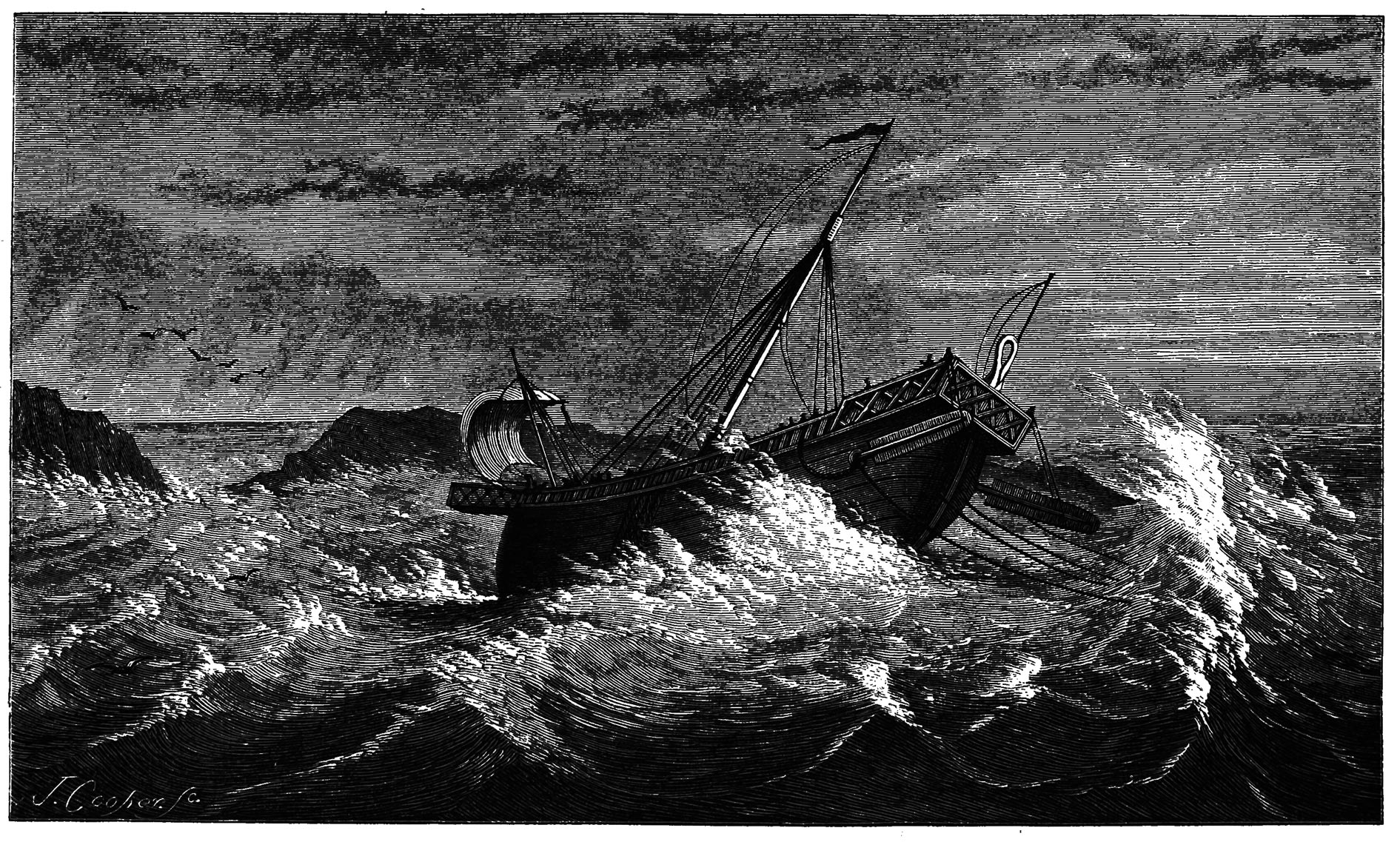
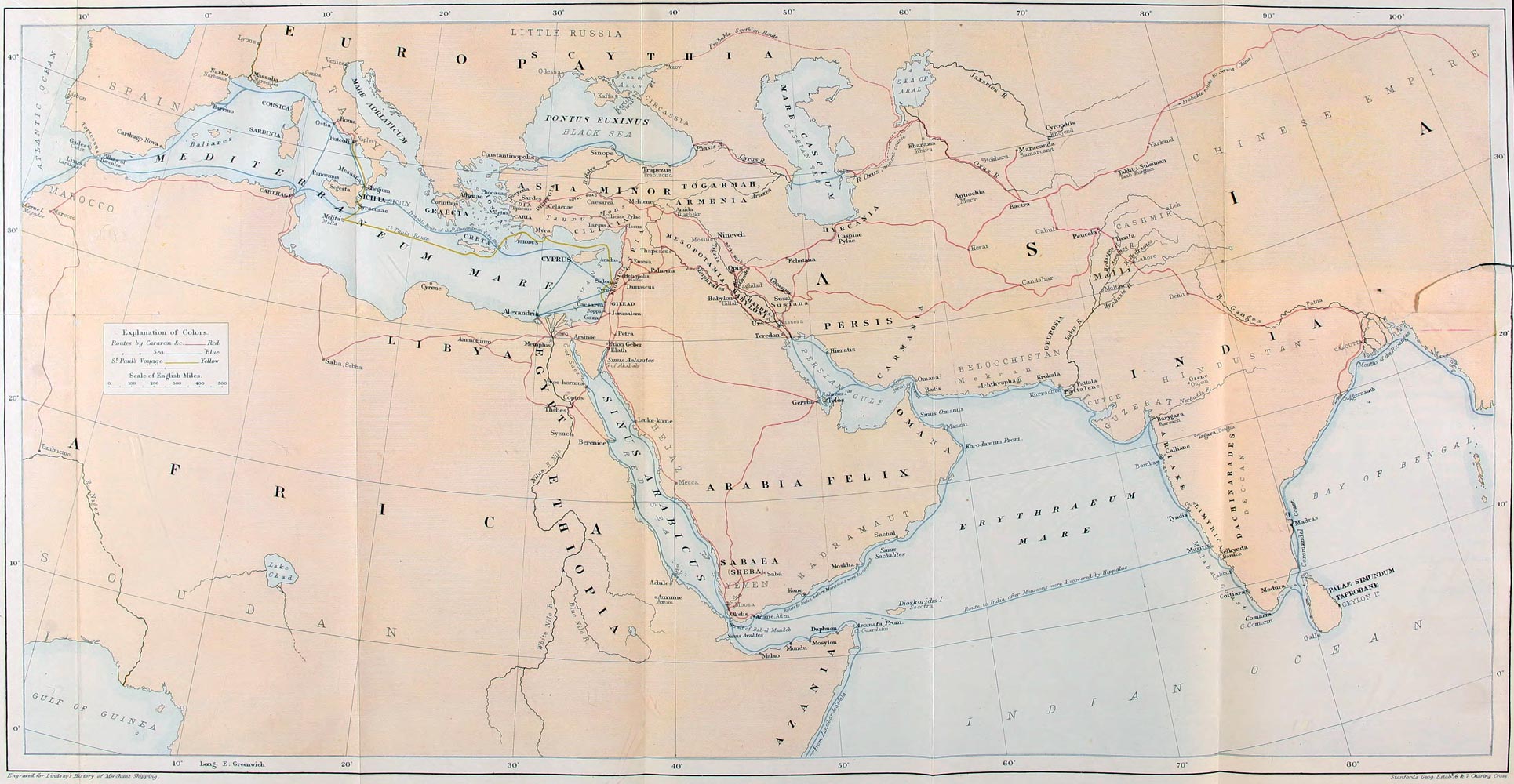
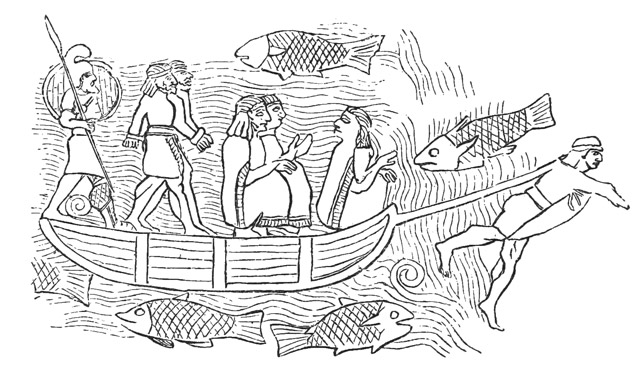
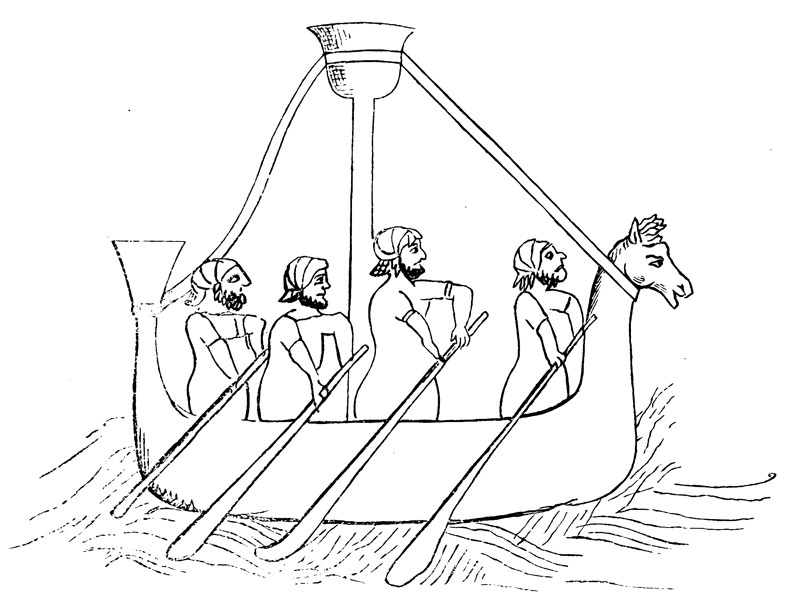
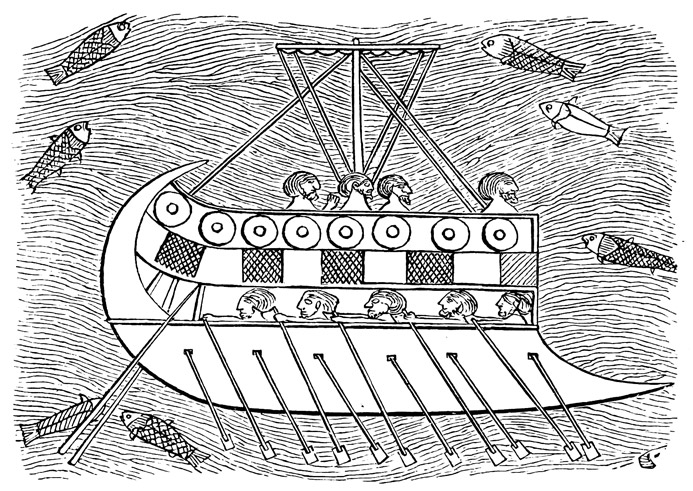
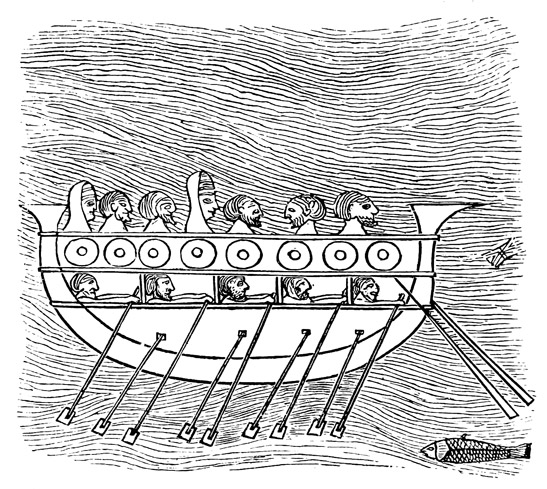
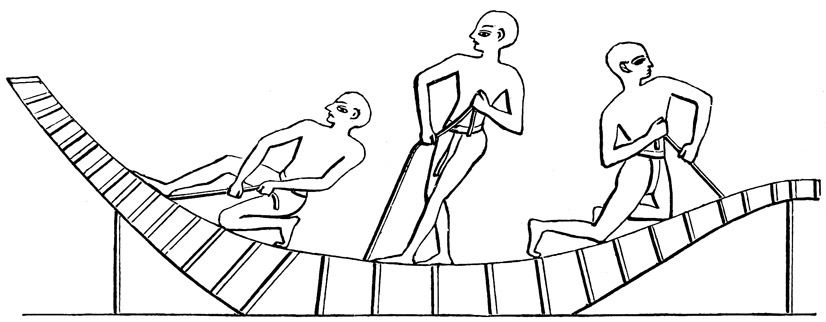
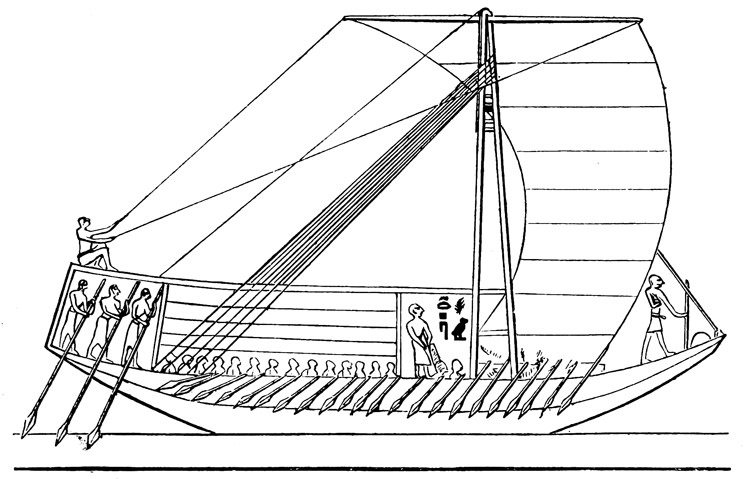
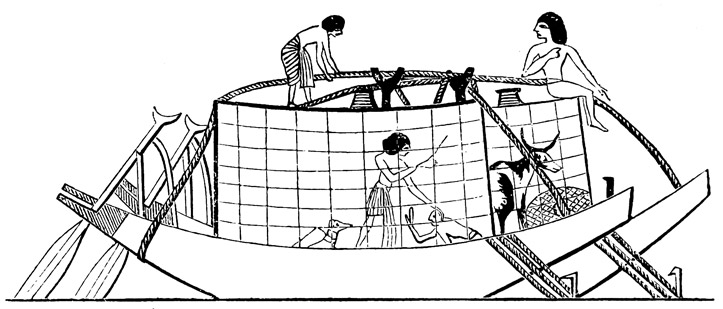
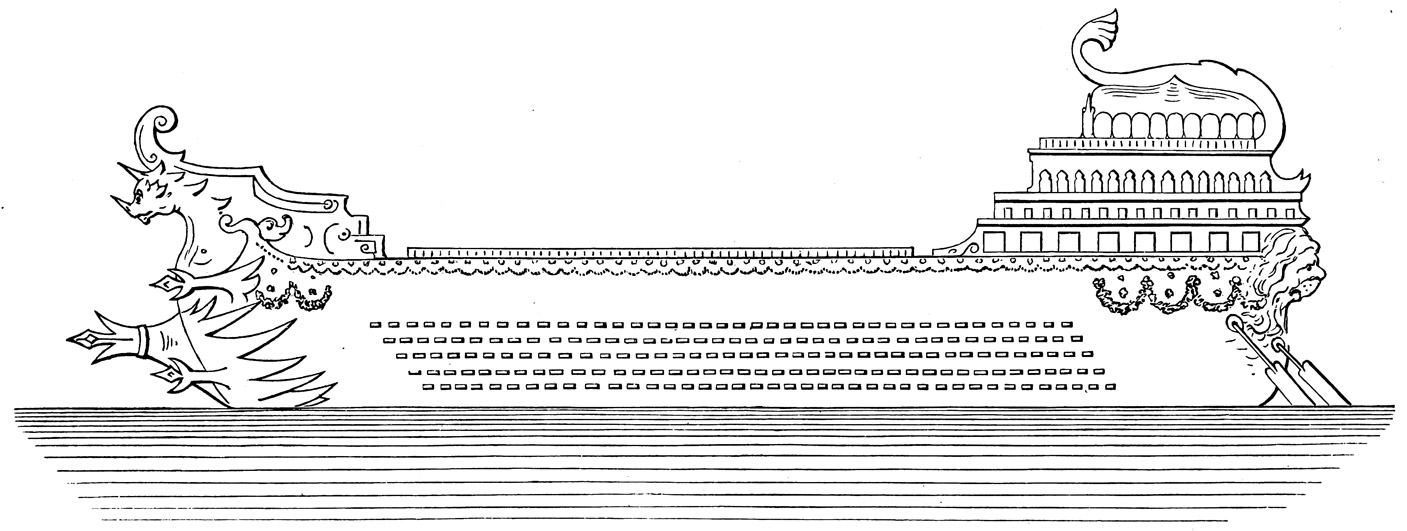
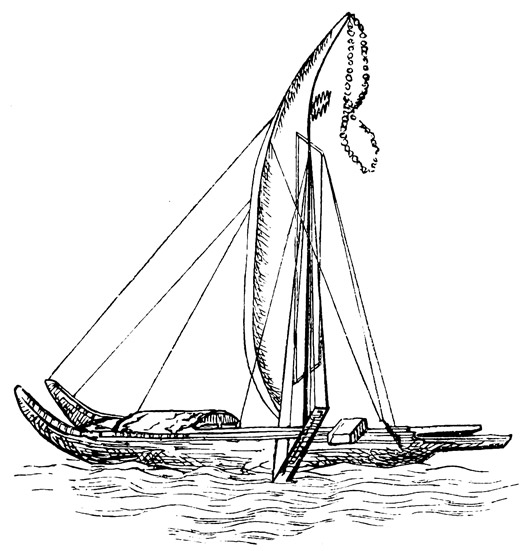
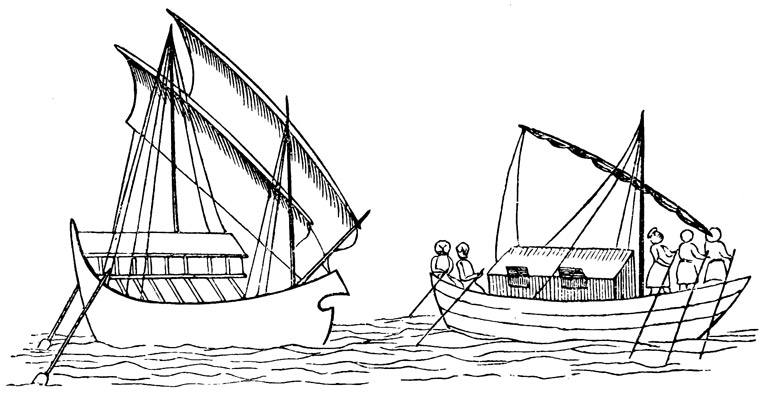
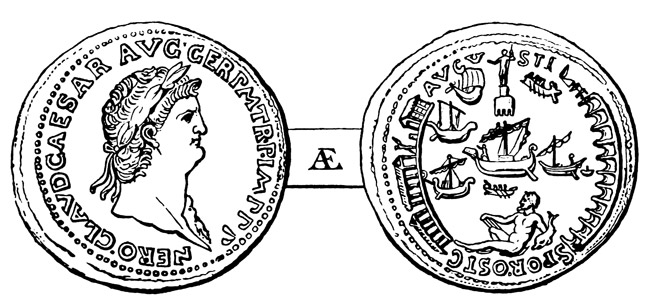
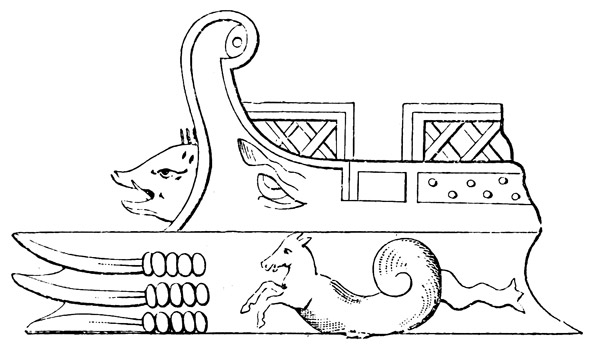
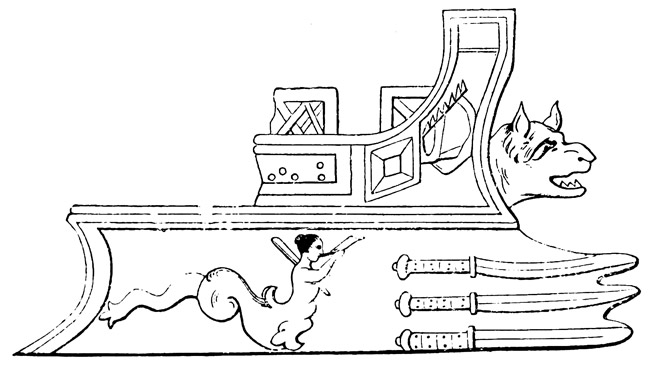
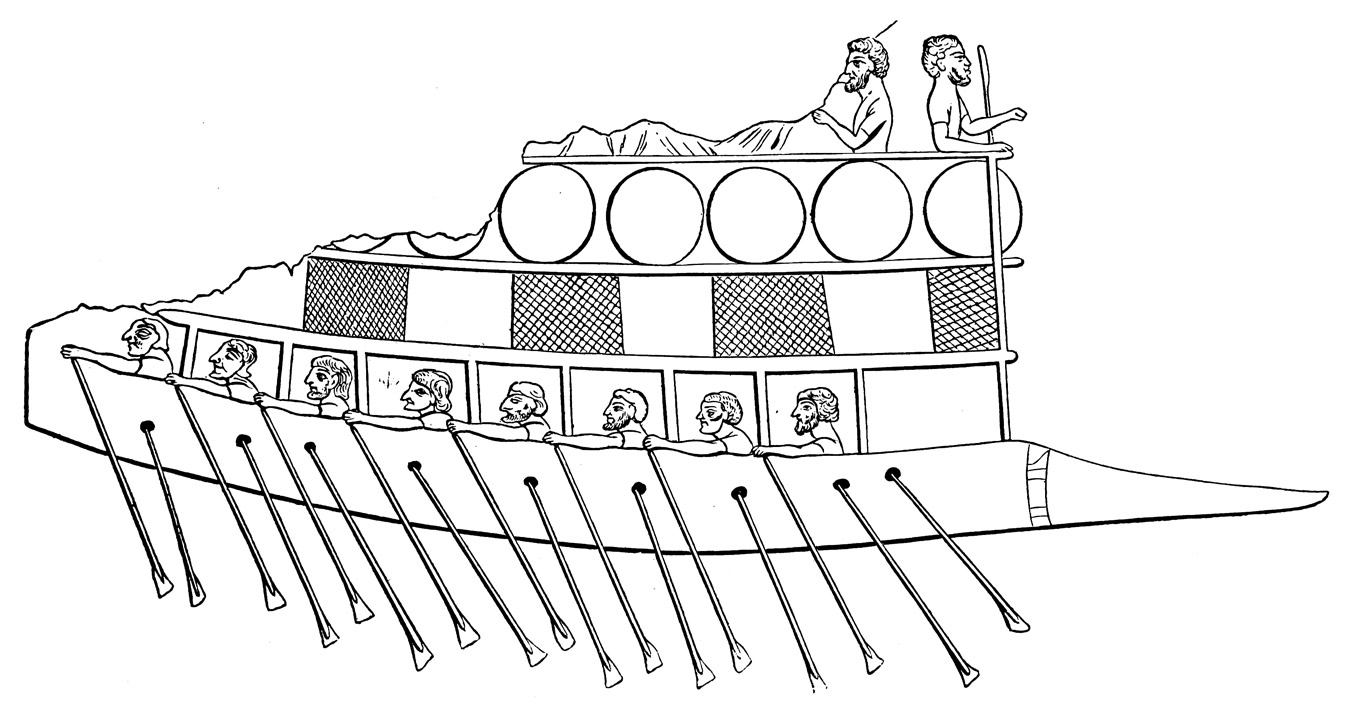







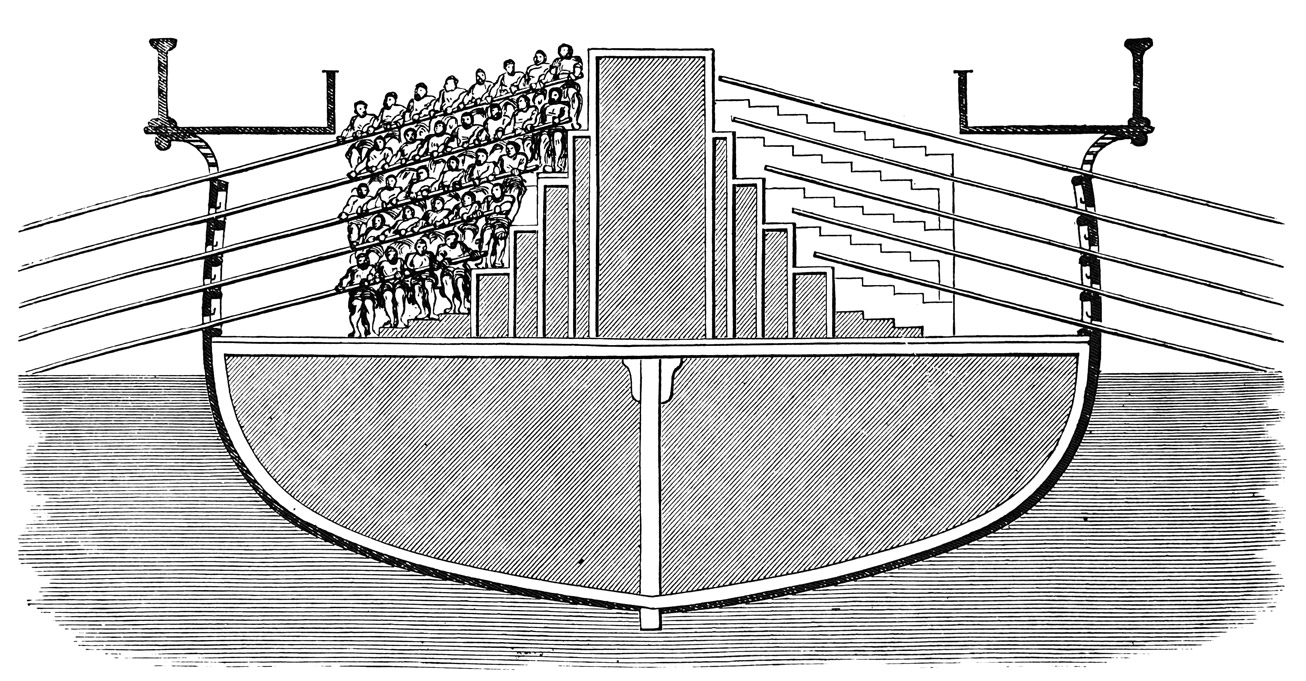
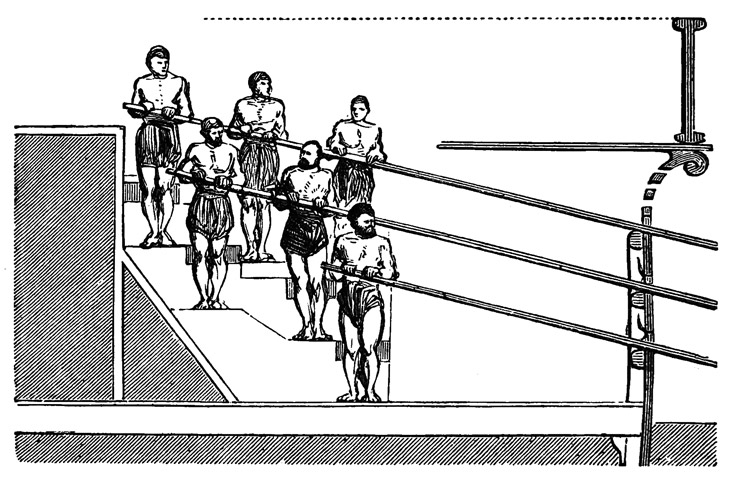
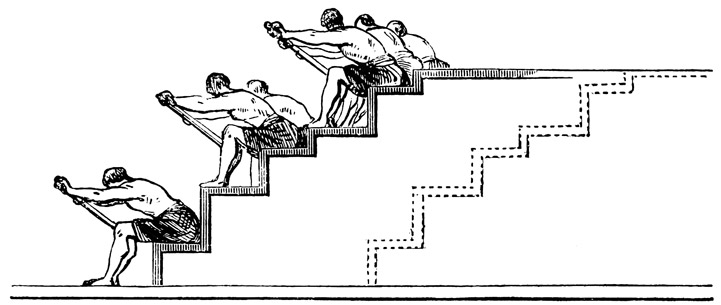
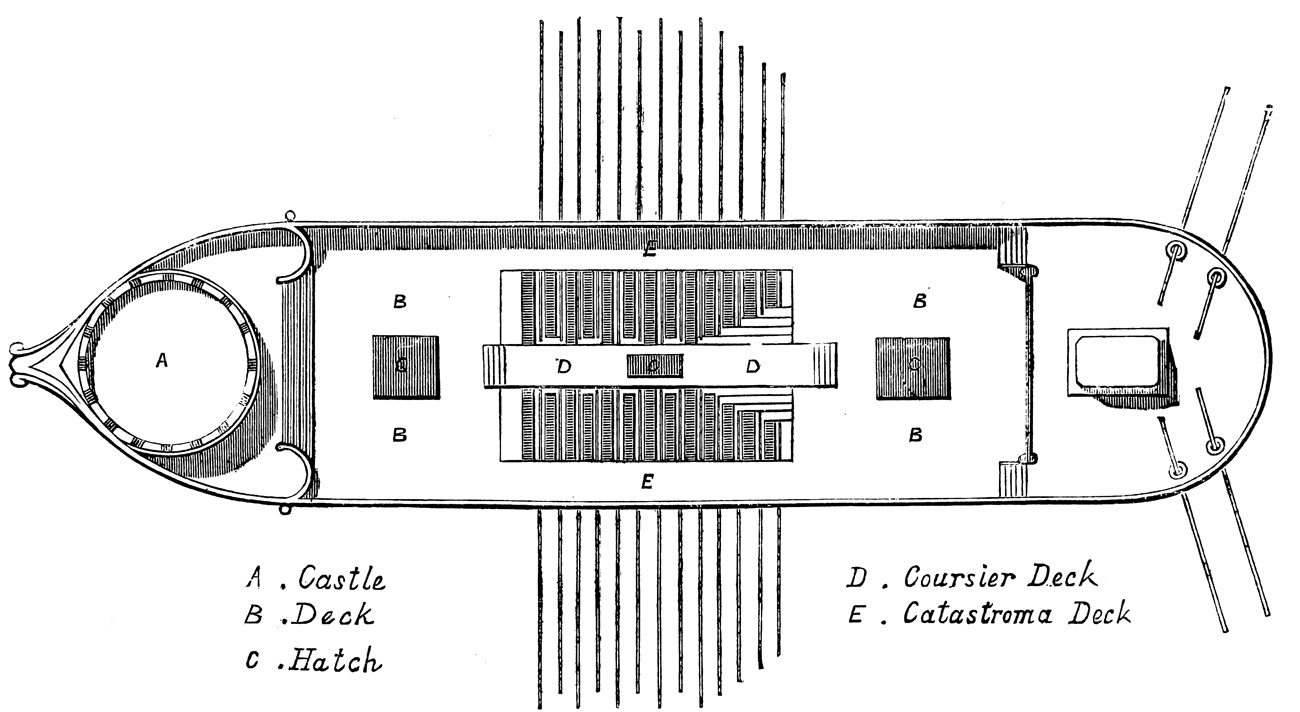
 oblong, fashioned
so as to allow the oar—which in galleys of many
banks could only have been unshipped by being
passed outwards—to be brought pretty close alongside
of the vessel when the rowers ceased work. In
regard to the seats, stools, or benches of the rowers,
so frequently mentioned, and which have created a
good deal of controversy, the plan here suggested
satisfies all these requirements, for to each rower a
separate seat or stool attached to the oblique benches
or steps is appropriated. The height of each of the
oar-ports above the level of the water in that of the
quinquereme, and in all vessels of greater dimensions,
would be as follows:—